EP2960611A1 - Production method for heat exchangers - Google Patents
Production method for heat exchangers Download PDFInfo
- Publication number
- EP2960611A1 EP2960611A1 EP14754026.4A EP14754026A EP2960611A1 EP 2960611 A1 EP2960611 A1 EP 2960611A1 EP 14754026 A EP14754026 A EP 14754026A EP 2960611 A1 EP2960611 A1 EP 2960611A1
- Authority
- EP
- European Patent Office
- Prior art keywords
- tube
- heat exchanger
- closing plate
- tubes
- charging
- Prior art date
- Legal status (The legal status is an assumption and is not a legal conclusion. Google has not performed a legal analysis and makes no representation as to the accuracy of the status listed.)
- Withdrawn
Links
- 238000004519 manufacturing process Methods 0.000 title claims abstract description 36
- 239000011232 storage material Substances 0.000 claims abstract description 188
- 238000005338 heat storage Methods 0.000 claims abstract description 182
- 238000003860 storage Methods 0.000 claims abstract description 170
- 239000002826 coolant Substances 0.000 claims abstract description 63
- 238000010030 laminating Methods 0.000 claims abstract description 11
- 238000004891 communication Methods 0.000 claims description 15
- 230000003247 decreasing effect Effects 0.000 claims description 8
- 238000000034 method Methods 0.000 abstract description 10
- 230000035515 penetration Effects 0.000 description 67
- 238000010586 diagram Methods 0.000 description 53
- 238000005192 partition Methods 0.000 description 41
- 230000002093 peripheral effect Effects 0.000 description 23
- 238000001816 cooling Methods 0.000 description 12
- 239000012188 paraffin wax Substances 0.000 description 10
- 238000002844 melting Methods 0.000 description 9
- 230000008018 melting Effects 0.000 description 9
- 239000000463 material Substances 0.000 description 7
- 238000010792 warming Methods 0.000 description 6
- 230000000694 effects Effects 0.000 description 4
- 239000013529 heat transfer fluid Substances 0.000 description 4
- 229910052751 metal Inorganic materials 0.000 description 4
- 239000002184 metal Substances 0.000 description 4
- 239000000126 substance Substances 0.000 description 4
- 229910000838 Al alloy Inorganic materials 0.000 description 3
- 229910000881 Cu alloy Inorganic materials 0.000 description 3
- OKTJSMMVPCPJKN-UHFFFAOYSA-N Carbon Chemical compound [C] OKTJSMMVPCPJKN-UHFFFAOYSA-N 0.000 description 2
- 238000007664 blowing Methods 0.000 description 2
- 238000007710 freezing Methods 0.000 description 2
- 230000008014 freezing Effects 0.000 description 2
- 150000002430 hydrocarbons Chemical class 0.000 description 2
- 238000012986 modification Methods 0.000 description 2
- 230000004048 modification Effects 0.000 description 2
- 239000000853 adhesive Substances 0.000 description 1
- 230000001070 adhesive effect Effects 0.000 description 1
- 238000005219 brazing Methods 0.000 description 1
- 229910052799 carbon Inorganic materials 0.000 description 1
- 230000015556 catabolic process Effects 0.000 description 1
- 238000006243 chemical reaction Methods 0.000 description 1
- 125000000753 cycloalkyl group Chemical group 0.000 description 1
- 238000006731 degradation reaction Methods 0.000 description 1
- 239000012530 fluid Substances 0.000 description 1
- 238000003825 pressing Methods 0.000 description 1
- 238000004080 punching Methods 0.000 description 1
- 238000009423 ventilation Methods 0.000 description 1
Images












Classifications
-
- F—MECHANICAL ENGINEERING; LIGHTING; HEATING; WEAPONS; BLASTING
- F28—HEAT EXCHANGE IN GENERAL
- F28D—HEAT-EXCHANGE APPARATUS, NOT PROVIDED FOR IN ANOTHER SUBCLASS, IN WHICH THE HEAT-EXCHANGE MEDIA DO NOT COME INTO DIRECT CONTACT
- F28D1/00—Heat-exchange apparatus having stationary conduit assemblies for one heat-exchange medium only, the media being in contact with different sides of the conduit wall, in which the other heat-exchange medium is a large body of fluid, e.g. domestic or motor car radiators
- F28D1/02—Heat-exchange apparatus having stationary conduit assemblies for one heat-exchange medium only, the media being in contact with different sides of the conduit wall, in which the other heat-exchange medium is a large body of fluid, e.g. domestic or motor car radiators with heat-exchange conduits immersed in the body of fluid
- F28D1/03—Heat-exchange apparatus having stationary conduit assemblies for one heat-exchange medium only, the media being in contact with different sides of the conduit wall, in which the other heat-exchange medium is a large body of fluid, e.g. domestic or motor car radiators with heat-exchange conduits immersed in the body of fluid with plate-like or laminated conduits
- F28D1/0308—Heat-exchange apparatus having stationary conduit assemblies for one heat-exchange medium only, the media being in contact with different sides of the conduit wall, in which the other heat-exchange medium is a large body of fluid, e.g. domestic or motor car radiators with heat-exchange conduits immersed in the body of fluid with plate-like or laminated conduits the conduits being formed by paired plates touching each other
- F28D1/0325—Heat-exchange apparatus having stationary conduit assemblies for one heat-exchange medium only, the media being in contact with different sides of the conduit wall, in which the other heat-exchange medium is a large body of fluid, e.g. domestic or motor car radiators with heat-exchange conduits immersed in the body of fluid with plate-like or laminated conduits the conduits being formed by paired plates touching each other the plates having lateral openings therein for circulation of the heat-exchange medium from one conduit to another
- F28D1/0333—Heat-exchange apparatus having stationary conduit assemblies for one heat-exchange medium only, the media being in contact with different sides of the conduit wall, in which the other heat-exchange medium is a large body of fluid, e.g. domestic or motor car radiators with heat-exchange conduits immersed in the body of fluid with plate-like or laminated conduits the conduits being formed by paired plates touching each other the plates having lateral openings therein for circulation of the heat-exchange medium from one conduit to another the plates having integrated connecting members
-
- F—MECHANICAL ENGINEERING; LIGHTING; HEATING; WEAPONS; BLASTING
- F28—HEAT EXCHANGE IN GENERAL
- F28D—HEAT-EXCHANGE APPARATUS, NOT PROVIDED FOR IN ANOTHER SUBCLASS, IN WHICH THE HEAT-EXCHANGE MEDIA DO NOT COME INTO DIRECT CONTACT
- F28D20/00—Heat storage plants or apparatus in general; Regenerative heat-exchange apparatus not covered by groups F28D17/00 or F28D19/00
- F28D2020/0004—Particular heat storage apparatus
- F28D2020/0008—Particular heat storage apparatus the heat storage material being enclosed in plate-like or laminated elements, e.g. in plates having internal compartments
-
- F—MECHANICAL ENGINEERING; LIGHTING; HEATING; WEAPONS; BLASTING
- F28—HEAT EXCHANGE IN GENERAL
- F28D—HEAT-EXCHANGE APPARATUS, NOT PROVIDED FOR IN ANOTHER SUBCLASS, IN WHICH THE HEAT-EXCHANGE MEDIA DO NOT COME INTO DIRECT CONTACT
- F28D20/00—Heat storage plants or apparatus in general; Regenerative heat-exchange apparatus not covered by groups F28D17/00 or F28D19/00
- F28D2020/0004—Particular heat storage apparatus
- F28D2020/0013—Particular heat storage apparatus the heat storage material being enclosed in elements attached to or integral with heat exchange conduits
-
- F—MECHANICAL ENGINEERING; LIGHTING; HEATING; WEAPONS; BLASTING
- F28—HEAT EXCHANGE IN GENERAL
- F28F—DETAILS OF HEAT-EXCHANGE AND HEAT-TRANSFER APPARATUS, OF GENERAL APPLICATION
- F28F2210/00—Heat exchange conduits
Definitions
- the present invention relates to a production method for a heat exchanger for a vehicle air condition, and particularly, to a production method for a heat exchanger including a heat storage material.
- a compressor of a refrigerating cycle also stops when the engine stops, and hence the temperature of an evaporator rises.
- a problem arises in that the temperature of air blowing into a vehicle interior rises and the comfortability is degraded.
- a heat storing heat exchanger that includes a heat medium passage which causes a heat medium to flow therethrough and a heat storage material chamber which receives a heat storage material therein are integrated by a double tube structure, and a passage of a fluid which exchanges heat with the heat medium is formed outside the tube of the double tube structure (for example, see Patent Literature 1).
- Patent Literature 1 a cold storage material is cooled in advance by the cooling capability of an evaporator during the operation of an engine and a compressor, and the cooling capability of air is maintained by the latent heat of the cold storage material during the stop of the engine, thereby suppressing degradation in cooling feeling.
- paraffin having a melting point of about 6°C is exemplified as a cold storage material. Then, a change in phase of the cold storage material is used.
- a heat exchanger including a tube structure including a plurality of tubes which circulates the heat transfer fluid and a reservoir for a heat storage material contacting the tubes so that heat is exchanged between the heat storage material and the heat transfer fluid, and the tube structure improves the heat exchange efficiency between the heat storage material and the heat transfer fluid, the cooling efficiency for an outer fin by the heat transfer fluid, and the cooling efficiency for the outer fin by the heat storage material (for example, see Patent Literature 2).
- the heat storing heat exchanger disclosed in Patent Literature 1 has a structure in which the heat medium passage is surrounded by the cold storage material chamber, a problem arises in that the outer fin is not efficiently cooled by the cooling medium. Further, since the tube structure disclosed in Patent Literature 2 is used, a cooling operation may be efficiently performed.
- the heat storage material is provided in both Patent Literature 1 and Patent Literature 2, an appropriate amount of the heat storage material and a heat storage material adjustment unit are not disclosed. For this reason, for example, when the heat storage material is charged too much, a problem arises in that the warming operation and the cooling operation are not immediately performed and the weight and the cost increase.
- Patent Literature 1 discloses the heat exchanger that uses a change in phase of the heat storage material, but only one heat storage material is used. If only one heat storage material is used, a problem arises in that a heat storage effect obtained by a latent heat may not be exhibited in the cooling operation or the warming operation even when a structure of using the heat storage material is employed in the heat exchanger used for both the cooling operation and the warming operation as shown in, for example, Patent Literature 3.
- An object of the invention is to provide a method of easily producing a heat exchanger which charges a heat storage material into a part of charging spaces or a heat exchanger which charges different kinds of heat storage materials thereinto.
- the heat exchanger includes a laminated body obtained by alternately laminating tubes and outer fins, each tube has a structure in which a first closing plate and a second closing plate are stuck to each other or a structure in which at least one intermediate plate is sandwiched between the first closing plate and the second closing plate, one tank portion is provided at one end portion of the tube in the longitudinal direction, the other tank portion is provided at the other end portion of the tube in the longitudinal direction, the tube includes a cooling medium passage communicating with the one tank portion and the other tank portion, two or more tubes include a storage portion capable of storing a heat storage material and not communicating with the cooling medium passage, the production method for the heat exchanger for a vehicle air condition, comprising: a charging space forming step of laminating the tubes with the outer fins interposed therebetween so as to form a plurality of charging spaces including the storage portion and not communicating with each other; and a charging step of charging a heat storage material into at least one of the charging spaces.
- the charging step includes a releasing step of decreasing the pressure of the charging spaces, and a step of charging the heat storage material into the charging spaces of which the pressure becomes a negative pressure by the releasing step.
- the heat storage material may be more efficiently charged.
- the tubes include at least one of a first tube which includes a charging portion provided at one end portion and the other end portion so as to communicate with the storage portion and not to communicate with both adjacent laminated tubes, a second tube which includes a charging portion provided at any one of one end portion and the other end portion so as to communicate with the storage portion and to communicate with both adjacent laminated tubes and includes a communication portion provided at an end portion opposite to the end portion having the charging portion so as not to communicate with the storage portion and to communicate with both adjacent laminated tubes, and a third tube which includes a first closing portion provided at one end portion and the other end portion so as to communicate with the storage portion and not to communicate with only one of both adjacent laminated tubes.
- the tubes include the first tube and the third tube. Two kinds of heat storage materials may be disposed. Further, the storage portion of the charging spaces which charges the heat storage material and the storage portion of the charging spaces which does not charge the heat storage material may be disposed alternately.
- the tubes include the first tube, the second tube, and the third tube. Two kinds or more of the heat storage materials may be disposed. Further, the storage portion of the charging spaces which charges the heat storage material and the storage portion of the charging spaces which does not charge the heat storage material may be disposed arbitrarily.
- the tubes are the second tube. Two kinds of the heat storage materials may be disposed. Further, the storage portion of the charging spaces which charges the heat storage material and the storage portion of the charging spaces which does not charge the heat storage material may be disposed arbitrarily.
- the tube further includes at least one of a fourth tube which includes a communication portion provided at one end portion and the other end portion so as not to communicate with the storage portion and to communicate with both adjacent laminated tubes and in which the storage portion becomes a hermetic space so that the heat storage material is not charged therein or the storage portion is not provided and a fifth tube which includes a second closing portion provided at one end portion and the other end portion so as not to communicate with the storage portion and not to communicate with only one of both adjacent laminated tubes and in which the storage portion becomes a hermetic space so that the heat storage material is not charged therein or the storage portion is not provided.
- a fourth tube which includes a communication portion provided at one end portion and the other end portion so as not to communicate with the storage portion and to communicate with both adjacent laminated tubes and in which the storage portion becomes a hermetic space so that the heat storage material is not charged therein or the storage portion is not provided
- a fifth tube which includes a second closing portion provided at one end portion and the other end portion so as not to communicate with the
- the tubes include the first tube, the second tube, and the fifth tube. Two kinds or more of the heat storage materials may be disposed and a portion in which the heat storage material is not disposed may be formed.
- the tubes include the second tube and the fourth tube. Two kinds of the heat storage materials may be disposed and a portion in which the heat storage material is not disposed may be formed.
- the tubes include the first tube and the fourth tube. A portion in which the heat storage material is not disposed may be formed.
- the tubes include the first tube, the fourth tube, and the fifth tube. Two kinds of the heat storage materials may be disposed and a portion in which the heat storage material is not disposed may be formed.
- the tubes include the first tube, the third tube, and the fourth tube. Two kinds of the heat storage materials may be disposed and a portion in which the heat storage material is not disposed may be formed.
- the tubes include the second tube, the fourth tube, and the fifth tube. Two kinds or more of the heat storage materials may be disposed and a portion in which the heat storage material is not disposed may be formed.
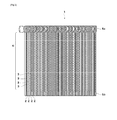
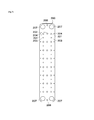
- Fig. 1 is a schematic perspective view illustrating an example of a heat exchanger according to the embodiment.
- a heat exchanger 1 includes a laminated body 4 obtained by alternately laminating tubes 2 and outer fins 3.
- the heat exchanger 1 is, for example, an evaporator, a heater core, or a heat exchanger serving as an evaporator and a heater core of a heat pump cycle.
- the tube 2 further includes a cooling medium passage (not illustrated) therein.
- the cooling medium passage communicates with one tank portion 5a and the other tank portion 5b.
- One tank portion 5a and the other tank portion 5b distribute the cooling medium to the cooling medium passages inside each tube 2 and collect the cooling medium.
- Two or more tubes of the tubes 2 further include a storage portion (not illustrated) therein.
- the storage portion may store a heat storage material. Further, the storage portion does not communicate with the cooling medium passage.
- the outer fin 3 is, for example, a corrugated type thin plate which is formed of aluminum alloy or copper alloy and is bent in a corrugated shape.
- the invention is not limited to the structure of the outer fin 3.
- the laminated body 4 is formed by laminating the tubes 2 with the outer fin 3 interposed therebetween. In the laminated body 4, heat is transferred between the cooling medium passing through the cooling medium passage inside the tubes 2 or the heat storage material and blowing air passing through the outer fins 3.
- the invention is not limited to the number of the tubes 2 and the outer fins 3.
- the laminated body 4 includes a plurality of charging spaces (not illustrated) including storage portions and not communicating with each other.
- each charging space may include a space which charges the heat storage material and a space which does not charge the heat storage material or may include a space which charges each of different kinds of heat storage materials.
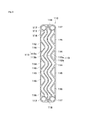
- Fig. 2 is a front view illustrating an example of a closing plate of a first example.
- a closing plate 110 of the first example is formed of metal such as aluminum alloy or copper alloy and substantially has, for example, a rectangular shape in appearance.
- the closing plate 110 of the first example is formed such that a surface (a surface illustrated in Fig. 2 ) 111 sandwiching an intermediate plate is provided with a peripheral wall 112 which is provided in the periphery of the closing plate 110 and two partition walls 113 (113a, 113b) which are provided in parallel along the longitudinal direction of the closing plate 110.
- Each of the partition walls 113 (113a, 113b) has, for example, a corrugated shape in the front view.
- two pairs of partition walls 113 are provided, but the invention is not limited thereto, and for example, a pair of partition walls 113 (113a, 113b) may be provided or three or more pairs of partition walls 113 (113a, 113b) may be provided.
- peripheral wall 112 and the partition walls 113 113a, 113b) by pressing one metal sheet.
- the closing plate 110 of the first example includes a cooling medium passage 114 which is a recess formed between the pair of partition walls 113 (113a, 113b), a center storage portion 115 which is a recess formed between two center partition walls 113b, and an end storage portion 116 which is a recess formed between the partition wall 113a at both sides and the peripheral wall 112. Since the center storage portion 115 and the end storage portion 116 are disposed along the periphery of the cooling medium passage 114, heat may be effectively transferred between the cooling medium inside the cooling medium passage 114 and the heat storage material inside the center storage portion 115 and the end storage portion 116.
- the closing plate 110 of the first example includes a penetration hole 117 which is formed at one end portion and the other end portion thereof so as to communicate with the cooling medium passage 114.
- the closing plate 110 of the first example includes a penetration hole 118 which is formed at one end portion and the other end portion so as to communicate with the center storage portion 115.
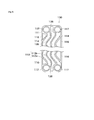
- Fig. 3 is a partially enlarged front view illustrating an example of a closing plate of a second example.
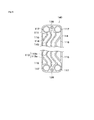
- Fig. 4 is a partially enlarged front view illustrating an example of a closing plate of a third example.
- Fig. 5 is a partially enlarged front view illustrating an example of a closing plate of a fourth example.
- Fig. 6 is a partially enlarged front view illustrating an example of a closing plate of a fifth example.
- closing plates 120, 130, 140, and 150 of the second to fifth examples will be described with reference to the drawings.
- the closing plates 120, 130, 140, and 150 of the second to fifth examples are formed so that the basic structure and the material are the same as those of the closing plate 110 of the first example illustrated in Fig.
- the closing plate 120 of the second example includes the penetration hole 118 which is formed at one end portion so as to communicate with a center storage portion 125 and a penetration hole 128 which is formed at the other end portion so as not to communicate with the center storage portion 125.
- the closing plate 130 of the third example includes a concave portion 138 which is formed at one end portion and the other end portion so as to communicate with a center storage portion 135.
- the concave portion 138 and the penetration holes 118 and 128 are different in that a hole is not formed in the concave portion 138.
- the closing plate 140 of the fourth example includes the penetration hole 128 which is formed at one end portion and the other end portion so as not to communicate with a center storage portion 145.
- the closing plate 150 of the fifth example includes a concave portion 158 which is formed at one end portion and the other end portion so as not to communicate with a center storage portion 155.
- the concave portion 158 and the penetration holes 118 and 128 are different in that a hole is not formed in the concave portion 138.
- Fig. 7 is a front view illustrating an example of an intermediate plate.
- An intermediate plate 200 is formed of metal such as aluminum alloy or copper alloy and has the same appearance as the closing plate 110.
- the intermediate plate 200 includes a penetration hole 207 which is formed at a position corresponding to the penetration hole 117 of the closing plate 110 illustrated in Fig. 2 . Further, the intermediate plate 200 includes a penetration hole 208 which is formed at a position corresponding to the penetration hole 118 of the closing plate 110 illustrated in Fig. 2 .
- the intermediate plate 200 includes a first hole 201, a second hole 202, a third hole 203, and a fourth hole 204.
- the invention is not limited to the number of holes.
- the first hole 201, the second hole 202, and the fourth hole 204 are circular, and the third hole 203 is rectangular in Fig. 3 ; however, the invention is not limited to the shapes of the holes 201, 202, 203, and 204.
- Fig. 8 is a diagram to describe a structure of the first tube.
- the first tube has a structure in which the intermediate plate 200 illustrated in Fig. 8 is sandwiched between a first closing plate 110A and a second closing plate 110B.
- both the first closing plate 110A and the second closing plate 110B are formed as the closing plate 110 of the first example illustrated in Fig. 2 .
- the first tube is formed in a manner such that the top portions of the peripheral wall 112 and the partition wall 113 of the first closing plate 110A illustrated in Fig. 8 contact one surface of the intermediate plate 200, the top portions of the peripheral wall 112 and the partition wall 113 of the second closing plate 110B contact the other surface of the intermediate plate 200, and the plates are brazed (bonded) to each other.
- Fig. 9 is a diagram only illustrating the cooling medium passage of the first tube and the tank portion.
- the cooling medium passage 114 includes a first cooling medium passage 114A and a second cooling medium passage 114B.
- the first cooling medium passage 114A is formed between the first closing plate 110A and the intermediate plate 200illustrated in Fig. 8 .
- the second cooling medium passage 114B is formed between the second closing plate 110B and the intermediate plate 200 illustrated in Fig. 8 .
- the phases of the first cooling medium passage 114A and the second cooling medium passage 114B are opposite to each other.
- a cooling medium may circulate between the first cooling medium passage 114A and the second cooling medium passage 114B.
- Each of the tank portions 5a and 5b is formed by overlapping the penetration hole 117 of the closing plate (the first closing plate) 110 illustrated in Fig. 2 , the penetration hole 207 of the intermediate plate 200 illustrated in Fig. 7 , and the penetration hole 117 of the closing plate (the second closing plate) 110 illustrated in Fig. 2 .
- Fig. 10 is a diagram only illustrating the storage portion of the first tube and both end portions thereof.
- the first tube includes the center storage portion 115 and the end storage portion 116 as the storage portion.
- the center storage portion 115 includes a first center storage portion 115A and a second center storage portion 115B.
- the first center storage portion 115A is formed between the first closing plate and the intermediate plate.
- the second center storage portion 115B is formed between the second closing plate and the intermediate plate.
- the phases of the first center storage portion 115A and the second center storage portion 115B are opposite to each other.
- a heat storage material may circulate between the first center storage portion 115A and the second center storage portion 115B.
- a charging portion 6 is provided at one end portion and the other end portion of the center storage portion 115.
- the charging portion 6 is formed by overlapping the penetration hole 118 of the closing plate (the first closing plate) 110 of the first example illustrated in Fig. 2 , the penetration hole 208 of the intermediate plate 200 illustrated in Fig. 7 , and the penetration hole 118 of the closing plate (the second closing plate) 110 of the first example illustrated in Fig. 2 .
- the charging portion 6 communicates with the center storage portion 115 and also communicates with both adjacent laminated tubes.
- the end storage portion 116 includes a first end storage portion 116A and a second end storage portion 116B.
- the first end storage portion 116A is formed between the first closing plate and the intermediate plate.
- the second end storage portion 116B is formed between the second closing plate and the intermediate plate.
- the first end storage portion 116A is disposed while the end portion thereof overlaps the second center storage portion 115B and the second end storage portion 116B.
- the second end storage portion 116B is disposed while the end portion thereof overlaps the first center storage portion 115A and the first end storage portion 116A.
- the heat storage material may circulate between the first end storage portion 116A and the second center storage portion 115B and between the second end storage portion 116B and the first center storage portion 115A.
- the heat storage material may circulate between the first end storage portion 116A and the second end storage portion 116B.
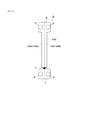
- Fig. 11 is a schematic diagram of the first tube.
- Fig. 11 is a diagram in which the center storage portion 115 illustrated in Fig. 10 and both end portions thereof are simplified based on the following rule.
- the dumbbell shape indicates the center storage portion 115 of Fig. 10 and both end portions thereof.
- the protrusion portions of the upper and lower ends indicate one end portion and the other end portion of the center storage portion 115 of Fig. 10 , and correspond to the charging portions 6 in the first tube 11.
- the uncolored circle O indicates a state where the portion communicates with the adjacent laminated tubes.
- the dotted line which longitudinally cuts the dumbbell shape indicates the intermediate plate 200.
- the left side of the dotted line indicates the first center storage portion 115A of Fig. 10
- the right side of the dotted line indicates the second center storage portion 115B of Fig. 10 .
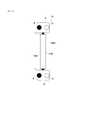
- Fig. 12 is a schematic diagram of the second tube.
- Fig. 13 is a schematic diagram of the third tube.
- Fig. 14 is a schematic diagram of the fourth tube.
- Fig. 15 is a schematic diagram of the fifth tube.
- the schematic diagrams illustrated in Figs. 12 to 15 are created by the rule common to the schematic diagram illustrated in Fig. 11 . For this reason, the rule described in Fig. 11 will not be described, and only new rule will be described.
- the second tube 12 is a tube which uses the closing plates 120 of the second example illustrated in Fig. 3 as the first closing plate and the second closing plate.
- the colored square T indicates a state where the portion does not communicate with the center storage portion 125.
- the second tube 12 includes the charging portion 6 which is formed at one end portion, and a communication portion 7 which is formed at the other end portion.
- the charging portion 6 is formed by overlapping the penetration hole 118 of the closing plate (the first closing plate) 120 of the second example illustrated in Fig. 3 , the penetration hole 208 of the intermediate plate 200 illustrated in Fig. 7 , and the penetration hole 118 of the closing plate (the second closing plate) 120 of the second example illustrated in Fig. 3 .
- the charging portion 6 communicates with the center storage portion 125 and also communicates with both adjacent laminated tubes.
- the communication portion 7 is formed by overlapping the penetration hole 128 of the closing plate (the first closing plate) 120 of the second example illustrated in Fig.
- the communication portion 7 does not communicate with the center storage portion 125 and communicates with both adjacent laminated tubes.
- the third tube 13 is a tube which uses the closing plate 130 of the third example illustrated in Fig. 4 as the first closing plate, and uses the closing plate 110 of the first example illustrated in Fig. 2 as the second closing plate.
- the colored circle F indicates a state where the portion does not communicate with the adjacent laminated tube.
- the third tube 13 includes a first closing portion 8 which is formed at one end portion and the other end portion.
- the first closing portion 8 is formed by overlapping the concave portion 138 of the closing plate (the first closing plate) 130 of the third example illustrated in Fig. 4 , the penetration hole 208 of the intermediate plate 200 illustrated in Fig. 7 , and the penetration hole 118 of the closing plate (the second closing plate) 110 of the first example illustrated in Fig. 2 .
- the first closing portion 8 communicates with the storage portions 115 and 135 and does not communicate with only one (the tube near the closing plate of the third example) of both adjacent laminated tubes.
- the fourth tube 14 is a tube which uses the closing plate 140 of the fourth example illustrated in Fig. 5 as the first closing plate and the second closing plate.
- the fourth tube 14 includes the communication portion 7 which is formed at one end portion and the other end portion.
- the communication portion 7 is formed by overlapping the penetration hole 128 of the closing plate (the first closing plate) 140 of the fourth example illustrated in Fig. 5 , the penetration hole 208 of the intermediate plate 200 illustrated in Fig. 7 , and the penetration hole 128 of the closing plate (the second closing plate) 140 of the fourth example illustrated in Fig. 5 .
- the communication portion 7 does not communicate with the center storage portion 145 and communicates with both adjacent laminated tubes.
- the fourth tube 14 may be formed so that the center storage portion 145 is hollow or the center storage portion 145 is not provided.
- a structure without the center storage portion 145 is, for example, a structure in which the partition wall 113b illustrated in Fig. 5 extends to a portion provided with the center storage portion 145.
- the communication portion 7 is simply a portion "which communicates with both adjacent laminated tubes".
- the fifth tube 15 is a tube which uses the closing plate 150 of the fifth example illustrated in Fig. 6 as the first closing plate and uses the closing plate 140 of the fourth example illustrated in Fig. 5 as the second closing plate.
- the fifth tube 15 includes a second closing portion 9 which is formed at one end portion and the other end portion.
- the second closing portion 9 is formed by overlapping the concave portion 158 of the closing plate (the first closing plate) 150 of the fifth example illustrated in Fig. 6 , the penetration hole 208 of the intermediate plate 200 illustrated in Fig. 7 , and the penetration hole 128 of the closing plate (the second closing plate) 140 of the fourth example illustrated in Fig. 5 .
- the second closing portion 9 does not communicate with the storage portions 145 and 155 and does not communicate with only one (the tube near the closing plate of the fifth example) among both adjacent laminated tubes. Further, as illustrated in Fig.
- the fifth tube 15 may be formed so that the center storage portions 145 and 155 are hollow or the center storage portions 145 and 155 are not provided.
- a structure without the center storage portions 145 and 155 is, for example, a structure in which the partition wall 113b illustrated in Figs. 5 and 6 extends to a portion provided with the center storage portions 145 and 155.
- the second closing portion 9 is simply a portion "which does not communicate with only one of both adjacent laminated tubes".
- the production method for the heat exchanger according to the embodiment includes a charging space forming step of laminating the tubes with the outer fins interposed therebetween so as to form a plurality of the charging spaces including the storage portion and not communicating with each other; and a charging step of charging the heat storage material into at least one charging spaces.
- the charging space forming step includes a step of appropriately laminating the tubes and the outer fins and bonding the tubes and the outer fins to each other by brazing.
- the tubes include at least one of the first tube 11, the second tube 12, and the third tube 13.
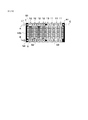
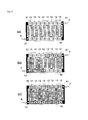
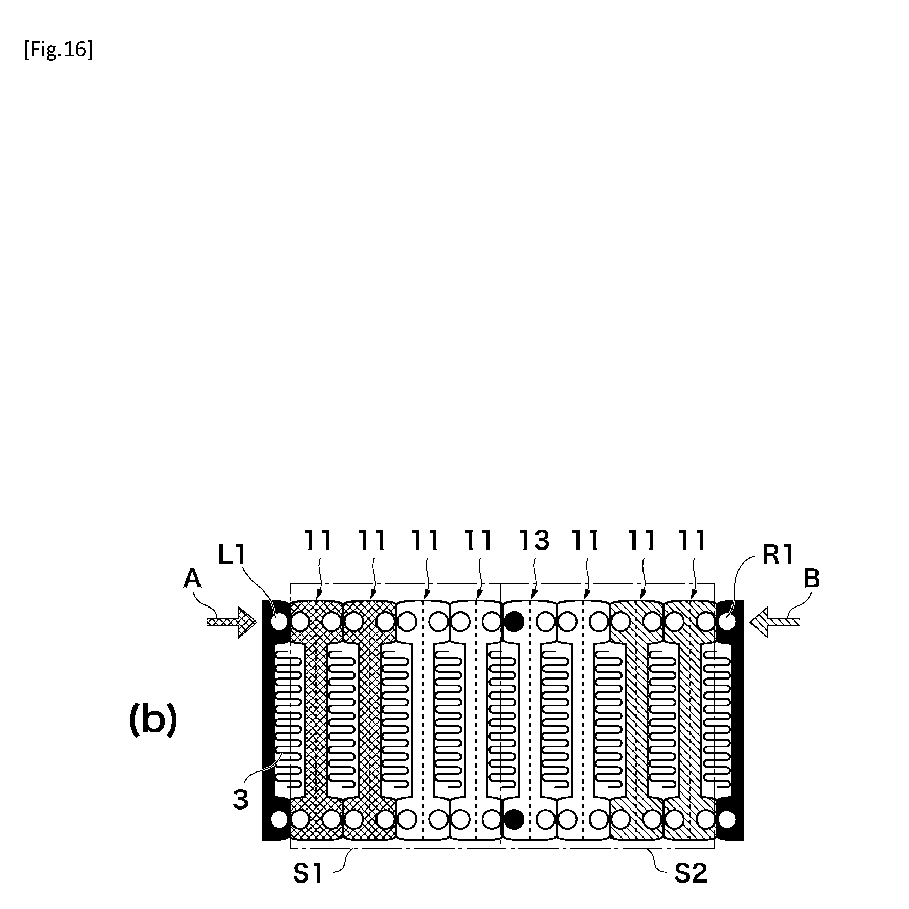
- Figs. 16(a) to 16(c) are schematic diagrams illustrating a first example of a heat exchanger using the first tube and the third tube, where Fig. 16(a) illustrates a state where the heat storage material is not charged yet, Fig. 16(b) illustrates a state where the heat storage material is being charged, and Fig. 16(c) illustrates a state where the heat storage material is completely charged.
- the laminated state of the tube will be described with reference to the schematic diagrams of the tube of Figs. 11 to 15 .
- the tubes include the first tube and the third tube as illustrated in Figs. 16(a) to 16(c) .
- the first tubes 11 are laminated and one third tube 13 is disposed between the first tubes 11.
- the charging space is divided into a first space S1 which is formed by the first tubes 11 laminated at the left side of the third tube 13 and a second space S2 which is formed by the third tube 13 and the first tubes 11 laminated at the right side of the third tube 13.
- the first space S1 charges a first heat storage material A from one end portion (the left upper side of Fig. 16(b) ) L1 in the longitudinal direction of the tube and the second space S2 charges the second heat storage material B from one end portion (the right upper side of Fig. 16(b) ) R1 in the longitudinal direction of the tube.
- the invention is not limited to the heat storage material charging sequence, and the charging material may be charged in order of the first space S1 and the second space S2 or in order of the second space S2 and the first space S1, or alternatively, the charging material may be charged into the first space S1 and the second space S2 at the same time.
- the charging step includes a releasing step of decreasing the pressure of the charging spaces, and a step of charging the heat storage material into the charging spaces of which the pressure becomes a negative pressure by the releasing step.
- the method of releasing the air inside the charging space is not particularly limited, and for example, a method using a vacuum pump may be employed.
- the pressure of the charging space is set to a negative pressure, the heat storage material may be more efficiently charged.
- the negative pressure indicates a state where the pressure is lower than the atmospheric pressure.
- FIGs. 16(a) to 16(c) illustrate a state where the heat storage material is charged into both the first space S1 and the second space S2; however, any one the first space S1 and the second space S2 may be empty without charging the heat storage material thereinto. Further, it is preferable to prevent the outflow of the heat storage material by burying one end portion L1 and R1 in the longitudinal direction of the tube by an adhesive or the like after the heat storage material is charged.
- Figs. 17(a) to 17(c) are schematic diagrams illustrating a second example of a heat exchanger using the first tube and the third tube, where Fig. 17(a) illustrates a state where the heat storage material is not charged yet, Fig. 17(b) illustrates a state where the heat storage material is being charged, and Fig. 17(c) illustrates a state where the heat storage material is completely charged.
- the first tubes 11 are laminated and two third tubes 13 are respectively disposed between the first tubes 11 so as to be separated from each other.
- the charging space is divided into the first space S1 which is formed by the third tube and the first tubes 11 laminated at the left side of the third tube 13, the second space S2 which is formed by the first tubes 11 laminated between two third tubes 13, and the third space S3 which is formed by the third tube 13 and the first tubes 11 laminated at the right side of the third tube.
- the first space S1 charges the heat storage material A from one end portion (the left upper side of Fig. 17(b) ) L1 in the longitudinal direction of the tube and the third space S3 charges the heat storage material A from one end portion (the right upper side of Fig. 17(b) ) R1 in the longitudinal direction of the tube.
- the first space S1 which charge the heat storage material A, the third space S3 which charge the heat storage material A, and the second space S2 which does not charge the heat storage material may be alternately disposed.
- the invention is not limited to the heat storage material charging sequence.
- the heat storage material may be charged in order of the first space S1 and the second space S2 or in order of the second space S2 and the first space S1, or alternatively, the heat storage material may be charged into the first space S1 and the second space S2 at the same time.
- Figs. 17(a) to 17(c) illustrate a structure in which the same heat storage material A is charged into the first space S1 and the third space S3; however, a heat storage material different from the heat storage material A may be charged into any one of the first space S1 and the third space S3.
- Fig. 18 is a schematic diagram illustrating a first example of a heat exchanger using the first tube, the second tube, and the third tube and illustrates a state where the heat storage material is completely charged.
- the tubes include the first tube 11, the second tube 12, and the third tube 13 as illustrated in Fig. 18 .
- the second tubes 12 are laminated by alternately laminating the charging portion 6 and the communication portion 7, the first tubes 11 are laminated, and the third tube 13 is disposed between the second tube 12 and the first tube 11.
- the charging space is divided into the first space S1 and the second space S2 which are formed by the second tubes 12 and the third space S3 which is formed by the third tube 13 and the first tubes 11.
- the first space S1 charges the first heat storage material A from one end portion (the left upper side of Fig. 18 ) L1 in the longitudinal direction of the tube
- the second space S2 charges the second heat storage material B from other end portion (the left lower side of Fig. 18 ) L2 in the longitudinal direction of the tube
- the third space S3 charges the third heat storage material C from one end portion (the right upper side of Fig. 18 ) R1 in the longitudinal direction of the tube.
- three kinds of heat storage materials A, B, and C may be disposed.
- the invention is not limited to the heat storage material charging sequence.
- the heat storage material charging sequence for example, the heat storage material may be charged in order of the first space S1, the second space S2, and the third space S3, in order of the second space S2, the first space S1, and the third space S3, or in order of the third space S3, the second space S2, and the first space S1, or the heat storage material may be charged into one or two charging spaces of the first space S1, the second space S2, and the third space S3 at the same time and may be charged into the remaining charging space, or alternatively, the heat storage material may be charged into the first space S1, the second space S2, and the third space S3 at the same time. Further, in the heat exchanger illustrated in Fig.
- one or two or more of the first space S1, the second space S2, and the third space S3 may be empty without charging the heat storage material thereinto. Further, in the heat exchanger illustrated in Fig. 18 , the same heat storage material may be charged into two charging spaces of the first space S1, the second space S2, and the third space S3.
- a structure of charging the same heat storage material into two charging spaces is, for example, a structure which charges the first heat storage material A into the first space S1 and the third space S3 and charges the second heat storage material B into the second space S2, a structure which charges the first heat storage material A into the second space S2 and the third space S3 and charges the second heat storage material B into the first space S1, or a structure which charges the first heat storage material A into the first space S1 and the second space S2 and charges the second heat storage material B into the third space S3.
- Fig. 18 illustrates a structure in which the storage portion of the first space S1 and the storage portion of the second space S2 are alternately disposed, but the invention is not limited thereto.
- the heat exchanger illustrated in Fig. 18 is modified so that at least one of the second tubes 12 is turned upside down, belonging of the storage portion is changed to the second space S2 from the first space S1, or belonging of the storage portion is changed to the first space S1 from the second space S2.
- the storage portions of the first spaces S1 may be disposed in parallel or the storage portions of the second spaces S2 may be disposed in parallel.
- Figs. 19(a) to 19(c) are schematic diagrams illustrating a first example of a heat exchanger using the second tube, where Fig. 19(a) illustrates a state where the heat storage material is not charged yet, Fig. 19(b) illustrates a state where the heat storage material is being charged, and Fig. 19(c) illustrates a state where the heat storage material is completely charged.
- the tubes include the second tubes 12 as illustrated in Fig. 19 .
- the second tubes 12 are laminated by alternately disposing the charging portion 6 and the communication portion 7.
- the charging space is divided into the first space S1 and the second space S2.
- the first space S1 charges the heat storage material A from one end portion (the right upper side of Fig. 19(b) ) R1 in the longitudinal direction of the tube and the second space S2 charges the heat storage material B from other end portion (the left lower side of Fig. 19(b) ) L2 in the longitudinal direction of the tube.
- two kinds of heat storage materials A and B may be alternately disposed.
- the invention is not limited to the heat storage material charging sequence.
- the heat storage material may be charged in order of the first space S1 and the second space S2 or in order of the second space S2 and the first space S1, or alternatively, the heat storage material may be charged into the first space S1 and the second space S2 at the same time.
- Fig. 20 is a diagram illustrating a modified example of the heat exchanger charging method illustrated in Figs. 19(a) to 19(c) .
- the first space S1 may be empty without charging the heat storage material thereinto.
- the storage portion of the first space S1 which does not charge the heat storage material thereinto may be disposed between the storage portions of the second spaces S2 which charge the heat storage material thereinto.
- the storage portions of the first spaces S1 may be disposed in parallel or the storage portions of the second spaces S2 may be disposed in parallel.
- Fig. 21 is a schematic diagram illustrating a modified example of the heat exchanger illustrated in Figs. 19(a) to 19(c) and illustrates a state where the heat storage material is completely charged.
- Fig. 21 illustrates a structure in which the tube 12X located at the second position from the left side and the tube 12Y located at the rightmost position are turned upside.
- the storage portions of the charging spaces that charge the specific heat storage material (the first heat storage material A in Fig. 21 ) thereinto may be disposed in parallel.
- Fig. 22 is a diagram illustrating a modified example of the heat exchanger charging method illustrated in Fig. 21 .
- the first space S1 may be empty without charging the heat storage material thereinto.
- the storage portion of the charging space which does not charge the heat storage material may be disposed at an arbitrary position.
- the tubes further include any one of the fourth tube and the fifth tube.
- Fig. 23 is a schematic diagram illustrating a first example of a heat exchanger using the first tube, the second tube, and the fifth tube and illustrates a state where the heat storage material is completely charged.
- the tubes include the first tube 11, the second tube 12, and the fifth tube 15 as illustrated in Fig. 23 .
- the second tubes 12 are laminated by alternately disposing the charging portion 6 and the communication portion 7, the first tubes 11 are laminated, and the fifth tube 15 is disposed between the second tube 12 and the first tube 11.
- three kinds of heat storage materials A, B, and C may be disposed.
- the fifth tube 15 may be disposed at an arbitrary position so as to form a portion in which the heat storage material is not disposed.
- Fig. 24 is a schematic diagram illustrating a first example of a heat exchanger using the second tube and the fourth tube and illustrates a state where the heat storage material is completely charged. It is preferable that the tubes include the second tube 12 and the fourth tube 14 as illustrated in Fig. 24 . As illustrated in Fig. 24 , two kinds of heat storage materials A and B may be disposed. Further, the fourth tube 14 may be disposed at an arbitrary position so as to form a portion in which the heat storage material is not disposed.
- Fig. 25 is a schematic diagram illustrating a first example of a heat exchanger using the first tube and the fourth tube and illustrates a state where the heat storage material is completely charged. It is preferable that the tubes include the first tube 11 and the fourth tube 14 as illustrated in Fig. 25 . As illustrated in Fig. 25 , the fourth tube 14 may be disposed at an arbitrary position so as to form a portion in which the heat storage material is not disposed.
- Fig. 26 is a schematic diagram illustrating a first example of a heat exchanger using the first tube, the fourth tube, and the fifth tube and illustrates a state where the heat storage material is completely charged. It is preferable that the tubes include the first tube 11, the fourth tube 14, and the fifth tube 15 as illustrated in Fig. 26 . As illustrated in Fig. 26 , two kinds of heat storage materials A and B may be disposed. Further, the fourth tube 14 or the fifth tube 15 may be disposed at an arbitrary position so as to form a portion in which the heat storage material is not disposed.
- Fig. 27 is a schematic diagram illustrating a first example of a heat exchanger using the first tube, the third tube, and the fourth tube and illustrates a state where the heat storage material is completely charged. It is preferable that the tubes include the first tube 11, the third tube 13, and the fourth tube 14 as illustrated in Fig. 27 . As illustrated in Fig. 27 , two kinds of heat storage materials A and B may be disposed. Further, the fourth tube 14 may be disposed at an arbitrary position so as to form a portion in which the heat storage material is not disposed.
- Fig. 28 is a schematic diagram illustrating a first example of a heat exchanger using the second tube, the fourth tube, and the fifth tube and illustrates a state where the heat storage material is completely charged. It is preferable that the tubes include the second tube 12, the fourth tube 14, and the fifth tube 15 as illustrated in Fig. 28 . As illustrated in Fig. 28 , four kinds of heat storage materials A, B, C, and D may be disposed. Further, the fourth tube 14 or the fifth tube 15 may be disposed at an arbitrary position so as to form a portion in which the heat storage material is not disposed.
- the invention is not limited to the illustration of the combination, the scale, and the arrangement of the first to fifth tubes, and various modifications may be made as long as the effects of the invention are obtained.
- the heat storage material indicates a material which keeps a temperature of a contacting material at a predetermined temperature.
- the heat storage material is called a cold storage material when the keeping temperature is equal to or lower than a room temperature or is generally called a heat storage/cold storage material.
- the heat storage material of the invention includes the cold storage material and the heat storage/cold storage material.
- the heat storage material is, for example, a sensible heat storage material which uses specific heat, a latent heat storage material which uses a change in phase such as melting and freezing, or a chemical heat storage material which uses absorbing and generating of heat caused by a chemical reaction.
- the latent heat storage material is, for example, paraffin.
- the paraffin is a material containing a chain state hydrocarbon compound of which a general formula is C n H 2n+2 or a cyclic hydrocarbon compound of which a general formula is C n H 2n (here, n ⁇ 3).
- the paraffin since the chemical stability of the paraffin is higher, it is preferable that the paraffin mainly contains a chain state hydrocarbon compound.
- the melting point (the freezing point) of the paraffin is different depending on the carbon number (the number of n in the general formula) or the carbon chain structure having a straight shape, a branched shape, or a ring shape. For this reason, it is possible to arbitrarily select paraffin having a phase change temperature in response to a target holding temperature.
- a heat exchanger capable of conducting both a cooling operation and a warming operation may be realized by the combination of the low melting point paraffin (for example, the melting point: 3 to 10°C) and the high melting point paraffin (for example, the melting point: 77 to 85°C) having a melting point higher than the low melting point paraffin.
- Figs. 29(A) and 29(B) are diagrams to describe an example of a structure without the intermediate plate among the modified examples of the first tube.
- the first to fifth tubes have a structure in which one intermediate plate is sandwiched between the first closing plate and the second closing plate, but the invention is not limited to this structure.
- the first to fifth tubes may be a structure in which the first closing plate and the second closing plate are stuck to each other without the intermediate plate.
- Both the first closing plate 110A and a second closing plate 110B' illustrated in Figs. 29(A) and 29(B) correspond to the closing plate 110 of the first example illustrated in Fig. 2 .
- Figs. 29(A) and 29(B) correspond to the closing plate 110 of the first example illustrated in Fig. 2 .
- 29(A) and 29(B) illustrate a state where the second closing plate 110B' in which the longitudinal direction of the closing plate 110 illustrated in Fig. 2 is reversed.
- the first tube is formed in a manner such that the first closing plate 110A and the second closing plate 110B are disposed so that inner surfaces 119 face each other while being reversed in the longitudinal direction illustrated in Fig. 2 and are brazed (bonded) to each other while the top portions of the peripheral walls 112 of the plates contact each other and the top portions of the partition walls 113 of the plates contact each other.
- the cooling medium passage 114 and the storage portions 115 and 116 are formed between the first closing plate 110A and the second closing plate 110B'.
- the longitudinal direction of the second closing plate 110B illustrated in Fig. 2 is reversed, but the longitudinal direction of the first closing plate 110A may be reversed.
- the second to fifth tubes may be also formed similarly to the first tube except that the longitudinal direction of the specified first closing plate or the specified second closing plate is reversed. Since the tube does not include the intermediate plate, the tube may be decreased in weight by decreasing the amount of the material of the tube. Further, the ventilation resistance of the heat exchanger may be reduced by decreasing the thickness of the tube (the tube height).
- Figs. 30(A) to 30(D) are diagrams to describe a first example of a structure with a plurality of intermediate plates among the modified examples of the first tube.
- the first to fifth tubes may be a structure in which the intermediate plates are sandwiched between the first closing plate and the second closing plate.
- Figs. 30(A) to 30(D) illustrate a structure which includes first and second intermediate plates 210A and 210B as the intermediate plate, a first closing plate 160A, and a second closing plate 160B.
- the first intermediate plate 210A includes a peripheral bonding surface 212 which is formed in the periphery of the plate and five partition surfaces 213 which are formed in parallel along the longitudinal direction of the plate which are formed at one surface 211a.
- the partition surface 213 has a linear shape (a rectangular shape) in the front view, but may be formed in an infinite shape such as a corrugated shape.
- five partition surface 213 are provided in Fig. 30 , but the invention is not limited thereto, and the number of partition surfaces may be increased or decreased.
- the first intermediate plate 210A includes a storage portion 214 which is a recess formed between the peripheral bonding surface 212 and the partition surface 213 or between the partition surfaces 213.
- the first intermediate plate 210A includes a penetration hole 217 forming a tank portion and a penetration hole 218 communicating with the storage portion 214 which are formed respectively at one end portion and the other end portion.
- the first closing plate 160A includes a peripheral wall 162 which is formed in the periphery of the plate, a partition wall 163 which is formed in the longitudinal direction of the plate, a penetration hole 167 which forms the tank portion, and a penetration hole 168 which is formed at a position corresponding to each of the penetration holes 218 of the intermediate plates 210A and 210B which are formed at a surface 161 sandwiching the intermediate plate.
- the first closing plate 160A includes a cooling medium passage 164 which is a recess formed between the peripheral wall 162 and the partition wall 163.
- the cooling medium passage 164 has an area in which the entire storage portion 214 is received therein when the intermediate plates 210A and 210B overlap each other and has a depth in which the outer surface of the bottom portion of the storage portion 214 contacts the inner surface of the bottom portion of the cooling medium passage 164.
- the first closing plate 160A further includes a concave portion 169 which is formed at a position corresponding to an end portion 213a of the partition surface 213 of each of the intermediate plates 210A and 210B in the longitudinal direction.
- Fig. 31 is a broken-out section view taken along line A-A when the tube of Figs. 30(A) to 30(D) is formed.
- Fig. 32 is a broken-out section view taken along line B-B when the tube of Figs. 30(A) to 30(D) is formed.
- the first tube is formed in a manner such that one surface 211a of the first intermediate plate 210A and one surface 211a of the second intermediate plate 210B are disposed so as to face each other, the peripheral bonding surfaces 212 and the partition surfaces 213 of the plates contact each other, the top portions of the peripheral wall 162 and the partition wall 163 of the first closing plate 160A and the second closing plate 160B contact the other surfaces 211b of the first intermediate plate 210A and the second intermediate plate 210B, and the plates are brazed (bonded) to each other.
- the storage portion 214 is formed between the first intermediate plate 210A and the second intermediate plate 210B, and the cooling medium passage 164 is formed between the first closing plate 160A and the first intermediate plate 210A and between the second closing plate 160B and the second intermediate plate 210B.
- the cooling medium may be circulated in the cooling medium passage 164 between the storage portions 214 even in a structure in which the outer surface of the bottom portion of the storage portion 214 contacts the inner surface of the bottom portion of the cooling medium passage 164.
- the second to fifth tubes may be also formed similarly to the first tube except that each of the first intermediate plate 210A and the second intermediate plate 210B is changed as a plate having a predetermined structure.
- an intermediate plate (not illustrated) is used in which the penetration hole 218 of the other end portion of each of the first intermediate plate 210A and the second intermediate plate 210B illustrated in Figs. 30(A) to 30(D) is changed as the penetration hole not communicating with the storage portion 214.
- an intermediate plate (not illustrated) is used in which the penetration hole 218 of each of one end portion and the other end portion of any one of the first intermediate plate 210A illustrated in Figs.
- an intermediate plate (not illustrated) is used in which the penetration hole 218 of each of one end portion and the other end portion of the first intermediate plate 210A and the second intermediate plate 210B illustrated in Figs. 30(A) to 30(D) is changed as a penetration hole not communicating with the storage portion 214.
- an intermediate plate (not illustrated) is used in which the penetration hole 218 of each of one end portion and the other end portion of the first intermediate plate 210A illustrated in Figs.
- 30(A) to 30(D) is changed as a penetration hole not communicating with the storage portion 214 and an intermediate plate (not illustrated) is used in which the penetration hole 218 of each of one end portion and the other end portion of the second intermediate plate 210B illustrated in Figs. 30(A) to 30(D) is changed as a concave portion not communicating with the storage portion 214.
- Figs. 33(A) to 33(D) are diagrams to describe a second example of a structure with a plurality of intermediate plates among the modified examples of the first tube.
- Figs. 33(A) to 33(D) illustrate a structure which includes first and second intermediate plates 220A and 220B as the intermediate plate, a first closing plate 170A, and a second closing plate 170B.
- the first intermediate plate 220A includes a peripheral bonding surface 222 which is provided in the periphery of the plate and five partition surfaces 223 which are formed in parallel along the longitudinal direction of the plate which are formed at one surface 221a.
- the partition surface 223 has a linear shape (a rectangular shape) in the front view, but may be formed in an infinite shape such as a corrugated shape.
- five partition surfaces 223 are provided in Fig. 33 , but the invention is not limited thereto, and the number of partition surfaces may be increased or decreased.
- the first intermediate plate 220A includes a cooling medium passage 224 which is a recess formed between the peripheral bonding surface 222 and the partition surface 223 or between the partition surfaces 223.
- the first intermediate plate 220A includes a penetration hole 227 and a penetration hole 228 forming a tank portion whish are formed respectively at one end portion and the other end portion.
- the first closing plate 170A includes a peripheral wall 172 which is formed in the periphery of the plate, a penetration hole 177 which forms the tank portion, and a penetration hole 178 which is formed at a position corresponding to each of the penetration holes 228 of the intermediate plates 220A and 220B which are formed at a surface 171 sandwiching the intermediate plate.
- the first closing plate 170A includes a storage portion 174 which is a recess surrounded by the peripheral wall 172.
- the storage portion 174 has an area in which the entire cooling medium passage 224 is received therein when the intermediate plates 220A and 220B overlap each other and has a depth in which the outer surface of the bottom portion of the cooling medium passage 224 contacts the inner surface of the bottom portion of the storage portion 174.
- the first closing plate 170A further includes a concave portion 179 which is formed at a position corresponding to an end portion 223a of the partition surface 223 of each of the intermediate plates 220A and 220B in the longitudinal direction.
- the first closing plate 170A may further include a partition wall (not illustrated) which defines the storage portion 174 in the longitudinal direction.
- Fig. 34 is a broken-out section view taken along line C-C when the tube of Figs. 33(A) to 33(D) is formed.
- Fig. 35 is a broken-out section view taken along line D-D when the tube of Figs. 33(A) to 33(D) is formed.
- the first tube is formed in a manner such that one surface 221a of the first intermediate plate 220A and one surface 221a of the second intermediate plate 220B are disposed so as to face each other, the peripheral bonding surfaces 222 and the partition surfaces 223 of the plates contact each other, the top portions of the peripheral walls 172 of the first closing plate 170A and the second closing plate 170B respectively contact the other surfaces 221b of the first intermediate plate 220A and the second intermediate plate 220B, and the plates are brazed (bonded) to each other.
- the cooling medium passage 224 is formed between the first intermediate plate 220A and the second intermediate plate 220B
- the storage portion 174 is formed between the first closing plate 170A and the first intermediate plate 220A and between the second closing plate 170B and the second intermediate plate 220B.
- the heat storage material may be circulated in the storage portion 174 between the cooling medium passages 224 in the charging step of charging the heat storage material even in a structure in which the outer surface of the bottom portion of the cooling medium passage 224 contacts the inner surface of the bottom portion of the storage portion 174.
- the second to fifth tubes may be formed similarly to the first tube except that the first closing plate 170A and the second closing plate 170B are changed as a plate having a predetermined structure.
- a closing plate (not illustrated) is used in which the penetration hole 178 of the other end portion of each of the first closing plate 170A and the second closing plate 170B illustrated in Figs. 33(A) to 33(D) is changed as a penetration hole not communicating with the storage portion 174.
- a closing plate (not illustrated) is used in which the penetration hole 178 of each of one end portion and the other end portion of any one of the first closing plate 170A illustrated in Figs.
- a closing plate (not illustrated) is used in which the penetration hole 178 of each of one end portion and the other end portion of the first closing plate 170A and the second closing plate 170B illustrated in Figs. 33(A) to 33(D) is changed as a penetration hole not communicating with the storage portion 174.
- a closing plate (not illustrated) is used in which the penetration hole 178 of each of one end portion and the other end portion of the first closing plate 170A illustrated in Figs. 33(A) to 33(D) is changed as a penetration hole not communicating with the storage portion 174 and a closing plate (not illustrated) is used in which the penetration hole 178 of each of one end portion and the other end portion of the second closing plate 170B illustrated in Figs. 33(A) to 33(D) is changed as a concave portion not communicating with the storage portion 174.
- the heat storage material storage portion 214 or the cooling medium passage 224 may be formed inside the intermediate plate by sticking the intermediate plates to each other, for example, as illustrated in Fig. 8 , the partition wall 113 which divides the cooling medium passage 114 and the storage portions 115 and 116 does not need to be formed in the first closing plate 110A and the second closing plate 110B. For this reason, it is possible to easily change the position or the volume of each of the storage portions 214 and 174.
Landscapes
- Engineering & Computer Science (AREA)
- Physics & Mathematics (AREA)
- Thermal Sciences (AREA)
- Mechanical Engineering (AREA)
- General Engineering & Computer Science (AREA)
- Heat-Exchange Devices With Radiators And Conduit Assemblies (AREA)
- Air-Conditioning For Vehicles (AREA)
Abstract
An object of the invention is to provide a method of easily producing a heat exchanger which charges a heat storage material into a part of charging spaces or a heat exchanger which charges different kinds of heat storage materials thereinto. In a production method for a heat exchanger according to the invention, the heat exchanger includes a laminated body obtained by alternately laminating tubes and outer fins, each tube has a structure in which a first closing plate and a second closing plate are stuck to each other or a structure in which at least one intermediate plate is sandwiched between the first closing plate and the second closing plate, the tube includes a cooling medium passage which is provided at both ends in the longitudinal direction so as to communicate with a tank portion, and two or more tubes include a storage portion capable of storing a heat storage material and not communicating with the cooling medium passage, and the production method for the heat exchanger adjusting a vehicle air condition includes a charging space forming step of laminating the tubes with the outer fin interposed therebetween so as to form a plurality of charging spaces S1 and S2 including a storage portion and not communicating with each other, and a charging step of charging heat storage materials A and B into at least one charging space.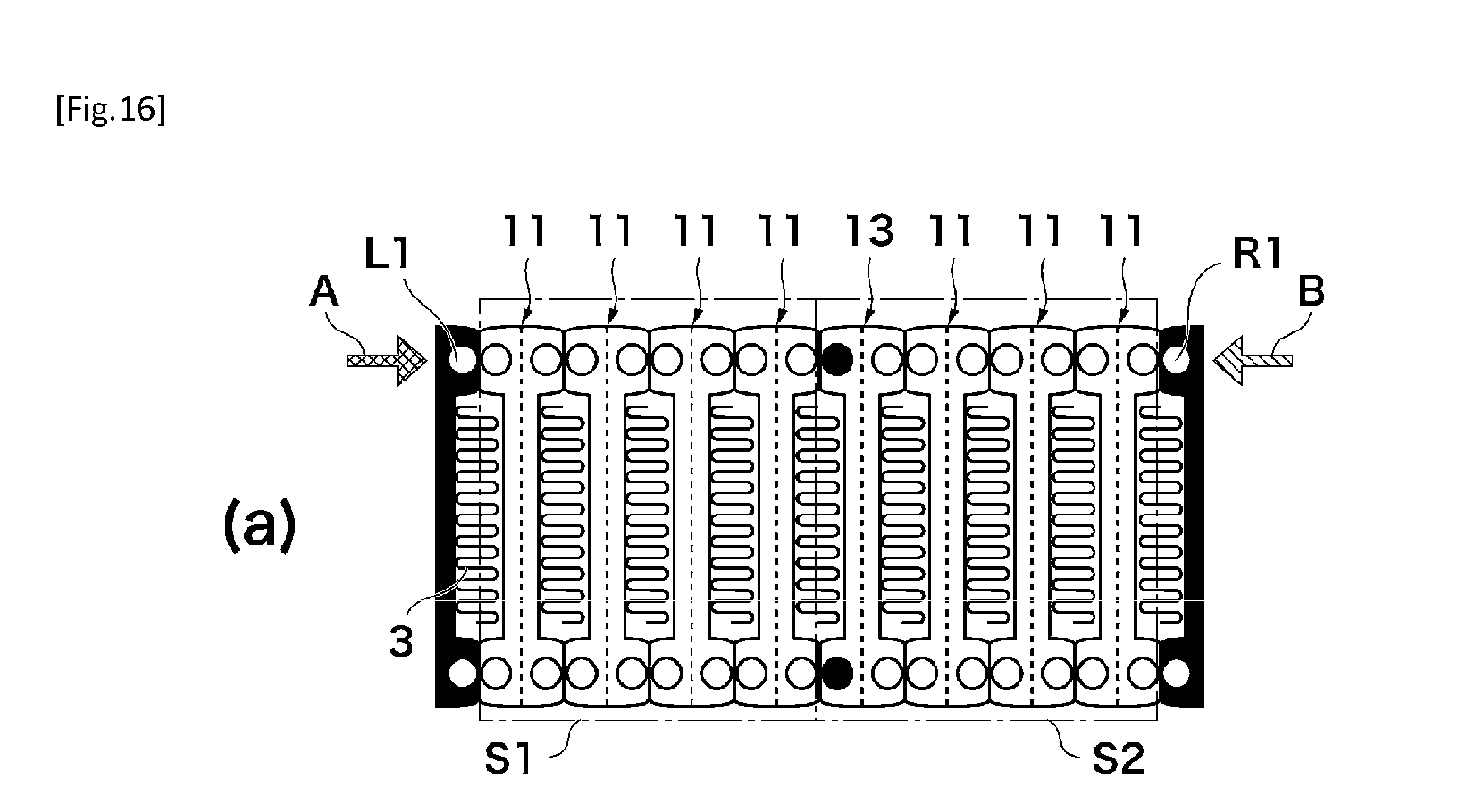
Description
- The present invention relates to a production method for a heat exchanger for a vehicle air condition, and particularly, to a production method for a heat exchanger including a heat storage material.
- In a vehicle that automatically stops an engine so as to stop while waiting for the light to change, a compressor of a refrigerating cycle also stops when the engine stops, and hence the temperature of an evaporator rises. As a result, a problem arises in that the temperature of air blowing into a vehicle interior rises and the comfortability is degraded. In order to solve this problem, there is disclosed a heat storing heat exchanger that includes a heat medium passage which causes a heat medium to flow therethrough and a heat storage material chamber which receives a heat storage material therein are integrated by a double tube structure, and a passage of a fluid which exchanges heat with the heat medium is formed outside the tube of the double tube structure (for example, see Patent Literature 1). In the heat exchanger disclosed in
Patent Literature 1, a cold storage material is cooled in advance by the cooling capability of an evaporator during the operation of an engine and a compressor, and the cooling capability of air is maintained by the latent heat of the cold storage material during the stop of the engine, thereby suppressing degradation in cooling feeling. Further, inPatent Literature 1, paraffin having a melting point of about 6°C is exemplified as a cold storage material. Then, a change in phase of the cold storage material is used. - There is disclosed a heat exchanger including a tube structure including a plurality of tubes which circulates the heat transfer fluid and a reservoir for a heat storage material contacting the tubes so that heat is exchanged between the heat storage material and the heat transfer fluid, and the tube structure improves the heat exchange efficiency between the heat storage material and the heat transfer fluid, the cooling efficiency for an outer fin by the heat transfer fluid, and the cooling efficiency for the outer fin by the heat storage material (for example, see Patent Literature 2).
- Incidentally, there is disclosed a technique of a heat exchanger used for a cooling operation and a warming operation by employing a structure of changing a cooling medium flow direction for a cooling/dehumidifying operation and a cooling medium flow direction for a warming operation (for example, see Patent Literature 3).
-
- Patent Literature 1: Japanese Patent Application Laid-Open (
JP-A) No. 2000-205777 - Patent Literature 2:
Japanese Patent Application National Publication (Laid-Open) No. 2008-522133 Fig. 20 ) - Patent Literature 3: Japanese Patent Application Laid-Open (
JP-A) No. 2000-343923 - Since the heat storing heat exchanger disclosed in
Patent Literature 1 has a structure in which the heat medium passage is surrounded by the cold storage material chamber, a problem arises in that the outer fin is not efficiently cooled by the cooling medium. Further, since the tube structure disclosed inPatent Literature 2 is used, a cooling operation may be efficiently performed. However, although the heat storage material is provided in bothPatent Literature 1 andPatent Literature 2, an appropriate amount of the heat storage material and a heat storage material adjustment unit are not disclosed. For this reason, for example, when the heat storage material is charged too much, a problem arises in that the warming operation and the cooling operation are not immediately performed and the weight and the cost increase. - Further,
Patent Literature 1 discloses the heat exchanger that uses a change in phase of the heat storage material, but only one heat storage material is used. If only one heat storage material is used, a problem arises in that a heat storage effect obtained by a latent heat may not be exhibited in the cooling operation or the warming operation even when a structure of using the heat storage material is employed in the heat exchanger used for both the cooling operation and the warming operation as shown in, for example,Patent Literature 3. - An object of the invention is to provide a method of easily producing a heat exchanger which charges a heat storage material into a part of charging spaces or a heat exchanger which charges different kinds of heat storage materials thereinto.
- In a production method for a heat exchanger according to the invention, the heat exchanger includes a laminated body obtained by alternately laminating tubes and outer fins, each tube has a structure in which a first closing plate and a second closing plate are stuck to each other or a structure in which at least one intermediate plate is sandwiched between the first closing plate and the second closing plate, one tank portion is provided at one end portion of the tube in the longitudinal direction, the other tank portion is provided at the other end portion of the tube in the longitudinal direction, the tube includes a cooling medium passage communicating with the one tank portion and the other tank portion, two or more tubes include a storage portion capable of storing a heat storage material and not communicating with the cooling medium passage, the production method for the heat exchanger for a vehicle air condition, comprising: a charging space forming step of laminating the tubes with the outer fins interposed therebetween so as to form a plurality of charging spaces including the storage portion and not communicating with each other; and a charging step of charging a heat storage material into at least one of the charging spaces.
- In the production method for the heat exchanger according to the invention, it is preferable that the charging step includes a releasing step of decreasing the pressure of the charging spaces, and a step of charging the heat storage material into the charging spaces of which the pressure becomes a negative pressure by the releasing step. The heat storage material may be more efficiently charged.
- In the production method for the heat exchanger according to the invention, it is preferable that the tubes include at least one of a first tube which includes a charging portion provided at one end portion and the other end portion so as to communicate with the storage portion and not to communicate with both adjacent laminated tubes, a second tube which includes a charging portion provided at any one of one end portion and the other end portion so as to communicate with the storage portion and to communicate with both adjacent laminated tubes and includes a communication portion provided at an end portion opposite to the end portion having the charging portion so as not to communicate with the storage portion and to communicate with both adjacent laminated tubes, and a third tube which includes a first closing portion provided at one end portion and the other end portion so as to communicate with the storage portion and not to communicate with only one of both adjacent laminated tubes.
- In the production method for the heat exchanger according to the invention, it is preferable that the tubes include the first tube and the third tube. Two kinds of heat storage materials may be disposed. Further, the storage portion of the charging spaces which charges the heat storage material and the storage portion of the charging spaces which does not charge the heat storage material may be disposed alternately.
- In the production method for the heat exchanger according to the invention, it is preferable that the tubes include the first tube, the second tube, and the third tube. Two kinds or more of the heat storage materials may be disposed. Further, the storage portion of the charging spaces which charges the heat storage material and the storage portion of the charging spaces which does not charge the heat storage material may be disposed arbitrarily.
- In the production method for the heat exchanger according to the invention, it is preferable that the tubes are the second tube. Two kinds of the heat storage materials may be disposed. Further, the storage portion of the charging spaces which charges the heat storage material and the storage portion of the charging spaces which does not charge the heat storage material may be disposed arbitrarily.
- In the production method for the heat exchanger according to the invention, it is preferable that the tube further includes at least one of a fourth tube which includes a communication portion provided at one end portion and the other end portion so as not to communicate with the storage portion and to communicate with both adjacent laminated tubes and in which the storage portion becomes a hermetic space so that the heat storage material is not charged therein or the storage portion is not provided and a fifth tube which includes a second closing portion provided at one end portion and the other end portion so as not to communicate with the storage portion and not to communicate with only one of both adjacent laminated tubes and in which the storage portion becomes a hermetic space so that the heat storage material is not charged therein or the storage portion is not provided.
- In the production method for the heat exchanger according to the invention, it is preferable that the tubes include the first tube, the second tube, and the fifth tube. Two kinds or more of the heat storage materials may be disposed and a portion in which the heat storage material is not disposed may be formed.
- In the production method for the heat exchanger according to the invention, it is preferable that the tubes include the second tube and the fourth tube. Two kinds of the heat storage materials may be disposed and a portion in which the heat storage material is not disposed may be formed.
- In the production method for the heat exchanger according to the invention, it is preferable that the tubes include the first tube and the fourth tube. A portion in which the heat storage material is not disposed may be formed.
- In the production method for the heat exchanger according to the invention, it is preferable that the tubes include the first tube, the fourth tube, and the fifth tube. Two kinds of the heat storage materials may be disposed and a portion in which the heat storage material is not disposed may be formed.
- In the production method for the heat exchanger according to the invention, it is preferable that the tubes include the first tube, the third tube, and the fourth tube. Two kinds of the heat storage materials may be disposed and a portion in which the heat storage material is not disposed may be formed.
- In the production method for the heat exchanger according to the invention, the tubes include the second tube, the fourth tube, and the fifth tube. Two kinds or more of the heat storage materials may be disposed and a portion in which the heat storage material is not disposed may be formed.
- According to the invention, it is possible to provide a method of easily producing a heat exchanger which charges a heat storage material into a part of charging spaces or a heat exchanger which charges different kinds of heat storage materials thereinto.
-
-
Fig. 1 is a schematic perspective view illustrating an example of a heat exchanger according to an embodiment. -
Fig. 2 is a front view illustrating an example of a closing plate of a first example. -
Fig. 3 is a partially enlarged front view illustrating an example of a closing plate of a second example. -
Fig. 4 is a partially enlarged front view illustrating an example of a closing plate of a third example. -
Fig. 5 is a partially enlarged front view illustrating an example of a closing plate of a fourth example. -
Fig. 6 is a partially enlarged front view illustrating an example of a closing plate of a fifth example. -
Fig. 7 is a front view illustrating an example of an intermediate plate. -
Fig. 8 is a diagram to describe a structure of a first tube. -
Fig. 9 is a diagram only illustrating a cooling medium passage of a first tube and a tank portion. -
Fig. 10 is a diagram only illustrating a storage portion of a first tube and both end portions thereof. -
Fig. 11 is a schematic diagram of a first tube. -
Fig. 12 is a schematic diagram of a second tube. -
Fig. 13 is a schematic diagram of a third tube. -
Fig. 14 is a schematic diagram of a fourth tube. -
Fig. 15 is a schematic diagram of a fifth tube. -
Figs. 16(a) to 16(c) are schematic diagrams illustrating a first example of a heat exchanger using a first tube and a third tube, whereFig. 16(a) illustrates a state where a heat storage material is not charged yet,Fig. 16(b) illustrates a state where the heat storage material is being charged, andFig. 16(c) illustrates a state where the heat storage material is completely charged. -
Figs. 17(a) to 17(c) are schematic diagrams illustrating a second example of a heat exchanger using a first tube and a third tube, whereFig. 17(a) illustrates a state where a heat storage material is not charged yet,Fig. 17(b) illustrates a state where the heat storage material is being charged, andFig. 17(c) illustrates a state where the heat storage material is completely charged. -
Fig. 18 is a schematic diagram illustrating a first example of a heat exchanger using a first tube, a second tube, and a third tube and illustrates a state where a heat storage material is completely charged. -
Figs. 19(a) to 19(c) are schematic diagrams illustrating a first example of a heat exchanger using a second tube, whereFig. 19(a) illustrates a state where a heat storage material is not charged yet,Fig. 19(b) illustrates a state where the heat storage material is being charged, andFig. 19(c) illustrates a state where the heat storage material is completely charged. -
Fig. 20 is a diagram illustrating a modified example of the heat exchanger charging method illustrated inFigs. 19(a) to 19(c) . -
Fig. 21 is a schematic diagram illustrating a modified example of the heat exchanger illustrated inFigs. 19(a) to 19(c) and illustrates a state where a heat storage material is completely charged. -
Fig. 22 is a diagram illustrating a modified example of the heat exchanger charging method illustrated inFig. 21 . -
Fig. 23 is a schematic diagram illustrating a first example of a heat exchanger using a first tube, a second tube, and a fifth tube and illustrates a state where a heat storage material is completely charged. -
Fig. 24 is a schematic diagram illustrating a first example of a heat exchanger using a second tube and a fourth tube and illustrates a state where a heat storage material is completely charged. -
Fig. 25 is a schematic diagram illustrating a first example of a heat exchanger using a first tube and a fourth tube and illustrates a state where a heat storage material is completely charged. -
Fig. 26 is a schematic diagram illustrating a first example of a heat exchanger using a first tube, a fourth tube, and a fifth tube and illustrates a state where a heat storage material is completely charged. -
Fig. 27 is a schematic diagram illustrating a first example of a heat exchanger using a first tube, a third tube, and a fourth tube and illustrates a state where a heat storage material is completely charged. -
Fig. 28 is a schematic diagram illustrating a first example of a heat exchanger using a second tube, a fourth tube, and a fifth tube and illustrates a state where a heat storage material is completely charged. -
Figs. 29(A) and 29(B) are diagrams to describe an example of a structure without an intermediate plate among the modified examples of the first tube. -
Figs. 30(A) to 30(D) are diagrams to describe a first example of a structure with a plurality of intermediate plates among the modified examples of the first tube. -
Fig. 31 is a broken-out section view taken along line A-A when the tube ofFigs. 30(A) to 30(D) is formed. -
Fig. 32 is a broken-out section view taken along line B-B when the tube ofFigs. 30(A) to 30(D) is formed. -
Figs. 33(A) to 33(D) are diagrams to describe a second example of a structure with a plurality of intermediate plates among the modified examples of the first tube. -
Fig. 34 is a broken-out section view taken along line C-C when the tube ofFigs. 33(A) to 33(D) is formed. -
Fig. 35 is a broken-out section view taken along line D-D when the tube ofFigs. 33(A) to 33(D) is formed. - Hereinafter, an embodiment of the invention will be described with reference to the accompanying drawings. The embodiment below is merely an example of the invention, and the invention is not limited to the embodiment below. In addition, the components indicated by the same reference signs in the specification and the drawings have the same structure. As long as the effects of the invention are guaranteed, various modifications may be made.
-
Fig. 1 is a schematic perspective view illustrating an example of a heat exchanger according to the embodiment. As illustrated inFig. 1 , aheat exchanger 1 includes alaminated body 4 obtained by alternately laminatingtubes 2 andouter fins 3. Theheat exchanger 1 is, for example, an evaporator, a heater core, or a heat exchanger serving as an evaporator and a heater core of a heat pump cycle. - One end portion of the
tube 2 in the longitudinal direction is provided with onetank portion 5a, and the other end portion of thetube 2 in the longitudinal direction is provided with theother tank portion 5b. Thetube 2 further includes a cooling medium passage (not illustrated) therein. The cooling medium passage communicates with onetank portion 5a and theother tank portion 5b. Onetank portion 5a and theother tank portion 5b distribute the cooling medium to the cooling medium passages inside eachtube 2 and collect the cooling medium. - Two or more tubes of the
tubes 2 further include a storage portion (not illustrated) therein. The storage portion may store a heat storage material. Further, the storage portion does not communicate with the cooling medium passage. - The
outer fin 3 is, for example, a corrugated type thin plate which is formed of aluminum alloy or copper alloy and is bent in a corrugated shape. The invention is not limited to the structure of theouter fin 3. - The
laminated body 4 is formed by laminating thetubes 2 with theouter fin 3 interposed therebetween. In thelaminated body 4, heat is transferred between the cooling medium passing through the cooling medium passage inside thetubes 2 or the heat storage material and blowing air passing through theouter fins 3. The invention is not limited to the number of thetubes 2 and theouter fins 3. - The
laminated body 4 includes a plurality of charging spaces (not illustrated) including storage portions and not communicating with each other. For example, each charging space may include a space which charges the heat storage material and a space which does not charge the heat storage material or may include a space which charges each of different kinds of heat storage materials. - Next, the plates forming the
tubes 2 will be described. -
Fig. 2 is a front view illustrating an example of a closing plate of a first example. Aclosing plate 110 of the first example is formed of metal such as aluminum alloy or copper alloy and substantially has, for example, a rectangular shape in appearance. As illustrated inFig. 2 , theclosing plate 110 of the first example is formed such that a surface (a surface illustrated inFig. 2 ) 111 sandwiching an intermediate plate is provided with aperipheral wall 112 which is provided in the periphery of theclosing plate 110 and two partition walls 113 (113a, 113b) which are provided in parallel along the longitudinal direction of theclosing plate 110. Each of the partition walls 113 (113a, 113b) has, for example, a corrugated shape in the front view. InFig. 2 , two pairs of partition walls 113 (113a, 113b) are provided, but the invention is not limited thereto, and for example, a pair of partition walls 113 (113a, 113b) may be provided or three or more pairs of partition walls 113 (113a, 113b) may be provided. - It is preferable to form the
peripheral wall 112 and the partition walls 113 (113a, 113b) by pressing one metal sheet. - The
closing plate 110 of the first example includes a coolingmedium passage 114 which is a recess formed between the pair of partition walls 113 (113a, 113b), acenter storage portion 115 which is a recess formed between twocenter partition walls 113b, and anend storage portion 116 which is a recess formed between thepartition wall 113a at both sides and theperipheral wall 112. Since thecenter storage portion 115 and theend storage portion 116 are disposed along the periphery of the coolingmedium passage 114, heat may be effectively transferred between the cooling medium inside the coolingmedium passage 114 and the heat storage material inside thecenter storage portion 115 and theend storage portion 116. - The
closing plate 110 of the first example includes apenetration hole 117 which is formed at one end portion and the other end portion thereof so as to communicate with the coolingmedium passage 114. - The
closing plate 110 of the first example includes apenetration hole 118 which is formed at one end portion and the other end portion so as to communicate with thecenter storage portion 115. -
Fig. 3 is a partially enlarged front view illustrating an example of a closing plate of a second example.Fig. 4 is a partially enlarged front view illustrating an example of a closing plate of a third example.Fig. 5 is a partially enlarged front view illustrating an example of a closing plate of a fourth example.Fig. 6 is a partially enlarged front view illustrating an example of a closing plate of a fifth example. Next, closingplates plates closing plate 110 of the first example illustrated inFig. 2 except for the structure of both end portions of thecenter storage portion 115. For this reason, the same point as theclosing plate 110 of the first example will not be described and only the different point will be described. InFigs. 3 to 6 , the center portion of the closing plate in the longitudinal direction is not illustrated in the drawings. Further, inFigs. 3 to 6 , the same reference sign ofFig. 2 is given to the same component as theclosing plate 110 of the first example. - As illustrated in
Fig. 3 , theclosing plate 120 of the second example includes thepenetration hole 118 which is formed at one end portion so as to communicate with acenter storage portion 125 and apenetration hole 128 which is formed at the other end portion so as not to communicate with thecenter storage portion 125. - As illustrated in
Fig. 4 , theclosing plate 130 of the third example includes aconcave portion 138 which is formed at one end portion and the other end portion so as to communicate with acenter storage portion 135. In addition, theconcave portion 138 and the penetration holes 118 and 128 are different in that a hole is not formed in theconcave portion 138. - As illustrated in
Fig. 5 , theclosing plate 140 of the fourth example includes thepenetration hole 128 which is formed at one end portion and the other end portion so as not to communicate with acenter storage portion 145. - As illustrated in
Fig. 6 , theclosing plate 150 of the fifth example includes aconcave portion 158 which is formed at one end portion and the other end portion so as not to communicate with acenter storage portion 155. In addition, theconcave portion 158 and the penetration holes 118 and 128 are different in that a hole is not formed in theconcave portion 138. -
Fig. 7 is a front view illustrating an example of an intermediate plate. Anintermediate plate 200 is formed of metal such as aluminum alloy or copper alloy and has the same appearance as theclosing plate 110. - The
intermediate plate 200 includes apenetration hole 207 which is formed at a position corresponding to thepenetration hole 117 of theclosing plate 110 illustrated inFig. 2 . Further, theintermediate plate 200 includes apenetration hole 208 which is formed at a position corresponding to thepenetration hole 118 of theclosing plate 110 illustrated inFig. 2 . - It is preferable that the
intermediate plate 200 includes afirst hole 201, asecond hole 202, athird hole 203, and afourth hole 204. The invention is not limited to the number of holes. Further, thefirst hole 201, thesecond hole 202, and thefourth hole 204 are circular, and thethird hole 203 is rectangular inFig. 3 ; however, the invention is not limited to the shapes of theholes - It is preferable to form the holes in the
intermediate plate 200 by punching one metal sheet. - Next, the type of tube will be described.
-
Fig. 8 is a diagram to describe a structure of the first tube. The first tube has a structure in which theintermediate plate 200 illustrated inFig. 8 is sandwiched between afirst closing plate 110A and asecond closing plate 110B. In the first tube, both thefirst closing plate 110A and thesecond closing plate 110B are formed as theclosing plate 110 of the first example illustrated inFig. 2 . The first tube is formed in a manner such that the top portions of theperipheral wall 112 and thepartition wall 113 of thefirst closing plate 110A illustrated inFig. 8 contact one surface of theintermediate plate 200, the top portions of theperipheral wall 112 and thepartition wall 113 of thesecond closing plate 110B contact the other surface of theintermediate plate 200, and the plates are brazed (bonded) to each other. -
Fig. 9 is a diagram only illustrating the cooling medium passage of the first tube and the tank portion. The coolingmedium passage 114 includes a firstcooling medium passage 114A and a secondcooling medium passage 114B. The firstcooling medium passage 114A is formed between thefirst closing plate 110A and the intermediate plate 200illustrated inFig. 8 . Further, the secondcooling medium passage 114B is formed between thesecond closing plate 110B and theintermediate plate 200 illustrated inFig. 8 . The phases of the firstcooling medium passage 114A and the secondcooling medium passage 114B are opposite to each other. When thefirst hole 201 of theintermediate plate 200 illustrated inFig. 7 is disposed at the overlapping portions of the firstcooling medium passage 114A and the secondcooling medium passage 114B, a cooling medium may circulate between the firstcooling medium passage 114A and the secondcooling medium passage 114B. - Each of the
tank portions penetration hole 117 of the closing plate (the first closing plate) 110 illustrated inFig. 2 , thepenetration hole 207 of theintermediate plate 200 illustrated inFig. 7 , and thepenetration hole 117 of the closing plate (the second closing plate) 110 illustrated inFig. 2 . -
Fig. 10 is a diagram only illustrating the storage portion of the first tube and both end portions thereof. The first tube includes thecenter storage portion 115 and theend storage portion 116 as the storage portion. - The
center storage portion 115 includes a firstcenter storage portion 115A and a secondcenter storage portion 115B. The firstcenter storage portion 115A is formed between the first closing plate and the intermediate plate. Further, the secondcenter storage portion 115B is formed between the second closing plate and the intermediate plate. The phases of the firstcenter storage portion 115A and the secondcenter storage portion 115B are opposite to each other. When thesecond hole 202 of theintermediate plate 200 illustrated inFig. 7 is disposed at the overlapping portions of the firstcenter storage portion 115A and the secondcenter storage portion 115B, a heat storage material may circulate between the firstcenter storage portion 115A and the secondcenter storage portion 115B. - A charging
portion 6 is provided at one end portion and the other end portion of thecenter storage portion 115. The chargingportion 6 is formed by overlapping thepenetration hole 118 of the closing plate (the first closing plate) 110 of the first example illustrated inFig. 2 , thepenetration hole 208 of theintermediate plate 200 illustrated inFig. 7 , and thepenetration hole 118 of the closing plate (the second closing plate) 110 of the first example illustrated inFig. 2 . For this reason, the chargingportion 6 communicates with thecenter storage portion 115 and also communicates with both adjacent laminated tubes. - The
end storage portion 116 includes a firstend storage portion 116A and a secondend storage portion 116B. The firstend storage portion 116A is formed between the first closing plate and the intermediate plate. Further, the secondend storage portion 116B is formed between the second closing plate and the intermediate plate. The firstend storage portion 116A is disposed while the end portion thereof overlaps the secondcenter storage portion 115B and the secondend storage portion 116B. Further, the secondend storage portion 116B is disposed while the end portion thereof overlaps the firstcenter storage portion 115A and the firstend storage portion 116A. When thethird hole 203 of theintermediate plate 200 illustrated inFig. 7 is disposed at the overlapping portions of the firstend storage portion 116A and the secondcenter storage portion 115B and the overlapping portions of the secondend storage portion 116B and the firstcenter storage portion 115A, the heat storage material may circulate between the firstend storage portion 116A and the secondcenter storage portion 115B and between the secondend storage portion 116B and the firstcenter storage portion 115A. When thefourth hole 204 of theintermediate plate 200 illustrated inFig. 7 is disposed at the overlapping portions of the firstend storage portion 116A and the secondend storage portion 116B, the heat storage material may circulate between the firstend storage portion 116A and the secondend storage portion 116B. -
Fig. 11 is a schematic diagram of the first tube.Fig. 11 is a diagram in which thecenter storage portion 115 illustrated inFig. 10 and both end portions thereof are simplified based on the following rule. InFig. 11 , the dumbbell shape indicates thecenter storage portion 115 ofFig. 10 and both end portions thereof. The protrusion portions of the upper and lower ends indicate one end portion and the other end portion of thecenter storage portion 115 ofFig. 10 , and correspond to the chargingportions 6 in thefirst tube 11. The uncolored circle O indicates a state where the portion communicates with the adjacent laminated tubes. Further, the dotted line which longitudinally cuts the dumbbell shape indicates theintermediate plate 200. The left side of the dotted line indicates the firstcenter storage portion 115A ofFig. 10 , and the right side of the dotted line indicates the secondcenter storage portion 115B ofFig. 10 . -
Fig. 12 is a schematic diagram of the second tube.Fig. 13 is a schematic diagram of the third tube.Fig. 14 is a schematic diagram of the fourth tube.Fig. 15 is a schematic diagram of the fifth tube. Next, the second to fifth tubes will be described with reference to the schematic diagrams. The schematic diagrams illustrated inFigs. 12 to 15 are created by the rule common to the schematic diagram illustrated inFig. 11 . For this reason, the rule described inFig. 11 will not be described, and only new rule will be described. - The
second tube 12 is a tube which uses theclosing plates 120 of the second example illustrated inFig. 3 as the first closing plate and the second closing plate. InFig. 12 , the colored square T indicates a state where the portion does not communicate with thecenter storage portion 125. - The
second tube 12 includes the chargingportion 6 which is formed at one end portion, and acommunication portion 7 which is formed at the other end portion. The chargingportion 6 is formed by overlapping thepenetration hole 118 of the closing plate (the first closing plate) 120 of the second example illustrated inFig. 3 , thepenetration hole 208 of theintermediate plate 200 illustrated inFig. 7 , and thepenetration hole 118 of the closing plate (the second closing plate) 120 of the second example illustrated inFig. 3 . For this reason, the chargingportion 6 communicates with thecenter storage portion 125 and also communicates with both adjacent laminated tubes. Further, thecommunication portion 7 is formed by overlapping thepenetration hole 128 of the closing plate (the first closing plate) 120 of the second example illustrated inFig. 3 , thepenetration hole 208 of theintermediate plate 200 illustrated inFig. 7 , and thepenetration hole 128 of the closing plate (the second closing plate) 120 of the second example illustrated inFig. 3 . For this reason, thecommunication portion 7 does not communicate with thecenter storage portion 125 and communicates with both adjacent laminated tubes. - The
third tube 13 is a tube which uses theclosing plate 130 of the third example illustrated inFig. 4 as the first closing plate, and uses theclosing plate 110 of the first example illustrated inFig. 2 as the second closing plate. InFig. 13 , the colored circle F indicates a state where the portion does not communicate with the adjacent laminated tube. - The
third tube 13 includes afirst closing portion 8 which is formed at one end portion and the other end portion. Thefirst closing portion 8 is formed by overlapping theconcave portion 138 of the closing plate (the first closing plate) 130 of the third example illustrated inFig. 4 , thepenetration hole 208 of theintermediate plate 200 illustrated inFig. 7 , and thepenetration hole 118 of the closing plate (the second closing plate) 110 of the first example illustrated inFig. 2 . For this reason, thefirst closing portion 8 communicates with thestorage portions - The
fourth tube 14 is a tube which uses theclosing plate 140 of the fourth example illustrated inFig. 5 as the first closing plate and the second closing plate. - The
fourth tube 14 includes thecommunication portion 7 which is formed at one end portion and the other end portion. Thecommunication portion 7 is formed by overlapping thepenetration hole 128 of the closing plate (the first closing plate) 140 of the fourth example illustrated inFig. 5 , thepenetration hole 208 of theintermediate plate 200 illustrated inFig. 7 , and thepenetration hole 128 of the closing plate (the second closing plate) 140 of the fourth example illustrated inFig. 5 . For this reason, thecommunication portion 7 does not communicate with thecenter storage portion 145 and communicates with both adjacent laminated tubes. Further, as illustrated inFig. 14 , thefourth tube 14 may be formed so that thecenter storage portion 145 is hollow or thecenter storage portion 145 is not provided. A structure without thecenter storage portion 145 is, for example, a structure in which thepartition wall 113b illustrated inFig. 5 extends to a portion provided with thecenter storage portion 145. When thecenter storage portion 145 is not provided, thecommunication portion 7 is simply a portion "which communicates with both adjacent laminated tubes". - The
fifth tube 15 is a tube which uses theclosing plate 150 of the fifth example illustrated inFig. 6 as the first closing plate and uses theclosing plate 140 of the fourth example illustrated inFig. 5 as the second closing plate. - The
fifth tube 15 includes asecond closing portion 9 which is formed at one end portion and the other end portion. Thesecond closing portion 9 is formed by overlapping theconcave portion 158 of the closing plate (the first closing plate) 150 of the fifth example illustrated inFig. 6 , thepenetration hole 208 of theintermediate plate 200 illustrated inFig. 7 , and thepenetration hole 128 of the closing plate (the second closing plate) 140 of the fourth example illustrated inFig. 5 . For this reason, thesecond closing portion 9 does not communicate with thestorage portions Fig. 15 , thefifth tube 15 may be formed so that thecenter storage portions center storage portions center storage portions partition wall 113b illustrated inFigs. 5 and6 extends to a portion provided with thecenter storage portions center storage portions second closing portion 9 is simply a portion "which does not communicate with only one of both adjacent laminated tubes". - Next, a production method for a heat exchanger according to the embodiment will be described. The production method for the heat exchanger according to the embodiment includes a charging space forming step of laminating the tubes with the outer fins interposed therebetween so as to form a plurality of the charging spaces including the storage portion and not communicating with each other; and a charging step of charging the heat storage material into at least one charging spaces. The charging space forming step includes a step of appropriately laminating the tubes and the outer fins and bonding the tubes and the outer fins to each other by brazing.
- It is preferable that the tubes include at least one of the
first tube 11, thesecond tube 12, and thethird tube 13. -
Figs. 16(a) to 16(c) are schematic diagrams illustrating a first example of a heat exchanger using the first tube and the third tube, whereFig. 16(a) illustrates a state where the heat storage material is not charged yet,Fig. 16(b) illustrates a state where the heat storage material is being charged, andFig. 16(c) illustrates a state where the heat storage material is completely charged. Next, the laminated state of the tube will be described with reference to the schematic diagrams of the tube ofFigs. 11 to 15 . It is preferable that the tubes include the first tube and the third tube as illustrated inFigs. 16(a) to 16(c) . - First, as illustrated in
Fig. 16(a) , thefirst tubes 11 are laminated and onethird tube 13 is disposed between thefirst tubes 11. Thus, the charging space is divided into a first space S1 which is formed by thefirst tubes 11 laminated at the left side of thethird tube 13 and a second space S2 which is formed by thethird tube 13 and thefirst tubes 11 laminated at the right side of thethird tube 13. - Next, as illustrated in
Fig. 16(b) , the first space S1 charges a first heat storage material A from one end portion (the left upper side ofFig. 16(b) ) L1 in the longitudinal direction of the tube and the second space S2 charges the second heat storage material B from one end portion (the right upper side ofFig. 16(b) ) R1 in the longitudinal direction of the tube. The invention is not limited to the heat storage material charging sequence, and the charging material may be charged in order of the first space S1 and the second space S2 or in order of the second space S2 and the first space S1, or alternatively, the charging material may be charged into the first space S1 and the second space S2 at the same time. - In the production method for the heat exchanger according to the embodiment, it is preferable that the charging step includes a releasing step of decreasing the pressure of the charging spaces, and a step of charging the heat storage material into the charging spaces of which the pressure becomes a negative pressure by the releasing step. The method of releasing the air inside the charging space is not particularly limited, and for example, a method using a vacuum pump may be employed. When the pressure of the charging space is set to a negative pressure, the heat storage material may be more efficiently charged. Here, the negative pressure indicates a state where the pressure is lower than the atmospheric pressure.
- As illustrated in
Fig. 16(c) , two kinds of heat storage materials A and B may be disposed.Figs. 16(a) to 16(c) illustrate a state where the heat storage material is charged into both the first space S1 and the second space S2; however, any one the first space S1 and the second space S2 may be empty without charging the heat storage material thereinto. Further, it is preferable to prevent the outflow of the heat storage material by burying one end portion L1 and R1 in the longitudinal direction of the tube by an adhesive or the like after the heat storage material is charged. -
Figs. 17(a) to 17(c) are schematic diagrams illustrating a second example of a heat exchanger using the first tube and the third tube, whereFig. 17(a) illustrates a state where the heat storage material is not charged yet,Fig. 17(b) illustrates a state where the heat storage material is being charged, andFig. 17(c) illustrates a state where the heat storage material is completely charged. First, as illustrated inFig. 17(a) , thefirst tubes 11 are laminated and twothird tubes 13 are respectively disposed between thefirst tubes 11 so as to be separated from each other. Thus, the charging space is divided into the first space S1 which is formed by the third tube and thefirst tubes 11 laminated at the left side of thethird tube 13, the second space S2 which is formed by thefirst tubes 11 laminated between twothird tubes 13, and the third space S3 which is formed by thethird tube 13 and thefirst tubes 11 laminated at the right side of the third tube. Next, as illustrated inFig. 17(b) , the first space S1 charges the heat storage material A from one end portion (the left upper side ofFig. 17(b) ) L1 in the longitudinal direction of the tube and the third space S3 charges the heat storage material A from one end portion (the right upper side ofFig. 17(b) ) R1 in the longitudinal direction of the tube. As illustrated inFig. 17(c) , the first space S1 which charge the heat storage material A, the third space S3 which charge the heat storage material A, and the second space S2 which does not charge the heat storage material may be alternately disposed. - The invention is not limited to the heat storage material charging sequence. The heat storage material may be charged in order of the first space S1 and the second space S2 or in order of the second space S2 and the first space S1, or alternatively, the heat storage material may be charged into the first space S1 and the second space S2 at the same time. Further,
Figs. 17(a) to 17(c) illustrate a structure in which the same heat storage material A is charged into the first space S1 and the third space S3; however, a heat storage material different from the heat storage material A may be charged into any one of the first space S1 and the third space S3. -
Fig. 18 is a schematic diagram illustrating a first example of a heat exchanger using the first tube, the second tube, and the third tube and illustrates a state where the heat storage material is completely charged. It is preferable that the tubes include thefirst tube 11, thesecond tube 12, and thethird tube 13 as illustrated inFig. 18 . First, as illustrated inFig. 18 , thesecond tubes 12 are laminated by alternately laminating the chargingportion 6 and thecommunication portion 7, thefirst tubes 11 are laminated, and thethird tube 13 is disposed between thesecond tube 12 and thefirst tube 11. Thus, the charging space is divided into the first space S1 and the second space S2 which are formed by thesecond tubes 12 and the third space S3 which is formed by thethird tube 13 and thefirst tubes 11. Next, the first space S1 charges the first heat storage material A from one end portion (the left upper side ofFig. 18 ) L1 in the longitudinal direction of the tube, the second space S2 charges the second heat storage material B from other end portion (the left lower side ofFig. 18 ) L2 in the longitudinal direction of the tube, and the third space S3 charges the third heat storage material C from one end portion (the right upper side ofFig. 18 ) R1 in the longitudinal direction of the tube. Thus, three kinds of heat storage materials A, B, and C may be disposed. - The invention is not limited to the heat storage material charging sequence. As the heat storage material charging sequence, for example, the heat storage material may be charged in order of the first space S1, the second space S2, and the third space S3, in order of the second space S2, the first space S1, and the third space S3, or in order of the third space S3, the second space S2, and the first space S1, or the heat storage material may be charged into one or two charging spaces of the first space S1, the second space S2, and the third space S3 at the same time and may be charged into the remaining charging space, or alternatively, the heat storage material may be charged into the first space S1, the second space S2, and the third space S3 at the same time. Further, in the heat exchanger illustrated in
Fig. 18 , one or two or more of the first space S1, the second space S2, and the third space S3 may be empty without charging the heat storage material thereinto. Further, in the heat exchanger illustrated inFig. 18 , the same heat storage material may be charged into two charging spaces of the first space S1, the second space S2, and the third space S3. A structure of charging the same heat storage material into two charging spaces is, for example, a structure which charges the first heat storage material A into the first space S1 and the third space S3 and charges the second heat storage material B into the second space S2, a structure which charges the first heat storage material A into the second space S2 and the third space S3 and charges the second heat storage material B into the first space S1, or a structure which charges the first heat storage material A into the first space S1 and the second space S2 and charges the second heat storage material B into the third space S3. -
Fig. 18 illustrates a structure in which the storage portion of the first space S1 and the storage portion of the second space S2 are alternately disposed, but the invention is not limited thereto. When the heat exchanger illustrated inFig. 18 is modified so that at least one of thesecond tubes 12 is turned upside down, belonging of the storage portion is changed to the second space S2 from the first space S1, or belonging of the storage portion is changed to the first space S1 from the second space S2. Thus, the storage portions of the first spaces S1 may be disposed in parallel or the storage portions of the second spaces S2 may be disposed in parallel. -
Figs. 19(a) to 19(c) are schematic diagrams illustrating a first example of a heat exchanger using the second tube, whereFig. 19(a) illustrates a state where the heat storage material is not charged yet,Fig. 19(b) illustrates a state where the heat storage material is being charged, andFig. 19(c) illustrates a state where the heat storage material is completely charged. It is preferable that the tubes include thesecond tubes 12 as illustrated inFig. 19 . First, as illustrated inFig. 19(a) , thesecond tubes 12 are laminated by alternately disposing the chargingportion 6 and thecommunication portion 7. Thus, the charging space is divided into the first space S1 and the second space S2. Next, as illustrated inFig. 19(b) , the first space S1 charges the heat storage material A from one end portion (the right upper side ofFig. 19(b) ) R1 in the longitudinal direction of the tube and the second space S2 charges the heat storage material B from other end portion (the left lower side ofFig. 19(b) ) L2 in the longitudinal direction of the tube. Thus, as illustrated inFig. 19(c) , two kinds of heat storage materials A and B may be alternately disposed. The invention is not limited to the heat storage material charging sequence. As the heat storage material charging sequence, the heat storage material may be charged in order of the first space S1 and the second space S2 or in order of the second space S2 and the first space S1, or alternatively, the heat storage material may be charged into the first space S1 and the second space S2 at the same time. -
Fig. 20 is a diagram illustrating a modified example of the heat exchanger charging method illustrated inFigs. 19(a) to 19(c) . As illustrated inFig. 20 , for example, in the heat exchanger, the first space S1 may be empty without charging the heat storage material thereinto. The storage portion of the first space S1 which does not charge the heat storage material thereinto may be disposed between the storage portions of the second spaces S2 which charge the heat storage material thereinto. Further, when at least one of thesecond tubes 12 is turned upside, belonging of the storage portion is changed to the second space S2 from the first space S1, or belonging of the storage portion is changed to the first space S1 from the second space S2, and accordingly, the storage portions of the first spaces S1 may be disposed in parallel or the storage portions of the second spaces S2 may be disposed in parallel. -
Fig. 21 is a schematic diagram illustrating a modified example of the heat exchanger illustrated inFigs. 19(a) to 19(c) and illustrates a state where the heat storage material is completely charged.Fig. 21 illustrates a structure in which thetube 12X located at the second position from the left side and thetube 12Y located at the rightmost position are turned upside. As illustrated inFig. 21 , the storage portions of the charging spaces that charge the specific heat storage material (the first heat storage material A inFig. 21 ) thereinto may be disposed in parallel. -
Fig. 22 is a diagram illustrating a modified example of the heat exchanger charging method illustrated inFig. 21 . As illustrated inFig. 22 , for example, in the heat exchanger, the first space S1 may be empty without charging the heat storage material thereinto. The storage portion of the charging space which does not charge the heat storage material may be disposed at an arbitrary position. - It is preferable that the tubes further include any one of the fourth tube and the fifth tube.
-
Fig. 23 is a schematic diagram illustrating a first example of a heat exchanger using the first tube, the second tube, and the fifth tube and illustrates a state where the heat storage material is completely charged. It is preferable that the tubes include thefirst tube 11, thesecond tube 12, and thefifth tube 15 as illustrated inFig. 23 . As illustrated inFig. 23 , thesecond tubes 12 are laminated by alternately disposing the chargingportion 6 and thecommunication portion 7, thefirst tubes 11 are laminated, and thefifth tube 15 is disposed between thesecond tube 12 and thefirst tube 11. Thus, as illustrated inFig. 23 , three kinds of heat storage materials A, B, and C may be disposed. Further, thefifth tube 15 may be disposed at an arbitrary position so as to form a portion in which the heat storage material is not disposed. -
Fig. 24 is a schematic diagram illustrating a first example of a heat exchanger using the second tube and the fourth tube and illustrates a state where the heat storage material is completely charged. It is preferable that the tubes include thesecond tube 12 and thefourth tube 14 as illustrated inFig. 24 . As illustrated inFig. 24 , two kinds of heat storage materials A and B may be disposed. Further, thefourth tube 14 may be disposed at an arbitrary position so as to form a portion in which the heat storage material is not disposed. -
Fig. 25 is a schematic diagram illustrating a first example of a heat exchanger using the first tube and the fourth tube and illustrates a state where the heat storage material is completely charged. It is preferable that the tubes include thefirst tube 11 and thefourth tube 14 as illustrated inFig. 25 . As illustrated inFig. 25 , thefourth tube 14 may be disposed at an arbitrary position so as to form a portion in which the heat storage material is not disposed. -
Fig. 26 is a schematic diagram illustrating a first example of a heat exchanger using the first tube, the fourth tube, and the fifth tube and illustrates a state where the heat storage material is completely charged. It is preferable that the tubes include thefirst tube 11, thefourth tube 14, and thefifth tube 15 as illustrated inFig. 26 . As illustrated inFig. 26 , two kinds of heat storage materials A and B may be disposed. Further, thefourth tube 14 or thefifth tube 15 may be disposed at an arbitrary position so as to form a portion in which the heat storage material is not disposed. -
Fig. 27 is a schematic diagram illustrating a first example of a heat exchanger using the first tube, the third tube, and the fourth tube and illustrates a state where the heat storage material is completely charged. It is preferable that the tubes include thefirst tube 11, thethird tube 13, and thefourth tube 14 as illustrated inFig. 27 . As illustrated inFig. 27 , two kinds of heat storage materials A and B may be disposed. Further, thefourth tube 14 may be disposed at an arbitrary position so as to form a portion in which the heat storage material is not disposed. -
Fig. 28 is a schematic diagram illustrating a first example of a heat exchanger using the second tube, the fourth tube, and the fifth tube and illustrates a state where the heat storage material is completely charged. It is preferable that the tubes include thesecond tube 12, thefourth tube 14, and thefifth tube 15 as illustrated inFig. 28 . As illustrated inFig. 28 , four kinds of heat storage materials A, B, C, and D may be disposed. Further, thefourth tube 14 or thefifth tube 15 may be disposed at an arbitrary position so as to form a portion in which the heat storage material is not disposed. - The invention is not limited to the illustration of the combination, the scale, and the arrangement of the first to fifth tubes, and various modifications may be made as long as the effects of the invention are obtained.
- The heat storage material indicates a material which keeps a temperature of a contacting material at a predetermined temperature. The heat storage material is called a cold storage material when the keeping temperature is equal to or lower than a room temperature or is generally called a heat storage/cold storage material. The heat storage material of the invention includes the cold storage material and the heat storage/cold storage material. The heat storage material is, for example, a sensible heat storage material which uses specific heat, a latent heat storage material which uses a change in phase such as melting and freezing, or a chemical heat storage material which uses absorbing and generating of heat caused by a chemical reaction. Among these, it is preferable to use the latent heat storage material in that the amount of heat generated per unit mass is larger than that of the sensible heat storage material and the chemical stability is higher than that of the chemical heat storage material. The latent heat storage material is, for example, paraffin. The paraffin is a material containing a chain state hydrocarbon compound of which a general formula is CnH2n+2 or a cyclic hydrocarbon compound of which a general formula is CnH2n (here, n ≥ 3). In the embodiment, since the chemical stability of the paraffin is higher, it is preferable that the paraffin mainly contains a chain state hydrocarbon compound. The melting point (the freezing point) of the paraffin is different depending on the carbon number (the number of n in the general formula) or the carbon chain structure having a straight shape, a branched shape, or a ring shape. For this reason, it is possible to arbitrarily select paraffin having a phase change temperature in response to a target holding temperature. As a structure of disposing the heat storage materials having different phase change temperature values in the charging spaces, for example, a heat exchanger capable of conducting both a cooling operation and a warming operation may be realized by the combination of the low melting point paraffin (for example, the melting point: 3 to 10°C) and the high melting point paraffin (for example, the melting point: 77 to 85°C) having a melting point higher than the low melting point paraffin.
-
Figs. 29(A) and 29(B) are diagrams to describe an example of a structure without the intermediate plate among the modified examples of the first tube. The first to fifth tubes have a structure in which one intermediate plate is sandwiched between the first closing plate and the second closing plate, but the invention is not limited to this structure. As illustrated inFig. 29 , the first to fifth tubes may be a structure in which the first closing plate and the second closing plate are stuck to each other without the intermediate plate. Both thefirst closing plate 110A and asecond closing plate 110B' illustrated inFigs. 29(A) and 29(B) correspond to theclosing plate 110 of the first example illustrated inFig. 2 . Further,Figs. 29(A) and 29(B) illustrate a state where thesecond closing plate 110B' in which the longitudinal direction of theclosing plate 110 illustrated inFig. 2 is reversed. As illustrated inFig. 29 , the first tube is formed in a manner such that thefirst closing plate 110A and thesecond closing plate 110B are disposed so thatinner surfaces 119 face each other while being reversed in the longitudinal direction illustrated inFig. 2 and are brazed (bonded) to each other while the top portions of theperipheral walls 112 of the plates contact each other and the top portions of thepartition walls 113 of the plates contact each other. Thus, the coolingmedium passage 114 and thestorage portions first closing plate 110A and thesecond closing plate 110B'. InFig. 29 , the longitudinal direction of thesecond closing plate 110B illustrated inFig. 2 is reversed, but the longitudinal direction of thefirst closing plate 110A may be reversed. Then, the second to fifth tubes may be also formed similarly to the first tube except that the longitudinal direction of the specified first closing plate or the specified second closing plate is reversed. Since the tube does not include the intermediate plate, the tube may be decreased in weight by decreasing the amount of the material of the tube. Further, the ventilation resistance of the heat exchanger may be reduced by decreasing the thickness of the tube (the tube height). -
Figs. 30(A) to 30(D) are diagrams to describe a first example of a structure with a plurality of intermediate plates among the modified examples of the first tube. As illustrated inFig. 30 , the first to fifth tubes may be a structure in which the intermediate plates are sandwiched between the first closing plate and the second closing plate.Figs. 30(A) to 30(D) illustrate a structure which includes first and secondintermediate plates first closing plate 160A, and asecond closing plate 160B. - Since the first
intermediate plate 210A and the secondintermediate plate 210B illustrated inFigs. 30(A) to 30(D) have the same configuration, the firstintermediate plate 210A will be described representatively. The firstintermediate plate 210A includes aperipheral bonding surface 212 which is formed in the periphery of the plate and fivepartition surfaces 213 which are formed in parallel along the longitudinal direction of the plate which are formed at onesurface 211a. InFig. 30 , thepartition surface 213 has a linear shape (a rectangular shape) in the front view, but may be formed in an infinite shape such as a corrugated shape. Further, fivepartition surface 213 are provided inFig. 30 , but the invention is not limited thereto, and the number of partition surfaces may be increased or decreased. The firstintermediate plate 210A includes astorage portion 214 which is a recess formed between theperipheral bonding surface 212 and thepartition surface 213 or between the partition surfaces 213. The firstintermediate plate 210A includes apenetration hole 217 forming a tank portion and apenetration hole 218 communicating with thestorage portion 214 which are formed respectively at one end portion and the other end portion. - Since the
first closing plate 160A and thesecond closing plate 160B illustrated inFigs. 30(A) to 30(D) have the same configuration, thefirst closing plate 160A will be described representatively. Thefirst closing plate 160A includes aperipheral wall 162 which is formed in the periphery of the plate, apartition wall 163 which is formed in the longitudinal direction of the plate, apenetration hole 167 which forms the tank portion, and apenetration hole 168 which is formed at a position corresponding to each of the penetration holes 218 of theintermediate plates surface 161 sandwiching the intermediate plate. Thefirst closing plate 160A includes a coolingmedium passage 164 which is a recess formed between theperipheral wall 162 and thepartition wall 163. The coolingmedium passage 164 has an area in which theentire storage portion 214 is received therein when theintermediate plates storage portion 214 contacts the inner surface of the bottom portion of the coolingmedium passage 164. Further, thefirst closing plate 160A further includes aconcave portion 169 which is formed at a position corresponding to anend portion 213a of thepartition surface 213 of each of theintermediate plates -
Fig. 31 is a broken-out section view taken along line A-A when the tube ofFigs. 30(A) to 30(D) is formed.Fig. 32 is a broken-out section view taken along line B-B when the tube ofFigs. 30(A) to 30(D) is formed. The first tube is formed in a manner such that onesurface 211a of the firstintermediate plate 210A and onesurface 211a of the secondintermediate plate 210B are disposed so as to face each other, the peripheral bonding surfaces 212 and the partition surfaces 213 of the plates contact each other, the top portions of theperipheral wall 162 and thepartition wall 163 of thefirst closing plate 160A and thesecond closing plate 160B contact theother surfaces 211b of the firstintermediate plate 210A and the secondintermediate plate 210B, and the plates are brazed (bonded) to each other. Thus, as illustrated inFig. 31 , thestorage portion 214 is formed between the firstintermediate plate 210A and the secondintermediate plate 210B, and the coolingmedium passage 164 is formed between thefirst closing plate 160A and the firstintermediate plate 210A and between thesecond closing plate 160B and the secondintermediate plate 210B. - As illustrated in
Fig. 31 , since the outer surface of the bottom portion of thestorage portion 214 contacts the inner surface of the bottom portion of the coolingmedium passage 164 so that the coolingmedium passage 164 and thestorage portion 214 are alternately disposed along the side surface of the tube, it is possible to efficiently cool the outer fins by the cooling medium and the heat storage material. Further, since theconcave portion 169 is provided as illustrated inFig. 32 , the cooling medium may be circulated in the coolingmedium passage 164 between thestorage portions 214 even in a structure in which the outer surface of the bottom portion of thestorage portion 214 contacts the inner surface of the bottom portion of the coolingmedium passage 164. - The second to fifth tubes may be also formed similarly to the first tube except that each of the first
intermediate plate 210A and the secondintermediate plate 210B is changed as a plate having a predetermined structure. As the plate having a predetermined structure in the second tube, an intermediate plate (not illustrated) is used in which thepenetration hole 218 of the other end portion of each of the firstintermediate plate 210A and the secondintermediate plate 210B illustrated inFigs. 30(A) to 30(D) is changed as the penetration hole not communicating with thestorage portion 214. As the plate having a predetermined structure in the third tube, an intermediate plate (not illustrated) is used in which thepenetration hole 218 of each of one end portion and the other end portion of any one of the firstintermediate plate 210A illustrated inFigs. 30(A) to 30(D) and the secondintermediate plate 210B illustrated inFigs. 30(A) to 30(D) is changed as a concave portion communicating with thestorage portion 214. As the plate having a predetermined structure in the fourth tube, an intermediate plate (not illustrated) is used in which thepenetration hole 218 of each of one end portion and the other end portion of the firstintermediate plate 210A and the secondintermediate plate 210B illustrated inFigs. 30(A) to 30(D) is changed as a penetration hole not communicating with thestorage portion 214. As the plate having a predetermined structure in the fifth tube, an intermediate plate (not illustrated) is used in which thepenetration hole 218 of each of one end portion and the other end portion of the firstintermediate plate 210A illustrated inFigs. 30(A) to 30(D) is changed as a penetration hole not communicating with thestorage portion 214 and an intermediate plate (not illustrated) is used in which thepenetration hole 218 of each of one end portion and the other end portion of the secondintermediate plate 210B illustrated inFigs. 30(A) to 30(D) is changed as a concave portion not communicating with thestorage portion 214. -
Figs. 33(A) to 33(D) are diagrams to describe a second example of a structure with a plurality of intermediate plates among the modified examples of the first tube.Figs. 33(A) to 33(D) illustrate a structure which includes first and secondintermediate plates first closing plate 170A, and asecond closing plate 170B. - Since the first
intermediate plate 220A and the secondintermediate plate 220B illustrated inFigs. 33(A) to 33(D) have the same configuration, the firstintermediate plate 220A will be described representatively. The firstintermediate plate 220A includes aperipheral bonding surface 222 which is provided in the periphery of the plate and fivepartition surfaces 223 which are formed in parallel along the longitudinal direction of the plate which are formed at onesurface 221a. InFig. 33 , thepartition surface 223 has a linear shape (a rectangular shape) in the front view, but may be formed in an infinite shape such as a corrugated shape. Further, fivepartition surfaces 223 are provided inFig. 33 , but the invention is not limited thereto, and the number of partition surfaces may be increased or decreased. The firstintermediate plate 220A includes a coolingmedium passage 224 which is a recess formed between theperipheral bonding surface 222 and thepartition surface 223 or between the partition surfaces 223. The firstintermediate plate 220A includes apenetration hole 227 and apenetration hole 228 forming a tank portion whish are formed respectively at one end portion and the other end portion. - Since the
first closing plate 170A and thesecond closing plate 170B illustrated inFigs. 33(A) to 33(D) have the same configuration, thefirst closing plate 170A will be described representatively. Thefirst closing plate 170A includes aperipheral wall 172 which is formed in the periphery of the plate, apenetration hole 177 which forms the tank portion, and apenetration hole 178 which is formed at a position corresponding to each of the penetration holes 228 of theintermediate plates surface 171 sandwiching the intermediate plate. Thefirst closing plate 170A includes astorage portion 174 which is a recess surrounded by theperipheral wall 172. Thestorage portion 174 has an area in which the entirecooling medium passage 224 is received therein when theintermediate plates medium passage 224 contacts the inner surface of the bottom portion of thestorage portion 174. Further, thefirst closing plate 170A further includes aconcave portion 179 which is formed at a position corresponding to anend portion 223a of thepartition surface 223 of each of theintermediate plates first closing plate 170A may further include a partition wall (not illustrated) which defines thestorage portion 174 in the longitudinal direction. -
Fig. 34 is a broken-out section view taken along line C-C when the tube ofFigs. 33(A) to 33(D) is formed.Fig. 35 is a broken-out section view taken along line D-D when the tube ofFigs. 33(A) to 33(D) is formed. The first tube is formed in a manner such that onesurface 221a of the firstintermediate plate 220A and onesurface 221a of the secondintermediate plate 220B are disposed so as to face each other, the peripheral bonding surfaces 222 and the partition surfaces 223 of the plates contact each other, the top portions of theperipheral walls 172 of thefirst closing plate 170A and thesecond closing plate 170B respectively contact theother surfaces 221b of the firstintermediate plate 220A and the secondintermediate plate 220B, and the plates are brazed (bonded) to each other. Thus, as illustrated inFig. 34 , the coolingmedium passage 224 is formed between the firstintermediate plate 220A and the secondintermediate plate 220B, and thestorage portion 174 is formed between thefirst closing plate 170A and the firstintermediate plate 220A and between thesecond closing plate 170B and the secondintermediate plate 220B. - As illustrated in
Fig. 34 , since the outer surface of the bottom portion of the coolingmedium passage 224 contacts the inner surface of the bottom portion of thestorage portion 174 so that thestorage portion 174 and the coolingmedium passage 224 are alternately disposed along the side surface of the tube, it is possible to efficiently cool the outer fins by the cooling medium and the heat storage material. Further, since theconcave portion 179 is provided as illustrated inFig. 35 , the heat storage material may be circulated in thestorage portion 174 between the coolingmedium passages 224 in the charging step of charging the heat storage material even in a structure in which the outer surface of the bottom portion of the coolingmedium passage 224 contacts the inner surface of the bottom portion of thestorage portion 174. - The second to fifth tubes may be formed similarly to the first tube except that the
first closing plate 170A and thesecond closing plate 170B are changed as a plate having a predetermined structure. As the plate having a predetermined structure in the second tube, a closing plate (not illustrated) is used in which thepenetration hole 178 of the other end portion of each of thefirst closing plate 170A and thesecond closing plate 170B illustrated inFigs. 33(A) to 33(D) is changed as a penetration hole not communicating with thestorage portion 174. As the plate having a predetermined structure in the third tube, a closing plate (not illustrated) is used in which thepenetration hole 178 of each of one end portion and the other end portion of any one of thefirst closing plate 170A illustrated inFigs. 33(A) to 33(D) and thesecond closing plate 170B illustrated inFigs. 33(A) to 33(D) is changed as a concave portion communicating with thestorage portion 174. As the plate having a predetermined structure in the fourth tube, a closing plate (not illustrated) is used in which thepenetration hole 178 of each of one end portion and the other end portion of thefirst closing plate 170A and thesecond closing plate 170B illustrated inFigs. 33(A) to 33(D) is changed as a penetration hole not communicating with thestorage portion 174. As the plate having a predetermined structure in the fifth tube, a closing plate (not illustrated) is used in which thepenetration hole 178 of each of one end portion and the other end portion of thefirst closing plate 170A illustrated inFigs. 33(A) to 33(D) is changed as a penetration hole not communicating with thestorage portion 174 and a closing plate (not illustrated) is used in which thepenetration hole 178 of each of one end portion and the other end portion of thesecond closing plate 170B illustrated inFigs. 33(A) to 33(D) is changed as a concave portion not communicating with thestorage portion 174. - As illustrated in
Figs. 30 to 35 , since the heat storagematerial storage portion 214 or the coolingmedium passage 224 may be formed inside the intermediate plate by sticking the intermediate plates to each other, for example, as illustrated inFig. 8 , thepartition wall 113 which divides the coolingmedium passage 114 and thestorage portions first closing plate 110A and thesecond closing plate 110B. For this reason, it is possible to easily change the position or the volume of each of thestorage portions -
- 1:
- Heat exchanger
- 2:
- Tube
- 3:
- Outer fin
- 4:
- Laminated body
- 5a:
- One tank portion
- 5b:
- Other tank portion
- 6:
- Charging portion
- 7:
- Communication portion
- 8:
- First closing portion
- 9:
- Second closing portion
- 11:
- First tube
- 12:
- Second tube
- 13:
- Third tube
- 14:
- Fourth tube
- 15:
- Fifth tube
- 110:
- Closing plate of first example
- 110A:
- First closing plate
- 110B, 110B':
- Second closing plate
- 111:
- Surface sandwiching intermediate plate
- 112:
- Peripheral wall
- 113 (113a, 113b):
- Partition wall
- 114:
- Cooling medium passage
- 114A:
- First cooling medium passage
- 114B:
- Second cooling medium passage
- 115:
- Center storage portion
- 115A:
- First center storage portion
- 115B:
- Second center storage portion
- 116:
- End storage portion
- 116A:
- First end storage portion
- 116B:
- Second end storage portion
- 117:
- Penetration hole
- 118, 128:
- Penetration hole
- 119:
- Inner surface
- 120:
- Closing plate of second example
- 125:
- Center storage portion
- 130:
- Closing plate of third example
- 135:
- Center storage portion
- 138:
- Concave portion
- 140:
- Closing plate of fourth example
- 145:
- Center storage portion
- 150:
- Closing plate of fifth example
- 155:
- Center storage portion
- 158:
- Concave portion
- 160A:
- First closing plate
- 160B:
- Second closing plate
- 161:
- Surface sandwiching intermediate plate
- 162:
- Peripheral wall
- 163:
- Partition wall
- 164:
- Cooling medium passage
- 167:
- Penetration hole
- 168:
- Penetration hole
- 169:
- Concave portion
- 170A:
- First closing plate
- 170B:
- Second closing plate
- 171:
- Surface sandwiching intermediate plate
- 172:
- Peripheral wall
- 174:
- Storage portion
- 177:
- Penetration hole
- 178:
- Penetration hole
- 179:
- Concave portion
- 200:
- Intermediate plate
- 201:
- First hole
- 202:
- Second hole
- 203:
- Third hole
- 204:
- Fourth hole
- 207,
- 208: Penetration hole
- 210A:
- First intermediate plate
- 210B:
- Second intermediate plate
- 211a:
- One surface
- 211b:
- Other surface
- 212:
- Peripheral bonding surface
- 213:
- Partition surface
- 213a:
- End portion of partition wall
- 214:
- Storage portion
- 217:
- Penetration hole
- 218:
- Penetration hole
- 220A:
- First intermediate plate
- 220B:
- Second intermediate plate
- 221a:
- One surface
- 221b:
- Other surface
- 222:
- Peripheral bonding surface
- 223:
- Partition surface
- 223a:
- End portion of partition wall
- 224:
- Cooling medium passage
- 227:
- Penetration hole
- 228:
- Penetration hole
Claims (13)
- A production method for a heat exchanger, the heat exchanger includes a laminated body obtained by alternately laminating tubes and outer fins, each tube has a structure in which a first closing plate and a second closing plate are stuck to each other or a structure in which at least one intermediate plate is sandwiched between the first closing plate and the second closing plate, one tank portion is provided at one end portion of the tube in the longitudinal direction, the other tank portion is provided at the other end portion of the tube in the longitudinal direction, the tube includes a cooling medium passage communicating with the one tank portion and the other tank portion, two or more tubes include a storage portion capable of storing a heat storage material and not communicating with the cooling medium passage, the production method for the heat exchanger for a vehicle air condition, comprising:a charging space forming step of laminating the tubes with the outer fins interposed therebetween so as to form a plurality of charging spaces including the storage portion and not communicating with each other; anda charging step of charging a heat storage material into at least one of the charging spaces.
- The production method for the heat exchanger according to claim 1,
wherein the charging step includes a releasing step of decreasing a pressure of the charging spaces, and a step of charging the heat storage material into the charging spaces of which the pressure becomes a negative pressure by the releasing step. - The production method for the heat exchanger according to claim 1 or 2,
wherein the tubes include at least one of a first tube which includes a charging portion provided at one end portion and the other end portion so as to communicate with the storage portion and to communicate with both adjacent laminated tubes, a second tube which includes a charging portion provided at any one of one end portion and the other end portion so as to communicate with the storage portion and to communicate with both adjacent laminated tubes and includes a communication portion provided at an end portion opposite to the end portion having the charging portion so as not to communicate with the storage portion and to communicate with both adjacent laminated tubes, and a third tube which includes a first closing portion provided at one end portion and the other end portion so as to communicate with the storage portion and not to communicate with only one of both adjacent laminated tubes. - The production method for the heat exchanger according to claim 3,
wherein the tubes include the first tube and the third tube. - The production method for the heat exchanger according to claim 3,
wherein the tubes include the first tube, the second tube, and the third tube. - The production method for the heat exchanger according to claim 3,
wherein the tubes are the second tube. - The production method for the heat exchanger according to any one of claims 3 to 6,
wherein the tube further includes at least one of a fourth tube which includes a communication portion provided at one end portion and the other end portion so as not to communicate with the storage portion and to communicate with both adjacent laminated tubes and in which the storage portion becomes a hermetic space so that the heat storage material is not charged therein or the storage portion is not provided and a fifth tube which includes a second closing portion provided at one end portion and the other end portion so as not to communicate with the storage portion and not to communicate with only one of both adjacent laminated tubes and in which the storage portion becomes a hermetic space so that the heat storage material is not charged therein or the storage portion is not provided. - The production method for the heat exchanger according to claim 7,
wherein the tubes include the first tube, the second tube, and the fifth tube. - The production method for the heat exchanger according to claim 7,
wherein the tubes include the second tube and the fourth tube. - The production method for the heat exchanger according to claim 7,
wherein the tubes include the first tube and the fourth tube. - The production method for the heat exchanger according to claim 7,
wherein the tubes include the first tube, the fourth tube, and the fifth tube. - The production method for the heat exchanger according to claim 7,
wherein the tubes include the first tube, the third tube, and the fourth tube. - The production method for the heat exchanger according to claim 7,
wherein the tubes include the second tube, the fourth tube, and the fifth tube.
Applications Claiming Priority (2)
| Application Number | Priority Date | Filing Date | Title |
|---|---|---|---|
| JP2013034635A JP6148034B2 (en) | 2013-02-25 | 2013-02-25 | Manufacturing method of heat exchanger |
| PCT/JP2014/054282 WO2014129620A1 (en) | 2013-02-25 | 2014-02-24 | Production method for heat exchangers |
Publications (1)
| Publication Number | Publication Date |
|---|---|
| EP2960611A1 true EP2960611A1 (en) | 2015-12-30 |
Family
ID=51391399
Family Applications (1)
| Application Number | Title | Priority Date | Filing Date |
|---|---|---|---|
| EP14754026.4A Withdrawn EP2960611A1 (en) | 2013-02-25 | 2014-02-24 | Production method for heat exchangers |
Country Status (3)
| Country | Link |
|---|---|
| EP (1) | EP2960611A1 (en) |
| JP (1) | JP6148034B2 (en) |
| WO (1) | WO2014129620A1 (en) |
Cited By (1)
| Publication number | Priority date | Publication date | Assignee | Title |
|---|---|---|---|---|
| CN109070697A (en) * | 2016-06-01 | 2018-12-21 | 株式会社电装 | cold-storage heat exchanger |
Families Citing this family (1)
| Publication number | Priority date | Publication date | Assignee | Title |
|---|---|---|---|---|
| FR3025596B1 (en) * | 2014-09-08 | 2016-12-23 | Valeo Systemes Thermiques | PHASE CHANGE MATERIAL TANK TUBE FOR HEAT EXCHANGER |
Family Cites Families (10)
| Publication number | Priority date | Publication date | Assignee | Title |
|---|---|---|---|---|
| JPS618597A (en) * | 1984-06-21 | 1986-01-16 | Sumitomo Chem Co Ltd | Hollow planar body for heat accumulating panel and manufacture thereof |
| JP2000039280A (en) * | 1998-07-22 | 2000-02-08 | Mitsubishi Cable Ind Ltd | Cold storage heat exchanger and its operation method |
| JP3972501B2 (en) | 1999-01-18 | 2007-09-05 | 株式会社デンソー | Heat exchange device for heat storage and air conditioner for vehicle |
| JP2000343923A (en) | 1999-06-08 | 2000-12-12 | Mitsubishi Heavy Ind Ltd | Heat pump type vehicle air conditioner |
| EP1817534B1 (en) | 2004-11-30 | 2009-12-02 | Valeo Systemes Thermiques Sas | Heat exchanger with heat storage |
| KR101318620B1 (en) * | 2007-09-04 | 2013-10-16 | 한라비스테온공조 주식회사 | A Cold Storage Heat Exchanger |
| KR101366654B1 (en) * | 2008-04-11 | 2014-02-25 | 한라비스테온공조 주식회사 | Cold reserving part equipped Heat Exchanger |
| JP2010234837A (en) * | 2009-03-30 | 2010-10-21 | Nissan Motor Co Ltd | Air conditioner for vehicles |
| JP5470385B2 (en) * | 2009-06-23 | 2014-04-16 | 株式会社ケーヒン・サーマル・テクノロジー | Evaporator with cool storage function |
| JP5865616B2 (en) * | 2011-07-04 | 2016-02-17 | 株式会社ケーヒン・サーマル・テクノロジー | Evaporator with cool storage function |
-
2013
- 2013-02-25 JP JP2013034635A patent/JP6148034B2/en not_active Expired - Fee Related
-
2014
- 2014-02-24 EP EP14754026.4A patent/EP2960611A1/en not_active Withdrawn
- 2014-02-24 WO PCT/JP2014/054282 patent/WO2014129620A1/en not_active Ceased
Non-Patent Citations (1)
| Title |
|---|
| See references of WO2014129620A1 * |
Cited By (1)
| Publication number | Priority date | Publication date | Assignee | Title |
|---|---|---|---|---|
| CN109070697A (en) * | 2016-06-01 | 2018-12-21 | 株式会社电装 | cold-storage heat exchanger |
Also Published As
| Publication number | Publication date |
|---|---|
| JP2014163583A (en) | 2014-09-08 |
| JP6148034B2 (en) | 2017-06-14 |
| WO2014129620A1 (en) | 2014-08-28 |
Similar Documents
| Publication | Publication Date | Title |
|---|---|---|
| CN112771345B (en) | Thermal management structure with integrated channels | |
| US9803933B2 (en) | Cold storage medium container | |
| JP6183100B2 (en) | Cold storage heat exchanger | |
| JP6148066B2 (en) | Heat exchanger | |
| JP5910415B2 (en) | Cold storage heat exchanger | |
| US10144266B2 (en) | Tube having a container of phase change material for a heat exchange bundle, in particular for an evaporator of an air conditioning system of a vehicle | |
| JP6564596B2 (en) | Lithium ion secondary battery device | |
| WO2010150774A1 (en) | Evaporator with cold storage function | |
| US10443955B2 (en) | Tube with a reservoir of phase-change material for a heat exchanger | |
| CN104114970A (en) | Cold storage heat exchanger | |
| WO2014041771A1 (en) | Heat exchanger | |
| JP6540190B2 (en) | Cold storage heat exchanger | |
| JP2021057187A (en) | Battery cooler | |
| JP5920087B2 (en) | Cold storage heat exchanger | |
| WO2020054506A1 (en) | Magnetic refrigeration module | |
| EP2960612A1 (en) | Heat exchanger and vehicle air conditioning device | |
| JP6082629B2 (en) | Heat exchanger | |
| CN103097847B (en) | Heat exchanger | |
| JP6148034B2 (en) | Manufacturing method of heat exchanger | |
| JP2001116485A (en) | Stacked heat exchanger | |
| JP6414504B2 (en) | Heat exchanger | |
| JP2016176676A (en) | Cold storage heat exchanger | |
| WO2014181687A1 (en) | Cold storage heat exchanger | |
| EP2846120A1 (en) | Evaporator having a phase change material louvered clam shell housings | |
| JP6327386B2 (en) | Cold storage heat exchanger |
Legal Events
| Date | Code | Title | Description |
|---|---|---|---|
| PUAI | Public reference made under article 153(3) epc to a published international application that has entered the european phase |
Free format text: ORIGINAL CODE: 0009012 |
|
| 17P | Request for examination filed |
Effective date: 20150925 |
|
| AK | Designated contracting states |
Kind code of ref document: A1 Designated state(s): AL AT BE BG CH CY CZ DE DK EE ES FI FR GB GR HR HU IE IS IT LI LT LU LV MC MK MT NL NO PL PT RO RS SE SI SK SM TR |
|
| AX | Request for extension of the european patent |
Extension state: BA ME |
|
| DAX | Request for extension of the european patent (deleted) | ||
| STAA | Information on the status of an ep patent application or granted ep patent |
Free format text: STATUS: THE APPLICATION IS DEEMED TO BE WITHDRAWN |
|
| 18D | Application deemed to be withdrawn |
Effective date: 20160901 |