EP2960238A1 - Monocyclic pyridine derivative - Google Patents
Monocyclic pyridine derivative Download PDFInfo
- Publication number
- EP2960238A1 EP2960238A1 EP14754294.8A EP14754294A EP2960238A1 EP 2960238 A1 EP2960238 A1 EP 2960238A1 EP 14754294 A EP14754294 A EP 14754294A EP 2960238 A1 EP2960238 A1 EP 2960238A1
- Authority
- EP
- European Patent Office
- Prior art keywords
- group
- compound
- mmol
- mixture
- reaction
- Prior art date
- Legal status (The legal status is an assumption and is not a legal conclusion. Google has not performed a legal analysis and makes no representation as to the accuracy of the status listed.)
- Granted
Links
- 0 CNC([n](ccc1c2)c1cc(*)c2Oc1ccnc(NC(c2ccc(C3CCN(C)CC3)cc2)=O)c1)=O Chemical compound CNC([n](ccc1c2)c1cc(*)c2Oc1ccnc(NC(c2ccc(C3CCN(C)CC3)cc2)=O)c1)=O 0.000 description 9
- QZLZLYOKGGIXEG-UHFFFAOYSA-N CC(C)(C)OC(N(CCC1c(cc2)ccc2C(O)=O)CC1F)=O Chemical compound CC(C)(C)OC(N(CCC1c(cc2)ccc2C(O)=O)CC1F)=O QZLZLYOKGGIXEG-UHFFFAOYSA-N 0.000 description 1
- NOZLPDLIFBZXCV-UHFFFAOYSA-N CC(C)(CN(C1)CC1c(cc1)ccc1C(Nc1cc(Oc(cc(cc[n]2C(NC)=O)c2c2)c2OCCOC)ccn1)=O)O Chemical compound CC(C)(CN(C1)CC1c(cc1)ccc1C(Nc1cc(Oc(cc(cc[n]2C(NC)=O)c2c2)c2OCCOC)ccn1)=O)O NOZLPDLIFBZXCV-UHFFFAOYSA-N 0.000 description 1
- IHIWTCZHZVTRER-UHFFFAOYSA-N CC(C)CN(CC1)CCC1c(cc1)ccc1C(Nc1nccc(Oc(cc(cc[n]2C(NC)=O)c2c2)c2OCCCF)c1)=O Chemical compound CC(C)CN(CC1)CCC1c(cc1)ccc1C(Nc1nccc(Oc(cc(cc[n]2C(NC)=O)c2c2)c2OCCCF)c1)=O IHIWTCZHZVTRER-UHFFFAOYSA-N 0.000 description 1
- XGMLYVQWMLUYGE-UHFFFAOYSA-N CC(C)N(CC1)CCC1[n]1ncc(C(Nc2cc(Oc(cc(cc[n]3C(NC)=O)c3c3)c3OC)ccn2)=O)c1 Chemical compound CC(C)N(CC1)CCC1[n]1ncc(C(Nc2cc(Oc(cc(cc[n]3C(NC)=O)c3c3)c3OC)ccn2)=O)c1 XGMLYVQWMLUYGE-UHFFFAOYSA-N 0.000 description 1
- VBJKYMDAZPLDEC-UHFFFAOYSA-N CC(C)Oc(cc(c(cc1)c2)[n]1C(NC)=O)c2Oc1cc(NC(c2ccc(C3CCN(CCO)CC3)cc2)=O)ncc1 Chemical compound CC(C)Oc(cc(c(cc1)c2)[n]1C(NC)=O)c2Oc1cc(NC(c2ccc(C3CCN(CCO)CC3)cc2)=O)ncc1 VBJKYMDAZPLDEC-UHFFFAOYSA-N 0.000 description 1
- QGZHGSGLCZEGHA-UHFFFAOYSA-N CC(Nc1cc(C)ccn1)=O Chemical compound CC(Nc1cc(C)ccn1)=O QGZHGSGLCZEGHA-UHFFFAOYSA-N 0.000 description 1
- CNFZXCNGEPVHAU-UHFFFAOYSA-N CCN(C1)CC1c(cc1)ccc1C(Nc1nccc(Oc(cc(cc[n]2C(NC)=O)c2c2)c2OC)c1)=O Chemical compound CCN(C1)CC1c(cc1)ccc1C(Nc1nccc(Oc(cc(cc[n]2C(NC)=O)c2c2)c2OC)c1)=O CNFZXCNGEPVHAU-UHFFFAOYSA-N 0.000 description 1
- KSDHXUSWPOAODN-UHFFFAOYSA-N CCN(CC1)CCC1c(cc1)ccc1C(Nc1cc(Oc(cc(cc[n]2C(NC)=O)c2c2)c2OCCCF)ccn1)=O Chemical compound CCN(CC1)CCC1c(cc1)ccc1C(Nc1cc(Oc(cc(cc[n]2C(NC)=O)c2c2)c2OCCCF)ccn1)=O KSDHXUSWPOAODN-UHFFFAOYSA-N 0.000 description 1
- ZFIAMBOHXNOLEX-UHFFFAOYSA-N CCOCCOc(cc(c(cc1)c2)[n]1C(NC)=O)c2Oc1cc(NC(c2ccc(C(CC3)CCN3C(OC(C)(C)C)=O)nc2)=O)ncc1 Chemical compound CCOCCOc(cc(c(cc1)c2)[n]1C(NC)=O)c2Oc1cc(NC(c2ccc(C(CC3)CCN3C(OC(C)(C)C)=O)nc2)=O)ncc1 ZFIAMBOHXNOLEX-UHFFFAOYSA-N 0.000 description 1
- FYRWKCCUVCPJDU-UHFFFAOYSA-N CCOCCOc(cc(c(cc1)c2)[n]1C(NC)=O)c2Oc1ccnc(N)c1 Chemical compound CCOCCOc(cc(c(cc1)c2)[n]1C(NC)=O)c2Oc1ccnc(N)c1 FYRWKCCUVCPJDU-UHFFFAOYSA-N 0.000 description 1
- JWNAUIYGGMVKPX-UHFFFAOYSA-N CCOCCOc(cc(c(cc1)c2)[n]1C(NC)=O)c2Oc1ccnc(NC(c2ccc(C(CC3)CCN3C(C)C)cc2)=O)c1 Chemical compound CCOCCOc(cc(c(cc1)c2)[n]1C(NC)=O)c2Oc1ccnc(NC(c2ccc(C(CC3)CCN3C(C)C)cc2)=O)c1 JWNAUIYGGMVKPX-UHFFFAOYSA-N 0.000 description 1
- PTUMOSIABJHWAW-ZRZAMGCNSA-N CCOCCOc(cc(c(cc1)c2)[n]1C(NC)=O)c2Oc1ccnc(NC(c2ccc(CN3C[C@H](C)N[C@H](C)C3)cc2)=O)c1 Chemical compound CCOCCOc(cc(c(cc1)c2)[n]1C(NC)=O)c2Oc1ccnc(NC(c2ccc(CN3C[C@H](C)N[C@H](C)C3)cc2)=O)c1 PTUMOSIABJHWAW-ZRZAMGCNSA-N 0.000 description 1
- NKBVMJLNCYTGJZ-NRFANRHFSA-N CCOc(cc(c(cc1)c2)[n]1C(NC)=O)c2Oc1ccnc(NC(c2ccc(C3CCN(C[C@H](C)O)CC3)cc2)=O)c1 Chemical compound CCOc(cc(c(cc1)c2)[n]1C(NC)=O)c2Oc1ccnc(NC(c2ccc(C3CCN(C[C@H](C)O)CC3)cc2)=O)c1 NKBVMJLNCYTGJZ-NRFANRHFSA-N 0.000 description 1
- HWLAELCIMADXJD-UHFFFAOYSA-N CCOc(cc(c(cc1)c2)[n]1C(NC)=O)c2Oc1ccnc(NC(c2ccc(CN(CC3)CCC3O)cc2)=O)c1 Chemical compound CCOc(cc(c(cc1)c2)[n]1C(NC)=O)c2Oc1ccnc(NC(c2ccc(CN(CC3)CCC3O)cc2)=O)c1 HWLAELCIMADXJD-UHFFFAOYSA-N 0.000 description 1
- HYIAPIAQURLHIG-UHFFFAOYSA-N CCOc(cc1[nH]ccc1c1)c1Oc1ccnc(N)c1 Chemical compound CCOc(cc1[nH]ccc1c1)c1Oc1ccnc(N)c1 HYIAPIAQURLHIG-UHFFFAOYSA-N 0.000 description 1
- CAZUTTNZTRUDQR-UHFFFAOYSA-N CCc(cc1[nH]ccc1c1)c1O Chemical compound CCc(cc1[nH]ccc1c1)c1O CAZUTTNZTRUDQR-UHFFFAOYSA-N 0.000 description 1
- XTQOJEZHRZAOMH-UHFFFAOYSA-N CN(C)c(cc1[nH]ccc1c1)c1O Chemical compound CN(C)c(cc1[nH]ccc1c1)c1O XTQOJEZHRZAOMH-UHFFFAOYSA-N 0.000 description 1
- WDKIHRFYQQYDJC-UHFFFAOYSA-N CNC([n](ccc1c2)c1cc(OC)c2Oc1ccnc(NC(c2ccc(C3CCN(CCCF)CC3)cc2)=O)c1)=O Chemical compound CNC([n](ccc1c2)c1cc(OC)c2Oc1ccnc(NC(c2ccc(C3CCN(CCCF)CC3)cc2)=O)c1)=O WDKIHRFYQQYDJC-UHFFFAOYSA-N 0.000 description 1
- QOKJYTOYRMCRKK-UHFFFAOYSA-N CNC([n](ccc1c2)c1cc(OC)c2Oc1ccnc(NC(c2ccc(C3CCNCC3)cc2)=O)c1)=O Chemical compound CNC([n](ccc1c2)c1cc(OC)c2Oc1ccnc(NC(c2ccc(C3CCNCC3)cc2)=O)c1)=O QOKJYTOYRMCRKK-UHFFFAOYSA-N 0.000 description 1
- UCNVEKCXCXHODV-XMMPIXPASA-N CNC([n](ccc1c2)c1cc(OCCCOC)c2Oc1cc(NC(c2ccc(CN(CC3)C[C@@H]3O)cc2)=O)ncc1)=O Chemical compound CNC([n](ccc1c2)c1cc(OCCCOC)c2Oc1cc(NC(c2ccc(CN(CC3)C[C@@H]3O)cc2)=O)ncc1)=O UCNVEKCXCXHODV-XMMPIXPASA-N 0.000 description 1
- GOEODWJZKPRKOI-HXUWFJFHSA-N CNC([n](ccc1c2)c1cc(OCCOC)c2Oc1ccnc(NC(c2ccc(CN3[C@@H](CO)CCC3)[s]2)=O)c1)=O Chemical compound CNC([n](ccc1c2)c1cc(OCCOC)c2Oc1ccnc(NC(c2ccc(CN3[C@@H](CO)CCC3)[s]2)=O)c1)=O GOEODWJZKPRKOI-HXUWFJFHSA-N 0.000 description 1
- KITMHBFGPHKMIE-UHFFFAOYSA-N COCCOc1ccc(C=O)cc1OCc1ccccc1 Chemical compound COCCOc1ccc(C=O)cc1OCc1ccccc1 KITMHBFGPHKMIE-UHFFFAOYSA-N 0.000 description 1
- YAVGAGRERYURHE-UHFFFAOYSA-N COc(cc1[nH]ccc1c1)c1Oc1ccnc(N)c1 Chemical compound COc(cc1[nH]ccc1c1)c1Oc1ccnc(N)c1 YAVGAGRERYURHE-UHFFFAOYSA-N 0.000 description 1
- KUMSPZDPTNOMGD-JOCHJYFZSA-N C[C@H](CN(CC1)CCC1c(cc1)ccc1C(Nc1nccc(Oc(cc(cc[n]2C(NC)=O)c2c2)c2OCCCF)c1)=O)O Chemical compound C[C@H](CN(CC1)CCC1c(cc1)ccc1C(Nc1nccc(Oc(cc(cc[n]2C(NC)=O)c2c2)c2OCCCF)c1)=O)O KUMSPZDPTNOMGD-JOCHJYFZSA-N 0.000 description 1
- CDSRVVBDTLTSAF-GOSISDBHSA-N C[C@H](CN(Cc1ccc(C(Nc2cc(Oc(cc(cc[n]3C(NC)=O)c3c3)c3OC)ccn2)=O)[s]1)C1)NC1=C Chemical compound C[C@H](CN(Cc1ccc(C(Nc2cc(Oc(cc(cc[n]3C(NC)=O)c3c3)c3OC)ccn2)=O)[s]1)C1)NC1=C CDSRVVBDTLTSAF-GOSISDBHSA-N 0.000 description 1
- CQTFLSCJRDEHFF-UHFFFAOYSA-N C[S+](C)#Cc(cc(c(C(OCc1ccccc1)=O)c1)OCc2ccccc2)c1N Chemical compound C[S+](C)#Cc(cc(c(C(OCc1ccccc1)=O)c1)OCc2ccccc2)c1N CQTFLSCJRDEHFF-UHFFFAOYSA-N 0.000 description 1
- IFXIERIPCKZXMR-UHFFFAOYSA-N Nc(c(Br)c1)cc(C(OCc2ccccc2)=O)c1OCc1ccccc1 Chemical compound Nc(c(Br)c1)cc(C(OCc2ccccc2)=O)c1OCc1ccccc1 IFXIERIPCKZXMR-UHFFFAOYSA-N 0.000 description 1
- ZLIKNROJGXXNJG-UHFFFAOYSA-N Oc(cc(C=O)cc1)c1OC(F)F Chemical compound Oc(cc(C=O)cc1)c1OC(F)F ZLIKNROJGXXNJG-UHFFFAOYSA-N 0.000 description 1
Classifications
-
- C—CHEMISTRY; METALLURGY
- C07—ORGANIC CHEMISTRY
- C07D—HETEROCYCLIC COMPOUNDS
- C07D401/00—Heterocyclic compounds containing two or more hetero rings, having nitrogen atoms as the only ring hetero atoms, at least one ring being a six-membered ring with only one nitrogen atom
- C07D401/14—Heterocyclic compounds containing two or more hetero rings, having nitrogen atoms as the only ring hetero atoms, at least one ring being a six-membered ring with only one nitrogen atom containing three or more hetero rings
-
- C—CHEMISTRY; METALLURGY
- C07—ORGANIC CHEMISTRY
- C07D—HETEROCYCLIC COMPOUNDS
- C07D409/00—Heterocyclic compounds containing two or more hetero rings, at least one ring having sulfur atoms as the only ring hetero atoms
- C07D409/14—Heterocyclic compounds containing two or more hetero rings, at least one ring having sulfur atoms as the only ring hetero atoms containing three or more hetero rings
-
- A—HUMAN NECESSITIES
- A61—MEDICAL OR VETERINARY SCIENCE; HYGIENE
- A61K—PREPARATIONS FOR MEDICAL, DENTAL OR TOILETRY PURPOSES
- A61K31/00—Medicinal preparations containing organic active ingredients
- A61K31/33—Heterocyclic compounds
- A61K31/395—Heterocyclic compounds having nitrogen as a ring hetero atom, e.g. guanethidine or rifamycins
- A61K31/435—Heterocyclic compounds having nitrogen as a ring hetero atom, e.g. guanethidine or rifamycins having six-membered rings with one nitrogen as the only ring hetero atom
- A61K31/44—Non condensed pyridines; Hydrogenated derivatives thereof
- A61K31/4427—Non condensed pyridines; Hydrogenated derivatives thereof containing further heterocyclic ring systems
- A61K31/4439—Non condensed pyridines; Hydrogenated derivatives thereof containing further heterocyclic ring systems containing a five-membered ring with nitrogen as a ring hetero atom, e.g. omeprazole
-
- A—HUMAN NECESSITIES
- A61—MEDICAL OR VETERINARY SCIENCE; HYGIENE
- A61K—PREPARATIONS FOR MEDICAL, DENTAL OR TOILETRY PURPOSES
- A61K31/00—Medicinal preparations containing organic active ingredients
- A61K31/33—Heterocyclic compounds
- A61K31/395—Heterocyclic compounds having nitrogen as a ring hetero atom, e.g. guanethidine or rifamycins
- A61K31/435—Heterocyclic compounds having nitrogen as a ring hetero atom, e.g. guanethidine or rifamycins having six-membered rings with one nitrogen as the only ring hetero atom
- A61K31/44—Non condensed pyridines; Hydrogenated derivatives thereof
- A61K31/4427—Non condensed pyridines; Hydrogenated derivatives thereof containing further heterocyclic ring systems
- A61K31/444—Non condensed pyridines; Hydrogenated derivatives thereof containing further heterocyclic ring systems containing a six-membered ring with nitrogen as a ring heteroatom, e.g. amrinone
-
- A—HUMAN NECESSITIES
- A61—MEDICAL OR VETERINARY SCIENCE; HYGIENE
- A61K—PREPARATIONS FOR MEDICAL, DENTAL OR TOILETRY PURPOSES
- A61K31/00—Medicinal preparations containing organic active ingredients
- A61K31/33—Heterocyclic compounds
- A61K31/395—Heterocyclic compounds having nitrogen as a ring hetero atom, e.g. guanethidine or rifamycins
- A61K31/435—Heterocyclic compounds having nitrogen as a ring hetero atom, e.g. guanethidine or rifamycins having six-membered rings with one nitrogen as the only ring hetero atom
- A61K31/44—Non condensed pyridines; Hydrogenated derivatives thereof
- A61K31/445—Non condensed piperidines, e.g. piperocaine
- A61K31/4523—Non condensed piperidines, e.g. piperocaine containing further heterocyclic ring systems
- A61K31/4545—Non condensed piperidines, e.g. piperocaine containing further heterocyclic ring systems containing a six-membered ring with nitrogen as a ring hetero atom, e.g. pipamperone, anabasine
-
- A—HUMAN NECESSITIES
- A61—MEDICAL OR VETERINARY SCIENCE; HYGIENE
- A61K—PREPARATIONS FOR MEDICAL, DENTAL OR TOILETRY PURPOSES
- A61K31/00—Medicinal preparations containing organic active ingredients
- A61K31/33—Heterocyclic compounds
- A61K31/395—Heterocyclic compounds having nitrogen as a ring hetero atom, e.g. guanethidine or rifamycins
- A61K31/495—Heterocyclic compounds having nitrogen as a ring hetero atom, e.g. guanethidine or rifamycins having six-membered rings with two or more nitrogen atoms as the only ring heteroatoms, e.g. piperazine or tetrazines
- A61K31/496—Non-condensed piperazines containing further heterocyclic rings, e.g. rifampin, thiothixene or sparfloxacin
-
- A—HUMAN NECESSITIES
- A61—MEDICAL OR VETERINARY SCIENCE; HYGIENE
- A61P—SPECIFIC THERAPEUTIC ACTIVITY OF CHEMICAL COMPOUNDS OR MEDICINAL PREPARATIONS
- A61P35/00—Antineoplastic agents
-
- A—HUMAN NECESSITIES
- A61—MEDICAL OR VETERINARY SCIENCE; HYGIENE
- A61P—SPECIFIC THERAPEUTIC ACTIVITY OF CHEMICAL COMPOUNDS OR MEDICINAL PREPARATIONS
- A61P43/00—Drugs for specific purposes, not provided for in groups A61P1/00-A61P41/00
-
- C—CHEMISTRY; METALLURGY
- C07—ORGANIC CHEMISTRY
- C07D—HETEROCYCLIC COMPOUNDS
- C07D401/00—Heterocyclic compounds containing two or more hetero rings, having nitrogen atoms as the only ring hetero atoms, at least one ring being a six-membered ring with only one nitrogen atom
- C07D401/02—Heterocyclic compounds containing two or more hetero rings, having nitrogen atoms as the only ring hetero atoms, at least one ring being a six-membered ring with only one nitrogen atom containing two hetero rings
- C07D401/12—Heterocyclic compounds containing two or more hetero rings, having nitrogen atoms as the only ring hetero atoms, at least one ring being a six-membered ring with only one nitrogen atom containing two hetero rings linked by a chain containing hetero atoms as chain links
Definitions
- the present invention relates to a monocyclic pyridine derivative having an FGFR inhibitory action or a pharmaceutically acceptable salt thereof, and a medical use thereof.
- FGF fibroblast growth factor
- the FGF controls the various physiological functions via FGF receptors (FGFRs: FGFR1, FGFR2, FGFR3 and FGFR4), that is, receptor tyrosine kinases.
- FGF receptors FGFRs: FGFR1, FGFR2, FGFR3 and FGFR4
- Each FGFR includes three types of domains of an extracellular domain, a transmembrane domain and an intracellular tyrosine kinase domain.
- the intracellular tyrosine kinase is activated, and then, an intracellular signal is transmitted mainly via a MAPK (mitogen-activated protein kinase)/ERK (extracellular signal-regulated kinase) pathway or a PI3K (phosphatidylinositol 3-kinase)/Akt pathway.
- MAPK mitogen-activated protein kinase
- ERK extracellular signal-regulated kinase
- PI3K phosphatidylinositol 3-kinase
- Non Patent Literature 1 Japanese Patent Literature 1
- Non-small-cell lung carcinoma, small-cell lung carcinoma, ovarian cancer, sarcoma, colon cancer, melanoma, glioblastoma, astrocytoma, and head and neck cancer (Non Patent Literatures 2 and 3), thyroid cancer (Non Patent Literature 4), pancreatic cancer (Non Patent Literatures 5 and 6), liver cancer (Non Patent Literature 7), skin cancer (Non Patent Literature 8), kidney cancer (Non Patent Literature 9), and lung squamous cell carcinoma (Non Patent Literatures 10, 11, and 12).
- the FGF/FGFR signal is one of main angiogenic signals in endothelial cells along with a VEGF (vascular endothelial growth factor)/KDR (kinase-insert domain-containing receptor) signal, and is reported to be involved in the interaction between cancer stromal cells (fibroblasts) and cancer cells (Non Patent Literature 1).
- VEGF vascular endothelial growth factor
- KDR kinase-insert domain-containing receptor
- an FGFR inhibitor targeting an FGF/FGFR signal is expected to work as an antitumor drug, against cancers accompanied by the FGF/FGFR signal abnormality, based on its inhibitory action against the signal abnormality and its inhibitory action against the angiogenic signal.
- a selective FGFR inhibitor regarded to be insusceptible to be affected by a confronting effect of another signal such as a selective FGFR inhibitor against FGFR1, FGFR2 or FGFR3, which is obviously different in the structure from a compound of the present invention, has been reported.
- Patent Literatures 13 and 14 discloses pyrimidine derivatives but does not disclose an inhibitory action against the signal abnormality of the FGF/FGFR signal.
- Patent Literature 4 discloses pyridine derivatives or pyrimidine derivatives that inhibit angiogenesis induced by the VEGF and the FGF. None of these literatures, however, discloses the compounds of the present invention.
- an object of the present invention is to provide a novel compound having an FGFR inhibitory action or a pharmaceutically acceptable salt thereof, and a pharmaceutical composition containing the same.
- the present inventors have made earnest studies in consideration of the aforementioned circumstances, and as a result, have succeeded in synthesizing a novel monocyclic pyridine derivative represented by the following formula (IA) (hereinafter referred to as the compound (IA) of the present invention), and have found that such a compound has an FGFR1 inhibitory action and an FGFR2 inhibitory action, and thus, have accomplished the present invention. Furthermore, the present inventors have found that the compound (IA) of the present invention has an action to selectively inhibit an FGF/FGFR signal against a VEGF/KDR signal, particularly, a selective FGFR1, FGFR2 or FGFR3 inhibitory action.
- the present invention provides the following [1] to [26].
- the compound (IA) of the present invention or the pharmaceutically acceptable salt thereof has FGFR1, FGFR2 and FGFR3 inhibitory actions as shown in activity data obtained in pharmacological test examples described later. Furthermore, the compound (IA) of the present invention or the pharmaceutically acceptable salt thereof has a selective FGFR1, FGFR2 or FGFR3 inhibitory action as opposed to a KDR or HUVEC inhibitory action. Accordingly, the compound (IA) of the present invention or a pharmaceutically acceptable salt thereof has a potential use for a therapeutic agent for stomach cancer, non-small-cell lung carcinoma including lung squamous cell carcinoma, bladder cancer or endometrial cancer.
- a structural formula of a compound may represent a given isomer for convenience, but the compound of the present invention includes isomers, such as all geometric isomers structurally formed from the compound, optical isomers based on asymmetric carbon, stereoisomers, rotamers and tautomers, and mixtures of these isomers, and hence is not limited to the formula given for convenience but may be any one of the isomers and mixtures.
- the compound of the present invention may have asymmetric carbon atom(s) in the molecule, and there may be an optically active substance and a racemate, and the present invention is not limited but includes all of these. It is understood, however, that some isomers, racemates and mixtures of isomers may show stronger activity than the others.
- crystal polymorphism which also does not limit the present invention
- the compound of the present invention may be in any of single crystal forms or a mixture of two or more crystal forms, and the compound of the present invention includes an amorphous form, and embraces an anhydride and a solvate such as a hydrate.
- the present invention includes an isotope-labeled compound of the compound (IA) of the present invention and a pharmaceutically acceptable salt thereof.
- the isotope-labeled compound is equivalent to the compound represented by formula (IA) except that one or more of atom(s) are replaced by atom(s) having an atomic mass or a mass number different from those usually found in nature.
- Examples of an isotope that can be incorporated into the compound of the present invention include isotopes of hydrogen, carbon, nitrogen, oxygen, phosphorus, fluorine, iodine, bromine and chlorine, such as 2 H, 3 H, 11 C, 13 C, 14 C, 18 F, 35 S, 123 I and 125 I.
- the isotope-labeled compound such as a compound into which a radioactive isotope of, for example, 3 H and/or 14 C is incorporated, is useful for a tissue distribution assay for a medicine and/or a matrix.
- the isotopes 3 H and 14 C are regarded to be useful because these isotopes can be easily prepared and detected.
- the isotopes 11 C and 18 F are regarded to be useful in PET (positron emission tomography), the isotope 125 I is regarded to be useful in SPECT (single photon emission computed tomography), and can be useful in brain imaging.
- the isotope-labeled compound can be similarly prepared by using a readily available isotope-labeled reagent instead of a nonisotope-labeled reagent and by performing processes disclosed in schemes and/or examples described below.
- the compound (IA) of the present invention can be used as a chemical probe for capturing a target protein of a biologically active low molecular weight compound.
- the compound of the present invention can be transformed into an affinity chromatography probe, a photoaffinity probe or the like by introducing a labeling group, a linker or the like into a moiety other than a structural moiety indispensable to activity expression of the compound by a method described in J. Mass Spectrum. Soc. Jpn. Vol. 51, No. 5, 2003, p. 492-498 , WO2007/139149 or the like.
- Examples of the labeling group, the linker or the like used in such a chemical probe include groups belonging to the following groups (1) to (5).
- a probe prepared by introducing, into the compound of the present invention, a labeling group or the like selected from the above-described groups (1) to (5) by the method described in any of the aforementioned literatures or the like can be used as a chemical probe for identifying a marker protein useful for research of a novel potential drug target.
- halogen atom used herein means a fluorine atom, a chlorine atom, a bromine atom or an iodine atom.
- hetero atom used herein means a nitrogen atom, a sulfur atom or an oxygen atom.
- C 1-6 alkyl group used herein means a linear or branched alkyl group having 1 to 6 carbon atoms that is a monovalent group induced by removing one arbitrary hydrogen atom from an aliphatic hydrocarbon having 1 to 6 carbon atoms.
- Examples of such a group include a methyl group, an ethyl group, a n-propyl group, an isopropyl group, a n-butyl group, an isobutyl group, a sec-butyl group, a tert-butyl group, a n-pentyl group, an isopentyl group, a sec-pentyl group, a neopentyl group, a 1-methylbutyl group, a 2-methylbutyl group, a 1,1-dimethylpropyl group, a 1,2-dimethylpropyl group, a n-hexyl group, an isohexyl group, a 1-methylpentyl group, a 2-methylpentyl group, a 3-methylpentyl group, a 1,1-dimethylbutyl group, a 1,2-dimethylbutyl group, a 2,2-dimethylbutyl group, a 1,3-di
- it is a methyl group, an ethyl group, a n-propyl group, an isopropyl group, a n-butyl group, an isobutyl group, a sec-butyl group, a tert-butyl group or the like, and is preferably a methyl group, an ethyl group or an isopropyl group.
- C 1-6 alkyl group optionally substituted by 1 to 3 halogen atoms used herein means the above-described C 1-6 alkyl group in which arbitrary 1 to 3 hydrogen atoms may be substituted by a halogen atom.
- the position to be substituted by a halogen atom is not especially limited, and specific examples of such a group include a monofluoromethyl group, a difluoromethyl group, a trifluoromethyl group, a 2-fluoroethyl group, a 2,2-difluoroethyl group, a 2,2,2-trifluoroethyl group, a monochloromethyl group, a dichloromethyl group, a trichloromethyl group, a 2-chloroethyl group, a 2,2-dichloroethyl group, a 2,2,2-trichloroethyl group, a 3-fluoropropyl group and the like.
- a fluorine atom, a chlorine atom or the like is preferably used, and a fluorine atom is more preferably used.
- C 2-6 alkyl group used herein means a linear or branched alkyl group having 2 to 6 carbon atoms that is a monovalent group induced by removing one arbitrary hydrogen atom from an aliphatic hydrocarbon having 2 to 6 carbon atoms.
- Examples of such a group include an ethyl group, a n-propyl group, an isopropyl group, a n-butyl group, an isobutyl group, a sec-butyl group, a tert-butyl group, a n-pentyl group, an isopentyl group, a sec-pentyl group, a neopentyl group, a 1-methylbutyl group, a 2-methylbutyl group, a 1,1-dimethylpropyl group, a 1,2-dimethylpropyl group, a n-hexyl group, an isohexyl group, a 1-methylpentyl group, a 2-methylpentyl group, a 3-methylpentyl group, a 1,1-dimethylbutyl group, a 1,2-dimethylbutyl group, a 2,2-dimethylbutyl group, a 1,3-dimethylbutyl group,
- it is an ethyl group, a n-propyl group, an isopropyl group, a n-butyl group, an isobutyl group, a sec-butyl group or a tert-butyl group, and is preferably an ethyl group.
- a "C 2-6 alkyl group optionally substituted by 1 to 3 halogen atoms" used herein means the above-described C 2-6 alkyl group in which arbitrary 1 to 3 hydrogen atoms may be substituted by a halogen atom.
- the position to be substituted by a halogen atom is not especially limited, and specific examples of such a group include a 2-fluoroethyl group, a 2,2-difluoroethyl group, a 2,2,2-trifluoroethyl group, a 2-chloroethyl group, a 2,2-dichloroethyl group, a 2,2,2-trichloroethyl group, and a 3-fluoropropyl group.
- a fluorine atom, a chlorine atom or the like is preferably used, and a fluorine atom is more preferably used.
- a "hydroxy C 1-6 alkyl group” used herein means the above-described C 1-6 alkyl group in which one arbitrary hydrogen atom is substituted by a hydroxyl group.
- the position to be substituted by a hydroxyl group is not especially limited, and specific examples of such a group include a hydroxymethyl group, a 2-hydroxyethyl group, a 1-hydroxyethyl group, a 3-hydroxypropyl group, a 2-hydroxypropyl group, a 1-hydroxypropyl group, a 2-hydroxy-2,2-dimethylethyl group and the like. It is preferably a 2-hydroxyethyl group, a 2-hydroxypropyl group or a 2-hydroxy-2,2-dimethylethyl group.
- a "hydroxy C 2-6 alkyl group” used herein means a linear or branched alkyl group having 2 to 6 carbon atoms that is a monovalent group induced by removing one arbitrary hydrogen atom from an aliphatic hydrocarbon having 2 to 6 carbon atoms, in which one arbitrary hydrogen atom is substituted by a hydroxyl group.
- the position to be substituted by a hydroxyl group is not especially limited, and specific examples of such a group include a 2-hydroxyethyl group, a 1-hydroxyethyl group, a 3-hydroxypropyl group, a 2-hydroxypropyl group, a 1-hydroxypropyl group, a 2-hydroxy-2,2-dimethylethyl group and the like. It is preferably a 2-hydroxyethyl group, a 2-hydroxypropyl group or a 2-hydroxy-2,2-dimethylethyl group.
- a "hydroxy C 1-6 alkyl group optionally substituted by 1 to 3 halogen atoms" used herein means the above-described hydroxy C 1-6 alkyl group in which arbitrary 1 to 3 hydrogen atoms may be substituted by a halogen atom.
- the position to be substituted by a halogen atom is not especially limited.
- As the halogen atom to be used for the substitution specifically, for example, a fluorine atom, a chlorine atom or the like is preferably used, and a fluorine atom is more preferably used.
- C 1-6 alkoxy group used herein means the above defined "C 1-6 alkyl group” having an oxygen atom bonded to a terminal thereof, and examples of such a group include a methoxy group, an ethoxy group, a n-propoxy group, an isopropoxy group, a n-butoxy group, an isobutoxy group, a sec-butoxy group, a tert-butoxy group, a n-pentyloxy group, an isopentyloxy group, a sec-pentyloxy group, a neopentyloxy group, a 1-methylbutoxy group, a 2-methylbutoxy group, a 1,1-dimethylpropoxy group, a 1,2-dimethylpropoxy group, a n-hexyloxy group, an isohexyloxy group, a 1-methylpentyloxy group, a 2-methylpentyloxy group, a 3-methylpentyloxy group, a 1,1-d
- a "C 1-6 alkoxy group optionally substituted by 1 to 3 halogen atoms" used herein means the above-described C 1-6 alkoxy group in which arbitrary 1 to 3 hydrogen atoms are substituted by a halogen atom.
- the position to be substituted by a halogen atom is not especially limited, and specific examples of such a group include a monofluoromethoxy group, a difluoromethoxy group, a trifluoromethoxy group, a 2-fluoroethoxy group, a 2,2-difluoroethoxy group, a 2,2,2-trifluoroethoxy group, a monochloromethoxy group, a dichloromethoxy group, a trichloromethoxy group, a 2-chloroethoxy group, a 2,2-dichloroethoxy group, a 2,2,2-trichloroethoxy group, a 3-fluoropropoxy group and the like.
- a "C 1-6 alkoxy group optionally substituted by one hydroxyl group” used herein means the above-described alkoxy group in which one arbitrary hydrogen atom may be substituted by a hydroxyl group.
- the position to be substituted by a hydroxyl group is not especially limited, and specific examples of such a group include a 2-hydroxyethoxy group, a 2-hydroxypropoxy group and a 3-hydroxypropoxy group. Preferably, it is a 2-hydroxyethoxy group.
- a "C 1-6 alkoxy C 1-6 alkoxy group” used herein means the above defined “C 1-6 alkoxy group” in which one arbitrary hydrogen atom is substituted by the above defined “C 1-6 alkoxy group”, and specific examples of such a group include a methoxymethoxy group, an ethoxymethoxy group, a n-propoxymethoxy group, a 2-methoxyethoxy group, a 2-ethoxyethoxy group, a 3-methoxypropoxy group and the like.
- it is a 2-methoxyethoxy group, a 2-ethoxyethoxy group or a 3-methoxypropoxy group.
- C 1-6 alkoxy C 1-6 alkoxy group optionally substituted by 1 to 3 halogen atoms used herein means the above-described "C 1-6 alkoxy C 1-6 alkoxy group" in which arbitrary 1 to 3 hydrogen atoms may be substituted by a halogen atom.
- the position to be substituted by a halogen atom is not especially limited, and specific examples of such a group include a monofluromethoxymethoxy group, a difluoromethoxymethoxy group, a monofluoroethoxymethoxy group, a difluoroethoxymethoxy group, a monofluoromethoxyethoxy group, a trifluoromethoxyethoxy group, a difluoromethoxyethoxy group, a monofluoroethoxyethoxy group, a difluoroethoxyethoxy group and the like.
- a "C 1-6 alkoxy C 1-6 alkyl group” used herein means the above defined “C 1-6 alkyl group” in which one arbitrary hydrogen atom is substituted by the above defined “C 1-6 alkoxy group”, and specific examples of such a group include a methoxymethyl group, an ethoxymethyl group, a n-propoxymethyl group, a 2-methoxyethyl group, a 2-ethoxyethyl group and a 3-methoxypropyl group. Preferably, it is a methoxymethyl group.
- C 1-6 alkoxy C 1-6 alkyl group optionally substituted by 1 to 3 halogen atoms used herein means the above-described C 1-6 alkoxy C 1-6 alkyl group in which arbitrary 1 to 3 hydrogen atoms may be substituted by a halogen atom.
- the position to be substituted by a halogen atom is not especially limited, and specific examples of such a group include a monofluoromethoxymethyl group, a difluoromethoxymethyl group, a monofluoroethoxymethyl group, a difluoroethoxymethyl group, a monofluoromethoxyethyl group, a trifluoromethoxyethyl group, a difluoromethoxyethyl group, a monofluoroethoxyethyl group and a difluoroethoxyethyl group.
- a "mono-C 1-6 alkylamino group” used herein means an amino group in which one hydrogen atom is substituted by the above defined “C 1-6 alkyl group”, and specific examples of such a group include a methylamino group, an ethylamino group, a n-propylamino group, an isopropylamino group, a n-butylamino group, an isobutylamino group, a sec-butylamino group, a tert-butylamino group, a n-pentylamino group, an isopentylamino group, a sec-pentylamino group, a neopentylamino group, a 1-methylbutylamino group, a 2-methylbutylamino group, a 1,1-dimethylpropylamino group, a 1,2-dimethylpropylamino group, a n-hexylamino group, an is
- a "di-C 1-6 alkylamino group” used herein means an amino group in which two hydrogen atoms are each substituted by the same or different "C 1-6 alkyl groups" defined above, and specific examples of such a group include a N,N-dimethylamino group, a N,N-diethylamino group, a N,N-di-n-propylamino group, a N,N-di-isopropylamino group, a N,N-di-n-butylamino group, a N,N-di-isobutylamino group, a N,N-di-sec-butylamino group, a N,N-di-tert-butylamino group, a N-ethyl-N-methylamino group, a N-n-propyl-N-methylamino group, a N-isopropyl-N-methylamino group, a N-n
- C 2-6 acyl group used herein means a group containing an atomic group obtained by excluding an OH group from a carboxyl group of an aliphatic carboxylic acid having 2 to 6 carbon atoms, and specific examples of such a group include an acetyl group, a propionyl group and a butyloyl group.
- an "oxo group” used herein means a substituent in which an oxygen atom is bonded on a carbon atom or a nitrogen atom, and a specific example of a structure in which an oxygen atom is bonded on a carbon atom includes a carbonyl group, and a specific example of a group in which an oxygen atom is bonded on a nitrogen atom includes N-oxide.
- a "C 3-5 heteroarylene group” used herein means a bivalent group having 3 to 5 carbon atoms forming a ring that is induced by removing arbitrary 2 hydrogen atoms from a hetero aromatic compound having 1 to 2 hetero atoms as atoms forming the ring, and specific examples of such a group include a furylene group, a thienylene group, a pyrrolylene group, an imidazolylene group, a thiazolylene group, a pyrazolylene group, an oxazolylene group, an isooxazolylene group, an isothiazolylene group, a furazanylene group, a pyridylene group, a pyrazinylene group, a pyridazinylene group, a pyrimidinylene group and the like, and it is preferably a pyridylene group, a pyrazolylene group or a thienylene group.
- a "C 3-5 nitrogen-containing non-aromatic heterocyclic group” used herein means a monovalent non-aromatic cyclic group having 3 to 5 carbon atoms forming a ring and having 1 to 2 nitrogen atoms among atoms forming the ring, and specific examples of such a group include an azetidinyl group, a pyrrolidinyl group, a pyrazolidinyl group, an imidazolidinyl group, a piperidinyl group, a piperazinyl group, an isooxazolidinyl group, an isothiazolidinyl group, a morpholinyl group, a thiomorpholinyl group and the like.
- a "C 3-5 nitrogen-containing non-aromatic heterocycle” used herein means a non-aromatic ring having 3 to 5 carbon atoms forming the ring and having 1 to 2 nitrogen atoms among atoms forming the ring, and specific examples of such a group include an azetidine ring, a pyrrolidine ring, a pyrazolidine ring, an imidazolidine ring, a piperidine ring, a piperazine ring, an isooxazolidine ring, an isothiazolidine ring, a morpholine ring, a thiomorpholine ring and the like.
- a "C 6-10 arylene group” used herein means a bivalent group induced by removing arbitrary two hydrogen atoms from an aromatic hydrocarbon having 6 to 10 carbon atoms, and specific examples of such a group include a phenylene group, a naphthylene group, an indenylene group, an azulenylene group, a heptalenylene group and the like, and it is preferably a phenylene group.
- n 0 to 2.
- n is 0 or 1, and more preferably, n is 0.
- A represents a C 6-10 arylene group or a C 3-5 heteroarylene group, preferably a phenylene group, a thienylene group, a pyridylene group or a pyrazolylene group, and more preferably, a phenylene group.
- G represents a single bond, an oxygen atom or -CH 2 -, preferably a single bond or an oxygen atom, and more preferably a single bond.
- E represents the C 3-5 nitrogen-containing non-aromatic heterocycle described above, and specifically, for example, an azetidine ring, a pyrrolidine ring, a piperidine ring or a piperazine ring, preferably an azetidine ring or a piperidine ring, and more preferably a piperidine ring.
- R 1 represents a cyano group, a mono-C 1-6 alkylamino group, a di-C 1-6 alkylamino group, a C 2-6 alkyl group optionally substituted by 1 to 3 halogen atoms, a C 1-6 alkoxy group optionally substituted by 1 to 3 halogen atoms or one hydroxyl group, a C 1-6 alkoxy C 1-6 alkyl group optionally substituted by 1 to 3 halogen atoms, or a C 1-6 alkoxy C 1-6 alkoxy group optionally substituted by 1 to 3 halogen atoms.
- it is a C 1-6 alkoxy group or a C 1-6 alkoxy C 1-6 alkoxy group.
- such a group examples include a cyano group, a methylamino group, a N,N-dimethylamino group, an ethyl group, a n-propyl group, an isopropyl group, a methoxy group, an ethoxy group, a n-propoxy group, an isopropoxy group, a n-butoxy group, an isobutoxy group, a sec-butoxy group, a n-pentyloxy group, an isopentyloxy group, a n-hexyloxy group, an isohexyloxy group, a monofluoromethoxy group, a difluoromethoxy group, a trifluoromethoxy group, a 2-fluoroethoxy group, a 2,2-difluoroethoxy group, a 3-fluoropropoxy group, a 2-hydroxyethoxy group, a methoxymethyl group, an ethoxymethyl group, a n-
- Preferable examples include a cyano group, a N,N-dimethylamino group, an ethyl group, a methoxy group, an ethoxy group, an isopropoxy group, a 3-fluoropropoxy group, a 2-hydroxyethoxy group, a methoxymethyl group, a 2-methoxyethoxy group, a 2-ethoxyethoxy group and a 3-methoxypropoxy group, among which a methoxy group, a 2-methoxyethoxy group, a 2-ethoxyethoxy group and the like are preferred, and a 2-methoxyethoxy group and a 2-ethoxyethoxy group are more preferred.
- R 2 represents a hydrogen atom, a halogen atom, a hydroxyl group, a C 2-6 acyl group optionally substituted by one substituent selected from the group S, a C 1-6 alkyl group optionally substituted by 1 to 3 halogen atoms, a hydroxy C 1-6 alkyl group optionally substituted by 1 to 3 halogen atoms, or a C 3-5 nitrogen-containing non-aromatic heterocyclic group.
- the group S represents a group consisting of a hydroxyl group, a mono-C 1-6 alkylamino group, a di-C 1-6 alkylamino group, a C 1-6 alkoxy group and a C 3-5 nitrogen-containing non-aromatic heterocyclic group.
- it is a hydrogen atom, a halogen atom, a hydroxyl group, a C 1-6 alkyl group or a hydroxy C 1-6 alkyl group, and more preferably, it is a hydrogen atom, a hydroxyl group, a C 1-6 alkyl group or a hydroxy C 1-6 alkyl group.
- R 2 include a hydrogen atom, a fluorine atom, a chlorine atom, a bromine atom, an iodine atom, a hydroxyl group, a methyl group, an ethyl group, a n-propyl group, an isopropyl group, a n-butyl group, an isobutyl group, a sec-butyl group, a tert-butyl group, a monofluoromethyl group, a difluoromethyl group, a trifluoromethyl group, a 2-fluoroethyl group, a 2,2-difluoroethyl group, a 2,2,2-trifluoroethyl group, a monochloromethyl group, a dichloromethyl group, a trichloromethyl group, a 2-chloroethyl group, a 2,2-dichloroethyl group, a 2,2,2-trichloroethyl group
- it is a hydrogen atom, a fluorine atom, a hydroxyl group, a methyl group, an ethyl group, a n-propyl group, an isopropyl group, a hydroxymethyl group, a 2-hydroxyethyl group, a 1-hydroxyethyl group, a 3-hydroxypropyl group, a 2-hydroxypropyl group, a 1-hydroxypropyl group, a 2-hydroxy-2,2-dimethylethyl group, an azetidinyl group, a pyrrolidinyl group or a piperidinyl group, and more preferably, it is a methyl group, an ethyl group or a 2-hydroxyethyl group.
- R 3 represents a hydrogen atom, an oxo group, a C 1-6 alkyl group optionally substituted by 1 to 3 halogen atoms, or a C 1-6 alkoxy group optionally substituted by 1 to 3 halogen atoms.
- it is a hydrogen atom, a C 1-6 alkyl group or a C 1-6 alkoxy group.
- it is preferably a hydrogen atom, a methyl group or an ethyl group, and more preferably a hydrogen atom.
- R 4 represents a C 1-6 alkyl group. Preferably, it is a methyl group.
- each of R 2 and R 3 is an atom or a group substituted in an arbitrary position on E, namely, in an arbitrary position on the C 3-5 nitrogen-containing non-aromatic heterocycle.
- a partial structure represented by the following formula (IV) is preferably a partial structure represented by the following formula (V) or (VI), and more preferably a partial structure presented by formula (V).
- R 2 represents a hydrogen atom, a C 1-6 alkyl group or a hydroxy C 2-6 alkyl group, and specific examples include a hydrogen atom, a methyl group, an ethyl group, a propyl group, an isopropyl group, a 2-hydroxyethyl group, a 3-hydroxypropyl group, a 2-hydroxypropyl group, a 2-hydroxy-2,2-dimethylethyl group and the like. It is preferably a methyl group, an ethyl group, a 2-hydroxyethyl group, a 2-hydroxypropyl group or a 2-hydroxy-2,2-dimethylethyl group.
- R 2 represents a C 1-6 alkyl group or a hydroxy C 2-6 alkyl group, and specific examples include a methyl group, an ethyl group, a propyl group, an isopropyl group, a 2-hydroxyethyl group, a 3-hydroxypropyl group, a 2-hydroxypropyl group, a 2-hydroxy-2,2-dimethylethyl group and the like. It is preferably a methyl group, an ethyl group, a 2-hydroxyethyl group, a 2-hydroxypropyl group or a 2-hydroxy-2,2-dimethylethyl group.
- a compound of the present invention is preferably any one of the following compounds or the like or pharmaceutically acceptable salts thereof:
- salts used herein include salts with inorganic acids, salts with organic acids, and salts with acidic amino acids, and in particular, pharmaceutically acceptable salts are preferred.
- a salt of the compound of the present invention embraces an anhydride of a pharmaceutically acceptable salt thereof and a solvate, such as a hydrate, of the pharmaceutically acceptable salt.
- a salt with an inorganic acid include salts with hydrochloric acid, hydrobromic acid, sulfuric acid, nitric acid, phosphoric acid and the like
- a salt with an organic acid include salts with acetic acid, succinic acid, fumaric acid, maleic acid, tartaric acid, citric acid, lactic acid, stearic acid, benzoic acid, methanesulfonic acid, ethanesulfonic acid, p-toluenesulfonic acid and the like.
- a salt with an acidic amino acid include salts with aspartic acid and glutamic acid and the like.
- the compound (IA) of the present invention or the pharmaceutically acceptable salt thereof can be formulated by a general method, and the dosage form can be, for example, an oral formulation (such as a tablet, a granule, a powder, a capsule, a syrup or the like), an injection formulation (for intravenous administration, intramuscular administration, subcutaneous administration, intraperitoneal administration or the like), or an external formulation (such as a transdermal absorbable drug (including an ointment, a patch and the like), an eye dropper, nasal drops, a suppository or the like).
- an oral formulation such as a tablet, a granule, a powder, a capsule, a syrup or the like
- an injection formulation for intravenous administration, intramuscular administration, subcutaneous administration, intraperitoneal administration or the like
- an external formulation such as a transdermal absorbable drug (including an ointment, a patch and the like), an eye dropper, nasal drops, a suppository or the like
- a vehicle, a binder, a disintegrator, a lubricant, a colorant and the like can be added, if necessary, to the compound (IA) of the present invention or the pharmaceutically acceptable salt thereof, and the resulting mixture can be prepared by a conventional method into tablets, granulates, powders, or capsules. Furthermore, the tablets, granulates, powders, capsules or the like can be coated with a film if necessary.
- Examples of the vehicle include lactose, corn starch, crystalline cellulose and the like
- examples of the binder include hydroxypropyl cellulose, hydroxypropyl methyl cellulose and the like
- examples of the disintegrator include calcium carboxymethylcellulose, sodium croscarmellose and the like
- examples of the lubricant include magnesium stearate, calcium stearate and the like
- an example of the colorant includes titanium oxide and the like
- examples of a film-coating agent include hydroxypropyl cellulose, hydroxypropyl methyl cellulose, methyl cellulose and the like, but these components are not limited to the aforementioned examples.
- the solid formulation such as a tablet, a capsule, a granule or a powder may contain the compound (IA) of the present invention or the pharmaceutically acceptable salt thereof in a content of generally 0.001 to 99.5% by weight, and specifically 0.001 to 90% by weight.
- an injection formulation for intravenous administration, intramuscular administration, subcutaneous administration, intraperitoneal administration or the like
- a pH adjuster, a buffer, a suspending agent, a solubilizing agent, an antioxidant, a preservative (an antiseptic agent), a tonicity adjusting agent and the like are added, if necessary, to the compound (IA) of the present invention or the pharmaceutically acceptable salt thereof, and the resulting mixture can be prepared into an injection formulation by a conventional method.
- the resultant can be freeze-dried to be used as a lyophilized product to be dissolved before use.
- Examples of the pH adjuster and the buffer include organic acids or inorganic acids and/or pharmaceutically acceptable salts thereof
- examples of the suspending agent include methyl cellulose, Polysorbate 80 , sodium carboxymethylcellulose and the like
- examples of the solubilizing agent include Polysorbate 80, polyoxyethylene sorbitan monolaurate and the like
- an example of the antioxidant includes ⁇ -tocopherol and the like
- examples of the preservative include methyl paraoxybenzoate, ethyl paraoxybenzoate and the like
- examples of the tonicity adjusting agent include grape sugar, sodium chloride, mannitol and the like, but these components are not limited to the aforementioned examples.
- Such an injection formulation may contain the compound (IA) of the present invention or the pharmaceutically acceptable salt thereof in a content of generally 0.000001 to 99.5% by weight, and specifically 0.00001 to 90% by weight.
- a base material is added to the compound (IA) of the present invention or the pharmaceutically acceptable salt thereof, and if necessary, for example, a preservative, a stabilizer, a pH adjuster, an antioxidant, a colorant and the like described above are further added thereto, and the resulting mixture is prepared by a conventional method into, for example, a transdermal absorbable drug (such as an ointment or a patch), an eye dropper, nasal drops, a suppository or the like.
- a transdermal absorbable drug such as an ointment or a patch
- the base material to be used various materials usually used for, for example, medicines, quasi-drugs and cosmetics can be used.
- specific examples of the material include animal and vegetable oils, mineral oils, ester oils, waxes, emulsifiers, higher alcohols, fatty acids, silicone oils, surfactants, phospholipids, alcohols, polyhydric alcohols, water soluble polymers, clay minerals, purified water and the like.
- Such an external formulation can contain the compound (IA) of the present invention or the pharmaceutically acceptable salt thereof in a content of generally 0.000001 to 99.5% by weight, and specifically 0.00001 to 90% by weight.
- a dose of the compound (IA) of the present invention or the pharmaceutically acceptable salt thereof depends upon the level of symptom severity, the patient's age, sex and weight, the administration form and the kind of salt, a specific kind of disease and the like, and is not especially limited unless it exceeds the maximum dose of the medicine that can be given without causing an unacceptable adverse reaction, and in an adult patient, it is administered, once or dividedly several times per day, at a dose for oral administration of generally approximately 30 ⁇ g to 10g, specifically 100 ⁇ g to 5 g and more specifically 100 ⁇ g to 1 g, or a dose for injection administration of generally approximately 30 ⁇ g to 1 g, specifically 100 ⁇ g to 500 mg, and more specifically 100 ⁇ g to 300 mg.
- the compound (IA) of the present invention can be synthesized by using general organic synthesizing means, and some examples of the compound (IA) of the present invention, for example, compounds (1-1), (1-2), (1-3), (1-4), (1-5), (1-6), (1-7), (1-8), (1-9) and (1-10) can be synthesized by methods described in [Production Method 1] or the like described below. If a protective group is used in production methods described herein, known protective groups, for example, as those described in Green's PROTECTIVE GROUP IN ORGANIC CHEMISTRY, fourth edition, JOHN WILEY & SONS, INC . are appropriately selected and introduced, and deprotection can be appropriately performed by a known method.
- R 1 , R 2 , R 3 , A, E, G and n represent the same as defined above.
- R 1 , R 3 (an oxo group is excluded.), R 4 , A, E, G and n represent the same as defined above;
- R 2a and R 2b each represent a hydrogen atom, a C 1-5 alkyl group optionally substituted by 1 to 3 halogen atoms, or a hydroxy C 1-5 alkyl group optionally substituted by 1 to 3 halogen atoms;
- R 2c and R 2d each represent a hydrogen atom or a C 1-4 alkyl group optionally substituted by 1 to 3 halogen atoms;
- R 2e represents a C 1-6 alkyl group optionally substituted by 1 to 3 halogen atoms, or a hydroxy C 1-6 alkyl group optionally substituted by 1 to 3 halogen atoms, if R 2e has a hydroxyl group, the hydroxyl group may be protected by a known suitable protective group;
- X 1 represents a halogen atom such as a chlorine atom, a
- a compound (2) can be also produced by a method described in a production example in any of examples described below, [Production Method 2] or the like.
- Compounds (2A), (2B), (2C), (2D) and (2E) can be commercially available products, or can be produced from commercially available products by known methods. Alternatively, these compounds can be produced by methods described in production examples in any of the examples described below or the like.
- the compound (2A) can be in any form ranging a dimer to a multimer.
- a solvent used in this reaction is not especially limited as long as it dissolves a starting material to some extent and does not inhibit the reaction, and for example, an ether solvent such as tetrahydrofuran, an alcohol solvent such as ethanol, a nitrile solvent such as acetonitrile, carboxylic acid solvent such as acetic acid, an aromatic hydrocarbon solvent such as benzene or toluene, an amide solvent such as N,N-dimethylformamide or N-methylpyrrolidinone, a halogenated hydrocarbon solvent such as dichloromethane or chloroform, water, or a mixed solvent of these can be used.
- an ether solvent such as tetrahydrofuran
- an alcohol solvent such as ethanol
- a nitrile solvent such as acetonitrile
- carboxylic acid solvent such as acetic acid
- an aromatic hydrocarbon solvent such as benzene or toluene
- an amide solvent such as N,N-dimethylformamide or
- a metal hydrogen complex compound such as sodium borohydride, sodium cyanoborohydride or sodium triacetoxyborohydride, or substituted borane such as diborane or a pyridine-borane complex
- a catalytic reduction catalyst such as palladium-carbon can be used under a hydrogen atmosphere.
- the compound (2A) can be used in an amount of 1 to 10 equivalents to the compound (2), and is preferably used in an amount of 1 to 2 equivalents.
- the reducing agent can be used in an amount of 1 equivalent or more to the compound (2), and is preferably used in an amount of 1 to 5 equivalents.
- an acid such as acetic acid can be added in an amount of 0 to 10 equivalents.
- the reaction temperature is from -20°C to reflux temperature, and the reaction time is from 10 minutes to 24 hours.
- a solvent used in this reaction is not especially limited as long as it dissolves a starting material to some extent and does not inhibit the reaction, and for example, an ether solvent such as tetrahydrofuran, an alcohol solvent such as ethanol, an amide solvent such as N,N-dimethylformamide or N-methylpyrrolidinone, a nitrile solvent such as acetonitrile, an aromatic hydrocarbon solvent such as toluene, a halogenated hydrocarbon solvent such as dichloromethane or chloroform, or a mixed solvent of these can be used.
- an ether solvent such as tetrahydrofuran
- an alcohol solvent such as ethanol
- an amide solvent such as N,N-dimethylformamide or N-methylpyrrolidinone
- a nitrile solvent such as acetonitrile
- an aromatic hydrocarbon solvent such as toluene
- a halogenated hydrocarbon solvent such as dichloromethane or chloroform
- alkyl amine such as triethyl amine, aromatic amine such as pyridine, or an inorganic base such as potassium carbonate can be used as a base.
- the compound (2B) can be used in an amount of 1 equivalent or more to the compound (2), and is preferably used in an amount of 1 to 10 equivalents.
- the base can be used in an amount of 0 to 10 equivalents to the compound (2).
- the reaction temperature is from 0°C to 200°C, and the reaction time is from 10 minutes to 24 hours.
- a solvent used in this reaction is not especially limited as long as it dissolves a starting material to some extent and does not inhibit the reaction, and for example, an ether solvent such as tetrahydrofuran, a nitrile solvent such as acetonitrile, an aromatic hydrocarbon solvent such as toluene, a halogenated hydrocarbon solvent such as dichloromethane or chloroform, an amide solvent such as N,N-dimethylformamide or N-methylpyrrolidinone, dimethylsulfoxide, or a mixed solvent of these can be used.
- an ether solvent such as tetrahydrofuran
- a nitrile solvent such as acetonitrile
- an aromatic hydrocarbon solvent such as toluene
- a halogenated hydrocarbon solvent such as dichloromethane or chloroform
- an amide solvent such as N,N-dimethylformamide or N-methylpyrrolidinone, dimethylsulfoxide, or a mixed solvent of these can be
- alkyl amine such as triethyl amine, aromatic amine such as pyridine, or an inorganic base such as sodium hydrogen carbonate, potassium carbonate or cesium carbonate
- the compound (2C) can be used in an amount of 1 equivalent or more to the compound (2), and is preferably used in an amount of 1 to 3 equivalents.
- the base can be used in an amount of 1 to 10 equivalents to the compound (2).
- the reaction temperature is from 0°C to reflux temperature, and the reaction time is from 10 minutes to 24 hours. If the hydroxyl group of R 2e is protected, it can be deprotected by a known method.
- a solvent used in this reaction is not especially limited as long as it dissolves a starting material to some extent and does not inhibit the reaction, and for example, an ester solvent such as ethyl acetate, an ether solvent such as tetrahydrofuran, a nitrile solvent such as acetonitrile, an aromatic hydrocarbon solvent such as toluene, a halogenated hydrocarbon solvent such as dichloromethane or chloroform, an amide solvent such as N,N-dimethylformamide or N-methylpyrrolidinone, or a mixed solvent of these can be used.
- an ester solvent such as ethyl acetate, an ether solvent such as tetrahydrofuran, a nitrile solvent such as acetonitrile, an aromatic hydrocarbon solvent such as toluene, a halogenated hydrocarbon solvent such as dichloromethane or chloroform, an amide solvent such as N,N-dimethylformamide or N-methylpyrroli
- alkyl amine such as triethylamine, aromatic amine such as pyridine, or an inorganic base such as sodium hydrogen carbonate, potassium carbonate or cesium carbonate
- the compound (2D) can be used in an amount of 1 equivalent or more to the compound (2), and is preferably used in an amount of 1 to 3 equivalents.
- the base can be used in an amount of 1 to 10 equivalents to the compound (2).
- the reaction temperature is from 0°C to reflux temperature, and the reaction time is from 10 minutes to 24 hours.
- a solvent used in this reaction is not especially limited as long as it dissolves a starting material to some extent and does not inhibit the reaction, and for example, an ether solvent such as tetrahydrofuran, an ester solvent such as ethyl acetate, a nitrile solvent such as acetonitrile, an aromatic hydrocarbon solvent such as toluene, a halogenated hydrocarbon solvent such as dichloromethane or chloroform, an amide solvent such as N,N-dimethylformamide or N-methylpyrrolidinone, dimethylsulfoxide, or a mixed solvent of these can be used.
- an ether solvent such as tetrahydrofuran
- an ester solvent such as ethyl acetate
- a nitrile solvent such as acetonitrile
- an aromatic hydrocarbon solvent such as toluene
- a halogenated hydrocarbon solvent such as dichloromethane or chloroform
- an amide solvent such as N,N-
- a condensation agent such as O-(7-azabenzotriazole-1-yl)-N,N,N',N'-tetramethyluronium hexafluorophosphate or 1-ethyl-3-(3-dimethylaminopropyl)carbodiimide hydrochloride can be used.
- 1-hydroxybenzotriazole or the like can be used as an additive.
- alkyl amine such as triethyl amine or N,N-diisopropylethylamine, aromatic amine such as 4-dimethylaminopyridine, or an inorganic base such as potassium carbonate or cesium carbonate can be used as a base, or a combination of these bases can be used.
- the compound (2E) can be used in an amount of 1 equivalent or more to the compound (2), and is preferably used in an amount of 1 to 3 equivalents.
- the condensation agent can be used in an amount of the same equivalents as the compound (2E), and the base can be used in an amount of 1 to 10 equivalents to the compound (2).
- the reaction temperature is from 0°C to reflux temperature, and the reaction time is from 10 minutes to 24 hours. If R 2g is protected by a hydroxyl group or a mono-C 1-6 alkylamino group, it can be deprotected by a known method.
- R 1 , R 2 , R 3 , R 4 , A, E, G and n represent the same as defined above; and X 2 represents a halogen atom such as a chorine atom or a bromine atom, or a leaving group of sulfonate such as methanesulfonate or a p-toluenesulfonate.
- X 2 represents a halogen atom such as a chorine atom or a bromine atom, or a leaving group of sulfonate such as methanesulfonate or a p-toluenesulfonate.
- Compounds (3) and (4) can be also produced by methods described in [Production Method 3], production examples of any of the examples described below or the like.
- Compounds (3A) and (4-1) can be commercially available products, or can be produced from commercially available products by known methods. Alternatively, these compounds can be produced by methods described in [Production Method 6], production examples of any of the examples described below or the like.
- a solvent used in this reaction is not especially limited as long as it dissolves a starting material to some extent and does not inhibit the reaction, and for example, an ether solvent such as tetrahydrofuran, an ester solvent such as ethyl acetate, a nitrile solvent such as acetonitrile, an aromatic hydrocarbon solvent such as toluene, a halogenated hydrocarbon solvent such as dichloromethane or chloroform, an amide solvent such as N,N-dimethylformamide or N-methylpyrrolidinone, or a mixed solvent of these can be used.
- an ether solvent such as tetrahydrofuran
- an ester solvent such as ethyl acetate
- a nitrile solvent such as acetonitrile
- an aromatic hydrocarbon solvent such as toluene
- a halogenated hydrocarbon solvent such as dichloromethane or chloroform
- an amide solvent such as N,N-dimethylformamide or N
- alkyl amine such as triethyl amine or N,N-diisopropylethylamine, aromatic amine such as 4-dimethylaminopyridine, or an inorganic base such as potassium carbonate or cesium carbonate can be used as a base, or a combination of these bases can be used.
- the compound (4-1) can be used in an amount of 1 equivalent or more to the compound (4), and is preferably used in an amount of 2 to 3 equivalents.
- the base can be used in an amount of 1 to 10 equivalents to the compound (4).
- the reaction temperature is from 0°C to reflux temperature, and the reaction time is from 10 minutes to 24 hours. In this process, a diacyl form resulting from a reaction of 2 equivalents of the compound (4-1) may be produced, but this can be directly used in the following reaction.
- a solvent used in this reaction is not especially limited as long as it dissolves a starting material to some extent and does not inhibit the reaction, and for example, an ether solvent such as tetrahydrofuran, an aromatic hydrocarbon solvent such as toluene, a halogenated hydrocarbon solvent such as dichloromethane or chloroform, an amide solvent such as N,N-dimethylformamide or N-methylpyrrolidinone, dimethylsulfoxide, or a mixed solvent of these can be used.
- an ether solvent such as tetrahydrofuran
- an aromatic hydrocarbon solvent such as toluene
- a halogenated hydrocarbon solvent such as dichloromethane or chloroform
- an amide solvent such as N,N-dimethylformamide or N-methylpyrrolidinone, dimethylsulfoxide, or a mixed solvent of these can be used.
- alkyl amine such as triethyl amine or N,N-diisopropylethylamine
- an inorganic base such as potassium carbonate or cesium carbonate
- the compound (3A) can be used in an amount of 1 equivalent or more to the compound (3), and is preferably used in an amount of 1 to 10 equivalents.
- the base can be used in an amount of 1 to 10 equivalents to the compound (3).
- the reaction temperature is from 0°C to reflux temperature, and the reaction time is from 10 minutes to 24 hours.
- R 1 , R 2 , R 3 , R 4 , A, E, G and n represent the same as defined above;
- X 3 represents a halogen atom such as a chlorine atom or a bromine atom; and
- Pro 1 represents a known protective group for a nitrogen atom such as a tert-butoxycarbonyl group.
- the compound (4) can be produced by a method described in a production example of any of the examples described below, [Production Method 3] or the like.
- Compounds (4-2), (4-3), (4-4) and (4-5) can be commercially available products, or can be produced from commercially available products by known methods. These compounds can be also produced by methods described in [Production Method 5], production examples of any of the examples described below or the like.
- a solvent used in this reaction is not especially limited as long as it dissolves a starting material to some extent and does not inhibit the reaction, and for example, an ether solvent such as tetrahydrofuran, an ester solvent such as ethyl acetate, a nitrile solvent such as acetonitrile, an aromatic hydrocarbon solvent such as toluene, a halogenated hydrocarbon solvent such as dichloromethane or chloroform, an amide solvent such as N,N-dimethylformamide or N-methylpyrrolidinone, or a mixed solvent of these can be used.
- an ether solvent such as tetrahydrofuran
- an ester solvent such as ethyl acetate
- a nitrile solvent such as acetonitrile
- an aromatic hydrocarbon solvent such as toluene
- a halogenated hydrocarbon solvent such as dichloromethane or chloroform
- an amide solvent such as N,N-dimethylformamide or N
- alkyl amine such as triethyl amine or N,N-diisopropylethylamine
- aromatic amine such as 4-dimethylaminopyridine
- an inorganic base such as potassium carbonate or cesium carbonate
- the compound (4-2) or (4-4) can be used in an amount of 1 equivalent or more to the compound (4), and is preferably used in an amount of 2 to 3 equivalents.
- the base can be used in an amount of 1 to 10 equivalents to the compound (4).
- the reaction temperature is from 0°C to reflux temperature, and the reaction time is from 10 minutes to 24 hours.
- a diacyl form resulting from a reaction of 2 equivalents of the compound (4-2) or (4-4) may be produced.
- the diacyl form can be changed into a desired monoacyl form by a treatment with ammonia or primary or secondary alkyl amine such as methyl amine or piperidine.
- a protective group for a nitrogen atom can be subsequently removed by a known method.
- Pro 1 is, for example, a tert-butoxycarbonyl group
- the deprotection can be performed by using a solvent not inhibiting the reaction, for example, a halogenated hydrocarbon solvent such as dichloromethane, an ester solvent such as ethyl acetate, an alcohol solvent such as methanol, or a mixed solvent of these, and by using an acid such as trifluoroacetic acid or hydrochloric acid.
- a solvent used in this reaction is not especially limited as long as it dissolves a starting material to some extent and does not inhibit the reaction, and for example, an ether solvent such as tetrahydrofuran, an ester solvent such as ethyl acetate, a nitrile solvent such as acetonitrile, an aromatic hydrocarbon solvent such as toluene, a halogenated hydrocarbon solvent such as dichloromethane or chloroform, an amide solvent such as N,N-dimethylformamide or N-methylpyrrolidinone, dimethylsulfoxide, or a mixed solvent of these can be used.
- an ether solvent such as tetrahydrofuran
- an ester solvent such as ethyl acetate
- a nitrile solvent such as acetonitrile
- an aromatic hydrocarbon solvent such as toluene
- a halogenated hydrocarbon solvent such as dichloromethane or chloroform
- an amide solvent such as N,N-
- a condensation agent such as O-(7-azabenzotriazole-1-yl)-N,N,N',N' -tetramethyluronium hexafluorophosphate or 1-ethyl-3-(3-dimethylaminopropyl)carbodiimide hydrochloride can be used.
- 1-hydroxybenzotriazole or the like can be used as an additive.
- alkyl amine such as triethyl amine or N,N-diisopropylethylamine, aromatic amine such as 4-dimethylaminopyridine, or an inorganic base such as potassium carbonate or cesium carbonate can be used as a base, or a combination of these bases can be used.
- the compound (4-3) or (4-5) can be used in an amount of 1 equivalent or more to the compound (4), and is preferably used in an amount of 2 to 3 equivalents.
- the condensation agent can be used in an amount of the same equivalents as the compound (4-3) or (4-5), and the base can be used in an amount of 1 to 10 equivalents to the compound (4).
- the reaction temperature is from 0°C to reflux temperature, and the reaction time is from 10 minutes to 24 hours. In this process, a diacyl form resulting from a reaction of 2 equivalents of the compound (4-3) or (4-5) may be produced.
- the diacyl form can be changed into a desired monoacyl form by a treatment with ammonia or primary or secondary alkyl amine such as methyl amine or piperidine. If R 2 is protected by a known protective group, the protective group is deprotected by a known method.
- a protective group for a nitrogen atom can be subsequently removed by a known method.
- Pro 1 is, for example, a tert-butoxycarbonyl group
- the deprotection can be performed by using a solvent not inhibiting the reaction, for example, a halogenated hydrocarbon solvent such as dichloromethane, an ester solvent such as ethyl acetate, an alcohol solvent such as methanol, or a mixed solvent of these, and by using an acid such as trifluoroacetic acid or hydrochloric acid.
- R 1 , R 2 , R 4 , A, E, G and n represent the same as defined above.
- a compound (1-1-1) can be also produced by a method described in a production example in any of examples described below, [Production Method 1-1] or the like.
- the compound (1-1-1) and an oxidizing agent are reacted with each other to give the compound (1-8).
- a solvent used in this reaction is not especially limited as long as it dissolves a starting material to some extent and does not inhibit the reaction, and for example, a halogenated hydrocarbon solvent such as dichloromethane or chloroform, an alcohol solvent such as methanol or t-butanol, an organic acid such as acetic acid, or a mixed solvent of these can be used.
- hydrogen peroxide water, an organic peroxide, or an organic peroxy acid such as 3-chloroperoxybenzoic acid can be used as the oxidizing agent.
- the oxidizing agent can be used in an amount of 0.5 to 10 equivalents to the compound (1-1-1).
- the reaction temperature is from 0°C to reflux temperature, and the reaction time is from 10 minutes to 24 hours.
- R 2 , R 4 , A, E, G and n represent the same as defined above; and m represents an integer of 2 to 6.
- the compound (1-9) can be also produced by a method described in a production example in any of examples described below, [Production Method 1-1], [Production Method 1-2], [Production Method 1-3] or the like.
- the compound (1-9) and boron tribromide are reacted with each other to give the compound (1-10).
- a solvent used in this reaction is not especially limited as long as it dissolves a starting material to some extent and does not inhibit the reaction, and for example, a halogenated hydrocarbon solvent such as dichloromethane or chloroform can be used.
- the boron tribromide used in this reaction can be used in an amount of 1 to 10 equivalents to the compound (1-9).
- the reaction temperature is from -20°C to reflux temperature, and the reaction time is from 10 minutes to 24 hours.
- R 1 , R 3 , R 4 , A, E, G and n represent the same as defined above;
- X 3 represents a halogen atom such as a chlorine atom or a bromine atom; and
- Pro 1 represents a known protective group for a nitrogen atom such as a tert-butoxycarbonyl group.
- Compounds (4-6) and (4-7) can be commercially available products, or can be produced from commercially available products by known methods. These compounds can be also produced by methods described in production examples of any of the examples described below or the like. Compound (4-6) can be also produced by methods described in [Production Method 5] or the like.
- a solvent used in this reaction is not especially limited as long as it dissolves a starting material to some extent and does not inhibit the reaction, and for example, an ether solvent such as tetrahydrofuran, an ester solvent such as ethyl acetate, a nitrile solvent such as acetonitrile, an aromatic hydrocarbon solvent such as toluene, a halogenated hydrocarbon solvent such as dichloromethane or chloroform, an amide solvent such as N,N-dimethylformamide or N-methylpyrrolidinone, or a mixed solvent of these can be used.
- an ether solvent such as tetrahydrofuran
- an ester solvent such as ethyl acetate
- a nitrile solvent such as acetonitrile
- an aromatic hydrocarbon solvent such as toluene
- a halogenated hydrocarbon solvent such as dichloromethane or chloroform
- an amide solvent such as N,N-dimethylformamide or N
- alkyl amine such as triethyl amine or N,N-diisopropylethylamine, aromatic amine such as 4-dimethylaminopyridine, or an inorganic base such as potassium carbonate or cesium carbonate can be used as a base, or a combination of these bases can be used.
- the compound (4-6) can be used in an amount of 1 equivalent or more to the compound (4), and is preferably used in an amount of 2 to 3 equivalents.
- the base can be used in an amount of 1 to 10 equivalents to the compound (4).
- the reaction temperature is from 0°C to reflux temperature, and the reaction time is from 10 minutes to 24 hours.
- a diacyl form resulting from a reaction of 2 equivalents of the compound (4-6) may be produced.
- the diacyl form can be changed into a desired monoacyl form by a treatment with ammonia or primary or secondary alkyl amine such as methyl amine or piperidine.
- a protective group for a nitrogen atom can be subsequently removed by a known method.
- the deprotection can be performed by using a solvent not inhibiting the reaction, for example, a halogenated hydrocarbon solvent such as dichloromethane, an ester solvent such as ethyl acetate, an alcohol solvent such as methanol, or a mixed solvent of these, and by using an acid such as trifluoroacetic acid or hydrochloric acid.
- a solvent not inhibiting the reaction for example, a halogenated hydrocarbon solvent such as dichloromethane, an ester solvent such as ethyl acetate, an alcohol solvent such as methanol, or a mixed solvent of these.
- a solvent used in this reaction is not especially limited as long as it dissolves a starting material to some extent and does not inhibit the reaction, and for example, an ether solvent such as tetrahydrofuran, an ester solvent such as ethyl acetate, a nitrile solvent such as acetonitrile, an aromatic hydrocarbon solvent such as toluene, a halogenated hydrocarbon solvent such as dichloromethane or chloroform, an amide solvent such as N,N-dimethylformamide or N-methylpyrrolidinone, dimethylsulfoxide, or a mixed solvent of these can be used.
- an ether solvent such as tetrahydrofuran
- an ester solvent such as ethyl acetate
- a nitrile solvent such as acetonitrile
- an aromatic hydrocarbon solvent such as toluene
- a halogenated hydrocarbon solvent such as dichloromethane or chloroform
- an amide solvent such as N,N-
- a condensation agent such as O-(7-azabenzotriazole-1-yl)-N,N,N',N'-tetramethyluronium hexafluorophosphate or 1-ethyl-3-(3-dimethylaminopropyl)carbodiimide hydrochloride can be used.
- 1-hydroxybenzotriazole or the like can be used as an additive.
- alkyl amine such as triethyl amine or N,N-diisopropylethylamine, aromatic amine such as 4-dimethylaminopyridine, or an inorganic base such as potassium carbonate or cesium carbonate can be used as a base, or a combination of these bases can be used.
- the compound (4-7) can be used in an amount of 1 equivalent or more to the compound (4), and is preferably used in an amount of 2 to 3 equivalents.
- the base can be used in an amount of 1 to 10 equivalents to the compound (4).
- the reaction temperature is from 0°C to reflux temperature, and the reaction time is from 10 minutes to 24 hours.
- a diacyl form resulting from a reaction of 2 equivalents of the compound (4-7) may be produced.
- the diacyl form can be changed into a desired monoacyl form by a treatment with ammonia or primary or secondary alkyl amine such as methyl amine or piperidine.
- a protective group for a nitrogen atom can be subsequently removed by a known method.
- the deprotection can be performed by using a solvent not inhibiting the reaction, for example, a halogenated hydrocarbon solvent such as dichloromethane, an ester solvent such as ethyl acetate, an alcohol solvent such as methanol, or a mixed solvent of these, and by using an acid such as trifluoroacetic acid or hydrochloric acid.
- a solvent not inhibiting the reaction for example, a halogenated hydrocarbon solvent such as dichloromethane, an ester solvent such as ethyl acetate, an alcohol solvent such as methanol, or a mixed solvent of these.
- R 1 , R 4 represents the same as defined above;
- Pro 2 represents a protective group for a nitrogen atom, such as an acetyl group;
- Pro 3 represents a protective group for a phenolic oxygen atom, such as a benzyl group;
- X 3 represents a halogen atom such as a chlorine atom or a bromine atom.
- Compounds (7), (8), (9), (10) and (11) can be commercially available products, or can be produced from commercially available products by known methods. These compounds can be also produced by methods described in production examples of any of the examples described below. Compounds (5) and (6) can be also produced by methods described in production examples of any of the examples described below or the like.
- Compounds (5A), (6A) and (11A) can be commercially available products, or can be produced from commercially available products by known methods. Alternatively, these compounds can be produced by methods described in production examples of any of the examples described below or the like.
- a solvent used in this reaction is not especially limited as long as it dissolves a starting material to some extent and does not inhibit the reaction, and for example, an ether solvent such as tetrahydrofuran, an alcohol solvent such as ethanol, a nitrile solvent such as acetonitrile, a ketone solvent such as acetone, a halogenated hydrocarbon solvent such as dichloromethane, an amide solvent such as N,N-dimethylformamide or N-methylpyrrolidinone, dimethylsulfoxide, or a mixed solvent of these can be used.
- an ether solvent such as tetrahydrofuran
- an alcohol solvent such as ethanol
- a nitrile solvent such as acetonitrile
- a ketone solvent such as acetone
- a halogenated hydrocarbon solvent such as dichloromethane
- an amide solvent such as N,N-dimethylformamide or N-methylpyrrolidinone, dimethylsulfoxide, or
- the compound (11A) is used in an amount of 1 to 5 equivalents to the compound (11), and 1 to 5 equivalents of a base, such as sodium hydrogen carbonate, potassium carbonate, sodium methoxide, sodium hydride or diisopropylethylamine can be added.
- a base such as sodium hydrogen carbonate, potassium carbonate, sodium methoxide, sodium hydride or diisopropylethylamine
- sodium iodide or potassium iodide can be added as an additive.
- the reaction temperature is from -20°C to reflux temperature, and the reaction time is from 10 minutes to 24 hours.
- the compound (10) and nitromethane are reacted with each other to give the compound (9).
- a solvent used in this reaction is not especially limited as long as it dissolves a starting material to some extent and does not inhibit the reaction, and for example, an alcohol solvent such as methanol, an organic acid solvent such as acetic acid, or a mixed solvent of these can be used.
- nitromethane is used in an amount of 1 to 10 equivalents, and 0.1 to 10 equivalents of ammonium acetate, ethylenediamine-N,N'-diacetic acid or the like can be added as an additive.
- the reaction temperature is from 0°C to reflux temperature, and the reaction time is from 10 minutes to 100 hours.
- the compound (9) is nitrated to give the compound (8).
- a solvent used in this reaction is not especially limited as long as it dissolves a starting material to some extent and does not inhibit the reaction, and for example, a halogenated hydrocarbon solvent such as dichloromethane, an organic acid solvent such as acetic acid, sulfuric acid, or a mixed solvent of these can be used.
- fuming nitric acid, concentrated nitric acid or nitric acid is used, and acetic anhydride or the like can be added as an additive.
- the nitric acid or the like used in this reaction may be in an amount of 1 to 100 equivalents to the compound (9).
- the reaction temperature is from -20°C to reflux temperature, and the reaction time is from 10 minutes to 100 hours.
- the compound (8) is cyclized to give the compound (7).
- a solvent used in this reaction is not especially limited as long as it dissolves a starting material to some extent and does not inhibit the reaction, and for example, an ether solvent such as tetrahydrofuran, an alcohol solvent such as ethanol, an aromatic hydrocarbon solvent such as benzene or toluene, a hydrocarbon solvent such as cyclohexane, water, or a mixed solvent of these can be used.
- a heavy metal such as iron or zinc
- an acid such as acetic acid, a salt such as ammonium chloride, a base such as sodium hydroxide, an inorganic compound such as silica gel or a mixture of these
- the heavy metal such as iron used in this reaction may be in an amount of 5 to 20 equivalents to the compound (8).
- the reaction temperature is from 0°C to reflux temperature, and the reaction time is from 10 minutes to 24 hours.
- Pro 3 of the compound (7) is deprotected to give the compound (6).
- Pro 3 can be deprotected by a known method, and if Pro 3 is benzyl, a solvent used in this reaction is not especially limited as long as it dissolves a starting material to some extent and does not inhibit the reaction, and for example, an ether solvent such as tetrahydrofuran, an alcohol solvent such as ethanol, an aromatic hydrocarbon solvent such as benzene or toluene, acetic acid, water, or a mixed solvent of these can be used.
- This reaction can be performed under a hydrogen atmosphere with a catalytic reduction catalyst such as palladium-carbon used as a catalyst.
- the pressure of the hydrogen can be from normal pressure to 20 atm, and the catalyst can be used in an amount of 0.001 to 1 equivalent to the compound (7). Besides, an acid such as hydrochloric acid can be added.
- the reaction temperature is from 0°C to reflux temperature, and the reaction time is from 10 minutes to 24 hours.
- the compound (8) is cyclized to give the compound (6).
- a solvent used in this reaction is not especially limited as long as it dissolves a starting material to some extent and does not inhibit the reaction, and for example, an ether solvent such as tetrahydrofuran, an alcohol solvent such as methanol, an aromatic hydrocarbon solvent such as benzene or toluene, acetic acid, water, or a mixed solvent of these can be used.
- This reaction can be performed under a hydrogen atmosphere with a catalytic reduction catalyst such as palladium-carbon used as a catalyst.
- the pressure of the hydrogen can be from normal pressure to 20 atm, and the catalyst can be used in an amount of 0.001 to 1 equivalent to the compound (8).
- An acid such as hydrochloric acid can be added as an additive.
- the reaction temperature is from 0°C to reflux temperature, and the reaction time is from 10 minutes to 24 hours.
- a solvent used in this reaction is not especially limited as long as it dissolves a starting material to some extent and does not inhibit the reaction, and for example, an amide solvent such as N,N-dimethylformamide or N-methylpyrrolidinone, dimethylsulfoxide, or a mixed solvent of these can be used.
- a base such as potassium carbonate, cesium carbonate or potassium tert-butoxide can be used as a base.
- the base can be used in an amount of 1 to 10 equivalents to the compound (6), and is preferably used in an amount of 1 to 2 equivalents.
- the reaction temperature is from 0°C to reflux temperature, and the reaction time is from 10 minutes to 24 hours.
- Pro 2 can be deprotected by a known method, and if Pro 2 is an acetyl group, it can be deprotected by using a solvent not inhibiting the reaction, such as an alcohol solvent like methanol, and by using a base such as potassium carbonate, sodium hydroxide or sodium methoxide, or it can be deprotected by using a solvent not inhibiting the reaction, such as an ether solvent like 1,4-dioxane, and by using an acid such as hydrochloric acid. Alternatively, this process can be performed by using a compound not protected by Pro 2 as the compound (6A).
- a solvent used in this reaction is not especially limited as long as it dissolves a starting material to some extent and does not inhibit the reaction, and for example, an ether solvent such as tetrahydrofuran, an amide solvent such as N,N-dimethylformamide or N-methylpyrrolidinone, dimethylsulfoxide, or a mixed solvent of these can be used.
- a base such as sodium hydroxide or potassium tert-butoxide can be used as a base.
- the compound (5A) can be used in an amount of 1 equivalent or more to the compound (5), and is preferably used in an amount of 1 to 2 equivalents.
- the base can be used in an amount of 1 to 2 equivalents to the compound (5).
- the reaction temperature is from -20°C to reflux temperature, and the reaction time is from 10 minutes to 24 hours.
- R 1a represents a C 1-6 alkyl group optionally substituted by 1 to 3 halogen atoms, or a C 1-6 alkoxy C 1-6 alkyl group optionally substituted by 1 to 3 halogen atoms; and
- X 3 represents a leaving group of a halogen atom such as a bromine atom or an iodine atom.
- a compound (12) can be a commercially available product, or can be produced from a commercially available product by a known method.
- a compound (12A) can be a commercially available product, or can be produced from a commercially available product by a known method.
- a solvent used in this reaction is not especially limited as long as it dissolves a starting material to some extent and does not inhibit the reaction, and for example, an ether solvent such as tetrahydrofuran, an alcohol solvent such as ethanol, a nitrile solvent such as acetonitrile, an amide solvent such as N,N-dimethylformamide or N-methylpyrrolidinone, dimethylsulfoxide, or a mixed solvent of these can be used.
- the compound (12A) is used in an amount of 0.5 to 1.5 equivalents to the compound (12), and 0.5 to 1.5 equivalents of a base such as sodium hydrogen carbonate, potassium carbonate, sodium methoxide or sodium hydride can be added as an additive.
- a base such as sodium hydrogen carbonate, potassium carbonate, sodium methoxide or sodium hydride
- the reaction temperature is from 0°C to reflux temperature, and the reaction time is from 10 minutes to 100 hours.
- R 2 , R 3 , A, E, G and n represent the same as defined above;
- X 3 represents a halogen atom such as a chlorine atom or a bromine atom; and
- Pro 1 represents a known protective group for a nitrogen atom such as a tert-butoxycarbonyl group.
- Compounds (4-3), (4-5) and (4-7) can be commercially available products, or can be produced from commercially available products by known methods. Alternatively, these compounds can be also produced by methods described in production examples in any of the examples described below or a method described in [Production Method 7], [Production Method 9] or the like.
- a solvent used in this reaction is not especially limited as long as it dissolves a starting material to some extent and does not inhibit the reaction, and for example, a halogenated hydrocarbon solvent such as dichloromethane, an ether solvent such as tetrahydrofuran, a nitrile solvent such as acetonitrile, or a mixed solvent of these can be used.
- an acid halide such as oxalyl chloride or an inorganic halogen compound such as thionyl chloride is used in an amount of 1 to 10 equivalents to the compound (4-3), (4-5) or (4-7), and 1 to 10 equivalents of a base such as benzotriazole can be added as an additive. Furthermore, a catalytic amount of N,N-dimethylformamide, N-methylpyrrolidinone or the like can be added.
- the reaction temperature is from -20°C to reflux temperature, and the reaction time is from 10 minutes to 24 hours.
- Compounds (4AA), (4AB) and (4B) can be commercially available products, or can be produced from commercially available products by known methods. Alternatively, these compounds can be produced by methods described in production examples in any of the examples described below or the like.
- the compound (4AA) is reacted to give the compound (4AB).
- a solvent used in this reaction is not especially limited as long as it dissolves a starting material to some extent and does not inhibit the reaction, and for example, an ether solvent such as tetrahydrofuran, an alcohol solvent such as ethanol, or a mixed solvent of these can be used.
- a reducing reagent such as sodium borohydride can be used in an amount of 1 to 10 equivalents to the compound (4AA).
- the reaction temperature is from -20°C to reflux temperature, and the reaction time is from 10 minutes to 24 hours.
- a solvent used in this reaction is not especially limited as long as it dissolves a starting material to some extent and does not inhibit the reaction, and for example, a halogenated hydrocarbon solvent such as dichloromethane, an ether solvent such as tetrahydrofuran, a nitrile solvent such as acetonitrile, or a mixed solvent of these can be used.
- an acid halide such as oxalyl chloride or an inorganic halogen compound such as thionyl chloride can be used in an amount of 1 to 10 equivalents to the compound (4AB) or (4B), and a catalytic amount of N,N-dimethylformamide, N-methylpyrrolidinone or the like can be added as an additive.
- the reaction temperature is from 0°C to reflux temperature, and the reaction time is from 10 minutes to 24 hours.
- R 2 , R 3 , A, E, G and n represent the same as defined above;
- X 4 represents a halogen atom such as a chlorine atom, a bromine atom or an iodine atom, or a leaving group of sulfonate such as methanesulfonate, p-toluenesulfonate or trifluoromethanesulfonate;
- Pro 4 represents a known protective group for carboxylic acid such as an ethyl group.
- a compound (4CB) can be a commercially available product, or can be produced from a commercially available product by a known method. Alternatively, it can be produced by a method described in a production example in any of the examples described below or the like.
- a compound (4CA) or (4D) can be a commercially available product, or can be produced from a commercially available product by a known method.
- the compound (4CA) is reacted with a halogenating reagent to give the compound (4CB) or reacted with a sulfonating reagent to give the compound (4CB).
- a solvent used in this reaction is not especially limited as long as it dissolves a starting material to some extent and does not inhibit the reaction, and for example, an ether solvent such as tetrahydrofuran, a nitrile solvent such as acetonitrile, a halogenated hydrocarbon solvent such as dichloromethane, an amide solvent such as N,N-dimethylformamide or N-methylpyrrolidinone, water, or a mixed solvent of these can be used.
- halogenation reaction an excessive amount of hydrohalic acid such as hydrochloric acid or hydrobromic acid can be used.
- an inorganic chloride such as zinc chloride or lithium bromide, a phase transfer catalyst or the like can be used.
- this reaction can be performed by using, as the halogenating reagent, a halogenated phosphorus compound such as phosphorus trichloride.
- a halogenated phosphorus compound such as phosphorus trichloride.
- N,N-dimethylformamide can be acted to be used as an iminium salt.
- a combination of an organic phosphorus compound, such as triphenylphosphine, and a carbon tetrahalide can be used as the halogenating reagent.
- a halogenating reagent such as thionyl chloride can be used.
- a base such as pyridine can be used as an additive.
- the halogenating reagent can be used in an amount of 1 to 10 equivalents.
- a sulfonating reagent such as p-toluenesulfonylchloride can be used in an amount of 1 to 10 equivalents, and a base such as triethylamine or pyridine can be used in an amount of 1 to 10 equivalents as an additive.
- the reaction temperature is from 0°C to reflux temperature, and the reaction time is from 10 minutes to 24 hours.
- the compound (4CB) is reacted with the compound (4D) to give the compound (4-3g).
- a solvent used in this reaction is not especially limited as long as it dissolves a starting material to some extent and does not inhibit the reaction, and for example, an ether solvent such as tetrahydrofuran, an amide solvent such as N,N-dimethylformamide or N-methylpyrrolidinone, dimethylsulfoxide, or a mixed solvent of these can be used.
- an organic base such as triethylamine or an inorganic base such as cesium carbonate can be used for condensation.
- the compound (4D) is used in an amount of 1 to 10 equivalents to the compound (4-CB), and the base can be added in an amount of 0 to 10 equivalents.
- the reaction temperature is from 0°C to reflux temperature, and the reaction time is from 10 minutes to 24 hours.
- Pro 4 can be deprotected by a known deprotection method for carboxylic acid.
- a and n represent the same as defined above;
- X 3 represents a halogen atom such as a chorine atom or a bromine atom;
- X 5 represents a halogen atom such as a bromine atom or an iodine atom;
- Pro 4 represents a known protective group for carboxylic acid such as an ethyl group.
- Compounds (4E) and (4F) can be commercially available products, or can be produced from commercially available products by known methods.
- the compound (4E) is reacted with the compound (4F) to give the compound (4CB-1).
- a solvent used in this reaction is not especially limited as long as it dissolves a starting material to some extent and does not inhibit the reaction, and for example, an ether solvent such as tetrahydrofuran, an amide solvent such as N,N-dimethylformamide or N-methylpyrrolidinone, dimethylsulfoxide, or a mixed solvent of these can be used.
- an organic base such as triethylamine or an inorganic base such as potassium carbonate can be used for condensation.
- the compound (4F) is used in an amount of 1 to 10 equivalents to the compound (4E), and the base can be added in an amount of 1 to 10 equivalents.
- the reaction temperature is from 0°C to reflux temperature, and the reaction time is from 10 minutes to 24 hours.
- Pro 4 can be also deprotected by a known deprotection method for carboxylic acid.
- R 2 , R 3 , A and E represent the same as defined above;
- X 6 represents a halogen atom such as a chlorine atom, a bromine atom or an iodine atom, or a leaving group of sulfonate such as trifluoromethanesulfonate;
- Pro 4 represents a known protective group for carboxylic acid such as an ethyl group.
- Compounds (4GA) and (4GB) can be commercially available products, or can be produced from commercially available products by known methods. Alternatively, the compound (4GB) can be produced by a method described in a production example in any of the examples described below or the like.
- the compound (4GA) is reacted with a halogenating reagent to give the compound (4GB) or reacted with a sulfonating reagent to give the compound (4GB).
- a solvent used in this reaction is not especially limited as long as it dissolves a starting material to some extent and does not inhibit the reaction, and for example, an ether solvent such as tetrahydrofuran, a halogenated hydrocarbon solvent such as dichloromethane, an amide solvent such as N,N-dimethylformamide or N-methylpyrrolidinone, a nitrile solvent such as acetonitrile, or a mixed solvent of these can be used.
- a phosphorus halide such as phosphorus pentabromide or a halogenating reagent such as triphenylphosphinedibromide can be used in an amount of 1 to 5 equivalents.
- a sulfonating reagent such as trifluoromethanesulfonic anhydride can be used in an amount of 1 to 5 equivalents, and a base such as triethylamine or pyridine can be used, as an additive, in an amount of 1 to 10 equivalents.
- the reaction temperature is from -20°C to reflux temperature, and the reaction time is from 10 minutes to 24 hours.
- the compound (4GB) is reacted with the compound (4D) to give a compound (4-3b).
- a solvent used in this reaction is not especially limited as long as it dissolves a starting material to some extent and does not inhibit the reaction, and for example, an ether solvent such as tetrahydrofuran, an amide solvent such as N,N-dimethylformamide or N-methylpyrrolidinone, dimethylsulfoxide, or a mixed solvent of these can be used.
- an organic base such as triethylamine or an inorganic base such as cesium carbonate can be used for condensation.
- the compound (4D) can be used in an amount of 1 to 10 equivalents to the compound (4GB), and the base can be added in an amount of 0 to 10 equivalents.
- the reaction temperature is from 0°C to reflux temperature, and the reaction time is from 10 minutes to 24 hours.
- a heavy metal such as copper can be added, and an organometallic catalyst containing palladium and an organophosphorus ligand can be also added.
- Pro 4 can be deprotected by a known deprotection method for carboxylic acid.
- R 2 , R 3 , A, E and n represent the same as defined above;
- Pro 1 represents a known protective group for a nitrogen atom such as a tert-butoxycarbonyl group; and
- Pro 3 represents a known protective group for carboxylic acid such as an ethyl group or a benzyl group.
- Compounds (4H) and (4I) can be commercially available products, or can be produced from commercially available products by known methods.
- a solvent used in this reaction is not especially limited as long as it dissolves a starting material to some extent and does not inhibit the reaction, and for example, an ether solvent such as tetrahydrofuran, an aromatic hydrocarbon solvent such as toluene, a halogenated hydrocarbon solvent such as dichloromethane, an ester solvent such as ethyl acetate, or a mixed solvent of these can be used.
- the compound (4H) can be used in an amount of 0.5 to 2 equivalents to the compound (4I).
- azodicarboxylate such as diisopropyl azodicarboxylate, and triphenylphosphine can be used in an amount of 1 to 5 equivalents respectively to the compounds (4H) and (4I).
- the reaction temperature is from -20°C to reflux temperature, and the reaction time is from 10 minutes to 24 hours.
- Pro 5 can be deprotected by a known deprotection method for carboxylic acid.
- R 2 , R 3 , A and E represent the same as defined above;
- X 5 represents a halogen atom such as a bromine atom or an iodine atom;
- X 7 represents a halogen atom such as a bromine atom or an iodine atom, or a leaving group of sulfonate such as methanesulfonate or trifluoromethanesulfonate;
- M represents a leaving group of borate ester or the like;
- Pro 1 represents a known protective group for a nitrogen atom such as a tert-butoxycarbonyl group; and
- Pro 5 represents a known protective group for carboxylic acid such as an ethyl group or a benzyl group, and carboxylic acid may be or may not be protected in this reaction.
- Compounds (4J), (4K) and (4L) can be commercially available products, or can be produced from commercially available products by known methods.
- a solvent used in this reaction is not especially limited as long as it dissolves a starting material to some extent and does not inhibit the reaction, and for example, an ether solvent such as tetrahydrofuran, an aromatic hydrocarbon solvent such as toluene, an amide solvent such as N,N-dimethylformamide or N-methylpyrrolidinone, or a mixed solvent of these can be used.
- the compound (4K) can be used in an amount of 0.5 to 2 equivalents to the compound (4J).
- a palladium complex compound containing an organic phosphorus compound as a ligand can be used as a catalyst.
- the catalyst can be prepared within the reaction system.
- a zinc powder can be used in an amount of 0.5 to 2 equivalents to the compound (4J).
- a copper halide, a dihalogenated alkyl compound, a halogenated organic silicon compound or the like can be added as an additive.
- the reaction temperature is from 0°C to reflux temperature, and the reaction time is from 10 minutes to 24 hours.
- Pro 5 can be deprotected by a known deprotection method for carboxylic acid.
- a solvent used in this reaction is not especially limited as long as it dissolves a starting material to some extent and does not inhibit the reaction, and for example, an ether solvent such as 1,4-dioxane, an aromatic hydrocarbon solvent such as toluene, an alcohol solvent such as ethanol, an amide solvent such as N,N-dimethylformamide or N-methylpyrrolidinone, or a mixed solvent of these can be used.
- the compound (4L) can be used in an amount of 0.5 to 2 equivalents to the compound (4J).
- a palladium complex compound containing an organic phosphorus compound as a ligand can be used as a catalyst.
- the catalyst can be prepared within the reaction system.
- a base such as sodium carbonate can be used in an amount of 1 to 10 equivalents to the compound (4J).
- the reaction temperature is from 0°C to reflux temperature, and the reaction time is from 10 minutes to 24 hours.
- a solvent used in this reaction is not especially limited as long as it dissolves a starting material to some extent and does not inhibit the reaction, and for example, an ether solvent such as tetrahydrofuran, an ester solvent such as ethyl acetate, an alcohol solvent such as ethanol, an amide solvent such as N,N-dimethylformamide or N-methylpyrrolidinone, or a mixed solvent of these can be used.
- a catalytic reduction catalyst such as palladium-carbon can be used in an amount of 0.001 to 1 equivalent to the compound (4-5c).
- the reaction can be performed in a hydrogen atmosphere at a pressure ranging from normal pressure to 20 atm.
- the reaction temperature is from 0°C to reflux temperature, and the reaction time is from 10 minutes to 24 hours.
- Pro 5 can be deprotected by a known deprotection method for carboxylic acid.
- R 3 , A and E represent the same as defined above;
- X 8 represents a halogen atom such as a fluorine atom;
- Pro 1 represents a known protective group for a nitrogen atom such as a tert-butoxycarbonyl group; and
- Pro 4 represents a known protective group for carboxylic acid such as an ethyl group, and in this reaction, carboxylic acid may be or may not be protected.
- the compound (4-5c) can be a commercially available product, or can be produced from a commercially available product by a known method. Alternatively, it can be produced by a method described in a production example in any of the examples described below or the like.
- the compound (4-5c) is reacted to give a compound (4-5d).
- a solvent used in this reaction is not especially limited as long as it dissolves a starting material to some extent and does not inhibit the reaction, and for example, an ether solvent such as tetrahydrofuran can be used.
- a borane complex compound such as a borane-methyl sulfide complex can be used in an amount of 1 to 2 equivalents to the compound (4-5c).
- the reaction temperature is from -20°C to reflux temperature, and the reaction time is from 10 minutes to 24 hours.
- reaction temperature is from 0°C to reflux temperature, and the reaction time is from 10 minutes to 24 hours.
- a solvent used in this reaction is not especially limited as long as it dissolves a starting material to some extent and does not inhibit the reaction, and for example, a halogenated hydrocarbon solvent such as a dichloromethane, an ether solvent such as tetrahydrofuran, an ester solvent such as ethyl acetate, an amide solvent such as N,N-dimethylformamide or N-methylpyrrolidinone, or a mixed solvent of these can be used.
- a halogenated hydrocarbon solvent such as a dichloromethane
- an ether solvent such as tetrahydrofuran
- an ester solvent such as ethyl acetate
- an amide solvent such as N,N-dimethylformamide or N-methylpyrrolidinone
- a halogenating reagent such as [bis-(2-methoxyethyl)-amino]sulfur trifluoride can be used in an amount of 1 to 10 equivalents to the compound (4-5d).
- the reaction temperature is from 0°C to reflux temperature, and the reaction time is from 10 minutes to 24 hours.
- Pro 4 can be deprotected by a known deprotection method for carboxylic acid.
- R 2 , R 3 , A and E represent the same as defined above;
- X 7 represents a halogen atom such as a bromine atom or an iodine atom, or a leaving group of sulfonate such as methanesulfonate or trifluoromethanesulfonate;
- Pro 1 represents a known protective group for a nitrogen atom such as a tert-butoxycarbonyl group; and
- Pro 4 represents a known protective group for carboxylic acid such as an ethyl group, and in this reaction, carboxylic acid may be or may not be protected.
- the compounds (4-5b) and (4K) can be commercially available products, or can be produced from commercially available products by known methods. Alternatively, these compounds can be produced by methods described in production examples in any of the examples described below or the like.
- the compound (4-5b) and the compound (4K) are reacted with each other to give a compound (4-5f).
- a solvent used in this reaction is not especially limited as long as it dissolves a starting material to some extent and does not inhibit the reaction, and for example, an ether solvent such as tetrahydrofuran, an amide solvent such as N,N-dimethylformamide or N-methylpyrrolidinone, or a mixed solvent of these can be used.
- the compound (4K) can be used in an amount of 0.5 to 2 equivalents to the compound (4-5b).
- a base such as a sodium hydride or potassium tert-butoxide can be used in an amount of 1 to 5 equivalents to the compound (4-5b).
- the reaction temperature is from -20°C to reflux temperature, and the reaction time is from 10 minutes to 24 hours.
- Pro 4 can be deprotected by a known deprotection method for carboxylic acid.
- R 2 , R 3 and E represent the same as defined above;
- X 7 represents a halogen atom such as a bromine atom or an iodine atom, or a leaving group of sulfonate such as methanesulfonate or trifluoromethanesulfonate;
- Pro 1 represents a known protective group for a nitrogen atom such as a tert-butoxycarbonyl group.
- a compound (5K) can be a commercially available product, or can be produced from a commercially available product by a known method.
- the compound (5K) is reacted with a halogenating reagent to give the compound (4K), or reacted with a sulfonating reagent to give the compound (4K).
- a solvent used in this reaction is not especially limited as long as it dissolves a starting material to some extent and does not inhibit the reaction, and for example, an ether solvent such as tetrahydrofuran, a halogenated hydrocarbon solvent such as dichloromethane, an amide solvent such as N,N-dimethylformamide or N-methylpyrrolidinone, a nitrile solvent such as acetonitrile, or a mixed solvent of these can be used.
- a phosphorus halide such as phosphorus pentabromide or a halogenating reagent such as triphenylphosphinedibromide can be used in an amount of 1 to 5 equivalents.
- a sulfonating reagent such as methanesulfonyl chloride or trifluoromethanesulfonic anhydride can be used in an amount of 1 to 5 equivalents, and a base such as triethylamine or pyridine can be used, as an additive, in an amount of 1 to 10 equivalents.
- the reaction temperature is from -20°C to reflux temperature, and the reaction time is from 10 minutes to 24 hours.
- Silica gel 60 (Kanto Chemicals) or Presep Silica Gel (WAKO) was used as a purification silica gel used for silica gel column chromatography unless otherwise stated.
- NH silica gel (Fuji Silysia Chemical LTD.) or Hi-Flash Column Amino (YAMAZENE CORPORATION) was used as a purification silica gel used for NH silica gel column chromatography
- Varian Mercury 400, Varian Mercury Plus 400, Varian INOVA 500 or Avance 600 MHz spectrometer (Bruker) was used for the measurement of proton nuclear magnetic resonance spectra, and the proton nuclear magnetic resonance spectra were measured at 400 MHz unless otherwise stated.
- Chemical shifts of proton nuclear magnetic resonance spectra are recorded in the unit of ⁇ (ppm) with respect to tetramethylsilane and coupling constants are recorded in the unit of Hertz (Hz).
- Abbreviations for splitting patterns are as follows: s: singlet; d: doublet; t: triplet; q: quartet; quin: quintet; spt: septet; m: multiplet; and brs: broad singlet.
- the starting material tert-butyl 4-(4-((4-((6-methoxy-1-(methylcarbamoyl)-1H-indol-5-yl)oxy)pyridin-2-yl)carbamoyl)phen yl)piperidine-1-carboxylate was synthesized by the following method.
- 6-Methoxy-1H-indol-5-ol described in Production Example 1-3 (2.86 g, 17.6 mmol), N-(4-chloropyridin-2-yl)acetamide described in Production Example 1-5 (8.98 g, 52.7 mmol), and potassium tert-butoxide (3.94 g, 35.1 mmol) were dissolved in dimethylsulfoxide (45 mL) under nitrogen atmosphere and the mixture was heated and stirred at 160°C for 12.5 hours. The reaction liquid was cooled to room temperature, and water and ethyl acetate were added for partition.
- aqueous layer was extracted with ethyl acetate twice, and the combined organic layer was washed with water twice and then with a saturated saline solution.
- the organic layer was dried over anhydrous magnesium sulfate.
- the crude product (3.88 g) was dissolved in methanol (75 mL), 28% sodium methoxide (14 mL, 68.6 mmol) was added under nitrogen atmosphere at room temperature, and then the mixture was heated and stirred at 70°C for 5.5 hours.
- the reaction mixture was cooled to room temperature and then water and ethyl acetate were added for partition.
- the aqueous layer was extracted with ethyl acetate once and the combined organic layer was washed with a saturated saline solution. The organic layer was dried over anhydrous magnesium sulfate.
- a saturated aqueous ammonium chloride solution, water, and ethyl acetate were added to the reaction mixture for partition.
- the aqueous layer was extracted with ethyl acetate once and the combined organic layer was washed with water and a saturated saline solution.
- the organic layer was dried over anhydrous magnesium sulfate.
- the target fraction was concentrated under vacuum and then the precipitate was collected by filteration and washed with ethyl acetate to obtain the title compound (1.37 g, 66%).
- the target fraction was concentrated under vacuum, and then the precipitate was collected by filteration and washed with ethyl acetate twice to obtain the title compound (387 mg, 19%).
- the reagent phenyl methylcarbamate was synthesized by the following method.
- Benzotriazole (2.32 g, 19.5 mmol) was dissolved in dichloromethane (100 mL), thionyl chloride (1.4 mL, 19.2 mmol) was added under nitrogen atmosphere at room temperature, and the mixture was stirred for 5 minutes.
- 4-(1-(tert-Butoxycarbonyl)piperidin-4-yl)benzoic acid described in Production Example 1-12 (5.4 g, 17.7 mmol) was added to the reaction mixture at room temperature, and the mixture was stirred for 25 minutes.
- the reaction mixture was filtered through a glass filter entirely covered with anhydrous sodium sulfate and then the anhydrous sodium sulfate was washed with dichloromethane, then the filtrate was added to a mixture of 5-((2-aminopyridin-4-yl)oxy)-6-methoxy-N-methyl-1H-indole-1-carboxamide described in Production Example 1-6 (2.5 g, 8.01 mmol), triethylamine (11 mL, 79.4 mmol), and 4-dimethylaminopyridine (101 mg, 0.827 mmol) in tetrahydrofuran (80 mL) at 0°C.
- the target fraction was concentrated under vacuum and the precipitate was collected by filteration and washed with diethyl ether and ethyl acetate to obtain the title compound (3.15 g, 66%).
- the aqueous layer was extracted with ethyl acetate (100 mL), then the organic layers were combined, and the resultant was washed with a saturated aqueous sodium bicarbonate solution (100 mL), water (100 mL), and then a saturated saline solution (50 mL).
- the organic layer was dried over anhydrous magnesium sulfate and then the solvent was evaporated to obtain the title compound (12.3 g, 98%).
- the aqueous layer was extracted with ethyl acetate (1 L) twice, then the organic layer was washed with water (1 L) twice and then with a saturated saline solution (500 mL). The organic layer was dried over anhydrous magnesium sulfate and then the solvent was evaporated. Ethyl acetate was added to the concentrated residue and the product was collected by filteration and washed with ethyl acetate to obtain the title compound (9.09 g, 61%).
- Acetaldehyde (0.677 mL, 12.1 mmol) and sodium triacetoxyborohydride (2.57 g, 12.1 mmol) were added to a mixture of 6-methoxy-N-methyl-5-((2-(4-(piperidin-4-yl) benzamide)pyridin4-yl)oxy)-1H-indole-1-carboxamide described in Example 1 (3.03 g, 6.06 mmol) and tetrahydrofuran (80 mL), and the mixture was stirred at room temperature for 3 hours. Ethyl acetate, a saturated aqueous sodium bicarbonate solution, and water were added to the reaction mixture for partition.
- the target fraction was concentrated under vacuum and the precipitate was collected by filteration and washed with diethyl ether and ethyl acetate to obtain the title compound (347 mg, 78%).
- Triethylamine (11.8 ⁇ L, 0.085 mmol) and 3-fluoropropyl 4-methylbenzenesulfonate described in Production Example 5-1 (16.1 mg, 0.069 mmol) were added to a mixture of 6-methoxy-N-methyl-5-((2-(4-(piperidin-4-yl)benzamide)pyridin-4-yl)oxy)-1H-indole-1-car boxamide described in Example 1 (14.1 mg, 0.028 mmol) and N,N-dimethylformamide (0.5 mL), and the mixture was heated and stirred at 50°C for 1 hour and then stirred at room temperature for 13 hours.
- Triethylamine (11.8 ⁇ L, 0.085 mmol) and 3-fluoropropyl 4-methylbenzenesulfonate (16.1 mg, 0.069 mmol) were added to the reaction mixture, and the mixture was heated and stirred at 50°C for 3 hours. The resultant was cooled to room temperature and then water and ethyl acetate were added for partition. The organic layer was washed with a saturated saline solution, and then dried over anhydrous sodium sulfate and filtered.
- the reagent 3-fluoropropyl 4-methylbenzenesulfonate was synthesized by the following method.
- Triethylamine 11 mL, 79.4 mmol
- 4-dimethylaminopyridine 390 mg, 3.19 mmol
- p-toluenesulfonyl chloride (13.4 g, 70.4 mmol) were added to a mixture of commercially available 3-fluoropropan-1-ol (5.0 g, 64 mmol) and tetrahydrofuran (120 mL) under nitrogen atmosphere at 0°C, and the mixture was stirred at room temperature for 90 hours. Water and ethyl acetate were added to the reaction mixture for partition. The organic layer was washed with water and a saturated saline solution, dried over anhydrous magnesium sulfate, and filtered.
- the starting material tert-butyl 3-fluoro-4-(4-((4-((6-methoxy-1-(methylcarbamoyl)-1H-indol-5-yl)oxy)pyridin-2-yl)carbam oyl)phenyl)piperidine-1-carboxylate was synthesized by the following method.
- the reaction mixture was cooled to room temperature and a saturated aqueous sodium bicarbonate solution and ethyl acetate were added for partition.
- the aqueous layer was extracted with ethyl acetate three times and then the organic layer was dried over anhydrous sodium sulfate and filtered.
- a 40% aqueous methylamine solution (138 ⁇ L, 1.60 mmol) was added, and the mixture was further stirred at room temperature for 2 hours.
- a saturated aqueous sodium bicarbonate solution and ethyl acetate were added to the reaction mixture for partition.
- the aqueous layer was extracted with ethyl acetate three times and then the organic layers were combined, dried over anhydrous sodium sulfate, and filtered.
- Benzotriazole (33.2 mg, 0.278 mmol) was dissolved in dichloromethane (10 mL) under nitrogen atmosphere, then thionyl chloride (20 ⁇ L, 0.278 mmol) was added, and the mixture was stirred at 20°C for 5 minutes.
- 4-(1-tert-Butoxycarbonyl)-4-fluoropiperidin-4-yl)benzoic acid described in Production Example 7-4 (60 mg, 0.186 mmol) was added to the reaction mixture, and the mixture was stirred at 20°C for 2 hours. The reaction mixture was filtered and dichloromethane was evaporated under vacuum until the amount thereof became as small as about 5 ml.
- the solvent was evaporated under vacuum, an azeotropic mixture of the resultant residue with toluene was formed, and then the mixture was dried under vacuum.
- the starting material 4-(1-tert-butoxycarbonyl)-4-fluoropiperidin-4-yl)benzoic acid was synthesized by the following method.
- the aqueous layer was extracted with ethyl acetate, and then the organic layers were combined and washed serially with water and a saturated saline solution.
- the organic layer was dried over anhydrous magnesium sulfate and filtered.
- the target fraction was concentrated under vacuum to obtain the title compound (13.4 g, 35%).
- the crude product A (6.13 g) was dissolved in dichloromethane (100 mL) under nitrogen atmosphere, then 1-chloroethyl chloroformate (2.13 mL, 19.8 mmol) was added, and the mixture was stirred at 20°C for 2 hours.
- the reaction mixture was concentrated under vacuum, then the resultant residue was dissolved in methanol (100 mL), and the resultant was heated under reflux for 30 minutes.
- the reaction mixture was concentrated under vacuum, then diethyl ether was added to the resultant residue, the precipitate was collected by filteration, and then the resultant was washed with diethyl ether to obtain a crude product B (4.72 g).
- the crude product B (4.72 g) was dissolved in dichloromethane (50 mL), then triethylamine (5.24 mL, 37.6 mmol) and di-tert-butyl dicarbonate (4.92 g, 22.5 mmol) were added, and the mixture was stirred at room temperature for 1 hour. Water and ethyl acetate were added to the reaction mixture for partition. The aqueous layer was extracted with ethyl acetate again, and then the organic layers were combined and washed with water and then with a saturated saline solution. The organic layer was dried over anhydrous magnesium sulfate and filtered.
- Oxalyl chloride (27 ⁇ L, 0.321 mmol) and N,N-dimethylformamide (1.24 ⁇ L, 0.016 mmol) were added to a solution of 4-(4-(pyrrolidin-1-yl)piperidin-1-yl)benzoic acid described in Production Example 8-2 (44 mg, 0.16 mmol) in dichloromethane (2 mL) at room temperature.
- the reaction liquid mixture was stirred at room temperature for 1 hour.
- the reaction liquid mixture was concentrated and triethylamine (112 ⁇ L, 0.80 mmol), 5-((2-aminopyridin-4-yl)oxy)-6-methoxy-N-methyl-1H-indole-1-carboxamide described in Production Example 1-6 (50 mg, 0.16 mmol), and 4-dimethylaminopyridine (3.91 mg, 0.032 mmol) were serially added to a solution of the residue in dichloromethane (2 mL) at room temperature. The reaction liquid mixture was stirred at room temperature. A saturated aqueous sodium bicarbonate solution was added to the reaction liquid and then ethyl acetate was added for dilution.
- the starting material 4-(4-(pyrrolidin-1-yl)piperidin-1-yl)benzoic acid was synthesized by the following method.
- methyl 4-fluorobenzoate (1.5 g, 9.73 mmol) was added to a solution of commercially available 4-(1-pyrrolidinyl)piperidine (3.0 g, 19.5 mmol) in dimethylsulfoxide (15 mL) at room temperature and then the mixture was stirred under nitrogen atmosphere and under irradiation with microwave at 150°C for 4 hours.
- the reaction liquid was allowed to stand to cool to room temperature and then diluted with water and ethyl acetate.
- the organic layer was washed with water and then dried by a conventional method. The drying agent was separated by filtration and then the filtrate was concentrated under vacuum.
- Triethylamine (1.6 mL, 11.5 mmol) and commercially available 4-(chloromethyl)benzoyl chloride (1.37 g, 7.25 mmol) were added to a mixture of 5-((2-aminopyridin-4-yl)oxy)-6-methoxy-N-methyl-1H-indole-1-carboxamide described in Production Example 1-6 (905 mg, 2.90 mmol) and tetrahydrofuran (28 mL) under nitrogen atmosphere at 0°C.
- Triethylamine (0.443 mL, 3.20 mmol) was added to a mixture of 5-((2-aminopyridin-4-yl)oxy)-6-methoxy-N-methyl-1H-indole-1-carboxamide described in Production Example 1-6 (49.9 mg, 0.160 mmol) and N,N-dimethylformamide (0.5 mL) under nitrogen atmosphere at room temperature, and the mixture was cooled to 0°C. A previously prepared tetrahydrofuran solution of acid chloride was added at the same temperature, and the mixture was stirred at room temperature for 2.5 hours.
- the crude product (48.9 mg) was dissolved in N,N-dimethylformamide (0.25 mL), then commercially available N-ethylpiperazine (129 ⁇ L, 1.02 mmol) and N,N-diisopropylethylamine (26.6 ⁇ L, 0.153 mmol) were added under nitrogen atmosphere at room temperature, and the mixture was heated and stirred at 60°C for 16 hours. The mixture was cooled to room temperature, then water and ethyl acetate were added to the reaction mixture for partition, and then the organic layer was washed with a saturated saline solution, dried over anhydrous sodium sulfate, and filtered.
- Oxalyl chloride (44 ⁇ L, 0.513 mmol) and a catalytic quantity of N,N-dimethylformamide were added to a mixture of 4-(2-chloroethoxy)benzoic acid described in Production Example 12-1 (51.2 mg, 0.255 mmol) and dichloromethane (2.0 mL) under nitrogen atmosphere at room temperature, and the mixture was stirred for 45 minutes.
- Oxalyl chloride (44 ⁇ L, 0.513 mmol) was added to the reaction mixture at room temperature, and the mixture was stirred for 30 minutes. The solvent was evaporated and the resultant was dissolved in tetrahydrofuran (0.5 mL), and thus an acid chloride solution was prepared.
- Triethylamine (89 ⁇ L, 0.64 mmol) was added to a mixture of 5-((2-aminopyridin-4-yl)oxy)-6-methoxy-N-methyl-1H-indole-1-carboxamide described in Production Example 1-6 (40 mg, 0.128 mmol) and N,N-dimethylformamide (0.5 mL) under nitrogen atmosphere at room temperature.
- the previously prepared tetrahydrofuran solution of acid chloride was added at the same temperature, and the mixture was stirred at room temperature for 80 minutes.
- a saturated aqueous sodium bicarbonate solution and ethyl acetate were added to the reaction mixture for partition and the organic layer was dried over anhydrous sodium sulfate.
- the resultant was filtered with NH silica gel (ethyl acetate) and then concentrated under vacuum to obtain a crude product (80.6 mg).
- the crude product (80.6 mg) was dissolved in N,N-dimethylformamide (0.7 mL), commercially available 4-hydroxypiperidine (93 mg, 0.919 mmol) was added under nitrogen atmosphere at room temperature, and the mixture was heated and stirred at 80°C for 12 hours. The mixture was cooled to room temperature, water and ethyl acetate were added to the reaction mixture for partition, and the aqueous layer was extracted with ethyl acetate once. The combined organic layer was washed with water and a saturated saline solution, then dried over anhydrous sodium sulfate, and then filtered.
- the reagent 4-(2-chloroethoxy)benzoic acid was synthesized by the following method.
- Acetaldehyde (8.9 mg, 0.202 mmol) and sodium triacetoxyborohydride (43.9 mg, 0.207 mmol) were added to a mixture of 6-methoxy-N-methyl-5-((2-(1-(piperidin-4-yl)-1H-pyrazole-4-carboxamide)pyridin-4-yl)oxy )-1H-indole-1-carboxamide described in Production Example 13-4 (20.3 mg, 0.041 mmol) and tetrahydrofuran (1.0 mL) at room temperature, and the mixture was stirred for 2.5 hours. A saturated aqueous sodium bicarbonate solution and ethyl acetate were added to the reaction mixture for partition.
- the starting material 6-methoxy-N-methyl-5-((2-(1-(piperidin-4-yl)-1H-pyrazole-4-carboxamide)pyridin-4-yl)oxy )-1H-indole-1-carboxamide was synthesized by the following method.
- Benzotriazole (97 mg, 0.813 mmol) was dissolved in dichloromethane (4.0 mL), and thionyl chloride (59 ⁇ L, 0.813 mmol) was added at room temperature and the mixture was stirred for 5 minutes under nitrogen atmosphere.
- 1-(1-(tert-Butoxycarbonyl)piperidin-4-yl)-1H-pyrazole-4-carboxylic acid described in Production Example 13-3 200 mg, 0.677 mmol was added to the reaction mixture at room temperature, and the mixture was stirred for 25 minutes.
- the reaction mixture was filtered through a glass filter entirely covered with anhydrous sodium sulfate and then the anhydrous sodium sulfate was washed with dichloromethane, the filtrate was added to a mixture of 5-((2-aminopyridin-4-yl)oxy)-6-methoxy-N-methyl-1H-indole-1-carboxamide described in Production Example 1-6 (102 mg, 0.327 mmol), triethylamine (0.453 mL, 3.27 mmol), and 4-dimethylaminopyridine (3.99 mg, 0.033 mmol) in tetrahydrofuran (5.0 mL) at 0°C.
- Benzotriazole (34.1 mg, 0.286 mmol) was dissolved in dichloromethane (1.5 mL), then thionyl chloride (20 ⁇ L, 0.274 mmol) was added under nitrogen atmosphere at room temperature, and then the mixture was stirred for 5 minutes.
- 4-((1-(tert-Butoxycarbonyl)piperidin-4-yl)oxy)benzoic acid described in Production Example 14-1 (79.3 mg, 0.247 mmol) was added to the reaction mixture at room temperature, and the mixture was stirred for 25 minutes.
- the reaction mixture was filtered through a glass filter entirely covered with anhydrous sodium sulfate and then the anhydrous sodium sulfate was washed with dichloromethane, then the filtrate was added to a mixture of 5-((2-aminopyridin-4-yl)oxy)-6-methoxy-N-methyl-1H-indole-1-carboxamide described in Production Example 1-6 (35.6 mg, 0.114 mmol), triethylamine (0.158 mL, 1.14 mmol), and 4-dimethylaminopyridine (1.39 mg, 0.011 mmol), in tetrahydrofuran (1.1 mL) at 0°C.
- the reaction mixture was stirred at room temperature for 1.5 hours, then water and ethyl acetate were added to the reaction mixture for partition, and then the organic layer was washed with a saturated saline solution and dried over anhydrous sodium sulfate.
- the drying agent was filtered off, the filtrate was concentrated under vacuum, the residue was dissolved in tetrahydrofuran, an excessive quantity of 9.8 M methylamine methanol solution was added at room temperature, and the mixture was stirred for 2 hours.
- the starting material 4-((1-(tert-butoxycarbonyl)piperidin-4-yl)oxy)benzoic acid was synthesized by the following method.
- Diisopropyl azodicarboxylate (9.65 mL, 1.9 M, 18.3 mmol) was added to a mixture of commercially available benzyl 4-hydroxy benzoate (3 g, 13.1 mmol), commercially available tert-butyl 4-hydroxypiperidine-1-carboxylate (2.77 g, 13.8 mmol), triphenylphosphine (4.81 g, 18.3 mmol), and tetrahydrofuran (150 mL) at 0°C, and the mixture was stirred at room temperature overnight. Water and ethyl acetate were added to the reaction mixture for partition.
- the aqueous layer was extracted with ethyl acetate, the combined organic layer was washed with water twice and then with a saturated saline solution, and the mixture was dried over anhydrous magnesium sulfate and then filtered. The solvent was evaporated, then dichloromethane was added, and then the precipitate was collected by filteration to obtain the title compound (25.8 g, 60%).
- the crude product (19.5 g) was suspended in methanol (500 mL), then 10% palladium-carbon (water content, 50%) (6.85 g) was added, and the mixture was stirred under hydrogen atmosphere for 17 hours.
- the catalyst was filtered off with celite, and the resultant was washed with methanol.
- the filtrate was concentrated under vacuum and the resultant was dissolved in tetrahydrofuran and adsorbed by silica gel.
- 6-Ethoxy-1H-indol-5-ol described in Production Example 15-4 (7.0 g, 39.5 mmol) was dissolved in dimethylsulfoxide (40 mL) under nitrogen atmosphere, then N-(4-chloropyridin-2-yl)acetamide described in Production Example 1-5 (8.09 g, 47.4 mmol) and potassium tert-butoxide (4.88 g, 43.5 mmol) were added at room temperature, and the mixture was heated and stirred at 160°C for 4 hours. The reaction liquid was cooled to room temperature and water and ethyl acetate were added for partition.
- N-(4-((6-ethoxy-1H-indol-5-yl)oxy)pyridin-2-yl)acetamide described in Production Example 15-5 (7.16 g, 23.0 mmol) was dissolved in methanol (50 mL), a 2 M sodium hydroxide solution (50 mL) was added under nitrogen atmosphere at room temperature, and the mixture was heated and stirred at 75°C for 2.5 hours. The reaction mixture was cooled to room temperature and then water and ethyl acetate were added for partition. The aqueous layer was extracted with ethyl acetate and the combined organic layer was washed with a saturated saline solution.
- a saturated aqueous ammonium chloride solution, water, and ethyl acetate were added to the reaction mixture for partition.
- the aqueous layer was extracted with ethyl acetate and the combined organic layer was washed with water twice and then with a saturated saline solution.
- the organic layer was dried over anhydrous magnesium sulfate and then filtered, then the filtrate was concentrated under vacuum.
- a liquid mixture of diethyl ether and ethyl acetate was added to the residue, then the precipitate was collected by filteration and the resultant was washed with ethyl acetate again to obtain the title compound (4.24 g, 54%).
- Benzotriazole (1.92 g, 16.1 mmol) was dissolved in dichloromethane (80 mL), thionyl chloride (1.15 mL, 15.8 mmol) was added under nitrogen atmosphere at room temperature, and the mixture was stirred for 5 minutes.
- 4-(1-(tert-Butoxycarbonyl)piperidin-4-yl)benzoic acid described in Production Example 1-12 (4.1 g, 13.4 mmol) was added to the reaction mixture at room temperature, and the mixture was stirred for 25 minutes.
- the reaction mixture was filtered through a glass filter entirely covered with anhydrous sodium sulfate and then the anhydrous sodium sulfate was washed with dichloromethane, the filtrate was added to a mixture of 5-((2-aminopyridin-4-yl)oxy)-6-ethoxy-N-methyl-1H-indole-1-carboxamide described in Production Example 15-7 (2 g, 6.13 mmol), triethylamine (8.5 mL, 61.3 mmol), and 4-dimethylaminopyridine (75 mg, 0.613 mmol) in tetrahydrofuran (40 mL) at 0°C.
- Benzotriazole (88.7 mg, 0.745 mmol) was dissolved in dichloromethane (4.0 mL), thionyl chloride (52 ⁇ L, 0.707 mmol) was added under nitrogen atmosphere at room temperature, and the mixture was stirred for 5 minutes.
- 4-(1-(tert-Butoxycarbonyl)piperidin-4-yl)benzoic acid described in Production Example 1-12 (180 mg, 0.589 mmol) was added to the reaction mixture at room temperature, and the mixture was stirred for 55 minutes.
- the reaction mixture was filtered through a glass filter entirely covered with anhydrous sodium sulfate and then the anhydrous sodium sulfate was washed with dichloromethane, the filtrate was added to a mixture of 5-((2-aminopyridin-4-yl)oxy)-6-isopropoxy-N-methyl-1H-indole-1-carboxamide described in Production Example 17-7 (77 mg, 0.226 mmol), triethylamine (0.314 mL, 2.26 mmol), and 4-dimethylaminopyridine (2.76 mg, 0.023 mmol) in tetrahydrofuran (2.0 mL), dichloromethane (5.0 mL), and N,N-dimethylformamide (0.2 mL) at 0°C.
- the starting material 5-((2-aminopyridin-4-yl)oxy)-6-isopropoxy-N-methyl-1H-indole-1-carboxamide was synthesized by the following method.
- the aqueous layer was extracted with ethyl acetate, the combined organic layer was washed with water and a saturated saline solution, and the resultant was dried over anhydrous magnesium sulfate and then filtered.
- the solvent was evaporated, dichloromethane was added to the residue, the precipitate was separated by filtration, and the filtrate was concentrated under vacuum.
- the crude product (2.28 g) was suspended in methanol (60 mL), 10% palladium-carbon (water content, 50%) (677 mg) was added, and the mixture was stirred under hydrogen atmosphere for 14.5 hours.
- the catalyst was filtered off with celite, and the resultant was washed with methanol.
- the target fraction was concentrated under vacuum to obtain the title compound (475 mg, 35%).
- 6-Isopropoxy-1H-indol-5-ol described in Production Example 17-4 (165 mg, 0.863 mmol) and N-(4-chloropyridin-2-yl)acetamide described in Production Example 1-5 (442 mg, 2.59 mmol) were dissolved in dimethylsulfoxide (2.0 mL) under nitrogen atmosphere, then potassium tert-butoxide (194 mg, 1.73 mmol) was added at room temperature, and the mixture was heated and stirred at 160°C for 3 hours. The reaction liquid was cooled to room temperature and water and ethyl acetate were added for partition.
- the aqueous layer was extracted with ethyl acetate and the combined organic layer was washed with water and a saturated saline solution.
- the organic layer was dried over anhydrous magnesium sulfate and then filtered, then the filtrate was concentrated under vacuum.
- N-(4-((6-isopropoxy-1H-indol-5-yl)oxy)pyridin-2-yl)acetamide described in Production Example 17-5 (116 mg, 0.357 mmol) was dissolved in methanol (2.5 mL), 28% sodium methoxide (0.728 mL) was added under nitrogen atmosphere at room temperature, and the mixture was heated and stirred at 70°C for 3 hours. The reaction mixture was cooled to room temperature and then water and ethyl acetate were added for partition. The organic layer was washed with a saturated saline solution and then dried over anhydrous sodium sulfate. The drying agent was filtered off and the resultant was concentrated under vacuum.
- a saturated aqueous ammonium chloride solution, water, and ethyl acetate were added to the reaction mixture for partition.
- the aqueous layer was extracted with ethyl acetate and the combined organic layer was washed with water and then with a saturated saline solution.
- the organic layer was dried over anhydrous magnesium sulfate and then filtered, then the filtrate was concentrated under vacuum.
- Triethylamine (17 ⁇ L, 0.123 mmol) and commercially available 4-(chloromethyl)benzoyl chloride (11.5 mg, 0.061 mmol) were added to a mixture of 5-((2-aminopyridin-4-yl)oxy)-6-(difluoromethoxy)-N-methyl-1H-indole-1-carboxamide described in Production Example 19-7 (4.3 mg, 0.012 mmol) and tetrahydrofuran (0.5 mL) under nitrogen atmosphere at room temperature. The mixture was stirred at room temperature for 2.5 hours and water and ethyl acetate were added to the reaction mixture for partition.
- the starting material 5-((2-aminopyridin-4-yl)oxy)-6-(difluoromethoxy)-N-methyl-1H-indole-1-carboxamide was synthesized by the following method.
- the crude products A, B, and C (550 mg) were suspended in ethanol (5.5 mL), acetic acid (5.5 mL), and water (676 ⁇ L), then iron powder (419 mg, 7.51 mmol) was added under nitrogen atmosphere, and the mixture was heated and stirred at 70°C for 1 hour.
- the reaction mixture was cooled to room temperature and ethyl acetate and an aqueous sodium disulfite solution were added for partition.
- the organic layer was washed with water and a saturated saline solution, dried over anhydrous magnesium sulfate, and filtered, and then the solvent was evaporated.
- 6-(Difluoromethoxy)-1H-indol-5-ol described in Production Example 19-5 (35.1 mg, 0.176 mmol), N-(4-chloropyridin-2-yl)acetamide described in Production Example 1-5 (89.0 mg, 0.522 mmol), and potassium tert-butoxide (44.0 mg, 0.392 mmol) were dissolved in dimethylsulfoxide (500 ⁇ L) under nitrogen atmosphere, and the mixture was heated and stirred at 160°C for 80 minutes. The reaction liquid was cooled to room temperature and water and ethyl acetate were added for partition.
- the crude product (12.5 mg) was dissolved in methanol (500 ⁇ L), 28% sodium methoxide (39 ⁇ L, 0.382 mmol) was added under nitrogen atmosphere at room temperature, and the mixture was heated and stirred at 65 °C for 1 hour. The mixture was cooled to room temperature, 28% sodium methoxide (39 ⁇ L, 0.382 mmol) was added, and the mixture was heated and stirred at 65 °C for 2.5 hours. Water and ethyl acetate were added to the reaction mixture for partition. The organic layer was washed with a saturated saline solution and then dried over anhydrous sodium sulfate. The drying agent was filtered off and the resultant was concentrated under vacuum.
- Benzotriazole (609 mg, 5.11 mmol) was dissolved in dichloromethane (25 mL), thionyl chloride (373 ⁇ L, 5.11 mmol) was added under nitrogen atmosphere at room temperature, and the mixture was stirred for 5 minutes.
- 4-(1-(tert-Butoxycarbonyl)piperidin-4-yl)benzoic acid described in Production Example 1-12 (1.3 g, 4.26 mmol) was added to the reaction mixture at room temperature, and the mixture was stirred for 30 minutes.
- the reaction mixture was filtered through a glass filter entirely covered with anhydrous sodium sulfate and the anhydrous sodium sulfate was washed with dichloromethane, the filtrate was added to a mixture of 5-((2-aminopyridin-4-yl)oxy)-6-(2-methoxyethoxy)-N-methyl-1H-indole-1-carboxamide described in Production Example 20-7 (0.95 g, 2.67 mmol), triethylamine (1.86 mL, 13.3 mmol), and 4-dimethylaminopyridine (16 mg, 0.133 mmol) in N,N-dimethylformamide (3 mL) and dichloromethane (20 mL) at 0°C over 5 minutes, and the mixture was rinsed with dichloromethane (10 mL) and then stirred at the same temperature for 5 minutes.
- the starting material 5-((2-aminopyridin-4-yl)oxy)-6-(2-methoxyethoxy)-N-methyl-1H-indole-1-carboxamide was synthesized by the following method.
- the crude product (23.0 g) was suspended in methanol (500 mL), then 10% palladium-carbon (water content, 50%) (8 g) was added at room temperature, and the mixture was stirred under hydrogen atmosphere for 6 hours.
- N-(4-((6-(2-methoxyethoxy)-1H-indol-5-yl)oxy)pyridin-2-yl)acetamide described in Production Example 20-5 (3.45 g, 10.1 mmol) was dissolved in methanol (50 mL), a 2 M sodium hydroxide solution (50 mL) was added at room temperature, and the mixture was heated and stirred at 70°C for 3 hours. Water and ethyl acetate were added to the reaction mixture for partition. The aqueous layer was extracted with ethyl acetate three times and the combined organic layer was dried over anhydrous sodium sulfate.
- aqueous layer was extracted with ethyl acetate twice, sodium chloride was added to the aqueous layer, and the resultant was extracted with ethyl acetate three times.
- the combined organic layer was dried over anhydrous sodium sulfate.
- a 35% aqueous formaldehyde solution (186 ⁇ L, 2.36 mmol) and sodium triacetoxyborohydride (200 mg, 0.946 mmol) were added to a mixture of 6-(2-methoxyethoxy)-N-methyl-5-((2-(4-(piperidin-4-yl)benzamide)pyridin-4-yl)oxy)-1H-in dole-1-carboxamide described in Example 20 (257 mg, 0.473 mmol) and tetrahydrofuran (30 mL) at room temperature, and the mixture was stirred at room temperature for 3 minutes.
- Acetic acid 54 ⁇ L, 0.946 mmol was added to the reaction mixture, and the mixture was stirred at room temperature for 3 hours.
- a saturated aqueous sodium bicarbonate solution and ethyl acetate were added to the reaction mixture for partition.
- the aqueous layer was extracted with ethyl acetate three times, and the combined organic layer was dried over anhydrous sodium sulfate and filtered.
- the target fraction was concentrated under vacuum to quantitatively obtain the title compound.
- the aqueous layer was extracted with ethyl acetate, and the combined organic layer was washed with a saturated saline solution, then dried over anhydrous sodium sulfate, and then filtered.
- the target fraction was concentrated under vacuum, then the precipitate was collected by filteration and washed with a liquid mixture of diethyl ether and n-hexane to obtain the title compound (236 mg, 87%).
- Trifluoroacetic acid (1.79 mL, 23.2 mmol) was added to a solution of tert-butyl 4-(4-((4-((6-(2-ethoxyethoxy)-1-(methylcarbamoyl)-1H-indol-5-yloxy)pyridin-2-yl)carbam oyl)phenyl)piperidine-1-carboxylate described in Production Example 24-9 (382 mg, 0.581 mmol) in dichloromethane (10 mL) at room temperature. The reaction liquid was stirred at the same temperature for 1 hour. The reaction liquid was concentrated under vacuum, and trifluoroacetic acid was removed.
- the starting material tert-butyl 4-(4-((4-((6-(2-ethoxyethoxy)-1-(methylcarbamoyl)-1H-indol-5-yloxy)pyridin-2-yl)carbam oyl)phenyl)piperidine-1-carboxylate was synthesized by the following method.
- the combined organic layer was washed serially with water and a saturated saline solution and then dried over anhydrous magnesium sulfate.
- the drying agent was separated by filtration and then the filtrate was concentrated under vacuum.
- the insoluble matters were separated by filtration with dichloromethane and the raw material was removed.
- Triethylamine (1.87 mL, 13.5 mmol), 4-dimethylaminopyridine (16.5 mg, 0.135 mmol), and a solution of 5-((2-aminopyridin-4-yl)oxy)-6-(2-ethoxyethoxy)-N-methyl-1H-indole-1-carboxamide described in Production Example 24-8 (500 mg, 1.35 mmol) in tetrahydrofuran (5 mL) were serially added to the resultant filtrate under nitrogen atmosphere at 0°C, and the mixture was stirred at room temperature for 4 hours. An excessive quantity of methylamine was added to the reaction liquid and then the resultant was diluted with ethyl acetate and water for partition.
- the starting material 5-((2-(4-(azetidin-3-yl)benzamide)pyridin-4-yl)oxy)-6-(2-ethoxyethoxy)-N-methyl-1H-indol e-1-carboxamide was synthesized by the following method.
- Benzotriazole (335 mg, 2.81 mmol) was dissolved in dichloromethane (20 mL), and thionyl chloride (200 ⁇ L, 2.74 mmol) was added under nitrogen atmosphere at room temperature, and the mixture was stirred for 5 minutes.
- 4-(1-(tert-Butoxycarbonyl)azetidin-3-yl)benzoic acid described in Production Example 26-5 (650 mg, 2.34 mmol) was added to the reaction mixture at room temperature, and the mixture was stirred for 25 minutes.
- the reaction mixture was filtered through a glass filter entirely covered with anhydrous sodium sulfate and then the anhydrous sodium sulfate was washed with dichloromethane, and then the filtrate was added to a mixture of 5-((2-aminopyridin-4-yl)oxy)-6-(2-ethoxyethoxy)-N-methyl-1H-indole-1-carboxamide described in Production Example 24-8 (300 mg, 0.810 mmol), triethylamine (1.3 mL, 9.38 mmol), and 4-dimethylaminopyridine (9.9 mg, 0.081 mmol) in tetrahydrofuran (16 mL) at 0°C.
- the target fraction was concentrated under vacuum to obtain the title compound (279 mg, 76%).
- Methanesulfonyl chloride (2.57 mL, 33.3 mmol) and triethylamine (11.6 mL, 83.1 mmol) were added to a solution of commercially available N-BOC-3-hydroxy azetidine (4.8 g, 27.7 mmol) in tetrahydrofuran (100 mL) under nitrogen atmosphere at room temperature.
- the reaction liquid was stirred at room temperature for 2 hours.
- a saturated aqueous sodium bicarbonate solution was added to the reaction liquid at room temperature, and the mixture was diluted with ethyl acetate.
- the organic layer was washed with a saturated saline solution and then dried over anhydrous sodium sulfate.
- 1,2-Dibromoethane (0.286 mL, 3.32 mmol) was added to a suspension of zinc powder (2.12 g, 32.4 mmol) in tetrahydrofuran (10 mL) under nitrogen atmosphere at room temperature. The liquid mixture was stirred at 65°C for 10 minutes. The reaction liquid was allowed to stand to cool to room temperature, then chlorotrimethylsilane (0.400 mL, 3.13 mmol) was added, and the mixture was stirred at room temperature for 30 minutes.
- a solution of tert-butyl 3-iodoazetidine-1-carboxylate described in Production Example 26-3 (5.91 g, 20.9 mmol) in tetrahydrofuran (10 mL) was added to the reaction liquid over 5 minutes, and the mixture was stirred at room temperature for 40 minutes (a solution A).
- a solution of tris(dibenzylideneacetone)dipalladium(0) (382 mg, 0.418 mmol) and tri-2-furylphosphine (402 mg, 1.73 mmol) in tetrahydrofuran (10 mL) was stirred under nitrogen atmosphere at room temperature for 15 minutes, and then the previously prepared solution A was added at room temperature.
- Acetaldehyde 38 ⁇ L, 0.671 mmol
- acetic acid 20 ⁇ L, 0.358 mmol
- sodium triacetoxyborohydride 76 mg, 0.358 mmol
- 6-(2-ethoxyethoxy)-N-methyl-5-((2-(6-(piperidin-4-yl)nicotinamide)pyridin-4-yl)oxy)-1H-in dole-1-carboxamide described in Production Example 28-5 25 mg, 0.045 mmol
- tetrahydrofuran 3 mL
- the starting material 6-(2-ethoxyethoxy)-N-methyl-5-((2-(6-(piperidin-4-yl)nicotinamide)pyridin-4-yl)oxy)-1H-in dole-1-carboxamide was synthesized by the following method.
- N,N-dimethylformamide (100 mL) was added to commercially available 1-N-BOC-4-(4,4,5,5-tetramethyl-[1,3,2]dioxaborolan-2-yl)-3,6-dihydro-2H-pyridine (4.68 g, 15.1 mmol), commercially available methyl 6-chloronicotinate (2.81 g, 16.4 mmol), 1,1'-bis(diphenylphosphino)ferrocenedichloropalladium(II) (1.17 g, 1.60 mmol), and potassium carbonate (7.02 g, 50.8 mmol). The reaction liquid was stirred under nitrogen atmosphere at 100°C for 2 hours.
- the reaction liquid was allowed to stand to cool to room temperature and then diluted with ethyl acetate and water.
- the aqueous layer was extracted with ethyl acetate.
- the combined organic layer was washed serially with a dilute aqueous ammonia solution and a saturated saline solution, and then dried over anhydrous sodium sulfate.
- the drying agent was separated by filtration and then the filtrate was concentrated under vacuum.
- Oxalyl chloride (74 ⁇ L, 0.864 mmol) and one drop of N,N-dimethylformamide were added to a solution of 6-(1-(tert-butoxycarbonyl)piperidin-4-yl)nicotinic acid described in Production Example 28-3 (80 mg, 0.216 mmol) in dichloromethane (2 mL) at 0°C, and the mixture was stirred for 30 minutes. The reaction liquid was concentrated under vacuum.
- Trifluoroacetic acid (374 ⁇ L, 4.86 mmol) was added to a solution of tert-butyl 4-(5-((4-((6-(2-ethoxyethoxy)-1-(methylcarbamoyl)-1H-indol-5-yl)oxy)pyridin-2-yl)carbam oyl)pyridin-2-yl)piperidine-1-carboxylate described in Production Example 28-4 (80 mg, 0.121 mmol) in dichloromethane (3 mL) at room temperature, and the mixture was stirred for 1.5 hours. The reaction liquid was concentrated under vacuum.
- L-prolinol (31.3 mg, 0.309 mmol) was added to a mixture of 5-((2-(4-(chloromethyl)-N-(4-(chloromethyl)benzoyl)benzamide)pyridin-4-yl)oxy)-6-(2-etho xyethoxy)-N-methyl-1H-indole-1-carboxamide described in Production Example 29-1 (19.6 mg, 0.029 mmol) and N,N-dimethylformamide (500 ⁇ L) at room temperature, and the mixture was stirred under nitrogen atmosphere for 17.5 hours. Water and ethyl acetate were added to the reaction mixture for partition.
- the starting material 5-((2-(4-(chloromethyl)-N-(4-(chloromethyl)benzoyl)benzamide)pyridin-4-yl)oxy)-6-(2-etho xyethoxy)-N-methyl-1H-indole-1-carboxamide was synthesized by the following method.
- Triethylamine 300 ⁇ L, 2.16 mmol
- commercially available 4-(chloromethyl)benzoyl chloride (221 mg, 1.17 mmol) were added to a mixture of 5-((2-aminopyridin-4-yl)oxy)-6-(2-ethoxyethoxy)-N-methyl-1H-indole-1-carboxamide described in Production Example 24-8 (107 mg, 0.289 mmol) and tetrahydrofuran (8.0 mL) under nitrogen atmosphere at 0°C.
- the mixture was stirred at room temperature for 1 hour and then water and ethyl acetate were added to the reaction mixture for partition.
- Triethylamine (191 ⁇ L, 1.38 mmol) and a tetrahydrofuran solution (1.0 mL) of a part of the crude product A (74.0 mg, 0.379 mmol) were added to a mixture of 5-((2-aminopyridin-4-yl)oxy)-6-(2-ethoxyethoxy)-N-methyl-1H-indole-1-carboxamide described in Production Example 24-8 (51.1 mg, 0.138 mmol) and tetrahydrofuran (1.4 mL) under nitrogen atmosphere at 0°C.
- the mixture was stirred at room temperature for 170 minutes and then water and ethyl acetate were added to the reaction mixture for partition.
- the organic layer was washed with a saturated saline solution, then dried over anhydrous sodium sulfate and filtered with NH silica gel, and then the resultant was concentrated under vacuum to obtain a crude product B (86.7 mg).
- Formaldehyde (12 ⁇ L, 0.425 mmol), acetic acid (13 ⁇ L, 0.227 mmol), and sodium triacetoxyborohydride (48.0 mg, 0.227 mmol) were added to a solution of 5-((2-(4-(azetidin-3-yl)benzamide)pyridin-4-yl)oxy)-6-(3-methoxypropoxy)-N-methyl-1H-i ndole-1-carboxamide described in Production Example 32-10 (15 mg, 0.028 mmol) in tetrahydrofuran (2 mL) at room temperature. The reaction liquid was stirred at room temperature for 1 hour.
- the starting material 5-((2-(4-(azetidin-3-yl)benzamide)pyridin-4-yl)oxy)-6-(3-methoxypropoxy)-N-methyl-1H-i ndole-1-carboxamide was synthesized by the following method.
Landscapes
- Chemical & Material Sciences (AREA)
- Organic Chemistry (AREA)
- Health & Medical Sciences (AREA)
- General Health & Medical Sciences (AREA)
- Public Health (AREA)
- Veterinary Medicine (AREA)
- Medicinal Chemistry (AREA)
- Animal Behavior & Ethology (AREA)
- Life Sciences & Earth Sciences (AREA)
- Pharmacology & Pharmacy (AREA)
- Epidemiology (AREA)
- Nuclear Medicine, Radiotherapy & Molecular Imaging (AREA)
- Chemical Kinetics & Catalysis (AREA)
- General Chemical & Material Sciences (AREA)
- Bioinformatics & Cheminformatics (AREA)
- Engineering & Computer Science (AREA)
- Pharmaceuticals Containing Other Organic And Inorganic Compounds (AREA)
- Plural Heterocyclic Compounds (AREA)
Abstract
Description
- The present invention relates to a monocyclic pyridine derivative having an FGFR inhibitory action or a pharmaceutically acceptable salt thereof, and a medical use thereof.
- All references cited herein are hereby incorporated by reference in their entireties.
- An FGF (fibroblast growth factor) is known as a growth factor for controlling a variety of physiological functions such as cell growth, cell migration, cellular infiltration, cell survival, differential induction, wound healing and angiogenesis.
- The FGF controls the various physiological functions via FGF receptors (FGFRs: FGFR1, FGFR2, FGFR3 and FGFR4), that is, receptor tyrosine kinases. Each FGFR includes three types of domains of an extracellular domain, a transmembrane domain and an intracellular tyrosine kinase domain. When an FGF binds to the extracellular domain of an FGFR, a dimer of the receptor is formed. Thereafter, the intracellular tyrosine kinase is activated, and then, an intracellular signal is transmitted mainly via a MAPK (mitogen-activated protein kinase)/ERK (extracellular signal-regulated kinase) pathway or a PI3K (phosphatidylinositol 3-kinase)/Akt pathway.
- Meanwhile, it has been reported that various cancers such as breast cancer, bladder cancer, EMS (8p11 myeloproliferative syndrome), stomach cancer, endometrial cancer and prostatic cancer are caused as a result of induction of FGF/FGFR signal abnormality accompanying FGF production enhancement, FGFR gene amplification, FGFR overexpression, FGFR fusion protein production, FGFR mutation and the like (Non Patent Literature 1). Furthermore, the following have been reported as cancers accompanied by the FGF/FGFR signal abnormality: Non-small-cell lung carcinoma, small-cell lung carcinoma, ovarian cancer, sarcoma, colon cancer, melanoma, glioblastoma, astrocytoma, and head and neck cancer (Non Patent Literatures 2 and 3), thyroid cancer (Non Patent Literature 4), pancreatic cancer (Non Patent Literatures 5 and 6), liver cancer (Non Patent Literature 7), skin cancer (Non Patent Literature 8), kidney cancer (Non Patent Literature 9), and lung squamous cell carcinoma (Non Patent Literatures 10, 11, and 12).
- Besides, the FGF/FGFR signal is one of main angiogenic signals in endothelial cells along with a VEGF (vascular endothelial growth factor)/KDR (kinase-insert domain-containing receptor) signal, and is reported to be involved in the interaction between cancer stromal cells (fibroblasts) and cancer cells (Non Patent Literature 1).
- Accordingly, an FGFR inhibitor targeting an FGF/FGFR signal is expected to work as an antitumor drug, against cancers accompanied by the FGF/FGFR signal abnormality, based on its inhibitory action against the signal abnormality and its inhibitory action against the angiogenic signal. Recently, a selective FGFR inhibitor regarded to be insusceptible to be affected by a confronting effect of another signal, such as a selective FGFR inhibitor against FGFR1, FGFR2 or FGFR3, which is obviously different in the structure from a compound of the present invention, has been reported. In the development as an antitumor drug for humans, however, the selective FGFR inhibitor falls behind an antitumor drug simultaneously targeting both the FGF/FGFR signal and the VEGF/KDR signal, and has not been put on the market yet (Non Patent Literatures 13 and 14; Patent Literatures 1 and 2). Patent Literature 3 discloses pyrimidine derivatives but does not disclose an inhibitory action against the signal abnormality of the FGF/FGFR signal. Patent Literature 4 discloses pyridine derivatives or pyrimidine derivatives that inhibit angiogenesis induced by the VEGF and the FGF. None of these literatures, however, discloses the compounds of the present invention.
-
- [Patent Literature 1] International Publication No.
WO 2008/075068 - [Patent Literature 2] International Publication No.
WO 2006/000420 - [Patent Literature 3] International Publication No.
WO 2002/032872 - [Patent Literature 4] International Publication No.
WO 2004/020434 -
- [Non Patent Literature 1] Nicholas et al., "Fibroblast growth factor signalling: from development to cancer", Nature Reviews Cancer. 2010; 10: 116-129
- [Non Patent Literature 2] Joergen WESCHE et al., Fibroblast growth factors and their receptors in cancer, Biochem J. 2011: 437; 199-213
- [Non Patent Literature 3] Gennaro Daniele et al., FGF Receptor Inhibitors: Role in Cancer Therapy, Curr Oncol Rep. 2012; 14:111-119
- [Non Patent Literature 4] Rosanne St. Bernard et al., Fibroblast Growth Factor Receptors as Molecular Targets in Thyroid Carcinoma, Endocrinology. 2005; 146: 1145-1153
- [Non Patent Literature 5] Toshiyuki Ishiwata et al., Enhanced Expression of Fibroblast Growth Factor Receptor 2 IIIc Promotes Human Pancreatic Cancer Cell Proliferation, Am J Pathol. 2012; 180: 1928-1941
- [Non Patent Literature 6] G Chen et al., Inhibition of endogenous SPARC enhances pancreatic cancer cell growth: modulation by FGFR1-III isoform expression, Br J Cancer. 2010; 102: 188-195
- [Non Patent Literature 7] Dorothy M. French et al., Targeting FGFR4 Inhibits Hepatocellular Carcinoma in Preclinical Mouse Models, PLoS One. 2012; 7: e36713
- [Non Patent Literature 8] Armelle Logie et al., Activating mutations of the tyrosine kinase receptor FGFR3 are associated with benign skin tumors in mice and humans, Hum Mol Genet 2005; 14: 1153-1160
- [Non Patent Literature 9] Tsimafeyeu I et al., Overexpression of fibroblast growth factor receptors FGFR1 and FGFR2 in renal cell carcinoma, Scand J Urol Nephrol 2011; 45: 190-195
- [Non Patent Literature 10] Jonathan Weiss et al., Frequent and Focal FGFR1 Amplification Associates with Therapeutically Tractable FGFR1 Dependency in Squamous Cell Lung Cancer, Sci Transl Med. 2010; 2: issue 62 62-93
- [Non Patent Literature 11] Hidefumi Sasaki et al., Increased FGFR1 copy number in lung squamous cell carcinomas, Mol Med Report. 2012; 5: 725-728
- [Non Patent Literature 12] The Cancer Genome Atlas Research Network, Comprehensive genomic characterization of squamous cell lung cancers, Nature 2012; 489: 519-525
- [Non Patent Literature 13] Paul R Gavine et al., AZD4547: An Orally Bioavailable, Potent, and Selective Inhibitor of the Fibroblast Growth Factor Receptor Tyrosine Kinase Family, Cancer Res. 2012; 72: 2045-2056
- [Non Patent Literature 14] Vito Guagnano et al., Discovery of 3-(2,6-Dichloro-3,5-dimethoxy-phenyl)-1-{6-[4-(4-ethyl-piperazin-1-yl)-phenylamino]-pyri midin-4-yl}-1-methyl-urea (NVP-BGJ398), A Potent and Selective Inhibitor of the Fibroblast Growth Factor Receptor Family of Receptor Tyrosine Kinase, J Med Chem. 2011; 54: 7066-7083
- Under these circumstances, an object of the present invention is to provide a novel compound having an FGFR inhibitory action or a pharmaceutically acceptable salt thereof, and a pharmaceutical composition containing the same.
- The present inventors have made earnest studies in consideration of the aforementioned circumstances, and as a result, have succeeded in synthesizing a novel monocyclic pyridine derivative represented by the following formula (IA) (hereinafter referred to as the compound (IA) of the present invention), and have found that such a compound has an FGFR1 inhibitory action and an FGFR2 inhibitory action, and thus, have accomplished the present invention. Furthermore, the present inventors have found that the compound (IA) of the present invention has an action to selectively inhibit an FGF/FGFR signal against a VEGF/KDR signal, particularly, a selective FGFR1, FGFR2 or FGFR3 inhibitory action.

- Specifically, the present invention provides the following [1] to [26].
- [1] A compound represented by the following formula (IA) or a pharmaceutically acceptable salt thereof:
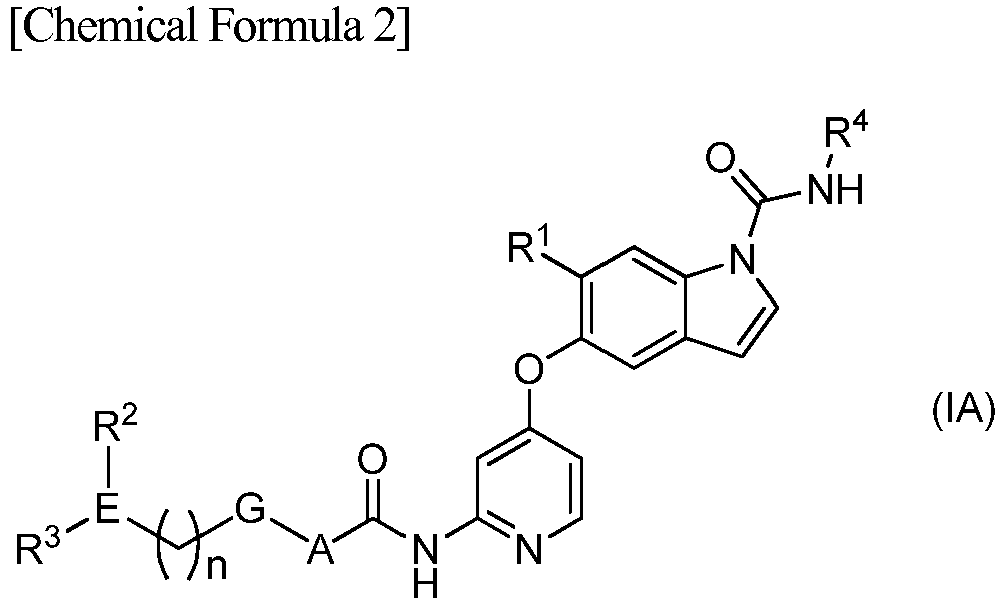
- n represents 0 to 2;
- A represents a C6-10 arylene group or a C3-5 heteroarylene group;
- G represents a single bond, an oxygen atom or -CH2-;
- E represents a C3-5 nitrogen-containing non-aromatic heterocycle;
- R1 represents a cyano group, a mono-C1-6 alkylamino group, a di-C1-6 alkylamino group, a C2-6 alkyl group optionally substituted by 1 to 3 halogen atoms, a C1-6 alkoxy group optionally substituted by 1 to 3 halogen atoms or one hydroxyl group, a C1-6 alkoxy C1-6 alkyl group optionally substituted by 1 to 3 halogen atoms, or a C1-6 alkoxy C1-6 alkoxy group optionally substituted by 1 to 3 halogen atoms;
- R2 represents a hydrogen atom, a halogen atom, a hydroxyl group, a C2-6 acyl group optionally substituted by one substituent selected from a group S described below, a C1-6 alkyl group optionally substituted by 1 to 3 halogen atoms, a hydroxy C1-6 alkyl group optionally substituted by 1 to 3 halogen atoms, or a C3-5 nitrogen-containing non-aromatic heterocyclic group;
- R3 represents a hydrogen atom, an oxo group, a C1-6 alkyl group optionally substituted by 1 to 3 halogen atoms, or a C1-6 alkoxy group optionally substituted by 1 to 3 halogen atoms;
- R4 represents a C1-6 alkyl group, with the proviso that when E represents an azetidine ring and R2 or R3 is present on a nitrogen atom on the azetidine ring, the R2 or R3 does not represent a hydrogen atom; and
- the group S represents a group consisting of a hydroxyl group, a mono-C1-6 alkylamino group, a di-C1-6 alkylamino group, a C1-6 alkoxy group and a C3-5 nitrogen-containing non-aromatic heterocyclic group.
- [2] The compound or the pharmaceutically acceptable salt thereof according to [1], represented by the following formula (IB):

- n represents 0 to 2;
- Arepresents a C6-10 arylene group or a C3-5 heteroarylene group;
- G represents a single bond, an oxygen atom or -CH2-;
- E represents a C3-5 nitrogen-containing non-aromatic heterocycle;
- R1 represents a C1-6 alkoxy group optionally substituted by 1 to 3 halogen atoms or one hydroxyl group, or a C1-6 alkoxy C1-6 alkoxy group optionally substituted by 1 to 3 halogen atoms;
- R2 represents a hydrogen atom, a halogen atom, a hydroxyl group, a C1-6 alkyl group optionally substituted by 1 to 3 halogen atoms, a hydroxy C1-6 alkyl group optionally substituted by 1 to 3 halogen atoms, or a C3-5 nitrogen-containing non-aromatic heterocyclic group; and
- R3 represents a hydrogen atom, an oxo group, a C1-6 alkyl group optionally substituted by 1 to 3 halogen atoms, or a C1-6 alkoxy group optionally substituted by 1 to 3 halogen atoms, with the proviso that when E represents an azetidine ring and R2 or R3 is present on a nitrogen atom on the azetidine ring, the R2 or R3 does not represent a hydrogen atom.
- [3] The compound or the pharmaceutically acceptable salt thereof according to [1], represented by the following formula (IB):

- n represents 0 to 2;
- A represents a C6-10 arylene group or a C3-5 heteroarylene group;
- G represents a single bond, an oxygen atom or -CH2-;
- E represents a C3-5 nitrogen-containing non-aromatic heterocycle;
- R1 represents a C1-6 alkoxy group optionally substituted by 1 to 3 halogen atoms or a C1-6 alkoxy C1-6 alkoxy group optionally substituted by 1 to 3 halogen atoms;
- R2 represents a hydrogen atom, a halogen atom, a hydroxyl group, a C1-6 alkyl group optionally substituted by 1 to 3 halogen atoms, a hydroxy C1-6 alkyl group optionally substituted by 1 to 3 halogen atoms, or a C3-5 nitrogen-containing non-aromatic heterocyclic group; and
- R3 represents a hydrogen atom, a C1-6 alkyl group optionally substituted by 1 to 3 halogen atoms, or a C1-6 alkoxy group optionally substituted by 1 to 3 halogen atoms, with the proviso that when E represents an azetidine ring and R2 or R3 is present on a nitrogen atom on the azetidine ring, the R2 or R3 does not represent a hydrogen atom.
- [4] The compound or the pharmaceutically acceptable salt thereof according to any one of [1] to [3], wherein A represents a C6-10 arylene group.
- [5] The compound or the pharmaceutically acceptable salt thereof according to any one of [1] to [4], wherein G represents a single bond or an oxygen atom.
- [6] The compound or the pharmaceutically acceptable salt thereof according to any one of [1] to [3], wherein
- A represents a phenylene group, a thienylene group, a pyrazolylene group or a pyridylene group; and
- E represents an azetidine ring, a pyrrolidine ring, a piperidine ring or a piperazine ring.
- [7] The compound or the pharmaceutically acceptable salt thereof according to any one of [1] to [3], wherein
- A represents a phenylene group; and
- E represents an azetidine ring or a piperidine ring.
- [8] The compound or the pharmaceutically acceptable salt thereof according to any one of [1] to [3], wherein
- A represents a phenylene group; and
- E represents a piperidine ring.
- [9] The compound or the pharmaceutically acceptable salt thereof according to any one of [6] to [8], wherein
- n represents 0; and
- G represents a single bond.
- [10] The compound or the pharmaceutically acceptable salt thereof according to any one of [1] to [9], wherein
- R1 represents a C1-6 alkoxy group or a C1-6 alkoxy C1-6 alkoxy group;
- R2 represents a hydrogen atom, a hydroxyl group, a C1-6 alkyl group or a hydroxy C1-6 alkyl group; and
- R3 represents a hydrogen atom.
- [11] The compound or the pharmaceutically acceptable salt thereof according to any one of [1] to [10], wherein R1 represents a C1-6 alkoxy C1-6 alkoxy group.
- [12] The compound or the pharmaceutically acceptable salt thereof according to any one of [1] to [3], represented by the following formula (II):

- R1 represents a C1-6 alkoxy C1-6 alkoxy group; and
- R2 represents a hydrogen atom, a C1-6 alkyl group or a hydroxy C2-6 alkyl group.
- [13] The compound or the pharmaceutically acceptable salt thereof according to any one of [1] to [3], represented by the following formula (III):

- R1 represents a C1-6 alkoxy C1-6 alkoxy group; and
- R2 represents a C1-6 alkyl group or a hydroxy C2-6 alkyl group.
- [14] 5-((2-(4-(1-Ethylpiperidin-4-yl)benzamide)pyridin-4-yl)oxy)-6-methoxy-N-methyl -1H-indole-1-carboxamide represented by the following structural formula, or a pharmaceutically acceptable salt thereof:

- [15] 6-(2-Methoxyethoxy)-N-methyl-5-((2-(4-(1-methylpiperidin-4-yl)benzamide)pyri din-4-yl)oxy)-1H-indole-1-carboxamide represented by the following structural formula, or a pharmaceutically acceptable salt thereof:

- [16] 5-((2-(4-(1-(2-Hydroxyethyl)piperidin-4-yl)benzamide)pyridin-4-yl)oxy)-6-(2-met hoxyethoxy)-N-methyl-1H-indole-1-carboxamide represented by the following structural formula, or a pharmaceutically acceptable salt thereof:

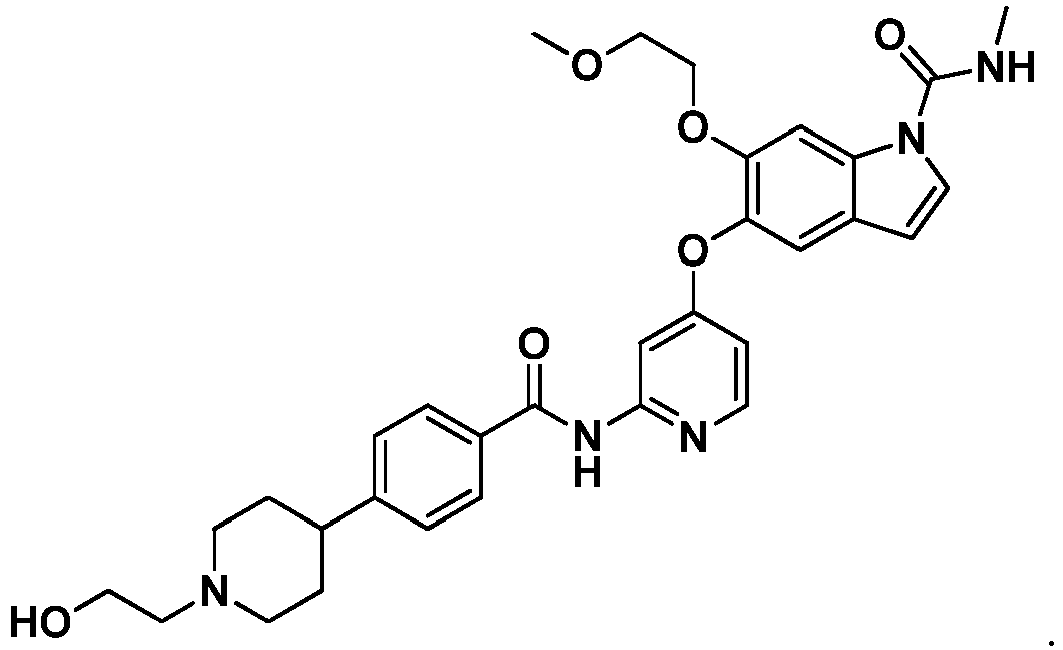
- [17] 6-(2-Ethoxyethoxy)-5-((2-(4-(1-(2-hydroxyethyl)piperidin-4-yl)benzamide)pyridin -4-yl)oxy)-N-methyl-1H-indole-1-carboxamide represented by the following structural formula, or a pharmaceutically acceptable salt thereof:

- [18] 6-(2-Ethoxyethoxy)-5-((2-(4-(1-ethylazetidin-3-yl)benzamide)pyridin-4-yl)oxy)-N -methyl-1H-indole-1-carboxamide represented by the following structural formula, or a pharmaceutically acceptable salt thereof:


- [19] A pharmaceutical composition comprising the compound or the pharmaceutically acceptable salt thereof according to any one of [1] to [18].
- [20] A therapeutic agent for stomach cancer, non-small-cell lung carcinoma, bladder cancer or endometrial cancer comprising the compound or the pharmaceutically acceptable salt thereof according to any one of [1] to [18] as an active ingredient.
- [21] A method for treating stomach cancer, non-small-cell lung carcinoma, bladder cancer or endometrial cancer comprising administrating a pharmacologically effective dose of the compound or the pharmaceutically acceptable salt thereof according to any one of [1] to [18].
- [22] A therapeutic agent for non-small-cell lung carcinoma comprising the compound or the pharmaceutically acceptable salt thereof according to any one of [1] to [18] as an active ingredient.
- [23] A therapeutic agent for squamous cell carcinoma comprising the compound or the pharmaceutically acceptable salt thereof according to any one of [1] to [18] as an active ingredient.
- [24] An FGFR inhibitor for treating non-small-cell lung carcinoma, comprising the compound or the pharmaceutically acceptable salt thereof according to any one of [1] to [18] as an active ingredient.
- [25] The compound or the pharmaceutically acceptable salt thereof according to any one of [1] to [18], for use as a therapeutic agent for stomach cancer, non-small-cell lung carcinoma, bladder cancer or endometrial cancer.
- [26] A use of the compound or the pharmaceutically acceptable salt thereof according to any one of [1] to [18], for manufacturing a therapeutic agent for stomach cancer, non-small-cell lung carcinoma, bladder cancer or endometrial cancer.
- The compound (IA) of the present invention or the pharmaceutically acceptable salt thereof has FGFR1, FGFR2 and FGFR3 inhibitory actions as shown in activity data obtained in pharmacological test examples described later. Furthermore, the compound (IA) of the present invention or the pharmaceutically acceptable salt thereof has a selective FGFR1, FGFR2 or FGFR3 inhibitory action as opposed to a KDR or HUVEC inhibitory action. Accordingly, the compound (IA) of the present invention or a pharmaceutically acceptable salt thereof has a potential use for a therapeutic agent for stomach cancer, non-small-cell lung carcinoma including lung squamous cell carcinoma, bladder cancer or endometrial cancer.
- Now, the present invention is described in details by defining symbols and terms used herein and describing embodiments and the like of the present invention.
- Herein, a structural formula of a compound may represent a given isomer for convenience, but the compound of the present invention includes isomers, such as all geometric isomers structurally formed from the compound, optical isomers based on asymmetric carbon, stereoisomers, rotamers and tautomers, and mixtures of these isomers, and hence is not limited to the formula given for convenience but may be any one of the isomers and mixtures. Accordingly, the compound of the present invention may have asymmetric carbon atom(s) in the molecule, and there may be an optically active substance and a racemate, and the present invention is not limited but includes all of these. It is understood, however, that some isomers, racemates and mixtures of isomers may show stronger activity than the others. Furthermore, there may exist crystal polymorphism, which also does not limit the present invention, and the compound of the present invention may be in any of single crystal forms or a mixture of two or more crystal forms, and the compound of the present invention includes an amorphous form, and embraces an anhydride and a solvate such as a hydrate.
- The present invention includes an isotope-labeled compound of the compound (IA) of the present invention and a pharmaceutically acceptable salt thereof. The isotope-labeled compound is equivalent to the compound represented by formula (IA) except that one or more of atom(s) are replaced by atom(s) having an atomic mass or a mass number different from those usually found in nature. Examples of an isotope that can be incorporated into the compound of the present invention include isotopes of hydrogen, carbon, nitrogen, oxygen, phosphorus, fluorine, iodine, bromine and chlorine, such as 2H, 3H, 11C, 13C, 14C, 18F, 35S, 123I and 125I.
- The isotope-labeled compound, such as a compound into which a radioactive isotope of, for example, 3H and/or 14C is incorporated, is useful for a tissue distribution assay for a medicine and/or a matrix. The isotopes 3H and 14C are regarded to be useful because these isotopes can be easily prepared and detected. The isotopes 11C and 18F are regarded to be useful in PET (positron emission tomography), the isotope 125I is regarded to be useful in SPECT (single photon emission computed tomography), and can be useful in brain imaging. Replacement by a heavier isotope such as 2H causes, because of its higher metabolic stability, some advantages, in a treatment, of, for example, extension of half-life in vivo or reduction of a necessary dose, and therefore, is regarded useful under given circumstances. The isotope-labeled compound can be similarly prepared by using a readily available isotope-labeled reagent instead of a nonisotope-labeled reagent and by performing processes disclosed in schemes and/or examples described below.
- The compound (IA) of the present invention can be used as a chemical probe for capturing a target protein of a biologically active low molecular weight compound. Specifically, the compound of the present invention can be transformed into an affinity chromatography probe, a photoaffinity probe or the like by introducing a labeling group, a linker or the like into a moiety other than a structural moiety indispensable to activity expression of the compound by a method described in J. Mass Spectrum. Soc. Jpn. Vol. 51, No. 5, 2003, p. 492-498,
WO2007/139149 or the like. - Examples of the labeling group, the linker or the like used in such a chemical probe include groups belonging to the following groups (1) to (5).
- (1) Protein labeling groups such as photoaffinity labeling groups (such as a benzoyl group, a benzophenone group, an azide group, a carbonyl azide group, a diaziridine group, an enone group, a diazo group and a nitro group), and chemical affinity groups (such as a ketone group in which an alpha carbon atom is substituted by a halogen atom, a carbamoyl group, an ester group, an alkylthio group, a Michael receptor of α, β-unsaturated ketone, ester or the like, and an oxirane group);
- (2) cleavable linkers such as -S-S-, -O-Si-O-, a monosaccharide (such as a glucose group or a galactose group) and a disaccharide (such as lactose), and oligopeptide linkers that can be cleaved by an enzyme reaction;
- (3) fishing tag groups such as biotin and a 3-(4,4-difluoro-5,7-dimethyl-4H-3a,4a-diaza-4-bora-s-indacene-3-yl)propionyl group;
- (4) radioactive labeling groups such as 125I, 32P, 3H and 14C; fluorescence labeling groups such as fluorescein, rhodamine, dansyl, umbelliferone, 7-nitrofurazanyl, and a 3-(4,4-difluoro-5,7-dimethyl-4H-3a,4a-diaza-4-bora-s-indacene-3-yl)propionyl group; chemiluminescent groups such as luciferin and luminol; and markers capable of detecting heavy metal ions such as lanthanoid metal ions and radium ions; and
- (5) groups to be bonded to a solid phase carrier such as glass beads, a glass bed, a microtiter plate, agarose beads, an agarose bed, polystyrene beads, a polystyrene bed, nylon beads and a nylon bed.
- A probe prepared by introducing, into the compound of the present invention, a labeling group or the like selected from the above-described groups (1) to (5) by the method described in any of the aforementioned literatures or the like can be used as a chemical probe for identifying a marker protein useful for research of a novel potential drug target.
- A "halogen atom" used herein means a fluorine atom, a chlorine atom, a bromine atom or an iodine atom.
- A "hetero atom" used herein means a nitrogen atom, a sulfur atom or an oxygen atom.
- A "C1-6 alkyl group" used herein means a linear or branched alkyl group having 1 to 6 carbon atoms that is a monovalent group induced by removing one arbitrary hydrogen atom from an aliphatic hydrocarbon having 1 to 6 carbon atoms. Examples of such a group include a methyl group, an ethyl group, a n-propyl group, an isopropyl group, a n-butyl group, an isobutyl group, a sec-butyl group, a tert-butyl group, a n-pentyl group, an isopentyl group, a sec-pentyl group, a neopentyl group, a 1-methylbutyl group, a 2-methylbutyl group, a 1,1-dimethylpropyl group, a 1,2-dimethylpropyl group, a n-hexyl group, an isohexyl group, a 1-methylpentyl group, a 2-methylpentyl group, a 3-methylpentyl group, a 1,1-dimethylbutyl group, a 1,2-dimethylbutyl group, a 2,2-dimethylbutyl group, a 1,3-dimethylbutyl group, a 2,3-dimethylbutyl group, a 3,3-dimethylbutyl group, a 1-ethylbutyl group, a 2-ethylbutyl group, a 1,1,2-trimethylpropyl group, a 1,2,2-trimethylpropyl group, a 1-ethyl-1-methylpropyl group, a 1-ethyl-2-methylpropyl group and the like. More specifically, it is a methyl group, an ethyl group, a n-propyl group, an isopropyl group, a n-butyl group, an isobutyl group, a sec-butyl group, a tert-butyl group or the like, and is preferably a methyl group, an ethyl group or an isopropyl group.
- A "C1-6 alkyl group optionally substituted by 1 to 3 halogen atoms" used herein means the above-described C1-6 alkyl group in which arbitrary 1 to 3 hydrogen atoms may be substituted by a halogen atom. The position to be substituted by a halogen atom is not especially limited, and specific examples of such a group include a monofluoromethyl group, a difluoromethyl group, a trifluoromethyl group, a 2-fluoroethyl group, a 2,2-difluoroethyl group, a 2,2,2-trifluoroethyl group, a monochloromethyl group, a dichloromethyl group, a trichloromethyl group, a 2-chloroethyl group, a 2,2-dichloroethyl group, a 2,2,2-trichloroethyl group, a 3-fluoropropyl group and the like. As the halogen atom used for the substitution, specifically, for example, a fluorine atom, a chlorine atom or the like is preferably used, and a fluorine atom is more preferably used.
- A "C2-6 alkyl group" used herein means a linear or branched alkyl group having 2 to 6 carbon atoms that is a monovalent group induced by removing one arbitrary hydrogen atom from an aliphatic hydrocarbon having 2 to 6 carbon atoms. Examples of such a group include an ethyl group, a n-propyl group, an isopropyl group, a n-butyl group, an isobutyl group, a sec-butyl group, a tert-butyl group, a n-pentyl group, an isopentyl group, a sec-pentyl group, a neopentyl group, a 1-methylbutyl group, a 2-methylbutyl group, a 1,1-dimethylpropyl group, a 1,2-dimethylpropyl group, a n-hexyl group, an isohexyl group, a 1-methylpentyl group, a 2-methylpentyl group, a 3-methylpentyl group, a 1,1-dimethylbutyl group, a 1,2-dimethylbutyl group, a 2,2-dimethylbutyl group, a 1,3-dimethylbutyl group, a 2,3-dimethylbutyl group, a 3,3-dimethylbutyl group, a 1-ethylbutyl group, a 2-ethylbutyl group, a 1,1,2-trimethylpropyl group, a 1,2,2-trimethylpropyl group, a 1-ethyl-1-methylpropyl group, and a 1-ethyl-2-methylpropyl group. More specifically, it is an ethyl group, a n-propyl group, an isopropyl group, a n-butyl group, an isobutyl group, a sec-butyl group or a tert-butyl group, and is preferably an ethyl group.
- A "C2-6 alkyl group optionally substituted by 1 to 3 halogen atoms" used herein means the above-described C2-6 alkyl group in which arbitrary 1 to 3 hydrogen atoms may be substituted by a halogen atom. The position to be substituted by a halogen atom is not especially limited, and specific examples of such a group include a 2-fluoroethyl group, a 2,2-difluoroethyl group, a 2,2,2-trifluoroethyl group, a 2-chloroethyl group, a 2,2-dichloroethyl group, a 2,2,2-trichloroethyl group, and a 3-fluoropropyl group. As the halogen atom used for the substitution, specifically, for example, a fluorine atom, a chlorine atom or the like is preferably used, and a fluorine atom is more preferably used.
- A "hydroxy C1-6 alkyl group" used herein means the above-described C1-6 alkyl group in which one arbitrary hydrogen atom is substituted by a hydroxyl group. The position to be substituted by a hydroxyl group is not especially limited, and specific examples of such a group include a hydroxymethyl group, a 2-hydroxyethyl group, a 1-hydroxyethyl group, a 3-hydroxypropyl group, a 2-hydroxypropyl group, a 1-hydroxypropyl group, a 2-hydroxy-2,2-dimethylethyl group and the like. It is preferably a 2-hydroxyethyl group, a 2-hydroxypropyl group or a 2-hydroxy-2,2-dimethylethyl group.
- A "hydroxy C2-6 alkyl group" used herein means a linear or branched alkyl group having 2 to 6 carbon atoms that is a monovalent group induced by removing one arbitrary hydrogen atom from an aliphatic hydrocarbon having 2 to 6 carbon atoms, in which one arbitrary hydrogen atom is substituted by a hydroxyl group. The position to be substituted by a hydroxyl group is not especially limited, and specific examples of such a group include a 2-hydroxyethyl group, a 1-hydroxyethyl group, a 3-hydroxypropyl group, a 2-hydroxypropyl group, a 1-hydroxypropyl group, a 2-hydroxy-2,2-dimethylethyl group and the like. It is preferably a 2-hydroxyethyl group, a 2-hydroxypropyl group or a 2-hydroxy-2,2-dimethylethyl group.
- A "hydroxy C1-6 alkyl group optionally substituted by 1 to 3 halogen atoms" used herein means the above-described hydroxy C1-6 alkyl group in which arbitrary 1 to 3 hydrogen atoms may be substituted by a halogen atom. The position to be substituted by a halogen atom is not especially limited. As the halogen atom to be used for the substitution, specifically, for example, a fluorine atom, a chlorine atom or the like is preferably used, and a fluorine atom is more preferably used.
- A "C1-6 alkoxy group" used herein means the above defined "C1-6 alkyl group" having an oxygen atom bonded to a terminal thereof, and examples of such a group include a methoxy group, an ethoxy group, a n-propoxy group, an isopropoxy group, a n-butoxy group, an isobutoxy group, a sec-butoxy group, a tert-butoxy group, a n-pentyloxy group, an isopentyloxy group, a sec-pentyloxy group, a neopentyloxy group, a 1-methylbutoxy group, a 2-methylbutoxy group, a 1,1-dimethylpropoxy group, a 1,2-dimethylpropoxy group, a n-hexyloxy group, an isohexyloxy group, a 1-methylpentyloxy group, a 2-methylpentyloxy group, a 3-methylpentyloxy group, a 1,1-dimethylbutoxy group, a 1,2-dimethylbutoxy group, a 2,2-dimethylbutoxy group, a 1,3-dimethylbutoxy group, a 2,3-dimethylbutoxy group, a 3,3-dimethylbutoxy group, a 1-ethylbutoxy group, a 2-ethylbutoxy group, a 1,1,2-trimethylpropoxy group, a 1,2,2-trimethylpropoxy group, a 1-ethyl-1-methylpropoxy group, a 1-ethyl-2-methylpropoxy group and the like, and more specifically, it is a methoxy group, an ethoxy group, a n-propoxy group, an isopropoxy group, a n-butoxy group, an isobutoxy group, a sec-butoxy group, a n-pentyloxy group, an isopentyloxy group, a n-hexyloxy group, an isohexyloxy group or the like, and is preferably a methoxy group, an ethoxy group or an isopropoxy group.
- A "C1-6 alkoxy group optionally substituted by 1 to 3 halogen atoms" used herein means the above-described C1-6 alkoxy group in which arbitrary 1 to 3 hydrogen atoms are substituted by a halogen atom. The position to be substituted by a halogen atom is not especially limited, and specific examples of such a group include a monofluoromethoxy group, a difluoromethoxy group, a trifluoromethoxy group, a 2-fluoroethoxy group, a 2,2-difluoroethoxy group, a 2,2,2-trifluoroethoxy group, a monochloromethoxy group, a dichloromethoxy group, a trichloromethoxy group, a 2-chloroethoxy group, a 2,2-dichloroethoxy group, a 2,2,2-trichloroethoxy group, a 3-fluoropropoxy group and the like.
- A "C1-6 alkoxy group optionally substituted by one hydroxyl group" used herein means the above-described alkoxy group in which one arbitrary hydrogen atom may be substituted by a hydroxyl group. The position to be substituted by a hydroxyl group is not especially limited, and specific examples of such a group include a 2-hydroxyethoxy group, a 2-hydroxypropoxy group and a 3-hydroxypropoxy group. Preferably, it is a 2-hydroxyethoxy group.
- A "C1-6 alkoxy C1-6 alkoxy group" used herein means the above defined "C1-6 alkoxy group" in which one arbitrary hydrogen atom is substituted by the above defined "C1-6 alkoxy group", and specific examples of such a group include a methoxymethoxy group, an ethoxymethoxy group, a n-propoxymethoxy group, a 2-methoxyethoxy group, a 2-ethoxyethoxy group, a 3-methoxypropoxy group and the like. Preferably, it is a 2-methoxyethoxy group, a 2-ethoxyethoxy group or a 3-methoxypropoxy group.
- A "C1-6 alkoxy C1-6 alkoxy group optionally substituted by 1 to 3 halogen atoms" used herein means the above-described "C1-6 alkoxy C1-6 alkoxy group" in which arbitrary 1 to 3 hydrogen atoms may be substituted by a halogen atom. The position to be substituted by a halogen atom is not especially limited, and specific examples of such a group include a monofluromethoxymethoxy group, a difluoromethoxymethoxy group, a monofluoroethoxymethoxy group, a difluoroethoxymethoxy group, a monofluoromethoxyethoxy group, a trifluoromethoxyethoxy group, a difluoromethoxyethoxy group, a monofluoroethoxyethoxy group, a difluoroethoxyethoxy group and the like.
- A "C1-6 alkoxy C1-6 alkyl group" used herein means the above defined "C1-6 alkyl group" in which one arbitrary hydrogen atom is substituted by the above defined "C1-6 alkoxy group", and specific examples of such a group include a methoxymethyl group, an ethoxymethyl group, a n-propoxymethyl group, a 2-methoxyethyl group, a 2-ethoxyethyl group and a 3-methoxypropyl group. Preferably, it is a methoxymethyl group.
- A "C1-6 alkoxy C1-6 alkyl group optionally substituted by 1 to 3 halogen atoms" used herein means the above-described C1-6 alkoxy C1-6 alkyl group in which arbitrary 1 to 3 hydrogen atoms may be substituted by a halogen atom. The position to be substituted by a halogen atom is not especially limited, and specific examples of such a group include a monofluoromethoxymethyl group, a difluoromethoxymethyl group, a monofluoroethoxymethyl group, a difluoroethoxymethyl group, a monofluoromethoxyethyl group, a trifluoromethoxyethyl group, a difluoromethoxyethyl group, a monofluoroethoxyethyl group and a difluoroethoxyethyl group.
- A "mono-C1-6 alkylamino group" used herein means an amino group in which one hydrogen atom is substituted by the above defined "C1-6 alkyl group", and specific examples of such a group include a methylamino group, an ethylamino group, a n-propylamino group, an isopropylamino group, a n-butylamino group, an isobutylamino group, a sec-butylamino group, a tert-butylamino group, a n-pentylamino group, an isopentylamino group, a sec-pentylamino group, a neopentylamino group, a 1-methylbutylamino group, a 2-methylbutylamino group, a 1,1-dimethylpropylamino group, a 1,2-dimethylpropylamino group, a n-hexylamino group, an isohexylamino group, a 1-methylpentylamino group, a 2-methylpentylamino group, a 3-methylpentylamino group, a 1,1-dimethylbutylamino group, a 1,2-dimethylbutylamino group, a 2,2-dimethylbutylamino group, a 1,3-dimethylbutylamino group, a 2,3-dimethylbutylamino group, a 3,3-dimethylbutylamino group, a 1-ethylbutylamino group, a 2-ethylbutylamino group, a 1,1,2-trimethylpropylamino group, a 1,2,2-trimethylpropylamino group, a 1-ethyl-1-methylpropylamino group and a 1-ethyl-2-methylpropylamino group, and is preferably a methylamino group or the like.
- A "di-C1-6 alkylamino group" used herein means an amino group in which two hydrogen atoms are each substituted by the same or different "C1-6 alkyl groups" defined above, and specific examples of such a group include a N,N-dimethylamino group, a N,N-diethylamino group, a N,N-di-n-propylamino group, a N,N-di-isopropylamino group, a N,N-di-n-butylamino group, a N,N-di-isobutylamino group, a N,N-di-sec-butylamino group, a N,N-di-tert-butylamino group, a N-ethyl-N-methylamino group, a N-n-propyl-N-methylamino group, a N-isopropyl-N-methylamino group, a N-n-butyl-N-methylamino group, a N-isobutyl-N-methylamino group, a N-sec-butyl-N-methylamino group and a N-tert-butyl-N-methylamino group, and is preferably a N,N-dimethylamino group or the like.
- A "C2-6 acyl group" used herein means a group containing an atomic group obtained by excluding an OH group from a carboxyl group of an aliphatic carboxylic acid having 2 to 6 carbon atoms, and specific examples of such a group include an acetyl group, a propionyl group and a butyloyl group.
- An "oxo group" used herein means a substituent in which an oxygen atom is bonded on a carbon atom or a nitrogen atom, and a specific example of a structure in which an oxygen atom is bonded on a carbon atom includes a carbonyl group, and a specific example of a group in which an oxygen atom is bonded on a nitrogen atom includes N-oxide.
- A "C3-5 heteroarylene group" used herein means a bivalent group having 3 to 5 carbon atoms forming a ring that is induced by removing arbitrary 2 hydrogen atoms from a hetero aromatic compound having 1 to 2 hetero atoms as atoms forming the ring, and specific examples of such a group include a furylene group, a thienylene group, a pyrrolylene group, an imidazolylene group, a thiazolylene group, a pyrazolylene group, an oxazolylene group, an isooxazolylene group, an isothiazolylene group, a furazanylene group, a pyridylene group, a pyrazinylene group, a pyridazinylene group, a pyrimidinylene group and the like, and it is preferably a pyridylene group, a pyrazolylene group or a thienylene group.
- A "C3-5 nitrogen-containing non-aromatic heterocyclic group" used herein means a monovalent non-aromatic cyclic group having 3 to 5 carbon atoms forming a ring and having 1 to 2 nitrogen atoms among atoms forming the ring, and specific examples of such a group include an azetidinyl group, a pyrrolidinyl group, a pyrazolidinyl group, an imidazolidinyl group, a piperidinyl group, a piperazinyl group, an isooxazolidinyl group, an isothiazolidinyl group, a morpholinyl group, a thiomorpholinyl group and the like.
- A "C3-5 nitrogen-containing non-aromatic heterocycle" used herein means a non-aromatic ring having 3 to 5 carbon atoms forming the ring and having 1 to 2 nitrogen atoms among atoms forming the ring, and specific examples of such a group include an azetidine ring, a pyrrolidine ring, a pyrazolidine ring, an imidazolidine ring, a piperidine ring, a piperazine ring, an isooxazolidine ring, an isothiazolidine ring, a morpholine ring, a thiomorpholine ring and the like.
- A "C6-10 arylene group" used herein means a bivalent group induced by removing arbitrary two hydrogen atoms from an aromatic hydrocarbon having 6 to 10 carbon atoms, and specific examples of such a group include a phenylene group, a naphthylene group, an indenylene group, an azulenylene group, a heptalenylene group and the like, and it is preferably a phenylene group.
- In formula used herein, n represents 0 to 2. Preferably, n is 0 or 1, and more preferably, n is 0.
- In formula used herein, A represents a C6-10 arylene group or a C3-5 heteroarylene group, preferably a phenylene group, a thienylene group, a pyridylene group or a pyrazolylene group, and more preferably, a phenylene group.
- In formula used herein, G represents a single bond, an oxygen atom or -CH2-, preferably a single bond or an oxygen atom, and more preferably a single bond.
- In formula used herein, E represents the C3-5 nitrogen-containing non-aromatic heterocycle described above, and specifically, for example, an azetidine ring, a pyrrolidine ring, a piperidine ring or a piperazine ring, preferably an azetidine ring or a piperidine ring, and more preferably a piperidine ring.
- In formula used herein, R1 represents a cyano group, a mono-C1-6 alkylamino group, a di-C1-6 alkylamino group, a C2-6 alkyl group optionally substituted by 1 to 3 halogen atoms, a C1-6 alkoxy group optionally substituted by 1 to 3 halogen atoms or one hydroxyl group, a C1-6 alkoxy C1-6 alkyl group optionally substituted by 1 to 3 halogen atoms, or a C1-6 alkoxy C1-6 alkoxy group optionally substituted by 1 to 3 halogen atoms. Preferably, it is a C1-6 alkoxy group or a C1-6 alkoxy C1-6 alkoxy group. Specific examples of such a group include a cyano group, a methylamino group, a N,N-dimethylamino group, an ethyl group, a n-propyl group, an isopropyl group, a methoxy group, an ethoxy group, a n-propoxy group, an isopropoxy group, a n-butoxy group, an isobutoxy group, a sec-butoxy group, a n-pentyloxy group, an isopentyloxy group, a n-hexyloxy group, an isohexyloxy group, a monofluoromethoxy group, a difluoromethoxy group, a trifluoromethoxy group, a 2-fluoroethoxy group, a 2,2-difluoroethoxy group, a 3-fluoropropoxy group, a 2-hydroxyethoxy group, a methoxymethyl group, an ethoxymethyl group, a n-propoxymethyl group, an ethoxymethoxy group, a n-propoxymethoxy group, a 2-methoxyethoxy group, a 2-ethoxyethoxy group, a 3-methoxypropoxy group, a monofluoromethoxymethoxy group, a difluoromethoxymethoxy group, a monofluoroethoxymethoxy group, a difluoroethoxymethoxy group, a monofluoromethoxyethoxy group, a difluoromethoxyethoxy group, a trifluoromethoxyethoxy group, a monofluoroethoxyethoxy group and a difluoroethoxyethoxy group. Preferable examples include a cyano group, a N,N-dimethylamino group, an ethyl group, a methoxy group, an ethoxy group, an isopropoxy group, a 3-fluoropropoxy group, a 2-hydroxyethoxy group, a methoxymethyl group, a 2-methoxyethoxy group, a 2-ethoxyethoxy group and a 3-methoxypropoxy group, among which a methoxy group, a 2-methoxyethoxy group, a 2-ethoxyethoxy group and the like are preferred, and a 2-methoxyethoxy group and a 2-ethoxyethoxy group are more preferred.
- In formula used herein, R2 represents a hydrogen atom, a halogen atom, a hydroxyl group, a C2-6 acyl group optionally substituted by one substituent selected from the group S, a C1-6 alkyl group optionally substituted by 1 to 3 halogen atoms, a hydroxy C1-6 alkyl group optionally substituted by 1 to 3 halogen atoms, or a C3-5 nitrogen-containing non-aromatic heterocyclic group. Here, the group S represents a group consisting of a hydroxyl group, a mono-C1-6 alkylamino group, a di-C1-6 alkylamino group, a C1-6 alkoxy group and a C3-5 nitrogen-containing non-aromatic heterocyclic group. Preferably, it is a hydrogen atom, a halogen atom, a hydroxyl group, a C1-6 alkyl group or a hydroxy C1-6 alkyl group, and more preferably, it is a hydrogen atom, a hydroxyl group, a C1-6 alkyl group or a hydroxy C1-6 alkyl group. Specific examples of R2 include a hydrogen atom, a fluorine atom, a chlorine atom, a bromine atom, an iodine atom, a hydroxyl group, a methyl group, an ethyl group, a n-propyl group, an isopropyl group, a n-butyl group, an isobutyl group, a sec-butyl group, a tert-butyl group, a monofluoromethyl group, a difluoromethyl group, a trifluoromethyl group, a 2-fluoroethyl group, a 2,2-difluoroethyl group, a 2,2,2-trifluoroethyl group, a monochloromethyl group, a dichloromethyl group, a trichloromethyl group, a 2-chloroethyl group, a 2,2-dichloroethyl group, a 2,2,2-trichloroethyl group, a 3-fluoropropyl group, a hydroxymethyl group, a 2-hydroxyethyl group, a 1-hydroxyethyl group, a 3-hydroxypropyl group, a 2-hydroxypropyl group, a 1-hydroxypropyl group, a 2-hydroxy-2,2-dimethylethyl group, an azetidinyl group, a pyrrolidinyl group, a piperidinyl group and a piperazinyl group. Preferably, it is a hydrogen atom, a fluorine atom, a hydroxyl group, a methyl group, an ethyl group, a n-propyl group, an isopropyl group, a hydroxymethyl group, a 2-hydroxyethyl group, a 1-hydroxyethyl group, a 3-hydroxypropyl group, a 2-hydroxypropyl group, a 1-hydroxypropyl group, a 2-hydroxy-2,2-dimethylethyl group, an azetidinyl group, a pyrrolidinyl group or a piperidinyl group, and more preferably, it is a methyl group, an ethyl group or a 2-hydroxyethyl group.
- In formula used herein, R3 represents a hydrogen atom, an oxo group, a C1-6 alkyl group optionally substituted by 1 to 3 halogen atoms, or a C1-6 alkoxy group optionally substituted by 1 to 3 halogen atoms. Preferably, it is a hydrogen atom, a C1-6 alkyl group or a C1-6 alkoxy group. Specifically, it is preferably a hydrogen atom, a methyl group or an ethyl group, and more preferably a hydrogen atom.
- In formula used herein, R4 represents a C1-6 alkyl group. Preferably, it is a methyl group.
- However, if E represents an azetidine ring and R2 or R3 is present on a nitrogen atom of the azetidine ring, this R2 or R3 does not represent a hydrogen atom. Besides, each of R2 and R3 is an atom or a group substituted in an arbitrary position on E, namely, in an arbitrary position on the C3-5 nitrogen-containing non-aromatic heterocycle.
- In the following formula (IB),
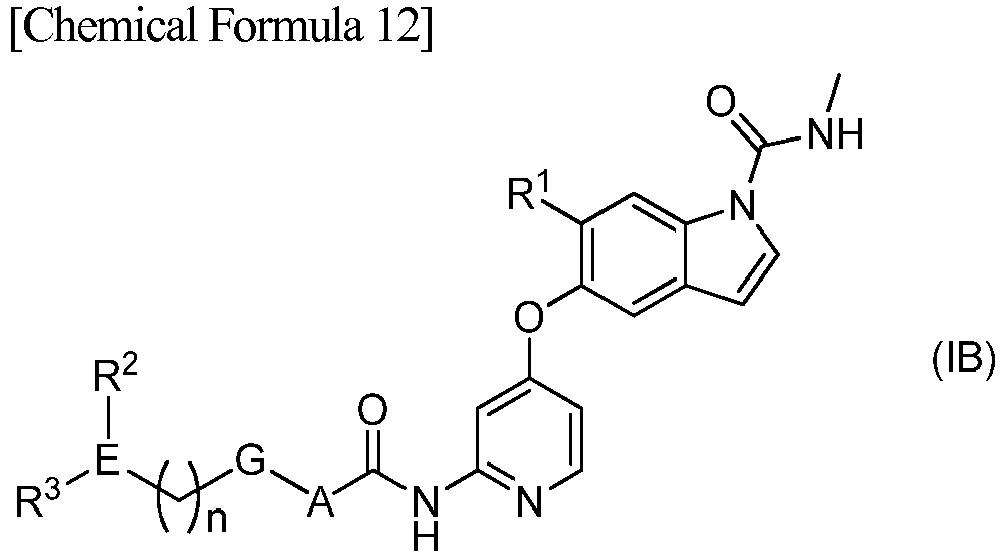


- In formula (V), R2 represents a hydrogen atom, a C1-6 alkyl group or a hydroxy C2-6 alkyl group, and specific examples include a hydrogen atom, a methyl group, an ethyl group, a propyl group, an isopropyl group, a 2-hydroxyethyl group, a 3-hydroxypropyl group, a 2-hydroxypropyl group, a 2-hydroxy-2,2-dimethylethyl group and the like. It is preferably a methyl group, an ethyl group, a 2-hydroxyethyl group, a 2-hydroxypropyl group or a 2-hydroxy-2,2-dimethylethyl group.
- In formula (VI), R2 represents a C1-6 alkyl group or a hydroxy C2-6 alkyl group, and specific examples include a methyl group, an ethyl group, a propyl group, an isopropyl group, a 2-hydroxyethyl group, a 3-hydroxypropyl group, a 2-hydroxypropyl group, a 2-hydroxy-2,2-dimethylethyl group and the like. It is preferably a methyl group, an ethyl group, a 2-hydroxyethyl group, a 2-hydroxypropyl group or a 2-hydroxy-2,2-dimethylethyl group.
- A compound of the present invention is preferably any one of the following compounds or the like or pharmaceutically acceptable salts thereof:
- 5-((2-(4-(1-Ethylpiperidin-4-yl)benzamide)pyridin-4-yl)oxy)-6-methoxy-N-methyl -1H-indole-1-carboxamide;
- 6-(2-Methoxyethoxy)-N-methyl-5-((2-(4-(1-methylpiperidin-4-yl)benzamide)pyri din-4-yl)oxy)-1H-indole-1-carboxamide;
- 5-((2-(4-(1-(2-Hydroxyethyl)piperidin-4-yl)benzamide)pyridin-4-yl)oxy)-6-(2-met hoxyethoxy)-N-methyl-1H-indole-1-carboxamide;
- 6-(2-Ethoxyethoxy)-5-((2-(4-(1-(2-hydroxyethyl)piperidin-4-yl)benzamide)pyridin -4-yl)oxy)-N-methyl-1H-indole-1-carboxamide;
- 6-(2-Ethoxyethoxy)-5-((2-(4-(1-ethylazetidin-3-yl)benzamide)pyridin-4-yl)oxy)-N -methyl-1H-indole-1-carboxamide.
- Examples of a "salt" used herein include salts with inorganic acids, salts with organic acids, and salts with acidic amino acids, and in particular, pharmaceutically acceptable salts are preferred. Besides, a salt of the compound of the present invention embraces an anhydride of a pharmaceutically acceptable salt thereof and a solvate, such as a hydrate, of the pharmaceutically acceptable salt.
- Preferable examples of a salt with an inorganic acid include salts with hydrochloric acid, hydrobromic acid, sulfuric acid, nitric acid, phosphoric acid and the like, and preferable examples of a salt with an organic acid include salts with acetic acid, succinic acid, fumaric acid, maleic acid, tartaric acid, citric acid, lactic acid, stearic acid, benzoic acid, methanesulfonic acid, ethanesulfonic acid, p-toluenesulfonic acid and the like.
- Preferable examples of a salt with an acidic amino acid include salts with aspartic acid and glutamic acid and the like.
- The compound (IA) of the present invention or the pharmaceutically acceptable salt thereof can be formulated by a general method, and the dosage form can be, for example, an oral formulation (such as a tablet, a granule, a powder, a capsule, a syrup or the like), an injection formulation (for intravenous administration, intramuscular administration, subcutaneous administration, intraperitoneal administration or the like), or an external formulation (such as a transdermal absorbable drug (including an ointment, a patch and the like), an eye dropper, nasal drops, a suppository or the like).
- For producing an oral solid formulation, a vehicle, a binder, a disintegrator, a lubricant, a colorant and the like can be added, if necessary, to the compound (IA) of the present invention or the pharmaceutically acceptable salt thereof, and the resulting mixture can be prepared by a conventional method into tablets, granulates, powders, or capsules. Furthermore, the tablets, granulates, powders, capsules or the like can be coated with a film if necessary.
- Examples of the vehicle include lactose, corn starch, crystalline cellulose and the like, examples of the binder include hydroxypropyl cellulose, hydroxypropyl methyl cellulose and the like, examples of the disintegrator include calcium carboxymethylcellulose, sodium croscarmellose and the like, examples of the lubricant include magnesium stearate, calcium stearate and the like, an example of the colorant includes titanium oxide and the like, and examples of a film-coating agent include hydroxypropyl cellulose, hydroxypropyl methyl cellulose, methyl cellulose and the like, but these components are not limited to the aforementioned examples.
- The solid formulation such as a tablet, a capsule, a granule or a powder may contain the compound (IA) of the present invention or the pharmaceutically acceptable salt thereof in a content of generally 0.001 to 99.5% by weight, and specifically 0.001 to 90% by weight.
- For producing an injection formulation (for intravenous administration, intramuscular administration, subcutaneous administration, intraperitoneal administration or the like), a pH adjuster, a buffer, a suspending agent, a solubilizing agent, an antioxidant, a preservative (an antiseptic agent), a tonicity adjusting agent and the like are added, if necessary, to the compound (IA) of the present invention or the pharmaceutically acceptable salt thereof, and the resulting mixture can be prepared into an injection formulation by a conventional method. Furthermore, the resultant can be freeze-dried to be used as a lyophilized product to be dissolved before use.
- Examples of the pH adjuster and the buffer include organic acids or inorganic acids and/or pharmaceutically acceptable salts thereof, examples of the suspending agent include methyl cellulose, Polysorbate 80 , sodium carboxymethylcellulose and the like, examples of the solubilizing agent include Polysorbate 80, polyoxyethylene sorbitan monolaurate and the like, an example of the antioxidant includes α-tocopherol and the like, examples of the preservative include methyl paraoxybenzoate, ethyl paraoxybenzoate and the like, and examples of the tonicity adjusting agent include grape sugar, sodium chloride, mannitol and the like, but these components are not limited to the aforementioned examples.
- Such an injection formulation may contain the compound (IA) of the present invention or the pharmaceutically acceptable salt thereof in a content of generally 0.000001 to 99.5% by weight, and specifically 0.00001 to 90% by weight.
- For producing an external formulation, a base material is added to the compound (IA) of the present invention or the pharmaceutically acceptable salt thereof, and if necessary, for example, a preservative, a stabilizer, a pH adjuster, an antioxidant, a colorant and the like described above are further added thereto, and the resulting mixture is prepared by a conventional method into, for example, a transdermal absorbable drug (such as an ointment or a patch), an eye dropper, nasal drops, a suppository or the like.
- As the base material to be used, various materials usually used for, for example, medicines, quasi-drugs and cosmetics can be used. Specific examples of the material include animal and vegetable oils, mineral oils, ester oils, waxes, emulsifiers, higher alcohols, fatty acids, silicone oils, surfactants, phospholipids, alcohols, polyhydric alcohols, water soluble polymers, clay minerals, purified water and the like.
- Such an external formulation can contain the compound (IA) of the present invention or the pharmaceutically acceptable salt thereof in a content of generally 0.000001 to 99.5% by weight, and specifically 0.00001 to 90% by weight.
- A dose of the compound (IA) of the present invention or the pharmaceutically acceptable salt thereof depends upon the level of symptom severity, the patient's age, sex and weight, the administration form and the kind of salt, a specific kind of disease and the like, and is not especially limited unless it exceeds the maximum dose of the medicine that can be given without causing an unacceptable adverse reaction, and in an adult patient, it is administered, once or dividedly several times per day, at a dose for oral administration of generally approximately 30 µg to 10g, specifically 100 µg to 5 g and more specifically 100 µg to 1 g, or a dose for injection administration of generally approximately 30 µg to 1 g, specifically 100 µg to 500 mg, and more specifically 100 µg to 300 mg.
- A production method for the compound (IA) of the present invention will now be described. The compound (IA) of the present invention can be synthesized by using general organic synthesizing means, and some examples of the compound (IA) of the present invention, for example, compounds (1-1), (1-2), (1-3), (1-4), (1-5), (1-6), (1-7), (1-8), (1-9) and (1-10) can be synthesized by methods described in [Production Method 1] or the like described below. If a protective group is used in production methods described herein, known protective groups, for example, as those described in Green's PROTECTIVE GROUP IN ORGANIC CHEMISTRY, fourth edition, JOHN WILEY & SONS, INC. are appropriately selected and introduced, and deprotection can be appropriately performed by a known method.
-

-


- In the above formula, R1, R3 (an oxo group is excluded.), R4, A, E, G and n represent the same as defined above; R2a and R2b each represent a hydrogen atom, a C1-5 alkyl group optionally substituted by 1 to 3 halogen atoms, or a hydroxy C1-5 alkyl group optionally substituted by 1 to 3 halogen atoms; R2c and R2d each represent a hydrogen atom or a C1-4 alkyl group optionally substituted by 1 to 3 halogen atoms; R2e represents a C1-6 alkyl group optionally substituted by 1 to 3 halogen atoms, or a hydroxy C1-6 alkyl group optionally substituted by 1 to 3 halogen atoms, if R2e has a hydroxyl group, the hydroxyl group may be protected by a known suitable protective group; X1 represents a halogen atom such as a chlorine atom, a bromine atom, or an iodine atom, or a leaving group of sulfonate such as methanesulfonate or p-toluenesulfonate; R2f represents a C1-5 alkyl group optionally substituted by a C1-6 alkoxy group; R2g represents a hydroxy group, a mono-C1-6 alkylamino group or a C1-5 alkyl group optionally substituted by a di-C1-6 alkylamino group, if R2g has a hydroxyl group or a mono-C1-6 alkylamino group, the hydroxyl group or the mono-C1-6 alkylamino group may be protected by a known suitable protective group.
- A compound (2) can be also produced by a method described in a production example in any of examples described below, [Production Method 2] or the like.
- Compounds (2A), (2B), (2C), (2D) and (2E) can be commercially available products, or can be produced from commercially available products by known methods. Alternatively, these compounds can be produced by methods described in production examples in any of the examples described below or the like. The compound (2A) can be in any form ranging a dimer to a multimer.
- In this process, the compound (2) and the compound (2A) are reacted with each other in the presence of a reducing agent to give a compound (1-1). A solvent used in this reaction is not especially limited as long as it dissolves a starting material to some extent and does not inhibit the reaction, and for example, an ether solvent such as tetrahydrofuran, an alcohol solvent such as ethanol, a nitrile solvent such as acetonitrile, carboxylic acid solvent such as acetic acid, an aromatic hydrocarbon solvent such as benzene or toluene, an amide solvent such as N,N-dimethylformamide or N-methylpyrrolidinone, a halogenated hydrocarbon solvent such as dichloromethane or chloroform, water, or a mixed solvent of these can be used. As the reducing agent used in this reaction, a metal hydrogen complex compound such as sodium borohydride, sodium cyanoborohydride or sodium triacetoxyborohydride, or substituted borane such as diborane or a pyridine-borane complex can be used. Besides, a catalytic reduction catalyst such as palladium-carbon can be used under a hydrogen atmosphere. The compound (2A) can be used in an amount of 1 to 10 equivalents to the compound (2), and is preferably used in an amount of 1 to 2 equivalents. The reducing agent can be used in an amount of 1 equivalent or more to the compound (2), and is preferably used in an amount of 1 to 5 equivalents. In this reaction, an acid such as acetic acid can be added in an amount of 0 to 10 equivalents. The reaction temperature is from -20°C to reflux temperature, and the reaction time is from 10 minutes to 24 hours.
- In this process, the compound (2) and the compound (2B) are reacted with each other to give a compound (1-2). A solvent used in this reaction is not especially limited as long as it dissolves a starting material to some extent and does not inhibit the reaction, and for example, an ether solvent such as tetrahydrofuran, an alcohol solvent such as ethanol, an amide solvent such as N,N-dimethylformamide or N-methylpyrrolidinone, a nitrile solvent such as acetonitrile, an aromatic hydrocarbon solvent such as toluene, a halogenated hydrocarbon solvent such as dichloromethane or chloroform, or a mixed solvent of these can be used. In this reaction, alkyl amine such as triethyl amine, aromatic amine such as pyridine, or an inorganic base such as potassium carbonate can be used as a base. The compound (2B) can be used in an amount of 1 equivalent or more to the compound (2), and is preferably used in an amount of 1 to 10 equivalents. The base can be used in an amount of 0 to 10 equivalents to the compound (2). The reaction temperature is from 0°C to 200°C, and the reaction time is from 10 minutes to 24 hours.
- In this process, the compound (2) and the compound (2C) are reacted with each other to give a compound (1-3). A solvent used in this reaction is not especially limited as long as it dissolves a starting material to some extent and does not inhibit the reaction, and for example, an ether solvent such as tetrahydrofuran, a nitrile solvent such as acetonitrile, an aromatic hydrocarbon solvent such as toluene, a halogenated hydrocarbon solvent such as dichloromethane or chloroform, an amide solvent such as N,N-dimethylformamide or N-methylpyrrolidinone, dimethylsulfoxide, or a mixed solvent of these can be used. In this reaction, alkyl amine such as triethyl amine, aromatic amine such as pyridine, or an inorganic base such as sodium hydrogen carbonate, potassium carbonate or cesium carbonate can be used as a base. The compound (2C) can be used in an amount of 1 equivalent or more to the compound (2), and is preferably used in an amount of 1 to 3 equivalents. The base can be used in an amount of 1 to 10 equivalents to the compound (2). The reaction temperature is from 0°C to reflux temperature, and the reaction time is from 10 minutes to 24 hours. If the hydroxyl group of R2e is protected, it can be deprotected by a known method.
- In this process, the compound (2) and the compound (2D) are reacted with each other to give the compound (1-6). A solvent used in this reaction is not especially limited as long as it dissolves a starting material to some extent and does not inhibit the reaction, and for example, an ester solvent such as ethyl acetate, an ether solvent such as tetrahydrofuran, a nitrile solvent such as acetonitrile, an aromatic hydrocarbon solvent such as toluene, a halogenated hydrocarbon solvent such as dichloromethane or chloroform, an amide solvent such as N,N-dimethylformamide or N-methylpyrrolidinone, or a mixed solvent of these can be used. In this reaction, alkyl amine such as triethylamine, aromatic amine such as pyridine, or an inorganic base such as sodium hydrogen carbonate, potassium carbonate or cesium carbonate can be used as a base. The compound (2D) can be used in an amount of 1 equivalent or more to the compound (2), and is preferably used in an amount of 1 to 3 equivalents. The base can be used in an amount of 1 to 10 equivalents to the compound (2). The reaction temperature is from 0°C to reflux temperature, and the reaction time is from 10 minutes to 24 hours.
- In this process, the compound (2) and the compound (2E) are reacted with each other by using a condensation agent to give the compound (1-7). A solvent used in this reaction is not especially limited as long as it dissolves a starting material to some extent and does not inhibit the reaction, and for example, an ether solvent such as tetrahydrofuran, an ester solvent such as ethyl acetate, a nitrile solvent such as acetonitrile, an aromatic hydrocarbon solvent such as toluene, a halogenated hydrocarbon solvent such as dichloromethane or chloroform, an amide solvent such as N,N-dimethylformamide or N-methylpyrrolidinone, dimethylsulfoxide, or a mixed solvent of these can be used. In this reaction, a condensation agent such as O-(7-azabenzotriazole-1-yl)-N,N,N',N'-tetramethyluronium hexafluorophosphate or 1-ethyl-3-(3-dimethylaminopropyl)carbodiimide hydrochloride can be used. Furthermore, 1-hydroxybenzotriazole or the like can be used as an additive. In this reaction, alkyl amine such as triethyl amine or N,N-diisopropylethylamine, aromatic amine such as 4-dimethylaminopyridine, or an inorganic base such as potassium carbonate or cesium carbonate can be used as a base, or a combination of these bases can be used. The compound (2E) can be used in an amount of 1 equivalent or more to the compound (2), and is preferably used in an amount of 1 to 3 equivalents. The condensation agent can be used in an amount of the same equivalents as the compound (2E), and the base can be used in an amount of 1 to 10 equivalents to the compound (2). The reaction temperature is from 0°C to reflux temperature, and the reaction time is from 10 minutes to 24 hours. If R2g is protected by a hydroxyl group or a mono-C1-6 alkylamino group, it can be deprotected by a known method.
-


- In the above formula, R1, R2, R3, R4, A, E, G and n represent the same as defined above; and X2 represents a halogen atom such as a chorine atom or a bromine atom, or a leaving group of sulfonate such as methanesulfonate or a p-toluenesulfonate.
- Compounds (3) and (4) can be also produced by methods described in [Production Method 3], production examples of any of the examples described below or the like.
- Compounds (3A) and (4-1) can be commercially available products, or can be produced from commercially available products by known methods. Alternatively, these compounds can be produced by methods described in [Production Method 6], production examples of any of the examples described below or the like.
- In this process, the compound (4) and the compound (4-1) are reacted with each other to give the compound (3). A solvent used in this reaction is not especially limited as long as it dissolves a starting material to some extent and does not inhibit the reaction, and for example, an ether solvent such as tetrahydrofuran, an ester solvent such as ethyl acetate, a nitrile solvent such as acetonitrile, an aromatic hydrocarbon solvent such as toluene, a halogenated hydrocarbon solvent such as dichloromethane or chloroform, an amide solvent such as N,N-dimethylformamide or N-methylpyrrolidinone, or a mixed solvent of these can be used. In this reaction, alkyl amine such as triethyl amine or N,N-diisopropylethylamine, aromatic amine such as 4-dimethylaminopyridine, or an inorganic base such as potassium carbonate or cesium carbonate can be used as a base, or a combination of these bases can be used. The compound (4-1) can be used in an amount of 1 equivalent or more to the compound (4), and is preferably used in an amount of 2 to 3 equivalents. The base can be used in an amount of 1 to 10 equivalents to the compound (4). The reaction temperature is from 0°C to reflux temperature, and the reaction time is from 10 minutes to 24 hours. In this process, a diacyl form resulting from a reaction of 2 equivalents of the compound (4-1) may be produced, but this can be directly used in the following reaction.
- In this process, the compound (3) and the compound (3A) are reacted with each other to give a compound (1-4). A solvent used in this reaction is not especially limited as long as it dissolves a starting material to some extent and does not inhibit the reaction, and for example, an ether solvent such as tetrahydrofuran, an aromatic hydrocarbon solvent such as toluene, a halogenated hydrocarbon solvent such as dichloromethane or chloroform, an amide solvent such as N,N-dimethylformamide or N-methylpyrrolidinone, dimethylsulfoxide, or a mixed solvent of these can be used. In this reaction, alkyl amine such as triethyl amine or N,N-diisopropylethylamine, or an inorganic base such as potassium carbonate or cesium carbonate can be used as a base. The compound (3A) can be used in an amount of 1 equivalent or more to the compound (3), and is preferably used in an amount of 1 to 10 equivalents. The base can be used in an amount of 1 to 10 equivalents to the compound (3). The reaction temperature is from 0°C to reflux temperature, and the reaction time is from 10 minutes to 24 hours.
-


- In the above formula, R1, R2, R3, R4, A, E, G and n represent the same as defined above; X3 represents a halogen atom such as a chlorine atom or a bromine atom; and Pro1 represents a known protective group for a nitrogen atom such as a tert-butoxycarbonyl group.
- The compound (4) can be produced by a method described in a production example of any of the examples described below, [Production Method 3] or the like.
- Compounds (4-2), (4-3), (4-4) and (4-5) can be commercially available products, or can be produced from commercially available products by known methods. These compounds can be also produced by methods described in [Production Method 5], production examples of any of the examples described below or the like.
- In this process, the compound (4) and the compound (4-2) or (4-4) are reacted with each other to give the compound (1) or (1-5) respectively. A solvent used in this reaction is not especially limited as long as it dissolves a starting material to some extent and does not inhibit the reaction, and for example, an ether solvent such as tetrahydrofuran, an ester solvent such as ethyl acetate, a nitrile solvent such as acetonitrile, an aromatic hydrocarbon solvent such as toluene, a halogenated hydrocarbon solvent such as dichloromethane or chloroform, an amide solvent such as N,N-dimethylformamide or N-methylpyrrolidinone, or a mixed solvent of these can be used. In this reaction, alkyl amine such as triethyl amine or N,N-diisopropylethylamine, aromatic amine such as 4-dimethylaminopyridine, or an inorganic base such as potassium carbonate or cesium carbonate can be used as a base, or a combination of these bases can be used. The compound (4-2) or (4-4) can be used in an amount of 1 equivalent or more to the compound (4), and is preferably used in an amount of 2 to 3 equivalents. The base can be used in an amount of 1 to 10 equivalents to the compound (4). The reaction temperature is from 0°C to reflux temperature, and the reaction time is from 10 minutes to 24 hours. In this process, a diacyl form resulting from a reaction of 2 equivalents of the compound (4-2) or (4-4) may be produced. In this case, the diacyl form can be changed into a desired monoacyl form by a treatment with ammonia or primary or secondary alkyl amine such as methyl amine or piperidine.
- In process 1-3-3, a protective group for a nitrogen atom can be subsequently removed by a known method. If Pro1 is, for example, a tert-butoxycarbonyl group, the deprotection can be performed by using a solvent not inhibiting the reaction, for example, a halogenated hydrocarbon solvent such as dichloromethane, an ester solvent such as ethyl acetate, an alcohol solvent such as methanol, or a mixed solvent of these, and by using an acid such as trifluoroacetic acid or hydrochloric acid.
- In this process, the compound (4) and the compound (4-3) or (4-5) are reacted with each other by using a condensation agent to give the compound (1) or (1-5). A solvent used in this reaction is not especially limited as long as it dissolves a starting material to some extent and does not inhibit the reaction, and for example, an ether solvent such as tetrahydrofuran, an ester solvent such as ethyl acetate, a nitrile solvent such as acetonitrile, an aromatic hydrocarbon solvent such as toluene, a halogenated hydrocarbon solvent such as dichloromethane or chloroform, an amide solvent such as N,N-dimethylformamide or N-methylpyrrolidinone, dimethylsulfoxide, or a mixed solvent of these can be used. In this reaction, a condensation agent such as O-(7-azabenzotriazole-1-yl)-N,N,N',N' -tetramethyluronium hexafluorophosphate or 1-ethyl-3-(3-dimethylaminopropyl)carbodiimide hydrochloride can be used. Furthermore, 1-hydroxybenzotriazole or the like can be used as an additive. In this reaction, alkyl amine such as triethyl amine or N,N-diisopropylethylamine, aromatic amine such as 4-dimethylaminopyridine, or an inorganic base such as potassium carbonate or cesium carbonate can be used as a base, or a combination of these bases can be used. The compound (4-3) or (4-5) can be used in an amount of 1 equivalent or more to the compound (4), and is preferably used in an amount of 2 to 3 equivalents. The condensation agent can be used in an amount of the same equivalents as the compound (4-3) or (4-5), and the base can be used in an amount of 1 to 10 equivalents to the compound (4). The reaction temperature is from 0°C to reflux temperature, and the reaction time is from 10 minutes to 24 hours. In this process, a diacyl form resulting from a reaction of 2 equivalents of the compound (4-3) or (4-5) may be produced. In this case, the diacyl form can be changed into a desired monoacyl form by a treatment with ammonia or primary or secondary alkyl amine such as methyl amine or piperidine. If R2 is protected by a known protective group, the protective group is deprotected by a known method.
- In process 1-3-4, a protective group for a nitrogen atom can be subsequently removed by a known method. If Pro1 is, for example, a tert-butoxycarbonyl group, the deprotection can be performed by using a solvent not inhibiting the reaction, for example, a halogenated hydrocarbon solvent such as dichloromethane, an ester solvent such as ethyl acetate, an alcohol solvent such as methanol, or a mixed solvent of these, and by using an acid such as trifluoroacetic acid or hydrochloric acid.
-

- In the above formula, R1, R2, R4, A, E, G and n represent the same as defined above.
- A compound (1-1-1) can be also produced by a method described in a production example in any of examples described below, [Production Method 1-1] or the like.
- In this process, the compound (1-1-1) and an oxidizing agent are reacted with each other to give the compound (1-8). A solvent used in this reaction is not especially limited as long as it dissolves a starting material to some extent and does not inhibit the reaction, and for example, a halogenated hydrocarbon solvent such as dichloromethane or chloroform, an alcohol solvent such as methanol or t-butanol, an organic acid such as acetic acid, or a mixed solvent of these can be used. In this reaction, hydrogen peroxide water, an organic peroxide, or an organic peroxy acid such as 3-chloroperoxybenzoic acid can be used as the oxidizing agent. The oxidizing agent can be used in an amount of 0.5 to 10 equivalents to the compound (1-1-1). The reaction temperature is from 0°C to reflux temperature, and the reaction time is from 10 minutes to 24 hours.
-

- In the above formula, R2, R4, A, E, G and n represent the same as defined above; and m represents an integer of 2 to 6.
- The compound (1-9) can be also produced by a method described in a production example in any of examples described below, [Production Method 1-1], [Production Method 1-2], [Production Method 1-3] or the like.
- In this process, the compound (1-9) and boron tribromide are reacted with each other to give the compound (1-10). A solvent used in this reaction is not especially limited as long as it dissolves a starting material to some extent and does not inhibit the reaction, and for example, a halogenated hydrocarbon solvent such as dichloromethane or chloroform can be used. The boron tribromide used in this reaction can be used in an amount of 1 to 10 equivalents to the compound (1-9). The reaction temperature is from -20°C to reflux temperature, and the reaction time is from 10 minutes to 24 hours.
-
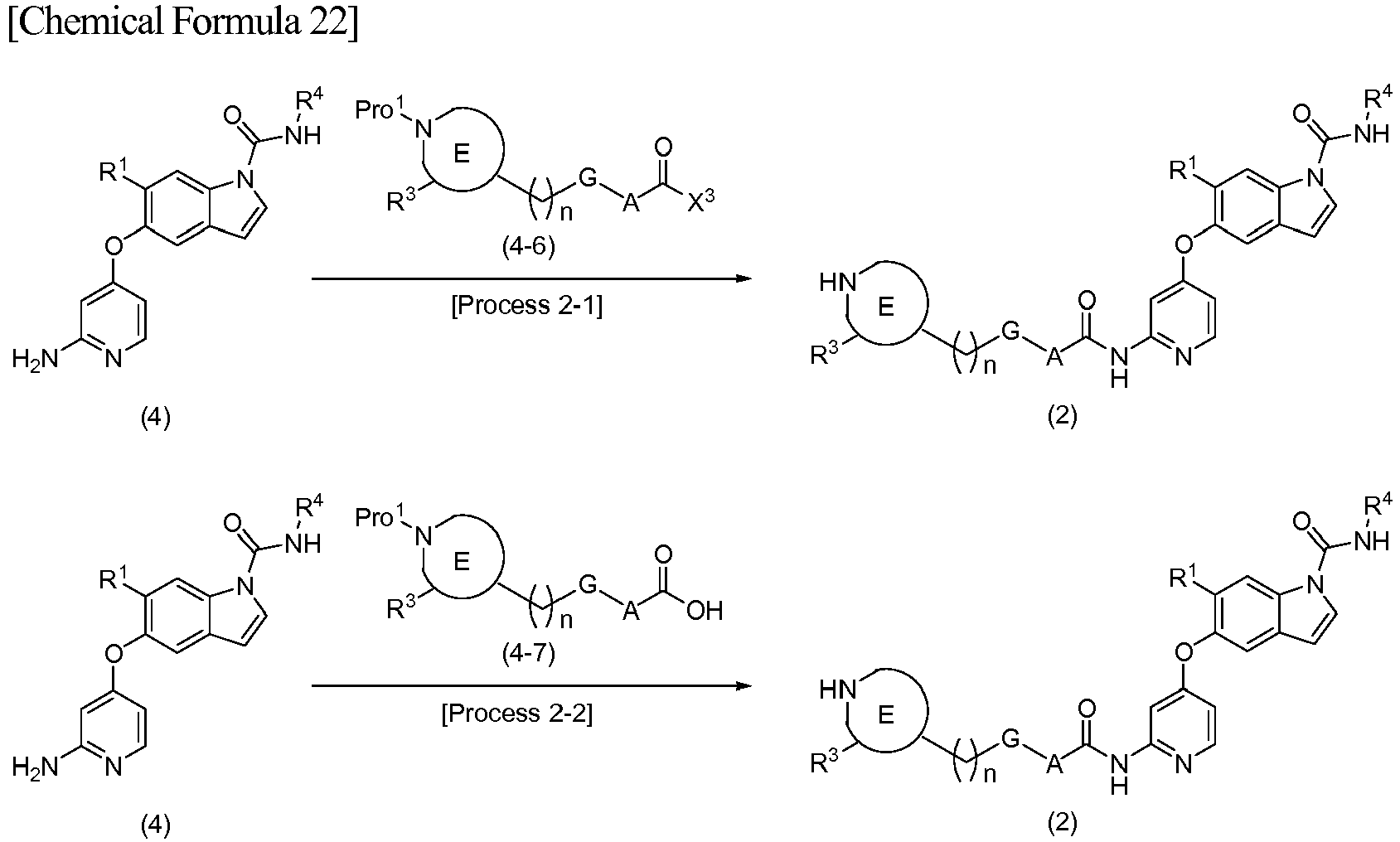
- In the above formula, R1, R3, R4, A, E, G and n represent the same as defined above; X3 represents a halogen atom such as a chlorine atom or a bromine atom; and Pro1 represents a known protective group for a nitrogen atom such as a tert-butoxycarbonyl group.
- Compounds (4-6) and (4-7) can be commercially available products, or can be produced from commercially available products by known methods. These compounds can be also produced by methods described in production examples of any of the examples described below or the like. Compound (4-6) can be also produced by methods described in [Production Method 5] or the like.
- In this process, the compound (4) and the compound (4-6) are reacted with each other to give the compound (2). A solvent used in this reaction is not especially limited as long as it dissolves a starting material to some extent and does not inhibit the reaction, and for example, an ether solvent such as tetrahydrofuran, an ester solvent such as ethyl acetate, a nitrile solvent such as acetonitrile, an aromatic hydrocarbon solvent such as toluene, a halogenated hydrocarbon solvent such as dichloromethane or chloroform, an amide solvent such as N,N-dimethylformamide or N-methylpyrrolidinone, or a mixed solvent of these can be used. In this reaction, alkyl amine such as triethyl amine or N,N-diisopropylethylamine, aromatic amine such as 4-dimethylaminopyridine, or an inorganic base such as potassium carbonate or cesium carbonate can be used as a base, or a combination of these bases can be used. The compound (4-6) can be used in an amount of 1 equivalent or more to the compound (4), and is preferably used in an amount of 2 to 3 equivalents. The base can be used in an amount of 1 to 10 equivalents to the compound (4). The reaction temperature is from 0°C to reflux temperature, and the reaction time is from 10 minutes to 24 hours. In this process, a diacyl form resulting from a reaction of 2 equivalents of the compound (4-6) may be produced. In this case, the diacyl form can be changed into a desired monoacyl form by a treatment with ammonia or primary or secondary alkyl amine such as methyl amine or piperidine. A protective group for a nitrogen atom can be subsequently removed by a known method. If Pro1 is, for example, a tert-butoxycarbonyl group, the deprotection can be performed by using a solvent not inhibiting the reaction, for example, a halogenated hydrocarbon solvent such as dichloromethane, an ester solvent such as ethyl acetate, an alcohol solvent such as methanol, or a mixed solvent of these, and by using an acid such as trifluoroacetic acid or hydrochloric acid.
- In this process, the compound (4) and the compound (4-7) are reacted with each other to give the compound (2). A solvent used in this reaction is not especially limited as long as it dissolves a starting material to some extent and does not inhibit the reaction, and for example, an ether solvent such as tetrahydrofuran, an ester solvent such as ethyl acetate, a nitrile solvent such as acetonitrile, an aromatic hydrocarbon solvent such as toluene, a halogenated hydrocarbon solvent such as dichloromethane or chloroform, an amide solvent such as N,N-dimethylformamide or N-methylpyrrolidinone, dimethylsulfoxide, or a mixed solvent of these can be used. In this reaction, a condensation agent such as O-(7-azabenzotriazole-1-yl)-N,N,N',N'-tetramethyluronium hexafluorophosphate or 1-ethyl-3-(3-dimethylaminopropyl)carbodiimide hydrochloride can be used. Furthermore, 1-hydroxybenzotriazole or the like can be used as an additive. In this reaction, alkyl amine such as triethyl amine or N,N-diisopropylethylamine, aromatic amine such as 4-dimethylaminopyridine, or an inorganic base such as potassium carbonate or cesium carbonate can be used as a base, or a combination of these bases can be used. The compound (4-7) can be used in an amount of 1 equivalent or more to the compound (4), and is preferably used in an amount of 2 to 3 equivalents. The base can be used in an amount of 1 to 10 equivalents to the compound (4). The reaction temperature is from 0°C to reflux temperature, and the reaction time is from 10 minutes to 24 hours. In this process, a diacyl form resulting from a reaction of 2 equivalents of the compound (4-7) may be produced. In this case, the diacyl form can be changed into a desired monoacyl form by a treatment with ammonia or primary or secondary alkyl amine such as methyl amine or piperidine. A protective group for a nitrogen atom can be subsequently removed by a known method. If Pro1 is, for example, a tert-butoxycarbonyl group, the deprotection can be performed by using a solvent not inhibiting the reaction, for example, a halogenated hydrocarbon solvent such as dichloromethane, an ester solvent such as ethyl acetate, an alcohol solvent such as methanol, or a mixed solvent of these, and by using an acid such as trifluoroacetic acid or hydrochloric acid.
-

- In the above formula, R1, R4 represents the same as defined above; Pro2 represents a protective group for a nitrogen atom, such as an acetyl group; Pro3 represents a protective group for a phenolic oxygen atom, such as a benzyl group; and X3 represents a halogen atom such as a chlorine atom or a bromine atom.
- Compounds (7), (8), (9), (10) and (11) can be commercially available products, or can be produced from commercially available products by known methods. These compounds can be also produced by methods described in production examples of any of the examples described below. Compounds (5) and (6) can be also produced by methods described in production examples of any of the examples described below or the like.
- Compounds (5A), (6A) and (11A) can be commercially available products, or can be produced from commercially available products by known methods. Alternatively, these compounds can be produced by methods described in production examples of any of the examples described below or the like.
- In this process, the compound (11) and the compound (11A) are reacted with each other to give the compound (10). A solvent used in this reaction is not especially limited as long as it dissolves a starting material to some extent and does not inhibit the reaction, and for example, an ether solvent such as tetrahydrofuran, an alcohol solvent such as ethanol, a nitrile solvent such as acetonitrile, a ketone solvent such as acetone, a halogenated hydrocarbon solvent such as dichloromethane, an amide solvent such as N,N-dimethylformamide or N-methylpyrrolidinone, dimethylsulfoxide, or a mixed solvent of these can be used. In this reaction, the compound (11A) is used in an amount of 1 to 5 equivalents to the compound (11), and 1 to 5 equivalents of a base, such as sodium hydrogen carbonate, potassium carbonate, sodium methoxide, sodium hydride or diisopropylethylamine can be added. Besides, sodium iodide or potassium iodide can be added as an additive. The reaction temperature is from -20°C to reflux temperature, and the reaction time is from 10 minutes to 24 hours.
- In this process, the compound (10) and nitromethane are reacted with each other to give the compound (9). A solvent used in this reaction is not especially limited as long as it dissolves a starting material to some extent and does not inhibit the reaction, and for example, an alcohol solvent such as methanol, an organic acid solvent such as acetic acid, or a mixed solvent of these can be used. In this reaction, nitromethane is used in an amount of 1 to 10 equivalents, and 0.1 to 10 equivalents of ammonium acetate, ethylenediamine-N,N'-diacetic acid or the like can be added as an additive. The reaction temperature is from 0°C to reflux temperature, and the reaction time is from 10 minutes to 100 hours.
- In this process, the compound (9) is nitrated to give the compound (8). A solvent used in this reaction is not especially limited as long as it dissolves a starting material to some extent and does not inhibit the reaction, and for example, a halogenated hydrocarbon solvent such as dichloromethane, an organic acid solvent such as acetic acid, sulfuric acid, or a mixed solvent of these can be used. In this reaction, fuming nitric acid, concentrated nitric acid or nitric acid is used, and acetic anhydride or the like can be added as an additive. The nitric acid or the like used in this reaction may be in an amount of 1 to 100 equivalents to the compound (9). The reaction temperature is from -20°C to reflux temperature, and the reaction time is from 10 minutes to 100 hours.
- In this process, the compound (8) is cyclized to give the compound (7). A solvent used in this reaction is not especially limited as long as it dissolves a starting material to some extent and does not inhibit the reaction, and for example, an ether solvent such as tetrahydrofuran, an alcohol solvent such as ethanol, an aromatic hydrocarbon solvent such as benzene or toluene, a hydrocarbon solvent such as cyclohexane, water, or a mixed solvent of these can be used. In this reaction, a heavy metal such as iron or zinc is used, and an acid such as acetic acid, a salt such as ammonium chloride, a base such as sodium hydroxide, an inorganic compound such as silica gel or a mixture of these can be added as an additive. The heavy metal such as iron used in this reaction may be in an amount of 5 to 20 equivalents to the compound (8). The reaction temperature is from 0°C to reflux temperature, and the reaction time is from 10 minutes to 24 hours.
- In this process, Pro3 of the compound (7) is deprotected to give the compound (6). Pro3 can be deprotected by a known method, and if Pro3 is benzyl, a solvent used in this reaction is not especially limited as long as it dissolves a starting material to some extent and does not inhibit the reaction, and for example, an ether solvent such as tetrahydrofuran, an alcohol solvent such as ethanol, an aromatic hydrocarbon solvent such as benzene or toluene, acetic acid, water, or a mixed solvent of these can be used. This reaction can be performed under a hydrogen atmosphere with a catalytic reduction catalyst such as palladium-carbon used as a catalyst. The pressure of the hydrogen can be from normal pressure to 20 atm, and the catalyst can be used in an amount of 0.001 to 1 equivalent to the compound (7). Besides, an acid such as hydrochloric acid can be added. The reaction temperature is from 0°C to reflux temperature, and the reaction time is from 10 minutes to 24 hours.
- In this process, the compound (8) is cyclized to give the compound (6). A solvent used in this reaction is not especially limited as long as it dissolves a starting material to some extent and does not inhibit the reaction, and for example, an ether solvent such as tetrahydrofuran, an alcohol solvent such as methanol, an aromatic hydrocarbon solvent such as benzene or toluene, acetic acid, water, or a mixed solvent of these can be used. This reaction can be performed under a hydrogen atmosphere with a catalytic reduction catalyst such as palladium-carbon used as a catalyst. The pressure of the hydrogen can be from normal pressure to 20 atm, and the catalyst can be used in an amount of 0.001 to 1 equivalent to the compound (8). An acid such as hydrochloric acid can be added as an additive. The reaction temperature is from 0°C to reflux temperature, and the reaction time is from 10 minutes to 24 hours.
- In this process, the compound (6) and the compound (6A) are reacted with each other to give the compound (5). A solvent used in this reaction is not especially limited as long as it dissolves a starting material to some extent and does not inhibit the reaction, and for example, an amide solvent such as N,N-dimethylformamide or N-methylpyrrolidinone, dimethylsulfoxide, or a mixed solvent of these can be used. In this reaction, a base such as potassium carbonate, cesium carbonate or potassium tert-butoxide can be used as a base. The base can be used in an amount of 1 to 10 equivalents to the compound (6), and is preferably used in an amount of 1 to 2 equivalents. The reaction temperature is from 0°C to reflux temperature, and the reaction time is from 10 minutes to 24 hours. Pro2 can be deprotected by a known method, and if Pro2 is an acetyl group, it can be deprotected by using a solvent not inhibiting the reaction, such as an alcohol solvent like methanol, and by using a base such as potassium carbonate, sodium hydroxide or sodium methoxide, or it can be deprotected by using a solvent not inhibiting the reaction, such as an ether solvent like 1,4-dioxane, and by using an acid such as hydrochloric acid. Alternatively, this process can be performed by using a compound not protected by Pro2 as the compound (6A).
- In this process, the compound (5) and the compound (5A) are reacted with each other to give the compound (4). A solvent used in this reaction is not especially limited as long as it dissolves a starting material to some extent and does not inhibit the reaction, and for example, an ether solvent such as tetrahydrofuran, an amide solvent such as N,N-dimethylformamide or N-methylpyrrolidinone, dimethylsulfoxide, or a mixed solvent of these can be used. In this reaction, a base such as sodium hydroxide or potassium tert-butoxide can be used as a base. The compound (5A) can be used in an amount of 1 equivalent or more to the compound (5), and is preferably used in an amount of 1 to 2 equivalents. The base can be used in an amount of 1 to 2 equivalents to the compound (5). The reaction temperature is from -20°C to reflux temperature, and the reaction time is from 10 minutes to 24 hours.
-

- In the above formula, R1a represents a C1-6 alkyl group optionally substituted by 1 to 3 halogen atoms, or a C1-6 alkoxy C1-6 alkyl group optionally substituted by 1 to 3 halogen atoms; and X3 represents a leaving group of a halogen atom such as a bromine atom or an iodine atom.
- A compound (12) can be a commercially available product, or can be produced from a commercially available product by a known method.
- A compound (12A) can be a commercially available product, or can be produced from a commercially available product by a known method.
- In this process, the compound (12) and the compound (12A) are reacted with each other to give a compound (11-1). A solvent used in this reaction is not especially limited as long as it dissolves a starting material to some extent and does not inhibit the reaction, and for example, an ether solvent such as tetrahydrofuran, an alcohol solvent such as ethanol, a nitrile solvent such as acetonitrile, an amide solvent such as N,N-dimethylformamide or N-methylpyrrolidinone, dimethylsulfoxide, or a mixed solvent of these can be used. In this reaction, the compound (12A) is used in an amount of 0.5 to 1.5 equivalents to the compound (12), and 0.5 to 1.5 equivalents of a base such as sodium hydrogen carbonate, potassium carbonate, sodium methoxide or sodium hydride can be added as an additive. The reaction temperature is from 0°C to reflux temperature, and the reaction time is from 10 minutes to 100 hours.
-

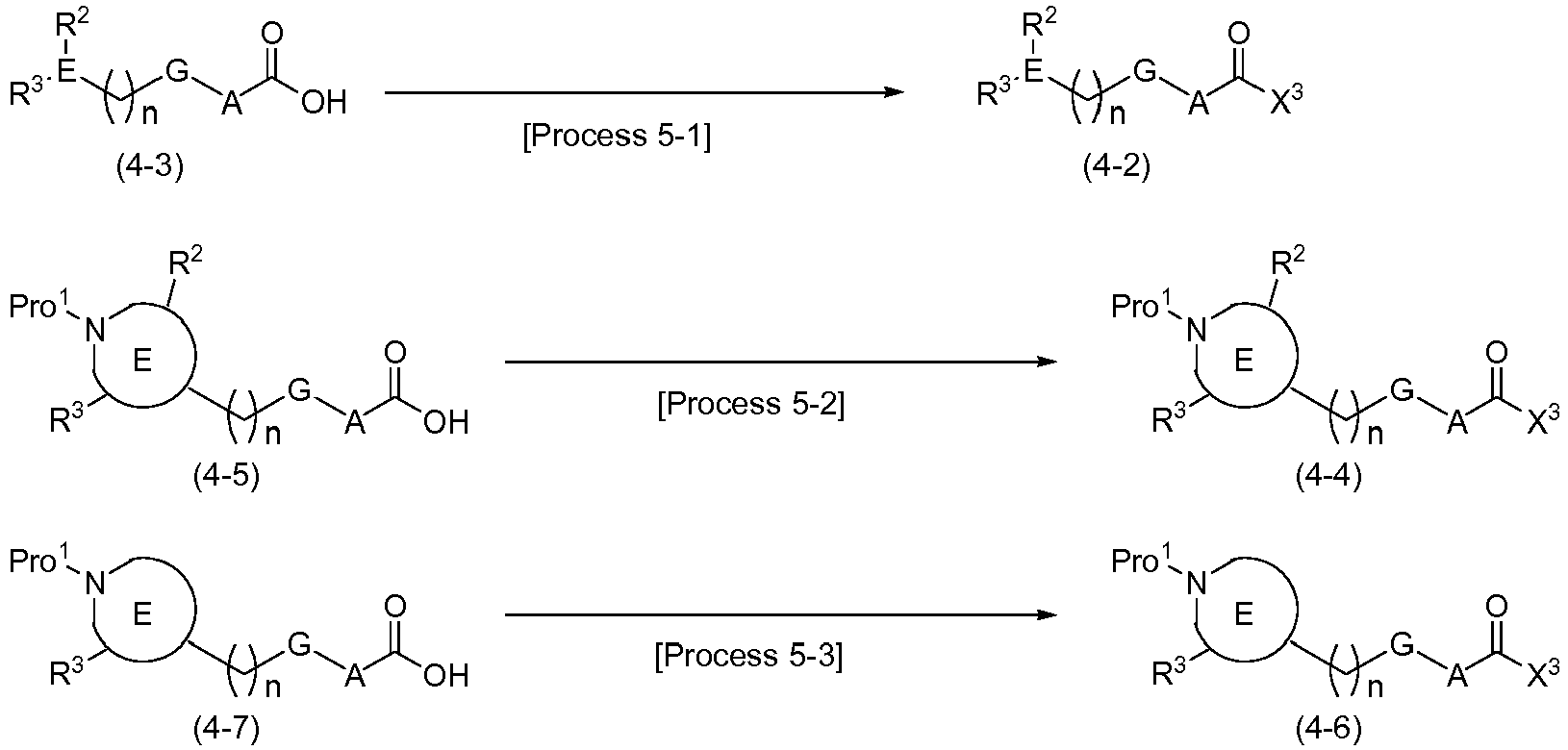
- In the above formula, R2, R3, A, E, G and n represent the same as defined above; X3 represents a halogen atom such as a chlorine atom or a bromine atom; and Pro1 represents a known protective group for a nitrogen atom such as a tert-butoxycarbonyl group.
- Compounds (4-3), (4-5) and (4-7) can be commercially available products, or can be produced from commercially available products by known methods. Alternatively, these compounds can be also produced by methods described in production examples in any of the examples described below or a method described in [Production Method 7], [Production Method 9] or the like.
- In this process, the compound (4-3), (4-5) or (4-7) is reacted to give the compound (4-2), (4-4) or (4-6) respectively. A solvent used in this reaction is not especially limited as long as it dissolves a starting material to some extent and does not inhibit the reaction, and for example, a halogenated hydrocarbon solvent such as dichloromethane, an ether solvent such as tetrahydrofuran, a nitrile solvent such as acetonitrile, or a mixed solvent of these can be used. In this reaction, an acid halide such as oxalyl chloride or an inorganic halogen compound such as thionyl chloride is used in an amount of 1 to 10 equivalents to the compound (4-3), (4-5) or (4-7), and 1 to 10 equivalents of a base such as benzotriazole can be added as an additive. Furthermore, a catalytic amount of N,N-dimethylformamide, N-methylpyrrolidinone or the like can be added. The reaction temperature is from -20°C to reflux temperature, and the reaction time is from 10 minutes to 24 hours.
-


- In the above formula, A, G and n represent the same as defined above; m represents 0 or 1; and X3 represents a halogen atom such as a chlorine atom or a bromine atom.
- Compounds (4AA), (4AB) and (4B) can be commercially available products, or can be produced from commercially available products by known methods. Alternatively, these compounds can be produced by methods described in production examples in any of the examples described below or the like.
- In this process, the compound (4AA) is reacted to give the compound (4AB). A solvent used in this reaction is not especially limited as long as it dissolves a starting material to some extent and does not inhibit the reaction, and for example, an ether solvent such as tetrahydrofuran, an alcohol solvent such as ethanol, or a mixed solvent of these can be used. In this reaction, a reducing reagent such as sodium borohydride can be used in an amount of 1 to 10 equivalents to the compound (4AA). The reaction temperature is from -20°C to reflux temperature, and the reaction time is from 10 minutes to 24 hours.
- In this process, the compound (4AB) or (4B) is reacted to give the compound (4-1). A solvent used in this reaction is not especially limited as long as it dissolves a starting material to some extent and does not inhibit the reaction, and for example, a halogenated hydrocarbon solvent such as dichloromethane, an ether solvent such as tetrahydrofuran, a nitrile solvent such as acetonitrile, or a mixed solvent of these can be used. In this reaction, an acid halide such as oxalyl chloride or an inorganic halogen compound such as thionyl chloride can be used in an amount of 1 to 10 equivalents to the compound (4AB) or (4B), and a catalytic amount of N,N-dimethylformamide, N-methylpyrrolidinone or the like can be added as an additive. The reaction temperature is from 0°C to reflux temperature, and the reaction time is from 10 minutes to 24 hours.
-

- In the above formula, R2, R3, A, E, G and n represent the same as defined above; X4 represents a halogen atom such as a chlorine atom, a bromine atom or an iodine atom, or a leaving group of sulfonate such as methanesulfonate, p-toluenesulfonate or trifluoromethanesulfonate; and Pro4 represents a known protective group for carboxylic acid such as an ethyl group.
- A compound (4CB) can be a commercially available product, or can be produced from a commercially available product by a known method. Alternatively, it can be produced by a method described in a production example in any of the examples described below or the like.
- A compound (4CA) or (4D) can be a commercially available product, or can be produced from a commercially available product by a known method.
- In this process, the compound (4CA) is reacted with a halogenating reagent to give the compound (4CB) or reacted with a sulfonating reagent to give the compound (4CB). A solvent used in this reaction is not especially limited as long as it dissolves a starting material to some extent and does not inhibit the reaction, and for example, an ether solvent such as tetrahydrofuran, a nitrile solvent such as acetonitrile, a halogenated hydrocarbon solvent such as dichloromethane, an amide solvent such as N,N-dimethylformamide or N-methylpyrrolidinone, water, or a mixed solvent of these can be used. In the halogenation reaction, an excessive amount of hydrohalic acid such as hydrochloric acid or hydrobromic acid can be used. In this case, an inorganic chloride such as zinc chloride or lithium bromide, a phase transfer catalyst or the like can be used. Besides, this reaction can be performed by using, as the halogenating reagent, a halogenated phosphorus compound such as phosphorus trichloride. In this case, N,N-dimethylformamide can be acted to be used as an iminium salt. Alternatively, a combination of an organic phosphorus compound, such as triphenylphosphine, and a carbon tetrahalide can be used as the halogenating reagent. Alternatively, a halogenating reagent such as thionyl chloride can be used. In this case, a base such as pyridine can be used as an additive. The halogenating reagent can be used in an amount of 1 to 10 equivalents. In the sulfonation reaction, a sulfonating reagent such as p-toluenesulfonylchloride can be used in an amount of 1 to 10 equivalents, and a base such as triethylamine or pyridine can be used in an amount of 1 to 10 equivalents as an additive. The reaction temperature is from 0°C to reflux temperature, and the reaction time is from 10 minutes to 24 hours.
- In this process, the compound (4CB) is reacted with the compound (4D) to give the compound (4-3g). A solvent used in this reaction is not especially limited as long as it dissolves a starting material to some extent and does not inhibit the reaction, and for example, an ether solvent such as tetrahydrofuran, an amide solvent such as N,N-dimethylformamide or N-methylpyrrolidinone, dimethylsulfoxide, or a mixed solvent of these can be used. In this reaction, an organic base such as triethylamine or an inorganic base such as cesium carbonate can be used for condensation. The compound (4D) is used in an amount of 1 to 10 equivalents to the compound (4-CB), and the base can be added in an amount of 0 to 10 equivalents. The reaction temperature is from 0°C to reflux temperature, and the reaction time is from 10 minutes to 24 hours. Pro4 can be deprotected by a known deprotection method for carboxylic acid.
-

- In the above formula, A and n represent the same as defined above; X3 represents a halogen atom such as a chorine atom or a bromine atom; X5 represents a halogen atom such as a bromine atom or an iodine atom; and Pro4 represents a known protective group for carboxylic acid such as an ethyl group.
- Compounds (4E) and (4F) can be commercially available products, or can be produced from commercially available products by known methods.
- In this process, the compound (4E) is reacted with the compound (4F) to give the compound (4CB-1). A solvent used in this reaction is not especially limited as long as it dissolves a starting material to some extent and does not inhibit the reaction, and for example, an ether solvent such as tetrahydrofuran, an amide solvent such as N,N-dimethylformamide or N-methylpyrrolidinone, dimethylsulfoxide, or a mixed solvent of these can be used. In this reaction, an organic base such as triethylamine or an inorganic base such as potassium carbonate can be used for condensation. The compound (4F) is used in an amount of 1 to 10 equivalents to the compound (4E), and the base can be added in an amount of 1 to 10 equivalents. The reaction temperature is from 0°C to reflux temperature, and the reaction time is from 10 minutes to 24 hours. Pro4 can be also deprotected by a known deprotection method for carboxylic acid.
-

- In the above formula, R2, R3, A and E represent the same as defined above; X6 represents a halogen atom such as a chlorine atom, a bromine atom or an iodine atom, or a leaving group of sulfonate such as trifluoromethanesulfonate; and Pro4 represents a known protective group for carboxylic acid such as an ethyl group.
- Compounds (4GA) and (4GB) can be commercially available products, or can be produced from commercially available products by known methods. Alternatively, the compound (4GB) can be produced by a method described in a production example in any of the examples described below or the like.
- In this process, the compound (4GA) is reacted with a halogenating reagent to give the compound (4GB) or reacted with a sulfonating reagent to give the compound (4GB). A solvent used in this reaction is not especially limited as long as it dissolves a starting material to some extent and does not inhibit the reaction, and for example, an ether solvent such as tetrahydrofuran, a halogenated hydrocarbon solvent such as dichloromethane, an amide solvent such as N,N-dimethylformamide or N-methylpyrrolidinone, a nitrile solvent such as acetonitrile, or a mixed solvent of these can be used. In the halogenation reaction, a phosphorus halide such as phosphorus pentabromide or a halogenating reagent such as triphenylphosphinedibromide can be used in an amount of 1 to 5 equivalents. In the sulfonation reaction, a sulfonating reagent such as trifluoromethanesulfonic anhydride can be used in an amount of 1 to 5 equivalents, and a base such as triethylamine or pyridine can be used, as an additive, in an amount of 1 to 10 equivalents. The reaction temperature is from -20°C to reflux temperature, and the reaction time is from 10 minutes to 24 hours.
- In this process, the compound (4GB) is reacted with the compound (4D) to give a compound (4-3b). A solvent used in this reaction is not especially limited as long as it dissolves a starting material to some extent and does not inhibit the reaction, and for example, an ether solvent such as tetrahydrofuran, an amide solvent such as N,N-dimethylformamide or N-methylpyrrolidinone, dimethylsulfoxide, or a mixed solvent of these can be used. In this reaction, an organic base such as triethylamine or an inorganic base such as cesium carbonate can be used for condensation. The compound (4D) can be used in an amount of 1 to 10 equivalents to the compound (4GB), and the base can be added in an amount of 0 to 10 equivalents. The reaction temperature is from 0°C to reflux temperature, and the reaction time is from 10 minutes to 24 hours. Furthermore, in this reaction, a heavy metal such as copper can be added, and an organometallic catalyst containing palladium and an organophosphorus ligand can be also added. Pro4 can be deprotected by a known deprotection method for carboxylic acid.
-

- In the above formula, R2, R3, A, E and n represent the same as defined above; Pro1 represents a known protective group for a nitrogen atom such as a tert-butoxycarbonyl group; and Pro3 represents a known protective group for carboxylic acid such as an ethyl group or a benzyl group.
- Compounds (4H) and (4I) can be commercially available products, or can be produced from commercially available products by known methods.
- In this process, the compound (4H) and the compound (4I) are reacted with each other to give a compound (4-5a). A solvent used in this reaction is not especially limited as long as it dissolves a starting material to some extent and does not inhibit the reaction, and for example, an ether solvent such as tetrahydrofuran, an aromatic hydrocarbon solvent such as toluene, a halogenated hydrocarbon solvent such as dichloromethane, an ester solvent such as ethyl acetate, or a mixed solvent of these can be used. In this reaction, the compound (4H) can be used in an amount of 0.5 to 2 equivalents to the compound (4I). In this reaction, azodicarboxylate such as diisopropyl azodicarboxylate, and triphenylphosphine can be used in an amount of 1 to 5 equivalents respectively to the compounds (4H) and (4I). The reaction temperature is from -20°C to reflux temperature, and the reaction time is from 10 minutes to 24 hours. Pro5 can be deprotected by a known deprotection method for carboxylic acid.
-

- In the above formula, R2, R3, A and E represent the same as defined above; X5 represents a halogen atom such as a bromine atom or an iodine atom; X7 represents a halogen atom such as a bromine atom or an iodine atom, or a leaving group of sulfonate such as methanesulfonate or trifluoromethanesulfonate; M represents a leaving group of borate ester or the like; Pro1 represents a known protective group for a nitrogen atom such as a tert-butoxycarbonyl group; and Pro5 represents a known protective group for carboxylic acid such as an ethyl group or a benzyl group, and carboxylic acid may be or may not be protected in this reaction.
- Compounds (4J), (4K) and (4L) can be commercially available products, or can be produced from commercially available products by known methods.
- In this process, the compound (4J) and the compound (4K) are reacted with each other to give a compound (4-5b). A solvent used in this reaction is not especially limited as long as it dissolves a starting material to some extent and does not inhibit the reaction, and for example, an ether solvent such as tetrahydrofuran, an aromatic hydrocarbon solvent such as toluene, an amide solvent such as N,N-dimethylformamide or N-methylpyrrolidinone, or a mixed solvent of these can be used. In this reaction, the compound (4K) can be used in an amount of 0.5 to 2 equivalents to the compound (4J). In this reaction, a palladium complex compound containing an organic phosphorus compound as a ligand can be used as a catalyst. The catalyst can be prepared within the reaction system. In this reaction, a zinc powder can be used in an amount of 0.5 to 2 equivalents to the compound (4J). Besides, a copper halide, a dihalogenated alkyl compound, a halogenated organic silicon compound or the like can be added as an additive. The reaction temperature is from 0°C to reflux temperature, and the reaction time is from 10 minutes to 24 hours. Pro5 can be deprotected by a known deprotection method for carboxylic acid.
- In this process, the compound (4J) and the compound (4L) are reacted with each other to give a compound (4-5c). A solvent used in this reaction is not especially limited as long as it dissolves a starting material to some extent and does not inhibit the reaction, and for example, an ether solvent such as 1,4-dioxane, an aromatic hydrocarbon solvent such as toluene, an alcohol solvent such as ethanol, an amide solvent such as N,N-dimethylformamide or N-methylpyrrolidinone, or a mixed solvent of these can be used. In this reaction, the compound (4L) can be used in an amount of 0.5 to 2 equivalents to the compound (4J). In this reaction, a palladium complex compound containing an organic phosphorus compound as a ligand can be used as a catalyst. The catalyst can be prepared within the reaction system. In this reaction, a base such as sodium carbonate can be used in an amount of 1 to 10 equivalents to the compound (4J). The reaction temperature is from 0°C to reflux temperature, and the reaction time is from 10 minutes to 24 hours.
- In this process, the compound (4-5c) is reduced and deprotected to give the compound (4-5b). A solvent used in this reaction is not especially limited as long as it dissolves a starting material to some extent and does not inhibit the reaction, and for example, an ether solvent such as tetrahydrofuran, an ester solvent such as ethyl acetate, an alcohol solvent such as ethanol, an amide solvent such as N,N-dimethylformamide or N-methylpyrrolidinone, or a mixed solvent of these can be used. In this reaction, a catalytic reduction catalyst such as palladium-carbon can be used in an amount of 0.001 to 1 equivalent to the compound (4-5c). Besides, the reaction can be performed in a hydrogen atmosphere at a pressure ranging from normal pressure to 20 atm. The reaction temperature is from 0°C to reflux temperature, and the reaction time is from 10 minutes to 24 hours. Pro5 can be deprotected by a known deprotection method for carboxylic acid.
-

- In the above formula, R3, A and E represent the same as defined above; X8 represents a halogen atom such as a fluorine atom; Pro1 represents a known protective group for a nitrogen atom such as a tert-butoxycarbonyl group; and Pro4 represents a known protective group for carboxylic acid such as an ethyl group, and in this reaction, carboxylic acid may be or may not be protected.
- The compound (4-5c) can be a commercially available product, or can be produced from a commercially available product by a known method. Alternatively, it can be produced by a method described in a production example in any of the examples described below or the like.
- In this process, the compound (4-5c) is reacted to give a compound (4-5d). A solvent used in this reaction is not especially limited as long as it dissolves a starting material to some extent and does not inhibit the reaction, and for example, an ether solvent such as tetrahydrofuran can be used. In this reaction, a borane complex compound such as a borane-methyl sulfide complex can be used in an amount of 1 to 2 equivalents to the compound (4-5c). The reaction temperature is from -20°C to reflux temperature, and the reaction time is from 10 minutes to 24 hours. Subsequently, by using a sodium hydroxide aqueous solution in an amount of 1 to 10 equivalents and a hydrogen peroxide solution in an amount of 1 to 10 equivalents, a hydroxyl group can be obtained. The reaction temperature is from 0°C to reflux temperature, and the reaction time is from 10 minutes to 24 hours.
- In this process, the hydroxyl group of the compound (4-5d) is substituted by halogen to give a compound (4-5e). A solvent used in this reaction is not especially limited as long as it dissolves a starting material to some extent and does not inhibit the reaction, and for example, a halogenated hydrocarbon solvent such as a dichloromethane, an ether solvent such as tetrahydrofuran, an ester solvent such as ethyl acetate, an amide solvent such as N,N-dimethylformamide or N-methylpyrrolidinone, or a mixed solvent of these can be used. In this reaction, a halogenating reagent such as [bis-(2-methoxyethyl)-amino]sulfur trifluoride can be used in an amount of 1 to 10 equivalents to the compound (4-5d). The reaction temperature is from 0°C to reflux temperature, and the reaction time is from 10 minutes to 24 hours. Pro4 can be deprotected by a known deprotection method for carboxylic acid.
-

- In the above formula, R2, R3, A and E represent the same as defined above; X7 represents a halogen atom such as a bromine atom or an iodine atom, or a leaving group of sulfonate such as methanesulfonate or trifluoromethanesulfonate; Pro1 represents a known protective group for a nitrogen atom such as a tert-butoxycarbonyl group; and Pro4 represents a known protective group for carboxylic acid such as an ethyl group, and in this reaction, carboxylic acid may be or may not be protected.
- The compounds (4-5b) and (4K) can be commercially available products, or can be produced from commercially available products by known methods. Alternatively, these compounds can be produced by methods described in production examples in any of the examples described below or the like.
- In this process, the compound (4-5b) and the compound (4K) are reacted with each other to give a compound (4-5f). A solvent used in this reaction is not especially limited as long as it dissolves a starting material to some extent and does not inhibit the reaction, and for example, an ether solvent such as tetrahydrofuran, an amide solvent such as N,N-dimethylformamide or N-methylpyrrolidinone, or a mixed solvent of these can be used. In this reaction, the compound (4K) can be used in an amount of 0.5 to 2 equivalents to the compound (4-5b). Besides, a base such as a sodium hydride or potassium tert-butoxide can be used in an amount of 1 to 5 equivalents to the compound (4-5b). The reaction temperature is from -20°C to reflux temperature, and the reaction time is from 10 minutes to 24 hours. Pro4 can be deprotected by a known deprotection method for carboxylic acid.
-

- In the above formula, R2, R3 and E represent the same as defined above; X7 represents a halogen atom such as a bromine atom or an iodine atom, or a leaving group of sulfonate such as methanesulfonate or trifluoromethanesulfonate; and Pro1 represents a known protective group for a nitrogen atom such as a tert-butoxycarbonyl group.
- A compound (5K) can be a commercially available product, or can be produced from a commercially available product by a known method.
- In this process, the compound (5K) is reacted with a halogenating reagent to give the compound (4K), or reacted with a sulfonating reagent to give the compound (4K). A solvent used in this reaction is not especially limited as long as it dissolves a starting material to some extent and does not inhibit the reaction, and for example, an ether solvent such as tetrahydrofuran, a halogenated hydrocarbon solvent such as dichloromethane, an amide solvent such as N,N-dimethylformamide or N-methylpyrrolidinone, a nitrile solvent such as acetonitrile, or a mixed solvent of these can be used. In the halogenation reaction, a phosphorus halide such as phosphorus pentabromide or a halogenating reagent such as triphenylphosphinedibromide can be used in an amount of 1 to 5 equivalents. In the sulfonation reaction, a sulfonating reagent such as methanesulfonyl chloride or trifluoromethanesulfonic anhydride can be used in an amount of 1 to 5 equivalents, and a base such as triethylamine or pyridine can be used, as an additive, in an amount of 1 to 10 equivalents. The reaction temperature is from -20°C to reflux temperature, and the reaction time is from 10 minutes to 24 hours.
- Compounds according to the present invention can be produced by methods described in Production Examples and Examples described below, for example. However, these methods are mere examples, and therefore the compounds according to the present invention are not limited to those produced by specific examples described below in any cases.
- In Production Examples and Examples, Silica gel 60 (Kanto Chemicals) or Presep Silica Gel (WAKO) was used as a purification silica gel used for silica gel column chromatography unless otherwise stated. In addition, NH silica gel (Fuji Silysia Chemical LTD.) or Hi-Flash Column Amino (YAMAZENE CORPORATION) was used as a purification silica gel used for NH silica gel column chromatography, and TLC Plates NH (20 cm x 20 cm, Fuji Silysia Chemical LTD.) was used as a thin-layer plate used for NH silica gel TLC (Thin Layer Chromatography).
- Varian Mercury 400, Varian Mercury Plus 400, Varian INOVA 500 or Avance 600 MHz spectrometer (Bruker) was used for the measurement of proton nuclear magnetic resonance spectra, and the proton nuclear magnetic resonance spectra were measured at 400 MHz unless otherwise stated. Chemical shifts of proton nuclear magnetic resonance spectra are recorded in the unit of δ (ppm) with respect to tetramethylsilane and coupling constants are recorded in the unit of Hertz (Hz). Abbreviations for splitting patterns are as follows: s: singlet; d: doublet; t: triplet; q: quartet; quin: quintet; spt: septet; m: multiplet; and brs: broad singlet.
- Waters Micromass ZQ 2000, Waters SQ Detector 2, or Thermo Fisher Scientific LCQ was used for the measurement of mass spectra. For the ionization method, an electrospray ionization (ESI) method was used for the measurement.
- In Production Examples and Examples, commercially available products were appropriately used as commercially available compounds. In the description below, the term "BOC" refers to tert-butoxycarbonyl and the term "T" refers to Tert.
-

1H-NMR Spectrum (CDCl3) δ (ppm): 1.55-1.70 (2H, m), 1.78-1.88 (2H, m), 2.62-2.80 (3H, m), 3.06 (3H, d, J = 4.8 Hz), 3.15-3.24 (2H, m), 3.86 (3H, s), 5.52-5.61 (1H, m), 6.54 (1H, d, J = 3.3 Hz), 6.60 (1H, dd, J = 5.7, 2.4 Hz), 7.23 (1H, d, J = 3.7 Hz), 7.28-7.35 (3H, m), 7.80 (2H, d, J = 8.4 Hz), 7.91 (1H, d, J = 2.2 Hz), 8.03 (1H, s), 8.10 (1H, d, J = 5.9 Hz), 8.53 (1H, brs). - The starting material tert-butyl 4-(4-((4-((6-methoxy-1-(methylcarbamoyl)-1H-indol-5-yl)oxy)pyridin-2-yl)carbamoyl)phen yl)piperidine-1-carboxylate was synthesized by the following method.
-

- Commercially available 3-benzyloxy-4-methoxybenzaldehyde (30 g, 124 mmol) was dissolved in acetic acid (100 mL), then ammonium acetate (10.8 g, 140 mmol) and nitromethane (16.8 mL, 310 mmol) were added under nitrogen atmosphere at room temperature, and the mixture was heated and stirred at 130°C for 2 hours and 20 minutes. The mixture was cooled to room temperature, then the precipitate was collected by filteration and washed with ethanol to obtain the title compound (28.5 g, 81%).
1H-NMR Spectrum (CDCl3) δ (ppm): 3.95 (3H, s), 5.18 (2H, s), 6.93 (1H, d, J = 8.1 Hz), 7.03 (1H, d, J = 2.2 Hz), 7.17 (1H, dd, J = 8.4, 2.2 Hz), 7.30-7.47 (6H, m), 7.91 (1H, d, J = 13.5 Hz). -
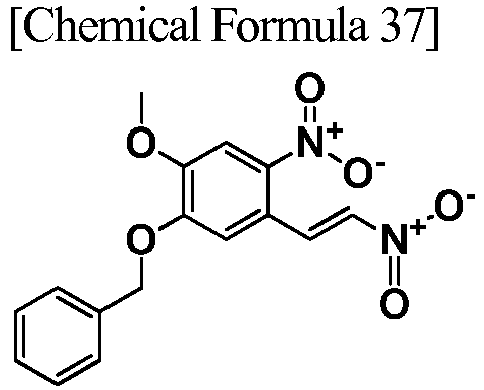
- 69% Nitric acid (10 mL, 155 mmol) was added to a mixture of (E)-2-(benzyloxy)-1-methoxy-4-(2-nitrovinyl)benzene described in Production Example 1-1 (10 g, 35.1 mmol) and acetic acid (70 mL) under nitrogen atmosphere at 25°C, and the mixture was stirred at 40°C for 3 hours. The reaction mixture was poured onto ice and the precipitate was collected by filteration and then washed with ethanol to obtain the title compound (10.5 g, 91%).
1H-NMR Spectrum (CDCl3) δ (ppm): 4.02 (3H, s), 5.28 (2H, s), 6.93 (1H, s), 7.22 (1H, d, J = 13.5 Hz), 7.35-7.48 (5H, m), 7.75 (1H, s), 8.58 (1H, d, J = 13.2 Hz). -


- (E)-1-(Benzyloxy)-2-methoxy-4-nitro-5-(2-nitrovinyl)benzene described in Production Example 1-2 (9.4 g, 28.5 mmol) was suspended in methanol (300 mL), then 10% palladium-carbon (water content, 50%) (3.09 g) was added, and the mixture was stirred under hydrogen atmosphere for 3 hours. The catalyst was filtered off with celite and washed with methanol. The filtrate was concentrated under vacuum and the resultant was purified with silica gel column chromatography (n-heptane:ethyl acetate = 3:1 - 3:7). The target fraction was concentrated under vacuum to obtain the title compound (2.12 g, 46%).
1H-NMR Spectrum (CDCl3) δ (ppm): 3.92 (3H, s), 5.45 (1H, s), 6.39-6.44 (1H, m), 6.88 (1H, s), 7.08 (1H, t, J = 2.9 Hz), 7.14 (1H, s), 7.95 (1H, brs). -
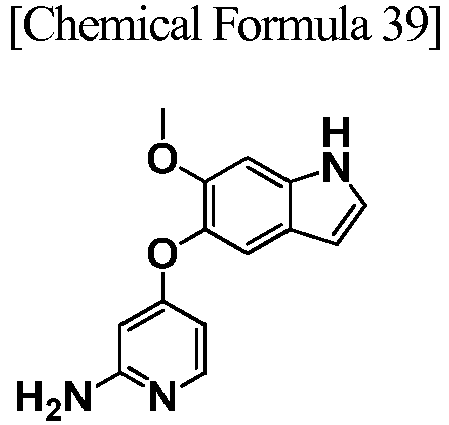
- 6-Methoxy-1H-indol-5-ol described in Production Example 1-3 (2.86 g, 17.6 mmol), N-(4-chloropyridin-2-yl)acetamide described in Production Example 1-5 (8.98 g, 52.7 mmol), and potassium tert-butoxide (3.94 g, 35.1 mmol) were dissolved in dimethylsulfoxide (45 mL) under nitrogen atmosphere and the mixture was heated and stirred at 160°C for 12.5 hours. The reaction liquid was cooled to room temperature, and water and ethyl acetate were added for partition. The aqueous layer was extracted with ethyl acetate twice, and the combined organic layer was washed with water twice and then with a saturated saline solution. The organic layer was dried over anhydrous magnesium sulfate. The drying agent was filtered off, then the filtrate was concentrated under vacuum, and the resultant was purified with NH silica gel column chromatography (n-heptane:ethyl acetate = 1:1 - 0:1 - ethyl acetate:methanol = 99:1 - 9:1). The mixture fraction was concentrated under vacuum, the resultant was purified with NH silica gel column chromatography (n-heptane:ethyl acetate = 1:1 - 0:1 - ethyl acetate:methanol = 99:1 - 9:1), and then the target fraction was concentrated under vacuum to obtain a crude product (3.88 g).
- The crude product (3.88 g) was dissolved in methanol (75 mL), 28% sodium methoxide (14 mL, 68.6 mmol) was added under nitrogen atmosphere at room temperature, and then the mixture was heated and stirred at 70°C for 5.5 hours. The reaction mixture was cooled to room temperature and then water and ethyl acetate were added for partition. The aqueous layer was extracted with ethyl acetate once and the combined organic layer was washed with a saturated saline solution. The organic layer was dried over anhydrous magnesium sulfate. The drying agent was filtered off, the filtrate was concentrated under vacuum, and then the resultant was purified with NH silica gel column chromatography (n-heptane:ethyl acetate = 1:3 - 0:1 - ethyl acetate:methanol = 99:1 - 19:1). The target fraction was concentrated under vacuum to obtain the title compound (1.97 g, 44%).
1H-NMR Spectrum (CDCl3) δ (ppm): 3.82 (3H, s), 4.29 (2H, brs), 5.89-5.92 (1H, m), 6.30 (1H, dd, J = 5.9, 2.2 Hz), 6.49 (1H, ddd, J = 3.2, 2.2, 0.9 Hz), 7.01 (1H, s), 7.17 (1H, dd, J = 3.1,2.4 Hz), 7.33 (1H, s), 7.89 (1H, d, J = 6.0 Hz), 8.19 (1H, brs). -
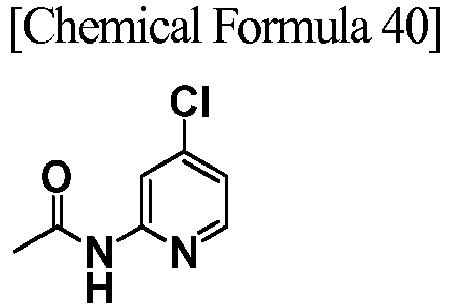
- Commercially available 2-amino-4-chloropyridine (50 g, 389 mmol) was dissolved in acetic anhydride (500 mL), triethylamine (271 mL, 1.94 mol) was added at 20°C, and the mixture was stirred at 60°C for 12 hours. The mixture was cooled to room temperature and then the solvent was evaporated. The residue was purified with silica gel column chromatography (n-heptane:ethyl acetate = 4:1 - 1:1) and then the target fraction was concentrated under vacuum to obtain the title compound (66 g, 99%).
1H-NMR Spectrum (CDCl3) δ (ppm): 2.21 (3H, s), 7.05 (1H, dd, J = 5.4, 1.9 Hz), 8.15 (1H, d, J = 5.4 Hz), 8.30 (2H, brs). -


- 4-((6-Methoxy-1H-indol-5-yl)oxy)pyridin-2-amine described in Production Example 1-4 (1.7 g, 6.66 mmol) was dissolved in N,N-dimethylformamide (25 mL), 50 - 72% oily sodium hydride (424 mg) was added under nitrogen atmosphere at 0°C, and then the mixture was stirred at room temperature for 45 minutes. The mixture was cooled to 0°C again, phenyl methylcarbamate described in Production Example 1-7 (1.64 g, 10.8 mmol) was added, and the resultant was stirred at room temperature for 3 hours. A saturated aqueous ammonium chloride solution, water, and ethyl acetate were added to the reaction mixture for partition. The aqueous layer was extracted with ethyl acetate once and the combined organic layer was washed with water and a saturated saline solution. The organic layer was dried over anhydrous magnesium sulfate. The drying agent was filtered off, then the filtrate was concentrated under vacuum, and then the resultant was purified with NH silica gel column chromatography (n-heptane:ethyl acetate = 1:3 - 0:1 - ethyl acetate:methanol = 99:1 - 19:1). The target fraction was concentrated under vacuum and then the precipitate was collected by filteration and washed with ethyl acetate to obtain the title compound (1.37 g, 66%). The mixture fraction was concentrated under vacuum and purified with NH silica gel column chromatography (n-heptane: ethyl acetate = 3:7 - 0:1 - ethyl acetate:methanol = 99:1 - 19:1). The target fraction was concentrated under vacuum, and then the precipitate was collected by filteration and washed with ethyl acetate twice to obtain the title compound (387 mg, 19%).
1H-NMR Spectrum (CDCl3) δ (ppm): 3.07 (3H, d, J = 4.6 Hz), 3.86 (3H, s), 4.31 (2H, brs), 5.44-5.56 (1H, m), 5.89 (1H, d, J = 2.2 Hz), 6.27 (1H, dd, J = 5.9, 2.2 Hz), 6.55 (1H, d, J = 3.7 Hz), 7.23 (1H, d, J = 3.7 Hz), 7.25-7.28 (1H, m), 7.89 (1H, d, J = 5.9 Hz), 8.01 (1H, brs). -

- A mixture of commercially available methylamine hydrochloride (50 g, 0.74 mol), pyridine (124 mL, 1.53 mol), and N,N-dimethylformamide (500 mL) was stirred at 5°C, and commercially available phenyl chlorocarbonate (94 mL, 0.75 mol) was added dropwise over 2 hours. After the dripping was complete, the mixture was stirred under nitrogen atmosphere at room temperature for 16 hours. The reaction mixture was added to ice water (2 L) and extracted with ethyl acetate (1.5 L) twice. The organic layer was washed with water (1 L) and a saturated saline solution (300 mL). The organic layer was dried over anhydrous magnesium sulfate and then the solvent was evaporated. n-Heptane and ethyl acetate were added to the concentrated residue and the precipitate was collected by filteration and washed with n-heptane and tert-butyl methyl ether to obtain the title compound (74.2 g, 66%).
1H-NMR Spectrum (CDCl3) δ (ppm): 2.90 (3H, d, J = 4.9 Hz), 4.95 (1H, brs), 7.08-7.16 (2H, m), 7.16-7.24 (1H, m), 7.31-7.41 (2H, m) -

- Benzotriazole (2.32 g, 19.5 mmol) was dissolved in dichloromethane (100 mL), thionyl chloride (1.4 mL, 19.2 mmol) was added under nitrogen atmosphere at room temperature, and the mixture was stirred for 5 minutes. 4-(1-(tert-Butoxycarbonyl)piperidin-4-yl)benzoic acid described in Production Example 1-12 (5.4 g, 17.7 mmol) was added to the reaction mixture at room temperature, and the mixture was stirred for 25 minutes. The reaction mixture was filtered through a glass filter entirely covered with anhydrous sodium sulfate and then the anhydrous sodium sulfate was washed with dichloromethane, then the filtrate was added to a mixture of 5-((2-aminopyridin-4-yl)oxy)-6-methoxy-N-methyl-1H-indole-1-carboxamide described in Production Example 1-6 (2.5 g, 8.01 mmol), triethylamine (11 mL, 79.4 mmol), and 4-dimethylaminopyridine (101 mg, 0.827 mmol) in tetrahydrofuran (80 mL) at 0°C. The resultant was stirred at room temperature for 5 hours and then the reaction mixture was concentrated under vacuum. Water and ethyl acetate were added to the residue for partition, and the organic layer was washed with a saturated saline solution, and then dried over anhydrous magnesium sulfate and filtered. The filtrate was concentrated under vacuum, the residue was dissolved in tetrahydrofuran, an excessive quantity of 9.8 M methylamine methanol solution was added at room temperature, and the mixture was stirred for 50 minutes. The reaction mixture was concentrated under vacuum, the residue was dissolved in dichloromethane, and the resultant was purified with NH silica gel column chromatography (n-heptane:ethyl acetate = 1:1 - 1:3 - 0:1). The target fraction was concentrated under vacuum and the precipitate was collected by filteration and washed with diethyl ether and ethyl acetate to obtain the title compound (3.15 g, 66%). The filtrate was combined with the mixture fraction and the resultant was concentrated under vacuum and dissolved in dichloromethane, and the resultant was purified with NH silica gel column chromatography (n-heptane:ethyl acetate = 1:1 - 1:3 - 0:1). The target fraction was concentrated under vacuum and the precipitate was collected by filteration and washed with diethyl ether and ethyl acetate to obtain the title compound (264 mg, 5.5%).
1H-NMR Spectrum (CDCl3) δ (ppm): 1.48 (9H, s), 1.55-1.69 (2H, m), 1.77-1.87 (2H, m), 2.64-2.89 (3H, m), 3.02-3.07 (3H, m), 3.86 (3H, s), 4.26 (2H, brs), 5.62 (1H, brs), 6.50-6.55 (1H, m), 6.61 (1H, dd, J = 5.9,2.2 Hz), 7.22 (1H, d, J = 3.7 Hz), 7.27-7.33 (3H, m), 7.80 (2H, d, J = 8.4 Hz), 7.90 (1H, d, J = 2.2 Hz), 8.04 (1H, s), 8.09 (1H, d, J = 5.9 Hz), 8.54 (1H, brs). - 4-(1-(tert-Butoxycarbonyl)piperidin-4-yl)benzoic acid was synthesized by the following method.
-

- A mixture of commercially available 4-phenylpiperidine (10 g, 62 mmol), pyridine (5.7 mL, 70.5 mmol), and tetrahydrofuran (80 mL) was stirred at 0°C and a mixture of acetyl chloride (5 mL, 70.3 mmol) and tetrahydrofuran (20 mL) was dripped over 10 minutes. The mixture was stirred under nitrogen atmosphere at 25°C for 14 hours. Ethyl acetate (100 mL) and water (100 mL) were added to the reaction liquid for separation. The aqueous layer was extracted with ethyl acetate (100 mL), then the organic layers were combined, and the resultant was washed with a saturated aqueous sodium bicarbonate solution (100 mL), water (100 mL), and then a saturated saline solution (50 mL). The organic layer was dried over anhydrous magnesium sulfate and then the solvent was evaporated to obtain the title compound (12.3 g, 98%).
1H-NMR Spectrum (CDCl3) δ (ppm): 1.52-1.78 (2H, m), 1.81-1.99 (2H, m), 2.14 (3H, s), 2.63 (1H, td, J = 12.9,2.7 Hz), 2.74 (1H, tt, J = 12.1, 3.7 Hz), 3.17 (1H, td, J = 13.2,2.6 Hz), 3.84-4.02 (1H, m), 4.69-4.89 (1H, m), 7.08-7.43 (5H, m). -

- A mixture of aluminum chloride(III) (26 g, 195 mmol) and dichloromethane (200 mL) was stirred at 0°C, and oxalyl chloride (20 mL, 228 mmol) was dripped over 10 minutes. Then a mixture of 1-(4-phenylpiperidin-1-yl)ethanone described in Production Example 1-9 (12.3 g, 60.5 mmol) and dichloromethane (50 mL) was dripped over 30 minutes. The mixture was stirred under nitrogen atmosphere at 25°C for 14 hours. The reaction liquid was poured onto ice and ethyl acetate (1 L) and water (1 L) were added for separation. The aqueous layer was extracted with ethyl acetate (1 L) twice, then the organic layer was washed with water (1 L) twice and then with a saturated saline solution (500 mL). The organic layer was dried over anhydrous magnesium sulfate and then the solvent was evaporated. Ethyl acetate was added to the concentrated residue and the product was collected by filteration and washed with ethyl acetate to obtain the title compound (9.09 g, 61%).
1H-NMR Spectrum (CDCl3) δ (ppm): 1.49-1.82 (2H, m), 1.92 (2H, t, J = 13.2 Hz), 2.15 (3H, s), 2.65 (1H, t, J = 11.7 Hz), 2.75-2.94 (1H, m), 3.08-3.30 (1H, m), 3.97 (1H, d, J = 13.2 Hz), 4.82 (1H, d, J = 12.8 Hz), 7.30 (2H, d, J = 8.4 Hz), 8.05 (2H, d, J = 8.1 Hz). -


- A mixture of 4-(1-acetylpiperidin-4-yl)benzoic acid described in Production Example 1-10 (4.50 g, 18.2 mmol) and 5 M hydrochloric acid (50 mL, 250 mmol) was stirred under nitrogen atmosphere at 140°C for 18 hours. The mixture was cooled to room temperature and then the product was collected by filteration and washed with water to obtain the title compound (3.77 g, 86%).
1H-NMR Spectrum (DMSO-d6) δ (ppm): 1.60-2.15 (4H, m), 2.76-3.16 (3H, m), 3.27-3.45 (2H, m), 7.36 (2H, d, J = 8.1 Hz), 7.92 (2H, d, J = 8.1 Hz), 8.65-9.04 (2H, m), 12.89 (1H, brs). -

- A mixture of 4-(piperidin-4-yl)benzoic acid hydrochloride described in Production Example 1-11 (2.00 g, 8.27 mmol), a 1 M sodium hydroxide solution (25 mL, 25 mmol), and acetone (50 mL) was stirred at 25°C, and a solution of di-tert-butyl dicarbonate (1.9 g, 8.71 mmol) in acetone (25 mL) was added dropwise over 10 minutes. The mixture was stirred under nitrogen atmosphere at 25°C for 18 hours. 1 M hydrochloric acid (17 mL) was added under cooling at 0°C. The mixture was extracted with ethyl acetate (100 mL) twice. The organic layer was washed with a saturated saline solution (50 mL). The organic layer was dried over anhydrous magnesium sulfate and then concentrated under vacuum. n-Heptane and tert-butyl methyl ether were added to the concentrated residue and the product was collected by filteration and washed with n-heptane to obtain the title compound (2.30 g, 91%).
1H-NMR Spectrum (CDCl3) δ (ppm): 1.49 (9H, s), 1.57-1.76 (2H, m), 1.84 (2H, d, J = 13.5 Hz), 2.62-2.97 (3H, m), 4.27 (2H, brs), 7.28-7.36 (2H, m), 7.98-8.10 (2H, m). -

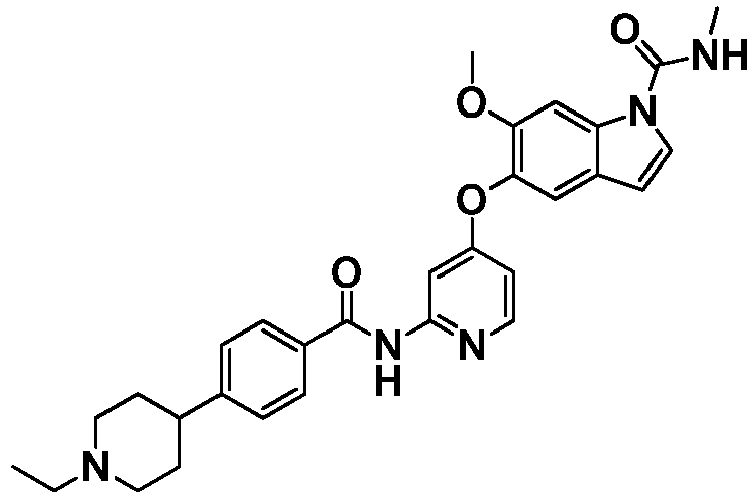
- Acetaldehyde (0.677 mL, 12.1 mmol) and sodium triacetoxyborohydride (2.57 g, 12.1 mmol) were added to a mixture of 6-methoxy-N-methyl-5-((2-(4-(piperidin-4-yl) benzamide)pyridin4-yl)oxy)-1H-indole-1-carboxamide described in Example 1 (3.03 g, 6.06 mmol) and tetrahydrofuran (80 mL), and the mixture was stirred at room temperature for 3 hours. Ethyl acetate, a saturated aqueous sodium bicarbonate solution, and water were added to the reaction mixture for partition. The organic layer was washed with a saturated saline solution, and then dried over anhydrous sodium sulfate and filtered. The solvent was evaporated, the resultant residue was dissolved in dichloromethane, and the resultant was purified with NH silica gel column chromatography (n-heptane:ethyl acetate = 1:4 - 0:1 - ethyl acetate:methanol = 99:1 - 9:1). The target fraction was concentrated under vacuum and the residue was collected by filteration and washed with n-heptane and diethyl ether to obtain the title compound (2.61 g, 82%).
1H-NMR Spectrum (CDCl3) δ (ppm): 1.12 (3H, t, J = 7.1 Hz), 1.77-1.90 (4H, m), 1.98-2.07 (2H, m), 2.45 (2H, q, J = 7.1 Hz), 2.52-2.62 (1H, m), 3.05-3.12 (5H, m), 3.83 (3H, s), 5.50-5.58 (1H, m), 6.55 (1H, d, J = 3.7 Hz), 6.60 (1H, dd, J = 5.9, 2.4 Hz), 7.23 (1H, d, J = 3.7 Hz), 7.30-7.35 (3H, m), 7.79 (2H, d, J = 8.2 Hz), 7.91 (1H, d, J = 2.4 Hz), 8.03 (1H, s), 8.10 (1H, d, J = 5.7 Hz), 8.50 (1H, brs). -


- Commercially available 2-hydroxyacetaldehyde (110 mg, 1.83 mmol), sodium triacetoxyborohydride (382 mg, 1.80 mmol), and acetic acid (103 µL, 1.80 mmol) were added to a mixture of 6-methoxy-N-methyl-5-((2-(4-(piperidin-4-yl)benzamide)pyridin-4-yl)oxy)-1H-indole-1-car boxamide described in Example 1 (300 mg, 0.601 mmol) and tetrahydrofuran (15 mL) under nitrogen atmosphere, and the mixture was stirred at room temperature for 15 hours. A saturated aqueous sodium bicarbonate solution and ethyl acetate were added to the reaction mixture for partition. The organic layer was washed with a saturated saline solution, and then dried over anhydrous sodium sulfate and filtered. The solvent was evaporated, the resultant residue was dissolved in dichloromethane, and the resultant was purified with NH silica gel column chromatography (ethyl acetate:methanol = 99:1 - 4:1). The target fraction and the mixture fraction were concentrated under vacuum, then the residue of the mixture fraction was purified with NH silica gel column chromatography (ethyl acetate:methanol = 97:3 - 19:1 - 23:2). The combined target fraction was concentrated under vacuum and the precipitate was collected by filteration and washed with diethyl ether and ethyl acetate to obtain the title compound (209 mg, 64%).
1H-NMR Spectrum (CDCl3) δ (ppm): 1.70-1.90 (4H, m), 2.14-2.25 (2H, m), 2.53-2.65 (3H, m), 2.97-3.09 (2H, m), 3.06 (3H, d, J = 4.4 Hz), 3.63 (2H, t, J = 5.3 Hz), 3.86 (3H, s), 5.51-5.60 (1H, m), 6.54 (1H, d, J = 3.7 Hz), 6.61 (1H, dd, J = 5.7, 2.4 Hz), 7.23 (1H, d, J = 3.7 Hz), 7.29-7.35 (3H, m), 7.80 (2H, d, J = 8.4 Hz), 7.91 (1H, d, J = 2.6 Hz), 8.04 (1H, s), 8.10 (1H, d, J = 5.9 Hz), 8.51 (1H, brs). -


- Commercially available (S)-(-)-propylene oxide (233 mg, 4.00 mmol) was added to a mixture of 6-methoxy-N-methyl-5-((2-(4-(piperidin-4-yl)benzamide)pyridin-4-yl)oxy)-1H-indole-1-car boxamide described in Example 1 (400 mg, 0.801 mmol) and ethanol (10 mL), and the mixture was heated and stirred with a sealed tube at 60°C for 1 hour. The mixture was cooled to room temperature and then tetrahydrofuran (5.0 mL) was added, and the mixture was heated and stirred at 70°C for 2 hours. The reaction mixture was concentrated under vacuum, the resultant residue was dissolved in dichloromethane, and the resultant was purified with NH silica gel column chromatography (n-heptane:ethyl acetate = 1:4 - 0:1 - ethyl acetate:methanol = 99:1 - 19:1). The target fraction was concentrated under vacuum and the precipitate was collected by filteration and washed with diethyl ether and ethyl acetate to obtain the title compound (347 mg, 78%).
1H-NMR Spectrum (CDCl3) δ (ppm): 1.14 (3H, d, J = 6.2 Hz), 1.66-1.89 (4H, m), 1.98-2.09 (1H, m), 2.21-2.45 (3H, m), 2.52-2.64 (1H, m), 2.88-2.96 (1H, m), 3.06 (3H, d, J = 4.8 Hz), 3.10-3.17 (1H, m), 3.57 (1H, brs), 3.80-3.92 (1H, m), 3.86 (3H, s), 5.52-5.59 (1H, m), 6.54 (1H, d, J = 3.7 Hz), 6.60 (1H, dd, J = 5.9,2.6 Hz), 7.23 (1H, d, J = 3.7 Hz), 7.29-7.35 (3H, m), 7.78-7.83 (2H, m), 7.91 (1H, d, J = 2.6 Hz), 8.03 (1H, s), 8.10 (1H, d, J = 5.9 Hz), 8.53 (1H, brs). -


- Triethylamine (11.8 µL, 0.085 mmol) and 3-fluoropropyl 4-methylbenzenesulfonate described in Production Example 5-1 (16.1 mg, 0.069 mmol) were added to a mixture of 6-methoxy-N-methyl-5-((2-(4-(piperidin-4-yl)benzamide)pyridin-4-yl)oxy)-1H-indole-1-car boxamide described in Example 1 (14.1 mg, 0.028 mmol) and N,N-dimethylformamide (0.5 mL), and the mixture was heated and stirred at 50°C for 1 hour and then stirred at room temperature for 13 hours. Triethylamine (11.8 µL, 0.085 mmol) and 3-fluoropropyl 4-methylbenzenesulfonate (16.1 mg, 0.069 mmol) were added to the reaction mixture, and the mixture was heated and stirred at 50°C for 3 hours. The resultant was cooled to room temperature and then water and ethyl acetate were added for partition. The organic layer was washed with a saturated saline solution, and then dried over anhydrous sodium sulfate and filtered. The solvent was evaporated, the resultant residue was dissolved in dichloromethane, and the resultant was purified with NH silica gel column chromatography (n-heptane:ethyl acetate = 2:3 - 0:1 - ethyl acetate:methanol = 99:1 - 19:1 - 9:1). The target fraction was concentrated under vacuum and the precipitate was collected by filteration and washed with diethyl ether to obtain the title compound (10.2 mg, 65%).
1H-NMR Spectrum (CDCl3) δ (ppm): 1.72-2.00 (6H, m), 2.02-2.13 (2H, m), 2.47-2.62 (3H, m), 3.01-3.09 (2H, m), 3.06 (3H, d, J = 4.8 Hz), 3.86 (3H, s), 4.47 (1H, t, J = 6.0 Hz), 4.59 (1H, t, J = 6.0 Hz), 5.48-5.58 (1H, m), 6.55 (1H, d, J = 3.7 Hz), 6.60 (1H, dd, J = 5.7,2.4 Hz), 7.23 (1H, d, J = 3.7 Hz), 7.30-7.34 (3H, m), 7.77-7.82 (2H, m), 7.91 (1H, d, J = 2.6 Hz), 8.03 (1H, s), 8.10 (1H, d, J = 6.2 Hz), 8.50 (1H, brs). - The reagent 3-fluoropropyl 4-methylbenzenesulfonate was synthesized by the following method.
-


- Triethylamine (11 mL, 79.4 mmol), 4-dimethylaminopyridine (390 mg, 3.19 mmol), and p-toluenesulfonyl chloride (13.4 g, 70.4 mmol) were added to a mixture of commercially available 3-fluoropropan-1-ol (5.0 g, 64 mmol) and tetrahydrofuran (120 mL) under nitrogen atmosphere at 0°C, and the mixture was stirred at room temperature for 90 hours. Water and ethyl acetate were added to the reaction mixture for partition. The organic layer was washed with water and a saturated saline solution, dried over anhydrous magnesium sulfate, and filtered. The solvent was evaporated, the resultant residue was dissolved in dichloromethane and n-heptane, and the resultant was purified with silica gel column chromatography (n-heptane:ethyl acetate = 10:1 - 2:1) to obtain the title compound (12.7 g, 85%).
1H-NMR Spectrum (CDCl3) δ (ppm): 1.97-2.15 (2H, m), 2.46 (3H, s), 4.16 (2H, t, J = 6.2 Hz), 4.49 (2H, dt, J = 46.8,5.6 Hz), 7.36 (2H, dd, J = 8.4,0.6 Hz), 7.75-7.85 (2H, m). -

- 3-fluoro-4-(4-((4-((6-methoxy-1-(methylcarbamoyl)-1H-indol-5-yl)oxy)pyridin-2-yl)carbam oyl)phenyl)piperidine-1-carboxylate described in Production Example 6-5 (29.1 mg, 0.047 mmol) was dissolved in dichloromethane (4 mL), trifluoroacetic acid (0.8 mL, 10.4 mmol) was added at room temperature, and then the mixture was stirred for 30 minutes. The solvent was evaporated, the resultant residue was dissolved in dichloromethane (4 mL), and triethylamine was added to neutralize the excessive trifluoroacetic acid. The solvent was evaporated and the resultant residue was purified with NH silica gel column chromatography (n-heptane:ethyl acetate = 1:4 - 0:1 - ethyl acetate:methanol = 97:3 - 19:1) to obtain the title compound (16.8 mg, 69%).
1H-NMR Spectrum (500MHz, CDCl3) δ (ppm): 1.71-1.80 (2H, m), 1.89-1.97 (1H, m), 2.63-2.70 (1H, m), 2.70-2.76 (1H, m), 2.79-2.89 (1H, m), 3.05 (3H, d, J = 4.9 Hz), 3.09 (1H, d, J = 11.2 Hz), 3.48 (1H, dt, J = 11.3,4.1 Hz), 3.87 (3H, s), 4.58 (1H, dtd, J = 50.0, 9.9, 4.6 Hz), 5.58 (1H, q, J = 4.7 Hz), 6.54 (1H, d, J = 3.4 Hz), 6.61 (1H, dd, J = 5.6, 2.2 Hz), 7.22 (1H, d, J = 3.9 Hz), 7.32 (1H, s), 7.38 (2H, d, J = 8.3 Hz), 7.84 (2H, d, J = 8.3 Hz), 7.91 (1H, d, J = 2.4 Hz), 8.04 (1H, s), 8.10 (1H, d, J = 5.9 Hz), 8.57 (1H, s). - The starting material tert-butyl 3-fluoro-4-(4-((4-((6-methoxy-1-(methylcarbamoyl)-1H-indol-5-yl)oxy)pyridin-2-yl)carbam oyl)phenyl)piperidine-1-carboxylate was synthesized by the following method.
-

- Toluene (20 mL), ethanol (6 mL), and water (2 mL) were added to commercially available 1-N-BOC-4-(4,4,5,5-tetramethyl-[1,3,2]dioxaborolan-2-yl)-3,6-dihydro-2H-pyridine (1.00 g, 3.23 mmol), methyl 4-bromobenzoate (695 mg, 3.23 mmol), 2-dicyclohexylphosphino-2',6'-dimethoxy biphenyl (266 mg, 0.65 mmol), palladium(II) acetate (73 mg, 0.32 mmol), and tripotassium phosphate (2.06 g, 9.70 mmol) under nitrogen atmosphere, and the mixture was stirred at 90°C for 5 hours. The reaction mixture was cooled to room temperature and a saturated aqueous sodium bicarbonate solution and ethyl acetate were added for partition. The aqueous layer was extracted with ethyl acetate three times and then the organic layer was dried over anhydrous sodium sulfate and filtered. The solvent was evaporated and the resultant residue was purified with silica gel column chromatography (n-heptane:ethyl acetate = 19:1 - 13:7) to obtain the title compound (0.99 g, 96%).
1H-NMR Spectrum (500MHz, CDCl3) δ (ppm): 1.49 (9H, s), 2.55 (2H, brs), 3.65 (2H, t, J = 5.9 Hz), 3.92 (3H, s), 4.10 (2H, brs), 6.16 (1H, brs), 7.43 (2H, d, J = 8.3 Hz), 8.00 (2H, d, J = 8.8 Hz). -

- tert-Butyl 4-(4-(methoxycarbonyl)phenyl)-5,6-dihydropyridine-1(2H)-carboxylate described in Production Example 6-1 (776 mg, 2.45 mmol) was dissolved in tetrahydrofuran (10 mL), a solution of borane-methyl sulfide complex (0.269 mL, 2.69 mmol) in tetrahydrofuran (10 mL) was added at room temperature over 3 minutes, and the mixture was stirred for 13 hours. The reaction liquid was cooled to 0°C and a 1 M sodium hydroxide solution (6.12 mL, 6.12 mmol) was added over 1 minute. 30% Hydrogen peroxide water (0.625 mL, 6.12 mmol) was added, and the mixture was stirred at room temperature for 45 minutes. A saturated aqueous sodium thiosulfate solution (20 mL), water, and ethyl acetate were serially added to the reaction mixture. The aqueous layer was extracted with ethyl acetate three times and then the organic layers were combined, dried over anhydrous magnesium sulfate, and filtered. The solvent was evaporated and the resultant residue was purified with silica gel column chromatography (n-heptane:ethyl acetate = 4:1-1:4) to obtain the title compound (518 mg, 63%).
1H-NMR Spectrum (500MHz, CDCl3) δ (ppm): 1.49 (9H, s), 1.59 (1H, d, J = 2.9 Hz), 1.69-1.88 (2H, m), 2.57-2.71 (2H, m), 2.77 (1H, brs), 3.67-3.82 (1H, m), 3.91 (3H, s), 4.22 (1H, brs), 4.42 (1H, brs), 7.34 (2H, d, J = 8.3 Hz), 8.02 (2H, d, J = 8.3 Hz). -

- tert-Butyl 3-hydroxy-4-(4-(methoxycarbonyl)phenyl)piperidine-1-carboxylate described in Production Example 6-2 (518 mg, 1.54 mmol) was dissolved in dichloromethane (15 mL), [bis-(2-methoxyethyl)amino]sulfur trifluoride (0.313 mL, 1.70 mmol) was added at -78°C over 3 minutes, and the mixture was stirred for 1 hour while warming to room temperature. A saturated aqueous sodium bicarbonate solution and ethyl acetate were serially added to the reaction mixture. The aqueous layer was extracted with ethyl acetate three times and then the organic layers were combined, dried over anhydrous sodium sulfate, and filtered. The solvent was evaporated and the resultant residue was purified with silica gel column chromatography (n-heptane:ethyl acetate = 19:1 - 3:2) to obtain the title compound (402 mg, 77%).
1H-NMR Spectrum (500MHz, CDCl3) δ (ppm): 1.49 (9H, s), 1.64-1.81 (1H, m), 1.86-2.01 (1H, m), 2.72-2.94 (3H, m), 3.91 (3H, s), 4.19 (1H, brs), 4.44-4.66 (2H, m), 7.33 (2H, d, J = 8.3 Hz), 8.02 (2H, d, J = 8.3 Hz). -

- tert-Butyl 3-fluoro-4-(4-(methoxycarbonyl)phenyl)piperidine-1-carboxylate described in Production Example 6-3 (402 mg, 1.19 mmol) was dissolved in tetrahydrofuran (18 mL), methanol (6 mL), and water (4 mL), then a 2 M aqueous lithium hydroxide solution (4.17 mL, 8.34 mmol) was added at room temperature, and then the mixture was stirred for 3 hours. Tetrahydrofuran and methanol were evaporated under vacuum and 1 M hydrochloric acid was added to the residual solution for neutralization. The aqueous layer was extracted with ethyl acetate four times, and the organic layers were combined, dried over anhydrous sodium sulfate, and filtered. The solvent was evaporated and the resultant residue was purified with silica gel column chromatography (n-heptane:ethyl acetate = 4:1 - 1:4) to obtain the title compound (347 mg, 90%).
1H-NMR Spectrum (500MHz, CDCl3) δ (ppm): 1.50 (9H, s), 1.77 (1H, qd, J =13.0, 3.9 Hz), 1.92 (1H, d, J = 14.1 Hz), 2.72-2.95 (3H, m), 4.21 (1H, brs), 4.46-4.67 (2H, m), 7.37 (2H, d, J = 8.3 Hz), 8.09 (2H, d, J = 8.3 Hz). -

- Thionyl chloride (30 µL, 0.319 mmol) was added to a mixture of benzotriazole (49.3 mg, 0.414 mmol) and dichloromethane (4 mL) under nitrogen atmosphere, and the mixture was stirred at room temperature for 5 minutes. 4-(1-(tert-Butoxycarbonyl)-3-fluoropiperidin-4-yl)benzoic acid described in Production Example 6-4 (103 mg, 0.319 mmol) was added, and the mixture was stirred at room temperature for 30 minutes. The reaction liquid was filtered through anhydrous sodium sulfate and the anhydrous sodium sulfate was washed with dichloromethane (4 mL) to obtain a dichloromethane solution of the crude product.
- A dichloromethane solution of the above-described crude product (4 mL, 0.16 mmol) was added to a mixture of 5-((2-aminopyridin-4-yl)oxy)-6-methoxy-N-methyl-1H-indole-1-carboxamide described in Production Example 1-6 (25.0 mg, 0.080 mmol), triethylamine (56 µL, 0.40 mmol), 4-dimethylaminopyridine (1.0 mg, 0.008 mmol), and dichloromethane (1 mL) at 0°C, then the mixture was stirred at 0°C for 10 minutes and then at room temperature for 3 hours. A 40% aqueous methylamine solution (138 µL, 1.60 mmol) was added, and the mixture was further stirred at room temperature for 2 hours. A saturated aqueous sodium bicarbonate solution and ethyl acetate were added to the reaction mixture for partition. The aqueous layer was extracted with ethyl acetate three times and then the organic layers were combined, dried over anhydrous sodium sulfate, and filtered. The solvent was evaporated and the resultant residue was purified with NH silica gel column chromatography (n-heptane:ethyl acetate =1:1-0:1) to obtain the title compound (29.1 mg, 59%).
1H-NMR Spectrum (500MHz, CDCl3) δ (ppm): 1.49 (9H, s), 1.65-1.82 (1H, m), 1.91 (1H, brs), 2.69-2.93 (3H, m), 3.04 (3H, d, J = 4.9 Hz), 3.86 (3H, s), 4.18 (1H, brs), 4.42-4.66 (2H, m), 5.65 (1H, q, J = 4.4 Hz), 6.53 (1H, d, J = 3.4 Hz), 6.62 (1H, dd, J = 5.9,2.4 Hz), 7.23 (1H, d, J = 3.9 Hz), 7.31 (1H, s), 7.36 (2H, d, J = 8.3 Hz), 7.84 (2H, d, J = 8.3 Hz), 7.91 (1H, d, J = 2.0 Hz), 8.05 (1H, s), 8.09 (1H, d, J = 5.9 Hz), 8.63 (1H, s). -

- Benzotriazole (33.2 mg, 0.278 mmol) was dissolved in dichloromethane (10 mL) under nitrogen atmosphere, then thionyl chloride (20 µL, 0.278 mmol) was added, and the mixture was stirred at 20°C for 5 minutes. 4-(1-tert-Butoxycarbonyl)-4-fluoropiperidin-4-yl)benzoic acid described in Production Example 7-4 (60 mg, 0.186 mmol) was added to the reaction mixture, and the mixture was stirred at 20°C for 2 hours. The reaction mixture was filtered and dichloromethane was evaporated under vacuum until the amount thereof became as small as about 5 ml. 5-((2-Aminopyridin-4-yl)oxy)-6-methoxy-N-methyl-1H-indole-1-carboxamide described in Production Example 1-6 (25 mg, 0.08 mmol), triethylamine (55 µL, 0.40 mmol), and 4-dimethylaminopyridine (1.96 mg, 0.016 mmol) were serially added to the resultant reaction mixture, and the mixture was stirred at room temperature for 2 hours. A 2 M methylamine tetrahydrofuran solution (120 µL, 0.24 mmol) was added to the reaction mixture, then the mixture was stirred at room temperature for 1 hour, and then ethyl acetate and a saturated aqueous sodium bicarbonate solution were added for partition. The organic layer was dried over anhydrous sodium sulfate and filtered. The solvent was evaporated under vacuum and the resultant residue was dissolved in dichloromethane (5 mL), then trifluoroacetic acid (1 mL) was added at 0°C, and then the mixture was stirred at room temperature for 1 hour. The solvent was evaporated under vacuum, an azeotropic mixture of the resultant residue with toluene was formed, and then the mixture was dried under vacuum. The resultant residue was dissolved in a mixed solvent of dichloromethane and triethylamine, and the resultant was purified with NH silica gel column chromatography (ethyl acetate:methanol = 1:0 - 17:3). The target fraction was concentrated under vacuum to obtain the title compound (11.8 mg, 29%).
1H-NMR Spectrum (CDCl3) δ (ppm): 1.73-2.01 (4H, m), 2.91- 3.23 (7H, m), 3.86 (3H, s), 5.76-5.91 (1H, m), 6.44-6.52 (1H, m), 6.64 (1H, dd, J = 5.9, 2.2 Hz), 7.22 (1H, d, J = 3.7 Hz), 7.31 (1H, s), 7.48 (2H, d, J = 8.4 Hz) 7.81-7.97 (3H, m), 8.02-8.14 (2H, m), 8.74 (1H, brs). - The starting material 4-(1-tert-butoxycarbonyl)-4-fluoropiperidin-4-yl)benzoic acid was synthesized by the following method.
-

- Magnesium (3.10 g, 127 mmol), iodine (135 mg, 0.531 mmol), and 2-(4-bromophenyl)-4,5-dihydro-4,4-dimethyloxazole (27 g, 106 mmol) were added to tetrahydrofuran (120 mL), and the mixture was heated under reflux for 1 hour. This reaction mixture was cooled to room temperature, then 1-benzyl-4-piperidone (21.7 mL, 117 mmol) was added, and the mixture was heated under reflux for 3 hours. The reaction mixture was cooled to room temperature and then a saturated aqueous ammonium chloride solution and ethyl acetate were added for partition. The aqueous layer was extracted with ethyl acetate, and then the organic layers were combined and washed serially with water and a saturated saline solution. The organic layer was dried over anhydrous magnesium sulfate and filtered. The solvent was evaporated under vacuum and the resultant residue was purified with silica gel column chromatography (n-heptane:ethyl acetate = 3:1 - 1:1). The target fraction was concentrated under vacuum to obtain the title compound (13.4 g, 35%).
1H-NMR Spectrum (CDCl3) δ (ppm): 1.37 (6H, s), 1.67-1.76 (2H, m), 2.16 (2H, td, J = 13.1, 4.5 Hz), 2.47 (2H, td, J = 12.0,2.5 Hz), 2.79 (2H, d, J = 11.4 Hz), 3.58 (2H, s), 4.09 (2H, s), 7.23-7.40 (5H, m), 7.55 (2H, d, J = 8.8 Hz), 7.91 (2H, d, J = 8.6 Hz). -

- 1-Benzyl-4-(4-(4,4-dimethyl-4,5-dihydrooxazol-2-yl)phenyl)piperidin-4-ol described in Production Example 7-1 (13.4 g, 36.8 mmol) was dissolved in ethanol (300 mL), then sulfuric acid was added, and the mixture was stirred at 90°C for 12 hours. The reaction mixture was cooled to room temperature and then the solvent was evaporated under vacuum. The resultant residue was dissolved in dichloromethane, the resultant was washed with a saturated aqueous sodium bicarbonate solution, and then the organic layer was dried over anhydrous sodium sulfate and filtered. The solvent was evaporated under vacuum and the resultant residue was purified with NH silica gel column chromatography (n-heptane:ethyl acetate = 4:1 - 1:1). The target fraction was concentrated under vacuum to obtain the title compound (7.23 g, 58%).
1H-NMR Spectrum (CDCl3) δ (ppm): 1.39 (3H, t, J = 7.1 Hz), 1.59-1.85 (2H, m), 2.17 (2H, td, J = 13.1, 4.5 Hz), 2.47 (2H, td, J = 12.0, 2.5 Hz), 2.72-2.93 (2H, m), 3.59 (2H, s), 4.37 (2H, q, J = 7.0 Hz), 7.14-7.44 (5H, m), 7.59 (2H, d, J = 8.4 Hz), 8.02 (2H, d, J = 8.4 Hz). -

- Ethyl 4-(1-benzyl-4-hydroxypiperidin-4-yl)benzoate described in Production Example 7-2 (6.23 g, 18.4 mmol) was dissolved in dichloromethane (200 mL) under nitrogen atmosphere, then diethylaminosulfur trifluoride (2.89 mL, 22.0 mmol) was added at -78°C, and the mixture was stirred at room temperature for 3 hours. Dichloromethane was added to the reaction mixture, and the mixture was washed with water and then dried over anhydrous magnesium sulfate and filtered. The solvent was evaporated under vacuum to obtain a crude product A(6.13 g).
- The crude product A (6.13 g) was dissolved in dichloromethane (100 mL) under nitrogen atmosphere, then 1-chloroethyl chloroformate (2.13 mL, 19.8 mmol) was added, and the mixture was stirred at 20°C for 2 hours. The reaction mixture was concentrated under vacuum, then the resultant residue was dissolved in methanol (100 mL), and the resultant was heated under reflux for 30 minutes. The reaction mixture was concentrated under vacuum, then diethyl ether was added to the resultant residue, the precipitate was collected by filteration, and then the resultant was washed with diethyl ether to obtain a crude product B (4.72 g).
- The crude product B (4.72 g) was dissolved in dichloromethane (50 mL), then triethylamine (5.24 mL, 37.6 mmol) and di-tert-butyl dicarbonate (4.92 g, 22.5 mmol) were added, and the mixture was stirred at room temperature for 1 hour. Water and ethyl acetate were added to the reaction mixture for partition. The aqueous layer was extracted with ethyl acetate again, and then the organic layers were combined and washed with water and then with a saturated saline solution. The organic layer was dried over anhydrous magnesium sulfate and filtered. The solvent was evaporated under vacuum and the resultant residue was purified with silica gel column chromatography (n-heptane:ethyl acetate = 9:1 - 1:1). The target fraction was concentrated under vacuum to obtain the title compound (3.74 g, 58%).
1H-NMR Spectrum (CDCl3) δ (ppm): 1.24-1.34 (1H, m), 1.40 (3H, t, J = 7.1 Hz), 1.50 (9H, s), 1.86-2.14 (2H, m), 2.54 (1H, brs), 3.18 (1H, brs), 3.65 (1H, t, J = 5.7 Hz), 4.00-4.26 (2H, m), 4.38 (2H, qd, J = 7.1, 3.1 Hz), 7.43 (2H, dd, J = 8.6, 1.3 Hz), 8.03 (2H, dd, J = 18.1, 8.6 Hz). -

- tert-Butyl 4-(4-(ethoxycarbonyl)phenyl)-4-fluoropiperidine-1-carboxylate described in Production Example 7-3 (3.74 g, 10.6 mmol) was dissolved in a mixed solvent of tetrahydrofuran (10 mL) and methanol (5 mL), then a 1 M sodium hydroxide solution (42.6 mL) was added, and the mixture was stirred at 50°C for 4 hours. 1 M Hydrochloric acid was added to the reaction mixture, the precipitate was collected by filteration and washed with water, and then the resultant was dried by through-flow drying to obtain the title compound (1.33 g, 39%).
1H-NMR Spectrum (DMSO-d6) δ (ppm): 1.43 (9H, s), 1.83-2.15 (4H, m), 3.06 (2H, brs), 3.99 (2H, d, J = 10.3 Hz), 7.50 (2H, d, J = 8.4 Hz), 7.92 (2H, d, J = 8.4 Hz). -

- Oxalyl chloride (27 µL, 0.321 mmol) and N,N-dimethylformamide (1.24 µL, 0.016 mmol) were added to a solution of 4-(4-(pyrrolidin-1-yl)piperidin-1-yl)benzoic acid described in Production Example 8-2 (44 mg, 0.16 mmol) in dichloromethane (2 mL) at room temperature. The reaction liquid mixture was stirred at room temperature for 1 hour. The reaction liquid mixture was concentrated and triethylamine (112 µL, 0.80 mmol), 5-((2-aminopyridin-4-yl)oxy)-6-methoxy-N-methyl-1H-indole-1-carboxamide described in Production Example 1-6 (50 mg, 0.16 mmol), and 4-dimethylaminopyridine (3.91 mg, 0.032 mmol) were serially added to a solution of the residue in dichloromethane (2 mL) at room temperature. The reaction liquid mixture was stirred at room temperature. A saturated aqueous sodium bicarbonate solution was added to the reaction liquid and then ethyl acetate was added for dilution. The aqueous layer was extracted with ethyl acetate, then the combined organic layer was dried over anhydrous sodium sulfate. The drying agent was separated by filtration and then the filtrate was concentrated under vacuum. The residue was purified with NH silica gel column chromatography (n-heptane:ethyl acetate = 1:1 - 0:1) to obtain the title compound (3.6 mg, 4.0%).
1H-NMR Spectrum (CDCl3) δ (ppm): 1.18-1.38 (2H, m), 1.84 (4H, brs), 1.95-2.11 (2H, m), 2.24-2.38 (1H, m), 2.70 (4H, brs), 2.82-2.96 (2H, m), 3.06 (3H, d, J = 4.8 Hz), 3.80-3.91 (5H, m), 5.52-5.68 (1H, m), 6.54 (1H, d, J = 3.3 Hz), 6.61 (1H, dd, J = 5.9,2.2 Hz), 6.89 (2H, d, J = 8.8 Hz), 7.23 (1H, d, J = 3.7 Hz), 7.32 (1H, s), 7.75 (2H, d, J = 8.8 Hz), 7.90 (1H, d, J = 2.2 Hz), 8.02 (1H, s), 8.09 (1H, d, J = 5.9 Hz), 8.56 (1H, brs). - The starting material 4-(4-(pyrrolidin-1-yl)piperidin-1-yl)benzoic acid was synthesized by the following method.
-

- Commercially available methyl 4-fluorobenzoate (1.5 g, 9.73 mmol) was added to a solution of commercially available 4-(1-pyrrolidinyl)piperidine (3.0 g, 19.5 mmol) in dimethylsulfoxide (15 mL) at room temperature and then the mixture was stirred under nitrogen atmosphere and under irradiation with microwave at 150°C for 4 hours. The reaction liquid was allowed to stand to cool to room temperature and then diluted with water and ethyl acetate. The organic layer was washed with water and then dried by a conventional method. The drying agent was separated by filtration and then the filtrate was concentrated under vacuum. The residue was purified with NH silica gel column chromatography (n-heptane:ethyl acetate = 1:1) to obtain the title compound (2.06 g, 73%).
1H-NMR Spectrum (CDCl3) δ (ppm): 1.54-1.70 (2H, m), 1.74-1.88 (4H, m), 1.93-2.06 (2H, m), 2.12-2.26 (1H, m), 2.53-2.65 (4H, m), 2.90 (2H, td, J = 12.4,2.6 Hz), 3.74-3.97 (5H, m), 6.86 (2H, d, J = 9.2 Hz), 7.89 (2H, d, J = 9.2 Hz). -

- A 5 M sodium hydroxide solution (15 mL, 75.0 mmol) was added to a solution of methyl 4-(4-(pyrrolidin-1-yl)piperidin-1-yl)benzoate described in Production Example 8-1 (2.06 g, 7.14 mmol) in tetrahydrofuran (10 mL) and methanol (10 mL). The reaction liquid was stirred at 50°C for 4 hours. The reaction liquid was cooled to 0°C and then 5 M hydrochloric acid was dripped until pH reached 1. The liquid mixture was diluted with ethyl acetate. The organic layer was washed with a saturated saline solution and then dried over anhydrous sodium sulfate. The drying agent was separated by filtration and then the filtrate was concentrated under vacuum to obtain the title compound (1.61 g, 82%).
ESI-MS(m/z):297[M+H]+. -

- Triethylamine (1.6 mL, 11.5 mmol) and commercially available 4-(chloromethyl)benzoyl chloride (1.37 g, 7.25 mmol) were added to a mixture of 5-((2-aminopyridin-4-yl)oxy)-6-methoxy-N-methyl-1H-indole-1-carboxamide described in Production Example 1-6 (905 mg, 2.90 mmol) and tetrahydrofuran (28 mL) under nitrogen atmosphere at 0°C. The mixture was stirred at room temperature for 100 minutes, then triethylamine (1.6 mL, 11.5 mmol) and 4-(chloromethyl)benzoyl chloride (0.90 g, 4.76 mmol) were added to the reaction mixture at 0°C, and then the resultant was stirred at room temperature for 1.5 hours. Water, tetrahydrofuran, and ethyl acetate were added to the reaction mixture for partition. The organic layer was washed with a saturated saline solution and then dried over anhydrous magnesium sulfate. The resultant was filtered with NH silica gel (ethyl acetate) and then concentrated under vacuum to obtain a crude product.
- The crude product was dissolved in N,N-dimethylformamide (15 mL), commercially available 4-hydroxypiperidine (1.48 g, 14.6 mmol) was added under nitrogen atmosphere at room temperature, and the mixture was stirred for 16 hours. Water and ethyl acetate were added to the reaction mixture for partition and the aqueous layer was extracted with ethyl acetate. The combined organic layer was washed with water and a saturated saline solution, dried over anhydrous magnesium sulfate, and filtered. The solvent was evaporated, the resultant residue was dissolved in dichloromethane, and the resultant was purified with NH silica gel column chromatography (ethyl acetate:methanol = 1:0 - 9:1 - 17:3 - 4:1). The target product was collected by filteration and washed with ethyl acetate to obtain the title compound (1.30 g, 84%).
1H-NMR Spectrum (DMSO-d6) δ (ppm): 1.32-1.44 (2H, m), 1.64-1.74 (2H, m), 1.97-2.09 (2H, m), 2.59-2.69 (2H, m), 2.86 (3H, d, J = 4.2 Hz), 3.39-3.50 (3H, m), 3.76 (3H, s), 4.54 (1H, d, J = 4.2 Hz), 6.63 (1H, d, J = 3.7 Hz), 6.65 (1H, dd, J = 5.7, 2.2 Hz), 7.37 (2H, d, J = 8.1 Hz), 7.44 (1H, s), 7.66 (1H, d, J = 2.4 Hz), 7.78 (1H, d, J = 3.7 Hz), 7.92 (2H, d, J = 8.2 Hz), 8.10 (1H, s), 8.15-8.22 (2H, m), 10.68 (1H, s). -

- The crude product described in Example 9 (20.2 mg, 0.033 mmol) was dissolved in N,N-dimethylformamide (0.5 mL), then (3S,4S)-4-methoxypyrrolidin-3-ol (55.9 mg, 0.477 mmol) (described in
EP 1375465 ) was added under nitrogen atmosphere at room temperature, and then the mixture was stirred for 200 minutes. Water and ethyl acetate were added to the reaction mixture for partition, and the organic layer was washed with a saturated saline solution and then dried over anhydrous sodium sulfate. The drying agent was filtered off, the solvent was evaporated, the resultant residue was dissolved in dichloromethane, and the resultant was purified with NH silica gel column chromatography (ethyl acetate:methanol = 1:0 - 19:1 - 9:1). The residue was washed with diethyl ether to obtain the title compound (13.8 mg, 77%).
1H-NMR Spectrum (CDCl3) δ (ppm): 2.32 (1H, dd, J = 10.1, 4.2 Hz), 2.61-2.68 (1H, m), 2.70-2.77 (1H, m), 3.03-3.16 (4H, m), 3.36 (3H, s), 3.62-3.76 (4H, m), 3.87 (3H, s), 4.12-4.19 (1H, m), 5.42-5.51 (1H, m), 6.56 (1H, d, J = 3.7 Hz), 6.59-6.62 (1H, m), 7.23 (1H, d, J = 3.7 Hz), 7.32 (1H, s), 7.42 (2H, d, J = 8.4 Hz), 7.81 (2H, d, J = 8.1 Hz), 7.91 (1H, d, J = 2.2 Hz), 8.03 (1H, s), 8.11 (1H, d, J = 5.9 Hz), 8.48 (1H, brs). -

- Thionyl chloride (0.116 mL, 1.60 mmol) was added to a mixture of commercially available 4-(2-chloroethyl)benzoic acid (88 mg, 0.479 mmol) and 1,2-dichloroethane (1.0 mL) under nitrogen atmosphere at room temperature, and the mixture was heated under reflux at 90°C for 1.5 hours. The mixture was cooled to room temperature, then the solvent was evaporated, and the resultant was dissolved in tetrahydrofuran (1.0 mL), and thus an acid chloride solution was prepared. Triethylamine (0.443 mL, 3.20 mmol) was added to a mixture of 5-((2-aminopyridin-4-yl)oxy)-6-methoxy-N-methyl-1H-indole-1-carboxamide described in Production Example 1-6 (49.9 mg, 0.160 mmol) and N,N-dimethylformamide (0.5 mL) under nitrogen atmosphere at room temperature, and the mixture was cooled to 0°C. A previously prepared tetrahydrofuran solution of acid chloride was added at the same temperature, and the mixture was stirred at room temperature for 2.5 hours. Water and ethyl acetate were added to the reaction mixture for partition, then the organic layer was washed with a saturated saline solution and dried over anhydrous sodium sulfate. The solvent was evaporated, and the resultant residue was dissolved in dichloromethane, the resultant was purified with NH silica gel column chromatography (n-heptane:ethyl acetate = 3:1 - 0:1), and then the target fraction was concentrated under vacuum to obtain a crude product (48.9 mg).
- The crude product (48.9 mg) was dissolved in N,N-dimethylformamide (0.25 mL), then commercially available N-ethylpiperazine (129 µL, 1.02 mmol) and N,N-diisopropylethylamine (26.6 µL, 0.153 mmol) were added under nitrogen atmosphere at room temperature, and the mixture was heated and stirred at 60°C for 16 hours. The mixture was cooled to room temperature, then water and ethyl acetate were added to the reaction mixture for partition, and then the organic layer was washed with a saturated saline solution, dried over anhydrous sodium sulfate, and filtered. The solvent was evaporated, the resultant residue was dissolved in dichloromethane, and the resultant was purified with NH silica gel column chromatography (n-heptane:ethyl acetate = 1:1 - 0:1 - ethyl acetate:methanol = 99:1 - 19:1). The mixture fraction was concentrated under vacuum and the residue was purified with NH silica gel TLC (ethyl acetate) to obtain the title compound (7.03 mg, 16%).
1H-NMR Spectrum (CDCl3) δ (ppm): 1.10 (3H, t, J = 7.3 Hz), 2.44 (2H, q, J = 7.0 Hz), 2.35-2.70 (10H, m), 2.81-2.90 (2H, m), 3.07 (3H, d, J = 4.8 Hz), 3.86 (3H, s), 5.43-5.51 (1H, m), 6.56 (1H, d, J = 3.7 Hz), 6.60 (1H, dd, J = 5.9, 2.6 Hz), 7.23 (1H, d, J = 3.7 Hz), 7.28-7.33 (3H, m), 7.78 (2H, d, J = 8.4 Hz), 7.91 (1H, d, J = 2.2 Hz), 8.03 (1H, s), 8.10 (1H, d, J = 5.9 Hz), 8.46 (1H, brs). -

- Oxalyl chloride (44 µL, 0.513 mmol) and a catalytic quantity of N,N-dimethylformamide were added to a mixture of 4-(2-chloroethoxy)benzoic acid described in Production Example 12-1 (51.2 mg, 0.255 mmol) and dichloromethane (2.0 mL) under nitrogen atmosphere at room temperature, and the mixture was stirred for 45 minutes. Oxalyl chloride (44 µL, 0.513 mmol) was added to the reaction mixture at room temperature, and the mixture was stirred for 30 minutes. The solvent was evaporated and the resultant was dissolved in tetrahydrofuran (0.5 mL), and thus an acid chloride solution was prepared. Triethylamine (89 µL, 0.64 mmol) was added to a mixture of 5-((2-aminopyridin-4-yl)oxy)-6-methoxy-N-methyl-1H-indole-1-carboxamide described in Production Example 1-6 (40 mg, 0.128 mmol) and N,N-dimethylformamide (0.5 mL) under nitrogen atmosphere at room temperature. The previously prepared tetrahydrofuran solution of acid chloride was added at the same temperature, and the mixture was stirred at room temperature for 80 minutes. A saturated aqueous sodium bicarbonate solution and ethyl acetate were added to the reaction mixture for partition and the organic layer was dried over anhydrous sodium sulfate. The resultant was filtered with NH silica gel (ethyl acetate) and then concentrated under vacuum to obtain a crude product (80.6 mg).
- The crude product (80.6 mg) was dissolved in N,N-dimethylformamide (0.7 mL), commercially available 4-hydroxypiperidine (93 mg, 0.919 mmol) was added under nitrogen atmosphere at room temperature, and the mixture was heated and stirred at 80°C for 12 hours. The mixture was cooled to room temperature, water and ethyl acetate were added to the reaction mixture for partition, and the aqueous layer was extracted with ethyl acetate once. The combined organic layer was washed with water and a saturated saline solution, then dried over anhydrous sodium sulfate, and then filtered. The solvent was evaporated and the resultant residue was purified with NH silica gel TLC (ethyl acetate:methanol = 9:1). The resultant residue was purified with NH silica gel TLC (ethyl acetate) to obtain the title compound (10.8 mg, 30%).
1H-NMR Spectrum (CDCl3) δ (ppm): 1.55-1.67 (2H, m), 1.86-1.97 (2H, m), 2.31 (2H, t, J = 9.5 Hz), 2.78-2.92 (4H, m), 3.06 (3H, d, J = 4.4 Hz), 3.67-3.77 (1H, m), 3.86 (3H, s), 4.14 (2H, t, J = 5.7 Hz), 5.50-5.59 (1H, m), 6.54 (1H, d, J = 3.3 Hz), 6.60 (1H, dd, J = 5.7,2.4 Hz), 6.95 (2H, d, J = 8.8 Hz), 7.22 (1H, d, J = 3.7 Hz), 7.32 (1H, s), 7.81 (2H, d, J = 8.8 Hz), 7.88 (1H, d, J = 1.8 Hz), 8.03 (1H, s), 8.09 (1H, d, J = 5.9 Hz), 8.47 (1H, brs). - The reagent 4-(2-chloroethoxy)benzoic acid was synthesized by the following method.
-

- Potassium carbonate (7.27 g, 52.6 mmol) and commercially available 1-chloro-2-iodoethane (3.6 mL, 39.5 mmol) were added to a liquid mixture of commercially available methyl p-hydroxybenzoate (2.0 g, 13.1 mmol) and N,N-dimethylformamide (50 mL) under nitrogen atmosphere at room temperature, and the mixture was heated and stirred at 60°C for 12 hours. The mixture was cooled to room temperature and then a saturated aqueous ammonium chloride solution, water, and diethyl ether were added to the reaction mixture for partition. The organic layer was washed with water and a saturated saline solution, then dried over anhydrous magnesium sulfate, and then filtered and concentrated under vacuum. Tetrahydrofuran (25 mL), methanol (10 mL), and a 2 M sodium hydroxide solution (10 mL) were added to the residue at room temperature, and the mixture was heated and stirred at 80°C for 4 hours. The reaction mixture was cooled to 0°C, acidified with 5 M hydrochloric acid, and then the mixture was diluted with ethyl acetate for partition. The aqueous layer was extracted with ethyl acetate, the combined organic layer was washed with water and a saturated saline solution, then dried over anhydrous magnesium sulfate, and filtered. The solvent was evaporated, the precipitate was separated by filtration with a liquid mixture of ethyl acetate and tetrahydrofuran, the resultant was washed, and the filtrate was concentrated under vacuum. The residue was purified with silica gel column chromatography (n-heptane:ethyl acetate = 3:1 - 2:1 - 1:1) and the target fraction was concentrated under vacuum to obtain the title compound (278 mg, 11%).
1H-NMR Spectrum (DMSO-d6) δ (ppm): 3.92-3.98 (2H, m), 4.26-4.35 (2H, m), 6.96-7.06 (2H, m), 7.82-7.91 (2H, m), 12.68 (1H, brs). -

- Acetaldehyde (8.9 mg, 0.202 mmol) and sodium triacetoxyborohydride (43.9 mg, 0.207 mmol) were added to a mixture of 6-methoxy-N-methyl-5-((2-(1-(piperidin-4-yl)-1H-pyrazole-4-carboxamide)pyridin-4-yl)oxy )-1H-indole-1-carboxamide described in Production Example 13-4 (20.3 mg, 0.041 mmol) and tetrahydrofuran (1.0 mL) at room temperature, and the mixture was stirred for 2.5 hours. A saturated aqueous sodium bicarbonate solution and ethyl acetate were added to the reaction mixture for partition. The organic layer was washed with a saturated saline solution, dried over anhydrous sodium sulfate, and filtered. The solvent was evaporated and the resultant residue was purified with NH silica gel TLC (ethyl acetate). The product was washed with diethyl ether to obtain the title compound (9.3 mg, 43%).
1H-NMR Spectrum (CDCl3) δ (ppm): 1.11 (3H, t, J = 7.1 Hz), 1.94-2.24 (6H, m), 2.46 (2H, q, J = 7.4 Hz), 3.03-3.11 (5H, m), 3.86 (3H, s), 4.09-4.19 (1H, m), 5.49-5.56 (1H, m), 6.54 (1H, d, J = 2.9 Hz), 6.60 (1H, dd, J = 5.9,2.4 Hz), 7.22 (1H, d, J = 3.7 Hz), 7.31 (1H, s), 7.81 (1H, d, J = 2.0 Hz), 7.85 (1H, d, J = 0.7 Hz), 7.96 (1H, s), 8.02 (1H, s), 8.08 (1H, d, J = 5.9 Hz), 8.17 (1H, brs). - The starting material 6-methoxy-N-methyl-5-((2-(1-(piperidin-4-yl)-1H-pyrazole-4-carboxamide)pyridin-4-yl)oxy )-1H-indole-1-carboxamide was synthesized by the following method.
-

- Commercially available methanesulfonyl chloride (6.35 mL, 82.0 mmol) and triethylamine (26.0 mL, 186 mmol) were added to a mixture of commercially available tert-butyl 4-hydroxy-1-piperidine carboxylate (15 g, 74.5 mmol) and tetrahydrofuran (200 mL) at 0°C, and the mixture was stirred for 30 minutes. Water and ethyl acetate were added to the reaction mixture for partition. The organic layer was dried and filtered by conventional methods. The solvent was evaporated, and the residue was collected by filteration and washed with n-heptane to obtain the title compound (19.8 g, 95%).
1H-NMR Spectrum (CDCl3) δ (ppm): 1.46 (9H, s), 1.72-1.88 (2H, m), 1.90-2.04 (2H, m), 3.03 (3H, s), 3.24-3.36 (2H, m), 3.64-3.77 (2H, m), 4.80-4.94 (1H, m). -


- tert-Butyl 4-((methylsulfonyl)oxy)piperidine-1-carboxylate described in Production Example 13-1 (2.7 g, 9.67 mmol) and commercially available ethyl 4-pyrazole carboxylate (1.49 g, 10.6 mmol) were dissolved in N,N-dimethylformamide (30 mL), 50 - 72% oily sodium hydride (570 mg) was added at 0°C, and the mixture was heated and stirred at 60°C for 11 hours. The reaction mixture was cooled to room temperature and water and ethyl acetate were added for partition. The organic layer was washed with water twice and then dried over anhydrous sodium sulfate and filtered. The solvent was evaporated, the resultant residue was dissolved in dichloromethane, the resultant was purified with silica gel column chromatography (n-heptane:ethyl acetate = 4:1 - 1:1 - 1:3 - 0:1), and the target fraction was concentrated under vacuum to obtain the title compound (2.11 g, 68%).
1H-NMR Spectrum (CDCl3) δ (ppm): 1.34 (3H, t, J = 7.1 Hz), 1.47 (9H, s), 1.82-1.96 (2H, m), 2.10-2.18 (2H, m), 2.82-2.96 (2H, m), 4.19-4.34 (3H, m), 4.29 (2H, q, J = 7.1 Hz), 7.91 (1H, s), 7.92 (1H, s). -

- tert-Butyl 4-(4-(ethoxycarbonyl)-1H-pyrazol-1-yl)piperidine-1-carboxylate described in Production Example 13-2 (2.11 g, 6.53 mmol) was dissolved in methanol (60 mL), then potassium hydroxide (1.46 g, 26.1 mmol) dissolved in water (16 mL) was added, and then the mixture was stirred for 27 hours. The reaction mixture was concentrated under vacuum and diethyl ether was added for partition. Ethyl acetate was added to the aqueous layer for dilution, then a 5% aqueous potassium hydrogensulfate solution was added for acidification, and the mixture was extracted with ethyl acetate twice. The combined organic layer was dried over anhydrous magnesium sulfate and filtered. The solvent was evaporated to obtain the title compound (1.58 g, 82%).
1H-NMR Spectrum (CDCl3) δ (ppm): 1.48 (9H, s), 1.84-1.98 (2H, m), 2.11-2.20 (2H, m), 2.81-2.97 (2H, m), 4.18-4.36 (3H, m), 7.97 (1H, s), 7.98 (1H, s). -

- Benzotriazole (97 mg, 0.813 mmol) was dissolved in dichloromethane (4.0 mL), and thionyl chloride (59 µL, 0.813 mmol) was added at room temperature and the mixture was stirred for 5 minutes under nitrogen atmosphere. 1-(1-(tert-Butoxycarbonyl)piperidin-4-yl)-1H-pyrazole-4-carboxylic acid described in Production Example 13-3 (200 mg, 0.677 mmol) was added to the reaction mixture at room temperature, and the mixture was stirred for 25 minutes. The reaction mixture was filtered through a glass filter entirely covered with anhydrous sodium sulfate and then the anhydrous sodium sulfate was washed with dichloromethane, the filtrate was added to a mixture of 5-((2-aminopyridin-4-yl)oxy)-6-methoxy-N-methyl-1H-indole-1-carboxamide described in Production Example 1-6 (102 mg, 0.327 mmol), triethylamine (0.453 mL, 3.27 mmol), and 4-dimethylaminopyridine (3.99 mg, 0.033 mmol) in tetrahydrofuran (5.0 mL) at 0°C. The mixture was stirred at room temperature for 2 hours, then water and ethyl acetate were added to the reaction mixture for partition, then the organic layer was washed with a saturated saline solution and then dried over anhydrous sodium sulfate. The drying agent was filtered off and the filtrate was concentrated under vacuum. The residue was dissolved in tetrahydrofuran, an excessive quantity of 9.8 M methylamine methanol solution was added at room temperature, and the mixture was stirred for 4 hours. The reaction mixture was concentrated under vacuum and the residue was dissolved in dichloromethane, and the resultant was purified with NH silica gel column chromatography (n-heptane:ethyl acetate = 1:1 - 1:9 - 0:1). The target fraction was concentrated under vacuum to obtain a crude product (170 mg).
- The crude product (170 mg) was dissolved in dichloromethane (1.8 mL) and trifluoroacetic acid (0.5 mL) was added at 0°C. The mixture was stirred at room temperature for 80 minutes, then was concentrated under vacuum, and the residue was dissolved in dichloromethane-triethylamine, then the resultant was purified with NH silica gel column chromatography (ethyl acetate:methanol = 49:1 - 4:1), then the target fraction was concentrated under vacuum to obtain the title compound (81.2 mg, 51%).
1H-NMR Spectrum (CDCl3) δ (ppm): 1.78-1.91 (2H, m), 2.11-2.19 (2H, m), 2.75 (2H, td, J =12.3, 2.3 Hz), 3.05 (3H, d, J = 4.6 Hz), 3.19-3.27 (2H, m), 3.85 (3H, s), 4.16-4.26 (1H, m), 5.53-5.63 (1H, m), 6.53 (1H, d, J = 3.5 Hz), 6.60 (1H, dd, J = 5.8, 2.5 Hz), 7.22 (1H, d, J = 3.8 Hz), 7.30 (1H, s), 7.81 (1H, d, J = 2.4 Hz), 7.86 (1H, s), 7.96 (1H, s), 8.03 (1H, s), 8.08 (1H, d, J = 5.9 Hz), 8.22 (1H, brs). -
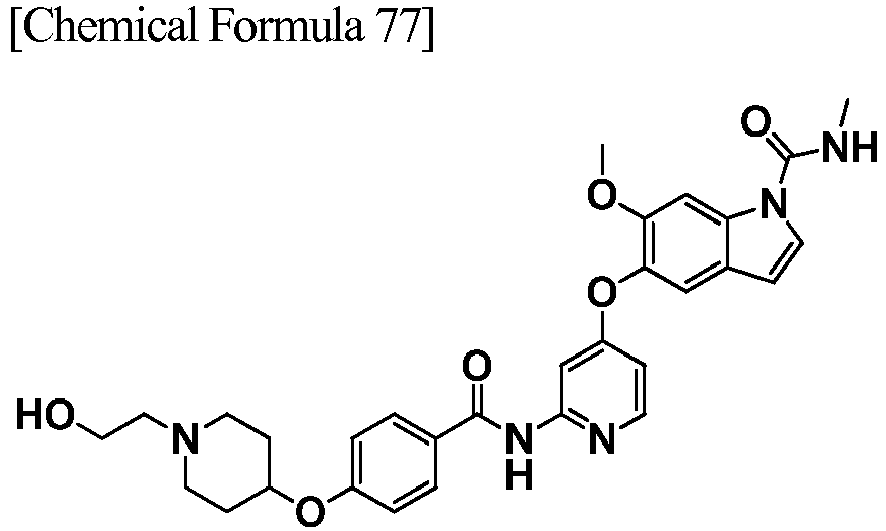
- Benzotriazole (34.1 mg, 0.286 mmol) was dissolved in dichloromethane (1.5 mL), then thionyl chloride (20 µL, 0.274 mmol) was added under nitrogen atmosphere at room temperature, and then the mixture was stirred for 5 minutes. 4-((1-(tert-Butoxycarbonyl)piperidin-4-yl)oxy)benzoic acid described in Production Example 14-1 (79.3 mg, 0.247 mmol) was added to the reaction mixture at room temperature, and the mixture was stirred for 25 minutes. The reaction mixture was filtered through a glass filter entirely covered with anhydrous sodium sulfate and then the anhydrous sodium sulfate was washed with dichloromethane, then the filtrate was added to a mixture of 5-((2-aminopyridin-4-yl)oxy)-6-methoxy-N-methyl-1H-indole-1-carboxamide described in Production Example 1-6 (35.6 mg, 0.114 mmol), triethylamine (0.158 mL, 1.14 mmol), and 4-dimethylaminopyridine (1.39 mg, 0.011 mmol), in tetrahydrofuran (1.1 mL) at 0°C. The reaction mixture was stirred at room temperature for 1.5 hours, then water and ethyl acetate were added to the reaction mixture for partition, and then the organic layer was washed with a saturated saline solution and dried over anhydrous sodium sulfate. The drying agent was filtered off, the filtrate was concentrated under vacuum, the residue was dissolved in tetrahydrofuran, an excessive quantity of 9.8 M methylamine methanol solution was added at room temperature, and the mixture was stirred for 2 hours. The reaction mixture was concentrated under vacuum, the residue was dissolved in dichloromethane, and the resultant was purified with NH silica gel column chromatography (n-heptane:ethyl acetate = 1:1 - 1:3 -0:1). The target fraction was concentrated under vacuum to obtain a crude product A (41.1 mg).
- The crude product A (41.1 mg) was dissolved in dichloromethane (0.6 mL) and trifluoroacetic acid (0.2 mL) was added at 0°C. The mixture was stirred at room temperature for 75 minutes and the resultant was concentrated under vacuum, the residue was dissolved in dichloromethane-triethylamine and then the resultant was purified with NH silica gel column chromatography (ethyl acetate:methanol = 49:1 - 4:1), and then the target fraction was concentrated under vacuum to obtain a crude product B (34 mg).
- Sodium triacetoxyborohydride (17.5 mg, 0.082 mmol) and commercially available 2-hydroxyacetaldehyde (4.95 mg, 0.082 mmol) were added to a mixture of the crude product B (8.5 mg, 0.016 mmol) and tetrahydrofuran (0.5 mL) at room temperature, and the mixture was stirred for 2 hours. A saturated aqueous sodium bicarbonate solution and ethyl acetate were added to the reaction mixture for partition. The organic layer was washed with a saturated saline solution, and then dried over anhydrous sodium sulfate and filtered. The solvent was evaporated and the resultant residue was purified with NH silica gel TLC (ethyl acetate). The residue was washed with diethyl ether to obtain the title compound (6.4 mg, 40%).
1H-NMR Spectrum (CDCl3) δ (ppm): 1.78-1.90 (2H, m), 1.95-2.06 (2H, m), 2.35-2.47 (2H, m), 2.57 (2H, t, J = 5.6 Hz), 2.72-2.83 (2H, m), 3.07 (3H, d, J = 4.4 Hz), 3.62 (2H, t, J = 5.3 Hz), 3.86 (3H, s), 4.38-4.48 (1H, m), 5.45-5.54 (1H, m), 6.55 (1H, d, J = 3.7 Hz), 6.59 (1H, dd, J = 5.7,2.4 Hz), 6.94 (2H, d, J = 8.8 Hz), 7.23 (1H, d, J = 3.7 Hz), 7.32 (1H, s), 7.81 (2H, d, J = 8.8 Hz), 7.89 (1H, d, J = 2.6 Hz), 8.03 (1H, s), 8.09 (1H, d, J = 5.5 Hz), 8.45 (1H, brs). - The starting material 4-((1-(tert-butoxycarbonyl)piperidin-4-yl)oxy)benzoic acid was synthesized by the following method.
-

- Apart of the crude product (500 mg, 1.22 mmol) was dissolved in ethanol (5 mL), a 5 M sodium hydroxide solution (0.729 mL, 3.65 mmol) was added, and the mixture was heated and stirred at 50°C for 7 hours. The reaction mixture was cooled to room temperature, and then 5 M hydrochloric acid and ethyl acetate were added for partition. The organic layer was dried and filtered by conventional methods. The solvent was evaporated and then the resultant was collected by filteration and washed with n-heptane to obtain the title compound (343 mg, 62%).
1H-NMR Spectrum (CDCl3) δ (ppm): 1.47 (9H, s), 1.65-1.84 (2H, m), 1.87-2.07 (2H, m), 3.30-3.51 (2H, m), 3.60-3.80 (2H, m), 4.50-4.66 (1H, m), 6.87-7.03 (2H, m), 7.98-8.14 (2H, m). -


1H-NMR Spectrum (CDCl3) δ (ppm): 1.25 (3H, t, J = 7.0 Hz), 1.50-1.70 (2H, m), 1.79-1.88 (2H, m), 2.63-2.80 (3H, m), 3.06 (3H, d, J = 4.8 Hz), 3.16-3.24 (2H, m), 4.11 (2H, q, J = 7.0 Hz), 5.46-5.54 (1H, m), 6.55 (1H, d, J = 3.3 Hz), 6.60 (1H, dd, J = 5.9,2.6 Hz), 7.23 (1H, d, J = 3.7 Hz), 7.29-7.34 (3H, m), 7.78-7.83 (2H, m), 7.92 (1H, d, J = 2.2 Hz), 8.00 (1H, s), 8.08-8.11 (1H, m), 8.50 (1H, brs). - The starting material tert-butyl 4-(4-((4-((6-ethoxy-1-(methylcarbamoyl)-1H-indol-5-yl)oxy)pyridin-2-yl)carbamoyl)phenyl )piperidine-1-carboxylate was synthesized by the following method.
-

- Commercially available 3,4-dihydroxy benzaldehyde (35.8 g, 259 mmol) and potassium carbonate (37.6 g, 272 mmol) were dissolved in N,N-dimethylformamide (150 mL), then commercially available iodoethane (22 mL, 275 mmol) was added under nitrogen atmosphere at 0°C, and then the mixture was stirred for 2 days. The solvent was evaporated under vacuum, the resultant was cooled to 0°C, and then 5 M hydrochloric acid, ethyl acetate, and water were added for partition. The aqueous layer was extracted with ethyl acetate, the combined organic layer was washed with water twice and then with a saturated saline solution, and the mixture was dried over anhydrous magnesium sulfate and then filtered. The solvent was evaporated, then dichloromethane was added, and then the precipitate was collected by filteration to obtain the title compound (25.8 g, 60%). The filtrate was purified with silica gel column chromatography (n-heptane:ethyl acetate = 9:1 - 4:1 - 1:1). The target fraction was concentrated under vacuum, then diethyl ether and dichloromethane were added to the residue, and the precipitate was collected by filteration to obtain the title compound (3.45 g, 8.0%).
1H-NMR Spectrum (CDCl3) δ (ppm): 1.50 (3H, t, J = 7.1 Hz), 4.22 (2H, q, J = 7.0 Hz), 5.75 (1H, s), 6.95 (1H, d, J = 8.1 Hz), 7.39-7.45 (2H, m), 9.84 (1H, s). -

- Potassium carbonate (19.8 g, 143 mmol) and benzyl chloride (16.5 mL, 143 mmol) were added to a suspension of 4-ethoxy-3-hydroxybenzaldehyde described in Production Example 15-1 (20 g, 120 mmol) in ethanol (200 mL) under nitrogen atmosphere at room temperature, and the mixture was heated and stirred at 90°C for 2.5 hours. The mixture was cooled to 0°C, and 2 M hydrochloric acid, ethyl acetate, and water were added for partition. The organic layer was washed with a saturated saline solution, dried over anhydrous magnesium sulfate, and filtered. The solvent was evaporated and the resultant residue was purified with silica gel column chromatography (n-heptane:ethyl acetate = 9:1 - 4:1 - 3:1). The target fraction was concentrated under vacuum to obtain the title compound (28.5 g, 92%).
1H-NMR Spectrum (CDCl3) δ (ppm): 1.51 (3H, t, J = 7.0 Hz), 4.20 (2H, q, J = 7.0 Hz), 5.19 (2H, s), 6.98 (1H, d, J = 8.8 Hz), 7.29-7.34 (1H, m), 7.35-7.41 (2H, m), 7.43-7.49 (4H, m), 9.81 (1H, s). -

- 3-(Benzyloxy)-4-ethoxy benzaldehyde described in Production Example 15-2 (14.5 g, 56.4 mmol) was dissolved in acetic acid (45 mL), then ammonium acetate (5.22 g, 67.7 mmol) and nitromethane (7.5 mL, 138 mmol) were added under nitrogen atmosphere at room temperature, and the mixture was heated and stirred at 130°C for 2.5 hours. The mixture was cooled to room temperature and the precipitate was collected by filteration and washed with ethanol to quantitatively obtain the title compound.
1H-NMR Spectrum (CDCl3) δ (ppm): 1.50 (3H, t, J = 7.0 Hz), 4.17 (2H, q, J = 7.2 Hz), 5.17 (2H, s), 6.92 (1H, d, J = 8.4 Hz), 7.04 (1H, d, J = 2.2 Hz), 7.16 (1H, dd, J = 8.6, 2.0 Hz), 7.29-7.51 (6H, m), 7.90 (1H, d, J = 13.5 Hz). -

- Fuming nitric acid (13 mL, 289 mmol) was slowly added to a mixture of (E)-2-(benzyloxy)-1-ethoxy-4-(2-nitrovinyl)benzene described in Production Example 15-3 (16.9 g, 56.6 mmol) and acetic acid (160 mL) at room temperature, and the mixture was stirred for 6 hours. The reaction mixture was poured onto ice, then the precipitate was collected by filteration and then washed with a liquid mixture of acetic acid and ethanol to obtain a crude product (19.5 g).
- The crude product (19.5 g) was suspended in methanol (500 mL), then 10% palladium-carbon (water content, 50%) (6.85 g) was added, and the mixture was stirred under hydrogen atmosphere for 17 hours. The catalyst was filtered off with celite, and the resultant was washed with methanol. The filtrate was concentrated under vacuum and the resultant was dissolved in tetrahydrofuran and adsorbed by silica gel. The adsorbed silica gel was concentrated under vacuum and the resultant was purified with silica gel column chromatography (n-heptane:ethyl acetate = 9:1 - 13:7). The target fraction was concentrated under vacuum, and the residue was collected by filteration and washed with diethyl ether to obtain the title compound (3.78 g, 38%).
1H-NMR Spectrum (CDCl3) δ (ppm): 1.48 (3H, t, J = 6.9 Hz), 4.13 (2H, q, J = 6.8Hz), 5.50 (1H, s), 6.39-6.43 (1H, m), 6.87 (1H, s), 7.05-7.09 (1H, m), 7.13 (1H, s), 7.91 (1H, brs). -
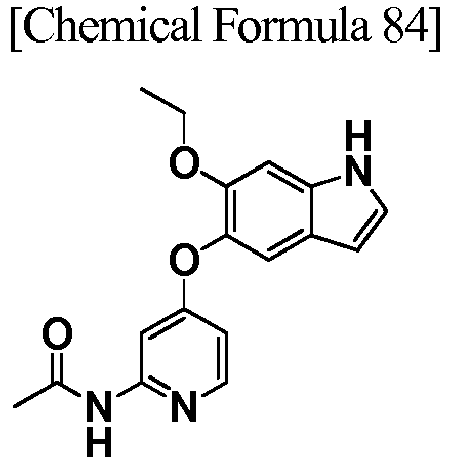
- 6-Ethoxy-1H-indol-5-ol described in Production Example 15-4 (7.0 g, 39.5 mmol) was dissolved in dimethylsulfoxide (40 mL) under nitrogen atmosphere, then N-(4-chloropyridin-2-yl)acetamide described in Production Example 1-5 (8.09 g, 47.4 mmol) and potassium tert-butoxide (4.88 g, 43.5 mmol) were added at room temperature, and the mixture was heated and stirred at 160°C for 4 hours. The reaction liquid was cooled to room temperature and water and ethyl acetate were added for partition. The aqueous layer was extracted with ethyl acetate and the combined organic layer was washed with water twice and then with a saturated saline solution. The organic layer was dried over anhydrous magnesium sulfate and then filtered, and the filtrate was concentrated under vacuum. The residue was dissolved in dichloromethane, and the resultant was purified with silica gel column chromatography (n-heptane:ethyl acetate = 3:1 - 2:1 - 3:2 - 1:3 - 1:4 - 0:1), and then the target fraction was concentrated under vacuum to obtain the title compound (7.16 g, 58%).
1H-NMR Spectrum (CDCl3) δ (ppm): 1.23 (3H, t, J = 7.0 Hz), 2.14 (3H, s), 4.02 (2H, q, J = 7.0 Hz), 6.46-6.49 (1H, m), 6.54 (1H, dd, J = 5.9, 2.2 Hz), 7.01 (1H, s), 7.13-7.16 (1H, m), 7.35 (1H, s), 7.74 (1H, brs), 7.87 (1H, brs), 8.02 (1H, d, J = 5.9 Hz), 8.10 (1H, brs). -

- N-(4-((6-ethoxy-1H-indol-5-yl)oxy)pyridin-2-yl)acetamide described in Production Example 15-5 (7.16 g, 23.0 mmol) was dissolved in methanol (50 mL), a 2 M sodium hydroxide solution (50 mL) was added under nitrogen atmosphere at room temperature, and the mixture was heated and stirred at 75°C for 2.5 hours. The reaction mixture was cooled to room temperature and then water and ethyl acetate were added for partition. The aqueous layer was extracted with ethyl acetate and the combined organic layer was washed with a saturated saline solution. The organic layer was dried over anhydrous magnesium sulfate, then the resultant was filtered and concentrated under vacuum. A liquid mixture of diethyl ether and ethyl acetate was added to the residue, and the mixture was collected by filteration and washed to obtain the title compound (5.35 g, 86%).
1H-NMR Spectrum (CDCl3) δ (ppm): 1.28 (3H, t, J = 7.0 Hz), 4.02 (2H, q, J = 7.0 Hz), 4.28 (2H, brs), 5.91 (1H, d, J = 2.2 Hz), 6.29 (1H, dd, J = 5.9, 2.2 Hz), 6.46-6.50 (1H, m), 7.00 (1H, s), 7.15-7.18 (1H, m), 7.33 (1H, s), 7.88 (1H, d, J = 5.9 Hz), 8.13 (1H, brs). -

- 4-((6-Ethoxy-1H-indol-5-yl)oxy)pyridin-2-amine described in Production Example 15-6 (6.44 g, 23.9 mmol) was dissolved in N,N-dimethylformamide (80 mL), 50 - 72% oily sodium hydride (1.41 g) was added under nitrogen atmosphere at 0°C, and the mixture was stirred at room temperature for 40 minutes. The mixture was cooled to 0°C again, phenyl methylcarbamate described in Production Example 1-7 (5.78 g, 38.3 mmol) was added, and the mixture was stirred at room temperature for 3 hours. A saturated aqueous ammonium chloride solution, water, and ethyl acetate were added to the reaction mixture for partition. The aqueous layer was extracted with ethyl acetate and the combined organic layer was washed with water twice and then with a saturated saline solution. The organic layer was dried over anhydrous magnesium sulfate and then filtered, then the filtrate was concentrated under vacuum. A liquid mixture of diethyl ether and ethyl acetate was added to the residue, then the precipitate was collected by filteration and the resultant was washed with ethyl acetate again to obtain the title compound (4.24 g, 54%). The filtrate was purified with NH silica gel column chromatography (ethyl acetate:methanol =1:0-9:1), the target fraction was concentrated under vacuum, and then the residue was collected by filteration and washed with a liquid mixture of diethyl ether and ethyl acetate to obtain the title compound (1.58 g, 20%).
1H-NMR Spectrum (CDCl3) δ (ppm): 1.29 (3H, t, J = 7.0 Hz), 3.07 (3H, d, J = 4.8 Hz), 4.09 (2H, q, J = 7.0 Hz), 4.29 (2H, brs), 5.42-5.51 (1H, m), 5.90 (1H, d, J = 2.2 Hz), 6.27 (1H, dd, J = 6.2, 2.2 Hz), 6.55 (1H, dd, J = 3.7, 0.7 Hz), 7.23 (1H, d, J = 3.7 Hz), 7.27 (1H, s), 7.89 (1H, d, J = 5.9 Hz), 7.98 (1H, s). -

- Benzotriazole (1.92 g, 16.1 mmol) was dissolved in dichloromethane (80 mL), thionyl chloride (1.15 mL, 15.8 mmol) was added under nitrogen atmosphere at room temperature, and the mixture was stirred for 5 minutes. 4-(1-(tert-Butoxycarbonyl)piperidin-4-yl)benzoic acid described in Production Example 1-12 (4.1 g, 13.4 mmol) was added to the reaction mixture at room temperature, and the mixture was stirred for 25 minutes. The reaction mixture was filtered through a glass filter entirely covered with anhydrous sodium sulfate and then the anhydrous sodium sulfate was washed with dichloromethane, the filtrate was added to a mixture of 5-((2-aminopyridin-4-yl)oxy)-6-ethoxy-N-methyl-1H-indole-1-carboxamide described in Production Example 15-7 (2 g, 6.13 mmol), triethylamine (8.5 mL, 61.3 mmol), and 4-dimethylaminopyridine (75 mg, 0.613 mmol) in tetrahydrofuran (40 mL) at 0°C. The mixture was stirred at room temperature for 14 hours, then water and ethyl acetate were added to the reaction mixture for partition. The organic layer was washed with a saturated saline solution, then the resultant was dried over anhydrous sodium sulfate and filtered. The filtrate was concentrated under vacuum, the residue was dissolved in tetrahydrofuran, an excessive quantity of 9.8 M methylamine methanol solution was added at room temperature, and the mixture was stirred for 5 hours. The reaction mixture was concentrated under vacuum, dichloromethane was added to the residue, and diethyl ether and ethyl acetate were further added, and then the product was collected by filteration and washed to obtain the title compound (3.08 g, 82%). The filtrate was concentrated under vacuum and the resultant was dissolved in dichloromethane and purified with NH silica gel column chromatography (n-heptane:ethyl acetate = 1:1 - 1:9). The target fraction was concentrated under vacuum to obtain the title compound (273 mg, 7.3%).
1H-NMR Spectrum (CDCl3) δ (ppm): 1.25 (3H, t, J = 7.0 Hz), 1.48 (9H, s), 1.50-1.70 (2H, m), 1.78-1.87 (2H, m), 2.64-2.87 (3H, m), 3.07 (3H, d, J = 4.8 Hz), 4.11 (2H, q, J = 7.0 Hz), 4.16-4.33 (2H, m), 5.45-5.52 (1H, m), 6.55 (1H, d, J = 3.6 Hz), 6.60 (1H, dd, J = 5.9,2.3 Hz), 7.23 (1H, d, J = 3.7 Hz), 7.28-7.33 (3H, m), 7.79-7.83 (2H, m), 7.92 (1H, d, J = 2.2 Hz), 8.00 (1H, s), 8.09 (1H, d, J = 5.9 Hz), 8.51 (1H, brs). -


- Sodium triacetoxyborohydride (1.36 g, 6.43 mmol) was added to a mixture of 6-ethoxy-N-methyl-5-((2-(4-(piperidin-4-yl)benzamide)pyridin-4-yl)oxy)-1H-indole-1-carbo xamide described in Example 15 (2.2 g, 4.28 mmol) and tetrahydrofuran (33 mL) at room temperature, then a tetrahydrofuran solution (11 mL) of commercially available acetaldehyde (283 mg, 6.43 mmol) was added, and then the mixture was stirred at room temperature for 1.5 hours. Ethyl acetate and a saturated aqueous sodium bicarbonate solution were added to the reaction mixture for partition. The organic layer was washed with a saturated saline solution, and then dried over anhydrous sodium sulfate and filtered. The solvent was evaporated, and the residue thus obtained was combined with the residue obtained from the similar starting material 6-ethoxy-N-methyl-5-((2-(4-(piperidin-4-yl)benzamide)pyridin-4-yl)oxy)-1H-indole-1-carbo xamide (200 mg, 0.389 mmol) by the similar method. Ethyl acetate was added to the combined residue and the product was collected by filteration to obtain the title compound (2.20 g, 87%).
1H-NMR Spectrum (CDCl3) δ (ppm): 1.15 (3H, t, J = 7.2 Hz), 1.25 (3H, t, J = 7.0 Hz), 1.82-1.92 (4H, m), 2.01-2.13 (2H, m), 2.43-2.62 (3H, m), 3.04 (3H, d, J = 4.6 Hz), 3.08-3.17 (2H, m), 4.10 (2H, q, J = 6.8 Hz), 5.55-5.62 (1H, m), 6.53 (1H, d, J = 3.7 Hz), 6.60 (1H, dd, J = 5.7,2.2 Hz), 7.23 (1H, d, J = 3.7 Hz), 7.30-7.35 (3H, m), 7.79 (2H, d, J = 8.2 Hz), 7.91 (1H, d, J = 2.2 Hz), 8.00 (1H, s), 8.09 (1H, d, J = 5.7 Hz), 8.53 (1H, brs). -

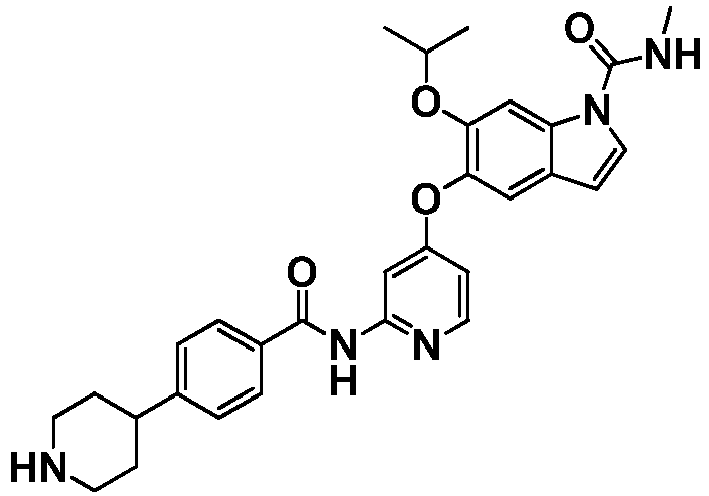
- Benzotriazole (88.7 mg, 0.745 mmol) was dissolved in dichloromethane (4.0 mL), thionyl chloride (52 µL, 0.707 mmol) was added under nitrogen atmosphere at room temperature, and the mixture was stirred for 5 minutes. 4-(1-(tert-Butoxycarbonyl)piperidin-4-yl)benzoic acid described in Production Example 1-12 (180 mg, 0.589 mmol) was added to the reaction mixture at room temperature, and the mixture was stirred for 55 minutes. The reaction mixture was filtered through a glass filter entirely covered with anhydrous sodium sulfate and then the anhydrous sodium sulfate was washed with dichloromethane, the filtrate was added to a mixture of 5-((2-aminopyridin-4-yl)oxy)-6-isopropoxy-N-methyl-1H-indole-1-carboxamide described in Production Example 17-7 (77 mg, 0.226 mmol), triethylamine (0.314 mL, 2.26 mmol), and 4-dimethylaminopyridine (2.76 mg, 0.023 mmol) in tetrahydrofuran (2.0 mL), dichloromethane (5.0 mL), and N,N-dimethylformamide (0.2 mL) at 0°C. The mixture was stirred at room temperature for 140 minutes, and then water and ethyl acetate were added to the reaction mixture for partition. The organic layer was washed with water and a saturated saline solution, dried over anhydrous sodium sulfate, and filtered. The filtrate was concentrated under vacuum, the residue was dissolved in tetrahydrofuran, an excessive quantity of methylamine tetrahydrofuran solution was added at room temperature, and the mixture was stirred for 30 minutes. The reaction mixture was concentrated under vacuum, the residue was dissolved in dichloromethane, and the resultant was purified with NH silica gel column chromatography (n-heptane:ethyl acetate = 1:1 - 1:3 - 0:1), and the target fraction was concentrated under vacuum to obtain a crude product (111 mg).
- The crude product (111 mg) was dissolved in dichloromethane (1.8 mL), and trifluoroacetic acid (0.65 mL) was added at 0°C. The mixture was stirred for 90 minutes at room temperature and then concentrated under vacuum, the residue was dissolved in dichloromethane-triethylamine, and then the resultant was purified with NH silica gel column chromatography (ethyl acetate:methanol = 1:0 - 17:3 - 4:1) to obtain the title compound (85.4 mg, 92%).
1H-NMR Spectrum (CDCl3) δ (ppm): 1.22 (6H, d, J = 6.0 Hz), 1.55-1.71 (2H, m), 1.79-1.88 (2H, m), 2.62-2.80 (3H, m), 3.05 (3H, d, J = 4.8 Hz), 3.15-3.25(2H, m), 4.52-4.64 (1H, m), 5.49-5.57 (1H, m), 6.54 (1H, d, J = 3.7 Hz), 6.58 (1H, dd, J = 5.7, 2.4 Hz), 7.24 (1H, d, J = 3.8 Hz), 7.29-7.35 (3H, m), 7.80 (2H, d, J = 8.2 Hz), 7.93 (1H, d, J = 2.4 Hz), 8.01 (1H, s), 8.08 (1H, d, J = 5.9 Hz), 8.51 (1H, brs). - The starting material 5-((2-aminopyridin-4-yl)oxy)-6-isopropoxy-N-methyl-1H-indole-1-carboxamide was synthesized by the following method.
-

- Commercially available 3,4-dihydroxybenzaldehyde (5 g, 36.2 mmol) and potassium carbonate (5.15 g, 37.3 mmol) were dissolved in N,N-dimethylformamide (20 mL), then 2-bromopropane (3.5 mL, 37.3 mmol) was added under nitrogen atmosphere at room temperature, and the mixture was heated and stirred at 40°C for 2.5 hours. The reaction mixture was cooled to 0°C, and then 2 M hydrochloric acid, ethyl acetate, and water were added for partition. The aqueous layer was extracted with ethyl acetate, the combined organic layer was washed with water and a saturated saline solution, and the resultant was dried over anhydrous magnesium sulfate and then filtered. The solvent was evaporated, dichloromethane was added to the residue, the precipitate was separated by filtration, and the filtrate was concentrated under vacuum. The residue was purified with silica gel column chromatography (n-heptane:ethyl acetate = 19:1 - 13:7) and then the target fraction was concentrated under vacuum to obtain the title compound (1.84 g, 28%).
1H-NMR Spectrum (CDCl3) δ (ppm): 1.42 (6H, d, J = 5.9 Hz), 4.73 (1H, spt, J = 6.1 Hz), 5.78 (1H, s), 6.95 (1H, d, J = 8.1 Hz), 7.41 (1H, dd, J = 8.2,2.0 Hz), 7.44 (1H, d, J = 1.8 Hz), 9.83 (1H, s). -

- Potassium carbonate (1.83 g, 13.2 mmol) and benzyl chloride (1.55 mL, 13.5 mmol) were added to a suspension of 3-hydroxy-4-isopropoxybenzaldehyde described in Production Example 17-1 (1.84 g, 10.2 mmol) in ethanol (20 mL) under nitrogen atmosphere at room temperature, and the mixture was heated and stirred at 90°C for 2 hours. The mixture was cooled to 0°C and then 2 M hydrochloric acid, ethyl acetate, and water were added for partition. The organic layer was washed with a saturated saline solution, and the resultant was dried over anhydrous sodium sulfate, and then filtered. The solvent was evaporated, the resultant residue was dissolved in dichloromethane, and the resultant was purified with silica gel column chromatography (n-heptane:ethyl acetate = 19:1 - 3:1). The target fraction was concentrated under vacuum to obtain the title compound (2.59 g, 94%).
1H-NMR Spectrum (CDCl3) δ (ppm): 1.42 (6H, d, J = 6.0 Hz), 4.69 (1H, spt, J = 6.1 Hz), 5.18 (2H, s), 7.00 (1H, d, J = 8.1 Hz), 7.29-7.41 (3H, m), 7.43-7.48 (4H, m), 9.81 (1H, s). -

- 3-(Benzyloxy)-4-isopropoxybenzaldehyde described in Production Example 17-2 (2.59 g, 9.59 mmol) was dissolved in acetic acid (7.5 mL), then ammonium acetate (887 mg, 11.5 mmol) and nitromethane (1.25 mL, 23.1 mmol) were added under nitrogen atmosphere at room temperature, and the mixture was heated and stirred at 130°C for 2 hours. The mixture was cooled to room temperature, and the precipitate was collected by filteration and washed with ethanol to obtain the title compound (2.20 g, 73%).
1H-NMR Spectrum (CDCl3) δ (ppm): 1.41 (6H, d, J = 6.2 Hz), 4.55-4.71 (1H, m), 5.15 (2H, s), 6.94 (1H, d, J = 8.4 Hz), 7.05 (1H, d, J = 1.8 Hz), 7.15 (1H, dd, J = 8.4,1.8 Hz), 7.29-7.48 (6H, m), 7.90 (1H, d, J = 13.5 Hz). -

- Fuming nitric acid (1.5 mL, 33.3 mmol) was slowly added to a mixture of (E)-2-(benzyloxy)-1-isopropoxy-4-(2-nitrovinyl)benzene described in Production Example 17-3 (2.20 g, 7.02 mmol) and acetic acid (20 mL) at room temperature, and the mixture was stirred for 7.5 hours. The reaction mixture was poured onto ice, the precipitate was collected by filteration, and then the resultant was washed with a liquid mixture of acetic acid and ethanol to obtain a crude product (2.28 g).
- The crude product (2.28 g) was suspended in methanol (60 mL), 10% palladium-carbon (water content, 50%) (677 mg) was added, and the mixture was stirred under hydrogen atmosphere for 14.5 hours. The catalyst was filtered off with celite, and the resultant was washed with methanol. The filtrate was concentrated under vacuum and purified with silica gel column chromatography (n-heptane:ethyl acetate = 9:1 - 3:2). The target fraction was concentrated under vacuum to obtain the title compound (475 mg, 35%). 1H-NMR Spectrum (CDCl3) δ (ppm): 1.40 (6H, d, J = 6.2 Hz), 4.57 (1H, spt, J = 6.1 Hz), 5.55 (1H, s), 6.38-6.44 (1H, m), 6.90 (1H, s), 7.08 (1H, t, J = 2.7 Hz), 7.13 (1H, s), 7.90 (1H, brs).
-

- 6-Isopropoxy-1H-indol-5-ol described in Production Example 17-4 (165 mg, 0.863 mmol) and N-(4-chloropyridin-2-yl)acetamide described in Production Example 1-5 (442 mg, 2.59 mmol) were dissolved in dimethylsulfoxide (2.0 mL) under nitrogen atmosphere, then potassium tert-butoxide (194 mg, 1.73 mmol) was added at room temperature, and the mixture was heated and stirred at 160°C for 3 hours. The reaction liquid was cooled to room temperature and water and ethyl acetate were added for partition. The aqueous layer was extracted with ethyl acetate and the combined organic layer was washed with water and a saturated saline solution. The organic layer was dried over anhydrous magnesium sulfate and then filtered, then the filtrate was concentrated under vacuum. The residue was dissolved in dichloromethane, the resultant was purified with NH silica gel column chromatography (n-heptane:ethyl acetate = 3:2 - 1:3), and then the target fraction was concentrated under vacuum to obtain the title compound (116 mg, 41%).
1H-NMR Spectrum (CDCl3) δ (ppm): 1.21 (6H, d, J = 6.2 Hz), 2.14 (3H, s), 4.34-4.48 (1H, m), 6.45-6.53 (2H, m), 7.03 (1H, s), 7.16 (1H, t, J = 2.7 Hz), 7.35 (1H, s), 7.77 (1H, brs), 7.85-8.05 (2H, m), 8.10 (1H, brs). -

- N-(4-((6-isopropoxy-1H-indol-5-yl)oxy)pyridin-2-yl)acetamide described in Production Example 17-5 (116 mg, 0.357 mmol) was dissolved in methanol (2.5 mL), 28% sodium methoxide (0.728 mL) was added under nitrogen atmosphere at room temperature, and the mixture was heated and stirred at 70°C for 3 hours. The reaction mixture was cooled to room temperature and then water and ethyl acetate were added for partition. The organic layer was washed with a saturated saline solution and then dried over anhydrous sodium sulfate. The drying agent was filtered off and the resultant was concentrated under vacuum. The residue was dissolved in dichloromethane and the resultant was purified with silica gel column chromatography (n-heptane:ethyl acetate = 3:7 - 0:1 - ethyl acetate:methanol = 99:1 - 9:1), then the target fraction was concentrated under vacuum to obtain the title compound (66.3 mg, 66%).
1H-NMR Spectrum (CDCl3) δ (ppm): 1.22 (6H, d, J = 5.9 Hz), 4.28 (2H, brs), 4.36-4.47 (1H, m), 5.89 (1H, d, J = 2.2 Hz), 6.29 (1H, dd, J = 5.9, 2.2 Hz), 6.46-6.51 (1H, m), 7.04 (1H, s), 7.18 (1H, t, J = 2.9 Hz), 7.34 (1H, s), 7.88 (1H, d, J = 5.9 Hz), 8.12 (1H, brs). -

- 4-((6-Isopropoxy-1H-indol-5-yl)oxy)pyridin-2-amine described in Production Example 17-6 (65.6 mg, 0.232 mmol) was dissolved in N,N-dimethylformamide (1.5 mL), 50 - 72% oily sodium hydride (16.7 mg) was added under nitrogen atmosphere at 0°C, and the mixture was stirred at room temperature for 50 minutes. The mixture was cooled to 0°C again, phenyl methylcarbamate described in Production Example 1-7 (69.2 mg, 0.458 mmol) was added, and the mixture was stirred at room temperature for 3 hours. A saturated aqueous ammonium chloride solution, water, and ethyl acetate were added to the reaction mixture for partition. The aqueous layer was extracted with ethyl acetate and the combined organic layer was washed with water and then with a saturated saline solution. The organic layer was dried over anhydrous magnesium sulfate and then filtered, then the filtrate was concentrated under vacuum. The residue was dissolved in dichloromethane and the resultant was purified with NH silica gel column chromatography (n-heptane:ethyl acetate = 3:7 - 0:1 - ethyl acetate:methanol = 99:1 - 19:1), then the target fraction was concentrated under vacuum to obtain the title compound (77.0 mg, 98%).
1H-NMR Spectrum (CDCl3) δ (ppm): 1.24 (6H, d, J = 6.0 Hz), 3.06 (3H, d, J = 4.8 Hz), 4.32 (2H, brs), 4.56 (1H, spt, J = 6.1 Hz), 5.50-5.61 (1H, m), 5.89 (1H, d, J = 2.2 Hz), 6.27 (1H, dd, J = 5.9, 2.2 Hz), 6.55 (1H, dd, J = 3.6, 0.6 Hz), 7.24-7.28 (2H, m), 7.88 (1H, d, J = 5.9 Hz), 8.00 (1H, s). -


- Commercially available (R)-(+)-propylene oxide (20.5 mg, 0.353 mmol) was added to a mixture of 6-isopropoxy-N-methyl-5-((2-(4-(piperidin-4-yl)benzamide)pyridin-4-yl) oxy)-1H-indole-1-carboxamide described in Example 17 (12.7 mg, 0.024 mmol) and ethanol (0.5 mL), and the mixture was heated and stirred with a sealed tube at 80°C for 3 hours and 40 minutes. The mixture was cooled to room temperature, then the reaction mixture was concentrated under vacuum, the resultant residue was dissolved in dichloromethane, and the resultant was purified with NH silica gel column chromatography (n-heptane:ethyl acetate = 1:4 - 0:1 - ethyl acetate:methanol = 99:1 - 19:1). The target fraction was concentrated under vacuum, and the precipitate was collected by filteration and washed with diethyl ether to obtain the title compound (8.28 mg, 59%).
1H-NMR Spectrum (CDCl3) δ (ppm): 1.15 (3H, d, J = 6.2 Hz), 1.22 (6H, d, J = 6.2 Hz), 1.70-1.90 (3H, m), 2.00-2.09 (1H, m), 2.21-2.46 (3H, m), 2.53-2.64 (1H, m), 2.92 (1H, d, J = 11.0 Hz), 3.07 (3H, d, J = 4.8 Hz), 3.14 (1H, d, J = 11.3 Hz), 3.80-3.91 (1H, m), 4.53-4.64 (1H, m), 5.44-5.52 (1H, m), 6.55 (1H, d, J = 3.3 Hz), 6.58 (1H, dd, J = 5.7,2.4 Hz), 7.25 (1H, d, J = 3.7 Hz), 7.30-7.36 (3H, m), 7.81 (2H, d, J = 8.4 Hz), 7.93 (1H, d, J = 2.2 Hz), 8.01 (1H, s), 8.09 (1H, d, J = 5.9 Hz), 8.49 (1H, s). -


- Triethylamine (17 µL, 0.123 mmol) and commercially available 4-(chloromethyl)benzoyl chloride (11.5 mg, 0.061 mmol) were added to a mixture of 5-((2-aminopyridin-4-yl)oxy)-6-(difluoromethoxy)-N-methyl-1H-indole-1-carboxamide described in Production Example 19-7 (4.3 mg, 0.012 mmol) and tetrahydrofuran (0.5 mL) under nitrogen atmosphere at room temperature. The mixture was stirred at room temperature for 2.5 hours and water and ethyl acetate were added to the reaction mixture for partition. The organic layer was washed with a saturated saline solution and then dried over anhydrous sodium sulfate and the resultant was filtered with NH silica gel (ethyl acetate) and concentrated under vacuum to obtain a crude product (6.18 mg).
- The crude product (6.18 mg) was dissolved in N,N-dimethylformamide (0.5 mL), commercially available 4-hydroxypiperidine (17.7 mg, 0.175 mmol) was added under nitrogen atmosphere at room temperature, and the mixture was stirred for 14 hours. Water and ethyl acetate were added to the reaction mixture for partition, and the organic layer was washed with a saturated saline solution, dried over anhydrous sodium sulfate, and filtered. The solvent was evaporated and the resultant residue was purified with NH silica gel TLC (ethyl acetate) to obtain the title compound (6.0 mg, 86%).
1H-NMR Spectrum (CDCl3) δ (ppm): 1.50-1.66 (2H, m), 1.83-1.94 (2H, m), 2.16 (2H, t, J = 9.7 Hz), 2.67-2.78 (2H, m), 3.08 (3H, d, J = 4.4 Hz), 3.54 (2H, s), 3.62-3.77 (2H, m), 5.46-5.57 (1H, m), 6.53 (1H, t, J = 73.9 Hz), 6.61 (1H, d, J = 3.7 Hz), 6.64 (1H, dd, J = 5.7, 2.4 Hz), 7.38-7.46 (4H, m), 7.80 (2H, d, J = 8.1 Hz), 7.91 (1H, d, J = 2.2 Hz), 8.15 (1H, d, J = 5.9 Hz), 8.24 (1H, s), 8.53 (1H, brs). - The starting material 5-((2-aminopyridin-4-yl)oxy)-6-(difluoromethoxy)-N-methyl-1H-indole-1-carboxamide was synthesized by the following method.
-


- Commercially available 3,4-dihydroxybenzaldehyde (5 g, 36.2 mmol) and commercially available sodium chlorodifluoroacetate (5.57 g, 36.5 mmol) were dissolved in N,N-dimethylformamide (45 mL) and water (905 µL), and then sodium hydroxide (1.48 g, 37.0 mmol) was added at room temperature, and the mixture was heated and stirred at 120°C for 2 hours. The solvent was evaporated under vacuum, the residue was cooled to 0°C, and 5 M hydrochloric acid and diethyl ether were added for partition. The organic layer was washed with water and a saturated saline solution, and then the solvent was evaporated. The residue was dissolved in dichloromethane and the resultant was purified with silica gel column chromatography (n-heptane:ethyl acetate = 9:1 - 7:3), and then the target fraction was concentrated under vacuum to obtain the title compound (2.66 g, 39%).
1H-NMR Spectrum (CDCl3) δ (ppm): 5.69-5.74 (1H, m), 6.65 (1H, t, J = 72.5 Hz), 7.23-7.31 (1H, m), 7.46 (1H, dd, J = 8.4, 1.8 Hz), 7.54 (1H, d, J = 1.8 Hz), 9.92 (1H, s). -

- Potassium carbonate (3.91 g, 28.3 mmol) and benzyl bromide (2.5 mL, 21.1 mmol) were added to a solution of 4-(difluoromethoxy)-3-hydroxybenzaldehyde described in Production Example 19-1 (2.66 g, 14.2 mmol) in acetonitrile (50 mL) at room temperature, and the mixture was stirred at room temperature for 3 hours. The reaction mixture was filtered and then the solvent was evaporated. The resultant residue was purified with silica gel column chromatography (n-heptane:ethyl acetate = 9:1 - 3:2). The target fraction was concentrated under vacuum and then the title compound was quantitatively obtained.
1H-NMR Spectrum (CDCl3) δ (ppm): 5.21 (2H, s), 6.68 (1H, t, J = 74.3 Hz), 7.31-7.51 (7H, m), 7.57 (1H, d, J = 1.8 Hz), 9.92 (1H, s). -

- 3-(Benzyloxy)-4-(difluoromethoxy)benzaldehyde described in Production Example 19-2 (3.94 g, 14.2 mmol) was dissolved in acetic acid (11 mL), then ammonium acetate (1.27 g, 16.4 mmol) and nitromethane (1.9 mL, 35.1 mmol) were added under nitrogen atmosphere at room temperature, and the mixture was heated and stirred at 130°C for 2 hours. The mixture was cooled to room temperature and then heated and stirred at 130°C again for 1 hour. The precipitate was collected by filteration and washed with a liquid mixture of acetic acid and ethanol to obtain the title compound (2.36 g, 52%). The filtrate was dissolved in dichloromethane and the resultant was purified with silica gel column chromatography (n-heptane:ethyl acetate = 19:1 - 4:1), and then the target fraction was concentrated under vacuum. The precipitate was washed with ethanol to obtain the title compound (406 mg, 8.9%).
1H-NMR Spectrum (CDCl3) δ (ppm): 5.18 (2H, s), 6.65 (1H, t, J = 74.3 Hz), 7.12-7.19 (2H, m), 7.21-7.29 (1H, m), 7.32-7.45 (5H, m), 7.48 (1H, d, J = 13.9 Hz), 7.92 (1H, d, J = 13.9 Hz). -

- Fuming nitric acid (6.0 mL, 133 mmol) was slowly added to a mixture of (E)-2-(benzyloxy)-1-(difluoromethoxy)-4-(2-nitrovinyl)benzene described in Production Example 19-3 (2.77 g, 8.61 mmol) and acetic acid (36 mL) in an ice bath, and the mixture was stirred for 7.5 hours. A part of the reaction mixture was heated and stirred at 50°C for 30 minutes, then at 70°C for 40 minutes, and then at 75°C for 165 minutes. A part of the reaction mixture was poured onto ice and the resultant was diluted with ethyl acetate for partition. The organic layer was washed with water and a saturated saline solution and dried over anhydrous magnesium sulfate, and then the solvent was evaporated. The residue was dissolved in dichloromethane and the resultant was purified with silica gel column chromatography (n-heptane:ethyl acetate = 17:3 - 3:1), then the target fraction was concentrated under vacuum, and then the residue was collected by filteration and washed with diethyl ether to obtain a crude product A (23.6 mg). The remaining reaction mixture was heated and stirred at 65°C for 3 hours, then the resultant was poured onto ice, and then the precipitate was collected by filteration and washed with a liquid mixture of acetic acid and ethanol to obtain a crude product B (603 mg). Ethyl acetate was added to the filtrate for partition. The organic layer was washed with water and a saturated saline solution, dried over anhydrous magnesium sulfate, and filtered, and then the solvent was evaporated. The residue was dissolved in dichloromethane and the resultant was purified with silica gel column chromatography (n-heptane:ethyl acetate = 9:1 - 3:1), then the target fraction was concentrated under vacuum, diethyl ether was added to the residue, and the precipitate was collected by filteration to obtain a crude product C (73.3 mg).
- The crude products A, B, and C (550 mg) were suspended in ethanol (5.5 mL), acetic acid (5.5 mL), and water (676 µL), then iron powder (419 mg, 7.51 mmol) was added under nitrogen atmosphere, and the mixture was heated and stirred at 70°C for 1 hour. The reaction mixture was cooled to room temperature and ethyl acetate and an aqueous sodium disulfite solution were added for partition. The organic layer was washed with water and a saturated saline solution, dried over anhydrous magnesium sulfate, and filtered, and then the solvent was evaporated. The residue was dissolved in dichloromethane and the resultant was purified with NH silica gel column chromatography (n-heptane:ethyl acetate = 9:1 - 3:2), and then the target fraction was concentrated under vacuum to obtain the title compound (245 mg, 13%).
1H-NMR Spectrum (CDCl3) δ (ppm): 5.15 (2H, s), 6.45-6.49 (1H, m), 6.58 (1H, t, J = 76.0 Hz), 7.19-7.22 (1H, m), 7.23 (1H, s), 7.24-7.27(1H, m), 7.29-7.43 (3H, m), 7.44-7.50 (2H, m), 8.12 (1H, brs). -

- 5-(Benzyloxy)-6-(difluoromethoxy)-1H-indole described in Production Example 19-4 (245 mg, 0.847 mmol) was dissolved in ethanol (8.0 mL), then 10% palladium-carbon (water content, 50%) (90 mg) was added at room temperature, and the mixture was stirred under hydrogen atmosphere for 75 minutes. The reaction mixture was diluted with ethyl acetate and the catalyst was filtered off with celite. The filtrate was concentrated under vacuum and then filtered with silica gel (ethyl acetate). The target fraction was concentrated under vacuum to quantitatively obtain the title compound.
1H-NMR Spectrum (CDCl3) δ (ppm): 5.15 (1H, s), 6.41-6.49 (1H, m), 6.53 (1H, t, J = 74.1 Hz), 7.15-7.24 (3H, m), 8.06 (1H, brs). -

- 6-(Difluoromethoxy)-1H-indol-5-ol described in Production Example 19-5 (35.1 mg, 0.176 mmol), N-(4-chloropyridin-2-yl)acetamide described in Production Example 1-5 (89.0 mg, 0.522 mmol), and potassium tert-butoxide (44.0 mg, 0.392 mmol) were dissolved in dimethylsulfoxide (500 µL) under nitrogen atmosphere, and the mixture was heated and stirred at 160°C for 80 minutes. The reaction liquid was cooled to room temperature and water and ethyl acetate were added for partition. The organic layer was washed with a saturated saline solution, dried over anhydrous sodium sulfate, and then filtered, and then the filtrate was concentrated under vacuum. The residue was dissolved in dichloromethane and the resultant was purified with NH silica gel column chromatography (n-heptane:ethyl acetate = 1:1 - 0:1 - ethyl acetate:methanol = 99:1 - 9:1), then the target fraction was concentrated under vacuum to obtain a crude product (12.5 mg).
- The crude product (12.5 mg) was dissolved in methanol (500 µL), 28% sodium methoxide (39 µL, 0.382 mmol) was added under nitrogen atmosphere at room temperature, and the mixture was heated and stirred at 65 °C for 1 hour. The mixture was cooled to room temperature, 28% sodium methoxide (39 µL, 0.382 mmol) was added, and the mixture was heated and stirred at 65 °C for 2.5 hours. Water and ethyl acetate were added to the reaction mixture for partition. The organic layer was washed with a saturated saline solution and then dried over anhydrous sodium sulfate. The drying agent was filtered off and the resultant was concentrated under vacuum. The residue was dissolved in dichloromethane and the resultant was purified with NH silica gel column chromatography (n-heptane:ethyl acetate = 1:1 - 0:1 - ethyl acetate:methanol = 97:3 - 9:1), and then the target fraction was concentrated under vacuum to obtain the title compound (4.4 mg, 8.6%).
1H-NMR Spectrum (CDCl3) δ (ppm): 4.48 (2H, brs), 5.91 (1H, d, J = 1.8 Hz), 6.28 (1H, dd, J = 5.9, 1.8 Hz), 6.45 (1H, t, J = 74.5 Hz), 6.52-6.58 (1H, m), 7.30 (1H, t, J = 2.9 Hz), 7.36 (1H, s), 7.41 (1H, s), 7.90 (1H, d, J = 5.9 Hz), 8.35 (1H, brs). -

- 4-((6-(Difluoromethoxy)-1H-indol-5-yl)oxy)pyridin-2-amine described in Production Example 19-6 (4.4 mg, 0.015 mmol) was dissolved in N,N-dimethylformamide (500 µL), then 50 - 72% oily sodium hydride (4.1 mg) was added under nitrogen atmosphere at 0°C, and the mixture was stirred at room temperature for 30 minutes. The mixture was cooled to 0°C again and phenyl methylcarbamate described in Production Example 1-7 (16.4 mg, 0.108 mmol) was added, and the mixture was stirred at room temperature for 50 minutes. Water and ethyl acetate were added to the reaction mixture for partition. The organic layer was washed with a saturated saline solution, then dried over anhydrous sodium sulfate and filtered, and then the filtrate was concentrated under vacuum. The residue was dissolved in dichloromethane and the resultant was purified with NH silica gel column chromatography (n-heptane:ethyl acetate = 1:1 - 0:1 - ethyl acetate:methanol = 99:1 - 9:1), and then the target fraction was concentrated under vacuum to obtain the title compound (4.3 mg, 82%).
1H-NMR Spectrum (CDCl3) δ (ppm): 3.08 (3H, d, J = 4.8 Hz), 4.44 (2H, brs), 5.49 (1H, brs), 5.91 (1H, d, J = 1.8 Hz), 6.26 (1H, dd, J = 6.2,2.2 Hz), 6.50 (1H, t, J = 74.0 Hz), 6.61 (1H, d, J = 3.7 Hz), 7.35 (1H, s), 7.41 (1H, d, J = 3.7 Hz), 7.92 (1H, d, J = 5.9 Hz), 8.23 (1H, s). -

- Benzotriazole (609 mg, 5.11 mmol) was dissolved in dichloromethane (25 mL), thionyl chloride (373 µL, 5.11 mmol) was added under nitrogen atmosphere at room temperature, and the mixture was stirred for 5 minutes. 4-(1-(tert-Butoxycarbonyl)piperidin-4-yl)benzoic acid described in Production Example 1-12 (1.3 g, 4.26 mmol) was added to the reaction mixture at room temperature, and the mixture was stirred for 30 minutes. The reaction mixture was filtered through a glass filter entirely covered with anhydrous sodium sulfate and the anhydrous sodium sulfate was washed with dichloromethane, the filtrate was added to a mixture of 5-((2-aminopyridin-4-yl)oxy)-6-(2-methoxyethoxy)-N-methyl-1H-indole-1-carboxamide described in Production Example 20-7 (0.95 g, 2.67 mmol), triethylamine (1.86 mL, 13.3 mmol), and 4-dimethylaminopyridine (16 mg, 0.133 mmol) in N,N-dimethylformamide (3 mL) and dichloromethane (20 mL) at 0°C over 5 minutes, and the mixture was rinsed with dichloromethane (10 mL) and then stirred at the same temperature for 5 minutes. The mixture was stirred at room temperature for 2 hours, then a 40% aqueous methylamine solution (2.3 mL, 26.7 mmol) was added, and then the mixture was stirred at room temperature for 1.5 hours. A saturated aqueous sodium bicarbonate solution was added to the reaction mixture for partition and the aqueous layer was extracted with ethyl acetate three times. The combined organic layer was dried over anhydrous sodium sulfate. The drying agent was filtered off, then the filtrate was concentrated under vacuum and the resultant was purified with silica gel column chromatography (n-heptane:ethyl acetate = 1:1 - 0:1 - ethyl acetate:methanol = 49:1 - 23:2) to obtain a crude product (1.11 g).
- The crude product (1.11 g) was dissolved in dichloromethane (50 mL) and trifluoroacetic acid (5.0 mL) was added at room temperature. The mixture was stirred at room temperature for 30 minutes, then the resultant was concentrated under vacuum, and then the residue was dissolved in dichloromethane and triethylamine and the resultant was concentrated under vacuum. The residue was purified with NH silica gel column chromatography (ethyl acetate:methanol = 1:0 - 22:3) to obtain the title compound (829 mg, 57%).
1H-NMR Spectrum (500MHz, CDCl3) δ (ppm): 1.59-1.69 (2H, m), 1.83 (2H, d, J = 14.1 Hz), 2.68 (1H, tt, J = 12.0, 3.6 Hz), 2.75 (2H, td, J = 12.2, 2.4 Hz), 3.04 (3H, d, J = 4.9 Hz), 3.17-3.23 (2H, m), 3.26 (3H, s), 3.55-3.61 (2H, m), 4.15-4.21 (2H, m), 5.57-5.65 (1H, m), 6.53 (1H, d, J = 3.4 Hz), 6.62 (1H, dd, J = 5.8, 2.4 Hz), 7.25 (1H, d, J = 3.9 Hz), 7.30-7.34 (3H, m), 7.77-7.82 (2H, m), 7.91 (1H, d, J = 2.4 Hz), 8.02 (1H, s), 8.10 (1H, d, J = 5.9 Hz), 8.50 (1H, brs). - The starting material 5-((2-aminopyridin-4-yl)oxy)-6-(2-methoxyethoxy)-N-methyl-1H-indole-1-carboxamide was synthesized by the following method.
-

- Commercially available 3,4-dihydroxybenzaldehyde (39.3 g, 285 mmol) and sodium carbonate (45.2 g, 427 mmol) were dissolved in N,N-dimethylformamide (400 mL), then commercially available 2-bromoethyl methyl ether (26.7 mL, 285 mmol) was added under nitrogen atmosphere at room temperature, and the mixture was stirred for 5 days. The mixture was cooled to 0°C and then 2 M hydrochloric acid, ethyl acetate, and water were added for partition. The aqueous layer was extracted with ethyl acetate, then the combined organic layer was washed with a saturated saline solution and dried over anhydrous magnesium sulfate, and then filtered. The solvent was evaporated, dichloromethane was added, the precipitate was separated by filtration, and then the resultant filtrate was purified with silica gel column chromatography (n-heptane:ethyl acetate = 17:3 - 1:1). The target fraction was concentrated under vacuum to obtain the title compound (12.9 g, 23%).
1H-NMR Spectrum (CDCl3) δ (ppm): 3.47 (3H, s), 3.76-3.80 (2H, m), 4.25-4.29 (2H, m), 6.40 (1H, brs), 7.01 (1H, d, J = 8.4 Hz), 7.41 (1H, dd, J = 8.2, 2.0 Hz), 7.45 (1H, d, J = 1.8 Hz), 9.85 (1H, s). -

- Potassium carbonate (11.8 g, 85.7 mmol) and benzyl chloride (10 mL, 86.9 mmol) were added to a liquid mixture of 3-hydroxy-4-(2-methoxyethoxy)benzaldehyde described in Production Example 20-1 (12.9 g, 65.9 mmol) in ethanol (130 mL) under nitrogen atmosphere at room temperature, and the mixture was heated and stirred at 90°C for 2 hours. The mixture was cooled to 0°C and then 2 M hydrochloric acid, ethyl acetate, and water were added for partition. The organic layer was washed with a saturated saline solution, dried over anhydrous magnesium sulfate, and then filtered. The solvent was evaporated and the resultant residue was purified with silica gel column chromatography (n-heptane:ethyl acetate = 9:1 - 1:1). The target fraction was concentrated under vacuum to obtain the title compound (17.6 g, 93%).
1H-NMR Spectrum (CDCl3) δ (ppm): 3.46 (3H, s), 3.79-3.85 (2H, m), 4.24-4.30 (2H, m), 5.18 (2H, s), 7.03 (1H, d, J = 8.1 Hz), 7.29-7.35 (1H, m), 7.35-7.41 (2H, m), 7.43-7.50 (4H, m), 9.82 (1H, s). -


- 3-(Benzyloxy)-4-(2-methoxyethoxy)benzaldehyde described in Production Example 20-2 (17.6 g, 61.5 mmol) was dissolved in acetic acid (49.3 mL), then ammonium acetate (5.69 g, 73.8 mmol) and nitromethane (8.32 mL, 154 mmol) were added under nitrogen atmosphere at room temperature, and the mixture was heated and stirred at 130°C for 2 hours. The mixture was cooled to room temperature and then the precipitate was collected by filteration and washed with ethanol to quantitatively obtain the title compound.
1H-NMR Spectrum (CDCl3) δ (ppm): 3.46 (3H, s), 3.78-3.84 (2H, m), 4.21-4.27 (2H, m), 5.16 (2H, s), 6.97 (1H, d, J = 8.4 Hz), 7.06 (1H, d, J = 1.8 Hz), 7.16 (1H, dd, J = 8.4,2.2 Hz), 7.30-7.48 (6H, m), 7.91 (1H, d, J = 13.5 Hz). -

- 69% Nitric acid (15 mL, 233 mmol) was added to a mixture of (E)-2-(benzyloxy)-1-(2-methoxyethoxy)-4-(2-nitrovinyl)benzene described in Production Example 20-3 (20.2 g, 61.5 mmol) and acetic acid (120 mL) at 25°C, and the mixture was stirred at room temperature for 6 hours. The reaction mixture was poured onto ice, and the precipitate was collected by filteration and then washed with water to obtain a crude product (23.0 g).
- The crude product (23.0 g) was suspended in methanol (500 mL), then 10% palladium-carbon (water content, 50%) (8 g) was added at room temperature, and the mixture was stirred under hydrogen atmosphere for 6 hours. The catalyst was filtered off with celite, the filtrate was concentrated under vacuum, and the resultant was purified with silica gel column chromatography (n-heptane:ethyl acetate = 2:1 - 1:1). The target fraction was concentrated under vacuum to obtain the title compound (3.94 g, 31%).
1H-NMR Spectrum (CDCl3) δ (ppm): 3.48 (3H, s), 3.69-3.78 (2H, m), 4.16-4.23 (2H, m), 6.24 (1H, s), 6.41 (1H, ddd, J = 3.1, 2.1, 0.8 Hz), 6.97 (1H, s), 7.10 (1H, dd, J = 3.2, 2.5 Hz), 7.15 (1H, s), 7.94 (1H, brs). -

- 6-(2-Methoxyethoxy)-1H-indol-5-ol described in Production Example 20-4 (3.94 g, 19.0 mmol) and N-(4-chloropyridin-2-yl)acetamide described in Production Example 1-5 (3.25 g, 19.0 mmol) were dissolved in dimethylsulfoxide (25 mL), then 97% potassium tert-butoxide (2.20 g, 19.0 mmol) was added at room temperature, and the mixture was heated and stirred at 150°C for 13 hours. Water and ethyl acetate were added to the reaction liquid at room temperature for partition. The aqueous layer was extracted with ethyl acetate three times and the combined organic layer was washed with water. The organic layer was dried over anhydrous sodium sulfate. The drying agent was filtered off and the filtrate was concentrated under vacuum, and then the resultant was purified with NH silica gel column chromatography (n-heptane:ethyl acetate = 2:3 - 0:1 - ethyl acetate:methanol = 49:1 - 9:1). The target fraction was concentrated under vacuum to obtain the title compound (3.45 g, 53%).
1H-NMR Spectrum (500MHz, CDCl3) δ (ppm): 2.13 (3H, s), 3.27 (3H, s), 3.54-3.58 (2H, m), 4.07-4.11 (2H, m), 6.46-6.50 (1H, m), 6.54 (1H, dd, J = 5.8,1.9 Hz), 7.05 (1H, s), 7.14-7.17 (1H, m), 7.36 (1H, s), 7.75 (1H, brs), 8.02 (1H, d, J = 5.8 Hz), 8.10 (1H, brs), 8.19 (1H, brs). -

- N-(4-((6-(2-methoxyethoxy)-1H-indol-5-yl)oxy)pyridin-2-yl)acetamide described in Production Example 20-5 (3.45 g, 10.1 mmol) was dissolved in methanol (50 mL), a 2 M sodium hydroxide solution (50 mL) was added at room temperature, and the mixture was heated and stirred at 70°C for 3 hours. Water and ethyl acetate were added to the reaction mixture for partition. The aqueous layer was extracted with ethyl acetate three times and the combined organic layer was dried over anhydrous sodium sulfate. The drying agent was filtered off and the filtrate was concentrated under vacuum and the resultant was purified with NH silica gel column chromatography (n-heptane:ethyl acetate = 3:7 - 0:1 - ethyl acetate:methanol = 49:1 - 24:1). The target fraction and the mixture fraction were concentrated under vacuum separately from each other, the mixture fraction was purified again with silica gel column chromatography (ethyl acetate:methanol = 1:0 - 9:1), and then the resultant was combined with the above-described target fraction to obtain the title compound (2.60 g, 86%).
1H-NMR Spectrum (500MHz, CDCl3) δ (ppm): 3.31 (3H, s), 3.58-3.63 (2H, m), 4.08-4.11 (2H, m), 4.28 (2H, brs), 5.90 (1H, d, J = 2.4 Hz), 6.29 (1H, dd, J = 6.1, 2.2 Hz), 6.44-6.52 (1H, m), 7.06 (1H, s), 7.15-7.20 (1H, m), 7.34 (1H, s), 7.88 (1H, d, J = 5.8 Hz), 8.22 (1H, brs). -

- 4-((6-(2-Methoxyethoxy)-1H-indol-5-yl)oxy)pyridin-2-amine described in Production Example 20-6 (2.60 g, 8.67 mmol) was dissolved in N,N-dimethylformamide (50 mL), then 50 - 72% oily sodium hydride (499 mg) was added under nitrogen atmosphere at room temperature. Phenyl methylcarbamate described in Production Example 1-7 (1.97 g, 13.0 mmol) was added, and the mixture was stirred at room temperature for 1 hour. The reaction mixture was cooled to 0°C and ethyl acetate and water were added for partition. The aqueous layer was extracted with ethyl acetate twice, sodium chloride was added to the aqueous layer, and the resultant was extracted with ethyl acetate three times. The combined organic layer was dried over anhydrous sodium sulfate. The drying agent was filtered off and the filtrate was concentrated under vacuum, and then the resultant was purified with NH silica gel column chromatography (n-heptane:ethyl acetate = 1:4 - 0:1 - ethyl acetate:methanol = 49:1 - 24:1). The target fraction was concentrated under vacuum, and ethyl acetate was added and the precipitate was collected by filteration and washed to obtain the title compound (2.23 g, 72%).
1H-NMR Spectrum (500MHz, CDCl3) δ (ppm): 3.06 (3H, d, J = 4.9 Hz), 3.29 (3H, s), 3.59-3.63 (2H, m), 4.14-4.17 (2H, m), 4.30 (2H, brs), 5.52-5.59 (1H, m), 5.89 (1H, d, J = 2.4 Hz), 6.27 (1H, dd, J = 5.8, 1.9 Hz), 6.55 (1H, d, J = 3.9 Hz), 7.27-7.29 (2H, m), 7.89 (1H, d, J = 5.9 Hz), 7.99 (1H, s). -

- A 35% aqueous formaldehyde solution (186 µL, 2.36 mmol) and sodium triacetoxyborohydride (200 mg, 0.946 mmol) were added to a mixture of 6-(2-methoxyethoxy)-N-methyl-5-((2-(4-(piperidin-4-yl)benzamide)pyridin-4-yl)oxy)-1H-in dole-1-carboxamide described in Example 20 (257 mg, 0.473 mmol) and tetrahydrofuran (30 mL) at room temperature, and the mixture was stirred at room temperature for 3 minutes. Acetic acid (54 µL, 0.946 mmol) was added to the reaction mixture, and the mixture was stirred at room temperature for 3 hours. A saturated aqueous sodium bicarbonate solution and ethyl acetate were added to the reaction mixture for partition. The aqueous layer was extracted with ethyl acetate three times, and the combined organic layer was dried over anhydrous sodium sulfate and filtered. The solvent was evaporated and the resultant residue was purified with NH silica gel column chromatography (ethyl acetate:methanol = 1:0 - 23:2). The target fraction was concentrated under vacuum to quantitatively obtain the title compound.
1H-NMR Spectrum (500MHz, CDCl3) δ (ppm): 1.75-1.88 (4H, m), 2.02-2.11 (2H, m), 2.33 (3H, s), 2.49-2.59 (1H, m), 2.99 (2H, d, J = 11.2 Hz), 3.05 (3H, d, J = 4.9 Hz), 3.26 (3H, s), 3.56-3.60 (2H, m), 4.15-4.21 (2H, m), 5.52-5.58 (1H, m), 6.54 (1H, d, J = 3.9 Hz), 6.61 (1H, dd, J = 5.8,2.4 Hz), 7.25-7.27 (1H, m), 7.30-7.34 (3H, m), 7.79 (2H, d, J = 8.3 Hz), 7.91 (1H, d, J = 2.4 Hz), 8.01 (1H, s), 8.09 (1H, d, J = 5.8 Hz), 8.48 (1H, brs). -

- Sodium triacetoxyborohydride (286 mg, 1.35 mmol) and commercially available 2-hydroxyacetaldehyde (86.1 mg, 1.43 mmol) were added to a mixture of 6-(2-methoxyethoxy)-N-methyl-5-((2-(4-(piperidin-4-yl)benzamide)pyridin-4-yl)oxy)-1H-in dole-1-carboxamide described in Example 20 (250 mg, 0.46 mmol) and tetrahydrofuran (10 mL) at room temperature, and the mixture was stirred at room temperature for 3 hours and 45 minutes. A saturated aqueous sodium bicarbonate solution and ethyl acetate were added to the reaction mixture for partition. The aqueous layer was extracted with ethyl acetate, and the combined organic layer was washed with a saturated saline solution, then dried over anhydrous sodium sulfate, and then filtered. The solvent was evaporated and the resultant residue was purified with NH silica gel column chromatography (ethyl acetate:methanol = 1:0 - 97:3 - 9:1). The target fraction was concentrated under vacuum, then the precipitate was collected by filteration and washed with a liquid mixture of diethyl ether and n-hexane to obtain the title compound (236 mg, 87%).
1H-NMR Spectrum (CDCl3) δ (ppm): 1.70-1.92 (4H, m), 2.14-2.25 (2H, m), 2.53-2.64 (3H, m), 3.01-3.08 (5H, m), 3.26 (3H, s), 3.56-3.60 (2H, m), 3.63 (2H, t, J = 5.4 Hz), 4.15-4.20 (2H, m), 5.50-5.59 (1H, m), 6.54 (1H, d, J = 3.7 Hz), 6.61 (1H, dd, J = 5.7,2.4 Hz), 7.24-7.28 (1H, m), 7.30-7.35 (3H, m), 7.80 (2H, d, J = 8.4 Hz), 7.91 (1H, d, J = 2.2 Hz), 8.01 (1H, s), 8.09 (1H, d, J = 5.9 Hz), 8.50 (1H, brs). -

- Acetone (54 µL, 0.736 mmol), sodium triacetoxyborohydride (62.4 mg, 0.294 mmol), and acetic acid (17 µL, 0.294 mmol) were added to a solution of 6-(2-methoxyethoxy)-N-methyl-5-((2-(4-(piperidin-4-yl)benzamide)pyridin-4-yl)oxy)-1H-in dole-1-carboxamide described in Example 20 (20 mg, 0.037 mmol) in tetrahydrofuran (3 mL) at room temperature. The reaction liquid was stirred at the same temperature overnight. A saturated aqueous sodium bicarbonate solution and ethyl acetate were added to the reaction liquid at room temperature for partition. The organic layer was washed with a saturated saline solution and then dried over anhydrous sodium sulfate. The drying agent was separated by filtration and then the resultant was concentrated under vacuum. The residue was purified with NH silica gel column chromatography (ethyl acetate) to obtain the title compound (6.6 mg, 31%).
1H-NMR Spectrum (DMSO-d6) δ (ppm): 0.99 (6H, d, J = 6.6 Hz), 1.54-1.68 (2H, m), 1.70-1.81 (2H, m), 2.16-2.26 (2H, m), 2.44-2.57 (1H, m), 2.66-2.76 (1H, m), 2.82-2.91 (5H, m), 3.12 (3H, s), 3.45-3.52 (2H, m), 4.05-4.13 (2H, m), 6.63 (1H, d, J = 3.7 Hz), 6.67 (1H, dd, J = 5.7,2.4 Hz), 7.33 (2H, d, J = 8.4 Hz), 7.45 (1H, s), 7.69 (1H, d, J = 2.6 Hz), 7.78 (1H, d, J = 4.0 Hz), 7.89 (2H, d, J = 8.4 Hz), 8.08 (1H, s), 8.14-8.21 (2H, m), 10.64 (1H, s). -


- Trifluoroacetic acid (1.79 mL, 23.2 mmol) was added to a solution of tert-butyl 4-(4-((4-((6-(2-ethoxyethoxy)-1-(methylcarbamoyl)-1H-indol-5-yloxy)pyridin-2-yl)carbam oyl)phenyl)piperidine-1-carboxylate described in Production Example 24-9 (382 mg, 0.581 mmol) in dichloromethane (10 mL) at room temperature. The reaction liquid was stirred at the same temperature for 1 hour. The reaction liquid was concentrated under vacuum, and trifluoroacetic acid was removed. The residue was diluted with dichloromethane and then triethylamine was added to neutralize the trifluoroacetic acid. The solution was concentrated under vacuum and then the residue was purified with NH silica gel column chromatography (ethyl acetate:methanol = 49:1 - 17:3) to obtain the title compound (276 mg, 85%).
1H-NMR Spectrum (DMSO-d6) δ (ppm): 0.94 (3H, t, J = 7.0 Hz), 1.44-1.57 (2H, m), 1.63-1.72 (2H, m), 2.47-2.69 (3H, m), 2.85 (3H, d, J = 4.4 Hz), 2.97-3.05 (2H, m), 3.29 (2H, q, J = 7.0 Hz), 3.47-3.58 (2H, m), 4.04-4.13 (2H, m), 6.57-6.73 (2H, m), 7.31 (2H, d, J = 8.1 Hz), 7.45 (1H, s), 7.70 (1H, d, J = 2.2 Hz), 7.78 (1H, d, J = 3.7 Hz), 7.90 (2H, d, J = 8.8 Hz), 8.08 (1H, s), 8.13-8.24 (2H, m), 10.64(1H, s). - The starting material tert-butyl 4-(4-((4-((6-(2-ethoxyethoxy)-1-(methylcarbamoyl)-1H-indol-5-yloxy)pyridin-2-yl)carbam oyl)phenyl)piperidine-1-carboxylate was synthesized by the following method.
-

- Commercially available 2-bromoethyl ethyl ether (33.8 g, 221 mmol) was added to a solution of commercially available 3,4-dihydroxybenzaldehyde (30.5 g, 221 mmol) and sodium carbonate (35.1 g, 331 mmol) in N,N-dimethylformamide (310 mL) under nitrogen atmosphere at room temperature. The liquid mixture was stirred at room temperature for 5 days. The reaction liquid was cooled to 0°C and diluted with 2 M hydrochloric acid, ethyl acetate, and water. The aqueous layer was extracted with ethyl acetate. The combined organic layer was washed serially with water and a saturated saline solution and then dried over anhydrous magnesium sulfate. The drying agent was separated by filtration and then the filtrate was concentrated under vacuum. The insoluble matters were separated by filtration with dichloromethane and the raw material was removed. The filtrate was purified with silica gel column chromatography (n-heptane:ethyl acetate = 17:3 - 1:1) to obtain the title compound (13.2 g, 28%).
1H-NMR Spectrum (CDCl3) δ (ppm): 1.27 (3H, t, J = 7.0 Hz), 3.63 (2H, q, J = 7.0 Hz), 3.80-3.85 (2H, m), 4.24-4.30 (2H, m), 6.65 (1H, s), 7.02 (1H, d, J = 8.4 Hz), 7.38-7.42 (1H, m), 7.45 (1H, d, J = 2.2 Hz), 9.85 (1H, s). -

- Potassium carbonate (11.3 g, 81.5 mmol) and benzyl chloride (9.5 mL, 82.6 mmol) were added to a solution of 4-(2-ethoxyethoxy)-3-hydroxybenzaldehyde described in Production Example 24-1 (13.2 g, 62.7 mmol) in ethanol (130 mL) under nitrogen atmosphere at room temperature. The liquid mixture was stirred under a thermal condition of 90°C for 2 hours. The reaction liquid was cooled to 0°C and then diluted with 2 M hydrochloric acid, ethyl acetate, and water. The organic layer was washed with a saturated saline solution and then dried over anhydrous magnesium sulfate. The drying agent was separated by filtration and the filtrate was concentrated under vacuum. The resultant residue was dissolved in dichloromethane and the resultant was purified with silica gel column chromatography (n-heptane:ethyl acetate = 9:1 - 1:1) to obtain the title compound (13.5 g, 72%).
1H-NMR Spectrum (CDCl3) δ (ppm): 1.22 (3H, t, J = 7.0 Hz), 3.63 (2H, q, J = 7.0 Hz), 3.82-3.90 (2H, m), 4.23-4.30 (2H, m), 5.18 (2H, s), 7.03 (1H, d, J = 7.7 Hz), 7.28-7.34 (1H, m), 7.35-7.42 (2H, m), 7.43-7.50 (4H, m), 9.82 (1H, s). -

- Ammonium acetate (4.16 g, 53.9 mmol) and nitromethane (6.1 mL, 113 mmol) were added to a solution of 3-(benzyloxy)-4-(2-ethoxyethoxy)benzaldehyde described in Production Example 24-2 (13.5 g, 45.0 mmol) in acetic acid (36 mL) under nitrogen atmosphere at room temperature. The liquid mixture was heated and stirred under reflux at 130°C for 2 hours. The reaction liquid was allowed to stand to cool to room temperature. The precipitate was collected by filteration and washed with ethanol to quantitatively obtain the title compound.
1H-NMR Spectrum (CDCl3) δ (ppm): 1.22 (3H, t, J = 7.1 Hz), 3.62 (2H, q, J = 7.0 Hz), 3.82-3.88 (2H, m), 4.21-4.26 (2H, m), 5.16 (2H, s), 6.97 (1H, d, J = 8.3 Hz), 7.06 (1H, d, J = 2.2 Hz), 7.16 (1H, dd, J = 8.3,2.1 Hz), 7.29-7.50 (6H, m), 7.91 (1H, d, J = 13.6 Hz). -
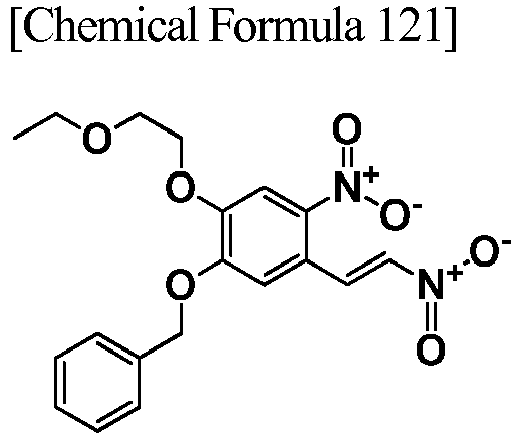
- Nitric acid (11 mL, 69%, 171 mmol) was added to a solution of (E)-2-(benzyloxy)-1-(2-ethoxyethoxy)-4-(2-nitrovinyl)benzene described in Production Example 24-3 (15.4 g, 44.9 mmol) and acetic acid (100 mL) at 25°C, and the mixture was stirred for 6 hours. The reaction liquid was poured onto ice. The suspension was subjected to suction filtration and the product was washed with water to quantitatively obtain the title compound.
1H-NMR Spectrum (CDCl3) δ (ppm): 1.23 (3H, t, J = 7.0 Hz), 3.62 (2H, q, J = 6.9 Hz), 3.84-3.90 (2H, m), 4.29-4.34 (2H, m), 5.27 (2H, s), 6.93 (1H, s), 7.23 (1H, d, J = 13.6 Hz), 7.35-7.50 (5H, m), 7.84 (1H, s), 8.57 (1H, d, J = 13.5 Hz). -

- 10% Palladium-carbon (water content, 50%) (6 g) was added to a solution of (E)-1-(benzyloxy)-2-(2-ethoxyethoxy)-4-nitro-5-(2-nitrovinyl)benzene described in Production Example 24-4 (17.5 g, 44.9 mmol) in methanol (180 mL) at room temperature. The reaction liquid was stirred under hydrogen atmosphere at room temperature. After 6 hours, the catalyst was filtered off with celite. The filtrate was concentrated under vacuum and then the residue was purified with silica gel column chromatography (n-heptane:ethyl acetate = 2:1 - 1:1) to obtain the title compound (3.28 g, 33%).
1H-NMR Spectrum (CDCl3) δ (ppm): 1.29 (3H, t, J = 7.0 Hz), 3.63 (2H, q, J = 7.0 Hz), 3.73-3.80 (2H, m), 4.16-4.24 (2H, m), 6.41 (1H, td, J = 2.1, 1.1 Hz), 6.46 (1H, s), 6.99 (1H, s), 7.10 (1H, dd, J = 3.1, 2.4 Hz), 7.15 (1H, s), 7.93 (1H, brs). -

- Dimethylsulfoxide (20 mL) was added to a mixture of 6-(2-ethoxyethoxy)-1H-indol-5-ol described in Production Example 24-5 (3.28 g, 14.8 mmol), N-(4-chloropyridin-2-yl)acetamide described in Production Example 1-5 (2.78 g, 16.3 mmol), and potassium tert-butoxide (1.83 g, 16.3 mmol) under nitrogen atmosphere at room temperature. The liquid mixture was stirred at 150°C overnight. The reaction liquid was allowed to stand to cool to room temperature and then diluted with water and ethyl acetate. The organic layer was washed with a saturated saline solution and dried over anhydrous sodium sulfate, and then the drying agent was separated by filtration. The filtrate was concentrated under vacuum. The residue was purified with silica gel column chromatography (n-heptane:ethyl acetate = 1:1 - 0:1 - ethyl acetate:methanol = 99:1 - 19:1) to obtain the title compound (2.5 g, 48%).
1H-NMR Spectrum (CDCl3) δ (ppm): 1.09 (3H, t, J = 7.0 Hz), 2.14 (3H, s), 3.41 (2H, q, J = 7.0 Hz), 3.56-3.66 (2H, m), 4.05-4.13 (2H, m), 6.44-6.50 (1H, m), 6.53 (1H, dd, J = 5.9, 2.6 Hz), 7.05 (1H, d, J = 0.7 Hz), 7.16 (1H, dd, J = 3.3,2.6 Hz), 7.36 (1H, s), 7.75 (1H, brs), 8.01 (1H, d, J = 5.9 Hz), 8.11 (1H, brs), 8.19 (1H, brs). -

- A 2 M sodium hydroxide solution (20 mL) was added to a solution of N-(4-((6-(2-ethoxyethoxy)-1H-indol-5-yl)oxy)pyridin-2-yl)acetamide described in Production Example 24-6 (2.5 g, 7.04 mmol) in methanol (20 mL) under nitrogen atmosphere at room temperature, and the mixture was heated and stirred under reflux at 75 °C for 2 hours. The reaction liquid was allowed to stand to cool to room temperature and then diluted with ethyl acetate and water. The organic layer was washed with a saturated saline solution and then dried over anhydrous sodium sulfate. The drying agent was separated by filtration and then the filtrate was concentrated under vacuum. The resultant residue was purified with silica gel column chromatography (n-heptane:ethyl acetate = 1:9 - 0:1 - ethyl acetate:methanol = 49:1 - 24:1) to obtain the title compound (1.92 g, 87%).
1H-NMR Spectrum (CDCl3) δ (ppm): 1.12 (3H, t, J = 7.0 Hz), 3.45 (2H, q, J = 7.2 Hz), 3.60-3.72 (2H, m), 4.03-4.13 (2H, m), 4.29 (2H, s), 5.89 (1H, d, J = 1.8 Hz), 6.29 (1H, dd, J = 6.2,2.2 Hz), 6.44-6.54 (1H, m), 7.05 (1H, s), 7.18 (1H, dd, J = 3.1, 2.4 Hz), 7.34 (1H, s), 7.88 (1H, d, J = 5.9 Hz), 8.25 (1H, brs). -

- 50 - 72% Oily sodium hydride (265 mg) was added to a solution of 4-((6-(2-ethoxyethoxy)-1H-indol-5-yl)oxy)pyridin-2-amine described in Production Example 24-7 (1.92 g, 6.13 mmol) in N,N-dimethylformamide (20 mL) under nitrogen atmosphere at 0°C. The reaction liquid was stirred at the same temperature for 10 minutes. Phenyl methylcarbamate described in Production Example 1-7 (1.20 g, 7.97 mmol) was added to the reaction liquid, and then the mixture was warmed to room temperature and stirred for 1 hour. Water and ethyl acetate were added to the reaction liquid. The organic layer was washed serially with water and a saturated saline solution and then dried over anhydrous sodium sulfate. The drying agent was separated by filtration and then the filtrate was concentrated under vacuum. The residue was purified with NH silica gel column chromatography (the solution: n-heptane:ethyl acetate = 9:1 - 0:1) to obtain the title compound (1.97 g, 87%).
1H-NMR Spectrum (DMSO-d6) δ (ppm): 1.01 (3H, t, J = 7.0 Hz), 2.84 (3H, d, J = 4.4 Hz), 3.37 (2H, q, J = 7.1 Hz), 3.54-3.59 (2H, m), 4.02-4.10 (2H, m), 5.69 (1H, d, J = 2.2 Hz), 5.77 (2H, s), 6.09 (1H, dd, J = 5.9, 2.2 Hz), 6.60 (1H, d, J = 3.3 Hz), 7.35 (1H, s), 7.71-7.77 (2H, m), 8.04 (1H, s), 8.09-8.17 (1H, m). -


- Thionyl chloride (370 µL, 5.06 mmol) was added to a solution of benzotriazole (603 mg, 5.06 mmol) in dichloromethane (20 mL) under nitrogen atmosphere at room temperature. The mixture was stirred at room temperature for 5 minutes, then 4-(1-(tert-butoxycarbonyl)piperidin-4-yl)benzoic acid described in Production Example 1-12 (1.03 g, 3.38 mmol) was added, and the mixture was stirred for 1 hour. The reaction liquid was filtered through anhydrous sodium sulfate on the glass filter, and the anhydrous sodium sulfate was washed with dichloromethane. Triethylamine (1.87 mL, 13.5 mmol), 4-dimethylaminopyridine (16.5 mg, 0.135 mmol), and a solution of 5-((2-aminopyridin-4-yl)oxy)-6-(2-ethoxyethoxy)-N-methyl-1H-indole-1-carboxamide described in Production Example 24-8 (500 mg, 1.35 mmol) in tetrahydrofuran (5 mL) were serially added to the resultant filtrate under nitrogen atmosphere at 0°C, and the mixture was stirred at room temperature for 4 hours. An excessive quantity of methylamine was added to the reaction liquid and then the resultant was diluted with ethyl acetate and water for partition. The organic layer was washed with a saturated saline solution and then dried over anhydrous sodium sulfate, and the drying agent was separated by filtration. The filtrate was concentrated under vacuum. The resultant residue was purified with NH silica gel column chromatography (n-heptane:ethyl acetate = 2:3 - 0:1) to obtain the title compound (383 mg, 43%).
1H-NMR Spectrum (DMSO-d6) δ (ppm): 0.94 (3H, t, J = 7.1 Hz), 1.42 (9H, s), 1.43-1.60 (2H, m), 1.69-1.84 (2H, m), 2.75 (3H, brs), 2.85 (3H, d, J = 4.4 Hz), 3.29 (2H, q, J = 7.0 Hz), 3.47-3.58 (2H, m), 3.98-4.16 (4H, m), 6.56-6.71 (2H, m), 7.34 (2H, d, J = 8.4 Hz), 7.45 (1H, s), 7.70 (1H, d, J = 2.6 Hz), 7.78 (1H, d, J = 3.7 Hz), 7.90 (2H, d, J = 8.4 Hz), 8.08 (1H, s), 8.12-8.24 (2H, m), 10.66 (1H, s). -

- Commercially available 2-hydroxyacetaldehyde (48.5 mg, 0.807 mmol), sodium triacetoxyborohydride (91 mg, 0.43 mmol), and acetic acid (25 µL, 0.43 mmol) were added to a suspension of 6-(2-ethoxyethoxy)-N-methyl-5-((2-(4-(piperidin-4-yl)benzamide)pyridin-4-yl)oxy)-1H-ind ole-1-carboxamide described in Example 24 (30 mg, 0.054 mmol) in tetrahydrofuran (3 mL) at room temperature. The reaction liquid was stirred at room temperature for 2 hours. A saturated aqueous sodium bicarbonate solution was added to the reaction liquid at room temperature, and the mixture was diluted with ethyl acetate. The organic layer was washed with a saturated saline solution, dried over anhydrous sodium sulfate, and the solvent was concentrated under vacuum. The resultant residue was purified with NH silica gel column chromatography (ethyl acetate) to obtain the title compound (20.1 mg, 62%).
1H-NMR Spectrum (CDCl3) δ (ppm): 1.07 (3H, t, J = 7.0 Hz), 1.67-1.99 (4H, m), 2.20 (2H, td, J = 11.7, 2.6 Hz), 2.53-2.66 (3H, m), 2.98-3.11 (5H, m), 3.40 (2H, q, J = 7.0 Hz), 3.59-3.69 (4H, m), 4.16-4.20 (2H, m), 5.02 (1H, s), 5.69-5.80 (1H, m), 6.51 (1H, d, J = 3.7 Hz), 6.62 (1H, dd, J = 5.7, 2.4 Hz), 7.25 (1H, d, J = 3.7 Hz), 7.28-7.36 (3H, m), 7.76-7.83 (2H, m), 7.91 (1H, d, J = 2.6 Hz), 8.02 (1H, s), 8.09 (1H, d, J = 5.9 Hz), 8.62 (1H, s). -


- Sodium triacetoxyborohydride (172 mg, 0.812 mmol) and acetaldehyde (51.2 mg, 1.16 mmol) were added to a mixture of 5-((2-(4-(azetidin-3-yl)benzamide)pyridin-4-yl)oxy)-6-(2-ethoxyethoxy)-N-methyl-1H-indol e-1-carboxamide described in Production Example 26-6 (215 mg, 0.406 mmol) and tetrahydrofuran (4.0 mL) at room temperature, and the mixture was stirred at room temperature for 1.5 hours. A saturated aqueous sodium bicarbonate solution and ethyl acetate were added to the reaction mixture for partition. The organic layer was washed with a saturated saline solution, then dried over anhydrous sodium sulfate, and filtered. The solvent was evaporated, the resultant residue was dissolved in dichloromethane, and the resultant was purified with NH silica gel column chromatography (n-heptane:ethyl acetate = 2:3 - 0:1 - ethyl acetate:methanol = 99:1 - 19:1). The target fraction was concentrated under vacuum, then the residue was collected by filteration and washed with diethyl ether to obtain the title compound (180 mg, 79%).
1H-NMR Spectrum (CDCl3) δ (ppm): 1.00 (3H, t, J = 7.1 Hz), 1.07 (3H, t, J = 7.0 Hz), 2.51 (2H, q, J = 7.1 Hz), 3.06 (3H, d, J = 4.8 Hz), 3.09-3.16 (2H, m), 3.40 (2H, q, J = 7.1 Hz), 3.60-3.65 (2H, m), 3.71-3.80 (3H, m), 4.15-4.20 (2H, m), 5.47-5.57 (1H, m), 6.54 (1H, d, J = 3.7 Hz), 6.61 (1H, dd, J = 5.7, 2.4 Hz), 7.24-7.27 (1H, m), 7.34 (1H, s), 7.36-7.40 (2H, m), 7.77-7.83 (2H, m), 7.91 (1H, d, J = 2.2 Hz), 8.01 (1H, s), 8.10 (1H, d, J = 5.9 Hz), 8.47 (1H, brs). - The starting material 5-((2-(4-(azetidin-3-yl)benzamide)pyridin-4-yl)oxy)-6-(2-ethoxyethoxy)-N-methyl-1H-indol e-1-carboxamide was synthesized by the following method.
-


- Benzotriazole (335 mg, 2.81 mmol) was dissolved in dichloromethane (20 mL), and thionyl chloride (200 µL, 2.74 mmol) was added under nitrogen atmosphere at room temperature, and the mixture was stirred for 5 minutes. 4-(1-(tert-Butoxycarbonyl)azetidin-3-yl)benzoic acid described in Production Example 26-5 (650 mg, 2.34 mmol) was added to the reaction mixture at room temperature, and the mixture was stirred for 25 minutes. The reaction mixture was filtered through a glass filter entirely covered with anhydrous sodium sulfate and then the anhydrous sodium sulfate was washed with dichloromethane, and then the filtrate was added to a mixture of 5-((2-aminopyridin-4-yl)oxy)-6-(2-ethoxyethoxy)-N-methyl-1H-indole-1-carboxamide described in Production Example 24-8 (300 mg, 0.810 mmol), triethylamine (1.3 mL, 9.38 mmol), and 4-dimethylaminopyridine (9.9 mg, 0.081 mmol) in tetrahydrofuran (16 mL) at 0°C. The mixture was stirred at room temperature for 3 hours, then water and ethyl acetate were added to the reaction mixture for partition, and the organic layer was washed with a saturated saline solution and then dried over anhydrous magnesium sulfate. The drying agent was filtered off, then the filtrate was concentrated under vacuum, the residue was dissolved in tetrahydrofuran, an excessive quantity of 9.8 M methylamine methanol solution was added at room temperature, and the mixture was stirred for 75 minutes. The reaction mixture was concentrated under vacuum, the residue was dissolved in dichloromethane, and the resultant was purified with NH silica gel column chromatography (n-heptane:ethyl acetate = 1:1 - 1:3 - 0:1 - ethyl acetate:methanol = 9:1). The mixture fraction was concentrated under vacuum, the residue was dissolved in dichloromethane, and the resultant was purified with NH silica gel column chromatography (n-heptane:ethyl acetate = 2:3 - 1:3 - 0:1 - ethyl acetate:methanol = 9:1). The target fraction was concentrated under vacuum to obtain the title compound (279 mg, 76%).
1H-NMR Spectrum (CDCl3) δ (ppm): 1.07 (3H, t, J = 7.0 Hz), 1.47 (9H, s), 2.81 (3H, d, J = 4.8 Hz), 3.40 (2H, q, J = 6.8 Hz), 3.60-3.65 (2H, m), 3.73-3.83 (1H, m), 3.93-4.01 (2H, m), 4.15-4.20 (2H, m), 4.35 (2H, t, J = 8.6 Hz), 5.44-5.54 (1H, m), 6.56 (1H, d, J = 3.7 Hz), 6.61 (1H, dd, J = 5.9, 1.8 Hz), 7.23-7.29 (1H, m), 7.34 (1H, s), 7.42 (2H, d, J = 8.4 Hz), 7.85 (2H, d, J = 8.4 Hz), 7.91 (1H, d, J = 2.2 Hz), 8.01 (1H, s), 8.09 (1H, d, J = 5.9 Hz), 8.55 (1H, brs). -

- Methanesulfonyl chloride (2.57 mL, 33.3 mmol) and triethylamine (11.6 mL, 83.1 mmol) were added to a solution of commercially available N-BOC-3-hydroxy azetidine (4.8 g, 27.7 mmol) in tetrahydrofuran (100 mL) under nitrogen atmosphere at room temperature. The reaction liquid was stirred at room temperature for 2 hours. A saturated aqueous sodium bicarbonate solution was added to the reaction liquid at room temperature, and the mixture was diluted with ethyl acetate. The organic layer was washed with a saturated saline solution and then dried over anhydrous sodium sulfate. The drying agent was separated by filtration and then the filtrate was concentrated under vacuum. The residue was purified with silica gel column chromatography (n-heptane:ethyl acetate = 9:1 - 1:1) to quantitatively obtain the title compound.
1H-NMR Spectrum (CDCl3) δ (ppm): 1.45 (9H, s), 3.07 (3H, s), 4.03-4.18 (2H, m), 4.22-4.36 (2H, m), 5.12-5.27 (1H, m). -

- Potassium iodide (51.0 g, 307 mmol) was added to a solution of tert-butyl 3-((methylsulfonyl)oxy)azetidine-1-carboxylate described in Production Example 26-2 (7.72 g, 30.7 mmol) in dimethylsulfoxide (80 mL) under nitrogen atmosphere at room temperature, and the mixture was stirred at 140°C for 2 hours. The reaction liquid was diluted with diethyl ether and water. The aqueous layer was extracted with diethyl ether. The combined organic layer was washed serially with an aqueous sodium pyrosulfite solution and a saturated saline solution and then dried over anhydrous sodium sulfate. The drying agent was separated by filtration and then the resultant was concentrated under vacuum. The residue was purified with silica gel column chromatography (n-heptane:ethyl acetate = 9:1-1:1) to obtain the title compound (5.91 g, 68%).
1H-NMR Spectrum (CDCl3) δ (ppm): 1.44 (9H, s), 4.25-4.33 (2H, m), 4.42-4.51 (1H, m), 4.61-4.69 (2H, m). -
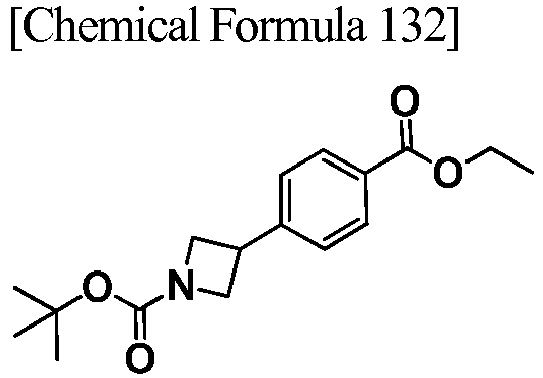
- 1,2-Dibromoethane (0.286 mL, 3.32 mmol) was added to a suspension of zinc powder (2.12 g, 32.4 mmol) in tetrahydrofuran (10 mL) under nitrogen atmosphere at room temperature. The liquid mixture was stirred at 65°C for 10 minutes. The reaction liquid was allowed to stand to cool to room temperature, then chlorotrimethylsilane (0.400 mL, 3.13 mmol) was added, and the mixture was stirred at room temperature for 30 minutes. A solution of tert-butyl 3-iodoazetidine-1-carboxylate described in Production Example 26-3 (5.91 g, 20.9 mmol) in tetrahydrofuran (10 mL) was added to the reaction liquid over 5 minutes, and the mixture was stirred at room temperature for 40 minutes (a solution A). A solution of tris(dibenzylideneacetone)dipalladium(0) (382 mg, 0.418 mmol) and tri-2-furylphosphine (402 mg, 1.73 mmol) in tetrahydrofuran (10 mL) was stirred under nitrogen atmosphere at room temperature for 15 minutes, and then the previously prepared solution A was added at room temperature. Subsequently, a solution of ethyl 4-iodobenzoate (6.92 g, 25.1 mmol) in tetrahydrofuran (18.5 mL) was added under nitrogen atmosphere at room temperature. The reaction liquid was stirred at 65°C overnight. The reaction liquid was allowed to stand to cool to room temperature, then was filtered with celite, and the resultant was washed with ethyl acetate. The filtrate was washed serially with a saturated aqueous sodium bicarbonate solution and a saturated saline solution and then dried over anhydrous sodium sulfate. The drying agent was separated by filtration and then the filtrate was concentrated under vacuum. The residue was dissolved in dichloromethane, then the resultant was purified with silica gel column chromatography (n-heptane:ethyl acetate = 9:1-4:1) to obtain the title compound (4.35 g, 68%).
1H-NMR Spectrum (CDCl3) δ (ppm): 1.40 (3H, t, J = 8.0 Hz), 1.47 (9H, s), 3.71-3.84 (1H, m), 3.95-4.02 (2H, m), 4.32-4.44 (4H, m), 7.34-7.42 (2H, m), 7.98-8.07 (2H, m). -

- A 2 M sodium hydroxide solution (28.5 mL, 57.0 mmol) was added to a solution of tert-butyl 3-(4-(ethoxycarbonyl)phenyl)azetidine-1-carboxylate described in Production Example 26-4 (4.35 g, 14.2 mmol) in tetrahydrofuran (32 mL) and methanol (7 mL) at 25°C. The reaction liquid was stirred at 60°C for 1 hour. 2 M hydrochloric acid (28.5 mL) was added to the reaction liquid, and the mixture was diluted with ethyl acetate. The organic layer was washed with a saturated saline solution and then dried over anhydrous sodium sulfate. The drying agent was separated by filtration and then the filtrate was concentrated under vacuum. The residue was purified with silica gel column chromatography (n-heptane:ethyl acetate = 9:1 - 1:1) to obtain the title compound (3.4 g, 86%).
1H-NMR Spectrum (CDCl3) δ (ppm): 1.48 (9H, s), 3.71-3.88 (1H, m), 3.96-4.04 (2H, m), 4.37 (2H, t, J = 8.6 Hz), 7.42 (2H, d, J = 8.4 Hz), 8.09 (2H, d, J = 8.3 Hz). -

1H-NMR Spectrum (CDCl3) δ (ppm): 1.07 (3H, t, J = 7.0 Hz), 3.05 (3H, d, J = 4.8 Hz), 3.40 (2H, q, J = 7.0 Hz), 3.61-3.65 (2H, m), 3.81 (2H, t, J = 7.0 Hz), 3.93-4.09 (3H, m), 4.15-4.20 (2H, m), 5.51-5.63 (1H, m), 6.53 (1H, d, J = 3.7 Hz), 6.61 (1H, dd, J = 5.9,2.2 Hz), 7.24-7.28 (1H, m), 7.33 (1H, s), 7.40 (2H, d, J = 8.1 Hz), 7.82 (2H, d, J = 8.1 Hz), 7.91 (1H, d, J = 2.2 Hz), 8.01 (1H, s), 8.09 (1H, d, J = 5.5 Hz), 8.52 (1H, brs). -

- Commercially available 2-hydroxyacetaldehyde (45.9 mg, 0.765 mmol), sodium triacetoxyborohydride (86 mg, 0.408 mmol), and acetic acid (23 µL, 0.408 mmol) were added to a solution of 5-((2-(4-(azetidin-3-yl)benzamide)pyridin-4-yl)oxy)-6-(2-ethoxyethoxy)-N-methyl-1H-indol e-1-carboxamide described in Production Example 26-6 (27 mg, 0.051 mmol) in tetrahydrofuran (2 mL) at room temperature, and the mixture was stirred at the same temperature for 2 hours. A saturated aqueous sodium bicarbonate solution was added to the reaction liquid at room temperature, and the mixture was diluted with ethyl acetate. The organic layer was washed with a saturated saline solution and then dried over anhydrous sodium sulfate. The drying agent was separated by filtration and the filtrate was concentrated under vacuum. The residue was purified with NH silica gel column chromatography (ethyl acetate) to obtain the title compound (20.0 mg, 68%).
1H-NMR Spectrum (CDCl3) δ (ppm): 1.08 (3H, t, J = 7.0 Hz), 2.68-2.76 (2H, m), 3.06 (3H, d, J = 4.8 Hz), 3.27-3.34 (2H, m), 3.40 (2H, q, J = 7.0 Hz), 3.55-3.67 (4H, m), 3.71-3.94 (3H, m), 4.15-4.22 (2H, m), 5.53-5.65 (1H, m), 6.55 (1H, d, J = 3.7 Hz), 6.62 (1H, dd, J = 5.9,2.2 Hz), 7.23-7.29 (1H, m), 7.34 (1H, s), 7.38 (2H, d, J = 8.4 Hz), 7.83 (2H, d, J = 8.1 Hz), 7.91 (1H, d, J = 2.6 Hz), 8.01 (1H, s), 8.09 (1H, d, J = 5.9 Hz), 8.63 (1H, brs). -

- Acetaldehyde (38 µL, 0.671 mmol), acetic acid (20 µL, 0.358 mmol), and sodium triacetoxyborohydride (76 mg, 0.358 mmol) were added to a solution of 6-(2-ethoxyethoxy)-N-methyl-5-((2-(6-(piperidin-4-yl)nicotinamide)pyridin-4-yl)oxy)-1H-in dole-1-carboxamide described in Production Example 28-5 (25 mg, 0.045 mmol) in tetrahydrofuran (3 mL) at room temperature, and the mixture was stirred for 1 hour. A saturated aqueous sodium bicarbonate solution was added to the reaction liquid at room temperature, and the mixture was diluted with ethyl acetate. The organic layer was washed with a saturated saline solution and then dried over anhydrous sodium sulfate. The drying agent was separated by filtration and then the filtrate was concentrated under vacuum. The residue was purified with NH silica gel column chromatography (ethyl acetate) to obtain the title compound (13.6 mg, 52%).
1H-NMR Spectrum (CDCl3) δ (ppm): 1.07 (3H, t, J = 7.0 Hz), 1.13 (3H, t, J = 7.1 Hz), 1.78-1.93 (2H, m), 1.94-2.15 (4H, m), 2.46 (2H, q, J = 7.3 Hz), 2.74-2.86 (1H, m), 3.00-3.17(5H, m), 3.40 (2H, q, J = 7.1 Hz), 3.63 (2H, t, J = 4.8 Hz), 4.18 (2H, t, J = 4.8 Hz), 5.45-5.57 (1H, m), 6.56 (1H, d, J = 3.3 Hz), 6.61 (1H, dd, J = 5.9,1.5 Hz), 7.20-7.39 (3H, m), 7.84-7.92 (1H, m), 8.02 (1H, s), 8.05-8.15 (2H, m), 8.49 (1H, s), 8.93-9.07 (1H, m). - The starting material 6-(2-ethoxyethoxy)-N-methyl-5-((2-(6-(piperidin-4-yl)nicotinamide)pyridin-4-yl)oxy)-1H-in dole-1-carboxamide was synthesized by the following method.
-

- N,N-dimethylformamide (100 mL) was added to commercially available 1-N-BOC-4-(4,4,5,5-tetramethyl-[1,3,2]dioxaborolan-2-yl)-3,6-dihydro-2H-pyridine (4.68 g, 15.1 mmol), commercially available methyl 6-chloronicotinate (2.81 g, 16.4 mmol), 1,1'-bis(diphenylphosphino)ferrocenedichloropalladium(II) (1.17 g, 1.60 mmol), and potassium carbonate (7.02 g, 50.8 mmol). The reaction liquid was stirred under nitrogen atmosphere at 100°C for 2 hours. The reaction liquid was allowed to stand to cool to room temperature and then diluted with ethyl acetate and water. The aqueous layer was extracted with ethyl acetate. The combined organic layer was washed serially with a dilute aqueous ammonia solution and a saturated saline solution, and then dried over anhydrous sodium sulfate. The drying agent was separated by filtration and then the filtrate was concentrated under vacuum. The residue was purified with silica gel column chromatography (n-heptane:ethyl acetate = 9:1 - 1:1) to obtain the title compound (1.07 g, 22%).
1H-NMR Spectrum (CDCl3) δ (ppm): 1.49 (9H, s), 2.59-2.73 (2H, m), 3.66 (2H, t, J = 5.5 Hz), 3.95 (3H, s), 4.17 (2H, d, J = 2.9 Hz), 6.79 (1H, dt, J = 3.4, 1.8 Hz), 7.44 (1H, d, J = 8.4 Hz), 8.25 (1H, dd, J = 8.4, 2.2 Hz), 9.15 (1H, dd, J = 2.2,0.7 Hz). -

- 10% Palladium-carbon (water content, 50%) (213 mg) was added to a solution of 1'-tert-butyl 5-methyl 5',6'-dihydro-[2,4'-bipyridine]-1',5(2'H)-dicarboxylate described in Production Example 28-1 (1.06 g, 3.33 mmol) in ethanol (71 mL) and tetrahydrofuran (12 mL), and the mixture was stirred under hydrogen atmosphere at room temperature for 2 hours. The mixture was filtered, then the filtrate was concentrated under vacuum, and the residue was purified with NH silica gel column chromatography (n-heptane:ethyl acetate = 9:1 - 1:1) to quantitatively obtain the title compound.
1H-NMR Spectrum (CDCl3) δ (ppm): 1.48 (9H, s), 1.73 (2H, qd, J = 12.6, 4.4 Hz), 1.88-1.97 (2H, m), 2.76-2.98 (3H, m), 3.94 (3H, s), 4.27 (2H, brs), 7.22-7.26 (1H, m), 8.23 (1H, dd, J = 8.4,2.2 Hz), 9.09-9.18 (1H, m). -

- A 2 M sodium hydroxide solution (20 mL) was added to a solution of methyl 6-(1-(tert-butoxycarbonyl)piperidin-4-yl)nicotinate described in Production Example 28-2 (1.07 g, 3.32 mmol) in ethanol (5 mL), and the mixture was stirred for 1 hour. 2 M hydrochloric acid was added to the reaction liquid at 0°C. The aqueous layer was extracted with ethyl acetate. The combined organic layer was washed with a saturated saline solution and then dried over anhydrous sodium sulfate. The drying agent was separated by filtration and then the filtrate was concentrated under vacuum to obtain the title compound (534 mg, 52%).
1H-NMR Spectrum (DMSO-d6) δ (ppm): 1.42 (9H, s), 1.58 (2H, qd, J = 12.6, 4.4 Hz), 1.77-1.89 (2H, m), 2.67-3.04 (3H, m), 3.95-4.17 (2H, m), 7.40 (1H, d, J = 7.7 Hz), 8.16 (1H, dd, J = 8.1, 2.2 Hz), 8.97 (1H, dd, J = 2.2,0.7 Hz). -


- Oxalyl chloride (74 µL, 0.864 mmol) and one drop of N,N-dimethylformamide were added to a solution of 6-(1-(tert-butoxycarbonyl)piperidin-4-yl)nicotinic acid described in Production Example 28-3 (80 mg, 0.216 mmol) in dichloromethane (2 mL) at 0°C, and the mixture was stirred for 30 minutes. The reaction liquid was concentrated under vacuum. The residue was dissolved in tetrahydrofuran (2 mL), then triethylamine (301 µL, 2.16 mmol) and 5-((2-aminopyridin-4-yl)oxy)-6-(2-ethoxyethoxy)-N-methyl-1H-indole-1-carboxamide described in Production Example 24-8 (80 mg, 0.216 mmol) were added, and the mixture was stirred for 5 hours. An excessive quantity of methylamine was added to the reaction liquid, and then the mixture was diluted with water and ethyl acetate for partition. The organic layer was washed with a saturated saline solution and then dried over anhydrous sodium sulfate. The drying agent was separated by filtration and then the filtrate was concentrated under vacuum. The residue was purified with NH silica gel column chromatography (n-heptane:ethyl acetate = 1:1) to obtain the title compound (80 mg, 56%).
1H-NMR Spectrum (CDCl3) δ (ppm): 1.04 (3H, t, J = 7.0 Hz), 1.45 (9H, s), 1.68 (2H, qd, J = 12.6,4.4 Hz), 1.83-1.93 (2H, m), 2.69-2.92 (3H, m), 2.96 (3H, d, J = 4.8 Hz), 3.37 (2H, q, J = 7.0 Hz), 3.56-3.63 (2H, m), 4.11-4.15 (2H, m), 4.21 (2H, brs), 6.10-6.20 (1H, m), 6.44 (1H, d, J = 3.7 Hz), 6.58 (1H, dd, J = 5.7, 2.4 Hz), 7.21 (1H, d, J = 7.7 Hz), 7.24-7.31 (2H, m), 7.86 (1H, d, J = 2.2 Hz), 7.95 (1H, d, J = 5.9 Hz), 8.02 (1H, s), 8.07 (1H, dd, J = 8.2, 2.4 Hz), 8.96-9.02 (1H, m), 9.20 (1H, brs). -

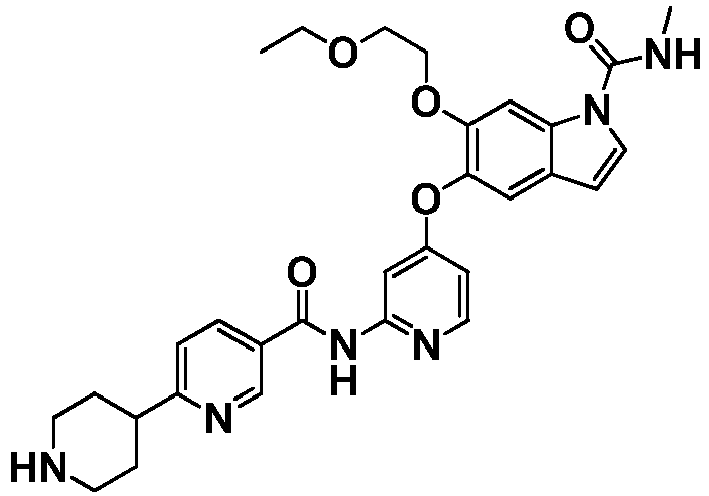
- Trifluoroacetic acid (374 µL, 4.86 mmol) was added to a solution of tert-butyl 4-(5-((4-((6-(2-ethoxyethoxy)-1-(methylcarbamoyl)-1H-indol-5-yl)oxy)pyridin-2-yl)carbam oyl)pyridin-2-yl)piperidine-1-carboxylate described in Production Example 28-4 (80 mg, 0.121 mmol) in dichloromethane (3 mL) at room temperature, and the mixture was stirred for 1.5 hours. The reaction liquid was concentrated under vacuum. The residue was dissolved in dichloromethane and then triethylamine was added to neutralize the trifluoroacetic acid. The solution was concentrated under vacuum and then the residue was purified with NH silica gel column chromatography (ethyl acetate:methanol = 49:1 - 17:3) to obtain the title compound (51.3 mg, 76%).
1H-NMR Spectrum (CDCl3) δ (ppm): 1.07 (3H, t, J = 7.1 Hz), 1.72 (2H, qd, J = 12.4, 4.0 Hz), 1.87-1.97 (2H, m), 2.76 (2H, td, J = 12.3, 2.6 Hz), 2.84-2.95 (1H, m), 2.99 (3H, d, J = 4.4 Hz), 3.16-3.28 (2H, m), 3.40 (2H, q, J = 7.1 Hz), 3.59-3.68 (2H, m), 4.14-4.20 (2H, m), 6.04-6.17 (1H, m), 6.48 (1H, d, J = 3.7 Hz), 6.62 (1H, dd, J = 5.7,2.4 Hz), 7.23-7.29 (2H, m), 7.31 (1H, s), 7.88 (1H, d, J = 2.2 Hz), 7.98-8.05 (2H, m), 8.10 (1H, dd, J = 8.2,2.4 Hz), 9.02 (1H, dd, J = 2.6, 0.7 Hz). -

- Commercially available L-prolinol (31.3 mg, 0.309 mmol) was added to a mixture of 5-((2-(4-(chloromethyl)-N-(4-(chloromethyl)benzoyl)benzamide)pyridin-4-yl)oxy)-6-(2-etho xyethoxy)-N-methyl-1H-indole-1-carboxamide described in Production Example 29-1 (19.6 mg, 0.029 mmol) and N,N-dimethylformamide (500 µL) at room temperature, and the mixture was stirred under nitrogen atmosphere for 17.5 hours. Water and ethyl acetate were added to the reaction mixture for partition. The organic layer was washed with a saturated saline solution, and then dried over anhydrous sodium sulfate and filtered. The solvent was evaporated, the resultant residue was purified with NH silica gel TLC (ethyl acetate), and the product was collected by filteration and washed with diethyl ether to obtain the title compound (13.3 mg, 78%).
1H-NMR Spectrum (CDCl3) δ (ppm): 1.08 (3H, t, J = 7.1 Hz), 1.65-1.99 (5H, m), 2.23-2.32 (1H, m), 2.71-2.79 (1H, m), 2.92-2.99 (1H, m), 3.06 (3H, d, J = 4.8 Hz), 3.37-3.48 (4H, m), 3.61-3.69 (3H, m), 4.03 (1H, d, J = 13.5 Hz), 4.16-4.20 (2H, m), 5.48-5.56 (1H, m), 6.55 (1H, d, J = 3.7 Hz), 6.61 (1H, dd, J = 5.9, 2.6 Hz), 7.24-7.28 (1H, m), 7.34 (1H, s), 7.41 (2H, d, J = 8.4 Hz), 7.79-7.84 (2H, m), 7.91 (1H, d, J = 2.2 Hz), 8.01 (1H, s), 8.10 (1H, d, J = 5.5 Hz), 8.50 (1H, brs). - The starting material 5-((2-(4-(chloromethyl)-N-(4-(chloromethyl)benzoyl)benzamide)pyridin-4-yl)oxy)-6-(2-etho xyethoxy)-N-methyl-1H-indole-1-carboxamide was synthesized by the following method.
-

- Triethylamine (300 µL, 2.16 mmol) and commercially available 4-(chloromethyl)benzoyl chloride (221 mg, 1.17 mmol) were added to a mixture of 5-((2-aminopyridin-4-yl)oxy)-6-(2-ethoxyethoxy)-N-methyl-1H-indole-1-carboxamide described in Production Example 24-8 (107 mg, 0.289 mmol) and tetrahydrofuran (8.0 mL) under nitrogen atmosphere at 0°C. The mixture was stirred at room temperature for 1 hour and then water and ethyl acetate were added to the reaction mixture for partition. The organic layer was washed with a saturated saline solution, then dried over anhydrous sodium sulfate, and then filtered with NH silica gel. The filtrate was concentrated under vacuum to quantitatively obtain the title compound.
1H-NMR Spectrum (CDCl3) δ (ppm): 1.11 (3H, t, J = 7.0 Hz), 3.06 (3H, d, J = 4.8 Hz), 3.43 (2H, q, J = 7.0 Hz), 3.56-3.60 (2H, m), 4.08-4.12 (2H, m), 4.56 (4H, s), 5.41-5.49 (1H, m), 6.55 (1H, d, J = 3.7 Hz), 6.67 (1H, d, J = 2.2 Hz), 6.71 (1H, dd, J = 5.9,2.2 Hz), 7.24 (1H, s), 7.25-7.28 (1H, m), 7.34-7.39 (4H, m), 7.69-7.75 (4H, m), 7.98 (1H, s), 8.17 (1H, d, J = 5.9 Hz). -

- Commercially available cis-2,6-dimethylpiperazine (32.5 mg, 0.285 mmol) was added to a mixture of 5-((2-(4-(chloromethyl)-N-(4-(chloromethyl)benzoyl) benzamide)pyridin-4-yl)oxy)-6-(2-ethoxyethoxy)-N-methyl-1H-indole-1-carboxamide described in Production Example 29-1 (21.1 mg, 0.031 mmol) and N,N-dimethylformamide (500 µL) at room temperature, and the mixture was stirred under nitrogen atmosphere for 13 hours and 20 minutes. Water and ethyl acetate were added to the reaction mixture for partition. The organic layer was washed with a saturated saline solution, and then dried over anhydrous sodium sulfate and filtered. The solvent was evaporated and the resultant residue was purified with NH silica gel TLC (ethyl acetate), then the product was collected by filteration and washed with diethyl ether to obtain the title compound (14.4 mg, 77%).
1H-NMR Spectrum (CDCl3) δ (ppm): 1.02 (6H, d, J = 6.2 Hz), 1.07 (3H, t, J = 7.0 Hz), 1.63 (2H, t, J = 10.6 Hz), 2.69-2.76 (2H, m), 2.89-2.99 (2H, m), 3.07 (3H, d, J = 4.8 Hz), 3.40 (2H, q, J = 7.0 Hz), 3.52 (2H, s), 3.61-3.65 (2H, m), 4.16-4.20 (2H, m), 5.45-5.52 (1H, m), 6.55 (1H, d, J = 3.7 Hz), 6.60 (1H, dd, J = 5.9,2.2 Hz), 7.25-7.27 (1H, m), 7.34 (1H, s), 7.43 (2H, d, J = 8.1 Hz), 7.79-7.83 (2H, m), 7.92 (1H, d, J = 2.2 Hz), 8.01 (1H, s), 8.10 (1H, d, J = 5.9 Hz), 8.47 (1H, brs). -

- Thionyl chloride (2.8 mL, 38.4 mmol) and N,N-dimethylformamide (5.87 µL, 0.076 mmol) were added to 5-(hydroxymethyl)thiophene-2-carboxylic acid described in Production Example 31-1 (120 mg, 0.759 mmol), and the mixture was heated and stirred at 90°C for 2 hours. The reaction mixture was evaporated under vacuum to obtain a crude product A (148 mg).
- Triethylamine (191 µL, 1.38 mmol) and a tetrahydrofuran solution (1.0 mL) of a part of the crude product A (74.0 mg, 0.379 mmol) were added to a mixture of 5-((2-aminopyridin-4-yl)oxy)-6-(2-ethoxyethoxy)-N-methyl-1H-indole-1-carboxamide described in Production Example 24-8 (51.1 mg, 0.138 mmol) and tetrahydrofuran (1.4 mL) under nitrogen atmosphere at 0°C. The mixture was stirred at room temperature for 170 minutes and then water and ethyl acetate were added to the reaction mixture for partition. The organic layer was washed with a saturated saline solution, then dried over anhydrous sodium sulfate and filtered with NH silica gel, and then the resultant was concentrated under vacuum to obtain a crude product B (86.7 mg).
- Apart of the crude product B (17.3 mg) was dissolved in N,N-dimethylformamide (1.0 mL), commercially available (R)-3-hydroxy pyrrolidine (24.4 mg, 0.28 mmol) was added under nitrogen atmosphere at room temperature, and the mixture was stirred for 17 hours. Water and ethyl acetate were added to the reaction mixture for partition, and the organic layer was washed with a saturated saline solution, dried over anhydrous sodium sulfate, and filtered. The solvent was evaporated and the resultant residue was purified with NH silica gel TLC (ethyl acetate), then the product was collected by filteration and washed with n-hexane to obtain the title compound (9.0 mg, 56%).
1H-NMR Spectrum (CDCl3) δ (ppm): 1.07 (3H, t, J = 6.8 Hz), 1.71-1.81 (1H, m), 2.13-2.24(1H, m), 2.34-2.43 (1H, m), 2.57-2.64 (1H, m), 2.69-2.76 (1H, m), 2.87-2.97 (1H, m), 3.06 (3H, d, J = 4.8 Hz), 3.39 (2H, q, J = 7.3 Hz), 3.59-3.64 (2H, m), 3.84 (2H, s), 4.14-4.19 (2H, m), 4.31-4.37 (1H, m), 5.48-5.55 (1H, m), 6.54 (1H, d, J = 3.7 Hz), 6.61 (1H, dd, J = 5.9,2.4 Hz), 6.91 (1H, d, J = 3.5 Hz), 7.24-7.28 (1H, m), 7.32 (1H, s), 7.47 (1H, d, J = 3.9 Hz), 7.78-7.82 (1H, m), 7.99 (1H, s), 8.08 (1H, d, J = 5.7 Hz), 8.34 (1H, brs). -

- Sodium borohydride (218 mg, 5.76 mmol) was added to a solution of commercially available 5-formyl-2-thiophenecarboxylic acid (599 mg, 3.84 mmol) in methanol (19 mL), and the mixture was stirred under nitrogen atmosphere at room temperature for 4 hours and 30 minutes. Acetone was added to the reaction mixture, and the mixture was concentrated under vacuum. 2 M hydrochloric acid and ethyl acetate were added to the residue for partition, and the aqueous layer was extracted with ethyl acetate. The combined organic layer was washed with water, dried over anhydrous sodium sulfate, and filtered. The filtrate was concentrated under vacuum and the precipitate was washed with diethyl ether and n-hexane to obtain the title compound (529 mg, 87%).
1H-NMR Spectrum (DMSO-d6) δ (ppm): 4.61-4.74 (2H, m), 5.65-72 (1H, m), 6.97-7.7.03 (1H, m), 7.55-7.62 (1H, m), 12.92 (1H, brs). -


- Formaldehyde (12 µL, 0.425 mmol), acetic acid (13 µL, 0.227 mmol), and sodium triacetoxyborohydride (48.0 mg, 0.227 mmol) were added to a solution of 5-((2-(4-(azetidin-3-yl)benzamide)pyridin-4-yl)oxy)-6-(3-methoxypropoxy)-N-methyl-1H-i ndole-1-carboxamide described in Production Example 32-10 (15 mg, 0.028 mmol) in tetrahydrofuran (2 mL) at room temperature. The reaction liquid was stirred at room temperature for 1 hour. A saturated aqueous sodium bicarbonate solution and ethyl acetate were added to the reaction liquid at room temperature. The organic layer was washed with a saturated saline solution and then dried over anhydrous sodium sulfate. The drying agent was separated by filtration and the filtrate was concentrated under vacuum. The residue was purified with NH silica gel column chromatography (ethyl acetate) to obtain the title compound (8.8 mg, 57%).
1H-NMR Spectrum (DMSO-d6) δ (ppm): 1.76 (2H, t, J = 6.4 Hz), 2.25 (3H, s), 2.85 (3H, d, J = 4.4 Hz), 3.02-3.13 (7H, m), 3.54-3.65 (3H, m), 3.99 (2H, t, J = 6.2 Hz), 6.64 (1H, d, J = 3.3 Hz), 6.69 (1H, dd, J = 5.9, 2.6 Hz), 7.42 (2H, d, J = 8.4 Hz), 7.46 (1H, s), 7.69 (1H, d, J = 2.6 Hz), 7.77 (1H, d, J = 3.7 Hz), 7.92 (2H, d, J = 8.4 Hz), 8.06 (1H, s), 8.14-8.19 (1H, m), 8.21 (1H, d, J = 5.9 Hz), 10.70 (1H, s). - The starting material 5-((2-(4-(azetidin-3-yl)benzamide)pyridin-4-yl)oxy)-6-(3-methoxypropoxy)-N-methyl-1H-i ndole-1-carboxamide was synthesized by the following method.
-

- Commercially available 1-bromo-3-methoxypropane (24.0 g, 157 mmol) was added to a solution of commercially available 3,4-dihydroxybenzaldehyde (21.7 g, 157 mmol) and sodium carbonate (25.0 g, 236 mmol) in N,N-dimethylformamide (50 mL) under nitrogen atmosphere at room temperature. The reaction liquid was stirred at room temperature for 3 days and 4 hours. 2 M hydrochloric acid, ethyl acetate, and water were added to the reaction liquid at 0°C. The aqueous layer was extracted with ethyl acetate. The combined organic layer was washed serially with water and a saturated saline solution and then dried over anhydrous sodium sulfate. The drying agent was separated by filtration and the filtrate was concentrated under vacuum. The insoluble matters were separated by filtration with dichloromethane and the filtrate was concentrated under vacuum. The residue was purified with silica gel column chromatography (n-heptane:ethyl acetate = 17:3 - 1:1) to obtain the title compound (17.2 g, 52%).
1H-NMR Spectrum (CDCl3) δ (ppm): 2.07-2.18 (2H, m), 3.38 (3H, s), 3.59 (2H, t, J = 5.9 Hz), 4.26 (2H, t, J = 6.2 Hz), 6.21 (1H, s), 7.00 (1H, d, J = 8.1 Hz), 7.35-7.48 (2H, m), 9.85 (1H, s). -

- Potassium carbonate (14.7 g, 106 mmol) and benzyl chloride (12.2 mL, 106 mmol) were added to a solution of 3-hydroxy-4-(3-methoxypropoxy)benzaldehyde described in Production Example 32-1 (17.2 g, 81.7 mmol) in ethanol (200 mL) under nitrogen atmosphere at room temperature, and the mixture was stirred under a thermal condition of 90°C for 2 hours. The reaction liquid was cooled to 0°C, and the mixture was diluted with 2 M hydrochloric acid, ethyl acetate, and water. The organic layer was washed with a saturated saline solution and then dried over anhydrous magnesium sulfate. The drying agent was separated by filtration and then the filtrate was concentrated under vacuum. The residue was purified with silica gel column chromatography (n-heptane:ethyl acetate = 4:1 - 3:7) to obtain the title compound (19.8 g, 81%).
1H-NMR Spectrum (CDCl3) δ (ppm): 2.10-2.20 (2H, m), 3.35 (3H, d, J = 0.7 Hz), 3.59 (2H, t, J = 6.0 Hz), 4.21 (2H, t, J = 6.4 Hz), 5.18 (2H, s), 6.95-7.09 (1H, m), 7.28-7.50 (7H, m), 9.76-9.87 (1H, m). -

- Ammonium acetate (6.10 g, 79.1 mmol) and nitromethane (8.93 mL, 165 mmol) were added to a solution of 3-(benzyloxy)-4-(3-methoxypropoxy)benzaldehyde described in Production Example 32-2 (19.8 g, 65.9 mmol) in acetic acid (52.8 mL) under nitrogen atmosphere at room temperature. The liquid mixture was stirred under a thermal condition of 130°C for 2 hours. The reaction liquid was allowed to stand to cool to room temperature, then the precipitate was collected by filteration and washed with ethanol to quantitatively obtain the title compound.
1H-NMR Spectrum (CDCl3) δ (ppm): 2.07-2.17 (2H, m), 3.35 (3H, s), 3.59 (2H, t, J = 6.0 Hz), 4.19 (2H, t, J = 6.4 Hz), 5.16 (2H, s), 6.96 (1H, d, J = 8.4 Hz), 7.05 (1H, d, J = 1.8 Hz), 7.16 (1H, dd, J = 8.4,1.8 Hz), 7.29-7.47 (6H, m), 7.91 (1H, d, J = 13.5 Hz). -

- 69% Nitric acid (16 mL, 249 mmol) was added to a liquid mixture of (E)-2-(benzyloxy)-1-(3-methoxypropoxy)-4-(2-nitrovinyl)benzene described in Production Example 32-3 (22.6 g, 65.9 mmol) in acetic acid (150 mL) at room temperature. The liquid mixture was stirred at room temperature for 6 hours. The reaction liquid was transferred into an ice bath, then the precipitate was collected by filteration and washed with water to quantitatively obtain the title compound.
1H-NMR Spectrum (CDCl3) δ (ppm): 2.10-2.13 (2H, m), 3.36 (3H, s), 3.59 (2H,t, J = 5.9 Hz), 4.25 (2H, t, J = 6.4 Hz), 5.27 (2H, s), 6.93 (1H, s), 7.24 (1H, d, J = 13.6 Hz), 7.34-7.46 (5H, m), 7.78 (1H, s), 8.52-8.62 (1H, m). -

- 10% Palladium-carbon (water content, 50%) (8 g) was added to a solution of (E)-1-(benzyloxy)-2-(3-methoxypropoxy)-4-nitro-5-(2-nitrovinyl)benzene described in Production Example 32-4 (19.6 g, 50.5 mmol) in methanol (300 mL) at room temperature. The liquid mixture was stirred under hydrogen atmosphere at room temperature for 6 hours. The reaction liquid was filtered through celite and then the filtrate was concentrated under vacuum. The residue was purified with silica gel column chromatography (n-heptane:ethyl acetate = 2:1-1:1) to obtain the title compound (3.81 g, 34%).
1H-NMR Spectrum (CDCl3) δ (ppm): 2.05-2.13 (2H, m), 3.40 (3H, s), 3.61 (2H,t, J = 6.0 Hz), 4.16 (2H, t, J = 6.0 Hz), 5.97-6.05 (1H, m), 6.36-6.46 (1H, m), 6.92 (1H, s), 7.08 (1H, t, J = 2.8 Hz), 7.14 (1H, s), 7.26 (1H, s), 7.82-8.06 (1H, m). -

- Dimethylsulfoxide (25 mL) was added to a mixture of 6-(3-methoxypropoxy)-1H-indol-5-ol described in Production Example 32-5 (3.81 g, 17.2 mmol), N-(4-chloropyridin-2-yl)acetamide described in Production Example 1-5 (3.23 g, 18.9 mmol), and potassium tert-butoxide (2.12 g, 18.9 mmol) under nitrogen atmosphere at room temperature. The liquid mixture was stirred at 150°C for 14 hours. The reaction liquid was cooled to room temperature, and then ethyl acetate and water were added. The organic layer was washed with a saturated saline solution and then dried over anhydrous sodium sulfate. The drying agent was separated by filtration and then the filtrate was concentrated under vacuum. The residue was purified with silica gel column chromatography (n-heptane:ethyl acetate = 1:1 - 0:1 - ethyl acetate:methanol = 49:1) to obtain the title compound (2.83 g, 46%).
1H-NMR Spectrum (CDCl3) δ (ppm): 1.85-1.91 (2H, m), 2.13 (3H, s), 3.20 (3H, s), 3.24 (2H, t, J = 6.2 Hz), 4.02 (2H, t, J = 6.2 Hz), 6.44-6.49 (1H, m), 6.51-6.56 (1H, m), 6.95-7.02 (1H, m), 7.10-7.18 (1H, m), 7.31-7.38 (1H, m), 7.71-7.82 (1H, m), 7.97-8.06 (1H, m), 8.20-8.30 (1H, m), 8.36-8.52 (1H, m). -
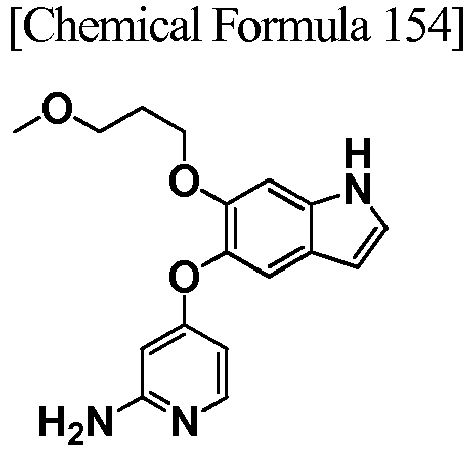
- A 2 M sodium hydroxide solution (30 mL) was added to a solution of N-(4-((6-(3-methoxypropoxy)-1H-indol-5-yl)oxy)pyridin-2-yl)acetamide described in Production Example 32-6 (2.8 g, 7.88 mmol) in methanol (30 mL) under nitrogen atmosphere at room temperature. The liquid mixture was stirred under reflux under a thermal condition of 75°C for 2 hours. The reaction liquid was allowed to stand to cool to room temperature, and then ethyl acetate and water were added. The organic layer was washed with a saturated saline solution and then dried over anhydrous sodium sulfate. The drying agent was separated by filtration and then the filtrate was concentrated under vacuum. The residue was purified with silica gel column chromatography (n-heptane:ethyl acetate = 1:9 - 0:1- ethyl acetate:methanol = 49:1) to obtain the title compound (2.24 g, 91%).
1H-NMR Spectrum (CDCl3) δ (ppm): 1.75-1.92 (2H, m), 3.23 (3H, s), 3.28 (2H,t, J = 6.0 Hz), 4.03 (2H, t, J = 6.0 Hz), 4.30 (2H, s), 5.89 (1H, d, J = 2.2 Hz), 6.29 (1H, dd, J = 5.9,2.2 Hz), 6.46-6.53 (1H, m), 7.01 (1H, s), 7.16 (1H, dd, J = 3.3,2.6 Hz), 7.35 (1H, s), 7.88 (1H, d, J = 5.9 Hz), 8.14-8.26 (1H, m). -

- 50 - 72% Oily sodium hydride (308 mg) was added to a solution of 4-((6-(3-methoxypropoxy)-1H-indol-5-yl)oxy)pyridin-2-amine described in Production Example 32-7 (2.23 g, 7.12 mmol) in N,N-dimethylformamide (30 mL) under nitrogen atmosphere at 0°C. The reaction liquid was stirred for 10 minutes, then phenyl methylcarbamate described in Production Example 1-7 (1.40 g, 9.25 mmol) was added, and the resultant was further stirred at the same temperature for 30 minutes. Water and ethyl acetate were added to the reaction liquid. The organic layer was washed serially with water and a saturated saline solution and then dried over anhydrous sodium sulfate. The drying agent was separated by filtration and then the filtrate was concentrated under vacuum. The residue was purified with NH silica gel column chromatography (n-heptane:ethyl acetate = 9:1 - 0:1) to obtain the title compound (2.44 g, 93%).
1H-NMR Spectrum (DMSO-d6) δ (ppm): 1.73-1.86 (2H, m), 2.81-2.87 (3H, m), 3.12 (3H, d, J = 1.8 Hz), 3.16-3.24 (2H, m), 3.98 (2H, t, J = 5.7 Hz), 5.62-5.71 (1H, m), 5.78 (2H, s), 6.06-6.15 (1H, m), 6.61 (1H, dd, J = 3.5,1.7 Hz), 7.36 (1H, d, J = 1.8 Hz), 7.71-7.78 (2H, m), 7.98-8.04 (1H, m), 8.10-8.22 (1H, m). -


- Thionyl chloride (118 µL, 1.62 mmol) was added to a solution of benzotriazole (193 mg, 1.62 mmol) in dichloromethane (5 mL) under nitrogen atmosphere at room temperature, and the mixture was stirred for 5 minutes. 4-(1-(tert-Butoxycarbonyl)azetidin-3-yl)benzoic acid described in Production Example 26-5 (300 mg, 1.08 mmol) was added to the reaction liquid, and the mixture was further stirred for 1 hour. The reaction liquid was filtered through anhydrous sodium sulfate on the glass filter, and the anhydrous sodium sulfate was washed with dichloromethane. A solution of triethylamine (748 µL, 5.40 mmol), 4-dimethylaminopyridine (6.60 mg, 0.054 mmol), and 5-((2-aminopyridin-4-yl)oxy)-6-(3-methoxypropoxy)-N-methyl-1H-indole-1-carboxamide described in Production Example 32-8 (200 mg, 0.54 mmol) in tetrahydrofuran (10 mL) was added to the resultant dichloromethane solution under nitrogen atmosphere at 0°C, and the mixture was stirred for 4 hours and 20 minutes. The reaction liquid was diluted with ethyl acetate and water. The organic layer was washed with a saturated saline solution and then dried over anhydrous sodium sulfate. The drying agent was separated by filtration and then the filtrate was concentrated under vacuum. Tetrahydrofuran and an excessive quantity of methylamine tetrahydrofuran solution were added to the residue, and the mixture was stirred at room temperature. The liquid mixture was concentrated under vacuum. The residue was purified with silica gel column chromatography (n-heptane:ethyl acetate = 2:3 - 0:1) to obtain the title compound (146 mg, 43%).
1H-NMR Spectrum (CDCl3) δ (ppm): 1.43-1.51 (9H, m), 1.80-1.95 (2H, m), 2.95 (3H, d, J = 4.8 Hz), 3.17 (3H, s), 3.20-3.27 (2H, m), 3.69-3.82 (1H, m), 3.95 (2H, dd, J = 8.6, 6.0 Hz), 4.05-4.17 (2H, m), 4.33 (2H, t, J = 8.6 Hz), 6.13-6.25 (1H, m), 6.44 (1H, d, J = 3.7 Hz), 6.63 (1H, dd, J = 5.7, 2.4 Hz), 6.97 (1H, s), 7.24 (2H, d, J = 3.7 Hz), 7.38 (2H, d, J = 8.4 Hz), 7.83 (2H, d, J = 8.4 Hz), 7.88 (1H, d, J = 2.6 Hz), 8.01-8.09 (2H, m), 8.79-9.00 (1H, m). -

- Trifluoroacetic acid (713 µL, 9.25 mmol) was added to a solution of tert-butyl 3-(4-((4-((6-(3-methoxypropoxy)-1-(methylcarbamoyl)-1H-indol-5-yl)oxy)pyridin-2-yl)carb amoyl)phenyl)azetidine-1-carboxylate described in Production Example 32-9 (146 mg, 0.231 mmol) in dichloromethane (5 mL) at room temperature. The reaction liquid was stirred for 1.5 hours, and then the resultant was concentrated under vacuum. The residue was dissolved in dichloromethane and triethylamine to neutralize the trifluoroacetic acid, and then the resultant was concentrated under vacuum. The residue was purified with NH silica gel column chromatography (ethyl acetate:methanol = 49:1 - 17:3) to obtain the title compound (96.2 mg, 79%).
1H-NMR Spectrum (CDCl3) δ (ppm): 1.82-1.95 (2H, m), 3.06 (3H, d, J = 4.8 Hz), 3.19 (3H, s), 3.24 (2H, t, J = 6.4 Hz), 3.79-4.00 (5H, m), 4.11 (2H, t, J = 6.0 Hz), 5.56-5.64 (1H, m), 6.55 (1H, d, J = 3.7 Hz), 6.61 (1H, dd, J = 5.9,2.2 Hz), 7.21-7.29 (1H, m), 7.34 (1H, s), 7.41 (2H, d, J = 8.4 Hz), 7.84 (2H, d, J = 8.4 Hz), 7.92 (1H, d, J = 2.2 Hz), 8.00 (1H, s), 8.10 (1H, d, J = 5.9 Hz), 8.56-8.68 (1H, m). -
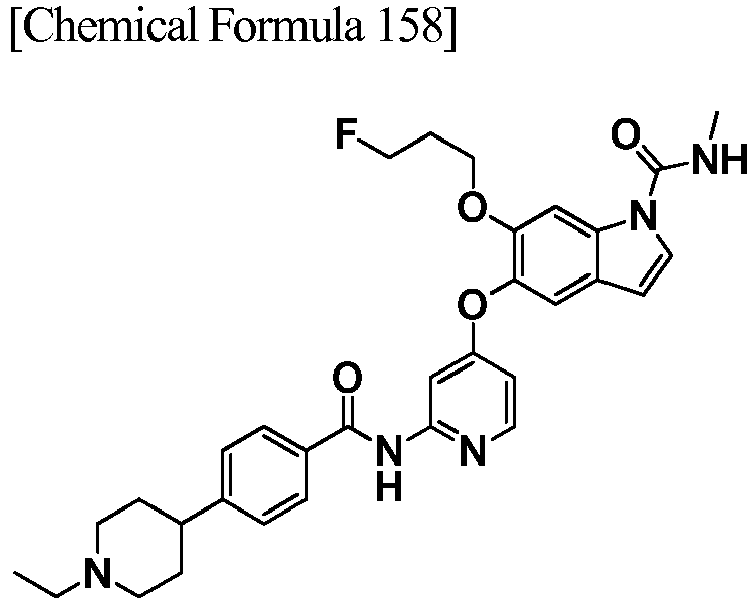
- Benzotriazole (37.8 mg, 0.317 mmol) was dissolved in dichloromethane (2.0 mL), thionyl chloride (24 µL, 0.322 mmol) was added under nitrogen atmosphere at room temperature, and the mixture was stirred for 5 minutes. 4-(1-(tert-Butoxycarbonyl) piperidin-4-yl)benzoic acid described in Production Example 1-12 (82 mg, 0.269 mmol) was added to the reaction mixture at room temperature, and the mixture was stirred for 20 minutes. The reaction mixture was filtered through a glass filter entirely covered with anhydrous sodium sulfate and then the anhydrous sodium sulfate was washed with dichloromethane, the filtrate was added to a mixture of 5-((2-aminopyridin-4-yl)oxy)-6-(3-fluoropropoxy)-N-methyl-1H-indole-1-carboxamide described in Production Example 33-6 (34.4 mg, 0.096 mmol), triethylamine (133 µL, 0.960 mmol), and 4-dimethylaminopyridine (1.17 mg, 0.0096 mmol) in tetrahydrofuran (1.5 mL) at 0°C, and the mixture was stirred at room temperature for 320 minutes. Water and ethyl acetate were added to the reaction mixture for partition, then the organic layer was washed with a saturated saline solution and dried over anhydrous sodium sulfate. The resultant was purified with NH silica gel column chromatography, then the filtrate was concentrated under vacuum. The residue was dissolved in tetrahydrofuran, an excessive quantity of 9.8 M methylamine methanol solution was added at room temperature, and the mixture was stirred for 50 minutes. The reaction mixture was concentrated under vacuum, the residue was dissolved in dichloromethane, and the resultant was purified with NH silica gel column chromatography (n-heptane:ethyl acetate = 1:1 - 3:7 - 0:1). The target fraction was concentrated under vacuum to obtain a crude product A (46.3 mg).
- The crude product A (46.3 mg) was dissolved in dichloromethane (1.25 mL), and trifluoroacetic acid (250 µL) was added at 0°C. The mixture was stirred at room temperature for 20 minutes and then concentrated under vacuum, then the residue was dissolved in dichloromethane-triethylamine, and the resultant was purified with NH silica gel column chromatography (ethyl acetate:methanol = 97:3 - 4:1). The target fraction was concentrated under vacuum to obtain a crude product B (35.8 mg).
- Sodium triacetoxyborohydride (10.4 mg, 0.049 mmol) and acetaldehyde (2.17 mg, 0.049 mmol) were added to a mixture of a part of crude product B (9.0 mg, 0.016 mmol) and tetrahydrofuran (500 µL) at room temperature, and the mixture was stirred at room temperature for 140 minutes. A saturated aqueous sodium bicarbonate solution and ethyl acetate were added to the reaction mixture for partition. The organic layer was washed with a saturated saline solution, and then dried over anhydrous sodium sulfate and filtered. The solvent was evaporated and the resultant residue was purified with NH silica gel TLC (ethyl acetate). The resultant solid was washed with diethyl ether to obtain the title compound (6.7 mg, 49%).
1H-NMR Spectrum (CDCl3) δ (ppm): 1.14 (3H, t, J = 7.1 Hz), 1.76-1.91 (4H, m), 1.93-2.12 (4H, m), 2.41-2.64 (3H, m), 3.03-3.17 (5H, m), 4.16 (2H, t, J = 6.0 Hz), 4.24 (1H, t, J = 5.9 Hz), 4.36 (1H, t, J = 5.7 Hz), 5.46-5.57 (1H, m), 6.55 (1H, d, J = 3.3 Hz), 6.58 (1H, dd, J = 5.9,2.2 Hz), 7.24 (1H, d, J = 3.7 Hz), 7.31-7.36 (3H, m), 7.80 (2H, d, J = 8.1 Hz), 7.90 (1H, d, J = 2.2 Hz), 8.02 (1H, s), 8.10 (1H, d, J = 5.9 Hz), 8.49 (1H, brs). - The starting material 5-((2-aminopyridin-4-yl)oxy)-6-(3-fluoropropoxy)-N-methyl-1H-indole-1-carboxamide was synthesized by the following method.
-

- Commercially available 3,4-dihydroxybenzaldehyde (6.5 g, 47.1 mmol) and potassium carbonate (6.83 g, 49.4 mmol) were suspended in N,N-dimethylformamide (30 mL), then 3-fluoropropyl 4-methylbenzenesulfonate described in Production Example 4-1 (11.3 g, 48.4 mmol) was added under nitrogen atmosphere at room temperature, and the mixture was stirred for 37 hours. The mixture was cooled to 0°C and then 2 M hydrochloric acid, ethyl acetate, and water were added for partition. The organic layer was washed with water and a saturated saline solution, dried over anhydrous magnesium sulfate, and then filtered. The solvent was evaporated and the resultant residue was purified with silica gel column chromatography (n-heptane:ethyl acetate = 4:1 - 2:1 - 1:1). The target fraction was concentrated under vacuum to obtain the title compound (4.62 g, 50%).
1H-NMR Spectrum (CDCl3) δ (ppm): 2.23 (1H, quin, J = 5.9 Hz), 2.30 (1H, quin, J = 5.8 Hz), 4.31 (2H, t, J = 6.2 Hz), 4.60 (1H, t, J = 5.6 Hz), 4.72 (1H, t, J = 5.6 Hz), 5.70 (1H, s), 6.99 (1H, d, J = 8.2 Hz), 7.41-7.47 (2H, m), 9.85 (1H, s). -

- Potassium carbonate (3.87 g, 28.0 mmol) and benzyl chloride (3.2 mL, 27.8 mmol) were added to a suspension of 4-(3-fluoropropoxy)-3-hydroxybenzaldehyde described in Production Example 33-1 (4.62 g, 23.3 mmol) in ethanol (46 mL) under nitrogen atmosphere at room temperature, and the mixture was stirred at 90°C for 1.5 hours. The reaction mixture was cooled to 0°C, then 2 M hydrochloric acid, ethyl acetate, and water were added for partition. The organic layer was washed with a saturated saline solution, dried over anhydrous magnesium sulfate, and then filtered. The solvent was evaporated and the resultant residue was purified with silica gel column chromatography (n-heptane:ethyl acetate = 9:1 - 3:2 - 1:1). The target fraction was concentrated under vacuum to obtain the title compound (6.14 g, 91%).
1H-NMR Spectrum (CDCl3) δ (ppm): 2.22 (1H, quin, J = 5.9 Hz), 2.29 (1H, quin, J = 5.9 Hz), 4.25 (2H, t, J = 6.2 Hz), 4.62 (1H, t, J = 5.7 Hz), 4.74 (1H, t, J = 5.7 Hz), 5.18 (2H, s), 7.02 (1H, d, J = 8.1 Hz), 7.29-7.50 (7H, m), 9.83 (1H, s). -

- 3-(Benzyloxy)-4-(3-fluoropropoxy)benzaldehyde described in Production Example 33-2 (6.14 g, 21.3 mmol) was dissolved in acetic acid (17.0 mL), then ammonium acetate (1.97 g, 25.6 mmol) and nitromethane (2.8 mL, 51.7 mmol) were added under nitrogen atmosphere at room temperature, and the mixture was heated and stirred at 130°C for 2 hours. The mixture was cooled to room temperature, then the precipitate was collected by filteration and washed with a small quantity of ethanol to quantitatively obtain the title compound.
1H-NMR Spectrum (CDCl3) δ (ppm): 2.21 (1H, quin, J = 6.0 Hz), 2.28 (1H, quin, J = 5.9 Hz), 4.22 (2H, t, J = 6.0 Hz), 4.62 (1H, t, J = 5.7 Hz), 4.73 (1H, t, J = 5.7 Hz), 5.15 (2H, s), 6.95 (1H, d, J = 8.4 Hz), 7.06 (1H, d, J = 1.8 Hz), 7.17 (1H, dd, J = 8.2, 2.0 Hz), 7.29-7.49 (6H, m), 7.91 (1H, d, J = 13.5 Hz). -

- Fuming nitric acid (4.80 mL, 107 mmol) was added to a mixture of (E)-2-(benzyloxy)-1-(3-fluoropropoxy)-4-(2-nitrovinyl)benzene described in Production Example 33-3 (7.06 g, 21.3 mmol) and acetic acid (61 mL) in an ice bath, and the mixture was stirred at room temperature for 2.5 hours. The reaction mixture was poured onto ice, the precipitate was collected by filteration, and then the resultant was washed with a liquid mixture of a small quantity of acetic acid and ethanol to obtain a crude product (8.02 g).
- The crude product (8.02 g) was suspended in methanol (150 mL), then 10% palladium-carbon (water content, 50%) (2.27 g) was added, and the mixture was stirred under hydrogen atmosphere for 6 hours. The inside of the reaction system was substituted with nitrogen, then the mixture was diluted with methanol. The catalyst was filtered off with celite, then the filtrate was concentrated under vacuum, and the resultant was purified with silica gel column chromatography (n-heptane:ethyl acetate = 9:1 - 1:1). The target fraction was concentrated under vacuum to obtain the title compound (1.47 g, 33%).
1H-NMR Spectrum (CDCl3) δ (ppm): 2.22 (1H, quin, J = 5.9 Hz), 2.29 (1H, quin, J = 5.9 Hz), 4.23 (2H, t, J = 6.0 Hz), 4.62 (1H, t, J = 5.7 Hz), 4.74 (1H, t, J = 5.7 Hz), 5.42 (1H, s), 6.42 (1H, ddd, J = 3.1, 2.2, 0.9 Hz), 6.91 (1H, s), 7.09 (1H, dd, J = 3.1, 2.4 Hz), 7.15 (1H, s), 7.94(1H, brs). -


- 6-(3-Fluoropropoxy)-1H-indol-5-ol described in Production Example 33-4 (1.47 g, 7.04 mmol), N-(4-chloropyridin-2-yl)acetamide described in Production Example 1-5 (1.32 g, 7.74 mmol), and potassium tert-butoxide (864 mg, 7.70 mmol) were dissolved in dimethylsulfoxide (7.0 mL), and the mixture was heated and stirred under nitrogen atmosphere at 160°C for 4.5 hours. The reaction liquid was cooled to room temperature, and then water and ethyl acetate were added for partition. The aqueous layer was extracted with ethyl acetate again, then the combined organic layer was washed with water and a saturated saline solution and then dried over anhydrous magnesium sulfate. The drying agent was filtered off, the filtrate was concentrated under vacuum, and the resultant was purified with NH silica gel column chromatography (n-heptane:ethyl acetate = 4:1 - 1:1 - 0:1 - ethyl acetate:methanol = 99:1 - 9:1). The target fraction was concentrated under vacuum to obtain a crude product (177 mg).
- The resultant crude product (177 mg) was dissolved in methanol (2.5 mL), a 2 M sodium hydroxide solution (2.5 mL) was added under nitrogen atmosphere at room temperature, and the mixture was heated and stirred at 70°C for 2 hours. The reaction mixture was cooled to room temperature and then water and ethyl acetate were added for partition. The organic layer was washed with a saturated saline solution and dried over anhydrous sodium sulfate. The drying agent was filtered off, then the filtrate was concentrated under vacuum, and the resultant was purified with silica gel column chromatography (n-heptane:ethyl acetate = 2:3 - 1:4 - 0:1 - ethyl acetate:methanol = 19:1). The target fraction was concentrated under vacuum to obtain the title compound (49.4 mg, 2.3%).
1H-NMR Spectrum (CDCl3) δ (ppm): 1.95-2.11 (2H, m), 4.07 (2H, t, J = 5.9 Hz), 4.28-4.47 (4H, m), 5.88 (1H, d, J = 2.2 Hz), 6.28 (1H, dd, J = 5.9,2.2 Hz), 6.48-6.52 (1H, m), 7.02 (1H, s), 7.16-7.20 (1H, m), 7.35 (1H, s), 7.88 (1H, d, J = 5.9 Hz), 8.25 (1H, brs). -


- 4-((6-(3-Fluoropropoxy)-1H-indol-5-yl)oxy)pyridin-2-amine described in Production Example 33-5 (49.4 mg, 0.164 mmol) was dissolved in N,N-dimethylformamide (1.6 mL), 50 - 72% oily sodium hydride (14.9 mg) was added under nitrogen atmosphere at 0°C, and the mixture was stirred at room temperature for 15 minutes. The mixture was cooled to 0°C again, phenyl methylcarbamate described in Production Example 1-7 (62.0 mg, 0.41 mmol) was added, and the mixture was stirred at room temperature for 3.5 hours. A saturated aqueous ammonium chloride solution, water, and ethyl acetate were added to the reaction mixture for partition. The organic layer was washed with a saturated saline solution and then dried over anhydrous sodium sulfate. The drying agent was filtered off, the filtrate was concentrated under vacuum, and the resultant was purified with NH silica gel column chromatography (n-heptane:ethyl acetate = 1:4 - 0:1 - ethyl acetate:methanol = 99:1 - 9:1). The target fraction was concentrated under vacuum to obtain the title compound (34.4 mg, 59%).
1H-NMR Spectrum (CDCl3) δ (ppm): 1.95-2.11 (2H, m), 3.07 (3H, dd, J = 4.7, 1.2), 4.12-4.17 (2H, m), 4.29 (1H, t, J = 5.8 Hz), 4.38-4.52 (3H, m), 5.50 (1H, brs), 5.87 (1H, d, J = 2.0 Hz), 6.26 (1H, dd, J = 6.0, 2.1 Hz), 6.56 (1H, d, J = 3.7 Hz), 7.23-7.27 (1H, m), 7.29 (1H, s), 7.87 (1H, d, J = 6.0 Hz), 8.00 (1H, s). - According to Examples 1 to 33, the example compounds illustrated in Tables 1 and 2 were synthesized from 5-((2-aminopyridin-4-yl)oxy)-6-methoxy-N-methyl-1H-indole-1-carboxamide described in Production Example 1-6.
[Table 1] Example 34 Example 42 Example 50 


Example 35 Example 43 Example 51 


Example 36 Example 44 Example 52 


Example 37 Example 45 Example 53 


Example 38 Example 46 Example 54 

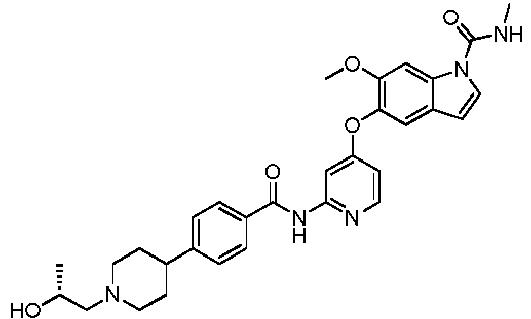
[Table 2] Example 39 Example 47 Example 55 

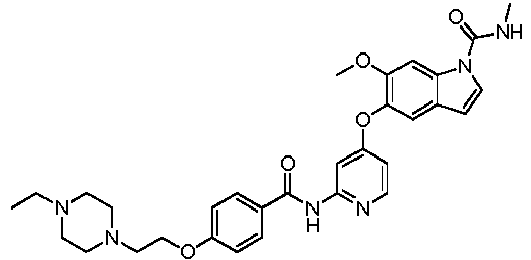
Example 40 Example 48 Example 56 


Example 41 Example 49 Example 57 


- According to Examples 1 to 33, the example compounds illustrated in Table 3 were synthesized from 5-((2-aminopyridin-4-yl)oxy)-6-ethoxy-N-methyl-1H-indole-1-carboxamide described in Production Example 15-7.
[Table 3] Example 58 Example 61 Example 64 
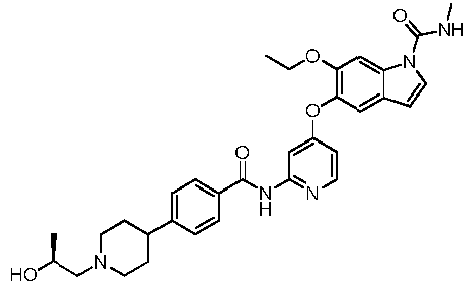

Example 59 Example 62 Example 65 


Example 60 Example 63 

- According to Examples 1 to 33, the example compounds illustrated in Table 4 were synthesized from 5-((2-aminopyridin-4-yl)oxy)-6-isopropoxy-N-methyl-1H-indole-1-carboxamide described in Production Example 17-7.
[Table 4] Example 66 Example 68 Example 70 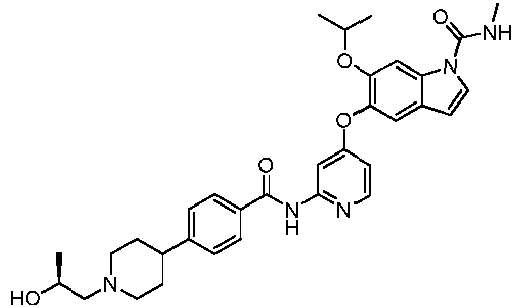


Example 67 Example 69 

- According to Examples 1 to 33, the example compounds illustrated in Table 5 were synthesized from 5-((2-aminopyridin-4-yl)oxy)-6-(3-fluoropropoxy)-N-methyl-1H-indole-1-carboxamide described in Production Example 33-6.
[Table 5] Example 71 Example 73 Example 75 


Example 72 Example 74 Example 76 


- According to Examples 1 to 33, the example compounds illustrated in Table 6 were synthesized from 5-((2-aminopyridin-4-yl)oxy)-6-(2-methoxyethoxy)-N-methyl-1H-indole -1-carboxamide described in Production Example 20-7.
[Table 6] Example 77 Example 83 Example 89 


Example 78 Example 84 Example 90 


Example 79 Example 85 Example 91 


Example 80 Example 86 Example 92 

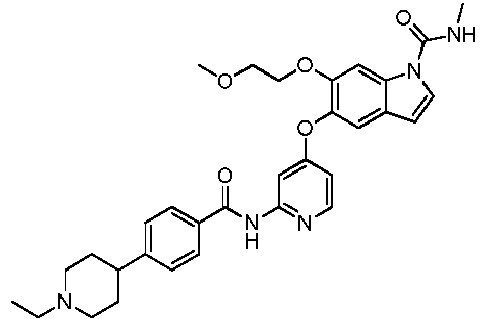
Example 81 Example 87 Example 93 


Example 82 Example 88 

- According to Examples 1 to 33, the example compounds illustrated in Tables 7 and 8 were synthesized from 5-((2-aminopyridin-4-yl)oxy)-6-(2-ethoxyethoxy)-N-methyl-1H-indole-1-carboxamide described in Production Example 24-8.
[Table 7] Example 94 Example 102 Example 110 

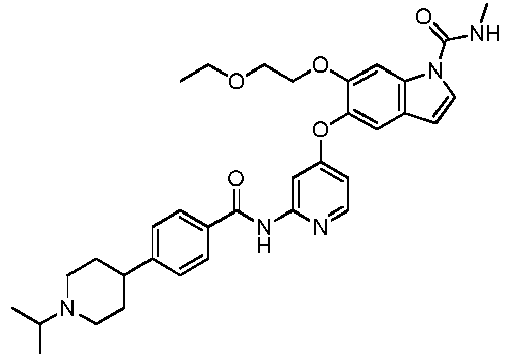
Example 95 Example 103 Example 111 

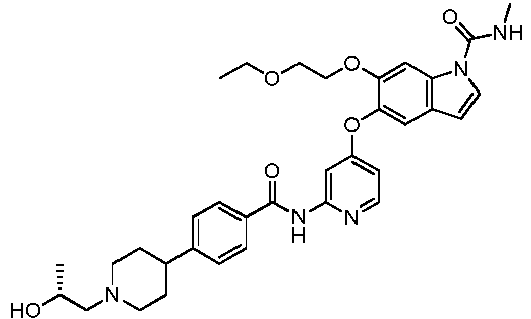
Example 96 Example 104 Example 112 


Example 97 Example 105 Example 113 


[Table 8] Example 98 Example 106 Example 114 


Example 99 Example 107 Example 115 


Example 100 Example 108 

Example 101 Example 109 

- According to Examples 1 to 33, the example compounds illustrated in Table 9 were synthesized from 5-((2-aminopyridin-4-yl)oxy)-6-(3-methoxypropoxy)-N-methyl-1H-indole -1-carboxamide described in Production Example 32-8.
[Table 9] Example 116 Example 121 Example 126 


Example 117 Example 122 Example 127 


Example 118 Example 123 Example 128 


Example 119 Example 124 Example 129 


Example 120 Example 125 Example 130 


-


- Triethylamine (33 µL, 0.237 mmol) and methoxyacetyl chloride (12.5 mg, 0.115 mmol) were added to a mixture of 6-methoxy-N-methyl-5-((2-(4-(piperidin-4-yl)benzamide)pyridin-4-yl)oxy)-1H-indole-1-car boxamide described in Example 1 (13.4 mg, 0.027 mmol) and tetrahydrofuran (1.0 mL), and the mixture was stirred at room temperature for 3.5 hours. Water and ethyl acetate were added to the reaction mixture for partition. The organic layer was washed with a saturated saline solution, and then dried over anhydrous sodium sulfate and filtered. The solvent was evaporated, and the resultant residue was dissolved in dichloromethane, and the resultant was purified with NH silica gel column chromatography (ethyl acetate:methanol = 1:0 - 9:1). The target fraction was concentrated under vacuum, and the solid was washed with diethyl ether to obtain the title compound (10.2 mg, 67%).
1H-NMR Spectrum (CDCl3) δ (ppm): 1.50-1.73 (2H, m), 1.87-1.98 (2H, m), 2.62-2.75 (1H, m), 2.76-2.89 (1H, m), 3.02-3.19 (4H, m), 3.45 (3H, s), 3.86 (3H, s), 3.97-4.03 (1H, m), 4.06-4.21 (2H, m), 4.71-4.81 (1H, m), 5.47-5.55 (1H, m), 6.55 (1H, d, J=3.7 Hz), 6.60 (1H, dd, J=5.8, 2.3 Hz), 7.23 (1H, d, J=3.8 Hz), 7.27-7.34 (3H, m), 7.81 (2H, d, J=8.4 Hz), 7.91 (1H, d, J=2.4 Hz), 8.03 (1H, s), 8.10 (1H, d, J=5.7 Hz), 8.49 (1H, brs). - According to Example 131, the example compound illustrated in Table 10 was synthesized from 6-methoxy-N-methyl-5-((2-(4-(piperidin-4-yl)benzamide)pyridin-4-yl)oxy)-1H-indole-1-car boxamide described in Example 1.
[Table 10] Example 132 
-

- N,N-dimethylformamide (0.5 mL) and N,N-diisopropylethylamine (24 µL, 0.137 mmol) were added to a mixture of 6-methoxy-N-methyl-5-((2-(4-(piperidin-4-yl)benzamide)pyridin-4-yl)oxy)-1H-indole-1-car boxamide described in Example 1 (13.7 mg, 0.027 mmol), O-(7-azabenzotriazole-1-yl)-N,N,N',N'-tetramethyluronium hexafluorophosphate (16.3 mg, 0.043 mmol) and N,N-dimethylglycine (5.5 mg, 0.053 mmol), and the mixture was stirred at room temperature for 2 hours. Water and ethyl acetate were added to the reaction mixture for partition. The organic layer was washed with a saturated saline solution, and then dried over anhydrous sodium sulfate and filtered. The solvent was evaporated, and the resultant residue was dissolved in dichloromethane, and the resultant was purified with NH silica gel column chromatography (ethyl acetate:methanol = 1:0 - 9:1). The target fraction was concentrated under vacuum, and the solid was washed with diethyl ether to obtain the title compound (13.7 mg, 85%).
1H-NMR Spectrum (CDCl3) δ (ppm): 1.49-1.74 (2H, m), 1.85-1.97 (2H, m), 2.32 (6H, s), 2.60-2.71 (1H, m), 2.76-2.87 (1H, m), 3.04-3.26 (6H, m), 3.87 (3H, s), 4.20-4.32 (1H, m), 4.71-4.83 (1H, m), 5.45-5.54 (1H, m), 6.54-6.57 (1H, m), 6.60 (1H, dd, J=5.8, 2.3 Hz), 7.24 (1H, d, J=3.7 Hz), 7.28-7.34 (3H, m), 7.82 (2H, d, J=8.6 Hz), 7.92 (1H, d, J=2.4 Hz), 8.04 (1H, s), 8.10 (1H, d, J=5.7 Hz), 8.49 (1H, brs). - According to Example 133, the example compound illustrated in Table 11 was synthesized from 6-methoxy-N-methyl-5-((2-(4-(piperidin-4-yl)benzamide)pyridin-4-yl)oxy)-1H-indole-1-car boxamide described in Example 1.
[Table 11] Example 134 
-

- 2-Hydroxyacetaldehyde (9.41 mg, 0.157 mmol), sodium triacetoxyborohydride (33.2 mg, 0.157 mmol) and acetic acid (8.97 µL, 0.157 mmol) were added to a mixture of 6-ethyl-N-methyl-5-((2-(4-(piperidin-4-yl)benzamide)pyridin-4-yl)oxy)-1H-indole-1-carbox amide (15.6 mg, 0.031 mmol) and tetrahydrofuran (1.0 mL), and the mixture was stirred at room temperature for 15 hours and 50 minutes. A saturated aqueous sodium bicarbonate solution and ethyl acetate were added to the reaction mixture for partition. The organic layer was washed with a saturated saline solution, and then dried over anhydrous sodium sulfate and filtered. The solvent was evaporated, and the resultant residue was dissolved in dichloromethane, and the resultant was purified with NH silica gel column chromatography (ethyl acetate:methanol = 1:0 - 9:1 - 17:3). The target fraction was concentrated under vacuum to obtain the title compound (13.2 mg, 78%).
1H-NMR Spectrum (CDCl3) δ (ppm): 1.24 (3H, t, J=7.5 Hz), 1.71-1.92 (5H, m), 2.16-2.26 (2H, m), 2.55-2.72 (5H, m), 3.01-3.13 (5H, m), 3.64 (2H, t, J=5.3 Hz), 5.46-5.53 (1H, m), 6.52 (1H, dd, J=5.9, 2.2 Hz), 6.56 (1H, d, J=3.7 Hz), 7.24-7.29 (1H, m), 7.34 (2H, d, J=8.4 Hz), 7.37 (1H, d, J=3.7 Hz), 7.82 (2H, d, J=8.1 Hz), 7.98 (1H, d, J=2.2 Hz), 8.10 (1H, d, J=5.9 Hz), 8.12 (1H, s), 8.49 (1H, brs). - The starting material 6-ethyl-N-methyl-5-((2-(4-(piperidin-4-yl)benzamide)pyridin-4-yl)oxy)-1H-indole-1-carbox amide was synthesized by the following method.
-

- Commercially available 3-ethylaniline (10.1 g, 83.3 mmol) was dissolved in ethanol (40 mL), then sodium hydrogen carbonate (7.00 g, 83.3 mmol) and bromoacetaldehyde diethyl acetal (8.44 mL, 54.8 mmol) were added, and the mixture was heated and stirred at 80°C for 80 hours. Water was added to the reaction mixture for partition. The aqueous layer was extracted with ethyl acetate three times and then the combined organic layer was washed with a saturated saline solution. The organic layer was dried over anhydrous magnesium sulfate, filtered and then concentrated under vacuum. The resultant residue was purified with silica gel column chromatography (n-heptane:ethyl acetate = 2:1). The target fraction was concentrated under vacuum to obtain a crude product A (11 g).
- Apart of the resultant crude product A (10 g) was dissolved in trifluoroacetic acid (45 mL), anhydrous trifluoroacetic acid (45 mL) was added at 4°C, and the mixture was stirred for 30 minutes. Trifluoroacetic acid (60 mL) was added to the reaction mixture, and the mixture was stirred at 75°C for 2.5 hours. After concentration under vacuum, the aqueous layer was extracted with ethyl acetate three times, and then the combined organic layer was washed with a saturated saline solution. The organic layer was dried over anhydrous magnesium sulfate, filtered and then concentrated under vacuum. The resultant residue was purified with NH silica gel column chromatography (n-heptane:ethyl acetate = 3:1). The target fraction was concentrated under vacuum to obtain a crude product B (3 g).
- Apart of the resultant crude product B (1.5 g) was dissolved in acetic acid (50 mL), sodium cyanoborohydride (1.30 g, 20.7 mmol) was added at 0°C, and the mixture was stirred at room temperature for 1 hour. A saturated aqueous sodium bicarbonate solution was added to the reaction mixture for partition. The aqueous layer was extracted with ethyl acetate three times, and then the combined organic layer was washed with a saturated saline solution. The organic layer was dried over anhydrous magnesium sulfate, filtered and then concentrated under vacuum. The resultant residue was purified with silica gel column chromatography (n-heptane:ethyl acetate = 3:1). The target fraction was concentrated under vacuum to obtain the title compound (560 mg, 15%).
1H-NMR Spectrum (CDCl3) δ (ppm): 1.20 (3H, t, J=7.6 Hz), 2.55 (2H, q, J=7.7 Hz), 2.99 (2H, t, J=8.4 Hz), 3.54 (2H, t, J=8.3 Hz), 3.72 (1H, brs), 6.43-6.61 (2H, m), 6.93-7.07 (1H, m). -

- Potassium nitrosodisulfonate (6.82 g, 25.4 mmol) was dissolved in a 0.1 M potassium phosphate buffer (450 mL), then 6-ethylindoline described in Production Example 135-1 (1.7 g, 11.5 mmol) dissolved in acetone (150 mL) was added, and the mixture was stirred at room temperature for 12 hours. 2 M Sodium hydroxide was added to the reaction mixture for partition. The aqueous layer was extracted with ethyl acetate three times, and then the combined organic layer was washed with a saturated saline solution. The organic layer was dried over anhydrous magnesium sulfate, filtered and then concentrated under vacuum. The resultant residue was purified with silica gel column chromatography (n-heptane:ethyl acetate = 1:1). The target fraction was concentrated under vacuum to obtain the title compound (560 mg, 30%).
1H-NMR Spectrum (CDCl3) δ (ppm): 1.29 (3H, t, J=7.5 Hz), 2.74 (2H, q, J=7.5 Hz), 4.50 (1H, s), 6.34-6.43 (1H, m), 6.99 (1H, s), 7.07-7.18 (2H, m), 7.95 (1H, brs). - According to Examples 1 to 33, the example compounds illustrated in Table 12 containing the starting material of Example 135, 6-ethyl-N-methyl-5-((2-(4-(piperidin-4-yl)benzamide)pyridin-4-yl)oxy)-1H-indole-1-carbox amide were synthesized from 6-ethyl-1H-indol-5-ol described in Production Example 135-2 and N-(4-chloropyridin-2-yl)acetamide described in Production Example 1-5.
[Table 12] Example 136 Example 137 Example 138 


Example 139 
-

- Triethylamine (20 µL, 0.144 mmol) and commercially available 4-(chloromethyl)benzoyl chloride (16.6 mg, 0.088 mmol) were added to a mixture of 5-((2-aminopyridin-4-yl)oxy)-6-(methoxymethyl)-N-methyl-1H-indole-1-carboxamide (5.5 mg, 0.017 mmol) and tetrahydrofuran (450 µL) at room temperature under nitrogen atmosphere, and the mixture was stirred for 70 minutes. Tetrahydrofuran, water and ethyl acetate were added to the reaction mixture for partition. The organic layer was washed with a saturated saline solution, and then dried over anhydrous sodium sulfate, and filtered with NH silica gel, and the resultant was concentrated under vacuum to obtain a crude product.
- The resultant crude product was dissolved in N,N-dimethylformamide (500 µL), 4-hydroxypiperidine (16.5 mg, 0.163 mmol) was added at room temperature under nitrogen atmosphere, and the mixture was stirred for 12 hours and 50 minutes. Ethyl acetate and water were added to the reaction mixture for partition. The organic layer was washed with a saturated saline solution, dried over anhydrous sodium sulfate, filtered, and then concentrated under vacuum. The residue was dissolved in dichloromethane, and the resultant was purified with NH silica gel TLC (ethyl acetate) to obtain the title compound (7.6 mg, 83%).
1H-NMR Spectrum (CDCl3) δ (ppm): 1.38-1.67 (2H, m), 1.83-1.95 (2H, m), 2.10-2.25 (2H, m), 2.68-2.79 (2H, m), 3.10 (3H, d, J=4.8 Hz), 3.37 (3H, s), 3.56 (2H, brs), 3.62-3.77 (2H, m), 4.52 (2H, s), 5.60-5.69 (1H, m), 6.55 (1H, dd, J=5.9, 2.2 Hz), 6.58 (1H, dd, J=3.7, 0.7 Hz), 7.30 (1H, s), 7.44 (2H, d, J=8.1 Hz), 7.50 (1H, d, J=3.7 Hz), 7.82 (2H, d, J=8.1 Hz), 7.97 (1H, d, J=2.2 Hz), 8.09 (1H, d, J=5.5 Hz), 8.21 (1H, s), 8.60 (1H, brs). - The starting material 5-((2-aminopyridin-4-yl)oxy)-6-(methoxymethyl)-N-methyl-1H-indole-1-carboxamide was synthesized by the following method.
-

- Benzyl 5-amino-2-(benzyloxy)benzoate (5 g, 15.0 mmol) obtained by benzylating and reducing commercially available 5-aminosalicylic acid by a conventional method was dissolved in dichloromethane (100 mL) and methanol (50 mL), then tetra-N-butylammonium tribromide (7.25 g, 15.0 mmol) was added at room temperature under nitrogen atmosphere, and the mixture was stirred for 4 hours. An aqueous sodium hydrogen sulfite solution and ethyl acetate were added to the reaction mixture for partition. The organic layer was washed with a saturated saline solution, dried over anhydrous magnesium sulfate, and then filtered. The filtrate was concentrated under vacuum, and the resultant residue was purified with silica gel column chromatography (n-heptane:ethyl acetate = 9:1 - 4:1 - 3:2). The target fraction was concentrated under vacuum to obtain the title compound (3.58 g, 58%).
1H-NMR Spectrum (CDCl3) δ (ppm): 3.88 (2H, s), 5.04 (2H, s), 5.31 (2H, s), 7.15 (1H, s), 7.27-7.43 (11H, m). -

- Benzyl 5-amino-2-(benzyloxy)4-bromobenzoate described in Production Example 140-1 (3.58 g, 8.68 mmol) was dissolved in tetrahydrofuran (20 mL) and triethylamine (40 mL), then trimethylsilylacetylene (2.5 mL, 17.7 mmol), bis(triphenylphosphine)palladium(II) chloride (304 mg, 0.434 mmol) and copper iodide(I) (165 mg, 0.868 mmol) were added at room temperature under nitrogen atmosphere, and the mixture was stirred at 70°C for 6 hours. Water and ethyl acetate were added to the reaction mixture for partition. The organic layer was washed with a saturated saline solution, dried over anhydrous sodium sulfate, and then filtered. The filtrate was concentrated under vacuum, and the resultant residue was dissolved in dichloromethane and the resultant was purified with silica gel column chromatography (n-heptane:ethyl acetate = 19:1 - 4:1 - 7:3). The target fraction was concentrated under vacuum to obtain the title compound (2.75 g, 74%).
1H-NMR Spectrum (CDCl3) δ (ppm): 0.25-0.35 (9H, m), 4.03 (2H, s), 5.03 (2H, s), 5.31 (2H, s), 7.00 (1H, s), 7.20 (1H, s), 7.28-7.47 (10H, m). -

- Benzyl 5-amino-2-(benzyloxy)4-((trimethylsilyl)ethynyl)benzoate described in Production Example 140-2 (2.75 g, 6.40 mmol) was dissolved in N,N-dimethylformamide (30 mL), then copper iodide(I) (610 mg, 3.20 mmol) was added at room temperature under nitrogen atmosphere, and the mixture was heated and stirred at 100°C for 3 hours. Ethyl acetate was added to the reaction mixture and the resultant mixture was filtered with celite. The filtrate was concentrated under vacuum, and the resultant residue was dissolved in dichloromethane and the resultant was purified with silica gel column chromatography (n-heptane:ethyl acetate = 17:3 - 3:2). The target fraction was concentrated under vacuum to obtain the title compound (1.83 g, 80%).
1H-NMR Spectrum (CDCl3) δ (ppm): 5.18 (2H, s), 5.37 (2H, s), 6.44-6.50 (1H, m), 7.22 (1H, s), 7.27-7.38 (7H, m), 7.40-7.46 (2H, m), 7.47-7.53 (2H, m), 7.99 (1H, d, J=0.7 Hz), 8.25 (1H, brs). -

- Lithium aluminum hydride (239 mg, 6.30 mmol) was suspended in tetrahydrofuran (22 mL), then a solution of benzyl 5-(benzyloxy)-1H-indole-6-carboxylate described in Production Example 140-3 (1.5 g, 4.20 mmol) dissolved in tetrahydrofuran (11 mL) was added at 0°C under nitrogen atmosphere, and the mixture was stirred at room temperature for 3 hours. Water (0.24 mL), a 5 M aqueous sodium hydroxide solution (0.24 mL) and water (0.72 mL) were added to the reaction mixture, and the mixture was stirred at room temperature for 30 minutes. The suspension was filtered with celite, and washed with tetrahydrofuran. The filtrate was concentrated under vacuum, and the resultant residue was dissolved in dichloromethane and the resultant was purified with silica gel column chromatography (n-heptane:ethyl acetate = 4:1 - 1:1 - 1:3). The target fraction was concentrated under vacuum to quantitatively obtain the title compound.
1H-NMR Spectrum (CDCl3) δ (ppm): 2.95 (1H, t, J=6.4 Hz), 4.81 (2H, d, J=6.6 Hz), 5.17 (2H, s), 6.46-6.50 (1H, m), 7.16-7.21 (2H, m), 7.30-7.43 (4H, m), 7.44-7.50 (2H, m), 8.11 (1H, brs). -

- tert-Butyl dimethylchlorosilane (280 mg, 1.86 mmol) was added to a solution of (5-(benzyloxy)-1H-indole-6-yl)methanol described in Production Example 140-4 (392 mg, 1.55 mmol) and imidazole (158 mg, 2.32 mmol) in N,N-dimethylformamide (3.8 mL) at room temperature under nitrogen atmosphere, and the mixture was stirred for 70 minutes. Ethyl acetate and water were added to the reaction mixture for partition. The organic layer was washed with water and a saturated saline solution, dried over anhydrous sodium sulfate, and then filtered. The filtrate was concentrated under vacuum to obtain a crude product A.
- The resultant crude product A was dissolved in dichloromethane (6.0 mL), di-tert-butyl dicarbonate (538 mg, 2.47 mmol) and 4-dimethylaminopyridine (18.9 mg, 0.155 mmol) were added at room temperature under nitrogen atmosphere, and the mixture was stirred for 1.5 hours. Ethyl acetate and water were added to the reaction mixture for partition. The organic layer was washed with a saturated saline solution, dried over anhydrous sodium sulfate, and then filtered. The filtrate was concentrated under vacuum to obtain a crude product B.
- The resultant crude product B was dissolved in tetrahydrofuran (6.0 mL), then 1 M tetrabutylammonium fluoride (3.0 mL, 3.00 mmol) was added at room temperature under nitrogen atmosphere, and the mixture was stirred for 6 hours. Ethyl acetate and water were added to the reaction mixture for partition. The organic layer was washed with a saturated saline solution, dried over anhydrous sodium sulfate, and then filtered. The filtrate was concentrated under vacuum, and the resultant residue was dissolved in dichloromethane and the resultant was purified with silica gel column chromatography (n-heptane:ethyl acetate = 9:1 - 1:1). The target fraction was concentrated under vacuum to quantitatively obtain the title compound.
1H-NMR Spectrum (CDCl3) δ (ppm): 1.66 (9H, s), 2.42 (1H, t, J=6.6 Hz), 4.82 (2H, d, J=6.6 Hz), 5.17 (2H, s), 6.49 (1H, dd, J=3.7, 0.7 Hz), 7.09 (1H, s), 7.30-7.49 (5H, m), 7.56 (1H, d, J=3.7 Hz), 8.09 (1H, brs). -

- Methyl iodide (290 µL, 4.66 mmol) and 50 - 72% oily sodium hydride (122 mg) were added to a solution of tert-butyl 5-(benzyloxy)-6-(hydroxymethyl)-1H-indole-1-carboxylate described in Production Example 140-5 (547 mg, 1.55 mmol) in N,N-dimethylformamide (10 mL) at room temperature under nitrogen atmosphere, and the mixture was stirred for 3 hours and 15 minutes. The reaction mixture was quenched with water, and then diluted with ethyl acetate for partition. The organic layer was washed with water twice, dried over anhydrous sodium sulfate, and then filtered. The filtrate was concentrated under vacuum, and the resultant residue was dissolved in dichloromethane and the resultant was purified with silica gel column chromatography (n-heptane:ethyl acetate = 19:1 - 4:1). The target fraction was concentrated under vacuum to obtain the title compound (487 mg, 86%).
1H-NMR Spectrum (CDCl3) δ (ppm): 1.67(9H, s), 3.45 (3H, s), 4.65 (2H, s), 5.14 (2H, s), 6.47 (1H, d, J=3.7 Hz), 7.06 (1H, s), 7.29-7.50 (5H, m), 7.55 (1H, d, J=3.7 Hz), 8.17 (1H, brs). -

- 28% Sodium methoxide (4.0 mL, 19.6 mmol) was added to a solution of tert-butyl 5-(benzyloxy)-6-(methoxymethyl)-1H-indole-1-carboxylate described in Production Example 140-6 (427 mg, 1.16 mmol) in methanol (4.0 mL) at room temperature under nitrogen atmosphere, and the mixture was stirred for 2.5 hours. Water and ethyl acetate were added to the reaction mixture for partition. The organic layer was washed with a saturated saline solution, dried over anhydrous sodium sulfate, and then filtered. The filtrate was concentrated under vacuum to obtain a crude product (301 mg).
- The resultant crude product (301 mg) was dissolved in methanol (11 mL), 10% palladium-carbon (water content, 50%) (12.0 mg) was added at room temperature, and the mixture was stirred for 3 hours under hydrogen atmosphere. The mixture was diluted with methanol, and the catalyst was filtered off with celite. The filtrate was concentrated under vacuum and the resultant was purified with silica gel column chromatography (n-heptane:ethyl acetate = 4:1 - 2:3). The target fraction was concentrated under vacuum to obtain the title compound (156 mg, 76%).
1H-NMR Spectrum (CDCl3) δ (ppm): 3.43 (3H, s), 4.73 (2H, s), 6.43-6.47 (1H, m), 6.91 (1H, s), 7.10 (1H, s), 7.13 (1H, s), 7.17 (1H, t, J=2.7 Hz), 8.00 (1H, brs). - According to Examples 1 to 33, the example compounds illustrated in Table 13 containing the starting material of Example 140, 5-((2-aminopyridin-4-yl)oxy)-6-(methoxymethyl)-N-methyl-1H-indole-1-carboxamide were synthesized from 6-(methoxymethyl)-1H-indol-5-ol described in Production Example 140-7 and N-(4-chloropyridin-2-yl)acetamide described in Production Example 1-5.
[Table 13] Example 141 Example 142 

-


- Sodium triacetoxyborohydride (10.7 mg, 0.05 mmol) and acetaldehyde (5.6 mg, 0.127 mmol) were added to a mixture of 6-cyano-N-methyl-5-((2-(4-(piperidin-4-yl)benzamide)pyridin-4-yl)oxy)-1H-indole-1-carbo xamide (3.9 mg, 7.89 mmol) and tetrahydrofuran (1.0 mL) at room temperature under nitrogen atmosphere, and the mixture was stirred for 1 hour. A saturated aqueous sodium bicarbonate solution and ethyl acetate were added to the reaction mixture for partition. The organic layer was washed with a saturated saline solution, and then dried over anhydrous sodium sulfate and filtered. The solvent was evaporated, and the resultant residue was dissolved in dichloromethane, and the resultant was purified with NH silica gel TLC (chloroform:methanol = 49:1) to obtain the title compound (2.54 mg, 62%).
1H-NMR Spectrum (CDCl3) δ (ppm): 1.16 (3H, t, J=7.3 Hz), 1.81-1.96 (4H, m), 2.06-2.20 (2H, m), 2.47-2.65 (3H, m), 3.01-3.08 (3H, m), 3.16 (2H, d, J=11.7 Hz), 5.82 (1H, brs), 6.59-6.65 (1H, m), 6.76 (1H, dd, J=5.7, 2.4 Hz), 7.33 (2H, d, J=8.4 Hz), 7.41 (1H, s), 7.57 (1H, d, J=3.7 Hz), 7.78 (2H, d, J=8.1 Hz), 7.93 (1H, s), 8.20 (1H, d, J=5.5 Hz), 8.60-8.68 (2H, m). - The starting material 6-cyano-N-methyl-5-((2-(4-(piperidin-4-yl)benzamide)pyridin-4-yl)oxy)-1H-indole-1-carbo xamide was synthesized by the following method.
-

- Commercially available 2-chloro-4-nitrophenol (10 g, 57.6 mmol) and benzyl bromide (7.6 mL, 63.9 mmol) were dissolved in N,N-dimethylformamide (100 mL), potassium carbonate (9.56 g, 69.1 mmol) was added, and the mixture was stirred at room temperature for 3.5 hours. Water was added to the reaction mixture, and the mixture was stirred at room temperature for 10 minutes. The deposited solid was filtered out, washed with tert-butyl methyl ether, and dried by through-flow drying to quantitatively obtain the title compound.
1H-NMR Spectrum (CDCl3) δ (ppm): 5.28 (2H, s), 7.03 (1H, d, J=9.2 Hz), 7.33-7.48 (5H, m), 8.12 (1H, dd, J=9.2,2.9 Hz), 8.32 (1H, d, J=2.6 Hz). -

- 1-(Benzyloxy)-2-chloro-4-nitrobenzene described in Production Example 143-1 (5 g, 19.0 mmol) and 4-chlorophenoxyacetonitrile (3.50 g, 20.9 mmol) were dissolved in N,N-dimethylformamide (35 mL), and then potassium tert-butoxide (2 g, 17.8 mmol) was added at -30 to -40°C under nitrogen atmosphere. Potassium tert-butoxide (2.32 g, 20.7 mmol) was added at the same temperature. The mixture was stirred at the same temperature for 45 minutes, and then 1 M hydrochloric acid was added. After performing extraction with ethyl acetate, the organic layer was washed with water twice and with a saturated saline solution, and then dried over anhydrous magnesium sulfate. After performing filtration, the filtrate was concentrated under vacuum, the resultant residue was dissolved in dichloromethane, and the resultant was purified with silica gel column chromatography (n-heptane:ethyl acetate = 9:1 - 3:1 - 1:1). The mixture fraction was concentrated under vacuum, the resultant residue was dissolved in dichloromethane, and the resultant was purified with silica gel column chromatography (n-heptane:ethyl acetate = 9:1 - 4:1 - 13:7). The resultant solid was washed with diethyl ether to obtain the title compound (1.04 g, 18%).
1H-NMR Spectrum (CDCl3) δ (ppm): 4.24 (2H, s), 5.33 (2H, s), 7.29 (1H, s), 7.34-7.52 (5H, m), 8.34 (1H, s). -

- 2-(5-(Benzyloxy)4-chloro-2-nitrophenyl)acetonitrile described in Production Example 143-2 (1.04 g, 3.45 mmol) was suspended in ethanol (40 mL), 5% rhodium-carbon (355 mg) was added at room temperature, and the mixture was stirred for 39 hours and 20 minutes under hydrogen atmosphere. Methanol was added to the reaction mixture, and the resultant mixture was filtered with celite. The filtrate was concentrated under vacuum, and the resultant solid was filtered out and washed with ethyl acetate. The filtrate was concentrated, the residue was purified with silica gel column chromatography (n-heptane:ethyl acetate = 9:1 - 3:2), and the target fraction was concentrated under vacuum to obtain a crude product.
- The resultant crude product was dissolved in ethanol (20 mL), 10% palladium-carbon (water content, 50%) (367 mg) was added at room temperature, and the mixture was stirred for 50 minutes under hydrogen atmosphere. Methanol was added to the reaction mixture, and the resultant mixture was filtered with celite. The filtrate was concentrated under vacuum, and the resultant solid was filtered out and washed with dichloromethane. The filtrate was concentrated, the residue was purified with silica gel column chromatography (n-heptane:ethyl acetate = 3:1 - 3:2), and the target fraction was concentrated under vacuum to obtain the title compound (193 mg, 33%).
1H-NMR Spectrum (CDCl3) δ (ppm): 5.25 (1H, s), 6.41-6.47 (1H, m), 7.19 (1H, t, J=2.7 Hz), 7.24 (1H, s), 7.37 (1H, s), 8.02 (1H, brs). -

- 6-Chloro-1H-indol-5-ol described in Production Example 143-3 (137 mg, 0.817 mmol) was dissolved in dimethyl sulfoxide (1.0 mL), N-(4-chloropyridin-2-yl)acetamide described in Production Example 1-5 (181 mg, 1.06 mmol) and potassium tert-butoxide (110 mg, 0.981 mmol) were added at room temperature under nitrogen atmosphere, and the mixture was heated and stirred at 150°C for 6.5 hours. Water and ethyl acetate were added to the reaction mixture for partition. The organic layer was washed with water and a saturated saline solution, dried over anhydrous sodium sulfate, and then filtered. The filtrate was concentrated under vacuum, and the resultant residue was dissolved in dichloromethane, and the resultant was purified with NH silica gel column chromatography (n-heptane:ethyl acetate = 1:1 - 1:3 - 0:1). The target fraction was concentrated under vacuum to obtain a crude product A (96.6 mg).
- Apart of the resultant crude product A (57.4 mg) was dissolved in methanol (2 mL), a 2 M sodium hydroxide solution (2 mL) was added at room temperature under nitrogen atmosphere, and the mixture was heated and stirred at 65°C for 2 hours. Water and ethyl acetate were added to the reaction mixture for partition. The organic layer was washed with a saturated saline solution, dried over anhydrous sodium sulfate, and then filtered. The filtrate was concentrated under vacuum, and the resultant residue was dissolved in dichloromethane, and the resultant was purified with silica gel column chromatography (n-heptane:ethyl acetate = 1:1 - 0:1). The target fraction was concentrated under vacuum to obtain a crude product B (34.7 mg).
- A part of the resultant crude product B (10.4 mg), bis(tri-t-butylphosphine)palladium(0) (8.19 mg, 0.016 mmol) and zinc cyanide (9.4 mg, 0.08 mmol) were dissolved in N,N-dimethylacetamide (500 µL), and the mixture was heated and stirred under nitrogen atmosphere and under irradiation with microwave at 150°C for 1 hour. Ethyl acetate and water were added to the reaction mixture for partition. The organic layer was washed with a saturated saline solution, dried over anhydrous sodium sulfate, and then filtered. The filtrate was concentrated under vacuum, and the resultant residue was dissolved in dichloromethane and the resultant was purified with silica gel TLC (n-heptane:ethyl acetate = 1:3) to obtain the title compound (5.0 mg, 14%).
1H-NMR Spectrum (CDCl3) δ (ppm): 4.57 (2H, brs), 5.97 (1H, d, J=2.2 Hz), 6.31 (1H, dd, J=6.2,2.2 Hz), 6.56-6.63 (1H, m), 7.41 (1H, s), 7.48 (1H, t, J=3.0 Hz), 7.77 (1H, s), 7.92 (1H, d, J=5.9 Hz), 8.98 (1H, brs). - According to Examples 1 to 33, the example compound illustrated in Table 14 containing the starting material of Example 143, 6-cyano-N-methyl-5-((2-(4-(piperidin-4-yl)benzamide)pyridin-4-yl)oxy)-1H-indole-1-carbo xamide was synthesized from 5-((2-aminopyridin-4-yl)oxy)-1H-indole-6-carbonitrile described in Production Example 143-5.
[Table 14] Example 144 
-

- A 36.5% aqueous formaldehyde solution (7.95 µL, 0.105 mmol), sodium triacetoxyborohydride (14 mg, 0.066 mmol) and acetic acid (3.02 µL, 0.053 mmol) were added to a mixture of 6-(dimethylamino)-N-methyl-5-((2-(4-(piperidin-4-yl)benzamide)pyridin-4-yl)oxy)-1H-indo le-1-carboxamide (5.4 mg, 10.5 µmol) and tetrahydrofuran (300 µL) at room temperature, and the mixture was stirred for 2 hours. A saturated aqueous sodium bicarbonate solution and ethyl acetate were added to the reaction mixture for partition. The organic layer was washed with a saturated saline solution, then dried over anhydrous sodium sulfate, and filtered. The solvent was evaporated, and the resultant residue was dissolved in chloroform and the resultant was purified with NH silica gel TLC (ethyl acetate). The resultant solid was washed with diethyl ether to obtain the title compound (3.31 mg, 60%).
1H-NMR Spectrum (CDCl3) δ (ppm): 1.77-1.88 (4H, m), 2.01-2.11 (2H, m), 2.33 (3H, s), 2.48-2.60 (1H, m), 2.79 (6H, s), 2.95-3.03 (2H, m), 3.07 (3H, d, J=4.8 Hz), 5.48 (1H, brs), 6.47 (1H, dd, J=5.9, 2.6 Hz), 6.52 (1H, d, J=3.7 Hz), 7.22-7.25 (2H, m), 7.33 (2H, d, J=8.4 Hz), 7.78-7.84 (2H, m), 7.96 (1H, s), 7.99 (1H, d, J=2.2 Hz), 8.06 (1H, d, J=5.9 Hz), 8.49 (1H, brs). - The starting material 6-(dimethylamino)-N-methyl-5-((2-(4-(piperidin-4-yl)benzamide)pyridin-4-yl)oxy)-1H-indo le-1-carboxamide was synthesized by the following method.
-

- Commercially available 4-amino-2-nitrophenol (5 g, 32.4 mmol) and triphenylphosphine (10.2 g, 38.9 mmol) were dissolved in dichloromethane (200 mL), benzyl alcohol (4.0 mL, 38.7 mmol) was added at 0°C, then a solution of diisopropyl azodicarboxylate (7.87 g, 38.9 mmol) in dichloromethane (50 mL) was added, and the mixture was stirred at room temperature for 21.5 hours. The reaction mixture was concentrated under vacuum, and the residue was dissolved in dichloromethane, and the resultant was purified with NH silica gel column chromatography (n-heptane:ethyl acetate = 4:1 - 2:3), and the target fraction was concentrated under vacuum to obtain the title compound (7.26 g, 92%).
1H-NMR Spectrum (DMSO-d6) δ (ppm): 5.09 (2H, s), 5.25 (2H, s), 6.81 (1H, dd, J=9.0, 2.7 Hz), 7.01 (1H, d, J=2.9 Hz), 7.13 (1H, d, J=9.2 Hz), 7.25-7.44 (5H, m). -

- 4-(Benzyloxy)-3-nitroaniline described in Production Example 145-1 (2.9 g, 11.9 mmol) was dissolved in dichloromethane (80 mL) and methanol (40 mL), then tetra-N-butylammonium tribromide (5.73 g, 11.9 mmol) was added at room temperature under nitrogen atmosphere, and the mixture was stirred for 50 minutes. The reaction mixture was diluted with an aqueous sodium hydrogen sulfite solution and dichloromethane. The organic layer was washed with a saturated saline solution, and dried over anhydrous magnesium sulfate. After performing filtration, the filtrate was concentrated under vacuum, and the resultant residue was dissolved in dichloromethane, and the resultant was purified with silica gel column chromatography (n-heptane:ethyl acetate = 9:1 - 3:2). The target fraction was concentrated under vacuum to obtain the title compound (2.59 g, 67%) in a purity of 84%.
1H-NMR Spectrum (CDCl3) δ (ppm): 4.06 (2H, brs), 5.12 (2H, s), 7.25 (1H, s), 7.31 (1H, s), 7.32-7.47 (5H, m). -

- 4-(Benzyloxy)-2-bromo-5-nitroaniline described in Production Example 145-2 (2.59 g, 8.01 mmol) was dissolved in tetrahydrofuran (20 mL) and triethylamine (40 mL), then trimethylsilylacetylene (2.26 mL, 16.0 mmol), bis(triphenylphosphine)palladium(II) chloride (291 mg, 0.415 mmol) and copper iodide(I) (164 mg, 0.861 mmol) were added at room temperature, and the mixture was heated and stirred at 60°C under nitrogen atmosphere. Water and ethyl acetate were added to the reaction mixture for partition. The organic layer was washed with a saturated saline solution, and then dried over anhydrous sodium sulfate and filtered. The solvent was evaporated, and the resultant residue was dissolved in dichloromethane, and the resultant was purified with silica gel column chromatography (n-heptane:ethyl acetate = 9:1 - 3:1). The target fraction was concentrated under vacuum to obtain the title compound (2.19 g, 80%).
1H-NMR Spectrum (CDCl3) δ (ppm): 0.28 (9H, s), 4.19 (2H, brs), 5.11 (2H, s), 7.09 (1H, s), 7.21 (1H, s), 7.29-7.48 (5H, m). -


- 4-(Benzyloxy)-5-nitro-2-(trimethylsilyl)ethynyl)aniline described in Production Example 145-3 (2.19 g, 6.44 mmol) was dissolved in N,N-dimethylformamide (20 mL), copper iodide(I) (1.23 g, 6.44 mmol) was added at room temperature, and the mixture was heated and stirred at 100°C. Water and ethyl acetate were added to the reaction mixture for partition. The aqueous layer was extracted with ethyl acetate, and the combined organic layer was washed with water and a saturated saline solution, then dried over anhydrous magnesium sulfate, and filtered. The solvent was evaporated, and the resultant residue was dissolved in dichloromethane, and the resultant was purified with silica gel column chromatography (n-heptane:ethyl acetate = 4:1 - 7:3 - 3:2). The target fraction was concentrated under vacuum to obtain the title compound (1.23 g, 71%).
1H-NMR Spectrum (CDCl3) δ (ppm): 5.24 (2H, s), 6.49-6.56 (1H, m), 7.27-7.46 (5H, m), 7.49-7.57 (2H, m), 8.06 (1H, d, J=1.1 Hz), 8.39 (1H, brs). -
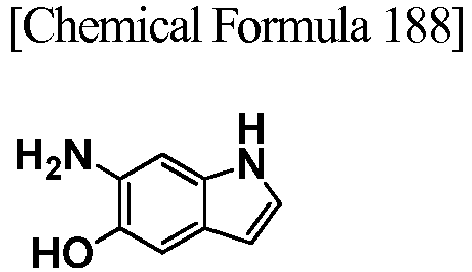
- 5-(Benzyloxy)-6-nitro-1H-indole described in Production Example 145-4 (400 mg, 1.49 mmol) was suspended in methanol (10 mL) and tetrahydrofuran (5 mL), 10% palladium-carbon (water content, 50%) (159 mg) was added at room temperature, and the mixture was stirred for 50 minutes under hydrogen atmosphere. Methanol was added to the reaction mixture, and the resultant mixture was filtered with celite. The filtrate was concentrated under vacuum, and then the resultant solid was washed with diethyl ether and ethyl acetate to obtain the title compound (168 mg, 76%).
1H-NMR Spectrum (DMSO-d6) δ (ppm): 4.31 (2H, brs), 6.05 (1H, t, J=2.0 Hz), 6.59 (1H, s), 6.74 (1H, s), 6.88 (1H, t, J=2.8 Hz), 8.48 (1H, brs), 10.25 (1H, brs). -

- 6-Amino-1H-indol-5-ol described in Production Example 145-5 (80 mg, 0.54 mmol) was dissolved in tetrahydrofuran (5.4 mL), a 36.5% aqueous formaldehyde solution (122 µL, 1.62 mmol), sodium triacetoxyborohydride (343 mg, 1.62 mmol) and acetic acid (93 µL, 1.62 mmol) were added at room temperature, and the mixture was stirred for 2 hours. Water and ethyl acetate were added to the reaction mixture for partition. The aqueous layer was extracted with ethyl acetate, and the combined organic layer was washed with a saturated saline solution, then dried over anhydrous magnesium sulfate, and filtered. The solvent was evaporated, and the resultant residue was dissolved in dichloromethane, and the resultant was purified with NH silica gel column chromatography (n-heptane:ethyl acetate = 7:3 - 1:4). The target fraction was concentrated under vacuum to obtain the title compound (62.0 mg, 65%).
1H-NMR Spectrum (CDCl3) δ(ppm): 2.70 (6H, s), 6.42 (1H, ddd, J=3.0, 2.1, 1.1 Hz), 7.11-7.15 (2H, m), 7.21 (1H, s), 7.94 (1H, brs). - According to Examples 1 to 33, the example compounds illustrated in Table 15 containing the starting material of Example 145, 6-(dimethylamino)-N-methyl-5-((2-(4-(piperidin-4-yl)benzamide)pyridin-4-yl)oxy)-1H-indo le-1-carboxamide were synthesized from 6-(dimethylamino)-1H-indol-5-ol described in Production Example 145-6 and N-(4-chloropyridin-2-yl)acetamide described in Production Example 1-5.
[Table 15] Example 146 Example 147 

-

- 5-((2-Aminopyridin-4-yl)oxy)-6-(2-methoxyethoxy)-N-methyl-1H-indole-1-carbo xamide described in Production Example 20-7 (460 mg, 1.29 mmol), 4-(1-(2-((tert-butyldimethylsilyl)oxy)ethyl)-2-oxopiperidin-4-yl)benzoic acid described in Production Example 148-4 (585 mg, 1.55 mmol) and 4-dimethylaminopyridine (315 mg, 2.58 mmol) were dissolved in 1,2-dimethoxyethane (6 mL), triethylamine (360 µL, 2.58 mmol) and 1-ethyl-3-(3-dimethylaminopropyl)carbodiimide hydrochloride (495 mg, 2.58 mmol) were added, and the mixture was stirred at room temperature for 1 hour and then at 55°C for 2 hours. 2 M Hydrochloric acid (5 mL, 10.0 mmol) was added to the reaction mixture, and the mixture was stirred for 3 hours. Ethyl acetate was added to the reaction mixture, the resultant was neutralized with a 2 M sodium hydroxide solution, and then extracted with ethyl acetate. The organic layer was washed with a saturated saline solution, and then the organic layer was dried over anhydrous magnesium sulfate, and filtered. The solvent was evaporated, and the resultant residue was purified with NH silica gel column chromatography (n-heptane:ethyl acetate = 1:1 - 0:1 - ethyl acetate:methanol= 24:1 - 9:1). The target fraction was concentrated under vacuum, then a solid was deposited by using dichloromethane and tert-butyl methyl ether, and the solid was filtered out to obtain the title compound (632 mg, 81%).
1H-NMR Spectrum (CDCl3) δ (ppm): 1.98-2.10 (1H, m), 2.11-2.22 (1H, m), 2.54 (1H, dd, J=17.6, 11.0 Hz), 2.71-2.81 (1H, m), 3.06 (3H, d, J=4.4 Hz), 3.15-3.23 (2H, m), 3.26 (3H, s), 3.39-3.48 (1H, m), 3.49-3.61 (4H, m), 3.63-3.71 (1H, m), 3.84 (2H, d, J=4.8 Hz), 4.08-4.26 (2H, m), 5.60 (1H, brs), 6.55 (1H, d, J=3.3 Hz), 6.62 (1H, dd, J=5.7, 2.4 Hz), 7.26-7.35 (4H, m), 7.85 (2H, d, J=8.4 Hz), 7.91 (1H, d, J=2.2 Hz), 8.02 (1H, s), 8.09 (1H, d, J=5.9 Hz), 8.56 (1H, brs). - The starting material 4-(1-(2-((tert-butyldimethylsilyl)oxy)ethyl)-2-oxopiperidin-4-yl)benzoic acid was synthesized by the following method.
-

- 4-(1-(tert-Butoxycarbonyl)piperidin-4-yl)benzoic acid described in Production Example 1-12 (3.0 g, 9.82 mmol) was dissolved in N,N-dimethylformamide (15 mL), then potassium carbonate (1.63 g, 11.8 mmol) and benzyl bromide (1.29 mL, 10.8 mmol) were added, and the mixture was stirred at room temperature for 24 hours. Water and ethyl acetate were added to the reaction mixture for partition. The aqueous layer was extracted with ethyl acetate, and the combined organic layer was washed with a saturated saline solution. The organic layer was dried over anhydrous magnesium sulfate, and filtered. The solvent was evaporated, and the resultant residue was purified with silica gel column chromatography (n-heptane:ethyl acetate = 2:1). The target fraction was concentrated under vacuum to obtain the title compound (3.83 g, 99%).
1H-NMR Spectrum (CDCl3) δ (ppm): 1.48 (9H, s), 1.58-1.70 (2H, m), 1.82 (2H, d, J=12.4 Hz), 2.56-2.96 (3H, m), 4.17-4.39 (2H, m), 5.36 (2H, s), 7.25-7.29 (3H, m), 7.31-7.50 (4H, m), 8.02 (2H, d, J=8.4 Hz). -

- tert-Butyl 4-(4-((benzyloxy)carbonyl)phenyl)piperidin-1-carboxylate described in Production Example 148-1 (3.83 g, 9.68 mmol) was dissolved in ethyl acetate (90 mL), then a ruthenium oxide(IV) hydrate (44.0 mg, 0.29 mmol) dissolved in water (270 mL) and sodium periodate (8.29 g, 38.7 mmol) were added at room temperature, and the mixture was stirred at room temperature for 18 hours. Ethyl acetate was added to the reaction mixture for partition, and then the organic layer was washed with a saturate saline solution. The organic layer was dried over anhydrous magnesium sulfate, and filtered. The solvent was evaporated, the resultant residue was dissolved in dichloromethane (30 mL), then trifluoroacetic acid (15 mL, 202 mmol) was added, and the mixture was stirred at room temperature for 1 hour. The resultant was concentrated under vacuum, and a saturated aqueous sodium carbonate solution was added to the residue. Ethyl acetate was added for partition, and then the organic layer was washed with a saturated saline solution. The organic layer was dried over anhydrous magnesium sulfate, and filtered. The solvent was evaporated, and the residue was washed with diethyl ether to obtain the title compound (2.03 g, 68%).
1H-NMR Spectrum (CDCl3) δ (ppm): 1.88-2.05 (1H, m), 2.06-2.17 (1H, m), 2.41-2.58 (1H, m), 2.64-2.78 (1H, m), 3.10-3.26 (1H, m), 3.33-3.52 (2H, m), 5.37 (2H, s), 5.71-5.83 (1H, m), 7.27-7.50 (7H, m), 8.01-8.10 (2H, m). -

- Benzyl 4-(2-oxopiperidin-4-yl)benzoate described in Production Example 148-2 (1.3 g, 4.20 mmol) was dissolved in dimethyl sulfoxide (20 mL), then 50 - 72% oily sodium hydride (218 mg) was added at room temperature under nitrogen atmosphere, and the mixture was stirred at room temperature for 1 hour. Subsequently, tert-butyl(2-iodoethoxy)dimethylsilane (1.92 g, 6.27 mmol) dissolved in dimethyl sulfoxide (10 mL) was added, and the mixture was stirred at room temperature for 20 hours. A saturated aqueous ammonium chloride solution and ethyl acetate were added to the reaction mixture at 0°C for partition. The aqueous layer was extracted with ethyl acetate, and the combined organic layer was washed with a saturated saline solution. The organic layer was dried over anhydrous magnesium sulfate, and filtered. The solvent was evaporated, and the resultant residue was purified with silica gel column chromatography (n-heptane:ethyl acetate = 10:1 - 1:2). The target fraction was concentrated under vacuum to obtain the title compound (920 mg, 47%).
1H-NMR Spectrum (CDCl3) δ (ppm): 0.06 (6H, d, J=1.8 Hz), 0.89 (9H, s), 1.87-2.03 (1H, m), 2.07-2.18 (1H, m), 2.50 (1H, dd, J=17.4,11.2 Hz), 2.63-2.81 (1H, m), 3.09-3.20 (1H, m), 3.46-3.59 (4H, m), 3.82 (2H, t, J=5.3 Hz), 5.36 (2H, s), 7.27-7.50 (7H, m), 8.01-8.08 (2H, m). -

- Benzyl 4-(-(2-((tert-butyldimethylsilyl)oxy)ethyl)-2-oxopiperidin-4-yl)benzoate described in Production Example 148-3 (920 mg, 1.97 mmol) was dissolved in methanol (20 mL), then 10% palladium-carbon (water content, 50%) (209 mg) was added, and the mixture was stirred under hydrogen atmosphere for 3 hours. The inside of the reaction system was substituted with nitrogen, then the catalyst was filtered off with celite, and the resultant was washed with methanol. The filtrate was concentrated under vacuum, and the resultant was purified with silica gel column chromatography (n-heptane:ethyl acetate = 2:1 - 0:1). The target fraction was concentrated under vacuum to obtain the title compound (592 mg, 80%).
1H-NMR Spectrum (CDCl3) δ (ppm): 0.07 (6H, d, J=1.5 Hz), 0.90 (9H, s), 1.96-2.02 (1H, m), 2.10-2.16 (1H, m), 2.52 (1H, dd, J=17.6,11.0 Hz), 2.72-2.80 (1H, m), 3.10-3.24 (1H, m), 3.47-3.60 (4H, m), 3.83 (2H, t, J=5.5 Hz), 7.31 (2H, d, J=8.1 Hz), 8.06 (2H, d, J=8.4 Hz). - According to Examples 1 to 33, the example compound illustrated in Table 16 was synthesized from 5-((2-aminopyridin-4-yl)oxy)-6-(2-ethoxyethoxy)-N-methyl-1H-indole-1-carboxamide described in Production Example 24-8.
[Table 16] Example 149 
- [Example 150]
-

- 3-Chloroperoxybenzoic acid (229 mg, 0.864 mmol) (purity: 65%) was added to a mixture of 5-((2-(4-(1-(2-hydroxyethyl)piperidin-4-yl)benzamide)pyridin-4-yl)oxy)-6-(2-methoxyethox y)-N-methyl-1H-indole-1-carboxamide described in Example 22 (508 mg, 0.864 mmol) and dichloromethane (25 mL) under nitrogen atmosphere, and the mixture was stirred at room temperature for 30 minutes. Ethyl acetate and a 10% aqueous sodium sulfite solution were added to the reaction mixture for partition. The aqueous layer was saturated with sodium chloride, and extracted by using a mixed solvent of ethyl acetate, tetrahydrofuran and methanol. The combined organic layer was dried over anhydrous sodium sulfate, and filtered. The solvent was evaporated, and the resultant residue was dissolved in methanol and dichloromethane, and the resultant was purified with NH silica gel column chromatography (chloroform:methanol = 49:1 - 4:1). The target fraction was concentrated under vacuum, and then the deposited solid was dissolved in ethyl acetate, tetrahydrofuran and methanol. The deposited solid was filtered out and washed with ethyl acetate to obtain a filtrate. The filtrate was concentrated under vacuum (168 mg), suspended in tetrahydrofuran, ethyl acetate and isopropanol, and the resultant was stirred at 60°C for 20 minutes. The resultant was cooled to room temperature, and the deposited solid was filtered out and washed with ethyl acetate to obtain a filtrate. The filtrate was concentrated under vacuum (62.4 mg), and a part of the filtrate (10.4 mg) was purified with ODS column chromatography (0.5% trifluoroacetic acid/water:acetonitrile = 37:13) to separate it to a cis-form (retention time = 73 - 75 min) and a trans-form (retention time = 65 - 67 min). Buffers were added to these, and after extraction with butanol, the solvents were concentrated under vacuum, and the resultants were purified with ODS column chromatography (methanol:water = 1:9, acetonitrile:water = 1:9, successively eluted with acetonitrile and methanol) to obtain the cis-form of the title compound (1.1 mg) as a high polar component and a low polar component of Example 151. cis-form
1H-NMR Spectrum (600MHz, DMSO-d6) δ (ppm): 1.68 (2H, d, J=13.0 Hz), 2.32-2.63 (2H, m), 2.72-2.81 (1H, m), 2.85 (3H, d, J=4.2 Hz), 3.06-3.56 (11H, m), 3.86-3.97 (2H, m), 4.03-4.14 (2H, m), 6.63 (1H, d, J=3.5 Hz), 6.67 (1H, dd, J=5.7, 2.4 Hz), 7.37 (2H, d, J=8.2 Hz), 7.45 (1H, s), 7.64-7.72 (1H, m), 7.75-7.82 (1H, m), 7.93 (2H, d, J=8.2 Hz), 8.08 (1H, s), 8.11-8.24 (2H, m), 10.65 (1H, s). -

- The trans-form (1.3 mg) was obtained as the low polar component of Example 150. trans-form
1H-NMR Spectrum (600MHz, DMSO-d6) δ (ppm): 1.85-2.03 (4H, m), 2.85 (3H, d, J=4.2 Hz), 2.90-3.02 (1H, m), 3.05-3.63 (11H, m), 3.72-3.91 (2H, m), 3.99-4.18 (2H, m), 6.63 (1H, d, J=3.5 Hz), 6.68 (1H, dd, J=5.8, 2.1 Hz), 7.34-7.53 (3H, m), 7.68 (1H, d, J=2.1 Hz), 7.78 (1H, d, J=3.5 Hz), 7.92 (2H, d, J=8.2 Hz), 8.08 (1H, s), 8.12-8.25 (2H, m), 10.65 (1H, s). -

- Boron tribromide (2.55 mL, 2.55 mmol) was added to a mixture of 5-((2-(4-(1-(2-hydroxyethyl)piperidin-4-yl)benzamide)pyridin-4-yl)oxy)-6-(2-methoxyethox y)-N-methyl-1H-indole-1-carboxamide described in Example 22 (500 mg, 0.851 mmol) and dichloromethane (5 mL) at 0°C under nitrogen atmosphere, and the mixture was stirred at room temperature for 4 hours. The reaction mixture was cooled to 0°C, and then methanol and a saturated aqueous sodium bicarbonate solution were added for partition. The aqueous layer was extracted with dichloromethane, then the organic layers were combined, and the resultant was washed with a saturated saline solution. The organic layer was dried over anhydrous sodium sulfate, and filtered. The solvent was evaporated, and the resultant residue was purified with NH silica gel column chromatography (ethyl acetate:methanol = 1:0-5:1). The target fraction was concentrated under vacuum, and the resultant solid was washed with dichloromethane to obtain the title compound (97 mg, 20%).
1H-NMR Spectrum (DMSO-d6) δ (ppm): 1.58-1.79 (4H, m), 2.00-2.11 (2H, m), 2.41 (2H, t, J=6.4 Hz), 2.52-2.59 (1H, m), 2.85 (3H, d, J=4.4 Hz), 2.97 (2H, d, J=11.7 Hz), 3.46-3.58 (4H, m), 3.96-4.01 (2H, m), 4.37 (1H, t, J=5.3 Hz), 4.72 (1H, t, J=5.5 Hz), 6.63 (1H, d, J=3.5 Hz), 6.66 (1H, m), 7.33 (2H, m), 7.43 (1H, s), 7.70 (1H, d, J=2.2 Hz), 7.78 (1H, d, J=3.7 Hz), 7.85-7.96 (2H, m), 8.10 (1H, s), 8.13-8.26 (2H, m), 10.65 (1H, brs). - The mass spectra (ESI-MS (m/z)) of the compounds of Examples 34 to 130, Example 132, Example 134, Examples 136 to 139, Example 141, Example 142, Example 144. Example 146, Example 147 and Example 149 are illustrated in Tables 17 and 18.
[Table 17] Example No. ESI-MS (m/z) Example No. ESI-MS (m/z) Example No. ESI-MS (m/z) Example 34 536[M+H]+ Example 70 558[M+H]+ Example 106 574[M+H]+ Example 35 536[M+H]+ Example 71 562[M+H]+ Example 107 590[M+H]+ Example 36 549[M+H]+ Example 72 562[M+H]+ Example 108 601[M+H]+ Example 37 549[M+H]+ Example 73 576[M+H]+ Example 109 630[M+H]+ Example 38 536[M+H]+ Example 74 604[M+H]+ Example 110 600[M+H]+ Example 39 572[M+H]+ Example 75 604[M+H]+ Example 111 616[M+H]+ Example 40 542[M+H]+ Example 76 560[M+H]+ Example 112 616[M+H]+ Example 41 574[M+H]+ Example 77 587[M+H]+ Example 113 586[M+H]+ Example 42 574[M+H]+ Example 78 573[M+H]+ Example 114 572[M+H]+ Example 43 544[M+H]+ Example 79 588[M+H]+ Example 115 588[M+H]+ Example 44 548[M+H]+ Example 80 574[M+H]+ Example 116 588[M+H]+ Example 45 548[M+H]+ Example 81 574[M+H]+ Example 117 588[M+H]+ Example 46 532[M+H]+ Example 82 580[M+H]+ Example 118 588[M+H]+ Example 47 514[M+H]+ Example 83 580[M+H]+ Example 119 588[M+H]+ Example 48 544[M+H]+ Example 84 566[M+H]+ Example 120 574[M+H]+ Example 49 500[M+H]+ Example 85 566[M+H]+ Example 121 574[M+H]+ Example 50 530[M+H]+ Example 86 580[M+H]+ Example 122 588[M+H]+ Example 51 530[M+H]+ Example 87 530[M+H]+ Example 123 572[M+H]+ Example 52 516[M+H]+ Example 88 558[M+H]+ Example 124 558[M+H]+ Example 53 516[M+H]+ Example 89 544[M+H]+ Example 125 616[M+H]+ Example 54 558[M+H]+ Example 90 602[M+H]+ Example 126 616[M+H]+ Example 55 573[M+H]+ Example 91 602[M+H]+ Example 127 600[M+H]+ Example 56 544[M+H]+ Example 92 572[M+H]+ Example 128 602[M+H]+ Example 57 514[M+H]+ Example 93 574[M+H]+ Example 129 586[M+H]+ Example 58 586[M+H]+ Example 94 601[M+H]+ Example 130 572[M+H]+ Example 59 556[M+H]+ Example 95 602[M+H]+ Example 132 597[M+H]+ Example 60 572[M+H]+ Example 96 588[M+H]+ Example 134 558[M+H]+ Example 61 572[M+H]+ Example 97 588[M+H]+ Example 136 528[M+H]+ Example 62 583[M+H]+ Example 98 594[M+H]+ Example 137 498[M+H]+ Example 63 558[M+H]+ Example 99 594[M+H]+ Example 138 512[M+H]+ Example 64 528[M+H]+ Example 100 580[M+H]+ Example 139 526[M+H]+ Example 65 544[M+H]+ Example 101 594[M+H]+ Example 141 542[M+H]+ Example 66 586[M+H]+ Example 102 544[M+H]+ Example 142 558[M+H]+ [Table 18] Example No. ESI-MS (m/z) Example No. ESI-MS (m/z) Example No. ESI-MS (m/z) Example 67 572[M+H]+ Example 103 572[M+H]+ Example 144 525[M+H]+ Example 68 556[M+H]+ Example 104 588[M+H]+ Example 146 541[M+H]+ Example 69 542[M+H]+ Example 105 574[M+H]+ Example 147 557[M+H]+ Example 149 587[M+H]+ - In this assay, the inhibitory activity of a test substance against the tyrosine kinase activity of FGFR1 protein is measured.
- To each well of a flat bottom 96 well white plate (Sumitomo Bakelite Co., Ltd., MS-8496W), 10 µl of a solution of FGFR1 protein (Carna Biosciences, Inc., 08-133) diluted to 1 µg/mL with an assay buffer (20 mM HEPES-NaOH, 0.01% Triton X-100, 2 mM DTT, and 5 mM MgCl2), 10 µL of an assay buffer solution containing CSK-tide substrate (Ana Spec Inc., 63843) in a final concentration of 1000 nM and ATP (Promega Corporation, V9102) in a final concentration of 58.3 µM, and 5 µl of a test substance diluted with the assay buffer were added, and the reaction was performed at room temperature for 1 hour. For measuring kinase activity, ADP-Glo (TM) Kinase Assay (Promega Corporation, V9102) was used. After the reaction, 25 µL of ADP-Glo reagent was added to each well of the plate, and the reaction was performed at room temperature for 40 minutes, the kinase reaction was stopped, and the remaining ATP was depleted. The kinase detection reagent was further added, and the reaction was performed at room temperature for 40 minutes, so as to cause conversion from ADP to ATP, a luciferase/luciferin coupling reaction and a luminous reaction by ATP The amount of luminescence in each well was measured by Envision (TM) (PerkinElmer Co., Ltd.) for evaluating the enzyme activity. Assuming that the amount of luminescence attained by adding the kinase protein without adding the test substance was 100% and that the amount of luminescence attained by adding neither the test substance nor the kinase protein was 0%, a luminescence amount ratio attained in the presence of the test substance was obtained. On the basis of this luminescence amount ratio, the concentration of the test substance necessary for inhibiting the kinase activity by 50% (i.e., an IC50 value) was calculated, and IC50 values of respective test substances thus calculated are shown in Tables 19, 20 and 21.
-
[Table 19] Example No. FGFR1 (IC50(nM)) Example No. FGFR1 (IC50(nM)) Example 1 9.8 Example 66 10.3 Example 2 10.1 Example 67 11.2 Example 3 7.9 Example 68 11.7 Example 4 7.2 Example 69 12.4 Example 5 12.0 Example 70 32.0 Example 6 11.0 Example 71 18.4 Example 7 11.6 Example 72 22.5 Example 8 13.2 Example 73 24.2 Example 9 30.0 Example 74 8.5 Example 10 37.7 Example 75 8.0 Example 11 18.0 Example 76 10.4 Example 12 19.9 Example 77 19.1 Example 13 31.2 Example 78 20.2 Example 14 10.9 Example 79 8.5 Example 15 12.5 Example 80 8.5 Example 16 11.5 Example 81 7.0 Example 17 14.6 Example 82 6.4 Example 18 12.7 Example 83 10.2 Example 19 13.5 Example 84 8.6 Example 20 5.6 Example 85 6.7 Example 21 5.7 Example 86 6.5 Example 22 5.8 Example 87 7.1 Example 23 5.3 Example 88 6.7 Example 24 4.4 Example 89 5.7 Example 25 5.2 Example 90 7.0 Example 26 6.3 Example 91 5.0 Example 27 8.0 Example 92 5.4 Example 28 11.2 Example 93 14.9 Example 29 10.0 Example 94 10.6 Example 30 14.5 Example 95 5.7 Example 31 6.5 Example 96 11.0 Example 32 10.9 Example 97 7.2 Example 33 8.5 Example 98 6.6 [Table 20] Example No. FGFR1 (IC50(nM)) Example No. FGFR1 (IC50(nM)) Example 34 12.3 Example 99 5.1 Example 35 10.8 Example 100 5.4 Example 36 11.2 Example 101 5.6 Example 37 10.9 Example 102 6.5 Example 38 10.5 Example 103 5.0 Example 39 7.9 Example 104 12.1 Example 40 8.9 Example 105 8.6 Example 41 10.6 Example 106 8.9 Example 42 13.0 Example 107 16.1 Example 43 12.5 Example 108 11.5 Example 44 22.8 Example 109 3.9 Example 45 26.5 Example 110 5.4 Example 46 24.1 Example 111 4.2 Example 47 12.8 Example 112 3.4 Example 48 12.1 Example 113 4.2 Example 49 11.7 Example 114 3.7 Example 50 32.3 Example 115 10.3 Example 51 18.3 Example 116 22.3 Example 52 23.7 Example 117 10.7 Example 53 23.4 Example 118 7.0 Example 54 5.5 Example 119 11.5 Example 55 34.1 Example 120 16.6 Example 56 24.2 Example 121 16.1 Example 57 10.0 Example 122 17.9 Example 58 9.8 Example 123 8.9 Example 59 8.7 Example 124 8.5 Example 60 9.6 Example 125 5.2 Example 61 8.9 Example 126 6.4 Example 62 18.8 Example 127 7.1 Example 63 10.0 Example 128 6.1 Example 64 11.8 Example 129 7.0 Example 65 33.8 Example 130 6.2 [Table 21] Example No. FGFR1 (IC50(nM)) Example No. FGFR1 (IC50(nM)) Example 131 18.1 Example 142 12.1 Example 132 44.5 Example 143 19.2 Example 133 9.0 Example 144 47.7 Example 134 12.0 Example 145 45.6 Example 135 12.3 Example 146 42.9 Example 136 34.2 Example 147 48.3 Example 137 17.5 Example 148 13.2 Example 138 10.9 Example 149 20.5 Example 139 15.7 Example 150 10.7 Example 141 49.1 Example 151 8.0 Example 152 11.0 - In this assay, the inhibitory activity of a test substance against the tyrosine kinase activity of FGFR2 protein is measured.
- To each well of a flat bottom 96 well white plate (Sumitomo Bakelite Co., Ltd., MS-8496W), 10 µl of a solution of FGFR2 protein (Carna Biosciences, Inc., 08-134) diluted to 1 µg/mL with an assay buffer (20 mM HEPES-NaOH, 0.01% Triton X-100, 2 mM DTT, and 5 mM MgCl2), 10 µL of an assay buffer solution containing CSK-tide substrate (Ana Spec Inc., 63843) in a final concentration of 1000 nM and ATP (Promega Corporation, V9102) in a final concentration of 35 µM, and 5 µl of a test substance diluted with the assay buffer were added, and the reaction was performed at room temperature for 1 hour. For measuring kinase activity, ADP-Glo (TM) Kinase Assay (Promega Corporation, V9102) was used. After the reaction, 25 µL of ADP-Glo reagent was added to each well of the plate, and the reaction was performed at room temperature for 40 minutes, the kinase reaction was stopped, and the remaining ATP was depleted. The kinase detection reagent was further added, and the reaction was performed at room temperature for 40 minutes, so as to cause conversion from ADP to ATP, a luciferase/luciferin coupling reaction and a luminous reaction by ATP. The amount of luminescence in each well was measured by Envision (TM) (PerkinElmer Co., Ltd.) for evaluating the enzyme activity. Assuming that the amount of luminescence attained by adding the kinase protein without adding the test substance was 100% and that the amount of luminescence attained by adding neither the test substance nor the kinase protein was 0%, a luminescence amount ratio attained in the presence of the test substance was obtained. On the basis of this luminescence amount ratio, the concentration of the test substance necessary for inhibiting the kinase activity by 50% (i.e., an IC50 value) was calculated, and IC50 values of respective test substances thus calculated are shown in Table 22.
-
[Table 22] Example No. FGFR2 (IC50(nM)) Example 2 6.4 Example 21 5.1 Example 22 4.5 - In this assay, the inhibitory activity of a test substance against the tyrosine kinase activity of FGFR3 protein is measured.
- To each well of a flat bottom 96 well white plate (Sumitomo Bakelite Co., Ltd., MS-8496W), 10 µl of a solution of FGFR3 protein (Carna Biosciences, Inc., 08-135) diluted to 1 µg/mL with an assay buffer (20 mM HEPES-NaOH, 0.01% Triton X-100, 2 mM DTT, and 5 mM MgCl2), 10 µL of an assay buffer solution containing CSK-tide substrate (Ana Spec Inc., 63843) in a final concentration of 1000 nM and ATP (Promega Corporation, V9102) in a final concentration of 16.7 µM, and 5 µl of a test substance diluted with the assay buffer were added, and the reaction was performed at room temperature for 2 hours. For measuring kinase activity, ADP-Glo (TM) Kinase Assay (Promega Corporation, V9102) was used. After the reaction, 25 µL of ADP-Glo reagent was added to each well of the plate, and the reaction was performed at room temperature for 40 minutes, the kinase reaction was stopped, and the remaining ATP was depleted. The kinase detection reagent was further added, and the reaction was performed at room temperature for 40 minutes, so as to cause conversion from ADP to ATP, a luciferase/luciferin coupling reaction and a luminous reaction by ATP The amount of luminescence in each well was measured by Envision (TM) (PerkinElmer Co., Ltd.) for evaluating the enzyme activity. Assuming that the amount of luminescence attained by adding the kinase protein without adding the test substance was 100% and that the amount of luminescence attained by adding neither the test substance nor the kinase protein was 0%, a luminescence amount ratio attained in the presence of the test substance was obtained. On the basis of this luminescence amount ratio, the concentration of the test substance necessary for inhibiting the kinase activity by 50% (i.e., an IC50 value) was calculated, and IC50 values of respective test substances thus calculated are shown in Table 23.
-
[Table 23] Example No. FGFR3 (IC50(nM)) Example 2 7.9 Example 21 6.0 Example 22 5.4 - In this assay, the inhibitory activity of a test substance against the tyrosine kinase activity of FGFR4 protein is measured.
- To each well of a flat bottom 96 well white plate (Sumitomo Bakelite Co., Ltd., MS-8496W), 10 µl of a solution of FGFR4 protein (Carna Biosciences, Inc., 08-136) diluted to 1 µg/mL with an assay buffer (20 mM HEPES-NaOH, 0.01% Triton X-100, 2 mM DTT, 5 mM MgCl2 and 2 mM MnCl2), 10 µL of an assay buffer solution containing CSK-tide substrate (Ana Spec Inc., 63843) in a final concentration of 1000 nM and ATP (Promega Corporation, V9102) in a final concentration of 75 µM, and 5 µl of a test substance diluted with the assay buffer were added, and the reaction was performed at room temperature for 2 hours. For measuring kinase activity, ADP-Glo (TM) Kinase Assay (Promega Corporation, V9102) was used. After the reaction, 25 µL of ADP-Glo reagent was added to each well of the plate, and the reaction was performed at room temperature for 40 minutes, the kinase reaction was stopped, and the remaining ATP was depleted. The kinase detection reagent was further added, and the reaction was performed at room temperature for 40 minutes, so as to cause conversion from ADP to ATP, a luciferase/luciferin coupling reaction and a luminous reaction by ATP The amount of luminescence in each well was measured by Envision (TM) (PerkinElmer Co., Ltd.) for evaluating the enzyme activity. Assuming that the amount of luminescence attained by adding the kinase protein without adding the test substance was 100% and that the amount of luminescence attained by adding neither the test substance nor the kinase protein was 0%, a luminescence amount ratio attained in the presence of the test substance was obtained. On the basis of this luminescence amount ratio, the concentration of the test substance necessary for inhibiting the kinase activity by 50% (i.e., an IC50 value) was calculated, and IC50 values of respective test substances thus calculated are shown in Table 24.
-
[Table 24] Example No. FGFR4 (IC50(nM)) Example 2 651.1 Example 21 683.3 Example 22 644.5 - In this assay, the growth inhibitory activity of a test substance in a human stomach cancer cell line having FGFR2 gene amplification is measured.
- It has been reported that a human stomach cancer cell line SNU-16 (ATCC Number CRL-5974) has FGFR2 gene amplification (Cancer Res. 2008. 68: 2340-2348). SNU-16 cells were maintenance-cultured in a 5% CO2 incubator (37°C) by using an RPMI-1640 (Wako Pure Chemical Industries, Ltd., 187-02021) medium containing 10% FBS and penicillin/streptomycin (Wako Pure Chemical Industries, Ltd., 168-23191). To each well of a 96 well plate (Becton, Dickinson and Company, 35-3075), 150 µL of a SNU-16 cell suspension adjusted to a concentration of 1 x 10⁴ cells/mL by using an RPMI-1640 medium containing 10% FBS was added, and the resultant was cultured overnight in a 5% CO2 incubator (37°C). On the next day, 50 µL of a test substance diluted with an RPMI-1640 medium containing 10% FBS was added to each well, and the resultant was cultured for 3 days in a 5% CO2 incubator (37°C). Ten µL of Cell Counting Kit-8 (Dojindo Laboratories, CK04) was added to each well, and the resultant was cultured for 1 to 2 hours in a 5% CO2 incubator (37°C) to cause a color reaction. ENVISION (TM) (PerkinElmer Co., Ltd.) was used for measuring absorbance at 450 nm. Assuming that the absorbance attained without adding the test substance was 100% and that the absorbance attained in a well containing no cells was 0%, an absorbance ratio attained in the presence of the test substance was obtained. The concentration of the test substance necessary for inhibiting the cell growth by 50% (i.e., an IC50 value) was calculated, and IC50 values of respective test substances thus calculated are shown in Tables 25, 26 and 27.
-
[Table 25] Example No. SNU-16 (IC50(nM)) Example No. SNU-16 (IC50(nM)) Example 1 7.5 Example 66 16.1 Example 2 6.2 Example 67 17.6 Example 3 7.7 Example 68 20.0 Example 4 6.9 Example 69 17.5 Example 5 13.4 Example 70 22.4 Example 6 9.1 Example 71 17.0 Example 7 9.6 Example 72 17.1 Example 8 15.4 Example 73 17.4 Example 9 24.0 Example 74 8.4 Example 10 28.7 Example 75 7.3 Example 11 14.5 Example 76 7.5 Example 12 13.0 Example 77 9.6 Example 13 10.9 Example 78 6.2 Example 14 9.5 Example 79 4.6 Example 15 9.7 Example 80 3.8 Example 16 12.2 Example 81 3.8 Example 17 17.7 Example 82 6.2 Example 18 13.9 Example 83 10.2 Example 19 14.1 Example 84 6.2 Example 20 7.5 Example 85 6.9 Example 21 4.2 Example 86 6.2 Example 22 3.0 Example 87 3.9 Example 23 6.5 Example 88 6.9 Example 24 6.2 Example 89 6.5 Example 25 3.8 Example 90 6.1 Example 26 5.6 Example 91 5.3 Example 27 6.2 Example 92 5.8 Example 28 7.3 Example 93 17.6 Example 29 8.8 Example 94 7.9 Example 30 14.5 Example 95 5.1 Example 31 4.7 Example 96 6.4 Example 32 6.8 Example 97 3.6 Example 33 8.1 Example 98 6.3 [Table 26] Example No. SNU-16 (IC50(nM)) Example No. SNU-16 (IC50(nM)) Example 34 14.0 Example 99 6.3 Example 35 9.8 Example 100 5.8 Example 36 11.0 Example 101 6.8 Example 37 9.4 Example 102 3.7 Example 38 8.0 Example 103 5.4 Example 39 7.8 Example 104 13.7 Example 40 8.3 Example 105 7.8 Example 41 9.3 Example 106 9.0 Example 42 14.1 Example 107 22.0 Example 43 11.8 Example 108 14.7 Example 44 16.3 Example 109 6.7 Example 45 15.5 Example 110 5.8 Example 46 17.4 Example 111 5.1 Example 47 13.1 Example 112 3.8 Example 48 11.7 Example 113 5.7 Example 49 9.6 Example 114 4.7 Example 50 16.6 Example 115 11.4 Example 51 12.5 Example 116 22.6 Example 52 14.4 Example 117 16.6 Example 53 14.5 Example 118 8.6 Example 54 6.4 Example 119 11.9 Example 55 20.8 Example 120 16.7 Example 56 15.0 Example 121 14.9 Example 57 7.6 Example 122 11.3 Example 58 10.0 Example 123 8.5 Example 59 14.5 Example 124 8.9 Example 60 14.7 Example 125 7.2 Example 61 10.7 Example 126 6.6 Example 62 27.4 Example 127 7.1 Example 63 9.6 Example 128 6.4 Example 64 10.3 Example 129 7.7 Example 65 23.6 Example 130 6.8 [Table 27] Example No. SNU-16 (IC50(nM)) Example No. SNU-16 (IC50(nM)) Example 131 17.9 Example 142 9.6 Example 132 48.6 Example 143 17.1 Example 133 7.1 Example 144 45.6 Example 134 16.2 Example 145 34.3 Example 135 17.9 Example 146 42.0 Example 136 44.8 Example 147 37.6 Example 137 18.7 Example 148 8.6 Example 138 17.2 Example 149 18.4 Example 139 18.2 Example 150 33.0 Example 141 24.8 Example 151 48.0 Example 152 5.9 - In this assay, the inhibitory activity of a test substance against the growth of vascular endothelial cells induced by VEGF is measured.
- Normal human umbilical vein endothelial cells (HUVEC) were isolated by a reported method (Shin Seikagaku Jikken Koza "Saibo Baiyo Gijutsu" (New Lectures on Biochemical Experiments "Cell Culture Techniques" (in Japanese), p. 197-202). The cells were cultured to be confluent by using an EGM-2 medium (LONZA Inc., CC-3162) in a 5% CO2 incubator (37°C). To each well of a 96 well plate (Becton, Dickinson and Company, 35-3075), 100 µl of a HUVEC cell suspension, which had been adjusted to a concentration of 1.5 x 10⁴ cells/mL by using an EGM-2 medium containing 2% fetal bovine serum (FBS: Cell Culture Technologies, CC3008-504), was added, and the resultant was cultured overnight in a 5% CO2 incubator (37°C). On the next day, a test substance diluted with an EGM-2 medium containing 2% FBS, and 50 µL of VEGF (R & D Systems, 293-VE-010), which had been adjusted to a final concentration of 10 ng/mL by using an EGM-2 medium containing 2% FBS, were added to each well, and the resultant was cultured for 3 days in a 5% CO2 incubator (37°C). Twenty µL of Cell Counting Kit-8 (Dojindo Laboratories, CK04) was added to each well, and the resultant was cultured for 3 to 4 hours in a 5% CO2 incubator (37°C) to cause a color reaction. ENVISION (TM) (PerkinElmer Co., Ltd.) was used for measuring absorbance at 450 nm. Assuming that the absorbance attained without adding the test substance but with VEGF added was 100% and that the absorbance attained with neither the test substance nor VEGF added was 0%, an absorbance ratio attained in the presence of the test substance was obtained. On the basis of the absorbance ratio, the concentration of the test substance necessary for inhibiting the HUVEC growth by 50% in the presence of VEGF (i.e., an IC50 value) was calculated, and IC50 values of respective test substances thus calculated are shown in Tables 28, 29 and 30.
-
[Table 28] Example No. HUVEC (IC50(nM)) Example No. HUVEC (IC50(nM)) Example 1 98.7 Example 66 203.4 Example 2 130.5 Example 67 223.3 Example 3 95.0 Example 68 255.6 Example 4 93.0 Example 69 214.2 Example 5 386.7 Example 70 609.9 Example 6 180.1 Example 71 647.8 Example 7 205.3 Example 72 681.4 Example 8 139.9 Example 73 702.8 Example 9 645.8 Example 74 198.0 Example 10 350.2 Example 75 211.1 Example 11 131.5 Example 76 247.5 Example 12 141.2 Example 77 1029.4 Example 13 396.5 Example 78 835.4 Example 14 169.0 Example 79 88.5 Example 15 168.3 Example 80 181.5 Example 16 165.3 Example 81 126.2 Example 17 292.8 Example 82 263.7 Example 18 179.7 Example 83 309.5 Example 19 151.1 Example 84 255.3 Example 20 459.3 Example 85 235.3 Example 21 225.0 Example 86 250.3 Example 22 189.5 Example 87 259.4 Example 23 300.4 Example 88 357.8 Example 24 237.2 Example 89 416.2 Example 25 191.0 Example 90 203.1 Example 26 258.1 Example 91 191.1 Example 27 217.8 Example 92 182.2 Example 28 663.7 Example 93 886.9 Example 29 600.1 Example 94 606.8 Example 30 565.5 Example 95 116.4 Example 31 186.3 Example 96 179.2 Example 32 203.3 Example 97 158.7 Example 33 273.6 Example 98 228.3 [Table 29] Example No. HUVEC (IC50(nM)) Example No. HUVEC (IC50(nM)) Example 34 194.8 Example 99 224.4 Example 35 139.1 Example 100 207.1 Example 36 135.7 Example 101 181.6 Example 37 79.1 Example 102 226.4 Example 38 137.3 Example 103 295.5 Example 39 124.1 Example 104 599.6 Example 40 162.3 Example 105 687.3 Example 41 178.8 Example 106 726.4 Example 42 183.9 Example 107 906.7 Example 43 165.6 Example 108 362.8 Example 44 392.4 Example 109 186.5 Example 45 379.4 Example 110 233.7 Example 46 402.3 Example 111 195.0 Example 47 174.0 Example 112 201.7 Example 48 77.8 Example 113 195.9 Example 49 162.8 Example 114 201.4 Example 50 393.6 Example 115 615.6 Example 51 410.1 Example 116 520.1 Example 52 388.3 Example 117 534.0 Example 53 400.6 Example 118 183.4 Example 54 86.7 Example 119 241.7 Example 55 201.4 Example 120 457.1 Example 56 96.8 Example 121 517.9 Example 57 126.9 Example 122 494.3 Example 58 251.6 Example 123 156.1 Example 59 252.7 Example 124 196.7 Example 60 178.1 Example 125 202.8 Example 61 181.9 Example 126 197.1 Example 62 222.9 Example 127 226.2 Example 63 170.4 Example 128 216.7 Example 64 175.4 Example 129 248.5 Example 65 575.0 Example 130 253.8 [Table 30] Example No. HUVEC (IC50(nM)) Example No. HUVEC (IC50(nM)) Example 131 162.7 Example 142 96.4 Example 132 221.8 Example 143 336.3 Example 133 121.5 Example 144 855.5 Example 134 165.8 Example 145 719.8 Example 135 82.3 Example 146 657.1 Example 136 190.3 Example 147 828.7 Example 137 114.2 Example 148 203.4 Example 138 81.7 Example 149 882.9 Example 139 115.8 Example 150 1201.7 Example 141 383.2 Example 151 1438.2 Example 152 126.2 - In this assay, the growth inhibitory activity of a test substance in a human lung cancer cell line having FGFR1 gene amplification is measured.
- It has been reported that a human lung cancer cell line of NCI-H1581 (ATCC Number CRL-5878) has FGFR1 gene amplification (PLoS One, 2011; 6: e20351, Sci Transl Med 2010; 2: 62ra93). NCI-H1581 cells were maintenance-cultured in a 5% CO2 incubator (37°C) by using an RPMI-1640 medium containing 10% FBS and penicillin/streptomycin. To each well of a 96 well plate (Becton, Dickinson and Company, 35-3075), 150 µL of a NCI-H1581 cell suspension adjusted to a concentration of 1.3 x 10⁴ cells/mL by using an RPMI-1640 medium containing 10% FBS was added, and the resultant was cultured overnight in a 5% CO2 incubator (37°C). On the next day, 50 µl of a test substance diluted with an RPMI-1640 medium containing 10% FBS was added to each well, and the resultant was cultured for 3 days in a 5% CO2 incubator (37°C). Ten µL of Cell Counting Kit-8 (Dojindo Laboratories, CK04) was added to each well, and the resultant was cultured for 2 to 3 hours in a 5% CO2 incubator (37°C) to cause a color reaction. ENVISION (TM) (PerkinElmer Co., Ltd.) was used for measuring absorbance at 450 nm. Assuming that the absorbance attained without adding the test substance was 100% and that the absorbance attained in a well containing no cells was 0%, an absorbance ratio attained in the presence of the test substance was obtained. The concentration of each test substance necessary for inhibiting the cell growth by 50% (i.e., an IC50 value) was calculated, and IC50 values of respective test substances thus calculated are shown in Table 31.
-
[Table 31] NCI-H1581 (IC50(nM)) Example 2 8.5 Example 3 7.6 Example 4 9.4 Example 9 18.1 Example 16 18.4 Example 21 4.5 Example 22 4.4 - Cells of a human stomach cancer cell line SNU-16, which had been cultured in an RPMI-1640 medium containing 10% FBS and penicillin/streptomycin, were prepared in a concentration of 1 x 10⁸ cells/mL by using Hanks' Balanced Salt Solution (GIBCO #24020), and the resultant was mixed with MATRIGEL (BD Biosciences, Cat# 354234) in a ratio of 1:1 to prepare a cell suspension in a concentration of 5 x 10⁷ cells/ml. The suspension was implanted in a volume of 100 µL into a subcutaneous part of a right flank of each of nude mice (BALB/cAJcl-nu/nu, female, Clea Japan Inc.) of 6 to 7 weeks old. Seven days after the implantation, the shortest diameter and the longest diameter of a tumor thus caused in each mouse were measured by using an electronic digital caliper (Digimatic TM caliper, Mitutoyo Corporation), so as to calculate the volume of the tumor in accordance with the following calculation formula:

- On the basis of the volumes of tumors obtained on the first day of administration, the mice were grouped such that averages of the tumor volumes were substantially equal among the groups. Each test substance was dissolved in DMSO, Tween 80 was added thereto to prepare a solution in a 10-fold concentration and the thus prepared solution was frozen for storage. Immediately before the administration, a 5% glucose solution was added thereto to obtain a final administration solution (in which a ratio in % among DMSO, Tween 80 and the 5% glucose solution was 3.5:6.5:90). Each evaluation sample was orally administered at a dose of 20 mL/kg once a day continuously for 11 days, and in a control group, an administration solvent was orally administered under the same conditions. Incidentally, the experiment was conducted on groups each consisting of 5 mice.
- With respect to each of the control group and test substance administration groups, a ratio of the weight measured on the final day to the weight measured on the first day (relative body weight: RBW) was calculated. If a ratio of the RBW of the test substance administration group/the RBW of the control group is 0.9 or more, the corresponding test substance administration group was determined as a safely administrable group. In the test substance administration group thus determined as safely administrable, a ratio of the tumor volume attained after the administration of the test substance to the tumor volume of the control group obtained on the final day (T/C) (%) was calculated, and such ratios of respective test substances thus calculated are shown in Table 32.
-
[Table 32] Example No. Dose (mg/kg) T/C (%) Example 2 6.25 51 12.5 28 25 18 Example 3 6.25 45 12.5 27 25 19 Example 4 6.25 40 12.5 27 25 15 Example 9 25 55 50 39 100 30 Example 16 6.25 39 12.5 21 25 15 Example 21 6.25 49 12.5 26 25 16 50 7 Example 22 6.25 49 12.5 26 25 17 50 18 Example 25 6.25 31 12.5 23 25 14 50 12 Example 26 6.25 45 12.5 36 25 22 50 27 - Cells of a human lung cancer cell line NCI-H1581 (ATCC number CRL-5878), which had been cultured in an RPMI-1640 medium containing 10% FBS, penicillin and streptomycin, were prepared as a cell suspension in a concentration of 1 x 10⁸ cells/mL by using Hanks' Balanced Salt Solution (GIBCO #24020). Furthermore, the resultant suspension was mixed with MATRIGEL in a ratio of 1:1 to prepare a cell suspension in a concentration of 5 x 10⁷ cells/mL. The cell suspension was implanted in a volume of 100 µL into a subcutaneous part of a right flank of each of nude mice (BALB/cAJcl-nu/nu, female, Clea Japan Inc.) of 6 to 7 weeks old. Ten to 11 days after the implantation, the shortest diameter and the longest diameter of a tumor thus caused in each mouse were measured by using an electronic digital caliper (Digimatic TM caliper, Mitutoyo Corporation), so as to calculate the volume of the tumor in accordance with the following calculation formula:

- On the basis of the volumes of tumors obtained on the first day of administration, the nude mice were grouped such that averages of the tumor volumes were substantially equal among the groups. Each test substance was dissolved in DMSO, Tween 80 was added thereto to prepare a storage solution in a 10-fold concentration of an evaluation sample, and the thus prepared solution was frozen for storage until use. Immediately before the administration, the storage solution was diluted with a 5% glucose solution to obtain an evaluation sample (in which a ratio in % among DMSO, Tween 80 and the 5% glucose solution was 3.5:6.5:90). In a test substance administration group, the evaluation sample was orally administered at a dose of 0.4 mL per 20 g of the weight once a day continuously for 11 days, and in a control group, an administration solvent was orally administered under the same conditions. Incidentally, the experiment was conducted on groups each consisting of 5 mice.
- With respect to each of the control group and test substance administration groups, a ratio of the weight measured on the final day to the weight measured on the first day (relative body weight: RBW) was calculated. If a ratio of the RBW of the test substance administration group/the RBW of the control group is 0.9 or more, the corresponding test substance administration group was determined as a safely administrable group. In the test substance administration group thus determined as safely administrable, a ratio of the tumor volume attained after the administration of the test substance to the tumor volume of the control group obtained on the final day (T/C) (%) was calculated, and such ratios of respective test substances thus calculated are shown in Table 33.
-
[Table 33] Example No. Dose (mg/kg) T/C (%) Example 2 6.25 36 12.5 19 25 11 Example 16 6.25 50 12.5 25 25 15 Example 21 6.25 36 12.5 18 25 10 50 6 Example 22 6.25 46 12.5 21 25 13 50 8 - In this assay, the growth inhibitory activity of a test substance in a human endometrial cancer cell line expressing N549K-variant FGFR2 is measured.
- It has been reported that a human endometrial cancer cell line AN3CA (ATCC Number HTB-111) expresses N549K-variant FGFR2 (Proc Natl Acad Sci USA, 2008, 105:8713-8717). AN3CA cells were maintenance-cultured in a 5% CO2 incubator (37°C) by using an RPMI-1640 (Wako Pure Chemical Industries, Ltd., 187-02021) medium containing 10% FBS, penicillin and streptomycin (Wako Pure Chemical Industries, Ltd., 168-23191). To each well of a 96 well plate (Becton, Dickinson and Company, 35-3075), 150 µL of an AN3CA cell suspension adjusted to a concentration of 1.3 x 10⁴ cells/mL by using an RPMI-1640 medium containing 10% FBS, penicillin and streptomycin was added, and the cells were cultured overnight in a 5% CO2 incubator (37°C). On the next day, 50 µL of a test substance diluted with an RPMI-1640 medium containing 10% FBS, penicillin and streptomycin was added to each well, and the resultant was cultured for 3 days in a 5% CO2 incubator (37°C). Ten µL of Cell Counting Kit-8 (Dojindo Laboratories, CK04) was added to each well, and the resultant was cultured for 1 to 2 hours in a 5% CO2 incubator (37°C) to cause a color reaction. ENVISION (TM) (PerkinElmer Co., Ltd.) was used for measuring absorbance at 450 nm. Assuming that the absorbance attained in a well containing the cells but not containing the test substance was 100% and that the absorbance attained in a well containing no cells was 0%, an absorbance ratio attained in the presence of the test substance was obtained. The concentration of the test substance necessary for inhibiting the cell growth by 50% (i.e., an IC50 value) was calculated, and IC50 values of respective test substances thus calculated are shown in Table 34.
-
[Table 34] Example No. AN3CA (IC50(nM)) Example 2 25.1 Example 21 24.6 Example 22 11.0 - In this assay, the growth inhibitory activity of a test substance in a human endometrial cancer cell line expressing N549K-variant FGFR2 is measured.
- It has been reported that a human endometrial cancer cell line MFE296 (DSMZ Number ACC-419) expresses N549K-variant FGFR2 (Proc Natl Acad Sci USA, 2008, 105:8713-8717). MFE296 cells were maintenance-cultured in a 5% CO2 incubator (37°C) by using an RPMI-1640 (Wako Pure Chemical Industries, Ltd., 187-02021) medium containing 10% FBS, penicillin and streptomycin (Wako Pure Chemical Industries, Ltd., 168-23191). To each well of a 96 well plate (Becton, Dickinson and Company, 35-3075), 150 µL of an MFE296 cell suspension adjusted to a concentration of 1.3 x 10⁴ cells/mL by using an RPMI-1640 medium containing 10% FBS, penicillin and streptomycin was added, and the cells were cultured overnight in a 5% CO2 incubator (37°C). On the next day, 50 µL of a test substance diluted with an RPMI-1640 medium containing 10% FBS, penicillin and streptomycin was added to each well, and the resultant was cultured for 3 days in a 5% CO2 incubator (37°C). Ten µL of Cell Counting Kit-8 (Dojindo Laboratories, CK04) was added to each well, and the resultant was cultured for 1 to 2 hours in a 5% CO2 incubator (37°C) to cause a color reaction. ENVISION (TM) (PerkinElmer Co., Ltd.) was used for measuring absorbance at 450 nm. Assuming that the absorbance attained in a well containing the cells but not containing the test substance was 100% and that the absorbance attained in a well containing no cells was 0%, an absorbance ratio attained in the presence of the test substance was obtained. The concentration of the test substance necessary for inhibiting the cell growth by 50% (i.e., an IC50 value) was calculated, and IC50 values of respective test substances thus calculated are shown in Table 35.
-
[Table 35] Example No. MFE296 (IC50(nM)) Example 2 10.4 Example 21 8.8 Example 22 12.2 - In this assay, the growth inhibitory activity of a test substance in a human endometrial cancer cell line expressing S252W-variant FGFR2 is measured.
- It has been reported that a human endometrial cancer cell line MFE280 (DMSZ Number ACC-410) expresses S252W-variant FGFR2 (Proc Natl Acad Sci USA, 2008, 105:8713-8717). SW780 cells were maintenance-cultured in a 5% CO2 incubator (37°C) by using an RPMI-1640 (Wako Pure Chemical Industries, Ltd., 187-02021) medium containing 10% FBS, penicillin and streptomycin (Wako Pure Chemical Industries, Ltd., 168-23191). To each well of a 96 well plate (Becton, Dickinson and Company, 35-3075), 150 µL of an MFE280 cell suspension adjusted to a concentration of 3.3 x 10⁴ cells/mL by using an RPMI-1640 medium containing 10% FBS, penicillin and streptomycin was added, and the cells were cultured overnight in a 5% CO2 incubator (37°C). On the next day, 50 µL of a test substance diluted with an RPMI-1640 medium containing 10% FBS, penicillin and streptomycin was added to each well, and the resultant was cultured for 3 days in a 5% CO2 incubator (37°C). Ten µL of Cell Counting Kit-8 (Dojindo Laboratories, CK04) was added to each well, and the resultant was cultured for 1 to 2 hours in a 5% CO2 incubator (37°C) to cause a color reaction. ENVISION (TM) (PerkinElmer Co., Ltd.) was used for measuring absorbance at 450 nm. Assuming that the absorbance attained in a well containing the cells but not containing the test substance was 100% and that the absorbance attained in a well containing no cells was 0%, an absorbance ratio attained in the presence of the test substance was obtained. The concentration of the test substance necessary for inhibiting the cell growth by 50% (i.e., an IC50 value) was calculated, and IC50 values of respective test substances thus calculated are shown in Table 36.
-
[Table 36] Example No. MFE280 (IC50(nM)) Example 2 44.1 Example 21 27.6 Example 22 17.1 - Cells of a human endometrial cancer cell line AN3CA (ATCC Number HTB-111), which had been cultured in an RPMI-1640 medium containing 10% FBS, penicillin and streptomycin, were prepared as a cell suspension in a concentration of 1 x 10⁸ cells/mL by using Hanks' Balanced Salt Solution (GIBCO #24020). The resultant cell suspension was mixed with MATRIGEL (BD Biosciences, Cat# 354234) in a ratio of 1:1 to prepare a cell suspension in a concentration of 5 x 10⁷ cells/ml. The cell suspension was implanted in a volume of 100 µL into a subcutaneous part of a right flank of each of nude mice (BALB/cAJcl-nu/nu, female, Clea Japan Inc.) of 7 weeks old. Eleven days after the implantation, the shortest diameter and the longest diameter of a tumor thus caused in each mouse were measured by using an electronic digital caliper (Digimatic TM caliper, Mitutoyo Corporation), so as to calculate the volume of the tumor in accordance with the following calculation formula:

- On the basis of the volumes of tumors obtained on the first day of administration, the nude mice were grouped such that averages of the tumor volumes were substantially equal among the groups. Each test substance was dissolved in DMSO, Tween 80 was added thereto to prepare a storage solution in a 10-fold concentration of an evaluation sample, and the thus prepared solution was frozen for storage until use. Immediately before the administration, the storage solution was diluted with a 5% glucose solution to obtain an evaluation sample (in which a ratio in % among DMSO, Tween 80 and the 5% glucose solution was 3.5:6.5:90). In a test substance administration group, the evaluation sample was orally administered at a dose of 0.4 mL per 20 g of the weight once a day continuously for 14 days, and in a control group, an administration solvent was orally administered under the same conditions. Incidentally, the experiment was conducted on groups each consisting of 5 mice.
- With respect to each of the control group and test substance administration groups, a ratio of the weight measured on the final day to the weight measured on the first day (relative body weight: RBW) was calculated. If a ratio of the RBW of the test substance administration group/the RBW of the control group is 0.9 or more, the corresponding test substance administration group was determined as a safely administrable group. In the test substance administration group thus determined as safely administrable, a ratio of the tumor volume attained after the administration of the test substance to the tumor volume of the control group obtained on the final day (T/C) (%) was calculated, and such ratios of respective test substances thus calculated are shown in Table 37.
-
[Table 37] Example No. Dose (mg/kg) T/C(%) Example 22 6.25 29 12.5 11 25 4 50 2 - Cells of a human endometrial cancer cell line MFE296 (DSMZ Number ACC-419), which had been cultured in an RPMI-1640 medium containing 10% FBS, penicillin and streptomycin, were prepared as a cell suspension in a concentration of 1 x 10⁸ cells/mL by using Hanks' Balanced Salt Solution (GIBCO #24020). The resultant cell suspension was mixed with MATRIGEL (BD Biosciences, Cat# 354234) in a ratio of 1:1 to prepare a cell suspension in a concentration of 5 x 10⁷ cells/ml. The cell suspension was implanted in a volume of 100 µL into a subcutaneous part of a right flank of each of nude mice (BALB/cAJcl-nu/nu, female, Clea Japan Inc.) of 7 weeks old. Twelve days after the implantation, the shortest diameter and the longest diameter of a tumor thus caused in each mouse were measured by using an electronic digital caliper (Digimatic TM caliper, Mitutoyo Corporation), so as to calculate the volume of the tumor in accordance with the following calculation formula:

- On the basis of the volumes of tumors obtained on the first day of administration, the nude mice were grouped such that averages of the tumor volumes were substantially equal among the groups. Each test substance was dissolved in DMSO, Tween 80 was added thereto to prepare a storage solution in a 10-fold concentration of an evaluation sample, and the thus prepared solution was frozen for storage until use. Immediately before the administration, the storage solution was diluted with a 5% glucose solution to obtain an evaluation sample (in which a ratio in % among DMSO, Tween 80 and the 5% glucose solution was 3.5:6.5:90). In a test substance administration group, the evaluation sample was orally administered at a dose of 0.4 mL per 20 g of the weight once a day continuously for 14 days, and in a control group, an administration solvent was orally administered under the same conditions. Incidentally, the experiment was conducted on groups each consisting of 5 mice.
- With respect to each of the control group and test substance administration groups, a ratio of the weight measured on the final day to the weight measured on the first day (relative body weight: RBW) was calculated. If a ratio of the RBW of the test substance administration group/the RBW of the control group is 0.9 or more, the corresponding test substance administration group was determined as a safely administrable group. In the test substance administration group thus determined as safely administrable, a ratio of the tumor volume attained after the administration of the test substance to the tumor volume of the control group obtained on the final day (T/C) (%) was calculated, and such ratios of respective test substances thus calculated are shown in Table 38.
-
[Table 38] Example No. Dose (mg/kg) T/C(%) Example 22 6.25 91 12.5 85 25 60 50 54 - Cells of a human endometrial cancer cell line MFE280 (DMSZ Number ACC-410), which had been cultured in an RPMI-1640 medium containing 10% FBS, penicillin and streptomycin, were prepared as a cell suspension in a concentration of 4.7 x 10⁷ cells/mL by using Hanks' Balanced Salt Solution (GIBCO #24020). The resultant cell suspension was mixed with MATRIGEL (BD Biosciences, Cat# 354234) in a ratio of 1:1 to prepare a cell suspension in a concentration of 2.4 x 10⁷ cells/ml. The cell suspension was implanted in a volume of 100 µL into a subcutaneous part of a right flank of each of nude mice (BALB/cAJcl-nu/nu, female, Clea Japan Inc.) of 7 weeks old. Thirty-five days after the implantation, the shortest diameter and the longest diameter of a tumor thus caused in each mouse were measured by using an electronic digital caliper (Digimatic TM caliper, Mitutoyo Corporation), so as to calculate the volume of the tumor in accordance with the following calculation formula:

- On the basis of the volumes of tumors obtained on the first day of administration, the nude mice were grouped such that averages of the tumor volumes were substantially equal among the groups. Each test substance was dissolved in DMSO, Tween 80 was added thereto to prepare a storage solution in a 10-fold concentration of an evaluation sample, and the thus prepared solution was frozen for storage until use. Immediately before the administration, the storage solution was diluted with a 5% glucose solution to obtain an evaluation sample (in which a ratio in % among DMSO, Tween 80 and the 5% glucose solution was 3.5:6.5:90). In a test substance administration group, the evaluation sample was orally administered at a dose of 0.4 mL per 20 g of the weight once a day continuously for 14 days, and in a control group, an administration solvent was orally administered under the same conditions. Incidentally, the experiment was conducted on groups each consisting of 5 mice.
- With respect to each of the control group and test substance administration groups, a ratio of the weight measured on the final day to the weight measured on the first day (relative body weight: RBW) was calculated. If a ratio of the RBW of the test substance administration group/the RBW of the control group is 0.9 or more, the corresponding test substance administration group was determined as a safely administrable group. In the test substance administration group thus determined as safely administrable, a ratio of the tumor volume attained after the administration of the test substance to the tumor volume of the control group obtained on the final day (T/C) (%) was calculated, and such ratios of respective test substances thus calculated are shown in Table 39.
-
[Table 39] Example No. Dose (mg/kg) T/C(%) Example 22 6.25 72 12.5 57 25 31 50 11 - In this assay, the growth inhibitory activity of a test substance in a human bladder cancer cell line expressing FGFR3-TACC3 fusion protein is measured.
- Cells of a human bladder cancer cell line RT112/84 (ECACC Number EC85061106-F0) were maintenance-cultured in a 5% CO2 incubator (37°C) by using an RPMI-1640 (Wako Pure Chemical Industries, Ltd., 187-02021) medium containing 10% FBS, penicillin and streptomycin (Wako Pure Chemical Industries, Ltd., 168-23191). To each well of a 96 well plate (Becton, Dickinson and Company, 35-3075), 150 µL of an RT112/84 cell suspension adjusted to a concentration of 1.3 x 10⁴ cells/mL by using an RPMI-1640 medium containing 10% FBS, penicillin and streptomycin was added, and the cells were cultured overnight in a 5% CO2 incubator (37°C). On the next day, 50 µL of a test substance solution diluted with an RPMI-1640 medium containing 10% FBS, penicillin and streptomycin was added to each well, and the resultant was cultured for 3 days in a 5% CO2 incubator (37°C). Thereafter, 10 µL of Cell Counting Kit-8 (Dojindo Laboratories, CK04) was added to each well, and the resultant was cultured for 1 to 2 hours in a 5% CO2 incubator (37°C) to cause a color reaction. ENVISION (TM) (PerkinElmer Co., Ltd.) was used for measuring absorbance at 450 nm. Assuming that the absorbance attained in a well of a cell suspension containing the cells but not containing the test substance was 100% and that the absorbance attained in a well containing no cells was 0%, an absorbance ratio attained in the presence of the test substance was obtained. The concentration of the test substance necessary for inhibiting the cell growth by 50% (i.e., an IC50 value) was calculated, and IC50 values of respective test substances thus calculated are shown in Table 40.
-
[Table 40] Example No. RT112/84 (IC50(nM)) Example 2 42.3 Example 21 19.4 Example 22 19.0 - In this assay, the growth inhibitory activity of a test substance in a human bladder cancer cell line expressing FGFR3-BAIAP2L1 fusion protein is measured.
- It has been reported that a human bladder cancer cell line SW780 (ATCC Number CRL-2169) expresses FGFR3-BAIAP2L1 fusion protein (Hum Mol Genet. 2013, 22:795-803). SW780 cells were maintenance-cultured in a 5% CO2 incubator (37°C) by using an RPMI-1640 (Wako Pure Chemical Industries, Ltd., 187-02021) medium containing 10% FBS, penicillin and streptomycin (Wako Pure Chemical Industries, Ltd., 168-23191). To each well of a 96 well plate (Becton, Dickinson and Company, 35-3075), 150 µL of a SW780 cell suspension adjusted to a concentration of 2.6 x 10⁴ cells/mL by using an RPMI-1640 medium containing 1% FBS, penicillin and streptomycin was added, and the cells were cultured overnight in a 5% CO2 incubator (37°C). On the next day, 50 µL of a test substance diluted with an RPMI-1640 medium containing 1% FBS, penicillin and streptomycin was added to each well, and the resultant was cultured for 3 days in a 5% CO2 incubator (37°C). Ten µL of Cell Counting Kit-8 (Dojindo Laboratories, CK04) was added to each well, and the resultant was cultured for 1 to 2 hours in a 5% CO2 incubator (37°C) to cause a color reaction. ENVISION (TM) (PerkinElmer Co., Ltd.) was used for measuring absorbance at 450 nm. Assuming that the absorbance attained in a well containing the cells but not containing the test substance was 100% and that the absorbance attained in a well containing no cells was 0%, an absorbance ratio attained in the presence of the test substance was obtained. The concentration of the test substance necessary for inhibiting the cell growth by 50% (i.e., an IC50 value) was calculated, and IC50 values of respective test substances thus calculated are shown in Table 41.
-
[Table 41] Example No. SW780 (IC50(nM)) Example 22 20.3 - In this assay, the growth inhibitory activity of a test substance in a human bladder cancer cell line expressing FGFR3-TACC3 fusion protein is measured.
- It has been reported that a human bladder cancer cell line RT4 (ATCC Number HTB-2) expresses FGFR3-TACC3 fusion protein (Hum Mol Genet. 2013, 22:795-803). RT4 cells were maintenance-cultured in a 5% CO2 incubator (37°C) by using an RPMI-1640 (Wako Pure Chemical Industries, Ltd., 187-02021) medium containing 10% FBS, penicillin and streptomycin (Wako Pure Chemical Industries, Ltd., 168-23191). To each well of a 96 well plate (Becton, Dickinson and Company, 35-3075), 150 µL of an RT4 cell suspension adjusted to a concentration of 2.6 x 10⁴ cells/mL by using an RPMI-1640 medium containing 10% FBS, penicillin and streptomycin was added, and the cells were cultured overnight in a 5% CO2 incubator (37°C). On the next day, 50 µL of a test substance diluted with an RPMI-1640 medium containing 10% FBS, penicillin and streptomycin was added to each well, and the resultant was cultured for 3 days in a 5% CO2 incubator (37°C). Ten µL of Cell Counting Kit-8 (Dojindo Laboratories, CK04) was added to each well, and the resultant was cultured for 1 to 2 hours in a 5% CO2 incubator (37°C) to cause a color reaction. ENVISION (TM) (PerkinElmer Co., Ltd.) was used for measuring absorbance at 450 nm. Assuming that the absorbance attained in a well containing the cells but not containing the test substance was 100% and that the absorbance attained in a well containing no cells was 0%, an absorbance ratio attained in the presence of the test substance was obtained. The concentration of the test substance necessary for inhibiting the cell growth by 50% (i.e., an IC50 value) was calculated, and IC50 values of respective test substances thus calculated are shown in Table 42.
-
[Table 42] Example No. RT4 (IC50(nM)) Example 22 16.4 - Cells of a human cancer cell line RT112/84 (ECACC Number EC85061106-F0), which had been cultured in an RPMI-1640 medium containing 10% FBS, penicillin and streptomycin, were prepared as a cell suspension in a concentration of 1 x 10⁸ cells/mL by using Hanks' Balanced Salt Solution (GIBCO #24020). The resultant suspension was mixed with MATRIGEL (BD Biosciences, Cat# 354234) in a ratio of 1:1 to prepare a cell suspension in a concentration of 5 x 10⁷ cells/ml. The cell suspension was implanted in a volume of 100 µL into a subcutaneous part of a right flank of each of nude mice (BALB/cAJcl-nu/nu, female, Clea Japan Inc.) of 7 weeks old. Ten days after the implantation, the shortest diameter and the longest diameter of a tumor thus caused in each mouse were measured by using an electronic digital caliper (Digimatic TM caliper, Mitutoyo Corporation), so as to calculate the volume of the tumor in accordance with the following calculation formula:

- On the basis of the volumes of tumors obtained on the first day of administration, the nude mice were grouped such that averages of the tumor volumes were substantially equal among the groups. Each test substance was dissolved in DMSO, Tween 80 was added thereto to prepare a storage solution in a 10-fold concentration of an evaluation sample, and the thus prepared solution was frozen for storage until use. Immediately before the administration, the storage solution was diluted with a 5% glucose solution to obtain an evaluation sample (in which a ratio in % among DMSO, Tween 80 and the 5% glucose solution was 3.5:6.5:90). In a test substance administration group, the evaluation sample was orally administered at a dose of 0.4 mL per 20 g of the weight once a day continuously for 14 days, and in a control group, an administration solvent was orally administered under the same conditions. Incidentally, the experiment was conducted on groups each consisting of 5 mice.
- With respect to each of the control group and test substance administration groups, a ratio of the weight measured on the final day to the weight measured on the first day (relative body weight: RBW) was calculated. If a ratio of the RBW of the test substance administration group/the RBW of the control group is 0.9 or more, the corresponding test substance administration group was determined as a safely administrable group. In the test substance administration group thus determined as safely administrable, a ratio of the tumor volume attained after the administration of the test substance to the tumor volume of the control group obtained on the final day (T/C) (%) was calculated, and such ratios of respective test substances thus calculated are shown in Table 43.
-
[Table 43] Example No. Dose (mg/kg) T/C(%) Example 22 25 62 50 33
Claims (25)
- A compound represented by the following formula (IA) or a pharmaceutically acceptable salt thereof:
 n represents 0 to 2;A represents a C6-10 arylene group or a C3-5 heteroarylene group;G represents a single bond, an oxygen atom or -CH2-;E represents a C3-5 nitrogen-containing non-aromatic heterocycle;R1 represents a cyano group, a mono-C1-6 alkylamino group, a di-C1-6 alkylamino group, a C2-6 alkyl group optionally substituted by 1 to 3 halogen atoms, a C1-6 alkoxy group optionally substituted by 1 to 3 halogen atoms or one hydroxyl group, a C1-6 alkoxy C1-6 alkyl group optionally substituted by 1 to 3 halogen atoms, or a C1-6 alkoxy C1-6 alkoxy group optionally substituted by 1 to 3 halogen atoms;R2 represents a hydrogen atom, a halogen atom, a hydroxyl group, a C2-6 acyl group optionally substituted by one substituent selected from a group S described below, a C1-6 alkyl group optionally substituted by 1 to 3 halogen atoms, a hydroxy C1-6 alkyl group optionally substituted by 1 to 3 halogen atoms, or a C3-5 nitrogen-containing non-aromatic heterocyclic group;R3 represents a hydrogen atom, an oxo group, a C1-6 alkyl group optionally substituted by 1 to 3 halogen atoms, or a C1-6 alkoxy group optionally substituted by 1 to 3 halogen atoms;R4 represents a C1-6 alkyl group, with the proviso that when E represents an azetidine ring and R2 or R3 is present on a nitrogen atom on the azetidine ring, the R2 or R3 does not represent a hydrogen atom; andthe group S represents a group consisting of a hydroxyl group, a mono-C1-6 alkylamino group, a di-C1-6 alkylamino group, a C1-6 alkoxy group and a C3-5 nitrogen-containing non-aromatic heterocyclic group.
 - The compound or the pharmaceutically acceptable salt thereof according to claim 1, represented by the following formula (IB):
 n represents 0 to 2;A represents a C6-10 arylene group or a C3-5 heteroarylene group;G represents a single bond, an oxygen atom or -CH2-;E represents a C3-5 nitrogen-containing non-aromatic heterocycle;R1 represents a C1-6 alkoxy group optionally substituted by 1 to 3 halogen atoms or one hydroxyl group, or a C1-6 alkoxy C1-6 alkoxy group optionally substituted by 1 to 3 halogen atoms;R2 represents a hydrogen atom, a halogen atom, a hydroxyl group, a C1-6 alkyl group optionally substituted by 1 to 3 halogen atoms, a hydroxy C1-6 alkyl group optionally substituted by 1 to 3 halogen atoms, or a C3-5 nitrogen-containing non-aromatic heterocyclic group; andR3 represents a hydrogen atom, an oxo group, a alkyl group optionally substituted by 1 to 3 halogen atoms, or a C1-6 alkoxy group optionally substituted by 1 to 3 halogen atoms, with the proviso that when E represents an azetidine ring and R2 or R3 is present on a nitrogen atom on the azetidine ring, the R2 or R3 does not represent a hydrogen atom.
 - The compound or the pharmaceutically acceptable salt thereof according to claim 1 or 2, wherein A represents a C6-10 arylene group.
- The compound or the pharmaceutically acceptable salt thereof according to any one of claims 1 to 3, wherein G represents a single bond or an oxygen atom.
- The compound or the pharmaceutically acceptable salt thereof according to claim 1 or 2, wherein
A represents a phenylene group, a thienylene group, a pyrazolylene group or a pyridylene group; and
E represents an azetidine ring, a pyrrolidine ring, a piperidine ring or a piperazine ring. - The compound or the pharmaceutically acceptable salt thereof according to claim 1 or 2, wherein
A represents a phenylene group; and
E represents an azetidine ring or a piperidine ring. - The compound or the pharmaceutically acceptable salt thereof according to claim 1 or 2, wherein
A represents a phenylene group; and
E represents a piperidine ring. - The compound or the pharmaceutically acceptable salt thereof according to any one of claims 5 to 7, wherein
n represents 0; and
G represents a single bond. - The compound or the pharmaceutically acceptable salt thereof according to any one of claims 1 to 8, wherein
R1 represents a C1-6 alkoxy group or a C1-6 alkoxy C1-6 alkoxy group;
R represents a hydrogen atom, a hydroxyl group, a C1-6 alkyl group or a hydroxy C1-6 alkyl group; and
R3 represents a hydrogen atom. - The compound or the pharmaceutically acceptable salt thereof according to any one of claims 1 to 9, wherein R1 represents a C1-6 alkoxy C1-6 alkoxy group.
- The compound or the pharmaceutically acceptable salt thereof according to claim 1 or 2, represented by the following formula (II):
 R1 represents a C1-6 alkoxy C1-6 alkoxy group; andR2 represents a hydrogen atom, a C1-6 alkyl group or a hydroxy C2-6 alkyl group.
 - The compound or the pharmaceutically acceptable salt thereof according to claim 1 or 2, represented by the following formula (III):
 R1 represents a C1-6 alkoxy C1-6 alkoxy group; andR2 represents a C1-6 alkyl group or a hydroxy C2-6 alkyl group.
 - 5-((2-(4-(1-Ethylpiperidin-4-yl)benzamide)pyridin-4-yl)oxy)-6-methoxy-N-methyl -1H-indole-1-carboxamide represented by the following structural formula, or a pharmaceutically acceptable salt thereof:

- 6-(2-Methoxyethoxy)-N-methyl-5-((2-(4-(1-methylpiperidin-4-yl)benzamide)pyri din-4-yl)oxy)-1H-indole-1-carboxamide represented by the following structural formula, or a pharmaceutically acceptable salt thereof:

- 5-((2-(4-(1-(2-Hydroxyethyl)piperidin-4-yl)benzamide)pyridin-4-yl)oxy)-6-(2-met hoxyethoxy)-N-methyl-1H-indole-1-carboxamide represented by the following structural formula, or a pharmaceutically acceptable salt thereof:

- 6-(2-Ethoxyethoxy)-5-((2-(4-(1-(2-hydroxyethyl)piperidin-4-yl)benzamide)pyridin -4-yl)oxy)-N-methyl-1H-indole-1-carboxamide represented by the following structural formula, or a pharmaceutically acceptable salt thereof:

- 6-(2-Ethoxyethoxy)-5-((2-(4-(1-ethylazetidin-3-yl)benzamide)pyridin-4-yl)oxy)-N -methyl-1H-indole-1-carboxamide represented by the following structural formula, or a pharmaceutically acceptable salt thereof:

- A pharmaceutical composition comprising the compound or the pharmaceutically acceptable salt thereof according to any one of claims 1 to 17.
- A therapeutic agent for stomach cancer, non-small-cell lung carcinoma, bladder cancer or endometrial cancer comprising the compound or the pharmaceutically acceptable salt thereof according to any one of claims 1 to 17 as an active ingredient.
- A method for treating stomach cancer, non-small-cell lung carcinoma, bladder cancer or endometrial cancer comprising administrating a pharmacologically effective dose of the compound or the pharmaceutically acceptable salt thereof according to any one of claims 1 to 17.
- A therapeutic agent for non-small-cell lung carcinoma comprising the compound or the pharmaceutically acceptable salt thereof according to any one of claims 1 to 17 as an active ingredient.
- A therapeutic agent for squamous cell carcinoma comprising the compound or the pharmaceutically acceptable salt thereof according to any one of claims 1 to 17 as an active ingredient.
- An FGFR inhibitor for treating non-small-cell lung carcinoma, comprising the compound or the pharmaceutically acceptable salt thereof according to any one of claims 1 to 17 as an active ingredient.
- The compound or the pharmaceutically acceptable salt thereof according to any one of claims 1 to 17, for use as a therapeutic agent for stomach cancer, non-small-cell lung carcinoma, bladder cancer or endometrial cancer.
- A use of the compound or the pharmaceutically acceptable salt thereof according to any one of claims 1 to 17, for manufacturing a therapeutic agent for stomach cancer, non-small-cell lung carcinoma, bladder cancer or endometrial cancer.
Priority Applications (5)
| Application Number | Priority Date | Filing Date | Title |
|---|---|---|---|
| SM20170288T SMT201700288T1 (en) | 2013-02-20 | 2014-02-18 | Monocyclic pyridine derivative |
| RS20170596A RS56064B1 (en) | 2013-02-20 | 2014-02-18 | THE MONOCYCLIC DERIVATIVE OF PYRIDINE |
| SI201430247A SI2960238T1 (en) | 2013-02-20 | 2014-02-18 | Monocyclic pyridine derivative |
| HRP20170873TT HRP20170873T1 (en) | 2013-02-20 | 2014-02-18 | Monocyclic pyridine derivative |
| MEP-2017-130A ME02755B (en) | 2013-02-20 | 2014-02-18 | MONOCYCLIC PYRIDINE DERIVATIVE |
Applications Claiming Priority (2)
| Application Number | Priority Date | Filing Date | Title |
|---|---|---|---|
| US201361766922P | 2013-02-20 | 2013-02-20 | |
| PCT/JP2014/053819 WO2014129477A1 (en) | 2013-02-20 | 2014-02-18 | Monocyclic pyridine derivative |
Publications (3)
| Publication Number | Publication Date |
|---|---|
| EP2960238A1 true EP2960238A1 (en) | 2015-12-30 |
| EP2960238A4 EP2960238A4 (en) | 2016-08-17 |
| EP2960238B1 EP2960238B1 (en) | 2017-04-05 |
Family
ID=51351646
Family Applications (1)
| Application Number | Title | Priority Date | Filing Date |
|---|---|---|---|
| EP14754294.8A Active EP2960238B1 (en) | 2013-02-20 | 2014-02-18 | Monocyclic pyridine derivative |
Country Status (35)
| Country | Link |
|---|---|
| US (1) | US8933099B2 (en) |
| EP (1) | EP2960238B1 (en) |
| JP (2) | JP5600229B1 (en) |
| KR (1) | KR102050128B1 (en) |
| CN (1) | CN105073730B (en) |
| AR (1) | AR094812A1 (en) |
| AU (1) | AU2014219811B2 (en) |
| BR (1) | BR112015019790B1 (en) |
| CA (1) | CA2901585C (en) |
| CL (1) | CL2015002311A1 (en) |
| CY (1) | CY1119220T1 (en) |
| DK (1) | DK2960238T3 (en) |
| ES (1) | ES2628495T3 (en) |
| HR (1) | HRP20170873T1 (en) |
| HU (1) | HUE032931T2 (en) |
| IL (1) | IL240623B (en) |
| JO (1) | JO3261B1 (en) |
| LT (1) | LT2960238T (en) |
| ME (1) | ME02755B (en) |
| MX (1) | MX361870B (en) |
| MY (1) | MY178760A (en) |
| NZ (1) | NZ711101A (en) |
| PE (1) | PE20151509A1 (en) |
| PH (1) | PH12015501813A1 (en) |
| PL (1) | PL2960238T3 (en) |
| PT (1) | PT2960238T (en) |
| RS (1) | RS56064B1 (en) |
| RU (1) | RU2645352C2 (en) |
| SG (1) | SG11201506488WA (en) |
| SI (1) | SI2960238T1 (en) |
| SM (1) | SMT201700288T1 (en) |
| TW (4) | TWI672140B (en) |
| UA (1) | UA116794C2 (en) |
| WO (1) | WO2014129477A1 (en) |
| ZA (1) | ZA201505941B (en) |
Families Citing this family (19)
| Publication number | Priority date | Publication date | Assignee | Title |
|---|---|---|---|---|
| MX369646B (en) * | 2014-08-18 | 2019-11-15 | Eisai R&D Man Co Ltd | Salt of monocyclic pyridine derivative and crystal thereof. |
| AU2016237222B2 (en) * | 2015-03-25 | 2021-04-29 | Eisai R&D Management Co., Ltd. | Therapeutic agent for bile duct cancer |
| CA3001969C (en) * | 2015-12-17 | 2023-10-03 | Eisai R&D Management Co., Ltd. | Therapeutic agent for breast cancer |
| CN107098884A (en) * | 2016-02-19 | 2017-08-29 | 中国科学院上海药物研究所 | The aminopyridines and its preparation and use of one class substitution |
| US20200297711A1 (en) * | 2017-10-12 | 2020-09-24 | Eisai R&D Management Co., Ltd. | Pharmaceutical composition comprising fgfr selective tyrosine kinase inhibitor |
| JPWO2019189241A1 (en) | 2018-03-28 | 2021-03-18 | エーザイ・アール・アンド・ディー・マネジメント株式会社 | Hepatocellular carcinoma therapeutic agent |
| EP3942045A1 (en) | 2019-03-21 | 2022-01-26 | Onxeo | A dbait molecule in combination with kinase inhibitor for the treatment of cancer |
| EP4054579A1 (en) | 2019-11-08 | 2022-09-14 | Institut National de la Santé et de la Recherche Médicale (INSERM) | Methods for the treatment of cancers that have acquired resistance to kinase inhibitors |
| WO2021148581A1 (en) | 2020-01-22 | 2021-07-29 | Onxeo | Novel dbait molecule and its use |
| WO2021210636A1 (en) | 2020-04-17 | 2021-10-21 | エーザイ・アール・アンド・ディー・マネジメント株式会社 | Breast cancer therapeutic agent |
| CA3185174A1 (en) | 2020-07-31 | 2022-02-03 | Eisai R&D Management Co., Ltd. | Therapeutic agent for breast cancer |
| US20230330081A1 (en) | 2020-10-28 | 2023-10-19 | Eisai R&D Management Co., Ltd. | Pharmaceutical composition for treating tumors |
| CN117715902A (en) * | 2021-08-31 | 2024-03-15 | 卫材R&D管理有限公司 | Process for producing monocyclic pyridine derivative |
| JP2023099778A (en) * | 2021-08-31 | 2023-07-13 | エーザイ・アール・アンド・ディー・マネジメント株式会社 | Method for producing monocyclic pyridine derivative |
| WO2023032872A1 (en) | 2021-08-31 | 2023-03-09 | エーザイ・アール・アンド・ディー・マネジメント株式会社 | Production method for synthetic intermediate of monocyclic pyridine derivative |
| JP2023099776A (en) * | 2021-08-31 | 2023-07-13 | エーザイ・アール・アンド・ディー・マネジメント株式会社 | Method for producing intermediate for synthesis of monocyclic pyridine derivative |
| JP7802200B2 (en) * | 2022-03-18 | 2026-01-19 | 上▲海▼▲潤▼石医▲薬▼科技有限公司 | Substituted amino 6-membered nitrogen heterocyclic compound salts and their crystalline forms, preparation methods and applications |
| WO2025061013A1 (en) * | 2023-09-18 | 2025-03-27 | 上海润石医药科技有限公司 | Pharmaceutical composition containing heteroaryl oxynaphthalene compound, preparation method therefor, and use thereof |
| TW202606671A (en) * | 2024-06-27 | 2026-02-16 | 日商衛材R&D企管股份有限公司 | Method for predicting likelihood of response of human subject having tumor |
Family Cites Families (60)
| Publication number | Priority date | Publication date | Assignee | Title |
|---|---|---|---|---|
| DE10006139A1 (en) * | 2000-02-11 | 2001-08-16 | Merck Patent Gmbh | Indol-3-yl derivatives |
| EP1415987B1 (en) | 2000-10-20 | 2007-02-28 | Eisai R&D Management Co., Ltd. | Nitrogenous aromatic ring compounds as anti cancer agents |
| EP1375465A4 (en) | 2001-04-03 | 2006-01-11 | Eisai Co Ltd | Cyclooctanone derivative and cyclodecanone derivative, and use thereof |
| US20030187026A1 (en) * | 2001-12-13 | 2003-10-02 | Qun Li | Kinase inhibitors |
| WO2004020434A1 (en) * | 2002-08-30 | 2004-03-11 | Eisai Co., Ltd. | Azaarene derivatives |
| US7098332B2 (en) | 2002-12-20 | 2006-08-29 | Hoffmann-La Roche Inc. | 5,8-Dihydro-6H-pyrido[2,3-d]pyrimidin-7-ones |
| JP2006522756A (en) | 2003-04-10 | 2006-10-05 | エフ.ホフマン−ラ ロシュ アーゲー | Pyrimido compounds |
| US20050256154A1 (en) | 2004-05-04 | 2005-11-17 | Kin-Chun Luk | 4-Amino-thieno[3,2-c]pyridine-7-carboxylic acid amides |
| GB0512324D0 (en) | 2005-06-16 | 2005-07-27 | Novartis Ag | Organic compounds |
| FR2883286B1 (en) | 2005-03-16 | 2008-10-03 | Sanofi Aventis Sa | NOVEL IMIDAZO [1,5-a] PYRIDINE DERIVATIVES, INHIBITORS OF FGFs, PROCESS FOR THEIR PREPARATION AND PHARMACEUTICAL COMPOSITIONS CONTAINING SAME |
| EP2270000B1 (en) * | 2005-05-23 | 2015-07-29 | Novartis AG | Crystalline and other forms of 4-amino-5-fluoro-3-[6-(4-methylpiperazin-1-yl)-1H-benzimidazol-2-yl]-1H-quinolin-2-one lactic acid salts |
| WO2007071752A2 (en) | 2005-12-21 | 2007-06-28 | Novartis Ag | Pyrimidinyl aryl urea derivatives being fgf inhibitors |
| JP2009184924A (en) | 2006-05-31 | 2009-08-20 | Eisai R & D Management Co Ltd | Compound for biological reagent |
| TW200811134A (en) | 2006-07-12 | 2008-03-01 | Irm Llc | Compounds and compositions as protein kinase inhibitors |
| EP1891955A1 (en) | 2006-07-24 | 2008-02-27 | Sanofi-Aventis | Use of 1,2,3-substituted indolizine derivatives, inhibitors of FGFs, for the preparation of a medicament intended for the treatment of degenerative joint diseases |
| US7737149B2 (en) | 2006-12-21 | 2010-06-15 | Astrazeneca Ab | N-[5-[2-(3,5-dimethoxyphenyl)ethyl]-2H-pyrazol-3-yl]-4-(3,5-dimethylpiperazin-1-yl)benzamide and salts thereof |
| US8131527B1 (en) | 2006-12-22 | 2012-03-06 | Astex Therapeutics Ltd. | FGFR pharmacophore compounds |
| JP5442449B2 (en) | 2006-12-22 | 2014-03-12 | アステックス、セラピューティックス、リミテッド | New compounds |
| EP2114941B1 (en) | 2006-12-22 | 2015-03-25 | Astex Therapeutics Limited | Bicyclic heterocyclic compounds as fgfr inhibitors |
| WO2009001070A1 (en) | 2007-06-25 | 2008-12-31 | Qinetiq Limited | Heater suitable for use in a preconcentrator device |
| WO2009019518A1 (en) | 2007-08-09 | 2009-02-12 | Astrazeneca Ab | Pyrimidine compounds having a fgfr inhibitory effect |
| GB0720041D0 (en) | 2007-10-12 | 2007-11-21 | Astex Therapeutics Ltd | New Compounds |
| GB0720038D0 (en) | 2007-10-12 | 2007-11-21 | Astex Therapeutics Ltd | New compounds |
| WO2009056886A1 (en) | 2007-11-01 | 2009-05-07 | Astrazeneca Ab | Pyrimidine derivatives and their use as modulators of fgfr activity |
| WO2009076660A2 (en) * | 2007-12-13 | 2009-06-18 | Tyratech, Inc. | Organic absorbent material and uses thereof |
| CL2008003675A1 (en) * | 2007-12-13 | 2009-03-20 | Wyeth Corp | Compounds derived from 5-alkyl or alkenyl 3-cyanopyridines, preparation process, pharmaceutical composition, useful to reduce the increased activity of an enzyme in a mammal, wherein said enzyme is a protein kinase, intended for the treatment of inflammation, asthma, colitis, multiple sclerosis, psoriasis, rheumatoid arthritis. |
| JP5351254B2 (en) | 2008-05-23 | 2013-11-27 | ノバルティス アーゲー | Quinoxaline- and quinoline-carboxamide derivatives |
| GB0810902D0 (en) | 2008-06-13 | 2008-07-23 | Astex Therapeutics Ltd | New compounds |
| WO2009153592A1 (en) | 2008-06-19 | 2009-12-23 | Astrazeneca Ab | Pyrazole compounds 436 |
| EP2379556A1 (en) | 2008-12-30 | 2011-10-26 | ArQule, Inc. | Substituted 1h-pyrazolo[3,4-d]pyrimidine-6-amine compounds |
| US8263610B2 (en) | 2008-12-30 | 2012-09-11 | Arqule, Inc. | Substituted imidazolyl-5,6-dihydrobenzo[N]isoquinoline compounds |
| ES2554623T3 (en) | 2008-12-30 | 2015-12-22 | Arqule, Inc. | Compounds of substituted 5,6-dihydro-6-phenylbenzo [f] isoquinolin-2-amine |
| US9002427B2 (en) | 2009-03-30 | 2015-04-07 | Lifewave Biomedical, Inc. | Apparatus and method for continuous noninvasive measurement of respiratory function and events |
| GB0906472D0 (en) | 2009-04-15 | 2009-05-20 | Astex Therapeutics Ltd | New compounds |
| GB0906470D0 (en) | 2009-04-15 | 2009-05-20 | Astex Therapeutics Ltd | New compounds |
| FR2947546B1 (en) | 2009-07-03 | 2011-07-01 | Sanofi Aventis | PYRAZOLE DERIVATIVES, THEIR PREPARATION AND THEIR THERAPEUTIC APPLICATION |
| EP2270043A1 (en) | 2009-07-03 | 2011-01-05 | Sanofi-Aventis | Extracellular allosteric inhibitor binding domain from a tyrosine kinase receptor |
| AR084370A1 (en) | 2009-08-07 | 2013-05-15 | Chugai Pharmaceutical Co Ltd | AMINOPIRAZOL DERIVATIVES |
| ES2524548T3 (en) | 2009-10-30 | 2014-12-10 | Novartis Ag | 3- (2,6-Dichloro-3,5-dimethoxy-phenyl) -1- {6- [4- (4-ethyl-piperazin-1-yl) -phenylamino] -pyrimidin-4-yl N-oxide } -1-methyl-urea |
| AR079257A1 (en) | 2009-12-07 | 2012-01-04 | Novartis Ag | CRYSTAL FORMS OF 3- (2,6-DICLORO-3-5-DIMETOXI-PHENYL) -1- {6- [4- (4-ETIL-PIPERAZIN-1-IL) -PENYL-AMINO] -PIRIMIDIN-4- IL} -1-METHYL-UREA AND SALTS OF THE SAME |
| GB201007286D0 (en) | 2010-04-30 | 2010-06-16 | Astex Therapeutics Ltd | New compounds |
| FR2962437B1 (en) | 2010-07-06 | 2012-08-17 | Sanofi Aventis | IMIDAZOPYRIDINE DERIVATIVES, PROCESS FOR PREPARING THEM AND THEIR THERAPEUTIC APPLICATION |
| GB201020179D0 (en) | 2010-11-29 | 2011-01-12 | Astex Therapeutics Ltd | New compounds |
| WO2012088266A2 (en) | 2010-12-22 | 2012-06-28 | Incyte Corporation | Substituted imidazopyridazines and benzimidazoles as inhibitors of fgfr3 |
| EP2548877A1 (en) * | 2011-07-19 | 2013-01-23 | MSD Oss B.V. | 4-(5-Membered fused pyridinyl)benzamides as BTK-inhibitors |
| GB201118656D0 (en) | 2011-10-28 | 2011-12-07 | Astex Therapeutics Ltd | New compounds |
| GB201118652D0 (en) | 2011-10-28 | 2011-12-07 | Astex Therapeutics Ltd | New compounds |
| GB201118675D0 (en) | 2011-10-28 | 2011-12-14 | Astex Therapeutics Ltd | New compounds |
| GB201118654D0 (en) | 2011-10-28 | 2011-12-07 | Astex Therapeutics Ltd | New compounds |
| FR2984325A1 (en) | 2011-12-14 | 2013-06-21 | Sanofi Sa | PYRAZOLOPYRIDINE DERIVATIVES, PROCESS FOR PREPARING THEM AND THEIR THERAPEUTIC APPLICATION |
| MX351513B (en) | 2012-01-19 | 2017-10-17 | Taiho Pharmaceutical Co Ltd | 3,5-disubstituted alkynylbenzene compound and salt thereof. |
| UA114501C2 (en) | 2012-02-28 | 2017-06-26 | Астеллас Фарма Інк. | Nitrogen-containing aromatic heterocyclic compound |
| GB201209609D0 (en) | 2012-05-30 | 2012-07-11 | Astex Therapeutics Ltd | New compounds |
| LT3495367T (en) | 2012-06-13 | 2021-02-25 | Incyte Holdings Corporation | MODIFIED TRICYCLIC COMPOUNDS AS FGFR INHIBITORS |
| NZ703495A (en) | 2012-07-11 | 2018-02-23 | Blueprint Medicines Corp | Inhibitors of the fibroblast growth factor receptor |
| WO2014026125A1 (en) | 2012-08-10 | 2014-02-13 | Incyte Corporation | Pyrazine derivatives as fgfr inhibitors |
| WO2014044846A1 (en) | 2012-09-24 | 2014-03-27 | Evotec (Uk) Ltd. | 3-(aryl- or heteroaryl-amino)-7-(3,5-dimethoxyphenyl)isoquinoline derivatives as fgfr inhibitors useful for the treatment of proliferative disorders or dysplasia |
| WO2014048878A1 (en) | 2012-09-26 | 2014-04-03 | Evotec (Uk) Ltd. | Phenyl- or pyridyl- pyrrolo[2,3b]pyrazine derivatives useful in the treatment or prevention of proliferative disorders or dysplasia |
| CA2886002C (en) | 2012-09-27 | 2020-06-09 | Chugai Seiyaku Kabushiki Kaisha | Fgfr3 fusion gene and pharmaceutical drug targeting same |
| TWI628176B (en) | 2013-04-04 | 2018-07-01 | 奧利安公司 | Protein kinase inhibitors |
-
2014
- 2014-02-17 AR ARP140100495A patent/AR094812A1/en active IP Right Grant
- 2014-02-18 TW TW107134529A patent/TWI672140B/en active
- 2014-02-18 TW TW107134522A patent/TWI672296B/en active
- 2014-02-18 BR BR112015019790-6A patent/BR112015019790B1/en active IP Right Grant
- 2014-02-18 NZ NZ711101A patent/NZ711101A/en unknown
- 2014-02-18 LT LTEP14754294.8T patent/LT2960238T/en unknown
- 2014-02-18 HR HRP20170873TT patent/HRP20170873T1/en unknown
- 2014-02-18 SI SI201430247A patent/SI2960238T1/en unknown
- 2014-02-18 ES ES14754294.8T patent/ES2628495T3/en active Active
- 2014-02-18 PL PL14754294T patent/PL2960238T3/en unknown
- 2014-02-18 JP JP2014526292A patent/JP5600229B1/en active Active
- 2014-02-18 JO JOP/2014/0039A patent/JO3261B1/en active
- 2014-02-18 RU RU2015134558A patent/RU2645352C2/en active
- 2014-02-18 MY MYPI2015702696A patent/MY178760A/en unknown
- 2014-02-18 HU HUE14754294A patent/HUE032931T2/en unknown
- 2014-02-18 TW TW107134526A patent/TWI672139B/en active
- 2014-02-18 RS RS20170596A patent/RS56064B1/en unknown
- 2014-02-18 SM SM20170288T patent/SMT201700288T1/en unknown
- 2014-02-18 WO PCT/JP2014/053819 patent/WO2014129477A1/en not_active Ceased
- 2014-02-18 ME MEP-2017-130A patent/ME02755B/en unknown
- 2014-02-18 AU AU2014219811A patent/AU2014219811B2/en active Active
- 2014-02-18 PT PT147542948T patent/PT2960238T/en unknown
- 2014-02-18 DK DK14754294.8T patent/DK2960238T3/en active
- 2014-02-18 KR KR1020157022252A patent/KR102050128B1/en active Active
- 2014-02-18 EP EP14754294.8A patent/EP2960238B1/en active Active
- 2014-02-18 PE PE2015001748A patent/PE20151509A1/en active IP Right Grant
- 2014-02-18 CN CN201480009370.XA patent/CN105073730B/en active Active
- 2014-02-18 UA UAA201508149A patent/UA116794C2/en unknown
- 2014-02-18 MX MX2015010698A patent/MX361870B/en active IP Right Grant
- 2014-02-18 TW TW103105419A patent/TWI641602B/en active
- 2014-02-18 SG SG11201506488WA patent/SG11201506488WA/en unknown
- 2014-02-18 CA CA2901585A patent/CA2901585C/en active Active
- 2014-02-19 US US14/183,864 patent/US8933099B2/en active Active
- 2014-08-14 JP JP2014165311A patent/JP2014237707A/en active Pending
-
2015
- 2015-08-17 IL IL240623A patent/IL240623B/en active IP Right Grant
- 2015-08-18 PH PH12015501813A patent/PH12015501813A1/en unknown
- 2015-08-18 ZA ZA2015/05941A patent/ZA201505941B/en unknown
- 2015-08-18 CL CL2015002311A patent/CL2015002311A1/en unknown
-
2017
- 2017-06-15 CY CY20171100631T patent/CY1119220T1/en unknown
Also Published As
Similar Documents
| Publication | Publication Date | Title |
|---|---|---|
| EP2960238B1 (en) | Monocyclic pyridine derivative | |
| US10954202B2 (en) | Protein tyrosine phosphatase inhibitors and methods of use thereof | |
| TW200815417A (en) | New compounds II | |
| TW201219383A (en) | Chemical compounds | |
| EP3184520B1 (en) | Salt of monocyclic pyridine derivative and crystal thereof | |
| JP2021515767A (en) | Identification and use of ERK5 inhibitors | |
| US12492197B2 (en) | 3,5-disubstituted pyrazole compounds as kinase inhibitors and uses thereof | |
| WO2018191587A1 (en) | Tam kinase inhibitors | |
| JP2021533143A (en) | CDK8 / 19 inhibitor | |
| HK1215949B (en) | Monocyclic pyridine derivative | |
| CN114787162B (en) | Substituted imidazoquinoxaline compounds and their applications | |
| KR20260039689A (en) | Pyrazolo-pyrimidineone compounds for use in the WEE1 A kinase inhibition method |
Legal Events
| Date | Code | Title | Description |
|---|---|---|---|
| PUAI | Public reference made under article 153(3) epc to a published international application that has entered the european phase |
Free format text: ORIGINAL CODE: 0009012 |
|
| 17P | Request for examination filed |
Effective date: 20150817 |
|
| AK | Designated contracting states |
Kind code of ref document: A1 Designated state(s): AL AT BE BG CH CY CZ DE DK EE ES FI FR GB GR HR HU IE IS IT LI LT LU LV MC MK MT NL NO PL PT RO RS SE SI SK SM TR |
|
| AX | Request for extension of the european patent |
Extension state: BA ME |
|
| A4 | Supplementary search report drawn up and despatched |
Effective date: 20160715 |
|
| RIC1 | Information provided on ipc code assigned before grant |
Ipc: C07D 409/14 20060101ALI20160712BHEP Ipc: C07D 401/14 20060101AFI20160712BHEP Ipc: A61K 31/4545 20060101ALI20160712BHEP Ipc: A61K 31/496 20060101ALI20160712BHEP Ipc: A61P 35/00 20060101ALI20160712BHEP |
|
| REG | Reference to a national code |
Ref country code: HK Ref legal event code: DE Ref document number: 1215949 Country of ref document: HK |
|
| GRAP | Despatch of communication of intention to grant a patent |
Free format text: ORIGINAL CODE: EPIDOSNIGR1 |
|
| STAA | Information on the status of an ep patent application or granted ep patent |
Free format text: STATUS: GRANT OF PATENT IS INTENDED |
|
| INTG | Intention to grant announced |
Effective date: 20170104 |
|
| GRAS | Grant fee paid |
Free format text: ORIGINAL CODE: EPIDOSNIGR3 |
|
| GRAA | (expected) grant |
Free format text: ORIGINAL CODE: 0009210 |
|
| STAA | Information on the status of an ep patent application or granted ep patent |
Free format text: STATUS: THE PATENT HAS BEEN GRANTED |
|
| AK | Designated contracting states |
Kind code of ref document: B1 Designated state(s): AL AT BE BG CH CY CZ DE DK EE ES FI FR GB GR HR HU IE IS IT LI LT LU LV MC MK MT NL NO PL PT RO RS SE SI SK SM TR |
|
| AX | Request for extension of the european patent |
Extension state: BA ME |
|
| REG | Reference to a national code |
Ref country code: GB Ref legal event code: FG4D |
|
| REG | Reference to a national code |
Ref country code: CH Ref legal event code: EP |
|
| REG | Reference to a national code |
Ref country code: AT Ref legal event code: REF Ref document number: 881709 Country of ref document: AT Kind code of ref document: T Effective date: 20170415 |
|
| REG | Reference to a national code |
Ref country code: IE Ref legal event code: FG4D |
|
| REG | Reference to a national code |
Ref country code: DE Ref legal event code: R096 Ref document number: 602014008410 Country of ref document: DE |
|
| REG | Reference to a national code |
Ref country code: PT Ref legal event code: SC4A Ref document number: 2960238 Country of ref document: PT Date of ref document: 20170605 Kind code of ref document: T Free format text: AVAILABILITY OF NATIONAL TRANSLATION Effective date: 20170525 |
|
| REG | Reference to a national code |
Ref country code: HR Ref legal event code: TUEP Ref document number: P20170873 Country of ref document: HR |
|
| REG | Reference to a national code |
Ref country code: NL Ref legal event code: FP Ref country code: RO Ref legal event code: EPE |
|
| REG | Reference to a national code |
Ref country code: DK Ref legal event code: T3 Effective date: 20170620 |
|
| REG | Reference to a national code |
Ref country code: SE Ref legal event code: TRGR |
|
| REG | Reference to a national code |
Ref country code: ES Ref legal event code: FG2A Ref document number: 2628495 Country of ref document: ES Kind code of ref document: T3 Effective date: 20170803 |
|
| REG | Reference to a national code |
Ref country code: EE Ref legal event code: FG4A Ref document number: E013921 Country of ref document: EE Effective date: 20170612 |
|
| REG | Reference to a national code |
Ref country code: NO Ref legal event code: T2 Effective date: 20170405 |
|
| REG | Reference to a national code |
Ref country code: HR Ref legal event code: T1PR Ref document number: P20170873 Country of ref document: HR |
|
| REG | Reference to a national code |
Ref country code: GR Ref legal event code: EP Ref document number: 20170401635 Country of ref document: GR Effective date: 20171023 |
|
| REG | Reference to a national code |
Ref country code: SK Ref legal event code: T3 Ref document number: E 24498 Country of ref document: SK |
|
| REG | Reference to a national code |
Ref country code: HU Ref legal event code: AG4A Ref document number: E032931 Country of ref document: HU |
|
| REG | Reference to a national code |
Ref country code: DE Ref legal event code: R097 Ref document number: 602014008410 Country of ref document: DE |
|
| PLBE | No opposition filed within time limit |
Free format text: ORIGINAL CODE: 0009261 |
|
| STAA | Information on the status of an ep patent application or granted ep patent |
Free format text: STATUS: NO OPPOSITION FILED WITHIN TIME LIMIT |
|
| REG | Reference to a national code |
Ref country code: FR Ref legal event code: PLFP Year of fee payment: 5 |
|
| 26N | No opposition filed |
Effective date: 20180108 |
|
| REG | Reference to a national code |
Ref country code: HK Ref legal event code: GR Ref document number: 1215949 Country of ref document: HK |
|
| REG | Reference to a national code |
Ref country code: HR Ref legal event code: ODRP Ref document number: P20170873 Country of ref document: HR Payment date: 20190131 Year of fee payment: 6 |
|
| REG | Reference to a national code |
Ref country code: AT Ref legal event code: UEP Ref document number: 881709 Country of ref document: AT Kind code of ref document: T Effective date: 20170405 |
|
| REG | Reference to a national code |
Ref country code: HR Ref legal event code: ODRP Ref document number: P20170873 Country of ref document: HR Payment date: 20200204 Year of fee payment: 7 |
|
| REG | Reference to a national code |
Ref country code: HR Ref legal event code: ODRP Ref document number: P20170873 Country of ref document: HR Payment date: 20210205 Year of fee payment: 8 |
|
| REG | Reference to a national code |
Ref country code: HR Ref legal event code: ODRP Ref document number: P20170873 Country of ref document: HR Payment date: 20220216 Year of fee payment: 9 |
|
| REG | Reference to a national code |
Ref country code: HR Ref legal event code: ODRP Ref document number: P20170873 Country of ref document: HR Payment date: 20230214 Year of fee payment: 10 |
|
| P01 | Opt-out of the competence of the unified patent court (upc) registered |
Effective date: 20230511 |
|
| REG | Reference to a national code |
Ref country code: HR Ref legal event code: ODRP Ref document number: P20170873 Country of ref document: HR Payment date: 20240209 Year of fee payment: 11 |
|
| REG | Reference to a national code |
Ref country code: HR Ref legal event code: ODRP Ref document number: P20170873 Country of ref document: HR Payment date: 20250207 Year of fee payment: 12 |
|
| PGFP | Annual fee paid to national office [announced via postgrant information from national office to epo] |
Ref country code: AL Payment date: 20250215 Year of fee payment: 12 |
|
| PGFP | Annual fee paid to national office [announced via postgrant information from national office to epo] |
Ref country code: ES Payment date: 20250331 Year of fee payment: 12 |
|
| REG | Reference to a national code |
Ref country code: CH Ref legal event code: U11 Free format text: ST27 STATUS EVENT CODE: U-0-0-U10-U11 (AS PROVIDED BY THE NATIONAL OFFICE) Effective date: 20260301 |
|
| REG | Reference to a national code |
Ref country code: HR Ref legal event code: ODRP Ref document number: P20170873 Country of ref document: HR Payment date: 20260205 Year of fee payment: 13 |
|
| PGFP | Annual fee paid to national office [announced via postgrant information from national office to epo] |
Ref country code: NL Payment date: 20260218 Year of fee payment: 13 Ref country code: LU Payment date: 20260218 Year of fee payment: 13 |
|
| PGFP | Annual fee paid to national office [announced via postgrant information from national office to epo] |
Ref country code: HU Payment date: 20260220 Year of fee payment: 13 |
|
| PGFP | Annual fee paid to national office [announced via postgrant information from national office to epo] |
Ref country code: SM Payment date: 20260128 Year of fee payment: 13 |
|
| PGFP | Annual fee paid to national office [announced via postgrant information from national office to epo] |
Ref country code: SE Payment date: 20260218 Year of fee payment: 13 |
|
| PGFP | Annual fee paid to national office [announced via postgrant information from national office to epo] |
Ref country code: LT Payment date: 20260123 Year of fee payment: 13 Ref country code: GB Payment date: 20260219 Year of fee payment: 13 |
|
| PGFP | Annual fee paid to national office [announced via postgrant information from national office to epo] |
Ref country code: MC Payment date: 20260220 Year of fee payment: 13 |
|
| PGFP | Annual fee paid to national office [announced via postgrant information from national office to epo] |
Ref country code: NO Payment date: 20260220 Year of fee payment: 13 Ref country code: DE Payment date: 20260218 Year of fee payment: 13 Ref country code: DK Payment date: 20260220 Year of fee payment: 13 Ref country code: IE Payment date: 20260218 Year of fee payment: 13 |
|
| PGFP | Annual fee paid to national office [announced via postgrant information from national office to epo] |
Ref country code: HR Payment date: 20260205 Year of fee payment: 13 Ref country code: AT Payment date: 20260219 Year of fee payment: 13 |
|
| PGFP | Annual fee paid to national office [announced via postgrant information from national office to epo] |
Ref country code: BE Payment date: 20260218 Year of fee payment: 13 Ref country code: RO Payment date: 20260209 Year of fee payment: 13 Ref country code: FI Payment date: 20260226 Year of fee payment: 13 Ref country code: IT Payment date: 20260224 Year of fee payment: 13 |
|
| PGFP | Annual fee paid to national office [announced via postgrant information from national office to epo] |
Ref country code: RS Payment date: 20260206 Year of fee payment: 13 |
|
| PGFP | Annual fee paid to national office [announced via postgrant information from national office to epo] |
Ref country code: FR Payment date: 20260218 Year of fee payment: 13 Ref country code: IS Payment date: 20260216 Year of fee payment: 13 |
|
| PGFP | Annual fee paid to national office [announced via postgrant information from national office to epo] |
Ref country code: TR Payment date: 20260211 Year of fee payment: 13 |
|
| PGFP | Annual fee paid to national office [announced via postgrant information from national office to epo] |
Ref country code: PT Payment date: 20260205 Year of fee payment: 13 Ref country code: CH Payment date: 20260301 Year of fee payment: 13 Ref country code: CZ Payment date: 20260212 Year of fee payment: 13 |
|
| PGFP | Annual fee paid to national office [announced via postgrant information from national office to epo] |
Ref country code: GR Payment date: 20260218 Year of fee payment: 13 Ref country code: PL Payment date: 20260206 Year of fee payment: 13 Ref country code: CY Payment date: 20260123 Year of fee payment: 13 Ref country code: MT Payment date: 20260128 Year of fee payment: 13 |
|
| PGFP | Annual fee paid to national office [announced via postgrant information from national office to epo] |
Ref country code: EE Payment date: 20260223 Year of fee payment: 13 Ref country code: SK Payment date: 20260210 Year of fee payment: 13 Ref country code: LV Payment date: 20260213 Year of fee payment: 13 |
|
| PGFP | Annual fee paid to national office [announced via postgrant information from national office to epo] |
Ref country code: SI Payment date: 20260205 Year of fee payment: 13 |
|
| PGFP | Annual fee paid to national office [announced via postgrant information from national office to epo] |
Ref country code: BG Payment date: 20260220 Year of fee payment: 13 |
|
| PGFP | Annual fee paid to national office [announced via postgrant information from national office to epo] |
Ref country code: MK Payment date: 20260122 Year of fee payment: 13 |