EP2959417B1 - Verfahren, vorrichtung, system und maschinenlesbares speichermedium zur bereitstellung einer softwaresicherheit - Google Patents
Verfahren, vorrichtung, system und maschinenlesbares speichermedium zur bereitstellung einer softwaresicherheit Download PDFInfo
- Publication number
- EP2959417B1 EP2959417B1 EP13876010.3A EP13876010A EP2959417B1 EP 2959417 B1 EP2959417 B1 EP 2959417B1 EP 13876010 A EP13876010 A EP 13876010A EP 2959417 B1 EP2959417 B1 EP 2959417B1
- Authority
- EP
- European Patent Office
- Prior art keywords
- module
- frozen
- code
- frozen module
- information
- Prior art date
- Legal status (The legal status is an assumption and is not a legal conclusion. Google has not performed a legal analysis and makes no representation as to the accuracy of the status listed.)
- Not-in-force
Links
Images





Classifications
-
- G—PHYSICS
- G06—COMPUTING OR CALCULATING; COUNTING
- G06F—ELECTRIC DIGITAL DATA PROCESSING
- G06F9/00—Arrangements for program control, e.g. control units
- G06F9/06—Arrangements for program control, e.g. control units using stored programs, i.e. using an internal store of processing equipment to receive or retain programs
- G06F9/44—Arrangements for executing specific programs
- G06F9/4401—Bootstrapping
-
- G—PHYSICS
- G06—COMPUTING OR CALCULATING; COUNTING
- G06F—ELECTRIC DIGITAL DATA PROCESSING
- G06F21/00—Security arrangements for protecting computers, components thereof, programs or data against unauthorised activity
- G06F21/50—Monitoring users, programs or devices to maintain the integrity of platforms, e.g. of processors, firmware or operating systems
- G06F21/51—Monitoring users, programs or devices to maintain the integrity of platforms, e.g. of processors, firmware or operating systems at application loading time, e.g. accepting, rejecting, starting or inhibiting executable software based on integrity or source reliability
-
- G—PHYSICS
- G06—COMPUTING OR CALCULATING; COUNTING
- G06F—ELECTRIC DIGITAL DATA PROCESSING
- G06F21/00—Security arrangements for protecting computers, components thereof, programs or data against unauthorised activity
- G06F21/50—Monitoring users, programs or devices to maintain the integrity of platforms, e.g. of processors, firmware or operating systems
- G06F21/57—Certifying or maintaining trusted computer platforms, e.g. secure boots or power-downs, version controls, system software checks, secure updates or assessing vulnerabilities
- G06F21/575—Secure boot
-
- G—PHYSICS
- G06—COMPUTING OR CALCULATING; COUNTING
- G06F—ELECTRIC DIGITAL DATA PROCESSING
- G06F9/00—Arrangements for program control, e.g. control units
- G06F9/06—Arrangements for program control, e.g. control units using stored programs, i.e. using an internal store of processing equipment to receive or retain programs
- G06F9/44—Arrangements for executing specific programs
- G06F9/445—Program loading or initiating
Definitions
- This disclosure relates in general to the field of software security and, more particularly, to frozen modules.
- the field of software security has become increasingly important in today's society.
- the Internet has enabled interconnection of different apparatuses over computer networks all over the world.
- the Internet has also presented many opportunities for malicious actors to exploit these networks to negatively impact an apparatus.
- Certain types of malicious software can be configured to infiltrate software modules of a system.
- Such software can perform any number of malicious actions, such as sending out spam or malicious emails from the apparatus, stealing sensitive information from a business or individual associated with the apparatus, propagating to other apparatuses, and/or the like.
- the malicious actor can sell or otherwise give access to other malicious actors, thereby escalating the exploitation of the apparatus.
- a user may accidentally cause modification of a module in a way that is detrimental to the apparatus.
- the ability to effectively protect and maintain stable apparatuses and systems continues to present significant challenges for component manufacturers, system designers, and network operators. It may be desirable to be able to recover from circumstances where a detrimental change has been made to the software of an apparatus.
- US 2010/031 308 A1 discloses a system and method to ensure that only permitted code executes on a computing system. When a program calls a subroutine in a module, this call is intercepted, and it is first checked whether the module is OK to load.
- US 2004/158 742 A1 discloses a system and method to ensure that only authorized code is executed on a processor.
- a bootstrap routine and additional secure code are authenticated by signature, and one this secure code is in place, it causes the secure processor to verify whether the to-be-run software is authorized to run on that individual processor.
- the invention provides a method for software security, comprising:
- the invention provides a computing system , comprising a protection engine and a repository that is segregated from operating system access, wherein the protection engine resides in firmware and is configured to:
- the invention provides at least one machine-readable storage medium including machine-readable instructions, that when executed, implement a method or realize an apparatus according to the first or second aspect.
- FIGURE 1 is a simplified block diagram illustrating layers associated with firmware according to at least one example embodiment.
- the example of FIGURE 1 is merely an example of layers associated with firmware, and does not limit the scope of the claims.
- operations attributed to a layer may vary, number of layers may vary, composition of a layer may vary, and/or the like.
- operations attributable to one layer of the example of FIGURE 1 may be allocated to one or more other layers.
- FIGURE 1 illustrates a simplified example of layers that may be present in a computing system, such as computing system 1100 of FIGURE 11 .
- FIGURE 1 illustrates firmware 106 in communication with hardware 108 and operating system 102.
- firmware interface 104 is comprised by firmware 106.
- operating system 102 is in communication with firmware 106 by way of firmware interface 104.
- Operating system 102 may be any operating system, such as Windows, Linux, IOS, Blackberry, etc.
- Firmware interface 104 may be any firmware interface, such as a unified extensible firmware interface (UEFI), an extensible firmware interface (EFI), a basic input/output system (BIOS), and/or the like.
- Firmware 104 may provide various operations and services to operating system 102, such as device-independent graphics interface, variable services, time services, etc.
- operating system 102, firmware interface 104, and firmware 106 comprise modules.
- a module relates to a set of operations embodied by a set of instructions for performing the set of operations.
- a software module may cause invocation of the instructions of another software module to cause performance of the other software module's operations by way of an interface.
- a software module may interact with, at least part of, another software module, contain, at least part of, another software module, and/or the like.
- an operating system module may relate to a set of operations associated with a set of operation services, such as Bluetooth communication, font support, network communication, running a program, and/or the like.
- Computing systems are often susceptible to attacks by viruses, attacks by spyware, attacks by malware, affliction with accidental software changes, and/or the like. Such vulnerabilities may manifest themselves into broader concerns, such as fatal booting failure, rootkit threats, compromise of confidential information, persistent attacks, and/or the like.
- FIGURE 2 is simplified flow diagram illustrating a boot process according to at least one example embodiment.
- An apparatus for example computing system 1100 of FIGURE 11 , or a portion thereof, may utilize the set of operations.
- the apparatus may comprise means, including, for example processor 1000 of FIGURE 10 , for performing such operations.
- an apparatus, for example computing system 1100 of FIGURE 11 is transformed by having memory, for example memory 1110 of FIGURE 11 , comprising computer code configured to, working with a processor, for example processor 1102 of FIGURE 11 , cause the apparatus to perform the set of operations of FIGURE 2 .
- the activities of FIGURE 2 are performed by firmware, such as firmware 106, a firmware interface layer, such as firmware interface 104, and/or the like.
- the apparatus may determine which modules to load based on predetermined loading instructions, configuration information, and/or the like.
- firmware may comprise instructions that specifically govern loading of specific modules.
- there may be stored data that indicates modules to be loaded.
- the apparatus initializes the hardware. Initialization of the hardware may relate to initializing memory, embedded controllers, registers, and/or the like.
- the apparatus loads firmware modules, such as drivers and firmware applications.
- loading a module refers to transferring the module code, which is associated with the module, from non-executable memory to executable memory.
- executable memory relates to memory from which a processor retrieves code to execute, and non-executable memory relates to memory from which a processor does not retrieve code to execute.
- module code relates to a set of computer instructions, comprised by a module, which, when executed by a processor, cause the operations of the module to be performed.
- a driver relates to a module that provides operations for interacting with a device, such as a bus, an embedded controller, an external device, a sensor, and/or the like.
- a firmware application relates to a module that provides operations that do not directly pertain to interaction with a device. Examples of firmware applications may include a boot module, an operating system loader, a resource manager, and/or the like.
- a boot module relates to a module having operations for performing boot operations, such as any of the blocks of FIGURE 2 .
- an operating system loader is a module that performs operations associated with loading the operating system, similarly as described regarding block 208.
- a resource manager relates to a module having operations associated with regulating interaction with one or more resources, such as one or more devices, one or more modules, one or more regions of memory, and/or the like.
- the apparatus loads operating system loaders.
- the apparatus loads the operating system.
- block 208 utilizes, at least part of, the operating system loaders of block 206 to load one or more operating system modules.
- the apparatus transfers control to the operating system.
- transferring control to the operating system comprises branching to an instruction comprised by operating system module code.
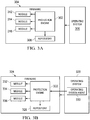
- FIGURE 3A is a block diagram illustrating software components associated with loading a frozen module according to at least one example embodiment.
- the example of FIGURE 3A is merely an example of software components associated with loading a frozen module, and does not limit the scope of the claims.
- operations attributed to a software component may vary, number of software components may vary, composition of a software component may vary, and/or the like.
- operations attributable to one software component of the example of FIGURE 3A may be allocated to one or more other components.
- modules that have a level of importance to the operation of the apparatus. For example a particular module may be needed for the apparatus to operate as desired. In another example, a particular module may be depended upon by other important modules. In still another example, a particular module may have important associations with memory. In such an example, the module may be a desirable attack target for a malicious actor trying to access that memory.
- a module that has been designated to be monitored for changes and to restore if changes occur is referred to as a frozen module.
- a frozen module relates to a version of the module that represents the version that is desired to be consistent when loaded.
- loading a module that has been designated as a frozen module may comprise evaluating the module to determine whether it has been changed. In such an example, if the module has been changed, the apparatus may take measures to avoid loading the changed module and load the frozen module instead.
- firmware 304 in communication with operating system 306.
- firmware 304 comprises protection engine 302 in communication with repository 308 and modules 312, 314, and 316. Even though modules 312, 314, and 316 are illustrated as being within firmware 304, the modules may reside at any suitable location.
- the showing of the modules within firmware 304 is merely to illustrate that, at some point, firmware 304 has control over the module.
- the firmware having control of a module may comprise the firmware causing loading of the module, the firmware determining whether to load the module, the firmware causing execution of the module, and/or the like.
- repository 308 is used to store frozen module information.
- Frozen module information may comprise information associated with a module that has been designated as frozen.
- frozen module information may comprise identity information associated with the frozen module, information indicating designation of the module as frozen, a frozen module fingerprint, frozen module code, frozen module code information, frozen module code location information, and/or the like.
- identity information associated with the frozen module comprises information that allows for identification of a module associated with the frozen module information.
- the identity information of the frozen module information may correspond with identity information associated with a module to be loaded.
- information indicating designation of the module as frozen comprises information that allows determination that a module indicated by the frozen module information has been designated as a frozen module.
- repository 308 may omit frozen module information associated with modules that have not been designated as frozen. In such circumstances, the existence of frozen module information associated with a module may serve as information indicating designation of the module as frozen.
- a frozen module fingerprint relates to information that represents the content of the module, such as the module code.
- the frozen module fingerprint may be a hash value, a timestamp, a random sampling of information from the module code, and/or the like.
- the frozen module fingerprint may be determined at the time the module becomes frozen, may be predetermined, may be determined when a module is being loaded, and/or the like.
- the frozen module information comprises the frozen module code.
- the frozen module information may comprise, at least part of, the frozen module code that is to be loaded when the frozen module is caused to be loaded.
- the frozen module information omits the frozen module code.
- the frozen module code may be located outside of repository 308, for example in a different part of memory, in memory of a different device, in memory on a different apparatus, and/or the like.
- the frozen module information may comprise frozen module code location information.
- the frozen module code location information comprises information that allows the frozen module code to be retrieved.
- the frozen module code location information may comprise information indicating the location from which the frozen module code may be retrieved, information indicating authentication information associated with retrieval of the frozen module code, information indicating encryption information associated with the frozen module code, information indicating decryption information associated with the frozen module code, and/or the like.
- Information indicating the location from which the frozen module code information may be retrieved may relate to an indication of a uniform resource locator (URL), a memory address, and/or the like.
- URL uniform resource locator
- there may be security associated with retrieval of the frozen module code.
- the frozen module code location information may comprise information that allows the apparatus to perform successful authentication, so that the frozen module code may be retrieved.
- encrypted communication is utilized in retrieval of the frozen module code.
- the frozen module code location information may comprise encryption information, decryption information, and/or the like, so that the encrypted communication may be performed.
- repository 308 is segregated from operating system access.
- repository 308 may be located in a region of memory that is not allocated to the operating system, that is prohibited for use by the operating system, and/or the like.
- segregation from operating system access does not necessarily require complete preclusion of access by way of the operating system.
- a program such as a virus
- segregation from operating system access refers to repository 308 being beyond the standard operating access of the operating system, but not necessarily a hard guarantee that it is impossible for operating system access to occur.
- At least one technical advantage of such segregation is providing additional security for the frozen module information by increasing the difficulty associated with accessing repository 308 by way of a program that is invoked by way of the operating system. Such a technical advantage provides a reduction of risk associated with accidental or malicious changes being made to the frozen module information.
- protection engine 302 evaluates modules to be loaded by the firmware, such as modules 312, 314, and 316, to determine if a module that is to be loaded has been designated as a frozen module. In performing this determination, protection engine 302 may retrieve frozen module information from repository 308. If the module has been designated as a frozen module, protection engine 302 may determine whether the module has changed since being designated as frozen. If the module has changed, protection engine 302 may cause loading of the frozen module code instead of the module code. Causing of the loading of the frozen module code may comprise causing retrieval of the frozen module code, determining location of the frozen module code, preventing loading of the module code, enabling loading of the frozen module code, and/or the like.
- protection engine 302 may cause loading of the frozen module code by designating the frozen module code to be loaded, sending the frozen module code to a loader, and/or the like.
- causing of the loading of the frozen module code comprises retrieval of the frozen module code from a frozen module code repository.
- the frozen module code repository may be a repository designated by the frozen module information, repository 308, and/or the like.
- At least one possible benefit associated with this use of frozen modules is that a change in a frozen module, whether accidental or malicious, could be corrected upon the next computing system boot process. Therefore, such capability may be referred to as a reboot to restore capability, in that any modification to a designated module will not be present in the module after the next boot process. Therefore, an undesired change in a designated module may be corrected merely by rebooting the computing system. In this manner, the computing system does not necessarily need to preclude any change to a designated module, but may rely on correction by way of rebooting as a restorative measure. Such restorative measures may be applied instead of or in addition to preventative measures, such as precluding a change in a designated module.
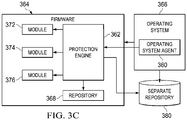
- FIGURE 3B is a block diagram illustrating software components associated with loading a frozen module according to at least one example embodiment.
- the example of FIGURE 3B is merely an example of software components associated with loading a frozen module, and does not limit the scope of the claims.
- operations attributed to a software component may vary, number of software components may vary, composition of a software component may vary, and/or the like.
- operations attributable to one software component of the example of FIGURE 3B may be allocated to one or more other components.
- firmware 324 in communication with operating system 326.
- firmware 324 comprises protection engine 322 in communication with repository 328 and modules 332, 334, and 336.
- modules 332, 334, and 336 are illustrated as being within firmware 324, the modules may reside at any suitable location.
- the showing of the modules within firmware 324 is merely to illustrate that, at some point, firmware 324 has control over the module.
- the firmware having control of a module may comprise the firmware causing loading of the module, the firmware determining whether to load the module, the firmware causing execution of the module, and/or the like.
- operating system 326 comprises operating system agent 330, which is in communication with protection engine 322.
- protection engine 322 is similar as described regarding protection engine 302
- repository 328 is similar as described regarding repository 308, and modules 332, 334, and 336 are similar as described regarding modules 312, 314, and 316.
- operating system agent 330 relates to a program that is operating within the operating system and that has adequate privilege to interact with the protection engine 322.
- an administrator may designate one or more operating system agents that may be utilized by a user.
- the administrator may utilize an operating system agent to interact with protection engine 322.
- There may be policy information governing the type of interaction that may take place between the operating system agent and the protection engine. For example, an operating system agent that has been provided for utilization by the user may be able to interact with protection engine 322 using only a subset of the interactions available to an operating system agent provided for use by an administrator.
- a user may desire to avoid a future corruption of an important module, and may designate the module as a frozen module.
- an enterprise system administrator may wish to load a set of modules to a computing system as frozen modules to be loaded upon the next reboot of the computing system. Under such circumstances, it may be desirable to allow change of frozen module information by way of protection engine 322.
- a system administrator may desire to provide a set of modules associated with the firmware. In such an example, the administrator may desire for the modules to be protected from inadvertent or malicious change, and utilize operating system agent 330 to cause storage of frozen module information associated with the desired modules.
- the administrator may desire to change a frozen module, for example to correct for an error in the frozen module, to improve compatibility of the frozen module, and/or the like.
- the administrator may utilize operating system agent 330 to cause replacement of existing frozen module information with the changed frozen module information.
- Such a change may relate to a change in only a part of the frozen module information, such as frozen module code location information, frozen module identity information, and/or the like.
- the administrator may utilize the operating system agent for any module that the administrator has adequate privilege to control.
- the operating system agent may provide frozen module information for a driver module, for a firmware application module, for an operating system loader module, for an operating system module, and/or the like. Therefore, in some circumstances, an administrator may deploy operating system patches, firmware patches, and/or the like, by way of sending frozen module information to protection engine 322. Under such circumstances, a subsequent boot of the apparatus will cause loading of the deployed frozen modules.
- At least one technical advantage associated with an operating system agent being able to perform in this manner is allowing of configuration and management of modules after a computing system is deployed.
- At least another possible technical advantage associated with an operating system agent performing in this manner is to utilize existing mechanisms for administrative privilege in managing the frozen module information.
- operating system agent 330 provides frozen module information to protection engine 322.
- operating system agent 330 may send a directive to protection engine 322 regarding change of at least part of frozen module information.
- the directive may relate to a message, a function call, and/or the like, that communicates a desire to change, at least part of, the frozen module information.
- the change in frozen module information may relate to designation of a module as a frozen module, where the module that had previously been undesignated as a frozen module.
- the change in frozen module information may relate to removing designation of a module as a frozen module.
- the change may relate to a change in frozen module location information, a change in frozen module code, a change in frozen module fingerprint, and/or the like.
- the directive designates a frozen module code repository in which the frozen module code is to be stored and/or has been stored.
- the directive may be a user directive, an administrator directive, and/or the like.
- protection engine 322 may cause storage of the frozen module information indicated by the directive in repository 328.
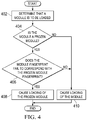
- FIGURE 3C is a block diagram illustrating software components associated with loading a frozen module according to at least one example embodiment.
- the example of FIGURE 3C is merely an example of software components associated with loading a frozen module, and does not limit the scope of the claims.
- operations attributed to a software component may vary, number of software components may vary, composition of a software component may vary, and/or the like.
- operations attributable to one software component of the example of FIGURE 3C may be allocated to one or more other components.
- the frozen module code may be stored externally to the computing system, such as a separate repository.
- a separate repository may be desirable to provide a repository that may be accessed by any one of the multiple computing systems in the enterprise that may need to access the frozen module code.
- at least one technical advantage of such an arrangement may be to reduce the amount of memory of each computing system associated with storing frozen module code, to simplify deployment of frozen module code to multiple computing systems, to improve oversight of the frozen module code utilized by multiple computing systems, etc.
- firmware 364 in communication with operating system 366.
- firmware 364 comprises protection engine 362 in communication with repository 368 and modules 372, 374, and 376. Even though modules 372, 374, and 376 are illustrated as being within firmware 364, the modules may reside at any suitable location.
- the showing of the modules within firmware 364 is merely to illustrate that, at some point, firmware 364 has control over the module.
- the firmware having control of a module may comprise the firmware causing loading of the module, the firmware determining whether to load the module, the firmware causing execution of the module, and/or the like.
- operating system 366 comprises operating system agent 360, which is in communication with protection engine 362.
- protection engine 362 is in communication, at least indirectly, with a separate repository 380.
- operating system 366 may be in communication, at least indirectly, with separate repository 380.
- separate repository 380 is external to the apparatus comprising firmware 364, for example a server, a database, etc., and the apparatus may access the repository via an external communication channel, such as the internet.
- protection engine 362 is similar as described regarding protection engine 322
- repository 368 is similar as described regarding repository 328
- operating system agent 360 is similar as described regarding operating system agent 330
- modules 372, 374, and 376 are similar as described regarding modules 332, 334, and 336.
- operating system agent 360 may provide a directive to change frozen module information regarding frozen module code stored in separate repository 380.
- the directive may omit frozen module code.
- the directive may comprise frozen code location information indicative of separate repository 380.
- Protection engine 362 may cause storage of frozen module information associated with the directive, which comprises the frozen module code location information, in repository 368. If the frozen module designated by the directive has other frozen module code stored elsewhere, protection engine 362 may cause deletion of the other frozen module code. For example, if there is frozen module code stored in repository 368, and protection engine 362 receives a directive to change the frozen module location information associated with the frozen module to be indicative of separate repository 380, protection engine 362 may cause deletion of the frozen module code that was stored in repository 368. In such an example, the directive designates the separate repository to be associated with the frozen module code location information.
- protection engine 362 when protection engine 362 determines that the module has changed, protection engine causes retrieval of the frozen module code from separate repository 380.
- protection engine 362 may utilize a communication driver, such as a network communication driver, a cellular communication driver, and/or the like, to cause retrieval of the frozen module code from separate repository 380.
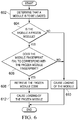
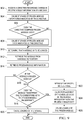
- FIGURE 4 is a flow diagram illustrating activities associated with providing software security according to at least one example embodiment.
- An apparatus for example computing system 1100 of FIGURE 11 , or a portion thereof, may utilize the set of operations.
- the apparatus may comprise means, including, for example processor 1000 of FIGURE 10 , for performing such operations.
- an apparatus, for example computing system 1100 of FIGURE 11 is transformed by having memory, for example memory 1110 of FIGURE 11 , comprising computer code configured to, working with a processor, for example processor 1102 of FIGURE 11 , cause the apparatus to perform set of operations of FIGURE 4 .
- the activities of FIGURE 4 are performed by firmware, such as firmware 106, a firmware interface layer, such as firmware interface 104, a protection engine, such as protection engine 302, and/or the like.
- the apparatus determines that a module is to be loaded.
- the determination to load a module may be similar as described regarding FIGURE 2 .
- determination that a module is to be loaded may be based on receipt of an indication that the module will be loaded.
- a module that is associated with performing the loading such as a loader, may provide an indication that the module is to be loaded.
- the apparatus determines whether the module is a frozen module. If the apparatus determines that the module is not a frozen module, flow proceeds to block 410. If the apparatus determines that the module is a frozen module, flow proceeds to block 406. Determination of whether the module is a frozen module may be based, at least in part, on frozen module information. For example, the apparatus may determine that frozen module identity information corresponds with identity information of the module. In at least one example embodiment, determining whether the module is a frozen module is predicated on determination that the module is to be loaded.
- the apparatus determines whether the module fingerprint fails to correspond with the frozen module fingerprint.
- the module fingerprint may be similar as described regarding FIGURES 3A-3C . If the apparatus determines that the module fingerprint fails to correspond with the frozen module fingerprint, flow proceeds to block 408. If the apparatus determines that the module fingerprint corresponds with the frozen module fingerprint, flow proceeds to block 410.
- Block 406 may further comprise determining the module fingerprint. It may be desirable to omit utilization of a stored module fingerprint so that the content of the module is analyzed. For example, a stored fingerprint may not necessarily reflect the actual fingerprint of the module.
- the apparatus causes loading of the frozen module code.
- the loading of the frozen module code may be performed instead of the loading of the module code.
- the apparatus may cause loading of the frozen module code by performing the loading of the frozen module code, providing a directive to load the frozen module code, providing the frozen module code to be loaded instead of providing the module code to be loaded, and/or the like.
- the apparatus causes loading of the module code, similar as described regarding FIGURE 2 .
- the apparatus may cause loading of the module code by performing the loading of the module code, by providing a directive to load the module code, by failing to provide a directive to load the frozen module code, by providing the module code to be loaded, by failing to provide the frozen module code to be loaded, and/or the like.
- FIGURE 5 is another flow diagram illustrating activities associated with loading a frozen module according to at least one example embodiment.
- An apparatus for example computing system 1100 of FIGURE 11 , or a portion thereof, may utilize the set of operations.
- the apparatus may comprise means, including, for example processor 1000 of FIGURE 10 , for performing such operations.
- an apparatus, for example computing system 1100 of FIGURE 11 is transformed by having memory, for example memory 1110 of FIGURE 11 , comprising computer code configured to, working with a processor, for example processor 1102 of FIGURE 11 , cause the apparatus to perform the set of operations of FIGURE 5 .
- the activities of FIGURE 5 are performed by firmware, such as firmware 106, a firmware interface layer, such as firmware interface 104, a protection engine, such as protection engine 302, and/or the like.
- the apparatus determines that a module is to be loaded, similar as described regarding block 402 of FIGURE 4 .
- the apparatus retrieves frozen module information similar as described regarding FIGURES 3A-3C .
- the apparatus determines whether the module is a frozen module, similar as described regarding block 404 of FIGURE 4 . If the apparatus determines that the module is not a frozen module, flow proceeds to block 512. If the apparatus determines that the module is a frozen module, flow proceeds to block 508. The determination may be based on the frozen module information.
- the frozen module information may comprise the frozen module identity, and determination that the module is a frozen module may be based on the module identity corresponding to the frozen module identity. In another example, determination that a module is not a frozen module may be based, at least in part, on determination that the frozen module information is absent a frozen module identity that corresponds with the module identity.
- the apparatus determines whether the module fingerprint fails to correspond with the frozen module fingerprint similar as described regarding block 406 of FIGURE 4 . If the apparatus determines that the module fingerprint corresponds with the frozen module fingerprint, flow proceeds to block 512. If the apparatus determines that the module fingerprint fails to correspond with the frozen module fingerprint, flow proceeds to block 510. The determination may be based on the frozen module information.
- the frozen module information may comprise the frozen module fingerprint, and determination that the module fingerprint fails to correspond with the frozen module fingerprint may be based on the module fingerprint failing to correspond to the frozen module fingerprint of the frozen module information.
- the apparatus causes loading of the frozen module code similar as described regarding block 408 of FIGURE 4 .
- the apparatus causes loading of the module code, similar as described regarding block 410 of FIGURE 4 .
- FIGURE 6 is still another flow diagram illustrating activities associated with loading a frozen module according to at least one example embodiment.
- An apparatus for example computing system 1100 of FIGURE 11 , or a portion thereof, may utilize the set of operations.
- the apparatus may comprise means, including, for example processor 1000 of FIGURE 10 , for performing such operations.
- an apparatus, for example computing system 1100 of FIGURE 11 is transformed by having memory, for example memory 1110 of FIGURE 11 , comprising computer code configured to, working with a processor, for example processor 1102 of FIGURE 11 , cause the apparatus to perform the set of operations of FIGURE 6 .
- the activities of FIGURE 6 are performed by firmware, such as firmware 106, a firmware interface layer, such as firmware interface 104, a protection engine, such as protection engine 302, and/or the like.
- the apparatus determines that a module is to be loaded, similar as described regarding block 402 of FIGURE 4 .
- the apparatus determines whether the module is a frozen module, similar as described regarding block 404 of FIGURE 4 . If the apparatus determines that the module is not a frozen module, flow proceeds to block 610. If the apparatus determines that the module is a frozen module, flow proceeds to block 606.
- the apparatus determines whether the module fingerprint fails to correspond with the frozen module fingerprint similar as described regarding block 406 of FIGURE 4 . If the apparatus determines that the module fingerprint fails to correspond with the frozen module fingerprint, flow proceeds to block 608. If the apparatus determines that the module fingerprint corresponds with the frozen module fingerprint, flow proceeds to block 610.
- the apparatus retrieves the frozen module code, similar as described regarding FIGURES 3A-3C . The retrieval may be from a frozen module code repository. The frozen module code repository may be similar as described regarding FIGURES 3A-3C .
- the apparatus causes loading of the module code, similar as described regarding block 410 of FIGURE 4 .
- the apparatus causes loading of the frozen module code similar as described regarding block 408 of FIGURE 4 .
- FIGURE 7 is yet another flow diagram illustrating activities associated with loading a frozen module according to at least one example embodiment.
- An apparatus for example computing system 1100 of FIGURE 11 , or a portion thereof, may utilize the set of operations.
- the apparatus may comprise means, including, for example processor 1000 of FIGURE 10 , for performing such operations.
- an apparatus, for example computing system 1100 of FIGURE 11 is transformed by having memory, for example memory 1110 of FIGURE 11 , comprising computer code configured to, working with a processor, for example processor 1102 of FIGURE 11 , cause the apparatus to perform the set of operations of FIGURE 7 .
- the activities of FIGURE 7 are performed by firmware, such as firmware 106, a firmware interface layer, such as firmware interface 104, a protection engine, such as protection engine 302, and/or the like.
- the apparatus receives a directive regarding change of, at least part of, frozen module information similar as described regarding FIGURES 3B-3C .
- the change may relate to designation as a frozen module, change in frozen module code, change in frozen module code location information, and/or the like.
- the apparatus causes storage of the frozen module information indicated by the directive, similar as described regarding FIGURES 3B-3C .
- Storage may be caused by performing the storage, by providing the frozen module information to a module for storage, by sending a directive to store the frozen module information, and/or the like.
- the apparatus determines whether the directive comprises frozen module code. If the apparatus determines that the directive fails to comprise frozen module code, flow proceeds, at least indirectly, to block 710. If the apparatus determines that the directive comprises frozen module code, flow proceeds to block 708.
- the apparatus causes storage of the frozen module code indicated by the directive.
- Storage may be caused by performing the storage, by providing the frozen module information to a module for storage, by sending a directive to store the frozen module information, and/or the like.
- the frozen module may be stored in a frozen module code repository.
- the frozen module code repository may be similar as described regarding FIGURES 3A-3C .
- blocks 702, 704, 706, and 708 may be performed after a boot process has taken place, for example during a time when the operating system is in control of the computing system.
- block 710 will be performed as part of a boot process, for example after initiation of a reboot at a point in time subsequent to block 706 or block 708. Therefore, even though the example of FIGURE 7 shows flow proceeding directly to block 710, there may be many actions performed before block 7, such as a reboot, that are omitted from FIGURE 7 .
- the apparatus determines that a module is to be loaded, similar as described regarding block 402 of FIGURE 4 .
- the apparatus determines whether the module is a frozen module, similar as described regarding block 404 of FIGURE 4 . If the apparatus determines that the module is not a frozen module, flow proceeds to block 718. If the apparatus determines that the module is a frozen module, flow proceeds to block 714.
- the apparatus determines whether the module fingerprint fails to correspond with the frozen module fingerprint similar as described regarding block 406 of FIGURE 4 . If the apparatus determines that the module fingerprint corresponds with the frozen module fingerprint, flow proceeds to block 718. If the apparatus determines that the module fingerprint fails to correspond with the frozen module fingerprint, flow proceeds to block 716.
- the apparatus causes loading of the frozen module code similar as described regarding block 408 of FIGURE 4 .
- the apparatus causes loading of the module code, similar as described regarding block 410 of FIGURE 4 .
- FIGURE 8 is even another flow diagram illustrating activities associated with loading a frozen module according to at least one example embodiment.
- An apparatus for example computing system 1100 of FIGURE 11 , or a portion thereof, may utilize the set of operations.
- the apparatus may comprise means, including, for example processor 1000 of FIGURE 10 , for performing such operations.
- an apparatus, for example computing system 1100 of FIGURE 11 is transformed by having memory, for example memory 1110 of FIGURE 11 , comprising computer code configured to, working with a processor, for example processor 1102 of FIGURE 11 , cause the apparatus to perform the set of operations of FIGURE 8 .
- the activities of FIGURE 8 are performed by firmware, such as firmware 106, a firmware interface layer, such as firmware interface 104, a protection engine, such as protection engine 302, and/or the like.
- the modules are stored separately from the frozen modules.
- the frozen modules may be stored in memory that is segregated from the operating system, and the modules may be stored in memory unsegregated from the operating system.
- the frozen module code may be stored in memory that is segregated from the operating system, and the module code may be stored in memory unsegregated from the operating system.
- the apparatus determines that a module is to be loaded, similar as described regarding block 402 of FIGURE 4 .
- the apparatus retrieves the module from a module repository.
- the apparatus determines whether the module is a frozen module, similar as described regarding block 404 of FIGURE 4 . If the apparatus determines that the module is not a frozen module, flow proceeds to block 810. If the apparatus determines that the module is a frozen module, flow proceeds to block 812.
- the apparatus determines whether the module fingerprint fails to correspond with the frozen module fingerprint similar as described regarding block 406 of FIGURE 4 . If the apparatus determines that the module fingerprint corresponds with the frozen module fingerprint, flow proceeds to block 810. If the apparatus determines that the module fingerprint fails to correspond with the frozen module fingerprint, flow proceeds to block 812.
- the apparatus causes loading of the module code, similar as described regarding block 410 of FIGURE 4 .
- the apparatus causes replacement of the module in the module repository with the frozen module.
- the apparatus may cause the frozen module code to be stored in the module repository such that the next retrieval of the module retrieves the stored frozen module code instead of the module code that was retrieved at block 804.
- the apparatus causes loading of the frozen module code similar as described regarding block 408 of FIGURE 4 .
- FIGURE 9 is a flow diagram illustrating activities associated with providing software security according to at least one example embodiment.
- An apparatus for example computing system 1100 of FIGURE 11 , or a portion thereof, may utilize the set of operations.
- the apparatus may comprise means, including, for example processor 1000 of FIGURE 10 , for performing such operations.
- an apparatus, for example computing system 1100 of FIGURE 11 is transformed by having memory, for example memory 1110 of FIGURE 11 , comprising computer code configured to, working with a processor, for example processor 1102 of FIGURE 11 , cause the apparatus to perform the set of operations of FIGURE 9 .
- the activities of FIGURE 9 are performed by firmware, such as firmware 106, a firmware interface layer, such as firmware interface 104, a protection engine, such as protection engine 302, and/or the like.
- the apparatus receives a directive regarding change of, at least part of, frozen module information similar as described regarding block 702 of FIGURE 7 .
- the apparatus causes storage of the frozen module information indicated by the directive, similar as described regarding block 704 of FIGURE 7 .
- the apparatus determines whether the directive comprises frozen module code similar as described regarding block 706 of FIGURE 7 . If the apparatus determines that the directive fails to comprise frozen module code, flow proceeds, at least indirectly, to block 910. If the apparatus determines that the directive comprises frozen module code, flow proceeds to block 908.
- the apparatus causes storage of the frozen module code indicated by the directive similar as described regarding block 708 of FIGURE 7 .
- blocks 902, 904, 906, and 908 may be performed after a boot process has taken place, for example during a time when the operating system is in control of the computing system.
- block 910 will be performed as part of a boot process, for example after initiation of a reboot at a point in time subsequent to block 906 or block 908. Therefore, even though the example of FIGURE 9 shows flow proceeding directly to block 910, there may be many actions performed before block 9, such as a reboot, that are omitted from FIGURE 9 .
- the apparatus determines that a module is to be loaded, similar as described regarding block 402 of FIGURE 4 .
- the apparatus retrieves the module from a module repository, similar as described regarding block 804 of FIGURE 8 .
- the apparatus retrieves frozen module information similar as described regarding block 504 of FIGURE 5 .
- the apparatus determines whether the module is a frozen module, similar as described regarding block 404 of FIGURE 4 . If the apparatus determines that the module is not a frozen module, flow proceeds to block 920. If the apparatus determines that the module is a frozen module, flow proceeds to block 922.
- the apparatus determines whether the module fingerprint fails to correspond with the frozen module fingerprint similar as described regarding block 406 of FIGURE 4 . If the apparatus determines that the module fingerprint corresponds with the frozen module fingerprint, flow proceeds to block 920. If the apparatus determines that the module fingerprint fails to correspond with the frozen module fingerprint, flow proceeds to block 922. At block 920, the apparatus causes loading of the module code, similar as described regarding block 410 of FIGURE 4 . At block 922, the apparatus retrieves the frozen module code, similar as described regarding block 608 of FIGURE 6 . At block 924, the apparatus causes replacement of the module code in the module repository with the frozen module code similar as described regarding block 812 of FIGURE 8 . At block 926, the apparatus causes loading of the frozen module code similar as described regarding block 408 of FIGURE 4 .
- FIGURE 10 illustrates a memory 1002 coupled to processor 1000 in accordance with at least one example embodiment.
- Memory 1002 may be any of a wide variety of memories (including various layers of memory hierarchy).
- the memory 1002 may include code 1004, which may be one or more instructions, to be executed by processor 1000.
- Processor 1000 follows a program sequence of instructions indicated by code 1004.
- an instruction enters a front-end logic 1006 and is processed by one or more decoders 1008.
- the decoder may generate a micro operation such as a fixed width micro operation in a predefined format, or may generate other instructions, microinstructions, control signals, and/or the like, that represent the instruction.
- Front-end logic 1006 also includes register renaming logic 1010 and scheduling logic 1012, which may allocate resources and queue the micro operation.
- Processor 1000 is shown including execution logic 1014 having a set of execution units 1016-1 through 1016-N. At least one example embodiment includes a number of execution units dedicated to specific functions or sets of functions. At least one example embodiment includes only one execution unit or one execution unit that can perform a particular function. Execution logic 1014 executes the micro operation.
- back-end logic 1018 retires the instructions of code 1004.
- processor 1000 allows out of order execution but enforces in order retirement of instructions.
- Retirement logic 1020 may take a variety of forms (e.g., re-order buffers or the like). In this manner, processor 1000 is transformed during execution of code 1004, at least in terms of the output generated by the decoder, hardware registers, and tables utilized by register renaming logic 1010, and any registers (not shown) modified by execution logic 1014.
- a processing element may include other elements on a chip with processor 1000.
- a processing element may include memory control logic along with processor 1000.
- the processing element may include I/O control logic and/or may include I/O control logic integrated with memory control logic.
- the processing element may also include one or more caches.
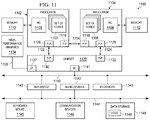
- FIGURE 11 illustrates a computing system 1100 that is arranged in a point-to-point (PtP) configuration according to an embodiment.
- FIGURE 11 shows a system where processors, memory, and input/output devices are interconnected by a number of point-to-point interfaces.
- system 1100 may include several processors, of which only two, processors 1102 and 1104, are shown for clarity.
- Processors 1102 and 1104 may each include a set of cores 1103 and 1105, which may execute multiple processes of a program.
- Processors 1102 and 1104 may also each include integrated memory controller logic (MC) 1106 and 1108 to communicate with memories 1110 and 1112, respectively.
- MC memory controller logic
- the memories 1110 and/or 1112 may store various data such as those discussed with reference to memory 1112.
- memory controller logic 1106 and 1108 is discrete logic separate from processors 1102 and 1104.
- Processors 1102 and 1104 may be any type of a processor.
- Processors 1102 and 1104 may exchange data via a point-to-point (PtP) interface 1114 using point-to-point interface circuits 1116 and 1118, respectively.
- Processors 1102 and 1104 may each exchange data with a chipset 1120 via individual point-to-point interfaces 1122 and 1124 using point-to-point interface circuits 1126, 1128, 1130, and 1132.
- Chipset 1120 may exchange data with a high-performance graphics circuit 1134 via a high-performance graphics interface 1136, using an interface circuit 1137, which could be a PtP interface circuit.
- any or all of the PtP links illustrated in FIGURE 11 could be implemented as a multi-drop bus rather than a PtP link.
- At least one example embodiment, as disclosed herein, is provided within the processors 1102 and 1104. At least one example embodiment, however, exists in other circuits, logic units, or devices within the system 1100 of FIGURE 11 . Furthermore, at least one example embodiment is distributed throughout several circuits, logic units, or devices illustrated in FIGURE 11 .
- Chipset 1120 may be in communication with a bus 1140 via an interface circuit 1141.
- Bus 1140 may have one or more devices that communicate over it, such as a bus bridge 1142 and I/O devices 1143.
- bus bridge 1143 may be in communication with other devices such as a keyboard/mouse 1145 (or other input device such as a touch screen, for example), communication devices 1146 (such as modems, network interface devices, or other types of communication devices that may communicate through a computer network), audio I/O device 1147, a data storage device 1148, and/or the like.
- Data storage device 1148 may store code 1149 that may be executed by processors 1102 and/or 1104.
- at least a portion of the bus architectures is implemented with one or more PtP links.
- FIGURES 10 and 11 are schematic illustrations of embodiments of computing systems that may be utilized in accordance with various example embodiments. It will be appreciated that various components of the systems depicted in FIGURES 10 and 11 may be combined in a system-on-a-chip (SoC) architecture or in any other suitable configuration.
- SoC system-on-a-chip
- at least one example embodiment disclosed herein can be incorporated into systems such as, for example, mobile devices such as smart cellular telephones, tablet computers, ultrabook computers, personal digital assistants, portable gaming devices, etc. It will be appreciated that these mobile devices may be provided with SoC architectures in at least some embodiments.
- At least one operation, function, etc. outlined herein may be implemented by logic encoded in one or more tangible media (e.g., embedded logic provided in an application specific integrated circuit (ASIC), digital signal processor (DSP) instructions, software (potentially inclusive of object code and source code) to be executed by a processor, or other similar machine, etc.), which may be inclusive of non-transitory media.
- the logic may be computer program instructions, such as code 1004 of FIGURE 10 .
- a memory element can store data used for the operations described herein. This includes the memory element being able to store software, logic, code, or processor instructions that are executed to carry out the activities described in this Specification.
- a processor can execute any type of instructions associated with the data to achieve the operations detailed herein in this Specification.
- the processor transforms an element or an article (e.g., data) from one state or thing to another state or thing by way of the instructions.
- the activities outlined herein may be implemented with fixed logic or programmable logic (e.g., software/computer instructions executed by a processor) and the elements identified herein could be some type of a programmable processor, programmable digital logic (e.g., FPGA, EPROM, EEPROM) or an ASIC that includes digital logic, software, code, electronic instructions, or any suitable combination thereof.
- At least one example embodiment includes software in order to achieve the activities outlined herein.
- a protection engine e.g., protection engine 302, 322, 362
- an operating system agent e.g., operating system agent 330, 360
- the protection engine and/or operating system agent may include a processor that can execute software to perform the activities, as disclosed herein. These devices mayfurther keep information in any suitable memory element (random access memory (RAM), ROM, EPROM, EEPROM, ASIC, etc.), software, hardware, or in any other suitable component, device, element, or object where appropriate and based on particular needs.
- RAM random access memory
- ROM read only memory
- EPROM Erasable programmable read-only memory
- EEPROM electrically erasable programmable read-only memory
- ASIC application specific integrated circuitry
- the protection engine and/or operating system agent can be configured in software, hardware, firmware or any suitable combination thereof.
- Any of the memory items discussed herein e.g., repositories, databases, etc. should be construed as being encompassed within the broad term 'memory element.
- any of the potential processing elements, modules, and machines described in this Specification should be construed as being encompassed within the broad term 'processor.'
- One or more embodiments may provide an apparatus, a system, a machine readable storage medium, and/or a method for determining that a module is to be loaded, the module being associated with module code, determining that the module is a frozen module, the frozen module being associated with frozen module code, determining that a module fingerprint of the module fails to correspond with a frozen module fingerprint of the frozen module, and causing loading of the frozen module code instead of the module code.
- One or more example embodiments could further include determining that the module fingerprint of the module corresponds with the frozen module fingerprint of the frozen module, and causing loading of the module code instead of the frozen module code.
- determination to load the module is associated with a boot process.
- One or more example embodiments further retrieve frozen module information, so that determination that the module is the frozen module is based, at least in part, on the frozen module information.
- the frozen module information is retrieved from a repository that is segregated from operating system access.
- the frozen module information comprises at least one of identity information associated with the frozen module, the frozen module fingerprint, the frozen module code, or frozen module code location information.
- the frozen module information comprises frozen module code location information. Such an embodiment may further retrieve the frozen module code, based, at least in part, on the frozen module code location information.
- At least one example embodiment further receives a directive regarding change of, at least part of, frozen module information. Such an embodiment may further cause storage of frozen module information indicated by the directive.
- the directive comprises frozen module code. Such an embodiment may further cause storage of the frozen module code in a frozen module code repository.
- the directive designates the frozen module code repository.
- At least one example embodiment relates to an apparatus that is a computing system, a system on a chip, and/or the like.
Landscapes
- Engineering & Computer Science (AREA)
- Software Systems (AREA)
- Theoretical Computer Science (AREA)
- Computer Security & Cryptography (AREA)
- General Engineering & Computer Science (AREA)
- Physics & Mathematics (AREA)
- General Physics & Mathematics (AREA)
- Computer Hardware Design (AREA)
- Stored Programmes (AREA)
Claims (8)
- Verfahren für Softwaresicherheit, umfassend:Bestimmen während eines Firmware-Boot-Prozesses eines Datenverarbeitungssystems nach Initialisierung (202) der Hardware (108) und vor dem Laden (208) des Betriebssystems (102), dass ein Modul (314-316, 332-336, 372-376) geladen werden soll, wobei das Modul mit Modulcode assoziiert ist;Abrufen von Gefrorenes-Modul-Informationen aus einem Repositorium (308, 328, 368), das von Betriebssystemzugriff getrennt ist, die Identitätsinformationen umfassen, die mit dem gefrorenen Modul, dem Fingerabdruck des gefrorenen Moduls und dem Code des gefrorenen Moduls oder Codeortsinformationen des gefrorenen Moduls assoziiert sind;Bestimmen (404, 506, 604, 712, 806, 916) aus den Gefrorenes-Modul-Informationen, dass das Modul dafür designiert ist, auf Änderungen überwacht zu werden, und wiederhergestellt wird, wenn Änderungen auftreten, und mit einem gefrorenen Modul assoziiert zu werden, wobei das gefrorene Modul mit Code des gefrorenen Moduls assoziiert ist;Bestimmen (406, 508, 606, 714, 808, 918), dass ein Modul-Fingerabdruck des Moduls nicht mit einem Gefrorenes-Modul-Fingerabdruck des gefrorenen Moduls korrespondiert; undBewirken des Ladens des gefrorenen Moduls (408, 510, 612, 716, 814, 926) anstelle des Moduls (410, 512, 610, 718, 810, 920).
- Verfahren nach Anspruch 1, wobei die Gefrorenes-Modul-Informationen die Codeortsinformationen des gefrorenen Moduls umfassen, ferner umfassend: Abrufen des Codes des gefrorenen Moduls mindestens teilweise auf der Basis der Codeortsinformationen des gefrorenen Moduls.
- Verfahren nach Anspruch 1, das ferner Empfangen (702) einer Direktive umfasst, die Änderung mindestens eines Teils von Gefrorenes-Modul-Informationen betrifft.
- Verfahren nach Anspruch 3, ferner umfassend: Bewirken (704) von Speicherung der Gefrorenes-Modul-Informationen wie durch die Direktive angegeben.
- Verfahren nach Anspruch 3, wobei die Direktive den Code des gefrorenen Moduls umfasst, ferner umfassend: Bewirken (708) von Speicherung des Codes des gefrorenen Moduls in einem Coderepositorium des gefrorenen Moduls.
- Verfahren nach Anspruch 5, wobei die Direktive das Coderepositorium des gefrorenen Moduls designiert.
- Datenverarbeitungssystem, das eine Schutz-Engine (302, 322, 362) und ein Repositorium (308, 328, 368), das vom Betriebssystemzugriff getrennt ist, umfasst, wobei die Schutz-Engine (302, 322, 362) in Firmware (304, 324, 364) residiert und ausgelegt ist zum
Bestimmen während eines Firmware-Boot-Prozesses eines Datenverarbeitungssystems nach Initialisierung (202) der Hardware (108) und vor dem Laden (208) des Betriebssystems (102), dass ein Modul (314-316, 332-336, 372-376) geladen werden soll, wobei das Modul mit Modulcode assoziiert ist;
Abrufen von Gefrorenes-Modul-Informationen aus dem Repositorium (308, 328, 368), die Identitätsinformationen umfassen, die mit dem gefrorenen Modul, dem Fingerabdruck des gefrorenen Moduls und dem Code des gefrorenen Moduls oder Codeortsinformationen des gefrorenen Moduls assoziiert sind;
Bestimmen (404, 506, 604, 712, 806, 916) aus den Gefrorenes-Modul-Informationen, dass das Modul dafür designiert ist, auf Änderungen überwacht zu werden, und wiederhergestellt wird, wenn Änderungen auftreten, und mit einem gefrorenen Modul assoziiert zu werden, wobei das gefrorene Modul mit Code des gefrorenen Moduls assoziiert ist;
Bestimmen (406, 508, 606, 714, 808, 918), dass ein Modul-Fingerabdruck des Moduls nicht mit einem Gefrorenes-Modul-Fingerabdruck des gefrorenen Moduls korrespondiert; und
Bewirken des Ladens des gefrorenen Moduls (408, 510, 612, 716, 814, 926) anstelle des Moduls (410, 512, 610, 718, 810, 920). - Mindestens ein maschinenlesbares Speichermedium mit maschinenlesbaren Anweisungen, die, wenn sie ausgeführt werden, ein Verfahren implementieren oder eine Vorrichtung realisieren, wie in einem der vorhergehenden Ansprüche beansprucht.
Applications Claiming Priority (1)
| Application Number | Priority Date | Filing Date | Title |
|---|---|---|---|
| PCT/CN2013/071810 WO2014127536A1 (en) | 2013-02-25 | 2013-02-25 | Method, apparatus, system, and machine readable storage medium for providing software security |
Publications (3)
| Publication Number | Publication Date |
|---|---|
| EP2959417A1 EP2959417A1 (de) | 2015-12-30 |
| EP2959417A4 EP2959417A4 (de) | 2016-10-19 |
| EP2959417B1 true EP2959417B1 (de) | 2017-06-07 |
Family
ID=51390493
Family Applications (1)
| Application Number | Title | Priority Date | Filing Date |
|---|---|---|---|
| EP13876010.3A Not-in-force EP2959417B1 (de) | 2013-02-25 | 2013-02-25 | Verfahren, vorrichtung, system und maschinenlesbares speichermedium zur bereitstellung einer softwaresicherheit |
Country Status (3)
| Country | Link |
|---|---|
| US (1) | US9323541B2 (de) |
| EP (1) | EP2959417B1 (de) |
| WO (1) | WO2014127536A1 (de) |
Families Citing this family (3)
| Publication number | Priority date | Publication date | Assignee | Title |
|---|---|---|---|---|
| US10430589B2 (en) * | 2015-03-19 | 2019-10-01 | Intel Corporation | Dynamic firmware module loader in a trusted execution environment container |
| JP6706278B2 (ja) * | 2018-03-27 | 2020-06-03 | キヤノン株式会社 | 情報処理装置、及び情報処理方法 |
| CN111897586A (zh) * | 2019-05-06 | 2020-11-06 | 中兴通讯股份有限公司 | 应用状态控制方法、装置、终端及计算机可读存储介质 |
Family Cites Families (13)
| Publication number | Priority date | Publication date | Assignee | Title |
|---|---|---|---|---|
| DE10137505B4 (de) * | 2001-07-16 | 2005-06-23 | Francotyp-Postalia Ag & Co. Kg | Anordnung und Verfahren zum Ändern der Funktionalität eines Sicherheitsmoduls |
| TWI251771B (en) * | 2001-12-28 | 2006-03-21 | Asustek Comp Inc | Module and method for automatic restoring BIOS device, and the computer-readable recording media of storing the program codes thereof |
| US7234047B1 (en) * | 2002-04-24 | 2007-06-19 | Adaptec, Inc. | Method for managing memory space during system initialization |
| US7322042B2 (en) * | 2003-02-07 | 2008-01-22 | Broadon Communications Corp. | Secure and backward-compatible processor and secure software execution thereon |
| US7409539B2 (en) * | 2004-08-06 | 2008-08-05 | International Business Machines Corporation | System design and code update strategy to implement a self-healing, self-verifying system |
| US8239688B2 (en) * | 2007-01-07 | 2012-08-07 | Apple Inc. | Securely recovering a computing device |
| WO2009074444A2 (en) * | 2007-12-13 | 2009-06-18 | Telefonaktiebolaget L M Ericsson (Publ) | Updating firmware of an electronic device |
| US8286219B2 (en) * | 2008-02-16 | 2012-10-09 | Xencare Software Inc. | Safe and secure program execution framework |
| US8954804B2 (en) * | 2008-07-15 | 2015-02-10 | Ati Technologies Ulc | Secure boot circuit and method |
| CN101645020A (zh) | 2008-08-04 | 2010-02-10 | 优诺威讯国际有限公司 | 虚拟操作系统创建方法 |
| US8589302B2 (en) * | 2009-11-30 | 2013-11-19 | Intel Corporation | Automated modular and secure boot firmware update |
| CN102200917B (zh) | 2010-03-25 | 2014-09-03 | 研祥智能科技股份有限公司 | 一种计算设备和在开机过程中确定引导设备的方法 |
| US11194586B2 (en) * | 2013-05-01 | 2021-12-07 | Insyde Software Corp. | Secure boot override in a computing device equipped with unified-extensible firmware interface (UEFI)-compliant firmware |
-
2013
- 2013-02-25 EP EP13876010.3A patent/EP2959417B1/de not_active Not-in-force
- 2013-02-25 WO PCT/CN2013/071810 patent/WO2014127536A1/en not_active Ceased
- 2013-02-25 US US13/976,504 patent/US9323541B2/en not_active Expired - Fee Related
Also Published As
| Publication number | Publication date |
|---|---|
| US20140250293A1 (en) | 2014-09-04 |
| EP2959417A4 (de) | 2016-10-19 |
| EP2959417A1 (de) | 2015-12-30 |
| US9323541B2 (en) | 2016-04-26 |
| WO2014127536A1 (en) | 2014-08-28 |
Similar Documents
| Publication | Publication Date | Title |
|---|---|---|
| EP3111364B1 (de) | Systeme und verfahren zur optimierung des scannens von vorinstallierten anwendungen | |
| EP3166037B1 (de) | System und verfahren zur sicheren ausführung von codes im hypervisormodus | |
| CA2915806C (en) | Systems and methods for using a reputation indicator to facilitate malware scanning | |
| EP3017392B1 (de) | Verfahrenscharakterisierung zur malware-erkennung in virtuellen computern | |
| US10073966B2 (en) | Operating system-independent integrity verification | |
| US10635821B2 (en) | Method and apparatus for launching a device | |
| US9319380B2 (en) | Below-OS security solution for distributed network endpoints | |
| EP2973171B1 (de) | Kontextbasierte schaltung zu einer sicheren betriebssystemumgebung | |
| EP4052154B1 (de) | Auf blockgerätesignatur basierender integritätsschutz für containerisierte anwendungen | |
| US8949586B2 (en) | System and method for authenticating computer system boot instructions during booting by using a public key associated with a processor and a monitoring device | |
| AU2018311120A1 (en) | Secure storage device | |
| US8910283B1 (en) | Firmware-level security agent supporting operating system-level security in computer system | |
| US20180247055A1 (en) | Methods for protecting a host device from untrusted applications by sandboxing | |
| US9037823B2 (en) | Protecting IAT/EAT hooks from rootkit attacks using new CPU assists | |
| US20190005244A1 (en) | Executing encrypted boot loaders | |
| US9965620B2 (en) | Application program interface (API) monitoring bypass | |
| Zinkus et al. | Data security on mobile devices: Current state of the art, open problems, and proposed solutions | |
| US9323541B2 (en) | Method, apparatus, system, and machine readable storage medium for providing software security | |
| US20230325496A1 (en) | System and method for transitional isolation of applications using a workspace environment | |
| Kim et al. | Rees: Malicious software detection framework for meego-in vehicle infotainment | |
| Corregedor et al. | Implementing rootkits to address operating system vulnerabilities | |
| CA3069053C (en) | Secure storage device | |
| Gartaganis | Comparative analysis of the Windows security XP, Vista, 7, 8 and 10 |
Legal Events
| Date | Code | Title | Description |
|---|---|---|---|
| PUAI | Public reference made under article 153(3) epc to a published international application that has entered the european phase |
Free format text: ORIGINAL CODE: 0009012 |
|
| 17P | Request for examination filed |
Effective date: 20150721 |
|
| AK | Designated contracting states |
Kind code of ref document: A1 Designated state(s): AL AT BE BG CH CY CZ DE DK EE ES FI FR GB GR HR HU IE IS IT LI LT LU LV MC MK MT NL NO PL PT RO RS SE SI SK SM TR |
|
| AX | Request for extension of the european patent |
Extension state: BA ME |
|
| RIN1 | Information on inventor provided before grant (corrected) |
Inventor name: ZIMMER, VINCENT Inventor name: YAO, JIEWEN Inventor name: YE, TING Inventor name: LONG, QIN |
|
| DAX | Request for extension of the european patent (deleted) | ||
| REG | Reference to a national code |
Ref country code: DE Ref legal event code: R079 Ref document number: 602013022122 Country of ref document: DE Free format text: PREVIOUS MAIN CLASS: G06F0021000000 Ipc: G06F0009445000 |
|
| A4 | Supplementary search report drawn up and despatched |
Effective date: 20160916 |
|
| RIC1 | Information provided on ipc code assigned before grant |
Ipc: G06F 9/445 20060101AFI20160912BHEP Ipc: G06F 9/44 20060101ALI20160912BHEP Ipc: G06F 21/51 20130101ALI20160912BHEP Ipc: G06F 21/57 20130101ALI20160912BHEP |
|
| GRAP | Despatch of communication of intention to grant a patent |
Free format text: ORIGINAL CODE: EPIDOSNIGR1 |
|
| STAA | Information on the status of an ep patent application or granted ep patent |
Free format text: STATUS: GRANT OF PATENT IS INTENDED |
|
| INTG | Intention to grant announced |
Effective date: 20161216 |
|
| RIN1 | Information on inventor provided before grant (corrected) |
Inventor name: YE, TING Inventor name: ZIMMER, VINCENT Inventor name: LONG, QIN Inventor name: YAO, JIEWEN |
|
| GRAS | Grant fee paid |
Free format text: ORIGINAL CODE: EPIDOSNIGR3 |
|
| AK | Designated contracting states |
Kind code of ref document: B1 Designated state(s): AL AT BE BG CH CY CZ DE DK EE ES FI FR GB GR HR HU IE IS IT LI LT LU LV MC MK MT NL NO PL PT RO RS SE SI SK SM TR |
|
| REG | Reference to a national code |
Ref country code: GB Ref legal event code: FG4D |
|
| GRAA | (expected) grant |
Free format text: ORIGINAL CODE: 0009210 |
|
| REG | Reference to a national code |
Ref country code: CH Ref legal event code: EP Ref country code: AT Ref legal event code: REF Ref document number: 899695 Country of ref document: AT Kind code of ref document: T Effective date: 20170615 |
|
| STAA | Information on the status of an ep patent application or granted ep patent |
Free format text: STATUS: THE PATENT HAS BEEN GRANTED |
|
| REG | Reference to a national code |
Ref country code: IE Ref legal event code: FG4D |
|
| REG | Reference to a national code |
Ref country code: DE Ref legal event code: R096 Ref document number: 602013022122 Country of ref document: DE |
|
| REG | Reference to a national code |
Ref country code: NL Ref legal event code: FP |
|
| REG | Reference to a national code |
Ref country code: LT Ref legal event code: MG4D |
|
| PG25 | Lapsed in a contracting state [announced via postgrant information from national office to epo] |
Ref country code: NO Free format text: LAPSE BECAUSE OF FAILURE TO SUBMIT A TRANSLATION OF THE DESCRIPTION OR TO PAY THE FEE WITHIN THE PRESCRIBED TIME-LIMIT Effective date: 20170907 Ref country code: HR Free format text: LAPSE BECAUSE OF FAILURE TO SUBMIT A TRANSLATION OF THE DESCRIPTION OR TO PAY THE FEE WITHIN THE PRESCRIBED TIME-LIMIT Effective date: 20170607 Ref country code: FI Free format text: LAPSE BECAUSE OF FAILURE TO SUBMIT A TRANSLATION OF THE DESCRIPTION OR TO PAY THE FEE WITHIN THE PRESCRIBED TIME-LIMIT Effective date: 20170607 Ref country code: GR Free format text: LAPSE BECAUSE OF FAILURE TO SUBMIT A TRANSLATION OF THE DESCRIPTION OR TO PAY THE FEE WITHIN THE PRESCRIBED TIME-LIMIT Effective date: 20170908 Ref country code: ES Free format text: LAPSE BECAUSE OF FAILURE TO SUBMIT A TRANSLATION OF THE DESCRIPTION OR TO PAY THE FEE WITHIN THE PRESCRIBED TIME-LIMIT Effective date: 20170607 Ref country code: LT Free format text: LAPSE BECAUSE OF FAILURE TO SUBMIT A TRANSLATION OF THE DESCRIPTION OR TO PAY THE FEE WITHIN THE PRESCRIBED TIME-LIMIT Effective date: 20170607 |
|
| REG | Reference to a national code |
Ref country code: AT Ref legal event code: MK05 Ref document number: 899695 Country of ref document: AT Kind code of ref document: T Effective date: 20170607 |
|
| PG25 | Lapsed in a contracting state [announced via postgrant information from national office to epo] |
Ref country code: SE Free format text: LAPSE BECAUSE OF FAILURE TO SUBMIT A TRANSLATION OF THE DESCRIPTION OR TO PAY THE FEE WITHIN THE PRESCRIBED TIME-LIMIT Effective date: 20170607 Ref country code: RS Free format text: LAPSE BECAUSE OF FAILURE TO SUBMIT A TRANSLATION OF THE DESCRIPTION OR TO PAY THE FEE WITHIN THE PRESCRIBED TIME-LIMIT Effective date: 20170607 Ref country code: LV Free format text: LAPSE BECAUSE OF FAILURE TO SUBMIT A TRANSLATION OF THE DESCRIPTION OR TO PAY THE FEE WITHIN THE PRESCRIBED TIME-LIMIT Effective date: 20170607 Ref country code: BG Free format text: LAPSE BECAUSE OF FAILURE TO SUBMIT A TRANSLATION OF THE DESCRIPTION OR TO PAY THE FEE WITHIN THE PRESCRIBED TIME-LIMIT Effective date: 20170907 |
|
| PG25 | Lapsed in a contracting state [announced via postgrant information from national office to epo] |
Ref country code: RO Free format text: LAPSE BECAUSE OF FAILURE TO SUBMIT A TRANSLATION OF THE DESCRIPTION OR TO PAY THE FEE WITHIN THE PRESCRIBED TIME-LIMIT Effective date: 20170607 Ref country code: EE Free format text: LAPSE BECAUSE OF FAILURE TO SUBMIT A TRANSLATION OF THE DESCRIPTION OR TO PAY THE FEE WITHIN THE PRESCRIBED TIME-LIMIT Effective date: 20170607 Ref country code: CZ Free format text: LAPSE BECAUSE OF FAILURE TO SUBMIT A TRANSLATION OF THE DESCRIPTION OR TO PAY THE FEE WITHIN THE PRESCRIBED TIME-LIMIT Effective date: 20170607 Ref country code: AT Free format text: LAPSE BECAUSE OF FAILURE TO SUBMIT A TRANSLATION OF THE DESCRIPTION OR TO PAY THE FEE WITHIN THE PRESCRIBED TIME-LIMIT Effective date: 20170607 Ref country code: SK Free format text: LAPSE BECAUSE OF FAILURE TO SUBMIT A TRANSLATION OF THE DESCRIPTION OR TO PAY THE FEE WITHIN THE PRESCRIBED TIME-LIMIT Effective date: 20170607 |
|
| PG25 | Lapsed in a contracting state [announced via postgrant information from national office to epo] |
Ref country code: PL Free format text: LAPSE BECAUSE OF FAILURE TO SUBMIT A TRANSLATION OF THE DESCRIPTION OR TO PAY THE FEE WITHIN THE PRESCRIBED TIME-LIMIT Effective date: 20170607 Ref country code: SM Free format text: LAPSE BECAUSE OF FAILURE TO SUBMIT A TRANSLATION OF THE DESCRIPTION OR TO PAY THE FEE WITHIN THE PRESCRIBED TIME-LIMIT Effective date: 20170607 Ref country code: IT Free format text: LAPSE BECAUSE OF FAILURE TO SUBMIT A TRANSLATION OF THE DESCRIPTION OR TO PAY THE FEE WITHIN THE PRESCRIBED TIME-LIMIT Effective date: 20170607 Ref country code: IS Free format text: LAPSE BECAUSE OF FAILURE TO SUBMIT A TRANSLATION OF THE DESCRIPTION OR TO PAY THE FEE WITHIN THE PRESCRIBED TIME-LIMIT Effective date: 20171007 |
|
| REG | Reference to a national code |
Ref country code: DE Ref legal event code: R097 Ref document number: 602013022122 Country of ref document: DE |
|
| PLBE | No opposition filed within time limit |
Free format text: ORIGINAL CODE: 0009261 |
|
| STAA | Information on the status of an ep patent application or granted ep patent |
Free format text: STATUS: NO OPPOSITION FILED WITHIN TIME LIMIT |
|
| PG25 | Lapsed in a contracting state [announced via postgrant information from national office to epo] |
Ref country code: DK Free format text: LAPSE BECAUSE OF FAILURE TO SUBMIT A TRANSLATION OF THE DESCRIPTION OR TO PAY THE FEE WITHIN THE PRESCRIBED TIME-LIMIT Effective date: 20170607 |
|
| 26N | No opposition filed |
Effective date: 20180308 |
|
| PG25 | Lapsed in a contracting state [announced via postgrant information from national office to epo] |
Ref country code: SI Free format text: LAPSE BECAUSE OF FAILURE TO SUBMIT A TRANSLATION OF THE DESCRIPTION OR TO PAY THE FEE WITHIN THE PRESCRIBED TIME-LIMIT Effective date: 20170607 |
|
| REG | Reference to a national code |
Ref country code: CH Ref legal event code: PL |
|
| PG25 | Lapsed in a contracting state [announced via postgrant information from national office to epo] |
Ref country code: MC Free format text: LAPSE BECAUSE OF FAILURE TO SUBMIT A TRANSLATION OF THE DESCRIPTION OR TO PAY THE FEE WITHIN THE PRESCRIBED TIME-LIMIT Effective date: 20170607 |
|
| REG | Reference to a national code |
Ref country code: IE Ref legal event code: MM4A |
|
| REG | Reference to a national code |
Ref country code: BE Ref legal event code: MM Effective date: 20180228 |
|
| PG25 | Lapsed in a contracting state [announced via postgrant information from national office to epo] |
Ref country code: LU Free format text: LAPSE BECAUSE OF NON-PAYMENT OF DUE FEES Effective date: 20180225 Ref country code: CH Free format text: LAPSE BECAUSE OF NON-PAYMENT OF DUE FEES Effective date: 20180228 Ref country code: LI Free format text: LAPSE BECAUSE OF NON-PAYMENT OF DUE FEES Effective date: 20180228 |
|
| REG | Reference to a national code |
Ref country code: FR Ref legal event code: ST Effective date: 20181031 |
|
| PG25 | Lapsed in a contracting state [announced via postgrant information from national office to epo] |
Ref country code: IE Free format text: LAPSE BECAUSE OF NON-PAYMENT OF DUE FEES Effective date: 20180225 |
|
| PG25 | Lapsed in a contracting state [announced via postgrant information from national office to epo] |
Ref country code: FR Free format text: LAPSE BECAUSE OF NON-PAYMENT OF DUE FEES Effective date: 20180228 Ref country code: BE Free format text: LAPSE BECAUSE OF NON-PAYMENT OF DUE FEES Effective date: 20180228 |
|
| PGFP | Annual fee paid to national office [announced via postgrant information from national office to epo] |
Ref country code: NL Payment date: 20190214 Year of fee payment: 7 |
|
| PGFP | Annual fee paid to national office [announced via postgrant information from national office to epo] |
Ref country code: GB Payment date: 20190220 Year of fee payment: 7 |
|
| PG25 | Lapsed in a contracting state [announced via postgrant information from national office to epo] |
Ref country code: MT Free format text: LAPSE BECAUSE OF NON-PAYMENT OF DUE FEES Effective date: 20180225 |
|
| PG25 | Lapsed in a contracting state [announced via postgrant information from national office to epo] |
Ref country code: TR Free format text: LAPSE BECAUSE OF FAILURE TO SUBMIT A TRANSLATION OF THE DESCRIPTION OR TO PAY THE FEE WITHIN THE PRESCRIBED TIME-LIMIT Effective date: 20170607 |
|
| PG25 | Lapsed in a contracting state [announced via postgrant information from national office to epo] |
Ref country code: PT Free format text: LAPSE BECAUSE OF FAILURE TO SUBMIT A TRANSLATION OF THE DESCRIPTION OR TO PAY THE FEE WITHIN THE PRESCRIBED TIME-LIMIT Effective date: 20170607 |
|
| PG25 | Lapsed in a contracting state [announced via postgrant information from national office to epo] |
Ref country code: MK Free format text: LAPSE BECAUSE OF NON-PAYMENT OF DUE FEES Effective date: 20170607 Ref country code: HU Free format text: LAPSE BECAUSE OF FAILURE TO SUBMIT A TRANSLATION OF THE DESCRIPTION OR TO PAY THE FEE WITHIN THE PRESCRIBED TIME-LIMIT; INVALID AB INITIO Effective date: 20130225 Ref country code: CY Free format text: LAPSE BECAUSE OF FAILURE TO SUBMIT A TRANSLATION OF THE DESCRIPTION OR TO PAY THE FEE WITHIN THE PRESCRIBED TIME-LIMIT Effective date: 20170607 |
|
| PG25 | Lapsed in a contracting state [announced via postgrant information from national office to epo] |
Ref country code: AL Free format text: LAPSE BECAUSE OF FAILURE TO SUBMIT A TRANSLATION OF THE DESCRIPTION OR TO PAY THE FEE WITHIN THE PRESCRIBED TIME-LIMIT Effective date: 20170607 |
|
| REG | Reference to a national code |
Ref country code: NL Ref legal event code: MM Effective date: 20200301 |
|
| GBPC | Gb: european patent ceased through non-payment of renewal fee |
Effective date: 20200225 |
|
| PG25 | Lapsed in a contracting state [announced via postgrant information from national office to epo] |
Ref country code: NL Free format text: LAPSE BECAUSE OF NON-PAYMENT OF DUE FEES Effective date: 20200301 |
|
| PG25 | Lapsed in a contracting state [announced via postgrant information from national office to epo] |
Ref country code: GB Free format text: LAPSE BECAUSE OF NON-PAYMENT OF DUE FEES Effective date: 20200225 |
|
| PGFP | Annual fee paid to national office [announced via postgrant information from national office to epo] |
Ref country code: DE Payment date: 20230117 Year of fee payment: 11 |
|
| P01 | Opt-out of the competence of the unified patent court (upc) registered |
Effective date: 20230518 |
|
| REG | Reference to a national code |
Ref country code: DE Ref legal event code: R119 Ref document number: 602013022122 Country of ref document: DE |
|
| PG25 | Lapsed in a contracting state [announced via postgrant information from national office to epo] |
Ref country code: DE Free format text: LAPSE BECAUSE OF NON-PAYMENT OF DUE FEES Effective date: 20240903 |
|
| PG25 | Lapsed in a contracting state [announced via postgrant information from national office to epo] |
Ref country code: DE Free format text: LAPSE BECAUSE OF NON-PAYMENT OF DUE FEES Effective date: 20240903 |