EP2958897B1 - Compounds useful as modulators of trpm8 - Google Patents
Compounds useful as modulators of trpm8 Download PDFInfo
- Publication number
- EP2958897B1 EP2958897B1 EP14754162.7A EP14754162A EP2958897B1 EP 2958897 B1 EP2958897 B1 EP 2958897B1 EP 14754162 A EP14754162 A EP 14754162A EP 2958897 B1 EP2958897 B1 EP 2958897B1
- Authority
- EP
- European Patent Office
- Prior art keywords
- optionally substituted
- compound
- mmol
- pyrazol
- dimethyl
- Prior art date
- Legal status (The legal status is an assumption and is not a legal conclusion. Google has not performed a legal analysis and makes no representation as to the accuracy of the status listed.)
- Active
Links
- 0 CC(C(C)=**1CC(C2=CCCC=C2)=O)(C1=O)c(cc1)ccc1OC Chemical compound CC(C(C)=**1CC(C2=CCCC=C2)=O)(C1=O)c(cc1)ccc1OC 0.000 description 4
- LAWKPTIBTXOMTA-UHFFFAOYSA-N CC(C1CCCCC1)(C(C)=NN1CC(c2cccc(F)c2)=O)C1=O Chemical compound CC(C1CCCCC1)(C(C)=NN1CC(c2cccc(F)c2)=O)C1=O LAWKPTIBTXOMTA-UHFFFAOYSA-N 0.000 description 2
- YKGRWFADWVFHIA-UHFFFAOYSA-N CC(C(C)=NN1CC(c2ccccc2)=O)(C1=O)c(cccc1)c1O Chemical compound CC(C(C)=NN1CC(c2ccccc2)=O)(C1=O)c(cccc1)c1O YKGRWFADWVFHIA-UHFFFAOYSA-N 0.000 description 1
- NBCRHRUCPVQCBC-UHFFFAOYSA-N CC(C1C(CC2)CC2C1)C(OC)=O Chemical compound CC(C1C(CC2)CC2C1)C(OC)=O NBCRHRUCPVQCBC-UHFFFAOYSA-N 0.000 description 1
- GDSXCXOBRPDGHY-UHFFFAOYSA-N CC(C1CCCCC1)(C(C)=NN1CC(c2c[nH]cc2)=O)C1=O Chemical compound CC(C1CCCCC1)(C(C)=NN1CC(c2c[nH]cc2)=O)C1=O GDSXCXOBRPDGHY-UHFFFAOYSA-N 0.000 description 1
- GLFMEGTWWZKCIL-UHFFFAOYSA-N CC(C1CCCCC1)(C(C)=NN1CC(c2c[s]cc2)=O)C1=O Chemical compound CC(C1CCCCC1)(C(C)=NN1CC(c2c[s]cc2)=O)C1=O GLFMEGTWWZKCIL-UHFFFAOYSA-N 0.000 description 1
- KWAXACUFRGJEQV-UHFFFAOYSA-N CC(C1CCCCC1)(C(C)=NN1CC(c2ccccc2)=O)C1=O Chemical compound CC(C1CCCCC1)(C(C)=NN1CC(c2ccccc2)=O)C1=O KWAXACUFRGJEQV-UHFFFAOYSA-N 0.000 description 1
- URIIXPCFRWIJHD-UHFFFAOYSA-N CC(C1CCCCC1)(C(C)=NN1CC(c2ccncc2)=O)C1=O Chemical compound CC(C1CCCCC1)(C(C)=NN1CC(c2ccncc2)=O)C1=O URIIXPCFRWIJHD-UHFFFAOYSA-N 0.000 description 1
- DDWLYZFPAJCVSX-UHFFFAOYSA-N CC(C1CCCCC1)(C(C)=NN1CC(c2ncccc2)=O)C1=O Chemical compound CC(C1CCCCC1)(C(C)=NN1CC(c2ncccc2)=O)C1=O DDWLYZFPAJCVSX-UHFFFAOYSA-N 0.000 description 1
- UUTJQDBSQDVCSD-XOABIFLLSA-N CC([C@]1(C(CC2)CC2C1)N)(C(C)=NN1CC(c2ccccc2)=O)C1=O Chemical compound CC([C@]1(C(CC2)CC2C1)N)(C(C)=NN1CC(c2ccccc2)=O)C1=O UUTJQDBSQDVCSD-XOABIFLLSA-N 0.000 description 1
- IZCDTZLRRXMRQA-UHFFFAOYSA-N CCOC(C(C)(C1C(C)CCC1)C(C)=O)=O Chemical compound CCOC(C(C)(C1C(C)CCC1)C(C)=O)=O IZCDTZLRRXMRQA-UHFFFAOYSA-N 0.000 description 1
- LUZWNJUMZVCOES-NNBQYGFHSA-N C[C@@](C1CCCCC1)(C(C)=NN1CC(c2ccccc2)O)C1=O Chemical compound C[C@@](C1CCCCC1)(C(C)=NN1CC(c2ccccc2)O)C1=O LUZWNJUMZVCOES-NNBQYGFHSA-N 0.000 description 1
- IFZIJAMFSRLCNK-JTTVCCKGSA-N C[C@](C1C(CC2)CC2C1)(C(C)=N)C(NCC(c1ccccc1)=O)=O Chemical compound C[C@](C1C(CC2)CC2C1)(C(C)=N)C(NCC(c1ccccc1)=O)=O IFZIJAMFSRLCNK-JTTVCCKGSA-N 0.000 description 1
Classifications
-
- C—CHEMISTRY; METALLURGY
- C07—ORGANIC CHEMISTRY
- C07D—HETEROCYCLIC COMPOUNDS
- C07D231/00—Heterocyclic compounds containing 1,2-diazole or hydrogenated 1,2-diazole rings
- C07D231/02—Heterocyclic compounds containing 1,2-diazole or hydrogenated 1,2-diazole rings not condensed with other rings
- C07D231/10—Heterocyclic compounds containing 1,2-diazole or hydrogenated 1,2-diazole rings not condensed with other rings having two or three double bonds between ring members or between ring members and non-ring members
- C07D231/14—Heterocyclic compounds containing 1,2-diazole or hydrogenated 1,2-diazole rings not condensed with other rings having two or three double bonds between ring members or between ring members and non-ring members with hetero atoms or with carbon atoms having three bonds to hetero atoms with at the most one bond to halogen, e.g. ester or nitrile radicals, directly attached to ring carbon atoms
- C07D231/18—One oxygen or sulfur atom
- C07D231/20—One oxygen atom attached in position 3 or 5
-
- A—HUMAN NECESSITIES
- A23—FOODS OR FOODSTUFFS; TREATMENT THEREOF, NOT COVERED BY OTHER CLASSES
- A23L—FOODS, FOODSTUFFS OR NON-ALCOHOLIC BEVERAGES, NOT OTHERWISE PROVIDED FOR; PREPARATION OR TREATMENT THEREOF
- A23L2/00—Non-alcoholic beverages; Dry compositions or concentrates therefor; Preparation or treatment thereof
- A23L2/52—Adding ingredients
-
- A—HUMAN NECESSITIES
- A23—FOODS OR FOODSTUFFS; TREATMENT THEREOF, NOT COVERED BY OTHER CLASSES
- A23L—FOODS, FOODSTUFFS OR NON-ALCOHOLIC BEVERAGES, NOT OTHERWISE PROVIDED FOR; PREPARATION OR TREATMENT THEREOF
- A23L33/00—Modifying nutritive qualities of foods; Dietetic products; Preparation or treatment thereof
- A23L33/10—Modifying nutritive qualities of foods; Dietetic products; Preparation or treatment thereof using additives
-
- A—HUMAN NECESSITIES
- A61—MEDICAL OR VETERINARY SCIENCE; HYGIENE
- A61P—SPECIFIC THERAPEUTIC ACTIVITY OF CHEMICAL COMPOUNDS OR MEDICINAL PREPARATIONS
- A61P43/00—Drugs for specific purposes, not provided for in groups A61P1/00-A61P41/00
-
- C—CHEMISTRY; METALLURGY
- C07—ORGANIC CHEMISTRY
- C07C—ACYCLIC OR CARBOCYCLIC COMPOUNDS
- C07C233/00—Carboxylic acid amides
- C07C233/01—Carboxylic acid amides having carbon atoms of carboxamide groups bound to hydrogen atoms or to acyclic carbon atoms
- C07C233/30—Carboxylic acid amides having carbon atoms of carboxamide groups bound to hydrogen atoms or to acyclic carbon atoms having the nitrogen atom of at least one of the carboxamide groups bound to a carbon atom of a hydrocarbon radical substituted by doubly-bound oxygen atoms
- C07C233/31—Carboxylic acid amides having carbon atoms of carboxamide groups bound to hydrogen atoms or to acyclic carbon atoms having the nitrogen atom of at least one of the carboxamide groups bound to a carbon atom of a hydrocarbon radical substituted by doubly-bound oxygen atoms with the substituted hydrocarbon radical bound to the nitrogen atom of the carboxamide group by an acyclic carbon atom
-
- C—CHEMISTRY; METALLURGY
- C07—ORGANIC CHEMISTRY
- C07D—HETEROCYCLIC COMPOUNDS
- C07D207/00—Heterocyclic compounds containing five-membered rings not condensed with other rings, with one nitrogen atom as the only ring hetero atom
- C07D207/02—Heterocyclic compounds containing five-membered rings not condensed with other rings, with one nitrogen atom as the only ring hetero atom with only hydrogen or carbon atoms directly attached to the ring nitrogen atom
- C07D207/18—Heterocyclic compounds containing five-membered rings not condensed with other rings, with one nitrogen atom as the only ring hetero atom with only hydrogen or carbon atoms directly attached to the ring nitrogen atom having one double bond between ring members or between a ring member and a non-ring member
- C07D207/22—Heterocyclic compounds containing five-membered rings not condensed with other rings, with one nitrogen atom as the only ring hetero atom with only hydrogen or carbon atoms directly attached to the ring nitrogen atom having one double bond between ring members or between a ring member and a non-ring member with hetero atoms or with carbon atoms having three bonds to hetero atoms with at the most one bond to halogen, e.g. ester or nitrile radicals, directly attached to ring carbon atoms
- C07D207/24—Oxygen or sulfur atoms
- C07D207/26—2-Pyrrolidones
-
- C—CHEMISTRY; METALLURGY
- C07—ORGANIC CHEMISTRY
- C07D—HETEROCYCLIC COMPOUNDS
- C07D207/00—Heterocyclic compounds containing five-membered rings not condensed with other rings, with one nitrogen atom as the only ring hetero atom
- C07D207/02—Heterocyclic compounds containing five-membered rings not condensed with other rings, with one nitrogen atom as the only ring hetero atom with only hydrogen or carbon atoms directly attached to the ring nitrogen atom
- C07D207/30—Heterocyclic compounds containing five-membered rings not condensed with other rings, with one nitrogen atom as the only ring hetero atom with only hydrogen or carbon atoms directly attached to the ring nitrogen atom having two double bonds between ring members or between ring members and non-ring members
- C07D207/32—Heterocyclic compounds containing five-membered rings not condensed with other rings, with one nitrogen atom as the only ring hetero atom with only hydrogen or carbon atoms directly attached to the ring nitrogen atom having two double bonds between ring members or between ring members and non-ring members with only hydrogen atoms, hydrocarbon or substituted hydrocarbon radicals, directly attached to ring carbon atoms
-
- C—CHEMISTRY; METALLURGY
- C07—ORGANIC CHEMISTRY
- C07D—HETEROCYCLIC COMPOUNDS
- C07D207/00—Heterocyclic compounds containing five-membered rings not condensed with other rings, with one nitrogen atom as the only ring hetero atom
- C07D207/02—Heterocyclic compounds containing five-membered rings not condensed with other rings, with one nitrogen atom as the only ring hetero atom with only hydrogen or carbon atoms directly attached to the ring nitrogen atom
- C07D207/30—Heterocyclic compounds containing five-membered rings not condensed with other rings, with one nitrogen atom as the only ring hetero atom with only hydrogen or carbon atoms directly attached to the ring nitrogen atom having two double bonds between ring members or between ring members and non-ring members
- C07D207/32—Heterocyclic compounds containing five-membered rings not condensed with other rings, with one nitrogen atom as the only ring hetero atom with only hydrogen or carbon atoms directly attached to the ring nitrogen atom having two double bonds between ring members or between ring members and non-ring members with only hydrogen atoms, hydrocarbon or substituted hydrocarbon radicals, directly attached to ring carbon atoms
- C07D207/33—Heterocyclic compounds containing five-membered rings not condensed with other rings, with one nitrogen atom as the only ring hetero atom with only hydrogen or carbon atoms directly attached to the ring nitrogen atom having two double bonds between ring members or between ring members and non-ring members with only hydrogen atoms, hydrocarbon or substituted hydrocarbon radicals, directly attached to ring carbon atoms with substituted hydrocarbon radicals, directly attached to ring carbon atoms
- C07D207/333—Radicals substituted by oxygen or sulfur atoms
-
- C—CHEMISTRY; METALLURGY
- C07—ORGANIC CHEMISTRY
- C07D—HETEROCYCLIC COMPOUNDS
- C07D213/00—Heterocyclic compounds containing six-membered rings, not condensed with other rings, with one nitrogen atom as the only ring hetero atom and three or more double bonds between ring members or between ring members and non-ring members
- C07D213/02—Heterocyclic compounds containing six-membered rings, not condensed with other rings, with one nitrogen atom as the only ring hetero atom and three or more double bonds between ring members or between ring members and non-ring members having three double bonds between ring members or between ring members and non-ring members
- C07D213/04—Heterocyclic compounds containing six-membered rings, not condensed with other rings, with one nitrogen atom as the only ring hetero atom and three or more double bonds between ring members or between ring members and non-ring members having three double bonds between ring members or between ring members and non-ring members having no bond between the ring nitrogen atom and a non-ring member or having only hydrogen or carbon atoms directly attached to the ring nitrogen atom
- C07D213/24—Heterocyclic compounds containing six-membered rings, not condensed with other rings, with one nitrogen atom as the only ring hetero atom and three or more double bonds between ring members or between ring members and non-ring members having three double bonds between ring members or between ring members and non-ring members having no bond between the ring nitrogen atom and a non-ring member or having only hydrogen or carbon atoms directly attached to the ring nitrogen atom with substituted hydrocarbon radicals attached to ring carbon atoms
- C07D213/44—Radicals substituted by doubly-bound oxygen, sulfur, or nitrogen atoms, or by two such atoms singly-bound to the same carbon atom
- C07D213/46—Oxygen atoms
- C07D213/50—Ketonic radicals
-
- C—CHEMISTRY; METALLURGY
- C07—ORGANIC CHEMISTRY
- C07D—HETEROCYCLIC COMPOUNDS
- C07D233/00—Heterocyclic compounds containing 1,3-diazole or hydrogenated 1,3-diazole rings, not condensed with other rings
- C07D233/54—Heterocyclic compounds containing 1,3-diazole or hydrogenated 1,3-diazole rings, not condensed with other rings having two double bonds between ring members or between ring members and non-ring members
- C07D233/66—Heterocyclic compounds containing 1,3-diazole or hydrogenated 1,3-diazole rings, not condensed with other rings having two double bonds between ring members or between ring members and non-ring members with hetero atoms or with carbon atoms having three bonds to hetero atoms with at the most one bond to halogen, e.g. ester or nitrile radicals, directly attached to ring carbon atoms
- C07D233/72—Two oxygen atoms, e.g. hydantoin
- C07D233/76—Two oxygen atoms, e.g. hydantoin with substituted hydrocarbon radicals attached to the third ring carbon atom
- C07D233/78—Radicals substituted by oxygen atoms
-
- C—CHEMISTRY; METALLURGY
- C07—ORGANIC CHEMISTRY
- C07D—HETEROCYCLIC COMPOUNDS
- C07D235/00—Heterocyclic compounds containing 1,3-diazole or hydrogenated 1,3-diazole rings, condensed with other rings
- C07D235/02—Heterocyclic compounds containing 1,3-diazole or hydrogenated 1,3-diazole rings, condensed with other rings condensed with carbocyclic rings or ring systems
-
- C—CHEMISTRY; METALLURGY
- C07—ORGANIC CHEMISTRY
- C07D—HETEROCYCLIC COMPOUNDS
- C07D239/00—Heterocyclic compounds containing 1,3-diazine or hydrogenated 1,3-diazine rings
- C07D239/02—Heterocyclic compounds containing 1,3-diazine or hydrogenated 1,3-diazine rings not condensed with other rings
- C07D239/20—Heterocyclic compounds containing 1,3-diazine or hydrogenated 1,3-diazine rings not condensed with other rings having two double bonds between ring members or between ring members and non-ring members
- C07D239/22—Heterocyclic compounds containing 1,3-diazine or hydrogenated 1,3-diazine rings not condensed with other rings having two double bonds between ring members or between ring members and non-ring members with hetero atoms directly attached to ring carbon atoms
-
- C—CHEMISTRY; METALLURGY
- C07—ORGANIC CHEMISTRY
- C07D—HETEROCYCLIC COMPOUNDS
- C07D239/00—Heterocyclic compounds containing 1,3-diazine or hydrogenated 1,3-diazine rings
- C07D239/02—Heterocyclic compounds containing 1,3-diazine or hydrogenated 1,3-diazine rings not condensed with other rings
- C07D239/24—Heterocyclic compounds containing 1,3-diazine or hydrogenated 1,3-diazine rings not condensed with other rings having three or more double bonds between ring members or between ring members and non-ring members
- C07D239/28—Heterocyclic compounds containing 1,3-diazine or hydrogenated 1,3-diazine rings not condensed with other rings having three or more double bonds between ring members or between ring members and non-ring members with hetero atoms or with carbon atoms having three bonds to hetero atoms with at the most one bond to halogen, directly attached to ring carbon atoms
- C07D239/46—Two or more oxygen, sulphur or nitrogen atoms
- C07D239/60—Three or more oxygen or sulfur atoms
- C07D239/62—Barbituric acids
-
- C—CHEMISTRY; METALLURGY
- C07—ORGANIC CHEMISTRY
- C07D—HETEROCYCLIC COMPOUNDS
- C07D333/00—Heterocyclic compounds containing five-membered rings having one sulfur atom as the only ring hetero atom
- C07D333/02—Heterocyclic compounds containing five-membered rings having one sulfur atom as the only ring hetero atom not condensed with other rings
- C07D333/04—Heterocyclic compounds containing five-membered rings having one sulfur atom as the only ring hetero atom not condensed with other rings not substituted on the ring sulphur atom
- C07D333/06—Heterocyclic compounds containing five-membered rings having one sulfur atom as the only ring hetero atom not condensed with other rings not substituted on the ring sulphur atom with only hydrogen atoms, hydrocarbon or substituted hydrocarbon radicals, directly attached to the ring carbon atoms
- C07D333/22—Radicals substituted by doubly bound hetero atoms, or by two hetero atoms other than halogen singly bound to the same carbon atom
-
- C—CHEMISTRY; METALLURGY
- C07—ORGANIC CHEMISTRY
- C07D—HETEROCYCLIC COMPOUNDS
- C07D401/00—Heterocyclic compounds containing two or more hetero rings, having nitrogen atoms as the only ring hetero atoms, at least one ring being a six-membered ring with only one nitrogen atom
- C07D401/02—Heterocyclic compounds containing two or more hetero rings, having nitrogen atoms as the only ring hetero atoms, at least one ring being a six-membered ring with only one nitrogen atom containing two hetero rings
- C07D401/06—Heterocyclic compounds containing two or more hetero rings, having nitrogen atoms as the only ring hetero atoms, at least one ring being a six-membered ring with only one nitrogen atom containing two hetero rings linked by a carbon chain containing only aliphatic carbon atoms
-
- C—CHEMISTRY; METALLURGY
- C07—ORGANIC CHEMISTRY
- C07D—HETEROCYCLIC COMPOUNDS
- C07D403/00—Heterocyclic compounds containing two or more hetero rings, having nitrogen atoms as the only ring hetero atoms, not provided for by group C07D401/00
- C07D403/02—Heterocyclic compounds containing two or more hetero rings, having nitrogen atoms as the only ring hetero atoms, not provided for by group C07D401/00 containing two hetero rings
- C07D403/06—Heterocyclic compounds containing two or more hetero rings, having nitrogen atoms as the only ring hetero atoms, not provided for by group C07D401/00 containing two hetero rings linked by a carbon chain containing only aliphatic carbon atoms
-
- C—CHEMISTRY; METALLURGY
- C07—ORGANIC CHEMISTRY
- C07D—HETEROCYCLIC COMPOUNDS
- C07D405/00—Heterocyclic compounds containing both one or more hetero rings having oxygen atoms as the only ring hetero atoms, and one or more rings having nitrogen as the only ring hetero atom
- C07D405/02—Heterocyclic compounds containing both one or more hetero rings having oxygen atoms as the only ring hetero atoms, and one or more rings having nitrogen as the only ring hetero atom containing two hetero rings
- C07D405/06—Heterocyclic compounds containing both one or more hetero rings having oxygen atoms as the only ring hetero atoms, and one or more rings having nitrogen as the only ring hetero atom containing two hetero rings linked by a carbon chain containing only aliphatic carbon atoms
-
- C—CHEMISTRY; METALLURGY
- C07—ORGANIC CHEMISTRY
- C07D—HETEROCYCLIC COMPOUNDS
- C07D409/00—Heterocyclic compounds containing two or more hetero rings, at least one ring having sulfur atoms as the only ring hetero atoms
- C07D409/02—Heterocyclic compounds containing two or more hetero rings, at least one ring having sulfur atoms as the only ring hetero atoms containing two hetero rings
- C07D409/06—Heterocyclic compounds containing two or more hetero rings, at least one ring having sulfur atoms as the only ring hetero atoms containing two hetero rings linked by a carbon chain containing only aliphatic carbon atoms
-
- A—HUMAN NECESSITIES
- A23—FOODS OR FOODSTUFFS; TREATMENT THEREOF, NOT COVERED BY OTHER CLASSES
- A23V—INDEXING SCHEME RELATING TO FOODS, FOODSTUFFS OR NON-ALCOHOLIC BEVERAGES AND LACTIC OR PROPIONIC ACID BACTERIA USED IN FOODSTUFFS OR FOOD PREPARATION
- A23V2002/00—Food compositions, function of food ingredients or processes for food or foodstuffs
-
- C—CHEMISTRY; METALLURGY
- C07—ORGANIC CHEMISTRY
- C07C—ACYCLIC OR CARBOCYCLIC COMPOUNDS
- C07C2601/00—Systems containing only non-condensed rings
- C07C2601/04—Systems containing only non-condensed rings with a four-membered ring
-
- C—CHEMISTRY; METALLURGY
- C07—ORGANIC CHEMISTRY
- C07C—ACYCLIC OR CARBOCYCLIC COMPOUNDS
- C07C2601/00—Systems containing only non-condensed rings
- C07C2601/12—Systems containing only non-condensed rings with a six-membered ring
- C07C2601/14—The ring being saturated
-
- C—CHEMISTRY; METALLURGY
- C07—ORGANIC CHEMISTRY
- C07C—ACYCLIC OR CARBOCYCLIC COMPOUNDS
- C07C2601/00—Systems containing only non-condensed rings
- C07C2601/12—Systems containing only non-condensed rings with a six-membered ring
- C07C2601/16—Systems containing only non-condensed rings with a six-membered ring the ring being unsaturated
Definitions
- the present invention relates to compounds useful as modulators of TRPM8.
- TRPM8 is a channel involved in the chemesthetic sensation, such as cool to cold temperatures as well as the sensation of known cooling agents, such as Menthol and Icilin.
- TRPM8 modulators have deficiencies with regard to strength and/or duration of effect, skin and/or mucosa irritation, odor, taste, solubility, and/or toxicity.
- WO2012/061698 discloses modulators of TRPM8, products comprising these modulators and their use in inducing chemestetic sensations.
- WO2011/002067 discloses a heterocyclic derivative, which has excellent amyloid ⁇ production inhibitory activity, and a use of the heterocyclic derivative.
- the present invention provides a five -membered heterocyclic compound having structural Formula (Ia): or a salt or solvate thereof; wherein
- the present invention provides a personal product comprising a compound of the present invention, or a salt or solvate thereof.
- the present disclosure provides a method of modulating transient receptor potential channel melastatin member 8 (TRPM8) comprising contacting the receptor with a compound of the present invention, or a salt or solvate thereof.
- TRPM8 transient receptor potential channel melastatin member 8
- the present disclosure provides a method of modulating the cooling sensation of a composition comprising combining the composition with a compound of the present invention, or a salt or solvate thereof, to form a modified composition.
- the present disclosure provides a method of inducing a cooling sensation in a human or animal comprising contacting the human or animal with a compound of the present invention, or a salt or solvate thereof.
- the present disclosure provides a method of treating a condition, disease, or disorder associated with a TRPM8 receptor comprising administering to a subject in need of such treatment a therapeutically effective amount of a compound of the present invention, or a salt or solvate thereof.
- the present invention provides a compound of the present invention, or a salt or solvate thereof for use in a method of modulating transient receptor potential channel melastatin member 8 (TRPM8), preferably the compound is a TRPM8 receptor agonist.
- TRPM8 transient receptor potential channel melastatin member 8
- the present invention provides a compound of the present invention, or a salt or solvate thereof, to form a modified composition for use in a method of modulating the cooling sensation of a composition.
- the present invention provides a compound or a salt or solvate thereof for use in a method of inducing a cooling sensation in a human or animal.
- the present invention provides a compound or a salt or solvate thereof for use in a method of treating a condition, disease, or disorder associated with a TRPM8 receptor by administering to a subject in need of such treatment a therapeutically effective amount of said compound of the present invention, or a salt or solvate thereof.
- present compound(s) or “compound(s) of the present invention” refers to compounds encompassed by structural formula disclosed herein, such as Formula (I), Formula (Ia), and includes any subgenus and specific compounds within the formula whose structure is disclosed herein.
- Compounds may be identified either by their chemical structure and/or chemical name. When the chemical structure and chemical name conflict, the chemical structure is determinative of the identity of the compound.
- the compounds described herein may contain one or more chiral centers and/or double bonds and therefore, may exist as stereoisomers, such as double-bond isomers (i.e., geometric isomers), enantiomers or diastereomers.
- the chemical structures depicted herein encompass all possible enantiomers and stereoisomers of the illustrated compounds including the stereoisomerically pure form (e.g., geometrically pure, enantiomerically pure or diastereomerically pure) and enantiomeric and stereoisomeric mixtures.
- Enantiomeric and stereoisomeric mixtures can be resolved into their component enantiomers or stereoisomers using separation techniques or chiral synthesis techniques well known to the skilled artisan.
- the compounds may also exist in several tautomeric forms including the enol form, the keto form and mixtures thereof. Accordingly, the chemical structures depicted herein encompass all possible tautomeric forms of the illustrated compounds.
- the compounds described also include isotopically labeled compounds where one or more atoms have an atomic mass different from the atomic mass conventionally found in nature.
- isotopes that may be incorporated into the compounds of the invention include, but are not limited to, 2 H, 3 H, 13 C, 14 C, 15 N, 18 O, 17 O, etc.
- Compounds may exist in unsolvated forms as well as solvated forms, including hydrated forms and as N-oxides. In general, compounds may be hydrated, solvated or N-oxides. Certain compounds may exist in multiple crystalline or amorphous forms. In general, all physical forms are equivalent for the uses contemplated herein and are intended to be within the scope of the present invention.
- brackets indicate the point of attachment of the partial structure to the rest of the molecule.
- tautomer refers to isomers that change into one another with great ease so that they can exist together in equilibrium.
- Alkyl by itself or as part of another substituent, refers to a saturated branched, straight-chain or cyclic monovalent hydrocarbon radical derived by the removal of one hydrogen atom from a single carbon atom of a parent alkane.
- alkyl includes “cycloakyl” as defined herein below.
- Typical alkyl groups include, but are not limited to, methyl; ethyl; propyls such as propan-1-yl, propan-2-yl (isopropyl), cyclopropan-1-yl, etc.; butanyls such as butan-1-yl, butan-2-yl ( sec- butyl), 2-methyl-propan-1-yl (isobutyl), 2-methyl-propan-2-yl ( t -butyl), cyclobutan-1-yl, etc.; and the like.
- an alkyl group comprises from 1 to 20 carbon atoms (C 1 -C 20 alkyl).
- an alkyl group comprises from 1 to 10 carbon atoms (C 1 -C 10 alkyl). In still other embodiments, an alkyl group comprises from 1 to 6 carbon atoms (C 1 -C 6 alkyl) or 1 to 4 carbon atoms (C 1 -C 4 alkyl). C 1 -C 6 alkyl is also known as "lower alkyl”.
- alkylene refers to a divalent alkyl.
- - CH 2 CH 3 is an ethyl
- -CH 2 CH 2 - is an ethylene
- alkylene by itself or as part of another substituent, refers to a saturated or unsaturated, branched, straight-chain or cyclic divalent hydrocarbon radical derived by the removal of two hydrogen atoms from a single carbon atom or two different carbon atoms of a parent alkane, alkene or alkyne.
- alkylene includes "cycloalkylene” as defined herein below.
- alkylene is specifically intended to include groups having any degree or level of saturation, i.e., groups having exclusively single carbon-carbon bonds, groups having one or more double carbon-carbon bonds, groups having one or more triple carbon-carbon bonds and groups having mixtures of single, double and triple carbon-carbon bonds.
- an alkylene group comprises from 1 to 20 carbon atoms (C 1 -C 20 alkylene).
- an alkylene group comprises from 1 to 10 carbon atoms (C 1 -C 10 alkylene).
- an alkylene group comprises from 1 to 6 carbon atoms (C 1 -C 6 alkylene).
- alkenyl by itself or as part of another substituent, refers to an unsaturated branched, straight-chain or cyclic monovalent hydrocarbon radical having at least one carbon-carbon double bond derived by the removal of one hydrogen atom from a single carbon atom of a parent alkene.
- alkenyl includes “cycloalkenyl” as defined herein below. The group may be in either the cis or trans conformation about the double bond(s).
- Typical alkenyl groups include, but are not limited to, ethenyl; propenyls such as prop-1-en-1-yl, prop-1-en-2-yl, prop-2-en-1-yl (allyl), prop-2-en-2-yl, cycloprop-1-en-1-yl; cycloprop-2-en-1-yl; butenyls such as but-1-en-1-yl, but-1-en-2-yl, 2-methyl-prop-1-en-1-yl, but-2-en-1-yl, but-2-en-1-yl, but-2-en-2-yl, buta-1,3-dien-1-yl, buta-1,3-dien-2-yl, cyclobut-1-en-1-yl, cyclobut-1-en-3-yl, cyclobuta-1,3-dien-1-yl, etc .; and the like.
- an alkenyl group comprises from 2 to 20 carbon atoms (C 2 -C 20 alkenyl). In other embodiments, an alkenyl group comprises from 2 to 10 carbon atoms (C 2 -C 10 alkenyl). In still other embodiments, an alkenyl group comprises from 2 to 6 carbon atoms (C 2 -C 6 alkenyl) or 2 to 4 carbon atoms (C 2 -C 4 alkenyl). C 2 -C 6 alkenyl is also known as "lower alkenyl".
- Alkynyl by itself or as part of another substituent refers to an unsaturated branched, straight-chain or cyclic monovalent hydrocarbon radical having at least one carbon-carbon triple bond derived by the removal of one hydrogen atom from a single carbon atom of a parent alkyne.
- Typical alkynyl groups include, but are not limited to, ethynyl; propynyls such as prop-1-yn-1-yl, prop-2-yn-1-yl, etc .; butynyls such as but-1-yn-1-yl, but-1-yn-3-yl, but-3-yn-1-yl, etc .; and the like.
- an alkynyl group comprises from 2 to 20 carbon atoms (C 2 -C 20 alkynyl). In other embodiments, an alkynyl group comprises from 2 to 10 carbon atoms (C 2 -C 10 alkynyl). In still other embodiments, an alkynyl group comprises from 2 to 6 carbon atoms (C 2 -C 6 alkynyl) or 2 to 4 carbon atoms (C 2 -C 4 alkynyl). C 2 -C 6 alkynyl is also known as "lower alkynyl".
- Alkoxy by itself or as part of another substituent, refers to a radical of the formula -O-R 199 , where R 199 is alkyl or substituted alkyl as defined herein.
- “Acyl” by itself or as part of another substituent refers to a radical -C(O)R 200 , where R 200 is hydrogen, alkyl, substituted alkyl, aryl, substituted aryl, arylalkyl, substituted arylalkyl, heteroalkyl, substituted heteroalkyl, heteroarylalkyl or substituted heteroarylalkyl as defined herein.
- Representative examples include, but are not limited to formyl, acetyl, cyclohexylcarbonyl, cyclohexylmethylcarbonyl, benzoyl, benzylcarbonyl and the like.
- Aryl by itself or as part of another substituent, refers to a monovalent aromatic hydrocarbon group derived by the removal of one hydrogen atom from a single carbon atom of a parent aromatic ring system, as defined herein.
- Typical aryl groups include, but are not limited to, groups derived from aceanthrylene, acenaphthylene, acephenanthrylene, anthracene, azulene, benzene, chrysene, coronene, fluoranthene, fluorene, hexacene, hexaphene, hexalene, as-indacene, s-indacene, indane, indene, naphthalene, octacene, octaphene, octalene, ovalene, penta-2,4-diene, pentacene, pentalene, pentaphene, perylene, phenalene, phen
- an aryl group comprises from 6 to 20 carbon atoms (C 6 -C 20 aryl). In other embodiments, an aryl group comprises from 6 to 15 carbon atoms (C 0 -C 15 aryl). In still other embodiments, an aryl group comprises from 6 to 10 carbon atoms (C 6 -C 10 aryl).
- Arylalkyl by itself or as part of another substituent, refers to an acyclic alkyl group in which one of the hydrogen atoms bonded to a carbon atom, typically a terminal or sp 3 carbon atom, is replaced with an aryl group as, as defined herein. That is, arylakyl can also be considered as an alkyl substituted by aryl.
- Typical arylalkyl groups include, but are not limited to, benzyl, 2-phenylethan-1-yl, 2-phenylethen-1-yl, naphthylmethyl, 2-naphthylethan-1-yl, 2-naphthylethen-1-yl, naphthobenzyl, 2-naphthophenylethan-1-yl and the like. Where specific alkyl moieties are intended, the nomenclature arylalkanyl, arylalkenyl and/or arylalkynyl is used.
- an arylalkyl group is (C 6 -C 30 ) arylalkyl, e.g., the alkanyl, alkenyl or alkynyl moiety of the arylalkyl group is (C 1 -C 10 ) alkyl and the aryl moiety is (C 6 -C 20 ) aryl.
- an arylalkyl group is (C 6 -C 20 ) arylalkyl, e.g., the alkanyl, alkenyl or alkynyl moiety of the arylalkyl group is (C 1 -C 8 ) alkyl and the aryl moiety is (C 6 -C 12 ) aryl.
- an arylalkyl group is (C 6 -C 15 ) arylalkyl, e.g., the alkanyl, alkenyl or alkynyl moiety of the arylalkyl group is (C 1 -C 5 ) alkyl and the aryl moiety is (C 6 -C 10 ) aryl.
- Carbocyclic or “Carbocyclyl,” by itself or as part of another substituent, refers to a saturated or partially saturated, but not aromatic, cyclic monovalent hydrocarbon radical, including cycloalkyl, cycloalkenyl, and cycloalkynyl as defined herein.
- Typical carbocyclyl groups include, but are not limited to, groups derived from cyclopropane, cyclobutane, cyclopentane, cyclohexane, and the like.
- the cycloalkyl group comprises from 3 to 10 ring atoms (C 3 -C 10 cycloalkyl).
- the cycloalkyl group comprises from 3 to 7 ring atoms (C 3 -C 7 cycloalkyl).
- the carbocyclyl may be further substituted by one or more heteroatoms including, but not limited to, N, P, O, S, and Si, which attach to the carbon atoms of the cycloalkyl via monovalent or multivalent bond.
- Heteroalkyl by themselves or as part of other substituents, refer to alkyl groups, in which one or more of the carbon atoms, are each, independently of one another, replaced with the same or different heteroatoms or heteroatomic groups.
- Typical heteroatoms or heteroatomic groups which can replace the carbon atoms include, but are not limited to, -O-, -S-, -N-, -Si-, -NH-, -S(O)-, -S(O) 2 -, -S(O)NH-, -S(O) 2 NH- and the like and combinations thereof.
- the heteroatoms or heteroatomic groups may be placed at any interior position of the alkyl group.
- Heterocyclic or “Heterocyclyl,” by itself or as part of another substituent, refers to a carbocyclic radical in which one or more carbon atoms are independently replaced with the same or different heteroatom.
- the heterocyclyl may be further substituted by one or more heteroatoms including, but not limited to, N, P, O, S, and Si, which attach to the carbon atoms of the heterocyclyl via monovalent or multivalent bond.
- Typical heteroatoms to replace the carbon atom(s) include, but are not limited to, N, P, O, S, Si, etc.
- Typical heterocyclyl groups include, but are not limited to, groups derived from epoxides, azirines, thiiranes, imidazolidine, morpholine, piperazine, piperidine, pyrazolidine, pyrrolidonc, quinuclidine, and the like.
- the heterocyclyl group comprises from 3 to 10 ring atoms (3-10 membered heterocyclyl) In other embodiments, the heterocyclyl group comprise from 5 to 7 ring atoms (5-7 membered heterocyclyl).
- a cycloheteroalkyl group may be substituted at a heteroatom, for example, a nitrogen atom, with a (C 1 -C 6 ) alkyl group.
- N-methyl-imidazolidinyl, N-methyl-morpholinyl, N-methyl-piperazinyl, N-methyl-piperidinyl, N-methyl-pyrazolidinyl and N-methyl-pyrrolidinyl are included within the definition of "heterocyclyl.”
- a heterocyclyl group may be attached to the remainder of the molecule via a ring carbon atom or a ring heteroatom.
- Halo by itself or as part of another substituent refers to a radical -F, -Cl, -Br or -I.
- Heteroaryl by itself or as part of another substituent, refers to a monovalent heteroaromatic radical derived by the removal of one hydrogen atom from a single atom of a parent heteroaromatic ring systems, as defined herein.
- Typical heteroaryl groups include, but are not limited to, groups derived from acridine, ⁇ -carboline, chromane, chromene, cinnoline, furan, imidazole, indazole, indole, indoline, indolizine, isobenzofuran, isochromene, isoindole, isoindoline, isoquinoline, isothiazole, isoxazole, naphthyridine, oxadiazole, oxazole, perimidine, phenanthridine, phenanthroline, phenazine, phthalazine, pteridine, purine, pyran, pyrazine, pyrazole,
- the heteroaryl group comprises from 5 to 20 ring atoms (5-20 membered heteroaryl). In other embodiments, the heteroaryl group comprises from 5 to 10 ring atoms (5-10 membered heteroaryl).
- Exemplary heteroaryl groups include those derived from furan, thiophene, pyrrole, benzothiophene, benzofuran, benzimidazole, indole, pyridine, pyrazole, quinoline, imidazole, oxazole, isoxazole and pyrazine.
- Heteroarylalkyl by itself or as part of another substituent refers to an acyclic alkyl group in which one of the hydrogen atoms bonded to a carbon atom, typically a terminal or sp 3 carbon atom, is replaced with a heteroaryl group. Where specific alkyl moieties are intended, the nomenclature heteroarylalkanyl, heteroarylakenyl and/or heteroarylalkynyl is used.
- the heteroarylalkyl group is a 6-21 membered heteroarylalkyl, e.g., the alkanyl, alkenyl or alkynyl moiety of the heteroarylalkyl is (C 1 -C 6 ) alkyl and the heteroaryl moiety is a 5-15-membered heteroaryl.
- the heteroarylalkyl is a 6-13 membered heteroarylalkyl, e.g., the alkanyl, alkenyl or alkynyl moiety is (C 1 -C 3 ) alkyl and the heteroaryl moiety is a 5-10 membered heteroaryl.
- N-oxide also known as amine oxide or amine-N-oxide, means a compound that derives from a compound of the present invention via oxidation of an amine group of the compound of the present invention.
- Protecting group refers to a grouping of atoms that when attached to a reactive functional group in a molecule masks, reduces or prevents reactivity of the functional group. Examples of protecting groups can be found in Green et al., “Protective Groups in Organic Chemistry", (Wiley, 2nd ed. 1991 ) and Harrison et al., “Compendium of Synthetic Organic Methods", Vols. 1-8 (John Wiley and Sons, 1971-1996 ).
- Representative amino protecting groups include, but are not limited to, formyl, acetyl, trifluoroacetyl, benzyl, benzyloxycarbonyl ("CBZ”), tert -butoxycarbonyl (“Boc”), trimethylsilyl (“TMS”), 2-trimethylsilyl-ethanesulfonyl (“SES”), trityl and substituted trityl groups, allyloxycarbonyl, 9-fluorenylmethyloxycarbonyl (“FMOC”), nitro-veratryloxycarbonyl (“NVOC”) and the like.
- hydroxy protecting groups include, but are not limited to, those where the hydroxy group is either acylated or alkylated such as benzyl, and trityl ethers as well as alkyl ethers, tetrahydropyranyl ethers, trialkylsilyl ethers and allyl ethers.
- Salt refers to a salt of a compound, which possesses the desired pharmacological activity of the parent compound.
- Such salts include: (1) acid addition salts, formed with inorganic acids such as hydrochloric acid, hydrobromic acid, sulfuric acid, nitric acid, phosphoric acid, and the like; or formed with organic acids such as acetic acid, propionic acid, hexanoic acid, cyclopentanepropionic acid, glycolic acid, pyruvic acid, lactic acid, malonic acid, succinic acid, malic acid, maleic acid, fumaric acid, tartaric acid, citric acid, benzoic acid, 3-(4-hydroxybenzoyl) benzoic acid, cinnamic acid, mandelic acid, methanesulfonic acid, ethanesulfonic acid, 1,2-ethane-disulfonic acid, 2-hydroxyethanesulfonic acid, benzenesulfonic acid, 4-chlorobenzenesul
- Solvate means a compound formed by solvation (the combination of solvent molecules with molecules or ions of the solute), or an aggregate that consists of a solute ion or molecule, i.e., a compound of the present invention, with one or more solvent molecules.
- solvation the combination of solvent molecules with molecules or ions of the solute
- aggregate that consists of a solute ion or molecule, i.e., a compound of the present invention, with one or more solvent molecules.
- water the solvent
- the corresponding solvate is "hydrate”.
- Substituted when used to modify a specified group or radical, means that one or more hydrogen atoms of the specified group or radical are each, independently of one another, replaced with the same or different substituent(s).
- -NR c R c is meant to include NH 2 , -NH-alkyl, N-pyrrolidinyl and N-morpholinyl.
- a substituted alkyl is meant to include -alkylene-O-alkyl, -alkylene-heteroaryl, -alkylene-cycloheteroalkyl, -alkylene-C(O)OR b , -alkylene-C(O)NR b R b , and -CH 2 -CH 2 -C(O)-CH 3 .
- the one or more substituent groups, taken together with the atoms to which they are bonded, may form a cyclic ring including cycloalkyl and cycloheteroalkyl.
- substituent groups useful for substituting unsaturated carbon atoms in the specified group or radical include, but are not limited to, -R a , halo, -O - , -OR b , -SR b , -S - , -NR c R c , trihalomethyl, -CF 3 , -CN, -OCN, -SCN, -NO, -NO 2 , -N 3 , -S(O) 2 R b , -S(O) 2 O - , -S(O) 2 OR b , -OS(O) 2 R b , -OS(O) 2 O - , -OS(O) 2 OR b , -P(O)(O - ) 2 , -P(O)(OR b )(O - ), -P(O)(OR b )(OR b ), -C(O)R b ,
- Substituent groups useful for substituting nitrogen atoms in heteroalkyl and cycloheteroalkyl groups include, but are not limited to, -R a , -O - , -OR b , -SR b , -S - , -NR c R c , trihalomethyl, -CF 3 , -CN, -NO, -NO 2 , -S(O) 2 R b , -S(O) 2 O - , -S(O) 2 OR b , -OS(O) 2 k b , -OS(O) 2 O - , -OS(O) 2 OR b , -P(O)(O - ) 2 , -P(O)(OR b )(O - ), -P(O)(OR b )(OR b ), -C(O)R b , -C(S)R b ,
- substituted specifically envisions and allows for one or more substitutions that are common in the art. However, it is generally understood by those skilled in the art that the substituents should be selected so as to not adversely affect the useful characteristics of the compound or adversely interfere with its function.
- Suitable substituents may include, for example, halogen groups, perfluoroalkyl groups, perfluoroalkoxy groups, alkyl groups, alkenyl groups, alkynyl groups, hydroxy groups, oxo groups, mercapto groups, alkylthio groups, alkoxy groups, aryl or heteroaryl groups, aryloxy or heteroaryloxy groups, arylalkyl or heteroarylalkyl groups, arylalkoxy or heteroarylalkoxy groups, amino groups, alkyl- and dialkylamino groups, carbamoyl groups, alkylcarbonyl groups, carboxyl groups, alkoxycarbonyl groups, alkylaminocarbonyl groups, dialkylamino carbonyl groups, arylcarbonyl groups, aryloxycarbonyl groups, alkylsulfonyl groups, arylsulfonyl groups, cycloalkyl groups, cyano groups, C 1 -C 6 alkyl
- substituted combinations such as "substituted arylalkyl,” either the aryl or the alkyl group may be substituted, or both the aryl and the alkyl groups may be substituted with one or more substituents. Additionally, in some cases, suitable substituents may combine to form one or more rings as known to those of skill in the art.
- optionally substituted denotes the presence or absence of the substituent group(s). That is, it means “substituted or unsubstituted”.
- optionally substituted alkyl includes both unsubstituted alkyl and substituted alkyl.
- the substituents used to substitute a specified group can be further substituted, typically with one or more of the same or different groups selected from the various groups specified above.
- Carrier refers to a diluent, adjuvant, excipient or vehicle with which a compound is administered.
- chemesthesis or “chemesthetic sensation” herein refers to the sensibility of bodily surface, e.g., the skin and/or mucosal surfaces which arise either when the bodily surface is exposed to heat or coldness or when chemical compounds activate receptors associated with senses that mediate pain, touch, and thermal/cold perception. Particularly, these chemical-induced reactions do not fit into the traditional sense categories of taste and smell.
- chemesthetic sensations include the burn-like irritation from chili pepper, the coolness of menthol in mouthwashes and topical analgesic creams, the stinging or tingling of carbonation in the nose and mouth, and the tear-induction of onions.
- chemesthetic sensations can arise by direct chemical activation of ion channels on sensory nerve fibers, e.g. TRPM8. Because chemoresponsive nerve fibers are present in all types of skin, chemesthetic sensations can be aroused from anywhere on the body's surface as well as from mucosal surfaces in the nose, mouth, eyes, etc.
- a “chemesthetic sensation modifier” or “chemesthetic sensation modifying agent” herein refers to a compound, or a salt or solvate thereof, which modulates, including enhancing or potentiating, inducing, or blocking, the chemesthetic sensation in an animal or a human.
- a “chemesthetic sensation modulating amount” herein refers to an amount of a compound of the present invention that is sufficient to alter (either induce, increase, or decrease) the chemesthetic sensation in a personal product, sufficiently to be perceived by an animal or human subject. In many embodiments of the invention, at least about 0.001 ppm of the present compound would need to be present in order for most animal or human subjects to perceive a modulation of the chemesthetic sensation in a personal product comprising the present compound.
- a broad range of concentration that would typically be employed in order to economically provide a desirable degree of chemesthetic sensation modulation can be from about 0.001 ppm to 1000 ppm, or from about 0.01 ppm to about 500 ppm, or from about 0.05 ppm to about 300 ppm, or from about 0.1 ppm to about 200 ppm, or from about 0.5 ppm to about 150 ppm, or from about 1 ppm to about 100 ppm.
- a “chemesthetic sensation inducing amount” or “chemesthetic sensation increasing amount” herein refers to an amount of a compound that is sufficient to induce or increase a chemesthetic sensation as perceived by an animal or a human.
- a broad range of a chemesthetic sensation inducing/increasing amount can be from about 0.001 ppm to 100 ppm, or a narrow range from about 0.1 ppm to about 10 ppm.
- chemesthetic sensation inducing/increasing amounts can be from about 0.01 ppm to about 30 ppm, from about 0.05 ppm to about 15 ppm, from about 0.1 ppm to about 5 ppm, or from about 0.1 ppm to about 3 ppm.
- an "ingestible composition” includes any substance that, either alone or together with another substance, can be taken by mouth whether intended for consumption or not.
- the ingestible composition includes both "food or beverage products” and “non-edible products”.
- Food or beverage products it is meant any edible product intended for consumption by humans or animals, including solids, semi-solids, or liquids (e.g., beverages).
- non-edible products or “noncomestible composition” includes any product or composition that can be taken by humans or animals for purposes other than consumption or as food or beverage.
- the non-edible product or noncomestible composition includes supplements, nutraceuticals, functional food products (e.g., any fresh or processed food claimed to have a health-promoting and/or disease-preventing properties beyond the basic nutritional function of supplying nutrients), pharmaceutical and over the counter medications, oral care products such as dentifrices and mouthwashes, cosmetic products such as sweetened lip balms and other personal care products that may or may not contain any sweetener.
- functional food products e.g., any fresh or processed food claimed to have a health-promoting and/or disease-preventing properties beyond the basic nutritional function of supplying nutrients
- pharmaceutical and over the counter medications e.g., oral care products such as dentifrices and mouthwashes
- cosmetic products such as sweetened lip balms and other personal care products that may or may not contain any sweetener.
- a "ingestibly acceptable carrier or excipient” is a medium and/or composition that is used to prepare a desired dispersed dosage form of the inventive compound, in order to administer the inventive compound in a dispersed/diluted form, so that the biological effectiveness of the inventive compound is maximized.
- the medium and/or composition may be in any form depending on the intended use of a product, e.g., solid, semi-solid, liquid, paste, gel, lotion, cream, foamy material, suspension, solution, or any combinations thereof (such as a liquid containing solid contents).
- Ingestibly acceptable carriers includes many common food ingredients, such as water at neutral, acidic, or basic pH, fruit or vegetable juices, vinegar, marinades, beer, wine, natural water/fat emulsions such as milk or condensed milk, edible oils and shortenings, fatty acids and their alkyl esters, low molecular weight oligomers of propylene glycol, glyceryl esters of fatty acids, and dispersions or emulsions of such hydrophobic substances in aqueous media, salts such as sodium chloride, wheat flours, solvents such as ethanol, solid edible diluents such as vegetable powders or flours, or other liquid vehicles; dispersion or suspension aids; surface active agents; isotonic agents; thickening or emulsifying agents, preservatives; solid binders; lubricants and the like.
- common food ingredients such as water at neutral, acidic, or basic pH, fruit or vegetable juices, vinegar, marinades, beer, wine, natural water/fat
- flavor herein refers to the perception of taste in a subject, which include sweet, sour, salty, bitter and umami (also known as savory).
- the subject may be a human or an animal.
- flavoring agent herein refers to a compound or the ingestibly acceptable salt or solvate thereof that induces a flavor or taste in an animal or a human.
- the flavoring agent can be natural, semi-synthetic, or synthetic.
- a “modulator” herein refers to a compound that can regulate the activity of TRPM8. Such regulation includes activating TRPM8, blocking TRPM8, or potentiating/reducing the activation of TRPM8. That is, the modulators include agonists, antagonists, enhancers, and etc.
- a "personal product”, as used herein, refers to any product that is used by or useful for a person or animal, optionally in contact with the person or animal during its intended use, e.g., in surface contact such as skin or mucosa contact with the person or animal during its intended use.
- Treating” or “treatment” of any condition, disease or disorder refers to ameliorating the condition, disease or disorder (i.e., arresting or reducing the development of the condition, disease or disorder or at least one of the clinical symptoms thereof). In other embodiments “treating” or “treatment” refers to ameliorating at least one physical parameter, which may not be discernible by the patient. In yet other embodiments, “treating” or “treatment” refers to inhibiting the condition, disease or disorder, either physically, ( e.g., stabilization of a discernible symptom), physiologically, ( e.g., stabilization of a physical parameter) or both. In yet other embodiments, “treating” or “treatment” refers to delaying the onset of the condition, disease or disorder.
- “Therapeutically effective amount” means the amount of the present compound that, when administered to a patient for treating a condition, disease or disorder, is sufficient to effect such treatment for the condition, disease or disorder.
- the “therapeutically effective amount” will vary depending on the compound, the condition, disease or disorder and its severity and the age, weight, etc., of the patient to be treated.
- the present invention provides a five- membered heterocyclic compound having structural Formula (Ia) : or a salt or solvate thereof; wherein
- the optionally substituted carbocyclyl or optionally substituted heterocyclyl is optionally substituted cycloalkyl, optionally substituted cycloalkenyl, optionally substituted cycloheteroalkyl, or optionally substituted cycloheteroalkenyl.
- the present invention provides a five-membered heterocyclic compound having structural Formula (Ia) : or a salt or solvate thereof; wherein
- R 1 is optionally substituted aryl or optionally substituted heteroaryl.
- the optionally substituted heteroaryl is a five- or six-membered heteroaryl containing one or more heteroatoms selected from nitrogen, oxygen, and sulfur.
- the optionally substituted aryl is optionally substituted phenyl; and the optionally substituted heteroaryl is selected from the group consisting of pyrrolyl, thienyl, pyridyl, pyrimidyl, furanyl, and pyrazolyl, each of which is optionally substituted.
- R 2 is optionally substituted aryl, optionally substituted carbocyclyl, optionally substituted heteroaryl, and optionally substituted heterocyclyl.
- the optionally substituted carbocyclyl is an optionally substituted 5- or 6-membered monocyclic carbocyclyl, or an optionally substituted 9- to 12-membered bicyclic carbocyclyl.
- R 3 is optionally substituted alkyl or optionally substituted alkenyl. In one embodiment of Formula (Ia), R 3 is optionally substituted C 1 -C 4 alkyl.
- R 2 is optionally substituted carbocyclyl; and R 3 is optionally substituted alkyl.
- R 4 is optionally substituted alkyl. In one embodiment of Formula (Ia), R 4 is optionally substituted C 1 -C 4 alkyl.
- the optional substituent may be one or more substituent(s) selected from the group consisting of alkyl, alkoxy, hydroxyl, amino, N-alkyl amino, N-dialkyl amino, halo, nitro, cyano, acyl, carboxyl, carboxyl ester, or amide; or two substituents, together with the atoms to which they are attached, form an optionally substituted carbocyclyl or heterocyclyl containing one or more heteroatom(s) selected from nitrogen, oxygen, and sulfur.
- the present compound is selected from the group consisting of: wherein a carbon atom ma rked with an asterisk indicates a chiral center which may be in a configuration of R, or S, or mixed R and S including racemic R and S.
- the carbon atom marked with an asterisk indicates a chiral center, and the compound is a racemic mixture.
- the carbon atom marked with an asterisk indicates a chiral center, and the chiral center has an S configuration.
- the carbon atom marked with an asterisk indicates a chiral center
- the compound is a mixture enriched in one isomer relative to the other isomer (e.g., enriched in the R isomer relative to the S isomer; or, enriched in the S isomer relative to the R isomer).
- the present compounds may be diastereomeric.
- the compound may be a diastereomer and may be optically pure.
- the compound may not be optically pure, but may be enriched in one diastereomer.
- the compound may be a mixture of all possible diastereomers.
- the compounds of the present invention can be used as modulators, e.g., agonists, of the TRPM8 receptor in personal products for modulating, e.g., inducing, chemesthetic sensations, particularly the cold or cool sensations.
- the present compounds are important to the flavorings and fragrance industry because they can increase or induce/generate a cooling or cold sensation which is often associated with freshness and cleanliness.
- the present compounds also have repellent effect on insects, therapeutic effect in antitumor treatments (e.g. an influencing of prostate tumors), activity in the treatment of inflammatory pain/hyperalgesia, and efficacy (as TRPM8 antagonists) in the treatment of bladder syndrome or overactive bladder.
- the personal product can be provided as a composition, which comprises one or more of the present compound and optionally at least one carrier.
- the composition can be in any physical form, such as a solid, semi-solid, plaster, solution, suspension, lotion, cream, foam, gel, paste, emulsion, or a combination thereof.
- Examples of the composition include, but are not limited to, a pharmaceutical composition, an ingestible composition, a chemesthetic concentrate, a personal care composition, and a combination thereof.
- the composition comprises a chemesthetic sensation modulating amount of the present compound.
- the composition comprises a chemesthetic sensation inducing amount of the present compound.
- the chemesthetic sensation is a cold or cooling sensation.
- the present compound is in a concentration ranging from about 0.0001 ppm to 100,000 ppm. In another embodiment of the composition, the present compound is in a concentration ranging from about 0.001 ppm to 10,000 ppm. In another embodiment of the composition, the present compound is in a concentration ranging from about 0.01 ppm to 1,000 ppm. In another embodiment of the composition, the present compound is in a concentration ranging from about 0.1 ppm to 500 ppm. In another embodiment of the composition, the present compound is in a concentration ranging from about 1 ppm to 500 ppm. In another embodiment of the composition, the present compound is in a concentration ranging from about 10 ppm to 500 ppm. In another embodiment of the composition, the present compound is in a concentration ranging from about 1 ppm to 400 ppm.
- the present ingestible composition typically comprises one or more compounds of the present invention and at least one ingestibly acceptable carrier.
- the ingestible composition includes both "food or beverage products” and “non-edible products".
- food or beverage products it is meant any edible product intended for consumption by humans or animals, including solids, semi-solids, or liquids (e.g., beverages).
- non-edible products or “noncomestible composition” includes nutraceutical compositions, dietary supplements, nutritional compositions, and functional food products (e.g., any fresh or processed food claimed to have a health-promoting and/or disease-preventing properties beyond the basic nutritional function of supplying nutrients).
- the present compounds are added to food or beverage products or formulations.
- food and beverage products or formulations include, but are not limited to coatings, frostings, or glazes for comestible products or any entity included in the Soup category, the Dried Processed Food category, the Beverage category, the Ready Meal category, the Canned or Preserved Food category, the Frozen Processed Food category, the Chilled Processed Food category, the Snack Food category, the Baked Goods category, the Confectionary category, the Dairy Product category, the Ice Cream category, the Meal Replacement category, the Pasta and Noodle category, and the Sauces, Dressings, Condiments category, the Baby Food category, and/or the Spreads category.
- the Soup category refers to canned/preserved, dehydrated or freeze dried, instant, chilled, UHT and frozen soup.
- soup(s) means a food prepared from meat, poultry, fish, vegetables, grains, fruit and other ingredients, cooked in a liquid which may include visible pieces of some or all of these ingredients. It may be clear (as a broth) or thick (as a chowder), smooth, pureed or chunky, ready-to-serve, semi-condensed or condensed and may be served hot or cold, as a first course or as the main course of a meal or as a between meal snack (sipped like a beverage).
- Soup may be used as an ingredient for preparing other meal components and may range from broths (consommé) to sauces (cream or cheese-based soups).
- the dehydrated or freeze dried soups include dehydrated soup mixes, dehydrated instant soups, and dehydrated ready-to-cook soups.
- the Beverage category usually means beverages, beverage mixes and concentrates, including but not limited to, carbonated and non-carbonated beverages, alcoholic and non-alcoholic beverages, ready to drink beverages, liquid concentrate formulations for preparing beverages such as sodas, and dry powdered beverage precursor mixes.
- the Beverage category also includes alcoholic drinks, the soft drinks, sports drinks, isotonic beverages, and hot drinks.
- the alcoholic drinks include, but are not limited to beer, cider/perry, FABs, wine, and spirits.
- the soft drinks include, but are not limited to carbonates, such as colas and non-cola carbonates; fruit juice, such as juice, nectars, juice drinks and fruit flavored drinks; bottled water, which includes sparkling water, spring water and purified/table water; functional drinks, which can be carbonated or still and include sport, energy or elixir drinks; concentrates, such as liquid and powder concentrates in ready to drink measure.
- the drinks either hot or cold, include, but are not limited to coffee or ice coffee, such as fresh, instant, and combined coffee; tea or ice tea, such as black, green, white, oolong, and flavored tea; and other drinks including flavor-, malt- or plant-based powders, granules, blocks or tablets mixed with milk or water.
- the Snack Food category generally refers to any food that can be a light informal meal including, but not limited to Sweet and savory snacks and snack bars.
- snack food include, but are not limited to fruit snacks, chips/crisps, extruded snacks, tortilla/corn chips, popcorn, pretzels, nuts and other sweet and savory snacks.
- snack bars include, but are not limited to granola/muesli bars, breakfast bars, energy bars, fruit bars and other snack bars.
- the Baked Goods category generally refers to any edible product the process of preparing which involves exposure to heat or excessive sunlight.
- baked goods include, but are not limited to bread, buns, cookies, muffins, cereal, toaster pastries, pastries, waffles, tortillas, biscuits, pies, bagels, tarts, quiches, cake, any baked foods, and any combination thereof.
- the Ice Cream category generally refers to frozen dessert containing cream and sugar and flavoring.
- ice cream include, but are not limited to: impulse ice cream; take-home ice cream; frozen yoghurt and artisanal ice cream; soy, oat, bean (e.g., red bean and mung bean), and rice-based ice creams.
- the Confectionary category generally refers to edible product that is sweet to the taste.
- Examples of confectionary include, but are not limited to candies, gelatins, chocolate confectionery, sugar confectionery, gum, and the likes and any combination products.
- the Meal Replacement category generally refers to any food intended to replace the normal meals, particularly for people having health or fitness concerns. Examples of meal replacement include, but are not limited to slimming products and convalescence products.
- the Ready Meal category generally refers to any food that can be served as meal without extensive preparation or processing.
- the ready meal includes products that have had recipe "skills" added to them by the manufacturer, resulting in a high degree of readiness, completion and convenience.
- Examples of ready meal include, but are not limited to canned/preserved, frozen, dried, chilled ready meals; dinner mixes; frozen pizza; chilled pizza; and prepared salads.
- the Pasta and Noodle category includes any pastas and/or noodles including, but not limited to canned, dried and chilled/fresh pasta; and plain, instant, chilled, frozen and snack noodles.
- the Canned/Preserved Food category includes, but is not limited to canned/preserved meat and meat products, fish/seafood, vegetables, tomatoes, beans, fruit, ready meals, soup, pasta, and other canned/preserved foods.
- the Frozen Processed Food category includes, but is not limited to frozen processed red meat, processed poultry, processed fish/seafood, processed vegetables, meat substitutes, processed potatoes, bakery products, desserts, ready meals, pizza, soup, noodles, and other frozen food.
- the Dried Processed Food category includes, but is not limited to rice, breading, dessert mixes, dried ready meals, dehydrated soup, instant soup, dried pasta, plain noodles, dehydrated or ambient preparations of ready-made dishes, meals, and single serve entrees including potato and rice dishes, and instant noodles.
- the Chilled Processed Food category includes, but is not limited to chilled processed meats, processed fish/seafood products, lunch kits, fresh cut fruits, ready meals, pizza, prepared salads, soup, fresh pasta and noodles.
- the Sauces, Dressings and Condiments category includes, but is not limited to tomato pastes and purees, marinades, bouillon and bouillon like products in pressed tubes, tablets, or powder or granulated form, stock cubes, herbs and spices, monosodium glutamate (MSG), table sauces, soy based sauces, pasta sauces, barbecue sauces, wet/cooking sauces, dry sauces/powder mixes, ketchup, mayonnaise, mustard, salad dressings, salad toppings, vinaigrettes, dips, pickled products, liquid recipe mixes, concentrates, and other sauces, dressings and condiments.
- MSG monosodium glutamate
- soy based sauces pasta sauces
- barbecue sauces wet/cooking sauces
- dry sauces/powder mixes ketchup
- mayonnaise mustard, salad dressings, salad toppings, vinaigrettes, dips, pickled products
- liquid recipe mixes concentrates, and other sauces, dressings
- the Baby Food category includes, but is not limited to milk- or soybean-based formula; and prepared, dried and other baby food.
- the Spreads category includes, but is not limited to jams and preserves, honey, batter mixes, shelf stable spreads, chocolate spreads, nut based spreads, and yeast based spreads.
- the Dairy Product category generally refers to edible product produced from mammal's milk.
- dairy product include, but are not limited to drinking milk products, cheese, yoghurt and sour milk drinks, and other dairy products.
- comestible compositions include one or more confectioneries, chocolate confectionery, tablets, countlines, bagged selflines/softlines, boxed assortments, standard boxed assortments, twist wrapped miniatures, seasonal chocolate, chocolate with toys, alfajores, other chocolate confectionery, mints, standard mints, power mints, boiled sweets, pastilles, gums, jellies and chews, toffees, caramels and nougat, medicated confectionery, lollipops, liquorices, other sugar confectionery, gum, chewing gum, sugarized gum, sugar-free gum, functional gum, bubble gum, bread, packaged/industrial bread, unpackaged/artisanal bread, pastries, cakes, packaged/industrial cakes, unpackaged/artisanal cakes, cookies, chocolate coated biscuits, sandwich biscuits, filled biscuits, savory biscuits and crackers, bread substitutes, breakfast cereals, rte cereals, family breakfast cereals, flakes, muesli,
- Exemplary comestible compositions also include confectioneries, bakery products, ice creams, dairy products, sweet and savory snacks, snack bars, meal replacement products, ready meals, soups, pastas, noodles, canned foods, frozen foods, dried foods, chilled foods, oils and fats, baby foods, or spreads or a mixture thereof.
- the pharmaceutical composition comprises one or more compounds of the present invention and at least one pharmaceutically acceptable carrier.
- the pharmaceutical composition includes both the prescription medications and the over-the-counter medications.
- the present compound may or may not be the therapeutically active ingredient in the pharmaceutical composition.
- the pharmaceutical composition can be used by any mode of administration known to one skilled in the art, particularly by topical administration, such as application of analgesic cream to the skin surface.
- over the counter (OTC) product and oral hygiene product generally refer to product for household and/or personal use which may be sold without a prescription and/or without a visit to a medical professional.
- Examples of the OTC products include, but are not limited to vitamins and dietary supplements; topical analgesics and/or anesthetic; cough, cold and allergy remedies; antihistamines and/or allergy remedies; and combinations thereof.
- Vitamins and dietary supplements include, but are not limited to vitamins, dietary supplements, tonics/bottled nutritive drinks, child-specific vitamins, dietary supplements, any other products of or relating to or providing nutrition, and combinations thereof.
- Topical analgesics and/or anesthetic include any topical creams/ointments/gels used to alleviate superficial or deep-seated aches and pains, e.g. muscle pain; teething gel; patches with analgesic ingredient; and combinations thereof.
- Cough, cold and allergy remedies include, but are not limited to decongestants, cough remedies, pharyngeal preparations, medicated confectionery, antihistamines and child-specific cough, cold and allergy remedies; and combination products.
- Antihistamines and/or allergy remedies include, but are not limited to any systemic treatments for hay fever, nasal allergies, insect bites and stings.
- oral hygiene product include, but are not limited to mouth cleaning strips, toothpaste, toothbrushes, mouthwashes/dental rinses, denture care, mouth fresheners, mouth moisturizers, at-home teeth whiteners and dental floss.
- a "personal care composition” refers to a composition to be directly applied to the skin, mucosal, or other surface area of the body.
- personal care composition include, but are not limited to, personal paper products, such as tissue paper, napkins, and paper towel; an oral care composition, such as; toothpaste, chewing gum, breath refresher, dentifrices, and mouthwashes; a skincare or haircare composition, such as sunscreen cream, sunburn lotions, shaving cream, plasters, shampoos, conditioners, face cleaners, soaps, bath oils or bath foam, antiperspirants, and deodorant; a cosmetic composition, such as moisturizer, lip balms, foundation, etc.; an insect repellent composition; or an insecticide composition.
- personal paper products such as tissue paper, napkins, and paper towel
- an oral care composition such as; toothpaste, chewing gum, breath refresher, dentifrices, and mouthwashes
- a skincare or haircare composition such as sunscreen cream, sunburn lotions, shaving cream, plasters, shampoos, conditioners
- the present compounds are provided in a chemesthetic concentrate formulation, e.g., suitable for subsequent processing to produce a ready-to-use (i.e., ready-to-serve) product.
- a chemesthetic concentrate formulation it is meant a formulation which should be reconstituted with one or more diluting medium to become a ready-to-use composition.
- ready-to-use composition is used herein interchangeably with "ingestible composition”, which denotes any substance that, either alone or together with another substance, can be taken by mouth whether intended for consumption or not.
- the ready-to-use composition includes a composition that can be directly consumed by a human or animal.
- the chemesthetic concentrate formulation is typically used by mixing with or diluted by one or more diluting medium, e.g., any consumable or ingestible ingredient or product, to impart or modify a chemesthetic sensation to the diluting medium.
- diluting medium e.g., any consumable or ingestible ingredient or product
- Such a use process is often referred to as reconstitution.
- the reconstitution can be conducted in a household setting or an industrial setting.
- a frozen fruit juice concentrate can be reconstituted with water or other aqueous medium by a consumer in a kitchen to obtain the ready-to-use fruit juice beverage.
- a mouthwash concentrate can be reconstituted with water or other aqueous medium by a manufacture in large industrial scales to produce the ready-to-use mouthwash.
- the chemesthetic concentrate formulation has the present compound and optionally a flavoring agent and/or flavor modifying agent in a concentration higher than the ready-to-use composition, the chemesthetic concentrate formulation is typically not suitable for being consumed directly without reconstitution.
- a chemesthetic concentrate formulation There are many benefits of using and producing a chemesthetic concentrate formulation. For example, one benefit is the reduction in weight and volume for transportation as the chemesthetic concentrate formulation can be reconstituted at the time of usage by the addition of suitable solvent, solid or liquid.
- the chemesthetic concentrate formulation comprises i) as chemesthetic sensation modifying ingredient, a compound of the present invention; ii) a carrier; and iii) optionally at least one adjuvant.
- chemesthetic sensation modifying ingredient denotes that the compound of the present invention acts as a modulator of a chemesthetic sensation (such as, a cold or cooling sensation modulator) in the formulation.
- carrier denotes a usually inactive accessory substance, such as solvents, binders, or other inert medium, which is used in combination with the present compound and one or more optional adjuvants to form the formulation.
- water or starch can be a carrier for a flavoring concentrate formulation.
- the carrier is the same as the diluting medium for reconstituting the chemesthetic concentrate formulation; and in other embodiments, the carrier is different from the diluting medium.
- carrier as used herein includes, but is not limited to, ingestibly acceptable carrier.
- the term “adjuvant” denotes an additive which supplements, stabilizes, maintains, or enhances the intended function or effectiveness of the active ingredient, such as the compound of the present invention.
- the at least one adjuvant comprises one or more flavoring agents.
- the flavoring agent may be of any flavor known to one skilled in the art or consumers, such as the flavor of chocolate, coffee, tea, mocha, French vanilla, peanut butter, chai, or combinations thereof.
- the at least one adjuvant comprises one or more sweeteners.
- the at least one adjuvant comprises one or more ingredients selected from the group consisting of a emulsifier, a stabilizer, an antimicrobial preservative, an antioxidant, vitamins, minerals, fats, starches, protein concentrates and isolates, salts, and combinations thereof.
- a emulsifier emulsifier, stabilizers, antimicrobial preservatives, antioxidants, vitamins, minerals, fats, starches, protein conccntrates and isolates, and salts.
- the present chemesthetic concentrate formulation can be in a form selected from the group consisting of liquid including solution and suspension, solid, foamy material, paste, gel, cream, and a combination thereof, such as a liquid containing certain amount of solid contents.
- the chemesthetic concentrate formulation is in form of a liquid including aqueous-based and nonaqueous-based.
- the present chemesthetic concentrate formulation can be carbonated or non-carbonated.
- the chemesthetic concentrate formulation may further comprise a freezing point depressant, nucleating agent, or both as the at least one adjuvant.
- the freezing point depressant is a ingestibly acceptable compound or agent which can depress the freezing point of a liquid or solvent to which the compound or agent is added. That is, a liquid or solution containing the freezing point depressant has a lower freezing point than the liquid or solvent without the freezing point depressant.
- the freezing point depressant may also lower the water activity of the flavoring concentrate formulation.
- the examples of the freezing point depressant include, but are not limited to, carbohydrates, oils, ethyl alcohol, polyol, e.g., glycerol, and combinations thereof.
- the nucleating agent denotes a ingestibly acceptable compound or agent which is able to facilitate nucleation.
- the presence of nucleating agent in the flavoring concentrate formulation can improve the mouthfeel of the frozen slushes of a frozen slush and to help maintain the physical properties and performance of the slush at freezing temperatures by increasing the number of desirable ice crystallization centers.
- nucleating agents include, but are not limited to, calcium silicate, calcium carbonate, titanium dioxide, and combinations thereof.
- the chemesthetic concentrate formulation is formulated to have a low water activity for extended shelf life.
- Water activity is the ratio of the vapor pressure of water in a formulation to the vapor pressure of pure water at the same temperature.
- the chemesthetic concentrate formulation has a water activity of less than about 0.85.
- the chemesthetic concentrate formulation has a water activity of less than about 0.80.
- the chemesthetic concentrate formulation has a water activity of less than about 0.75.
- the chemesthetic concentrate formulation has the present compound in a concentration that is at least 2 times of the concentration of the compound in a ready-to-use composition. In one embodiment, the chemesthetic concentrate formulation has the present compound in a concentration that is at least 5 times of the concentration of the compound in a ready-to-use composition. In one embodiment, the chemesthetic concentrate formulation has the present compound in a concentration that is at least 10 times of the concentration of the compound in a ready-to-use composition. In one embodiment, the chemesthetic concentrate formulation has the present compound in a concentration that is at least 15 times of the concentration of the compound in a ready-to-use composition.
- the chemesthetic concentrate formulation has the present compound in a concentration that is at least 20 times of the concentration of the compound in a ready-to-use composition. In one embodiment, the chemesthetic concentrate formulation has the present compound in a concentration that is at least 30 times of the concentration of the compound in a ready-to-use composition. In one embodiment, the chemesthetic concentrate formulation has the present compound in a concentration that is at least 40 times of the concentration of the compound in a ready-to-use composition. In one embodiment, the chemesthetic concentrate formulation has the present compound in a concentration that is at least 50 times of the concentration of the compound in a ready-to-use composition.
- the chemesthetic concentrate formulation has the present compound in a concentration that is at least 60 times of the concentration of the compound in a ready-to-use composition. In one embodiment, the chemesthetic concentrate formulation has the present compound in a concentration that is up to 100 times of the concentration of the compound in a ready-to-use composition.
- the personal product can be provided as a textile product.
- the textile product include, but are not limited to, shirts, pants, socks, towels, and etc.
- the present compound can be applied to the textile product in any suitable methods known to one skilled in the art.
- the present compound can be associated with the textile by spin-coating, imprinting, in the form of microencapsulation, direct incorporation into the textile material (e.g. extruding), covalent coupling of suitable derivatives of the modulators (via suitable spacer/linker groups, with the help of which the molecule is reversibly or irreversibly bonded to the packaging material).
- the personal product can be provided as packaging materials.
- packaging materials include paper and plastic wrapping, which may be in various processing forms including fibers, fabrics, and moldings.
- the present compound can be applied to the packaging material in any suitable methods known to one skilled in the art.
- the present compound can be associated with the packaging material by spin-coating, imprinting, in the form of microencapsulation, direct incorporation into the packaging material (e.g. extruding), covalent coupling of suitable derivatives of the modulators (via suitable spacer/linker groups, with the help of which the molecule is reversibly or irreversibly bonded to the packaging material.
- the compounds of the present invention can be used for modulating transient receptor potential channel melastatin member 8 (TRPM8) by contacting the receptor with a compound of the present invention.
- TRPM8 transient receptor potential channel melastatin member 8
- This modulation process can be carried out either in vitro or in vivo.
- the compound is a TRPM8 receptor agonist.
- the compounds of the present invention can also be formulated into a precursor of the above-described compositions.
- precursor it is meant a substance or composition from which another composition, such as those described above, is formed.
- the present compounds may be provided as a concentrated formulation or composition which may be further mixed or diluted to form another composition suitable for consumption or personal use.
- the present compounds can be used to modify the chemesthetic sensation of a composition by contacting the present compounds with the composition to form a taste-modified composition.
- the present compounds can convey or impart a cooling taste to a composition.
- the present invention provides a method of modulating the cold or cooling sensation of a composition comprising combining the composition with a compound of the present invention, or a salt or solvate thereof, to form a modified composition.
- the present invention provides a method of inducing a cold or cooling sensation in a human or animal by contacting the human or animal with a compound of the present invention.
- the present compounds are useful as modulators of TRPM8.
- the activity of TRPM8 can be readily monitored in cell based assays using fluorescent calcium-sensitive dyes, membrane potential dyes, or sodium-sensitive dyes.
- the activity of TRPM8 can also be monitored with electrophysiological set-ups, such as patch-clamping and two-electrode voltage clamping.
- a mammalian cell line derivative which stably expresses TRPM8 was used in biological assays in association with testing the present compounds with cool-tasting or -feeling properties ( Servant et al. US 2007/0259354 A1 and references cited therein). Typical compound concentrations tested were 100 ⁇ M, 50 ⁇ M, 10 ⁇ M, 1 ⁇ M, and 0.5 ⁇ M.
- the present compounds have shown strong activity as agonists of hTRPM8. Assay results for compounds are illustrated in Table 1 below. Specifically, the Compounds listed in Table 1.1, e.g., Compounds 1.A1 to Compounds 1.A9 are the specific compounds as described herein. For example, Compound 1.A1 is Example 1.1.
- Standard procedures and chemical transformation and related methods are well known to one skilled in the art, and such methods and procedures have been described, for example, in standard references such as Fiesers' Reagents for Organic Synthesis, John Wiley and Sons, New York, NY, 2002 ; Organic Reactions, vols. 1-83, John Wiley and Sons, New York, NY, 2006 ; March J. and Smith M., Advanced Organic Chemistry, 6th ed., John Wiley and Sons, New York, NY ; and Larock R.C., Comprehensive Organic Transformations, Wiley-VCH Publishers, New York, 1999 . All texts and references cited herein are incorporated by reference in their entirety.
- Reactions using compounds having functional groups may be performed on compounds with functional groups that may be protected.
- a "protected” compound or derivatives means derivatives of a compound where one or more reactive site or sites or functional groups are blocked with protecting groups. Protected derivatives are useful in the preparation of the compounds of the present invention or in themselves; the protected derivatives may be the biologically active agent.
- An example of a comprehensive text listing suitable protecting groups may be found in T. W. Greene, Protecting Groups in Organic Synthesis, 3rd edition, John Wiley & Sons, Inc. 1999 .
- reaction mixture was stirred at room temperature for 18 hrs. Then reaction was quenched with water (15 mL) and extracted with EtOAc (3 X 10mL). The organic layers were combined, washed with brine (10 mL), and dried over MgSO 4 . Solvent was evaporated, and the resulting residue was purified by preparative HPLC using a 25 minutes CH 3 CN/H 2 O gradient of 5-95% to give after evaporation of solvents and lyophilization the title compound (79 mg, 50% yield).
- Example 1.1 Prepared in a similar manner as described in Example 1.1 starting from 4-cyclohexyl-3,4-dimethyl-1H-pyrazol-5(4H)-one (1a) (400 mg, 2.06 mmol) and 2-bromo-1-(3-hydroxyphenyl)-ethanone (487 mg, 2.26 mmol) to obtain the desired 4-cyclohexyl-1-(2-(3-hydroxyphenyl)-2-oxoethyl)-3,4-dimethyl-1H-pyrazol-5(4H)-one (38.7 mg, 5%) as a white powder.
- Example 1.1 Prepared in a similar manner as described in Example 1.1 starting from 4-cyclohexyl-3,4-dimethyl-1H-pyrazol-5(4H)-one (1a) (97 mg, 0.5 mmol) and 2-bromo-1-(3-fluorophenyl)-ethanone (119 mg, 0.55 mmol) to obtain the desired 4-cyclohexyl-1-(2-(3-fluorophenyl)-2-oxoethyl)-3,4-dimethyl-1H-pyrazol-5(4H)-one (46 mg, 28%) as a white powder.
- Example 1.1 Prepared in a similar manner as described in Example 1.1 starting from 4-cyclohexyl-3,4-dimethyl-1H-pyrazol-5(4H)-one (1a) (194 mg, 1 mmol) and 2-bromo-1-(thiophen-3-yl)ethanone (226 mg, 1.1 mmol) to obtain the desired 4-cyclohexyl-3,4-dimethyl-1-(2-oxo-2-(thiophen-3-yl)ethyl)-1H-pyrazol-5(4H)-one (140.4 mg, 44%) as a white powder.
- Example 1.1 Prepared in a similar manner as described in Example 1.1 starting from 4-cyclohexyl-3,4-dimethyl-1H-pyrazol-5(4H)-one (1a) (97 mg, 0.5 mmol) and 2-bromo-1-(4-fluorophenyl)-ethanone (119 mg, 0.55 mmol) to obtain the desired 4-cyclohexyl-1-(2-(4-fluorophenyl)-2-oxoethyl)-3,4-dimethyl-1H-pyrazol-5(4H)-one (55 mg, 33%) as a white powder.
- Example 1.1 Prepared in a similar manner as described in Example 1.1 starting from 4-cyclohexyl-3,4-dimethyl-1H-pyrazol-5(4H)-one (1a) (97 mg, 0.5 mmol) and 2-chloro-1-(thiophen-2-yl)ethanone (88 mg, 0.55 mmol) to obtain the desired 4-cyclohexyl-3,4-dimethyl-1-(2-oxo-2-(thiophen-2-yl)ethyl)-1H-pyrazol-5(4H)-one (20.6 mg, 13%) as a white powder.
- Example 1.1 Prepared in a similar manner as described in Example 1.1 starting from 4-cyclohexyl-3,4-dimethyl-1H-pyrazol-5(4H)-one (1a) (97 mg, 0.5 mmol) and 5-(bromoacetyl)-1,3-benzo-dioxolane (134 mg, 0.55 mmol) to obtain the desired 1-(2-(benzo[d][1,3]dioxol-5-yl)-2-oxoethyl)-4-cyclohexyl-3,4-dimethyl-1H-pyrazol-5(4H)-one (95.5 mg, 54%) as a white powder.
- Example 1.1 Prepared in a similar manner as described in Example 1.1 starting from 4-cyclohexyl-3,4-dimethyl-1H-pyrazol-5(4H)-one (1a) (400 mg, 2.06 mmol) and 2-chloro-1-(1H-pyrrol-2-yl)ethanone (326 mg, 2.26 mmol) to obtain the desired 4-cyclohexyl-3,4-dimethyl-1-(2-oxo-2-(1H-pyrrol-2-yl)ethyl)-1H-pyrazol-5(4H)-one (105.8 mg, 17%) as a white powder.
- Example 1.1 Prepared in a similar manner as described in Example 1.1 starting from 4-cyclohexyl-3,4-dimethyl-1H-pyrazol-5(4H)-one (1a) (97 mg, 0.5 mmol) and 2-bromo-1-(pyridin-3-yl)ethanone hydrobromide (155 mg, 0.55 mmol) to obtain the desired 4-cyclohexyl-3,4-dimethyl-1-(2-oxo-2-(pyridin-3-yl)ethyl)-1H-pyrazol-5(4H)-one (42.5 mg, 27%) as a white powder.
- Example 1.1 Prepared in a similar manner as described in Example 1.1 starting from 4-cyclohexyl-3,4-dimethyl-1H-pyrazol-5(4H)-one (1a) (97 mg, 0.5 mmol) and 2-bromo-1-(3-methoxyphenyl)-ethanone (126 mg, 0.55 mmol) to obtain the desired 4-cyclohexyl-1-(2-(3-methoxyphenyl)-2-oxoethyl)-3,4-dimethyl-1H-pyrazol-5(4H)-one (75.3 mg, 44%) as a white powder.
- Example 1.1 Prepared in a similar manner as described in Example 1.1 starting from 4-cyclohexyl-3,4-dimethyl-1H-pyrazol-5(4H)-one (1a) (97 mg, 0.5 mmol) and 2-bromo-1-(pyridin-2-yl)ethanone hydrobromide (155 mg, 0.55 mmol) to obtain the desired 4-cyclohexyl-3,4-dimethyl-1-(2-oxo-2-(pyridin-2-yl)ethyl)-1H-pyrazol-5(4H)-one (13.6 mg, 9%) as a white powder.
- Example 1.1 Prepared in a similar manner as described in Example 1.1 starting from 4-cyclohexyl-3,4-dimethyl-1H-pyrazol-5(4H)-one (1a) (97 mg, 0.5 mmol) and 2-bromo-1-(pyridin-4-yl)ethanone hydrobromide (155 mg, 0.55 mmol) to obtain the desired 4-cyclohexyl-3,4-dimethyl-1-(2-oxo-2-(pyridin-4-yl)ethyl)-1H-pyrazol-5(4H)-one (21.7 mg, 14%) as a white powder.
- Example 1.1 Prepared in a similar manner as described in Example 1.1 starting from 4-cyclohexyl-3,4-dimethyl-1H-pyrazol-5(4H)-one (1a) (97 mg, 0.5 mmol) and 2-bromo-1-(4-methoxyphenyl)-ethanone (126 mg, 0.55 mmol) to obtain the desired 4-cyclohexyl-1-(2-(4-methoxyphenyl)-2-oxoethyl)-3,4-dimethyl-1H-pyrazol-5(4H)-one (110 mg, 64%) as a white powder.
- Example 1.1 Prepared in a similar manner as described in Example 1.1 starting from 4-cyclohexyl-3,4-dimethyl-1H-pyrazol-5(4H)-one (1a) (97 mg, 0.5 mmol) and 2-chloro-1-(1H-pyrrol-3-yl)-ethanone (79 mg, 0.55 mmol) to obtain the desired 4-cyclohexyl-3,4-dimethyl-1-(2-oxo-2-(1H-pyrrol-3-yl)ethyl)-1H-pyrazol-5(4H)-one (35.1 mg, 23%) as a white powder.
- Example 1.1 Prepared in a similar manner as described in Example 1.1 starting from 4-cyclohexyl-3,4-dimethyl-1H-pyrazol-5(4H)-one (1a) (97 mg, 0.5 mmol) and 2-bromo-1-(3-chlorophenyl)-ethanone (128 mg, 0.55 mmol) to obtain the desired 1-(2-(3-chlorophenyl)-2-oxoethyl)-4-cyclohexyl-3,4-dimethyl-1H-pyrazol-5(4H)-one (56 mg, 32%) as a white powder.
- Example 1.1 Prepared in a similar manner as described in Example 1.1 starting from 4-cyclohexyl-3,4-dimethyl-1H-pyrazol-5(4H)-one (1a) (97 mg, 0.5 mmol) and 2-bromo-1-(m-tolyl)ethanone (117 mg, 0.55 mmol) to obtain the desired 4-cyclohexyl-3,4-dimethyl-1-(2-oxo-2-(m-tolyl)ethyl)-1H-pyrazol-5(4H)-onc (99.3 mg, 61%) as a white powder.
- reaction mixture was stirred at room temperature for 18 hrs.
- the reaction was quenched with water (30 ml) and extracted with EtOAc (3 X 30 ml). The organic layers were combined, washed with brine (30 ml), and dried over MgSO 4 .
- Example 1.21a 4-(bicyclo[2.2.1]heptan-2-yl)-3,4-dimethyl-1H-pyrazol-5(4H)-one (Example 1.21a) (330 mg, 1.6 mmol) and 2-bromo-1-(thiophen-3-yl)ethanone (1.1 eq; 1.76 mmol; 361 mg) and eluted second on preparative HPLC column, to obtain the desired 4-((1R,2S,4S)-bicyclo[2.2.1]heptan-2-yl)-3,4-dimethyl-1-(2-oxo-2-(thiophen-3-yl)ethyl)-1H-pyrazol-5(4H)-one (99.3 mg, 61%) as a white powder. NMR analysis showed that this product mostly related to endo-norbornyl enantiomer, as compared to the literature available NMR spectra of exo-/endo-norborne
- Example 1.21a 4-(bicyclo[2.2.1]heptan-2-yl)-3,4-dimethyl-1H-pyrazol-5(4H)-one (Example 1.21a) (180 mg, 0.87 mmol) and 2-bromoacetophenone (1.1 eq; 0.96 mmol; 190 mg) and eluted first on preparative HPLC column, to obtain the desired 4-((1R,2R,4S)-bicyclo[2.2.1]heptan-2-yl)-3,4-dimethyl-1-(2-oxo-2-phenylethyl)-1H-pyrazol-5(4H)-one (126 mg, 39%) as a white powder. NMR analysis showed that this product mostly related to exo-norbornyl enantiomer, as compared to the literature available NMR spectra of exo-/endo-norborneol iii .
- Example 1.21a 4-(bicyclo[2.2.1]heptan-2-yl)-3,4-dimethyl-1H-pyrazol-5(4H)-one (Example 1.21a) (180 mg, 0.87 mmol) and 2-bromoacetophenone (1.1 eq; 0.96 mmol; 190 mg) and eluted second on preparative HPLC column, to obtain the desired 4-((1R,2S,4S)-bicyclo[2.2.1]heptan-2-yl)-3,4-dimethyl-1-(2-oxo-2-phenylethyl)-1H-pyrazol-5(4H)-one (50 mg, 17%) as a white powder. NMR analysis showed that this product mostly related to endo-norbornyl enantiomer, as compared to the literature available NMR spectra of exo-/endo-norborneol iv .
- Example 1.21a 4-(bicyclo[2.2.1]heptan-2-yl)-3,4-dimethyl-1H-pyrazol-5(4H)-one (Example 1.21a) (378 mg, 1.83 mmol) and 2-chloro-1-(1H-pyrrol-2-yl)ethanone (1 eq; 1.83 mmol; 263 mg) and eluted first on preparative HPLC column, to obtain the desired 4-((1R,2R,4S)-bicyclo[2.2.1]heptan-2-yl)-3,4-dimethyl-1-(2-oxo-2-(1H-pyrrol-2-yl)ethyl)-1H-pyrazol-5(4H)-one (16.5 mg, 3%) as a white powder. NMR analysis showed that this product mostly related to exo-norbornyl enantiomer, as compared to the literature available NMR spectra of exo-/endo-norborne
- Example 1.21a 4-(bicyclo[2.2.1]heptan-2-yl)-3,4-dimethyl-1H-pyrazol-5(4H)-one (Example 1.21a) (378 mg, 1.83 mmol) and 2-chloro-1-(1H-pyrrol-2-yl)ethanone (1 eq; 1.83 mmol; 263 mg) and eluted second on preparative HPLC column, to obtain the desired 4-((1R,2S,4S)-bicyclo[2.2.1]heptan-2-yl)-3,4-dimethyl-1-(2-oxo-2-(1H-pyrrol-2-yl)ethyl)-1H-pyrazol-5(4H)-one (17.4 mg, 3%) as a white powder. NMR analysis showed that this product mostly related to endo-norbornyl enantiomer, as compared to the literature available NMR spectra of exo-/endo-nor
- Example 1.27a 4-cyclohexyl-3-ethyl-4-methyl-1H-pyrazol-5(4H)-one (Example 1.27a) (104 mg, 0.5 mmol) and 2-bromoacetophenone (1.1 eq; 0.55 mmol; 110 mg) to obtain the desired 4-cyclohexyl-3-ethyl-4-methyl-1-(2-oxo-2-phenylethyl)-1H-pyrazol-5(4H)-one (53 mg, 32%) as a white powder.
- Example 1.21a Prepared in a similar manner as described in Example 1.21a starting from methyl 3-(2-benzoylhydrazinyl)-2-cyclohexyl-2-methylpentanoate (Example 1.27b) (1.4 g, 4 mmol) and sodium methoxide (3 eq; 12 mmol; 690 mg) to obtain the desired 4-cyclohexyl-3-ethyl-4-methyl-1H-pyrazol-5(4H)-one (462 mg, 55%) as a white powder.
- Example 1.21b Prepared in a similar manner as described in Example 1.21b starting from ((2-cyclohexyl-1-methoxyprop-1-en-1-yl)oxy)trimethylsilane (Example 1.27c) (2.9 g, 12.35 mmol) and N'-propylidenebenzohydrazide (8.23 mmol; 1.45 g) to obtain the desired methyl 3-(2-benzoyl-hydrazinyl)2-cyclohexyl-2-methylpentanoate (462 mg, 50%) as a white powder.
- Example 1.21c Prepared in a similar manner as described in Example 1.21c starting from methyl 2-cyclohexylpropanoate (Example 1.27d) (5 g, 29.4 mmol) and trimethylsilyl chloride (99%, 2.5 eq, 75 mmol; 9.46 mL) to obtain the desired methyl ((2-cyclohexyl-1-methoxyprop-1-en-1-yl)oxy)trimethylsilane (6.23 g, 87%) as a yellow oil.
- Example 1.27d methyl 2-cyclohexylpropanoate
- trimethylsilyl chloride 99%, 2.5 eq, 75 mmol; 9.46 mL
- Example 1.28a 4-cyclopentyl-3,4-dimethyl-1H-pyrazol-5(4H)-one (Example 1.28a) (100 mg, 0.56 mmol) and 2-bromoacetophenone (1.1 eq; 0.67 mmol; 134 mg) to obtain the desired 4-cyclopentyl-3,4-dimethyl-1-(2-oxo-2-phenylethyl)-1H-pyrazol-5(4H)-one (43 mg, 26%) as a white powder.
- Example 1.28b ethyl 2-cyclopentyl-2-methyl-3-oxobutanoate (Example 1.28b) (950 mg, 4.48 mmol) and hydrazine (98%, 1.2 eq; 5.37 mmol; 175 uL) to obtain the desired 4-cyclopentyl-3,4-dimethyl-1H-pyrazol-5(4H)-one (217 mg, 27%) as a white powder.
- Example 1.1b Prepared in a similar manner as described in Example 1.1b starting from ethyl 2-methyl-3-oxobutanoate (2.02 mL, 14.2 mmol) and cyclopentyl iodide (1.1 eq; 15.61 mmol; 3.06 g) to obtain the desired ethyl 2-cyclopentyl-2-methyl-3-oxobutanoate (950 mg, 32%) as a yellow oil.
- Example 1.29a 3,4-dimethyl-4-(2-methylcyclopentyl)-1H-pyrazol-5(4H)-one (Example 1.29a) (130 mg, 0.67 mmol) and 2-bromoacetophenone (1.2 eq; 0.8 mmol; 160 mg) to obtain the desired 3,4-dimethyl-4-(2-methylcyclopentyl)-1-(2-oxo-2-phenylethyl)-1H-pyrazol-5(4H)-one (11.6 mg, 6%) as an oily film.
- Example 1.28b ethyl 2-methyl-2-(2-methylcyclopentyl)-3-oxobutanoate (Example 1.28b) (824 mg, 3.64 mmol) and hydrazine (98%, 1.2 eq; 4.37 mmol; 141 uL) to obtain the desired 3,4-dimethyl-4-(2-methylcyclopentyl)-1H-pyrazol-5(4H)-one (131 mg, 27%) as a white powder, mixture of isomers.
- Example 1.29c 2-methylcyclopentyl 4-methylbenzenesulfonate (Example 1.29c) (1.1 eq; 17.32 mmol; 4.4 g) to obtain the desired ethyl 2-methyl-2-(2-methylcyclopentyl)-3-oxobutanoate (825 mg, 23%) as a yellow oil.
- Example 1.31a 4-(cyclopentylmethyl)-3,4-dimethyl-1H-pyrazol-5(4H)-one (Example 1.31a) (76.4 mg, 0.39 mmol) and 2-bromo-1-phenylethanone (98.0 mg, 0.49mmol), to obtain the desired product (45.9 mg, 37%)
- Example 1.31b ethyl 2-(cyclopentylmethyl)-2-methyl-3-oxobutanoate (Example 1.31b) (277.0 mg, 1.22 mmol) and hydrazine (2.0 mL, 63.03 mmol), to obtain the desired product as a yellowish oil (174.0 mg, 73%). MS 195 (MH - ).
- Example 1.1 Prepared in a similar manner as described in Example 1.1 starting from 4-(2-methoxyphenyl)-3,4-dimethyl-1H-pyrazol-5(4H)-one (Compound 4, Example 1.32a) (394 mg, 1.8 mmol) and 2-bromoacetophenone (1.1 eq; 1.98 mmol; 394 mg) to obtain the desired 4-(2-methoxyphenyl)-3,4-dimethyl-1-(2-oxo-2-phenylethyl)-1H-pyrazol-5(4H)-one (490 mg, 81%) as a white solid.
- Compound 4 Example 1.32a 394 mg, 1.8 mmol
- 2-bromoacetophenone 1.1 eq; 1.98 mmol; 394 mg
- Example 1.32b ethyl 2-(2-methoxyphenyl)-2-methyl-3-oxobutanoate (Example 1.32b) (600 mg, 2.4 mmol) and hydrazine monohydrate (4 eq; 9.6 mmol; 467 uL) to obtain the desired 4-(2-methoxyphenyl)-3,4-dimethyl-1H-pyrazol-5(4H)-one (394 mg, 75%) as a white solid.
- the crude reaction mixture was loaded on a silica plug (50 g) and eluted with DCM (200 mL) to remove unreacted ArI and m-CPBA, followed by DCM/MeOH (300 mL, 20:1) to elute the product, leaving any boronic acid derivatives on the column.
- DCM dimethyl methacrylate
- DCM/MeOH 300 mL, 20:1
- the latter solution was concentrated in vacuum and diethyl ether (10 mL) was added to the residue to induce a precipitation of salt, with any iodine (III) intermediates and BF 3 derivatives remaining in solution.
- Example 1.32a 4-(4-methoxyphenyl)-3,4-dimethyl-1H-pyrazol-5(4H)-one (Example 1.32a) (55 mg, 0.25 mmol) and 2-bromoacetophenone (1.1 eq; 0.275 mmol; 55 mg) to obtain the desired 4-(4-methoxyphenyl)-3,4-dimethyl-1-(2-oxo-2-phenylethyl)-1H-pyrazol-5(4H)-one (30.2 mg, 36%) as a white solid.
- Example 1.32b ethyl 2-(4-methoxyphenyl)-2-methyl-3-oxobutanoate (Example 1.32b) (460 mg, 1.84 mmol) and hydrazine monohydrate (2 eq; 3.68 mmol; 120 uL) to obtain the desired 4-(4-methoxyphenyl)-3,4-dimethyl-1H-pyrazol-5(4H)-one (300 mg, 75%) as a white solid.
- Example 1.34c bis(2-methoxyphenyl)iodonium tetrafluoroborate salt
- Example 1.32c Prepared in a similar manner as described in Example 1.32c starting from 4-methoxyiodobenzene (1.4 mL, 6 mmol) and (4-methoxyphenyl)boronic acid (1.1 eq, 6.6 mmol, 1g) to obtain the desired bis(2-methoxyphenyl)iodonium tetrafluoroborate salt (1.25 g, 49%) as a grey powder.
- Example 1.35a 3,4-dimethyl-4-phenyl-1H-pyrazol-5(4H)-one (Example 1.35a) (94 mg, 0.5 mmol) and 2-bromoacetophenone (1.1 eq; 0.55 mmol; 109 mg) to obtain the desired 3,4-dimethyl-1-(2-oxo-2-phenylethyl)-4-phenyl-1H-pyrazol-5(4H)-one (87 mg, 57%) as a white solid.
- Example 1.35b ethyl 2-methyl-3-oxo-2-phenylbutanoate (Example 1.35b) (1.9 g, 8.6 mmol) and hydrazine monohydrate (2 eq; 17.27 mmol; 558 uL) to obtain the desired 3,4-dimethyl-4-phenyl-1H-pyrazol-5(4H)-one (917 mg, 57%) as a white solid.
Landscapes
- Chemical & Material Sciences (AREA)
- Organic Chemistry (AREA)
- Life Sciences & Earth Sciences (AREA)
- Health & Medical Sciences (AREA)
- Engineering & Computer Science (AREA)
- Nutrition Science (AREA)
- Food Science & Technology (AREA)
- Polymers & Plastics (AREA)
- Mycology (AREA)
- General Health & Medical Sciences (AREA)
- Chemical Kinetics & Catalysis (AREA)
- Animal Behavior & Ethology (AREA)
- Medicinal Chemistry (AREA)
- Public Health (AREA)
- Veterinary Medicine (AREA)
- Bioinformatics & Cheminformatics (AREA)
- Pharmacology & Pharmacy (AREA)
- General Chemical & Material Sciences (AREA)
- Nuclear Medicine, Radiotherapy & Molecular Imaging (AREA)
- Pharmaceuticals Containing Other Organic And Inorganic Compounds (AREA)
- Organic Low-Molecular-Weight Compounds And Preparation Thereof (AREA)
Description
- The present invention relates to compounds useful as modulators of TRPM8.
- The present invention provides compounds useful as modulators of the Melastatin Transient Receptor Potential Channel 8 (TRPM8). TRPM8 is a channel involved in the chemesthetic sensation, such as cool to cold temperatures as well as the sensation of known cooling agents, such as Menthol and Icilin. However, many of the currently known TRPM8 modulators have deficiencies with regard to strength and/or duration of effect, skin and/or mucosa irritation, odor, taste, solubility, and/or toxicity.
-
WO2012/061698 discloses modulators of TRPM8, products comprising these modulators and their use in inducing chemestetic sensations. - I. H. Hall et al. "hypolipidemic triazolidine-3,5-diones, 3,5-pyrazolidinediones, 3,5-isoxazolidinediones, 1,3,5-triazabicyclo[3.1.0]hexanes-2,4-diones as HMG-CoA reductase, ACAT, GPAT, and PP inhibitors and NCEH activators", in Recent Research Developments in Lipids Research, 1999, vol. 1, p. 297-304 discloses a compound, which comprises a second oxo group at the pyrazole ring.
-
WO2011/002067 discloses a heterocyclic derivative, which has excellent amyloid β production inhibitory activity, and a use of the heterocyclic derivative. - In one embodiment, the present invention provides a five -membered heterocyclic compound having structural Formula (Ia):

wherein - R1 is optionally substituted aryl, optionally substituted carbocyclyl, optionally substituted heteroaryl, or optionally substituted heterocyclyl;
- R2 and R3 are independently selected from the group consisting of optionally substituted alkyl, optionally substituted alkenyl, optionally substituted aryl, optionally substituted carbocyclyl, optionally substituted heteroaryl, and optionally substituted heterocyclyl; and
- R4 is optionally substituted alkyl, optionally substituted alkenyl, optionally substituted aryl, optionally substituted carbocyclyl, optionally substituted heteroaryl, or optionally substituted heterocyclyl;
- wherein
- a) when the substitution is on a saturated carbon, the substituent on the saturated carbon is selected from the group consisting of -Ra, halo, =O, -ORb , -SRb , =S, -NRcRc , =NRb, =N-ORb , trihalomethyl, -CF3, -CN, -OCN, -SCN, -NO, -NO2, =N2, -N3, -S(O)2 Rb , -S(O)2ORb , -OS(O)2 Rb , -OS(O)2ORb , -P(O)(OR b)(ORb ), -C(O)Rb , -C(S)Rb , -C(NRb )Rb , -C(O)ORb , -C(S)ORb , -C(O)NRcRc , -C(NRb )NRcRc , -OC(O)Rb , -OC(S)Rb , -OC(O)ORb , -OC(S)ORb , -NRb C(O)Rb , -NRb C(S)Rb , -NRb C(O)ORb , -NRb C(S)ORb , -NRb C(O)NRcRc , -NRb C(NRb )Rb and -NRb C(NRb )NRcRc,
- b) when the substitution is on an unsaturated carbon, the substituent on the unsaturated carbon is selected from the group consisting of -Ra, halo, -ORb , -SRb , -NRcRc , trihalomethyl, -CF3, -CN, -OCN, -SCN, -NO, -NO2, -N3, -S(O)2 Rb , -S(O)2ORb , -OS(O)2 Rb , -OS(O)2ORb , -P(O)(ORb )(ORb ), -C(O)Rb , -C(S)Rb , -C(NRb )Rb , -C(O)ORb , -C(S)ORb , -C(O)NRcRc , -C(NRb )NRcRc , -OC(O)Rb , -OC(S)Rb , -OC(O)ORb , -OC(S)ORb , -NRb C(O)Rb , -NRb C(S)Rb , -NRb C(O)ORb , -NRb C(S)ORb , -NRb C(O)NRcRc , -NRb C(NRb )Rb and -NRb C(NRb )NRcRc ,
- c) when the substitution is on a nitrogen atom in a cycloheteroalkyl group, the substituent on the nitrogen atom is selected from the group consisting of -Ra, -ORb , -SRb , -NRcRc , trihalomethyl, -CF3, -CN, -NO, -NO2, -S(O)2 Rb , -S(O)2ORb , -OS(O)2 Rb , -OS(O)2ORb , -P(O)(ORb )(ORb ), -C(O)Rb , -C(S)Rb , -C(NRb )Rb , -C(O)ORb , -C(S)ORb , -C(O)NRcRc , -C(NRb )NRcRc , -OC(O)Rb , -OC(S)Rb , -OC(O)ORb , -OC(S)ORb , -NRb C(O)Rb , -NRb C(S)Rb , -NRb C(O)ORb , -NRb C(S)ORb , -NRb C(O)NRcRc , -NRb C(NRb )Rb and -NRb C(NRb )NRcRc ,
- wherein, in the cases a) to c) above, Ra is selected from the group consisting of alkyl, cycloalkyl, cycloheteroalkyl, aryl, arylalkyl, heteroaryl and heteroarylalkyl; each Rb is independently hydrogen or Ra; and each Rc is independently Rb or alternatively, the two Rcs may be taken together with the nitrogen atom to which they are bonded to form a 4-, 5-, 6- or 7-membered cycloheteroalkyl which may optionally include from 1 to 4 of the same or different additional heteroatoms selected from the group consisting of O (oxygen), N (nitrogen) and S (sulfur).
- In another embodiment, the present invention provides a personal product comprising a compound of the present invention, or a salt or solvate thereof.
- In another example, the present disclosure provides a method of modulating transient receptor potential channel melastatin member 8 (TRPM8) comprising contacting the receptor with a compound of the present invention, or a salt or solvate thereof.
- In another example, the present disclosure provides a method of modulating the cooling sensation of a composition comprising combining the composition with a compound of the present invention, or a salt or solvate thereof, to form a modified composition.
- In another example, the present disclosure provides a method of inducing a cooling sensation in a human or animal comprising contacting the human or animal with a compound of the present invention, or a salt or solvate thereof.
- In another example, the present disclosure provides a method of treating a condition, disease, or disorder associated with a TRPM8 receptor comprising administering to a subject in need of such treatment a therapeutically effective amount of a compound of the present invention, or a salt or solvate thereof.
- In another embodiment, the present invention provides a compound of the present invention, or a salt or solvate thereof for use in a method of modulating transient receptor potential channel melastatin member 8 (TRPM8), preferably the compound is a TRPM8 receptor agonist.
- In another embodiment, the present invention provides a compound of the present invention, or a salt or solvate thereof, to form a modified composition for use in a method of modulating the cooling sensation of a composition.
- In another embodiment, the present invention provides a compound or a salt or solvate thereof for use in a method of inducing a cooling sensation in a human or animal.
- In another embodiment, the present invention provides a compound or a salt or solvate thereof for use in a method of treating a condition, disease, or disorder associated with a TRPM8 receptor by administering to a subject in need of such treatment a therapeutically effective amount of said compound of the present invention, or a salt or solvate thereof.
- Various embodiments and advantages of the present invention will be set forth in part in the description that follows, and in part will be obvious from the description, or may be learned by practice of the invention. It is to be understood that both the foregoing general description and the following detailed description are exemplary and explanatory only and are not restrictive of the invention as described.
- The terms "a" and "an" do not denote a limitation of quantity, but rather denote the presence of at least one of the referenced item. The term "or" or "and/or" is used as a function word to indicate that two words or expressions are to be taken together or individually. The terms "comprising", "having", "including", and "containing" are to be construed as open-ended terms (i.e., meaning "including, but not limited to"). The endpoints of all ranges directed to the same component or property are inclusive and independently combinable.
- The term "present compound(s)" or "compound(s) of the present invention" refers to compounds encompassed by structural formula disclosed herein, such as Formula (I), Formula (Ia), and includes any subgenus and specific compounds within the formula whose structure is disclosed herein. Compounds may be identified either by their chemical structure and/or chemical name. When the chemical structure and chemical name conflict, the chemical structure is determinative of the identity of the compound. The compounds described herein may contain one or more chiral centers and/or double bonds and therefore, may exist as stereoisomers, such as double-bond isomers (i.e., geometric isomers), enantiomers or diastereomers. Accordingly, the chemical structures depicted herein encompass all possible enantiomers and stereoisomers of the illustrated compounds including the stereoisomerically pure form (e.g., geometrically pure, enantiomerically pure or diastereomerically pure) and enantiomeric and stereoisomeric mixtures. Enantiomeric and stereoisomeric mixtures can be resolved into their component enantiomers or stereoisomers using separation techniques or chiral synthesis techniques well known to the skilled artisan. The compounds may also exist in several tautomeric forms including the enol form, the keto form and mixtures thereof. Accordingly, the chemical structures depicted herein encompass all possible tautomeric forms of the illustrated compounds. The compounds described also include isotopically labeled compounds where one or more atoms have an atomic mass different from the atomic mass conventionally found in nature. Examples of isotopes that may be incorporated into the compounds of the invention include, but are not limited to, 2H, 3H, 13C, 14C, 15N, 18O, 17O, etc. Compounds may exist in unsolvated forms as well as solvated forms, including hydrated forms and as N-oxides. In general, compounds may be hydrated, solvated or N-oxides. Certain compounds may exist in multiple crystalline or amorphous forms. In general, all physical forms are equivalent for the uses contemplated herein and are intended to be within the scope of the present invention. Further, it should be understood, when partial structures of the compounds are illustrated, that brackets indicate the point of attachment of the partial structure to the rest of the molecule. The term "tautomer" as used herein refers to isomers that change into one another with great ease so that they can exist together in equilibrium.
- "Alkyl," by itself or as part of another substituent, refers to a saturated branched, straight-chain or cyclic monovalent hydrocarbon radical derived by the removal of one hydrogen atom from a single carbon atom of a parent alkane. The term "alkyl" includes "cycloakyl" as defined herein below. Typical alkyl groups include, but are not limited to, methyl; ethyl; propyls such as propan-1-yl, propan-2-yl (isopropyl), cyclopropan-1-yl, etc.; butanyls such as butan-1-yl, butan-2-yl (sec-butyl), 2-methyl-propan-1-yl (isobutyl), 2-methyl-propan-2-yl (t-butyl), cyclobutan-1-yl, etc.; and the like. In some embodiments, an alkyl group comprises from 1 to 20 carbon atoms (C1-C20 alkyl). In other embodiments, an alkyl group comprises from 1 to 10 carbon atoms (C1-C10 alkyl). In still other embodiments, an alkyl group comprises from 1 to 6 carbon atoms (C1-C6 alkyl) or 1 to 4 carbon atoms (C1-C4 alkyl). C1-C6 alkyl is also known as "lower alkyl".
- It is noted that when an alkyl group is further connected to another atom, it becomes an "alkylene" group. In other words, the term "alkylene" refers to a divalent alkyl. For example, - CH2CH3 is an ethyl, while -CH2CH2- is an ethylene. That is, "Alkylene," by itself or as part of another substituent, refers to a saturated or unsaturated, branched, straight-chain or cyclic divalent hydrocarbon radical derived by the removal of two hydrogen atoms from a single carbon atom or two different carbon atoms of a parent alkane, alkene or alkyne. The term "alkylene" includes "cycloalkylene" as defined herein below. The term "alkylene" is specifically intended to include groups having any degree or level of saturation, i.e., groups having exclusively single carbon-carbon bonds, groups having one or more double carbon-carbon bonds, groups having one or more triple carbon-carbon bonds and groups having mixtures of single, double and triple carbon-carbon bonds. In some embodiments, an alkylene group comprises from 1 to 20 carbon atoms (C1-C20 alkylene). In other embodiments, an alkylene group comprises from 1 to 10 carbon atoms (C1-C10 alkylene). In still other embodiments, an alkylene group comprises from 1 to 6 carbon atoms (C1-C6 alkylene).
- "Alkenyl," by itself or as part of another substituent, refers to an unsaturated branched, straight-chain or cyclic monovalent hydrocarbon radical having at least one carbon-carbon double bond derived by the removal of one hydrogen atom from a single carbon atom of a parent alkene. The term "alkenyl" includes "cycloalkenyl" as defined herein below. The group may be in either the cis or trans conformation about the double bond(s). Typical alkenyl groups include, but are not limited to, ethenyl; propenyls such as prop-1-en-1-yl, prop-1-en-2-yl, prop-2-en-1-yl (allyl), prop-2-en-2-yl, cycloprop-1-en-1-yl; cycloprop-2-en-1-yl; butenyls such as but-1-en-1-yl, but-1-en-2-yl, 2-methyl-prop-1-en-1-yl, but-2-en-1-yl, but-2-en-1-yl, but-2-en-2-yl, buta-1,3-dien-1-yl, buta-1,3-dien-2-yl, cyclobut-1-en-1-yl, cyclobut-1-en-3-yl, cyclobuta-1,3-dien-1-yl, etc.; and the like. In some embodiments, an alkenyl group comprises from 2 to 20 carbon atoms (C2-C20 alkenyl). In other embodiments, an alkenyl group comprises from 2 to 10 carbon atoms (C2-C10 alkenyl). In still other embodiments, an alkenyl group comprises from 2 to 6 carbon atoms (C2-C6 alkenyl) or 2 to 4 carbon atoms (C2-C4 alkenyl). C2-C6 alkenyl is also known as "lower alkenyl".
- "Alkynyl," by itself or as part of another substituent refers to an unsaturated branched, straight-chain or cyclic monovalent hydrocarbon radical having at least one carbon-carbon triple bond derived by the removal of one hydrogen atom from a single carbon atom of a parent alkyne. Typical alkynyl groups include, but are not limited to, ethynyl; propynyls such as prop-1-yn-1-yl, prop-2-yn-1-yl, etc.; butynyls such as but-1-yn-1-yl, but-1-yn-3-yl, but-3-yn-1-yl, etc.; and the like. In some embodiments, an alkynyl group comprises from 2 to 20 carbon atoms (C2-C20 alkynyl). In other embodiments, an alkynyl group comprises from 2 to 10 carbon atoms (C2-C10 alkynyl). In still other embodiments, an alkynyl group comprises from 2 to 6 carbon atoms (C2-C6 alkynyl) or 2 to 4 carbon atoms (C2-C4 alkynyl). C2-C6 alkynyl is also known as "lower alkynyl".
- "Alkoxy," by itself or as part of another substituent, refers to a radical of the formula -O-R199, where R199 is alkyl or substituted alkyl as defined herein.
- "Acyl" by itself or as part of another substituent refers to a radical -C(O)R200, where R200 is hydrogen, alkyl, substituted alkyl, aryl, substituted aryl, arylalkyl, substituted arylalkyl, heteroalkyl, substituted heteroalkyl, heteroarylalkyl or substituted heteroarylalkyl as defined herein. Representative examples include, but are not limited to formyl, acetyl, cyclohexylcarbonyl, cyclohexylmethylcarbonyl, benzoyl, benzylcarbonyl and the like.
- "Aryl," by itself or as part of another substituent, refers to a monovalent aromatic hydrocarbon group derived by the removal of one hydrogen atom from a single carbon atom of a parent aromatic ring system, as defined herein. Typical aryl groups include, but are not limited to, groups derived from aceanthrylene, acenaphthylene, acephenanthrylene, anthracene, azulene, benzene, chrysene, coronene, fluoranthene, fluorene, hexacene, hexaphene, hexalene, as-indacene, s-indacene, indane, indene, naphthalene, octacene, octaphene, octalene, ovalene, penta-2,4-diene, pentacene, pentalene, pentaphene, perylene, phenalene, phenanthrene, picene, pleiadene, pyrene, pyranthrene, rubicene, triphenylene, trinaphthalene and the like. In some embodiments, an aryl group comprises from 6 to 20 carbon atoms (C6-C20 aryl). In other embodiments, an aryl group comprises from 6 to 15 carbon atoms (C0-C15 aryl). In still other embodiments, an aryl group comprises from 6 to 10 carbon atoms (C6-C10 aryl).
- "Arylalkyl," by itself or as part of another substituent, refers to an acyclic alkyl group in which one of the hydrogen atoms bonded to a carbon atom, typically a terminal or sp 3 carbon atom, is replaced with an aryl group as, as defined herein. That is, arylakyl can also be considered as an alkyl substituted by aryl. Typical arylalkyl groups include, but are not limited to, benzyl, 2-phenylethan-1-yl, 2-phenylethen-1-yl, naphthylmethyl, 2-naphthylethan-1-yl, 2-naphthylethen-1-yl, naphthobenzyl, 2-naphthophenylethan-1-yl and the like. Where specific alkyl moieties are intended, the nomenclature arylalkanyl, arylalkenyl and/or arylalkynyl is used. In some embodiments, an arylalkyl group is (C6-C30) arylalkyl, e.g., the alkanyl, alkenyl or alkynyl moiety of the arylalkyl group is (C1-C10) alkyl and the aryl moiety is (C6-C20) aryl. In other embodiments, an arylalkyl group is (C6-C20) arylalkyl, e.g., the alkanyl, alkenyl or alkynyl moiety of the arylalkyl group is (C1-C8) alkyl and the aryl moiety is (C6-C12) aryl. In still other embodiments, an arylalkyl group is (C6-C15) arylalkyl, e.g., the alkanyl, alkenyl or alkynyl moiety of the arylalkyl group is (C1-C5) alkyl and the aryl moiety is (C6-C10) aryl.
- "Carbocyclic," or "Carbocyclyl," by itself or as part of another substituent, refers to a saturated or partially saturated, but not aromatic, cyclic monovalent hydrocarbon radical, including cycloalkyl, cycloalkenyl, and cycloalkynyl as defined herein. Typical carbocyclyl groups include, but are not limited to, groups derived from cyclopropane, cyclobutane, cyclopentane, cyclohexane, and the like. In some embodiments, the cycloalkyl group comprises from 3 to 10 ring atoms (C3-C10 cycloalkyl). In other embodiments, the cycloalkyl group comprises from 3 to 7 ring atoms (C3-C7 cycloalkyl). The carbocyclyl may be further substituted by one or more heteroatoms including, but not limited to, N, P, O, S, and Si, which attach to the carbon atoms of the cycloalkyl via monovalent or multivalent bond.
- "Heteroalkyl," by themselves or as part of other substituents, refer to alkyl groups, in which one or more of the carbon atoms, are each, independently of one another, replaced with the same or different heteroatoms or heteroatomic groups. Typical heteroatoms or heteroatomic groups which can replace the carbon atoms include, but are not limited to, -O-, -S-, -N-, -Si-, -NH-, -S(O)-, -S(O)2-, -S(O)NH-, -S(O)2NH- and the like and combinations thereof. The heteroatoms or heteroatomic groups may be placed at any interior position of the alkyl group. Typical heteroatomic groups which can be included in these groups include, but are not limited to, -O-, -S-, -O-O-, -S-S-, -O-S-, - NR201R202-, =N-N=, -N=N-, -N=N-NR203R204, -PR205, -P(O)2-, -POR206- , -O-P(O)2-, -SO-, -SO2-, -SnR207R208- and the like, where R201, R202, R203, R204, R205, R206, R207 and R208 are independently hydrogen, alkyl, substituted alkyl, aryl, substituted aryl, arylalkyl, substituted arylalkyl, cycloalkyl, substituted cycloalkyl, cycloheteroalkyl, substituted cycloheteroalkyl, heteroalkyl, substituted heteroalkyl, heteroaryl, substituted heteroaryl, heteroarylalkyl or substituted heteroarylalkyl.
- "Heterocyclic," or "Heterocyclyl," by itself or as part of another substituent, refers to a carbocyclic radical in which one or more carbon atoms are independently replaced with the same or different heteroatom. The heterocyclyl may be further substituted by one or more heteroatoms including, but not limited to, N, P, O, S, and Si, which attach to the carbon atoms of the heterocyclyl via monovalent or multivalent bond. Typical heteroatoms to replace the carbon atom(s) include, but are not limited to, N, P, O, S, Si, etc. Typical heterocyclyl groups include, but are not limited to, groups derived from epoxides, azirines, thiiranes, imidazolidine, morpholine, piperazine, piperidine, pyrazolidine, pyrrolidonc, quinuclidine, and the like. In some embodiments, the heterocyclyl group comprises from 3 to 10 ring atoms (3-10 membered heterocyclyl) In other embodiments, the heterocyclyl group comprise from 5 to 7 ring atoms (5-7 membered heterocyclyl). A cycloheteroalkyl group may be substituted at a heteroatom, for example, a nitrogen atom, with a (C1-C6) alkyl group. As specific examples, N-methyl-imidazolidinyl, N-methyl-morpholinyl, N-methyl-piperazinyl, N-methyl-piperidinyl, N-methyl-pyrazolidinyl and N-methyl-pyrrolidinyl are included within the definition of "heterocyclyl." A heterocyclyl group may be attached to the remainder of the molecule via a ring carbon atom or a ring heteroatom.
- "Halo," by itself or as part of another substituent refers to a radical -F, -Cl, -Br or -I.
- "Heteroaryl," by itself or as part of another substituent, refers to a monovalent heteroaromatic radical derived by the removal of one hydrogen atom from a single atom of a parent heteroaromatic ring systems, as defined herein. Typical heteroaryl groups include, but are not limited to, groups derived from acridine, β-carboline, chromane, chromene, cinnoline, furan, imidazole, indazole, indole, indoline, indolizine, isobenzofuran, isochromene, isoindole, isoindoline, isoquinoline, isothiazole, isoxazole, naphthyridine, oxadiazole, oxazole, perimidine, phenanthridine, phenanthroline, phenazine, phthalazine, pteridine, purine, pyran, pyrazine, pyrazole, pyridazine, pyridine, pyrimidine, pyrrole, pyrrolizine, quinazoline, quinoline, quinolizine, quinoxaline, tetrazole, thiadiazole, thiazole, thiophene, triazole, xanthene, and the like. In some embodiments, the heteroaryl group comprises from 5 to 20 ring atoms (5-20 membered heteroaryl). In other embodiments, the heteroaryl group comprises from 5 to 10 ring atoms (5-10 membered heteroaryl). Exemplary heteroaryl groups include those derived from furan, thiophene, pyrrole, benzothiophene, benzofuran, benzimidazole, indole, pyridine, pyrazole, quinoline, imidazole, oxazole, isoxazole and pyrazine.
- "Heteroarylalkyl" by itself or as part of another substituent refers to an acyclic alkyl group in which one of the hydrogen atoms bonded to a carbon atom, typically a terminal or sp3 carbon atom, is replaced with a heteroaryl group. Where specific alkyl moieties are intended, the nomenclature heteroarylalkanyl, heteroarylakenyl and/or heteroarylalkynyl is used. In some embodiments, the heteroarylalkyl group is a 6-21 membered heteroarylalkyl, e.g., the alkanyl, alkenyl or alkynyl moiety of the heteroarylalkyl is (C1-C6) alkyl and the heteroaryl moiety is a 5-15-membered heteroaryl. In other embodiments, the heteroarylalkyl is a 6-13 membered heteroarylalkyl, e.g., the alkanyl, alkenyl or alkynyl moiety is (C1-C3) alkyl and the heteroaryl moiety is a 5-10 membered heteroaryl.
- "N-oxide", also known as amine oxide or amine-N-oxide, means a compound that derives from a compound of the present invention via oxidation of an amine group of the compound of the present invention. An N-oxide typically contains the functional group R3N+-O- (sometimes written as R3N=O or R3N→O).
- "Protecting group" refers to a grouping of atoms that when attached to a reactive functional group in a molecule masks, reduces or prevents reactivity of the functional group. Examples of protecting groups can be found in Green et al., "Protective Groups in Organic Chemistry", (Wiley, 2nd ed. 1991) and Harrison et al., "Compendium of Synthetic Organic Methods", Vols. 1-8 (John Wiley and Sons, 1971-1996). Representative amino protecting groups include, but are not limited to, formyl, acetyl, trifluoroacetyl, benzyl, benzyloxycarbonyl ("CBZ"), tert-butoxycarbonyl ("Boc"), trimethylsilyl ("TMS"), 2-trimethylsilyl-ethanesulfonyl ("SES"), trityl and substituted trityl groups, allyloxycarbonyl, 9-fluorenylmethyloxycarbonyl ("FMOC"), nitro-veratryloxycarbonyl ("NVOC") and the like. Representative hydroxy protecting groups include, but are not limited to, those where the hydroxy group is either acylated or alkylated such as benzyl, and trityl ethers as well as alkyl ethers, tetrahydropyranyl ethers, trialkylsilyl ethers and allyl ethers.
- "Salt" refers to a salt of a compound, which possesses the desired pharmacological activity of the parent compound. Such salts include: (1) acid addition salts, formed with inorganic acids such as hydrochloric acid, hydrobromic acid, sulfuric acid, nitric acid, phosphoric acid, and the like; or formed with organic acids such as acetic acid, propionic acid, hexanoic acid, cyclopentanepropionic acid, glycolic acid, pyruvic acid, lactic acid, malonic acid, succinic acid, malic acid, maleic acid, fumaric acid, tartaric acid, citric acid, benzoic acid, 3-(4-hydroxybenzoyl) benzoic acid, cinnamic acid, mandelic acid, methanesulfonic acid, ethanesulfonic acid, 1,2-ethane-disulfonic acid, 2-hydroxyethanesulfonic acid, benzenesulfonic acid, 4-chlorobenzenesulfonic acid, 2-naphthalenesulfonic acid, 4-toluenesulfonic acid, camphorsulfonic acid, 4-methylbicyclo[2.2.2]-oct-2-ene-1-carboxylic acid, glucoheptonic acid, 3-phenylpropionic acid, trimethylacetic acid, tertiary butylacetic acid, lauryl sulfuric acid, gluconic acid, glutamic acid, hydroxynaphthoic acid, salicylic acid, stearic acid, muconic acid, and the like; or (2) salts formed when an acidic proton present in the parent compound is replaced by a metal ion, e.g., an alkali metal ion, an alkaline earth ion, or an aluminum ion; or coordinates with an organic base such as ethanolamine, diethanolamine, triethanolamine, N-methylglucamine and the like.
- "Solvate" means a compound formed by solvation (the combination of solvent molecules with molecules or ions of the solute), or an aggregate that consists of a solute ion or molecule, i.e., a compound of the present invention, with one or more solvent molecules. When water is the solvent, the corresponding solvate is "hydrate".
- "Substituted," when used to modify a specified group or radical, means that one or more hydrogen atoms of the specified group or radical are each, independently of one another, replaced with the same or different substituent(s). Substituent groups useful for substituting saturated carbon atoms in the specified group or radical include, but are not limited to -Ra, halo, -O-, =O, -ORb, -SRb, -S-, =S, -NRcRc, =NRb, =N-ORb, trihalomethyl, -CF3, -CN, -OCN, -SCN, -NO, -NO2, =N2, -N3, -S(O)2Rb, -S(O)2NRb, -S(O)2O-, -S(O)2ORb, -OS(O)2Rb, -OS(O)2O-, -OS(O)2ORB, -P(O)(O-)2, -P(O)(ORb)(O-), -P(O)(ORb)(ORb), -C(O)Rb, -C(S)Rb, -C(NRb)Rb, -C(O)O-, -C(O)ORb, -C(S)ORb, -C(O)NRcRc, -C(NRb)NRcRc, -OC(O)Rb, -OC(S)Rb, -OC(O)O-, -OC(O)ORb, -OC(S)ORb, -NRbC(O)Rb, -NRbC(S)Rb, -NRbC(O)O-, -NRbC(O)ORb, -NRbC(S)ORb, -NRbC(O)NRcRc, -NRbC(NRb)Rb and -NRbC(NRb)NRcRc, where Ra is selected from the group consisting of alkyl, cycloalkyl, heteroalkyl, cycloheteroalkyl, aryl, arylalkyl, heteroaryl and heteroarylalkyl; each Rb is independently hydrogen or Ra; and each Rc is independently Rb or alternatively, the two Rcs may be taken together with the nitrogen atom to which they are bonded form a 4-, 5-, 6- or 7-membered cycloheteroalkyl which may optionally include from 1 to 4 of the same or different additional heteroatoms selected from the group consisting of O, N and S. As specific examples, -NRcRc is meant to include NH2, -NH-alkyl, N-pyrrolidinyl and N-morpholinyl. As another specific example, a substituted alkyl is meant to include -alkylene-O-alkyl, -alkylene-heteroaryl, -alkylene-cycloheteroalkyl, -alkylene-C(O)ORb, -alkylene-C(O)NRbRb, and -CH2-CH2-C(O)-CH3. The one or more substituent groups, taken together with the atoms to which they are bonded, may form a cyclic ring including cycloalkyl and cycloheteroalkyl.
- Similarly, substituent groups useful for substituting unsaturated carbon atoms in the specified group or radical include, but are not limited to, -Ra, halo, -O-, -ORb, -SRb, -S-, -NRcRc, trihalomethyl, -CF3, -CN, -OCN, -SCN, -NO, -NO2, -N3, -S(O)2Rb, -S(O)2O-, -S(O)2ORb, -OS(O)2Rb, -OS(O)2O-, -OS(O)2ORb, -P(O)(O-)2, -P(O)(ORb)(O-), -P(O)(ORb)(ORb), -C(O)Rb, -C(S)Rb, -C(NRh)Rb, -C(O)O-, -C(O)ORb, -C(S)ORb, -C(O)NRcRc, -C(NRb)NRcRc, -OC(O)Rb, -OC(S)Rb, -OC(O)O-, -OC(O)ORb, -OC(S)ORb, -NRbC(O)Rb, -NRbC(S)Rb, -NRbC(O)O-, -NRbC(O)ORb, -NRbC(S)ORb, -NRbC(O)NRcRc, -NRbC(NRb)Rb and -NRbC(NRb)NRcRc, where Ra, Rb and Rc are as previously defined.
- Substituent groups useful for substituting nitrogen atoms in heteroalkyl and cycloheteroalkyl groups include, but are not limited to, -Ra, -O-, -ORb, -SRb, -S-, -NRcRc, trihalomethyl, -CF3, -CN, -NO, -NO2, -S(O)2Rb, -S(O)2O-, -S(O)2ORb, -OS(O)2kb, -OS(O)2O-, -OS(O)2ORb, -P(O)(O-)2, -P(O)(ORb)(O-), -P(O)(ORb)(ORb), -C(O)Rb, -C(S)Rb, -C(NRb)Rb, -C(O)ORb, -C(S)ORb, -C(O)NRcRc, -C(NRb)NRcRc, -OC(O)Rb, -OC(S)Rb, -OC(O)ORb, -OC(S)ORb, -NRbC(O)Rb, -NRbC(S)Rb, -NRbC(O)ORb, -NRbC(S)ORb, -NRbC(O)NRcRc, -NRbC(NRb)Rb and -NRbC(NRb)NRcRc, where Ra, Rb and Rc are as previously defined. Substituent groups from the above lists useful for substituting other specified groups or atoms will be apparent to those of skill in the art.
- The term "substituted" specifically envisions and allows for one or more substitutions that are common in the art. However, it is generally understood by those skilled in the art that the substituents should be selected so as to not adversely affect the useful characteristics of the compound or adversely interfere with its function. Suitable substituents may include, for example, halogen groups, perfluoroalkyl groups, perfluoroalkoxy groups, alkyl groups, alkenyl groups, alkynyl groups, hydroxy groups, oxo groups, mercapto groups, alkylthio groups, alkoxy groups, aryl or heteroaryl groups, aryloxy or heteroaryloxy groups, arylalkyl or heteroarylalkyl groups, arylalkoxy or heteroarylalkoxy groups, amino groups, alkyl- and dialkylamino groups, carbamoyl groups, alkylcarbonyl groups, carboxyl groups, alkoxycarbonyl groups, alkylaminocarbonyl groups, dialkylamino carbonyl groups, arylcarbonyl groups, aryloxycarbonyl groups, alkylsulfonyl groups, arylsulfonyl groups, cycloalkyl groups, cyano groups, C1-C6 alkylthio groups, arylthio groups, nitro groups, keto groups, acyl groups, boronate or boronyl groups, phosphate or phosphonyl groups, sulfamyl groups, sulfonyl groups, sulfinyl groups, and combinations thereof. In the case of substituted combinations, such as "substituted arylalkyl," either the aryl or the alkyl group may be substituted, or both the aryl and the alkyl groups may be substituted with one or more substituents. Additionally, in some cases, suitable substituents may combine to form one or more rings as known to those of skill in the art.
- The term "optionally substituted" denotes the presence or absence of the substituent group(s). That is, it means "substituted or unsubstituted". For example, optionally substituted alkyl includes both unsubstituted alkyl and substituted alkyl. The substituents used to substitute a specified group can be further substituted, typically with one or more of the same or different groups selected from the various groups specified above.
- "Carrier" refers to a diluent, adjuvant, excipient or vehicle with which a compound is administered.
- The term "chemesthesis" or "chemesthetic sensation" herein refers to the sensibility of bodily surface, e.g., the skin and/or mucosal surfaces which arise either when the bodily surface is exposed to heat or coldness or when chemical compounds activate receptors associated with senses that mediate pain, touch, and thermal/cold perception. Particularly, these chemical-induced reactions do not fit into the traditional sense categories of taste and smell. Examples of chemesthetic sensations include the burn-like irritation from chili pepper, the coolness of menthol in mouthwashes and topical analgesic creams, the stinging or tingling of carbonation in the nose and mouth, and the tear-induction of onions. That is, chemesthetic sensations can arise by direct chemical activation of ion channels on sensory nerve fibers, e.g. TRPM8. Because chemoresponsive nerve fibers are present in all types of skin, chemesthetic sensations can be aroused from anywhere on the body's surface as well as from mucosal surfaces in the nose, mouth, eyes, etc.
- A "chemesthetic sensation modifier" or "chemesthetic sensation modifying agent" herein refers to a compound, or a salt or solvate thereof, which modulates, including enhancing or potentiating, inducing, or blocking, the chemesthetic sensation in an animal or a human.
- A "chemesthetic sensation modulating amount" herein refers to an amount of a compound of the present invention that is sufficient to alter (either induce, increase, or decrease) the chemesthetic sensation in a personal product, sufficiently to be perceived by an animal or human subject. In many embodiments of the invention, at least about 0.001 ppm of the present compound would need to be present in order for most animal or human subjects to perceive a modulation of the chemesthetic sensation in a personal product comprising the present compound. A broad range of concentration that would typically be employed in order to economically provide a desirable degree of chemesthetic sensation modulation can be from about 0.001 ppm to 1000 ppm, or from about 0.01 ppm to about 500 ppm, or from about 0.05 ppm to about 300 ppm, or from about 0.1 ppm to about 200 ppm, or from about 0.5 ppm to about 150 ppm, or from about 1 ppm to about 100 ppm.
- A "chemesthetic sensation inducing amount" or "chemesthetic sensation increasing amount" herein refers to an amount of a compound that is sufficient to induce or increase a chemesthetic sensation as perceived by an animal or a human. A broad range of a chemesthetic sensation inducing/increasing amount can be from about 0.001 ppm to 100 ppm, or a narrow range from about 0.1 ppm to about 10 ppm. Alternative ranges of chemesthetic sensation inducing/increasing amounts can be from about 0.01 ppm to about 30 ppm, from about 0.05 ppm to about 15 ppm, from about 0.1 ppm to about 5 ppm, or from about 0.1 ppm to about 3 ppm.
- As used herein, an "ingestible composition" includes any substance that, either alone or together with another substance, can be taken by mouth whether intended for consumption or not. The ingestible composition includes both "food or beverage products" and "non-edible products". By "Food or beverage products", it is meant any edible product intended for consumption by humans or animals, including solids, semi-solids, or liquids (e.g., beverages). The term "non-edible products" or "noncomestible composition" includes any product or composition that can be taken by humans or animals for purposes other than consumption or as food or beverage. For example, the non-edible product or noncomestible composition includes supplements, nutraceuticals, functional food products (e.g., any fresh or processed food claimed to have a health-promoting and/or disease-preventing properties beyond the basic nutritional function of supplying nutrients), pharmaceutical and over the counter medications, oral care products such as dentifrices and mouthwashes, cosmetic products such as sweetened lip balms and other personal care products that may or may not contain any sweetener.
- A "ingestibly acceptable carrier or excipient" is a medium and/or composition that is used to prepare a desired dispersed dosage form of the inventive compound, in order to administer the inventive compound in a dispersed/diluted form, so that the biological effectiveness of the inventive compound is maximized. The medium and/or composition may be in any form depending on the intended use of a product, e.g., solid, semi-solid, liquid, paste, gel, lotion, cream, foamy material, suspension, solution, or any combinations thereof (such as a liquid containing solid contents). Ingestibly acceptable carriers includes many common food ingredients, such as water at neutral, acidic, or basic pH, fruit or vegetable juices, vinegar, marinades, beer, wine, natural water/fat emulsions such as milk or condensed milk, edible oils and shortenings, fatty acids and their alkyl esters, low molecular weight oligomers of propylene glycol, glyceryl esters of fatty acids, and dispersions or emulsions of such hydrophobic substances in aqueous media, salts such as sodium chloride, wheat flours, solvents such as ethanol, solid edible diluents such as vegetable powders or flours, or other liquid vehicles; dispersion or suspension aids; surface active agents; isotonic agents; thickening or emulsifying agents, preservatives; solid binders; lubricants and the like.
- A "flavor" herein refers to the perception of taste in a subject, which include sweet, sour, salty, bitter and umami (also known as savory). The subject may be a human or an animal.
- A "flavoring agent" herein refers to a compound or the ingestibly acceptable salt or solvate thereof that induces a flavor or taste in an animal or a human. The flavoring agent can be natural, semi-synthetic, or synthetic.
- A "modulator" herein refers to a compound that can regulate the activity of TRPM8. Such regulation includes activating TRPM8, blocking TRPM8, or potentiating/reducing the activation of TRPM8. That is, the modulators include agonists, antagonists, enhancers, and etc.
- A "personal product", as used herein, refers to any product that is used by or useful for a person or animal, optionally in contact with the person or animal during its intended use, e.g., in surface contact such as skin or mucosa contact with the person or animal during its intended use.
- "Treating" or "treatment" of any condition, disease or disorder refers to ameliorating the condition, disease or disorder (i.e., arresting or reducing the development of the condition, disease or disorder or at least one of the clinical symptoms thereof). In other embodiments "treating" or "treatment" refers to ameliorating at least one physical parameter, which may not be discernible by the patient. In yet other embodiments, "treating" or "treatment" refers to inhibiting the condition, disease or disorder, either physically, (e.g., stabilization of a discernible symptom), physiologically, (e.g., stabilization of a physical parameter) or both. In yet other embodiments, "treating" or "treatment" refers to delaying the onset of the condition, disease or disorder.
- "Therapeutically effective amount" means the amount of the present compound that, when administered to a patient for treating a condition, disease or disorder, is sufficient to effect such treatment for the condition, disease or disorder. The "therapeutically effective amount" will vary depending on the compound, the condition, disease or disorder and its severity and the age, weight, etc., of the patient to be treated.
- In one embodiment, the present invention provides a five- membered heterocyclic compound having structural Formula (Ia) :

wherein - R1 is optionally substituted aryl, optionally substituted carbocyclyl, optionally substituted heteroaryl, or optionally substituted heterocyclyl;
- R2 and R3 are independently selected from the group consisting of optionally substituted alkyl, optionally substituted alkenyl, optionally substituted aryl, optionally substituted carbocyclyl, optionally substituted heteroaryl, and optionally substituted heterocyclyl;
- R4 is optionally substituted alkyl, optionally substituted alkenyl, optionally substituted aryl, optionally substituted carbocyclyl, optionally substituted heteroaryl, or optionally substituted heterocyclyl;
- In one embodiment of Formula (Ia), the optionally substituted carbocyclyl or optionally substituted heterocyclyl is optionally substituted cycloalkyl, optionally substituted cycloalkenyl, optionally substituted cycloheteroalkyl, or optionally substituted cycloheteroalkenyl.
- In one embodiment, the present invention provides a five-membered heterocyclic compound having structural Formula (Ia) :

wherein - R1 is optionally substituted aryl, optionally substituted carbocyclyl, optionally substituted heteroaryl, or optionally substituted heterocyclyl;
- R2 and R3 are independently selected from the group consisting of optionally substituted alkyl, optionally substituted alkenyl, optionally substituted aryl, optionally substituted carbocyclyl, optionally substituted heteroaryl, and optionally substituted heterocyclyl; and
- R4 is optionally substituted alkyl, optionally substituted alkenyl, optionally substituted aryl, optionally substituted carbocyclyl, optionally substituted heteroaryl, or optionally substituted heterocyclyl;
- In one embodiment of Formula (Ia), R1 is optionally substituted aryl or optionally substituted heteroaryl. In one embodiment of R1, the optionally substituted heteroaryl is a five- or six-membered heteroaryl containing one or more heteroatoms selected from nitrogen, oxygen, and sulfur. In one embodiment of R1, the optionally substituted aryl is optionally substituted phenyl; and the optionally substituted heteroaryl is selected from the group consisting of pyrrolyl, thienyl, pyridyl, pyrimidyl, furanyl, and pyrazolyl, each of which is optionally substituted.
- In one embodiment of Formula (Ia), R2 is optionally substituted aryl, optionally substituted carbocyclyl, optionally substituted heteroaryl, and optionally substituted heterocyclyl. In one embodiment of R2, the optionally substituted carbocyclyl is an optionally substituted 5- or 6-membered monocyclic carbocyclyl, or an optionally substituted 9- to 12-membered bicyclic carbocyclyl.
- In one embodiment of Formula (Ia), R3 is optionally substituted alkyl or optionally substituted alkenyl. In one embodiment of Formula (Ia), R3 is optionally substituted C1-C4 alkyl.
- In one embodiment of Formula (Ia), R2 is optionally substituted carbocyclyl; and R3 is optionally substituted alkyl.
- In one embodiment of Formula (Ia), R4 is optionally substituted alkyl. In one embodiment of Formula (Ia), R4 is optionally substituted C1-C4 alkyl.
- In one embodiment of Formula (Ia), the optional substituent may be one or more substituent(s) selected from the group consisting of alkyl, alkoxy, hydroxyl, amino, N-alkyl amino, N-dialkyl amino, halo, nitro, cyano, acyl, carboxyl, carboxyl ester, or amide; or two substituents, together with the atoms to which they are attached, form an optionally substituted carbocyclyl or heterocyclyl containing one or more heteroatom(s) selected from nitrogen, oxygen, and sulfur.
- In some specific embodiments of Formula (Ia), the present compound is selected from the group consisting of:


- The compounds of the present invention, or a salt or solvate thereof, can be used as modulators, e.g., agonists, of the TRPM8 receptor in personal products for modulating, e.g., inducing, chemesthetic sensations, particularly the cold or cool sensations.
- The present compounds are important to the flavorings and fragrance industry because they can increase or induce/generate a cooling or cold sensation which is often associated with freshness and cleanliness.
- As modulators of the TRPM8 receptor, the present compounds also have repellent effect on insects, therapeutic effect in antitumor treatments (e.g. an influencing of prostate tumors), activity in the treatment of inflammatory pain/hyperalgesia, and efficacy (as TRPM8 antagonists) in the treatment of bladder syndrome or overactive bladder.
- The personal product can be provided as a composition, which comprises one or more of the present compound and optionally at least one carrier. The composition can be in any physical form, such as a solid, semi-solid, plaster, solution, suspension, lotion, cream, foam, gel, paste, emulsion, or a combination thereof. Examples of the composition include, but are not limited to, a pharmaceutical composition, an ingestible composition, a chemesthetic concentrate, a personal care composition, and a combination thereof. In one embodiment of the present invention, the composition comprises a chemesthetic sensation modulating amount of the present compound. In another embodiment of the present invention, the composition comprises a chemesthetic sensation inducing amount of the present compound. In certain embodiments, the chemesthetic sensation is a cold or cooling sensation. In one embodiment of the composition, the present compound is in a concentration ranging from about 0.0001 ppm to 100,000 ppm. In another embodiment of the composition, the present compound is in a concentration ranging from about 0.001 ppm to 10,000 ppm. In another embodiment of the composition, the present compound is in a concentration ranging from about 0.01 ppm to 1,000 ppm. In another embodiment of the composition, the present compound is in a concentration ranging from about 0.1 ppm to 500 ppm. In another embodiment of the composition, the present compound is in a concentration ranging from about 1 ppm to 500 ppm. In another embodiment of the composition, the present compound is in a concentration ranging from about 10 ppm to 500 ppm. In another embodiment of the composition, the present compound is in a concentration ranging from about 1 ppm to 400 ppm.
- The present ingestible composition typically comprises one or more compounds of the present invention and at least one ingestibly acceptable carrier. The ingestible composition includes both "food or beverage products" and "non-edible products". By "food or beverage products", it is meant any edible product intended for consumption by humans or animals, including solids, semi-solids, or liquids (e.g., beverages). The term "non-edible products" or "noncomestible composition" includes nutraceutical compositions, dietary supplements, nutritional compositions, and functional food products (e.g., any fresh or processed food claimed to have a health-promoting and/or disease-preventing properties beyond the basic nutritional function of supplying nutrients).
- In one embodiment, the present compounds are added to food or beverage products or formulations. Examples of food and beverage products or formulations include, but are not limited to coatings, frostings, or glazes for comestible products or any entity included in the Soup category, the Dried Processed Food category, the Beverage category, the Ready Meal category, the Canned or Preserved Food category, the Frozen Processed Food category, the Chilled Processed Food category, the Snack Food category, the Baked Goods category, the Confectionary category, the Dairy Product category, the Ice Cream category, the Meal Replacement category, the Pasta and Noodle category, and the Sauces, Dressings, Condiments category, the Baby Food category, and/or the Spreads category.
- In general, the Soup category refers to canned/preserved, dehydrated or freeze dried, instant, chilled, UHT and frozen soup. For the purpose of this definition soup(s) means a food prepared from meat, poultry, fish, vegetables, grains, fruit and other ingredients, cooked in a liquid which may include visible pieces of some or all of these ingredients. It may be clear (as a broth) or thick (as a chowder), smooth, pureed or chunky, ready-to-serve, semi-condensed or condensed and may be served hot or cold, as a first course or as the main course of a meal or as a between meal snack (sipped like a beverage). Soup may be used as an ingredient for preparing other meal components and may range from broths (consommé) to sauces (cream or cheese-based soups). The dehydrated or freeze dried soups include dehydrated soup mixes, dehydrated instant soups, and dehydrated ready-to-cook soups.
- The Beverage category usually means beverages, beverage mixes and concentrates, including but not limited to, carbonated and non-carbonated beverages, alcoholic and non-alcoholic beverages, ready to drink beverages, liquid concentrate formulations for preparing beverages such as sodas, and dry powdered beverage precursor mixes. The Beverage category also includes alcoholic drinks, the soft drinks, sports drinks, isotonic beverages, and hot drinks. The alcoholic drinks include, but are not limited to beer, cider/perry, FABs, wine, and spirits. The soft drinks include, but are not limited to carbonates, such as colas and non-cola carbonates; fruit juice, such as juice, nectars, juice drinks and fruit flavored drinks; bottled water, which includes sparkling water, spring water and purified/table water; functional drinks, which can be carbonated or still and include sport, energy or elixir drinks; concentrates, such as liquid and powder concentrates in ready to drink measure. The drinks, either hot or cold, include, but are not limited to coffee or ice coffee, such as fresh, instant, and combined coffee; tea or ice tea, such as black, green, white, oolong, and flavored tea; and other drinks including flavor-, malt- or plant-based powders, granules, blocks or tablets mixed with milk or water.
- The Snack Food category generally refers to any food that can be a light informal meal including, but not limited to Sweet and savory snacks and snack bars. Examples of snack food include, but are not limited to fruit snacks, chips/crisps, extruded snacks, tortilla/corn chips, popcorn, pretzels, nuts and other sweet and savory snacks. Examples of snack bars include, but are not limited to granola/muesli bars, breakfast bars, energy bars, fruit bars and other snack bars.
- The Baked Goods category generally refers to any edible product the process of preparing which involves exposure to heat or excessive sunlight. Examples of baked goods include, but are not limited to bread, buns, cookies, muffins, cereal, toaster pastries, pastries, waffles, tortillas, biscuits, pies, bagels, tarts, quiches, cake, any baked foods, and any combination thereof.
- The Ice Cream category generally refers to frozen dessert containing cream and sugar and flavoring. Examples of ice cream include, but are not limited to: impulse ice cream; take-home ice cream; frozen yoghurt and artisanal ice cream; soy, oat, bean (e.g., red bean and mung bean), and rice-based ice creams.
- The Confectionary category generally refers to edible product that is sweet to the taste. Examples of confectionary include, but are not limited to candies, gelatins, chocolate confectionery, sugar confectionery, gum, and the likes and any combination products.
- The Meal Replacement category generally refers to any food intended to replace the normal meals, particularly for people having health or fitness concerns. Examples of meal replacement include, but are not limited to slimming products and convalescence products.
- The Ready Meal category generally refers to any food that can be served as meal without extensive preparation or processing. The ready meal includes products that have had recipe "skills" added to them by the manufacturer, resulting in a high degree of readiness, completion and convenience. Examples of ready meal include, but are not limited to canned/preserved, frozen, dried, chilled ready meals; dinner mixes; frozen pizza; chilled pizza; and prepared salads.
- The Pasta and Noodle category includes any pastas and/or noodles including, but not limited to canned, dried and chilled/fresh pasta; and plain, instant, chilled, frozen and snack noodles.
- The Canned/Preserved Food category includes, but is not limited to canned/preserved meat and meat products, fish/seafood, vegetables, tomatoes, beans, fruit, ready meals, soup, pasta, and other canned/preserved foods.
- The Frozen Processed Food category includes, but is not limited to frozen processed red meat, processed poultry, processed fish/seafood, processed vegetables, meat substitutes, processed potatoes, bakery products, desserts, ready meals, pizza, soup, noodles, and other frozen food.
- The Dried Processed Food category includes, but is not limited to rice, breading, dessert mixes, dried ready meals, dehydrated soup, instant soup, dried pasta, plain noodles, dehydrated or ambient preparations of ready-made dishes, meals, and single serve entrees including potato and rice dishes, and instant noodles.
- The Chilled Processed Food category includes, but is not limited to chilled processed meats, processed fish/seafood products, lunch kits, fresh cut fruits, ready meals, pizza, prepared salads, soup, fresh pasta and noodles.
- The Sauces, Dressings and Condiments category includes, but is not limited to tomato pastes and purees, marinades, bouillon and bouillon like products in pressed tubes, tablets, or powder or granulated form, stock cubes, herbs and spices, monosodium glutamate (MSG), table sauces, soy based sauces, pasta sauces, barbecue sauces, wet/cooking sauces, dry sauces/powder mixes, ketchup, mayonnaise, mustard, salad dressings, salad toppings, vinaigrettes, dips, pickled products, liquid recipe mixes, concentrates, and other sauces, dressings and condiments.
- The Baby Food category includes, but is not limited to milk- or soybean-based formula; and prepared, dried and other baby food.
- The Spreads category includes, but is not limited to jams and preserves, honey, batter mixes, shelf stable spreads, chocolate spreads, nut based spreads, and yeast based spreads.
- The Dairy Product category generally refers to edible product produced from mammal's milk. Examples of dairy product include, but are not limited to drinking milk products, cheese, yoghurt and sour milk drinks, and other dairy products.
- Additional examples for comestible composition, particularly food and beverage products or formulations, are provided as follows. Exemplary comestible compositions include one or more confectioneries, chocolate confectionery, tablets, countlines, bagged selflines/softlines, boxed assortments, standard boxed assortments, twist wrapped miniatures, seasonal chocolate, chocolate with toys, alfajores, other chocolate confectionery, mints, standard mints, power mints, boiled sweets, pastilles, gums, jellies and chews, toffees, caramels and nougat, medicated confectionery, lollipops, liquorices, other sugar confectionery, gum, chewing gum, sugarized gum, sugar-free gum, functional gum, bubble gum, bread, packaged/industrial bread, unpackaged/artisanal bread, pastries, cakes, packaged/industrial cakes, unpackaged/artisanal cakes, cookies, chocolate coated biscuits, sandwich biscuits, filled biscuits, savory biscuits and crackers, bread substitutes, breakfast cereals, rte cereals, family breakfast cereals, flakes, muesli, other cereals, children's breakfast cereals, hot cereals, ice cream, impulse ice cream, single portion dairy ice crcam, single portion water icc cream, multi-pack dairy ice cream, multi-pack water ice cream, take-home ice cream, take-home dairy ice cream, ice cream desserts, bulk ice cream, take-home water ice cream, frozen yoghurt, artisanal ice cream, dairy products, milk, fresh/pasteurized milk, full fat fresh/pasteurized milk, semi skimmed fresh/pasteurized milk, long-life/uht milk, full fat long life/uht milk, semi skimmed long life/uht milk, fat-free long life/uht milk, goat milk, condensed/evaporated milk, plain condensed/evaporated milk, flavored, functional and other condensed milk, flavored milk drinks, dairy only flavored milk drinks, flavored milk drinks with fruit juice, soy milk, sour milk drinks, fermented dairy drinks, coffee whiteners, powder milk, flavored powder milk drinks, cream, cheese, processed cheese, spreadable processed cheese, unspreadable processed cheese, unprocessed cheese, spreadable unprocessed cheese, hard cheese, packaged hard cheese, unpackaged hard cheese, yoghurt, plain/natural yoghurt, flavored yoghurt, fruited yoghurt, probiotic yoghurt, drinking yoghurt, regular drinking yoghurt, probiotic drinking yoghurt, chilled and shelf-stable desserts, dairy-based desserts, soy-based desserts, chilled snacks, fromage frais and quark, plain fromage frais and quark, flavored fromage frais and quark, savory fromage frais and quark, sweet and savory snacks, fruit snacks, chips/crisps, extruded snacks, tortilla/corn chips, popcorn, pretzels, nuts, other sweet and savory snacks, snack bars, granola bars, breakfast bars, energy bars, fruit bars, other snack bars, meal replacement products, slimming products, convalescence drinks, ready meals, canned ready meals, frozen ready meals, dried ready meals, chilled ready meals, dinner mixes, frozen pizza, chilled pizza, soup, canned soup, dehydrated soup, instant soup, chilled soup, hot soup, frozen soup, pasta, canned pasta, dried pasta, chilled/fresh pasta, noodles, plain noodles, instant noodles, cups/bowl instant noodles, pouch instant noodles, chilled noodles, snack noodles, canned food, canned meat and meat products, canned fish/seafood, canned vegetables, canned tomatoes, canned beans, canned fruit, canned ready meals, canned soup, canned pasta, other canned foods, frozen food, frozen processed red meat, frozen processed poultry, frozen processed fish/seafood, frozen processed vegetables, frozen meat substitutes, frozen potatoes, oven baked potato chips, other oven baked potato products, non-oven frozen potatoes, frozen bakery products, frozen desserts, frozen ready meals, frozen pizza, frozen soup, frozen noodles, other frozen food, dried food, dessert mixes, dried ready meals, dehydrated soup, instant soup, dried pasta, plain noodles, instant noodles, cups/bowl instant noodles, pouch instant noodles, chilled food, chilled processed meats, chilled fish/seafood products, chilled processed fish, chilled coated fish, chilled smoked fish, chilled lunch kit, chilled ready meals, chilled pizza, chilled soup, chilled/fresh pasta, chilled noodles, oils and fats, olive oil, vegetable and seed oil, cooking fats, butter, margarine, spreadable oils and fats, functional spreadable oils and fats, sauces, dressings and condiments, tomato pastes and purees, bouillon/stock cubes, stock cubes, gravy granules, liquid stocks and fonds, herbs and spices, fermented sauces, soy based sauces, pasta sauces, wet sauces, dry sauces/powder mixes, ketchup, mayonnaise, regular mayonnaise, mustard, salad dressings, regular salad dressings, low fat salad dressings, vinaigrettes, dips, pickled products, other sauces, dressings and condiments, baby food, milk formula, standard milk formula, follow-on milk formula, toddler milk formula, hypoallergenic milk formula, prepared baby food, dried baby food, other baby food, spreads, jams and preserves, honey, chocolate spreads, nut-based spreads, and yeast-based spreads. Exemplary comestible compositions also include confectioneries, bakery products, ice creams, dairy products, sweet and savory snacks, snack bars, meal replacement products, ready meals, soups, pastas, noodles, canned foods, frozen foods, dried foods, chilled foods, oils and fats, baby foods, or spreads or a mixture thereof.
- In one embodiment, the pharmaceutical composition comprises one or more compounds of the present invention and at least one pharmaceutically acceptable carrier. The pharmaceutical composition includes both the prescription medications and the over-the-counter medications. The present compound may or may not be the therapeutically active ingredient in the pharmaceutical composition. The pharmaceutical composition can be used by any mode of administration known to one skilled in the art, particularly by topical administration, such as application of analgesic cream to the skin surface. In general, over the counter (OTC) product and oral hygiene product generally refer to product for household and/or personal use which may be sold without a prescription and/or without a visit to a medical professional. Examples of the OTC products include, but are not limited to vitamins and dietary supplements; topical analgesics and/or anesthetic; cough, cold and allergy remedies; antihistamines and/or allergy remedies; and combinations thereof. Vitamins and dietary supplements include, but are not limited to vitamins, dietary supplements, tonics/bottled nutritive drinks, child-specific vitamins, dietary supplements, any other products of or relating to or providing nutrition, and combinations thereof. Topical analgesics and/or anesthetic include any topical creams/ointments/gels used to alleviate superficial or deep-seated aches and pains, e.g. muscle pain; teething gel; patches with analgesic ingredient; and combinations thereof. Cough, cold and allergy remedies include, but are not limited to decongestants, cough remedies, pharyngeal preparations, medicated confectionery, antihistamines and child-specific cough, cold and allergy remedies; and combination products. Antihistamines and/or allergy remedies include, but are not limited to any systemic treatments for hay fever, nasal allergies, insect bites and stings. Examples of oral hygiene product include, but are not limited to mouth cleaning strips, toothpaste, toothbrushes, mouthwashes/dental rinses, denture care, mouth fresheners, mouth moisturizers, at-home teeth whiteners and dental floss.
- As used herein, a "personal care composition" refers to a composition to be directly applied to the skin, mucosal, or other surface area of the body. Examples of personal care composition include, but are not limited to, personal paper products, such as tissue paper, napkins, and paper towel; an oral care composition, such as; toothpaste, chewing gum, breath refresher, dentifrices, and mouthwashes; a skincare or haircare composition, such as sunscreen cream, sunburn lotions, shaving cream, plasters, shampoos, conditioners, face cleaners, soaps, bath oils or bath foam, antiperspirants, and deodorant; a cosmetic composition, such as moisturizer, lip balms, foundation, etc.; an insect repellent composition; or an insecticide composition.
- In one embodiment of the invention, the present compounds are provided in a chemesthetic concentrate formulation, e.g., suitable for subsequent processing to produce a ready-to-use (i.e., ready-to-serve) product. By "a chemesthetic concentrate formulation", it is meant a formulation which should be reconstituted with one or more diluting medium to become a ready-to-use composition. The term "ready-to-use composition" is used herein interchangeably with "ingestible composition", which denotes any substance that, either alone or together with another substance, can be taken by mouth whether intended for consumption or not. In one embodiment, the ready-to-use composition includes a composition that can be directly consumed by a human or animal. The chemesthetic concentrate formulation is typically used by mixing with or diluted by one or more diluting medium, e.g., any consumable or ingestible ingredient or product, to impart or modify a chemesthetic sensation to the diluting medium. Such a use process is often referred to as reconstitution. The reconstitution can be conducted in a household setting or an industrial setting. For example, a frozen fruit juice concentrate can be reconstituted with water or other aqueous medium by a consumer in a kitchen to obtain the ready-to-use fruit juice beverage. In another example, a mouthwash concentrate can be reconstituted with water or other aqueous medium by a manufacture in large industrial scales to produce the ready-to-use mouthwash. Since the chemesthetic concentrate formulation has the present compound and optionally a flavoring agent and/or flavor modifying agent in a concentration higher than the ready-to-use composition, the chemesthetic concentrate formulation is typically not suitable for being consumed directly without reconstitution. There are many benefits of using and producing a chemesthetic concentrate formulation. For example, one benefit is the reduction in weight and volume for transportation as the chemesthetic concentrate formulation can be reconstituted at the time of usage by the addition of suitable solvent, solid or liquid.
- In one embodiment, the chemesthetic concentrate formulation comprises i) as chemesthetic sensation modifying ingredient, a compound of the present invention; ii) a carrier; and iii) optionally at least one adjuvant. The term "as chemesthetic sensation modifying ingredient" denotes that the compound of the present invention acts as a modulator of a chemesthetic sensation (such as, a cold or cooling sensation modulator) in the formulation. The term "carrier" denotes a usually inactive accessory substance, such as solvents, binders, or other inert medium, which is used in combination with the present compound and one or more optional adjuvants to form the formulation. For example, water or starch can be a carrier for a flavoring concentrate formulation. In some embodiments, the carrier is the same as the diluting medium for reconstituting the chemesthetic concentrate formulation; and in other embodiments, the carrier is different from the diluting medium. The term "carrier" as used herein includes, but is not limited to, ingestibly acceptable carrier.
- The term "adjuvant" denotes an additive which supplements, stabilizes, maintains, or enhances the intended function or effectiveness of the active ingredient, such as the compound of the present invention. In one embodiment, the at least one adjuvant comprises one or more flavoring agents. The flavoring agent may be of any flavor known to one skilled in the art or consumers, such as the flavor of chocolate, coffee, tea, mocha, French vanilla, peanut butter, chai, or combinations thereof. In another embodiment, the at least one adjuvant comprises one or more sweeteners. In another embodiment, the at least one adjuvant comprises one or more ingredients selected from the group consisting of a emulsifier, a stabilizer, an antimicrobial preservative, an antioxidant, vitamins, minerals, fats, starches, protein concentrates and isolates, salts, and combinations thereof. Examples of emulsifiers, stabilizers, antimicrobial preservatives, antioxidants, vitamins, minerals, fats, starches, protein conccntrates and isolates, and salts are described in
U.S. 6,468,576 , the contents of which are hereby incorporated by reference in its entirety for all purposes. - In one embodiment, the present chemesthetic concentrate formulation can be in a form selected from the group consisting of liquid including solution and suspension, solid, foamy material, paste, gel, cream, and a combination thereof, such as a liquid containing certain amount of solid contents. In one embodiment, the chemesthetic concentrate formulation is in form of a liquid including aqueous-based and nonaqueous-based. The present chemesthetic concentrate formulation can be carbonated or non-carbonated.
- The chemesthetic concentrate formulation may further comprise a freezing point depressant, nucleating agent, or both as the at least one adjuvant. The freezing point depressant is a ingestibly acceptable compound or agent which can depress the freezing point of a liquid or solvent to which the compound or agent is added. That is, a liquid or solution containing the freezing point depressant has a lower freezing point than the liquid or solvent without the freezing point depressant. In addition to depress the onset freezing point, the freezing point depressant may also lower the water activity of the flavoring concentrate formulation. The examples of the freezing point depressant include, but are not limited to, carbohydrates, oils, ethyl alcohol, polyol, e.g., glycerol, and combinations thereof. The nucleating agent denotes a ingestibly acceptable compound or agent which is able to facilitate nucleation. The presence of nucleating agent in the flavoring concentrate formulation can improve the mouthfeel of the frozen slushes of a frozen slush and to help maintain the physical properties and performance of the slush at freezing temperatures by increasing the number of desirable ice crystallization centers. Examples of nucleating agents include, but are not limited to, calcium silicate, calcium carbonate, titanium dioxide, and combinations thereof.
- In one embodiment, the chemesthetic concentrate formulation is formulated to have a low water activity for extended shelf life. Water activity is the ratio of the vapor pressure of water in a formulation to the vapor pressure of pure water at the same temperature. In one embodiment, the chemesthetic concentrate formulation has a water activity of less than about 0.85. In another embodiment, the chemesthetic concentrate formulation has a water activity of less than about 0.80. In another embodiment, the chemesthetic concentrate formulation has a water activity of less than about 0.75.
- In one embodiment, the chemesthetic concentrate formulation has the present compound in a concentration that is at least 2 times of the concentration of the compound in a ready-to-use composition. In one embodiment, the chemesthetic concentrate formulation has the present compound in a concentration that is at least 5 times of the concentration of the compound in a ready-to-use composition. In one embodiment, the chemesthetic concentrate formulation has the present compound in a concentration that is at least 10 times of the concentration of the compound in a ready-to-use composition. In one embodiment, the chemesthetic concentrate formulation has the present compound in a concentration that is at least 15 times of the concentration of the compound in a ready-to-use composition. In one embodiment, the chemesthetic concentrate formulation has the present compound in a concentration that is at least 20 times of the concentration of the compound in a ready-to-use composition. In one embodiment, the chemesthetic concentrate formulation has the present compound in a concentration that is at least 30 times of the concentration of the compound in a ready-to-use composition. In one embodiment, the chemesthetic concentrate formulation has the present compound in a concentration that is at least 40 times of the concentration of the compound in a ready-to-use composition. In one embodiment, the chemesthetic concentrate formulation has the present compound in a concentration that is at least 50 times of the concentration of the compound in a ready-to-use composition. In one embodiment, the chemesthetic concentrate formulation has the present compound in a concentration that is at least 60 times of the concentration of the compound in a ready-to-use composition. In one embodiment, the chemesthetic concentrate formulation has the present compound in a concentration that is up to 100 times of the concentration of the compound in a ready-to-use composition.
- The personal product can be provided as a textile product. Examples of the textile product include, but are not limited to, shirts, pants, socks, towels, and etc. The present compound can be applied to the textile product in any suitable methods known to one skilled in the art. For example, the present compound can be associated with the textile by spin-coating, imprinting, in the form of microencapsulation, direct incorporation into the textile material (e.g. extruding), covalent coupling of suitable derivatives of the modulators (via suitable spacer/linker groups, with the help of which the molecule is reversibly or irreversibly bonded to the packaging material).
- The personal product can be provided as packaging materials. Examples of the packaging materials include paper and plastic wrapping, which may be in various processing forms including fibers, fabrics, and moldings. The present compound can be applied to the packaging material in any suitable methods known to one skilled in the art. For example, the present compound can be associated with the packaging material by spin-coating, imprinting, in the form of microencapsulation, direct incorporation into the packaging material (e.g. extruding), covalent coupling of suitable derivatives of the modulators (via suitable spacer/linker groups, with the help of which the molecule is reversibly or irreversibly bonded to the packaging material.
- The compounds of the present invention can be used for modulating transient receptor potential channel melastatin member 8 (TRPM8) by contacting the receptor with a compound of the present invention. This modulation process can be carried out either in vitro or in vivo. In one embodiment, the compound is a TRPM8 receptor agonist.
- The compounds of the present invention can also be formulated into a precursor of the above-described compositions. By "precursor", it is meant a substance or composition from which another composition, such as those described above, is formed. For example, the present compounds may be provided as a concentrated formulation or composition which may be further mixed or diluted to form another composition suitable for consumption or personal use.
- The present compounds can be used to modify the chemesthetic sensation of a composition by contacting the present compounds with the composition to form a taste-modified composition. In one embodiment, the present compounds can convey or impart a cooling taste to a composition.
- In one embodiment, the present invention provides a method of modulating the cold or cooling sensation of a composition comprising combining the composition with a compound of the present invention, or a salt or solvate thereof, to form a modified composition.
- In one embodiment, the present invention provides a method of inducing a cold or cooling sensation in a human or animal by contacting the human or animal with a compound of the present invention.
- The present compounds are useful as modulators of TRPM8. The activity of TRPM8 can be readily monitored in cell based assays using fluorescent calcium-sensitive dyes, membrane potential dyes, or sodium-sensitive dyes. The activity of TRPM8 can also be monitored with electrophysiological set-ups, such as patch-clamping and two-electrode voltage clamping. A mammalian cell line derivative which stably expresses TRPM8 was used in biological assays in association with testing the present compounds with cool-tasting or -feeling properties (
Servant et al. US 2007/0259354 A1 and references cited therein). Typical compound concentrations tested were 100 µM, 50 µM, 10 µM, 1 µM, and 0.5 µM. The present compounds have shown strong activity as agonists of hTRPM8. Assay results for compounds are illustrated in Table 1 below. Specifically, the Compounds listed in Table 1.1, e.g., Compounds 1.A1 to Compounds 1.A9 are the specific compounds as described herein. For example, Compound 1.A1 is Example 1.1.Table 1.1 hTRPM8 EC50 Ratio hTRPM8 EC50 (uM) Solubility (µM) LSB Sensory Results 1.A5 25 0.123 1.B1 10.5 0.5642 1.B2 2.1 2.8113 1.B3 36.0 0.0850 580 15 uM < 45 uM WS-3 1.B4 11.4 0.4504 1.B5 7.0 0.6013 1.B6 1.3 3.4589 1.A9 6.1 0.6861 1.A8 7.0 0.5988 1.B7 65.2 0.0698 1.A7 8.5 0.4767 1.A6 52.5 0.0792 1.A4 416.0 0.0100 31 5 uM > 45 uM WS-3 1.B8 34.0 0.1284 1.B9 533.0 0.0081 117 5 uM > 45 uM WS-3 1.C1 9.1 0.6552 1.C2 3.7 1.6314 1.C3 15.5 0.3092 1.C4 3.8 1.2538 1.C5 9.0 0.5892 1.C6 13.3 0.3987 1.C7 3.9 1.0666 1.C8 24.5 0.1859 1.A3 46.0 0.0870 2316 10 uM ∼ 45 uM WS-3 1.C9 45.0 0.0870 150 1.D1 60.5 0.0747 1.D2 60.7 0.0742 1.D3 1.7 2.3914 1.D4 973.4 0.0031 792 2 uM ∼ 45 uM WS-3 1.D5 189.0 0.0240 766 5 uM ∼ 45 uM WS-3 1.D6 117.3 0.0440 1.A2 564.0 0.0006 94 10 uM < 45 uM WS-3 1.D7 1.0 5.7741 1.D8 374.0 0.0170 639 2 uM ∼ 45 uM WS-3 1.A1 100.0 0.0340 337 5 uM ∼ 45 uM WS-3 - Three typical sensory studies are described below each followed by a table summarizing sensory results of selected compounds of the invention (Tables 1.2 to 1.4).
- All samples made with Low Sodium Buffer (LSB) pH ∼7.1 and contain 0.1% ethanol.
- Compounds are rated on a 15 point line scale where 45 µM WS-3 (N-Ethyl-p-menthane-3-carboxamide) is ranked as a 5 in cool intensity. In most cases our compounds are tested to determine at what concentration the cooling intensity is equivalent to 45 µM WS-3. In each test, the panelist is presented with a 0 µM control sample, a 45 µM WS-3 control sample and the experimental compound sample and asked to rate the cooling intensity of each sample. Panelists are also asked to rate bitterness. In the table below there was no significant bitterness detected unless otherwise noted. Also, in the table below, n represents the number of tests completed for a given experiment (# panelists x # repetitions).
- Panelists found 5 µM of Compound A1 was significantly more cooling than 0 µM WS-3 (p<0.05) and not significantly different in cooling than 45µM WS-3 (p>0.05). There were no significant bitter offtastes in any of the samples (p>0.05).
Table 1.2. Average Cooling, n = 30 (15 Panelists x 2 rep). Tukey's Value = 0.993 (α = 0.05). Treatment Average SD St Er Tukey (5%) 0 µM WS-3 0.8 1.8 0.3 a 45 µM WS-3 4.4 2.4 0.4 b 5 µM Compound 1.A1 4.7 2.8 0.5 b - Panelists found 10 µM of Compound A3 was significantly more cooling than 0 µM WS-3 (p<0.05) and not significantly different in cooling than 45µM WS-3 (p>0.05). There were no significant bitter offtastes in any of the samples (p>0.05).
Table 1.3. Average Cooling, n = 28 (14 Panelists x 2 rep). Tukey's Value = 1.078 (α = 0.05). Treatment Average SD St Er Tukey (5%) 0 µM WS-3 0.9 1.8 0.3 a 10 µM Compound 1.A3 4.5 2.6 0.5 b 45 µM WS-3 5.4 1.7 0.3 b - Panelists found 10 µM of compound 1.A2 was significantly more cooling than 0 µM WS-3 (p<0.05) and significantly less cooling than 45µM WS-3 (p>0.05). There were no significant bitter offtastes in any of the samples (p>0.05).
Table 1.4. Average Cooling, n = 28 (14 Panelists x 2 rep). Tukey's Value = 1.022 (α = 0.05). Treatment Average SD St Er Tukey (5%) 0µM WS-3 0.8 1.6 0.3 a 10µM Compound 1.A2 2.7 2.1 0.4 b 45µM WS-3 4.1 2.0 0.4 c - Standard procedures and chemical transformation and related methods are well known to one skilled in the art, and such methods and procedures have been described, for example, in standard references such as Fiesers' Reagents for Organic Synthesis, John Wiley and Sons, New York, NY, 2002; Organic Reactions, vols. 1-83, John Wiley and Sons, New York, NY, 2006; March J. and Smith M., Advanced Organic Chemistry, 6th ed., John Wiley and Sons, New York, NY; and Larock R.C., Comprehensive Organic Transformations, Wiley-VCH Publishers, New York, 1999. All texts and references cited herein are incorporated by reference in their entirety.
- Reactions using compounds having functional groups may be performed on compounds with functional groups that may be protected. A "protected" compound or derivatives means derivatives of a compound where one or more reactive site or sites or functional groups are blocked with protecting groups. Protected derivatives are useful in the preparation of the compounds of the present invention or in themselves; the protected derivatives may be the biologically active agent. An example of a comprehensive text listing suitable protecting groups may be found in T. W. Greene, Protecting Groups in Organic Synthesis, 3rd edition, John Wiley & Sons, Inc. 1999.
- The general synthetic schemes for the preparation of the present compounds are provided in the following Schemes 1.1 to 1.4.

-

- Ethyl 2-cyclohexyl-2-methyl-3-oxobutanoate (Compound 2). To the 1M solution of KOt-Bu in t-BuOH (30 mmol, 30 mL) under Nitrogen atmosphere at room temperature was added dropwise slowly ethyl 2-methyl-3-oxobutanoate (1 eq; 30 mmol; 4.27 mL). The reaction mixture was stirred at room temperature for 1 hour, and then cyclohexyl iodide was added to the resulting solution and the reaction mixture was heated at 120° C for 24 h. A precipitate of insoluble KI was formed during the reaction. The reaction medium was allowed to cool to room temperature, and then concentrated in vacuum. The reaction was quenched with water (25 mL) and extracted with Et2O (3 X 20ml). The organic layers were combined, washed with, brine (40 ml), dried over MgSO4, and concentrated in vacuum, yielding 5.2 g (77%) of ethyl 2-cyclohexyl-2-methyl-3-oxobutanoate as orange-yellow oil. Crude ester was used in the next step without further purification.
- 4-cyclohexyl-3,4-dimethyl-1H-pyrazol-5(4H)-one (Compound 3). To the solution of ethyl 2-cyclohexyl-2-methyl-3-oxobutanoate (Compound 2) (5.2 g; 23 mmol) in 20 mL of toluene, was added Hydrazine, 98% (1.2 eq; 27.6 mmol; 892 uL). Reaction mixture was heated at 130° C for 18 hours with Dean-Stark adapter. The reaction medium was allowed to cool to room temperature and solvent was evaporated. The resulting residue was purified by column chromatography (Hexane/EtOAc 20%; Rf = 0.3) utilizing a Silicycle column (120 g) to obtain the title compound (305 mg; 7%) as a yellowish crystalline solid.
- 4-cyclohexyl-3,4-dimethyl-1-(2-oxo-2-phenylethyl)-1H-pyrazol-5(4H)-one: To the suspension ofNaH (60%; 1.2 eq; 0.62 mmol; 25 mg) in 5 mL of anhydrous DMF was added solution of 4-cyclohexyl-3,4-dimethyl-1H-pyrazol-5(4H)-one (Compound 3) (100 mg, 0.51 mmol) in 5 mL of anhydrous DMF. The reaction mixture was stirred at ambient temperature for 15 minutes and then 2-Bromoacetophenone (1.1 eq; 0.56 mmol; 112 uL) was added. The reaction mixture was stirred at room temperature for 18 hrs. Then reaction was quenched with water (15 mL) and extracted with EtOAc (3 X 10mL). The organic layers were combined, washed with brine (10 mL), and dried over MgSO4. Solvent was evaporated, and the resulting residue was purified by preparative HPLC using a 25 minutes CH3CN/H2O gradient of 5-95% to give after evaporation of solvents and lyophilization the title compound (79 mg, 50% yield).
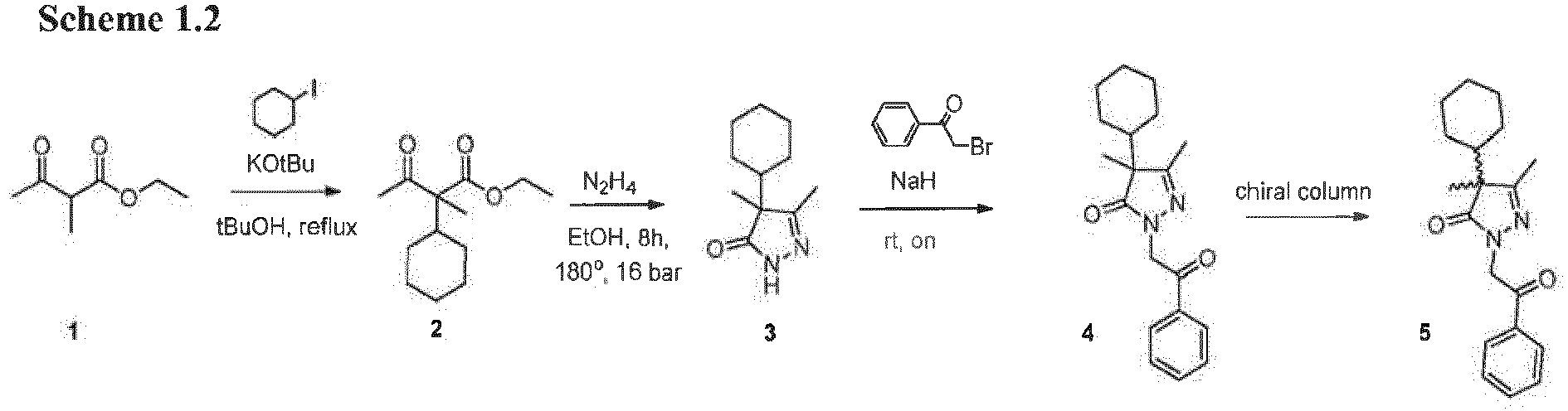
-

- To a suspension of 60% NaH (1.2 eq; 14.77 mmol; 591 mg) in 15 mL of anhydrous DMF was added dropwise a solution of 4-cyclohexyl-3,4-dimethyl-1H-pyrazol-5(4H)-one (Example 1.1a) (2.4 g, 12.37 mmol) in 10 mL of anhydrous DMF. The reaction mixture was stirred at room temperature for 30 minutes and then was added dropwise a solution of 2-bromoacetophenone (1.1 eq; 13.6 mmol; 2.7 g). The reaction mixture was stirred at room temperature for 18 hrs. The reaction was quenched with water (30 ml) and extracted with EtOAc (3 X 30ml). The organic layers were combined, washed with brine (50 ml), and dried over MgSO4. Solvent was evaporated, and the resulting residue was purified by preparative HPLC using a 25 minutes CH3CN/H2O gradient of 5-95% to give after evaporation of solvents and lyophilization the 4-cyclohexyl-3,4-dimethyl-1-(2-oxo-2-phenylethyl)-1H-pyrazol-5(4H)-one (2.3 g) as a yellowish dense oil, which crystallized upon thorough drying.
- 1H NMR (400 MHz, DMSO-d 6) δ 7.98 (d, J = 8.0 Hz, 2H), 7.67 (t, J = 8.0 Hz, 1H), 7.53 (t, J = 8.0 Hz, 2H), 5.12 (s, 2H), 1.93 (s, 3H), 1.64-1.71 (m, 3H), 1.51-1.59 (m, 2H), 1.45-1.48 (m, 1H), 1.14-1.27 (m, 3H), 1.18 (s, 3H), 0.91-1.11 (m, 2H). MS 313 (MH+).
-

- To a solution of ethyl 2-cyclohexyl-2-methyl-3-oxobutanoate (Example 1.1b) (7.5 g; 33 mmol) divided into 3 vials and diluted with 20 mL of EtOH each, was added hydrazine monohydrate (4 eq; 132.6 mmol; 6.46 mL, equally divided between all vials). Reaction mixture was heated in microwave at 180°C for 8 hours (16 bars). The reaction medium was allowed to cool to room temperature and solvent was evaporated. The resulting residue was recrystallized from hexane to obtain the title compound (5.2 g; 81%) as a white crystalline solid.
- 1H NMR (400 MHz, DMSO-d 6) δ 10.85 (s, 1H), 1.90 (s, 3H), 1.65-1.72 (m, 2H), 1.55-1.60 (m, 2H), 1.44-1.48 (m, 2H), 1.21-1.30 (m, 1H), 1.10-1.18 (m, 2H), 1.01-1.09 (m, 1H), 1.07 (s, 3H), 0.83-0.92 (m, 1H). MS 195 (MH+).
-

- To 1M solution of KOt-Bu in t-BuOH (100 mmol, 100 mL) under nitrogen atmosphere at room temperature was added dropwise over 10 min ethyl 2-methyl-3-oxobutanoate (1 eq; 100 mmol; 14.25 mL). Reaction mixture was stirred at 50°C for 1 hour, and then cyclohexyl iodide (1.2 cq; 120 mmol; 15.6 mL) was added to the resulting solution and reaction mixture was heated at 120°C for 24 h. Precipitate of insoluble KI was formed during reaction. The reaction medium was allowed to cool to room temperature, and then concentrated under vacuum. The reaction was quenched with water (25 ml) and extracted with Et2O (3 X 20ml). The organic layers were combined, washed with brine (40 ml), and dried over MgSO4, and concentrated under vacuum. Crude product was purified by flash column chromatography (Hcxanc/EtOAc 2%; Rf = 0.6), yielding 7.5 g (33%) of ethyl 2-cyclohexyl-2-methyl-3-oxobutanoate as a light yellow oil.
- 1H NMR (400 MHz, DMSO-d 6) δ 4.09 (q, J = 8.0 Hz, J = 8.0 Hz, 2H), 2.07-2.12 (m, 1H), 2.07 (s, 3H), 1.64-1.71 (m, 2H), 1.58-1.62 (m, 1H), 1.43-1.47 (m, 1H), 1.33-1.37 (m, 1H), 1.14-1.24 (m, 2H), 1.15 (t, J = 8.0 Hz, 3H), 1.14 (s, 3H), 0.97-1.10 (m, 2H), 0.83-0.91(m, 1H). MS 227 (MH+).
-

- Chiral separation of 4-cyclohexyl-3,4-dimethyl-1-(2-oxo-2-phenylethyl)-1H-pyrazol-5(4H)-one (Example 1.1) (3.7 g) was performed on Agilent LCMS system using a column Chiral Pak AD-H (60 min run, 15ml/min, Hexane/IPA 10% isocratic), retention time for title compound is 56 min. After evaporation of solvents and lyophilization the desired enantiomer was obtained (1043 mg) as a yellowish glassy oil. Optical rotation was measured on Perkin Elmer polarimeter, model 341. Sample was prepared in 10 mg/mL EtOH. [α]20 D = +114.3°.
- 1H NMR (400 MHz, DMSO-d 6) δ 7.98 (d, J = 8.0 Hz, 2H), 7.67 (t, J = 8.0 Hz, 1H), 7.53 (t, J = 8.0 Hz, 2H), 5.13 (d, J = 1.6 Hz, 2H), 1.93 (s, 3H), 1.64-1.71 (m, 3H), 1.51-1.59 (m, 2H), 1.45-1.48 (m, 1H), 1.17-1.27 (m, 2H), 1.14 (s, 3H), 1.11-1.17 (m, 1H), 0.91-1.12 (m, 2H). MS 313 (MH+).
-

- Prepared in a similar manner as described in Example 1.2 starting from of 4-cyclohexyl-3,4-dimethyl-1-(2-oxo-2-phenylethyl)-1H-pyrazol-5(4H)-one (Example 1.1) (3.7 g). Retention time for title compound is 34 min. The desired enantiomer was obtained (1322 mg) as a yellowish glassy oil. [α]20 D = -113.9°.
- 1H NMR (400 MHz, DMSO-d 6) δ 7.98 (d, J = 8.0 Hz, 2H), 7.67 (t, J = 8.0 Hz, 1H), 7.53 (t, J = 8.0 Hz, 2H), 5.13 (d, J = 1.6 Hz, 2H), 1.93 (s, 3H), 1.64-1.71 (m, 3H), 1.51-1.59 (m, 2H), 1.45-1.48 (m, 1H), 1.17-1.27 (m, 2H), 1.14 (s, 3H), 1.11-1.17 (m, 1H), 0.91-1.12 (m, 2H). MS 313 (MH+).
-

- Prepared in a similar manner as described in Example 1.1 starting from 4-cyclohexyl-3,4-dimethyl-1H-pyrazol-5(4H)-one (1a) (400 mg, 2.06 mmol) and 2-bromo-1-(3-hydroxyphenyl)-ethanone (487 mg, 2.26 mmol) to obtain the desired 4-cyclohexyl-1-(2-(3-hydroxyphenyl)-2-oxoethyl)-3,4-dimethyl-1H-pyrazol-5(4H)-one (38.7 mg, 5%) as a white powder.
- 1H NMR (400 MHz, DMSO-d 6) δ 10.0 (bs, 1H), 7.40 (d, J = 8.0 Hz, 1H), 7.30 (t, J = 8.0 Hz, 1H), 7.26 (s, 1H), 7.03 (d, J = 8.0 Hz, 1H), 5.03 (d, 1.6 Hz, 2H), 1.91 (s, 3H), 1.63-1.69 (m, 3H), 1.51-1.59 (m, 2H), 1.45-1.48 (m, 1H), 1.17-1.27 (m, 2H), 1.13 (s, 3H), 1.11-1.17 (m, 1H), 0.91-1.12 (m, 2H). MS 329 (MH+).
-

- Prepared in a similar manner as described in Example 1.1 starting from 4-cyclohexyl-3,4-dimethyl-1H-pyrazol-5(4H)-one (1a) (97 mg, 0.5 mmol) and 2-bromo-1-(3-fluorophenyl)-ethanone (119 mg, 0.55 mmol) to obtain the desired 4-cyclohexyl-1-(2-(3-fluorophenyl)-2-oxoethyl)-3,4-dimethyl-1H-pyrazol-5(4H)-one (46 mg, 28%) as a white powder.
- 1H NMR (400 MHz, DMSO-d 6) δ 7.83 (dt, J = 7.6, 1.3 Hz, 1H), 7.78 (m, 1H), 7.60 (td, J = 7.9, 5.8 Hz, 1H), 7.53 (tdd, J = 8.4, 2.6, 1.1 Hz, 1H), 5.17 (d, J = 18.0 Hz, 1H), 5.12 (d, J = 18.0 Hz, 1H), 1.93 (s, 3H), 1.63-1.71 (m, 3H), 1.51-1.63 (m, 2H), 1.44-1.47 (m, 1H), 1.17-1.27 (m, 2H), 1.14 (s, 3H), 1.11-1.17 (m, 1H), 0.89-1.12 (m, 2H). MS 331 (MH+).
-

- Prepared in a similar manner as described in Example 1.1 starting from 4-cyclohexyl-3,4-dimethyl-1H-pyrazol-5(4H)-one (1a) (194 mg, 1 mmol) and 2-bromo-1-(thiophen-3-yl)ethanone (226 mg, 1.1 mmol) to obtain the desired 4-cyclohexyl-3,4-dimethyl-1-(2-oxo-2-(thiophen-3-yl)ethyl)-1H-pyrazol-5(4H)-one (140.4 mg, 44%) as a white powder.
- 1H NMR (400 MHz, DMSO-d 6) δ 8.62 (dd, J = 1.2 Hz, J = 2.8 Hz, 1H), 7.67 (dd, J = 2.8 Hz, J = 4.8 Hz, 1H), 7.52 (dd, J = 1.2 Hz, J = 5.2 Hz, 1H), 5.00 (s, 2H), 1.93 (s, 3H), 1.64-1.71 (m, 3H), 1.46-1.59 (m, 3H), 1.17-1.27 (m, 2H), 1.14 (s, 3H), 1.11-1.17 (m, 1H), 0.91-1.12 (m, 2H). MS 319 (MH+).
-

- Prepared in a similar manner as described in Example 1.2 starting from of 4-cyclohexyl-3,4-dimethyl-1-(2-oxo-2-(thiophen-3-yl)ethyl)-1H-pyrazol-5(4H)-one (Example 1.6) (179 mg). Retention time for title compound is 39 min. The desired enantiomer was obtained (68.4 mg) as a white powder. [α]20 D = +104.2°.
- 1H NMR (400 MHz, DMSO-d 6) δ 8.61 (dd, J = 1.2 Hz, J = 2.8 Hz, 1H), 7.67 (dd, J = 2.8 Hz, J = 4.8 Hz, 1H), 7.52 (dd, J = 1.2 Hz, J = 5.2 Hz, 1H), 5.00 (s, 2H), 1.93 (s, 3H), 1.64-1.71 (m, 3H), 1.46-1.59 (m, 3H), 1.17-1.27 (m, 2H), 1.14 (s, 3H), 1.11-1.17 (m, 1H), 0.91-1.12 (m, 2H). MS 319 (MH+).
-

- Prepared in a similar manner as described in Example 1.2 starting from of 4-cyclohexyl-3,4-dimethyl-1-(2-oxo-2-(thiophen-3-yl)ethyl)-1H-pyrazol-5(4H)-one (Example 1.6) (179 mg). Retention time for title compound is 20 min. The desired enantiomer was obtained (74.8 mg) as a white powder. [α]20 D = -101.6°.
- 1H NMR (400 MHz, DMSO-d 6) 8.61 (dd, J = 1.2 Hz, J = 2.8 Hz, 1H), 7.67 (dd, J = 2.8 Hz, J = 4.8 Hz, 1H), 7.52 (dd, J = 1.2 Hz, J = 5.2 Hz, 1H) 5.00 (s, 2H), 1.93 (s, 3H), 1.64-1.71 (m, 3H), 1.46-1.59 (m, 3H), 1.17-1.27 (m, 2H), 1.14 (s, 3H), 1.11-1.17 (m, 1H), 0.91-1.12 (m, 2H). MS 319 (MH+).
-

- Prepared in a similar manner as described in Example 1.1 starting from 4-cyclohexyl-3,4-dimethyl-1H-pyrazol-5(4H)-one (1a) (97 mg, 0.5 mmol) and 2-bromo-1-(4-fluorophenyl)-ethanone (119 mg, 0.55 mmol) to obtain the desired 4-cyclohexyl-1-(2-(4-fluorophenyl)-2-oxoethyl)-3,4-dimethyl-1H-pyrazol-5(4H)-one (55 mg, 33%) as a white powder.
- 1H NMR (400 MHz, DMSO-d 6) δ 8.07 (dd, J = 5.6 Hz, J = 9.2 Hz, 2H), 7.37 (t, J = 9.2 Hz, 2H), 5.13 (d, J = 1.6 Hz, 2H), 1.93 (s, 3H), 1.63-1.71 (m, 3H), 1.51-1.59 (m, 2H), 1.45-1.48 (m, 1H), 1.17-1.27 (m, 2H), 1.14 (s, 3H), 1.11-1.17 (m, 1H), 0.89-1.12 (m, 2H). MS 331 (MH+).
-

- Prepared in a similar manner as described in Example 1.1 starting from 4-cyclohexyl-3,4-dimethyl-1H-pyrazol-5(4H)-one (1a) (97 mg, 0.5 mmol) and 2-chloro-1-(thiophen-2-yl)ethanone (88 mg, 0.55 mmol) to obtain the desired 4-cyclohexyl-3,4-dimethyl-1-(2-oxo-2-(thiophen-2-yl)ethyl)-1H-pyrazol-5(4H)-one (20.6 mg, 13%) as a white powder.
- 1H NMR (400 MHz, DMSO-d 6) δ 8.10-8.07 (m, 2H), 7.28 (dd, J = 4.0 Hz, J = 8.0 Hz, 1H), 5.06 (s, 2H), 1.93 (s, 3H), 1.64-1.71 (m, 3H), 1.51-1.59 (m, 2H), 1.46-1.49 (m, 1H), 1.17-1.27 (m, 2H), 1.14 (s, 3H), 1.11-1.17 (m, 1H), 0.91-1.12 (m, 2H). MS 319 (MH+).
-

- Prepared in a similar manner as described in Example 1.1 starting from 4-cyclohexyl-3,4-dimethyl-1H-pyrazol-5(4H)-one (1a) (97 mg, 0.5 mmol) and 5-(bromoacetyl)-1,3-benzo-dioxolane (134 mg, 0.55 mmol) to obtain the desired 1-(2-(benzo[d][1,3]dioxol-5-yl)-2-oxoethyl)-4-cyclohexyl-3,4-dimethyl-1H-pyrazol-5(4H)-one (95.5 mg, 54%) as a white powder.
- 1H NMR (400 MHz, DMSO-d 6) δ 7.63 (d, J = 8.0 Hz, 1H), 7.46 (s, 1H), 7.05 (d, J = 8.0 Hz, 1H), 6.13 (s, 2H), 5.03 (s, 2H), 1.93 (s, 3H), 1.64-1.71 (m, 3H), 1.51-1.59 (m, 2H), 1.46-1.49 (m, 1H), 1.17-1.27 (m, 2H), 1.14 (s, 3H), 1.11-1.17 (m, 1H), 0.91-1.12 (m, 2H). MS 357 (MH+).
-

- Prepared in a similar manner as described in Example 1.1 starting from 4-cyclohexyl-3,4-dimethyl-1H-pyrazol-5(4H)-one (1a) (400 mg, 2.06 mmol) and 2-chloro-1-(1H-pyrrol-2-yl)ethanone (326 mg, 2.26 mmol) to obtain the desired 4-cyclohexyl-3,4-dimethyl-1-(2-oxo-2-(1H-pyrrol-2-yl)ethyl)-1H-pyrazol-5(4H)-one (105.8 mg, 17%) as a white powder.
- 1H NMR (400 MHz, DMSO-d 6) δ 11.92 (s, 1NH), 7.16-7.07 (m, 2H), 6.20 (dd, J = 3.8 Hz, J = 2.4 Hz, 1H), 4.80 (s, 2H), 1.91 (s, 3H), 1.64-1.71 (m, 3H), 1.51-1.59 (m, 2H), 1.46-1.49 (m, 1H), 1.17-1.27 (m, 2H), 1.12 (s, 3H), 1.11-1.17 (m, 1H), 0.95-1.12 (m, 2H). MS 302 (MH+).
-

- Prepared in a similar manner as described in Example 1.1 starting from 4-cyclohexyl-3,4-dimethyl-1H-pyrazol-5(4H)-one (1a) (97 mg, 0.5 mmol) and 2-bromo-1-(pyridin-3-yl)ethanone hydrobromide (155 mg, 0.55 mmol) to obtain the desired 4-cyclohexyl-3,4-dimethyl-1-(2-oxo-2-(pyridin-3-yl)ethyl)-1H-pyrazol-5(4H)-one (42.5 mg, 27%) as a white powder.
- 1H NMR (400 MHz, DMSO-d 6) δ 9.15 (dd, J = 2.3 Hz, J = 0.8 Hz, 1H), 8.82 (dd, J = 4.8 Hz, J = 1.7 Hz, 1H), 8.31 (dt, J = 8.0 Hz, J = 1.8 Hz, 1H), 7.58 (ddd, J = 8.0 Hz, J = 4.8 Hz, J = 0.8 Hz, 1H), 5.20 (d, J = 2.0 Hz, 2H), 1.93 (s, 3H), 1.63-1.71 (m, 3H), 1.51-1.59 (m, 2H), 1.44-1.47 (m, 1H), 1.17-1.27 (m, 2H), 1.14 (s, 3H), 1.11-1.17 (m, 1H), 0.89-1.12 (m, 2H). MS 314 (MH+).
-

- Prepared in a similar manner as described in Example 1.1 starting from 4-cyclohexyl-3,4-dimethyl-1H-pyrazol-5(4H)-one (1a) (97 mg, 0.5 mmol) and 2-bromo-1-(3-methoxyphenyl)-ethanone (126 mg, 0.55 mmol) to obtain the desired 4-cyclohexyl-1-(2-(3-methoxyphenyl)-2-oxoethyl)-3,4-dimethyl-1H-pyrazol-5(4H)-one (75.3 mg, 44%) as a white powder.
- 1H NMR (400 MHz, DMSO-d 6) δ 7.58 (ddd, J = 7.6 Hz, J = 1.5 Hz, J = 1.0 Hz, 1H), 7.50 - 7.41 (m, 2H), 7.23 (ddd, J = 8.2 Hz, J = 2.7 Hz, J = 0.9 Hz, 1H), 5.14 (d, J = 18.0 Hz, 1H), 5.08 (d, J = 18.0 Hz, 1H), 3.80 (s, 3H), 1.93 (s, 3H), 1.63-1.71 (m, 3H), 1.51-1.59 (m, 2H), 1.44-1.47 (m, 1H), 1.16-1.27 (m, 2H), 1.14 (s, 3H), 1.11-1.17 (m, 1H), 0.89-1.12 (m, 2H). MS 343 (MH+).
-

- Prepared in a similar manner as described in Example 1.1 starting from 4-cyclohexyl-3,4-dimethyl-1H-pyrazol-5(4H)-one (1a) (97 mg, 0.5 mmol) and 2-bromo-1-(pyridin-2-yl)ethanone hydrobromide (155 mg, 0.55 mmol) to obtain the desired 4-cyclohexyl-3,4-dimethyl-1-(2-oxo-2-(pyridin-2-yl)ethyl)-1H-pyrazol-5(4H)-one (13.6 mg, 9%) as a white powder.
- 1H NMR (400 MHz, DMSO-d 6) δ 8.75 (ddd, J = 4.8 Hz, J = 1.7 Hz, J = 0.9 Hz, 1H), 8.04 (td, J = 7.7 Hz, J = 1.7 Hz, 1H), 7.96 (dt, J = 7.8 Hz, J = 1.2 Hz, 1H), 7.72 (ddd, J = 7.5 Hz, J = 4.8 Hz, J = 1.3 Hz, 1H), 5.22 (d, J = 1.2 Hz, 2H), 1.94 (s, 3H), 1.63-1.71 (m, 3H), 1.51-1.59 (m, 2H), 1.44-1.47 (m, 1H), 1.17-1.28 (m, 2H), 1.16 (s, 3H), 1.11-1.17 (m, 1H), 0.89-1.12 (m, 2H). MS 314 (MH+).
-

- Prepared in a similar manner as described in Example 1.1 starting from 4-cyclohexyl-3,4-dimethyl-1H-pyrazol-5(4H)-one (1a) (97 mg, 0.5 mmol) and 2-bromo-1-(pyridin-4-yl)ethanone hydrobromide (155 mg, 0.55 mmol) to obtain the desired 4-cyclohexyl-3,4-dimethyl-1-(2-oxo-2-(pyridin-4-yl)ethyl)-1H-pyrazol-5(4H)-one (21.7 mg, 14%) as a white powder.
- 1H NMR (400 MHz, DMSO-d 6) δ 8.81 (d, J = 5.6 Hz, 2H), 7.83 (d, J = 6.0 Hz, 2H), 5.19 (d, J = 2.8 Hz, 2H), 1.93 (s, 3H), 1.63-1.71 (m, 3H), 1.51-1.59 (m, 2H), 1.44-1.47 (m, 1H), 1.17-1.28 (m, 2H), 1.13 (s, 3H), 1.11-1.17 (m, 1H), 0.89-1.12 (m, 2H). MS 314 (MH-).
-

- Prepared in a similar manner as described in Example 1.1 starting from 4-cyclohexyl-3,4-dimethyl-1H-pyrazol-5(4H)-one (1a) (97 mg, 0.5 mmol) and 2-bromo-1-(4-methoxyphenyl)-ethanone (126 mg, 0.55 mmol) to obtain the desired 4-cyclohexyl-1-(2-(4-methoxyphenyl)-2-oxoethyl)-3,4-dimethyl-1H-pyrazol-5(4H)-one (110 mg, 64%) as a white powder.
- 1H NMR (400 MHz, DMSO-d 6) δ 7.96 (d, J = 8.0 Hz, 2H), 7.05 (d, J = 8.0 Hz, 2H), 5.05 (s, 2H), 3.83 (s, 3H), 1.92 (s, 3H), 1.63-1.71 (m, 3H), 1.51-1.59 (m, 2H), 1.44-1.47 (m, 1H), 1.16 - 1.27 (m, 2H), 1.14 (s, 3H), 1.11-1.17 (m, 1H), 0.89-1.12 (m, 2H). MS 343 (MH+).
-

- Prepared in a similar manner as described in Example 1.1 starting from 4-cyclohexyl-3,4-dimethyl-1H-pyrazol-5(4H)-one (1a) (97 mg, 0.5 mmol) and 2-chloro-1-(1H-pyrrol-3-yl)-ethanone (79 mg, 0.55 mmol) to obtain the desired 4-cyclohexyl-3,4-dimethyl-1-(2-oxo-2-(1H-pyrrol-3-yl)ethyl)-1H-pyrazol-5(4H)-one (35.1 mg, 23%) as a white powder.
- 1H NMR (400 MHz, DMSO-d 6) δ 11.55 (s, 1NH), 7.69 (s, 1H), 6.86 (dd, J = 2.8 Hz, J = 1.8 Hz, 1H), 6.47 (dd, J = 2.8 Hz, J = 1.5 Hz, 1H), 4.76 (s, 2H), 1.91 (s, 3H), 1.64-1.71 (m, 3H), 1.51-1.59 (m, 2H), 1.46-1.49 (m, 1H), 1.17-1.28 (m, 2H), 1.13 (s, 3H), 1.11-1.17 (m, 1H), 0.94-1.12 (m, 2H). MS 302 (MH+).
-

- Prepared in a similar manner as described in Example 1.1 starting from 4-cyclohexyl-3,4-dimethyl-1H-pyrazol-5(4H)-one (1a) (97 mg, 0.5 mmol) and 2-bromo-1-(3-chlorophenyl)-ethanone (128 mg, 0.55 mmol) to obtain the desired 1-(2-(3-chlorophenyl)-2-oxoethyl)-4-cyclohexyl-3,4-dimethyl-1H-pyrazol-5(4H)-one (56 mg, 32%) as a white powder.
- 1H NMR (400 MHz, DMSO-d 6) δ 7.99 (t, J = 1.8 Hz, 1H), 7.95 - 7.90 (m, 1H), 7.74 (ddd, J = 8.0 Hz, J = 2.2 Hz, J = 1.0 Hz, 1H), 7.57 (t, J = 7.9 Hz, 1H), 5.17 (d, J = 18.0 Hz, 1H), 5.10 (d, J = 18.0 Hz, 1H), 1.93 (s, 3H), 1.63-1.71 (m, 3H), 1.51-1.59 (m, 2H), 1.44-1.47 (m, 1H), 1.16-1.27 (m, 2H), 1.13 (s, 3H), 1.11-1.17 (m, 1H), 0.89-1.12 (m, 2H). MS 347 (MH-).
-
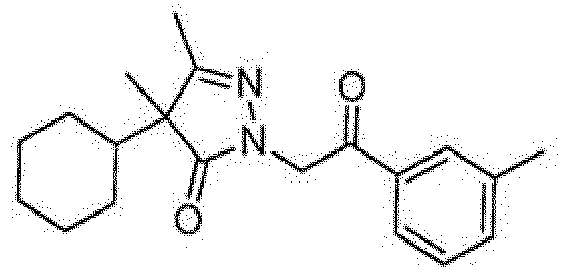
- Prepared in a similar manner as described in Example 1.1 starting from 4-cyclohexyl-3,4-dimethyl-1H-pyrazol-5(4H)-one (1a) (97 mg, 0.5 mmol) and 2-bromo-1-(m-tolyl)ethanone (117 mg, 0.55 mmol) to obtain the desired 4-cyclohexyl-3,4-dimethyl-1-(2-oxo-2-(m-tolyl)ethyl)-1H-pyrazol-5(4H)-onc (99.3 mg, 61%) as a white powder.
- 1H NMR (400 MHz, DMSO-d 6) δ 7.79 (s, 1H), 7.77 (d, J = 8.0 Hz, 1H), 7.48 (d, J = 8.0 Hz, 1H), 7.41 (t, J = 8.0 Hz, 1H), 5.12 (d, J = 18.0 Hz, 1H), 5.06 (d, J = 18.0 Hz, 1H), 2.36 (s, 3H), 1.93 (s, 3H), 1.63-1.71 (m, 3H), 1.51-1.59 (m, 2H), 1.44-1.47 (m, 1H), 1.16-1.27 (m, 2H), 1.14 (s, 3H), 1.11-1.17 (m, 1H), 0.89-1.12 (m, 2H). MS 327 (MH+).

-

- To a suspension of NaH (60%; 1.2 eq; 1.92 mmol; 77 mg) in 3 mL of anhydrous DMF at room temperature under N2 atmosphere was added dropwise a solution of 4-(bicyclo[2.2.1]heptan-2-yl)-3,4-dimethyl-1H-pyrazol-5(4H)-one (Compound 6, Example 1.21a) (330 mg, 1.6 mmol) in 3 mL of anhydrous DMF. The reaction mixture was stirred at ambient temperature for 15 minutes and a solution of 2-bromo-1-(thiophen-3-yl)ethanone (1.1 eq; 1.76 mmol; 361 mg) in 2 mL of anhydrous DMF was added dropwise. The reaction mixture was stirred at room temperature for 18 hrs. The reaction was quenched with water (30 ml) and extracted with EtOAc (3 X 30 ml). The organic layers were combined, washed with brine (30 ml), and dried over MgSO4. Solvent was evaporated, and the resulting residue was purified by preparative HPLC using a 25 minutes CH3CN/H2O gradient of 5-95%, to give as first-eluting the desired product 4-((1R,2R,4S)-bicyclo[2.2.1]heptan-2-yl)-3,4-dimethyl-1-(2-oxo-2-(thiophen-3-yl)ethyl)-1H-pyrazol-5(4H)-one (109 mg, 21%) as a white-greenish solid. NMR analysis showed this product to be mostly related to exo-norbornyl enantiomer, as compared to the literature available for NMR spectra of exo-/endo-norborneoli.
- 1H NMR (400 MHz, DMSO-d 6) δ 8.62 (dd, J = 2.8, 1.3 Hz, 1H), 7.67 (dd, J = 5.1, 2.8 Hz, 1H), 7.52 (dd, J = 5.1, 1.3 Hz, 1H), 5.04 (d, J = 18.0 Hz, 1H), 4.98 (d, J = 18.0 Hz, 1H), 2.38 (bs, 1H), 2.10 (bs, 1H), 1.91 (s, 3H), 1.62 (t, J = 8.0 Hz, 1H), 1.43-1.45 (m, 2H), 1.23-1.30 (m, 2H), 1.20 (s, 3H), 1.09-1.12 (m, 2H), 0.89-1.02 (m, 2H). MS 331 (MH+).
-

- To the suspension of NaOMe (95%; 3 eq; 21.3 mmol; 1.2 g) in 50 mL of anhydrous methanol at room temperature was added solution of methyl 3-(2-benzoylhydrazinyl)-2-(bicyclo[2.2.1]heptan-2-yl)-2-methylbutanoate (Compound 5, Example 1.21b) (2.44 g, 7.09 mmol) in 5 mL of anhydrous methanol. The reaction mixture was heated at 100°C for 18 h. Amberlite (H+) resin was added to the reaction mixture until a clear solution and pH = 4 were obtained. The resin was filtered off, washed with MeOH and the resulting solution was concentrated in vacuum. The residue was purified by column chromatography (DCM/EtOAc 20%; Rf = 0.5) to obtain the title compound (438 mg; 30%) as a white powder, mixture of 2 isomers.
- 1H NMR (400 MHz, DMSO-d 6) δ 10.85 (s, 1H), 2.26 (bs, 0.5H), 2.15 (bs, 0.5H), 2.08 (bs, 0.5H), 1.93-1.97 (m, 0.5H), 1.87 (s, 1.5H), 1.85 (s, 1.5H), 1.62 (bs, 0.5H), 1.52-1.59 (m, 1H),1.35-1.44 (m, 2H), 1.21-1.30 (m, 2H), 1.10 (s, 1.5H), 1.05-1.12 (m, 2H), 0.98 (s, 1.5H), 0.95 (d, J = 8.0 Hz, 0.5H), 0.86 (d, J = 8.0 Hz, 0.5 H), 0.74-0.77 (m, 0.5 H). MS 207 (MH+).
-

- To a solution of benzohydrazide (50 mmol, 6.8 g) in 50 mL of EtOH was added acetaldehyde (1.1 eq, 55 mmol, 3.1 mL) and the reaction mixture was stirred at room temperature for 2 h. The precipitated product was filtered off, washed with cold EtOH and dried in vacuum to afford N'-ethylidenebenzohydrazide (4 g, 50% yield) which was used further crude.
- To a suspension of N'-ethylidenebenzohydrazide (1.5 g, 9.2 mmol) and scandium (III) triflate (0.1 eq, 0.92 mmol, 453 mg) in 20 mL of anhydrous acetonitrile at -20°C was added dropwise a solution of (2-(bicyclo[2.2.1]heptan-2-yl)-1-methoxyprop-1-enyloxy)trimethylsilane (Compound 4, Example 1.21c) (1.5 eq, 13.85 mmol, 3.5 g) in 5 mL of anhydrous acetonitrile. The reaction mixture was stirred at -20°C for 2 h, warmed to room temperature and stirred for 18 hours. The reaction was quenched with saturated NaHCO3 solution (50 ml) and extracted with EtOAc (3 X 30ml). The organic layers were combined, washed with brine (40 ml), dried over MgSO4 and concentrated under vacuum. The resulting residue was purified by column chromatography (Hexane/EtOAc 20%; Rf = 0.5) to obtain the title compound (2.4 g; 77%) as a white powder, mixture of four isomers.
- 1H NMR (400 MHz, DMSO-d 6) δ 9.96 - 9.93 (m, 0.5NH), 9.91 - 9.88 (m, 0.5NH), 7.91 - 7.72 (m, 2H), 7.57 - 7.34 (m, 3H), 5.01 (t, J = 7.6 Hz, 0.25H), 4.94 (t, J = 7.6 Hz, 0.25H), 4.85 (t, J = 7.6 Hz, 0.25H), 4.80 (t, J = 7.6 Hz, 0.25H), 3.57 (s, 0.75H), 3.56 (s, 0.75H), 3.55 (s, 0.75H), 3.53 (s, 0.75H), 3.40 - 3.18 (m, 1H), 2.16 (bs, 0.5H), 2.11 (bs, 1H), 2.05 - 1.97 (m, 0.75H), 1.88 (t, J = 7.8 Hz, 0.25H), 1.78 (t, J = 8.0 Hz, 0.25H), 1.64 (t, J = 7.7 Hz, 0.25H), 1.37-1.52 (m, 3H), 1.20-1.37 (m, 2H), 1.17 (s, 0.75H), 1.15-1.04 (m, 3H), 1.09 (s, 1.5H), 1.05 (s, 0.75H), 1.03 - 0.90 (m, 3H). MS 343 (MH+).
-

- To a solution of diisopropylamine (23 mmol, 3.2 mL) in 20 mL of anhydrous THF at - 20°C under nitrogen atmosphere was added dropwise over 5 min 2.5M solution of n-butyllitium in hexane (23 mmol, 9.2 mL). The mixture was stirred for 15 min, and a solution of methyl 2-(bicyclo[2.2.1]heptan-2-yl)propanoate (3) (22.7 mmol, 4.13 g) in anhydrous THF (5 mL) was added. The reaction mixture was stirred at -20°C for 1 h, and trimethylsilyl chloride (99%, 2.5 eq, 57.5 mmol, 7.3 mL) was added dropwise. The reaction mixture was slowly warmed up to room temperature and stirred for 18 hours. The formed precipitate was filtered off, filtrate was concentrated under vacuum, washed with diethyl ether and more precipitate was filtered off. The final solution was concentrated and dried under vacuum to give (2-(bicyclo[2.2.1]heptan-2-yl)-1-methoxyprop-1-enyloxy)trimethylsilane (5.5 g, 94%) as a yellow oil, mixture of E-/Z-isomers which was used further crude.
- 1H NMR (400 MHz, CDCl3) δ 3.28 (s, 3H), 2.33 (t, J = 8.0 Hz, 0.7 H), 2.21 (t, J = 7.2 Hz, 0.3 H), 2.01 (bs, 1H), 1.79 (bs, 1H), 1.31 (s, 1H), 1.27 (s, 2H), 1.21-1.28 (m, 4H), 0.96-1.12 (m, 2H), 0.87-0.91 (m, 2 H), 0.01 (s, 3H), 0.00 (s, 6H).
-

- To a solution of methyl 2-(bicyclo[2.2.1]-heptan-2-yl)acetate (Example 1.21e) (6g, 35.7 mmol) in 50 mL of anhydrous THF at -78°C under nitrogen atmosphere was added dropwise 1M solution of LiHMDS in THF (1.15 eq, 41 mmol, 41 mL). The reaction mixture was stirred at - 78°C for 1 h, and iodomethane (1.2 eq, 42.8 mmol, 2.6 mL) was added. The reaction mixture was slowly warmed up to room temperature and stirred for 18 h. The reaction was quenched with water (50 ml) and extracted with EtOAc (3 X 30ml). The organic layers were combined, washed with brine (40 ml), dried over MgSO4 and concentrated under vacuum. The resulting residue was purified by column chromatography (Hexane/EtOAc 2%; Rf = 0.5) to obtain the title compound (4.13 g; 64%) as a light yellow oil.
- 1H NMR (400 MHz, DMSO-d 6) δ 3.54 (s, 3H), 2.12 (bs, 1H), 1.99-2.03 (m, 1H), 1.78 (bs, 1H), 1.30-1.39 (m, 4H), 1.18-1.21 (m, 1H), 0.97-1.06 (m, 4H), 0.92 (d, J = 7.2 Hz, 3H). MS 183 (MH+).
-

- In a 250 ml round bottom flask were placed under nitrogen atmosphere 2-(bicyclo[2.2.1]heptan-2-yl)acetic acid (5g, 32.46 mmol), anhydrous diethyl ether (40 mL) and methanol (10 mL) and the mixture was cooled to 0°C in an ice bath. To the mixture was then added a 2M solution of (trimethylsilyl)diazomethane in diethyl ether (2 eq., 65 mmol, 32.5 mL) dropwise. After addition was complete, the mixture was warmed to room temperature and stirred for 2 h. The mixture was concentrated under vacuum to afford methyl 2-(bicyclo[2.2.1]heptan-2-yl)acetate (6 g, 100% yield) which was used further crude.
- 1H NMR (400 MHz, DMSO-d 6) δ 3.55 (s, 3H), 2.25 (dd, J = 8.0 Hz, J = 16.0 Hz, 1H), 2.15 (bs, 1H), 2.10 (dd, J = 8.0 Hz, J = 15.2 Hz, 1H), 1.92 (bs, 1H), 1.74-1.81 (m, 1H), 1.39-1.45 (m, 3H), 1.27-1.30 (m, 1H), 0.97-1.14 (m, 4H). MS 169 (MH+).
-

- Prepared in a similar manner as described in Example 1.21 starting from 4-(bicyclo[2.2.1]heptan-2-yl)-3,4-dimethyl-1H-pyrazol-5(4H)-one (Example 1.21a) (330 mg, 1.6 mmol) and 2-bromo-1-(thiophen-3-yl)ethanone (1.1 eq; 1.76 mmol; 361 mg) and eluted second on preparative HPLC column, to obtain the desired 4-((1R,2S,4S)-bicyclo[2.2.1]heptan-2-yl)-3,4-dimethyl-1-(2-oxo-2-(thiophen-3-yl)ethyl)-1H-pyrazol-5(4H)-one (99.3 mg, 61%) as a white powder. NMR analysis showed that this product mostly related to endo-norbornyl enantiomer, as compared to the literature available NMR spectra of exo-/endo-norborneolii.
- 1H NMR (400 MHz, DMSO-d 6) δ 8.62 (dd, J = 2.8, 1.3 Hz, 1H), 7.67 (dd, J = 5.1, 2.8 Hz, 1H), 7.52 (dd, J = 5.1, 1.3 Hz, 1H), 5.04 (d, J = 18.0 Hz, 1H), 4.98 (d, J = 18.0 Hz, 1H), 2.15 (bs, 1H), 1.98-2.03 (m, 1H), 1.94 (s, 3H), 1.74 (bs, 1H), 1.66 (t, J = 8.0 Hz, 1H), 1.30-1.43 (m, 2H), 1.20-1.31 (m, 2H), 1.08 (s, 3H), 1.09-1.12 (m, 2H), 0.87 (bd, J = 9.0 Hz, 1H). MS 331 (MH+).
-

- Prepared in a similar manner as described in Example 1.21 starting from 4-(bicyclo[2.2.1]heptan-2-yl)-3,4-dimethyl-1H-pyrazol-5(4H)-one (Example 1.21a) (180 mg, 0.87 mmol) and 2-bromoacetophenone (1.1 eq; 0.96 mmol; 190 mg) and eluted first on preparative HPLC column, to obtain the desired 4-((1R,2R,4S)-bicyclo[2.2.1]heptan-2-yl)-3,4-dimethyl-1-(2-oxo-2-phenylethyl)-1H-pyrazol-5(4H)-one (126 mg, 39%) as a white powder. NMR analysis showed that this product mostly related to exo-norbornyl enantiomer, as compared to the literature available NMR spectra of exo-/endo-norborneoliii.
- 1H NMR (400 MHz, DMSO-d 6) δ 7.98 (d, J = 8.0 Hz, 2H), 7.67 (t, J = 8.0 Hz, 1H), 7.53 (t, J = 8.0 Hz, 2H), 5.16 (d, J = 18.0 Hz, 1H), 5.09 (d, J = 18.0 Hz, 1H), 2.38 (bs, 1H), 2.09 (bs, 1H), 1.91 (s, 3H), 1.62 (t, J = 8.0 Hz, 1H), 1.43-1.45 (m, 2H), 1.21-1.32 (m, 2H), 1.21 (s, 3H), 1.09-1.12 (m, 2H), 0.89-1.02 (m, 2H). MS 325 (MH+).
-

- Prepared in a similar manner as described in Example 1.21 starting from 4-(bicyclo[2.2.1]heptan-2-yl)-3,4-dimethyl-1H-pyrazol-5(4H)-one (Example 1.21a) (180 mg, 0.87 mmol) and 2-bromoacetophenone (1.1 eq; 0.96 mmol; 190 mg) and eluted second on preparative HPLC column, to obtain the desired 4-((1R,2S,4S)-bicyclo[2.2.1]heptan-2-yl)-3,4-dimethyl-1-(2-oxo-2-phenylethyl)-1H-pyrazol-5(4H)-one (50 mg, 17%) as a white powder. NMR analysis showed that this product mostly related to endo-norbornyl enantiomer, as compared to the literature available NMR spectra of exo-/endo-norborneoliv.
- 1H NMR (400 MHz, DMSO-d 6) δ 7.98 (d, J = 8.0 Hz, 2H), 7.67 (t, J = 8.0 Hz, 1H), 7.53 (t, J = 8.0 Hz, 2H), 5.16 (d, J = 18.0 Hz, 1H), 5.10 (d, J = 18.0 Hz, 1H), 2.15 (bs, 1H), 1.98-2.01 (m, 1H), 1.94 (s, 3H), 1.74 (bs, 1H), 1.67 (t, J = 8.0 Hz, 1H), 1.37-1.43 (m, 2H), 1.20-1.31 (m, 2H), 1.14-1.09 (m, 2H), 1.09 (s, 3H), 0.88-0.85 (m, 1H). MS 325 (MH+).
-

- Prepared in a similar manner as described in Example 1.21 starting from 4-(bicyclo[2.2.1]heptan-2-yl)-3,4-dimethyl-1H-pyrazol-5(4H)-one (Example 1.21a) (378 mg, 1.83 mmol) and 2-chloro-1-(1H-pyrrol-2-yl)ethanone (1 eq; 1.83 mmol; 263 mg) and eluted first on preparative HPLC column, to obtain the desired 4-((1R,2R,4S)-bicyclo[2.2.1]heptan-2-yl)-3,4-dimethyl-1-(2-oxo-2-(1H-pyrrol-2-yl)ethyl)-1H-pyrazol-5(4H)-one (16.5 mg, 3%) as a white powder. NMR analysis showed that this product mostly related to exo-norbornyl enantiomer, as compared to the literature available NMR spectra of exo-/endo-norborneolv.
- 1H NMR (400 MHz, DMSO-d 6) δ 11.94 (s, 1NH), 7.09-7.13 (m, 2H), 6.20 (dd, J = 3.7 Hz, J = 2.4 Hz, 1H), 4.89-4.77 (m, 2H), 2.40 (bs, 1H), 2.09 (bs, 1H), 1.91 (s, 3H), 1.62 (t, J = 8.0 Hz, 1H), 1.43-1.45 (m, 2H), 1.21-1.32 (m, 2H), 1.19 (s, 3H), 1.09-1.12 (m, 2H), 0.89-1.02 (m, 2H). MS 314 (MH+).
-

- Prepared in a similar manner as described in Example 1.21 starting from 4-(bicyclo[2.2.1]heptan-2-yl)-3,4-dimethyl-1H-pyrazol-5(4H)-one (Example 1.21a) (378 mg, 1.83 mmol) and 2-chloro-1-(1H-pyrrol-2-yl)ethanone (1 eq; 1.83 mmol; 263 mg) and eluted second on preparative HPLC column, to obtain the desired 4-((1R,2S,4S)-bicyclo[2.2.1]heptan-2-yl)-3,4-dimethyl-1-(2-oxo-2-(1H-pyrrol-2-yl)ethyl)-1H-pyrazol-5(4H)-one (17.4 mg, 3%) as a white powder. NMR analysis showed that this product mostly related to endo-norbornyl enantiomer, as compared to the literature available NMR spectra of exo-/endo-norborneolvi.
- 1H NMR (400 MHz, DMSO-d 6) δ 11.91 (s, 1NH), 7.09-7.13 (m, 2H), 6.20 (dd, J = 3.8 Hz, J = 2.4 Hz, 1H), 4.88-4.76 (m, 2H), 2.14 (bs, 1H), 1.98-2.02 (m, 1H), 1.93 (s, 3H), 1.75 (bs, 1H), 1.65 (t, J = 8.0 Hz, 1H), 1.35-1.43 (m, 2H), 1.24-1.31 (m, 2H), 1.09 (s, 3H), 1.09-1.14 (m, 2H), 0.87 (d, J = 8.0 Hz, 1H). MS 314 (MH+).
-

- Prepared in a similar manner as described in Example 1.21 starting from 4-cyclohexyl-3-ethyl-4-methyl-1H-pyrazol-5(4H)-one (Example 1.27a) (104 mg, 0.5 mmol) and 2-bromoacetophenone (1.1 eq; 0.55 mmol; 110 mg) to obtain the desired 4-cyclohexyl-3-ethyl-4-methyl-1-(2-oxo-2-phenylethyl)-1H-pyrazol-5(4H)-one (53 mg, 32%) as a white powder.
- 1H NMR (400 MHz, DMSO-d 6) δ 7.99 (d, J = 8.0 Hz, 2H), 7.67 (t, J = 8.0 Hz, 1H), 7.53 (t, J = 8.0 Hz, 2H), 5.16 (s, 2H), 2.27-2.33 (m, 2H), 1.63-1.72 (m, 3H), 1.52-1.59 (m, 2H), 1.43 (m, 1H), 1.16-1.30 (m, 1H), 1.14 (s, 3H), 1.06-1.17 (m, 3H), 1.08 (t, J = 7.6 Hz, 3H), 0.90-1.02 (m, 1H). MS 327 (MH+).
-

- Prepared in a similar manner as described in Example 1.21a starting from methyl 3-(2-benzoylhydrazinyl)-2-cyclohexyl-2-methylpentanoate (Example 1.27b) (1.4 g, 4 mmol) and sodium methoxide (3 eq; 12 mmol; 690 mg) to obtain the desired 4-cyclohexyl-3-ethyl-4-methyl-1H-pyrazol-5(4H)-one (462 mg, 55%) as a white powder.
- 1H NMR (400 MHz, DMSO-d 6) δ 10.86 (s, 1NH), 2.22 (q, J = 7.6 Hz, 2H), 1.61-1.70 (m, 2H), 1.54-1.57 (m, 2H), 1.44-1.48 (m, 1H), 1.39 (m, 1H), 1.24-1.27 (m, 1H), 1.06-1.14 (m, 3H), 1.08 (t, J = 7.6 Hz, 3H), 1.04 (s, 3H), 0.81-0.85 (m, 1H). MS 209 (MH-).
-

- Prepared in a similar manner as described in Example 1.21b starting from ((2-cyclohexyl-1-methoxyprop-1-en-1-yl)oxy)trimethylsilane (Example 1.27c) (2.9 g, 12.35 mmol) and N'-propylidenebenzohydrazide (8.23 mmol; 1.45 g) to obtain the desired methyl 3-(2-benzoyl-hydrazinyl)2-cyclohexyl-2-methylpentanoate (462 mg, 50%) as a white powder.
- 1H NMR (400 MHz, DMSO-d 6) δ 9.95 (d, J = 4.0 Hz, 0.4NH), 9.92 (d, J = 8.0 Hz, 0.6NH), 7.80 (t, J = 8.0 Hz, 2H), 7.54-7.49 (m, 1H), 7.47-7.44 (m, 2H), 5.54 (t, J = 8.0 Hz, 0.6NH), 4.96 (t, J = 4.0 Hz, 0.4NH), 3.58 (s, 0.3 H), 3.57 (s, 1.0 H), 3.55 (s, 1.7H), 3.23-3.20 (m, 0.4 H), 3.02 (t, J = 8.0 Hz, 0.6H), 1.85-1.93 (m, 1H), 1.65-1.55 (m, 4H), 1.43-1.48 (m, 1H), 1.19-1.29 (m, 3H), 1.18 (s, 1.2 H), 1.02-1.11 (m, 3H), 1.04 (s, 1.8H), 0.96 (t, J = 7.6 Hz, 3H), 0.83-0.66 (m, 1H). MS 347 (MH+).
-

- Prepared in a similar manner as described in Example 1.21c starting from methyl 2-cyclohexylpropanoate (Example 1.27d) (5 g, 29.4 mmol) and trimethylsilyl chloride (99%, 2.5 eq, 75 mmol; 9.46 mL) to obtain the desired methyl ((2-cyclohexyl-1-methoxyprop-1-en-1-yl)oxy)trimethylsilane (6.23 g, 87%) as a yellow oil.
- 1H NMR (400 MHz, CDCl3) δ 3.43 (s, 1.8 H), 3.42 (s, 1.2H), 1.65-1.74 (m, 3H), 1.52-1.60 (m, 2H), 1.39 (s, 1.2 H), 1.36 (s, 1.8H), 1.14-1.23 (m, 5H), 1.04-1.03 (m, 1H),0.14 (s, 3H), 0.13 (s, 6H).
-

- Prepared in a similar manner as described in Example 1.21d starting from methyl 2-cyclohexylacetate (5 g, 32 mmol) and methyl iodide (1.2 eq, 38.4 mmol; 2.4 mL) to obtain the desired methyl 2-cyclohexylpropanoate (5 g, 93%) as a yellow oil.
- 1H NMR (400 MHz, CDCl3) δ 3.56 (s, 3H), 2.19-2.22 (m, 1H), 1.40-1.67 (m, 6H), 1.07-1.18 (m, 3H), 1.00 (d, J = 8.0 Hz, 3H), 0.96-0.85 (m, 2H). MS 171 (MH+).
-

- Prepared in a similar manner as described in Example 1.1 starting from 4-cyclopentyl-3,4-dimethyl-1H-pyrazol-5(4H)-one (Example 1.28a) (100 mg, 0.56 mmol) and 2-bromoacetophenone (1.1 eq; 0.67 mmol; 134 mg) to obtain the desired 4-cyclopentyl-3,4-dimethyl-1-(2-oxo-2-phenylethyl)-1H-pyrazol-5(4H)-one (43 mg, 26%) as a white powder.
- 1H NMR (400 MHz, DMSO-d 6) δ 7.98 (d, J = 8.0 Hz, 2H), 7.67 (t, J = 8.0 Hz, 1H), 7.53 (t, J = 8 Hz, 2H), 5.17 (d, J = 18.0 Hz, 1H), 5.11 (d, J = 18.0 Hz, 1H), 2.04-2.13 (m, 1H), 1.94 (s, 3H), 1.68-1.77 (m, 1H), 1.40-1.64 (m, 6H), 1.19 (s, 3H), 1.02-1.11 (m, 1H). MS 299 (MH-). MS 299 (MH+).
-

- Prepared in a similar manner as described in Example 1.1a starting from ethyl 2-cyclopentyl-2-methyl-3-oxobutanoate (Example 1.28b) (950 mg, 4.48 mmol) and hydrazine (98%, 1.2 eq; 5.37 mmol; 175 uL) to obtain the desired 4-cyclopentyl-3,4-dimethyl-1H-pyrazol-5(4H)-one (217 mg, 27%) as a white powder.
- 1H NMR (400 MHz, DMSO-d 6) δ 10.85 (s, 1NH), 1.99-2.03 (m, 1H), 1.88 (s, 3H), 1.61-1.65 (m, 1H), 1.39-1.55 (m, 6H), 1.08 (s, 3H), 0.87-0.91 (m, 1H). MS 181 (MH+).
-

- Prepared in a similar manner as described in Example 1.1b starting from ethyl 2-methyl-3-oxobutanoate (2.02 mL, 14.2 mmol) and cyclopentyl iodide (1.1 eq; 15.61 mmol; 3.06 g) to obtain the desired ethyl 2-cyclopentyl-2-methyl-3-oxobutanoate (950 mg, 32%) as a yellow oil.
- 1H NMR (400 MHz, DMSO-d 6) δ 4.09 (q, J = 8.0 Hz, 2H), 2.45-2.50 (m, 1H), 2.07 (s, 3H), 1.43-1.67 (m, 6H), 1.23-1.29 (m, 1H), 1.17 (s, 3H), 1.15 (t, J = 8.0 Hz, 3H), 1.04-1.09 (m, 1H). MS 212 (MH+).
-

- Prepared in a similar manner as described in Example 1.1 starting from 3,4-dimethyl-4-(2-methylcyclopentyl)-1H-pyrazol-5(4H)-one (Example 1.29a) (130 mg, 0.67 mmol) and 2-bromoacetophenone (1.2 eq; 0.8 mmol; 160 mg) to obtain the desired 3,4-dimethyl-4-(2-methylcyclopentyl)-1-(2-oxo-2-phenylethyl)-1H-pyrazol-5(4H)-one (11.6 mg, 6%) as an oily film.
- 1H NMR (400 MHz, DMSO-d 6) δ 7.99 (d, J = 8.0 Hz, 2H), 7.67 (t, J = 8.0 Hz, 1H), 7.53 (t, J = 8 Hz, 2H), 5.05-5.20 (m, 2H), 2.22-2.28 (m, 0.5H), 2.07-2.13 (m, 0.5H), 2.04 (s, 1H), 1.99-2.00 (m, 0.5H), 1.97 (s, 1.5H), 1.94 (s, 0.5H), 1.88-1.94 (m, 0.5H), 1.40-1.81 (m, 5H), 1.22 (s, 0.75H), 1.217 (s, 0.75H), 1.21 (s, 0.75H), 1.18 (s, 0.75H), 1.08-1.18 (m, 1H), 0.95 (d, J = 7.2 Hz, 0.5H), 0.88 (d, J = 6.8 Hz, 1H), 0.66 (d, J = 7.2 Hz, 0.5H), 0.56 (d, J = 6.8 Hz, 1H). MS 313 (MH-).
-

- Prepared in a similar manner as described in Example 1.1a starting from ethyl 2-methyl-2-(2-methylcyclopentyl)-3-oxobutanoate (Example 1.28b) (824 mg, 3.64 mmol) and hydrazine (98%, 1.2 eq; 4.37 mmol; 141 uL) to obtain the desired 3,4-dimethyl-4-(2-methylcyclopentyl)-1H-pyrazol-5(4H)-one (131 mg, 27%) as a white powder, mixture of isomers.
- 1H NMR (400 MHz, DMSO-d 6) δ 10.99 (s, 0.5H), 10.89 (s, 0.25H), 10.86 (s, 0.25H), 2.34 - 2.20 (m, 0.4H), 2.15 - 2.01 (m, 0.6H), 2.00 (s, 1H), 1.99 - 1.93 (m, 0.8H), 1.92 (2s, 1.5H), 1.89 (s, 0.5H), 1.77 - 1.51 (m, 4H), 1.51 - 1.38 (m, 1H), 1.23 - 1.13 (m, 1H), 1.12 (s, 1H), 1.10 (s, 1.5H), 1.09 (s, 0.5H), 1.06 - 0.96 (m, 0.2H), 0.92 (d, J = 6.8 Hz, 0.5H), 0.87 (d, J = 6.6 Hz, 0.5H), 0.61 (d, J = 7.0 Hz, 1H), 0.53 (d, J = 7.1 Hz, 1H). MS 195 (MH-).
-

- Prepared in a similar manner as described in Example 1.1b starting from ethyl 2-methyl-3-oxobutanoate (2.25 mL, 15.75 mmol) and 2-methylcyclopentyl 4-methylbenzenesulfonate (Example 1.29c) (1.1 eq; 17.32 mmol; 4.4 g) to obtain the desired ethyl 2-methyl-2-(2-methylcyclopentyl)-3-oxobutanoate (825 mg, 23%) as a yellow oil.
- 1H NMR (400 MHz, DMSO-d 6) δ 4.03 (q, J = 8.0 Hz, 2H), 2.29 (s, 3H), 1.91-2.04 (m, 1H), 1.69-1.85 (m, 2H), 1.69 (s, 3H), 1.40-1.67 (m, 1H), 1.45-1.59 (m, 3H), 1.31-1.42 (m, 1H), 1.17 (t, J = 8.0 Hz, 3H), 1.95 (d, J = 6.4 Hz, 3H). MS 227 (MH+).
-

- To a solution of 2-methylcyclopentanol (4.5 g; 45 mmol) in pyridine (14.5 mL) with ice cooling was added tosyl chloride (1.1 eq., 49.5 mmol, 9.43 g). The reaction mixture was stirred at room temperature for 18 hours. The reaction was quenched with water (30 ml) and extracted with EtOAc (3 X 30ml). The organic layers were combined, washed with brine (50 ml), and dried over MgSO4. The crude product was purified by flash column chromatography (Hexane/EtOAc 20%; Rf = 0.7), yielding 8.85 g (77%) of 2-methylcyclopentyl 4-methylbenzenesulfonate as white crystals.
- 1H NMR (400 MHz, DMSO-d 6) δ 7.77 (d, J = 8.0 Hz, 2H), 7.44 (d, J = 8.0 Hz, 2H), 4.33-4.37 (m, 1H), 2.38 (s, 3H), 1.91-1.96 (m, 1H), 1.73-1.79 (m, 2H), 1.50-1.58 (m, 3H), 1.00-1.07 (m, 1H), 0.74(d, J = 6.4 Hz, 3H).
-

- To an oven-dried, N2-flushed, round-bottom flask were added anhydrous DMF (8 mL), 4-(cyclohexylmethyl)-3,4-dimethyl-1H-pyrazol-5(4H)-one (Example 1.30a) (170.0 mg, 0.82 mmol), and at 0°C NaH (60%, 38.0 mg, 0.95 mmol). The reaction mixture was stirred for 15 minutes at room temperature and 2-bromo-1-phenylethanone (184.0 mg, 0.92 mmol) in anhydrous DMF (1 mL) was added dropwise at 0°C. The reaction mixture was stirred for 15 hours at room temperature and extracted with H2O/EtOAc (3x). Combined organic phases were washed with brine, dried over MgSO4, and solvents were evaporated. The obtained residue was loaded onto a SiO2 column (25 g) and eluted with a hexanes/EtOAc gradient. The obtained product was further purified on preparative HPLC using a 40 minutes 5-95% CH3CN/H2O gradient, to obtain the desired product (131 mg, 49%).
- 1H NMR (400 MHz, DMSO-d 6) δ 8.07 - 7.97 (m, 2H), 7.74 - 7.65 (m, 1H), 7.56 (t, J = 7.7 Hz, 2H), 5.23 (d, J = 18.0 Hz, 1H), 5.16 (d, J = 18.0 Hz, 1H), 1.98 (s, 3H), 1.64 - 1.46 (m, 7H), 1.22 - 0.97 (m, 4H), 1.15 (s, 3H), 0.93 - 0.69 (m, 2H). MS 327 (MH+).
-

- To an oven-dried, N2-flushed, 15 mL pressure tube were added ethyl 2-(cyclohexylmethyl)-2-methyl-3-oxobutanoate (Example 1.30b) (0.5 g, 2.08 mmol), anhydrous EtOH (4 mL) and hydrazine (2 mL, 63.03 mmoL). The pressure tube was sealed and the reaction mixture was heated at 140°C for 16 hours. The mixture was let cool down, solvents were evaporated and the obtained residue was loaded onto a SiO2 column (40 g) and eluted with a hexanes/EtOAc gradient, to obtain the desired product (338 mg, 78%).
- 1H NMR (400 MHz, CDCl3) δ 8.35 (bs, NH), 2.00 (s, 3H), 1.74 (dd, J = 14.3 Hz, J = 6.8 Hz, 1H), 1.70-1.54 (m, 5H), 1.51 (dd, J = 14.3 Hz, J = 5.9 Hz, 1H), 1.19 (s, 3H), 1.17-0.99 (m, 4H), 0.93-0.81 (m, 2H). MS 209 (MH+).
-

- To an oven-dried, N2-flushed, round-bottom flask were added 1M KO-tBu/t-BuOH (8 mL), ethyl 2-methyl-3-oxobutanoate (1 g, 6.94 mmol). The reaction medium was stirred for 1 hour at room temperature and (bromomethyl)cyclohexane (1.2 mL, 8.61 mmol) was added neat and dropwise. The reaction mixture was stirred for 25 minutes at room temperature, refluxed for 21hours at 120°C, and extracted with H2O/EtOAc (4x). Combined organic phases were washed with brine, dried over MgSO4, and solvents were evaporated. The obtained residue was loaded onto a SiO2 column (80 g) and eluted with a hexanes/EtOAc gradient, to obtain the desired product (1.14 g, 68%).
- 1H NMR (400 MHz, CDCl3) δ 4.17 (q, J = 7.1 Hz, 2H), 2.14 (s, 3H), 1.86 (dd, J = 14.4 Hz, J = 6.5 Hz, 1H), 1.68 (dd, J = 14.4 Hz, J = 5.4 Hz, 1H), 1.67 - 1.54 (m, 5H), 1.33 (s, 3H), 1.25 (t, J = 7.1 Hz, 3H), 1.22 - 1.02 (m, 4H), 1.01 - 0.85 (m, 2H). MS 241 (MH+).
-

- Prepared in a similar manner as described in Example 1.30 from 4-(cyclopentylmethyl)-3,4-dimethyl-1H-pyrazol-5(4H)-one (Example 1.31a) (76.4 mg, 0.39 mmol) and 2-bromo-1-phenylethanone (98.0 mg, 0.49mmol), to obtain the desired product (45.9 mg, 37%)
- 1H NMR (400 MHz, CDCl3) δ 8.00 - 7.91 (m, 2H), 7.64 - 7.55 (m, 1H), 7.54 - 7.41 (m, 2H), 5.13 (d, J = 20.0 Hz, 1H), 5.08 (d, J = 20.0 Hz, 1H), 2.03 (s, 3H), 1.93 (dd, J = 14.0 Hz, J = 7.1 Hz, 1H), 1.72 (dd, J = 13.9 Hz, J = 6.3 Hz, 1H), 1.76 - 1.65 (m, 2H), 1.63 - 1.55 (m, 2H), 1.52 - 1.41 (m, 3H), 1.28 (s, 3H), 1.13 - 0.92 (m, 2H). MS 313 (MH+).
-

- Prepared in a similar manner as described in Example 1.30a from ethyl 2-(cyclopentylmethyl)-2-methyl-3-oxobutanoate (Example 1.31b) (277.0 mg, 1.22 mmol) and hydrazine (2.0 mL, 63.03 mmol), to obtain the desired product as a yellowish oil (174.0 mg, 73%). MS 195 (MH-).
-

- Prepared in a similar manner as described in Example 1.30b from ethyl 2-methyl-3-oxobutanoate (0.5 g, 3.47 mmol) and (bromomethyl)cyclopentane (672.0 mg, 4.12 mmol), to obtain the desired product as a yellowish oil (417.4 mg, 53%).
- 1H NMR (400 MHz, CDCl3) δ 4.16 (q, J = 7.2 Hz, 2H), 2.13 (s, 3H), 2.00 (dd, J = 14.2 Hz, J = 6.7 Hz, 1H), 1.88 (dd, J = 14.2 Hz, J = 5.6 Hz, 1H), 1.78 - 1.64 (m, 3H), 1.62 - 1.52 (m, 2H), 1.52 - 1.40 (m, 2H), 1.34 (s, 3H), 1.25 (t, J = 7.1 Hz, 3H), 1.13 - 0.97 (m, 2H). MS 227 (MH+).

-
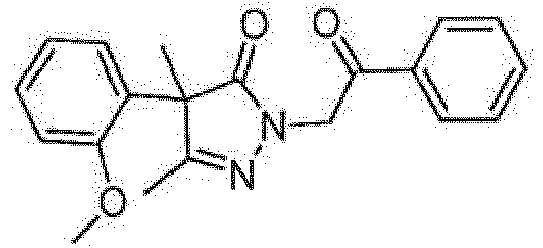
- Prepared in a similar manner as described in Example 1.1 starting from 4-(2-methoxyphenyl)-3,4-dimethyl-1H-pyrazol-5(4H)-one (Compound 4, Example 1.32a) (394 mg, 1.8 mmol) and 2-bromoacetophenone (1.1 eq; 1.98 mmol; 394 mg) to obtain the desired 4-(2-methoxyphenyl)-3,4-dimethyl-1-(2-oxo-2-phenylethyl)-1H-pyrazol-5(4H)-one (490 mg, 81%) as a white solid.
- 1H NMR (400 MHz, DMSO-d 6) δ 8.01 (d, J = 8.0 Hz, 2H), 7.68 (t, J = 8.0 Hz, 1H), 7.53 (t, J = 8.0 Hz, 2H), 7.30 (d, J = 8.0 Hz, 1H), 7.14 (t, J = 8.0 Hz, 1H), 6.84 (t, J = 8.0 Hz, 1H), 6.73 (d, J = 8.0 Hz, 1H), 5.28 (d, J = 18.0 Hz, 1H), 5.23 (d, J = 18.0 Hz, 1H), 3.75 (s, 3H), 1.80 (s, 3H), 1.55 (s, 3H). MS 337 (MH+).
-

- Prepared in a similar manner as described in Example 1.1a starting from ethyl 2-(2-methoxyphenyl)-2-methyl-3-oxobutanoate (Example 1.32b) (600 mg, 2.4 mmol) and hydrazine monohydrate (4 eq; 9.6 mmol; 467 uL) to obtain the desired 4-(2-methoxyphenyl)-3,4-dimethyl-1H-pyrazol-5(4H)-one (394 mg, 75%) as a white solid.
- 1H NMR (400 MHz, DMSO-d 6) δ 10.89 (s, 1NH), 7.34 (d, J = 8.0 Hz, 1H), 7.30 (t, J = 8.0 Hz, 1H), 6.99 (t, J = 8.0 Hz, 1H), 6.95 (d, J = 8.0 Hz, 1H), 3.60 (s, 3H), 1.58 (s, 3H), 1.42 (s, 3H). MS 219 (MH+).
-

- To a suspension of NaH (60%; 1.3 eq; 4.05 mmol; 162 mg) in 25 mL of anhydrous DMF at 0°C under nitrogen atmosphere was slowly added dropwise ethyl 2-methyl-3-oxobutanoate (1 eq; 3.11 mmol; 444 uL). The reaction mixture was stirred at 0°C for 30 min, and a solution of bis(2-methoxyphenyl)iodonium tetrafluoroborate salt (Example 1.32c) (1.3 eq.; 4.05 mmol; 1.73 g) in 5 mL of anhydrous DMF was added dropwise, and the reaction mixture was stirred at room temperature for 18 h. The reaction was quenched with water (25 ml) and extracted with Et2O (3 x 20ml). The organic layers were combined, washed with brine (40 ml), dried over MgSO4, and concentrated under vacuum. The resulting residue was purified by flash column chromatography (Hexane/EtOAc 5%; Rf = 0.3) to yield 603 mg (77.5%) of ethyl 2-(2-methoxyphenyl)-2-methyl-3-oxobutanoate as a yellowish oil.
- 1H NMR (400 MHz, DMSO-d 6) δ 7.30 (t, J = 8.0 Hz, 1H), 7.04 (d, J = 8.0 Hz, 2H), 6.94 (t, J = 8.0 Hz, 1H), 4.14 (q, J = 8.0 Hz, 2H), 3.71 (s, 3H), 2.08 (s, 3H), 1.52 (s, 3H), 1.15 (t, J = 8.0 Hz, 3H). MS 251 (MH+).
-
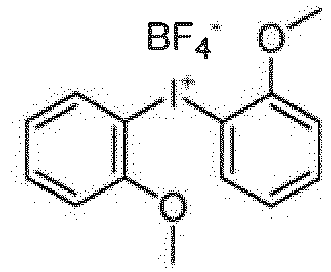
- To a solution of m-chloroperbenzoic acid (77% active oxidant; 1.11 eq.; 13.2 mmol; 2.27 g) in 40 mL of anhydrous 1,2-dichloroethane at room temperature under N2 atmosphere was added a solution of 1-iodo-2-methoxybenzene (12 mmol; 1.56 mL) in 5 mL of anhydrous 1,2-dichloroethane. The reaction mixture was placed in an 80°C pre-heated oil bath. After 1 hour, the mixture was cooled to -78°C, and a 0°C mixture of BF3·OEt2 (2.5 eq.; 30 mmol; 3.77 mL) and 2-methoxyphenylboronic acid (1.11 eq.; 13.2 mmol; 2 g) dissolved in 10 mL of anhydrous DCM was added dropwise via syringe. The resulting dark solution was stirred at -78°C for 1 hour, then slowly warmed up to room temperature and stirred for 18 h. The crude reaction mixture was loaded on a silica plug (50 g) and eluted with DCM (200 mL) to remove unreacted ArI and m-CPBA, followed by DCM/MeOH (300 mL, 20:1) to elute the product, leaving any boronic acid derivatives on the column. The latter solution was concentrated in vacuum and diethyl ether (10 mL) was added to the residue to induce a precipitation of salt, with any iodine (III) intermediates and BF3 derivatives remaining in solution. The solid was filtered off, washed with diethyl ether (2x 10 mL) and then dried in vacuum to give pure bis(2-methoxyphenyl)iodonium tetrafluoroborate salt as a grey powder (1.73 g, 34% yield).
- 1H NMR (400 MHz, DMSO-d 6) δ 8.13 (d, J = 8.0 Hz, 2H), 7.59 (t, J = 8.0 Hz, 2H), 7.25 (d, J = 8.0 Hz, 2H), 7.02 (t, J = 8.0 Hz, 2H), 3.89 (s, 6H).
-

- To a solution of 4-(2-methoxyphenyl)-3,4-dimethyl-1-(2-oxo-2-phenylethyl)-1H-pyrazol-5(4H)-one (Example 1.32) (490 mg; 1.46 mmol) in 6 mL of anhydrous DMF, was added sodium ethanethiolate (5 eq; 7.3 mmol; 613 mg). The reaction mixture was heated under microwave irradiation at 180°C for 20 min, diluted with 1N HCl (15 ml) and extracted with EtOAc (3 X 10ml). The organic layers were combined, washed with brine (10 ml), and dried over MgSO4. Solvents were evaporated, and the resulting residue was purified twice on preparative HPLC using a 25 minutes 5-95% CH3CN/H2O gradient, to give after evaporation of solvents and lyophilization 4-(2-hydroxyphenyl)-3,4-dimethyl-1-(2-oxo-2-phenylethyl)-1H-pyrazol-5(4H)-one as a white solid (81.7 mg; 19%).
- 1H NMR (400 MHz, DMSO-d 6) δ 9.66 (bs, 1OH), 8.01 (d, J = 8.0 Hz, 2H), 7.68 (t, J = 8.0 Hz, 1H), 7.55 (t, J = 8.0 Hz, 2H), 7.30 (d, J = 8.0 Hz, 1H), 7.14 (t, J = 8.0 Hz, 1H), 6.84 (t, J = 8.0 Hz, 1H), 6.73 (d, J = 8.0 Hz, 1H), 5.26 (d, J = 18.0 Hz, 1H), 5.05 (d, J = 18.0 Hz, 1H), 1.67 (s, 3H), 1.54 (s, 3H). MS 323 (MH+).
-

- Prepared in a similar manner as described in Example 1.1 starting from 4-(4-methoxyphenyl)-3,4-dimethyl-1H-pyrazol-5(4H)-one (Example 1.32a) (55 mg, 0.25 mmol) and 2-bromoacetophenone (1.1 eq; 0.275 mmol; 55 mg) to obtain the desired 4-(4-methoxyphenyl)-3,4-dimethyl-1-(2-oxo-2-phenylethyl)-1H-pyrazol-5(4H)-one (30.2 mg, 36%) as a white solid.
- 1H NMR (400 MHz, DMSO-d 6) δ 8.02 (d, J = 8.0 Hz, 2H), 7.69 (t, J = 8.0 Hz, 1H), 7.56 (t, J = 8.0 Hz, 2H), 7.19 (d, J = 8.0 Hz, 2H), 6.95 (d, J = 8.0 Hz, 2H), 5.28 (d, J = 18.0 Hz, 1H), 5.23 (d, J = 18.0 Hz, 1H), 3.74 (s, 3H), 1.81 (s, 3H), 1.55 (s, 3H). MS 337 (MH+).
-

- Prepared in a similar manner as described in Example 1.1a starting from ethyl 2-(4-methoxyphenyl)-2-methyl-3-oxobutanoate (Example 1.32b) (460 mg, 1.84 mmol) and hydrazine monohydrate (2 eq; 3.68 mmol; 120 uL) to obtain the desired 4-(4-methoxyphenyl)-3,4-dimethyl-1H-pyrazol-5(4H)-one (300 mg, 75%) as a white solid.
- 1H NMR (400 MHz, DMSO-d 6) δ 11.06 (s, 1NH), 7.02 (d, J = 8.0 Hz, 2H), 6.92 (d, J = 8.0 Hz, 2H), 3.72 (s, 3H), 1.77 (s, 3H), 1.44 (s, 3H). MS 219 (MH+).
-

- Prepared in a similar manner as described in Example 1.32b starting from ethyl 2-methyl-3-oxobutanoate (425 uL, 2.98 mmol) and bis(2-methoxyphenyl)iodonium tetrafluoroborate salt (Example 1.34c) (1.3 eq; 3.05 mmol; 1.25 g) to obtain the desired ethyl 2-(4-methoxyphenyl)-2-methyl-3-oxobutanoate (465 mg, 62%) as a colorless oily liquid.
- 1H NMR (400 MHz, DMSO-d 6) δ 7.17 (d, J = 8.0 Hz, 2H), 6.91 (d, J = 8.0 Hz, 2H), 4.15 (q, J = 8.0 Hz, 2H), 3.73 (s, 3H), 2.03 (s, 3H), 1.64 (s, 3H), 1.16 (t, J = 8.0 Hz, 3H). MS 251 (MH+).
-

- Prepared in a similar manner as described in Example 1.32c starting from 4-methoxyiodobenzene (1.4 mL, 6 mmol) and (4-methoxyphenyl)boronic acid (1.1 eq, 6.6 mmol, 1g) to obtain the desired bis(2-methoxyphenyl)iodonium tetrafluoroborate salt (1.25 g, 49%) as a grey powder.
- 1H NMR (400 MHz, DMSO-d 6) δ 8.10 (d, J = 8.0 Hz, 4H), 7.04 (d, J = 8.0 Hz, 4H), 3.76 (s, 6H).
-

- Prepared in a similar manner as described in Example 1.1 starting from 3,4-dimethyl-4-phenyl-1H-pyrazol-5(4H)-one (Example 1.35a) (94 mg, 0.5 mmol) and 2-bromoacetophenone (1.1 eq; 0.55 mmol; 109 mg) to obtain the desired 3,4-dimethyl-1-(2-oxo-2-phenylethyl)-4-phenyl-1H-pyrazol-5(4H)-one (87 mg, 57%) as a white solid.
- 1H NMR (400 MHz, DMSO-d 6) δ 8.02 (d, J = 8.0 Hz, 2H), 7.69 (t, J = 8.0 Hz, 1H), 7.56 (t, J = 8.0 Hz, 2H), 7.41 (t, J = 8.0 Hz, 2H), 7.33 (t, J = 8.0 Hz, 1H), 7.28 (d, J = 8.0 Hz, 2H), 5.30 (d, J = 18.0 Hz, 1H), 5.24 (d, J = 18.0 Hz, 1H), 1.82 (s, 3H), 1.59 (s, 3H). MS 307 (MH-).
-

- Prepared in a similar manner as described in Example 1.1a starting from ethyl 2-methyl-3-oxo-2-phenylbutanoate (Example 1.35b) (1.9 g, 8.6 mmol) and hydrazine monohydrate (2 eq; 17.27 mmol; 558 uL) to obtain the desired 3,4-dimethyl-4-phenyl-1H-pyrazol-5(4H)-one (917 mg, 57%) as a white solid.
- 1H NMR (400 MHz, DMSO-d 6) δ 11.13 (s, 1NH), 7.37 (t, J = 8.0 Hz, 2H), 7.30 (t, J = 8.0 Hz, 1H), 7.11 (d, J = 8.0 Hz, 2H), 1.78 (s, 3H), 1.48 (s, 3H). MS 189 (MH+).
-

- Prepared in a similar manner as described in Example 1.32b starting from ethyl 3-oxo-2-phenylbutanoate (1.9 mL, 10 mmol) and methyl iodide (3 eq; 30 mmol; 1.87 mL) to obtain the desired 2-methyl-3-oxo-2-phenylbutanoate (1.9 g, 86%) as a colorless oily liquid.
- 1H NMR (400 MHz, DMSO-d 6) δ 7.36 (t, J = 8.0 Hz, 2H), 7.31 (d, J = 8.0 Hz, 1H), 7.25 (d, J = 8.0 Hz, 2H), 4.17 (q, J = 8.0 Hz, 2H), 2.05 (s, 3H), 1.67 (s, 3H), 1.17 (t, J = 8.0 Hz, 3H). MS 221 (MH+).
-

- Prepared by chiral separation of example 23 using standard chiral HPLC.
- 1H NMR (400 MHz, DMSO-d 6) δ 7.98 (d, J = 8.0 Hz, 2H), 7.67 (t, J = 8.0 Hz, 1H), 7.53 (t, J = 8.0 Hz, 2H), 5.16 (d, J = 18.0 Hz, 1H), 5.09 (d, J = 18.0 Hz, 1H), 2.38 (bs, 1H), 2.09 (bs, 1H), 1.91 (s, 3H), 1.62 (t, J = 8.0 Hz, 1H), 1.43-1.45 (m, 2H), 1.21-1.32 (m, 2H), 1.21 (s, 3H), 1.09-1.12 (m, 2H), 0.89-1.02 (m, 2H). MS 325 (MH+).
-
- i Abraham R. J., et al. 1H chemical shifts in NMR: Part 23, the effect of dimethyl sulphoxide versus chloroform solvent on 1H chemical shifts. // Magn. Reson. Chem (2006), 44, p. 491-509.
- ii Abraham R. J., et al. 1H chemical shifts in NMR: Part 23, the effect of dimethyl sulphoxide versus chloroform solvent on 1H chemical shifts. // Magn. Reson. Chem (2006), 44, p. 491-509.
- iii Abraham R. J., et al. 1H chemical shifts in NMR: Part 23, the effect of dimethyl sulphoxide versus chloroform solvent on 1H chemical shifts. // Magn. Reson. Chem (2006), 44, p. 491-509.
- iv Abraham R. J., et al. 1H chemical shifts in NMR: Part 23, the effect of dimethyl sulphoxide versus chloroform solvent on 1H chemical shifts. // Magn. Reson. Chem (2006), 44, p. 491-509.
- v Abraham R. J., et al. 1H chemical shifts in NMR: Part 23, the effect of dimethyl sulphoxide versus chloroform solvent on 1H chemical shifts. // Magn. Reson. Chem (2006), 44, p. 491-509.
- In the case of any conflict between a cited reference and this specification, the specification shall control. In describing embodiments of the present application, specific terminology is employed for the sake of clarity. However, the invention is not intended to be limited to the specific terminology so selected. Nothing in this specification should be considered as limiting the scope of the present invention. All examples presented are representative and non-limiting. The above-described embodiments may be modified or varied, without departing from the invention, as appreciated by those skilled in the art in light of the above teachings.
Claims (11)
- A five-membered heterocyclic compound having structural Formula (Ia):

whereinR1 is optionally substituted aryl, optionally substituted carbocyclyl, optionally substituted heteroaryl, or optionally substituted heterocyclyl;R2 and R3 are independently selected from the group consisting of optionally substituted alkyl, optionally substituted alkenyl, optionally substituted aryl, optionally substituted carbocyclyl, optionally substituted heteroaryl, and optionally substituted heterocyclyl; andR4 is optionally substituted alkyl, optionally substituted alkenyl, optionally substituted aryl, optionally substituted carbocyclyl, optionally substituted heteroaryl, or optionally substituted heterocyclyl;whereina) when the substitution is on a saturated carbon, the substituent on the saturated carbon is selected from the group consisting of -Ra , halo, =O, -ORb , -SRb , =S, -NRcRc , =NRb , =N-ORb , trihalomethyl, -CF3, -CN, -OCN, -SCN, -NO, -NO2, =N2, -N3, -S(O)2 Rb , -S(O)2ORb , -OS(O)2 Rb , -OS(O)2ORb , -P(O)(ORb )(ORb ), -C(O)Rb , -C(S)Rb , -C(NRb )Rb , -C(O)ORb , -C(S)ORb , -C(O)NRcRc , -C(NRb )NRcRc , -OC(O)Rb , -OC(S)Rb , -OC(O)ORb , -OC(S)ORb , -NRb C(O)Rb , -NRb C(S)Rb , -NRb C(O)ORb , -NRb C(S)ORb , -NRb C(O)NRcRc , -NRb C(NRb )Rb and -NRb C(NRb )NRcRc ,b) when the substitution is on an unsaturated carbon, the substituent on the unsaturated carbon is selected from the group consisting of -Ra , halo, -ORb , -SRb , -NRcRc , trihalomethyl, -CF3, -CN, -OCN, -SCN, -NO, -NO2, -N3, -S(O)2 Rb , -S(O)2ORb , -OS(O)2 Rb , -OS(O)2ORb , -P(O)(ORb )(ORb ), -C(O)Rb , -C(S)Rb , -C(NRb )Rb , -C(O)ORb , -C(S)ORb , -C(O)NRcRc , -C(NRb )NRcRc , -OC(O)Rb , -OC(S)Rb , -OC(O)ORb , -OC(S)ORb , -NRb C(O)Rb , -NRb C(S)Rb , -NRb C(O)ORb , -NRb C(S)ORb , -NRb C(O)NRcRc , -NRb C(NRb )Rb and -NRb C(NRb )NRcRc ,c) when the substitution is on a nitrogen atom in a cycloheteroalkyl group, the substituent on the nitrogen atom is selected from the group consisting of -Ra , -ORb , -SRb , -NRcRc , trihalomethyl, -CF3, -CN, -NO, -NO2, -S(O)2 Rb , -S(O)2ORb , -OS(O)2 Rb , -OS(O)2ORb , -P(O)(ORb )(ORb ), -C(O)Rb , -C(S)Rb , -C(NRb )Rb , -C(O)ORb , -C(S)ORb , -C(O)NRcRc , -C(NRb )NRcRc , -OC(O)Rb , -OC(S)Rb , -OC(O)ORb , -OC(S)ORb , -NRb C(O)Rb , -NRb C(S)Rb , -NRb C(O)ORb , -NRb C(S)ORb , -NRb C(O)NRcRc , -NRb C(NRb )Rb and -NRb C(NRb )NRcRc ,wherein, in the cases a) to c) above, Ra is selected from the group consisting of alkyl, cycloalkyl, cycloheteroalkyl, aryl, arylalkyl, heteroaryl and heteroarylalkyl; each Rb is independently hydrogen or Ra ; and each Rc is independently Rb or alternatively, the two Rc s may be taken together with the nitrogen atom to which they are bonded to form a 4-, 5-, 6- or 7-membered cycloheteroalkyl which may optionally include from 1 to 4 of the same or different additional heteroatoms selected from the group consisting of O (oxygen), N (nitrogen) and S (sulfur). - The compound of claim 1, wherein R1 is optionally substituted aryl, preferably the optionally substituted aryl is optionally substituted phenyl or optionally substituted heteroaryl, preferably the optionally substituted heteroaryl is selected from the group consisting of pyrrolyl, thienyl, pyridyl, pyrimidyl, furanyl, and pyrazolyl, each of which is optionally substituted.
- The compound of claim 1 or 2, wherein R2 is optionally substituted aryl, optionally substituted carbocyclyl, preferably the optionally substituted carbocyclyl is an optionally substituted 5- or 6-membered monocyclic carbocyclyl, or an optionally substituted 9- to 12-membered bicyclic carbocyclyl, optionally substituted heteroaryl, and optionally substituted heterocyclyl.
- The compound of any one of claims 1 to 3, wherein R3 is optionally substituted alkyl or optionally substituted alkenyl, preferably R3 is optionally substituted C1-C4 alkyl.
- The compound of claim 1 or 2;R2 is optionally substituted carbocyclyl; andR3 is optionally substituted alkyl.
- The compound of any one of claims 1 to 5, wherein R4 is optionally substituted alkyl, preferably R4 is optionally substituted C1-C4 alkyl.
- The compound of claim 1, which is selected from the group consisting of


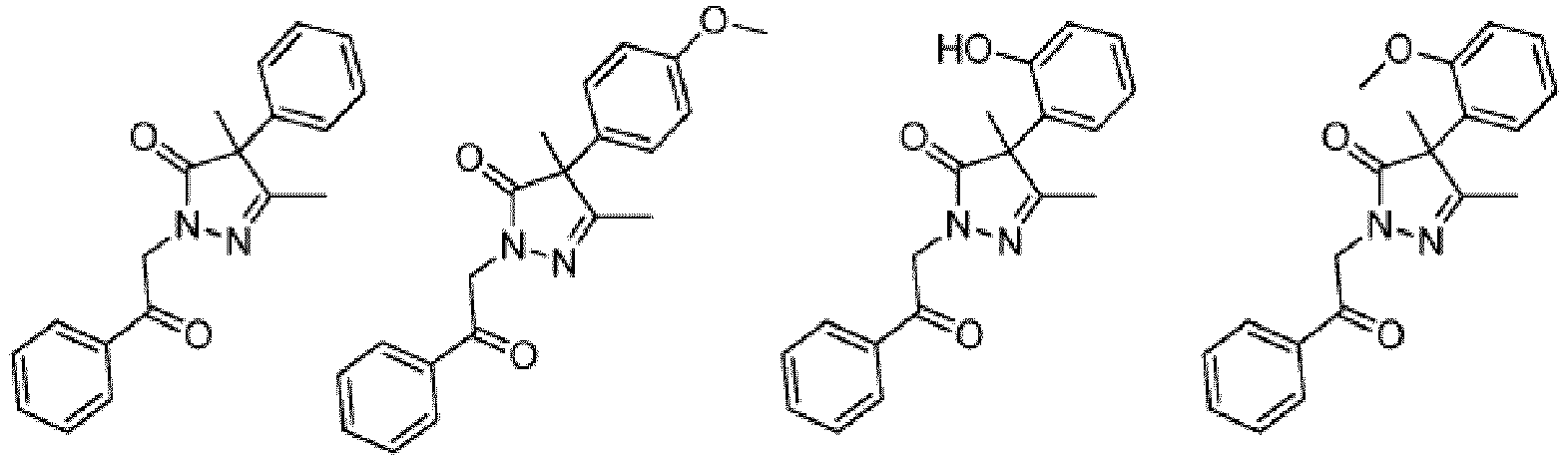


- A personal product comprising a compound of any one of claims 1 to 7, or a salt or solvate thereof, and at least one carrier.
- The personal product of claim 8, wherein the composition isa) an ingestible composition or personal care composition, preferably the ingestible composition is a food or beverage, orb) the composition is in form of a solid, semisolid, plaster, solution, suspension, lotion, cream, foam, gel, paste, emulsion, or a combination thereof, orc) the compound of any one of claims 1 to 8 in the composition is in a concentration ranging from about 0.0001 ppm to 100,000 ppm, preferably the compound of any one of claims 1 to 55 in the composition is in a concentration ranging from about 1 ppm to 500 ppm.
- The compound of any one of claims 1 to 7 or a salt or solvate thereof for use in a method of modulating transient receptor potential channel melastatin member 8 (TRPM8), preferably the compound is a TRPM8 receptor agonist.
- The compound of any one of claims 1 to 7 or a salt or solvate thereof for use in a) a method of modulating the cooling sensation of a composition, or b) a method of inducing a cooling sensation in a human or animal.
Priority Applications (1)
| Application Number | Priority Date | Filing Date | Title |
|---|---|---|---|
| EP18205180.5A EP3461816B1 (en) | 2013-02-19 | 2014-02-19 | Five-membered heterocylic compounds useful as modulators of trpm8 |
Applications Claiming Priority (4)
| Application Number | Priority Date | Filing Date | Title |
|---|---|---|---|
| US201361766458P | 2013-02-19 | 2013-02-19 | |
| US201361829530P | 2013-05-31 | 2013-05-31 | |
| US201361829367P | 2013-05-31 | 2013-05-31 | |
| PCT/US2014/017212 WO2014130582A2 (en) | 2013-02-19 | 2014-02-19 | Compounds useful as modulators of trpm8 |
Related Child Applications (2)
| Application Number | Title | Priority Date | Filing Date |
|---|---|---|---|
| EP18205180.5A Division EP3461816B1 (en) | 2013-02-19 | 2014-02-19 | Five-membered heterocylic compounds useful as modulators of trpm8 |
| EP18205180.5A Division-Into EP3461816B1 (en) | 2013-02-19 | 2014-02-19 | Five-membered heterocylic compounds useful as modulators of trpm8 |
Publications (3)
| Publication Number | Publication Date |
|---|---|
| EP2958897A2 EP2958897A2 (en) | 2015-12-30 |
| EP2958897A4 EP2958897A4 (en) | 2016-10-19 |
| EP2958897B1 true EP2958897B1 (en) | 2019-01-09 |
Family
ID=51391962
Family Applications (2)
| Application Number | Title | Priority Date | Filing Date |
|---|---|---|---|
| EP18205180.5A Active EP3461816B1 (en) | 2013-02-19 | 2014-02-19 | Five-membered heterocylic compounds useful as modulators of trpm8 |
| EP14754162.7A Active EP2958897B1 (en) | 2013-02-19 | 2014-02-19 | Compounds useful as modulators of trpm8 |
Family Applications Before (1)
| Application Number | Title | Priority Date | Filing Date |
|---|---|---|---|
| EP18205180.5A Active EP3461816B1 (en) | 2013-02-19 | 2014-02-19 | Five-membered heterocylic compounds useful as modulators of trpm8 |
Country Status (4)
| Country | Link |
|---|---|
| US (3) | US9840471B2 (en) |
| EP (2) | EP3461816B1 (en) |
| ES (1) | ES2717941T3 (en) |
| WO (1) | WO2014130582A2 (en) |
Families Citing this family (108)
| Publication number | Priority date | Publication date | Assignee | Title |
|---|---|---|---|---|
| PH12013500907A1 (en) | 2010-11-05 | 2013-07-08 | Firmenich Incorporated | Compounds useful as modulators of trpm8 |
| ES2717941T3 (en) | 2013-02-19 | 2019-06-26 | Senomyx Inc | Compounds useful as modulators of TRPM8 |
| WO2015136947A1 (en) | 2014-03-14 | 2015-09-17 | Raqualia Pharma Inc. | Azaspiro derivatives as trpm8 antagonists |
| CN104402820A (en) * | 2014-12-02 | 2015-03-11 | 千辉药业(安徽)有限责任公司 | Synthesis method of 1-ethyl-2-methylimidazoline |
| US10119038B2 (en) * | 2015-05-08 | 2018-11-06 | PatinaNow, LLC | Patina solution, method for producing patina on object, and patina kit |
| EP3356356B1 (en) * | 2015-10-01 | 2021-05-26 | Firmenich Incorporated | Compounds useful as modulators of trpm8 |
| CA3003163A1 (en) | 2015-10-29 | 2017-05-04 | Senomyx, Inc. | High intensity sweeteners |
| CN105315216B (en) * | 2015-11-19 | 2018-07-13 | 中国农业大学 | Barbiturates-cyclohexene spiro-compound and preparation method thereof |
| ES2625393A1 (en) * | 2016-01-19 | 2017-07-19 | Universidad Miguel Hernandez De Elche | AGONIST COMPOUNDS OF THE TRPM8 RECEIVER AND ITS APPLICATIONS |
| BR112019023104A2 (en) | 2017-05-03 | 2020-11-03 | Firmenich Incorporated | methods for making high intensity sweetener |
| US20200188289A1 (en) | 2017-05-15 | 2020-06-18 | Firmenich Sa | Compositions comprising essential oils |
| JOP20180092A1 (en) | 2017-10-13 | 2019-04-13 | Gilead Sciences Inc | Hiv protease inhibitors |
| MD3762368T2 (en) | 2018-03-08 | 2022-07-31 | Incyte Corp | Aminopyrazine diol compounds as pi3k-y inhibitors |
| US11046658B2 (en) | 2018-07-02 | 2021-06-29 | Incyte Corporation | Aminopyrazine derivatives as PI3K-γ inhibitors |
| EP4566459A3 (en) | 2018-08-10 | 2025-08-20 | Firmenich Incorporated | Antagonists of t2r54 and compositions and uses thereof |
| MX2021005219A (en) | 2018-11-07 | 2021-06-18 | Firmenich Incorporated | Methods for making high intensity sweeteners. |
| US12338476B2 (en) | 2018-11-07 | 2025-06-24 | Firmenich Incorporated | Methods for making high intensity sweeteners |
| BR112021008782A2 (en) | 2019-03-28 | 2021-11-03 | Firmenich S/A | Flavor system |
| CN113661171B (en) | 2019-04-04 | 2024-04-12 | 弗门尼舍有限公司 | Mogroside compound and application thereof |
| TW202104210A (en) | 2019-04-17 | 2021-02-01 | 美商基利科學股份有限公司 | Hiv protease inhibitors |
| CN113423287A (en) | 2019-06-28 | 2021-09-21 | 弗门尼舍有限公司 | Fat mixtures, emulsions thereof and related uses |
| EP4025071A1 (en) | 2019-09-05 | 2022-07-13 | Firmenich SA | Flavanone derivatives and their use as sweetness enhancers |
| WO2021094268A1 (en) | 2019-11-11 | 2021-05-20 | Firmenich Sa | Gingerol compounds and their use as flavor modifiers |
| BR112022009553A2 (en) | 2019-12-13 | 2022-08-02 | Firmenich Incorporated | FLAVOR MODIFYING COMPOSITIONS AND USES THEREOF |
| US20230028760A1 (en) | 2019-12-13 | 2023-01-26 | Firmenich Incorporated | Taste modifying compositions and uses thereof |
| WO2021126569A1 (en) | 2019-12-18 | 2021-06-24 | Firmenich Incorporated | Taste modifying compositions and uses thereof |
| KR20220114529A (en) | 2019-12-18 | 2022-08-17 | 피르메니히 인코포레이티드 | Taste modifying compositions and uses thereof |
| CN114127084B (en) | 2020-03-05 | 2024-08-06 | 弗门尼舍有限公司 | 11-Oxo-cucurbitane and its use as flavor improver |
| WO2021198199A1 (en) | 2020-03-31 | 2021-10-07 | Firmenich Sa | Flavor composition |
| EP4055006A1 (en) | 2020-04-17 | 2022-09-14 | Firmenich SA | Amino acid derivatives and their use as flavor modifiers |
| CN115279414A (en) | 2020-05-22 | 2022-11-01 | 弗门尼舍有限公司 | Composition for reducing salty taste and use thereof |
| BR112022016411A2 (en) | 2020-06-03 | 2022-10-11 | Firmenich & Cie | COMPOSITIONS TO REDUCE UNPLEASANT TASTES AND USES THEREOF |
| EP4171266A1 (en) | 2020-06-24 | 2023-05-03 | Firmenich SA | Sweetening compositions and uses thereof |
| WO2022013163A1 (en) | 2020-07-14 | 2022-01-20 | Firmenich Sa | Reduction of undesirable taste notes in oral care products |
| US20230276835A1 (en) | 2020-07-24 | 2023-09-07 | Firmenich Incorporated | Savory taste enhancement via transmembrane region binding |
| EP4125428A1 (en) | 2020-09-22 | 2023-02-08 | Firmenich SA | Wintergreen flavor compositions free of methyl salicylate |
| EP4228433A1 (en) | 2020-10-13 | 2023-08-23 | Firmenich SA | Malonyl steviol glycosides and their comestible use |
| EP4161292A1 (en) | 2020-10-27 | 2023-04-12 | Firmenich SA | Conjugated diynes and their use as flavor modifiers |
| WO2022115837A1 (en) | 2020-11-24 | 2022-06-02 | Firmenich Incorporated | Kokumi taste enhancement and related screening methods |
| WO2022112432A1 (en) | 2020-11-29 | 2022-06-02 | Firmenich Sa | Compositions that reduce peroxide off taste and uses thereof |
| US20230397627A1 (en) | 2020-12-23 | 2023-12-14 | Firmenich Sa | Uses of fat blends and emulsions thereof |
| EP4251122B1 (en) | 2021-01-13 | 2025-03-12 | Firmenich Incorporated | Compositions that enhance the cooling effect |
| US20240065302A1 (en) | 2021-01-15 | 2024-02-29 | Firmenich Incorporated | Sweetener compositions comprising mogrosides and uses thereof |
| US20240188613A1 (en) | 2021-01-15 | 2024-06-13 | Firmenich Incorporated | Sweetener compositions comprising mogrosides and uses thereof |
| EP4258895A1 (en) | 2021-01-15 | 2023-10-18 | Firmenich Incorporated | Sweetener compostions comprising siamenoside i and uses thereof |
| US20240074479A1 (en) | 2021-02-10 | 2024-03-07 | Firmenich Sa | Fiber blends, sweetened fiber blends, and their comestible use |
| EP4258899A1 (en) | 2021-03-09 | 2023-10-18 | Firmenich SA | Hydroxy- and methoxy-substituted flavones and their use |
| EP4258900A1 (en) | 2021-03-09 | 2023-10-18 | Firmenich SA | Hydroxy- and methoxy-substituted flavonoids and their use |
| WO2022214275A1 (en) | 2021-04-06 | 2022-10-13 | Firmenich Sa | Use of gingerdiol compounds to enhance flavor |
| WO2022231918A1 (en) | 2021-04-26 | 2022-11-03 | Firmenich Incorporated | Amide compounds and their use as flavor modifiers |
| WO2022231908A1 (en) | 2021-04-26 | 2022-11-03 | Firmenich Incorporated | Amide compounds and their use as flavor modifiers |
| EP4307919A2 (en) | 2021-05-11 | 2024-01-24 | Firmenich SA | Process of making gingerol compounds and their use as flavor modifiers |
| WO2022248405A1 (en) | 2021-05-24 | 2022-12-01 | Firmenich Sa | Flavored fiber blends and their comestible use |
| JP2024522284A (en) | 2021-05-28 | 2024-06-13 | フィルメニッヒ インコーポレイテッド | Composition for enhancing cooling effect |
| BR112023022013A2 (en) | 2021-06-02 | 2023-12-26 | Firmenich & Cie | DEACETYLATION PROCESS, COMPOSITIONS AND USES THEREOF |
| WO2022268875A1 (en) | 2021-06-23 | 2022-12-29 | Firmenich Sa | Flavor-modifying compositions containing lactase |
| BR112023026922A2 (en) | 2021-06-28 | 2024-03-05 | Firmenich Incorporated | POLYCATIONIC SALTS OF PHENOLIC COMPOUNDS AND USES THEREOF |
| US20240225066A1 (en) | 2021-06-29 | 2024-07-11 | Firmenich Incorporated | Mogroside compounds and their comestible use |
| US20240237690A1 (en) | 2021-06-29 | 2024-07-18 | Firmenich Sa | Licorice Compounds and Their Use as Flavor Modifiers |
| WO2023046914A1 (en) | 2021-09-27 | 2023-03-30 | Firmenich Sa | Flavor compositions containing iron compounds and their use |
| US20250075155A1 (en) | 2021-09-27 | 2025-03-06 | Firmenich Incorporated | Use of Vanillyl Ethers to Modify Flavor of Distilled Spirits |
| WO2023072604A1 (en) | 2021-11-01 | 2023-05-04 | Firmenich Sa | Composition comprising a nutrient and a taste modulator |
| EP4404767A2 (en) | 2021-11-16 | 2024-07-31 | Firmenich Incorporated | Amide compounds and their use as flavor modifiers |
| US20250040583A1 (en) | 2021-12-20 | 2025-02-06 | Firmenich Sa | Encapsulated metal compounds and comestible uses thereof |
| WO2023117643A1 (en) | 2021-12-23 | 2023-06-29 | Firmenich Sa | Antimicrobial composition having encapsulated colorant |
| EP4456737A1 (en) | 2022-03-11 | 2024-11-06 | Firmenich Incorporated | Amide compounds and their use as flavor modifiers |
| JP2025509073A (en) | 2022-03-11 | 2025-04-11 | フィルメニッヒ インコーポレイテッド | Flavanone compounds and their use as flavour modifiers - Patents.com |
| EP4472442A1 (en) | 2022-03-25 | 2024-12-11 | Firmenich SA | Fatty acid amides and their use as flavor modifiers |
| CN119212569A (en) | 2022-03-28 | 2024-12-27 | 弗门尼舍有限公司 | Non-animal protein compositions and uses thereof |
| US20250204564A1 (en) | 2022-04-06 | 2025-06-26 | Firmenich Incorporated | Taste modifying compositions and uses thereof |
| EP4492988A1 (en) | 2022-05-16 | 2025-01-22 | Firmenich Incorporated | Saturated fatty acids and their use to modify taste |
| WO2023224812A1 (en) | 2022-05-16 | 2023-11-23 | Firmenich Incorporated | Unsaturated fatty acids and their use to modify taste |
| WO2023232968A1 (en) | 2022-06-03 | 2023-12-07 | Firmenich Sa | Fat reduction in non-animal protein compositions |
| CN119325346A (en) | 2022-06-14 | 2025-01-17 | 弗门尼舍有限公司 | Polyelectrolyte complexes of proteins and uses thereof |
| EP4507522A1 (en) | 2022-06-24 | 2025-02-19 | Firmenich SA | Taste modifying compositions and uses thereof |
| CN119604269A (en) | 2022-07-07 | 2025-03-11 | 弗门尼舍公司 | Composition for enhancing cooling effect |
| WO2024041974A1 (en) | 2022-08-22 | 2024-02-29 | Firmenich Sa | Gel compositions and their use in seafood analogue products |
| EP4547034A1 (en) | 2022-10-26 | 2025-05-07 | Firmenich SA | Extrusion methods and flavored products formed thereby |
| EP4577059A1 (en) | 2022-10-26 | 2025-07-02 | Firmenich Incorporated | Taste modifying compositions and uses thereof |
| EP4583718A1 (en) | 2022-10-27 | 2025-07-16 | Firmenich SA | Flavonoid compositions and uses thereof |
| EP4580420A1 (en) | 2022-11-01 | 2025-07-09 | Firmenich SA | Low-calorie composition for flavor modification |
| EP4608171A1 (en) | 2022-12-22 | 2025-09-03 | Firmenich SA | Natural sweetener compositions containing alkyl lactates and uses thereof |
| WO2024132554A1 (en) | 2022-12-22 | 2024-06-27 | Firmenich Sa | Natural sweetener compositions and uses thereof |
| EP4601483A1 (en) | 2022-12-23 | 2025-08-20 | Firmenich Incorporated | Beta-cyclodextrin and its use to modify flavor |
| CN120513026A (en) | 2023-01-09 | 2025-08-19 | 弗门尼舍有限公司 | Use of plant fibers for improving flavor of fermented products |
| EP4665157A1 (en) | 2023-02-15 | 2025-12-24 | Firmenich SA | Thermoresponsive gel composition and uses thereof |
| EP4630413A1 (en) | 2023-02-25 | 2025-10-15 | Firmenich Incorporated | Flavanone compounds and their use as flavor modifiers |
| WO2024196906A1 (en) | 2023-03-23 | 2024-09-26 | Firmenich Incorporated | Use of vanillyl ethers to modify flavor |
| JP2026509602A (en) | 2023-03-24 | 2026-03-19 | フイルメニツヒ ソシエテ アノニム | Microparticles containing algal protein and their use |
| CN121013707A (en) | 2023-03-28 | 2025-11-25 | 弗门尼舍有限公司 | Flavor Modifying Compositions and Their Uses |
| EP4687492A1 (en) | 2023-03-29 | 2026-02-11 | Firmenich Incorporated | Use of fatty acids to modify flavor |
| WO2024208837A1 (en) | 2023-04-04 | 2024-10-10 | Firmenich Sa | Polysaccharide compositions and their comestible use |
| WO2024227789A1 (en) | 2023-05-03 | 2024-11-07 | Firmenich Sa | Encapsulated phenolic compounds and their comestible use |
| WO2024251755A1 (en) | 2023-06-09 | 2024-12-12 | Dsm-Firmenich Ag | Compositions for reducing off notes and uses thereof |
| EP4480319A1 (en) | 2023-06-22 | 2024-12-25 | DSM-Firmenich AG | Granola cluster |
| WO2025067974A1 (en) | 2023-09-26 | 2025-04-03 | Firmenich Sa | Vegan cheese compositions and methods of making the same |
| CN122028804A (en) | 2023-10-04 | 2026-05-12 | 弗门尼舍有限公司 | Flavanone compounds and their use as flavor modifiers |
| WO2025125286A1 (en) | 2023-12-13 | 2025-06-19 | Firmenich Sa | Biopolymer compositions and their use in foamed compositions |
| WO2025132821A1 (en) | 2023-12-19 | 2025-06-26 | Firmenich Sa | Comestible products having high fiber and low sugar |
| WO2025132803A1 (en) | 2023-12-20 | 2025-06-26 | Firmenich Sa | 3-hydroxybenzoic acid and its use as a flavor modifier |
| WO2025132323A1 (en) | 2023-12-21 | 2025-06-26 | Dsm-Firmenich Ag | Compositions comprising a sunscreen active agent |
| WO2025191050A1 (en) | 2024-03-15 | 2025-09-18 | Firmenich Sa | Lipid particles and their comestible use |
| WO2025202256A1 (en) | 2024-03-28 | 2025-10-02 | Firmenich Sa | Cooling composition |
| WO2025221883A1 (en) | 2024-04-17 | 2025-10-23 | Firmenich Incorporated | Taste modifying compositions and uses thereof |
| WO2025230968A1 (en) | 2024-04-30 | 2025-11-06 | Firmenich Incorporated | Ketone compounds for enhancing alcohol perception |
| WO2026064099A1 (en) | 2024-09-17 | 2026-03-26 | Firmenich Incorporated | Dihydrochalcone compounds for enhancing alcohol perception |
| WO2026064098A1 (en) | 2024-09-17 | 2026-03-26 | Firmenich Incorporated | Flavonoid compounds for enhancing alcohol perception |
| WO2026087386A1 (en) | 2024-10-24 | 2026-04-30 | Firmenich Sa | Rosin diester compounds and uses thereof |
Family Cites Families (14)
| Publication number | Priority date | Publication date | Assignee | Title |
|---|---|---|---|---|
| US2552978A (en) * | 1949-04-12 | 1951-05-15 | Texas Co | Method for preparing thiophene carboxylic acids |
| US4443616A (en) * | 1979-02-15 | 1984-04-17 | The Purdue Frederick Company | Production of 3-pyrrolin-2-ones |
| US5175191A (en) * | 1988-11-14 | 1992-12-29 | Sloan-Kettering Institute For Cancer Research | Potent inducers of terminal differentiation and methods of use thereof |
| DE4233715A1 (en) * | 1992-10-07 | 1994-04-14 | Bayer Ag | Substituted carbamoyl pyrazolines |
| JPH1045588A (en) * | 1996-08-08 | 1998-02-17 | Ishihara Sangyo Kaisha Ltd | Alpha-glucosidase inhibitor containing pyrazolone-based compound or its salt |
| US6049006A (en) * | 1997-06-16 | 2000-04-11 | American Home Products Corp. | Elevation of HDL cholesterol by N-[2-[(aminothioxomethyl) hydrazono]-2-arylethyl]amides |
| US6468576B1 (en) | 2000-06-23 | 2002-10-22 | Nestec S.A. | Frozen slush liquid concentrate and method of making same |
| DE10203086A1 (en) | 2002-01-28 | 2003-07-31 | Bayer Ag | 5-ring heterocycles |
| US20070259354A1 (en) | 2005-10-11 | 2007-11-08 | Senomyx, Inc. | Optimized trpm8 nucleic acid sequences and their use in cell based assays and test kits to identify trpm8 modulators |
| DE102008045220A1 (en) * | 2008-08-30 | 2010-03-04 | Saltigo Gmbh | New N,N-dimethylimidazoline-dione compounds useful as a solvent for chemical reactions |
| WO2010107485A1 (en) * | 2009-03-17 | 2010-09-23 | The Trustees Of Columbia University In The City Of New York | E3 ligase inhibitors |
| WO2011002067A1 (en) * | 2009-07-02 | 2011-01-06 | 武田薬品工業株式会社 | Heterocyclic compound and use thereof |
| PH12013500907A1 (en) * | 2010-11-05 | 2013-07-08 | Firmenich Incorporated | Compounds useful as modulators of trpm8 |
| ES2717941T3 (en) | 2013-02-19 | 2019-06-26 | Senomyx Inc | Compounds useful as modulators of TRPM8 |
-
2014
- 2014-02-19 ES ES14754162T patent/ES2717941T3/en active Active
- 2014-02-19 US US14/768,146 patent/US9840471B2/en active Active
- 2014-02-19 EP EP18205180.5A patent/EP3461816B1/en active Active
- 2014-02-19 WO PCT/US2014/017212 patent/WO2014130582A2/en not_active Ceased
- 2014-02-19 EP EP14754162.7A patent/EP2958897B1/en active Active
-
2017
- 2017-09-06 US US15/697,301 patent/US10421727B2/en active Active
-
2019
- 2019-09-18 US US16/574,657 patent/US11028052B2/en active Active
Non-Patent Citations (1)
| Title |
|---|
| None * |
Also Published As
| Publication number | Publication date |
|---|---|
| WO2014130582A2 (en) | 2014-08-28 |
| US11028052B2 (en) | 2021-06-08 |
| EP2958897A2 (en) | 2015-12-30 |
| EP3461816B1 (en) | 2021-03-24 |
| EP2958897A4 (en) | 2016-10-19 |
| US10421727B2 (en) | 2019-09-24 |
| EP3461816A1 (en) | 2019-04-03 |
| WO2014130582A3 (en) | 2014-10-16 |
| US9840471B2 (en) | 2017-12-12 |
| US20200010425A1 (en) | 2020-01-09 |
| US20150376136A1 (en) | 2015-12-31 |
| US20170369447A1 (en) | 2017-12-28 |
| ES2717941T3 (en) | 2019-06-26 |
Similar Documents
| Publication | Publication Date | Title |
|---|---|---|
| US11028052B2 (en) | Compounds useful as modulators of TRPM8 | |
| US10953007B2 (en) | Compounds useful as modulators of TRPM8 | |
| EP2742026B1 (en) | Sweet flavor modifier | |
| TWI595838B (en) | Sweetener | |
| WO2011159781A2 (en) | Bitter taste modulators | |
| HK1188212B (en) | Compounds useful as modulators of trpm8 | |
| HK1188212A (en) | Compounds useful as modulators of trpm8 | |
| KR102806546B1 (en) | Novel chrysin derivative compounds, a composition for preventing, ameliorating or treating hypoadiponectinemia-related disease and a composition for promoting hair growth through regulating subcutaneous fat | |
| HK1196129B (en) | Sweet flavor modifier |
Legal Events
| Date | Code | Title | Description |
|---|---|---|---|
| PUAI | Public reference made under article 153(3) epc to a published international application that has entered the european phase |
Free format text: ORIGINAL CODE: 0009012 |
|
| 17P | Request for examination filed |
Effective date: 20150724 |
|
| AK | Designated contracting states |
Kind code of ref document: A2 Designated state(s): AL AT BE BG CH CY CZ DE DK EE ES FI FR GB GR HR HU IE IS IT LI LT LU LV MC MK MT NL NO PL PT RO RS SE SI SK SM TR |
|
| AX | Request for extension of the european patent |
Extension state: BA ME |
|
| DAX | Request for extension of the european patent (deleted) | ||
| RIC1 | Information provided on ipc code assigned before grant |
Ipc: C07D 207/32 20060101ALI20160608BHEP Ipc: C07D 409/06 20060101ALI20160608BHEP Ipc: C07D 401/06 20060101ALI20160608BHEP Ipc: C07D 207/333 20060101ALI20160608BHEP Ipc: C07D 403/06 20060101ALI20160608BHEP Ipc: C07D 213/50 20060101ALI20160608BHEP Ipc: C07D 239/22 20060101ALI20160608BHEP Ipc: C07D 333/22 20060101ALI20160608BHEP Ipc: C07C 233/31 20060101ALI20160608BHEP Ipc: C07D 405/06 20060101ALI20160608BHEP Ipc: A23L 2/52 20060101ALI20160608BHEP Ipc: A61K 31/4152 20060101ALI20160608BHEP Ipc: C07D 231/20 20060101AFI20160608BHEP Ipc: C07D 239/62 20060101ALI20160608BHEP Ipc: A61P 43/00 20060101ALI20160608BHEP Ipc: C07D 207/26 20060101ALI20160608BHEP Ipc: C07D 233/78 20060101ALI20160608BHEP Ipc: C07D 235/02 20060101ALI20160608BHEP |
|
| A4 | Supplementary search report drawn up and despatched |
Effective date: 20160920 |
|
| RIC1 | Information provided on ipc code assigned before grant |
Ipc: A61P 43/00 20060101ALI20160914BHEP Ipc: C07D 207/26 20060101ALI20160914BHEP Ipc: A23L 2/52 20060101ALI20160914BHEP Ipc: C07D 333/22 20060101ALI20160914BHEP Ipc: C07D 405/06 20060101ALI20160914BHEP Ipc: C07D 233/78 20060101ALI20160914BHEP Ipc: C07D 207/32 20060101ALI20160914BHEP Ipc: A61K 31/4152 20060101ALI20160914BHEP Ipc: C07D 403/06 20060101ALI20160914BHEP Ipc: C07D 235/02 20060101ALI20160914BHEP Ipc: C07D 239/22 20060101ALI20160914BHEP Ipc: C07D 409/06 20060101ALI20160914BHEP Ipc: C07D 401/06 20060101ALI20160914BHEP Ipc: C07C 233/31 20060101ALI20160914BHEP Ipc: C07D 207/333 20060101ALI20160914BHEP Ipc: C07D 231/20 20060101AFI20160914BHEP Ipc: C07D 213/50 20060101ALI20160914BHEP Ipc: C07D 239/62 20060101ALI20160914BHEP |
|
| STAA | Information on the status of an ep patent application or granted ep patent |
Free format text: STATUS: EXAMINATION IS IN PROGRESS |
|
| 17Q | First examination report despatched |
Effective date: 20180116 |
|
| GRAP | Despatch of communication of intention to grant a patent |
Free format text: ORIGINAL CODE: EPIDOSNIGR1 |
|
| STAA | Information on the status of an ep patent application or granted ep patent |
Free format text: STATUS: GRANT OF PATENT IS INTENDED |
|
| INTG | Intention to grant announced |
Effective date: 20180801 |
|
| GRAS | Grant fee paid |
Free format text: ORIGINAL CODE: EPIDOSNIGR3 |
|
| GRAA | (expected) grant |
Free format text: ORIGINAL CODE: 0009210 |
|
| STAA | Information on the status of an ep patent application or granted ep patent |
Free format text: STATUS: THE PATENT HAS BEEN GRANTED |
|
| AK | Designated contracting states |
Kind code of ref document: B1 Designated state(s): AL AT BE BG CH CY CZ DE DK EE ES FI FR GB GR HR HU IE IS IT LI LT LU LV MC MK MT NL NO PL PT RO RS SE SI SK SM TR |
|
| REG | Reference to a national code |
Ref country code: GB Ref legal event code: FG4D |
|
| REG | Reference to a national code |
Ref country code: CH Ref legal event code: EP Ref country code: AT Ref legal event code: REF Ref document number: 1087118 Country of ref document: AT Kind code of ref document: T Effective date: 20190115 |
|
| REG | Reference to a national code |
Ref country code: DE Ref legal event code: R096 Ref document number: 602014039573 Country of ref document: DE |
|
| REG | Reference to a national code |
Ref country code: IE Ref legal event code: FG4D |
|
| REG | Reference to a national code |
Ref country code: NL Ref legal event code: MP Effective date: 20190109 |
|
| REG | Reference to a national code |
Ref country code: LT Ref legal event code: MG4D |
|
| REG | Reference to a national code |
Ref country code: ES Ref legal event code: FG2A Ref document number: 2717941 Country of ref document: ES Kind code of ref document: T3 Effective date: 20190626 |
|
| PG25 | Lapsed in a contracting state [announced via postgrant information from national office to epo] |
Ref country code: NL Free format text: LAPSE BECAUSE OF FAILURE TO SUBMIT A TRANSLATION OF THE DESCRIPTION OR TO PAY THE FEE WITHIN THE PRESCRIBED TIME-LIMIT Effective date: 20190109 |
|
| REG | Reference to a national code |
Ref country code: AT Ref legal event code: MK05 Ref document number: 1087118 Country of ref document: AT Kind code of ref document: T Effective date: 20190109 |
|
| PG25 | Lapsed in a contracting state [announced via postgrant information from national office to epo] |
Ref country code: LT Free format text: LAPSE BECAUSE OF FAILURE TO SUBMIT A TRANSLATION OF THE DESCRIPTION OR TO PAY THE FEE WITHIN THE PRESCRIBED TIME-LIMIT Effective date: 20190109 Ref country code: PL Free format text: LAPSE BECAUSE OF FAILURE TO SUBMIT A TRANSLATION OF THE DESCRIPTION OR TO PAY THE FEE WITHIN THE PRESCRIBED TIME-LIMIT Effective date: 20190109 Ref country code: FI Free format text: LAPSE BECAUSE OF FAILURE TO SUBMIT A TRANSLATION OF THE DESCRIPTION OR TO PAY THE FEE WITHIN THE PRESCRIBED TIME-LIMIT Effective date: 20190109 Ref country code: SE Free format text: LAPSE BECAUSE OF FAILURE TO SUBMIT A TRANSLATION OF THE DESCRIPTION OR TO PAY THE FEE WITHIN THE PRESCRIBED TIME-LIMIT Effective date: 20190109 Ref country code: NO Free format text: LAPSE BECAUSE OF FAILURE TO SUBMIT A TRANSLATION OF THE DESCRIPTION OR TO PAY THE FEE WITHIN THE PRESCRIBED TIME-LIMIT Effective date: 20190409 Ref country code: PT Free format text: LAPSE BECAUSE OF FAILURE TO SUBMIT A TRANSLATION OF THE DESCRIPTION OR TO PAY THE FEE WITHIN THE PRESCRIBED TIME-LIMIT Effective date: 20190509 |
|
| PG25 | Lapsed in a contracting state [announced via postgrant information from national office to epo] |
Ref country code: HR Free format text: LAPSE BECAUSE OF FAILURE TO SUBMIT A TRANSLATION OF THE DESCRIPTION OR TO PAY THE FEE WITHIN THE PRESCRIBED TIME-LIMIT Effective date: 20190109 Ref country code: RS Free format text: LAPSE BECAUSE OF FAILURE TO SUBMIT A TRANSLATION OF THE DESCRIPTION OR TO PAY THE FEE WITHIN THE PRESCRIBED TIME-LIMIT Effective date: 20190109 Ref country code: BG Free format text: LAPSE BECAUSE OF FAILURE TO SUBMIT A TRANSLATION OF THE DESCRIPTION OR TO PAY THE FEE WITHIN THE PRESCRIBED TIME-LIMIT Effective date: 20190409 Ref country code: IS Free format text: LAPSE BECAUSE OF FAILURE TO SUBMIT A TRANSLATION OF THE DESCRIPTION OR TO PAY THE FEE WITHIN THE PRESCRIBED TIME-LIMIT Effective date: 20190509 Ref country code: LV Free format text: LAPSE BECAUSE OF FAILURE TO SUBMIT A TRANSLATION OF THE DESCRIPTION OR TO PAY THE FEE WITHIN THE PRESCRIBED TIME-LIMIT Effective date: 20190109 Ref country code: GR Free format text: LAPSE BECAUSE OF FAILURE TO SUBMIT A TRANSLATION OF THE DESCRIPTION OR TO PAY THE FEE WITHIN THE PRESCRIBED TIME-LIMIT Effective date: 20190410 |
|
| REG | Reference to a national code |
Ref country code: DE Ref legal event code: R097 Ref document number: 602014039573 Country of ref document: DE |
|
| PG25 | Lapsed in a contracting state [announced via postgrant information from national office to epo] |
Ref country code: EE Free format text: LAPSE BECAUSE OF FAILURE TO SUBMIT A TRANSLATION OF THE DESCRIPTION OR TO PAY THE FEE WITHIN THE PRESCRIBED TIME-LIMIT Effective date: 20190109 Ref country code: SK Free format text: LAPSE BECAUSE OF FAILURE TO SUBMIT A TRANSLATION OF THE DESCRIPTION OR TO PAY THE FEE WITHIN THE PRESCRIBED TIME-LIMIT Effective date: 20190109 Ref country code: RO Free format text: LAPSE BECAUSE OF FAILURE TO SUBMIT A TRANSLATION OF THE DESCRIPTION OR TO PAY THE FEE WITHIN THE PRESCRIBED TIME-LIMIT Effective date: 20190109 Ref country code: CZ Free format text: LAPSE BECAUSE OF FAILURE TO SUBMIT A TRANSLATION OF THE DESCRIPTION OR TO PAY THE FEE WITHIN THE PRESCRIBED TIME-LIMIT Effective date: 20190109 Ref country code: AL Free format text: LAPSE BECAUSE OF FAILURE TO SUBMIT A TRANSLATION OF THE DESCRIPTION OR TO PAY THE FEE WITHIN THE PRESCRIBED TIME-LIMIT Effective date: 20190109 Ref country code: MC Free format text: LAPSE BECAUSE OF FAILURE TO SUBMIT A TRANSLATION OF THE DESCRIPTION OR TO PAY THE FEE WITHIN THE PRESCRIBED TIME-LIMIT Effective date: 20190109 Ref country code: DK Free format text: LAPSE BECAUSE OF FAILURE TO SUBMIT A TRANSLATION OF THE DESCRIPTION OR TO PAY THE FEE WITHIN THE PRESCRIBED TIME-LIMIT Effective date: 20190109 Ref country code: AT Free format text: LAPSE BECAUSE OF FAILURE TO SUBMIT A TRANSLATION OF THE DESCRIPTION OR TO PAY THE FEE WITHIN THE PRESCRIBED TIME-LIMIT Effective date: 20190109 Ref country code: LU Free format text: LAPSE BECAUSE OF NON-PAYMENT OF DUE FEES Effective date: 20190219 |
|
| PLBE | No opposition filed within time limit |
Free format text: ORIGINAL CODE: 0009261 |
|
| STAA | Information on the status of an ep patent application or granted ep patent |
Free format text: STATUS: NO OPPOSITION FILED WITHIN TIME LIMIT |
|
| REG | Reference to a national code |
Ref country code: BE Ref legal event code: MM Effective date: 20190228 |
|
| REG | Reference to a national code |
Ref country code: IE Ref legal event code: MM4A |
|
| PG25 | Lapsed in a contracting state [announced via postgrant information from national office to epo] |
Ref country code: SM Free format text: LAPSE BECAUSE OF FAILURE TO SUBMIT A TRANSLATION OF THE DESCRIPTION OR TO PAY THE FEE WITHIN THE PRESCRIBED TIME-LIMIT Effective date: 20190109 |
|
| 26N | No opposition filed |
Effective date: 20191010 |
|
| PG25 | Lapsed in a contracting state [announced via postgrant information from national office to epo] |
Ref country code: IE Free format text: LAPSE BECAUSE OF NON-PAYMENT OF DUE FEES Effective date: 20190219 |
|
| PG25 | Lapsed in a contracting state [announced via postgrant information from national office to epo] |
Ref country code: SI Free format text: LAPSE BECAUSE OF FAILURE TO SUBMIT A TRANSLATION OF THE DESCRIPTION OR TO PAY THE FEE WITHIN THE PRESCRIBED TIME-LIMIT Effective date: 20190109 Ref country code: BE Free format text: LAPSE BECAUSE OF NON-PAYMENT OF DUE FEES Effective date: 20190228 |
|
| PG25 | Lapsed in a contracting state [announced via postgrant information from national office to epo] |
Ref country code: TR Free format text: LAPSE BECAUSE OF FAILURE TO SUBMIT A TRANSLATION OF THE DESCRIPTION OR TO PAY THE FEE WITHIN THE PRESCRIBED TIME-LIMIT Effective date: 20190109 |
|
| PG25 | Lapsed in a contracting state [announced via postgrant information from national office to epo] |
Ref country code: MT Free format text: LAPSE BECAUSE OF NON-PAYMENT OF DUE FEES Effective date: 20190219 |
|
| PG25 | Lapsed in a contracting state [announced via postgrant information from national office to epo] |
Ref country code: CY Free format text: LAPSE BECAUSE OF FAILURE TO SUBMIT A TRANSLATION OF THE DESCRIPTION OR TO PAY THE FEE WITHIN THE PRESCRIBED TIME-LIMIT Effective date: 20190109 |
|
| PG25 | Lapsed in a contracting state [announced via postgrant information from national office to epo] |
Ref country code: HU Free format text: LAPSE BECAUSE OF FAILURE TO SUBMIT A TRANSLATION OF THE DESCRIPTION OR TO PAY THE FEE WITHIN THE PRESCRIBED TIME-LIMIT; INVALID AB INITIO Effective date: 20140219 |
|
| PG25 | Lapsed in a contracting state [announced via postgrant information from national office to epo] |
Ref country code: MK Free format text: LAPSE BECAUSE OF FAILURE TO SUBMIT A TRANSLATION OF THE DESCRIPTION OR TO PAY THE FEE WITHIN THE PRESCRIBED TIME-LIMIT Effective date: 20190109 |
|
| P01 | Opt-out of the competence of the unified patent court (upc) registered |
Effective date: 20230518 |
|
| REG | Reference to a national code |
Ref country code: CH Ref legal event code: U11 Free format text: ST27 STATUS EVENT CODE: U-0-0-U10-U11 (AS PROVIDED BY THE NATIONAL OFFICE) Effective date: 20260301 |
|
| PGFP | Annual fee paid to national office [announced via postgrant information from national office to epo] |
Ref country code: GB Payment date: 20260223 Year of fee payment: 13 |
|
| PGFP | Annual fee paid to national office [announced via postgrant information from national office to epo] |
Ref country code: ES Payment date: 20260317 Year of fee payment: 13 |
|
| PGFP | Annual fee paid to national office [announced via postgrant information from national office to epo] |
Ref country code: DE Payment date: 20260220 Year of fee payment: 13 |
|
| PGFP | Annual fee paid to national office [announced via postgrant information from national office to epo] |
Ref country code: IT Payment date: 20260220 Year of fee payment: 13 |
|
| PGFP | Annual fee paid to national office [announced via postgrant information from national office to epo] |
Ref country code: FR Payment date: 20260224 Year of fee payment: 13 |
|
| PGFP | Annual fee paid to national office [announced via postgrant information from national office to epo] |
Ref country code: CH Payment date: 20260301 Year of fee payment: 13 |