EP2956583B1 - Turf system for sport surfaces and gardening surfaces and method for cultivating turf according to said system - Google Patents
Turf system for sport surfaces and gardening surfaces and method for cultivating turf according to said system Download PDFInfo
- Publication number
- EP2956583B1 EP2956583B1 EP14707462.9A EP14707462A EP2956583B1 EP 2956583 B1 EP2956583 B1 EP 2956583B1 EP 14707462 A EP14707462 A EP 14707462A EP 2956583 B1 EP2956583 B1 EP 2956583B1
- Authority
- EP
- European Patent Office
- Prior art keywords
- turf
- layer
- substrate
- natural
- fibres
- Prior art date
- Legal status (The legal status is an assumption and is not a legal conclusion. Google has not performed a legal analysis and makes no representation as to the accuracy of the status listed.)
- Not-in-force
Links
Images



Classifications
-
- A—HUMAN NECESSITIES
- A01—AGRICULTURE; FORESTRY; ANIMAL HUSBANDRY; HUNTING; TRAPPING; FISHING
- A01G—HORTICULTURE; CULTIVATION OF VEGETABLES, FLOWERS, RICE, FRUIT, VINES, HOPS OR SEAWEED; FORESTRY; WATERING
- A01G9/00—Cultivation in receptacles, forcing-frames or greenhouses; Edging for beds, lawn or the like
- A01G9/02—Receptacles, e.g. flower-pots or boxes; Glasses for cultivating flowers
- A01G9/033—Flat containers for turf, lawn or the like, e.g. for covering roofs
-
- E—FIXED CONSTRUCTIONS
- E01—CONSTRUCTION OF ROADS, RAILWAYS, OR BRIDGES
- E01C—CONSTRUCTION OF, OR SURFACES FOR, ROADS, SPORTS GROUNDS, OR THE LIKE; MACHINES OR AUXILIARY TOOLS FOR CONSTRUCTION OR REPAIR
- E01C13/00—Pavings or foundations specially adapted for playgrounds or sports grounds; Drainage, irrigation or heating of sports grounds
- E01C13/08—Surfaces simulating grass ; Grass-grown sports grounds
-
- E—FIXED CONSTRUCTIONS
- E01—CONSTRUCTION OF ROADS, RAILWAYS, OR BRIDGES
- E01C—CONSTRUCTION OF, OR SURFACES FOR, ROADS, SPORTS GROUNDS, OR THE LIKE; MACHINES OR AUXILIARY TOOLS FOR CONSTRUCTION OR REPAIR
- E01C13/00—Pavings or foundations specially adapted for playgrounds or sports grounds; Drainage, irrigation or heating of sports grounds
- E01C13/08—Surfaces simulating grass ; Grass-grown sports grounds
- E01C13/083—Construction of grass-grown sports grounds; Drainage, irrigation or heating arrangements therefor
-
- E—FIXED CONSTRUCTIONS
- E01—CONSTRUCTION OF ROADS, RAILWAYS, OR BRIDGES
- E01C—CONSTRUCTION OF, OR SURFACES FOR, ROADS, SPORTS GROUNDS, OR THE LIKE; MACHINES OR AUXILIARY TOOLS FOR CONSTRUCTION OR REPAIR
- E01C13/00—Pavings or foundations specially adapted for playgrounds or sports grounds; Drainage, irrigation or heating of sports grounds
- E01C13/08—Surfaces simulating grass ; Grass-grown sports grounds
- E01C2013/086—Combination of synthetic and natural grass
Definitions
- the present application relates to a mixed turf for surfaces comprising natural-origin turf and synthetic-origin turf which are integrated into a single system.
- the same application also relates to an improved natural turf system for sports surfaces.
- mixed turf which combines turf of natural origin and turf of synthetic origin.
- the existing mixed turf is obtained basically by making the seeds of natural turf plants grow in a layer of soil disposed on a base for supporting the synthetic fibres of the artificial turf.
- synthetic fibres are inserted on an already implanted natural turf.
- Patent US5489317 discloses a synthetic turf positioned atop a foundation which includes synthetic grass blades secured to a backing. Natural grass is planted in the surface layer of material supported by the backing and intermixed with the synthetic grass blades.
- the improved surface includes a rubber mat having rubber particles adhered together by urethane, latex or other binding materials to create a flexible, perforated cushion. The rubber mat is positioned intermediate the foundation and the synthetic turf.
- the main objective of the mixed turf system is to benefit from the properties of the turf of natural origin, while reducing the maintenance work on said natural turf thanks to the presence of the fibres of the turf of synthetic origin.
- existing mixed turf systems present numerous drawbacks.
- the objective of the present invention is to resolve the aforementioned drawbacks, by developing a turf system for sports surfaces and gardening surfaces that is very easy to maintain and moreover substantially improves the performance of sports surfaces by enabling a higher number of hours of use of such grounds.
- the present invention provides a turf system for sports surfaces and gardening surfaces, which comprises a turf of synthetic origin and a turf of natural origin, said turf of synthetic origin and said turf of natural origin being disposed on a substantially elastic permeable substrate, said elastic substrate being configured in such a way that it allows the roots of said natural turf to pass through to a growing layer disposed in a lower position.
- the system is characterized in that said elastic substrate defines in the profile of the system a layer having a thickness comprised between 0.005 m to 0.020 m, and in that said elastic substrate is configured on the basis of a three-dimensional mesh which is manufactured with elastic material of polymeric origin, said elastic substrate being capable of absorbing the energy from shocks practiced on said grounds to avoid compaction of said growing layer of roots disposed in a lower position.
- the turf system of the present invention presents the advantage that it is possible to do without the spiking operation for aeration of the growing layer of the natural turf and also without conventional scarification. Also, the proposed system guarantees an adequate aeration of the crop profile, whether in mixed turf or natural turf. Aeration results in less compaction and higher degradation of the biomass ("less thatch”) which favours obtaining a turf with ideal properties for practicing sports, given that it favours the stability of the land (less mud formation, formation of fewer puddles due to lack of drainage, etc).
- the elastic permeable substrate which allows the roots to pass to a growing layer below, the growing layer of the roots of the natural turf plants situated in a lower position is not compacted in the same way as occurs in the existing systems.
- the elastic substrate absorbs the shocks made on the ground and guarantees a correct aeration of the zone where the roots grow in a lower layer, which has been verified not to require the spiking which breaks the synthetic fibres.
- the claimed system guarantees that the properties of shock-absorption and rotational traction of the sports surface are at least equal to the minimum values required for turf grounds without having to perform the "spiking" (aeration) which breaks the fibres.
- These minimum values are established in European Norm EN 15330-1:2005 for turfs of synthetic origin (Surfaces for Sport Areas - Specification for synthetic turf), given that the international football federation (FIFA) up to the present moment does not demand quality certificates for pitches with turf of natural origin.
- European Norm EN-15330-1 2005 for sports surfaces - artificial turf
- European Norm EN-15330-1 for sports surfaces made of artificial turf
- PROPERTY Values Vertical ball rebound (%), -EN12235 45-75 Ball roll (m), - EN12234 4-10 Shock absorption (%),- EN14808 55-70 Rotational traction (Nm), - EN15301-1 25-50
- Another advantage of the turf of the present invention lies in the fact that, because the growing layer of the turf plants is in a lower position than that of the synthetic turf, said growing layer, and with it the roots of the natural turf plants, are protected from the forces that cause tear or lift. In this way, the system is capable of guaranteeing suitable qualities of the land for sports games.
- the claimed system comprises a layer of filler soil disposed on a base for supporting the fibres of synthetic turf, with it being possible to sow the seeds of natural turf on said layer of filler soil, the base for supporting the synthetic fibres being configured in such a way that it allows the roots of the natural turf to pass through to the elastic substrate disposed in a lower position.
- This layer of filler soil disposed on the base for supporting the synthetic turf fibres presents the advantage of stabilising the synthetic fibres and also, acts as a substrate for supporting the seeds of the natural turf plants.
- the base for supporting the synthetic fibres is configured by a substantially laminar structure made of synthetic material which is provided with holes or perforations for the passage of the roots of natural turf plants.
- This synthetic material may be, for example, a material derived from the family of polyolefins (polyethylene, polypropylene, etc). In terms of the synthetic fibres, these may be of the monofilament, fibrillated or mixed type woven onto the supporting base.
- the artificial turf may also include textured or curled synthetic fibres.
- the claimed system comprises a sheet that is permeable to water which is placed between said layer of filler soil and said substantially elastic substrate, said sheet being configured in such a way that it prevents the passage of particles of filler soil to the elastic substrate disposed in a lower position, said fabric being capable of allowing the roots of said natural turf to pass through it.
- this permeable sheet thanks to this permeable sheet, the pores of the elastic substrate do not become blocked with particles from the upper layer of filler soil, ensuring that the air content of said substrate is maintained, making it similar to a hydroponic cultivation substrate which reduces the risk of proliferation of fungi and pathogenic bacteria. Also, this sheet prevents insect larvae from reaching the root zone of the natural turf plants.
- This sheet may be, for example, a sheet configured in the form of a mesh that prevents the passage of sand particles of the filler soil with a particular grain size.
- said permeable sheet is a geotextile fabric which is configured to allow the passage of the roots of said natural turf, and preferably, said geotextile fabric comprises a mesh of fibres provided with pores having a diameter of equal to or less than 0.0001 m (100 ⁇ m), said pores being adequate for allowing the passage of the roots and preventing the passage of particles of soil capable of blocking the pores of the elastic substrate located in a lower position.
- said geotextile fabric is a non-woven fabric, preferably a non-woven fabric with a fibre density that is equal to or less than 0.3 Kg/m 2 (300 g/m 2 ).
- the fibres of the non-woven fabric may be natural fibres or synthetic fibres, such as for example, polyester fibres. Synthetic fibres are preferred over natural fibres, given that they prevent the passage of larvae to the growing layer below more effectively.
- a geotextile fabric instead of a geotextile fabric, it would also be possible to use, for example, a mesh made of an extruded polymer (HDPE - high density polyethylene) formed by regular grid of 0.6 mm x 1 mm, weighing approximately 300 g/m 2 .
- HDPE high density polyethylene
- said substrate defines in the profile of the system a layer having a thickness comprised between 0.005 m (5 mm) and 0.020 m (20 mm) and, advantageously, the apparent bulk density of this layer of elastic substrate, when protected by the permeable sheet of fabric, is equal to or less than 500 Kg/m 3 in order to guarantee an optimum content of air.
- This apparent bulk density is similar to that provided by substrates used in hydroponic cultivation, such as, for example, peat or perlite.
- substrates used in hydroponic cultivation such as, for example, peat or perlite.
- the roots of the natural turf plants that pass through the substrate to access the lower growing layer make use of an important airflow which improves their biological processes.
- Another advantage of the high air content of this substrate lies in the fact that it provides an effect of thermal insulation which reduces the impact of temperature changes on the surface. This helps to save water since the evapotranspiration of the natural turf is reduced.
- said substantially elastic permeable substrate is configured in such a way that it is capable of absorbing the energy of shocks made on the surface due to the effect of a ball or a similar object, in particular said substrate is configured in such a way that it makes it possible to obtain a mixed or natural turf with a shock-absorption capacity comprised within the range of values (55%-70%) established by the aforementioned European Norm, according to test UNE-EN 14808:2005 (see, figure 7).
- the vertical rebound capacity of the elastic substrate has also been verified by means of test UNE-EN 122235.
- This test evaluates the recovery in height of an approved football once it has been allowed to drop from a height of 2 m, as indicated in the method's instructions.
- the result of the recovery in height of the ball in respect of a concrete floor was 120 cm measured directly on the concrete, whereas the height recovered after bouncing directly on the elastic substrate was 80 cm, which corresponds to a vertical rebound of the ball on the elastic substrate (only on the substrate, not the turf) of 40% This value is very close to the range of values that is required for turf of synthetic origin, according to European Norm EN-15330-1 mentioned above.
- said substantially elastic substrate is configured on the basis of a three-dimensional mesh with a thickness comprised between 0.005 m (5 mm) and 0.02 m (20 mm) which is manufactured with elastic material of polymeric origin, such as for example, polyvinyl chloride or PVC.
- a three-dimensional mesh of elastic synthetic material for example, a mesh of the type that defines an amorphous network of threads of elastic material, is very appropriate, given that said amorphous network provides a support for the roots of the plants which results in an improved grip of the turf foots and, consequently, in a lower risk of unwanted lifting of the turf on the playing field.
- said three-dimensional mesh is a mesh formed by threads of a polymeric material with elastic properties. These threads are fixed or bound to each other in such a way that they determine a semi-amorphous structure with hollow spaces for allowing the passage of the roots of the plants.
- a mesh of this type is marketed by Notax Floor Matting with the commercial name Vinyl loop mats.
- said elastic substrate is configured on the basis of a slab of elastic material having a determined thickness, which is provided with through-holes for passage of the roots of the turf plants.
- the material of the slab may be an aggregate of rubber type SBR (styrene-butadiene) with polyurethane or any other binder, such as for example, the material manufactured by the company Berleburguer Shaumstoffwerk. It may also be a polyurethane foam having an appropriate density bound by means of the use of a reagent such as isocyanate or any other, which generates the required properties, such as for example the material manufactured by the company Recticel Internacional.
- Another type of material may be expanded polyethylene or a similar plastic material, unified by means of a method that generates the required properties, such as for example, the material manufactured by the companies Trocellen and Shmitz Foams Products.
- the elastic layer of the system may be configured by a plurality of granules of elastic material, preferably, rubber granules, with a granule size comprised between 0.8 mm and 4.5 mm for allowing the passage through of the roots of natural turf.
- a granule size comprised between 0.8 mm and 4.5 mm for allowing the passage through of the roots of natural turf.
- the fibres of synthetic turf possess a height comprised between 0.015 m (15 mm) and 0.035 m (35 mm) and the layer of filler soil possesses a thickness comprised between 0.005 m (5 mm) and 0.025 m (25 mm).
- the layer of natural turf culture disposed in a lower position possesses preferably, a height comprised between 0.05 m (50 mm) and 0.20 m (200 mm).
- the fibres of synthetic turf are disposed in a lower position meaning that from the outside the turf appears as natural turf.
- the system is not provided with synthetic fibres of turf, with only the natural turf being disposed on said substantially elastic permeable substrate.
- the present application provides an improved system of totally natural turf which also presents the advantage of being very easy to maintain, given that it is possible to do without the conventional operations of "spiking" and scarification.
- the layer of filler soil is in reality a layer with the function of stabilising the synthetic fibres, the lower growing layer being the one that provides the nutrients for growth of the roots. Plus, the reduced thickness of this layer of filler soil reduces the possibility of larvae growth and eliminates conventional scarification operations given that the depth of the soil to be turned over is very limited. Scarification in this system is not really carried out, and is replaced by works to clear and clean said fill.
- Another additional advantage of the limited thickness or depth of this layer of filler soil lies in the fact that, in the case of allowing the natural turf to die or eliminating it by means of herbicides, the field can be used with synthetic fibres only thanks to the fact that the elastic substrate will continue to provide sufficient elasticity to the ground because it is very close to the surface. In the event of requiring natural turf again it will only be necessary to sow once more.
- the growing layer of natural turf disposed in the lower position of the system's profile includes particles made of elastic of natural or synthetic origin, with a diameter comprised between 0.0005 m (0,5 mm) and 0.004 m (4 mm). These particles or granules of elastic material contribute to reducing compaction of the ground or sports or gardening surface.
- the present invention relates also to a procedure for cultivating the turf according to the system of the claims above, which comprises the stages of;
- the proposed mixed turf system presents the advantage of allowing the natural turf to be cut comfortably, without danger of breakage, because the roots of the turf plants are protected under the base for supporting the synthetic fibres, in a growing layer below.
- the natural turf is cut to a height above the height of the synthetic fibres of artificial turf in order to provide the surface with the appearance of totally natural turf and biomechanical properties that are very similar to those of natural turf.
- the sowing of the seeds is carried out on a layer of filler soil having a thickness comprised between 0.005 m (5 mm) and 0.025 m (25 mm) which is separated from said substantially elastic substrate by a permeable sheet that prevents passage of soil particles, the roots of the natural turf being capable of passing through said permeable sheet to penetrate in the substrate while said substrate remains free of soil particles.
- the sowing of seeds of natural turf is carried out on a layer of filler soil with a reduced thickness which is very close to the base for supporting the synthetic fibres of the artificial turf. It has been observed that the reduced thickness of this layer of filler soil drastically reduces the presence of insect larvae, and consequently, loss of plant.
- said procedure comprises the stage of clearing and cleaning without scarifying said layer of filler soil with a thickness comprised between 0.005 m (5 mm) and 0.025 m (25 mm).
- the reduced thickness of the layer of filler soil eliminates the operations of scarification, reducing them to simple clearing given that the depth of the soil to be turned over is very limited.
- the claimed mixed turf and natural turf system makes it possible to obtain sports or gardening surfaces that can be used for many more hours than the natural turf surfaces or pitches of the state of the art and which, additionally, are much easier to maintain than existing natural turf surfaces or mixed turf surfaces.
- geotextile fabric will be understood to mean a permeable and flexible sheet of preferably synthetic fibres, preferably made of polypropylene and polyester, which can be manufactured in non-woven or woven form, depending on the required resistance and filtration capacity.
- the geotextile fabric used in the present invention is a geotextile fabric with a density of fibres that is modified in order to allow passage of the roots of the natural turf plants.
- the force reduction is determined according to the European standard EN 14808 Surfaces for sports areas - Determination of shock absorption.
- the purpose of this method is to compare the tested surface to a completely rigid floor construction, i.e. a concrete floor of a significant mass.
- the method measures how much of the impact force that is absorbed of the floor construction.
- a mass of 20 ⁇ 0.1 kg is dropped from a height of 55 ⁇ 0.25 mm on to a spiral spring with a spring rate of 2 000 ⁇ 60 N/mm.
- the spring rests on a load cell able to continuously record the force during the impact.
- the force reduction expresses how much better the tested floor absorbs the impact force than a concrete floor.
- the proposed system 1 of mixed turf includes turf of natural origin 2 and turf of synthetic origin 3 which are disposed on a substantially elastic permeable substrate 4.
- This substrate 4 is configured in such a way as to allow the passage of the roots 5 of the plants 6 of natural turf through to a growing layer 7 disposed in a lower position.
- said substrate 4 is configured by a mesh of elastic synthetic material, specifically, a mesh of polyvinyl chloride or PVC which has a thickness of 10 mm and a substantially amorphous network structure (the latter is not shown in the figures) which facilitates the support of the roots 5 that pass through it.
- a mesh of elastic synthetic material specifically, a mesh of polyvinyl chloride or PVC which has a thickness of 10 mm and a substantially amorphous network structure (the latter is not shown in the figures) which facilitates the support of the roots 5 that pass through it.
- the same substrate 4 may be configured by a different type of material with similar properties on condition that said material allows the roots 5 to pass through and is capable of absorbing the energy from shocks made on the surface.
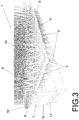
- Figure 3 shows a profile of the system 1 which includes a schematic representation of an embodiment of the elastic permeable substrate 4 which does not form part of the present invention.
- This embodiment of the elastic substrate may be configured by a sheet manufactured with the copolymer styrene-butadiene rubber SBR, having a thickness between 5 and 20 mm, with a plurality of regular or amorphous holes that would allow passage of the roots without these holes destabilising the structural stability of said sheet.
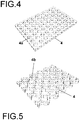
- Figures 4 and 5 represent another two types of sheets or slabs of elastic material that can also be used as an elastic substrate 4 but they do not form part of the present claimed invention.
- These sheets may be manufactured on the basis of polyurethane foam, such as for example the sheets manufactured by the company Recticel Internacional, or manufactured on the basis of expanded polyethylene, such as for example the sheets manufactured by the companies Trocellen and Shmitz Foams Products.
- the sheets incorporate through-holes 4a, 4b to allow passage through of the roots of the turf plants. These holes 4a, 4b may be distributed in a uniform manner, or not, on the surface of the sheet. They may also present a diversity of sections or shapes, different to those represented.
- Figure 6 represents an embodiment of said elastic substrate 4 configured on the basis of a three-dimensional mesh formed by threads of elastic polymeric material which are fixed or joined to each other in such a way that they determine a final semi-amorphous structure such as the one represented.
- This semi-amorphous structure incorporates hollow spaces to allow passage of the roots.
- This three-dimensional mesh is the one marketed with the name Vinyl loop mat by the company Notas Floor Mating.
- the elastic properties of the substrate 4 ensure the absorption of the energy from shocks made on the surface due to the effect, for example, of a sports game ball. In this way, compaction is avoided of the growing layer 7 of the roots 5 of the plants 6 of natural turf 2 disposed in a lower position.
- the seeds of the plants 6 of natural turf 2 are placed on a layer 8 of filler soil of 5mm to 25mm in thickness which is disposed on a base 9 for supporting the synthetic fibres 10 of the turf 3 of synthetic or artificial origin.
- the layer 8 of filler soil has the function only of stabilising the synthetic fibres 10 and of supporting the seeds of natural turf 2.
- this base 9 is configured in such a way as to allow the passage of the roots 5 of the plants 6 through to the elastic substrate 4.
- the base 9 is manufactured on the basis of material of synthetic origin of the type polyethylene or polypropylene and is provided with perforations (not represented) to allow passage of the roots 5.
- the elastic substrate 4 is protected or separated from the layer 8 of filler soil by a sheet of fabric 11 permeable to water, which is disposed beneath the base 9 for supporting the synthetic fibres 10.
- This fabric 11 has the function of preventing the particles of soil of the layer 8 of fill from blocking the pores of the elastic substrate 4.
- the fabric 11 is a non woven geotextile fabric of polyester fibres with a density of 0.2 Kg/m 2 (200 gr/m 2 ) and a pore size of 60 ⁇ m or 0.06 mm. It has been verified that this density is optimal for allowing the passage of roots 5 while at the same time preventing the passage of soil particles.
- the elastic substrate 4 remains with its pores filled with air defining in the profile of the system a layer of 0.01 m (10 mm) thickness with an apparent bulk density of 350 Kg/m 3 .
- This density is appropriate for providing growing conditions that are very similar to those of hydroponic cultivation which drastically reduce the proliferation of fungi and pathogenic bacteria which affect the plants 6 of natural turf 2.
- Another advantage of the geotextile fabric 11 lies in the fact that it prevents insect larvae from the layer 8 of filler soil reaching the growing layer 7 below.
- the aforementioned growing layer 7 below is a layer between 50 and 200 mm thick which is formed by a mixture of sand, organic matter, basal granular fertilisers and granules of elastic material with a diameter comprised between 0.5 mm and 4 mm.
- this layer 7 The function of this layer 7 is to grow the natural turf 2, as its name indicates, given that it allows the roots 5 to grow by providing them with the nutrients and with the space necessary for said roots 5 to be able to grow.
- the aforesaid elastic granules help to avoid compaction of the soil.
- the growing layer 7 of the plants 5 of turf 2 is in a position below that of the synthetic turf 3, said growing layer 7, and with it the roots 5 of the plants 6 of natural turf 2, are protected from the forces that cause tear or lifting of the turf. This fact contributes to making it possible for the system 1 of mixed turf of the present invention to be used for a higher number of hours than the natural turf 2 without sustaining tears or lifting.
- the growing layer 7 is disposed on subsoil 12 wherein its base includes drainage channels 13 for water.
- the method for cultivating the mixed turf according to the claimed system 1 includes a first stage of sowing wherein the seeds of the plants 6 of natural turf 2 are placed in the layer 8 of filler soil at a height comprised between 0.5 mm and 20 mm.
- the seeds of natural turf 2 germinate and its plants 6 are allowed to grow up to a height that is equal to or higher than the height of the synthetic fibres 10 of the artificial turf 3. Growth of the plants 6 is nourished by the roots 5 which reach the lower growing layer 7 by passing through the base 9 for supporting the synthetic fibres 10 (through its holes), the geotextile fabric 11 and the elastic substrate 4 (see figures).
- the height for cutting the plants 6 of natural turf 2 may vary, but in general, the recommended height will be comprised between 15 mm and 40 mm, depending also on the height of the fibres 10 of artificial or synthetic turf 3, preferably ensuring that the plants 6 of natural turf remain above the synthetic fibres 10.
- the tested profile was made of the following materials:
- the seeds of the plants 6 of natural turf were sown homogeneously on the layer 8 of filler soil. Once sown, fertilisers were applied. After 5 days the first green shoots appeared.
Landscapes
- Engineering & Computer Science (AREA)
- Architecture (AREA)
- Civil Engineering (AREA)
- Structural Engineering (AREA)
- Life Sciences & Earth Sciences (AREA)
- Environmental Sciences (AREA)
- Cultivation Of Plants (AREA)
- Road Paving Structures (AREA)
- Pretreatment Of Seeds And Plants (AREA)
Description
- The present application relates to a mixed turf for surfaces comprising natural-origin turf and synthetic-origin turf which are integrated into a single system. The same application also relates to an improved natural turf system for sports surfaces.
- It is a known fact that the turf of natural origin of sports surfaces and gardening surfaces requires a lot of maintenance work. In the particular case of surfaces where a sport is practiced, maintenance of the natural turf must be carried out with a very high frequency, and in spite of everything, a lot of problems tend to appear as a result of the wear and compaction suffered by the surface's plants and particles after several hours of use.
- In order to reduce the problems of natural turf maintenance, some sports pitches use synthetic origin turf. This turf presents the advantage that it suffers little wear and requires very low maintenance. However, it is a known fact that turf of synthetic origin lacks the biomechanical properties offered by turf of natural origin for practicing sports (resilience, vertical deformation, etc...).
- On the market, there is the so-called mixed turf which combines turf of natural origin and turf of synthetic origin. The existing mixed turf is obtained basically by making the seeds of natural turf plants grow in a layer of soil disposed on a base for supporting the synthetic fibres of the artificial turf. There is also another system wherein synthetic fibres are inserted on an already implanted natural turf.
- Document
US5489317 discloses a synthetic turf positioned atop a foundation which includes synthetic grass blades secured to a backing. Natural grass is planted in the surface layer of material supported by the backing and intermixed with the synthetic grass blades. According to this document, the improved surface includes a rubber mat having rubber particles adhered together by urethane, latex or other binding materials to create a flexible, perforated cushion. The rubber mat is positioned intermediate the foundation and the synthetic turf. - The main objective of the mixed turf system is to benefit from the properties of the turf of natural origin, while reducing the maintenance work on said natural turf thanks to the presence of the fibres of the turf of synthetic origin. However, it is known that existing mixed turf systems present numerous drawbacks.
- For example, it has been verified that the presence of the fibres of synthetic turf makes the aeration works required for cultivating the natural turf more difficult. These aeration works are necessary to reinstate the compaction that the surface suffers with use and usually consist of spiking the crop profile of the natural turf. In mixed turf, this "spiking" causes the base supporting the synthetic fibres to break and even breaking of the fibres themselves, meaning that, in practice, the synthetic fibres come loose and the turf becomes degraded.
- Another problem of existing mixed turf systems lies in the fact that the entire cultivation profile of the natural turf plants is disposed on the base that supports the synthetic fibres, meaning that it is very exposed to the action of lateral tearing forces which causes the turf to lift and divots to appear. These defects make play more difficult and the appearance of injuries on sports pitches increases. Also, it has been noted that the scarification works on the natural turf required in order to eliminate "thatch", or layer of decomposing organic matter from the carpet formed by the natural turf, are very difficult to carry out on the cultivation profile without spoiling or tearing the synthetic fibres of the artificial turf.
- In practice, the aforesaid maintenance problems result in obtaining a mixed turf which is not suitable for practicing sports, given that the natural turf eventually comes lose in determined zones and/or dies due to the lack of aeration caused by the impossibility of adequately performing the work of spiking and scarification.
- In light of the above, there is an obvious need to obtain an improved natural turf for sports and gardening surfaces, which is easy to maintain, or a mixed turf that resolves the problems mentioned above by integrating the two types of turf into a single system so as to obtain a genuinely hybrid turf.
- The objective of the present invention is to resolve the aforementioned drawbacks, by developing a turf system for sports surfaces and gardening surfaces that is very easy to maintain and moreover substantially improves the performance of sports surfaces by enabling a higher number of hours of use of such grounds.
- In line with this objective, according to a first aspect the present invention provides a turf system for sports surfaces and gardening surfaces, which comprises a turf of synthetic origin and a turf of natural origin, said turf of synthetic origin and said turf of natural origin being disposed on a substantially elastic permeable substrate, said elastic substrate being configured in such a way that it allows the roots of said natural turf to pass through to a growing layer disposed in a lower position. The system is characterized in that said elastic substrate defines in the profile of the system a layer having a thickness comprised between 0.005 m to 0.020 m, and in that said elastic substrate is configured on the basis of a three-dimensional mesh which is manufactured with elastic material of polymeric origin, said elastic substrate being capable of absorbing the energy from shocks practiced on said grounds to avoid compaction of said growing layer of roots disposed in a lower position.
- Unlike existing turf systems, the turf system of the present invention presents the advantage that it is possible to do without the spiking operation for aeration of the growing layer of the natural turf and also without conventional scarification. Also, the proposed system guarantees an adequate aeration of the crop profile, whether in mixed turf or natural turf. Aeration results in less compaction and higher degradation of the biomass ("less thatch") which favours obtaining a turf with ideal properties for practicing sports, given that it favours the stability of the land (less mud formation, formation of fewer puddles due to lack of drainage, etc...).
- Indeed thanks to the presence of said elastic permeable substrate which allows the roots to pass to a growing layer below, the growing layer of the roots of the natural turf plants situated in a lower position is not compacted in the same way as occurs in the existing systems. In the claimed system, preferably in a mixed turf system, the elastic substrate absorbs the shocks made on the ground and guarantees a correct aeration of the zone where the roots grow in a lower layer, which has been verified not to require the spiking which breaks the synthetic fibres.
- In fact, it has been verified that the claimed system guarantees that the properties of shock-absorption and rotational traction of the sports surface are at least equal to the minimum values required for turf grounds without having to perform the "spiking" (aeration) which breaks the fibres. These minimum values are established in European Norm EN 15330-1:2005 for turfs of synthetic origin (Surfaces for Sport Areas - Specification for synthetic turf), given that the international football federation (FIFA) up to the present moment does not demand quality certificates for pitches with turf of natural origin.
European Norm EN-15330-1:2005 for sports surfaces - artificial turf European Norm EN-15330-1 for sports surfaces made of artificial turf PROPERTY Values Vertical ball rebound (%), -EN12235 45-75 Ball roll (m), - EN12234 4-10 Shock absorption (%),- EN14808 55-70 Rotational traction (Nm), - EN15301-1 25-50 - Another advantage of the turf of the present invention lies in the fact that, because the growing layer of the turf plants is in a lower position than that of the synthetic turf, said growing layer, and with it the roots of the natural turf plants, are protected from the forces that cause tear or lift. In this way, the system is capable of guaranteeing suitable qualities of the land for sports games.
- Preferably, the claimed system comprises a layer of filler soil disposed on a base for supporting the fibres of synthetic turf, with it being possible to sow the seeds of natural turf on said layer of filler soil, the base for supporting the synthetic fibres being configured in such a way that it allows the roots of the natural turf to pass through to the elastic substrate disposed in a lower position.
- This layer of filler soil disposed on the base for supporting the synthetic turf fibres presents the advantage of stabilising the synthetic fibres and also, acts as a substrate for supporting the seeds of the natural turf plants.
- Advantageously, the base for supporting the synthetic fibres is configured by a substantially laminar structure made of synthetic material which is provided with holes or perforations for the passage of the roots of natural turf plants. This synthetic material may be, for example, a material derived from the family of polyolefins (polyethylene, polypropylene, etc...). In terms of the synthetic fibres, these may be of the monofilament, fibrillated or mixed type woven onto the supporting base. The artificial turf may also include textured or curled synthetic fibres. According to a preferred embodiment, the claimed system comprises a sheet that is permeable to water which is placed between said layer of filler soil and said substantially elastic substrate, said sheet being configured in such a way that it prevents the passage of particles of filler soil to the elastic substrate disposed in a lower position, said fabric being capable of allowing the roots of said natural turf to pass through it.
- In this way, thanks to this permeable sheet, the pores of the elastic substrate do not become blocked with particles from the upper layer of filler soil, ensuring that the air content of said substrate is maintained, making it similar to a hydroponic cultivation substrate which reduces the risk of proliferation of fungi and pathogenic bacteria. Also, this sheet prevents insect larvae from reaching the root zone of the natural turf plants.
- This sheet may be, for example, a sheet configured in the form of a mesh that prevents the passage of sand particles of the filler soil with a particular grain size.
- Advantageously, said permeable sheet is a geotextile fabric which is configured to allow the passage of the roots of said natural turf, and preferably, said geotextile fabric comprises a mesh of fibres provided with pores having a diameter of equal to or less than 0.0001 m (100 µm), said pores being adequate for allowing the passage of the roots and preventing the passage of particles of soil capable of blocking the pores of the elastic substrate located in a lower position.
- Again advantageously, said geotextile fabric is a non-woven fabric, preferably a non-woven fabric with a fibre density that is equal to or less than 0.3 Kg/m2 (300 g/m2). The fibres of the non-woven fabric may be natural fibres or synthetic fibres, such as for example, polyester fibres. Synthetic fibres are preferred over natural fibres, given that they prevent the passage of larvae to the growing layer below more effectively.
- It has been verified that a density of fibres of the geotextile fabric that is equal to or less than 300 g/m2 is adequate for allowing the passage of the roots and preventing at the same time the passage of the particles of filler soil.
- Nonetheless, instead of a geotextile fabric, it would also be possible to use, for example, a mesh made of an extruded polymer (HDPE - high density polyethylene) formed by regular grid of 0.6 mm x 1 mm, weighing approximately 300 g/m2.
- With regard to the aforementioned elastic substrate, , said substrate defines in the profile of the system a layer having a thickness comprised between 0.005 m (5 mm) and 0.020 m (20 mm) and, advantageously, the apparent bulk density of this layer of elastic substrate, when protected by the permeable sheet of fabric, is equal to or less than 500 Kg/m3 in order to guarantee an optimum content of air.
- This apparent bulk density is similar to that provided by substrates used in hydroponic cultivation, such as, for example, peat or perlite. In this way, the roots of the natural turf plants that pass through the substrate to access the lower growing layer make use of an important airflow which improves their biological processes. Another advantage of the high air content of this substrate lies in the fact that it provides an effect of thermal insulation which reduces the impact of temperature changes on the surface. This helps to save water since the evapotranspiration of the natural turf is reduced.
- Also, advantageously, said substantially elastic permeable substrate is configured in such a way that it is capable of absorbing the energy of shocks made on the surface due to the effect of a ball or a similar object, in particular said substrate is configured in such a way that it makes it possible to obtain a mixed or natural turf with a shock-absorption capacity comprised within the range of values (55%-70%) established by the aforementioned European Norm, according to test UNE-EN 14808:2005 (see, figure 7).
- The vertical rebound capacity of the elastic substrate has also been verified by means of test UNE-EN 122235. This test evaluates the recovery in height of an approved football once it has been allowed to drop from a height of 2 m, as indicated in the method's instructions. The result of the recovery in height of the ball in respect of a concrete floor was 120 cm measured directly on the concrete, whereas the height recovered after bouncing directly on the elastic substrate was 80 cm, which corresponds to a vertical rebound of the ball on the elastic substrate (only on the substrate, not the turf) of 40% This value is very close to the range of values that is required for turf of synthetic origin, according to European Norm EN-15330-1 mentioned above.
- According to the present invention , said substantially elastic substrate is configured on the basis of a three-dimensional mesh with a thickness comprised between 0.005 m (5 mm) and 0.02 m (20 mm) which is manufactured with elastic material of polymeric origin, such as for example, polyvinyl chloride or PVC.
- It has been verified that a three-dimensional mesh of elastic synthetic material, for example, a mesh of the type that defines an amorphous network of threads of elastic material, is very appropriate, given that said amorphous network provides a support for the roots of the plants which results in an improved grip of the turf foots and, consequently, in a lower risk of unwanted lifting of the turf on the playing field.
- Preferably, said three-dimensional mesh is a mesh formed by threads of a polymeric material with elastic properties. These threads are fixed or bound to each other in such a way that they determine a semi-amorphous structure with hollow spaces for allowing the passage of the roots of the plants. A mesh of this type is marketed by Notax Floor Matting with the commercial name Vinyl loop mats.
- According to another embodiment which does not form part of the present invention, said elastic substrate is configured on the basis of a slab of elastic material having a determined thickness, which is provided with through-holes for passage of the roots of the turf plants. The material of the slab may be an aggregate of rubber type SBR (styrene-butadiene) with polyurethane or any other binder, such as for example, the material manufactured by the company Berleburguer Shaumstoffwerk. It may also be a polyurethane foam having an appropriate density bound by means of the use of a reagent such as isocyanate or any other, which generates the required properties, such as for example the material manufactured by the company Recticel Internacional. Another type of material may be expanded polyethylene or a similar plastic material, unified by means of a method that generates the required properties, such as for example, the material manufactured by the companies Trocellen and Shmitz Foams Products.
- Alternatively, instead of the aforementioned slabs of elastic material, the elastic layer of the system may be configured by a plurality of granules of elastic material, preferably, rubber granules, with a granule size comprised between 0.8 mm and 4.5 mm for allowing the passage through of the roots of natural turf. In this way, and although the granules do not form a compact body, these may perform a function similar to that of the slabs when it comes shock-absorption and avoiding soil compaction.
- According to a preferred embodiment of the system, the fibres of synthetic turf possess a height comprised between 0.015 m (15 mm) and 0.035 m (35 mm) and the layer of filler soil possesses a thickness comprised between 0.005 m (5 mm) and 0.025 m (25 mm). In this same profile, the layer of natural turf culture disposed in a lower position possesses preferably, a height comprised between 0.05 m (50 mm) and 0.20 m (200 mm).
- In the claimed system, the fibres of synthetic turf are disposed in a lower position meaning that from the outside the turf appears as natural turf.
- According to an alternative embodiment which does not form part of the present invention, the system is not provided with synthetic fibres of turf, with only the natural turf being disposed on said substantially elastic permeable substrate. In this way, the present application provides an improved system of totally natural turf which also presents the advantage of being very easy to maintain, given that it is possible to do without the conventional operations of "spiking" and scarification.
- As mentioned previously, the layer of filler soil is in reality a layer with the function of stabilising the synthetic fibres, the lower growing layer being the one that provides the nutrients for growth of the roots. Plus, the reduced thickness of this layer of filler soil reduces the possibility of larvae growth and eliminates conventional scarification operations given that the depth of the soil to be turned over is very limited. Scarification in this system is not really carried out, and is replaced by works to clear and clean said fill.
- Another additional advantage of the limited thickness or depth of this layer of filler soil lies in the fact that, in the case of allowing the natural turf to die or eliminating it by means of herbicides, the field can be used with synthetic fibres only thanks to the fact that the elastic substrate will continue to provide sufficient elasticity to the ground because it is very close to the surface. In the event of requiring natural turf again it will only be necessary to sow once more.
- According to the same preferred embodiment of the system, the growing layer of natural turf disposed in the lower position of the system's profile includes particles made of elastic of natural or synthetic origin, with a diameter comprised between 0.0005 m (0,5 mm) and 0.004 m (4 mm). These particles or granules of elastic material contribute to reducing compaction of the ground or sports or gardening surface.
- In accordance with a second aspect, the present invention relates also to a procedure for cultivating the turf according to the system of the claims above, which comprises the stages of;
- a) sowing the seeds of natural turf on a layer of filler soil disposed on a base for supporting the fibres of synthetic turf and on a substantially elastic permeable substrate, which is configured on the basis of a three-dimensional mesh, said elastic substrate defining in the profile of the system a layer having a thickness comprised between 0.005 m and 0.020 m,
- b) allowing the natural turf to grow to a height that is equal to or higher than the height of the synthetic turf fibres, the roots of said natural turf being capable of passing through the base for supporting the synthetic turf fibres and passing through said elastic substrate in order to reach a growing layer disposed in a lower position,
- c) cutting the natural turf in order to keep the height of said natural turf at least equal to the height of the synthetic turf fibres, in particular, at a height comprised between 0.015 ,m (15 mm) and 0.04 m (40 mm), depending on the use to be given to the surface.
- The proposed mixed turf system presents the advantage of allowing the natural turf to be cut comfortably, without danger of breakage, because the roots of the turf plants are protected under the base for supporting the synthetic fibres, in a growing layer below.
- Advantageously, the natural turf is cut to a height above the height of the synthetic fibres of artificial turf in order to provide the surface with the appearance of totally natural turf and biomechanical properties that are very similar to those of natural turf.
- Preferably, in stage a), the sowing of the seeds is carried out on a layer of filler soil having a thickness comprised between 0.005 m (5 mm) and 0.025 m (25 mm) which is separated from said substantially elastic substrate by a permeable sheet that prevents passage of soil particles, the roots of the natural turf being capable of passing through said permeable sheet to penetrate in the substrate while said substrate remains free of soil particles.
- The sowing of seeds of natural turf is carried out on a layer of filler soil with a reduced thickness which is very close to the base for supporting the synthetic fibres of the artificial turf. It has been observed that the reduced thickness of this layer of filler soil drastically reduces the presence of insect larvae, and consequently, loss of plant.
- Advantageously, said procedure comprises the stage of clearing and cleaning without scarifying said layer of filler soil with a thickness comprised between 0.005 m (5 mm) and 0.025 m (25 mm).
- As mentioned, the reduced thickness of the layer of filler soil eliminates the operations of scarification, reducing them to simple clearing given that the depth of the soil to be turned over is very limited.
- Thanks to all of the described characteristics, the claimed mixed turf and natural turf system makes it possible to obtain sports or gardening surfaces that can be used for many more hours than the natural turf surfaces or pitches of the state of the art and which, additionally, are much easier to maintain than existing natural turf surfaces or mixed turf surfaces.
- In the present invention, geotextile fabric will be understood to mean a permeable and flexible sheet of preferably synthetic fibres, preferably made of polypropylene and polyester, which can be manufactured in non-woven or woven form, depending on the required resistance and filtration capacity. The geotextile fabric used in the present invention is a geotextile fabric with a density of fibres that is modified in order to allow passage of the roots of the natural turf plants.
- For a better understanding of what has been described above, a set of drawings is attached where, schematically and by way of a non-limiting example only, two practical cases of embodiment are represented.
-
Figure 1 is a perspective view of a profile or cross-section of a first embodiment of the system of the present invention. -
Figure 2 shows a close-up of the profile of the section offigure 1 . -
Figure 3 is a perspective view of a profile or section of an embodiment of the system that does not form part of the present invention. -
Figures 4 and 5 show a view in perspective of two types of slabs of elastic material which do not form part of the present claimed invention. Each one of these slabs is capable of configuring a substantially elastic permeable substrate.. -
Figure 6 shows a view in perspective of a three-dimensional mesh formed by threads of a polymeric material with elastic properties. This three-dimensional mesh can configure the system's layer of substantially elastic permeable substrate. - Figure 7 shows an image representing the method to determine the shock absorption capacity of a surface area according to the European standard EN 14808 (see, text below).
- The force reduction is determined according to the European standard EN 14808 Surfaces for sports areas - Determination of shock absorption. The purpose of this method is to compare the tested surface to a completely rigid floor construction, i.e. a concrete floor of a significant mass. The method measures how much of the impact force that is absorbed of the floor construction. When testing, a mass of 20 ± 0.1 kg is dropped from a height of 55 ± 0.25 mm on to a spiral spring with a spring rate of 2 000 ± 60 N/mm. The spring rests on a load cell able to continuously record the force during the impact. The maximum impact force can be calculated with the following equation:

- Fmax = Theoretical maximum force registered by the load cell in N
- m = The mass of the weight in kg
- g = The standard gravity, 9.80665 m/s2
- h = The drop height in m
- k = The spring rate in N/m
- This theoretical value will be approximately 6.78 kN if the mass of the spring is added to m. When performing a test Fmax needs to be determined by means of a calibration, and according to the standard Fmax shall be 6.60 ± 0.25 kN.
- The force reduction, R, is calculated with the following equation:

- Ft = The measured maximum peak force for the test piece in N
- Fr = The reference force from calibration on concrete in N
- Therefore the force reduction expresses how much better the tested floor absorbs the impact force than a concrete floor.
- When tasting, three drops are made at the same spot. An average is then calculated from the last two drops.
- What follows is a description of the mixed turf system of the present invention making reference to
figures 1 to 3 . - The proposed system 1 of mixed turf includes turf of
natural origin 2 and turf ofsynthetic origin 3 which are disposed on a substantially elasticpermeable substrate 4. Thissubstrate 4 is configured in such a way as to allow the passage of theroots 5 of theplants 6 of natural turf through to a growinglayer 7 disposed in a lower position. - In the embodiment shown in
figures 1 and2 , saidsubstrate 4 is configured by a mesh of elastic synthetic material, specifically, a mesh of polyvinyl chloride or PVC which has a thickness of 10 mm and a substantially amorphous network structure (the latter is not shown in the figures) which facilitates the support of theroots 5 that pass through it. - Nevertheless, the
same substrate 4 may be configured by a different type of material with similar properties on condition that said material allows theroots 5 to pass through and is capable of absorbing the energy from shocks made on the surface.Figure 3 shows a profile of the system 1 which includes a schematic representation of an embodiment of the elasticpermeable substrate 4 which does not form part of the present invention. This embodiment of the elastic substrate may be configured by a sheet manufactured with the copolymer styrene-butadiene rubber SBR, having a thickness between 5 and 20 mm, with a plurality of regular or amorphous holes that would allow passage of the roots without these holes destabilising the structural stability of said sheet. -
Figures 4 and 5 represent another two types of sheets or slabs of elastic material that can also be used as anelastic substrate 4 but they do not form part of the present claimed invention. These sheets may be manufactured on the basis of polyurethane foam, such as for example the sheets manufactured by the company Recticel Internacional, or manufactured on the basis of expanded polyethylene, such as for example the sheets manufactured by the companies Trocellen and Shmitz Foams Products. In all events, as may be seen from the drawings, the sheets incorporate through-holes 4a, 4b to allow passage through of the roots of the turf plants. Theseholes 4a, 4b may be distributed in a uniform manner, or not, on the surface of the sheet. They may also present a diversity of sections or shapes, different to those represented. -
Figure 6 represents an embodiment of saidelastic substrate 4 configured on the basis of a three-dimensional mesh formed by threads of elastic polymeric material which are fixed or joined to each other in such a way that they determine a final semi-amorphous structure such as the one represented. This semi-amorphous structure incorporates hollow spaces to allow passage of the roots. One example of this three-dimensional mesh is the one marketed with the name Vinyl loop mat by the company Notas Floor Mating. - As mentioned in the description of the invention, the elastic properties of the
substrate 4 ensure the absorption of the energy from shocks made on the surface due to the effect, for example, of a sports game ball. In this way, compaction is avoided of the growinglayer 7 of theroots 5 of theplants 6 ofnatural turf 2 disposed in a lower position. - In the described system 1 of mixed turf, the seeds of the
plants 6 ofnatural turf 2 are placed on alayer 8 of filler soil of 5mm to 25mm in thickness which is disposed on abase 9 for supporting thesynthetic fibres 10 of theturf 3 of synthetic or artificial origin. Thelayer 8 of filler soil has the function only of stabilising thesynthetic fibres 10 and of supporting the seeds ofnatural turf 2. - With regards to the
base 9 for supporting thesynthetic fibres 10, thisbase 9 is configured in such a way as to allow the passage of theroots 5 of theplants 6 through to theelastic substrate 4. In the described embodiments, thebase 9 is manufactured on the basis of material of synthetic origin of the type polyethylene or polypropylene and is provided with perforations (not represented) to allow passage of theroots 5. - As shown in
figure 1 , theelastic substrate 4 is protected or separated from thelayer 8 of filler soil by a sheet offabric 11 permeable to water, which is disposed beneath thebase 9 for supporting thesynthetic fibres 10. Thisfabric 11 has the function of preventing the particles of soil of thelayer 8 of fill from blocking the pores of theelastic substrate 4. - In the described embodiments, the
fabric 11 is a non woven geotextile fabric of polyester fibres with a density of 0.2 Kg/m2 (200 gr/m2) and a pore size of 60 µm or 0.06 mm. It has been verified that this density is optimal for allowing the passage ofroots 5 while at the same time preventing the passage of soil particles. - Thanks to the
aforementioned geotextile fabric 11, theelastic substrate 4 remains with its pores filled with air defining in the profile of the system a layer of 0.01 m (10 mm) thickness with an apparent bulk density of 350 Kg/m3. This density is appropriate for providing growing conditions that are very similar to those of hydroponic cultivation which drastically reduce the proliferation of fungi and pathogenic bacteria which affect theplants 6 ofnatural turf 2. Another advantage of thegeotextile fabric 11 lies in the fact that it prevents insect larvae from thelayer 8 of filler soil reaching the growinglayer 7 below. - The aforementioned growing
layer 7 below is a layer between 50 and 200 mm thick which is formed by a mixture of sand, organic matter, basal granular fertilisers and granules of elastic material with a diameter comprised between 0.5 mm and 4 mm. - The function of this
layer 7 is to grow thenatural turf 2, as its name indicates, given that it allows theroots 5 to grow by providing them with the nutrients and with the space necessary for saidroots 5 to be able to grow. The aforesaid elastic granules help to avoid compaction of the soil. - As mentioned in the description of the invention, because the growing
layer 7 of theplants 5 ofturf 2 is in a position below that of thesynthetic turf 3, said growinglayer 7, and with it theroots 5 of theplants 6 ofnatural turf 2, are protected from the forces that cause tear or lifting of the turf. This fact contributes to making it possible for the system 1 of mixed turf of the present invention to be used for a higher number of hours than thenatural turf 2 without sustaining tears or lifting. - As may be seen from
figures 1 to 3 , the growinglayer 7 is disposed onsubsoil 12 wherein its base includesdrainage channels 13 for water. - The method for cultivating the mixed turf according to the claimed system 1 includes a first stage of sowing wherein the seeds of the
plants 6 ofnatural turf 2 are placed in thelayer 8 of filler soil at a height comprised between 0.5 mm and 20 mm. - The seeds of
natural turf 2 germinate and itsplants 6 are allowed to grow up to a height that is equal to or higher than the height of thesynthetic fibres 10 of theartificial turf 3. Growth of theplants 6 is nourished by theroots 5 which reach the lower growinglayer 7 by passing through thebase 9 for supporting the synthetic fibres 10 (through its holes), thegeotextile fabric 11 and the elastic substrate 4 (see figures). - Depending on the type of sport to be practiced, the height for cutting the
plants 6 ofnatural turf 2 may vary, but in general, the recommended height will be comprised between 15 mm and 40 mm, depending also on the height of thefibres 10 of artificial orsynthetic turf 3, preferably ensuring that theplants 6 of natural turf remain above thesynthetic fibres 10. - Given that all the layers of the profile of the system 1 are permeable to water, irrigation and drainage are carried out as normal without the risk of water logging. Also, the high content of air of the elastic substrate 4 (low apparent bulk density of the layer) guarantees correct aeration of the
roots 5 of theplants 6, avoiding the appearance of common fungal diseases in the neck of the plants of turf. - As mentioned previously, periodically, clearing and cleaning operations of the
layer 8 of filler soil will be carried out in order to remove the "thatch" or layer of decomposing organic matter. These operations replace conventional scarification. Because thelayer 8 of filler soil has a very limited thickness, the scarification operation may be replaced by simpler processes which are less aggressive (simply raking the soil). - Next is a description of a test carried out in a laboratory on a profile of the claimed system 1 which has proven the capacity for the roots of the
plants 6 ofnatural turf 2 to take hold over thefibres 10 of artificial or synthetic turf. - The tested profile was made of the following materials:
-
perforated base 9 of polyethylene for supporting thesynthetic fibres 10. -
synthetic fibres 10 made of fibrillated polyethylene sewn to theperforated base 9. The height of thefibres 10 for the test was 20 mm. -
geotextile fabric 11 non woven made of polyester with a thickness of 1.2 mm, a fibre density of 200 gr/m2 and a pore size of 60 µm. The chosenfabric 11 is permeable to water. -
elastic substrate 4 configured by a three-dimensional mesh of polyvinyl chloride PVC with a thickness of 10 mm with an amorphous network structure and an apparent bulk density of 350 Kg/m3. -
layer 8 of filler soil of 10mm thick for sowing the seeds of theplants 6. - growing
layer 7 of 85 mm thick for growth of theroots 5. - The seeds of the
plants 6 of natural turf were sown homogeneously on thelayer 8 of filler soil. Once sown, fertilisers were applied. After 5 days the first green shoots appeared. - One month later, it was observed that the
roots 5 had completely passed through the supportingbase 9, thegeotextile fabric 11 and theelastic substrate 4 used in the test. Specifically, it was observed that theroots 5 had been able to perforate or pass through thenon-woven geotextile fabric 11 reaching the three-dimensional mesh of thesubstrate 9. Theroots 5 grew free of particles of filler soil in the space created by the mesh of thesubstrate 4. Consequently, it was verified that effectively, theelastic substrate 9, protected by thegeotextile fabric 11 configures a medium similar to that of hydroponic cultivation (without soil) of theroots 5. - One month and a half after the start of the test, it was noted that the
plants 6 ofnatural turf 2 covered 100% of the surface and that thesynthetic fibres 10 of the artificial turf were practically invisible. - Two months after the start of the test, the strength of the
plants 6 ofnatural turf 2 was evident and theroots 5 showed considerable density and thickness reaching the lower growinglayer 7. - Although reference has been made to a specific embodiment of the invention, it is obvious for a person skilled in the art that the described system 1 is subject to numerous variations and modifications, and that all the details mentioned may be replaced by others which are technically equivalent, without departing from the scope of protection defined by the attached claims.
Claims (14)
- System (1) of turf for sports surfaces and gardening surfaces which comprises turf (3) of synthetic origin and turf (2) of natural origin, said turf (3) of synthetic origin and said turf (2) of natural origin being disposed on a substantially elastic permeable substrate (4), said elastic substrate (4) being configured in such a way that it allows passage of the roots (5) of said natural turf (2) through to a growing layer (7) disposed in a lower position, characterized in that said elastic substrate (4) defines in the profile of the system (1) a layer having a thickness comprised between 0.005 m to 0.020 m, and in that said elastic substrate (4) is configured on the basis of a three-dimensional mesh which is manufactured with elastic material of polymeric origin, said elastic substrate (4) being capable of absorbing the energy from shocks made on said surfaces in order to avoid compaction of said growing layer (7) of the roots (5) disposed in a lower position.
- System according to claim 1, which comprises a layer (8) of filler soil disposed on a base (9) for supporting the fibres (10) of turf of synthetic origin, with it being possible to sow the seeds of natural turf (2) on said layer (8) of filler soil, the base (9) for supporting said synthetic fibres (10) being configured in such a way as to allow the roots (5) of natural turf (2) to pass through to the elastic substrate (4) disposed in a lower position.
- System according to claim 2, which comprises a sheet of material (11) permeable to water which is placed between said layer (8) of filler soil and said substantially elastic substrate (4), said sheet being configured in such a way as to prevent the passage of particles of filler soil through to the elastic substrate (4) disposed in a lower position, with said fabric (11) being able to allow passage of the roots (5) of said natural turf (2).
- System according to claim 3, wherein said permeable layer is a geotextile fabric (11) which is configured to allow passage of the roots (5) of said natural turf (2).
- System according to claim 4, wherein said geotextile fabric (11) comprises a mesh of fibres provided with pores having a diameter that is equal to or less than 0.0001 m (100 µm), said pores being suitable for allowing passage of the roots (5) and preventing passage of the particles of soil capable of blocking the pores of the elastic substrate (4).
- System according to claim 5, wherein said geotextile fabric (11) is a non woven fabric, preferably a non woven fabric with a density of fibres that is equal to or less than 0.3 Kg/m2 (300 g/m2).
- System according to claim 1, wherein said substantially elastic substrate (4) defines in the profile of the system (1) a layer with a thickness comprised between 0.005 m (5 mm) and 0.02 m (20 mm), the apparent bulk density of this layer of substrate being equal to or less than 500 Kg/m3 when it is protected by the sheet of permeable fabric (11) with a view to guaranteeing an optimum content of air.
- System according to any of claims 1 or 7, wherein said substantially elastic permeable substrate (4) is configured in such a way as to be capable of absorbing the energy of shocks made on the surface by the effect of the ball or other similar object according to the minimum values established under European Norm EN-15330-1 for sports surfaces, in particular said substrate is configured in such a way as to allow a mixed or natural turf to be obtained with a shock-absorption capacity comprised within the range of values (55%-70%) established by said European Norm, according to test UNE-EN 14808:2005.
- System according to claim 2, wherein the fibres (10) of said synthetic turf (3) possess a height comprised between 0.015 m (15 mm) and 0.035 m (35 mm) and said layer (8) of filler soil a thickness comprised between 0.005 m (5 mm) and 0.025 m (25 mm).
- System according to claim 1, wherein said growing layer (7) possesses a height comprised between 0.05 m (50 mm) and 0.20 m (200 mm).
- System according to claim 9, wherein said growing layer (7) includes particles of elastic material of natural or synthetic origin with a diameter comprised between 0.5 mm and 4 mm.
- Method for cultivating turf according to the system of claims 1 to 11, which comprises the stages of;a) sowing the seeds of natural turf (2) on a layer (8) of filler soil disposed on a base (9) for supporting the fibres (10) of turf (3) of synthetic origin and on a substantially elastic permeable substrate (4), which is configured on the basis of a three-dimensional mesh, said elastic substrate (4) defining in the profile of the system (1) a layer having a thickness comprised between 0.005 m and 0.020 m,b) allowing the natural turf (2) to grow up to a height that is equal to or higher than the height of the fibres (10) of the synthetic turf (3), the roots (5) of said natural turf (2) being capable of passing through the base (9) for supporting the fibres (10) of synthetic turf (3) and passing through said elastic substrate (9) in order to reach a growing layer (7) disposed in a lower position,c) cutting the plants (6) of natural turf (2) to maintain a height of said natural turf (2) that is at least equal to that of the fibres (10) of synthetic turf (3), in particular, to maintain said natural turf (2) at a height comprised between 0.015 m (15 mm) and 0.040 m (40 mm), depending on the use to be given to the surface.
- Method of cultivation according to claim 12, wherein, in stage a) the sowing of the seeds is carried out on a layer (8) of filler soil with a thickness comprised between 0.005 m (5 mm) and 0.025 m (25 mm) which is separated from the elastic substrate (4) by a permeable sheet (11) which prevents the passage of soil particles, the roots (5) of the natural turf (2) being capable of passing through said permeable sheet (11) to penetrate the substrate (4) while said substrate (4) is kept free from soil particles.
- Method of cultivation according to either of claims 12 or 13, which comprises the stage of clearing and cleaning said layer (8) of filler soil without scarifying.
Priority Applications (1)
| Application Number | Priority Date | Filing Date | Title |
|---|---|---|---|
| PL14707462T PL2956583T3 (en) | 2013-02-18 | 2014-02-18 | Turf system for sport surfaces and gardening surfaces and method for cultivating turf according to said system |
Applications Claiming Priority (2)
| Application Number | Priority Date | Filing Date | Title |
|---|---|---|---|
| ES201330209A ES2401631B1 (en) | 2013-02-18 | 2013-02-18 | Mixed lawn system for sports floors and landscaped grounds and cultivation procedure of said mixed lawn |
| PCT/IB2014/059065 WO2014125459A1 (en) | 2013-02-18 | 2014-02-18 | Turf system for sport surfaces and gardening surfaces and method for cultivating turf according to said system |
Publications (2)
| Publication Number | Publication Date |
|---|---|
| EP2956583A1 EP2956583A1 (en) | 2015-12-23 |
| EP2956583B1 true EP2956583B1 (en) | 2017-08-23 |
Family
ID=48045164
Family Applications (1)
| Application Number | Title | Priority Date | Filing Date |
|---|---|---|---|
| EP14707462.9A Not-in-force EP2956583B1 (en) | 2013-02-18 | 2014-02-18 | Turf system for sport surfaces and gardening surfaces and method for cultivating turf according to said system |
Country Status (10)
| Country | Link |
|---|---|
| US (1) | US20150376844A1 (en) |
| EP (1) | EP2956583B1 (en) |
| JP (1) | JP6363107B2 (en) |
| KR (1) | KR20150121035A (en) |
| CA (1) | CA2900612A1 (en) |
| ES (2) | ES2401631B1 (en) |
| HU (1) | HUE034844T2 (en) |
| PL (1) | PL2956583T3 (en) |
| RU (1) | RU2627055C2 (en) |
| WO (1) | WO2014125459A1 (en) |
Families Citing this family (20)
| Publication number | Priority date | Publication date | Assignee | Title |
|---|---|---|---|---|
| US20140250780A1 (en) * | 2010-10-27 | 2014-09-11 | Hyo-sang Lee | Removable support surface |
| WO2016012265A1 (en) * | 2014-07-23 | 2016-01-28 | Xf Technologies B.V. | Top turf |
| EP3250754B1 (en) * | 2015-01-30 | 2021-02-24 | Åhus Turf Ab | Artificial hybrid turf |
| CA3019924A1 (en) | 2016-04-18 | 2017-10-26 | Donald Oswald Brosseau, Jr. | Portable golf mat |
| FR3053208B1 (en) * | 2016-06-29 | 2019-05-17 | Roger Gillet | PROCESS FOR OBTAINING A GRASS GRASS WITH THE USE OF A SPECIFICALLY PRE-PERCEED FELT FOR RECEIVING SEEDS |
| CN106034818A (en) * | 2016-07-22 | 2016-10-26 | 辽宁工程技术大学 | Low elevation greenbelt paving structure based on sponge city ideas |
| US20180200608A1 (en) * | 2016-12-09 | 2018-07-19 | Timothy Sadick | Overlay systems and methods of installing overlay systems |
| RU2649670C1 (en) * | 2017-04-27 | 2018-04-04 | Юлия Алексеевна Щепочкина | Manufacture method of ground geogrid |
| JP6940066B2 (en) * | 2017-09-20 | 2021-09-22 | 株式会社ウエノシステック | Artificial turf structure |
| MX2021002383A (en) | 2018-08-28 | 2021-04-29 | Shaw Ind Group Inc | NOVEL ARTIFICIAL GRASS AND METHODS TO DO THE SAME. |
| JP7155982B2 (en) * | 2018-12-12 | 2022-10-19 | Mccスポーツ株式会社 | Artificial lawn laying structure for javelin throwing |
| WO2020146586A1 (en) * | 2019-01-09 | 2020-07-16 | Lancaster Timothy L | Erosion control and turf reinforcement mat |
| CN111041939A (en) * | 2019-12-17 | 2020-04-21 | 王远伦 | Anti-aging and water-resistant artificial lawn |
| JP6837692B1 (en) * | 2020-01-14 | 2021-03-03 | 株式会社大晃 | Hybrid turf forming tool and hybrid turf forming method |
| US20210388563A1 (en) * | 2020-06-15 | 2021-12-16 | Jason Warren Bell | Geocell-Based Drainage Base for Synthetic Turf |
| CN112400619A (en) * | 2020-10-30 | 2021-02-26 | 广州星卫草业股份有限公司 | Construction method for adjusting surface hardness of natural lawn |
| WO2022169977A1 (en) | 2021-02-03 | 2022-08-11 | Atomic Soil, Llc | Synthetic soil substrate system for growing a plant |
| CN113016509A (en) * | 2021-03-05 | 2021-06-25 | 四川省公路规划勘察设计研究院有限公司 | Ecological construction method for plateau meadow area |
| RU2764735C1 (en) * | 2021-06-15 | 2022-01-20 | Алексей Александрович Зайцев | Method for forming a rolled combined grass cover |
| WO2025226410A1 (en) * | 2024-04-22 | 2025-10-30 | Grassworx Llc | Groundcover systems and methods for creating living vegetated foot, wheeled, and/or vehicular traffic surfaces |
Citations (5)
| Publication number | Priority date | Publication date | Assignee | Title |
|---|---|---|---|---|
| US5489317A (en) | 1992-06-22 | 1996-02-06 | Turf Systems International, Inc. | Surface for sports and other uses |
| US6219965B1 (en) | 1994-07-23 | 2001-04-24 | Otsuka Kagaku Kabushiki Kaisha | Plant growth sheet structure, natural turf sheet structure, method of growing turf and method of laying turf sheet structure |
| US20010007700A1 (en) | 1996-11-29 | 2001-07-12 | De Vries Hugo | Combined turf |
| WO2001096664A1 (en) | 2000-06-15 | 2001-12-20 | Ten Cate Nicolon B.V. | Artificial grass lawn for sports fields |
| WO2008046912A1 (en) | 2006-10-20 | 2008-04-24 | Trocellen Gmbh | Cushioned layer under an artificial lawn and method for laying a cushioned layer |
Family Cites Families (54)
| Publication number | Priority date | Publication date | Assignee | Title |
|---|---|---|---|---|
| US3837988A (en) * | 1967-10-19 | 1974-09-24 | Minnesota Mining & Mfg | Composite mat |
| AT287046B (en) * | 1968-01-23 | 1971-01-11 | Erwin Staerk | sports ground |
| DE2522864A1 (en) * | 1975-05-23 | 1976-12-30 | Berleburger Schaumstoffwerk | Grid for growing grass for landscaped areas - consists of ridges of artificial grass bristles on the top, between cavities of nutrient |
| US4459516A (en) * | 1981-07-06 | 1984-07-10 | Zelina William B | Line operated fluorescent lamp inverter ballast |
| JPS5972302A (en) * | 1982-10-18 | 1984-04-24 | 吉崎 満雄 | Underground drain structure of turf field and base material thereof |
| US4662778A (en) * | 1983-03-31 | 1987-05-05 | Monsanto Company | Drainage mat |
| DE3721812A1 (en) * | 1987-07-02 | 1989-02-02 | Sekisui Europ Ag | Sand-filled artificial turf |
| DE3723364A1 (en) * | 1987-07-15 | 1989-01-26 | Ruediger Lothar Von Di Reppert | Process for producing and applying carrier means for natural grass |
| JPH01207462A (en) * | 1988-02-09 | 1989-08-21 | Risuron:Kk | Mat consisting of filament loop aggregate and production and apparatus thereof |
| US4913596A (en) * | 1989-05-04 | 1990-04-03 | Erosion Control Systems, Inc. | Athletic field construction |
| NL8901484A (en) * | 1989-06-12 | 1991-01-02 | Heidemij Uitvoering | SPORTS FIELD WITH NATURAL GRASS AND ARTIFICIAL GRASS, AND A METHOD OF APPLICATION THEREOF. |
| KR100278823B1 (en) * | 1992-06-22 | 2001-01-15 | 헤인레인 마크 에이. | Improved surface for sports and other uses |
| JPH07207614A (en) * | 1994-01-20 | 1995-08-08 | Sumitomo Rubber Ind Ltd | Lawn pavement structure and its construction method |
| US5651641A (en) * | 1995-05-31 | 1997-07-29 | Nicolon Corporation | Geosynthetics |
| DE19704334B4 (en) * | 1996-02-15 | 2008-04-17 | Gebr. Wunderlich Gmbh & Co Kg | Textile damping material and golf tee made therefrom |
| RU2100515C1 (en) * | 1996-05-30 | 1997-12-27 | Николай Сидорович Мыльников | Cultured lawn caring method |
| US6029397A (en) * | 1997-06-06 | 2000-02-29 | Technology Licensing Corp. | Stabilized natural turf for athletic field |
| US6221445B1 (en) * | 1999-07-20 | 2001-04-24 | U.S. Greentech, Inc. | Composite artificial turf structure with shock absorption and drainage |
| DE19934203C1 (en) * | 1999-07-21 | 2000-11-23 | Wolfgang Behrens | Continuous sheeting as a carrier of roof vegetation comprises an underlay element which is provided with holes to make it penetrable by wind |
| WO2001037657A1 (en) * | 1999-11-24 | 2001-05-31 | Daluise Daniel A | Vertically draining, rubber-filled synthetic turf and method of manufacture |
| US7273642B2 (en) * | 2000-09-01 | 2007-09-25 | Fieldturf Tarkett Inc. | Modular synthetic grass turf assembly |
| US6858272B2 (en) * | 2001-03-14 | 2005-02-22 | Troy Squires | Horizontally draining, pre-engineered synthetic turf field |
| JP2002363990A (en) * | 2001-06-12 | 2002-12-18 | Nisshoku Corp | Slope seeding and planting method |
| US20030092531A1 (en) * | 2001-11-09 | 2003-05-15 | Daluise Daniel A. | Vertical to horizontal draining synthetic turf |
| US20030118755A1 (en) * | 2001-12-21 | 2003-06-26 | Motz Joseph E. | Filled synthetic turf with ballast layer |
| US20080240860A1 (en) * | 2002-09-03 | 2008-10-02 | Ianniello Peter J | Synthetic drainage and impact attenuation system |
| GB2394902B (en) * | 2002-11-06 | 2005-02-16 | Nike Land Securities Ltd | A dry ski slope surface |
| US6729807B1 (en) * | 2002-11-07 | 2004-05-04 | Profile Products L.L.C. | Integral lofty polymer grid and fiber web matrix turf reinforcement mats |
| US20040202851A1 (en) * | 2003-04-08 | 2004-10-14 | Goodrum Richard A. | Turf reinforcement mat composite including support mat core and attached fiber matrix |
| US6884509B2 (en) * | 2003-04-24 | 2005-04-26 | U.S. Greentech, Llc | Special turf filler comprising silica particles |
| US7244477B2 (en) * | 2003-08-20 | 2007-07-17 | Brock Usa, Llc | Multi-layered sports playing field with a water draining, padding layer |
| US20060029472A1 (en) * | 2004-08-09 | 2006-02-09 | Blackwood Charles R | Subsurface drainage system |
| GB2429171A (en) * | 2005-08-17 | 2007-02-21 | Edel Grass B V | Artificial turf |
| ATE422221T1 (en) * | 2005-12-23 | 2009-02-15 | Mondo Spa | ARTIFICIAL GRASS AND METHOD FOR LAYING IT |
| GB0620907D0 (en) * | 2006-10-20 | 2006-11-29 | 3M Innovative Properties Co | Floor matting |
| NL1032878C2 (en) * | 2006-11-16 | 2008-05-19 | Desso Dlw Sport Systems N V | Substructure for an artificial grass field. |
| EP2111491A2 (en) * | 2007-01-19 | 2009-10-28 | Brock International | Base for turf system |
| FR2932196A1 (en) * | 2008-06-04 | 2009-12-11 | Cyril Rene Lucien Moussard | New or recycled synthetic turf for use during practice of e.g. sports, has synthetic turf base comprising synthetic herb fibers fixed on rot-proof support material and filled by filling material, where base is sown with grains |
| US20090305798A1 (en) * | 2008-06-06 | 2009-12-10 | Matta Ip Limited | Artificial playground surface with grass |
| US20100055461A1 (en) * | 2008-08-26 | 2010-03-04 | Daluise Daniel A | Artificial turf infill |
| US7993729B2 (en) * | 2008-10-27 | 2011-08-09 | Ronald Wise | Substrate for artificial turf |
| KR20100108763A (en) * | 2009-03-30 | 2010-10-08 | 이민 | Artificial turf assembly and erection method of thereof |
| JP2011051219A (en) * | 2009-09-01 | 2011-03-17 | Astro:Kk | Shock absorbing member |
| JP2011058287A (en) * | 2009-09-11 | 2011-03-24 | Ueno Systec:Kk | Underlay cushion mat for artificial turf, and artificial turf laying structure |
| EP2494109B1 (en) * | 2009-10-30 | 2013-12-11 | MAR. Project S.r.l. | Mixed turf |
| EP2388375A1 (en) * | 2010-05-17 | 2011-11-23 | Armacell Enterprise GmbH | Drainage system providing damping properties |
| PL400399A1 (en) * | 2012-08-14 | 2014-02-17 | Dywilan Spólka Akcyjna | Mat for hybrid sports or decorative field |
| US9528280B2 (en) * | 2013-04-18 | 2016-12-27 | Viconic Sporting Llc | Surface underlayment system with interlocking resilient anti-slip shock tiles |
| US10369739B2 (en) * | 2013-04-18 | 2019-08-06 | Viconic Sporting Llc | Surface underlayment system with interlocking resilient assemblies of shock tiles |
| HUE037848T2 (en) * | 2014-02-28 | 2018-09-28 | Nikolaos Sarris | Mixed turf |
| US10066345B2 (en) * | 2014-04-25 | 2018-09-04 | Profile Products Llc | Artificial turf field system |
| EP3029198A1 (en) * | 2014-12-02 | 2016-06-08 | Sports & Leisure Group | Hybrid grass |
| EP3250754B1 (en) * | 2015-01-30 | 2021-02-24 | Åhus Turf Ab | Artificial hybrid turf |
| CN205954441U (en) * | 2016-07-22 | 2017-02-15 | 保定市国体旗舰体育设施有限公司 | Exempt from to fill artificial grass with elastic layer |
-
2013
- 2013-02-18 ES ES201330209A patent/ES2401631B1/en not_active Expired - Fee Related
-
2014
- 2014-02-18 CA CA2900612A patent/CA2900612A1/en not_active Abandoned
- 2014-02-18 KR KR1020157024288A patent/KR20150121035A/en not_active Ceased
- 2014-02-18 US US14/768,276 patent/US20150376844A1/en not_active Abandoned
- 2014-02-18 JP JP2015557560A patent/JP6363107B2/en not_active Expired - Fee Related
- 2014-02-18 ES ES14707462.9T patent/ES2657088T3/en active Active
- 2014-02-18 WO PCT/IB2014/059065 patent/WO2014125459A1/en not_active Ceased
- 2014-02-18 EP EP14707462.9A patent/EP2956583B1/en not_active Not-in-force
- 2014-02-18 PL PL14707462T patent/PL2956583T3/en unknown
- 2014-02-18 RU RU2015134274A patent/RU2627055C2/en not_active IP Right Cessation
- 2014-02-18 HU HUE14707462A patent/HUE034844T2/en unknown
Patent Citations (5)
| Publication number | Priority date | Publication date | Assignee | Title |
|---|---|---|---|---|
| US5489317A (en) | 1992-06-22 | 1996-02-06 | Turf Systems International, Inc. | Surface for sports and other uses |
| US6219965B1 (en) | 1994-07-23 | 2001-04-24 | Otsuka Kagaku Kabushiki Kaisha | Plant growth sheet structure, natural turf sheet structure, method of growing turf and method of laying turf sheet structure |
| US20010007700A1 (en) | 1996-11-29 | 2001-07-12 | De Vries Hugo | Combined turf |
| WO2001096664A1 (en) | 2000-06-15 | 2001-12-20 | Ten Cate Nicolon B.V. | Artificial grass lawn for sports fields |
| WO2008046912A1 (en) | 2006-10-20 | 2008-04-24 | Trocellen Gmbh | Cushioned layer under an artificial lawn and method for laying a cushioned layer |
Non-Patent Citations (4)
| Title |
|---|
| "PROGAME SHOCK PADS EXCELLENCE IN THE GAME", TIGER TURF CONSULTANT EVENT, 12 May 2011 (2011-05-12), XP055492255 |
| "Strength By Nature", NATURE - XTRAGRASS, 23 October 2006 (2006-10-23), XP055492238 |
| "XtraGrass en natuurgras proefvelden Barenbrug Wolfheze", XTRAGRASS, 19 April 2010 (2010-04-19), XP055492261 |
| TROCELLEN: "ProGame Shock Pads", PROGAME, 12 September 2012 (2012-09-12), XP055492249, Retrieved from the Internet <URL:www.proqame-shockpads.com/en> |
Also Published As
| Publication number | Publication date |
|---|---|
| EP2956583A1 (en) | 2015-12-23 |
| PL2956583T3 (en) | 2018-01-31 |
| JP2016511346A (en) | 2016-04-14 |
| RU2015134274A (en) | 2017-03-29 |
| CA2900612A1 (en) | 2014-08-21 |
| KR20150121035A (en) | 2015-10-28 |
| WO2014125459A1 (en) | 2014-08-21 |
| ES2401631A1 (en) | 2013-04-23 |
| US20150376844A1 (en) | 2015-12-31 |
| JP6363107B2 (en) | 2018-07-25 |
| ES2401631B1 (en) | 2013-11-11 |
| ES2657088T3 (en) | 2018-03-01 |
| RU2627055C2 (en) | 2017-08-03 |
| HUE034844T2 (en) | 2018-03-28 |
Similar Documents
| Publication | Publication Date | Title |
|---|---|---|
| US20150376844A1 (en) | Turf system for sport surfaces and gardening surfaces and method for cultivating turf according to said system | |
| EP2494109B1 (en) | Mixed turf | |
| EP2626468B1 (en) | Mixed turf and method of making | |
| US5850708A (en) | Surface for sports and other uses | |
| CN107709667B (en) | Hybrid turf surface and support therefor | |
| CA2138784C (en) | Improved surface for sports and other uses | |
| EP3114282B1 (en) | Mixed turf | |
| US20090305798A1 (en) | Artificial playground surface with grass | |
| US6691455B1 (en) | Sports playing surfaces with biodegradable backings | |
| JPS6321449B2 (en) | ||
| Sawhill | CH 7 Porous Turf | |
| JP2011078347A (en) | Multipurpose vegetation site using protective net, and construction method for vegetating the same |
Legal Events
| Date | Code | Title | Description |
|---|---|---|---|
| PUAI | Public reference made under article 153(3) epc to a published international application that has entered the european phase |
Free format text: ORIGINAL CODE: 0009012 |
|
| 17P | Request for examination filed |
Effective date: 20150814 |
|
| AK | Designated contracting states |
Kind code of ref document: A1 Designated state(s): AL AT BE BG CH CY CZ DE DK EE ES FI FR GB GR HR HU IE IS IT LI LT LU LV MC MK MT NL NO PL PT RO RS SE SI SK SM TR |
|
| AX | Request for extension of the european patent |
Extension state: BA ME |
|
| DAX | Request for extension of the european patent (deleted) | ||
| 17Q | First examination report despatched |
Effective date: 20160902 |
|
| STAA | Information on the status of an ep patent application or granted ep patent |
Free format text: STATUS: EXAMINATION IS IN PROGRESS |
|
| GRAP | Despatch of communication of intention to grant a patent |
Free format text: ORIGINAL CODE: EPIDOSNIGR1 |
|
| STAA | Information on the status of an ep patent application or granted ep patent |
Free format text: STATUS: GRANT OF PATENT IS INTENDED |
|
| INTG | Intention to grant announced |
Effective date: 20170508 |
|
| GRAS | Grant fee paid |
Free format text: ORIGINAL CODE: EPIDOSNIGR3 |
|
| GRAA | (expected) grant |
Free format text: ORIGINAL CODE: 0009210 |
|
| STAA | Information on the status of an ep patent application or granted ep patent |
Free format text: STATUS: THE PATENT HAS BEEN GRANTED |
|
| AK | Designated contracting states |
Kind code of ref document: B1 Designated state(s): AL AT BE BG CH CY CZ DE DK EE ES FI FR GB GR HR HU IE IS IT LI LT LU LV MC MK MT NL NO PL PT RO RS SE SI SK SM TR |
|
| REG | Reference to a national code |
Ref country code: GB Ref legal event code: FG4D |
|
| REG | Reference to a national code |
Ref country code: CH Ref legal event code: EP |
|
| REG | Reference to a national code |
Ref country code: AT Ref legal event code: REF Ref document number: 921488 Country of ref document: AT Kind code of ref document: T Effective date: 20170915 |
|
| REG | Reference to a national code |
Ref country code: IE Ref legal event code: FG4D |
|
| REG | Reference to a national code |
Ref country code: DE Ref legal event code: R096 Ref document number: 602014013474 Country of ref document: DE |
|
| REG | Reference to a national code |
Ref country code: SE Ref legal event code: TRGR |
|
| REG | Reference to a national code |
Ref country code: NL Ref legal event code: FP |
|
| REG | Reference to a national code |
Ref country code: CH Ref legal event code: NV Representative=s name: BOHEST AG, CH Ref country code: CH Ref legal event code: PCOW Free format text: NEW ADDRESS: ROBERT GERHARD, 3 APT. 351, 43850 CAMBRILS (ES) |
|
| RAP2 | Party data changed (patent owner data changed or rights of a patent transferred) |
Owner name: PROFESIONAL SPORTSVERD FUTBOL S. L. |
|
| REG | Reference to a national code |
Ref country code: LT Ref legal event code: MG4D |
|
| REG | Reference to a national code |
Ref country code: AT Ref legal event code: MK05 Ref document number: 921488 Country of ref document: AT Kind code of ref document: T Effective date: 20170823 |
|
| REG | Reference to a national code |
Ref country code: DE Ref legal event code: R082 Ref document number: 602014013474 Country of ref document: DE Representative=s name: ISARPATENT - PATENT- UND RECHTSANWAELTE BEHNIS, DE Ref country code: DE Ref legal event code: R082 Ref document number: 602014013474 Country of ref document: DE Representative=s name: ISARPATENT - PATENTANWAELTE- UND RECHTSANWAELT, DE Ref country code: DE Ref legal event code: R081 Ref document number: 602014013474 Country of ref document: DE Owner name: PROFESIONAL SPORTSVERD FUTBOL S. L., ES Free format text: FORMER OWNER: PROFESIONAL SPORTSVERD FUTBOL S. L., BADALONA, ES |
|
| PG25 | Lapsed in a contracting state [announced via postgrant information from national office to epo] |
Ref country code: AT Free format text: LAPSE BECAUSE OF FAILURE TO SUBMIT A TRANSLATION OF THE DESCRIPTION OR TO PAY THE FEE WITHIN THE PRESCRIBED TIME-LIMIT Effective date: 20170823 Ref country code: HR Free format text: LAPSE BECAUSE OF FAILURE TO SUBMIT A TRANSLATION OF THE DESCRIPTION OR TO PAY THE FEE WITHIN THE PRESCRIBED TIME-LIMIT Effective date: 20170823 Ref country code: NO Free format text: LAPSE BECAUSE OF FAILURE TO SUBMIT A TRANSLATION OF THE DESCRIPTION OR TO PAY THE FEE WITHIN THE PRESCRIBED TIME-LIMIT Effective date: 20171123 Ref country code: LT Free format text: LAPSE BECAUSE OF FAILURE TO SUBMIT A TRANSLATION OF THE DESCRIPTION OR TO PAY THE FEE WITHIN THE PRESCRIBED TIME-LIMIT Effective date: 20170823 Ref country code: FI Free format text: LAPSE BECAUSE OF FAILURE TO SUBMIT A TRANSLATION OF THE DESCRIPTION OR TO PAY THE FEE WITHIN THE PRESCRIBED TIME-LIMIT Effective date: 20170823 |
|
| PG25 | Lapsed in a contracting state [announced via postgrant information from national office to epo] |
Ref country code: LV Free format text: LAPSE BECAUSE OF FAILURE TO SUBMIT A TRANSLATION OF THE DESCRIPTION OR TO PAY THE FEE WITHIN THE PRESCRIBED TIME-LIMIT Effective date: 20170823 Ref country code: BG Free format text: LAPSE BECAUSE OF FAILURE TO SUBMIT A TRANSLATION OF THE DESCRIPTION OR TO PAY THE FEE WITHIN THE PRESCRIBED TIME-LIMIT Effective date: 20171123 Ref country code: RS Free format text: LAPSE BECAUSE OF FAILURE TO SUBMIT A TRANSLATION OF THE DESCRIPTION OR TO PAY THE FEE WITHIN THE PRESCRIBED TIME-LIMIT Effective date: 20170823 Ref country code: IS Free format text: LAPSE BECAUSE OF FAILURE TO SUBMIT A TRANSLATION OF THE DESCRIPTION OR TO PAY THE FEE WITHIN THE PRESCRIBED TIME-LIMIT Effective date: 20171223 |
|
| REG | Reference to a national code |
Ref country code: ES Ref legal event code: FG2A Ref document number: 2657088 Country of ref document: ES Kind code of ref document: T3 Effective date: 20180301 |
|
| REG | Reference to a national code |
Ref country code: FR Ref legal event code: PLFP Year of fee payment: 5 |
|
| REG | Reference to a national code |
Ref country code: HU Ref legal event code: AG4A Ref document number: E034844 Country of ref document: HU |
|
| PG25 | Lapsed in a contracting state [announced via postgrant information from national office to epo] |
Ref country code: DK Free format text: LAPSE BECAUSE OF FAILURE TO SUBMIT A TRANSLATION OF THE DESCRIPTION OR TO PAY THE FEE WITHIN THE PRESCRIBED TIME-LIMIT Effective date: 20170823 Ref country code: CZ Free format text: LAPSE BECAUSE OF FAILURE TO SUBMIT A TRANSLATION OF THE DESCRIPTION OR TO PAY THE FEE WITHIN THE PRESCRIBED TIME-LIMIT Effective date: 20170823 Ref country code: RO Free format text: LAPSE BECAUSE OF FAILURE TO SUBMIT A TRANSLATION OF THE DESCRIPTION OR TO PAY THE FEE WITHIN THE PRESCRIBED TIME-LIMIT Effective date: 20170823 |
|
| REG | Reference to a national code |
Ref country code: GR Ref legal event code: EP Ref document number: 20170403174 Country of ref document: GR Effective date: 20180420 |
|
| REG | Reference to a national code |
Ref country code: DE Ref legal event code: R026 Ref document number: 602014013474 Country of ref document: DE |
|
| PLBI | Opposition filed |
Free format text: ORIGINAL CODE: 0009260 |
|
| PG25 | Lapsed in a contracting state [announced via postgrant information from national office to epo] |
Ref country code: SK Free format text: LAPSE BECAUSE OF FAILURE TO SUBMIT A TRANSLATION OF THE DESCRIPTION OR TO PAY THE FEE WITHIN THE PRESCRIBED TIME-LIMIT Effective date: 20170823 Ref country code: EE Free format text: LAPSE BECAUSE OF FAILURE TO SUBMIT A TRANSLATION OF THE DESCRIPTION OR TO PAY THE FEE WITHIN THE PRESCRIBED TIME-LIMIT Effective date: 20170823 Ref country code: SM Free format text: LAPSE BECAUSE OF FAILURE TO SUBMIT A TRANSLATION OF THE DESCRIPTION OR TO PAY THE FEE WITHIN THE PRESCRIBED TIME-LIMIT Effective date: 20170823 |
|
| 26 | Opposition filed |
Opponent name: TENCATE GRASS HOLDING B.V. Effective date: 20180523 |
|
| PLAX | Notice of opposition and request to file observation + time limit sent |
Free format text: ORIGINAL CODE: EPIDOSNOBS2 |
|
| PG25 | Lapsed in a contracting state [announced via postgrant information from national office to epo] |
Ref country code: SI Free format text: LAPSE BECAUSE OF FAILURE TO SUBMIT A TRANSLATION OF THE DESCRIPTION OR TO PAY THE FEE WITHIN THE PRESCRIBED TIME-LIMIT Effective date: 20170823 |
|
| PG25 | Lapsed in a contracting state [announced via postgrant information from national office to epo] |
Ref country code: MC Free format text: LAPSE BECAUSE OF FAILURE TO SUBMIT A TRANSLATION OF THE DESCRIPTION OR TO PAY THE FEE WITHIN THE PRESCRIBED TIME-LIMIT Effective date: 20170823 |
|
| REG | Reference to a national code |
Ref country code: IE Ref legal event code: MM4A |
|
| PG25 | Lapsed in a contracting state [announced via postgrant information from national office to epo] |
Ref country code: LU Free format text: LAPSE BECAUSE OF NON-PAYMENT OF DUE FEES Effective date: 20180218 |
|
| PLBP | Opposition withdrawn |
Free format text: ORIGINAL CODE: 0009264 |
|
| PLBB | Reply of patent proprietor to notice(s) of opposition received |
Free format text: ORIGINAL CODE: EPIDOSNOBS3 |
|
| PG25 | Lapsed in a contracting state [announced via postgrant information from national office to epo] |
Ref country code: IE Free format text: LAPSE BECAUSE OF NON-PAYMENT OF DUE FEES Effective date: 20180218 |
|
| PGFP | Annual fee paid to national office [announced via postgrant information from national office to epo] |
Ref country code: NL Payment date: 20190214 Year of fee payment: 6 |
|
| PLBD | Termination of opposition procedure: decision despatched |
Free format text: ORIGINAL CODE: EPIDOSNOPC1 |
|
| REG | Reference to a national code |
Ref country code: DE Ref legal event code: R100 Ref document number: 602014013474 Country of ref document: DE |
|
| PGFP | Annual fee paid to national office [announced via postgrant information from national office to epo] |
Ref country code: DE Payment date: 20190219 Year of fee payment: 6 Ref country code: IT Payment date: 20190221 Year of fee payment: 6 Ref country code: CH Payment date: 20190215 Year of fee payment: 6 Ref country code: GB Payment date: 20190213 Year of fee payment: 6 Ref country code: PL Payment date: 20190114 Year of fee payment: 6 Ref country code: DE Payment date: 20190205 Year of fee payment: 6 |
|
| PGFP | Annual fee paid to national office [announced via postgrant information from national office to epo] |
Ref country code: HU Payment date: 20190117 Year of fee payment: 6 Ref country code: TR Payment date: 20190204 Year of fee payment: 6 Ref country code: GR Payment date: 20190110 Year of fee payment: 6 Ref country code: SE Payment date: 20190212 Year of fee payment: 6 Ref country code: BE Payment date: 20190116 Year of fee payment: 6 |
|
| PLBM | Termination of opposition procedure: date of legal effect published |
Free format text: ORIGINAL CODE: 0009276 |
|
| 27C | Opposition proceedings terminated |
Effective date: 20190420 |
|
| PG25 | Lapsed in a contracting state [announced via postgrant information from national office to epo] |
Ref country code: MT Free format text: LAPSE BECAUSE OF NON-PAYMENT OF DUE FEES Effective date: 20180218 |
|
| PG25 | Lapsed in a contracting state [announced via postgrant information from national office to epo] |
Ref country code: PT Free format text: LAPSE BECAUSE OF FAILURE TO SUBMIT A TRANSLATION OF THE DESCRIPTION OR TO PAY THE FEE WITHIN THE PRESCRIBED TIME-LIMIT Effective date: 20170823 |
|
| PG25 | Lapsed in a contracting state [announced via postgrant information from national office to epo] |
Ref country code: MK Free format text: LAPSE BECAUSE OF NON-PAYMENT OF DUE FEES Effective date: 20170823 Ref country code: CY Free format text: LAPSE BECAUSE OF FAILURE TO SUBMIT A TRANSLATION OF THE DESCRIPTION OR TO PAY THE FEE WITHIN THE PRESCRIBED TIME-LIMIT Effective date: 20170823 |
|
| PG25 | Lapsed in a contracting state [announced via postgrant information from national office to epo] |
Ref country code: AL Free format text: LAPSE BECAUSE OF FAILURE TO SUBMIT A TRANSLATION OF THE DESCRIPTION OR TO PAY THE FEE WITHIN THE PRESCRIBED TIME-LIMIT Effective date: 20170823 |
|
| PGFP | Annual fee paid to national office [announced via postgrant information from national office to epo] |
Ref country code: ES Payment date: 20200507 Year of fee payment: 7 |
|
| REG | Reference to a national code |
Ref country code: DE Ref legal event code: R119 Ref document number: 602014013474 Country of ref document: DE |
|
| REG | Reference to a national code |
Ref country code: SE Ref legal event code: EUG |
|
| REG | Reference to a national code |
Ref country code: CH Ref legal event code: PL |
|
| REG | Reference to a national code |
Ref country code: NL Ref legal event code: MM Effective date: 20200301 |
|
| GBPC | Gb: european patent ceased through non-payment of renewal fee |
Effective date: 20200218 |
|
| REG | Reference to a national code |
Ref country code: BE Ref legal event code: MM Effective date: 20200229 |
|
| PG25 | Lapsed in a contracting state [announced via postgrant information from national office to epo] |
Ref country code: GR Free format text: LAPSE BECAUSE OF NON-PAYMENT OF DUE FEES Effective date: 20200909 Ref country code: SE Free format text: LAPSE BECAUSE OF NON-PAYMENT OF DUE FEES Effective date: 20200219 |
|
| PG25 | Lapsed in a contracting state [announced via postgrant information from national office to epo] |
Ref country code: CH Free format text: LAPSE BECAUSE OF NON-PAYMENT OF DUE FEES Effective date: 20200229 Ref country code: HU Free format text: LAPSE BECAUSE OF NON-PAYMENT OF DUE FEES Effective date: 20200219 Ref country code: LI Free format text: LAPSE BECAUSE OF NON-PAYMENT OF DUE FEES Effective date: 20200229 |
|
| PG25 | Lapsed in a contracting state [announced via postgrant information from national office to epo] |
Ref country code: NL Free format text: LAPSE BECAUSE OF NON-PAYMENT OF DUE FEES Effective date: 20200301 |
|
| PG25 | Lapsed in a contracting state [announced via postgrant information from national office to epo] |
Ref country code: GB Free format text: LAPSE BECAUSE OF NON-PAYMENT OF DUE FEES Effective date: 20200218 Ref country code: FR Free format text: LAPSE BECAUSE OF NON-PAYMENT OF DUE FEES Effective date: 20200229 Ref country code: DE Free format text: LAPSE BECAUSE OF NON-PAYMENT OF DUE FEES Effective date: 20200901 |
|
| PG25 | Lapsed in a contracting state [announced via postgrant information from national office to epo] |
Ref country code: BE Free format text: LAPSE BECAUSE OF NON-PAYMENT OF DUE FEES Effective date: 20200229 |
|
| PG25 | Lapsed in a contracting state [announced via postgrant information from national office to epo] |
Ref country code: IT Free format text: LAPSE BECAUSE OF NON-PAYMENT OF DUE FEES Effective date: 20200218 |
|
| REG | Reference to a national code |
Ref country code: ES Ref legal event code: FD2A Effective date: 20220511 |
|
| PG25 | Lapsed in a contracting state [announced via postgrant information from national office to epo] |
Ref country code: TR Free format text: LAPSE BECAUSE OF NON-PAYMENT OF DUE FEES Effective date: 20200218 |
|
| PG25 | Lapsed in a contracting state [announced via postgrant information from national office to epo] |
Ref country code: ES Free format text: LAPSE BECAUSE OF NON-PAYMENT OF DUE FEES Effective date: 20210219 |
|
| PG25 | Lapsed in a contracting state [announced via postgrant information from national office to epo] |
Ref country code: PL Free format text: LAPSE BECAUSE OF NON-PAYMENT OF DUE FEES Effective date: 20200218 |