EP2955178A1 - Condensed heterocyclic compound - Google Patents
Condensed heterocyclic compound Download PDFInfo
- Publication number
- EP2955178A1 EP2955178A1 EP14748779.7A EP14748779A EP2955178A1 EP 2955178 A1 EP2955178 A1 EP 2955178A1 EP 14748779 A EP14748779 A EP 14748779A EP 2955178 A1 EP2955178 A1 EP 2955178A1
- Authority
- EP
- European Patent Office
- Prior art keywords
- group
- formula
- compounds
- halogen atoms
- hydrogen atom
- Prior art date
- Legal status (The legal status is an assumption and is not a legal conclusion. Google has not performed a legal analysis and makes no representation as to the accuracy of the status listed.)
- Withdrawn
Links
Classifications
-
- C—CHEMISTRY; METALLURGY
- C07—ORGANIC CHEMISTRY
- C07D—HETEROCYCLIC COMPOUNDS
- C07D413/00—Heterocyclic compounds containing two or more hetero rings, at least one ring having nitrogen and oxygen atoms as the only ring hetero atoms
- C07D413/02—Heterocyclic compounds containing two or more hetero rings, at least one ring having nitrogen and oxygen atoms as the only ring hetero atoms containing two hetero rings
- C07D413/04—Heterocyclic compounds containing two or more hetero rings, at least one ring having nitrogen and oxygen atoms as the only ring hetero atoms containing two hetero rings directly linked by a ring-member-to-ring-member bond
-
- A—HUMAN NECESSITIES
- A01—AGRICULTURE; FORESTRY; ANIMAL HUSBANDRY; HUNTING; TRAPPING; FISHING
- A01N—PRESERVATION OF BODIES OF HUMANS OR ANIMALS OR PLANTS OR PARTS THEREOF; BIOCIDES, e.g. AS DISINFECTANTS, AS PESTICIDES OR AS HERBICIDES; PEST REPELLANTS OR ATTRACTANTS; PLANT GROWTH REGULATORS
- A01N43/00—Biocides, pest repellants or attractants, or plant growth regulators containing heterocyclic compounds
- A01N43/90—Biocides, pest repellants or attractants, or plant growth regulators containing heterocyclic compounds having two or more relevant hetero rings, condensed among themselves or with a common carbocyclic ring system
-
- A—HUMAN NECESSITIES
- A01—AGRICULTURE; FORESTRY; ANIMAL HUSBANDRY; HUNTING; TRAPPING; FISHING
- A01N—PRESERVATION OF BODIES OF HUMANS OR ANIMALS OR PLANTS OR PARTS THEREOF; BIOCIDES, e.g. AS DISINFECTANTS, AS PESTICIDES OR AS HERBICIDES; PEST REPELLANTS OR ATTRACTANTS; PLANT GROWTH REGULATORS
- A01N43/00—Biocides, pest repellants or attractants, or plant growth regulators containing heterocyclic compounds
- A01N43/72—Biocides, pest repellants or attractants, or plant growth regulators containing heterocyclic compounds having rings with nitrogen atoms and oxygen or sulfur atoms as ring hetero atoms
- A01N43/74—Biocides, pest repellants or attractants, or plant growth regulators containing heterocyclic compounds having rings with nitrogen atoms and oxygen or sulfur atoms as ring hetero atoms five-membered rings with one nitrogen atom and either one oxygen atom or one sulfur atom in positions 1,3
- A01N43/76—1,3-Oxazoles; Hydrogenated 1,3-oxazoles
-
- A—HUMAN NECESSITIES
- A01—AGRICULTURE; FORESTRY; ANIMAL HUSBANDRY; HUNTING; TRAPPING; FISHING
- A01N—PRESERVATION OF BODIES OF HUMANS OR ANIMALS OR PLANTS OR PARTS THEREOF; BIOCIDES, e.g. AS DISINFECTANTS, AS PESTICIDES OR AS HERBICIDES; PEST REPELLANTS OR ATTRACTANTS; PLANT GROWTH REGULATORS
- A01N47/00—Biocides, pest repellants or attractants, or plant growth regulators containing organic compounds containing a carbon atom not being member of a ring and having no bond to a carbon or hydrogen atom, e.g. derivatives of carbonic acid
- A01N47/02—Biocides, pest repellants or attractants, or plant growth regulators containing organic compounds containing a carbon atom not being member of a ring and having no bond to a carbon or hydrogen atom, e.g. derivatives of carbonic acid the carbon atom having no bond to a nitrogen atom
-
- A—HUMAN NECESSITIES
- A61—MEDICAL OR VETERINARY SCIENCE; HYGIENE
- A61K—PREPARATIONS FOR MEDICAL, DENTAL OR TOILETRY PURPOSES
- A61K31/00—Medicinal preparations containing organic active ingredients
- A61K31/33—Heterocyclic compounds
- A61K31/395—Heterocyclic compounds having nitrogen as a ring hetero atom, e.g. guanethidine or rifamycins
- A61K31/435—Heterocyclic compounds having nitrogen as a ring hetero atom, e.g. guanethidine or rifamycins having six-membered rings with one nitrogen as the only ring hetero atom
- A61K31/44—Non condensed pyridines; Hydrogenated derivatives thereof
- A61K31/4427—Non condensed pyridines; Hydrogenated derivatives thereof containing further heterocyclic ring systems
- A61K31/4439—Non condensed pyridines; Hydrogenated derivatives thereof containing further heterocyclic ring systems containing a five-membered ring with nitrogen as a ring hetero atom, e.g. omeprazole
-
- A—HUMAN NECESSITIES
- A61—MEDICAL OR VETERINARY SCIENCE; HYGIENE
- A61P—SPECIFIC THERAPEUTIC ACTIVITY OF CHEMICAL COMPOUNDS OR MEDICINAL PREPARATIONS
- A61P33/00—Antiparasitic agents
- A61P33/14—Ectoparasiticides, e.g. scabicides
Definitions
- the present invention relates to a certain type of fused heterocyclic compound and a use thereof for pest control.
- JP-A-2004-34438 it is known that a certain type of fused heterocyclic compound can be used in an optical recording medium.
- the present invention provides a compound having an excellent control effect on pests.
- the present invention is as described bellow.
- the halogen atom in this invention refers to a fluorine atom, a chlorine atom, a bromine atom, and an iodine atom.
- Examples of the C1 to C6 alkyl group in this invention include a methyl group, an ethyl group, a propyl group, an isopropyl group, a butyl group, an isobutyl group, a sec-butyl group, a tert-butyl group, a pentyl group, a neopentyl group, and a hexyl group.
- Examples of the C2 to C6 alkenyl group in this invention include a vinyl group, a 1-propenyl group, a 2-propenyl group, a 1-methylvinyl group, a 2-methyl-1-propenyl group, a 1-butenyl group, a 2-butenyl group, a 3-butenyl group, a 1-pentenyl group, and a 1-hexenyl group.
- Examples of the C2 to C6 alkynyl group in this invention include an ethynyl group, a propargyl group, a 2-butynyl group, a 3-butynyl group, a 1-pentynyl group, and a 1-hexynyl group.
- Examples of the C3 to C6 cycloalkyl group in this invention include a cyclopropyl group, a cyclobutyl group, a cyclopentyl group, and a cyclohexyl group.
- Examples of the C1 to C6 alkyl group optionally having one or more halogen atoms in this invention include a methyl group, an ethyl group, a propyl group, an isopropyl group, a butyl group, an isobutyl group, a sec-butyl group, a tert-butyl group, a pentyl group, a neopentyl group, a hexyl group, a fluoromethyl group, a chloromethyl group, a bromomethyl group, an iodomethyl group, a difluoromethyl group, a dichloromethyl group, a trifluoromethyl group, a chlorodifluoromethyl group, a bromodifluoromethyl group, a trichloromethyl group, a 2-fluoroethyl group, a 2-chloroethyl group, a 2-bromoethyl group, a 2, 2-diflu
- Examples of the C1 to C3 alkyl group optionally having one or more halogen atoms in this invention include a methyl group, an ethyl group, a propyl group, an isopropyl group, a fluoromethyl group, a chloromethyl group, a bromomethyl group, an iodomethyl group, a difluoromethyl group, a dichloromethyl group, a trifluoromethyl group, a chlorodifluoromethyl group, a bromodifluoromethyl group, a trichloromethyl group, a 2-fluoroethyl group, a 2-chloroethyl group, a 2-bromoethyl group, a 2, 2-difluoroethyl group, a 2,2,2-trifluoroethyl group, a pentafluoroethyl group, a heptafluoropropyl group, and a heptafluoroisoprop
- Examples of the C2 to C6 alkenyl group optionally having one or more halogen atoms in this invention include a vinyl group, a 1-propenyl group, a 2-propenyl group, a 1-methylvinyl group, a 2-methyl-1-propenyl group, a 1-butenyl group, a 2-butenyl group, a 3-butenyl group, a 1-pentenyl group, a 1-hexenyl group, a 1,1-difluoroallyl group, and a pentafluoroallyl group.
- Examples of the C2 to C6 alkynyl group optionally having one or more halogen atoms in this invention include an ethynyl group, a propargyl group, a 2-butynyl group, a 3-butynyl group, a 1-pentynyl group, a 1-hexynyl group, and a 4,4,4-trifluoro-2-butynyl group.
- Examples of the C3 to C6 cycloalkyl group optionally having one or more halogen atoms or one or more C1 to C3 alkyl groups in this invention include a cyclopropyl group, a 1-methylcyclopropyl group, a 2-methylcyclopropyl group, a 1-fluorocyclopropyl group, a 2,2-difluorocyclopropyl group, a 2, 2-dichlorocyclopropyl group, a 2,2-dibromocyclopropyl group, a cyclobutyl group, a cyclopentyl group, and a cyclohexyl group.
- Examples of the C1 to C6 alkyl group optionally having one or more halogen atoms or one or more cyclopropyl groups (wherein the cyclopropyl group optionally has one or more halogen atoms or one or more C1 to C3 alkyl groups) in this invention include a methyl group, an ethyl group, a propyl group, an isopropyl group, a butyl group, an isobutyl group, a sec-butyl group, a tert-butyl group, a pentyl group, a neopentyl group, a hexyl group, a fluoromethyl group, a chloromethyl group, a bromomethyl group, an iodomethyl group, a difluoromethyl group, a dichloromethyl group, a trifluoromethyl group, a chlorodifluoromethyl group, a bromodifluoromethyl group, a trich
- the C1 to C3 perhaloalkyl group in this invention represents a group in which all hydrogen atoms of the C1 to C3 alkyl group are substituted by a halogen atom, and those halogen atoms may be the same or different from each other.
- Examples of the C1 to C3 perhaloalkyl group include a C1 to C3 perfluoroalkyl group, a C1 to C3 perchloroalkyl group, a C1 to C3 perbromoalkyl group, and the like, and more specifically include a trifluoromethyl group, a pentafluoroethyl group, a heptafluoropropyl group, a heptafluoroisopropyl group, a bromodifluoromethyl group, a 1,1-dichloro-2,2,2-trifluoroethyl group, and the like.
- the C1 to C3 perfluoroalkyl group in this invention represents a group in which all hydrogen atoms of the C1 to C3 alkyl group are substituted by a fluorine atom.
- Examples of the C1 to C3 perfluoroalkyl group include a trifluoromethyl group, a pentafluoroethyl group, a heptafluoropropyl group, and a heptafluoroisopropyl group.
- the heterocyclic group in this invention represents a heterocyclic compound residue containing one or more nitrogen atoms, oxygen atoms or sulfur atoms, other than carbon atoms as ring-constituting atoms, in the ring structure.
- the heterocyclic group include 5-membered non-aromatic heterocyclic groups such as a pyrrolidyl group, a tetrahydrofuryl group and a tetrahydrothienyl group, 5-membered aromatic heterocyclic groups such as a pyrrolyl group, a pyrazolyl group, an imidazolyl group, a furyl group, a thienyl group, an oxazolyl group and a thiazolyl group, 6-membered non-aromatic heterocyclic groups such as a piperidyl group, a tetrahydropyranyl group, a tetrahydrothiopyranyl group, a piperazinyl group and a
- the 5-membered heterocyclic group refers to a 5-membered non-aromatic heterocyclic group and a 5-membered aromatic heterocyclic group
- the 6-membered heterocyclic group refers to a 6-membered non-aromatic heterocyclic group and a 6-membered aromatic heterocyclic group.
- Examples of the 5- or 6-membered heterocyclic group (wherein the 5- or 6-membered heterocyclic group optionally has one or more atoms or groups selected from the group consisting of halogen atoms, C1 to C3 alkyl groups optionally having one or more halogen atoms, and C1 to C3 alkoxy groups optionally having one or more halogen atoms) in this invention include 5-or 6-membered non-aromatic heterocyclic groups such as a pyrrolidin-1-yl group, a 3,3,4,9-tetrafluoropyrrolidin-1-yl group, a tetrahydrofuran-2-yl group, a piperidyl group, a morpholinyl group (including a morpholino group that is a 4-morpholinyl group) and a thiomorpholinyl group (including a thiomorpholino group that is a 4-thiomorpholinyl group); and 5- or 6-membered aromatic heterocyclic groups such
- Examples of the pyridyl group and pyrimidinyl group (wherein the pyridyl group and pyrimidinyl group optionally have one or more atoms or groups selected from the group consisting of halogen atoms, C1 to C3 alkyl groups optionally having one or more halogen atoms, and C1 to C3 alkoxy groups optionally having one or more halogen atoms) in this invention include a 2-pyridyl group, a 3-pyridyl group, a 4-pyridyl group, a 5-trifluoromethyl-2-pyridyl group, a 3-chloro-5-trifluoromethyl-2-pyridyl group, a 2-pyrimidinyl group, a 4-pyrimidinyl group, a 5-pyrimidinyl group, and a 2-chloro-4-pyrimidinyl group.
- an N-oxide is a compound in which the nitrogen atom constituting the ring on the heterocyclic group is oxidized.
- the heterocyclic group that may form an N-oxide include a pyridine ring.
- examples of the N-oxide include the compounds represented by the formulae (1A) to (1F) set forth below.
- Examples of the compound of the present invention include the following compounds.
- compounds wherein R 1 is a C1 to C6 alkyl group optionally having one or more halogen atoms or one or more cyclopropyl groups (wherein the cyclopropyl group optionally has one or more halogen atoms or one or more C1 to C3 alkyl groups);
- compounds wherein R 1 is a C1 to C6 alkyl group optionally having one or more halogen atoms;
- compounds wherein R 1 is a C1 to C6 alkyl group having one or more halogen atoms;
- compounds wherein R 1 is a C1 to C6 alkyl group;
- compounds wherein R 1 is a C1 to C3 alkyl group;
- compounds wherein R 1 is a C1 to C6 alkyl group optionally having one or more cyclopropyl groups (wherein the cyclopropyl group
- the compound of the present invention and the intermediate compound can be produced, for example, according to the following (Production Method 1) to (Production Method 8).
- the compound of the present invention in which n is 1 or 2 in the formula (1) can be produced by oxidizing the compound of the present invention in which n is 0.
- symbols represent the same meaning as in the formula (1).
- the compound of the present invention (1-n1) in which n is 1 in the formula (1) can be produced by reacting the compound of the present invention (1-n0) in which n is 0 with an oxidizing agent.
- an oxidizing agent include sodium periodate and m-chloroperbenzoic acid.
- the reaction is usually carried out in a solvent.
- the solvent include aliphatic halogenated hydrocarbons such as dichloromethane and chloroform, alcohols such as methanol and ethanol, acetic acid, water, and mixtures thereof.
- the oxidizing agent is usually used in a ratio of 1 to 3 mol, based on 1 mol of the compound of the present invention (1-n0).
- the oxidizing agent is used in a ratio of 1 to 1.2 mol, based on 1 mol of the compound of the present invention (1-n0).
- the reaction temperature is usually within the range of -50 to 50°C, and the reaction time is usually within the range of 0.1 to 12 hours.
- the reaction mixture is extracted with an organic solvent, and the organic layer is washed with an aqueous solution of a reducing agent (for example, sodium sulfite, sodium thiosulfate) and an aqueous solution of a base (for example, sodium bicarbonate) as necessary, and subjected to post-treatment operations such as drying and concentration, whereby the compound of the present invention (1-n1) can be isolated.
- a reducing agent for example, sodium sulfite, sodium thiosulfate
- a base for example, sodium bicarbonate
- the isolated compound of the present invention (1-n1) also can be further purified by chromatography, recrystallization, or the like.
- the compound of the present invention (1-n2) in which n is 2 in the formula (1) can be produced by reacting the compound of the present invention (1-n1) in which n is 1 with an oxidizing agent.
- an oxidizing agent include m-chloroperbenzoic acid, aqueous hydrogen peroxide and oxone (registered trademark).
- the reaction is usually carried out in a solvent.
- the solvent include aliphatic halogenated hydrocarbons such as dichloromethane and chloroform, alcohols such as methanol and ethanol, acetic acid, water, and mixtures thereof.
- the reaction can be also carried out, in the presence of a catalyst, as necessary.
- a catalyst examples include tungstic acid, sodium tungstate and potassium tungstate.
- the oxidizing agent is usually used in a ratio of 1 to 4 mol, and the catalyst is usually used in a ratio of 0.01 to 0.5 mol, based on 1 mol of the compound of the present invention (1-n1).
- the oxidizing agent is used in a ratio of 1 to 2 mol, and the catalyst is used in a ratio of 0.05 to 0.2 mol, based on 1 mol of the compound of the present invention (1-n1).
- the reaction temperature is usually within the range of -50 to 100°C.
- the reaction time is usually within the range of 0.1 to 12 hours.
- the reaction mixture is extracted with an organic solvent, and the organic layer is washed with an aqueous solution of a reducing agent (for example, sodium sulfite, sodium thiosulfate) and an aqueous solution of a base (for example, sodium bicarbonate) as necessary, and subjected to post-treatment operations such as drying and concentration, whereby the compound of the present invention (1-n2) can be isolated.
- a reducing agent for example, sodium sulfite, sodium thiosulfate
- a base for example, sodium bicarbonate
- the compound of the present invention (1-n2) also can be further purified by chromatography, recrystallization, or the like.
- the compound of the present invention (1-n2) in which n is 2 in the formula (1) can be produced by a one-step reaction (one pot), by reacting the compound of the present invention (1-n0) in which n is C with an oxidizing agent.
- the oxidi zing agent include m-chloroperbenzoic acid, aqueous hydrogen peroxide and oxone (registered trademark).
- the reaction is usually carried out in a solvent.
- the solvent include aliphatic halogenated hydrocarbons such as dichloromethane and chloroform, alcohols such as methanol and ethanol, acetic acid, water, and mixtures thereof.
- the reaction can be also carried out, in the presence of a catalyst, as necessary.
- a catalyst examples include tungstic acid, sodium tungstate and potassium tungstate.
- the oxidizing agent is usually used in a ratio of 2 to 5 mol, and the catalyst is usually used in a ratio of 0.01 to 0.5 mol, based on 1 mol of the compound of the present invention (1-n0).
- the oxidizing agent is used in a ratio of 2 to 3 mol, and the catalyst is used in a ratio of 0.05 to 0.2 mol, based on 1 mol of the compound of the present invention (1-n0).
- the reaction temperature is usually within the range of 0 to 120°C, and the reaction time is usually within the range of 0.1 to 12 hours.
- the reaction mixture is extracted with an organic solvent, and the organic layer is washed with an aqueous solution of a reducing agent (for example, sodium sulfite, sodium thiosulfate) and an aqueous solution of a base (for example, sodium bicarbonate) as necessary, and subjected to post-treatment operations such as drying and concentration, whereby the compound of the present invention (1-n2) can be isolated.
- a reducing agent for example, sodium sulfite, sodium thiosulfate
- a base for example, sodium bicarbonate
- the isolated compound of the present invention (1-n2) also can be further purified by chromatography, recrystallization, or the like.
- the compound of the present invention in which n is 2, G is S(O) m R 9 , and m is 1 or 2 in the formula (1) (the compound of the present invention in which G is S(O)R 9 or S(O) 2 R 9 ) can be produced by oxidizing the compound of the present invention in which n is 2, G is S(O) m R 9 , and m is 0 (the compound of the present invention in which G is SR 9 ).
- the compound of the present invention (1-n2m1) in which n is 2, G is S(O) m R 9 , and m is 1 in the formula (1) can be produced by reacting the compound of the present invention (1-n2m0) in which n is 2, G is S(O) m R 9 , and m is O with an oxidizing agent.
- the oxidizing agent include sodium periodate, m-chloroperbenzoic acid, aqueous hydrogen peroxide and oxone (registered trademark).
- the reaction is usually carried out in a solvent.
- the solvent examples include aliphatic halogenated hydrocarbons such as dichloromethane and chloroform, alcohols such as methanol and ethanol, acetic acid, water, and mixtures thereof.
- the reaction can be also carried out, in the presence of a catalyst, as necessary.
- a catalyst examples include tungstic acid, sodium tungstate and potassium tungstate.
- the oxidizing agent is usually used in a ratio of 1 to 3 mol, and the catalyst is usually used in a ratio of 0.01 to 0.5 mol, based on 1 mol of the compound of the present invention (1-n2m0).
- the oxidizing agent is used in a ratio of 1 to 1.2 mol, and the catalyst is used in a ratio of 0.05 to 0.2 mol, based on 1 mol of the compound of the present invention (1-n2m0).
- the reaction temperature is usually within the range of -50 to 100°C.
- the reaction time is usually within the range of 0.1 to 12 hours.
- the reaction mixture is extracted with an organic solvent, and the organic layer is washed with an aqueous solution of a reducing agent (for example, sodium sulfite, sodium thiosulfate) and an aqueous solution of a base (for example, sodium bicarbonate) as necessary, and subjected to post-treatment operations such as drying and concentration, whereby the compound of the present invention (1-n2m1) can be isolated.
- a reducing agent for example, sodium sulfite, sodium thiosulfate
- a base for example, sodium bicarbonate
- the isolated compound of the present invention (1-n2m1) also can be further purified by chromatography, recrystallization, or the like.
- the compound of the present invention (1-n2m2) in which n is 2, G is S(O) m R 9 , and m is 2 in the formula (1) can be produced by reacting the compound of the present invention (1-n2m1) in which n is 2, G is 5(O) m R 9 , and m is 1 with an oxidizing agent.
- the oxidizing agent include m-chloroperbenzoic acid, aqueous hydrogen peroxide and oxone (registered trademark).
- the reaction is usually carried out in a solvent.
- the solvent include aliphatic halogenated hydrocarbons such as dichloromethane and chloroform, alcohols such as methanol and ethanol, acetic acid, water, and mixtures thereof.
- the reaction can be also carried out, in the presence of a catalyst, as necessary.
- a catalyst examples include tungstic acid, sodium tungstate and potassium tungstate.
- the oxidizing agent is usually used in a ratio of 1 to 4 mol, and the catalyst is usually used in a ratio of 0.01 to 0.5 mol, based on 1 mol of the compound of the present invention (1-n2m1).
- the oxidizing agent is used in a ratio of 1 to 2 mol, and the catalyst is used in a ratio of 0.05 to 0.2 mol, based on 1 mol of the compound of the present invention (1-n2m1).
- the reaction temperature is usually within the range of -50 to 100°C.
- the reaction time is usually within the range of 0.1 to 12 hours.
- the reaction mixture is extracted with an organic solvent, and the organic layer is washed with an aqueous solution of a reducing agent (for example, sodium sulfite, sodium thiosulfate) and an aqueous solution of a base (for example, sodium bicarbonate) as necessary, and subjected to post-treatment operations such as drying and concentration, whereby the compound of the present invention (1-n2m2) can be isolated.
- a reducing agent for example, sodium sulfite, sodium thiosulfate
- a base for example, sodium bicarbonate
- the compound of the present invention (1-n2m2) also can be further purified by chromatography, recrystallization, or the like.
- the compound of the present invention (1-n2m2) in which n is 2, G is S(O) m R 9 , and m is 2 in the formula (1) can be produced by a one-step reaction (one pot), by reacting the compound of the present invention (1-n2m0) in which n is 2, G is S (O) m R 9 , and m is 0 with an oxidizing agent.
- the oxidizing agent include m-chloroperbenzoic acid, aqueous hydrogen peroxide and oxone (registered trademark).
- the reaction is usually carried out in a solvent.
- the solvent include aliphatic halogenated hydrocarbons such as dichloromethane and chloroform, alcohols such as methanol and ethanol, acetic acid, water, and mixtures thereof.
- the reaction can be also carried out, in the presence of a catalyst, as necessary.
- a catalyst examples include tungstic acid, sodium tungstate and potassium tungstate.
- the oxidizing agent is usually used in a ratio of 2 to 5 mol, and the catalyst is usually used in a ratio of 0.01 to 0.5 mol, based on 1 mol of the compound of the present invention (1-n2m0).
- the oxidizing agent is used in a ratio of 2 to 3 mol, and the catalyst is used in a ratio of 0.05 to 0.2 mol, based on 1 mol of the compound of the present invention (1-n2m0).
- the reaction temperature is usually within the range of 0 to 120°C, and the reaction time is usually within the range of 0.1 to 12 hours.
- the reaction mixture is extracted with an organic solvent, and the organic layer is washed with an aqueous solution of a reducing agent (for example, sodium sulfite, sodium thiosulfate) and an aqueous solution of a base (for example, sodium bicarbonate) as necessary, and subjected to post-treatment operations such as drying and concentration, whereby the compound of the present invention (1-n2m2) can be isolated.
- a reducing agent for example, sodium sulfite, sodium thiosulfate
- a base for example, sodium bicarbonate
- the isolated compound of the present invention (1-n2m2) also can be further purified by chromatography, recrystallization, or the like.
- the formula symbols represent the same meaning as in the formula (1).
- the compound of the present invention (1-n2m1) in which n is 2, G is S (O) m R 9 , and m is 1 in the formula (1) can be produced by a one-step reaction (one pot), by reacting the compound of the present invention (1-n0m0) in which n is 0, G is S(O) m R 9 , and m is 0 with an oxidizing agent.
- the oxidizing agent include m-chloroperbenzoic acid, aqueous hydrogen peroxide and oxone (registered trademark).
- the reaction is usually carried out in a solvent.
- the solvent include aliphatic halogenated hydrocarbons such as dichloromethane and chloroform, alcohols such as methanol and ethanol, acetic acid, water, and mixtures thereof.
- the reaction can be also carried out, in the presence of a catalyst, as necessary.
- a catalyst examples include tungstic acid, sodium tungstate and potassium tungstate.
- the oxidizing agent is usually used in a ratio of 3 to 10 mol, and the catalyst is usually used in a ratio of 0.01 to 0.5 mol, based on 1 mol of the compound of the present invention (1-n0m0).
- the oxidizing agent is used in a ratio of 3 to 5 mol, and the catalyst is used in a ratio of 0.05 to 0.2 mol, based on 1 mol of the compound of the present invention (1-n0m0).
- the reaction temperature is usually within the range of 0 to 120°C, and the reaction tine is usually within the range of 0.1 to 12 hours.
- the reaction mixture is extracted with an organic solvent, and the organic layer is washed with an aqueous solution of a reducing agent (for example, sodium sulfite, sodium thiosulfate) and an aqueous solution of a base (for example, sodium bicarbonate) as necessary, and subjected to post-treatment operations such as drying and concentration, whereby the compound of the present invention (1-n2m1) can be isolated.
- a reducing agent for example, sodium sulfite, sodium thiosulfate
- a base for example, sodium bicarbonate
- the isolated compound of the present invention (1-n2m1) also can be further purified by chromatography, recrystallization, or the like.
- the compound of the present invention (1-n2m2) in which n is 2, G is S(O) m R 9 , and m is 2 in the formula (1) can be produced by a one-step reaction (one pot), by reacting the compound of the present invention (1-n0m0) in which n is 0, G is S(O) m R 9 , and m is 0 with an oxidizing agent.
- the oxidizing agent include m-chloroperbenzoic acid, aqueous hydrogen peroxide and oxone (registered trademark).
- the reaction is usually carried out in a solvent.
- the solvent include aliphatic halogenated hydrocarbons such as dichloromethane and chloroform, alcohols such as methanol and ethanol, acetic acid, water, and mixtures thereof.
- the reaction can be also carried out, in the presence of a catalyst, as necessary.
- a catalyst examples include tungstic acid, sodium tungstate and potassium tungstate.
- the oxidizing agent is usually used in a ratio of 4 to 15 mol, and the catalyst is usually used in a ratio of 0.01 to 0.5 mol, based on 1 mol of the compound of the present invention (1-n0m0).
- the oxidizing agent is used in a ratio of 4 to 5 mol, and the catalyst is used in a ratio of 0.05 to 0.2 mol, based on 1 mol of the compound of the present invention (1-n0m0).
- the reaction temperature is usually within the range of 0 to 120°C, and the reaction time is usually within the range of 0.1 to 12 hours.
- the reaction mixture is extracted with an organic solvent, and the organic layer is washed with an aqueous solution of a reducing agent (for example, sodium sulfite, sodium thiosulfate) and an aqueous solution of a base (for example, sodium bicarbonate) as necessary, and subjected to post-treatment operations such as drying and concentration, whereby the compound of the present invention (1-n2m2) can be isolated.
- a reducing agent for example, sodium sulfite, sodium thiosulfate
- a base for example, sodium bicarbonate
- the isolated compound of the present invention (1-n2m2) also can be further purified by chromatography, recrystallization, or the like.
- p represents 1 or 2
- other symbols represent the same meaning as in the formula (1).
- oxidizing agent examples include m-chloroperbenzoic acid, aqueous hydrogen peroxide and oxone (registered trademark).
- the reaction is usually carried out in a solvent.
- the solvent include aliphatic halogenated hydrocarbons such as dichloromethane and chloroform, alcohols such as methanol and athanol, acetic acid, water, and mixtures thereof.
- the reaction can be also carried out, in the presence of a catalyst, as necessary.
- a catalyst examples include tungstic acid, sodium tungstate and potassium tungstate.
- the reaction temperature is usually within the range of 20 to 120°C, and the reaction time is usually within the range of 0.1 to 48 hours.
- the reaction mixture is extracted with an organic solvent, and the organic layer is washed with an aqueous solution of a reducing agent (for example, sodium sulfite, sodium thiosulfate) and an aqueous solution of a base (for example, sodium bicarbonate) as necessary, and subjected to post-treatment operations such as drying and concentration, whereby the compound of the present invention (1A) or the compound of the present invention (1B) can be isolated.
- a reducing agent for example, sodium sulfite, sodium thiosulfate
- a base for example, sodium bicarbonate
- the isolated compound of the present invention (1A) or compound of the present invention (1B) also can be further purified by chromatography, recrystallization, or the like.
- the compound of the present invention wherein A 1 is N in the compound of the present invention (1C) and/or the compound of the present invention (1E) is simultaneously produced in some cases.
- the compound of the present invention wherein A 2 is N in the compound of the present invention (1D) and/or the compound of the present invention (1F) is simultaneously produced in some cases.
- the compound of the present invention (1C) can be produced by reacting the compound of the present invention (1-n2-J1) in which n is 2, and the ring J is ring J1, with an oxidizing agent, and the compound of the present invention (1D) an be produced by reacting the compound of the present invention (1-n2-J2) in which n is 2, and the ring J is ring J2, with an oxidizing agent.
- symbols represent the same meaning as in the formula (1).
- oxidizing agent examples include m-chloroperbenzoic acid, aqueous hydrogen peroxide and oxone (registered trademark).
- the reaction is usually carried out in a solvent.
- the solvent include aliphatic halogenated hydrocarbons such as dichloromethane and chloroform, alcohols such as methanol and ethanol, acetic acid, water, and mixtures thereof.
- the reaction can be also carried out, in the presence of a catalyst, as necessary.
- a catalyst examples include tungstic acid, sodium tungstate and potassium tungstate.
- the oxidizing agent is usually used in a ratio of 1 to 10 mol, and the catalyst is usually used in a ratio of 0.01 to 0.5 mol, based on 1 mol of the compound of the present invention (1-n2-J1) or the compound of the present invention (1-n2-J2).
- the oxidizing agent is used in a ratio of 2 to 5 mol, and the catalyst is used in a ratio of 0.05 to 0.2 mol, based on 1 mol of the compound of the present invention (1-n2-J1) or the compound of the present invention (1-n2-J2).
- the reaction temperature is usually within the range of 20 to 120°C, and the reaction time is usually within the range of 0.1 to 48 hours.
- the reaction mixture is extracted with an organic solvent, and the organic layer is washed with an aqueous solution of a reducing agent (for example, sodium sulfite, sodium thiosulfate) and an aqueous solution of a base (for example, sodium bicarbonate) as necessary, and subjected to post-treatment operations such as drying and concentration, whereby the compound of the present invention (1C) or the compound of the present invention (1D) can be isolated.
- a reducing agent for example, sodium sulfite, sodium thiosulfate
- a base for example, sodium bicarbonate
- the isolated compound of the present invention (1C) or compound of the present invention (1D) also can be further purified by chromatography, recrystallization, or the like.
- the compound of the present invention (1C) and/or the compound of the present invention (1E) is simultaneously produced in some cases.
- the compound of the present invention (1B) and/or the compound of the present invention (1F) is simultaneously produced in some cases.
- symbols represent the same meaning as in the formula (1).
- oxidizing agent examples include m-chloroperbenzoic acid, aqueous hydrogen peroxide and oxone (registered trademark).
- the reaction is usually carried out in a solvent.
- the solvent include aliphatic halogenated hydrocarbons such as dichloromethane and chloroform, alcohols such as methanol and ethanol, acetic acid, water, and mixtures thereof.
- the reaction can be also carried out, in the presence of a catalyst, as necessary.
- a catalyst examples include tungstic acid, sodium tungstate and potassium tungstate.
- the reaction temperature is usually within the range of 50 to 150°C, and the reaction time is usually within the range of 1 to 48 hours.
- the reaction mixture is extracted with an organic solvent, and the organic layer is washed with an aqueous solution of a reducing agent (for example, sodium sulfite, sodium thiosulfate) and an aqueous solution of a base (for example, sodium bicarbonate) as necessary, and subjected to post-treatment operations such as drying and concentration, whereby the compound of the present invention (1E) or the compound of the present invention (1F) can be isolated.
- a reducing agent for example, sodium sulfite, sodium thiosulfate
- a base for example, sodium bicarbonate
- the isolated compound of the present invention (1E) or the compound of the present invention (1F) also can be further purified by chromatography, recrystallization, or the like.
- the compound of the present invention (1E) and/or the compound of the present invention wherein A 1 is N in the compound of the present invention (1C) is simultaneously produced in some cases.
- the compound of the present invention (1B) and/or the compound of the present invention wherein A 2 is N in the compound of the present invention (1D) is simultaneously produced in some cases.
- the compound of the present invention can be produced by reacting intermediate compound (M1) with intermediate compound (M2) to produce intermediate compound (M3), and then intramolecularly condensing the obtained intermediate compound (M3), or produced by a one-step reaction (one pot), by reacting the intermediate compound (M1) with the intermediate compound (M2) in the presence of a condensing agent.
- symbols represent the same meaning as in the formula (1).
- the intermediate compound (M3) can be produced by reacting the intermediate compound (M1) with the intermediate compound (M2), in the presence of a condensing agent.
- a condensing agent include carbodiimides such as 1-ethyl-3-(3-dimethylaminopropyl)carbodiimide hydrochloride (hereinafter, referred to as EDCI hydrochloride) and 1,3-dicyclohexylcarbodiimide.
- the reaction is usually carried out in a solvent.
- the solvent include ethers such as 1,4-dioxane, diethyl ether, tetrahydrofuran (hereinafter, referred to as THF) and tert-butyl methyl ether, halogenated hydrocarbons such as dichloromethane, chloroform, carbon tetrachloride, 1,2-dichloroethane and chlorobenzene, aromatic hydrocarbons such as toluene, benzene and xylene, esters such as ethyl acetate and butyl acetate, nitriles such as acetonitrile, aprotic polar solvents such as N,N-dimethylformamide (hereinafter, referred to as DMF), N-methyl pyrrolidone (hereinafter, referred to as NMP), 1,3-dimethyl-2-imidazolidinone and dimethyl sulfoxide (hereinafter, referred to as
- the reaction can be also carried out by adding a catalyst, as necessary.
- a catalyst examples include 1-hydroxybenzotriazole (hereinafter, referred to as HOBt).
- the intermediate compound (M2) is usually used in a ratio of 0.5 to 2 mol
- the condensing agent is usually used in a ratio of 1 to 5 mol
- the catalyst is usually used in a ratio of 0.01 to 1 mol, based on 1 mol of the intermediate compound (M1).
- the reaction temperature is usually within the range of 0 to 120°C, and the reaction time is usually within the range of 0.1 to 24 hours.
- the intermediate compound (M3) can be isolated by adding the reaction mixture to water, then extracting the mixture with an organic solvent, and concentrating the organic layer; collecting by filtration a solid generated by adding the reaction mixture to water; or collecting by filtration a solid generated in the reaction mixture.
- the isolated intermediate compound (M3) also can be further purified by recrystallization, chromatography, or the like.
- the compound of the present invention (1) can be produced by intramolecular condensation of the intermediate compound (M3).
- the reaction is usually carried out in a solvent.
- the solvent include ethers such as 1,4-dioxane, diethyl ether, THF and tert-butyl methyl ether, halogenated hydrocarbons such as dichloromethane, chloroform, carbon tetrachloride, 1,2-dichloroethane and chlorobenzene, aromatic hydrocarbons such as toluene, benzene and xylene, esters such as ethyl acetate and butyl acetate, nitriles such as acetonitrile, aprotic polar solvents such as DMF, NMP, 1,3-dimethyl-2-imidazolidinone and DMSO, nitrogen-containing aromatic compounds such as pyridine and quinoline, and mixtures thereof.
- ethers such as 1,4-dioxane, diethyl ether, THF and tert-butyl methyl ether
- a condensing agent an acid, a base or a chlorinating agent
- the condensing agent include acetic anhydride, trifluoroacetic anhydride, EDCI hydrochloride, a mixture of triphenylphosphine, a base and carbon tetrachloride or carbon tetrabromide, a mixture of triphenylphosphine and azodiesters such as diethyl azodicarboxylate, and the like.
- the acid include sulfonic acids such as p-toluenesulfonic acid, carboxylic acids such as acetic acid, and polyphosphoric acid.
- Examples of the base include nitrogen-containing heterocyclic compounds such as pyridine, picoline, 2,6-lutidine, 1,8-diazabicyclo[5.4.0]-7-undecene (hereinafter, referred to as DBU) and 1,5-diazabicyclo[4.3.0]-5-nonene, tertiary amines such as triethylamine and N,N'-diisopropylethylamine, and inorganic bases such as tripotassium phosphate, potassium carbonate and sodium hydride.
- Examples of the chlorinating agent include phosphorus oxychloride.
- the condensing agent when a condensing agent is used, the condensing agent is usually used in a ratio of 1 to 5 mol, when an acid is used, the acid is usually used in a ratio of 0.1 to 5 mol, when a base is used, the base is usually used in a ratio of 1 to 5 mol, and when a chlorinating agent is used, the chlorinating agent is usually used in a ratio of 1 to 5 mol, based on 1 mol of the intermediate compound (M3).
- the reaction temperature is usually within the range of 0 to 200°C, and the reaction time is usually within the range of 0.1 to 24 hours.
- the compound of the present invention (1) can be isolated by adding the reaction mixture to water, then extracting the mixture with an organic solvent, and concentrating the organic layer; collecting by filtration a solid generated by pouring the reaction mixture to water; or collecting by filtration a solid generated in the reaction mixture.
- the isolated compound of the present invention (1) also can be further purified by recrystallization, chromatography, or the like.
- the compound of the present invention (1) can be produced by a one-step reaction (one pot) by reacting the intermediate compound (M1) with the intermediate compound (M2), in the presence of a condensing agent.
- a condensing agent include carbodiimides such as EDCI hydrochloride and 1,3-dicyclohexylcarbodiimide, and boric acid.
- the reaction is usually carried out in a solvent.
- solvents such as 1,4-dioxane, diethyl ether, THF and tert-butyl methyl ether, halogenated hydrocarbons such as dichloromethane, chloroform, carbon tetrachloride, 1,2-dichloroethane and chlorobenzene, aromatic hydrocarbons such as toluene, benzene and xylene, esters such as ethyl acetate and butyl acetate, nitriles such as acetonitrile, aprotic polar solvents such as DMF, NMP, 1,3-dimethyl-2-imidazolidinone and DMSO, nitrogen-containing aromatic compounds such as pyridine and quinoline, and mixtures thereof.
- ethers such as 1,4-dioxane, diethyl ether, THF and tert-butyl methyl ether
- halogenated hydrocarbons such as dich
- the reaction can be also carried out, in the presence of a catalyst, as necessary.
- a catalyst examples include 1-hydroxybenzotriazole.
- the intermediate compound (M2) is usually used in a ratio of 0.5 to 2 mol
- the condensing agent is usually used in a ratio of 1 to 5 mol
- the catalyst is usually used in a ratio of 0.01 to 1 mol, based on 1 mol of the intermediate compound (M1).
- the reaction temperature is usually within the range of 0 to 200°C, and the reaction time is usually within the range of 0.1 to 24 hours.
- the compound of the present invention (1) can be isolated by adding the reaction mixture to water, then extracting the mixture with an organic solvent, and concentrating the organic layer; collecting by filtration a solid generated by pouring the reaction mixture to water; or collecting by filtration a solid generated in the reaction mixture.
- the isolated compound of the present invention (1) also can be further purified by recrystallization, chromatography, or the like.
- the compound of the present invention (1) can be produced by reacting the intermediate compound (M1) with intermediate compound (M4) to produce the intermediate compound (M3), and then intramolecularly condensing the obtained intermediate compound (M3), or produced by a one-step reaction (one pot), by reacting the intermediate compound (M1) with the intermediate compound (M4).
- symbols represent the same meaning as in the formula (1).
- the intermediate compound (M3) can be produced by reacting the intermediate compound (M1) with the intermediate compound (M4).
- examples of the solvent include ethers such as THF, ethylene glycol dimethyl ether, tert-butyl methyl ether and 1,4-dioxane, aliphatic hydrocarbons such as hexane, heptane and octane, aromatic hydrocarbons such as toluene and xylene, halogenated hydrocarbons such as chlorobenzene, esters such as ethyl acetate and butyl acetate, nitriles such as acetonitrile, aprotic polar solvents such as DMF, NMP and DMSO, and mixtures thereof.
- ethers such as THF, ethylene glycol dimethyl ether, tert-butyl methyl ether and 1,4-dioxane
- aliphatic hydrocarbons such as hexane, heptane and octane
- aromatic hydrocarbons such as toluene and xylene
- the reaction can be carried out, in the presence of a base, as necessary.
- a base examples include alkali metal carbonates such as sodium carbonate and potassium carbonate, tertiary amines such as triethylamine and N,N diisopropylethylamine, and nitrogen containing aromatic compounds such as pyridine and 4-dimethylaminopyridine.
- the intermediate compound (M4) is usually used in a ratio of 1 to 3 mol, and the base is usually used in a ratio of 1 to 10 mol, based on 1 mol of the intermediate compound (M1).
- the reaction temperature is usually within the range of -20 to 100°C.
- the reaction time is usually within the range of 0.1 to 24 hours.
- the intermediate compound (M3) can be isolated.
- the isolated intermediate compound (M3) also can be further purified by chromatography, recrystallization, or the like.
- the compound of the present invention (1) can be produced by intramolecular condensation of the intermediate compound (M3), according to the description of Production Method 5-1.
- the compound of the present invention (1) can be produced by a one-step reaction (one pot) by reacting the intermediate compound (M1) with the intermediate compound (M4).
- examples of the solvent include ethers such as THF, ethylene glycol dimethyl ether, tert-butyl methyl ether and 1,4-dioxane, aliphatic hydrocarbons such as hexane, heptane and octane, aromatic hydrocarbons such as toluene and xylene, halogenated hydrocarbons such as chlorobenzene, esters such as ethyl acetate and butyl acetate, nitriles such as acetonitrile, aprotic polar solvents such as DMF, NMP and DMSO, and mixtures thereof.
- ethers such as THF, ethylene glycol dimethyl ether, tert-butyl methyl ether and 1,4-dioxane
- aliphatic hydrocarbons such as hexane, heptane and octane
- aromatic hydrocarbons such as toluene and xylene
- the reaction can be carried out, in the presence of a base, as necessary.
- a base examples include alkali metal carbonates such as sodium carbonate and potassium carbonate, tertiary amines such as triethylamine and N,N-diisopropylethylamine, and nitrogen-containing aromatic compounds such as pyridine and 4-dimethylaminopyridine.
- the intermediate compound (M4) is usually used in a ratio of 1 to 3 mol, and the base is usually used in a ratio of 1 to 10 mol, based on 1 mol of the intermediate compound (M1).
- the reaction temperature is usually within the range of 20 to 200°C, and the reaction time is usually within the range of 0.1 to 24 hours.
- the isolated compound of the present invention (1) also can be further purified by chromatography, recrystallization, or the like.
- the compound of the present invention (1) can be produced by reacting the intermediate compound (M1) with intermediate compound (M5), in the presence of an oxidizing agent.
- symbols represent the same meaning as in the formula (1).
- oxidizing agent examples include oxygen, copper(II) chloride, and 2,3-dichloro-5,6-dicyano-p-benzoquinone (hereinafter, referred to as DDQ).
- the reaction is usually carried out in a solvent.
- the solvent include alcohols such as methanol and ethanol, ethers such as 1,4-dioxane, diethyl ether, THF and tert-butyl methyl ether, halogenated hydrocarbons such as dichloromethane, chloroform, carbon tetrachloride, 1,2-dichloroethane and chlorobenzene, aromatic hydrocarbons such as toluene, benzene and xylene, esters such as ethyl acetate and butyl acetate, nitriles such as acetonitrile, aprotic polar solvents such as DMF, NMP, 1,3-dimethyl-2-imidazolidinone and DMSO, nitrogen-containing aromatic compounds such as pyridine and quinoline, and mixtures thereof.
- alcohols such as methanol and ethanol
- ethers such as 1,4-dioxane, diethyl ether
- the reaction can be carried out, in the presence of an acid, as necessary.
- the acid include sulfonic acids such as p-toluenesulfonic acid, carboxylic acids such as acetic acid, and polyphosphoric acid.
- the reaction can be carried out, in the presence of a sulfite, as necessary.
- a sulfite examples include sulfites such as sodium bisulfite and sodium disulfite.
- the intermediate compound (M5) is usually used in a ratio of 1 to 2 mol
- the oxidizing agent is usually used in a ratio of 1 to 5 mol
- the acid is usually used in a ratio of 0.1 to 2 mol
- the sulfite is usually used in a ratio of 1 to 5 mol, based on 1 mol of the intermediate compound [M1].
- the reaction temperature is usually within the range of 0 to 200°C, and the reaction time is usually within the range of 0.1 to 24 hours.
- the compound of the present invention (1) can be isolated by adding the reaction mixture to water, then extracting the mixture with an organic solvent, and concentrating the organic layer; collecting by filtration a solid generated by pouring the reaction mixture to water; or collecting by filtration a solid generated in the reaction mixture.
- the isolated compound of the present invention (1) also can be further purified by recrystallization, chromatography, or the like.
- the compound of the present invention (1-n0) in which n is 0 in the formula (1) can be produced by reacting intermediate compound (M6) with compound (M7), in the presence of a base.
- V 1 represents a halogen atom, and other symbols represent the same meaning as in the formula (1).
- the reaction is usually carried out in a solvent.
- the solvent include ethers such as THF, ethylene glycol dimethyl ether, tert-butyl methyl ether and 1, 4-dioxane, aromatic hydrocarbons such as toluene and xylene, nitriles such as acetonitrile, aprotic polar solvents such as DMF, NMP and DMSO, water, and mixtures thereof.
- Examples of the base include alkali metal carbonates such as sodium carbonate and potassium carbonate, and alkali metal hydrides such as sodium hydride.
- the compound (M7) is usually used in a ratio of 1 to 10 mol, and the base is usually used in a ratio of 1 to 10 mol, based on 1 mol of the intermediate compound (M6) .
- the reaction temperature is usually within the range of -50 to 100°C.
- the reaction time is usually within the range of 0.1 to 12 hours.
- the reaction mixture is extracted with an organic solvent, and the organic layer is subjected to post-treatment operations such as drying and concentration, whereby the compound of the present invention (1-n0) in which n is 0 can be isolated.
- the isolated compound of the present invention (1-n0) in which n is 0 also can be further purified by chromatography, recrystallization, or the like.
- V 1 is preferably a fluorine atom or a chlorine atom.
- the intermediate compound (M6) can be produced by reacting the intermediate compound (M1) with the intermediate compound (M8) to produce intermediate compound (M9), and then intramolecularly condensing the obtained intermediate compound (M9), or produced by a one-step reaction (one pot), by reacting the intermediate compound (M1) with the intermediate compound (M8).
- V 1 represents a halogen atom, and other symbols represent the same meaning as in the formula (1).
- the intermediate compound (M9) can be produced, using the intermediate compound (M8) in place of the intermediate compound (M2), in accordance with the method of Production Method 5-1.
- the intermediate compound (M6) can be produced, using the intermediate compound (M9) in place of the intermediate compound (M3), in accordance with the method of Production Method 5-1.
- the intermediate compound (M6) can be produced by a one-step reaction (one pot), using the intermediate compound (M8) in place of the intermediate compound (M2), in accordance with the method of Production Method 5-1.
- V 1 is preferably a fluorine atom or a chlorine atom.
- the intermediate compound (M6) can be produced by reacting the intermediate compound (M1) with intermediate compound (M10) to produce the intermediate compound (M9), and then intramolecularly condensing the obtained intermediate compound (M9), or produced by a one-step reaction (one pot), by reacting the intermediate compound (M1) with the intermediate compound (M10).
- V 1 represents a halogen atom, and other symbols represent the same meaning as in the formula (1).
- the intermediate compound (M9) can be produced, using the intermediate compound (M10) in place of the intermediate compound (M4), in accordance with the method of Production Method 5-2.
- the intermediate compound (M6) can be produced, using the intermediate compound (M9) in place of the intermediate compound (M3), in accordance with the method of Production
- the intermediate compound (M6) can be produced by a one-step reaction (one pot), using the intermediate compound (M10) in place of the intermediate compound (M4), in accordance with the method of Production Method 5-2.
- V 1 is preferably a fluorine atom or a chlorine atom.
- the intermediate compound (M6) can be produced by reacting intermediate compound (M1) with the intermediate compound (M11).
- symbols represent the same meaning as described above.
- the intermediate compound (M6) can be produced, using the intermediate compound (M11) in place of the intermediate compound (M5), in accordance with the method of Production Method 6.
- the intermediate compound (M3-n0) in which n is 0 in the formula (M3) can be produced by reacting the intermediate compound (M9) with the compound (M7).
- symbols represent the same meaning as described above.
- the intermediate compound (M3-n0) in which n is 0 can be produced, using the intermediate compound (M9) in place of the intermediate compound (M6), in accordance with the method of Production Method 7.
- V 1 is preferably a fluorine atom or a chlorine atom.
- the intermediate compound (M2) can be produced by hydrolyzing intermediate compound (M12).
- symbols represent the same meaning as in the formula (1).
- an aqueous solution of the acid is usually used as a solvent.
- Examples of the acid include mineral acids such as hydrochloric acid, nitric acid, phosphoric acid and sulfuric acid, and carboxylic acids such as acetic acid and trifluoroacetic acid.
- the acid is usually used in a ratio of 1 mol or more, based on 1 mol, of the intermediate compound (M12).
- the reaction temperature is usually within the range of 0 to 150°C, and the reaction time is usually within the range of 0.1 to 24 hours.
- the precipitated solid is filtered and collected, or the reaction mixture is extracted with an organic solvent, and the organic layer is subjected to post-treatment operations such as drying and concentration, whereby the intermediate compound (M2) can be isolated.
- the isolated intermediate compound (M2) also can be further purified by chromatography, recrystallization, or the like.
- the hydrolysis reaction is carried out with a base
- the reaction is usually carried out in a solvent.
- the solvent include ethers such as THF, ethylene glycol dimethyl ether, tert-butyl methyl ether and 1,4-dioxane, alcohols such as methanol and ethanol, water, and mixtures thereof.
- Examples of the base include alkali metal hydroxides such as sodium hydroxide and potassium hydroxide.
- the base is usually used in a ratio of 1 to 10 mol, based on 1 mol of the intermediate compound (M12) .
- the reaction temperature is usually within the range of 0 to 150°C, and the reaction time is usually within the range of 0.1 to 24 hours.
- the reaction liquid is acidified, then the reaction mixture is extracted with an organic solvent, and the organic layer is subjected to post-treatment operations such as drying and concentration, whereby the intermediate compound (M2) can be isolated.
- the isolated intermediate compound (M2) also can be further purified by chromatography, recrystallization, or the like.
- the intermediate compound (M4) can be produced by reacting the intermediate compound (M2) with a chlorinating agent.
- symbols represent the same meaning as in the formula (1).
- chlorinating agent examples include thionyl chloride, oxalyl dichloride and phosphorus oxychloride.
- the reaction is usually carried out in a solvent.
- the solvent include ethers such as THF, ethylene glycol dimethyl ether, tert-butyl methyl ether and 1, 4-dioxane, aromatic hydrocarbons such as toluene and xylene, aliphatic halogenated hydrocarbons such as dichloromethane and chloroform, and mixtures thereof.
- the chlorinating agent is usually used in a ratio of 1 to 5 mol, based on 1 mol of the intermediate compound (M2).
- the reaction temperature is usually within the range of 0 to 100°C, and the reaction time is usually within the range of 0.1 to 24 hours.
- the intermediate compound (M4) can be isolated by distilling the solvent.
- the intermediate compound (M2), the intermediate compound (M5) or the intermediate compound (M12) can be produced by reacting the intermediate compound (M8), the intermediate compound (M11) or intermediate compound (M13), with the compound (M7), respectively, and oxidizing the obtained compound as necessary.
- symbols represent the same meaning as described above.
- the intermediate compound (M2-n0) in which n is 0 can be produced, using the intermediate compound (M8) in place of the intermediate compound (M6), in accordance with the method of Production Method 7.
- the intermediate compound (M5-n0) in which n is 0 can be produced, using the intermediate compound (M11) in place of the intermediate compound (M6), in accordance with the method of Production Method 7.
- the intermediate compound (M12-n0) in which n is 0 can be produced, using the intermediate compound (M13) in place of the intermediate compound (M6), in accordance with the method of Production Method 7.
- the intermediate compound (M2-n1) or (M2-n2) in which n is 1 or 2 can be produced, using the intermediate compound (M2-n0) in which n is 0 in place of the compound of the present invention (1-n0) in which n is 0, in accordance with the method of Production Method 1.
- the intermediate compound (M5-n1) or (M5-n2) in which n is 1 or 2 can be produced, using the intermediate compound (M5-n0) in which n is 0 in place of the compound of the present invention (1-n0) in which n is 0, in accordance with the method of Production Method 1.
- the intermediate compound (M12-n1) or (M12-n2) in which n is 1 or 2 can be produced, using the intermediate compound (M12-n0) in which n is 0 in place of the compound of the present invention (1-n0) in which n is 0, in accordance with the method of Production Method 1.
- V 1 is preferably a fluorine atom or a chlorine atom.
- the intermediate compound (M1) can be produced by nitrating intermediate compound (M14) to produce intermediate compound (M15), then reducing the obtained intermediate compound (M15).
- symbols represent the same meaning as in the formula (1).
- the intermediate compound (M15) can be produced by reacting the intermediate compound (M14) with a nitrating agent.
- a nitrating agent include concentrated nitric acid.
- the reaction is usually carried out in a solvent.
- the solvent include aliphatic halogenated hydrocarbons such as dichloromethane and chloroform, acetic acid, concentrated sulfuric acid, concentrated nitric acid, water, and mixtures thereof.
- the nitrating agent is usually used in a ratio of 1 to 3 mol, based on 1 mol of the intermediate compound (M14).
- the reaction temperature is usually within the range of -10 to 100°C.
- the reaction time is usually within the range of 0.1 to 24 hours.
- the reaction mixture is added to water and extracted with an organic solvent, and the organic layer is subjected to post-treatment operations such as drying and concentration, whereby the intermediate compound (M15) can be isolated.
- the isolated intermediate compound (M15) also can be further purified by chromatography, recrystallization, or the like.
- the intermediate compound (M1) can be produced by reacting the intermediate compound (M15) with hydrogen, in the presence of a hydrogenation catalyst.
- a hydrogenation catalyst include transition metal compounds such as palladium carbon, palladium hydroxide, Raney nickel, and platinum oxide.
- the reaction is usually carried out in a solvent, usually in a hydrogen atmosphere of 1 to 100 atmospheric pressure.
- a solvent usually in a hydrogen atmosphere of 1 to 100 atmospheric pressure.
- the solvent include ethers such as THF, ethylene glycol dimethyl ether, tert-butyl methyl ether and 1, 4-dioxane, esters such as ethyl acetate and butyl acetate, alcohols such as methanol and ethanol, water, and mixtures thereof.
- the hydrogen is usually used in a ratio of 3 mol, and the hydrogenation catalyst is usually used in a ratio of 0.001 to 0.5 mol, based on 1 mol of the intermediate compound (M15).
- the reaction temperature is usually within the range of -20 to 100°C.
- the reaction time is usually within the range of 0.1 to 24 hours.
- the reaction mixture is filtered, and extracted with an organic solvent as necessary, and the organic layer is subjected to post-treatment operations such as drying and concentration, whereby the intermediate compound (M1) can be isolated.
- the isolated intermediate compound (M1) also can be further purified by chromatography, recrystallization, or the like.
- the intermediate compound (M1) can be produced by reacting the intermediate compound (M15) with a reducing agent.
- a reducing agent include metal powder such as iron powder, zinc powder, and tin dichloride.
- the reaction can be carried out, for example, in the presence of a reducing agent, an acid such as hydrochloric acid and acetic acid, and water.
- a reducing agent such as hydrochloric acid and acetic acid
- the reaction is usually carried out in a solvent.
- the solvent include ethers such as THF, ethylene glycol dimethyl ether, tert-butyl methyl ether and 1, 4-dioxane, esters such as ethyl acetate and butyl acetate, alcohols such as methanol and ethanol, aprotic polar solvents such as DMF, NMP and DMSO, and mixtures thereof.
- the reducing agent is usually used in a ratio of 3 to 10 mol
- the acid is usually used in a ratio of 0.01 to 0.5 mol
- water is usually used in a ratio of 3 mol or more, based on 1 mol of the intermediate compound (M15).
- the reaction temperature is usually within the range of 0 to 100°C, and the reaction time is usually within the range of 0.1 to 24 hours.
- the intermediate compound (M1) can be isolated.
- the isolated intermediate compound (M1) also can be further purified by chromatography, recrystallization, or the like.
- Intermediate compound (M17) in which G is SH in the formula (1) can be produced by reacting intermediate compound (M16) in which G is V 1 with a sulfurizing agent, in the presence of a catalyst.
- intermediate compound (M18) that is a disulfide body thereof can be produced by oxidizing two molecules of the intermediate compound (M17).
- symbols represent the same meaning as described above.
- sulfurizing agent examples include sodium sulfide, sodium sulfide nonahydrate and thiourea
- catalyst examples include copper(I) chloride, copper(I) bromide and copper(I) iodide.
- the reaction is usually carried out in a solvent.
- the solvent include aromatic hydrocarbons such as toluene and xylene, aprotic polar solvents such as DMF, NMP and DMSO, and mixtures thereof.
- the reaction can be also carried out by adding a ligand as necessary.
- a ligand examples include acetylacetone, salen, phenanthroline, and the like.
- the reaction can be also carried out, in the presence of a base, as necessary.
- a base examples include inorganic bases such as potassium carbonate, cesium carbonate and tripotassium phosphate, and organic bases such as triethylamine.
- the sulfurizing agent is usually used in a ratio of 1 to 10 mol
- the catalyst is usually used in a ratio of 0.1 to 5 mol
- the ligand is usually used in a ratio of 0.1 to 5 mol
- the base is usually used in a ratio of 1 to 2 mol, based on 1 mol of the intermediate compound (M16).
- the reaction temperature is usually within the range of 50 to 200°C, and the reaction time is usually within the range of 0.5 to 24 hours.
- the reaction mixture is extracted with an organic solvent, and the organic layer is subjected to post-treatment operations such as drying and concentration, whereby the intermediate compound (M17) can be isolated.
- the isolated intermediate compound (M17) also can be further purified by chromatography, recrystallization, or the like.
- V 1 is preferably a bromine atom and an iodide atom.
- the reaction from the intermediate compound (M17) to the intermediate compound (M18) is likely to occur, and the intermediate compound (M18) is sometimes produced during the synthesis of the intermediate compound (M17).
- the intermediate compound (M18) can be produced by reacting two molecules of the intermediate compound (M17) with an oxidizing agent.
- the oxidizing agent include oxygen, iodine, aqueous hydrogen peroxide, and potassium ferricyanide.
- the reaction is usually carried out in a solvent.
- the solvent include water, alcohols such as methanol and ethanol, ethers such as THF, ethylene glycol dimethyl ether, tert-butyl methyl ether and 1,4-dioxane, aromatic hydrocarbons such as toluene and xylene, nitriles such as acetonitrile, aprotic polar solvents such as DMF, NMP and DMSO, carboxylic acids such as acetic acid, and mixtures thereof.
- the oxidizing agent is usually used in a ratio of 0.5 to 10 mol, based on 1 mol of the intermediate compound (M17).
- the reaction temperature is usually within the range of 0 to 100°C, and the reaction time is usually within the range of 0.1 to 24 hours.
- the reaction mixture is extracted with an organic solvent, and the organic layer is subjected to post-treatment operations such as drying and concentration, whereby the intermediate compound (M18) can be isolated.
- the isolated intermediate compound (M18) also can be further purified by chromatography, recrystallization, or the like.
- the intermediate compound (M17) in which G is SH in the formula (1) can be produced by reacting the intermediate compound (M16) in which G is V 1 with thiobenzoic acid to produce intermediate compound (M19), and then hydrolyzing the obtained intermediate compound (M19).
- symbols represent the same meaning as described above.
- the intermediate compound (M19) can be produced by reacting the intermediate compound (M16) with thiobenzoic acid, in the presence of a base and a catalyst.
- a base include inorganic bases such as potassium carbonate, cesium carbonate and tripotassium phosphate, and organic bases such as triethylamine
- the catalyst include copper(I) chloride, copper(I) bromide and copper(I) iodide.
- the reaction is usually carried out in a solvent.
- the solvent include aromatic hydrocarbons such as toluene and xylene, aprotic polar solvents such as DMF, NMP and DMSO, and mixtures thereof,
- the reaction can be also carried out, in the presence of a ligand, as necessary.
- a ligand examples include acetylacetone, salen, and phenanthroline.
- the thiobenzoic acid is usually used in a ratio of 1 to 10 mol
- the base is usually used in a ratio of 1 to 2 mol
- the catalyst is usually used in a ratio of 0.1 to 5 mol
- the ligand is usually used in a ratio of 0.1 to 5 mol, based on 1 mol, of the intermediate compound (M16).
- the reaction temperature is usually within the range of 50 to 200°C, and the reaction time is usually within the range of 0.5 to 24 hours.
- the reaction mixture is extracted with an organic solvent, and the organic layer is subjected to post-treatment operations such as drying and concentration, whereby the intermediate compound (M19) can be isolated.
- the isolated intermediate compound (M19) also can be further purified by chromatography, recrystallization, or the like.
- V 1 is preferably a bromine atom and an iodide atom.
- the intermediate compound (M17) can be produced by hydrolyzing the intermediate compound (M19).
- an aqueous solution of the acid is usually used as a solvent.
- the acid include mineral acids such as hydrochloric acid, nitric acid, phosphoric acid and sulfuric acid, and carboxylic acids such as acetic acid and trifluoroacetic acid.
- the acid is usually used in a ratio of 1 mol or more, based on 1 mol of the intermediate compound (M19).
- the reaction temperature is usually within the range of 0 to 100°C, and the reaction time is usually within the range of 0.1 to 24 hours.
- the reaction mixture is extracted with an organic solvent, and the organic layer is subjected to post-treatment operations such as drying and concentration, whereby the intermediate compound (M17) can be isolated.
- the isolated intermediate compound (M17) also can be further purified by chromatography, recrystallization, or the like.
- the hydrolysis reaction is carried out with a base
- the reaction is usually carried out in a solvent.
- the solvent include ethers such as THF, ethylene glycol dimethyl ether, tert-butyl methyl ether and 1,4-dioxane, alcohols such as methanol and ethanol, water, and mixtures thereof.
- Examples of the base include alkali metal hydroxides such as sodium hydroxide and potassium hydroxide.
- the base is usually used in a ratio of 1 to 10 mol, based on 1 mol of the intermediate compound (M19).
- the reaction temperature is usually within the range of 0 to 120°C, and the reaction time is usually within the range of 0.1 to 24 hours.
- the reaction liquid is acidified, then the reaction mixture is extracted with an organic solvent, and the organic layer is subjected to post-treatment operations such as drying and concentration, whereby the intermediate compound (M17) can be isolated.
- the isolated intermediate compound (M17) also can be further purified by chromatography, recrystallization, or the like.
- the reaction from the intermediate compound (M17) to the intermediate compound (M18) is likely to occur, and the intermediate compound (M18) is sometimes produced during the synthesis of the intermediate compound (M17).
- the compound of the present invention (1-m0) in which G is S(O) m R 9 , and m is 0 can be produced by reacting the intermediate compound (M18) with compound (M20) in the presence of a reducing agent.
- L represents a bromine atom or an iodine atom, and other symbols represent the same meaning as in the formula (1).
- Examples of the reducing agent include tetrakis(dimethylamino)ethylene, hydrazine, and hydrazine hydride.
- the reaction is usually carried out in a solvent.
- the solvent include ethers such as THF, ethylene glycol dimethyl ether, tert-butylmethyl ether and 1, 4-dioxane, aromatic hydrocarbons such as toluene and xylene, nitriles such as acetonitrile, aprotic polar solvents such as DMF, NMP and DMSO, and mixtures thereof.
- Examples of the intermediate compound (M20) include trifluoromethane iodide, pentafluoroethane iodide, heptafluoro-2-iodopropane, and the like.
- the intermediate compound (M20) is usually used in a ratio of 2 to 10 mol, and the reducing agent is used in a ratio of 1 to 5 mol, based on 1 mol of the intermediate compound (M18).
- the reaction temperature is usually within the range of -80 to 50°C.
- the reaction time is usually within the range of 0.1 to 24 hours.
- the reaction mixture is extracted with an organic solvent, and the organic layer is subjected to post-treatment operations such as drying and concentration, whereby the compound of the present invention (1-m0) in which m is 0 can be isolated.
- the isolated compound of the present invention (1-m0) in which m is 0 also can be further purified by chromatography, recrystallization, or the like.
- Rf represents a C1 to C3 perfluoroalkyl group, and other symbols represent the same meaning as described above.
- Examples of the copper compound include copper (I) iodide.
- the reaction is usually carried out in a solvent.
- the solvent include aromatic hydrocarbons such as toluene and xylene, aprotic polar solvents such as DMF, NMP and DMSO, and mixtures thereof,
- the compound (M21) When the compound (M21) is used in the reaction, the compound (M21) is usually used in a ratio of 1 to 10 mol, and copper or the copper compound is usually used in a ratio of 0.5 to 10 mol, based on 1 mol of the intermediate compound (M16).
- the reaction temperature is usually within the range of 100 to 200°C, and the reaction time is usually within the range of 0.5 to 48 hours.
- potassium fluoride may be added.
- the compound (M21') is usually used in a ratio of 1 to 10 mol
- the copper compound is usually used in a ratio of 0.1 to 10 mol
- potassium fluoride is usually used in a ratio of 0.1 to 5 mol, based on 1 mol of the intermediate compound (M16).
- the reaction temperature is usually within the range of 0 to 150°C, and the reaction time is usually within the range of 0.5 to 48 hours.
- V 1 is preferably a bromine atom or an iodine atom.
- Me represents a methyl group
- Et represents an ethyl group
- Pr represents a propyl group
- iPr represents an isopropyl group
- t-Bu represents a tert-butyl group
- CycPr represents a cyclopropyl group.
- Examples of the pest on which the compound of the present invention has an effect include arthropod pests such as pest insects and pest mites and nematoda. Specifically, examples of the pests include those shown below.
- Delphacidae such as Laodelphax striatellus, Nilaparvata lugens, and Sogatella furcifera
- Deltocephalidae such as Nephotettix cincticeps, Nephotettix virescens, and Empoasca onukii
- Aphididae such as Aphis gossypii, Myzus persicae, Brevicoryne brassicae, Aphis spiraecola, Macrosiphum euphorbiae, Aulacorthum solani, Rhopalosiphum padi, Toxoptera citricidus, and Hyalopterus pruni
- Pentatomidae such as Nezara antennata, Riptortus clavetus, Leptocorisa chinensis, Eysarcoris parvus, and Halyomorpha mista
- Aleyrodidae such as Trialeuro
- Lepidoptera Pyralidae such as Chilo suppressalis, Tryporyza incertulas, Cnaphalocrocis medinalis, Notarcha derogata, Plodia interpunetella, Ostrinia furnacalis, Hellula undalis, and Pediasia teterrellus, Noctuidae such as Spodoptera litura, Spodoptera exigua, Pseudaletia separata, Mamestra brassicae, Agrotis ipsilon, Plusia nigrisigna, Thoricoplusia spp., Heliothis spp., and Helicoverpa spp., Pieridae such as Pieris rapae, Adoxophyes spp., Tortricidae such as Grapholita molesta, Leguminivora glycinivorella, Matsumuraeses azukivora, Adoxophyes orana fasciata, Adoxophyes ho
- Yponomeutidae such as Plutella xylostella
- Gelechiidae such as Pectinophora gossypiella and Phthorimaea operculella
- Arctiidae such as Hyphantria cunea
- Tineidae such as Tinea translucens and Tineola bisselliella.
- Thysanoptera Thripidae such as Frankliniella occidentalis, Thrips peri, Scirtothrips dorsalis, Thrips tabaci, and Frankliniella intonsa.
- Diptera Culex such as Culex pipiens pallens, Culex tritaeniorhynchus, and Culex quinquefasciatus, Aedes spp. such as Aedes aegypti and Aedes albopictus, Anopheles spp.
- Diabrotica such as Diabrotica virgifera virgifera and Diabrotica undecimpunctata howardi
- Scarabaeidae such as Anomala cuprea, Anomala rufocuprea, and Popillia japonica
- Curculionidae such as Sitophilus zeamais, Lissorhoptrus oryzophilus, Callosobruchuys Kunststoffensis, Echinocnemus squameus, Anthonomus grandis, and Sphenophorus venatus
- Tenebrionidae such as Tenebrio molitor and Tribolium castaneum
- Chrysomelidae such as Oulema oryzae
- Aulacophora femoralis Phyllotreta striolata
- Dermestidae such as Anthrenus verbasci and Dermestes maculates
- Orthoptera Locusta migratoria, Gryllotalpa africana, Oxya yezoensis, Oxya japonica, and Grylloidea.
- Aphaniptera Ctenocephalides felis, Ctenocephalides canis, Pulex irritans, and Xenopsylla cheopis.
- Anoplura Pediculus humanus carporis, Pediculus humanus humanus, Phthirus pubis, Haematopinus eurysternus, Dalmalinia ovis, Haematopinus suis, and Linognathus setosus.
- Hymenoptera Formicidae such as Monomorium pharaosis, Formica fusca japonica, Ochetellus glaber, Pristomyrmex ponnes, Pheidole noda, Acromyrmex spp., Solenopsis spp., and Linepithema humile, Vespidae, Bethylidae, and Tenthredinidae such as Athalia rosae and Athalia japonica.
- Nematoda Aphelenchoides besseyi, Nothotylenchus acris, Meloidogyne incognita, Meloidogyne hapla, Meloidogyne javanica, Heterodera glycines, Globodera rostochiensis, Pratylenchus coffeae, and Pratylenchus neglectus.
- Blattodea Blattella germanica, Periplaneta fuliginosa, Periplaneta americana, Periplaneta brunnea, and Blatta orientalis.
- Isoptera Reticulitermes speratus, Coptotermes formosanus, Incisitermes minor, Cryptotermes domesticus, Odontotermes formosanus, Neotermes koshunensis, Glyptotermes satsumensis, Glyptotermes nakajimai, Glyptotermes fuscus, Glyptotermes kodamai, Glyptotermes kushimensis, Hodotermopsis japonica, Captatermes guangzhoensis, Reticulitermes miyatakei, Reticulitermes flaviceps amamianus, Reticulitermes sp., Nasutitermes takasagoensis, Pericapritermes nitobei, and Sinocapritermes mushae.
- Acarina Tetranychidae such as Tetranychus urticae, Tetranychus kanzawai, Panonychus citri, Panonychus ulmi, and Oligonychus spp., Eriophyidae such as Aculops pelekassi, Phyllocoptruta citri, Aculops lycopersici, Calacarus carinatus, Acaphylla theavagrans, Eriophyes chibaensis, and Aculus Mattendali, Tarsonemidae such as Polyphagotarsonemus latus, Tenuipalpidae such as Brevipalpus phoenicis, Tuckerellidae, Metastigmata such as Haemaphysalis longicornis, Haemaphysalis flava, Dermacentor taiwanicus, Dermacentor variabilis, Ixodes ovatus, Ixodes persulcatus, Ixodes scap
- Diplopoda Oxidus gracilis and Nedyopus tambanus.
- Isopoda Armadillidium vulgare.
- Gastropoda Limax marginatus and Limax flavus.
- the pest control agent of the present invention contains the compound of the present invention and an inert carrier.
- the pest control agent of the present invention is usually obtained by mixing the compound of the present invention and an inert carrier such as a solid carrier, a liquid carrier or a gaseous carrier, and adding a surfactant or other auxiliaries for formulation as necessary, to be formulated into emulsifiable concentrates, oil formulations, dust formulations, granules, wettable powders, flowables, microcapsule formulations, aerosols, smoking agents, poisonous bait formulations, resin formulations, shampoo agents, paste formulations, foam agents, carbon dioxide preparations, tablets, and the like.
- These formulations may be processed into mosquito repellent coil, electric mosquito repellent mat, mosquito repellent liquid formulation, smoking agent, fumigant, sheet formulation, spot-on agent, or oral treatment agent, and used.
- the pest control agent of the present invention usually contains the compound of the present invention in an amount of 0.01 to 95% by weight.
- the solid carrier which is used in the formulation include fine powder and granules of clays (kaolin clay, diatomaceous earth, bentonite, Fubasami clay, acid clay, etc.), synthetic hydrated silicon oxide, talc, ceramics, other inorganic minerals (sericite, quartz, sulfur, activated carbon, calcium carbonate, hydrated silica, etc.), fine powder and granulated substances of chemical fertilizers (ammonium sulfate, ammonium phosphate, ammonium nitrate, urea, ammonium chloride, etc.) and the like, synthetic resins (polyester resins such as polypropylene, polyacrylonitrile, polymethylmethacrylate and polyethylene terephthalate, nylon resins such as nylon-6, nylon-11 and nylon-66, polyamide resin, polyvinyl chloride, polyvinylidene chloride, vinyl chloride-propylene copolymer, etc.).
- clays kaolin clay, diatomaceous earth, bentonite,
- liquid carrier examples include water, alcohols (methanol, ethanol, isopropyl alcohol, butanol, hexanol, benzyl alcohol, ethylene glycol, propylene glycol, phenoxyethanol, etc.), ketones (acetone, methyl ethyl ketone, cyclohexanone, etc.), aromatic hydrocarbons (toluene, xylene, ethylbenzene, dodecylbenzene, phenylxylylethane, methylnaphthalene, etc.), aliphatic hydrocarbons (hexane, cyclohexane, kerosene, light oil, etc.), esters (ethyl acetate, butyl acetate, isopropyl myristate, ethyl oleate, diisopropyl adipate, diisobutyl adipate, propylene glycol monomethyl ether acetate, etc.),
- gaseous carrier examples include fluorocarbon, butane gas, LPG (liquefied petroleum gas), dimethyl ether, and carbon dioxide.
- surfactant examples include nonionic surfactants such as polyoxyethylene alkyl ether, polyoxyethylene alkylaryl ether and polyethylene glycol fatty acid ester, and anionic surfactants such as alkyl sulfonates, alkylbenzene sulfonates and alkylsulfates.
- the other auxiliaries for formulation include such as fixing agents, dispersants, colorants and stabilizers, specifically, for example, casein, gelatin, polysaccharides (starch, arabic gum, cellulose derivatives, alginic acid, etc.), lignin derivatives, bentonite, synthetic water-soluble polymers (polyvinyl alcohol, polyvinyl pyrrolidone, polyacrylic acid, etc.), PAP (isopropyl acid phosphate), BHT (2,6-di-tert-butyl-4-methylphenol) and BHA (mixtures of 2-tert-butyl-4-methoxyphenol and 3-tert-butyl-4-methoxyphenol).
- fixing agents such as fixing agents, dispersants, colorants and stabilizers, specifically, for example, casein, gelatin, polysaccharides (starch, arabic gum, cellulose derivatives, alginic acid, etc.), lignin derivatives, bentonite, synthetic water-soluble polymers (poly
- Examples of a base material of the resin formulation include vinyl chloride polymer, polyuethane and the like, and a plasticizer such as phthalate esters (dimethyl phthalate, dioctyl phthalate, etc.), adipate esters or stearic acid may be added to these base materials as necessary.
- the resin formulation is obtained by kneading a compound into the base material using an ordinary kneading apparatus, and then molding it by injection molding, extrusion molding, press molding or the like, and the resin formulation obtained can be further subjected to molding or cutting step as necessary to be processed into a plate, film, taped, reticular or string resin formulation. These resin formulations are processed into, for example, a collar for animal, an ear tag for animal, a sheet formulation, an induction cord, and a gardening pole.
- Examples of a base material of the poisonous bait include grain powder, vegetable oil, sugar, crystalline cellulose and the like, and further, an antioxidant such as dibutylhydroxytoluene and nordihydroguaiaretic acid, a preservative such as dehydroacetic acid, a substance for preventing accidental ingestion by children and pets such as red pepper powder, a pest attractant flavor such as cheese flavor, onion flavor and peanut oil or the like are added as necessary.
- the method for controlling pests of the present invention is carried out by applying an effective amount of the compound of the present invention to a pest directly or a pest-infested area (plants, soil, in-house, animal body, etc.).
- the compound is usually used in the form of the pest control agent of the present invention.
- the application amount is usually 1 to 10000 g in the amount of the compound of the present invention per 10000 m 2 .
- the pest control agent of the present invention is usually diluted with water for an application so as to have a concentration of the active ingredient of 0.01 to 10000 ppm, and dust formulations, granules and the like are usually applied as they are.
- formulations and formulation solutions diluted with water may be directly applied by being sprayed on a pest or a plant such as crops which should be protected from pests, and also may be applied to a soil in order to control a pest that infests in the soil of cultivated land.
- the resin formulation processed into a sheet or string can be also applied by a method such as winding it around crops, spreading it in the vicinity of crops, or spreading it to the soil around crop roots.
- the application amount is usually 0.01 to 1000 mg in an amount of the compound of the present invention per 1 m 2 of an area to be treated, in the case of using it on a planar area, and is usually 0.01 to 500 mg in an amount of the compound of the present invention per 1 m 3 of a space to be treated, in the case of using it in a space.
- the pest control agent of the present invention When the pest control agent of the present invention is formulated into an emulsifiable concentrate, a wettable powder, a flowable or the like, the pest control agent is usually diluted with water for an application so as to have a concentration of the active ingredient of 0.1 to 10000 ppm, and oil formulations, aerosols, smoking agents, poisonous bait formulations and the like are applied as they are.
- arthropod pest control agent of the present invention When the arthropod pest control agent of the present invention is used in the control of external parasites on livestock such as cows, horses, pigs, sheep, goats and chickens, and small animals such as dogs, cats, rats and mice, veterinary known methods can be applied to the animals.
- livestock such as cows, horses, pigs, sheep, goats and chickens
- small animals such as dogs, cats, rats and mice
- the formulation is administered, for example, by way of a tablet, mixing in feed, a suppository and injection (intramuscular, subcutaneous, intravenous, intraperitoneal injections, etc.), when systemic control is intended, and the formulation is used, for example, by way of spraying an oil solution or aqueous solution, pour-on or spot-on treatment, washing an animal with a shampoo formulation, or putting a collar or ear tag made of a resin formulation on to an animal, when non-systemic control is intended.
- the amount of the compound of the present invention when administered to an animal body is usually within the range from 0.1 to 1000 mg per 1 kg of the weight of an animal.
- the pest control agent of the present invention can be used in the farmlands where the following crops are grown.
- Crops corn, rice, wheat, barley, rye, oat, sorghum, cotton, soybean, peanut, sarrazin, sugar beet, rapeseed, sunflower, sugar cane, tobacco, etc.
- Vegetables Solanaceae vegetables (eggplant, tomato, green pepper, hot pepper, potato, etc.), Cucurbitaceae vegetables (cucumber, pumpkin, zucchini, watermelon, melon, etc.), Cruciferae vegetables (Japanese radish, turnip, horseradish, kohlrabi, Chinese cabbage, cabbage, brown mustard, broccoli, cauliflower, etc.), Compositae vegetables (burdock, garland chrysanthemum, artichoke, lettuce, etc.), Liliaceae vegetables (Welsh onion, onion, garlic, asparagus, etc.), Umbelliferae vegetables (carrot, parsley, celery, parsnip, etc.), Chenopodiaceae vegetables (spinach, Swiss chard, etc.), Labiatae vegetables (Japanese mint, mint, basil, etc.), strawberry, sweat potato, yarn, aroid, etc.
- Fruit trees pomaceous fruits (apple, common pear, Japanese pear, Chinese quince, quince, etc.), stone fleshy fruits (peach, plum, nectarine, Japanese plum, cherry, apricot, prune, etc.), citrus plants (Satsuma mandarin, orange, lemon, lime, grapefruits, etc.), nuts (chestnut, walnut, hazel nut, almond, pistachio, cashew nut, macadamia nut, etc.), berry fruits (blueberry, cranberry, blackberry, raspberry, etc.), grape, persimmon, olive, loquat, banana, coffee, date, coconut, oil palm, etc.
- Trees other than fruit trees tea, mulberry, flowering trees and shrubs (azalea, camellia, hydrangea, sasanqua, Illicium religiosum, cherry tree, tulip tree, crape myrtle, fragrant olive, etc.), street trees (ash tree, birch, dogwood, eucalyptus, ginkgo, lilac, maple tree, oak, poplar, cercis, Chinese sweet gum, plane tree, zelkova, Japanese arborvitae, fir tree, Japanese hemlock, needle juniper, pine, spruce, yew, elm, horse-chestnut, etc.), sweet viburnum, Podocarpus macrophyllus, Japanese cedar, Japanese cypress, croton, spindle tree, Japanese photinia, etc.
- Grass zoysia (Japanese lawn grass, mascarene grass, etc.), Bermuda grass (Cynodon dactylon, etc.), bent grass (creeping bent grass, Agrostis stolonifera, Agrostis tenuis, etc.), bluegrass (Kentucky bluegrass, rough bluegrass, etc.), fescue (tall fescue, chewing fescue, creeping fescue, etc.), ryegrass (darnel, perennial ryegrass, etc.), cocksfoot, timothy grass, etc.
- flowers (rose, carnation, chrysanthemum, Eustoma grandiflorum Shinners (prairie gentian), gypsophila, gerbera, pot marigold, salvia, petunia, verbena, tulip, aster, gentian, lily, pansy, cyclamen, orchid, lily of the valley, lavender, stock, ornamental kale, primula, poinsttia, gladiolus, cattleya, daisy, cymbidium, begonia, etc.), bio-fuel plants (Jatropha, curcas, safflower, Camelina alyssum, switchgrass, miscanthus, reed canary grass, Arundo donax, kenaf, cassava, willow, algae, etc.), foliage plants, etc.
- the crops also contain genetically modified crops.
- the pest control agent of the present invention can be used as a mixture with or in combination with other insecticide, miticide, nematicide, fungicide, plant growth regulator, herbicide or synergist. Examples of the active ingredient of said insecticide, miticide, nematicide, fungicide, herbicide and synergist are shown below.
- DCIP fosthiazate
- levamisol methyisothiocyanate
- morantel tartarate morantel tartarate
- imicyafos imicyafos
- azole fungicidal compounds such as propiconazole, prothioconazole, triadimenol, prochloraz, pencanazole, tebuconazole, flusilazole, diniconazole, bromuconazole, epoxiconazole, difenoconazole, cyproconazole, metconazole, triflumizole, tetraconazole, myclobutanil, fenbuconazole, hexaconazole, fluquinconazole, triticonazole, bitertanol, imazalil, and flutriafol; cyclic amine fungicidal compounds such as fenpropimorph, tridemorph, and fenpropidin; benzimidazole fungicidal compounds such as carbendezim, benomyl, thiabendazole, and thiophanate-methyl; procymidone; cyprodinil;
- Production Example 1 (1)
- DMEAD di-2-methoxyethylazodicarboxylate
- R 1 , R 2 , R 3 , R 4 , J, R 6 , R 7 , R 8 , G and n represent the combinations shown in [Table 12] to [Table 13] shown below.
- [Table 12] Compound of Present Invention
- the part means part by weight.
- Neothiozol (Chuo Kasei Co., Ltd.) are filled into an aerosol can, and an aerosol valve is attached, then the container is filled with 25 parts of dimethyl ether and 25 parts of LPG and shaken, and an actuator is attached to obtain an oil-based aerosol.
- 0.1 g of any one of Compounds of Present Invention 1-1 to 1-30 is dissolved in 2 ml of propylene glycol, and a porous ceramic plate with a size of 4.0 cm ⁇ 4.0 cm and 1.2 cm in thickness is impregnated with the solution to obtain a heating type smoking agent.
- Distilled water is added to 1000 mg of any one of Compounds of Present Invention 1-1 to 1-30, 500 mg of fumaric acid, 2000 mg of sodium chloride, 150 mg of methylparaben, 50 mg of propylparaben, 25000 mg of granulated sugar, 13000 mg of sorbitol (70% solution), 100 mg of Veegum K (Vanderbilt Co.), 35 mg of flavor and 500 mg of colorant, such that a final volume is 100 ml, and the mixture is mixed to obtain a suspension for oral administration.
- NIKKOL TEALS-42 (Nikko Chemicals Co., Ltd., 42% aqueous solution of triethanolamine lauryl sulfate) and 20 parts of propylene glycol are added to 0.5 parts of any one of Compounds of Present Invention 1-1 to 1-30, and the mixture is sufficiently stirred and mixed until it becomes a uniform solution, and then 19.5 parts of water is added and further sufficiently stirred and mixed to obtain a shampoo agent as a uniform solution.
- Controlling value % 1 - Cb ⁇ Tai / Cai ⁇ Tb ⁇ 100 wherein the symbols represent as follows:
- the control value was 90% or more.
- the formulation of Compound of Present Invention 1-2 as obtained in Formulation Example 5 was diluted with water, so as to have a concentration of the active ingredient of 500 ppm, to prepare a test drug solution.
- Controlling value % 1 - Cb ⁇ Tai / Cai ⁇ Tb ⁇ 100 wherein the symbols represent as follows:
- the controlling value was 90% or more.
- Controlling value % 1 - Cb ⁇ Tai / Cai ⁇ Tb ⁇ 100 wherein the symbols represent as follows:
- the control value was 90% or more.
- Controlling value % 1 - Cb ⁇ Tai / Cai ⁇ Tb ⁇ 100 wherein the symbols represent as follows:
- the control value was 90% or more.
- the formulation of the compound of the present invention as obtained in Formulation Example 5 is diluted with water, so as to have a concentration of the active ingredient of 500 ppm, to prepare a test drug solution.
- Bemisia tabaci adult is released on a tomato seedling (the third true leaf stage) planted in a polyethylene cup, and made to lay eggs for about 72 hours.
- the tomato seedling is kept in a greenhouse for 8 days, and when instar larvae hatch from the eggs, the above test drug solution is sprayed at a rate of 20 ml/cup, and the cup is kept in a greenhouse at 25°C.
- the controlling value is calculated according to the following equation.
- the control value is excellent in the treated section where the formulation of the compound of the present invention was used.
- Controlling value % 1 - Cb ⁇ Tai / Cai ⁇ Tb ⁇ 100
- the death rate was 80% or more.
- the death rate was 90% or more.
- the formulation of the compound of the present invention as obtained in Formulation Example 5 is diluted with water, so as to have a concentration of the active ingredient of 500 ppm, to prepare a test drug solution.
- a filter paper having a diameter of 5.5 cm is spread on the bottom of a polyethylene cup having the same diameter and 0.7 ml of the test drug solution is added dropwise onto the filter paper, and 30 mg of sucrose is uniformly placed as bait.
- 10 female imagoes of Musca domestica are released, and the cup is sealed with a lid. After 24 hours, the life and death of Musca domestica is examined, and the number of dead insects is counted. The death rate is calculated according to the following equation, and the sufficient death rate is obtained.
- Death rate % Number of dead insects / Number of tested insects ⁇ 100
- the formulation of Compound of Present Invention 1-3 as obtained in Formulation Example 5 was diluted with water, so as to have a concentration of the active ingredient of 500 ppm, to prepare a test drug solution.
- a filter paper having a diameter of 5.5 cm was spread on the bottom of a polyethylene cup having the same diameter and 0.7 ml of the test drug solution was added dropwise onto the filter paper, and 30 mg of sucrose was uniformly placed as bait.
- the death rate was 100%.
- the death rate was 95% or more.
- the death rate was 100%.
- the compound of the present invention has a controlling effect on pests and is useful as an active ingredient of a pest control agent.
Landscapes
- Life Sciences & Earth Sciences (AREA)
- Health & Medical Sciences (AREA)
- Chemical & Material Sciences (AREA)
- General Health & Medical Sciences (AREA)
- Organic Chemistry (AREA)
- Environmental Sciences (AREA)
- Zoology (AREA)
- Dentistry (AREA)
- Wood Science & Technology (AREA)
- Agronomy & Crop Science (AREA)
- Pest Control & Pesticides (AREA)
- Plant Pathology (AREA)
- Engineering & Computer Science (AREA)
- Veterinary Medicine (AREA)
- Animal Behavior & Ethology (AREA)
- Public Health (AREA)
- Pharmacology & Pharmacy (AREA)
- Medicinal Chemistry (AREA)
- Epidemiology (AREA)
- Tropical Medicine & Parasitology (AREA)
- Chemical Kinetics & Catalysis (AREA)
- General Chemical & Material Sciences (AREA)
- Nuclear Medicine, Radiotherapy & Molecular Imaging (AREA)
- Agricultural Chemicals And Associated Chemicals (AREA)
- Pharmaceuticals Containing Other Organic And Inorganic Compounds (AREA)
- Plural Heterocyclic Compounds (AREA)
- Nitrogen And Oxygen Or Sulfur-Condensed Heterocyclic Ring Systems (AREA)
Abstract
Description
- The present invention relates to a certain type of fused heterocyclic compound and a use thereof for pest control.
- So far, for the purpose of pest control, various compounds have been studied and put to practical use.
- On the other hand, in
JP-A-2004-34438 - The present invention provides a compound having an excellent control effect on pests.
- The present invention is as described bellow.
- [1] A fused heterocyclic compound represented by formula (1) :

- R1 represents a C1 to C6 alkyl group optionally having one or more halogen atoms or one or more cyclopropyl groups (wherein the cyclopropyl group optionally has one or more halogen atoms or one or more C1 to C3 alkyl groups), a C2 to C6 alkenyl group optionally having one or more halogen atoms, a C2 to C6 alkynyl group optionally having one or more halogen atoms or a C3 to C6 cycloalkyl group optionally having one or more halogen atoms or one or more C1 to C3 alkyl groups;
- R2 and R4 are the same or different and represent a C1 to C3 alkyl group optionally having one or more halogen atoms, a halogen atom or a hydrogen atom;
- R3 represents a C1 to C6 alkyl group optionally having one or more halogen atoms, a C2 to C6 alkenyl group optionally having one or more halogen atoms, a C2 to C6 alkynyl group optionally having one or more halogen atoms, a 5- or 6-membered heterocyclic group (wherein the 5- or 6-membered heterocyclic group optionally has one or more atoms or groups selected from the group consisting of halogen atoms, C1 to C3 alkyl groups optionally having one or more halogen atoms, and C1 to C3 alkoxy groups optionally having one or more halogen atoms), OR5, S (O)mR5, a cyano group, a nitro group, a halogen atom, a hydrogen atom or SF5;
- R5 represents a C1 to C6 alkyl group optionally having one or more halogen atoms or a hydrogen atom;
- n represents 0, 1 or 2;
- m represents 0, 1 or 2; and
- ring J represents ring J1 or ring J2 of the following formula:

- A1 represents N, CH or CR6;
- A2 represents N or CR8;
- G represents a C1 to C3 perhaloalkyl group, OR9 or S(O)mR9 (wherein R3 represents a C1 to C3 perhaloalkyl group);
- R6 represents a C1 to C6 alkyl group optionally having one or more halogen atoms, a C2 to C6 alkenyl group optionally having one or more halogen atoms, a C2 to C6 alkynyl group optionally having one or more halogen atoms, OR5, S(O)mR5, S(O)zNR5R10, NR5R10, NR5C(O)R10, NR5CO2R10, C(O)R5, CO2R5, C(O)NR5R10, a cyano group or a halogen atom (wherein, when p is 2, R6s may be different from each other);
- R7 and R8 are the same or different and represent a C1 to C6 alkyl group optionally having one or more halogen atoms, a C2 to C6 alkenyl group optionally having one or more halogen atoms, a C2 to C6 alkynyl group optionally having one or more halogen atoms, OR5, S(O)mR5, S(O)2NR5R10, NR5R10, NR5C(O)R10, NR5CO2R10, C(O)R5, CO2R5, C(O)NR5R10, a cyano group, a halogen atom or a hydrogen atom;
- R10 represents a C1 to C6 alkyl group optionally having one or more halogen atoms or a hydrogen atom; and
- p represents 0, 1 or 2 (wherein, when p is 0, A1 is CR6), wherein, in S(O)mR5, when m is 1 or 2, R5 does not represent a hydrogen atom or
- an N-oxide thereof (hereinafter, the fused heterocyclic compound represented by formula (1) and the N-oxide thereof are referred to as the compound of the present invention) (in the case of the N-oxide, n represents 2, and m represents 2).
- [2] The compound according to [1], wherein, in the formula (1),
- R1 is a C1 to C6 alkyl group optionally having one or more halogen atoms or one or more cyclopropyl groups (wherein the cyclopropyl group optionally has one or more halogen atoms or one or more C1 to C3 alkyl groups);
- both R2 and R4 are a hydrogen atom;
- R3 is a C1 to C6 alkyl group optionally having one or more halogen atoms, a C2 to C6 alkenyl group optionally having one or more halogen atoms, a C2 to C6 alkynyl group optionally having one or more halogen atoms, a pyridyl group, a pyrimidinyl group (wherein the pyridyl group and the pyrimidinyl group optionally have one or more atoms or groups selected from the group consisting of halogen atoms, C1 to C3 alkyl groups optionally having one or more halogen atoms, and C1 to C3 alkoxy groups optionally having one or more halogen atoms), OR5, S(O)mR5, a halogen atom or a hydrogen atom;
- R5 is a C1 to C6 alkyl group optionally having one or more halogen atoms;
- A1 is CH or CR6;
- A2 is CH;
- G is a C1 to C3 perfluoroalkyl group, OR11 or S(O)mR11 (wherein R11 represents a C1 to C3 perfluoroalkyl group);
- R6 is a C1 to C6 alkyl group optionally having one or more halogen atoms, OR5, S(O)mR5, NR5R10 or a halogen atom;
- R7 is a C1 to C6 alkyl group optionally having one or more halogen atoms, OR5, S(O)mR5, NR5R10, a halogen atom or a hydrogen atom; and
- p is 0 or 1 (wherein, when p is 0, A1 is CR6).
- [3] The compound according to [1] or [2], wherein the ring J is ring J1.
- [4] The compound according to [1] or [2], wherein the ring J is ring J2.
- [5] A pest control agent which comprises the compound as defined in any of [1] to [4], and an inert carrier.
- [6] A method for controlling pests comprising applying an effective amount of the compound as defined in any of [1] to [4] to a pest or a pest-infested area.
- The groups used in the description of the present specification will be described below with examples.
- The halogen atom in this invention refers to a fluorine atom, a chlorine atom, a bromine atom, and an iodine atom.
- Examples of the C1 to C6 alkyl group in this invention include a methyl group, an ethyl group, a propyl group, an isopropyl group, a butyl group, an isobutyl group, a sec-butyl group, a tert-butyl group, a pentyl group, a neopentyl group, and a hexyl group.
- Examples of the C2 to C6 alkenyl group in this invention include a vinyl group, a 1-propenyl group, a 2-propenyl group, a 1-methylvinyl group, a 2-methyl-1-propenyl group, a 1-butenyl group, a 2-butenyl group, a 3-butenyl group, a 1-pentenyl group, and a 1-hexenyl group.
- Examples of the C2 to C6 alkynyl group in this invention include an ethynyl group, a propargyl group, a 2-butynyl group, a 3-butynyl group, a 1-pentynyl group, and a 1-hexynyl group.
- Examples of the C3 to C6 cycloalkyl group in this invention include a cyclopropyl group, a cyclobutyl group, a cyclopentyl group, and a cyclohexyl group.
- Examples of the C1 to C6 alkyl group optionally having one or more halogen atoms in this invention include a methyl group, an ethyl group, a propyl group, an isopropyl group, a butyl group, an isobutyl group, a sec-butyl group, a tert-butyl group, a pentyl group, a neopentyl group, a hexyl group, a fluoromethyl group, a chloromethyl group, a bromomethyl group, an iodomethyl group, a difluoromethyl group, a dichloromethyl group, a trifluoromethyl group, a chlorodifluoromethyl group, a bromodifluoromethyl group, a trichloromethyl group, a 2-fluoroethyl group, a 2-chloroethyl group, a 2-bromoethyl group, a 2, 2-difluoromethyl group, a 2,2,2-trifluoroethyl group, a pentafluoroethyl group, a heptafluoropropyl group, and a heptafluoroisopropyl group.
- Examples of the C1 to C3 alkyl group optionally having one or more halogen atoms in this invention include a methyl group, an ethyl group, a propyl group, an isopropyl group, a fluoromethyl group, a chloromethyl group, a bromomethyl group, an iodomethyl group, a difluoromethyl group, a dichloromethyl group, a trifluoromethyl group, a chlorodifluoromethyl group, a bromodifluoromethyl group, a trichloromethyl group, a 2-fluoroethyl group, a 2-chloroethyl group, a 2-bromoethyl group, a 2, 2-difluoroethyl group, a 2,2,2-trifluoroethyl group, a pentafluoroethyl group, a heptafluoropropyl group, and a heptafluoroisopropyl group.
- Examples of the C2 to C6 alkenyl group optionally having one or more halogen atoms in this invention include a vinyl group, a 1-propenyl group, a 2-propenyl group, a 1-methylvinyl group, a 2-methyl-1-propenyl group, a 1-butenyl group, a 2-butenyl group, a 3-butenyl group, a 1-pentenyl group, a 1-hexenyl group, a 1,1-difluoroallyl group, and a pentafluoroallyl group. Examples of the C2 to C6 alkynyl group optionally having one or more halogen atoms in this invention include an ethynyl group, a propargyl group, a 2-butynyl group, a 3-butynyl group, a 1-pentynyl group, a 1-hexynyl group, and a 4,4,4-trifluoro-2-butynyl group.
- Examples of the C3 to C6 cycloalkyl group optionally having one or more halogen atoms or one or more C1 to C3 alkyl groups in this invention include a cyclopropyl group, a 1-methylcyclopropyl group, a 2-methylcyclopropyl group, a 1-fluorocyclopropyl group, a 2,2-difluorocyclopropyl group, a 2, 2-dichlorocyclopropyl group, a 2,2-dibromocyclopropyl group, a cyclobutyl group, a cyclopentyl group, and a cyclohexyl group.
- Examples of the C1 to C6 alkyl group optionally having one or more halogen atoms or one or more cyclopropyl groups (wherein the cyclopropyl group optionally has one or more halogen atoms or one or more C1 to C3 alkyl groups) in this invention include a methyl group, an ethyl group, a propyl group, an isopropyl group, a butyl group, an isobutyl group, a sec-butyl group, a tert-butyl group, a pentyl group, a neopentyl group, a hexyl group, a fluoromethyl group, a chloromethyl group, a bromomethyl group, an iodomethyl group, a difluoromethyl group, a dichloromethyl group, a trifluoromethyl group, a chlorodifluoromethyl group, a bromodifluoromethyl group, a trichloromethyl group, a 2-fluoroethyl group, a 2-chloroethyl group, a 2-bromoethyl group, a 2,2-difluoroethyl group, a 2,2,2,-trifluoroethyl group, a pentafluoroethyl group, a heptafluoropropyl group, a heptafluoroisopropyl group, a cyclopropylmethyl group, a 2,2-difluorocyclopropylmethyl group, a 2,2-dimethylcyclopropylmethyl group, a 2-cyclopropylethyl group, and a 1-cyclopropylethyl group.
- The C1 to C3 perhaloalkyl group in this invention represents a group in which all hydrogen atoms of the C1 to C3 alkyl group are substituted by a halogen atom, and those halogen atoms may be the same or different from each other. Examples of the C1 to C3 perhaloalkyl group include a C1 to C3 perfluoroalkyl group, a C1 to C3 perchloroalkyl group, a C1 to C3 perbromoalkyl group, and the like, and more specifically include a trifluoromethyl group, a pentafluoroethyl group, a heptafluoropropyl group, a heptafluoroisopropyl group, a bromodifluoromethyl group, a 1,1-dichloro-2,2,2-trifluoroethyl group, and the like.
- The C1 to C3 perfluoroalkyl group in this invention represents a group in which all hydrogen atoms of the C1 to C3 alkyl group are substituted by a fluorine atom. Examples of the C1 to C3 perfluoroalkyl group include a trifluoromethyl group, a pentafluoroethyl group, a heptafluoropropyl group, and a heptafluoroisopropyl group.
- The heterocyclic group in this invention represents a heterocyclic compound residue containing one or more nitrogen atoms, oxygen atoms or sulfur atoms, other than carbon atoms as ring-constituting atoms, in the ring structure. Examples of the heterocyclic group include 5-membered non-aromatic heterocyclic groups such as a pyrrolidyl group, a tetrahydrofuryl group and a tetrahydrothienyl group, 5-membered aromatic heterocyclic groups such as a pyrrolyl group, a pyrazolyl group, an imidazolyl group, a furyl group, a thienyl group, an oxazolyl group and a thiazolyl group, 6-membered non-aromatic heterocyclic groups such as a piperidyl group, a tetrahydropyranyl group, a tetrahydrothiopyranyl group, a piperazinyl group and a morpholinyl group (including a morpholino group that is a 4-morpholinyl group), and 6-membered aromatic heterocyclic groups such as a pyridyl group, a pyrimidinyl group, a pyridazinyl group, and a pyrazinyl group.
- In addition, in this invention, the 5-membered heterocyclic group refers to a 5-membered non-aromatic heterocyclic group and a 5-membered aromatic heterocyclic group, and the 6-membered heterocyclic group refers to a 6-membered non-aromatic heterocyclic group and a 6-membered aromatic heterocyclic group.
- Examples of the 5- or 6-membered heterocyclic group (wherein the 5- or 6-membered heterocyclic group optionally has one or more atoms or groups selected from the group consisting of halogen atoms, C1 to C3 alkyl groups optionally having one or more halogen atoms, and C1 to C3 alkoxy groups optionally having one or more halogen atoms) in this invention include 5-or 6-membered non-aromatic heterocyclic groups such as a pyrrolidin-1-yl group, a 3,3,4,9-tetrafluoropyrrolidin-1-yl group, a tetrahydrofuran-2-yl group, a piperidyl group, a morpholinyl group (including a morpholino group that is a 4-morpholinyl group) and a thiomorpholinyl group (including a thiomorpholino group that is a 4-thiomorpholinyl group); and 5- or 6-membered aromatic heterocyclic groups such as a 2-pyrrolyl group, a 2-furyl group, a 3-furyl group, a 5-pyrazolyl group, a 4-pyrazolyl group, a 1-pyrrolyl group, a 1-methyl-2-pyrrolyl group, a 2-methylsulfany-1-pyrrolyl group, a 2-methylsulfinyl-1-pyrrolyl group, a 2-methylsulfonyl-1-pyrrolyl group, a 2-methylamino-1-pyrrolyl group, a 2-dimethylamino-1-pyrrolyl group, a 5-bromo-2-furyl group, a 5-nitro-2-furyl group, a 5-cyano-2-furyl group, a 5-methoxy-2-furyl group, a 5-acetyl-2-furyl group, a 5-methoxycarbonyl-2-furyl group, a 2-methyl-3-furyl group, a 2,5-dimethyl-3-furyl group, a 2,4-dimethyl-3-furyl group, a 5-methyl-2-thienyl group, a 3-methyl-2-thienyl group, a 1-methyl-3-trifluoromethyl-5-pyrazolyl group, a 5-chloro-1,3-dimethyl-4-pyrazolyl group, a pyrazol-1-yl group, a 3-chloro-pyrazol-1-yl group, a 3-bromopyrazol-1-yl group, a 4-chloropyrazol-1-yl group, a 4-bromopyrazol-1-yl group, an imidazol-1-yl group, a 1,2,4-triazol-1-yl group, a 3-chloro-1,2,4-triazol-1-yl group, a 1,2,3,4-tetrazol-1-yl group, a 1,2,3,5-tetrazol-1-yl group, a 2-thienyl group, a 3-thienyl group, a 3-trifluoromethyl-1,2,4-triazol-1-yl group, a 4-trifluoromethylpyrazol-1-yl group, a pyrazinyl group, a 4-pyrimidinyl group, a 5-pyrimidinyl group, a 2-pyridyl group, a 3-pyridyl group, a 4-pyridyl group, a 3-fluoro-2-pyridyl group, a 4-fluoro-2-pyridyl group, a 5-fluoro-2-pyridyl group, a 6-fluoro-2-pyridyl group, a 2-pyrimidinyl group, a 3-chloro-5-trifluoromethylpyridin-2-yl group, a 5-trifluoromethylpyridin-2-yl group and a 5-trifluoromethoxypyridin-2-yl group.
- Examples of the pyridyl group and pyrimidinyl group (wherein the pyridyl group and pyrimidinyl group optionally have one or more atoms or groups selected from the group consisting of halogen atoms, C1 to C3 alkyl groups optionally having one or more halogen atoms, and C1 to C3 alkoxy groups optionally having one or more halogen atoms) in this invention include a 2-pyridyl group, a 3-pyridyl group, a 4-pyridyl group, a 5-trifluoromethyl-2-pyridyl group, a 3-chloro-5-trifluoromethyl-2-pyridyl group, a 2-pyrimidinyl group, a 4-pyrimidinyl group, a 5-pyrimidinyl group, and a 2-chloro-4-pyrimidinyl group.
- In the compound of the present invention, an N-oxide is a compound in which the nitrogen atom constituting the ring on the heterocyclic group is oxidized. Examples of the heterocyclic group that may form an N-oxide include a pyridine ring.
- In the compound of the present invention, examples of the N-oxide include the compounds represented by the formulae (1A) to (1F) set forth below.
- Examples of the compound of the present invention include the following compounds.
In the formula (1), compounds wherein R1 is a C1 to C6 alkyl group optionally having one or more halogen atoms or one or more cyclopropyl groups (wherein the cyclopropyl group optionally has one or more halogen atoms or one or more C1 to C3 alkyl groups);
In the formula (1), compounds wherein R1 is a C1 to C6 alkyl group optionally having one or more halogen atoms;
In the formula (1), compounds wherein R1 is a C1 to C6 alkyl group having one or more halogen atoms;
In the formula (1), compounds wherein R1 is a C1 to C6 alkyl group;
In the formula (1), compounds wherein R1 is a C1 to C3 alkyl group;
In the formula (1), compounds wherein R1 is a C1 to C6 alkyl group optionally having one or more cyclopropyl groups (wherein the cyclopropyl group optionally has one or more halogen atoms or one or more C1 to C3 alkyl groups);
In the formula (1), compounds wherein R1 is a C1 to C6 alkyl group optionally having one or more cyclopropyl groups;
In the formula (1), compounds wherein R1 is a C1 to C6 alkyl group having one or more cyclopropyl groups;
In the formula (1), compounds wherein R1 is a methyl group, an ethyl group, a propyl group, a cyclopropyl group or a cyclopropylmethyl group;
In the formula (1), compounds wherein R1 is a methyl group;
In the formula (1), compounds wherein R1 is an ethyl group;
In the formula (1), compounds wherein R1 is a propyl group;
In the formula (1), compounds wherein R1 is a cyclopropyl group;
In the formula (1), compounds wherein R1 is a cyclopropylmethyl group;
In the formula (1), compounds wherein both R2 and R4 are a hydrogen atom;
In the formula (1), compounds wherein both R2 and R4 are a hydrogen atom, and R3 is a C1 to C6 alkyl group optionally having one or more halogen atoms, a C2 to C6 alkenyl group optionally having one or more halogen atoms, a C2 to C6 alkynyl group optionally having one or more halogen atoms, a pyridyl group, a pyrimidinyl group (wherein the pyridyl group and the pyrimidinyl group optionally have one or more atoms or groups selected from the group consisting of halogen atoms, C1 to C3 alkyl groups optionally having one or more halogen atoms, and C1 to C3 alkoxy groups optionally having one or more halogen atoms), OR5, S(O)mR5, a halogen atom or a hydrogen atom;
In the formula (1), compounds wherein both R2 and R4 are a hydrogen atom, and R3 is a C1 to C6 alkyl group optionally having one or more halogen atoms, a pyridyl group, a pyrimidinyl group (wherein the pyridyl group and the pyrimidinyl group optionally have one or more atoms or groups selected from the group consisting of halogen atoms, C1 to C3 alkyl groups optionally having one or more halogen atoms, and C1 to C3 alkoxy groups optionally having one or more halogen atoms), OR5, S(O)mR5, a halogen atom or a hydrogen atom;
In the formula (1), compounds wherein both R2 and R4 are a hydrogen atom, and R3 is a C1 to C6 alkyl group optionally having one or more halogen atoms, a halogen atom or a hydrogen atom; In the formula (1), compounds wherein both R2 and R4 are a hydrogen atom, and R3 is a C1 to C6 alkyl group optionally having one or more halogen atoms or a hydrogen atom;
In the formula (1), compounds wherein both R2 and R4 are a hydrogen atom, and R3 is a trifluoromethyl group, a halogen atom or a hydrogen atom;
In the formula (1), compounds wherein both R2 and R4 are a hydrogen atom, and R3 is a trifluoromethyl group or a hydrogen atom;
In the formula (1), compounds wherein both R2 and R4 are a hydrogen atom, and R3 is a trifluoromethyl group;
In the formula (1), compounds wherein both R2 and R4 are a hydrogen atom, and R3 is a hydrogen atom;
In the formula (1), compounds wherein R1 is a methyl group, an ethyl group, a propyl group, a cyclopropyl group or a cyclopropylmethyl group, both R2 and R4 are a hydrogen atom, and R3 is a trifluoromethyl group, a halogen atom or a hydrogen atom;
In the formula (1), compounds wherein R1 is an ethyl group, both R2 and R4 are a hydrogen atom, and R3 is a trifluoromethyl group or a hydrogen atom;
In the formula (1), compounds wherein R1 is an ethyl group, both R2 and R4 are a hydrogen atom, and R3 is a trifluoromethyl group; In the formula (1), compounds wherein R1 is an ethyl group, both R2 and R4 are a hydrogen atom, and R3 is a hydrogen atom;
In the formula (1), compounds wherein R1 is a C1 to C6 alkyl group optionally having one or more halogen atoms or one or more cyclopropyl groups (wherein the cyclopropyl group optionally has one or more halogen atoms or one or more C1 to C3 alkyl groups), all of R2, R3 and R4 are a hydrogen atom, A1 is CH or CR6, A2 is CH, G is a C1 to C3 perfluoroalkyl group or S(O)mR11 (wherein R11 represents a C1 to C3 perfluoroalkyl group), R6 is a halogen atom, R7 is a hydrogen atom, and p is 0 or 1 (wherein, when p is 0, A1 is CR6) ;
In the formula (1), compounds wherein the ring J is ring J1; In the formula (1), compounds wherein the ring J is ring J1, and A1 is N;
In the formula (1), compounds wherein the ring J is ring J1, and A1 is CH;
In the formula (1), compounds wherein the ring J is ring J1, and A1 is CR6;
In the formula (1), compounds wherein the ring J is ring J1, A1 is N, and p is 1;
In the formula (1), compounds wherein the ring J is ring J1, A1 is N, and p is 2;
In the formula (1), compounds wherein the ring J is ring J1, A1 is CH, and p is 1;
In the formula (1), compounds wherein the ring J is ring J1, A1 is CH, and p is 2;
In the formula (1), compounds wherein the ring J is ring J1, A1 is GR6, and p is 0;
In the formula (1), compounds wherein the ring J is ring J1, A1 is CR6, and p is l;
In the formula (1), compounds wherein the ring J is ring J1, A1 is CR6, and p is 2;
In the formula (1), compounds wherein the ring J is ring J1, and G is a C1 to C3 perfluoroalkyl group;
In the formula (1), compounds wherein the ring J is ring J1, and G is OR11;
In the formula (1), compounds wherein the ring J is ring J1, and G is S(O)mR11;
In the formula (1), compounds wherein the ring J is ring J1, and G is a trifluoromethyl group, a pentafluoroethyl group, a heptafluoropropyl group, a heptafluoroisopropyl group, a trifluoromethoxy group, a trifluoromethylsulfanyl group, a trifluoromethylsulfinyl group or a trifluoromethylsulfonyl group;
In the formula (1), compounds wherein the ring J is ring J1, and G is a trifluoromethyl group;
In the formula (1), compounds wherein the ring J is ring J1, and G is a pentafluoroethyl group;
In the formula (1), compounds wherein the ring J is ring J1, and G is a heptafluoropropyl group;
In the formula (1), compounds wherein the ring J is ring J1, and G is a heptafluoroisopropyl group;
In the formula (1), compounds wherein the ring J is ring J1, and G is a trifluoromethoxy group;
In the formula (1), compounds wherein the ring J is ring J1, and G is a trifluoromethylsulfanyl group;
In the formula (1), compounds wherein the ring J is ring J1, and G is a trifluoronethylsulfinyl group;
In the formula (1), compounds wherein the ring J is ring J1, and G is a trifluoromethylsulfonyl group;
In the formula (1), compounds wherein the ring J is ring J1, R1 is a C1 to C6 alkyl group optionally having one or more halogen atoms or one or more cyclopropyl groups (wherein the cyclopropyl group optionally has one or more halogen atoms or one or more C1 to C3 alkyl groups), both R2 and R4 are a hydrogen atom, R3 is a C1 to C6 alkyl group optionally having one or more halogen atoms, a C2 to C6 alkenyl group optionally having one or more halogen atoms, a C2 to C6 alkynyl group optionally having one or more halogen atoms, a pyridyl group, a pyrimidinyl group (wherein the pyridyl group and the pyrimidinyl group optionally have one or more atoms or groups selected from the group consisting of halogen atoms, C1 to C3 alkyl groups optionally having one or more halogen atoms, and C1 to C3 alkoxy groups optionally having one or more halogen atoms), OR5, S(O)mR5, a halogen atom or a hydrogen atom, R5 is a C1 to C6 alkyl group optionally having one or more halogen atoms, A1 is CH or CR6, G is a C1 to C3 perfluoroalkyl group, OR11, or S(O)mR11 (wherein R11 represents a C1 to C3 perfluoroalkyl group), R6 is a C1 to C6 alkyl group optionally having one or more halogen atoms, OR5, 5(O)mP5, NR5R10 or a halogen atom, and p is 0 or 1 (wherein, when p is 0, A1 is CR6);
In the formula (1), compounds wherein the ring J is ring J1, R1 is a C1 to C6 alkyl group optionally having one or more halogen atoms or one or more cyclopropyl groups (wherein the cyclopropyl group optionally has one or more halogen atoms or one or more C1 to C3 alkyl groups), all of R2, R7 and R4 are a hydrogen atoms, A1 is CH or CR6, G is a C1 to C3 perfluoroalkyl group or S(O)mR11 (wherein R11 represents a C1 to C3 perfluoroalkyl group), R6 is a halogen atom, and p is 0 or 1 (wherein, when p is 0, A1 is CR6) ;
In the formula (1), compounds wherein the ring J is ring J1, and the ring J1 is ring J3, ring J4, ring J5, ring J6 or ring J7 of the following formulae:
In the formula (1), compounds wherein the ring J is ring J1, and the ring J1 is ring J3;
In the formula (1), compounds wherein the ring J is ring J1, and the ring J1 is ring J4;
In the formula (1), compounds wherein the ring J is ring J1, and the ring J1 is ring J5;
In the formula (1), compounds wherein the ring J is ring J1, and the ring J1 is ring J6;
In the formula (1), compounds wherein the ring J is ring J1, and the ring J1 is ring J7;
In the formula (1), compounds wherein the ring J is ring J2; In the formula (1), compounds wherein the ring J is ring J2, and A2 is N;
In the formula (1), compounds wherein the ring J is ring J2, and A2 is CH;
In the formula (1), compounds wherein the ring J is ring J2, and A2 is CR8;
In the formula (1), compounds wherein the ring J is ring J2, A2 is N, and R7 is a hydrogen atom; In the formula (1), compounds wherein the ring J is ring J2, A2 is N, and R7 is a C1 to C6 alkyl group optionally having one or more halogen atoms, a C2 to C6 alkenyl group optionally having one or more halogen atoms, a C2 to C6 alkynyl group optionally having one or more halogen atoms, OR5, S(O)mR5, S(O)2NR5R10, NR5R10, NR5C(O)R10, NR5CO2R10, C(O)R5, CO2R5, C(O)NR5R10, a cyano group or a halogen atom; In the formula (1), compounds wherein the ring J is ring J2, A2 is CH, and R7 is a hydrogen atom;
In the formula (1), compounds wherein the ring J is ring J2, A2 is CH, and R7 is a C1 to C6 alkyl group optionally having one or more halogen atoms, a C2 to C6 alkenyl group optionally having one or more halogen atoms, a C2 to C6 alkynyl group optionally having one or more halogen atoms, OR5, S(O)mR5, S(O)2NR5R10, NR5R10, NR5C(O)R10, NR5CO2R10, C(O)R5, CO2R5, C(O)NR5R10, a cyano group or a halogen atom;
In the formula (1), compounds wherein the ring J is ring J2, A2 is CR8, R8 is a C1 to C6 alkyl group optionally having one or more halogen atoms, a C2 to C6 alkenyl group optionally having one or more halogen atoms, a C2 to C6 alkynyl group optionally having one or more halogen atoms, OR5, S(O)mR5, S(O)2NR5R10, NR5R10, NR5C(O)R10, NR5CO2R10, C(O)R5, CO2R5, C(O)NR5R10, a cyano group or a halogen atom, and R7 is a hydrogen atom;
In the formula (1), compounds wherein the ring J is ring J2, and G is a C1 to C3 perfluoroalkyl group;
In the formula (1), compounds wherein the ring J is ring J2, and G is OR11;
In the formula (1), compounds wherein the ring J is ring J2, and G is S(O)mR11;
In the formula (1), compounds wherein the ring J is ring J2, and G is a trifluoromethyl group, a pentafluoroethyl group, a heptafluoropropyl group, a heptafluoroisopropyl group, a trifluoromethoxy group, a trifluoromethylsulfanyl group, a trifluoromethylsulfinyl group or a trifluoromethylsulfonyl group;
In the formula (1), compounds wherein the ring J is ring J2, and G is a trifluoromethyl group;
In the formula (1), compounds wherein the ring J is ring J2, and G is a pentafluoroethyl group;
In the formula (1), compounds wherein the ring J is ring J2, and G is a heptafluoropropyl group;
In the formula (1), compounds wherein the ring J is ring J2, and G is a heptafluoroisopropyl group;
In the formula (1), compounds wherein the ring J is ring J2, and G is a trifluoromethoxy group;
In the formula (1), compounds wherein the ring J is ring J2, and G is a trifluoromethylsulfanyl group;
In the formula (1), compounds wherein the ring J is ring J2, and G is a trifluoromethylsulfinyl group;
In the formula (1), compounds wherein the ring J is ring J2, and G is a trifluoromethylsulfonyl group;
In the formula (1), compounds wherein the ring J is ring J2, R1 is a C1 to C6 alkyl group optionally having one or more halogen atoms or one or more cyclopropyl groups (wherein the cyclopropyl group optionally has one or more halogen atoms or one or more C1 to C3 alkyl groups), both R2 and R4 are a hydrogen atom, R3 is a C1 to C6 alkyl group optionally having one or more halogen atoms, a C2 to C6 alkenyl group optionally having one or more halogen atoms, a C2 to C6 alkynyl group optionally having one or more halogen atoms, a pyridyl group, a pyrimidinyl group (wherein the pyridyl group and the pyrimidinyl group optionally have one or more atoms or groups selected from the group consisting of halogen atoms, C1 to C3 alkyl groups optionally having one or more halogen atoms, and C1 to C3 alkoxy groups optionally having one or more halogen atoms), OR5, S(O)mR5, a halogen atom or a hydrogen atom, R5 is a C1 to C6 alkyl group optionally having one or more halogen atoms, A2 is CH, G is a C1 to C3 perfluoroalkyl group, OR11, or S(O)mR11 (wherein R11 represents a C1 to C3 perfluoroalkyl group), and R7 is a C1 to C6 alkyl group optionally having one or more halogen atoms, OR5, S(O)mR5, NR5R10, a halogen atom or a hydrogen atom;
In the formula (1), compounds wherein the ring J is ring J2, R1 is a C1 to C6 alkyl group optionally having one or more halogen atoms or one or more cyclopropyl groups (wherein the cyclopropyl group optionally has one or more halogen atoms or one or more C1 to C3 alkyl groups), all of R2, R3, R4 and R7 are a hydrogen atom, A2 is CH, and G is a C1 to C3 perfluoroalkyl group;
In the formula (1), compounds wherein the ring J is ring J2, and the ring J2 is ring J8 or ring J9 of the following formulae:
In the formula (1), compounds wherein the ring J is ring J2, and the ring J2 is ring J8;
In the formula (1), compounds wherein the ring J is ring J2, the ring J2 is ring J8, and R7 is a hydrogen atom;
In the formula (1), compounds wherein the ring J is ring J2, the ring J2 is ring J8, and R8 is a hydrogen atom;
In the formula (1), compounds wherein the ring J is ring J2, the ring J2 is ring J8, and both R7 and R8 are a hydrogen atom; In the formula (1), compounds wherein the ring J is ring J2, and the ring J2 is ring J9;
In the formula (1), compounds wherein the ring J is ring J2, the ring J2 is ring J9, and R7 is a hydrogen atom; Compounds represented by formula (1-1),
Compounds represented by formula (1-1a),
- R1a represents a C1 to C6 alkyl group optionally having one or more halogen atoms or one or more cyclopropyl groups (wherein the cyclopropyl group optionally has one or more halogen atoms or one or more C1 to C3 alkyl groups),
- R3a represents a C1 to C6 alkyl group optionally having one or more halogen atoms, a C2 to C6 alkenyl group optionally having one or more halogen atoms, a C2 to C6 alkynyl group optionally having one or more halogen atoms, a pyridyl group, a pyrimidinyl group (wherein the pyridyl group and the pyrimidinyl group optionally have one or more atoms or groups selected from the group consisting of halogen atoms, C1 to C3 alkyl groups optionally having one or more halogen atoms, and C1 to C3 alkoxy groups optionally having one or more halogen atoms), OR5a, S(O)mR5a, a halogen atom or a hydrogen atom,
- R5a represents a C1 to C6 alkyl group optionally having one or more halogen atoms,
- Ga represents a C1 to C3 perfluoroalkyl group, OR11 or S(O)mR11,
- R6a represents a C1 to C6 alkyl group optionally having one or more halogen atoms, OR5a, S(O)mR5a, NR5aR10a or a halogen atom,
- q represents 1, 2 or 3,
- m represents 0, 1 or 2, and
- n represents 0, 1 or 2;
- R1a represents a C1 to C6 alkyl group optionally having one or more halogen atoms or one or more cyclopropyl groups (wherein the cyclopropyl group optionally has one or more halogen atoms or one or more C1 to C3 alkyl groups),
- R3a represents a C1 to C6 alkyl group optionally having one or more halogen atoms, a C2 to C6 alkenyl group optionally having one or more halogen atoms, a C2 to C6 alkynyl group optionally having one or more halogen atoms, a pyridyl group, a pyrimidinyl group (wherein the pyridyl group and the pyrimidinyl group optionally have one or more atoms or groups selected from the group consisting of halogen atoms, C1 to C3 alkyl groups optionally having one or more halogen atoms, and C1 to C3 alkoxy groups optionally having one or more halogen atoms), OR5a, S(O)mR5a, a halogen atom or a hydrogen atom,
- R5a represents a C1 to C6 alkyl group optionally having one or more halogen atoms,
- Ga represents a C1 to C3 perfluoroalkyl group, OR11 or S(O)mR11,
- R6a represents a C1 to C6 alkyl group optionally having one or more halogen atoms, OR5a, S(O)mR5a, NR5aR10a or a halogen atom,
- q represents 1 or 2, m represents 0, 1 or 2, and
- n represents 0, 1 or 2;
- R1a represents a C1 to C6 alkyl group optionally having one or more halogen atoms or one or more cyclopropyl groups (wherein the cyclopropyl group optionally has one or more halogen atoms or one or more C1 to C3 alkyl groups),
- R3a represents a C1 to C6 alkyl group optionally having one or more halogen atoms, a C2 to C6 alkenyl group optionally having one or more halogen atoms, a C2 to C6 alkynyl group optionally having one or more halogen atoms, a pyridyl group, a pyrimidinyl group (wherein the pyridyl group and the pyrimidinyl group optionally have one or more atoms or groups selected from the group consisting of halogen atoms, C1 to C3 alkyl groups optionally having one or more halogen atoms, and C1 to C3 alkoxy groups optionally having one or more halogen atoms), OR5a, S(O)mR5a, a halogen atom or a hydrogen atom,
- R5a represents a C1 to C6 alkyl group optionally having one or more halogen atoms,
- Ga represents a C1 to C3 perfluoroalkyl group, OR11 or S(O)mR11,
- R7a represents a C1 to C6 alkyl group optionally having one or more halogen atoms, OR5a, S(O)mR5a, NR5aR10a, a halogen atom or a hydrogen atom,
- m represents 0, 1 or 2, and
- n represents 0, 1 or 2;
- R1a represents a C1 to C6 alkyl group optionally having one or more halogen atoms or one or more cyclopropyl groups (wherein the cyclopropyl group optionally has one or more halogen atoms or one or more C1 to C3 alkyl groups),
- R3a represents a C1 to C6 alkyl group optionally having one or more halogen atoms, a C2 to C6 alkenyl group optionally having one or more halogen atoms, a C2 to C6 alkynyl group optionally having one or more halogen atoms, a pyridyl group, a pyrimidinyl group (wherein the pyridyl group and the pyrimidinyl group optionally have one or more atoms or groups selected from the group consisting of halogen atoms, C1 to C3 alkyl groups optionally having one or more halogen atoms, and C1 to C3 alkoxy groups optionally having one or more halogen atoms), OR5a, S(O)mR5a, a halogen atom or a hydrogen atom,
- R5a represents a C1 to C6 alkyl group optionally having one or more halogen atoms,
- Ga represents a C1 to C3 perfluoroalkyl group, OR11 or S(O)mR11,
- R7a represents a C1 to C6 alkyl group optionally having one or more halogen atoms, OR5a, S(O)mR5a, NR5aR10a, a halogen atom or a hydrogen atom,
- m represents 0, 1 or 2, and n represents 0, 1 or 2; In the formula (1-4a), compounds wherein R1a is a C1 to C6 alkyl group optionally having one or more halogen atoms;
- R1a represents a C1 to C6 alkyl group optionally having one or more halogen atoms or one or more cyclopropyl groups (wherein the cyclopropyl group optionally has one or more halogen atoms or one or more C1 to C3 alkyl groups),
- R3a represents a C1 to C6 alkyl group optionally having one or more halogen atoms, a C2 to C6 alkenyl group optionally having one or more halogen atoms, a C2 to C6 alkynyl group optionally having one or more halogen atoms, a pyridyl group, a pyrimidinyl group (wherein the pyridyl group and the pyrimidinyl group optionally have one or more atoms or groups selected from the group consisting of halogen atoms, C1 to C3 alkyl groups optionally having one or more halogen atoms, and C1 to C3 alkoxy groups optionally having one or more halogen atoms), OR5a, S(O)mR5a, a halogen atom or a hydrogen atom,
- R5a represents a C1 to C6 alkyl group optionally having one or more halogen atoms,
- Ga represents a C1 to C3 perfluoroalkyl group, OR11 or S(O)mR11,
- R6a represents a C1 to C6 alkyl group optionally having one or more halogen atoms, OR5a, S(O)mR5a, NR5aR10a or a halogen atom,
- m represents 0, 1 or 2, and
- n represents 0, 1 or 2;
- R1a represents a C1 to C6 alkyl group optionally having one or more halogen atoms or one or more cyclopropyl groups (wherein the cyclopropyl group optionally has one or more halogen atoms or one or more C1 to C3 alkyl groups),
- R3a represents a C1 to C6 alkyl group optionally having one or more halogen atoms, a C2 to C6 alkenyl group optionally having one or more halogen atoms, a C2 to C6 alkynyl group optionally having one or more halogen atoms, a pyridyl group, a pyrimidinyl group (wherein the pyridyl group and the pyrimidinyl group optionally have one or more atoms or groups selected from the group consisting of halogen atoms, C1 to C3 alkyl groups optionally having one or more halogen atoms, and C1 to C3 alkoxy groups optionally having one or more halogen atoms), OR5a, S(O)mR5a, a halogen atom or a hydrogen atom,
- P5a represents a C1 to C6 alkyl group optionally having one or more halogen atoms,
- Ga represents a C1 to C3 perfluoroalkyl group, OR11 or S(O)mR11,
- R6a represents a C1 to C6 alkyl group optionally having one or more halogen atoms, OR5a, S(O)mR5a, NR5aR10a or a halogen atom,
- m represents 0, 1 or 2, and
- n represents 0, 1 or 2;
- R1a represents a C1 to C6 alkyl group optionally having one or more halogen atoms or one or more cyclopropyl groups (wherein the cyclopropyl group optionally has one or more halogen atoms or one or more C1 to C3 alkyl groups),
- R3a represents a C1 to C6 alkyl group optionally having one or more halogen atoms, a C2 to C6 alkenyl group optionally having one or more halogen atoms, a C2 to C6 alkynyl group optionally having one or more halogen atoms, a pyridyl group, a pyrimidinyl group (wherein the pyridyl group and the pyrimidinyl group optionally have one or more atoms or groups selected from the group consisting of halogen atoms, C1 to C3 alkyl groups optionally having one or more halogen atoms, and C1 to C3 alkoxy groups optionally having one or more halogen atoms), OR5a, S(O)mR5a, a halogen atom or a hydrogen atom,
- R5a represents a C1 to C6 alkyl group optionally having one or more halogen atoms,
- Ga represents a C1 to C3 perfluoroalkyl group, OR11 or S(O)mR11,
- R6a represents a C1 to C6 alkyl group optionally having one or more halogen atoms, OR5a, S(O)mR5a, NR5aR10a or a halogen atom,
- m represents 0, 1 or 2, and
- n represents 0, 1 or 2;
- R1 is a C1 to C6 alkyl group optionally having one or more halogen atoms or one or more cyclopropyl groups (wherein the cyclopropyl group optionally has one or more halogen atoms or one or more C1 to C3 alkyl groups),
- both R2 and R4 are a hydrogen atom,
- R3 is a C1 to C6 alkyl group optionally having one or more halogen atoms, a C2 to C6 alkenyl group optionally having one or more halogen atoms, a C2 to C6 alkynyl group optionally having one or more halogen atoms, a pyridyl group, a pyrimidinyl group (wherein the pyridyl group and the pyrimidinyl group optionally have one or more atoms or groups selected from the group consisting of halogen atoms, C1 to C3 alkyl groups optionally having one or more halogen atoms, and C1 to C3 alkoxy groups optionally having one or more halogen atoms), OR5, S(O)mR5, a halogen atom or a hydrogen atom,
- R5 is a C1 to C6 alkyl group optionally having one or more halogen atoms,
- G is a C1 to C3 perfluoroalkyl group, OR11 or S(O)mR11 (wherein R11 represents a C1 to C3 perfluoroalkyl group),
- R6 is a C1 to C6 alkyl group optionally having one or more halogen atoms, OR5, S(O)mR5, NR5R10 or a halogen atom, and
- p is 1;
- R1 is a C1 to C6 alkyl group optionally having one or more halogen atoms or one or more cyclopropyl groups (wherein the cyclopropyl group optionally has one or more halogen atoms or one or more C1 to C3 alkyl groups),
- both R2 and R4 are a hydrogen atom,
- R3 is a C1 to C6 alkyl group optionally having one or more halogen atoms, a C2 to C6 alkenyl group optionally having one or more halogen atoms, a C2 to C6 alkynyl group optionally having one or more halogen atoms, a pyridyl group, a pyrimidinyl group (wherein the pyridyl group and the pyrimidinyl group optionally have one or more atoms or groups selected from the group consisting of halogen atoms, C1 to C3 alkyl groups optionally having one or more halogen atoms, and C1 to C3 alkoxy groups optionally having one or more halogen atoms), OR5, S(O)mR5, a halogen atom or a hydrogen atom,
- R5 is a C1 to C6 alkyl group optionally having one or more halogen atoms,
- G is a C1 to C3 perfluoroalkyl group, OR11 or S(O)mR11 (wherein R11 represents a C1 to C3 perfluoroalkyl group), and
- R7 is a C1 to C6 alkyl group optionally having one or more halogen atoms, OR5, S (O)mR5, NR5R10, a halogen atom or a hydrogen atom;
- R1 is a C1 to C6 alkyl group optionally having one or more halogen atoms or one or more cyclopropyl groups (wherein the cyclopropyl group optionally has one or more halogen atoms or one or more C1 to C3 alkyl groups),
- both R2 and R4 are a hydrogen atom,
- R3 is a C1 to C6 alkyl group optionally having one or more halogen atoms, a C2 to C6 alkenyl group optionally having one or more halogen atoms, a C2 to C6 alkynyl group optionally having one or more halogen atoms, a pyridyl group, a pyrimidinyl group (wherein the pyridyl group and the pyrimidinyl group optionally have one or more atoms or groups selected from the group consisting of halogen atoms, C1 to C3 alkyl groups optionally having one or more halogen atoms, and C1 to C3 alkoxy groups optionally having one or more halogen atoms), OR5, S(O)mR5, a halogen atom or a hydrogen atom,
- R5 is a C1 to C6 alkyl group optionally having one or more halogen atoms,
- A2 is CH,
- G is a C1 to C3 perfluoroalkyl group, OR11 or S(O)mR11 (wherein R11 represents a C1 to C3 perfluoroalkyl group), and
- R7 is a C1 to C6 alkyl group optionally having one or more halogen atoms, OR5, S(O)mR5, NR5R10, a halogen atom or a hydrogen atom;
- both R2 and R4 are a hydrogen atom, R3 is a C1 to C6 alkyl group optionally having one or more halogen atoms, a C2 to C6 alkenyl group optionally having one or more halogen atoms, a C2 to C6 alkynyl group optionally having one or more halogen atoms, a pyridyl group, a pyrimidinyl group (wherein the pyridyl group and the pyrimidinyl group optionally have one or more atoms or groups selected from the group consisting of halogen atoms, C1 to C3 alkyl groups optionally having one or more halogen atoms, and C1 to C3 alkoxy groups optionally having one or more halogen atoms), OR5, S(O)mR5, a halogen atom or a hydrogen atom, R5 is a C1 to C6 alkyl group optionally having one or more halogen atoms, G is a C1 to C3 perfluoroalkyl group, OR11 or S(O)mR11 (wherein R11 represents a C1 to C3 perfluoroalkyl group), R6 is a C1 to C6 alkyl group optionally having one or more halogen atoms, OR5, S(O)mR5, NR5R10 or a halogen atom, and p is 1; In the formula (1E), compounds wherein R1 is an ethyl group, R3 is a trifluoromethyl group or a hydrogen atom, G is a trifluoromethyl group, a pentafluoroethyl group, a heptafluoropropyl group, a heptafluoroisopropyl group, a trifluoromethoxy group, a trifluoromethylsulfanyl group, a trifluoromethylsulfinyl group or a trifluoromethylsulfonyl group, p is 1, and R6 is a methoxy group, an ethoxy group, a methylsulfanyl group, a methylsulfonyl group, an ethylsulfanyl group, an ethylsulfonyl group, a methylamino group, a dimethylamino group, a diethylamino group or a halogen atom; Compounds represented by formula (1F)

- R1 is a C1 to C6 alkyl group optionally having one or more halogen atoms or one or more cyclopropyl groups (wherein the cyclopropyl group optionally has one or more halogen atoms or one or more C1 to C3 alkyl groups),
- both R2 and R4 are a hydrogen atom,
- R3 is a C1 to C6 alkyl group optionally having one or more halogen atoms, a C2 to C6 alkenyl group optionally having one or more halogen atoms, a C2 to C6 alkynyl group optionally having one or more halogen atoms, a pyridyl group, a pyrimidinyl group (wherein the pyridyl group and the pyrimidinyl group optionally have one or more atoms or groups selected from the group consisting of halogen atoms, C1 to C3 alkyl groups optionally having one or more halogen atoms, and C1 to C3 alkoxy groups optionally having one or more halogen atoms), OR5, S(O)mR5, a halogen atom or a hydrogen atom,
- R5 is a C1 to C6 alkyl group optionally having one or more halogen atoms,
- G is a C1 to C3 perfluoroalkyl group, OR11 or S(C)mR11 (wherein R11 represents a C1 to C3 perfluoroalkyl group), and
- R7 is a C1 to C6 alkyl group optionally having one or more halogen atoms, OR5, S(O)mR5, NR5R10, a halogen atom or a hydrogen atom;
- Next, the method for producing the compound of the present invention will be described.
- The compound of the present invention and the intermediate compound can be produced, for example, according to the following (Production Method 1) to (Production Method 8).
- The compound of the present invention in which n is 1 or 2 in the formula (1) can be produced by oxidizing the compound of the present invention in which n is 0.

- The compound of the present invention (1-n1) in which n is 1 in the formula (1) can be produced by reacting the compound of the present invention (1-n0) in which n is 0 with an oxidizing agent. Examples of the oxidizing agent include sodium periodate and m-chloroperbenzoic acid.
- The reaction is usually carried out in a solvent. Examples of the solvent include aliphatic halogenated hydrocarbons such as dichloromethane and chloroform, alcohols such as methanol and ethanol, acetic acid, water, and mixtures thereof.
- In the reaction, the oxidizing agent is usually used in a ratio of 1 to 3 mol, based on 1 mol of the compound of the present invention (1-n0). Preferably, the oxidizing agent is used in a ratio of 1 to 1.2 mol, based on 1 mol of the compound of the present invention (1-n0).
- The reaction temperature is usually within the range of -50 to 50°C, and the reaction time is usually within the range of 0.1 to 12 hours.
- After completion of the reaction, the reaction mixture is extracted with an organic solvent, and the organic layer is washed with an aqueous solution of a reducing agent (for example, sodium sulfite, sodium thiosulfate) and an aqueous solution of a base (for example, sodium bicarbonate) as necessary, and subjected to post-treatment operations such as drying and concentration, whereby the compound of the present invention (1-n1) can be isolated. The isolated compound of the present invention (1-n1) also can be further purified by chromatography, recrystallization, or the like.
- The compound of the present invention (1-n2) in which n is 2 in the formula (1) can be produced by reacting the compound of the present invention (1-n1) in which n is 1 with an oxidizing agent. Examples of the oxidizing agent include m-chloroperbenzoic acid, aqueous hydrogen peroxide and oxone (registered trademark).
- The reaction is usually carried out in a solvent. Examples of the solvent include aliphatic halogenated hydrocarbons such as dichloromethane and chloroform, alcohols such as methanol and ethanol, acetic acid, water, and mixtures thereof.
- The reaction can be also carried out, in the presence of a catalyst, as necessary. Examples of the catalyst include tungstic acid, sodium tungstate and potassium tungstate.
- In the reaction, the oxidizing agent is usually used in a ratio of 1 to 4 mol, and the catalyst is usually used in a ratio of 0.01 to 0.5 mol, based on 1 mol of the compound of the present invention (1-n1). Preferably, the oxidizing agent is used in a ratio of 1 to 2 mol, and the catalyst is used in a ratio of 0.05 to 0.2 mol, based on 1 mol of the compound of the present invention (1-n1).
- The reaction temperature is usually within the range of -50 to 100°C. The reaction time is usually within the range of 0.1 to 12 hours.
- After completion of the reaction, the reaction mixture is extracted with an organic solvent, and the organic layer is washed with an aqueous solution of a reducing agent (for example, sodium sulfite, sodium thiosulfate) and an aqueous solution of a base (for example, sodium bicarbonate) as necessary, and subjected to post-treatment operations such as drying and concentration, whereby the compound of the present invention (1-n2) can be isolated. The compound of the present invention (1-n2) also can be further purified by chromatography, recrystallization, or the like.
- Here, during the synthesis of the compound of the present invention (1-n2) in which n is 2, an N-oxide of the compound of the present invention is produced in some cases.
- In addition, the compound of the present invention (1-n2) in which n is 2 in the formula (1) can be produced by a one-step reaction (one pot), by reacting the compound of the present invention (1-n0) in which n is C with an oxidizing agent. Examples of the oxidi zing agent include m-chloroperbenzoic acid, aqueous hydrogen peroxide and oxone (registered trademark).
- The reaction is usually carried out in a solvent. Examples of the solvent include aliphatic halogenated hydrocarbons such as dichloromethane and chloroform, alcohols such as methanol and ethanol, acetic acid, water, and mixtures thereof.
- The reaction can be also carried out, in the presence of a catalyst, as necessary. Examples of the catalyst include tungstic acid, sodium tungstate and potassium tungstate.
- In the reaction, the oxidizing agent is usually used in a ratio of 2 to 5 mol, and the catalyst is usually used in a ratio of 0.01 to 0.5 mol, based on 1 mol of the compound of the present invention (1-n0). Preferably, the oxidizing agent is used in a ratio of 2 to 3 mol, and the catalyst is used in a ratio of 0.05 to 0.2 mol, based on 1 mol of the compound of the present invention (1-n0).
- The reaction temperature is usually within the range of 0 to 120°C, and the reaction time is usually within the range of 0.1 to 12 hours.
- After completion of the reaction, the reaction mixture is extracted with an organic solvent, and the organic layer is washed with an aqueous solution of a reducing agent (for example, sodium sulfite, sodium thiosulfate) and an aqueous solution of a base (for example, sodium bicarbonate) as necessary, and subjected to post-treatment operations such as drying and concentration, whereby the compound of the present invention (1-n2) can be isolated. The isolated compound of the present invention (1-n2) also can be further purified by chromatography, recrystallization, or the like.
- Here, during the synthesis of the compound of the present invention (1-n2) in which n is 2, an N-oxide of the compound of the present invention is produced in some cases.
- The compound of the present invention in which n is 2, G is S(O)mR9, and m is 1 or 2 in the formula (1) (the compound of the present invention in which G is S(O)R9 or S(O)2R9) can be produced by oxidizing the compound of the present invention in which n is 2, G is S(O)mR9, and m is 0 (the compound of the present invention in which G is SR9).

- In the formula, symbols represent the same meaning as in the formula (1).
- The compound of the present invention (1-n2m1) in which n is 2, G is S(O)mR9, and m is 1 in the formula (1) can be produced by reacting the compound of the present invention (1-n2m0) in which n is 2, G is S(O)mR9, and m is O with an oxidizing agent. Examples of the oxidizing agent include sodium periodate, m-chloroperbenzoic acid, aqueous hydrogen peroxide and oxone (registered trademark).
- The reaction is usually carried out in a solvent.
- Examples of the solvent include aliphatic halogenated hydrocarbons such as dichloromethane and chloroform, alcohols such as methanol and ethanol, acetic acid, water, and mixtures thereof.
- The reaction can be also carried out, in the presence of a catalyst, as necessary. Examples of the catalyst include tungstic acid, sodium tungstate and potassium tungstate.
- In the reaction, the oxidizing agent is usually used in a ratio of 1 to 3 mol, and the catalyst is usually used in a ratio of 0.01 to 0.5 mol, based on 1 mol of the compound of the present invention (1-n2m0). Preferably, the oxidizing agent is used in a ratio of 1 to 1.2 mol, and the catalyst is used in a ratio of 0.05 to 0.2 mol, based on 1 mol of the compound of the present invention (1-n2m0).
- The reaction temperature is usually within the range of -50 to 100°C. The reaction time is usually within the range of 0.1 to 12 hours.
- After completion of the reaction, the reaction mixture is extracted with an organic solvent, and the organic layer is washed with an aqueous solution of a reducing agent (for example, sodium sulfite, sodium thiosulfate) and an aqueous solution of a base (for example, sodium bicarbonate) as necessary, and subjected to post-treatment operations such as drying and concentration, whereby the compound of the present invention (1-n2m1) can be isolated. The isolated compound of the present invention (1-n2m1) also can be further purified by chromatography, recrystallization, or the like.
- The compound of the present invention (1-n2m2) in which n is 2, G is S(O)mR9, and m is 2 in the formula (1) can be produced by reacting the compound of the present invention (1-n2m1) in which n is 2, G is 5(O)mR9, and m is 1 with an oxidizing agent. Examples of the oxidizing agent include m-chloroperbenzoic acid, aqueous hydrogen peroxide and oxone (registered trademark).
- The reaction is usually carried out in a solvent. Examples of the solvent include aliphatic halogenated hydrocarbons such as dichloromethane and chloroform, alcohols such as methanol and ethanol, acetic acid, water, and mixtures thereof.
- The reaction can be also carried out, in the presence of a catalyst, as necessary. Examples of the catalyst include tungstic acid, sodium tungstate and potassium tungstate.
- In the reaction, the oxidizing agent is usually used in a ratio of 1 to 4 mol, and the catalyst is usually used in a ratio of 0.01 to 0.5 mol, based on 1 mol of the compound of the present invention (1-n2m1). Preferably, the oxidizing agent is used in a ratio of 1 to 2 mol, and the catalyst is used in a ratio of 0.05 to 0.2 mol, based on 1 mol of the compound of the present invention (1-n2m1).
- The reaction temperature is usually within the range of -50 to 100°C. The reaction time is usually within the range of 0.1 to 12 hours.
- After completion of the reaction, the reaction mixture is extracted with an organic solvent, and the organic layer is washed with an aqueous solution of a reducing agent (for example, sodium sulfite, sodium thiosulfate) and an aqueous solution of a base (for example, sodium bicarbonate) as necessary, and subjected to post-treatment operations such as drying and concentration, whereby the compound of the present invention (1-n2m2) can be isolated. The compound of the present invention (1-n2m2) also can be further purified by chromatography, recrystallization, or the like.
- Here, during the synthesis of the compound of the present invention (1-n2m2), an N-oxide of the compound of the present invention is produced in some cases.
- Also, the compound of the present invention (1-n2m2) in which n is 2, G is S(O)mR9, and m is 2 in the formula (1) can be produced by a one-step reaction (one pot), by reacting the compound of the present invention (1-n2m0) in which n is 2, G is S (O)mR9, and m is 0 with an oxidizing agent. Examples of the oxidizing agent include m-chloroperbenzoic acid, aqueous hydrogen peroxide and oxone (registered trademark).
- The reaction is usually carried out in a solvent. Examples of the solvent include aliphatic halogenated hydrocarbons such as dichloromethane and chloroform, alcohols such as methanol and ethanol, acetic acid, water, and mixtures thereof.
- The reaction can be also carried out, in the presence of a catalyst, as necessary. Examples of the catalyst include tungstic acid, sodium tungstate and potassium tungstate.
- In the reaction, the oxidizing agent is usually used in a ratio of 2 to 5 mol, and the catalyst is usually used in a ratio of 0.01 to 0.5 mol, based on 1 mol of the compound of the present invention (1-n2m0). Preferably, the oxidizing agent is used in a ratio of 2 to 3 mol, and the catalyst is used in a ratio of 0.05 to 0.2 mol, based on 1 mol of the compound of the present invention (1-n2m0).
- The reaction temperature is usually within the range of 0 to 120°C, and the reaction time is usually within the range of 0.1 to 12 hours.
- After completion of the reaction, the reaction mixture is extracted with an organic solvent, and the organic layer is washed with an aqueous solution of a reducing agent (for example, sodium sulfite, sodium thiosulfate) and an aqueous solution of a base (for example, sodium bicarbonate) as necessary, and subjected to post-treatment operations such as drying and concentration, whereby the compound of the present invention (1-n2m2) can be isolated. The isolated compound of the present invention (1-n2m2) also can be further purified by chromatography, recrystallization, or the like.
- Here, during the synthesis of the compound of the present invention (1-n2m2), an N-oxide of the compound of the present invention is produced in some cases.
- The compound of the present invention in which n is 2, G is S(O)mR9, and m is 1 or 2 in the formula (1) (the compound of the present invention in which G is S(O)R9 or S(O)2R9) can be produced by reacting the compound of the present invention in which n is 0, G is S(O)mR9, and m is 0 (the compound of the present invention in which G is SR9) with an oxidizing agent.

- The compound of the present invention (1-n2m1) in which n is 2, G is S (O)mR9, and m is 1 in the formula (1) can be produced by a one-step reaction (one pot), by reacting the compound of the present invention (1-n0m0) in which n is 0, G is S(O)mR9, and m is 0 with an oxidizing agent. Examples of the oxidizing agent include m-chloroperbenzoic acid, aqueous hydrogen peroxide and oxone (registered trademark).
- The reaction is usually carried out in a solvent. Examples of the solvent include aliphatic halogenated hydrocarbons such as dichloromethane and chloroform, alcohols such as methanol and ethanol, acetic acid, water, and mixtures thereof.
- The reaction can be also carried out, in the presence of a catalyst, as necessary. Examples of the catalyst include tungstic acid, sodium tungstate and potassium tungstate.
- In the reaction, the oxidizing agent is usually used in a ratio of 3 to 10 mol, and the catalyst is usually used in a ratio of 0.01 to 0.5 mol, based on 1 mol of the compound of the present invention (1-n0m0). Preferably, the oxidizing agent is used in a ratio of 3 to 5 mol, and the catalyst is used in a ratio of 0.05 to 0.2 mol, based on 1 mol of the compound of the present invention (1-n0m0).
- The reaction temperature is usually within the range of 0 to 120°C, and the reaction tine is usually within the range of 0.1 to 12 hours.
- After completion of the reaction, the reaction mixture is extracted with an organic solvent, and the organic layer is washed with an aqueous solution of a reducing agent (for example, sodium sulfite, sodium thiosulfate) and an aqueous solution of a base (for example, sodium bicarbonate) as necessary, and subjected to post-treatment operations such as drying and concentration, whereby the compound of the present invention (1-n2m1) can be isolated. The isolated compound of the present invention (1-n2m1) also can be further purified by chromatography, recrystallization, or the like.
- The compound of the present invention (1-n2m2) in which n is 2, G is S(O)mR9, and m is 2 in the formula (1) can be produced by a one-step reaction (one pot), by reacting the compound of the present invention (1-n0m0) in which n is 0, G is S(O)mR9, and m is 0 with an oxidizing agent. Examples of the oxidizing agent include m-chloroperbenzoic acid, aqueous hydrogen peroxide and oxone (registered trademark).
- The reaction is usually carried out in a solvent. Examples of the solvent include aliphatic halogenated hydrocarbons such as dichloromethane and chloroform, alcohols such as methanol and ethanol, acetic acid, water, and mixtures thereof.
- The reaction can be also carried out, in the presence of a catalyst, as necessary. Examples of the catalyst include tungstic acid, sodium tungstate and potassium tungstate.
- In the reaction, the oxidizing agent is usually used in a ratio of 4 to 15 mol, and the catalyst is usually used in a ratio of 0.01 to 0.5 mol, based on 1 mol of the compound of the present invention (1-n0m0). Preferably, the oxidizing agent is used in a ratio of 4 to 5 mol, and the catalyst is used in a ratio of 0.05 to 0.2 mol, based on 1 mol of the compound of the present invention (1-n0m0).
- The reaction temperature is usually within the range of 0 to 120°C, and the reaction time is usually within the range of 0.1 to 12 hours.
- After completion of the reaction, the reaction mixture is extracted with an organic solvent, and the organic layer is washed with an aqueous solution of a reducing agent (for example, sodium sulfite, sodium thiosulfate) and an aqueous solution of a base (for example, sodium bicarbonate) as necessary, and subjected to post-treatment operations such as drying and concentration, whereby the compound of the present invention (1-n2m2) can be isolated. The isolated compound of the present invention (1-n2m2) also can be further purified by chromatography, recrystallization, or the like.
- Here, during the synthesis of the compound of the present invention (1-n2m2), an N-oxide of the compound of the present invention is produced in some cases.
- The compound of the present invention (1A) can be produced by reacting the compound of the present invention (1-n2-J1-A1=N) in which n is 2, the ring J is ring J1, and A1 is N with an oxidizing agent, and the compound of the present invention (1B) can be produced by reacting the compound of the present invention (1-n2-J2-A2=N) in which n is 2, the ring J is ring J2, and A2 is N with an oxidizing agent.

- Examples of the oxidizing agent include m-chloroperbenzoic acid, aqueous hydrogen peroxide and oxone (registered trademark).
- The reaction is usually carried out in a solvent. Examples of the solvent include aliphatic halogenated hydrocarbons such as dichloromethane and chloroform, alcohols such as methanol and athanol, acetic acid, water, and mixtures thereof.
- The reaction can be also carried out, in the presence of a catalyst, as necessary. Examples of the catalyst include tungstic acid, sodium tungstate and potassium tungstate.
- In the reaction, the oxidizing agent is usually used in a ratio of 1 to 10 mol, and the catalyst is usually used in a ratio of 0.01 to 0.5 mol, based on 1 mol of the compound of the present invention (1-n2-J1-A1=N) or the compound of the present invention (1-n2-J2-A2=N). Preferably, the oxidizing agent is used in a ratio of 2 to 5 mol, and the catalyst is used in a ratio of 0.05 to 0.2 mol, based on 1 mol of the compound of the present invention (1-n2-J1-A1=N) or the compound of the present invention (1-n2-J2-A2=N).
- The reaction temperature is usually within the range of 20 to 120°C, and the reaction time is usually within the range of 0.1 to 48 hours.
- After completion of the reaction, the reaction mixture is extracted with an organic solvent, and the organic layer is washed with an aqueous solution of a reducing agent (for example, sodium sulfite, sodium thiosulfate) and an aqueous solution of a base (for example, sodium bicarbonate) as necessary, and subjected to post-treatment operations such as drying and concentration, whereby the compound of the present invention (1A) or the compound of the present invention (1B) can be isolated. The isolated compound of the present invention (1A) or compound of the present invention (1B) also can be further purified by chromatography, recrystallization, or the like.
- Here, during the synthesis of the compound of the present invention (1A), the compound of the present invention wherein A1 is N in the compound of the present invention (1C) and/or the compound of the present invention (1E) is simultaneously produced in some cases. Also, during the synthesis of the compound of the present invention (1B), the compound of the present invention wherein A2 is N in the compound of the present invention (1D) and/or the compound of the present invention (1F) is simultaneously produced in some cases.
- The compound of the present invention (1C) can be produced by reacting the compound of the present invention (1-n2-J1) in which n is 2, and the ring J is ring J1, with an oxidizing agent, and the compound of the present invention (1D) an be produced by reacting the compound of the present invention (1-n2-J2) in which n is 2, and the ring J is ring J2, with an oxidizing agent.

- Examples of the oxidizing agent include m-chloroperbenzoic acid, aqueous hydrogen peroxide and oxone (registered trademark).
- The reaction is usually carried out in a solvent. Examples of the solvent include aliphatic halogenated hydrocarbons such as dichloromethane and chloroform, alcohols such as methanol and ethanol, acetic acid, water, and mixtures thereof.
- The reaction can be also carried out, in the presence of a catalyst, as necessary. Examples of the catalyst include tungstic acid, sodium tungstate and potassium tungstate.
- In the reaction, the oxidizing agent is usually used in a ratio of 1 to 10 mol, and the catalyst is usually used in a ratio of 0.01 to 0.5 mol, based on 1 mol of the compound of the present invention (1-n2-J1) or the compound of the present invention (1-n2-J2). Preferably, the oxidizing agent is used in a ratio of 2 to 5 mol, and the catalyst is used in a ratio of 0.05 to 0.2 mol, based on 1 mol of the compound of the present invention (1-n2-J1) or the compound of the present invention (1-n2-J2).
- The reaction temperature is usually within the range of 20 to 120°C, and the reaction time is usually within the range of 0.1 to 48 hours.
- After completion of the reaction, the reaction mixture is extracted with an organic solvent, and the organic layer is washed with an aqueous solution of a reducing agent (for example, sodium sulfite, sodium thiosulfate) and an aqueous solution of a base (for example, sodium bicarbonate) as necessary, and subjected to post-treatment operations such as drying and concentration, whereby the compound of the present invention (1C) or the compound of the present invention (1D) can be isolated. The isolated compound of the present invention (1C) or compound of the present invention (1D) also can be further purified by chromatography, recrystallization, or the like.
- Here, during the synthesis of the compound of the present invention (1C), the compound of the present invention (1A) and/or the compound of the present invention (1E) is simultaneously produced in some cases. Also, during the synthesis of the compound of the present invention (1D), the compound of the present invention (1B) and/or the compound of the present invention (1F) is simultaneously produced in some cases.
- The compound of the present invention (1E) can be produced by reacting the compound of the present invention (1-n2-J1-A1=N) in which n is 2, the ring J is ring J1, and A1 is N with an oxidizing agent, and the compound of the present invention (1F) can be produced by reacting the compound of the present invention (1-n2-J2-A2=N) in which n is 2, the ring J is ring J2, and A2 is N with an oxidizing agent.

- Examples of the oxidizing agent include m-chloroperbenzoic acid, aqueous hydrogen peroxide and oxone (registered trademark).
- The reaction is usually carried out in a solvent. Examples of the solvent include aliphatic halogenated hydrocarbons such as dichloromethane and chloroform, alcohols such as methanol and ethanol, acetic acid, water, and mixtures thereof.
- The reaction can be also carried out, in the presence of a catalyst, as necessary. Examples of the catalyst include tungstic acid, sodium tungstate and potassium tungstate.
- In the reaction, the oxidizing agent is usually used in a ratio of 2 to 20 mol, and the catalyst is usually used in a ratio of 0.01 to 0.5 mol, based on 1 mol of the compound of the present invention (1-n2-J1-A1=N) or the compound of the present invention (1-n2-J2-A2=N), Preferably, the oxidizing agent is used in a ratio of 3 to 10 mol, and the catalyst is used in a ratio of 0.05 to 0.2 mol, based on 1 mol of the compound of the present invention (1-n2-J1-A1=N) or the compound of the present invention (1-n2-J2-A2=N).
- The reaction temperature is usually within the range of 50 to 150°C, and the reaction time is usually within the range of 1 to 48 hours.
- After completion of the reaction, the reaction mixture is extracted with an organic solvent, and the organic layer is washed with an aqueous solution of a reducing agent (for example, sodium sulfite, sodium thiosulfate) and an aqueous solution of a base (for example, sodium bicarbonate) as necessary, and subjected to post-treatment operations such as drying and concentration, whereby the compound of the present invention (1E) or the compound of the present invention (1F) can be isolated. The isolated compound of the present invention (1E) or the compound of the present invention (1F) also can be further purified by chromatography, recrystallization, or the like.
- Here, during the synthesis of the compound of the present invention (1E), the compound of the present invention (1A) and/or the compound of the present invention wherein A1 is N in the compound of the present invention (1C) is simultaneously produced in some cases. Also, during the synthesis of the compound of the present invention (1F), the compound of the present invention (1B) and/or the compound of the present invention wherein A2 is N in the compound of the present invention (1D) is simultaneously produced in some cases.
- The compound of the present invention can be produced by reacting intermediate compound (M1) with intermediate compound (M2) to produce intermediate compound (M3), and then intramolecularly condensing the obtained intermediate compound (M3), or produced by a one-step reaction (one pot), by reacting the intermediate compound (M1) with the intermediate compound (M2) in the presence of a condensing agent.

- The intermediate compound (M3) can be produced by reacting the intermediate compound (M1) with the intermediate compound (M2), in the presence of a condensing agent. Examples of the condensing agent include carbodiimides such as 1-ethyl-3-(3-dimethylaminopropyl)carbodiimide hydrochloride (hereinafter, referred to as EDCI hydrochloride) and 1,3-dicyclohexylcarbodiimide.
- The reaction is usually carried out in a solvent. Examples of the solvent include ethers such as 1,4-dioxane, diethyl ether, tetrahydrofuran (hereinafter, referred to as THF) and tert-butyl methyl ether, halogenated hydrocarbons such as dichloromethane, chloroform, carbon tetrachloride, 1,2-dichloroethane and chlorobenzene, aromatic hydrocarbons such as toluene, benzene and xylene, esters such as ethyl acetate and butyl acetate, nitriles such as acetonitrile, aprotic polar solvents such as N,N-dimethylformamide (hereinafter, referred to as DMF), N-methyl pyrrolidone (hereinafter, referred to as NMP), 1,3-dimethyl-2-imidazolidinone and dimethyl sulfoxide (hereinafter, referred to as DMSO), nitrogen-containing aromatic compounds such as pyridine and quinolone, and mixtures thereof.
- The reaction can be also carried out by adding a catalyst, as necessary. Examples of the catalyst include 1-hydroxybenzotriazole (hereinafter, referred to as HOBt).
- In the reaction, the intermediate compound (M2) is usually used in a ratio of 0.5 to 2 mol, the condensing agent is usually used in a ratio of 1 to 5 mol, and the catalyst is usually used in a ratio of 0.01 to 1 mol, based on 1 mol of the intermediate compound (M1).
- The reaction temperature is usually within the range of 0 to 120°C, and the reaction time is usually within the range of 0.1 to 24 hours.
- After completion of the reaction, the intermediate compound (M3) can be isolated by adding the reaction mixture to water, then extracting the mixture with an organic solvent, and concentrating the organic layer; collecting by filtration a solid generated by adding the reaction mixture to water; or collecting by filtration a solid generated in the reaction mixture. The isolated intermediate compound (M3) also can be further purified by recrystallization, chromatography, or the like.
- The compound of the present invention (1) can be produced by intramolecular condensation of the intermediate compound (M3).
- The reaction is usually carried out in a solvent. Examples of the solvent include ethers such as 1,4-dioxane, diethyl ether, THF and tert-butyl methyl ether, halogenated hydrocarbons such as dichloromethane, chloroform, carbon tetrachloride, 1,2-dichloroethane and chlorobenzene, aromatic hydrocarbons such as toluene, benzene and xylene, esters such as ethyl acetate and butyl acetate, nitriles such as acetonitrile, aprotic polar solvents such as DMF, NMP, 1,3-dimethyl-2-imidazolidinone and DMSO, nitrogen-containing aromatic compounds such as pyridine and quinoline, and mixtures thereof.
- In the reaction, a condensing agent, an acid, a base or a chlorinating agent can be used, as necessary. Examples of the condensing agent include acetic anhydride, trifluoroacetic anhydride, EDCI hydrochloride, a mixture of triphenylphosphine, a base and carbon tetrachloride or carbon tetrabromide, a mixture of triphenylphosphine and azodiesters such as diethyl azodicarboxylate, and the like. Examples of the acid include sulfonic acids such as p-toluenesulfonic acid, carboxylic acids such as acetic acid, and polyphosphoric acid. Examples of the base include nitrogen-containing heterocyclic compounds such as pyridine, picoline, 2,6-lutidine, 1,8-diazabicyclo[5.4.0]-7-undecene (hereinafter, referred to as DBU) and 1,5-diazabicyclo[4.3.0]-5-nonene, tertiary amines such as triethylamine and N,N'-diisopropylethylamine, and inorganic bases such as tripotassium phosphate, potassium carbonate and sodium hydride. Examples of the chlorinating agent include phosphorus oxychloride.
- In the reaction, when a condensing agent is used, the condensing agent is usually used in a ratio of 1 to 5 mol, when an acid is used, the acid is usually used in a ratio of 0.1 to 5 mol, when a base is used, the base is usually used in a ratio of 1 to 5 mol, and when a chlorinating agent is used, the chlorinating agent is usually used in a ratio of 1 to 5 mol, based on 1 mol of the intermediate compound (M3).
- The reaction temperature is usually within the range of 0 to 200°C, and the reaction time is usually within the range of 0.1 to 24 hours.
- After completion of the reaction, the compound of the present invention (1) can be isolated by adding the reaction mixture to water, then extracting the mixture with an organic solvent, and concentrating the organic layer; collecting by filtration a solid generated by pouring the reaction mixture to water; or collecting by filtration a solid generated in the reaction mixture. The isolated compound of the present invention (1) also can be further purified by recrystallization, chromatography, or the like.
- The compound of the present invention (1) can be produced by a one-step reaction (one pot) by reacting the intermediate compound (M1) with the intermediate compound (M2), in the presence of a condensing agent. Examples of the condensing agent include carbodiimides such as EDCI hydrochloride and 1,3-dicyclohexylcarbodiimide, and boric acid.
- The reaction is usually carried out in a solvent. Examples of the solvent used in the reaction include ethers such as 1,4-dioxane, diethyl ether, THF and tert-butyl methyl ether, halogenated hydrocarbons such as dichloromethane, chloroform, carbon tetrachloride, 1,2-dichloroethane and chlorobenzene, aromatic hydrocarbons such as toluene, benzene and xylene, esters such as ethyl acetate and butyl acetate, nitriles such as acetonitrile, aprotic polar solvents such as DMF, NMP, 1,3-dimethyl-2-imidazolidinone and DMSO, nitrogen-containing aromatic compounds such as pyridine and quinoline, and mixtures thereof.
- The reaction can be also carried out, in the presence of a catalyst, as necessary. Examples of the catalyst include 1-hydroxybenzotriazole.
- In the reaction, the intermediate compound (M2) is usually used in a ratio of 0.5 to 2 mol, the condensing agent is usually used in a ratio of 1 to 5 mol, and the catalyst is usually used in a ratio of 0.01 to 1 mol, based on 1 mol of the intermediate compound (M1).
- The reaction temperature is usually within the range of 0 to 200°C, and the reaction time is usually within the range of 0.1 to 24 hours.
- After completion of the reaction, the compound of the present invention (1) can be isolated by adding the reaction mixture to water, then extracting the mixture with an organic solvent, and concentrating the organic layer; collecting by filtration a solid generated by pouring the reaction mixture to water; or collecting by filtration a solid generated in the reaction mixture. The isolated compound of the present invention (1) also can be further purified by recrystallization, chromatography, or the like.
- The compound of the present invention (1) can be produced by reacting the intermediate compound (M1) with intermediate compound (M4) to produce the intermediate compound (M3), and then intramolecularly condensing the obtained intermediate compound (M3), or produced by a one-step reaction (one pot), by reacting the intermediate compound (M1) with the intermediate compound (M4).

- The intermediate compound (M3) can be produced by reacting the intermediate compound (M1) with the intermediate compound (M4).
- When the solvent is used in the reaction, examples of the solvent include ethers such as THF, ethylene glycol dimethyl ether, tert-butyl methyl ether and 1,4-dioxane, aliphatic hydrocarbons such as hexane, heptane and octane, aromatic hydrocarbons such as toluene and xylene, halogenated hydrocarbons such as chlorobenzene, esters such as ethyl acetate and butyl acetate, nitriles such as acetonitrile, aprotic polar solvents such as DMF, NMP and DMSO, and mixtures thereof.
- The reaction can be carried out, in the presence of a base, as necessary. Examples of the base include alkali metal carbonates such as sodium carbonate and potassium carbonate, tertiary amines such as triethylamine and N,N diisopropylethylamine, and nitrogen containing aromatic compounds such as pyridine and 4-dimethylaminopyridine.
- In the reaction, the intermediate compound (M4) is usually used in a ratio of 1 to 3 mol, and the base is usually used in a ratio of 1 to 10 mol, based on 1 mol of the intermediate compound (M1).
- The reaction temperature is usually within the range of -20 to 100°C. The reaction time is usually within the range of 0.1 to 24 hours.
- After completion of the reaction, water is added to the reaction mixture, then the mixture is extracted with an organic solvent, and the organic layer is subjected to post-treatment operations such as drying and concentration, whereby the intermediate compound (M3) can be isolated. The isolated intermediate compound (M3) also can be further purified by chromatography, recrystallization, or the like.
- The compound of the present invention (1) can be produced by intramolecular condensation of the intermediate compound (M3), according to the description of Production Method 5-1.
- The compound of the present invention (1) can be produced by a one-step reaction (one pot) by reacting the intermediate compound (M1) with the intermediate compound (M4).
- When the solvent is used in the reaction, examples of the solvent include ethers such as THF, ethylene glycol dimethyl ether, tert-butyl methyl ether and 1,4-dioxane, aliphatic hydrocarbons such as hexane, heptane and octane, aromatic hydrocarbons such as toluene and xylene, halogenated hydrocarbons such as chlorobenzene, esters such as ethyl acetate and butyl acetate, nitriles such as acetonitrile, aprotic polar solvents such as DMF, NMP and DMSO, and mixtures thereof.
- The reaction can be carried out, in the presence of a base, as necessary. Examples of the base include alkali metal carbonates such as sodium carbonate and potassium carbonate, tertiary amines such as triethylamine and N,N-diisopropylethylamine, and nitrogen-containing aromatic compounds such as pyridine and 4-dimethylaminopyridine.
- In the reaction, the intermediate compound (M4) is usually used in a ratio of 1 to 3 mol, and the base is usually used in a ratio of 1 to 10 mol, based on 1 mol of the intermediate compound (M1).
- The reaction temperature is usually within the range of 20 to 200°C, and the reaction time is usually within the range of 0.1 to 24 hours.
- After completion of the reaction, water is added to the reaction mixture, then the mixture is extracted with an organic solvent, and the organic layer is subjected to post-treatment operations such as drying and concentration, whereby the compound of the present invention (1) can be isolated. The isolated compound of the present invention (1) also can be further purified by chromatography, recrystallization, or the like.
- The compound of the present invention (1) can be produced by reacting the intermediate compound (M1) with intermediate compound (M5), in the presence of an oxidizing agent.

- Examples of the oxidizing agent include oxygen, copper(II) chloride, and 2,3-dichloro-5,6-dicyano-p-benzoquinone (hereinafter, referred to as DDQ).
- The reaction is usually carried out in a solvent. Examples of the solvent include alcohols such as methanol and ethanol, ethers such as 1,4-dioxane, diethyl ether, THF and tert-butyl methyl ether, halogenated hydrocarbons such as dichloromethane, chloroform, carbon tetrachloride, 1,2-dichloroethane and chlorobenzene, aromatic hydrocarbons such as toluene, benzene and xylene, esters such as ethyl acetate and butyl acetate, nitriles such as acetonitrile, aprotic polar solvents such as DMF, NMP, 1,3-dimethyl-2-imidazolidinone and DMSO, nitrogen-containing aromatic compounds such as pyridine and quinoline, and mixtures thereof.
- The reaction can be carried out, in the presence of an acid, as necessary. Examples of the acid include sulfonic acids such as p-toluenesulfonic acid, carboxylic acids such as acetic acid, and polyphosphoric acid.
- The reaction can be carried out, in the presence of a sulfite, as necessary. Examples of the sulfite include sulfites such as sodium bisulfite and sodium disulfite.
- In the reaction, the intermediate compound (M5) is usually used in a ratio of 1 to 2 mol, the oxidizing agent is usually used in a ratio of 1 to 5 mol, the acid is usually used in a ratio of 0.1 to 2 mol, and the sulfite is usually used in a ratio of 1 to 5 mol, based on 1 mol of the intermediate compound [M1].
- The reaction temperature is usually within the range of 0 to 200°C, and the reaction time is usually within the range of 0.1 to 24 hours.
- After completion of the reaction, the compound of the present invention (1) can be isolated by adding the reaction mixture to water, then extracting the mixture with an organic solvent, and concentrating the organic layer; collecting by filtration a solid generated by pouring the reaction mixture to water; or collecting by filtration a solid generated in the reaction mixture. The isolated compound of the present invention (1) also can be further purified by recrystallization, chromatography, or the like.
- The compound of the present invention (1-n0) in which n is 0 in the formula (1) can be produced by reacting intermediate compound (M6) with compound (M7), in the presence of a base.

- The reaction is usually carried out in a solvent. Examples of the solvent include ethers such as THF, ethylene glycol dimethyl ether, tert-butyl methyl ether and 1, 4-dioxane, aromatic hydrocarbons such as toluene and xylene, nitriles such as acetonitrile, aprotic polar solvents such as DMF, NMP and DMSO, water, and mixtures thereof.
- Examples of the base include alkali metal carbonates such as sodium carbonate and potassium carbonate, and alkali metal hydrides such as sodium hydride.
- In the reaction, the compound (M7) is usually used in a ratio of 1 to 10 mol, and the base is usually used in a ratio of 1 to 10 mol, based on 1 mol of the intermediate compound (M6) .
- The reaction temperature is usually within the range of -50 to 100°C. The reaction time is usually within the range of 0.1 to 12 hours.
- After completion of the reaction, the reaction mixture is extracted with an organic solvent, and the organic layer is subjected to post-treatment operations such as drying and concentration, whereby the compound of the present invention (1-n0) in which n is 0 can be isolated. The isolated compound of the present invention (1-n0) in which n is 0 also can be further purified by chromatography, recrystallization, or the like.
- V1 is preferably a fluorine atom or a chlorine atom.
- The intermediate compound (M6) can be produced by reacting the intermediate compound (M1) with the intermediate compound (M8) to produce intermediate compound (M9), and then intramolecularly condensing the obtained intermediate compound (M9), or produced by a one-step reaction (one pot), by reacting the intermediate compound (M1) with the intermediate compound (M8).

- The intermediate compound (M9) can be produced, using the intermediate compound (M8) in place of the intermediate compound (M2), in accordance with the method of Production Method 5-1.
- The intermediate compound (M6) can be produced, using the intermediate compound (M9) in place of the intermediate compound (M3), in accordance with the method of Production Method 5-1.
- Also, the intermediate compound (M6) can be produced by a one-step reaction (one pot), using the intermediate compound (M8) in place of the intermediate compound (M2), in accordance with the method of Production Method 5-1.
- V1 is preferably a fluorine atom or a chlorine atom.
- The intermediate compound (M6) can be produced by reacting the intermediate compound (M1) with intermediate compound (M10) to produce the intermediate compound (M9), and then intramolecularly condensing the obtained intermediate compound (M9), or produced by a one-step reaction (one pot), by reacting the intermediate compound (M1) with the intermediate compound (M10).

- The intermediate compound (M9) can be produced, using the intermediate compound (M10) in place of the intermediate compound (M4), in accordance with the method of Production Method 5-2.
- The intermediate compound (M6) can be produced, using the intermediate compound (M9) in place of the intermediate compound (M3), in accordance with the method of Production
- Also, the intermediate compound (M6) can be produced by a one-step reaction (one pot), using the intermediate compound (M10) in place of the intermediate compound (M4), in accordance with the method of Production Method 5-2.
- V1 is preferably a fluorine atom or a chlorine atom.
- The intermediate compound (M6) can be produced by reacting intermediate compound (M1) with the intermediate compound (M11).

- The intermediate compound (M6) can be produced, using the intermediate compound (M11) in place of the intermediate compound (M5), in accordance with the method of Production Method 6.
- The intermediate compound (M3-n0) in which n is 0 in the formula (M3) can be produced by reacting the intermediate compound (M9) with the compound (M7).

- The intermediate compound (M3-n0) in which n is 0 can be produced, using the intermediate compound (M9) in place of the intermediate compound (M6), in accordance with the method of Production Method 7.
- V1 is preferably a fluorine atom or a chlorine atom.
- The intermediate compound (M2) can be produced by hydrolyzing intermediate compound (M12).

- When the hydrolysis reaction is carried out with an acid, an aqueous solution of the acid is usually used as a solvent.
- Examples of the acid include mineral acids such as hydrochloric acid, nitric acid, phosphoric acid and sulfuric acid, and carboxylic acids such as acetic acid and trifluoroacetic acid.
- In the reaction, the acid is usually used in a ratio of 1 mol or more, based on 1 mol, of the intermediate compound (M12).
- The reaction temperature is usually within the range of 0 to 150°C, and the reaction time is usually within the range of 0.1 to 24 hours.
- After completion of the reaction, the precipitated solid is filtered and collected, or the reaction mixture is extracted with an organic solvent, and the organic layer is subjected to post-treatment operations such as drying and concentration, whereby the intermediate compound (M2) can be isolated. The isolated intermediate compound (M2) also can be further purified by chromatography, recrystallization, or the like.
- When the hydrolysis reaction is carried out with a base, the reaction is usually carried out in a solvent. Examples of the solvent include ethers such as THF, ethylene glycol dimethyl ether, tert-butyl methyl ether and 1,4-dioxane, alcohols such as methanol and ethanol, water, and mixtures thereof.
- Examples of the base include alkali metal hydroxides such as sodium hydroxide and potassium hydroxide.
- In the reaction, the base is usually used in a ratio of 1 to 10 mol, based on 1 mol of the intermediate compound (M12) .
- The reaction temperature is usually within the range of 0 to 150°C, and the reaction time is usually within the range of 0.1 to 24 hours.
- After completion of the reaction, the reaction liquid is acidified, then the reaction mixture is extracted with an organic solvent, and the organic layer is subjected to post-treatment operations such as drying and concentration, whereby the intermediate compound (M2) can be isolated. The isolated intermediate compound (M2) also can be further purified by chromatography, recrystallization, or the like.
- The intermediate compound (M4) can be produced by reacting the intermediate compound (M2) with a chlorinating agent.

- Examples of the chlorinating agent include thionyl chloride, oxalyl dichloride and phosphorus oxychloride.
- The reaction is usually carried out in a solvent. Examples of the solvent include ethers such as THF, ethylene glycol dimethyl ether, tert-butyl methyl ether and 1, 4-dioxane, aromatic hydrocarbons such as toluene and xylene, aliphatic halogenated hydrocarbons such as dichloromethane and chloroform, and mixtures thereof.
- In the reaction, the chlorinating agent is usually used in a ratio of 1 to 5 mol, based on 1 mol of the intermediate compound (M2).
- The reaction temperature is usually within the range of 0 to 100°C, and the reaction time is usually within the range of 0.1 to 24 hours.
- After completion of the reaction, the intermediate compound (M4) can be isolated by distilling the solvent.
- The intermediate compound (M2), the intermediate compound (M5) or the intermediate compound (M12) can be produced by reacting the intermediate compound (M8), the intermediate compound (M11) or intermediate compound (M13), with the compound (M7), respectively, and oxidizing the obtained compound as necessary.

- The intermediate compound (M2-n0) in which n is 0 can be produced, using the intermediate compound (M8) in place of the intermediate compound (M6), in accordance with the method of Production Method 7.
- The intermediate compound (M5-n0) in which n is 0 can be produced, using the intermediate compound (M11) in place of the intermediate compound (M6), in accordance with the method of Production Method 7.
- The intermediate compound (M12-n0) in which n is 0 can be produced, using the intermediate compound (M13) in place of the intermediate compound (M6), in accordance with the method of Production Method 7.
- The intermediate compound (M2-n1) or (M2-n2) in which n is 1 or 2 can be produced, using the intermediate compound (M2-n0) in which n is 0 in place of the compound of the present invention (1-n0) in which n is 0, in accordance with the method of Production Method 1.
- The intermediate compound (M5-n1) or (M5-n2) in which n is 1 or 2 can be produced, using the intermediate compound (M5-n0) in which n is 0 in place of the compound of the present invention (1-n0) in which n is 0, in accordance with the method of Production Method 1.
- The intermediate compound (M12-n1) or (M12-n2) in which n is 1 or 2 can be produced, using the intermediate compound (M12-n0) in which n is 0 in place of the compound of the present invention (1-n0) in which n is 0, in accordance with the method of Production Method 1.
- V1 is preferably a fluorine atom or a chlorine atom.
- The intermediate compound (M1) can be produced by nitrating intermediate compound (M14) to produce intermediate compound (M15), then reducing the obtained intermediate compound (M15).

- The intermediate compound (M15) can be produced by reacting the intermediate compound (M14) with a nitrating agent. Examples of the nitrating agent include concentrated nitric acid.
- The reaction is usually carried out in a solvent. Examples of the solvent include aliphatic halogenated hydrocarbons such as dichloromethane and chloroform, acetic acid, concentrated sulfuric acid, concentrated nitric acid, water, and mixtures thereof.
- In the reaction, the nitrating agent is usually used in a ratio of 1 to 3 mol, based on 1 mol of the intermediate compound (M14).
- The reaction temperature is usually within the range of -10 to 100°C. The reaction time is usually within the range of 0.1 to 24 hours.
- After completion of the reaction, the reaction mixture is added to water and extracted with an organic solvent, and the organic layer is subjected to post-treatment operations such as drying and concentration, whereby the intermediate compound (M15) can be isolated. The isolated intermediate compound (M15) also can be further purified by chromatography, recrystallization, or the like.
- The intermediate compound (M1) can be produced by reacting the intermediate compound (M15) with hydrogen, in the presence of a hydrogenation catalyst. Examples of the hydrogenation catalyst include transition metal compounds such as palladium carbon, palladium hydroxide, Raney nickel, and platinum oxide.
- The reaction is usually carried out in a solvent, usually in a hydrogen atmosphere of 1 to 100 atmospheric pressure. Examples of the solvent include ethers such as THF, ethylene glycol dimethyl ether, tert-butyl methyl ether and 1, 4-dioxane, esters such as ethyl acetate and butyl acetate, alcohols such as methanol and ethanol, water, and mixtures thereof.
- In the reaction, the hydrogen is usually used in a ratio of 3 mol, and the hydrogenation catalyst is usually used in a ratio of 0.001 to 0.5 mol, based on 1 mol of the intermediate compound (M15).
- The reaction temperature is usually within the range of -20 to 100°C. The reaction time is usually within the range of 0.1 to 24 hours.
- After completion of the reaction, the reaction mixture is filtered, and extracted with an organic solvent as necessary, and the organic layer is subjected to post-treatment operations such as drying and concentration, whereby the intermediate compound (M1) can be isolated. The isolated intermediate compound (M1) also can be further purified by chromatography, recrystallization, or the like.
- Also, the intermediate compound (M1) can be produced by reacting the intermediate compound (M15) with a reducing agent. Examples of the reducing agent include metal powder such as iron powder, zinc powder, and tin dichloride.
- The reaction can be carried out, for example, in the presence of a reducing agent, an acid such as hydrochloric acid and acetic acid, and water.
- The reaction is usually carried out in a solvent. Examples of the solvent include ethers such as THF, ethylene glycol dimethyl ether, tert-butyl methyl ether and 1, 4-dioxane, esters such as ethyl acetate and butyl acetate, alcohols such as methanol and ethanol, aprotic polar solvents such as DMF, NMP and DMSO, and mixtures thereof.
- In the reaction, the reducing agent is usually used in a ratio of 3 to 10 mol, the acid is usually used in a ratio of 0.01 to 0.5 mol, and water is usually used in a ratio of 3 mol or more, based on 1 mol of the intermediate compound (M15).
- The reaction temperature is usually within the range of 0 to 100°C, and the reaction time is usually within the range of 0.1 to 24 hours.
- After completion of the reaction, water is added to the reaction mixture, then the mixture is extracted with an organic solvent, and the organic layer is subjected to post-treatment operations such as drying and concentration, whereby the intermediate compound (M1) can be isolated. The isolated intermediate compound (M1) also can be further purified by chromatography, recrystallization, or the like.
- Intermediate compound (M17) in which G is SH in the formula (1) can be produced by reacting intermediate compound (M16) in which G is V1 with a sulfurizing agent, in the presence of a catalyst. In addition, intermediate compound (M18) that is a disulfide body thereof can be produced by oxidizing two molecules of the intermediate compound (M17).

- Examples of the sulfurizing agent include sodium sulfide, sodium sulfide nonahydrate and thiourea, and examples of the catalyst include copper(I) chloride, copper(I) bromide and copper(I) iodide.
- The reaction is usually carried out in a solvent. Examples of the solvent include aromatic hydrocarbons such as toluene and xylene, aprotic polar solvents such as DMF, NMP and DMSO, and mixtures thereof.
- The reaction can be also carried out by adding a ligand as necessary. Examples of the ligand include acetylacetone, salen, phenanthroline, and the like.
- The reaction can be also carried out, in the presence of a base, as necessary. Examples of the base include inorganic bases such as potassium carbonate, cesium carbonate and tripotassium phosphate, and organic bases such as triethylamine.
- In the reaction, the sulfurizing agent is usually used in a ratio of 1 to 10 mol, the catalyst is usually used in a ratio of 0.1 to 5 mol, the ligand is usually used in a ratio of 0.1 to 5 mol, and the base is usually used in a ratio of 1 to 2 mol, based on 1 mol of the intermediate compound (M16).
- The reaction temperature is usually within the range of 50 to 200°C, and the reaction time is usually within the range of 0.5 to 24 hours.
- After completion of the reaction, the reaction mixture is extracted with an organic solvent, and the organic layer is subjected to post-treatment operations such as drying and concentration, whereby the intermediate compound (M17) can be isolated. The isolated intermediate compound (M17) also can be further purified by chromatography, recrystallization, or the like.
- In the reaction, V1 is preferably a bromine atom and an iodide atom. Here, the reaction from the intermediate compound (M17) to the intermediate compound (M18) is likely to occur, and the intermediate compound (M18) is sometimes produced during the synthesis of the intermediate compound (M17).
- The intermediate compound (M18) can be produced by reacting two molecules of the intermediate compound (M17) with an oxidizing agent. Examples of the oxidizing agent include oxygen, iodine, aqueous hydrogen peroxide, and potassium ferricyanide.
- The reaction is usually carried out in a solvent. Examples of the solvent include water, alcohols such as methanol and ethanol, ethers such as THF, ethylene glycol dimethyl ether, tert-butyl methyl ether and 1,4-dioxane, aromatic hydrocarbons such as toluene and xylene, nitriles such as acetonitrile, aprotic polar solvents such as DMF, NMP and DMSO, carboxylic acids such as acetic acid, and mixtures thereof.
- In the reaction, the oxidizing agent is usually used in a ratio of 0.5 to 10 mol, based on 1 mol of the intermediate compound (M17).
- The reaction temperature is usually within the range of 0 to 100°C, and the reaction time is usually within the range of 0.1 to 24 hours.
- After completion of the reaction, the reaction mixture is extracted with an organic solvent, and the organic layer is subjected to post-treatment operations such as drying and concentration, whereby the intermediate compound (M18) can be isolated. The isolated intermediate compound (M18) also can be further purified by chromatography, recrystallization, or the like.
- The intermediate compound (M17) in which G is SH in the formula (1) can be produced by reacting the intermediate compound (M16) in which G is V1 with thiobenzoic acid to produce intermediate compound (M19), and then hydrolyzing the obtained intermediate compound (M19).

- The intermediate compound (M19) can be produced by reacting the intermediate compound (M16) with thiobenzoic acid, in the presence of a base and a catalyst. Examples of the base include inorganic bases such as potassium carbonate, cesium carbonate and tripotassium phosphate, and organic bases such as triethylamine, and examples of the catalyst include copper(I) chloride, copper(I) bromide and copper(I) iodide.
- The reaction is usually carried out in a solvent. Examples of the solvent include aromatic hydrocarbons such as toluene and xylene, aprotic polar solvents such as DMF, NMP and DMSO, and mixtures thereof,
- The reaction can be also carried out, in the presence of a ligand, as necessary. Examples of the ligand include acetylacetone, salen, and phenanthroline.
- In the reaction, the thiobenzoic acid is usually used in a ratio of 1 to 10 mol, the base is usually used in a ratio of 1 to 2 mol, the catalyst is usually used in a ratio of 0.1 to 5 mol, and the ligand is usually used in a ratio of 0.1 to 5 mol, based on 1 mol, of the intermediate compound (M16).
- The reaction temperature is usually within the range of 50 to 200°C, and the reaction time is usually within the range of 0.5 to 24 hours.
- After completion of the reaction, the reaction mixture is extracted with an organic solvent, and the organic layer is subjected to post-treatment operations such as drying and concentration, whereby the intermediate compound (M19) can be isolated. The isolated intermediate compound (M19) also can be further purified by chromatography, recrystallization, or the like.
- In the reaction, V1 is preferably a bromine atom and an iodide atom.
- The intermediate compound (M17) can be produced by hydrolyzing the intermediate compound (M19).
- When the hydrolysis reaction is carried out with an acid, an aqueous solution of the acid is usually used as a solvent. Examples of the acid include mineral acids such as hydrochloric acid, nitric acid, phosphoric acid and sulfuric acid, and carboxylic acids such as acetic acid and trifluoroacetic acid.
- In the reaction, the acid is usually used in a ratio of 1 mol or more, based on 1 mol of the intermediate compound (M19).
- The reaction temperature is usually within the range of 0 to 100°C, and the reaction time is usually within the range of 0.1 to 24 hours.
- After completion of the reaction, the reaction mixture is extracted with an organic solvent, and the organic layer is subjected to post-treatment operations such as drying and concentration, whereby the intermediate compound (M17) can be isolated. The isolated intermediate compound (M17) also can be further purified by chromatography, recrystallization, or the like.
- When the hydrolysis reaction is carried out with a base, the reaction is usually carried out in a solvent. Examples of the solvent include ethers such as THF, ethylene glycol dimethyl ether, tert-butyl methyl ether and 1,4-dioxane, alcohols such as methanol and ethanol, water, and mixtures thereof.
- Examples of the base include alkali metal hydroxides such as sodium hydroxide and potassium hydroxide.
- In the reaction, the base is usually used in a ratio of 1 to 10 mol, based on 1 mol of the intermediate compound (M19).
- The reaction temperature is usually within the range of 0 to 120°C, and the reaction time is usually within the range of 0.1 to 24 hours.
- After completion of the reaction, the reaction liquid is acidified, then the reaction mixture is extracted with an organic solvent, and the organic layer is subjected to post-treatment operations such as drying and concentration, whereby the intermediate compound (M17) can be isolated. The isolated intermediate compound (M17) also can be further purified by chromatography, recrystallization, or the like. Here, the reaction from the intermediate compound (M17) to the intermediate compound (M18) is likely to occur, and the intermediate compound (M18) is sometimes produced during the synthesis of the intermediate compound (M17).
- The compound of the present invention (1-m0) in which G is S(O)mR9, and m is 0 (i.e., the compound of the present invention in which G is SR9) can be produced by reacting the intermediate compound (M18) with compound (M20) in the presence of a reducing agent.

- Examples of the reducing agent include tetrakis(dimethylamino)ethylene, hydrazine, and hydrazine hydride.
- The reaction is usually carried out in a solvent. Examples of the solvent include ethers such as THF, ethylene glycol dimethyl ether, tert-butylmethyl ether and 1, 4-dioxane, aromatic hydrocarbons such as toluene and xylene, nitriles such as acetonitrile, aprotic polar solvents such as DMF, NMP and DMSO, and mixtures thereof.
- Examples of the intermediate compound (M20) include trifluoromethane iodide, pentafluoroethane iodide, heptafluoro-2-iodopropane, and the like.
- In the reaction, the intermediate compound (M20) is usually used in a ratio of 2 to 10 mol, and the reducing agent is used in a ratio of 1 to 5 mol, based on 1 mol of the intermediate compound (M18).
- The reaction temperature is usually within the range of -80 to 50°C. The reaction time is usually within the range of 0.1 to 24 hours.
- After completion of the reaction, the reaction mixture is extracted with an organic solvent, and the organic layer is subjected to post-treatment operations such as drying and concentration, whereby the compound of the present invention (1-m0) in which m is 0 can be isolated. The isolated compound of the present invention (1-m0) in which m is 0 also can be further purified by chromatography, recrystallization, or the like.
- The compound of the present invention (1-G=Rf) in which G is a C1 to C3 perfluoroalkyl group in the formula (1) can be produced by reacting the intermediate compound (M16) in which G is V1 with compound (M21) or compound (M21'), in the presence of copper or a copper compound.

- Examples of the copper compound include copper (I) iodide.
- The reaction is usually carried out in a solvent. Examples of the solvent include aromatic hydrocarbons such as toluene and xylene, aprotic polar solvents such as DMF, NMP and DMSO, and mixtures thereof,
- When the compound (M21) is used in the reaction, the compound (M21) is usually used in a ratio of 1 to 10 mol, and copper or the copper compound is usually used in a ratio of 0.5 to 10 mol, based on 1 mol of the intermediate compound (M16).
- The reaction temperature is usually within the range of 100 to 200°C, and the reaction time is usually within the range of 0.5 to 48 hours.
- When the intermediate compound (M21') is used in the reaction, potassium fluoride may be added. The compound (M21') is usually used in a ratio of 1 to 10 mol, the copper compound is usually used in a ratio of 0.1 to 10 mol, and potassium fluoride is usually used in a ratio of 0.1 to 5 mol, based on 1 mol of the intermediate compound (M16).
- The reaction temperature is usually within the range of 0 to 150°C, and the reaction time is usually within the range of 0.5 to 48 hours.
- After completion of the reaction, the reaction mixture is extracted with an organic solvent, and the organic layer is subjected to post-treatment operations such as drying and concentration, whereby the compound of the present invention (1-G=Rf) can be isolated. The isolated compound of the present invention (1-G=Rf) also can be further purified by chromatography, recrystallization, or the like.
- V1 is preferably a bromine atom or an iodine atom.
- Next, specific examples of the compound of the present invention are shown below.
- In formula (1-5),

[Table 1] R1 G n Me CF3 0 Et CF3 0 Pr CF3 0 iPr CF3 0 t-Bu CF3 0 CF3 CF3 0 CF2CF3 CF3 0 CH=CH2 CF3 0 CH2CH=CH2 CF3 0 C≡CH CF3 0 CH2C≡CH CF3 0 CycPr CF3 0 CH2CycPr CF3 0 Me CF2CF3 0 Et CF2CF3 0 Pr CF2CF3 0 iPr CF2CF3 0 t-Bu CF2CF3 0 CF3 CF2CF3 0 CF2CF3 CF2CF3 0 CH=CH2 CF2CF3 0 CH2CH=CH2 CF2CF3 0 C≡CH CF2CF3 0 CH2C≡CH CF2CF3 0 CycPr CF2CF3 0 CH2CycPr CF2CF3 0 [Table 2] R1 G n Me CF(CF3)2 0 Et CF(CF3)2 0 Pr CF(CF3)2 0 iPr CF(CF3)2 0 t-Bu CF(CF3)2 0 CF3 CF(CF3)2 0 CF2CF3 CF(CF3)2 0 CH=CH2 CF(CF3)2 0 CH2CH=CH2 CF(CF3)2 0 C=CH CF(CF3)2 0 CH2C≡CH CF(CF3)2 0 CycPr CF(CF3)2 0 CH2CycPr CF(CF3)2 0 Me OCF3 0 Et OCF3 0 Pr OCF3 0 iPr OCF3 0 t-Bu OCF3 0 CF3 OCF3 0 CF2CF3 OCF3 0 CH=CH2 OCF3 0 CH2CH=CH2 OCF3 0 C≡CH OCF3 0 CH2C≡CH OCF3 0 CycPr OCF3 0 CH2CycPr OCF3 0 [Table 3] R1 G n Me SCF3 0 Et SCF3 0 Pr SCF3 0 iPr SCF3 0 t-Bu SCF3 0 CF3 SCF3 0 CF2CF3 SCF3 0 CH=CH2 SCF3 0 CH2CH=CH2 SCF3 0 C≡CH SCF3 0 CH2C≡CH SCF3 0 CycPr SCF3 0 CH2CycPr SCF3 0 Me S(O)CF3 0 Et S(O)CF3 0 Pr S(O)CF3 0 iPr S(O)CF3 0 t-Bu S(O)CF3 0 CF3 S(O)CF3 0 CF2CF3 S(O)CF3 0 CH=CH2 S(O)CF3 0 CH2CH=CH2 S(O)CF3 0 C≡CH S(O)CF3 0 CH2C≡CH S(O)CF3 0 CycPr S(O)CF3 0 CH2CycPr S(O)CF3 0 [Table 4] R1 G n Me S(O)2CF3 0 Et S(O)2CF3 0 Pr S(O)2CF3 0 iPr S(O)2CF3 0 t-Bu S(O)2CF3 0 CF3 S(O)2CF3 0 CF2CF3 S(O)2CF3 0 CH=CH2 S(O)2CF3 0 CH2CH=CH2 S(O)2CF3 0 C≡CH S(O)2CF3 0 CH2C≡CH S(O)2CF3 0 CycPr S(O)2CF3 0 CH2CycPr S(O)2CF3 0 Me CF3 1 Et CF3 1 Pr CF3 1 iPr CF3 1 t-Bu CF3 1 CF3 CF3 1 CF2CF3 CF3 1 CH=CH2 CF3 1 CH2CH=CH2 CF3 1 C≡CH CF3 1 CH2C≡CH CF3 1 CycPr CF3 1 CH2CycPr CF3 1 [Table 5] R1 G n Me CF2CF3 1 Et CF2CF3 1 Pr CF2CF3 1 iPr CF2CF3 1 t-Bu CF2CF3 1 CF3 CF2CF3 1 CF2CF3 CF2CF3 1 CH=CH2 CF2CF3 1 CH2CH=CH2 CF2CF3 1 C≡CH CF2CF3 1 CH2C≡CH CF2CF3 1 CycPr CF2CF3 1 CH2CycPr CF2CF3 1 Me CF(CF3)2 1 Et CF(CF3)2 1 Pr CF(CF3)2 1 iPr CF(CF3)2 1 t-Bu CF(CF3)2 1 CF3 CF(CF3)2 1 CF2CF3 CF(CF3)2 1 CH=CH2 CF(CF3)2 1 CH2CH=CH2 CF(CF3)2 1 C≡CH CF(CF3)2 1 CH2C≡CH CF(CF3)2 1 CycPr CF(CF3)2 1 CH2CycPr CF(CF3)2 1 [Table 6] R1 G n Me OCF3 1 Et OCF3 1 Pr OCF3 1 iPr OCF3 1 t-Bu OCF3 1 CF3 OCF3 1 CF2CF3 OCF3 1 CH=CH2 OCF3 1 CH2CH=CH2 OCF3 1 C≡CH OCF3 1 CH2C≡CH OCF3 1 CycPr OCF3 1 CH2CycPr OCF3 1 Me SCF3 1 Et SCF3 1 Pr SCF3 1 iPr SCF3 1 t-Bu SCF3 1 CF3 SCF3 1 CF2CF3 SCF3 1 CH=CH2 SCF3 1 CH2CH=CH2 SCF3 1 C≡CH SCF3 1 CH2C≡CH SCF3 1 CycPr SCF3 1 CH2CycPr SCF3 1 [Table 7] R1 G n Me S(O)CF3 1 Et S(O)CF3 1 Pr S(O)CF3 1 iPr S(O)CF3 1 t-Bu S(O)CF3 1 CF3 S(O)CF3 1 CF2CF3 S(O)CF3 1 CH=CH2 S(O)CF3 1 CH2CH=CH2 S(O)CF3 1 C≡CH S(O)CF3 1 CH2C=CH S(O)CF3 1 CycPr S(O)CF3 1 CH2CycPr S(O)CF3 1 Me S(O)2CF3 1 Et S(O)2CF3 1 Pr S(O)2CF3 1 iPr S(O)2CF3 1 t-Bu S(O)2CF3 1 CF3 S(O)2CF3 1 CF2CF3 S(O)2CF3 1 CH=CH2 S(O)2CF3 1 CH2CH=CH2 S(O)2CF3 1 C≡CH S(O)2CF3 1 CH2C≡cH S(O)2CF3 1 CycPr S(O)2CF3 1 CH2CycPr S(O)2CF3 1 [Table 8] R1 G n Me CF3 2 Et CF3 2 Pr CF3 2 iPr CF3 2 t-Bu CF3 2 CF3 CF3 2 CF2CF3 CF3 2 CH=CH2 CF3 2 CH2CH=CH2 CF3 2 C≡CH CF3 2 CH3C≡CH CF3 2 CycPr CF3 2 CH2CycPr CF3 2 Me CF2CF3 2 Et CF2CF3 2 Pr CF2CF3 2 iPr CF2CF3 2 t-Bu CF2CF3 2 CF3 CF2CF3 2 CF2CF3 CF2CF3 2 CH=CH2 CF2CF3 2 CH2CH=CH2 CF2CF3 2 C≡CH CF2CF3 2 CH2C≡CH CF2CF3 2 CycPr CF2CF3 2 CH2CycPr CF2CF3 2 [Table 9] R1 G n Me CF(CF3)2 2 Et CF(CF3)2 2 Pr CF(CF3)2 2 iPr CF(CF3)2 2 t-Bu CF(CF3)2 2 CF3 CF(CF3)2 2 CF2CF3 CF(CF3)2 2 CH=CH2 CF(CF3)2 2 CH2CH=CH2 CF(CF3)2 2 C=CH CF(CF3)2 2 CH2C≡CH CF(CF3)2 2 CycPr CF(CF3)2 2 CH2CycPr CF(CF3)2 2 Me OCF3 2 Et OCF3 2 Pr OCF3 2 iPr OCF3 2 t-Bu OCF3 2 CF3 OCF3 2 CF2CF3 OCF3 2 CH=CH2 OCF3 2 CH2CH=CH2 OCF3 2 C≡CH OCF3 2 CH2C≡CH OCF3 2 CycPr OCF3 2 CH2CycPr OCF3 2 [Table 10] R1 G n Me SCF3 2 Et SCF3 2 Pr SCF3 2 iPr SCF3 2 t-Bu SCF3 2 CF3 SCF3 2 CF2CF3 SCF3 2 CH=CH2 SCF3 2 CH2CH=CH2 SCF3 2 C≡CH SCF3 2 CH2C≡CH SCF3 2 CycPr SCF3 2 CH2CycPr SCF3 2 Me S(O)CF3 2 Et S(O)CF3 2 Pr S(O)CF3 2 iPr S(O)CF3 2 t-Bu S(O)CF3 2 CF3 S(O)CF3 2 CF2CF3 S(O)CF3 2 CH=CH2 S(O)CF3 2 CH2CH=CH2 S(O)CF3 2 C≡CH S(O)CF3 2 CH2C≡CH S(O)CF3 2 CycPr S(O)CF3 2 CH2CycPr S(O)CF3 2 [Table 11] R1 G n Me S(O)2CF3 2 Et S(O)2CF3 2 Pr S(O)2CF3 2 iPr S(O)2CF3 2 t-Bu S(O)2CF3 2 CF3 S(O)2CF3 2 CF2CF3 S(O)2CF3 2 CH=CH2 S(O)2CF3 2 CH2CH=CH2 S(O)2CF3 2 C=CH S(O)2CF3 2 CH2C≡CH S(O)2CF3 2 CycPr S(O)2CF3 2 CH2CycPr S(O)2CF3 2 - In [Table 1] to [Table 11] above, Me represents a methyl group, Et represents an ethyl group, Pr represents a propyl group, iPr represents an isopropyl group, t-Bu represents a tert-butyl group, and CycPr represents a cyclopropyl group. In the formula (1-5), compounds of the present invention wherein R2, R3 and R4 are a hydrogen atom, R6 is a chlorine atom, and R1, G and n are as in the combinations shown in [Table 1] to [Table 11];
In the formula (1-5), compounds of the present invention wherein R2, R3 and R4 are a hydrogen atom, R5 is a bromine atom, and R1, G and n are as in the combinations shown in [Table 1] to [Table 11];
In the formula (1-5), compounds of the present invention wherein R2, R3 and R4 are a hydrogen atom, R6 is an iodine atom, and R1, G and n are as in the combinations shown in [Table 1] to [Table 11];
In the formula (1-5), compounds of the present invention wherein R2, R3 and R4 are a hydrogen atom, R6 is a methoxy group, and R1, G and n are as in the combinations shown in [Table 1] to [Table 11];
In the formula (1-5), compounds of the present invention wherein R2, R3 and R4 are a hydrogen atom, R6 is an ethoxy group, and R1, G and n are as in the combinations shown in [Table 1] to [Table 11];
In the formula (1-5), compounds of the present invention wherein R2, R3 and R4 are a hydrogen atom, R6 is a methylsulfanyl group, and R1, G and n are as in the combinations shown in [Table 1] to [Table 11];
In the formula (1-5), compounds of the present invention wherein R2, R3 and R4 are a hydrogen atom, R6 is a methylsulfonyl group, and R1, G and n are as in the combinations shown in [Table 1] to [Table 11];
In the formula (1-5), compounds of the present invention wherein R2, R3 and R4 are a hydrogen atom, R6 is an methylsulfanyl group, and R1, G and n are as in the combinations shown in [Table 1] to [Table 11];
In the formula (1-5), compounds of the present invention wherein R2, R3 and R4 are a hydrogen atom, R6 is an ethylsulfonyl group, and R1, G and n are as in the combinations shown in [Table 1] to [Table 11];
In the formula (1-5), compounds of the present invention wherein R2, R3 and R4 are a hydrogen atom, R6 is a methylamino group, and R1, G and n are as in the combinations shown in [Table 1] to [Table 11];
In the formula (1-5), compounds of the present invention wherein R2, R3 and R4 are a hydrogen atom, R6 is a dimethylamino group, and R1, G and n are as in the combinations shown in [Table 1] to [Table 11];
In the formula (1-5), compounds of the present invention wherein R2, R3 and R4 are a hydrogen atom, R6 is a diethylamino group, and R1, G and n are as in the combinations shown in [Table 1] to [Table 11];
In the formula (1-5), compounds of the present invention wherein R2, R3 and R4 are a hydrogen atom, R6 is a trifluoromethyl group, and R1, G and n are as in the combinations shown in [Table 1] to [Table 11];
In the formula (1-5), compounds of the present invention wherein R2 and R4 are a hydrogen atom, R3 is a chlorine atom, R6 is a fluorine atom, and R1, G and n are as in the combinations shown in [Table 1] to [Table 11];
In the formula (1-5), compounds of the present invention wherein R2 and R4 are a hydrogen atom, R3 is a chlorine atom, R6 is a chlorine atom, and R1, G and n are as in the combinations shown in [Table 1] to [Table 11];
In the formula (1-5), compounds of the present invention wherein R2 and R4 are a hydrogen atom, R3 is a chlorine atom, R6 is a bromine atom, and R1, G and n are as in the combinations shown in [Table 1] to [Table 11];
In the formula (1-5), compounds of the present invention wherein R2 and R4 are a hydrogen atom, R3 is a chlorine atom, R6 is an iodine atom, and R1, G and n are as in the combinations shown in [Table 1] to [Table 11];
In the formula (1-5), compounds of the present invention wherein R2 and R4 are a hydrogen atom, R3 is a chlorine atom, R6 is a methoxy group, and R1, G and n are as in the combinations shown in [Table 1] to [Table 11];
In the formula (1 5), compounds of the present invention wherein R2 and R4 are a hydrogen atom, R3 is a chlorine atom, R6 is an ethoxy group, and R1, G and n are as in the combinations shown in [Table 1] to [Table 11];
In the formula (1-5), compounds of the present invention wherein R2 and R4 are a hydrogen atom, R3 is a chlorine atom, R6 is a methylsulfanyl group, and R1, G and n are as in the combinations shown in [Table 1] to [Table 11];
In the formula (1-5), compounds of the present invention wherein R2 and R4 are a hydrogen atom, R3 is a chlorine atom, R6 is a methylsulfonyl group, and R1, G and n are as in the combinations shown in [Table 1] to [Table 11];
In the formula (1-5), compounds of the present invention wherein R2 and R4 are a hydrogen atom, R3 is a chlorine atom, R6 is an ethylsulfanyl group, and R1, G and n are as in the combinations shown in [Table 1] to [Table 11];
In the formula (1-5), compounds of the present invention wherein R2 and R4 are a hydrogen atom, R3 is a chlorine atom, R6 is an ethylsulfonyl group, and R1, G and n are as in the combinations shown in [Table 1] to [Table 11];
In the formula (1-5), compounds of the present invention wherein R2 and R4 are a hydrogen atom, R3 is a chlorine atom, R6 is a methylamino group, and R1, G and n are as in the combinations shown in [Table 1] to [Table 11];
In the formula (1-5), compounds of the present invention wherein R2 and R4 are a hydrogen atom, R3 is a chlorine atom, R6 is a dimethylamino group, and R1, G and n are as in the combinations shown in [Table 1] to [Table 11];
In the formula (1-5), compounds of the present invention wherein R2 and R4 are a hydrogen atom, R3 is a chlorine atom, R6 is a diethylamino group, and R1, G and n are as in the combinations shown in [Table 1] to [Table 11];
In the formula (1-5), compounds of the present invention wherein R2 and R4 are a hydrogen atom, R3 is a chlorine atom, R6 is a trifluoromethyl group, and R1, G and n are as in the combinations shown in [Table 1] to [Table 11];
In the formula (1-5), compounds of the present invention wherein R2 and R4 are a hydrogen atom, R3 is a trifluoromethyl group, R6 is a fluorine atom, and R1, G and n are as in the combinations shown in [Table 1] to [Table 11];
In the formula (1-5), compounds of the present invention wherein R2 and R4 are a hydrogen atom, R3 is a trifluoromethyl group, R6 is a chlorine atom, and R1, G and n are as in the combinations shown in [Table 1] to [Table 11];
In the formula (1-5), compounds of the present invention wherein R2 and R4 are a hydrogen atom, R3 is a trifluoromethyl group, R6 is a bromine atom, and R1, G and n are as in the combinations shown in [Table 1] to [Table 11];
In the formula (1-5), compounds of the present invention wherein R2 and R4 are a hydrogen atom, R3 is a trifluoromethyl group, R6 is an iodine atom, and R1, G and n are as in the combinations shown in [Table 1] to [Table 11];
In the formula (1-5), compounds of the present invention wherein R2 and R4 are a hydrogen atom, R3 is a trifluoromethyl group, R6 is a methoxy group, and R1, G and n are as in the combinations shown in [Table 1] to [Table 11];
In the formula (1-5), compounds of the present invention wherein R2 and R4 are a hydrogen atom, R3 is a trifluoromethyl group, R6 is an ethoxy group, and R1, G and n are as in the combinations shown in [Table 1] to [Table 11];
In the formula (1-5), compounds of the present invention wherein R2 and R4 are a hydrogen atom, R3 is a trifluoromethyl group, R6 is a methylsulfanyl group, and R1, G and n are as in the combinations shown in [Table 1] to [Table 11];
In the formula (1-5), compounds of the present invention wherein R2 and R4 are a hydrogen atom, R3 is a trifluoromethyl group, R6 is a methylsulfonyl group, and R1, G and n are as in the combinations shown in [Table 1] to [Table 11];
In the formula (1-5), compounds of the present invention wherein R2 and R4 are a hydrogen atom, R3 is a trifluoromethyl group, R6 is an methylsulfanyl group, and R1, G and n are as in the combinations shown in [Table 1] to [Table 11];
In the formula (1-5), compounds of the present invention wherein R2 and R4 are a hydrogen atom, R3 is a trifluoromethyl group, R6 is an ethylsulfonyl group, and R1, G and n are as in the combinations shown in [Table 1] to [Table 11];
In the formula (1-5), compounds of the present invention wherein R2 and R4 are a hydrogen atom, R3 is a trifluoromethyl group, R6 is a methylamino group, and R1, G and n are as in the combinations shown in [Table 1] to [Table 11];
In the formula (1-5), compounds of the present invention wherein R2 and R4 are a hydrogen atom, R3 is a trifluoromethyl group, R6 is a dimethylamino group, and R1, G and n are as in the combinations shown in [Table 1] to [Table 11];
In the formula (1-5), compounds of the present invention wherein R2 and R4 are a hydrogen atom, R3 is a trifluoromethyl group, R6 is a diethylamino group, and R1, G and n are as in the combinations shown in [Table 1] to [Table 11];
In the formula (1-5), compounds of the present invention wherein R2 and R4 are a hydrogen atom, R3 is a trifluoromethyl group, R6 is a trifluoromethyl group, and R1, G and n are as in the combinations shown in [Table 1] to [Table 11];
In formula (1-6),
In the formula (1-6), compounds of the present invention wherein R2, R3 and R4 are a hydrogen atom, R6 is a chlorine atom, and R1, G and n are as in the combinations shown in [Table 1] to [Table 11];
In the formula (1-6), compounds of the present invention wherein R2, R3 and R4 are a hydrogen atom, R6 is a bromine atom, and R1, G and n are as in the combinations shown in [Table 1] to [Table 11];
In the formula (1-6), compounds of the present invention wherein R2, R3 and R4 are a hydrogen atom, R6 is an iodine atom, and R1, G and n are as in the combinations shown in [Table 1] to [Table 11];
In the formula (1-6), compounds of the present invention wherein R2, R3 and R4 are a hydrogen atom, R6 is a methoxy group, and R1, G and n are as in the combinations shown in [Table 1] to [Table 11];
In the formula (1-6), compounds of the present invention wherein R2, R3 and R4 are a hydrogen atom, R6 is an ethoxy group, and R1, G and n are as in the combinations shown in [Table 1] to [Table 11];
In the formula (1-6), compounds of the present invention wherein R2, R3 and R4 are a hydrogen atom, R6 is a methylsulfanyl group, and R1, G and n are as in the combinations shown in [Table 1] to [Table 11];
In the formula (1-6), compounds of the present invention wherein R2, R3 and R4 are a hydrogen atom, R6 is a methylsulfonyl group, and R1, G and n are as in the combinations shown in [Table 1] to [Table 11];
In the formula (1-6), compounds of the present invention wherein R2, R3 and R4 are a hydrogen atom, R6 is an methylsulfanyl group, and R1, G and n are as in the combinations shown in [Table 1] to [Table 11];
In the formula (1-6), compounds of the present invention wherein R2, R3 and R4 are a hydrogen atom, R6 is an ethylsulfonyl group, and R1, G and n are as in the combinations shown in [Table 1] to [Table 11];
In the formula (1-6), compounds of the present invention wherein R2, R3 and R4 are a hydrogen atom, R6 is a methylamino group, and R1, G and n are as in the combinations shown in [Table 1] to [Table 11];
In the formula (1-6), compounds of the present invention wherein R2, R3 and R4 are a hydrogen atom, R6 is a dimethylamino group, and R1, G and n are as in the combinations shown in [Table 1] to [Table 11];
In the formula (1-6), compounds of the present invention wherein R2, R3 and R4 are a hydrogen atom, R6 is a diethylamino group, and R1, G and n are as in the combinations shown in [Table 1] to [Table 11];
In the formula (1-6), compounds of the present invention wherein R2, R3 and R4 are a hydrogen atom, R6 is a trifluoromethyl group, and R1, G and n are as in the combinations shown in [Table 1] to [Table 11];
In the formula (1-6), compounds of the present invention wherein R2 and R4 are a hydrogen atom, R3 is a chlorine atom, R6 is a fluorine atom, and R1, G and n are as in the combinations shown in [Table 1] to [Table 11];
In the formula (1-6), compounds of the present invention wherein R2 and R4 are a hydrogen atom, R3 is a chlorine atom, R6 is a chlorine atom, and R1, G and n are as in the combinations shown in [Table 1] to [Table 11];
In the formula (1-6), compounds of the present invention wherein R2 and R4 are a hydrogen atom, R3 is a chlorine atom, R6 is a bromine atom, and R1, G and n are as in the combinations shown in [Table 1] to [Table 11];
In the formula (1-6), compounds of the present invention wherein R2 and R4 are a hydrogen atom, R3 is a chlorine atom, R6 is an iodine atom, and R1, G and n are as in the combinations shown in [Table 1] to [Table 11];
In the formula (1-6), compounds of the present invention wherein R2 and R4 are a hydrogen atom, R3 is a chlorine atom, R6 is a methoxy group, and R1, G and n are as in the combinations shown in [Table 1] to [Table 11];
In the formula (1-6), compounds of the present invention wherein R2 and R4 are a hydrogen atom, R3 is a chlorine atom, R6 is an ethoxy group, and R1, G and n are as in the combinations shown in [Table 1] to [Table 11];
In the formula (1-6), compounds of the present invention wherein R2 and R4 are a hydrogen atom, R3 is a chlorine atom, R6 is a methylsulfanyl group, and R1, G and n are as in the combinations shown in [Table 1] to [Table 11];
In the formula (1-6), compounds of the present invention wherein R2 and R4 are a hydrogen atom, R3 is a chlorine atom, R6 is a methylsulfonyl group, and R1, G and n are as in the combinations shown in [Table 1] to [Table 11];
In the formula (1-6), compounds of the present invention wherein R2 and R4 are a hydrogen atom, R3 is a chlorine atom, R6 is an ethylsulfanyl group, and R1, G and n are as in the combinations shown in [Table 1] to [Table 11];
In the formula (1-6), compounds of the present invention wherein R2 and R4 are a hydrogen atom, R3 is a chlorine atom, R6 is an ethylsulfonyl group, and R1, G and n are as in the combinations shown in [Table 1] to [Table 11];
In the formula (1-6), compounds of the present invention wherein R2 and R4 are a hydrogen atom, R3 is a chlorine atom, R6 is a methylamino group, and R1, G and n are as in the combinations shown in [Table 1] to [Table 11] ;
In the formula (1-6), compounds of the present invention wherein R2 and R4 are a hydrogen atom, R3 is a chlorine atom, R6 is a dimethylamino group, and R1, G and n are as in the combinations shown in [Table 1] to [Table 11] ;
In the formula (1-6), compounds of the present invention wherein R2 and R4 are a hydrogen atom, R3 is a chlorine atom, R6 is a diethylamino group, and R1, G and n are as in the combinations shown in [Table 1] to [Table 11];
In the formula (1-6), compounds of the present invention wherein R2 and R4 are a hydrogen atom, R3 is a chlorine atom, R6 is a trifluoromethyl group, and R1, G and n are as in the combinations shown in [Table 1] to [Table 11];
In the formula (1-6), compounds of the present invention wherein R2 and R4 are a hydrogen atom, R3 is a trifluoromethyl group, R6 is a fluorine atom, and R1, G and n are as in the combinations shown in [Table 1] to [Table 11];
In the formula (1-6), compounds of the present invention wherein R2 and R4 are a hydrogen atom, R3 is a trifluoromethyl group, R6 is a chlorine atom, and R1, G and n are as in the combinations shown in [Table 1] to [Table 11];
In the formula (1-6), compounds of the present invention wherein R2 and R4 are a hydrogen atom, R3 is a trifluoromethyl group, R6 is a bromine atom, and R1, G and n are as in the combinations shown in [Table 1] to [Table 11] ;
In the formula (1-6), compounds of the present invention wherein R2 and R4 are a hydrogen atom, R3 is a trifluoromethyl group, R6 is an iodine atom, and R1, G and n are as in the combinations shown in [Table 1] to [Table 11];
In the formula (1-6), compounds of the present invention wherein R2 and R4 are a hydrogen atom, R3 is a trifluoromethyl group, R6 is a methoxy group, and R1, G and n are as in the combinations shown in [Table 1] to [Table 11] ;
In the formula (1-6), compounds of the present invention wherein R2 and R4 are a hydrogen atom, R3 is a trifluoromethyl group, R6 is an ethoxy group, and R1, G and n are as in the combinations shown in [Table 1] to [Table 11];
In the formula (1-6), compounds of the present invention wherein R2 and R4 are a hydrogen atom, R3 is a trifluoromethyl group, R6 is a methylsulfanyl group, and R1, G and n are as in the combinations shown in [Table 1] to [Table 11];
In the formula (1-6), compounds of the present invention wherein R2 and R4 are a hydrogen atom, R3 is a trifluoromethyl group, R6 is a methylsulfonyl group, and R1, G and n are as in the combinations shown in [Table 1] to [Table 11];
In the formula (1-6), compounds of the present invention wherein R2 and R4 are a hydrogen atom, R3 is a trifluoromethyl group, R6 is an methylsulfanyl group, and R1, G and n are as in the combinations shown in [Table 1] to [Table 11] ;
In the formula (1-6), compounds of the present invention wherein R2 and R4 are a hydrogen atom, R3 is a trifluoromethyl group, R6 is an ethylsulfonyl group, and R1, G and n are as in the combinations shown in [Table 1] to [Table 11];
In the formula (1-6), compounds of the present invention wherein R2 and R4 are a hydrogen atom, R3 is a trifluoromethyl group, R6 is a methylamino group, and R1, G and n are as in the combinations shown in [Table 1] to [Table 11] ;
In the formula (1-6), compounds of the present invention wherein R2 and R4 are a hydrogen atom, R3 is a trifluoromethyl group, R6 is a dimethylamino group, and R1, G and n are as in the combinations shown in [Table 1] to [Table 11];
In the formula (1-6), compounds of the present invention wherein R2 and R4 are a hydrogen atom, R3 is a trifluoromethyl group, R6 is a diethylamino group, and R1, G and n are as in the combinations shown in [Table 1] to [Table 11];
In the formula (1-6), compounds of the present invention wherein R2 and R4 are a hydrogen atom, R3 is a trifluoromethyl group, R6 is a trifluoromethyl group, and R1, G and n are as in the combinations shown in [Table 1] to [Table 11];
In formula (1-7),
In the formula (1-7), compounds of the present invention wherein R2, R3 and R4 are a hydrogen atom, R6 is a chlorine atom, and R1, G and n are as in the combinations shown in [Table 1] to [Table 11];
In the formula (1-7), compounds of the present invention wherein R2, R3 and R4 are a hydrogen atom, R6 is a bromine atom, and R1, G and n are as in the combinations shown in [Table 1] to [Table 11];
In the formula (1-7), compounds of the present invention wherein R2, R3 and R4 are a hydrogen atom, R6 is an iodine atom, and R1, G and n are as in the combinations shown in [Table 1] to [Table 11];
In the formula (1-7), compounds of the present invention wherein R2, R3 and R4 are a hydrogen atom, R6 is a methoxy group, and R1, G and n are as in the combinations shown in [Table 1] to [Table 11];
In the formula (1-7), compounds of the present invention wherein R2, R3 and R4 are a hydrogen atom, R6 is an ethoxy group, and R1, G and n are as in the combinations shown in [Table 1] to [Table 11];
In the formula (1-7), compounds of the present invention wherein R2, R3 and R4 are a hydrogen atom, R6 is a methylsulfanyl group, and R1, G and n are as in the combinations shown in [Table 1] to [Table 11] ;
In the formula (1-7), compounds of the present invention wherein R2, R3 and R4 are a hydrogen atom, R6 is a methylsulfonyl group, and R1, G and n are as in the combinations shown in [Table 1] to [Table 11] ;
In the formula (1-7), compounds of the present invention wherein R2, R3 and R4 are a hydrogen atom, R6 is an ethylsulfanyl group, and R1, G and n are as in the combinations shown in [Table 1] to [Table 11];
In the formula (1-7), compounds of the present invention wherein R2 , R3 and R4 are a hydrogen atom, R6 is an ethylsulfonyl group, and R1, G and n are as in the combinations shown in [Table 1] to [Table 11];
In the formula (1-7), compounds of the present invention wherein R2, R3 and R4 are a hydrogen atom, R6 is a methylamino group, and R1, G and n are as in the combinations shown in [Table 1] to [Table 11];
In the formula (1-7), compounds of the present invention wherein R2, R3 and R4 are a hydrogen atom, R6 is a dimethylamino group, and R1, G and n are as in the combinations shown in [Table 1] to [Table 11];
In the formula (1-7), compounds of the present invention wherein R2, R3 and R4 are a hydrogen atom, R6 is a diethylamino group, and R1, G and n are as in the combinations shown in [Table 1] to [Table 11];
In the formula (1-7), compounds of the present invention wherein R2, R3 and R4 are a hydrogen atom, R6 is a trifluoromethyl group, and R1, G and n are as in the combinations shown in [Table 1] to [Table 11];
In the formula (1-7), compounds of the present invention wherein R2 and R4 are a hydrogen atom, R3 is a chlorine atom, R6 is a fluorine atom, and R1, G and n are as in the combinations shown in [Table 1] to [Table 11];
In the formula (1-7), compounds of the present invention wherein R2 and R4 are a hydrogen atom, R3 is a chlorine atom, R6 is a chlorine atom, and R1, G and n are as in the combinations shown in [Table 1] to [Table 11] ;
In the formula (1-7), compounds of the present invention wherein R2 and R4 are a hydrogen atom, R3 is a chlorine atom, R6 is a bromine atom, and R1, G and n are as in the combinations shown in [Table 1] to [Table 11];
If the formula (1-7), compounds of the present invention wherein R2 and R4 are a hydrogen atom, R3 is a chlorine atom, R6 is an iodine atom, and R1, G and n are as in the combinations shown in [Table 1] to [Table 11];
In the formula (1-7), compounds of the present invention wherein R2 and R4 are a hydrogen atom, R3 is a chlorine atom, R6 is a methoxy group, and R1, G and n are as in the combinations shown in [Table 1] to [Table 11];
In the formula (1-7), compounds of the present invention wherein R2 and R4 are a hydrogen atom, R3 is a chlorine atom, R6 is an ethoxy group, and R1, G and n are as in the combinations shown in [Table 1] to [Table 11] ;
In the formula (1-7), compounds of the present invention wherein R2 and R4 are a hydrogen atom, R3 is a chlorine atom, R6 is a methylsulfanyl group, and R1, G and n are as in the combinations shown in [Table 1] to [Table 11];
In the formula (1-7), compounds of the present invention wherein R2 and R4 are a hydrogen atom, R3 is a chlorine atom, R6 is a methylsulfonyl group, and R1, G and n are as in the combinations shown in [Table 1] to [Table 11] ;
In the formula (1-7), compounds of the present invention wherein R2 and R4 are a hydrogen atom, R3 is a chlorine atom, R6 is an ethylsulfanyl group, and R1, G and n are as in the combinations shown in [Table 1] to [Table 11] ;
In the formula (1-7), compounds of the present invention wherein R2 and R4 are a hydrogen atom, R3 is a chlorine atom, R6 is an ethylsulfonyl group, and R1, G and n are as in the combinations shown in [Table 1] to [Table 11] ;
In the formula (1-7), compounds of the present invention wherein R2 and R4 are a hydrogen atom, R3 is a chlorine atom, R6 is a methylamino group, and R1, G and n are as in the combinations shown in [Table 1] to [Table 11] ;
In the formula (1-7), compounds of the present invention where in R2 and R4 are a hydrogen atom, R3 is a chlorine atom, R6 is a dimethylamino group, and R1, G and n are as in the combinations shown in [Table 1] to [Table 11];
In the formula (1-7), compounds of the present invention wherein R2 and R4 are a hydrogen atom, R3 is a chlorine atom, R6 is a diethylamino group, and R1, G and n are as in the combinations shown in [Table 1] to [Table 11];
In the formula (1 7), compounds of the present invention wherein R2 and R4 are a hydrogen atom, R3 is a chlorine atom, R6 is a trifluoromethyl group, and R1, G and n are as in the combinations shown in [Table 1] to [Table 11];
In the formula (1-7), compounds of the present invention wherein R2 and R4 are a hydrogen atom, R3 is a trifluoromethyl group, R6 is a fluorine atom, and R1, G and n are as in the combinations shown in [Table 1] to [Table 11];
In the formula (1-7), compounds of the present invention wherein R2 and R4 are a hydrogen atom, R3 is a trifluoromethyl group, R6 is a chlorine atom, and R1, G and n are as in the combinations shown in [Table 1] to [Table 11] ;
In the formula (1-7), compounds of the present invention wherein R2 and R4 are a hydrogen atom, R3 is a trifluoromethyl group, R6 is a bromine atom, and R1, G and n are as in the combinations shown in [Table 1] to [Table 11];
In the formula (1-7), compounds of the present invention wherein R2 and R4 are a hydrogen atom, R3 is a trifluoromethyl group, R6 is an iodine atom, and R1, G and n are as in the combinations shown in [Table 1] to [Table 11];
In the formula (1-7), compounds of the present invention wherein R2 and R4 are a hydrogen atom, R3 is a trifluoromethyl group, R6 is a methoxy group, and R1, G and n are as in the combinations shown in [Table 1] to [Table 11];
In the formula (1-7), compounds of the present invention wherein R2 and R4 are a hydrogen atom, R3 is a trifluoromethyl group, R6 is an ethoxy group, and R1, G and n are as in the combinations shown in [Table 1] to [Table 11];
In the formula (1-7), compounds of the present invention wherein R2 and R4 are a hydrogen atom, R3 is a trifluoromethyl group, R6 is a methylsulfanyl group, and R1, G and n are as in the combinations shown in [Table 1] to [Table 11] ;
In the formula (1-7), compounds of the present invention wherein R2 and R4 are a hydrogen atom, R3 is a trifluoromethyl group, R6 is a methylsulfonyl group, and R1, G and n are as in the combinations shown in [Table 1] to [Table 11];
In the formula (1-7), compounds of the present invention wherein R2 and R4 are a hydrogen atom, R3 is a trifluoromethyl group, R6 is an ethylsulfanyl group, and R1, G and n are as in the combinations shown in [Table 1] to [Table 11];
In the formula (1-7), compounds of the present invention wherein R2 and R4 are a hydrogen atom, R3 is a trifluoromethyl group, R6 is an ethylsulfonyl group, and R1, G and n are as in the combinations shown in [Table 1] to [Table 11];
In the formula (1-7), compounds of the present invention wherein R2 and R4 are a hydrogen atom, R3 is a trifluoromethyl group, R5 is a methylamino group, and R1, G and n are as in the combinations shown in [Table 1] to [Table 11];
In the formula (1-7), compounds of the present invention wherein R2 and R4 are a hydrogen atom, R3 is a trifluoromethyl group, R6 is a dimethylamino group, and R1, G and n are as in the combinations shown in [Table 1] to [Table 11] ;
In the formula (1-7), compounds of the present invention wherein R2 and R4 are a hydrogen atom, R3 is a trifluoromethyl group, R6 is a diethylamino group, and R1, G and n are as in the combinations shown in [Table 1] to [Table 11];
In the formula (1-7), compounds of the present invention wherein R2 and R4 are a hydrogen atom, R3 is a trifluoromethyl group, R6 is a trifluoromethyl group, and R1, G and n are as in the combinations shown in [Table 1] to [Table 11];
In formula (1-3),
In the formula (1-3), compounds of the present invention wherein R2, R3, R4 and R8 are a hydrogen atom, R7 is a fluorine atom, and R1 G and n are as in the combinations shown in [Table 1] to [Table 11];
In the formula (1-3), compounds of the present invention wherein R1, R3, R4 and R8 are a hydrogen atom, R7 is a chlorine atom, and R1, G and n are as in the combinations shown in [Table 1] to [Table 11];
In the formula (1-3), compounds of the present invention wherein R2, R3, R4 and R8 are a hydrogen atom, R7 is a bromine atom, and R1, G and n are as in the combinations shown in [Table 1] to [Table 11];
In the formula (1-3), compounds of the present invention wherein R2, R3, R4 and R8 are a hydrogen atom, R7 is an iodine atom, and R1, G and n are as in the combinations shown in [Table 1] to [Table 11];
In the formula (1-3), compounds of the present invention wherein R2, R3, R4 and R8 are a hydrogen atom, R7 is a methoxy group, and R1, G and n are as in the combinations shown in [Table 1] to [Table 11];
In the formula (1-3), compounds of the present invention wherein R2, R3, R4 and R8 are a hydrogen atom, R7 is an ethoxy group, and R1, G and n are as in the combinations shown in [Table 1] to [Table 11];
In the formula (1-3), compounds of the present invention wherein R2, R3, R4 and R8 are a hydrogen atom, R7 is a methylsulfanyl group, and R1, G and n are as in the combinations shown in [Table 1] to [Table 11];
In the formula (1-3), compounds of the present invention wherein R2, R3, R4 and R8 are a hydrogen atom, R7 is a methylsulfonyl group, and R1, G and n are as in the combinations shown in [Table 1] to [Table 11];
In the formula (1-3), compounds of the present invention wherein R2, R3, R4 and R8 are a hydrogen atom, R7 is an ethylsulfanyl group, and R1, G and n are as in the combinations shown in [Table 1] to [Table 11];
In the formula (1-3), compounds of the present invention wherein R2, R3, R4 and R8 are a hydrogen atom, R7 is an ethylsulfonyl group, and R1, G and n are as in the combinations shown in [Table 1] to [Table 11];
In the formula (1-3), compounds of the present invention wherein R2, R3, R4 and R8 are a hydrogen atom, R7 is a methylamino group, and R1, G and n are as in the combinations shown in [Table 1] to [Table 11];
In the formula (1-3), compounds of the present invention wherein R2, R3, R4 and R8 are a hydrogen atom, R7 is a dimethylamino group, and R1, G and n are as in the combinations shown in [Table 1] to [Table 11];
In the formula (1-3), compounds of the present invention wherein R2, R3, R4 and R8 are a hydrogen atom, R7 is a diethylamino group, and R1, G and n are as in the combinations shown in [Table 1] to [Table 11];
In the formula (1-3), compounds of the present invention wherein R2, R3, R4 and R8 are a hydrogen atom, R7 is a trifluoromethyl group, and R1, G and n are as in the combinations shown in [Table 1] to [Table 11];
In the formula (1-3), compounds of the present invention wherein R2, R4, R7 and R8 are a hydrogen atom, R3 is a chlorine atom, and R1, G and n are as in the combinations shown in [Table 1] to [Table 11];
In the formula (1-3), compounds of the present invention wherein R2, R4 and R8 are a hydrogen atom, R3 is a chlorine atom, R7 is a fluorine atom, and R1, G and n are as in the combinations shown in [Table 1] to [Table 11];
In the formula (1-3), compounds of the present invention wherein R2, R4 and R8 are a hydrogen atom, R3 is a chlorine atom, R7 is a chlorine atom, and R1, G and n are as in the combinations shown in [Table 1] to [Table 11];
In the formula (1-3), compounds of the present invention wherein R2, R4 and R8 are a hydrogen atom, R3 is a chlorine atom, R7 is a bromine atom, and R1, G and n are as in the combinations shown in [Table 1] to [Table 11];
In the formula (1-3), compounds of the present invention wherein R2, R4 and R8 are a hydrogen atom, R3 is a chlorine atom, R7 is an iodine atom, and R1, G and n are as in the combinations shown in [Table 1] to [Table 11];
In the formula (1-3), compounds of the present invention wherein R2, R4 and R8 are a hydrogen atom, R3 is a chlorine atom, R7 is a methoxy group, and R1, G and n are as in the combinations shown in [Table 1] to [Table 11];
In the formula (1 3), compounds of the present invention wherein R2, R4 and R8 are a hydrogen atom, R3 is a chlorine atom, R7 is an ethoxy group, and R1, G and n are as in the combinations shown in [Table 1] to [Table 11];
In the formula (1-3), compounds of the present invention wherein R2, R4 and R8 are a hydrogen atom, R3 is a chlorine atom, R7 is a methylsulfanyl group, and R1, G and n are as in the combinations shown in [Table 1] to [Table 11];
In the formula (1-3), compounds of the present invention wherein R2, R4 and R8 are a hydrogen atom, R3 is a chlorine atom, R7 is a methylsulfonyl group, and R1, G and n are as in the combinations shown in [Table 1] to [Table 11];
In the formula (1-3), compounds of the present invention wherein R2, R4 and R8 are a hydrogen atom, R3 is a chlorine atom, R7 is an methylsulfanyl group, and R1, G and n are as in the combinations shown in [Table 1] to [Table 11];
In the formula (1-3), compounds of the present invention where in R2, R4 and R8 are a hydrogen atom, R3 is a chlorine atom, R7 is an ethylsulfonyl group, and R1, G and n are as in the combinations shown in [Table 1] to [Table 11];
In the formula (1-3), compounds of the present invention wherein R2, R4 and R8 are a hydrogen atom, R3 is a chlorine atom, R7 is a methylamino group, and R1, G and n are as in the combinations shown in [Table 1] to [Table 11];
In the formula (1-3), compounds of the present invention wherein R2, R4 and R8 are a hydrogen atom, R3 is a chlorine atom, R7 is a dimethylamino group, and R1, G and n are as in the combinations shown in [Table 1] to [Table 11];
In the formula (1-3), compounds of the present invention wherein R2, R4 and R8 are a hydrogen atom, R3 is a chlorine atom, R7 is a diethylamino group, and R1, G and n are as in the combinations shown in [Table 1] to [Table 11];
In the formula (1-3), compounds of the present invention wherein R2, R4 and R8 are a hydrogen atom, R3 is a chlorine atom, R7 is a trifluoromethyl group, and R1, G and n are as in the combinations shown in [Table 1] to [Table 11];
In the formula (1-3), compounds of the present invention wherein R2, R4, R7 and R8 are a hydrogen atom, R3 is a trifluoromethyl group, and R1, G and n are as in the combinations shown in [Table 1] to [Table 11];
In the formula (1-3), compounds of the present invention wherein R2, R4 and R8 are a hydrogen atom, R3 is a trifluoromethyl group, R7 is a fluorine atom, and R1, G and n are as in the combinations shown in [Table 1] to [Table 11];
In the formula (1-3), compounds of the present invention wherein R2, R4 and R8 are a hydrogen atom, R3 is a trifluoromethyl group, R7 is a chlorine atom, and R1, G and n are as in the combinations shown in [Table 1] to [Table 11];
In the formula (1-3), compounds of the present invention wherein R2, R4 and R8 are a hydrogen atom, R3 is a trifluoromethyl group, R7 is a bromine atom, and R1, G and n are as in the combinations shown in [Table 1] to [Table 11];
In the formula (1-3), compounds of the present invention wherein R2, R4 and R8 are a hydrogen atom, R3 is a trifluoromethyl group, R7 is an iodine atom, and R1, G and n are as in the combinations shown in [Table 1] to [Table 11];
In the formula (1-3), compounds of the present invention wherein R2, R4 and R8 are a hydrogen atom, R3 is a trifluoromethyl group, R7 is a methoxy group, and R1, G and n are as in the combinations shown in [Table 1] to [Table 11];
In the formula (1-3), compounds of the present invention wherein R2, R4 and R8 are a hydrogen atom, R3 is a trifluoromethyl group, R7 is an ethoxy group, and R1, G and n are as in the combinations shown in [Table 1] to [Table 11];
In the formula (1-3), compounds of the present invention wherein R2, R4 and R8 are a hydrogen atom, R3 is a trifluoromethyl group, R7 is a methylsulfanyl group, and R1, G and n are as in the combinations shown in [Table 1] to [Table 11];
In the formula (1-3), compounds of the present invention wherein R2, R4 and R8 are a hydrogen atom, R3 is a trifluoromethyl group, R7 is a methylsulfonyl group, and R1, G and n are as in the combinations shown in [Table 1] to [Table 11];
In the formula (1-3), compounds of the present invention wherein R2, R4 and R8 are a hydrogen atom, R3 is a trifluoromethyl group, R7 is an ethylsulfanyl group, and R1, G and n are as in the combinations shown in [Table 1] to [Table 11];
In the formula (1-3), compounds of the present invention wherein R2, R4 and R8 are a hydrogen atom, R3 is a trifluoromethyl group, R7 is an ethylsulfonyl group, and R1, G and n are as in the combinations shown in [Table 1] to [Table 11];
In the formula (1-3), compounds of the present invention wherein R2, R4 and R8 are a hydrogen atom, R3 is a trifluoromethyl group, R7 is a methylamino group, and R1, G and n are as in the combinations shown in [Table 1] to [Table 11];
In the formula (1-3), compounds of the present invention wherein R2, R4 and R8 are a hydrogen atom, R3 is a trifluoromethyl group, R7 is a dimethylamino group, and R1, G and n are as in the combinations shown in [Table 1] to [Table 11];
In the formula (1-3), compounds of the present invention wherein R2, R4 and R8 are a hydrogen atom, R3 is a trifluoromethyl group, R7 is a diethylamino group, and R1, G and n are as in the combinations shown in [Table 1] to [Table 11];
In the formula (1-3) compounds of the present invention wherein R2, R4 and R8 are a hydrogen atom, R3 is a trifluoromethyl group, R7 is a trifluoromethyl group, and R1, G and n are as in the combinations shown in [Table 1] to [Table 11];
In formula (1-4),
In the formula (1-4), compounds of the present invention wherein R2, R3 and R4 are a hydrogen atom, R7 is a fluorine atom, and R1, G and n are as in the combinations shown in [Table 1] to [Table 11];
In the formula (1-4), compounds of the present invention wherein R1, R3 and R4 are a hydrogen atom, R7 is a chlorine atom, and R1, G and n are as in the combinations shown in [Table 1] to [Table 11];
In the formula (1-4), compounds of the present invention wherein R2, R3 and R4 are a hydrogen atom, R7 is a bromine atom, and R1, G and n are as in the combinations shown in [Table 1] to [Table 11];
In the formula (1-4), compounds of the present invention wherein R2, R3 and R4 are a hydrogen atom, R7 is an iodine atom, and R1, G and n are as in the combinations shown in [Table 1] to [Table 11];
In the formula (1-4), compounds of the present invention wherein R2, R3 and R4 are a hydrogen atom, R7 is a methoxy group, and R1, G and n are as in the combinations shown in [Table 1] to [Table 11];
In the formula (1-4), compounds of the present invention where in R2, R3 and R4 are a hydrogen atom, R7 is an ethoxy group, and R1, G and n are as in the combinations shown in [Table 1] to [Table 11];
In the formula (1-4), compounds of the present invention wherein R2, R3 and R4 are a hydrogen atom, R7 is a methylsulfanyl group, and R1, G and n are as in the combinations shown in [Table 1] to [Table 11];
In the formula (1-4), compounds of the present inventionwherein R2, R3 and R4 are a hydrogen atom, R1 is a methylsulfonyl group, and R1, G and n are as in the combinations shown in [Table 1] to [Table 11];
In the formula (1-4), compounds of the present invention wherein R2, R3 and R4 are a hydrogen atom, R7 is an ethylsulfanyl group, and R1, G and n are as in the combinations shown in [Table 1] to [Table 11];
In the formula (1-4), compounds of the present invention wherein R2, R3 and R4 are a hydrogen atom, R7 is an ethylsulfonyl group, and R1, G and n are as in the combinations shown in [Table 1] to [Table 11];
In the formula (1 4), compounds of the present invention wherein R2, R3 and R4 are a hydrogen atom, R7 is a methylamino group, and R1, G and n are as in the combinations shown in [Table 1] to [Table 11];
In the formula (1-4), compounds of the present invention wherein R2, R3 and R4 are a hydrogen atom, R7 is a dimethylamino group, and R1, G and n are as in the combinations shown in [Table 1] to [Table 11];
In the formula (1-4), compounds of the present invention wherein R2, R3 and R4 are a hydrogen atom, R7 is a diethylamino group, and R1, G and n are as in the combinations shown in [Table 1] to [Table 11];
In the formula (1-4), compounds of the present invention wherein R2, R3 and R4 are a hydrogen atom, R7 is a trifluoromethyl group, and R1, G and n are as in the combinations shown in [Table 1] to [Table 11];
In the formula (1-4), compounds of the present invention wherein R2, R4 and R7 are a hydrogen atom, R3 is a chlorine atom, and R1, G and n are as in the combinations shown in [Table 1] to [Table 11];
In the formula (1-4), compounds of the present invention wherein R2 and R4 are a hydrogen atom, R3 is a chlorine atom, R7 is a fluorine atom, and R1, G and n are as in the combinations shown in [Table 1] to [Table 11];
In the formula (1-4), compounds of the present invention wherein R2 and R4 are a hydrogen atom, R3 is a chlorine atom, R7 is a chlorine atom, and R1, G and n are as in the combinations shown in [Table 1] to [Table 11];
In the formula (1-4), compounds of the present invention wherein R2 and R4 are a hydrogen atom, R3 is a chlorine atom, R7 is a bromine atom, and R1, G and n are as in the combinations shown in [Table 1] to [Table 11];
In the formula (1-4), compounds of the present invention wherein R2 and R4 are a hydrogen atom, R3 is a chlorine atom, R7 is an iodine atom, and R1, G and n are as in the combinations shown in [Table 1] to [Table 11];
In the formula (1-4), compounds of the present invention wherein R2 and R4 are a hydrogen atom, R3 is a chloride atom, R7 is a methoxy group, and R1, G and n are as in the combinations shown in [Table 1] to [Table 11];
In the formula (1-4), compounds of the present invention wherein R2 and R4 are a hydrogen atom, R3 is a chlorine atom, R7 is an ethoxy group, and R1, G and n are as in the combinations shown in [Table 1] to [Table 11];
In the formula (1-4), compounds of the present invention wherein R2 and R4 are a hydrogen atom, R3 is a chlorine atom, R7 is a methylsulfanyl group, and R1, G and n are as in the combinations shown in [Table 1] to [Table 11];
In the formula (1-4), compounds of the present invention wherein R2 and R4 are a hydrogen atom, R3 is a chlorine atom, R7 is a methylsulfonyl group, and R1, G and n are as in the combinations shown in [Table 1] to [Table 11];
In the formula (1-4), compounds of the present invention wherein R2 and R4 are a hydrogen atom, R3 is a chlorine atom, R7 is an ethylsulfanyl group, and R1, G and n are as in the combinations shown in [Table 1] to [Table 11];
In the formula (1-4), compounds of the present invention wherein R2 and R4 are a hydrogen atom, R3 is a chlorine atom, R7 is an ethylsulfonyl group, and R1, G and n are as in the combinations shown in [Table 1] to [Table 11];
In the formula (1-4), compounds of the present invention wherein R2 and R4 are a hydrogen atom, R3 is a chlorine atom, R7 is a methylamino group, and R1, G and n are as in the combinations shown in [Table 1] to [Table 11];
In the formula (1-4), compounds of the present invention wherein R2 and R4 are a hydrogen atom, R3 is a chlorine atom, R7 is a dimethylamino group, and R1, G and n are as in the combinations shown in [Table 1] to [Table 11];
In the formula (1-4), compounds of the present invention wherein R2 and R4 are a hydrogen atom, R3 is a chlorine atom, R7 is a diethylamino group, and R1, G and n are as in the combinations shown in [Table 1] to [Table 11];
In the formula (1-4), compounds of the present invention wherein R2 and R4 are a hydrogen atom, R3 is a chlorine atom, R7 is a trifluoromethyl group, and R1, G and n are as in the combinations shown in [Table 1] to [Table 11];
In the formula (1-4), compounds of the present invention wherein R2, R4 and R7 are a hydrogen atom, R3 is a trifluoromethyl group, and R1, G and n are as in the combinations shown in [Table 1] to [Table 11];
In the formula (1-4), compounds of the present invention wherein R2 and R4 are a hydrogen atom, R3 is a trifluoromethyl group, R7 is a fluorine atom, and R1, G and n are as in the combinations shown in [Table 1] to [Table 11];
In the formula (1-4), compounds of the present invention wherein R2 and R4 are a hydrogen atom, R3 is a trifluoromethyl group, R7 is a chlorine atom, and R1, G and n are as in the combinations shown in [Table 1] to [Table 11];
In the formula (1-4), compounds of the present invention wherein R2 and R4 are a hydrogen atom, R3 is a trifluoromethyl group, R7 is a bromine atom, and R1, G and n are as in the combinations shown in [Table 1] to [Table 11];
In the formula (1-4), compounds of the present invention wherein R2 and R4 are a hydrogen atom, R3 is a trifluoromethyl group, R7 is an iodine atom, and R1, G and n are as in the combinations shown in [Table 1] to [Table 11];
In the formula (1-4), compounds of the present invention wherein R2 and R4 are a hydrogen atom, R3 is a trifluoromethyl group, R7 is a methoxy group, and R1, G and n are as in the combinations shown in [Table 1] to [Table 11];
In the formula (1 4), compounds of the present invention wherein R2 and R4 are a hydrogen atom, R3 is a trifluoromethyl group, R7 is an ethoxy group, and R1, G and n are as in the combinations shown in [Table 1] to [Table 11];
In the formula (1-4), compounds of the present invention wherein R2 and R4 are a hydrogen atom, R3 is a trifluoromethyl group, R7 is a methylsulfanyl group, and R1, G and n are as in the combinations shown in [Table 1] to [Table 11];
In the formula (1-4), compounds of the present invention wherein R2 and R4 are a hydrogen atom, R3 is a trifluoromethyl group, R7 is a methylsulfonyl group, and R1, G and n are as in the combinations shown in [Table 1] to [Table 11];
In the formula (1-4), compounds of the present invention wherein R2 and R4 are a hydrogen atom, R3 is a trifluoromethyl group, R7 is an ethylsulfanyl group, and R1, G and n are as in the combinations shown in [Table 1] to [Table 11];
In the formula (1-4), compounds of the present invention wherein R2 and R4 are a hydrogen atom, R3 is a trifluoromethyl group, R7 is an ethylsulfonyl group, and R1, G and n are as in the combinations shown in [Table 1] to [Table 11];
In the formula (1-4), compounds of the present invention wherein R2 and R4 are a hydrogen atom, R3 is a trifluoromethyl group, R7 is a methylamino group, and R1, G and n are as in the combinations shown in [Table 1] to [Table 11];
In the formula (1-4), compounds of the present invention wherein R2 and R4 are a hydrogen atom, R3 is a trifluoromethyl group, R7 is a dimethylamino group, and R1, G and n are as in the combinations shown in [Table 1] to [Table 11];
In the formula (1-4), compounds of the present invention wherein R2 and R4 are a hydrogen atom, R3 is a trifluoromethyl group, R7 is a diethylamino group, and R1, G and n are as in the combinations shown in [Table 1] to [Table 11];
In the formula (1-4), compounds of the present invention wherein R2 and R4 are a hydrogen atom, R3 is a trifluoromethyl group, R7 is a trifluoromethyl group, and R1, G and n are as in the combinations shown in [Table 1] to [Table 11];
In formula (1C-1)
In the formula (1C-1), compounds of the present invention wherein R3 is a hydrogen atom, R6 is a chlorine atom, and R1 and G are as in the combinations of R1 and G shown in [Table 8] to [Table 11];
In the formula (1C-1), compounds of the present invention wherein R3 is a hydrogen atom, R6 is a bromine atom, and R1 and G are as in the combinations of R1 and G shown in [Table 8] to [Table 11];
In the formula (1C-1), compounds of the present invention wherein R3 is a hydrogen atom, R6 is an iodine atom, and R1 and G are as in the combinations of R1 and G shown in [Table 8] to [Table 11];
In the formula (1C-1), compounds of the present invention wherein R3 is a hydrogen atom, R6 is a methoxy group, and R1 and G are as in the combinations of R1 and G shown in [Table 8] to [Table 11];
In the formula (1C-1), compounds of the present invention wherein R3 is a hydrogen atom, R6 is an ethoxy group, and R1 and G are as in the combinations of R1 and G shown in [Table 8] to [Table 11];
In the formula (1C-1), compounds of the present invention wherein R3 is a hydrogen atom, R6 is a methylsulfanyl group, and R1 and G are as in the combinations of R1 and G shown in [Table 8] to [Table 11];
In the formula (1C-1), compounds of the present invention wherein R3 is a hydrogen atom, R6 is a methylsulfonyl group, and R1 and G are as in the combinations of R1 and G shown in [Table 8] to [Table 11];
In the formula (1C-1), compounds of the present invention wherein R3 is a hydrogen atom, R6 is an ethylsulfanyl group, and R1 and G are as in the combinations of R1 and G shown in [Table 8] to [Table 11];
In the formula (1C-1), compounds of the present invention wherein R3 is a hydrogen atom, R6 is an ethylsulfonyl group, and R1 and G are as in the combinations of R1 and G shown in [Table 8] to [Table 11];
In the formula (1C-1), compounds of the present invention wherein R3 is a hydrogen atom, R6 is a methylamino group, and R1 and G are as in the combinations of R1 and G shown in [Table 8] to [Table 11];
In the formula (1C-1), compounds of the present invention wherein R3 is a hydrogen atom, R6 is a dimethylamino group, and R1 and G are as in the combinations of R1 and G shown in [Table 8] to [Table 11];
In the formula (1C-1), compounds of the present invention wherein R3 is a hydrogen atom, R6 is a diethylamino group, and R1 and G are as in the combinations of R1 and G shown in [Table 8] to [Table 11];
In the formula (IC-1), compounds of the present invention wherein R3 is a hydrogen atom, R6 is a trifluoromethyl group, and R1 and G are as in the combinations of R1 and G shown in [Table 8] to [Table 11];
In formula (1C-2)
In the formula (1C-2), compounds of the present invention wherein R3 is a hydrogen atom, R6 is a chlorine atom, and R1 and G are as in the combinations of R1 and G shown in [Table 8] to [Table 11];
In the formula (1C-2), compounds of the present invention wherein R3 is a hydrogen atom, R6 is a bromine atom, and R1 and G are as in the combinations of R1 and G shown in [Table 8] to [Table 11];
In the formula (1C-2), compounds of the present invention wherein R3 is a hydrogen atom, R6 is an iodine atom, and R1 and G are as in the combinations of R1 and G shown in [Table 8] to [Table 11];
In the formula (1C-2), compounds of the present invention wherein R3 is a hydrogen atom, R6 is a methoxy group, and R1 and G are as in the combinations of R1 and G shown in [Table 8] to [Table 11];
In the formula (1C-2), compounds of the present invention wherein R3 is a hydrogen atom, R6 is an ethoxy group, and R1 and G are as in the combinations of R1 and G shown in [Table 8] to [Table 11];
In the formula (1C-2), compounds of the present invention wherein R3 is a hydrogen atom, R6 is a methylsulfanyl group, and R1 and G are as in the combinations of R1 and G shown in [Table 8] to [Table 11];
In the formula (1C-2), compounds of the present invention wherein R3 is a hydrogen atom, R6 is a methylsulfonyl group, and R1 and G are as in the combinations of R1 and G shown in [Table 8] to [Table 11];
In the formula (1C-2), compounds of the present invention wherein R3 is a hydrogen atom, R6 is an ethylsulfanyl group, and R1 and G are as in the combinations of R1 and G shown in [Table 8] to [Table 11];
In the formula (1C-2), compounds of the present invention wherein R3 is a hydrogen atoms, R6 is an ethylsulfonyl group, and R1 and G are as in the combinations of R1 and G shown in [Table 8] to [Table 11];
In the formula (1C-2), compounds of the present invention wherein R3 is a hydrogen atom, R6 is a methylamino group, and R1 and G are as in the combinations of R1 and G shown in [Table 8] to [Table 11];
In the formula (1C-2), compounds of the present invention wherein R3 is a hydrogen atom, R6 is a dimethylamino group, and R1 and G are as in the combinations of R1 and G shown in [Table 8] to [Table 11];
In the formula (1C-2), compounds of the present invention wherein R3 is a hydrogen atom, R6 is a diethylamino group, and R1 and G are as in the combinations of R1 and G shown in [Table 8] to [Table 11];
In the formula (1C-2), compounds of the present invention wherein R3 is a hydrogen atom, R6 is a trifluoromethyl group, and R1 and G are as in the combinations of R1 and G shown in [Table 8] to [Table 11]. - Examples of the pest on which the compound of the present invention has an effect include arthropod pests such as pest insects and pest mites and nematoda. Specifically, examples of the pests include those shown below.
- Hemiptera: Delphacidae such as Laodelphax striatellus, Nilaparvata lugens, and Sogatella furcifera, Deltocephalidae such as Nephotettix cincticeps, Nephotettix virescens, and Empoasca onukii, Aphididae such as Aphis gossypii, Myzus persicae, Brevicoryne brassicae, Aphis spiraecola, Macrosiphum euphorbiae, Aulacorthum solani, Rhopalosiphum padi, Toxoptera citricidus, and Hyalopterus pruni, Pentatomidae such as Nezara antennata, Riptortus clavetus, Leptocorisa chinensis, Eysarcoris parvus, and Halyomorpha mista, Aleyrodidae such as Trialeurodes vaporariorum, Bemisia tabaci, Dialeurodes citri, and Aleurocanthus spiniferus, Coccidae such as Aonidiella aurantii, Comstockaspis perniciosa, Unaspis citri, Ceroplastes rubens, Icerya purchasi, Planococcus kraunhiae, Pseudococcus longispinis, and Pseudaulacaspis pentagona, Tingidae, Cimicoidea such as Cimex lectularius, and Psyliidae.
- Lepidoptera: Pyralidae such as Chilo suppressalis, Tryporyza incertulas, Cnaphalocrocis medinalis, Notarcha derogata, Plodia interpunetella, Ostrinia furnacalis, Hellula undalis, and Pediasia teterrellus, Noctuidae such as Spodoptera litura, Spodoptera exigua, Pseudaletia separata, Mamestra brassicae, Agrotis ipsilon, Plusia nigrisigna, Thoricoplusia spp., Heliothis spp., and Helicoverpa spp., Pieridae such as Pieris rapae, Adoxophyes spp., Tortricidae such as Grapholita molesta, Leguminivora glycinivorella, Matsumuraeses azukivora, Adoxophyes orana fasciata, Adoxophyes honmai., Homona magnanima, Archips fuscocupreanus, and Cydia pomonella, Gracillariidae such as Caloptilia theivora and Phyllonorycter ringoneella, Carposinidae such as Carposina niponensis, Lyonetiidae such as Lyonetia spp., Lymantriidae such as Lymantria spp. and Euproctis spp., Yponomeutidae such as Plutella xylostella, Gelechiidae such as Pectinophora gossypiella and Phthorimaea operculella, Arctiidae such as Hyphantria cunea, and Tineidae such as Tinea translucens and Tineola bisselliella.
- Thysanoptera: Thripidae such as Frankliniella occidentalis, Thrips parmi, Scirtothrips dorsalis, Thrips tabaci, and Frankliniella intonsa.
- Diptera: Culex such as Culex pipiens pallens, Culex tritaeniorhynchus, and Culex quinquefasciatus, Aedes spp. such as Aedes aegypti and Aedes albopictus, Anopheles spp. such as Anopheles sinensis, Chironomidae, Muscidae such as Musca domestica and Muscina stabulans, Calliphoridae, Sarcophagidae, Fanniidae, Anthomyiidae such as Delia platura and Delia antiqua, Agromyzidae such as Agromyza oryzae, Hydrellia griseola, Liriomyza sativae, Liriomyza trifolii, and Chromatomyia horticola, Chloropidae such as Chlorops oryzae, Tephritidae such as Dacus cucurbitae and Ceratitis capitata, Drosophilidae, Phoridae such as Megaselia spiracularis, Psychodidae such as Clogmia albipunctata, Sciaridae, Simuliidae, Tabanidae such as Tabanus trigonus, Hippoboscidae, and Stomoxys.
- Coleoptera: Diabrotica such as Diabrotica virgifera virgifera and Diabrotica undecimpunctata howardi, Scarabaeidae such as Anomala cuprea, Anomala rufocuprea, and Popillia japonica, Curculionidae such as Sitophilus zeamais, Lissorhoptrus oryzophilus, Callosobruchuys chienensis, Echinocnemus squameus, Anthonomus grandis, and Sphenophorus venatus, Tenebrionidae such as Tenebrio molitor and Tribolium castaneum, Chrysomelidae such as Oulema oryzae, Aulacophora femoralis, Phyllotreta striolata, and Leptinotarsa decemlineata, Dermestidae such as Anthrenus verbasci and Dermestes maculates, Anobiidae such as Lasioderma serricorne, Epilachna such as Epilachna vigintioctopunctata, Lyctus brunneus, Scolytidae such as Tomicus piniperda, Bostrychidae, Ptinidae, Cerambycidae such as Anoplophora malasiaca, Agriotes spp., and Paederus fuscipes.
- Orthoptera: Locusta migratoria, Gryllotalpa africana, Oxya yezoensis, Oxya japonica, and Grylloidea.
- Aphaniptera: Ctenocephalides felis, Ctenocephalides canis, Pulex irritans, and Xenopsylla cheopis.
- Anoplura: Pediculus humanus carporis, Pediculus humanus humanus, Phthirus pubis, Haematopinus eurysternus, Dalmalinia ovis, Haematopinus suis, and Linognathus setosus.
- Mallophaga: Dalmalinia ovis, Dalmalinia bovis, Menopon gallinae, Trichodectes canis, and Felicola subrostrata.
- Hymenoptera: Formicidae such as Monomorium pharaosis, Formica fusca japonica, Ochetellus glaber, Pristomyrmex pungens, Pheidole noda, Acromyrmex spp., Solenopsis spp., and Linepithema humile, Vespidae, Bethylidae, and Tenthredinidae such as Athalia rosae and Athalia japonica.
- Nematoda: Aphelenchoides besseyi, Nothotylenchus acris, Meloidogyne incognita, Meloidogyne hapla, Meloidogyne javanica, Heterodera glycines, Globodera rostochiensis, Pratylenchus coffeae, and Pratylenchus neglectus.
- Blattodea: Blattella germanica, Periplaneta fuliginosa, Periplaneta americana, Periplaneta brunnea, and Blatta orientalis.
- Isoptera: Reticulitermes speratus, Coptotermes formosanus, Incisitermes minor, Cryptotermes domesticus, Odontotermes formosanus, Neotermes koshunensis, Glyptotermes satsumensis, Glyptotermes nakajimai, Glyptotermes fuscus, Glyptotermes kodamai, Glyptotermes kushimensis, Hodotermopsis japonica, Captatermes guangzhoensis, Reticulitermes miyatakei, Reticulitermes flaviceps amamianus, Reticulitermes sp., Nasutitermes takasagoensis, Pericapritermes nitobei, and Sinocapritermes mushae.
- Acarina: Tetranychidae such as Tetranychus urticae, Tetranychus kanzawai, Panonychus citri, Panonychus ulmi, and Oligonychus spp., Eriophyidae such as Aculops pelekassi, Phyllocoptruta citri, Aculops lycopersici, Calacarus carinatus, Acaphylla theavagrans, Eriophyes chibaensis, and Aculus schlechtendali, Tarsonemidae such as Polyphagotarsonemus latus, Tenuipalpidae such as Brevipalpus phoenicis, Tuckerellidae, Metastigmata such as Haemaphysalis longicornis, Haemaphysalis flava, Dermacentor taiwanicus, Dermacentor variabilis, Ixodes ovatus, Ixodes persulcatus, Ixodes scapularis, Amblyomma americanum, Boophilus microplus, and Rhipicephalus sanguineus, Acaridae such as Tyrophagus putrescentiae and Tyrophagus similis, Pyroglyphidae such as Dermatophagoides farinae and Dermatophagoides ptrenyssnus, Cheyletidae such as Cheyletus eruditus, Cheyletus malaccensis, Cheyletus moorei, and Cheyletiella yasguri, Sarcoptidae such as Octodectes cynotis and Sacroptes scabiei, Demodicidae such as Demodex canis, Listrophoridae, Cryptostigmata, Dermanyssidae such as Ornithonyssus bacoti, Ornithonyssus sylvairum, and Dermanyssus gallinae, Trombiculidae such as Leptotrombidium akamushi, and Arachnida such as Chiracanthium japonicum and Latrodectus hasseltii.
- Chilopoda; Thereuonema hilgendorfi and Scolopendra subspinipes.
- Diplopoda: Oxidus gracilis and Nedyopus tambanus.
- Isopoda: Armadillidium vulgare.
- Gastropoda: Limax marginatus and Limax flavus.
- The pest control agent of the present invention contains the compound of the present invention and an inert carrier. The pest control agent of the present invention is usually obtained by mixing the compound of the present invention and an inert carrier such as a solid carrier, a liquid carrier or a gaseous carrier, and adding a surfactant or other auxiliaries for formulation as necessary, to be formulated into emulsifiable concentrates, oil formulations, dust formulations, granules, wettable powders, flowables, microcapsule formulations, aerosols, smoking agents, poisonous bait formulations, resin formulations, shampoo agents, paste formulations, foam agents, carbon dioxide preparations, tablets, and the like. These formulations may be processed into mosquito repellent coil, electric mosquito repellent mat, mosquito repellent liquid formulation, smoking agent, fumigant, sheet formulation, spot-on agent, or oral treatment agent, and used.
- The pest control agent of the present invention usually contains the compound of the present invention in an amount of 0.01 to 95% by weight.
- Examples of the solid carrier which is used in the formulation include fine powder and granules of clays (kaolin clay, diatomaceous earth, bentonite, Fubasami clay, acid clay, etc.), synthetic hydrated silicon oxide, talc, ceramics, other inorganic minerals (sericite, quartz, sulfur, activated carbon, calcium carbonate, hydrated silica, etc.), fine powder and granulated substances of chemical fertilizers (ammonium sulfate, ammonium phosphate, ammonium nitrate, urea, ammonium chloride, etc.) and the like, synthetic resins (polyester resins such as polypropylene, polyacrylonitrile, polymethylmethacrylate and polyethylene terephthalate, nylon resins such as nylon-6, nylon-11 and nylon-66, polyamide resin, polyvinyl chloride, polyvinylidene chloride, vinyl chloride-propylene copolymer, etc.).
- Examples of the liquid carrier include water, alcohols (methanol, ethanol, isopropyl alcohol, butanol, hexanol, benzyl alcohol, ethylene glycol, propylene glycol, phenoxyethanol, etc.), ketones (acetone, methyl ethyl ketone, cyclohexanone, etc.), aromatic hydrocarbons (toluene, xylene, ethylbenzene, dodecylbenzene, phenylxylylethane, methylnaphthalene, etc.), aliphatic hydrocarbons (hexane, cyclohexane, kerosene, light oil, etc.), esters (ethyl acetate, butyl acetate, isopropyl myristate, ethyl oleate, diisopropyl adipate, diisobutyl adipate, propylene glycol monomethyl ether acetate, etc.), nitriles (acetonitrile, isobutyronitrile, etc.), ethers (diisopropyl ether, 1,4-dioxane, ethylene glycol dimethyl ether, diethylene glycol dimethyl ether, diethylene glycol monomethyl ether, propylene glycol monomethyl ether, dipropylene glycol monomethyl ether, 3-methoxy-3-methyl-1-butanol, etc.), acid amides (N,N-dimethylformamide, N,N-dimethylacetamide, etc.), halogenated hydrocarbons (dichloromethane, trichloroethane, carbon tetrachloride, etc.) sulfoxides (dimethyl sulfoxide, etc.), and propylene carbonate and vegetable oils (soybean oil, cottonseed oil, etc.).
- Examples of the gaseous carrier include fluorocarbon, butane gas, LPG (liquefied petroleum gas), dimethyl ether, and carbon dioxide.
- Examples of the surfactant include nonionic surfactants such as polyoxyethylene alkyl ether, polyoxyethylene alkylaryl ether and polyethylene glycol fatty acid ester, and anionic surfactants such as alkyl sulfonates, alkylbenzene sulfonates and alkylsulfates.
- The other auxiliaries for formulation include such as fixing agents, dispersants, colorants and stabilizers, specifically, for example, casein, gelatin, polysaccharides (starch, arabic gum, cellulose derivatives, alginic acid, etc.), lignin derivatives, bentonite, synthetic water-soluble polymers (polyvinyl alcohol, polyvinyl pyrrolidone, polyacrylic acid, etc.), PAP (isopropyl acid phosphate), BHT (2,6-di-tert-butyl-4-methylphenol) and BHA (mixtures of 2-tert-butyl-4-methoxyphenol and 3-tert-butyl-4-methoxyphenol).
- Examples of a base material of the resin formulation include vinyl chloride polymer, polyuethane and the like, and a plasticizer such as phthalate esters (dimethyl phthalate, dioctyl phthalate, etc.), adipate esters or stearic acid may be added to these base materials as necessary. The resin formulation is obtained by kneading a compound into the base material using an ordinary kneading apparatus, and then molding it by injection molding, extrusion molding, press molding or the like, and the resin formulation obtained can be further subjected to molding or cutting step as necessary to be processed into a plate, film, taped, reticular or string resin formulation. These resin formulations are processed into, for example, a collar for animal, an ear tag for animal, a sheet formulation, an induction cord, and a gardening pole.
- Examples of a base material of the poisonous bait include grain powder, vegetable oil, sugar, crystalline cellulose and the like, and further, an antioxidant such as dibutylhydroxytoluene and nordihydroguaiaretic acid, a preservative such as dehydroacetic acid, a substance for preventing accidental ingestion by children and pets such as red pepper powder, a pest attractant flavor such as cheese flavor, onion flavor and peanut oil or the like are added as necessary.
- The method for controlling pests of the present invention is carried out by applying an effective amount of the compound of the present invention to a pest directly or a pest-infested area (plants, soil, in-house, animal body, etc.). In the method for controlling pests of the present invention, the compound is usually used in the form of the pest control agent of the present invention.
- When the pest control agent of the present invention is used in pest controlling in the agricultural field, the application amount is usually 1 to 10000 g in the amount of the compound of the present invention per 10000 m2. When the pest control agent of the present invention is formulated into an emulsifiable concentrate, a wettable powder, a flowable or the like, the pest control agent is usually diluted with water for an application so as to have a concentration of the active ingredient of 0.01 to 10000 ppm, and dust formulations, granules and the like are usually applied as they are.
- These formulations and formulation solutions diluted with water may be directly applied by being sprayed on a pest or a plant such as crops which should be protected from pests, and also may be applied to a soil in order to control a pest that infests in the soil of cultivated land.
- Also, the resin formulation processed into a sheet or string can be also applied by a method such as winding it around crops, spreading it in the vicinity of crops, or spreading it to the soil around crop roots.
- When the pest control agent of the present invention is used in controlling the pest that inhabits in the house, the application amount is usually 0.01 to 1000 mg in an amount of the compound of the present invention per 1 m2 of an area to be treated, in the case of using it on a planar area, and is usually 0.01 to 500 mg in an amount of the compound of the present invention per 1 m3 of a space to be treated, in the case of using it in a space. When the pest control agent of the present invention is formulated into an emulsifiable concentrate, a wettable powder, a flowable or the like, the pest control agent is usually diluted with water for an application so as to have a concentration of the active ingredient of 0.1 to 10000 ppm, and oil formulations, aerosols, smoking agents, poisonous bait formulations and the like are applied as they are.
- When the arthropod pest control agent of the present invention is used in the control of external parasites on livestock such as cows, horses, pigs, sheep, goats and chickens, and small animals such as dogs, cats, rats and mice, veterinary known methods can be applied to the animals. As specific methods, the formulation is administered, for example, by way of a tablet, mixing in feed, a suppository and injection (intramuscular, subcutaneous, intravenous, intraperitoneal injections, etc.), when systemic control is intended, and the formulation is used, for example, by way of spraying an oil solution or aqueous solution, pour-on or spot-on treatment, washing an animal with a shampoo formulation, or putting a collar or ear tag made of a resin formulation on to an animal, when non-systemic control is intended. The amount of the compound of the present invention when administered to an animal body is usually within the range from 0.1 to 1000 mg per 1 kg of the weight of an animal.
- The pest control agent of the present invention can be used in the farmlands where the following crops are grown.
- Crops: corn, rice, wheat, barley, rye, oat, sorghum, cotton, soybean, peanut, sarrazin, sugar beet, rapeseed, sunflower, sugar cane, tobacco, etc.
- Vegetables: Solanaceae vegetables (eggplant, tomato, green pepper, hot pepper, potato, etc.), Cucurbitaceae vegetables (cucumber, pumpkin, zucchini, watermelon, melon, etc.), Cruciferae vegetables (Japanese radish, turnip, horseradish, kohlrabi, Chinese cabbage, cabbage, brown mustard, broccoli, cauliflower, etc.), Compositae vegetables (burdock, garland chrysanthemum, artichoke, lettuce, etc.), Liliaceae vegetables (Welsh onion, onion, garlic, asparagus, etc.), Umbelliferae vegetables (carrot, parsley, celery, parsnip, etc.), Chenopodiaceae vegetables (spinach, Swiss chard, etc.), Labiatae vegetables (Japanese mint, mint, basil, etc.), strawberry, sweat potato, yarn, aroid, etc.
- Fruit trees: pomaceous fruits (apple, common pear, Japanese pear, Chinese quince, quince, etc.), stone fleshy fruits (peach, plum, nectarine, Japanese plum, cherry, apricot, prune, etc.), citrus plants (Satsuma mandarin, orange, lemon, lime, grapefruits, etc.), nuts (chestnut, walnut, hazel nut, almond, pistachio, cashew nut, macadamia nut, etc.), berry fruits (blueberry, cranberry, blackberry, raspberry, etc.), grape, persimmon, olive, loquat, banana, coffee, date, coconut, oil palm, etc.
- Trees other than fruit trees: tea, mulberry, flowering trees and shrubs (azalea, camellia, hydrangea, sasanqua, Illicium religiosum, cherry tree, tulip tree, crape myrtle, fragrant olive, etc.), street trees (ash tree, birch, dogwood, eucalyptus, ginkgo, lilac, maple tree, oak, poplar, cercis, Chinese sweet gum, plane tree, zelkova, Japanese arborvitae, fir tree, Japanese hemlock, needle juniper, pine, spruce, yew, elm, horse-chestnut, etc.), sweet viburnum, Podocarpus macrophyllus, Japanese cedar, Japanese cypress, croton, spindle tree, Japanese photinia, etc.
- Grass: zoysia (Japanese lawn grass, mascarene grass, etc.), Bermuda grass (Cynodon dactylon, etc.), bent grass (creeping bent grass, Agrostis stolonifera, Agrostis tenuis, etc.), bluegrass (Kentucky bluegrass, rough bluegrass, etc.), fescue (tall fescue, chewing fescue, creeping fescue, etc.), ryegrass (darnel, perennial ryegrass, etc.), cocksfoot, timothy grass, etc.
- Others: flowers (rose, carnation, chrysanthemum, Eustoma grandiflorum Shinners (prairie gentian), gypsophila, gerbera, pot marigold, salvia, petunia, verbena, tulip, aster, gentian, lily, pansy, cyclamen, orchid, lily of the valley, lavender, stock, ornamental kale, primula, poinsttia, gladiolus, cattleya, daisy, cymbidium, begonia, etc.), bio-fuel plants (Jatropha, curcas, safflower, Camelina alyssum, switchgrass, miscanthus, reed canary grass, Arundo donax, kenaf, cassava, willow, algae, etc.), foliage plants, etc.
- The crops also contain genetically modified crops.
- The pest control agent of the present invention can be used as a mixture with or in combination with other insecticide, miticide, nematicide, fungicide, plant growth regulator, herbicide or synergist. Examples of the active ingredient of said insecticide, miticide, nematicide, fungicide, herbicide and synergist are shown below.
-
- (1) Organic phosphorus compounds
acephate, aluminium phosphide, butathiofos, cadusafos, chlorethoxyfos, chlorfenvinphos, chlorpyrifos, chlorpyrifos-methyl, cyanophos: CYAP, diazinon, DCIP (dichlorodiisopropyl ether), dichlofenthion: ECP, dichlorvos: DDVP, dimethoate, dimethylvinphos, disulfoton, EPN, ethion, ethoprophos, etrimfos, fenthion: MPP, fenitrothion: MEP, fosthiazate, formothion, hydrogen phosphide, isofenphos, isoxathion, malathion, mesulfenfos, methidathion: DMTP, monocrotophos, naled: BRP, oxydeprofos: ESP, parathion, phosalone, phosmet: PMP, pirimiphos-methyl, pyridafenthion, quinalphos, phenthoate: PAP, profenofos, propaphos, prothiofos, pyraclorfos, salithion, sulprofos, tebupirimfos, temephos, tetrachlorvinphos, terbufos, thiometon, trichlorphon: DEP, vamidothion, phorate, and cadusafos. - (2) Carbamate compounds
alanycarb, bendiocarb, benfuracarb, BPMC, carbaryl, carbofuran, carbosulfan, cloethocarb, ethiofencarb, fenobucarb, fenothiocarb, fenoxycarb, furathiocarb, isoprocarb: MIPC, metolcarb, methomyl, methiocarb, NAC, oxamyl, pirimicarb, propoxur: PHC, XMC, thiodicarb, xylylcarb, and aldicarb. - (3) Pyrethroid compounds
acrinathrin, allethrin, benfluthrin, beta-cyfluthrin, bifenthrin, cycloprothrin, cyfluthrin, cyhalothrin, cypermethrin, deltamethrin, esfenvalerate, ethofenprox, fenpropathrin, fenvalerate, flucythrinate, flufenoprox, flumethrin, fluvalinate, halfenprox, imiprothrin, permethrin, prallethrin, pyrethrins, resmethrin, sigma-cypermethrin, silafluofen, tefluthrin, tralomethrin, transfluthrin, tetramethrin, phenothrin, cyphenothrin, alpha-cypermethrin, zeta-cypermethrin, lambda-cyhalothrin, gamma-cyhalothrin, furamethrin, tau-fluvalinate, metofluthrin, profluthrin, dimefluthrin, 2,3,5,6-tetrafluoro-4-(methoxymethyl)benzyl (EZ) - (1RS, 3RS; 1RS, 3SR)-2,2-dimethyl-3-prop-1-enylcyclopropanecarboxylate, 2,3,5,6-tetrafluoro-4-methylbenzyl (EZ)-(1RS, 3RS; 1RS, 3SR)-2,2-dimethyl-3-prop-1-enylcyclopropanecarboxylate, and 2,3,5,6-tetrafluoro-4-(methoxymethyl)benzyl (1RS, 3RS; 1RS, 3SR)-2,2-dimethyl-3-(2-methyl-1-propenyl)cyclopropanecarbox ylate, and 2,3,5,6-tetrafluoro-4-(methoxymethyl)benzyl (EZ)-(1RS, 3RS; 1RS, 3SR)-2,2-dimethyl-3-(2-cyano-1-propenyl)cyclopropanecarboxy late. - (4) Nereistoxin compounds
caxtap, bensultap, thiocyclam, monosultap, and bisultap. - (5) Neonicotinoid compounds
imidacloprid, nitenpyram, acetamiprid, thiamethoxam, thiacloprid, dinotefuran, and clothianidin. - (6) Benzoyl urea compounds
chlorfluazuron, bistrifluron, diafenthiuron, diflubenzuron, fluazuron, flucycloxuron, flufenoxuron, hexaflumuron, lufenuron, novaluron, noviflumuron, teflubenzuron, triflumuron, and triazuron. - (7) Phenylpyrazole compounds
acetoprole, ethiprole, fipronil, vaniliprole, pyriprole, and pyrafluprole. - (8) Bt toxins
Living spores derived from Bacillus thuringiensis and produced crystalline toxins and mixtures thereof; - (9) Hydrazine compounds
chromafenozide, halofenozide, methoxyfenozide, and tebufenozide. - (10) Organic chlorine compounds
aldrin, dieldrin, dienochlor, endosulfan, and methoxychlor. - (11) Other active ingredients of insecticide
machine oil, nicotine-sulfate; avermectin-B, bromopropylate, buprofezin, chlorphenapyr, cyantraniliprole, cyromazine, D-D(1, 3-Dichloropropene), emamectin-benzoate, fenazaquin, flupyrazofos, hydroprene, methoprene, indoxacarb, metoxadiazone, milbemycin-A, pymetrazine, pyridalyl, pyriproxyfen, spinosad, sulfluramid, tolfenpyrad, triazamate, flubendiamide, lepimectin, arsenic acid, benclothiaz, calcium cyanamide, calcium polysulfide, chlordane, DDT, DSP, flufenerim, flonicamid, flurimfen, formetanate, metam-ammonium, metam-sodium, methyl bromide, potassium oleate, protrifenbute, spiromesifen, sulfoxaflor, sulfur, metaflumizone, spirotetramat, pyrifluquinazone, spinetoram, chlorantraniliprole, tralopyril, cyantraniliprole, compounds represented by
the following formula (K):
the following formula (L):
acequinocyl, amitraz, benzoximate, bifenaate, bromopropylate, chinomethionat, chlorobenzilate, CPCBS (chlorfenson), clofentezine, cyflumetofen, kelthane (dicofol), etoxazole, fenbutatin oxide, fenothiocarb, fenpyroximate, fluacrypyrim, fluproxyfen, hexythiazox, propargite: BPPS, polynactins, pyridaben, pyrimidifen, tebufenpyrad, tetradifon, spirodiclofen, spiromesifen, spirotetramat, amidoflumet, and cyenopyrafen. - DCIP, fosthiazate, levamisol, methyisothiocyanate, morantel tartarate, and imicyafos.
- azole fungicidal compounds such as propiconazole, prothioconazole, triadimenol, prochloraz, pencanazole, tebuconazole, flusilazole, diniconazole, bromuconazole, epoxiconazole, difenoconazole, cyproconazole, metconazole, triflumizole, tetraconazole, myclobutanil, fenbuconazole, hexaconazole, fluquinconazole, triticonazole, bitertanol, imazalil, and flutriafol; cyclic amine fungicidal compounds such as fenpropimorph, tridemorph, and fenpropidin; benzimidazole fungicidal compounds such as carbendezim, benomyl, thiabendazole, and thiophanate-methyl; procymidone; cyprodinil; pyrimethanil; diethofencarb; thiuram; fluazinam; mancozeb; iprodione; vinclozolin; chlorothalonil; captan; mepanipyrim; fenpiclonil; fludioxonil; dichlofluanid; folpet; kresoxim-methyl; azoxystrobin; trifloxystrobin; fluoxastrobin; picoxystrobin; pyraclostrobin; dimoxystrobin; pyribencarb; spiroxamine; quinoxyfen; fenhexamid; famoxadone; fenamidone; zoxamide; ethaboxam; amisulbrom; iprovalicarb; benthiavalicarb; cyazofamid; mandipropamid; boscalid; penthiopyrad; metrafenone; fluopiran; bixafen; cyflufenamid; proquinazid; isotianil and tiadinil.
-
- (1) Phenoxy fatty acid herbicidal compounds
2,4-PA, MCP, MCPB, phenothiol, mecoprop, fluroxypyr, triclopyr, clomeprop, and naproanilide. - (2) Benzoate herbicidal compounds
2,3,6-TBA, dicamba, clopyralid, picloram, aminopyralid, quinclorac, and quinmerac. - (3) Urea herbicidal compounds
diuron, linuron, chlortoluron, isoproturon, fluometuron, isouron, tebuthiuron, methabenzthiazuron, cumyluron, daimuron, and methyl-daimuron. - (4) Triazine herbicidal compounds
atrazine, ametoryn, cyanazine, simazine, propazine, simetryn, dimethametryn, prometryn, metribuzin, triaziflam, and indaziflam. - (5) Bipyridinium herbicidal compounds
paraquat and diquat. - (6) Hydroxybenzonitrile herbicidal compounds
bromoxynil and ioxynil. - (7) Dinitroaniline herbicidal compounds
pendimethalin, prodiamine, and trifluralin. - (8) Organophosphorus herbicidal compounds
amiprofos-methyl, butamifos, bensulide, piperophos, anilofos, glyphosate, glufosinate, glufosinate-P, and bialaphos. - (9) Carbamate herbicidal compounds
di-allate, tri-allate, EPTC, butylate, benthiocarb, esprocarb, molinate, dimepiperate, swep, chlorpropham, phenmedipham, phenisopham, pyributicarb, and asulam. - (10) Acid amide herbicidal compounds
propanil, propyzamide, bromobutide, and etobenzanid. - (11) Chloroacetanilide herbicidal compounds
acetochlor, alachlor, butachlor, dimethenamid, propachlor, metazachlor, metolachlor, pretilachlor, thenylchlor, and pethoxamid. - (12) Diphenyl ether herbicidal compounds
acifluorfen-sodium, bifenox, oxyfluorfen, lactofen, fomesafen, chlomethoxynil, and aclonifen. - (13) Cyclic imide herbicidal compounds
oxadiazon, cinidon-ethyl, carfentrazone-ethyl, surfentrazone, flumiclorac-pentyl, flumioxazin, pyraflufen-ethyl, oxadiargyl, pentoxazone, fluthiacet-methyl, butafenacil, benzfendizone, bencarbazone, and saflufenacil. - (14) Pyrazole herbicidal compounds
benzofenap, pyrazolate, pyrazoxyfen, topramezone, and pyrasulfotole. - (15) Triketone herbicidal compounds
isoxaflutole, benzobicyclon, sulcotrione, mesotrione, tembotrione, and tefuryltrione. - (16) Aryloxyphenoxypropionate herbicidal compounds
clodinafop-propargyl, cyhalofop-butyl, diclofop-methyl, fenoxaprop-ethyl, fluazifop-butyl, haloxyfop-methyl, quizalofop-ethyl, and metamifop. - (17) Trione oxime herbicidal compounds
alloxydim-sodium, sethoxydim, butroxydim, clethodim, cloproxydin, cycloxydim, tepraloxydim, tralkoxydim, and profoxydim. - (18) Sulfonyl urea herbicidal compounds
chlorsulfuron, sulfometuron-methyl, metsulfuron-methyl, chlorimuron-ethyl, tribenuron-methyl, triasulfuron, bensulfuron-methyl, thifensulfuron-methyl, pyrazosulfuron-ethyl, primisulfuron-methyl, nicosulfuron, amidosulfuron, cinosulfuron, imazosulfuron, rimsulfuron, halosulfuron-methyl, prosulfuron, ethametsulfuron-methyl, triflusulfuron-methyl, flazasulfuron, cyclosulfamuron, flupyrsulfuron, sulfosulfuron, azimsulfuron, ethoxysulfuron, oxasulfuron, iodosulfuron-methyl-sodium, foramsulfuron, mesosulfuron-methyl, trifloxysulfuron, tritosulfuron, orthosulfamuron, flucetosulfuron, and propyrisulfuron. - (19) Imidazolinone herbicidal compounds
imazamethabenz-methyl, imazamethapyr, imazamox, imazapyr, imazaquin, and imazethapyr. - (20) Sulfonamide herbicidal compounds
flumetsulam, metasulam, diclosulam, florasulam, cloransulam-methyl, penoxsulam, and pyroxsulam. - (21) Pyrimidinyloxybenzoate herbicidal compounds
pyrithiobac-sodium, bispyribac-sodium, pyriminobac-methyl, pyribenzoxim, pyriftalid, and pyrimisulfan. - (22) Other herbicidal compounds
bentazon, bromacil, terbacil, chlorthiamid, isoxaben, dinoseb, amitrole, cinmethylin, tridiphane, dalapon, diflufenzopyr-sodium, dithiopyr, thiazopyr, flucarbazone-sodium, propoxycarbazone-sodium, mefenacet, flufenacet, fentrazamide, cafenstrole, indanofan, oxaziclomefone, benfuresate, ACN, pyridate, chloridazon, norflurazon, flurtamone, diflufenican, picolinafen, beflubutamid, clomazone, amicarbazone, pinoxaden, pyraclonil, pyroxasulfone, thiencarbazone-methyl, aminocyclopyrachlor, ipfencarbazone, and methiozolin. - piperonyl butoxide, sesamex, sulfoxide, N-(2-ethylhexyl)-8,9,10-trinorborn-5-ene-2,3-dicarboximide (MGK 264), N-declyimidazole), WARF-antiresistant, TBPT, TPP, IBP, PSCP, methyl iodide (CH3I), t-phenylbutenone, diethylmaleate, DMC, FDMC, ETP, and ETN.
- Hereinbelow, the present invention will be further described in detail by production examples, formulation examples, test examples, and the like. However, the present invention is not limited to these examples.
- First, the production examples for the production of the compounds of the present invention are shown bellow. Production Example 1 (1)
- 0.52 g of sodium hydride (60%, oily) was added to a mixture of 1. 39 g of 3-chloro-2-cyanopyridine, 0.9 ml of ethyl mercaptan and 10 ml of DMF under ice cooling, and the mixture was stirred at room temperature for 1 hour. Water was added to the reaction mixture, and the mixture was extracted with ethyl acetate. The organic layer was washed with a saturated aqueous sodium bicarbonate solution and saturated saline water, then dried over anhydrous sodium sulfate, and concentrated under reduced pressure. The resulting residue was applied to a silica gel column chromatography to obtain 1.52 g of 2-cyano-3-ethylsulfanylpyridine. 2-Cyano-3-ethylsulfanylpyridine

- 1.4 g of 2-cyano-3-ethylsulfanylpyridine was added to a mixture of 15 ml of concentrated sulfuric acid and 5 ml of water, and the mixture was stirred at 130°C for 2 hours. An aqueous potassium hydroxide solution was added to the reaction mixture cooled to room temperature, and the mixture was extracted with ethyl acetate. Concentrated hydrochloric acid was added to the resulting aqueous layer, and the mixture was extracted with chloroform, and then dried over anhydrous sodium sulfate and concentrated under reduced pressure to obtain 1.15 g of 3-ethylsulfanylpicolinic acid. 3-Ethylsulfanylpicolinic acid

- A mixture of 0.50 g of 2-amino-5-chloro-4-trifluoromethylphenol synthesized by the method described in
WO2009/131237 , 0.43 g of 3-ethylsulfanylpicolinic acid, 0.54 g of EDCI hydrochloride and 6 ml of chloroform was stirred at room temperature for 2 hours. Water was added to the reaction mixture, and the mixture was extracted with ethyl acetate. The organic layer was washed with a saturated aqueous sodium bicarbonate solution and saturated saline water, then dried over anhydrous sodium sulfate, and concentrated under reduced pressure. The resulting residue was applied to a silica gel column chromatography to obtain 0.45 g of 3-ethylsulfanyl-N-[4-chloro-2-hydroxy-5-trifluoromethylphen yl]picolinamide. 3-Ethylsulfanyl-N-[4-chloro-2-hydroxy-5-trifluoromethylphen yl]picolinamide
- A mixture of 0.45 g of 3-ethylsulfanyl-N-[4-chloro-2-hydroxy-5-trifluoromethylphen yl]picolinamide, 0.44 g of di-2-methoxyethylazodicarboxylate (hereinafter referred to as DMEAD), 0.46 g of triphenylphosphine and 15 ml of THF was stirred at 50°C for 1 hour. Water was added to the reaction mixture cooled to room temperature, and the mixture was extracted with ethyl acetate. The organic layer was washed with a saturated aqueous sodium bicarbonate solution and saturated saline water, then dried over anhydrous sodium sulfate, and concentrated under reduced pressure. The resulting residue was applied to a silica gel column chromatography to obtain 0.36 g of 2-(3-ethylsulfanylpyridin-2-yl)-6-chloro-5-trifluoromethylb enzoxazole (hereinafter, referred to as Compound of Present Invention 1-1).
-

- 0.36 g of m-chloroperbenzoic acid (purity of 65% or more) was added to a mixture of Compound of Present Invention 1-1 (0.25 g) and 10 ml of chloroform under ice cooling, and then the mixture was stirred at room temperature for 2 hours. A 10% aqueous sodium sulfite solution was added to the reaction mixture, and the mixture was extracted with chloroform. The organic layer was washed with a saturated aqueous sodium bicarbonate solution, then dried over anhydrous sodium sulfate, and concentrated under reduced pressure. The resulting residue was applied to a silica gel column chromatography to obtain 0.28 g of 2-(3-ethylsulfonylpyridin-2-yl)-6-chloro-5-trifluoromethylb enzoxazole (hereinafter, referred to as Compound of Present Invention 1-2).
-

- A mixture of 0.40 g of 2-amino-5-(heptafluoroisopropyl)phenol synthesized by the method described in
EP1380568 , 0.26 g of 3-ethylsulfanylpicolinic acid, 0.33 g of EDCI hydrochloride and 4 ml of pyridine was stirred at room temperature for 3 hours. Water was added to the reaction mixture, and the mixture was extracted with ethyl acetate. The organic layer was washed with a saturated aqueous sodium bicarbonate solution and saturated saline water and dried over anhydrous sodium sulfate, and then concentrated under reduced pressure to obtain 0.68 g of 3-ethylsulfanyl-N-[2-hydroxy-4-(heptafluoroisopropyl)phenyl ]picolinamide. 3-Ethylsulfanyl-N-[2-hydroxy-4-(heptafluoroisopropyl)phenyl ]picolinamide
- A mixture of 0.68 g of 3-ethylsulfanyl-N-[2-hydroxy-4-(heptafluoroisopropyl)phenyl ]picolinamide, 0.57 g of DMEAD, 0.60 g of triphenylphosphine and 15 ml of THF was stirred at room temperature for 1 hour and at 50°C for 1 hour. Water was added to the reaction mixture cooled to room temperature, and the mixture was extracted with ethyl acetate. The organic layer was washed with a saturated aqueous sodium bicarbonate solution and saturated saline water, then dried over anhydrous sodium sulfate, and concentrated under reduced pressure. The resulting residue was applied to a silica gel column chromatography to obtain 0.37 g of 2-(3-ethylsulfanylpyridin-2-yl)-6-(heptafluoroisopropyl)ben zoxazole (hereinafter, referred to as Compound of Present Invention 1-3).
-

- 0.30 g of m-chloroperbenzoic acid (purity of 65% or more) was added to a mixture of Compound of Present invention 1-3 (0.25 g) and 5 ml of chloroform under ice cooling, and then the mixture was stirred at room temperature for 4 hours. A 10% aqueous sodium sulfite solution was added to the reaction mixture, and the mixture was extracted with chloroform. The organic layer was washed with a saturated aqueous sodium bicarbonate solution, then dried over anhydrous sodium sulfate, and concentrated under reduced pressure. The resulting residue was applied to a silica gel column chromatography to obtain 0.24 g of 2-(3-ethylsulfonylpyridin-2-yl)-6-(heptafluoroisopropyl)ben zoxazole (hereinafter, referred to as Compound of Present Invention 1-4).
-

- 0.96 ml of nitric acid (65%) was added to a mixture of 2.41 g of 2-chloro-4-(trifluoromethylsulfanyl)phenol synthesized by the method described in
WO2004-010936 , 12 ml of acetic acid and 2 ml of concentrated sulfuric acid, and the mixture was stirred at 60°C for 4 hours. Water was added to the reaction mixture cooled to room temperature, and the precipitated solid was filtered, washed with water and hexane, and dried under reduced pressure to obtain 2.15 g of 2-chloro-6-nitro-4-(trifluoromethylsulfanyl)phenol. 2-Chloro-6-nitro-4-(trifluoromethylsulfanyl)phenol
- A mixture of 1.75 g of iron powder, 4.5 ml of acetic acid, 9 ml of ethyl acetate and 4.5 ml of water was stirred at 90°C for 5 minutes, and 2-chloro-6-nitro-4- (trifluoromethylsulfanyl)phenol was added to the reaction mixture, and the mixture was stirred at 90°C for 2 hours. The reaction mixture was cooled to room temperature, and filtered through celite (registered trademark). The filtrate was concentrated under reduced pressure, a saturated aqueous sodium bicarbonate solution was added thereto, and the mixture was extracted with ethyl acetate. The organic layer was dried over anhydrous sodium sulfate and concentrated under reduced pressure. The resulting solid was washed with hexane and chloroform to obtain 1.20 g of 2-amino-6-chloro-4-(trifluoromethylsulfanyl)phenol. 2-Amino-6-chloro-4-(trifluoromethylsulfanyl)phenol
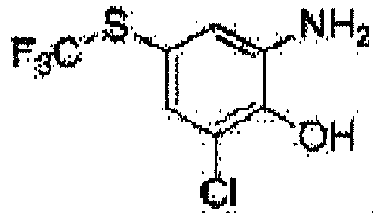
- A mixture of 1.0 g of 2-amino-6-chloro-4-(trifluoromethylsulfanyl)phenol, 0.75 g of 3-ethylsufanylpicolinic acid, 0.94 g of EDCI hydrochloride and 10 ml of chloroform was stirred at room temperature for 1 hour. Water was added to the reaction mixture, and the mixture was extracted with ethyl acetate. The organic layer was washed with a saturated aqueous sodium bicarbonate solution and saturated saline water and dried over anhydrous sodium sulfate, and then concentrated under reduced pressure to obtain 1.78 g of 3-ethylsulfanyl-N-[3-chloro-2-hydroxy-5-(trifluoromethylsul fanyl)phenyl]picolinamide. 3-Ethylsulfanyl-N-[3-chloro-2-hydroxy-5-(trifluoromethylsul fanyl)phenyl]picolinamide

- A mixture of 1.78 g of 3-ethylsulfanyl-N-[3-chloro-2-hydroxy-5-(trifluoromethylsul fanyl)phenyl]picolinamide, 1.53 g of DMEAD, 1.61 g of triphenylphosphine and 40 ml of THF was stirred at 50°C for 1 hour. Water was added to the reaction mixture cooled to room temperature, and the mixture was extracted with ethyl acetate. The organic layer was washed with a saturated aqueous sodium bicarbonate solution and saturated saline water, then dried over anhydrous sodium sulfate, and concentrated under reduced pressure. The resulting residue was applied to a silica gel column chromatography to obtain 1.14 g of 7-chloro-2-(3-ethylsulfanylpyridin-2-yl)-5-(trifluoromethyl sulfanyl)benzoxazole (hereinafter, referred to as Compound of Present Invention 1-5).
-

- 1.78 g of m-chloroperbenzoic acid (purity of 65% or more) was added to a mixture of Compound of Present Invention 1-5 (1.14 g) and 20 ml of chloroform under ice cooling, and then the mixture was stirred under ice cooling for 2 hours. 0.13 g of m-chloroperbenzoic acid (purity of 65% or more) was added to the reacting mixture, and then the mixture was stirred at room temperature for 2 hours. A 10% aqueous sodium sulfite solution was added to the reaction mixture, and the mixture was extracted with chloroform. The organic layer was washed with a saturated aqueous sodium bicarbonate solution, then dried over anhydrous magnesium sulfate, and concentrated under reduced pressure. The resulting residue was applied to a silica gel column chromatography to obtain 0.49 g of 7-chloro-2-(3-ethylsulfonylpyridin-2-yl)-5-(trifluoromethyl sulfanyl)benzoxazole (hereinafter, referred to as Compound of Present Invention 1-6) and 0.70 g of 7-chloro-2-(3-ethylsulfonylpyridin-2-yl)-5-(trifluoromethyl sulfinyl)benzoxazole (hereinafter, referred to as Compound of Present Invention 1-7).
-

-

- 4 ml of aqueous hydrogen peroxide (30%) was added to a mixture of Compound of Present Invention 1-7 (0.35 g), 4 ml of acetonitrile and 27 mg of sodium tungstate dihydrate, and the mixture was stirred at 80°C for 4 hours. Water was added to the reaction mixture cooled to room temperature, and the precipitated solid was obtained by filtration, then the solid and a 10% aqueous sodium sulfite solution were mixed, and the mixture was extracted with ethyl acetate. The organic layer was washed with water and saturated saline water, then dried over anhydrous sodium sulfate, and concentrated under reduced pressure. The resulting residue was applied to a silica gel column chromatography to obtain 0.22 g of 7-chloro-2-(3-ethylsulfonylpyridin-2-yl)-5-(trifluoromethyl sulfonyl)benzoxazole (hereinafter, referred to as Compound of Present Invention 1-8).
-

- 0.4 ml of thionyl chloride was added to a mixture of 0.5 g of 3-ethylsulfanylpicolinic acid, 6 ml of toluene and 0.1 ml of DMF under ice cooling, and the mixture was stirred at 100°C for 4 hours. The reaction mixture was cooled to room temperature, and concentrated under reduced pressure. 8 ml of THF was added to the reaction mixture, and the mixture was added to mixture of 1.23 g of 2-amino-4-(trifluoromethylsulfinyl)phenol and 7 ml of THF, and then the mixture was stirred under ice cooling for 1 hour, and at room temperature overnight. A saturated aqueous sodium bicarbonate solution was added to the reaction mixture, and the mixture was extracted with ethyl acetate. The organic layer was washed with water and saturated saline water, then dried over anhydrous magnesium sulfate, and concentrated under reduced pressure. The resulting solid was washed with hexane to obtain 1.08 g of 3-ethylsulfanyl-N-[2-iodo-4-(trifluoromethyl)phenyl]picolin amide.
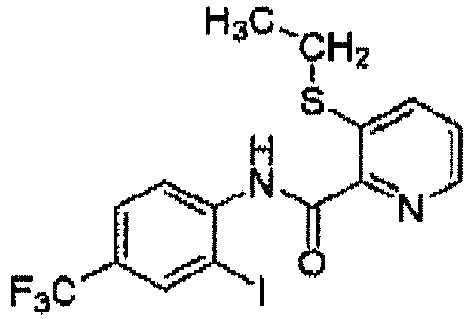
- A mixture of 1.08 g of 3-ethylsulfanyl-N-[2-iodo-4-(trifluoromethyl)phenyl]picolin amid, 0.09 g of copper(I) iodide, 0.17 g of phenanthroline, 1.56 g of cesium carbonate and 10 ml of dimethoxyethane was stirred under heat-refluxing for 20 hours. A saturated aqueous ammonium chloride solution was added to the reaction mixture cooled to room temperature, and the mixture was extracted with ethyl acetate. The resulting organic layer was filtered with celite (registered trademark), and the filtrate was washed with ammonia water, water and saturated saline water, then dried over anhydrous magnesium sulfate, and concentrated under reduced pressure. The resulting residue was applied to a silica gel chromatography to obtain 0.05 g of 2-(3-ethylsulfanylpyridin-2-yl)-6-trifluoromethylbenzoxazol e (hereinafter, referred to as Compound of Present Invention 1-27).
-

- 0.18 g of m-chloroperbenzoic acid (purity of 65% or more) was added to a mixture of Compound of Present Invention 1-27 (0.11 g) and 3 ml of chloroform under ice cooling, and the mixture was stirred at room temperature for 2 hours. A 10% aqueous sodium sulfite solution was added to the reaction mixture, and the mixture was extracted with chloroform. The organic layer was washed with a saturated aqueous sodium bicarbonate solution, then dried over anhydrous magnesium sulfate, and concentrated under reduced pressure to obtain 0.12 g of 2-(3-ethylsulfonylpyridin-2-yl)-6-trifluoromethylbenzoxazol e (hereinafter, referred to as Compound of Present Invention 1-28).
-
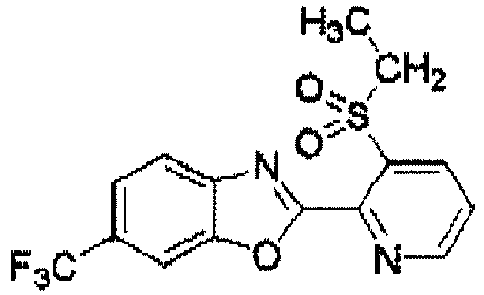
- The compounds described in the production examples described above and the compounds produced by the production method according to the method described in the production examples described above are shown in the tables.
- The compounds of the present invention represented by the formula (1).

- In the formula, R1, R2, R3, R4, J, R6, R7, R8, G and n represent the combinations shown in [Table 12] to [Table 13] shown below.
[Table 12] Compound of Present Invention R1 R2 R3 R4 J R6 R7 R8 G n 1-1 Et H H H J3 Cl - - CF3 0 1-2 Et H H H J3 Cl - - CF3 2 1-3 Et H H H J8 - H H CF(CF3)2 0 1-4 Et H H H J8 - H H CF(CF3)2 2 1-5 Et H H H J4 Cl - - SCF3 0 1-6 Et H H H J4 Cl - - SCF3 2 1-7 Et H H H J4 Cl - - S(O)CF3 2 1-8 Et H H H J4 Cl - - S(O)2CF3 2 1-9 Et H H H J3 Cl - - SCF3 0 1-10 Et H H H J3 Cl - - SCF3 2 1-11 Et H H H J3 Cl - - S(O)CF3 2 1-12 Et H H H J3 Cl - - S(O)2CF3 2 1-13 Et H CF3 H J3 Cl - - SCF3 0 1-14 Et H CF3 H J3 Cl - - SCF3 2 1-15 Et H CF3 H J3 Cl - - S(O)CF3 2 1-16 Et H CF3 H J3 Cl - - S(O)2CF3 2 [Table 13] Compound of Present Invention R1 R2 R3 R4 J R6 R7 R8 G n 1-17 Et H H H J4 Cl - - SCF3 0 1-18 Et H H H J4 Cl - - SCF3 2 1-19 Et H H H J4 Cl - - S(O)CF3 2 1-20 Et H H H J4 Cl - - S(O)2CF3 2 1-21 Et H H H J5 Cl - - CF3 0 1-22 Et H H H J5 Cl - - CF3 2 1-23 Et H H H J6 Cl - - CF3 0 1-24 Et H H H J6 Cl - - CF3 2 1-25 Et H H H J7 Cl - - CF3 0 1-26 Et H H H J7 Cl - - CF3 2 1-27 Et H H H J8 - H - CF3 0 1-28 Et H H H J8 - H - CF3 2 1-29 Et H H H J9 - H - CF3 0 1-30 Et H H H J9 - H - CF3 2 - Next, formulation examples of the compound of the present invention are shown. The part means part by weight.
- 10 parts of any one of Compounds of Present Invention 1-1 to 1-30 is dissolved in a mixture of 35 parts of xylene and 35 parts of N,N-dimethylformamide, and 14 parts of polyoxyethylenestyrylphenyl ether and 6 parts of calcium dodecylbenzenesulfonate are added thereto. The mixture is mixed to obtain each emulsifiable concentrate.
- 4 parts of sodium lauryl sulfate, 2 parts of calcium lignosulfonate, 20 parts of synthetic hydrous silicon oxide fine powder and 54 parts of diatomaceous earth are mixed, and 20 parts of any one of Compounds of Present Invention 1-1 to 1-30 is further added thereto. The mixture is mixed to obtain each wettable powder.
- 1 part of synthetic hydrous silicon oxide fine powder, 2 parts of calcium lignosulfonate, 30 parts of bentonite, 65 parts of kaolin clay are added to and mixed with 2 parts of any one of Compounds of Present Invention 1-1 to 1-30. Subsequently, an appropriate amount of water is added to this mixture, and the mixture is further stirred, granulated with a granulator, and forced-air dried to obtain each granule.
- 1 part of any one of Compounds of Present Invention 1-1 to 1-30 is dissolved in an appropriate amount of acetone, 5 parts of synthetic hydrous silicon oxide fine powder, 0.3 parts of PAP and 93.7 parts of Fubasami clay are added thereto. The mixture is sufficiently stirred and mixed to evaporate and eliminate acetone to obtain each dust formulation.
- 35 parts of a mixture of polyoxyethylene alkyl ether sulfate ammonium salt and white carbon (weight ratio 1 : 1), 10 parts of any one of Compounds of Present Invention 1-1 to 1-30 and 55 parts of water are mixed, and finely pulverized by wet grinding method to obtain each flowable.
- 0.1 parts of any one of Compounds of Present Invention 1-1 to 1-30 is dissolved in 5 parts of xylene and 5 parts of trichloroethane, and the mixture is mixed with 89.9 parts of deodorized kerosene to obtain each oil solution.
- 10 mg of any one of Compounds of Present Invention 1-1 to 1-30 is dissolved in 0.5 ml of acetone, and this solution is applied to 5 g of solid feed powder for animal (solid feed powder for breeding CE-2, product of CLEA Japan, Inc.), and the mixture is uniformly mixed. Subsequently, acetone is evaporated to dryness to obtain each poisonous bait formulation.
- 0.1 parts of any one of Compounds of Present Invention 1-1 to 1-30 and 49.9 parts of Neothiozol (Chuo Kasei Co., Ltd.) are filled into an aerosol can, and an aerosol valve is attached, then the container is filled with 25 parts of dimethyl ether and 25 parts of LPG and shaken, and an actuator is attached to obtain an oil-based aerosol.
- 0.6 parts of any one of Compounds of Present Invention 1-1 to 1-30, 0.01 parts of BHT (2,6-di-tert-butyl-4-methylphenol), 5 parts of xylene, 3.39 parts of deodorized kerosene and 1 part of emulsifier {RHEODOL MO-60 (manufactured by Kao Corporation)} are mixed and dissolved, and the resulting solution and 50 parts of distilled water are filled into an aerosol container. A valve is attached to the container, and then 40 parts of a propellant (LPG) is filled under pressure through the valve to obtain an aqueous aerosol.
- 0.1 g of any one of Compounds of Present Invention 1-1 to 1-30 is dissolved in 2 ml of propylene glycol, and a porous ceramic plate with a size of 4.0 cm × 4.0 cm and 1.2 cm in thickness is impregnated with the solution to obtain a heating type smoking agent.
- 5 parts of any one of Compounds of Present Invention 1-1 to 1-30 and 95 parts of an ethylene-methyl methacrylate copolymer (a ratio of methyl methacrylate in the copolymer: 10% by weight, Acryft WD301, manufactured by SUMITOMO CHEMICAL Co., Ltd.) are melt-kneaded with a closed pressurizing kneader (manufactured by Moriyama Works), and the resulting kneaded matter is extruded from a molding machine through a molding die to obtain a rod-shaped molded body with a size of 15 cm in length and 3 mm in diameter.
- 5 parts of any one of Compounds of Present Invention 1-1 to 1-30 and 95 parts of a soft vinyl chloride resin are melt-kneaded with a closed pressurizing kneader (manufactured by Moriyama Works), and the resulting kneaded matter is extruded from a molding machine through a molding die to obtain a rod-shaped molded body with a size of 15 cm in length and 3 mm in diameter.
- 100 mg of any one of Compounds of Present Invention 1-1 to 1-30, 68.75 mg of lactose, 237.5 mg of corn starch, 43.75 mg of microcrystalline cellulose, 18.75 mg of polyvinylpyrrolidone, 28.75 mg of sodium carboxymethyl starch and 2.5 mg of magnesium stearate are mixed, and the resulting mixture was compressed to an appropriate size to obtain a tablet.
- 25 mg of any one of Compounds of Present Invention 1-1 to 1-30, 60 mg of lactose, 25 mg of corn starch, 6 mg of carmellose calcium and an appropriate amount of 5% hydroxypropyl methylcellulose, and the resulting mixture is filled into a hard shell gelatin capsule or a hydroxypropyl methylcellulose capsule to obtain an encapsulated formulation.
- Distilled water is added to 1000 mg of any one of Compounds of Present Invention 1-1 to 1-30, 500 mg of fumaric acid, 2000 mg of sodium chloride, 150 mg of methylparaben, 50 mg of propylparaben, 25000 mg of granulated sugar, 13000 mg of sorbitol (70% solution), 100 mg of Veegum K (Vanderbilt Co.), 35 mg of flavor and 500 mg of colorant, such that a final volume is 100 ml, and the mixture is mixed to obtain a suspension for oral administration.
- 5% by weight of any one of Compounds of Present Invention 1-1 to 1-30 is dissolved in 5% by weight of polysorbate 85, 3% by weight of benzyl alcohol and 30% by weight of propylene glycol, and a phosphate buffer is added to this solution so as to have a pH of 6.0 to 6.5, and then water is added until it reaches the final volume to obtain a liquid formulation for oral administration.
- 5% by weight of aluminum distearate is dispersed in 57% by weight of fractionated palm oil and 3% by weight of polysorbate 85 by heating. This dispersion is cooled to room temperature, and 25% by weight of saccharin is dispersed in an oily vehicle thereof. 10% by weight of any one of Compounds of Present Invention 1-1 to 1-30 is distributed thereto to obtain a paste formulation for oral administration.
- 5% by weight of any one of Compounds of Present Invention 1-1 to 1-30 and 95% by weight of limestone filler are mixed, and a granule for oral administration is obtained using wet granulation method.
- 5 parts of any one of Compounds of Present Invention 1-1 to 1-30 is dissolved in 80 parts of diethylene glycol monoethyl ether, and 15 parts of propylene carbonate is mixed therewith to obtain a spot-on solution.
- 10 parts of any one of Compounds of Present Invention 1-1 to 1-30 is dissolved in 7C parts of diethylene glycol monoethyl ether, and 20 parts of 2-octyl dodecanol is mixed therewith to obtain a pour-on solution.
- 60 parts of NIKKOL TEALS-42 (Nikko Chemicals Co., Ltd., 42% aqueous solution of triethanolamine lauryl sulfate) and 20 parts of propylene glycol are added to 0.5 parts of any one of Compounds of Present Invention 1-1 to 1-30, and the mixture is sufficiently stirred and mixed until it becomes a uniform solution, and then 19.5 parts of water is added and further sufficiently stirred and mixed to obtain a shampoo agent as a uniform solution.
- 0.15% by weight of any one of Compounds of Present Invention 1-1 to 1-30, 95% by weight of an animal feed and 4.85% by weight of a mixture of secondary calcium phosphate, diatomaceous earth, Aerosil and carbonate (or chalk) are sufficiently stirred and mixed to obtain a feed premix for animal.
- 7.2 g of any one of Compounds of Present Invention 1-1 to 1-30 and 92.8 g of VOSCO S-55 (manufactured by Maruishi Pharmaceutical Co., Ltd.) are dissolved and mixed at 100°C, poured into a suppository mold, and cooled and solidified to obtain a suppository.
- Next, the pest control effect of the compound of the present invention is shown as test examples.
- The formulations of Compounds of Present Invention 1-1, 1-2, 1-3, 1-4, 1-6, 1-7, 1-8 and 1-28 as obtained in Formulation Example 5 were diluted with water, so as to have a concentration of the active ingredient of 500 ppm, to prepare a test drug solution.
- On the other hand, on a cucumber seedling (the first true leaf stage) planted in a plastic cup was inoculated with about 30 Aphis gossypii (whole stage), and left for a day. 20 ml of the test drug solution was sprayed on the seedling
- Six days after spraying, the number of surviving Aphis gossypii parasitic on the leaves of the cucumber was examined, and the controlling value was calculated according to the following equation:

wherein the symbols represent as follows: - Cb: the number of insects in a non-treated section before treatment
- Cai: the number of surviving parasitic insects in a non-treated section on observation
- Tb: the number of insects in a treated section before treatment
- Tai: the number of surviving parasitic insects in a treated section on observation
- wherein the non-created section refers to a section where the test drug solution prepared by diluting the formulation obtained as in Formulation Example 5 but not containing the compound of the present invention with the same amount of water as in the treated section was sprayed.
- As a result, in the treated section where the test drug solution containing each of Compounds of Present Invention 1-1, 1-2, 1-3, 1-4, 1-6, 1-7, 1-8 and 1-28 was used, the control value was 90% or more.
- The formulation of Compound of Present Invention 1-2 as obtained in Formulation Example 5 was diluted with water, so as to have a concentration of the active ingredient of 500 ppm, to prepare a test drug solution.
- On the other hand, a cucumber seedling (the second true leaf stage) planted in a plastic cup was drenched at its foot with 5 ml of the test drug solution, and kept in a greenhouse at 25°C for 7 days. On the cucumber leaf surface was inoculated about 30 Aphis gossypii (whole stage), and further kept in the greenhouse for 6 days, then the number of surviving Aphis gossypii parasitic on the leaves of the cucumber was examined, and the controlling value was calculated according to the following equation:

wherein the symbols represent as follows: - Cb: the number of insects in a non-treated section before treatment
- Cai: the number of surviving parasitic insects in a non-treated section on observation
- Tb: the number of insects in a treated section before treatment
- Tai: the number of surviving parasitic insects in a treated section on observation
- wherein the non-treated section refers to a section where the test drug solution prepared by diluting the formulation obtained as in Formulation Example 5 but not containing the compound of the present invention with the same amount of water as in the treated section was sprayed.
- As a result, in the treated section where the test drug solution containing Compound of Present Invention 1-2 was used, the controlling value was 90% or more.
- The formulations of Compounds of Present Invention 1-1, 1-2, 1-4 and 1-28 obtained in Formulation Example 5 were diluted with water so as to have a concentration of the active ingredient of 500 ppm to prepare a test drug solution.
- On a rice seedling in the second leaf stage planted in a polyethylene cup was sprayed 10 ml of each test drug solution. After air-drying, 20 third-fourth instar larvae of Nilaparvata lugens were released, and kept in the greenhouse at 25°C. After 6 days, the number of surviving Nilaparvata lugens parasitic on the rice was examined, and the controlling value was calculated according to the following equation:

wherein the symbols represent as follows: - Cb: the number of insects in a non-treated section before treatment
- Cai: the number of surviving parasitic insects in a non-treated section on observation
- Tb: the number of insects in a treated section before treatment
- Tai: the number of surviving parasitic insects in a treated section on observation
- wherein the non-treated section refers to a section where the test drug solution prepared by diluting the formulation obtained as in Formulation Example 5 but not containing the compound of the present invention with the same amount of water as in the treated section was sprayed.
- As a result, in the treated section where the test drug solution containing each of Compounds of Present Invention 1-1, 1-2, 1-4 and 1-28 was used, the control value was 90% or more.
- The formulations of Compounds of Present Invention 1-4, 1-7 and 1-28 as obtained in Formulation Example 5 were diluted with water, so as to have a concentration of the active ingredient of 500 ppm, to prepare a test drug solution.
- On the other hand, a rice seedling (2 weeks after sowing, the second leaf stage) planted in a plastic cup was drenched at its foot with 5 ml of each test drug solution, and kept in a greenhouse of 25°C for 7 days. 20 third-fourth instar larvae of Nilaparvata lugens were released, and further kept in the greenhouse for 6 days, then the number of surviving Nilaparvata lugens parasitic on the rice leaves was examined, and the controlling value was calculated according to the following equation:

wherein the symbols represent as follows: - Cb: the number of insects in a non-treated section before treatment
- Cai: the number of surviving parasitic insects in a non-treated section on observation
- Tb: the number of insects in a treated section before treatment
- Tai: the number of surviving parasitic insects in a treated section on observation
- wherein the non-treated section refers to a section where the test drug solution prepared by diluting the formulation obtained as in Formulation Example 5 but not containing the compound of the present invention with the same amount of water as in the treated section was sprayed.
- As a result, in the treated section where the test drug solution containing each of Compounds of Present Invention 1-4, 1-7 and 1-28 was used, the control value was 90% or more.
- The formulation of the compound of the present invention as obtained in Formulation Example 5 is diluted with water, so as to have a concentration of the active ingredient of 500 ppm, to prepare a test drug solution.
- On the other hand, Bemisia tabaci adult is released on a tomato seedling (the third true leaf stage) planted in a polyethylene cup, and made to lay eggs for about 72 hours. The tomato seedling is kept in a greenhouse for 8 days, and when instar larvae hatch from the eggs, the above test drug solution is sprayed at a rate of 20 ml/cup, and the cup is kept in a greenhouse at 25°C. After 7 days, the number of surviving instar larvae on the tomato leaves is examined, and the controlling value is calculated according to the following equation. The control value is excellent in the treated section where the formulation of the compound of the present invention was used.

- In the above equation, the symbols represent as follows:
- Cb: the number of instar larvae in a non-treated section before treatment
- Cai: the number of surviving instar larvae in a non-treated section on observation
- Tb: the number of instar larvae in a treated section before treatment
- Tai: the number of surviving instar larvae in a treated section on observation
- wherein the non-treated section refers to a section where the test drug solution prepared by diluting the formulation obtained as in Formulation Example 5 but not containing the compound of the present invention with the same amount of water as in the treated section was sprayed.
- The formulations of Compounds of Present Invention 1-1, 1-2, 1-3, 1-4, 1-6, 1-7, 1-8 and 1-28 as obtained in Formulation Example 5 were diluted with water, so as to have a concentration of the active ingredient of 500 ppm, to prepare a test drug solution.
- On the other hand, on cabbage at the third leaf stage planted in a polyethylene cup was sprayed, at a rate 20 mL/cup, the test drug solution. After the drug solution was dried, the foliage part was cut off, and then placed in a 50 mL volume cup. Five second instar larvae of Plutella xylostella were released into the cup, and the cup was sealed with a lid. After the cup was kept at 25°C for 5 days, the number of dead insects was counted. The death rate was calculated according to the following equation.

- As a result, in the treated section where the test drug solution containing each of Compounds of Present Invention 1-1, 1-2, 1-3, 1-4, 1-6, 1-7, 1-8 and 1-28 was used, the death rate was 80% or more.
- The formulations of Compounds of Present Invention 1-1, 1-2, 1-4, 1-6, 1-7, 1-8 and 1-28 obtained in Formulation Example 5 were diluted with water, so as to have a concentration of the active ingredient of 500 ppm, to prepare a test spray solution.
- On the other hand, an apple tree was planted in a plastic cup, and grown until the seventh-eighth true leaf was spread. To the apple tree was sprayed, at a rate of 20 mL/cup, the test drug solution. After the drug solution was dried, 60 first-instar larvae of Adoxophyes orana fasciata were released, and covered with a plastic cup the bottom of which was cut off and on which a filter paper was put, with the plastic cup cover placed upside-down. After 7 days, the number of dead insects was counted, and the death rate was calculated according to the following equation.

- As a result, in the treated section where the test drug solution containing each of Compounds of Present Invention 1-1, 1-2, 1-4, 1-6, 1-7, 1-8 and 1-28 was used, the death rate was 90% or more.
- The formulation of the compound of the present invention as obtained in Formulation Example 5 is diluted with water, so as to have a concentration of the active ingredient of 500 ppm, to prepare a test drug solution.
- A filter paper having a diameter of 5.5 cm is spread on the bottom of a polyethylene cup having the same diameter and 0.7 ml of the test drug solution is added dropwise onto the filter paper, and 30 mg of sucrose is uniformly placed as bait. Into the polyethylene cup, 10 female imagoes of Musca domestica are released, and the cup is sealed with a lid. After 24 hours, the life and death of Musca domestica is examined, and the number of dead insects is counted. The death rate is calculated according to the following equation, and the sufficient death rate is obtained.

- The formulation of Compound of Present Invention 1-3 as obtained in Formulation Example 5 was diluted with water, so as to have a concentration of the active ingredient of 500 ppm, to prepare a test drug solution.
- A filter paper having a diameter of 5.5 cm was spread on the bottom of a polyethylene cup having the same diameter and 0.7 ml of the test drug solution was added dropwise onto the filter paper, and 30 mg of sucrose was uniformly placed as bait. Into the polyethylene cup, 2 male imagoes of Blattella germanica were released, and the cup was sealed with a lid. After 6 days, the life and death of Blattella germanica was examined, the number of dead insects was counted, and the death rate was calculated according to the following equation.

- As a result, in the treated section where the test drug solution containing Compound of Present Invention 1-3 was used, the death rate was 100%.
- The formulations of Compounds of Present Invention 1-1, 1-2, 1-3, 1-4, 1-6, 1-7, 1-8 and 1-28 as obtained in Formulation Example 5 were diluted with water, so as to have a concentration of the active ingredient of 500 ppm, to prepare a test drug solution.
- 20 Last-instar larvae of Culex pipiens pallens were released into a liquid to which 0.7 ml of the above test drug solution was added to 100 ml of ion-exchanged water (a concentration of the active ingredient of 3.5 ppm). After One day, the number of dead insects was counted, and the death rate was calculated according to the following equation.

- As a result, in the treated section where the test drug solution containing each of Compounds of Present Invention 1-1, 1-2, 1-3, 1-4, 1-6, 1-7, 1-8 and 1-28 was used, the death rate was 95% or more.
- Compound of Present Invention 1-2 (2 mg) was weighed in a screw tube (Maruemu No. 5; 27 × 55 mm), 0.2 mL of acetone was added thereto, and the screw tube was sealed with a cap to dissolve the compound. The screw tube was rotated and inverted to uniformly coat the drug solution onto the whole inner wall of the tube. After removing the cap, the solution was air-dried for about 2 hours, then unfed nymphal ticks, Haemaphysalis longicornis (5 ticks/group) were released, and the tube was sealed with the cap. After 2 days, the number of dead insects was counted, and the death rate was calculated according to the following equation.

- As a result, in the treated section where the test drug solution containing Compound of Present Invention 1-2 was used, the death rate was 100%.
- The compound of the present invention has a controlling effect on pests and is useful as an active ingredient of a pest control agent.
In the formula (1-1a), compounds wherein q is 2;
In the formula (1-1a), compounds wherein q is 3;
In the formula (1-1a), compounds wherein R1a is a C1 to C6 alkyl group optionally having one or more halogen atoms;
In the formula (1-1a), compounds wherein R1a is a C1 to C6 alkyl group;
In the formula (1-1a), compounds wherein R1A is a C1 to C3 alkyl group;
In the formula (1-1a), compounds wherein R1a is a methyl group, an ethyl group, a propyl group, a cyclopropyl group or a cyclopropylmethyl group;
In the formula (1-1a), compounds wherein R1a is a methyl group, an ethyl group or a propyl group;
In the formula (1-1a), compounds wherein R3a is a C1 to C6 alkyl group optionally having one or more halogen atoms or a hydrogen atom;
In the formula (1-1a), compounds wherein R3a is a trifluoromethyl group, a halogen atom or a hydrogen atom; In the formula (1-1a), compounds wherein R1a is an ethyl group, and R3a is a trifluoromethyl group or a hydrogen atom;
In the formula (1-1a), compounds wherein R1a is an ethyl group, and R3a is a trifluoromethyl group;
In the formula (1-1a), compounds wherein R1a is an ethyl group, and R3a is a hydrogen atom;
In the formula (1-1a), compounds wherein Ga is a C1 to C3 perfluoroalkyl group;
In the formula (1-1a), compounds wherein Ga is OR11;
In the formula (1-1a), compounds wherein Ga is S(O)mR11;
In the formula (1-1a), compounds wherein Ga is a trifluoromethyl group, a pentafluoroethyl group, a heptafluoropropyl group, a heptafluoroisopropyl group, a trifluoromethoxy group, a trifluoromethylsulfanyl group, a trifluoromethylsulfinyl group or a trifluoromethylsulfonyl group;
In the formula (1-1a), compounds wherein Ga is a trifluoromethyl group;
In the formula (1-1a), compounds wherein Ga is a pentafluoroethyl group;
In the formula (1-1a), compounds wherein Ga is a heptafluoropropyl group;
In the formula (1-1a), compounds wherein Ga is a heptafluoroisopropyl group;
In the formula (1-1a), compounds wherein Ga is a trifluoromethoxy group;
In the formula (1-1a), compounds wherein Ga is a trifluoromethylsulfanyl group;
In the formula (1-1a), compounds wherein Ga is a trifluoromethylsulfinyl group;
In the formula (1-1a), compounds wherein Ga is a trifluoromethylsulfonyl group;
In the formula (1-1a), compounds wherein q is 1, and R6a is OR5a, S(O)mR5a, NR5aR10a or a halogen atom;
In the formula (1-1a), compounds wherein q is 1, and R6a is a methoxy group, an ethoxy group, a methylsulfanyl group, a methylsulfonyl group, an ethylsulfanyl group, an ethylsulfonyl group, a methylamino group, a dimethylamino group, a diethylamino group or a halogen atom;
In the formula (1-1a), compounds wherein q is 1, and R6a is a halogen atom;
In the formula (1-1a), compounds wherein q is 1, and R6a is a fluorine atom;
In the formula (1-1a), compounds wherein q is 1, and R6a is a chlorine atom;
In the formula (1-1a), compounds wherein q is 1, and R6a is a bromine atom;
In the formula (1-1a), compounds wherein q is 1, and R6a is an iodine atom;
In the formula (1-1a), compounds wherein R1a is a C1 to C3 alkyl group, R3a is a C1 to C6 alkyl group optionally having one or more halogen atoms, or a hydrogen atom, Ga is a trifluoromethyl group, a pentafluoroethyl group, a heptafluoropropyl group, a heptafluoroisopropyl group, a trifluoromethoxy group, a trifluoromethylsulfanyl group, a trifluoromethylsulfinyl group or a trifluoromethylsulfonyl group, q is 1, and R6a is OR5a, S(O)mR5a, NR5aR10a or a halogen atom;
In the formula (1-1a), compounds wherein R1a is an ethyl group, R3a is a trifluoromethyl group or a hydrogen atom, Ga is a trifluoromethyl group, a pentafluoroethyl group, a heptafluoropropyl group, a heptafluoroisopropyl group, a trifluoromethoxy group, a trifluoromethylsulfanyl group, a trifluoromethylsulfinyl group or a trifluoromethylsulfonyl group, q is 1, and R6a is a methoxy group, an ethoxy group, a methylsulfanyl group, a methylsulfonyl group, an ethylsulfanyl group, an ethylsulfonyl group, a methylamino group, a dimethylamino group, a diethylamino group or a halogen atom; Compounds represented by formula (1-2),

compounds represented by formula (1-2a),

In the formula (1-2a), compounds wherein q is 2;
In the formula (1-2a), compounds wherein R1a is a C1 to C6 alkyl group optionally having one or more halogen atoms;
In the formula (1-2a), compounds wherein R1a is a C1 to C6 alkyl group;
In the formula (1-2a), compounds wherein R1a is a C1 to C3 alkyl group;
In the formula (1-2a), compounds wherein R1a is a methyl group, an ethyl group, a propyl group, a cyclopropyl group or a cyclopropylmethyl group;
In the formula (1-2a), compounds wherein R1a is a methyl group, an ethyl group or a propyl group;
In the formula (1-2a), compounds wherein R3a is a C1 to C6 alkyl group optionally having one or more halogen atoms or a hydrogen atom;
In the formula (1-2a), compounds wherein R3a is a trifluoromethyl group, a halogen atom or a hydrogen atom; In the formula (1-2a), compounds wherein R1a is an ethyl group, and R3a is a trifluoromethyl group or a hydrogen atom;
In the formula (1-2a), compounds wherein R1a is an ethyl group, and R3a is a trifluoromethyl group;
In the formula (1-2a), compounds wherein R1a is an ethyl group, and R3a is a hydrogen atom;
In the formula (1-2a), compounds wherein Ga is a C1 to C3 perfluoroalkyl group;
In the formula (1-2a), compounds wherein Ga is OR11;
In the formula (1-2a), compounds wherein Ga is S(O)mR11;
In the formula (1-2a), compounds wherein Ga is a trifluoromethyl group, a pentafluoroethyl group, a heptafluoropropyl group, a heptafluoroisopropyl group, a trifluoromethoxy group, a trifluoromethylsulfanyl group, a trifluoromethylsulfinyl group or a trifluoromethylsulfonyl group;
In the formula (1-2a), compounds wherein Ga is a trifluoromethyl group;
In the formula (1-2a), compounds wherein Ga is a pentafluoroethyl group;
In the formula (1-2a), compounds wherein Ga is a heptafluoropropyl group;
In the formula (1-2a), compounds wherein Ga is a heptafluoroisopropyl group;
In the formula (1-2a), compounds wherein Ga is a trifluoromethoxy group;
In the formula (1-2a), compounds wherein Ga is a trifluoromethylsulfanyl group;
In the formula (1-2a), compounds wherein Ga is a trifluoromethylsulfinyl group;
In the formula (1-2a), compounds wherein Ga is a trifluoromethylsulfonyl group;
In the formula (1-2a), compounds wherein q is 1, and R6a is OR5a, S(O)mR5a, NR5aR10a or a halogen atom;
In the formula (1-2a), compounds wherein q is 1, and R6a is a methoxy group, an ethoxy group, a methylsulfanyl group, a methylsulfonyl group, an ethylsulfanyl group, an ethylsulfonyl group, a methylamino group, a dimethylamino group, a diethylamino group or a halogen atom;
In the formula (1-2a), compounds wherein q is 1, and R6a is a halogen atom;
In the formula (1-2a), compounds wherein q is 1, and R6a is a fluorine atom;
In the formula (1-2a), compounds wherein q is 1, and R6a is a chlorine atom;
In the formula (1-2a), compounds wherein q is 1, and R6a is a bromine atom;
In the formula (1-2a), compounds wherein q is l, and R6a is an iodine atom;
In the formula (1-2a), compounds wherein R1a is a C1 to C3 alkyl group, R3a is a C1 to C6 alkyl group optionally having one or more halogen atoms, or a hydrogen atom, Ga is a trifluoromethyl group, a pentafluoroethyl group, a heptafluoropropyl group, a heptafluoroisopropyl group, a trifluoromethoxy group, a trifluoromethylsulfanyl group, a trifluoromethylsulfinyl group or a trifluoromethylsulfonyl group, q is 1, and R6a is OR5a, S(O)mR5a, NR5aR10a or a halogen atom;
In the formula (1-2a), compounds wherein R1a is an ethyl group, R3a is a trifluoromethyl group or a hydrogen atom, Ga is a trifluoromethyl group, a pentafluoroethyl group, a heptafluoropropyl group, a heptafluoroisopropyl group, a trifluoromethoxy group, a trifluoromethylsulfanyl group, a trifluoromethylsulfinyl group or a trifluoromethylsulfonyl group, q is 1, and R6a is a methoxy group, an ethoxy group, a methylsulfanyl group, a methylsulfonyl group, an ethylsulfanyl group, an ethylsulfonyl group, a methylamino group, a dimethylamino group, a diethylamino group or a halogen atom; Compounds represented by formula (1-3),

Compounds represented by formula (1-3a),

In the formula (1-3a), compounds wherein R1a is a C1 to C6 alkyl group;
In the formula (1-3a), compounds wherein R1a is a C1 to C3 alkyl group;
In the formula (1-3a), compounds wherein R1a is a methyl group, an ethyl group, a propyl group, a cyclopropyl group or a cyclopropylmethyl group;
In the formula (1-3a), compounds wherein R1a is a methyl group, an ethyl group or a propyl group;
In the formula (1-3a), compounds wherein R3a is a C1 to C6 alkyl group optionally having one or more halogen atoms or a hydrogen atom;
In the formula (1-3a), compounds wherein R3a is a trifluoromethyl group, a halogen atom or a hydrogen atom;
In the formula (1-3a), compounds wherein R1a is an ethyl group, and R3a is a trifluoromethyl group or a hydrogen atom;
In the formula (1-3a), compounds wherein R1a is an ethyl group, and R3a is a trifluoromethyl group;
In the formula (1-3a), compounds wherein R1a is an ethyl group, and R3a is a hydrogen atom;
In the formula (1-3a), compounds wherein Ga is a C1 to C3 perfluoroalkyl group;
In the formula (1-3a), compounds wherein Ga is OR11;
In the formula (1-3a), compounds wherein Ga is S(O)mR11;
In the formula (1-3a), compounds wherein Ga is a trifluoromethyl group, a pentafluoroethyl group, a heptafluoropropyl group, a heptafluoroisopropyl group, a trifluoromethoxy group, a trifluoromethylsulfanyl group, a trifluoromethylsulfinyl group or a trifluoromethylsulfonyl group;
in the formula (1-3a), compounds wherein Ga is a trifluoromethyl group;
In the formula (1-3a), compounds wherein Ga is a pentafluoroethyl group;
In the formula (1-3a), compounds wherein Ga is a heptafluoropropyl group;
In the formula (1-3a), compounds wherein Ga is a heptafluoroisopropyl group;
In the formula (1-3a), compounds wherein Ga is a trifluoromethoxy group;
In the formula (1-3a), compounds wherein Ga is a trifluoromethylsulfanyl group;
In the formula (1-3a), compounds wherein Ga is a trifluoromethylsulfinyl group;
In the formula (1-3a), compounds wherein Ga is a trifluoromethylsulfonyl group;
In the formula (1-3a), compounds wherein R7a is a C1 to C3 alkyl group optionally having one or more halogen atoms, GR5a, S(O)mR5a, NR5aR10a, a halogen atom or a hydrogen atom;
In the formula (1-3a), compounds wherein R7a is a trifluoromethyl group, a methoxy group, an ethoxy group, a methylsulfanyl group, a methylsulfonyl group, an ethylsulfanyl group, an ethylsulfonyl group, a methylamino group, a dimethylamino group, a diethylamino group, a halogen atom or a hydrogen atom;
In the formula (1-3a), compounds wherein R7a is a trifluoromethyl group;
In the formula (1-3a), compounds wherein R7a is a halogen atom;
In the formula (1-3a), compounds wherein R7a is a fluorine atom;
In the formula (1-3a), compounds wherein R7a is a chlorine atom;
In the formula (1-3a), compounds wherein R7a is a bromine atom;
In the formula (1-3a), compounds wherein R7a is an iodine atom;
In the formula (1-3a), compounds wherein R7a is a hydrogen atom;
In the formula (1-3a), compounds wherein R1a is a C1 to C3 alkyl group, R3a is a C1 to C6 alkyl group optionally having one or more halogen atoms or a hydrogen atom, Ga is a trifluoromethyl group, a pentafluoroethyl group, a heptafluoropropyl group, a heptafluoroisopropyl group, a trifluoromethoxy group, a trifluoromethylsulfanyl group, a trifluoromethylsulfinyl group or a trifluoromethylsulfonyl group, and R7a is a trifluoromethyl group, a methoxy group, an ethoxy group, a methylsulfanyl group, a methylsulfonyl group, an ethylsulfanyl group, an ethylsulfonyl group, a methylamino group, a dimethylamino group, a diethylamino group, a halogen atom or a hydrogen atom;
In the formula (1-3a), compounds wherein R1a is an ethyl group, R3a is a trifluoromethyl group or a hydrogen atom, Ga is a trifluoromethyl group, a pentafluoroethyl group, a heptafluoropropyl group, a heptafluoroisopropyl group, a trifluoromethoxy group, a trifluoromethylsulfanyl group, a trifluoromethylsulfinyl group or a trifluoromethylsulfonyl group, and R7a is a hydrogen atom;
Compounds represented by formula (1-4),

Compounds represented by formula (1-4a),

In the formula (1-4a), compounds wherein R1a is a C1 to C3 alkyl group;
In the formula (1-4a), compounds wherein R1a is a methyl group, an ethyl group, a propyl group, a cyclopropyl group or a cyclopropylmethyl group;
In the formula (1-4a), compounds wherein R1a is a methyl group, an ethyl group or a propyl group;
In the formula (1-4a), compounds wherein R3a is a C1 to C6 alkyl group optionally having one or more halogen atoms or a hydrogen atom;
In the formula (1-4a), compounds wherein R3a is a trifluoromethyl group, a halogen atom or a hydrogen atom;
In the formula (1-4a), compounds wherein R1a is an ethyl group, and R3a is a trifluoromethyl group or a hydrogen atom;
In the formula (1-4a), compounds wherein R1a is an ethyl group, and R3a is a trifluoromethyl group;
In the formula (1-4a), compounds wherein R1a is an ethyl group, and R3a is a hydrogen atom;
In the formula (1-4a), compounds wherein Ga is a C1 to C3 perfluoroalkyl group;
In the formula (1-4a), compounds wherein Ga is OR11;
In the formula (1-4a), compounds wherein Ga is S(O)mR11;
In the formula (1-4a), compounds wherein Ga is a trifluoromethyl group, a pentafluoroethyl group, a heptafluoropropyl group, a heptafluoroisopropyl group, a trifluoromethoxy group, a trifluoromethylsulfanyl group, a trifluoromethylsulfinyl group or a trifluoromethylsulfonyl group;
In the formula (1-4a), compounds wherein Ga is a trifluoromethyl group;
In the formula (1-4a), compounds wherein Ga is a pentafluoroethyl group;
In the formula (1-4a), compounds wherein Ga is a heptafluoropropyl group;
In the formula (1-4a), compounds wherein Ga is a heptafluoroisopropyl group;
In the formula (1-4a), compounds wherein Ga is a trifluoromethoxy group;
In the formula (1-4a), compounds wherein Ga is a trifluoromethylsulfanyl group;
In the formula (1-4a), compounds wherein Ga is a trifluoromethylsulfinyl group;
In the formula (1-4a), compounds wherein Ga is a trifluoromethylsulfonyl group;
In the formula (1-4a), compounds wherein R7a is a C1 to C3 alkyl group optionally having one or more halogen atoms, OR5a, S(O)mR5a, NR5aR10a, a halogen atom or a hydrogen atom;
In the formula (1-4a), compounds wherein R7a is a trifluoromethoxy group, a methoxy group, an ethoxy group, a methylsulfanyl group, a methylsulfonyl group, an ethylsulfanyl group, an ethylsulfonyl group, a methylamino group, a dimethylamino group, a diethylamino group, a halogen atom or a hydrogen atom;
In the formula (1-4a), compounds wherein R7a is a trifluoromethyl group;
In the formula (1-4a), compounds wherein R7a is a halogen atom; In the formula (1-4a), compounds wherein R7a is a fluorine atom;
In the formula (1-4a), compounds wherein R7a is a chlorine atom;
In the formula (1-4a), compounds wherein R7a is a bromine atom;
In the formula (1-4a), compounds wherein R7a is an iodine atom;
In the formula (1-4a), compounds wherein R7a is a hydrogen atom;
In the formula (1-4a), compounds wherein R1a is a C1 to C3 alkyl group, R3a is a C1 to C6 alkyl group optionally having one or more halogen atoms, or a hydrogen atom, Ga is a trifluoromethyl group, a pentafluoroethyl group, a heptafluoropropyl group, a heptafluoroisopropyl group, a trifluoromethoxy group, a trifluoromethylsulfanyl group, a trifluoromethylsulfinyl group or a trifluoromethylsulfonyl group, and R7a is a halogen atom or a hydrogen atom;
In the formula (1-4a), compounds wherein R1a is an ethyl group, R3a is a trifluoromethyl group or a hydrogen atom, Ga is a trifluoromethyl group, a pentafluoroethyl group, a heptafluoropropyl group, a heptafluoroisopropyl group, a trifluoromethoxy group, a trifluoromethylsulfanyl group, a trifluoromethylsulfinyl group or a trifluoromethylsulfonyl group, and R7a is a hydrogen atom;
Compounds represented by formula (1-5),

Compounds represented by formula (1-5a),

In the formula (1-5a), compounds wherein R1a is a C1 to C6 alkyl group;
In the formula (1-5a), compounds wherein R1a is a C1 to C3 alkyl group;
In the formula (1-5a), compounds wherein R1a is a methyl group, an ethyl group, a propyl group, a cyclopropyl group or a cyclopropylmethyl group;
In the formula (1-5a), compounds wherein R1a is a methyl group, an ethyl group or a propyl group;
In the formula (1-5a), compounds wherein R3a is a C1 to C6 alkyl group optionally having one or more halogen atoms or a hydrogen atom;
In the formula (1-5a), compounds wherein R3a is a trifluoromethyl group, a halogen atom or a hydrogen atom;
In the formula (1-5a), compounds wherein R1a is an ethyl group, and R3a is a trifluoromethyl group or a hydrogen atom;
In the formula (1-5a), compounds wherein R1a is an ethyl group, and R3a is a trifluoromethyl group;
In the formula (1-5a), compounds wherein R1a is an ethyl group, and R3a is a hydrogen atom;
In the formula (1-5a), compounds wherein Ga is a C1 to C3 perfluoroalkyl group;
In the formula (1-5a), compounds wherein Ga is OR11;
In the formula (1-5a), compounds wherein Ga is S(O)mR11;
In the formula (1-5a), compounds wherein Ga is a trifluoromethyl group, a pentafluoroethyl group, a heptafluoropropyl group, a heptafluoroisopropyl group, a trifluoromethoxy group, a trifluoromethylsufanyl group, a trifluoromethylsulfinyl group or a trifluoromethylsulfonyl group;
In the formula (1-5a), compounds wherein Ga is a trifluoromethyl group;
In the formula (1-5a), compounds wherein Ga is a pentafluoroethyl group;
In the formula (1-5a), compounds wherein Ga is a heptafluoropropyl group;
In the formula (1-5a), compounds wherein Ga is a heptafluoroisopropyl group;
In the formula (1-5a), compounds wherein Ga is a trifluoromethoxy group;
In the formula (1-5a), compounds wherein Ga is a trifluoromethylsufanyl group;
In the formula (1-5a), compounds wherein Ga is a trifluoromethylsulfinyl group;
In the formula (1-5a), compounds wherein Ga is a trifluoromethylsulfonyl group;
In the formula (1-5a), compounds wherein R6a is OR5a, S(O)mR5a, NR5aR10a or a halogen atom;
In the formula (1-5a), compounds wherein R6a is a methoxy group, an ethoxy group, a methylsulfanyl group, a methylsulfonyl group, an ethylsulfanyl group, an ethylsulfonyl group, a methylamino group, a dimethylamino group, a dimethylamino group or a halogen atom;
In the formula (1-5a), compounds wherein R6a is a halogen atom;
In the formula (1-5a), compounds wherein R6a is a fluorine atom;
In the formula (1-5a), compounds wherein R6a is a chlorine atom;
In the formula (1-5a), compounds wherein R6a is a bromine atom;
In the formula (1-5a), compounds wherein R6a is an iodine atom;
In the formula (1-5a), compounds wherein R1a is a C1 to C3 alkyl group, R3a is a C1 to C6 alkyl group optionally having one or more halogen atoms, or a hydrogen atom, Ga is a trifluoromethyl group, a pentafluoroethyl group, a heptafluoropropyl group, a heptafluoroisopropyl group, a trifluoromethoxy group, a trifluoromethylsulfanyl group, a trifluoromethylsulfinyl group or a trifluoromethylsulfonyl group, and R6a is OR5a, S(O)mR5a, NR5aR10a or a halogen atom;
In the formula (1-5a), compounds wherein R1a is an ethyl group, R3a is a trifluoromethyl group or a hydrogen atom, Ga is a trifluoromethyl group, a pentafluoroethyl group, a heptafluoropropyl group, a heptafluoroisopropyl group, a trifluoromethoxy group, a trifluoromethylsulfanyl group, a trifluoromethylsulfinyl group or a trifluoromethylsulfonyl group, and R6a is a methoxy group, an ethoxy group, a methylsulfanyl group, a methylsulfonyl group, an ethylsulfanyl group, an ethylsulfonyl group, a methylamino group, a dimethylamino group, a dimethylamino group or a halogen atom; Compounds represented by formula (1-6),

Compounds represented by formula (1-5a),

In the formula (1-6a), compounds wherein R1a is a C1 to C6 alkyl group;
In the formula (1-6a), compounds wherein R1a is a C1 to C3 alkyl group;
In the formula (1-6a), compounds wherein R1a is a methyl group, an ethyl group, a propyl group, a cyclopropyl group or a cyclopropylmethyl group;
In the formula (1-6a), compounds wherein R1a is a methyl group, an ethyl group or a propyl group;
In the formula (1-6a), compounds wherein R3a is a C1 to C6 alkyl group optionally having one or more halogen atoms or a hydrogen atom;
In the formula (1-6a), compounds wherein R3a is a trifluoromethyl group, a halogen atom or a hydrogen atom;
In the formula (1-6a), compounds wherein R1a is an ethyl group, and R3a is a trifluoromethyl group or a hydrogen atom;
In the formula (1-6a), compounds wherein R1a is an ethyl group, and R3a is a trifluoromethyl group;
In the formula (1-6a), compounds wherein R1a is an ethyl group, and R3a is a hydrogen atom;
In the formula (1-6a), compounds wherein Ga is a C1 to C3 perfluoroalkyl group;
In the formula (1-6a), compounds wherein Ga is OR11;
In the formula (1-6a), compounds wherein Ga is S(O)mR11;
In the formula (1-6a), compounds wherein Ga is a trifluoromethyl group, a pentafluoroethyl group, a heptafluoropropyl group, a heptafluoroisopropyl group, a trifluoromethoxy group, a trifluoromethylsulfanyl group, a trifluoromethylsulfinyl group or a trifluoromethylsulfonyl group;
In the formula (1-6a), compounds wherein Ga is a trifluoromethyl group;
In the formula (1-6a), compounds wherein Ga is a pentafluoroethyl group;
In the formula (1-6a), compounds wherein Ga is a heptafluoropropyl group;
In the formula (1-6a), compounds wherein Ga is a heptafluoroisopropyl group;
In the formula (1-6a), compounds wherein Ga is a trifluoromethoxy group;
In the formula (1-6a), compounds wherein Ga is a trifluoromethylsulfanyl group;
In the formula (1-6a), compounds wherein Ga is a trifluoromethylsufinyl group;
In the formula (1-6a), compounds wherein Ga is a trifluoromethylsulfonyl group;
In the formula (1-6a), compounds wherein R6a is OR5a, S(O)mR5a, NR5aR10a of a halogen atom;
In the formula (1-6a), compounds wherein R6a is a methoxy group, an ethoxy group, a methylsulfanyl group, a methylsulfonyl group, an ethylsulfanyl group, an ethylsulfonyl group, a methylamino group, a dimethylamino group, a dimethylamino group or a halogen atom;
In the formula (1-6a), compounds wherein R6a is a halogen atom;
In the formula (1-6a), compounds wherein R6a is a fluorine atom;
In the formula (1-6a), compounds wherein R6a is a chlorine atom;
In the formula (1-6a), compounds wherein R6a is a bromine atom;
In the formula (1-6a), compounds wherein R6a is an iodine atom;
In the formula (1-6a), compounds wherein R1a is a C1 to C3 alkyl group, R3a is a C1 to C6 alkyl group optionally having one or more halogen atoms, or a hydrogen atom, Ga is a trifluoromethyl group, a pentafluoroethyl group, a heptafluoropropyl group, a heptafluoroisopropyl group, a trifluoromethoxy group, a trifluoromethylsulfanyl group, a trifluoromethylsulfinyl group or a trifluoromethylsulfonyl group, and R6a is OR5a, S(O)mR5a, NR5aR10a or a halogen atom;
In the formula (1-6a), compounds wherein R1a is an ethyl group, R3a is a trifluoromethyl group or a hydrogen atom, Ga is a trifluoromethyl group, a pentafluoroethyl group, a heptafluoropropyl group, a heptafluoroisopropyl group, a trifluoromethoxy group, a trifluoromethylsulfanyl group, a trifluoromethylsulfinyl group or a trifluoromethylsulfonyl group, and R6a is a methoxy group, an ethoxy group, a methylsulfanyl group, a methylsulfonyl group, an ethylsulfanyl group, an ethylsulfonyl group, a methylamino group, a dimethylamino group, a dimethylamino group or a halogen atom; Compounds represented by formula (1-7),

Compounds represented by formula (1-7a),

In the formula (1-7a), compounds wherein R1a is a C1 to C6 alkyl group;
In the formula (1-7a), compounds wherein R1a is a C1 to C3 alkyl group;
In the formula (1-7a), compounds wherein R1a is a methyl group, an ethyl group, a propyl group, a cyclopropyl group or a cyclopropylmethyl group;
In the formula (1-7a), compounds wherein R1a is a methyl group, an ethyl group or a propyl group;
In the formula (1-7a), compounds wherein R3a is a C1 to C6 alkyl group optionally having one or more halogen atoms or a hydrogen atom;
In the formula (1-7a), compounds wherein R3a is a trifluoromethyl group, a halogen atom or a hydrogen atom; +In the formula (1-7a), compounds wherein R1a is an ethyl group, and R3a is a trifluoromethyl group or a hydrogen atom;
In the formula (1-7a), compounds wherein R1a is an ethyl group, and R3a is a trifluoromethyl group;
In the formula (1-7a), compounds wherein R1a is an ethyl group, and R3a is a hydrogen atom;
In the formula (1-7a), compounds wherein Ga is a C1 to C3 perfluoroalkyl group;
In the formula (1-7a), compounds wherein Ga is OR11;
In the formula (1-7a), compounds wherein Ga is S(O)mR11;
In the formula (1-7a), compounds wherein Ga is a trifluoromethyl group, a pentafluoroethyl group, a heptafluoropropyl group, a heptafluoroisopropyl group, a trifluoromethoxy group, a trifluoromethylsulfanyl group, a trifluoromethylsulfinyl group or a trifluoromethylsulfonyl group;
In the formula (1-7a), compounds wherein Ga is a trifluoromethyl group;
In the formula (1-7a), compounds wherein Ga is a pentafluoroethyl group;
In the formula (1-7a), compounds wherein Ga is a heptafluoropropyl group;
In the formula (1-7a), compounds wherein Ga is a heptafluoroisopropyl group;
In the formula (1-7a), compounds wherein Ga is a trifluoromethoxy group;
In the formula (1-7a), compounds wherein Ga is a trifluoromethylsulfanyl group;
In the formula (1-7a), compounds wherein Ga is a trifluoromethylsulfinyl group;
In the formula (1-7a), compounds wherein Ga is a trifluoromethylsulfonyl group;
In the formula (1-7a), compounds wherein R6a is OR5a, S(O)mR5a, NR5aR10a or a halogen atom;
In the formula (1-7a), compounds wherein R6a is a methoxy group, an ethoxy group, a methylsulfanyl group, a methylsulfonyl group, an ethylsulfanyl group, an ethylsulfonyl group, a methylamino group, a dimethylamino group, a dimethylamino group or a halogen atom;
In the formula (1-7a), compounds wherein R6a is a halogen atom;
In the formula (1-7a), compounds wherein R6a is a fluorine atom;
In the formula (1-7a), compounds wherein R6a is a chlorine atom;
In the formula (1-7a), compounds wherein R6a is a bromine atom;
In the formula (1-7a), compounds wherein R6a is an iodine atom,
In the formula (1-7a), compounds wherein R1a is a C1 to C3 alkyl group, R3a is a C1 to C6 alkyl group optionally having one or more halogen atoms, or a hydrogen atom, Ga is a trifluoromethyl group, a pentafluoroethyl group, a heptafluoropropyl group, a heptafluoroisopropyl group, a trifluoromethoxy group, a trifluoromethylsulfanyl group, a trifluoromethylsulfinyl group or a trifluoromethylsulfonyl group, and R6a is OR5a, S(O)mR5a, NR5aR10a or a halogen atom;
In the formula (1-7a), compounds wherein R1a is an ethyl group, R3a is a trifluoromethyl group or a hydrogen atom, Ga is a trifluoromethyl group, a pentafluoroethyl group, a heptafluoropropyl group, a heptafluoroisopropyl group, a trifluoromethoxy group, a trifluoromethylsulfanyl group, a trifluoromethylsulfinyl group or a trifluoromethylsulfonyl group, and R6a is a methoxy group, an ethoxy group, a methylsulfanyl group, a methylsulfonyl group, an ethylsulfanyl group, an ethylsulfonyl group, a methylamino group, a dimethylamino group, a dimethylamino group or a halogen atom;
In the compound of the present invention, examples of the N-oxide include the compounds represented by, for example, the following formulae (1A) to (1F).
Compounds represented by formula (1A)

In the formula (1A), compounds wherein

In the formula (1B), compounds wherein
Compounds represented by formula (1C)

In the formula (1C), compounds wherein A1 is N;
In the formula (1C), compounds wherein A1 is CH;
In the formula (1C), compounds wherein A1 is CR6;
In the formula (1C), compounds wherein R1 is a C1 to C6 alkyl group optionally having one or more halogen atoms or one or more cyclopropyl groups (wherein the cyclopropyl group optionally has one or more halogen atoms or one or more C1 to C3 alkyl groups), both R2 and R4 are a hydrogen atom, R3 is a C1 to C6 alkyl group optionally having one or more halogen atoms, a C2 to C6 alkenyl group optionally having one or more halogen atoms, a C2 to C6 alkynyl group optionally having one or more halogen atoms, a pyridyl group, a pyrimidinyl group (wherein the pyridyl group and the pyrimidinyl group optionally have one or more atoms or groups selected from the group consisting of halogen atoms, C1 to C3 alkyl groups optionally having one or more halogen atoms, and C1 to C3 alkoxy groups optionally having one or more halogen atoms), OR5, S(O)mR5, a halogen atom or a hydrogen atom, R5 is a C1 to C6 alkyl group optionally having one or more halogen atoms, A1 is CH or CR6, G is a C1 to C3 perfluoroalkyl group, OR11 or S (O)mR11 (wherein R11 represents a C1 to C3 perfluoroalkyl group), R6 is a C1 to C6 alkyl group optionally having one or more halogen atom, OR5, S(O)mR5, NR5R10 or a halogen atom, and p is 0 or 1 (wherein, when p is 0, A1 is CR6);
In the formula (1C), compounds wherein R1 is an ethyl group, R3 is a trifluoromethyl group or a hydrogen atom, G is a trifluoromethyl group, a pentafluoroethyl group, a heptafluoropropyl group, a heptafluoroisopropyl group, a trifluoromethoxy group, a trifluoromethylsulfanyl group, a trifluoromethylsulfinyl group or a trifluoromethylsulfonyl group, p is 0 or 1 (wherein, when p is 0, A1 is CR6), A1 is CH or CR6, and R6 is a methoxy group, an ethoxy group, a ethylsulfanyl group, a methylsulfonyl group, an ethylsulfanyl group, an ethylsulfonyl group, a methylamino group, a dimethylamino group, a diethylamino group or a halogen atom; Compounds represented by formula (1C-1)

Compounds represented by formula (1C-1a)

Compounds represented by formula (1C-2)

Compounds represented by formula (1C-2a)

Compounds represented by formula (1C-3)

Compounds represented by formula (1C-3a)

Compounds represented by formula (1D)

In the formula (1D), compounds wherein A2 is N;
In the formula (1D), compounds wherein A2 is CH;
In the formula (1D), compounds wherein A2 is CR8;
In the formula (1D), compounds wherein
Compounds represented by formula (1E)

In the formula (1E), compounds wherein R1 is a C1 to C6 alkyl group optionally having one or more halogen atoms or one or more cyclopropyl groups (wherein the cyclopropyl group optionally has one or more halogen atoms or one or more C1 to C3 alkyl groups),
In the formula (1F), compounds wherein
Claims (6)
- A fused heterocyclic compound represented by formula (1) :
 R1 represents a C1 to C6 alkyl group optionally having one or more halogen atoms or one or more cyclopropyl groups (wherein the cyclopropyl group optionally has one or more halogen atoms or one or more C1 to C3 alkyl groups), a C2 to C6 alkenyl group optionally having one or more halogen atoms, a C2 to C6 alkynyl group optionally having one or more halogen atoms or a C3 to C6 cycloalkyl group optionally having one or more halogen atoms or one or more C1 to C3 alkyl groups;R2 and R4 are the same or different and represent a C1 to C3 alkyl group optionally having one or more halogen atoms, a halogen atom or a hydrogen atom;R3 represents a C1 to C6 alkyl group optionally having one or more halogen atoms, a C2 to C6 alkenyl group optionally having one or more halogen atoms, a C2 to C6 alkynyl group optionally having one or more halogen atoms, a 5- or 6-membered heterocyclic group (wherein the 5- or 6-membered heterocyclic group optionally has one or more atoms or groups selected from the group consisting of halogen atoms, C1 to C3 alkyl groups optionally having one or more halogen atoms, and C1 to C3 alkoxy groups optionally having one or more halogen atoms), OR5, S(O)mR5, a cyano group, a nitro group, a halogen atoms, a hydrogen atom or SF5;R5 represents a C1 to C6 alkyl group optionally having one or more halogen atoms or a hydrogen atom;n represents 0, 1 or 2;m represents 0, 1 or 2; andring J represents ring J1 or ring J2 of the following formula:
 A1 represents N, CH or CR6;A2 represents N or CR8;G represents a C1 to C3 perhaloalkyl group, OR9 or S(O)mR9 (wherein R9 represents a C1 to C3 perhaloalkyl group);R6 represents a C1 to C6 alkyl group optionally having one or more halogen atoms, a C2 to C6 alkenyl group optionally having one or more halogen atoms, a C2 to C6 alkynyl group optionally having one or more halogen atoms, OR5, S(O)mR5, S(O)2NR5R10, NR5R10, NR5C(O)R10, NR5CO2R10, C(O)R5, CO2R5, C(O)NR5R10, a cyano group or a halogen atom (wherein, when p is 2, R6s may be different from each other);R7 and R8 are the same or different and represent a C1 to C6 alkyl group optionally having one or more halogen atoms, a C2 to C6 alkynyl group optionally having one or more halogen atoms, a C2 to C6 alkynyl group optionally having one or more halogen atoms, OR5, S(O)mR5, S(O)2NR5R10, NR5R10, NR5C(O)R10, NR5CO2R10, C(O)R5, CO2R5, C(O)NR5R10, a cyano group, a halogen atom or a hydrogen atom;R10 represents a C1 to C6 alkyl group optionally having one or more halogen atoms or a hydrogen atom; andp represents 0, 1 or 2 (wherein, when p is 0, A1 is CR6), wherein, in S(O)mR5, when m is 1 or 2, R5 does not represent a hydrogen atom, oran N-oxide thereof (in the case of the N-oxide, n represents 2, and m represents 2).
 - The compound according to claim 1, whereinR1 is a C1 to C6 alkyl group optionally having one or more halogen atoms or one or more cyclopropyl groups (wherein the cyclopropyl group optionally has one or more halogen atoms or one or more C1 to C3 alkyl groups);both R2 and R4 are a hydrogen atom;R3 is a C1 to C6 alkyl group optionally having one or more halogen atoms, a C2 to C6 alkenyl group optionally having one or more halogen atoms, a C2 to C6 alkynyl group optionally having one or more halogen atoms, a pyridyl group, a pyrimidinyl group (wherein the pyridyl group and the pyrimidinyl group optionally have one or more atoms or groups selected from the group consisting of halogen atoms, C1 to C3 alkyl groups optionally having one or more halogen atoms, and C1 to C3 alkoxy groups optionally having one or more halogen atoms), OR5, S(O)mR5, a halogen atom or a hydrogen atom;R5 is a C1 to C6 alkyl group optionally having one or more halogen atoms;A1 is CH or CR6;A2 is CH;G is a C1 to C3 perfluoroalkyl group, OR11 or S(O)mR11 (wherein R11 represents a C1 to C3 perfluoroalkyl group);R6 is a C1 to C6 alkyl group optionally having one or more halogen atoms, OR5, S(O)mR5, NR5R10 or a halogen atom;.R7 is a C1 to C6 alkyl group optionally having one or more halogen atoms, OR5, S(O)mR5, NR5R10, a halogen atom or a hydrogen atom; andp is 0 or 1 (wherein, when p is 0, A1 is CR6).
- The compound according to claim 1 or claim 2, wherein the ring J is ring J1.
- The compound according to claim 1 or claim 2, wherein the ring J is ring J2.
- A pest control agent comprising the compound as defined in any one of claim 1 to claim 4, and an inert carrier.
- A method for controlling pests comprising applying an effective amount of the compound as defined in any one of claim 1 to claim 4 to a pest or a pest-infested area.
Applications Claiming Priority (2)
| Application Number | Priority Date | Filing Date | Title |
|---|---|---|---|
| JP2013021234 | 2013-02-06 | ||
| PCT/JP2014/052813 WO2014123205A1 (en) | 2013-02-06 | 2014-01-31 | Condensed heterocyclic compound |
Publications (2)
| Publication Number | Publication Date |
|---|---|
| EP2955178A1 true EP2955178A1 (en) | 2015-12-16 |
| EP2955178A4 EP2955178A4 (en) | 2016-11-30 |
Family
ID=51299796
Family Applications (1)
| Application Number | Title | Priority Date | Filing Date |
|---|---|---|---|
| EP14748779.7A Withdrawn EP2955178A4 (en) | 2013-02-06 | 2014-01-31 | CONDENSED HETEROCYCLIC COMPOUND |
Country Status (5)
| Country | Link |
|---|---|
| EP (1) | EP2955178A4 (en) |
| JP (1) | JPWO2014123205A1 (en) |
| CN (1) | CN104968659A (en) |
| BR (1) | BR112015017740A2 (en) |
| WO (1) | WO2014123205A1 (en) |
Cited By (5)
| Publication number | Priority date | Publication date | Assignee | Title |
|---|---|---|---|---|
| US9888686B2 (en) | 2013-11-12 | 2018-02-13 | Nihon Nohyaku Co., Ltd. | Amide compound or salt thereof, agricultural and horticultural insecticide and microbicide comprising the compound, and method for using the insecticide and microbicide |
| US10377737B2 (en) | 2015-11-30 | 2019-08-13 | Hokko Chemical Industry Co., Ltd. | 1,2,3-triazole derivative and insecticide and acaricide containing said derivative as active ingredient |
| US10464950B2 (en) | 2015-02-12 | 2019-11-05 | Nissan Chemical Corporation | Condensed heterocyclic compounds and pesticides |
| US10544163B2 (en) | 2016-03-10 | 2020-01-28 | Nissan Chemical Corporation | Condensed heterocyclic compounds and pesticides |
| US10575525B2 (en) | 2016-02-26 | 2020-03-03 | Nihon Nohyaku Co., Ltd. | Benzoxazole compound or salt thereof, agricultural and horticultural insecticide comprising the compound, and method for using the insecticide |
Families Citing this family (6)
| Publication number | Priority date | Publication date | Assignee | Title |
|---|---|---|---|---|
| WO2015059039A1 (en) * | 2013-10-24 | 2015-04-30 | Syngenta Participations Ag | Method of protecting a plant propagation material |
| JP2014208695A (en) * | 2014-07-04 | 2014-11-06 | 住友化学株式会社 | Pest control composition and use thereof |
| WO2017065183A1 (en) * | 2015-10-13 | 2017-04-20 | 日本農薬株式会社 | Oxime group-containing condensed heterocyclic compound or salts thereof and agricultural and horticultural insecticide containing said compound, and method for using same |
| CN120882309A (en) | 2023-03-14 | 2025-10-31 | 先正达农作物保护股份公司 | Resistance to insecticides control of pests in (a) a plant |
| WO2026037853A1 (en) | 2024-08-14 | 2026-02-19 | Basf Se | Benzoxazole derivatives as pesticidal compounds |
| WO2026041702A1 (en) | 2024-08-21 | 2026-02-26 | Basf Se | Benzoxazole derivatives as pesticidal compounds |
Family Cites Families (9)
| Publication number | Priority date | Publication date | Assignee | Title |
|---|---|---|---|---|
| AU731777B2 (en) | 1998-11-30 | 2001-04-05 | Nihon Nohyaku Co., Ltd. | Aniline derivative and process for producing the same |
| JP4294917B2 (en) | 2002-07-02 | 2009-07-15 | 三井化学株式会社 | Optical recording medium and oxazole compound |
| JP4475406B2 (en) | 2002-07-30 | 2010-06-09 | メルク・シャープ・エンド・ドーム・コーポレイション | PPARα selective compounds for the treatment of dyslipidemia and other lipid disorders |
| JP5369854B2 (en) * | 2008-04-21 | 2013-12-18 | 住友化学株式会社 | Harmful arthropod control composition and condensed heterocyclic compound |
| AR079012A1 (en) * | 2009-10-20 | 2011-12-21 | Sumitomo Chemical Co | COMPOSITION AND METHOD TO CONTROL PESTS OF ARTROPODES |
| TWI545119B (en) * | 2011-08-04 | 2016-08-11 | 住友化學股份有限公司 | Fused heterocyclic compounds and their use in pest control |
| JP6217630B2 (en) * | 2012-05-30 | 2017-10-25 | 住友化学株式会社 | Fused heterocyclic compounds |
| BR112015015218B1 (en) * | 2012-12-27 | 2020-12-01 | Sumitomo Chemical Company, Limited | fused oxazole compound, agent and method to control pests |
| CA2898589A1 (en) * | 2013-01-31 | 2014-08-07 | Sumitomo Chemical Company, Limited | Method for controlling pests |
-
2014
- 2014-01-31 WO PCT/JP2014/052813 patent/WO2014123205A1/en not_active Ceased
- 2014-01-31 EP EP14748779.7A patent/EP2955178A4/en not_active Withdrawn
- 2014-01-31 CN CN201480007362.1A patent/CN104968659A/en active Pending
- 2014-01-31 JP JP2014560810A patent/JPWO2014123205A1/en active Pending
- 2014-01-31 BR BR112015017740A patent/BR112015017740A2/en not_active IP Right Cessation
Cited By (10)
| Publication number | Priority date | Publication date | Assignee | Title |
|---|---|---|---|---|
| US9888686B2 (en) | 2013-11-12 | 2018-02-13 | Nihon Nohyaku Co., Ltd. | Amide compound or salt thereof, agricultural and horticultural insecticide and microbicide comprising the compound, and method for using the insecticide and microbicide |
| US10123537B2 (en) | 2013-11-12 | 2018-11-13 | Nihon Nohyaku Co., Ltd. | Amide compound or salt thereof, agricultural and horticultural insecticide and microbicide comprising the compound, and method for using the insecticide and microbicide |
| US10464950B2 (en) | 2015-02-12 | 2019-11-05 | Nissan Chemical Corporation | Condensed heterocyclic compounds and pesticides |
| US10882869B2 (en) | 2015-02-12 | 2021-01-05 | Nissan Chemical Corporation | Condensed heterocyclic compounds and pesticides |
| US10377737B2 (en) | 2015-11-30 | 2019-08-13 | Hokko Chemical Industry Co., Ltd. | 1,2,3-triazole derivative and insecticide and acaricide containing said derivative as active ingredient |
| US11046659B2 (en) | 2015-11-30 | 2021-06-29 | Hokko Chemical Industry Co., Ltd. | 1,2,3-triazole derivative and insecticide and acaricide containing said derivative as active ingredient |
| US10575525B2 (en) | 2016-02-26 | 2020-03-03 | Nihon Nohyaku Co., Ltd. | Benzoxazole compound or salt thereof, agricultural and horticultural insecticide comprising the compound, and method for using the insecticide |
| US10544163B2 (en) | 2016-03-10 | 2020-01-28 | Nissan Chemical Corporation | Condensed heterocyclic compounds and pesticides |
| US10640518B2 (en) | 2016-03-10 | 2020-05-05 | Nissan Chemical Corporation | Condensed heterocyclic compounds and pesticides |
| US10759815B2 (en) | 2016-03-10 | 2020-09-01 | Nissan Chemical Corporation | Condensed heterocyclic compounds and pesticides |
Also Published As
| Publication number | Publication date |
|---|---|
| EP2955178A4 (en) | 2016-11-30 |
| CN104968659A (en) | 2015-10-07 |
| JPWO2014123205A1 (en) | 2017-02-02 |
| BR112015017740A2 (en) | 2017-07-11 |
| WO2014123205A1 (en) | 2014-08-14 |
Similar Documents
| Publication | Publication Date | Title |
|---|---|---|
| EP2862853B1 (en) | Fused heterocyclic compound | |
| EP2857397B1 (en) | Fused heterocyclic compound | |
| EP3018130B1 (en) | Fused heterocyclic compound and pest control use thereof | |
| EP2865671B1 (en) | Fused heterocyclic compound | |
| AU2013366867B2 (en) | Fused oxazole compounds and use thereof for pest control | |
| EP2857396B1 (en) | Fused heterocyclic compounds for pest control | |
| EP2881386B1 (en) | Amide compound | |
| EP3135114B1 (en) | Diaryl-azole compound | |
| US9156838B2 (en) | Fused heterocyclic compound | |
| EP2985278B1 (en) | Fused heterocyclic compound and pest control applications thereof | |
| EP2865667B1 (en) | Amide compound and use thereof for pest control | |
| EP2865665B1 (en) | Amide compound and use thereof for pest control | |
| EP2955179A1 (en) | Condensed heterocyclic compound | |
| EP2955178A1 (en) | Condensed heterocyclic compound | |
| EP2963022A1 (en) | Fused heterocyclic compound and pest control applications thereof |
Legal Events
| Date | Code | Title | Description |
|---|---|---|---|
| PUAI | Public reference made under article 153(3) epc to a published international application that has entered the european phase |
Free format text: ORIGINAL CODE: 0009012 |
|
| 17P | Request for examination filed |
Effective date: 20150808 |
|
| AK | Designated contracting states |
Kind code of ref document: A1 Designated state(s): AL AT BE BG CH CY CZ DE DK EE ES FI FR GB GR HR HU IE IS IT LI LT LU LV MC MK MT NL NO PL PT RO RS SE SI SK SM TR |
|
| AX | Request for extension of the european patent |
Extension state: BA ME |
|
| RAP1 | Party data changed (applicant data changed or rights of an application transferred) |
Owner name: SUMITOMO CHEMICAL COMPANY, LIMITED |
|
| DAX | Request for extension of the european patent (deleted) | ||
| A4 | Supplementary search report drawn up and despatched |
Effective date: 20161102 |
|
| RIC1 | Information provided on ipc code assigned before grant |
Ipc: A01N 43/90 20060101ALI20161026BHEP Ipc: A01P 7/04 20060101ALI20161026BHEP Ipc: A01N 47/02 20060101ALI20161026BHEP Ipc: A01P 7/02 20060101ALI20161026BHEP Ipc: C07D 413/04 20060101AFI20161026BHEP |
|
| STAA | Information on the status of an ep patent application or granted ep patent |
Free format text: STATUS: THE APPLICATION IS DEEMED TO BE WITHDRAWN |
|
| 18D | Application deemed to be withdrawn |
Effective date: 20170530 |