EP2953295A1 - Automatic delta event synchronization in multiple manager-agent environments - Google Patents
Automatic delta event synchronization in multiple manager-agent environments Download PDFInfo
- Publication number
- EP2953295A1 EP2953295A1 EP14171445.1A EP14171445A EP2953295A1 EP 2953295 A1 EP2953295 A1 EP 2953295A1 EP 14171445 A EP14171445 A EP 14171445A EP 2953295 A1 EP2953295 A1 EP 2953295A1
- Authority
- EP
- European Patent Office
- Prior art keywords
- event
- managing device
- memory means
- managing
- mode
- Prior art date
- Legal status (The legal status is an assumption and is not a legal conclusion. Google has not performed a legal analysis and makes no representation as to the accuracy of the status listed.)
- Granted
Links
- 230000015654 memory Effects 0.000 claims abstract description 84
- 238000004891 communication Methods 0.000 claims abstract description 53
- 230000002085 persistent effect Effects 0.000 claims abstract description 37
- 238000000034 method Methods 0.000 claims description 23
- 238000001914 filtration Methods 0.000 claims description 8
- 238000012545 processing Methods 0.000 claims description 6
- 238000004590 computer program Methods 0.000 claims description 5
- 239000003795 chemical substances by application Substances 0.000 description 90
- 238000007726 management method Methods 0.000 description 36
- 239000000872 buffer Substances 0.000 description 23
- 238000010586 diagram Methods 0.000 description 10
- 238000005516 engineering process Methods 0.000 description 4
- 230000003993 interaction Effects 0.000 description 3
- 230000003139 buffering effect Effects 0.000 description 2
- 230000008878 coupling Effects 0.000 description 2
- 238000010168 coupling process Methods 0.000 description 2
- 238000005859 coupling reaction Methods 0.000 description 2
- 230000000694 effects Effects 0.000 description 2
- 230000006870 function Effects 0.000 description 2
- 230000000977 initiatory effect Effects 0.000 description 2
- 230000010354 integration Effects 0.000 description 2
- 238000013507 mapping Methods 0.000 description 2
- 230000003287 optical effect Effects 0.000 description 2
- 239000000344 soap Substances 0.000 description 2
- 230000001360 synchronised effect Effects 0.000 description 2
- 230000001960 triggered effect Effects 0.000 description 2
- 230000009471 action Effects 0.000 description 1
- 238000013459 approach Methods 0.000 description 1
- 230000008901 benefit Effects 0.000 description 1
- 230000008859 change Effects 0.000 description 1
- 238000013500 data storage Methods 0.000 description 1
- 230000009977 dual effect Effects 0.000 description 1
- 238000010438 heat treatment Methods 0.000 description 1
- 230000006872 improvement Effects 0.000 description 1
- 230000007246 mechanism Effects 0.000 description 1
- 238000012986 modification Methods 0.000 description 1
- 230000004048 modification Effects 0.000 description 1
- 230000008569 process Effects 0.000 description 1
- 239000004065 semiconductor Substances 0.000 description 1
- 230000002269 spontaneous effect Effects 0.000 description 1
Images


Classifications
-
- H—ELECTRICITY
- H04—ELECTRIC COMMUNICATION TECHNIQUE
- H04L—TRANSMISSION OF DIGITAL INFORMATION, e.g. TELEGRAPHIC COMMUNICATION
- H04L67/00—Network arrangements or protocols for supporting network services or applications
- H04L67/01—Protocols
- H04L67/10—Protocols in which an application is distributed across nodes in the network
- H04L67/1095—Replication or mirroring of data, e.g. scheduling or transport for data synchronisation between network nodes
-
- H—ELECTRICITY
- H04—ELECTRIC COMMUNICATION TECHNIQUE
- H04L—TRANSMISSION OF DIGITAL INFORMATION, e.g. TELEGRAPHIC COMMUNICATION
- H04L43/00—Arrangements for monitoring or testing data switching networks
- H04L43/10—Active monitoring, e.g. heartbeat, ping or trace-route
-
- H—ELECTRICITY
- H04—ELECTRIC COMMUNICATION TECHNIQUE
- H04L—TRANSMISSION OF DIGITAL INFORMATION, e.g. TELEGRAPHIC COMMUNICATION
- H04L41/00—Arrangements for maintenance, administration or management of data switching networks, e.g. of packet switching networks
- H04L41/06—Management of faults, events, alarms or notifications
- H04L41/069—Management of faults, events, alarms or notifications using logs of notifications; Post-processing of notifications
-
- H—ELECTRICITY
- H04—ELECTRIC COMMUNICATION TECHNIQUE
- H04L—TRANSMISSION OF DIGITAL INFORMATION, e.g. TELEGRAPHIC COMMUNICATION
- H04L41/00—Arrangements for maintenance, administration or management of data switching networks, e.g. of packet switching networks
- H04L41/04—Network management architectures or arrangements
- H04L41/044—Network management architectures or arrangements comprising hierarchical management structures
-
- H—ELECTRICITY
- H04—ELECTRIC COMMUNICATION TECHNIQUE
- H04L—TRANSMISSION OF DIGITAL INFORMATION, e.g. TELEGRAPHIC COMMUNICATION
- H04L41/00—Arrangements for maintenance, administration or management of data switching networks, e.g. of packet switching networks
- H04L41/04—Network management architectures or arrangements
- H04L41/046—Network management architectures or arrangements comprising network management agents or mobile agents therefor
-
- H—ELECTRICITY
- H04—ELECTRIC COMMUNICATION TECHNIQUE
- H04L—TRANSMISSION OF DIGITAL INFORMATION, e.g. TELEGRAPHIC COMMUNICATION
- H04L41/00—Arrangements for maintenance, administration or management of data switching networks, e.g. of packet switching networks
- H04L41/06—Management of faults, events, alarms or notifications
- H04L41/0604—Management of faults, events, alarms or notifications using filtering, e.g. reduction of information by using priority, element types, position or time
Definitions
- the present invention relates to an automatic delta event synchronization in multiple manager-agent environments.
- the TMN principles define several layers for a hierarchical management of telecommunication networks, while each layer may play a dual role:
- the manager functionality may be implemented in a (higher level) management system with regard to (subordinate) management systems or to managed NEs.
- the agent functionality may be implemented in a management system or a managed NE with regard to one or several managing system(s) on the next upper level.
- Fig. 1 shows as an example of manager-agent interactions, manager-agent interactions at an NMS-EMS interface.
- NMSs network management systems
- EMSs regional element management systems
- NEs supervised network elements
- the time until the (higher level) management system is again synchronized with information available in the subordinate entities is of crucial importance especially for the management of mobile broadband networks, due to the large number of managed network elements and - as a consequence - to the huge amount of expected event reports.
- management systems trigger a full synchronization of management information (e.g. alarms, configuration data, resource state information) also after short- and mid-term interruption of the manager-agent communication.
- management information e.g. alarms, configuration data, resource state information
- the present invention aims at providing a synchronization technique in multiple manager-agent environments that overcomes the above drawbacks.
- an agent of a communication network receives a periodically transmitted specific keep alive message from a managing system and forwards event reports, and comprises as its operation modes an event forwarding mode and an event logging mode.
- the agent forwards the event reports to the managing system, and in the event logging mode, the agent stores the event reports in a persistent memory means.
- the operation mode of the agent is switched from the event forwarding mode to the event logging mode when the agent does not receive the specific keep alive message within a predefined time period, and the operation mode of the agent is switched from the event logging mode to the event forwarding mode when the agent receives the specific keep alive message.
- an optimized solution is provided which can be implemented in an entity playing an agent role for minimizing the synchronization time at management interfaces.
- the solution according to the present invention is particularly useful for short- and mid-term interruptions of a manager-agent communication, a common problem in day-to-day network management operations.
- agent solution according to the present invention is able to fulfill the following requirements:
- Fig. 2 shows a schematic block diagram illustrating a structure of an agent apparatus 10 according to an embodiment of the invention.
- the agent apparatus 10 is part of a manager-agent environment for a communication network.
- the agent apparatus 10 is implemented in the EMSs shown in Fig. 1 .
- the agent apparatus 10 comprises a communication unit 11, an event dispatching unit 12 and a control unit 13, which are connected via a link (e.g. a bus) 16.
- the agent apparatus 10 comprises a persistent memory means 14 and a temporary memory means 15, connected to the link 16.
- the persistent memory means 14 may comprise one or several log(s) and the temporary memory means 15 may comprise an event buffer.
- the persistent memory means 14 and/or the temporary memory means 15 are provide in the communication network outside the agent apparatus 10 and can be accessed by the agent apparatus 10 via the communication network.
- the agent apparatus 10 may comprise a memory in which a program is stored, which includes program instructions that, when executed by the control unit 13, enables the agent apparatus 10 to operate in accordance with embodiments of the invention, as detailed below.
- the embodiments of the invention may be implemented by computer software stored in the memory and executable by the control unit 13 of the agent apparatus 10, or by hardware, or by a combination of software and/or firmware and hardware.
- the memory, persistent memory means 14 and temporary memory means 15 may be of any type suitable to the local technical environment and may be implemented using any suitable data storage technology, such as semiconductor-based memory devices, magnetic memory devices and systems, optical memory devices and systems, fixed memory and removable memory.
- the control unit 13 may be of any type suitable to the local technical environment, and may include one or more of general purpose computers, special purpose computers, microprocessors, digital signal processors (DSPs) and processors based on a multi-core processor architecture, as non-limiting examples.
- connection means any connection or coupling, either direct or indirect, between two or more elements, and may encompass the presence of one or more intermediate elements between two elements that are “connected” or “coupled” together.
- the coupling or connection between the elements can be physical, logical, or a combination thereof.
- two elements may be considered to be “connected” or “coupled” together by the use of one or more wires, cables and printed electrical connections, as well as by the use of electromagnetic energy, such as electromagnetic energy having wavelengths in the radio frequency region, the microwave region and the optical (both visible and invisible) region, as non-limiting examples.
- the communication unit 11 receives a periodically transmitted specific message, e.g. a "keep alive" message, from a managing system.
- the managing system comprises the NMSs shown in Fig. 1 .
- This allows the agent apparatus 10 to supervise a correct communication between the managing system (e.g. a manager (managing device) of the managing system, e.g. an NMS) and the agent apparatus 10 (manager-agent communication) on agent side by means of periodical "keep alive" messages received from the manager (managing device).
- a pre-defined time interval e.g. a so called “alivePeriod”
- the managing device has to send a simple "keep alive" message to allow the supervision of the communication on agent side.
- the agent apparatus 10 is able to work, for each connected managing device, in two alternating operation modes: event forwarding and event logging. Both operation modes use the same pre-defined manager-specific filter criteria regarding the selection of event reports in accordance to the needs of each connected managing device.
- the switch between these operation modes is coordinated by the event dispatching unit 12 (event dispatcher component) in the agent apparatus 10. In other words, the event dispatching unit 12 switches the operation mode of the apparatus between the event forwarding mode and the event logging mode.
- event reports generated in a network e.g. the network shown in Fig. 1
- a temporary buffer e.g. the temporary memory means 15
- subsequently sent i.e. forwarded
- the control unit 13 causes the communication unit 11 to forward the event reports to the managing system.
- control unit 13 temporarily stores the event reports to be forwarded to the managing device in the temporary memory means 15, and the communicating unit 11 forwards the event reports temporarily stored in the temporary memory means 15 to the managing device.
- the temporary buffer is common for all managing devices communicating with the agent apparatus 10.
- the absence of the periodical specific (e.g. "keep alive") message from a managing device x triggers a switch from the event forwarding mode into the event logging mode for this managing device x .
- the event dispatching unit 12 switches the operation mode of the agent apparatus 10 from the event forwarding mode to the event logging mode when the communication unit 11 does not receive the specific message within a predefined time period.
- the control unit 13 stores the event reports in the persistent memory means 14.
- event reports already buffered in the temporary buffer and not yet forwarded to the managing device x are moved into the persistent memory means 14 (e.g. a managing device-specific log file). All new event reports that pass pre-defined filter criteria for the managing device x are then appended into the log.
- the control unit 13 moves the event reports to be forwarded to the managing device x , which are temporarily stored in the temporary memory means 15, to the persistent memory means 14, and appends "new" event reports into the persistent memory means 14.
- the first reception of the specific (e.g. "keep alive") message from the managing device x is a trigger for the event dispatching unit 12 to switch back to the event forwarding mode.
- the event dispatching unit 12 switches the operation mode of the agent apparatus 10 from the event logging mode to the event forwarding mode when the communication unit 11 receives the specific message from the managing device x .
- the logged event reports are fetched and forwarded by the agent apparatus 10 to the managing device x and subsequently the forwarding of newly occurred event reports relevant for the current managing device x is resumed as usual.
- the control unit 13 causes the communication unit 11 to forward the event reports to be forwarded to the managing device x , which are stored in the persistent memory means 14, to the managing device x , and subsequently the forwarding of newly occurred event reports relevant for the current managing device x is resumed as usual.
- a special syntax of the logged records to be described below allows for the usage of each single log entry for all managing devices (managers) and an optimal performance in multi-manager configurations.
- the temporary buffering is used only for very short time spans in order to bridge the gap between the rate of event reports received by the agent apparatus 10 and the rate of forwarded event reports towards upper level systems. Further, the logging of received event reports is needed in order to avoid the loss of management information in case of short-term or mid-term (several seconds or few minutes) interruption of a manager-agent communication.
- Figs. 4 to 6 show from a logical point of view only the agent functionality with regard to one manager entity (called NMS x ).
- the agent is part of an EMS performing event processing for NEs connected to the EMS according to a management hierarchy e.g. as shown in Fig. 1 , using an event database.
- the agent performs event mapping on processed events (processed event reports), using a mapping table, and event filtering on mapped events (mapped event reports) for managing devices (NMSs) connected to the EMS according to the management hierarchy.
- event filtering the same or different filter constraint(s) are provided for the connected managing devices.
- the filtered event reports are provided to an event dispatcher, e.g. the event dispatching unit 12, which switches between an event forwarding mode and an event logging mode of the agent.
- manager-agent interactions at the NMS-EMS interface are used only as an example for describing the present invention.
- technique of the invention applies for different manager-agent interfaces within a management hierarchy as well.
- a manager x may send to the agent a subscription request for receiving spontaneous event reports.
- This request may contain selection criteria (filter constraints) of required event information.
- manager-specific filter constraints can be locally preconfigured in the agent.
- the agent forwards the event reports to the managing device x as soon as the event reports pass the managing device x -specific filter constraints in the agent.
- the event dispatcher suspends the event logging mode for the manager x (step 1 in Fig. 4 ) and initializes the event forwarding mode for the manager x (step 2 in Fig. 4 ).
- Fig. 4 shows a schematic diagram illustrating an event forwarding mode of the agent apparatus according to an implementation example of the invention.
- the agent maintains an event buffer (ring buffer principle), in which each event report to be forwarded to at least one of connected managers (i.e. which successfully passed the event filtering) is temporarily queued.
- the event buffer may be implemented by the temporary memory means 15.
- a buffer index For each connected manager, a buffer index indicates a buffer position of a last forwarded event report. Another index (used for all managers) points to a buffer position of a newest (still to be forwarded) buffered event report.
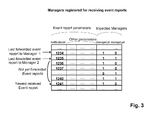
- a buffer entry structure contains (in addition to event report parameters) also an identification of the managers (manager x Id) for which the current event report passed the manager-specific filter criteria, as illustrated in Fig. 3 .
- Each buffer entry means that the current event report successfully passed the filter criteria for at least one of the connected managers.
- a dedicated value of the parameter manager x Id indicates whether the event report is "relevant” (i.e. it passed the filter criteria and shall be forwarded) for the current manager (e.g. value 1) or "not relevant” (e.g. value 0).
- the size of the ring buffer is dimensioned in such a way that all event reports to be forwarded between two consecutive "keep alive" manager messages can be queued so that - independently of the time when the manager-agent communication (within the interval defined by an alivePeriod value) may break - no information is lost.
- the agent is able to recognize that both, the manager itself (e.g. NMS x in Fig. 4 ) as well as the manager-agent interface, are working correctly and the following steps are processed:
- the functions of the event forwarding component may be implemented by the communication unit 11 and the control unit 13 of Fig. 2 .
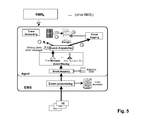
- Fig. 5 shows a schematic diagram illustrating an event logging mode of the agent apparatus according to the implementation example.
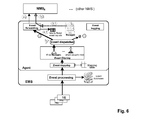
- Fig. 6 shows a schematic diagram illustrating re-establishment of the manager-agent communication according to the implementation example.
- manager-specific logs or common log which solution (i.e. manager-specific logs or common log) is preferably implemented depends on the agent's overall performance and the number of connected managers.
- the event synchronization technique according to the present invention is less complex, needs no explicit time synchronization operation between the agent and the connected managing devices and can be implemented independently of a particular protocol used in the management system (e.g. CORBA, SOAP).
- a particular protocol used in the management system e.g. CORBA, SOAP.
- "unsent" events are transferred from the agent to the manager after a connection interruption and consecutive connection setup.
- the event synchronization technique of the invention about a factor 10 less data volume needs to be transferred in comparison to a full synchronization. Consequently, significantly less time for synchronization of management information is needed.
- the suggested technique is not only applicable within telecommunication domain, but can be applied also in other domains, like power distribution networks or long-distance heating networks.
Landscapes
- Engineering & Computer Science (AREA)
- Computer Networks & Wireless Communication (AREA)
- Signal Processing (AREA)
- Health & Medical Sciences (AREA)
- Cardiology (AREA)
- General Health & Medical Sciences (AREA)
- Computer And Data Communications (AREA)
- Data Exchanges In Wide-Area Networks (AREA)
Abstract
Description
- The present invention relates to an automatic delta event synchronization in multiple manager-agent environments.
- The following meanings for the abbreviations used in this specification apply:
- 3GPP
- 3rd generation partnership program
- CORBA
- common object request broker architecture
- EMS
- element management system (element manager)
- IRP
- integration reference point
- NE
- network element
- NMS
- network management system (network manager)
- OSS
- operations support system
- SNMP
- simple network management protocol
- SOAP
- simple object access protocol
- TMN
- telecommunication management network
- The TMN principles define several layers for a hierarchical management of telecommunication networks, while each layer may play a dual role:
- ■ Manager role (in a "managing system") for a subordinate layer (if available).
- ■ Agent role (in a "managed system") for the next higher layer (if available).
- The manager functionality may be implemented in a (higher level) management system with regard to (subordinate) management systems or to managed NEs. Reciprocally, the agent functionality may be implemented in a management system or a managed NE with regard to one or several managing system(s) on the next upper level.
- One of the major challenges for stakeholders of telecommunications networks (vendors, integrators, service operators) is the huge amount of information to be processed in / exchanged between different systems involved in network management. More and more data needs to be available as real-time event reports and the impacts of communication disturbances are to be minimized. Only in this way the management information presented on different levels of the management hierarchy is synchronized with the real network condition and a required service level can be achieved.
-
Fig. 1 shows as an example of manager-agent interactions, manager-agent interactions at an NMS-EMS interface. For this example interface, network management systems (NMSs) play the manager role, while (regional) element management systems (EMSs) act in the agent role. In turn, one EMS plays the manager role with regard to supervised network elements (NEs). - After interruption and re-establishment of a communication at management interfaces, the time until the (higher level) management system is again synchronized with information available in the subordinate entities is of crucial importance especially for the management of mobile broadband networks, due to the large number of managed network elements and - as a consequence - to the huge amount of expected event reports.
- Today, in the case of failure and later re-establishment of a manager-agent communication, management systems trigger a full synchronization of management information (e.g. alarms, configuration data, resource state information) also after short- and mid-term interruption of the manager-agent communication. This solution has several drawbacks:
- Unnecessary retransmission of management information that did not change during communication interruption.
- High interface load and processing usage on manager's and agent's sides.
- Manager entity needs to be self-acting and to implement synchronization operations. In case a management system (e.g. an NMS) integrates multi-vendor equipment (including EMS from different vendors), whose agents provide different interface technologies, the manager needs to implement a multitude of synchronization operations.
- Several simple managers in the market, not providing dedicated synchronization requests, cannot not be used for efficient integration purposes.
- In 3GPP (TS 32.39x) a Technical Specification "Delta Synchronization IRP" is defined for avoiding the above full synchronization. However, this technique is complex and requires high implementation effort on both agent's and manager's sides. As a consequence, this approach is not used in current network management solutions.
- The present invention aims at providing a synchronization technique in multiple manager-agent environments that overcomes the above drawbacks.
- This is achieved by the apparatus and method as defined in the appended claims. The invention can also be implemented by a computer program product.
- According to an embodiment of the invention, an agent of a communication network receives a periodically transmitted specific keep alive message from a managing system and forwards event reports, and comprises as its operation modes an event forwarding mode and an event logging mode. In the event forwarding mode, the agent forwards the event reports to the managing system, and in the event logging mode, the agent stores the event reports in a persistent memory means. The operation mode of the agent is switched from the event forwarding mode to the event logging mode when the agent does not receive the specific keep alive message within a predefined time period, and the operation mode of the agent is switched from the event logging mode to the event forwarding mode when the agent receives the specific keep alive message.
- According to the present invention, an optimized solution is provided which can be implemented in an entity playing an agent role for minimizing the synchronization time at management interfaces.
- The solution according to the present invention is particularly useful for short- and mid-term interruptions of a manager-agent communication, a common problem in day-to-day network management operations.
- The agent solution according to the present invention is able to fulfill the following requirements:
- a) After re-establishment of the manager-agent communication, the synchronization of management information is automatically started without any manager action.
- b) Only the information about network events occurred during the interruption time (that passed pre-defined filter criteria according to manager needs) is forwarded.
- c) The functionality supports multi-manager configurations and is independent of network domain, interface technology or management hierarchy level.
- In the following the invention will be described by way of embodiments thereof with reference to the accompanying drawings.
-
-
Fig. 1 shows a schematic block diagram illustrating an example of a management hierarchy. -
Fig. 2 shows a schematic block diagram illustrating a structure of an agent apparatus according to an embodiment of the invention. -
Fig. 3 shows a diagram illustrating a buffer entry structure according to an implementation example of the invention. -
Fig. 4 shows a schematic diagram illustrating an event forwarding mode of the agent apparatus according to the implementation example. -
Fig. 5 shows a schematic diagram illustrating an event logging mode of the agent apparatus according to the implementation example. -
Fig. 6 shows a schematic diagram illustrating re-establishment of a manager-agent communication according to the implementation example. -
Fig. 2 shows a schematic block diagram illustrating a structure of an agent apparatus 10 according to an embodiment of the invention. The agent apparatus 10 is part of a manager-agent environment for a communication network. According to an implementation example of the invention, the agent apparatus 10 is implemented in the EMSs shown inFig. 1 . - The agent apparatus 10 comprises a
communication unit 11, anevent dispatching unit 12 and acontrol unit 13, which are connected via a link (e.g. a bus) 16. According to an implementation example, the agent apparatus 10 comprises a persistent memory means 14 and a temporary memory means 15, connected to thelink 16. The persistent memory means 14 may comprise one or several log(s) and the temporary memory means 15 may comprise an event buffer. Alternatively, the persistent memory means 14 and/or the temporary memory means 15 are provide in the communication network outside the agent apparatus 10 and can be accessed by the agent apparatus 10 via the communication network. - The agent apparatus 10 may comprise a memory in which a program is stored, which includes program instructions that, when executed by the
control unit 13, enables the agent apparatus 10 to operate in accordance with embodiments of the invention, as detailed below. In general, the embodiments of the invention may be implemented by computer software stored in the memory and executable by thecontrol unit 13 of the agent apparatus 10, or by hardware, or by a combination of software and/or firmware and hardware. - The memory, persistent memory means 14 and temporary memory means 15 may be of any type suitable to the local technical environment and may be implemented using any suitable data storage technology, such as semiconductor-based memory devices, magnetic memory devices and systems, optical memory devices and systems, fixed memory and removable memory. The
control unit 13 may be of any type suitable to the local technical environment, and may include one or more of general purpose computers, special purpose computers, microprocessors, digital signal processors (DSPs) and processors based on a multi-core processor architecture, as non-limiting examples. - The terms "connected," "coupled," or any variant thereof, mean any connection or coupling, either direct or indirect, between two or more elements, and may encompass the presence of one or more intermediate elements between two elements that are "connected" or "coupled" together. The coupling or connection between the elements can be physical, logical, or a combination thereof. As employed herein two elements may be considered to be "connected" or "coupled" together by the use of one or more wires, cables and printed electrical connections, as well as by the use of electromagnetic energy, such as electromagnetic energy having wavelengths in the radio frequency region, the microwave region and the optical (both visible and invisible) region, as non-limiting examples.
- The
communication unit 11 receives a periodically transmitted specific message, e.g. a "keep alive" message, from a managing system. For example, the managing system comprises the NMSs shown inFig. 1 . This allows the agent apparatus 10 to supervise a correct communication between the managing system (e.g. a manager (managing device) of the managing system, e.g. an NMS) and the agent apparatus 10 (manager-agent communication) on agent side by means of periodical "keep alive" messages received from the manager (managing device). Within a pre-defined time interval (e.g. a so called "alivePeriod") the managing device has to send a simple "keep alive" message to allow the supervision of the communication on agent side. - The agent apparatus 10 is able to work, for each connected managing device, in two alternating operation modes: event forwarding and event logging. Both operation modes use the same pre-defined manager-specific filter criteria regarding the selection of event reports in accordance to the needs of each connected managing device. The switch between these operation modes is coordinated by the event dispatching unit 12 (event dispatcher component) in the agent apparatus 10. In other words, the
event dispatching unit 12 switches the operation mode of the apparatus between the event forwarding mode and the event logging mode. - During the event forwarding mode which is the normal case, i.e. during correct functionality of the manager-agent communication, event reports generated in a network (e.g. the network shown in
Fig. 1 ) that need to be forwarded to the managing device, i.e. after passing pre-defined filter criteria, are inserted into a temporary buffer, e.g. the temporary memory means 15, and subsequently sent (i.e. forwarded) to the managing device by thecommunication unit 11. In other words, in the event forwarding mode, thecontrol unit 13 causes thecommunication unit 11 to forward the event reports to the managing system. According to an embodiment of the invention, thecontrol unit 13 temporarily stores the event reports to be forwarded to the managing device in the temporary memory means 15, and the communicatingunit 11 forwards the event reports temporarily stored in the temporary memory means 15 to the managing device. Preferably, the temporary buffer is common for all managing devices communicating with the agent apparatus 10. - The absence of the periodical specific (e.g. "keep alive") message from a managing devicex triggers a switch from the event forwarding mode into the event logging mode for this managing devicex. In other words, the
event dispatching unit 12 switches the operation mode of the agent apparatus 10 from the event forwarding mode to the event logging mode when thecommunication unit 11 does not receive the specific message within a predefined time period. In the event logging mode, thecontrol unit 13 stores the event reports in the persistent memory means 14. - More specifically, upon entering the event logging mode, event reports already buffered in the temporary buffer and not yet forwarded to the managing devicex are moved into the persistent memory means 14 (e.g. a managing device-specific log file). All new event reports that pass pre-defined filter criteria for the managing devicex are then appended into the log. In other words, the
control unit 13 moves the event reports to be forwarded to the managing devicex, which are temporarily stored in the temporary memory means 15, to the persistent memory means 14, and appends "new" event reports into the persistent memory means 14. - Within the event logging mode, the first reception of the specific (e.g. "keep alive") message from the managing devicex is a trigger for the
event dispatching unit 12 to switch back to the event forwarding mode. In other words, theevent dispatching unit 12 switches the operation mode of the agent apparatus 10 from the event logging mode to the event forwarding mode when thecommunication unit 11 receives the specific message from the managing devicex. - Firstly the logged event reports are fetched and forwarded by the agent apparatus 10 to the managing devicex and subsequently the forwarding of newly occurred event reports relevant for the current managing devicex is resumed as usual.
- In other words, when the
event dispatching unit 12 switches the operation mode of the agent apparatus 10 for the managing devicex from the event logging mode to the event forwarding mode, thecontrol unit 13 causes thecommunication unit 11 to forward the event reports to be forwarded to the managing devicex, which are stored in the persistent memory means 14, to the managing devicex, and subsequently the forwarding of newly occurred event reports relevant for the current managing devicex is resumed as usual. - According to an embodiment of the invention, a special syntax of the logged records to be described below (each record related to one event report which successfully passed the filter constrains for at least one managing device) allows for the usage of each single log entry for all managing devices (managers) and an optimal performance in multi-manager configurations.
- It is to be noted that the temporary buffering is used only for very short time spans in order to bridge the gap between the rate of event reports received by the agent apparatus 10 and the rate of forwarded event reports towards upper level systems. Further, the logging of received event reports is needed in order to avoid the loss of management information in case of short-term or mid-term (several seconds or few minutes) interruption of a manager-agent communication.
- In the following an implementation example of the invention will be described. In particular, the following use cases will be described:
- Initiating a manager-agent communication.
- Event forwarding mode.
- Interruption of the manager-agent communication and event logging mode.
- Re-establishment of the manager-agent communication.
- For exemplification purposes the following description uses two manager entities (managing devices) connected to an agent, e.g. the agent apparatus of
Fig. 2 , but the principles of the invention apply for several connected managers (managing devices) as well.Figs. 4 to 6 show from a logical point of view only the agent functionality with regard to one manager entity (called NMSx). In the implementation example depicted inFigs. 4 to 6 , the agent is part of an EMS performing event processing for NEs connected to the EMS according to a management hierarchy e.g. as shown inFig. 1 , using an event database. The agent performs event mapping on processed events (processed event reports), using a mapping table, and event filtering on mapped events (mapped event reports) for managing devices (NMSs) connected to the EMS according to the management hierarchy. In the event filtering process, the same or different filter constraint(s) are provided for the connected managing devices. The filtered event reports are provided to an event dispatcher, e.g. theevent dispatching unit 12, which switches between an event forwarding mode and an event logging mode of the agent. - It is to be noted that the manager-agent interactions at the NMS-EMS interface are used only as an example for describing the present invention. However, the technique of the invention applies for different manager-agent interfaces within a management hierarchy as well.
- At a start time of the manager-agent communication, a managerx (managing devicex, e.g. NMSx) may send to the agent a subscription request for receiving spontaneous event reports. This request may contain selection criteria (filter constraints) of required event information.
- Alternatively, for management systems not supporting subscription requests, manager-specific filter constraints can be locally preconfigured in the agent. In such a case, the agent forwards the event reports to the managing devicex as soon as the event reports pass the managing devicex-specific filter constraints in the agent.
- The event dispatcher suspends the event logging mode for the managerx (
step ① inFig. 4 ) and initializes the event forwarding mode for the managerx (step ② inFig. 4 ). -
Fig. 4 shows a schematic diagram illustrating an event forwarding mode of the agent apparatus according to an implementation example of the invention. - As depicted in
Fig. 4 , the agent maintains an event buffer (ring buffer principle), in which each event report to be forwarded to at least one of connected managers (i.e. which successfully passed the event filtering) is temporarily queued. The event buffer may be implemented by the temporary memory means 15. - For each connected manager, a buffer index indicates a buffer position of a last forwarded event report. Another index (used for all managers) points to a buffer position of a newest (still to be forwarded) buffered event report.
- In order to optimize the processing in case of multi-manager configurations, a buffer entry structure contains (in addition to event report parameters) also an identification of the managers (managerxId) for which the current event report passed the manager-specific filter criteria, as illustrated in
Fig. 3 . Each buffer entry means that the current event report successfully passed the filter criteria for at least one of the connected managers. - Referring to
Fig. 3 , for each buffer entry a dedicated value of the parameter managerxId indicates whether the event report is "relevant" (i.e. it passed the filter criteria and shall be forwarded) for the current manager (e.g. value 1) or "not relevant" (e.g. value 0). - The size of the ring buffer is dimensioned in such a way that all event reports to be forwarded between two consecutive "keep alive" manager messages can be queued so that - independently of the time when the manager-agent communication (within the interval defined by an alivePeriod value) may break - no information is lost.
- As long as periodical "keep alive" messages are received from a manager, the agent is able to recognize that both, the manager itself (e.g. NMSx in
Fig. 4 ) as well as the manager-agent interface, are working correctly and the following steps are processed: - ■ Each newly received event report is tested against each manager's filter criteria.
- ■ When the event report successfully passes the event filtering for the managerx, the "Event forwarding" component buffers it and subsequently sends it to the managerx (
step ③ comprising sub-steps 3.1 and 3.2 inFig. 4 ). The managerxId parameter of the in the buffer entry is set to a value "relevant" (e.g. 1), and all corresponding parameters of other managers have still a default value (e.g. 0). - ■ If the event report successfully passes the event filtering for a further managery, only a related manageryId parameter's value of the already existing buffer entry is updated and the event report is sent to the managery.
- ■ If the event report did not pass the event filtering for any connected manager, the received event report is discarded.
- The functions of the event forwarding component may be implemented by the
communication unit 11 and thecontrol unit 13 ofFig. 2 . -
Fig. 5 shows a schematic diagram illustrating an event logging mode of the agent apparatus according to the implementation example. - A missing "keep alive" message from the leads to a time-out signal in the agent, which triggers the following event dispatcher activities:
- ■ The event dispatcher suspends events routing towards the event forwarding component (
step ① inFig. 5 ). - ■ The event report parameters of all buffer entries relevant for the managerx between the last forwarded event report and the newest received event report are copied into a persistent log (
step ② inFig. 5 ). The persistent log may be implemented by the persistent memory means 14. - ■ The event dispatcher switches the routing of newly received event reports towards the event logging component, i.e. each new event passing the manager-defined filter criteria is now appended into the log (
steps Fig. 5 ). The functions of the event logging component may be implemented by thecontrol unit 13. - For other managers (as long as their communication to the agent is still working correctly), the temporary buffering and forwarding of newly received event reports able to pass the manager-specific filter criteria continues. In all these new buffer entries the value of the parameter managerxId is still "not relevant" (e.g. 0).
-
Fig. 6 shows a schematic diagram illustrating re-establishment of the manager-agent communication according to the implementation example. - The first reception of a "keep alive" message from the (after communication re-establishment) triggers following event dispatcher activities:
- ■ The event dispatcher suspends routing of new event reports towards the event logging component (
step ① inFig. 6 ). - ■ The event forwarding component is activated in a restored mode (
step ② inFig. 6 ) in order to retrieve first the logged event records and to forward them to the (step ③ comprising sub-steps 3.1 and 3.2 inFig. 6 ). - ■ The manager-specific buffer index indicating the last forwarded event report is initialized and the log content is removed. Newly received event reports that pass the managerx-defined filter criteria are queued again in the temporary buffer and subsequently forwarded to the managerx (steps 4.1 and 4.2 in
Fig. 6 ). - According to an implementation example of the invention, also a common log (common persistent memory means) with a similar structure as the temporary buffer (temporary memory means) for all connected managers is used. In this case the following is considered:
- (1) Switch from event forwarding mode to event logging mode for managerx:
- If some buffered event reports relevant for the managerx are already present in the common log, e.g. due to previous failures of communications between the agent and other managers, only the value of the parameter managerxId in the log entry has to be updated (i.e. set to the value "relevant").
- Buffered event reports relevant only (but not yet forwarded) for the managerx are copied into the log and the values of all parameters manageryId (y≠x) are set to "not relevant".
- (2) Switch from event logging mode to event forwarding mode for managerx:
- All logged event reports relevant for the managerx (i.e. having the managerxId value set to "relevant") are retrieved by the event forwarding component and forwarded to the managerx.
- If a logged event report is relevant only for the managerx, the event forwarding component removes it in the log. Otherwise (i.e. the logged event report is relevant for other managers as well), only the value of the managerxId parameter is set to the value "not relevant".
- Which solution (i.e. manager-specific logs or common log) is preferably implemented depends on the agent's overall performance and the number of connected managers.
- The embodiments/implementation examples of the invention provide the following advantages:
- Significant improvement of work efficiency for operators in charge of network management, since the synchronization is much faster as it takes into account only "delta" management information occurring during a manager-agent communication interruption. This is especially significant for northbound interfaces of OSS family products, required to deal with a huge amount of event records.
- No need of manager-triggered synchronization operations, i.e. alignment starts fully automatically (triggered by agent) after re-establishment of the manager-agent communication. This is especially relevant in multi-vendor configurations, avoiding that a manager needs to implement different synchronization mechanisms supported by the vendor-specific agents.
- The functionality supports multi-manager configurations as well and is independent of network domain, manager-agent interface technology or management hierarchy level.
- The event synchronization technique according to the present invention is less complex, needs no explicit time synchronization operation between the agent and the connected managing devices and can be implemented independently of a particular protocol used in the management system (e.g. CORBA, SOAP). According to the present invention, "unsent" events are transferred from the agent to the manager after a connection interruption and consecutive connection setup.
- According to the event synchronization technique of the invention, about a factor 10 less data volume needs to be transferred in comparison to a full synchronization. Consequently, significantly less time for synchronization of management information is needed. The suggested technique is not only applicable within telecommunication domain, but can be applied also in other domains, like power distribution networks or long-distance heating networks.
- It is to be understood that the above description is illustrative of the invention and is not to be construed as limiting the invention. Various modifications and applications may occur to those skilled in the art without departing from the scope of the invention as defined by the appended claims.
Claims (25)
- An apparatus (10) comprising:a communication unit (11) configured to receive a periodically transmitted specific keep alive message from a managing system and forward event reports;an event dispatching unit (12) configured to switch an operation mode of the apparatus (10) between an event forwarding mode and an event logging mode; anda control unit (13) configured to control the apparatus (10), wherein,in the event forwarding mode, the control unit (13) is configured to cause the communication unit (11) to forward the event reports to the managing system, andin the event logging mode, the control unit (13) is configured to store the event reports in a persistent memory means (14), and whereinthe event dispatching unit (12) is configured to switch the operation mode of the apparatus from the event forwarding mode to the event logging mode when the communication unit (11) does not receive the specific keep alive message within a predefined time period, andthe event dispatching unit (12) is configured to switch the operation mode of the apparatus from the event logging mode to the event forwarding mode when the communication unit (11) receives the specific keep alive message.
- The apparatus (10) of claim 1, wherein each one of the event reports is to be forwarded to at least one of a plurality of managing devices of the managing system, wherein
the event dispatching unit (12) is configured to switch the operation mode of the apparatus (10) from the event forwarding mode to the event logging mode for a managing device of the plurality of managing devices, when the communication unit (11) does not receive the specific keep alive message from the managing device within a predefined time period for the managing device, and
the event dispatching unit (12) is configured to switch the operation mode of the apparatus (10) for the managing device from the event logging mode to the event forwarding mode when the communication unit (11) receives the specific keep alive message from the managing device, and wherein
in the event forwarding mode for the managing device, the control unit (13) is configured to cause the communication unit (11) to forward the event reports, which are to be forwarded to the managing device, to the managing device, and
in the event logging mode for the managing device, the control unit (13) is configured to store the event reports, which are to be forwarded to the managing device, in the persistent memory means (14). - The apparatus (10) of claim 2, comprising:a temporary memory means (15), wherein,in the event forwarding mode for the managing device, the control unit (13) is configured to temporarily store the event reports to be forwarded to the managing device in the temporary memory means (15) and the communicating unit (11) is configured to forward the event reports temporarily stored in the temporary memory means (15) to the managing device, andwhen the event dispatching unit (12) switches the operation mode of the apparatus (10) for the managing device from the event forwarding mode to the event logging mode, the control unit (13) is configured to move the event reports to be forwarded to the managing device, which are temporarily stored in the temporary memory means (15), to the persistent memory means (14).
- The apparatus (10) of claim 3, wherein, when the event dispatching unit (12) switches the operation mode of the apparatus (10) for the managing device from the event logging mode to the event forwarding mode, the control unit (13) is configured to cause the communication unit (11) to forward the event reports to be forwarded to the managing device, which are stored in the persistent memory means (14), to the managing device.
- The apparatus (10) of any one of claims 2 to 4, wherein the temporary memory means and the persistent memory means each comprises a common memory for the plurality of managing devices and, when storing the event reports in the temporary memory means (15) or the persistent memory means (14), the control unit (13) is configured to store the event reports together with at least one of a plurality of indicators indicating which of the plurality of managing devices the event reports are to be forwarded to, wherein each one of the plurality of indicators is associated with one of the plurality of managing devices.
- The apparatus (10) of claim 5, wherein the control unit (13) is configured to delete the indicator of the managing device from the temporary memory means or the persistent memory means (14), after having caused the forwarding of the event reports to be forwarded to the managing device by the communication unit (11), and to delete the event reports to be forwarded to the managing device from the temporary memory means or the persistent memory means in case no indicator for another managing device is stored together with the event reports in the temporary memory means or the persistent memory means.
- The apparatus (10) of any one of claims 2 to 4, wherein the temporary memory means comprises a common memory for the plurality of managing devices and, when storing the event reports in the temporary memory means (15), the control unit (13) is configured to store the event reports together with at least one of a plurality of indicators indicating which of the plurality of managing devices the event reports are to be forwarded to, wherein each one of the plurality of indicators is associated with one of the plurality of managing devices, and
wherein the persistent memory means (14) comprises separate memories for each of the plurality of managing devices. - The apparatus (10) of claim 7, wherein the control unit (13) is configured to delete the event reports to be forwarded to the managing device from the persistent memory means (14), after having caused their forwarding by the communication unit (11), and
wherein the control unit (13) is configured to delete the indicator of the managing device from the temporary memory means, after having caused the forwarding of the event reports to be forwarded to the managing device by the communication unit (11), and to delete the event reports to be forwarded to the managing device from the temporary memory means in case no indicator for another managing device is stored together with the event reports in the temporary memory means. - The apparatus (10) of any one of claims 2 to 8, wherein, in the event forwarding mode, the control unit (13) is configured to cause the communication unit (11) to forward the event reports to the managing device in case a request for receiving event reports has been received by the apparatus (10) from the managing device beforehand.
- The apparatus (10) of any one of claims 2 to 9, wherein, in the event forwarding mode, the control unit (13) is configured to cause the communication unit (11) to forward the event reports to the managing device based on selection criteria for filtering event reports for the managing device.
- The apparatus of claim 10, wherein the selection criteria are included in the request received from the managing device or are preconfigured in the apparatus (10).
- A method of controlling a network apparatus (10) receiving a periodically transmitted specific keep alive message from a managing system and forwarding event reports, an operation mode of the network apparatus comprising an event forwarding mode and an event logging mode, the method comprising:in the event forwarding mode, controlling the network apparatus to forward the event reports to the managing system,in the event logging mode, storing the event reports in a persistent memory means (14),switching the operation mode of the network apparatus (10) from the event forwarding mode to the event logging mode when the network apparatus does not receive the specific keep alive message within a predefined time period, andswitching the operation mode of the network apparatus (10) from the event logging mode to the event forwarding mode when the network apparatus receives the specific keep alive message.
- The method of claim 12, wherein each one of the event reports is to be forwarded to at least one of a plurality of managing devices of the managing system, the method comprising:switching the operation mode of the network apparatus from the event forwarding mode to the event logging mode for a managing device of the plurality of managing devices, when the network apparatus does not receive the specific keep alive message from the managing device within a predefined time period for the managing device, andswitching the operation mode of the network apparatus for the managing device from the event logging mode to the event forwarding mode when the network apparatus receives the specific keep alive message from the managing device,in the event forwarding mode for the managing device, causing the network apparatus to forward the event reports which are to be forwarded to the managing device, to the managing device, andin the event logging mode for the managing device, storing the event reports, which are to be forwarded to the managing device, in the persistent memory means.
- The method of claim 13, comprising:in the event forwarding mode for the managing device, temporarily storing the event reports to be forwarded to the managing device in a temporary memory means (15), the network apparatus forwarding the event reports temporarily stored in the temporary memory means to the managing device, andwhen the operation mode of the network apparatus for the managing device is switched from the event forwarding mode to the event logging mode, moving the event reports to be forwarded to the managing device, which are temporarily stored in the temporary memory means, to the persistent memory means.
- The method of claim 14, comprising:when the operation mode of the network apparatus for the managing device is switched from the event logging mode to the event forwarding mode, causing the network apparatus to forward the event reports to be forwarded to the managing device, which are stored in the persistent memory means, to the managing device.
- The method of any one of claims 13 to 15, the temporary memory means and the persistent memory means each comprises a common memory for the plurality of managing devices, the method comprising:when storing the event reports in the temporary memory means or the persistent memory means, storing the event reports together with at least one of a plurality of indicators indicating which of the plurality of managing devices the event reports are to be forwarded to, wherein each one of the plurality of indicators is associated with one of the plurality of managing devices.
- The method of claim 16, comprising:deleting the indicator of the managing device from the temporary memory means or the persistent memory means (14), after having caused the forwarding of the event reports to be forwarded to the managing device by the network apparatus, and deleting the event reports to be forwarded to the managing device from the temporary memory means or the persistent memory means in case no indicator for another managing device is stored together with the event reports in the temporary memory means or the persistent memory means.
- The method of any one of claims 13 to 15, wherein the temporary memory means comprises a common memory for the plurality of managing devices, the method comprising:when storing the event reports in the temporary memory means (15), storing the event reports together with at least one of a plurality of indicators indicating which of the plurality of managing devices the event reports are to be forwarded to, wherein each one of the plurality of indicators is associated with one of the plurality of managing devices, andwherein the persistent memory means (14) comprises separate memories for each of the plurality of managing devices.
- The method of claim 18, comprising:deleting the event reports to be forwarded to the managing device from the persistent memory means, after having caused their forwarding by the network apparatus, anddeleting the indicator of the managing device from the temporary memory means, after having caused the forwarding of the event reports to be forwarded to the managing device by the network apparatus, and deleting the event reports to be forwarded to the managing device from the temporary memory means in case no indicator for another managing device is stored together with the event reports in the temporary memory means.
- The method of any one of claims 13 to 19, comprising:in the event forwarding mode, causing the network apparatus to forward the event reports to the managing device in case a request for receiving event reports has been received by the network apparatus from the managing device beforehand.
- The method of any one of claims 13 to 20, comprising:in the event forwarding mode, causing the network apparatus to forward the event reports to the managing device based on selection criteria for filtering event reports for the managing device.
- The method of claim 21, wherein the selection criteria are included in the request received from the managing device or are preconfigured in the network apparatus.
- A computer program product including a program for a processing device of a network apparatus, comprising software code portions for performing the steps of any one of claims 12 to 22 when the program is run on the processing device.
- The computer program product according to claim 23, wherein the computer program product comprises a computer-readable medium on which the software code portions are stored.
- The computer program product according to claim 23, wherein the program is directly loadable into an internal memory of the processing device.
Priority Applications (2)
| Application Number | Priority Date | Filing Date | Title |
|---|---|---|---|
| EP14171445.1A EP2953295B1 (en) | 2014-06-06 | 2014-06-06 | Automatic delta event synchronization in multiple manager-agent environments |
| CN201510429856.5A CN105162829B (en) | 2014-06-06 | 2015-06-05 | Auto-increment event synchronization in multiple manager-deputy environments |
Applications Claiming Priority (1)
| Application Number | Priority Date | Filing Date | Title |
|---|---|---|---|
| EP14171445.1A EP2953295B1 (en) | 2014-06-06 | 2014-06-06 | Automatic delta event synchronization in multiple manager-agent environments |
Publications (2)
| Publication Number | Publication Date |
|---|---|
| EP2953295A1 true EP2953295A1 (en) | 2015-12-09 |
| EP2953295B1 EP2953295B1 (en) | 2019-05-15 |
Family
ID=50942057
Family Applications (1)
| Application Number | Title | Priority Date | Filing Date |
|---|---|---|---|
| EP14171445.1A Not-in-force EP2953295B1 (en) | 2014-06-06 | 2014-06-06 | Automatic delta event synchronization in multiple manager-agent environments |
Country Status (2)
| Country | Link |
|---|---|
| EP (1) | EP2953295B1 (en) |
| CN (1) | CN105162829B (en) |
Cited By (4)
| Publication number | Priority date | Publication date | Assignee | Title |
|---|---|---|---|---|
| CN106656584A (en) * | 2016-12-06 | 2017-05-10 | 南京南瑞继保电气有限公司 | Method for judging invalid nodes of distributed system |
| WO2018111272A1 (en) * | 2016-12-15 | 2018-06-21 | The Charles Stark Draper Laboratory, Inc. | Fault-tolerant operational group on a distributed network |
| US10326643B2 (en) | 2016-12-27 | 2019-06-18 | The Charles Stark Draper Laboratory, Inc. | Self-configuring fault-tolerant operational group |
| US10356203B2 (en) | 2016-12-15 | 2019-07-16 | The Charles Stark Draper Laboratory, Inc. | Fault-tolerant operational group on a distributed network |
Families Citing this family (1)
| Publication number | Priority date | Publication date | Assignee | Title |
|---|---|---|---|---|
| CN108366000A (en) * | 2018-02-28 | 2018-08-03 | 新华三技术有限公司 | Keep Alive Packet exchange method, device, communication equipment and communication system |
Citations (1)
| Publication number | Priority date | Publication date | Assignee | Title |
|---|---|---|---|---|
| WO2012031231A1 (en) * | 2010-09-03 | 2012-03-08 | Loglogic, Inc. | Adaptive data transmission |
Family Cites Families (2)
| Publication number | Priority date | Publication date | Assignee | Title |
|---|---|---|---|---|
| US7188273B2 (en) * | 2003-11-24 | 2007-03-06 | Tsx Inc. | System and method for failover |
| US8578049B2 (en) * | 2010-10-04 | 2013-11-05 | Futurewei Technologies, Inc. | Content router forwarding plane architecture |
-
2014
- 2014-06-06 EP EP14171445.1A patent/EP2953295B1/en not_active Not-in-force
-
2015
- 2015-06-05 CN CN201510429856.5A patent/CN105162829B/en not_active Expired - Fee Related
Patent Citations (1)
| Publication number | Priority date | Publication date | Assignee | Title |
|---|---|---|---|---|
| WO2012031231A1 (en) * | 2010-09-03 | 2012-03-08 | Loglogic, Inc. | Adaptive data transmission |
Non-Patent Citations (2)
| Title |
|---|
| GERHARDS ADISCON GMBH R: "The Syslog Protocol; rfc5424.txt", THE SYSLOG PROTOCOL; RFC5424.TXT, INTERNET ENGINEERING TASK FORCE, IETF; STANDARD, INTERNET SOCIETY (ISOC) 4, RUE DES FALAISES CH- 1205 GENEVA, SWITZERLAND, 1 March 2009 (2009-03-01), XP015065515 * |
| GERHARDS RAINER: "RELP - The Reliable Event Logging Protocol (Specification)", 10 April 2014 (2014-04-10), XP055153216, Retrieved from the Internet <URL:http://www.rsyslog.com/doc/relp.html> [retrieved on 20141114] * |
Cited By (5)
| Publication number | Priority date | Publication date | Assignee | Title |
|---|---|---|---|---|
| CN106656584A (en) * | 2016-12-06 | 2017-05-10 | 南京南瑞继保电气有限公司 | Method for judging invalid nodes of distributed system |
| CN106656584B (en) * | 2016-12-06 | 2020-09-04 | 南京南瑞继保电气有限公司 | A method for determining invalid nodes in a distributed system |
| WO2018111272A1 (en) * | 2016-12-15 | 2018-06-21 | The Charles Stark Draper Laboratory, Inc. | Fault-tolerant operational group on a distributed network |
| US10356203B2 (en) | 2016-12-15 | 2019-07-16 | The Charles Stark Draper Laboratory, Inc. | Fault-tolerant operational group on a distributed network |
| US10326643B2 (en) | 2016-12-27 | 2019-06-18 | The Charles Stark Draper Laboratory, Inc. | Self-configuring fault-tolerant operational group |
Also Published As
| Publication number | Publication date |
|---|---|
| CN105162829A (en) | 2015-12-16 |
| EP2953295B1 (en) | 2019-05-15 |
| CN105162829B (en) | 2019-08-16 |
Similar Documents
| Publication | Publication Date | Title |
|---|---|---|
| US10601656B2 (en) | Network element upgrade method and device | |
| EP2953295B1 (en) | Automatic delta event synchronization in multiple manager-agent environments | |
| WO2019029636A1 (en) | METHOD FOR MANAGING NETWORK INSTANCE, AND DEVICE THEREOF | |
| WO2018196685A1 (en) | Communication method, and network device and system | |
| CN101447895A (en) | Collocation method for synchronizing network management and network element and device thereof | |
| CN110445856A (en) | A kind of Internet of Things communication part managing and control system and method for supporting multi-protocols access | |
| WO2013097719A1 (en) | Method and apparatus for resources synchronization | |
| US20230164596A1 (en) | Alarm log management system and method during failure in o-ran | |
| US20160094657A1 (en) | Event-driven synchronization in snmp managed networks | |
| CN107544837A (en) | Cloud service device performance data acquisition system, method and apparatus | |
| CN107690775A (en) | For from the load-balanced server to one or more prioritization Automatic Configuration Server forwarding priority business | |
| CN101409654B (en) | Method for processing SNMP information in network management system | |
| WO2018103665A1 (en) | L2tp-based device management method, apparatus and system | |
| CN101938369B (en) | Comprehensive network management access management system, management method and network management system applying same | |
| CN115835275A (en) | Method and device for diagnosing faults of 5G CPE (customer premises equipment) | |
| EP4531362A1 (en) | Mechanism of obtaining up-to-date network inventory reliably and optimally | |
| CN103957127B (en) | Isomery producer transport network interface adaptation method | |
| CN105592485A (en) | Method for collecting and processing messages in real time based on SNMP | |
| CN104468158A (en) | A method and apparatus for notifying status among nodes | |
| CN102185720A (en) | North notification management interface device and management method thereof | |
| CN101018148A (en) | Data increment synchronization method between the network management system and network element management system | |
| WO2023116468A1 (en) | Communication method and communication apparatus | |
| CN101202656A (en) | Resource monitoring method and device | |
| CN114268568B (en) | Network traffic monitoring method, device and equipment | |
| CN119814523B (en) | A data transmission alarm method, apparatus, device, and storage medium |
Legal Events
| Date | Code | Title | Description |
|---|---|---|---|
| PUAI | Public reference made under article 153(3) epc to a published international application that has entered the european phase |
Free format text: ORIGINAL CODE: 0009012 |
|
| AK | Designated contracting states |
Kind code of ref document: A1 Designated state(s): AL AT BE BG CH CY CZ DE DK EE ES FI FR GB GR HR HU IE IS IT LI LT LU LV MC MK MT NL NO PL PT RO RS SE SI SK SM TR |
|
| AX | Request for extension of the european patent |
Extension state: BA ME |
|
| 17P | Request for examination filed |
Effective date: 20160609 |
|
| RBV | Designated contracting states (corrected) |
Designated state(s): AL AT BE BG CH CY CZ DE DK EE ES FI FR GB GR HR HU IE IS IT LI LT LU LV MC MK MT NL NO PL PT RO RS SE SI SK SM TR |
|
| STAA | Information on the status of an ep patent application or granted ep patent |
Free format text: STATUS: EXAMINATION IS IN PROGRESS |
|
| 17Q | First examination report despatched |
Effective date: 20180418 |
|
| REG | Reference to a national code |
Ref country code: DE Ref legal event code: R079 Ref document number: 602014046700 Country of ref document: DE Free format text: PREVIOUS MAIN CLASS: H04L0012260000 Ipc: H04L0012240000 |
|
| RIC1 | Information provided on ipc code assigned before grant |
Ipc: H04L 12/26 20060101ALI20181030BHEP Ipc: H04L 12/24 20060101AFI20181030BHEP |
|
| GRAP | Despatch of communication of intention to grant a patent |
Free format text: ORIGINAL CODE: EPIDOSNIGR1 |
|
| STAA | Information on the status of an ep patent application or granted ep patent |
Free format text: STATUS: GRANT OF PATENT IS INTENDED |
|
| INTG | Intention to grant announced |
Effective date: 20181214 |
|
| GRAS | Grant fee paid |
Free format text: ORIGINAL CODE: EPIDOSNIGR3 |
|
| GRAA | (expected) grant |
Free format text: ORIGINAL CODE: 0009210 |
|
| STAA | Information on the status of an ep patent application or granted ep patent |
Free format text: STATUS: THE PATENT HAS BEEN GRANTED |
|
| AK | Designated contracting states |
Kind code of ref document: B1 Designated state(s): AL AT BE BG CH CY CZ DE DK EE ES FI FR GB GR HR HU IE IS IT LI LT LU LV MC MK MT NL NO PL PT RO RS SE SI SK SM TR |
|
| REG | Reference to a national code |
Ref country code: CH Ref legal event code: EP |
|
| REG | Reference to a national code |
Ref country code: DE Ref legal event code: R096 Ref document number: 602014046700 Country of ref document: DE |
|
| REG | Reference to a national code |
Ref country code: IE Ref legal event code: FG4D |
|
| RAP2 | Party data changed (patent owner data changed or rights of a patent transferred) |
Owner name: NOKIA SOLUTIONS AND NETWORKS OY |
|
| REG | Reference to a national code |
Ref country code: NL Ref legal event code: MP Effective date: 20190515 |
|
| REG | Reference to a national code |
Ref country code: LT Ref legal event code: MG4D |
|
| PG25 | Lapsed in a contracting state [announced via postgrant information from national office to epo] |
Ref country code: AL Free format text: LAPSE BECAUSE OF FAILURE TO SUBMIT A TRANSLATION OF THE DESCRIPTION OR TO PAY THE FEE WITHIN THE PRESCRIBED TIME-LIMIT Effective date: 20190515 Ref country code: ES Free format text: LAPSE BECAUSE OF FAILURE TO SUBMIT A TRANSLATION OF THE DESCRIPTION OR TO PAY THE FEE WITHIN THE PRESCRIBED TIME-LIMIT Effective date: 20190515 Ref country code: NL Free format text: LAPSE BECAUSE OF FAILURE TO SUBMIT A TRANSLATION OF THE DESCRIPTION OR TO PAY THE FEE WITHIN THE PRESCRIBED TIME-LIMIT Effective date: 20190515 Ref country code: LT Free format text: LAPSE BECAUSE OF FAILURE TO SUBMIT A TRANSLATION OF THE DESCRIPTION OR TO PAY THE FEE WITHIN THE PRESCRIBED TIME-LIMIT Effective date: 20190515 Ref country code: FI Free format text: LAPSE BECAUSE OF FAILURE TO SUBMIT A TRANSLATION OF THE DESCRIPTION OR TO PAY THE FEE WITHIN THE PRESCRIBED TIME-LIMIT Effective date: 20190515 Ref country code: SE Free format text: LAPSE BECAUSE OF FAILURE TO SUBMIT A TRANSLATION OF THE DESCRIPTION OR TO PAY THE FEE WITHIN THE PRESCRIBED TIME-LIMIT Effective date: 20190515 Ref country code: PT Free format text: LAPSE BECAUSE OF FAILURE TO SUBMIT A TRANSLATION OF THE DESCRIPTION OR TO PAY THE FEE WITHIN THE PRESCRIBED TIME-LIMIT Effective date: 20190915 Ref country code: NO Free format text: LAPSE BECAUSE OF FAILURE TO SUBMIT A TRANSLATION OF THE DESCRIPTION OR TO PAY THE FEE WITHIN THE PRESCRIBED TIME-LIMIT Effective date: 20190815 Ref country code: HR Free format text: LAPSE BECAUSE OF FAILURE TO SUBMIT A TRANSLATION OF THE DESCRIPTION OR TO PAY THE FEE WITHIN THE PRESCRIBED TIME-LIMIT Effective date: 20190515 |
|
| PG25 | Lapsed in a contracting state [announced via postgrant information from national office to epo] |
Ref country code: LV Free format text: LAPSE BECAUSE OF FAILURE TO SUBMIT A TRANSLATION OF THE DESCRIPTION OR TO PAY THE FEE WITHIN THE PRESCRIBED TIME-LIMIT Effective date: 20190515 Ref country code: GR Free format text: LAPSE BECAUSE OF FAILURE TO SUBMIT A TRANSLATION OF THE DESCRIPTION OR TO PAY THE FEE WITHIN THE PRESCRIBED TIME-LIMIT Effective date: 20190816 Ref country code: BG Free format text: LAPSE BECAUSE OF FAILURE TO SUBMIT A TRANSLATION OF THE DESCRIPTION OR TO PAY THE FEE WITHIN THE PRESCRIBED TIME-LIMIT Effective date: 20190815 Ref country code: RS Free format text: LAPSE BECAUSE OF FAILURE TO SUBMIT A TRANSLATION OF THE DESCRIPTION OR TO PAY THE FEE WITHIN THE PRESCRIBED TIME-LIMIT Effective date: 20190515 |
|
| REG | Reference to a national code |
Ref country code: AT Ref legal event code: MK05 Ref document number: 1134696 Country of ref document: AT Kind code of ref document: T Effective date: 20190515 |
|
| PG25 | Lapsed in a contracting state [announced via postgrant information from national office to epo] |
Ref country code: AT Free format text: LAPSE BECAUSE OF FAILURE TO SUBMIT A TRANSLATION OF THE DESCRIPTION OR TO PAY THE FEE WITHIN THE PRESCRIBED TIME-LIMIT Effective date: 20190515 Ref country code: RO Free format text: LAPSE BECAUSE OF FAILURE TO SUBMIT A TRANSLATION OF THE DESCRIPTION OR TO PAY THE FEE WITHIN THE PRESCRIBED TIME-LIMIT Effective date: 20190515 Ref country code: CZ Free format text: LAPSE BECAUSE OF FAILURE TO SUBMIT A TRANSLATION OF THE DESCRIPTION OR TO PAY THE FEE WITHIN THE PRESCRIBED TIME-LIMIT Effective date: 20190515 Ref country code: EE Free format text: LAPSE BECAUSE OF FAILURE TO SUBMIT A TRANSLATION OF THE DESCRIPTION OR TO PAY THE FEE WITHIN THE PRESCRIBED TIME-LIMIT Effective date: 20190515 Ref country code: DK Free format text: LAPSE BECAUSE OF FAILURE TO SUBMIT A TRANSLATION OF THE DESCRIPTION OR TO PAY THE FEE WITHIN THE PRESCRIBED TIME-LIMIT Effective date: 20190515 Ref country code: SK Free format text: LAPSE BECAUSE OF FAILURE TO SUBMIT A TRANSLATION OF THE DESCRIPTION OR TO PAY THE FEE WITHIN THE PRESCRIBED TIME-LIMIT Effective date: 20190515 |
|
| REG | Reference to a national code |
Ref country code: CH Ref legal event code: PL |
|
| REG | Reference to a national code |
Ref country code: DE Ref legal event code: R097 Ref document number: 602014046700 Country of ref document: DE |
|
| PG25 | Lapsed in a contracting state [announced via postgrant information from national office to epo] |
Ref country code: IT Free format text: LAPSE BECAUSE OF FAILURE TO SUBMIT A TRANSLATION OF THE DESCRIPTION OR TO PAY THE FEE WITHIN THE PRESCRIBED TIME-LIMIT Effective date: 20190515 Ref country code: SM Free format text: LAPSE BECAUSE OF FAILURE TO SUBMIT A TRANSLATION OF THE DESCRIPTION OR TO PAY THE FEE WITHIN THE PRESCRIBED TIME-LIMIT Effective date: 20190515 Ref country code: MC Free format text: LAPSE BECAUSE OF FAILURE TO SUBMIT A TRANSLATION OF THE DESCRIPTION OR TO PAY THE FEE WITHIN THE PRESCRIBED TIME-LIMIT Effective date: 20190515 |
|
| PLBE | No opposition filed within time limit |
Free format text: ORIGINAL CODE: 0009261 |
|
| STAA | Information on the status of an ep patent application or granted ep patent |
Free format text: STATUS: NO OPPOSITION FILED WITHIN TIME LIMIT |
|
| REG | Reference to a national code |
Ref country code: BE Ref legal event code: MM Effective date: 20190630 |
|
| PG25 | Lapsed in a contracting state [announced via postgrant information from national office to epo] |
Ref country code: TR Free format text: LAPSE BECAUSE OF FAILURE TO SUBMIT A TRANSLATION OF THE DESCRIPTION OR TO PAY THE FEE WITHIN THE PRESCRIBED TIME-LIMIT Effective date: 20190515 |
|
| 26N | No opposition filed |
Effective date: 20200218 |
|
| PG25 | Lapsed in a contracting state [announced via postgrant information from national office to epo] |
Ref country code: PL Free format text: LAPSE BECAUSE OF FAILURE TO SUBMIT A TRANSLATION OF THE DESCRIPTION OR TO PAY THE FEE WITHIN THE PRESCRIBED TIME-LIMIT Effective date: 20190515 Ref country code: IE Free format text: LAPSE BECAUSE OF NON-PAYMENT OF DUE FEES Effective date: 20190606 |
|
| PG25 | Lapsed in a contracting state [announced via postgrant information from national office to epo] |
Ref country code: LI Free format text: LAPSE BECAUSE OF NON-PAYMENT OF DUE FEES Effective date: 20190630 Ref country code: SI Free format text: LAPSE BECAUSE OF FAILURE TO SUBMIT A TRANSLATION OF THE DESCRIPTION OR TO PAY THE FEE WITHIN THE PRESCRIBED TIME-LIMIT Effective date: 20190515 Ref country code: LU Free format text: LAPSE BECAUSE OF NON-PAYMENT OF DUE FEES Effective date: 20190606 Ref country code: BE Free format text: LAPSE BECAUSE OF NON-PAYMENT OF DUE FEES Effective date: 20190630 Ref country code: CH Free format text: LAPSE BECAUSE OF NON-PAYMENT OF DUE FEES Effective date: 20190630 |
|
| PG25 | Lapsed in a contracting state [announced via postgrant information from national office to epo] |
Ref country code: CY Free format text: LAPSE BECAUSE OF FAILURE TO SUBMIT A TRANSLATION OF THE DESCRIPTION OR TO PAY THE FEE WITHIN THE PRESCRIBED TIME-LIMIT Effective date: 20190515 |
|
| PG25 | Lapsed in a contracting state [announced via postgrant information from national office to epo] |
Ref country code: IS Free format text: LAPSE BECAUSE OF FAILURE TO SUBMIT A TRANSLATION OF THE DESCRIPTION OR TO PAY THE FEE WITHIN THE PRESCRIBED TIME-LIMIT Effective date: 20190915 |
|
| PG25 | Lapsed in a contracting state [announced via postgrant information from national office to epo] |
Ref country code: HU Free format text: LAPSE BECAUSE OF FAILURE TO SUBMIT A TRANSLATION OF THE DESCRIPTION OR TO PAY THE FEE WITHIN THE PRESCRIBED TIME-LIMIT; INVALID AB INITIO Effective date: 20140606 Ref country code: MT Free format text: LAPSE BECAUSE OF FAILURE TO SUBMIT A TRANSLATION OF THE DESCRIPTION OR TO PAY THE FEE WITHIN THE PRESCRIBED TIME-LIMIT Effective date: 20190515 |
|
| REG | Reference to a national code |
Ref country code: DE Ref legal event code: R079 Ref document number: 602014046700 Country of ref document: DE Free format text: PREVIOUS MAIN CLASS: H04L0012240000 Ipc: H04L0041000000 |
|
| PG25 | Lapsed in a contracting state [announced via postgrant information from national office to epo] |
Ref country code: MK Free format text: LAPSE BECAUSE OF FAILURE TO SUBMIT A TRANSLATION OF THE DESCRIPTION OR TO PAY THE FEE WITHIN THE PRESCRIBED TIME-LIMIT Effective date: 20190515 |
|
| PGFP | Annual fee paid to national office [announced via postgrant information from national office to epo] |
Ref country code: FR Payment date: 20230510 Year of fee payment: 10 Ref country code: DE Payment date: 20230502 Year of fee payment: 10 |
|
| PGFP | Annual fee paid to national office [announced via postgrant information from national office to epo] |
Ref country code: GB Payment date: 20230504 Year of fee payment: 10 |
|
| REG | Reference to a national code |
Ref country code: DE Ref legal event code: R119 Ref document number: 602014046700 Country of ref document: DE |
|
| GBPC | Gb: european patent ceased through non-payment of renewal fee |
Effective date: 20240606 |
|
| PG25 | Lapsed in a contracting state [announced via postgrant information from national office to epo] |
Ref country code: DE Free format text: LAPSE BECAUSE OF NON-PAYMENT OF DUE FEES Effective date: 20250101 |
|
| PG25 | Lapsed in a contracting state [announced via postgrant information from national office to epo] |
Ref country code: FR Free format text: LAPSE BECAUSE OF NON-PAYMENT OF DUE FEES Effective date: 20240630 |
|
| PG25 | Lapsed in a contracting state [announced via postgrant information from national office to epo] |
Ref country code: GB Free format text: LAPSE BECAUSE OF NON-PAYMENT OF DUE FEES Effective date: 20240606 |