EP2952840A1 - Door height adjustment system - Google Patents
Door height adjustment system Download PDFInfo
- Publication number
- EP2952840A1 EP2952840A1 EP15170135.6A EP15170135A EP2952840A1 EP 2952840 A1 EP2952840 A1 EP 2952840A1 EP 15170135 A EP15170135 A EP 15170135A EP 2952840 A1 EP2952840 A1 EP 2952840A1
- Authority
- EP
- European Patent Office
- Prior art keywords
- door
- height adjustment
- adjustment system
- modular component
- perpendicular surface
- Prior art date
- Legal status (The legal status is an assumption and is not a legal conclusion. Google has not performed a legal analysis and makes no representation as to the accuracy of the status listed.)
- Withdrawn
Links
Images


Classifications
-
- F—MECHANICAL ENGINEERING; LIGHTING; HEATING; WEAPONS; BLASTING
- F25—REFRIGERATION OR COOLING; COMBINED HEATING AND REFRIGERATION SYSTEMS; HEAT PUMP SYSTEMS; MANUFACTURE OR STORAGE OF ICE; LIQUEFACTION SOLIDIFICATION OF GASES
- F25D—REFRIGERATORS; COLD ROOMS; ICE-BOXES; COOLING OR FREEZING APPARATUS NOT OTHERWISE PROVIDED FOR
- F25D23/00—General constructional features
- F25D23/02—Doors; Covers
- F25D23/028—Details
-
- F—MECHANICAL ENGINEERING; LIGHTING; HEATING; WEAPONS; BLASTING
- F25—REFRIGERATION OR COOLING; COMBINED HEATING AND REFRIGERATION SYSTEMS; HEAT PUMP SYSTEMS; MANUFACTURE OR STORAGE OF ICE; LIQUEFACTION SOLIDIFICATION OF GASES
- F25D—REFRIGERATORS; COLD ROOMS; ICE-BOXES; COOLING OR FREEZING APPARATUS NOT OTHERWISE PROVIDED FOR
- F25D2323/00—General constructional features not provided for in other groups of this subclass
- F25D2323/02—Details of doors or covers not otherwise covered
- F25D2323/021—French doors
-
- F—MECHANICAL ENGINEERING; LIGHTING; HEATING; WEAPONS; BLASTING
- F25—REFRIGERATION OR COOLING; COMBINED HEATING AND REFRIGERATION SYSTEMS; HEAT PUMP SYSTEMS; MANUFACTURE OR STORAGE OF ICE; LIQUEFACTION SOLIDIFICATION OF GASES
- F25D—REFRIGERATORS; COLD ROOMS; ICE-BOXES; COOLING OR FREEZING APPARATUS NOT OTHERWISE PROVIDED FOR
- F25D2323/00—General constructional features not provided for in other groups of this subclass
- F25D2323/02—Details of doors or covers not otherwise covered
- F25D2323/024—Door hinges
-
- F—MECHANICAL ENGINEERING; LIGHTING; HEATING; WEAPONS; BLASTING
- F25—REFRIGERATION OR COOLING; COMBINED HEATING AND REFRIGERATION SYSTEMS; HEAT PUMP SYSTEMS; MANUFACTURE OR STORAGE OF ICE; LIQUEFACTION SOLIDIFICATION OF GASES
- F25D—REFRIGERATORS; COLD ROOMS; ICE-BOXES; COOLING OR FREEZING APPARATUS NOT OTHERWISE PROVIDED FOR
- F25D2500/00—Problems to be solved
- F25D2500/02—Geometry problems
Definitions
- the present invention refers to a door height adjustment system and in particular a pivoting door height adjustment relative to a body, cabinet or fixed stop.
- the door height adjustment system provides a means of increasing the vertical or longitudinal distance of a door relative to a parallel basis on which is arranged the fixing shaft which enables and serves as a reference for the pivoting movement of said door relative to a body, cabinet or fixed stop.
- the door adjustment system is especially designed for a vertical refrigerator door.
- vertical refrigerators comprise at least one cooling and / or freezing chamber and at least one door, wherein the access to inside of said cooling and / or freezing chamber is carried out by opening at least one door.
- a door of a vertical refrigerator is pivotally fixed to the cabinet in which the cooling and / or freezing chamber is defined.
- the current state of the art includes a plurality of designs and embodiments of pivoting fixing means applied to vertical refrigerators.
- pivoting fixing means applied to vertical refrigerators comprise cooperating pin-hole assemblies, wherein typically at least one pin is arranged on the structural cabinet, and at least one hole is arranged on the refrigerator door.
- bushings and other types of bearings are provided between the cooperating pin and hole.
- cooperating pin-hole assemblies used in vertical refrigerators, it is intuitive to realize that, over time, natural wear occurs between these components. Such wear is due to the weight force exerted by the door on the cooperating pin-hole assembly, and to the movement of the door hole with respect to the pin of the cabinet. By comprising an expected result, it is common that cooperating pin-hole assemblies, used in vertical refrigerators, are designed so as not to have their functioning impaired and / or frustrated by this natural wear.
- the alteration of the refrigerator door height in relation to the refrigerator cabinet can be considered negative when observed in vertical refrigerator composed of at least two doors horizontally arranged in relation to each other. This is because, while not damaging the refrigerator efficiency, the alteration of the refrigerator door height in relation to the refrigerator cabinet ultimately promotes the misalignment between the said horizontally arranged doors, thus, and due to the difference of weight and products that these doors support, the height alteration of each of the doors tends to occur at chronologically different times.
- Document CN202347979 describes a modular component specifically designed for vertical refrigerator door height adjustment.
- Said modular component is a kind of laminate board wherein is defined a through- hole accessible by a first edge hollow portion, and a through- channel accessible by a second edge hollow portion.
- said modular component is capable of being inserted between the lower surface of the refrigerator door and the upper surface of the cabinet structure portion, where the pin of the cooperating pin-hole assembly is arranged on.
- the through- hole of the modular component is filled by said pin of the cooperating pin-hole assembly and the through- channel of the modular component is filled by some other body (a screw, for example) also belonging to the cooperating pin-hole assembly.
- the modular component described in document CN202347979 lacks any means of removal.
- This aspect cannot be considered as a problem in vertical refrigerators composed of only one door, or even of multiple doors vertically arranged relative to each other, consequently, this type of refrigerator does not require removing the modular component after installation.
- this does not occur in the vertical refrigerators composed of at least two doors horizontally arranged relative to each other, which, on certain occasions, can require removing the modular component previously installed in order to realign the doors, taking into account these presented again the same level after prolonged use.
- the modular component described in document CN202347979 comprises a thin thickness, which allows the deformation of the edge of the through- hole, so that the pin of the cooperating pin-hole assembly can fill this area.
- a thin thickness tends not to withstand the stress generated during the attachment of the modular component in the pin. Such stress is particularly harmful to the skirting region of the through- hole.
- one of the objectives of present invention is to disclose a door height adjustment system that provides for the use of a modular component capable of being easily inserted and / or removed from its functional position defined between the body, cabinet or fixed stop and the lower surface of said door.
- Another objective of present invention is to increase the mechanical strength of the component for the refrigerator door height adjustment without changing its majority thickness and / or its ease of annexation.
- the component for the refrigerator door height adjustment comprises effective means capable of preventing its undesirable movement, so as to synchronize such movement with the refrigerator door movement.
- a door height adjustment system which comprises at least one door capable of pivoting angular movement relative to a fixed reference body provided with at least one lower perpendicular surface physically associated with said fixed reference body by means of at least one fastening pin transversely arranged between said lower perpendicular surface of the door and said fixed reference body, wherein said lower perpendicular surface of the door further comprises at least a groove or recess, and at least one modular component provided with at least one semicircular span accessible through at least one edge hollow portion, being capable of attachment to said fastening pin and being arranged between said lower perpendicular surface of the door and said fixed reference body.
- said modular component and said lower perpendicular surface cooperate with each other so as to define a locking means related to the positioning of said modular component, wherein said locking means comprises at least a cooperative engagement defined between at least a rib or projection arranged on the modular component and at least a groove or recess arranged on the lower perpendicular surface of the door
- the lower perpendicular surface of the door can comprise an integral portion of the door itself, a baseboard attachable to the door, or even a modular body directly or indirectly associated with the door.
- the groove or recess can be defined in the door itself, in the baseboard attachable to the door, or in the modular body associated with the door.
- the groove or recess comprises a circular groove or recess concentrically aligned with the fastening pin, and the rib or projection of the modular component comprises a semicircular rib arranged on the edge of the semicircular span.
- the modular component further comprises at least one prominent flap and / or at least one contact stop cooperating with at least one portion of the lower perpendicular surface of the door.
- a novel door height adjustment system which enables pivoting door height adjustment relative to a body, cabinet or fixed stop, such as vertical refrigerator doors.
- the door height adjustment system is essentially composed of a door 1 and a modular component 2 capable of being inserted and removed between the door 1 and the fixed reference body thereof (not shown), so as to change the distance between the latter.
- the door 1 comprises a solid body which defines or comprises an upper perpendicular surface 11 and a lower perpendicular surface 12.
- both upper perpendicular surface 11 and lower perpendicular surface 12 can comprise an integral portion of the door 1 itself (in the case of a large thickness door, where are defined an upper plane and a lower plane), a headboard and / or a baseboard attachable to the door (in the case of a thin thickness door or a door formed by more than one "wall", requiring the use of a headboard and / or baseboard, as is known by a person skilled in the art), or a modular body 4 directly or indirectly associated with the door 1, as illustrated in Figure 1 , where it is observed that the so-called lower perpendicular surface 12 particularly comprises the "lower surface" of the said modular body 4, which is associated with the door 1 through the baseboard.
- the door 1 is capable of pivoting angular movement relative to a fixed reference body (not shown and which can comprise a cabinet, a frame, etc.), wherein the association of the door 1 and said fixed reference body thereof is performed by means of a fastening pin 5 transversely arranged between the lower perpendicular surface 12 of the door 1 and the said fixed reference body.
- a fastening pin transversely arranged between the lower perpendicular surface 12 of the door 1 and the said fixed reference body.
- such association between the door 1 and said fixed reference body thereof is also aided by a fastening pin (not shown) arranged between the upper perpendicular surface 11 of the door 1 and the said fixed reference body.
- the lower perpendicular surface 12 of the door 1 comprises a groove or recess 3 which, according to the preferred embodiment of the present invention, has a ring or circular form concentrically aligned with the fastening pin 5.
- the said groove or recess 3 can be defined in the door 1 itself (in case of a large thickness door, where are defined a upper plane and a lower plane), it can be defined in the baseboard attachable to the door 1 (in the case of a thin thickness door or a door formed by more than one "wall", it is required the use of a headboard and / or baseboard, as is known by a person skilled in the art), or it can be defined in the modular body 4 associated with the door 1, as illustrated in Figure 2 .
- the said modular component 2 is essentially defined by a laminar body, which is preferably made of polymeric alloys.
- said laminar body comprises four important details: the semicircular span 21, the rib or projection 22 arranged on the edge of the semicircular span 21, the contact stops 23 and 24, and a prominent flap 25.
- Said semicircular span 21 is arranged near the center of the laminar body perimeter, and is accessible through at least one edge hollow section.
- the semicircular span 21 comprises about 75% of the outline of a circle, or, approximately 270°.
- the rib or projection 22 relates to an addition of material in at least one edge portion of the semicircular span 21. As illustrated in Figures 4 and 5 , said rib or projection 22 covers the entire outline of the semicircular span 21, increasing the thickness of the edge thereof on both surfaces of the laminar body, namely, the rib or projection 22 of the modular component 2 comprises a semicircular rib arranged on the edge of the semicircular span 21.
- the contact stops 23 and 24 can be arbitrarily referred to as the first contact stop 23 and second contact stop 24.
- the first contact stop 23 comprises a peripheral portion of the laminar body wall, wherein the semicircular span 21 is arranged on.
- the format and positioning of the first contact stop 23 can also be varied according to specific characteristics of the project.
- the second contact stop 24 is defined in a region of the laminar body extending from the region where the semicircular span 21 is arranged on. So, it can be observed that the second contact stop 24 comprises at least one wall portion of said extended region (similar to an appendix).
- the format and positioning of the second contact stop 44 can be variable according to specific characteristics of the project.
- the said prominent flap 25 is projected from one end of the laminar body perimeter, thus defining a prominent projection.
- the prominent flap 25 comprises a semicircular outline and provides for a through- hole specially dedicated to the possible cooperation - during the eventual removal of the modular component 2 for door height adjustment - with an extraction tool (not shown).
- the door height adjustment system now proposed which is composed of the elements widely detailed above, stands out by the fact that the modular component 2, besides defining a means capable of adjusting the door height 1 in relation to a fixed reference body (not shown) by changing the relative distance between them, also provides for a cooperative interaction with said perpendicular lower face 12 to define a locking means associated with the positioning of said modular component 2.
- This locking means is especially defined by the cooperative engagement between the rib or projection 22 arranged on the modular component 2 and the groove or recess 3 arranged on the lower perpendicular surface 12 of the door 1.
- the modulating member 2 can be easily attached to the fastening pin 5 in order to change the relative distance between the door 1 and the fixed reference body (not shown).
- the voluntary and desired removal of said modular component 2 involves the handling of the door 1 itself, which needs to be “lifted” so that the modular component 2 can be removed.
- Figures 2 and 3 illustrate an example of attachment / assembling of the modular component 2 on the fastening pin 5.
- the modular member 2 is outside the fastening pin 5.
- the modular component 2 is inserted into the fastening pin 5, duly housed on the lower perpendicular surface 12 of the door 1, which - in this case - is defined in the modular body 4.
- the present invention also proposes that the contact stops 23 and 24 perform contact interfaces with the modular body 4 which are able to limit the angular movement of the modular component 2, such movement that could occur during the pivoting angular movement of the door 1.
- a door height adjustment system using a modular component 2 to change the relative distance between the door 1 and the fixed reference body (not shown), it also provides for a locking means associated with the positioning of said modular component 2, and, optionally, contact interfaces capable of limiting the angular movement of the modular component 2.
Landscapes
- Engineering & Computer Science (AREA)
- Chemical & Material Sciences (AREA)
- Combustion & Propulsion (AREA)
- Physics & Mathematics (AREA)
- Mechanical Engineering (AREA)
- Thermal Sciences (AREA)
- General Engineering & Computer Science (AREA)
- Refrigerator Housings (AREA)
Abstract
The present invention belongs to the technical field of household appliances movable components, and preferably refrigeration appliances.
Problem to be solved: The current solutions provide for the use of a component (2) for door height adjustment, however, this component (2) is liable to involuntary removal and movement, which are detrimental to the useful life of such component (2). Troubleshooting: it is disclosed a door height adjustment system provided with a locking means related to the positioning of said modular component (2), said locking means defined by the cooperative engagement between a rib (22) or projection (22) arranged on the modular component (2) and a groove (3) or recess (3) arranged on the lower perpendicular surface (12) of the door (1).
Description
- The present invention refers to a door height adjustment system and in particular a pivoting door height adjustment relative to a body, cabinet or fixed stop. In general, the door height adjustment system provides a means of increasing the vertical or longitudinal distance of a door relative to a parallel basis on which is arranged the fixing shaft which enables and serves as a reference for the pivoting movement of said door relative to a body, cabinet or fixed stop.
- Preferably, but never limited to, the door adjustment system is especially designed for a vertical refrigerator door.
- By way of explanation, the current state of the art is exemplified by means of a vertical refrigerator, which - obviously - comprises a pivoting door relative to the fixed cabinet thereof.
- Thus, as a person skilled in the art knows, vertical refrigerators comprise at least one cooling and / or freezing chamber and at least one door, wherein the access to inside of said cooling and / or freezing chamber is carried out by opening at least one door.
- Conventionally, a door of a vertical refrigerator is pivotally fixed to the cabinet in which the cooling and / or freezing chamber is defined. The current state of the art includes a plurality of designs and embodiments of pivoting fixing means applied to vertical refrigerators.
- In general, such pivoting fixing means applied to vertical refrigerators comprise cooperating pin-hole assemblies, wherein typically at least one pin is arranged on the structural cabinet, and at least one hole is arranged on the refrigerator door. Eventually, bushings and other types of bearings are provided between the cooperating pin and hole.
- In view of the conventional embodiments of cooperating pin-hole assemblies used in vertical refrigerators, it is intuitive to realize that, over time, natural wear occurs between these components. Such wear is due to the weight force exerted by the door on the cooperating pin-hole assembly, and to the movement of the door hole with respect to the pin of the cabinet. By comprising an expected result, it is common that cooperating pin-hole assemblies, used in vertical refrigerators, are designed so as not to have their functioning impaired and / or frustrated by this natural wear.
- However, this same natural wear is the main responsible for the alteration of the refrigerator door height in relation to the refrigerator cabinet. It is noted that the alteration of the refrigerator door height in relation to the refrigerator cabinet is usually described by a person skilled in the art as door "falling / slope".
- The mentioned alteration of the refrigerator door height in relation to the refrigerator cabinet, by itself, is not a serious problem when observed in vertical refrigerators composed of only one door, or even of multiple doors vertically arranged with respect to each other. This is because, besides of not damaging the refrigerator's efficiency, said alteration of the refrigerator door height in relation to the refrigerator cabinet is difficult for a user to notice.
- However, the alteration of the refrigerator door height in relation to the refrigerator cabinet can be considered negative when observed in vertical refrigerator composed of at least two doors horizontally arranged in relation to each other. This is because, while not damaging the refrigerator efficiency, the alteration of the refrigerator door height in relation to the refrigerator cabinet ultimately promotes the misalignment between the said horizontally arranged doors, thus, and due to the difference of weight and products that these doors support, the height alteration of each of the doors tends to occur at chronologically different times.
- This means that in vertical refrigerator composed of at least two doors horizontally arranged relative to each other, a door "falls" before the other, creating a poor aesthetic perception for the user.
- Based on this problem, the prior art already embraces possible solutions to minimize the effects of the known door "falling / slope".
- Among the known solutions, there is one described in document
CN202347979 . - Document
CN202347979 describes a modular component specifically designed for vertical refrigerator door height adjustment. Said modular component is a kind of laminate board wherein is defined a through- hole accessible by a first edge hollow portion, and a through- channel accessible by a second edge hollow portion. - Thus, said modular component is capable of being inserted between the lower surface of the refrigerator door and the upper surface of the cabinet structure portion, where the pin of the cooperating pin-hole assembly is arranged on. The through- hole of the modular component is filled by said pin of the cooperating pin-hole assembly and the through- channel of the modular component is filled by some other body (a screw, for example) also belonging to the cooperating pin-hole assembly.
- Although the modular component described in document
CN202347979 comprises an interesting solution to the problem regarding the door "falling / slope", it is noteworthy that there are some aspects clearly susceptible to improvements, among which: i) said modular component is not configured to be removable after installation; ii) said modular component presents a great mechanical fragility; and iii) said modular component, in some cases, can not accompany the pivoting movement of the refrigerator door, which can become apparent and exposed. - With regard to the removal impossibility, it is noted that the modular component described in document
CN202347979 lacks any means of removal. This aspect cannot be considered as a problem in vertical refrigerators composed of only one door, or even of multiple doors vertically arranged relative to each other, consequently, this type of refrigerator does not require removing the modular component after installation. However, this does not occur in the vertical refrigerators composed of at least two doors horizontally arranged relative to each other, which, on certain occasions, can require removing the modular component previously installed in order to realign the doors, taking into account these presented again the same level after prolonged use. - With regard to the mechanical fragility, it is possible to consider that the modular component described in document
CN202347979 comprises a thin thickness, which allows the deformation of the edge of the through- hole, so that the pin of the cooperating pin-hole assembly can fill this area. However, such thin thickness tends not to withstand the stress generated during the attachment of the modular component in the pin. Such stress is particularly harmful to the skirting region of the through- hole. - With regard to the undesirable movement of the modular component described in document
CN202347979 , it is possible to note that, by not existing any limiter and / or limit stop, said modular component can or can not follow the movement of the refrigerator door. - Notably, the above-explained problems can be observed in any type of pivoting "vertical" door relative to a body, cabinet or fixed stop. Therefore, based on the above described scenario that the present invention arises.
- Therefore, one of the objectives of present invention is to disclose a door height adjustment system that provides for the use of a modular component capable of being easily inserted and / or removed from its functional position defined between the body, cabinet or fixed stop and the lower surface of said door.
- Another objective of present invention is to increase the mechanical strength of the component for the refrigerator door height adjustment without changing its majority thickness and / or its ease of annexation.
- Finally, it is also an objective of present invention that the component for the refrigerator door height adjustment comprises effective means capable of preventing its undesirable movement, so as to synchronize such movement with the refrigerator door movement.
- All the above defined objectives are fully achieved by means of a door height adjustment system mentioned herein, which comprises at least one door capable of pivoting angular movement relative to a fixed reference body provided with at least one lower perpendicular surface physically associated with said fixed reference body by means of at least one fastening pin transversely arranged between said lower perpendicular surface of the door and said fixed reference body, wherein said lower perpendicular surface of the door further comprises at least a groove or recess, and at least one modular component provided with at least one semicircular span accessible through at least one edge hollow portion, being capable of attachment to said fastening pin and being arranged between said lower perpendicular surface of the door and said fixed reference body.
- According to present invention, said modular component and said lower perpendicular surface cooperate with each other so as to define a locking means related to the positioning of said modular component, wherein said locking means comprises at least a cooperative engagement defined between at least a rib or projection arranged on the modular component and at least a groove or recess arranged on the lower perpendicular surface of the door
- In general, the lower perpendicular surface of the door can comprise an integral portion of the door itself, a baseboard attachable to the door, or even a modular body directly or indirectly associated with the door. Furthermore, the groove or recess can be defined in the door itself, in the baseboard attachable to the door, or in the modular body associated with the door.
- Preferably, the groove or recess comprises a circular groove or recess concentrically aligned with the fastening pin, and the rib or projection of the modular component comprises a semicircular rib arranged on the edge of the semicircular span.
- Optionally, the modular component further comprises at least one prominent flap and / or at least one contact stop cooperating with at least one portion of the lower perpendicular surface of the door.
- The present invention will be described in detail based on the figures listed below, including:
-
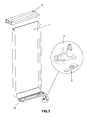
Figure 1 illustrates, in exploded perspective, a refrigerator door provided with vertical door height adjustment system according to present invention; -
Figures 2 and 3 illustrate, respectively, lower views of the refrigerator door ofFigure 1 , with and without the modular component for the door height adjustment in accordance with the present invention; -
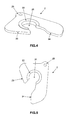
Figures 4 and 5 illustrate, in enlarged view, the modular component for the door height adjustment in accordance with the present invention; -
Figure 6 illustrates in expanded view, the interaction between the modular component for the door height adjustment and the door itself; and -
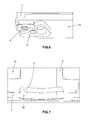
Figures 7 and8 illustrate in schematic section, the interaction between the modular component for the door height adjustment and the door itself. - According to the present invention, it is disclosed a novel door height adjustment system which enables pivoting door height adjustment relative to a body, cabinet or fixed stop, such as vertical refrigerator doors.
- Thus, it is important to note that although the preferred embodiment of the present invention, illustrated in
Figures 1 ,2 ,3 ,4 ,5 ,6 ,7 and8 , refer to a vertical refrigerator door, the scope and range of the present invention is not limited to this specific application, i.e., the door height adjustment system disclosed herein is able to be applied to any equipment composed of a door capable of pivoting angular movement relative to a fixed reference body, wherein said door is physically associated with a fixed reference body by means of at least one fastening pin transversely arranged therebetween. - As illustrated in
Figures 1 ,2 and 3 , the door height adjustment system is essentially composed of adoor 1 and amodular component 2 capable of being inserted and removed between thedoor 1 and the fixed reference body thereof (not shown), so as to change the distance between the latter. - According to the preferred embodiment of the present invention, the
door 1 comprises a solid body which defines or comprises an upperperpendicular surface 11 and a lowerperpendicular surface 12. - In this context it should be noted that both upper
perpendicular surface 11 and lowerperpendicular surface 12 can comprise an integral portion of thedoor 1 itself (in the case of a large thickness door, where are defined an upper plane and a lower plane), a headboard and / or a baseboard attachable to the door (in the case of a thin thickness door or a door formed by more than one "wall", requiring the use of a headboard and / or baseboard, as is known by a person skilled in the art), or amodular body 4 directly or indirectly associated with thedoor 1, as illustrated inFigure 1 , where it is observed that the so-called lowerperpendicular surface 12 particularly comprises the "lower surface" of the saidmodular body 4, which is associated with thedoor 1 through the baseboard. - Furthermore, as previously mentioned - and regardless of how the upper
perpendicular surface 11 and the lowerperpendicular surface 12 are defined - thedoor 1 is capable of pivoting angular movement relative to a fixed reference body (not shown and which can comprise a cabinet, a frame, etc.), wherein the association of thedoor 1 and said fixed reference body thereof is performed by means of a fasteningpin 5 transversely arranged between the lowerperpendicular surface 12 of thedoor 1 and the said fixed reference body. Preferably, such association between thedoor 1 and said fixed reference body thereof is also aided by a fastening pin (not shown) arranged between the upperperpendicular surface 11 of thedoor 1 and the said fixed reference body. - It is also important to note that, as shown in
Figures 2 ,7 and8 , the lowerperpendicular surface 12 of thedoor 1 comprises a groove orrecess 3 which, according to the preferred embodiment of the present invention, has a ring or circular form concentrically aligned with the fasteningpin 5. - In view of the possibilities of embodiment of the aforementioned lower
perpendicular surface 12, it is worth noting that the said groove orrecess 3 can be defined in thedoor 1 itself (in case of a large thickness door, where are defined a upper plane and a lower plane), it can be defined in the baseboard attachable to the door 1 (in the case of a thin thickness door or a door formed by more than one "wall", it is required the use of a headboard and / or baseboard, as is known by a person skilled in the art), or it can be defined in themodular body 4 associated with thedoor 1, as illustrated inFigure 2 . - According to the preferred embodiment of the present invention, the said
modular component 2, as shown in detail inFigures 4 and 5 , is essentially defined by a laminar body, which is preferably made of polymeric alloys. - In general, said laminar body comprises four important details: the
semicircular span 21, the rib orprojection 22 arranged on the edge of thesemicircular span 21, the contact stops 23 and 24, and aprominent flap 25. - Said
semicircular span 21 is arranged near the center of the laminar body perimeter, and is accessible through at least one edge hollow section. Preferably, thesemicircular span 21 comprises about 75% of the outline of a circle, or, approximately 270°. - The rib or
projection 22 relates to an addition of material in at least one edge portion of thesemicircular span 21. As illustrated inFigures 4 and 5 , said rib orprojection 22 covers the entire outline of thesemicircular span 21, increasing the thickness of the edge thereof on both surfaces of the laminar body, namely, the rib orprojection 22 of themodular component 2 comprises a semicircular rib arranged on the edge of thesemicircular span 21. - For a better description, the contact stops 23 and 24 can be arbitrarily referred to as the
first contact stop 23 andsecond contact stop 24. Thefirst contact stop 23 comprises a peripheral portion of the laminar body wall, wherein thesemicircular span 21 is arranged on. The format and positioning of thefirst contact stop 23 can also be varied according to specific characteristics of the project. Thesecond contact stop 24 is defined in a region of the laminar body extending from the region where thesemicircular span 21 is arranged on. So, it can be observed that thesecond contact stop 24 comprises at least one wall portion of said extended region (similar to an appendix). The format and positioning of the second contact stop 44 can be variable according to specific characteristics of the project. - The said
prominent flap 25 is projected from one end of the laminar body perimeter, thus defining a prominent projection. According to the preferred embodiment of the present invention, theprominent flap 25 comprises a semicircular outline and provides for a through- hole specially dedicated to the possible cooperation - during the eventual removal of themodular component 2 for door height adjustment - with an extraction tool (not shown). - The door height adjustment system now proposed, which is composed of the elements widely detailed above, stands out by the fact that the
modular component 2, besides defining a means capable of adjusting thedoor height 1 in relation to a fixed reference body (not shown) by changing the relative distance between them, also provides for a cooperative interaction with said perpendicularlower face 12 to define a locking means associated with the positioning of saidmodular component 2. - This locking means is especially defined by the cooperative engagement between the rib or
projection 22 arranged on themodular component 2 and the groove orrecess 3 arranged on the lowerperpendicular surface 12 of thedoor 1. - Thus, due to its geometry, the modulating
member 2 can be easily attached to thefastening pin 5 in order to change the relative distance between thedoor 1 and the fixed reference body (not shown). - Once the said
modular component 2 is arranged between thedoor 1 and the fixed reference body, it is noted that the whole weight of saiddoor 1 acts thereon, and in this sense, that is emphasized the locking means, therefore, the weight of thedoor 1 is fully concentrated in the cooperative engagement between the rib orprojection 22 arranged on themodular component 2 and the groove orrecess 3 is arranged on the lowerperpendicular surface 12 of thedoor 1. It hinders undue and undesired removal of saidmodular component 2. - Accordingly, the voluntary and desired removal of said
modular component 2 involves the handling of thedoor 1 itself, which needs to be "lifted" so that themodular component 2 can be removed. In this scenario, there is aprominent flap 25 of themodular component 2, which acts - during voluntary and desired removal of said modular component 2 - as the main handling point. -
Figures 2 and 3 illustrate an example of attachment / assembling of themodular component 2 on thefastening pin 5. - Specifically in
Figure 2 , it is noted that themodular member 2 is outside thefastening pin 5. Especially inFigure 3 , it is noted that themodular component 2 is inserted into thefastening pin 5, duly housed on the lowerperpendicular surface 12 of thedoor 1, which - in this case - is defined in themodular body 4. - As illustrated in detail in
Figures 7 and8 , it is observed that, in fact, the rib orprojection 22 arranged on themodular component 2 and the groove orrecess 3 arranged on the lowerperpendicular surface 12 of thedoor 1 cooperate with each other, defining a locking means associated with the positioning of saidmodular component 2. - In addition to the advent of the locking means related to the positioning of said
modular component 2, the present invention also proposes that the contact stops 23 and 24 perform contact interfaces with themodular body 4 which are able to limit the angular movement of themodular component 2, such movement that could occur during the pivoting angular movement of thedoor 1. - Therefore, it is disclosed a door height adjustment system using a
modular component 2 to change the relative distance between thedoor 1 and the fixed reference body (not shown), it also provides for a locking means associated with the positioning of saidmodular component 2, and, optionally, contact interfaces capable of limiting the angular movement of themodular component 2. - Since it was described an example of a preferred embodiment of the present invention, it should be understood that the scope thereof encompasses other possible variations, being only limited by the content of the claims, including therein the possible equivalents means.
Claims (12)
- Door height adjustment system, comprising:at least one door (1) capable of pivoting angular movement relative to a fixed reference body; said door (1) being provided with at least one lower perpendicular surface (12); said door (1) being physically associated with said fixed reference body
by means of at least one fastening pin (5) transversely arranged between said lower perpendicular surface (12) of the door (1) and said fixed reference body; said lower perpendicular surface (12) of the door (1) further comprising at least one groove or recess (3);
at least one modular component (2) provided with at least one semicircular span (21) accessible through at least one edge hollow portion; said modular component (2) being capable of attachment to said fastening pin (5) being arranged between said lower perpendicular surface (12) of the door (1) and said fixed reference body;
said door height adjustment system is especially CHARACTERIZED by the fact that said modular component (2) and said lower perpendicular surface (12) cooperate with each other to define a locking means related to the positioning of said modular component (2);
said locking means comprises at least one cooperative engagement defined between at least a rib or projection (22) arranged on the modular component (2) and at least one groove or recess (3) arranged on the lower perpendicular surface (12) of the door (1). - Door height adjustment system according to claim 1, CHARACTERIZED by the fact that the lower perpendicular surface (12) of the door (1) comprises an integral portion of the door (1) itself.
- Door height adjustment system according to claim 1, CHARACTERIZED by the fact that the lower perpendicular surface (12) of the door (1) comprises a baseboard attachable to the door (1).
- Door height adjustment system according to claim 1, CHARACTERIZED by the fact that the lower perpendicular surface (12) of the door (1) comprises a modular body (4) directly associated with the door (1).
- Door height adjustment system according to claim 1, CHARACTERIZED by the fact that the lower perpendicular surface (12) of the door (1) comprises a modular body (4) indirectly associated with the door (1).
- Door height adjustment system according to claim 2, CHARACTERIZED by the fact that the groove or recess (3) is defined in the door (1) itself.
- Door height adjustment system according to claim 3, CHARACTERIZED by the fact that the groove or recess (3) is defined in the baseboard attachable to the door (1).
- Door height adjustment system according to claim 4 or 5, CHARACTERIZED by the fact that the groove or recess (3) is defined on the modular body (4) associated with the door (1).
- Door height adjustment system according to claim 1, CHARACTERIZED by the fact that the groove or recess (3) comprises a circular groove or recess concentrically aligned with the fastening pin (5).
- Door height adjustment system according to claim 1, CHARACTERIZED by the fact that the rib or projection (22) of the modular component (2) comprises a semicircular rib arranged on the edge of the semicircular span (21).
- Door height adjustment system according to claim 1, CHARACTERIZED by the fact that the modular component (2) further comprises at least one prominent flap (25).
- Door height adjustment system according to claim 1, CHARACTERIZED by the fact that the modular component (2) further comprises at least one contact frame (23, 24) cooperating with at least a portion of the lower perpendicular surface (12) of the door (1).
Applications Claiming Priority (1)
| Application Number | Priority Date | Filing Date | Title |
|---|---|---|---|
| BR102014013587A BR102014013587A2 (en) | 2014-06-05 | 2014-06-05 | door height adjustment system |
Publications (1)
| Publication Number | Publication Date |
|---|---|
| EP2952840A1 true EP2952840A1 (en) | 2015-12-09 |
Family
ID=53365824
Family Applications (1)
| Application Number | Title | Priority Date | Filing Date |
|---|---|---|---|
| EP15170135.6A Withdrawn EP2952840A1 (en) | 2014-06-05 | 2015-06-01 | Door height adjustment system |
Country Status (2)
| Country | Link |
|---|---|
| EP (1) | EP2952840A1 (en) |
| BR (1) | BR102014013587A2 (en) |
Cited By (3)
| Publication number | Priority date | Publication date | Assignee | Title |
|---|---|---|---|---|
| CN106907897A (en) * | 2015-12-23 | 2017-06-30 | 博西华电器(江苏)有限公司 | Refrigeration appliances |
| CN108266952A (en) * | 2017-01-04 | 2018-07-10 | 博西华电器(江苏)有限公司 | Refrigeration equipment |
| WO2026034881A1 (en) * | 2024-08-09 | 2026-02-12 | 엘지전자 주식회사 | Refrigerator |
Citations (4)
| Publication number | Priority date | Publication date | Assignee | Title |
|---|---|---|---|---|
| US20060244351A1 (en) * | 2005-04-22 | 2006-11-02 | Lg Electronics Inc. | Refrigerator having height-adjustable door |
| CN102373858A (en) * | 2011-11-16 | 2012-03-14 | 泰州乐金电子冷机有限公司 | Hinge device for regulating height of refrigerator door and refrigerator comprising same |
| CN202347979U (en) | 2011-11-16 | 2012-07-25 | 泰州乐金电子冷机有限公司 | Hinge device for adjusting height of refrigerator door and refrigerator comprising hinge device |
| WO2013049017A1 (en) * | 2011-09-30 | 2013-04-04 | Wabtec Holding Corp. | Height adjustment device for transit shaft and arm assembly |
-
2014
- 2014-06-05 BR BR102014013587A patent/BR102014013587A2/en not_active Application Discontinuation
-
2015
- 2015-06-01 EP EP15170135.6A patent/EP2952840A1/en not_active Withdrawn
Patent Citations (4)
| Publication number | Priority date | Publication date | Assignee | Title |
|---|---|---|---|---|
| US20060244351A1 (en) * | 2005-04-22 | 2006-11-02 | Lg Electronics Inc. | Refrigerator having height-adjustable door |
| WO2013049017A1 (en) * | 2011-09-30 | 2013-04-04 | Wabtec Holding Corp. | Height adjustment device for transit shaft and arm assembly |
| CN102373858A (en) * | 2011-11-16 | 2012-03-14 | 泰州乐金电子冷机有限公司 | Hinge device for regulating height of refrigerator door and refrigerator comprising same |
| CN202347979U (en) | 2011-11-16 | 2012-07-25 | 泰州乐金电子冷机有限公司 | Hinge device for adjusting height of refrigerator door and refrigerator comprising hinge device |
Cited By (4)
| Publication number | Priority date | Publication date | Assignee | Title |
|---|---|---|---|---|
| CN106907897A (en) * | 2015-12-23 | 2017-06-30 | 博西华电器(江苏)有限公司 | Refrigeration appliances |
| CN106907897B (en) * | 2015-12-23 | 2020-07-10 | 博西华电器(江苏)有限公司 | Refrigeration device |
| CN108266952A (en) * | 2017-01-04 | 2018-07-10 | 博西华电器(江苏)有限公司 | Refrigeration equipment |
| WO2026034881A1 (en) * | 2024-08-09 | 2026-02-12 | 엘지전자 주식회사 | Refrigerator |
Also Published As
| Publication number | Publication date |
|---|---|
| BR102014013587A2 (en) | 2015-12-29 |
Similar Documents
| Publication | Publication Date | Title |
|---|---|---|
| EP2840339B1 (en) | Refrigerator with removable display | |
| CA2974673C (en) | Ceiling fan blade structure and ceiling fan | |
| EP2952840A1 (en) | Door height adjustment system | |
| EP3193112A1 (en) | Refrigerator drawer and refrigerator | |
| US10982475B2 (en) | Hinge | |
| CN104414487B (en) | Drawer appliance and the baking box with it | |
| EP3450885A1 (en) | Ice-maker/ice storage box assembly and refrigerator | |
| CN208570027U (en) | A kind of display screen box body that splicing effect is good | |
| EP2497993A3 (en) | Cabinet structure assembly | |
| CN104768424A (en) | Improved hanging brackets for wall assemblies of closets | |
| JP3194423U (en) | Quick emergency hinge | |
| CN202960178U (en) | Control panel assembly and oven provided with control panel assembly | |
| CN216197375U (en) | Door closer and refrigerator | |
| JP6723885B2 (en) | Door unit | |
| JP6421417B2 (en) | cabinet | |
| US20150256042A1 (en) | Micro motor rotor support | |
| CN205696659U (en) | Regulation pad and built-in cooking appliance assembly | |
| CN106254996A (en) | For regulating the device at sound equipment inclination angle | |
| CN104896847A (en) | Door body and refrigerator | |
| CN206234984U (en) | A kind of cabinet air-conditioner installing structure of top cover | |
| EP3155339A1 (en) | Household appliance | |
| KR101095898B1 (en) | Discharge Valve Assembly for Compressor | |
| CN217907315U (en) | Steam oven with easily-detachable baking tray support | |
| CN204268794U (en) | A kind of adjustable mounting structure of refrigerator drawer formula door-plate | |
| WO2015127997A1 (en) | Hermetic reciprocating mini compressor with reduced size |
Legal Events
| Date | Code | Title | Description |
|---|---|---|---|
| PUAI | Public reference made under article 153(3) epc to a published international application that has entered the european phase |
Free format text: ORIGINAL CODE: 0009012 |
|
| AK | Designated contracting states |
Kind code of ref document: A1 Designated state(s): AL AT BE BG CH CY CZ DE DK EE ES FI FR GB GR HR HU IE IS IT LI LT LU LV MC MK MT NL NO PL PT RO RS SE SI SK SM TR |
|
| AX | Request for extension of the european patent |
Extension state: BA ME |
|
| STAA | Information on the status of an ep patent application or granted ep patent |
Free format text: STATUS: THE APPLICATION IS DEEMED TO BE WITHDRAWN |
|
| 18D | Application deemed to be withdrawn |
Effective date: 20160610 |