EP2951341B1 - Crosslinking/functionalization system for a paper or non-woven web - Google Patents
Crosslinking/functionalization system for a paper or non-woven web Download PDFInfo
- Publication number
- EP2951341B1 EP2951341B1 EP14700095.4A EP14700095A EP2951341B1 EP 2951341 B1 EP2951341 B1 EP 2951341B1 EP 14700095 A EP14700095 A EP 14700095A EP 2951341 B1 EP2951341 B1 EP 2951341B1
- Authority
- EP
- European Patent Office
- Prior art keywords
- paper
- woven web
- crosslinking
- acid
- functionalization agent
- Prior art date
- Legal status (The legal status is an assumption and is not a legal conclusion. Google has not performed a legal analysis and makes no representation as to the accuracy of the status listed.)
- Active
Links
Images


Classifications
-
- D—TEXTILES; PAPER
- D04—BRAIDING; LACE-MAKING; KNITTING; TRIMMINGS; NON-WOVEN FABRICS
- D04H—MAKING TEXTILE FABRICS, e.g. FROM FIBRES OR FILAMENTARY MATERIAL; FABRICS MADE BY SUCH PROCESSES OR APPARATUS, e.g. FELTS, NON-WOVEN FABRICS; COTTON-WOOL; WADDING ; NON-WOVEN FABRICS FROM STAPLE FIBRES, FILAMENTS OR YARNS, BONDED WITH AT LEAST ONE WEB-LIKE MATERIAL DURING THEIR CONSOLIDATION
- D04H1/00—Non-woven fabrics formed wholly or mainly of staple fibres or like relatively short fibres
- D04H1/40—Non-woven fabrics formed wholly or mainly of staple fibres or like relatively short fibres from fleeces or layers composed of fibres without existing or potential cohesive properties
- D04H1/42—Non-woven fabrics formed wholly or mainly of staple fibres or like relatively short fibres from fleeces or layers composed of fibres without existing or potential cohesive properties characterised by the use of certain kinds of fibres insofar as this use has no preponderant influence on the consolidation of the fleece
- D04H1/425—Cellulose series
-
- D—TEXTILES; PAPER
- D21—PAPER-MAKING; PRODUCTION OF CELLULOSE
- D21H—PULP COMPOSITIONS; PREPARATION THEREOF NOT COVERED BY SUBCLASSES D21C OR D21D; IMPREGNATING OR COATING OF PAPER; TREATMENT OF FINISHED PAPER NOT COVERED BY CLASS B31 OR SUBCLASS D21G; PAPER NOT OTHERWISE PROVIDED FOR
- D21H19/00—Coated paper; Coating material
- D21H19/10—Coatings without pigments
- D21H19/14—Coatings without pigments applied in a form other than the aqueous solution defined in group D21H19/12
-
- D—TEXTILES; PAPER
- D04—BRAIDING; LACE-MAKING; KNITTING; TRIMMINGS; NON-WOVEN FABRICS
- D04H—MAKING TEXTILE FABRICS, e.g. FROM FIBRES OR FILAMENTARY MATERIAL; FABRICS MADE BY SUCH PROCESSES OR APPARATUS, e.g. FELTS, NON-WOVEN FABRICS; COTTON-WOOL; WADDING ; NON-WOVEN FABRICS FROM STAPLE FIBRES, FILAMENTS OR YARNS, BONDED WITH AT LEAST ONE WEB-LIKE MATERIAL DURING THEIR CONSOLIDATION
- D04H1/00—Non-woven fabrics formed wholly or mainly of staple fibres or like relatively short fibres
- D04H1/40—Non-woven fabrics formed wholly or mainly of staple fibres or like relatively short fibres from fleeces or layers composed of fibres without existing or potential cohesive properties
- D04H1/42—Non-woven fabrics formed wholly or mainly of staple fibres or like relatively short fibres from fleeces or layers composed of fibres without existing or potential cohesive properties characterised by the use of certain kinds of fibres insofar as this use has no preponderant influence on the consolidation of the fleece
- D04H1/4266—Natural fibres not provided for in group D04H1/425
-
- D—TEXTILES; PAPER
- D04—BRAIDING; LACE-MAKING; KNITTING; TRIMMINGS; NON-WOVEN FABRICS
- D04H—MAKING TEXTILE FABRICS, e.g. FROM FIBRES OR FILAMENTARY MATERIAL; FABRICS MADE BY SUCH PROCESSES OR APPARATUS, e.g. FELTS, NON-WOVEN FABRICS; COTTON-WOOL; WADDING ; NON-WOVEN FABRICS FROM STAPLE FIBRES, FILAMENTS OR YARNS, BONDED WITH AT LEAST ONE WEB-LIKE MATERIAL DURING THEIR CONSOLIDATION
- D04H1/00—Non-woven fabrics formed wholly or mainly of staple fibres or like relatively short fibres
- D04H1/40—Non-woven fabrics formed wholly or mainly of staple fibres or like relatively short fibres from fleeces or layers composed of fibres without existing or potential cohesive properties
- D04H1/54—Non-woven fabrics formed wholly or mainly of staple fibres or like relatively short fibres from fleeces or layers composed of fibres without existing or potential cohesive properties by welding together the fibres, e.g. by partially melting or dissolving
- D04H1/552—Non-woven fabrics formed wholly or mainly of staple fibres or like relatively short fibres from fleeces or layers composed of fibres without existing or potential cohesive properties by welding together the fibres, e.g. by partially melting or dissolving by applying solvents or auxiliary agents
-
- D—TEXTILES; PAPER
- D04—BRAIDING; LACE-MAKING; KNITTING; TRIMMINGS; NON-WOVEN FABRICS
- D04H—MAKING TEXTILE FABRICS, e.g. FROM FIBRES OR FILAMENTARY MATERIAL; FABRICS MADE BY SUCH PROCESSES OR APPARATUS, e.g. FELTS, NON-WOVEN FABRICS; COTTON-WOOL; WADDING ; NON-WOVEN FABRICS FROM STAPLE FIBRES, FILAMENTS OR YARNS, BONDED WITH AT LEAST ONE WEB-LIKE MATERIAL DURING THEIR CONSOLIDATION
- D04H1/00—Non-woven fabrics formed wholly or mainly of staple fibres or like relatively short fibres
- D04H1/70—Non-woven fabrics formed wholly or mainly of staple fibres or like relatively short fibres characterised by the method of forming fleeces or layers, e.g. reorientation of fibres
- D04H1/72—Non-woven fabrics formed wholly or mainly of staple fibres or like relatively short fibres characterised by the method of forming fleeces or layers, e.g. reorientation of fibres the fibres being randomly arranged
- D04H1/732—Non-woven fabrics formed wholly or mainly of staple fibres or like relatively short fibres characterised by the method of forming fleeces or layers, e.g. reorientation of fibres the fibres being randomly arranged by fluid current, e.g. air-lay
-
- D—TEXTILES; PAPER
- D06—TREATMENT OF TEXTILES OR THE LIKE; LAUNDERING; FLEXIBLE MATERIALS NOT OTHERWISE PROVIDED FOR
- D06M—TREATMENT, NOT PROVIDED FOR ELSEWHERE IN CLASS D06, OF FIBRES, THREADS, YARNS, FABRICS, FEATHERS OR FIBROUS GOODS MADE FROM SUCH MATERIALS
- D06M13/00—Treating fibres, threads, yarns, fabrics or fibrous goods made from such materials, with non-macromolecular organic compounds; Such treatment combined with mechanical treatment
-
- D—TEXTILES; PAPER
- D06—TREATMENT OF TEXTILES OR THE LIKE; LAUNDERING; FLEXIBLE MATERIALS NOT OTHERWISE PROVIDED FOR
- D06M—TREATMENT, NOT PROVIDED FOR ELSEWHERE IN CLASS D06, OF FIBRES, THREADS, YARNS, FABRICS, FEATHERS OR FIBROUS GOODS MADE FROM SUCH MATERIALS
- D06M13/00—Treating fibres, threads, yarns, fabrics or fibrous goods made from such materials, with non-macromolecular organic compounds; Such treatment combined with mechanical treatment
- D06M13/10—Treating fibres, threads, yarns, fabrics or fibrous goods made from such materials, with non-macromolecular organic compounds; Such treatment combined with mechanical treatment with compounds containing oxygen
- D06M13/184—Carboxylic acids; Anhydrides, halides or salts thereof
- D06M13/188—Monocarboxylic acids; Anhydrides, halides or salts thereof
-
- D—TEXTILES; PAPER
- D06—TREATMENT OF TEXTILES OR THE LIKE; LAUNDERING; FLEXIBLE MATERIALS NOT OTHERWISE PROVIDED FOR
- D06M—TREATMENT, NOT PROVIDED FOR ELSEWHERE IN CLASS D06, OF FIBRES, THREADS, YARNS, FABRICS, FEATHERS OR FIBROUS GOODS MADE FROM SUCH MATERIALS
- D06M13/00—Treating fibres, threads, yarns, fabrics or fibrous goods made from such materials, with non-macromolecular organic compounds; Such treatment combined with mechanical treatment
- D06M13/10—Treating fibres, threads, yarns, fabrics or fibrous goods made from such materials, with non-macromolecular organic compounds; Such treatment combined with mechanical treatment with compounds containing oxygen
- D06M13/184—Carboxylic acids; Anhydrides, halides or salts thereof
- D06M13/192—Polycarboxylic acids; Anhydrides, halides or salts thereof
-
- D—TEXTILES; PAPER
- D06—TREATMENT OF TEXTILES OR THE LIKE; LAUNDERING; FLEXIBLE MATERIALS NOT OTHERWISE PROVIDED FOR
- D06M—TREATMENT, NOT PROVIDED FOR ELSEWHERE IN CLASS D06, OF FIBRES, THREADS, YARNS, FABRICS, FEATHERS OR FIBROUS GOODS MADE FROM SUCH MATERIALS
- D06M13/00—Treating fibres, threads, yarns, fabrics or fibrous goods made from such materials, with non-macromolecular organic compounds; Such treatment combined with mechanical treatment
- D06M13/10—Treating fibres, threads, yarns, fabrics or fibrous goods made from such materials, with non-macromolecular organic compounds; Such treatment combined with mechanical treatment with compounds containing oxygen
- D06M13/184—Carboxylic acids; Anhydrides, halides or salts thereof
- D06M13/207—Substituted carboxylic acids, e.g. by hydroxy or keto groups; Anhydrides, halides or salts thereof
-
- D—TEXTILES; PAPER
- D06—TREATMENT OF TEXTILES OR THE LIKE; LAUNDERING; FLEXIBLE MATERIALS NOT OTHERWISE PROVIDED FOR
- D06M—TREATMENT, NOT PROVIDED FOR ELSEWHERE IN CLASS D06, OF FIBRES, THREADS, YARNS, FABRICS, FEATHERS OR FIBROUS GOODS MADE FROM SUCH MATERIALS
- D06M13/00—Treating fibres, threads, yarns, fabrics or fibrous goods made from such materials, with non-macromolecular organic compounds; Such treatment combined with mechanical treatment
- D06M13/322—Treating fibres, threads, yarns, fabrics or fibrous goods made from such materials, with non-macromolecular organic compounds; Such treatment combined with mechanical treatment with compounds containing nitrogen
- D06M13/325—Amines
- D06M13/328—Amines the amino group being bound to an acyclic or cycloaliphatic carbon atom
- D06M13/33—Amines the amino group being bound to an acyclic or cycloaliphatic carbon atom containing halogen atoms
-
- D—TEXTILES; PAPER
- D06—TREATMENT OF TEXTILES OR THE LIKE; LAUNDERING; FLEXIBLE MATERIALS NOT OTHERWISE PROVIDED FOR
- D06M—TREATMENT, NOT PROVIDED FOR ELSEWHERE IN CLASS D06, OF FIBRES, THREADS, YARNS, FABRICS, FEATHERS OR FIBROUS GOODS MADE FROM SUCH MATERIALS
- D06M13/00—Treating fibres, threads, yarns, fabrics or fibrous goods made from such materials, with non-macromolecular organic compounds; Such treatment combined with mechanical treatment
- D06M13/322—Treating fibres, threads, yarns, fabrics or fibrous goods made from such materials, with non-macromolecular organic compounds; Such treatment combined with mechanical treatment with compounds containing nitrogen
- D06M13/35—Heterocyclic compounds
- D06M13/355—Heterocyclic compounds having six-membered heterocyclic rings
- D06M13/358—Triazines
-
- D—TEXTILES; PAPER
- D21—PAPER-MAKING; PRODUCTION OF CELLULOSE
- D21H—PULP COMPOSITIONS; PREPARATION THEREOF NOT COVERED BY SUBCLASSES D21C OR D21D; IMPREGNATING OR COATING OF PAPER; TREATMENT OF FINISHED PAPER NOT COVERED BY CLASS B31 OR SUBCLASS D21G; PAPER NOT OTHERWISE PROVIDED FOR
- D21H17/00—Non-fibrous material added to the pulp, characterised by its constitution; Paper-impregnating material characterised by its constitution
- D21H17/03—Non-macromolecular organic compounds
- D21H17/05—Non-macromolecular organic compounds containing elements other than carbon and hydrogen only
- D21H17/07—Nitrogen-containing compounds
-
- D—TEXTILES; PAPER
- D21—PAPER-MAKING; PRODUCTION OF CELLULOSE
- D21H—PULP COMPOSITIONS; PREPARATION THEREOF NOT COVERED BY SUBCLASSES D21C OR D21D; IMPREGNATING OR COATING OF PAPER; TREATMENT OF FINISHED PAPER NOT COVERED BY CLASS B31 OR SUBCLASS D21G; PAPER NOT OTHERWISE PROVIDED FOR
- D21H17/00—Non-fibrous material added to the pulp, characterised by its constitution; Paper-impregnating material characterised by its constitution
- D21H17/03—Non-macromolecular organic compounds
- D21H17/05—Non-macromolecular organic compounds containing elements other than carbon and hydrogen only
- D21H17/14—Carboxylic acids; Derivatives thereof
-
- D—TEXTILES; PAPER
- D21—PAPER-MAKING; PRODUCTION OF CELLULOSE
- D21H—PULP COMPOSITIONS; PREPARATION THEREOF NOT COVERED BY SUBCLASSES D21C OR D21D; IMPREGNATING OR COATING OF PAPER; TREATMENT OF FINISHED PAPER NOT COVERED BY CLASS B31 OR SUBCLASS D21G; PAPER NOT OTHERWISE PROVIDED FOR
- D21H17/00—Non-fibrous material added to the pulp, characterised by its constitution; Paper-impregnating material characterised by its constitution
- D21H17/03—Non-macromolecular organic compounds
- D21H17/05—Non-macromolecular organic compounds containing elements other than carbon and hydrogen only
- D21H17/14—Carboxylic acids; Derivatives thereof
- D21H17/15—Polycarboxylic acids, e.g. maleic acid
-
- D—TEXTILES; PAPER
- D21—PAPER-MAKING; PRODUCTION OF CELLULOSE
- D21H—PULP COMPOSITIONS; PREPARATION THEREOF NOT COVERED BY SUBCLASSES D21C OR D21D; IMPREGNATING OR COATING OF PAPER; TREATMENT OF FINISHED PAPER NOT COVERED BY CLASS B31 OR SUBCLASS D21G; PAPER NOT OTHERWISE PROVIDED FOR
- D21H17/00—Non-fibrous material added to the pulp, characterised by its constitution; Paper-impregnating material characterised by its constitution
- D21H17/20—Macromolecular organic compounds
- D21H17/21—Macromolecular organic compounds of natural origin; Derivatives thereof
- D21H17/24—Polysaccharides
-
- D—TEXTILES; PAPER
- D21—PAPER-MAKING; PRODUCTION OF CELLULOSE
- D21H—PULP COMPOSITIONS; PREPARATION THEREOF NOT COVERED BY SUBCLASSES D21C OR D21D; IMPREGNATING OR COATING OF PAPER; TREATMENT OF FINISHED PAPER NOT COVERED BY CLASS B31 OR SUBCLASS D21G; PAPER NOT OTHERWISE PROVIDED FOR
- D21H17/00—Non-fibrous material added to the pulp, characterised by its constitution; Paper-impregnating material characterised by its constitution
- D21H17/20—Macromolecular organic compounds
- D21H17/21—Macromolecular organic compounds of natural origin; Derivatives thereof
- D21H17/24—Polysaccharides
- D21H17/25—Cellulose
-
- D—TEXTILES; PAPER
- D21—PAPER-MAKING; PRODUCTION OF CELLULOSE
- D21H—PULP COMPOSITIONS; PREPARATION THEREOF NOT COVERED BY SUBCLASSES D21C OR D21D; IMPREGNATING OR COATING OF PAPER; TREATMENT OF FINISHED PAPER NOT COVERED BY CLASS B31 OR SUBCLASS D21G; PAPER NOT OTHERWISE PROVIDED FOR
- D21H17/00—Non-fibrous material added to the pulp, characterised by its constitution; Paper-impregnating material characterised by its constitution
- D21H17/20—Macromolecular organic compounds
- D21H17/21—Macromolecular organic compounds of natural origin; Derivatives thereof
- D21H17/24—Polysaccharides
- D21H17/28—Starch
-
- D—TEXTILES; PAPER
- D21—PAPER-MAKING; PRODUCTION OF CELLULOSE
- D21H—PULP COMPOSITIONS; PREPARATION THEREOF NOT COVERED BY SUBCLASSES D21C OR D21D; IMPREGNATING OR COATING OF PAPER; TREATMENT OF FINISHED PAPER NOT COVERED BY CLASS B31 OR SUBCLASS D21G; PAPER NOT OTHERWISE PROVIDED FOR
- D21H17/00—Non-fibrous material added to the pulp, characterised by its constitution; Paper-impregnating material characterised by its constitution
- D21H17/20—Macromolecular organic compounds
- D21H17/21—Macromolecular organic compounds of natural origin; Derivatives thereof
- D21H17/24—Polysaccharides
- D21H17/30—Alginic acid or alginates
-
- D—TEXTILES; PAPER
- D21—PAPER-MAKING; PRODUCTION OF CELLULOSE
- D21H—PULP COMPOSITIONS; PREPARATION THEREOF NOT COVERED BY SUBCLASSES D21C OR D21D; IMPREGNATING OR COATING OF PAPER; TREATMENT OF FINISHED PAPER NOT COVERED BY CLASS B31 OR SUBCLASS D21G; PAPER NOT OTHERWISE PROVIDED FOR
- D21H21/00—Non-fibrous material added to the pulp, characterised by its function, form or properties; Paper-impregnating or coating material, characterised by its function, form or properties
- D21H21/14—Non-fibrous material added to the pulp, characterised by its function, form or properties; Paper-impregnating or coating material, characterised by its function, form or properties characterised by function or properties in or on the paper
-
- D—TEXTILES; PAPER
- D06—TREATMENT OF TEXTILES OR THE LIKE; LAUNDERING; FLEXIBLE MATERIALS NOT OTHERWISE PROVIDED FOR
- D06M—TREATMENT, NOT PROVIDED FOR ELSEWHERE IN CLASS D06, OF FIBRES, THREADS, YARNS, FABRICS, FEATHERS OR FIBROUS GOODS MADE FROM SUCH MATERIALS
- D06M2101/00—Chemical constitution of the fibres, threads, yarns, fabrics or fibrous goods made from such materials, to be treated
- D06M2101/02—Natural fibres, other than mineral fibres
- D06M2101/04—Vegetal fibres
- D06M2101/06—Vegetal fibres cellulosic
-
- Y—GENERAL TAGGING OF NEW TECHNOLOGICAL DEVELOPMENTS; GENERAL TAGGING OF CROSS-SECTIONAL TECHNOLOGIES SPANNING OVER SEVERAL SECTIONS OF THE IPC; TECHNICAL SUBJECTS COVERED BY FORMER USPC CROSS-REFERENCE ART COLLECTIONS [XRACs] AND DIGESTS
- Y10—TECHNICAL SUBJECTS COVERED BY FORMER USPC
- Y10T—TECHNICAL SUBJECTS COVERED BY FORMER US CLASSIFICATION
- Y10T442/00—Fabric [woven, knitted, or nonwoven textile or cloth, etc.]
- Y10T442/20—Coated or impregnated woven, knit, or nonwoven fabric which is not [a] associated with another preformed layer or fiber layer or, [b] with respect to woven and knit, characterized, respectively, by a particular or differential weave or knit, wherein the coating or impregnation is neither a foamed material nor a free metal or alloy layer
-
- Y—GENERAL TAGGING OF NEW TECHNOLOGICAL DEVELOPMENTS; GENERAL TAGGING OF CROSS-SECTIONAL TECHNOLOGIES SPANNING OVER SEVERAL SECTIONS OF THE IPC; TECHNICAL SUBJECTS COVERED BY FORMER USPC CROSS-REFERENCE ART COLLECTIONS [XRACs] AND DIGESTS
- Y10—TECHNICAL SUBJECTS COVERED BY FORMER USPC
- Y10T—TECHNICAL SUBJECTS COVERED BY FORMER US CLASSIFICATION
- Y10T442/00—Fabric [woven, knitted, or nonwoven textile or cloth, etc.]
- Y10T442/20—Coated or impregnated woven, knit, or nonwoven fabric which is not [a] associated with another preformed layer or fiber layer or, [b] with respect to woven and knit, characterized, respectively, by a particular or differential weave or knit, wherein the coating or impregnation is neither a foamed material nor a free metal or alloy layer
- Y10T442/2762—Coated or impregnated natural fiber fabric [e.g., cotton, wool, silk, linen, etc.]
- Y10T442/277—Coated or impregnated cellulosic fiber fabric
Definitions
- the present invention relates to a paper or non-woven web comprising fibers and a specific crosslinking or functionalization agent, a method for producing the paper or non-woven web or air-laid web and the use of the crosslinking or functionalization agent in a paper or non-woven web.
- a paper or non-woven web can be used for various purposes. Examples thereof include the use as packaging material, such as for food packaging; filter material, such as for infusion beverages, e.g. tea and coffee, or for oil filtration; composite laminates, such as overlay paper; metallized paper suitable for labels or packages; air laid non-woven webs, such as hygiene and personal care products, home care products, e.g. wipes, towels, napkins and tablecloths, speciality papers, e.g. wallcoverings (wall paper), mattress and upholstery padding, just to name a few.
- packaging material such as for food packaging
- filter material such as for infusion beverages, e.g. tea and coffee, or for oil filtration
- composite laminates such as overlay paper
- metallized paper suitable for labels or packages such as metallized paper suitable for labels or packages
- air laid non-woven webs such as hygiene and personal care products, home care products, e.g. wipes, towels, napkins and tablecloths, speciality papers, e.g. wallcovering
- a paper or non-woven web has to fulfil various properties, such as tensile strength in a dry state and/or in a wet state, porosity, adherence, wettability, hydrophilicity/hydrophobicity. After use, it might be necessary or advantageous that the paper or non-woven web can be decomposed. Accordingly, biodegradability is a further often desired property of a paper or non-woven web.
- a paper or non-woven web typically comprises fibers mainly constituting the web, which may be natural fibers or synthetic fibers. In order to impart the desired properties to a paper or non-woven web, it is often necessary to modify its composition.
- EP 0 943 731 A1 describes a filter material which controls wettability and water absorption by using an additive of an amphiphilic compound, such as carboxymethyl cellulose (CMC), or hydrophilic and hydrophobic compounds, such as styrene/acrylate copolymers.
- an amphiphilic compound such as carboxymethyl cellulose (CMC)
- CMC carboxymethyl cellulose
- hydrophilic and hydrophobic compounds such as styrene/acrylate copolymers.
- the present inventors have found that the polysaccharides alone, proposed in EP 0 943 731 A1 as amphiphilic or hydrophilic compounds, provide fiber-fiber crosslinkages which are stable in a dry state, however insufficient in a wet state. While the hydrophobic compounds, such as styrene/acrylate copolymers, proposed in EP 0 943 731 A1 provide better wet-strength properties, they are based on mineral oil and therefore not desired from a viewpoint of conservation of resources and biodegradability.
- the object of the present invention is to provide a paper or non-woven web, provided with specific properties according to requirements, and involving ecological advantages in terms of a biological basis and/or biodegradability.
- the present invention aims at providing a crosslinking/functionalization system, such as a crosslinking or functionalization agent, that imparts specific desired properties to a paper or non-woven web, while being more environment-friendly than the hitherto known oil-based compounds.
- a crosslinking/functionalization system such as a crosslinking or functionalization agent
- the present invention relates to a paper or non-woven web, which comprises fibers and at least one crosslinking or functionalization agent selected from the group consisting of carboxylic acids, halogenated heteroaromatic compounds and salts thereof.
- a crosslinking or functionalization agent as described herein is suitable for substituting the hitherto known oil-based compounds and can impart specific desired properties to a paper or non-woven web, such as a high tensile strength in both a dry state and in a wet state even under severe conditions for instance extreme pH values.
- the porosity, adherence, wettability or hydrophilicity/hydrophobicity of the paper or non-woven web can be easily controlled to the desired properties by appropriately selecting a specific crosslinking or functionalization agent as described herein as well as its amount or by combining it with other additives, such as polysaccharide additives, for instance carboxymethyl cellulose (CMC).
- CMC carboxymethyl cellulose
- the present invention further relates to the use of a crosslinking or functionalization agent as described herein in a paper or non-woven web.
- the present invention relates to a process for producing a paper or non-woven web, characterized in that at least one crosslinking or functionalization agent as described herein is applied.
- any disclosure or exemplary embodiment made herein in connection with the paper or non-woven web may also apply to a process for producing a paper or non-woven web as described herein and to a use of a crosslinking or functionalization agent as described herein and vice versa.
- the present invention provides a paper or non-woven web, comprising fibers and being characterized in that it comprises at least one crosslinking or functionalization agent as described herein.
- the molecular weight of the at least one crosslinking or functionalization agent is in particular not more than 1000 g/mol, in particular not more than 750 g/mol, in particular not more than 600 g/mol, in particular not more than 500 g/mol, in particular not more than 400 g/mol, in particular not more than 300 g/mol, and typically more than 50 g/mol, in particular more than 75 g/mol.
- the at least one crosslinking or functionalization agent is in particular not a polymeric compound.
- the paper or non-woven web preferably does not comprise a polymeric (synthetic) binder, such as an acrylate polymer binder.
- the paper or non-woven web according to the present invention can be for instance a packaging material, such as a packaging material for food packaging; a filter material, such as a filter material for infusion beverages, e.g. tea and coffee, or a filter material for oil filtration; a composite laminate, such as an overlay paper; a metallized paper, such as a metallized paper suitable for labels or packages; an air-laid non-woven web, such as a hygiene and personal care product, home care product, e.g. wipes, towels, napkins and tablecloths, a speciality paper, e.g. wallcoverings (wall paper), mattress and upholstery padding.
- the paper or non-woven web according to the present invention is a filter material for tea and coffee.
- the paper or non-woven web according to the present invention may be in particular an air-laid web or a wet-laid web.
- crosslinking or functionalization agent denotes a compound which is able to bind to fibers, preferably via covalent bonds, and is able to form crosslinkages or to functionalize fibers.
- crosslinking do not only encompass the linking of two fibers or a fiber and a further additive, such as a polysaccharide additive, as will be described in further detail below, but also encompass the crosslinking within one fiber.
- crosslinking or “crosslinkages” as used herein in particular encompasses linkages (e.g. the linking of two fibers, the linking of a fiber and a further additive, and/or the crosslinking within one fiber) within (in the interior) of the paper or non-woven web, and in particular not only on the surface of the paper or non-woven web.
- the term "functionalization” as used herein denotes providing the paper or non-woven web with a certain functionality or certain functionalities, such as hydrophilic properties, hydrophobic properties, wettability, adherence, stability, tensile strength, resistance, and the like.
- At least a part of the crosslinking or functionalization agent is bound, in particular covalently bound, to the fibers.
- the term "at least a part of” as used herein may denote that in case of a combination of a carboxylic acid compound and a hypophosphite compound, as will be described in further detail below, at least one type of compound of the carboxylic acid compound and the hypophosphite compound is bound to the fibers, for instance at least the carboxylic acid is bound to the fibers.
- the term "at least a part of" as used herein may also denote that at least 5 %, in particular at least 10 %, in particular at least 20 %, in particular at least 30 %, in particular at least 40 %, in particular at least 50 %, in particular at least 60 %, in particular at least 70 %, in particular at least 80 %, in particular at least 90 %, and in particular up to 100 % of the amount of the crosslinking or functionalization agent contained in the paper or non-woven web is bound to the fibers.
- crosslinking or functionalization agent is selected from the group consisting of carboxylic acids, halogenated heteroaromatic compounds and salts thereof.
- the carboxylic acids are preferably selected from the group consisting of dicarboxylic acids, polycarboxylic acids, amino acids and salts thereof, more preferably from the group consisting of aliphatic dicarboxylic acids, aliphatic polycarboxylic acids, aliphatic amino acids and salts thereof.
- dicarboxylic acids are maleic acid, fumaric acid, oxalic acid, malonic acid, succinic acid, adipic acid and salts thereof.
- Particularly preferred polycarboxylic acids are citric acid, butane tetracarboxylic acid, iminodisuccinic acid and salts thereof.
- amino acids are aspartic acid, glutamic acid and salts thereof.
- carboxylic acids are citric acid and its sodium salts, butane tetracarboxylic acid, in particular butane 1,2,3,4-tetracarboxylic acid, and its sodium salts and aspartic acid.
- the halogenated heteroaromatic compounds may contain one or more halogen atoms, selected independently from each other from the group consisting of F, C1, Br and I.
- the halogenated heteroaromatic compounds are preferably halogenated nitrogen-containing heteroaromatic compounds and salts thereof, more preferably chlorinated nitrogen-containing heteroaromatic compounds and salts thereof.
- halogenated heteroaromatic compounds are halogenated triazine compounds and salts thereof, in particular chlorinated triazine compounds and salts thereof.
- halogenated heteroaromatic compound 4,6-dichloro-1,3,5-triazin-2-ol and its sodium salt (NHDT).
- crosslinking or functionalization agents are citric acid and 4,6-dichloro-1,3,5-triazin-2-ol and its sodium salt (NHDT).
- the present inventors have found that in case of the crosslinking or functionalization agent comprising a carboxylic acid, it is advantageous that the carboxylic acid is in its acidic form. In other words, salts of carboxylic acids may be less preferred.
- the present inventors have found that in case of the crosslinking or functionalization agent comprising a carboxylic acid, such as dicarboxylic acid or a polycarboxylic acid, in particular citric acid, it is advantageous that additionally at least one hypophosphite compound is comprised.
- the at least one hypophosphite (phosphinate) compound may in particular be a salt of hypophosphorous acid (phosphinic acid, H 3 PO 2 ), in particular a sodium salt thereof, such as sodium hypophosphite (sodium phosphinate, NaH 2 PO 2 ).
- the paper or non-woven web according to the present invention shows particularly advantageous properties in terms of biodegradability and tensile strength.
- the content of the hypophosphite compound agent in the paper or non-woven web is preferably 0.1 to 10 wt.-% based on the total weight of the paper or non-woven web, in particular 0.2 to 5.0 wt.-%, in particular 0.3 to 4.0 wt.-%, in particular 0.4 to 3.0 wt.-%, in particular 0.5 to 2.5 wt.-%.
- the content of the crosslinking or functionalization agent in the paper or non-woven web according to the present invention is preferably up to 50 wt.-% based on the total weight of the paper or non-woven web, more preferably 0.01 to 40 wt.-%, still more preferably 0.02 to 30 wt.-%, still more preferably 0.03 to 25 wt.-%, still more preferably 0.04 to 20 wt.-%, still more preferably 0.05 to 15 wt.-% and most preferably 0.1 to 10 wt.-%, in particular 0.5 to 10 wt.-%, in particular 1.0 to 10 wt.-%, such as 1.0 to 5.0 wt.-% or 2.0 to 10 wt.-%.
- These content values are to be understood that the content of the at least one hypophosphite compound - if present - is encompassed.
- the paper or non-woven web may comprise from 1.0 to 5.0 wt.-% of carboxylic acid (such as citric acid) and from 0.5 to 2.5 wt.-% of the at least one hypophosphite compound (such as sodium hypophosphite), all based on the total weight of the paper or non-woven web.
- carboxylic acid such as citric acid
- hypophosphite compound such as sodium hypophosphite
- the paper or non-woven web according to the present invention further comprises at least one polysaccharide additive.
- Preferred examples of the polysaccharide additive include carboxymethyl cellulose (CMC), starch, alginic acid or alginates, pectin and mixtures thereof, in particular carboxymethyl cellulose (CMC).
- CMC carboxymethyl cellulose
- the polysaccharide additive is preferably linked (bound, such as covalently bound) to the fibers of the paper or non-woven web by the crosslinking or functionalization agent.
- the content of the at least one polysaccharide additive in the paper or non-woven web according to the present invention is preferably up to 30 wt.-% based on the total weight of the paper or non-woven web, in particular from 0.1 to 20 wt.-%, in particular from 0.25 to 15 wt.-%, in particular from 0.5 to 10 wt.-%, in particular from 0.75 to 5.0 wt.-%, in particular from 1.0 to 3.0 wt.-%.
- the paper or non-woven web may comprise from 1.0 to 5.0 wt.-% of carboxylic acid (such as citric acid), from 0.5 to 2.5 wt.-% of the at least one hypophosphite compound (such as sodium hypophosphite) and from 1.0 to 3.0 wt.-% of the at least one polysaccharide additive (such as CMC), all based on the total weight of the paper or non-woven web.
- carboxylic acid such as citric acid
- the at least one hypophosphite compound such as sodium hypophosphite
- polysaccharide additive such as CMC
- abrasive-resistant or hard material particles such as corundum or glass beads, may be contained, in particular when used as an overlay paper.
- the fibers contained in the paper or non-woven web according to the present invention are not particularly limited as long as they can bind to the crosslinking or functionalization agent.
- Suitable fibers are natural fibers or cellulosic fibers.
- Preferred examples include fibers of cellulose, viscose, lyocell, cotton, hemp, manila, jute, sisal, rayon, abaca and others, and also include fibers of soft wood pulp and hard wood pulp.
- Further suitable fibers are synthetic fibers or heat-sealable fibers.
- Preferred examples include fibers of polyethylene (PE), polypropylene (PP), polyester, such as polyethylene terephthalate (PET) and poly(lactic acid) (PLA).
- Further preferred examples include bicomponent fibers, preferably bicomponent fibers of the sheath-core type. Bicomponent fibers are composed of two sorts of polymers having different physical and/or chemical characteristics, in particular different melting characteristics.
- a bicomponent fiber of the sheath-core type typically has a core of a higher melting point component and a sheath of a lower melting point component. Examples of bicomponent fibers, suitable for use in the present invention, include PET/PET fibers, PE/PP fibers, PET/PE fibers and PLA/PLA fibers.
- mixtures of the above fibers such as mixtures of two or more natural fibers, mixtures of two or more synthetic fibers or heat-sealable fibers, mixtures of natural fibers and synthetic fibers or heat-sealable fibers and any combinations thereof.
- the grammage of the paper or non-woven web is not particularly limited. Typically, the paper or non-woven web has a grammage of from 5 to 2000 g/m 2 , preferably from 50 to 600 g/m 2 or from 8.5 to 120 g/m 2 .
- the length and the coarseness of the fibers are not particularly limited.
- the coarseness of a fiber is defined as the weight per unit length of the fiber.
- the natural fibers or cellulosic fibers have a length of 1 to 15 mm, preferably from 3 to 10 mm.
- the natural fibers or cellulosic fibers have a coarseness of from 30 to 300 mg/km, preferably from 70 to 150 mg/km.
- the synthetic fibers or heat-sealable fibers have a length of from 1 to 15 mm, preferably from 2 to 12 mm.
- the heat-sealable fibers suitable for use in the present invention typically have a coarseness of from 0.1 to 5 dtex, preferably from 0.3 to 3 dtex.
- Figure 1 is a schematic illustration of possibilities of using and/or combining the crosslinking or functionalization agent in a paper or non-woven web according to the present invention.
- the crosslinking by the crosslinking or functionalization agent occurs within one fiber which enhances the mechanical stability, such as the resistance to grinding or resin take-up, of the fiber.
- the crosslinking or functionalization agent binds to the fiber and thereby imparts a certain functionality or certain functionalities to the fiber.
- a polycarboxylic acid or an amino acid such as citric acid, butane tetracarboxylic acid, aspartic acid or salts thereof, are used as the crosslinking or functionalization agent, the hydrophilicity and the wettability of the paper or non-woven web according to the present invention can be increased.
- a halogenated heteroaromatic compound such as 4,6-dichloro-1,3,5-triazin-2-ol or its sodium salt (NHDT)
- NHDT 4,6-dichloro-1,3,5-triazin-2-ol or its sodium salt
- Example C two fibers are crosslinked by the crosslinking or functionalization agent thereby improving characteristic properties, such as the tensile strength in the dry and in the wet state, the hydrophobic/hydrophilic wettability and the resistance to resin take-up, of the paper or non-woven web according to the present invention.
- the crosslinking or functionalization agent binds a polysaccharide additive via the crosslinking or functionalization agent to a fiber, thereby imparting further functionalities to the paper or non-woven web according to the present invention and further improving characteristic properties, such as the tensile strength, of the paper or non-woven web according to the present invention.
- Example E two fibers are crosslinked via the crosslinking or functionalization agent and a polysaccharide additive, thereby further improving characteristic properties, such as the tensile strength, of the paper or non-woven web according to the present invention.
- paper or non-woven web according to the present invention may comprise any combinations of the above exemplified Examples A to E and the further possibilities and combinations.
- crosslinking or functionalization agents according to the present invention preferably have at least two moieties capable of binding to the fibers and optionally the polysaccharide additive.
- citric acid and butane tetracarboxylic acid which are preferred crosslinking or functionalization agents according to the present invention, comprise three and four carboxylic acid moieties, respectively, capable of forming for example ester bonds with hydroxyl groups of the fibers and/or the optional polysaccharide additive. It is not necessary that all carboxylic acid moieties of these crosslinking or functionalization agents react, and any remaining unreacted carboxylic acid moieties may contribute to a further functionalization of the paper or non-woven web according to the present invention.
- NHDT 4,6-dichloro-1,3,5-triazin-2-ol sodium salt
- NHDT 4,6-dichloro-1,3,5-triazin-2-ol sodium salt
- the paper or non-woven web according to the present invention can be prepared by a conventional paper-making process using a paper machine, preferably an inclined wire paper machine, or a dry-forming air-laid non-woven manufacturing process, wherein additionally at least one crosslinking or functionalization agent as defined herein is applied.
- a conventional paper-making process is described for instance in US 2004/0129632 A1 , the disclosure of which is incorporated herein by reference.
- a suitable dry-forming air-laid non-woven manufacturing process is described for instance in US 3,905,864 , the disclosure of which is incorporated herein by reference.
- the process for producing a paper or non-woven web according to the present invention is characterized in that at least one crosslinking or functionalization agent as defined herein is applied.
- crosslinking or functionalization agent and optionally the polysaccharide additive can be added to the fibers before applying to the paper machine whereby reactions between the crosslinking or functionalization agent and the fibers and optionally the polysaccharide additive take place in-mass.
- the crosslinking or functionalization agent as described herein can be used in a paper or non-woven web, for instance a packaging material, such as a packaging material for food packaging; a filter material, such as a filter material for infusion beverages, e.g. tea and coffee, or a filter material for oil filtration; a composite laminate, such as an overlay paper; a metallized paper, such as a metallized paper suitable for labels or packages; an air-laid non-woven web, such as a hygiene and personal care product, home care product, e.g. wipes, towels, napkins and tablecloths, a speciality paper, e.g. wallcoverings (wall paper), mattress and upholstery padding.
- a packaging material such as a packaging material for food packaging
- a filter material such as a filter material for infusion beverages, e.g. tea and coffee, or a filter material for oil filtration
- a composite laminate such as an overlay paper
- a metallized paper such as a metallized paper suitable for labels
- the crosslinking or functionalization agent as described herein can be used in a filter material for tea and coffee.
- the crosslinking or functionalization agent as described herein can be used for imparting tensile strength (in a dry state and/or in a wet state), porosity, wettability, hydrophilicity/hydrophobicity and/or adherence to a paper or non-woven web.
- the crosslinking or functionalization agent as described herein can be used for imparting biodegradability to a paper or non-woven web.
- a paper or non-woven web of a mixture of softwood and abaca fibers has been prepared (Reference Example).
- Example 1 Alginate / Citric Acid (9%)
- Example 2 NHDT / Alginate (9%)
- Example 3 NHDT / Pectin (9%)
- Example 4 NHDT 7.3%
- Example 5 Citric Acid 10% Comparative Example 1: CMC 2%
- Comparative Example 2 Styrene/Acrylate (6%)
- the dry tensile strength was determined in accordance with ISO 1924-2 and the wet tensile strengths were determined in accordance with ISO 3781.
- the paper or non-woven web according to the present invention has superior properties in particular in terms of wet tensile strength in comparison with conventional paper where only a polysaccharide additive, such as CMC (Comparative Example 1), has been used.
- the crosslinking or functionalization agent according to the present invention represents a suitable substitute for the conventional oil-based compounds, such as styrene/acrylate copolymers (Comparative Example 2).
Landscapes
- Engineering & Computer Science (AREA)
- Textile Engineering (AREA)
- Paper (AREA)
- Treatments For Attaching Organic Compounds To Fibrous Goods (AREA)
Description
- The present invention relates to a paper or non-woven web comprising fibers and a specific crosslinking or functionalization agent, a method for producing the paper or non-woven web or air-laid web and the use of the crosslinking or functionalization agent in a paper or non-woven web.
- A paper or non-woven web can be used for various purposes. Examples thereof include the use as packaging material, such as for food packaging; filter material, such as for infusion beverages, e.g. tea and coffee, or for oil filtration; composite laminates, such as overlay paper; metallized paper suitable for labels or packages; air laid non-woven webs, such as hygiene and personal care products, home care products, e.g. wipes, towels, napkins and tablecloths, speciality papers, e.g. wallcoverings (wall paper), mattress and upholstery padding, just to name a few.
- Depending on its use, a paper or non-woven web has to fulfil various properties, such as tensile strength in a dry state and/or in a wet state, porosity, adherence, wettability, hydrophilicity/hydrophobicity. After use, it might be necessary or advantageous that the paper or non-woven web can be decomposed. Accordingly, biodegradability is a further often desired property of a paper or non-woven web.
- A paper or non-woven web typically comprises fibers mainly constituting the web, which may be natural fibers or synthetic fibers. In order to impart the desired properties to a paper or non-woven web, it is often necessary to modify its composition.
-
EP 0 943 731 A1 - However, the present inventors have found that the polysaccharides alone, proposed in
EP 0 943 731 A1EP 0 943 731 A1 - The object of the present invention is to provide a paper or non-woven web, provided with specific properties according to requirements, and involving ecological advantages in terms of a biological basis and/or biodegradability.
- In particular, the present invention aims at providing a crosslinking/functionalization system, such as a crosslinking or functionalization agent, that imparts specific desired properties to a paper or non-woven web, while being more environment-friendly than the hitherto known oil-based compounds.
- The present invention relates to a paper or non-woven web, which comprises fibers and at least one crosslinking or functionalization agent selected from the group consisting of carboxylic acids, halogenated heteroaromatic compounds and salts thereof.
- The present inventors have found that a crosslinking or functionalization agent as described herein is suitable for substituting the hitherto known oil-based compounds and can impart specific desired properties to a paper or non-woven web, such as a high tensile strength in both a dry state and in a wet state even under severe conditions for instance extreme pH values. The porosity, adherence, wettability or hydrophilicity/hydrophobicity of the paper or non-woven web can be easily controlled to the desired properties by appropriately selecting a specific crosslinking or functionalization agent as described herein as well as its amount or by combining it with other additives, such as polysaccharide additives, for instance carboxymethyl cellulose (CMC).
- Accordingly, the present invention further relates to the use of a crosslinking or functionalization agent as described herein in a paper or non-woven web.
- Moreover, the present invention relates to a process for producing a paper or non-woven web, characterized in that at least one crosslinking or functionalization agent as described herein is applied.
-
-
Figure 1 is a schematic illustration of possibilities of using and/or combining the crosslinking or functionalization agent as described herein in a paper or non-woven web according to the present invention. -
Figure 2 is a diagram showing experimental results of measuring the tensile strength of paper or non-woven webs according to the present invention and the prior art. - Hereinafter, details of the present invention and further features and advantages thereof will be described. However, the present invention is not limited to the following specific descriptions and embodiments, which are rather for illustrative purposes only.
- Moreover, any disclosure or exemplary embodiment made herein in connection with the paper or non-woven web may also apply to a process for producing a paper or non-woven web as described herein and to a use of a crosslinking or functionalization agent as described herein and vice versa.
- The present invention provides a paper or non-woven web, comprising fibers and being characterized in that it comprises at least one crosslinking or functionalization agent as described herein.
- The molecular weight of the at least one crosslinking or functionalization agent is in particular not more than 1000 g/mol, in particular not more than 750 g/mol, in particular not more than 600 g/mol, in particular not more than 500 g/mol, in particular not more than 400 g/mol, in particular not more than 300 g/mol, and typically more than 50 g/mol, in particular more than 75 g/mol. In other words, the at least one crosslinking or functionalization agent is in particular not a polymeric compound.
- In particular, the paper or non-woven web preferably does not comprise a polymeric (synthetic) binder, such as an acrylate polymer binder.
- The paper or non-woven web according to the present invention can be for instance a packaging material, such as a packaging material for food packaging; a filter material, such as a filter material for infusion beverages, e.g. tea and coffee, or a filter material for oil filtration; a composite laminate, such as an overlay paper; a metallized paper, such as a metallized paper suitable for labels or packages; an air-laid non-woven web, such as a hygiene and personal care product, home care product, e.g. wipes, towels, napkins and tablecloths, a speciality paper, e.g. wallcoverings (wall paper), mattress and upholstery padding. Preferably, the paper or non-woven web according to the present invention is a filter material for tea and coffee.
- The paper or non-woven web according to the present invention may be in particular an air-laid web or a wet-laid web.
- The expressions "comprising" or "comprise", as used herein, do not only include the meaning of "comprising" or "comprise" but also encompass "consisting essentially of" or "consist essentially of" and "consisting of" or "consist of".
- The term "crosslinking or functionalization agent" denotes a compound which is able to bind to fibers, preferably via covalent bonds, and is able to form crosslinkages or to functionalize fibers.
- The terms "crosslinking" or "crosslinkages" as used herein do not only encompass the linking of two fibers or a fiber and a further additive, such as a polysaccharide additive, as will be described in further detail below, but also encompass the crosslinking within one fiber. The terms "crosslinking" or "crosslinkages" as used herein in particular encompasses linkages (e.g. the linking of two fibers, the linking of a fiber and a further additive, and/or the crosslinking within one fiber) within (in the interior) of the paper or non-woven web, and in particular not only on the surface of the paper or non-woven web.
- The term "functionalization" as used herein denotes providing the paper or non-woven web with a certain functionality or certain functionalities, such as hydrophilic properties, hydrophobic properties, wettability, adherence, stability, tensile strength, resistance, and the like.
- In the paper or non-woven web according to the present invention, at least a part of the crosslinking or functionalization agent is bound, in particular covalently bound, to the fibers. The term "at least a part of" as used herein may denote that in case of a combination of a carboxylic acid compound and a hypophosphite compound, as will be described in further detail below, at least one type of compound of the carboxylic acid compound and the hypophosphite compound is bound to the fibers, for instance at least the carboxylic acid is bound to the fibers. The term "at least a part of" as used herein may also denote that at least 5 %, in particular at least 10 %, in particular at least 20 %, in particular at least 30 %, in particular at least 40 %, in particular at least 50 %, in particular at least 60 %, in particular at least 70 %, in particular at least 80 %, in particular at least 90 %, and in particular up to 100 % of the amount of the crosslinking or functionalization agent contained in the paper or non-woven web is bound to the fibers.
- The crosslinking or functionalization agent according to the present invention is selected from the group consisting of carboxylic acids, halogenated heteroaromatic compounds and salts thereof.
- The carboxylic acids are preferably selected from the group consisting of dicarboxylic acids, polycarboxylic acids, amino acids and salts thereof, more preferably from the group consisting of aliphatic dicarboxylic acids, aliphatic polycarboxylic acids, aliphatic amino acids and salts thereof.
- Particularly preferred dicarboxylic acids are maleic acid, fumaric acid, oxalic acid, malonic acid, succinic acid, adipic acid and salts thereof.
- Particularly preferred polycarboxylic acids are citric acid, butane tetracarboxylic acid, iminodisuccinic acid and salts thereof.
- Particularly preferred amino acids are aspartic acid, glutamic acid and salts thereof.
- The most preferred carboxylic acids are citric acid and its sodium salts, butane tetracarboxylic acid, in particular butane 1,2,3,4-tetracarboxylic acid, and its sodium salts and aspartic acid.
- The halogenated heteroaromatic compounds may contain one or more halogen atoms, selected independently from each other from the group consisting of F, C1, Br and I.
- The halogenated heteroaromatic compounds are preferably halogenated nitrogen-containing heteroaromatic compounds and salts thereof, more preferably chlorinated nitrogen-containing heteroaromatic compounds and salts thereof.
- Particularly preferred halogenated heteroaromatic compounds are halogenated triazine compounds and salts thereof, in particular chlorinated triazine compounds and salts thereof.
- The most preferred halogenated heteroaromatic compound is 4,6-dichloro-1,3,5-triazin-2-ol and its sodium salt (NHDT).
- The most preferred crosslinking or functionalization agents according to the present invention are citric acid and 4,6-dichloro-1,3,5-triazin-2-ol and its sodium salt (NHDT).
- The present inventors have found that in case of the crosslinking or functionalization agent comprising a carboxylic acid, it is advantageous that the carboxylic acid is in its acidic form. In other words, salts of carboxylic acids may be less preferred.
- The present inventors have found that in case of the crosslinking or functionalization agent comprising a carboxylic acid, such as dicarboxylic acid or a polycarboxylic acid, in particular citric acid, it is advantageous that additionally at least one hypophosphite compound is comprised. The at least one hypophosphite (phosphinate) compound may in particular be a salt of hypophosphorous acid (phosphinic acid, H3PO2), in particular a sodium salt thereof, such as sodium hypophosphite (sodium phosphinate, NaH2PO2). Thereby, the paper or non-woven web according to the present invention shows particularly advantageous properties in terms of biodegradability and tensile strength. The content of the hypophosphite compound agent in the paper or non-woven web is preferably 0.1 to 10 wt.-% based on the total weight of the paper or non-woven web, in particular 0.2 to 5.0 wt.-%, in particular 0.3 to 4.0 wt.-%, in particular 0.4 to 3.0 wt.-%, in particular 0.5 to 2.5 wt.-%.
- The content of the crosslinking or functionalization agent in the paper or non-woven web according to the present invention is preferably up to 50 wt.-% based on the total weight of the paper or non-woven web, more preferably 0.01 to 40 wt.-%, still more preferably 0.02 to 30 wt.-%, still more preferably 0.03 to 25 wt.-%, still more preferably 0.04 to 20 wt.-%, still more preferably 0.05 to 15 wt.-% and most preferably 0.1 to 10 wt.-%, in particular 0.5 to 10 wt.-%, in particular 1.0 to 10 wt.-%, such as 1.0 to 5.0 wt.-% or 2.0 to 10 wt.-%. These content values are to be understood that the content of the at least one hypophosphite compound - if present - is encompassed.
- For example, the paper or non-woven web may comprise from 1.0 to 5.0 wt.-% of carboxylic acid (such as citric acid) and from 0.5 to 2.5 wt.-% of the at least one hypophosphite compound (such as sodium hypophosphite), all based on the total weight of the paper or non-woven web.
- In a preferred embodiment, the paper or non-woven web according to the present invention further comprises at least one polysaccharide additive. Preferred examples of the polysaccharide additive include carboxymethyl cellulose (CMC), starch, alginic acid or alginates, pectin and mixtures thereof, in particular carboxymethyl cellulose (CMC). The polysaccharide additive is preferably linked (bound, such as covalently bound) to the fibers of the paper or non-woven web by the crosslinking or functionalization agent.
- By comprising at least one polysaccharide additive, further functionalities can be imparted to the paper or non-woven web according to the present invention and the tensile strength of the paper or non-woven web according to the present invention can be further improved in addition to comprising the crosslinking or functionalization agent.
- The content of the at least one polysaccharide additive in the paper or non-woven web according to the present invention is preferably up to 30 wt.-% based on the total weight of the paper or non-woven web, in particular from 0.1 to 20 wt.-%, in particular from 0.25 to 15 wt.-%, in particular from 0.5 to 10 wt.-%, in particular from 0.75 to 5.0 wt.-%, in particular from 1.0 to 3.0 wt.-%.
- For example, the paper or non-woven web may comprise from 1.0 to 5.0 wt.-% of carboxylic acid (such as citric acid), from 0.5 to 2.5 wt.-% of the at least one hypophosphite compound (such as sodium hypophosphite) and from 1.0 to 3.0 wt.-% of the at least one polysaccharide additive (such as CMC), all based on the total weight of the paper or non-woven web.
- Further additives can be contained in the paper or non-woven web according to the present invention depending on the intended use of the paper or non-woven web. For instance, abrasive-resistant or hard material particles, such as corundum or glass beads, may be contained, in particular when used as an overlay paper.
- The fibers contained in the paper or non-woven web according to the present invention are not particularly limited as long as they can bind to the crosslinking or functionalization agent.
- Suitable fibers are natural fibers or cellulosic fibers. Preferred examples include fibers of cellulose, viscose, lyocell, cotton, hemp, manila, jute, sisal, rayon, abaca and others, and also include fibers of soft wood pulp and hard wood pulp.
- Further suitable fibers are synthetic fibers or heat-sealable fibers. Preferred examples include fibers of polyethylene (PE), polypropylene (PP), polyester, such as polyethylene terephthalate (PET) and poly(lactic acid) (PLA). Further preferred examples include bicomponent fibers, preferably bicomponent fibers of the sheath-core type. Bicomponent fibers are composed of two sorts of polymers having different physical and/or chemical characteristics, in particular different melting characteristics. A bicomponent fiber of the sheath-core type typically has a core of a higher melting point component and a sheath of a lower melting point component. Examples of bicomponent fibers, suitable for use in the present invention, include PET/PET fibers, PE/PP fibers, PET/PE fibers and PLA/PLA fibers.
- It is also possible to use mixtures of the above fibers, such as mixtures of two or more natural fibers, mixtures of two or more synthetic fibers or heat-sealable fibers, mixtures of natural fibers and synthetic fibers or heat-sealable fibers and any combinations thereof.
- The grammage of the paper or non-woven web is not particularly limited. Typically, the paper or non-woven web has a grammage of from 5 to 2000 g/m2, preferably from 50 to 600 g/m2 or from 8.5 to 120 g/m2.
- The length and the coarseness of the fibers are not particularly limited. The coarseness of a fiber is defined as the weight per unit length of the fiber. Typically, the natural fibers or cellulosic fibers have a length of 1 to 15 mm, preferably from 3 to 10 mm. Typically, the natural fibers or cellulosic fibers have a coarseness of from 30 to 300 mg/km, preferably from 70 to 150 mg/km. Typically, the synthetic fibers or heat-sealable fibers have a length of from 1 to 15 mm, preferably from 2 to 12 mm. The heat-sealable fibers suitable for use in the present invention typically have a coarseness of from 0.1 to 5 dtex, preferably from 0.3 to 3 dtex.
-
Figure 1 is a schematic illustration of possibilities of using and/or combining the crosslinking or functionalization agent in a paper or non-woven web according to the present invention. - In Example A, the crosslinking by the crosslinking or functionalization agent occurs within one fiber which enhances the mechanical stability, such as the resistance to grinding or resin take-up, of the fiber.
- In Example B, the crosslinking or functionalization agent binds to the fiber and thereby imparts a certain functionality or certain functionalities to the fiber. For instance, when a polycarboxylic acid or an amino acid, such as citric acid, butane tetracarboxylic acid, aspartic acid or salts thereof, are used as the crosslinking or functionalization agent, the hydrophilicity and the wettability of the paper or non-woven web according to the present invention can be increased. When a halogenated heteroaromatic compound, such as 4,6-dichloro-1,3,5-triazin-2-ol or its sodium salt (NHDT), is used as the crosslinking or functionalization agent, the hydrophobicity and the wet tensile strength, in particular under alkaline conditions, of the paper or non-woven web according to the present invention can be increased. Moreover, the resistance to grinding of the fibers can be enhanced.
- In Example C, two fibers are crosslinked by the crosslinking or functionalization agent thereby improving characteristic properties, such as the tensile strength in the dry and in the wet state, the hydrophobic/hydrophilic wettability and the resistance to resin take-up, of the paper or non-woven web according to the present invention.
- In Example D, the crosslinking or functionalization agent binds a polysaccharide additive via the crosslinking or functionalization agent to a fiber, thereby imparting further functionalities to the paper or non-woven web according to the present invention and further improving characteristic properties, such as the tensile strength, of the paper or non-woven web according to the present invention.
- In Example E, two fibers are crosslinked via the crosslinking or functionalization agent and a polysaccharide additive, thereby further improving characteristic properties, such as the tensile strength, of the paper or non-woven web according to the present invention.
- Of course, further possibilities and combinations other than the above exemplified Examples A to E are possible and the paper or non-woven web according to the present invention may comprise any combinations of the above exemplified Examples A to E and the further possibilities and combinations.
- The crosslinking or functionalization agents according to the present invention preferably have at least two moieties capable of binding to the fibers and optionally the polysaccharide additive.
- For instance, citric acid and butane tetracarboxylic acid, which are preferred crosslinking or functionalization agents according to the present invention, comprise three and four carboxylic acid moieties, respectively, capable of forming for example ester bonds with hydroxyl groups of the fibers and/or the optional polysaccharide additive. It is not necessary that all carboxylic acid moieties of these crosslinking or functionalization agents react, and any remaining unreacted carboxylic acid moieties may contribute to a further functionalization of the paper or non-woven web according to the present invention.
- 4,6-dichloro-1,3,5-triazin-2-ol sodium salt (NHDT), which is a further preferred crosslinking or functionalization agent according to the present invention, comprises two chlorine atoms which can be independently substituted. Moreover, bonds via the nitrogen atoms of NHDT can be formed.
- As exemplary illustrations, some typical reaction schemes of 4,6-dichloro-1,3,5-triazin-2-ol sodium salt (NHDT) with a cellulosic fiber (OH-Cell) and/or carboxymethyl cellulose (CMC) are shown in the following:

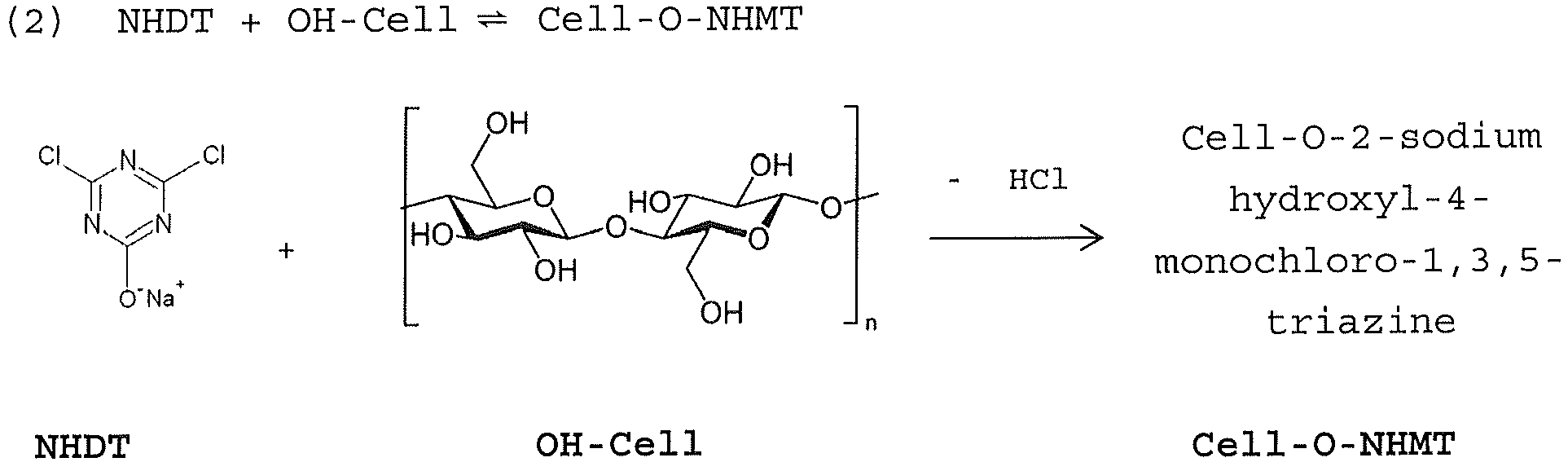

US 2004/0129632 A1 , the disclosure of which is incorporated herein by reference. A suitable dry-forming air-laid non-woven manufacturing process is described for instance inUS 3,905,864 , the disclosure of which is incorporated herein by reference. - The process for producing a paper or non-woven web according to the present invention is characterized in that at least one crosslinking or functionalization agent as defined herein is applied.
- Preferred application modes of the crosslinking or functionalization agent are as follows:
- While the following preferred application modes are described with NHDT as an example of the crosslinking or functionalization agent according to the present invention, a cellulosic fiber as an example of a fiber according to the present invention and CMC as an example of the optional polysaccharide additive according to the present invention, these preferred application modes shall not be construed as limited to these specific examples but also apply to the other crosslinking or functionalization agents, fibers and optional polysaccharide additives according to the present invention.
- (1) Application of NHDT and CMC in separate steps:
- (a) applying NHDT to the cellulosic fiber to give Cell-O-NHMT (pH, temperature)
- (b) rinsing
- (c) applying CMC to Cell-O-NHMT to give Cell-O-NHT-CMC (pH, temperature)
- (d) optionally rinsing
- (2) Application of a mixture of NHDT and CMC in one step:
- (a) applying NHDT and CMC to the cellulosic fiber
- (b) optionally rinsing
- (3) Application of a previously functionalised CMC:
- (a) applying a previously functionalised CMC (NHMT-CMC) to the cellulosic fiber to give CMC-NHT-O-Cell
- (b) optionally rinsing
- (1) Application of NHDT and CMC in separate steps:
- The latter approach, i.e. application mode (3), is in particular advantageous in that a rinsing step of any remaining excessive NHDT is not necessary.
- Various modifications thereof are possible, for instance the crosslinking or functionalization agent and optionally the polysaccharide additive can be added to the fibers before applying to the paper machine whereby reactions between the crosslinking or functionalization agent and the fibers and optionally the polysaccharide additive take place in-mass.
- The crosslinking or functionalization agent as described herein can be used in a paper or non-woven web, for instance a packaging material, such as a packaging material for food packaging; a filter material, such as a filter material for infusion beverages, e.g. tea and coffee, or a filter material for oil filtration; a composite laminate, such as an overlay paper; a metallized paper, such as a metallized paper suitable for labels or packages; an air-laid non-woven web, such as a hygiene and personal care product, home care product, e.g. wipes, towels, napkins and tablecloths, a speciality paper, e.g. wallcoverings (wall paper), mattress and upholstery padding. Preferably, the crosslinking or functionalization agent as described herein can be used in a filter material for tea and coffee. In particular, the crosslinking or functionalization agent as described herein can be used for imparting tensile strength (in a dry state and/or in a wet state), porosity, wettability, hydrophilicity/hydrophobicity and/or adherence to a paper or non-woven web. In addition, the crosslinking or functionalization agent as described herein can be used for imparting biodegradability to a paper or non-woven web.
- A paper or non-woven web of a mixture of softwood and abaca fibers has been prepared (Reference Example).
- To the mixture as used in the Reference Example, further compounds, as indicated below, have been added to prepare paper or non-woven webs of the Examples according to the present invention and Comparative Examples:
Example 1: Alginate / Citric Acid (9%) Example 2: NHDT / Alginate (9%) Example 3: NHDT / Pectin (9%) Example 4: NHDT 7.3% Example 5: Citric Acid 10%Comparative Example 1: CMC 2% Comparative Example 2: Styrene/Acrylate (6%) - The tensile strength of the samples according to the Reference Example, the Examples according to the invention and the Comparative Examples in the dry state, in the wet state and in the wet state additionally comprising 6% NaOH (i.e. under alkaline conditions) where determined. The dry tensile strength was determined in accordance with ISO 1924-2 and the wet tensile strengths were determined in accordance with ISO 3781.
- The results are shown in
Figure 2 . - As it is evident from these results, the paper or non-woven web according to the present invention has superior properties in particular in terms of wet tensile strength in comparison with conventional paper where only a polysaccharide additive, such as CMC (Comparative Example 1), has been used. Moreover, the crosslinking or functionalization agent according to the present invention represents a suitable substitute for the conventional oil-based compounds, such as styrene/acrylate copolymers (Comparative Example 2).
- While the present invention has been described in detail by way of specific embodiments and examples, the invention is not limited thereto and various alterations or modifications are possible, without departing from the scope of the invention.
Claims (15)
- A paper or non-woven web, comprising fibers and at least one crosslinking or functionalization agent selected from the group consisting of carboxylic acids, halogenated heteroaromatic compounds and salts thereof,
wherein said at least one crosslinking or functionalization agent has a molecular weight of not more than 1000 g/mol, and
wherein at least a part of said crosslinking or functionalization agent is bound to said fibers. - The paper or non-woven web according to claim 1 which is an air-laid web or a wet-laid web.
- The paper or non-woven web according to claim 1 or 2, wherein said crosslinking or functionalization agent is selected from the group consisting of dicarboxylic acids, polycarboxylic acids, amino acids, halogenated nitrogen-containing heteroaromatic compounds and salts thereof.
- The paper or non-woven web according to any one of the preceding claims, wherein said crosslinking or functionalization agent is selected from the group consisting of aliphatic dicarboxylic acids, aliphatic polycarboxylic acids, aliphatic amino acids, chlorinated nitrogen-containing heteroaromatic compounds and salts thereof.
- The paper or non-woven web according to any one of the preceding claims, wherein said crosslinking or functionalization agent is selected from the group consisting of citric acid, butane tetracarboxylic acid, maleic acid, fumaric acid, oxalic acid, malonic acid, succinic acid, adipic acid, aspartic acid, glutamic acid, iminodisuccinic acid, chlorinated triazine compounds and salts thereof.
- The paper or non-woven web according to any one of the preceding claims, wherein said crosslinking or functionalization agent is 4,6-dichloro-1,3,5-triazin-2-ol or its sodium salt.
- The paper or non-woven web according to any one of claims 1 to 5, wherein said crosslinking or functionalization agent is citric acid.
- The paper or non-woven web according to claim 1 or 2, wherein said crosslinking or functionalization agent comprises a carboxylic acid and further comprises at least one hypophosphite compound.
- The paper or non-woven web according to any one of the preceding claims, further comprising at least one polysaccharide additive.
- The paper or non-woven web according to claim 9, wherein said polysaccharide additive is selected from the group consisting of carboxymethyl cellulose, starch, alginic acid or alginates, and pectin.
- The paper or non-woven web according to claim 9 or 10, wherein said polysaccharide additive is linked to the fibers by said crosslinking or functionalization agent.
- The paper or non-woven web according to any one of the preceding claims, wherein said fibers comprise cellulosic fibers.
- The paper or non-woven web according to any one of the preceding claims, wherein said fibers comprise heat-sealable fibers.
- A process for producing a paper or non-woven web, characterized in that at least one crosslinking or functionalization agent as defined in any one of claims 1 to 8 is applied.
- Use of a crosslinking or functionalization agent as defined in any one of claims 1 to 8 in a paper or non-woven web.
Priority Applications (1)
| Application Number | Priority Date | Filing Date | Title |
|---|---|---|---|
| EP14700095.4A EP2951341B1 (en) | 2013-01-31 | 2014-01-07 | Crosslinking/functionalization system for a paper or non-woven web |
Applications Claiming Priority (3)
| Application Number | Priority Date | Filing Date | Title |
|---|---|---|---|
| EP13153483 | 2013-01-31 | ||
| EP14700095.4A EP2951341B1 (en) | 2013-01-31 | 2014-01-07 | Crosslinking/functionalization system for a paper or non-woven web |
| PCT/EP2014/050152 WO2014117964A1 (en) | 2013-01-31 | 2014-01-07 | Crosslinking/functionalization system for a paper or non-woven web |
Publications (2)
| Publication Number | Publication Date |
|---|---|
| EP2951341A1 EP2951341A1 (en) | 2015-12-09 |
| EP2951341B1 true EP2951341B1 (en) | 2016-08-17 |
Family
ID=47632886
Family Applications (1)
| Application Number | Title | Priority Date | Filing Date |
|---|---|---|---|
| EP14700095.4A Active EP2951341B1 (en) | 2013-01-31 | 2014-01-07 | Crosslinking/functionalization system for a paper or non-woven web |
Country Status (12)
| Country | Link |
|---|---|
| US (1) | US10240294B2 (en) |
| EP (1) | EP2951341B1 (en) |
| JP (1) | JP6297595B2 (en) |
| CN (1) | CN104822870B (en) |
| AU (1) | AU2014211681B2 (en) |
| CA (1) | CA2890226C (en) |
| ES (1) | ES2603077T3 (en) |
| PL (1) | PL2951341T3 (en) |
| RU (1) | RU2644321C2 (en) |
| SA (1) | SA515360819B1 (en) |
| WO (1) | WO2014117964A1 (en) |
| ZA (1) | ZA201504352B (en) |
Families Citing this family (14)
| Publication number | Priority date | Publication date | Assignee | Title |
|---|---|---|---|---|
| CA2890226C (en) * | 2013-01-31 | 2020-11-10 | Glatfelter Gernsbach Gmbh & Co. Kg | Crosslinking/functionalization system for a paper or non-woven web |
| SE542866C2 (en) * | 2018-04-04 | 2020-07-21 | Stora Enso Oyj | Method for manufacturing a dry-laid mat for thermoforming |
| EP3784597A4 (en) * | 2018-04-23 | 2022-02-16 | 2266170 Ontario, Inc. | CAPSULES AND OTHER CONTAINERS WITH OPTIMIZED RECYCLING ATTRIBUTES AND THEIR MANUFACTURING PROCESSES |
| CN108610496A (en) * | 2018-05-18 | 2018-10-02 | 山东恒联新材料股份有限公司 | A kind of production technology for the regenerated cellulose film improving printing plyability |
| CN108951269A (en) * | 2018-07-05 | 2018-12-07 | 常州思宇知识产权运营有限公司 | A kind of preparation method of cigarette tipping paper |
| US20210340700A1 (en) * | 2018-10-17 | 2021-11-04 | Glatfelter Gernsbach Gmbh | Pulp-containing biodegradable non-woven fabric and method for producing the same |
| JP7147072B2 (en) * | 2019-09-06 | 2022-10-04 | 日本甜菜製糖株式会社 | Corrosion resistant paper |
| US20210169138A1 (en) | 2019-12-09 | 2021-06-10 | Nicoventures Trading Limited | Fibrous fleece material |
| EP3854923A1 (en) | 2020-01-22 | 2021-07-28 | Glatfelter Gernsbach GmbH | Biodegradable non-woven fabric and method for producing the same |
| EP3872245A1 (en) | 2020-02-27 | 2021-09-01 | Glatfelter Gernsbach GmbH | Dry wipe, a biodegradable packaging containing the dry wipe, an arrangement and a process for providing a wet wipe |
| EP3910102A1 (en) | 2020-05-12 | 2021-11-17 | Glatfelter Gernsbach GmbH | Non-woven fabric containing a disinfecting agent and method for producing the same |
| WO2022044387A1 (en) * | 2020-08-25 | 2022-03-03 | 日本甜菜製糖株式会社 | Method for controlling decomposition of corrosion-resistant paper |
| CN112064398B (en) * | 2020-09-07 | 2021-10-19 | 杨笃云 | Preparation method of high-strength hydrophobic environment-friendly wallpaper |
| CN112176763B (en) * | 2020-09-07 | 2021-10-26 | 吴乐毅 | Preparation method of high-strength hydrophobic wallpaper |
Family Cites Families (51)
| Publication number | Priority date | Publication date | Assignee | Title |
|---|---|---|---|---|
| US2694633A (en) * | 1950-02-23 | 1954-11-16 | Talbott Dev Associates | Affixing organic and inorganic additaments to cellulosic materials |
| US3450555A (en) * | 1962-06-07 | 1969-06-17 | Tee Pak Inc | Treatment of textile fibers with soluble polymeric alcohol derivatives |
| US3293057A (en) * | 1963-07-01 | 1966-12-20 | Brown Co | Modified starch composition |
| US3451890A (en) * | 1966-01-19 | 1969-06-24 | Tenneco Chem | Rosin size compositions |
| GB1430760A (en) | 1972-09-09 | 1976-04-07 | Kroyer St Annes Ltd Karl | Multi-ply fibrous sheets |
| GB1603414A (en) | 1977-04-22 | 1981-11-25 | Unilever Ltd | Tea bags |
| US4548676A (en) * | 1981-05-13 | 1985-10-22 | United States Gypsum Company | Paper having calcium sulfate mineral filler for use in the production of gypsum wallboard |
| US4814012A (en) * | 1985-11-05 | 1989-03-21 | American Cyanamid Company | Method of manufacturing a bonded particulate article by reacting a hydrolyzed amylaceous product and a heterocyclic compound |
| CA1332901C (en) | 1986-10-20 | 1994-11-08 | Vic Stanislawczyk | Nonwoven fabric with an acrylate interpolymer binder and a process of making the nonwoven fabric |
| FI881146A7 (en) | 1987-03-12 | 1988-09-13 | Sumitomo Chemical Co | Method for improving the strength of paper. |
| FR2612213B1 (en) * | 1987-03-13 | 1989-06-30 | Roquette Freres | PAPERMAKING PROCESS |
| US4844970A (en) | 1988-01-12 | 1989-07-04 | Air Products And Chemicals, Inc. | Zirconium (III) salts as cure co-catalysts for nonwoven binders comprising acrylamidoglycolic acid |
| DE69025548T2 (en) | 1989-11-07 | 1996-09-26 | Procter & Gamble | Absorbent article made of fibers cross-linked by polycarboxylic acids |
| US5318669A (en) * | 1991-12-23 | 1994-06-07 | Hercules Incorporated | Enhancement of paper dry strength by anionic and cationic polymer combination |
| US5384189A (en) * | 1993-01-27 | 1995-01-24 | Lion Corporation | Water-decomposable non-woven fabric |
| JP3558638B2 (en) * | 1994-03-25 | 2004-08-25 | ウェヤーハウザー・カンパニー | Multiply cellulose products using bulky cellulose fibers |
| US5906894A (en) * | 1994-03-25 | 1999-05-25 | Weyerhaeuser Company | Multi-ply cellulosic products using high-bulk cellulosic fibers |
| FI96418C (en) | 1994-10-07 | 1996-06-25 | Neste Oy | Alkene-substituted cyclic carboxylic anhydrides and their use in hydrophobic sizing of paper |
| US5595631A (en) | 1995-05-17 | 1997-01-21 | National Starch And Chemical Investment Holding Corporation | Method of paper sizing using modified cationic starch |
| US5935383A (en) * | 1996-12-04 | 1999-08-10 | Kimberly-Clark Worldwide, Inc. | Method for improved wet strength paper |
| JP3553348B2 (en) * | 1997-12-26 | 2004-08-11 | ユニ・チャーム株式会社 | Water-decomposable fiber sheet using alkyl cellulose |
| US6171440B1 (en) * | 1997-12-31 | 2001-01-09 | Hercules Incorporated | Process for repulping wet strength paper having cationic thermosetting resin |
| US6630054B1 (en) * | 1998-03-19 | 2003-10-07 | Weyerhaeuser Company | Methods for forming a fluted composite |
| ES2159903T3 (en) | 1998-03-20 | 2001-10-16 | Schoeller & Hoesch Papierfab | Adjustable wettable filter material and manufacturing procedure |
| JP3753581B2 (en) * | 1999-05-20 | 2006-03-08 | 花王株式会社 | Absorbent articles |
| DE19940955A1 (en) * | 1999-08-28 | 2001-03-01 | Basf Ag | Process for the production of paper, cardboard and cardboard |
| DE19953589B4 (en) * | 1999-11-08 | 2005-05-25 | Sca Hygiene Products Gmbh | Polysaccharide with functional groups, process for its preparation and products made therefrom |
| US6620293B2 (en) * | 2001-04-11 | 2003-09-16 | Rayonier Inc. | Crossed-linked pulp and method of making same |
| US9434869B2 (en) * | 2001-09-21 | 2016-09-06 | Outlast Technologies, LLC | Cellulosic fibers having enhanced reversible thermal properties and methods of forming thereof |
| EP1470292B1 (en) | 2002-01-31 | 2014-06-25 | Akzo Nobel N.V. | Process for manufacturing paper |
| US6837972B2 (en) * | 2002-04-25 | 2005-01-04 | Weyerhaeuser Company | Tissue and towel products containing crosslinked cellulosic fibers |
| DE10231403B3 (en) | 2002-07-11 | 2004-02-05 | Papierfabrik Schoeller & Hoesch Gmbh & Co. Kg | Heat sealable filter material |
| US20040118540A1 (en) * | 2002-12-20 | 2004-06-24 | Kimberly-Clark Worlwide, Inc. | Bicomponent strengtheninig system for paper |
| EP1510618B1 (en) * | 2003-08-26 | 2007-02-28 | Rohm And Haas Company | Curable aqueous composition and use as heat-resistant nonwoven binder |
| EP1696972B1 (en) * | 2003-12-19 | 2016-10-26 | Buckeye Technologies Inc. | Fibers of variable wettability and materials containing the fibers |
| US20050148261A1 (en) * | 2003-12-30 | 2005-07-07 | Kimberly-Clark Worldwide, Inc. | Nonwoven webs having reduced lint and slough |
| JP2006037327A (en) | 2004-06-24 | 2006-02-09 | Oji Paper Co Ltd | Acid paper |
| US7592049B2 (en) | 2005-07-14 | 2009-09-22 | Wacker Chemical Corporation | Dry chemically bound nonwovens which are flushable and dispersible |
| JP2007090645A (en) * | 2005-09-28 | 2007-04-12 | Fujifilm Corp | Ink jet recording medium and manufacturing method thereof |
| US7645806B2 (en) * | 2006-10-02 | 2010-01-12 | Weyerhaeuser Nr Company | Methods for the preparation of superabsorbent particles containing carboxyalkyl cellulose |
| US20080082067A1 (en) * | 2006-10-02 | 2008-04-03 | Weyerhaeuser Co. | Cellulose fibers having superabsorbent particles adhered thereto |
| US7604714B2 (en) * | 2006-10-02 | 2009-10-20 | Weyerhaeuser Nr Company | Methods for the preparation of crosslinked carboxyalkyl cellulose fibers having permanent and non-permanent crosslinks |
| CN101938964A (en) | 2008-02-15 | 2011-01-05 | 普拉泰克斯产品有限公司 | Tampon comprising crosslinked cellulosic fibers and improved synthetic process for producing the same |
| EP2286011B1 (en) * | 2008-06-11 | 2018-05-02 | GPCP IP Holdings LLC | Absorbent sheet prepared with papermaking fiber and synthetic fiber exhibiting improved wet strength |
| CN101328696B (en) * | 2008-07-31 | 2010-09-01 | 中国印钞造币总公司 | A kind of wet strength agent for papermaking and preparation method thereof |
| JP5504779B2 (en) | 2008-09-17 | 2014-05-28 | 東レ株式会社 | Electret filter medium and method for producing the same |
| CA2755586C (en) * | 2009-03-20 | 2015-06-23 | Fpinnovations | Cellulose materials with novel properties |
| EP2309059A1 (en) | 2009-10-02 | 2011-04-13 | Organoclick Aktiebolag | Method of improving properties of cellulose-based fibrous sheet-formed materials |
| US20110223364A1 (en) * | 2009-10-09 | 2011-09-15 | Hawkins Christopher M | Insulative products having bio-based binders |
| CN103290720B (en) * | 2012-02-28 | 2016-01-27 | 金东纸业(江苏)股份有限公司 | The preparation method of slurry, slurry and the paper obtained by it |
| CA2890226C (en) * | 2013-01-31 | 2020-11-10 | Glatfelter Gernsbach Gmbh & Co. Kg | Crosslinking/functionalization system for a paper or non-woven web |
-
2014
- 2014-01-07 CA CA2890226A patent/CA2890226C/en active Active
- 2014-01-07 AU AU2014211681A patent/AU2014211681B2/en active Active
- 2014-01-07 JP JP2015555623A patent/JP6297595B2/en active Active
- 2014-01-07 EP EP14700095.4A patent/EP2951341B1/en active Active
- 2014-01-07 WO PCT/EP2014/050152 patent/WO2014117964A1/en not_active Ceased
- 2014-01-07 RU RU2015121816A patent/RU2644321C2/en active
- 2014-01-07 ES ES14700095.4T patent/ES2603077T3/en active Active
- 2014-01-07 CN CN201480003241.XA patent/CN104822870B/en active Active
- 2014-01-07 US US14/765,046 patent/US10240294B2/en active Active
- 2014-01-07 PL PL14700095T patent/PL2951341T3/en unknown
-
2015
- 2015-06-17 ZA ZA2015/04352A patent/ZA201504352B/en unknown
- 2015-07-27 SA SA515360819A patent/SA515360819B1/en unknown
Also Published As
| Publication number | Publication date |
|---|---|
| AU2014211681B2 (en) | 2017-12-07 |
| JP2016510366A (en) | 2016-04-07 |
| US20150368864A1 (en) | 2015-12-24 |
| RU2644321C2 (en) | 2018-02-08 |
| WO2014117964A1 (en) | 2014-08-07 |
| CN104822870B (en) | 2017-10-27 |
| CA2890226A1 (en) | 2014-08-07 |
| ZA201504352B (en) | 2016-04-28 |
| RU2015121816A (en) | 2017-03-07 |
| EP2951341A1 (en) | 2015-12-09 |
| PL2951341T3 (en) | 2017-02-28 |
| AU2014211681A1 (en) | 2015-05-21 |
| ES2603077T3 (en) | 2017-02-23 |
| SA515360819B1 (en) | 2017-01-11 |
| HK1217520A1 (en) | 2017-01-13 |
| CN104822870A (en) | 2015-08-05 |
| JP6297595B2 (en) | 2018-03-20 |
| CA2890226C (en) | 2020-11-10 |
| AU2014211681A8 (en) | 2015-07-30 |
| US10240294B2 (en) | 2019-03-26 |
Similar Documents
| Publication | Publication Date | Title |
|---|---|---|
| US10240294B2 (en) | Crosslinking/functionalization system for a paper or non-woven web | |
| EP2781652B2 (en) | Wet-laid nonwoven comprising nanofibrillar cellulose and a method of manufacturing such | |
| JP6861276B2 (en) | Cellulose-based chemical fibers, and non-woven fabric products or non-woven fabrics containing the cellulosic fibers | |
| CN110139961B (en) | Absorbent paper products having unique physical strength properties | |
| EP2986776B1 (en) | Paper and nonwoven articles comprising synthetic microfiber binders | |
| JP2013545838A (en) | Nonwoven products with ribbon fibers | |
| EP4314406B1 (en) | Filter material for food packaging | |
| HK1217520B (en) | Crosslinking/functionalization system for a paper or non-woven web | |
| EP4635729A1 (en) | Non-woven fabric and method for producing the same | |
| EP2365129B1 (en) | New material | |
| JP2007191818A (en) | Split composite short fiber and short fiber nonwoven fabric |
Legal Events
| Date | Code | Title | Description |
|---|---|---|---|
| PUAI | Public reference made under article 153(3) epc to a published international application that has entered the european phase |
Free format text: ORIGINAL CODE: 0009012 |
|
| 17P | Request for examination filed |
Effective date: 20150824 |
|
| AK | Designated contracting states |
Kind code of ref document: A1 Designated state(s): AL AT BE BG CH CY CZ DE DK EE ES FI FR GB GR HR HU IE IS IT LI LT LU LV MC MK MT NL NO PL PT RO RS SE SI SK SM TR |
|
| AX | Request for extension of the european patent |
Extension state: BA ME |
|
| REG | Reference to a national code |
Ref country code: DE Ref legal event code: R079 Ref document number: 602014003124 Country of ref document: DE Free format text: PREVIOUS MAIN CLASS: D04H0001425000 Ipc: D06M0013000000 |
|
| GRAP | Despatch of communication of intention to grant a patent |
Free format text: ORIGINAL CODE: EPIDOSNIGR1 |
|
| RIC1 | Information provided on ipc code assigned before grant |
Ipc: D21H 21/14 20060101ALI20160301BHEP Ipc: D21H 17/24 20060101ALI20160301BHEP Ipc: D21H 19/14 20060101ALI20160301BHEP Ipc: D21H 17/25 20060101ALI20160301BHEP Ipc: D06M 13/358 20060101ALI20160301BHEP Ipc: D21H 17/07 20060101ALI20160301BHEP Ipc: D04H 1/4266 20120101ALI20160301BHEP Ipc: D06M 13/00 20060101AFI20160301BHEP Ipc: D06M 13/207 20060101ALI20160301BHEP Ipc: D04H 1/425 20120101ALI20160301BHEP Ipc: D06M 13/188 20060101ALI20160301BHEP Ipc: D21H 17/30 20060101ALI20160301BHEP Ipc: D21H 17/14 20060101ALI20160301BHEP Ipc: D06M 13/33 20060101ALI20160301BHEP Ipc: D21H 17/28 20060101ALI20160301BHEP Ipc: D04H 1/552 20120101ALI20160301BHEP Ipc: D21H 17/15 20060101ALI20160301BHEP Ipc: D06M 101/06 20060101ALI20160301BHEP Ipc: D06M 13/192 20060101ALI20160301BHEP Ipc: D04H 1/732 20120101ALI20160301BHEP |
|
| DAX | Request for extension of the european patent (deleted) | ||
| INTG | Intention to grant announced |
Effective date: 20160324 |
|
| GRAS | Grant fee paid |
Free format text: ORIGINAL CODE: EPIDOSNIGR3 |
|
| GRAA | (expected) grant |
Free format text: ORIGINAL CODE: 0009210 |
|
| AK | Designated contracting states |
Kind code of ref document: B1 Designated state(s): AL AT BE BG CH CY CZ DE DK EE ES FI FR GB GR HR HU IE IS IT LI LT LU LV MC MK MT NL NO PL PT RO RS SE SI SK SM TR |
|
| REG | Reference to a national code |
Ref country code: GB Ref legal event code: FG4D |
|
| REG | Reference to a national code |
Ref country code: CH Ref legal event code: EP |
|
| REG | Reference to a national code |
Ref country code: IE Ref legal event code: FG4D |
|
| REG | Reference to a national code |
Ref country code: AT Ref legal event code: REF Ref document number: 821219 Country of ref document: AT Kind code of ref document: T Effective date: 20160915 |
|
| REG | Reference to a national code |
Ref country code: DE Ref legal event code: R096 Ref document number: 602014003124 Country of ref document: DE |
|
| REG | Reference to a national code |
Ref country code: NL Ref legal event code: FP |
|
| REG | Reference to a national code |
Ref country code: LT Ref legal event code: MG4D |
|
| REG | Reference to a national code |
Ref country code: HK Ref legal event code: DE Ref document number: 1217520 Country of ref document: HK |
|
| REG | Reference to a national code |
Ref country code: FR Ref legal event code: PLFP Year of fee payment: 4 |
|
| PG25 | Lapsed in a contracting state [announced via postgrant information from national office to epo] |
Ref country code: HR Free format text: LAPSE BECAUSE OF FAILURE TO SUBMIT A TRANSLATION OF THE DESCRIPTION OR TO PAY THE FEE WITHIN THE PRESCRIBED TIME-LIMIT Effective date: 20160817 Ref country code: NO Free format text: LAPSE BECAUSE OF FAILURE TO SUBMIT A TRANSLATION OF THE DESCRIPTION OR TO PAY THE FEE WITHIN THE PRESCRIBED TIME-LIMIT Effective date: 20161117 Ref country code: LT Free format text: LAPSE BECAUSE OF FAILURE TO SUBMIT A TRANSLATION OF THE DESCRIPTION OR TO PAY THE FEE WITHIN THE PRESCRIBED TIME-LIMIT Effective date: 20160817 Ref country code: FI Free format text: LAPSE BECAUSE OF FAILURE TO SUBMIT A TRANSLATION OF THE DESCRIPTION OR TO PAY THE FEE WITHIN THE PRESCRIBED TIME-LIMIT Effective date: 20160817 Ref country code: RS Free format text: LAPSE BECAUSE OF FAILURE TO SUBMIT A TRANSLATION OF THE DESCRIPTION OR TO PAY THE FEE WITHIN THE PRESCRIBED TIME-LIMIT Effective date: 20160817 |
|
| REG | Reference to a national code |
Ref country code: ES Ref legal event code: FG2A Ref document number: 2603077 Country of ref document: ES Kind code of ref document: T3 Effective date: 20170223 |
|
| PG25 | Lapsed in a contracting state [announced via postgrant information from national office to epo] |
Ref country code: LV Free format text: LAPSE BECAUSE OF FAILURE TO SUBMIT A TRANSLATION OF THE DESCRIPTION OR TO PAY THE FEE WITHIN THE PRESCRIBED TIME-LIMIT Effective date: 20160817 Ref country code: SE Free format text: LAPSE BECAUSE OF FAILURE TO SUBMIT A TRANSLATION OF THE DESCRIPTION OR TO PAY THE FEE WITHIN THE PRESCRIBED TIME-LIMIT Effective date: 20160817 Ref country code: GR Free format text: LAPSE BECAUSE OF FAILURE TO SUBMIT A TRANSLATION OF THE DESCRIPTION OR TO PAY THE FEE WITHIN THE PRESCRIBED TIME-LIMIT Effective date: 20161118 Ref country code: PT Free format text: LAPSE BECAUSE OF FAILURE TO SUBMIT A TRANSLATION OF THE DESCRIPTION OR TO PAY THE FEE WITHIN THE PRESCRIBED TIME-LIMIT Effective date: 20161219 |
|
| PG25 | Lapsed in a contracting state [announced via postgrant information from national office to epo] |
Ref country code: EE Free format text: LAPSE BECAUSE OF FAILURE TO SUBMIT A TRANSLATION OF THE DESCRIPTION OR TO PAY THE FEE WITHIN THE PRESCRIBED TIME-LIMIT Effective date: 20160817 Ref country code: RO Free format text: LAPSE BECAUSE OF FAILURE TO SUBMIT A TRANSLATION OF THE DESCRIPTION OR TO PAY THE FEE WITHIN THE PRESCRIBED TIME-LIMIT Effective date: 20160817 |
|
| REG | Reference to a national code |
Ref country code: DE Ref legal event code: R097 Ref document number: 602014003124 Country of ref document: DE |
|
| PG25 | Lapsed in a contracting state [announced via postgrant information from national office to epo] |
Ref country code: CZ Free format text: LAPSE BECAUSE OF FAILURE TO SUBMIT A TRANSLATION OF THE DESCRIPTION OR TO PAY THE FEE WITHIN THE PRESCRIBED TIME-LIMIT Effective date: 20160817 Ref country code: SM Free format text: LAPSE BECAUSE OF FAILURE TO SUBMIT A TRANSLATION OF THE DESCRIPTION OR TO PAY THE FEE WITHIN THE PRESCRIBED TIME-LIMIT Effective date: 20160817 Ref country code: DK Free format text: LAPSE BECAUSE OF FAILURE TO SUBMIT A TRANSLATION OF THE DESCRIPTION OR TO PAY THE FEE WITHIN THE PRESCRIBED TIME-LIMIT Effective date: 20160817 Ref country code: BG Free format text: LAPSE BECAUSE OF FAILURE TO SUBMIT A TRANSLATION OF THE DESCRIPTION OR TO PAY THE FEE WITHIN THE PRESCRIBED TIME-LIMIT Effective date: 20161117 Ref country code: SK Free format text: LAPSE BECAUSE OF FAILURE TO SUBMIT A TRANSLATION OF THE DESCRIPTION OR TO PAY THE FEE WITHIN THE PRESCRIBED TIME-LIMIT Effective date: 20160817 |
|
| PLBE | No opposition filed within time limit |
Free format text: ORIGINAL CODE: 0009261 |
|
| STAA | Information on the status of an ep patent application or granted ep patent |
Free format text: STATUS: NO OPPOSITION FILED WITHIN TIME LIMIT |
|
| 26N | No opposition filed |
Effective date: 20170518 |
|
| PG25 | Lapsed in a contracting state [announced via postgrant information from national office to epo] |
Ref country code: SI Free format text: LAPSE BECAUSE OF FAILURE TO SUBMIT A TRANSLATION OF THE DESCRIPTION OR TO PAY THE FEE WITHIN THE PRESCRIBED TIME-LIMIT Effective date: 20160817 |
|
| REG | Reference to a national code |
Ref country code: CH Ref legal event code: PL |
|
| PG25 | Lapsed in a contracting state [announced via postgrant information from national office to epo] |
Ref country code: MC Free format text: LAPSE BECAUSE OF FAILURE TO SUBMIT A TRANSLATION OF THE DESCRIPTION OR TO PAY THE FEE WITHIN THE PRESCRIBED TIME-LIMIT Effective date: 20160817 |
|
| REG | Reference to a national code |
Ref country code: HK Ref legal event code: GR Ref document number: 1217520 Country of ref document: HK |
|
| PG25 | Lapsed in a contracting state [announced via postgrant information from national office to epo] |
Ref country code: CH Free format text: LAPSE BECAUSE OF NON-PAYMENT OF DUE FEES Effective date: 20170131 Ref country code: LI Free format text: LAPSE BECAUSE OF NON-PAYMENT OF DUE FEES Effective date: 20170131 |
|
| PG25 | Lapsed in a contracting state [announced via postgrant information from national office to epo] |
Ref country code: LU Free format text: LAPSE BECAUSE OF NON-PAYMENT OF DUE FEES Effective date: 20170107 |
|
| REG | Reference to a national code |
Ref country code: FR Ref legal event code: PLFP Year of fee payment: 5 |
|
| REG | Reference to a national code |
Ref country code: AT Ref legal event code: UEP Ref document number: 821219 Country of ref document: AT Kind code of ref document: T Effective date: 20160817 |
|
| PG25 | Lapsed in a contracting state [announced via postgrant information from national office to epo] |
Ref country code: MT Free format text: LAPSE BECAUSE OF NON-PAYMENT OF DUE FEES Effective date: 20170107 |
|
| PG25 | Lapsed in a contracting state [announced via postgrant information from national office to epo] |
Ref country code: AL Free format text: LAPSE BECAUSE OF FAILURE TO SUBMIT A TRANSLATION OF THE DESCRIPTION OR TO PAY THE FEE WITHIN THE PRESCRIBED TIME-LIMIT Effective date: 20160817 |
|
| PG25 | Lapsed in a contracting state [announced via postgrant information from national office to epo] |
Ref country code: HU Free format text: LAPSE BECAUSE OF FAILURE TO SUBMIT A TRANSLATION OF THE DESCRIPTION OR TO PAY THE FEE WITHIN THE PRESCRIBED TIME-LIMIT; INVALID AB INITIO Effective date: 20140107 |
|
| PG25 | Lapsed in a contracting state [announced via postgrant information from national office to epo] |
Ref country code: CY Free format text: LAPSE BECAUSE OF FAILURE TO SUBMIT A TRANSLATION OF THE DESCRIPTION OR TO PAY THE FEE WITHIN THE PRESCRIBED TIME-LIMIT Effective date: 20160817 |
|
| PG25 | Lapsed in a contracting state [announced via postgrant information from national office to epo] |
Ref country code: MK Free format text: LAPSE BECAUSE OF FAILURE TO SUBMIT A TRANSLATION OF THE DESCRIPTION OR TO PAY THE FEE WITHIN THE PRESCRIBED TIME-LIMIT Effective date: 20160817 |
|
| PG25 | Lapsed in a contracting state [announced via postgrant information from national office to epo] |
Ref country code: TR Free format text: LAPSE BECAUSE OF FAILURE TO SUBMIT A TRANSLATION OF THE DESCRIPTION OR TO PAY THE FEE WITHIN THE PRESCRIBED TIME-LIMIT Effective date: 20160817 |
|
| PG25 | Lapsed in a contracting state [announced via postgrant information from national office to epo] |
Ref country code: IS Free format text: LAPSE BECAUSE OF FAILURE TO SUBMIT A TRANSLATION OF THE DESCRIPTION OR TO PAY THE FEE WITHIN THE PRESCRIBED TIME-LIMIT Effective date: 20161217 |
|
| P01 | Opt-out of the competence of the unified patent court (upc) registered |
Effective date: 20230517 |
|
| REG | Reference to a national code |
Ref country code: DE Ref legal event code: R082 Ref document number: 602014003124 Country of ref document: DE Representative=s name: LAVOIX MUNICH ZWEIGNIEDERLASSUNG DER CABINET L, DE |
|
| PGFP | Annual fee paid to national office [announced via postgrant information from national office to epo] |
Ref country code: NL Payment date: 20260120 Year of fee payment: 13 |
|
| PGFP | Annual fee paid to national office [announced via postgrant information from national office to epo] |
Ref country code: GB Payment date: 20260105 Year of fee payment: 13 |
|
| PGFP | Annual fee paid to national office [announced via postgrant information from national office to epo] |
Ref country code: ES Payment date: 20260202 Year of fee payment: 13 |
|
| PGFP | Annual fee paid to national office [announced via postgrant information from national office to epo] |
Ref country code: IE Payment date: 20260123 Year of fee payment: 13 Ref country code: DE Payment date: 20260120 Year of fee payment: 13 |
|
| PGFP | Annual fee paid to national office [announced via postgrant information from national office to epo] |
Ref country code: AT Payment date: 20260120 Year of fee payment: 13 |
|
| PGFP | Annual fee paid to national office [announced via postgrant information from national office to epo] |
Ref country code: BE Payment date: 20260120 Year of fee payment: 13 Ref country code: IT Payment date: 20260121 Year of fee payment: 13 |
|
| PGFP | Annual fee paid to national office [announced via postgrant information from national office to epo] |
Ref country code: FR Payment date: 20260123 Year of fee payment: 13 |
|
| PGFP | Annual fee paid to national office [announced via postgrant information from national office to epo] |
Ref country code: PL Payment date: 20260116 Year of fee payment: 13 |