EP2950092A1 - Mass spectrometry method using matrix - Google Patents
Mass spectrometry method using matrix Download PDFInfo
- Publication number
- EP2950092A1 EP2950092A1 EP14760809.5A EP14760809A EP2950092A1 EP 2950092 A1 EP2950092 A1 EP 2950092A1 EP 14760809 A EP14760809 A EP 14760809A EP 2950092 A1 EP2950092 A1 EP 2950092A1
- Authority
- EP
- European Patent Office
- Prior art keywords
- matrix
- mass spectrometry
- hydrophobic
- athap
- peptide
- Prior art date
- Legal status (The legal status is an assumption and is not a legal conclusion. Google has not performed a legal analysis and makes no representation as to the accuracy of the status listed.)
- Granted
Links
Images

Classifications
-
- G—PHYSICS
- G01—MEASURING; TESTING
- G01N—INVESTIGATING OR ANALYSING MATERIALS BY DETERMINING THEIR CHEMICAL OR PHYSICAL PROPERTIES
- G01N33/00—Investigating or analysing materials by specific methods not covered by groups G01N1/00 - G01N31/00
- G01N33/48—Biological material, e.g. blood, urine; Haemocytometers
- G01N33/50—Chemical analysis of biological material, e.g. blood, urine; Testing involving biospecific ligand binding methods; Immunological testing
- G01N33/68—Chemical analysis of biological material, e.g. blood, urine; Testing involving biospecific ligand binding methods; Immunological testing involving proteins, peptides or amino acids
- G01N33/6803—General methods of protein analysis not limited to specific proteins or families of proteins
- G01N33/6848—Methods of protein analysis involving mass spectrometry
- G01N33/6851—Methods of protein analysis involving laser desorption ionisation mass spectrometry
-
- G—PHYSICS
- G01—MEASURING; TESTING
- G01N—INVESTIGATING OR ANALYSING MATERIALS BY DETERMINING THEIR CHEMICAL OR PHYSICAL PROPERTIES
- G01N27/00—Investigating or analysing materials by the use of electric, electrochemical, or magnetic means
- G01N27/62—Investigating or analysing materials by the use of electric, electrochemical, or magnetic means by investigating the ionisation of gases, e.g. aerosols; by investigating electric discharges, e.g. emission of cathode
- G01N27/64—Investigating or analysing materials by the use of electric, electrochemical, or magnetic means by investigating the ionisation of gases, e.g. aerosols; by investigating electric discharges, e.g. emission of cathode using wave or particle radiation to ionise a gas, e.g. in an ionisation chamber
-
- H—ELECTRICITY
- H01—ELECTRIC ELEMENTS
- H01J—ELECTRIC DISCHARGE TUBES OR DISCHARGE LAMPS
- H01J49/00—Particle spectrometers or separator tubes
- H01J49/0027—Methods for using particle spectrometers
-
- H—ELECTRICITY
- H01—ELECTRIC ELEMENTS
- H01J—ELECTRIC DISCHARGE TUBES OR DISCHARGE LAMPS
- H01J49/00—Particle spectrometers or separator tubes
- H01J49/02—Details
- H01J49/04—Arrangements for introducing or extracting samples to be analysed, e.g. vacuum locks; Arrangements for external adjustment of electron- or ion-optical components
- H01J49/0409—Sample holders or containers
- H01J49/0418—Sample holders or containers for laser desorption, e.g. matrix-assisted laser desorption/ionisation [MALDI] plates or surface enhanced laser desorption/ionisation [SELDI] plates
Definitions
- the present invention relates to a mass spectrometry method applicable to medical field and drug discovery field, and especially relates to MALDI-MS (Matrix-Assisted Laser Desorption/Ionization Mass Spectrometry) application. More precisely, the present invention relates to a mass spectrometry method using a specific compound as a matrix, and a matrix for mass spectrometry.
- MALDI-MS Microx-Assisted Laser Desorption/Ionization Mass Spectrometry
- Patent Document 1 JP-A-2005-326391 discloses a method in which a hydrophobic peptide is more efficiently ionized in mass spectrometry by previously modifying the hydrophobic peptide with a 2-nitrobenzenesulfenyl group and using, as a matrix, ⁇ -cyano-3-hydroxycinnamic acid (3-CHCA), 3-hydroxy-4-nitrobenzoic acid (3H4NBA), or a mixture of them than by using a common matrix such as ⁇ -cyano-4-hydroxycinnamic acid (4-CHCA) or 2,5-dihydrobenzoic acid (DHB).
- ⁇ -cyano-4-hydroxycinnamic acid 4-CHCA
- DHB 2,5-dihydrobenzoic acid
- Patent Document 1 JP-A-2005-326391
- the MALDI mass spectrometry method According to the above MALDI mass spectrometry method, a certain level of ionization-promoting effect is obtained when modification of a molecule to be analyzed is performed, but sufficient ionization efficiency is not achieved when such modification is not performed. Particularly, the MALDI mass spectrometry method has a problem that the ionization efficiency of a molecular species difficult to be ionized by MALDI, such as a hydrophobic peptide, is low.
- An object of the present invention is to provide a mass spectrometry method using a matrix that is capable of easily and efficiently improving ionization efficiency in mass spectrometry without modifying (specifically, labeling or the like) a molecule to be analyzed, and a matrix for mass spectrometry.
- an object of the present invention is to provide a mass spectrometry method using a matrix that is capable of easily and efficiently improving ionization efficiency in MALDI mass spectrometry without modifying (specifically, labeling or the like) a molecule to be analyzed, and a matrix for MALDI mass spectrometry.
- the present inventors have intensively studied, and as a result, have found that a specific 2,4,6-trihydroxyalkylphenone functions as a matrix for use in a mass spectrometry method and can efficiently ionize a molecular species that is difficult to be ionized such as a hydrophobic compound. This finding has led to the completion of the present invention.
- the present invention includes the following aspects.
- a 2,4,6-trihydroxyalkylphenone containing an alkyl group having 4 to 12 carbon atoms is used as a matrix for mass spectrometry.
- the use of the 2,4, 6-trihydroxyalkylphenone containing an alkyl group having 4 to 12 carbon atoms as a matrix for mass spectrometry makes it possible to improve the ionization efficiency of a molecular species that is difficult to be ionized such as a hydrophobic compound, especially a hydrophobic peptide. Therefore, the present invention provides a mass spectrometry method using a matrix capable of improving the ionization efficiency of a molecule to be analyzed, and a matrix for mass spectrometry.
- the present invention is particularly directed to a MALDI mass spectrometry method, and is suitable when an analysis object is a hydrophobic compound and particularly suitable when an analysis object is a hydrophobic peptide.
- the present invention makes it possible to achieve improvement in sensitivity for detection of a molecule to be analyzed (especially, a hydrophobic peptide) in mass spectrometry measurement.
- the present invention provides a mass spectrometry method using, as a matrix, a 2,4,6-trihydroxyalkylphenone represented by the following general formula (I).
- R represents an alkyl group having 4 to 12 carbon atoms.
- ATHAP Alkylated trihydroxyalkylphenone
- R that is a C4 to C12 alkyl group is an octyl group (C8)
- THAP 2',4',6'-trihydroxyacetophenone
- Examples of the C4 to C12 alkyl group represented by R in the general formula (I) include a butyl group, a pentyl group, a hexyl group, a heptyl group, an octyl group, a nonyl group, a decyl group, an undecyl group, and a dodecyl group. These alkyl groups may be either linear or branched. Examples of the branched C4 to C12 alkyl group include a 2-ethylhexyl group and the like. Among them, a C6 to C12 alkyl group is preferred, a C6 to C10 alkyl group is more preferred, and a C8 alkyl group is particularly preferred. When an analysis object is a hydrophobic compound, the alkyl group represented by R is considered to be required to have a certain level of hydrophobicity for the ionization of the hydrophobic compound.
- the concentration of the matrix solution may be about 1 mg/mL to 10 mg/mL, may also be about 1 to 8 mg/mL or about 1 to 5 mg/mL.
- An object to be analyzed by mass spectrometry using the matrix according to the present invention is not particularly limited, and may be, for example, a molecule having a molecular weight of 500 to 30, 000, preferably 1,000 to 10,000.
- the matrix according to the present invention can promote the ionization of a hydrophobic substance, and is therefore preferably used for mass spectrometry of a hydrophobic substance.
- a sample may contain a substance (e.g., a hydrophilic substance) other than the hydrophobic substance that is an analysis object.
- the matrix according to the present invention can selectively promote the ionization of a hydrophobic substance without promoting the ionization of a hydrophilic substance as compared to a case where a conventional matrix ⁇ -cyano-4-hydroxycinnamic acid (4-CHCA) is used. Therefore, even when a sample contains both a hydrophobic substance and a hydrophilic substance in a mixture state, the hydrophobic substance can be easily analyzed. For this reason, the matrix according to the present invention can be appropriately applied to mass spectrometry of a hydrophobic substance.
- the degree of hydrophobicity is not particularly limited as long as it is at a level that can be regarded as hydrophobic based on any known hydrophobicity index or hydrophobicity calculation method.
- the degree of hydrophobicity of the hydrophobic substance may be at a level that can be regarded as hydrophobic by those skilled in the art based on the BB Index (Bull and Breese Index). More specifically, the BB Index of the hydrophobic substance may be, for example, 1,000 or less, preferably -1,000 or less.
- the degree of hydrophobicity of the hydrophobic substance may be at a level that can be regarded as hydrophobic by those skilled in the art based on the HPLC Index.
- the HPLC Index is a hydrophobicity index reported by C. A. Browne, H. P. J. Bennett, S. Solomon in Analytical Biochemistry, 124, 201-208, 1982 , and is also referred to as "HPLC/HFBA retention" because it is based on retention time in reversed-phase HPLC using, as an eluent, an aqueous acetonitrile solution containing 0.13% heptafluoro-n-butyric acid (HFBA).
- the HPLC Index of the hydrophobic substance may be, for example, 40 or more, for example, 40 to 10,000, preferably 100 to 1,000.
- the degree of hydrophobicity of the hydrophobic substance in the present invention may be at a level that can be regarded as hydrophobic by those skilled in the art based on the SSRCalc Hydrophobicity.
- the SSRCalc Hydrophobicity is reported by Oleg V. Krokhin in Analytical Chemistry, 78, 7785-7795, 2006 .
- the SSRCalc Hydrophobicity is a hydrophobicity index based on a peptide sequence-specific algorithm for retention times of peptides in RP-HPLC (Reversed-Phase High-Performance Liquid Chromatography), sequence-specific retention calculator (SSRCalc).
- the HPLC index or the BB index predicts a retention time based on only information about amino acid composition
- the SSRCalc Hydrophobicity predicts a retention time based on not only the primary structure but also the secondary structure of a peptide.
- the SSRCalc Hydrophobicity is suitable as an index of the degree of hydrophobicity. More specifically, the SSRCalc Hydrophobicity of the hydrophobic substance may be, for example, 30 or more, preferably 40 to 70.
- the effect of enhancing the ability to ionize a hydrophobic peptide is particularly high.
- the determination as to whether a peptide to be analyzed is hydrophobic or not may be made based on the BB Index, the HPLC Index, or the SSRCalc Hydrophobicity, and preferably, the SSRCalc Hydrophobicity.
- the hydrophobic peptide may be a peptide containing, as constituent amino acids, more amino acids having a higher degree of hydrophobicity.
- hydrophobic amino acids examples include isoleucine, leucine, valine, alanine, phenylalanine, proline, methionine, tryptophan, and glycine. Further, cysteine, tyrosine, and the like may also be contained.
- the hydrophobic peptide may be a peptide having not only such a primary structure of the peptide but also a higher-order structure with a higher degree of hydrophobicity. Examples of such a hydrophobic peptide include peptides having a structure likely to interact with the surface of a hydrophobic stationary phase in a reversed-phase HPLC column.
- a crystal for mass spectrometry can be obtained through the step of forming, on a target plate for mass spectrometry, a liquid droplet of a mixture liquid containing, in a solvent, at least an analysis object and a matrix, and the step of removing the solvent from the formed liquid droplet of the mixture liquid to obtain non-volatile matter contained in the mixture liquid (i.e., at least the analysis object and the matrix) as a residue.
- the obtained residue is a crystal for mass spectrometry.
- the terms "crystal for mass spectrometry" is synonymous with the term "residue”.
- a conductive metal plate usually used for MALDI mass spectrometry can be used.
- a plate made of stainless steel or gold can be used.
- a specific method for preparing a liquid droplet of the mixture liquid on a target plate is not particularly limited. For example, first, a sample solution containing an analysis object and a matrix solution are prepared separately from each other. Then, these solutions are mixed to obtain a mixture liquid, and the obtained mixture liquid is dropped onto a target plate. Alternatively, these solutions are mixed on a target plate by dropping these solutions onto the same position on the target plate (on-target mix). In the case of on-target mix, the order of dropping the solutions is not particularly limited.
- the solvent of the mixture liquid may be selected from the group consisting of acetonitrile (ACN), trifluoroacetic acid (TFA), methanol (MeOH), ethanol (EtOH), tetrahydrofuran (THF), dimethylsulfoxide (DMSO), and water.
- ACN acetonitrile
- THF trifluoroacetic acid
- MeOH methanol
- EtOH ethanol
- THF tetrahydrofuran
- DMSO dimethylsulfoxide
- the solvent of the mixture liquid include an aqueous ACN-TFA solution, an aqueous ACN solution, an aqueous MeOH-TFA solution, an aqueous MeOH solution, an aqueous EtOH-TFA solution, an aqueous EtOH solution, an aqueous THF-TFA solution, an aqueous THF solution, an aqueous DMSO-TFA solution, and an aqueous DMSO solution.
- An aqueous ACN-TFA solution or an aqueous ACN solution may be more preferably used.
- the concentration of ACN in the aqueous ACN-TFA solution may be, for example, 10 to 90 vol%, preferably 25 to 75 vol%, and the concentration of TFA in the aqueous ACN-TFA solution may be, for example, 0.05 to 1 vol%, preferably 0.05 to 0.1 vol%.
- the volume of the liquid droplet of the mixture liquid is not particularly limited, and may be appropriately determined by those skilled in the art.
- the liquid droplet of the mixture liquid may be formed in the well.
- the liquid droplet is formed so as to have a volume that can be held in the well.
- the liquid droplet may be formed so as to have a volume of about 0.1 ⁇ L to 2 ⁇ L, for example, about 0.5 ⁇ L.
- the amount of the matrix contained per one residue (that is, per one crystal for mass spectrometry) generated by evaporation may be, for example, 1 to 1,000 nmol, preferably 10 to 100 nmol.
- the amount of the analysis object may be in the range of, for example, 50 amol to 100 pmol or in the range of 100 amol to 50 pmol with respect to 10 nmol of the matrix.
- the residue has a substantially circular shape on a surface in contact with the target plate. That is, the outer edge of the residue is substantially circular.
- the average diameter of the substantially circular shape may vary depending on the amount of the sample, the volume of the liquid droplet, the amount of the matrix, the composition of the solvent etc., but is for example 1 to 3 mm, preferably 1 to 2 mm. It is to be noted that the average diameter is the average of the lengths of line segments cut from lines passing through the center of gravity of the substantially circular shape by the outer edge of the residue.
- the analysis object In the substantially circular residue obtained by removing the solvent, the analysis object is uniformly present in a substantially circular manner. Therefore, ionization of the analysis object can be easily performed without positioning laser irradiation during ionization.
- the entire region of the residue can be regarded as a target for laser irradiation, which is advantageous for mass spectrometry measurement as compared to a case where a hydrophobic substance is localized in the outer edge region of the substantially circular residue (i.e., a hydrophobic substance is localized in a ring-shaped manner).
- a mass spectrometer used in the present invention is not particularly limited as long as it is used in combination with a MALDI (Matrix-Assisted Laser Desorption/Ionization) ion source.
- a mass spectrometer examples include MALDI-TOF (Matrix-Assisted Laser Desorption/Ionization-Time-of-Flight) mass spectrometers, MALDI-IT (Matrix-Assisted laser Desorption/Ionization-Ion Trap) mass spectrometers, MALDI-IT-TOF (Matrix-Assisted Laser Desorption/Ionization-Ion Trap-Time-of-Flight) mass spectrometers, and MALDI-FTICR (Matrix-Assisted Laser Desorption/Ionization-Fourier Transform Ion Cyclotron Resonance) mass spectrometers.
- each of compounds represented by the general formula (I), C6-ATHAP (R: n-hexyl group), C8-ATHAP (R: n-octyl group), C10-ATHAP (R: n-decyl group), and C12-ATHAP (R: n-dodecyl group) was used as a matrix.
- the detection limit when C6-ATHAP, C10-ATHAP, or C12-ATHAP was used as a matrix was the same as that when 4-CHCA or THAP was used. Particularly, it was confirmed that when C8-ATHAP was used, the detection limit was 1/10, that is, sensitivity was improved 10-fold as compared to when 4-CHCA or THAP was used.
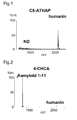
- Fig. 1 is a mass spectrum, which was obtained when C8-ATHAP was used as a matrix.
- Fig. 2 is a mass spectrum, which was obtained when 4-CHCA was used as a matrix.
- 4-CHCA was used as a matrix
- both the hydrophobic peptide Humanin and the hydrophilic peptide ⁇ -amyloid 1-11 were detected, but rather, the hydrophilic peptide ⁇ -amyloid 1-11 was preferentially detected.
- the hydrophilic peptide ⁇ -amyloid 1-11 was not detected, and only the hydrophobic peptide Humanin was detected at high sensitivity.
- "ND" in Fig. 1 means that no ion was detected.
- Fig. 3 shows a photograph of a crystal formed in a well on the MALDI plate, an MS image of the hydrophobic peptide Humanin in positive mode, and an MS image of the hydrophilic peptide ⁇ -amyloid 1-11 in positive mode.
- C8-ATHAP (R in the general formula (I) : n-octyl group) was used as a matrix to evaluate the detection limits of various peptides different in the degree of hydrophobicity.
- C8-ATHAP (R in the general formula (I) : n-octyl group) was used as a matrix.
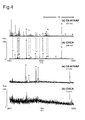
- Fig. 4(a) is a mass spectrum, which was obtained when C8-ATHAP was used as a matrix
- Fig. 4(b) is a mass spectrum, which was obtained when 4-CHCA was used as a matrix.
Landscapes
- Life Sciences & Earth Sciences (AREA)
- Health & Medical Sciences (AREA)
- Engineering & Computer Science (AREA)
- Physics & Mathematics (AREA)
- Molecular Biology (AREA)
- Chemical & Material Sciences (AREA)
- Bioinformatics & Cheminformatics (AREA)
- Bioinformatics & Computational Biology (AREA)
- Analytical Chemistry (AREA)
- Immunology (AREA)
- Hematology (AREA)
- Biomedical Technology (AREA)
- Urology & Nephrology (AREA)
- Spectroscopy & Molecular Physics (AREA)
- Pathology (AREA)
- General Physics & Mathematics (AREA)
- General Health & Medical Sciences (AREA)
- Biochemistry (AREA)
- Optics & Photonics (AREA)
- Biophysics (AREA)
- Medicinal Chemistry (AREA)
- Food Science & Technology (AREA)
- Microbiology (AREA)
- Proteomics, Peptides & Aminoacids (AREA)
- Cell Biology (AREA)
- Biotechnology (AREA)
- Chemical Kinetics & Catalysis (AREA)
- Electrochemistry (AREA)
- Toxicology (AREA)
- Other Investigation Or Analysis Of Materials By Electrical Means (AREA)
Abstract
Description
- The present invention relates to a mass spectrometry method applicable to medical field and drug discovery field, and especially relates to MALDI-MS (Matrix-Assisted Laser Desorption/Ionization Mass Spectrometry) application. More precisely, the present invention relates to a mass spectrometry method using a specific compound as a matrix, and a matrix for mass spectrometry.
- Conditions for achieving efficient ionization of a molecule to be analyzed in a MALDI (Matrix-Assisted Laser Desorption/Ionization) mass spectrometry method have been searched. For example,
JP-A-2005-326391 - Patent Document 1:
JP-A-2005-326391 - According to the above MALDI mass spectrometry method, a certain level of ionization-promoting effect is obtained when modification of a molecule to be analyzed is performed, but sufficient ionization efficiency is not achieved when such modification is not performed. Particularly, the MALDI mass spectrometry method has a problem that the ionization efficiency of a molecular species difficult to be ionized by MALDI, such as a hydrophobic peptide, is low.
- An object of the present invention is to provide a mass spectrometry method using a matrix that is capable of easily and efficiently improving ionization efficiency in mass spectrometry without modifying (specifically, labeling or the like) a molecule to be analyzed, and a matrix for mass spectrometry. Particularly, an object of the present invention is to provide a mass spectrometry method using a matrix that is capable of easily and efficiently improving ionization efficiency in MALDI mass spectrometry without modifying (specifically, labeling or the like) a molecule to be analyzed, and a matrix for MALDI mass spectrometry.
- The present inventors have intensively studied, and as a result, have found that a specific 2,4,6-trihydroxyalkylphenone functions as a matrix for use in a mass spectrometry method and can efficiently ionize a molecular species that is difficult to be ionized such as a hydrophobic compound. This finding has led to the completion of the present invention.
- The present invention includes the following aspects.
- (1) A mass spectrometry method using, as a matrix, a 2,4,6-trihydroxyalkylphenone represented by the following general formula (I):

- (2) The mass spectrometry method according to (1), wherein an analysis object is a hydrophobic compound.
- (3) The mass spectrometry method according to (1) or (2), wherein an analysis object is a hydrophobic peptide. In this specification, the term "peptide" includes proteins.
- (4) The mass spectrometry method according to any one of (1) to (3), wherein R in the general formula (I) represents an alkyl group having 8 carbon atoms.
- A matrix for mass spectrometry, which is a 2,4,6-trihydroxyalkylphenone represented by the following general formula (I):

- The matrix for mass spectrometry described above, which is used for mass spectrometry of a hydrophobic compound.
- The matrix for mass spectrometry described above, which is used for mass spectrometry of a hydrophobic peptide.
- The matrix for mass spectrometry described above, wherein R in the general formula (I) represents an alkyl group having 8 carbon atoms.
- A matrix for mass spectrometry, which is a 2,4,6-trihydroxyalkylphenone represented by the following general formula (I):
- In the present invention, a 2,4,6-trihydroxyalkylphenone containing an alkyl group having 4 to 12 carbon atoms (R in the general formula (I)) is used as a matrix for mass spectrometry. The use of the 2,4, 6-trihydroxyalkylphenone containing an alkyl group having 4 to 12 carbon atoms as a matrix for mass spectrometry makes it possible to improve the ionization efficiency of a molecular species that is difficult to be ionized such as a hydrophobic compound, especially a hydrophobic peptide. Therefore, the present invention provides a mass spectrometry method using a matrix capable of improving the ionization efficiency of a molecule to be analyzed, and a matrix for mass spectrometry. The present invention is particularly directed to a MALDI mass spectrometry method, and is suitable when an analysis object is a hydrophobic compound and particularly suitable when an analysis object is a hydrophobic peptide.
- The present invention makes it possible to achieve improvement in sensitivity for detection of a molecule to be analyzed (especially, a hydrophobic peptide) in mass spectrometry measurement.
-
- [
Fig. 1] Fig. 1 is a mass spectrum of a mixture of a hydrophobic peptide Humanin and a hydrophilic peptide β-amyloid 1-11, which was obtained in Example 2 when C8-ATHAP was used as a matrix, wherein the horizontal axis represents mass/charge (m/z) and the vertical axis represents ion relative intensity (%Int.). - [
Fig. 2] Fig. 2 is a mass spectrum of a mixture of a hydrophobic peptide Humanin and a hydrophilic peptide β-amyloid 1-11, which was obtained in Example 2 when 4-CHCA was used as a matrix. - [
Fig. 3] Fig. 3 shows a photograph of a crystal formed in a well on a MALDI plate, an MS image of the hydrophobic peptide Humanin, and an MS image of the hydrophilic peptide β-amyloid 1-11, in Example 3. - [
Fig. 4] Fig. 4(a) is a mass spectrum obtained in Example 5 when C8-ATHAP was used as a matrix, andFig. 4(b) is a mass spectrum obtained in Example 5 when 4-CHCA was used as a matrix. - The present invention provides a mass spectrometry method using, as a matrix, a 2,4,6-trihydroxyalkylphenone represented by the following general formula (I). In the formula, R represents an alkyl group having 4 to 12 carbon atoms. In this specification, a compound represented by the general formula (I) (R = C4 to C12 alkyl group) may be referred to as ATHAP (Alkylated trihydroxyalkylphenone). For example, when R that is a C4 to C12 alkyl group is an octyl group (C8), a compound represented by the general formula (I) is referred to as C8-ATHAP. Further, 2',4',6'-trihydroxyacetophenone (R = CH3 group) that is a compound falling outside the general formula (I) is referred to as THAP.

- Examples of the C4 to C12 alkyl group represented by R in the general formula (I) include a butyl group, a pentyl group, a hexyl group, a heptyl group, an octyl group, a nonyl group, a decyl group, an undecyl group, and a dodecyl group. These alkyl groups may be either linear or branched. Examples of the branched C4 to C12 alkyl group include a 2-ethylhexyl group and the like. Among them, a C6 to C12 alkyl group is preferred, a C6 to C10 alkyl group is more preferred, and a C8 alkyl group is particularly preferred. When an analysis object is a hydrophobic compound, the alkyl group represented by R is considered to be required to have a certain level of hydrophobicity for the ionization of the hydrophobic compound.
- In the present invention, the concentration of a matrix solution containing a matrix ATHAP represented by the general formula (I) (R = C4 to C12) may be, for example, 3 mg/mL to a saturation concentration. However, even when the concentration of the matrix solution is at a lower level within the above range, the ionization efficiency of an analysis object can be improved. For example, the concentration of the matrix solution may be about 1 mg/mL to 10 mg/mL, may also be about 1 to 8 mg/mL or about 1 to 5 mg/mL.
- An object to be analyzed by mass spectrometry using the matrix according to the present invention is not particularly limited, and may be, for example, a molecule having a molecular weight of 500 to 30, 000, preferably 1,000 to 10,000. The matrix according to the present invention can promote the ionization of a hydrophobic substance, and is therefore preferably used for mass spectrometry of a hydrophobic substance. In this case, a sample may contain a substance (e.g., a hydrophilic substance) other than the hydrophobic substance that is an analysis object. As shown in examples, the matrix according to the present invention can selectively promote the ionization of a hydrophobic substance without promoting the ionization of a hydrophilic substance as compared to a case where a conventional matrix α-cyano-4-hydroxycinnamic acid (4-CHCA) is used. Therefore, even when a sample contains both a hydrophobic substance and a hydrophilic substance in a mixture state, the hydrophobic substance can be easily analyzed. For this reason, the matrix according to the present invention can be appropriately applied to mass spectrometry of a hydrophobic substance.
- The degree of hydrophobicity is not particularly limited as long as it is at a level that can be regarded as hydrophobic based on any known hydrophobicity index or hydrophobicity calculation method. For example, the degree of hydrophobicity of the hydrophobic substance may be at a level that can be regarded as hydrophobic by those skilled in the art based on the BB Index (Bull and Breese Index). More specifically, the BB Index of the hydrophobic substance may be, for example, 1,000 or less, preferably -1,000 or less.
- Alternatively, the degree of hydrophobicity of the hydrophobic substance may be at a level that can be regarded as hydrophobic by those skilled in the art based on the HPLC Index. The HPLC Index is a hydrophobicity index reported by C. A. Browne, H. P. J. Bennett, S. Solomon in Analytical Biochemistry, 124, 201-208, 1982, and is also referred to as "HPLC/HFBA retention" because it is based on retention time in reversed-phase HPLC using, as an eluent, an aqueous acetonitrile solution containing 0.13% heptafluoro-n-butyric acid (HFBA). More specifically, the HPLC Index of the hydrophobic substance may be, for example, 40 or more, for example, 40 to 10,000, preferably 100 to 1,000.
- Further, the degree of hydrophobicity of the hydrophobic substance in the present invention may be at a level that can be regarded as hydrophobic by those skilled in the art based on the SSRCalc Hydrophobicity. The SSRCalc Hydrophobicity is reported by Oleg V. Krokhin in Analytical Chemistry, 78, 7785-7795, 2006. The SSRCalc Hydrophobicity is a hydrophobicity index based on a peptide sequence-specific algorithm for retention times of peptides in RP-HPLC (Reversed-Phase High-Performance Liquid Chromatography), sequence-specific retention calculator (SSRCalc). The HPLC index or the BB index predicts a retention time based on only information about amino acid composition, whereas the SSRCalc Hydrophobicity predicts a retention time based on not only the primary structure but also the secondary structure of a peptide. In the present invention, when an analysis object is a hydrophobic peptide, the SSRCalc Hydrophobicity is suitable as an index of the degree of hydrophobicity. More specifically, the SSRCalc Hydrophobicity of the hydrophobic substance may be, for example, 30 or more, preferably 40 to 70.
- In the present invention, the effect of enhancing the ability to ionize a hydrophobic peptide (in the present invention, the term "peptide" includes proteins) is particularly high. The determination as to whether a peptide to be analyzed is hydrophobic or not may be made based on the BB Index, the HPLC Index, or the SSRCalc Hydrophobicity, and preferably, the SSRCalc Hydrophobicity. Specifically, the hydrophobic peptide may be a peptide containing, as constituent amino acids, more amino acids having a higher degree of hydrophobicity. Examples of such hydrophobic amino acids include isoleucine, leucine, valine, alanine, phenylalanine, proline, methionine, tryptophan, and glycine. Further, cysteine, tyrosine, and the like may also be contained. The hydrophobic peptide may be a peptide having not only such a primary structure of the peptide but also a higher-order structure with a higher degree of hydrophobicity. Examples of such a hydrophobic peptide include peptides having a structure likely to interact with the surface of a hydrophobic stationary phase in a reversed-phase HPLC column.
- A crystal for mass spectrometry can be obtained through the step of forming, on a target plate for mass spectrometry, a liquid droplet of a mixture liquid containing, in a solvent, at least an analysis object and a matrix, and the step of removing the solvent from the formed liquid droplet of the mixture liquid to obtain non-volatile matter contained in the mixture liquid (i.e., at least the analysis object and the matrix) as a residue. Thus the obtained residue is a crystal for mass spectrometry. In this specification, the terms "crystal for mass spectrometry" is synonymous with the term "residue".
- As the target for mass spectrometry, a conductive metal plate usually used for MALDI mass spectrometry can be used. Specifically, a plate made of stainless steel or gold can be used.
- A specific method for preparing a liquid droplet of the mixture liquid on a target plate is not particularly limited. For example, first, a sample solution containing an analysis object and a matrix solution are prepared separately from each other. Then, these solutions are mixed to obtain a mixture liquid, and the obtained mixture liquid is dropped onto a target plate. Alternatively, these solutions are mixed on a target plate by dropping these solutions onto the same position on the target plate (on-target mix). In the case of on-target mix, the order of dropping the solutions is not particularly limited.
- The solvent of the mixture liquid may be selected from the group consisting of acetonitrile (ACN), trifluoroacetic acid (TFA), methanol (MeOH), ethanol (EtOH), tetrahydrofuran (THF), dimethylsulfoxide (DMSO), and water. More specific examples of the solvent of the mixture liquid include an aqueous ACN-TFA solution, an aqueous ACN solution, an aqueous MeOH-TFA solution, an aqueous MeOH solution, an aqueous EtOH-TFA solution, an aqueous EtOH solution, an aqueous THF-TFA solution, an aqueous THF solution, an aqueous DMSO-TFA solution, and an aqueous DMSO solution. An aqueous ACN-TFA solution or an aqueous ACN solution may be more preferably used. The concentration of ACN in the aqueous ACN-TFA solution may be, for example, 10 to 90 vol%, preferably 25 to 75 vol%, and the concentration of TFA in the aqueous ACN-TFA solution may be, for example, 0.05 to 1 vol%, preferably 0.05 to 0.1 vol%.
- The volume of the liquid droplet of the mixture liquid is not particularly limited, and may be appropriately determined by those skilled in the art. When a well is provided on the target plate, the liquid droplet of the mixture liquid may be formed in the well. In this case, the liquid droplet is formed so as to have a volume that can be held in the well. Specifically, the liquid droplet may be formed so as to have a volume of about 0.1 µL to 2 µL, for example, about 0.5 µL.
- Then, the solvent is removed from the liquid droplet of the mixture liquid on the target plate. The removal of the solvent includes natural evaporation of the solvent. The amount of the matrix contained per one residue (that is, per one crystal for mass spectrometry) generated by evaporation may be, for example, 1 to 1,000 nmol, preferably 10 to 100 nmol. The amount of the analysis object may be in the range of, for example, 50 amol to 100 pmol or in the range of 100 amol to 50 pmol with respect to 10 nmol of the matrix.
- The residue has a substantially circular shape on a surface in contact with the target plate. That is, the outer edge of the residue is substantially circular. The average diameter of the substantially circular shape may vary depending on the amount of the sample, the volume of the liquid droplet, the amount of the matrix, the composition of the solvent etc., but is for example 1 to 3 mm, preferably 1 to 2 mm. It is to be noted that the average diameter is the average of the lengths of line segments cut from lines passing through the center of gravity of the substantially circular shape by the outer edge of the residue.
- In the substantially circular residue obtained by removing the solvent, the analysis object is uniformly present in a substantially circular manner. Therefore, ionization of the analysis object can be easily performed without positioning laser irradiation during ionization. The entire region of the residue can be regarded as a target for laser irradiation, which is advantageous for mass spectrometry measurement as compared to a case where a hydrophobic substance is localized in the outer edge region of the substantially circular residue (i.e., a hydrophobic substance is localized in a ring-shaped manner).
- A mass spectrometer used in the present invention is not particularly limited as long as it is used in combination with a MALDI (Matrix-Assisted Laser Desorption/Ionization) ion source. Examples of such a mass spectrometer include MALDI-TOF (Matrix-Assisted Laser Desorption/Ionization-Time-of-Flight) mass spectrometers, MALDI-IT (Matrix-Assisted laser Desorption/Ionization-Ion Trap) mass spectrometers, MALDI-IT-TOF (Matrix-Assisted Laser Desorption/Ionization-Ion Trap-Time-of-Flight) mass spectrometers, and MALDI-FTICR (Matrix-Assisted Laser Desorption/Ionization-Fourier Transform Ion Cyclotron Resonance) mass spectrometers.
- Hereinafter, the present invention will be described specifically with reference to examples, but is not limited to these examples.
- In this example, each of compounds represented by the general formula (I), C6-ATHAP (R: n-hexyl group), C8-ATHAP (R: n-octyl group), C10-ATHAP (R: n-decyl group), and C12-ATHAP (R: n-dodecyl group) was used as a matrix.
-
- (1) A 5 mg/mL solution (75% ACN/0.1% TFA water) (% is by volume; the same shall apply hereinafter) of each of the matrices C6-ATHAP, C8-ATHAP, C10-ATHAP, and C12-ATHAP was prepared.
- (2) As sample solutions, 0.2 fmol to 2 pmol/µL solutions (50% ACN/0.1% TFA water) of a hydrophobic peptide Humanin were prepared.
- (3) 0.5 µL of each of the sample solutions prepared in (2) and 0.5 µL of each of the matrix solutions prepared in (1) were dropped onto a MALDI target plate (MALDI plate: sample plate 2.8 mm ring x 384 well (Shimadzu/Kratos, UK)) and mixed (on-target mix).
- (4) Analysis was performed using AXIMA Performance (registered trademark) (SHIMADZU CORPORATION) by linear TOF in positive ion mode. Then, detection limits were evaluated.
-
- (1) As matrix solutions, a 10 mg/mL solution (50% ACN/0.1% TFA water) of 4-CHCA (Laser Bio) and a 10 mg/mL solution (50% ACN/0.1% TFA water) of 2,4,6-trihydroxyacetophenone (THAP) were prepared.
- (2) As sample solutions, 0.2 fmol to 2 pmol/µL solutions (50% ACN/0.1% TFA water) of a hydrophobic peptide Humanin were prepared.
- (3) 0.5 µL of each of the sample solutions prepared in (2) and 0.5 µL of each of the matrix solutions prepared in (1) were dropped onto a MALDI target plate and mixed (on-target mix).
- (4) Analysis was performed using AXIMA Performance (registered trademark) (SHIMADZU CORPORATION) by linear TOF in positive ion mode. Then, detection limits were evaluated.
- As shown in Table 1, the detection limit when C6-ATHAP, C10-ATHAP, or C12-ATHAP was used as a matrix was the same as that when 4-CHCA or THAP was used. Particularly, it was confirmed that when C8-ATHAP was used, the detection limit was 1/10, that is, sensitivity was improved 10-fold as compared to when 4-CHCA or THAP was used.
-
- (1) As a matrix solution, a 5 mg/mL solution (75% ACN/0.1% TFA water) of C8-ATHAP was prepared. Further, as a matrix solution for comparative example, a 10 mg/mL solution (50% ACN/0.1% TFA water) of 4-CHCA was prepared.
- (2) A 400 fmol/µL solution (50% ACN/0.1% TFA water) of a hydrophobic peptide Humanin and a 400 fmol/µL solution (50% ACN/0.1% TFA water) of a hydrophilic peptide β-amyloid 1-11 were mixed in a ratio of 1 : 1 (v/v) to prepare a sample mixture liquid (i.e., a solution containing 200 fmol/µL of Humanin and 200 fmol/µL of β-amyloid 1-11).
- (3) 0.5 µL of the sample mixture solution prepared in (2) and 0.5 µL of the matrix solution or the matrix solution for comparative example prepared in (1) were dropped onto a MALDI target plate and mixed (on-target mix). That is, the amount of the sample Humanin per one well was 100 fmol/well, and the amount of the sample β-amyloid 1-11 per one well was 100 fmol/well.
- (4) Analysis was performed using AXIMA Performance (registered trademark) (SHIMADZU CORPORATION) by linear TOF in positive ion mode.
- Hydrophobic Peptide Humanin (BB Index: -5,800, HPLC Index: 117.4, SSRCalc Hydrophobicity: 50.0)
- Hydrophilic Peptide β-amyloid 1-11 (BB Index: +2,510, HPLC Index: 1.4, SSRCalc Hydrophobicity: 13.5)
-
Fig. 1 is a mass spectrum, which was obtained when C8-ATHAP was used as a matrix.Fig. 2 is a mass spectrum, which was obtained when 4-CHCA was used as a matrix. As shown inFig. 2 , when 4-CHCA was used as a matrix, both the hydrophobic peptide Humanin and the hydrophilic peptide β-amyloid 1-11 were detected, but rather, the hydrophilic peptide β-amyloid 1-11 was preferentially detected. On the other hand, as shown inFig. 1 , when C8-ATHAP was used as a matrix, the hydrophilic peptide β-amyloid 1-11 was not detected, and only the hydrophobic peptide Humanin was detected at high sensitivity. It is to be noted that "ND" inFig. 1 means that no ion was detected. - These results showed that when C8-ATHAP was used as a matrix, MALDI ionization of the hydrophilic peptide β-amyloid 1-11 was not promoted or was inhibited, but MALDI ionization of the hydrophobic peptide Humanin was promoted, and therefore only the hydrophobic peptide Humanin could be detected at high sensitivity.
- It was confirmed that, as in the case of using C8-ATHAP as a matrix, also when C6-ATHAP, C10-ATHAP, or C12-ATHAP was used as a matrix, MALDI ionization of the hydrophilic peptide β-amyloid 1-11 was not promoted or was inhibited, but MALDI ionization of the hydrophobic peptide Humanin was promoted, and therefore only the hydrophobic peptide Humanin could be detected at high sensitivity.
-
- (1) As a matrix solution, a 5 mg/mL solution (75% ACN/0.1% TFA water) of C8-ATHAP was prepared.
- (2) A 400 fmol/µL solution (50% ACN/0.1% TFA water) of a hydrophobic peptide Humanin and a 400 fmol/µL solution (50% ACN/0.1% TFA water) of a hydrophilic peptide β-amyloid 1-11 were mixed in a ratio of 1 : 1 (v/v) to prepare a sample mixture liquid (i.e., a solution containing 200 fmol/µL of Humanin and 200 fmol/µL of β-amyloid 1-11).
- (3) 0.5 µL of the sample mixture solution prepared in (2) and 0.5 µL of the matrix solution prepared in (1) were dropped onto a MALDI target plate (MALDI plate: sample plate 2.8 mm ring x 384 well (Shimadzu/Kratos, UK)) and mixed (on-target mix). That is, the amount of the sample Humanin per one well was 100 fmol/well, and the amount of the sample β-amyloid 1-11 per one well was 100 fmol/well.
- (4) MS imaging was performed using AXIMA Performance (registered trademark) (SHIMADZU CORPORATION) by linear TOF in positive ion mode (raster: 4, 000 µm x 4, 000 µm with 50 µm (81 x 81 lattice), 6, 561 points). That is, MS imaging was performed by raster scanning an area of 4, 000 µm x 4, 000 µm including the entire region of a residue on a well at an intervals of 50 µm (i.e., by automatically irradiating points in a certain region of a residue with laser at regular intervals) so that a total of 6,561 points (81×81 points) were irradiated with two shots of laser.
-
Fig. 3 shows a photograph of a crystal formed in a well on the MALDI plate, an MS image of the hydrophobic peptide Humanin in positive mode, and an MS image of the hydrophilic peptide β-amyloid 1-11 in positive mode. - As can be seen from
Fig. 3 , when C8-ATHAP was used as a matrix, the hydrophilic peptide β-amyloid 1-11 was not detected, and the hydrophobic peptide Humanin was relatively uniformly detected in the well. - In this example, C8-ATHAP (R in the general formula (I) : n-octyl group) was used as a matrix to evaluate the detection limits of various peptides different in the degree of hydrophobicity.
-
- (1) As a matrix solution, a 5 mg/mL solution (75% ACN/0.1% TFA water) of C8-ATHAP was prepared. Further, as a matrix solution for comparative example, a 10 mg/mL solution (50% ACN/0.1% TFA water) of 4-CHCA (Laser Bio) was prepared.
- (2) As sample solutions, 0.2 fmol to 2 pmol/µL solutions (50% An/0.1% TFA water) of each of peptides NF-kB inhibitor, OVA-BIP hybrid peptide, Humanin, β-amyloid 22-42, catestatin, ACTH 18-39, nocistatin, neuropeptide S, β-amyloid 1-16, β-amyloid 1-11, and β-amyloid 165-178 were prepared.
- (3) 0.5 µL of each of the sample solutions prepared in (2) and 0.5 µL of the matrix solution or the matrix solution for comparative example prepared in (1) were dropped onto a MALDI target plate (MALDI plate: sample plate 2.8 mm ring x 384 well (Shimadzu/Kratos, UK) and mixed (on-target mix).
- (4) Analysis was performed using AXIMA Performance (registered trademark) (SHIMADZU CORPORATION) by linear TOF in positive ion mode. Then, detection limits when each of the matrices was used were evaluated.
- (5) The detection limit obtained using 4-CHCA was divided by the detection limit obtained using C8-ATHAP, and the obtained value was defined as sensitivity improvement rate (fold) achieved by C8-ATHAP.
- As shown in Table 2, it was confirmed that when C8-ATHAP was used, the detection limits of the hydrophobic peptides having an SSRCalc Hydrophobicity of 42.4 or more were 1/10, that is, sensitivity was improved 10-fold as compared to a case where 4-CHCA was used.
- On the other hand, as shown in Table 2, it was confirmed that when C8-ATHAP was used, the detection limits of the hydrophilic peptides having an SSRCalc Hydrophobicity of 22.3 or less were 10-fold to 10,000-fold, that is, sensitivity was reduced to 1/10 to 1/10,000 as compared to a case where 4-CHCA was used.
- In this example, C8-ATHAP (R in the general formula (I) : n-octyl group) was used as a matrix.
-
- (1) As a matrix solution, a 5 mg/mL solution (75% ACN/0.1% TFA water) of C8-ATHAP was prepared. Further, as a matrix solution for comparative example, a 10 mg/mL solution (50% ACN/0.1% TFA water) of 4-CHCA (Laser Bio) was prepared.
- (2) As a sample solution, a solution containing Lys-C digests of a protein Phosphorylase b (2 pmol/µL) was prepared.
- (3) 0.5 µL of the sample solution prepared in (2), and 0.5 µL of the matrix solution or the matrix solution for comparative example prepared in (1) were dropped onto a MALDI target plate (MALDI plate: sample plate 2.8 mm ring x 384 well (Shimadzu/Kratos, UK)) and mixed (on-target mix).
- (4) Analysis was performed using AXIMA Performance (registered trademark) (SHIMADZU CORPORATION) by linear TOF in positive ion mode. Then, a mass spectrum obtained using each of the matrices was evaluated.
- (5) In Table 3, "++" indicates that a peptide ion was detected at S/N ≥ 5 when C8-ATHAP or 4-CHCA was used as a matrix, "+" indicates that a peptide ion was detected at S/N = 2 to 5 when C8-ATHAP or 4-CHCA was used as a matrix, and "-" indicates that a peptide ion was not detected when C8-ATHAP or 4-CHCA was used as a matrix.
-
Fig. 4(a) is a mass spectrum, which was obtained when C8-ATHAP was used as a matrix, andFig. 4(b) is a mass spectrum, which was obtained when 4-CHCA was used as a matrix.[Table 3] phosphorylase b Lys-C digests detection (+/-) no. SSRCalc Hydrophobicity HPLC Index m/z (Ave.) C8- ATHAP CHCA 1 55.9 142.3 3602.2 ++ - 2 53.9 109.0 3823.5 ++ - 3 53.1 102.5 3890.3 ++ - 4 51.0 109.5 3823.5 ++ - 5 50.7 78.4 2198.6 ++ + 6 45.8 69.5 2155.6 ++ + 7 45.1 46.2 2742.0 + + 8 42.8 52.7 2969.5 + - 9 38.9 56.8 3504.9 ++ - 10 35.1 66.1 1855.1 ++ ++ 11 33.9 37.5 1657.0 + + 12 33.6 14.3 2130.5 ++ - 13 33.4 61.6 2629.0 ++ ++ 14 31.4 36.9 1610.9 ++ ++ 15 31.4 31.2 1814.1 ++ ++ 16 31.2 59.8 1526.8 ++ ++ 17 30.9 43.7 2043.3 ++ ++ 18 30.4 27.5 1942.3 ++ ++ 19 29.9 36.3 2449.7 - + 20 28.4 38.1 1304.7 ++ ++ 21 25.8 24.5 1263.4 - ++ 22 24.7 27.3 1178.3 - ++ 23 24.5 44.1 1290.5 + ++ 24 18.9 8.7 1254.5 + ++ 25 9.3 -0.7 1102.2 - ++ - As shown in Table 3, when C8-ATHAP was used, peptides having an SSRCalc Hydrophobicity of 30.4 or more were detected, and when 4-CHCA was used, peptides having an SSRC Hydrophobicity of 33.4 or less were detected. That is, hydrophobic peptides that were not detected using 4-CHCA could be detected using C8-ATHAP.
| Detection Limit (fmol/well) | |||||||
| C6-ATHAP | C8-ATHAP | C10-ATHAP | C12-ATHAP | THAP | 4-CHCA | ||
| positive | humanin (hydrophobic peptide) | 10 | 1 | 10 | 10 | 10 | 10 |

| analytes | sensitivity improvement rate (fold) | ||||
| no. | name | SSRCalc Hydrophobicity | HPLC Index | m/z (Ave.) | |
| 1 | NF-κB inhibitor | 54.8 | 200.0 | 2782.6 | 10 |
| 2 | OVA-BIP hybrid peptide | 50.2 | 100.8 | 2291.6 | 10 |
| 3 | humanin | 50.0 | 117.4 | 2688.3 | 10 |
| 4 | β-amyloid 22-42 | 42.4 | 44.5 | 2000.4 | 10 |
| 5 | catestatin | 38.1 | 84.0 | 2327.7 | 1 |
| 6 | ACTH 18-39 | 37.9 | 58.9 | 2466.7 | 1 |
| 7 | nocistatin | 29.8 | 13.5 | 1928.1 | 1 |
| 8 | neuropeptide S | 22.3 | 16.2 | 2188.5 | 0.1 |
| 9 | β-amyloid 1-16 | 18.2 | -3.3 | 1956.1 | 0.1 |
| 10 | β-amyloid 1-11 | 13.5 | 1.4 | 1326.3 | 0.001 |
| 11 | β-conglycinin 165-178 | 5.2 | -60.2 | 1848.8 | 0.0001 |
Claims (4)
- A mass spectrometry method using, as a matrix, a 2,4,6-trihydroxyalkylphenone represented by the following general formula (I):

- The mass spectrometry method according to claim 1, wherein an analysis object is a hydrophobic compound.
- The mass spectrometry method according to claim 1 or 2, wherein an analysis object is a hydrophobic peptide.
- The mass spectrometry method according to any one of claims 1 to 3, wherein R in the general formula (I) represents an alkyl group having 8 carbon atoms.
Applications Claiming Priority (2)
| Application Number | Priority Date | Filing Date | Title |
|---|---|---|---|
| JP2013046644 | 2013-03-08 | ||
| PCT/JP2014/055479 WO2014136779A1 (en) | 2013-03-08 | 2014-03-04 | Mass spectrometry method using matrix |
Publications (3)
| Publication Number | Publication Date |
|---|---|
| EP2950092A4 EP2950092A4 (en) | 2015-12-02 |
| EP2950092A1 true EP2950092A1 (en) | 2015-12-02 |
| EP2950092B1 EP2950092B1 (en) | 2016-11-23 |
Family
ID=51491294
Family Applications (1)
| Application Number | Title | Priority Date | Filing Date |
|---|---|---|---|
| EP14760809.5A Active EP2950092B1 (en) | 2013-03-08 | 2014-03-04 | Mass spectrometry method using matrix |
Country Status (4)
| Country | Link |
|---|---|
| US (1) | US9453846B2 (en) |
| EP (1) | EP2950092B1 (en) |
| JP (1) | JP5706597B2 (en) |
| WO (1) | WO2014136779A1 (en) |
Cited By (1)
| Publication number | Priority date | Publication date | Assignee | Title |
|---|---|---|---|---|
| EP3527668A1 (en) * | 2018-02-15 | 2019-08-21 | Shimadzu Corporation | Analysis method and b-lactam antibiotic resistance evaluation method |
Families Citing this family (1)
| Publication number | Priority date | Publication date | Assignee | Title |
|---|---|---|---|---|
| US10481163B1 (en) * | 2018-05-31 | 2019-11-19 | Shimadzu Corporation | Mass spectrometry method using mixed matrix |
Family Cites Families (11)
| Publication number | Priority date | Publication date | Assignee | Title |
|---|---|---|---|---|
| EP0612994A3 (en) | 1993-02-26 | 1996-03-06 | Ciba Geigy Ag | Matrix for matrix-assisted laser desorption mass spectroscopy. |
| CA2502413A1 (en) * | 2002-11-01 | 2004-05-21 | The Regents Of The University Of Colorado, A Body Corporate | Quantitative analysis of protein isoforms using matrix-assisted laser desorption/ionization time of flight mass spectrometry |
| US20050224710A1 (en) | 2004-04-13 | 2005-10-13 | Eiichi Matsuo | Method for measuring hydrophobic peptides using maldi mass spectrometer |
| WO2005100975A1 (en) | 2004-04-13 | 2005-10-27 | Shimadzu Corporation | Method of measuring substance by mass spectrometry and kit therefor |
| JP4165501B2 (en) | 2004-04-13 | 2008-10-15 | 株式会社島津製作所 | Method for measuring hydrophobic peptides by MALDI mass spectrometer |
| JP4165502B2 (en) * | 2004-05-24 | 2008-10-15 | 株式会社島津製作所 | Method for selectively measuring a specific substance from a mixture by MALDI mass spectrometry |
| US20060243899A1 (en) | 2004-05-24 | 2006-11-02 | Shimadzu Corporation | Method for selective measurement of specific substances from a mixture by maldi mass spectrometry |
| CA2760027A1 (en) | 2009-06-03 | 2010-12-09 | Wayne State University | Mass spectrometry using laserspray ionization |
| JP2013068598A (en) * | 2011-09-09 | 2013-04-18 | Shimadzu Corp | Addition agent of matrix for mass spectrometry |
| JP6085083B2 (en) * | 2011-12-26 | 2017-02-22 | 株式会社島津製作所 | Additives for matrix for mass spectrometry |
| JP5727407B2 (en) * | 2012-03-13 | 2015-06-03 | 株式会社島津製作所 | Additives for matrix for mass spectrometry |
-
2014
- 2014-03-04 WO PCT/JP2014/055479 patent/WO2014136779A1/en not_active Ceased
- 2014-03-04 US US14/770,057 patent/US9453846B2/en active Active
- 2014-03-04 EP EP14760809.5A patent/EP2950092B1/en active Active
- 2014-03-04 JP JP2014558343A patent/JP5706597B2/en active Active
Cited By (2)
| Publication number | Priority date | Publication date | Assignee | Title |
|---|---|---|---|---|
| EP3527668A1 (en) * | 2018-02-15 | 2019-08-21 | Shimadzu Corporation | Analysis method and b-lactam antibiotic resistance evaluation method |
| US11435352B2 (en) | 2018-02-15 | 2022-09-06 | Shimadzu Corporation | Analysis method and β-lactam antibiotic resistance evaluation method |
Also Published As
| Publication number | Publication date |
|---|---|
| EP2950092A4 (en) | 2015-12-02 |
| JP5706597B2 (en) | 2015-04-22 |
| EP2950092B1 (en) | 2016-11-23 |
| JPWO2014136779A1 (en) | 2017-02-16 |
| WO2014136779A1 (en) | 2014-09-12 |
| US9453846B2 (en) | 2016-09-27 |
| US20160011205A1 (en) | 2016-01-14 |
Similar Documents
| Publication | Publication Date | Title |
|---|---|---|
| Griffiths et al. | Electrospray and tandem mass spectrometry in biochemistry | |
| Gorman et al. | Use of 2, 6‐dihydroxyacetophenone for analysis of fragile peptides, disulphide bonding and small proteins by matrix‐assisted laser desorption/ionization | |
| Inutan et al. | Laserspray ionization, a new method for protein analysis directly from tissue at atmospheric pressure with ultrahigh mass resolution and electron transfer dissociation | |
| Barbacci et al. | Sequence and side-chain specific photofragment (193 nm) ions from protonated substance P by matrix-assisted laser desorption ionization time-of-flight mass spectrometry | |
| US11545349B2 (en) | Matrix-assisted laser desorption/ionization mass spectrometry method | |
| Fukuyama | MALDI matrix research for biopolymers | |
| US10481163B1 (en) | Mass spectrometry method using mixed matrix | |
| EP2950092B1 (en) | Mass spectrometry method using matrix | |
| US20050224710A1 (en) | Method for measuring hydrophobic peptides using maldi mass spectrometer | |
| US10386372B1 (en) | Materials and methods for screening topoisomers | |
| Fischer et al. | In situ reduction suitable for matrix‐assisted laser desorption/ionization and liquid secondary ionization using tris (2‐carboxyethyl) phosphine | |
| JP5673367B2 (en) | Liquid matrix for mass spectrometry of glycopeptides or glycoproteins | |
| EP2568293A1 (en) | Matrix additive for mass spectrometry | |
| Horn et al. | Improved protein identification using automated high mass measurement accuracy MALDI FT-ICR MS peptide mass fingerprinting | |
| US9885725B2 (en) | MALDI analysis of hydrophobic compounds using 2(3),5-dihydoxybenzoate with a long alkyl chain as an additive to MALDI matrix | |
| Zhang et al. | Improved detection of phosphopeptides by negative ion matrix-assisted laser desorption/ionization mass spectrometry using a proton sponge co-matrix | |
| Zhou et al. | A binary matrix for improved detection of phosphopeptides in matrix‐assisted laser desorption/ionization mass spectrometry | |
| JP6478048B2 (en) | Mass spectrometry using mixed matrices | |
| EP4296660A1 (en) | Calibrant for use in mass spectrometer and method for producing same | |
| JP6135814B2 (en) | Hydrophilic thiol probe | |
| WO2019146780A1 (en) | Analysis method, antioxidant for peptide to be subjected to mass spectrometry and mass spectrometry kit | |
| JP6085083B2 (en) | Additives for matrix for mass spectrometry | |
| Kruegel et al. | Elemental sulfur as a versatile low-mass-range calibration standard for laser desorption ionization mass spectrometry | |
| Pittenauer et al. | Different target surfaces for the analysis of peptides, peptide mixtures and peptide mass fingerprints by AP-MALDI ion trap-mass spectrometry | |
| JP2014174015A (en) | Mass spectrometry using matrix additive |
Legal Events
| Date | Code | Title | Description |
|---|---|---|---|
| PUAI | Public reference made under article 153(3) epc to a published international application that has entered the european phase |
Free format text: ORIGINAL CODE: 0009012 |
|
| 17P | Request for examination filed |
Effective date: 20150824 |
|
| A4 | Supplementary search report drawn up and despatched |
Effective date: 20151012 |
|
| AK | Designated contracting states |
Kind code of ref document: A1 Designated state(s): AL AT BE BG CH CY CZ DE DK EE ES FI FR GB GR HR HU IE IS IT LI LT LU LV MC MK MT NL NO PL PT RO RS SE SI SK SM TR |
|
| AX | Request for extension of the european patent |
Extension state: BA ME |
|
| GRAP | Despatch of communication of intention to grant a patent |
Free format text: ORIGINAL CODE: EPIDOSNIGR1 |
|
| DAX | Request for extension of the european patent (deleted) | ||
| INTG | Intention to grant announced |
Effective date: 20160607 |
|
| GRAS | Grant fee paid |
Free format text: ORIGINAL CODE: EPIDOSNIGR3 |
|
| GRAA | (expected) grant |
Free format text: ORIGINAL CODE: 0009210 |
|
| AK | Designated contracting states |
Kind code of ref document: B1 Designated state(s): AL AT BE BG CH CY CZ DE DK EE ES FI FR GB GR HR HU IE IS IT LI LT LU LV MC MK MT NL NO PL PT RO RS SE SI SK SM TR |
|
| REG | Reference to a national code |
Ref country code: GB Ref legal event code: FG4D |
|
| REG | Reference to a national code |
Ref country code: CH Ref legal event code: EP |
|
| REG | Reference to a national code |
Ref country code: IE Ref legal event code: FG4D |
|
| REG | Reference to a national code |
Ref country code: AT Ref legal event code: REF Ref document number: 848362 Country of ref document: AT Kind code of ref document: T Effective date: 20161215 |
|
| REG | Reference to a national code |
Ref country code: DE Ref legal event code: R096 Ref document number: 602014005079 Country of ref document: DE |
|
| REG | Reference to a national code |
Ref country code: FR Ref legal event code: PLFP Year of fee payment: 4 |
|
| PG25 | Lapsed in a contracting state [announced via postgrant information from national office to epo] |
Ref country code: LV Free format text: LAPSE BECAUSE OF FAILURE TO SUBMIT A TRANSLATION OF THE DESCRIPTION OR TO PAY THE FEE WITHIN THE PRESCRIBED TIME-LIMIT Effective date: 20161123 |
|
| REG | Reference to a national code |
Ref country code: LT Ref legal event code: MG4D |
|
| REG | Reference to a national code |
Ref country code: NL Ref legal event code: MP Effective date: 20161123 |
|
| REG | Reference to a national code |
Ref country code: AT Ref legal event code: MK05 Ref document number: 848362 Country of ref document: AT Kind code of ref document: T Effective date: 20161123 |
|
| PG25 | Lapsed in a contracting state [announced via postgrant information from national office to epo] |
Ref country code: NL Free format text: LAPSE BECAUSE OF FAILURE TO SUBMIT A TRANSLATION OF THE DESCRIPTION OR TO PAY THE FEE WITHIN THE PRESCRIBED TIME-LIMIT Effective date: 20161123 Ref country code: LT Free format text: LAPSE BECAUSE OF FAILURE TO SUBMIT A TRANSLATION OF THE DESCRIPTION OR TO PAY THE FEE WITHIN THE PRESCRIBED TIME-LIMIT Effective date: 20161123 Ref country code: SE Free format text: LAPSE BECAUSE OF FAILURE TO SUBMIT A TRANSLATION OF THE DESCRIPTION OR TO PAY THE FEE WITHIN THE PRESCRIBED TIME-LIMIT Effective date: 20161123 Ref country code: GR Free format text: LAPSE BECAUSE OF FAILURE TO SUBMIT A TRANSLATION OF THE DESCRIPTION OR TO PAY THE FEE WITHIN THE PRESCRIBED TIME-LIMIT Effective date: 20170224 Ref country code: NO Free format text: LAPSE BECAUSE OF FAILURE TO SUBMIT A TRANSLATION OF THE DESCRIPTION OR TO PAY THE FEE WITHIN THE PRESCRIBED TIME-LIMIT Effective date: 20170223 |
|
| PG25 | Lapsed in a contracting state [announced via postgrant information from national office to epo] |
Ref country code: PL Free format text: LAPSE BECAUSE OF FAILURE TO SUBMIT A TRANSLATION OF THE DESCRIPTION OR TO PAY THE FEE WITHIN THE PRESCRIBED TIME-LIMIT Effective date: 20161123 Ref country code: AT Free format text: LAPSE BECAUSE OF FAILURE TO SUBMIT A TRANSLATION OF THE DESCRIPTION OR TO PAY THE FEE WITHIN THE PRESCRIBED TIME-LIMIT Effective date: 20161123 Ref country code: RS Free format text: LAPSE BECAUSE OF FAILURE TO SUBMIT A TRANSLATION OF THE DESCRIPTION OR TO PAY THE FEE WITHIN THE PRESCRIBED TIME-LIMIT Effective date: 20161123 Ref country code: FI Free format text: LAPSE BECAUSE OF FAILURE TO SUBMIT A TRANSLATION OF THE DESCRIPTION OR TO PAY THE FEE WITHIN THE PRESCRIBED TIME-LIMIT Effective date: 20161123 Ref country code: PT Free format text: LAPSE BECAUSE OF FAILURE TO SUBMIT A TRANSLATION OF THE DESCRIPTION OR TO PAY THE FEE WITHIN THE PRESCRIBED TIME-LIMIT Effective date: 20170323 Ref country code: HR Free format text: LAPSE BECAUSE OF FAILURE TO SUBMIT A TRANSLATION OF THE DESCRIPTION OR TO PAY THE FEE WITHIN THE PRESCRIBED TIME-LIMIT Effective date: 20161123 Ref country code: ES Free format text: LAPSE BECAUSE OF FAILURE TO SUBMIT A TRANSLATION OF THE DESCRIPTION OR TO PAY THE FEE WITHIN THE PRESCRIBED TIME-LIMIT Effective date: 20161123 |
|
| PG25 | Lapsed in a contracting state [announced via postgrant information from national office to epo] |
Ref country code: SK Free format text: LAPSE BECAUSE OF FAILURE TO SUBMIT A TRANSLATION OF THE DESCRIPTION OR TO PAY THE FEE WITHIN THE PRESCRIBED TIME-LIMIT Effective date: 20161123 Ref country code: RO Free format text: LAPSE BECAUSE OF FAILURE TO SUBMIT A TRANSLATION OF THE DESCRIPTION OR TO PAY THE FEE WITHIN THE PRESCRIBED TIME-LIMIT Effective date: 20161123 Ref country code: DK Free format text: LAPSE BECAUSE OF FAILURE TO SUBMIT A TRANSLATION OF THE DESCRIPTION OR TO PAY THE FEE WITHIN THE PRESCRIBED TIME-LIMIT Effective date: 20161123 Ref country code: EE Free format text: LAPSE BECAUSE OF FAILURE TO SUBMIT A TRANSLATION OF THE DESCRIPTION OR TO PAY THE FEE WITHIN THE PRESCRIBED TIME-LIMIT Effective date: 20161123 Ref country code: CZ Free format text: LAPSE BECAUSE OF FAILURE TO SUBMIT A TRANSLATION OF THE DESCRIPTION OR TO PAY THE FEE WITHIN THE PRESCRIBED TIME-LIMIT Effective date: 20161123 |
|
| REG | Reference to a national code |
Ref country code: DE Ref legal event code: R097 Ref document number: 602014005079 Country of ref document: DE |
|
| PG25 | Lapsed in a contracting state [announced via postgrant information from national office to epo] |
Ref country code: BE Free format text: LAPSE BECAUSE OF FAILURE TO SUBMIT A TRANSLATION OF THE DESCRIPTION OR TO PAY THE FEE WITHIN THE PRESCRIBED TIME-LIMIT Effective date: 20161123 Ref country code: SM Free format text: LAPSE BECAUSE OF FAILURE TO SUBMIT A TRANSLATION OF THE DESCRIPTION OR TO PAY THE FEE WITHIN THE PRESCRIBED TIME-LIMIT Effective date: 20161123 Ref country code: BG Free format text: LAPSE BECAUSE OF FAILURE TO SUBMIT A TRANSLATION OF THE DESCRIPTION OR TO PAY THE FEE WITHIN THE PRESCRIBED TIME-LIMIT Effective date: 20170223 |
|
| PLBE | No opposition filed within time limit |
Free format text: ORIGINAL CODE: 0009261 |
|
| STAA | Information on the status of an ep patent application or granted ep patent |
Free format text: STATUS: NO OPPOSITION FILED WITHIN TIME LIMIT |
|
| REG | Reference to a national code |
Ref country code: CH Ref legal event code: PL |
|
| 26N | No opposition filed |
Effective date: 20170824 |
|
| PG25 | Lapsed in a contracting state [announced via postgrant information from national office to epo] |
Ref country code: MC Free format text: LAPSE BECAUSE OF FAILURE TO SUBMIT A TRANSLATION OF THE DESCRIPTION OR TO PAY THE FEE WITHIN THE PRESCRIBED TIME-LIMIT Effective date: 20161123 Ref country code: SI Free format text: LAPSE BECAUSE OF FAILURE TO SUBMIT A TRANSLATION OF THE DESCRIPTION OR TO PAY THE FEE WITHIN THE PRESCRIBED TIME-LIMIT Effective date: 20161123 |
|
| REG | Reference to a national code |
Ref country code: IE Ref legal event code: MM4A |
|
| PG25 | Lapsed in a contracting state [announced via postgrant information from national office to epo] |
Ref country code: LU Free format text: LAPSE BECAUSE OF NON-PAYMENT OF DUE FEES Effective date: 20170304 |
|
| REG | Reference to a national code |
Ref country code: FR Ref legal event code: PLFP Year of fee payment: 5 |
|
| PG25 | Lapsed in a contracting state [announced via postgrant information from national office to epo] |
Ref country code: IE Free format text: LAPSE BECAUSE OF NON-PAYMENT OF DUE FEES Effective date: 20170304 Ref country code: CH Free format text: LAPSE BECAUSE OF NON-PAYMENT OF DUE FEES Effective date: 20170331 Ref country code: LI Free format text: LAPSE BECAUSE OF NON-PAYMENT OF DUE FEES Effective date: 20170331 |
|
| PG25 | Lapsed in a contracting state [announced via postgrant information from national office to epo] |
Ref country code: MT Free format text: LAPSE BECAUSE OF NON-PAYMENT OF DUE FEES Effective date: 20170304 |
|
| PG25 | Lapsed in a contracting state [announced via postgrant information from national office to epo] |
Ref country code: HU Free format text: LAPSE BECAUSE OF FAILURE TO SUBMIT A TRANSLATION OF THE DESCRIPTION OR TO PAY THE FEE WITHIN THE PRESCRIBED TIME-LIMIT; INVALID AB INITIO Effective date: 20140304 |
|
| PG25 | Lapsed in a contracting state [announced via postgrant information from national office to epo] |
Ref country code: CY Free format text: LAPSE BECAUSE OF FAILURE TO SUBMIT A TRANSLATION OF THE DESCRIPTION OR TO PAY THE FEE WITHIN THE PRESCRIBED TIME-LIMIT Effective date: 20161123 |
|
| PG25 | Lapsed in a contracting state [announced via postgrant information from national office to epo] |
Ref country code: MK Free format text: LAPSE BECAUSE OF FAILURE TO SUBMIT A TRANSLATION OF THE DESCRIPTION OR TO PAY THE FEE WITHIN THE PRESCRIBED TIME-LIMIT Effective date: 20161123 |
|
| PG25 | Lapsed in a contracting state [announced via postgrant information from national office to epo] |
Ref country code: TR Free format text: LAPSE BECAUSE OF FAILURE TO SUBMIT A TRANSLATION OF THE DESCRIPTION OR TO PAY THE FEE WITHIN THE PRESCRIBED TIME-LIMIT Effective date: 20161123 |
|
| PG25 | Lapsed in a contracting state [announced via postgrant information from national office to epo] |
Ref country code: AL Free format text: LAPSE BECAUSE OF FAILURE TO SUBMIT A TRANSLATION OF THE DESCRIPTION OR TO PAY THE FEE WITHIN THE PRESCRIBED TIME-LIMIT Effective date: 20161123 Ref country code: IS Free format text: LAPSE BECAUSE OF FAILURE TO SUBMIT A TRANSLATION OF THE DESCRIPTION OR TO PAY THE FEE WITHIN THE PRESCRIBED TIME-LIMIT Effective date: 20170323 |
|
| PGFP | Annual fee paid to national office [announced via postgrant information from national office to epo] |
Ref country code: GB Payment date: 20260202 Year of fee payment: 13 |
|
| PGFP | Annual fee paid to national office [announced via postgrant information from national office to epo] |
Ref country code: DE Payment date: 20260128 Year of fee payment: 13 |
|
| PGFP | Annual fee paid to national office [announced via postgrant information from national office to epo] |
Ref country code: IT Payment date: 20260220 Year of fee payment: 13 |
|
| PGFP | Annual fee paid to national office [announced via postgrant information from national office to epo] |
Ref country code: FR Payment date: 20260209 Year of fee payment: 13 |