EP2949089B1 - Joint compress and forward relaying system - Google Patents
Joint compress and forward relaying system Download PDFInfo
- Publication number
- EP2949089B1 EP2949089B1 EP14742786.8A EP14742786A EP2949089B1 EP 2949089 B1 EP2949089 B1 EP 2949089B1 EP 14742786 A EP14742786 A EP 14742786A EP 2949089 B1 EP2949089 B1 EP 2949089B1
- Authority
- EP
- European Patent Office
- Prior art keywords
- variables
- group
- quantization noise
- backhaul
- user
- Prior art date
- Legal status (The legal status is an assumption and is not a legal conclusion. Google has not performed a legal analysis and makes no representation as to the accuracy of the status listed.)
- Active
Links
Images


Classifications
-
- H—ELECTRICITY
- H04—ELECTRIC COMMUNICATION TECHNIQUE
- H04B—TRANSMISSION
- H04B7/00—Radio transmission systems, i.e. using radiation field
-
- H—ELECTRICITY
- H04—ELECTRIC COMMUNICATION TECHNIQUE
- H04B—TRANSMISSION
- H04B7/00—Radio transmission systems, i.e. using radiation field
- H04B7/02—Diversity systems; Multi-antenna system, i.e. transmission or reception using multiple antennas
- H04B7/022—Site diversity; Macro-diversity
- H04B7/024—Co-operative use of antennas of several sites, e.g. in co-ordinated multipoint or co-operative multiple-input multiple-output [MIMO] systems
-
- H—ELECTRICITY
- H04—ELECTRIC COMMUNICATION TECHNIQUE
- H04L—TRANSMISSION OF DIGITAL INFORMATION, e.g. TELEGRAPHIC COMMUNICATION
- H04L5/00—Arrangements affording multiple use of the transmission path
- H04L5/003—Arrangements for allocating sub-channels of the transmission path
- H04L5/0032—Distributed allocation, i.e. involving a plurality of allocating devices, each making partial allocation
-
- H—ELECTRICITY
- H04—ELECTRIC COMMUNICATION TECHNIQUE
- H04L—TRANSMISSION OF DIGITAL INFORMATION, e.g. TELEGRAPHIC COMMUNICATION
- H04L25/00—Baseband systems
- H04L25/02—Details ; arrangements for supplying electrical power along data transmission lines
- H04L25/0202—Channel estimation
- H04L25/0204—Channel estimation of multiple channels
-
- H—ELECTRICITY
- H04—ELECTRIC COMMUNICATION TECHNIQUE
- H04L—TRANSMISSION OF DIGITAL INFORMATION, e.g. TELEGRAPHIC COMMUNICATION
- H04L5/00—Arrangements affording multiple use of the transmission path
- H04L5/003—Arrangements for allocating sub-channels of the transmission path
- H04L5/0032—Distributed allocation, i.e. involving a plurality of allocating devices, each making partial allocation
- H04L5/0035—Resource allocation in a cooperative multipoint environment
-
- H—ELECTRICITY
- H04—ELECTRIC COMMUNICATION TECHNIQUE
- H04W—WIRELESS COMMUNICATION NETWORKS
- H04W72/00—Local resource management
- H04W72/20—Control channels or signalling for resource management
- H04W72/21—Control channels or signalling for resource management in the uplink direction of a wireless link, i.e. towards the network
Definitions
- the present invention relates to the field of wireless communications, and, in particular embodiments, to a system and methods for compress and forward relaying schemes in joint signal processing.
- MCP Joint multi-cell processing
- RAN radio access network
- LLR log likelihood ratio
- the central processor performs successive interference cancellation on a per-BS basis.
- this implementation also does not take full advantage of joint MCP.
- LEI ZHOU ET AL "Uplink multicell processing with limited backhaul via successive interference cancellation"
- GLOBAL COMMUNICATIONS CONFERENCE (GLOBECOM) 2012-12-03 . refers to uplink multicell processing with limited backhaul via successive interference cancellation.
- a method implemented by a network component for supporting compress and forward relaying in joint multi-cell processing includes establishing a weighted sum-rate maximization function which allows optimization of quantization noise levels for a plurality of backhaul links from a plurality of radio nodes to a network for joint MCP.
- the weighted sum-rate maximization function is subject to a backhaul sum capacity constraint on the backhaul links.
- the method further includes determining the quantization noise levels using an alternating convex optimization of the weighted sum-rate maximization function, wherein using the alternating convex optimization to determine the quantization noise levels includes:
- a network component for supporting compress and forward relaying in joint MCP.
- the network component includes at least one processor and a non-transitory computer readable storage medium storing programming for execution by the at least one processor.
- the programming includes instructions to establish a weighted sum-rate maximization function which allows optimization of quantization noise levels for a plurality of backhaul links from a plurality of radio nodes to the network component for joint MCP.
- the weighted sum-rate maximization function is subject to a backhaul sum capacity constraint on the backhaul links.
- the programming includes further instructions to determine the quantization noise levels using an alternating convex optimization of the weighted sum-rate maximization function, wherein using the alternating convex optimization to determine the quantization noise levels includes:
- a radio node for compress and forward relaying in joint multi-cell processing ,MCP, and a network component as mentioned above connected to the radio node by a backhaul link, wherein the radio node comprises:
- Embodiments are provided herein for using multi-cell processing (MCP) based compress-and-forward relaying schemes at base stations (BSs) or any type of radio nodes (e.g., eNBs, relays, femto cells, pico cells) for uplink transmissions in a cloud radio access network (CRAN) environment.
- MCP multi-cell processing
- BSs base stations
- radio nodes e.g., eNBs, relays, femto cells, pico cells
- CRAN cloud radio access network
- the schemes implement different quantization approaches considering a sum of backhaul links constraint.
- the backhaul links connect multiple BSs to a cloud based or remote centralized signal processor.
- the schemes herein allow the BSs to compress or quantize signals received from multiple users and relay the compressed signals to the centralized processor.
- the processor then decompresses the signals, according to the applied compression/quantization, and decodes the messages from the users. This joint signal processing approach is efficient
- the compression and quantization schemes include a Wyner-Ziv compression scheme and a single user compression scheme, which solve a weighted sum-rate maximization problem for optimizing quantization noise levels on the backhaul links.
- the optimization is performed by a central or cloud processor connected via backhaul links to the BS using global channel state information between the BSs and the terminals.
- the central or cloud processor then sends the optimized quantization noise levels the BS encoders, which implements quantization and compression accordingly.
- the cloud decoder also performs MCP according to the optimized quantization noise levels.
- a BS can implement the optimization given the global channel state information. This information allows better management and allocation of backhaul links to the BSs.
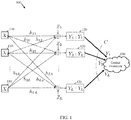
- FIG. 1 shows a system 100 for uplink multi-cell joint processing via a central processor in a cloud radio access network.
- the system 100 includes a plurality of user equipments (UEs) or terminals 110 that transmit corresponding messages (or user signals) to a plurality of BSs 120.
- Examples of user terminals 110 include smartphones, computer tablets, laptop computers, or any personal/mobile device with wireless communications capability.
- the user messages are labeled X 1 , X 2 , ..., X L , where L is an integer. In this case, both the number of users (and user messages) and the number of BSs are equal to L., and the uplink MCP model can be thought of as an L x L interference channel between the users and the BSs.
- each terminal 110 sends a copy of its signal to one of the BSs 120.
- each BS 120 receives a combined signal of the messages from all terminals 110.
- the received signals by the BSs 120 are labeled Y 1 , Y 2 , ..., Y L .
- Both the user terminals 110 and BSs 120 use single antennas for transmitting/receiving the signals.
- each BS 120 quantizes the received copy of the user signal using one of the compression and quantization algorithms described herein (the Wyner-Ziv and the single user compression algorithms), and sends the corresponding quantized signal ( ⁇ i ) via a backhaul link to a cloud based or remote central processor 130.
- the processor 130 then decodes the quantized signals from all BSs 120 for each user or terminal 110 then decodes the messages from the terminals 110 either jointly or successively. Since multiple copies of the signal from each user are used to decode the user message, this uplink multi-cell joint processing approach reduces or mitigates effectively the inter-user interference (interference between signals received from multiple users at the BS).
- the compression and quantization algorithms are needed for relaying the signals from the BSs 120 to the processor 130 due to the capacity limitation (e.g., limited bandwidth) in the backhaul links between the BSs 120 and the central processor 130.
- the Wyner-Ziv and the single user compression algorithms optimize backhaul quantization levels to enable the joint reception of user signals at the BSs 120, subject to total backhaul bandwidth constraint.
- the backhaul link quantization levels are jointly optimized to maximize system performance subject to the sum backhaul capacity constraint.
- the traffic to be relayed from the BSs 120 to the processor 130 also referred to herein as backhaul traffic, is compressed according to the optimized quantization levels.
- the algorithms use an alternating convex optimization method to find the optimal quantization noise level, which can be solved through a backhaul capacity allocation optimization, as described below. Both the Wyner-Ziv compression and single user compression can be more efficient than other MCP schemes.
- a virtual multiple access channel Wyner-Ziv (VMAC-WZ) coding scheme uses compress-and-forward relaying at the BSs 120.
- Each BS 120 quantizes the received signal Y i into ⁇ i using the Wyner-Ziv compression algorithm.
- the transmitted messages X 1 , X 2 , ..., X L are then decoded, at the processor 130, sequentially or jointly after the decoding of the quantized received signals ⁇ i from the BSs 120.
- the user terminals 110 and the central processor 130 form a virtual multiple-access channel.
- a virtual multiple access channel single user (VMAC-SU) coding scheme employs single user compression (instead of Wyner-Ziv compression) at each BS 120.
- single user compression is easier for practical implementations since the single user compression algorithm does not require each BS 120 to know the global channel state information.
- the single user compression does not take advantage of the statistical correlations between the received signals at different BSs. Instead, each BS quantizes its received signals using a vector quantizer.
- the processor 130 decodes the quantized signals form the BSs 120 according to the single user compression algorithm.
- VMAC-WZ and VMAC-SU schemes and algorithms are described in detail by Yuhan Zhou and Wei Yu in “Uplink Cloud Radio Access Network with Capacity Limited Backhaul,” submitted to IEEE Journal on Selected Areas in Communications on November 30, 2013 , and by Yuhan Zhou et al. in “Uplink Multi-Cell Processing: Approximate Sum Capacity under a Sum Backhaul Constraint,” in Proceedings of IEEE Information Theory Workshop, presented on September 9-13, 2013, in Seville, Spa in, which are hereby incorporated by reference as if reproduced in their entirety.
- the VMAC-SU scheme with quantization noise level proportional to the background noise and residual interference level can approach the sum capacity of the uplink MCP model described above when the interference channel satisfies a diagonally dominant channel criterion.
- the weighted sum-rate maximization problem can be formulated as a backhaul capacity allocation optimization problem, and hence efficiently solved.
- an alternating convex optimization algorithm is used in the VMAC-WZ scheme to efficiently find the optimal quantization noise level that maximizes the weighted sum-rate.
- the alternating convex optimization algorithm can also be used in the VMAC-SU scheme.
- a heuristic algorithm is used to find approximate optimal quantization noise levels with low complexity. Simulations show that the heuristic algorithm works well in practice.
- the VMAC-WZ and VMAC-SU schemes and algorithms may be implemented in Long Term Evolution (LTE) and other wireless networks, CRAN deployments in various access networks, and the like. Both schemes can also be applied for multiple-input and multiple-output (MIMO) systems, where the user terminals and the base stations are equipped with multiple antennas.
- MIMO multiple-input and multiple-output
- the algorithms can also be extended to the heterogeneous network scenario where different tiers (e.g., macro cells and micro cells) have different sum backhaul constraints.
- the embodiment VMAC schemes (Wyner-Ziv compression and single user compression) with optimized quantization noise levels can significantly improve the overall performance of both multi-cell networks and heterogeneous networks.
- the decoding algorithms used herein achieve a higher rate than the per-BS successive interference cancellation schemes. Since the VMAC-WZ and VMAC-SU schemes are applicable to UL joint reception with limited backhaul or cost/bit backhaul, the schemes enable massive deployment of macro or small RAN nodes connected to a central controller. Further, the VMAC scheme with single user compression has a lower decoding complexity than other schemes.
- ⁇ j i L P j h j h j H + diag ⁇ i 2 + ⁇ q
- ⁇ j i L P j h j h j H + diag ⁇ i 2 + ⁇ q
- An alternating convex optimization algorithm is used to solve the problem.
- the second and third steps are repeated until the solution converges to a value.
- ⁇ j i L P j h j h j H + diag ⁇ i 2 + ⁇ q
- 2 + ⁇ 2 q i ⁇ C ⁇ q i , j 0, for i ⁇ j , ⁇ q i , i > 0, where ⁇ q ( i , j ) is the ( i , j ) -th entry of matrix ⁇ q .
- the alternating convex optimization method can also be used in this case to find the optimal quantization noise level.
- diag 1 ⁇ i ⁇ j i L P j h j h j H + I
- 2 + ⁇ i 2 2 C i 2 C i ⁇ 1 , for i 1,..., L .
- the problem in equation (4) only involves linear constraints, which can be efficiently solved through dualizing with respect to the sum backhaul constraint.
- a heuristic algorithm is used to find approximate optimal quantization noise levels.
- a function C WZ ⁇ log
- 2 + ⁇ i 2 ⁇ ⁇ i 2 is defined instead.
- the VMAC schemes may be applied to multi-tier heterogeneous networks with macro-cells and pico-cells (or small cells) as follows. Set the matrix C M for the sum backhaul capacity across the macro-BSs, and C p for the backhaul constraint for pico-BSs.
- ⁇ j i L P j h j h j H + diag ⁇ i 2 + ⁇ q
- subject to ⁇ i ⁇ S m log 1 + ⁇ j 1 L P j
- 2 + ⁇ i 2 q i ⁇ C m ⁇ i ⁇ S p log 1 + ⁇ j 1 L P j
- 2 + ⁇ i 2 q i ⁇ C p ⁇ q i , j 0, for i ⁇ j , ⁇ q i , i > 0, where S m and S p are the sets of macro-BSs and pico-BSs, respectively.
- Approximate optimal quantization noise levels can be found for multi-tier heterogeneous networks, as follows.
- Set C SU ⁇ ⁇ i ⁇ S log 1 ⁇ ⁇ ⁇ SNR ⁇ i + 1 ⁇ as the sum backhaul capacity across a particular tier (where S and S m for macro-BSs or S p for pico-BSs).
- C SU ( ⁇ ) C is solved using bisection in [ ⁇ min , ⁇ max ] or using an alternate numerical method.
- the rate expressions used in the optimization algorithms above for representing uplink rates (weighted sum-rate) between terminals and BSs and for the backhaul rate may correspond to information theoretical capacities.
- the optimization algorithms can use any suitable practical rate expressions (for uplink rates and backhaul rate), which may be different depending on the actual coding and modulation schemes of the system.
- the formulations of the algorithms include a sum-backhaul constraint, in practical implementation, there may be a combination of per-BS backhaul constraints or sum backhaul constraints over a subset of BSs, e.g., as in the case of heterogeneous networks. Any suitable formulation of backhaul constraints for the BSs can be used instead of the sum-backhaul constraint formulations above.
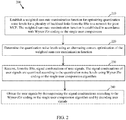
- Figure 2 shows an embodiment method 200 for enabling compress and forward relaying in MCP.
- the method 200 can be implemented at a central or cloud processor.
- the method 200 establishes a weighted sum-rate maximization function for optimizing quantization noise levels for a plurality of backhaul links from the BSs to a central processor for joint MCP.
- the weighted sum-rate maximization function is subjected to a backhaul sum capacity constraint on the backhaul links.
- the weighted sum-rate maximization function is established in accordance with Wyner-Ziv coding or the single user compression.
- the quantization noise levels are determined using an alternating convex optimization of the weighted sum-rate maximization function, as described above.
- signal combinations of user signals are received from the BSs.
- the signal combinations of user signals are quantized according to the quantization noise levels using Wyner-Ziv coding or the single user compression algorithm.
- the user signals are obtained by decompressing the signal combinations according to the Wyner-Ziv coding or the single user compression algorithm and by decoding user signals.
- the BS may implement at least some of the steps above if global channel state information is available to the BS.
- Figure 3 shows an embodiment method 300 for compress and forward relaying in MCP.
- the method 300 can be implemented at each BS connected to a central or cloud processor.
- a plurality of user signals from a plurality of user terminals are received at the BS. Copies of the user signals are also sent from the user terminals to multiple BSs.
- the BS receives an assigned quantization noise level from the central processor or the cloud network.
- the assigned quantization noise level is one of a plurality of quantized noise levels determined for the base stations using an alternating convex optimization of a weighted sum-rate maximization function subject to a backhaul sum capacity constraint on the backhaul links.
- the quantization noise level can be set to be proportional to the background noise and residual interference level, as a near optimal solution for sum-rate maximization.
- the BS quantizes, according to the determined quantization noise levels, a combination signal of the user signals at the base station using Wyner-Ziv coding or the single user compression algorithm.
- the BS relays the quantized combination signal to the central processor.
- the following rate tuple ( R 1 , R 2 , ... , R L ) per real transmit dimension is achievable as ⁇ i ⁇ S R i ⁇ 1 2 log
- ⁇ C for all S ⁇ ⁇ 1, 2, ..., L ⁇ .
- the scheme uses numerical optimization of quantization levels.
- the optimal ⁇ q satisfies the optimality condition above.
- a ii is set to be the i-th diagonal of (H K x H T + ⁇ 2 I + ⁇ q ) -1 .
- a ii j is updated by setting it equal to the i -th diagonal element of (H K x H T + ⁇ 2 I + ⁇ q ) -1 .
- j is incremented and the second step is repeated until ⁇ ⁇ q j ⁇ ⁇ q j ⁇ 1 ⁇ ⁇ ⁇ ⁇ ⁇ q j ⁇ .
- a suitable value of ⁇ is searched to satisfy a specific backhaul constraint.
- the following rate tuple ( R 1 , R 2 , ... , R L ) per complex transmit dimension is achievable as: ⁇ i ⁇ S R i ⁇ log
- ⁇ C Similar to the VMAC-WZ scheme above, this is a nonconvex optimization problem that can be solved under the KKT condition using the Lagrangian approach.
- FIG. 4 is a block diagram of an exemplary processing system 400 that can be used to implement various embodiments. Specific devices may utilize all of the components shown, or only a subset of the components and levels of integration may vary from device to device. Furthermore, a device may contain multiple instances of a component, such as multiple processing units, processors, memories, transmitters, receivers, etc.
- the processing system 400 may comprise a processing unit 401 equipped with one or more input/output devices, such as a network interfaces, storage interfaces, and the like.
- the processing unit 401 may include a central processing unit (CPU) 410, a memory 420, a mass storage device 430, and an I/O interface 460 connected to a bus.
- the bus may be one or more of any type of several bus architectures including a memory bus or memory controller, a peripheral bus or the like.
- the CPU 410 may comprise any type of electronic data processor.
- the memory 420 may comprise any type of system memory such as static random access memory (SRAM), dynamic random access memory (DRAM), synchronous DRAM (SDRAM), read-only memory (ROM), a combination thereof, or the like.
- the memory 420 may include ROM for use at boot-up, and DRAM for program and data storage for use while executing programs.
- the memory 420 is non-transitory.
- the mass storage device 430 may comprise any type of storage device configured to store data, programs, and other information and to make the data, programs, and other information accessible via the bus.
- the mass storage device 430 may comprise, for example, one or more of a solid state drive, hard disk drive, a magnetic disk drive, an optical disk drive, or the like.
- the processing unit 401 also includes one or more network interfaces 450, which may comprise wired links, such as an Ethernet cable or the like, and/or wireless links to access nodes or one or more networks 480.
- the network interface 450 allows the processing unit 401 to communicate with remote units via the networks 480.
- the network interface 450 may provide wireless communication via one or more transmitters/transmit antennas and one or more receivers/receive antennas.
- the processing unit 401 is coupled to a local-area network or a wide-area network for data processing and communications with remote devices, such as other processing units, the Internet, remote storage facilities, or the like.
Landscapes
- Engineering & Computer Science (AREA)
- Signal Processing (AREA)
- Computer Networks & Wireless Communication (AREA)
- Mobile Radio Communication Systems (AREA)
- Power Engineering (AREA)
- Physics & Mathematics (AREA)
- Spectroscopy & Molecular Physics (AREA)
Description
- The present invention relates to the field of wireless communications, and, in particular embodiments, to a system and methods for compress and forward relaying schemes in joint signal processing.
- Joint multi-cell processing (MCP), where the transmitted and received signals and the channel state information are shared between base stations via backhaul links, is an efficient way to mitigate out-of-cell interference. Generally, a centralized signal processor in cloud radio access network (RAN) makes MCP possible. In MCP, a base station (BS) sends log likelihood ratio (LLR) soft bits to the central processor, which generally requires a large amount of backhaul bandwidth. The base station sends decoded bits to the central processor, but does not take full advantage of joint MCP. The central processor performs successive interference cancellation on a per-BS basis. However, this implementation also does not take full advantage of joint MCP. There is a need for efficient compress and forward relaying schemes in joint signal processing between base stations and the central processor, which considers backhaul link capacity.
- For example LEI ZHOU ET AL: "Uplink multicell processing with limited backhaul via successive interference cancellation", GLOBAL COMMUNICATIONS CONFERENCE (GLOBECOM), 2012-12-03. refers to uplink multicell processing with limited backhaul via successive interference cancellation.
- The invention is defined by the appended claims. The embodiments that do not fall under the scope of the claims have to be interpreted as examples useful for understanding the invention.
- In accordance with a first aspect of the present invention, there is provided a method implemented by a network component for supporting compress and forward relaying in joint multi-cell processing (MCP). The method includes establishing a weighted sum-rate maximization function which allows optimization of quantization noise levels for a plurality of backhaul links from a plurality of radio nodes to a network for joint MCP. The weighted sum-rate maximization function is subject to a backhaul sum capacity constraint on the backhaul links. The method further includes determining the quantization noise levels using an alternating convex optimization of the weighted sum-rate maximization function, wherein using the alternating convex optimization to determine the quantization noise levels includes:
- formulating the weighted sum-rate maximization function as a double maximization problem for a first group of variables and a second group of variables, wherein the first group of variables comprises the quantization noise levels;
- initializing the first group of variables and the second group of variables;
- repeating solving the first group of variables subject to fixing values of the second group of variables; and
updating the second group of variables using the solved first group of variables until the first group of variables and the second group of variables converge in values. - In accordance with a further aspect of the present invention, there is provided a network component for supporting compress and forward relaying in joint MCP. The network component includes at least one processor and a non-transitory computer readable storage medium storing programming for execution by the at least one processor. The programming includes instructions to establish a weighted sum-rate maximization function which allows optimization of quantization noise levels for a plurality of backhaul links from a plurality of radio nodes to the network component for joint MCP. The weighted sum-rate maximization function is subject to a backhaul sum capacity constraint on the backhaul links. The programming includes further instructions to determine the quantization noise levels using an alternating convex optimization of the weighted sum-rate maximization function, wherein using the alternating convex optimization to determine the quantization noise levels includes:
- formulating the weighted sum-rate maximization function as a double maximization problem for a first group of variables and a second group of variables, wherein the first group of variables comprises the quantization noise levels;
- initializing the first group of variables and the second group of variables;
- repeating solving the first group of variables subject to fixing values of the second group of variables; and
updating the second group of variables using the solved first group of variables until the first group of variables and the second group of variables converge in values. - In accordance with yet an example, there is provided a system comprising a radio node for compress and forward relaying in joint multi-cell processing ,MCP, and a network component as mentioned above connected to the radio node by a backhaul link,
wherein the radio node comprises: - at least one processor; and
- a non-transitory computer readable storage medium storing programming for execution by the at least one processor, the programming including instructions to:
- receive a plurality of user signals from a plurality of user terminals, wherein the user signals are sent from the user terminals to a plurality of base stations including the base station;
- receive an assigned quantization noise level from the network component;
- quantize a combination signal of the user signals, according to the assigned quantization noise level; and
- relay the quantized combination signal to the network component.
- For a more complete understanding of the present invention, and the advantages thereof, reference is now made to the following descriptions taken in conjunction with the accompanying drawing, in which:
-
Figure 1 illustrates a system for uplink multi-cell joint processing via a central processor in a cloud radio access network; -
Figure 2 illustrates an embodiment method for enabling compress and forward relaying in MCP in joint multi-cell processing (MCP); -
Figure 3 illustrates an embodiment method for compress and forward relaying in MCP in joint MCP; and -
Figure 4 is a diagram of a processing system that can be used to implement various embodiments. - Corresponding numerals and symbols in the different figures generally refer to corresponding parts unless otherwise indicated. The figures are drawn to clearly illustrate the relevant aspects of the embodiments and are not necessarily drawn to scale.
- The invention is defined by the appended claims. The embodiments that do not fall under the scope of the claims have to be interpreted as examples useful for understanding the invention. The making and using of the presently preferred embodiments are discussed in detail below. It should be appreciated, however, that the present invention provides many applicable inventive concepts that can be embodied in a wide variety of specific contexts. The specific embodiments discussed are merely illustrative of specific ways to make and use the invention, and do not limit the scope of the invention.
- Embodiments are provided herein for using multi-cell processing (MCP) based compress-and-forward relaying schemes at base stations (BSs) or any type of radio nodes (e.g., eNBs, relays, femto cells, pico cells) for uplink transmissions in a cloud radio access network (CRAN) environment. The schemes implement different quantization approaches considering a sum of backhaul links constraint. The backhaul links connect multiple BSs to a cloud based or remote centralized signal processor. The schemes herein allow the BSs to compress or quantize signals received from multiple users and relay the compressed signals to the centralized processor. The processor then decompresses the signals, according to the applied compression/quantization, and decodes the messages from the users. This joint signal processing approach is efficient to mitigate out-of-cell or inter-user interference.
- The compression and quantization schemes include a Wyner-Ziv compression scheme and a single user compression scheme, which solve a weighted sum-rate maximization problem for optimizing quantization noise levels on the backhaul links. The optimization is performed by a central or cloud processor connected via backhaul links to the BS using global channel state information between the BSs and the terminals. The central or cloud processor then sends the optimized quantization noise levels the BS encoders, which implements quantization and compression accordingly. The cloud decoder also performs MCP according to the optimized quantization noise levels. In another embodiment, a BS can implement the optimization given the global channel state information. This information allows better management and allocation of backhaul links to the BSs. For both schemes, setting the quantization noise levels to be proportional to the background noise and the residual interference level presents a near optimal solution for sum-rate maximization. These schemes can be extended, as described below to the scenario of heterogeneous networks, where different network tiers have different sum backhaul constraints. The schemes can also be implemented for multiple-input and multiple-output (MIMO) systems, and for frequency selective channels, e.g., based on orthogonal frequency-division multiplexing (OFDM) or single-carrier modulation.
-
Figure 1 shows asystem 100 for uplink multi-cell joint processing via a central processor in a cloud radio access network. Thesystem 100 includes a plurality of user equipments (UEs) orterminals 110 that transmit corresponding messages (or user signals) to a plurality ofBSs 120. Examples ofuser terminals 110 include smartphones, computer tablets, laptop computers, or any personal/mobile device with wireless communications capability. The user messages are labeled X1 , X 2, ..., XL , where L is an integer. In this case, both the number of users (and user messages) and the number of BSs are equal to L., and the uplink MCP model can be thought of as an L x L interference channel between the users and the BSs. Specifically, each terminal 110 sends a copy of its signal to one of theBSs 120. As such, eachBS 120 receives a combined signal of the messages from allterminals 110. The received signals by theBSs 120 are labeled Y1 , Y 2, ..., YL. Both theuser terminals 110 andBSs 120 use single antennas for transmitting/receiving the signals. Upon receiving the user signals, eachBS 120 quantizes the received copy of the user signal using one of the compression and quantization algorithms described herein (the Wyner-Ziv and the single user compression algorithms), and sends the corresponding quantized signal (Ŷi ) via a backhaul link to a cloud based or remotecentral processor 130. Theprocessor 130 then decodes the quantized signals from allBSs 120 for each user or terminal 110 then decodes the messages from theterminals 110 either jointly or successively. Since multiple copies of the signal from each user are used to decode the user message, this uplink multi-cell joint processing approach reduces or mitigates effectively the inter-user interference (interference between signals received from multiple users at the BS). The compression and quantization algorithms are needed for relaying the signals from theBSs 120 to theprocessor 130 due to the capacity limitation (e.g., limited bandwidth) in the backhaul links between theBSs 120 and thecentral processor 130. - The Wyner-Ziv and the single user compression algorithms optimize backhaul quantization levels to enable the joint reception of user signals at the
BSs 120, subject to total backhaul bandwidth constraint. The backhaul link quantization levels are jointly optimized to maximize system performance subject to the sum backhaul capacity constraint. The traffic to be relayed from theBSs 120 to theprocessor 130, also referred to herein as backhaul traffic, is compressed according to the optimized quantization levels. The algorithms use an alternating convex optimization method to find the optimal quantization noise level, which can be solved through a backhaul capacity allocation optimization, as described below. Both the Wyner-Ziv compression and single user compression can be more efficient than other MCP schemes. - In an embodiment, a virtual multiple access channel Wyner-Ziv (VMAC-WZ) coding scheme uses compress-and-forward relaying at the
BSs 120. EachBS 120 quantizes the received signal Yi into Ŷi using the Wyner-Ziv compression algorithm. The transmitted messages X1 , X2 , ..., XL are then decoded, at theprocessor 130, sequentially or jointly after the decoding of the quantized received signals Ŷi from theBSs 120. As such, theuser terminals 110 and thecentral processor 130 form a virtual multiple-access channel. - In another embodiment, a virtual multiple access channel single user (VMAC-SU) coding scheme employs single user compression (instead of Wyner-Ziv compression) at each
BS 120. Unlike the Wyner-Ziv compression, which takes received signal information atother BSs 120 into account, single user compression is easier for practical implementations since the single user compression algorithm does not require eachBS 120 to know the global channel state information. Specifically, the single user compression does not take advantage of the statistical correlations between the received signals at different BSs. Instead, each BS quantizes its received signals using a vector quantizer. Theprocessor 130 decodes the quantized signals form theBSs 120 according to the single user compression algorithm. - The VMAC-WZ and VMAC-SU schemes and algorithms are described in detail by Yuhan Zhou and Wei Yu in "Uplink Cloud Radio Access Network with Capacity Limited Backhaul," submitted to IEEE Journal on Selected Areas in Communications on November 30, 2013, and by Yuhan Zhou et al. in "Uplink Multi-Cell Processing: Approximate Sum Capacity under a Sum Backhaul Constraint," in Proceedings of IEEE Information Theory Workshop, presented on September 9-13, 2013, in Seville, Spain, which are hereby incorporated by reference as if reproduced in their entirety. In both schemes, when the signal to quantization and noise ratio (SQNR) is high, where both the signal to noise ratio (SNR) of received signals at the BSs and the backhaul capacity are high enough (beyond an acceptable threshold), setting the quantization noise level (noise due to quantization) to be proportional to the background noise and residual interference level becomes optimal for sum-rate maximization. Under a finite capacity constraint (C) and a finite SNR, the VMAC-SU scheme with quantization noise level proportional to the background noise and residual interference level can approach the sum capacity of the uplink MCP model described above when the interference channel satisfies a diagonally dominant channel criterion. The weighted sum-rate maximization problem can be formulated as a backhaul capacity allocation optimization problem, and hence efficiently solved.
- In an embodiment, assuming a single antenna at both BSs and users, an alternating convex optimization algorithm is used in the VMAC-WZ scheme to efficiently find the optimal quantization noise level that maximizes the weighted sum-rate. The alternating convex optimization algorithm can also be used in the VMAC-SU scheme. In other embodiments for the VMAC-WZ scheme and the VMAC-SU scheme, a heuristic algorithm is used to find approximate optimal quantization noise levels with low complexity. Simulations show that the heuristic algorithm works well in practice.
- As described above, the VMAC-WZ and VMAC-SU schemes and algorithms may be implemented in Long Term Evolution (LTE) and other wireless networks, CRAN deployments in various access networks, and the like. Both schemes can also be applied for multiple-input and multiple-output (MIMO) systems, where the user terminals and the base stations are equipped with multiple antennas. The algorithms can also be extended to the heterogeneous network scenario where different tiers (e.g., macro cells and micro cells) have different sum backhaul constraints. The embodiment VMAC schemes (Wyner-Ziv compression and single user compression) with optimized quantization noise levels can significantly improve the overall performance of both multi-cell networks and heterogeneous networks. For instance, the decoding algorithms used herein achieve a higher rate than the per-BS successive interference cancellation schemes. Since the VMAC-WZ and VMAC-SU schemes are applicable to UL joint reception with limited backhaul or cost/bit backhaul, the schemes enable massive deployment of macro or small RAN nodes connected to a central controller. Further, the VMAC scheme with single user compression has a lower decoding complexity than other schemes.
- In an embodiment according to the VMAC-WZ scheme, under a backhaul sum-capacity constraint, the weighted sum-rate maximization problem is stated follows:

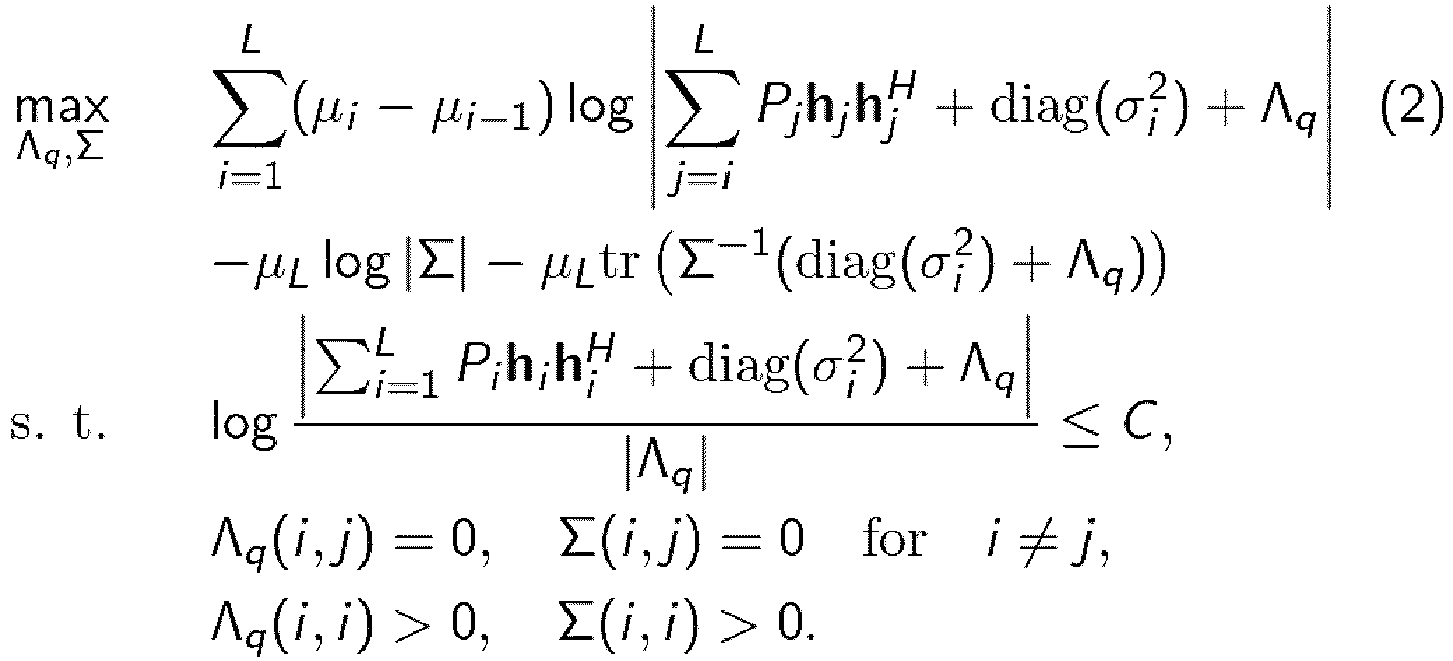
- An alternating convex optimization algorithm is used to solve the problem. The algorithm first initializes the weighted sum-rate as


- According to the VMAC-SU scheme, the weighted sum-rate maximization problem is stated as follows:

- The alternating convex optimization method can also be used in this case to find the optimal quantization noise level. When single user compression is applied, the problem in equation (3) above can be reformulated as:


The problem in equation (4) only involves linear constraints, which can be efficiently solved through dualizing with respect to the sum backhaul constraint. - For both the VMAC-WZ and VMAC-SU schemes, when both the SNR and C are high enough, setting the quantization noise level to be proportional to the background noise and residual interference level is near optimal for the sum-rate maximization. In an embodiment, a heuristic algorithm is used to find approximate optimal quantization noise levels. As such, a function


- In an embodiment, the VMAC schemes may be applied to multi-tier heterogeneous networks with macro-cells and pico-cells (or small cells) as follows. Set the matrix CM for the sum backhaul capacity across the macro-BSs, and Cp for the backhaul constraint for pico-BSs. Assuming a VMAC-SU implementation, the backhaul constraints can be expressed as:

- Approximate optimal quantization noise levels can be found for multi-tier heterogeneous networks, as follows. The average SNR at each BS is defined as


- Details of the schemes and algorithms above are described by Yuhan Zhou and Wei Yu in "Uplink Cloud Radio Access Network with Capacity Limited Backhaul". The rate expressions used in the optimization algorithms above for representing uplink rates (weighted sum-rate) between terminals and BSs and for the backhaul rate may correspond to information theoretical capacities. However, the optimization algorithms can use any suitable practical rate expressions (for uplink rates and backhaul rate), which may be different depending on the actual coding and modulation schemes of the system. Although, the formulations of the algorithms include a sum-backhaul constraint, in practical implementation, there may be a combination of per-BS backhaul constraints or sum backhaul constraints over a subset of BSs, e.g., as in the case of heterogeneous networks. Any suitable formulation of backhaul constraints for the BSs can be used instead of the sum-backhaul constraint formulations above.
-
Figure 2 shows anembodiment method 200 for enabling compress and forward relaying in MCP. Themethod 200 can be implemented at a central or cloud processor. Atstep 210, themethod 200 establishes a weighted sum-rate maximization function for optimizing quantization noise levels for a plurality of backhaul links from the BSs to a central processor for joint MCP. The weighted sum-rate maximization function is subjected to a backhaul sum capacity constraint on the backhaul links. The weighted sum-rate maximization function is established in accordance with Wyner-Ziv coding or the single user compression. Atstep 220, the quantization noise levels are determined using an alternating convex optimization of the weighted sum-rate maximization function, as described above. Atstep 230, signal combinations of user signals are received from the BSs. The signal combinations of user signals are quantized according to the quantization noise levels using Wyner-Ziv coding or the single user compression algorithm. Atstep 240, the user signals are obtained by decompressing the signal combinations according to the Wyner-Ziv coding or the single user compression algorithm and by decoding user signals. In another embodiment, the BS may implement at least some of the steps above if global channel state information is available to the BS. -
Figure 3 shows anembodiment method 300 for compress and forward relaying in MCP. Themethod 300 can be implemented at each BS connected to a central or cloud processor. Atstep 310, a plurality of user signals from a plurality of user terminals are received at the BS. Copies of the user signals are also sent from the user terminals to multiple BSs. Atstep 320, The BS receives an assigned quantization noise level from the central processor or the cloud network. The assigned quantization noise level is one of a plurality of quantized noise levels determined for the base stations using an alternating convex optimization of a weighted sum-rate maximization function subject to a backhaul sum capacity constraint on the backhaul links. When the SQNR is high, the quantization noise level can be set to be proportional to the background noise and residual interference level, as a near optimal solution for sum-rate maximization. Atstep 330, the BS quantizes, according to the determined quantization noise levels, a combination signal of the user signals at the base station using Wyner-Ziv coding or the single user compression algorithm. At step 340, the BS relays the quantized combination signal to the central processor. - In another embodiment of the VMAC-WZ scheme, for the uplink MCP model with sum backhaul capacity C, the following rate tuple (R 1, R 2,..., RL ) per real transmit dimension is achievable as


Λq(i,i) > 0. The optimization is over all diagonal terms of Λ q subject to the constraint that they are not negative. The above optimization problem is nonconvex. However, the Karush-Kuhn-Tucker (KKT) condition of the problem is still a necessary condition for optimality. To derive the KKT condition, the following Lagrangian is formed:
- To solve this optimization problem, the value of λ is kept fixed and Aii is set to be the i-th diagonal of (HKx H T + σ 2 I + Λ q )-1. In a solution approach assuming high SNR, Aii is approximately equal to 0 and


- In another embodiment of the VMAC-WZ scheme, for the uplink MCP model with sum backhaul capacity C, the following rate tuple (R 1, R 2,..., RL ) per complex transmit dimension is achievable as:


-
Figure 4 is a block diagram of anexemplary processing system 400 that can be used to implement various embodiments. Specific devices may utilize all of the components shown, or only a subset of the components and levels of integration may vary from device to device. Furthermore, a device may contain multiple instances of a component, such as multiple processing units, processors, memories, transmitters, receivers, etc. Theprocessing system 400 may comprise aprocessing unit 401 equipped with one or more input/output devices, such as a network interfaces, storage interfaces, and the like. Theprocessing unit 401 may include a central processing unit (CPU) 410, amemory 420, amass storage device 430, and an I/O interface 460 connected to a bus. The bus may be one or more of any type of several bus architectures including a memory bus or memory controller, a peripheral bus or the like. - The
CPU 410 may comprise any type of electronic data processor. Thememory 420 may comprise any type of system memory such as static random access memory (SRAM), dynamic random access memory (DRAM), synchronous DRAM (SDRAM), read-only memory (ROM), a combination thereof, or the like. In an embodiment, thememory 420 may include ROM for use at boot-up, and DRAM for program and data storage for use while executing programs. In embodiments, thememory 420 is non-transitory. Themass storage device 430 may comprise any type of storage device configured to store data, programs, and other information and to make the data, programs, and other information accessible via the bus. Themass storage device 430 may comprise, for example, one or more of a solid state drive, hard disk drive, a magnetic disk drive, an optical disk drive, or the like. - The
processing unit 401 also includes one ormore network interfaces 450, which may comprise wired links, such as an Ethernet cable or the like, and/or wireless links to access nodes or one ormore networks 480. Thenetwork interface 450 allows theprocessing unit 401 to communicate with remote units via thenetworks 480. For example, thenetwork interface 450 may provide wireless communication via one or more transmitters/transmit antennas and one or more receivers/receive antennas. In an embodiment, theprocessing unit 401 is coupled to a local-area network or a wide-area network for data processing and communications with remote devices, such as other processing units, the Internet, remote storage facilities, or the like.
Claims (14)
- A method (200) implemented by a network component for supporting compress and forward relaying in joint multi-cell processing, MCP, the method comprising:establishing (210) a weighted sum-rate maximization function which allows optimization of quantization noise levels for a plurality of backhaul links from a plurality of radio nodes to a network for joint MCP, wherein the weighted sum-rate maximization function is subject to a backhaul sum capacity constraint on the backhaul links; and
characterized by:
determining (220) the quantization noise levels using an alternating convex optimization of the weighted sum-rate maximization function,
wherein using the alternating convex optimization to determine the quantization noise levels includes:formulating the weighted sum-rate maximization function as a double maximization problem for a first group of variables and a second group of variables, wherein the first group of variables comprises the quantization noise levels;initializing the first group of variables and the second group of variables;repeating solving the first group of variables subject to fixing values of the second group of variables; andupdating the second group of variables using the solved first group of variables until the first group of variables and the second group of variables converge in values. - The method of claim 1, wherein the weighted sum-rate maximization function is established (210) in accordance with at least one of:Wyner-Ziv coding and compression;a single user compression algorithm that excludes statistical correlations between user signals received at the radio nodes; andone or more backhaul capacity constraints for the backhaul links in a multiple tier network.
- The method of claim 1 further comprising:Receiving (230), from the radio nodes, signal combinations of user signals, wherein the signal combinations of user signals are quantized according to the quantization noise levels using Wyner-Ziv coding or a single user compression algorithm that excludes statistical correlations between the user signals at the radio nodes;obtaining (240) the user signals by decompressing the signal combinations according to the Wyner-Ziv coding or the single user compression algorithm; anddecoding the user signals.
- The method of claim 1, wherein the weighted sum-rate maximization function becomes a convex optimization problem with optimal or near optimal solution when the second group of variables are fixed.
- The method of claim 1 further comprising, upon determining that the backhaul sum capacity constraint and a signal-to-noise-ratio, SNR, of user signals received at the radio nodes are above a threshold, setting the quantization noise levels to be proportional to background noise and residual interference levels of the user signals.
- The method of claim 5, wherein setting the quantization noise levels proportional to the background noise and residual interference levels of the user signals includes:determining scaling factors for the quantization noise levels subject to an equality of a backhaul constraint function of the scaling factors and the backhaul sum capacity constraint; andcalculating the quantization noise levels as a product of standard deviations of the background noise and residual interference levels and the scaling factors.
- The method of claim 1, wherein the weighted sum-rate maximization function includes global channel state information corresponding to channels between the radio nodes and a plurality of user terminals.
- The method of claim 1 further comprising upon determining that the backhaul sum capacity constraint and a signal-to-noise-ratio, SNR, of user signals received at the radio nodes are above a threshold:establishing a Lagrangian function of the weighted sum-rate maximization function;choosing a suitable Lagrangian parameter that satisfies the backhaul sum capacity constraint; andresolving the quantization noise levels according to the Lagrangian function and a Karush-Kuhn-Tucker, KKT, condition.
- The method of claim 1, wherein the method further includes sending the determined quantization noise levels to the radio nodes, wherein the determined quantization noise levels determine allocation of the backhaul links to the radio nodes.
- A network component (401) for supporting compress and forward relaying in joint multi-cell processing, MCP, the network component comprising:at least one processor (410); anda non-transitory computer readable storage medium (420, 430) storing programming for execution by the at least one processor, the programming including instructions to:establish a weighted sum-rate maximization function which allows optimization of quantization noise levels for a plurality of backhaul links from a plurality of radio nodes to the network component for joint MCP, wherein the weighted sum-rate maximization function is subject to a backhaul sum capacity constraint on the backhaul links; and
characterized by: determine the quantization noise levels using an alternating convex optimization of the weighted sum-rate maximization function, wherein using the alternating convex optimization to determine the quantization noise levels includes:formulating the weighted sum-rate maximization function as a double maximization problem for a first group of variables and a second group of variables, wherein the first group of variables comprises the quantization noise levels;initializing the first group of variables and the second group of variables;repeating solving the first group of variables subject to fixing values of the second group of variables; andupdating the second group of variables using the solved first group of variables until the first group of variables and the second group of variables converge in values. - The network component of claim 10, wherein the instructions to establish the weighted sum-rate maximization function include further instructions to establish the weighted sum-rate maximization function in accordance with Wyner-Ziv coding and compression or a single user compression algorithm that excludes statistical correlations between user signals received at the radio nodes.
- The network component of claim 10, wherein the programming includes further instructions to:receive, from of the radio nodes, signal combinations of user signals, wherein the signal combinations of the user signals are quantized according to the quantization noise levels using Wyner-Ziv coding or a single user compression algorithm that excludes statistical correlations between the user signals at the radio nodes; andobtain the user signals by decompressing the signal combinations according to the Wyner-Ziv coding or the single user compression algorithm.
- The network component of 10, wherein the weighted sum-rate maximization function includes global channel state information corresponding to at least one of:channels between the radio nodes and a plurality of user terminals, wherein the user terminals and the radio nodes are configured to transmit and receive user signals according to multiple-input and multiple-output, MIMO, technology; andto frequency selective channels between the radio nodes and a plurality of user terminals, wherein the user terminals and the radio nodes are configured to transmit and receive user signals according to the frequency selective channels using orthogonal frequency-division multiplexing, OFDM, or single-carrier modulation.
- A system comprising a radio node (401) for compress and forward relaying in joint multi-cell processing ,MCP, and a network component according to any of claims 10 - 13 connected to the radio node (401) by a backhaul link,
wherein the radio node comprises:at least one processor (410); anda non-transitory computer readable storage medium (420, 430) storing programming for execution by the at least one processor, the programming including instructions to:receive a plurality of user signals from a plurality of user terminals, wherein the user signals are sent from the user terminals to a plurality of base stations including the base station;receive an assigned quantization noise level from the network component;quantize a combination signal of the user signals, according to the assigned quantization noise level; andrelay the quantized combination signal to the network component.
Applications Claiming Priority (4)
| Application Number | Priority Date | Filing Date | Title |
|---|---|---|---|
| US201361756815P | 2013-01-25 | 2013-01-25 | |
| US201361814631P | 2013-04-22 | 2013-04-22 | |
| US201361909809P | 2013-11-27 | 2013-11-27 | |
| PCT/US2014/013032 WO2014117008A1 (en) | 2013-01-25 | 2014-01-24 | Joint compress and forward relaying system |
Publications (3)
| Publication Number | Publication Date |
|---|---|
| EP2949089A1 EP2949089A1 (en) | 2015-12-02 |
| EP2949089A4 EP2949089A4 (en) | 2016-05-11 |
| EP2949089B1 true EP2949089B1 (en) | 2018-11-28 |
Family
ID=51222865
Family Applications (1)
| Application Number | Title | Priority Date | Filing Date |
|---|---|---|---|
| EP14742786.8A Active EP2949089B1 (en) | 2013-01-25 | 2014-01-24 | Joint compress and forward relaying system |
Country Status (5)
| Country | Link |
|---|---|
| US (2) | US9258089B2 (en) |
| EP (1) | EP2949089B1 (en) |
| JP (1) | JP5999799B2 (en) |
| KR (1) | KR101732837B1 (en) |
| WO (1) | WO2014117008A1 (en) |
Families Citing this family (10)
| Publication number | Priority date | Publication date | Assignee | Title |
|---|---|---|---|---|
| CN106664745B (en) * | 2014-06-23 | 2020-03-03 | 意大利电信股份公司 | Method for reducing fronthaul load in Centralized Radio Access Network (C-RAN) |
| CN107210783B (en) * | 2014-09-29 | 2020-06-02 | 华为技术有限公司 | System and method for joint MIMO transmission and compression using cooperative relays to reduce interference |
| CN105471765B (en) * | 2015-12-22 | 2019-12-10 | 国云科技股份有限公司 | Virtual machine external mesh bandwidth limiting method for cloud platform |
| US9838104B1 (en) * | 2016-02-16 | 2017-12-05 | The Florida State University Research Foundation, Inc. | System and method for fast compression of OFDM channel state information (CSI) based on constant frequency sinusoidal approximation |
| CN106656379B (en) * | 2016-12-27 | 2020-10-20 | 深圳先进技术研究院 | Transmission rate optimization method and device of relay energy-carrying communication system |
| CN106912074A (en) * | 2017-02-09 | 2017-06-30 | 电子科技大学 | A kind of user-association method based on return link capacity in heterogeneous network |
| US11395230B2 (en) | 2017-12-14 | 2022-07-19 | Panasonic Intellectual Property Corporation Of America | Communication apparatus and communication method |
| CN113273106B (en) * | 2018-11-06 | 2024-01-12 | 诺基亚通信公司 | Handling of uplink data streams |
| CN109986997B (en) * | 2019-03-26 | 2022-05-03 | 芜湖职业技术学院 | A power battery SOC prediction device, vehicle and method |
| CN114928851B (en) * | 2022-05-06 | 2025-05-02 | 南京大学 | Communication system optimization method based on multi-UAV assisted communication |
Family Cites Families (19)
| Publication number | Priority date | Publication date | Assignee | Title |
|---|---|---|---|---|
| EP1734663B1 (en) * | 2005-06-17 | 2011-06-15 | Fujitsu Limited | Multi-hop communication system |
| KR100896205B1 (en) * | 2006-02-20 | 2009-05-12 | 삼성전자주식회사 | Apparatus and method for reporting cahnnel state on providing transparent relay service to the mobile station in a multi-hop relay broadband wireless access communication system |
| US20080298486A1 (en) * | 2007-06-04 | 2008-12-04 | Nec Laboratories America, Inc. | Multi-cell interference mitigation via coordinated scheduling and power allocation in downlink odma networks |
| WO2008155764A2 (en) * | 2007-06-18 | 2008-12-24 | Duolink Ltd. | Wireless network architecture and method for base station utilization |
| US8243756B2 (en) * | 2007-07-12 | 2012-08-14 | Nokia Corporation | Methods, computer program products and apparatus providing improved quantization |
| US9215669B2 (en) * | 2007-11-16 | 2015-12-15 | Qualcomm Incorporated | Preamble design for a wireless signal |
| US8259630B2 (en) * | 2007-12-21 | 2012-09-04 | Samsung Electronics Co., Ltd. | Method and system for subcarrier allocation in relay enhanced cellular systems with resource reuse |
| US8705484B2 (en) * | 2008-08-15 | 2014-04-22 | Ntt Docomo, Inc. | Method for varying transmit power patterns in a multi-cell environment |
| US8675511B2 (en) * | 2008-12-10 | 2014-03-18 | Qualcomm Incorporated | List elimination for distributed downlink coordinated multi-point (CoMP) framework |
| KR101505689B1 (en) * | 2009-01-08 | 2015-03-25 | 엘지전자 주식회사 | Method of data transmission based on multi-cell cooperation |
| US8553711B2 (en) * | 2009-03-19 | 2013-10-08 | Qualcomm Incorporated | Association and resource partitioning in a wireless network with relays |
| US9031032B2 (en) * | 2009-10-05 | 2015-05-12 | Futurewei Technologies, Inc. | System and method for inter-cell interference coordination |
| US9031080B2 (en) * | 2009-12-23 | 2015-05-12 | Telefonaktiebolaget L M Ericsson (Publ) | Rate allocation scheme for coordinated multipoint transmission |
| US8588797B2 (en) * | 2010-06-17 | 2013-11-19 | Nokia Siemens Networks Oy | Optimizing control channel performance with virtual inter-cell coordination |
| US8934557B2 (en) * | 2010-06-30 | 2015-01-13 | Telefonaktiebolaget L M Ericsson (Publ) | Statistical joint precoding in multi-cell, multi-user MIMO |
| US8660202B2 (en) * | 2010-09-16 | 2014-02-25 | Nec Laboratories America, Inc. | Robust precoder and receiver filter design for Gaussian interference channel |
| KR101771257B1 (en) * | 2010-12-03 | 2017-08-25 | 엘지전자 주식회사 | Method and apparatus for cooperative transmisstion in multi node system |
| US9735844B2 (en) * | 2011-05-09 | 2017-08-15 | Texas Instruments Incorporated | Channel feedback for coordinated multi-point transmissions |
| US9780842B2 (en) * | 2012-12-21 | 2017-10-03 | Telefonaktiebolaget Lm Ericsson (Publ) | Mobile device assisted coordinated multipoint transmission and reception |
-
2014
- 2014-01-24 EP EP14742786.8A patent/EP2949089B1/en active Active
- 2014-01-24 KR KR1020157022917A patent/KR101732837B1/en active Active
- 2014-01-24 WO PCT/US2014/013032 patent/WO2014117008A1/en not_active Ceased
- 2014-01-24 US US14/163,375 patent/US9258089B2/en active Active
- 2014-01-24 JP JP2015555359A patent/JP5999799B2/en active Active
-
2015
- 2015-12-03 US US14/957,855 patent/US20160087768A1/en not_active Abandoned
Non-Patent Citations (1)
| Title |
|---|
| None * |
Also Published As
| Publication number | Publication date |
|---|---|
| EP2949089A1 (en) | 2015-12-02 |
| JP2016510559A (en) | 2016-04-07 |
| WO2014117008A1 (en) | 2014-07-31 |
| US20160087768A1 (en) | 2016-03-24 |
| KR101732837B1 (en) | 2017-05-04 |
| US20140211687A1 (en) | 2014-07-31 |
| EP2949089A4 (en) | 2016-05-11 |
| KR20160026823A (en) | 2016-03-09 |
| US9258089B2 (en) | 2016-02-09 |
| JP5999799B2 (en) | 2016-09-28 |
Similar Documents
| Publication | Publication Date | Title |
|---|---|---|
| US9258089B2 (en) | System and methods for compress and forward relaying schemes in joint signal processing | |
| US9537556B2 (en) | Systems and methods for optimized beamforming and compression for uplink MIMO cloud radio access networks | |
| Yu et al. | An efficient rate-splitting multiple access scheme for the downlink of C-RAN systems | |
| Zhou et al. | Optimized backhaul compression for uplink cloud radio access network | |
| US12237947B2 (en) | Federated learning for classifiers and autoencoders for wireless communication | |
| US12356219B2 (en) | Update resolution signaling in federated learning | |
| US20230275787A1 (en) | Capability and configuration of a device for providing channel state feedback | |
| Liu et al. | An uplink-downlink duality for cloud radio access network | |
| US20230246693A1 (en) | Configurations for channel state feedback | |
| CN102195749A (en) | Method and device for generating precoder for uplink transmission from mobile station | |
| WO2016007757A1 (en) | Systems and methods for optimized beamforming and compression for uplink mimo cloud radio access networks | |
| CN112333702A (en) | Optimization method for delay minimization based on safe NOMA moving edge calculation | |
| Zhou et al. | Uplink multi-cell processing: Approximate sum capacity under a sum backhaul constraint | |
| US11881916B2 (en) | Precoding method and apparatus | |
| CN104025644B (en) | For the method and apparatus of the adaptive channel directional information feedback in heterogeneous system | |
| US20250047331A1 (en) | Method and apparatus for csi prediction at the user terminal and performance monitoring at the network in wireless communication system | |
| EP4572172A1 (en) | Communication method and apparatus | |
| Huang et al. | Joint optimization of wireless fronthaul and access links in CRAN with a massive MIMO central unit | |
| Park et al. | Compressed cooperative reception for the uplink of C-RAN with wireless fronthaul | |
| KR20230097696A (en) | Rate-splitting multiple access method for the base station with limited energy supply to maximize the sum rate based on deep reinforcement learning | |
| Hou et al. | Scheduling in dense small cells with successive interference cancellation | |
| EP4521665A1 (en) | Channel state information feedback method, receiving method and feedback apparatus, and communication node | |
| US20250192836A1 (en) | Method and apparatus for beam management | |
| Kim et al. | Joint design of power control and fronthaul quantization strategies for c-ran and d2d coexisting system | |
| Hasabelnaby et al. | Distributed Multi-Pair Computation for Intra C-RAN Bidirectional Communications |
Legal Events
| Date | Code | Title | Description |
|---|---|---|---|
| PUAI | Public reference made under article 153(3) epc to a published international application that has entered the european phase |
Free format text: ORIGINAL CODE: 0009012 |
|
| 17P | Request for examination filed |
Effective date: 20150825 |
|
| AK | Designated contracting states |
Kind code of ref document: A1 Designated state(s): AL AT BE BG CH CY CZ DE DK EE ES FI FR GB GR HR HU IE IS IT LI LT LU LV MC MK MT NL NO PL PT RO RS SE SI SK SM TR |
|
| AX | Request for extension of the european patent |
Extension state: BA ME |
|
| DAX | Request for extension of the european patent (deleted) | ||
| A4 | Supplementary search report drawn up and despatched |
Effective date: 20160408 |
|
| RIC1 | Information provided on ipc code assigned before grant |
Ipc: H04B 7/15 20060101ALI20160404BHEP Ipc: H04L 25/03 20060101AFI20160404BHEP |
|
| GRAP | Despatch of communication of intention to grant a patent |
Free format text: ORIGINAL CODE: EPIDOSNIGR1 |
|
| STAA | Information on the status of an ep patent application or granted ep patent |
Free format text: STATUS: GRANT OF PATENT IS INTENDED |
|
| INTG | Intention to grant announced |
Effective date: 20180410 |
|
| GRAS | Grant fee paid |
Free format text: ORIGINAL CODE: EPIDOSNIGR3 |
|
| GRAJ | Information related to disapproval of communication of intention to grant by the applicant or resumption of examination proceedings by the epo deleted |
Free format text: ORIGINAL CODE: EPIDOSDIGR1 |
|
| GRAL | Information related to payment of fee for publishing/printing deleted |
Free format text: ORIGINAL CODE: EPIDOSDIGR3 |
|
| STAA | Information on the status of an ep patent application or granted ep patent |
Free format text: STATUS: REQUEST FOR EXAMINATION WAS MADE |
|
| GRAP | Despatch of communication of intention to grant a patent |
Free format text: ORIGINAL CODE: EPIDOSNIGR1 |
|
| STAA | Information on the status of an ep patent application or granted ep patent |
Free format text: STATUS: GRANT OF PATENT IS INTENDED |
|
| INTC | Intention to grant announced (deleted) | ||
| GRAA | (expected) grant |
Free format text: ORIGINAL CODE: 0009210 |
|
| STAA | Information on the status of an ep patent application or granted ep patent |
Free format text: STATUS: THE PATENT HAS BEEN GRANTED |
|
| INTG | Intention to grant announced |
Effective date: 20181009 |
|
| AK | Designated contracting states |
Kind code of ref document: B1 Designated state(s): AL AT BE BG CH CY CZ DE DK EE ES FI FR GB GR HR HU IE IS IT LI LT LU LV MC MK MT NL NO PL PT RO RS SE SI SK SM TR |
|
| REG | Reference to a national code |
Ref country code: CH Ref legal event code: EP |
|
| REG | Reference to a national code |
Ref country code: AT Ref legal event code: REF Ref document number: 1071583 Country of ref document: AT Kind code of ref document: T Effective date: 20181215 |
|
| REG | Reference to a national code |
Ref country code: DE Ref legal event code: R096 Ref document number: 602014036941 Country of ref document: DE |
|
| REG | Reference to a national code |
Ref country code: IE Ref legal event code: FG4D |
|
| REG | Reference to a national code |
Ref country code: NL Ref legal event code: MP Effective date: 20181128 |
|
| REG | Reference to a national code |
Ref country code: LT Ref legal event code: MG4D |
|
| REG | Reference to a national code |
Ref country code: AT Ref legal event code: MK05 Ref document number: 1071583 Country of ref document: AT Kind code of ref document: T Effective date: 20181128 |
|
| PG25 | Lapsed in a contracting state [announced via postgrant information from national office to epo] |
Ref country code: IS Free format text: LAPSE BECAUSE OF FAILURE TO SUBMIT A TRANSLATION OF THE DESCRIPTION OR TO PAY THE FEE WITHIN THE PRESCRIBED TIME-LIMIT Effective date: 20190328 Ref country code: BG Free format text: LAPSE BECAUSE OF FAILURE TO SUBMIT A TRANSLATION OF THE DESCRIPTION OR TO PAY THE FEE WITHIN THE PRESCRIBED TIME-LIMIT Effective date: 20190228 Ref country code: FI Free format text: LAPSE BECAUSE OF FAILURE TO SUBMIT A TRANSLATION OF THE DESCRIPTION OR TO PAY THE FEE WITHIN THE PRESCRIBED TIME-LIMIT Effective date: 20181128 Ref country code: ES Free format text: LAPSE BECAUSE OF FAILURE TO SUBMIT A TRANSLATION OF THE DESCRIPTION OR TO PAY THE FEE WITHIN THE PRESCRIBED TIME-LIMIT Effective date: 20181128 Ref country code: LV Free format text: LAPSE BECAUSE OF FAILURE TO SUBMIT A TRANSLATION OF THE DESCRIPTION OR TO PAY THE FEE WITHIN THE PRESCRIBED TIME-LIMIT Effective date: 20181128 Ref country code: AT Free format text: LAPSE BECAUSE OF FAILURE TO SUBMIT A TRANSLATION OF THE DESCRIPTION OR TO PAY THE FEE WITHIN THE PRESCRIBED TIME-LIMIT Effective date: 20181128 Ref country code: HR Free format text: LAPSE BECAUSE OF FAILURE TO SUBMIT A TRANSLATION OF THE DESCRIPTION OR TO PAY THE FEE WITHIN THE PRESCRIBED TIME-LIMIT Effective date: 20181128 Ref country code: NO Free format text: LAPSE BECAUSE OF FAILURE TO SUBMIT A TRANSLATION OF THE DESCRIPTION OR TO PAY THE FEE WITHIN THE PRESCRIBED TIME-LIMIT Effective date: 20190228 Ref country code: LT Free format text: LAPSE BECAUSE OF FAILURE TO SUBMIT A TRANSLATION OF THE DESCRIPTION OR TO PAY THE FEE WITHIN THE PRESCRIBED TIME-LIMIT Effective date: 20181128 |
|
| PG25 | Lapsed in a contracting state [announced via postgrant information from national office to epo] |
Ref country code: PT Free format text: LAPSE BECAUSE OF FAILURE TO SUBMIT A TRANSLATION OF THE DESCRIPTION OR TO PAY THE FEE WITHIN THE PRESCRIBED TIME-LIMIT Effective date: 20190328 Ref country code: GR Free format text: LAPSE BECAUSE OF FAILURE TO SUBMIT A TRANSLATION OF THE DESCRIPTION OR TO PAY THE FEE WITHIN THE PRESCRIBED TIME-LIMIT Effective date: 20190301 Ref country code: RS Free format text: LAPSE BECAUSE OF FAILURE TO SUBMIT A TRANSLATION OF THE DESCRIPTION OR TO PAY THE FEE WITHIN THE PRESCRIBED TIME-LIMIT Effective date: 20181128 Ref country code: AL Free format text: LAPSE BECAUSE OF FAILURE TO SUBMIT A TRANSLATION OF THE DESCRIPTION OR TO PAY THE FEE WITHIN THE PRESCRIBED TIME-LIMIT Effective date: 20181128 Ref country code: SE Free format text: LAPSE BECAUSE OF FAILURE TO SUBMIT A TRANSLATION OF THE DESCRIPTION OR TO PAY THE FEE WITHIN THE PRESCRIBED TIME-LIMIT Effective date: 20181128 |
|
| PG25 | Lapsed in a contracting state [announced via postgrant information from national office to epo] |
Ref country code: NL Free format text: LAPSE BECAUSE OF FAILURE TO SUBMIT A TRANSLATION OF THE DESCRIPTION OR TO PAY THE FEE WITHIN THE PRESCRIBED TIME-LIMIT Effective date: 20181128 |
|
| PG25 | Lapsed in a contracting state [announced via postgrant information from national office to epo] |
Ref country code: IT Free format text: LAPSE BECAUSE OF FAILURE TO SUBMIT A TRANSLATION OF THE DESCRIPTION OR TO PAY THE FEE WITHIN THE PRESCRIBED TIME-LIMIT Effective date: 20181128 Ref country code: PL Free format text: LAPSE BECAUSE OF FAILURE TO SUBMIT A TRANSLATION OF THE DESCRIPTION OR TO PAY THE FEE WITHIN THE PRESCRIBED TIME-LIMIT Effective date: 20181128 Ref country code: CZ Free format text: LAPSE BECAUSE OF FAILURE TO SUBMIT A TRANSLATION OF THE DESCRIPTION OR TO PAY THE FEE WITHIN THE PRESCRIBED TIME-LIMIT Effective date: 20181128 Ref country code: DK Free format text: LAPSE BECAUSE OF FAILURE TO SUBMIT A TRANSLATION OF THE DESCRIPTION OR TO PAY THE FEE WITHIN THE PRESCRIBED TIME-LIMIT Effective date: 20181128 |
|
| REG | Reference to a national code |
Ref country code: DE Ref legal event code: R097 Ref document number: 602014036941 Country of ref document: DE |
|
| PG25 | Lapsed in a contracting state [announced via postgrant information from national office to epo] |
Ref country code: MC Free format text: LAPSE BECAUSE OF FAILURE TO SUBMIT A TRANSLATION OF THE DESCRIPTION OR TO PAY THE FEE WITHIN THE PRESCRIBED TIME-LIMIT Effective date: 20181128 Ref country code: SM Free format text: LAPSE BECAUSE OF FAILURE TO SUBMIT A TRANSLATION OF THE DESCRIPTION OR TO PAY THE FEE WITHIN THE PRESCRIBED TIME-LIMIT Effective date: 20181128 Ref country code: EE Free format text: LAPSE BECAUSE OF FAILURE TO SUBMIT A TRANSLATION OF THE DESCRIPTION OR TO PAY THE FEE WITHIN THE PRESCRIBED TIME-LIMIT Effective date: 20181128 Ref country code: RO Free format text: LAPSE BECAUSE OF FAILURE TO SUBMIT A TRANSLATION OF THE DESCRIPTION OR TO PAY THE FEE WITHIN THE PRESCRIBED TIME-LIMIT Effective date: 20181128 Ref country code: SK Free format text: LAPSE BECAUSE OF FAILURE TO SUBMIT A TRANSLATION OF THE DESCRIPTION OR TO PAY THE FEE WITHIN THE PRESCRIBED TIME-LIMIT Effective date: 20181128 |
|
| REG | Reference to a national code |
Ref country code: CH Ref legal event code: PL |
|
| PG25 | Lapsed in a contracting state [announced via postgrant information from national office to epo] |
Ref country code: LU Free format text: LAPSE BECAUSE OF NON-PAYMENT OF DUE FEES Effective date: 20190124 |
|
| PLBE | No opposition filed within time limit |
Free format text: ORIGINAL CODE: 0009261 |
|
| STAA | Information on the status of an ep patent application or granted ep patent |
Free format text: STATUS: NO OPPOSITION FILED WITHIN TIME LIMIT |
|
| REG | Reference to a national code |
Ref country code: BE Ref legal event code: MM Effective date: 20190131 |
|
| REG | Reference to a national code |
Ref country code: IE Ref legal event code: MM4A |
|
| PG25 | Lapsed in a contracting state [announced via postgrant information from national office to epo] |
Ref country code: FR Free format text: LAPSE BECAUSE OF NON-PAYMENT OF DUE FEES Effective date: 20190128 Ref country code: SI Free format text: LAPSE BECAUSE OF FAILURE TO SUBMIT A TRANSLATION OF THE DESCRIPTION OR TO PAY THE FEE WITHIN THE PRESCRIBED TIME-LIMIT Effective date: 20181128 |
|
| 26N | No opposition filed |
Effective date: 20190829 |
|
| PG25 | Lapsed in a contracting state [announced via postgrant information from national office to epo] |
Ref country code: BE Free format text: LAPSE BECAUSE OF NON-PAYMENT OF DUE FEES Effective date: 20190131 |
|
| PG25 | Lapsed in a contracting state [announced via postgrant information from national office to epo] |
Ref country code: CH Free format text: LAPSE BECAUSE OF NON-PAYMENT OF DUE FEES Effective date: 20190131 Ref country code: LI Free format text: LAPSE BECAUSE OF NON-PAYMENT OF DUE FEES Effective date: 20190131 |
|
| PG25 | Lapsed in a contracting state [announced via postgrant information from national office to epo] |
Ref country code: IE Free format text: LAPSE BECAUSE OF NON-PAYMENT OF DUE FEES Effective date: 20190124 |
|
| PG25 | Lapsed in a contracting state [announced via postgrant information from national office to epo] |
Ref country code: TR Free format text: LAPSE BECAUSE OF FAILURE TO SUBMIT A TRANSLATION OF THE DESCRIPTION OR TO PAY THE FEE WITHIN THE PRESCRIBED TIME-LIMIT Effective date: 20181128 |
|
| PG25 | Lapsed in a contracting state [announced via postgrant information from national office to epo] |
Ref country code: MT Free format text: LAPSE BECAUSE OF NON-PAYMENT OF DUE FEES Effective date: 20190124 |
|
| PG25 | Lapsed in a contracting state [announced via postgrant information from national office to epo] |
Ref country code: CY Free format text: LAPSE BECAUSE OF FAILURE TO SUBMIT A TRANSLATION OF THE DESCRIPTION OR TO PAY THE FEE WITHIN THE PRESCRIBED TIME-LIMIT Effective date: 20181128 |
|
| PG25 | Lapsed in a contracting state [announced via postgrant information from national office to epo] |
Ref country code: HU Free format text: LAPSE BECAUSE OF FAILURE TO SUBMIT A TRANSLATION OF THE DESCRIPTION OR TO PAY THE FEE WITHIN THE PRESCRIBED TIME-LIMIT; INVALID AB INITIO Effective date: 20140124 |
|
| PG25 | Lapsed in a contracting state [announced via postgrant information from national office to epo] |
Ref country code: MK Free format text: LAPSE BECAUSE OF FAILURE TO SUBMIT A TRANSLATION OF THE DESCRIPTION OR TO PAY THE FEE WITHIN THE PRESCRIBED TIME-LIMIT Effective date: 20181128 |
|
| PGFP | Annual fee paid to national office [announced via postgrant information from national office to epo] |
Ref country code: GB Payment date: 20251204 Year of fee payment: 13 |
|
| PGFP | Annual fee paid to national office [announced via postgrant information from national office to epo] |
Ref country code: DE Payment date: 20251203 Year of fee payment: 13 |