EP2948505B1 - Thermoplastic compositions containing nanoscale-sized particle additives for laser direct structuring and methods for the manufacture and use thereof - Google Patents
Thermoplastic compositions containing nanoscale-sized particle additives for laser direct structuring and methods for the manufacture and use thereof Download PDFInfo
- Publication number
- EP2948505B1 EP2948505B1 EP14704178.4A EP14704178A EP2948505B1 EP 2948505 B1 EP2948505 B1 EP 2948505B1 EP 14704178 A EP14704178 A EP 14704178A EP 2948505 B1 EP2948505 B1 EP 2948505B1
- Authority
- EP
- European Patent Office
- Prior art keywords
- further embodiment
- polycarbonate
- polymer
- polymer composition
- copolymer
- Prior art date
- Legal status (The legal status is an assumption and is not a legal conclusion. Google has not performed a legal analysis and makes no representation as to the accuracy of the status listed.)
- Active
Links
Images

Classifications
-
- H—ELECTRICITY
- H01—ELECTRIC ELEMENTS
- H01B—CABLES; CONDUCTORS; INSULATORS; SELECTION OF MATERIALS FOR THEIR CONDUCTIVE, INSULATING OR DIELECTRIC PROPERTIES
- H01B3/00—Insulators or insulating bodies characterised by the insulating materials; Selection of materials for their insulating or dielectric properties
- H01B3/18—Insulators or insulating bodies characterised by the insulating materials; Selection of materials for their insulating or dielectric properties mainly consisting of organic substances
- H01B3/30—Insulators or insulating bodies characterised by the insulating materials; Selection of materials for their insulating or dielectric properties mainly consisting of organic substances plastics; resins; waxes
- H01B3/42—Insulators or insulating bodies characterised by the insulating materials; Selection of materials for their insulating or dielectric properties mainly consisting of organic substances plastics; resins; waxes polyesters; polyethers; polyacetals
- H01B3/421—Polyesters
- H01B3/426—Polycarbonates
-
- C—CHEMISTRY; METALLURGY
- C08—ORGANIC MACROMOLECULAR COMPOUNDS; THEIR PREPARATION OR CHEMICAL WORKING-UP; COMPOSITIONS BASED THEREON
- C08K—Use of inorganic or non-macromolecular organic substances as compounding ingredients
- C08K3/00—Use of inorganic substances as compounding ingredients
- C08K3/01—Use of inorganic substances as compounding ingredients characterized by their specific function
- C08K3/013—Fillers, pigments or reinforcing additives
-
- C—CHEMISTRY; METALLURGY
- C08—ORGANIC MACROMOLECULAR COMPOUNDS; THEIR PREPARATION OR CHEMICAL WORKING-UP; COMPOSITIONS BASED THEREON
- C08K—Use of inorganic or non-macromolecular organic substances as compounding ingredients
- C08K3/00—Use of inorganic substances as compounding ingredients
- C08K3/34—Silicon-containing compounds
-
- C—CHEMISTRY; METALLURGY
- C08—ORGANIC MACROMOLECULAR COMPOUNDS; THEIR PREPARATION OR CHEMICAL WORKING-UP; COMPOSITIONS BASED THEREON
- C08K—Use of inorganic or non-macromolecular organic substances as compounding ingredients
- C08K5/00—Use of organic ingredients
- C08K5/49—Phosphorus-containing compounds
- C08K5/51—Phosphorus bound to oxygen
- C08K5/52—Phosphorus bound to oxygen only
- C08K5/521—Esters of phosphoric acids, e.g. of H3PO4
- C08K5/523—Esters of phosphoric acids, e.g. of H3PO4 with hydroxyaryl compounds
-
- C—CHEMISTRY; METALLURGY
- C08—ORGANIC MACROMOLECULAR COMPOUNDS; THEIR PREPARATION OR CHEMICAL WORKING-UP; COMPOSITIONS BASED THEREON
- C08K—Use of inorganic or non-macromolecular organic substances as compounding ingredients
- C08K5/00—Use of organic ingredients
- C08K5/49—Phosphorus-containing compounds
- C08K5/5399—Phosphorus bound to nitrogen
-
- C—CHEMISTRY; METALLURGY
- C08—ORGANIC MACROMOLECULAR COMPOUNDS; THEIR PREPARATION OR CHEMICAL WORKING-UP; COMPOSITIONS BASED THEREON
- C08K—Use of inorganic or non-macromolecular organic substances as compounding ingredients
- C08K9/00—Use of pretreated ingredients
- C08K9/02—Ingredients treated with inorganic substances
-
- C—CHEMISTRY; METALLURGY
- C08—ORGANIC MACROMOLECULAR COMPOUNDS; THEIR PREPARATION OR CHEMICAL WORKING-UP; COMPOSITIONS BASED THEREON
- C08L—COMPOSITIONS OF MACROMOLECULAR COMPOUNDS
- C08L69/00—Compositions of polycarbonates; Compositions of derivatives of polycarbonates
-
- C—CHEMISTRY; METALLURGY
- C08—ORGANIC MACROMOLECULAR COMPOUNDS; THEIR PREPARATION OR CHEMICAL WORKING-UP; COMPOSITIONS BASED THEREON
- C08L—COMPOSITIONS OF MACROMOLECULAR COMPOUNDS
- C08L77/00—Compositions of polyamides obtained by reactions forming a carboxylic amide link in the main chain; Compositions of derivatives of such polymers
- C08L77/02—Polyamides derived from omega-amino carboxylic acids or from lactams thereof
-
- C—CHEMISTRY; METALLURGY
- C08—ORGANIC MACROMOLECULAR COMPOUNDS; THEIR PREPARATION OR CHEMICAL WORKING-UP; COMPOSITIONS BASED THEREON
- C08L—COMPOSITIONS OF MACROMOLECULAR COMPOUNDS
- C08L77/00—Compositions of polyamides obtained by reactions forming a carboxylic amide link in the main chain; Compositions of derivatives of such polymers
- C08L77/06—Polyamides derived from polyamines and polycarboxylic acids
-
- C—CHEMISTRY; METALLURGY
- C08—ORGANIC MACROMOLECULAR COMPOUNDS; THEIR PREPARATION OR CHEMICAL WORKING-UP; COMPOSITIONS BASED THEREON
- C08L—COMPOSITIONS OF MACROMOLECULAR COMPOUNDS
- C08L83/00—Compositions of macromolecular compounds obtained by reactions forming in the main chain of the macromolecule a linkage containing silicon with or without sulfur, nitrogen, oxygen or carbon only; Compositions of derivatives of such polymers
- C08L83/10—Block- or graft-copolymers containing polysiloxane sequences
-
- H—ELECTRICITY
- H01—ELECTRIC ELEMENTS
- H01B—CABLES; CONDUCTORS; INSULATORS; SELECTION OF MATERIALS FOR THEIR CONDUCTIVE, INSULATING OR DIELECTRIC PROPERTIES
- H01B3/00—Insulators or insulating bodies characterised by the insulating materials; Selection of materials for their insulating or dielectric properties
- H01B3/18—Insulators or insulating bodies characterised by the insulating materials; Selection of materials for their insulating or dielectric properties mainly consisting of organic substances
- H01B3/30—Insulators or insulating bodies characterised by the insulating materials; Selection of materials for their insulating or dielectric properties mainly consisting of organic substances plastics; resins; waxes
- H01B3/303—Macromolecular compounds obtained by reactions forming a linkage containing nitrogen with or without oxygen or carbon in the main chain of the macromolecule, not provided for in groups H01B3/38 or H01B3/302
-
- C—CHEMISTRY; METALLURGY
- C08—ORGANIC MACROMOLECULAR COMPOUNDS; THEIR PREPARATION OR CHEMICAL WORKING-UP; COMPOSITIONS BASED THEREON
- C08L—COMPOSITIONS OF MACROMOLECULAR COMPOUNDS
- C08L55/00—Compositions of homopolymers or copolymers, obtained by polymerisation reactions only involving carbon-to-carbon unsaturated bonds, not provided for in groups C08L23/00 - C08L53/00
- C08L55/02—ABS [Acrylonitrile-Butadiene-Styrene] polymers
Definitions
- MID components can be provided as molded injection devices (MID) with desired printed conductors.
- MID components manufactured in this way are three-dimensional (3D) molded parts having an integrated printed conductor layout and possibly further electronic or electromechanical components.
- 3D three-dimensional
- the use of MID components of this type even if the components have only printed conductors and are used to replace conventional wiring inside an electrical or electronic device, saves space, allowing the relevant device to be made smaller. It also lowers the manufacturing costs by reducing the number of assembly and contacting steps.
- These MID devices have great utility in cell phones, PDAs and notebook applications.
- stamp metal, flexible printed circuit board (FPCB) mounted and two-shot molding methods are three existing technologies to make an MID.
- stamping and FPCB mounted process have limitations in the pattern geometry, and the tooling is expensive.
- altering of a RF pattern causes high-priced and time-consuming modifications in tooling.
- 2-shot-molding (two-component injection molding) processes have also been used to produce 3D-MIDs with real three-dimensional structures. For example, an antenna can be formed by subsequent chemical corrosion, chemical surface activation and selective metal coating. This method involves relatively high initial costs and is only economically viable for large production numbers.
- 2-shot-molding is also not regarded as an environmentally friendly process.
- MIDs are tool-based technologies, which have limited flexibility, long development cycles, difficult prototype, expensive design changes, and limited ability to produce miniaturization. Accordingly, it is becoming increasingly popular to form MIDs using a laser direct structuring (LDS) process.
- LDS laser direct structuring
- a computer-controlled laser beam travels over the MID to activate the plastic surface at locations where the conductive path is to be situated.
- Laser-supported or directed structuring process for 3D MIDs simplifies the manufacturing process. Simplifying the miniaturization process, the laser, with possible resolutions of less than 0.1 millimeters (mm), may produce fine structures and remove material from plastic surfaces with precision and selectivity. For example, the LDS process allows for antenna structures to be directly and cost effectively integrated into a cell phone housing. Further, the LDS process allows for sophisticated mechatronic systems that integrate mechanical and electrical properties for automotive and medical applications. With a laser direct structuring process, it is also possible to obtain small conductive path widths (such as 150 micrometers or less). In addition, the spacing between the conductive paths can also be small. As a result, MIDs formed from this process can save space and weight in end-use applications. Another advantage of laser direct structuring is its flexibility. If the design of the circuit is to be changed, it is simply a matter of reprogramming the computer that controls the laser.
- a thermoplastic composition can be doped with a metal containing LDS additive such that it can be activated by a laser.
- the laser beam can then be used to activate the LDS additive forming a micro-rough track on the surface.
- the metal particles from the LDS additive present on the surface of the micro-rough track can in turn form nuclei for the subsequent metallization.
- the plating performance of conventional LDS materials can vary in ways such as plating rate and adhesion of plating layers.
- some LDS fillers have a surface pH that may be detrimental to the polymer matrix during processing, resulting in degradation of the polymers, and further influencing the mechanical properties and long term stability of the composites. This polymer matrix degradation leads to, for example, decreased ductility for the final composition.
- the changed ductility, along with and other property changes may result in substantial, and potentially undesirable, changes in the material's overall properties.
- LDS blended thermoplastic composition or LDS compound
- LDS blended thermoplastic composition having good plating performance while maintaining good mechanical performance.
- LDS blended thermoplastic composition that is capable of being used in various applications due to the ability of the composition to provide good mechanical performance.
- thermoplastic composition that is capable of being used in a laser direct structuring process. This and other needs are satisfied by the various embodiments of the present disclosure.
- CN102796372A discloses laser-direct-structuring high-thermal-conductivity insulated polyamide 66 compositions prepared from the following raw materials according to parts by weight: 40-70 parts of polyamide 66, 5-35 parts of heat conducting agent, 5-8 parts of inorganic pigment, 0.15 part of antioxidant A, 0.15 part of antioxidant B, 0.5 part of lubricating agent and 0.3 part of coupling agent.
- thermoplastic resin composition for laser direct structuring comprising, per 100 pbw of resin, 10-150 pbw of an inorganic fiber and 1-30 pbw of a laser direct structuring additive containing at least one of copper, antimony, and tin and having a Moh's hardness of 1.5 or smaller than the Moh's hardness of the inorganic fiber.
- EP2390282A1 discloses polycarbonate compositions comprising an aromatic polycarbonate, a laser direct structuring additive, a sulphonate salt, and a rubber like polymer.
- EP2335936A1 discloses polymer compositions comprising 76.6 - 99.49 mass% aromatic polycarbonate, 0.5-20 mass% laser direct structuring additive, 0-2.4 mass% rubber like polymer, and 0.01-1 mass% acid and/or acid salt.
- thermoplastic compositions suitable for use in laser direct structuring processes This disclosure relates generally to thermoplastic compositions suitable for use in laser direct structuring processes.
- a polymer composition comprising: a) a first polycarbonate polymer; b) a polycarbonate-polysiloxane copolymer, an impact modifier component, or a combination thereof; and c) a laser direct structuring additive, wherein the laser direct structuring additive comprises a mean particle size of equal to or less than 1 ⁇ m.
- a method for the manufacture of a polymer composition comprising the step of combining the polymer and the laser direct structuring additive to form a polymer composition.
- the terms "optional” or “optionally” mean that the subsequently described event, condition, component, or circumstance may or may not occur, and that the description includes instances where said event or circumstance occurs and instances where it does not.
- references in the specification and concluding claims to parts by weight (pbw), of a particular element or component in a composition or article denotes the weight relationship between the element or component and any other elements or components in the composition or article for which a part by weight is expressed.
- pbw parts by weight
- X and Y are present at a weight ratio of 2:5, and are present in such ratio regardless of whether additional components are contained in the compound.
- a weight percent of a component is based on the total weight of the formulation or composition in which the component is included. For example if a particular element or component in a composition or article is said to have 8 weight %, it is understood that this percentage is relation to a total compositional percentage of 100%.
- alkyl group as used herein is a branched or unbranched saturated hydrocarbon group of 1 to 24 carbon atoms, such as methyl, ethyl, n-propyl, isopropyl, n-butyl, isobutyl, t-butyl, pentyl, hexyl, heptyl, octyl, decyl, tetradecyl, hexadecyl, eicosyl, tetracosyl and the like.
- a "lower alkyl” group is an alkyl group containing from one to six carbon atoms.
- alkenyl group as used herein is a hydrocarbon group of from 2 to 24 carbon atoms and structural formula containing at least one carbon-carbon double bond.
- alkynyl group as used herein is a hydrocarbon group of 2 to 24 carbon atoms and a structural formula containing at least one carbon-carbon triple bond.
- aryl group as used herein is any carbon-based aromatic group including, but not limited to, benzene, naphthalene, etc.
- aromatic also includes “heteroaryl group,” which is defined as an aromatic group that has at least one heteroatom incorporated within the ring of the aromatic group. Examples of heteroatoms include, but are not limited to, nitrogen, oxygen, sulfur, and phosphorus.
- the aryl group can be substituted or unsubstituted.
- the aryl group can be substituted with one or more groups including, but not limited to, alkyl, alkynyl, alkenyl, aryl, halide, nitro, amino, ester, ketone, aldehyde, hydroxy, carboxylic acid, or alkoxy.
- carbonate group as used herein is represented by the formula -OC(O)OR, where R can be hydrogen, an alkyl, alkenyl, alkynyl, aryl, aralkyl, cycloalkyl, halogenated alkyl, or heterocycloalkyl group described above.
- carboxylic acid as used herein is represented by the formula -C(O)OH.
- Mn number average molecular weight
- Mn can be determined for polymers, such as polycarbonate polymers or polycarbonate-PMMA copolymers, by methods well known to a person having ordinary skill in the art. It is to be understood that as used herein, Mn is measured gel permeation chromatography and as calibrated with polycarbonate standards. For example, gel permeation chromatography can be carried out using a crosslinked styrene-divinyl benzene column, at a sample concentration of 1 milligram per milliliter with appropriate mobile phase solvents.
- Mw weight average molecular weight
- Mw ⁇ N i M i 2 ⁇ N i M i
- M i the molecular weight of a chain
- N i the number of chains of that molecular weight.
- Mw takes into account the molecular weight of a given chain in determining contributions to the molecular weight average.
- Mw is measured gel permeation chromatography. In some cases, Mw is measured gel permeation chromatography and calibrated with polycarbonate standards. Gel permeation chromatography can be carried out using a crosslinked styrene-divinyl benzene column, at a sample concentration of about 1 milligram per milliliter (mg/ml) with appropriate mobile phase solvents.
- polydispersity index Mw Mn .
- the PDI has a value equal to or greater than 1, but as the polymer chains approach uniform chain length, the PDI approaches unity.
- polycarbonate or “polycarbonates” as used herein includes copolycarbonates, homopolycarbonates and (co)polyester carbonates.
- ABS acrylonitrile-butadiene-styrene copolymer
- ABS acrylonitrile-butadiene-styrene copolymer
- an impact modifier refers to a component of the disclosed thermoplastic compositions wherein the impact modifier is a polymeric material effective in improving the impact properties of the disclosed thermoplastic compositions, e.g. the notched Izod impact strength of the composition.
- an impact modifier can be a one or more polymers such as acrylonitrile butadiene styrene copolymer (“ABS”), methacrylate butadiene styrene copolymer (“MBS”), and/or bulk polymerized ABS (“BABS”).
- compositions disclosed herein have certain functions. Disclosed herein are certain structural requirements for performing the disclosed functions, and it is understood that there are a variety of structures that can perform the same function that are related to the disclosed structures, and that these structures will typically achieve the same result.
- thermoplastic compositions that are particularly useful in connection with laser direct structuring (LDS) technology.
- embodiments of the disclosure provide thermoplastic compositions that are capable of being used in a laser direct structuring (LDS) process and that provide enhanced plating performance while exhibiting relatively good mechanical properties.
- the disclosed thermoplastic compositions generally comprise a blend of a thermoplastic polymer resin and a laser direct structuring additive comprising a mean particle size equal to or less than 1 micrometer ( ⁇ m).
- the disclosed thermoplastic composition can further optionally comprise one or more additional additives.
- the disclosed thermoplastic composition disclosed herein provides robust plating performance, while maintaining good mechanical properties (e.g., Izod impact strength higher than about 400 Joules per meter (J/m)). Evaluation of the mechanical properties can be performed through various tests, such as Izod test, Charpy test, Gardner test, etc., according to several standards (e.g., ASTM D256). Robustness of plating performance can be measured via a performance ranking, or plating ranking, ranging from top performance (e.g., "best") to bottom performance. The ranking can be partitioned in various levels. In one embodiment, a plating ranking can have a level of "10" for top performance and a level of "0" for bottom performance.
- thermoplastic compositions can exhibit, for example, improved mechanical, thermal, and/or morphological properties. Further, for example, the thermoplastic compositions may show improved ductility and improved impact strength. Even further for example, the thermoplastic compositions may show improved ductility and improved impact strength without adversely affecting other mechanical and thermal properties.
- compositions can comprise one or more thermoplastic polymer resins.
- the thermoplastic polymer resins include polycarbonate and polycarbonate-polysiloxane copolymer.
- thermoplastic polymer resin can be present in the disclosed composition in any desired amount as characterized by a weight percentage relative to the total weight of the composition.
- the thermoplastic polymer resin can be present in an amount in the range of from about 5 weight % (wt %) up to about 95 wt % relative to the total weight of the composition, including further exemplary amounts of about 10 wt %, 15 wt %, 20 wt %, 25 wt %, 30 wt %, 35 wt %, 40 wt %, 45 wt %, 50 wt %, 55 wt %, 60 wt %, 65 wt %, 70 wt %, 75 wt %, 80 wt %, 85 wt %, 90 wt %.
- thermoplastic polymer resin can be present within any range of amount derived from any two of the above states values.
- the thermoplastic polymer resin can be present in an amount in the range of from about 5 wt % to about 15 wt %, or in an amount in the range of from about 5 wt % to about 20 wt %, or in an amount in the range of from about 50 wt % to about 85 wt % relative to the total weight of the composition.
- the disclosed thermoplastic composition can comprise a thermoplastic polymer resin in an amount in the range of 1 wt % to 70 wt %, including exemplary values of 4 wt %, 5 wt %, 10 wt %, 15 wt %, 20 wt %, 25 wt %, 30 wt %, 35 wt %, 40 wt %, 45 wt %, 50 wt %, 55 wt %, 60 wt %, and 65 wt %.
- the thermoplastic polymer resin amount can be in a range derived from any two of the above listed exemplary thermoplastic polymer resin amount values.
- the thermoplastic polymer resin can be in an amount in the range of from 4 wt % to 40 wt %.
- the disclosed thermoplastic composition can comprise a total amount of thermoplastic polymer resin in an amount in the range of 1 wt % to 70 wt %, including exemplary values of 4 wt %, 5 wt %, 10 wt %, 15 wt %, 20 wt %, 25 wt %, 30 wt %, 35 wt %, 40 wt %, 45 wt %, 50 wt %, 55 wt %, 60 wt %, and 65 wt %.
- the total thermoplastic polymer resin amount can be in a range derived from any two of the above listed exemplary total thermoplastic polymer resin amount values.
- the total thermoplastic polymer resin can be in an amount in the range of from 40 wt % to 65 wt %.
- the thermoplastic polymer resin can also be present in the composition in any desired amount as characterized by a volume percentage relative to the total volume of the composition.
- the thermoplastic polymer resin can be present in an amount in the range of from about 5 volume % up to about 95 volume % relative to the total weight of the composite, including further exemplary amounts of about 10 volume %, 15 volume %, 20 volume %, 25 volume %, 30 volume %, 35 volume %, 40 volume %, 45 volume %, 50 volume %, 55 volume %, 60 volume %, 65 volume %, 70 volume %, 75 volume %, 80 volume %, 85 volume %, 90 volume %.
- thermoplastic polymer resin can be present within any range of amount derived from any two of the above states values.
- the thermoplastic polymer resin can be present in an amount in the range of from about 5 volume % to about 15 volume %, or in an amount in the range of from about 5 volume % to about 20 volume %, or in an amount in the range of from about 50 volume % to about 85 volume % relative to the total volume of the composition.
- thermoplastic resin component of a disclosed polymer composition can comprise a polycarbonate.
- polycarbonate or “polycarbonates” as used herein includes copolycarbonates, homopolycarbonates and (co)polyester carbonates.
- the polycarbonate can comprises aromatic carbonate chain units and includes compositions having structural units of the formula: wherein at least about 60 percent of the total number of R 1 groups are aromatic organic radicals and the balance thereof are aliphatic, alicyclic, or aromatic radicals, wherein a is at least 2.
- R 1 can be an aromatic organic radical and, such as a radical of the formula: -A 1 -Y 1 -A 2 - wherein each of A 1 and A 2 is a monocyclic, divalent aryl radical and Y 1 is a bridging radical having one or two atoms which separate A 1 from A 2 . For example, one atom separates A 1 from A 2 .
- radicals of this type are -O-, -S-, - S(O)-, -S(O 2 )-, -C(O)-, methylene, cyclohexyl-methylene, 2-[2.2.1]-bicycloheptylidene, ethylidene, isopropylidene, neopentylidene, cyclohexylidene, cyclopentade-cylidene, cyclododecylidene, and adamantylidene.
- the bridging radical Y 1 can be a hydrocarbon group or a saturated hydrocarbon group such as methylene, cyclohexylidene or isopropylidene.
- Polycarbonate resins can be produced by the reaction of the carbonate precursor with dihydroxy compounds.
- an aqueous base such as (e.g., sodium hydroxide, potassium hydroxide, calcium hydroxide, and the like,) is mixed with an organic, water immiscible solvent such as benzene, toluene, carbon disulfide, or dichloromethane, which contains the dihydroxy compound.
- a phase transfer resin is generally used to facilitate the reaction.
- Molecular weight regulators may be added to the reactant mixture. These molecular weight regulators may be added singly or as a combination. Branching resins, described forthwith may also be added singly or in admixture.
- Another process for producing aromatic polycarbonate resins is the trans-esterification process, which involves the trans-esterification of an aromatic dihydroxy compound and a diester carbonate. This process is known as the melt polymerization process.
- the process of producing the aromatic polycarbonate resins is not critical.
- dihydroxy compound includes, for example, bisphenol compounds having general formula (1) as follows: wherein R a and R b each represent a halogen atom, for example chlorine or bromine, or a monovalent hydrocarbon group, the monovalent hydrocarbon group can have from 1 to 10 carbon atoms, and can be the same or different; p and q are each independently integers from 0 to 4;
- X a represents one of the groups of formula: wherein R c and R d each independently represent a hydrogen atom or a monovalent linear or cyclic hydrocarbon group and R e is a divalent hydrocarbon group.
- Non-limiting examples of suitable dihydroxy compounds include the dihydroxy-substituted aromatic hydrocarbons disclosed by name or formula (generic or specific) in U.S. Pat. No. 4,217,438 .
- a nonexclusive list of specific examples of the types of bisphenol compounds includes some illustrative, non-limiting examples of suitable dihydroxy compounds include the following: resorcinol, 4-bromoresorcinol, hydroquinone, 4,41-dihydroxybiphenyl, 1,6-dihydroxynaphthalene, 2,6-dihydroxynaphthalene, bis( 4-hydroxyphenyl)methane, bis(4-hydroxyphenyl) diphenylmethane, bis(4-hydroxyphenyl)-1-naphthylmethane, 1,2-bis(4-hydroxyphenyl)ethane, 1,1-bis(4-hydroxyphenyl)-1-phenylethane, 2-(4-hydroxyphenyl)-2-(3-hydroxyphenyl)propane,
- bisphenol compounds that may be represented by formula (3) include 1,1-bis(4-hydroxyphenyl) methane, 1,1-bis( 4-hydroxyphenyl)ethane, 2,2-bis(4-hydroxyphenyl) propane (hereinafter "bisphenol A” or "BPA"), 2,2-bis(4-hydroxyphenyl)butane, 2,2-bis(4-hydroxyphenyl)octane, 1,1-bis(4-hydroxyphenyl)propane, 1,1-bis(4-hydroxyphenyl)n-butane, 2,2-bis(4-hydroxy-1-methylphenyl)propane, and 1,1-bis(4-hydroxy-t-butylphenyl)propane. Combinations comprising at least one of the foregoing dihydroxy compounds may also be used.
- Branched polycarbonates are also useful, as well as blends of a linear polycarbonate and a branched polycarbonate.
- the branched polycarbonates may be prepared by adding a branching agent during polymerization.
- branching agents include polyfunctional organic compounds containing at least three functional groups selected from hydroxyl, carboxyl, carboxylic anhydride, haloformyl, and mixtures of the foregoing functional groups.
- trimellitic acid trimellitic anhydride
- trimellitic trichloride tris-p-hydroxy phenyl ethane
- isatin-bis-phenol tris-phenol TC (1,3,5-tris((p-hydroxyphenyl)isopropyl)benzene)
- tris-phenol PA (4(4(1,1-bis(p-hydroxyphenyl)-ethyl)alpha,alphadimethyl benzyl)phenol
- 4-chloroformyl phthalic anhydride trimesic acid
- benzophenone tetracarboxylic acid The branching agents may be added at a level of about 0.05 wt % to about 2.0 wt %. All types of polycarbonate end groups are contemplated as being useful in the polycarbonate composition, provided that such end groups do not significantly affect desired properties of the thermoplastic compositions.
- Suitable polycarbonates can be manufactured by processes such as interfacial polymerization and melt polymerization.
- reaction conditions for interfacial polymerization may vary, an exemplary process generally involves dissolving or dispersing a dihydric phenol reactant in aqueous caustic soda or potash, adding the resulting mixture to a suitable water-immiscible solvent medium, and contacting the reactants with a carbonate precursor in the presence of a suitable catalyst such as triethylamine or a phase transfer catalyst, under controlled pH conditions, e.g., about 8 to about 10.
- a suitable catalyst such as triethylamine or a phase transfer catalyst
- Suitable carbonate precursors include, for example, a carbonyl halide such as carbonyl bromide or carbonyl chloride, or a haloformate such as a bishaloformate of a dihydric phenol (e.g., the bischloroformates of bisphenol A, hydroquinone, or the like) or a glycol (e.g., the bishaloformate of ethylene glycol, neopentyl glycol, polyethylene glycol, or the like). Combinations comprising at least one of the foregoing types of carbonate precursors may also be used.
- a carbonyl halide such as carbonyl bromide or carbonyl chloride
- a haloformate such as a bishaloformate of a dihydric phenol (e.g., the bischloroformates of bisphenol A, hydroquinone, or the like) or a glycol (e.g., the bishaloformate of ethylene glycol,
- the reactive derivatives of the acid such as the corresponding acid halides, in particular the acid dichlorides and the acid dibromides.
- the reactive derivatives of the acid such as the corresponding acid halides, in particular the acid dichlorides and the acid dibromides.
- isophthalic acid, terephthalic acid, or mixtures thereof it is possible to employ isophthaloyl dichloride, terephthaloyl dichloride, and mixtures thereof.
- phase transfer resins include, but are not limited to, tertiary amines such as triethylamine, quaternary ammonium compounds, and quaternary phosphonium compounds.
- phase transfer catalysts that may be used are catalysts of the formula (R 2 ) 4 Q+X, wherein each R 2 is the same or different, and is a C 1-10 alkyl group; Q is a nitrogen or phosphorus atom; and X is a halogen atom or a C 1-8 alkoxy group or C 6-18 aryloxy group.
- Suitable phase transfer catalysts include, for example, [CH 3 (CH 2 ) 3 ] 4 NX, [CH 3 (CH 2 ) 3 ] 4 PX, [CH 3 (CH 2 ) 5 ] 4 NX, [CH 3 (CH 2 ) 6 ] 4 NX, [CH 3 (CH 2 ) 4 ] 4 NX, CH 3 [CH 3 (CH 2 )] 3 NX, and CH 3 [CH 3 (CH 2 ) 2 NX, wherein X is Cl-, Br-, a C 1-8 alkoxy group or a C 6-18 aryloxy group.
- An effective amount of a phase transfer catalyst may be about 0.1 to about 10 wt % based on the weight of bisphenol in the phosgenation mixture. In another embodiment an effective amount of phase transfer catalyst may be about 0.5 to about 2 wt % based on the weight of bisphenol in the phosgenation mixture.
- melt processes may be used to make the polycarbonates.
- polycarbonates may be prepared by co-reacting, in a molten state, the dihydroxy reactant(s) and a diaryl carbonate ester, such as diphenyl carbonate, in the presence of a transesterification catalyst in a Banbury TM mixer, twin screw extruder, or the like to form a uniform dispersion. Volatile monohydric phenol is removed from the molten reactants by distillation and the polymer is isolated as a molten residue.
- Typical carbonate precursors include the carbonyl halides, for example carbonyl chloride (phosgene), and carbonyl bromide; the bis-haloformates, for example the bis-haloformates of dihydric phenols such as bisphenol A, hydroquinone, and the like, and the bis-haloformates of glycols such as ethylene glycol and neopentyl glycol; and the diaryl carbonates, such as diphenyl carbonate, di(tolyl) carbonate, and di(naphthyl) carbonate.
- carbonyl halides for example carbonyl chloride (phosgene), and carbonyl bromide
- the bis-haloformates for example the bis-haloformates of dihydric phenols such as bisphenol A, hydroquinone, and the like, and the bis-haloformates of glycols such as ethylene glycol and neopentyl glycol
- the diaryl carbonates such as
- bisphenols can be used in the manufacture of polycarbonates containing phthalimidine carbonate units of formula (1a) wherein R a , R b , p, and q are as in formula (1), R 3 is each independently a C 1-6 alkyl group, j is 0 to 4, and R 4 is a C 1-6 alkyl, phenyl, or phenyl substituted with up to five C 1-6 alkyl groups.
- the phthalimidine carbonate units are of formula (1b) wherein R 5 is hydrogen or a C 1-6 alkyl. In an embodiment, R 5 is hydrogen.
- Carbonate units (1a)wherein R 5 is hydrogen can be derived from 2-phenyl-3,3'-bis(4-hydroxy phenyl)phthalimidine (also known as N-phenyl phenolphthalein bisphenol, or "PPPBP”) (also known as 3,3-bis(4-hydroxyphenyl)-2-phenylisoindolin-1-one).
- PPPBP N-phenyl phenolphthalein bisphenol
- R a and R b are each independently C 1-12 alkyl, p and q are each independently 0 to 4, and R f is C 1-12 alkyl, phenyl, optionally substituted with 1 to 5 to C 1-10 alkyl, or benzyl optionally substituted with 1 to 5 C 1-10 alkyl.
- R a and R b are each methyl, p and q are each independently 0 or 1, and R f is C 1-4 alkyl or phenyl.
- Examples of bisphenol carbonate units derived from bisphenols of formula (1) wherein X a is a substituted or unsubstituted C 3-18 cycloalkylidene include the cyclohexylidene-bridged, alkyl-substituted bisphenol of formula (12e) wherein R a and R b are each independently C 1-12 alkyl, R g is C 1-12 alkyl, p and q are each independently 0 to 4, and t is 0 to 10.
- at least one of each of R a and R b are disposed meta to the cyclohexylidene bridging group.
- R a and R b are each independently C 1-4 alkyl, R g is C 1-4 alkyl, p and q are each 0 or 1, and t is 0 to 5.
- R a , R b , and R g are each methyl, r and s are each 0 or 1, and t is 0 or 3, specifically 0.
- Examples of other bisphenol carbonate units derived from bisphenol wherein X a is a substituted or unsubstituted C 3-18 cycloalkylidene include adamantyl units (If) and units (1g) wherein R a and R b are each independently C 1-12 alkyl, and p and q are each independently 1 to 4.
- at least one of each of R a and R b are disposed meta to the cycloalkylidene bridging group.
- R a and R b are each independently C 1-3 alkyl, and p and q are each 0 or 1.
- R a , R b are each methyl, p and q are each 0 or 1.
- Carbonates containing units (1a) to (1g) are useful for making polycarbonates with high glass transition temperatures (Tg) and high heat distortion temperatures.
- Polycarbonates and “polycarbonate polymers” as used herein further includes blends of polycarbonates with other copolymers comprising carbonate chain units.
- An exemplary copolymer is a polyester carbonate, also known as a copolyester-polycarbonate.
- Such copolymers further contain, in addition to recurring carbonate chain units, repeating units of formula (2) wherein D is a divalent radical derived from a dihydroxy compound, and may be, for example, a C 2 -10 alkylene radical, a C 6 -20 alicyclic radical, a C 6 -20 aromatic radical or a polyoxyalkylene radical in which the alkylene groups contain 2 to about 6 carbon atoms, specifically 2, 3, or 4 carbon atoms; and T is a divalent radical derived from a dicarboxylic acid, and may be, for example, a C 2 -10 alkylene radical, a C 6-20 alicyclic radical, a C 6 -20 alkyl aromatic radical, or a C 6 -20 aromatic radical.
- D is a divalent radical derived from a dihydroxy compound, and may be, for example, a C 2 -10 alkylene radical, a C 6 -20 alicyclic radical, a C 6 -20 aromatic radical or a polyoxyalkylene radical in which
- D is a C 2-6 alkylene radical.
- D is derived from an aromatic dihydroxy compound of formula (3): wherein each R h is independently a halogen atom, a C 1-10 hydrocarbon group, or a C 1-10 halogen substituted hydrocarbon group, and n is 0 to 4.
- the halogen is usually bromine.
- Examples of compounds that may be represented by the formula (3) include resorcinol, substituted resorcinol com pounds such as 5-methyl resorcinol, 5-ethyl resorcinol, 5-propyl resorcinol, 5-butyl resorcinol, 5-t-butyl resorcinol, 5-phenyl resorcinol, 5-cumyl resorcinol, 2,4,5,6-tetrafluoro resorcinol, 2,4,5,6-tetrabromo resorcinol, or the like; catechol; hydroquinone; substituted hydroquinones such as 2-methyl hydroquinone, 2-ethyl hydroquinone, 2-propylhydroquinone, 2-butyl hydroquinone, 2-t-butyl hydroquinone, 2-phenyl hydroquinone, 2-cumyl hydroquinone, 2,3,5,6-tetramethyl hydroquinone, 2,3,5,6-tetra-t
- aromatic dicarboxylic acids that may be used to prepare the polyesters include isophthalic or terephthalic acid, 1,2-di(p-carboxyphenyl)ethane, 4,4'-dicarboxydiphenyl ether, 4,4'-bisbenzoic acid, and mixtures comprising at least one of the foregoing acids. Acids containing fused rings can also be present, such as in 1,4-, 1,5-, or 2,6-naphthalenedicarboxylic acids. Specific dicarboxylic acids are terephthalic acid, isophthalic acid, naphthalene dicarboxylic acid, cyclohexane dicarboxylic acid, or mixtures thereof.
- a specific dicarboxylic acid comprises a mixture of isophthalic acid and terephthalic acid wherein the weight ratio of terephthalic acid to isophthalic acid is about 10:1 to about 0.2:9.8.
- D is a C 2-6 alkylene radical and T is p-phenylene, m-phenylene, naphthalene, a divalent cycloaliphatic radical, or a mixture thereof.
- This class of polyester includes the poly( alkylene terephthalates ).
- poly(alkylene terephthalates) may be used.
- suitable poly(alkylene terephthalates) are poly(ethylene terephthalate) ("PET"), poly(1,4-butylene terephthalate) (“PBT”), poly(ethylene naphthanoate) (“PEN”), poly(butylene naphthanoate) (“PBN”), (polypropylene terephthalate) (“PPT”), polycyclohexanedimethanol terephthalate (“PCT”), and combinations comprising at least one of the foregoing polyesters.
- PET poly(ethylene terephthalate)
- PBT poly(1,4-butylene terephthalate)
- PEN poly(ethylene naphthanoate)
- PBN poly(butylene naphthanoate)
- PPT polypropylene terephthalate
- PCT polycyclohexanedimethanol terephthalate
- polyesters with a minor amount, e.g., from about 0.5 to about 10 percent by weight, of units derived from an aliphatic diacid and/or an aliphatic polyol to make copolyesters.
- Copolymers comprising alkylene terephthalate repeating ester units with other ester groups may also be useful.
- Useful ester units may include different alkylene terephthalate units, which can be present in the polymer chain as individual units, or as blocks of poly(alkylene terephthalates).
- Specific examples of such copolymers include poly (cyclohexanedimethylene terephthalate)-co-poly(ethylene terephthalate), abbreviated as PETG where the polymer comprises greater than or equal to 50 mol% of poly(ethylene terephthalate), and abbreviated as PCTG where the polymer comprises greater than 50 mol% of poly(1,4-cyclohexanedimethylene terephthalate).
- Poly(cycloalkylene diester)s may also include poly(alkylene cyclohexanedicarboxylate)s.
- PCCD poly(1,4-cyclohexanedimethanol-1,4-cyclohexanedicarboxylate)
- D is a 1,4-cyclohexanedimethylene group derived from 1,4-cyclohexanedimethanol
- T is a cyclohexane ring derived from cyclohexanedicarboxylate or a chemical equivalent thereof, and may comprise the cis-isomer, the trans-isomer, or a combination comprising at least one of the foregoing isomers.
- Typical branching resins such as ⁇ ', ⁇ ', ⁇ ', ⁇ '-tetrakis(3-methyl-4-hydroxyphenyl)-p-xylene, ⁇ , ⁇ , ⁇ ', ⁇ '-tetrakis (2-methyl-4-hydroxyphenyl)-p-xylene, ⁇ , ⁇ , ⁇ ', ⁇ '-tetrakis(2,5 dimethyl-4-hydroxyphenyl)-p-xylene, ⁇ , ⁇ , ⁇ ', ⁇ '-tetrakis(2,6-dimethyl-4-hydroxyphenyl)-p-xylene, ⁇ , ⁇ , ⁇ ', ⁇ '-tetrakis(4-hydroxyphenyl)-p-xylene, trimellitic acid, trimellitic anhydride, trimellitic trichloride, tris-p-hydroxy phenyl ethane, isatin-bis-phenol, tris-phenol TC (1,3,5-tris((p-hydroxyphenyl)isopropyl)benzen
- Molecular weight regulators or chain stoppers are optional and are added to the mixture in order to arrest the progress of the polymerization.
- Typical molecular weight regulators such as phenol, chroman-1, p-t-butylphenol, p-bromophenol, para-cumyl-phenol, and the like may be added either singly or in admixture and are typically added in an amount of about 1 to about 10 mol % excess with respect to the BPA.
- the molecular weight of the polycarbonate is generally greater than or equal to about 5000 grams per mole (g/mol), preferably greater than or equal to about 10,000 g/mol, more preferably greater than or equal to about 15,000 g/mol.
- the molecular weight ranges from 18,000 g/mole to 40,000 g/mol.
- the polycarbonate resin less than or equal to about 100,000 g/mol, preferably less than or equal to about 50,000 g/mol, more preferably less than or equal to about 30,000 g/mol as calculated from the viscosity of a methylene chloride solution at 25° C.
- the polycarbonate can have a Mn of about 15,000 g/mol to about 30,000 g/mol.
- the polycarbonate can have a Mn of about 20,000 g/mol to about 25,000 g/mol.
- the polycarbonate can have a Mn of about 21,000 g/mol.
- the polycarbonate can have a Mn of about 24,000 g/mol.
- the polymer composition comprises a first polycarbonate polymer and a second polycarbonate polymer.
- the polycarbonate can comprise two or more polycarbonates.
- the polycarbonate can comprise two polycarbonates.
- the two polycarbonates can be present in about equal or different amounts.
- the polycarbonates can be a part of a co-polymer, wherein at least one part of the co-polymer is not a polycarbonate.
- the polycarbonate comprises Lexan TM Bisphenol A polycarbonate available from SABIC Innovative Plastics, USA.
- the first polycarbonate polymer has a weight average molecular weight of from about 15,000 g/mol to about 100,000 g/mol on an absolute polycarbonate molecular weight scale. In a still further embodiment, the first polycarbonate polymer has a weight average molecular weight of from about 15,000 g/mol to about 50,000 g/mol on an absolute polycarbonate molecular weight scale. In a yet further embodiment, the first polycarbonate polymer has a weight average molecular weight of from about 15,000 g/mol to about 45,000 g/mol on an absolute polycarbonate molecular weight scale.
- the first polycarbonate polymer has a weight average molecular weight of from about 15,000 g/mol to about 40,000 g/mol on an absolute polycarbonate molecular weight scale. In a still further embodiment, the first polycarbonate polymer has a weight average molecular weight of from about 15,000 g/mol to about 35,000 g/mol on an absolute polycarbonate molecular weight scale. In a yet further embodiment, the first polycarbonate polymer has a weight average molecular weight of from about 15,000 g/mol to about 30,500 g/mol on an absolute polycarbonate molecular weight scale.
- the first polycarbonate polymer has a weight average molecular weight of from about 15,000 g/mol to about 30,000 g/mol on an absolute polycarbonate molecular weight scale. In a still further embodiment, the first polycarbonate polymer has a weight average molecular weight of from about 15,000 g/mol to about 29,000 g/mol on an absolute polycarbonate molecular weight scale.
- the first polycarbonate polymer has a weight average molecular weight of from about 20,000 g/mol to about 100,000 g/mol on an absolute polycarbonate molecular weight scale. In a still further embodiment, the first polycarbonate polymer has a weight average molecular weight of from about 20,000 g/mol to about 50,000 g/mol on an absolute polycarbonate molecular weight scale. In a yet further embodiment, the first polycarbonate polymer has a weight average molecular weight of from about 20,000 g/mol to about 45,000 g/mol on an absolute polycarbonate molecular weight scale.
- the first polycarbonate polymer has a weight average molecular weight of from about 20,000 g/mol to about 40,000 g/mol on an absolute polycarbonate molecular weight scale. In a still further embodiment, the first polycarbonate polymer has a weight average molecular weight of from about 20,000 g/mol to about 35,000 g/mol on an absolute polycarbonate molecular weight scale. In a yet further embodiment, the first polycarbonate polymer has a weight average molecular weight of from about 20,000 g/mol to about 30,500 g/mol on an absolute polycarbonate molecular weight scale.
- the first polycarbonate polymer has a weight average molecular weight of from about 20,000 g/mol to about 30,000 g/mol on an absolute polycarbonate molecular weight scale. In a still further embodiment, the first polycarbonate polymer has a weight average molecular weight of from about 20,000 g/mol to about 29,000 g/mol on an absolute polycarbonate molecular weight scale.
- the first polycarbonate polymer has a weight average molecular weight of from about 25,000 g/mol to about 100,000 g/mol on an absolute polycarbonate molecular weight scale. In a still further embodiment, the first polycarbonate polymer has a weight average molecular weight of from about 25,000 g/mol to about 50,000 g/mol on an absolute polycarbonate molecular weight scale. In a yet further embodiment, the first polycarbonate polymer has a weight average molecular weight of from about 25,000 g/mol to about 45,000 g/mol on an absolute polycarbonate molecular weight scale.
- the first polycarbonate polymer has a weight average molecular weight of from about 25,000 g/mol to about 40,000 g/mol on an absolute polycarbonate molecular weight scale. In a still further embodiment, the first polycarbonate polymer has a weight average molecular weight of from about 25,000 g/mol to about 35,000 g/mol on an absolute polycarbonate molecular weight scale. In a yet further embodiment, the first polycarbonate polymer has a weight average molecular weight of from about 25,000 g/mol to about 30,500 g/mol on an absolute polycarbonate molecular weight scale.
- the first polycarbonate polymer has a weight average molecular weight of from about 25,000 g/mol to about 30,500 g/mol on an absolute polycarbonate molecular weight scale. In a still further embodiment, the first polycarbonate polymer has a weight average molecular weight of from about 25,000 g/mol to about 30,000 g/mol on an absolute polycarbonate molecular weight scale. In a yet further embodiment, the first polycarbonate polymer has a weight average molecular weight of from about 25,000 g/mol to about 29,000 g/mol on an absolute polycarbonate molecular weight scale.
- the first polycarbonate polymer is present in an amount from about 20 wt% to about 50 wt%. In a still further embodiment, the first polycarbonate polymer is present in an amount from about 20 wt% to about 45 wt%. In a yet further embodiment, the first polycarbonate polymer is present in an amount from about 20 wt% to about 40 wt%. In an even further embodiment, the first polycarbonate polymer is present in an amount from about 20 wt% to about 35 wt%. In a still further embodiment, the first polycarbonate polymer is present in an amount from about 20 wt% to about 30 wt%.
- the first polycarbonate polymer is present in an amount from about 22 wt% to about 50 wt%. In a still further embodiment, the first polycarbonate polymer is present in an amount from about 22 wt% to about 45 wt%. In a yet further embodiment, the first polycarbonate polymer is present in an amount from about 22 wt% to about 40 wt%. In an even further embodiment, the first polycarbonate polymer is present in an amount from about 22 wt% to about 35 wt%. In a still further embodiment, the first polycarbonate polymer is present in an amount from about 22 wt% to about 30 wt%.
- the first polycarbonate polymer is present in an amount from about 25 wt% to about 50 wt%. In a still further embodiment, the first polycarbonate polymer is present in an amount from about 25 wt% to about 45 wt%. In a yet further embodiment, the first polycarbonate polymer is present in an amount from about 25 wt% to about 40 wt%. In an even further embodiment, the first polycarbonate polymer is present in an amount from about 25 wt% to about 35 wt%. In a still further embodiment, the first polycarbonate polymer is present in an amount from about 25 wt% to about 30 wt%.
- the second polycarbonate polymer has a weight average molecular weight of from about 15,000 g/mol to about 100,000 g/mol on an absolute polycarbonate molecular weight scale. In a still further embodiment, the second polycarbonate polymer has a weight average molecular weight of from about 15,000 g/mol to about 50,000 g/mol on an absolute polycarbonate molecular weight scale. In a yet further embodiment, the second polycarbonate polymer has a weight average molecular weight of from about 15,000 g/mol to about 45,000 g/mol on an absolute polycarbonate molecular weight scale.
- the second polycarbonate polymer has a weight average molecular weight of from about 15,000 g/mol to about 40,000 g/mol on an absolute polycarbonate molecular weight scale. In a still further embodiment, the second polycarbonate polymer has a weight average molecular weight of from about 15,000 g/mol to about 35,000 g/mol on an absolute polycarbonate molecular weight scale. In a yet further embodiment, the second polycarbonate polymer has a weight average molecular weight of from about 15,000 g/mol to about 30,000 g/mol on an absolute polycarbonate molecular weight scale. In an even further embodiment, the second polycarbonate polymer has a weight average molecular weight of from about 15,000 g/mol to about 25,000 g/mol on an absolute polycarbonate molecular weight scale.
- the second polycarbonate polymer has a weight average molecular weight of from about 20,000 g/mol to about 100,000 g/mol on an absolute polycarbonate molecular weight scale. In a still further embodiment, the second polycarbonate polymer has a weight average molecular weight of from about 20,000 g/mol to about 50,000 g/mol on an absolute polycarbonate molecular weight scale. In a yet further embodiment, the second polycarbonate polymer has a weight average molecular weight of from about 20,000 g/mol to about 45,000 g/mol on an absolute polycarbonate molecular weight scale.
- the second polycarbonate polymer has a weight average molecular weight of from about 20,000 g/mol to about 40,000 g/mol on an absolute polycarbonate molecular weight scale. In a still further embodiment, the second polycarbonate polymer has a weight average molecular weight of from about 20,000 g/mol to about 35,000 g/mol on an absolute polycarbonate molecular weight scale. In a yet further embodiment, the second polycarbonate polymer has a weight average molecular weight of from about 20,000 g/mol to about 30,000 g/mol on an absolute polycarbonate molecular weight scale. In an even further embodiment, the second polycarbonate polymer has a weight average molecular weight of from about 20,000 g/mol to about 25,000 g/mol on an absolute polycarbonate molecular weight scale.
- the second polycarbonate polymer is present in an amount from about 20 wt% to about 50 wt%. In a still further embodiment, the second polycarbonate polymer is present in an amount from about 20 wt% to about 45 wt%. In a yet further embodiment, the second polycarbonate polymer is present in an amount from about 20 wt% to about 40 wt%. In an even further embodiment, the second polycarbonate polymer is present in an amount from about 20 wt% to about 35 wt%. In a still further embodiment, the second polycarbonate polymer is present in an amount from about 20 wt% to about 30 wt%.
- the second polycarbonate polymer is present in an amount from about 22 wt% to about 50 wt%. In a still further embodiment, the second polycarbonate polymer is present in an amount from about 22 wt% to about 45 wt%. In a yet further embodiment, the second polycarbonate polymer is present in an amount from about 22 wt% to about 40 wt%. In an even further embodiment, the second polycarbonate polymer is present in an amount from about 22 wt% to about 35 wt%. In a still further embodiment, the second polycarbonate polymer is present in an amount from about 22 wt% to about 30 wt%.
- the second polycarbonate polymer is present in an amount from about 25 wt% to about 50 wt%. In a still further embodiment, the second polycarbonate polymer is present in an amount from about 25 wt% to about 45 wt%. In a yet further embodiment, the second polycarbonate polymer is present in an amount from about 25 wt% to about 40 wt%. In an even further embodiment, the second polycarbonate polymer is present in an amount from about 25 wt% to about 35 wt%. In a still further embodiment, the second polycarbonate polymer is present in an amount from about 25 wt% to about 30 wt%.
- the disclosed thermoplastic compositions can further comprise a polycarbonate- polysiloxane block copolymer.
- polycarbonate-polysiloxane copolymer is equivalent to polysiloxane-polycarbonate copolymer, polycarbonate-polysiloxane polymer, or polysiloxane-polycarbonate polymer.
- the polysiloxane-polycarbonate copolymer comprises polydiorganosiloxane blocks comprising structural units of the general formula (5) below: wherein the polydiorganosiloxane block length (E) is from about 20 to about 60; wherein each R group can be the same or different, and is selected from a C 1-13 monovalent organic group; wherein each M can be the same or different, and is selected from a halogen, cyano, nitro, C 1 -C 8 alkylthio, C 1 -C 8 alkyl, C 1 -C 8 alkoxy, C 2 -C 8 alkenyl, C 2 -C 8 alkenyloxy group, C 3 -C 8 cycloalkyl, C 3 -C 8 cycloalkoxy, C 6 -C 10 aryl, C 6 -C 10 aryloxy, C 7 -C 12 aralkyl, C 7 -C 12 aralkoxy, C 7 - C 12 al
- the polysiloxane-polycarbonate copolymer also comprises polycarbonate blocks having structural units of the formula: wherein at least about 60 percent of the total number of R 1 groups are aromatic organic radicals and the balance thereof are aliphatic, alicyclic, or aromatic radicals, wherein a is at least 2.
- the polycarbonate- polysiloxane block copolymer comprises diorganopolysiloxane blocks of the general formula (6) below: wherein x represents an integer from about 20 to about 60.
- the polycarbonate blocks according to these embodiments can be derived from bisphenol-A monomers.
- Diorganopolysiloxane blocks of formula (6) above can be derived from the corresponding dihydroxy compound of formula (7): wherein x is as described above.
- Compounds of this type and others are further described in U.S. Patent 4,746,701 to Kress, et al and US 8,017,0697 to Carrillo .
- Compounds of this formula can be obtained by the reaction of the appropriate dihydroxyarylene compound with, for example, an alpha, omega-bisacetoxypolydiorangonosiloxane under phase transfer conditions.
- Such dihydroxy polysiloxanes can be made by effecting a platinum catalyzed addition between a siloxane hydride of the formula (8): wherein x is a previously defined, and an aliphatically unsaturated monohydric phenol such as eugenol to yield a compound of formula (7).
- the polycarbonate-polysiloxane copolymer may be manufactured by reaction of a diphenolic polysiloxane, such as that depicted by formula (7), with a carbonate source and a dihydroxy aromatic compound such as bisphenol-A, optionally in the presence of a phase transfer catalyst as described above. Suitable conditions are similar to those useful in forming polycarbonates.
- the copolymers can be prepared by phosgenation at temperatures from below 0 degrees Celcius (°C) to about 100°C, including for example, at temperatures from about 25°C to about 50°C. Since the reaction is exothermic, the rate of phosgene addition can be used to control the reaction temperature.
- the amount of phosgene required will generally depend upon the amount of the dihydric reactants.
- the polycarbonate-polysiloxane copolymers can be prepared by co-reacting, in a molten state, the dihydroxy monomers and a diaryl carbonate ester, such as diphenyl carbonate, in the presence of a transesterification catalyst as described above.
- the amount of dihydroxy diorganopolysiloxane can be selected so as to provide the desired amount of diorganopolysiloxane units in the copolymer.
- the particular amounts used will therefore be determined depending on desired physical properties of the composition, the value of x (for example, within the range of about 20 to about 60), and the type and relative amount of each component in the composition, including the type and amount of polycarbonate, type and amount of polycarbonate-polysiloxane copolymer, and type and amount of any other additives.
- Suitable amounts of dihydroxy diorganopolysiloxane can be determined by one of ordinary skill in the art without undue experimentation using the guidelines taught herein.
- the polysiloxane-polycarbonate block copolymer can be provided having any desired level of siloxane content.
- the siloxane content can be in the range of from 4 mole % to 20 mole %.
- the siloxane content of the polysiloxane-polycarbonate block copolymer can be in the range of from 4 mole % to 10 mole %.
- the siloxane content of the polysiloxane-polycarbonate block copolymer can be in the range of from 4 mole % to 8 mole %.
- the polysiloxane-polycarbonate copolymer comprises a diorganosiloxane content in the range of from 5 to 7 mole wt %.
- the siloxane content of the polysiloxane-polycarbonate block copolymer can be about 6 mole %.
- the diorganopolysiloxane blocks can be randomly distributed in the polysiloxane-polycarbonate block copolymer.
- polysiloxane-polycarbonate block copolymers can also be endcapped as similarly described in connection with the manufacture of polycarbonates set forth herein.
- a polysiloxane-polycarbonate block copolymer can be end capped with p-cumyl-phenol.
- a non-limiting example of a commercially available polycarbonate-siloxane copolymer includes transparent EXL, commercially available from SABIC Innovative Plastics.
- the transparent EXL from SABIC is a polycarbonate-polysiloxane (9030T) copolymer, having been tested commercially and found to have about 6 mole % siloxane, a Mw of about 44,600, and a Mn of about 17800 in a polystyrene standard using chloroform solvent.
- the polysiloxane polycarbonate copolymer component can be present in the thermoplastic composition in any desired amount.
- the polysiloxane polycarbonate copolymer is present in an amount of at least 10 wt% relative to the total weight of the thermoplastic composition.
- the polycarbonate-polysiloxane copolymer can be present in an amount in the range of from 10 wt% to 80 wt% relative to the total weight of the thermoplastic composition, including exemplary amounts of 15 wt%, 20 wt%, 25 wt%, 30 wt%, 35 wt%, 40 wt%, 45 wt%, 50 wt%, 55 wt%, 60 wt%, 65 wt%, 70 wt%, and 75 wt%.
- the polysiloxane polycarbonate copolymer can be present within any range of amounts derived from any two of the above stated values.
- the polysiloxane polycarbonate copolymer can be present in an amount in the range of from about 10 wt% to about 20 wt%, or in an amount in the range of from about 60 wt% to about 80 wt%.
- the polycarbonate siloxane copolymer used comprises about 20% by weight of siloxane, 80% by weight BPA and endcapped with paracumyl phenol.
- the disclosed thermoplastic composition further comprises a laser direct structuring (LDS) additive comprising a mean particle size equal to or less than 1 ⁇ m.
- LDS laser direct structuring
- the LDS additive comprising a mean particle size equal to or less than 1 ⁇ m could be considered nano-size.
- a laser direct structuring additive refers to metal containing additive suitable for use in a laser direct structuring process.
- an LDS additive is selected such that, after activating with a laser, a conductive path can be formed on the injection molded composite surface by a subsequent standard metallization or plating process. As such, when the LDS additive is exposed to a laser, elemental metal is released or activated.
- the laser draws the circuit pattern onto the thermoplastic part and leaves behind a roughened surface containing embedded metal particles.
- These particles act as nuclei for the crystal growth during a subsequent metallization or plating process, such as a copper plating process or other plating processes, including gold plating, nickel plating, silver plating, zinc plating, tin plating or the like.
- the LDS additive comprising a mean particle size equal to or less than 1 ⁇ m demonstrates enhanced plating performance, as well as retaining suitable mechanical properties, compared to an LDS additive comprising a mean particle size greater than 1 ⁇ m, e.g. an LDS additive comprising a mean particle of micro-size or of conventional size.
- the LDS additive comprising a mean particle size equal to or less than 1 ⁇ m also demonstrates better dispersion in the thermoplastic composition.
- the LDS additive with a mean particle size equal to or less than 1 ⁇ m allows the use of more additive without changing the mechanical properties, by the smaller size being able to pack more efficiently.
- the LDS additive with a mean particle size equal to or less than 1 ⁇ m has an optimized matrix.
- the laser direct structuring additive can comprise one or more metal oxides, including for example, oxides of chromium, copper, or combinations thereof. These laser direct structuring additives can also be provided having spinel type crystal structures.
- An exemplary and non-limiting example of a commercially available laser direct structuring additive includes the Black 1G pigment black, commercially available from The Shepherd Color company.
- the Black 1G pigment black for example, comprises chromium oxides (Cr 2 O 3 , Cr 2 O 4 2- , Cr 2 O 7 2- ) and oxides of copper (CuO), as determined using XPS.
- the Black 1G pigment black has a spinel type crystal structure.
- Another exemplary commercially available laser direct structuring additive is the Black 30C965 pigment black commercially available from The Shepherd Color company, and has a mean particle size of 0.6 ⁇ m.
- the LDS additive comprises a heavy metal mixture oxide spinel or a copper salt, or a combination thereof.
- the LDS additive has a mean particle size in an amount that ranges from 0.01 ⁇ m to 1 ⁇ m,including exemplary values of 0.05 ⁇ m, 0.08 ⁇ m, 0.1 ⁇ m, 0.2 ⁇ m,0.3 ⁇ m,0.4 ⁇ m,0.5 ⁇ m,0.6 ⁇ m,0.7 ⁇ m,0.8 ⁇ m,and 0.9 ⁇ m.
- the mean particle size can be in a range derived from any two of the above listed exemplary mean particle size values.
- the mean particle size can be in the range of 0.08 ⁇ m to 0.8 ⁇ m or in the range of 0.5 ⁇ m to 0.7 ⁇ m.
- the mean particle size can be each exemplary value, for example, the mean particle size can be 0.6 ⁇ m.
- the LDS additive has a mean particle size in an amount greater than 1 ⁇ m, including exemplary values of 1.1 ⁇ m, 1.2 ⁇ m, 1.3 ⁇ m, 1.4 ⁇ m, 1.5 ⁇ m, 1.6 ⁇ m, 1.7 ⁇ m, 1.8 ⁇ m, 1.9 ⁇ m, and 2.0 ⁇ m.
- the mean particle size can be each exemplary value, for example, the mean particle size can be 1.5 ⁇ m.
- the LDS additive has combination of particle sizes with some of the particles having a mean particle size equal to or less than 1 ⁇ m.
- the LDS additive comprises nano size particles, 0.01 ⁇ m t ⁇ 1 ⁇ m, and particles larger than 1 ⁇ m,for example, a LDS additive having a mean particle size of 0.6 ⁇ m and a LDS additive having mean particle size of 1.5 ⁇ m.
- the particles larger than 1 ⁇ m can comprise particles with a mean particle of micro-size or of conventional size.
- the laser direct structuring additive can be present in the thermoplastic composition in an amount in the range of from greater than zero to 15 weight % relative to the total weight of the thermoplastic composition, including for example, amounts of about 1 weight %, about 2 weight %, about 3 weight %, about 4 weight %, about 5 weight %, about 6 weight %, about 7 weight %, about 8 weight %, about 9 weight %, about 10 weight %, about 11 weight %, about 12 weight %, about 13 weight %, and about 14 weight %.
- the laser direct structure (LDS) additive can be present in the thermoplastic composition in an amount within any range of amounts derived from any two of the above stated values.
- the laser direct structuring additive can be present in an amount of from 1 weight % to 7 weight % relative to the total weight of the thermoplastic composition. In an even further embodiment, the laser direct structuring additive can be present in the thermoplastic composition in an amount of about 3 weight % relative to the total weight of the thermoplastic composition. In a yet further embodiment, the laser direct structuring additive can be present in the thermoplastic composition in an amount of about 4 weight % relative to the total weight of the thermoplastic composition.
- the disclosed compositions of the present invention comprise an impact modifying agent, or impact modifier.
- the disclosed compositions can comprise one or more impact modifiers.
- the disclosed compositions can comprise at least one impact modifier.
- the disclosed compositions comprise two impact modifiers, that is, a first impact modifier component and a second impact modifier component.
- the impact modifier of the present invention is selected from an acrylonitrile-butadiene-styrene polymer (ABS), an acrylonitrile-styrene-butyl acrylate (ASA) polymer, a methyl methacrylate-acrylonitrile-butadiene-styrene (MABS) polymer, a methyl methacrylate-butadiene-styrene (MBS) polymer, and an acrylonitrile-ethylene-propylene-diene-styrene (“AES”) polymer.
- ABS polymer acrylonitrile-butadiene-styrene polymer
- a suitable impact modifier is a bulk polymerized ABS polymer ("BABS polymer” or "Bulk ABS polymer”).
- ABS Acrylonitrile-butadiene-styrene
- the graft copolymer is specifically prepared by first polymerizing a conjugated diene, such as butadiene or another conjugated diene, with a monomer copolymerizable therewith, such as styrene, to provide a polymeric backbone. After formation of the polymeric backbone, at least one grafting monomer, and specifically two, are polymerized in the presence of the polymer backbone to obtain the graft copolymer. These resins are prepared by methods well known in the art.
- ABS can be made by one or more of emulsion or solution polymerization processes, bulk/mass, suspension and/or emulsion -suspension process routes.
- ABS materials can be produced by other process techniques such as batch, semi batch and continuous polymerization for reasons of either manufacturing economics or product performance or both.
- the ABS is produced by bulk polymerized.
- Emulsion polymerization of vinyl monomers gives rise to a family of addition polymers.
- the vinyl emulsion polymers are copolymers containing both rubbery and rigid polymer units. Mixtures of emulsion resins, especially mixtures of rubber and rigid vinyl emulsion derived polymers are useful in blends.
- Such rubber modified thermoplastic resins made by an emulsion polymerization process can comprise a discontinuous rubber phase dispersed in a continuous rigid thermoplastic phase, wherein at least a portion of the rigid thermoplastic phase is chemically grafted to the rubber phase.
- a rubbery emulsion polymerized resin can be further blended with a vinyl polymer made by an emulsion or bulk polymerized process.
- at least a portion of the vinyl polymer, rubber or rigid thermoplastic phase, blended with polycarbonate will be made by emulsion polymerization.
- Suitable rubbers for use in making a vinyl emulsion polymer blend are rubbery polymers having a glass transition temperature (Tg) of less than or equal to 25°C., more preferably less than or equal to 0°C., and even more preferably less than or equal to -30° C.
- Tg glass transition temperature
- the Tg of a polymer is the Tg value of polymer as measured by differential scanning calorimetry (heating rate 20°C/minute, with the Tg value being determined at the inflection point).
- the rubber comprises a linear polymer having structural units derived from one or more conjugated diene monomers.
- Suitable conjugated diene monomers include, e.g., 1,3-butadiene, isoprene, 1,3-heptadiene, methyl-1,3-pentadiene, 2,3-dimethylbutadiene, 2-ethyl-1,3-pentadiene, 1,3-hexadiene, 2,4-hexadiene, dichlorobutadiene, bromobutadiene and dibromobutadiene as well as mixtures of conjugated diene monomers.
- the conjugated diene monomer is 1,3-butadiene.
- the emulsion polymer may, optionally, include structural units derived from one or more copolymerizable monoethylenically unsaturated monomers selected from (C 2 -C 12 ) olefin monomers, vinyl aromatic monomers and monoethylenically unsaturated nitrile monomers and (C 2 -C 12 ) alkyl (meth)acrylate monomers.
- (C 2 -C 12 ) olefin monomers means a compound having from 2 to 12 carbon atoms per molecule and having a single site of ethylenic unsaturation per molecule.
- Suitable (C 2 -C 12 ) olefin monomers include, e.g., ethylene, propene, 1-butene, 1-pentene, heptene, 2-ethyl-hexylene, 2-ethyl-heptene, 1-octene, and 1-nonene.
- (C 1 -C 12 ) alkyl means a straight or branched alkyl substituent group having from 1 to 12 carbon atoms per group and includes, e.g., methyl, ethyl, n-butyl, sec-butyl, t-butyl, n-propyl, isopropyl, pentyl, hexyl, heptyl, octyl, nonyl, decyl, undecyl and dodecyl, and the terminology “(meth)acrylate monomers” refers collectively to acrylate monomers and methacrylate monomers.
- the rubber phase and the rigid thermoplastic phase of the emulsion modified vinyl polymer may, optionally include structural units derived from one or more other copolymerizable monoethylenically unsaturated monomers such as, e.g., monoethylenically unsaturated carboxylic acids such as, e.g., acrylic acid, methacrylic acid, itaconic acid, hydroxy (C 1 -C 12 ) alkyl (meth)acrylate monomers such as, e.g., hydroxyethyl methacrylate; (C 5 -C 12 ) cycloalkyl (meth)acrylate monomers such as e.g., cyclohexyl methacrylate; (meth)acrylamide monomers such as e.g., acrylamide and methacrylamide; maleimide monomers such as, e.g., N-alkyl maleimides, N-aryl maleimides, maleic anhydride, vinyl esters such as, e.
- (C 5 -C 12 ) cycloalkyl means a cyclic alkyl substituent group having from 5 to 12 carbon atoms per group and the term “(meth)acrylamide” refers collectively to acrylamides and methacrylamides.
- the rubber phase of the emulsion polymer is derived from polymerization of a butadiene, C 4 -C 12 acrylates or combination thereof with a rigid phase derived from polymerization of styrene, C 1 -C 3 acrylates, methacrylates, acrylonitrile or combinations thereof where at least a portion of the rigid phase is grafted to the rubber phase. In other instances more than half of the rigid phase will be grafted to the rubber phase.
- Suitable vinyl aromatic monomers include, e.g., styrene and substituted styrenes having one or more alkyl, alkoxyl, hydroxyl or halo substituent group attached to the aromatic ring, including, e.g., -methyl styrene, p-methyl styrene, vinyl toluene, vinyl xylene, trimethyl styrene, butyl styrene, chlorostyrene, dichlorostyrene, bromostyrene, p-hydroxystyrene, methoxystyrene and vinyl-substituted condensed aromatic ring structures, such as, e.g., vinyl naphthalene, vinyl anthracene, as well as mixtures of vinyl aromatic monomers.
- the term "monoethylenically unsaturated nitrile monomer” means an acyclic compound that includes a single nitrile group and a single site of ethylenic unsaturation per molecule and includes, e.g., acrylonitrile, methacrylonitrile, a-chloro acrylonitrile.
- the rubber is a copolymer, preferably a block copolymer, comprising structural units derived from one or more conjugated diene monomers and up to 90 percent by weight structural units derived from one or more monomers selected from vinyl aromatic monomers and monoethylenically unsaturated nitrile monomers, such as, a styrene-butadiene copolymer, an acrylonitrile-butadiene copolymer or a styrene-butadiene-acrylonitrile copolymer.
- the rubber is a styrene-butadiene block copolymer that contains from 50 to 95 wt% structural units derived from butadiene and from 5 to 50 wt% structural units derived from styrene.
- the emulsion derived polymers can be further blended with non- emulsion polymerized vinyl polymers, such as those made with bulk or mass polymerization techniques.
- a process to prepare mixtures containing polycarbonate, an emulsion derived vinyl polymer, along with a bulk polymerized vinyl polymers, is also contemplated.
- the rubber phase can be made by aqueous emulsion polymerization in the presence of a radical initiator, a surfactant and, optionally, a chain transfer agent and coagulated to form particles of rubber phase material.
- Suitable initiators include conventional free radical initiator such as, e.g., an organic peroxide compound, such as e.g., benzoyl peroxide, a persulfate compound, such as, e.g., potassium persulfate, an azonitrile compound such as, e.g., 2,2'-azobis-2,3,3-trimethylbutyronitrile, or a redox initiator system, such as, e.g., a combination of cumene hydroperoxide, ferrous sulfate, tetrasodium pyrophosphate and a reducing sugar or sodium formaldehyde sulfoxylate.
- Suitable chain transfer agents include, for example, a (C 9 -C 13 ) alkyl mercaptan compound such as nonyl mercaptan, t-dodecyl mercaptan.
- Suitable emulsion aids include, linear or branched carboxylic acid salts, with about 10 to 30 carbon atoms.
- Suitable salts include ammonium carboxylates and alkaline carboxylates; such as ammonium stearate, methyl ammonium behenate, triethyl ammonium stearate, sodium stearate, sodium isostearate, potassium stearate, sodium salts of tallow fatty acids, sodium oleate, sodium palmitate, potassium linoleate, sodium laurate, potassium abieate (rosin acid salt), sodium abietate and combinations thereof. Often mixtures of fatty acid salts derived from natural sources such as seed oils or animal fat (such as tallow fatty acids) are used as emulsifiers.
- the emulsion polymerized particles of rubber phase material have a weight average particle size of 50 nanometers (nm) to 800 nm, more preferably, of from 100 nm to 500 nm, as measured by light transmission.
- the size of emulsion polymerized rubber particles can optionally be increased by mechanical, colloidal or chemical agglomeration of the emulsion polymerized particles, according to known techniques.
- the rigid thermoplastic phase comprises one or more vinyl derived thermoplastic polymers and exhibits a Tg of greater than 25 °C, preferably greater than or equal to 90 °C and even more preferably greater than or equal to 100 °C.
- the rigid thermoplastic phase comprises a vinyl aromatic polymer having first structural units derived from one or more vinyl aromatic monomers, preferably styrene, and having second structural units derived from one or more monoethylenically unsaturated nitrile monomers, preferably acrylonitrile.
- the rigid phase comprises from 55 wt % to 99 wt %, still more preferably 60 wt % to 90 wt %, structural units derived from styrene and from 1 to 45 wt %, still more preferably 10 to 40 wt %, structural units derived from acrylonitrile.
- the amount of grafting that takes place between the rigid thermoplastic phase and the rubber phase can vary with the relative amount and composition of the rubber phase. In one embodiment, from 10 wt % to 90 wt %, often from 25 wt % to 60 wt %, of the rigid thermoplastic phase is chemically grafted to the rubber phase and from 10 wt % to 90 wt %, preferably from 40 wt % to 75 wt % of the rigid thermoplastic phase remains "free", i.e., non-grafted.
- the rigid thermoplastic phase of the rubber modified thermoplastic resin can be formed solely by emulsion polymerization carried out in the presence of the rubber phase or by addition of one or more separately polymerized rigid thermoplastic polymers to a rigid thermoplastic polymer that has been polymerized in the presence of the rubber phase.
- the weight average molecular weight of the one or more separately polymerized rigid thermoplastic polymers is from about 50,000 g/mol to about 100,000 g/mol.
- the rubber modified thermoplastic resin comprises a rubber phase having a polymer with structural units derived from one or more conjugated diene monomers, and, optionally, further comprising structural units derived from one or more monomers selected from vinyl aromatic monomers and monoethylenically unsaturated nitrile monomers
- the rigid thermoplastic phase comprises a polymer having structural units derived from one or more monomers selected from vinyl aromatic monomers and monoethylenically unsaturated nitrile monomers.
- the rubber phase of the rubber modified thermoplastic resin comprises a polybutadiene or poly(styrene-butadiene) rubber and the rigid thermoplastic phase comprises a styrene-acrylonitrile copolymer. Vinyl polymers free of alkyl carbon-halogen linkages, specifically bromine and chlorine carbon bond linkages can provide melt stability.
- the emulsion polymer can be contaminated by residual acid, or species derived from the action of such acid, for example carboxylic acids derived from fatty acid soaps used to form the emulsion.
- the acid used for coagulation can be a mineral acid; such as sulfuric acid, hydrochloric acid, nitric acid, phosphoric acid or mixtures thereof. In some cases the acid used for coagulation has a pH less than about 5.
- Exemplary elastomer-modified graft copolymers include those formed from styrene-butadiene-styrene (SBS), styrene-butadiene rubber (SBR), styrene-ethylene-butadiene-styrene (SEBS), ABS (acrylonitrile-butadiene-styrene), acrylonitrile-ethylene-propylene-diene-styrene (AES), styrene-isoprene-styrene (“SIS”), methyl methacrylate-butadiene-styrene (MBS), methacrylate-butadiene (“MB”) and styrene-acrylonitrile (“SAN”).
- SBS styrene-butadiene-styrene
- SBR styrene-butadiene rubber
- SEBS styrene-ethylene-butadiene-styrene
- the impact modifier component comprises one more of an acrylonitrile butadiene styrene (ABS) copolymer, a methacrylate butadiene styrene (MBS) copolymer, and a bulk polymerized ABS (BABS) copolymer.
- ABS acrylonitrile butadiene styrene
- MBS methacrylate butadiene styrene
- BABS bulk polymerized ABS
- the impact modifier component is present in an amount from about 10 wt% to about 25 wt%. In a still further embodiment, the impact modifier component is present in an amount from about 12 wt% to about 25 wt%. In a yet further embodiment, the impact modifier component is present in an amount from about 13 wt% to about 25 wt%. In an even further embodiment, the impact modifier component is present in an amount from about 14 wt% to about 25 wt%. In a still further embodiment, the impact modifier component is present in an amount from about 15 wt% to about 25 wt%. In a yet further embodiment, the impact modifier component is present in an amount from about 16 wt% to about 25 wt%. In an even further embodiment, the impact modifier component is present in an amount from about 17 wt% to about 25 wt%.
- the impact modifier component is present in an amount from about 10 wt% to about 22 wt%. In a still further embodiment, the impact modifier component is present in an amount from about 12 wt% to about 22 wt%. In a yet further embodiment, the impact modifier component is present in an amount from about 13 wt% to about 22 wt%. In an even further embodiment, the impact modifier component is present in an amount from about 14 wt% to about 22 wt%. In a still further embodiment, the impact modifier component is present in an amount from about 15 wt% to about 22 wt%. In a yet further embodiment, the impact modifier component is present in an amount from about 16 wt% to about 22 wt%. In an even further embodiment, the impact modifier component is present in an amount from about 17 wt% to about 22 wt%.
- the impact modifier component is present in an amount from about 10 wt% to about 20 wt%. In a still further embodiment, the impact modifier component is present in an amount from about 12 wt% to about 20 wt%. In a yet further embodiment, the impact modifier component is present in an amount from about 13 wt% to about 20 wt%. In an even further embodiment, the impact modifier component is present in an amount from about 14 wt% to about 20 wt%. In a still further embodiment, the impact modifier component is present in an amount from about 15 wt% to about 20 wt%. In a yet further embodiment, the impact modifier component is present in an amount from about 16 wt% to about 20 wt%. In an even further embodiment, the impact modifier component is present in an amount from about 17 wt% to about 20 wt%.
- the impact modifier component is present in an amount from about 10 wt% to about 18 wt%. In a still further embodiment, the impact modifier component is present in an amount from about 12 wt% to about 18 wt%. In a yet further embodiment, the impact modifier component is present in an amount from about 13 wt% to about 18 wt%. In an even further embodiment, the impact modifier component is present in an amount from about 14 wt% to about 18 wt%. In a still further embodiment, the impact modifier component is present in an amount from about 15 wt% to about 18 wt%. In a yet further embodiment, the impact modifier component is present in an amount from about 16 wt% to about 18 wt%. In an even further embodiment, the impact modifier component is present in an amount from about 17 wt% to about 18 wt%.
- the impact modifier component is present in an amount from about 10 wt% to about 17 wt%. In a still further embodiment, the impact modifier component is present in an amount from about 12 wt% to about 17 wt%. In a yet further embodiment, the impact modifier component is present in an amount from about 13 wt% to about 17 wt%. In an even further embodiment, the impact modifier component is present in an amount from about 14 wt% to about 17 wt%. In a still further embodiment, the impact modifier component is present in an amount from about 15 wt% to about 17 wt%. In a yet further embodiment, the impact modifier component is present in an amount from about 16 wt% to about 17 wt%.
- the disclosed blended polycarbonate compositions with decreased splay of the present invention comprise a bulk polymerized acrylonitrile-butadiene-styrene polymer, or BABS polymer (which can be alternatively referred as a BABS component of the composition or simply BABS).
- the disclosed blended polycarbonate compositions comprise a BABS component and a second impact modifier component.
- the disclosed blended polycarbonate compositions comprise at least one impact modifier, wherein the at least one impact modifier is BABS.
- the disclosed blended polycarbonate compositions comprise two impact modifiers, that is, a first impact modifier component is BABS and a second impact modifier component.
- Bulk polymerized ABS (BABS) (e.g., bulk polymerized ABS graft copolymer) comprises an elastomeric phase comprising one or more unsaturated monomers, such as butadiene having a Tg of less than or equal to 10° C., and a polymeric graft phase (e.g., rigid graft phase) comprising a copolymer of one or more monovinylaromatic monomers such as styrene and one or more unsaturated nitrile monomers, such as acrylonitrile having a Tg greater than 50°C.
- Rigid generally means a Tg greater than room temperature, e.g., a Tg greater than about 21°C.
- Bulk polymerized ABS can be prepared by first providing the elastomeric polymer, then polymerizing the constituent monomers of the rigid graft phase in the presence of the elastomer to obtain the elastomer modified copolymer. As the rigid graft phase copolymer molecular weight increases, a phase inversion occurs in which some of the rigid graft phase copolymer will be entrained within the elastomeric phase. Some of the grafts can be attached as graft branches to the elastomer phase.
- Polybutadiene homopolymer can be used as the elastomer phase.
- the elastomer phase of the bulk polymerized ABS comprises butadiene copolymerized with up to about 25 wt.% of another conjugated diene monomer with a structure represented by the formula: wherein each X b is independently C 1 -C 5 alkyl.
- conjugated diene monomers examples include isoprene, 1,3-heptadiene, methyl-1,3-pentadiene, 2,3-dimethyl-1,3-butadiene, 2-ethyl-1,3-pentadiene; 1,3- and 2,4-hexadienes, and the like, as well as mixtures comprising at least one of the foregoing conjugated diene monomers.
- An example of a specific conjugated diene is isoprene.
- the elastomeric butadiene phase can additionally be copolymerized with up to 25 wt%, specifically up to about 15 wt%, of another comonomer, for example monovinylaromatic monomers containing condensed aromatic ring structures such as vinyl naphthalene, vinyl anthracene and the like, or monomers with a structure represented by the formula: wherein each X c is independently hydrogen, C 1 -C 12 alkyl, C 3 -C 12 cycloalkyl, C 6 -C 12 aryl, C 7 -C 12 aralkyl, C 7 -C 12 alkaryl, C 1 -C 12 alkoxy, C 3 -C 12 cycloalkoxy, C 6 -C 12 aryloxy, chloro, bromo, or hydroxy, and R is hydrogen, C 1 -C 5 alkyl, bromo, or chloro.
- another comonomer for example monovinylaromatic monomers containing condensed
- Suitable monovinylaromatic monomers copolymerizable with the butadiene include styrene, 3-methylstyrene, 3,5-diethylstyrene, 4-n-propylstyrene, alpha-methylstyrene, alpha-methyl vinyltoluene, alpha-chlorostyrene, alpha-bromostyrene, dichlorostyrene, dibromostyrene, tetra-chlorostyrene, and the like, and combinations comprising at least one of the foregoing monovinylaromatic monomers.
- the butadiene is copolymerized with up to about 12 wt. %, specifically about 1 wt % to about 10 wt % styrene and/or alpha-methyl styrene.
- monomers that can be copolymerized with the butadiene are monovinylic monomers such as itaconic acid, acrylamide, N-substituted acrylamide or methacrylamide, maleic anhydride, maleimide, N-alkyl-, aryl-, or haloaryl-substituted maleimide, glycidyl(meth)acrylates, and monomers generally with a structure represented by the formula: wherein R is hydrogen, C 1 -C 5 alkyl, bromo, or chloro, and X c is cyano, C 1 -C 12 alkoxycarbonyl, C 1 -C 12 aryloxycarbonyl, hydroxy carbonyl, and the like.
- monovinylic monomers such as itaconic acid, acrylamide, N-substituted acrylamide or methacrylamide, maleic anhydride, maleimide, N-alkyl-, aryl-, or haloaryl-substit
- Examples of monomers include acrylonitrile, ethacrylonitrile, methacrylonitrile, alpha-chloroacrylonitrile, beta-chloroacrylonitrile, alpha-bromoacrylonitrile, acrylic acid, methyl(meth)acrylate, ethyl(meth)acrylate, n-butyl(meth)acrylate, t-butyl (meth)acrylate, n-propyl(meth)acrylate, isopropyl(meth)acrylate, 2-ethylhexyl (meth)acrylate, and the like, and combinations comprising at least one of the foregoing monomers.
- Monomers such as n-butyl acrylate, ethyl acrylate, and 2-ethylhexyl acrylate are commonly used as monomers copolymerizable with the butadiene.
- the particle size of the butadiene phase is not critical, and can be, for example about 0.01 to about 20 micrometers, specifically about 0.5 to about 10 micrometers, more specifically about 0.6 to about 1.5 micrometers can be used for bulk polymerized rubber substrates. Particle size can be measured by light transmission methods or capillary hydrodynamic chromatography (CHDF).
- the butadiene phase can provide about 5 wt % to about 95 wt % of the total weight of the ABS impact modifier copolymer, more specifically about 20 wt % to about 90 wt. %, and even more specifically about 40 wt % to about 85 wt. % of the ABS impact modifier, the remainder being the rigid graft phase.
- the rigid graft phase comprises a copolymer formed from a styrenic monomer composition together with an unsaturated monomer comprising a nitrile group.
- styrenic monomer includes monomers of formula (9) wherein each X c is independently hydrogen, C 1 -C 4 alkyl, phenyl, C 7 -C 8 aralkyl, C 7 -C 9 alkaryl, C 1 -C 4 alkoxy, phenoxy, chloro, bromo, or hydroxy, and R is hydrogen, C 1 -C 2 alkyl, bromo, or chloro.
- styrene 3-methylstyrene, 3,5-diethylstyrene, 4-n-propylstyrene, alpha-methylstyrene, alpha-methyl vinyltoluene, alpha-chlorostyrene, alpha-bromostyrene, dichlorostyrene, dibromostyrene, tetra-chlorostyrene, and the like.
- Combinations comprising at least one of the foregoing styrenic monomers can be used.
- an unsaturated monomer comprising a nitrile group includes monomers of formula (10) wherein R is hydrogen, C 1 -C 5 alkyl, bromo, or chloro, and X c is cyano.
- R is hydrogen, C 1 -C 5 alkyl, bromo, or chloro
- X c is cyano.
- Specific examples include acrylonitrile, ethacrylonitrile, methacrylonitrile, alpha-chloroacrylonitrile, beta-chloroacrylonitrile, alpha-bromoacrylonitrile, and the like. Combinations comprising at least one of the foregoing monomers can be used.
- the rigid graft phase of the bulk polymerized ABS can further optionally comprise other monomers copolymerizable therewith, including other monovinylaromatic monomers and/or monovinylic monomers such as itaconic acid, acrylamide, N-substituted acrylamide or methacrylamide, maleic anhydride, maleimide, N-alkyl-, aryl-, or haloaryl-substituted maleimide, glycidyl (meth)acrylates, and monomers of the generic formula (8).
- Specific comonomers include C 1 -C 4 alkyl(meth)acrylates, for example methyl methacrylate.
- the rigid copolymer phase will generally comprise about 10 wt % to about 99 wt %, specifically about 40 wt % to about 95 wt %, more specifically about 50 wt % to about 90 wt % of the styrenic monomer; about 1 wt % to about 90 wt %, specifically about 10 wt % to about 80 wt %, more specifically about 10 wt % to about 50 wt % of the unsaturated monomer comprising a nitrile group; and 0 to about 25 wt %, specifically 1 wt % to about 15 wt % of other comonomer, each based on the total weight of the rigid copolymer phase.
- the bulk polymerized ABS copolymer can further comprise a separate matrix or continuous phase of ungrafted rigid copolymer that can be simultaneously obtained with the ABS.
- the ABS can comprise about 40 wt % to about 95 wt % elastomer-modified graft copolymer and about 5 wt % to about 65 wt % rigid copolymer, based on the total weight of the ABS.
- the ABS can comprise about 50 wt % to about 85 wt. %, more specifically about 75 wt % to about 85 wt. % elastomer-modified graft copolymer, together with about 15 wt % to about 50 wt. %, more specifically about 15 wt % to about 25 wt. % rigid copolymer, based on the total weight of the ABS.
- ABS-type resins A variety of bulk polymerization methods for ABS-type resins are known. In multizone plug flow bulk processes, a series of polymerization vessels (or towers), consecutively connected to each other, providing multiple reaction zones. The elastomeric butadiene can be dissolved in one or more of the monomers used to form the rigid phase, and the elastomer solution is fed into the reaction system. During the reaction, which can be thermally or chemically initiated, the elastomer is grafted with the rigid copolymer (i.e., SAN). Bulk copolymer (referred to also as free copolymer, matrix copolymer, or non-grafted copolymer) is also formed within the continuous phase containing the dissolved rubber.
- SAN rigid copolymer
- phase inversion As polymerization continues, domains of free copolymer are formed within the continuous phase of rubber/comonomers to provide a two-phase system. As polymerization proceeds, and more free copolymer is formed, the elastomer-modified copolymer starts to disperse itself as particles in the free copolymer and the free copolymer becomes a continuous phase (phase inversion). Some free copolymer is generally occluded within the elastomer-modified copolymer phase as well. Following the phase inversion, additional heating can be used to complete polymerization. Numerous modifications of this basis process have been described, for example in U.S. Pat. No.
- 3,511,895 which describes a continuous bulk ABS process that provides controllable molecular weight distribution and microgel particle size using a three-stage reactor system.
- the elastomer/monomer solution is charged into the reaction mixture under high agitation to precipitate discrete rubber particle uniformly throughout the reactor mass before appreciable cross-linking can occur.
- Solids levels of the first, the second, and the third reactor are carefully controlled so that molecular weights fall into a desirable range.
- 3,981,944 discloses extraction of the elastomer particles using the styrenic monomer to dissolve/disperse the elastomer particles, prior to addition of the unsaturated monomer comprising a nitrile group and any other comonomers.
- 5,414,045 discloses reacting in a plug flow grafting reactor a liquid feed composition comprising a styrenic monomer composition, an unsaturated nitrile monomer composition, and an elastomeric butadiene polymer to a point prior to phase inversion, and reacting the first polymerization product (grafted elastomer) therefrom in a continuous-stirred tank reactor to yield a phase inverted second polymerization product that then can be further reacted in a finishing reactor, and then devolatilized to produce the desired final product.
- the impact modifier component is a bulk polymerized ABS copolymer present in an amount from about 10 wt% to about 25 wt%. In a still further embodiment, the impact modifier component is a bulk polymerized ABS copolymer present in an amount from about 12 wt% to about 25 wt%. In a yet further embodiment, the impact modifier component is a bulk polymerized ABS copolymer present in an amount from about 13 wt% to about 25 wt%. In an even further embodiment, the impact modifier component is a bulk polymerized ABS copolymer present in an amount from about 14 wt% to about 25 wt%.
- the impact modifier component is a bulk polymerized ABS copolymer present in an amount from about 15 wt% to about 25 wt%. In a yet further embodiment, the impact modifier component is a bulk polymerized ABS copolymer present in an amount from about 16 wt% to about 25 wt%. In an even further embodiment, the impact modifier component is a bulk polymerized ABS copolymer present in an amount from about 17 wt% to about 25 wt%.
- the impact modifier component is a bulk polymerized ABS copolymer present in an amount from about 10 wt% to about 22 wt%. In a still further embodiment, the impact modifier component is a bulk polymerized ABS copolymer present in an amount from about 12 wt% to about 22 wt%. In a yet further embodiment, the impact modifier component is a bulk polymerized ABS copolymer present in an amount from about 13 wt% to about 22 wt%. In an even further embodiment, the impact modifier component is a bulk polymerized ABS copolymer present in an amount from about 14 wt% to about 22 wt%.
- the impact modifier component is a bulk polymerized ABS copolymer present in an amount from about 15 wt% to about 22 wt%. In a yet further embodiment, the impact modifier component is a bulk polymerized ABS copolymer present in an amount from about 16 wt% to about 22 wt%. In an even further embodiment, the impact modifier component is a bulk polymerized ABS copolymer present in an amount from about 17 wt% to about 22 wt%.
- the impact modifier component is a bulk polymerized ABS copolymer present in an amount from about 10 wt% to about 20 wt%. In a still further embodiment, the impact modifier component is a bulk polymerized ABS copolymer present in an amount from about 12 wt% to about 20 wt%. In a yet further embodiment, the impact modifier component is a bulk polymerized ABS copolymer present in an amount from about 13 wt% to about 20 wt%. In an even further embodiment, the impact modifier component is a bulk polymerized ABS copolymer present in an amount from about 14 wt% to about 20 wt%.
- the impact modifier component is a bulk polymerized ABS copolymer present in an amount from about 15 wt% to about 20 wt%. In a yet further embodiment, the impact modifier component is a bulk polymerized ABS copolymer present in an amount from about 16 wt% to about 20 wt%. In an even further embodiment, the impact modifier component is a bulk polymerized ABS copolymer present in an amount from about 17 wt% to about 20 wt%.
- the impact modifier component is a bulk polymerized ABS copolymer present in an amount from about 10 wt% to about 18 wt%. In a still further embodiment, the impact modifier component is a bulk polymerized ABS copolymer present in an amount from about 12 wt% to about 18 wt%. In a yet further embodiment, the impact modifier component is a bulk polymerized ABS copolymer present in an amount from about 13 wt% to about 18 wt%. In an even further embodiment, the impact modifier component is a bulk polymerized ABS copolymer present in an amount from about 14 wt% to about 18 wt%.
- the impact modifier component is a bulk polymerized ABS copolymer present in an amount from about 15 wt% to about 18 wt%. In a yet further embodiment, the impact modifier component is a bulk polymerized ABS copolymer present in an amount from about 16 wt% to about 18 wt%. In an even further embodiment, the impact modifier component is a bulk polymerized ABS copolymer present in an amount from about 17 wt% to about 18 wt%.
- the impact modifier component is a bulk polymerized ABS copolymer present in an amount from about 10 wt% to about 17 wt%. In a still further embodiment, the impact modifier component is a bulk polymerized ABS copolymer present in an amount from about 12 wt% to about 17 wt%. In a yet further embodiment, the impact modifier component is a bulk polymerized ABS copolymer present in an amount from about 13 wt% to about 17 wt%. In an even further embodiment, the impact modifier component is a bulk polymerized ABS copolymer present in an amount from about 14 wt% to about 17 wt%.
- the impact modifier component is a bulk polymerized ABS copolymer present in an amount from about 15 wt% to about 17 wt%. In a yet further embodiment, the impact modifier component is a bulk polymerized ABS copolymer present in an amount from about 16 wt% to about 17 wt%.
- the bulk polymerized ABS copolymer has a butadiene content of from about 10 wt% to about 17 wt%. In a still further embodiment, the bulk polymerized ABS copolymer has a butadiene content of from about 11 wt% to about 17 wt%. In a yet further embodiment, the bulk polymerized ABS copolymer has a butadiene content of from about 12 wt% to about 17 wt%. In an even further embodiment, the bulk polymerized ABS copolymer has a butadiene content of from about 13 wt% to about 17 wt%.
- the bulk polymerized ABS copolymer has a butadiene content of from about 14 wt% to about 17 wt%. In a yet further embodiment, the bulk polymerized ABS copolymer has a butadiene content of from about 15 wt% to about 17 wt%.
- the bulk polymerized ABS copolymer has a butadiene content of from about 10 wt% to about 16 wt%. In a still further embodiment, the bulk polymerized ABS copolymer has a butadiene content of from about 11 wt% to about 16 wt%. In a yet further embodiment, the bulk polymerized ABS copolymer has a butadiene content of from about 12 wt% to about 16 wt%. In an even further embodiment, the bulk polymerized ABS copolymer has a butadiene content of from about 13 wt% to about 16 wt%.
- the bulk polymerized ABS copolymer has a butadiene content of from about 14 wt% to about 16 wt%. In a yet further embodiment, the bulk polymerized ABS copolymer has a butadiene content of from about 15 wt% to about 16 wt%.
- the bulk polymerized ABS copolymer has an acrylonitrile content of from about 11 wt% to about 22 wt%. In a still further embodiment, the bulk polymerized ABS copolymer has an acrylonitrile content of from about 11 wt% to about 21 wt%. In a yet further embodiment, the bulk polymerized ABS copolymer has an acrylonitrile content of from about 11 wt% to about 20 wt%. In an even further embodiment, the bulk polymerized ABS copolymer has an acrylonitrile content of from about 11 wt% to about 19 wt%.
- the bulk polymerized ABS copolymer has an acrylonitrile content of from about 11 wt% to about 18 wt%. In a yet further embodiment, the bulk polymerized ABS copolymer has an acrylonitrile content of from about 11 wt% to about 17 wt%. In an even further embodiment, the bulk polymerized ABS copolymer has an acrylonitrile content of from about 11 wt% to about 16 wt%. In a still further embodiment, the bulk polymerized ABS copolymer has an acrylonitrile content of from about 11 wt% to about 15 wt%.
- the bulk polymerized ABS copolymer has an acrylonitrile content of from about 11 wt% to about 14 wt%. In an even further embodiment, the bulk polymerized ABS copolymer has an acrylonitrile content of from about 11 wt% to about 13 wt%.
- the bulk polymerized ABS copolymer has an acrylonitrile content of from about 12 wt% to about 22 wt%. In a still further embodiment, the bulk polymerized ABS copolymer has an acrylonitrile content of from about 12 wt% to about 21 wt%. In a yet further embodiment, the bulk polymerized ABS copolymer has an acrylonitrile content of from about 12 wt% to about 20 wt%. In an even further embodiment, the bulk polymerized ABS copolymer has an acrylonitrile content of from about 12 wt% to about 19 wt%.
- the bulk polymerized ABS copolymer has an acrylonitrile content of from about 12 wt% to about 18 wt%. In a yet further embodiment, the bulk polymerized ABS copolymer has an acrylonitrile content of from about 12 wt% to about 17 wt%. In an even further embodiment, the bulk polymerized ABS copolymer has an acrylonitrile content of from about 12 wt% to about 16 wt%. In a still further embodiment, the bulk polymerized ABS copolymer has an acrylonitrile content of from about 12 wt% to about 15 wt%.
- the bulk polymerized ABS copolymer has an acrylonitrile content of from about 12 wt% to about 14 wt%. In an even further embodiment, the bulk polymerized ABS copolymer has an acrylonitrile content of from about 12 wt% to about 13 wt%.
- the bulk polymerized ABS copolymer (“BABS”) has a weight average molecular weight from about 100,000 g/mol to about 190,000 g/mol when determined by gel permeation chromatography relative to traceable polystyrene standards.
- M w weight average molecular weight
- the disclosed thermoplastic composition optionally comprises one or more additives conventionally used in the manufacture of molded thermoplastic parts with the proviso that the optional additives do not adversely affect the desired properties of the resulting composition.
- Mixtures of optional additives can also be used. Such additives may be mixed at a suitable time during the mixing of the components for forming the composite mixture.
- the disclosed composition optionally comprises one or more additional fillers, plasticizers, stabilizers, anti-static agents, flame-retardants, impact modifiers, colorant, antioxidant, and/or mold release agents.
- the composition further comprises one or more optional additives selected from an antioxidant, flame retardant, inorganic filler, and stabilizer.
- Exemplary heat stabilizers include, for example, organo phosphites such as triphenyl phosphite, tris-(2,6-dimethylphenyl)phosphite, tris-(mixed mono-and dinonylphenyl)phosphite or the like; phosphonates such as dimethylbenzene phosphonate or the like, phosphates such as trimethyl phosphate, or the like, or combinations including at least one of the foregoing heat stabilizers.
- Heat stabilizers are generally used in amounts of from 0.01 to 0.5 parts by weight based on 100 parts by weight of the total composition, excluding any filler.
- antioxidants include either a primary or a secondary antioxidant.
- antioxidants include organophosphites such as tris(nonyl phenyl)phosphite, tris(2,4-di-t-butylphenyl)phosphite, bis(2,4-di-t-butylphenyl)pentaerythritol diphosphite, distearyl pentaerythritol diphosphite or the like; alkylated monophenols or polyphenols; alkylated reaction products of polyphenols with dienes, such as tetrakis[methylene(3,5-di-tert-butyl-4-hydroxyhydrocinnamate)] methane, or the like; butylated reaction products of para-cresol or dicyclopentadiene; alkylated hydroquinones; hydroxylated thiodiphenyl ethers; alkylidene-bisphenols; benzyl compounds; esters, est
- the disclosed thermoplastic compositions can further comprise an additional filler, such as, for example, an inorganic filler or reinforcing agent.
- an additional filler such as, for example, an inorganic filler or reinforcing agent.
- the specific composition of a filler if present, can vary, provided that the filler is chemically compatible with the remaining components of the thermoplastic composition.
- the thermoplastic composition comprises a mineral filler.
- the thermoplastic composition comprises a filler comprising talc. If present, the amount of filler can comprise any amount suitable for the thermoplastic composition that does not adversely affect the desired properties thereof.
- the filler can comprise silicates and silica powders, such as aluminum silicate (mullite), synthetic calcium silicate, zirconium silicate, fused silica, crystalline silica graphite, natural silica sand, or the like; boron powders, such as boronnitride powder, boron-silicate powders, or the like; oxides, such as TiO 2 , aluminum oxide, magnesium oxide, or the like; calcium sulfate (as its anhydride, dihydrate or trihydrate), or the like; talc, including fibrous, modular, needle shaped, lamellar talc, or the like; wollastonite; surface-treated wollastonite; glass spheres such as hollow and solid glass spheres, silicate spheres, aluminosilicate, or the like; kaolin, including hard kaolin, soft kaolin, calcined kaolin, kaolin comprising various coatings known in the art to facilitate compatibility with
- the thermoplastic composition comprises an additional filler comprising a glass fiber, a glass bead, a flame retardant, a process aid, or a stabilizer, or a combination thereof.
- the additional filler comprises glass fibers.
- the additional filler comprises glass fibers wherein the glass fiber has a cross section that is round or flat.
- the glass fiber for example, can be Nittobo (flat) glass fiber, CSG3PA820.
- the glass bead has a cross section that is round or flat.
- the disclosed composition can comprises from greater than 0 % to about 70 wt% of an additional filler including or example, about 5, 10 wt %, 15 wt %, 20 wt %, 25 wt %, 30 wt %, 35 wt %, 40 wt %, 45 wt %, 50 wt %, 55 wt %, 60 wt %, or 65 wt %.
- the additional filler can be present in any range of amounts derived from the above values.
- the additional filler can be present in the polycarbonate composition in an amount in the range of from about 40 wt % to about 60 wt %, or even from about 45 wt percent to about 55 wt %.
- Exemplary light stabilizers include, for example, benzotriazoles such as 2-(2-hydroxy-5-methylphenyl)benzotriazole, 2-(2-hydroxy-5 -tert-octylphenyl)-benzotriazole and 2-hydroxy-4-n-octoxy benzophenone or the like or combinations including at least one of the foregoing light stabilizers.
- Light stabilizers are generally used in amounts of from 0.1 to 1.0 parts by weight, based on 100 parts by weight of the total composition, excluding any filler.
- plasticizers include, for example, phthalic acid esters such as dioctyl-4,5-epoxy-hexahydrophthalate, tris-(octoxycarbonylethyl) isocyanurate, tristearin, epoxidized soybean oil or the like, or combinations including at least one of the foregoing plasticizers.
- Plasticizers are generally used in amounts of from 0.5 to 3.0 parts by weight, based on 100 parts by weight of the total composition, excluding any filler.
- antistatic agents include, for example, glycerol monostearate, sodium stearyl sulfonate, sodium dodecylbenzenesulfonate or the like, or combinations of the foregoing antistatic agents.
- carbon fibers, carbon nanofibers, carbon nanotubes, carbon black, or any combination of the foregoing may be used in a polymeric resin containing chemical antistatic agents to render the composition electrostatically dissipative.
- Exemplary mold releasing agents include for example, metal stearate, stearyl stearate, pentaerythritol tetrastearate, beeswax, montan wax, paraffin wax, or the like, or combinations including at least one of the foregoing mold release agents. Mold releasing agents are generally used in amounts of from 0.1 to 1.0 parts by weight, based on 100 parts by weight of the total composition, excluding any filler.
- UV absorbers include for example, hydroxybenzophenones; hydroxybenzotriazoles; hydroxybenzotriazines; cyanoacrylates; oxanilides; benzoxazinones; 2- (2H-benzotriazol-2-yl)-4-(1,1,3,3-tetramethylbutyl)-phenol (CYASORB TM 5411); 2-hydroxy-4-n-octyloxybenzophenone (CYASORB TM 531); 2-[4,6-bis(2,4-dimethylphenyl)-1,3,5-triazin-2-yl]-5-(octyloxy)-phenol (CYASORB TM 1164); 2,2'-(1,4- phenylene)bis(4H-3,1-benzoxazin-4-one) (CYASORB TM UV-3638); 1,3-bis[(2-cyano-3,3-diphenylacryloyl)oxy]-2,2-bis[[(2-cyano-3,3-dip
- Exemplary lubricants include for example, fatty acid esters such as alkyl stearyl esters, e.g., methyl stearate or the like; mixtures of methyl stearate and hydrophilic and hydrophobic surfactants including polyethylene glycol polymers, polypropylene glycol polymers, and copolymers thereof e.g., methyl stearate and polyethylene-polypropylene glycol copolymers in a suitable solvent; or combinations including at least one of the foregoing lubricants.
- Lubricants are generally used in amounts of from 0.1 to 5 parts by weight, based on 100 parts by weight of the total composition, excluding any filler.
- blowing agents include for example, low boiling halo hydrocarbons and those that generate carbon dioxide; blowing agents that are solid at room temperature and when heated to temperatures higher than their decomposition temperature, generate gases such as nitrogen, carbon dioxide, ammonia gas, such as azodicarbonamide, metal salts of azodicarbonamide, 4,4' oxybis(benzenesulfonylhydrazide), sodium bicarbonate, ammonium carbonate, or the like, or combinations including at least one of the foregoing blowing agents.
- Blowing agents are generally used in amounts of from 1 to 20 parts by weight, based on 100 parts by weight of the total composition, excluding any filler.
- the disclosed thermoplastic composition can optionally further comprise a flame retardant additive.
- the flame retardant additive can comprise any flame retardant material or mixture of flame retardant materials suitable for use in the inventive thermoplastic compositions.
- the flame retardant additive comprises a phosphate containing material.
- the flame retardant additive comprises a halogen containing material.
- the flame retardant additive is free of or substantially free of one or more of phosphate and/or a halogen.
- the flame retardant additive comprises an oligomer organophosphorous flame retardant, including for example, bisphenol A diphenyl phosphate (BPADP).
- the flame retardant is selected from oligomeric phosphate, polymeric phosphate, oligomeric phosphonate, ammonium polyphosphate (Exolit OP) or mixed phosphate/phosphonate ester flame retardant compositions.
- the flame retardant is selected from triphenyl phosphate; cresyldiphenylphosphate; tri(isopropylphenyl)phosphate; resorcinol bis(diphenylphosphate); and bisphenol-A bis(diphenyl phosphate).
- the flame retardant is bisphenol-A bis(diphenyl phosphate).
- the concentration of a flame retardant additive can vary, and the present invention is not intended to be limited to any particular flame retardant concentration.
- the disclosed composition can comprises from greater than 0 % to about 20 wt% of flame retardant additive, including or example, about 1 wt %, 2 wt %, 3 wt %, 4 wt %, 5 wt %, 6 wt %, 7 wt %, 8 wt %, 9 wt %, 10 wt %, 11 wt %, 12 wt %, 13 wt %, 14 wt %, 15 wt %, 16 wt %, 17 wt %, 18 wt %, or 19 wt %.
- the flame retardant additive can be present in any range of amounts derived from the above values.
- the flame retardant additive can be present in the polycarbonate composition in an amount in the range of from about 5 wt % to about 15 wt %, or even from about 10 wt percent to about 20 wt %. Flame retardant additives are commercially available, and one of skill in the art could readily select an appropriate flame retardant additive.
- materials to improve flow and other properties may be added to the composition, such as low molecular weight hydrocarbon resins. These materials are also known as process aids.
- Particularly useful classes of low molecular weight hydrocarbon resins are those derived from petroleum C 5 to C 9 feedstock that are derived from unsaturated C 5 to C 9 monomers obtained from petroleum cracking. Non-limiting examples include olefins, e.g. pentenes, hexenes, heptenes and the like; diolefins, e.g. pentadienes, hexadienes and the like; cyclic olefins and diolefins, e.g.
- cyclopentene cyclopentadiene, cyclohexene, cyclohexadiene, methyl cyclopentadiene and the like
- cyclic diolefin dienes e.g., dicyclopentadiene, methylcyclopentadiene dimer and the like
- aromatic hydrocarbons e.g. vinyltoluenes, indenes, methylindenes and the like.
- the resins can additionally be partially or fully hydrogenated.
- the thermoplastic composition disclosed herein can provide improved performance properties compared to that of conventional LDS thermoplastic compositions.
- the disclosed compositions can provide robust plating performance while maintaining good mechanical properties (e.g., Izod impact strength higher than about 400 J/m).
- Evaluation of the mechanical properties can be performed through various tests, such as Izod test, Charpy test, Gardner test, etc., according to several standards (e.g., ASTM D256).
- Robustness of plating performance can be measured via a performance ranking, or plating ranking, ranging from top performance (e.g., "best") to bottom performance.
- the ranking can be partitioned in various levels. In one embodiment, a plating ranking can have a level of "10" for top performance and a level of "0" for bottom performance.
- thermoplastic compositions can exhibit, for example, improved mechanical, thermal, and/or morphological properties. Further, for example, the thermoplastic compositions may show improved ductility and improved impact strength. Even further for example, the thermoplastic compositions may show improved ductility and improved impact strength without adversely affecting other mechanical and thermal properties.
- a molded article formed from the disclosed thermoplastic compositions can exhibit a notched Izod impact energy at 23°C of at least 800 J/m.
- a molded article formed from a disclosed thermoplastic composition can exhibit a notched Izod impact energy at 23°C in the range of from 830 J/m to 900 J/m, including exemplary impact energy values of 830 J/m, 840 J/m, 850 J/m, 860 J/m, 870 J/m, 880 J/m, 890 J/m, 900 J/m.
- a molded article formed from a disclosed thermoplastic composition can exhibit a notched Izod impact energy at 23°C in any range derived from any two values set forth above.
- the notched Izod impact energy can be in the range of from 840 J/m to 870 J/m.
- molded articles formed from the disclosed thermoplastic compositions can exhibit desirable values of percent elongation at yield.
- a molded article formed from the disclosed thermoplastic compositions can exhibit an elongation at yield in the range of from 5 % to 30 %, including exemplary values of 6%, 7%, 8%, 9%, 10%, 11%, 12%, 13%, 14%, 15%, 16%, 17%, 18%, 19%, 20%, 21% 22%, 23%, 24%, 25%, 26%, 27%, 28%, and 29%.
- the elongation at yield percentage can be in a range derived from any two of the above listed exemplary elongation at break percentages.
- the elongation at break can be in the range of from 5% to 6 %.
- molded articles formed from the disclosed thermoplastic compositions can exhibit desirable values of percent elongation at break.
- a molded article formed from the disclosed thermoplastic compositions can exhibit an elongation at break in the range of from 60 % to 80 %, including exemplary values of 61%, 62%, 63%, 64%, 65%, 66%, 67% 68%, 69%, 70%, 71%, 72%, 73%, 74%, 75%, 76%, 77%, 78%, and 79%.
- the elongation at break percentage can be in a range derived from any two of the above listed exemplary elongation at break percentages.
- the elongation at break can be in the range of from 70% to 72%.
- molded articles formed from the disclosed thermoplastic compositions can exhibit desirable values of plating index.
- a molded article formed from the disclosed thermoplastic compositions can exhibit a plating index in the range of from 0.75 to 1, including exemplary values of 0.76, 0.77, 0.78, 0.79, 0.80, 0.81, 0.82, 0.83, 0.84, 0.85, 0.86, 0.87, 0.88, 0.89, 0.90, 0.91, 0.92, 0.93, 0.94, 0.95, 0.96, 0.97, 0.98, and 0.99.
- the plating index can be in a range derived from any two of the above listed exemplary plating indexes.
- the plating index can be in the range of from 0.80 to 0.95.
- molded articles formed from the disclosed thermoplastic compositions can exhibit desirable values of ash.
- a molded article formed from the disclosed thermoplastic compositions can exhibit an ash percentage in the range of from 1 % to 10 %, including exemplary values of 2%, 3%, 4%, 5%, 6%, 7%, 8%, and 9%.
- the ash can be in a range derived from any two of the above listed exemplary ash values.
- the ash can be in the range of from 6% to 8%.
- molded articles formed from the disclosed thermoplastic compositions can exhibit desirable values of melt volume rate (MVR) (measured at 300° C, 1.2 kg, 360s).
- MVR melt volume rate
- a molded article formed from the disclosed thermoplastic compositions can exhibit a MVR in the range of from 5 cubic centimeters per 10 minutes (cm 3 /10 min) to 20 cm 3 /10 min, including exemplary values of 6 cm 3 /10 min, 7 cm 3 /10 min, 8 cm 3 /10 min, 9 cm 3 /10 min, 10 cm 3 /10 min, 11 cm 3 /10 min, 12 cm 3 /10 min, 13 cm 3 /10 min, 14 cm 3 /10 min, 15 cm 3 /10 min, 16 cm 3 /10 min, 17 cm 3 /10 min, 18 cm 3 /10 min, and 19 cm 3 /10 min.
- the MVR can be in a range derived from any two of the above listed exemplary MVR values.
- the MVR can be in the range of from 13 cm 3 /10 min to
- molded articles formed from the disclosed thermoplastic compositions can exhibit desirable values of density.
- a molded article formed from the disclosed thermoplastic composition can exhibit a density in the range of from 1.2 to 1.3 grams per cubic centimeter (g/cm 3 ), including exemplary values of 1.21 g/cm 3 , 1.22 g/cm 3 , 1.23 g/cm 3 , 1.24 g/cm 3 , 1.25 g/cm 3 , 1.26 g/cm 3 , 1.27 g/cm 3 , 1.28 g/cm 3 , and 1.29 g/cm 3 .
- the density can be in a range derived from any two of the above listed exemplary density values.
- the density can be in the range of from 1.24 g/cm 3 to 1.27 g/cm 3 .
- molded articles formed from the disclosed thermoplastic compositions can exhibit desirable values of heat deflection temperature (HDT).
- HDT heat deflection temperature
- a molded article formed from the disclosed thermoplastic composition can exhibit a HDT in the range of from 115°C to 130°C, including exemplary values of 116°C, 117°C, 118°C, 119°C, 120°C, 121°C, 122°C, 123°C, 124°C, 125°C, 126°C, 127°C, 128°C, and 129°C.
- the HDT can be in a range derived from any two of the above listed exemplary HDT values.
- the HDT can be in the range of from 122°C to 125°C.
- molded articles formed from the disclosed thermoplastic compositions can exhibit desirable values of flexural modulus.
- a molded article formed from the disclosed thermoplastic composition can exhibit a flexural modulus in the range of from 2380 megaPascals (MPa) to 2480 MPa, including exemplary values of 2390 MPa, 2400 MPa, 2410 MPa, 2420 MPa, 2430 MPa, 2440 MPa, 2450 MPa, 2460 MPa, and 2470 MPa.
- the flexural modulus can be in a range derived from any two of the above listed exemplary flexural modulus values.
- the flexural modulus values can be in the range of from 2390 MPa to 2470 MPa.
- molded articles formed from the disclosed thermoplastic compositions can exhibit desirable values of flexural stress at yield.
- a molded article formed from the disclosed thermoplastic composition can exhibit a flexural stress at yield in the range of from 85 MPa to 95 MPa, including exemplary values of 86 MPa, 87 MPa, 88 MPa, 89 MPa, 90 MPa, 91 MPa, 92 MPa, 93 MPa, and 94 MPa.
- the flexural stress at yield can be in a range derived from any two of the above listed exemplary flexural stress at yield values.
- the flexural stress at yield can be in the range of from 89 MPa to 91 MPa.
- molded articles formed from the disclosed thermoplastic compositions can exhibit desirable values of modulus of elasticity.
- a molded article formed from the disclosed thermoplastic composition can exhibit a modulus of elasticity in the range of from 2380 MPa to 2550 MPa, including exemplary values of 2390 MPa, 2400 MPa, 2410 MPa, 2420 MPa, 2430 MPa, 2440 MPa, 2450 MPa, 2460 MPa, 2470 MPa, 2480 MPa, 2490 MPa, 2500 MPa, 2510 MPa, 2520 MPa, 2530 MPa, and 2540 MPa.
- the modulus of elasticity can be in a range derived from any two of the above listed exemplary modulus of elasticity values.
- the modulus of elasticity can be in the range of from 2410 MPa to 2530 MPa.
- molded articles formed from the disclosed thermoplastic composition can exhibit desirable values of stress at yield.
- a molded article formed from the disclosed thermoplastic composition can exhibit stress at yield in the range of from 55 MPa to 65 MPa, including exemplary values of 56 MPa, 57 MPa, 58 MPa, 59 MPa, 60 MPa, 61 MPa, 62 MPa, 63 MPa, and 64 MPa.
- the stress at yield can be in a range derived from any two of the above listed exemplary stress at yield values.
- the stress at yield can be in the range of from 57 MPa to 59 MPa.
- molded articles formed from the disclosed thermoplastic composition can exhibit desirable values of stress at break.
- a molded article formed from the disclosed thermoplastic composition can exhibit stress at break in the range of from 48 MPa to 60 MPa, including exemplary values of 49 MPa, 50 MPa, 51 MPa, 52 MPa, 53 MPa, 54 MPa, 55 MPa, 56 MPa, 57 MPa, 58 MPa, and 59 MPa.
- the stress at break can be in a range derived from any two of the above listed exemplary stress at break values.
- the stress at break can be in the range of from 52 MPa to 53 MPa.
- molded articles formed from the disclosed thermoplastic composition can exhibit desirable values of density.
- a molded article formed from the disclosed thermoplastic composition can exhibit density in the range of from 1.60 g/cm 3 to 1.70 g/cm 3 , including exemplary values of 1.61 g/cm 3 , 1.62 g/cm 3 , 1.63 g/cm 3 , 1.64 g/cm 3 , 1.65 g/cm 3 , 1.66 g/cm 3 , 1.67 g/cm 3 , 1.68 g/cm 3 , and 1.69 g/cm 3 .
- the density can be in a range derived from any two of the above listed exemplary density values.
- the density can be in the range of from 1.61 g/cm 3 to 1.63 g/cm 3 .
- molded articles formed from the disclosed thermoplastic composition can exhibit desirable values of tensile modulus.
- a molded article formed from the disclosed thermoplastic composition can exhibit tensile modulus in the range of from 15600 MPa to 15700 MPa, including exemplary values of 15610 MPa, 15620 MPa, 15630 MPa, 15640 MPa, 15650 MPa, 15660 MPa, 15670 MPa, 15680 MPa, and 15690 MPa.
- the tensile modulus can be in a range derived from any two of the above listed exemplary tensile modulus.
- the tensile modulus can be in the range of from 15620 MPa to 15690 MPa.
- molded articles formed from the disclosed thermoplastic composition can exhibit desirable values of tensile strength.
- a molded article formed from the disclosed thermoplastic composition can exhibit tensile strength in the range of from 170 MPa to 180 MPa, including exemplary values of 171 MPa, 172 MPa, 173 MPa, 174 MPa, 175 MPa, 176 MPa, 177 MPa, 178 MPa, and 179 MPa.
- the tensile strength can be in a range derived from any two of the above listed exemplary tensile strength.
- the tensile strength can be in the range of from 172 MPa to 178 MPa.
- molded articles formed from the disclosed thermoplastic composition can exhibit desirable values of tensile elongation.
- a molded article formed from the disclosed thermoplastic composition can exhibit tensile elongation in the range of from 2.00 % to 2.15 %, including exemplary values of 2.01 %, 2.02 %, 2.03 %, 2.04 %, 2.05 %, 2.06 %, 2.07 %, 2.08 %, 2.09 %, 2.10 %, 2.11 %, 2.12 %, 2.13 %, 2.14 %.
- the tensile elongation can be in a range derived from any two of the above listed exemplary tensile elongation.
- the tensile elongation can in the range of from 2.05 % to 2.1 %.
- molded articles formed from the disclosed thermoplastic composition can exhibit desirable values of unnotched izod (23°C, 5lbf/ft).
- a molded article formed from the disclosed thermoplastic composition can exhibit unnotched izod in the range of from 650 J/m to 720 J/m, including exemplary values of 660 J/m, 670 J/m, 680 J/m, 690 J/m, 700 J/m, and 710 J/m.
- the unnotched izod can be in a range derived from any two of the above listed exemplary unnotched izod values.
- the unnotched izod can in the range of from 650 J/m to 710 J/m.
- molded articles formed from the disclosed thermoplastic composition can exhibit desirable values of dielectric constant (Dk).
- Dk dielectric constant
- a molded article formed from the disclosed thermoplastic composition can exhibit Dk in the range of from 4.10 to 4.20, including exemplary values of 4.11, 4.12, 4.13, 4.14, 4.15, 4.16, 4.17, 4.18, and 4.19.
- the Dk can be in a range derived from any two of the above listed exemplary Dk values.
- the Dk can be in the range of from 4.12 to 4.17.
- molded articles formed from the disclosed thermoplastic composition can exhibit desirable values of Dissipation factor (Df).
- Df Dissipation factor
- a molded article formed from the disclosed thermoplastic composition can exhibit Df in the range of 0.010 to 0.020, including exemplary values of 0.011, 0.012, 0.013, 0.014, 0.015, 0.016, 0.017, 0.018, and 0.019.
- the Df can be in a range derived from any two of the above listed exemplary Df values.
- the Df can be in the range of from 0.012 to 0.014.
- thermoplastic polymer compositions for laser direct structuring (LDS).
- a thermoplastic polymer resin and a laser direct structuring (LDS) additive can be combined to provide a composition mixture wherein the LDS additive is at least substantially dispersed within the thermoplastic polymer resin phase.
- the LDS additive and the resin can be combined, for example, by using conventional extrusion techniques.
- the present invention relates to polymer compositions.
- the polymer compositions of the present disclosure can be formed using any known method of combining multiple components to form a thermoplastic resin.
- the components are first blended in a high-speed mixer. Other low shear processes including but not limited to hand mixing can also accomplish this blending.
- the blend is then fed into the throat of a twin-screw extruder via a hopper.
- one or more of the components can be incorporated into the composition by feeding directly into the extruder at the throat and/or downstream through a sidestuffer.
- the extruder is generally operated at a temperature higher than that necessary to cause the composition to flow.
- the extrudate is immediately quenched in a water batch and pelletized.
- the pellets so prepared when cutting the extrudate can be one-fourth inch long or less as desired. Such pellets can be used for subsequent molding, shaping, or forming.
- the blend composition is formed by extrusion blending.
- methods for manufacturing the present compositions generally comprise providing a thermoplastic polymer or polymer composition as described herein; providing a laser direct structuring additive; and combining the provided polymer or polymer composition and provided laser direct structure additive to provide a resulting composition.
- a method for the manufacture of a polymer composition comprising the steps of: a) providing a first polycarbonate polymer; b) providing a laser direct structuring additive; and c) combining the first polycarbonate polymer and laser direct structuring additive to form a polymer composition; wherein the laser direct structuring additive comprises a mean particle size of equal to or less than 1 ⁇ m.
- the invention also relates to methods of forming compositions and articles from the disclosed compositions.
- the methods comprise forming an article from the disclosed compositions using laser direct structuring (LDS).
- the laser direct structuring process generally involves three steps: 1) injection molding, 2) laser structuring, and 3) metallizing.
- the LDS process may be, for example, the LDS process from the company LPKF.
- At least one filler composition may be mixed with a polymer matrix during the injection molding step.
- single shot injection molding can be used to produce the parts or articles to be laser structured.
- the thermoplastic composition may be mixed at this step and used in the LDS process. In another embodiment, additional ingredients may be added to the thermoplastic composition after this step.
- a laser is used to form a conductive path.
- the laser used to form a conductive path is laser direct structuring.
- laser direct structuring comprises laser etching.
- laser etching is carried out to provide an activated surface.
- At least one laser beam draws at least one pattern on the surface of the thermoplastic composition during the laser structuring step.
- the employed filler composition may release at least one metallic nucleus.
- the at least one metallic nucleus that has been released may act as a catalyst for reductive copper plating process.
- laser etching is carried out at about 1 w to about 10 w power with a frequency from about 30 kHz to about 110 kHz and a speed of about 1 m/s to about 5 m/s. In a still further embodiment, laser etching is carried out at about 1 w to about 10 w power with a frequency from about 40 kHz to about 100 kHz and a speed of about 2 m/s to about 4 m/s. In a yet further embodiment, laser etching is carried out at about 3.5 w power with a frequency of about 40 kHz and a speed of about 2 m/s.
- a rough surface may form in the LDS process.
- the rough surface may entangle the copper plate with the polymer matrix in the thermoplastic composition, which may provide adhesion between the copper plate and the thermoplastic composition.
- the metalizing step may, in various embodiments, be performed using conventional techniques.
- an electroless copper plating bath is used during the metallization step in the LDS process.
- plating a metal layer onto a conductive path is metallization.
- metallization can comprise the steps: a) cleaning the etched surface; b) additive build-up of tracks; and c) plating.
- thermoplastic compositions can be molded into useful shaped articles by a variety of means such as injection molding, extrusion, rotational molding, blow molding and thermoforming to form articles such as, for example, personal computer, notebook and portable computer, cell phone antenna and other such communication equipment, medical application, RFID application, automotive application, and the like.
- the molded article further comprises a conductive path formed by activation with a laser.
- the article further comprises a metal layer plated onto the conductive path.
- the metal layer is a copper layer.
- the metal layer has a thickness of about 0.8 micrometers or higher as measured according to ASTM B568.
- 3D MIDs may allow the integration of electrical and mechanical elements into a variety of differently shaped interconnected devices. By allowing integration into these different shapes, 3D MIDs allow new functions to be created.
- Laser-supported or directed structuring process (LDS) for 3D MIDs simplifies the manufacturing process.
- the laser may, for example, have a resolution of ⁇ 0.1 mm.
- the laser may produce fine structures and remove material from plastic surfaces.
- the LDS process may be performed by using a thermoplastic composition.
- the 3D MIDs, LDS process, or thermoplastic composition may be used in the field of electronics.
- fields which may use 3D MIDs, LDS process, or thermoplastic composition include electrical, electro-mechanical, Radio Frequency (RF) technology, telecommunication, automotive, aviation, medical, sensor, military, and security.
- RF Radio Frequency
- the use of 3D MIDs, LDS processes, or thermoplastic compositions may also be present in overlapping fields, for example in mechatronic systems that integrate mechanical and electrical properties which may, for example, be used in automotive or medical engineering.
- molded articles according to the present invention can be used to produce a device in one or more of the foregoing fields.
- non-limiting examples of such devices in these fields which may use 3D MIDs, LDS processes, or thermoplastic compositions according to the present invention include computer devices, household appliances, decoration devices, electromagnetic interference devices, printed circuits, Wi-Fi devices, Bluetooth devices, GPS devices, cellular antenna devices, smart phone devices, automotive devices, military devices, aerospace devices, medical devices, such as hearing aids, sensor devices, security devices, shielding devices, RF antenna devices, or RFID devices.
- the molded articles can be used to manufacture devices in the automotive field.
- non-limiting examples of such devices in the automotive field which may use 3D MIDs, LDS processes, or the disclosed thermoplastic compositions in the vehicle's interior include adaptive cruise control, headlight sensors, windshield wiper sensors, and door/window switches.
- non-limiting examples of devices in the automotive field which may use 3D MIDs, LDS process, or the disclosed thermoplastic compositions in the vehicle's exterior include pressure and flow sensors for engine management, air conditioning, crash detection, and exterior lighting fixtures.
- Plastic plating was developed for industrial application because of the low cost, the ability to mold large and complex parts, and the reduction of weight. Plastic plating also allows the rapid development of new designs and reduced space requirements in both production and the devices themselves. As gasoline prices rise, consumers have become more interested in automotive weight reduction.
- plastic materials which may be plated include acrylonitrile butadiene styrene (ABS), polypropylene, polysulfone, polyethersulfone, polyetherimide, Teflon, polyarylether, polycarbonate, polyphenylene oxide, polyacetel.
- ABS acrylonitrile butadiene styrene
- the LDS process may be used for plastic plating and the plastic material may be included in the thermoplastic composition or in the polymer matrix of the thermoplastic composition.
- the molded articles may have a thickness ranging from 1.2 mm to 3.5 mm, including exemplary values of 1.3 mm, 1.4 mm, 1.5 mm, 1.6 mm, 1.7 mm, 1.8 mm, 1.9 mm, 2.0 mm, 2.1 mm, 2.2 mm, 2.3 mm, 2.4 mm, 2.5 mm, 2.6 mm, 2.7 mm, 2.8 mm, 2.9 mm, 3.0 mm, 3.1 mm, 3.2 mm, 3.3 mm, and 3.4 mm.
- the thickness can be in a range derived from any two of the above listed exemplary thickness values.
- the thickness can be in the range of from 1.2 mm to 2.0 mm, or from 2.8 mm to 3.5 mm.
- the resulting disclosed compositions can be used to provide any desired shaped, formed, or molded articles.
- the disclosed compositions may be molded into useful shaped articles by a variety of means such as injection molding, extrusion, rotational molding, blow molding and thermoforming.
- the disclosed compositions are particularly well suited for use in the manufacture of electronic components and devices.
- the disclosed compositions can be used to form articles such as printed circuit board carriers, burn in test sockets, flex brackets for hard disk drives, and the like.
- sample compositions were prepared from the components described in Table 1 below.
- the Example compositions (labeled as “Example 1,” “Example 2,” and the like) and various comparator samples (labeled as “Comp. 1,” “Comp. 2,” and the like) are further described herein. Molded articles were prepared for analysis.
- Heat deflection temperature was determined per ISO 75 with flatwise specimen orientation with specimen dimensions of 80 mm x 10 mm x 4 mm. Data were collected using a Ceast HDT VICAT instrument and are provided below in units of °C.
- NII notched Izod impact
- Flexural properties were measured using 3.2 mm bars in accordance with ISO 178. Flexural strength (in units of MPa) and flexural modulus (in units of GPa) are reported at yield.
- Melt volume-flow rate was determined according to standard ISO 1133 under the following test conditions: 300 °C/1.2 kg load/1080 sec dwell time or 300 °C/1.2 kg load/360 sec dwell time. Data below are provided for MVR in cm 3 /10 min.
- Tensile properties were measured on 3.2 mm bars in accordance with ISO 527 using sample bars prepared in accordance with ISO 3167 Type 1A multipurpose specimen standards. Tensile strength (for either at break or at yield, in units of MPa), tensile modulus (ion units of GPa), and tensile elongation (%) are reported at break.
- the composites with a combination of thermally conductive properties and Laser Direct Structuring (LDS) function were prepared from twin screw extrusion. The composites were then evaluated of their LDS plating and peel performance, mechanical performance.
- LDS Laser Direct Structuring
- the polycarbonate used was Lexan Bisphenol A polycarbonate, ranging in molecular weight from 18,000 to 40,000 on an absolute PC molecular weight scale. It may be made by either the interfacial process, the melt process, or by an improved melt process.
- the polycarbonate siloxane copolymer used comprises about 20% by weight of siloxane, 80% by weight BPA and endcapped with paracumyl phenol.
- the laser activatable additives used were selected from a heavy metal mixture oxide spinel, a copper salt, or a combination including at least one of the foregoing laser direct structuring additives.
- Tests were all conducted in accordance with ASTM, ISO standards, referenced in each test in Table 1 below.
- Table 1 Test Standards Test Standard Density ISO 1183 IZOD ASTM, 23 °C ASTM D 256 Tensile testing, 5 mm/min ASTM D638 Flexural testing, 1.27 mm/min ASTM D790 HDT, 1.82 MPa, 3.2 mm thickness bar ASTM D 648
- Table 2 lists the compounding profile and equipment set up.
- Table 3 lists the molding profile.
- Table 2. Compounding profile of polycarbonate composites. Parameters Unit Value Compounder Type None TEM-37BS Barrel Size mm 1500 Die mm 3 Zone 1 Temp °C 250 Zone 2 Temp °C 250 Zone 3 Temp °C 250 Zone 4 Temp °C 250 Zone 5 Temp °C 260 Zone 6 Temp °C 260 Zone 7 Temp °C 260 Zone 8 Temp °C 260 Zone 9 Temp °C 260 Zone 10 Temp °C 260 Zone 11 Temp °C 260 Zone 12 Temp °C 260 Die Temp °C 260 Screw Speed rpm 300 Throughput kg/hr 25 Vacuum 1 MPa -0.08 Table 3.
- the composition can't be plated after laser etching. With the addition of certain amount of an LDS additive, the composition can be plated after laser etching.
- a comparison of the efficiency of plating, as measured by plating index was performed using a standard LDS additive (Shepherd Black 1G) at 4% and 6% loadings, and a mean nano-sized particle LDS additive (BLACK 30C965) at 4% loading. The results show that the plating of the mean nano-sized particle LDS additive at 4% loading was superior, with a plating index of 0.95, compared to the standard LDS additive with a plating index of 0.62 at 4 % and 0.75 at 6 % loading. This difference in plating index can be seen in Figure 1 .
- compositions were prepared each containing either a standard (Shepherd Black 1G) or a mean nano-sized particle (BLACK 30C965 ) LDS additive.
- the formulations and performance results are shown in Table 4 and Table 5, respectively.
- the results indicate that loading of a standard LDS additive (Shepard Black 1G) from 4 wt % to 6 wt %, led to an obvious lower impact strength, from 830 J/m to 807 J/m.
- Loading 4 wt % of nano-LDS additive into the PC matrix however, showed a much improved performance to 870 J/m without sacrificing other physical properties, such as impact strength of sample as measured by ASTM standard testing methods.
- compositions were prepared containing either a standard (Shepherd Black 1G) or a mean nano-sized particle (BLACK 30C965 ) LDS additive.
- Table 6 lists the compounding profile and equipment set up of glass filled polyamide composites.
- Table 7 lists the molding profile of glass filled polyamide composites.
- Table 8 and Table 9 lists formulation and performance comparisons of glass filled polyamide composites containing LDS additives with various mean particle sizes.
- the polyamide composites in Tables 6-9 are reference examples. Table 6. Compounding profile of glass filled polyamide composites.
- Molding profile of glass filled polyamide composites Parameters Unit Glass filled, LDS capable polyamide Cnd: Pre-drying time Hour 4 Cnd: Pre-drying temp °C 120 Molding Machine NONE FANUC/UH110 Mold Type (insert) NONE ASTM tensile, ASTM flexual, ASTM Izod, Colorchip, UL bar Hopper temp °C 50 Zone 1 temp °C 270-280 Zone 2 temp °C 275-285 Zone 3 temp °C 280-300 Nozzle temp °C 280-300 Mold temp °C 80-120 Screw speed rpm 100 Back pressure kgf/cm 2 30-50 Cooling time s 15 Injection speed mm/s 50-150 Holding pressure kgf/cm 2 600-800 Max.
- compositions were prepared containing 10 wt% of general and nano-size copper chromium oxide spinel added in PC/ABS blends.
- Table 10 lists formulation and performance comparisons of copper chromium oxide spinel and polycarbonate composites containing LDS additives with various mean particle sizes. Table 10 illustrates that with the same loading of general and nano-LDS additive added, properties such as flow, high impact strength, and other physical properties were relatively balanced, while plating index has an increase from about 0.9 of general LDS additive to about 1.1 of nano-LDS additive, which indicates notable improvement in plating performance. Table 10.
Landscapes
- Chemical & Material Sciences (AREA)
- Chemical Kinetics & Catalysis (AREA)
- Health & Medical Sciences (AREA)
- Medicinal Chemistry (AREA)
- Polymers & Plastics (AREA)
- Organic Chemistry (AREA)
- Physics & Mathematics (AREA)
- Spectroscopy & Molecular Physics (AREA)
- Compositions Of Macromolecular Compounds (AREA)
- Laminated Bodies (AREA)
Description
- Electrical components can be provided as molded injection devices (MID) with desired printed conductors. In contrast to conventional circuit boards made of fiberglass-reinforced plastic or the like, MID components manufactured in this way are three-dimensional (3D) molded parts having an integrated printed conductor layout and possibly further electronic or electromechanical components. The use of MID components of this type, even if the components have only printed conductors and are used to replace conventional wiring inside an electrical or electronic device, saves space, allowing the relevant device to be made smaller. It also lowers the manufacturing costs by reducing the number of assembly and contacting steps. These MID devices have great utility in cell phones, PDAs and notebook applications.
- Stamp metal, flexible printed circuit board (FPCB) mounted and two-shot molding methods are three existing technologies to make an MID. However, stamping and FPCB mounted process have limitations in the pattern geometry, and the tooling is expensive. Also, altering of a RF pattern causes high-priced and time-consuming modifications in tooling. 2-shot-molding (two-component injection molding) processes have also been used to produce 3D-MIDs with real three-dimensional structures. For example, an antenna can be formed by subsequent chemical corrosion, chemical surface activation and selective metal coating. This method involves relatively high initial costs and is only economically viable for large production numbers. 2-shot-molding is also not regarded as an environmentally friendly process. All of these three methods are tool-based technologies, which have limited flexibility, long development cycles, difficult prototype, expensive design changes, and limited ability to produce miniaturization. Accordingly, it is becoming increasingly popular to form MIDs using a laser direct structuring (LDS) process. In an LDS process a computer-controlled laser beam travels over the MID to activate the plastic surface at locations where the conductive path is to be situated.
- Laser-supported or directed structuring process (LDS) for 3D MIDs simplifies the manufacturing process. Simplifying the miniaturization process, the laser, with possible resolutions of less than 0.1 millimeters (mm), may produce fine structures and remove material from plastic surfaces with precision and selectivity. For example, the LDS process allows for antenna structures to be directly and cost effectively integrated into a cell phone housing. Further, the LDS process allows for sophisticated mechatronic systems that integrate mechanical and electrical properties for automotive and medical applications. With a laser direct structuring process, it is also possible to obtain small conductive path widths (such as 150 micrometers or less). In addition, the spacing between the conductive paths can also be small. As a result, MIDs formed from this process can save space and weight in end-use applications. Another advantage of laser direct structuring is its flexibility. If the design of the circuit is to be changed, it is simply a matter of reprogramming the computer that controls the laser.
- In a conventional LDS process, a thermoplastic composition can be doped with a metal containing LDS additive such that it can be activated by a laser. The laser beam can then be used to activate the LDS additive forming a micro-rough track on the surface. The metal particles from the LDS additive present on the surface of the micro-rough track can in turn form nuclei for the subsequent metallization. However, due to different chemical plating solutions and conditions used, the plating performance of conventional LDS materials can vary in ways such as plating rate and adhesion of plating layers. In addition, some LDS fillers have a surface pH that may be detrimental to the polymer matrix during processing, resulting in degradation of the polymers, and further influencing the mechanical properties and long term stability of the composites. This polymer matrix degradation leads to, for example, decreased ductility for the final composition. The changed ductility, along with and other property changes, may result in substantial, and potentially undesirable, changes in the material's overall properties.
- Lower loading of LDS additive can provide better impact performance, but sacrifices plating performance due to the absence of enough LDS activation. Conversely, in order to maintain adequate plating performance, sufficient LDS additive is necessary. Accordingly, it would be beneficial to provide a LDS blended thermoplastic composition (or LDS compound) having good plating performance while maintaining good mechanical performance. It would also be beneficial to provide a LDS blended thermoplastic composition that is capable of being used in various applications due to the ability of the composition to provide good mechanical performance. It would also be beneficial to provide a thermoplastic composition that is capable of being used in a laser direct structuring process. This and other needs are satisfied by the various embodiments of the present disclosure.
-
CN102796372A discloses laser-direct-structuring high-thermal-conductivity insulated polyamide 66 compositions prepared from the following raw materials according to parts by weight: 40-70 parts of polyamide 66, 5-35 parts of heat conducting agent, 5-8 parts of inorganic pigment, 0.15 part of antioxidant A, 0.15 part of antioxidant B, 0.5 part of lubricating agent and 0.3 part of coupling agent. -
WO 2012/128219 discloses thermoplastic resin composition for laser direct structuring comprising, per 100 pbw of resin, 10-150 pbw of an inorganic fiber and 1-30 pbw of a laser direct structuring additive containing at least one of copper, antimony, and tin and having a Moh's hardness of 1.5 or smaller than the Moh's hardness of the inorganic fiber. -
EP2390282A1 discloses polycarbonate compositions comprising an aromatic polycarbonate, a laser direct structuring additive, a sulphonate salt, and a rubber like polymer. -
EP2335936A1 discloses polymer compositions comprising 76.6 - 99.49 mass% aromatic polycarbonate, 0.5-20 mass% laser direct structuring additive, 0-2.4 mass% rubber like polymer, and 0.01-1 mass% acid and/or acid salt. - This disclosure relates generally to thermoplastic compositions suitable for use in laser direct structuring processes.
- In one exemplary embodiment, a polymer composition is disclosed comprising: a) a first polycarbonate polymer; b) a polycarbonate-polysiloxane copolymer, an impact modifier component, or a combination thereof; and c) a laser direct structuring additive, wherein the laser direct structuring additive comprises a mean particle size of equal to or less than 1 µm.
- Also disclosed are methods of manufacturing the disclosed compositions and articles of manufacture comprising the disclosed compositions.
- In one exemplary embodiment, a method is provided for the manufacture of a polymer composition, comprising the step of combining the polymer and the laser direct structuring additive to form a polymer composition.
- The accompanying drawings, which are incorporated in and constitute a part of this specification, illustrate several embodiments as described below.
-
Figure 1 shows a comparison between the plating index obtained using a standard conventional LDS additive with either 4 % or 6 % loading compared to the plating index obtained from an inventive composition comprising an LDS additive with a nano-sized mean particle size at 4 % loading. - The present invention can be understood more readily by reference to the following detailed description, examples, drawings, and claims, and their previous and following description.
- Various combinations of elements of this disclosure are encompassed by this invention, e.g. combinations of elements from dependent claims that depend upon the same independent claim.
- As used in the specification and the appended claims, the singular forms "a," "an" and "the" include plural referents unless the context clearly dictates otherwise. Thus, for example, reference to "a polycarbonate" includes mixtures of two or more such polycarbonates. Furthermore, for example, reference to a filler includes mixtures of two or more such fillers.
- As used herein, the terms "optional" or "optionally" mean that the subsequently described event, condition, component, or circumstance may or may not occur, and that the description includes instances where said event or circumstance occurs and instances where it does not.
- References in the specification and concluding claims to parts by weight (pbw), of a particular element or component in a composition or article denotes the weight relationship between the element or component and any other elements or components in the composition or article for which a part by weight is expressed. Thus, in a composition containing 2 parts by weight of component X and 5 parts by weight component Y, X and Y are present at a weight ratio of 2:5, and are present in such ratio regardless of whether additional components are contained in the compound.
- A weight percent of a component, unless specifically stated to the contrary, is based on the total weight of the formulation or composition in which the component is included. For example if a particular element or component in a composition or article is said to have 8 weight %, it is understood that this percentage is relation to a total compositional percentage of 100%.
- Compounds disclosed herein are described using standard nomenclature. For example, any position not substituted by any indicated group is understood to have its valency filled by a bond as indicated, or a hydrogen atom. A dash ("-") that is not between two letters or symbols is used to indicate a point of attachment for a substituent. For example, -CHO is attached through carbon of the carbonyl group. Unless defined otherwise, technical and scientific terms used herein have the same meaning as is commonly understood by one of skill in the art to which this invention belongs.
- The term "alkyl group" as used herein is a branched or unbranched saturated hydrocarbon group of 1 to 24 carbon atoms, such as methyl, ethyl, n-propyl, isopropyl, n-butyl, isobutyl, t-butyl, pentyl, hexyl, heptyl, octyl, decyl, tetradecyl, hexadecyl, eicosyl, tetracosyl and the like. A "lower alkyl" group is an alkyl group containing from one to six carbon atoms.
- The term "alkenyl group" as used herein is a hydrocarbon group of from 2 to 24 carbon atoms and structural formula containing at least one carbon-carbon double bond. Asymmetric structures such as (AB)C=C(CD) are intended to include both the E and Z isomers. This can be presumed in structural formulae herein wherein an asymmetric alkene is present, or it can be explicitly indicated by the bond symbol C.
- The term "alkynyl group" as used herein is a hydrocarbon group of 2 to 24 carbon atoms and a structural formula containing at least one carbon-carbon triple bond.
- The term "aryl group" as used herein is any carbon-based aromatic group including, but not limited to, benzene, naphthalene, etc. The term "aromatic" also includes "heteroaryl group," which is defined as an aromatic group that has at least one heteroatom incorporated within the ring of the aromatic group. Examples of heteroatoms include, but are not limited to, nitrogen, oxygen, sulfur, and phosphorus. The aryl group can be substituted or unsubstituted. The aryl group can be substituted with one or more groups including, but not limited to, alkyl, alkynyl, alkenyl, aryl, halide, nitro, amino, ester, ketone, aldehyde, hydroxy, carboxylic acid, or alkoxy.
- The term "carbonate group" as used herein is represented by the formula -OC(O)OR, where R can be hydrogen, an alkyl, alkenyl, alkynyl, aryl, aralkyl, cycloalkyl, halogenated alkyl, or heterocycloalkyl group described above.
- The term "carboxylic acid" as used herein is represented by the formula -C(O)OH.
- The term "carbonyl group" as used herein is represented by the formula C=O.
- As used herein, the terms "number average molecular weight" or "Mn" can be used interchangeably, and refer to the statistical average molecular weight of all the polymer chains in the sample and is defined by the formula:

- As used herein, the terms "weight average molecular weight" or "Mw" can be used interchangeably, and are defined by the formula:

- As used herein, the terms "polydispersity index" or "PDI" can be used interchangeably, and are defined by the formula:
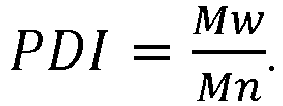
- The terms "polycarbonate" or "polycarbonates" as used herein includes copolycarbonates, homopolycarbonates and (co)polyester carbonates.
- The terms "residues" and "structural units", used in reference to the constituents of the polymers, are synonymous throughout the specification.
- The term "ABS" or "acrylonitrile-butadiene-styrene copolymer" as used herein refers to an acrylonitrile-butadiene-styrene polymer which can be an acrylonitrile-butadiene-styrene terpolymer or a blend of styrene-butadiene rubber and styrene-acrylonitrile copolymer.
- The term "impact modifier" as used herein refers to a component of the disclosed thermoplastic compositions wherein the impact modifier is a polymeric material effective in improving the impact properties of the disclosed thermoplastic compositions, e.g. the notched Izod impact strength of the composition. As used herein, an impact modifier can be a one or more polymers such as acrylonitrile butadiene styrene copolymer ("ABS"), methacrylate butadiene styrene copolymer ("MBS"), and/or bulk polymerized ABS ("BABS").
- Each of the component materials disclosed herein are either commercially available and/or the methods for the production thereof are known to those of ordinary skill in the art.
- It is understood that the compositions disclosed herein have certain functions. Disclosed herein are certain structural requirements for performing the disclosed functions, and it is understood that there are a variety of structures that can perform the same function that are related to the disclosed structures, and that these structures will typically achieve the same result.
- As summarized above, the disclosure provides improved thermoplastic compositions that are particularly useful in connection with laser direct structuring (LDS) technology. For example, as described in greater detail below, embodiments of the disclosure provide thermoplastic compositions that are capable of being used in a laser direct structuring (LDS) process and that provide enhanced plating performance while exhibiting relatively good mechanical properties. To that end, the disclosed thermoplastic compositions generally comprise a blend of a thermoplastic polymer resin and a laser direct structuring additive comprising a mean particle size equal to or less than 1 micrometer (µm). The disclosed thermoplastic composition can further optionally comprise one or more additional additives.
- The disclosed thermoplastic composition disclosed herein provides robust plating performance, while maintaining good mechanical properties (e.g., Izod impact strength higher than about 400 Joules per meter (J/m)). Evaluation of the mechanical properties can be performed through various tests, such as Izod test, Charpy test, Gardner test, etc., according to several standards (e.g., ASTM D256). Robustness of plating performance can be measured via a performance ranking, or plating ranking, ranging from top performance (e.g., "best") to bottom performance. The ranking can be partitioned in various levels. In one embodiment, a plating ranking can have a level of "10" for top performance and a level of "0" for bottom performance.
- The disclosed thermoplastic compositions can exhibit, for example, improved mechanical, thermal, and/or morphological properties. Further, for example, the thermoplastic compositions may show improved ductility and improved impact strength. Even further for example, the thermoplastic compositions may show improved ductility and improved impact strength without adversely affecting other mechanical and thermal properties.
- The disclosed compositions can comprise one or more thermoplastic polymer resins. The thermoplastic polymer resins include polycarbonate and polycarbonate-polysiloxane copolymer.
- The thermoplastic polymer resin can be present in the disclosed composition in any desired amount as characterized by a weight percentage relative to the total weight of the composition. For example, according to embodiments of the disclosure, the thermoplastic polymer resin can be present in an amount in the range of from about 5 weight % (wt %) up to about 95 wt % relative to the total weight of the composition, including further exemplary amounts of about 10 wt %, 15 wt %, 20 wt %, 25 wt %, 30 wt %, 35 wt %, 40 wt %, 45 wt %, 50 wt %, 55 wt %, 60 wt %, 65 wt %, 70 wt %, 75 wt %, 80 wt %, 85 wt %, 90 wt %. In still further embodiments, the thermoplastic polymer resin can be present within any range of amount derived from any two of the above states values. For example, the thermoplastic polymer resin can be present in an amount in the range of from about 5 wt % to about 15 wt %, or in an amount in the range of from about 5 wt % to about 20 wt %, or in an amount in the range of from about 50 wt % to about 85 wt % relative to the total weight of the composition.
- In further embodiments, the disclosed thermoplastic composition can comprise a thermoplastic polymer resin in an amount in the range of 1 wt % to 70 wt %, including exemplary values of 4 wt %, 5 wt %, 10 wt %, 15 wt %, 20 wt %, 25 wt %, 30 wt %, 35 wt %, 40 wt %, 45 wt %, 50 wt %, 55 wt %, 60 wt %, and 65 wt %. In still further embodiments, the thermoplastic polymer resin amount can be in a range derived from any two of the above listed exemplary thermoplastic polymer resin amount values. For example, the thermoplastic polymer resin can be in an amount in the range of from 4 wt % to 40 wt %.
- In still further embodiments, the disclosed thermoplastic composition can comprise a total amount of thermoplastic polymer resin in an amount in the range of 1 wt % to 70 wt %, including exemplary values of 4 wt %, 5 wt %, 10 wt %, 15 wt %, 20 wt %, 25 wt %, 30 wt %, 35 wt %, 40 wt %, 45 wt %, 50 wt %, 55 wt %, 60 wt %, and 65 wt %. In still further embodiments, the total thermoplastic polymer resin amount can be in a range derived from any two of the above listed exemplary total thermoplastic polymer resin amount values. For example, the total thermoplastic polymer resin can be in an amount in the range of from 40 wt % to 65 wt %.
- In yet further embodiments, the thermoplastic polymer resin can also be present in the composition in any desired amount as characterized by a volume percentage relative to the total volume of the composition. For example, according to embodiments of the disclosure, the thermoplastic polymer resin can be present in an amount in the range of from about 5 volume % up to about 95 volume % relative to the total weight of the composite, including further exemplary amounts of about 10 volume %, 15 volume %, 20 volume %, 25 volume %, 30 volume %, 35 volume %, 40 volume %, 45 volume %, 50 volume %, 55 volume %, 60 volume %, 65 volume %, 70 volume %, 75 volume %, 80 volume %, 85 volume %, 90 volume %. In still further embodiments, the thermoplastic polymer resin can be present within any range of amount derived from any two of the above states values. For example, the thermoplastic polymer resin can be present in an amount in the range of from about 5 volume % to about 15 volume %, or in an amount in the range of from about 5 volume % to about 20 volume %, or in an amount in the range of from about 50 volume % to about 85 volume % relative to the total volume of the composition.
- As described, according to embodiments the thermoplastic resin component of a disclosed polymer composition can comprise a polycarbonate. The terms "polycarbonate" or "polycarbonates" as used herein includes copolycarbonates, homopolycarbonates and (co)polyester carbonates.
- In one embodiment, the polycarbonate can comprises aromatic carbonate chain units and includes compositions having structural units of the formula:

- In one embodiment, R1 can be an aromatic organic radical and, such as a radical of the formula:
-A1-Y1-A2-
wherein each of A1 and A2 is a monocyclic, divalent aryl radical and Y1 is a bridging radical having one or two atoms which separate A1 from A2. For example, one atom separates A1 from A2. Illustrative non-limiting examples of radicals of this type are -O-, -S-, - S(O)-, -S(O2)-, -C(O)-, methylene, cyclohexyl-methylene, 2-[2.2.1]-bicycloheptylidene, ethylidene, isopropylidene, neopentylidene, cyclohexylidene, cyclopentade-cylidene, cyclododecylidene, and adamantylidene. The bridging radical Y1 can be a hydrocarbon group or a saturated hydrocarbon group such as methylene, cyclohexylidene or isopropylidene. - Polycarbonate resins can be produced by the reaction of the carbonate precursor with dihydroxy compounds. Typically, an aqueous base such as (e.g., sodium hydroxide, potassium hydroxide, calcium hydroxide, and the like,) is mixed with an organic, water immiscible solvent such as benzene, toluene, carbon disulfide, or dichloromethane, which contains the dihydroxy compound. A phase transfer resin is generally used to facilitate the reaction. Molecular weight regulators may be added to the reactant mixture. These molecular weight regulators may be added singly or as a combination. Branching resins, described forthwith may also be added singly or in admixture. Another process for producing aromatic polycarbonate resins is the trans-esterification process, which involves the trans-esterification of an aromatic dihydroxy compound and a diester carbonate. This process is known as the melt polymerization process. The process of producing the aromatic polycarbonate resins is not critical.
- As used herein, the term "dihydroxy compound" includes, for example, bisphenol compounds having general formula (1) as follows:


- Non-limiting examples of suitable dihydroxy compounds include the dihydroxy-substituted aromatic hydrocarbons disclosed by name or formula (generic or specific) in
U.S. Pat. No. 4,217,438 . A nonexclusive list of specific examples of the types of bisphenol compounds includes Some illustrative, non-limiting examples of suitable dihydroxy compounds include the following: resorcinol, 4-bromoresorcinol, hydroquinone, 4,41-dihydroxybiphenyl, 1,6-dihydroxynaphthalene, 2,6-dihydroxynaphthalene, bis( 4-hydroxyphenyl)methane, bis(4-hydroxyphenyl) diphenylmethane, bis(4-hydroxyphenyl)-1-naphthylmethane, 1,2-bis(4-hydroxyphenyl)ethane, 1,1-bis(4-hydroxyphenyl)-1-phenylethane, 2-(4-hydroxyphenyl)-2-(3-hydroxyphenyl)propane, bis(4-hydroxyphenyl) phenylmethane, 2,2-bis(4-hydroxy-3-bromophenyl) propane, 1,1-bis(hydroxyphenyl)cyclopentane, 1,1-bis(4-hydroxyphenyl)cyclohexane, 1, 1-bis(4-hydroxyphenyl)isobutene, 1,1-bis(4-hydroxyphenyl)cyclododecane, trans-2, 3-bis(4-hydroxyphenyl)-2-butene, 2,2-bis( 4-hydroxyphenyl)adamantine, (alpha,alpha1-bis(4-hydroxyphenyl)toluene, bis(4-hydroxyphenyl)acetonitrile, 2,2-bis(3-methyl-4-hydroxyphenyl)propane, 2,2-bis(3-ethyl-4-hydroxyphenyl)propane, 2,2-bis(3-n-propyl-4-hydroxyphenyl) propane, 2,2-bis(3-isopropyl-4-hydroxyphe nyl)propane, 2,2-bis(3-sec-butyl-4-hydroxyphenyl)propane, 2,2-bis(3-t-butyl-4-hydroxyphenyl)propane, 2,2-bis(3-cyclohexyl-4-hydroxyphenyl)propane, 2,2-bis(3-allyl-4-hy droxyphenyl)propane, 2,2-bis(3-methoxy-4-hydroxyphenyl) propane, 2,2-bis( 4-hydroxyphenyl)hexafluoropropane, 1,1-dichloro-2,2-bis(4-hydroxyphenyl)ethylene, 1, 1-dibromo-2, 2-bis(4-hydroxyphenyl)ethylene, 1,1-dichloro-2,2-bis(5-phenoxy-4-hydroxyphenyl)ethylene, 4,4'dihydroxybenzophenone, 3,3-bis(4-hydroxyphenyl)-2-butanone, 1 6-bis(4-hydroxyphenyl)-1,6-hexanedione, ethylene glycol bis(4-hydroxyphenyl)ether, bis(4-hydroxyphenyl)ether, bis(4-hydroxyphenyl)sulfide, bis(4-hydroxyphenyl) sulfoxide, bis(4-hydroxyphenyl)sulfone, 9,9-bis(4-hydroxyphenyl)fluorine, 2,7-dihydroxypyrene, 6,6'- dihydroxy-3,3 ,3',3'-tetramethylspiro(bis)indane ("spirobiindane bisphenol"), 3,3-bis(4-hydroxyphenyl)phthalide, 2,6-dihydroxydibenzo-p-dioxin, 2,6-dihydroxythianthrene, 2,7-dihydroxyphenoxathin, 2,7-dihydroxy-9,10-dimethylphenazine, 3,6-dihydroxydibenzofuran, 3,6-dihydroxydibenzothiophene, and 2,7-dihydroxycarbazole, and the like, as well as combinations comprising at least one of the foregoing dihydroxy compounds. - Specific examples of the types of bisphenol compounds that may be represented by formula (3) include 1,1-bis(4-hydroxyphenyl) methane, 1,1-bis( 4-hydroxyphenyl)ethane, 2,2-bis(4-hydroxyphenyl) propane (hereinafter "bisphenol A" or "BPA"), 2,2-bis(4-hydroxyphenyl)butane, 2,2-bis(4-hydroxyphenyl)octane, 1,1-bis(4-hydroxyphenyl)propane, 1,1-bis(4-hydroxyphenyl)n-butane, 2,2-bis(4-hydroxy-1-methylphenyl)propane, and 1,1-bis(4-hydroxy-t-butylphenyl)propane. Combinations comprising at least one of the foregoing dihydroxy compounds may also be used.
- Branched polycarbonates are also useful, as well as blends of a linear polycarbonate and a branched polycarbonate. The branched polycarbonates may be prepared by adding a branching agent during polymerization. These branching agents include polyfunctional organic compounds containing at least three functional groups selected from hydroxyl, carboxyl, carboxylic anhydride, haloformyl, and mixtures of the foregoing functional groups. Specific examples include trimellitic acid, trimellitic anhydride, trimellitic trichloride, tris-p-hydroxy phenyl ethane, isatin-bis-phenol, tris-phenol TC (1,3,5-tris((p-hydroxyphenyl)isopropyl)benzene), tris-phenol PA (4(4(1,1-bis(p-hydroxyphenyl)-ethyl)alpha,alphadimethyl benzyl)phenol), 4-chloroformyl phthalic anhydride, trimesic acid, and benzophenone tetracarboxylic acid. The branching agents may be added at a level of about 0.05 wt % to about 2.0 wt %. All types of polycarbonate end groups are contemplated as being useful in the polycarbonate composition, provided that such end groups do not significantly affect desired properties of the thermoplastic compositions.
- Suitable polycarbonates can be manufactured by processes such as interfacial polymerization and melt polymerization. Although the reaction conditions for interfacial polymerization may vary, an exemplary process generally involves dissolving or dispersing a dihydric phenol reactant in aqueous caustic soda or potash, adding the resulting mixture to a suitable water-immiscible solvent medium, and contacting the reactants with a carbonate precursor in the presence of a suitable catalyst such as triethylamine or a phase transfer catalyst, under controlled pH conditions, e.g., about 8 to about 10. The most commonly used water immiscible solvents include methylene chloride, 1,2-dichloroethane, chlorobenzene, toluene, and the like. Suitable carbonate precursors include, for example, a carbonyl halide such as carbonyl bromide or carbonyl chloride, or a haloformate such as a bishaloformate of a dihydric phenol (e.g., the bischloroformates of bisphenol A, hydroquinone, or the like) or a glycol (e.g., the bishaloformate of ethylene glycol, neopentyl glycol, polyethylene glycol, or the like). Combinations comprising at least one of the foregoing types of carbonate precursors may also be used.
- Rather than utilizing the dicarboxylic acid per se, it is possible, and sometimes even desired, to employ the reactive derivatives of the acid, such as the corresponding acid halides, in particular the acid dichlorides and the acid dibromides. Thus, for example, instead of using isophthalic acid, terephthalic acid, or mixtures thereof, it is possible to employ isophthaloyl dichloride, terephthaloyl dichloride, and mixtures thereof.
- Non-limiting examples of suitable phase transfer resins include, but are not limited to, tertiary amines such as triethylamine, quaternary ammonium compounds, and quaternary phosphonium compounds.
- Among the phase transfer catalysts that may be used are catalysts of the formula (R2)4Q+X, wherein each R2 is the same or different, and is a C1-10 alkyl group; Q is a nitrogen or phosphorus atom; and X is a halogen atom or a C1-8 alkoxy group or C6-18 aryloxy group. Suitable phase transfer catalysts include, for example, [CH3(CH2)3]4NX, [CH3(CH2)3]4PX, [CH3(CH2)5]4NX, [CH3(CH2)6]4NX, [CH3(CH2)4]4NX, CH3[CH3(CH2)]3NX, and CH3[CH3(CH2)2NX, wherein X is Cl-, Br-, a C1-8 alkoxy group or a C6-18 aryloxy group. An effective amount of a phase transfer catalyst may be about 0.1 to about 10 wt % based on the weight of bisphenol in the phosgenation mixture. In another embodiment an effective amount of phase transfer catalyst may be about 0.5 to about 2 wt % based on the weight of bisphenol in the phosgenation mixture.
- Alternatively, melt processes may be used to make the polycarbonates. Generally, in the melt polymerization process, polycarbonates may be prepared by co-reacting, in a molten state, the dihydroxy reactant(s) and a diaryl carbonate ester, such as diphenyl carbonate, in the presence of a transesterification catalyst in a Banbury™ mixer, twin screw extruder, or the like to form a uniform dispersion. Volatile monohydric phenol is removed from the molten reactants by distillation and the polymer is isolated as a molten residue.
- Typical carbonate precursors include the carbonyl halides, for example carbonyl chloride (phosgene), and carbonyl bromide; the bis-haloformates, for example the bis-haloformates of dihydric phenols such as bisphenol A, hydroquinone, and the like, and the bis-haloformates of glycols such as ethylene glycol and neopentyl glycol; and the diaryl carbonates, such as diphenyl carbonate, di(tolyl) carbonate, and di(naphthyl) carbonate.
- In one embodiment, bisphenols can be used in the manufacture of polycarbonates containing phthalimidine carbonate units of formula (1a)

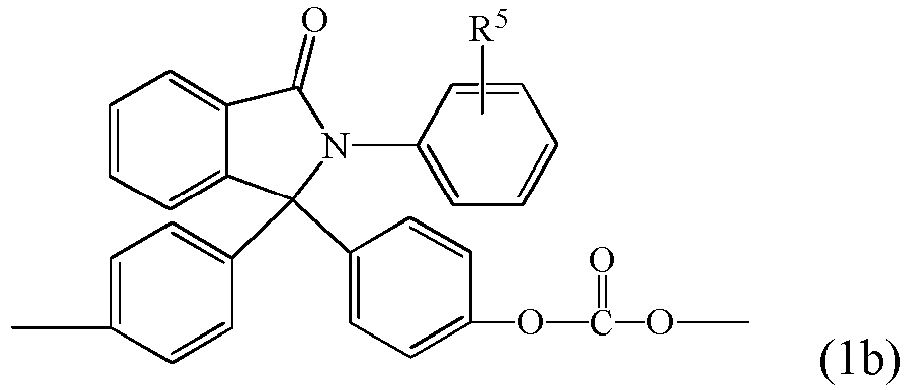
- Other bisphenol carbonate repeating units of this type are the instant carbonate units of formula (1c) and (1d)

- Examples of bisphenol carbonate units derived from bisphenols of formula (1) wherein Xa is a substituted or unsubstituted C3-18 cycloalkylidene include the cyclohexylidene-bridged, alkyl-substituted bisphenol of formula (12e)

- Examples of other bisphenol carbonate units derived from bisphenol wherein Xa is a substituted or unsubstituted C3-18 cycloalkylidene include adamantyl units (If) and units (1g)

- "Polycarbonates" and "polycarbonate polymers" as used herein further includes blends of polycarbonates with other copolymers comprising carbonate chain units. An exemplary copolymer is a polyester carbonate, also known as a copolyester-polycarbonate. Such copolymers further contain, in addition to recurring carbonate chain units, repeating units of formula (2)

- In one embodiment, D is a C2-6 alkylene radical. In another embodiment, D is derived from an aromatic dihydroxy compound of formula (3):

- Examples of aromatic dicarboxylic acids that may be used to prepare the polyesters include isophthalic or terephthalic acid, 1,2-di(p-carboxyphenyl)ethane, 4,4'-dicarboxydiphenyl ether, 4,4'-bisbenzoic acid, and mixtures comprising at least one of the foregoing acids. Acids containing fused rings can also be present, such as in 1,4-, 1,5-, or 2,6-naphthalenedicarboxylic acids. Specific dicarboxylic acids are terephthalic acid, isophthalic acid, naphthalene dicarboxylic acid, cyclohexane dicarboxylic acid, or mixtures thereof. A specific dicarboxylic acid comprises a mixture of isophthalic acid and terephthalic acid wherein the weight ratio of terephthalic acid to isophthalic acid is about 10:1 to about 0.2:9.8. In another specific embodiment, D is a C2-6 alkylene radical and T is p-phenylene, m-phenylene, naphthalene, a divalent cycloaliphatic radical, or a mixture thereof. This class of polyester includes the poly( alkylene terephthalates ).
- In other embodiments, poly(alkylene terephthalates) may be used. Specific examples of suitable poly(alkylene terephthalates) are poly(ethylene terephthalate) ("PET"), poly(1,4-butylene terephthalate) ("PBT"), poly(ethylene naphthanoate) ("PEN"), poly(butylene naphthanoate) ("PBN"), (polypropylene terephthalate) ("PPT"), polycyclohexanedimethanol terephthalate ("PCT"), and combinations comprising at least one of the foregoing polyesters. Also contemplated are the above polyesters with a minor amount, e.g., from about 0.5 to about 10 percent by weight, of units derived from an aliphatic diacid and/or an aliphatic polyol to make copolyesters.
- Copolymers comprising alkylene terephthalate repeating ester units with other ester groups may also be useful. Useful ester units may include different alkylene terephthalate units, which can be present in the polymer chain as individual units, or as blocks of poly(alkylene terephthalates). Specific examples of such copolymers include poly (cyclohexanedimethylene terephthalate)-co-poly(ethylene terephthalate), abbreviated as PETG where the polymer comprises greater than or equal to 50 mol% of poly(ethylene terephthalate), and abbreviated as PCTG where the polymer comprises greater than 50 mol% of poly(1,4-cyclohexanedimethylene terephthalate).
- Poly(cycloalkylene diester)s may also include poly(alkylene cyclohexanedicarboxylate)s. Of these, a specific example is poly(1,4-cyclohexanedimethanol-1,4-cyclohexanedicarboxylate) ("PCCD"), having recurring units of formula (15):

- Typical branching resins such as α',α',α',α'-tetrakis(3-methyl-4-hydroxyphenyl)-p-xylene, α,α,α',α'-tetrakis (2-methyl-4-hydroxyphenyl)-p-xylene, α,α,α',α'-tetrakis(2,5 dimethyl-4-hydroxyphenyl)-p-xylene, α,α,α',α'-tetrakis(2,6-dimethyl-4-hydroxyphenyl)-p-xylene, α,α,α',α'-tetrakis(4-hydroxyphenyl)-p-xylene, trimellitic acid, trimellitic anhydride, trimellitic trichloride, tris-p-hydroxy phenyl ethane, isatin-bis-phenol, tris-phenol TC (1,3,5-tris((p-hydroxyphenyl)isopropyl)benzene), tris-phenol PA (4-(4-(1,1-bis(p-hydroxyphenyl)-ethyl)alpha, alpha-dimethylbenzyl)phenol), 4-chloroformyl phthalic anhydride, trimesic acid, benzophe-none tetracarboxylic acid and the like, can also be added to the reaction mixture. Blends of linear polycarbonate and branched polycarbonate resins can be utilized herein. The branching agent may be added at a level of about 0.05 wt% to about 2.0 wt %.
- Molecular weight regulators or chain stoppers are optional and are added to the mixture in order to arrest the progress of the polymerization. Typical molecular weight regulators such as phenol, chroman-1, p-t-butylphenol, p-bromophenol, para-cumyl-phenol, and the like may be added either singly or in admixture and are typically added in an amount of about 1 to about 10 mol % excess with respect to the BPA. The molecular weight of the polycarbonate is generally greater than or equal to about 5000 grams per mole (g/mol), preferably greater than or equal to about 10,000 g/mol, more preferably greater than or equal to about 15,000 g/mol. In one embodiment, the molecular weight ranges from 18,000 g/mole to 40,000 g/mol. In general it is desirable to have the polycarbonate resin less than or equal to about 100,000 g/mol, preferably less than or equal to about 50,000 g/mol, more preferably less than or equal to about 30,000 g/mol as calculated from the viscosity of a methylene chloride solution at 25° C. In one embodiment, the polycarbonate can have a Mn of about 15,000 g/mol to about 30,000 g/mol. In another embodiment, the polycarbonate can have a Mn of about 20,000 g/mol to about 25,000 g/mol. In another embodiment, the polycarbonate can have a Mn of about 21,000 g/mol. In another embodiment, the polycarbonate can have a Mn of about 24,000 g/mol.
- In one embodiment, the polymer composition comprises a first polycarbonate polymer and a second polycarbonate polymer.
- In one embodiment, the polycarbonate can comprise two or more polycarbonates. For example, the polycarbonate can comprise two polycarbonates. The two polycarbonates can be present in about equal or different amounts.
- In one embodiment, the polycarbonates can be a part of a co-polymer, wherein at least one part of the co-polymer is not a polycarbonate.
- In another embodiment, the polycarbonate comprises Lexan™ Bisphenol A polycarbonate available from SABIC Innovative Plastics, USA.
- In a further embodiment, the first polycarbonate polymer has a weight average molecular weight of from about 15,000 g/mol to about 100,000 g/mol on an absolute polycarbonate molecular weight scale. In a still further embodiment, the first polycarbonate polymer has a weight average molecular weight of from about 15,000 g/mol to about 50,000 g/mol on an absolute polycarbonate molecular weight scale. In a yet further embodiment, the first polycarbonate polymer has a weight average molecular weight of from about 15,000 g/mol to about 45,000 g/mol on an absolute polycarbonate molecular weight scale. In an even further embodiment, the first polycarbonate polymer has a weight average molecular weight of from about 15,000 g/mol to about 40,000 g/mol on an absolute polycarbonate molecular weight scale. In a still further embodiment, the first polycarbonate polymer has a weight average molecular weight of from about 15,000 g/mol to about 35,000 g/mol on an absolute polycarbonate molecular weight scale. In a yet further embodiment, the first polycarbonate polymer has a weight average molecular weight of from about 15,000 g/mol to about 30,500 g/mol on an absolute polycarbonate molecular weight scale. In an even further embodiment, the first polycarbonate polymer has a weight average molecular weight of from about 15,000 g/mol to about 30,000 g/mol on an absolute polycarbonate molecular weight scale. In a still further embodiment, the first polycarbonate polymer has a weight average molecular weight of from about 15,000 g/mol to about 29,000 g/mol on an absolute polycarbonate molecular weight scale.
- In a further embodiment, the first polycarbonate polymer has a weight average molecular weight of from about 20,000 g/mol to about 100,000 g/mol on an absolute polycarbonate molecular weight scale. In a still further embodiment, the first polycarbonate polymer has a weight average molecular weight of from about 20,000 g/mol to about 50,000 g/mol on an absolute polycarbonate molecular weight scale. In a yet further embodiment, the first polycarbonate polymer has a weight average molecular weight of from about 20,000 g/mol to about 45,000 g/mol on an absolute polycarbonate molecular weight scale. In an even further embodiment, the first polycarbonate polymer has a weight average molecular weight of from about 20,000 g/mol to about 40,000 g/mol on an absolute polycarbonate molecular weight scale. In a still further embodiment, the first polycarbonate polymer has a weight average molecular weight of from about 20,000 g/mol to about 35,000 g/mol on an absolute polycarbonate molecular weight scale. In a yet further embodiment, the first polycarbonate polymer has a weight average molecular weight of from about 20,000 g/mol to about 30,500 g/mol on an absolute polycarbonate molecular weight scale. In an even further embodiment, the first polycarbonate polymer has a weight average molecular weight of from about 20,000 g/mol to about 30,000 g/mol on an absolute polycarbonate molecular weight scale. In a still further embodiment, the first polycarbonate polymer has a weight average molecular weight of from about 20,000 g/mol to about 29,000 g/mol on an absolute polycarbonate molecular weight scale.
- In a further embodiment, the first polycarbonate polymer has a weight average molecular weight of from about 25,000 g/mol to about 100,000 g/mol on an absolute polycarbonate molecular weight scale. In a still further embodiment, the first polycarbonate polymer has a weight average molecular weight of from about 25,000 g/mol to about 50,000 g/mol on an absolute polycarbonate molecular weight scale. In a yet further embodiment, the first polycarbonate polymer has a weight average molecular weight of from about 25,000 g/mol to about 45,000 g/mol on an absolute polycarbonate molecular weight scale. In an even further embodiment, the first polycarbonate polymer has a weight average molecular weight of from about 25,000 g/mol to about 40,000 g/mol on an absolute polycarbonate molecular weight scale. In a still further embodiment, the first polycarbonate polymer has a weight average molecular weight of from about 25,000 g/mol to about 35,000 g/mol on an absolute polycarbonate molecular weight scale. In a yet further embodiment, the first polycarbonate polymer has a weight average molecular weight of from about 25,000 g/mol to about 30,500 g/mol on an absolute polycarbonate molecular weight scale. In an even further embodiment, the first polycarbonate polymer has a weight average molecular weight of from about 25,000 g/mol to about 30,500 g/mol on an absolute polycarbonate molecular weight scale. In a still further embodiment, the first polycarbonate polymer has a weight average molecular weight of from about 25,000 g/mol to about 30,000 g/mol on an absolute polycarbonate molecular weight scale. In a yet further embodiment, the first polycarbonate polymer has a weight average molecular weight of from about 25,000 g/mol to about 29,000 g/mol on an absolute polycarbonate molecular weight scale.
- In a further embodiment, the first polycarbonate polymer is present in an amount from about 20 wt% to about 50 wt%. In a still further embodiment, the first polycarbonate polymer is present in an amount from about 20 wt% to about 45 wt%. In a yet further embodiment, the first polycarbonate polymer is present in an amount from about 20 wt% to about 40 wt%. In an even further embodiment, the first polycarbonate polymer is present in an amount from about 20 wt% to about 35 wt%. In a still further embodiment, the first polycarbonate polymer is present in an amount from about 20 wt% to about 30 wt%.
- In a further embodiment, the first polycarbonate polymer is present in an amount from about 22 wt% to about 50 wt%. In a still further embodiment, the first polycarbonate polymer is present in an amount from about 22 wt% to about 45 wt%. In a yet further embodiment, the first polycarbonate polymer is present in an amount from about 22 wt% to about 40 wt%. In an even further embodiment, the first polycarbonate polymer is present in an amount from about 22 wt% to about 35 wt%. In a still further embodiment, the first polycarbonate polymer is present in an amount from about 22 wt% to about 30 wt%.
- In a further embodiment, the first polycarbonate polymer is present in an amount from about 25 wt% to about 50 wt%. In a still further embodiment, the first polycarbonate polymer is present in an amount from about 25 wt% to about 45 wt%. In a yet further embodiment, the first polycarbonate polymer is present in an amount from about 25 wt% to about 40 wt%. In an even further embodiment, the first polycarbonate polymer is present in an amount from about 25 wt% to about 35 wt%. In a still further embodiment, the first polycarbonate polymer is present in an amount from about 25 wt% to about 30 wt%.
- In a further embodiment, the second polycarbonate polymer has a weight average molecular weight of from about 15,000 g/mol to about 100,000 g/mol on an absolute polycarbonate molecular weight scale. In a still further embodiment, the second polycarbonate polymer has a weight average molecular weight of from about 15,000 g/mol to about 50,000 g/mol on an absolute polycarbonate molecular weight scale. In a yet further embodiment, the second polycarbonate polymer has a weight average molecular weight of from about 15,000 g/mol to about 45,000 g/mol on an absolute polycarbonate molecular weight scale. In an even further embodiment, the second polycarbonate polymer has a weight average molecular weight of from about 15,000 g/mol to about 40,000 g/mol on an absolute polycarbonate molecular weight scale. In a still further embodiment, the second polycarbonate polymer has a weight average molecular weight of from about 15,000 g/mol to about 35,000 g/mol on an absolute polycarbonate molecular weight scale. In a yet further embodiment, the second polycarbonate polymer has a weight average molecular weight of from about 15,000 g/mol to about 30,000 g/mol on an absolute polycarbonate molecular weight scale. In an even further embodiment, the second polycarbonate polymer has a weight average molecular weight of from about 15,000 g/mol to about 25,000 g/mol on an absolute polycarbonate molecular weight scale.
- In a further embodiment, the second polycarbonate polymer has a weight average molecular weight of from about 20,000 g/mol to about 100,000 g/mol on an absolute polycarbonate molecular weight scale. In a still further embodiment, the second polycarbonate polymer has a weight average molecular weight of from about 20,000 g/mol to about 50,000 g/mol on an absolute polycarbonate molecular weight scale. In a yet further embodiment, the second polycarbonate polymer has a weight average molecular weight of from about 20,000 g/mol to about 45,000 g/mol on an absolute polycarbonate molecular weight scale. In an even further embodiment, the second polycarbonate polymer has a weight average molecular weight of from about 20,000 g/mol to about 40,000 g/mol on an absolute polycarbonate molecular weight scale. In a still further embodiment, the second polycarbonate polymer has a weight average molecular weight of from about 20,000 g/mol to about 35,000 g/mol on an absolute polycarbonate molecular weight scale. In a yet further embodiment, the second polycarbonate polymer has a weight average molecular weight of from about 20,000 g/mol to about 30,000 g/mol on an absolute polycarbonate molecular weight scale. In an even further embodiment, the second polycarbonate polymer has a weight average molecular weight of from about 20,000 g/mol to about 25,000 g/mol on an absolute polycarbonate molecular weight scale.
- In a further embodiment, the second polycarbonate polymer is present in an amount from about 20 wt% to about 50 wt%. In a still further embodiment, the second polycarbonate polymer is present in an amount from about 20 wt% to about 45 wt%. In a yet further embodiment, the second polycarbonate polymer is present in an amount from about 20 wt% to about 40 wt%. In an even further embodiment, the second polycarbonate polymer is present in an amount from about 20 wt% to about 35 wt%. In a still further embodiment, the second polycarbonate polymer is present in an amount from about 20 wt% to about 30 wt%.
- In a further embodiment, the second polycarbonate polymer is present in an amount from about 22 wt% to about 50 wt%. In a still further embodiment, the second polycarbonate polymer is present in an amount from about 22 wt% to about 45 wt%. In a yet further embodiment, the second polycarbonate polymer is present in an amount from about 22 wt% to about 40 wt%. In an even further embodiment, the second polycarbonate polymer is present in an amount from about 22 wt% to about 35 wt%. In a still further embodiment, the second polycarbonate polymer is present in an amount from about 22 wt% to about 30 wt%.
- In a further embodiment, the second polycarbonate polymer is present in an amount from about 25 wt% to about 50 wt%. In a still further embodiment, the second polycarbonate polymer is present in an amount from about 25 wt% to about 45 wt%. In a yet further embodiment, the second polycarbonate polymer is present in an amount from about 25 wt% to about 40 wt%. In an even further embodiment, the second polycarbonate polymer is present in an amount from about 25 wt% to about 35 wt%. In a still further embodiment, the second polycarbonate polymer is present in an amount from about 25 wt% to about 30 wt%.
- In some embodiments, the disclosed thermoplastic compositions can further comprise a polycarbonate- polysiloxane block copolymer. As used herein, the term polycarbonate-polysiloxane copolymer is equivalent to polysiloxane-polycarbonate copolymer, polycarbonate-polysiloxane polymer, or polysiloxane-polycarbonate polymer. The polysiloxane-polycarbonate copolymer comprises polydiorganosiloxane blocks comprising structural units of the general formula (5) below:


- According to exemplary non-limiting embodiments of the disclosure, the polycarbonate- polysiloxane block copolymer comprises diorganopolysiloxane blocks of the general formula (6) below:
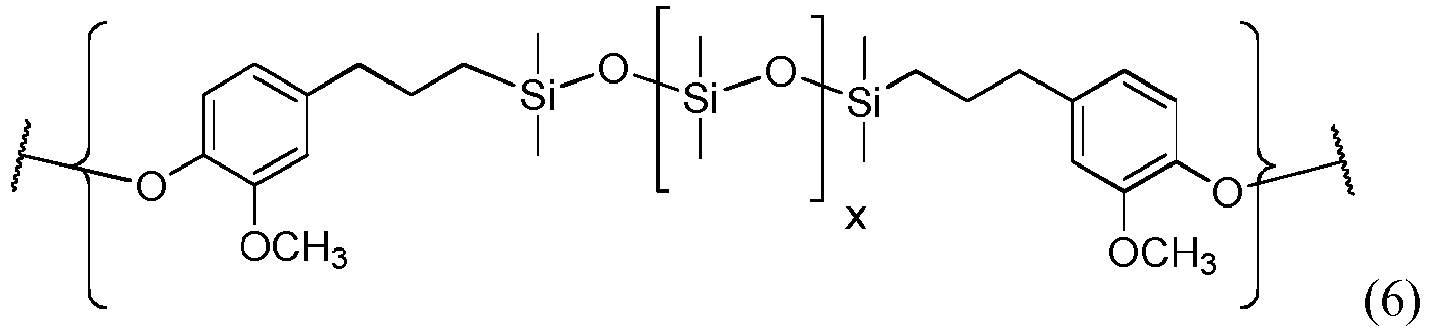
- Diorganopolysiloxane blocks of formula (6) above can be derived from the corresponding dihydroxy compound of formula (7):

U.S. Patent 4,746,701 to Kress, et al andUS 8,017,0697 to Carrillo - Such dihydroxy polysiloxanes can be made by effecting a platinum catalyzed addition between a siloxane hydride of the formula (8):

- The polycarbonate-polysiloxane copolymer may be manufactured by reaction of a diphenolic polysiloxane, such as that depicted by formula (7), with a carbonate source and a dihydroxy aromatic compound such as bisphenol-A, optionally in the presence of a phase transfer catalyst as described above. Suitable conditions are similar to those useful in forming polycarbonates. For example, the copolymers can be prepared by phosgenation at temperatures from below 0 degrees Celcius (°C) to about 100°C, including for example, at temperatures from about 25°C to about 50°C. Since the reaction is exothermic, the rate of phosgene addition can be used to control the reaction temperature. The amount of phosgene required will generally depend upon the amount of the dihydric reactants. Alternatively, the polycarbonate-polysiloxane copolymers can be prepared by co-reacting, in a molten state, the dihydroxy monomers and a diaryl carbonate ester, such as diphenyl carbonate, in the presence of a transesterification catalyst as described above.
- In the production of the polycarbonate-polysiloxane copolymer, the amount of dihydroxy diorganopolysiloxane can be selected so as to provide the desired amount of diorganopolysiloxane units in the copolymer. The particular amounts used will therefore be determined depending on desired physical properties of the composition, the value of x (for example, within the range of about 20 to about 60), and the type and relative amount of each component in the composition, including the type and amount of polycarbonate, type and amount of polycarbonate-polysiloxane copolymer, and type and amount of any other additives. Suitable amounts of dihydroxy diorganopolysiloxane can be determined by one of ordinary skill in the art without undue experimentation using the guidelines taught herein.
- For example, according to embodiments of the disclosure, the polysiloxane-polycarbonate block copolymer can be provided having any desired level of siloxane content. For example, the siloxane content can be in the range of from 4 mole % to 20 mole %. In additional embodiments, the siloxane content of the polysiloxane-polycarbonate block copolymer can be in the range of from 4 mole % to 10 mole %. In still further embodiments, the siloxane content of the polysiloxane-polycarbonate block copolymer can be in the range of from 4 mole % to 8 mole %. In a further embodiment, the polysiloxane-polycarbonate copolymer comprises a diorganosiloxane content in the range of from 5 to 7 mole wt %. In an even further exemplary embodiment, the siloxane content of the polysiloxane-polycarbonate block copolymer can be about 6 mole %. Still further, the diorganopolysiloxane blocks can be randomly distributed in the polysiloxane-polycarbonate block copolymer.
- The disclosed polysiloxane-polycarbonate block copolymers can also be endcapped as similarly described in connection with the manufacture of polycarbonates set forth herein. For example, according to embodiments of the disclosure, a polysiloxane-polycarbonate block copolymer can be end capped with p-cumyl-phenol.
- A non-limiting example of a commercially available polycarbonate-siloxane copolymer includes transparent EXL, commercially available from SABIC Innovative Plastics. The transparent EXL from SABIC is a polycarbonate-polysiloxane (9030T) copolymer, having been tested commercially and found to have about 6 mole % siloxane, a Mw of about 44,600, and a Mn of about 17800 in a polystyrene standard using chloroform solvent.
- The polysiloxane polycarbonate copolymer component can be present in the thermoplastic composition in any desired amount. For example, in embodiments of the disclosure, the polysiloxane polycarbonate copolymer is present in an amount of at least 10 wt% relative to the total weight of the thermoplastic composition. For example, the polycarbonate-polysiloxane copolymer can be present in an amount in the range of from 10 wt% to 80 wt% relative to the total weight of the thermoplastic composition, including exemplary amounts of 15 wt%, 20 wt%, 25 wt%, 30 wt%, 35 wt%, 40 wt%, 45 wt%, 50 wt%, 55 wt%, 60 wt%, 65 wt%, 70 wt%, and 75 wt%. In still further embodiments, the polysiloxane polycarbonate copolymer can be present within any range of amounts derived from any two of the above stated values. For example, the polysiloxane polycarbonate copolymer can be present in an amount in the range of from about 10 wt% to about 20 wt%, or in an amount in the range of from about 60 wt% to about 80 wt%.
- In one embodiment, the polycarbonate siloxane copolymer used comprises about 20% by weight of siloxane, 80% by weight BPA and endcapped with paracumyl phenol.
- The disclosed thermoplastic composition further comprises a laser direct structuring (LDS) additive comprising a mean particle size equal to or less than 1 µm.The LDS additive comprising a mean particle size equal to or less than 1 µm could be considered nano-size. As used herein, a laser direct structuring additive refers to metal containing additive suitable for use in a laser direct structuring process. To that end, as discussed more fully herein, an LDS additive is selected such that, after activating with a laser, a conductive path can be formed on the injection molded composite surface by a subsequent standard metallization or plating process. As such, when the LDS additive is exposed to a laser, elemental metal is released or activated. The laser, thus, draws the circuit pattern onto the thermoplastic part and leaves behind a roughened surface containing embedded metal particles. These particles act as nuclei for the crystal growth during a subsequent metallization or plating process, such as a copper plating process or other plating processes, including gold plating, nickel plating, silver plating, zinc plating, tin plating or the like.
- The LDS additive comprising a mean particle size equal to or less than 1 µm demonstrates enhanced plating performance, as well as retaining suitable mechanical properties, compared to an LDS additive comprising a mean particle size greater than 1 µm, e.g. an LDS additive comprising a mean particle of micro-size or of conventional size. The LDS additive comprising a mean particle size equal to or less than 1 µm also demonstrates better dispersion in the thermoplastic composition. Without wishing to be bound to this theory, the LDS additive with a mean particle size equal to or less than 1 µm allows the use of more additive without changing the mechanical properties, by the smaller size being able to pack more efficiently. In other words, the LDS additive with a mean particle size equal to or less than 1 µm has an optimized matrix.
- According to embodiments of the disclosure, the laser direct structuring additive can comprise one or more metal oxides, including for example, oxides of chromium, copper, or combinations thereof. These laser direct structuring additives can also be provided having spinel type crystal structures. An exemplary and non-limiting example of a commercially available laser direct structuring additive includes the Black 1G pigment black, commercially available from The Shepherd Color company. The Black 1G pigment black, for example, comprises chromium oxides (Cr2O3, Cr2O4 2-, Cr2O7 2-) and oxides of copper (CuO), as determined using XPS. The Black 1G pigment black has a spinel type crystal structure. Another exemplary commercially available laser direct structuring additive is the Black 30C965 pigment black commercially available from The Shepherd Color company, and has a mean particle size of 0.6 µm.
- In one embodiment, the LDS additive comprises a heavy metal mixture oxide spinel or a copper salt, or a combination thereof.
- In one embodiment, the LDS additive has a mean particle size in an amount that ranges from 0.01 µm to 1 µm,including exemplary values of 0.05 µm, 0.08 µm, 0.1 µm, 0.2 µm,0.3 µm,0.4 µm,0.5 µm,0.6 µm,0.7 µm,0.8 µm,and 0.9 µm. In still further embodiments, the mean particle size can be in a range derived from any two of the above listed exemplary mean particle size values. For example, the mean particle size can be in the range of 0.08 µm to 0.8 µm or in the range of 0.5 µm to 0.7 µm.In a yet further embodiment, the mean particle size can be each exemplary value, for example, the mean particle size can be 0.6 µm.
- In one embodiment, the LDS additive has a mean particle size in an amount greater than 1 µm, including exemplary values of 1.1 µm, 1.2 µm, 1.3 µm, 1.4 µm, 1.5 µm, 1.6 µm, 1.7 µm, 1.8 µm, 1.9 µm, and 2.0 µm.In still further embodiments, the mean particle size can be each exemplary value, for example, the mean particle size can be 1.5 µm.
- In one embodiment, the LDS additive has combination of particle sizes with some of the particles having a mean particle size equal to or less than 1 µm.In another embodiment, the LDS additive comprises nano size particles, 0.01 µm tο 1 µm, and particles larger than 1 µm,for example, a LDS additive having a mean particle size of 0.6 µm and a LDS additive having mean particle size of 1.5 µm.In a further embodiment, the particles larger than 1 µm can comprise particles with a mean particle of micro-size or of conventional size.
- The laser direct structuring additive can be present in the thermoplastic composition in an amount in the range of from greater than zero to 15 weight % relative to the total weight of the thermoplastic composition, including for example, amounts of about 1 weight %, about 2 weight %, about 3 weight %, about 4 weight %, about 5 weight %, about 6 weight %, about 7 weight %, about 8 weight %, about 9 weight %, about 10 weight %, about 11 weight %, about 12 weight %, about 13 weight %, and about 14 weight %. In still further embodiments, the laser direct structure (LDS) additive can be present in the thermoplastic composition in an amount within any range of amounts derived from any two of the above stated values. For example, the laser direct structuring additive can be present in an amount of from 1 weight % to 7 weight % relative to the total weight of the thermoplastic composition. In an even further embodiment, the laser direct structuring additive can be present in the thermoplastic composition in an amount of about 3 weight % relative to the total weight of the thermoplastic composition. In a yet further embodiment, the laser direct structuring additive can be present in the thermoplastic composition in an amount of about 4 weight % relative to the total weight of the thermoplastic composition.
- In one embodiment, the disclosed compositions of the present invention comprise an impact modifying agent, or impact modifier. In a further embodiment, the disclosed compositions can comprise one or more impact modifiers. In a still further embodiment, the disclosed compositions can comprise at least one impact modifier. In a yet further embodiment, the disclosed compositions comprise two impact modifiers, that is, a first impact modifier component and a second impact modifier component.
- In a further embodiment, the impact modifier of the present invention is selected from an acrylonitrile-butadiene-styrene polymer (ABS), an acrylonitrile-styrene-butyl acrylate (ASA) polymer, a methyl methacrylate-acrylonitrile-butadiene-styrene (MABS) polymer, a methyl methacrylate-butadiene-styrene (MBS) polymer, and an acrylonitrile-ethylene-propylene-diene-styrene ("AES") polymer. In a still further embodiment, the impact modifier is an acrylonitrile-butadiene-styrene polymer ("ABS polymer"). In a still further embodiment, a suitable impact modifier is a bulk polymerized ABS polymer ("BABS polymer" or "Bulk ABS polymer").
- Acrylonitrile-butadiene-styrene ("ABS") graft copolymers contain two or more polymeric parts of different compositions, which are bonded chemically. The graft copolymer is specifically prepared by first polymerizing a conjugated diene, such as butadiene or another conjugated diene, with a monomer copolymerizable therewith, such as styrene, to provide a polymeric backbone. After formation of the polymeric backbone, at least one grafting monomer, and specifically two, are polymerized in the presence of the polymer backbone to obtain the graft copolymer. These resins are prepared by methods well known in the art.
- For example, ABS can be made by one or more of emulsion or solution polymerization processes, bulk/mass, suspension and/or emulsion -suspension process routes. In addition, ABS materials can be produced by other process techniques such as batch, semi batch and continuous polymerization for reasons of either manufacturing economics or product performance or both. In order to reduce point defects or inclusions in the inner layer of the final multi-layer article, the ABS is produced by bulk polymerized.
- Emulsion polymerization of vinyl monomers gives rise to a family of addition polymers. In many instances the vinyl emulsion polymers are copolymers containing both rubbery and rigid polymer units. Mixtures of emulsion resins, especially mixtures of rubber and rigid vinyl emulsion derived polymers are useful in blends.
- Such rubber modified thermoplastic resins made by an emulsion polymerization process can comprise a discontinuous rubber phase dispersed in a continuous rigid thermoplastic phase, wherein at least a portion of the rigid thermoplastic phase is chemically grafted to the rubber phase. Such a rubbery emulsion polymerized resin can be further blended with a vinyl polymer made by an emulsion or bulk polymerized process. However, at least a portion of the vinyl polymer, rubber or rigid thermoplastic phase, blended with polycarbonate, will be made by emulsion polymerization.
- Suitable rubbers for use in making a vinyl emulsion polymer blend are rubbery polymers having a glass transition temperature (Tg) of less than or equal to 25°C., more preferably less than or equal to 0°C., and even more preferably less than or equal to -30° C. As referred to herein, the Tg of a polymer is the Tg value of polymer as measured by differential scanning calorimetry (heating rate 20°C/minute, with the Tg value being determined at the inflection point). In another embodiment, the rubber comprises a linear polymer having structural units derived from one or more conjugated diene monomers. Suitable conjugated diene monomers include, e.g., 1,3-butadiene, isoprene, 1,3-heptadiene, methyl-1,3-pentadiene, 2,3-dimethylbutadiene, 2-ethyl-1,3-pentadiene, 1,3-hexadiene, 2,4-hexadiene, dichlorobutadiene, bromobutadiene and dibromobutadiene as well as mixtures of conjugated diene monomers. In a preferred embodiment, the conjugated diene monomer is 1,3-butadiene.
- The emulsion polymer may, optionally, include structural units derived from one or more copolymerizable monoethylenically unsaturated monomers selected from (C2-C12) olefin monomers, vinyl aromatic monomers and monoethylenically unsaturated nitrile monomers and (C2-C12) alkyl (meth)acrylate monomers. As used herein, the term "(C2-C12) olefin monomers" means a compound having from 2 to 12 carbon atoms per molecule and having a single site of ethylenic unsaturation per molecule. Suitable (C2-C12) olefin monomers include, e.g., ethylene, propene, 1-butene, 1-pentene, heptene, 2-ethyl-hexylene, 2-ethyl-heptene, 1-octene, and 1-nonene. As used herein, the term "(C1-C12) alkyl" means a straight or branched alkyl substituent group having from 1 to 12 carbon atoms per group and includes, e.g., methyl, ethyl, n-butyl, sec-butyl, t-butyl, n-propyl, isopropyl, pentyl, hexyl, heptyl, octyl, nonyl, decyl, undecyl and dodecyl, and the terminology "(meth)acrylate monomers" refers collectively to acrylate monomers and methacrylate monomers.
- The rubber phase and the rigid thermoplastic phase of the emulsion modified vinyl polymer may, optionally include structural units derived from one or more other copolymerizable monoethylenically unsaturated monomers such as, e.g., monoethylenically unsaturated carboxylic acids such as, e.g., acrylic acid, methacrylic acid, itaconic acid, hydroxy (C1-C12) alkyl (meth)acrylate monomers such as, e.g., hydroxyethyl methacrylate; (C5-C12) cycloalkyl (meth)acrylate monomers such as e.g., cyclohexyl methacrylate; (meth)acrylamide monomers such as e.g., acrylamide and methacrylamide; maleimide monomers such as, e.g., N-alkyl maleimides, N-aryl maleimides, maleic anhydride, vinyl esters such as, e.g., vinyl acetate and vinyl propionate. As used herein, the term "(C5-C12) cycloalkyl" means a cyclic alkyl substituent group having from 5 to 12 carbon atoms per group and the term "(meth)acrylamide" refers collectively to acrylamides and methacrylamides.
- In some cases the rubber phase of the emulsion polymer is derived from polymerization of a butadiene, C4-C12 acrylates or combination thereof with a rigid phase derived from polymerization of styrene, C1-C3 acrylates, methacrylates, acrylonitrile or combinations thereof where at least a portion of the rigid phase is grafted to the rubber phase. In other instances more than half of the rigid phase will be grafted to the rubber phase.
- Suitable vinyl aromatic monomers include, e.g., styrene and substituted styrenes having one or more alkyl, alkoxyl, hydroxyl or halo substituent group attached to the aromatic ring, including, e.g., -methyl styrene, p-methyl styrene, vinyl toluene, vinyl xylene, trimethyl styrene, butyl styrene, chlorostyrene, dichlorostyrene, bromostyrene, p-hydroxystyrene, methoxystyrene and vinyl-substituted condensed aromatic ring structures, such as, e.g., vinyl naphthalene, vinyl anthracene, as well as mixtures of vinyl aromatic monomers. As used herein, the term "monoethylenically unsaturated nitrile monomer" means an acyclic compound that includes a single nitrile group and a single site of ethylenic unsaturation per molecule and includes, e.g., acrylonitrile, methacrylonitrile, a-chloro acrylonitrile.
- In an alternative embodiment, the rubber is a copolymer, preferably a block copolymer, comprising structural units derived from one or more conjugated diene monomers and up to 90 percent by weight structural units derived from one or more monomers selected from vinyl aromatic monomers and monoethylenically unsaturated nitrile monomers, such as, a styrene-butadiene copolymer, an acrylonitrile-butadiene copolymer or a styrene-butadiene-acrylonitrile copolymer. In another embodiment, the rubber is a styrene-butadiene block copolymer that contains from 50 to 95 wt% structural units derived from butadiene and from 5 to 50 wt% structural units derived from styrene.
- The emulsion derived polymers can be further blended with non- emulsion polymerized vinyl polymers, such as those made with bulk or mass polymerization techniques. A process to prepare mixtures containing polycarbonate, an emulsion derived vinyl polymer, along with a bulk polymerized vinyl polymers, is also contemplated.
- The rubber phase can be made by aqueous emulsion polymerization in the presence of a radical initiator, a surfactant and, optionally, a chain transfer agent and coagulated to form particles of rubber phase material. Suitable initiators include conventional free radical initiator such as, e.g., an organic peroxide compound, such as e.g., benzoyl peroxide, a persulfate compound, such as, e.g., potassium persulfate, an azonitrile compound such as, e.g., 2,2'-azobis-2,3,3-trimethylbutyronitrile, or a redox initiator system, such as, e.g., a combination of cumene hydroperoxide, ferrous sulfate, tetrasodium pyrophosphate and a reducing sugar or sodium formaldehyde sulfoxylate. Suitable chain transfer agents include, for example, a (C9-C13) alkyl mercaptan compound such as nonyl mercaptan, t-dodecyl mercaptan. Suitable emulsion aids include, linear or branched carboxylic acid salts, with about 10 to 30 carbon atoms. Suitable salts include ammonium carboxylates and alkaline carboxylates; such as ammonium stearate, methyl ammonium behenate, triethyl ammonium stearate, sodium stearate, sodium isostearate, potassium stearate, sodium salts of tallow fatty acids, sodium oleate, sodium palmitate, potassium linoleate, sodium laurate, potassium abieate (rosin acid salt), sodium abietate and combinations thereof. Often mixtures of fatty acid salts derived from natural sources such as seed oils or animal fat (such as tallow fatty acids) are used as emulsifiers.
- In one embodiment, the emulsion polymerized particles of rubber phase material have a weight average particle size of 50 nanometers (nm) to 800 nm, more preferably, of from 100 nm to 500 nm, as measured by light transmission. The size of emulsion polymerized rubber particles can optionally be increased by mechanical, colloidal or chemical agglomeration of the emulsion polymerized particles, according to known techniques.
- The rigid thermoplastic phase comprises one or more vinyl derived thermoplastic polymers and exhibits a Tg of greater than 25 °C, preferably greater than or equal to 90 °C and even more preferably greater than or equal to 100 °C.
- In various embodiments, the rigid thermoplastic phase comprises a vinyl aromatic polymer having first structural units derived from one or more vinyl aromatic monomers, preferably styrene, and having second structural units derived from one or more monoethylenically unsaturated nitrile monomers, preferably acrylonitrile. In other cases, the rigid phase comprises from 55 wt % to 99 wt %, still more preferably 60 wt % to 90 wt %, structural units derived from styrene and from 1 to 45 wt %, still more preferably 10 to 40 wt %, structural units derived from acrylonitrile.
- The amount of grafting that takes place between the rigid thermoplastic phase and the rubber phase can vary with the relative amount and composition of the rubber phase. In one embodiment, from 10 wt % to 90 wt %, often from 25 wt % to 60 wt %, of the rigid thermoplastic phase is chemically grafted to the rubber phase and from 10 wt % to 90 wt %, preferably from 40 wt % to 75 wt % of the rigid thermoplastic phase remains "free", i.e., non-grafted.
- The rigid thermoplastic phase of the rubber modified thermoplastic resin can be formed solely by emulsion polymerization carried out in the presence of the rubber phase or by addition of one or more separately polymerized rigid thermoplastic polymers to a rigid thermoplastic polymer that has been polymerized in the presence of the rubber phase. In one embodiment, the weight average molecular weight of the one or more separately polymerized rigid thermoplastic polymers is from about 50,000 g/mol to about 100,000 g/mol.
- In other cases, the rubber modified thermoplastic resin comprises a rubber phase having a polymer with structural units derived from one or more conjugated diene monomers, and, optionally, further comprising structural units derived from one or more monomers selected from vinyl aromatic monomers and monoethylenically unsaturated nitrile monomers, and the rigid thermoplastic phase comprises a polymer having structural units derived from one or more monomers selected from vinyl aromatic monomers and monoethylenically unsaturated nitrile monomers. In one embodiment, the rubber phase of the rubber modified thermoplastic resin comprises a polybutadiene or poly(styrene-butadiene) rubber and the rigid thermoplastic phase comprises a styrene-acrylonitrile copolymer. Vinyl polymers free of alkyl carbon-halogen linkages, specifically bromine and chlorine carbon bond linkages can provide melt stability.
- In some instances it is desirable to isolate the emulsion vinyl polymer or copolymer by coagulation in acid. In such instances the emulsion polymer can be contaminated by residual acid, or species derived from the action of such acid, for example carboxylic acids derived from fatty acid soaps used to form the emulsion. The acid used for coagulation can be a mineral acid; such as sulfuric acid, hydrochloric acid, nitric acid, phosphoric acid or mixtures thereof. In some cases the acid used for coagulation has a pH less than about 5.
- Exemplary elastomer-modified graft copolymers include those formed from styrene-butadiene-styrene (SBS), styrene-butadiene rubber (SBR), styrene-ethylene-butadiene-styrene (SEBS), ABS (acrylonitrile-butadiene-styrene), acrylonitrile-ethylene-propylene-diene-styrene (AES), styrene-isoprene-styrene ("SIS"), methyl methacrylate-butadiene-styrene (MBS), methacrylate-butadiene ("MB") and styrene-acrylonitrile ("SAN").
- In a further embodiment, the impact modifier component comprises one more of an acrylonitrile butadiene styrene (ABS) copolymer, a methacrylate butadiene styrene (MBS) copolymer, and a bulk polymerized ABS (BABS) copolymer. In a still further embodiment, the impact modifier component comprises an acrylonitrile butadiene styrene (ABS) copolymer. In a yet further embodiment, the impact modifier component comprises a methacrylate butadiene styrene (MBS) copolymer. In an even further embodiment, the impact modifier component comprises a bulk polymerized ABS ("BABS") copolymer.
- In a further embodiment, the impact modifier component is present in an amount from about 10 wt% to about 25 wt%. In a still further embodiment, the impact modifier component is present in an amount from about 12 wt% to about 25 wt%. In a yet further embodiment, the impact modifier component is present in an amount from about 13 wt% to about 25 wt%. In an even further embodiment, the impact modifier component is present in an amount from about 14 wt% to about 25 wt%. In a still further embodiment, the impact modifier component is present in an amount from about 15 wt% to about 25 wt%. In a yet further embodiment, the impact modifier component is present in an amount from about 16 wt% to about 25 wt%. In an even further embodiment, the impact modifier component is present in an amount from about 17 wt% to about 25 wt%.
- In a further embodiment, the impact modifier component is present in an amount from about 10 wt% to about 22 wt%. In a still further embodiment, the impact modifier component is present in an amount from about 12 wt% to about 22 wt%. In a yet further embodiment, the impact modifier component is present in an amount from about 13 wt% to about 22 wt%. In an even further embodiment, the impact modifier component is present in an amount from about 14 wt% to about 22 wt%. In a still further embodiment, the impact modifier component is present in an amount from about 15 wt% to about 22 wt%. In a yet further embodiment, the impact modifier component is present in an amount from about 16 wt% to about 22 wt%. In an even further embodiment, the impact modifier component is present in an amount from about 17 wt% to about 22 wt%.
- In a further embodiment, the impact modifier component is present in an amount from about 10 wt% to about 20 wt%. In a still further embodiment, the impact modifier component is present in an amount from about 12 wt% to about 20 wt%. In a yet further embodiment, the impact modifier component is present in an amount from about 13 wt% to about 20 wt%. In an even further embodiment, the impact modifier component is present in an amount from about 14 wt% to about 20 wt%. In a still further embodiment, the impact modifier component is present in an amount from about 15 wt% to about 20 wt%. In a yet further embodiment, the impact modifier component is present in an amount from about 16 wt% to about 20 wt%. In an even further embodiment, the impact modifier component is present in an amount from about 17 wt% to about 20 wt%.
- In a further embodiment, the impact modifier component is present in an amount from about 10 wt% to about 18 wt%. In a still further embodiment, the impact modifier component is present in an amount from about 12 wt% to about 18 wt%. In a yet further embodiment, the impact modifier component is present in an amount from about 13 wt% to about 18 wt%. In an even further embodiment, the impact modifier component is present in an amount from about 14 wt% to about 18 wt%. In a still further embodiment, the impact modifier component is present in an amount from about 15 wt% to about 18 wt%. In a yet further embodiment, the impact modifier component is present in an amount from about 16 wt% to about 18 wt%. In an even further embodiment, the impact modifier component is present in an amount from about 17 wt% to about 18 wt%.
- In a further embodiment, the impact modifier component is present in an amount from about 10 wt% to about 17 wt%. In a still further embodiment, the impact modifier component is present in an amount from about 12 wt% to about 17 wt%. In a yet further embodiment, the impact modifier component is present in an amount from about 13 wt% to about 17 wt%. In an even further embodiment, the impact modifier component is present in an amount from about 14 wt% to about 17 wt%. In a still further embodiment, the impact modifier component is present in an amount from about 15 wt% to about 17 wt%. In a yet further embodiment, the impact modifier component is present in an amount from about 16 wt% to about 17 wt%.
- In one embodiment, the disclosed blended polycarbonate compositions with decreased splay of the present invention comprise a bulk polymerized acrylonitrile-butadiene-styrene polymer, or BABS polymer (which can be alternatively referred as a BABS component of the composition or simply BABS). In a further embodiment, the disclosed blended polycarbonate compositions comprise a BABS component and a second impact modifier component. In a still further embodiment, the disclosed blended polycarbonate compositions comprise at least one impact modifier, wherein the at least one impact modifier is BABS. In a yet further embodiment, the disclosed blended polycarbonate compositions comprise two impact modifiers, that is, a first impact modifier component is BABS and a second impact modifier component.
- Bulk polymerized ABS (BABS) (e.g., bulk polymerized ABS graft copolymer) comprises an elastomeric phase comprising one or more unsaturated monomers, such as butadiene having a Tg of less than or equal to 10° C., and a polymeric graft phase (e.g., rigid graft phase) comprising a copolymer of one or more monovinylaromatic monomers such as styrene and one or more unsaturated nitrile monomers, such as acrylonitrile having a Tg greater than 50°C. Rigid generally means a Tg greater than room temperature, e.g., a Tg greater than about 21°C. Bulk polymerized ABS can be prepared by first providing the elastomeric polymer, then polymerizing the constituent monomers of the rigid graft phase in the presence of the elastomer to obtain the elastomer modified copolymer. As the rigid graft phase copolymer molecular weight increases, a phase inversion occurs in which some of the rigid graft phase copolymer will be entrained within the elastomeric phase. Some of the grafts can be attached as graft branches to the elastomer phase.
- Polybutadiene homopolymer can be used as the elastomer phase. Alternatively, the elastomer phase of the bulk polymerized ABS comprises butadiene copolymerized with up to about 25 wt.% of another conjugated diene monomer with a structure represented by the formula:

- The elastomeric butadiene phase can additionally be copolymerized with up to 25 wt%, specifically up to about 15 wt%, of another comonomer, for example monovinylaromatic monomers containing condensed aromatic ring structures such as vinyl naphthalene, vinyl anthracene and the like, or monomers with a structure represented by the formula:

- Other monomers that can be copolymerized with the butadiene are monovinylic monomers such as itaconic acid, acrylamide, N-substituted acrylamide or methacrylamide, maleic anhydride, maleimide, N-alkyl-, aryl-, or haloaryl-substituted maleimide, glycidyl(meth)acrylates, and monomers generally with a structure represented by the formula:

- The particle size of the butadiene phase is not critical, and can be, for example about 0.01 to about 20 micrometers, specifically about 0.5 to about 10 micrometers, more specifically about 0.6 to about 1.5 micrometers can be used for bulk polymerized rubber substrates. Particle size can be measured by light transmission methods or capillary hydrodynamic chromatography (CHDF). The butadiene phase can provide about 5 wt % to about 95 wt % of the total weight of the ABS impact modifier copolymer, more specifically about 20 wt % to about 90 wt. %, and even more specifically about 40 wt % to about 85 wt. % of the ABS impact modifier, the remainder being the rigid graft phase.
- The rigid graft phase comprises a copolymer formed from a styrenic monomer composition together with an unsaturated monomer comprising a nitrile group. As used herein, "styrenic monomer" includes monomers of formula (9) wherein each Xc is independently hydrogen, C1-C4 alkyl, phenyl, C7-C8 aralkyl, C7-C9 alkaryl, C1-C4 alkoxy, phenoxy, chloro, bromo, or hydroxy, and R is hydrogen, C1-C2 alkyl, bromo, or chloro. Specific examples styrene, 3-methylstyrene, 3,5-diethylstyrene, 4-n-propylstyrene, alpha-methylstyrene, alpha-methyl vinyltoluene, alpha-chlorostyrene, alpha-bromostyrene, dichlorostyrene, dibromostyrene, tetra-chlorostyrene, and the like. Combinations comprising at least one of the foregoing styrenic monomers can be used.
- Further as used herein, an unsaturated monomer comprising a nitrile group includes monomers of formula (10) wherein R is hydrogen, C1-C5 alkyl, bromo, or chloro, and Xc is cyano. Specific examples include acrylonitrile, ethacrylonitrile, methacrylonitrile, alpha-chloroacrylonitrile, beta-chloroacrylonitrile, alpha-bromoacrylonitrile, and the like. Combinations comprising at least one of the foregoing monomers can be used.
- The rigid graft phase of the bulk polymerized ABS can further optionally comprise other monomers copolymerizable therewith, including other monovinylaromatic monomers and/or monovinylic monomers such as itaconic acid, acrylamide, N-substituted acrylamide or methacrylamide, maleic anhydride, maleimide, N-alkyl-, aryl-, or haloaryl-substituted maleimide, glycidyl (meth)acrylates, and monomers of the generic formula (8). Specific comonomers include C1-C4 alkyl(meth)acrylates, for example methyl methacrylate.
- The rigid copolymer phase will generally comprise about 10 wt % to about 99 wt %, specifically about 40 wt % to about 95 wt %, more specifically about 50 wt % to about 90 wt % of the styrenic monomer; about 1 wt % to about 90 wt %, specifically about 10 wt % to about 80 wt %, more specifically about 10 wt % to about 50 wt % of the unsaturated monomer comprising a nitrile group; and 0 to about 25 wt %, specifically 1 wt % to about 15 wt % of other comonomer, each based on the total weight of the rigid copolymer phase.
- The bulk polymerized ABS copolymer can further comprise a separate matrix or continuous phase of ungrafted rigid copolymer that can be simultaneously obtained with the ABS. The ABS can comprise about 40 wt % to about 95 wt % elastomer-modified graft copolymer and about 5 wt % to about 65 wt % rigid copolymer, based on the total weight of the ABS. In another embodiment, the ABS can comprise about 50 wt % to about 85 wt. %, more specifically about 75 wt % to about 85 wt. % elastomer-modified graft copolymer, together with about 15 wt % to about 50 wt. %, more specifically about 15 wt % to about 25 wt. % rigid copolymer, based on the total weight of the ABS.
- A variety of bulk polymerization methods for ABS-type resins are known. In multizone plug flow bulk processes, a series of polymerization vessels (or towers), consecutively connected to each other, providing multiple reaction zones. The elastomeric butadiene can be dissolved in one or more of the monomers used to form the rigid phase, and the elastomer solution is fed into the reaction system. During the reaction, which can be thermally or chemically initiated, the elastomer is grafted with the rigid copolymer (i.e., SAN). Bulk copolymer (referred to also as free copolymer, matrix copolymer, or non-grafted copolymer) is also formed within the continuous phase containing the dissolved rubber. As polymerization continues, domains of free copolymer are formed within the continuous phase of rubber/comonomers to provide a two-phase system. As polymerization proceeds, and more free copolymer is formed, the elastomer-modified copolymer starts to disperse itself as particles in the free copolymer and the free copolymer becomes a continuous phase (phase inversion). Some free copolymer is generally occluded within the elastomer-modified copolymer phase as well. Following the phase inversion, additional heating can be used to complete polymerization. Numerous modifications of this basis process have been described, for example in
U.S. Pat. No. 3,511,895 , which describes a continuous bulk ABS process that provides controllable molecular weight distribution and microgel particle size using a three-stage reactor system. In the first reactor, the elastomer/monomer solution is charged into the reaction mixture under high agitation to precipitate discrete rubber particle uniformly throughout the reactor mass before appreciable cross-linking can occur. Solids levels of the first, the second, and the third reactor are carefully controlled so that molecular weights fall into a desirable range.U.S. Pat. No. 3,981,944 discloses extraction of the elastomer particles using the styrenic monomer to dissolve/disperse the elastomer particles, prior to addition of the unsaturated monomer comprising a nitrile group and any other comonomers.U.S. Pat. No. 5,414,045 discloses reacting in a plug flow grafting reactor a liquid feed composition comprising a styrenic monomer composition, an unsaturated nitrile monomer composition, and an elastomeric butadiene polymer to a point prior to phase inversion, and reacting the first polymerization product (grafted elastomer) therefrom in a continuous-stirred tank reactor to yield a phase inverted second polymerization product that then can be further reacted in a finishing reactor, and then devolatilized to produce the desired final product. - In a further embodiment, the impact modifier component is a bulk polymerized ABS copolymer present in an amount from about 10 wt% to about 25 wt%. In a still further embodiment, the impact modifier component is a bulk polymerized ABS copolymer present in an amount from about 12 wt% to about 25 wt%. In a yet further embodiment, the impact modifier component is a bulk polymerized ABS copolymer present in an amount from about 13 wt% to about 25 wt%. In an even further embodiment, the impact modifier component is a bulk polymerized ABS copolymer present in an amount from about 14 wt% to about 25 wt%. In a still further embodiment, the impact modifier component is a bulk polymerized ABS copolymer present in an amount from about 15 wt% to about 25 wt%. In a yet further embodiment, the impact modifier component is a bulk polymerized ABS copolymer present in an amount from about 16 wt% to about 25 wt%. In an even further embodiment, the impact modifier component is a bulk polymerized ABS copolymer present in an amount from about 17 wt% to about 25 wt%.
- In a further embodiment, the impact modifier component is a bulk polymerized ABS copolymer present in an amount from about 10 wt% to about 22 wt%. In a still further embodiment, the impact modifier component is a bulk polymerized ABS copolymer present in an amount from about 12 wt% to about 22 wt%. In a yet further embodiment, the impact modifier component is a bulk polymerized ABS copolymer present in an amount from about 13 wt% to about 22 wt%. In an even further embodiment, the impact modifier component is a bulk polymerized ABS copolymer present in an amount from about 14 wt% to about 22 wt%. In a still further embodiment, the impact modifier component is a bulk polymerized ABS copolymer present in an amount from about 15 wt% to about 22 wt%. In a yet further embodiment, the impact modifier component is a bulk polymerized ABS copolymer present in an amount from about 16 wt% to about 22 wt%. In an even further embodiment, the impact modifier component is a bulk polymerized ABS copolymer present in an amount from about 17 wt% to about 22 wt%.
- In a further embodiment, the impact modifier component is a bulk polymerized ABS copolymer present in an amount from about 10 wt% to about 20 wt%. In a still further embodiment, the impact modifier component is a bulk polymerized ABS copolymer present in an amount from about 12 wt% to about 20 wt%. In a yet further embodiment, the impact modifier component is a bulk polymerized ABS copolymer present in an amount from about 13 wt% to about 20 wt%. In an even further embodiment, the impact modifier component is a bulk polymerized ABS copolymer present in an amount from about 14 wt% to about 20 wt%. In a still further embodiment, the impact modifier component is a bulk polymerized ABS copolymer present in an amount from about 15 wt% to about 20 wt%. In a yet further embodiment, the impact modifier component is a bulk polymerized ABS copolymer present in an amount from about 16 wt% to about 20 wt%. In an even further embodiment, the impact modifier component is a bulk polymerized ABS copolymer present in an amount from about 17 wt% to about 20 wt%.
- In a further embodiment, the impact modifier component is a bulk polymerized ABS copolymer present in an amount from about 10 wt% to about 18 wt%. In a still further embodiment, the impact modifier component is a bulk polymerized ABS copolymer present in an amount from about 12 wt% to about 18 wt%. In a yet further embodiment, the impact modifier component is a bulk polymerized ABS copolymer present in an amount from about 13 wt% to about 18 wt%. In an even further embodiment, the impact modifier component is a bulk polymerized ABS copolymer present in an amount from about 14 wt% to about 18 wt%. In a still further embodiment, the impact modifier component is a bulk polymerized ABS copolymer present in an amount from about 15 wt% to about 18 wt%. In a yet further embodiment, the impact modifier component is a bulk polymerized ABS copolymer present in an amount from about 16 wt% to about 18 wt%. In an even further embodiment, the impact modifier component is a bulk polymerized ABS copolymer present in an amount from about 17 wt% to about 18 wt%.
- In a further embodiment, the impact modifier component is a bulk polymerized ABS copolymer present in an amount from about 10 wt% to about 17 wt%. In a still further embodiment, the impact modifier component is a bulk polymerized ABS copolymer present in an amount from about 12 wt% to about 17 wt%. In a yet further embodiment, the impact modifier component is a bulk polymerized ABS copolymer present in an amount from about 13 wt% to about 17 wt%. In an even further embodiment, the impact modifier component is a bulk polymerized ABS copolymer present in an amount from about 14 wt% to about 17 wt%. In a still further embodiment, the impact modifier component is a bulk polymerized ABS copolymer present in an amount from about 15 wt% to about 17 wt%. In a yet further embodiment, the impact modifier component is a bulk polymerized ABS copolymer present in an amount from about 16 wt% to about 17 wt%.
- In a further embodiment, the bulk polymerized ABS copolymer has a butadiene content of from about 10 wt% to about 17 wt%. In a still further embodiment, the bulk polymerized ABS copolymer has a butadiene content of from about 11 wt% to about 17 wt%. In a yet further embodiment, the bulk polymerized ABS copolymer has a butadiene content of from about 12 wt% to about 17 wt%. In an even further embodiment, the bulk polymerized ABS copolymer has a butadiene content of from about 13 wt% to about 17 wt%. In a still further embodiment, the bulk polymerized ABS copolymer has a butadiene content of from about 14 wt% to about 17 wt%. In a yet further embodiment, the bulk polymerized ABS copolymer has a butadiene content of from about 15 wt% to about 17 wt%.
- In a further embodiment, the bulk polymerized ABS copolymer has a butadiene content of from about 10 wt% to about 16 wt%. In a still further embodiment, the bulk polymerized ABS copolymer has a butadiene content of from about 11 wt% to about 16 wt%. In a yet further embodiment, the bulk polymerized ABS copolymer has a butadiene content of from about 12 wt% to about 16 wt%. In an even further embodiment, the bulk polymerized ABS copolymer has a butadiene content of from about 13 wt% to about 16 wt%. In a still further embodiment, the bulk polymerized ABS copolymer has a butadiene content of from about 14 wt% to about 16 wt%. In a yet further embodiment, the bulk polymerized ABS copolymer has a butadiene content of from about 15 wt% to about 16 wt%.
- In a further embodiment, the bulk polymerized ABS copolymer has an acrylonitrile content of from about 11 wt% to about 22 wt%. In a still further embodiment, the bulk polymerized ABS copolymer has an acrylonitrile content of from about 11 wt% to about 21 wt%. In a yet further embodiment, the bulk polymerized ABS copolymer has an acrylonitrile content of from about 11 wt% to about 20 wt%. In an even further embodiment, the bulk polymerized ABS copolymer has an acrylonitrile content of from about 11 wt% to about 19 wt%. In a still further embodiment, the bulk polymerized ABS copolymer has an acrylonitrile content of from about 11 wt% to about 18 wt%. In a yet further embodiment, the bulk polymerized ABS copolymer has an acrylonitrile content of from about 11 wt% to about 17 wt%. In an even further embodiment, the bulk polymerized ABS copolymer has an acrylonitrile content of from about 11 wt% to about 16 wt%. In a still further embodiment, the bulk polymerized ABS copolymer has an acrylonitrile content of from about 11 wt% to about 15 wt%. In a yet further embodiment, the bulk polymerized ABS copolymer has an acrylonitrile content of from about 11 wt% to about 14 wt%. In an even further embodiment, the bulk polymerized ABS copolymer has an acrylonitrile content of from about 11 wt% to about 13 wt%.
- In a further embodiment, the bulk polymerized ABS copolymer has an acrylonitrile content of from about 12 wt% to about 22 wt%. In a still further embodiment, the bulk polymerized ABS copolymer has an acrylonitrile content of from about 12 wt% to about 21 wt%. In a yet further embodiment, the bulk polymerized ABS copolymer has an acrylonitrile content of from about 12 wt% to about 20 wt%. In an even further embodiment, the bulk polymerized ABS copolymer has an acrylonitrile content of from about 12 wt% to about 19 wt%. In a still further embodiment, the bulk polymerized ABS copolymer has an acrylonitrile content of from about 12 wt% to about 18 wt%. In a yet further embodiment, the bulk polymerized ABS copolymer has an acrylonitrile content of from about 12 wt% to about 17 wt%. In an even further embodiment, the bulk polymerized ABS copolymer has an acrylonitrile content of from about 12 wt% to about 16 wt%. In a still further embodiment, the bulk polymerized ABS copolymer has an acrylonitrile content of from about 12 wt% to about 15 wt%. In a yet further embodiment, the bulk polymerized ABS copolymer has an acrylonitrile content of from about 12 wt% to about 14 wt%. In an even further embodiment, the bulk polymerized ABS copolymer has an acrylonitrile content of from about 12 wt% to about 13 wt%.
- In a further embodiment, the bulk polymerized ABS copolymer ("BABS") has a weight average molecular weight from about 100,000 g/mol to about 190,000 g/mol when determined by gel permeation chromatography relative to traceable polystyrene standards. In reference to the weight average molecular weight (Mw) of the impact modifier component, including the bulk polymerized ABS, of the present invention, it is understood that the Mw is the relative Mw determined by gel permeation chromatography relative to traceable polystyrene standards.
- The disclosed thermoplastic composition optionally comprises one or more additives conventionally used in the manufacture of molded thermoplastic parts with the proviso that the optional additives do not adversely affect the desired properties of the resulting composition. Mixtures of optional additives can also be used. Such additives may be mixed at a suitable time during the mixing of the components for forming the composite mixture. For example, the disclosed composition optionally comprises one or more additional fillers, plasticizers, stabilizers, anti-static agents, flame-retardants, impact modifiers, colorant, antioxidant, and/or mold release agents. In one embodiment, the composition further comprises one or more optional additives selected from an antioxidant, flame retardant, inorganic filler, and stabilizer.
- Exemplary heat stabilizers include, for example, organo phosphites such as triphenyl phosphite, tris-(2,6-dimethylphenyl)phosphite, tris-(mixed mono-and dinonylphenyl)phosphite or the like; phosphonates such as dimethylbenzene phosphonate or the like, phosphates such as trimethyl phosphate, or the like, or combinations including at least one of the foregoing heat stabilizers. Heat stabilizers are generally used in amounts of from 0.01 to 0.5 parts by weight based on 100 parts by weight of the total composition, excluding any filler.
- Exemplary antioxidants include either a primary or a secondary antioxidant. For example, antioxidants include organophosphites such as tris(nonyl phenyl)phosphite, tris(2,4-di-t-butylphenyl)phosphite, bis(2,4-di-t-butylphenyl)pentaerythritol diphosphite, distearyl pentaerythritol diphosphite or the like; alkylated monophenols or polyphenols; alkylated reaction products of polyphenols with dienes, such as tetrakis[methylene(3,5-di-tert-butyl-4-hydroxyhydrocinnamate)] methane, or the like; butylated reaction products of para-cresol or dicyclopentadiene; alkylated hydroquinones; hydroxylated thiodiphenyl ethers; alkylidene-bisphenols; benzyl compounds; esters of beta-(3,5-di-tert-butyl-4-hydroxyphenyl)-propionic acid with monohydric or polyhydric alcohols; esters of beta-(5-tert-butyl-4-hydroxy-3-methylphenyl)-propionic acid with monohydric or polyhydric alcohols; esters of thioalkyl or thioaryl compounds such as distearylthiopropionate, dilaurylthiopropionate, ditridecylthiodipropionate, octadecyl-3-(3,5-di-tert-butyl-4-hydroxyphenyl)propionate, pentaerythrityl-tetrakis[3-(3,5-di-tert-butyl-4-hydroxyphenyl)propionate or the like; amides of beta-(3,5-di-tert-butyl-4-hydroxyphenyl)-propionic acid or the like, or combinations including at least one of the foregoing antioxidants. Antioxidants are generally used in amounts of from 0.01 to 0.5 parts by weight, based on 100 parts by weight of the total composition, excluding any filler.
- The disclosed thermoplastic compositions can further comprise an additional filler, such as, for example, an inorganic filler or reinforcing agent. The specific composition of a filler, if present, can vary, provided that the filler is chemically compatible with the remaining components of the thermoplastic composition. In one embodiment, the thermoplastic composition comprises a mineral filler. In another embodiment, the thermoplastic composition comprises a filler comprising talc. If present, the amount of filler can comprise any amount suitable for the thermoplastic composition that does not adversely affect the desired properties thereof.
- In another embodiment, the filler can comprise silicates and silica powders, such as aluminum silicate (mullite), synthetic calcium silicate, zirconium silicate, fused silica, crystalline silica graphite, natural silica sand, or the like; boron powders, such as boronnitride powder, boron-silicate powders, or the like; oxides, such as TiO2, aluminum oxide, magnesium oxide, or the like; calcium sulfate (as its anhydride, dihydrate or trihydrate), or the like; talc, including fibrous, modular, needle shaped, lamellar talc, or the like; wollastonite; surface-treated wollastonite; glass spheres such as hollow and solid glass spheres, silicate spheres, aluminosilicate, or the like; kaolin, including hard kaolin, soft kaolin, calcined kaolin, kaolin comprising various coatings known in the art to facilitate compatibility with the polymeric matrix resin, or the like; single crystal fibers or "whiskers" such as silicon carbide, alumina, boron carbide, iron, nickel, copper, or the like; fibers (including continuous and chopped fibers), carbon fibers, glass fibers, such as E, A, C, ECR, R, S, D, or NE glasses, or the like; sulfides such as molybdenum sulfide, zinc sulfide or the like; barium compounds such as barium titanate, barium ferrite, barium sulfate, heavy spar, or the like; metals and metal oxides such as particulate or fibrous aluminum, bronze, zinc, copper and nickel or the like; flaked fillers such as glass flakes, flaked silicon carbide, aluminum diboride, aluminum flakes, steel flakes or the like; fibrous fillers, for example short inorganic fibers such as those derived from blends comprising at least one of aluminum silicates, aluminum oxides, magnesium oxides, and calcium sulfate hemihydrate or the like; natural fillers and reinforcements, such as wood flour obtained by pulverizing wood, fibrous products such as cellulose, cotton, or the like; organic fillers such as polytetrafluoroethylene; reinforcing organic fibrous fillers formed from organic polymers capable of forming fibers such as poly(ether ketone), polyimide, polybenzoxazole, poly(phenylene sulfide), aromatic polyamides, aromatic polyimides, polyetherimides, polytetrafluoroethylene, or the like; as well as additional fillers and reinforcing agents such as mica, clay, feldspar, flue dust, fillite, quartz, quartzite, perlite, tripoli, diatomaceous earth, carbon black, or the like, or combinations comprising at least one of the foregoing fillers or reinforcing agents.
- In one embodiment, the thermoplastic composition comprises an additional filler comprising a glass fiber, a glass bead, a flame retardant, a process aid, or a stabilizer, or a combination thereof. In another embodiment, the additional filler comprises glass fibers. In a further embodiment, the additional filler comprises glass fibers wherein the glass fiber has a cross section that is round or flat. In a yet further embodiment, the glass fiber, for example, can be Nittobo (flat) glass fiber, CSG3PA820. In an even further embodiment, the glass bead has a cross section that is round or flat.
- In one embodiment, the disclosed composition can comprises from greater than 0 % to about 70 wt% of an additional filler including or example, about 5, 10 wt %, 15 wt %, 20 wt %, 25 wt %, 30 wt %, 35 wt %, 40 wt %, 45 wt %, 50 wt %, 55 wt %, 60 wt %, or 65 wt %. In still further embodiments, the additional filler can be present in any range of amounts derived from the above values. For example, the additional filler can be present in the polycarbonate composition in an amount in the range of from about 40 wt % to about 60 wt %, or even from about 45 wt percent to about 55 wt %.
- Exemplary light stabilizers include, for example, benzotriazoles such as 2-(2-hydroxy-5-methylphenyl)benzotriazole, 2-(2-hydroxy-5 -tert-octylphenyl)-benzotriazole and 2-hydroxy-4-n-octoxy benzophenone or the like or combinations including at least one of the foregoing light stabilizers. Light stabilizers are generally used in amounts of from 0.1 to 1.0 parts by weight, based on 100 parts by weight of the total composition, excluding any filler.
- Exemplary plasticizers include, for example, phthalic acid esters such as dioctyl-4,5-epoxy-hexahydrophthalate, tris-(octoxycarbonylethyl) isocyanurate, tristearin, epoxidized soybean oil or the like, or combinations including at least one of the foregoing plasticizers. Plasticizers are generally used in amounts of from 0.5 to 3.0 parts by weight, based on 100 parts by weight of the total composition, excluding any filler.
- Exemplary antistatic agents include, for example, glycerol monostearate, sodium stearyl sulfonate, sodium dodecylbenzenesulfonate or the like, or combinations of the foregoing antistatic agents. In one embodiment, carbon fibers, carbon nanofibers, carbon nanotubes, carbon black, or any combination of the foregoing may be used in a polymeric resin containing chemical antistatic agents to render the composition electrostatically dissipative.
- Exemplary mold releasing agents include for example, metal stearate, stearyl stearate, pentaerythritol tetrastearate, beeswax, montan wax, paraffin wax, or the like, or combinations including at least one of the foregoing mold release agents. Mold releasing agents are generally used in amounts of from 0.1 to 1.0 parts by weight, based on 100 parts by weight of the total composition, excluding any filler.
- Exemplary UV absorbers include for example, hydroxybenzophenones; hydroxybenzotriazoles; hydroxybenzotriazines; cyanoacrylates; oxanilides; benzoxazinones; 2- (2H-benzotriazol-2-yl)-4-(1,1,3,3-tetramethylbutyl)-phenol (CYASORB™ 5411); 2-hydroxy-4-n-octyloxybenzophenone (CYASORB™ 531); 2-[4,6-bis(2,4-dimethylphenyl)-1,3,5-triazin-2-yl]-5-(octyloxy)-phenol (CYASORB™ 1164); 2,2'-(1,4- phenylene)bis(4H-3,1-benzoxazin-4-one) (CYASORB™ UV-3638); 1,3-bis[(2-cyano-3,3-diphenylacryloyl)oxy]-2,2-bis[[(2-cyano-3,3-diphenylacryloyl)oxy]methyl]propane (UVINUL™ 3030); 2,2'-(1,4-phenylene) bis(4H-3,1-benzoxazin-4-one); 1,3-bis[(2-cyano-3,3-diphenylacryloyl)oxy]-2,2-bis[[(2-cyano-3,3-diphenylacryloyl)oxy]methyl]propane; nano-size inorganic materials such as titanium oxide, cerium oxide, and zinc oxide, all with particle size less than 100 nanometers; or the like, or combinations including at least one of the foregoing UV absorbers. UV absorbers are generally used in amounts of from 0.01 to 3.0 parts by weight, based on 100 parts by weight of the total composition, excluding any filler.
- Exemplary lubricants include for example, fatty acid esters such as alkyl stearyl esters, e.g., methyl stearate or the like; mixtures of methyl stearate and hydrophilic and hydrophobic surfactants including polyethylene glycol polymers, polypropylene glycol polymers, and copolymers thereof e.g., methyl stearate and polyethylene-polypropylene glycol copolymers in a suitable solvent; or combinations including at least one of the foregoing lubricants. Lubricants are generally used in amounts of from 0.1 to 5 parts by weight, based on 100 parts by weight of the total composition, excluding any filler.
- Exemplary blowing agents include for example, low boiling halo hydrocarbons and those that generate carbon dioxide; blowing agents that are solid at room temperature and when heated to temperatures higher than their decomposition temperature, generate gases such as nitrogen, carbon dioxide, ammonia gas, such as azodicarbonamide, metal salts of azodicarbonamide, 4,4' oxybis(benzenesulfonylhydrazide), sodium bicarbonate, ammonium carbonate, or the like, or combinations including at least one of the foregoing blowing agents. Blowing agents are generally used in amounts of from 1 to 20 parts by weight, based on 100 parts by weight of the total composition, excluding any filler.
- As noted above, the disclosed thermoplastic composition can optionally further comprise a flame retardant additive. In various embodiments, the flame retardant additive can comprise any flame retardant material or mixture of flame retardant materials suitable for use in the inventive thermoplastic compositions. In another embodiment, the flame retardant additive comprises a phosphate containing material. In another embodiment, the flame retardant additive comprises a halogen containing material. In other embodiments, the flame retardant additive is free of or substantially free of one or more of phosphate and/or a halogen. In still another embodiment, the flame retardant additive comprises an oligomer organophosphorous flame retardant, including for example, bisphenol A diphenyl phosphate (BPADP). In a further embodiment, the flame retardant is selected from oligomeric phosphate, polymeric phosphate, oligomeric phosphonate, ammonium polyphosphate (Exolit OP) or mixed phosphate/phosphonate ester flame retardant compositions. In a still further embodiment, the flame retardant is selected from triphenyl phosphate; cresyldiphenylphosphate; tri(isopropylphenyl)phosphate; resorcinol bis(diphenylphosphate); and bisphenol-A bis(diphenyl phosphate). In a yet further embodiment, the flame retardant is bisphenol-A bis(diphenyl phosphate).
- The concentration of a flame retardant additive can vary, and the present invention is not intended to be limited to any particular flame retardant concentration. In one embodiment, the disclosed composition can comprises from greater than 0 % to about 20 wt% of flame retardant additive, including or example, about 1 wt %, 2 wt %, 3 wt %, 4 wt %, 5 wt %, 6 wt %, 7 wt %, 8 wt %, 9 wt %, 10 wt %, 11 wt %, 12 wt %, 13 wt %, 14 wt %, 15 wt %, 16 wt %, 17 wt %, 18 wt %, or 19 wt %. In still further embodiments, the flame retardant additive can be present in any range of amounts derived from the above values. For example, the flame retardant additive can be present in the polycarbonate composition in an amount in the range of from about 5 wt % to about 15 wt %, or even from about 10 wt percent to about 20 wt %. Flame retardant additives are commercially available, and one of skill in the art could readily select an appropriate flame retardant additive.
- Additionally, materials to improve flow and other properties may be added to the composition, such as low molecular weight hydrocarbon resins. These materials are also known as process aids. Particularly useful classes of low molecular weight hydrocarbon resins are those derived from petroleum C5 to C9 feedstock that are derived from unsaturated C5 to C9 monomers obtained from petroleum cracking. Non-limiting examples include olefins, e.g. pentenes, hexenes, heptenes and the like; diolefins, e.g. pentadienes, hexadienes and the like; cyclic olefins and diolefins, e.g. cyclopentene, cyclopentadiene, cyclohexene, cyclohexadiene, methyl cyclopentadiene and the like; cyclic diolefin dienes, e.g., dicyclopentadiene, methylcyclopentadiene dimer and the like; and aromatic hydrocarbons, e.g. vinyltoluenes, indenes, methylindenes and the like. The resins can additionally be partially or fully hydrogenated.
- As noted previously, the thermoplastic composition disclosed herein can provide improved performance properties compared to that of conventional LDS thermoplastic compositions. For example, the disclosed compositions can provide robust plating performance while maintaining good mechanical properties (e.g., Izod impact strength higher than about 400 J/m). Evaluation of the mechanical properties can be performed through various tests, such as Izod test, Charpy test, Gardner test, etc., according to several standards (e.g., ASTM D256). Robustness of plating performance can be measured via a performance ranking, or plating ranking, ranging from top performance (e.g., "best") to bottom performance. The ranking can be partitioned in various levels. In one embodiment, a plating ranking can have a level of "10" for top performance and a level of "0" for bottom performance.
- The disclosed thermoplastic compositions can exhibit, for example, improved mechanical, thermal, and/or morphological properties. Further, for example, the thermoplastic compositions may show improved ductility and improved impact strength. Even further for example, the thermoplastic compositions may show improved ductility and improved impact strength without adversely affecting other mechanical and thermal properties.
- According to embodiments of the disclosure, a molded article formed from the disclosed thermoplastic compositions can exhibit a notched Izod impact energy at 23°C of at least 800 J/m. In further embodiments, a molded article formed from a disclosed thermoplastic composition can exhibit a notched Izod impact energy at 23°C in the range of from 830 J/m to 900 J/m, including exemplary impact energy values of 830 J/m, 840 J/m, 850 J/m, 860 J/m, 870 J/m, 880 J/m, 890 J/m, 900 J/m. In still further embodiments, a molded article formed from a disclosed thermoplastic composition can exhibit a notched Izod impact energy at 23°C in any range derived from any two values set forth above. For example, the notched Izod impact energy can be in the range of from 840 J/m to 870 J/m.
- In still further embodiments, molded articles formed from the disclosed thermoplastic compositions can exhibit desirable values of percent elongation at yield. For example, according to embodiments, a molded article formed from the disclosed thermoplastic compositions can exhibit an elongation at yield in the range of from 5 % to 30 %, including exemplary values of 6%, 7%, 8%, 9%, 10%, 11%, 12%, 13%, 14%, 15%, 16%, 17%, 18%, 19%, 20%, 21% 22%, 23%, 24%, 25%, 26%, 27%, 28%, and 29%. In still further embodiments, the elongation at yield percentage can be in a range derived from any two of the above listed exemplary elongation at break percentages. For example, the elongation at break can be in the range of from 5% to 6 %.
- In yet further embodiments, molded articles formed from the disclosed thermoplastic compositions can exhibit desirable values of percent elongation at break. For example, according to embodiments, a molded article formed from the disclosed thermoplastic compositions can exhibit an elongation at break in the range of from 60 % to 80 %, including exemplary values of 61%, 62%, 63%, 64%, 65%, 66%, 67% 68%, 69%, 70%, 71%, 72%, 73%, 74%, 75%, 76%, 77%, 78%, and 79%. In still further embodiments, the elongation at break percentage can be in a range derived from any two of the above listed exemplary elongation at break percentages. For example, the elongation at break can be in the range of from 70% to 72%.
- In still further embodiments, molded articles formed from the disclosed thermoplastic compositions can exhibit desirable values of plating index. For example, according to embodiments, a molded article formed from the disclosed thermoplastic compositions can exhibit a plating index in the range of from 0.75 to 1, including exemplary values of 0.76, 0.77, 0.78, 0.79, 0.80, 0.81, 0.82, 0.83, 0.84, 0.85, 0.86, 0.87, 0.88, 0.89, 0.90, 0.91, 0.92, 0.93, 0.94, 0.95, 0.96, 0.97, 0.98, and 0.99. In still further embodiments, the plating index can be in a range derived from any two of the above listed exemplary plating indexes. For example, the plating index can be in the range of from 0.80 to 0.95.
- In yet further embodiments, molded articles formed from the disclosed thermoplastic compositions can exhibit desirable values of ash. For example, according to embodiments, a molded article formed from the disclosed thermoplastic compositions can exhibit an ash percentage in the range of from 1 % to 10 %, including exemplary values of 2%, 3%, 4%, 5%, 6%, 7%, 8%, and 9%. In still further embodiments, the ash can be in a range derived from any two of the above listed exemplary ash values. For example, the ash can be in the range of from 6% to 8%.
- In still further embodiments, molded articles formed from the disclosed thermoplastic compositions can exhibit desirable values of melt volume rate (MVR) (measured at 300° C, 1.2 kg, 360s). For example, according to embodiments, a molded article formed from the disclosed thermoplastic compositions can exhibit a MVR in the range of from 5 cubic centimeters per 10 minutes (cm3/10 min) to 20 cm3/10 min, including exemplary values of 6 cm3/10 min, 7 cm3/10 min, 8 cm3/10 min, 9 cm3/10 min, 10 cm3/10 min, 11 cm3/10 min, 12 cm3/10 min, 13 cm3/10 min, 14 cm3/10 min, 15 cm3/10 min, 16 cm3/10 min, 17 cm3/10 min, 18 cm3/10 min, and 19 cm3/10 min. In still further embodiments, the MVR can be in a range derived from any two of the above listed exemplary MVR values. For example, the MVR can be in the range of from 13 cm3/10 min to 14 cm3/10 min.
- In still further embodiments, molded articles formed from the disclosed thermoplastic compositions can exhibit desirable values of density. For example, according to embodiments, a molded article formed from the disclosed thermoplastic composition can exhibit a density in the range of from 1.2 to 1.3 grams per cubic centimeter (g/cm3), including exemplary values of 1.21 g/cm3, 1.22 g/cm3, 1.23 g/cm3, 1.24 g/cm3, 1.25 g/cm3, 1.26 g/cm3, 1.27 g/cm3, 1.28 g/cm3, and 1.29 g/cm3. In still further embodiments, the density can be in a range derived from any two of the above listed exemplary density values. For example, the density can be in the range of from 1.24 g/cm3 to 1.27 g/cm3.
- In yet further embodiments, molded articles formed from the disclosed thermoplastic compositions can exhibit desirable values of heat deflection temperature (HDT). For example, according to embodiments, a molded article formed from the disclosed thermoplastic composition can exhibit a HDT in the range of from 115°C to 130°C, including exemplary values of 116°C, 117°C, 118°C, 119°C, 120°C, 121°C, 122°C, 123°C, 124°C, 125°C, 126°C, 127°C, 128°C, and 129°C. In still further embodiments, the HDT can be in a range derived from any two of the above listed exemplary HDT values. For example, the HDT can be in the range of from 122°C to 125°C.
- In still further embodiments, molded articles formed from the disclosed thermoplastic compositions can exhibit desirable values of flexural modulus. For example, according to embodiments, a molded article formed from the disclosed thermoplastic composition can exhibit a flexural modulus in the range of from 2380 megaPascals (MPa) to 2480 MPa, including exemplary values of 2390 MPa, 2400 MPa, 2410 MPa, 2420 MPa, 2430 MPa, 2440 MPa, 2450 MPa, 2460 MPa, and 2470 MPa. In still further embodiments, the flexural modulus can be in a range derived from any two of the above listed exemplary flexural modulus values. For example, the flexural modulus values can be in the range of from 2390 MPa to 2470 MPa.
- In still further embodiments, molded articles formed from the disclosed thermoplastic compositions can exhibit desirable values of flexural stress at yield. For example, according to embodiments, a molded article formed from the disclosed thermoplastic composition can exhibit a flexural stress at yield in the range of from 85 MPa to 95 MPa, including exemplary values of 86 MPa, 87 MPa, 88 MPa, 89 MPa, 90 MPa, 91 MPa, 92 MPa, 93 MPa, and 94 MPa. In still further embodiments, the flexural stress at yield can be in a range derived from any two of the above listed exemplary flexural stress at yield values. For example, the flexural stress at yield can be in the range of from 89 MPa to 91 MPa.
- In still further embodiments, molded articles formed from the disclosed thermoplastic compositions can exhibit desirable values of modulus of elasticity. For example, according to embodiments, a molded article formed from the disclosed thermoplastic composition can exhibit a modulus of elasticity in the range of from 2380 MPa to 2550 MPa, including exemplary values of 2390 MPa, 2400 MPa, 2410 MPa, 2420 MPa, 2430 MPa, 2440 MPa, 2450 MPa, 2460 MPa, 2470 MPa, 2480 MPa, 2490 MPa, 2500 MPa, 2510 MPa, 2520 MPa, 2530 MPa, and 2540 MPa. In still further embodiments, the modulus of elasticity can be in a range derived from any two of the above listed exemplary modulus of elasticity values. For example, the modulus of elasticity can be in the range of from 2410 MPa to 2530 MPa.
- In still further embodiments, molded articles formed from the disclosed thermoplastic composition can exhibit desirable values of stress at yield. For example, according to embodiments, a molded article formed from the disclosed thermoplastic composition can exhibit stress at yield in the range of from 55 MPa to 65 MPa, including exemplary values of 56 MPa, 57 MPa, 58 MPa, 59 MPa, 60 MPa, 61 MPa, 62 MPa, 63 MPa, and 64 MPa. In still further embodiments, the stress at yield can be in a range derived from any two of the above listed exemplary stress at yield values. For example, the stress at yield can be in the range of from 57 MPa to 59 MPa.
- In still further embodiments, molded articles formed from the disclosed thermoplastic composition can exhibit desirable values of stress at break. For example, according to embodiments, a molded article formed from the disclosed thermoplastic composition can exhibit stress at break in the range of from 48 MPa to 60 MPa, including exemplary values of 49 MPa, 50 MPa, 51 MPa, 52 MPa, 53 MPa, 54 MPa, 55 MPa, 56 MPa, 57 MPa, 58 MPa, and 59 MPa. In still further embodiments, the stress at break can be in a range derived from any two of the above listed exemplary stress at break values. For example, the stress at break can be in the range of from 52 MPa to 53 MPa.
- In still further embodiments, molded articles formed from the disclosed thermoplastic composition can exhibit desirable values of density. For example, according to embodiments, a molded article formed from the disclosed thermoplastic composition can exhibit density in the range of from 1.60 g/cm3 to 1.70 g/cm3, including exemplary values of 1.61 g/cm3, 1.62 g/cm3, 1.63 g/cm3, 1.64 g/cm3, 1.65 g/cm3, 1.66 g/cm3, 1.67 g/cm3, 1.68 g/cm3, and 1.69 g/cm3. In still further embodiments, the density can be in a range derived from any two of the above listed exemplary density values. For example, the density can be in the range of from 1.61 g/cm3 to 1.63 g/cm3.
- In still further embodiments, molded articles formed from the disclosed thermoplastic composition can exhibit desirable values of tensile modulus. For example, according to embodiments, a molded article formed from the disclosed thermoplastic composition can exhibit tensile modulus in the range of from 15600 MPa to 15700 MPa, including exemplary values of 15610 MPa, 15620 MPa, 15630 MPa, 15640 MPa, 15650 MPa, 15660 MPa, 15670 MPa, 15680 MPa, and 15690 MPa. In still further embodiments, the tensile modulus can be in a range derived from any two of the above listed exemplary tensile modulus. For example, the tensile modulus can be in the range of from 15620 MPa to 15690 MPa.
- In still further embodiments, molded articles formed from the disclosed thermoplastic composition can exhibit desirable values of tensile strength. For example, according to embodiments, a molded article formed from the disclosed thermoplastic composition can exhibit tensile strength in the range of from 170 MPa to 180 MPa, including exemplary values of 171 MPa, 172 MPa, 173 MPa, 174 MPa, 175 MPa, 176 MPa, 177 MPa, 178 MPa, and 179 MPa. In still further embodiments, the tensile strength can be in a range derived from any two of the above listed exemplary tensile strength. For example, the tensile strength can be in the range of from 172 MPa to 178 MPa.
- In still further embodiments, molded articles formed from the disclosed thermoplastic composition can exhibit desirable values of tensile elongation. For example, according to embodiments, a molded article formed from the disclosed thermoplastic composition can exhibit tensile elongation in the range of from 2.00 % to 2.15 %, including exemplary values of 2.01 %, 2.02 %, 2.03 %, 2.04 %, 2.05 %, 2.06 %, 2.07 %, 2.08 %, 2.09 %, 2.10 %, 2.11 %, 2.12 %, 2.13 %, 2.14 %. In still further embodiments, the tensile elongation can be in a range derived from any two of the above listed exemplary tensile elongation. For example, the tensile elongation can in the range of from 2.05 % to 2.1 %.
- In still further embodiments, molded articles formed from the disclosed thermoplastic composition can exhibit desirable values of unnotched izod (23°C, 5lbf/ft). For example, according to embodiments, a molded article formed from the disclosed thermoplastic composition can exhibit unnotched izod in the range of from 650 J/m to 720 J/m, including exemplary values of 660 J/m, 670 J/m, 680 J/m, 690 J/m, 700 J/m, and 710 J/m. In still further embodiments, the unnotched izod can be in a range derived from any two of the above listed exemplary unnotched izod values. For example, the unnotched izod can in the range of from 650 J/m to 710 J/m.
- In still further embodiments, molded articles formed from the disclosed thermoplastic composition can exhibit desirable values of dielectric constant (Dk). For example, according to embodiments, a molded article formed from the disclosed thermoplastic composition can exhibit Dk in the range of from 4.10 to 4.20, including exemplary values of 4.11, 4.12, 4.13, 4.14, 4.15, 4.16, 4.17, 4.18, and 4.19. In still further embodiments, the Dk can be in a range derived from any two of the above listed exemplary Dk values. For example, the Dk can be in the range of from 4.12 to 4.17.
- In still further embodiments, molded articles formed from the disclosed thermoplastic composition can exhibit desirable values of Dissipation factor (Df). For example, according to embodiments, a molded article formed from the disclosed thermoplastic composition can exhibit Df in the range of 0.010 to 0.020, including exemplary values of 0.011, 0.012, 0.013, 0.014, 0.015, 0.016, 0.017, 0.018, and 0.019. In still further embodiments, the Df can be in a range derived from any two of the above listed exemplary Df values. For example, the Df can be in the range of from 0.012 to 0.014.
- The disclosed compositions comprising the above-described components can be manufactured according to any conventionally known methods of preparing thermoplastic polymer compositions for laser direct structuring (LDS). For example, a thermoplastic polymer resin and a laser direct structuring (LDS) additive can be combined to provide a composition mixture wherein the LDS additive is at least substantially dispersed within the thermoplastic polymer resin phase. The LDS additive and the resin can be combined, for example, by using conventional extrusion techniques.
- As described herein, the present invention relates to polymer compositions. The polymer compositions of the present disclosure can be formed using any known method of combining multiple components to form a thermoplastic resin. In one embodiment, the components are first blended in a high-speed mixer. Other low shear processes including but not limited to hand mixing can also accomplish this blending. The blend is then fed into the throat of a twin-screw extruder via a hopper. Alternatively, one or more of the components can be incorporated into the composition by feeding directly into the extruder at the throat and/or downstream through a sidestuffer. The extruder is generally operated at a temperature higher than that necessary to cause the composition to flow. The extrudate is immediately quenched in a water batch and pelletized. The pellets so prepared when cutting the extrudate can be one-fourth inch long or less as desired. Such pellets can be used for subsequent molding, shaping, or forming. In one embodiment, the blend composition is formed by extrusion blending.
- According to various embodiments, methods for manufacturing the present compositions generally comprise providing a thermoplastic polymer or polymer composition as described herein; providing a laser direct structuring additive; and combining the provided polymer or polymer composition and provided laser direct structure additive to provide a resulting composition.
- In one exemplary embodiment, disclosed is a method for the manufacture of a polymer composition comprising the steps of: a) providing a first polycarbonate polymer; b) providing a laser direct structuring additive; and c) combining the first polycarbonate polymer and laser direct structuring additive to form a polymer composition; wherein the laser direct structuring additive comprises a mean particle size of equal to or less than 1 µm.
- In various embodiments, the invention also relates to methods of forming compositions and articles from the disclosed compositions. In a further embodiment, the methods comprise forming an article from the disclosed compositions using laser direct structuring (LDS). In a still further embodiment, the laser direct structuring process generally involves three steps: 1) injection molding, 2) laser structuring, and 3) metallizing. In a yet further embodiment, the LDS process may be, for example, the LDS process from the company LPKF.
- In a further embodiment, at least one filler composition may be mixed with a polymer matrix during the injection molding step. In a still further embodiment, single shot injection molding can be used to produce the parts or articles to be laser structured. In at least one embodiment, the thermoplastic composition may be mixed at this step and used in the LDS process. In another embodiment, additional ingredients may be added to the thermoplastic composition after this step.
- In a further embodiment, a laser is used to form a conductive path. In a still further embodiment, the laser used to form a conductive path is laser direct structuring. In a yet further embodiment, laser direct structuring comprises laser etching. In an even further embodiment, laser etching is carried out to provide an activated surface.
- In a further embodiment, at least one laser beam draws at least one pattern on the surface of the thermoplastic composition during the laser structuring step. In a still further embodiment, the employed filler composition may release at least one metallic nucleus. In a yet further embodiment, the at least one metallic nucleus that has been released may act as a catalyst for reductive copper plating process.
- In a further embodiment, laser etching is carried out at about 1 w to about 10 w power with a frequency from about 30 kHz to about 110 kHz and a speed of about 1 m/s to about 5 m/s. In a still further embodiment, laser etching is carried out at about 1 w to about 10 w power with a frequency from about 40 kHz to about 100 kHz and a speed of about 2 m/s to about 4 m/s. In a yet further embodiment, laser etching is carried out at about 3.5 w power with a frequency of about 40 kHz and a speed of about 2 m/s.
- In a further embodiment, a rough surface may form in the LDS process. In a still further embodiment, the rough surface may entangle the copper plate with the polymer matrix in the thermoplastic composition, which may provide adhesion between the copper plate and the thermoplastic composition.
- The metalizing step may, in various embodiments, be performed using conventional techniques. For example, in one embodiment, an electroless copper plating bath is used during the metallization step in the LDS process. Thus, in various embodiments, plating a metal layer onto a conductive path is metallization. In a still further embodiment, metallization can comprise the steps: a) cleaning the etched surface; b) additive build-up of tracks; and c) plating.
- Shaped, formed, or molded articles including the thermoplastic compositions are also provided. The thermoplastic compositions can be molded into useful shaped articles by a variety of means such as injection molding, extrusion, rotational molding, blow molding and thermoforming to form articles such as, for example, personal computer, notebook and portable computer, cell phone antenna and other such communication equipment, medical application, RFID application, automotive application, and the like.
- In a further embodiment, the molded article further comprises a conductive path formed by activation with a laser. In a yet further embodiment, the article further comprises a metal layer plated onto the conductive path. In an even further embodiment, the metal layer is a copper layer. In a still further embodiment, the metal layer has a thickness of about 0.8 micrometers or higher as measured according to ASTM B568.
- As described above, 3D MIDs may allow the integration of electrical and mechanical elements into a variety of differently shaped interconnected devices. By allowing integration into these different shapes, 3D MIDs allow new functions to be created.
- Laser-supported or directed structuring process (LDS) for 3D MIDs simplifies the manufacturing process. The laser may, for example, have a resolution of <0.1 mm. The laser may produce fine structures and remove material from plastic surfaces. The LDS process may be performed by using a thermoplastic composition.
- In various embodiments, the 3D MIDs, LDS process, or thermoplastic composition may be used in the field of electronics. In a further embodiment, non-limiting examples of fields which may use 3D MIDs, LDS process, or thermoplastic composition include electrical, electro-mechanical, Radio Frequency (RF) technology, telecommunication, automotive, aviation, medical, sensor, military, and security. In a still further embodiment, the use of 3D MIDs, LDS processes, or thermoplastic compositions may also be present in overlapping fields, for example in mechatronic systems that integrate mechanical and electrical properties which may, for example, be used in automotive or medical engineering.
- In one embodiment, molded articles according to the present invention can be used to produce a device in one or more of the foregoing fields. In a still further embodiment, non-limiting examples of such devices in these fields which may use 3D MIDs, LDS processes, or thermoplastic compositions according to the present invention include computer devices, household appliances, decoration devices, electromagnetic interference devices, printed circuits, Wi-Fi devices, Bluetooth devices, GPS devices, cellular antenna devices, smart phone devices, automotive devices, military devices, aerospace devices, medical devices, such as hearing aids, sensor devices, security devices, shielding devices, RF antenna devices, or RFID devices.
- In a still further embodiment, the molded articles can be used to manufacture devices in the automotive field. In a further embodiment, non-limiting examples of such devices in the automotive field which may use 3D MIDs, LDS processes, or the disclosed thermoplastic compositions in the vehicle's interior include adaptive cruise control, headlight sensors, windshield wiper sensors, and door/window switches. In a further embodiment, non-limiting examples of devices in the automotive field which may use 3D MIDs, LDS process, or the disclosed thermoplastic compositions in the vehicle's exterior include pressure and flow sensors for engine management, air conditioning, crash detection, and exterior lighting fixtures.
- Plastic plating was developed for industrial application because of the low cost, the ability to mold large and complex parts, and the reduction of weight. Plastic plating also allows the rapid development of new designs and reduced space requirements in both production and the devices themselves. As gasoline prices rise, consumers have become more interested in automotive weight reduction. Non-limiting examples of plastic materials which may be plated include acrylonitrile butadiene styrene (ABS), polypropylene, polysulfone, polyethersulfone, polyetherimide, Teflon, polyarylether, polycarbonate, polyphenylene oxide, polyacetel. The LDS process may be used for plastic plating and the plastic material may be included in the thermoplastic composition or in the polymer matrix of the thermoplastic composition.
- In one embodiment, the molded articles may have a thickness ranging from 1.2 mm to 3.5 mm, including exemplary values of 1.3 mm, 1.4 mm, 1.5 mm, 1.6 mm, 1.7 mm, 1.8 mm, 1.9 mm, 2.0 mm, 2.1 mm, 2.2 mm, 2.3 mm, 2.4 mm, 2.5 mm, 2.6 mm, 2.7 mm, 2.8 mm, 2.9 mm, 3.0 mm, 3.1 mm, 3.2 mm, 3.3 mm, and 3.4 mm. In still further embodiments, the thickness can be in a range derived from any two of the above listed exemplary thickness values. For example, the thickness can be in the range of from 1.2 mm to 2.0 mm, or from 2.8 mm to 3.5 mm.
- In a further embodiment, the resulting disclosed compositions can be used to provide any desired shaped, formed, or molded articles. For example, the disclosed compositions may be molded into useful shaped articles by a variety of means such as injection molding, extrusion, rotational molding, blow molding and thermoforming. As noted above, the disclosed compositions are particularly well suited for use in the manufacture of electronic components and devices. As such, according to some embodiments, the disclosed compositions can be used to form articles such as printed circuit board carriers, burn in test sockets, flex brackets for hard disk drives, and the like.
- The following examples are put forth so as to provide those of ordinary skill in the art with a complete disclosure and description of how the methods, devices, and systems disclosed and claimed herein are made and evaluated, and are intended to be purely exemplary and are not intended to limit the disclosure. Efforts have been made to ensure accuracy with respect to numbers (e.g., amounts, temperature, etc.), but some errors and deviations should be accounted for. Unless indicated otherwise, parts are parts by weight, temperature is in degrees Celsius (°C) or is at ambient temperature, and pressure is at or near atmospheric.
- For the non-limiting Examples described herein below, sample compositions were prepared from the components described in Table 1 below. The Example compositions (labeled as "Example 1," "Example 2," and the like) and various comparator samples (labeled as "Comp. 1," "Comp. 2," and the like) are further described herein. Molded articles were prepared for analysis.
- Heat deflection temperature was determined per ISO 75 with flatwise specimen orientation with specimen dimensions of 80 mm x 10 mm x 4 mm. Data were collected using a Ceast HDT VICAT instrument and are provided below in units of °C.
- The notched Izod impact ("NII") test was carried out on 80 mm x 10 mm x 4 mm molded samples (bars) according to ISO180 at 23 °C. Test samples were conditioned in ASTM standard conditions of 23 °C and 55% relative humidity for 48 hours and then were evaluated. NII was determined using a Ceast Impact Tester.
- Flexural properties (modulus and strength) were measured using 3.2 mm bars in accordance with ISO 178. Flexural strength (in units of MPa) and flexural modulus (in units of GPa) are reported at yield.
- Melt volume-flow rate ("MVR") was determined according to standard ISO 1133 under the following test conditions: 300 °C/1.2 kg load/1080 sec dwell time or 300 °C/1.2 kg load/360 sec dwell time. Data below are provided for MVR in cm3/10 min.
- Tensile properties (modulus, strength, and strength at yield) were measured on 3.2 mm bars in accordance with ISO 527 using sample bars prepared in accordance with ISO 3167 Type 1A multipurpose specimen standards. Tensile strength (for either at break or at yield, in units of MPa), tensile modulus (ion units of GPa), and tensile elongation (%) are reported at break.
- The composites with a combination of thermally conductive properties and Laser Direct Structuring (LDS) function were prepared from twin screw extrusion. The composites were then evaluated of their LDS plating and peel performance, mechanical performance.
- The polycarbonate used was Lexan Bisphenol A polycarbonate, ranging in molecular weight from 18,000 to 40,000 on an absolute PC molecular weight scale. It may be made by either the interfacial process, the melt process, or by an improved melt process.
- The polycarbonate siloxane copolymer used comprises about 20% by weight of siloxane, 80% by weight BPA and endcapped with paracumyl phenol.
- The laser activatable additives used were selected from a heavy metal mixture oxide spinel, a copper salt, or a combination including at least one of the foregoing laser direct structuring additives. Comparison of two kinds of LDS additives: general and nano-size LDS additives:
Additive Description Material Name Mean Particle Size (micrometers) General LDS additive Black 1G 1.5 Nano-size LDS additive Black 30C965 0.6 - These formulations all contain primary antioxidant and secondary antioxidants that are well known to those known in the arts.
- All samples were prepared by melt extrusion on a Toshiba Twin screw extruder, using different melt temperature and RPM according to different base resin.
- Tests were all conducted in accordance with ASTM, ISO standards, referenced in each test in Table 1 below.
Table 1. Test Standards Test Standard Density ISO 1183 IZOD ASTM, 23 °C ASTM D 256 Tensile testing, 5 mm/min ASTM D638 Flexural testing, 1.27 mm/min ASTM D790 HDT, 1.82 MPa, 3.2 mm thickness bar ASTM D 648 - Hereinbelow are listed the process details, formulation and composite performance.
- Table 2 lists the compounding profile and equipment set up. Table 3 lists the molding profile.
Table 2. Compounding profile of polycarbonate composites. Parameters Unit Value Compounder Type None TEM-37BS Barrel Size mm 1500 Die mm 3 Zone 1 Temp °C 250 Zone 2 Temp °C 250 Zone 3 Temp °C 250 Zone 4 Temp°C 250 Zone 5 Temp °C 260 Zone 6 Temp°C 260 Zone 7 Temp °C 260 Zone 8 Temp °C 260 Zone 9 Temp °C 260 Zone 10 Temp °C 260 Zone 11 Temp °C 260 Zone 12 Temp °C 260 Die Temp °C 260 Screw Speed rpm 300 Throughput kg/hr 25 Vacuum 1 MPa -0.08 Table 3. Molding profile of polycarbonate composites. Parameters Unit Value Pre-drying time Hour 3 Pre-drying temp °C 100 Hopper temp °C 70 Zone 1 temp °C 270 Zone 2 temp °C 280 Zone 3 temp °C 285 Nozzle temp °C 285 Mold temp °C 80 Screw speed rpm 80 Back pressure kgf/cm2 30 Cooling time s 20 Injection speed mm/s 100 Holding pressure kgf/cm2 800 Max. Injection pressure kgf/cm2 1200 - If there is no LDS additive in the composition, the composition can't be plated after laser etching. With the addition of certain amount of an LDS additive, the composition can be plated after laser etching. A comparison of the efficiency of plating, as measured by plating index was performed using a standard LDS additive (Shepherd Black 1G) at 4% and 6% loadings, and a mean nano-sized particle LDS additive (BLACK 30C965) at 4% loading. The results show that the plating of the mean nano-sized particle LDS additive at 4% loading was superior, with a plating index of 0.95, compared to the standard LDS additive with a plating index of 0.62 at 4 % and 0.75 at 6 % loading. This difference in plating index can be seen in
Figure 1 . - Three compositions were prepared each containing either a standard (Shepherd Black 1G) or a mean nano-sized particle (BLACK 30C965 ) LDS additive. The formulations and performance results are shown in Table 4 and Table 5, respectively. The results indicate that loading of a standard LDS additive (Shepard Black 1G) from 4 wt % to 6 wt %, led to an obvious lower impact strength, from 830 J/m to 807 J/m. Loading 4 wt % of nano-LDS additive into the PC matrix, however, showed a much improved performance to 870 J/m without sacrificing other physical properties, such as impact strength of sample as measured by ASTM standard testing methods.
Table 4. Formulation comparison of polycarbonates containing LDS additives of various mean particle sizes. No. Item Code Item Description Unit #1 #2 #3 1 C017 PCP 1300, CAS:111211-39-3 % 38.46 37.46 38.46 2 C023A 100 GRADE PCP, CAS:111211-39-3 % 38.46 37.46 38.46 3 C9030P 20% PC/SILOXANE COPOLYMER,PCP ENDCAPPED, CAS:202483-49-6 % 10 10 10 4 C9030T Transparent PC-Siloxane Copolymer, CAS: 156064-99-2 % 5 5 5 5 F594825 Silver coated copper powder, no CAS number % 4 6 6 F594827 Shepherd Black 1G, CAS: 68186-91-4 % 4 7 F502815 Fine Talc, CAS: 14807-96-6, 1318-59-8, 14808-60-7, 16389-88-1 % 3 3 3 8 Other additives % 1.08 1.08 1.08 Formulation Total 100 100 100 Table 5. Performance comparison of polycarbonates containing LDS additives of various mean particle sizes. Test Property, parameters Unit #1 #2 #3 Ash content % 6.84 7.98 6.735 MVR, 300C, 1.2 Kg, 360s cm3/10 min 12.6 12.8 13.4 MVR, 300C, 1.2 Kg, 1080s cm3/10 min 19.8 35.8 30.3 Density g/cm3 1.2417 1.2605 1.2411 Notched Impact Strength, 23C J/m 830 807 870 HDT, 1.82MPa, 3.2 mm °C 124 123 124 Flexural Modulus MPa 2380 2470 2410 Flexural Stress@Yield MPa 89.3 90 89.6 Modulus of Elasticity MPa 2414 2525 2419.4 Stress at Yield MPa 57.9 58 58 Stress at Break MPa 52.5 53 52 Elongation at Yield % 5.6 5 5.48 Elongation at Break % 71.56 70 71.96 - Additional compositions were prepared containing either a standard (Shepherd Black 1G) or a mean nano-sized particle (BLACK 30C965 ) LDS additive. Table 6 lists the compounding profile and equipment set up of glass filled polyamide composites. Table 7 lists the molding profile of glass filled polyamide composites. Table 8 and Table 9 lists formulation and performance comparisons of glass filled polyamide composites containing LDS additives with various mean particle sizes. The polyamide composites in Tables 6-9 are reference examples.
Table 6. Compounding profile of glass filled polyamide composites. Parameters Unit Glass filled, LDS capable polyamide Compounder Type NONE TEM-37BS Barrel Size mm 1500 Die mm 3 Feed (Zone 0) Temp NONE 50 Zone 1 Temp °C 100 Zone 2 Temp °C 150 Zone 3 Temp °C 200 Zone 4 Temp°C 255 Zone 5 Temp °C 255 Zone 6 Temp°C 255 Zone 7 Temp °C 255 Zone 8 Temp °C 255 Zone 9 Temp °C 255 Zone 10 Temp °C 255 Zone 11 Temp °C 255 Die Temp °C 260 Screw speed rpm 350 Throughput kg/hr 50 Torque NONE 65 Vacuum 1 MPa -0.08 Side Feeder 1 speed rpm 300 Melt temperature NONE 260 Table 7. Molding profile of glass filled polyamide composites. Parameters Unit Glass filled, LDS capable polyamide Cnd: Pre-drying time Hour 4 Cnd: Pre-drying temp °C 120 Molding Machine NONE FANUC/UH110 Mold Type (insert) NONE ASTM tensile, ASTM flexual, ASTM Izod, Colorchip, UL bar Hopper temp °C 50 Zone 1 temp °C 270-280 Zone 2 temp °C 275-285 Zone 3 temp °C 280-300 Nozzle temp °C 280-300 Mold temp °C 80-120 Screw speed rpm 100 Back pressure kgf/cm2 30-50 Cooling time s 15 Injection speed mm/s 50-150 Holding pressure kgf/cm2 600-800 Max. Injection pressure kgf/cm2 1000 Table 8. Formulation comparison of glass-filled polyamide composites containing LDS additives of various mean particle sizes. Item Code Item Description Unit NPI-12-03154-1 NPI-12-03154-2 NPI-12-03154-3 83404 PA66 Regular - NV % 46.5 46.5 46.5 G512950 Nittobo (flat) glass fiber CSG3PA820 % 50 50 50 V-7709 V-7709 from FERRO % 3 F594825 Shepherd Black 1G % 3 F594827 BLACK 30C965 % 3 Other Additive 0.5 0.5 0.5 Table 9. Performance comparison of glass-filled polyamide composites containing LDS additives of various mean particle sizes. Typical Property Test Method Test Description Unit NPI-12-03154-1 NPI-12-03154-2 NPI-12-03154-3 ASH ASTM D 5630 2.0g, 900 C, >20 min % 52.39 52.21 52.2 Density ASTM D 792 1.6242 1.6217 1.6267 MVR ASTM D 1238 280°C/2.16kg/360s cm3/10 min 17.8 18 20.4 HDT ASTM D 648 0.45MPa/3.2mm °C 260 259 261 Flexual Modulus ASTM D 790 3.2mm, 1.27mm/min MPa 13800 13800 14000 Flexual Strength ASTM D 790 yield, 3.2mm, 1.27mm/min MPa 260 261 258 Tensile Modulus ASTM D 638 5mm/min MPa 15664.4 15681 15620 Tensile Strength ASTM D 638 break, 5mm/min MPa 174.6 177.4 172 Tensile Elongation ASTM D 638 break, 5mm/min % 2.1 2.1 2.05 Notched IZOD ASTM D256 23°C, 2lbf/ft J/m 71.9 68.5 70.3 Unnotched IZOD ASTM D256 23°C, 5lbf/ft J/m 710 668 655 Dk 1.1GHz 4.167 4.153 4.120 Df 1.1GHz 0.012 0.014 0.013 PI 0.7 - Additional compositions were prepared containing 10 wt% of general and nano-size copper chromium oxide spinel added in PC/ABS blends. Table 10 lists formulation and performance comparisons of copper chromium oxide spinel and polycarbonate composites containing LDS additives with various mean particle sizes. Table 10 illustrates that with the same loading of general and nano-LDS additive added, properties such as flow, high impact strength, and other physical properties were relatively balanced, while plating index has an increase from about 0.9 of general LDS additive to about 1.1 of nano-LDS additive, which indicates notable improvement in plating performance.
Table 10. Item Code Item Description Unit # 4 #5 1 C29449 Bulk ABS Building Block C29449 % 15.37 15.37 2 C023A 100 GRADE PCP % 29.5 29.5 3 C017 PCP 1300 % 29.5 29.5 4 F5108B MBS POWDER - Stabilized % 6 6 5 C29355 SAN % 4.78 4.78 6 F594825 Shepherd Black 1G % 10 7 F594827 BLACK 30C965 % 10 8 F503674 surface modified talc from Luzenac, supplier proprietory surface modifier % 3 3 9 Other additives % 1.85 1.85 Formulation Total 100 100 MVR, 260°C, 5 Kg, 360s cm3/10 min 13.8 14.3 MVR, 260°C, 5 Kg, 1080s cm3/10 min 13.6 18.5 Density g/cm3 1.25 1.25 Specific Gravity g/cm3 1.25 1.25 Notched Impact Strength, 23°C J/m 834 867 HDT, 1.82MPa, 3.2 mm °C 108 108 Flexural Modulus MPa 2300 2300 Flexural Stress@Yield MPa 79 79 Modulus of Elasticity MPa 2561 2552 Stress at Yield MPa 52 52 Stress at Break MPa 30 26 Elongation at Yield % 4 5 Elongation at Break % 35 35 Plating index 0.9 1.1
Claims (15)
- A polymer composition comprising:a) a first polycarbonate polymer;b) a polycarbonate-polysiloxane copolymer, an impact modifier component, or a combination thereof; andc) a laser direct structuring additive,wherein the laser direct structuring additive comprises a mean particle size of equal to or less than 1 µm.
- The polymer composition according to claim 1, wherein the polymer composition comprises the polycarbonate-polysiloxane copolymer.
- The polymer composition according to any one of claims 1-2, wherein the polymer composition further comprises a second polycarbonate polymer.
- The polymer composition according to any one of claims 1-3, wherein the polymer composition further comprises a flame retardant additive.
- The polymer composition according to claim 4, wherein the flame retardant additive comprises BPADP or phosphazene, or a combination thereof, or wherein the flame retardant additive comprises Exolit OP.
- The polymer composition according to any one of claims 1-5, wherein the polymer composition further comprises a reinforcing filler.
- The polymer composition according to claim 6, wherein the reinforcing filler comprises a glass fiber, a carbon fiber, a mineral filler, or a combination thereof.
- The polymer composition according to any one of claims 1-7, wherein the polymer composition is capable of being activated by a laser.
- The polymer composition according to any one of claims 1-8, wherein the polymer composition demonstrates a flexural modulus in an amount equal to or greater than 3 GPa, wherein the polymer composition demonstrates a tensile modulus in an amount equal to or greater than 3 GPa.
- The polymer composition according to any one of claims 1-9, further comprising an impact modifier component.
- The polymer composition according to claim 10, wherein the impact modifier component is present in an amount of 10 wt% to 25 wt%.
- The polymer composition according to any of claims 10-11, wherein the impact modifier component comprises one or more of an acrylonitrile butadiene styrene (ABS) copolymer, a methacrylate butadiene styrene (MBS) copolymer, and a bulk polymerized ABS (BABS) copolymer.
- The polymer composition according to claim 12, wherein the bulk polymerized ABS copolymer is present in an amount of 10 wt% to 25 wt%.
- An article formed from the polymer composition according to any one of claims 1-13.
- A method for the manufacture of a polymer composition according to any one of claims 1-14, comprising the step of:
combining the polymer and the laser direct structuring additive to form a polymer composition.
Applications Claiming Priority (2)
| Application Number | Priority Date | Filing Date | Title |
|---|---|---|---|
| US201361755232P | 2013-01-22 | 2013-01-22 | |
| PCT/IB2014/058472 WO2014115092A1 (en) | 2013-01-22 | 2014-01-22 | Thermoplastic compositions containing nanoscale-sized particle additives for laser direct structuring and methods for the manufacture and use thereof |
Publications (2)
| Publication Number | Publication Date |
|---|---|
| EP2948505A1 EP2948505A1 (en) | 2015-12-02 |
| EP2948505B1 true EP2948505B1 (en) | 2022-11-16 |
Family
ID=50097792
Family Applications (1)
| Application Number | Title | Priority Date | Filing Date |
|---|---|---|---|
| EP14704178.4A Active EP2948505B1 (en) | 2013-01-22 | 2014-01-22 | Thermoplastic compositions containing nanoscale-sized particle additives for laser direct structuring and methods for the manufacture and use thereof |
Country Status (5)
| Country | Link |
|---|---|
| US (2) | US20140206800A1 (en) |
| EP (1) | EP2948505B1 (en) |
| KR (1) | KR102183107B1 (en) |
| CN (1) | CN104937018A (en) |
| WO (1) | WO2014115092A1 (en) |
Families Citing this family (53)
| Publication number | Priority date | Publication date | Assignee | Title |
|---|---|---|---|---|
| US9944768B2 (en) * | 2013-04-01 | 2018-04-17 | Sabic Global Technologies B.V. | High modulus laser direct structuring polycarbonate composites with enhanced plating performance and broad laser window and methods for the manufacture and use thereof |
| KR102056808B1 (en) * | 2013-06-04 | 2020-01-14 | 사빅 글로벌 테크놀러지스 비.브이. | Thermally conductive polymer compositions with laser direct structuring function |
| EP2886606B1 (en) * | 2013-12-20 | 2017-11-15 | Ems-Patent Ag | Plastic moulding material and use of same |
| EP3016110A4 (en) * | 2014-04-16 | 2016-12-28 | Lg Chemical Ltd | Composition for forming conductive pattern, method for forming conductive pattern by using same, and resin structure having conductive pattern |
| WO2016003588A1 (en) | 2014-07-01 | 2016-01-07 | Ticona Llc | Laser activatable polymer composition |
| WO2016132336A1 (en) * | 2015-02-20 | 2016-08-25 | Sabic Global Technologies B.V. | Light colored thermally conductive polymer compositions with laser marking function |
| US10426037B2 (en) | 2015-07-15 | 2019-09-24 | International Business Machines Corporation | Circuitized structure with 3-dimensional configuration |
| CN107980049A (en) * | 2015-08-26 | 2018-05-01 | 沙特基础工业全球技术公司 | As impact modifying agent be used for laser can plating material alkyl hypophosphites and its method |
| KR101984068B1 (en) * | 2015-08-31 | 2019-09-03 | 주식회사 엘지화학 | Thermoplastic resin and thermoplastic resin composition comprising the same |
| US9578764B1 (en) | 2015-09-25 | 2017-02-21 | International Business Machines Corporation | Enclosure with inner tamper-respondent sensor(s) and physical security element(s) |
| US9894749B2 (en) | 2015-09-25 | 2018-02-13 | International Business Machines Corporation | Tamper-respondent assemblies with bond protection |
| US9591776B1 (en) | 2015-09-25 | 2017-03-07 | International Business Machines Corporation | Enclosure with inner tamper-respondent sensor(s) |
| US10175064B2 (en) | 2015-09-25 | 2019-01-08 | International Business Machines Corporation | Circuit boards and electronic packages with embedded tamper-respondent sensor |
| US9911012B2 (en) | 2015-09-25 | 2018-03-06 | International Business Machines Corporation | Overlapping, discrete tamper-respondent sensors |
| US9924591B2 (en) | 2015-09-25 | 2018-03-20 | International Business Machines Corporation | Tamper-respondent assemblies |
| TWI797069B (en) * | 2015-12-15 | 2023-04-01 | 荷蘭商帝斯曼知識產權資產管理有限公司 | A thermoplastic polymer composition, an article made thereof and a process for preparing the same |
| WO2017109591A1 (en) * | 2015-12-21 | 2017-06-29 | Sabic Global Technologies B.V. | Thermoplastic compositions for laser direct structuring and methods for the manufacture and use thereof |
| US9916744B2 (en) | 2016-02-25 | 2018-03-13 | International Business Machines Corporation | Multi-layer stack with embedded tamper-detect protection |
| CN109196036A (en) * | 2016-04-29 | 2019-01-11 | 沙特基础工业全球技术公司 | Engineered thermoplastic composition with high nanometer molding adhesive strength and laser direct organization function |
| US9881880B2 (en) | 2016-05-13 | 2018-01-30 | International Business Machines Corporation | Tamper-proof electronic packages with stressed glass component substrate(s) |
| US10299372B2 (en) | 2016-09-26 | 2019-05-21 | International Business Machines Corporation | Vented tamper-respondent assemblies |
| US11028250B2 (en) | 2017-01-11 | 2021-06-08 | Shpp Global Technologies B.V. | Composition with thermal conductivity and laser plating performance by core-shell structure LDS additive with metal compounds coated on mineral filler surface |
| US10327329B2 (en) | 2017-02-13 | 2019-06-18 | International Business Machines Corporation | Tamper-respondent assembly with flexible tamper-detect sensor(s) overlying in-situ-formed tamper-detect sensor |
| DE102017209357A1 (en) * | 2017-06-01 | 2018-12-06 | Albis Plastic Gmbh | compound |
| EP3670605B1 (en) * | 2017-10-03 | 2022-06-01 | Mitsubishi Engineering-Plastics Corporation | Thermoplastic resin composition, resin molded article, method for manufacturing plated resin molded article, and method for manufacturing portable electronic device component |
| US10752771B2 (en) | 2017-12-29 | 2020-08-25 | Sabic Global Technologies B.V. | Low dielectric constant (DK) and dissipation factor (DF) material for nano-molding technology (NMT) |
| KR102012108B1 (en) * | 2017-12-31 | 2019-08-19 | 롯데첨단소재(주) | Thermoplastic resin composition for laser direct structuring process and article comprising the same |
| US10306753B1 (en) | 2018-02-22 | 2019-05-28 | International Business Machines Corporation | Enclosure-to-board interface with tamper-detect circuit(s) |
| CN109721990A (en) * | 2018-11-29 | 2019-05-07 | 苏州斯英铂聚合材料有限公司 | A kind of PC/ABS alloy of fire-retardant enhancing and preparation method thereof |
| US12441879B2 (en) | 2019-08-21 | 2025-10-14 | Ticona Llc | Polymer composition for laser direct structuring |
| US11637365B2 (en) | 2019-08-21 | 2023-04-25 | Ticona Llc | Polymer composition for use in an antenna system |
| US11258184B2 (en) | 2019-08-21 | 2022-02-22 | Ticona Llc | Antenna system including a polymer composition having a low dissipation factor |
| US11555113B2 (en) | 2019-09-10 | 2023-01-17 | Ticona Llc | Liquid crystalline polymer composition |
| US12209164B2 (en) | 2019-09-10 | 2025-01-28 | Ticona Llc | Polymer composition and film for use in 5G applications |
| US12294185B2 (en) | 2019-09-10 | 2025-05-06 | Ticona Llc | Electrical connector formed from a polymer composition having a low dielectric constant and dissipation factor |
| US11912817B2 (en) | 2019-09-10 | 2024-02-27 | Ticona Llc | Polymer composition for laser direct structuring |
| US12142820B2 (en) | 2019-09-10 | 2024-11-12 | Ticona Llc | 5G system containing a polymer composition |
| US11917753B2 (en) | 2019-09-23 | 2024-02-27 | Ticona Llc | Circuit board for use at 5G frequencies |
| US11646760B2 (en) | 2019-09-23 | 2023-05-09 | Ticona Llc | RF filter for use at 5G frequencies |
| MX2022004816A (en) | 2019-10-24 | 2022-05-16 | Invista Textiles Uk Ltd | Polyamide compositions and articles made therefrom. |
| KR102303030B1 (en) * | 2019-10-25 | 2021-09-17 | 주식회사 삼양사 | Thermoplastic resin composition having excellent scratch resistance and impact resistance and molded article prepared from the same |
| US11721888B2 (en) | 2019-11-11 | 2023-08-08 | Ticona Llc | Antenna cover including a polymer composition having a low dielectric constant and dissipation factor |
| EP3868816A1 (en) | 2020-02-20 | 2021-08-25 | SHPP Global Technologies B.V. | Articles and structures with high heat and reflectance and laser direct structuring function |
| CN115700014A (en) * | 2020-02-26 | 2023-02-03 | 提克纳有限责任公司 | Circuit structure |
| JP2023554374A (en) * | 2020-12-16 | 2023-12-27 | インヴィスタ テキスタイルズ(ユー.ケー.)リミテッド | Thermoplastic resin for compression molding |
| CN116635480A (en) * | 2020-12-16 | 2023-08-22 | 英威达纺织(英国)有限公司 | Thermoplastic resins for compression molding |
| US11728559B2 (en) | 2021-02-18 | 2023-08-15 | Ticona Llc | Polymer composition for use in an antenna system |
| EP4282919B1 (en) * | 2022-05-25 | 2025-04-16 | SHPP Global Technologies B.V. | Transparent flame retardant ductile compositions and thin-wall articles thereof |
| KR20250032235A (en) * | 2023-08-30 | 2025-03-07 | 롯데케미칼 주식회사 | Polyamide resin composition for laser direct structuring process and article comprising the same |
| WO2025245819A1 (en) | 2024-05-31 | 2025-12-04 | Dow Global Technologies Llc | Core-shell rubber with antimony-doped tin oxide nanoparticles as laser direct structuring additives |
| WO2025245820A1 (en) | 2024-05-31 | 2025-12-04 | Dow Global Technologies Llc | Core-shell rubber with antimony-doped tin oxide nanoparticles as laser direct structuring additives |
| WO2025245821A1 (en) | 2024-05-31 | 2025-12-04 | Dow Global Technologies Llc | Core-shell rubber with antimony-doped tin oxide nanoparticles as laser direct structuring additives |
| CN118919148B (en) * | 2024-10-12 | 2025-01-17 | 湖南华菱线缆股份有限公司 | Light flexible reel cable |
Family Cites Families (45)
| Publication number | Priority date | Publication date | Assignee | Title |
|---|---|---|---|---|
| US2071250A (en) | 1931-07-03 | 1937-02-16 | Du Pont | Linear condensation polymers |
| US2071251A (en) | 1931-07-03 | 1937-02-16 | Du Pont | Fiber and method of producing it |
| US2130523A (en) | 1935-01-02 | 1938-09-20 | Du Pont | Linear polyamides and their production |
| US2130948A (en) | 1937-04-09 | 1938-09-20 | Du Pont | Synthetic fiber |
| US2241322A (en) | 1938-09-30 | 1941-05-06 | Du Pont | Process for preparing polyamides from cyclic amides |
| US2312966A (en) | 1940-04-01 | 1943-03-02 | Du Pont | Polymeric material |
| US2512606A (en) | 1945-09-12 | 1950-06-27 | Du Pont | Polyamides and method for obtaining same |
| US3511895A (en) | 1966-04-01 | 1970-05-12 | Union Carbide Corp | Polymerization process and product thereof |
| CA979569A (en) | 1970-12-09 | 1975-12-09 | Toray Industries, Inc. | Method for producing impact resistant thermoplastic resin by continuous bulk polymerization |
| US4174358A (en) | 1975-05-23 | 1979-11-13 | E. I. Du Pont De Nemours And Company | Tough thermoplastic nylon compositions |
| US4217438A (en) | 1978-12-15 | 1980-08-12 | General Electric Company | Polycarbonate transesterification process |
| US4251644A (en) | 1979-10-01 | 1981-02-17 | Copolymer Rubber & Chemical Corporation | Polar resins having improved characteristics by blending with EPM and EPDM polymers |
| US4346194A (en) | 1980-01-22 | 1982-08-24 | E. I. Du Pont De Nemours And Company | Toughened polyamide blends |
| US4474927A (en) | 1981-12-16 | 1984-10-02 | E. I. Du Pont De Nemours And Company | Polyamide compositions toughened with crosslinked acrylic rubber |
| US4548997A (en) | 1982-04-05 | 1985-10-22 | General Electric Company | Polyetherimide-polycarbonate blends |
| DE3519690A1 (en) | 1985-02-26 | 1986-08-28 | Bayer Ag, 5090 Leverkusen | THERMOPLASTIC MOLDS BASED ON POLYSILOXANE-POLYCARBONATE BLOCK COPOLYMERS |
| US4629759A (en) | 1985-10-28 | 1986-12-16 | General Electric Company | Flame retardant polyetherimide-polycarbonate blends |
| US4816527A (en) | 1987-08-20 | 1989-03-28 | General Electric Company | Polycarbonate-siloxane polyetherimide copolymer blends |
| US5414045A (en) | 1993-12-10 | 1995-05-09 | General Electric Company | Grafting, phase-inversion and cross-linking controlled multi-stage bulk process for making ABS graft copolymers |
| US6310145B1 (en) | 1997-12-04 | 2001-10-30 | General Electric Company | Flame retardant polyetherimide resin composition with polycarbonate and polysiloxane |
| FR2780409B1 (en) | 1998-06-30 | 2001-07-13 | Omya Sa | PROCESS FOR TREATING A MINERAL FILLER WITH A PHOSPHATE, MINERAL FILLER THUS PROCESSED, POLYURETHANE FOAMS AND COMPOSITE POLYURETHANES USING THE SAME, MOLDED OR NON-CONTAINING OBJECTS |
| JP3662424B2 (en) | 1998-09-29 | 2005-06-22 | 出光興産株式会社 | Flame retardant polycarbonate resin composition and injection molded article |
| DE10027333A1 (en) | 2000-06-02 | 2001-12-06 | Bayer Ag | Flame retardant and anti-electrostatic polycarbonate molding compounds |
| DE10226732A1 (en) * | 2002-06-14 | 2004-01-08 | Clariant Gmbh | Mixtures of a phosphonite and other components |
| BRPI0316929B8 (en) * | 2002-12-04 | 2016-05-17 | Dsm Ip Assets Bv | laser light absorber additive, its preparation process, laser recordable composition, object, paste or latex |
| DE102004003890A1 (en) * | 2004-01-27 | 2005-08-11 | Mitsubishi Polyester Film Gmbh | Single-layer or multilayer, oriented structurable thermoplastic polymer film, process for its preparation and its use |
| US20080311207A1 (en) | 2004-09-08 | 2008-12-18 | Manoj Varshney | Micelles and Nanoemulsions for Preventive and Reactive Treatment of Atherosclerosis |
| DE102004050555B4 (en) * | 2004-10-15 | 2006-09-21 | Ticona Gmbh | Laser-markable flame-retardant molding compounds and laser-markable and laser-marked products obtainable therefrom, and methods for laser marking |
| US7230066B2 (en) | 2004-12-16 | 2007-06-12 | General Electric Company | Polycarbonate—ultem block copolymers |
| DE102006006167A1 (en) * | 2005-04-06 | 2006-10-12 | Lanxess Deutschland Gmbh | Molding compounds based on a thermoplastic polycarbonate |
| US20070049706A1 (en) * | 2005-08-26 | 2007-03-01 | Srinivas Siripurapu | Low smoke polycarbonate composition, method of manufacture and product made therefrom |
| US8501390B2 (en) * | 2006-06-27 | 2013-08-06 | Xiper Innovations, Inc. | Laser engravable flexographic printing articles based on millable polyurethanes, and method |
| US7928168B2 (en) * | 2007-03-23 | 2011-04-19 | Sabic Innovative Plastics Ip B.V. | White light-shielding compositions and articles comprising same |
| US7723428B2 (en) * | 2007-07-31 | 2010-05-25 | Sabic Innovative Plastics Ip B.V. | Polycarbonate compositions with improved molding capability |
| WO2009024496A2 (en) * | 2007-08-17 | 2009-02-26 | Dsm Ip Assets B.V. | Aromatic polycarbonate composition |
| US8492464B2 (en) * | 2008-05-23 | 2013-07-23 | Sabic Innovative Plastics Ip B.V. | Flame retardant laser direct structuring materials |
| US8017697B2 (en) | 2008-06-24 | 2011-09-13 | Sabic Innovative Plastics Ip B.V. | Poly(arylene ether)-polysiloxane composition and method |
| EP2335936A1 (en) * | 2009-12-21 | 2011-06-22 | Mitsubishi Chemical Europe GmbH | Aromatic polycarbonate composition |
| EP2390282A1 (en) * | 2010-05-28 | 2011-11-30 | Mitsubishi Chemical Europe GmbH | Aromatic polycarbonate composition |
| US8759433B2 (en) | 2009-12-21 | 2014-06-24 | Mitsubishi Chemical Europe Gmbh | Aromatic polycarbonate composition |
| JP5912704B2 (en) * | 2011-03-18 | 2016-04-27 | 三菱エンジニアリングプラスチックス株式会社 | Thermoplastic resin composition, resin molded product, and method for producing resin molded product with plating layer |
| CN102796372B (en) * | 2012-08-01 | 2014-06-11 | 东莞市信诺橡塑工业有限公司 | Laser-direct-structuring high-thermal-conductivity insulated polyamide 66 composition used for LED (Light Emitting Diode) light source substrate and preparation method of composition |
| EP2706092B1 (en) * | 2012-08-28 | 2014-12-24 | Ems-Patent Ag | Polyamide moulding material and its application |
| US8816019B2 (en) | 2013-01-07 | 2014-08-26 | Sabic Global Technologies B.V. | Thermoplastic compositions for laser direct structuring and methods for the manufacture and use thereof |
| WO2014160084A1 (en) | 2013-03-13 | 2014-10-02 | Sabic Innovative Plastics Ip B.V. | Thermoplastic compositions, method of manufacture, and articles therefrom |
-
2014
- 2014-01-21 US US14/160,168 patent/US20140206800A1/en not_active Abandoned
- 2014-01-22 EP EP14704178.4A patent/EP2948505B1/en active Active
- 2014-01-22 KR KR1020157022619A patent/KR102183107B1/en active Active
- 2014-01-22 WO PCT/IB2014/058472 patent/WO2014115092A1/en not_active Ceased
- 2014-01-22 CN CN201480005417.5A patent/CN104937018A/en active Pending
-
2018
- 2018-05-17 US US15/982,790 patent/US10290389B2/en active Active
Also Published As
| Publication number | Publication date |
|---|---|
| CN104937018A (en) | 2015-09-23 |
| EP2948505A1 (en) | 2015-12-02 |
| KR20150108416A (en) | 2015-09-25 |
| US20180268955A1 (en) | 2018-09-20 |
| US20140206800A1 (en) | 2014-07-24 |
| KR102183107B1 (en) | 2020-11-26 |
| WO2014115092A1 (en) | 2014-07-31 |
| US10290389B2 (en) | 2019-05-14 |
Similar Documents
| Publication | Publication Date | Title |
|---|---|---|
| US10290389B2 (en) | Thermoplastic compositions containing nanoscale-sized particle additives for laser direct structuring and methods for the manufacture and use thereof | |
| US9944768B2 (en) | High modulus laser direct structuring polycarbonate composites with enhanced plating performance and broad laser window and methods for the manufacture and use thereof | |
| KR102050410B1 (en) | High modulus laser direct structuring composites | |
| KR102067118B1 (en) | Blended thermoplastic compositions with improved impact strength and flow | |
| CN105026494B (en) | For the thermoplastic compounds of improvement of laser direct forming and manufacture method thereof and purposes | |
| KR102127890B1 (en) | Thermoplastic composition for laser direct structuring, manufacturing method and use thereof | |
| US20170362731A1 (en) | Platable resin compositions | |
| KR102017714B1 (en) | Broadening of percolation slope in conductive carbon black compositions with at least one non-conductive polymer | |
| CN101481495B (en) | Aromatic polycarbonate resin composition | |
| EP3640954A1 (en) | Polycarbonate based laser direct structuring compounds with post-consumer recycled plastics | |
| KR20080104355A (en) | Thermoplastic polycarbonate compositions with improved mechanical properties, preparations and methods prepared therefrom | |
| CN107922712A (en) | Polymer blended compositions for electronics |
Legal Events
| Date | Code | Title | Description |
|---|---|---|---|
| PUAI | Public reference made under article 153(3) epc to a published international application that has entered the european phase |
Free format text: ORIGINAL CODE: 0009012 |
|
| 17P | Request for examination filed |
Effective date: 20150619 |
|
| AK | Designated contracting states |
Kind code of ref document: A1 Designated state(s): AL AT BE BG CH CY CZ DE DK EE ES FI FR GB GR HR HU IE IS IT LI LT LU LV MC MK MT NL NO PL PT RO RS SE SI SK SM TR |
|
| AX | Request for extension of the european patent |
Extension state: BA ME |
|
| DAX | Request for extension of the european patent (deleted) | ||
| RIN1 | Information on inventor provided before grant (corrected) |
Inventor name: YAN, YANGANG Inventor name: CHENG, YUNAN Inventor name: WU, TONG |
|
| STAA | Information on the status of an ep patent application or granted ep patent |
Free format text: STATUS: EXAMINATION IS IN PROGRESS |
|
| 17Q | First examination report despatched |
Effective date: 20180326 |
|
| RAP3 | Party data changed (applicant data changed or rights of an application transferred) |
Owner name: SABIC GLOBAL TECHNOLOGIES B.V. |
|
| RAP1 | Party data changed (applicant data changed or rights of an application transferred) |
Owner name: SHPP GLOBAL TECHNOLOGIES B.V. |
|
| GRAP | Despatch of communication of intention to grant a patent |
Free format text: ORIGINAL CODE: EPIDOSNIGR1 |
|
| STAA | Information on the status of an ep patent application or granted ep patent |
Free format text: STATUS: GRANT OF PATENT IS INTENDED |
|
| INTG | Intention to grant announced |
Effective date: 20220609 |
|
| GRAS | Grant fee paid |
Free format text: ORIGINAL CODE: EPIDOSNIGR3 |
|
| GRAA | (expected) grant |
Free format text: ORIGINAL CODE: 0009210 |
|
| STAA | Information on the status of an ep patent application or granted ep patent |
Free format text: STATUS: THE PATENT HAS BEEN GRANTED |
|
| AK | Designated contracting states |
Kind code of ref document: B1 Designated state(s): AL AT BE BG CH CY CZ DE DK EE ES FI FR GB GR HR HU IE IS IT LI LT LU LV MC MK MT NL NO PL PT RO RS SE SI SK SM TR |
|
| REG | Reference to a national code |
Ref country code: GB Ref legal event code: FG4D |
|
| REG | Reference to a national code |
Ref country code: CH Ref legal event code: EP |
|
| REG | Reference to a national code |
Ref country code: DE Ref legal event code: R096 Ref document number: 602014085536 Country of ref document: DE |
|
| REG | Reference to a national code |
Ref country code: IE Ref legal event code: FG4D |
|
| REG | Reference to a national code |
Ref country code: AT Ref legal event code: REF Ref document number: 1531768 Country of ref document: AT Kind code of ref document: T Effective date: 20221215 |
|
| REG | Reference to a national code |
Ref country code: LT Ref legal event code: MG9D |
|
| REG | Reference to a national code |
Ref country code: NL Ref legal event code: MP Effective date: 20221116 |
|
| REG | Reference to a national code |
Ref country code: AT Ref legal event code: MK05 Ref document number: 1531768 Country of ref document: AT Kind code of ref document: T Effective date: 20221116 |
|
| PG25 | Lapsed in a contracting state [announced via postgrant information from national office to epo] |
Ref country code: SE Free format text: LAPSE BECAUSE OF FAILURE TO SUBMIT A TRANSLATION OF THE DESCRIPTION OR TO PAY THE FEE WITHIN THE PRESCRIBED TIME-LIMIT Effective date: 20221116 Ref country code: PT Free format text: LAPSE BECAUSE OF FAILURE TO SUBMIT A TRANSLATION OF THE DESCRIPTION OR TO PAY THE FEE WITHIN THE PRESCRIBED TIME-LIMIT Effective date: 20230316 Ref country code: NO Free format text: LAPSE BECAUSE OF FAILURE TO SUBMIT A TRANSLATION OF THE DESCRIPTION OR TO PAY THE FEE WITHIN THE PRESCRIBED TIME-LIMIT Effective date: 20230216 Ref country code: LT Free format text: LAPSE BECAUSE OF FAILURE TO SUBMIT A TRANSLATION OF THE DESCRIPTION OR TO PAY THE FEE WITHIN THE PRESCRIBED TIME-LIMIT Effective date: 20221116 Ref country code: FI Free format text: LAPSE BECAUSE OF FAILURE TO SUBMIT A TRANSLATION OF THE DESCRIPTION OR TO PAY THE FEE WITHIN THE PRESCRIBED TIME-LIMIT Effective date: 20221116 Ref country code: ES Free format text: LAPSE BECAUSE OF FAILURE TO SUBMIT A TRANSLATION OF THE DESCRIPTION OR TO PAY THE FEE WITHIN THE PRESCRIBED TIME-LIMIT Effective date: 20221116 Ref country code: AT Free format text: LAPSE BECAUSE OF FAILURE TO SUBMIT A TRANSLATION OF THE DESCRIPTION OR TO PAY THE FEE WITHIN THE PRESCRIBED TIME-LIMIT Effective date: 20221116 |
|
| PG25 | Lapsed in a contracting state [announced via postgrant information from national office to epo] |
Ref country code: RS Free format text: LAPSE BECAUSE OF FAILURE TO SUBMIT A TRANSLATION OF THE DESCRIPTION OR TO PAY THE FEE WITHIN THE PRESCRIBED TIME-LIMIT Effective date: 20221116 Ref country code: PL Free format text: LAPSE BECAUSE OF FAILURE TO SUBMIT A TRANSLATION OF THE DESCRIPTION OR TO PAY THE FEE WITHIN THE PRESCRIBED TIME-LIMIT Effective date: 20221116 Ref country code: LV Free format text: LAPSE BECAUSE OF FAILURE TO SUBMIT A TRANSLATION OF THE DESCRIPTION OR TO PAY THE FEE WITHIN THE PRESCRIBED TIME-LIMIT Effective date: 20221116 Ref country code: IS Free format text: LAPSE BECAUSE OF FAILURE TO SUBMIT A TRANSLATION OF THE DESCRIPTION OR TO PAY THE FEE WITHIN THE PRESCRIBED TIME-LIMIT Effective date: 20230316 Ref country code: HR Free format text: LAPSE BECAUSE OF FAILURE TO SUBMIT A TRANSLATION OF THE DESCRIPTION OR TO PAY THE FEE WITHIN THE PRESCRIBED TIME-LIMIT Effective date: 20221116 Ref country code: GR Free format text: LAPSE BECAUSE OF FAILURE TO SUBMIT A TRANSLATION OF THE DESCRIPTION OR TO PAY THE FEE WITHIN THE PRESCRIBED TIME-LIMIT Effective date: 20230217 |
|
| PG25 | Lapsed in a contracting state [announced via postgrant information from national office to epo] |
Ref country code: NL Free format text: LAPSE BECAUSE OF FAILURE TO SUBMIT A TRANSLATION OF THE DESCRIPTION OR TO PAY THE FEE WITHIN THE PRESCRIBED TIME-LIMIT Effective date: 20221116 |
|
| P01 | Opt-out of the competence of the unified patent court (upc) registered |
Effective date: 20230530 |
|
| PG25 | Lapsed in a contracting state [announced via postgrant information from national office to epo] |
Ref country code: SM Free format text: LAPSE BECAUSE OF FAILURE TO SUBMIT A TRANSLATION OF THE DESCRIPTION OR TO PAY THE FEE WITHIN THE PRESCRIBED TIME-LIMIT Effective date: 20221116 Ref country code: RO Free format text: LAPSE BECAUSE OF FAILURE TO SUBMIT A TRANSLATION OF THE DESCRIPTION OR TO PAY THE FEE WITHIN THE PRESCRIBED TIME-LIMIT Effective date: 20221116 Ref country code: EE Free format text: LAPSE BECAUSE OF FAILURE TO SUBMIT A TRANSLATION OF THE DESCRIPTION OR TO PAY THE FEE WITHIN THE PRESCRIBED TIME-LIMIT Effective date: 20221116 Ref country code: DK Free format text: LAPSE BECAUSE OF FAILURE TO SUBMIT A TRANSLATION OF THE DESCRIPTION OR TO PAY THE FEE WITHIN THE PRESCRIBED TIME-LIMIT Effective date: 20221116 Ref country code: CZ Free format text: LAPSE BECAUSE OF FAILURE TO SUBMIT A TRANSLATION OF THE DESCRIPTION OR TO PAY THE FEE WITHIN THE PRESCRIBED TIME-LIMIT Effective date: 20221116 |
|
| REG | Reference to a national code |
Ref country code: DE Ref legal event code: R097 Ref document number: 602014085536 Country of ref document: DE |
|
| PG25 | Lapsed in a contracting state [announced via postgrant information from national office to epo] |
Ref country code: SK Free format text: LAPSE BECAUSE OF FAILURE TO SUBMIT A TRANSLATION OF THE DESCRIPTION OR TO PAY THE FEE WITHIN THE PRESCRIBED TIME-LIMIT Effective date: 20221116 Ref country code: AL Free format text: LAPSE BECAUSE OF FAILURE TO SUBMIT A TRANSLATION OF THE DESCRIPTION OR TO PAY THE FEE WITHIN THE PRESCRIBED TIME-LIMIT Effective date: 20221116 |
|
| REG | Reference to a national code |
Ref country code: CH Ref legal event code: PL |
|
| PLBE | No opposition filed within time limit |
Free format text: ORIGINAL CODE: 0009261 |
|
| STAA | Information on the status of an ep patent application or granted ep patent |
Free format text: STATUS: NO OPPOSITION FILED WITHIN TIME LIMIT |
|
| PG25 | Lapsed in a contracting state [announced via postgrant information from national office to epo] |
Ref country code: LU Free format text: LAPSE BECAUSE OF NON-PAYMENT OF DUE FEES Effective date: 20230122 |
|
| REG | Reference to a national code |
Ref country code: BE Ref legal event code: MM Effective date: 20230131 |
|
| 26N | No opposition filed |
Effective date: 20230817 |
|
| GBPC | Gb: european patent ceased through non-payment of renewal fee |
Effective date: 20230216 |
|
| PG25 | Lapsed in a contracting state [announced via postgrant information from national office to epo] |
Ref country code: LI Free format text: LAPSE BECAUSE OF NON-PAYMENT OF DUE FEES Effective date: 20230131 Ref country code: CH Free format text: LAPSE BECAUSE OF NON-PAYMENT OF DUE FEES Effective date: 20230131 |
|
| PG25 | Lapsed in a contracting state [announced via postgrant information from national office to epo] |
Ref country code: SI Free format text: LAPSE BECAUSE OF FAILURE TO SUBMIT A TRANSLATION OF THE DESCRIPTION OR TO PAY THE FEE WITHIN THE PRESCRIBED TIME-LIMIT Effective date: 20221116 Ref country code: BE Free format text: LAPSE BECAUSE OF NON-PAYMENT OF DUE FEES Effective date: 20230131 |
|
| PG25 | Lapsed in a contracting state [announced via postgrant information from national office to epo] |
Ref country code: GB Free format text: LAPSE BECAUSE OF NON-PAYMENT OF DUE FEES Effective date: 20230216 |
|
| PG25 | Lapsed in a contracting state [announced via postgrant information from national office to epo] |
Ref country code: IE Free format text: LAPSE BECAUSE OF NON-PAYMENT OF DUE FEES Effective date: 20230122 Ref country code: GB Free format text: LAPSE BECAUSE OF NON-PAYMENT OF DUE FEES Effective date: 20230216 |
|
| PGFP | Annual fee paid to national office [announced via postgrant information from national office to epo] |
Ref country code: FR Payment date: 20231212 Year of fee payment: 11 |
|
| PG25 | Lapsed in a contracting state [announced via postgrant information from national office to epo] |
Ref country code: IT Free format text: LAPSE BECAUSE OF FAILURE TO SUBMIT A TRANSLATION OF THE DESCRIPTION OR TO PAY THE FEE WITHIN THE PRESCRIBED TIME-LIMIT Effective date: 20221116 |
|
| PG25 | Lapsed in a contracting state [announced via postgrant information from national office to epo] |
Ref country code: MC Free format text: LAPSE BECAUSE OF FAILURE TO SUBMIT A TRANSLATION OF THE DESCRIPTION OR TO PAY THE FEE WITHIN THE PRESCRIBED TIME-LIMIT Effective date: 20221116 |
|
| PG25 | Lapsed in a contracting state [announced via postgrant information from national office to epo] |
Ref country code: MC Free format text: LAPSE BECAUSE OF FAILURE TO SUBMIT A TRANSLATION OF THE DESCRIPTION OR TO PAY THE FEE WITHIN THE PRESCRIBED TIME-LIMIT Effective date: 20221116 |
|
| PG25 | Lapsed in a contracting state [announced via postgrant information from national office to epo] |
Ref country code: BG Free format text: LAPSE BECAUSE OF FAILURE TO SUBMIT A TRANSLATION OF THE DESCRIPTION OR TO PAY THE FEE WITHIN THE PRESCRIBED TIME-LIMIT Effective date: 20221116 |
|
| PG25 | Lapsed in a contracting state [announced via postgrant information from national office to epo] |
Ref country code: BG Free format text: LAPSE BECAUSE OF FAILURE TO SUBMIT A TRANSLATION OF THE DESCRIPTION OR TO PAY THE FEE WITHIN THE PRESCRIBED TIME-LIMIT Effective date: 20221116 |
|
| PG25 | Lapsed in a contracting state [announced via postgrant information from national office to epo] |
Ref country code: CY Free format text: LAPSE BECAUSE OF FAILURE TO SUBMIT A TRANSLATION OF THE DESCRIPTION OR TO PAY THE FEE WITHIN THE PRESCRIBED TIME-LIMIT; INVALID AB INITIO Effective date: 20140122 |
|
| PG25 | Lapsed in a contracting state [announced via postgrant information from national office to epo] |
Ref country code: HU Free format text: LAPSE BECAUSE OF FAILURE TO SUBMIT A TRANSLATION OF THE DESCRIPTION OR TO PAY THE FEE WITHIN THE PRESCRIBED TIME-LIMIT; INVALID AB INITIO Effective date: 20140122 |
|
| PG25 | Lapsed in a contracting state [announced via postgrant information from national office to epo] |
Ref country code: FR Free format text: LAPSE BECAUSE OF NON-PAYMENT OF DUE FEES Effective date: 20250131 |
|
| PG25 | Lapsed in a contracting state [announced via postgrant information from national office to epo] |
Ref country code: TR Free format text: LAPSE BECAUSE OF FAILURE TO SUBMIT A TRANSLATION OF THE DESCRIPTION OR TO PAY THE FEE WITHIN THE PRESCRIBED TIME-LIMIT Effective date: 20221116 |
|
| PGFP | Annual fee paid to national office [announced via postgrant information from national office to epo] |
Ref country code: DE Payment date: 20260128 Year of fee payment: 13 |