EP2947756A2 - Positionsgeregelter elektrodynamischer linearantrieb - Google Patents
Positionsgeregelter elektrodynamischer linearantrieb Download PDFInfo
- Publication number
- EP2947756A2 EP2947756A2 EP15168992.4A EP15168992A EP2947756A2 EP 2947756 A2 EP2947756 A2 EP 2947756A2 EP 15168992 A EP15168992 A EP 15168992A EP 2947756 A2 EP2947756 A2 EP 2947756A2
- Authority
- EP
- European Patent Office
- Prior art keywords
- pole piece
- rotor
- stator
- linear motor
- annular
- Prior art date
- Legal status (The legal status is an assumption and is not a legal conclusion. Google has not performed a legal analysis and makes no representation as to the accuracy of the status listed.)
- Granted
Links
Images



Classifications
-
- H—ELECTRICITY
- H02—GENERATION; CONVERSION OR DISTRIBUTION OF ELECTRIC POWER
- H02K—DYNAMO-ELECTRIC MACHINES
- H02K41/00—Propulsion systems in which a rigid body is moved along a path due to dynamo-electric interaction between the body and a magnetic field travelling along the path
- H02K41/02—Linear motors; Sectional motors
- H02K41/035—DC motors; Unipolar motors
-
- H—ELECTRICITY
- H02—GENERATION; CONVERSION OR DISTRIBUTION OF ELECTRIC POWER
- H02K—DYNAMO-ELECTRIC MACHINES
- H02K41/00—Propulsion systems in which a rigid body is moved along a path due to dynamo-electric interaction between the body and a magnetic field travelling along the path
- H02K41/02—Linear motors; Sectional motors
- H02K41/035—DC motors; Unipolar motors
- H02K41/0352—Unipolar motors
- H02K41/0354—Lorentz force motors, e.g. voice coil motors
- H02K41/0356—Lorentz force motors, e.g. voice coil motors moving along a straight path
-
- A—HUMAN NECESSITIES
- A61—MEDICAL OR VETERINARY SCIENCE; HYGIENE
- A61B—DIAGNOSIS; SURGERY; IDENTIFICATION
- A61B1/00—Instruments for performing medical examinations of the interior of cavities or tubes of the body by visual or photographical inspection, e.g. endoscopes; Illuminating arrangements therefor
- A61B1/00002—Operational features of endoscopes
- A61B1/00004—Operational features of endoscopes characterised by electronic signal processing
- A61B1/00006—Operational features of endoscopes characterised by electronic signal processing of control signals
-
- A—HUMAN NECESSITIES
- A61—MEDICAL OR VETERINARY SCIENCE; HYGIENE
- A61B—DIAGNOSIS; SURGERY; IDENTIFICATION
- A61B1/00—Instruments for performing medical examinations of the interior of cavities or tubes of the body by visual or photographical inspection, e.g. endoscopes; Illuminating arrangements therefor
- A61B1/00064—Constructional details of the endoscope body
- A61B1/00071—Insertion part of the endoscope body
- A61B1/0008—Insertion part of the endoscope body characterised by distal tip features
- A61B1/00096—Optical elements
-
- A—HUMAN NECESSITIES
- A61—MEDICAL OR VETERINARY SCIENCE; HYGIENE
- A61B—DIAGNOSIS; SURGERY; IDENTIFICATION
- A61B1/00—Instruments for performing medical examinations of the interior of cavities or tubes of the body by visual or photographical inspection, e.g. endoscopes; Illuminating arrangements therefor
- A61B1/00163—Optical arrangements
- A61B1/00174—Optical arrangements characterised by the viewing angles
- A61B1/00181—Optical arrangements characterised by the viewing angles for multiple fixed viewing angles
-
- H—ELECTRICITY
- H01—ELECTRIC ELEMENTS
- H01F—MAGNETS; INDUCTANCES; TRANSFORMERS; SELECTION OF MATERIALS FOR THEIR MAGNETIC PROPERTIES
- H01F7/00—Magnets
- H01F7/06—Electromagnets; Actuators including electromagnets
- H01F7/08—Electromagnets; Actuators including electromagnets with armatures
- H01F7/121—Guiding or setting position of armatures, e.g. retaining armatures in their end position
- H01F7/122—Guiding or setting position of armatures, e.g. retaining armatures in their end position by permanent magnets
-
- H—ELECTRICITY
- H01—ELECTRIC ELEMENTS
- H01F—MAGNETS; INDUCTANCES; TRANSFORMERS; SELECTION OF MATERIALS FOR THEIR MAGNETIC PROPERTIES
- H01F7/00—Magnets
- H01F7/06—Electromagnets; Actuators including electromagnets
- H01F7/08—Electromagnets; Actuators including electromagnets with armatures
- H01F7/16—Rectilinearly-movable armatures
- H01F7/1607—Armatures entering the winding
- H01F7/1615—Armatures or stationary parts of magnetic circuit having permanent magnet
-
- H—ELECTRICITY
- H02—GENERATION; CONVERSION OR DISTRIBUTION OF ELECTRIC POWER
- H02K—DYNAMO-ELECTRIC MACHINES
- H02K11/00—Structural association of dynamo-electric machines with electric components or with devices for shielding, monitoring or protection
- H02K11/20—Structural association of dynamo-electric machines with electric components or with devices for shielding, monitoring or protection for measuring, monitoring, testing, protecting or switching
- H02K11/21—Devices for sensing speed or position, or actuated thereby
- H02K11/215—Magnetic effect devices, e.g. Hall-effect or magneto-resistive elements
-
- H—ELECTRICITY
- H02—GENERATION; CONVERSION OR DISTRIBUTION OF ELECTRIC POWER
- H02K—DYNAMO-ELECTRIC MACHINES
- H02K33/00—Motors with reciprocating, oscillating or vibrating magnet, armature or coil system
- H02K33/12—Motors with reciprocating, oscillating or vibrating magnet, armature or coil system with armatures moving in alternate directions by alternate energisation of two coil systems
-
- H—ELECTRICITY
- H02—GENERATION; CONVERSION OR DISTRIBUTION OF ELECTRIC POWER
- H02K—DYNAMO-ELECTRIC MACHINES
- H02K33/00—Motors with reciprocating, oscillating or vibrating magnet, armature or coil system
- H02K33/16—Motors with reciprocating, oscillating or vibrating magnet, armature or coil system with polarised armatures moving in alternate directions by reversal or energisation of a single coil system
Definitions
- the invention relates to a linear motor, in particular for optical systems.
- optical systems are used for example in endoscopes.
- a camera chip and an associated lens system are integrated into the endoscope tip.
- a miniaturized motor is needed.
- Classical endoscopes as can be used, for example, for minimally invasive surgery, guide the image by means of rod lenses from the intracorporeal objective to the extracorporeal eyepiece.
- the rod lenses make the system rigid and limited in optical quality.
- Modern video endoscopes use a camera chip in the endoscope tip.
- Such an endoscope is in the US 7,365,768 B1 disclosed. This has a rigidly arranged lens in front of the camera chip. It is not possible to adjust the focal length of the lens.
- DE 103 23 629 A1 discloses a traveling-field linear motor having at least three stator coils. By a phase-shifted energization of the coils, a traveling field is generated, which causes a displacement of the rotor with axial permanent magnets.
- a linear drive which has two axially polarized permanent magnets in the rotor.
- the rotor is deflected by the current supply of the stator coils in the axial direction.
- the stable positions of the rotor are due to the pole shoes mounted in the stator realized, so that a continuous displacement of the rotor is made possible in a cladding tube.
- These three linear drives comprise a stator and a rotor.
- the runners are each made up of one or more permanent magnets.
- rings of soft iron (pole pieces) on the permanent magnet In the stator, one or more coils generate Lorentz forces.
- additional permanent magnets and soft iron rings serve to produce reluctance forces.
- the stator is enclosed by a soft-magnetic sleeve, which represents the return flow yoke for the magnetic flux. In the de-energized state, the rotor is due to restoring reluctance forces in a so-called rest position.
- the DE 196 05 413 A1 discloses a linear actuator with displacement measurement.
- the drive winding is simultaneously used as a measuring winding.
- Such a distance measurement can achieve a higher positioning accuracy.
- the accuracy of the measuring and thus the control system is limited by the small change in the coil inductance during the movement of the rotor.
- the invention has for its object to improve a linear motor to the effect that the rotor can be brought into defined positions or a defined and preferably a linear characteristic between a control signal and a rotor position consists. Furthermore, the position of the rotor should preferably be independent of an external load within wide limits.
- the linear motor should be miniaturized so far that it can be integrated into an endoscope.
- the linear motor according to the invention comprises a stator and a linearly displaceable rotor.
- the linear motor is constructed largely rotationally symmetrical.
- the components are carried out largely annular.
- the movement of the rotor is preferably along an axis, which is preferably parallel to the central axis of the rotationally symmetrical arrangement and is particularly preferably identical to this.
- the stator has one or two coils, wherein preferably in the axial direction laterally to the coils at least a Statorpolschuh, as well as in the radial direction on the outside of a return element, which is arranged at least substantially parallel to the direction of movement and preferably encloses the one or two coils and more preferably at least one Statorpolschuh.
- the rotor is at least partially enclosed in the radial direction by the coil and has a first permanent magnet and optionally a second permanent magnet.
- a rotor pole piece is arranged laterally in the axial direction on the permanent magnet. It is in the case of two permanent magnets between the two permanent magnets preferably still arranged a pole piece.
- the rotor pole pieces allow a defined exit of the magnetic fields of the permanent magnets through the coil in the direction of the return element. Basically, the arrangement works without pole pieces.
- the pole pieces however, the power of the engine can be increased by more than an order of magnitude.
- these are axially magnetized and aligned with their polarity so that either the north pole or the south poles are opposite.
- the rotor and in particular the permanent magnets and the pole shoes are preferably hollow cylindrical, ie they have the shape of a cylindrical sleeve.
- the beam path of an optical system can then pass through the sleeve.
- a lens or other optical element may be seated in the sleeve.
- the focal length and / or the focus of the optical system can be adjusted by a displacement of the sleeve.
- the pole pieces and the return element preferably comprise ferromagnetic and / or soft magnetic materials.
- the linear motor can be easily miniaturized up to a size of a few millimeters outside diameter.
- the coil may optionally be wound on a bobbin or without bobbin. It can also be multi-part, i. consist of several windings.
- one or two magnetic field sensors are provided.
- the magnetic field sensors are arranged laterally in the axial direction next to the at least one winding.
- a portion of the magnetic flux passes through the permanent magnets.
- the control electronics can be implemented easily. The simple design allows for miniaturization of the drive, making it suitable for use in minimally invasive instruments.
- the at least one magnetic field sensor is arranged laterally next to at least one stator pole shoe.
- at least one magnetic field sensor can also be integrated into a stator pole shoe.
- Particularly advantageous is the evaluation of the signal difference of at least two magnetic field sensors. As a result, a greater independence from external influences such as the temperature and a greater accuracy of measurement can be achieved.
- the preferred embodiment has a coil and on both sides in the axial direction Statorpol note, wherein the coil and the Statorpol Mandarin are enclosed by a return element.
- Two magnetic field sensors are provided laterally next to the stator pole shoe or in the stator pole shoes.
- the rotor has two polarized in the opposite direction permanent magnets, wherein between the two permanent magnets, a rotor pole piece and at the ends of the permanent magnets two further rotor pole pieces are provided.
- a variant of the linear motor according to the invention has only one stator pole piece and correspondingly only one field sensor. In keeping with this, the rotor can be simplified with only one permanent magnet and preferably with two rotor pole shoes at the ends of the permanent magnet.
- two coils are arranged laterally in the axial direction on two sides of a Statorpolschuhs.
- at least one magnetic field sensor preferably two magnetic field sensors, is integrated into the stator pole shoe.
- a rotor with two oppositely poled permanent magnets and one rotor pole piece between the permanent magnets and at the outer ends of the permanent magnets is used here.
- the most common sensors are Hall effect sensors, GMR sensors and AMR sensors.
- the different variants of the linear motor according to the invention can also be realized with an ironless stator.
- the stator pole shoes and the return element would then consist of non-ferromagnetic material or even be omitted. Due to the lack of magnetic field conducting materials in the stator, the magnetic flux density in the magnetic circuit is lower. Thus, the driving Lorentz force is reduced by an electric current flow in the coil.
- the sliding layer In a further advantageous embodiment of the invention is between the stator and the rotor a sliding layer.
- This can be designed in particular in the case of a rotationally symmetrical arrangement as a sliding sleeve.
- the sliding layer should consist of a material which does not carry magnetic field, in particular of a non-ferromagnetic material.
- Their surface preferably comprises a material having a low coefficient of friction, for example PTFE (polytetrafluoroethylene), silicon nitride, silicon carbide, poly-para-xylylene polymers or DLC (diamond-like carbon), for example as described in US Pat US 5,478,650 disclosed.
- the sliding layer can compensate for unevenness on the rotor-facing side of the stator.
- the described linear motor may, in an alternative embodiment, be provided with a plane, e.g. plate-shaped stator and a likewise flat or plate-shaped pole piece of the rotor can be realized.
- a plurality of linear motors arranged around a cylinder or a polygonal body may also be provided. For example, with a uniform arrangement of linear motors around a cylinder, stable guidance results.
- a linear motor according to the invention can also consist of solid material and have at one end a plunger for the nanopositioning of instruments.
- Such a device is preferably used in molecular biology, microelectronics or neurosurgery.
- the drive can be very compact in terms of axial length.
- the drive is well suited as a version with a hollow rotor for use in optical systems.
- the drive according to the invention can be integrated directly into the objective of an endoscope camera. A controlled adjustment of zoom and focus function with measurement of the position of the movable optical lens groups is thus possible. Thanks to the small design, space-saving stereo cameras with two individual lenses for 3D systems can now be integrated into a conventional camera housing.
- the linear drive according to the invention is preferably integrated twice in identical construction for the movement of lens groups along the optical axis. Due to the controlled positioning of the lens groups by the linear drives, the images impinging on the image sensors can be displayed sharply.
- the complete optics including a camera chip can be integrated into the tip of an endoscope.
- optical lens groups are moved along the optical axis, for example, in order to enable focusing (focusing) or enlargement (zooming) of the image.
- the controlled linear drive according to the invention can also be used in miniaturized form in video endoscopes.
- the drive according to the invention offers the possibility of regulating the position of the lens groups by feedback of the position signals. By measuring the rotor position with the magnetic field sensors, the position of the lens groups is known. In the case of a drive for the focus adjustment, it is thus possible, with knowledge of the optical system, to determine the object distance to the objects in focus.
- linear drive according to the invention also a simple coupling of two or more movable lens groups is possible.
- two adjacent optical lens systems are often used on the endoscope tip for pair image acquisition. If in each case lens groups for a focusing or zoom function are to be axially movable by an electric motor, two drives according to the invention can be used for this purpose.
- the drive according to the invention By using the drive according to the invention in a surgical instrument, it is possible to set an opening angle Phi of a jaw part regulated.
- the rotor of the drive according to the invention can be positioned within the stator as described above. If a pull-push rod, which causes the opening and closing of a jaw part by a linear motion, is mounted on the drive, the position of the slider can be used to adjust the opening angle of the Phi instrument. Due to the controlled operation, the opening angle Phi can be maintained or adjusted independently of the closing force of the jaw part.
- the drive according to the invention is a linear motor operated by means of a Lorentz force, the axially acting driving force can also be determined via the relationship between the current intensity in the coil. As a result, the closing force on the jaw part can also be calculated. This relationship is particularly important in novel force feedback systems in which the operating physician receives feedback about the amount of closing force on the jaw part.
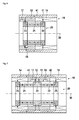
- FIG. 1 schematically shows a linear motor according to the invention in a longitudinal section.
- the linear motor is predominantly rotationally symmetrical about a central axis 30. It comprises a stator 10 and a rotor 20.
- the stator 10 has a coil 14, which is enclosed by a preferably cylindrical return element 11 in the radial direction. In the axial direction, the coil 14 is enclosed by a first stator pole piece 12 and a second stator pole piece 13. These stator pole shoes are also preferably enclosed in the radial direction by the return element. Furthermore, a first field sensor 15 on the side of the first Statorpolschuhs 12 in the axial direction adjacent to the coil and a second field sensor 16 on the side of the second Statorpolschuhs 13 in the axial direction adjacent to the coil 14 is arranged. At least one field sensor is preferably arranged in a section of a stator pole shoe.
- the cutout extends as in this Figur shown, in the axial direction, but it may also extend in the radial direction.
- the cutout can also be continued up to the return element 11 in order to provide sufficient installation space for a larger field sensor.
- the stator pole shoes and / or the return element are preferably ring-shaped.
- the rotor has a first permanent magnet 21 and a second permanent magnet 22, which are polarized in the opposite direction. Between the two permanent magnets, a middle rotor pole piece 24 is arranged. A first outer rotor pole piece 23 and a second outer rotor pole shoe 25 are arranged toward the first permanent magnet 21 at the sides opposite the middle rotor pole piece 24 in the axial direction.
- the rotor is preferably hollow, more preferably designed as a hollow cylinder.
- the permanent magnets and / or the rotor pole shoes are annular.
- the two field sensors 15, 16 are arranged in the same plane passing through the central axis 30 cutting plane, but they can also be arranged in other planes.
- the drive is preferably designed so that no axially directed reluctance forces prevail in the travel path of the rotor 10 in the de-energized state. If the coil 14 of the drive is supplied with an electric current, a Lorentz force is generated, which acts on the rotor regardless of its position.
- this embodiment as well as the other embodiments presented in this document can be realized with an ironless stator.
- the Statorpol notes 12, 13 and the return element 11 would consist of non-ferromagnetic material or even eliminated. Due to the lack of magnetic field conductive materials in the stator is the magnetic Flux density in the magnetic circuit is lower. Thus, the driving Lorentz force is reduced by an electric current flow in the coil.
- FIG. 2 a view is shown in the direction of the central axis 30.
- the preferred concentric arrangement of the components is clearly visible.
- the first field sensor 15 is arranged in a cutout which passes through the return element 11 into the first stator pole shoe 12.
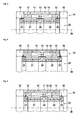
- FIGS. 3, 4 and 5 show the magnetic field characteristics at different positions of the rotor 20 relative to the stator 10.
- FIG. 3 is the rotor 20 with respect to the center position, which in the FIG. 4 is shown, moved to the left while in the FIG. 5 moved to the right.
- a first magnetic circuit 41 results from the first permanent magnet 21.
- the field continues through the first outer rotor pole shoe 23 via the first field sensor 15 or the first stator pole shoe 12 through the return element 11, via the coil 14 into the middle rotor pole shoe 24 and back to the first permanent magnet 21.
- the second magnetic circuit 42 extends in the reverse direction.
- the lines 41 and 42 are shown symbolically.
- the magnetic field is distributed, for example, over the entire end face of the permanent magnets 21, 22.
- the magnetic field in the radial direction emerges from the rotor pole shoes distributed over the surface.
- FIG. 4 occurs a part of the magnetic field from the first rotor pole piece 23 via the first field sensor 15 and parallel thereto via the first stator pole 12 in the return element 11 a.
- the field is divided between the second field sensor 16 and the second stator pole piece 13.
- the stator has only one stator pole piece 12, and the rotor has only one permanent magnet 21.
- a first field sensor 17 and optionally a second field sensor 18 are provided.
- Integrated field sensors 17, 18 with a smaller design are preferably used here, which can be integrated into the first stator pole shoe 12. These are preferably inserted into a recess of the first stator pole shoe 12.
- the field sensors 17, 18 are offset from each other in the axial direction. They can preferably also be arranged on different cutting planes through the axis of rotation. In the embodiment shown here they are arranged in the same plane, on different sides of the axis of rotation.
- the magnetic flux passes from the first outer rotor pole piece 23 through one of the field sensors. In the illustrated position, a greater portion of the magnetic flux passes through the second field sensor 18 while the first field sensor is in the field-free space.
- the magnetic field sensor can only be in the magnetic field of a pole piece.
- simpler magnetic field sensors can be used, which provide an output signal independent of the direction of the magnetic field.
- sensors are for example GMR (Giant Magneto Resistance) sensors.
- GMR Gate Magneto Resistance
- Such sensors are usually larger, more expensive and require a more complex control or evaluation.
- the integration of the magnetic field sensors in the stator pole allows a much better space utilization especially for miniature motors.
- This embodiment is also more robust because the magnetic field sensors are mechanically protected by the stator pole piece. This makes it possible to dispense with a separate housing of the magnetic field sensors.
- FIG. 7 a further embodiment according to the invention is shown.
- the rotor 20 corresponds to the rotor of the first embodiment, as for example in the FIG. 1 is shown.
- the stator has a first coil 14 and a second coil 19.
- the coils can be single-phase (identical current) or two-phase (different currents in the two coils) be supplied.
- a stator pole 12 is arranged between the two coils.
- the coils and the stator pole piece are enclosed by the return element 11.
- the field sensors 17, 18 are offset from each other in the axial direction in the Statorpolschuh 12 and received in recesses of the Statorpolschuhs.
- the magnetic field from the middle rotor pole piece 24 runs wholly or partly through the first field sensor 17 or the second field sensor 18.
- the output signals of the field sensors 17, 18 also approximately correspond to the curves 61 and 62 in FIG. 8 , Again, by a difference formation, a signal corresponding to FIG. 9 be achieved.
- the FIG. 8 shows the waveform of the field sensors, for example, according to the representations of the FIGS. 3, 4 and 5 .
- the diagram shows on the horizontal axis the distance in millimeters relative to the zero position "0", which for example the FIG. 4 equivalent.
- a deflection of -2 mm corresponds to the FIG. 3 and a deflection of +2 mm corresponds to FIG. 5 .
- the amplitudes of the sensor signals are scaled from 0-150.
- the curve 61 shows the signal of the first field sensor 15, while the curve 62 shows the course of the signal of the second field sensor 16.
- the curve 61 shows on the left, with a deflection of -2 mm, the maximum amplitude, which corresponds to the maximum magnetic flux density by the first field sensor 15. This will be at the in FIG. 3 reached shown position of the runner. At the same time, the second field sensor 16 is in almost field-free space, so that the sensor signals corresponding to the curve 62 is almost zero. In the middle position according to the FIG. 4 the flux density is approximately the same for both field sensors, so that the two curves 61 and 62 at the position "0" have the same amplitude. In the right position at +2 mm, the sensor signals behave in the opposite way as in the left position. Here goes the maximum magnetic flux density through the second field sensor 16, while the first field sensor 15 is in almost field-free space.
- FIG. 9 shows the sum of the curves 61 and 62 from the FIG. 8 in the curve 63.
- This curve can be approximated well by a linear approximation 64. This results in a measurement signal which is proportional to the position of the rotor with slight deviations.
- This measurement signal can also be fed into a control loop, so that the position of the rotor can be kept constant as a function of a desired value.
- the FIG. 10 shows the signals of the field sensors in an arrangement according to the FIG. 6 , Again, the horizontal axis indicates the displacement in the direction of the central axis, while the vertical axis indicates the amplitude of the sensor signals.
- the curve 65 indicates the signal amplitude of the first field sensor 17, while the second curve 66 indicates the amplitude of the second field sensor 18.
- the exact position can be determined by evaluating which sensor emits a signal in combination with the signal amplitude of the sensor. In this example only two sensors are shown. Of course, any higher number of field sensors can be used here in order to increase the resolution and / or the maximum path length.
- FIG. 11 shows an endoscope 80, in which a linear motor 84 is used according to the invention for adjusting the viewing angle ⁇ .
- the endoscope has a distal shaft 81 and a proximal eyepiece 83.
- Optional ports 82 may be provided for supplying light or for supplying liquids and / or gases.
- the endoscope has an axis 88, which is preferably also the optical and / or mechanical axis.
- a prism 85 is pivotally mounted about a bearing 86. The prism allows a deflection of the optical beam path, so that at different angles ⁇ entering the distal end of the endoscope Light can be detected.
- An adjustment of the prism by means of a linear motor 84 via a push / pull rod 87th
Landscapes
- Engineering & Computer Science (AREA)
- Life Sciences & Earth Sciences (AREA)
- Health & Medical Sciences (AREA)
- Physics & Mathematics (AREA)
- Surgery (AREA)
- Power Engineering (AREA)
- Electromagnetism (AREA)
- Radiology & Medical Imaging (AREA)
- Public Health (AREA)
- Nuclear Medicine, Radiotherapy & Molecular Imaging (AREA)
- Optics & Photonics (AREA)
- Pathology (AREA)
- Veterinary Medicine (AREA)
- Biophysics (AREA)
- Biomedical Technology (AREA)
- Heart & Thoracic Surgery (AREA)
- Medical Informatics (AREA)
- Molecular Biology (AREA)
- Animal Behavior & Ethology (AREA)
- General Health & Medical Sciences (AREA)
- Chemical & Material Sciences (AREA)
- Combustion & Propulsion (AREA)
- Microelectronics & Electronic Packaging (AREA)
- Signal Processing (AREA)
- Linear Motors (AREA)
- Reciprocating, Oscillating Or Vibrating Motors (AREA)
Abstract
Description
- Die Erfindung betrifft einen Linearmotor insbesondere für optische Systeme. Derartige optische Systeme werden beispielsweise in Endoskopen eingesetzt. Bei modernen Videoendoskopen sind ein Kamerachip sowie ein zugehöriges Linsensystem in die Endoskopspitze integriert. Zur Einstellung der Brennweite bzw. des Fokus des Linsensystems wird ein miniaturisierter Motor benötigt.
- Klassische Endoskope, wie sie beispielsweise für die minimalinvasive Chirurgie eingesetzt werden können, führen das Bild mittels Stablinsen vom intrakorporalen Objektiv zum extrakorporalen Okular. Durch die Stablinsen ist das System starr und in der optischen Qualität begrenzt. Moderne Videoendoskope verwenden einen Kamerachip in der Endoskopspitze. Ein solches Endoskop ist in der
US 7,365,768 B1 offenbart. Dieses hat vor dem Kamerachip eine starr angeordnete Linse. Eine Einstellung der Brennweite der Linse ist nicht möglich. - In der
DE 103 23 629 A1 ist ein Wanderfeld-Linearmotor offenbart, der mindestens drei Statorspulen aufweist. Durch eine phasenverschobene Bestromung der Spulen wird ein Wanderfeld erzeugt, welches eine Verschiebung des Läufers mit axialen Permanentmagneten bewirkt. - Aus der
DE 10 2008 038 926 A1 ist ein Linearantrieb bekannt, der zwei axial polarisierte Permanentmagnete im Läufer aufweist. Der Läufer wird durch die Bestromung der Statorspulen in axialer Richtung ausgelenkt. Zusätzlich werden die stabilen Positionen des Läufers durch die im Stator angebrachten Polschuhe realisiert, so dass eine kontinuierliche Verschiebung des Läufers in einem Hüllrohr ermöglicht wird. - In der
DE 10 2010 000 582 A1 ist ein weiterer Linearantrieb offenbart, der einen axial polarisierten Permanentmagneten im Läufer und einen oder zwei axial polarisierte Permanentmagnete im Stator aufweist. - Diese drei Linearantriebe umfassen einen Stator und einen Läufer. Die Läufer sind jeweils aus einem oder mehreren Permanentmagneten aufgebaut. Zur Umlenkung und zum Erzeugen des magnetischen Flusses in definierte Richtungen befinden sich an den Permanentmagneten Ringe aus Weicheisen (Polschuhe). Im Stator erzeugen eine oder mehrere Spulen Lorentzkräfte. Teilweise dienen zusätzliche Permanentmagnete und Ringe aus Weicheisen der Erzeugung von Reluktanzkräften. Umschlossen wird der Stator durch eine weichmagnetische Hülse, die das Rückflussjoch für den magnetischen Fluss darstellt. Im stromlosen Zustand befindet sich der Läufer aufgrund von rücktreibenden Reluktanzkräften in einer so genannten Ruheposition. Durch die Speisung der Spulen mit einem elektrischen Strom fester Stromstärke entstehen Lorentzkräfte, die zu einer kontinuierlichen Auslenkung des Läufers aus der Ruheposition führen. Durch das Einstellen eines Kräftegleichgewichts aus Lorentzkräften in der
DE 103 23 629 A1 oder aus Lorentz- und Reluktanzkraft in derDE 10 2008 038 926 A1 bzw. derDE 10 2010 000 582 A1 verharrt der Läufer auf dieser ausgelenkten Position. Dabei ist man bestrebt, die Größe der Ströme festen Positionen des Läufers zuzuordnen. Dies wird in der Regel durch Kalibrierung nach dem Aufbau der Antriebe erreicht. - Von außen einwirkende, schwer kontrollierbare Widerstandskräfte, wie beispielsweise die Reibungskraft oder die Schwerkraft, führen zur Positionierungenauigkeit. Durch die Vorgabe fester Stromstärken lässt sich demnach die Position des Läufers nur bedingt festlegen.
- Die
DE 196 05 413 A1 offenbart einen Linearantrieb mit Wegmessung. Es wird hier die Antriebswicklung gleichzeitig als Messwicklung benutzt. Durch eine solche Wegmessung lässt sich eine höhere Positioniergenauigkeit erreichen. Allerdings ist die Genauigkeit des Mess- und damit des Regelungssystems durch die geringe Änderung der Spuleninduktivität bei der Bewegung des Läufers begrenzt. - In der
US 5,747,952 ist ein dreiphasiger Linearantrieb offenbart, bei dem durch einen Hall-Sensor zwischen Spule und Läufer das Magnetfeld gemessen und die Amplitude des Steuersignals auf einen konstanten Wert geregelt wird. - Der Erfindung liegt die Aufgabe zugrunde, einen Linearmotor dahingehend zu verbessern, dass der Läufer in definierte Positionen gebracht werden kann bzw. eine definierte und vorzugsweise eine lineare Kennlinie zwischen einem Steuersignal und einer Läuferposition besteht. Weiterhin soll bevorzugt die Position des Läufers in weiten Grenzen unabhängig von einer äußeren Last sein. Der Linearmotor soll soweit miniaturisierbar sein, dass er in ein Endoskop integrierbar ist.
- Diese Aufgabe wird durch eine Vorrichtung nach einem der unabhängigen Ansprüche gelöst. Vorteilhafte Ausgestaltungen der Erfindung sind in den Unteransprüchen angegeben.
- Der erfindungsgemäße Linearmotor umfasst einen Stator sowie einen dazu linear verschiebbaren Läufer. Bevorzugt ist der Linearmotor weitgehend rotationssymmetrisch aufgebaut. Dabei sind die Komponenten weitgehend ringförmig ausgeführt. Die Bewegung des Läufers erfolgt bevorzugt entlang einer Achse, welche bevorzugt parallel zur Mittelachse der rotationssymmetrischen Anordnung liegt und besonders bevorzugt mit dieser identisch ist. Der Stator hat eine oder zwei Spulen, wobei bevorzugt in axialer Richtung seitlich zu den Spulen wenigstens ein Statorpolschuh, sowie in radialer Richtung an der Außenseite ein Rückschlußelement, welches zumindest weitgehend parallel zur Bewegungsrichtung angeordnet ist und bevorzugt die eine oder zwei Spulen und besonders bevorzugt wenigstens einen Statorpolschuh umschließt. Der Läufer wird in radialer Richtung zumindest teilweise von der Spule umschlossen und hat einen ersten Permanentmagneten sowie optional einen zweiten Permanentmagneten. Bevorzugt ist seitlich in axialer Richtung an den Permanentmagneten jeweils ein Läuferpolschuh angeordnet. Es ist im Falle von zwei Permanentmagneten zwischen den beiden Permanentmagneten bevorzugt noch ein Polschuh angeordnet. Die Läuferpolschuhe ermöglichen einen definierten Austritt der Magnetfelder der Permanentmagnete durch die Spule in Richtung des Rückschlußelements. Grundsätzlich arbeitet die Anordnung auch ohne Polschuhe. Durch die Polschuhe kann jedoch die Kraft des Motors um mehr als eine Größenordnung erhöht werden. Im Falle von zwei Permanentmagneten, sind diese axial magnetisiert und mit ihrer Polung so ausgerichtet, dass sich wahlweise die Nordpole oder die Südpole gegenüber liegen. Der Läufer und insbesondere die Permanentmagnete sowie die Polschuhe sind bevorzugt hohlzylindrisch, d.h. sie haben die Form einer zylindrischen Hülse. Der Strahlengang eines optischen Systems kann dann durch die Hülse verlaufen. Insbesondere kann eine Linse oder ein anderes optisches Element in der Hülse sitzen. Somit kann durch eine Verschiebung der Hülse die Brennweite und/oder auch der Fokus des optischen Systems eingestellt werden.
- Die Polschuhe und das Rückschlußelement umfassen bevorzugt ferromagnetische und/oder weichmagnetische Materialien.
- Der Linearmotor ist bis zu einer Größe von wenigen Millimetern Außendurchmesser problemlos miniaturisierbar.
- Die Spule kann wahlweise auf einen Spulenkörper oder auch ohne Spulenkörper gewickelt sein. Sie kann auch mehrteilig sein, d.h. aus mehreren Wicklungen bestehen.
- Zur mittelbaren Bestimmung der Position des Läufers sind ein oder zwei Magnetfeldsensoren, hier auch Feldsensoren genannt, vorgesehen. Grundsätzlich kann auch eine höhere Anzahl von Feldsensoren eingesetzt werden. Die Magnetfeldsensoren sind seitlich in axialer Richtung neben der wenigstens einen Wicklung angeordnet. Durch diese Magnetfeldsensoren verläuft in Abhängigkeit von der Position des Läufers ein Anteil des magnetischen Flusses durch die Permanentmagnete. Über die Bestimmung des magnetischen Flusses bzw. der entsprechenden magnetischen Flussdichte B kann auf die Position des Läufers rückgeschlossen werden. Durch einphasige Bestromung der Spulen lässt sich die Ansteuerungselektronik unkompliziert realisieren. Der einfache Aufbau ermöglicht die Miniaturisierung des Antriebs, so dass er sich für den Einsatz in minimalinvasiven Instrumenten eignet. Bevorzugt ist der wenigstens eine Magnetfeldsensor seitlich neben wenigstens einem Statorpolschuh angeordnet. Alternativ kann auch wenigstens ein Magnetfeldsensor in einen Statorpolschuh integriert sein. Besonders vorteilhaft ist die Auswertung der Signaldifferenz von wenigstens zwei Magnetfeldsensoren. Dadurch kann eine stärkere Unabhängigkeit von äußeren Einflüssen wie beispielsweise der Temperatur sowie eine größere Messgenauigkeit erreicht werden.
- Die bevorzugte Ausführungsform hat eine Spule und auf beiden Seiten in axialer Richtung Statorpolschuhe, wobei die Spule und die Statorpolschuhe von einem Rückschlusselement umschlossen sind. Seitlich neben den Statorpolschuh bzw. in die Statorpolschuhe integriert sind zwei Magnetfeldsensoren vorgesehen. Der Läufer hat zwei in entgegengesetzter Richtung polarisierte Permanentmagnete, wobei zwischen den beiden Permanentmagneten ein Läuferpolschuh und an den Enden der Permanentmagnete zwei weitere Läuferpolschuhe vorgesehen sind. Eine Variante des erfindungsgemäßen Linearmotors hat nur einen Statorpolschuh und entsprechend auch nur einen Feldsensor. Passend hierzu kann der Läufer vereinfacht mit nur einem Permanentmagneten und bevorzugt mit zwei Läuferpolschuhen an den Enden des Permanentmagneten ausgestaltet sein.
- In einer weiteren Ausgestaltung der Erfindung sind zwei Spulen seitlich in axialer Richtung an zwei Seiten eines Statorpolschuhs angeordnet. Hier ist mindestens ein Magnetfeldsensor, bevorzugt zwei Magnetfeldsensoren in den Statorpolschuh integriert. Bevorzugt wird hier ein Läufer mit zwei entgegengesetzt gepolten Permanentmagneten und jeweils einem Läuferpolschuh zwischen den Permanentmagneten sowie an den äußeren Enden der Permanentmagnete eingesetzt.
- Zur Magnetfeldmessung können unterschiedliche Sensortypen zum Einsatz kommen. Die gängigsten Sensoren sind Hall-Effekt-Sensoren, GMR-Sensoren und AMR-Sensoren.
- Bei dem erfindungsgemäßen Linearmotor ist kein Gleichgewichtszustand zwischen Reluktanzkraft- und Lorentzkraft für die Positionierung, wie bei den aus dem Stand der Technik bekannten Linearantrieben notwendig. Dies führt im Vergleich zu deutlich höheren Antriebs- und Stellkräften bei gleicher elektrischer Leistung. Dadurch lässt er sich auch in chirurgischen Instrumenten einsetzen.
- Die verschiedenen Varianten des erfindungsgemäßen Linearmotors können auch mit einem eisenlosen Stator realisiert werden. Hierbei würden dann die Statorpolschuhe sowie das Rückschlusselement aus nicht-ferromagnetischem Material bestehen oder gar entfallen. Aufgrund der fehlenden magnetfeldleitenden Materialien im Stator ist die magnetische Flussdichte im magnetischen Kreis geringer. Damit wird auch die antreibende Lorentzkraft durch einen elektrischen Stromfluss in der Spule geringer.
- In einer weiteren vorteilhaften Ausgestaltung der Erfindung ist zwischen dem Stator und dem Läufer eine Gleitschicht. Diese kann insbesondere im Falle einer rotationssymmetrischen Anordnung als Gleithülse ausgeführt sein. Um die Magnetfelder möglichst wenig zu beeinflussen soll die Gleitschicht aus einem nicht magnetfeldführenden Material, insbesondere aus einem nicht- ferromagnetischen Material bestehen. Ihre Oberfläche umfasst bevorzugt ein Material mit niedrigem Reibungskoeffizienten, beispielsweise PTFE (Polytetrafluorethylen), Siliziumnitrid, Siliziumkarbid, Poly-para-Xylylen Polymere oder DLC (diamond like carbon) wie beispielsweise in der
US 5,478,650 offenbart. - Die Gleitschicht kann Unebenheiten auf der dem Läufer zugewandten Seite des Stators ausgleichen.
- Der beschriebene Linearmotor kann in einer alternativen Ausführungsform mit einem ebenen, z.B. plattenförmig aufgebauten Stator und einem ebenfalls ebenen bzw. plattenförmigen Polschuh des Läufers realisiert werden. Alternativ können auch mehrere um einen Zylinder oder einen vieleckigen Körper angeordnete Linearmotoren vorgesehen sein. So ergibt sich beispielsweise bei einer gleichmäßigen Anordnung von Linearmotoren um einen Zylinder eine stabile Führung.
- Ein erfindungsgemäßer Linearmotor kann auch aus Vollmaterial bestehen und an einem Ende einen Stößel zur Nanopositionierung von Instrumenten aufweisen. Eine solche Vorrichtung ist bevorzugt in der Molekularbiologie, der Mikroelektronik oder auch der Neurochirurgie einsetzbar.
- Durch den einfachen Aufbau lässt sich der Antrieb in Bezug auf die axiale Baulänge sehr kompakt ausführen. Damit ist der Antrieb als Ausführung mit einem Hohlläufer für den Einsatz in optischen Systemen gut geeignet.
- Der erfindungsgemäße Antrieb kann direkt in das Objektiv einer Endoskopkamera integriert werden. Eine geregelte Einstellung von Zoom- und Fokusfunktion mit Messung der Position der beweglichen optischen Linsengruppen ist damit möglich. Durch die kleine Bauform können nun auch platzsparend Stereokameras mit zwei Einzelobjektiven für 3D-Systeme in ein konventionelles Kameragehäuse integriert werden. Der erfindungsgemäße Linearantrieb ist bevorzugt zweimal in identischer Bauweise für die Bewegung von Linsengruppen entlang der optischen Achse integriert. Durch die geregelte Positionierung der Linsengruppen durch die Linearantriebe können die auf die Bildaufnehmer auftreffenden Bilder scharf angezeigt werden.
- In Chip-on-the-Tip-Objektiven kann die komplette Optik einschließlich eines Kamerachips in die Spitze eines Endoskops integriert werden. Dabei werden optische Linsengruppen beispielsweise entlang der optischen Achse bewegt, um eine Scharfeinstellung (Fokussierung) oder eine Vergrößerung (Zoomfunktion) des Bilds zu ermöglichen. Der erfindungsgemäße geregelte Linearantrieb kann in miniaturisierter Form ebenfalls in Videoendoskopen zum Einsatz kommen. Durch den erfindungsgemäßen Antrieb bietet sich dabei die Möglichkeit, die Position der Linsengruppen durch Rückkopplung der Positionssignale zu regeln. Durch die Messung der Läuferposition mit den Magnetfeldsensoren ist die Position der Linsengruppen bekannt. Bei einem Antrieb für die Fokusverstellung kann damit bei Kenntnis über das optische System der Objektabstand zu scharfgestellten Objekten ermittelt werden. Mit dem erfindungsgemäßen Linearantrieb ist auch eine einfache Kopplung von zwei oder mehreren beweglichen Linsengruppen möglich. Bei Stereoendoskopen in Chip-on-the-Tip-Ausführung werden für die Paarbildaufnahme häufig zwei nebeneinander liegende optische Linsensysteme an der Endoskopspitze verwendet. Sollen hierbei jeweils Linsengruppen für eine Fokussierung oder Zoomfunktion axial motorisch beweglich sein, können zwei erfindungsgemäße Antriebe dafür eingesetzt werden.
- Durch den Einsatz des erfindungsgemäßen Antriebs in einem chirurgischen Instrument ist es möglich, einen Öffnungswinkel Phi eines Maulteils geregelt einzustellen. Über die Magnetfeldsensoren kann der Läufer des erfindungsgemäßen Antriebs wie oben beschrieben innerhalb des Stators positioniert werden. Wird eine Zug-Druck-Stange, die durch eine Linearbewegung das Öffnen und Schließen eines Maulteils hervorruft, an den Antrieb montiert, kann über die Position des Läufers der Öffnungswinkel des Instruments Phi eingestellt werden. Durch den geregelten Betrieb kann unabhängig von der Schließkraft des Maulteils der Öffnungswinkel Phi beibehalten oder eingestellt werden. Da es sich bei dem erfindungsgemäßen Antrieb um einen über Lorentzkraft betätigten Linearmotor handelt, kann über den Zusammenhang der Stromstärke in der Spule auch die axial wirkende Antriebskraft ermittelt werden. Dadurch kann auch die Schließkraft am Maulteil berechnet werden. Dieser Zusammenhang spielt vor allem bei neuartigen Force-Feedback-Systemen eine große Rolle, bei denen der operierende Arzt eine Rückmeldung über die Höhe der Schließkraft am Maulteil erhält.
- Die Erfindung wird nachstehend ohne Beschränkung des allgemeinen Erfindungsgedankens anhand von Ausführungsbeispielen unter Bezugnahme auf die Zeichnungen exemplarisch beschrieben.
- Figur 1
- zeigt schematisch einen Linearmotor entsprechend der Erfindung in einem Längsschnitt.
- Figur 2
- zeigt den linearen Motor in einem Querschnitt.
- Figur 3
- zeigt den magnetischen Feldverlauf in einer ersten Läuferposition.
- Figur 4
- zeigt den magnetischen Feldverlauf in einer zweiten Läuferposition.
- Figur 5
- zeigt den magnetischen Feldverlauf in einer dritten Läuferposition.
- Figur 6
- zeigt eine weitere Ausführungsform mit nur einem Statorpolschuh.
- Figur 7
- zeigt eine weitere Ausführungsform mit zwei Spulen.
- Figur 8
- zeigt die Sensorsignale einer Anordnung nach
Figur 1 in Abhängigkeit von der Position. - Figur 9
- zeigt die Differenz der Sensorsignale in Abhängigkeit von der Position.
- Figur 10
- zeigt die Sensorsignale in einer Anordnung nach
Figur 6 . - Figur 11
- zeigt ein Endoskop mit einem durch einen linearen Motor schwenkbaren Prisma.
- Die
Figur 1 zeigt schematisch einen Linearmotor entsprechend der Erfindung in einem Längsschnitt. Entsprechend dem hier dargestellten bevorzugten Ausführungsbeispiel ist der Linearmotor überwiegend rotationssymmetrisch um eine Mittelachse 30 aufgebaut. Er umfasst einen Stator 10 sowie einen Läufer 20. - Der Stator 10 hat eine Spule 14, welche von einem vorzugsweise zylindrischen Rückschlusselement 11 in radialer Richtung umschlossen ist. In axialer Richtung ist die Spule 14 durch einen ersten Statorpolschuh 12 und einen zweiten Statorpolschuh 13 eingeschlossen. Bevorzugt sind auch diese Statorpolschuhe durch das Rückschlusselement in radialer Richtung umschlossen. Weiterhin ist ein erster Feldsensor 15 auf der Seite des ersten Statorpolschuhs 12 in axialer Richtung neben der Spule und ein zweiter Feldsensor 16 auf der Seite des zweiten Statorpolschuhs 13 in axialer Richtung neben der Spule 14 angeordnet. Bevorzugt ist wenigstens ein Feldsensor in einem Ausschnitt eines Statorpolschuhs angeordnet. Besonders bevorzugt erstreckt sich der Ausschnitt, wie in dieser Figur dargestellt, in axialer Richtung, er kann sich aber auch in radialer Richtung erstrecken. Der Ausschnitt kann auch bis in das Rückschlusselement 11 fortgesetzt sein, um einem größeren Feldsensor hinreichend Einbauraum zu bieten. Bevorzugt sind die Statorpolschuhe und/oder das Rückschlusselement ringförmig ausgebildet.
- Der Läufer hat einen ersten Permanentmagnet 21 und einen zweiten Permanentmagnet 22, welche in entgegengesetzter Richtung polarisiert sind. Zwischen den beiden Permanentmagneten ist ein mittlerer Läuferpolschuh 24 angeordnet. An den in axialer Richtung dem mittleren Läuferpolschuh 24 entgegengesetzten Seiten sind zum ersten Permanentmagnet 21 hin ein erster äußerer Läuferpolschuh 23 und zum zweiten Permanentmagnet 22 hin ein zweiter äußerer Läuferpolschuh 25 angeordnet. Der Läufer ist bevorzugt hohl, besonders bevorzugt hohlzylindrisch ausgeführt. Bevorzugterweise sind die Permanentmagnete und/oder die Läuferpolschuhe ringförmig ausgebildet.
- Bevorzugt sind die beiden Feldsensoren 15, 16 in derselben durch die Mittelachse 30 verlaufenden Schnittebene angeordnet, sie können aber auch in anderen Ebenen angeordnet sein.
- Der Antrieb ist bevorzugt so ausgelegt, dass innerhalb des Verfahrwegs des Läufers 10 im unbestromten Zustand keine axial gerichteten Reluktanzkräfte herrschen. Wird die Spule 14 des Antriebs mit einem elektrischen Strom versorgt, entsteht eine Lorentzkraft, die auf den Läufer unabhängig von dessen Position einwirkt.
- Grundsätzlich kann diese Ausführungsform wie auch die anderen in diesem Dokument vorgestellten Ausführungsformen mit einem eisenlosen Stator realisiert werden. Hierbei würden dann die Statorpolschuhe 12, 13 sowie das Rückschlusselement 11 aus nicht-ferromagnetischem Material bestehen oder gar entfallen. Aufgrund der fehlenden magnetfeldleitenden Materialien im Stator ist die magnetische Flussdichte im magnetischen Kreis geringer. Damit wird auch die antreibende Lorentzkraft durch einen elektrischen Stromfluss in der Spule geringer.
- In der
Figur 2 ist eine Ansicht in Richtung der Mittelachse 30 dargestellt. Hier ist die bevorzugte konzentrische Anordnung der Komponenten deutlich zu erkennen. In dieser Ausführungsform ist der erste Feldsensor 15 in einem Ausschnitt, der durch das Rückschlusselement 11 in den ersten Statorpolschuh 12 geht, angeordnet. - Die
Figuren 3, 4 und 5 zeigen die magnetischen Feldverläufe bei verschiedenen Positionen des Läufers 20 relativ zum Stator 10. In derFigur 3 ist der Läufer 20 gegenüber der Mittelposition, welche in derFigur 4 dargestellt ist, nach links verschoben, während er in derFigur 5 nach rechts verschoben ist. Grundsätzlich ergibt sich ein erster magnetischer Kreis 41 ausgehend von dem ersten Permanentmagnet 21. Das Feld verläuft durch den ersten äußeren Läuferpolschuh 23 über den ersten Feldsensor 15 bzw. den ersten Statorpolschuh 12 weiter durch das Rückschlusselement 11, über die Spule 14 weiter in den mittleren Läuferpolschuh 24 und zurück zum ersten Permanentmagnet 21. Entsprechend verläuft der zweite magnetische Kreis 42 in umgekehrter Richtung. - Zur Darstellung des magnetischen Feldverlaufs sind symbolisch die Linien 41 und 42 eingezeichnet. Tatsächlich verteilt sich das magnetische Feld beispielsweise über die gesamte Stirnfläche der Permanentmagnete 21, 22. Ebenso tritt das magnetische Feld in radialer Richtung aus den Läuferpolschuhen verteilt über die Fläche aus.
- In der Darstellung der
Figur 3 ist offensichtlich, dass ein überwiegender Teil des magnetischen Felds durch den ersten Feldsensor 15 verläuft, während ein vernachlässigbarer Anteil durch den ersten Statorpolschuh 12 geht. Das magnetische Feld ausgehend vom zweiten Läuferpolschuh 25 tritt überwiegend über den zweiten Statorpolschuh 13 in das Rückschlusselement 11 ein. Es wird nur ein minimaler und daher vernachlässigbarer Anteil durch den zweiten Feldsensor 16 hindurch treten. - In der
Figur 4 tritt ein Teil des magnetischen Feldes aus dem ersten Läuferpolschuh 23 über den ersten Feldsensor 15 und parallel hierzu über den ersten Statorpolschuh 12 in das Rückschlusselement 11 ein. Ähnliches gilt für das Feld aus dem zweiten Läuferpolschuh 25. Hier teilt sich das Feld ebenfalls zwischen dem zweiten Feldsensor 16 und dem zweiten Statorpolschuh 13 auf. - In der
Figur 5 tritt der überwiegende Teil des Feldes aus dem ersten Läuferpolschuh 23 über den ersten Statorpolschuh 12 in das Rückschlusselement 11 ein, während der Großteil des Feldes aus dem zweiten Läuferpolschuh 25 durch den zweiten Feldsensor 16 verläuft. - In der
Figur 6 ist eine weitere Ausführungsform der Erfindung dargestellt. In dieser Ausführungsform hat der Stator nur einen Statorpolschuh 12, und der Läufer hat nur einen Permanentmagneten 21. Es ist ein erster Feldsensor 17 und optional ein zweiter Feldsensor 18 vorgesehen. Es werden hier bevorzugt integrierte Feldsensoren 17, 18 mit einer kleineren Bauform verwendet, die in den ersten Statorpolschuh 12 integriert werden können. Bevorzugt werden diese in eine Aussparung des ersten Statorpolschuhs 12 eingesetzt. Die Feldsensoren 17, 18 sind in axialer Richtung gegeneinander versetzt. Sie können bevorzugt auch auf verschiedenen Schnittebenen durch die Rotationsachse angeordnet sein. In dem hier gezeigten Ausführungsbeispiel sind sie in der gleichen Ebene, auf unterschiedlichen Seiten der Rotationsachse angeordnet. In Abhängigkeit von der Position des Läufers 20 in Bezug auf den Stator 10 durchsetzt der magnetische Fluss ausgehend von dem ersten äußeren Läuferpolschuh 23 einen der Feldsensoren. In der dargestellten Position verläuft ein größerer Teil des magnetischen Flusses durch den zweiten Feldsensor 18, während sich der erste Feldsensor im feldfreien Raum befindet. - Durch die hier dargestellte Anordnung kann der Magnetfeldsensor nur im Magnetfeld eines Polschuhs liegen. Dadurch können einfachere Magnetfeldsensoren eingesetzt werden, die ein Ausgangssignal unabhängig von der Richtung des Magnetfelds liefern. Solche Sensoren sind beispielsweise GMR-(Giant Magneto Resistance) Sensoren. Beim Stand der Technik ist es oftmals notwendig, richtungssensitive Magnetfeldsensoren wie beispielsweise Hall-Sensoren einzusetzen, um eine eindeutige Positionserkennung zu erreichen. Solche Sensoren sind meist größer, teurer und erfordern eine komplexere Ansteuerung bzw. Auswertung.
- Die Integration der Magnetfeldsensoren in den Statorpolschuh erlaubt insbesondere bei Miniaturmotoren eine wesentlich bessere Raumausnutzung. Diese Ausführungsform ist gleichzeitig robuster, da die Magnetfeldsensoren durch den Statorpolschuh mechanisch geschützt werden. Dadurch kann auf ein separates Gehäuse der Magnetfeldsensoren verzichtet werden.
- Grundsätzlich kann bei dieser Ausführungsform eines Linearmotors auch eine Anordnung aus einem ersten Magnetfeldsensor 15 neben einem ersten Statorpolschuh 12 wie in der Ausführungsform nach
Figur 1 eingesetzt werden. Ebenso kann auch die Ausführungsform derFigur 1 mit einem in den ersten Statorpolschuh 12 integrierten ersten Feldsensor 17, entsprechend diesem Ausführungsbeispiel realisiert werden. Bevorzugt wird dann auch der zweite Feldsensor 16 aus dem Ausführungsbeispiel derFigur 1 durch einen in den zweiten Statorpolschuh 13 integrierten zweiten Feldsensor 18 ersetzt. - In der
Figur 7 ist eine weitere Ausführungsform entsprechend der Erfindung dargestellt. Der Läufer 20 entspricht dem Läufer aus der ersten Ausführungsform, wie sie beispielsweise in derFigur 1 dargestellt ist. Der Stator hat hier eine erste Spule 14 und eine zweite Spule 19. Die Spulen können einphasig (identische Stromstärke) oder zweiphasig (unterschiedliche Stromstärken in den beiden Spulen) versorgt werden. Zwischen den beiden Spulen ist ein Statorpolschuh 12 angeordnet. Die Spulen und der Statorpolschuh werden durch das Rückschlusselement 11 umschlossen. Die Feldsensoren 17, 18 sind in axialer Richtung gegeneinander versetzt in den Statorpolschuh 12 integriert bzw. in Aussparungen des Statorpolschuhs aufgenommen. Das Magnetfeld aus dem mittleren Läuferpolschuh 24 läuft je nach Position des Läufers ganz oder teilweise durch den ersten Feldsensor 17 oder den zweiten Feldsensor 18. Die Ausgangssignale der Feldsensoren 17, 18 entsprechen näherungsweise ebenfalls den Kurven 61 und 62 aus derFigur 8 . Auch hier kann durch eine Differenzbildung ein Signal entsprechend derFigur 9 erreicht werden. - Die
Figur 8 zeigt den Signalverlauf der Feldsensoren beispielsweise entsprechend den Darstellungen aus denFiguren 3, 4 und 5 . Das Diagramm zeigt auf der horizontalen Achse den Abstand in Millimetern bezogen auf die Nullposition "0", welche beispielsweise dieFigur 4 entspricht. Eine Auslenkung von -2 mm entspricht derFigur 3 und eine Auslenkung von +2 mm entspricht derFigur 5 . An der vertikalen Achse sind die Amplituden der Sensorsignale von 0-150 skaliert aufgetragen. Die Kurve 61 zeigt das Signal des ersten Feldsensors 15, während die Kurve 62 den Verlauf des Signals des zweiten Feldsensors 16 zeigt. - Die Kurve 61 zeigt links, bei einer Auslenkung von -2 mm die maximale Amplitude, was der maximalen magnetischen Flussdichte durch den ersten Feldsensor 15 entspricht. Diese wird bei der in
Figur 3 dargestellten Lage des Läufers erreicht. Gleichzeitig befindet sich der zweite Feldsensor 16 im nahezu feldfreien Raum, so dass das Sensorsignale entsprechend der Kurve 62 nahezu null ist. In der Mittelposition entsprechend derFigur 4 ist die Flussdichte bei beiden Feldsensoren näherungsweise gleich, so dass auch die beiden Kurven 61 und 62 an der Position "0" die gleiche Amplitude haben. An der rechten Position bei +2 mm verhalten sich die Sensorsignale umgekehrt wie an der linken Position. Hier geht die maximale magnetische Flussdichte durch den zweiten Feldsensor 16, während der erste Feldsensor 15 im nahezu feldfreien Raum liegt. - Die
Figur 9 zeigt die Summe der Kurven 61 und 62 aus derFigur 8 in der Kurve 63. Diese Kurve kann durch eine lineare Approximation 64 gut angenähert werden. Es ergibt sich somit ein Messsignal, welches mit geringen Abweichungen proportional zur Position des Läufers ist. Dieses Messsignal kann auch in eine Regelschleife eingespeist werden, so dass die Position des Läufers in Abhängigkeit von einem Sollwert konstant gehalten werden kann. - Die
Figur 10 zeigt die Signale der Feldsensoren in einer Anordnung entsprechend derFigur 6 . Auch hier zeigt die horizontale Achse die Verschiebung in Richtung der Mittelachse an, während die vertikale Achse die Amplitude der Sensorsignale angibt. Die Kurve 65 gibt die Signalamplitude des ersten Feldsensors 17 an, während die zweite Kurve 66 die Amplitude des zweiten Feldsensors 18 angibt. So kann über die Auswertung, welcher Sensor ein Signal abgibt in Kombination mit der Signalamplitude des Sensors die exakte Position ermittelt werden. In diesem Beispiel sind nur zwei Sensoren dargestellt. Selbst verständlich kann hier eine beliebige höhere Anzahl von Feldsensoren verwendet werden, um die Auflösung und/oder die maximale Weglänge zu erhöhen. - Die
Figur 11 zeigt ein Endoskop 80, bei dem ein Linearmotor 84 entsprechend der Erfindung zur Verstellung des Blickwinkels ϕ eingesetzt wird. Das Endoskop hat einen distalen Schaft 81 sowie ein proximales Okular 83. Es können optionale Anschlüsse 82 zur Lichteinspeisung oder auch zur Einspeisung von Flüssigkeiten und/oder Gasen vorgesehen sein. Das Endoskop hat eine Achse 88, welche bevorzugt auch die optische und/oder mechanische Achse ist. Am distalen Ende des Schafts 81 ist ein Prisma 85 um eine Lagerung 86 schwenkbar angeordnet. Das Prisma ermöglicht eine Ablenkung des optischen Strahlengangs, so dass unter verschiedenen Blickwinkeln ϕ in das distale Ende des Endoskops eintretendes Licht erfasst werden kann. Eine Verstellung des Prismas erfolgt mittels eines Linearmotors 84 über eine Schub/Zugstange 87. -
- 10
- Stator
- 11
- Rückschlußelement
- 12
- Erster Statorpolschuh
- 13
- Zweiter Statorpolschuh
- 14
- Spule
- 15
- erster Feldsensor
- 16
- zweiter Feldsensor
- 17
- erster integrierter Feldsensor
- 18
- zweiter integrierter Feldsensor
- 19
- Zweite Spule
- 20
- Läufer
- 21
- erster Permanentmagnet
- 22
- zweiter Permanentmagnet
- 23
- erster Läuferpolschuh
- 24
- zweiter Läuferpolschuh
- 25
- dritter Läuferpolschuh
- 30
- Mittelachse
- 41
- erster Feldverlauf
- 42
- zweiter Feldverlauf
- 51
- erste Linse
- 52
- zweite Linse
- 61
- Signalverlauf erster Feldsensor
- 62
- Signalverlauf zweiter Feldsensor
- 63
- Differenz der Signalverläufe
- 64
- lineare Approximation
- 65
- Signalverlauf erster integrierter Feldsensor
- 66
- Signalverlauf zweiter integrierter Feldsensor
- 80
- Endoskop
- 81
- Endoskopschaft
- 82
- Anschluss
- 83
- Okular
- 84
- Linearmotor
- 85
- Prisma
- 86
- Lager
- 87
- Schub/Zugstange
- 88
- Mittelachse
Claims (14)
- Linearmotor umfassend
einen Stator (10) mit einer Mittelachse (30), einer Spule (14), die in Axialrichtung zur Mittelachse (30) auf zwei Seiten von einem ersten ringförmigen Statorpolschuh (12) und einem zweiten ringförmigen Statorpolschuh (13) eingeschlossen ist, einem Rückschlusselement (11), welches in radialer Richtung die Spule (14) umschließt, sowie einem ersten Feldsensor (15), in Axialrichtung neben der Spule (14) auf der Seite des ersten Statorpolschuhs (12) und einem zweiten Feldsensor (16) in Axialrichtung neben der Spule (14) auf der Seite des zweiten Statorpolschuhs (13), und
einen in Axialrichtung im Stator verschiebbaren, hohlen Läufer (20) mit einem ersten ringförmigen Permanentmagneten (21) und einem zweiten ringförmigen Permanentmagneten (22), die in entgegengesetzter Richtung polarisiert sind, einem ringförmigen mittleren Läuferpolschuh (24) zwischen den beiden Permanentmagneten sowie einem ringförmigen ersten äußeren Läuferpolschuh (23) an der in axialer Richtung dem mittleren Läuferpolschuh (24) entgegengesetzten Seite des ersten Permanentmagneten (21) und einem ringförmigen zweiten äußeren Läuferpolschuh (25) an der in axialer Richtung dem mittleren Läuferpolschuh (24) entgegengesetzten Seite des zweiten Permanentmagneten (22),
wobei wenigstens ein Teil des magnetischen Flusses von dem ersten äußeren Läuferpolschuh (23) und/oder dem zweiten äußeren Läuferpolschuh (25) durch wenigstens einen der Feldsensoren (15,16) verläuft. - Linearmotor umfassend
einen Stator (10) mit einer Mittelachse (30), einer Spule (14), die in Axialrichtung zur Mittelachse (30) auf einer Seite von einem ringförmigen Statorpolschuh (12) abgeschlossen ist, einem Rückschlusselement (11), welches in radialer Richtung die Spule (14) umschließt, sowie einem Feldsensor (17), in den ersten Statorpolschuh (12) integriert, und
einen in Axialrichtung im Stator verschiebbaren, hohlen Läufer (20) mit einem ersten ringförmigen Permanentmagneten (21), sowie einem ringförmigen ersten äußeren Läuferpolschuh (23) und einem ringförmigen zweiten äußeren Läuferpolschuh (24) auf den axial gegenüberliegenden Seiten des Permanentmagneten (21),
wobei wenigstens ein Teil des magnetischen Flusses von dem ersten äußeren Läuferpolschuh (23) durch den Feldsensor (17) verläuft. - Linearmotor nach Anspruch 2,
dadurch gekennzeichnet, dass
ein zweiter Feldsensor (18) in den Statorpolschuh (12) integriert und in Axialrichtung gegen den ersten Feldsensor (17) versetzt ist. - Linearmotor umfassend
einen Stator (10) mit einer Mittelachse (30), einer ersten Spule (14), einer zweiten Spule (19), einem ersten ringförmigen Statorpolschuh (12) zwischen den beiden Spulen (14, 19), einem Rückschlusselement (11), welches in radialer Richtung die Spulen (14, 19) umschließt, sowie einem ersten Feldsensor (17) und einem zweiten Feldsensor (18), wobei beide Feldsensoren (17, 18) in den Statorpolschuh (12) integriert und in Axialrichtung zur Mittelachse (30) gegeneinander versetzt sind, und
einen in Axialrichtung im Stator verschiebbaren, hohlen Läufer (20) mit einem ersten ringförmigen Permanentmagneten (21) und einem zweiten ringförmigen Permanentmagneten (22), die in entgegengesetzter Richtung polarisiert sind, einem ringförmigen mittleren Läuferpolschuh (24) zwischen den beiden Permanentmagneten sowie einem ringförmigen ersten äußeren Läuferpolschuh (23) an der in axialer Richtung dem mittleren Läuferpolschuh (24) entgegengesetzten Seite des ersten Permanentmagneten (21) und einem ringförmigen zweiten äußeren Läuferpolschuh (25) an der in axialer Richtung dem mittleren Läuferpolschuh (24) entgegengesetzten Seite des zweiten Permanentmagneten (22),
wobei wenigstens ein Teil des magnetischen Flusses von dem mittleren Läuferpolschuh (24) durch wenigstens einen der Feldsensoren (17,18) verläuft. - Linearmotor nach einem der vorhergehenden Ansprüche,
dadurch gekennzeichnet, dass
wenigstens einer der Feldsensoren (15, 16, 17, 18) in einem Ausschnitt des jeweiligen Statorpolschuhs (12, 13) angeordnet oder in den Statorpolschuh integriert ist. - Linearmotor nach Anspruch 1, 3 oder 4,
dadurch gekennzeichnet, dass
eine Auswerteschaltung vorgesehen ist, welche ein Signal zur Positionsangabe des Läufers mithilfe der Summe aus den Signalen der beiden Feldsensoren (15, 16 oder 17,18) erzeugt. - Linearmotor nach einem der vorhergehenden Ansprüche,
dadurch gekennzeichnet, dass
eine Regelschaltung vorgesehen ist, welche eine Sollgröße für eine Position des Läufers mit einem Messwert aus wenigstens einem Signal wenigstens eines Feldsensors vergleicht und ein Stellsignal zur Konstanthaltung der Position des Läufers erzeugt. - Linearmotor nach einem der vorhergehenden Ansprüche,
dadurch gekennzeichnet, dass
wenigstens einer der Feldsensoren (15, 16) in radialer Richtung von dem Rückschlusselement (11) umschlossen ist. - Linearmotor nach einem der vorhergehenden Ansprüche,
dadurch gekennzeichnet, dass
wenigstens ein Statorpolschuh (12,13) und/oder wenigstens ein Läuferpolschuh (23, 24, 25) und/oder das Rückschlusselement (11) wenigstens ein ferromagnetisches Material umfassen. - Linearmotor nach einem der vorhergehenden Ansprüche,
dadurch gekennzeichnet, dass
im Inneren des Läufers (20) ein optisches Element (51, 52) aufgenommen werden kann. - Linearmotor nach einem der vorhergehenden Ansprüche,
dadurch gekennzeichnet, dass
eine Gleithülse mit einem nicht ferromagnetischen Material mit niedrigem Reibungskoeffizienten an der Oberfläche zwischen Stator (10) und Läufer (20) angeordnet ist. - Kamera mit einem Linearmotor nach einem der vorhergehenden Ansprüche,
dadurch gekennzeichnet, dass
der Linearmotor zur Steuerung wenigstens einer optischen Komponente vorgesehen ist. - Endoskop mit einem Linearmotor nach einem der vorhergehenden Ansprüche,
dadurch gekennzeichnet, dass
der Linearmotor zur Steuerung wenigstens einer optischen Komponente vorgesehen ist. - Medizinisches Instrument nach einem der vorhergehenden Ansprüche, dadurch gekennzeichnet, dass
der Linearmotor zur Einstellung des Öffnungswinkels eines Maulteils vorgesehen ist.
Applications Claiming Priority (1)
| Application Number | Priority Date | Filing Date | Title |
|---|---|---|---|
| DE102014107297.9A DE102014107297A1 (de) | 2014-05-23 | 2014-05-23 | Positionsgeregelter elektrodynamischer Linearantrieb |
Publications (3)
| Publication Number | Publication Date |
|---|---|
| EP2947756A2 true EP2947756A2 (de) | 2015-11-25 |
| EP2947756A3 EP2947756A3 (de) | 2016-01-06 |
| EP2947756B1 EP2947756B1 (de) | 2017-07-19 |
Family
ID=53191579
Family Applications (1)
| Application Number | Title | Priority Date | Filing Date |
|---|---|---|---|
| EP15168992.4A Active EP2947756B1 (de) | 2014-05-23 | 2015-05-22 | Positionsgeregelter elektrodynamischer linearantrieb |
Country Status (3)
| Country | Link |
|---|---|
| US (1) | US9722480B2 (de) |
| EP (1) | EP2947756B1 (de) |
| DE (1) | DE102014107297A1 (de) |
Cited By (1)
| Publication number | Priority date | Publication date | Assignee | Title |
|---|---|---|---|---|
| WO2018184862A1 (de) * | 2017-04-06 | 2018-10-11 | Olympus Winter & Ibe Gmbh | Stereoskopisches optisches system eines chirurgischen instruments und verfahren zum herstellen desselben |
Families Citing this family (6)
| Publication number | Priority date | Publication date | Assignee | Title |
|---|---|---|---|---|
| JP6619427B2 (ja) * | 2015-06-02 | 2019-12-11 | オリンパス株式会社 | 光学ユニット及び内視鏡 |
| WO2019123730A1 (ja) | 2017-12-22 | 2019-06-27 | オリンパス株式会社 | 内視鏡用光学ユニット、内視鏡 |
| WO2019146144A1 (ja) | 2018-01-25 | 2019-08-01 | オリンパス株式会社 | 光学ユニットおよび内視鏡 |
| WO2021119847A1 (en) * | 2019-12-19 | 2021-06-24 | The University Of British Columbia | Micromotor-integrated endoscopic side-viewing probe |
| FR3138858B1 (fr) * | 2022-08-09 | 2025-07-18 | Safran Electronics & Defense | Moteur linéaire, dispositif d’orientation d’une charge comprenant un tel moteur ainsi qu’un module gyrostabilisé équipé d’un tel moteur |
| CN115800673A (zh) * | 2022-12-19 | 2023-03-14 | 瑞声科技(南京)有限公司 | 多向振动电机 |
Citations (7)
| Publication number | Priority date | Publication date | Assignee | Title |
|---|---|---|---|---|
| US5478650A (en) | 1988-04-18 | 1995-12-26 | Board Of Regents, The University Of Texas System | Nanophase diamond films |
| DE19605413A1 (de) | 1996-02-14 | 1996-07-11 | Schinkoethe Wolfgang Prof Dr I | Gleichstromlinearmotor mit integriertem Wegmeßsystem |
| US5747952A (en) | 1996-04-02 | 1998-05-05 | Minolta Co., Ltd. | Linear motor, apparatus, armature coil current supply circuit for linear motor, and method of supplying current to armature coil of linear motor |
| DE10323629A1 (de) | 2003-03-24 | 2004-10-14 | Technische Universität Berlin | Wanderfeld-Linearmotor |
| US7365768B1 (en) | 1999-01-21 | 2008-04-29 | Olympus Corporation | Endoscope apparatus and function adjusting circuit for endoscope |
| DE102008038926A1 (de) | 2007-08-16 | 2009-02-19 | Vizaar Ag | Elektromagnetischer Linearmotor |
| DE102010000582A1 (de) | 2010-02-26 | 2011-09-01 | Karl Storz Gmbh & Co. Kg | Linearmotor mit permanentmagnetischer Selbsthaltung |
Family Cites Families (9)
| Publication number | Priority date | Publication date | Assignee | Title |
|---|---|---|---|---|
| US4318038A (en) * | 1978-11-15 | 1982-03-02 | Nippon Electric Co., Ltd. | Moving-coil linear motor |
| DE4012832C2 (de) * | 1990-04-23 | 1995-03-09 | Festo Kg | Magnetventil |
| TW243568B (en) | 1993-11-16 | 1995-03-21 | At & T Corp | Digital signal processor with an embedded viterbi co-processor |
| JP2000092809A (ja) * | 1998-09-10 | 2000-03-31 | Efutemu:Kk | 位置検出機能を有するリニア直流モータ |
| WO2002052221A1 (fr) * | 2000-12-27 | 2002-07-04 | Kabushiki Kaisha Bridgestone | Capteur de deplacement |
| US20070097532A1 (en) * | 2005-11-03 | 2007-05-03 | Industrial Technology Research Institute | Optical devices |
| CN201063067Y (zh) * | 2007-06-18 | 2008-05-21 | 华宏新技股份有限公司 | 镜头致动装置 |
| US20110170288A1 (en) | 2010-01-11 | 2011-07-14 | Led Folio Corporation | Led retrofit unit having adjustable heads for street lighting |
| JP2012090467A (ja) * | 2010-10-21 | 2012-05-10 | Seiko Epson Corp | リニアモーター |
-
2014
- 2014-05-23 DE DE102014107297.9A patent/DE102014107297A1/de not_active Withdrawn
-
2015
- 2015-05-22 EP EP15168992.4A patent/EP2947756B1/de active Active
- 2015-05-23 US US14/720,779 patent/US9722480B2/en active Active
Patent Citations (7)
| Publication number | Priority date | Publication date | Assignee | Title |
|---|---|---|---|---|
| US5478650A (en) | 1988-04-18 | 1995-12-26 | Board Of Regents, The University Of Texas System | Nanophase diamond films |
| DE19605413A1 (de) | 1996-02-14 | 1996-07-11 | Schinkoethe Wolfgang Prof Dr I | Gleichstromlinearmotor mit integriertem Wegmeßsystem |
| US5747952A (en) | 1996-04-02 | 1998-05-05 | Minolta Co., Ltd. | Linear motor, apparatus, armature coil current supply circuit for linear motor, and method of supplying current to armature coil of linear motor |
| US7365768B1 (en) | 1999-01-21 | 2008-04-29 | Olympus Corporation | Endoscope apparatus and function adjusting circuit for endoscope |
| DE10323629A1 (de) | 2003-03-24 | 2004-10-14 | Technische Universität Berlin | Wanderfeld-Linearmotor |
| DE102008038926A1 (de) | 2007-08-16 | 2009-02-19 | Vizaar Ag | Elektromagnetischer Linearmotor |
| DE102010000582A1 (de) | 2010-02-26 | 2011-09-01 | Karl Storz Gmbh & Co. Kg | Linearmotor mit permanentmagnetischer Selbsthaltung |
Cited By (2)
| Publication number | Priority date | Publication date | Assignee | Title |
|---|---|---|---|---|
| WO2018184862A1 (de) * | 2017-04-06 | 2018-10-11 | Olympus Winter & Ibe Gmbh | Stereoskopisches optisches system eines chirurgischen instruments und verfahren zum herstellen desselben |
| US11419485B2 (en) | 2017-04-06 | 2022-08-23 | Olympus Winter & Ibe Gmbh | Stereoscopic optical system of a surgical instrument and method for producing same |
Also Published As
| Publication number | Publication date |
|---|---|
| US9722480B2 (en) | 2017-08-01 |
| US20150340939A1 (en) | 2015-11-26 |
| EP2947756A3 (de) | 2016-01-06 |
| DE102014107297A1 (de) | 2015-11-26 |
| EP2947756B1 (de) | 2017-07-19 |
Similar Documents
| Publication | Publication Date | Title |
|---|---|---|
| EP2947756B1 (de) | Positionsgeregelter elektrodynamischer linearantrieb | |
| EP2362530B1 (de) | Linearmotor mit permanentmagnetischer Selbsthaltung | |
| EP2362529B1 (de) | Reluktanz- und Lorentzkraftbetriebener Linearantrieb | |
| EP2591480B1 (de) | Elektromagnetischer aktuator für ein chirurgisches instrument | |
| EP2175458B1 (de) | Linearmotor zur Positionierung optischer Systeme | |
| EP1609233B1 (de) | Wanderfeld-linearmotor | |
| EP2302433B1 (de) | Laserbearbeitungskopf mit einem Einschub zur Halterung einer Optik | |
| EP2365617B1 (de) | Elektromagnetischer Linear-Schrittmotor | |
| DE112015006490T5 (de) | Optische Einheit und Endoskop | |
| DE102012224179A1 (de) | Elektromagnetischer Aktuator für ein chirurgisches Instrument | |
| EP2034594A2 (de) | Elektromagnetischer Linearmotor | |
| WO2014121881A1 (de) | Bistabiler elektromagnetischer aktuator und chirurgisches instrument | |
| DE19618355A1 (de) | Endoskop | |
| DE10323629A1 (de) | Wanderfeld-Linearmotor | |
| DE102012204841B4 (de) | Drehanodenröntgenstrahler und Röntgensystem | |
| DE102011089055A1 (de) | Instrument und Verfahren zum Betreiben eines Instruments | |
| EP3500149A1 (de) | Elektromagnetischer aktuator für ein chirurgisches instrument | |
| EP3606397B1 (de) | Stereoskopisches optisches system eines chirurgischen instruments und verfahren zum herstellen desselben | |
| WO2019137789A1 (de) | Endoskop | |
| WO2007065660A1 (de) | Verfahren zum betreiben eines optischen systems und optisches system | |
| DE102010030007A1 (de) | MR-taugliches Mikroskop | |
| DE19610720A1 (de) | Verstelleinrichtung für einen Diaprojektor |
Legal Events
| Date | Code | Title | Description |
|---|---|---|---|
| PUAI | Public reference made under article 153(3) epc to a published international application that has entered the european phase |
Free format text: ORIGINAL CODE: 0009012 |
|
| AK | Designated contracting states |
Kind code of ref document: A2 Designated state(s): AL AT BE BG CH CY CZ DE DK EE ES FI FR GB GR HR HU IE IS IT LI LT LU LV MC MK MT NL NO PL PT RO RS SE SI SK SM TR |
|
| AX | Request for extension of the european patent |
Extension state: BA ME |
|
| PUAL | Search report despatched |
Free format text: ORIGINAL CODE: 0009013 |
|
| AK | Designated contracting states |
Kind code of ref document: A3 Designated state(s): AL AT BE BG CH CY CZ DE DK EE ES FI FR GB GR HR HU IE IS IT LI LT LU LV MC MK MT NL NO PL PT RO RS SE SI SK SM TR |
|
| AX | Request for extension of the european patent |
Extension state: BA ME |
|
| RIC1 | Information provided on ipc code assigned before grant |
Ipc: H02K 11/00 20160101AFI20151130BHEP Ipc: H02K 41/035 20060101ALI20151130BHEP |
|
| 17P | Request for examination filed |
Effective date: 20160706 |
|
| RBV | Designated contracting states (corrected) |
Designated state(s): AL AT BE BG CH CY CZ DE DK EE ES FI FR GB GR HR HU IE IS IT LI LT LU LV MC MK MT NL NO PL PT RO RS SE SI SK SM TR |
|
| REG | Reference to a national code |
Ref country code: DE Ref legal event code: R079 Ref document number: 502015001460 Country of ref document: DE Free format text: PREVIOUS MAIN CLASS: H02K0011000000 Ipc: H02K0011215000 |
|
| GRAP | Despatch of communication of intention to grant a patent |
Free format text: ORIGINAL CODE: EPIDOSNIGR1 |
|
| STAA | Information on the status of an ep patent application or granted ep patent |
Free format text: STATUS: GRANT OF PATENT IS INTENDED |
|
| RIC1 | Information provided on ipc code assigned before grant |
Ipc: H02K 11/215 20160101AFI20170127BHEP Ipc: H02K 41/035 20060101ALI20170127BHEP |
|
| INTG | Intention to grant announced |
Effective date: 20170303 |
|
| GRAS | Grant fee paid |
Free format text: ORIGINAL CODE: EPIDOSNIGR3 |
|
| GRAA | (expected) grant |
Free format text: ORIGINAL CODE: 0009210 |
|
| STAA | Information on the status of an ep patent application or granted ep patent |
Free format text: STATUS: THE PATENT HAS BEEN GRANTED |
|
| AK | Designated contracting states |
Kind code of ref document: B1 Designated state(s): AL AT BE BG CH CY CZ DE DK EE ES FI FR GB GR HR HU IE IS IT LI LT LU LV MC MK MT NL NO PL PT RO RS SE SI SK SM TR |
|
| REG | Reference to a national code |
Ref country code: GB Ref legal event code: FG4D Free format text: NOT ENGLISH |
|
| REG | Reference to a national code |
Ref country code: CH Ref legal event code: EP |
|
| REG | Reference to a national code |
Ref country code: IE Ref legal event code: FG4D Free format text: LANGUAGE OF EP DOCUMENT: GERMAN |
|
| REG | Reference to a national code |
Ref country code: AT Ref legal event code: REF Ref document number: 911284 Country of ref document: AT Kind code of ref document: T Effective date: 20170815 |
|
| REG | Reference to a national code |
Ref country code: DE Ref legal event code: R096 Ref document number: 502015001460 Country of ref document: DE |
|
| REG | Reference to a national code |
Ref country code: NL Ref legal event code: MP Effective date: 20170719 |
|
| REG | Reference to a national code |
Ref country code: LT Ref legal event code: MG4D |
|
| RAP2 | Party data changed (patent owner data changed or rights of a patent transferred) |
Owner name: KARL STORZ SE & CO. KG |
|
| PG25 | Lapsed in a contracting state [announced via postgrant information from national office to epo] |
Ref country code: SE Free format text: LAPSE BECAUSE OF FAILURE TO SUBMIT A TRANSLATION OF THE DESCRIPTION OR TO PAY THE FEE WITHIN THE PRESCRIBED TIME-LIMIT Effective date: 20170719 Ref country code: HR Free format text: LAPSE BECAUSE OF FAILURE TO SUBMIT A TRANSLATION OF THE DESCRIPTION OR TO PAY THE FEE WITHIN THE PRESCRIBED TIME-LIMIT Effective date: 20170719 Ref country code: NL Free format text: LAPSE BECAUSE OF FAILURE TO SUBMIT A TRANSLATION OF THE DESCRIPTION OR TO PAY THE FEE WITHIN THE PRESCRIBED TIME-LIMIT Effective date: 20170719 Ref country code: LT Free format text: LAPSE BECAUSE OF FAILURE TO SUBMIT A TRANSLATION OF THE DESCRIPTION OR TO PAY THE FEE WITHIN THE PRESCRIBED TIME-LIMIT Effective date: 20170719 Ref country code: FI Free format text: LAPSE BECAUSE OF FAILURE TO SUBMIT A TRANSLATION OF THE DESCRIPTION OR TO PAY THE FEE WITHIN THE PRESCRIBED TIME-LIMIT Effective date: 20170719 Ref country code: NO Free format text: LAPSE BECAUSE OF FAILURE TO SUBMIT A TRANSLATION OF THE DESCRIPTION OR TO PAY THE FEE WITHIN THE PRESCRIBED TIME-LIMIT Effective date: 20171019 |
|
| REG | Reference to a national code |
Ref country code: DE Ref legal event code: R081 Ref document number: 502015001460 Country of ref document: DE Owner name: KARL STORZ SE & CO. KG INTELLECTUAL PROPERTY, DE Free format text: FORMER OWNER: KARL STORZ GMBH & CO. KG, 78532 TUTTLINGEN, DE Ref country code: DE Ref legal event code: R082 Ref document number: 502015001460 Country of ref document: DE Representative=s name: WITTE, WELLER & PARTNER PATENTANWAELTE MBB, DE Ref country code: DE Ref legal event code: R081 Ref document number: 502015001460 Country of ref document: DE Owner name: KARL STORZ SE & CO. KG, DE Free format text: FORMER OWNER: KARL STORZ GMBH & CO. KG, 78532 TUTTLINGEN, DE |
|
| PG25 | Lapsed in a contracting state [announced via postgrant information from national office to epo] |
Ref country code: IS Free format text: LAPSE BECAUSE OF FAILURE TO SUBMIT A TRANSLATION OF THE DESCRIPTION OR TO PAY THE FEE WITHIN THE PRESCRIBED TIME-LIMIT Effective date: 20171119 Ref country code: ES Free format text: LAPSE BECAUSE OF FAILURE TO SUBMIT A TRANSLATION OF THE DESCRIPTION OR TO PAY THE FEE WITHIN THE PRESCRIBED TIME-LIMIT Effective date: 20170719 Ref country code: GR Free format text: LAPSE BECAUSE OF FAILURE TO SUBMIT A TRANSLATION OF THE DESCRIPTION OR TO PAY THE FEE WITHIN THE PRESCRIBED TIME-LIMIT Effective date: 20171020 Ref country code: PL Free format text: LAPSE BECAUSE OF FAILURE TO SUBMIT A TRANSLATION OF THE DESCRIPTION OR TO PAY THE FEE WITHIN THE PRESCRIBED TIME-LIMIT Effective date: 20170719 Ref country code: RS Free format text: LAPSE BECAUSE OF FAILURE TO SUBMIT A TRANSLATION OF THE DESCRIPTION OR TO PAY THE FEE WITHIN THE PRESCRIBED TIME-LIMIT Effective date: 20170719 Ref country code: LV Free format text: LAPSE BECAUSE OF FAILURE TO SUBMIT A TRANSLATION OF THE DESCRIPTION OR TO PAY THE FEE WITHIN THE PRESCRIBED TIME-LIMIT Effective date: 20170719 Ref country code: BG Free format text: LAPSE BECAUSE OF FAILURE TO SUBMIT A TRANSLATION OF THE DESCRIPTION OR TO PAY THE FEE WITHIN THE PRESCRIBED TIME-LIMIT Effective date: 20171019 |
|
| REG | Reference to a national code |
Ref country code: DE Ref legal event code: R097 Ref document number: 502015001460 Country of ref document: DE |
|
| REG | Reference to a national code |
Ref country code: FR Ref legal event code: PLFP Year of fee payment: 4 |
|
| PG25 | Lapsed in a contracting state [announced via postgrant information from national office to epo] |
Ref country code: RO Free format text: LAPSE BECAUSE OF FAILURE TO SUBMIT A TRANSLATION OF THE DESCRIPTION OR TO PAY THE FEE WITHIN THE PRESCRIBED TIME-LIMIT Effective date: 20170719 Ref country code: DK Free format text: LAPSE BECAUSE OF FAILURE TO SUBMIT A TRANSLATION OF THE DESCRIPTION OR TO PAY THE FEE WITHIN THE PRESCRIBED TIME-LIMIT Effective date: 20170719 Ref country code: CZ Free format text: LAPSE BECAUSE OF FAILURE TO SUBMIT A TRANSLATION OF THE DESCRIPTION OR TO PAY THE FEE WITHIN THE PRESCRIBED TIME-LIMIT Effective date: 20170719 |
|
| PLBE | No opposition filed within time limit |
Free format text: ORIGINAL CODE: 0009261 |
|
| STAA | Information on the status of an ep patent application or granted ep patent |
Free format text: STATUS: NO OPPOSITION FILED WITHIN TIME LIMIT |
|
| PG25 | Lapsed in a contracting state [announced via postgrant information from national office to epo] |
Ref country code: EE Free format text: LAPSE BECAUSE OF FAILURE TO SUBMIT A TRANSLATION OF THE DESCRIPTION OR TO PAY THE FEE WITHIN THE PRESCRIBED TIME-LIMIT Effective date: 20170719 Ref country code: SM Free format text: LAPSE BECAUSE OF FAILURE TO SUBMIT A TRANSLATION OF THE DESCRIPTION OR TO PAY THE FEE WITHIN THE PRESCRIBED TIME-LIMIT Effective date: 20170719 Ref country code: SK Free format text: LAPSE BECAUSE OF FAILURE TO SUBMIT A TRANSLATION OF THE DESCRIPTION OR TO PAY THE FEE WITHIN THE PRESCRIBED TIME-LIMIT Effective date: 20170719 |
|
| 26N | No opposition filed |
Effective date: 20180420 |
|
| PG25 | Lapsed in a contracting state [announced via postgrant information from national office to epo] |
Ref country code: SI Free format text: LAPSE BECAUSE OF FAILURE TO SUBMIT A TRANSLATION OF THE DESCRIPTION OR TO PAY THE FEE WITHIN THE PRESCRIBED TIME-LIMIT Effective date: 20170719 |
|
| PG25 | Lapsed in a contracting state [announced via postgrant information from national office to epo] |
Ref country code: MT Free format text: LAPSE BECAUSE OF FAILURE TO SUBMIT A TRANSLATION OF THE DESCRIPTION OR TO PAY THE FEE WITHIN THE PRESCRIBED TIME-LIMIT Effective date: 20170719 |
|
| REG | Reference to a national code |
Ref country code: CH Ref legal event code: PL |
|
| REG | Reference to a national code |
Ref country code: BE Ref legal event code: MM Effective date: 20180531 |
|
| PG25 | Lapsed in a contracting state [announced via postgrant information from national office to epo] |
Ref country code: MC Free format text: LAPSE BECAUSE OF FAILURE TO SUBMIT A TRANSLATION OF THE DESCRIPTION OR TO PAY THE FEE WITHIN THE PRESCRIBED TIME-LIMIT Effective date: 20170719 |
|
| REG | Reference to a national code |
Ref country code: IE Ref legal event code: MM4A |
|
| PG25 | Lapsed in a contracting state [announced via postgrant information from national office to epo] |
Ref country code: CH Free format text: LAPSE BECAUSE OF NON-PAYMENT OF DUE FEES Effective date: 20180531 Ref country code: LI Free format text: LAPSE BECAUSE OF NON-PAYMENT OF DUE FEES Effective date: 20180531 |
|
| PG25 | Lapsed in a contracting state [announced via postgrant information from national office to epo] |
Ref country code: LU Free format text: LAPSE BECAUSE OF NON-PAYMENT OF DUE FEES Effective date: 20180522 |
|
| PG25 | Lapsed in a contracting state [announced via postgrant information from national office to epo] |
Ref country code: IE Free format text: LAPSE BECAUSE OF NON-PAYMENT OF DUE FEES Effective date: 20180522 |
|
| PG25 | Lapsed in a contracting state [announced via postgrant information from national office to epo] |
Ref country code: BE Free format text: LAPSE BECAUSE OF NON-PAYMENT OF DUE FEES Effective date: 20180531 |
|
| PG25 | Lapsed in a contracting state [announced via postgrant information from national office to epo] |
Ref country code: TR Free format text: LAPSE BECAUSE OF FAILURE TO SUBMIT A TRANSLATION OF THE DESCRIPTION OR TO PAY THE FEE WITHIN THE PRESCRIBED TIME-LIMIT Effective date: 20170719 |
|
| PG25 | Lapsed in a contracting state [announced via postgrant information from national office to epo] |
Ref country code: PT Free format text: LAPSE BECAUSE OF FAILURE TO SUBMIT A TRANSLATION OF THE DESCRIPTION OR TO PAY THE FEE WITHIN THE PRESCRIBED TIME-LIMIT Effective date: 20170719 |
|
| PG25 | Lapsed in a contracting state [announced via postgrant information from national office to epo] |
Ref country code: HU Free format text: LAPSE BECAUSE OF FAILURE TO SUBMIT A TRANSLATION OF THE DESCRIPTION OR TO PAY THE FEE WITHIN THE PRESCRIBED TIME-LIMIT; INVALID AB INITIO Effective date: 20150522 Ref country code: MK Free format text: LAPSE BECAUSE OF NON-PAYMENT OF DUE FEES Effective date: 20170719 Ref country code: CY Free format text: LAPSE BECAUSE OF FAILURE TO SUBMIT A TRANSLATION OF THE DESCRIPTION OR TO PAY THE FEE WITHIN THE PRESCRIBED TIME-LIMIT Effective date: 20170719 |
|
| PG25 | Lapsed in a contracting state [announced via postgrant information from national office to epo] |
Ref country code: AL Free format text: LAPSE BECAUSE OF FAILURE TO SUBMIT A TRANSLATION OF THE DESCRIPTION OR TO PAY THE FEE WITHIN THE PRESCRIBED TIME-LIMIT Effective date: 20170719 |
|
| REG | Reference to a national code |
Ref country code: AT Ref legal event code: MM01 Ref document number: 911284 Country of ref document: AT Kind code of ref document: T Effective date: 20200522 |
|
| PG25 | Lapsed in a contracting state [announced via postgrant information from national office to epo] |
Ref country code: AT Free format text: LAPSE BECAUSE OF NON-PAYMENT OF DUE FEES Effective date: 20200522 |
|
| P01 | Opt-out of the competence of the unified patent court (upc) registered |
Effective date: 20230527 |
|
| PGFP | Annual fee paid to national office [announced via postgrant information from national office to epo] |
Ref country code: DE Payment date: 20250528 Year of fee payment: 11 |
|
| PGFP | Annual fee paid to national office [announced via postgrant information from national office to epo] |
Ref country code: GB Payment date: 20250520 Year of fee payment: 11 |
|
| PGFP | Annual fee paid to national office [announced via postgrant information from national office to epo] |
Ref country code: IT Payment date: 20250522 Year of fee payment: 11 |
|
| PGFP | Annual fee paid to national office [announced via postgrant information from national office to epo] |
Ref country code: FR Payment date: 20250526 Year of fee payment: 11 |