EP2947114A1 - Surface modification method and surface-modified elastic body - Google Patents
Surface modification method and surface-modified elastic body Download PDFInfo
- Publication number
- EP2947114A1 EP2947114A1 EP15169647.3A EP15169647A EP2947114A1 EP 2947114 A1 EP2947114 A1 EP 2947114A1 EP 15169647 A EP15169647 A EP 15169647A EP 2947114 A1 EP2947114 A1 EP 2947114A1
- Authority
- EP
- European Patent Office
- Prior art keywords
- modified
- elastic body
- gasket
- syringes
- catheter
- Prior art date
- Legal status (The legal status is an assumption and is not a legal conclusion. Google has not performed a legal analysis and makes no representation as to the accuracy of the status listed.)
- Granted
Links
Images

Classifications
-
- C—CHEMISTRY; METALLURGY
- C08—ORGANIC MACROMOLECULAR COMPOUNDS; THEIR PREPARATION OR CHEMICAL WORKING-UP; COMPOSITIONS BASED THEREON
- C08F—MACROMOLECULAR COMPOUNDS OBTAINED BY REACTIONS ONLY INVOLVING CARBON-TO-CARBON UNSATURATED BONDS
- C08F8/00—Chemical modification by after-treatment
-
- B—PERFORMING OPERATIONS; TRANSPORTING
- B29—WORKING OF PLASTICS; WORKING OF SUBSTANCES IN A PLASTIC STATE IN GENERAL
- B29D—PRODUCING PARTICULAR ARTICLES FROM PLASTICS OR FROM SUBSTANCES IN A PLASTIC STATE
- B29D30/00—Producing pneumatic or solid tyres or parts thereof
- B29D30/0005—Pretreatment of tyres or parts thereof, e.g. preheating, irradiation, precuring
-
- B—PERFORMING OPERATIONS; TRANSPORTING
- B29—WORKING OF PLASTICS; WORKING OF SUBSTANCES IN A PLASTIC STATE IN GENERAL
- B29D—PRODUCING PARTICULAR ARTICLES FROM PLASTICS OR FROM SUBSTANCES IN A PLASTIC STATE
- B29D30/00—Producing pneumatic or solid tyres or parts thereof
- B29D30/06—Pneumatic tyres or parts thereof (e.g. produced by casting, moulding, compression moulding, injection moulding, centrifugal casting)
- B29D30/52—Unvulcanised treads, e.g. on used tyres; Retreading
- B29D30/66—Moulding treads on to tyre casings, e.g. non-skid treads with spikes
-
- C—CHEMISTRY; METALLURGY
- C08—ORGANIC MACROMOLECULAR COMPOUNDS; THEIR PREPARATION OR CHEMICAL WORKING-UP; COMPOSITIONS BASED THEREON
- C08F—MACROMOLECULAR COMPOUNDS OBTAINED BY REACTIONS ONLY INVOLVING CARBON-TO-CARBON UNSATURATED BONDS
- C08F2/00—Processes of polymerisation
- C08F2/46—Polymerisation initiated by wave energy or particle radiation
- C08F2/48—Polymerisation initiated by wave energy or particle radiation by ultraviolet or visible light
-
- C—CHEMISTRY; METALLURGY
- C08—ORGANIC MACROMOLECULAR COMPOUNDS; THEIR PREPARATION OR CHEMICAL WORKING-UP; COMPOSITIONS BASED THEREON
- C08F—MACROMOLECULAR COMPOUNDS OBTAINED BY REACTIONS ONLY INVOLVING CARBON-TO-CARBON UNSATURATED BONDS
- C08F255/00—Macromolecular compounds obtained by polymerising monomers on to polymers of hydrocarbons as defined in group C08F10/00
- C08F255/02—Macromolecular compounds obtained by polymerising monomers on to polymers of hydrocarbons as defined in group C08F10/00 on to polymers of olefins having two or three carbon atoms
- C08F255/06—Macromolecular compounds obtained by polymerising monomers on to polymers of hydrocarbons as defined in group C08F10/00 on to polymers of olefins having two or three carbon atoms on to ethylene-propylene-diene terpolymers
-
- C—CHEMISTRY; METALLURGY
- C08—ORGANIC MACROMOLECULAR COMPOUNDS; THEIR PREPARATION OR CHEMICAL WORKING-UP; COMPOSITIONS BASED THEREON
- C08F—MACROMOLECULAR COMPOUNDS OBTAINED BY REACTIONS ONLY INVOLVING CARBON-TO-CARBON UNSATURATED BONDS
- C08F279/00—Macromolecular compounds obtained by polymerising monomers on to polymers of monomers having two or more carbon-to-carbon double bonds as defined in group C08F36/00
-
- C—CHEMISTRY; METALLURGY
- C08—ORGANIC MACROMOLECULAR COMPOUNDS; THEIR PREPARATION OR CHEMICAL WORKING-UP; COMPOSITIONS BASED THEREON
- C08F—MACROMOLECULAR COMPOUNDS OBTAINED BY REACTIONS ONLY INVOLVING CARBON-TO-CARBON UNSATURATED BONDS
- C08F291/00—Macromolecular compounds obtained by polymerising monomers on to macromolecular compounds according to more than one of the groups C08F251/00 - C08F289/00
- C08F291/02—Macromolecular compounds obtained by polymerising monomers on to macromolecular compounds according to more than one of the groups C08F251/00 - C08F289/00 on to elastomers
-
- C—CHEMISTRY; METALLURGY
- C08—ORGANIC MACROMOLECULAR COMPOUNDS; THEIR PREPARATION OR CHEMICAL WORKING-UP; COMPOSITIONS BASED THEREON
- C08F—MACROMOLECULAR COMPOUNDS OBTAINED BY REACTIONS ONLY INVOLVING CARBON-TO-CARBON UNSATURATED BONDS
- C08F291/00—Macromolecular compounds obtained by polymerising monomers on to macromolecular compounds according to more than one of the groups C08F251/00 - C08F289/00
- C08F291/18—Macromolecular compounds obtained by polymerising monomers on to macromolecular compounds according to more than one of the groups C08F251/00 - C08F289/00 on to irradiated or oxidised macromolecules
-
- C—CHEMISTRY; METALLURGY
- C08—ORGANIC MACROMOLECULAR COMPOUNDS; THEIR PREPARATION OR CHEMICAL WORKING-UP; COMPOSITIONS BASED THEREON
- C08J—WORKING-UP; GENERAL PROCESSES OF COMPOUNDING; AFTER-TREATMENT NOT COVERED BY SUBCLASSES C08B, C08C, C08F, C08G or C08H
- C08J7/00—Chemical treatment or coating of shaped articles made of macromolecular substances
- C08J7/12—Chemical modification
- C08J7/16—Chemical modification with polymerisable compounds
-
- C—CHEMISTRY; METALLURGY
- C08—ORGANIC MACROMOLECULAR COMPOUNDS; THEIR PREPARATION OR CHEMICAL WORKING-UP; COMPOSITIONS BASED THEREON
- C08J—WORKING-UP; GENERAL PROCESSES OF COMPOUNDING; AFTER-TREATMENT NOT COVERED BY SUBCLASSES C08B, C08C, C08F, C08G or C08H
- C08J7/00—Chemical treatment or coating of shaped articles made of macromolecular substances
- C08J7/12—Chemical modification
- C08J7/16—Chemical modification with polymerisable compounds
- C08J7/18—Chemical modification with polymerisable compounds using wave energy or particle radiation
-
- B—PERFORMING OPERATIONS; TRANSPORTING
- B29—WORKING OF PLASTICS; WORKING OF SUBSTANCES IN A PLASTIC STATE IN GENERAL
- B29D—PRODUCING PARTICULAR ARTICLES FROM PLASTICS OR FROM SUBSTANCES IN A PLASTIC STATE
- B29D30/00—Producing pneumatic or solid tyres or parts thereof
- B29D30/0005—Pretreatment of tyres or parts thereof, e.g. preheating, irradiation, precuring
- B29D2030/0011—Surface activation of tyres or parts thereof, e.g. by plasma treatment
-
- B—PERFORMING OPERATIONS; TRANSPORTING
- B29—WORKING OF PLASTICS; WORKING OF SUBSTANCES IN A PLASTIC STATE IN GENERAL
- B29D—PRODUCING PARTICULAR ARTICLES FROM PLASTICS OR FROM SUBSTANCES IN A PLASTIC STATE
- B29D30/00—Producing pneumatic or solid tyres or parts thereof
- B29D30/06—Pneumatic tyres or parts thereof (e.g. produced by casting, moulding, compression moulding, injection moulding, centrifugal casting)
- B29D30/52—Unvulcanised treads, e.g. on used tyres; Retreading
- B29D30/66—Moulding treads on to tyre casings, e.g. non-skid treads with spikes
- B29D2030/667—Treads with antiskid properties, e.g. having special patterns or special rubber compositions
-
- C—CHEMISTRY; METALLURGY
- C08—ORGANIC MACROMOLECULAR COMPOUNDS; THEIR PREPARATION OR CHEMICAL WORKING-UP; COMPOSITIONS BASED THEREON
- C08F—MACROMOLECULAR COMPOUNDS OBTAINED BY REACTIONS ONLY INVOLVING CARBON-TO-CARBON UNSATURATED BONDS
- C08F2810/00—Chemical modification of a polymer
- C08F2810/20—Chemical modification of a polymer leading to a crosslinking, either explicitly or inherently
-
- C—CHEMISTRY; METALLURGY
- C08—ORGANIC MACROMOLECULAR COMPOUNDS; THEIR PREPARATION OR CHEMICAL WORKING-UP; COMPOSITIONS BASED THEREON
- C08J—WORKING-UP; GENERAL PROCESSES OF COMPOUNDING; AFTER-TREATMENT NOT COVERED BY SUBCLASSES C08B, C08C, C08F, C08G or C08H
- C08J2311/00—Characterised by the use of homopolymers or copolymers of chloroprene
-
- C—CHEMISTRY; METALLURGY
- C08—ORGANIC MACROMOLECULAR COMPOUNDS; THEIR PREPARATION OR CHEMICAL WORKING-UP; COMPOSITIONS BASED THEREON
- C08L—COMPOSITIONS OF MACROMOLECULAR COMPOUNDS
- C08L21/00—Compositions of unspecified rubbers
Definitions
- the present invention relates to a surface modification method, and a surface-modified elastic body, a gasket for syringes, a catheter, and a tire, each obtained by the surface modification method.
- Patent Literature 2 In order to simultaneously satisfy such conflicting requirements, that is, the sealing properties and the sliding properties, a technique is proposed in which a self-lubricating PTFE film is applied (see Patent Literature 2).
- the film is generally expensive and thus increases the production cost of processed products, limiting its application range.
- Another problem is that since PTFE is vulnerable to radiation, it cannot be sterilized by radiation.
- the surface of a syringe or catheter is acidic, then the syringe may affect chemical liquids or the catheter may affect the inner body environment such as proteins.
- the surface is preferably neutral, bipolar, or hydrophobic.
- water can be delivered without a loss by reducing the fluid resistance of the inner surface of a pre-filled syringe or the inner surface of a pipe or tube for delivering water, or by making its contact angle with water large or greatly small.
- drainage of water on wet roads and of snow on snowy roads can be improved by reducing the fluid resistance of the groove surface of tires, or by making its contact angle with water large or greatly small. This results in enhanced hydroplaning resistance and enhanced grip performance, leading to better safety.
- less sticking of wastes and dusts can be expected as a result of reducing the sliding resistance of the sidewall surface of tires or walls of buildings, or as a result of making its or their contact angle with water large.
- the present invention aims to solve the above problems and provide a surface modification method for a rubber vulcanizate or a thermoplastic elastomer, which can impart excellent sliding properties and excellent durability against repeated sliding motion and can allow the surface to maintain the sealing properties, without using expensive self-lubricating plastics.
- the present invention also aims to provide surface-modified elastic bodies, gaskets for syringes, catheters, and tires, which are obtained by the surface modification method.
- the present invention relates to a surface modification method for modifying a rubber vulcanizate or a thermoplastic elastomer as an object to be modified, the method including:
- the step 1 is a step of allowing a polymerization initiator to be adsorbed on the object to be modified.
- the step 1 is a step of allowing a polymerization initiator to be adsorbed on the object to be modified, and then fixing the polymerization initiator on a surface of the object by use of LED light at 300 nm to 400 nm.
- the rubber vulcanizate or thermoplastic elastomer preferably contains an allylic carbon atom which is a carbon atom adjacent to a double bond.
- the polymerization initiator is preferably at least one of a benzophenone compound and a thioxanthone compound.
- the step 2 is preferably a step of radically polymerizing a monomer, starting from the polymerization initiation points, in the presence of a reducing agent or an antioxidant by irradiation with LED light at 300 nm to 400 nm to grow polymer chains on a surface of the object to be modified.
- the reducing agent or antioxidant is preferably at least one selected from the group consisting of riboflavin, ascorbic acid, ⁇ -tocopherol, ⁇ -carotene, and uric acid.
- an inert gas is inserted into a reaction container and a reaction solution so that polymerization is performed in an atmosphere replaced with the inert gas, or vacuuming is conducted so that polymerization is performed in a system free from oxygen.
- a compound to be used for the esterification or transesterification is preferably at least one selected from the group consisting of alkyl alcohols, alkoxy alcohols, aromatic alcohols, and fluoro alcohols.
- a compound to be used for the amidation is preferably at least one selected from the group consisting of alkylamines, aromatic amines, fluoroamines, and amino group-containing silane compounds.
- the monomer is preferably at least one of an acrylic acid and a methacrylic acid.
- the (liquid) monomer or a solution thereof contains a polymerization inhibitor, and the monomer is polymerized in the presence of the polymerization inhibitor.
- the polymerization inhibitor is preferably 4-methylphenol.
- the polymer chains are preferably 10 nm to 50000 nm in length.
- the present invention relates to a surface-modified elastic body, which is obtained by the aforementioned surface modification method.
- the present invention relates to a surface-modified elastic body, which is required to have sliding properties in the presence of water or in a dry state, or have low friction in the presence of water or in a dry state, or have low water resistance in the presence of water or in a dry state, and which is obtained by the aforementioned surface modification method.
- the present invention relates to a surface-modified elastic body, which is a three-dimensional solid having at least partially a surface modified by the aforementioned surface modification method.
- the surface-modified elastic body is preferably a polymer brush.
- the present invention also relates to a gasket for syringes, which has at least partially a surface modified by the aforementioned surface modification method.
- the present invention also relates to a catheter, which has at least partially a surface modified by the aforementioned surface modification method.
- the present invention also relates to a tire, which has at least partially a groove surface modified by the aforementioned surface modification method.
- the present invention provides a surface modification method for modifying a rubber vulcanizate or a thermoplastic elastomer as an object to be modified, the method including:
- the surface modification method according to the present invention is a surface modification method for modifying a thermoplastic elastomer or a rubber vulcanizate as an object to be modified, the method including:
- polymerization initiation points are formed on the surface of a vulcanization-molded rubber or a molded thermoplastic elastomer (object to be modified).
- Preferred examples of the rubber vulcanizate and the thermoplastic elastomer include those containing a carbon atom adjacent to a double bond (allylic carbon atom).
- Examples of the rubber for the object to be modified include diene rubbers such as styrene-butadiene rubber, butadiene rubber, isoprene rubber, natural rubber, and deproteinized natural rubber; and butyl rubber and halogenated butyl rubber which have a degree of unsaturation of a few percent of isoprene units.
- diene rubbers such as styrene-butadiene rubber, butadiene rubber, isoprene rubber, natural rubber, and deproteinized natural rubber
- butyl rubber and halogenated butyl rubber which have a degree of unsaturation of a few percent of isoprene units.
- the butyl rubber or halogenated butyl rubber rubber cross-linked by triazine is preferred because the amount of matter extracted from the rubber vulcanizate is small.
- the rubber may contain an acid acceptor, and examples of suitable acid acceptors include hydrotalcites and magnesium carbonate.
- sulfur vulcanization is preferred.
- compounding agents commonly used for sulfur vulcanization may be added, such as vulcanization accelerators, zinc oxide, fillers, and silane coupling agents.
- Preferred examples of the fillers include carbon black, silica, clay, talc, and calcium carbonate.
- the vulcanization conditions for rubber may be appropriately set.
- the vulcanization temperature for rubber is preferably 150°C or higher, more preferably 170°C or higher, and further preferably 175°C or higher.
- thermoplastic elastomer examples include polymer compounds having rubber elasticity at room temperature owing to the aggregates of plastic components (hard segments) that serve as crosslinking points (e.g. thermoplastic elastomers (TPE) such as styrene-butadienestyrene copolymers); and polymer compounds having rubber elasticity, obtained by mixing a thermoplastic component and a rubber component and dynamically crosslinking the mixture by a crosslinking agent (e.g. thermoplastic elastomers (TPV) such as polymer alloys containing a styrenic block copolymer or olefinic resin together with a crosslinked rubber component).
- TPE thermoplastic elastomers
- TPV thermoplastic elastomers
- thermoplastic elastomer examples include nylon, polyester, polyurethane, polypropylene, and dynamically crosslinked thermoplastic elastomers thereof.
- dynamically crosslinked thermoplastic elastomers preferred examples thereof include those obtained by dynamically crosslinking halogenated butyl rubber in a thermoplastic elastomer.
- the thermoplastic elastomer may preferably be nylon, polyurethane, polypropylene, or SIBS (styrene-isobutylene-styrene block copolymer), for example.
- Polymerization initiation points can be formed, for example, by adsorption of a polymerization initiator on the surface of the object to be modified.
- a polymerization initiator include carbonyl compounds, organic sulfur compounds (e.g. tetraethylthiuram disulfide), persulfides, redox compounds, azo compounds, diazo compounds, halogen compounds, and photoreductive pigments. Preferred among these are carbonyl compounds.
- the carbonyl compound as the polymerization initiator is preferably benzophenone or its derivative, and suitable examples thereof include benzophenone compounds represented by the following formula (1):
- R 1 to R 5 and R 1 ' to R 5 ' are the same as or different from one another and each represent a hydrogen atom, an alkyl group, a halogen (fluorine, chlorine, bromine, or iodine), a hydroxy group, a primary, secondary or tertiary amino group, a mercapto group, or a hydrocarbon group that may contain an oxygen atom, a nitrogen atom or a sulfur atom; and any two adjacent groups thereof may be joined to each other to form a cyclic structure together with the carbon atoms to which they are bonded.
- halogen fluorine, chlorine, bromine, or iodine
- benzophenone compounds include benzophenone, xanthone, 9-fluorenone, 2,4-dichlorobenzophenone, methyl o-benzoylbenzoate, 4,4'-bis(dimethylamino)benzophenone, and 4,4'-bis(diethylamino)benzophenone. Particularly preferred among these are benzophenone, xanthone, and 9-fluorenone, because they contribute to favorable polymer brushes.
- Thioxanthone compounds can also be suitably used as the polymerization initiator because they allow for a high polymerization rate, and can easily be adsorbed on and/or reacted with rubber or the like.
- compounds represented by the following formula (2) can be suitably used: wherein R 11 to R 14 and R 11' to R 14' are the same as or different from one another and each represent a hydrogen atom, a halogen atom, an alkyl group, a cyclic alkyl group, an aryl group, an alkenyl group, an alkoxy group, or an aryloxy group.
- Examples of the thioxanthone compounds represented by the formula (2) include thioxanthone, 2-isopropylthioxanthone, 4-isopropylthioxanthone, 2,3-diethylthioxanthone, 2,4-diethylthioxanthone, 2,4-dichlorothioxanthone, 2-methoxythioxanthone, 1-chloro-4-propoxythioxanthone, 2-cyclohexylthioxanthone, 4-cyclohexylthioxanthone, 2-vinylthioxanthone, 2,4-divinylthioxanthone, 2,4-diphenylthioxanthone, 2-butenyl-4-phenylthioxanthone, 2-methoxythioxanthone, and 2-p-octyloxyphenyl-4-ethylthioxanthone. Preferred among these are the compounds in which one or two, particularly
- adsorption of a polymerization initiator e.g. benzophenone compounds, thioxanthone compounds
- a polymerization initiator e.g. benzophenone compounds, thioxanthone compounds
- the benzophenone compound or the thioxanthone compound is dissolved in an organic solvent to prepare a solution; a surface portion of the object to be modified is treated with this solution so that the compound is adsorbed on the surface portion; and if necessary, the organic solvent is dried to be evaporated off, whereby polymerization initiation points are formed.
- the surface-treating method is not particularly limited as long as the solution of the benzophenone compound or thioxanthone compound can be brought into contact with the surface of the object to be modified. Suitable examples thereof include application of the benzophenone or thioxanthone compound solution, spraying thereof, and immersion of the surface into the solution. If only a part of the surface needs to be modified, it is sufficient to adsorb the polymerization initiator only on such a part of the surface. In this case, for example, application of the solution or spraying of the solution is suitable.
- the solvent include methanol, ethanol, acetone, benzene, toluene, methyl ethyl ketone, ethyl acetate, and THF. Acetone is preferred because it does not swell the object to be modified and it is rapidly dried and evaporated off.
- the polymerization initiator is further chemically bonded onto the surface of the object to be modified by irradiation with light.
- the benzophenone compound or thioxanthone compound can be fixed on the surface by irradiation with LED light having a wavelength of 300 to 400 nm (preferably 350 to 400 nm).
- the rubber preferably contains a butadiene or isoprene unit that contains an allylic hydrogen atom.
- R hydrogen or C1-C4 alkyl group
- step 2 radical polymerization of a monomer is initiated from the polymerization initiation points formed in the step 1, to grow polymer chains on the surface of the object to be modified.
- Examples of the monomer include carboxyl group-containing polymerizable monomers, and preferred among these are acrylic acid and methacrylic acid. Each of the monomers may be used alone, or two or more thereof may be used in combination.
- An example of the method of radically polymerizing a monomer (radically polymerizable monomer) in the step 2 is as follows. First, a (liquid) radically polymerizable monomer or a solution thereof is applied (sprayed) to the surface of the object to be modified on which a benzophenone compound, a thioxanthone compound or the like is adsorbed or covalently bound, or the object to be modified is immersed into a (liquid) radically polymerizable monomer or a solution thereof. Then, irradiation with LED light at 300 to 400 nm is performed so that radical polymerization (photoradical polymerization) of the monomer proceeds, whereby polymer chains are grown on the surface of the object to be modified.
- the surface of the object to be modified may be covered with transparent glass, PET, polycarbonate or the like, followed by irradiation of the covered surface with LED light at 300 to 400 nm so that radical polymerization (photoradical polymerization) of the monomer proceeds, whereby polymer chains are grown on the surface of the object to be modified.
- radical polymerization photoradical polymerization
- radical polymerization photoradical polymerization
- a radically polymerizable monomer in the presence of a reducing agent or an antioxidant with LED light at 300 to 400 nm.
- the radically polymerizable monomer and the reducing agent or antioxidant added thereto may be mixed with or separated from each other.
- the object to be modified obtained in the step 1 is brought into contact with the radically polymerizable monomer in advance before the reducing agent or antioxidant is added thereto.
- these components may be mixed in advance before the mixed material is brought into contact with the object to be modified.
- the radical polymerization may be performed as follows.
- the object to be modified obtained in the step 1, on the surface of which polymerization initiation points are formed is brought into contact (e.g. immersion, application) with a mixture of a (liquid) radically polymerizable monomer or a solution thereof and a solution of a reducing agent or an antioxidant, followed by the LED light irradiation.
- the object to be modified is brought into contact with a (liquid) radically polymerizable monomer or a solution thereof, and then a solution of a reducing agent or an antioxidant is put on the resulting surface, followed by the LED light irradiation.
- the reducing agent and the antioxidant are not particularly limited, and compounds having a reduction or antioxidant action can be appropriately used.
- Preferred among these are riboflavin, ascorbic acid, ⁇ -tocopherol, ⁇ -carotene, and uric acid because of their high oxygen scavenging capability, and particularly preferred are riboflavin and ascorbic acid.
- the concentration of the reducing agent or antioxidant is preferably 10 -4 to 1% by mass, and more preferably 10 -3 to 0.1% by mass.
- the amount of the radically polymerizable monomer may be appropriately set depending on, for example, a desired length of polymer chains to be formed and desired performance to be achieved by the chains. Also, the amount of the reducing agent or antioxidant may be appropriately set from the viewpoint of the oxygen scavenging capability in the system, for example.
- the solution of a radically polymerizable monomer may be an aqueous solution or a solution prepared by dissolving the monomer in an organic solvent that does not dissolve a polymerization initiator to be used.
- the (liquid) radically polymerizable monomer or a solution thereof may contain a known polymerization inhibitor such as 4-methylphenol.
- radical polymerization is allowed to proceed by LED light irradiation after the (liquid) monomer or a solution thereof is applied to the object to be modified, or after the object to be modified is immersed in the (liquid) monomer or a solution thereof.
- the light dose may be appropriately adjusted in consideration of the polymerization time and uniform progress of the reaction.
- oxygen is removed from the reaction container and the reaction solution during or before the light irradiation.
- inert gas such as nitrogen gas or argon gas
- active gas such as oxygen from the reaction system to replace the atmosphere in the reaction system with the inert gas or, alternatively, vacuuming is conducted to remove oxygen from the system.
- active gas such as oxygen from the reaction system to replace the atmosphere in the reaction system with the inert gas or, alternatively, vacuuming is conducted to remove oxygen from the system.
- some measures may appropriately be used in which an LED light source is placed such that no air layer (oxygen content: 15% or higher) exists between the reaction container made of glass, plastics or the like and the reaction solution or the object to be modified.
- the wavelength of LED light is at 300 to 400 nm, preferably 355 to 380 nm. This enables the polymer chains to be favorably formed on the surface of the object to be modified.
- the light source may be an LED with a center wavelength of 365 nm, an LED with a center wavelength of 375 nm, or the like. Especially, in terms of efficiency, the light source is preferably, for example, an LED with a center wavelength of 365 nm which is close to the excitation wavelength (366 nm) of benzophenone.
- the length of the polymer chains formed in the step 2 is preferably 10 nm to 50000 nm, and more preferably 100 to 50000 nm. Chains shorter than 10 nm are unlikely to provide good sliding properties. Chains longer than 50000 nm are unlikely to be expected to provide better sliding properties, while they are likely to increase the cost of raw materials. In addition, a surface pattern formed by the surface treatment is likely to be visible to the naked eye, which tends to damage the appearance and to decrease the sealing properties.
- two or more species of monomers may be radically polymerized starting from the polymerization initiation points.
- multiple kinds of polymer chains may be grown on the surface of the object to be modified.
- the surface modification method of the present invention may include cross-linking between polymer chains.
- ionic cross-linking, cross-linking by a hydrophilic group containing an oxygen atom, or cross-linking by a compound containing a halogen group (e.g. iodine) may be carried out between the polymer chains.
- step 3 side chains of the polymer chains formed in the step 2 are esterified, transesterified or amidated. This process enables to sufficiently provide the effect of the present invention.
- an ester bond or an amide bond is formed in a side chain by subjecting a carboxyl group in a side chain of a polymer chain formed by polymerization of a carboxyl group-containing polymerizable monomer (e.g. acrylic acid, methacrylic acid) to esterification or transesterification with a hydroxy group of an alcohol, or amidation with an amino group of an amine compound.
- a carboxyl group-containing polymerizable monomer e.g. acrylic acid, methacrylic acid
- Examples of the compound to be used for esterification or transesterification include known alcohols such as linear, branched or cyclic alkyl alcohols or alkoxy alcohols, aromatic alcohols, and fluoro alcohols.
- the alkyl alcohol preferably has 3 to 25 carbon atoms.
- the alkoxy alcohol preferably has 2 to 10 carbon atoms.
- the aromatic alcohol preferably has 6 to 10 carbon atoms.
- the fluoro alcohol preferably has 1 to 6 carbon atoms. Preferred among these are linear, branched or cyclic alkyl alcohols or alkoxy alcohols, and more preferred are linear alkyl alcohols or alkoxy alcohols.
- alkyl alcohols examples include pentanol, hexanol, heptanol, octanol, nonanol, decanol, dodecanol, hexadecanol, octadecanol, eicosanol, and docosanol.
- alkoxy alcohols include methoxyethanol and ethoxyethanol.
- aromatic alcohols include benzyl alcohol, and 2-benzyloxyethanol.
- fluoro alcohols include perfluoroalcohols such as perfluoroethanol; 2-fluoroethanol; and 2,2,2-trifluoroethanol. Each of these may be used alone, or two or more of these may be used in combination.
- Examples of the compound to be used for amidation include known amine compounds such as linear, branched or cyclic alkylamines, aromatic amines, fluoroamines, and amino group-containing silane compounds.
- the alkylamine preferably has 3 to 25 carbon atoms.
- the aromatic amine preferably has 6 to 10 carbon atoms.
- the fluoroamine preferably has 1 to 6 carbon atoms.
- the amino group-containing silane compound preferably has 2 to 10 carbon atoms. Preferred among these are linear, branched or cyclic alkylamines, fluoroamines, and amino group-containing silane compounds. More preferred are linear alkylamines, fluoroamines, and aminoalkylalkoxysilanes.
- alkylamines examples include ethylamine, propylamine, butylamine, pentylamine, hexylamine, heptylamine, and octylamine.
- aromatic amines examples include piperidine and pyridine.
- fluoroamines examples include heptafluorobutylamine, tridecafluoroheptylamine, and pentadecafluorooctylamine.
- amino group-containing silane compounds include aminoalkylalkoxysilanes such as aminopropyltrimethoxysilane, aminopropyltriethoxysilane, aminopropylmethyldiethoxysilane, and aminopropylmethyldimethoxysilane. Each of these may be used alone, or two or more of these may be used in combination.
- the esterification, transesterification, and amidation in the step 3 may be carried out by known methods. These reactions may be allowed to proceed, for example, in the presence of acid.
- Treatment of a rubber vulcanizate or a thermoplastic elastomer by the surface modification method enables to provide a surface-modified elastic body.
- the obtained surface-modified elastic body is excellent in sliding properties in the presence of water or in a dry state.
- the surface-modified elastic body is also excellent in that it has low friction and low water resistance or drag.
- treatment of at least part of a three-dimensional solid (e.g. elastic body) by the method enables to provide a surface-modified elastic body having better quality.
- Preferred examples of such a surface-modified elastic body include polymer brushes.
- the polymer brush herein means an assembly of graft polymer chains obtained by the "grafting from" approach by surface-initiated living radical polymerization.
- the graft chains are preferably oriented in a direction substantially vertical to the surface of the object to be modified because, in such a case, the entropy is reduced and the molecular mobility of the graft chains is reduced, which ensures sliding properties.
- Preferred are semidilute brushes and concentrated brushes which have a brush density of 0.01 chains/nm 2 or higher.
- treatment of a rubber vulcanizate or a thermoplastic elastomer by the surface modification method enables to produce a gasket for syringes which has at least partially a modified surface.
- the modification is preferably performed at least on the sliding portion of the gasket surface, or may be performed on the entire surface.
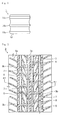
- FIG. 1 is a side view of an embodiment of the gasket for syringes.
- a gasket 1 shown in Fig. 1 has three circular protruding portions 11a, 11b and 11c each of which continuously protrudes along the circumferential direction on the outer periphery that is to be in contact with the inner periphery of a syringe barrel.
- the portion of the gasket 1 to which the surface modification is applied include: (1) the surfaces of protruding portions to be in contact with a syringe barrel, such as the circular protruding portions 11a, 11b and 11c; (2) the entire side surface including the circular protruding portions 11a, 11b and 11c; and (3) the entire side surface and a bottom surface 13.
- treatment of a rubber vulcanizate or a thermoplastic elastomer by the surface modification method enables to produce a catheter having at least partially a modified surface.
- the modification is preferably performed at least on a part contacting a biological fluid, such as the surface of a catheter, or the modification may be performed on the entire surface.
- Fig. 2 is a development view of a tread portion 2 of an exemplary pneumatic tire (the whole tire is not illustrated).
- Fig. 3 is an A1-A1 cross-sectional view of Fig. 2 .
- a longitudinal center groove 3a (groove depth D1) and longitudinal shoulder grooves 3b (groove depth D2) are straight grooves straightforwardly extending in the tire circumferential direction. Such straight grooves can contribute to low drainage resistance and high drainage performance upon straight running.
- the pneumatic tire also has fine grooves 5 (groove depth D3) extending in the tire circumferential direction on the side of the longitudinal shoulder groove 3b; beveled intermediate grooves 6 (groove depth D4) extending with an inclination from the fine groove 5 toward the longitudinal center groove 3a; connecting grooves 7 (groove depth D5) located at positions inner than the fine grooves 5 in the tire axis direction and connecting the beveled intermediate grooves 6 next to one another in the tire circumferential direction; and lateral shoulder grooves 8, 8a and 8b (groove depth D6) extending from the longitudinal shoulder groove 3b toward the outside of the tire; and the like, and these grooves can also contribute to drainage performance. Treatment of these grooves by the above method enables to achieve the aforementioned effects.
- a chlorobutyl rubber (degree of unsaturation: 1 to 2%) having isoprene units was cross-linked by triazine to give a rubber vulcanizate (vulcanized at 180°C for 10 minutes).
- the rubber vulcanizate was immersed in benzophenone (3 wt%) in acetone so that benzophenone was adsorbed onto the surface of the rubber vulcanizate. Then, the rubber vulcanizate was taken out and dried. Thereafter, the surface of the rubber vulcanizate was irradiated using an LED light source with a wavelength of 365 nm for 30 minutes to fix benzophenone. Then, the surface was washed in acetone to remove unreacted benzophenone.
- the dried rubber vulcanizate was immersed in an aqueous acrylic acid solution in a glass reaction container, and was irradiated with ultraviolet rays using an LED light source with a wavelength of 365 nm for 30 minutes to cause radical polymerization so that polymer chains were grown on the rubber surface. In this manner, a product on which polymer chains were formed was obtained.
- a surface-modified elastic body was prepared in the same manner as in Example 1, except that the product on which polymer chains were formed was immersed in 1-hexadecanol in acetone instead of the 1-hexanol in acetone.
- a surface-modified elastic body was prepared in the same manner as in Example 1, except that the product on which polymer chains were formed was immersed in 1-docosanol in dichloromethane instead of the 1-hexanol in acetone.
- a surface-modified elastic body was prepared in the same manner as in Example 1, except that the product on which polymer chains were formed was immersed in 2-methoxyethanol in acetone instead of the 1-hexanol in acetone.
- a chlorobutyl rubber (degree of unsaturation: 1 to 2%) having isoprene units was cross-linked by triazine to give a rubber vulcanizate (vulcanized at 180°C for 10 minutes).
- the rubber vulcanizate was immersed in benzophenone (3 wt%) in acetone so that benzophenone was adsorbed onto the surface of the rubber vulcanizate. Then, the rubber vulcanizate was taken out and dried. Thereafter, the surface of the rubber vulcanizate was irradiated using an LED light source with a wavelength of 365 nm for 30 minutes to fix benzophenone. Then, the surface was washed in acetone to remove unreacted benzophenone.
- the dried rubber vulcanizate was immersed in an aqueous acrylic acid solution in a glass reaction container, and was irradiated with ultraviolet rays using an LED light source with a wavelength of 365 nm for 30 minutes to cause radical polymerization so that polymer chains were grown on the rubber surface. In this manner, a product on which polymer chains were formed was obtained.
- a surface-modified elastic body was prepared in the same manner as in Example 5, except that the product on which polymer chains were formed was immersed in an aqueous butylamine solution instead of the 2,2,3,3,4,4,4-heptafluorobutylamine in DMSO.
- a surface-modified elastic body was prepared in the same manner as in Example 5, except that the product on which polymer chains were formed was immersed in 3-aminopropyltriethoxysilane in ethanol instead of the 2,2,3,3,4,4,4-heptafluorobutylamine in DMSO.
- a rubber vulcanizate (vulcanized at 180°C for 10 minutes) prepared by cross-linking a chlorobutyl rubber by triazine was used.
- the surface-modified elastic bodies prepared in the examples and the comparative example were evaluated by the following methods.
- the length of polymer chains formed on the surface of the rubber vulcanizate was measured on a cross section of the modified rubber vulcanizate with polymer chains formed thereon, using an SEM at an accelerating voltage of 15 kV and a magnification of 1000 times.
- the thickness of a polymer layer measured on photographs was regarded as the length of polymer chains.
- the friction resistance of the surface of the surface-modified elastic body was measured as follows. A gasket made of the rubber vulcanizate prepared in each of the examples and comparative example was inserted into a COP resin barrel of a syringe and further pressed (pressing rate: 30 mm/min) into the barrel using a tensile tester while the friction resistance was measured. Based on the equation shown below, the friction resistance of each gasket was expressed as an index (friction resistance index) relative to the friction resistance of Comparative Example 1 regarded as 100. A smaller index indicates a lower friction resistance.
- Friction resistance index friction resistance of each Example / friction resistance of Comparative Example 1 ⁇ 100 [Table 1]
- Example 1 Example 2
- Example 3 Example 4
- Example 5 Example 7
- Example 7 Comparative Example 1 Length of polymer chains (nm) 3200 3150 3200 3100 3250 3150 3250 - Friction resistance index 10.2 6.7 5.4 14.1 4.8 5.6 5.1 100
Landscapes
- Chemical & Material Sciences (AREA)
- Health & Medical Sciences (AREA)
- Chemical Kinetics & Catalysis (AREA)
- Medicinal Chemistry (AREA)
- Polymers & Plastics (AREA)
- Organic Chemistry (AREA)
- General Chemical & Material Sciences (AREA)
- Engineering & Computer Science (AREA)
- Mechanical Engineering (AREA)
- Toxicology (AREA)
- Treatments Of Macromolecular Shaped Articles (AREA)
- Addition Polymer Or Copolymer, Post-Treatments, Or Chemical Modifications (AREA)
- Tires In General (AREA)
- Infusion, Injection, And Reservoir Apparatuses (AREA)
- Coating Of Shaped Articles Made Of Macromolecular Substances (AREA)
Abstract
Description
- The present invention relates to a surface modification method, and a surface-modified elastic body, a gasket for syringes, a catheter, and a tire, each obtained by the surface modification method.
- For parts that slide while maintaining their sealing performance, such as gaskets each of which is integrated with a syringe plunger and forms a seal between the plunger and the barrel, elastic bodies (e.g. rubber) are used focusing on sealing properties. Such elastic bodies, however, have a slight problem in their sliding properties (see Patent Literature 1). Hence, a sliding property improving agent (e.g. silicone oil) is applied to the sliding surface. It is, however, pointed out that silicone oil can negatively affect recently marketed bio-preparations. On the other hand, a gasket to which a sliding property improving agent is not applied is poor in the sliding properties; therefore, the plunger cannot be pushed smoothly so that it pulsates in administration, thereby causing problems such as inaccuracy in the injection amount and infliction of pain on patients.
- In order to simultaneously satisfy such conflicting requirements, that is, the sealing properties and the sliding properties, a technique is proposed in which a self-lubricating PTFE film is applied (see Patent Literature 2). The film, however, is generally expensive and thus increases the production cost of processed products, limiting its application range. Another problem is that since PTFE is vulnerable to radiation, it cannot be sterilized by radiation. Moreover, if the surface of a syringe or catheter is acidic, then the syringe may affect chemical liquids or the catheter may affect the inner body environment such as proteins. Hence, the surface is preferably neutral, bipolar, or hydrophobic.
- Furthermore, application to other uses requiring sliding properties in the presence of water may be considered. Specifically, water can be delivered without a loss by reducing the fluid resistance of the inner surface of a pre-filled syringe or the inner surface of a pipe or tube for delivering water, or by making its contact angle with water large or greatly small. Also, drainage of water on wet roads and of snow on snowy roads can be improved by reducing the fluid resistance of the groove surface of tires, or by making its contact angle with water large or greatly small. This results in enhanced hydroplaning resistance and enhanced grip performance, leading to better safety. In addition, less sticking of wastes and dusts can be expected as a result of reducing the sliding resistance of the sidewall surface of tires or walls of buildings, or as a result of making its or their contact angle with water large.
- Further advantageous effects can be expected, such as: less pressure loss when water, an aqueous solution or the like is delivered through a diaphragm such as a diaphragm pump or a diaphragm valve; easy sliding of skis or a snowboard by enhancing the sliding properties of the sliding surface thereof; better noticeability of a road sign or a signboard by enhancing the sliding properties thereof to allow snow to slide easily; reduction in water resistance or drag and less sticking of bacteria on the outer peripheries of a ship by reducing the sliding resistance of the outer peripheries or by making their contact angle with water large; and swimsuits with reduced water resistance or drag by improving the sliding properties of the thread surface thereof.
-
- Patent Literature 1:
JP 2004-298220 A - Patent Literature 2:
JP 2010-142537 A - The present invention aims to solve the above problems and provide a surface modification method for a rubber vulcanizate or a thermoplastic elastomer, which can impart excellent sliding properties and excellent durability against repeated sliding motion and can allow the surface to maintain the sealing properties, without using expensive self-lubricating plastics. The present invention also aims to provide surface-modified elastic bodies, gaskets for syringes, catheters, and tires, which are obtained by the surface modification method.
- The present invention relates to a surface modification method for modifying a rubber vulcanizate or a thermoplastic elastomer as an object to be modified, the method including:
- step 1 of forming polymerization initiation points on the object to be modified;
-
step 2 of radically polymerizing a monomer, starting from the polymerization initiation points, by irradiation with LED light at 300 nm to 400 nm to grow polymer chains on a surface of the object to be modified; and - step 3 of esterifying, transesterifying or amidating side chains of the polymer chains.
- Preferably, the step 1 is a step of allowing a polymerization initiator to be adsorbed on the object to be modified.
- Preferably, the step 1 is a step of allowing a polymerization initiator to be adsorbed on the object to be modified, and then fixing the polymerization initiator on a surface of the object by use of LED light at 300 nm to 400 nm.
- The rubber vulcanizate or thermoplastic elastomer preferably contains an allylic carbon atom which is a carbon atom adjacent to a double bond.
- The polymerization initiator is preferably at least one of a benzophenone compound and a thioxanthone compound.
- The
step 2 is preferably a step of radically polymerizing a monomer, starting from the polymerization initiation points, in the presence of a reducing agent or an antioxidant by irradiation with LED light at 300 nm to 400 nm to grow polymer chains on a surface of the object to be modified. The reducing agent or antioxidant is preferably at least one selected from the group consisting of riboflavin, ascorbic acid, α-tocopherol, β-carotene, and uric acid. - Preferably, during or before the light irradiation, an inert gas is inserted into a reaction container and a reaction solution so that polymerization is performed in an atmosphere replaced with the inert gas, or vacuuming is conducted so that polymerization is performed in a system free from oxygen.
- A compound to be used for the esterification or transesterification is preferably at least one selected from the group consisting of alkyl alcohols, alkoxy alcohols, aromatic alcohols, and fluoro alcohols.
- A compound to be used for the amidation is preferably at least one selected from the group consisting of alkylamines, aromatic amines, fluoroamines, and amino group-containing silane compounds.
- The monomer is preferably at least one of an acrylic acid and a methacrylic acid.
- Preferably, the (liquid) monomer or a solution thereof contains a polymerization inhibitor, and the monomer is polymerized in the presence of the polymerization inhibitor.
- The polymerization inhibitor is preferably 4-methylphenol.
- The polymer chains are preferably 10 nm to 50000 nm in length.
- The present invention relates to a surface-modified elastic body, which is obtained by the aforementioned surface modification method.
- The present invention relates to a surface-modified elastic body, which is required to have sliding properties in the presence of water or in a dry state, or have low friction in the presence of water or in a dry state, or have low water resistance in the presence of water or in a dry state, and which is obtained by the aforementioned surface modification method.
- The present invention relates to a surface-modified elastic body, which is a three-dimensional solid having at least partially a surface modified by the aforementioned surface modification method.
- The surface-modified elastic body is preferably a polymer brush.
- The present invention also relates to a gasket for syringes, which has at least partially a surface modified by the aforementioned surface modification method.
- The present invention also relates to a catheter, which has at least partially a surface modified by the aforementioned surface modification method.
- The present invention also relates to a tire, which has at least partially a groove surface modified by the aforementioned surface modification method.
- The present invention provides a surface modification method for modifying a rubber vulcanizate or a thermoplastic elastomer as an object to be modified, the method including:
- step 1 of forming polymerization initiation points on the object to be modified;
-
step 2 of radically polymerizing a monomer, starting from the polymerization initiation points, by irradiation with LED light at 300 nm to 400 nm to grow polymer chains on a surface of the object to be modified; and - step 3 of esterifying, transesterifying or amidating side chains of the polymer chains. Accordingly, it is possible to impart excellent sliding properties and excellent durability against repeated sliding motion to the surface of the object to be modified and also provide favorable sealing properties. Thus, when the method is used to form polymer chains on the surface of the object to be modified, surface-modified elastic bodies (e.g. gaskets for syringes) which are excellent in the aforementioned performances can be provided. Moreover, since the surface-modified elastic bodies do not have a PTFE polymer structure, they can be sterilized by radiation such as gamma rays. Furthermore, since those containing a phosphorine group, a perfluoroalkyl group, an ethylene glycol group, a perfluoroethylene glycol group, or an alkoxysilyl group in a side chain have biocompatibility, they can prevent adsorption and aggregation of proteins in bio-preparations.
-
-
Fig. 1 is a side view of an embodiment of the gasket for syringes. -
Fig. 2 is a development view of the tread portion of an exemplary pneumatic tire (the whole tire is not illustrated). -
Fig. 3 is a cross-sectional view of the example ofFig. 2 . - The surface modification method according to the present invention is a surface modification method for modifying a thermoplastic elastomer or a rubber vulcanizate as an object to be modified, the method including:
- step 1 of forming polymerization initiation points on the object to be modified;
-
step 2 of radically polymerizing a monomer, starting from the polymerization initiation points, by irradiation with LED light at 300 nm to 400 nm to grow polymer chains on a surface of the object to be modified; and - step 3 of esterifying, transesterifying or amidating side chains of the polymer chains.
- In the step 1, polymerization initiation points are formed on the surface of a vulcanization-molded rubber or a molded thermoplastic elastomer (object to be modified).
- Preferred examples of the rubber vulcanizate and the thermoplastic elastomer include those containing a carbon atom adjacent to a double bond (allylic carbon atom).
- Examples of the rubber for the object to be modified include diene rubbers such as styrene-butadiene rubber, butadiene rubber, isoprene rubber, natural rubber, and deproteinized natural rubber; and butyl rubber and halogenated butyl rubber which have a degree of unsaturation of a few percent of isoprene units. In the case of the butyl rubber or halogenated butyl rubber, rubber cross-linked by triazine is preferred because the amount of matter extracted from the rubber vulcanizate is small. In this case, the rubber may contain an acid acceptor, and examples of suitable acid acceptors include hydrotalcites and magnesium carbonate.
- In the case of other rubbers, sulfur vulcanization is preferred. In such a case, compounding agents commonly used for sulfur vulcanization may be added, such as vulcanization accelerators, zinc oxide, fillers, and silane coupling agents. Preferred examples of the fillers include carbon black, silica, clay, talc, and calcium carbonate.
- The vulcanization conditions for rubber may be appropriately set. The vulcanization temperature for rubber is preferably 150°C or higher, more preferably 170°C or higher, and further preferably 175°C or higher.
- Examples of the thermoplastic elastomer include polymer compounds having rubber elasticity at room temperature owing to the aggregates of plastic components (hard segments) that serve as crosslinking points (e.g. thermoplastic elastomers (TPE) such as styrene-butadienestyrene copolymers); and polymer compounds having rubber elasticity, obtained by mixing a thermoplastic component and a rubber component and dynamically crosslinking the mixture by a crosslinking agent (e.g. thermoplastic elastomers (TPV) such as polymer alloys containing a styrenic block copolymer or olefinic resin together with a crosslinked rubber component).
- Other suitable examples of the thermoplastic elastomer include nylon, polyester, polyurethane, polypropylene, and dynamically crosslinked thermoplastic elastomers thereof. In the case of using dynamically crosslinked thermoplastic elastomers, preferred examples thereof include those obtained by dynamically crosslinking halogenated butyl rubber in a thermoplastic elastomer. Here, the thermoplastic elastomer may preferably be nylon, polyurethane, polypropylene, or SIBS (styrene-isobutylene-styrene block copolymer), for example.
- Polymerization initiation points can be formed, for example, by adsorption of a polymerization initiator on the surface of the object to be modified. Examples of the polymerization initiator include carbonyl compounds, organic sulfur compounds (e.g. tetraethylthiuram disulfide), persulfides, redox compounds, azo compounds, diazo compounds, halogen compounds, and photoreductive pigments. Preferred among these are carbonyl compounds.
- The carbonyl compound as the polymerization initiator is preferably benzophenone or its derivative, and suitable examples thereof include benzophenone compounds represented by the following formula (1):

- wherein R1 to R5 and R1' to R5' are the same as or different from one another and each represent a hydrogen atom, an alkyl group, a halogen (fluorine, chlorine, bromine, or iodine), a hydroxy group, a primary, secondary or tertiary amino group, a mercapto group, or a hydrocarbon group that may contain an oxygen atom, a nitrogen atom or a sulfur atom; and any two adjacent groups thereof may be joined to each other to form a cyclic structure together with the carbon atoms to which they are bonded.
- Specific examples of the benzophenone compounds include benzophenone, xanthone, 9-fluorenone, 2,4-dichlorobenzophenone, methyl o-benzoylbenzoate, 4,4'-bis(dimethylamino)benzophenone, and 4,4'-bis(diethylamino)benzophenone. Particularly preferred among these are benzophenone, xanthone, and 9-fluorenone, because they contribute to favorable polymer brushes.
- Thioxanthone compounds can also be suitably used as the polymerization initiator because they allow for a high polymerization rate, and can easily be adsorbed on and/or reacted with rubber or the like. For example, compounds represented by the following formula (2) can be suitably used:

- Examples of the thioxanthone compounds represented by the formula (2) include thioxanthone, 2-isopropylthioxanthone, 4-isopropylthioxanthone, 2,3-diethylthioxanthone, 2,4-diethylthioxanthone, 2,4-dichlorothioxanthone, 2-methoxythioxanthone, 1-chloro-4-propoxythioxanthone, 2-cyclohexylthioxanthone, 4-cyclohexylthioxanthone, 2-vinylthioxanthone, 2,4-divinylthioxanthone, 2,4-diphenylthioxanthone, 2-butenyl-4-phenylthioxanthone, 2-methoxythioxanthone, and 2-p-octyloxyphenyl-4-ethylthioxanthone. Preferred among these are the compounds in which one or two, particularly two of the R11 to R14 and R11' to R14' are substituted with alkyl groups, and more preferred is 2,4-diethylthioxanthone.
- The adsorption of a polymerization initiator (e.g. benzophenone compounds, thioxanthone compounds) on the surface of the object to be modified may be carried out according to a known method. In the case of using a benzophenone compound or a thioxanthone compound, for example, the benzophenone compound or the thioxanthone compound is dissolved in an organic solvent to prepare a solution; a surface portion of the object to be modified is treated with this solution so that the compound is adsorbed on the surface portion; and if necessary, the organic solvent is dried to be evaporated off, whereby polymerization initiation points are formed. The surface-treating method is not particularly limited as long as the solution of the benzophenone compound or thioxanthone compound can be brought into contact with the surface of the object to be modified. Suitable examples thereof include application of the benzophenone or thioxanthone compound solution, spraying thereof, and immersion of the surface into the solution. If only a part of the surface needs to be modified, it is sufficient to adsorb the polymerization initiator only on such a part of the surface. In this case, for example, application of the solution or spraying of the solution is suitable. Examples of the solvent include methanol, ethanol, acetone, benzene, toluene, methyl ethyl ketone, ethyl acetate, and THF. Acetone is preferred because it does not swell the object to be modified and it is rapidly dried and evaporated off.
- Preferably, after the target region to be modified is surface-treated with the benzophenone or thioxanthone compound solution so that the polymerization initiator is adsorbed, the polymerization initiator is further chemically bonded onto the surface of the object to be modified by irradiation with light. For example, the benzophenone compound or thioxanthone compound can be fixed on the surface by irradiation with LED light having a wavelength of 300 to 400 nm (preferably 350 to 400 nm). During the fixing in the step 1 or the light irradiation in the
step 2, in the case of using benzophenone, for example, the benzophenone abstracts hydrogen from the rubber surface, and a carbon atom on the rubber surface is then covalently bonded to the carbon in C=O of benzophenone, while the abstracted hydrogen is bonded to the oxygen in C=O to form C-O-H. Moreover, since the hydrogen abstraction reaction selectively occurs on allylic hydrogen atoms in the object to be modified, the rubber preferably contains a butadiene or isoprene unit that contains an allylic hydrogen atom.
- In the
step 2, radical polymerization of a monomer is initiated from the polymerization initiation points formed in the step 1, to grow polymer chains on the surface of the object to be modified. - Examples of the monomer include carboxyl group-containing polymerizable monomers, and preferred among these are acrylic acid and methacrylic acid. Each of the monomers may be used alone, or two or more thereof may be used in combination.
- An example of the method of radically polymerizing a monomer (radically polymerizable monomer) in the
step 2 is as follows. First, a (liquid) radically polymerizable monomer or a solution thereof is applied (sprayed) to the surface of the object to be modified on which a benzophenone compound, a thioxanthone compound or the like is adsorbed or covalently bound, or the object to be modified is immersed into a (liquid) radically polymerizable monomer or a solution thereof. Then, irradiation with LED light at 300 to 400 nm is performed so that radical polymerization (photoradical polymerization) of the monomer proceeds, whereby polymer chains are grown on the surface of the object to be modified. Alternatively, after the above application, the surface of the object to be modified may be covered with transparent glass, PET, polycarbonate or the like, followed by irradiation of the covered surface with LED light at 300 to 400 nm so that radical polymerization (photoradical polymerization) of the monomer proceeds, whereby polymer chains are grown on the surface of the object to be modified. - In the
step 2, radical polymerization (photoradical polymerization) is preferably allowed to proceed by irradiating a radically polymerizable monomer in the presence of a reducing agent or an antioxidant with LED light at 300 to 400 nm. This arrangement is preferred because the reducing agent or antioxidant scavenges oxygen in the system. The radically polymerizable monomer and the reducing agent or antioxidant added thereto may be mixed with or separated from each other. Moreover, the object to be modified obtained in the step 1 is brought into contact with the radically polymerizable monomer in advance before the reducing agent or antioxidant is added thereto. Alternatively, these components may be mixed in advance before the mixed material is brought into contact with the object to be modified. - Specifically, the radical polymerization may be performed as follows. For example, the object to be modified obtained in the step 1, on the surface of which polymerization initiation points are formed, is brought into contact (e.g. immersion, application) with a mixture of a (liquid) radically polymerizable monomer or a solution thereof and a solution of a reducing agent or an antioxidant, followed by the LED light irradiation. Alternatively, the object to be modified is brought into contact with a (liquid) radically polymerizable monomer or a solution thereof, and then a solution of a reducing agent or an antioxidant is put on the resulting surface, followed by the LED light irradiation.
- The reducing agent and the antioxidant are not particularly limited, and compounds having a reduction or antioxidant action can be appropriately used. Preferred among these are riboflavin, ascorbic acid, α-tocopherol, β-carotene, and uric acid because of their high oxygen scavenging capability, and particularly preferred are riboflavin and ascorbic acid.
- In the case of using a solution of a reducing agent or an antioxidant, the concentration of the reducing agent or antioxidant is preferably 10-4 to 1% by mass, and more preferably 10-3 to 0.1% by mass.
- The amount of the radically polymerizable monomer may be appropriately set depending on, for example, a desired length of polymer chains to be formed and desired performance to be achieved by the chains. Also, the amount of the reducing agent or antioxidant may be appropriately set from the viewpoint of the oxygen scavenging capability in the system, for example.
- Conventionally known materials and methods may be used for the solvent to be applied (sprayed), the method for application (spraying), the method for immersion, the conditions for irradiation, and the like. The solution of a radically polymerizable monomer may be an aqueous solution or a solution prepared by dissolving the monomer in an organic solvent that does not dissolve a polymerization initiator to be used. Furthermore, the (liquid) radically polymerizable monomer or a solution thereof may contain a known polymerization inhibitor such as 4-methylphenol.
- In the present invention, radical polymerization is allowed to proceed by LED light irradiation after the (liquid) monomer or a solution thereof is applied to the object to be modified, or after the object to be modified is immersed in the (liquid) monomer or a solution thereof. The light dose may be appropriately adjusted in consideration of the polymerization time and uniform progress of the reaction. In order to prevent polymerization inhibition due to active gas such as oxygen in a reaction container, preferably oxygen is removed from the reaction container and the reaction solution during or before the light irradiation. Thus, for example, some methods may appropriately be employed in which inert gas such as nitrogen gas or argon gas is inserted into the reaction container and the reaction solution to discharge active gas such as oxygen from the reaction system to replace the atmosphere in the reaction system with the inert gas or, alternatively, vacuuming is conducted to remove oxygen from the system. Moreover, in order to prevent reaction inhibition due to oxygen or the like, for example, some measures may appropriately be used in which an LED light source is placed such that no air layer (oxygen content: 15% or higher) exists between the reaction container made of glass, plastics or the like and the reaction solution or the object to be modified.
- For the LED light irradiation, the wavelength of LED light is at 300 to 400 nm, preferably 355 to 380 nm. This enables the polymer chains to be favorably formed on the surface of the object to be modified. The light source may be an LED with a center wavelength of 365 nm, an LED with a center wavelength of 375 nm, or the like. Especially, in terms of efficiency, the light source is preferably, for example, an LED with a center wavelength of 365 nm which is close to the excitation wavelength (366 nm) of benzophenone.
- The length of the polymer chains formed in the
step 2 is preferably 10 nm to 50000 nm, and more preferably 100 to 50000 nm. Chains shorter than 10 nm are unlikely to provide good sliding properties. Chains longer than 50000 nm are unlikely to be expected to provide better sliding properties, while they are likely to increase the cost of raw materials. In addition, a surface pattern formed by the surface treatment is likely to be visible to the naked eye, which tends to damage the appearance and to decrease the sealing properties. - In the
step 2, two or more species of monomers may be radically polymerized starting from the polymerization initiation points. Moreover, multiple kinds of polymer chains may be grown on the surface of the object to be modified. The surface modification method of the present invention may include cross-linking between polymer chains. In this case, ionic cross-linking, cross-linking by a hydrophilic group containing an oxygen atom, or cross-linking by a compound containing a halogen group (e.g. iodine) may be carried out between the polymer chains. - In the step 3, side chains of the polymer chains formed in the
step 2 are esterified, transesterified or amidated. This process enables to sufficiently provide the effect of the present invention. - Specifically, for example, an ester bond or an amide bond is formed in a side chain by subjecting a carboxyl group in a side chain of a polymer chain formed by polymerization of a carboxyl group-containing polymerizable monomer (e.g. acrylic acid, methacrylic acid) to esterification or transesterification with a hydroxy group of an alcohol, or amidation with an amino group of an amine compound.
- Examples of the compound to be used for esterification or transesterification include known alcohols such as linear, branched or cyclic alkyl alcohols or alkoxy alcohols, aromatic alcohols, and fluoro alcohols. The alkyl alcohol preferably has 3 to 25 carbon atoms. The alkoxy alcohol preferably has 2 to 10 carbon atoms. The aromatic alcohol preferably has 6 to 10 carbon atoms. The fluoro alcohol preferably has 1 to 6 carbon atoms. Preferred among these are linear, branched or cyclic alkyl alcohols or alkoxy alcohols, and more preferred are linear alkyl alcohols or alkoxy alcohols.
- Examples of the alkyl alcohols include pentanol, hexanol, heptanol, octanol, nonanol, decanol, dodecanol, hexadecanol, octadecanol, eicosanol, and docosanol. Examples of the alkoxy alcohols include methoxyethanol and ethoxyethanol. Examples of the aromatic alcohols include benzyl alcohol, and 2-benzyloxyethanol. Examples of the fluoro alcohols include perfluoroalcohols such as perfluoroethanol; 2-fluoroethanol; and 2,2,2-trifluoroethanol. Each of these may be used alone, or two or more of these may be used in combination.
- Examples of the compound to be used for amidation include known amine compounds such as linear, branched or cyclic alkylamines, aromatic amines, fluoroamines, and amino group-containing silane compounds. The alkylamine preferably has 3 to 25 carbon atoms. The aromatic amine preferably has 6 to 10 carbon atoms. The fluoroamine preferably has 1 to 6 carbon atoms. The amino group-containing silane compound preferably has 2 to 10 carbon atoms. Preferred among these are linear, branched or cyclic alkylamines, fluoroamines, and amino group-containing silane compounds. More preferred are linear alkylamines, fluoroamines, and aminoalkylalkoxysilanes.
- Examples of the alkylamines include ethylamine, propylamine, butylamine, pentylamine, hexylamine, heptylamine, and octylamine. Examples of the aromatic amines include piperidine and pyridine. Examples of the fluoroamines include heptafluorobutylamine, tridecafluoroheptylamine, and pentadecafluorooctylamine. Examples of the amino group-containing silane compounds include aminoalkylalkoxysilanes such as aminopropyltrimethoxysilane, aminopropyltriethoxysilane, aminopropylmethyldiethoxysilane, and aminopropylmethyldimethoxysilane. Each of these may be used alone, or two or more of these may be used in combination.
- The esterification, transesterification, and amidation in the step 3 may be carried out by known methods. These reactions may be allowed to proceed, for example, in the presence of acid.
- Treatment of a rubber vulcanizate or a thermoplastic elastomer by the surface modification method enables to provide a surface-modified elastic body. The obtained surface-modified elastic body is excellent in sliding properties in the presence of water or in a dry state. The surface-modified elastic body is also excellent in that it has low friction and low water resistance or drag. Moreover, treatment of at least part of a three-dimensional solid (e.g. elastic body) by the method enables to provide a surface-modified elastic body having better quality. Preferred examples of such a surface-modified elastic body include polymer brushes. The polymer brush herein means an assembly of graft polymer chains obtained by the "grafting from" approach by surface-initiated living radical polymerization. The graft chains are preferably oriented in a direction substantially vertical to the surface of the object to be modified because, in such a case, the entropy is reduced and the molecular mobility of the graft chains is reduced, which ensures sliding properties. Preferred are semidilute brushes and concentrated brushes which have a brush density of 0.01 chains/nm2 or higher.
- Furthermore, treatment of a rubber vulcanizate or a thermoplastic elastomer by the surface modification method enables to produce a gasket for syringes which has at least partially a modified surface. The modification is preferably performed at least on the sliding portion of the gasket surface, or may be performed on the entire surface.
-
Fig. 1 is a side view of an embodiment of the gasket for syringes. A gasket 1 shown inFig. 1 has three circular protrudingportions portions portions bottom surface 13. - Similarly, treatment of a rubber vulcanizate or a thermoplastic elastomer by the surface modification method enables to produce a catheter having at least partially a modified surface. The modification is preferably performed at least on a part contacting a biological fluid, such as the surface of a catheter, or the modification may be performed on the entire surface.
- Furthermore, when grooves formed in the tread of a tire for use on vehicles such as passenger cars are treated by the surface modification method to form a polymer brush on the grooves, the fluid resistance of the groove surface on wet or snowy roads is reduced, and the contact angle with water is increased. Thus, the abilities to remove and drain water or snow are enhanced so that the hydroplaning resistance and the grip performance can be improved.
-
Fig. 2 is a development view of atread portion 2 of an exemplary pneumatic tire (the whole tire is not illustrated).Fig. 3 is an A1-A1 cross-sectional view ofFig. 2 . - In
Figs. 2 and3 , alongitudinal center groove 3a (groove depth D1) andlongitudinal shoulder grooves 3b (groove depth D2) are straight grooves straightforwardly extending in the tire circumferential direction. Such straight grooves can contribute to low drainage resistance and high drainage performance upon straight running. - The pneumatic tire also has fine grooves 5 (groove depth D3) extending in the tire circumferential direction on the side of the
longitudinal shoulder groove 3b; beveled intermediate grooves 6 (groove depth D4) extending with an inclination from thefine groove 5 toward thelongitudinal center groove 3a; connecting grooves 7 (groove depth D5) located at positions inner than thefine grooves 5 in the tire axis direction and connecting the beveledintermediate grooves 6 next to one another in the tire circumferential direction; andlateral shoulder grooves longitudinal shoulder groove 3b toward the outside of the tire; and the like, and these grooves can also contribute to drainage performance. Treatment of these grooves by the above method enables to achieve the aforementioned effects. - The following will describe the present invention in more detail based on, though not limited to, examples.
- A chlorobutyl rubber (degree of unsaturation: 1 to 2%) having isoprene units was cross-linked by triazine to give a rubber vulcanizate (vulcanized at 180°C for 10 minutes). The rubber vulcanizate was immersed in benzophenone (3 wt%) in acetone so that benzophenone was adsorbed onto the surface of the rubber vulcanizate. Then, the rubber vulcanizate was taken out and dried. Thereafter, the surface of the rubber vulcanizate was irradiated using an LED light source with a wavelength of 365 nm for 30 minutes to fix benzophenone. Then, the surface was washed in acetone to remove unreacted benzophenone.
- The dried rubber vulcanizate was immersed in an aqueous acrylic acid solution in a glass reaction container, and was irradiated with ultraviolet rays using an LED light source with a wavelength of 365 nm for 30 minutes to cause radical polymerization so that polymer chains were grown on the rubber surface. In this manner, a product on which polymer chains were formed was obtained.
- The product on which polymer chains were formed was immersed in a solution of triethylamine (0.5 g), dimethylaminopyridine (0.017 g), and 2-methyl-6-nitrobenzoic anhydride (0.63 g) in dichloromethane (15 ml) for 10 minutes.
- Thereafter, the product on which polymer chains were formed was taken out of the solution and dried. The dried product was immersed in 1-hexanol in acetone for 10 hours to subject the COOH group of the acrylic acid unit to transesterification to introduce an alkyl group. In this manner, a surface-modified elastic body (polymer brush) was prepared.
- A surface-modified elastic body was prepared in the same manner as in Example 1, except that the product on which polymer chains were formed was immersed in 1-hexadecanol in acetone instead of the 1-hexanol in acetone.
- A surface-modified elastic body was prepared in the same manner as in Example 1, except that the product on which polymer chains were formed was immersed in 1-docosanol in dichloromethane instead of the 1-hexanol in acetone.
- A surface-modified elastic body was prepared in the same manner as in Example 1, except that the product on which polymer chains were formed was immersed in 2-methoxyethanol in acetone instead of the 1-hexanol in acetone.
- A chlorobutyl rubber (degree of unsaturation: 1 to 2%) having isoprene units was cross-linked by triazine to give a rubber vulcanizate (vulcanized at 180°C for 10 minutes). The rubber vulcanizate was immersed in benzophenone (3 wt%) in acetone so that benzophenone was adsorbed onto the surface of the rubber vulcanizate. Then, the rubber vulcanizate was taken out and dried. Thereafter, the surface of the rubber vulcanizate was irradiated using an LED light source with a wavelength of 365 nm for 30 minutes to fix benzophenone. Then, the surface was washed in acetone to remove unreacted benzophenone.
- The dried rubber vulcanizate was immersed in an aqueous acrylic acid solution in a glass reaction container, and was irradiated with ultraviolet rays using an LED light source with a wavelength of 365 nm for 30 minutes to cause radical polymerization so that polymer chains were grown on the rubber surface. In this manner, a product on which polymer chains were formed was obtained.
- The product on which polymer chains were formed was immersed in WSC (100 mM)/NHS (50 mM) in MES buffer. Thereafter, the product on which polymer chains were formed was taken out of the solution and immersed in 2,2,3,3,4,4,4-heptafluorobutylamine in DMSO for 24 hours for amidation. In this manner, a surface-modified elastic body was prepared.
- A surface-modified elastic body was prepared in the same manner as in Example 5, except that the product on which polymer chains were formed was immersed in an aqueous butylamine solution instead of the 2,2,3,3,4,4,4-heptafluorobutylamine in DMSO.
- A surface-modified elastic body was prepared in the same manner as in Example 5, except that the product on which polymer chains were formed was immersed in 3-aminopropyltriethoxysilane in ethanol instead of the 2,2,3,3,4,4,4-heptafluorobutylamine in DMSO.
- A rubber vulcanizate (vulcanized at 180°C for 10 minutes) prepared by cross-linking a chlorobutyl rubber by triazine was used.
- The surface-modified elastic bodies prepared in the examples and the comparative example were evaluated by the following methods.
- The length of polymer chains formed on the surface of the rubber vulcanizate was measured on a cross section of the modified rubber vulcanizate with polymer chains formed thereon, using an SEM at an accelerating voltage of 15 kV and a magnification of 1000 times. The thickness of a polymer layer measured on photographs was regarded as the length of polymer chains.
- The friction resistance of the surface of the surface-modified elastic body was measured as follows. A gasket made of the rubber vulcanizate prepared in each of the examples and comparative example was inserted into a COP resin barrel of a syringe and further pressed (pressing rate: 30 mm/min) into the barrel using a tensile tester while the friction resistance was measured. Based on the equation shown below, the friction resistance of each gasket was expressed as an index (friction resistance index) relative to the friction resistance of Comparative Example 1 regarded as 100. A smaller index indicates a lower friction resistance.

[Table 1] Example 1 Example 2 Example 3 Example 4 Example 5 Example 7 Example 7 Comparative Example 1 Length of polymer chains (nm) 3200 3150 3200 3100 3250 3150 3250 - Friction resistance index 10.2 6.7 5.4 14.1 4.8 5.6 5.1 100 - The results show that the surfaces of the surface-modified elastic bodies prepared in the examples had greatly reduced friction resistance indices and therefore good sliding properties. Moreover, as the surfaces were modified with an alkyl group, a fluoroalkyl group or the like, the sealing properties with respect to chemical liquids were similar to that in Comparative Example 1.
- Thus, in the case that the present invention is applied to a gasket for a plunger of a syringe, sufficient sealing properties are achieved while the friction of the plunger with the syringe barrel is reduced. Consequently, operations using such a syringe can be easily and accurately performed. Moreover, since the difference between the coefficient of static friction and the coefficient of dynamic friction is small, the beginning of pressing the plunger and the subsequent entry of the plunger can be smoothly accomplished without pulsation. Furthermore, in the case that a syringe barrel is formed from a thermoplastic elastomer, and polymer chains are formed on its inner surface, operations using the syringe can be easily performed as mentioned above.
- Also in the case of applying the present invention to a catheter, favorable sliding properties can be achieved.
- Furthermore, the effects mentioned earlier can be expected when polymer chains are formed on the surfaces of grooves in treads and sidewalls of tires for vehicles such as passenger cars, or on the surfaces of diaphragms, or on the sliding surfaces of skis and snowboards, or on the surfaces of swimsuits, road signs, sign boards, and the like.
-
- 1:
- gasket
- 11a, 11b, 11c:
- circular protruding portion
- 13:
- bottom surface
- 2:
- tread portion
- 3a:
- longitudinal center groove
- 3b:
- longitudinal shoulder groove
- 5:
- fine groove
- 6:
- beveled intermediate groove
- 7:
- connecting groove
- 8, 8a, 8b:
- lateral shoulder groove
Claims (12)
- A surface-modified elastic body, a three-dimensional solid having at least partially a modified surface, a gasket for syringes having at least partially a modified surface, a catheter having at least partially a modified surface or a tire having at least partially a modified groove surface, which is obtainable by a surface modification method, the method comprising:step 1 of forming polymerization initiation points on the elastic body, three-dimensional solid, gasket for syringes, catheter or tire as object to be modified by allowing a polymerization initiator to be adsorbed on the object to be modified wherein the polymerization initiator is a thioxanthone compound according to the formula (2)
 step 2 of radically polymerizing a monomer, starting from the polymerization initiation points, by irradiation with LED light at 300 nm to 400 nm to grow polymer chains on a surface of the object to be modified; andstep 3 of esterifying, transesterifying or amidating side chains of the polymer chains.
 - The surface-modified elastic body, three-dimensional solid, gasket for syringes, catheter or tire according to claim 1,
wherein the step 1 comprises allowing a polymerization initiator to be adsorbed on the object to be modified, and then fixing the polymerization initiator on a surface of the object by use of LED light at 300 nm to 400 nm. - The surface-modified elastic body, three-dimensional solid, gasket for syringes, catheter or tire according to any of claims 1 to 2,
wherein the rubber vulcanizate or thermoplastic elastomer contains an allylic carbon atom which is a carbon atom adjacent to a double bond. - The surface-modified elastic body, three-dimensional solid, gasket for syringes, catheter or tire according to any of claims 1 to 3,
wherein the step 2 comprises radically polymerizing a monomer, starting from the polymerization initiation points, in the presence of a reducing agent or an antioxidant by irradiation with LED light at 300 nm to 400 nm to grow polymer chains on a surface of the object to be modified, wherein the reducing agent or antioxidant is preferably at least one selected from the group consisting of riboflavin, ascorbic acid, α-tocopherol, β-carotene, and uric acid. - The surface-modified elastic body, three-dimensional solid, gasket for syringes, catheter or tire according to any of claims 1 to 4,
wherein, during or before the light irradiation, an inert gas is inserted into a reaction container and a reaction solution so that polymerization is performed in an atmosphere replaced with the inert gas, or vacuuming is conducted so that polymerization is performed in a system free from oxygen. - The surface-modified elastic body, three-dimensional solid, gasket for syringes, catheter or tire according to any of claims 1 to 5,
wherein a compound to be used for the esterification or transesterification is at least one selected from the group consisting of alkyl alcohols, alkoxy alcohols, aromatic alcohols, and fluoro alcohols. - The surface-modified elastic body, three-dimensional solid, gasket for syringes, catheter or tire according to any of claims 1 to 6,
wherein a compound to be used for the amidation is at least one selected from the group consisting of alkylamines, aromatic amines, fluoroamines, and amino group-containing silane compounds. - The surface-modified elastic body, three-dimensional solid, gasket for syringes, catheter or tire according to any of claims 1 to 7,
wherein the monomer is at least one of an acrylic acid and a methacrylic acid. - The surface-modified elastic body, three-dimensional solid, gasket for syringes, catheter or tire according to any of claims 1 to 8,
wherein the (liquid) monomer or a solution thereof contains a polymerization inhibitor, and the monomer is polymerized in the presence of the polymerization inhibitor, wherein the polymerization inhibitor is preferably 4-methylphenol. - The surface-modified elastic body, three-dimensional solid, gasket for syringes, catheter or tire according to any of claims 1 to 9,
wherein the polymer chains are 10 nm to 50000 nm in length. - The surface-modified elastic body according to any of claims 1 to 10, which is a polymer brush.
- The surface-modified elastic body according to any of claims 1 to 10, which is required to have sliding properties in the presence of water or in a dry state, or have low friction in the presence of water or in a dry state, or have low water resistance in the presence of water or in a dry state.
Applications Claiming Priority (2)
| Application Number | Priority Date | Filing Date | Title |
|---|---|---|---|
| JP2012172307A JP6063167B2 (en) | 2012-08-02 | 2012-08-02 | Surface modification method and surface modified elastic body |
| EP13179020.6A EP2692785B1 (en) | 2012-08-02 | 2013-08-02 | Surface modification method and surface-modified elastic body |
Related Parent Applications (2)
| Application Number | Title | Priority Date | Filing Date |
|---|---|---|---|
| EP13179020.6A Division-Into EP2692785B1 (en) | 2012-08-02 | 2013-08-02 | Surface modification method and surface-modified elastic body |
| EP13179020.6A Division EP2692785B1 (en) | 2012-08-02 | 2013-08-02 | Surface modification method and surface-modified elastic body |
Publications (2)
| Publication Number | Publication Date |
|---|---|
| EP2947114A1 true EP2947114A1 (en) | 2015-11-25 |
| EP2947114B1 EP2947114B1 (en) | 2016-11-09 |
Family
ID=48917396
Family Applications (2)
| Application Number | Title | Priority Date | Filing Date |
|---|---|---|---|
| EP15169647.3A Not-in-force EP2947114B1 (en) | 2012-08-02 | 2013-08-02 | Surface modification method and surface-modified elastic body |
| EP13179020.6A Not-in-force EP2692785B1 (en) | 2012-08-02 | 2013-08-02 | Surface modification method and surface-modified elastic body |
Family Applications After (1)
| Application Number | Title | Priority Date | Filing Date |
|---|---|---|---|
| EP13179020.6A Not-in-force EP2692785B1 (en) | 2012-08-02 | 2013-08-02 | Surface modification method and surface-modified elastic body |
Country Status (4)
| Country | Link |
|---|---|
| US (1) | US8969427B2 (en) |
| EP (2) | EP2947114B1 (en) |
| JP (1) | JP6063167B2 (en) |
| CN (1) | CN103570964B (en) |
Cited By (1)
| Publication number | Priority date | Publication date | Assignee | Title |
|---|---|---|---|---|
| CN109415643A (en) * | 2016-03-31 | 2019-03-01 | 国立大学法人京都大学 | Lubriation material and SRT material |
Families Citing this family (24)
| Publication number | Priority date | Publication date | Assignee | Title |
|---|---|---|---|---|
| EP2716669B1 (en) * | 2011-06-03 | 2018-11-07 | Sumitomo Rubber Industries, Ltd. | Tire and gasket for syringes |
| JP5763565B2 (en) | 2012-02-02 | 2015-08-12 | 住友ゴム工業株式会社 | Surface modification method and surface modified elastic body |
| JP5812935B2 (en) | 2012-05-16 | 2015-11-17 | 住友ゴム工業株式会社 | Surface modification method and surface modified elastic body |
| CN104583286B (en) | 2012-09-10 | 2018-09-11 | 住友橡胶工业株式会社 | Surface modifying method and surface modified elastic body |
| JP5620456B2 (en) | 2012-11-20 | 2014-11-05 | 住友ゴム工業株式会社 | Surface modification method and surface modified elastic body |
| JP6053482B2 (en) | 2012-11-30 | 2016-12-27 | 住友ゴム工業株式会社 | Manufacturing method of gasket for syringe |
| JP6105292B2 (en) | 2013-01-07 | 2017-03-29 | 住友ゴム工業株式会社 | Surface modification method and surface modified elastic body |
| JP5816222B2 (en) | 2013-04-25 | 2015-11-18 | 住友ゴム工業株式会社 | Surface modification method and surface modified elastic body |
| JP5797239B2 (en) | 2013-06-11 | 2015-10-21 | 住友ゴム工業株式会社 | Surface modification method for three-dimensional object and gasket for syringe |
| US10647829B2 (en) | 2013-06-20 | 2020-05-12 | Sumitomo Rubber Industries, Ltd. | Surface modification method and surface modification body |
| JP6327933B2 (en) * | 2013-06-28 | 2018-05-23 | 株式会社クレハ | Rubber member for downhole tool, downhole tool, and hydrocarbon resource recovery method |
| JP5820489B2 (en) | 2014-01-06 | 2015-11-24 | 住友ゴム工業株式会社 | Surface modification method and surface modified elastic body |
| JP6348366B2 (en) * | 2014-07-31 | 2018-06-27 | 住友ゴム工業株式会社 | gasket |
| US9982105B2 (en) * | 2014-09-18 | 2018-05-29 | Sumitomo Rubber Industries, Ltd. | Surface modification method and surface-modified elastic body |
| JP6338504B2 (en) * | 2014-10-02 | 2018-06-06 | 住友ゴム工業株式会社 | Surface modification method and surface modified elastic body |
| CN106032057B (en) * | 2015-03-10 | 2018-12-28 | 潘盈 | A kind of 3D printing body surface functional method |
| JP6551022B2 (en) | 2015-08-03 | 2019-07-31 | 住友ゴム工業株式会社 | Surface modification method and surface modified body |
| JP6613692B2 (en) | 2015-08-03 | 2019-12-04 | 住友ゴム工業株式会社 | Surface modification method and surface modified elastic body |
| JP6790427B2 (en) * | 2016-04-04 | 2020-11-25 | 住友ゴム工業株式会社 | Surface modification method |
| US10954352B2 (en) * | 2018-04-13 | 2021-03-23 | Sumitomo Rubber Industries, Ltd. | Surface modification method and surface-modified elastic body |
| CN110186915A (en) * | 2019-02-04 | 2019-08-30 | 深圳市长方集团股份有限公司 | A kind of experimental method can verify that LED product vulcanization effect |
| JP7261423B2 (en) * | 2019-09-10 | 2023-04-20 | 住友ゴム工業株式会社 | Method for producing polymer-impregnated base rubber |
| CN111100309B (en) * | 2019-11-14 | 2021-08-24 | 电子科技大学 | A kind of photothermal patterning self-enhancing polymer material and preparation method thereof |
| JP7639275B2 (en) * | 2020-05-27 | 2025-03-05 | 住友ゴム工業株式会社 | Hydrophilic substrate and method for producing hydrophilic substrate |
Citations (5)
| Publication number | Priority date | Publication date | Assignee | Title |
|---|---|---|---|---|
| US4355053A (en) * | 1980-03-10 | 1982-10-19 | Kansai Paint Co., Ltd. | Method for improving the adhesiveness of the surface of a synthetic polymeric substrate to coatings |
| JPH0726028A (en) * | 1993-07-06 | 1995-01-27 | Sanyo Chem Ind Ltd | Moisture-shrinkable resin molding |
| JP2004298220A (en) | 2003-03-28 | 2004-10-28 | Terumo Corp | Prefilled syringe |
| JP2010142537A (en) | 2008-12-22 | 2010-07-01 | Yoshinari Umemura | Surgical guide for dental implant operation |
| EP2623335A2 (en) * | 2012-02-02 | 2013-08-07 | Sumitomo Rubber Industries, Ltd. | Surface modification method and surface-modified elastic body |
Family Cites Families (13)
| Publication number | Priority date | Publication date | Assignee | Title |
|---|---|---|---|---|
| GB1120804A (en) * | 1965-01-13 | 1968-07-24 | Richard George Christopher Jen | Method of reducing the coefficient of friction of elastomer surfaces |
| US3418066A (en) * | 1966-11-08 | 1968-12-24 | Eastman Kodak Co | Surface oxidation and treatment of polymers |
| JPS5578027A (en) * | 1978-12-08 | 1980-06-12 | Kansai Paint Co Ltd | Surface modification of high polymer base material |
| JPH0625450A (en) * | 1992-03-11 | 1994-02-01 | Sumitomo Rubber Ind Ltd | Surface-modified rubber product and manufacturing method thereof |
| DE4208793A1 (en) * | 1992-03-19 | 1993-09-23 | Bayer Ag | POLYMER RESINS AND THEIR USE |
| US5414075A (en) * | 1992-11-06 | 1995-05-09 | Bsi Corporation | Restrained multifunctional reagent for surface modification |
| DE19709075A1 (en) * | 1997-03-06 | 1998-09-10 | Huels Chemische Werke Ag | Process for the production of antimicrobial plastics |
| DE69918568T2 (en) * | 1999-09-22 | 2005-08-25 | SurModics, Inc., Eden Prairie | INITIATIVE GROUP WATER-SOLVENT COATING AND COATING PROCESS |
| AU2002235694B2 (en) * | 2001-02-28 | 2007-06-14 | Covalon Technologies Inc. | Method of making anti-microbial polymeric surfaces |
| EP2276754B1 (en) * | 2008-04-17 | 2014-12-03 | Basf Se | Stabilization and surface modification of organic materials |
| US8802603B2 (en) * | 2010-06-17 | 2014-08-12 | Becton, Dickinson And Company | Medical components having coated surfaces exhibiting low friction and low reactivity |
| JP5688100B2 (en) * | 2010-12-27 | 2015-03-25 | 住友ゴム工業株式会社 | Surface modification method, surface modified elastic body, gasket for syringe, syringe and tire |
| JP6207401B2 (en) * | 2012-01-31 | 2017-10-04 | テルモ株式会社 | Syringe for prefilled syringe |
-
2012
- 2012-08-02 JP JP2012172307A patent/JP6063167B2/en not_active Expired - Fee Related
-
2013
- 2013-07-10 CN CN201310290052.2A patent/CN103570964B/en not_active Expired - Fee Related
- 2013-08-01 US US13/956,974 patent/US8969427B2/en not_active Expired - Fee Related
- 2013-08-02 EP EP15169647.3A patent/EP2947114B1/en not_active Not-in-force
- 2013-08-02 EP EP13179020.6A patent/EP2692785B1/en not_active Not-in-force
Patent Citations (5)
| Publication number | Priority date | Publication date | Assignee | Title |
|---|---|---|---|---|
| US4355053A (en) * | 1980-03-10 | 1982-10-19 | Kansai Paint Co., Ltd. | Method for improving the adhesiveness of the surface of a synthetic polymeric substrate to coatings |
| JPH0726028A (en) * | 1993-07-06 | 1995-01-27 | Sanyo Chem Ind Ltd | Moisture-shrinkable resin molding |
| JP2004298220A (en) | 2003-03-28 | 2004-10-28 | Terumo Corp | Prefilled syringe |
| JP2010142537A (en) | 2008-12-22 | 2010-07-01 | Yoshinari Umemura | Surgical guide for dental implant operation |
| EP2623335A2 (en) * | 2012-02-02 | 2013-08-07 | Sumitomo Rubber Industries, Ltd. | Surface modification method and surface-modified elastic body |
Cited By (1)
| Publication number | Priority date | Publication date | Assignee | Title |
|---|---|---|---|---|
| CN109415643A (en) * | 2016-03-31 | 2019-03-01 | 国立大学法人京都大学 | Lubriation material and SRT material |
Also Published As
| Publication number | Publication date |
|---|---|
| JP6063167B2 (en) | 2017-01-18 |
| US8969427B2 (en) | 2015-03-03 |
| US20140039084A1 (en) | 2014-02-06 |
| CN103570964A (en) | 2014-02-12 |
| EP2692785B1 (en) | 2015-10-07 |
| EP2947114B1 (en) | 2016-11-09 |
| CN103570964B (en) | 2018-08-31 |
| JP2014031429A (en) | 2014-02-20 |
| EP2692785A1 (en) | 2014-02-05 |
Similar Documents
| Publication | Publication Date | Title |
|---|---|---|
| EP2947114B1 (en) | Surface modification method and surface-modified elastic body | |
| EP2743294B1 (en) | Surface-modified elastic body | |
| EP2716669B1 (en) | Tire and gasket for syringes | |
| EP2894191B1 (en) | Surface modification method and surface-modified elastic body | |
| EP2980458B1 (en) | Gasket | |
| EP3064538B1 (en) | Surface modification method and surface-modified elastic body | |
| EP2915838B1 (en) | Surface modification method and surface-modified elastic body | |
| EP3081586B1 (en) | Method for modifying surface and surface modified elastic body | |
| JP6017881B2 (en) | Surface modification method and surface modified elastic body | |
| EP3281661B1 (en) | Gasket | |
| EP3376076A1 (en) | Gasket | |
| EP3070117B1 (en) | Surface modification method and surface-modified elastic object | |
| JP6208507B2 (en) | Surface modification method | |
| JP6285233B2 (en) | Surface modification method and surface modified elastic body | |
| JP6352706B2 (en) | Surface modification method and surface modified elastic body |
Legal Events
| Date | Code | Title | Description |
|---|---|---|---|
| PUAI | Public reference made under article 153(3) epc to a published international application that has entered the european phase |
Free format text: ORIGINAL CODE: 0009012 |
|
| AC | Divisional application: reference to earlier application |
Ref document number: 2692785 Country of ref document: EP Kind code of ref document: P |
|
| AK | Designated contracting states |
Kind code of ref document: A1 Designated state(s): AL AT BE BG CH CY CZ DE DK EE ES FI FR GB GR HR HU IE IS IT LI LT LU LV MC MK MT NL NO PL PT RO RS SE SI SK SM TR |
|
| GRAP | Despatch of communication of intention to grant a patent |
Free format text: ORIGINAL CODE: EPIDOSNIGR1 |
|
| 17P | Request for examination filed |
Effective date: 20160420 |
|
| RBV | Designated contracting states (corrected) |
Designated state(s): AL AT BE BG CH CY CZ DE DK EE ES FI FR GB GR HR HU IE IS IT LI LT LU LV MC MK MT NL NO PL PT RO RS SE SI SK SM TR |
|
| RIC1 | Information provided on ipc code assigned before grant |
Ipc: C08F 255/06 20060101ALI20160504BHEP Ipc: C08J 7/16 20060101AFI20160504BHEP Ipc: C08F 8/32 20060101ALI20160504BHEP Ipc: C08F 291/18 20060101ALI20160504BHEP Ipc: C08J 7/18 20060101ALI20160504BHEP Ipc: C08F 2/50 20060101ALI20160504BHEP Ipc: C08F 291/02 20060101ALI20160504BHEP Ipc: C08J 3/28 20060101ALI20160504BHEP Ipc: C08L 21/00 20060101ALN20160504BHEP |
|
| INTG | Intention to grant announced |
Effective date: 20160523 |
|
| GRAS | Grant fee paid |
Free format text: ORIGINAL CODE: EPIDOSNIGR3 |
|
| GRAA | (expected) grant |
Free format text: ORIGINAL CODE: 0009210 |
|
| AC | Divisional application: reference to earlier application |
Ref document number: 2692785 Country of ref document: EP Kind code of ref document: P |
|
| AK | Designated contracting states |
Kind code of ref document: B1 Designated state(s): AL AT BE BG CH CY CZ DE DK EE ES FI FR GB GR HR HU IE IS IT LI LT LU LV MC MK MT NL NO PL PT RO RS SE SI SK SM TR |
|
| REG | Reference to a national code |
Ref country code: GB Ref legal event code: FG4D |
|
| REG | Reference to a national code |
Ref country code: AT Ref legal event code: REF Ref document number: 843861 Country of ref document: AT Kind code of ref document: T Effective date: 20161115 Ref country code: CH Ref legal event code: EP |
|
| REG | Reference to a national code |
Ref country code: IE Ref legal event code: FG4D |
|
| REG | Reference to a national code |
Ref country code: DE Ref legal event code: R096 Ref document number: 602013013996 Country of ref document: DE |
|
| PG25 | Lapsed in a contracting state [announced via postgrant information from national office to epo] |
Ref country code: LV Free format text: LAPSE BECAUSE OF FAILURE TO SUBMIT A TRANSLATION OF THE DESCRIPTION OR TO PAY THE FEE WITHIN THE PRESCRIBED TIME-LIMIT Effective date: 20161109 |
|
| REG | Reference to a national code |
Ref country code: LT Ref legal event code: MG4D |
|
| REG | Reference to a national code |
Ref country code: NL Ref legal event code: MP Effective date: 20161109 |
|
| REG | Reference to a national code |
Ref country code: AT Ref legal event code: MK05 Ref document number: 843861 Country of ref document: AT Kind code of ref document: T Effective date: 20161109 |
|
| PG25 | Lapsed in a contracting state [announced via postgrant information from national office to epo] |
Ref country code: SE Free format text: LAPSE BECAUSE OF FAILURE TO SUBMIT A TRANSLATION OF THE DESCRIPTION OR TO PAY THE FEE WITHIN THE PRESCRIBED TIME-LIMIT Effective date: 20161109 Ref country code: NO Free format text: LAPSE BECAUSE OF FAILURE TO SUBMIT A TRANSLATION OF THE DESCRIPTION OR TO PAY THE FEE WITHIN THE PRESCRIBED TIME-LIMIT Effective date: 20170209 Ref country code: LT Free format text: LAPSE BECAUSE OF FAILURE TO SUBMIT A TRANSLATION OF THE DESCRIPTION OR TO PAY THE FEE WITHIN THE PRESCRIBED TIME-LIMIT Effective date: 20161109 Ref country code: GR Free format text: LAPSE BECAUSE OF FAILURE TO SUBMIT A TRANSLATION OF THE DESCRIPTION OR TO PAY THE FEE WITHIN THE PRESCRIBED TIME-LIMIT Effective date: 20170210 Ref country code: NL Free format text: LAPSE BECAUSE OF FAILURE TO SUBMIT A TRANSLATION OF THE DESCRIPTION OR TO PAY THE FEE WITHIN THE PRESCRIBED TIME-LIMIT Effective date: 20161109 |
|
| PG25 | Lapsed in a contracting state [announced via postgrant information from national office to epo] |
Ref country code: FI Free format text: LAPSE BECAUSE OF FAILURE TO SUBMIT A TRANSLATION OF THE DESCRIPTION OR TO PAY THE FEE WITHIN THE PRESCRIBED TIME-LIMIT Effective date: 20161109 Ref country code: IS Free format text: LAPSE BECAUSE OF FAILURE TO SUBMIT A TRANSLATION OF THE DESCRIPTION OR TO PAY THE FEE WITHIN THE PRESCRIBED TIME-LIMIT Effective date: 20170309 Ref country code: AT Free format text: LAPSE BECAUSE OF FAILURE TO SUBMIT A TRANSLATION OF THE DESCRIPTION OR TO PAY THE FEE WITHIN THE PRESCRIBED TIME-LIMIT Effective date: 20161109 Ref country code: PT Free format text: LAPSE BECAUSE OF FAILURE TO SUBMIT A TRANSLATION OF THE DESCRIPTION OR TO PAY THE FEE WITHIN THE PRESCRIBED TIME-LIMIT Effective date: 20170309 Ref country code: HR Free format text: LAPSE BECAUSE OF FAILURE TO SUBMIT A TRANSLATION OF THE DESCRIPTION OR TO PAY THE FEE WITHIN THE PRESCRIBED TIME-LIMIT Effective date: 20161109 Ref country code: ES Free format text: LAPSE BECAUSE OF FAILURE TO SUBMIT A TRANSLATION OF THE DESCRIPTION OR TO PAY THE FEE WITHIN THE PRESCRIBED TIME-LIMIT Effective date: 20161109 Ref country code: PL Free format text: LAPSE BECAUSE OF FAILURE TO SUBMIT A TRANSLATION OF THE DESCRIPTION OR TO PAY THE FEE WITHIN THE PRESCRIBED TIME-LIMIT Effective date: 20161109 Ref country code: RS Free format text: LAPSE BECAUSE OF FAILURE TO SUBMIT A TRANSLATION OF THE DESCRIPTION OR TO PAY THE FEE WITHIN THE PRESCRIBED TIME-LIMIT Effective date: 20161109 |
|
| PG25 | Lapsed in a contracting state [announced via postgrant information from national office to epo] |
Ref country code: SK Free format text: LAPSE BECAUSE OF FAILURE TO SUBMIT A TRANSLATION OF THE DESCRIPTION OR TO PAY THE FEE WITHIN THE PRESCRIBED TIME-LIMIT Effective date: 20161109 Ref country code: CZ Free format text: LAPSE BECAUSE OF FAILURE TO SUBMIT A TRANSLATION OF THE DESCRIPTION OR TO PAY THE FEE WITHIN THE PRESCRIBED TIME-LIMIT Effective date: 20161109 Ref country code: RO Free format text: LAPSE BECAUSE OF FAILURE TO SUBMIT A TRANSLATION OF THE DESCRIPTION OR TO PAY THE FEE WITHIN THE PRESCRIBED TIME-LIMIT Effective date: 20161109 Ref country code: EE Free format text: LAPSE BECAUSE OF FAILURE TO SUBMIT A TRANSLATION OF THE DESCRIPTION OR TO PAY THE FEE WITHIN THE PRESCRIBED TIME-LIMIT Effective date: 20161109 Ref country code: DK Free format text: LAPSE BECAUSE OF FAILURE TO SUBMIT A TRANSLATION OF THE DESCRIPTION OR TO PAY THE FEE WITHIN THE PRESCRIBED TIME-LIMIT Effective date: 20161109 |
|
| REG | Reference to a national code |
Ref country code: DE Ref legal event code: R097 Ref document number: 602013013996 Country of ref document: DE |
|
| REG | Reference to a national code |
Ref country code: FR Ref legal event code: PLFP Year of fee payment: 5 |
|
| PG25 | Lapsed in a contracting state [announced via postgrant information from national office to epo] |
Ref country code: BE Free format text: LAPSE BECAUSE OF FAILURE TO SUBMIT A TRANSLATION OF THE DESCRIPTION OR TO PAY THE FEE WITHIN THE PRESCRIBED TIME-LIMIT Effective date: 20161109 Ref country code: BG Free format text: LAPSE BECAUSE OF FAILURE TO SUBMIT A TRANSLATION OF THE DESCRIPTION OR TO PAY THE FEE WITHIN THE PRESCRIBED TIME-LIMIT Effective date: 20170209 Ref country code: SM Free format text: LAPSE BECAUSE OF FAILURE TO SUBMIT A TRANSLATION OF THE DESCRIPTION OR TO PAY THE FEE WITHIN THE PRESCRIBED TIME-LIMIT Effective date: 20161109 Ref country code: IT Free format text: LAPSE BECAUSE OF FAILURE TO SUBMIT A TRANSLATION OF THE DESCRIPTION OR TO PAY THE FEE WITHIN THE PRESCRIBED TIME-LIMIT Effective date: 20161109 |
|
| PLBE | No opposition filed within time limit |
Free format text: ORIGINAL CODE: 0009261 |
|
| STAA | Information on the status of an ep patent application or granted ep patent |
Free format text: STATUS: NO OPPOSITION FILED WITHIN TIME LIMIT |
|
| 26N | No opposition filed |
Effective date: 20170810 |
|
| PG25 | Lapsed in a contracting state [announced via postgrant information from national office to epo] |
Ref country code: SI Free format text: LAPSE BECAUSE OF FAILURE TO SUBMIT A TRANSLATION OF THE DESCRIPTION OR TO PAY THE FEE WITHIN THE PRESCRIBED TIME-LIMIT Effective date: 20161109 |
|
| REG | Reference to a national code |
Ref country code: CH Ref legal event code: PL |
|
| PG25 | Lapsed in a contracting state [announced via postgrant information from national office to epo] |
Ref country code: MC Free format text: LAPSE BECAUSE OF FAILURE TO SUBMIT A TRANSLATION OF THE DESCRIPTION OR TO PAY THE FEE WITHIN THE PRESCRIBED TIME-LIMIT Effective date: 20161109 |
|
| GBPC | Gb: european patent ceased through non-payment of renewal fee |
Effective date: 20170802 |
|
| PG25 | Lapsed in a contracting state [announced via postgrant information from national office to epo] |
Ref country code: LI Free format text: LAPSE BECAUSE OF NON-PAYMENT OF DUE FEES Effective date: 20170831 Ref country code: CH Free format text: LAPSE BECAUSE OF NON-PAYMENT OF DUE FEES Effective date: 20170831 |
|
| REG | Reference to a national code |
Ref country code: IE Ref legal event code: MM4A |
|
| PG25 | Lapsed in a contracting state [announced via postgrant information from national office to epo] |
Ref country code: LU Free format text: LAPSE BECAUSE OF NON-PAYMENT OF DUE FEES Effective date: 20170802 |
|
| REG | Reference to a national code |
Ref country code: FR Ref legal event code: PLFP Year of fee payment: 6 |
|
| PG25 | Lapsed in a contracting state [announced via postgrant information from national office to epo] |
Ref country code: IE Free format text: LAPSE BECAUSE OF NON-PAYMENT OF DUE FEES Effective date: 20170802 Ref country code: GB Free format text: LAPSE BECAUSE OF NON-PAYMENT OF DUE FEES Effective date: 20170802 |
|
| PG25 | Lapsed in a contracting state [announced via postgrant information from national office to epo] |
Ref country code: MT Free format text: LAPSE BECAUSE OF NON-PAYMENT OF DUE FEES Effective date: 20170802 |
|
| PG25 | Lapsed in a contracting state [announced via postgrant information from national office to epo] |
Ref country code: HU Free format text: LAPSE BECAUSE OF FAILURE TO SUBMIT A TRANSLATION OF THE DESCRIPTION OR TO PAY THE FEE WITHIN THE PRESCRIBED TIME-LIMIT; INVALID AB INITIO Effective date: 20130802 |
|
| PG25 | Lapsed in a contracting state [announced via postgrant information from national office to epo] |
Ref country code: CY Free format text: LAPSE BECAUSE OF FAILURE TO SUBMIT A TRANSLATION OF THE DESCRIPTION OR TO PAY THE FEE WITHIN THE PRESCRIBED TIME-LIMIT Effective date: 20161109 |
|
| PG25 | Lapsed in a contracting state [announced via postgrant information from national office to epo] |
Ref country code: MK Free format text: LAPSE BECAUSE OF FAILURE TO SUBMIT A TRANSLATION OF THE DESCRIPTION OR TO PAY THE FEE WITHIN THE PRESCRIBED TIME-LIMIT Effective date: 20161109 |
|
| PG25 | Lapsed in a contracting state [announced via postgrant information from national office to epo] |
Ref country code: TR Free format text: LAPSE BECAUSE OF FAILURE TO SUBMIT A TRANSLATION OF THE DESCRIPTION OR TO PAY THE FEE WITHIN THE PRESCRIBED TIME-LIMIT Effective date: 20161109 |
|
| PG25 | Lapsed in a contracting state [announced via postgrant information from national office to epo] |
Ref country code: AL Free format text: LAPSE BECAUSE OF FAILURE TO SUBMIT A TRANSLATION OF THE DESCRIPTION OR TO PAY THE FEE WITHIN THE PRESCRIBED TIME-LIMIT Effective date: 20161109 |
|
| PGFP | Annual fee paid to national office [announced via postgrant information from national office to epo] |
Ref country code: FR Payment date: 20210715 Year of fee payment: 9 |
|
| PGFP | Annual fee paid to national office [announced via postgrant information from national office to epo] |
Ref country code: DE Payment date: 20210630 Year of fee payment: 9 |
|
| REG | Reference to a national code |
Ref country code: DE Ref legal event code: R119 Ref document number: 602013013996 Country of ref document: DE |
|
| PG25 | Lapsed in a contracting state [announced via postgrant information from national office to epo] |
Ref country code: FR Free format text: LAPSE BECAUSE OF NON-PAYMENT OF DUE FEES Effective date: 20220831 Ref country code: DE Free format text: LAPSE BECAUSE OF NON-PAYMENT OF DUE FEES Effective date: 20230301 |