EP2947084B1 - Five-and-six-membered heterocyclic compound, and preparation method, pharmaceutical composition and use thereof - Google Patents
Five-and-six-membered heterocyclic compound, and preparation method, pharmaceutical composition and use thereof Download PDFInfo
- Publication number
- EP2947084B1 EP2947084B1 EP14740886.8A EP14740886A EP2947084B1 EP 2947084 B1 EP2947084 B1 EP 2947084B1 EP 14740886 A EP14740886 A EP 14740886A EP 2947084 B1 EP2947084 B1 EP 2947084B1
- Authority
- EP
- European Patent Office
- Prior art keywords
- mmol
- heterocycloalkyl
- alkyl
- compound
- cycloalkyl
- Prior art date
- Legal status (The legal status is an assumption and is not a legal conclusion. Google has not performed a legal analysis and makes no representation as to the accuracy of the status listed.)
- Active
Links
- 0 Cc1ncc(*)cn1 Chemical compound Cc1ncc(*)cn1 0.000 description 10
- LFDQAWPMRBVWCJ-UHFFFAOYSA-N N#CCC1(COC1)[n]1ncc(-c2nc(Cl)nc3c2[s]cc3)c1 Chemical compound N#CCC1(COC1)[n]1ncc(-c2nc(Cl)nc3c2[s]cc3)c1 LFDQAWPMRBVWCJ-UHFFFAOYSA-N 0.000 description 2
- QRLNEAMKDAKNHJ-UHFFFAOYSA-N CC(C)(C)NS(c(cc1)ccc1-c1nc(Cl)nc2c1[s]cc2)(=O)=O Chemical compound CC(C)(C)NS(c(cc1)ccc1-c1nc(Cl)nc2c1[s]cc2)(=O)=O QRLNEAMKDAKNHJ-UHFFFAOYSA-N 0.000 description 1
- NVBMCYUAWUTPEK-UHFFFAOYSA-N CCC(N(C1)CC1(CC#N)[n]1ncc(-c2nc(Cl)nc3c2[s]cc3)c1)=O Chemical compound CCC(N(C1)CC1(CC#N)[n]1ncc(-c2nc(Cl)nc3c2[s]cc3)c1)=O NVBMCYUAWUTPEK-UHFFFAOYSA-N 0.000 description 1
- VABIFNPNZPTDLD-UHFFFAOYSA-N CCS(N(C1)CC1(CC#N)[n]1ncc(-c2c3[s]ccc3nc(Nc(cc3)ccc3-[n]3nnnc3)n2)c1)(=O)=O Chemical compound CCS(N(C1)CC1(CC#N)[n]1ncc(-c2c3[s]ccc3nc(Nc(cc3)ccc3-[n]3nnnc3)n2)c1)(=O)=O VABIFNPNZPTDLD-UHFFFAOYSA-N 0.000 description 1
- OMKNGRVHQFZBBF-UHFFFAOYSA-N CCS(N(C1)CC1(CC#N)[n]1ncc(-c2c3[s]ccc3nc(Nc3c[n](C(COC)=O)nc3)n2)c1)(=O)=O Chemical compound CCS(N(C1)CC1(CC#N)[n]1ncc(-c2c3[s]ccc3nc(Nc3c[n](C(COC)=O)nc3)n2)c1)(=O)=O OMKNGRVHQFZBBF-UHFFFAOYSA-N 0.000 description 1
- BYZIFKBNFJPBQV-UHFFFAOYSA-N CCS(N(C1)CC1(CC#N)[n]1ncc(-c2c3[s]ccc3nc(Nc3c[n](CC(O)=O)nc3)n2)c1)(=O)=O Chemical compound CCS(N(C1)CC1(CC#N)[n]1ncc(-c2c3[s]ccc3nc(Nc3c[n](CC(O)=O)nc3)n2)c1)(=O)=O BYZIFKBNFJPBQV-UHFFFAOYSA-N 0.000 description 1
- SFPDHNPVMOIDMC-UHFFFAOYSA-N CCS(N(C1)CC1(CC#N)[n]1ncc(-c2c3[s]ccc3nc(Nc3c[n](CCN4CCOCC4)nc3)n2)c1)(=O)=O Chemical compound CCS(N(C1)CC1(CC#N)[n]1ncc(-c2c3[s]ccc3nc(Nc3c[n](CCN4CCOCC4)nc3)n2)c1)(=O)=O SFPDHNPVMOIDMC-UHFFFAOYSA-N 0.000 description 1
- OZBIROFFTWCVPD-UHFFFAOYSA-N CCS(N(C1)CC1(CC#N)[n]1ncc(-c2c3[s]ccc3nc(Nc3ccc4[nH]ncc4c3)n2)c1)(=O)=O Chemical compound CCS(N(C1)CC1(CC#N)[n]1ncc(-c2c3[s]ccc3nc(Nc3ccc4[nH]ncc4c3)n2)c1)(=O)=O OZBIROFFTWCVPD-UHFFFAOYSA-N 0.000 description 1
- FRNGEXCUKOTRRI-UHFFFAOYSA-N CCS(N(C1)CC1(CC#N)[n]1ncc(-c2cc(Cl)nc3ccn[n]23)c1)(=O)=O Chemical compound CCS(N(C1)CC1(CC#N)[n]1ncc(-c2cc(Cl)nc3ccn[n]23)c1)(=O)=O FRNGEXCUKOTRRI-UHFFFAOYSA-N 0.000 description 1
- CHBSKXPSFCXXKO-UHFFFAOYSA-N CCS(N(C1)CC1(CC#N)[n]1ncc(-c2nc(Cl)nc3c2[s]cc3)c1)(=O)=O Chemical compound CCS(N(C1)CC1(CC#N)[n]1ncc(-c2nc(Cl)nc3c2[s]cc3)c1)(=O)=O CHBSKXPSFCXXKO-UHFFFAOYSA-N 0.000 description 1
- WYCYVECENIHLMX-UHFFFAOYSA-N CCS(N(C1)CC1(CC#N)[n]1ncc(-c2nc(Cl)nc3c2[s]cc3)c1)(OC)=O Chemical compound CCS(N(C1)CC1(CC#N)[n]1ncc(-c2nc(Cl)nc3c2[s]cc3)c1)(OC)=O WYCYVECENIHLMX-UHFFFAOYSA-N 0.000 description 1
- GKTTVLYKQJSKAN-UHFFFAOYSA-N CCS(N(C1)CC1(CC#N)[n]1ncc(-c2nc(Cl)nc3c2cc[s]3)c1)(=O)=O Chemical compound CCS(N(C1)CC1(CC#N)[n]1ncc(-c2nc(Cl)nc3c2cc[s]3)c1)(=O)=O GKTTVLYKQJSKAN-UHFFFAOYSA-N 0.000 description 1
- DFBGKDUFFJVKGD-UHFFFAOYSA-N CCS(N(C1)CC1(CC#N)[n]1ncc(-c2nc(Nc3ccc(CC=N4)c4c3)nc3c2[s]cc3)c1)(=O)=O Chemical compound CCS(N(C1)CC1(CC#N)[n]1ncc(-c2nc(Nc3ccc(CC=N4)c4c3)nc3c2[s]cc3)c1)(=O)=O DFBGKDUFFJVKGD-UHFFFAOYSA-N 0.000 description 1
- HLFZJZFWAZLFPH-UHFFFAOYSA-N CC[n]1ncc(Nc(nc2-c3c[n](C(CC#N)(C4)CN4S(CC)(=O)=O)nc3)nc3c2[s]cc3)c1 Chemical compound CC[n]1ncc(Nc(nc2-c3c[n](C(CC#N)(C4)CN4S(CC)(=O)=O)nc3)nc3c2[s]cc3)c1 HLFZJZFWAZLFPH-UHFFFAOYSA-N 0.000 description 1
- VUVUCWXFEBDWEO-UHFFFAOYSA-N CNc1c[n](C)nc1 Chemical compound CNc1c[n](C)nc1 VUVUCWXFEBDWEO-UHFFFAOYSA-N 0.000 description 1
- IFZVSHSGXVDBEV-ZDUSSCGKSA-N C[C@@H](CO)[n]1ncc(Nc2nc(-c3c[n](C4(CC#N)COC4)nc3)c3[s]ccc3n2)c1 Chemical compound C[C@@H](CO)[n]1ncc(Nc2nc(-c3c[n](C4(CC#N)COC4)nc3)c3[s]ccc3n2)c1 IFZVSHSGXVDBEV-ZDUSSCGKSA-N 0.000 description 1
- HEIDOQZTXVZMTF-UHFFFAOYSA-N Clc(nc1-c2c[n](C3OCCCC3)nc2)nc2c1[s]cc2 Chemical compound Clc(nc1-c2c[n](C3OCCCC3)nc2)nc2c1[s]cc2 HEIDOQZTXVZMTF-UHFFFAOYSA-N 0.000 description 1
- JMTFWCYVZOFHLR-UHFFFAOYSA-N Clc1cc(Cl)nc2ccn[n]12 Chemical compound Clc1cc(Cl)nc2ccn[n]12 JMTFWCYVZOFHLR-UHFFFAOYSA-N 0.000 description 1
- YCQHTIDVLROXSL-UHFFFAOYSA-N IN1CCOCC1 Chemical compound IN1CCOCC1 YCQHTIDVLROXSL-UHFFFAOYSA-N 0.000 description 1
- FWUNEFGOKPNKSF-UHFFFAOYSA-N N#CCC(C1)(CC1OCc1ccccc1)[n]1ncc(-c2nc(Cl)nc3c2[s]cc3)c1 Chemical compound N#CCC(C1)(CC1OCc1ccccc1)[n]1ncc(-c2nc(Cl)nc3c2[s]cc3)c1 FWUNEFGOKPNKSF-UHFFFAOYSA-N 0.000 description 1
- FVCYHTDYNICQDG-UHFFFAOYSA-N N#CCC(C1)(CN1C(CO)=O)[n]1ncc(-c2nc(Cl)nc3c2[s]cc3)c1 Chemical compound N#CCC(C1)(CN1C(CO)=O)[n]1ncc(-c2nc(Cl)nc3c2[s]cc3)c1 FVCYHTDYNICQDG-UHFFFAOYSA-N 0.000 description 1
- LVLWHQXFBVUDJZ-UHFFFAOYSA-N N#CCC1(CCOCC1)[n]1ncc(-c2nc(Cl)nc3c2[s]cc3)c1 Chemical compound N#CCC1(CCOCC1)[n]1ncc(-c2nc(Cl)nc3c2[s]cc3)c1 LVLWHQXFBVUDJZ-UHFFFAOYSA-N 0.000 description 1
- AMDUVBKOPJXBBN-UHFFFAOYSA-N Nc1c[n](CCN2CCOCC2)nc1 Chemical compound Nc1c[n](CCN2CCOCC2)nc1 AMDUVBKOPJXBBN-UHFFFAOYSA-N 0.000 description 1
Classifications
-
- C—CHEMISTRY; METALLURGY
- C07—ORGANIC CHEMISTRY
- C07D—HETEROCYCLIC COMPOUNDS
- C07D495/00—Heterocyclic compounds containing in the condensed system at least one hetero ring having sulfur atoms as the only ring hetero atoms
- C07D495/02—Heterocyclic compounds containing in the condensed system at least one hetero ring having sulfur atoms as the only ring hetero atoms in which the condensed system contains two hetero rings
- C07D495/04—Ortho-condensed systems
-
- A—HUMAN NECESSITIES
- A61—MEDICAL OR VETERINARY SCIENCE; HYGIENE
- A61K—PREPARATIONS FOR MEDICAL, DENTAL OR TOILETRY PURPOSES
- A61K31/00—Medicinal preparations containing organic active ingredients
- A61K31/33—Heterocyclic compounds
- A61K31/395—Heterocyclic compounds having nitrogen as a ring hetero atom, e.g. guanethidine or rifamycins
- A61K31/495—Heterocyclic compounds having nitrogen as a ring hetero atom, e.g. guanethidine or rifamycins having six-membered rings with two or more nitrogen atoms as the only ring heteroatoms, e.g. piperazine or tetrazines
- A61K31/505—Pyrimidines; Hydrogenated pyrimidines, e.g. trimethoprim
- A61K31/519—Pyrimidines; Hydrogenated pyrimidines, e.g. trimethoprim ortho- or peri-condensed with heterocyclic rings
-
- A—HUMAN NECESSITIES
- A61—MEDICAL OR VETERINARY SCIENCE; HYGIENE
- A61P—SPECIFIC THERAPEUTIC ACTIVITY OF CHEMICAL COMPOUNDS OR MEDICINAL PREPARATIONS
- A61P29/00—Non-central analgesic, antipyretic or antiinflammatory agents, e.g. antirheumatic agents; Non-steroidal antiinflammatory drugs [NSAID]
-
- A—HUMAN NECESSITIES
- A61—MEDICAL OR VETERINARY SCIENCE; HYGIENE
- A61P—SPECIFIC THERAPEUTIC ACTIVITY OF CHEMICAL COMPOUNDS OR MEDICINAL PREPARATIONS
- A61P31/00—Antiinfectives, i.e. antibiotics, antiseptics, chemotherapeutics
-
- A—HUMAN NECESSITIES
- A61—MEDICAL OR VETERINARY SCIENCE; HYGIENE
- A61P—SPECIFIC THERAPEUTIC ACTIVITY OF CHEMICAL COMPOUNDS OR MEDICINAL PREPARATIONS
- A61P35/00—Antineoplastic agents
-
- A—HUMAN NECESSITIES
- A61—MEDICAL OR VETERINARY SCIENCE; HYGIENE
- A61P—SPECIFIC THERAPEUTIC ACTIVITY OF CHEMICAL COMPOUNDS OR MEDICINAL PREPARATIONS
- A61P37/00—Drugs for immunological or allergic disorders
- A61P37/02—Immunomodulators
-
- A—HUMAN NECESSITIES
- A61—MEDICAL OR VETERINARY SCIENCE; HYGIENE
- A61P—SPECIFIC THERAPEUTIC ACTIVITY OF CHEMICAL COMPOUNDS OR MEDICINAL PREPARATIONS
- A61P37/00—Drugs for immunological or allergic disorders
- A61P37/02—Immunomodulators
- A61P37/06—Immunosuppressants, e.g. drugs for graft rejection
-
- A—HUMAN NECESSITIES
- A61—MEDICAL OR VETERINARY SCIENCE; HYGIENE
- A61P—SPECIFIC THERAPEUTIC ACTIVITY OF CHEMICAL COMPOUNDS OR MEDICINAL PREPARATIONS
- A61P43/00—Drugs for specific purposes, not provided for in groups A61P1/00-A61P41/00
-
- C—CHEMISTRY; METALLURGY
- C07—ORGANIC CHEMISTRY
- C07D—HETEROCYCLIC COMPOUNDS
- C07D487/00—Heterocyclic compounds containing nitrogen atoms as the only ring hetero atoms in the condensed system, not provided for by groups C07D451/00 - C07D477/00
- C07D487/02—Heterocyclic compounds containing nitrogen atoms as the only ring hetero atoms in the condensed system, not provided for by groups C07D451/00 - C07D477/00 in which the condensed system contains two hetero rings
- C07D487/04—Ortho-condensed systems
-
- C—CHEMISTRY; METALLURGY
- C07—ORGANIC CHEMISTRY
- C07D—HETEROCYCLIC COMPOUNDS
- C07D491/00—Heterocyclic compounds containing in the condensed ring system both one or more rings having oxygen atoms as the only ring hetero atoms and one or more rings having nitrogen atoms as the only ring hetero atoms, not provided for by groups C07D451/00 - C07D459/00, C07D463/00, C07D477/00 or C07D489/00
- C07D491/02—Heterocyclic compounds containing in the condensed ring system both one or more rings having oxygen atoms as the only ring hetero atoms and one or more rings having nitrogen atoms as the only ring hetero atoms, not provided for by groups C07D451/00 - C07D459/00, C07D463/00, C07D477/00 or C07D489/00 in which the condensed system contains two hetero rings
- C07D491/04—Ortho-condensed systems
- C07D491/044—Ortho-condensed systems with only one oxygen atom as ring hetero atom in the oxygen-containing ring
- C07D491/048—Ortho-condensed systems with only one oxygen atom as ring hetero atom in the oxygen-containing ring the oxygen-containing ring being five-membered
Definitions
- the present invention relates to a five-and-six-membered heterocyclic compound, and preparation method, pharmaceutical composition, and use thereof.
- JAK-STAT Japanese kinase-signal transducer and activator of transcription
- JAK-STAT Japanese kinase-signal transducer
- cytokines such as interferon IFN and interleukin (IL) and growth factors (such as epidermal growth factor EGF, platelet-derived growth factor PDGF etc.)
- IL interleukin
- growth factors such as epidermal growth factor EGF, platelet-derived growth factor PDGF etc.
- the common feature of these receptors is that the receptor itself does not have kinase activity, but the intracellular segment has a binding site for tyrosine kinase JAK. After the receptor and ligand are combined, the tyrosine residues of the target proteins are phosphorylated by the JAK activation to achieve the signal from the extracellular to the intracellular delivery.
- JAK family is a non receptor tyrosine kinase (PTK), and four JAK family kinases, including JAK1, JAK2, JAK3 and TYK2 have been so far identified.
- JAK domains JAK homology domain JH
- JH1 domain is a kinase region
- JH2 domain is a "pseudo" kinase region
- JH6 and JH7 are receptor regions.
- STAT in signal transduction and transcriptional activation play a key role.
- STAT is a DNA binding protein, is an important JAK substrate.
- the structure of STAT protein can be divided into several functional regions: N- terminal domain, helix domain, DNA binding domain, linker region, SH3 domain, SH2 domain and C-terminal transcriptional activator region.
- the most conservative and functionally important segment of the sequence is the SH2 domain, which has the same core sequence "GTFLLRFSS", as the SH2 domain of the Src tyrosine kinase.
- JAK-STAT signaling pathway The transmission of JAK-STAT signaling pathway is relatively simple. Signal transfer process is as follows: binding of cytokine and its receptor induces dimerization of the receptor molecule, which makes the JAK kinase coupling to the receptor gather near to each other and be actived by the interaction of tyrosine phosphorylation. After the activation of JAK, phosphorylation of tyrosine residues on the receptor is catalysed to occur, then these phosphorylated tyrosine sites and the surrounding amino acid sequences form "docking sites", at the same time, STAT proteins which contains SH2 domain are recruited to the "docking sites".
- JAK kinase catalyses the STAT proteins combined with the receptor to perform the phosphorylation, activated STAT proteins with a form of dimer enter the nucleus to combine with target genes and regulate the gene transcription ( Ihie, J.J. Nature 1995, 377, 591-594 ).
- a kind of JAK kinase may be involved in the signal transduction process of many kinds of cytokines, a kind of cytokine signaling pathways can also activate many JAK kinases, but cytokines has certain selectivity on the activated STAT molecules.
- IL-4 activates STAT6, while IL-12 activates specifically STAT4.
- the JAK-STAT pathway exists widely in all tissues of histiocyte, it plays especially an important role in differentiation, proliferation, anti-infection of lymphoid, and it participates in a variety of inflammatory cytokines interactions and signal transduction ( Kiesseleva T. et al. J. Gene, 2002, 285, 1-24 ).
- the abnormal activation of the pathway is closely related with a variety of diseases, searching and screening JAK inhibitor can contribute to in-depth study of the regulation mechanism of the JAK-STAT, so as to provide new drugs and methods for prevention and treatment of related diseases.
- Interleukin IL-6, IL-15, interferon (IFN), granulocyte macrophage set colony stimulating factor (GM-CSF) and other expression levels of synovial tissue in rheumatoid arthritis are significantly increased. They play an important role in the occurrence and development of diseases, and the cytokines play an important role through the JAK-STAT signal transduction pathway. Therefore, the inhibition of the JAK-STAT pathway on purpose can improve the pathophysiological process of rheumatoid arthritis ( Joel M.K. et al. Arthritis Rheum. 2009, 60, 1859-1905 ).
- the occurrence, growth, invasion and metastasis of tumor are related to the signal transduction pathway of JAK-STAT.
- the activation of STATs in normal signal transduction is fast and transient, and the STATs persistent activation is closely related to the malignant transformation of cells ( Buettner R. et al. Clin. Cancer Res. 2002, 8(4), 945-954 ).
- STAT3 is the key position of EGFR, IL-6/JAK, Src and other signal pathways of carcinogenic tyrosine kinase, which is activated in a variety of tumor cells and tissues, such as breast cancer, ovarian cancer, head and neck squamous cell carcinoma, prostate cancer, malignant melanoma, multiple myeloma, lymphoma, brain tumors, non small cell lung cancer and leukemia etc ( Niu G. et al. Oncogene 2002, 21(13), 2000-2008 ). JAK-STAT pathway inhibitors belong to PTK inhibitors, and this enzyme is a member of the oncogene proteins and family members, and plays an important role in normal and abnormal cell proliferation.
- JAK-STAT pathway inhibitor can inhibit tumor growth by inhibiting PTK, and has obvious anti-tumor effect ( Mora L.B. et al. J. Cancer Res. 2002, 62(22), 6659-6666 ).
- JAK-STAT pathway is involved in a variety of important pathogenic inflammatory and anti-inflammatory cytokine signal transduction and regulation process, especially closely related to IFN- ⁇ , IL-1, IL-6, IL-10 and IL-4. And inflammatory mediators and cytokines can also induce the activation of multiple signal pathways, so that directly or indirectly result in the expression of inflammatory mediators, which leads to damage to intestinal mucosa, but many intricate signaling mechanisms still remains to be elucidated. In theory, inhibition of excessive activation of the JAK-STAT signal transduction pathway can inhibit the expression of many inflammatory cytokines from upstream, so as to achieve the prevention and treatment of inflammation enteropathy ( Riley, J.K. et al. J. Biol. Chem. 1999, 274, 16513-16521 ).
- the patent document WO 2010/090764 A1 discloses Pyrrolopyrimidyl Axl kinase inhibitors, respectively, thienopyrimidin derivatives for use in treatment of cancer.
- the technical problem to be solved in the present invention is to provide a five-and-six-membered heterocyclic compound represented by formula IV-1-1, which is completely different from prior arts, or a pharmaceutically acceptable salt thereof.
- the five-and-six-membered heterocyclic compound represented by formula IV-1-1 in the present invention is an efficient Janus kinase (JAK) inhibitor which can be used for preventing or treating cell proliferation diseases such as cancer, infections, inflammation and autoimmune diseases.
- JK Janus kinase
- the present invention provides a five-and-six-membered heterocyclic compound represented by formula IV-1-1, or a pharmaceutically acceptable salt thereof, wherein:
- Each substituent in the compound represented by formula IV-1-1 is preferably as following groups: wherein, X is O or S R 2 is a hydrogen, a deuterium, a halogen (such as F, Cl, Br or I) or an alkyl; n is 1 or 2; p is 0 or 1.
- the compound represented by formula IV-1-1 is preferably having the structure represented by formula V-1-1:
- the alkyl when L 2 is an alkyl, the alkyl is a C 1-4 alkyl; when L 2 is a cycloalkyl, the cycloalkyl is a C 3-6 cycloalkyl; when L 2 is a heterocycloalkyl, the heterocycloalkyl is a C 3-6 heterocycloalkyl containing 1 to 4 oxygen and/or nitrogen atoms; when L 2 is an aryl, the aryl is a C 6-10 aryl; when L 2 is a heteroaryl, the heteroaryl is a C 3-10 heteroaryl containing 1 to 4 nitrogen atoms.
- the halogen is fluorine; when M is an alkyl, the alkyl is a C 1-6 alkyl; when M is a cycloalkyl, the cycloalkyl is a C 3-6 cycloalkyl; when M is an alkoxy, the alkoxy is a C 1-4 alkoxy substituted by a heterocycloalkyl; the heterocycloalkyl is not further substituted; or the heterocycloalkyl is a C 2-10 heterocycloalkyl containing 1 to 4 oxygen and/or nitrogen atoms; when M is a heterocycloalkyl, the heterocycloalkyl is a C 3-8 heterocycloalkyl containing 1 to 4 oxygen and/or nitrogen atoms.
- the aryl is a C 6-10 aryl; when M is an alkyl, an alkylene, a cycloalkyl, an alkoxy, a heterocycloalkyl, a heteroaryl, a sufonyl or an acyl substituted by a halogen, , the halogen is F, Cl, Br or I; when M is an alkyl, an alkylene, a cycloalkyl, an alkoxy, a heterocycloalkyl, a heteroaryl, a sufonyl or an acyl substituted by an alkoxy, the alkoxy is a C 1-6 alkoxy; when M is an alkyl, an alkylene, a cycloalkyl, an alkoxy, a heterocycloalkyl, a heteroaryl, a sufonyl or an acyl substituted by a cycloalkyl, the cycloalkyl is F, Cl, Br or I; when M is an
- the alkyl, alkylene, cycloalkyl or heterocycloalkyl defined in L 1 is substituted by the substituents selected from the group consisting of a cycloalkyl
- the C 3-6 cycloalkyl is a cyclopentyl
- the alkyl, alkylene, cycloalkyl or heterocycloalkyl defined in L 1 is substituted by the substituents selected from the group consisting of a C 1-6 alkylsulfonyl
- the C 1-6 alkylsulfonyl is a C 1-3 alkylsulfonyl
- the alkyl, alkylene, cycloalkyl or heterocycloalkyl defined in L 1 is substituted by the substituents selected from the group consisting of a C 1-4 alkylacyl
- the C 1-4 alkylacyl is a C 2 alkylacyl
- L 1 is a C 3-6 cycloalkyl
- the C 1-4 alkyl when L 2 is a C 1-4 alkyl, the C 1-4 alkyl is a methyl; when L 2 is a C 3-6 cycloalkyl, the C 3-6 cycloalkyl is a cyclopropyl or a cyclohexyl; when L 2 is a heterocycloalkyl, the heterocycloalkyl is a C 3-6 heterocycloalkyl containing 1 to 3 oxygen atoms; when L 2 is a C 6-10 aryl, the C 6-10 aryl is a phenyl; when L 2 is a C 3-10 heteroaryl, the C 3-10 heteroaryl is a C 4-8 heteroaryl containing 1 to 4 nitrogen atoms.
- the C 1-6 alkyl when M is a C 1-6 alkyl, the C 1-6 alkyl is a methyl, an ethyl, a propyl or an isopropyl; when M is a C 1-6 alkyl substituted by a halogen, the C 1-6 alkyl substituted by a halogen is a trifluoromethyl or when M is a C 1-6 alkyl substituted by a hydroxyl, the C 1-6 alkyl substituted by a hydroxyl is when M is a C 1-6 alkyl substituted by a cyano, the C 1-6 alkyl substituted by a cyano is when M is a C 1-6 alkyl substituted by a methylsulfonyl, the C 1-6 alkyl substituted by a methylsulfonyl is when M is an alkyl, an alkylene, a cycloalkyl, an alkoxy, a heterocycloalkyl, a heteroary
- the C 6-10 aryl is a phenyl; when M is an alkyl, an alkylene, an alkoxy, a heterocycloalkyl, a heteroaryl, a sulfonyl or an acyl substituted by a C 3-6 cycloalkyl, , the C 3-6 cycloalkyl is a cyclopropyl; when M is a C 1-4 alkoxy substituted by a C 2-10 heterocycloalkyl, the C 2-10 heterocycloalkyl is a C 4-6 heterocycloalkyl containing 1 to 3 oxygen and/or nitrogen atoms.
- the C 3-6 heterocycloalkyl is a tetrahydropyranyl; when L 2 is a C 4-8 heteroaryl, the C 4-8 heteroaryl is a pyrazolyl, an imidazolyl, a pyridyl, a benzimidazolyl, a benzopyrazolyl, a pyridazinyl or a pyrimidinyl.
- the C 2-10 heterocycloalkyl when M is a C 2 alkoxy substituted by a C 2-10 heterocycloalkyl, the C 2-10 heterocycloalkyl is a C 3-8 heterocycloalkyl containing 1 to 3 oxygen and/or nitrogen atoms; when M is a C 4-6 heterocycloalkyl, the C 4-6 heterocycloalkyl is a morpholinyl, a tetrahydropyranyl, an azetidinyl, a piperidyl, an oxetanyl, a tetrazolyl, a piperazinyl or a pyrrolidinyl; when M is a C 1-6 alkyl substituted by a C 1-3 alkoxy, the C 1-6 alkyl substituted by a C 1-3 alkoxy is
- the C 2-10 heterocycloalkyl is a C 3-8 heterocycloalkyl containing 1 to 3 oxygen and/or nitrogen atoms.
- the C 4-6 heterocycloalkyl is a morpholinyl or a pyrrolidinyl.
- the C 4-6 heterocycloalkyl is a morpholinyl, a tetrahydropyranyl, an azetidinyl, a piperidyl, an oxetanyl, a piperazinyl or a pyrrolidinyl.
- the five-and-six-membered heterocyclic compound represented by formula IV-1-1 is more preferably selected from the group consisting of:
- the present invention also provides a method for preparing the compound represented by formula I, which is selected from the group consisting of:
- the method and conditions for the nucleophilic substitution reaction are conventional in the art, the preferred method and conditions in the present invention are: in a solvent, performing the nucleophilic substitution reaction between the compound represented by formula I-A and the compound represented by formula I-B under a basic condition.
- the solvent is preferably selected from the group consisting of DMSO, 1,4-dioxane and DMF, more preferably DMSO.
- the base condition is preferably provided by an inorganic base, which is preferably selected from the group consisting of KF, NaF, Cs 2 CO 3 and K 2 CO 3 , more preferably KF.
- a volume mass ratio of the solvent and the compound represented by formula I-A is preferably 10 mL/g-100 mL/g.
- the molar ratio of the compound represented by formula I-A to the compound represented by formula I-B is preferably 0.1:1-1:1, more preferably 0.3:1-0.9:1.
- the molar ratio of the base to the compound represented by formula I-B is preferably 1:1-10:1, more preferably 1:1-2:1.
- the nucleophilic substitution reaction is preferably carried out at 50°C-150°C, more preferably 70°C-110°C.
- the nucleophilic substitution reaction is preferably carried out till when the completion of the reaction is detected, 5h-24h is preferred in the present invention.
- the method and conditions for the nucleophilic substitution reaction are conventional in the art, the preferred method and conditions in the present invention are: in a solvent, performing the nucleophilic substitution reaction between the compound represented by formula I-A and the compound represented by formula I-B under an acidic condition.
- the solvent is preferably an orgsnic solvent, which is preferably selected from the group consisting of isobutanol, n-butanol, DMSO and DMF, more preferably isobutanol.
- the acid condition is preferably provided by an organic acid and an inorganic acid, more preferably an organic acid.
- the organic acid is preferably p -toluenesulfonic acid, while the inorganic acid is preferably HCl and/or H 2 SO 4 .
- the volume mass ratio of the solvent and the compound represented by formula I-A is preferably 10 mL/g-100 mL/g.
- the molar ratio of the compound represented by formula I-A to the compound represented by formula I-B is preferably 0.1:1-1:1, more preferably 0.3:1-0.9:1.
- the molar ratio of the acid to the compound represented by formula I-B is preferably 0.1:1-3:1, more preferably 0.6:1-1.2:1.
- the nucleophilic substitution reaction is preferably carried out at 50°C-150°C, more preferably 80°C-120°C.
- the nucleophilic substitution reaction is preferably carried out till when the completion of the reaction is detected, 5h-24h is preferred in the present invention.
- the method and conditions for the coupling reaction is conventional in the art, the preferred method and conditions in the present invention are: in a solvent, at an atmosphere of inert gas, performing a coupling reaction between the compound represented by formula I-A and the compound represented by formula I-B at presence of a base and a Pd-catalyst, wherein the inert gas is preferably argon and/or nitrogen; the solvent is preferably an organic solvent and/or water, the organic solvent is preferably selected from the group consisting of 1,4-dioxane, toluene and glycoldimethylether, more preferably 1,4-dioxane.
- the volume mass ratio of the solvent and the compound represented by formula I-A is preferably 20 mL/g-100 mL/g.
- the base is preferably an inorganic base, and the inorganic base is preferably selected from the group consisting of K 2 CO 3 , Cs 2 CO 3 , Na 2 CO 3 and K 3 PO 4 .
- the molar ratio of the base and the compound represented by formula I-A is preferably 1:1-10:1, more preferably 3:1-5:1.
- the Pd-catalyst is conventional in the art, which is preferably selected from the group consisting of Pd 2 (dba) 3 , Pd(OAc) 2 , Pd(Pph 3 ) 4 and Pd(dppf)Cl 2 .
- Pd 2 (dba) 3 is more preferably.
- the molar ratio of the Pd-catalyst to the compound represented by formula I-A is preferably 0.005:1-0.5:1, more preferably 0.01:1-0.10:1.
- the molar ratio of the compound represented by formula I-A to the compound represented by formula I-B is preferably 0.5:1-2:1, more preferably 0.9:1-1.5:1.
- the coupling reaction is preferably carried out at 50°C-150°C, more preferably 90°C-130°C.
- the coupling reaction is preferably carried out till when the completion of the reaction is detected, 0.5h-3h is preferred in the present invention.
- the five-and-six-membered heterocyclic compound represented by formula IV-A is more preferably selected from the group consisting of:
- the present invention also provides a method for preparing the compound represented by formula I-A, comprising: performing a coupling reaction between a compound represented by formula I-C and a compound represented by formula I-D;
- the method and conditions for the coupling reaction is conventional in the art, the preferred method and conditions in the present invention are: in a solvent, at an atmosphere of inert gas, performing a coupling reaction between the compound represented by formula I-C and the compound represented by formula I-D at presence of a base and a Pd-catalyst.
- the inert gas is preferably argon and/or nitrogen
- the solvent is preferably an organic solvent and/or water, the organic solvent is preferably selected from the group consisting of 1,4-dioxane, toluene and glycoldimethylether, more preferably 1,4-dioxane.
- the volume mass ratio of the solvent and the compound represented by formula I-C is preferably 20 mL/g-100 mL/g.
- the base is preferably an inorganic base, and the inorganic base is preferably selected from the group consisting of K 2 CO 3 , Cs 2 CO 3 , Na 2 CO 3 and K 3 PO 4 .
- the molar ratio of the base to the compound represented by formula I-C is preferably 1:1-10:1, more preferably 3:1-5:1.
- the Pd-catalyst is conventional in the art, which is preferably selected from the group consisting of Pd 2 (dba) 3 , Pd(OAc) 2 , Pd(Pph 3 ) 4 and Pd(dppf)Cl 2 , more preferably Pd(dppf)Cl 2 .
- the molar ratio of the Pd-catalyst to the compound represented by formula I-C is preferably 0.005:1-0.5:1, more preferably 0.01:1-0.10:1.
- the molar ratio of the compound represented by formula I-C to the compound represented by formula I-D is preferably 0.5:1-2:1, more preferably 0.9:1-1.5:1.
- the coupling reaction is preferably carried out at 20°C - 120°C, more preferably 70°C-110°C.
- the coupling reaction is preferably carried out till when the completion of the reaction is detected, 4h-18h is preferred in the present invention.
- the present invention also provides a use of the five-and-six-membered heterocyclic compound represented by formula IV-1-1 or a pharmaceutically acceptable salt thereof in preparing a medicament as a Janus kinase (JAK) inhibitor.
- JK Janus kinase
- the present invention also provides the five-and-six-membered heterocyclic compound represented by formula IV-1-1 or a pharmaceutically acceptable salt thereof for use in treating and/or preventing cell proliferation diseases.
- the cell proliferation diseases are conventional diseases caused by cell proliferation in the art
- the preferred diseases in the present invention are cancer, injection, inflammation and autoimmune diseases.
- the present invention also provides a pharmaceutical composition, which contains a therapeutically effective dosage of the five-and-six-membered heterocyclic compound represented by formula IV-1-1, or a pharmaceutically acceptable salt thereof, and a variety of pharmaceutically acceptable carriers and/or attenuant.
- the present invention provides a use of the pharmaceutical composition in preparing a medicament as a Janus kinase (JAK) inhibitor.
- JK Janus kinase
- the present invention provides a use of the pharmaceutical composition in preparing a medicament for treating and/or preventing cell proliferation diseases.
- the cell proliferation diseases are conventional diseases caused by cell proliferation in the art
- the preferred diseases in the present invention are cancer, injection, inflammation and autoimmune diseases.
- the pharmaceutical composition in the present invention may be in a form suitable for an oral administration, may also be in a form of a sterile injectable aqueous solution.
- the oral administration or injectable aqueous solution may be prepared according to any known methods for preparing a pharmaceutical composition in the art.
- alkyl refers to a saturated linear or branched-chain aliphatic hydrocarbyl containing 1 to 20 carbon atoms, preferably 1 to 10 carbon atoms, more preferably 1 to 8 carbon atoms, such as a methyl, an ethyl, a n-propyl, an isopropyl, a n-butyl, a tert -butyl, an isobutyl, a pentyl, a hexyl, a heptyl, an octyl, a nonyl, a decyl, a 4,4-dimethylpentyl, a 2,2,4-trimethylpentyl, an undecyl, a dodecyl, and various isomers thereof etc.; as well as the alkyl containing 1 to 4 substituents
- alkylene refers to a subsaturated linear or branched-chain aliphatic hydrocarbyl containing 1 to 20 carbon atoms, preferably 1 to 10 carbon atoms, more preferably 1 to 8 carbon atoms, such as a methylene, an ethylene, a n -propylene, an isopropylene,a n-butylene, a tert -butylene, an isobutylene, a pentylene, a hexylene, a heptylene, an octylene, a nonylene, a decylene, a 4,4-dimethylpentylene, a 2,2,4-trimethylpentylene, an undecylene, a dodecylene, and various isomers thereof etc.; as well as the alkylenecontaining 1 to 4 substituents selected from the group consisting of: a deuterium,
- alicyclo or “cycloalkyl” refers to a group having a sigle ring or mutiple rings with only carbon atoms, wherein each ring can containone or more than one double bonds without a conjugated ⁇ electronic system.
- alkoxy refers to a cyclic or non-cyclic alkyl group containing an indicated number of carbon atoms and having a connection through an oxygen bridge.
- alkoxy includes the definition of the term “alkyl” and the term"cycloalkyl” mentioned above.
- alkenyl refers to a straight-chain, branched-chain or cyclic non-aromatic hydrocarbyl having anindicated number of carbon atoms and at least one carbon-carbon double bond. Preferably there is one carbon-carbon double bond, and may have up to four non-aromatic carbon-carbon double bonds.
- C 2-12 alkenyl refers to an alkenyl group having 2 to 12 carbon atoms.
- C 2-6 alkenyl refers to an alkenyl group having 2 to 6 carbon atoms, including a vinyl, a propenyl, a butenyl, a 2-methyl-butenyl and a cyclohexenyl.
- a double bond may locate at a segment of straight chain, branched chain or cyclic portion of the alkenyl group and, where specified, the alkenyl group may be substituted, the alkenyl may be optionally substituted by the substituents selected from the group consisting of: an alkyl, a halogen, an alkoxy, a hydroxyl, an aryl, an aryloxy, an arylalkyl, a cycloalkyl, an alkylamino, an acylamino, an acyl, an arylcarbonylamino, an amino, a nitro, a cyano, a thiol and/or an alkylthio and/or any alkyl defined in the present invention.
- alkynyl refers to a straight-chain, branched-chain or cyclic hydrocarbyl having an indicated number of carbon atoms and at least one carbon-carbon triple bond. It may have up to three carbon-carbon triple bonds.
- C 2-12 alkynyl refers to an alkynyl group having 2 to 12 carbon atoms.
- C 2-6 alkynyl refers to an alkynyl group having 2 to 6 carbon atoms, including an ethynyl, a propynyl, a butynyl and a 3-methyl-1-butynyl and the like.
- aryl refers to any stable monocyclic or bicyclic carbocyclic ring containing up to 7 atoms in each ring, wherein at least one ring is an aromatic ring.
- aryl group include a phenyl, a naphthyl, a tetrahydronaphthyl, a 2,3-indanyl, a biphenyl, a phenanthryl, an anthryl or an acenaphthyl. It can be understood that if an aryl substituent is a bicyclic ring having one non-aromatic ring, the connection is through the aromatic ring.
- aryl optionally substituted by 1 to 4 substituents selected from the group consisting of: a deuterium, a halogen (preferred F, Br, Cl or I), an alkyl, analkoxy, anaryl, anaryloxy, anaryl or a diaryl substituted by an aryl, an arylalkyl, an arylalkoxy, an alkenyl, an alkynyl, a cycloalkyl, a cycloalkenyl, a cycloalkylalkyl, a cycloalkylalkoxy, an optionally substituted amino, a hydroxyl, a hydroxyalkyl, an acyl, an aldehyde group, a heteroaryl, a heteroaryloxy, a heterocycloalkyl, a heterocycloalkyloxy, an arylheteroaryl, an arylalkoxycarbonyl, a heteroarylalkyl, a heteroaryl,
- aromatic ring refers to any stable monocyclic or bicyclic carbocyclic ring containing up to 7 atoms in each ring, wherein at least one ring is an aromatic ring.
- aromatic ring group include a phenyl, a naphthyl, a tetrahydronaphthyl, a 2,3-indanyl, a biphenyl, a phenanthryl, an anthryl or an acenaphthyl. It can be understood that if an aryl substituent is a bicyclic ring having one non-aromatic ring, the connection is through the aromatic ring.
- aromatic ring optionally substituted by 1 to 4 substituents selected from the group consisting of: a deuterium, a halogen (preferred F, Br, Cl or I), an alkyl, an alkoxy, an aryl, an aryloxy, an aryl or a diaryl substituted by an aryl, an arylalkyl, an arylalkoxy, an alkenyl, an alkynyl, a cycloalkyl, a cycloalkenyl, a cycloalkylalkyl, a cycloalkylalkoxy, an amino, a hydroxyl, a hydroxyalkyl, an acyl, an aldehyde group, a heteroaryl, a heteroaryloxy, a heterocycloalkyl, a heterocycloalkyloxy, an arylheteroaryl, an arylalkoxycarbonyl, a heteroarylalkyl, a heteroaryl
- arylheterocyclo or “heteroarylcyclo” refers to any stable monocyclic or bicyclic ring containing up to 7 atoms in each ring, wherein at least one ring is an aromatic ring containing 1 to 4 heteroatoms selected from the group consisting of O, N, and S.
- arylheterocyclo or “heteroarylcyclo” groups within the scope of this definition include, but are not limited to, an acridinyl, a carbazolyl, a cinnolinyl, a carbolinyl, a quinoxalinyl, a imidazolyl, a pyrazolyl, a pyrrolyl, an indolyl, anindolinyl, a benzotriazolyl, a benzimidazolyl, a furyl, a thienyl, an isothiazolyl, a benzothienyl, a dihydrobenzothienyl, a benzofuranyl, an isobenzofuranyl,a benzoxazolyl, a benzofuroxanyl, a benzopyrazolyl, a quinolinyl, an isoindolyl, an isoquinolinyl, an oxazolyl, an o
- heteroarylcyclo should also be understood to include N-oxide derivatives of any nitrogen-containing heteroaromatic group. It can be understood that if a heteroaryl substituent is a bicyclic ring having one non-aromatic ring or one ring without heteroatom, then the connection is through the aromatic ring or the heteroatom containing in the ring.
- heteroarylcyclo or “arylheterocyclo” groups can beoptionally substituted by 1 to 4 substituents selected from the group consisting of a deuterium, a halogen, analkyl, analkoxy, a hydroxyl, an aryl, an aryloxy, an arylalkyl, a cycloalkyl, an alkylamino, an acylamino, an acyl, an arylcarbonylamino, an amino, a nitro, a cyano, a thiol and/or an alkylthio and/or any alkyl defined in the present invention.
- halogen refers to a fluorine, a chlorine, a bromine, an iodine, or an astatine.
- amino refers to amino
- acyl refers to a carbonyl or a formyl
- carbonyl refers that there are substituents on both sides of an acyl
- formyl refers that there is a substituent on only one side.
- acylamino refers to a carbonyl amide or a formyl amide
- carbonyl amide refers that there are substituents on both sides of an acylamino
- formyl amide refers that there is asubstituent on only one side.
- haloalkyl refers to an alkyl substituted by a halogen at optionally position.
- haloalkyl includes the definition of the term “halogen” and the term “alkyl”.
- haloalkoxy refers to an alkoxy substituted by a halogen at optionally position.
- haloalkoxy includes the definition of the term “halogen” and the term"alkoxy.
- aryloxy refers to an aryl group containing the indicated number of carbon atoms and having a connection through an oxygen bridge. Thus, the “aryloxy” includes the definition of the term “aryl”.
- arylhetero or “heteroaryl” refers to any stable monocyclic or bicyclic ring containing up to 7 atoms in each ring, wherein at least one ring is an aromatic ring containing 1 to 4 heteroatoms selected from the group consisting of O, N, and S.
- heteroaryl or “arylhetero”groups within the scope of this definition include, but are not limited to, an acridinyl, a carbazolyl, a cinnolinyl, a carbolinyl, a quinoxalinyl, a imidazolyl, a pyrazolyl, a pyrrolyl, an indolyl, an indolinyl, a benzotriazolyl, a benzimidazolyl, a furyl, a thienyl, an isothiazolyl, a benzothienyl, a dihydrobenzothienyl, a benzofuranyl, an isobenzofuranyl, a benzoxazolyl, a benzofuroxanyl, a benzopyrazolyl, a quinolinyl, an isoindolyl, an isoquinolinyl, an oxazolyl, an oxazolyl,
- heteroaryl should also be understood to include N-oxide derivatives of any nitrogen-containing heteroaromatic group. It can be understood that if a heteroaryl substituent is a bicyclic ring having one non-aromatic ring or one ring without hetero atom, then the connection is through the aromatic ring.
- heteroaryl or “arylhetero” groups can be optionally substituted by 1 to 4 substituents selected from the group consisting of a deuterium, a halogen, an alkyl, an alkoxy, a hydroxyl, an aryl, an aryloxy, an arylalkyl, a cycloalkyl, an alkylamino, an acylamino, an acyl, an arylcarbonylamino, an amino, a nitro, a cyano, a thiol and/or an alkylthio and/or any alkyl defined in the present invention.
- substituents selected from the group consisting of a deuterium, a halogen, an alkyl, an alkoxy, a hydroxyl, an aryl, an aryloxy, an arylalkyl, a cycloalkyl, an alkylamino, an acylamino, an acyl, an arylcarbonylamin
- heteroalicyclo or “heterocycloalkyl” used herein alone or as a part of other groups refers to a 4 to 12 membered monocyclic or polycyclic group containing 1 to 4 heteroatoms (such as nitrogen, oxygen and/or sulphur) with may be one or more than one double bond in each ring but without a conjugated ⁇ electronic system in a ring.
- heterocycloalkyl groups may include 1 to 4 substituents, such as an alkyl, a halogen, an oxo and/or any alkyl set out above.
- heterocycloalkyl rings can be fused to a cycloalkyl, an aryl, a heteroaryl or a heterocycloalkyl ring, and to form a fused ring.
- heterocycloalkyl groups within the scope of this definition include, but are not limited to, an oxazolinyl, an oxetanyl, a pyranyl, a tetrahydropyranyl, an azetidinyl, a 1,4-dioxanyl, a hexahydroazepanyl, a piperazinyl, a piperidinyl, a pyrrolidinyl, a morpholinyl, a thiomorpholinyl, a dihydrofuranyl, a dihydroimidazolyl, a dihydroindolyl, a dihydroisoxazolyl, a dihydroisothiazo
- the materials and reagents used in the present invention are all commercial available.
- the positive effect of the present invention is that: the five-and-six-membered heterocyclic compound represented by formula IV-1-1 or a pharmaceutically acceptable salt thereof in the present invention is a kind of efficient Janus kinase (JAK) inhibitor which can be used for treating or preventing cell proliferation diseases such as cancer, infections, inflammation and autoimmune diseases etc.
- JK Janus kinase
- NMR Nuclear Magnetic Resonance
- MS Mass Spectrum
- LC-MS spectrum was obtained by liquid chromatography mass (LC-MS) spectrometry Agilent Technologies 6110, and the ESI ion source was used.Microwave reaction was performed in the Explorer full automatic microwave synthesizer produced by CEM, the magnetron frequency was 2450 MHz, continuous microwave output power was 300W.Gilson 281 was used for the preparation HPLC, and the column was Shimadazu Shim-Pack, PRC-ODS, 20x250 mm, 15 ⁇ m.
- compound 20-a 300 mg, 1.04 mmol
- 2,4-dichlorotheino[3,2-d]pyrimidine 317 mg, 1.56 mmol
- sodium carbonate 331 mg, 3.12 mmol
- 1,4-dioxane 0.5 mL
- water 0.5 mL
- Pd(dppf)Cl 2 82 mg, 0.1 mmol
- 3-Furoic acid (2.8 g, 25 mmoL), diphenyl azidophosphate (6 ml, 27.5 mmoL) and triethylamine (5 mL, 35 mmoL) were added to tert -butanol (50 mL). The mixture was heated to 90°C and stirred for 12 hours. After cooled to room temperature, aqueous sodium dicarbonate (2 N, 100 mL) was added.
- Aqueous LiOH solution (2 N, 0.5 mL) was added to a solution of compound T-34 (138 mg, 0.25 mmol) in MeOH (2 mL) and THF (6 mL), the mixture was stirred at 25°C for 1 hour.
- Aqueous HCl solution (2 N, 0.5 mL) was added, the mixture was concentrated under reduced pressure to remove organic solvents.
- the residue was treated with water (2 mL), extracted with ethyl acetate (2 mL ⁇ 3). The organic layers were combined, dried over anhydrous sodium sulfate, then filtrated, the filtrate was concentrated under reduced pressure.
- aqueous NaOH solution (2 N, 15 mL) was added dropwise to a solution of oxetan-3-ol (1.48 g, 20 mmol) and p -toluene sulfonyl chloride (4.18 g, 22 mmol) in water (50 mL). After stirred for 3 hours, the mixture was treated with water (100 mL), extracted with dichloromethane (100 mL ⁇ 3). The organic layers were combined, dried over anhydrous sodium sulfate, then filtrated, the filtrate was concentrated under reduced pressure.
- compound 44-a 500 mg, 3.65 mmol
- 2,4-dichlorotheino[3,2-d]pyrimidine 745 mg, 3.65 mmol
- sodium carbonate 1.2 g, 10.95 mmol
- 1,4-dioxane 0.5 mL
- water 0.5 mL
- Pd(dppf)Cl 2 330 mg, 0.4 mmol
- N-(2-chloroethyl)morpholine hydrochloride (2.1 g, 11.06 mmol) and potassium hydroxide (1.24 g, 22.12 mmol) were added to a solution of 4-nitropyrazole (1.0 g, 8.85 mmol) in ethanol (20 mL) in sequence, the mixture was heated to 80°C and stirred for 3 hours. The mixture was then concentrated under reduced pressure, the residue was treated with water (50 mL), extracted with ethyl acetate (50 mL ⁇ 3). The organic layers were combined, dried over anhydrous sodium sulfate, then filtrated, the filtrate was concentrated under reduced pressure.
- the organic layers were combined, washed with water (50 mL ⁇ 3) and saturated brine (50 mL) in sequence, dried over anhydrous sodium sulfate, then filtrated, the filtrate was concentrated under reduced pressure to give yellow oil 64-b (2.1 g, yield: 57%), which was used directly for the next step without purification.
- NaBH(AcO) 3 (212 mg, 1.0 mmol) was added to a solution of compound T-65 (120 mg, 0.23 mmol) and cyclopropanecarbaldehyde (70 mg, 1.0 mmol) in a component solvent of methanol (6 mL) and dichloromethane (6 mL), stirred for 2 hours, then warmed to room temperature, and stirred for further 16 hours.
- the mixture was concentrated under reduced pressure, the residue was treated with saturated aqueous NaHCO 3 solution (10 mL), extracted with dichloromethane (10 mL ⁇ 3). The organic layers were combined, dried over anhydrous sodium sulfate, then filtrated, the filtrate was concentrated under reduced pressure.
- 1,3-Dibromopropane (4.0 g, 20 mmoL) was added slowly to a solution of 1-boc piperazine (1.86 g, 10 mmol) and triethylamine (4.0 g, 40 mmol) in dichloromethane (200 mL). The mixture was stirred for 16 hours, concentrated under reduced pressure, the residue was treated with saturated aqueous NaHCO 3 solution (100 mL), extracted with dichloromethane (100 mL ⁇ 3). The organic layers were combined, dried over anhydrous sodium sulfate, then filtrated, the filtrate was concentrated under reduced pressure.
- compound 5-b (390 mg,1.0 mmol), compound 68-c (240 mg, 1.0 mmol) and potassium carbonate (280 mg, 2.0 mmol) were suspended in 1,4-dioxane (8 mL) and water (2 mL), Pd(PPh 3 ) 4 (48 mg, 0.04 mmol) was added, the mixture was stirred at 80°C for 4 hours. The mixture was concentrated under reduced pressure, the residue was diluted with water (10 mL), extracted with ethyl acetate (10 mL ⁇ 3).
- the organic layers were combined, washed with water (60 mL ⁇ 3) and saturated brine (60 mL) in sequence, dried over anhydrous sodium sulfate, then filtrated, the filtrate was concentrated under reduced pressure to give colorless oil 73-a (2.6 g, yield: 58%), which was used directly for the next step without purification.
- LC-MS (ESI): m/z 288 [M+H] + .
- Benzoic acid (1.59 g, 1.3 mmol) was added to a solution of (1-ethoxy-cyclopropoxy)trimethylsilane (17.4 g, 100 mmol) and ethyl (triphenyl-phosphoranylidene)acetate (45 g, 130 mmol) in toluene (250 mL).
- the mixture was stirred at 90°C for 18 hours, then cooled to room temperature, the mixture was filtrated through silica gel (300 g), washed with petroleum ether (1000 mL), the filtrate was concentrated to 100 mL under reduced pressure. The solution was used directly for the next step.
- compound 75-d (1.6 g, 5 mmol) was added to a suspension of 2,4-dichlorotheino[3,2-d]pyrimidine (1.02 g, 5 mmol), potassium carbonate (1.38 g, 10 mmol) and Pd(PPh 3 ) 4 (0.56 g, 0.5 mmol) in 1,4-dioxane (15 mL). The mixture was heated to 80°C and stirred for 4 hours, then concentrated under reduced pressure, the residue was treated with water (20 mL), extracted with dichloromethane (20 mL ⁇ 3).
- trifluoroacetic anhydride 430 mg, 2.1 mmol was added slowly to a solution of compound 75-a (680 mg, 2.1 mmol) and pyridine (320 mg, 4.2 mmol) in dichloromethane (10 mL). The mixture was warmed to room temperature, stirred for further 1 hour. Saturated aqueous NaHCO 3 solution (10 mL) was added, the mixture was extracted with dichloromethane (20 mL ⁇ 3). The organic layers were combined, dried over anhydrous sodium sulfate, then filtrated, the filtrate was concentrated under reduced pressure.
- 4-nitropyrazole 1.0 g, 8.45 mmol was added to a solution of cyclopropyl boronic acid (1.45 g, 16.9 mmol), anhydrous CuSO 4 (1.55 g, 8.45 mmol), 4,4'-di- tert -butyl-2,2'-dipyridyl (2.26 g, 8.45 mmol) and Na 2 CO 3 (1.87 g, 16.9 mmol) in 1,2-dichloroethane (30 mL).
- the organic layers were combined, washed with water (50 mL ⁇ 3) and saturated brine (50 mL) in sequence, dried over anhydrous sodium sulfate, then filtrated, the filtrate was concentrated under reduced pressure to give light yellow oil compound 77-c (1.15 g, yield: 58 %), which was used directly for the next step without purification.
- LC-MS (ESI): m/z 394 [M+H] + .
- compound 77-c (1.1 g, 2.8 mmol), 2,4-dichlorotheino[3,2-d]pyrimidine (0.571 g, 8.51 mmol) and sodium carbonate (0.902 g, 8.51 mmol) were suspended in a component solvent of 1,4-dioxane (10 mL) and water (10 mL), Pd(dppf)Cl 2 (228 mg, 0.28 mmol) was added. The mixture was stirred at 80°C for 16 hours, then concentrated under reduced pressure. The residue was treated with water (20 mL), extracted with dichloromethane (20 mL ⁇ 3).
Landscapes
- Chemical & Material Sciences (AREA)
- Organic Chemistry (AREA)
- Health & Medical Sciences (AREA)
- General Health & Medical Sciences (AREA)
- Veterinary Medicine (AREA)
- Public Health (AREA)
- Medicinal Chemistry (AREA)
- Animal Behavior & Ethology (AREA)
- Life Sciences & Earth Sciences (AREA)
- Pharmacology & Pharmacy (AREA)
- Nuclear Medicine, Radiotherapy & Molecular Imaging (AREA)
- General Chemical & Material Sciences (AREA)
- Chemical Kinetics & Catalysis (AREA)
- Immunology (AREA)
- Bioinformatics & Cheminformatics (AREA)
- Engineering & Computer Science (AREA)
- Epidemiology (AREA)
- Oncology (AREA)
- Communicable Diseases (AREA)
- Pain & Pain Management (AREA)
- Rheumatology (AREA)
- Transplantation (AREA)
- Pharmaceuticals Containing Other Organic And Inorganic Compounds (AREA)
- Nitrogen Condensed Heterocyclic Rings (AREA)
- Heterocyclic Carbon Compounds Containing A Hetero Ring Having Oxygen Or Sulfur (AREA)
- Plural Heterocyclic Compounds (AREA)
Description
- The present invention relates to a five-and-six-membered heterocyclic compound, and preparation method, pharmaceutical composition, and use thereof.
- JAK-STAT (Janus kinase-signal transducer and activator of transcription) signaling pathway is a signal transduction pathway which is found in recent years caused by cytokines, and is involved in many important biological processes such as cell proliferation, differentiation, apoptosis and immune regulation (Aaronson, D.S. et al. Science 2002, 296, 1653-1655; O'Shea, J.J. et al. Nat. Rev. Drug Discovery 2004, 3, 555-564). Compared with other signaling pathway, this pathway transfer process is relatively simple, which is mainly composed of three components: tyrosine kinase receptor, tyrosine kinase JAK and transcription factor STAT.
- There are corresponding receptors of cytokines (such as interferon IFN and interleukin (IL) and growth factors (such as epidermal growth factor EGF, platelet-derived growth factor PDGF etc.) on the cell membrane. The common feature of these receptors is that the receptor itself does not have kinase activity, but the intracellular segment has a binding site for tyrosine kinase JAK. After the receptor and ligand are combined, the tyrosine residues of the target proteins are phosphorylated by the JAK activation to achieve the signal from the extracellular to the intracellular delivery. The JAK family is a non receptor tyrosine kinase (PTK), and four JAK family kinases, including JAK1, JAK2, JAK3 and TYK2 have been so far identified. There are 7 JAK domains (JAK homology domain JH) in the structure, wherein JH1 domain is a kinase region and JH2 domain is a "pseudo" kinase region, JH6 and JH7 are receptor regions.
- STAT in signal transduction and transcriptional activation play a key role. STAT is a DNA binding protein, is an important JAK substrate. There are seven members: STAT1, STAT2, STAT3, STAT4, STAT5a, STAT5b, and STAT6. The structure of STAT protein can be divided into several functional regions: N- terminal domain, helix domain, DNA binding domain, linker region, SH3 domain, SH2 domain and C-terminal transcriptional activator region. Among them, the most conservative and functionally important segment of the sequence is the SH2 domain, which has the same core sequence "GTFLLRFSS", as the SH2 domain of the Src tyrosine kinase.
- The transmission of JAK-STAT signaling pathway is relatively simple. Signal transfer process is as follows: binding of cytokine and its receptor induces dimerization of the receptor molecule, which makes the JAK kinase coupling to the receptor gather near to each other and be actived by the interaction of tyrosine phosphorylation. After the activation of JAK, phosphorylation of tyrosine residues on the receptor is catalysed to occur, then these phosphorylated tyrosine sites and the surrounding amino acid sequences form "docking sites", at the same time, STAT proteins which contains SH2 domain are recruited to the "docking sites". Finally, JAK kinase catalyses the STAT proteins combined with the receptor to perform the phosphorylation, activated STAT proteins with a form of dimer enter the nucleus to combine with target genes and regulate the gene transcription (Ihie, J.J. Nature 1995, 377, 591-594). It is worth mentioning that a kind of JAK kinase may be involved in the signal transduction process of many kinds of cytokines, a kind of cytokine signaling pathways can also activate many JAK kinases, but cytokines has certain selectivity on the activated STAT molecules. For example, IL-4 activates STAT6, while IL-12 activates specifically STAT4.
- The JAK-STAT pathway exists widely in all tissues of histiocyte, it plays especially an important role in differentiation, proliferation, anti-infection of lymphoid, and it participates in a variety of inflammatory cytokines interactions and signal transduction (Kiesseleva T. et al. J. Gene, 2002, 285, 1-24). The abnormal activation of the pathway is closely related with a variety of diseases, searching and screening JAK inhibitor can contribute to in-depth study of the regulation mechanism of the JAK-STAT, so as to provide new drugs and methods for prevention and treatment of related diseases. Interleukin IL-6, IL-15, interferon (IFN), granulocyte macrophage set colony stimulating factor (GM-CSF) and other expression levels of synovial tissue in rheumatoid arthritis are significantly increased. They play an important role in the occurrence and development of diseases, and the cytokines play an important role through the JAK-STAT signal transduction pathway. Therefore, the inhibition of the JAK-STAT pathway on purpose can improve the pathophysiological process of rheumatoid arthritis (Joel M.K. et al. Arthritis Rheum. 2009, 60, 1859-1905).
- The occurrence, growth, invasion and metastasis of tumor are related to the signal transduction pathway of JAK-STAT. The activation of STATs in normal signal transduction is fast and transient, and the STATs persistent activation is closely related to the malignant transformation of cells (Buettner R. et al. Clin. Cancer Res. 2002, 8(4), 945-954). STAT3 is the key position of EGFR, IL-6/JAK, Src and other signal pathways of carcinogenic tyrosine kinase, which is activated in a variety of tumor cells and tissues, such as breast cancer, ovarian cancer, head and neck squamous cell carcinoma, prostate cancer, malignant melanoma, multiple myeloma, lymphoma, brain tumors, non small cell lung cancer and leukemia etc (Niu G. et al. Oncogene 2002, 21(13), 2000-2008). JAK-STAT pathway inhibitors belong to PTK inhibitors, and this enzyme is a member of the oncogene proteins and family members, and plays an important role in normal and abnormal cell proliferation. The occurrence and growth of tumor can't be separated from PTK, therefore, JAK-STAT pathway inhibitor can inhibit tumor growth by inhibiting PTK, and has obvious anti-tumor effect (Mora L.B. et al. J. Cancer Res. 2002, 62(22), 6659-6666).
- Inflammatory bowel disease is closely related to autoimmunity. JAK-STAT pathway is involved in a variety of important pathogenic inflammatory and anti-inflammatory cytokine signal transduction and regulation process, especially closely related to IFN-γ, IL-1, IL-6, IL-10 and IL-4. And inflammatory mediators and cytokines can also induce the activation of multiple signal pathways, so that directly or indirectly result in the expression of inflammatory mediators, which leads to damage to intestinal mucosa, but many intricate signaling mechanisms still remains to be elucidated. In theory, inhibition of excessive activation of the JAK-STAT signal transduction pathway can inhibit the expression of many inflammatory cytokines from upstream, so as to achieve the prevention and treatment of inflammation enteropathy (Riley, J.K. et al. J. Biol. Chem. 1999, 274, 16513-16521).
- The patent document
WO 2010/090764 A1 discloses Pyrrolopyrimidyl Axl kinase inhibitors, respectively, thienopyrimidin derivatives for use in treatment of cancer. - In addition, the latest studies show that rejection in organ transplantation, psoriasis, tissue and organ fibrosis, bronchial asthma, ischemic cardiomyopathy, congestive heart failure, myocardial infarction, blood system diseases and diseases of the immune system are closely related with the JAK-STAT signal transduction pathway, this signaling pathway is not only important for the maintenance of normal physiological function of the cells, but also has important regulatory effect on the occurrence and development of the diseases.
- The technical problem to be solved in the present invention is to provide a five-and-six-membered heterocyclic compound represented by formula IV-1-1, which is completely different from prior arts, or a pharmaceutically acceptable salt thereof. The five-and-six-membered heterocyclic compound represented by formula IV-1-1 in the present invention is an efficient Janus kinase (JAK) inhibitor which can be used for preventing or treating cell proliferation diseases such as cancer, infections, inflammation and autoimmune diseases.
- The present invention provides a five-and-six-membered heterocyclic compound represented by formula IV-1-1, or a pharmaceutically acceptable salt thereof,

- X is O or S;
- L1 is a chemical bond, an alkyl (preferably a C1-4 alkyl), an alkylene, a cycloalkyl (preferably a C3-6 cycloalkyl, more preferably a cyclopropyl) or a heterocycloalkyl (preferably a C3-6 heterocycloalkyl containing 1 to 3 nitrogen atoms or a C3-6 heterocycloalkyl containing 1 to 3 oxygen atoms);
- Wherein the alkyl, alkylene, cycloalkyl or heterocycloalkyl can be independently substituted by the substituents selected from the group consisting of a halogen (such as F, Cl, Br or I, preferably F), a cyano, a C1-6 alkylsulfonyl, a C3-6 cycloalkylsulfonyl, wherein the C1-6 alkylsulfonyl is preferably a C1-3 alkylsulfonyl, more preferably

- L2 is an alkyl (preferably a C1-4 alkyl, more preferably a methyl), an acyl (a formyl or a carbonyl), a cycloalkyl (preferably a C3-6 cycloalkyl, more preferably a cyclopropyl or a cyclopentyl), a heterocycloalkyl (preferably a C3-6 heterocycloalkyl containing 1 to 4 oxygen and/or nitrogen atoms; more preferably a C3-6 heterocycloalkyl containing 1 to 3 oxygen atoms, the most preferably tetrahydropyranyl (such as


- M is a halogen (preferably fluorine), an alkyl (preferably a C1-6 alkyl, more preferably a methyl, an ethyl, a propyl or an isopropyl), an alkylene, a cycloalkyl (preferably a C3-6 cycloalkyl, more preferably a cyclopropyl), an alkoxy (preferably a C1-4 alkoxy substituted by a heterocycloalkyl, more preferably a C2 alkoxy substituted by a heterocycloalkyl; wherein the heterocycloalkyl of "a C1-4 alkoxy substituted by a heterocycloalkyl" is preferably a C2-10 heterocylcoalkyl containing 1 to 4 oxygen and/or nitrogen atoms; more preferably a morpholinyl (such as


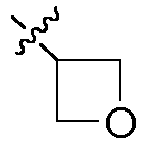


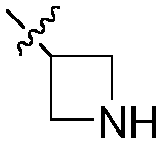


- R1 is a hydrogen, a deuterium, a halogen (such as F, Cl, Br or I, preferably F), a cyano, an alkyl (preferably a C1-4 alkyl), a cycloalkyl, a sulfonyl, an "alkyl-NH-CO-" or an "alkyl-NHSO2-"; wherein the alkyl defined in R1 can be optionally substituted by the substituents selected from the group consisting of a halogen, a hydroxyl, a cyano, an amino, a nitro, a carboxyl, a sulfonyl, an acyl, an alkoxy, a cycloalkyl, an alkenyl and an alkynyl;
- R2 is independently selected from a hydrogen, a deuterium, a halogen and an alkyl (preferably a C1-4 alkyl);
- n is 1, 2, 3 or 4;
- p is 0, 1, 2, 3, 4 or 5.
- Each substituent in the compound represented by formula IV-1-1 is preferably as following groups: wherein,
X is O or S
R2 is a hydrogen, a deuterium, a halogen (such as F, Cl, Br or I) or an alkyl;
n is 1 or 2;
p is 0 or 1. - In the present invention, the compound represented by formula IV-1-1 is preferably having the structure represented by formula V-1-1:

- R1 is a hydrogen, an alkyl or a halogen; wherein the alkyl is substituted by the substituents selected from the group consisting of a halogen, a hydroxyl, a cyano, an amino, a nitro, a carboxyl, a sulfonyl and an acyl;
- R2 is a hydrogen, a deuterium, a halogen or an alkyl;
- n is 1 or 2;
- p is 0 or 1. In the present invention, when R1 is a halogen, the halogen is F, Cl, Br or I;
- and/or, when R2 is a halogen, the halogen is F, Cl, Br or I;
- and/or, when L1 is an alkyl, the alkyl is a C1-4 alkyl;
- or, when L1 is a cycloalkyl, the cycloalkyl is a C3-6 cycloalkyl;
- when L1 is a heterocycloalkyl, the heterocycloalkyl is a C3-6 heterocycloalkyl containing 1 to 3 nitrogen atoms or a C3-6 heterocycloalkyl containing 1 to 3 oxygen atoms;
- when the alkyl, alkylene, cycloalkyl or heterocycloalkyl defined in L1 is substituted by the substituents selected from the group consisting of a cycloalkyl, the cycloalkyl is a C3-6 cycloalkyl;
- when the alkyl, alkylene, cycloalkyl or heterocycloalkyl defined in L1 is substituted by the substituents selected from the group consisting of an acyl, the acyl is a formyl or a C1-4 alkylacyl;
- when the alkyl, alkylene, cycloalkyl or heterocycloalkyl defined in L1 is substituted by the substituents selected from the group consisting of a halogen, the halogen is F, Cl, Br or I;
- the alkyl defined in R1 is a C1-4 alkyl;
- when R2 is an alkyl, the alkyl is a C1-4 alkyl.
- In the present invention, when L2 is an alkyl, the alkyl is a C1-4 alkyl;
when L2 is a cycloalkyl, the cycloalkyl is a C3-6 cycloalkyl;
when L2 is a heterocycloalkyl, the heterocycloalkyl is a C3-6 heterocycloalkyl containing 1 to 4 oxygen and/or nitrogen atoms;
when L2 is an aryl, the aryl is a C6-10 aryl;
when L2 is a heteroaryl, the heteroaryl is a C3-10 heteroaryl containing 1 to 4 nitrogen atoms.
In the present invention, when M is a halogen, the halogen is fluorine;
when M is an alkyl, the alkyl is a C1-6 alkyl;
when M is a cycloalkyl, the cycloalkyl is a C3-6 cycloalkyl;
when M is an alkoxy, the alkoxy is a C1-4 alkoxy substituted by a heterocycloalkyl; the heterocycloalkyl is not further substituted; or the heterocycloalkyl is a C2-10 heterocycloalkyl containing 1 to 4 oxygen and/or nitrogen atoms;
when M is a heterocycloalkyl, the heterocycloalkyl is a C3-8 heterocycloalkyl containing 1 to 4 oxygen and/or nitrogen atoms. - In the present invention, when M is an aryl, the aryl is a C6-10 aryl;
when M is an alkyl, an alkylene, a cycloalkyl, an alkoxy, a heterocycloalkyl, a heteroaryl, a sufonyl or an acyl substituted by a halogen, , the halogen is F, Cl, Br or I;
when M is an alkyl, an alkylene, a cycloalkyl, an alkoxy, a heterocycloalkyl, a heteroaryl, a sufonyl or an acyl substituted by an alkoxy, the alkoxy is a C1-6 alkoxy;
when M is an alkyl, an alkylene, a cycloalkyl, an alkoxy, a heterocycloalkyl, a heteroaryl, a sufonyl or an acyl substituted by a cycloalkyl, the cycloalkyl is a C3-6 cycloalkyl;
when M is an alkyl, an alkylene, a cycloalkyl, an alkoxy, a heterocycloalkyl, a heteroaryl, a sufonyl or an acyl substituted by a heterocycloalkyl, the heterocycloalkyl is a C3-8 heterocycloalkyl containing 1 to 4 oxygen and/or nitrogen atoms. - In the present invention, when the alkyl, alkylene, cycloalkyl or heterocycloalkyl defined in L1 is substituted by the substituents selected from the group consisting of a cycloalkyl, the C3-6 cycloalkyl is a cyclopentyl;
when the alkyl, alkylene, cycloalkyl or heterocycloalkyl defined in L1 is substituted by the substituents selected from the group consisting of a C1-6 alkylsulfonyl, the C1-6 alkylsulfonyl is a C1-3 alkylsulfonyl;
when the alkyl, alkylene, cycloalkyl or heterocycloalkyl defined in L1 is substituted by the substituents selected from the group consisting of a C1-4 alkylacyl, the C1-4 alkylacyl is a C2 alkylacyl;
when L1 is a C3-6 cycloalkyl, the C3-6 cycloalkyl is a cyclopropyl. - In the present invention, when L2 is a C1-4 alkyl, the C1-4 alkyl is a methyl;
when L2 is a C3-6 cycloalkyl, the C3-6 cycloalkyl is a cyclopropyl or a cyclohexyl;
when L2 is a heterocycloalkyl, the heterocycloalkyl is a C3-6 heterocycloalkyl containing 1 to 3 oxygen atoms;
when L2 is a C6-10 aryl, the C6-10 aryl is a phenyl;
when L2 is a C3-10 heteroaryl, the C3-10 heteroaryl is a C4-8 heteroaryl containing 1 to 4 nitrogen atoms. - In the present invention, when M is a C1-6 alkyl, the C1-6 alkyl is a methyl, an ethyl, a propyl or an isopropyl;
when M is a C1-6 alkyl substituted by a halogen, the C1-6 alkyl substituted by a halogen is a trifluoromethyl or


when M is a C1-4 alkoxy substituted by a C2-10 heterocycloalkyl, the C1-4 alkoxy is a C2 alkoxy;
when M is a C1-4 alkoxy substituted by a C2-10 heterocycloalkyl, the C2-10 heterocycloalkyl is a C3-8 heterocycloalkyl containing 1 to 3 oxygen and/or nitrogen atoms;
when M is a C3-8 heterocycloalkyl, the C3-8 heterocycloalkyl is a C4-6 heterocycloalkyl containing 1 to 4 oxygen and/or nitrogen atoms. - In the present invention, when M is a C6-10 aryl, the C6-10 aryl is a phenyl;
when M is an alkyl, an alkylene, an alkoxy, a heterocycloalkyl, a heteroaryl, a sulfonyl or an acyl substituted by a C3-6 cycloalkyl, , the C3-6 cycloalkyl is a cyclopropyl;
when M is a C1-4 alkoxy substituted by a C2-10 heterocycloalkyl, the C2-10 heterocycloalkyl is a C4-6 heterocycloalkyl containing 1 to 3 oxygen and/or nitrogen atoms. - In the present invention, when L2 is a C3-6 heterocycloalkyl, the C3-6 heterocycloalkyl is a tetrahydropyranyl;
when L2 is a C4-8 heteroaryl, the C4-8 heteroaryl is a pyrazolyl, an imidazolyl, a pyridyl, a benzimidazolyl, a benzopyrazolyl, a pyridazinyl or a pyrimidinyl. - In the present invention, when M is a C2 alkoxy substituted by a C2-10 heterocycloalkyl, the C2-10 heterocycloalkyl is a C3-8 heterocycloalkyl containing 1 to 3 oxygen and/or nitrogen atoms;
when M is a C4-6 heterocycloalkyl, the C4-6 heterocycloalkyl is a morpholinyl, a tetrahydropyranyl, an azetidinyl, a piperidyl, an oxetanyl, a tetrazolyl, a piperazinyl or a pyrrolidinyl;
when M is a C1-6 alkyl substituted by a C1-3 alkoxy, the C1-6 alkyl substituted by a C1-3 alkoxy is
- In the present invention, when M is a C2 alkoxy substituted by a C2-10 heterocycloalkyl, the C2-10 heterocycloalkyl is a C3-8 heterocycloalkyl containing 1 to 3 oxygen and/or nitrogen atoms.
- In the present invention, when a C2 alkoxy defined in M substituted by a C4-6 heterocycloalkyl, the C4-6 heterocycloalkyl is a morpholinyl or a pyrrolidinyl.
- In the present invention, when M is a C2 alkoxy substituted by a C4-6 heterocycloalkyl, the C4-6 heterocycloalkyl is a morpholinyl, a tetrahydropyranyl, an azetidinyl, a piperidyl, an oxetanyl, a piperazinyl or a pyrrolidinyl.
- In the present invention, the five-and-six-membered heterocyclic compound represented by formula IV-1-1 is more preferably selected from the group consisting of:


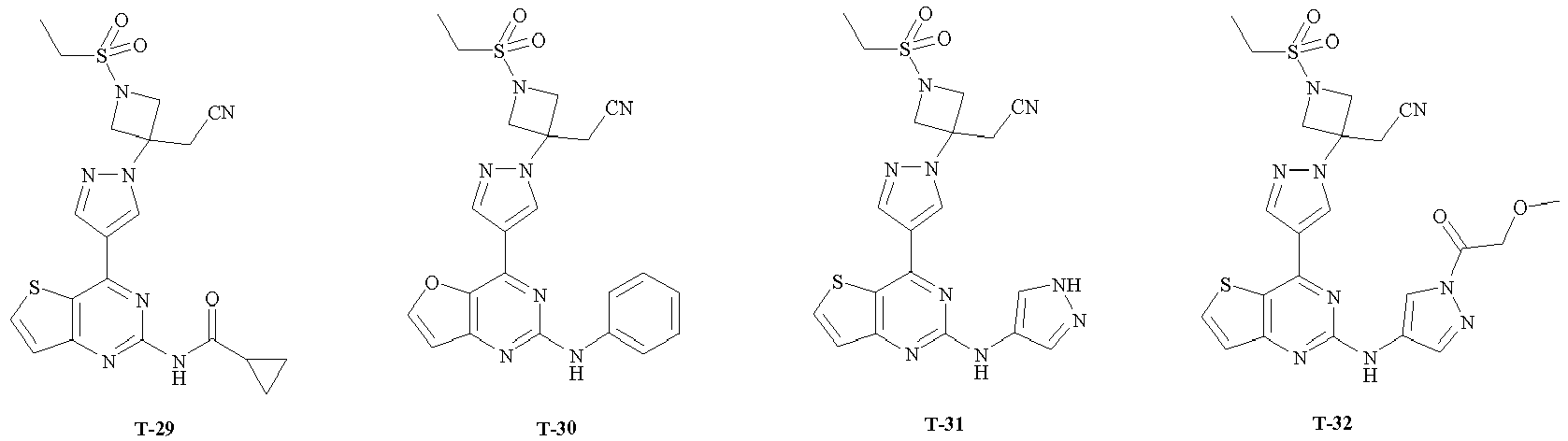


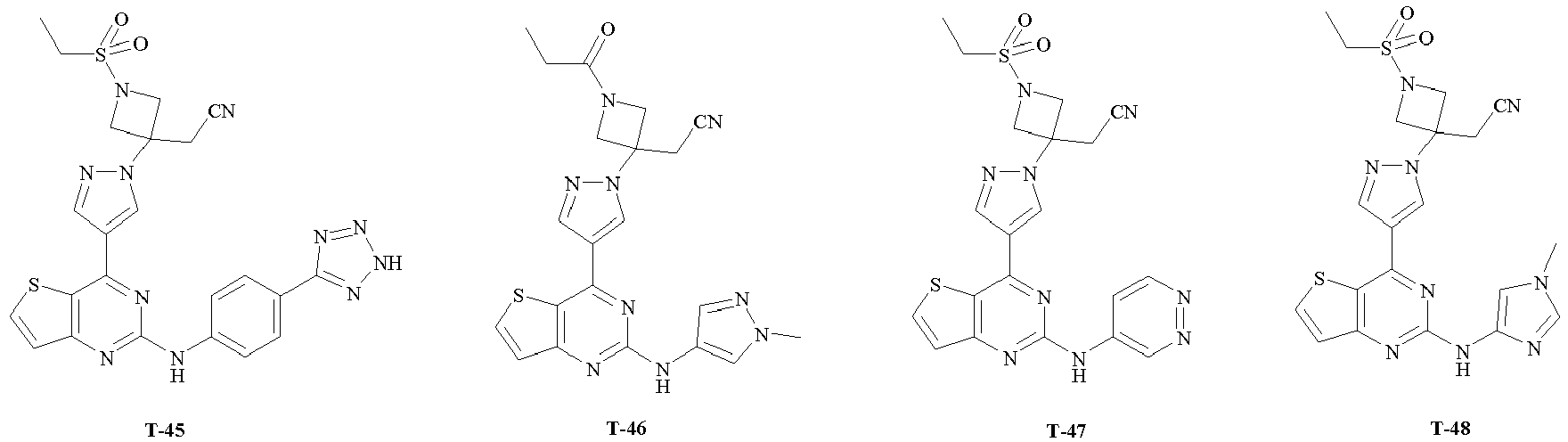


- The present invention also provides a method for preparing the compound represented by formula I, which is selected from the group consisting of:
- Method 1: under a basic condition, performing a nucleophilic substitution reaction between a compound represented by formula I-A and a compound represented by formula I-B,

- Method 2: under an acidic condition, performing a nucleophilic substitution reaction between a compound represented by formula I-A and a compound represented by formula I-B; or

- Method 3: performing a coupling reaction between a compound represented by formula I-A and a compound represented by formula I-B,

- In method 1, 2 and 3, except special explanation, each letter and substituent has the meaning given above.
- In method 1, the method and conditions for the nucleophilic substitution reaction are conventional in the art, the preferred method and conditions in the present invention are: in a solvent, performing the nucleophilic substitution reaction between the compound represented by formula I-A and the compound represented by formula I-B under a basic condition. The solvent is preferably selected from the group consisting of DMSO, 1,4-dioxane and DMF, more preferably DMSO. The base condition is preferably provided by an inorganic base, which is preferably selected from the group consisting of KF, NaF, Cs2CO3 and K2CO3, more preferably KF. A volume mass ratio of the solvent and the compound represented by formula I-A is preferably 10 mL/g-100 mL/g. The molar ratio of the compound represented by formula I-A to the compound represented by formula I-B is preferably 0.1:1-1:1, more preferably 0.3:1-0.9:1. The molar ratio of the base to the compound represented by formula I-B is preferably 1:1-10:1, more preferably 1:1-2:1. The nucleophilic substitution reaction is preferably carried out at 50°C-150°C, more preferably 70°C-110°C. The nucleophilic substitution reactionis preferably carried out till when the completion of the reaction is detected, 5h-24h is preferred in the present invention.
- In method 2, the method and conditions for the nucleophilic substitution reaction are conventional in the art, the preferred method and conditions in the present invention are: in a solvent, performing the nucleophilic substitution reaction between the compound represented by formula I-A and the compound represented by formula I-B under an acidic condition. The solvent is preferably an orgsnic solvent, which is preferably selected from the group consisting of isobutanol, n-butanol, DMSO and DMF, more preferably isobutanol. The acid condition is preferably provided by an organic acid and an inorganic acid, more preferably an organic acid. The organic acid is preferably p-toluenesulfonic acid, while the inorganic acid is preferably HCl and/or H2SO4. The volume mass ratio of the solvent and the compound represented by formula I-A is preferably 10 mL/g-100 mL/g. The molar ratio of the compound represented by formula I-A to the compound represented by formula I-B is preferably 0.1:1-1:1, more preferably 0.3:1-0.9:1. The molar ratio of the acid to the compound represented by formula I-B is preferably 0.1:1-3:1, more preferably 0.6:1-1.2:1. The nucleophilic substitution reaction is preferably carried out at 50°C-150°C, more preferably 80°C-120°C. The nucleophilic substitution reaction is preferably carried out till when the completion of the reaction is detected, 5h-24h is preferred in the present invention.
- In method 3, the method and conditions for the coupling reaction is conventional in the art, the preferred method and conditions in the present invention are: in a solvent, at an atmosphere of inert gas, performing a coupling reaction between the compound represented by formula I-A and the compound represented by formula I-B at presence of a base and a Pd-catalyst, wherein the inert gas is preferably argon and/or nitrogen; the solvent is preferably an organic solvent and/or water, the organic solvent is preferably selected from the group consisting of 1,4-dioxane, toluene and glycoldimethylether, more preferably 1,4-dioxane. The volume mass ratio of the solvent and the compound represented by formula I-A is preferably 20 mL/g-100 mL/g. The base is preferably an inorganic base, and the inorganic base is preferably selected from the group consisting of K2CO3, Cs2CO3, Na2CO3 and K3PO4. The molar ratio of the base and the compound represented by formula I-A is preferably 1:1-10:1, more preferably 3:1-5:1. The Pd-catalyst is conventional in the art, which is preferably selected from the group consisting of Pd2(dba)3, Pd(OAc)2, Pd(Pph3)4 and Pd(dppf)Cl2. Pd2(dba)3 is more preferably. The molar ratio of the Pd-catalyst to the compound represented by formula I-A is preferably 0.005:1-0.5:1, more preferably 0.01:1-0.10:1. The molar ratio of the compound represented by formula I-A to the compound represented by formula I-B is preferably 0.5:1-2:1, more preferably 0.9:1-1.5:1. The coupling reaction is preferably carried out at 50°C-150°C, more preferably 90°C-130°C. The coupling reaction is preferably carried out till when the completion of the reaction is detected, 0.5h-3h is preferred in the present invention.
- In the present invention, a preferred reaction route for preparing the compound represented by formula I is shown below:

- Persons skilled in the art may understand, according to the above compounds disclosed in the present invention, people may use well-known materials through kinds of familiar methods to prepare the compounds disclosed in the present invention, such as through chemical synthesis or extracting from plants, all of these methods are included in the present invention. Unless otherwise described or provided a preparation method, all the materials used inpreparing the compounds or intermediates thereof in the present invention are known in the art or commercially available.
- Each preferred condition for the methods in the present invention may be free combined to give better examples.
- In the present invention, the compound having the structure represented by formula IV-A:

- L1 is a chemical bond, an alkyl, an alkylene, a cycloalkyl or a heterocycloalkyl; wherein the alkyl, alkylene, cycloalkyl or heterocycloalkyl can be independently substituted by the substituents selected from the group consisting of a halogen, a cyano, a sulfonyl, an acyl, a cycloalkyl and a heterocycloalkyl;
- R1 is a hydrogen, a deuterium, a halogen, a cyano, an alkyl, a cycloalkyl, a sulfonyl, an "alkyl-NH-CO-" or an "alkyl-NHSO2-"; wherein the alkyl can be substituted by the substituents selected from the group consisting of a halogen, a hydroxyl, a cyano, an amino, a nitro, a carboxyl, a sulfonyl, an acyl, an alkoxy, a cycloalkyl, an alkenyl and an alkynyl;
- R2 is independently selected from a hydrogen, a deuterium, a halogen and an alkyl;
- m is 1; and
- n is 1, 2, 3 or 4.
- In the present invention, the five-and-six-membered heterocyclic compound represented by formula IV-A is more preferably selected from the group consisting of:


- The present invention also provides a method for preparing the compound represented by formula I-A, comprising: performing a coupling reaction between a compound represented by formula I-C and a compound represented by formula I-D;
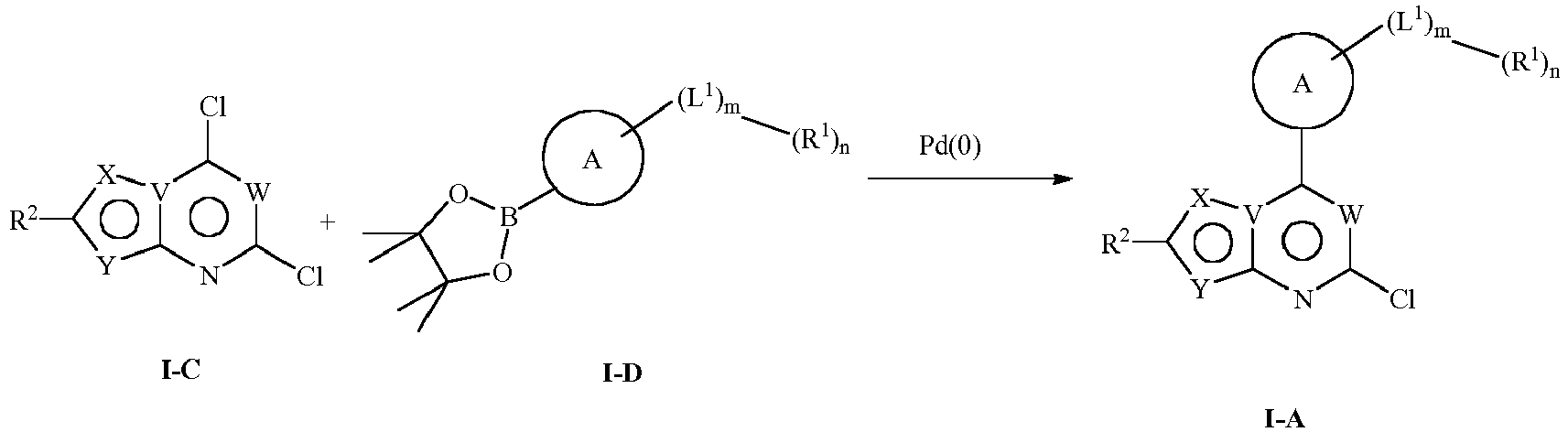
- In the method for preparing the compound represented by formula I-A, the method and conditions for the coupling reaction is conventional in the art, the preferred method and conditions in the present invention are: in a solvent, at an atmosphere of inert gas, performing a coupling reaction between the compound represented by formula I-C and the compound represented by formula I-D at presence of a base and a Pd-catalyst. Wherein the inert gas is preferably argon and/or nitrogen; the solvent is preferably an organic solvent and/or water, the organic solvent is preferably selected from the group consisting of 1,4-dioxane, toluene and glycoldimethylether, more preferably 1,4-dioxane. The volume mass ratio of the solvent and the compound represented by formula I-C is preferably 20 mL/g-100 mL/g. The base is preferably an inorganic base, and the inorganic base is preferably selected from the group consisting of K2CO3, Cs2CO3, Na2CO3 and K3PO4. The molar ratio of the base to the compound represented by formula I-C is preferably 1:1-10:1, more preferably 3:1-5:1. The Pd-catalyst is conventional in the art, which is preferably selected from the group consisting of Pd2(dba)3, Pd(OAc)2, Pd(Pph3)4 and Pd(dppf)Cl2, more preferably Pd(dppf)Cl2. The molar ratio of the Pd-catalyst to the compound represented by formula I-C is preferably 0.005:1-0.5:1, more preferably 0.01:1-0.10:1. The molar ratio of the compound represented by formula I-C to the compound represented by formula I-D is preferably 0.5:1-2:1, more preferably 0.9:1-1.5:1. The coupling reaction is preferably carried out at 20°C - 120°C, more preferably 70°C-110°C. The coupling reaction is preferably carried out till when the completion of the reaction is detected, 4h-18h is preferred in the present invention.
- The present invention also provides a use of the five-and-six-membered heterocyclic compound represented by formula IV-1-1 or a pharmaceutically acceptable salt thereof in preparing a medicament as a Janus kinase (JAK) inhibitor.
- The present invention also provides the five-and-six-membered heterocyclic compound represented by formula IV-1-1 or a pharmaceutically acceptable salt thereof for use in treating and/or preventing cell proliferation diseases. Wherein the cell proliferation diseases are conventional diseases caused by cell proliferation in the art, the preferred diseases in the present invention are cancer, injection, inflammation and autoimmune diseases.
- The present invention also provides a pharmaceutical composition, which contains a therapeutically effective dosage of the five-and-six-membered heterocyclic compound represented by formula IV-1-1, or a pharmaceutically acceptable salt thereof, and a variety of pharmaceutically acceptable carriers and/or attenuant.
- The present invention provides a use of the pharmaceutical composition in preparing a medicament as a Janus kinase (JAK) inhibitor.
- The present invention provides a use of the pharmaceutical composition in preparing a medicament for treating and/or preventing cell proliferation diseases. Wherein the cell proliferation diseases are conventional diseases caused by cell proliferation in the art, the preferred diseases in the present invention are cancer, injection, inflammation and autoimmune diseases.
- The pharmaceutical composition in the present invention may be in a form suitable for an oral administration, may also be in a form of a sterile injectable aqueous solution. The oral administration or injectable aqueous solution may be prepared according to any known methods for preparing a pharmaceutical composition in the art.
- Unless otherwise indicated, the following terms when used in the descriptions and the claims of the present invention have the following meanings:
As used herein, the term "alkyl" refers to a saturated linear or branched-chain aliphatic hydrocarbyl containing 1 to 20 carbon atoms, preferably 1 to 10 carbon atoms, more preferably 1 to 8 carbon atoms, such as a methyl, an ethyl, a n-propyl, an isopropyl, a n-butyl, a tert-butyl, an isobutyl, a pentyl, a hexyl, a heptyl, an octyl, a nonyl, a decyl, a 4,4-dimethylpentyl, a 2,2,4-trimethylpentyl, an undecyl, a dodecyl, and various isomers thereof etc.; as well as the alkyl containing 1 to 4 substituents selected from the group consisting of: a deuterium,a halogen (preferred F, Br, Cl or I), an alkyl, an alkoxy, an aryl, an aryloxy, an aryl or a diaryl substituted byan aryl, an arylalkyl, an arylalkoxy, an alkenyl, an alkynyl, a cycloalkyl, a cycloalkenyl, a cycloalkylalkyl, a cycloalkylalkoxy, an amino, a hydroxyl, a hydroxyalkyl, an acyl, an aldehyde group, a heteroaryl, a heteroaryloxy, a heterocycloalkyl, a heterocycloalkoxy, an arylheteroaryl, an arylalkoxycarbonyl, a heteroarylalkyl, a heteroarylalkoxy, an aryloxyalkyl, an aryloxyaryl, an alkylamino, an acylamino, an arylcarbonylamino, a nitro, a cyano, a thiol, a haloalkyl, a trihaloalkyl and/or an alkylthio. - As used herein, the term "alkylene" (used alone or as a part of other groups) refers to a subsaturated linear or branched-chain aliphatic hydrocarbyl containing 1 to 20 carbon atoms, preferably 1 to 10 carbon atoms, more preferably 1 to 8 carbon atoms, such as a methylene, an ethylene, a n-propylene, an isopropylene,a n-butylene, a tert-butylene, an isobutylene, a pentylene, a hexylene, a heptylene, an octylene, a nonylene, a decylene, a 4,4-dimethylpentylene, a 2,2,4-trimethylpentylene, an undecylene, a dodecylene, and various isomers thereof etc.; as well as the alkylenecontaining 1 to 4 substituents selected from the group consisting of: a deuterium,a halogen (preferred F, Br, Cl or I), an alkyl, an alkoxy, an aryl, an aryloxy, an aryl or a diaryl substituted byan aryl, an arylalkyl, an arylalkoxy, an alkenyl, an alkynyl, a cycloalkyl, an cycloalkenyl, a cycloalkylalkyl, a cycloalkylalkoxy, an amino, a hydroxyl, a hydroxyalkyl, an acyl, an aldehyde group, a heteroaryl, a heteroaryloxy, a heterocycloalkyl, a heterocycloalkoxy, an arylheteroaryl, an arylalkoxycarbonyl, a heteroarylalkyl, a heteroarylalkoxy, an aryloxyalkyl, an aryloxyaryl, an alkylamino, an acylamino, an arylcarbonylamino, a nitro, a cyano, a thiol, a haloalkyl, a trihaloalkyl and/or an alkylthio; the substituents selected from the group mentioned above may also form a ring together with the alkylene group, thereby forming a fused ring or a spiro ring.
- The term "alicyclo"or "cycloalkyl" refers to a group having a sigle ring or mutiple rings with only carbon atoms, wherein each ring can containone or more than one double bonds without a conjugated π electronic system. Preferably, a cycloalkylcontaining 1 to 3 rings with a total of 3 to 20 carbon atoms, more preferably 3 to 10 carbon atoms, for example: a cyclopropyl, a cyclobutyl, a cyclopentyl, a cyclohexyl, a cycloheptyl, a cyclooctyl, a cyclodecyl and a cyclododecyl, a cyclohexenyl; the cycloalkyl may be optionally substituted by 1 to 4 substituents selected from the group consisting of: a deuterium, a halogen, an alkyl, an alkoxy, a hydroxyl, an aryl, an aryloxy, an arylalkyl, a cycloalkyl, an alkylamino, an acylamino, an oxo, an acyl, an arylcarbonylamino, an amino,a nitro, a cyano, a thiol and/or an alkylthio and/or any alkyl defined in the present invention.
- The term "alkoxy" refers to a cyclic or non-cyclic alkyl group containing an indicated number of carbon atoms and having a connection through an oxygen bridge. Thus, "alkoxy" includes the definition of the term "alkyl" and the term"cycloalkyl" mentioned above.
- The term "alkenyl" refers to a straight-chain, branched-chain or cyclic non-aromatic hydrocarbyl having anindicated number of carbon atoms and at least one carbon-carbon double bond. Preferably there is one carbon-carbon double bond, and may have up to four non-aromatic carbon-carbon double bonds. Thus, "C2-12 alkenyl" refers to an alkenyl group having 2 to 12 carbon atoms. "C2-6 alkenyl" refers to an alkenyl group having 2 to 6 carbon atoms, including a vinyl, a propenyl, a butenyl, a 2-methyl-butenyl and a cyclohexenyl. A double bond may locate at a segment of straight chain, branched chain or cyclic portion of the alkenyl group and, where specified, the alkenyl group may be substituted, the alkenyl may be optionally substituted by the substituents selected from the group consisting of: an alkyl, a halogen, an alkoxy, a hydroxyl, an aryl, an aryloxy, an arylalkyl, a cycloalkyl, an alkylamino, an acylamino, an acyl, an arylcarbonylamino, an amino, a nitro, a cyano, a thiol and/or an alkylthio and/or any alkyl defined in the present invention.
- The term "alkynyl" refers to a straight-chain, branched-chain or cyclic hydrocarbyl having an indicated number of carbon atoms and at least one carbon-carbon triple bond. It may have up to three carbon-carbon triple bonds. Thus, "C2-12 alkynyl" refers to an alkynyl group having 2 to 12 carbon atoms. "C2-6 alkynyl" refers to an alkynyl group having 2 to 6 carbon atoms, including an ethynyl, a propynyl, a butynyl and a 3-methyl-1-butynyl and the like.
- As used herein, the term "aryl" refers to any stable monocyclic or bicyclic carbocyclic ring containing up to 7 atoms in each ring, wherein at least one ring is an aromatic ring. Examples of the above mentioned aryl group include a phenyl, a naphthyl, a tetrahydronaphthyl, a 2,3-indanyl, a biphenyl, a phenanthryl, an anthryl or an acenaphthyl. It can be understood that if an aryl substituent is a bicyclic ring having one non-aromatic ring, the connection is through the aromatic ring. It also includes the aryl optionally substituted by 1 to 4 substituents selected from the group consisting of: a deuterium, a halogen (preferred F, Br, Cl or I), an alkyl, analkoxy, anaryl, anaryloxy, anaryl or a diaryl substituted by an aryl, an arylalkyl, an arylalkoxy, an alkenyl, an alkynyl, a cycloalkyl, a cycloalkenyl, a cycloalkylalkyl, a cycloalkylalkoxy, an optionally substituted amino, a hydroxyl, a hydroxyalkyl, an acyl, an aldehyde group, a heteroaryl, a heteroaryloxy, a heterocycloalkyl, a heterocycloalkyloxy, an arylheteroaryl, an arylalkoxycarbonyl, a heteroarylalkyl, a heteroarylalkoxy, an aryloxyalkyl, an aryloxyaryl, an alkylamino, an acylamino, an arylcarbonylamino, a nitro, a cyano, a thiol, a haloalkyl, a trihaloalkyl, and/or an alkylthio.
- The term"aromatic ring"refers to any stable monocyclic or bicyclic carbocyclic ring containing up to 7 atoms in each ring, wherein at least one ring is an aromatic ring. Examples of the above mentioned aromatic ring group include a phenyl, a naphthyl, a tetrahydronaphthyl, a 2,3-indanyl, a biphenyl, a phenanthryl, an anthryl or an acenaphthyl. It can be understood that if an aryl substituent is a bicyclic ring having one non-aromatic ring, the connection is through the aromatic ring. It also includes the aromatic ring optionally substituted by 1 to 4 substituents selected from the group consisting of: a deuterium, a halogen (preferred F, Br, Cl or I), an alkyl, an alkoxy, an aryl, an aryloxy, an aryl or a diaryl substituted by an aryl, an arylalkyl, an arylalkoxy, an alkenyl, an alkynyl, a cycloalkyl, a cycloalkenyl, a cycloalkylalkyl, a cycloalkylalkoxy, an amino, a hydroxyl, a hydroxyalkyl, an acyl, an aldehyde group, a heteroaryl, a heteroaryloxy, a heterocycloalkyl, a heterocycloalkyloxy, an arylheteroaryl, an arylalkoxycarbonyl, a heteroarylalkyl, a heteroarylalkoxy, an aryloxyalkyl, an aryloxyaryl, an alkylamino, an acylamino, an arylcarbonylamino, a nitro, a cyano, a thiol, a haloalkyl, a trihaloalkyl, and/or an alkylthio.
- As used herein, the term "arylheterocyclo" or "heteroarylcyclo" refers to any stable monocyclic or bicyclic ring containing up to 7 atoms in each ring, wherein at least one ring is an aromatic ring containing 1 to 4 heteroatoms selected from the group consisting of O, N, and S. The term "arylheterocyclo"or "heteroarylcyclo" groups within the scope of this definition include, but are not limited to, an acridinyl, a carbazolyl, a cinnolinyl, a carbolinyl, a quinoxalinyl, a imidazolyl, a pyrazolyl, a pyrrolyl, an indolyl, anindolinyl, a benzotriazolyl, a benzimidazolyl, a furyl, a thienyl, an isothiazolyl, a benzothienyl, a dihydrobenzothienyl, a benzofuranyl, an isobenzofuranyl,a benzoxazolyl, a benzofuroxanyl, a benzopyrazolyl, a quinolinyl, an isoindolyl, an isoquinolinyl, an oxazolyl, an oxadiazolyl, an isoxazolyl, an indolyl, a pyrazinyl, a pyridinopyridinyl, a pyridinotetrazolyl, a pyridazinyl, a pyridinyl, anantiminthyl, a pyrimidinyl, a pyrrolyl, a tetrazolyl, a thiadiazolyl, a thiazolyl, a thiophenyl, a triazolyl, a quinazolinyl, a tetrahydroquinolinyl, a dihydrobenzimidazolyl, a dihydrobenzofuranyl, a dihydrobenzoxazolyl, a dihydroquinolinyl. As the heterocycle defined below, the term "heteroarylcyclo" should also be understood to include N-oxide derivatives of any nitrogen-containing heteroaromatic group. It can be understood that if a heteroaryl substituent is a bicyclic ring having one non-aromatic ring or one ring without heteroatom, then the connection is through the aromatic ring or the heteroatom containing in the ring. The term "heteroarylcyclo"or "arylheterocyclo" groups can beoptionally substituted by 1 to 4 substituents selected from the group consisting of a deuterium, a halogen, analkyl, analkoxy, a hydroxyl, an aryl, an aryloxy, an arylalkyl, a cycloalkyl, an alkylamino, an acylamino, an acyl, an arylcarbonylamino, an amino, a nitro, a cyano, a thiol and/or an alkylthio and/or any alkyl defined in the present invention.
- The term "halogen" refers to a fluorine, a chlorine, a bromine, an iodine, or an astatine.
- The term "hydroxyl" refers to

- The term "amino" refers to

- The term "cyano" refers to

- The term "carboxyl" refers to

- The term "sulfonyl" refers to

- The term "acyl" refers to a carbonyl or a formyl, the term "carbonyl" refers that there are substituents on both sides of an acyl, and the term "formyl" refers that there is a substituent on only one side.
- The term "acylamino" refers to a carbonyl amide or a formyl amide, the term "carbonyl amide" refers that there are substituents on both sides of an acylamino, and the term "formyl amide" refers that there is asubstituent on only one side.
- The term "haloalkyl" refers to an alkyl substituted by a halogen at optionally position. Thus, the "haloalkyl" includes the definition of the term "halogen" and the term "alkyl".
- The term "haloalkoxy" refers to an alkoxy substituted by a halogen at optionally position. Thus, the "haloalkoxy" includes the definition of the term "halogen" and the term"alkoxy".
- The term "aryloxy" refers to an aryl group containing the indicated number of carbon atoms and having a connection through an oxygen bridge. Thus, the "aryloxy" includes the definition of the term "aryl".
- As used herein, the term "arylhetero" or "heteroaryl" refers to any stable monocyclic or bicyclic ring containing up to 7 atoms in each ring, wherein at least one ring is an aromatic ring containing 1 to 4 heteroatoms selected from the group consisting of O, N, and S. The term "heteroaryl"or "arylhetero"groups within the scope of this definition include, but are not limited to, an acridinyl, a carbazolyl, a cinnolinyl, a carbolinyl, a quinoxalinyl, a imidazolyl, a pyrazolyl, a pyrrolyl, an indolyl, an indolinyl, a benzotriazolyl, a benzimidazolyl, a furyl, a thienyl, an isothiazolyl, a benzothienyl, a dihydrobenzothienyl, a benzofuranyl, an isobenzofuranyl, a benzoxazolyl, a benzofuroxanyl, a benzopyrazolyl, a quinolinyl, an isoindolyl, an isoquinolinyl, an oxazolyl, an oxadiazolyl, an isoxazolyl, an indolyl, a pyrazinyl, a pyridinopyridinyl, a pyridinotetrazolyl, a pyridazinyl, a pyridinyl, an antiminthyl, a pyrimidinyl, a pyrrolyl, a tetrazolyl, a thiadiazolyl, a thiazolyl, a thiophenyl, atriazolyl, a quinazolinyl, aquinoxalinyl, a tetrahydroquinolinyl, a dihydrobenzimidazolyl, a dihydrobenzofuranyl, a dihydrobenzoxazolyl, a dihydroquinolinyl, a methylenedioxybenzoyl. As the heterocycle defined below, the term "heteroaryl" should also be understood to include N-oxide derivatives of any nitrogen-containing heteroaromatic group. It can be understood that if a heteroaryl substituent is a bicyclic ring having one non-aromatic ring or one ring without hetero atom, then the connection is through the aromatic ring. The term "heteroaryl" or "arylhetero" groups can be optionally substituted by 1 to 4 substituents selected from the group consisting of a deuterium, a halogen, an alkyl, an alkoxy, a hydroxyl, an aryl, an aryloxy, an arylalkyl, a cycloalkyl, an alkylamino, an acylamino, an acyl, an arylcarbonylamino, an amino, a nitro, a cyano, a thiol and/or an alkylthio and/or any alkyl defined in the present invention.
- The term "heteroalicyclo" or "heterocycloalkyl" used herein alone or as a part of other groups refers to a 4 to 12 membered monocyclic or polycyclic group containing 1 to 4 heteroatoms (such as nitrogen, oxygen and/or sulphur) with may be one or more than one double bond in each ring but without a conjugated π electronic system in a ring. The term "heterocycloalkyl" groups may include 1 to 4 substituents, such as an alkyl, a halogen, an oxo and/or any alkyl set out above. In addition, any heterocycloalkyl rings can be fused to a cycloalkyl, an aryl, a heteroaryl or a heterocycloalkyl ring, and to form a fused ring. The term "heterocycloalkyl"groups within the scope of this definition include, but are not limited to, an oxazolinyl, an oxetanyl, a pyranyl, a tetrahydropyranyl, an azetidinyl, a 1,4-dioxanyl, a hexahydroazepanyl, a piperazinyl, a piperidinyl, a pyrrolidinyl, a morpholinyl, a thiomorpholinyl, a dihydrofuranyl, a dihydroimidazolyl, a dihydroindolyl, a dihydroisoxazolyl, a dihydroisothiazolyl, a dihydroxadiazolyl, a dihydroxazolyl, a dihydropyrazinyl, a dihydropyrazolyl, a dihydropyridyl, a dihydropyrimidinyl, a dihydropyrrolyl, a dihydrotetrazolyl, a dihydrothiadiazolyl, a dihydrothiazolyl, a dihydrothienyl, a dihydrotriazolyl, a dihydroazetidinyl, a tetrahydrofuranyl and a tetrahydrothienyland N-oxides thereof. A heterocycloalkyl substituent can be linked with other groups through a carbon atom or a hetero atom.
- In the present invention, all of the alkyl, cycloalkyl, heterocycloalkyl, aryl and heteroaryl having indicated carbon numbers as "Cx1-y1" (x1 and y1 are integer), for example "C1-12 alkyl", indicate that these groups are not further substituented by substituents, such as that "C1-12 alkyl" means an alkyl having 1 to 12 carbon atoms without further substituted.
- On the basis of not to violate common sense of the field, all above preferred conditions can be combined in any way to provide preferred embodiments of the present invention.
- The materials and reagents used in the present invention are all commercial available.
- The positive effect of the present invention is that: the five-and-six-membered heterocyclic compound represented by formula IV-1-1 or a pharmaceutically acceptable salt thereof in the present invention is a kind of efficient Janus kinase (JAK) inhibitor which can be used for treating or preventing cell proliferation diseases such as cancer, infections, inflammation and autoimmune diseases etc.
- Below in conjunction with specific embodiments, the present invention is further elaborated. The specific conditions of experiments for the following embodiments, when not indicated, are usually in accordance with conventional methods and conditions, or product manual.
- The structures of compounds are identified by Nuclear Magnetic Resonance (NMR) or Mass Spectrum (MS). NMR spectrum was obtained by Bruker Avance-500, using deuterated dimethyl sulphoxide, deuterated chloroform and deuterated methanol etc. as a solvent, tetramethyl silane (TMS) as an internal standard. LC-MS spectrum was obtained by liquid chromatography mass (LC-MS) spectrometry Agilent Technologies 6110, and the ESI ion source was used.Microwave reaction was performed in the Explorer full automatic microwave synthesizer produced by CEM, the magnetron frequency was 2450 MHz, continuous microwave output power was 300W.Gilson 281 was used for the preparation HPLC, and the column was Shimadazu Shim-Pack, PRC-ODS, 20x250 mm, 15 µm.
- The compounds T-16,T-17, T-18, T-42, T-55, T-56, 16-b, 30, 42, 23, 56, 55 do not fall under the claimed invention.
-

- To a solution of 3-Bromobutanenitrile (2.0 g, 10.3 mmol) and 4-(4,4,5,5-tetramethyl-1,3,2-dioxaborolan-2-yl)-1H-pyrazole (2.3 g, 15.5 mmol) in acetonitrile (100 mL) was added cesium carbonate (13.3 g, 41.2 mmol).The mixture was warmed to 90°C and stirred for 3 hours. After cooled to the room temperature, the reaction was quenched with water (100 mL). Ethyl acetate (100 mL×3) was used to extract the mixture, the organic layers were combined and washed with water (60 mL×3) and saturated brine (60 mL)in sequence. After dried over anhydrous sodium sulfate, the organic layer was filtrated, the filtrate was concentrated in vaccum to give colorless oil 1-a (2.3 g), the crude product was used directly for the next step. LC-MS (ESI): m/z = 262 [M+H]+.
- Under nitrogen, to a solution of 2,4-dichlorothieno[3,2-d]pyrimidine (265 mg, 1.29 mmol), compound 1-a (261 mg, 1.0 mmol) and Pd(dppf)Cl2 (80 mg, 0.1 mmol) in 1,4-dioxane (10 mL) was added sodium carbonate (318 mg, 3.0 mmol), the mixture was warmed to 65°C and stirred for 18 hours. The mixture was concentrated in vacuum, the residue was purified by silica column chromatography (petroleum ether : ethyl acetate=2:1) to give compound 1 (250 mg, yield: 82%). LC-MS (ESI):m/z = 304 [M+H]+.
- A mixture of compound 1 (30 mg, 0.1 mmol), benzylamine (32 mg, 0.3 mmol), potassium fluoride (17 mg, 0.3 mmol), 1,4-dioxane (5 mL) and DMSO (1 mL) was heated to 110°C and stirred for 20 hours. The mixture was concentrated in vacuum, the residue was diluted with water (50 mL), then extracted with ethyl acetate (50 mL). The organic layer was washed with water (20 mL×2) and saturated brine (20 mL) in sequence, then dried over anhydrous sodium sulfate. After filtration, the filtrate was concentrated in vacuum and the residue was purified by silica column chromatography (dichloromethane : methanol=100:1) to give compound T-01 (20 mg, yield: 53 %). LC-MS (ESI):m/z=375 [M+H]+. 1H-NMR (400MHz, CDCl3) δ: 8.29 (s, 1H), 8.24 (s, 1H), 7.80 (d, J=5.6Hz, 1H), 7.41∼7.42 (m, 2H), 7.31∼7.35 (m, 2H), 7.24∼7.28 (m, 2H), 5.63 (br, 1H), 4.75 (d, J=6.0Hz, 2H), 4.73 (m, 1H), 2.93∼3.06 (m, 2H), 1.76 (d, J=6.8Hz, 3H) ppm
-

- Compound 1 (30 mg, 0.1 mmol), aniline (55 mg, 0.6 mmol) and p-toluene sulfonic acidmonohydrate (76 mg, 0.4 mmol) were dissolved in isobutanol (8 mL), the mixture was heated to 110°C and stirred for 16 hours. The mixture was concentrated in vacuum, and the residue was diluted with ethanol (30 mL), then washed with saturated aqueous sodium dicarbonate (30 mL), water (30 mL) and saturated brine (30 mL) in sequence. After dried over anhydrous sodium sulfate, the mixture was filtrated, and the filtrate was concentrated in vacuum, the residue was purified by silica column chromatography (petroleum ether : ethyl acetate=1:1) to give compound T-02 (20 mg, yield: 55 %). LC-MS (ESI):m/z=361 [M+H]+.
1H-NMR (400MHz, CDCl3) δ: 8.35 (s, 1H), 8.32 (s, 1H), 7.88 (d, J=5.6Hz, 1H), 7.75 (d, J=8.0Hz, 1H), 7.33∼7.39 (m, 4H), 7.03∼7.06 (m, 1H), 4.75∼4.80 (m, 1H), 2.96∼3.09 (m, 2H), 1.76 (d, J=6.8Hz, 3H) ppm -

- Under nitrogen, a suspension of (cyanomethyl)triphenylphosphanium bromide (12 g, 31.49 mmol) in anhydrous THF (100 mL) was cooled to 0°C, a solution of 2.5 M n-BuLi in n-hexane (13 mL, 34.64 mmol) was added dropwise. The mixture was stirred at 0°C for another 30 minutes, then cyclopentane-carbaldehyde (3.1 g, 31.49 mmol) was added, and the mixture was warmed to the room temperature and stirred for further 1 hour. The reaction was quenched with saturated aqueous ammonium chloride solution (50 mL), extracted with ethyl acetate (100 mL×3). The organic layers were combined, washed with water (60 mL×3) and saturated brine (60 mL) in sequence, dried over anhydrous sodium sulfate. The mixture was filtrated, the filtrate was concentrated in vacuum, the residue was purified by silica column chromatography (petroleum ether : ethyl acetate=10:1) to give colorless oil 3-b (1.0 g, yield: 26.2%). LC-MS (ESI):m/z=122 [M+H]+.
- To a solution of compound 3-b (1 g, 8.26 mmol) and 4-(4,4,5,5-tetramethyl-1,3,2-dioxaborolan-2-yl)-1H-pyrazole (2.4 g, 12.39 mmol) in acetonitril (10 mL) was added1,8-diazabicyclo[5.4.0]undec-7-ene (2.5 g, 16.52 mmol). The mixture was stirred at 60°C for 18 hours. The mixture was concentratedin vacuum. To the residue was added water (50 mL), then the mixture was extracted with ethyl acetate (100 mL×3). The organic layers were combined, washed with water (60 mL×3) and saturated brine (60 mL) in sequence, dried over anhydrous sodium sulfate. The mixture was filtrated, the filtrate was concentrated in vacuum, the residue was purified by silica column chromatography (petroleum ether : ethyl acetate=3:1) to give yellow oil 3-a (715 mg, yield: 27.5 %). LC-MS (ESI):m/z=316 [M+H]+.
- Under nitrogen, to a suspension of compound 3-a (715 mg, 2.27 mmol), 2,4-dichlorotheino[3,2-d]pyrimidine (465 mg, 2.27 mmol) and sodium carbonate (72 mg, 6.80 mmol) in 1,4-dioxane (4 mL) and water (4 mL) was added Pd(dppf)Cl2 (233 mg, 0.28 mmol). The mixture was stirred at 80°C for 16 hours. The mixture was concentrated, and to the residue was added water (20 mL). Then the mixture was extracted with methylene chloride (20 mL×3), the organic layers were combined, washed with water (60mL×3) and saturated brine (60 mL) in sequence, and then dried over anhydrous sodium sulfate, filtrated. The filtrate was concentrated in vacuum, and the residue was purified by silica column chromatography (petroleum ether : ethyl acetate=2:1) to give light yellow solid 3 (330 mg, yield: 40.7 %).LC-MS (ESI):m/z=358 [M+H]+.
- To a solution of compound 3 (50 mg, 0.14 mmol) andaniline (39 mg, 0.42 mmol) in isobutanol (0.5 mL) was added p-toluene sulfonic acid monohydrate (54 mg, 0.28mmol). The mixture was heated to 110°C and stirred for 16 hours. The mixture was then cooled to room temperature, and stirred for further 2 hours. The mixture was filtrated and the solid was purified by preparation HPLC (mobile phase: acetonitrile, water (0.05% trifluoroacetic acid); gradient: 40%-70%-10%) to give compound T-03 (23 mg, yield: 39.7%). LC-MS (ESI):m/z=415 [M+H]+.
1H-NMR (400MHz, CDCl3) δ: 8.37 (d, J=6Hz, 2H), 7.90 (d, J=6Hz, 1H), 7.76 (d, J=8Hz, 2H), 7.37 (m, 3H), 7.05 (t, J=7Hz, 1H), 4.28 (m, 1H), 3.17 (m, 1H), 2.97 (m, 1H), 2.61 (m, 1H), 1.99 (m, 1H), 1.71 (m, 7H) ppm -

- To a solution of compound 3 (50 mg, 0.14 mmol) and 5-aminopyrimidine (40 mg, 0.42 mmol) in isobutanol (0.5 mL) was added p-toluene sulfonic acid monohydrate (53 mg, 0.28 mmol). The mixture was heated to 110°C and stirred for 16 hours. The mixture was then concentrated in vacuum and the residue was purified by preparation HPLC (mobile phase: acetonitrile, water (0.05% trifluoroacetic acid); gradient: 60%-90%-10%) to give compound T-04 (7 mg, yield: 12%) as a yellow solid. LC-MS (ESI):m/z=417 [M+H]+.
1H-NMR (400MHz, CD3OD) δ: 9.37 (s, 2H), 8.76 (s, 1H), 8.65 (s, 1H), 8.41 (s, 1H), 8.21 (d, J=6Hz, 1H), 7.43 (d, J=6Hz, 1H), 4.53 (m, 1H), 3.12∼3.28 (m, 2H), 2.56 (m, 1H), 1.97 (m, 1H), 1.41∼1.72 (m, 7H) ppm -

- Under nitrogen, a suspension of (cyanomethyl)triphenylphosphanium bromide (13.4 g, 35.09 mmol) in anhydrous THF (100 mL) was cooled to 0°C, a solution of 2.5 M n-BuLi in n-hexane (15.5 mL, 38.59 mmol) was added dropwise. The mixture was stirred at 0°C for another 30 minutes, then tert-butyl-3-oxoazetidine-1-carboxylate (6.0 g, 35.09 mmol) was added, and the mixture was warmed to room temperature and stirred for further 1 hour. The reaction was quenched with saturated aqueous ammonium chloride solution (50 mL), extracted with ethyl acetate (150 mL×3). The organic layers were combined, washed with water (100 mL×3) and saturated brine (100 mL) in sequence, dried over anhydrous sodium sulfate.The resultant mixture was filtrated, the filtrate was concentrated in vacuum, and the residue was purified by silica column chromatography (petroleum ether : ethyl acetate=5:1) to give a white solid 5-c (2.5 g, yield: 37%). LC-MS (ESI):m/z=217 [M+Na]+.
- To a solution of compound 5-c (6.0 g, 30.93 mmol) and 4-(4,4,5,5-tetramethyl-1,3,2-dioxaborolan-2-yl)-1H-pyrazole (9.2 g, 47.42 mmol) in acetonitril (60 mL) was added 1,8-diazabicyclo[5.4.0]undec-7-ene (10.0 g, 65.79 mmol). The mixture was stirred at 60°C for 18 hours. The mixture was concentrated in vacuum. To the residue was added 1 N aqueous hydrogen chloride solution (100 mL), then the mixture was extracted with ethyl acetate (100 mL×3). The organic layers were combined, washed with water (60 mL×3) and saturated brine (60 mL) in sequence, dried over anhydrous sodium sulfate. The resultant mixture was filtrated, the filtrate was concentrated in vacuum, and the residue was purified by silica column chromatography (petroleum ether : ethyl acetate=3:1) to give a white solid 5-b (7.1 g, yield: 59.2%). LC-MS (ESI):m/z=389 [M+H]+.
- Under nitrogen, to a suspension of compound 5-b (4.0 g, 10.3 mmol), 2,4-dichlorotheino[3,2-d]pyrimidine (2.52 g, 12.4 mmol) and sodium carbonate (3.3 g, 31.2 mmol) in 1,4-dioxane (25 mL) and water (25 mL) was added Pd(dppf)Cl2 (1.1 g, 1.5 mmol). The mixture was stirred at 80°C for 16 hours. The mixture was concentrated in vacuum. To the residue was added water (200 mL), then the mixture was extracted with methylene chloride (200 mL×3). The organic layers were combined, washed with water (100 mL×3) and saturated brine (100 mL) in sequence, and then dried over anhydrous sodium sulfate, filtrated.The filtrate was concentrated in vacuum, and the residue was purified by silica column chromatography (petroleum ether : ethyl acetate=2:1) to give a light yellow solid 5-a (3.2 g, yield: 63%).LC-MS (ESI):m/z=431 [M+H]+.
- To a solution of compound 5-a (310 mg, 0.72 mmol) in dichloromethane (2 mL) was added a solution of hydrogen chloride in 1,4-dioxane (4 N, 1 mL), the mixture was stirred at room temperature for 16 hours.The resultant mixture was concentrated and to the residue was added dichloromethane (10 mL) and triethylamine (2 mL). The mixture was then cooled to 0°C, ethanesulfonyl chloride (154 mg, 1.37 mmol) was added dropwise, and after completion of dropping, the mixture was stirred at 0°C for further 30 minutes. To the resultant mixture was addedwater (5 mL), and the mixture was extracted with dichloromethane (10 mL×3). The organic layers were combined, washed with water (10 mL×3) and saturated brine (10 mL) in sequence, dried over anhydrous sodium sulfate. The mixture was filtrated, the filtrate was concentrated in vacuum, the residue was purified by silica column chromatography (petroleum ether : ethyl acetate=2:1) to give compound 5 (108 mg, yield: 34%). LC-MS (ESI):m/z=423 [M+H]+.
- To a solution of compound 5 (50 mg, 0.12 mmol) and aniline (33 mg, 0.36 mmol) in isobutanol (1 mL) was added p-toluene sulfonic acid monohydrate (45 mg, 0.24 mmol). The mixture was heated to 110°C and stirred for 16 hours. The mixture was then concentrated under reduced pressure and the residue was purified by preparation HPLC (mobile phase: acetonitrile, water (0.05% trifluoroacetic acid); gradient: 60%-90%-10%) to give ayellow solid T-05 (21 mg, yield: 37 %). LC-MS (ESI):m/z=480 [M+H]+.
1H-NMR (400MHz, CDCl3) δ: 8.47 (s, 1H), 8.39 (s, 1H), 7.92 (d, J=5Hz, 1H), 7.75 (d, J=8Hz, 2H), 7.38 (m, 3H), 7.06 (t, J=7Hz, 1H), 4.64 (d, J=9Hz, 2H), 4.26 (d, J= 9Hz, 2H), 3.39 (s, 2H), 3.10 (q, J= 7Hz, 2H), 1.43 (t, J= 7Hz, 3H) ppm -

- Compound 5 (150 mg, 0.36 mmol), 4-aminotetrahydropyran (90 mg, 0.89 mmol) and anhydrouspotassium fluoride (31 mg, 0.54 mmol) were suspended in DMSO (2 mL), the mixture was stirred at 80°C for 16 hours. The mixture was then cooled to room temperature and diluted with dichloromethane (50 mL), after washed with water (20 mL×2), the organic layer was dried over anhydrous sodium sulfate. The mixture was filtrated, the filtrate was concentrated in vacuum, and the residue was purified by preparation TLC (petroleum ether : ethyl acetate=2:1) to give compound T-06 (18 mg, yield: 11 %). LC-MS (ESI):m/z=488 [M+H]+.
1H-NMR (400MHz, CDCl3) δ: 8.41 (s, 1H), 8.34 (s, 1H), 7.83 (d, J=5Hz, 1H), 7.25 (d, J=5Hz, 1H), 5.10 (br, 1H), 4.63 (d, J= 9Hz, 2H), 4.24 (d, J= 9Hz, 2H), 4.19 (m, 1H), 4.05 (m, 2H), 3.55 (m, 2H), 3.41 (s, 2H), 3.11 (q, J= 7Hz, 2H), 2.10 (m, 2H), 1.61 (m, 2H), 1.42 (t, J= 7Hz, 3H) ppm -

- 1-Flouro-4-nitrobenzene (2.9 g, 20.56 mmol) and morpholine (3.6 g, 41.13 mmol) were dissolved in DMSO (15 mL), potassium carbonate was added and the mixture was stirred at 80°C for 18 hours. After cooled to room temperature, the mixture was poured into water (100 mL), there was yellow solid precipitated. After filtration, the filter cake was washed with water. The filter cake was then dried in vacuum for 24 hours to give compound 7-b (3.5 g, yield: 82%), which was used directly for the next step without purification.
- Compound 7-b (1.5 g, 7.21 mmol) and ammonium chloride (1.0 g, 18.03 mmol) were dissolved in 50% ethanol-water (20 mL), Zn-powder (1.2 g, 18.03 mmol) was then added. The mixture was refluxed for 30 minutes. After cooled to room temperature, the mixture was filtrated. The filter cake was washed with ethanol (10 mL), the combined filtrate were concentrated under reduced pressure.The residue was diluted with water (50 mL) and extracted with ethyl acetate (50 mL×3), the organic layer was dried over anhydrous sodium sulfate. After filtration, the filtrate was concentrated under reduced pressure to give light brown solid 7-a (1.1 g, yield: 86%), which was used directly for the next step without purification. LC-MS (ESI): m/z=179 [M+H]+.
- Compound 5 (150 mg, 0.36 mmol) and compound 7-a (190 mg, 1.07 mmol) were dissolved in isobutanol (2 mL), p-toluene sulfonic acid monohydrate (135 mg, 0.71 mmol) was added. The mixture was heated to 110°C and stirred for 16 hours. After cooled to room temperature, the mixture was stirred for further 30 minutes. There was solid precipitated, after filtration, the solid was purified by preparation HPLC (mobile phase: acetonitrile, water (0.05% trifluoroacetic acid); gradient: 50%-80%-10%) to give yellow solid T-07 (21 mg, yield: 26%). LC-MS (ESI): m/z=565 [M+H]+.
1H-NMR (400MHz, CDCl3) δ: 8.44 (s, 1H), 8.35 (s, 1H), 7.89 (d, J=5Hz, 1H), 7.61 (d, J=9Hz, 2H), 7.32 (d, J=5Hz, 1H), 6.96 (d, J=9Hz, 2H), 4.64 (d, J=9Hz, 2H), 4.24 (d, J= 9Hz, 2H), 3.89 (m, 4H), 3.41 (s, 2H), 3.08∼3.16 (m, 6H), 1.43 (t, J= 7Hz, 3H) ppm -

- p-Nitrophenol (6.0 g, 43.16 mmol) and 1,2-dibromoethane (16.0 g, 86.02 mmol) were dissolved in acetone (60 mL), potassium carbonate (9.0 g, 65.22 mmol) was then added. The mixture was refluxed for 3 hours, then cooled to room temperature. The resultant mixture was filtrated and the filter cake was washed with acetone (30 mL). The filtrate was concentrated under reduced pressure, and the residue was diluted with water (50 mL), then extracted with ethyl acetate (50 mL×3). The organic layers were combined, washed with water (50 mL×3) and saturated brine (50 mL). After dried over anhydrous sodium sulfate, the mixture was filtrated, and the filtrate was concentrated in vacuum, the residue was purified by silica column chromatography (petroleum ether : ethyl acetate=5:1) to give light yellow solid 8-c (2.1 g, yield: 19%).
- Compound 8-c (1.0 g, 4.08 mmol) and morpholine (702 mg, 8.16 mmol) were dissolved in acetonitrile (5 mL), potassium carbonate (1.2 g, 8.16 mmol) was added. The mixture was refluxed for 3 hours, and then cooled to room temperature, after filtration, the filter cake was washed with ethyl acetate (30 mL). The filtrate was concentrated under reduced pressure, the residue was diluted with water (50 mL) and extracted with ethyl acetate (50 mL×3). The organic layers were combined and washed with water (50 mL×3) and saturated brine (50 mL) in sequence. After dried over anhydrous sodium sulfate, the mixture was filtrated, and the filtrate was concentrated in vacuum to give light yellow solid 8-b (900 mg), which was used directly for the next step without further purification.
- Under hydrogen (1 atm), to a solution of compound 8-b (900 mg, 3.57 mmol) in ethanol (50 mL) was added 10% Pd-C (0.5 g). The mixture was stirred at 25°C for 18 hours, and then filtrated. The filtrate was concentrated under reduced pressure to give light yellow oil 8-a (760 mg, yield: 96%), which was used directly for the next step without purification.
- Compound 8-a (105 mg, 0.47 mmol) and compound 5 (100 mg, 0.24 mmol) were dissolved in n-butanol (2 mL), p-toluene sulfonic acid monohydrate (68 mg, 0.36 mmol) was added. The mixture was heated to 110°C and stirred for 16 hours, after cooled to room temperature, the mixture was stirred for further 30 minutes. The resultant mixture was filtrated, the solid was purified by preparation HPLC (mobile phase: acetonitrile, water (0.05% trifluoroacetic acid); gradient: 40%-70%-10%) to give yellow solid T-08 (51 mg, yield: 35 %). LC-MS (ESI): m/z=609 [M+H]+.
1H-NMR (400MHz, CDCl3) δ: 8.43 (s, 1H), 8.35 (s, 1H), 7.86 (d, J=5Hz, 1H), 7.61 (d, J=9Hz, 2H), 7.31 (d, J=5Hz, 1H), 7.19 (s, 1H), 6.93 (d, J=9Hz, 2H), 4.63 (d, J=9Hz, 2H), 4.16 (t, J=5Hz, 2H), 3.78 (t, J=4Hz, 4H), 3.39 (s, 2H), 3.09 (q, J=6Hz, 2H), 2.89 (t, J=4Hz, 2H), 2.69 (s, 4H), 1.43 (t, J= 6Hz, 3H) ppm -

- Compound 8-c (1.0 g, 4.08 mmol) and pyrrolidine (580 mg, 8.16 mmol) were dissolved in acetonitrile (50 mL), potassium carbonate (1.2 g, 8.16 mmol) was added. The mixture was refluxed for 3 hours, and then cooled to room temperature. After filtration, the filter cake was washed with ethyl acetate (30 mL). The filtrate was concentrated under reduced pressure, and the residue was diluted with water (50 mL) and extracted with ethyl acetate (50 mL×3). The organic layers were combined and washed with water (50 mL×3) and saturated brine (50 mL) in sequence. After dried over anhydrous sodium sulfate, the mixture was filtrated, and the filtrate was concentrated in vacuum to give yellow oil 9-b (1.0 g), which was used directly for the next step without further purification.
- Under hydrogen (1 atm), to a solution of compound 9-b (1.0 g, 4.24 mmol) in ethanol (50 mL) was added 10% Pd-C (0.5 g). The mixture was stirred at 25°C for 18 hours, and then filtrated, the filtrate was concentrated under reduced pressure to give light yellow oil 9-a (780 mg, yield: 90%), which was used directly for the next step without purification.
- Compound 9-a (73 mg, 0.35 mmol) and compound 5 (50 mg, 0.12 mmol) were dissolved in n-butanol (2 mL), p-toluene sulfonic acid monohydrate (45 mg, 0.24 mmol) was added. The mixture was heated to 110°C and stirred for 16 hours. After cooled to room temperature, the mixture was stirred for further 30 minutes. The resultant mixture was filtrated, and the solid was purified by preparation HPLC (mobile phase: acetonitrile, water (0.05% trifluoroacetic acid); gradient: 50%-80%-10%) to give yellow solid T-09 (51 mg, yield: 36%). LC-MS (ESI): m/z=593 [M+H]+.
1H-NMR (400MHz, MeOD) δ: 8.60 (m, 1H), 8.20 (m, 2H), 7.55 (m, 1H), 7.22 (m, 1H), 7.02 (m, 2H), 4.61 (d, J=9Hz, 2H), 4.34 (m, 2H), 4.26 (d, J=9Hz, 2H), 3.77 (m, 2H), 3.68 (m, 2H), 3.60 (s, 2H), 3.17∼3.24 (m, 4H), 2.04∼2.20 (m, 4H), 1.38 (t, J= 6Hz, 3H) ppm -

- At 0°C, to a solution of 1,2,4-triazole (2.7 g, 39.01 mmol) in DMF (50 mL) was added sodium hydride (1.6 g, 39.01 mmol). The mixture was stirred for 30 minutes and 1-flouro-4-nitrobenzene (5.0 g, 35.46 mmol) was added, and the resultant mixture was stirred for further 2 hours. Water (150 mL) was added slowly to the mixture, there was solid precipitated. After filtration, the filter cake was washed with water (50 mL×3), and the solid was dried in vacuum for 8 hours to give yellow solid 10-b (6.2 g, yield: 91%), which was used for the next step without further purification. LC-MS (ESI): m/z=191 [M+H]+.
- Compound 10-b (3.0 g, 15.78 mmol) and ammonium chloride (2.1 g, 39.62 mmol) were dissolved in 50% ethanol-water (60 mL). Zn-powder (2.6 g, 40 mmol) was then added. The mixture was refluxed for 30 minutes. After cooled to room temperature, the mixture was filtrated, and the filter cake was washed with ethanol (10 mL). The combined filtrate were concentrated under reduced pressure, and the residue was diluted with water (100 mL) and extracted with ethyl acetate (100 mL×3). The organic layer was dried over anhydrous sodium sulfate. After filtration, the filtrate was concentrated under reduced pressure to give yellow solid 10-a (1.1 g, yield: 81 %), which was used directly for the next step without purification. LC-MS (ESI): m/z=161 [M+H]+.
- Compound 10-a (114 mg, 0.71 mmol) and compound 5 (100 mg, 0.24 mmol) were dissolved in n-butanol (2 mL), p-toluene sulfonic acid monohydrate (180 mg, 0.95 mmol) was added. The mixture was heated to 110°C and stirred for 16 hours. After cooled to room temperature, the mixture was stirred for further 30 minutes, and there was solid precipitated. After filtration, the solid was purified by preparation HPLC (mobile phase: acetonitrile, water (0.05% trifluoroacetic acid); gradient: 60%-90%-10%) to give yellow solid T-10 (25 mg, yield: 19%). LC-MS (ESI): m/z=547 [M+H]+.
1H-NMR (400MHz, CDCl3) δ: 8.58 (d, J=4Hz, 2H), 8.41 (s, 1H), 8.13 (s, 1H), 8.09 (d, J=6Hz, 1H), 7.92 (d, J=9Hz, 2H), 7.71 (d, J=9Hz, 2H), 7.49 (d, J=6Hz, 1H), 4.66 (d, J=9Hz, 2H), 4.25 (d, J=9Hz, 2H), 3.45 (s, 2H), 3.10 (q, J=6Hz, 2H), 1.43 (t, J= 6Hz, 3H) ppm -

- At 0°C, to a solution of pyrazole (2.7 g, 39.01 mmol) in DMF (50 mL) was added sodium hydride (1.6 g, 39.01 mmol), the mixture was stirred for 30 minutes. Then 1-flouro-4-nitrobenzene (5.0 g, 35.46 mmol) was added, and the resultant mixture was stirred for further 2 hours. Water (250 mL) was added slowly to the mixture, and there was solid precipitated. After filtration, the filter cake was washed with water (50 mL×3), and the solid was dried in vacuum for 8 hours to give yellow solid 11-b (6 g, yield: 90%), which was used for the next step without further purification.
- Compound 11-b (1.0 g, 5.29 mmol) and ammonium chloride (0.7 g, 13.23 mmol) were dissolved in 50% ethanol-water (20 mL). Zn-powder (0.9 g, 13.23 mmol) was then added. The mixture was refluxed for 30 minutes. After cooled to room temperature, the mixture was filtrated, and the filter cake was washed with ethanol (10 mL). The combined filtrate were concentrated under reduced pressure, and the residue was diluted with water (50 mL) and extracted with ethyl acetate (50 mL×3). The organic layer was dried over anhydrous sodium sulfate. After filtration, the filtrate was concentrated under reduced pressure to give yellow solid 11-a (670 mg, yield: 80%), which was used directly for the next step without purification. LC-MS (ESI): m/z=160 [M+H]+.
- Compound 11-a (79 mg, 0.50 mmol) and compound 5 (70 mg, 0.17 mmol) were dissolved in n-butanol (2 mL), p-toluene sulfonic acid monohydrate (95 mg, 0.50 mmol) was added. The mixture was heated to 110°C and stirred for 16 hours. After cooled to room temperature, the mixture was stirred for further 30 minutes, and there was solid precipitated. After filtration, the solid was purified by preparation HPLC (mobile phase: acetonitrile, water (0.05% trifluoroacetic acid); gradient: 60%-90%-10%) to give yellow solid T-11 (31 mg, yield: 34%). LC-MS (ESI): m/z=546 [M+H]+.
1H-NMR (400MHz, CDCl3) δ: 8.49 (s, 1H), 8.40 (s, 1H), 7.94 (d, J=6Hz, 1H), 7.91 (d, J=2Hz, 1H), 7.84 (d, J=9Hz, 2H), 7.68∼7.73 (m, 3H), 7.40 (d, J=6Hz, 2H), 6.47 (t, J=2Hz, 1H), 4.65 (d, J=9Hz, 2H), 4.26 (d, J=9Hz, 2H), 3.43 (s, 2H), 3.10 (q, J=6Hz, 2H), 1.43 (t, J= 6Hz, 3H) ppm -

- 4-Methylsulfonylaniline (98 mg, 0.57 mmol) and compound 5 (80 mg, 0.19 mmol) were dissolved in n-butanol (2 mL), p-toluene sulfonic acid monohydrate (72 mg, 0.38 mmol) was added. The mixture was heated to 110°C and stirred for 16 hours. After cooled to room temperature, the mixture was stirred for further 30 minutes, and there was solid precipitated. After filtration, the solid was purified by preparation HPLC (mobile phase: acetonitrile, water (0.05% trifluoroacetic acid); gradient: 65%-95%-10%) to give white solid T-12 (30 mg, yield: 28%). LC-MS (ESI): m/z=558 [M+H]+.
1H-NMR (400MHz, CDCl3) δ: 8.51 (s, 1H), 8.40 (s, 1H), 7.92∼8.00 (m, 6H), 7.44 (d, J=6Hz, 1H), 4.66 (d, J=9Hz, 2H), 4.26 (d, J=9Hz, 2H), 3.44 (s, 2H), 3.13 (q, J=6Hz, 2H), 3.07 (m, 3H), 1.44 (t, J= 6Hz, 3H) ppm -

- 3-(4-Morpholinyl)aniline (102 mg, 0.57 mmol) and compound 5 (80 mg, 0.19 mmol) were dissolved in n-butanol (2 mL), p-toluene sulfonic acid monohydrate (180 mg, 0.95 mmol) was added. The mixture was heated to 110°C and stirred for 16 hours. After cooled to room temperature, the mixture was stirred for further 30 minutes, and there was solid precipitated. After filtration, the solid was purified by preparation HPLC (mobile phase: acetonitrile, water (0.05% trifluoroacetic acid); gradient: 60%-90%-10%) to give white solid T-13 (15 mg, yield: 14%). LC-MS (ESI): m/z=565 [M+H]+.
1H-NMR (400MHz, CDCl3) δ: 10.2 (br, 1H), 8.56 (s, 1H), 8.36 (s, 1H), 8.04 (d, J=6Hz, 1H), 7.61 (d, J=6Hz, 2H), 7.28∼7.36 (m, 3H), 6.75 (m, 1H), 4.63 (d, J=9Hz, 2H), 4.25 (d, J= 9Hz, 2H), 3.90 (m, 4H), 3.41 (s, 2H), 3.24 (m, 2H), 3.08 (q, J=6Hz, 2H), 1.43 (t, J= 7Hz, 3H) ppm -

- Under nitrogen, to a suspension of compound 5 (130 mg, 0.31 mmol), 5-amino pyrimidine (89 mg, 0.94 mmol) and cesium carbonate (102 mg, 0.32 mmol) in 1,4-dioxane (4 mL) were added Pd2(dba)3 (47 mg, 0.05 mmol) and BINAP (34 mg, 0.05 mmol). The mixture was heated to 120°C by microwave and stirred for 60 minutes. After cooled to room temperature, the mixture was diluted with dichoromethane (20 mL), and then was filtrated, the filtrate was concentrated under reduced pressure. The residue was diluted with methanol (5 mL), and there was solid precipitated. After filtration, the solid was purified by preparation HPLC (mobile phase: acetonitrile, water (0.05% trifluoroacetic acid); gradient: 40%-70%-10%) to give light yellow solid T-14 (16 mg, yield: 10%). LC-MS (ESI): m/z=482 [M+H]+.
1H-NMR (400MHz, CDCl3) δ: 9.29 (s, 2H), 8.94 (s, 1H), 8.55 (s, 1H), 8.40 (br, 1H), 8.39 (s, 1H), 8.02 (d, J=6Hz, 1H), 7.42 (d, J=6Hz, 1H), 4.67 (d, J=9Hz, 2H), 4.27 (d, J= 9Hz, 2H), 3.44 (s, 2H), 3.11 (q, J= 7Hz, 2H), 1.43 (t, J= 7Hz, 3H) ppm -

- At 0°C, to a solution of 4-nitropyrazole (3.3 g, 29.2 mmol) in anhydrous THF (30 mL) was added sodium hydride (1.3 g, 32.1 mmol). After the mixture was stirred for 1 hour, iodomethane (2 mL) was added slowly, and the resultant mixture was stirred for further 2 hours. Then the mixture was poured into ice water (100 mL), extracted with ethyl acetate (50 mL×3), and the organic layer was dried over anhydrous sodium sulfate. The mixture was filtrated, the filtrate was concentrated under reduced pressure. The residue was added into a component solvent (20 mL) of petroleum ether and ethyl acetate (20:1), stirred, and there was solid precipitated. After filtration, the solid was dried in vacuum for 8 hours to give white solid 15-b (2.6 g, yield: 70%), which was used directly for the next step without further purification. LC-MS (ESI): m/z=128 [M+H]+.
- Under hydrogen (1 atm), to a solution of compound 15-b (1.0 g, 7.87 mmol) in ethanol (15 mL) was added 10% Pd-C (0.2 g). The mixture was stirred at 25°C for 18 hours, and then filtrated, the filtrate was concentrated under reduced pressure, the residue was purified by silica column chromatography (petroleum ether : ethyl acetate=1:1) to give red oil 15-a (700 mg, yield: 92 %).
- Under nitrogen, to a suspension of compound 5 (200 mg, 0.47 mmol), compound 15-a (138 mg, 1.42 mmol) and cesium carbonate (309 mg, 0.95 mmol) in 1,4-dioxane (4 mL) were added Pd2(dba)3 (55 mg, 0.06 mmol) and BINAP (40 mg, 0.06 mmol). The mixture was heated to 120°C by microwave and stirred for 60 minutes. After cooled to room temperature, the mixture was diluted with dichoromethane (20 mL), and then filtrated, the filtrate was concentrated under reduced pressure, the residue was purified by preparation HPLC (mobile phase: acetonitrile, water (0.05% trifluoroacetic acid); gradient: 60%-90%-10%) to give light yellow solid T-15 (23 mg, yield: 14%). LC-MS (ESI): m/z= 484[M+H]+.
1H-NMR (400MHz, CDCl3) δ: 8.44 (s, 1H), 8.34 (s, 1H), 8.55 (s, 1H), 7.97 (s, 1H), 7.86 (d, J=6Hz, 1H), 7.53 (s, 1H), 7.31 (d, J=6Hz, 1H), 7.19 (s, 1H), 4.63 (d, J=9Hz, 2H), 4.24 (d, J= 9Hz, 2H), 3.93 (s, 3H), 3.39 (s, 2H), 3.09 (q, J= 7Hz, 2H), 1.41 (t, J= 7Hz, 3H) ppm -

- Under nitrogen, to a suspension of 2,4-dichlorotheino[3,2-d]pyrimidine (1.0 g, 4.9 mmol), 4-boronobenzoic acid (542 mg, 3.3 mmol) and sodium carbonate (2.1 g, 19.6 mmol) in 1,4-dioxane (10 mL) and water (10 mL) was added Pd(dppf)Cl2 (400 mg, 0.5 mmol). The mixture was stirred at 80°C for 16 hours, then was cooled to room temperature. Hydrochloric acid (1.0 N) was added slowly to adjust pH=3. The mixture was then extracted with ethyl acetate (20 mL×3), the organic layer was washed with aqueous saturated sodium dicarbonate (50 mL) and saturated brine (50 mL). After dried over anhydrous sodium sulfate, the mixture was filtrated, and the filtrate was concentrated under reduced pressure to give yellow solid 16-b (160 mg, yield: 20%), which was used directly for the next step without further purification. LC-MS (ESI): m/z=291 [M+H]+.
- To a suspension of compound 16-b in dichloromethane were added oxalyl chloride (4 mL) and DMF (0.1 mL) respectively, stirred at room temperature for 3 hours. The mixture was then concentrated under reduced pressure, the residue was diluted with dichloromethane (50 mL) and cooled to 0°C. Aminoacetonitrile hydrochloride (75 mg, 0.81 mmol) and triethylamine (0.6 mL) were added slowly to the mixture in sequence. After warmed slowly to room temperature, the mixture was stirred for further 2 hours, dichloromethane (50 mL) and water (20 mL) were added. The organic layer was washed with aqueous hydrochloride (1 N, 10 mL) and water (20 mL), and then dried over anhydrous sodium sulfate. The mixture was filtrated, the filtrate was concentrated under reduced pressure, the residue was purified by preparation HPLC (mobile phase: acetonitrile, water (0.05% trifluoroacetic acid); gradient: 40%-70%-10%) to give 16-a (125 mg, yield: 68 %). LC-MS (ESI): m/z=329 [M+H]+.
- Aniline (108 mg, 1.16 mmol) and compound 16-a (125 mg, 0.38 mmol) were dissolved in n-butanol (0.5 mL), p-toluene sulfonic acid monohydrate (133 mg, 0.7 mmol) was added. The mixture was heated to 110°C and stirred for 16 hours. The mixture was concentrated under reduced pressure, the residue was purified by preparation HPLC (mobile phase: acetonitrile, water (0.05% trifluoroacetic acid); gradient: 60%-90%-10%) to give yellow solid T-16 (33 mg, yield: 23%). LC-MS (ESI): m/z=386 [M+H]+.
1H-NMR (400MHz, MeOD) δ: 8.31∼8.34 (m, 2H), 8.19 (d, J=5Hz, 1H), 8.08 (dd, J=2Hz J=6Hz, 2H), 7.82 (dd, J=2Hz J=8Hz, 3H), 7.40 (d, J=6Hz, 1H), 7.33 (t, J=8Hz, 2H), 7.01 (t, J=8Hz, 1H), 4.39 (s, 2H) ppm -
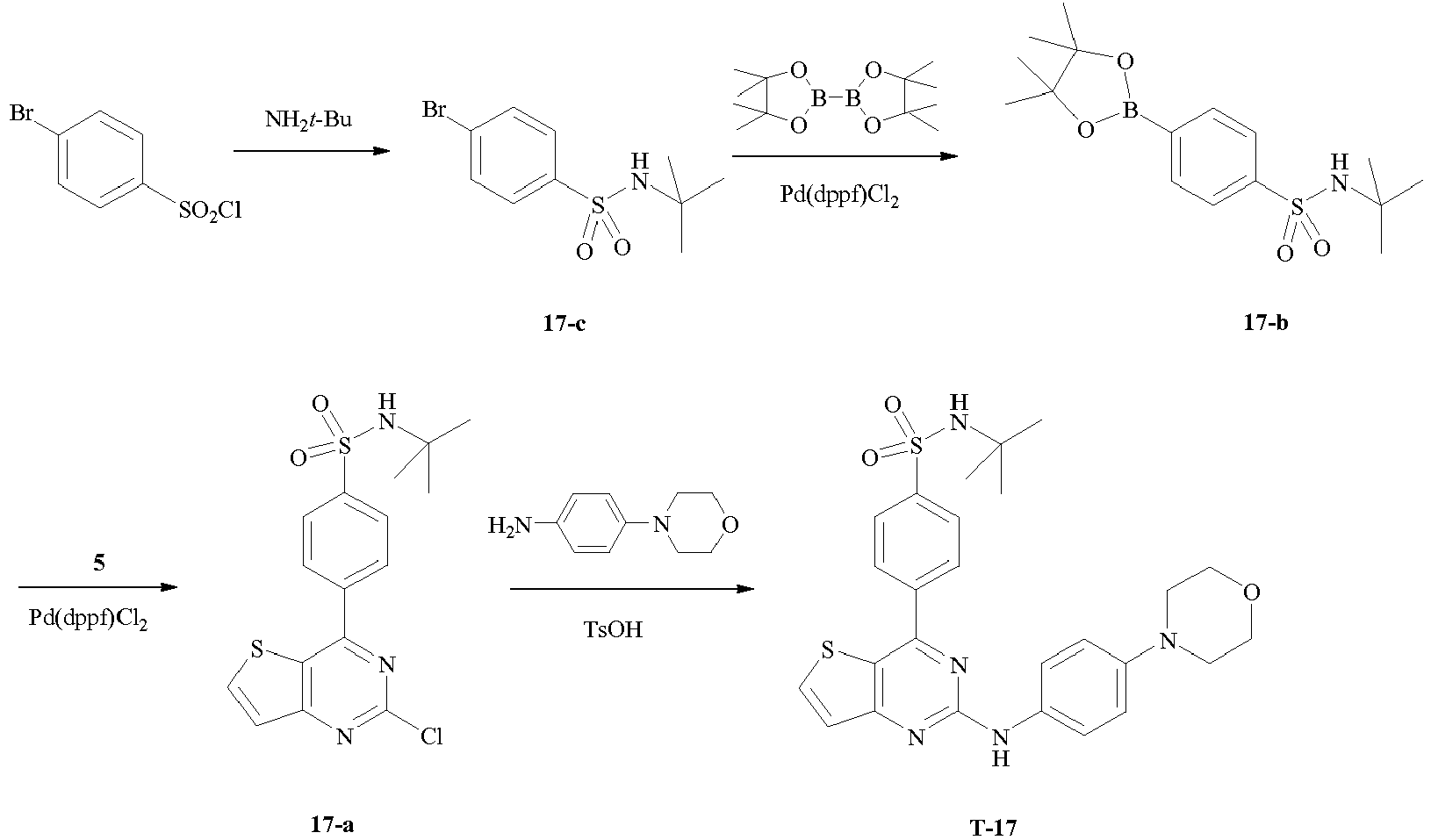
- At 0°C, 4-bromobenzenesulfonyl chloride (3.0 g, 11.8 mml) was added to a solution of t-butyl amine (2.0 g, 29.6mmol) in dichloromethane (30 mL) and stirred for 30 minutes. The reaction mixture was washed with aqueous hydrochloride (1 N, 20 mL) and water (30 mL×3) in sequence. The organic layer was dried over anhydrous sodium sulfate. After filtration, the filtrate was concentrated under reduced pressure to give white solid 17-c (3.6 g, yield:100%), which was used directly for the next step without further purification.
- Under nitrogen, to a suspension of compound 17-c (500 mg, 1.72 mmol), bis(pinacolato)diboron (524 mg, 2.06 mmol) and potassium acetate (505 mg, 5.15 mmol) in 1,4-dioxane (5 mL) was added Pd(dppf)Cl2 (130 mg, 0.17 mmol). The mixture was stirred at 80°C for 16 hours. After concentration of the mixture under reduced pressure, the residue was diluted with water (50 mL), then extracted with ethyl acetate (50 mL×3). The organic layers were combined and washed with water (50 mL×3) and saturated brine (50 mL) in sequence. After dried over anhydrous sodium sulfate, the mixture was filtrated, the filtrate was concentrated under reduced pressure. The residue was purified by silica column chromatography (petroleum ether : ethyl acetate=5:1) to give white solid 17-b (350 mg, yield: 60%). LC-MS (ESI): m/z=340 [M+H]+.
- Under nitrogen, to a suspension of compound 17-b (300 mg, 0.89 mmol), compound 5 (181 mg, 0.89 mmol) and sodium carbonate (281 mg, 2.67 mmol) in ethanol (2 mL) and water (2 mL) was added Pd(dppf)Cl2 (74 mg, 0.1 mmol). The mixture was stirred at 80°C for 16 hours. After concentration of the mixture under reduced pressure, the residue was diluted with water (50 mL), and then extracted with ethyl acetate (50 mL×3). The organic layers were combined and washed with water (50 mL×3) and saturated brine (50 mL) in sequence. After dried over anhydrous sodium sulfate, the mixture was filtrated, the filtrate was concentrated under reduced pressure. The residue was purified by silica column chromatography (petroleum ether : ethyl acetate=5:1) to give light yellow solid 17-a (105 mg, yield: 32%). LC-MS (ESI): m/z=382 [M+H]+.
- Compound 17-a (100 mg, 0.26 mmol) and 4-(4-morpholinyl)aniline (140 mg, 0.79 mmol) were dissolved in n-butanol (2 mL), p-toluene sulfonic acid monohydrate (180 mg, 0.95 mmol) was added. The mixture was heated to 110°C and stirred for 16 hours. After cooled to room temperature, the mixture was stirred for another 30 minutes and there was solid precipitated. After filtration, the solid was purified by preparation HPLC (mobile phase: acetonitrile, water (0.05% trifluoroacetic acid); gradient: 60%-90%-10%) to give yellow solid T-17 (15 mg, yield: 25%). LC-MS (ESI): m/z=524 [M+H]+.
1H-NMR (400MHz, CDCl3) δ: 8.26 (d, J=9Hz, 2H), 8.08 (d, J=9Hz, 1H), 7.89 (d, J=5Hz, 1H), 7.94 (d, J=5Hz, 1H), 7.70 (br, 2H), 7.3,8 (d, J=5Hz, 1H), 7.04 (br, 2H), 4.82 (s, 1H), 3.90 (m, 4H), 3.20 (br, 4H), 1.27 (s, 9H) ppm -

- Under nitrogen, to a suspension of 2,4-dichlorotheino[2,3-d]pyrimidine (500 mg, 2.45 mmol), compound 5-a (633 mg, 1.63 mmol) and sodium carbonate (779 mg, 7.35 mmol) in 1,4-dioxane (5 mL) was added Pd(dppf)Cl2 (250 mg, 0.3 mmol). The mixture was stirred at 80°C for 4 hours, then cooled to room temperature. Dichloromethane (50 mL) was added, the resultant mixture was filtrated, the filtrate was concentrated under reduced pressure. The residue was purified by silica column chromatography (petroleum ether : ethyl acetate=1:1 to dichloromethane:methanol=10:1) to give gray solid 18-a (360 mg, yield: 52%). LC-MS (ESI): m/z=431 [M+H]+.
- Compound 18-a (360 mg, 0.84 mmol) was dissolved in dichloromethane (2 mL), a solution of 4N hydrochloride in 1,4-dioxane (4 mL) was added. The mixture was stirred at room temperature for 16 hours, and then was concentrated under reduced pressure. The residue was diluted with dichloromethane (10 mL) and triethylamine (2 mL). The mixture was cooled to 0°C, ethylsulfonyl chloride (141 mg, 1.26 mmol) was added dropwise. After completion of dropping, the mixture was stirred at 0°C for further 30 minutes. Water (5 mL) was added, and the mixture was extracted with dichloromethane (10 mL×3). The organic layers were combined, washed with water (10 mL×3) and saturated brine (10 mL) in sequence, dried over anhydrous sodium sulfate, then filtrated, and the filtrate was concentrated under reduced pressure. The residue was purified by silica column chromatography (petroleum ether : ethyl acetate=2:1) to give compound 18 (90 mg, yield: 26%). LC-MS (ESI): m/z=423 [M+H]+.
- Compound 18 (80 mg, 0.19 mmol) and 4-methylsulfonylaniline (98 mg, 0.57 mmol) were dissolved in n-butanol (2 mL), p-toluene sulfonic acid monohydrate (72 mg, 0.38 mmol) was added. The mixture was heated to 110°C and stirred for 16 hours. The mixture was concentrated under reduced pressure, the residue was purified by preparation HPLC (mobile phase: acetonitrile, water (0.05% trifluoroacetic acid); gradient: 50%-80%-10%) to give light yellow solid T-18 (13 mg, yield: 13%). LC-MS (ESI): m/z=558 [M+H]+.
1H-NMR (400MHz, CDCl3) δ: 9.70 (br, 1H), 8.75 (s, 1H), 8.29 (s, 1H), 8.99 (d, J=9Hz, 2H), 7.93 (d, J=9Hz, 2H), 7.51 (d, J=6Hz, 1H), 7.43 (d, J=6Hz, 1H), 4.66 (d, J=9Hz, 2H), 4.28 (d, J= 9Hz, 2H), 3.44 (s, 2H), 3.10 (q, J= 7Hz, 2H), 3.06 (s, 3H), 1.43 (t, J= 7Hz, 3H) ppm -

- Compound 5 (50 mg, 0.12 mmol) and 4-aminobenzonitrile (42 mg, 0.36 mmol) were dissolved in n-butanol (2 mL), p-toluene sulfonic acid monohydrate (45 mg, 0.24 mmol) was added. The mixture was heated to 110°C and stirred for 16 hours, then concentrated under reduced pressure. The residue was purified by preparation HPLC (mobile phase: acetonitrile, water (0.05% trifluoroacetic acid); gradient: 65%-95%-10%) to give light yellow solid T-19 (13 mg, yield: 13%). LC-MS (ESI): m/z=505 [M+H]+.
1H-NMR (400MHz, CDCl3) δ: 8.49 (s, 1H), 8.39 (s, 1H), 7.98 (d, J=6Hz, 1H), 7.90 (d, J=9Hz, 2H), 7.65 (d, J=9Hz, 2H), 7.43 (d, J=6Hz, 1H), 4.66 (d, J=9Hz, 2H), 4.26 (d, J= 9Hz, 2H), 3.44 (s, 2H), 3.11 (q, J= 7Hz, 2H), 1.43 (t, J= 7Hz, 3H) ppm -

- At room temperature, (cyanomethyl)triphenylphosphanium bromide (10.0 g, 33.2 mmol) and 3-oxetanone (1.2 g, 16.7 mmol) were dissolved in dichloromethane (100 mL), the mixture was stirred for 16 hours, then concentrated under reduced pressure. The residue was added into a component solvent (50 mL) of petroleum ether and ethyl acetate (10:1), and there was white solid precipitated. After filtration, the filtrate was concentrated under reduced pressure, the residue was purified by silica column chromatography (petroleum ether : ethyl acetate=5:1) to give compound 20-b (1.0 g, yield: 63%).
1H-NMR (400MHz, CDCl3) δ: 5.39 (m, 2H), 5.30 (m, 2H), 5.25 (m, 1H) ppm - To a solution of compound 20-b (500 mg, 5.26 mmol) and 4-(4,4,5,5-tetramethyl-1,3,2-dioxaborolan-2-yl)-1H-pyrazole (1.3 g, 6.7 mmol) in acetonitrile (10 mL) was added 1,8-diazabicyclo[5.4.0]undec-7-ene (1.6 g, 10.53 mmol). The mixture was stirred at 60°C for 18 hours, then concentrated under reduced pressure. 1 N Aqueous hydrochloride solution was added into the residue to adjust pH=3-4, then the mixture was extracted with ethyl acetate (20 mL×3). The organic layers were combined, washed with water (20 mL×3) and saturated brine (20 mL) in sequence, dried over anhydrous sodium sulfate, filtrated, and the filtrate was concentrated under reduced pressure to give yellow oil 20-a (900 mg, yield: 59%), which was used directly for the next step without further purification. LC-MS (ESI): m/z=290 [M+H]+.
- Under nitrogen, compound 20-a (300 mg, 1.04 mmol), 2,4-dichlorotheino[3,2-d]pyrimidine (317 mg, 1.56 mmol) and sodium carbonate (331 mg, 3.12 mmol) were suspended in 1,4-dioxane (0.5 mL) and water (0.5 mL), Pd(dppf)Cl2 (82 mg, 0.1 mmol) was added. The mixture was stirred at 80°C for 4 hours, then concentrated under reduced pressure. To the residue was added water (20 mL), the mixture was extracted with dichloromethane (20 mL×3). The organic layers were combined, washed with water (10 mL×3) and saturated brine (10 mL) in sequence, dried over anhydrous sodium sulfate, filtrated, the filtrate was concentrated under reduced pressure. The residue was purified by silica column chromatography (petroleum ether : ethyl acetate=2:1) to give light yellow solid 20 (102 mg, yield: 30%). LC-MS (ESI): m/z=332 [M+H]+.
- Compound 20 (50 mg, 0.15 mmol) and aniline (42 mg, 0.45 mmol) were dissolved in n-butanol (2 mL), p-toluene sulfonic acid monohydrate (58 mg, 0.3 mmol) was added. The mixture was heated to 110°C and stirred for 16 hours, then concentrated under reduced pressure. The residue was purified by preparation HPLC (mobile phase: acetonitrile, water (0.05% trifluoroacetic acid); gradient: 60%-90%-10%) to give light yellow solid T-20 (23 mg, yield: 40%). LC-MS (ESI): m/z=389 [M+H]+.
1H-NMR (400MHz, CDCl3) δ: 8.45 (s, 1H), 8.40 (s, 1H), 7.89 (d, J=5Hz, 1H), 7.75 (d, J=8Hz, 2H), 7.37 (m, 3H), 7.20 (s, 1H), 7.05 (t, J=7Hz, 1H), 5.20 (d, J=8Hz, 2H), 4.89 (d, J= 8Hz, 2H), 3.46 (s, 2H) ppm -

- To a solution of 4-nitropyridine 1-oxide (600 mg, 6.46 mmol) and ammonium formate (622 mg, 10.92 mmol) in ethanol (10 mL) was added slowly 10% Pd-C (0.6 g). The mixture was stirred at room temperature for 16 hours. After filtration, the filtrate was concentrated under reduced pressure. To the residue was added water (20 mL), the mixture was extracted with ethyl acetate (20 mL×3). The organic layers were combined, washed with water (10 mL×3) and saturated brine (10 mL) in sequence, dried over anhydrous sodium sulfate, then filtrated, the filtrate was concentrated under reduced pressure to give light yellow solid 21-a (380 mg, yield: 94%), which was used directly for the next step without purification.
- Under nitrogen, to a suspension of compound 5 (100 mg, 0.24 mmol), compound 21-a (45 mg, 0.48 mmol) and cesium carbonate (155 mg, 0.48 mmol) in 1,4-dioxane (2 mL) were added Pd2(dba)3 (22 mg, 0.03 mmol) and BINAP (20 mg, 0.03 mmol). The mixture was heated to 120°C by microwave and stirred for 60 minutes. After cooled to room temperature, the mixture was diluted with dichloromethane (20 mL), and then filtrated, the filtrate was concentrated under reduced pressure. The residue was purified by preparation HPLC (mobile phase: acetonitrile, water (0.05% trifluoroacetic acid); gradient: 40%-70%-10%) to give yellow solid T-21 (8 mg, yield: 7%). LC-MS (ESI): m/z=481 [M+H]+.
1H-NMR (400MHz, CDCl3) δ: 8.72 (s, 1H), 8.37 (m, 4H), 8.30 (br, 1H), 8.23 (d, J=6Hz, 1H), 7.42 (d, J=6Hz, 1H), 4.57 (d, J=9Hz, 2H), 4.22 (d, J= 9Hz, 2H), 3.55 (s, 2H), 3.10 (q, J= 7Hz, 2H), 1.31 (t, J= 7Hz, 3H) ppm -

- Under nitrogen, to a suspension of compound 5 (100 mg, 0.24 mmol), 2-cyano-5-aminopyridine (56 mg, 0.48 mmol) and cesium carbonate (155 mg, 0.48 mmol) in 1,4-dioxane (2 mL) were added Pd2(dba)3 (22 mg, 0.03 mmol) and BINAP (20 mg, 0.03 mmol). The mixture was heated to 120°C by microwave and stirred for 60 minutes. After cooled to room temperature, the mixture was diluted with dichloromethane (20 mL), and then filtrated, the filtrate was concentrated under reduced pressure. The residue was purified by preparation HPLC (mobile phase: acetonitrile, water (0.05% trifluoroacetic acid); gradient: 50%-80%-10%) to give yellow solid T-22 (33 mg, yield: 28 %). LC-MS (ESI): m/z=506 [M+H]+.
1H-NMR (400MHz, CDCl3) δ: 10.49 (s, 1H), 9.10 (d, J=2Hz, 1H), 8.89 (s, 1H), 8.66 (dd, J=9Hz J=2Hz, 1H), 7.97 (s, 1H), 8.49 (d, J=6Hz, 1H), 8.45 (s, 1H), 7.96 (d, J=9Hz, 1H), 7.54 (d, J=5Hz, 1H), 4.58 (d, J=9Hz, 2H), 4.29 (d, J= 9Hz, 2H), 3.73 (s, 2H), 3.25 (q, J= 7Hz, 2H), 1.26 (t, J= 7Hz, 3H) ppm -

- Under nitrogen, to a suspension of compound 5-a (194 mg, 0.5 mmol), 2,4-dichloro-6-methyltheino[3,2-d]pyrimidine (149 mg, 0.5 mmol) and aqueous sodium carbonate (2.0 N, 0.75 mL) in 1,4-dioxane (7.5 mL) was added Pd(dppf)Cl2 (18 mg, 0.025 mmol). The mixture was stirred at 80°C for 4 hours, then concentrated, and the residue was diluted with ethyl acetate (50 mL), filtrated through celite. Then the organic layer was washed with water (10 mL×3) and saturated brine (10 mL) in sequence, dried over anhydrous sodium sulfate, filtrated, the filtrate was concentrated under reduced pressure, and the residue was purified by preparation TLC (dichloromethane:methanol=30:1) to give compound 23-a (165 mg, yield: 74%). LC-MS (ESI): m/z=445 [M+H]+.
- To a solution of compound 23-a (165 mg, 0.37 mmol) in 1,4-dioxane (4 mL) was added a solution of hydrochloride in 1,4-dioxane (4 N, 0.93 mL). The mixture was stirred at room temperature for 16 hours, then concentrated. To the residue was added dichloromethane (10 mL) and triethylamine (0.16 mL, 1.12 mmol). The mixture was then cooled to 0°C, ethylsulfonyl chloride (62 mg, 0.56 mmol) was added dropwise. After the completion of dropping, the mixture was stirred at 0°C for further 30 minutes. Water (5 mL) was added, and the mixture was extracted with dichloromethane (10 mL×3). The organic layers were combined, washed with water (10 mL×3) and saturated brine (10 mL) in sequence, dried over anhydrous sodium sulfate, filtrated, and the filtrate was concentrated under reduced pressure. The residue was purified by preparation TLC (petroleum ether : ethyl acetate=1:1) to give compound 23 (60 mg, yield: 37%). LC-MS (ESI): m/z=437 [M+H]+.
- Compound 23 (60 mg, 0.14 mmol) and aniline (39 mg, 0.42 mmol) were dissolved in isobutanol (10 mL), p-toluene sulfonic acid monohydrate (53 mg, 0.28 mmol) was added. The mixture was heated to 110°C and stirred for 16 hours, then concentrated under reduced pressure, and the residue was purified by preparation TLC (petroleum ether : ethyl acetate=1:1) to give compound T-23 (20 mg, yield: 29%). LC-MS (ESI): m/z=494 [M+H]+.
1H-NMR (400MHz, DMSO-d6) δ: 9.56(s, 1H), 8.78 (s, 1H), 8.35 (s, 1H), 7.88 (d, J=8.4Hz, 2H), 7.31 (t, J=7.8Hz, 2H), 7.18 (s, 1H), 6.94 (t, J=7.4Hz, 1H), 4.57 (d, J=9.2Hz, 2H), 4.27 (d, J= 9.2Hz, 2H), 3.72 (s, 2H), 3.22-3.28 (m, 2H), 2.67 (s, 3H), 1.25 (t, J= 7.4Hz, 3H) ppm -
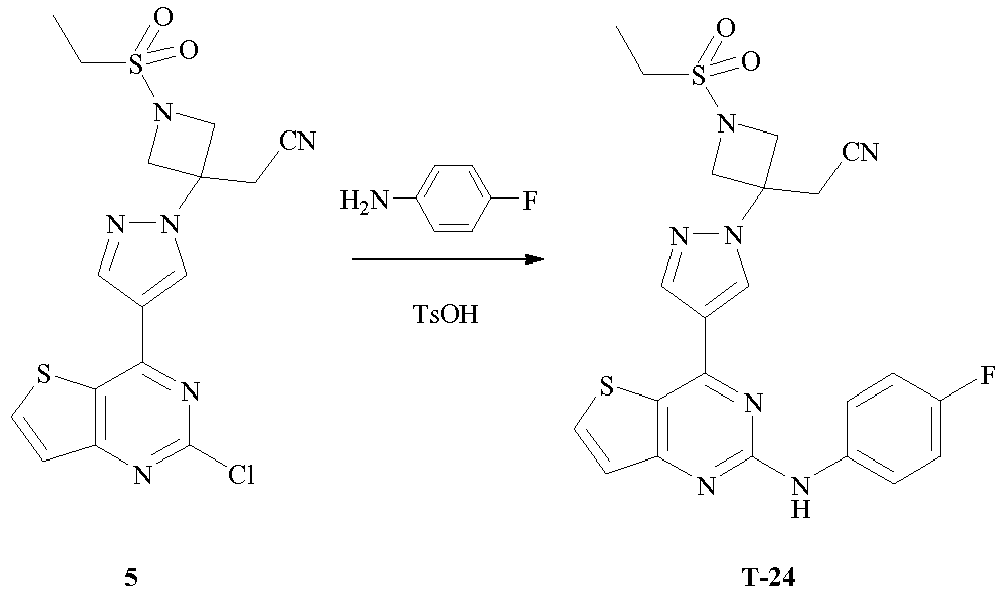
- Compound 5 (208 mg, 0.49 mmol) and 4-fluoroaniline (164 mg, 1.48 mmol) were dissolved in isobutanol (12 mL), p-toluene sulfonic acid monohydrate (188 mg, 0.98 mmol) was added. The mixture was heated to 110°C and stirred for 16 hours, then concentrated under reduced pressure, and the residue was dissolved in dichloromethane (100 mL), washed with water (20 mL×3) and saturated brine (20 mL) in sequence, dried over anhydrous sodium sulfate, filtrated, the filtrate was concentrated under reduced pressure, and there was solid formed. The solid was washed with dichloromethane (5 mL) and ethyl acetate (25 mL) to give compound T-24 (30 mg, yield: 12%). LC-MS (ESI): m/z=498 [M+H]+.
1H-NMR (400MHz, DMSO-d6) δ: 9.66 (s, 1H), 8.83 (s, 1H), 8.39-8.40 (m, 2H), 7.89-7.92 (m, 2H), 7.42 (d, J=5.5Hz, 1H), 7.16 (t, J=9.0Hz, 2H), 4.58 (d, J=9.0Hz, 2H), 4.28 (d, J=9.5Hz, 2H), 3.73 (s, 2H), 3.23-3.27 (m, 2H), 1.26 (t, J= 7.5Hz, 3H) ppm -

- Under nitrogen, to a suspension of compound 5 (150 mg, 0.35 mmol), 3-amino-1-methylpyrazole (104 mg, 1.48 mmol) and cesium carbonate (228 mg, 0.7 mmol) in 1,4-dioxane (4 mL) were added Pd2(dba)3 (32 mg, 0.035 mmol) and BINAP (22 mg, 0.035 mmol). The mixture was heated to 120°C by microwave and stirred for 60 minutes. After cooled to room temperature, the mixture was diluted with dichloromethane (100 mL), washed with water (20 mL×3) and saturated brine (20 mL) in sequence, dried over anhydrous sodium sulfate, then filtrated, and the filtrate was concentrated under reduced pressure. There was solid formed and the solid was washed with THF (20 mL) and methanol (10 mL) to give compound T-25 (80 mg, yield: 46%). LC-MS (ESI): m/z=484 [M+H]+.
1H-NMR (400MHz, DMSO) δ: 9.58(s, 1H), 8.80 (s, 1H), 8.36-8.37 (m, 2H), 7.57(d, J=1.5Hz, 1H), 7.38 (d, J=5.0Hz, 1H), 6.77 (d, J=2.0Hz, 1H), 4.57 (d, J=9.0Hz, 2H), 4.27 (d, J=9.5Hz, 2H), 3.76 (s, 3H), 3.72 (s, 2H), 3.23-3.27 (m, 2H), 1.25 (t, J= 7.5Hz, 3H) ppm -

- Under nitrogen, to a suspension of compound 5 (100 mg, 0.23 mmol), 3-aminopyridine (22 mg, 0.23 mmol) and cesium carbonate (154 mg, 0.47 mmol) in 1,4-dioxane (4 mL) were added Pd2(dba)3 (22 mg, 0.023 mmol) and BINAP (15 mg, 0.023 mmol). The mixture was heated to 125°C by microwave and stirred for 30 minutes. After cooled to room temperature, the mixture was diluted with dichloromethane (100 mL), washed with water (20 mL×3) and saturated brine (20 mL) in sequence, dried over anhydrous sodium sulfate, then filtrated, and the filtrate was concentrated under reduced pressure. The residue was purified by preparation HPLC (mobile phase: acetonitrile, water (0.05% trifluoroacetic acid); gradient: 40%-70%-10%) to give compound T-26 (18 mg, yield: 16%). LC-MS (ESI): m/z=481 [M+H]+.
1H-NMR (400MHz, CDCl3) δ: 8.91 (d, J=2.4Hz, 1H), 8.45(s, 1H), 8.33 (s, 1H), 8.27-8.31 (m, 2H), 7.90 (d, J=7.0Hz, 1H), 7.51 (s, 1H), 7.29-7.34 (m, 2H), 4.66 (d, J=9.2Hz, 2H), 4.25 (d, J=9.6Hz, 2H), 3.42 (s, 2H), 3.08-3.14 (m, 2H), 1.42 (t, J= 7.2Hz, 3H) ppm -

- Under nitrogen, to a suspension of compound 5 (200 mg, 0.47 mmol), cyclohexylamine (141 mg, 1.42 mmol) and cesium carbonate (463 mg, 1.42 mmol) in 1,4-dioxane (4 mL) were added Pd2(dba)3 (43 mg, 0.047 mmol) and BINAP (30 mg, 0.047 mmol). The mixture was heated to 125°C by microwave and stirred for 60 minutes. After cooled to room temperature, the mixture was diluted with ethyl acetate (100 mL), washed with water (20 mL×3) and saturated brine (20 mL) in sequence, dried over anhydrous sodium sulfate, then filtrated, and the filtrate was concentrated under reduced pressure. The residue was purified by preparation HPLC (mobile phase: acetonitrile, water (0.05% trifluoroacetic acid); gradient: 40%-70%-10%) to give compound T-27 (25 mg, yield: 11 %). LC-MS (ESI): m/z=486 [M+H]+.
1H-NMR (500MHz, CDCl3) δ: 8.38 (s, 1H), 8.34 (s, 1H), 7.79 (d, J=5.5Hz, 1H), 7.24 (d, J=5.0Hz, 1H), 5.05 (d, J=8.5Hz, 1H), 4.62 (d, J=9.5Hz, 2H), 4.25 (d, J=9.5Hz, 2H), 3.95-3.97 (m, 1H), 3.40 (s, 2H), 3.06-3.11 (m, 2H), 2.09-2.12 (m, 2H), 1.76-1.80 (m, 3H), 1.65-1.67 (m, 1H), 1.45-1.48 (m, 1H), 1.42 (t, J=7.0Hz, 3H), 1.25-1.31 (m, 3H) ppm -

- Under nitrogen, to a suspension of compound 5 (85 mg, 0.20 mmol), cyclopropyl amine (33 mg, 0.6 mmol) and cesium carbonate (196 mg, 0.6 mmol) in 1,4-dioxane (4 mL) were added Pd2(dba)3 (18 mg, 0.02 mmol) and BINAP (12 mg, 0.02 mmol). The mixture was heated to 125°C by microwave and stirred for 40 minutes. After cooled to room temperature, the mixture was diluted with ethyl acetate (100 mL), washed with water (20 mL×3) and saturated brine (20 mL) in sequence, dried over anhydrous sodium sulfate, then filtrated, and the filtrate was concentrated under reduced pressure. The residue was purified by preparation TLC (dichloromethane : ethyl acetate=1:1) to give compound T-28 (8 mg, yield: 9%). LC-MS (ESI): m/z=444 [M+H]+.
1H-NMR (500MHz, CDCl3) δ: 8.33 (s, 1H), 8.28 (s, 1H), 7.76 (d, J=5.5Hz, 1H), 7.26 (d, J=5.5Hz, 1H), 5.33 (s, 1H), 4.55 (d, J=9.0Hz, 2H), 4.18 (d, J=9.5Hz, 2H), 3.33 (s, 2H), 3.00-3.04 (m, 2H), 2.80-2.84 (m, 1H), 1.34 (t, J=7.5Hz, 3H), 0.78-0.82 (m, 2H), 0.52-0.55 (m, 2H) ppm -

- Under nitrogen, to a suspension of compound 5 (50 mg, 0.12 mmol), cyclopropanecarboxamide (30 mg, 0.36 mmol) and cesium carbonate (55 mg, 0.16 mmol) in 1,4-dioxane (4 mL) were added Pd2(dba)3 (11 mg, 0.012 mmol) and Xantphos (7 mg, 0.012 mmol). The mixture was heated to 125°C by microwave and stirred for 30 minutes. After cooled to room temperature, the mixture was diluted with dichloromethane (100 mL), washed with water (20 mL×3) and saturated brine (20 mL), dried over anhydrous sodium sulfate, then filtrated, and the filtrate was concentrated under reduced pressure. The residue was purified by preparation HPLC (mobile phase: acetonitrile, water (0.05% trifluoroacetic acid); gradient: 50%-80%-10%) to give compound T-29 (22 mg, yield: 39%). LC-MS (ESI): m/z=472 [M+H]+.
1H-NMR (400MHz, CDCl3) δ: 10.88 (s, 1H), 8.87 (s, 1H), 8.53 (d, J=5.2Hz, 1H), 8.41 (s, 1H), 7.54 (d, J=5.2Hz, 1H), 4.57 (d, J=8.8Hz, 2H), 4.27 (d, J=9.2Hz, 2H), 3.72 (s, 2H), 3.22-3.28 (m, 2H), 2.17-2.23 (m, 1H), 1.24 (t, J=7.2Hz, 3H), 0.81-0.85 (m, 4H) ppm -


- 3-Furoic acid (2.8 g, 25 mmoL), diphenyl azidophosphate (6 ml, 27.5 mmoL) and triethylamine (5 mL, 35 mmoL) were added to tert-butanol (50 mL). The mixture was heated to 90°C and stirred for 12 hours. After cooled to room temperature, aqueous sodium dicarbonate (2 N, 100 mL) was added. The mixture was filtrated, the filter cake was dissolved in ethyl acetate (100 mL), and washed with water (50 mL×3) and saturated brine (50 mL) in sequence, dried over anhydrous sodium sulfate, then filtrated, the filtrate was concentrated under reduced pressure. The residue was purified by silica column chromatography (petroleum ether : ethyl acetate=10:1) to give white solid 30-h (3.2 g, yield: 70%). LC-MS (ESI): m/z=184 [M+H]+.
- At -40°C, to a solution of compound 30-h (1.7 g, 9.3 mmoL) in anhydrous THF (50 mL) was added N,N-tetramethylethylenediamine (1.8 mL, 12.1 mmoL), after stirred for 20 minutes, a solution of n-BuLi in n-hexane (2.5 N, 8.4 mL, 21 mmoL) was added dropwise and the reaction temperature was maintained at -40°C. After completion of dropping, the mixture was stirred for further 30 minutes. The mixture was warmed slowly to 0°C, and stirred for another 1 hour, then cooled again to -40°C, stirred for 10 minutes, dimethyl carbonate (2.4 mL, 28 mmoL) was added rapidly to the mixture. The reaction mixture was warmed slowly to room temperature, stirred for another 1 hour. Aqueous hydrochloride solution (2 N, 11 mL) and water (100 mL) were added to quench the reaction, then the mixture was extracted with ethyl acetate (100 mL×3). The organic layers were combined, dried over anhydrous sodium sulfate, then filtrated, and the filtrate was concentrated under reduced pressure. The residue was purified by silica column chromatography (petroleum ether : ethyl acetate= 100:1) to give white solid 30-g (0.56 g, yield: 25%). LC-MS (ESI): m/z=142 [M+H]+.
- To a solution of compound 30-g (0.56 g, 2.3 mmoL) in dichloromethane (4 mL) was added trifluoroacetic acid (2.5 mL), the mixture was stirred at room temperature for 2 hours. After the mixture was concentrated under reduced pressure, the residue was treated with aqueous sodium dicarbonate solution (2 N, 6 mL), then extracted with ethyl acetate (5 mL×3). The organic layers were combined, washed with water (10 mL×3) and saturated brine (20 mL) in sequence, dried over anhydrous sodium sulfate, then filtrated, the filtrate was concentrated under reduced pressure to give yellow liquid 30-f (0.35 g, yield: 100%), which was used directly for the next step without purification.
- At -78°C, to a solution of compound 30-f (0.35 g, 2.5 mmoL) in dichloromethane (5 mL) was added dropwise chlorosulfonyl isocyanate (0.49 g, 3.5 mmoL). After completion of dropping, the mixture was warmed to room temperature, and stirred for 40 minutes. The mixture was concentrated under reduced pressure, the residue was treated with HCl (6 N, 3 mL, 18 mmol), then warmed to 100°C, and stirred for 30 minutes. The mixture was cooled to room temperature, then concentrated under reduced pressure, the residue was treated with aqueous sodium dicarbonate solution (2 N, 6 mL), extracted with ethyl acetate (5 mL×3). The organic layers were combined, washed with water (10 mL×3) and saturated brine (20 mL) in sequence. After dried over anhydrous sodium sulfate, the mixture was filtrated, and the filtrate was concentrated under reduced pressure to give yellow solid 30-e (176mg, yield: 38%), which was used directly for the next step without purification. LC-MS (ESI): m/z=185 [M+H]+.
- To a solution of compound 30-e (0.176 g, 0.96 mmoL) in methanol (4 mL) was added aqueous sodium hydroxide solution (2 N, 2 mmoL), the mixture was refluxed for 2 hours. After cooled to room temperature, aqueous hydrochloride solution (6 N, 0.5 mL) was added to adjust pH=3. The mixture was concentrated under reduced pressure, to the residue was added methanol (5 mL), and there was gray solid precipitated. After filtration, the filter cake was dried in vacuum to give gray solid 30-d (110 mg, yield: 75%), which was used directly for the next step without purification. LC-MS (ESI): m/z=153 [M+H]+.
- At -40°C, to a solution of compound 30-d (0.86 g, 5.6 mmoL) in phosphorus oxychloride (8 mL) was added N,N-diisopropylethylamine (2 mL), after stirred for 10 minutes, the mixture was refluxed for 24 hours. After cooled to room temperature, the mixture was poured into ice water to quench the reaction, and then extracted with ethyl acetate (50 mL×3). The organic layers were combined, washed with water (20 mL×3) and saturated brine (20 mL) in sequence, then dried over anhydrous sodium sulfate, filtrated, the filtrate was concentrated under reduced pressure. The residue was purified by silica column chromatography (petroleum ether : ethyl acetate= 100:1) to give white solid 30-c (430 mg, yield: 41%). LC-MS (ESI): m/z=189 [M+H]+.
- Under nitrogen, to a suspension of compound 5-a (640 mg, 1.65 mmol), compound 30-c (280 mg, 1.49 mmol) and potassium carbonate (720 mg, 5.2 mmol) in 1,4-dioxane (2 mL) and water (6 mL) was added Pd(PPh3)4 (57 mg, 0.05 mmol), the mixture was heated to 80°C and stirred for 16 hours. The mixture was then concentrated under reduced pressure, the residue was diluted with water (20 mL), extracted with dichloromethane (20 mL×3). The organic layer were combined, washed with water (10 mL×3) and saturated brine (10 mL) in sequence, then dried over anhydrous sodium sulfate, filtrated, the filtrate was concentrated under reduced pressure. The residue was purified by silica column chromatography (petroleum ether : ethyl acetate=3:1) to give light yellow solid 30-b (620 mg, yield: 70%). LC-MS (ESI): m/z=415 [M+H]+.
- To a solution of compound 30-b (500 mg, 1.2 mmoL) in dichloromethane (4 mL) was added trifluoroacetic acid (1 mL), the mixture was stirred at room temperature for 2 hours. After the mixture was concentrated under reduced pressure, the residue was treated with aqueous sodium dicarbonate solution (2 N, 6 mL), extracted with ethyl acetate (5 mL×3). The organic layers were combined, washed with water (20 mL×3) and saturated brine (20 mL) in sequence, then dried over anhydrous sodium sulfate, filtrated, the filtrate was concentrated under reduced pressure to give light yellow liquid 30-a (370 mg, yield: 97%), which was used directly for the next step without purification. LC-MS (ESI): m/z=315 [M+H]+.
- At 0°C, to a solution of compound 30-a (314 mg, 1.0 mmoL) and triethylamine (1 mL) in dichloromethane (4 mL) was added dropwise ethylsulfonyl chloride (154 mg, 1.2 mmoL). After stirred for 30 minutes, the mixture was concentrated under reduced pressure, and the residue was treated with aqueous sodium dicarbonate (2 N, 6 mL), extracted with ethyl acetate (5 mL×3). The organic layers were combined, washed with water (10 mL×3) and saturated brine (20 mL) in sequence, then dried over anhydrous sodium sulfate, filtrated, the filtrate was concentrated under reduced pressure to give yellow liquid 30 (280 mg, yield: 70%), which was used directly for the next step without purification. LC-MS (ESI): m/z=407 [M+H]+.
- Under nitrogen, to a suspension of compound 30 (70 mg, 0.17 mmol), aniline (25 mg, 0.26 mmol) and potassium carbonate (138 mg, 1.0 mmol) in 1,4-dioxane (4 mL) were added Pd2(dba)3 (15 mg, 0.017 mmol) and Ruphos (10 mg, 0.07 mmol), the mixture was heated to 130°C by microwave and stirred for 3 hours. After cooled to room temperature, the mixture was diluted with ethyl acetate (10 mL), then filtrated, and the filtrate was concentrated under reduced pressure. The residue was purified by preparation HPLC (mobile phase: acetonitrile, water (0.05% trifluoroacetic acid); gradient: 50%-80%-10%) to give compound T-30 (16 mg, yield: 20%). LC-MS (ESI): m/z=464 [M+H]+.
1H-NMR (400MHz, CDCl3) δ: 9.48 (s, 1H), 8.86 (s, 1H), 8.42 (d, J=1.6Hz, 1H), 8.40 (s, 1H), 7.88 (d, J=6.4Hz, 2H), 7.30 (t, J=6.4Hz, 1H), 7.04 (d, J=1.6Hz, 1H), 6.93 (t, J=6.4Hz, 1H), 4.56 (d, J=7.2Hz, 2H), 4.27 (d, J= 7.2Hz, 2H), 3.72 (s, 2H), 3.25 (q, J= 6Hz, 2H), 1.25 (t, J= 6Hz, 3H) ppm -

- Under hydrogen (1 atm), to a solution of 4-nitropyrazole (1.13 g, 10 mmol) in methanol (10 mL) was added 10% Pd-C (0.1 g). The mixture was stirred at 25°C for 12 hours, and then filtrated, the filtrate was concentrated under reduced pressure to give compound 31-a (860 mg, yield: 100%), which was used directly for the next step without purification.
- Compound 31-a (130 mg, 1.5 mmol) and compound 5 (222 mg, 0.5 mmol) were dissolved in n-butanol (10 mL), p-toluene sulfonic acid monohydrate (344 mg, 2.0 mmol) was added. The mixture was heated to 120°C and stirred for 3 hours. After cooled to room temperature, the mixture was treated with saturated aqueous sodium bicarbonate solution(10 mL), then extracted with dichloromethane (10 mL×3). The organic layers were combined, washed with water (10 mL×3) and saturated brine (10 mL) in sequence, dried over anhydrous sodium sulfate, then filtrated. The residue was purified by preparation HPLC (mobile phase: water (0.04% trifluoroacetic acid), acetonitrile; gradient: 32%-62%) to give compound T-31 (143 mg, yield: 61 %). LC-MS (ESI): m/z=470 [M+H]+.
1H-NMR (400MHz, DMSO-d6) δ: 9.43 (s, 1H), 8.81 (s, 1H), 8.37 (s, 1H), 8.34 (d, J=4.0Hz, 1H), 7.87 (s, 2H), 7.39 (d, J=4.0Hz, 1H), 4.57 (d, J=8Hz, 2H), 4.27 (d, J = 8Hz, 2H), 3.91 (s, 4H), 3.24 (q, J= 6Hz, 2H), 1.25 (t, J= 6Hz, 3H) ppm -

- At 0°C, to a solution of compound T-31 (47 mg, 0.1 mmoL) and triethylamine (100 mg, 1.0 moL) in dichloromethane (10 mL) was added slowly methoxyacetyl chloride (11 mg, 0.2 mmol), and stirred for 1 hour. The mixture was concentrated under reduced pressure, the residue was treated with saturated aqueous sodium bicarbonate solution (5 mL), extracted with dichloromethane (5 mL×3). The organic layers were combined, dried over anhydrous sodium sulfate, then filtrated, the filtrate was concentrated under reduced pressure. The residue was purified by silica column chromatography (petroleum ether : ethyl acetate=3:1) to give compound T-32 (32 mg, yield: 59%). LC-MS (ESI): m/z=542 [M+H]+.
1H-NMR (400MHz, DMSO-d6) δ: 9.94 (s, 1H), 8.85 (s, 1H), 8.66 (s, 1H), 8.43 (d, J=5.2Hz, 1H), 8.39 (s, 1H), 8.06 (s, 1H), 7.51 (d, J=5.2Hz, 1H), 4.87 (s, 2H), 4.57 (d, J=9.2Hz, 2H), 4.28 (d, J=9.2Hz, 2H), 3.73 (s, 2H), 3.43 (s, 3H), 3.25 (q, J= 7.2Hz, 2H), 1.25 (t, J= 7.2Hz, 3H) ppm -


- Ethyl bromoacetate (1.67 g, 10 mmol) and potassium carbonate (2.76 g, 20 mmol) were added to a solution of 4-nitropyrazole (1.13 g, 10 mmol) in DMF (15 mL), the mixture was heated to 90°C and stirred for 12 hours. After the mixture was cooled to room temperature, water (60 mL) was added, then the mixture was extracted with ethyl acetate (20 mL×3). The organic layers were combined, washed with water (10 mL) and saturated brine (10 mL) in sequence, dried over anhydrous sodium sulfate, then filtrated, the filtrate was concentrated under reduced pressure. The residue was purified by silica column chromatography (petroleum ether : ethyl acetate=5:1) to give compound 33-b (1.68 g, yield: 84%). LC-MS (ESI): m/z=200 [M+H]+.
- Under hydrogen (1 atm), to a solution of compound 33-b (1.0 g, 5 mmol) in methanol (10 mL) was added 10% Pd-C (0.1 g). The mixture was stirred at 25°C for 12 hours, and then filtrated, the filtrate was concentrated under reduced pressure to give compound 33-a (760 mg, yield: 90%), which was used directly for the next step without purification. LC-MS (ESI): m/z=170 [M+H]+.
- Compound 33-a (170 mg, 1.0 mmol) and compound 5 (211 mg, 0.5 mmol) were dissolved in n-butanol (10 mL), p-toluene sulfonic acid monohydrate (344 mg, 2.0 mmol) was added. The mixture was heated to 120°C and stirred for 3 hours, then cooled to room temperature. The mixture was treated with saturated aqueous sodium bicarbonate solution (10 mL), extracted with dichloromethane (10 mL×3). The organic layers were combined, washed with water (10 mL×3) and saturated brine (10 mL) in sequence, dried over anhydrous sodium sulfate, then filtrated. The residue was purified by silica column chromatography (petroleum ether : ethyl acetate=3:1) to give compound 33 (116 mg, yield: 21%). LC-MS (ESI): m/z=584 [M+H]+.
- Aqueous LiOH solution (2 N, 0.5 mL) was added to a solution of compound 33 (83 mg, 0.15 mmol) in MeOH (2 mL) and THF (6 mL), the mixture was stirred at 25°C for 1 hour. Aqueous HCl solution (2 N, 0.5 mL) was added, the mixture was concentrated under reduced pressure to remove organic solvents. The residue was treated with water (2 mL), extracted with ethyl acetate (2 mL×3). The organic layers were combined, dried over anhydrou sodium sulfate, then filtrated, the filtrate was concentrated under reduced pressure to give compound T-33 (36 mg, yield: 47%). LC-MS (ESI): m/z=528 [M+H]+.
1H-NMR (400MHz, DMSO-d6) δ: 8.65 (s, 1H), 8.31 (s, 1H), 8.09 (s, 1H), 8.07 (d, J=4.4Hz, 1H), 7.56 (s, 1H), 7.23 (d, J=4.4Hz, 1H), 4.90 (s, 2H), 4.56 (d, J=7.2Hz, 2H), 4.22 (d, J=7.2Hz, 2H), 3.51 (s, 2H), 3.07 (q, J= 5.6Hz, 2H), 1.27 (t, J= 5.6Hz, 3H) ppm -

- 4-Nitropyrazole (1.13 g, 10 mmol) and ethyl acrylate (1.72 g, 20 mmol) were dissolved in acetonitrile (30 mL), DBU (2 mL) was added. The mixture was stirred at 90°C for 12 hours. Then the mixture was concentrated under reduced pressure, the residue was treated with water (50 mL), extracted with ethyl acetate (50 mL×3). The organic layers were combined, washed with water (50 mL×3) and saturated brine (50 mL) in sequence, dried over anhydrous sodium sulfate, then filtrated, the filtrate was concentrated under reduced pressure. The residue was purified by silica column chromatography (petroleum ether : ethyl acetate=3:1) to give compound 34-b (1.37 g, yield: 69%). LC-MS (ESI): m/z=214 [M+H]+.
- Under hydrogen (1 atm), to a solution of compound 34-b (1.0 g, 5 mmol) in methanol (10 mL) was added 10% Pd-C (0.1 g). The mixture was stirred at 25°C for 12 hours, and then filtrated, the filtrate was concentrated under reduced pressure to give compound 34-a (780 mg, yield: 92%), which was used directly for the next step without purification. LC-MS (ESI): m/z=184 [M+H]+.
- Compound 34-a (184 mg, 1.0 mmol) and compound 5 (211 mg, 0.5 mmol) were dissolved in n-butanol (10 mL), p-toluene sulfonic acid monohydrate (258 mg, 1.5 mmol) was added. The mixture was heated to 120°C and stirred for 3 hours, then cooled to room temperature. The mixture was treated with saturated aqueous sodium bicarbonate solution (10 mL), extracted with dichloromethane (10 mL×3). The organic layers were combined, washed with water (10 mL×3) and saturated brine (10 mL) in sequence, dried over anhydrous sodium sulfate, then filtrated. The residue was purified by silica column chromatography (petroleum ether : ethyl acetate =3:1) to give compound T-34 (138 mg, yield: 24.8%). LC-MS (ESI): m/z=598 [M+H]+.
1H-NMR (400MHz, CDCl3) δ: 8.45 (s, 1H), 8.23 (s, 1H), 8.01 (s, 1H), 7.80 (d, J=5.6Hz, 1H), 7.46 (s, 1H), 7.23 (d, J=5.6Hz, 1H), 7.05(s, 1H), 4.62 (d, J=9.6Hz, 2H), 4.38 (t, J=6.4Hz, 2H), 4.19 (d, J=9.6Hz, 2H), 4.00 (t, J=6.4Hz, 2H), 3.35 (s, 2H), 3.02 (q, J= 7.2Hz, 2H), 2.85 (t, J=6.4Hz, 2H), 1.49 (q, J=7.2Hz, 2H), 1.34 (t, J=7.2Hz, 3H), 1.24 (m, 4H), 0.79 (t, J= 7.2Hz, 3H) ppm -

- Aqueous LiOH solution (2 N, 0.5 mL) was added to a solution of compound T-34 (138 mg, 0.25 mmol) in MeOH (2 mL) and THF (6 mL), the mixture was stirred at 25°C for 1 hour. Aqueous HCl solution (2 N, 0.5 mL) was added, the mixture was concentrated under reduced pressure to remove organic solvents. The residue was treated with water (2 mL), extracted with ethyl acetate (2 mL×3). The organic layers were combined, dried over anhydrous sodium sulfate, then filtrated, the filtrate was concentrated under reduced pressure. The residue was purified by preparation HPLC (mobile phase: water (0.04% trifluoroacetic acid), acetonitrile; gradient: 32%-62%) to give compound T-35 (98 mg, yield: 71 %). LC-MS (ESI): m/z=542 [M+H]+.
1H-NMR (400MHz, DMSO-d6) δ: 9.44(s, 1H), 8.81 (s, 1H), 8.41 (s, 1H), 8.34 (d, J=5.2Hz, 1H), 8.09 (s, 1H), 7.57 (s, 1H), 7.37 (d, J=5.2Hz, 1H), 4.59 (d, J=8.8Hz, 2H), 4.32 (t, J=6.4Hz, 2H), 4.27 (d, J=8.8Hz, 2H), 3.73 (s, 2H), 3.25 (q, J=7.6Hz, 2H), 2.79 (t, J=6.4Hz, 2H), 1.25 (t, J=7.6Hz, 3H) ppm -

- TBTU (200 mg, 0.62 mmol) and N,N-diisopropylethylamine (65 mg, 0.5 mmol) were added to a solution of compound T-35 (70 mg, 0.13 mmol) and dimethylamine hydrochloride (12 mg, 0.26 mmol) in dichloromethane (5 mL). After stirred at 25°C for 1 hour, the mixture was treated with aqueous hydrochloride solution (1 N, 4 mL), then extracted with dichloromethane (3 mL×3). The organic layers were combined, dried over anhydrous sodium sulfate, then filtrated, the filtrate was concentrated under reduced pressure. The residue was purified by preparation HPLC (mobile phase : water (0.04% trifluoroacetic acid), acetonitrile; gradient: 30%-60%) to give compound T-36 (31 mg, yield: 42%). LC-MS (ESI): m/z=569 [M+H]+.
1H-NMR (400MHz, CD3OD) δ: 8.86 (s, 1H), 8.47 (s, 1H), 8.26 (d, J=5.2Hz, 1H), 8.18 (s, 1H), 7.65 (s, 1H), 7.37 (d, J=5.2Hz, 1H), 4.71 (d, J=8.8Hz, 2H), 4.49 (t, J=6.0Hz, 2H), 4.32 (d, J=8.8Hz, 2H), 3.65 (s, 2H), 3.32 (q, J= 7.2Hz, 2H), 2.97 (m, 8H), 1.38 (t, J=7.2Hz, 3H) ppm -

- 4-Nitropyrazole (1.13 g, 10 mmol) and methyl 4-bromobutyrate (1.81 g, 10 mmol) were dissolved in DMF (15 mL), potassium carbonate (2.76 g, 2 mmol) was added. The mixture was stirred at 90°C for 12 hours, then treated with water (60 mL), extracted with ethyl acetate (20 mL×3). The organic layers were combined, washed with water (20 mL×3) and saturated brine (20 mL) in sequence, dried over anhydrous sodium sulfate, then filtrated, the filtrate was concentrated under reduced pressure. The residue was purified by silica column chromatography (petroleum ether : ethyl acetate=5:1) to give compound 37-f (1.42 g, yield: 67%). LC-MS (ESI): m/z=214 [M+H]+.
- Aqueous LiOH solution (2 N, 1.0 mL) was added to a solution of compound 37-f (426 mg, 2.0 mmol) in MeOH (2 mL) and THF (6 mL), the mixture was stirred at 25°C for 1 hour. Aqueous HCl solution (2 N, 1.0 mL) was added, the mixture was concentrated under reduced pressure to remove organic solvents. The residue was treated with water (2 mL), extracted with ethyl acetate (2 mL×3). The organic layers were combined, dried over anhydrous sodium sulfate, then filtrated, the filtrate was concentrated under reduced pressure to give compound 37-e (368 mg, yield: 92%), which was used directly for the next step without purification. LC-MS (ESI): m/z=200 [M+H]+.
- TBTU (800 mg, 2.4 mmol) and N,N-diisopropylethylamine (650 mg, 5 mmol) were added to a solution of compound 37-e (368 mg, 1.85 mmol) and dimethylamine hydrochloride (110 mg, 2.4 mmol) in dichloromethane (20 mL). After stirred at 25°C for 1 hour, the mixture was treated with aqueous hydrochloride solution (1 N, 4 mL), extracted with dichloromethane (20 mL×3). The organic layers were combined, dried over anhydrous sodium sulfate, then filtrated, the filtrate was concentrated under reduced pressure to give compound 37-d (320 mg, yield: 76%), which was used directly for the next step without purification. LC-MS (ESI): m/z=227 [M+H]+.
- Under hydrogen (1 atm), to a solution of compound 37-d (320 mg, 1.4 mmol) in methanol (10 mL) was added 10% Pd-C (0.1 g). The mixture was stirred at 25°C for 12 hours, and then filtrated, the filtrate was concentrated under reduced pressure to give compound 37-c (280 mg, yield: 74%), which was used directly for the next step without purification. LC-MS (ESI): m/z=197 [M+H]+.
- Compound 37-c (200 mg, 1.0 mmol) and compound 5 (221 mg, 0.5 mmol) were dissolved in n-butanol (10 mL), p-toluene sulfonic acid monohydrate (258 mg, 1.5 mmol) was added. The mixture was heated to 120°C and stirred for 3 hours, then cooled to room temperature. The mixture was treated with saturated aqueous sodium bicarbonate solution (10 mL), extracted with dichloromethane (10 mL×3). The organic layers were combined, washed with water (10 mL×3) and saturated brine (10 mL) in sequence, dried over anhydrous sodium sulfate, then filtrated. The residue was purified by silica column chromatography (petroleum ether : ethyl acetate=3:1) to give compound 37-b (118 mg, yield: 41%). LC-MS (ESI): m/z=612 [M+H]+.
- Aqueous LiOH solution (2 N, 0.5 mL) was added to a solution of compound 37-b (114 mg, 0.2 mmol) in MeOH (2 mL) and THF (6 mL), the mixture was stirred at 25°C for 1 hour. Aqueous HCl solution (2 N, 0.5 mL) was added, the mixture was concentrated under reduced pressure to remove organic solvents. The residue was treated with water (2 mL), extracted with ethyl acetate (2 mL×3). The organic layers were combined, dried over anhydrous sodium sulfate, then filtrated, the filtrate was concentrated under reduced pressure to give compound 37-a (68 mg, yield: 61 %), which was used directly for the next step without purification. LC-MS (ESI): m/z=556 [M+H]+.
- TBTU (200 mg, 0.62 mmol) and N,N-diisopropylethylamine (65 mg, 0.5 mmol) were added to a solution of compound 37-a (68 mg, 0.12 mmol) and dimethylamine hydrochloride (11 mg, 0.24 mmol) in dichloromethane (5 mL). After stirred at 25°C for 1 hour, the mixture was treated with aqueous hydrochloride solution (1 N, 4 mL), extracted with dichloromethane (3 mL×3). The organic layers were combined, dried over anhydrous sodium sulfate, then filtrated, the filtrate was concentrated under reduced pressure. The residue was purified by preparation HPLC (mobile phase: water (0.04% trifluoroacetic acid), acetonitrile; gradient: 30%-60%) to give compound T-37 (21 mg, yield: 30%). LC-MS (ESI): m/z=583 [M+H]+.
1H-NMR (400MHz, CD3OD) δ: 8.79 (s, 1H), 8.44 (s, 1H), 8.23 (d, J=5.2Hz, 1H), 8.12 (s, 1H), 7.66 (s, 1H), 7.36 (d, J=5.2Hz, 1H), 4.67 (d, J=8.8Hz, 2H), 4.32 (d, J=8.8Hz, 2H), 4.25 (t, J=6.8Hz, 2H), 3.64(s, 2H), 3.20 (q, J= 7.2Hz, 2H), 2.97 (d, J= 35.6Hz, 6H), 2.42 (t, J= 6.4Hz, 2H), 2.19 (m, 2H), 1.38 (t, J=7.2Hz, 3H) ppm -

- At 25°C, DIAD (3.06 g, 15 mmol) was added slowly to a solution of 4-nitropyrazole (1.13 g, 10 mmol), tetrahydro-2H-pyran-4-ol (1.12 g, 11 mmol) and PPh3 (3.93 g, 15 mmol) in anhydrous THF (50 mL). After stirred for 3 hours, the mixture was concentrated under reduced pressure, the residue was purified by silica column chromatography (petroleum ether : ethyl acetate=3:1) to give compound 38-b (990 mg, yield: 49%). LC-MS (ESI): m/z=198 [M+H]+.
- Under hydrogen (1 atm), to a solution of compound 38-b (990 mg, 49 mmol) in methanol (10 mL) was added 10% Pd-C (0.1 g). The mixture was stirred at 25°C for 12 hours, and then filtrated, the filtrate was concentrated under reduced pressure to give compound 38-a (620 mg, yield: 75 %), which was used directly for the next step without purification.
- Compound 38-a (170 mg, 1.0 mmol) and compound 5 (221 mg, 0.5 mmol) were dissolved in n-butanol (10 mL), p-toluene sulfonic acid monohydrate (258 mg, 1.5 mmol) was added. The mixture was heated to 120°C and stirred for 3 hours, then cooled to room temperature. The mixture was treated with saturated aqueous sodium bicarbonate solution (10 mL), extracted with dichloromethane (10 mL×3). The organic layers were combined, washed with water (10 mL×3) and saturated brine (10 mL) in sequence, dried over anhydrous sodium sulfate, then filtrated. The residue was purified by preparation HPLC (mobile phase: water (0.04% trifluoroacetic acid), acetonitrile; gradient: 30%-60%) to give compound T-38 (38 mg, yield: 13.6%). LC-MS (ESI): m/z=554 [M+H]+.
1H-NMR (400MHz, CD3OD) δ: 8.76 (s, 1H), 8.44 (s, 1H), 8.22 (d, J=5.2Hz, 1H), 8.14 (s, 1H), 7.69 (s, 1H), 7.35 (d, J=5.2Hz, 1H), 4.66 (d, J=9.6Hz, 2H), 4.51 (m, 1H), 4.31 (d, J=9.6Hz, 2H), 4.10 (d, J=3.6Hz, 2H), 3.64 (s, 2H), 3.62 (d, J=3.6Hz, 2H), 3.20 (q, J= 7.6Hz, 2H), 2.11 (m, 3H), 1.38 (t, J=7.6Hz, 3H) ppm -

- At 0°C, aqueous NaOH solution (2 N, 15 mL) was added dropwise to a solution of oxetan-3-ol (1.48 g, 20 mmol) and p-toluene sulfonyl chloride (4.18 g, 22 mmol) in water (50 mL). After stirred for 3 hours, the mixture was treated with water (100 mL), extracted with dichloromethane (100 mL×3). The organic layers were combined, dried over anhydrous sodium sulfate, then filtrated, the filtrate was concentrated under reduced pressure. The residue was purified by silica column chromatography (petroleum ether : ethyl acetate=10:1) to give compound 39-c (3.9 g, yield: 85%). LC-MS (ESI): m/z=229 [M+H]+.
- Compound 39-c (3.9 g, 17 mmol) was added to a solution of 4-nitropyrazole (1.13 g, 10 mmol) and cesium carbonate (6.5 g, 20 mmol) in DMF(15 mL), and then was heated to 120°C and stirred for 12 hours. After cooled to room temperature, the mixture was treated with water (60 mL), extracted with ethyl acetate (20 mL×3). The organic layers were combined, dried over anhydrous sodium sulfate, then filtrated, the filtrate was concentrated under reduced pressure. The residue was purified by silica column chromatography (petroleum ether : ethyl acetate=5:1) to give compound 39-b (1.3 g, yield: 77%). LC-MS (ESI): m/z=170 [M+H]+.
- Under hydrogen (1 atm), to a solution of compound 39-b (1.3 g, 7.7 mmol) in methanol (10mL) was added 10% Pd-C (0.1 g). The mixture was stirred at 25°C for 12 hours, and then filtrated, the filtrate was concentrated under reduced pressure to give compound 39-a (820 mg, yield: 76%), which was used directly for the next step without purification. LC-MS (ESI): m/z=140 [M+H]+.
- Under nitrogen, to a suspension of compound 39-a (24 mg, 0.17 mmol), compound 5 (71 mg, 0.17 mmol) and potassium carbonate (138 mg, 1.0 mmol) in 1,4-dioxane (4 mL) were added Pd2(dba)3 (15 mg, 0.017 mmol) and Ruphos (10 mg, 0.07 mmol), the mixture was heated to 130°C by microwave and stirred for 3 hours. After cooled to room temperature, the mixture was diluted with ethyl acetate (10 mL), then filtrated, and the filtrate was concentrated under reduced pressure. The residue was purified by preparation HPLC (mobile phase: acetonitrile, water (0.05% trifluoroacetic acid); gradient: 50%-80%-10%) to give compound T-39 (13 mg, yield: 14.5 %). LC-MS (ESI): m/z=526 [M+H]+.
1H-NMR (400MHz, CDCl3) δ: 8.74 (s, 1H), 8.43 (s, 1H), 8.31 (s, 1H), 8.13 (d, J=4.4Hz, 1H), 7.77 (s, 1H), 7.34 (d, J=4.4Hz, 2H), 5.60 (m, 1H), 5.10 (m, 4H), 4.77 (d, J=7.2Hz, 2H), 4.33(d, J=7.2Hz, 2H), 3.64 (s, 2H), 3.21 (q, J=6.0Hz, 2H), 2.51 (s, 3H), 1.40 (t, J=6.0Hz, 3H) ppm -

- Bromoethane (1.1 g, 10 mmol) and potassium carbonate (2.76 g, 20 mmol) were added to a solution of 4-nitropyrazole (1.13 g, 10 mmol) in DMF (15 mL) respectively, the mixture was heated to 90°C and stirred for 12 hours. After cooled to room temperature, the mixture was treated with water (60 mL), extracted with ethyl acetate (20 mL×3). The organic layers were combined, dried over anhydrous sodium sulfate, then filtrated, the filtrate was concentrated under reduced pressure. The residue was purified by silica column chromatography (petroleum ether : ethyl acetate=5:1) to give compound 40-b (1.2 g, yield: 85%). LC-MS (ESI): m/z=142 [M+H]+.
- Under hydrogen (1 atm), to a solution of compound 40-b (1.0 g, 7.1 mmol) in methanol (10 mL) was added 10% Pd-C (0.1 g). The mixture was stirred at 25°C for 12 hours, and then filtrated, the filtrate was concentrated under reduced pressure to give compound 40-a (760 mg, yield: 96%), which was used directly for the next step without purification. LC-MS (ESI): m/z=112 [M+H]+.
- Compound 40-a (111 mg, 1.0 mmol) and compound 5 (221 mg, 0.5 mmol) were dissolved in n-butanol (10 mL), p-toluene sulfonic acid monohydrate (258 mg, 1.5 mmol) was added. The mixture was heated to 120°C and stirred for 3 hours, then cooled to room temperature. The mixture was treated with saturated aqueous sodium bicarbonate solution (10 mL), extracted with dichloromethane (10 mL×3). The organic layers were combined, washed with water (10 mL×3) and saturated brine (10 mL) in sequence, dried over anhydrous sodium sulfate, then filtrated. The residue was purified by preparation HPLC (mobile phase: water (0.04% trifluoroacetic acid), acetonitrile; gradient: 40%-70%) to give compound T-40 (23 mg, yield: 9.2%). LC-MS (ESI): m/z=498 [M+H]+.
1H-NMR (400MHz, DMSO-d6) δ: 9.44 (s, 1H), 8.82 (s, 1H), 8.39 (s, 1H), 8.34 (d, J=5.2, 1H), 8.06 (s, 1H), 7.58 (s, 1H), 7.38 (d, J=5.2Hz, 1H), 4.58 (d, J=9.2Hz, 2H), 4.27 (d, J=9.2Hz, 2H), 4.14 (q, J= 7.2Hz, 2H), 3.24 (q, J=7.2Hz, 2H), 1.39 (t, J= 7.2Hz, 3H), 1.25 (t, J=7.2Hz, 3H) ppm -

- 2-Iodopropane (2.3 g, 13.27 mmol) and potassium carbonate (1.81 g, 13.27 mmol) were added to a solution of 4-nitropyrazole (1.0 g, 8.85 mmol) in DMF (10 mL) in sequence, the mixture was heated to 60°C and stirred for 3 hours. The mixture was poured into ice water (100 mL), extracted with ethyl acetate (100 mL×3). The organic layers were combined, dried over anhydrous sodium sulfate, then filtrated, the filtrate was concentrated under reduced pressure to give yellow oil 41-b (1.1 g, yield: 81%), which was used for the next step without purification.
- Under hydrogen (1 atm), to a solution of compound 41-b (1.1 g, 8.8 mmol) in ethanol (20 mL) was added 10% Pd-C (0.2 g). The mixture was stirred at 25°C for 12 hours, and then filtrated, the filtrate was concentrated under reduced pressure to give compound 41-a (830 mg, yield: 94%), which was used directly for the next step without purification. LC-MS (ESI): m/z=126 [M+H]+.
- Compound 41-a (71 mg, 0.57 mmol) and compound 5 (80 mg, 0.19 mmol) were dissolved in n-butanol (2 mL), p-toluene sulfonic acid monohydrate (71 mg, 0.38 mmol) was added. The mixture was heated to 115°C and stirred for 18 hours, then cooled to room temperature. The mixture was treated with saturated aqueous sodium bicarbonate solution (10 mL), extracted with dichloromethane (10 mL×3). The organic layers were combined, washed with water (10 mL×3) and saturated brine (10 mL) in sequence, dried over anhydrous sodium sulfate, then filtrated. The residue was purified by preparation HPLC (mobile phase: acetonitrile/methanol (1:1), water (0.05% trifluoroacetic acid); gradient: 75%-95%-10%) to give compound T-41 (48 mg, yield: 49%). LC-MS (ESI): m/z=512 [M+H]+.
1H-NMR (400MHz, CDCl3) δ: 8.65 (s, 1H), 8.30 (d, J=3Hz, 1H), 8.15 (d, J=5Hz, 1H), 8.00 (d, J=3Hz, 1H), 7.67 (d, J=3Hz, 1H), 7.36 (d, J=6Hz, 1H), 4.63 (t, J=6Hz, 2H), 4.53(m, 1H), 4.28 (d, J=9Hz, 1H), 3.60 (s, 3H), 3.18 (q, J= 7Hz, 2H), 1.39 (t, J= 7Hz, 3H) ppm -

- Under nitrogen, 2,4-dichlorotheino[2,3-d]pyrimidine (317 mg, 1.56 mmol), compound 20-a (300 mg, 1.04 mmol) and sodium carbonate (331 mg, 3.12 mmol) were suspended in 1,4-dioxane (5 mL), Pd (dppf)Cl2 (82 mg, 0.1 mmol) was added. The mixture was heated to 80°C and stirred for 18 hours. After cooled to room temperature, the mixture was diluted with dichloromethane (50 mL), then filtrated, and the filtrate was concentrated under reduced pressure. The residue was purified by silica column chromatography (petroleum ether : ethyl acetate=1:1 to dichloromethane:methanol=10:1) to give gray solid 42 (120 mg, yield: 35%). LC-MS (ESI): m/z=332 [M+H]+.
- Compound 42 (50 mg, 0.15 mmol) and 1-methyl-4-aminopyrazole (44 mg, 0.45 mmol) were dissolved in n-butanol (2 mL), p-toluene sulfonic acid monohydrate (58 mg, 0.31 mmol) was added. The mixture was heated to 110°C and stirred for 16 hours, then cooled to room temperature. The mixture was treated with saturated aqueous sodium bicarbonate solution (10 mL), extracted with dichloromethane (10 mL×3). The organic layers were combined, washed with water (10 mL×3) and saturated brine (10mL) in sequence, dried over anhydrous sodium sulfate, then filtrated. The residue was purified by preparation HPLC (mobile phase: acetonitrile, water (0.05% trifluoroacetic acid); gradient: 50%-80%-10%) to give compound T-42 (14 mg, yield: 24%). LC-MS (ESI): m/z=393 [M+H]+.
1H-NMR (400MHz, CDCl3) δ: 8.59 (br, 1H), 8.25 (s, 1H), 7.92 (s, 1H), 7.66 (s, 1H), 7.42 (d, J=6Hz, 1H), 7.24 (d, J=6Hz, 1H), 5.21 (d, J=9Hz, 2H), 4.87 (d, J= 9Hz, 2H), 3.93 (s, 3H), 3.45 (s, 2H) ppm -

- Compound 20 (108 mg, 0.33 mmol) and 1-methyl-4-aminopyrazole (95 mg, 0.98 mmol) were dissolved in n-butanol (3 mL), p-toluene sulfonic acid monohydrate (124 mg, 0.66 mmol) was added. The mixture was heated to 110°C and stirred for 16 hours, then cooled to room temperature. The mixture was treated with saturated aqueous sodium bicarbonate solution (10 mL), extracted with dichloromethane (10 mL×3). The organic layers were combined, washed with water (10 mL×3) and saturated brine (10mL) in sequence, dried over anhydrous sodium sulfate, then filtrated. The residue was purified by preparation TLC (mobile phase: ethyl acetate) to give compound T-43 (75 mg, yield: 59%). LC-MS (ESI): m/z=393 [M+H]+.
1H-NMR (400MHz, CDCl3) δ: 8.42 (s, 1H), 8.36 (s, 1H), 7.96 (s, 1H), 7.87 (d, J=6Hz, 1H), 7.54 (s, 1H), 7.33 (d, J=6Hz, 1H), 7.14 (s, 1H), 5.18 (d, J=9Hz, 2H), 4.87 (d, J= 9Hz, 2H), 3.92 (s, 3H), 3.43 (s, 2H) ppm -


- At room temperature, cyanomethylene triphenylphosphorane (8.0 g, 20 mmol) and 4-oxotetrahydropyran (2.0 g, 20 mmol) were dissolved in dichloromethane (20 mL), the mixture was stirred for 16 hours. The mixture was concentrated under reduced pressure, and the residue was added to a component solvent (50 mL) of petroleum ether and ethyl acetate (10:1). There was white solid precipitated, and the mixture was filtrated, the filtrate was concentrated under reduced pressure. The residue was purified by silica column chromatography (petroleum ether : ethyl acetate=5:1) to give compound 44-b (2.0 g, yield: 81%), which was used directly for the next step without purification.
- Compound 44-b (500 mg, 4.06 mmol) and 4-(4,4,5,5-tetramethyl-1,3,2-dioxaborolan-2-yl)-1H-pyrazole (1.2 g, 6.09 mmol) were dissolved in acetonitrile (10 mL), 1,8-diazabicyclo(5.4.0)undec-7-ene (1.23 g, 8.12 mmol) was added. The mixture was stirred at 60°C for 18 hours. The mixture was then concentrated under reduced pressure, and the residue was treated with IN aqueous hydrochloride solution to adjust pH=3-4, then extracted with ethyl acetate (20 mL×3). The organic layers were combined, washed with water (20 mL×3) and saturated brine (20 mL) in sequence, dried over anhydrous sodium sulfate, then filtrated, the filtrate was concentrated under reduced pressure to give yellow oil 44-a (700 mg, yield: 54%), which was used directly for the next step without purification. LC-MS (ESI): m/z=318 [M+H]+.
- Under nitrogen, compound 44-a (500 mg, 3.65 mmol), 2,4-dichlorotheino[3,2-d]pyrimidine (745 mg, 3.65 mmol) and sodium carbonate (1.2 g, 10.95 mmol) were suspended in 1,4-dioxane (0.5 mL) and water (0.5 mL), Pd(dppf)Cl2 (330 mg, 0.4 mmol) was added. The mixture was heated to 80°C and stirred for 4 hours. The mixture was concentrated under reduced pressure, the residue was treated with water (20 mL), extracted with dichloromethane (20 mL×3). The organic layers were combined, washed with water (10 mL×3) and saturated brine (10 mL) in sequence, dried over anhydrous sodium sulfate, then filtrated, the filtrate was concentrated under reduced pressure to give light yellow solid 44 (210 mg, yield: 38%). LC-MS (ESI): m/z=360 [M+H]+.
- Compound 44 (120 mg, 0.34 mmol) and 1-methyl-4-aminopyrazole (97 mg, 10.03 mmol) were dissolved in n-butanol (5mL), p-toluene sulfonic acid monohydrate (127 mg, 0.67 mmol) was added. The mixture was heated to 110°C and stirred for 16 hours, then concentrated under reduced pressure. The residue was purified by preparation TLC (mobile phase: ethyl acetate) to give light yellow solid T-44 (121 mg, yield: 86%). LC-MS (ESI): m/z=421 [M+H]+.
1H-NMR (400MHz, CDCl3) δ: 8.43 (s, 1H), 8.38 (s, 1H), 7.98 (s, 1H), 7.87 (d, J=6Hz, 1H), 7.54 (s, 1H), 7.33 (d, J=6Hz, 1H), 7.03 (s, 1H), 3.93 (s, 3H), 3.89 (m, 2H), 3.61 (m, 2H), 2.95 (s, 2H), 2.67 (m, 2H), 2.24 (m, 2H) ppm -
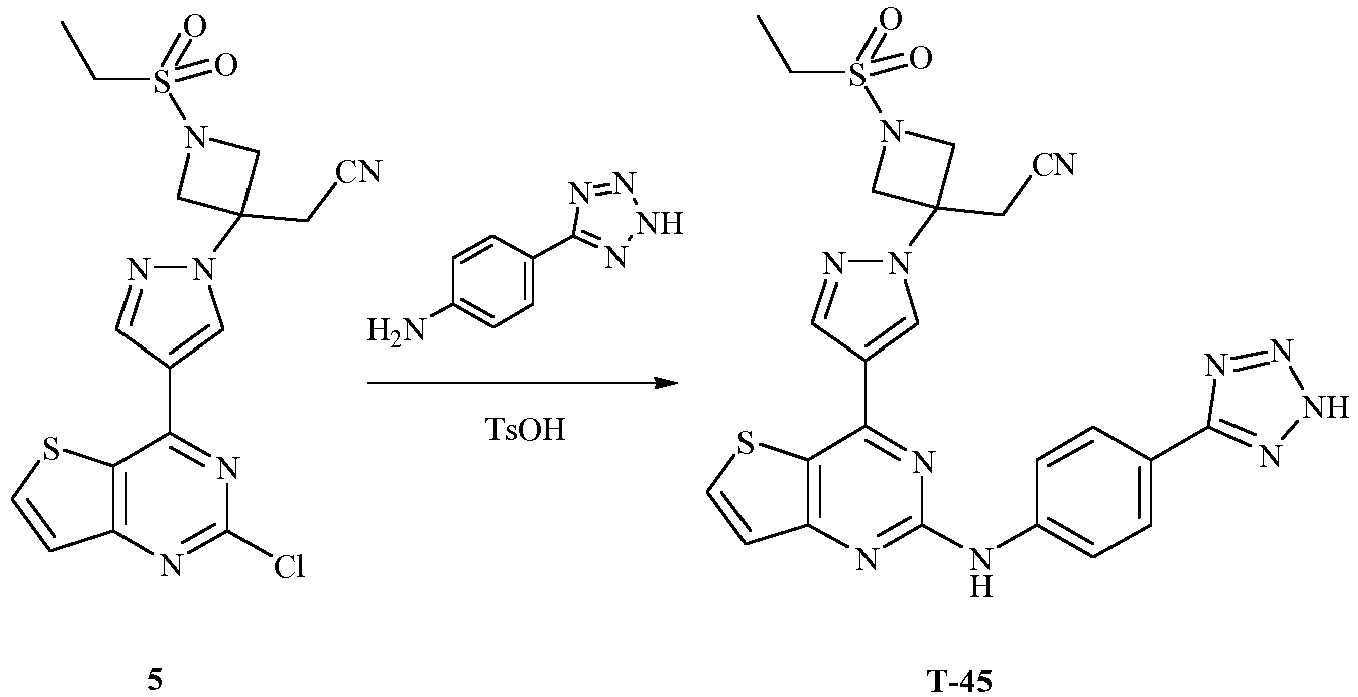
- Compound 5 (422 mg, 1.0 mmol) and 4-(2H-tetrazole-5-yl)aniline (242 mg, 1.5 mmol) were dissolved in n-butanol (5 mL), p-toluene sulfonic acid monohydrate (285 mg, 1.5 mmol) was added. The mixture was heated to 110°C and stirred for 16 hours, then concentrated under reduced pressure. The residue was purified by preparation HPLC (mobile phase: acetonitrile, water (0.05% trifluoroacetic acid); gradient: 60%-90%-10%) to give light yellow solid T-45 (52 mg, yield: 10%). LC-MS (ESI): m/z=548 [M+H]+.
1H-NMR (400MHz, DMSO-d6) δ: 10.08 (s, 1H), 8.88 (s, 1H), 8.45 (m, 2H), 8.13 (d, J=9Hz, 1H), 7.99 (d, J=9Hz, 1H), 7.50 (d, J=9Hz, 1H), 4.59 (d, J=9Hz, 2H), 4.29 (d, J= 9Hz, 2H), 3.74 (s, 2H), 3.24 (q, J= 7Hz, 2H), 1.25 (t, J= 7Hz, 3H) ppm -

- To a solution of compound 5-a (250 mg, 0.58 mmol) in dichloromethane (2 mL) was added a solution of hydrochloride in 1,4-dioxane (4 N, 4 mL), the mixture was stirred at room temperature for 16 hours, then concentrated under reduced pressure, and the residue was treated with dichloromethane (5 mL) and triethylamine (0.4 mL). The mixture was then cooled to 0°C, propionyl chloride (100 mg, 1.09 mmol) was added dropwise, and the mixture was stirred at 0°C for further 30 minutes after completion of dropping. Water (15 mL) was added, and the mixture was extracted with dichloromethane (10 mL×3). The organic layers were combined, washed with water (10 mL×3) and saturated brine (10 mL) in sequence, dried over anhydrous sodium sulfate, then filtrated, the filtrate was concentrated under reduced pressure. The residue was purified by silica column chromatography (petroleum ether : ethyl acetate=2:1) to give compound 46 (140 mg, yield: 63%). LC-MS (ESI): m/z=387 [M+H]+.
- Compound 46 (140 mg, 0.36 mmol) and 1-methyl-4-aminopyrazole (105 mg, 1.09 mmol) were dissolved in n-butanol (3 mL), p-toluene sulfonic acid monohydrate (137 mg, 0.73 mmol) was added. The mixture was heated to 110°C and stirred for 16 hours, then concentrated under reduced pressure, and the residue was purified by preparation TLC (dichloromethane : methanol=10:1) to give yellow solid T-46 (65 mg, yield: 40%). LC-MS (ESI): m/z=448 [M+H]+.
1H-NMR (400MHz, DMSO-d6) δ: 9.46 (s, 1H), 8.79 (s, 1H), 8.37 (s, 1H), 8.34 (d, J=5Hz, 1H), 8.05 (s, 1H), 7.56 (s, 1H), 7.37 (d, J=5Hz, 1H), 4.78 (d, J=9Hz, 1H), 4.78 (m, 2H), 4.24 (d, J=9Hz, 1H), 3.84 (s, 3H), 3.72 (s, 2H), 2.15 (q, J= 7Hz, 2H), 0.99 (t, J= 7Hz, 3H) ppm -

- Compound 5 (50 mg, 0.12 mmol) and 4-aminopyridazine (34 mg, 0.36 mmol) were dissolved in n-butanol (3 mL), p-toluene sulfonic acid monohydrate (45 mg, 0.24 mmol) was added. The mixture was heated to 110°C and stirred for 16 hours, then concentrated under reduced pressure, the residue was purified by preparation HPLC (mobile phase: acetonitrile, water (0.05% trifluoroacetic acid); gradient: 60%-90%-10%) to give yellow solid T-47 (6 mg, yield: 11%). LC-MS (ESI): m/z=482 [M+H]+.
1H-NMR (400MHz, CDCl3) δ: 8.79 (d, J=9Hz, 1H), 8.54 (s, 1H), 8.45 (s, 1H), 8.08 (d, J=6Hz, 1H), 7.92 (d, J=3Hz, 1H), 7.66 (d, J=6Hz, 1H), 6.32 (m, 1H), 4.66 (d, J=9Hz, 2H), 4.26 (d, J= 9Hz, 2H), 3.44 (s, 2H), 3.12 (q, J= 7Hz, 2H), 1.43 (t, J= 7Hz, 3H) ppm -

- Under hydrogen (1 atm), to a solution of compound 1-methyl-4-nitro-1H-imidazole(500 mg, 3.94 mmol) in ethanol (20 mL) was added 10% Pd-C (0.1 g). The mixture was stirred at 25°C for 12 hours, and then filtrated, the filtrate was concentrated under reduced pressure to give compound 48-a (310 mg, yield: 82%), which was used directly for the next step without purification.
- Compound 5 (70 mg, 0.17 mmol) and compound 48-a (48 mg, 0.5 mmol) were dissolved in n-butanol (3 mL), p-toluene sulfonic acid monohydrate (60 mg, 0.33 mmol) was added. The mixture was heated to 110°C and stirred for 16 hours, then concentrated under reduced pressure, the residue was purified by preparation HPLC (mobile phase: acetonitrile, water (0.05% trifluoroacetic acid); gradient: 60%-90%-10%) to give yellow solid T-48 (5 mg, yield: 6%). LC-MS (ESI): m/z=484 [M+H]+.
1H-NMR (500MHz, CD3OD) δ: 8.80 (s, 1H), 8.64 (s, 1H), 8.47 (s, 1H), 8.28 (d, J=5Hz, 1H), 7.49 (d, J=5Hz, 1H), 7.45 (s, 1H), 4.67 (d, J=9Hz, 2H), 4.32 (d, J= 9Hz, 2H), 3.99 (s, 2H), 3.65 (s, 2H), 3.20 (q, J= 7Hz, 2H), 1.39 (t, J= 7Hz, 3H) ppm -

- To a solution of compound 5-a (70 mg, 0.16 mmol) in dichloromethane (1 mL) was added a solution of hydrochloride in 1,4-dioxane (4 N, 1 mL), the mixture was stirred at room temperature for 16 hours, then concentrated under reduced pressure, and the residue was treated with dichloromethane (5 mL) and triethylamine (0.1 mL). The mixture was stirred for 15 minutes and then treated with glycolic acid (16 mg, 0.21 mmol), EDCI (40 mg, 0.21 mmol) and HOBT (3 mg, 0.02 mmol) in sequence. The mixture was stirred at room temperature for further 16 hours, then water (15 mL) was added, and the mixture was extracted with dichloromethane (10 mL×3). The organic layers were combined, washed with aq. HCl solution (1 N, 50 mL) and saturated aq. NaHCO3 solution (50 mL) in sequence, dried over anhydrous sodium sulfate, then filtrated, the filtrate was concentrated under reduced pressure. The residue was purified by preparation TLC (dichloromethane : methanol=10:1) to give compound 49 (20 mg, yield: 44%). LC-MS (ESI): m/z=389 [M+H]+.
- Compound 49 (20 mg, 0.05 mmol) and 1-methyl-4-aminopyrazole (15 mg, 0.16 mmol) were dissolved in n-butanol (2 mL), p-toluene sulfonic acid monohydrate (20 mg, 0.1 mmol) was added. The mixture was heated to 120°C and stirred for 3 hours, then concentrated under reduced pressure, the residue was purified by preparation TLC (dichloromethane : methanol=10:1) to give yellow solid T-49 (5 mg, yield: 22%). LC-MS (ESI): m/z=450 [M+H]+.
1H-NMR (400MHz, CD3OD) δ: 8.77 (s, 1H), 8.43 (s, 1H), 8.25 (d, J=5Hz, 1H), 8.02 (s, 1H), 7.65 (s, 1H), 7.35 (d, J=5Hz, 1H), 4.99 (d, J=10Hz, 1H), 4.76 (d, J=10Hz, 1H), 4.69 (d, J=11Hz, 1H), 4.46 (d, J=11Hz, 1H), 4.21 (s, 2H), 3.93 (s, 3H), 3.62 (s, 2H) ppm -

- N-(2-chloroethyl)morpholine hydrochloride (2.1 g, 11.06 mmol) and potassium hydroxide (1.24 g, 22.12 mmol) were added to a solution of 4-nitropyrazole (1.0 g, 8.85 mmol) in ethanol (20 mL) in sequence, the mixture was heated to 80°C and stirred for 3 hours. The mixture was then concentrated under reduced pressure, the residue was treated with water (50 mL), extracted with ethyl acetate (50 mL×3). The organic layers were combined, dried over anhydrous sodium sulfate, then filtrated, the filtrate was concentrated under reduced pressure. The residue was purified by silica column chromatography (petroleum ether : ethyl acetate=1:1) to give compound 50-b (600 mg, yield: 30%). LC-MS (ESI): m/z=227 [M+H]+.
- Under hydrogen (1 atm), to a solution of compound 50-b (600 mg, 2.66 mmol) in ethanol (20 mL) was added 10% Pd-C (0.1 g). The mixture was stirred at 25°C for 12 hours, and then filtrated, the filtrate was concentrated under reduced pressure to give compound 50-a (450 mg, yield: 87%), which was used directly for the next step without purification. LC-MS (ESI): m/z=197 [M+H]+.
- Compound 50-a (80 mg, 0.41 mmol) and compound 44 (60 mg, 0.17 mmol) were dissolved in n-butanol (6 mL), p-toluene sulfonic acid monohydrate (210 mg, 1.11 mmol) was added. The mixture was heated to 130°C and stirred for 3 hours, then concentrated under reduced pressure, the residue was purified by preparation HPLC (mobile phase: acetonitrile, water (0.05% trifluoroacetic acid); gradient: 60%-90%-10%) to give yellow solid T-50 (10 mg, yield: 12%). LC-MS (ESI): m/z=520 [M+H]+.
1H-NMR (400MHz, CD3OD) δ: 8.71 (s, 1H), 8.44 (s, 1H), 8.25 (s, 1H), 8.21 (d, J=6Hz, 1H), 7.75 (s, 1H), 7.36 (d, J=6Hz, 1H), 4.65 (t, J=6Hz, 2H), 3.91 (m, 6H), 3.57 (m, 2H), 3.32 (br, 4H), 3.18 (s, 2H), 2.70 (m, 2H), 2.25 (m, 2H) ppm -

- 2-Bromoethanol (1.9 g, 15.57 mmol) and potassium carbonate (2.9 g, 21.12 mmol) were added to a solution of 4-nitropyrazole (1.6 g, 14.16 mmol) in acetonitrile (20 mL) in sequence, the mixture was heated to 60°C and stirred for 16 hours. After cooled to room temperature, the mixture was filtrated, the filtrate was concentrated under reduced pressure to give compound 51-b (1.1 g, yield: 49.5%), which was used directly for the next step without purification.
- Under hydrogen (1 atm), to a solution of compound 51-b (1.1 g, 7 mmol) in ethanol (20 mL) was added 10% Pd-C (0.2 g). The mixture was stirred at 25°C for 12 hours, and then filtrated, the filtrate was concentrated under reduced pressure to give compound 51-a (740 mg, yield: 83%), which was used directly for the next step without purification. LC-MS (ESI): m/z=128 [M+H]+.
- Compound 51-a (72 mg, 0.57 mmol) and compound 5 (80 mg, 0.19 mmol) were dissolved in n-butanol (2 mL), p-toluene sulfonic acid monohydrate (72 mg, 0.38 mmol) was added. The mixture was heated to 115°C and stirred for 18 hours, then concentrated under reduced pressure, the residue was purified by preparation HPLC (mobile phase: acetonitrile, water (0.05% trifluoroacetic acid); gradient: 40%-70%-10%) to give yellow solid T-51 (45 mg, yield: 46%). LC-MS (ESI): m/z=514 [M+H]+.
1H-NMR (400MHz, CDCl3) δ: 11.80 (s, 1H), 8.52 (s, 1H), 8.15 (s, 1H), 8.01 (d, J=6Hz, 1H), 7.77 (s, 1H), 7.68 (s, 1H), 7.28 (s, 1H), 7.18 (d, J=6Hz, 1H), 4.69 (d, J=9Hz, 2H), 4.24 (d, J=9Hz, 4H), 4.03 (s, 2H), 3.49 (s, 2H), 3.12 (q, J=7Hz, 2H), 1.43 (t, J=7Hz, 3H) ppm -

- At 0°C, to a solution of compound T-31 (35 mg, 0.075 mmoL) and triethylamine (0.1 mL) in dichloromethane (5 mL) was added slowly acetyl chloride (7 mg, 0.089 mmol), and stirred for 30 minutes. The mixture was concentrated under reduced pressure, the residue was treated with saturated aqueous sodium bicarbonate solution (5 mL), extracted with dichloromethane (5 mL×3). The organic layers were combined, dried over anhydrous sodium sulfate, then filtrated, the filtrate was concentrated under reduced pressure. The residue was purified by preparation HPLC (mobile phase: acetonitrile, water (0.05% trifluoroacetic acid); gradient: 70%-95%-10%) to give compound T-52 (25 mg, yield: 66%). LC-MS (ESI): m/z=512 [M+H]+.
1H-NMR (400MHz, CDCl3) δ: 8.78 (s, 1H), 8.56 (s, 1H), 8.41 (s, 1H), 8.01 (d, J=5Hz, 1H), 7.92 (s, 1H), 7.46 (d, J=5Hz, 1H), 4.65 (d, J=9Hz, 2H), 4.28 (d, J=9Hz, 4H), 3.42 (s, 2H), 3.11 (q, J= 7Hz, 2H), 2.72 (s, 3H), 1.43 (t, J= 7Hz, 3H) ppm -
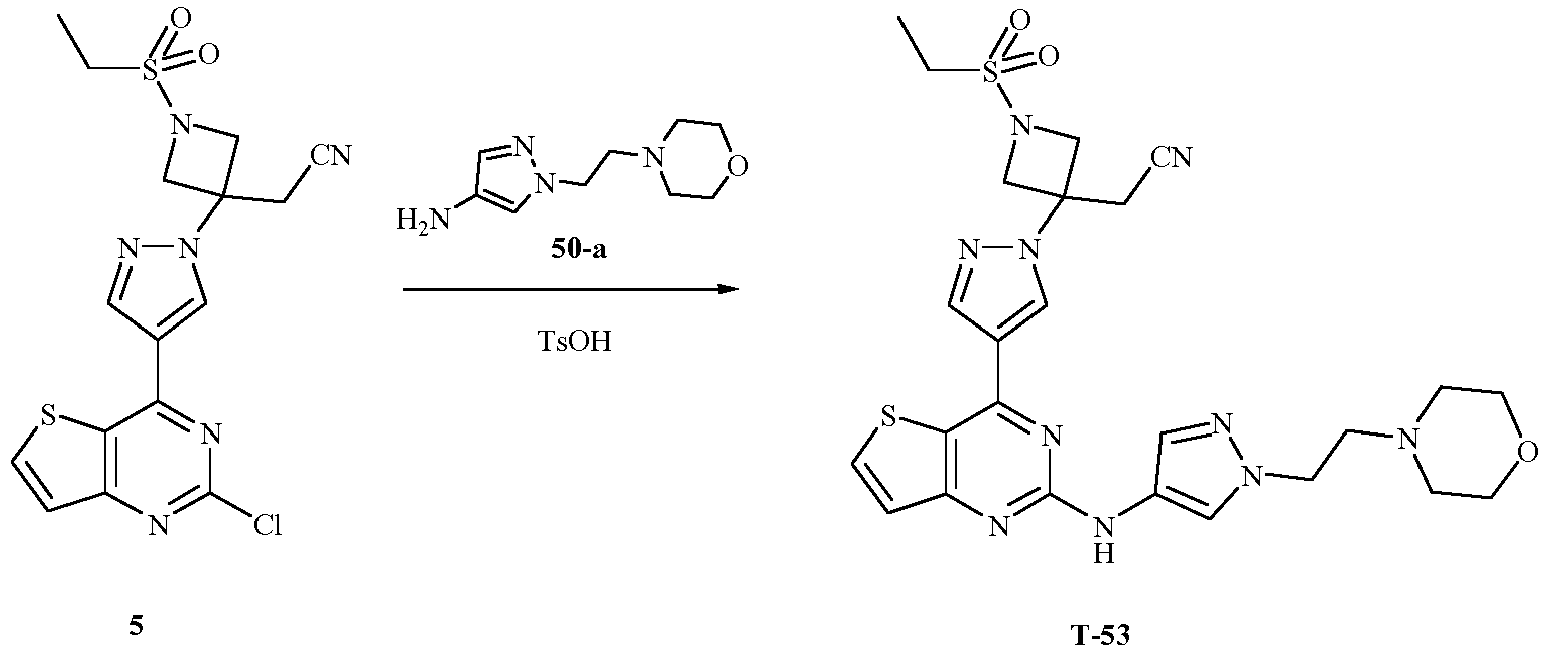
- Compound 50-a (97 mg, 0.5 mmol) and compound 5 (70 mg, 0.17 mmol) were dissolved in n-butanol (2 mL), p-toluene sulfonic acid monohydrate (126 mg, 0.67 mmol) was added. The mixture was heated to 115°C and stirred for 18 hours, then concentrated under reduced pressure, the residue was purified by preparation HPLC (mobile phase: acetonitrile, water (0.05% trifluoroacetic acid); gradient: 40%-70%-10%) to give yellow solid T-53 (41 mg, yield: 43%). LC-MS (ESI): m/z=583 [M+H]+.
1H-NMR (400MHz, CDCl3) δ: 12.09 (s, 1H), 8.94 (s, 1H), 8.39 (s, 1H), 8.21 (s, 1H), 8.14 (d, J=5Hz, 1H), 7.72 (s, 1H), 7.47 (d, J=5Hz, 1H), 4.74 (m, 4H), 4.26 (d, J=9Hz, 4H), 3.93 (m, 4H), 3.71 (t, J=5Hz, 2H), 3.51 (s, 2H), 3.11 (m, 4H), 3.09 (q, J= 7Hz, 2H), 1.43 (t, J= 7Hz, 3H) ppm -


- Sodium borohydride (1.01 g, 26.7 mmol) was added slowly to a solution of 1-Boc-3-azetidinone (2.28 g, 13.3 mmol) in ethanol (30 mL), stirred for 2 hours, the mixture was then concentrated under reduced pressure. The residue was treated with water (50 mL), extracted with ethyl acetate (50 mL×3). The organic layers were combined, dried over anhydrous sodium sulfate, then filtrated, the filtrate was concentrated under reduced pressure to give compound 54-d (2.28 g, yield: 99%), which was used directly for the next step without purification. LC-MS (ESI): m/z=175 [M+H]+.
- At 0°C, p-toluene sulfonyl chloride (2.12 g, 11.1 mmol) was added slowly to a solution of compound 54-d (1.28 g, 7.4 mmoL) and DABCO (1.66 g, 14.8 mmoL) in dichloromethane (30 mL). After the temperature was raised to room temperature, the mixture was stirred for further 40 minutes. The mixture was diluted with dichloromethane (30mL), washed with aqueous HCl solution (1 N, 50 mL), saturated aqueous NaHCO3 solution (50 mL) and water (50 mL) in sequence. The organic layer was dried over anhydrous sodium sulfate, then filtrated, the filtrate was concentrated under reduced pressure to give compound 54-c (1.96 g, yield: 81%), which was used directly for the next step without purification. LC-MS (ESI): m/z=350 [M+Na]+.
- Compound 54-c (4.9 g, 15 mmol) and cesium carbonate (6.5 g, 2 mmol) were added to a solution of 4-nitropyrazole (1.13 g, 10mmol) in DMF (15 mL) in sequence, and then the mixture was heated to 120°C and stirred for 12 hours. After cooled to room temperature, the mixture was treated with water (60 mL), extracted with ethyl acetate (30 mL×3). The organic layers were combined, dried over anhydrous sodium sulfate, then filtrated, the filtrate was concentrated under reduced pressure. The residue was purified by silica column chromatography (petroleum ether : ethyl acetate=5:1) to give compound 54-b (1.1 g, yield: 41%). LC-MS (ESI): m/z=291 [M+Na]+.
- A solution of compound 54-b (1.1 g, 4.1 mmol) in anhydrous THF (10 mL) was added slowly to a suspension of lithium aluminium hydride (360 mg, 10 mmol) in anhydrous THF (10 mL). The mixture was refluxed for 3 hours, then cooled to room temperature, ethyl acetate (2 mL) was then added slowly dropwise. The mixture was filtrated, the filtrate was concentrated under reduced pressure to give compound 54-a (430 mg, yield: 69%), which was used directly for the next step without purification. LC-MS (ESI): m/z=153 [M+H]+.
- Compound 54-a (152 mg, 1 mmol) and compound 5 (221 mg, 0.5 mmol) were dissolved in n-butanol (10 mL), p-toluene sulfonic acid monohydrate (258 mg, 1.5 mmol) was added. The mixture was heated to 120°C and stirred for 3 hours, then cooled to room temperature. The mixture was treated with saturated aqueous NaHCO3 solution (10 mL), extracted with dichloromethane (10 mL×3). The organic layers were combined, washed with water (10 mL×3) and saturated brine (10 mL) in sequence, dried over anhydrous sodium sulfate, then filtrated. The residue was purified by preparation HPLC (mobile phase: acetonitrile, water (0.05% trifluoroacetic acid); gradient: 40%-70%-10%) to give yellow solid T-54 (28 mg, yield: 10.4%). LC-MS (ESI): m/z=554 [M+H]+.
1H-NMR (400MHz, CD3OD) δ: 8.74 (s, 1H), 8.43 (s, 1H), 8.25 (s, 1H), 8.13 (d, J=4.0Hz, 1H), 7.74 (s, 1H), 7.35 (d, J=4.0Hz, 1H), 5.05 (m, 1H), 4.67 (d, J=7.2Hz, 2H), 4.33 (d, J=7.2Hz, 2H), 3.90 (t, J=5.6Hz, 2H), 3.66 (t, J=5.6Hz, 2H), 3.64 (s, 2H), 3.21 (q, J=6.0Hz, 2H), 2.51 (s, 3H), 1.38 (t, J=6.0Hz, 3H) ppm -


- Under nitrogen, compound 5-a (400 mg, 1.04 mmol), 5,7-dichloropyrazolo[1,5-a]pyrimidine (200 mg, 1.04 mmol) and sodium carbonate (331 mg, 3.12 mmol) were suspended in 1,4-dioxane (2 mL) and water (2 mL), Pd(dppf)Cl2 (100 mg, 0.1 mmol) was added. The mixture was heated to 80°C and stirred for 16 hours. The mixture was concentrated under reduced pressure, the residue was treated with dichloromethane (20 mL), washed with water (10 mL×3) and saturated brine (10 mL) in sequence. The mixture was dried over anhydrous sodium sulfate, then filtrated, the filtrate was concentrated under reduced pressure, the residue was purified by preparation TLC (dichloromethane : ethyl acetate=30:1) to give compound 55-a (230 mg, yield: 54%). LC-MS (ESI): m/z=414 [M+H]+.
- To a solution of compound 55-a (230 mg, 0.56 mmol) in THF (2 mL) was added a solution of hydrochloride in 1,4-dioxane (4 N, 1.5 mL), the mixture was stirred at room temperature for 16 hours, then concentrated under reduced pressure and the residue was treated with dichloromethane (5 mL) and triethylamine (0.3 mL, 2.2 mmol). The mixture was then cooled to 0°C, ethylsulfonyl chloride (0.15 mL, 0.84 mmol) was added dropwise, and the mixture was stirred at 0°C for further 30 minutes after completion of dropping. Water (5 mL) was added, and the mixture was extracted with dichloromethane (10 mL×3). The organic layers were combined, washed with water (10 mL×3) and saturated brine (10 mL) in sequence, dried over anhydrous sodium sulfate, then filtrated, the filtrate was concentrated under reduced pressure. The residue was purified by column chromatography (petroleum ether : ethyl acetate=1:1) to give compound 55(102 mg, yield: 45%). LC-MS (ESI): m/z=406 [M+H]+.
- Under nitrogen, to a suspension of compound 55 (70 mg, 0.17 mmol), aniline (25 mg, 0.26 mmol) and cesium carbonate (102 mg, 0.32 mmol) in 1,4-dioxane (4 mL) were added Pd(OAc)2 (15 mg, 0.07 mmol) and BINAP (40 mg, 0.07 mmol), the mixture was heated to 125°C by microwave and stirred for 40 minutes. After cooled to room temperature, the mixture was diluted with ethyl acetate (10 mL), washed with water (5 mL×3) and saturated brine (5 mL) in sequence, dried over anhydrous sodium sulfate, then filtrated, the filtrate was concentrated under reduced pressure. The residue was purified by preparation HPLC (mobile phase: acetonitrile, water (0.05% trifluoroacetic acid); gradient: 40%-70%-10%) to give compound T-55 (10 mg, yield: 13 %). LC-MS (ESI): m/z=463 [M+H]+.
1H-NMR (400MHz, CDCl3) δ: 9.12 (s, 1H), 8.15 (s, 1H), 8.01 (d, J=2Hz, 1H), 7.46 (m, 4H), 7.26 (m, 1H), 6.61 (s, 1H), 6.39 (d, J=2Hz, 1H), 4.63 (d, J=9Hz, 2H), 4.24 (d, J= 9Hz, 2H), 3.42 (s, 2H), 3.09 (q, J= 7Hz, 2H), 1.42 (t, J= 7Hz, 3H) ppm -

- Under nitrogen, 4-bromo-2-fluorobenzonitrile (4.0 g, 20 mmol), bis(pinacolato)diboron (3.8 g, 30 mmol) and potassium acetate (6.1 g, 60 mmol) were suspended in DMSO (50 mL), Pd(dppf)Cl2 (1.5g, 0.2 mmol) was added. The mixture was stirred at 80°C for 4 hours. The mixture was diluted with water (100 mL), extracted with ethyl acetate (100 mL×3). The organic layers were combined, washed with water (50 mL×3) and saturated brine (50 mL) in sequence, dried over anhydrous sodium sulfate, then filtrated, the filtrate was concentrated under reduced pressure. The residue was purified by silica column chromatography (petroleum ether : ethyl acetate=50:1 to 10:1) to give compound 56-a(3.6 g, yield: 73 %).
1H-NMR (400MHz, CD3OD) δ: 7.62 (m, 3H), 1.35 (s, 12H) ppm - Under nitrogen, compound 56-a (1.0 g, 4 mmol), 2,4-dichlorotheino[3,2-d]pyrimidine (1.0 g, 4.9 mmol) and potassium carbonate (1.38 g, 10 mmol) were suspended in 1,4-dioxane (20 mL) and water (4 mL), Pd(PPh3)4 (490 mg, 0.6 mmol) was added. The mixture was heated to 100°C and stirred for 2 hours. The mixture was concentrated under reduced pressure, the residue was treated with water (20 mL), extracted with dichloromethane (20 mL×3). The organic layers were combined, washed with water (10 mL×3) and saturated brine (10 mL) in sequence, dried over anhydrous sodium sulfate, then filtrated, the filtrate was concentrated under reduced pressure. The residue was purified by silica column chromatography (petroleum ether : ethyl acetate=3:1) to give light yellow solid 56(1.0 g, yield: 87.5 %). LC-MS (ESI): m/z=290 [M+H]+.
- Compound 56 (290 mg, 1.0 mmol) and aniline (140 mg, 1.5 mmol) were dissolved in n-butanol (10 mL), p-toluene sulfonic acid monohydrate (260 mg, 1.5 mmol) was added. The mixture was heated to 120°C and stirred for 6 hours, then cooled to room temperature. The mixture was treated with saturated aqueous NaHCO3 solution (10 mL), extracted with dichloromethane (10 mL×3). The organic layers were combined, washed with water (10 mL×3) and saturated brine (10 mL) in sequence, dried over anhydrous sodium sulfate, then filtrated. The residue was purified by silica column chromatography (petroleum ether : ethyl acetate=3:1 to 1:1) to give compound T-56 (120 mg, yield: 35 %). LC-MS (ESI): m/z=347 [M+H]+.
1H-NMR (400MHz, DMSO-d6) δ: 9.89 (s, 1H), 8.48 (d, J=5.2, 1H), 8.29 (m, 3H), 7.87 (d, J=7.6, 1H), 7.51 (d, J=5.2Hz, 1H), 7.33 (t, J=7.2Hz, 2H), 6.98 (t, J=7.2Hz, 1H) ppm -

- 5-Aminoindazole (47 mg, 0.36 mmol) and compound 5 (50 mg, 0.12 mmol) were dissolved in n-butanol (0.5 mL), p-toluene sulfonic acid monohydrate (43 mg, 0.24 mmol) was added. The mixture was heated to 110°C and stirred for 18 hours, then cooled to room temperature. The mixture was treated with saturated aqueous NaHCO3 solution (10 mL), extracted with dichloromethane (5 mL×3). The organic layers were combined, washed with water (5 mL×3) and saturated brine (5 mL) in sequence, dried over anhydrous sodium sulfate, then filtrated. The residue was purified by preparation HPLC (mobile phase: methanol, water (0.05% trifluoroacetic acid); gradient: 70%-95%-10%) to give yellow solid T-57 (20 mg, yield: 33%). LC-MS (ESI): m/z=520 [M+H]+.
1H-NMR (400MHz, CDCl3) δ: 11.1 (br, 1H), 8.53 (s, 1H), 8.36 (s, 1H), 8.15 (d, J=1.2Hz, 1H), 8.09 (d, J=9Hz, 2H), 7.52 (d, J=1.2Hz, 1H), 7.48 (d, J=9Hz, 1H), 4.62 (d, J=9Hz, 2H), 4.23 (d, J=9Hz, 2H), 3.41 (s, 2H), 3.09 (q, J= 7Hz, 2H), 1.42 (t, J= 7Hz, 3H) ppm -

- 5-Aminobenzimidazole (47 mg, 0.36 mmol) and compound 5 (50 mg, 0.12 mmol) were dissolved in n-butanol (0.5 mL), p-toluene sulfonic acid monohydrate (43 mg, 0.24 mmol) was added. The mixture was heated to 110°C and stirred for 18 hours, then cooled to room temperature. The mixture was treated with saturated aqueous NaHCO3 solution (10 mL), extracted with dichloromethane (5 mL×3). The organic layers were combined, washed with water (5 mL×3) and saturated brine (5 mL), dried over anhydrous sodium sulfate, then filtrated. The residue was purified by preparation HPLC (mobile phase: methanol, water (0.05% trifluoroacetic acid); gradient: 50%-80%-10%) to give yellow solid T-58 (20 mg, yield: 33%). LC-MS (ESI): m/z=520 [M+H]+.
1H-NMR (500MHz, DMSO-d6) δ: 10.11 (s, 1H), 9.45 (s, 1H), 8.88 (s, 1H), 8.76 (d, J=1.5Hz, 1H), 8.52 (s, 2H), 8.47 (d, J=1.5Hz, 1H), 7.85 (dd, J=10Hz, J=1.5Hz, 1H), 7.44 (d, J=5.5Hz, 1H), 4.59 (d, J=9Hz, 2H), 4.29 (d, J=9Hz, 2H), 3.75 (s, 2H), 3.25 (q, J= 7Hz, 2H), 1.26 (t, J= 7Hz, 3H) ppm -

- 4-(1H-Tetrazol-1-yl)aniline (77 mg, 0.47 mmol) and compound 5 (100 mg, 0.26 mmol) were dissolved in n-butanol (2 mL), p-toluene sulfonic acid monohydrate (68 mg, 0.36 mmol) was added. The mixture was heated to 110°C and stirred for 18 hours, then cooled to room temperature. The mixture was treated with saturated aqueous NaHCO3 solution (10 mL), extracted with dichloromethane (10 mL×3). The organic layers were combined, washed with water (10 mL×3) and saturated brine (10 mL) in sequence, dried over anhydrous sodium sulfate, then filtrated. The residue was purified by preparation HPLC (mobile phase: acetonitrile, water (0.05% trifluoroacetic acid); gradient: 50%-80%-10%) to give yellow solid T-59 (44 mg, yield: 34%). LC-MS (ESI): m/z=548 [M+H]+.
1H-NMR (400MHz, DMSO-d6) δ: 10.07 (s, 1H), 10.00 (s, 1H), 8.88 (s, 1H), 8.45 (d, =9Hz, 1H), 8.16 (d, J=9Hz, 2H), 7.84 (d, J=1.2Hz, 1H), 7.49 (d, J=10Hz, J=1.6Hz, 1H), 4.58 (d, J=9Hz, 2H), 4.28 (d, J=9Hz, 2H), 3.74 (s, 2H), 3.25 (q, J= 7Hz, 2H), 1.26 (t, J= 7Hz, 3H) ppm -

- At 0°C, 60% NaH in mineral oil (530 mg, 13.27 mmol) was added to a solution of 4-nitropyrazole (1.0 g, 8.85 mmol) in THF (10 mL), stirred for 30 minutes, N-(3-chloropropyl)morpholine (1.73 g, 10.62 mmol) was added. The mixture was warmed to room temperature and stirred for further 16 hours. The mixture was diluted with water (25 mL), extracted with ethyl acetate (50 mL×3). The organic layers were combined, dried over anhydrous sodium sulfate, then filtrated, the filtrate was concentrated under reduced pressure. The residue was purified by silica column chromatography (petroleum ether : ethyl acetate=1:1) to give yellow oil 60-b (1.2 g, yield: 56.6%). LC-MS (ESI): m/z=241 [M+H]+.
- Under hydrogen (1 atm), to a solution of compound 60-b (300 mg, 1.25 mmol) in ethanol (5 mL) was added 10% Pd-C (0.1 g). The mixture was stirred at 25°C for 16 hours, and then filtrated, the filtrate was concentrated under reduced pressure to give red brown oil 60-a (180 mg, yield: 69%), which was used directly for the next step without purification. LC-MS (ESI): m/z=211 [M+H]+.
- Compound 60-a (100 mg, 0.48 mmol) and compound 5 (100 mg, 0.24 mmol) were dissolved in n-butanol (2 mL), p-toluene sulfonic acid monohydrate (68 mg, 0.36 mmol) was added. The mixture was heated to 110°C and stirred for 18 hours, then cooled to room temperature. The mixture was treated with saturated aqueous NaHCO3 solution (10 mL), extracted with dichloromethane (10 mL×3). The organic layers were combined, washed with water (10 mL×3) and saturated brine (10 mL) in sequence, dried over anhydrous sodium sulfate, then filtrated. The residue was purified by preparation HPLC (mobile phase: acetonitrile, water (0.05% trifluoroacetic acid); gradient: 25%-55%-10%) to give yellow solid T-60 (60 mg, yield: 43%). LC-MS (ESI): m/z=597 [M+H]+.
1H-NMR (400MHz, CD3OD) δ: 8.78 (s, 1H), 8.44 (s, 1H), 8.25 (s, 1H), 8.21 (d, J=5.2Hz, 1H), 8.18 (s, 1H), 7.72 (s, 1H), 7.35 (d, J=5.6Hz, 1H), 4.66 (d, J=9Hz, 2H), 4.33 (m, 4H), 4.06 (m, 2H), 3.77 (m, 2H), 3.65 (s, 2H), 3.50 (m, 2H), 3.20 (m, 6H), 2.36 (m, 2H), 1.38 (d, J=7Hz, 2H) ppm -

- 4-Bromobutyronitrile (4.27 g, 26.55 mmol) was added to a solution of 4-nitropyrazole (2.0 g, 17.69 mmol) and potassium carbonate (5.0 g, 35.39 mmol) in acetonitrile (20 mL), the mixture was refluxed for 16 hours. After cooled to room temperature, the mixture was treated with water (60 mL), extracted with ethyl acetate (50 mL×3). The organic layers were combined, dried over anhydrous sodium sulfate, then filtrated, the filtrate was concentrated under reduced pressure. The residue was purified by silica column chromatography (petroleum ether : ethyl acetate=5:1) to give compound 61-c (2.5 g, yield: 79%).
- A solution of 1.0 M tetrabutylammonium fluoride in THF (12 mL, 12 mmol) was added to a solution of compound 61-c (2.0 g, 11.1 mmol) and azidotrimethylsilane (2.0 g, 17.39 mmol) in toluene (20 mL), the mixture was refluxed for 16 hours. An additional portion of azidotrimethylsilane (2.0 g, 17.39 mmol) was added, the mixture was refluxed for further 16 hours. The mixture was then concentrated, the residue was purified by silica column chromatography (dichloromethane : methanol=10:1) to give compound 61-b (2.1 g, yield: 85 %). LC-MS (ESI): m/z=224 [M+H]+.
- Under hydrogen (1 atm), to a solution of compound 61-b (1.0 g, 4.48 mmol) in ethanol (20 mL) was added 10% Pd-C (0.1 g). The mixture was stirred at 25°C for 16 hours, and then filtrated, the filtrate was concentrated under reduced pressure to give red brown oil 61-a (750 mg, yield: 86%), which was used directly for the next step without purification. LC-MS (ESI): m/z=194 [M+H]+.
- Compound 61-a (137 mg, 0.71 mmol) and compound 5 (100 mg, 0.24 mmol) were dissolved in n-butanol (2 mL), p-toluene sulfonic acid monohydrate (91 mg, 0.47 mmol) was added. The mixture was heated to 110°C and stirred for 18 hours, then cooled to room temperature. The mixture was treated with saturated aqueous NaHCO3 solution (10 mL), extracted with dichloromethane (10 mL×3). The organic layers were combined, washed with water (10 mL×3) and saturated brine (10 mL) in sequence, dried over anhydrous sodium sulfate, then filtrated. The residue was purified by preparation HPLC (mobile phase: acetonitrile, water (0.05% trifluoroacetic acid); gradient: 25%-55%-10%) to give yellow solid T-61(19 mg, yield: 13.6%). LC-MS (ESI): m/z=580 [M+H]+.
1H-NMR (400MHz, CDCl3) δ: 8.49 (s, 1H), 8.37 (s, 1H), 8.03 (s, 1H), 7.91 (d, J=5.6Hz, 1H), 7.69 (s, 1H), 7.35 (d, J=5.6Hz, 1H), 6.97 (s, 1H), 4.66 (d, J=9Hz, 2H), 4.25 (d, J=9Hz, 4H), 4.17 (t, J=6Hz, 4H), 3.44 (s, 2H), 3.11 (q, J=7Hz, 2H), 2.91 (m, 2H), 2.28 (m, 2H), 1.42 (t, J=7Hz, 3H) ppm -


- Morpholine (2.0 g, 31.7 mmol) was added to a solution of 2-chloro-5-nitropyridine (2.0 g, 12.7 mmol) in acetonitrile (20 mL), the mixture was stirred at room temperature for 16 hours. After water (50 mL) was added, there was solid precipitated. After filtration, the solid was dried in vacuum for 6 hours to give compound 62-b (2 g, yield: 75.6%), which was directly for the next step without purification.
- Under hydrogen (1 atm), to a solution of compound 62-b (2.0 g, 9.62 mmol) in ethanol (20 mL) was added 10% Pd-C (0.2 g). The mixture was stirred at 25°C for 16 hours, and then filtrated, the filtrate was concentrated under reduced pressure to give brown solid 62-a (1.5 g, yield: 87%), which was used directly for the next step without purification. LC-MS (ESI): m/z=180 [M+H]+.
- Under nitrogen, Pd2(dba)3 (28 mg, 0.03 mmol) and BINAP (20 mg, 0.03 mmol) were added to a suspension of compound 5 (100 mg, 0.24 mmol), compound 62-a (85 mg, 0.47 mmol) and cesium carbonate (155 mg, 0.48 mmol) in 1,4-dioxane (2 mL), the mixture was heated to 110°C by microwave and stirred for 30 minutes. After cooled to room temperature, the mixture was diluted with dichloromethane (15 mL), washed with water (10 mL×3) and saturated brine (10 mL) in sequence, dried over anhydrous sodium sulfate, then filtrated, the filtrate was concentrated under reduced pressure. The residue was purified by preparation HPLC (mobile phase: acetonitrile, water (0.05% trifluoroacetic acid); gradient: 35%-65%-10%) to give compound T-62 (10 mg, yield: 8 %). LC-MS (ESI): m/z=566 [M+H]+.
1H-NMR (500MHz, CDCl3) δ: 12.45 (br, 1H), 9.22 (br, 2H), 8.43 (s, 1H), 8.23 (d, J=5.2Hz, 1H), 8.04 (dd, J=9.6Hz, J=2.8Hz, 1H), 7.55 (d, J=9.6Hz, 1H), 7.03 (d, J=9.6Hz, 1H), 4.77 (d, J=9Hz, 2H), 4.30 (d, J= 9Hz, 2H), 3.93 (m, 4H), 3.73 (m, 4H), 3.59 (s, 2H), 3.15 (q, J= 7Hz, 2H), 1.42 (t, J= 7Hz, 3H) ppm -

- Morpholine (492 mg, 6.07 mmol) was added to a solution of 2-chloro-5-nitropyrimidine (440 mg, 2.76 mmol) in acetonitrile (5 mL), the mixture was stirred at room temperature for 3 hours, then concentrated under reduced pressure. The residue was diluted with ethyl acetate (50 mL) and IN aqueous HCl solution (20 mL). The organic layer was washed with water (10 mL×3) and saturated brine (10 mL) in sequence, dried over anhydrous sodium sulfate, then filtrated, the filtrate was concentrated under reduced pressureto give compound 63-b (350 mg, yield: 61%), which was used directly for the next step without purification. LC-MS (ESI): m/z=211 [M+H]+.
- Under hydrogen (1 atm), to a solution of compound 63-b (350 mg, 1.67 mmol) in ethanol (10 mL) was added 10% Pd-C (0.1 g). The mixture was stirred at 25°C for 16 hours, and then filtrated, the filtrate was concentrated under reduced pressure to give brown solid 63-a (230 mg, yield: 77%), which was used directly for the next step without purification. LC-MS (ESI): m/z=181 [M+H]+.
- Compound 63-a (52 mg, 0.28 mmol) and compound 5 (80 mg, 0.19 mmol) were dissolved in n-butanol (2 mL), p-toluene sulfonic acid monohydrate (44 mg, 0.23 mmol) was added. The mixture was heated to 110°C and stirred for 18 hours, then cooled to room temperature. The mixture was concentrated under reduced pressure, then treated with saturated aqueous NaHCO3 solution (5 mL), extracted with dichloromethane (10 mL×3). The organic layers were combined, washed with water (10 mL×3) and saturated brine (10 mL) in sequence, dried over anhydrous sodium sulfate, then filtrated. The residue was purified by preparation HPLC (mobile phase: acetonitrile, water (0.05% trifluoroacetic acid); gradient: 40%-70%-10%) to give brown solid T-63 (12 mg, yield: 12%). LC-MS (ESI): m/z=567 [M+H]+.
1H-NMR (400MHz, CDCl3) δ: 8.70 (d, J=2.4Hz, 1H), 8.48 (s, 1H), 8.37 (s, 1H), 7.97 (d, J=5.6Hz, 1H), 7.36 (d, J=5.2Hz, 1H), 4.63 (d, J=9.2Hz, 2H), 4.25 (d, J= 9.2Hz, 2H), 3.81 (s, 8H), 3.43 (s, 2H), 3.15 (q, J= 7Hz, 2H), 1.42 (t, J= 7Hz, 3H) ppm -
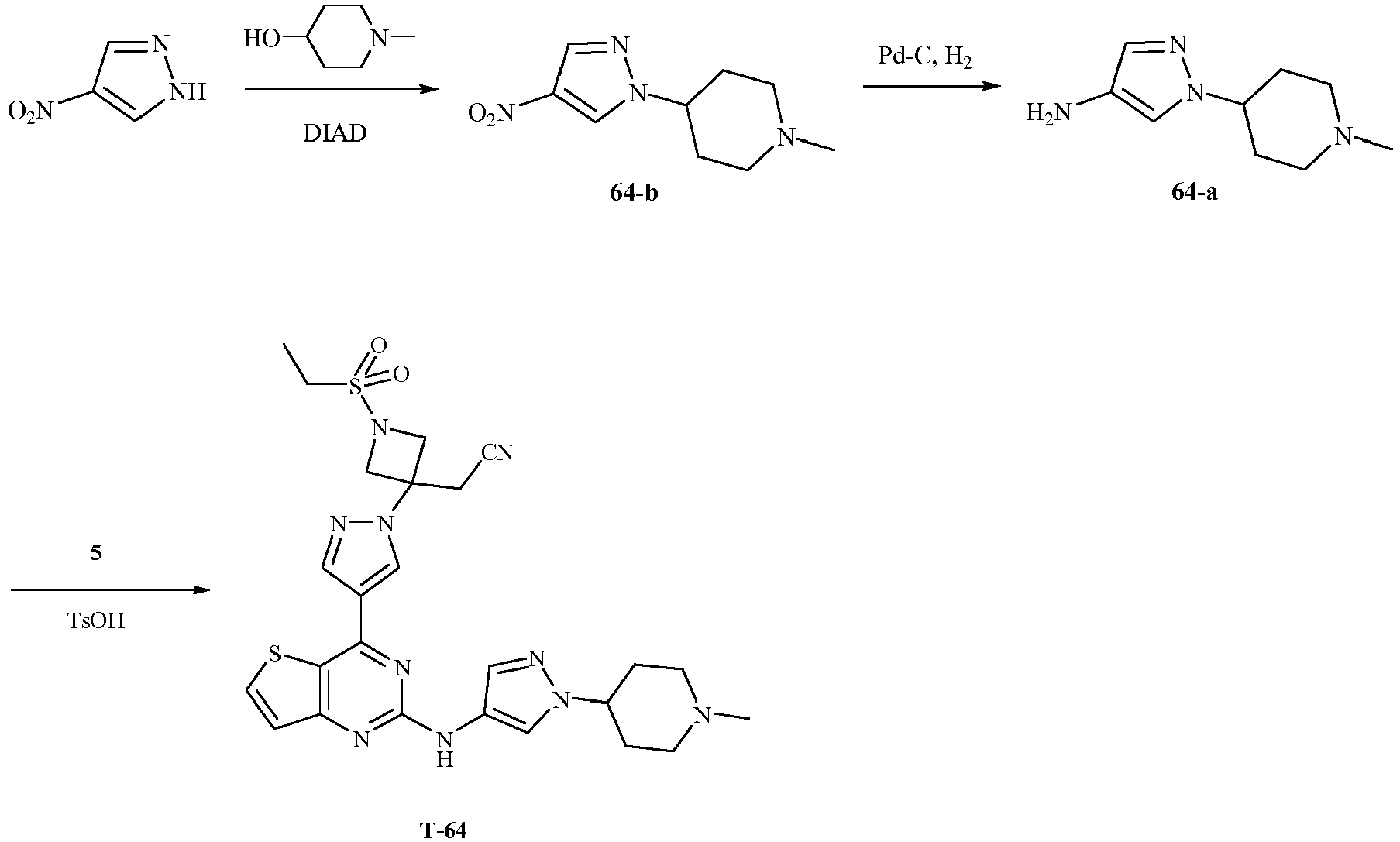
- At 0°C, DIAD (5.4 g, 26.54 mmol) was added slowly to a solution of 4-nitropyrazole (2.0 g, 17.69 mmol), PPh3 (6.95 g, 26.54 mmol) and N-methyl-4-hydroxypiperidine (2.4 g, 21.23 mmol) in anhydrous THF (50 mL). The mixture was warmed to room temperature and stirred for 16 hours. After the mixture was concentrated under reduced pressure, the residue was diluted with ethyl acetate (50 mL) and 3N aqueous HCl solution (50 mL) in sequence. The aqueous layer was treated with saturated aqueous K2CO3 solution to adjust pH=9, then extracted with ethyl acetate (50 mL×3). The organic layers were combined, washed with water (50 mL×3) and saturated brine (50 mL) in sequence, dried over anhydrous sodium sulfate, then filtrated, the filtrate was concentrated under reduced pressure to give yellow oil 64-b (2.1 g, yield: 57%), which was used directly for the next step without purification.
- Under hydrogen (1 atm), to a solution of compound 64-b (500 mg, 2.38 mmol) in ethanol (10 mL) was added 10% Pd-C (0.1 g). The mixture was stirred at 25°C for 16 hours, and then filtrated, the filtrate was concentrated under reduced pressure to give red brown oil 64-a (420 mg, yield: 98%), which was used directly for the next step without purification. LC-MS (ESI): m/z=181 [M+H]+.
- Compound 64-a (128 mg, 0.71 mmol) and compound 5 (100 mg, 0.24 mmol) were dissolved in n-butanol (2 mL), p-toluene sulfonic acid monohydrate (135 mg, 0.71 mmol) was added. The mixture was heated to 110°C and stirred for 18 hours, then cooled to room temperature. The mixture was concentrated under reduced prssure, the residue was treated with saturated aqueous NaHCO3 solution (5 mL), extracted with dichloromethane (10 mL×3). The organic layers were combined, washed with water (10 mL×3) and saturated brine (10 mL) in sequence, dried over anhydrous sodium sulfate, then filtrated. The residue was purified by preparation HPLC (mobile phase: acetonitrile, water (0.05% trifluoroacetic acid); gradient: 25%-55%-10%) to give brown solid T-64 (62 mg, yield: 47%). LC-MS (ESI): m/z=567 [M+H]+.
1H-NMR (400MHz, CDCl3) δ: 8.43 (s, 1H), 8.35 (s, 1H), 8.03 (s, 1H), 7.87 (d, J=5.6Hz, 1H), 7.58 (s, 1H), 7.31 (d, J=5.2Hz, 1H), 7.18 (s, 1H), 4.63 (d, J=9.2Hz, 2H), 4.25 (d, J= 9.2Hz, 2H), 4.18 (m, 1H), 3.40 (s, 2H), 3.09 (q, J= 7Hz, 2H), 3.01 (m, 2H), 2.35 (s, 3H), 2.15 (m, 6H), 1.41 (t, J= 7Hz, 3H) ppm -


- Under hydrogen (1 atm), to a solution of compound 54-b (1.33 g, 5 mmol) in methanol (10 mL) was added 10% Pd-C (0.1 g). The mixture was stirred at 25°C for 12 hours, and then filtrated, the filtrate was concentrated under reduced pressure to give compound 65-b (940 mg, yield: 79%), which was used directly for the next step without purification. LC-MS (ESI): m/z=261 [M+Na]+.
- Under nitrogen, to a suspension of compound 5 (422 mg, 1.0 mmol), compound 65-b (357 mg, 1.5 mmol) and potassium carbonate (276 mg, 2.0 mmol) in 1,4-dioxane (10 mL) were added Pd2(dba)3 (15 mg, 0.017 mmol) and Ruphos (10 mg, 0.07 mmol), the mixture was heated to 120°C by microwave and stirred for 40 minutes. After cooled to room temperature, the mixture was diluted with ethyl acetate (10 mL), then filtrated, the filtrate was concentrated under reduced pressure. The residue was purified by silica column chromatography (petroleum ether : ethyl acetate=2:1 to 1:1) to give compound 65-a (374 mg, yield: 60%). LC-MS (ESI): m/z=625 [M+H]+.
- Trifluoroacetic acid (2 mL) was added to a solution of compound 65-a (370 mg, 0.6 mmol) in dichloromethane (6 mL) and stirred for 3 hours. The mixture was concentrated under reduced pressure, the residue was treated with saturated aqueous NaHCO3 solution (10 mL), extracted with dichloromethane (10 mL×3). The organic layers were combined, dried over anhydrous sodium sulfate, then filtrated, the filtrate was concentrated under reduced pressure. The residue was purified by silica column chromatography (petroleum ether : ethyl acetate=1:1 to 1:3) to give compound T-65 (160 mg, yield: 50%). LC-MS (ESI): m/z=525 [M+H]+.
1H-NMR (400MHz, DMSO-d6) δ: 9.56 (s, 1H), 8.84 (s, 1H), 8.41 (s, 1H), 8.37 (d, J=5.6, 1H), 8.22 (s, 1H), 7.74 (s, 1H), 7.81 (d, J=5.6Hz, 1H), 5.35 (m, 1H), 4.59 (d, J=9.6Hz, 2H), 4.27 (d, J=9.6Hz, 2H), 4.18 (m, 4H), 3.73 (s, 2H), 3.27 (q, J= 7.2Hz, 2H), 1.25 (t, J= 7.2Hz, 3H) ppm -

- At 0°C, NaBH(AcO)3 (212 mg, 1.0 mmol) was added to a solution of compound T-65 (120 mg, 0.23 mmol) and cyclopropanecarbaldehyde (70 mg, 1.0 mmol) in a component solvent of methanol (6 mL) and dichloromethane (6 mL), stirred for 2 hours, then warmed to room temperature, and stirred for further 16 hours. The mixture was concentrated under reduced pressure, the residue was treated with saturated aqueous NaHCO3 solution (10 mL), extracted with dichloromethane (10 mL×3). The organic layers were combined, dried over anhydrous sodium sulfate, then filtrated, the filtrate was concentrated under reduced pressure. The residue was purified by silica column chromatography (petroleum ether : ethyl acetate=1:1 to 1:3) to give compound T-66(60 mg, yield: 43 %). LC-MS (ESI): m/z=579 [M+H]+.
1H-NMR (400MHz, DMSO-d6) δ: 9.49 (s, 1H), 8.83 (s, 1H), 8.40 (s, 1H), 8.36 (d, J=5.2Hz, 1H), 8.20 (s, 1H), 7.65 (s, 1H), 7.38 (d, J=5.2Hz, 1H), 4.98 (m, 1H), 4.59 (d, J=9.2Hz, 2H), 4.27 (d, J=9.2Hz, 2H), 3.72 (m, 4H), 3.37 (t, J= 7.2Hz, 2H), 3.25 (q, J= 7.2Hz, 2H), 2.36 (d, J=7.2Hz, 2H), 1.25 (t, J= 7.2Hz, 3H), 0.79 (m, 1H), 0.41 (m, 2H), 0.11 (m, 2H) ppm -


- 1,3-Dibromopropane (4.0 g, 20 mmoL) was added slowly to a solution of 1-boc piperazine (1.86 g, 10 mmol) and triethylamine (4.0 g, 40 mmol) in dichloromethane (200 mL). The mixture was stirred for 16 hours, concentrated under reduced pressure, the residue was treated with saturated aqueous NaHCO3 solution (100 mL), extracted with dichloromethane (100 mL×3). The organic layers were combined, dried over anhydrous sodium sulfate, then filtrated, the filtrate was concentrated under reduced pressure. The residue was purified by silica column chromatography (petroleum ether : ethyl acetate=1:1 to 1:3) to give compound 67-e (1.25 g, yield: 41 %).
1H-NMR (400MHz, CDCl3) δ: 3.60 (t, J=6.6Hz, 2H), 3.43(t, J=5.0Hz, 4H), 2.49(t, J=7.0Hz, 2H), 2.38 (t, J=5.0Hz, 4H), 1.94 (m, 2H), 1.46 (s, 9H) ppm - Compound 67-e (1.23 g, 4.1 mmol) was added to a solution of 4-nitropyrazole (650 mg, 5.0 mmol) and cesium carbonate (3.25 g, 10.0 mmol) in DMF (15 mL), the mixture was heated to 90°C and stirred for 6 hours. After cooled to room temperature, the mixture was treated with water (60 mL), extracted with ethyl acetate (20 mL×3). The organic layers were combined, dried over anhydrous sodium sulfate, then filtrated, the filtrate was concentrated under reduced pressure. The residue was purified by silica column chromatography (petroleum ether : ethyl acetate=1:1) to give compound 67-d (910 mg, yield: 66%). LC-MS (ESI): m/z=340 [M+H]+.
- Trifluoroacetic acid (2 mL) was added to a solution of compound 67-d (560 mg, 1.66 mmol) in dichloromethane (6 mL) and stirred for 3 hours. The mixture was concentrated under reduced pressure, the residue was treated with saturated aqueous NaHCO3 solution (10 mL), extracted with dichloromethane (10 mL×3). The organic layers were combined, dried over anhydrous sodium sulfate, then filtrated, the filtrate was concentrated under reduced pressure to give compound 67-c (360 mg, yield: 90%), which was used directly for the next step without purification. LC-MS (ESI): m/z=240 [M+H]+.
- Methyl p-toluenesulfonate (190 mg, 1.0 mmol) was added slowly to a solution of compound 67-c (239 mg, 1.0 mmol) and potassium carbonate (1.38 g, 10.0 mmol) in THF. After stirred for 2 hours, the mixture was treated with saturated aqueous NaHCO3 solution (10 mL), extracted with dichloromethane (15 mL×3). The organic layers were combined, dried over anhydrous sodium sulfate, then filtrated, the filtrate was concentrated under reduced pressure to give compound 67-b (255 mg, yield: 100%), which was used directly for the next step without purification. LC-MS (ESI): m/z=254 [M+H]+.
- Under hydrogen (1 atm), to a solution of compound 67-b (255 mg, 1.0 mmol) in methanol (10 mL) was added 10% Pd-C (0.1 g). The mixture was stirred at 25°C for 12 hours, and then filtrated, the filtrate was concentrated under reduced pressure to give compound 67-a (180 mg, yield: 80%), which was used directly for the next step without purification. LC-MS (ESI): m/z=224 [M+Na]+.
- Compound 67-a (180 mg, 0.8 mmol) and compound 5 (221 mg, 0.5 mmol) were dissolved in n-butanol (10 mL), p-toluene sulfonic acid monohydrate (258 mg, 1.5 mmol) was added. The mixture was heated to 120°C and stirred for 3 hours, then cooled to room temperature. The mixture was treated with saturated aqueous NaHCO3 solution (10 mL), extracted with dichloromethane (10 mL×3). The organic layers were combined, washed with water (10 mL×3) and saturated brine (10 mL) in sequence, dried over anhydrous sodium sulfate, then filtrated. The residue was purified by preparation HPLC (mobile phase: acetonitrile, water (0.05% trifluoroacetic acid); gradient: 20%-50%-10%) to give compound T-67 (15 mg, yield: 4.9%). LC-MS (ESI): m/z=610 [M+H]+.
1H-NMR (400MHz, DMSO-d6) δ: 8.75 (s, 1H), 8.38 (s, 1H), 8.25 (d, J=5.2Hz, 1H), 8.09 (s, 1H), 7.89 (s, 1H), 7.32 (d, J=5.2Hz, 1H), 4.67 (d, J=9.2Hz, 2H), 4.33 (s, 2H), 4.30 (d, J=9.2Hz, 2H), 3.65 (s, 2H), 3.53 (s, 4H), 3.37 (s, 2H), 3.20 (q, J= 7.6Hz, 2H), 3.06 (m, 2H), 2.95 (s, 3H), 2.29 (m, 2H), 1.39 (t, J=7.6Hz, 3H) ppm -

- At 0°C, 1,3-dihydrothiopheno[3,2-d]pyrimidine-2,4-dione (1.68 g, 10 mmol) was added slowly to a component solvent of con. HNO3 (15 mL) and con. H2SO4 (15 mL), stirred for 1 hour, ice water (30 mL) was added, and the mixture was stirred for further 3 hours. The mixture was filtrated, the filter cake was washed with ice water (5 mL×3), dried in vacuum for 8 hours to give yellow solid 68-d (1.36 g, yield: 63.8%), which was used directly for the next step without purification. LC-MS (ESI): m/z=214 [M+H]+.
- A mixture of compound 68-d (1.36 g, 6.4 mmol) and phenylphosphonic dichloride (15 mL) was heated to 180°C, stirred for 4 hours, the mixture was cooled to 90°C. Water (200 mL) was added slowly. The mixture was cooled slowly to 25°C, and stirred for further 16 hours. The mixture was filtrated, the filter cake was washed with water (15 mL×3), dried in vacuum for 8 hours to give white solid 68-c (1.1 g, yield: 72%), which was used directly for the next step without purification. LC-MS (ESI): m/z=239 [M+H]+.
- Under nitrogen, compound 5-b (390 mg,1.0 mmol), compound 68-c (240 mg, 1.0 mmol) and potassium carbonate (280 mg, 2.0 mmol) were suspended in 1,4-dioxane (8 mL) and water (2 mL), Pd(PPh3)4 (48 mg, 0.04 mmol) was added, the mixture was stirred at 80°C for 4 hours. The mixture was concentrated under reduced pressure, the residue was diluted with water (10 mL), extracted with ethyl acetate (10 mL×3). The organic layers were combined, washed with water (10 mL×3) and saturated brine (10 mL) in sequence, dried over anhydrous sodium sulfate, then filtrated, the filtrate was concentrated under reduced pressure. The residue was purified by silica column chromatography (petroleum ether : ethyl acetate=3:1) to give compound 68-b (230 mg, yield: 49.6%). LC-MS (ESI): m/z=465 [M+H]+.
- Trifluoroacetic acid (3 mL) was added to a solution of compound 68-b (230 mg, 0.5 mmoL) in dichloromethane (6 mL) and stirred for 3 hours at room termperature. The mixture was concentrated under reduced pressure to give compound 68-a (160 mg, yield: 88%), which was used directly for the next step without purification. LC-MS (ESI): m/z=365 [M+H]+.
- At room temperature, to a solution of compound 68-a (160 mg, 0.44 mmoL) and triethylamine (90 mg, 0.88 mmol) in dichloromethane (6 mL) was added slowly dropwise ethylsulfonyl chloride (65 mg, 0.5 mmoL). After stirred for 3 hours, the mixture was concentrated under reduced pressure, the residue was treated with saturated aqueous sodium bicarbonate solution (10 mL), extracted with dichloromethane (10 mL×3). The organic layers were combined, washed with water (10 mL×3) and saturated brine (20 mL) in sequence, dried over anhydrous sodium sulfate, then filtrated, the filtrate was concentrated under reduced pressure to give compound 68 (150 mg, yield: 74.5%), which was used directly for the next step without purification. LC-MS (ESI): m/z=459 [M+H]+.
- Compound 68 (150 mg, 0.33 mmol) and 1-methyl-4-aminopyrazole (97 mg, 1.0 mmol) were dissolved in n-butanol (10 mL), p-toluene sulfonic acid monohydrate (190 mg, 1.0 mmol) was added. The mixture was heated to 108°C and stirred for 3 hours, then cooled to room temperature. The mixture was concentrated under reduced pressure to remove the solvent, the residue was treated with saturated aqueous sodium bicarbonate solution (10 mL), extracted with dichloromethane (10 mL×3). The organic layers were combined, dried over anhydrous sodium sulfate, then filtrated, the filtrate was concentrated under reduced pressure. The residue was purified by silica column chromatography (petroleum ether : ethyl acetate=3:1 to 1:1) to give compound T-68 (36 mg, yield: 21 %). LC-MS (ESI): m/z=518 [M+H]+.
1H-NMR (400MHz, CD3OD) δ: 8.57 (s, 1H), 8.22 (s, 1H), 7.95 (s, 1H), 7.49 (s, 1H), 7.19 (s, 1H), 4.50 (d, J=9.2Hz, 2H), 4.20 (d, J=9.2Hz, 2H), 3.80 (s, 3H), 3.51 (s, 2H), 3.08 (q, J= 7.6Hz, 2H), 1.27 (t, J= 7.6Hz, 3H) ppm -

- 4-Nitropyrazole (1.13 g, 10 mmol) was added to a solution of 2,2,2-trifluoroethyl methanesulfonate (3.48 g, 15 mmol) and potassium carbonate (2.76 g, 20 mmol) in DMF (10 mL), the mixture was warmed to 40°C and stirred for 6 hours. After cooled to room temperature, the mixture was treated with water (100 mL), extracted with ethyl acetate (50 mL×2). The organic layers were combined, dried over anhydrous sodium sulfate, then filtrated, the filtrate was concentrated under reduced pressure. The residue was washed with petroleum ether (20 mL) to give white solid 69-b (1.6 g, yield: 82%), which was used directly for the next step without purification. LC-MS (ESI): m/z=196 [M+H]+.
- Under hydrogen (1 atm), to a solution of compound 69-b (1.5 g, 7.69 mmol) in ethanol (5 mL) was added 10% Pd-C (0.15 g). The mixture was stirred at 25°C for 16 hours, and then filtrated, the filtrate was concentrated under reduced pressure to give red brown oil 69-a (1.2 g, yield: 95 %), which was used directly for the next step without purification. LC-MS (ESI): m/z=166 [M+H]+.
- Compound 69-a (176 mg, 1.07 mmol) and compound 5 (150 mg, 0.36 mmol) were dissolved in n-butanol (0.5 mL), p-toluene sulfonic acid monohydrate (170 mg, 0.89 mmol) was added. The mixture was heated to 110°C and stirred for 18 hours, then cooled to room temperature. The mixture was concentrated under reduced pressure to remove the solvent, the residue was treated with saturated aqueous sodium bicarbonate solution (50 mL), extracted with dichloromethane (50 mL×2). The organic layers were combined, dried over anhydrous sodium sulfate, then filtrated, the filtrate was concentrated under reduced pressure. The residue was purified by preparation TLC (chromatographic solution: ethyl acetate) to give yellow solid T-69 (73 mg, yield: 38 %). LC-MS (ESI): m/z=552 [M+H]+.
1H-NMR (400MHz, CDCl3) δ: 8.47 (s, 1H), 8.35 (s, 1H), 8.18 (s, 1H), 7.91 (d, J = 5.2Hz, 1H), 7.63 (s, 1H), 7.34 (d, J = 5.2Hz, 1H), 7.22 (s, 1H), 4.74 (dd, J = 16.8Hz, J = 8.4Hz, 2H), 4.64 (d, J=9Hz, 2H), 4.24 (d, J=9Hz, 2H), 3.41 (s, 2H), 3.10 (q, J= 7Hz, 2H), 1.42 (t, J= 7Hz, 3H) ppm -

- At 0°C, DEAD (4.1 g, 19.91 mmol) was added slowly to a solution of 4-nitropyrazole (1.5 g, 13.27 mmol), 2-methoxyethanol (1.5 g, 19.91 mmol) and PPh3 (5.2 g, 19.91 mmol) in anhydrous THF (25 mL). The mixture was warmed to room temperature and stirred for 3 hours, then concentrated under reduced pressure, the residue was purified by silica column chromatography (petroleum ether : ethyl acetate=5:1) to give white solid 70-b (1.72 g, yield: 76.1 %). LC-MS (ESI): m/z=198 [M+H]+.
- Under hydrogen (1 atm), to a solution of compound 70-b (1.7 g, 10 mmol) in ethanol (20 mL) was added 10% Pd-C (0.2 g). The mixture was stirred at 25°C for 16 hours, and then filtrated, the filtrate was concentrated under reduced pressure to give red brown oil 70-a (1.3 g, yield: 93%), which was used directly for the next step without purification. LC-MS (ESI): m/z=142 [M+H]+.
- Compound 70-a (151 mg, 1.07 mmol) and compound 5 (150 mg, 0.36 mmol) were dissolved in n-butanol (3 mL), p-toluene sulfonic acid monohydrate (170 mg, 0.89 mmol) was added. The mixture was heated to 110°C and stirred for 18 hours, then cooled to room temperature. The mixture was concentrated under reduced pressure to remove the solvent, the residue was treated with saturated aqueous sodium bicarbonate solution (50 mL), extracted with dichloromethane (50 mL×2). The organic layers were combined, dried over anhydrous sodium sulfate, then filtrated, the filtrate was concentrated under reduced pressure. The residue was purified by preparation TLC (chromatographic solution: ethyl acetate) to give yellow solid T-70 (55 mg, yield: 30%). LC-MS (ESI): m/z=528 [M+H]+.
1H-NMR (400MHz, CDCl3) δ: 8.41 (s, 1H), 8.32 (s, 1H), 8.03 (s, 1H), 7.84 (d, J=5.2Hz, 1H), 7.58 (s, 1H), 7.45 (s, 1H), 7.27 (d, J=5.2Hz, 1H), 4.62 (d, J=9Hz, 2H), 4.30 (t, J=5.2Hz, 2H), 4.24 (d, J=9Hz, 2H), 3.79 (t, J=5.2Hz, 2H), 3.39 (s, 2H), 3.37 (s, 3H), 3.09 (q, J=7Hz, 2H), 1.41 (t, J=7Hz, 3H)ppm -

- At room temperature, DBU (0.1 mL) was added to a solution of compound T-31 (235 mg, 0.5 mmol) and acrylonitrile (50 mg, 1mmol) in acetonitrile (8 mL). After stirred for 3 hours, the mixture was concentrated under reduced pressure, the residue was purified by silica column chromatography (petroleum ether : ethyl acetate=5:1) to give light yellow solid T-71 (38 mg, yield: 14.6%). LC-MS (ESI): m/z=523 [M+H]+.
1H-NMR (400MHz, DMSO-d6) δ: 9.54 (s, 1H), 8.83 (s, 1H), 8.38 (s, 1H), 8.36 (s, 1H), 8.20 (s, 1H), 7.65 (s, 1H), 4.58 (d, J=9.2Hz, 2H), 4.40 (t, J=6.0Hz, 2H), 4.27 (d, J=9.2Hz, 2H), 3.73 (s, 2H), 3.25 (q, J=7.6Hz, 2H), 3.07 (t, J=6.4Hz, 2H), 1.25 (t, J=7.6Hz, 3H) ppm -
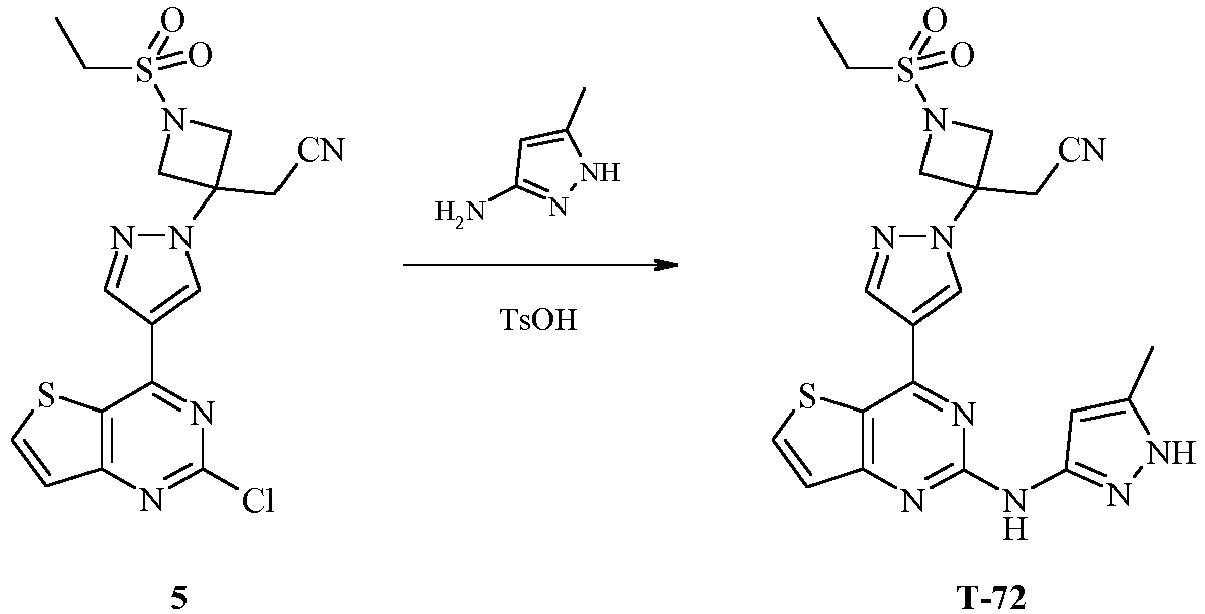
- 5-Methyl-3-aminopyrazole (69 mg, 0.72 mmol) and compound 5 (100 mg, 0.24 mmol) were dissolved in n-butanol (2 mL), p-toluene sulfonic acid monohydrate (91 mg, 0.48 mmol) was added. The mixture was heated to 110°C and stirred for 48 hours, then cooled to room temperature. The mixture was concentrated under reduced pressure, the residue was treated with saturated aqueous NaHCO3 solution (50 mL), extracted with dichloromethane (50 mL×2). The organic layers were combined, dried over anhydrous sodium sulfate, then filtrated, the filtrate was concentrated under reduced pressure. The residue was purified by preparation HPLC (mobile phase: water (10 mmol/mL ammonium bicarbonate), acetonitrile; gradient: 22%-55%) to give yellow solid T-72 (10 mg, yield: 9%). LC-MS (ESI): m/z=484 [M+H]+.
1H-NMR (400MHz, CDCl3) δ: 8.71-8.45 (2×s, 1H), 8.37-8.33 (2×s, 1H), 8.04-7.90 (2×d, J=5.6Hz, 1H), 7.90-7.57(2×d, J=5.6Hz, 1H), 7.34 (d, J=5.6Hz, 1H), 6.21-5.93 (2×br, 1H), 5.44 (s, 1H), 4.64 (dd, J=3.6H, J=9.2Hz, 2H), 4.26 (dd, J=9Hz, J=3.6Hz, 2H), 3.41 (s, 2H), 3.10 (m, 2H), 2.31 (s, 3H), 1.42 (m, 3H) ppm -

- At 0°C, a solution of p-nitrobenzenesulfonyl chloride (2.43 g, 11 mmol) in toluene (20 mL) was added dropwise to a solution of 3-(methylthio)propan-1-ol (1.06 g, 10 mmol) and DMAP (1.46 g, 12 mmol) in toluene (20 mL). The mixture was warmed to 25°C and stirred for 16 hours. The mixture was treated with water (100 mL), extracted with ethyl acetate (100 mL×2). The organic layers were combined, washed with saturated brine (100 mL), dried over anhydrous sodium sulfate, then filtrated, the filtrate was concentrated under reduced pressure. The residue was purified by silica column chromatography (petroleum ether : ethyl acetate=3:1) to give white solid 73-f (2 g, yield: 69 %). LC-MS (ESI): m/z=292 [M+H]+.
- At 0°C, a solution of oxone (9.3 g, 15.12 mmol) in water (50 mL) was added dropwise to a solution of compound 73-f (2 g, 6.87 mmol) in methanol (50 mL). The mixture was warmed to room temperature and stirred for 2 hours. The mixture was concentrated under reduced pressure to remove the solvent, the residue was treated with water (50 mL), extracted with ethyl acetate (100 mL×3). The organic layers were combined, washed with saturated brine (100 mL), dried over anhydrous sodium sulfate, then filtrated, the filtrate was concentrated under reduced pressure to give compound 73-e (1.7 g, yield: 77%), which was used directly for the next step without purification. LC-MS (ESI): m/z=346 [M+Na]+.
- 4-Nitropyrazole (250 mg, 2.21 mmol) was added to a solution of compound 73-e (790 mg, 2.45 mmol) and anhydrous potassium carbonate (765 mg, 5.54 mmol) in acetonitrile (10 mL), the mixture was refluxed for 18 hours. After cooled to room temperature, the mixture was concentrated under reduced pressure, the residue was treated with water (20 mL), extracted with ethyl acetate (50 mL×2). The organic layers were combined, dried over anhydrous sodium sulfate, then filtrated, the filtrate was concentrated under reduced pressure to give yellow solid 73-d (485 mg, yield: 94%). LC-MS (ESI): m/z=234 [M+H]+.
- Under hydrogen (1 atm), to a solution of compound 73-d (210 mg, 0.91 mmol) in ethanol (5 mL) was added 10% Pd-C (0.2 g). The mixture was stirred at 25°C for 16 hours, and then filtrated, the filtrate was concentrated under reduced pressure to give red brown oil 73-c (171 mg, yield: 93 %), which was used directly for the next step without purification. LC-MS (ESI): m/z=204 [M+H]+.
- At room temperature, cyclobutanone (2.5 g, 35.7 mmol) was added to a solution of cyanomethylene triphenylphosphorane (16.2 g, 53.57 mmol) in dichloromethane (30 mL), the mixture was stirred for 3 hours. The mixture was concentrated under reduced pressure to removed the solvent, the residue was purified by silica column chromatography (petroleum ether : ethyl acetate=10:1) to give yellow oil 73-b (3 g, yield: 90.3%).
- Compound 73-b (1.5 g, 15.79 mmol) and 4-(4,4,5,5-tetramethyl-1,3,2-dioxaborolan-2-yl)-1H-pyrazole (4.6 g, 23.68 mmol) were dissolved in anhydrous acetonitril (50 mL), 1,8-diazabicyclo[5.4.0]undec-7-ene (6.1 g, 40 mmol) was added. The mixture was stirred at 80°C for 18 hours, then concentrated under reduced pressure. The residue was treated with water (50 mL), extracted with ethyl acetate (50 mL×2). The aqueous layer was adjusted to pH=3 with aqueous HC1 solution (3 N), then extracted with ethyl acetate (50 mL×2). The organic layers were combined, washed with water (60 mL×3) and saturated brine (60 mL) in sequence, dried over anhydrous sodium sulfate, then filtrated, the filtrate was concentrated under reduced pressure to give colorless oil 73-a (2.6 g, yield: 58%), which was used directly for the next step without purification. LC-MS (ESI): m/z=288 [M+H]+.
- Under nitrogen, compound 73-a (2.6 g, 9.06 mmol), 2,4-dichlorotheino[3,2-d]pyrimidine (1.85 g, 9.06 mmol) and sodium carbonate (2.9 g, 27.18 mmol) were suspended in 1,4-dioxane (15 mL) and water (15 mL), Pd(dppf)Cl2 (733 mg, 0.9 mmol) was added. The mixture was heated to 80°C and stirred for 16 hours. After cooled to room temperature, the mixture was concentrated under reduced pressure, the residue was treated with water (20 mL), extracted with dichloromethane (20 mL×3). The organic layers were combined, washed with water (60 mL×3) and saturated brine (60 mL) in sequence, dried over anhydrous sodium sulfate, then filtrated, the filtrate was concentrated under reduced pressure. The residue was purified by silica column chromatography (dicholormethane : methanol=100:1) to give light yellow solid 73 (1.6 g, yield: 53.6%). LC-MS (ESI): m/z=330 [M+H]+.
- Compound 73-c (46 mg, 0.227 mmol) and compound 73 (50 mg, 0.152 mmol) were dissolved in n-butanol (5 mL), p-toluene sulfonic acid monohydrate (43 mg, 0.227 mmol) was added. The mixture was heated to 110°C and stirred for 48 hours, then cooled to room temperature. The mixture was concentrated under reduced pressure, the residue was treated with saturated aqueous sodium bicarbonate solution (50 mL), extracted with dichloromethane (50 mL×3). The organic layers were combined, dried over anhydrous sodium sulfate, then filtrated, the filtrate was concentrated under reduced pressure, the residue was purified by preparation TLC (chromatographic solution: ethyl acetate) to give yellow solid T-73 (27 mg, yield: 36%). LC-MS (ESI): m/z=497 [M+H]+.
1H-NMR (400MHz, CDCl3) δ: 8.39 (s, 1H), 8.34 (s, 1H), 8.09 (s, 1H), 7.88 (d, J=5.2Hz, 1H), 7.56 (s, 1H), 7.32 (d, J=5.2Hz, 1H), 7.14 (s, 1H), 4.32 (t, J=6.4Hz, 2H), 3.16 (s, 2H), 3.05 (t, J=6.4Hz, 2H), 2.91 (s, 3H), 2.86 (m, 2H), 2.58 (m, 2H), 2.47 (m, 2H), 2.12 (m, 2H) ppm -

- At room temperature, trifluoroacetic acid (3 mL) was added to a solution of compound 5-a (250 mg, 0.58 mmol) in dichloromethane (3 mL) and stirred for 3 hours, then concentrated under reduced pressure and the residue was treated with dichloromethane (10 mL) and triethylamine (2 mL). The mixture was then cooled to 0°C, methylsulfonyl chloride (100 mg, 0.87 mmol) was added dropwise, and the resultant mixture was stirred for further 30 minutes, then treated with water (5 mL), extracted with dichloromethane (5 mL×3). The organic layers were combined, dried over anhydrous sodium sulfate, then filtrated, the filtrate was concentrated under reduced pressure. The residue was purified by silica column chromatography (petroleum ether : ethyl acetate=3:1) to give compound 74 (135 mg, yield: 57%). LC-MS (ESI): m/z=409 [M+H]+.
- Compound 74 (100 mg, 0.25 mmol) and 1-methyl-4-aminopyrazole (71 mg, 0.74 mmol) were dissolved in n-butanol (2 mL), p-toluene sulfonic acid monohydrate (117 mg, 0.62 mmol) was added. The mixture was heated to 110°C and stirred for 18 hours, then cooled to room temperature, concentrated under reduced pressure to remove the solvent, the residue was treated with saturated aqueous sodium bicarbonate solution (50 mL), extracted with dichloromethane (50 mL×3). The organic layers were combined, dried over anhydrous sodium sulfate, then filtrated, the filtrate was concentrated under reduced pressure. The residue was purified by preparation TLC (chromatographic solution: ethyl acetate) to give yellow solid T-74 (25 mg, yield: 22%). LC-MS (ESI): m/z=470 [M+H]+.
1H-NMR (400MHz, CDCl3) δ: 8.45 (s, 1H), 8.36 (s, 1H), 7.96 (s, 1H), 7.88 (d, J=5.2Hz, 1H), 7.55 (s, 1H), 7.32 (d, J=5.2Hz, 1H), 7.12 (s, 1H), 4.60 (d, J=9.2Hz, 2H), 4.26 (d, J=9.6Hz, 2H), 3.93 (s, 3H), 3.42 (s, 2H), 3.01 (s, 3H) ppm -

- Benzoic acid (1.59 g, 1.3 mmol) was added to a solution of (1-ethoxy-cyclopropoxy)trimethylsilane (17.4 g, 100 mmol) and ethyl (triphenyl-phosphoranylidene)acetate (45 g, 130 mmol) in toluene (250 mL). The mixture was stirred at 90°C for 18 hours, then cooled to room temperature, the mixture was filtrated through silica gel (300 g), washed with petroleum ether (1000 mL), the filtrate was concentrated to 100 mL under reduced pressure. The solution was used directly for the next step.
- The solution of 75-e (100 mL) which was obtained from previous step was added to a solution of 4-(4,4,5,5-tetramethyl-1,3,2-dioxaborolan-2-yl)-1H-pyrazole (1.9 g, 10 mmol) and 1,8-diazabicyclo[5.4.0]undec-7-ene (1 g, 6.6 mmol) in anhydrous acetonitrile (200 mL). The mixture was stirred at 80°C for 3 hours, then cooled to room temperature. The mixture was concentrated under reduced pressure, the residue was treated with water (50 mL), extracted with ethyl acetate (50 mL×3). The organic layers were combined, washed with water (60 mL×3) and saturated brine (60mL) in sequence, dried over anhydrous sodium sulfate, then filtrated, the filtrate was concentrated under reduced pressure. The residue was purified by silica column chromatography (petroleum ether : ethyl acetate=1:1) to give compound 75-d (1.6 g, yield: 50%). LC-MS (ESI): m/z=321 [M+H]+.
- Under nitrogen, compound 75-d (1.6 g, 5 mmol) was added to a suspension of 2,4-dichlorotheino[3,2-d]pyrimidine (1.02 g, 5 mmol), potassium carbonate (1.38 g, 10 mmol) and Pd(PPh3)4 (0.56 g, 0.5 mmol) in 1,4-dioxane (15 mL). The mixture was heated to 80°C and stirred for 4 hours, then concentrated under reduced pressure, the residue was treated with water (20 mL), extracted with dichloromethane (20 mL×3). The organic layers were combined, washed with water (60 mL×3) and saturated brine (60 mL) in sequence, dried over anhydrous sodium sulfate, then filtrated, the filtrate was concentrated under reduced pressure. The residue was purified by silica column chromatography (petroleum ether : ethyl acetate=2:1 to 1:1) to give light yellow solid 75-c (0.91 g, yield: 50%). LC-MS (ESI): m/z=363 [M+H]+.
- LiOH (90 mg. 3.75 mmol) was added to a solution of compound 75-c (910 mg, 2.5 mmol) in a component solvent of MeOH (1 mL), THF (4mL) and water (1 mL), stirred for 1 hour. The mixture was treated with water (20 mL) and aqueous HCl solution (2 N, 2 mL), extracted with ethyl acetate (10 mL×3). The organic layers were combined, dried over anhydrous sodium sulfate, then filtrated, the filtrate was concentrated under reduced pressure to give compound 75-b (0.79 g, yield: 94.6%), which was used directly for the next step without purification. LC-MS (ESI): m/z=335 [M+H]+.
- Thionyl chloride (2 mL) was added to a solution of compound 75-b (800 mg, 2.3 mmol) in toluene (5 mL), the mixture was heated to 100°C and stirred for 3 hours, then cooled to room temperature, concentrated under reduced pressure. The residue was treated with ammonium hydroxide (3 mL), stirred for 1 hour, then saturated aqueous NaHCO3 solution (10 mL) was added. The mixture was extracted with dichloromethane (20 mL×3). The organic layers were combined, dried over anhydrous sodium sulfate, then filtrated, the filtrate was concentrated under reduced pressure. The residue was purified by silica column chromatography (petroleum ether : ethyl acetate=3:1) to give gray compound 75-a (0.68 g, yield: 88.8%). LC-MS (ESI): m/z=334 [M+H]+.
- At 0°C, trifluoroacetic anhydride (430 mg, 2.1 mmol) was added slowly to a solution of compound 75-a (680 mg, 2.1 mmol) and pyridine (320 mg, 4.2 mmol) in dichloromethane (10 mL). The mixture was warmed to room temperature, stirred for further 1 hour. Saturated aqueous NaHCO3 solution (10 mL) was added, the mixture was extracted with dichloromethane (20 mL×3). The organic layers were combined, dried over anhydrous sodium sulfate, then filtrated, the filtrate was concentrated under reduced pressure. The residue was purified by silica column chromatography (petroleum ether : ethyl acetate=3:1) to give compound 75 (510 mg, yield: 77%). LC-MS (ESI): m/z=316 [M+H]+.
- 1-Methyl-4-aminopyrazole (37 mg, 0.38 mmol) and compound 75 (100 mg, 0.32 mmol) were dissolved in n-butanol (10 mL), p-toluene sulfonic acid monohydrate (72 mg, 0.38 mmol) was added. The mixture was heated to 108°C and stirred for 3 hours, then cooled to room temperature, concentrated under reduced pressure to remove the solvent. The residue was treated with saturated aqueous NaHCO3 solution (10 mL), extracted with dichloromethane (10 mL×3). The organic layers were combined, dried over anhydrous sodium sulfate, then filtrated, the filtrate was concentrated under reduced pressure. The residue was purified by preparation HPLC (mobile phase: water (10 mmol/mL ammonium bicarbonate), acetonitrile; gradient: 26%-78%) to give compound T-75 (32 mg, yield: 26.6%). LC-MS (ESI): m/z=377 [M+H]+.
1H-NMR (400MHz, CD3OD) δ: 8.60 (s, 1H), 8.35 (s, 1H), 8.11 (d, J=5.6Hz, 1H), 8.07 (s, 1H), 7.63 (s, 1H), 7.33 (d, J=5.6Hz, 1H), 3.92 (s, 3H), 3.18 (s, 2H), 1.55 (t, J=5.6Hz, 2H), 1.36 (t, J=5.6Hz, 2H) ppm -
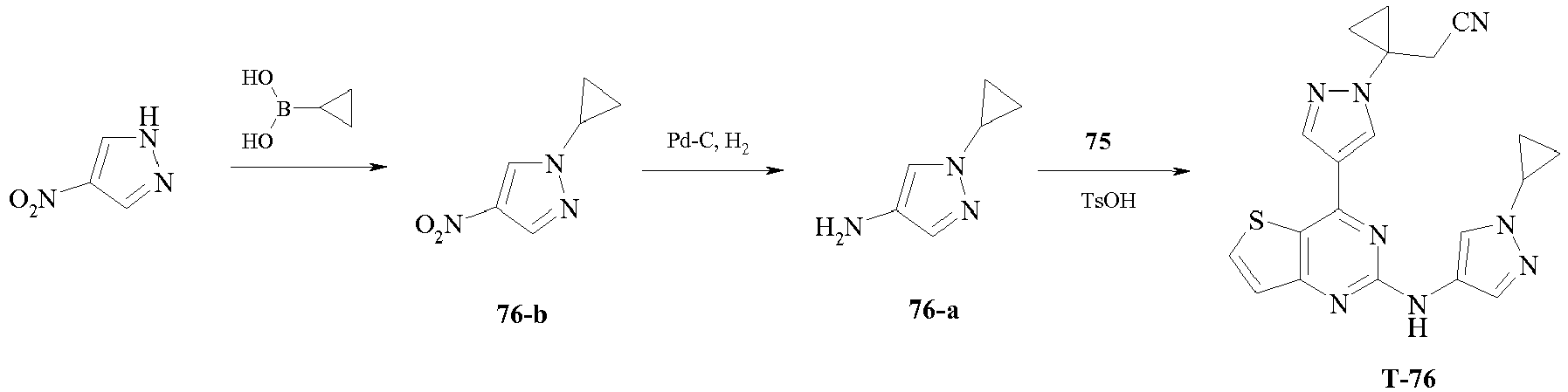
- Under nitrogen, 4-nitropyrazole (1.0 g, 8.45 mmol) was added to a solution of cyclopropyl boronic acid (1.45 g, 16.9 mmol), anhydrous CuSO4 (1.55 g, 8.45 mmol), 4,4'-di-tert-butyl-2,2'-dipyridyl (2.26 g, 8.45 mmol) and Na2CO3 (1.87 g, 16.9 mmol) in 1,2-dichloroethane (30 mL). The mixture was stirred at 70°C for 16 hours, then cooled to room temperature, concentrated under reduced pressure to remove ther solvent, the residue was purified by silica column chromatography (petroleum ether : ethyl acetate=8:1) to give compound 76-b (740 mg, yield: 55%). LC-MS (ESI): m/z=154 [M+H]+.
- Under hydrogen (1 atm), to a solution of compound 76-b (100 mg, 0.65 mmol) in methanol (10 mL) was added 10% Pd-C (30 mg). The mixture was stirred at 25°C for 1 hour, and then filtrated, the filtrate was treated with p-toluene sulfonic acid monohydrate (124 mg, 0.65 mmol). The mixture was concentrated under reduced pressure to give a p-tosylate of compound 76-a, which was used directly for the next step without purification. LC-MS (ESI): m/z=124 [M+H]+.
- The p-tosylate of compound 76-a (94 mg, 0.3 mmol) obtained from previous step was added to a solution of compound 75 (100 mg, 0.32 mmol) in n-butanol (3 mL), the mixture was heated to 108°C and stirred for 3 hours, then cooled to room temperature, concentrated under reduced pressure to remove the solvent. The residue was treated with saturated aqueous sodium bicarbonate solution (10 mL), extracted with dichloromethane (10 mL×3). The organic layers were combined, dried over anhydrous sodium sulfate, then filtrated, the filtrate was concentrated under reduced pressure. The residue was purified by silica column chromatography (petroleum ether : ethyl acetate=1:1) to give compound T-76 (23 mg, yield: 19%). LC-MS (ESI): m/z=403 [M+H]+.
1H-NMR (400MHz, CD3OD) δ: 8.68 (s, 1H), 8.41 (s, 1H), 8.28 (d, J=5.6Hz, 1H), 8.10 (s, 1H), 7.68 (s, 1H), 7.38 (d, J=5.6Hz, 1H), 3.72 (m, 3H), 3.20 (s, 2H), 1.56 (t, J=5.6Hz, 2H), 1.37 (t, J=5.6Hz, 2H), 1.19 (m, 2H), 1.11 (m, 2H) ppm -


- 3-(Benzyloxy)cyclobutanone (1.0 g, 5.68 mmol) was added to a solution of (cyanomethylene)triphenylphosphorane (2.6 g, 8.52 mmol) in toluene, the mixture was refluxed for 16 hours. After cooled to room temperature, the mixture was concentrated under reduced pressure, the residue was purified by silica column chromatography (petroleum ether : ethyl acetate=10:1) to give colorless oil 77-d (1.1 g, yield: 97%). LC-MS (ESI): m/z=200 [M+H]+.
1H-NMR (400MHz, CDCl3) δ: 7.25∼7.38 (m, 5H), 5.22 (m, 1H), 4.47 (s, 2H), 4.17 (m, 1H), 3.05 (m, 1H), 2.96 (m, 1H), 2.91 (m, 2H) ppm - Compound 77-d (1.0 g, 5 mmol) and 4-(4,4,5,5-tetramethyl-1,3,2-dioxaborolan-2-yl)-1H-pyrazole (1.16 g, 6 mmol) were dissolved in anhydrous acetonitrile (10 mL), 1,8-diazabicyclo[5.4.0]undec-7-ene (5 g, 33 mmol) was added. The mixture was stirred at 55°C for 18 hours. The mixture was concentrated under reduced pressure, the residue was treated with water (50 mL), extracted with ethyl acetate (50 mL×2). The aqueous layer was treated with aqueous HCl solution (1 N) to adjust pH=5, extracted with ethyl acetate (50 mL×2). The organic layers were combined, washed with water (50 mL×3) and saturated brine (50 mL) in sequence, dried over anhydrous sodium sulfate, then filtrated, the filtrate was concentrated under reduced pressure to give light yellow oil compound 77-c (1.15 g, yield: 58 %), which was used directly for the next step without purification. LC-MS (ESI): m/z=394 [M+H]+.
- Under nitrogen, compound 77-c (1.1 g, 2.8 mmol), 2,4-dichlorotheino[3,2-d]pyrimidine (0.571 g, 8.51 mmol) and sodium carbonate (0.902 g, 8.51 mmol) were suspended in a component solvent of 1,4-dioxane (10 mL) and water (10 mL), Pd(dppf)Cl2 (228 mg, 0.28 mmol) was added. The mixture was stirred at 80°C for 16 hours, then concentrated under reduced pressure. The residue was treated with water (20 mL), extracted with dichloromethane (20 mL×3). The organic layers were combined, washed with water (20 mL×3) and saturated brine (20 mL) in sequence, dried over anhydrous sodium sulfate, then filtrated, the filtrate was concentrated under reduced pressure. The residue was purified by silica column chromatography (dichloromethane : methanol=100:1) to give light yellow solid 77 (1.05 g, yield: 94%). LC-MS (ESI): m/z=436 [M+H]+.
- 1-Methyl-4-aminopyrazole (0.667 g, 6.87 mmol) and compound 77 (1.0 g, 2.29 mmol) were dissolved in n-butanol (20 mL), p-toluene sulfonic acid monohydrate (1.31 g, 6.87 mmol) was added. The mixture was heated to 100°C and stirred for 18 hours, then cooled to room temperature, concentrated under reduced pressure to remove the solvent. The residue was treated with saturated aqueous NaHCO3 solution (100 mL), extracted with dichloromethane (100 mL×3). The organic layers were combined, dried over anhydrous sodium sulfate, then filtrated, the filtrate was concentrated under reduced pressure. The residue was purified by preparation TLC (chromatographic solution: dichloromethane : methanol=100:1) to give light yellow solid 77-b (0.515 g, yield: 45%). LC-MS (ESI): m/z=497 [M+H]+.
- At -78°C, a solution of boron tribromide in dichloromethane (4 N, 2 mL) was added slowly dropwise to a solution of compound 77-b (510 mg, 1.03 mmol) in dichloromethane (20 mL), then warmed to room temperature, and stirred for 30 minutes. The mixture was added slowly to saturated aqueous NaHCO3 solution (50 mL), extracted with dichloromethane (50 mL×2). The organic layers were combined, dried over anhydrous sodium sulfate, then filtrated, the filtrate was concentrated under reduced pressure. The residue was purified by silica column chromatography (dichloromethane : methanol=100:1) to give light yellow solid 77-a (98 mg, yield: 24%). LC-MS (ESI): m/z=407 [M+H]+.
- At 0°C, DAST (360 mg, 1.62 mmol) was added slowly to a solution of compound 77-a (98 mg, 0.24 mmol) in dichloromethane (10 mL), the mixture was warmed to room temperature and stirred for further 30 minutes. The mixture was diluted with water (10 mL), adjusted to pH= 10 with saturated aqueous NaHCO3 solution, then extracted with dichloromethane (50 mL×2). The organic layers were combined, dried over anhydrous sodium sulfate, then filtrated, the filtrate was concentrated under reduced pressure. The residue was purified by preparation HPLC (mobile phase: water (0.05% trifluoroacetic acid), acetonitrile; gradient: 15%-50%) to give compound T-77 (7 mg, yield: 12%). LC-MS (ESI): m/z=409 [M+H]+.
1H-NMR (400MHz, CD3OD) δ: 8.74 (d, J=0.4Hz, 1H), 8.44 (d, J=6.0Hz, 1H), 8.31 (d, J=5.6Hz, 1H), 8.04 (s, 1H), 7.68 (s, 1H), 7.38 (d, J=5.2Hz, 1H), 5.13∼5.34 (m, 1H), 3.91 (s, 3H), 3.44 (s, 2H), 3.37 (m, 2H), 2.88 (m, 2H) ppm -

- 4-Nitropyrazole (1.13 g, 10 mmol) was added to a solution of 2,2-dimethyloxirane (20 mL) and cesium carbonate (2 g, 6 mmol) in acetonitrile (65 mL), the mixture was heated to 80°C and stirred for 12 hours. After cooled to room temperature, the mixture was treated with water (100 mL), extracted with ethyl acetate (100 mL×3). The organic layers were combined, dried over anhydrous sodium sulfate, then filtrated, the filtrate was concentrated under reduced pressure. The residue was purified by silica column chromatography (petroleum ether : ethyl acetate=1:1) to give compound 78-b (0.99 g, yield: 54%). LC-MS (ESI): m/z=186 [M+H]+.
- Under hydrogen (1 atm), to a solution of compound 78-b (99 mg, 5.4 mmol) in methanol (10 mL) was added 10% Pd-C (0.3 g). The mixture was stirred at 25°C for 12 hours, and then filtrated, the filtrate was concentrated under reduced pressure to give compound 78-a (0.8 g, yield: 95%), which was used directly for the next step without purification. LC-MS (ESI): m/z=156 [M+H]+.
- Compound 78-a (116 mg, 0.75 mmol) and compound 74 (210 mg, 0.5 mmol) were dissolved in n-butanol (5 mL), p-toluene sulfonic acid monohydrate (140 mg, 0.75 mmol) was added. The mixture was heated to 100°C and stirred for 6 hours, then cooled to room temperature. The mixture was concentrated under reduced pressure to remove the solvent, the residue was treated with saturated aqueous NaHCO3 solution (10mL), extracted with dichloromethane (10 mL×3). The organic layers were combined, dried over anhydrous sodium sulfate, then filtrated, the filtrate was concentrated under reduced pressure. The residue was purified by silica column chromatography (petroleum ether : ethyl acetate=1:1) to give compound T-78 (61 mg, yield: 23%). LC-MS (ESI): m/z=528 [M+H]+.
1H-NMR (400MHz, CD3OD) δ: 8.73 (s, 1H), 8.43 (s, 1H), 8.20 (s, 1H), 8.11 (d, J=5.6Hz, 2H), 7.64 (s, 1H), 7.30 (d, J=5.6Hz, 1H), 4.67 (d, J=9.6Hz, 2H), 4.34 (d, J=9.6Hz, 2H), 4.12 (s, 2H), 3.65 (s, 2H), 3.09 (s, 3H), 1.23 (s, 6H) ppm -

- 4-Nitropyrazole (1.13 g, 10 mmol) was added to a solution of ethyl 2-bromo isobutyrate (3.88 g, 20 mmol) and cesium carbonate (6.5 g, 20 mmol) in DMF (50 mL), the mixture was heated to 80°C and stirred for 4 hours. After cooled to room temperature, the mixture was treated with water (100 mL), extracted with ethyl acetate (100 mL×3). The organic layers were combined, dried over anhydrous sodium sulfate, then filtrated, the filtrate was concentrated under reduced pressure. The residue was purified by silica column chromatography (petroleum ether : ethyl acetate=3:1) to give compound 79-b (1.7 g, yield: 75%). LC-MS (ESI): m/z=228 [M+H]+.
- At room temperature, a solution of compound 79-b (1.15 g, 5 mmol) in anhydrous THF (30 mL) was added slowly dropwise to a solution of LiAlH4 in THF (1 N, 15 mL, 15 mmol). The mixture was stirred for 2 hours, then treated portionwise with NaSO4•10H2O (3 g). The mixture was filtrated, the filtrate was concentrated under reduced pressure to give compound 79-a (0.6 g, yield: 77%), which was used directly for the next step without purification. LC-MS (ESI): m/z=156 [M+H]+.
- Compound 79-a (116 mg, 0.75 mmol) and compound 74 (210 mg, 0.5 mmol) were dissolved in n-butanol (5 mL), p-toluene sulfonic acid monohydrate (140 mg, 0.75 mmol) was added. The mixture was heated to 110°C and stirred for 6 hours, then cooled to room temperature, concentrated under reduced pressure to remove the solvent, the residue was treated with saturated aqueous NaHCO3 solution (10 mL), extracted with dichloromethane (10 mL×3). The organic layers were combined, dried over anhydrous sodium sulfate, then filtrated, the filtrate was concentrated under reduced pressure. The residue was purified by silica column chromatography (petroleum ether : ethyl acetate=1:1) to give compound T-79 (76 mg, yield: 28%). LC-MS (ESI): m/z=528 [M+H]+.
1H-NMR (400MHz, CD3OD) δ: 8.75 (s, 1H), 8.45 (s, 1H), 8.21 (s, 1H), 8.13 (d, J=5.6Hz, 2H), 7.71 (s, 1H), 7.32 (d, J=5.6Hz, 1H), 4.67 (d, J=9.6Hz, 2H), 4.31 (d, J=9.6Hz, 2H), 3.79 (s, 2H), 3.65 (s, 2H), 3.09 (s, 3H), 1.62 (s, 6H) ppm -
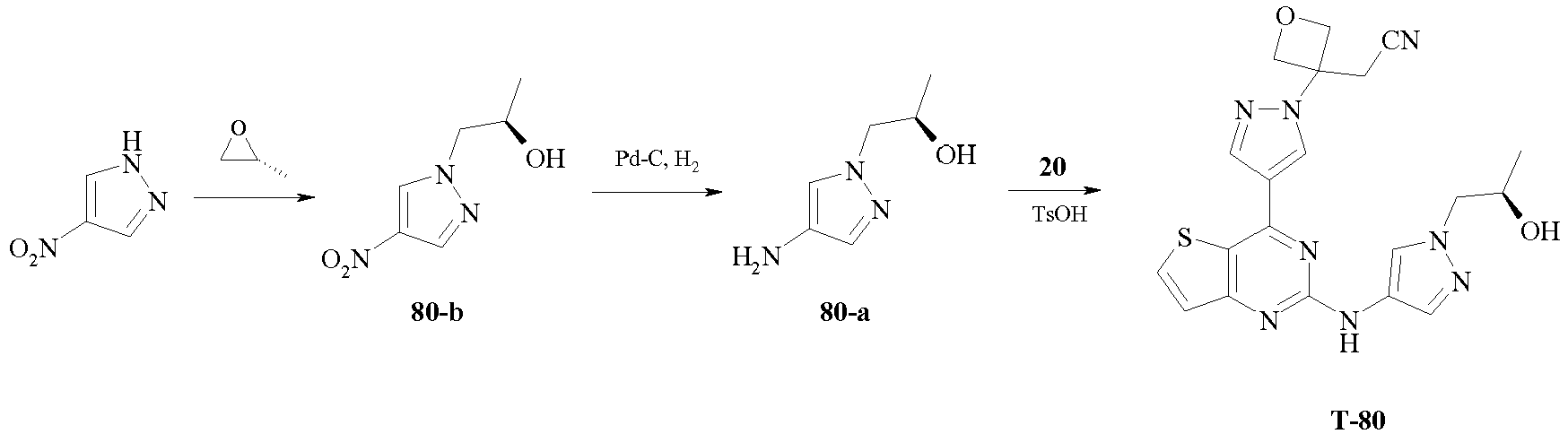
- 4-Nitropyrazole (2.5 g, 22.12 mmol) was added to a mixture of (R)-epoxypropane (30 mL) and cesium carbonate (2 g, 6 mmol), the mixture was stirred at room temperature for 18 hours. Water (50 mL) was added, the mixture was extracted with ethyl acetate (50 mL×3). The organic layers were combined, dried over anhydrous sodium sulfate, then filtrated, the filtrate was concentrated under reduced pressure to give light yellow oil 80-b (2.5 g, yield: 66%), which was used directly for the next step without purification. LC-MS (ESI): m/z=172 [M+H]+.
- Under hydrogen (1 atm), to a solution of compound 80-b (1.0 g, 5.85 mmol) in ethanol (25 mL) was added 10% Pd-C (0.2 g). The mixture was stirred at 25°C for 18 hours, and then filtrated, the filtrate was concentrated to give red brown oil 80-a (0.78 g, yield: 95%), which was used directly for the next step without purification.
- Compound 80-a (179 mg, 1.27 mmol) and compound 20 (140 mg, 0.43 mmol) were dissolved in n-butanol (5 mL), p-toluene sulfonic acid monohydrate (242 mg, 1.27 mmol) was added. The mixture was heated to 110°C and stirred for 16 hours, then cooled to room temperature, concentrated under reduced pressure to remove the solvent, the residue was treated with saturated aqueous NaHCO3 solution (100 mL), extracted with dichloromethane (100 mL×3). The organic layers were combined, dried over anhydrous sodium sulfate, then filtrated, the filtrate was concentrated under reduced pressure. The residue was purified by preparation HPLC (mobile phase: water (0.05% trifluoroacetic acid), acetonitrile; gradient: 20%-55%) to give light yellow solid T-80 (25 mg, yield: 14%). LC-MS (ESI): m/z=437 [M+H]+.
1H-NMR (400MHz, CDCl3) δ: 8.46 (s, 1H), 8.36 (s, 1H), 8.06 (s, 1H), 7.88 (d, J=5.6Hz, 1H), 7.56 (s, 1H), 7.32 (d, J=5.6Hz, 1H), 7.04 (s, 1H), 5.19 (d, J=7.6Hz, 2H), 4.87 (d, J=7.6Hz, 2H), 4.24 (br, 1H), 4.17∼4.21 (m, 1H), 3.97∼4.03 (m, 1H), 3.56 (s, 1H), 3.45 (s, 2H), 1.25 (d, J=6.4Hz, 3H) ppm -

- Under nitrogen, Pd(PPh3)4 (0.56 g, 0.5 mmol) was added to a suspension of 1-(tetrahydro-2H-pyran-2-yl)-4-(4,4,5,5-tetramethyl-1,3,2-dioxaborolan-2-yl)-1H-pyr azole (2.8 g, 10 mmol), 2,4-dichlorotheino[3,2-d]pyrimidine (2.05 g, 10 mmol) and potassium carbonate (2.76 g, 20 mmol) in 1,4-dioxane (30 mL). The mixture was stirred at 80°C for 4 hours, then cooled to room temperature. The mixture was concentrated under reduced pressure, the residue was treated with water (100 mL), extracted with ethyl acetate (100 mL×3). The organic layers were combined, dried over anhydrous sodium sulfate, then filtrated, the filtrate was concentrated under reduced pressure. The residue was purified by silica column chromatography (petroleum ether : ethyl acetate=3:1 to 2:1) to give light yellow solid 81 (2.8 g, yield: 87.5%). LC-MS (ESI): m/z=321 [M+H]+.
- 4-Nitropyrazole (1.0 g, 8.85 mmol) was added to a mixture of (S)-epoxypropane (3 mL) and cesium carbonate (1.73 g, 5.31 mmol), the mixture was stirred at room temperature for 18 hours. Water (50 mL) was added, the mixture was extracted with ethyl acetate (50 mL×3). The organic layers were combined, dried over anhydrous sodium sulfate, then filtrated, the filtrate was concentrated under reduced pressure to give light yellow oil 81-c(1 g, yield: 66%), which was used directly for the next step without purification. LC-MS (ESI): m/z=172 [M+H]+.
- Under hydrogen (1 atm), to a solution of compound 81-c (1.0 g, 5.85 mmol) in ethanol (25 mL) was added 10% Pd-C (0.2 g). The mixture was stirred at 25°C for 18 hours, and then filtrated, the filtrate was concentrated under reduced pressure to give red brown oil 81-b (0.7 g, yield: 85%), which was used directly for the next step without purification.
- Compound 81-b (397 mg, 2.82 mmol) and compound 81 (300 mg, 0.94 mmol) were dissolved in n-butanol (5 mL), p-toluene sulfonic acid monohydrate (555 mg, 2.82 mmol) was added. The mixture was heated to 110°C and stirred for 16 hours, then cooled to room temperature. The mixture was concentrated under reduced pressure, the residue was treated with saturated aqueous NaHCO3 solution (50 mL), extracted with dichloromethane (50 mL×3). The organic layers were combined, dried over anhydrous sodium sulfate, then filtrated, the filtrate was concentrated under reduced pressure. The residue was purified by silica column chromatography (dichloromethane : methanol=100:1) to give yellow solid 81-a (67 mg, yield: 21%). LC-MS (ESI): m/z=341 [M+H]+.
- Compound 81-a (67 mg, 0.29 mmol) and compound 20-b (31 mg, 0.32 mmol) were dissolved in anhydrous acetonitrile (1 mL), DBU (0.1 g, 0.6 mmol) was added, the mixture was stirred at room temperature for 1 hour. After the mixture was concentrated under reduced pressure, the residue was treated with water (50 mL), extracted with dichloromethane (50 mL×2). The organic layers were combined, dried over anhydrous sodium sulfate, then filtrated, the filtrate was concentrated under reduced pressure. The residue was purified by preparation TLC (chromatographic solution: ethyl acetate) to give light yellow solid T-81 (21 mg, yield: 26%). LC-MS (ESI): m/z=437 [M+H]+.
1H-NMR (400MHz, CDCl3) δ: 8.44 (s, 1H), 8.36 (s, 1H), 8.06 (s, 1H), 7.87 (d, J=5.6Hz, 1H), 7.54 (d, J=0.4Hz, 1H), 7.31 (d, J=5.6Hz, 1H), 7.15 (s, 1H), 5.19 (d, J=7.6Hz, 2H), 4.87 (d, J=7.6Hz, 2H), 4.16∼4.21 (m, 2H), 3.97∼4.02 (m, 2H), 3.55 (br, 1H), 3.45 (s, 3H), 1.26 (d, J=6.4Hz, 3H) ppm -
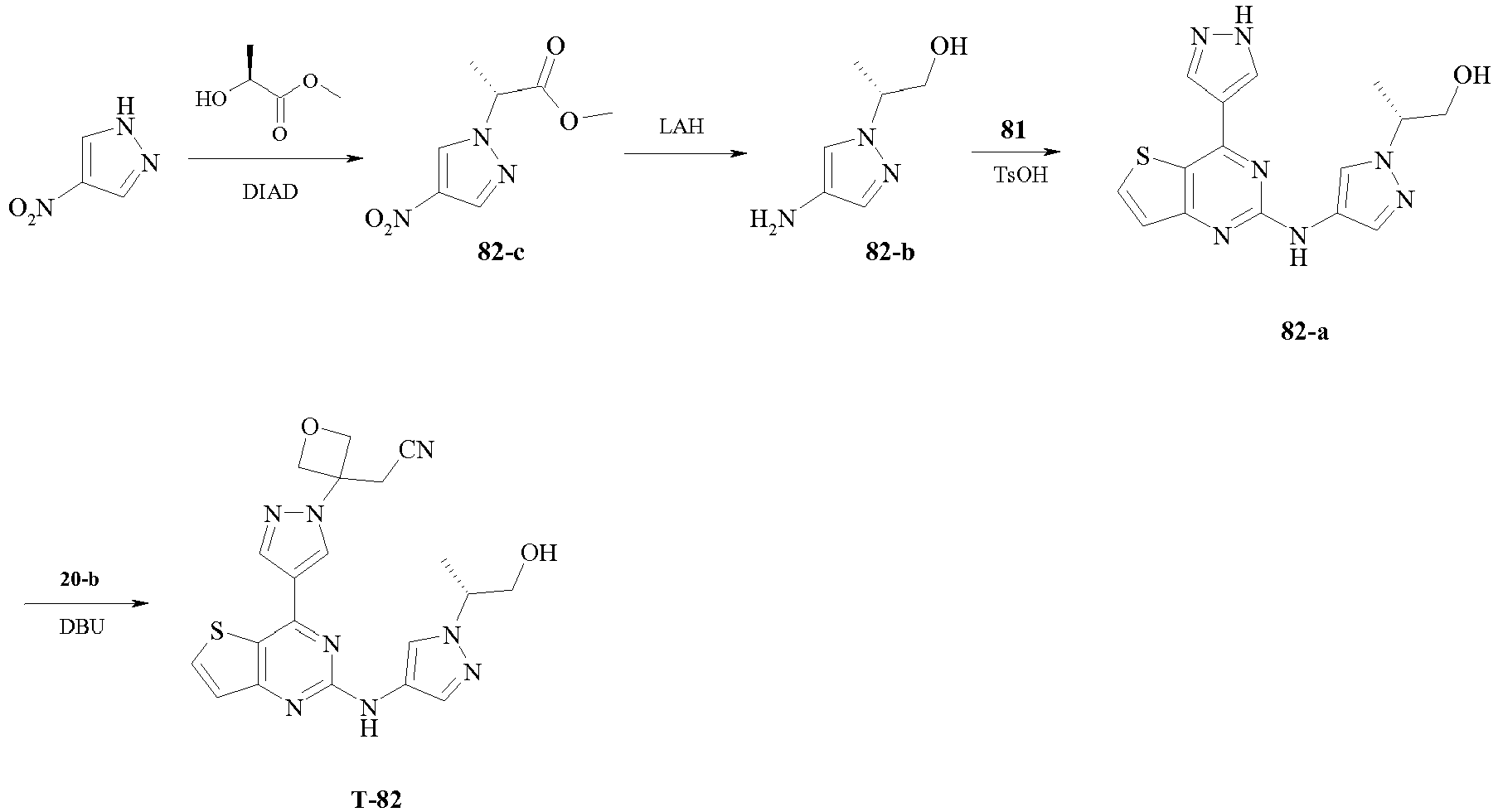
- At 25°C, DIAD (10.8 g, 53.1 mmol) was added slowly to a solution of 4-nitropyrazole (5 g, 44.2 mmol), methyl L-lactate (5.1 g, 48.6 mmol) and PPh3 (13.9 g, 53.1 mmol) in anhydrous THF (100 mL). After stirred for 3 hours, the mixture was concentrated under reduced pressure, the residue was purified by silica column chromatography (petroleum ether : ethyl acetate=10:1) to give compound 82-c (6.6 g, yield: 74%). LC-MS (ESI): m/z=200 [M+H]+.
- At room temperature, compound 82-c (2.0 g, 10 mmol) was added slowly dropwise to a solution of LiAlH4 in THF (1 N, 26.3 mL, 26.3 mmol). The mixture was stirred for 2 hours, then treated portionwise with Na2SO4•10H2O (3 g). The mixture was filtrated, the filtrate was concentrated under reduced pressure to give compound 82-b (1.1 g, yield: 78%), which was used directly for the next step without purification. LC-MS (ESI): m/z=142 [M+H]+.
- Compound 82-b (140 mg, 1 mmol) and compound 81 (320 mg, 1 mmol) were dissolved in n-butanol (5 mL), p-toluene sulfonic acid monohydrate (190 mg, 1 mmol) was added. The mixture was heated to 110°C and stirred for 6 hours, then cooled to room temperature, concentrated under reduced pressure to remove the solvent. The residue was treated with saturated aqueous NaHCO3 solution (10 mL), extracted with dichloromethane (10 mL×3). The organic layers were combined, dried over anhydrous sodium sulfate, then filtrated, the filtrate was concentrated under reduced pressure. The residue was purified by silica column chromatography (petroleum ether : ethyl acetate=1:1) to give yellow solid 82-a (38 mg, yield: 10.6%). LC-MS (ESI): m/z=342 [M+H]+.
- Compound 82-a (38 mg, 0.106 mmol) and compound 20-b (11 mg, 0.106 mmol) were dissolved in anhydrous acetonitrile (3 mL), DBU (100 mg, 0.6 mmol) was added. The mixture was stirred at room temperature for 1 hour, then concentrated under reduced pressure. The residue was treated with water (50 mL), extracted with dichloromethane (50 mL×2). The organic layers were combined, dried over anhydrous sodium sulfate, then filtrated, the filtrate was concentrated under reduced pressure. The residue was purified by preparation HPLC (mobile phase: water (10mmol/mL ammonium bicarbonate), acetonitrile; gradient: 15%-45%) to give light yellow solid T-82 (13 mg, yield: 28%). LC-MS (ESI): m/z=437 [M+H]+.
1H-NMR (400MHz, CD3OD) δ: 8.72 (s, 1H), 8.43 (s, 1H), 8.16 (s, 1H), 8.13 (d, J=5.6Hz, 1H), 7.69 (s, 1H), 7.32 (d, J=5.6Hz, 1H), 5.24 (d, J=8.4Hz, 2H), 4.95 (d, J=8.4Hz, 2H), 4.43 (m, 1H), 3.86 (m, 2H), 3.64 (s, 2H), 1.53 (d, J=6.8Hz, 3H) ppm -


- At 25°C, DIAD (10.8 g, 53.1 mmol) was added slowly to a solution of 4-nitropyrazole (5 g, 44.2 mmol), methyl D-lactate (5.1 g, 48.6 mmol) and PPh3 (13.9 g, 53.1 mmol) in anhydrous THF (100 mL). After stirred for 3 hours, the mixture was concentrated under reduced pressure, the residue was purified by silica column chromatography (petroleum ether : ethyl acetate=10:1) to give compound 83-c (6.2 g, yield: 70%). LC-MS (ESI): m/z=200 [M+H]+.
- At room temperature, compound 83-c (2.0 g, 10 mmol) was added slowly to a solution of LiAlH4 in THF (1 N, 26.3 mL, 26.3 mmol). The mixture was stirred for 2 hours, then treated portionwise with Na2SO4•10H2O (3 g). The mixture was filtrated, the filtrate was concentrated under reduced pressure to give compound 83-b (1.0 g, yield: 71%), which was used directly for the next step without purification. LC-MS (ESI): m/z=142 [M+H]+.
- Compound 83-b (140 mg, 1 mmol) and compound 81 (320 mg, 1 mmol) were dissolved in n-butanol (5 mL), p-toluene sulfonic acid monohydrate (190 mg, 1mmol) was added. The mixture was heated to 110°C and stirred for 6 hours, then cooled to room temperature, concentrated under reduced pressure to remove the solvent. The residue was treated with saturated aqueous NaHCO3 solution (10 mL), extracted with dichloromethane (10 mL×3). The organic layers were combined, dried over anhydrous sodium sulfate, then filtrated, the filtrate was concentrated under reduced pressure. The residue was purified by silica column chromatography (petroleum ether : ethyl acetate=1:1) to give yellow solid 83-a (76 mg, yield: 22.3%). LC-MS (ESI): m/z=342 [M+H]+.
- Compound 83-a (76 mg, 0.223 mmol) and compound 20-b (21 mg, 0.223 mmol) were dissolved in anhydrous acetonitrile (5 mL), DBU (100 mg, 0.6 mmol) was added. The mixture was stirred at room temperature for 1 hour, then concentrated under reduced pressure. The residue was treated with water (50 mL), extracted with dichloromethane (50 mL×2). The organic layers were combined, dried over anhydrous sodium sulfate, then filtrated, the filtrate was concentrated under reduced pressure. The residue was purified by preparation TLC (chromatographic solution: ethyl acetate) to give yellow solid T-83 (56 mg, yield: 57.6%). LC-MS (ESI): m/z=437 [M+H]+.
1H-NMR (400MHz, CD3OD) δ: 8.72 (s, 1H), 8.43 (s, 1H), 8.16 (s, 1H), 8.13 (d, J=5.6Hz, 1H), 7.69 (s, 1H), 7.33 (d, J=5.6Hz, 1H), 5.24 (d, J=7.2Hz, 2H), 4.95 (d, J=7.2Hz, 2H), 4.44 (m, 1H), 3.33 (m, 2H), 1.55 (d, J=6.8Hz, 3H) ppm -

- Compound 74 (210 mg, 0.5 mmol) and compound 82-b (70 mg, 0.5 mmol) were dissolved in n-butanol (5 mL), p-toluene sulfonic acid monohydrate (100 mg, 0.5 mmol) was added. The mixture was heated to 110°C and stirred for 6 hours, then cooled to room temperature, concentrated under reduced pressure to remove the solvent. The residue was treated with saturated aqueous NaHCO3 solution (10 mL), extracted with dichloromethane (10 mL×3). The organic layers were combined, dried over anhydrous sodium sulfate, then filtrated, the filtrate was concentrated under reduced pressure. The residue was purified by silica column chromatography (petroleum ether : ethyl acetate=1:1) to give compound T-84 (100 mg, yield: 38%). LC-MS (ESI): m/z=514 [M+H]+.
1H-NMR (400MHz, CD3OD) δ: 8.83 (s, 1H), 8.50 (s, 1H), 8.27 (d, J=5.6Hz, 2H), 8.15 (s, 1H), 7.72 (s, 1H), 7.37 (d, J=5.6Hz, 2H), 4.68 (d, J=9.6Hz, 2H), 4.46 (m, 1H), 4.37 (d, J=9.6Hz, 2H), 3.87 (m, 1H), 3.66 (s, 2H), 3.09 (s, 3H), 1.54 (d, J=6.8Hz, 3H) ppm -

- Compound 74 (210 mg, 0.5 mmol) and compound 83-b (70 mg, 0.5 mmol) were dissolved in n-butanol (5 mL), p-toluene sulfonic acid monohydrate (100 mg, 0.5 mmol) was added. The mixture was heated to 110°C and stirred for 6 hours, then cooled to room temperature, concentrated under reduced pressure to remove the solvent. The residue was treated with saturated aqueous NaHCO3 solution (10mL), extracted with dichloromethane (10 mL×3). The organic layers were combined, dried over anhydrous sodium sulfate, then filtrated, the filtrate was concentrated under reduced pressure. The residue was purified by preparation HPLC (mobile phase: water (0.05% trifluoroacetic acid), acetonitrile; gradient: 15%-65%) to give compound T-85 (80 mg, yield: 32%). LC-MS (ESI): m/z=514 [M+H]+.
1H-NMR (400MHz, CD3OD) δ: 8.82 (s, 1H), 8.49 (s, 1H), 8.26 (d, J=5.6Hz, 2H), 8.15 (s, 1H), 7.71 (s, 1H), 7.37 (d, J=5.6Hz, 2H), 4.68 (d, J=9.6Hz, 2H), 4.47 (m, 1H), 4.36 (d, J=9.6Hz, 2H), 3.88 (m, 1H), 3.66 (s, 2H), 3.09 (s, 3H), 1.54 (d, J=6.8Hz, 3H) ppm -

- Compound 80-a (311 mg, 2.21 mmol) and compound 74 (300 mg, 0.74 mmol) were dissolved in n-butanol (10 mL), p-toluene sulfonic acid monohydrate (349 mg, 1.84 mmol) was added. The mixture was heated to 110°C and stirred for 16 hours, then cooled to room temperature, concentrated under reduced pressure to remove the solvent. The residue was treated with saturated aqueous NaHCO3 solution (50 mL), extracted with dichloromethane (50 mL×3). The organic layers were combined, dried over anhydrous sodium sulfate, then filtrated, the filtrate was concentrated under reduced pressure. The residue was purified by silica column chromatography (ethyl acetate) to give yellow solid T-86 (115 mg, yield: 31%). LC-MS (ESI): m/z=514 [M+H]+.
1H-NMR (400MHz, CDCl3) δ: 8.47 (d, J=0.4Hz, 1H), 8.36 (s, 1H), 8.04 (s, 1H), 7.88 (d, J=5.6Hz, 1H), 7.57 (d, J=0.4Hz, 1H), 7.31 (d, J=5.6Hz, 1H), 6.96 (s, 1H), 4.61 (d, J=7.6Hz, 2H), 4.26 (d, J=7.6Hz, 2H), 4.03∼4.18 (m, 3H), 3.43 (s, 2H), 3.02 (s, 3H), 1.26 (d, J=6.4Hz, 3H) ppm -

- Compound 81-b (311 mg, 2.21 mmol) and compound 74 (300 mg, 0.74 mmol) were dissolved in n-butanol (10 mL), p-toluene sulfonic acid monohydrate (349 mg, 1.84 mmol) was added. The mixture was heated to 110°C and stirred for 16 hours, then cooled to room temperature, concentrated under reduced pressure to remove the solvent. The residue was treated with saturated aqueous NaHCO3 solution (50 mL), extracted with dichloromethane (50 mL×3). The organic layers were combined, dried over anhydrous sodium sulfate, then filtrated, the filtrate was concentrated under reduced pressure. The residue was purified by silica column chromatography (ethyl acetate) to give yellow oil T-87 (65 mg, yield: 17%). LC-MS (ESI): m/z=514 [M+H]+.
1H-NMR (400MHz, CDCl3) δ: 8.47 (d, J=0.4Hz, 1H), 8.36 (s, 1H), 8.04 (s, 1H), 7.88 (d, J=5.6Hz, 1H), 7.57 (d, J=0.4Hz, 1H), 7.31 (d, J=5.6Hz, 1H), 6.96 (s, 1H), 4.61 (d, J=7.6Hz, 2H), 4.26 (d, J=7.6Hz, 2H), 4.03∼4.18 (m, 3H), 3.43 (s, 2H), 3.02 (s, 3H), 1.26 (d, J=6.4Hz, 3H) ppm - Biological effect: intracytoplasmic JAK 1,2,3 enzymatic inhibitory activity IC50 assay
Experimental steps: - 1. Buffer preparation
JAK1 buffer solution: 25 mM HEPES, pH 7.5, 0.01% Brij-35, 0.01 M Triton. JAK2,3 buffer solution: 50 mM HEPES, pH 7.5, 0.0015% Brij-35. - 2. Compound was formulated in 100% DMSO in a concentration gradient, deposited to a 384-well plate with a final concentration of 2% of DMSO.
- 3. JAK2,3 enzymes were diluted to having an optimum concentration with the following buffer: 50 mM HEPES, pH 7.5, 0.0015% Brij-35, 2 mM DTT. JAK1 enzyme was diluted to having an optimum concentration with the following buffer: 25 mM HEPES, pH 7.5, 0.01% Brij-35, 2 mM DTT, 0.01M Triton. Then they were transferred to a 384-well plate and incubated with the compound for a certain time.
- 4. JAK2,3 substrate was diluted to having an optimum concentration with the following buffer: 50 mM HEPES, pH 7.5, 0.0015% Brij-35, 10 mM MgCl2, Km adenosine triphosphate. JAK1 substrate was diluted to having an optimum concentration with the following buffer: 25 mM HEPES, pH 7.5, 0.01% Brij-35, 10 mM MgCl2, 0.01 M Triton. Km adenosine triphosphate was added into 384-well plates to initiate reactions, and the reaction were carried out at 28°C for 1 hour.
- 5. Read the conversion rate by Caliper Reader, and the inhibition rate are calculated according to the average of two tests.
- The biological activity for the compounds of the present invention was test according to the method described above, the results are listed below (table 1):
Table 1: The results for JAK 1,2,3 enzymatic inhibitory activity assay of the compounds in the present invetion Compound JAK 1 JAK 2 JAK 3 T-01 n.d. D D T-02 n.d. B D T-03 n.d. A D T-04 n.d. A D T-05 B A B T-06 n.d. D D T-07 A A B T-08 n.d. A B T-09 B A B T-10 A A B T-11 B A D T-12 A A B T-13 C B C T-14 C A D T-15 A A B T-16 D D D T-17 D D D T-18 B A C T-19 B A B T-20 B A C T-21 B A B T-22 D A D T-23 D D D T-24 n.d. A D T-25 A A B T-26 A A B T-27 n.d. D D T-28 D D D T-29 B A D T-30 B A B T-31 A A B T-32 A A A T-33 A A B T-34 B A B T-35 A A B T-36 B A A T-37 A A A T-38 A A A T-39 B A A T-40 A A A T-41 A A A T-42 C B D T-43 B A B T-44 B A B T-45 A A B T-46 B A C T-47 C C D T-48 D B D T-49 C A C T-50 C A C T-51 A A A T-52 A A B T-53 B A A T-54 B A B T-55 D D D T-56 D D D T-57 B A B T-58 A A B T-59 A A B T-60 A A A T-61 A A A T-62 B A B T-63 C A C T-64 A A A T-65 A A B T-66 A A A T-67 B A A T-68 D B D T-69 A A B T-70 A A A T-71 A A A T-72 A A A T-73 B A B T-74 A A A T-75 B A B T-76 B A B T-77 B A B T-78 A A A T-79 A A A T-80 B A B T-81 B A B T-82 B A B T-83 A A B T-84 A A A T-85 A A A T-86 A A A T-87 A A A - In table 1, "n.d." indicated: not detected, "A" indicated: IC50≤50nM, "B" indicated: 50nM<IC50 ≤ 500nM, "C" indicated: 500nM<IC50 ≤ 1000nM, "D" indicated: 1000nM<IC50.
Claims (22)
- A five-and-six-membered heterocyclic compound represented by formula IV-1-1, or a pharmaceutically acceptable salt thereof,
 X is O, or S;L1 is a chemical bond, an alkyl, an alkylene, a cycloalkyl or a heterocycloalkyl; wherein the alkyl, alkylene, cycloalkyl or heterocycloalkyl can be independently substituted by the substituents selected from the group consisting of a halogen, a cyano, C1-6 alkylsulfonyl, C3-6 cycloalkylsulfonyl, an acyl, a cycloalkyl and a heterocycloalkyl;L2 is an alkyl, an acyl, a cycloalkyl, a heterocycloalkyl, an aryl or a heteroaryl;M is a halogen, an alkyl, an alkylene, a cycloalkyl, an alkoxy, a heterocycloalkyl, an aryl, a heteroaryl, a cyano, a sulfonyl or an acyl; wherein the alkyl, alkylene, alkoxy, heterocycloalkyl, aryl, heteroaryl, sulfonyl or acyl can be independently substituted by the substituents selected from the group consisting of: a halogen, a hydroxyl, a cyano, an amino, an acylamino, a nitro, a carboxyl, a sulfonyl, an acyl, an alkoxy, a cycloalkyl, a heterocycloalkyl, an aryl and a heteroaryl;R1 is a hydrogen, a deuterium, a halogen, a cyano, an alkyl, a cycloalkyl, a sulfonyl, an "alkyl-NH-CO-" or an "alkyl-NHSO2-"; wherein the alkyl can be substituted by the substituents selected from the group consisting of a halogen, a hydroxyl, a cyano, an amino, a nitro, a carboxyl, a sulfonyl, an acyl, an alkoxy, a cycloalkyl, an alkenyl and an alkynyl;R2 is independently selected from a hydrogen, a deuterium, a halogen and an alkyl;n is 1, 2, 3 or 4;p is 0, 1, 2, 3, 4 or 5.
 - The five-and-six-membered heterocyclic compound represented by formula IV-1-1, or a pharmaceutically acceptable salt thereof as defined in claim 1, wherein:X is O, or SR1 is a hydrogen, an alkyl or a halogen; wherein the alkyl is substituted by the substituents selected from the group consisting of a halogen, a hydroxyl, a cyano, an amino, a nitro, a carboxyl, a sulfonyl and an acyl;R2 is a hydrogen, a deuterium, a halogen or an alkyl;n is 1 or 2;p is 0 or 1.
- The five-and-six-membered heterocyclic compound represented by formula IV-1-1, or a pharmaceutically acceptable salt thereof as defined in claim 1, wherein:when R1 is a halogen, the halogen is F, Cl, Br or I;and/or, when R2 is a halogen, the halogen is F, Cl, Br or I;and/or, when L1 is an alkyl, the alkyl is a C1-4 alkyl;or, when L1 is a cycloalkyl, the cycloalkyl is a C3-6 cycloalkyl;when L1 is a heterocycloalkyl, the heterocycloalkyl is a C3-6 heterocycloalkyl containing 1 to 3 nitrogen atoms or a C3-6 heterocycloalkyl containing 1 to 3 oxygen atoms;when the alkyl, alkylene, cycloalkyl or heterocycloalkyl defined in L1 is substituted by the substituents selected from the group consisting of a cycloalkyl, the cycloalkyl is a C3-6 cycloalkyl;when the alkyl, alkylene, cycloalkyl or heterocycloalkyl defined in L1 is substituted by the substituents selected from the group consisting of an acyl, the acyl is a formyl or a C1-4 alkylacyl;when the alkyl, alkylene, cycloalkyl or heterocycloalkyl defined in L1 is substituted by the substituents selected from the group consisting of a halogen, the halogen is F, Cl, Br or I;the alkyl defined in R1 is a C1-4 alkyl;when R2 is an alkyl, the alkyl is a C1-4 alkyl.
- The five-and-six-membered heterocyclic compound represented by formula IV-1-1, or a pharmaceutically acceptable salt thereof as defined in claim 1, wherein:when L2 is an alkyl, the alkyl is a C1-4 alkyl;when L2 is a cycloalkyl, the cycloalkyl is a C3-6 cycloalkyl;when L2 is a heterocycloalkyl, the heterocycloalkyl is a C3-6 heterocycloalkyl containing 1 to 4 oxygen and/or nitrogen atoms;when L2 is an aryl, the aryl is a C6-10 aryl;when L2 is a heteroaryl, the heteroaryl is a C3-10 heteroaryl containing 1 to 4 nitrogen atoms.
- The five-and-six-membered heterocyclic compound represented by formula IV-1-1, or a pharmaceutically acceptable salt thereof as defined in claim 1, wherein:when M is a halogen, the halogen is fluorine;when M is an alkyl, the alkyl is a C1-6 alkyl;when M is a cycloalkyl, the cycloalkyl is a C3-6 cycloalkyl;when M is an alkoxy, the alkoxy is a C1-4 alkoxy substituted by a heterocycloalkyl; the heterocycloalkyl is not further substituted; or the heterocycloalkyl is a C2-10 heterocycloalkyl containing 1 to 4 oxygen and/or nitrogen atoms;when M is a heterocycloalkyl, the heterocycloalkyl is a C3-8 heterocycloalkyl containing 1 to 4 oxygen and/or nitrogen atoms.
- The five-and-six-membered heterocyclic compound represented by formula IV-1-1, or a pharmaceutically acceptable salt thereof as defined in claim 1, wherein:when M is an aryl, the aryl is a C6-10 aryl;when M is an alkyl, an alkylene, a cycloalkyl, an alkoxy, a heterocycloalkyl, a heteroaryl, a sufonyl or an acyl substituted by a halogen, , the halogen is F, Cl, Br or I;when M is an alkyl, an alkylene, a cycloalkyl, an alkoxy, a heterocycloalkyl, a heteroaryl, a sufonyl or an acyl substituted by an alkoxy, the alkoxy is a C1-6 alkoxy;when M is an alkyl, an alkylene, a cycloalkyl, an alkoxy, a heterocycloalkyl, a heteroaryl, a sufonyl or an acyl substituted by a cycloalkyl, the cycloalkyl is a C3-6 cycloalkyl;when M is an alkyl, an alkylene, a cycloalkyl, an alkoxy, a heterocycloalkyl, a heteroaryl, a sufonyl or an acyl substituted by a heterocycloalkyl, the heterocycloalkyl is a C3-8 heterocycloalkyl containing 1 to 4 oxygen and/or nitrogen atoms.
- The five-and-six-membered heterocyclic compound represented by formula IV-1-1, or a pharmaceutically acceptable salt thereof as defined in claim 3, wherein:when the alkyl, alkylene, cycloalkyl or heterocycloalkyl defined in L1 is substituted by the substituents selected from the group consisting of a cycloalkyl, the C3-6 cycloalkyl is a cyclopentyl;when the alkyl, alkylene, cycloalkyl or heterocycloalkyl defined in L1 is substituted by the substituents selected from the group consisting of a C1-6 alkylsulfonyl, the C1-6 alkylsulfonyl is a C1-3 alkylsulfonyl;when the alkyl, alkylene, cycloalkyl or heterocycloalkyl defined in L1 is substituted by the substituents selected from the group consisting of a C1-4 alkylacyl, the C1-4 alkylacyl is a C2 alkylacyl;when L1 is a C3-6 cycloalkyl, the C3-6 cycloalkyl is a cyclopropyl.
- The five-and-six-membered heterocyclic compound represented by formula IV-1-1, or a pharmaceutically acceptable salt thereof as defined in claim 4, wherein:when L2 is a C1-4 alkyl, the C1-4 alkyl is a methyl;when L2 is a C3-6 cycloalkyl, the C3-6 cycloalkyl is a cyclopropyl or a cyclohexyl;when L2 is a heterocycloalkyl, the heterocycloalkyl is a C3-6 heterocycloalkyl containing 1 to 3 oxygen atoms;when L2 is a C6-10 aryl, the C6-10 aryl is a phenyl;when L2 is a C3-10 heteroaryl, the C3-10 heteroaryl is a C4-8 heteroaryl containing 1 to 4 nitrogen atoms.
- The five-and-six-membered heterocyclic compound represented by formula IV-1-1, or a pharmaceutically acceptable salt thereof as defined in claim 5, wherein:when M is a C1-6 alkyl, the C1-6 alkyl is a methyl, an ethyl, a propyl or an isopropyl;when M is a C1-6 alkyl substituted by a halogen, the C1-6 alkyl substituted by a halogen is a trifluoromethyl or
 when M is a C1-6 alkyl substituted by a hydroxyl, the C1-6 alkyl substituted by a hydroxyl is
 when M is a C1-6 alkyl substituted by a cyano, the C1-6 alkyl substituted by a cyano is
 when M is a C1-6 alkyl substituted by a methylsulfonyl, the C1-6 alkyl substituted by a methylsulfonyl is
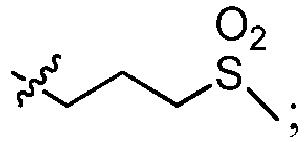 when M is an alkyl, an alkylene, a cycloalkyl, an alkoxy, a heterocycloalkyl, a heteroaryl, a sulfonyl or an acyl substituted by a C1-6 alkoxy, , the C1-6 alkoxy is a C1-3 alkoxy;when M is a C1-4 alkoxy substituted by a C2-10 heterocycloalkyl, the C1-4 alkoxy is a C2 alkoxy;when M is a C1-4 alkoxy substituted by a C2-10 heterocycloalkyl, the C2-10 heterocycloalkyl is a C3-8 heterocycloalkyl containing 1 to 3 oxygen and/or nitrogen atoms;when M is a C3-8 heterocycloalkyl, the C3-8 heterocycloalkyl is a C4-6 heterocycloalkyl containing 1 to 4 oxygen and/or nitrogen atoms.
 - The five-and-six-membered heterocyclic compound represented by formula IV-1-1, or a pharmaceutically acceptable salt thereof as defined in claim 6, wherein:when M is a C6-10 aryl, the C6-10 aryl is a phenyl;when M is an alkyl, an alkylene, an alkoxy, a heterocycloalkyl, a heteroaryl, a sulfonyl or an acyl substituted by a C3-6 cycloalkyl, , the C3-6 cycloalkyl is a cyclopropyl;when M is a C1-4 alkoxy substituted by a C2-10 heterocycloalkyl, the C2-10 heterocycloalkyl is a C4-6 heterocycloalkyl containing 1 to 3 oxygen and/or nitrogen atoms.
- The five-and-six-membered heterocyclic compound represented by formula IV-1-1, or a pharmaceutically acceptable salt thereof as defined in claim 8, wherein:when L2 is a C3-6 heterocycloalkyl, the C3-6 heterocycloalkyl is a tetrahydropyranyl;when L2 is a C4-8 heteroaryl, the C4-8 heteroaryl is a pyrazolyl, an imidazolyl, a pyridyl, a benzimidazolyl, a benzopyrazolyl, a pyridazinyl or a pyrimidinyl.
- The five-and-six-membered heterocyclic compound represented by formula IV-1-1, or a pharmaceutically acceptable salt thereof as defined in claim 9, wherein:when M is a C2 alkoxy substituted by a C2-10 heterocycloalkyl, the C2-10 heterocycloalkyl is a C3-8 heterocycloalkyl containing 1 to 3 oxygen and/or nitrogen atoms;when M is a C4-6 heterocycloalkyl, the C4-6 heterocycloalkyl is a morpholinyl, a tetrahydropyranyl, an azetidinyl, a piperidyl, an oxetanyl, a tetrazolyl, a piperazinyl or a pyrrolidinyl;when M is a C1-6 alkyl substituted by a C1-3 alkoxy, the C1-6 alkyl substituted by a C1-3 alkoxy is

- The five-and-six-membered heterocyclic compound represented by formula IV-1-1, or a pharmaceutically acceptable salt thereof as defined in claim 12, wherein:
when M is a C2 alkoxy substituted by a C2-10 heterocycloalkyl, the C2-10 heterocycloalkyl is a C3-8 heterocycloalkyl containing 1 to 3 oxygen and/or nitrogen atoms. - The five-and-six-membered heterocyclic compound represented by formula IV-1-1, or a pharmaceutically acceptable salt thereof as defined in claim 13, wherein:
when a C2 alkoxy defined in M substituted by a C4-6 heterocycloalkyl, the C4-6 heterocycloalkyl is a morpholinyl or a pyrrolidinyl. - The five-and-six-membered heterocyclic compound represented by formula IV-1-1, or a pharmaceutically acceptable salt thereof as defined in claim 13, wherein:
when M is a C2 alkoxy substituted by a C4-6 heterocycloalkyl, the C4-6 heterocycloalkyl is a morpholinyl, a tetrahydropyranyl, an azetidinyl, a piperidyl, an oxetanyl, a piperazinyl or a pyrrolidinyl. - The five-and-six-membered heterocyclic compound represented by formula IV-1-1, or a pharmaceutically acceptable salt thereof as defined in claim 1, wherein the compound represented by formula IV-1-1 has the structure represented by formula V-1-1,

- The five-and-six-membered heterocyclic compound represented by formula IV-1-1, or a pharmaceutically acceptable salt thereof as defined in any one of claims 1-15, wherein the compound represented by formula IV-1-1 is selected from the group consisting of


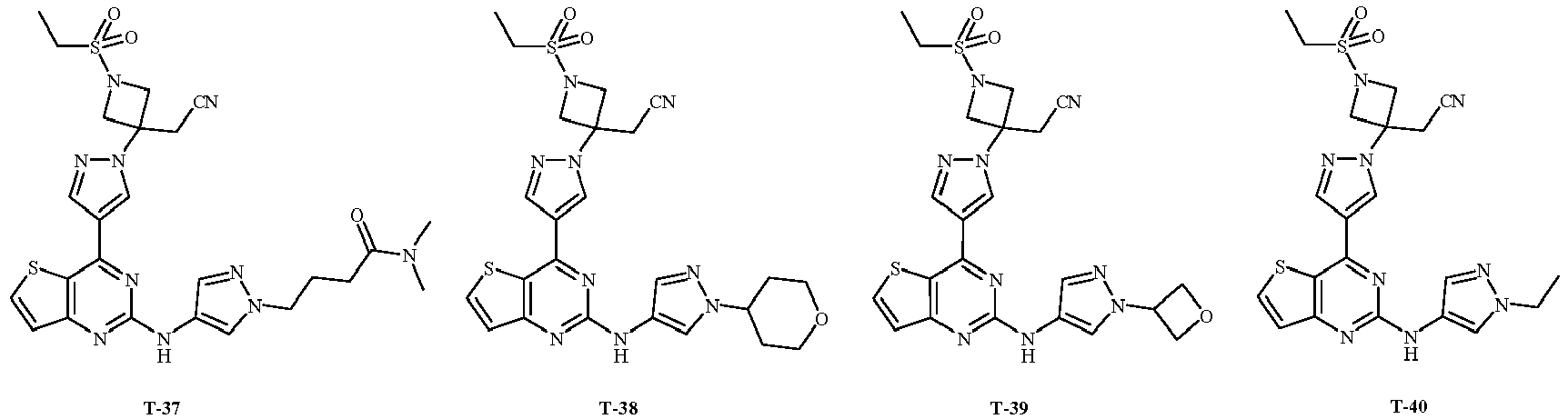


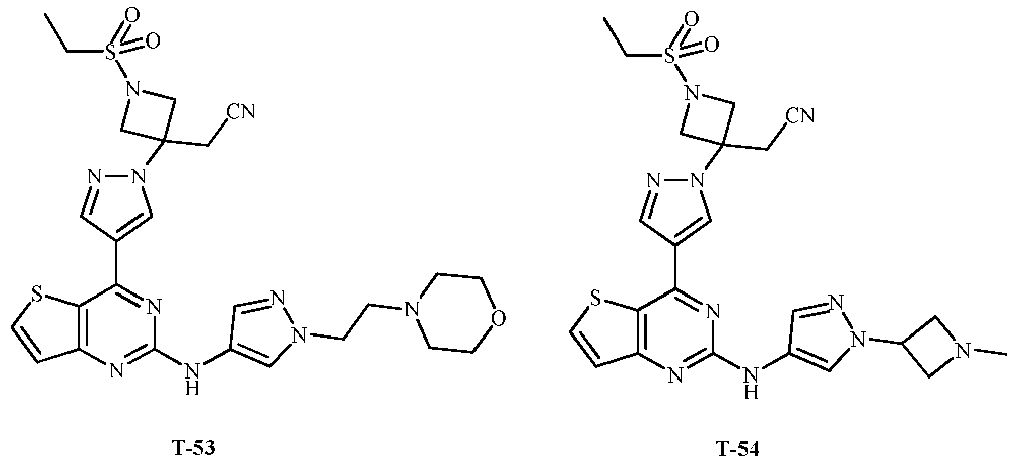


- A five-and-six-membered heterocyclic compound represented by formula IV-A,
 L1 is a chemical bond, an alkyl, an alkylene, a cycloalkyl or a heterocycloalkyl; wherein the alkyl, alkylene, cycloalkyl or heterocycloalkyl can be independently substituted by the substituents selected from the group consisting of a halogen, a cyano, C1-6 alkylsulfonyl, C3-6 cycloalkylsulfonyl, an acyl, a cycloalkyl and a heterocycloalkyl;R1 is a hydrogen, a deuterium, a halogen, a cyano, an alkyl, a cycloalkyl, a sulfonyl, an "alkyl-NH-CO-" or an "alkyl-NHSO2-"; wherein the alkyl can be substituted by the substituents selected from the group consisting of a halogen, a hydroxyl, a cyano, an amino, a nitro, a carboxyl, a sulfonyl, an acyl, an alkoxy, a cycloalkyl, an alkenyl and an alkynyl;R2 is independently selected from a hydrogen, a deuterium, a halogen and an alkyl;m is 1; andn is 1, 2, 3 or 4.
 - The five-and-six-membered heterocyclic compound represented by formula I-A as defined in claim 18, wherein the compound is selected from the group consisting of:


- A five-and-six-membered heterocyclic compound represented by formula IV-1-1, or a pharmaceutically acceptable salt thereof as defined in any one of claims 1-17 for use in treating and/or preventing cell proliferation diseases.
- A five-and-six-membered heterocyclic compound represented by formula IV-1-1, or a pharmaceutically acceptable salt thereof as defined in any one of claims 1-17 for use in treating cancer, infections, inflammation and autoimmune diseases.
- A pharmaceutical composition, comprising a therapeutically effective amount of the five-and-six-membered heterocyclic compound represented by formula IV-1-1, or a pharmaceutically acceptable salt thereof as defined in any one of claims 1-17, and at least one selected from the group consisting of pharmaceutically acceptable carriers and diluents.
Applications Claiming Priority (2)
| Application Number | Priority Date | Filing Date | Title |
|---|---|---|---|
| CN201310019856 | 2013-01-18 | ||
| PCT/CN2014/070778 WO2014111037A1 (en) | 2013-01-18 | 2014-01-17 | Five-and-six-membered heterocyclic compound, and preparation method, pharmaceutical composition and use thereof |
Publications (4)
| Publication Number | Publication Date |
|---|---|
| EP2947084A1 EP2947084A1 (en) | 2015-11-25 |
| EP2947084A4 EP2947084A4 (en) | 2016-10-05 |
| EP2947084B1 true EP2947084B1 (en) | 2020-09-23 |
| EP2947084B8 EP2947084B8 (en) | 2021-03-10 |
Family
ID=51184664
Family Applications (1)
| Application Number | Title | Priority Date | Filing Date |
|---|---|---|---|
| EP14740886.8A Active EP2947084B8 (en) | 2013-01-18 | 2014-01-17 | Five-and-six-membered heterocyclic compound, and preparation method, pharmaceutical composition and use thereof |
Country Status (7)
| Country | Link |
|---|---|
| US (1) | US9745320B2 (en) |
| EP (1) | EP2947084B8 (en) |
| JP (1) | JP6321039B2 (en) |
| CN (1) | CN103936757B (en) |
| DK (1) | DK2947084T3 (en) |
| ES (1) | ES2827233T3 (en) |
| WO (1) | WO2014111037A1 (en) |
Families Citing this family (20)
| Publication number | Priority date | Publication date | Assignee | Title |
|---|---|---|---|---|
| DK2947084T3 (en) | 2013-01-18 | 2020-11-02 | Guangzhou Maxinovel Pharmaceuticals Co | FIVE- AND SIX-PART HETEROCYCLIC COMPOUND AND PREPARATION METHOD, PHARMACEUTICAL COMPOSITION AND APPLICATION |
| CN104177363B (en) * | 2013-05-24 | 2018-06-05 | 江苏先声药业有限公司 | Bicyclic heterocycle amine Hedgehog signal pathway inhibitors |
| CN110691782A (en) * | 2016-12-01 | 2020-01-14 | 艾普托斯生物科学公司 | Fused pyrimidine compounds as dual inhibitors of BRD4 and JAK2 and methods of use |
| KR102398659B1 (en) | 2017-03-17 | 2022-05-16 | 주식회사 대웅제약 | Pyrrolotriazine derivatives as kinase inhibitor |
| WO2019233434A1 (en) * | 2018-06-06 | 2019-12-12 | 杭州澳津生物医药技术有限公司 | Pyrazolopyrimidine derivative, use thereof and pharmaceutical composition |
| EP3942045A1 (en) | 2019-03-21 | 2022-01-26 | Onxeo | A dbait molecule in combination with kinase inhibitor for the treatment of cancer |
| CN111943959A (en) * | 2019-05-17 | 2020-11-17 | 上海再极医药科技有限公司 | Synthetic method of JAK inhibitor |
| CN110305140B (en) * | 2019-07-30 | 2020-08-04 | 上海勋和医药科技有限公司 | Dihydropyrrolopyrimidines selective JAK2 inhibitors |
| CN110862380A (en) | 2019-10-24 | 2020-03-06 | 嘉兴特科罗生物科技有限公司 | Small molecule compound |
| EP4054579A1 (en) | 2019-11-08 | 2022-09-14 | Institut National de la Santé et de la Recherche Médicale (INSERM) | Methods for the treatment of cancers that have acquired resistance to kinase inhibitors |
| WO2021148581A1 (en) | 2020-01-22 | 2021-07-29 | Onxeo | Novel dbait molecule and its use |
| WO2022020887A1 (en) * | 2020-07-27 | 2022-02-03 | Esfam Biotech Pty Ltd | Treatment of cd151 related disorders |
| CN114867481A (en) * | 2020-07-27 | 2022-08-05 | 艾斯法姆生物技术股份有限公司 | Treatment of veterinary disorders associated with CD151 |
| US20250360134A1 (en) | 2020-12-18 | 2025-11-27 | Institut National De La Sante Et De La Recherche Medicale (Inserm) | 6-6 or 5-6 fused bicyclic compounds comprising a pyri(mi)dine ring useful in the|treatment of infectious diseases |
| CN114181076A (en) * | 2021-12-23 | 2022-03-15 | 维思普新材料(苏州)有限公司 | A kind of preparation method of methyl 2,6-dihalobenzoate |
| AU2023248548A1 (en) | 2022-04-08 | 2024-11-07 | Beijing Maxinovel Pharmaceuticals Co., Ltd. | Pharmaceutical composition comprising jak inhibitor, preparation method therefor and use thereof |
| WO2024041397A1 (en) * | 2022-08-22 | 2024-02-29 | Hangzhou Highlightll Pharmaceutical Co., Ltd | Jak1/jak2/tyk2 inhibitors for topical treatment of dermatological diseases |
| WO2024051771A1 (en) * | 2022-09-08 | 2024-03-14 | 广州再极医药科技有限公司 | Crystal form of five-membered and six-membered heterocyclic compound, preparation method therefor, and use thereof |
| WO2024259945A1 (en) * | 2023-06-19 | 2024-12-26 | 杭州圣域生物医药科技有限公司 | Nitrogen-containing compounds having five-membered ring fused with six-membered ring, preparation method therefor and use thereof |
| CN119564695A (en) | 2023-07-25 | 2025-03-07 | 北京再极医药科技有限公司 | A combination drug, a drug composition, and a preparation method and use thereof |
Family Cites Families (12)
| Publication number | Priority date | Publication date | Assignee | Title |
|---|---|---|---|---|
| US4178449A (en) * | 1978-04-17 | 1979-12-11 | American Cyanamid Company | Pyrazolo[1,5-a]pyrimidines and imidazo-[1,5-a]pyrimidines |
| JPS60146891A (en) * | 1984-01-05 | 1985-08-02 | Mitsubishi Chem Ind Ltd | (2,3-d)thienopyrimidine derivative and its salt |
| GB0100620D0 (en) * | 2001-01-10 | 2001-02-21 | Vernalis Res Ltd | Chemical cokpounds V |
| JP2004137270A (en) * | 2002-09-26 | 2004-05-13 | Nippon Nohyaku Co Ltd | Novel herbicide, method of use, novel substituted thienopyrimidine derivatives and intermediates thereof, and methods of producing them |
| JP2009530296A (en) * | 2006-03-17 | 2009-08-27 | ワイス | Pyrazolo [1,5-a] pyrimidine derivatives and methods of use thereof |
| WO2008059368A2 (en) * | 2006-11-17 | 2008-05-22 | Pfizer Products Inc. | Fused 2-amino pyrimidine compounds and their use for the treatment of cancer |
| PE20090996A1 (en) | 2007-04-02 | 2009-07-15 | Palau Pharma Sa | PYRROLOPYRIMIDINE DERIVATIVES AS KINASE JAK3 INHIBITORS |
| DE102007049451A1 (en) * | 2007-10-16 | 2009-04-23 | Merck Patent Gmbh | 5-Cyano-thienopyridine |
| EP2271646A1 (en) * | 2008-03-31 | 2011-01-12 | Takeda Pharmaceutical Company Limited | Apoptosis signal-regulating kinase 1 inhibitors |
| JP2012517426A (en) * | 2009-02-09 | 2012-08-02 | アステックス ファーマシューティカルズ インコーポレイテッド | Pyrrolopyrimidinyl AXL kinase inhibitor |
| CA2783475A1 (en) | 2009-12-23 | 2011-06-30 | Biocryst Pharmaceuticals, Inc. | Heterocyclic compounds as janus kinase inhibitors |
| DK2947084T3 (en) | 2013-01-18 | 2020-11-02 | Guangzhou Maxinovel Pharmaceuticals Co | FIVE- AND SIX-PART HETEROCYCLIC COMPOUND AND PREPARATION METHOD, PHARMACEUTICAL COMPOSITION AND APPLICATION |
-
2014
- 2014-01-17 DK DK14740886.8T patent/DK2947084T3/en active
- 2014-01-17 EP EP14740886.8A patent/EP2947084B8/en active Active
- 2014-01-17 JP JP2015552995A patent/JP6321039B2/en active Active
- 2014-01-17 US US14/761,772 patent/US9745320B2/en active Active
- 2014-01-17 ES ES14740886T patent/ES2827233T3/en active Active
- 2014-01-17 WO PCT/CN2014/070778 patent/WO2014111037A1/en not_active Ceased
- 2014-01-20 CN CN201410022938.3A patent/CN103936757B/en active Active
Non-Patent Citations (1)
| Title |
|---|
| None * |
Also Published As
| Publication number | Publication date |
|---|---|
| ES2827233T3 (en) | 2021-05-20 |
| DK2947084T3 (en) | 2020-11-02 |
| JP6321039B2 (en) | 2018-05-09 |
| HK1215567A1 (en) | 2016-09-02 |
| WO2014111037A1 (en) | 2014-07-24 |
| EP2947084A4 (en) | 2016-10-05 |
| EP2947084A1 (en) | 2015-11-25 |
| US9745320B2 (en) | 2017-08-29 |
| EP2947084B8 (en) | 2021-03-10 |
| CN103936757B (en) | 2019-09-13 |
| JP2016505025A (en) | 2016-02-18 |
| CN103936757A (en) | 2014-07-23 |
| US20150336982A1 (en) | 2015-11-26 |
Similar Documents
| Publication | Publication Date | Title |
|---|---|---|
| US9745320B2 (en) | Five-and-six-membered heterocyclic compound, and preparation method, pharmaceutical composition and use thereof | |
| KR102075886B1 (en) | Novel pyrazolo [3,4-d] pyrimidine compounds or salts thereof | |
| CN109020957B (en) | Heterocyclic compounds as MNK inhibitors | |
| JP5302186B2 (en) | Pyrimidine derivatives as PI3K inhibitors | |
| RU2439074C2 (en) | THIENO[3,2-d]PYRIMIDINE DERIVATIVE AS PHOSPHATIDYL INOSITOL-3-KINASE (PI3K) INHIBITOR | |
| WO2021037018A1 (en) | Dihydroquinazoline or tetrahydroquinazoline compound and intermediates, preparation methods and use thereof | |
| EP3865488A1 (en) | Macrocyclic compound as cdk inhibitor, preparation method therefor, and use thereof in medicine | |
| EP3677583A1 (en) | Nitrogenous heterocyclic compound, preparation method, intermediate, composition, and application | |
| CA2667487A1 (en) | Imidazo[1,2-b]pyridazine and pyrazolo[1,5-a]pyrimidine derivatives and their use as protein kinase inhibitors | |
| CN109867676A (en) | Compound derived from a kind of pyrrolopyrimidine, pharmaceutical composition with and application thereof | |
| WO2013118817A1 (en) | Quinolyl pyrrolopyrimidine compound or salt thereof | |
| WO2020207476A1 (en) | Pyrazolopyrazine derived compounds, pharmaceutical composition and use thereof | |
| EP4006031A1 (en) | Dihydro-pyrrolo-pyrimidine selective jak2 inhibitor | |
| CN108473473A (en) | Fused pyrimidines for inhibiting protein tyrosine kinase activity | |
| CN104829613B (en) | Diaryl-substituted pyrazolo ring derivative, preparation method thereof and application thereof in medical field | |
| HK1215567B (en) | Five-and-six-membered heterocyclic compound, and preparation method, pharmaceutical composition and use thereof | |
| CN111763217B (en) | Thieno-nitrogen heterocyclic compounds, preparation method and application | |
| CN101479277A (en) | Pyrimidine derivatives as PI3K inhibitors | |
| WO2011078226A1 (en) | Tricyclic compound | |
| CN113527311A (en) | FGFR4 inhibitor, composition and use in pharmaceutical preparation | |
| TWI820414B (en) | Quinazoline compounds, preparation method and use thereof | |
| EP4631939A1 (en) | Salt and crystal form of anti-tumor heterocyclic compound | |
| CN118084864A (en) | PRMT4 inhibitor, and pharmaceutical composition, pharmaceutical preparation and application thereof | |
| CN117024441A (en) | A MAT2A inhibitor | |
| TW202233632A (en) | Thienopyrimidine derivative |
Legal Events
| Date | Code | Title | Description |
|---|---|---|---|
| PUAI | Public reference made under article 153(3) epc to a published international application that has entered the european phase |
Free format text: ORIGINAL CODE: 0009012 |
|
| 17P | Request for examination filed |
Effective date: 20150817 |
|
| AK | Designated contracting states |
Kind code of ref document: A1 Designated state(s): AL AT BE BG CH CY CZ DE DK EE ES FI FR GB GR HR HU IE IS IT LI LT LU LV MC MK MT NL NO PL PT RO RS SE SI SK SM TR |
|
| AX | Request for extension of the european patent |
Extension state: BA ME |
|
| DAX | Request for extension of the european patent (deleted) | ||
| RAP1 | Party data changed (applicant data changed or rights of an application transferred) |
Owner name: GUANGZHOU MAXINOVEL PHARMACEUTICALS CO. |
|
| REG | Reference to a national code |
Ref country code: HK Ref legal event code: DE Ref document number: 1215567 Country of ref document: HK |
|
| A4 | Supplementary search report drawn up and despatched |
Effective date: 20160902 |
|
| RIC1 | Information provided on ipc code assigned before grant |
Ipc: C07D 487/04 20060101ALI20160829BHEP Ipc: C07D 491/048 20060101ALI20160829BHEP Ipc: C07D 495/00 20060101AFI20160829BHEP Ipc: A61K 31/519 20060101ALI20160829BHEP Ipc: A61P 35/00 20060101ALI20160829BHEP |
|
| STAA | Information on the status of an ep patent application or granted ep patent |
Free format text: STATUS: EXAMINATION IS IN PROGRESS |
|
| 17Q | First examination report despatched |
Effective date: 20181122 |
|
| GRAP | Despatch of communication of intention to grant a patent |
Free format text: ORIGINAL CODE: EPIDOSNIGR1 |
|
| STAA | Information on the status of an ep patent application or granted ep patent |
Free format text: STATUS: GRANT OF PATENT IS INTENDED |
|
| INTG | Intention to grant announced |
Effective date: 20200415 |
|
| GRAS | Grant fee paid |
Free format text: ORIGINAL CODE: EPIDOSNIGR3 |
|
| GRAA | (expected) grant |
Free format text: ORIGINAL CODE: 0009210 |
|
| STAA | Information on the status of an ep patent application or granted ep patent |
Free format text: STATUS: THE PATENT HAS BEEN GRANTED |
|
| AK | Designated contracting states |
Kind code of ref document: B1 Designated state(s): AL AT BE BG CH CY CZ DE DK EE ES FI FR GB GR HR HU IE IS IT LI LT LU LV MC MK MT NL NO PL PT RO RS SE SI SK SM TR |
|
| REG | Reference to a national code |
Ref country code: GB Ref legal event code: FG4D |
|
| REG | Reference to a national code |
Ref country code: CH Ref legal event code: EP |
|
| REG | Reference to a national code |
Ref country code: IE Ref legal event code: FG4D |
|
| REG | Reference to a national code |
Ref country code: CH Ref legal event code: NV Representative=s name: DENNEMEYER AG, CH Ref country code: DE Ref legal event code: R096 Ref document number: 602014070477 Country of ref document: DE Ref country code: AT Ref legal event code: REF Ref document number: 1316285 Country of ref document: AT Kind code of ref document: T Effective date: 20201015 |
|
| REG | Reference to a national code |
Ref country code: DK Ref legal event code: T3 Effective date: 20201029 |
|
| REG | Reference to a national code |
Ref country code: NL Ref legal event code: FP |
|
| REG | Reference to a national code |
Ref country code: FI Ref legal event code: FGE |
|
| GRAT | Correction requested after decision to grant or after decision to maintain patent in amended form |
Free format text: ORIGINAL CODE: EPIDOSNCDEC |
|
| REG | Reference to a national code |
Ref country code: DE Ref legal event code: R081 Ref document number: 602014070477 Country of ref document: DE Owner name: GUANGZHOU MAXINOVEL PHARMACEUTICALS CO. LTD., , CN Free format text: FORMER OWNER: GUANGZHOU MAXINOVEL PHARMACEUTICALS CO., GUANGZHOU, GUANGDONG, CN Ref country code: DE Ref legal event code: R082 Ref document number: 602014070477 Country of ref document: DE Representative=s name: GULDE & PARTNER PATENT- UND RECHTSANWALTSKANZL, DE |
|
| PG25 | Lapsed in a contracting state [announced via postgrant information from national office to epo] |
Ref country code: HR Free format text: LAPSE BECAUSE OF FAILURE TO SUBMIT A TRANSLATION OF THE DESCRIPTION OR TO PAY THE FEE WITHIN THE PRESCRIBED TIME-LIMIT Effective date: 20200923 Ref country code: SE Free format text: LAPSE BECAUSE OF FAILURE TO SUBMIT A TRANSLATION OF THE DESCRIPTION OR TO PAY THE FEE WITHIN THE PRESCRIBED TIME-LIMIT Effective date: 20200923 Ref country code: BG Free format text: LAPSE BECAUSE OF FAILURE TO SUBMIT A TRANSLATION OF THE DESCRIPTION OR TO PAY THE FEE WITHIN THE PRESCRIBED TIME-LIMIT Effective date: 20201223 Ref country code: GR Free format text: LAPSE BECAUSE OF FAILURE TO SUBMIT A TRANSLATION OF THE DESCRIPTION OR TO PAY THE FEE WITHIN THE PRESCRIBED TIME-LIMIT Effective date: 20201224 Ref country code: NO Free format text: LAPSE BECAUSE OF FAILURE TO SUBMIT A TRANSLATION OF THE DESCRIPTION OR TO PAY THE FEE WITHIN THE PRESCRIBED TIME-LIMIT Effective date: 20201223 |
|
| REG | Reference to a national code |
Ref country code: AT Ref legal event code: MK05 Ref document number: 1316285 Country of ref document: AT Kind code of ref document: T Effective date: 20200923 Ref country code: CH Ref legal event code: PK Free format text: BERICHTIGUNG B8 |
|
| PG25 | Lapsed in a contracting state [announced via postgrant information from national office to epo] |
Ref country code: LV Free format text: LAPSE BECAUSE OF FAILURE TO SUBMIT A TRANSLATION OF THE DESCRIPTION OR TO PAY THE FEE WITHIN THE PRESCRIBED TIME-LIMIT Effective date: 20200923 Ref country code: RS Free format text: LAPSE BECAUSE OF FAILURE TO SUBMIT A TRANSLATION OF THE DESCRIPTION OR TO PAY THE FEE WITHIN THE PRESCRIBED TIME-LIMIT Effective date: 20200923 |
|
| RAP2 | Party data changed (patent owner data changed or rights of a patent transferred) |
Owner name: GUANGZHOU MAXINOVEL PHARMACEUTICALS CO., LTD. |
|
| REG | Reference to a national code |
Ref country code: LT Ref legal event code: MG4D |
|
| PG25 | Lapsed in a contracting state [announced via postgrant information from national office to epo] |
Ref country code: CZ Free format text: LAPSE BECAUSE OF FAILURE TO SUBMIT A TRANSLATION OF THE DESCRIPTION OR TO PAY THE FEE WITHIN THE PRESCRIBED TIME-LIMIT Effective date: 20200923 Ref country code: EE Free format text: LAPSE BECAUSE OF FAILURE TO SUBMIT A TRANSLATION OF THE DESCRIPTION OR TO PAY THE FEE WITHIN THE PRESCRIBED TIME-LIMIT Effective date: 20200923 Ref country code: LT Free format text: LAPSE BECAUSE OF FAILURE TO SUBMIT A TRANSLATION OF THE DESCRIPTION OR TO PAY THE FEE WITHIN THE PRESCRIBED TIME-LIMIT Effective date: 20200923 Ref country code: PT Free format text: LAPSE BECAUSE OF FAILURE TO SUBMIT A TRANSLATION OF THE DESCRIPTION OR TO PAY THE FEE WITHIN THE PRESCRIBED TIME-LIMIT Effective date: 20210125 Ref country code: RO Free format text: LAPSE BECAUSE OF FAILURE TO SUBMIT A TRANSLATION OF THE DESCRIPTION OR TO PAY THE FEE WITHIN THE PRESCRIBED TIME-LIMIT Effective date: 20200923 Ref country code: SM Free format text: LAPSE BECAUSE OF FAILURE TO SUBMIT A TRANSLATION OF THE DESCRIPTION OR TO PAY THE FEE WITHIN THE PRESCRIBED TIME-LIMIT Effective date: 20200923 |
|
| REG | Reference to a national code |
Ref country code: ES Ref legal event code: FG2A Ref document number: 2827233 Country of ref document: ES Kind code of ref document: T3 Effective date: 20210520 |
|
| PG25 | Lapsed in a contracting state [announced via postgrant information from national office to epo] |
Ref country code: AT Free format text: LAPSE BECAUSE OF FAILURE TO SUBMIT A TRANSLATION OF THE DESCRIPTION OR TO PAY THE FEE WITHIN THE PRESCRIBED TIME-LIMIT Effective date: 20200923 Ref country code: AL Free format text: LAPSE BECAUSE OF FAILURE TO SUBMIT A TRANSLATION OF THE DESCRIPTION OR TO PAY THE FEE WITHIN THE PRESCRIBED TIME-LIMIT Effective date: 20200923 Ref country code: PL Free format text: LAPSE BECAUSE OF FAILURE TO SUBMIT A TRANSLATION OF THE DESCRIPTION OR TO PAY THE FEE WITHIN THE PRESCRIBED TIME-LIMIT Effective date: 20200923 Ref country code: IS Free format text: LAPSE BECAUSE OF FAILURE TO SUBMIT A TRANSLATION OF THE DESCRIPTION OR TO PAY THE FEE WITHIN THE PRESCRIBED TIME-LIMIT Effective date: 20210123 |
|
| REG | Reference to a national code |
Ref country code: DE Ref legal event code: R097 Ref document number: 602014070477 Country of ref document: DE |
|
| PG25 | Lapsed in a contracting state [announced via postgrant information from national office to epo] |
Ref country code: SK Free format text: LAPSE BECAUSE OF FAILURE TO SUBMIT A TRANSLATION OF THE DESCRIPTION OR TO PAY THE FEE WITHIN THE PRESCRIBED TIME-LIMIT Effective date: 20200923 |
|
| PLBE | No opposition filed within time limit |
Free format text: ORIGINAL CODE: 0009261 |
|
| STAA | Information on the status of an ep patent application or granted ep patent |
Free format text: STATUS: NO OPPOSITION FILED WITHIN TIME LIMIT |
|
| PG25 | Lapsed in a contracting state [announced via postgrant information from national office to epo] |
Ref country code: SI Free format text: LAPSE BECAUSE OF FAILURE TO SUBMIT A TRANSLATION OF THE DESCRIPTION OR TO PAY THE FEE WITHIN THE PRESCRIBED TIME-LIMIT Effective date: 20200923 |
|
| 26N | No opposition filed |
Effective date: 20210624 |
|
| PG25 | Lapsed in a contracting state [announced via postgrant information from national office to epo] |
Ref country code: HU Free format text: LAPSE BECAUSE OF FAILURE TO SUBMIT A TRANSLATION OF THE DESCRIPTION OR TO PAY THE FEE WITHIN THE PRESCRIBED TIME-LIMIT; INVALID AB INITIO Effective date: 20140117 |
|
| PG25 | Lapsed in a contracting state [announced via postgrant information from national office to epo] |
Ref country code: CY Free format text: LAPSE BECAUSE OF FAILURE TO SUBMIT A TRANSLATION OF THE DESCRIPTION OR TO PAY THE FEE WITHIN THE PRESCRIBED TIME-LIMIT Effective date: 20200923 |
|
| PG25 | Lapsed in a contracting state [announced via postgrant information from national office to epo] |
Ref country code: MK Free format text: LAPSE BECAUSE OF FAILURE TO SUBMIT A TRANSLATION OF THE DESCRIPTION OR TO PAY THE FEE WITHIN THE PRESCRIBED TIME-LIMIT Effective date: 20200923 |
|
| PG25 | Lapsed in a contracting state [announced via postgrant information from national office to epo] |
Ref country code: TR Free format text: LAPSE BECAUSE OF FAILURE TO SUBMIT A TRANSLATION OF THE DESCRIPTION OR TO PAY THE FEE WITHIN THE PRESCRIBED TIME-LIMIT Effective date: 20200923 |
|
| PG25 | Lapsed in a contracting state [announced via postgrant information from national office to epo] |
Ref country code: MT Free format text: LAPSE BECAUSE OF FAILURE TO SUBMIT A TRANSLATION OF THE DESCRIPTION OR TO PAY THE FEE WITHIN THE PRESCRIBED TIME-LIMIT Effective date: 20200923 |
|
| REG | Reference to a national code |
Ref country code: CH Ref legal event code: U11 Free format text: ST27 STATUS EVENT CODE: U-0-0-U10-U11 (AS PROVIDED BY THE NATIONAL OFFICE) Effective date: 20260201 |
|
| PGFP | Annual fee paid to national office [announced via postgrant information from national office to epo] |
Ref country code: LU Payment date: 20260121 Year of fee payment: 13 Ref country code: NL Payment date: 20260121 Year of fee payment: 13 |
|
| PGFP | Annual fee paid to national office [announced via postgrant information from national office to epo] |
Ref country code: GB Payment date: 20260123 Year of fee payment: 13 |
|
| PGFP | Annual fee paid to national office [announced via postgrant information from national office to epo] |
Ref country code: ES Payment date: 20260227 Year of fee payment: 13 Ref country code: MC Payment date: 20260123 Year of fee payment: 13 |
|
| PGFP | Annual fee paid to national office [announced via postgrant information from national office to epo] |
Ref country code: DE Payment date: 20260121 Year of fee payment: 13 Ref country code: DK Payment date: 20260126 Year of fee payment: 13 Ref country code: IE Payment date: 20260122 Year of fee payment: 13 |
|
| PGFP | Annual fee paid to national office [announced via postgrant information from national office to epo] |
Ref country code: FI Payment date: 20260129 Year of fee payment: 13 Ref country code: IT Payment date: 20260126 Year of fee payment: 13 Ref country code: BE Payment date: 20260121 Year of fee payment: 13 |
|
| PGFP | Annual fee paid to national office [announced via postgrant information from national office to epo] |
Ref country code: FR Payment date: 20260123 Year of fee payment: 13 |
|
| PGFP | Annual fee paid to national office [announced via postgrant information from national office to epo] |
Ref country code: CH Payment date: 20260201 Year of fee payment: 13 |