EP2945210A1 - Inorganic compounds as a cathode material for lithium/air batteries - Google Patents
Inorganic compounds as a cathode material for lithium/air batteries Download PDFInfo
- Publication number
- EP2945210A1 EP2945210A1 EP14168737.6A EP14168737A EP2945210A1 EP 2945210 A1 EP2945210 A1 EP 2945210A1 EP 14168737 A EP14168737 A EP 14168737A EP 2945210 A1 EP2945210 A1 EP 2945210A1
- Authority
- EP
- European Patent Office
- Prior art keywords
- lithium
- air
- inorganic compounds
- material according
- battery
- Prior art date
- Legal status (The legal status is an assumption and is not a legal conclusion. Google has not performed a legal analysis and makes no representation as to the accuracy of the status listed.)
- Withdrawn
Links
Images
Classifications
-
- H—ELECTRICITY
- H01—ELECTRIC ELEMENTS
- H01M—PROCESSES OR MEANS, e.g. BATTERIES, FOR THE DIRECT CONVERSION OF CHEMICAL ENERGY INTO ELECTRICAL ENERGY
- H01M12/00—Hybrid cells; Manufacture thereof
- H01M12/04—Hybrid cells; Manufacture thereof composed of a half-cell of the fuel-cell type and of a half-cell of the primary-cell type
- H01M12/06—Hybrid cells; Manufacture thereof composed of a half-cell of the fuel-cell type and of a half-cell of the primary-cell type with one metallic and one gaseous electrode
-
- H—ELECTRICITY
- H01—ELECTRIC ELEMENTS
- H01M—PROCESSES OR MEANS, e.g. BATTERIES, FOR THE DIRECT CONVERSION OF CHEMICAL ENERGY INTO ELECTRICAL ENERGY
- H01M4/00—Electrodes
- H01M4/02—Electrodes composed of, or comprising, active material
- H01M4/36—Selection of substances as active materials, active masses, active liquids
- H01M4/38—Selection of substances as active materials, active masses, active liquids of elements or alloys
- H01M4/381—Alkaline or alkaline earth metals elements
- H01M4/382—Lithium
-
- H—ELECTRICITY
- H01—ELECTRIC ELEMENTS
- H01M—PROCESSES OR MEANS, e.g. BATTERIES, FOR THE DIRECT CONVERSION OF CHEMICAL ENERGY INTO ELECTRICAL ENERGY
- H01M4/00—Electrodes
- H01M4/86—Inert electrodes with catalytic activity, e.g. for fuel cells
- H01M4/90—Selection of catalytic material
-
- H—ELECTRICITY
- H01—ELECTRIC ELEMENTS
- H01M—PROCESSES OR MEANS, e.g. BATTERIES, FOR THE DIRECT CONVERSION OF CHEMICAL ENERGY INTO ELECTRICAL ENERGY
- H01M4/00—Electrodes
- H01M4/86—Inert electrodes with catalytic activity, e.g. for fuel cells
- H01M4/90—Selection of catalytic material
- H01M4/9016—Oxides, hydroxides or oxygenated metallic salts
- H01M4/9025—Oxides specially used in fuel cell operating at high temperature, e.g. SOFC
- H01M4/9033—Complex oxides, optionally doped, of the type M1MeO3, M1 being an alkaline earth metal or a rare earth, Me being a metal, e.g. perovskites
-
- Y—GENERAL TAGGING OF NEW TECHNOLOGICAL DEVELOPMENTS; GENERAL TAGGING OF CROSS-SECTIONAL TECHNOLOGIES SPANNING OVER SEVERAL SECTIONS OF THE IPC; TECHNICAL SUBJECTS COVERED BY FORMER USPC CROSS-REFERENCE ART COLLECTIONS [XRACs] AND DIGESTS
- Y02—TECHNOLOGIES OR APPLICATIONS FOR MITIGATION OR ADAPTATION AGAINST CLIMATE CHANGE
- Y02E—REDUCTION OF GREENHOUSE GAS [GHG] EMISSIONS, RELATED TO ENERGY GENERATION, TRANSMISSION OR DISTRIBUTION
- Y02E60/00—Enabling technologies; Technologies with a potential or indirect contribution to GHG emissions mitigation
- Y02E60/10—Energy storage using batteries
Definitions
- the present invention relates to inorganic compounds, particularly as a cathode material for an electrode assembly for lithium/air batteries.
- US 5,510,209 is related to a solid polymer electrolyte-based oxygen battery.
- a polymer-based battery comprises metal anodes and an oxygen gas cathode. The oxygen is not stored in the battery rather it accesses from the environment.
- the solid-state battery is constructed by sandwiching a metal ion-conductive polymer electrolyte film between a metal anode (negative electrode) and a composite carbon electrode which serves as the cathode current collector, on which the electro-active oxygen is reduced during discharge of the battery to generate electric current.
- the metal anodes include lithium, magnesium, sodium, calcium, aluminum and zinc.
- US 2013/0029234 A1 is related to porous carbonaceous composite material, a positive electrode and lithium air battery including porous carbonaceous composite material and a method of preparing the same.
- the porous carbonaceous composite material comprises a core, which in turn comprises a carbon nanotube.
- said porous carbonaceous composite material includes a coating layer on the core, the coating layer comprising a carbonaceous material comprising a hetero element.
- the coating layer is disposed in at least a portion of the core.
- the core comprises a plurality of carbon nanotubes which define a pore between the plurality of carbon nanotubes.
- US 5,888,669 is related to a transition metal-based ceramic material and articles fabricated therefrom.
- a non-oxide, transition metal-based ceramic material has the general formula A y M 2 Z x , wherein A is a group IA element, M is a transition metal and Z is selected from the group consisting of N, C, B, Si, and combinations thereof, and wherein x ⁇ 2 and y ⁇ 6-x.
- the group IA element occupies interstitial sites in the metallic lattice, and may be readily inserted into or released therefrom.
- the materials may be used as catalysts and as electrodes. Also disclosed herein are methods for the fabrication of the materials.
- DE 10 2011 053 782 A1 is related to a lithium/air battery.
- Said lithium/oxygen battery comprises a number of electrochemical cells comprising a double anode having an anode contacting element of an electrical conductive and for lithium ions non-permeable material, two anode fuel cells, entirely or partially made of metallic lithium and arranged on opposite sides of the anode contacting element.
- two separation elements are provided of a water- and gas-tight material, having a conductivity for lithium-ions, each of said separation elements arranged such that it in cooperation with the anode conducting elements entirely mantles one of said anode fuel cells.
- cathodes arranged on opposite sides of the double anode having contact to each of said separation elements, each comprising a cathode contact element made of an electrical conductive material and further, an oxygen electrode element arranged on the cathode contacting element having a porous structure comprising a catalysator for the generation and dissolution of lithium oxide, said oxide electrode element being in contact with one of said separator elements of the double anode.
- lithium/air typically containing a metallic lithium anode and an oxygen cathode is based on a conversion reaction, unlike lithium/ion technology, what in turn provides a high specific capacity.
- Carbon cathode materials for the lithium/air battery system are disclosed in US 2013/0029234 A1 . Recently, it was found that lithium carbonates are formed on carbon electrode materials, for instance, the publication McCloskey, B. D. et al., J. Phys. Chem. Lett. 3, 997-1001, 2012 . To avoid this side reaction, that over the long run leads to electrode passivation and an irreversible carbon consumption during battery cell recharge, porous gold and TiC were suggested as an electrode material according to the publication Peng, Z., Freunberger, S. A., Chen, Y. & Bruce, P. G., Science 337, 563-566 (2012 ) and Thotiyl, M. M. O. et al., Nat Mater 12, 1-7, 2013 .
- a material for an electrode of a lithium/air battery system is disclosed as cathode material, said material containing binary inorganic compounds and/or ternary inorganic compounds.
- Said binary inorganic compounds are selected from the group containing transition metals and rare earth metal borides, carbides, nitrides, silicides, including TiB 2 , ZrB 2 , HfB 2 , VB 2 , NbB 2 , TaB 2 , CrB 2 , MoB 2 , Mo 2 B 5 , WB 2 , W 2 B 5 , LaB 6 , ThB 6 , TiC, ZrC, HfC, VC, NbC, TaC, Cr 3 C 2 , Mo 2 C, WC, ScC, TiN, ZrN, HfN, VN, NbN, TaN, CrN, Cr 2 N, MoN, Mo 2 N, WN, W 2 N, CeN, TiSi 2 , ZrSi 2 , HfSi 2 , VSi 2 , NbSi 2 , TaSi 2 , CrSi 2 , MoSi 2 , WSi 2 .
- Said ternary inorganic compounds are selected from the group comprising perovskites, including LaNiO 3 .
- the cathode material further includes a binder or binding agent and may include a catalyst. Both components, i.e. said binder or binding agent and said catalyst, are included with the cathode material with less than 10% per weight.
- both compounds are present in the cathode material, i.e. said binary inorganic compound as well as said ternary inorganic compound, one of said compounds may constitute the catalyst.
- the material according to the present invention is porous, meso-porous and nano-sized materials.
- electrolyte is present, which, however, leaves said pores or voids upon a discharging cycle.
- Said material according to the present invention is hierarchically structured. This means that layers of material are superimposed one above another. For instance, one layer may be formed of microparticles, which in turn are formed of 100 (example only) spherical particles, said spherical particles in turn are formed of crumpled nano-wires, to name an example.
- Said hierarchically structures are 3-dimensional structures, formed of 2-dimensional structures, such as wires or fibers, which in turn are made of one-dimensional structures, such as particles.
- the present invention likewise is directed to the use of the materials according to the present invention as cathode material for a lithium-air-battery-cell, lithium-air-battery module and/or a lithium-air-battery-pack used as traction battery in a hybrid electrical vehicle (HEV), a plug-in hybrid vehicle (PHEV), or an electric vehicle (EV).
- HEV hybrid electrical vehicle
- PHEV plug-in hybrid vehicle
- EV electric vehicle
- the materials disclosed in the present invention have an efficient chemical stability towards active reduced oxygen species, which carbon materials do not have as discussed above.
- the materials according to the present invention i.e. said binary inorganic compounds and said ternary inorganic compounds have a electrochemical oxidative stability as well as a high electrical conductivity. Still further, they offer to a certain degree an oxygen adsorption possibility, so that an oxygen reduction reaction (ORR) occurs in a lithium-air-battery-cell or lithium-air-battery-module or lithium-air-battery-pack for use as a secondary battery in a hybrid electrical vehicle, a plug-in hybrid electrical vehicle or an electrical vehicle.
- ORR oxygen reduction reaction
- the materials according to the invention have a low specific weight which is essential for a battery system when used in automotive applications. Still further, the materials according to the present invention, i.e. particularly said binary inorganic compounds, can be manufactured so that they either adopt a porous, a meso-porous shape, exhibiting a very high voidage ratio, crucial for accommodation of the discharge product of a battery cell.
- Said materials possess a much higher, i.e. 10 to 100 times higher electric conductivity when compared with carbon.
- Some of the binary inorganic compounds and/or ternary inorganic compounds have rather low specific weight.
- most of these materials according to the present invention exhibit better chemical and electrochemical stability towards oxidation under battery operation conditions as compared to a carbon material.
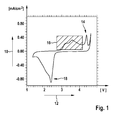
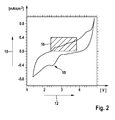
- Both voltammograms show the current density in mA/cm 2 vs. Potential vs. Lithium/Lithium + , Volt, i.e. reference numeral 12 in volt.
- potential sweep rate is 100 mV/s
- potentials are measured vs. a lithium foil which is soaked in 1M LiClO 4 in PC:DME mixture (7:3 vol.).
- a non-aqueous lithium-air-battery cell is used with a standard flat glass carbon cathode.
- Said lithium-air-battery cell was analyzed by cyclic voltammetry method. Along with peaks corresponding to oxygen reduction (ORR) and oxygen evolution (OER) processes, an anode peak corresponding to lithium carbonate decomposition 14 was observed as depicted in Figure 1 . Due to the carbonate decomposition 14 as shown in Figure 1 , the current density of said battery cell only was 0.4 mA/cm 2 as a maximum value.
- FIG. 2 shows a lithium-air-battery cell according to the present invention
- a flat titanium carbide cathode was used as cathode material in this lithium-air-battery cell.
- Said carbide cathode was manufactured by sputtering of TiC target on an aluminum substrate.
- a non-aqueous lithium-air-battery cell system was prepared with a flat titanium carbide cathode.
- Said battery cell was analyzed by cyclic voltammetry method. Peaks 16 and 18, respectively, corresponding to an oxygen reduction reaction (ORR) as well as an oxygen evolution reaction (OER) were observed according to the cyclic voltammogram as given in Figure 2 .
- ORR oxygen reduction reaction
- OER oxygen evolution reaction
Landscapes
- Chemical & Material Sciences (AREA)
- Engineering & Computer Science (AREA)
- Chemical Kinetics & Catalysis (AREA)
- Electrochemistry (AREA)
- General Chemical & Material Sciences (AREA)
- Materials Engineering (AREA)
- Manufacturing & Machinery (AREA)
- Inert Electrodes (AREA)
- Hybrid Cells (AREA)
Abstract
Description
- The present invention relates to inorganic compounds, particularly as a cathode material for an electrode assembly for lithium/air batteries.
-
US 5,510,209 is related to a solid polymer electrolyte-based oxygen battery. A polymer-based battery comprises metal anodes and an oxygen gas cathode. The oxygen is not stored in the battery rather it accesses from the environment. The solid-state battery is constructed by sandwiching a metal ion-conductive polymer electrolyte film between a metal anode (negative electrode) and a composite carbon electrode which serves as the cathode current collector, on which the electro-active oxygen is reduced during discharge of the battery to generate electric current. The metal anodes include lithium, magnesium, sodium, calcium, aluminum and zinc. -
US 2013/0029234 A1 is related to porous carbonaceous composite material, a positive electrode and lithium air battery including porous carbonaceous composite material and a method of preparing the same. The porous carbonaceous composite material comprises a core, which in turn comprises a carbon nanotube. Further, said porous carbonaceous composite material includes a coating layer on the core, the coating layer comprising a carbonaceous material comprising a hetero element. The coating layer is disposed in at least a portion of the core. The core comprises a plurality of carbon nanotubes which define a pore between the plurality of carbon nanotubes. -
US 5,888,669 is related to a transition metal-based ceramic material and articles fabricated therefrom. A non-oxide, transition metal-based ceramic material has the general formula AyM2Zx, wherein A is a group IA element, M is a transition metal and Z is selected from the group consisting of N, C, B, Si, and combinations thereof, and wherein x ≤ 2 and y ≤ 6-x. In these materials, the group IA element occupies interstitial sites in the metallic lattice, and may be readily inserted into or released therefrom. The materials may be used as catalysts and as electrodes. Also disclosed herein are methods for the fabrication of the materials. -
DE 10 2011 053 782 A1 - A promising battery technology currently under development which can achieve a high specific energy is the lithium/air or the lithium/oxygen system. Operation of lithium/air cells, typically containing a metallic lithium anode and an oxygen cathode is based on a conversion reaction, unlike lithium/ion technology, what in turn provides a high specific capacity.
- A system with a metallic lithium anode and an oxygen cathode is disclosed in
US 5,510,209 A . An overview of current challenges for the lithium/air battery technology is published by Jake Christensen et al. in Journal of the Electrochemical Society, 159(2) R1-R30, in 2012. Different types of porous carbon or modified carbon, to name but a few carbon black, graphite, carbon nanotubes, carbon nanofibers, mesoporous carbon, graphene, doped carbons, are commonly used as cathode material for lithium/air battery systems due to their high electric conductivity and their oxygen adsorption properties. In the present context, oxygen adsorption property means that an oxygen reduction reaction (ORR) is likely to occur on the materials listed above. Still further, said materials have a very low specific weight and a sufficient chemical stability at room temperature. Carbon cathode materials for the lithium/air battery system are disclosed inUS 2013/0029234 A1 . Recently, it was found that lithium carbonates are formed on carbon electrode materials, for instance, the publication McCloskey, B. D. et al., J. Phys. Chem. Lett. 3, 997-1001, 2012. To avoid this side reaction, that over the long run leads to electrode passivation and an irreversible carbon consumption during battery cell recharge, porous gold and TiC were suggested as an electrode material according to the publication Peng, Z., Freunberger, S. A., Chen, Y. & Bruce, P. G., Science 337, 563-566 (2012) and Thotiyl, M. M. O. et al., . - The technical problem involved is that despite its usual inertness, carbon undergoes a chemical oxidation by intermediate superoxide anion radicals, generated during an oxygen reduction reaction (ORR), while discharging takes place. Such an attack on a carbon electrode results in lithium carbonate formation along with lithium peroxide, provided a non-aqueous, non-carbonate electrolyte is present. Upon a charging process which follows to recharge the battery cell, this lithium air battery cell having a carbon cathode typically is accompanied by carbon dioxide release as a result of lithium carbonate decomposition. Over the entire operation cycle of such a battery cell, i.e. the lithium/air battery cell system, this process would mean the exhaustion of the carbon cathode. Alternative materials for cathodes of the lithium/air battery system are noble metals, e.g. Au, Pt, which could be used alternatively, however, said inert noble metals have a high specific weight and come along with high costs, particularly Au. This forms a significant obstacle for the commercialization of lithium/air battery cells if inert noble metals are used as cathode material.
- In view of the technical problem sketched above, it is one objective of the present invention to provide for alternative materials which are suitable for a cathode of a battery cell, particularly of a battery cell according to the lithium/air battery system.
- According to the present invention, a material for an electrode of a lithium/air battery system, particularly a lithium/air battery cell, is disclosed as cathode material, said material containing binary inorganic compounds and/or ternary inorganic compounds.
- Said binary inorganic compounds are selected from the group containing transition metals and rare earth metal borides, carbides, nitrides, silicides, including TiB2, ZrB2, HfB2, VB2, NbB2, TaB2, CrB2, MoB2, Mo2B5, WB2, W2B5, LaB6, ThB6, TiC, ZrC, HfC, VC, NbC, TaC, Cr3C2, Mo2C, WC, ScC, TiN, ZrN, HfN, VN, NbN, TaN, CrN, Cr2N, MoN, Mo2N, WN, W2N, CeN, TiSi2, ZrSi2, HfSi2, VSi2, NbSi2, TaSi2, CrSi2, MoSi2, WSi2.
- Said ternary inorganic compounds are selected from the group comprising perovskites, including LaNiO3. Besides said binary or ternary inorganic components, the cathode material further includes a binder or binding agent and may include a catalyst. Both components, i.e. said binder or binding agent and said catalyst, are included with the cathode material with less than 10% per weight. When both compounds are present in the cathode material, i.e. said binary inorganic compound as well as said ternary inorganic compound, one of said compounds may constitute the catalyst.
- The material according to the present invention is porous, meso-porous and nano-sized materials. In said pores of the material, electrolyte is present, which, however, leaves said pores or voids upon a discharging cycle.
- Said material according to the present invention is hierarchically structured. This means that layers of material are superimposed one above another. For instance, one layer may be formed of microparticles, which in turn are formed of 100 (example only) spherical particles, said spherical particles in turn are formed of crumpled nano-wires, to name an example. Said hierarchically structures are 3-dimensional structures, formed of 2-dimensional structures, such as wires or fibers, which in turn are made of one-dimensional structures, such as particles.
- The present invention likewise is directed to the use of the materials according to the present invention as cathode material for a lithium-air-battery-cell, lithium-air-battery module and/or a lithium-air-battery-pack used as traction battery in a hybrid electrical vehicle (HEV), a plug-in hybrid vehicle (PHEV), or an electric vehicle (EV).
- The materials disclosed in the present invention have an efficient chemical stability towards active reduced oxygen species, which carbon materials do not have as discussed above. The materials according to the present invention, i.e. said binary inorganic compounds and said ternary inorganic compounds have a electrochemical oxidative stability as well as a high electrical conductivity. Still further, they offer to a certain degree an oxygen adsorption possibility, so that an oxygen reduction reaction (ORR) occurs in a lithium-air-battery-cell or lithium-air-battery-module or lithium-air-battery-pack for use as a secondary battery in a hybrid electrical vehicle, a plug-in hybrid electrical vehicle or an electrical vehicle. Still further, the materials according to the invention have a low specific weight which is essential for a battery system when used in automotive applications. Still further, the materials according to the present invention, i.e. particularly said binary inorganic compounds, can be manufactured so that they either adopt a porous, a meso-porous shape, exhibiting a very high voidage ratio, crucial for accommodation of the discharge product of a battery cell.
- Said materials possess a much higher, i.e. 10 to 100 times higher electric conductivity when compared with carbon. Some of the binary inorganic compounds and/or ternary inorganic compounds have rather low specific weight. Moreover, most of these materials according to the present invention exhibit better chemical and electrochemical stability towards oxidation under battery operation conditions as compared to a carbon material.
- The present invention is further described by the accompanying drawings, wherein
- Figure 1
- shows a cyclic voltammogram for lithium-air battery cells with a glassy carbon working electrode and
- Figure 2
- shows a cyclic voltammogram for a lithium-air cell with a titanium carbide working electrode.
- Both voltammograms show the current density in mA/cm2 vs. Potential vs. Lithium/Lithium+, Volt, i.e.
reference numeral 12 in volt. In both Figures, potential sweep rate is 100 mV/s, potentials are measured vs. a lithium foil which is soaked in 1M LiClO4 in PC:DME mixture (7:3 vol.). - According to
Figure 1 , a non-aqueous lithium-air-battery cell is used with a standard flat glass carbon cathode. Said lithium-air-battery cell was analyzed by cyclic voltammetry method. Along with peaks corresponding to oxygen reduction (ORR) and oxygen evolution (OER) processes, an anode peak corresponding tolithium carbonate decomposition 14 was observed as depicted inFigure 1 . Due to thecarbonate decomposition 14 as shown inFigure 1 , the current density of said battery cell only was 0.4 mA/cm2 as a maximum value. -
Figure 2 shows a lithium-air-battery cell according to the present invention, a flat titanium carbide cathode was used as cathode material in this lithium-air-battery cell. Said carbide cathode was manufactured by sputtering of TiC target on an aluminum substrate. A non-aqueous lithium-air-battery cell system was prepared with a flat titanium carbide cathode. Said battery cell was analyzed by cyclic voltammetry method.Peaks Figure 2 . - The current density achieved with a titanium carbide cathode material according to
Figure 2 was with respect to its maximum value 0.8 mA/cm2, i.e. nearly twice as much when compared to the lithium-air-battery system given inFigure 1 . In both Figures, potential sweep rate was 100 mV/s and the potential has been measured vs. a lithium foil, i.e. both measurements have been taken in battery cells with equal surrounding conditions except for the cathode material.
Claims (8)
- Material for an electrode of a lithium-air-battery cell, particularly for a cathode, wherein said material contains binary inorganic compounds and/or ternary inorganic compounds.
- Material according to claim 1, wherein said binary inorganic compounds are selected from the group containing transition metals, rare earth metal borides, carbides, nitrides, silicides.
- Material according to claim 2, whrerein said group comprises TiB2, ZrB2, HfB2, VB2, NbB2, TaB2, CrB2, MoB2, Mo2B5, WB2, W2B5, LaB6, ThB6, TiC, ZrC, HfC, VC, NbC, TaC, Cr3C2, Mo2C, WC, ScC, TiN, ZrN, HfN, VN, NbN, TaN, CrN, Cr2N, MoN, Mo2N, WN, W2N, CeN, TiSi2, ZrSi2, HfSi2, VSi2, NbSi2, TaSi2, CrSi2, MoSi2, WSi2.
- Material according to claim 1, wherein said ternary inorganic compounds are selected from the group comprising perovskites, including LaNiO3.
- Material according to one of the preceding claims, wherein said material is porous or meso-porous or nano-sized materials.
- Material according to one of the preceding claims, wherein said material is hierarchically structured in that a 3-dimensional structure is made of a 2-dimensional structure which is made of a 1-dimensional structure.
- Material according to one of the preceding claims, wherein said material is formed as rod, wire, fibre, powder, 3D structure.
- Use of the material according to one of claims 1 to 7 as cathode material of a lithium-air-battery cell, a lithium-air-battery module or a lithium-air-battery pack as a traction battery of a hybrid electric vehicle (HEV), a plug-in hybrid electric vehicle (PHEV), or an electric vehicle (EV).
Priority Applications (1)
| Application Number | Priority Date | Filing Date | Title |
|---|---|---|---|
| EP14168737.6A EP2945210A1 (en) | 2014-05-16 | 2014-05-16 | Inorganic compounds as a cathode material for lithium/air batteries |
Applications Claiming Priority (1)
| Application Number | Priority Date | Filing Date | Title |
|---|---|---|---|
| EP14168737.6A EP2945210A1 (en) | 2014-05-16 | 2014-05-16 | Inorganic compounds as a cathode material for lithium/air batteries |
Publications (1)
| Publication Number | Publication Date |
|---|---|
| EP2945210A1 true EP2945210A1 (en) | 2015-11-18 |
Family
ID=50729400
Family Applications (1)
| Application Number | Title | Priority Date | Filing Date |
|---|---|---|---|
| EP14168737.6A Withdrawn EP2945210A1 (en) | 2014-05-16 | 2014-05-16 | Inorganic compounds as a cathode material for lithium/air batteries |
Country Status (1)
| Country | Link |
|---|---|
| EP (1) | EP2945210A1 (en) |
Cited By (2)
| Publication number | Priority date | Publication date | Assignee | Title |
|---|---|---|---|---|
| CN111850333A (en) * | 2020-07-07 | 2020-10-30 | 南昌航空大学 | A kind of preparation method of graphene-enhanced niobium/niobium silicide composite material |
| CN112103600A (en) * | 2020-08-11 | 2020-12-18 | 南京大学 | Laminated soft-package metal-air battery and preparation method thereof |
Citations (8)
| Publication number | Priority date | Publication date | Assignee | Title |
|---|---|---|---|---|
| US5510209A (en) | 1995-01-05 | 1996-04-23 | Eic Laboratories, Inc. | Solid polymer electrolyte-based oxygen batteries |
| US5888669A (en) | 1996-03-14 | 1999-03-30 | T/J/ Technologies | Transition metal-based ceramic material and articles fabrication therefrom |
| CN102593556A (en) * | 2012-03-07 | 2012-07-18 | 中国科学院宁波材料技术与工程研究所 | Lithium air or oxygen battery |
| US20130029234A1 (en) | 2011-07-26 | 2013-01-31 | Samsung Electronics Co., Ltd. | Porous carbonaceous composite material, positive electrode and lithium air battery including porous carbonaceous composite material, and method of preparing the same |
| DE102011053782A1 (en) | 2011-09-20 | 2013-03-21 | Deutsches Zentrum für Luft- und Raumfahrt e.V. | Lithium air battery for supply of electrical power to electrically operated vehicle, has oxygen electrode element with porous structure located on cathode contact element and staying in contact with one separator element of twin anode |
| EP2613401A1 (en) * | 2010-08-31 | 2013-07-10 | Honda Motor Co., Ltd. | Metal-oxygen battery |
| CN103236549A (en) * | 2013-04-12 | 2013-08-07 | 中国科学院长春应用化学研究所 | Catalyst material for ether group lithium air battery and preparation method thereof |
| US20140106240A1 (en) * | 2012-10-15 | 2014-04-17 | Kyoto University | Air cathode for air batteries and air battery |
-
2014
- 2014-05-16 EP EP14168737.6A patent/EP2945210A1/en not_active Withdrawn
Patent Citations (8)
| Publication number | Priority date | Publication date | Assignee | Title |
|---|---|---|---|---|
| US5510209A (en) | 1995-01-05 | 1996-04-23 | Eic Laboratories, Inc. | Solid polymer electrolyte-based oxygen batteries |
| US5888669A (en) | 1996-03-14 | 1999-03-30 | T/J/ Technologies | Transition metal-based ceramic material and articles fabrication therefrom |
| EP2613401A1 (en) * | 2010-08-31 | 2013-07-10 | Honda Motor Co., Ltd. | Metal-oxygen battery |
| US20130029234A1 (en) | 2011-07-26 | 2013-01-31 | Samsung Electronics Co., Ltd. | Porous carbonaceous composite material, positive electrode and lithium air battery including porous carbonaceous composite material, and method of preparing the same |
| DE102011053782A1 (en) | 2011-09-20 | 2013-03-21 | Deutsches Zentrum für Luft- und Raumfahrt e.V. | Lithium air battery for supply of electrical power to electrically operated vehicle, has oxygen electrode element with porous structure located on cathode contact element and staying in contact with one separator element of twin anode |
| CN102593556A (en) * | 2012-03-07 | 2012-07-18 | 中国科学院宁波材料技术与工程研究所 | Lithium air or oxygen battery |
| US20140106240A1 (en) * | 2012-10-15 | 2014-04-17 | Kyoto University | Air cathode for air batteries and air battery |
| CN103236549A (en) * | 2013-04-12 | 2013-08-07 | 中国科学院长春应用化学研究所 | Catalyst material for ether group lithium air battery and preparation method thereof |
Non-Patent Citations (4)
| Title |
|---|
| JAKE CHRISTENSEN ET AL., JOURNAL OF THE ELECTROCHEMICAL SOCIETY, vol. 159, no. 2, 2012, pages R1 - R30 |
| MCCLOSKEY, B. D. ET AL., J. PHYS. CHEM. LETT., vol. 3, 2012, pages 997 - 1001 |
| PENG, Z.; FREUNBERGER, S. A.; CHEN, Y.; BRUCE, P. G., SCIENCE, vol. 337, 2012, pages 563 - 566 |
| THOTIYL, M. M. O. ET AL., NAT MATER, vol. 12, 2013, pages 1 - 7 |
Cited By (3)
| Publication number | Priority date | Publication date | Assignee | Title |
|---|---|---|---|---|
| CN111850333A (en) * | 2020-07-07 | 2020-10-30 | 南昌航空大学 | A kind of preparation method of graphene-enhanced niobium/niobium silicide composite material |
| CN112103600A (en) * | 2020-08-11 | 2020-12-18 | 南京大学 | Laminated soft-package metal-air battery and preparation method thereof |
| CN112103600B (en) * | 2020-08-11 | 2022-04-22 | 南京大学 | Laminated soft-package metal-air battery and preparation method thereof |
Similar Documents
| Publication | Publication Date | Title |
|---|---|---|
| Zhou et al. | Flexible metal–gas batteries: a potential option for next-generation power accessories for wearable electronics | |
| Suryatna et al. | A review of high‐energy density lithium‐air battery technology: investigating the effect of oxides and nanocatalysts | |
| Su et al. | A new approach to improve cycle performance of rechargeable lithium–sulfur batteries by inserting a free-standing MWCNT interlayer | |
| US20230253545A1 (en) | Anodes, cathodes, and separators for batteries and methods to make and use same | |
| Yu et al. | Mechanisms of capacity degradation in reduced graphene oxide/α-MnO 2 nanorod composite cathodes of Li–air batteries | |
| CN103730665B (en) | Air electrodes for air batteries and air batteries | |
| Lu et al. | Hierarchical nanoarray materials for advanced nickel–zinc batteries | |
| Xu et al. | Nano-structured carbon-coated CuO hollow spheres as stable and high rate anodes for lithium-ion batteries | |
| Wang et al. | Direct growth of flower-like 3D MnO 2 ultrathin nanosheets on carbon paper as efficient cathode catalyst for rechargeable Li–O 2 batteries | |
| Tan et al. | A RuO 2 nanoparticle-decorated buckypaper cathode for non-aqueous lithium–oxygen batteries | |
| US20100279003A1 (en) | Free standing nanostructured metal and metal oxide anodes for lithium-ion rechargeable batteries | |
| Varma et al. | Titanium diboride-based hierarchical nanosheets as anode material for Li-ion batteries | |
| US10673108B2 (en) | Lithium-air battery and method for manufacturing the same | |
| Kim et al. | Design and synthesis of macroporous (Mn1/3Co2/3) O-carbon nanotubes composite microspheres as efficient catalysts for rechargeable Li-O2 batteries | |
| KR101739524B1 (en) | Method for preparing lithium air batteries with N-doped carbon electrode, and lithium air batteries employing the same | |
| EP2839526B1 (en) | Metal/air battery with oxidation resistant cathode | |
| EP2945210A1 (en) | Inorganic compounds as a cathode material for lithium/air batteries | |
| JP7107196B2 (en) | secondary battery | |
| US20150118584A1 (en) | Cathode for a lithium/air battery, comprising a bilayer structure of different catalysts and lithium/air battery comprising this cathode | |
| KR20140136321A (en) | Manufacturing method for producing Si-C nanocomposite anode material for lithium secondary battery | |
| Shen et al. | The influence of electrode microstructure on the performance of free-standing cathode for aprotic lithium-oxygen battery | |
| KR20170003309A (en) | Electrode active material for magnesium battery, method for preparing the same, electrode comprising the same, and magnesium battery comprising the electrode | |
| KR101993461B1 (en) | Electrode active material for magnesium battery, method for preparing the same, electrode comprising the same, and magnesium battery comprising the electrode | |
| KR101993456B1 (en) | Electrode active material for magnesium battery, method for preparing the same, electrode comprising the same, and magnesium battery comprising the electrode | |
| Kwon et al. | Porous SnO |
Legal Events
| Date | Code | Title | Description |
|---|---|---|---|
| PUAI | Public reference made under article 153(3) epc to a published international application that has entered the european phase |
Free format text: ORIGINAL CODE: 0009012 |
|
| AK | Designated contracting states |
Kind code of ref document: A1 Designated state(s): AL AT BE BG CH CY CZ DE DK EE ES FI FR GB GR HR HU IE IS IT LI LT LU LV MC MK MT NL NO PL PT RO RS SE SI SK SM TR |
|
| AX | Request for extension of the european patent |
Extension state: BA ME |
|
| 17P | Request for examination filed |
Effective date: 20160518 |
|
| RBV | Designated contracting states (corrected) |
Designated state(s): AL AT BE BG CH CY CZ DE DK EE ES FI FR GB GR HR HU IE IS IT LI LT LU LV MC MK MT NL NO PL PT RO RS SE SI SK SM TR |
|
| STAA | Information on the status of an ep patent application or granted ep patent |
Free format text: STATUS: EXAMINATION IS IN PROGRESS |
|
| 17Q | First examination report despatched |
Effective date: 20170920 |
|
| RAP1 | Party data changed (applicant data changed or rights of an application transferred) |
Owner name: FM LAB Owner name: ROBERT BOSCH GMBH |
|
| STAA | Information on the status of an ep patent application or granted ep patent |
Free format text: STATUS: THE APPLICATION IS DEEMED TO BE WITHDRAWN |
|
| 18D | Application deemed to be withdrawn |
Effective date: 20201103 |