EP2944359A1 - Sport ball with indented casing - Google Patents
Sport ball with indented casing Download PDFInfo
- Publication number
- EP2944359A1 EP2944359A1 EP15169574.9A EP15169574A EP2944359A1 EP 2944359 A1 EP2944359 A1 EP 2944359A1 EP 15169574 A EP15169574 A EP 15169574A EP 2944359 A1 EP2944359 A1 EP 2944359A1
- Authority
- EP
- European Patent Office
- Prior art keywords
- layer
- indentations
- casing
- ball
- panel
- Prior art date
- Legal status (The legal status is an assumption and is not a legal conclusion. Google has not performed a legal analysis and makes no representation as to the accuracy of the status listed.)
- Granted
Links
Images

Classifications
-
- A—HUMAN NECESSITIES
- A63—SPORTS; GAMES; AMUSEMENTS
- A63B—APPARATUS FOR PHYSICAL TRAINING, GYMNASTICS, SWIMMING, CLIMBING, OR FENCING; BALL GAMES; TRAINING EQUIPMENT
- A63B41/00—Hollow inflatable balls
- A63B41/08—Ball covers; Closures therefor
-
- A—HUMAN NECESSITIES
- A63—SPORTS; GAMES; AMUSEMENTS
- A63B—APPARATUS FOR PHYSICAL TRAINING, GYMNASTICS, SWIMMING, CLIMBING, OR FENCING; BALL GAMES; TRAINING EQUIPMENT
- A63B41/00—Hollow inflatable balls
- A63B41/10—Bladder and cover united
-
- A—HUMAN NECESSITIES
- A63—SPORTS; GAMES; AMUSEMENTS
- A63B—APPARATUS FOR PHYSICAL TRAINING, GYMNASTICS, SWIMMING, CLIMBING, OR FENCING; BALL GAMES; TRAINING EQUIPMENT
- A63B45/00—Apparatus or methods for manufacturing balls
-
- B—PERFORMING OPERATIONS; TRANSPORTING
- B29—WORKING OF PLASTICS; WORKING OF SUBSTANCES IN A PLASTIC STATE IN GENERAL
- B29C—SHAPING OR JOINING OF PLASTICS; SHAPING OF MATERIAL IN A PLASTIC STATE, NOT OTHERWISE PROVIDED FOR; AFTER-TREATMENT OF THE SHAPED PRODUCTS, e.g. REPAIRING
- B29C65/00—Joining or sealing of preformed parts, e.g. welding of plastics materials; Apparatus therefor
- B29C65/02—Joining or sealing of preformed parts, e.g. welding of plastics materials; Apparatus therefor by heating, with or without pressure
- B29C65/08—Joining or sealing of preformed parts, e.g. welding of plastics materials; Apparatus therefor by heating, with or without pressure using ultrasonic vibrations
-
- B—PERFORMING OPERATIONS; TRANSPORTING
- B65—CONVEYING; PACKING; STORING; HANDLING THIN OR FILAMENTARY MATERIAL
- B65B—MACHINES, APPARATUS OR DEVICES FOR, OR METHODS OF, PACKAGING ARTICLES OR MATERIALS; UNPACKING
- B65B51/00—Devices for, or methods of, sealing or securing package folds or closures; Devices for gathering or twisting wrappers, or necks of bags
- B65B51/10—Applying or generating heat or pressure or combinations thereof
- B65B51/22—Applying or generating heat or pressure or combinations thereof by friction or ultrasonic or high-frequency electrical means
- B65B51/225—Applying or generating heat or pressure or combinations thereof by friction or ultrasonic or high-frequency electrical means by ultrasonic welding
-
- A—HUMAN NECESSITIES
- A63—SPORTS; GAMES; AMUSEMENTS
- A63B—APPARATUS FOR PHYSICAL TRAINING, GYMNASTICS, SWIMMING, CLIMBING, OR FENCING; BALL GAMES; TRAINING EQUIPMENT
- A63B2243/00—Specific ball sports not provided for in A63B2102/00 - A63B2102/38
- A63B2243/0025—Football
Definitions
- a variety of inflatable sport balls such as a soccer ball, conventionally exhibit a layered structure that includes a casing, an intermediate structure, and a bladder.
- the casing forms an exterior portion of the sport ball and is generally formed from a plurality of durable and wear-resistant panels joined together along abutting edge areas (e.g., with stitching or adhesives).
- panel configurations may vary significantly, the casing of a traditional soccer ball includes thirty-two panels, twelve of which have a pentagonal shape and twenty of which have a hexagonal shape.
- the intermediate structure forms a middle portion of the sport ball and is positioned between the casing and the bladder.
- the intermediate structure may provide a softened feel to the sport ball, impart energy return, and restrict expansion of the bladder.
- the intermediate structure or portions of the intermediate structure may be bonded, joined, or otherwise incorporated into the casing as a backing material.
- the intermediate structure or portions of the intermediate structure may be bonded, joined, or otherwise incorporated into the bladder.
- the bladder which has an inflatable configuration, is located within the intermediate structure to provide an interior portion of the sport ball.
- the bladder In order to facilitate inflation (i.e., with pressurized air), the bladder generally includes a valved opening that extends through each of the intermediate structure and casing, thereby being accessible from an exterior of the sport ball.
- a sport ball may incorporate a casing that includes a plurality of joined panels. At least one of the panels may have (a) a first layer including a polymer material and positioned to form a portion of an exterior surface of the ball, (b) a second layer including a polymer foam material and positioned inward and adjacent to the first layer, and (c) a third layer including a textile material and positioned inward and adjacent to the second layer.
- the casing defines at least one indentation in the exterior surface, and the first layer is bonded to the third layer adjacent to the indentation.
- the casing may also define at least one indentations in a surface of the third layer, which may correspond in location with the indentation in the exterior surface.
- the sport ball may include an intermediate structure and a bladder located within the casing.
- a method of manufacturing a sport ball may include providing a panel having (a) a first layer including a polymer material, (b) a second layer including a polymer foam material and positioned adjacent to the first layer, and (c) a third layer including a textile material and positioned adjacent to the second layer. An area of the panel is compressed and heated to (a) soften a portion of the polymer foam material of the second layer and (b) bond the first layer to the third layer. Additionally, edge areas of the panel are joined to edge areas of additional panels.
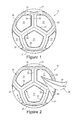
- a sport ball 10 having the general configuration of a soccer ball is depicted in Figures 1-3 .
- Ball 10 exhibits a layered structure having (a) a casing 20 that forms an exterior portion of ball 10, (b) an intermediate structure 30 located within casing 20, and (c) an inflatable bladder 40 that forms an interior portion of ball 10.
- bladder 40 induces ball 10 to take on a substantially spherical shape. More particularly, pressure within bladder 40 causes bladder 40 to place an outward force upon intermediate structure 30. In turn, intermediate structure 30 places an outward force upon casing 20.
- a portion of intermediate structure 30 may have a limited degree of stretch.
- bladder 40 places an outward force upon intermediate structure 30, but the stretch characteristics of intermediate structure 30 effectively prevent the outward force from inducing significant tension in casing 20. Accordingly, intermediate structure 30 restrains pressure from bladder 40, while permitting outward forces to induce a spherical shape in casing 20, thereby imparting a spherical shape to ball 10.
- Casing 20 is formed from various panels 21 that are joined together along abutting side or edge areas to form a plurality of seams 22.
- panels 21 are depicted as having the shapes of twelve equilateral pentagons, panels 21 may have non-equilateral shapes, concave or convex edges, or a variety of other shapes (e.g., triangular, square, rectangular, hexagonal, trapezoidal, round, oval, non-geometrical) that combine in a tessellation-type manner to form casing 20.
- ball 10 may have twelve pentagonal panels 21 and twenty hexagonal panels 21 to impart the general configuration of a traditional soccer ball.
- Selected panels 21 may also be formed of unitary (i.e., one piece) construction with adjacent panels 21 to form bridged panels that reduce the number of seams 22.
- seams 22 may be formed by joining the abutting edge areas of panels 21 with stitching (e.g., hand or machine stitching), seams 22 may also be formed through adhesive bonding or welding.
- stitching e.g., hand or machine stitching
- seams 22 may also be formed through adhesive bonding or welding.
- An example of welded seams is disclosed in U.S. Patent Application Publication 2010/0240479 to Raynak, et al. , which is incorporated herein by reference.
- Casing 20 defines an exterior surface 23 and an opposite interior surface 24. Exterior surface 23 faces outward and forms an exterior surface of ball 10. Interior surface 24 is located opposite exterior surface 23 and faces inward and toward intermediate structure 30. In many configurations of ball 10, interior surface 24 contacts intermediate structure 30.
- a plurality of indentations 25 and 26 are formed in casing 20 and extend toward a central area of casing 20, as depicted in Figures 1-3 . Whereas indentations 25 are formed in exterior surface 23, indentations 26 are formed in interior surface 24. Indentations 25 are generally located opposite indentations 26. Indentations 25 and 26 impart various advantages to ball 10. For example, indentations 25 may have a design or appearance that enhances the aesthetics of ball 10.
- indentations 25 may also form indicia identifying the manufacturer of ball 10 or conveying information as to the features of ball 10. Additionally, indentations 25 may enhance the aerodynamics of ball 10 or provide an individual with greater control over ball 10 during kicking, dribbling, or passing, for example.
- Intermediate structure 30 is positioned between casing 20 and bladder 40 and may be formed to include one or more of a compressible foam layer that provides a softened feel to the sport ball, a rubber layer that imparts energy return, and a restriction layer to restrict expansion of bladder 40.
- the overall structure of intermediate structure 30 may vary significantly.
- the restriction layer may be formed from (a) a thread, yarn, or filament that is repeatedly wound around bladder 40 in various directions to form a mesh that covers substantially all of bladder 40, (b) a plurality of generally flat or planar textile elements stitched together to form a structure that extends around bladder 40, or (c) a plurality of generally flat or planar textile strips that are impregnated with latex and placed in an overlapping configuration around bladder 40.
- intermediate structure 30 may be formed as a substantially seamless and curved (e.g., hemispherical or spherical) textile, as disclosed in U.S. Patent Application Publication 2009/0325746 to Raynak, et al. , which is incorporated herein by reference.
- intermediate structure 30 or portions of intermediate structure 30 may also be bonded, joined, or otherwise incorporated into bladder 40, or intermediate structure 30 may be absent from ball 10. Accordingly, the structure of intermediate structure 30 may vary significantly to include a variety of configurations and materials.
- Bladder 40 has an inflatable configuration and is located within intermediate structure 30 to provide an inner portion of ball 10. When inflated, bladder 40 exhibits a rounded or generally spherical shape. In order to facilitate inflation, bladder 40 may include a valved opening (not depicted) that extends through intermediate structure 30 and casing 20, thereby being accessible from an exterior of ball 10, or bladder 40 may have a valveless structure that is semi3-permanently inflated. Bladder 40 may be formed from a rubber or carbon latex material that substantially prevents air or other fluids within bladder 40 from diffusing to the exterior of ball 10. In addition to rubber and carbon latex, a variety of other elastomeric or otherwise stretchable materials may be utilized for bladder 40. Bladder 40 may also have a structure formed from a plurality of joined panels, as disclosed in U.S. Patent Application Publication 2009/0325745 to Rapaport, et al. , which is incorporated herein by reference.
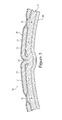
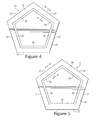
- An individual panel 21 is depicted in Figures 4-6 and has a layered structure that includes a first or outer layer 51, a second or middle layer 52, and a third or inner layer 53.
- Outer layer 51 forms a portion of exterior surface 23
- middle layer 52 is positioned inward and adjacent to outer layer 51
- inner layer 53 is positioned inward and adjacent to middle layer 52.
- middle layer 52 is positioned between layers 51 and 53. That is, layers 51 and 53 effectively form cover layers (i.e., outer and inner layers) located on opposite sides of middle layer 52.
- outer layer 51 may be formed from polymer materials that impart a durable and wear-resistant exterior surface for ball 10.
- suitable polymer materials for panels 21 include polyurethane, polyvinylchloride, polyamide, polyester, polypropylene, and polyolefin.
- outer layer 51 may be formed from a synthetic leather material.
- Middle layer 52 may be formed from a polymer foam material, such as polyurethane or ethylvinylacetate. In some configurations, middle layer 52 may include layers (e.g., three layers) of polymer foam material having different densities.
- inner layer 53 may be formed from a textile material (e.g., a woven or knit textile). More particularly, the textile material of inner layer 53 may formed from polyester, cotton, nylon, rayon, silk, spandex, or a variety of other materials. The textile material may also include multiple materials, such as a polyester and cotton blend. In some configurations, one or more layers 51-53 may incorporate filaments or fibers that reinforce or strengthen casing 20.
- a textile material e.g., a woven or knit textile. More particularly, the textile material of inner layer 53 may formed from polyester, cotton, nylon, rayon, silk, spandex, or a variety of other materials. The textile material may also include multiple materials, such as a polyester and cotton blend. In some configurations, one or more layers 51-53 may incorporate filaments or fibers that reinforce or strengthen casing 20.
- Layers 51 and 53 are generally spaced from each other by middle layer 52. In the areas of indentations 25 and 26, however, layers 51 and 53 bow inward and are bonded or otherwise secured to each other. That is, indentations 25 and 26 are located opposite each other and extend into panel 21 at corresponding locations, where the portions of layers 51 and 53 that respectively form indentations 25 and 25 are secured to each other. Whereas a majority of outer layer 51 is spaced from inner layer 53, layers 51 and 53 extend through middle layer 52 in the areas of indentations 25 and 26 to bond or otherwise be secured to each other. As such, middle layer 52 may part, form an aperture, or otherwise be absent in the areas of indentations 25 and 26. In some configurations, middle layer 52 may compress significantly in the areas of indentations 25 and 26, thereby forming a polymer layer that separates the portions of layers 51 and 53 that form indentations 25 and 26.
- indentations 25 and 26 may vary considerably. As depicted, indentations 25 and 26 extend parallel to a plurality of edges 27 of panel 21. In this configuration, indentations 25 and 26 form a pentagonal shape that is spaced inward from edges 27. In further configurations of panel 21, however, indentations 25 and 26 may be located in other areas or may impart different shapes or arrangements.
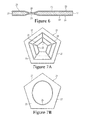
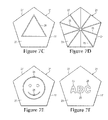
- Figure 7A depicts a configuration wherein indentations 25 form concentric pentagons that are connected by radial portions.
- indentations 25 respectively have circular and triangular configurations, but may also be square, rectangular, hexagonal, or any other regular or non-regular shape.
- indentations 25 exhibit a radial configuration.
- indentations 25 may have a graphic appearance, as in Figure 7E , or may impart information, as in Figure 7F .
- indentations 25 may also form the shape of a company logo or trademark.
- indentations 25 may have a design or appearance that enhances the aesthetics of ball 10, form indicia identifying the manufacturer of ball 10, convey information as to the features of ball 10, enhance the aerodynamics of ball 10, or provide an individual with greater control over ball 10.
- indentations 25 and 26 may also vary considerably. Referring to Figure 6 , indentations 25 and 26 each have a generally rounded configuration that extends to an approximate midpoint of panel 21. In another configuration, as depicted in Figure 8A , indentations 25 may extend through more of the thickness of panel 21 than indentations 26. Referring to Figure 8B , indentations 25 extend through substantially all of the thickness of panel 21. Referring to Figure 8C , indentations 25 and 26 may be spaced from each other such that a portion of middle layer 52 extends between indentations 25 and 26.
- middle layer 52 has (a) a first thickness between indentations 25 and 26 and (b) a second thickness in an area spaced from indentations 25 and 26, the first thickness being less than the second thickness.
- indentations 25 and 26 may also exhibit squared configurations, as depicted in Figure 8D . Accordingly, indentations 25 and 26 may have various configurations.
- panels 21 incorporate indentations 25 and 26, which may have a design or appearance that enhances the aesthetics of ball 10.
- indentations 25 may also form indicia identifying the manufacturer of ball 10 or conveying information as to the features of ball 10. Additionally, indentations 25 may enhance the aerodynamics of ball 10 or provide an individual with greater control over ball 10 during kicking, dribbling, or passing, for example.
- FIG. 9A-9C and 10A-10C A variety of manufacturing processes may be utilized to form indentations 25 and 26 in panels 21.
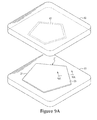
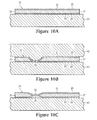
- An example of a manufacturing process is depicted in Figures 9A-9C and 10A-10C .
- one of panels 21 is located on a platen 61.
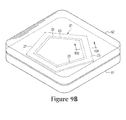
- a press plate 62 is positioned above platen 61 and includes a protrusion 63 having a pentagonal shape (e.g., a shape of indentations 25 and 26). Press plate 62 then translates toward platen 61 and compresses panel 21, as depicted in Figures 9B and 10B . More particularly, protrusion 63 presses into and heats the areas of panel 21 forming indentations 25 and 26.
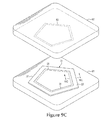
- press plate 62 and protrusion 63 (a) soften a portion of middle layer 52, which may be formed form a polymer foam material and (b) bond outer layer 51 to inner layer 53. As depicted in Figures 9C and 10C , press plate 62 then moves away from panel 21 to substantially complete the formation of indentations 25 and 26.
- the polymer materials within panels 21 transition from a solid state to either a softened state or a liquid state, particularly when a thermoplastic polymer material is utilized. When sufficiently cooled, the polymer materials then transition back from the softened state or the liquid state to the solid state. Based upon these properties, (a) the polymer material of outer layer 51 may soften to form a bond with the textile material of inner layer 53 and (b) the polymer foam material of middle layer 52 may melt, soften, part, collapse, or form an aperture that permits layers 51 and 53 to contact and bond with each other.
- bonding apparatus 62 may emit heat when in contact with panel 21.
- resistive heating elements may be incorporated into pres plate 62 to raise the temperature of panel 21 in the areas of indentations 25 and 26.
- high-frequency (HF) heating, radio frequency (RF) heating, or ultrasonic heating elements may be incorporated into press plate 62 and protrusion 63 to raise the temperature of panel 21 in the areas of indentations 25 and 26.
- protrusion 63 presses into the side of panel 21 that includes outer layer 51.
- press plate 62 compresses outer layer 51 against inner layer 53, which lays against platen 61, indentation 26 forms in inner layer 53.
- outer layer 51 is effectively placed in tension by the pressure from press plate 62.
- the tension in outer layer 51 pulls inner layer 53 toward the center of panel 21.
- protrusion 63 only presses into one side of panel 21, both indentations 25 and 26 are formed due to an equalization of forces in panel 21. Accordingly, both of indentations 25 and 26 may be formed by pressing into only one side of panel 21 with press plate 62.
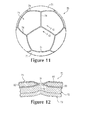
- FIG. 11 and 12 Another sport ball 70 is depicted in Figures 11 and 12 as including a casing 71, an intermediate structure 72, and a bladder 73.
- casing 71 has a layered configuration that includes an outer layer 81, a middle layer 82, and an inner layer 83. Additionally, layers 81 and 83 respectively form indentations 74 and 75 in areas of casing 71.
- casing 20 included various panels 21 that were joined by seams 22
- casing 71 has a substantially uniform or unbroken configuration that does not include panels or includes fewer panels.
- indentations 74 and 75 are located in areas that correspond with the positions of seams 22 in ball 10. That is, indentations 74 and 75 impart the appearance of seams in ball 70.
Landscapes
- Health & Medical Sciences (AREA)
- General Health & Medical Sciences (AREA)
- Physical Education & Sports Medicine (AREA)
- Engineering & Computer Science (AREA)
- Mechanical Engineering (AREA)
- Laminated Bodies (AREA)
- Toys (AREA)
Abstract
Description
- A variety of inflatable sport balls, such as a soccer ball, conventionally exhibit a layered structure that includes a casing, an intermediate structure, and a bladder. The casing forms an exterior portion of the sport ball and is generally formed from a plurality of durable and wear-resistant panels joined together along abutting edge areas (e.g., with stitching or adhesives). Although panel configurations may vary significantly, the casing of a traditional soccer ball includes thirty-two panels, twelve of which have a pentagonal shape and twenty of which have a hexagonal shape.
- The intermediate structure forms a middle portion of the sport ball and is positioned between the casing and the bladder. Among other purposes, the intermediate structure may provide a softened feel to the sport ball, impart energy return, and restrict expansion of the bladder. In some configurations, the intermediate structure or portions of the intermediate structure may be bonded, joined, or otherwise incorporated into the casing as a backing material. In other configurations, the intermediate structure or portions of the intermediate structure may be bonded, joined, or otherwise incorporated into the bladder.
- The bladder, which has an inflatable configuration, is located within the intermediate structure to provide an interior portion of the sport ball. In order to facilitate inflation (i.e., with pressurized air), the bladder generally includes a valved opening that extends through each of the intermediate structure and casing, thereby being accessible from an exterior of the sport ball.
- A sport ball may incorporate a casing that includes a plurality of joined panels. At least one of the panels may have (a) a first layer including a polymer material and positioned to form a portion of an exterior surface of the ball, (b) a second layer including a polymer foam material and positioned inward and adjacent to the first layer, and (c) a third layer including a textile material and positioned inward and adjacent to the second layer. The casing defines at least one indentation in the exterior surface, and the first layer is bonded to the third layer adjacent to the indentation. In some configurations, the casing may also define at least one indentations in a surface of the third layer, which may correspond in location with the indentation in the exterior surface. Additionally, the sport ball may include an intermediate structure and a bladder located within the casing.
- A method of manufacturing a sport ball may include providing a panel having (a) a first layer including a polymer material, (b) a second layer including a polymer foam material and positioned adjacent to the first layer, and (c) a third layer including a textile material and positioned adjacent to the second layer. An area of the panel is compressed and heated to (a) soften a portion of the polymer foam material of the second layer and (b) bond the first layer to the third layer. Additionally, edge areas of the panel are joined to edge areas of additional panels.
- The advantages and features of novelty characterizing aspects of the invention are pointed out with particularity in the appended claims. To gain an improved understanding of the advantages and features of novelty, however, reference may be made to the following descriptive matter and accompanying figures that describe and illustrate various configurations and concepts related to the invention.
- The foregoing Summary and the following Detailed Description will be better understood when read in conjunction with the accompanying figures.
-
Figure 1 is a perspective view of a sport ball. -
Figure 2 is another perspective view of the sport ball. -
Figure 3 is a cross-sectional view of the sport ball, as defined by section line 3 inFigure 2 . -
Figure 4 is a top plan view of a panel of the sport ball. -
Figure 5 is a bottom plan view of the panel. -
Figure 6 is a cross-sectional view of the panel, as defined bysection line 6 inFigures 4 and 5 . -
Figures 7A-7F are top plan views corresponding withFigure 4 and depicting further configurations of the panel. -
Figures 8A-8D are cross-sectional views corresponding withFigure 6 and depicting further configurations of the panel. -
Figures 9A-9C are schematic perspective views of a process for forming the panel. -
Figures 10A-10C are cross-sectional views of the process for forming the panel, as respectively defined bysection lines 10A-10C inFigures 9A-9C . -
Figure 11 is a perspective view of another sport ball. -
Figure 12 is a cross-sectional view, as defined bysection line 12 inFigure 11 . - The following discussion and accompanying figures disclose various sport ball configurations and methods relating to manufacturing of the sport balls. Although the sport ball is discussed and depicted in relation to a soccer ball, concepts associated with the configurations and methods may be applied to various types of inflatable sport balls. In addition to soccer balls, therefore, concepts discussed herein may be incorporated into basketballs, footballs (for either American football or rugby), volleyballs, and water polo balls, for example. A variety of non-inflatable sport balls, such as baseballs and softballs, may also incorporate concepts discussed herein.
- A
sport ball 10 having the general configuration of a soccer ball is depicted inFigures 1-3 .Ball 10 exhibits a layered structure having (a) acasing 20 that forms an exterior portion ofball 10, (b) anintermediate structure 30 located withincasing 20, and (c) aninflatable bladder 40 that forms an interior portion ofball 10. Upon pressurization,bladder 40 inducesball 10 to take on a substantially spherical shape. More particularly, pressure withinbladder 40 causesbladder 40 to place an outward force uponintermediate structure 30. In turn,intermediate structure 30 places an outward force uponcasing 20. In order to limit expansion ofbladder 40 and also limit tension incasing 20, a portion ofintermediate structure 30 may have a limited degree of stretch. In other words,bladder 40 places an outward force uponintermediate structure 30, but the stretch characteristics ofintermediate structure 30 effectively prevent the outward force from inducing significant tension incasing 20. Accordingly,intermediate structure 30 restrains pressure frombladder 40, while permitting outward forces to induce a spherical shape incasing 20, thereby imparting a spherical shape toball 10. -
Casing 20 is formed fromvarious panels 21 that are joined together along abutting side or edge areas to form a plurality ofseams 22. Althoughpanels 21 are depicted as having the shapes of twelve equilateral pentagons,panels 21 may have non-equilateral shapes, concave or convex edges, or a variety of other shapes (e.g., triangular, square, rectangular, hexagonal, trapezoidal, round, oval, non-geometrical) that combine in a tessellation-type manner to formcasing 20. In some configurations,ball 10 may have twelvepentagonal panels 21 and twentyhexagonal panels 21 to impart the general configuration of a traditional soccer ball. Selectedpanels 21 may also be formed of unitary (i.e., one piece) construction withadjacent panels 21 to form bridged panels that reduce the number ofseams 22. Althoughseams 22 may be formed by joining the abutting edge areas ofpanels 21 with stitching (e.g., hand or machine stitching),seams 22 may also be formed through adhesive bonding or welding. An example of welded seams is disclosed inU.S. Patent Application Publication 2010/0240479 to Raynak, et al. , which is incorporated herein by reference. -
Casing 20 defines anexterior surface 23 and anopposite interior surface 24.Exterior surface 23 faces outward and forms an exterior surface ofball 10.Interior surface 24 is located oppositeexterior surface 23 and faces inward and towardintermediate structure 30. In many configurations ofball 10,interior surface 24 contactsintermediate structure 30. A plurality ofindentations casing 20 and extend toward a central area ofcasing 20, as depicted inFigures 1-3 . Whereasindentations 25 are formed inexterior surface 23,indentations 26 are formed ininterior surface 24.Indentations 25 are generally located oppositeindentations 26.Indentations ball 10. For example,indentations 25 may have a design or appearance that enhances the aesthetics ofball 10. In some configurations,indentations 25 may also form indicia identifying the manufacturer ofball 10 or conveying information as to the features ofball 10. Additionally,indentations 25 may enhance the aerodynamics ofball 10 or provide an individual with greater control overball 10 during kicking, dribbling, or passing, for example. -
Intermediate structure 30 is positioned betweencasing 20 andbladder 40 and may be formed to include one or more of a compressible foam layer that provides a softened feel to the sport ball, a rubber layer that imparts energy return, and a restriction layer to restrict expansion ofbladder 40. The overall structure ofintermediate structure 30 may vary significantly. As an example, the restriction layer may be formed from (a) a thread, yarn, or filament that is repeatedly wound aroundbladder 40 in various directions to form a mesh that covers substantially all ofbladder 40, (b) a plurality of generally flat or planar textile elements stitched together to form a structure that extends aroundbladder 40, or (c) a plurality of generally flat or planar textile strips that are impregnated with latex and placed in an overlapping configuration aroundbladder 40. As another example,intermediate structure 30 may be formed as a substantially seamless and curved (e.g., hemispherical or spherical) textile, as disclosed inU.S. Patent Application Publication 2009/0325746 to Raynak, et al. , which is incorporated herein by reference. In some configurations ofball 10,intermediate structure 30 or portions ofintermediate structure 30 may also be bonded, joined, or otherwise incorporated intobladder 40, orintermediate structure 30 may be absent fromball 10. Accordingly, the structure ofintermediate structure 30 may vary significantly to include a variety of configurations and materials. -
Bladder 40 has an inflatable configuration and is located withinintermediate structure 30 to provide an inner portion ofball 10. When inflated,bladder 40 exhibits a rounded or generally spherical shape. In order to facilitate inflation,bladder 40 may include a valved opening (not depicted) that extends throughintermediate structure 30 andcasing 20, thereby being accessible from an exterior ofball 10, orbladder 40 may have a valveless structure that is semi3-permanently inflated.Bladder 40 may be formed from a rubber or carbon latex material that substantially prevents air or other fluids withinbladder 40 from diffusing to the exterior ofball 10. In addition to rubber and carbon latex, a variety of other elastomeric or otherwise stretchable materials may be utilized forbladder 40.Bladder 40 may also have a structure formed from a plurality of joined panels, as disclosed inU.S. Patent Application Publication 2009/0325745 to Rapaport, et al. , which is incorporated herein by reference. - An
individual panel 21 is depicted inFigures 4-6 and has a layered structure that includes a first orouter layer 51, a second ormiddle layer 52, and a third orinner layer 53.Outer layer 51 forms a portion ofexterior surface 23,middle layer 52 is positioned inward and adjacent toouter layer 51, andinner layer 53 is positioned inward and adjacent tomiddle layer 52. In this configuration,middle layer 52 is positioned betweenlayers middle layer 52. - A variety of materials may be utilized for each of layers 51-53, including various polymer materials, polymer foam materials, and textiles. More particularly,
outer layer 51 may be formed from polymer materials that impart a durable and wear-resistant exterior surface forball 10. Examples of suitable polymer materials forpanels 21 include polyurethane, polyvinylchloride, polyamide, polyester, polypropylene, and polyolefin. In some configurations,outer layer 51 may be formed from a synthetic leather material.Middle layer 52 may be formed from a polymer foam material, such as polyurethane or ethylvinylacetate. In some configurations,middle layer 52 may include layers (e.g., three layers) of polymer foam material having different densities. Additionally,inner layer 53 may be formed from a textile material (e.g., a woven or knit textile). More particularly, the textile material ofinner layer 53 may formed from polyester, cotton, nylon, rayon, silk, spandex, or a variety of other materials. The textile material may also include multiple materials, such as a polyester and cotton blend. In some configurations, one or more layers 51-53 may incorporate filaments or fibers that reinforce or strengthencasing 20. -
Layers middle layer 52. In the areas ofindentations indentations panel 21 at corresponding locations, where the portions oflayers indentations outer layer 51 is spaced frominner layer 53, layers 51 and 53 extend throughmiddle layer 52 in the areas ofindentations middle layer 52 may part, form an aperture, or otherwise be absent in the areas ofindentations middle layer 52 may compress significantly in the areas ofindentations layers indentations - The positions of
indentations panel 21 may vary considerably. As depicted,indentations edges 27 ofpanel 21. In this configuration,indentations panel 21, however,indentations Figure 7A depicts a configuration whereinindentations 25 form concentric pentagons that are connected by radial portions. InFigures 7B and7C ,indentations 25 respectively have circular and triangular configurations, but may also be square, rectangular, hexagonal, or any other regular or non-regular shape. Referring toFigure 7D ,indentations 25 exhibit a radial configuration. In some configurations,indentations 25 may have a graphic appearance, as inFigure 7E , or may impart information, as inFigure 7F . Moreover,indentations 25 may also form the shape of a company logo or trademark. As discussed above,indentations 25 may have a design or appearance that enhances the aesthetics ofball 10, form indicia identifying the manufacturer ofball 10, convey information as to the features ofball 10, enhance the aerodynamics ofball 10, or provide an individual with greater control overball 10. These advantages may be incorporated intoball 10 by varying the shapes and arrangements ofindentations - The specific configuration of
indentations Figure 6 ,indentations panel 21. In another configuration, as depicted inFigure 8A ,indentations 25 may extend through more of the thickness ofpanel 21 thanindentations 26. Referring toFigure 8B ,indentations 25 extend through substantially all of the thickness ofpanel 21. Referring toFigure 8C ,indentations middle layer 52 extends betweenindentations middle layer 52 has (a) a first thickness betweenindentations indentations indentations Figure 8D . Accordingly,indentations - Based upon the above discussion,
panels 21 incorporateindentations ball 10. In some configurations,indentations 25 may also form indicia identifying the manufacturer ofball 10 or conveying information as to the features ofball 10. Additionally,indentations 25 may enhance the aerodynamics ofball 10 or provide an individual with greater control overball 10 during kicking, dribbling, or passing, for example. - A variety of manufacturing processes may be utilized to form
indentations panels 21. An example of a manufacturing process is depicted inFigures 9A-9C and10A-10C . Referring toFigures 9A and10A , one ofpanels 21 is located on aplaten 61. Apress plate 62 is positioned aboveplaten 61 and includes aprotrusion 63 having a pentagonal shape (e.g., a shape ofindentations 25 and 26).Press plate 62 then translates towardplaten 61 and compressespanel 21, as depicted inFigures 9B and10B . More particularly,protrusion 63 presses into and heats the areas ofpanel 21 formingindentations press plate 62 and protrusion 63 (a) soften a portion ofmiddle layer 52, which may be formed form a polymer foam material and (b) bondouter layer 51 toinner layer 53. As depicted inFigures 9C and10C ,press plate 62 then moves away frompanel 21 to substantially complete the formation ofindentations - When exposed to sufficient heat, the polymer materials within
panels 21 transition from a solid state to either a softened state or a liquid state, particularly when a thermoplastic polymer material is utilized. When sufficiently cooled, the polymer materials then transition back from the softened state or the liquid state to the solid state. Based upon these properties, (a) the polymer material ofouter layer 51 may soften to form a bond with the textile material ofinner layer 53 and (b) the polymer foam material ofmiddle layer 52 may melt, soften, part, collapse, or form an aperture that permits layers 51 and 53 to contact and bond with each other. - In order to properly heat the materials within
panel 21,bonding apparatus 62 may emit heat when in contact withpanel 21. In some configurations, resistive heating elements may be incorporated intopres plate 62 to raise the temperature ofpanel 21 in the areas ofindentations press plate 62 andprotrusion 63 to raise the temperature ofpanel 21 in the areas ofindentations - As an additional matter, the process disclosed above depicts
protrusion 63 as pressing into one side ofpanel 21. That is,protrusion 63 presses into the side ofpanel 21 that includesouter layer 51. Althoughpress plate 62 compressesouter layer 51 againstinner layer 53, which lays againstplaten 61,indentation 26 forms ininner layer 53. More particularly,outer layer 51 is effectively placed in tension by the pressure frompress plate 62. When the pressure frompress plate 62 is removed, the tension inouter layer 51 pullsinner layer 53 toward the center ofpanel 21. Althoughprotrusion 63 only presses into one side ofpanel 21, bothindentations panel 21. Accordingly, both ofindentations panel 21 withpress plate 62. - Another
sport ball 70 is depicted inFigures 11 and 12 as including acasing 71, anintermediate structure 72, and abladder 73. As withpanels 21 ofcasing 20, casing 71 has a layered configuration that includes anouter layer 81, amiddle layer 82, and aninner layer 83. Additionally, layers 81 and 83 respectively formindentations casing 71. Whereas casing 20 includedvarious panels 21 that were joined byseams 22, casing 71 has a substantially uniform or unbroken configuration that does not include panels or includes fewer panels. In order to impart the appearance of seams similar toseams 22, however,indentations seams 22 inball 10. That is,indentations ball 70. - The invention is disclosed above and in the accompanying figures with reference to a variety of configurations. The purpose served by the disclosure, however, is to provide an example of the various features and concepts related to the invention, not to limit the scope of the invention. One skilled in the relevant art will recognize that numerous variations and modifications may be made to the configurations described above without departing from the scope of the present invention, as defined by the appended claims.
- 1. A sport ball comprising:
- a casing that includes a plurality of joined panels, at least one of the panels having (a) a first layer including a polymer material and positioned to form a portion of an exterior surface of the ball, (b) a second layer including a polymer foam material and positioned inward and adjacent to the first layer, and (c) a third layer including a textile material and positioned inward and adjacent to the second layer, the casing defining at least one indentation in the exterior surface, the first layer being bonded to the third layer adjacent to the indentation; and
- a bladder located within the casing.
- 2. The sport ball recited in
clause 1, wherein the casing defines a second indentation in a surface of the third layer, the first layer being bonded to the third layer adjacent to the second indentation. - 3. The sport ball recited in
clause 1, wherein at least the first layer extends through the second layer in an area where the first layer is bonded to the third layer. - 4. The sport ball recited in
clause 1, wherein the second layer has (a) a first thickness adjacent to the area where the first layer is bonded to the third layer and (b) a second thickness spaced from the area where the first layer is bonded to the third layer, the first thickness being less than the second thickness. - 5. The sport ball recited in
clause 1, wherein at least one of the polymer material of the first layer and the polymer foam material of the second layer includes a thermoplastic polymer material. - 6. The sport ball recited in
clause 1, wherein an intermediate structure is located between the casing and the bladder. - 7. A sport ball comprising:
- a casing including at least one panel defining a plurality of edges, the panel
having a polymer foam layer and a pair of cover layers located on opposite sides of the polymer foam layer, the panel defining opposing indentations in the cover layers, the indentations being spaced inward from the edges, and the cover layers being bonded to each other at the indentations; and - a bladder located within the casing.
- a casing including at least one panel defining a plurality of edges, the panel
- 8. The sport ball recited in clause 7, wherein a first of the cover layers is formed from a polymer material and a second of the cover layers is formed from a textile material.
- 9. The sport ball recited in clause 7, wherein the cover layers extend into the polymer foam layer between the indentations.
- 10. The sport ball recited in clause 7, wherein the polymer foam layer has (a) a first thickness between the indentations and (b) a second thickness in an area spaced from the indentations, the first thickness being less than the second thickness.
- 11. The sport ball recited in clause 7, wherein an intermediate structure is located between the casing and the bladder.
- 12. A sport ball comprising:
- a casing having an exterior surface facing outward from the ball and an opposite interior surface facing inward, the casing including at least one panel with (a) an outer layer that defines an indentation in the exterior surface and (b) an inner layer that defines an indentation in the interior surface, a majority of the outer layer being spaced from the inner layer, and the outer layer being secured to the inner layer at the indentations; and
- a bladder located within the casing.
- 13. The sport ball recited in
clause 12, wherein the indentations are spaced from edges of the panel. - 14. The sport ball recited in
clause 12, wherein the outer layer is formed from a polymer material and the inner layer is a textile material. - 15. The sport ball recited in
clause 12, wherein a polymer foam layer extends between the outer layer and the inner layer. - 16. The sport ball recited in
clause 12, wherein an intermediate structure is located between the casing and the bladder. - 17. A sport ball comprising:
- a casing including at least one panel having a central layer and a pair of cover layers located on opposite sides of the central layer, the panel defining opposing indentations in the cover layers, a majority of the central layer being formed from a polymer foam material with a first thickness, and a portion of the central layer located between the indentations having a second thickness, the first thickness being greater than the second thickness; and
- a bladder located within the casing.
- 18. The sport ball recited in clause 17, wherein a first of the cover layers is formed from a polymer material and a second of the cover layers is formed from a textile material.
- 19. The sport ball recited in clause 17, wherein an intermediate structure is located between the casing and the bladder.
- 20. A method of manufacturing a sport ball, the method comprising:
- providing a panel having (a) a first layer including a polymer material, (b) a second layer including a polymer foam material and positioned adjacent to the first layer, and (c) a third layer including a textile material and positioned adjacent to the second layer;
- compressing and heating an area of the panel to (a) soften a portion of the polymer foam material of the second layer and (b) bond the first layer to the third layer; and
- joining edge areas of the panel to edge areas of additional panels.
- 21. The method recited in
clause 20 further including a step of orienting the first layer to form a portion of an exterior surface of the sport ball. - 22. The method recited in
clause 20, wherein the step of compressing and heating includes utilizing one of high frequency and ultrasonic welding to increase a temperature of the panel.
Claims (6)
- A sport ball comprising:a casing including at least one panel having a central layer and a pair of cover layers located on opposite sides of the central layer, the panel defining opposing indentations in the cover layers, a majority of the central layer being formed from a polymer foam material with a first thickness, and a portion of the central layer located between the indentations having a second thickness, the first thickness being greater than the second thickness; anda bladder located within the casing.
- The sport ball recited in claim 1, wherein a first of the cover layers is formed from a polymer material and a second of the cover layers is formed from a textile material.
- The sport ball recited in claim 1, wherein an intermediate structure is located between the casing and the bladder.
- The sport ball recited in claim 1, wherein the indentations have a square configuration.
- The sport ball recited in claim 1, wherein the pair of cover layers include a first outer cover layer and a second inner cover layer, wherein a majority of the first outer cover layer is spaced from the second inner cover layer by the central layer.
- The sport ball recited in claim 1, wherein the opposing indentations include a first indentation and a second indentation, wherein the first indentation extends through more of a thickness of the first panel than the second indentation.
Applications Claiming Priority (2)
| Application Number | Priority Date | Filing Date | Title |
|---|---|---|---|
| US12/959,886 US8617011B2 (en) | 2010-12-03 | 2010-12-03 | Sport ball with indented casing |
| EP11808021.7A EP2646121B1 (en) | 2010-12-03 | 2011-11-30 | Sport ball with indented casing |
Related Parent Applications (2)
| Application Number | Title | Priority Date | Filing Date |
|---|---|---|---|
| EP11808021.7A Division EP2646121B1 (en) | 2010-12-03 | 2011-11-30 | Sport ball with indented casing |
| EP11808021.7A Division-Into EP2646121B1 (en) | 2010-12-03 | 2011-11-30 | Sport ball with indented casing |
Publications (2)
| Publication Number | Publication Date |
|---|---|
| EP2944359A1 true EP2944359A1 (en) | 2015-11-18 |
| EP2944359B1 EP2944359B1 (en) | 2017-11-08 |
Family
ID=45476593
Family Applications (3)
| Application Number | Title | Priority Date | Filing Date |
|---|---|---|---|
| EP15169574.9A Active EP2944359B1 (en) | 2010-12-03 | 2011-11-30 | Sport ball with indented casing |
| EP16180101.4A Active EP3115087B1 (en) | 2010-12-03 | 2011-11-30 | Sport ball with indented casing |
| EP11808021.7A Active EP2646121B1 (en) | 2010-12-03 | 2011-11-30 | Sport ball with indented casing |
Family Applications After (2)
| Application Number | Title | Priority Date | Filing Date |
|---|---|---|---|
| EP16180101.4A Active EP3115087B1 (en) | 2010-12-03 | 2011-11-30 | Sport ball with indented casing |
| EP11808021.7A Active EP2646121B1 (en) | 2010-12-03 | 2011-11-30 | Sport ball with indented casing |
Country Status (4)
| Country | Link |
|---|---|
| US (3) | US8617011B2 (en) |
| EP (3) | EP2944359B1 (en) |
| CN (2) | CN103328052B (en) |
| WO (1) | WO2012075090A1 (en) |
Families Citing this family (41)
| Publication number | Priority date | Publication date | Assignee | Title |
|---|---|---|---|---|
| US8608599B2 (en) * | 2009-03-20 | 2013-12-17 | Nike, Inc. | Sport ball casing and methods of manufacturing the casing |
| US8974330B2 (en) | 2009-03-20 | 2015-03-10 | Nike, Inc. | Sport ball casing and methods of manufacturing the casing |
| US9370693B2 (en) | 2010-12-03 | 2016-06-21 | Nike, Inc. | Sport ball with indented casing |
| US8617011B2 (en) | 2010-12-03 | 2013-12-31 | Nike, Inc. | Sport ball with indented casing |
| US8602927B2 (en) * | 2010-12-29 | 2013-12-10 | Vertex L.L.C. | Game ball and method of manufacturing same |
| US9084918B2 (en) * | 2012-05-31 | 2015-07-21 | Nike, Inc. | Football with segmented cover panels |
| EP3088054B1 (en) * | 2013-12-27 | 2020-10-07 | Molten Corporation | Ball |
| EP3718611B1 (en) * | 2013-12-30 | 2023-02-22 | NIKE Innovate C.V. | Sport balls having seam reinforcing strips |
| WO2015103071A1 (en) * | 2013-12-31 | 2015-07-09 | Nike Innovate C.V. | Sport ball with indented casing |
| US8991033B1 (en) * | 2014-10-16 | 2015-03-31 | Ali Hasnain Hussain | Methods for producing a soccer ball |
| DE102015204151B4 (en) * | 2015-03-09 | 2025-12-24 | Adidas Ag | Ball, especially football, and method for manufacturing a ball |
| DE102015209795B4 (en) | 2015-05-28 | 2024-03-21 | Adidas Ag | Ball and process for its production |
| US20170120497A1 (en) * | 2015-10-28 | 2017-05-04 | Dingzing Advanced Materials Inc. | Method for producing a thermoplastic polyurethane ball texture |
| EP3162414B1 (en) * | 2015-10-30 | 2020-07-22 | DingZing Advanced Materials Inc. | Method for producing a thermoplastic polyurethane ball texture |
| USD786375S1 (en) * | 2015-12-28 | 2017-05-09 | Nike, Inc. | Ball with surface ornamentation pattern |
| USD786374S1 (en) * | 2015-12-28 | 2017-05-09 | Nike, Inc. | Ball with surface ornamentation pattern |
| US10195492B2 (en) | 2016-04-06 | 2019-02-05 | Under Armour, Inc. | Sports ball |
| DK3485946T3 (en) * | 2016-07-12 | 2022-05-16 | Molten Corp | Ball |
| CN106110600B (en) * | 2016-08-19 | 2020-05-19 | 九江乐胜运动器材有限公司 | Sport ball and manufacturing method thereof |
| US10343026B2 (en) * | 2016-10-24 | 2019-07-09 | Nike, Inc. | Sport ball and casing defining a major channel and a minor channel |
| US10258836B2 (en) | 2017-05-25 | 2019-04-16 | Nike, Inc. | Sports ball with mechanoluminescence |
| US10653923B2 (en) * | 2017-10-24 | 2020-05-19 | Tsung Ming Ou | Channelless basketball and manufacturing method thereof |
| TWI650159B (en) * | 2017-11-27 | 2019-02-11 | 三芳化學工業股份有限公司 | Sphere structure and manufacturing method thereof |
| TWI651117B (en) * | 2017-11-27 | 2019-02-21 | 三芳化學工業股份有限公司 | Sphere structure and manufacturing method thereof |
| US20190308055A1 (en) * | 2018-04-04 | 2019-10-10 | Power Systems (Ps), Llc | Leak-free exercise devices |
| TWI659767B (en) * | 2018-05-03 | 2019-05-21 | 捷欣企業股份有限公司 | Sphere structure and manufacturing method thereof |
| WO2020046557A1 (en) * | 2018-08-31 | 2020-03-05 | Nike Innovate C.V. | Sports ball |
| WO2020046508A1 (en) | 2018-08-31 | 2020-03-05 | Nike Innovate C.V. | Sports ball |
| US11148014B2 (en) | 2019-01-18 | 2021-10-19 | Nike, Inc. | Sports ball |
| USD1001218S1 (en) * | 2019-03-11 | 2023-10-10 | Callaway Golf Company | Golf ball |
| US11660507B2 (en) | 2019-07-03 | 2023-05-30 | Nike, Inc. | Sports ball with wickerbill |
| EP4106890B1 (en) * | 2020-02-21 | 2026-07-15 | NIKE Innovate C.V. | Sports ball with staggered surface features |
| US11833397B2 (en) | 2020-05-26 | 2023-12-05 | Nike, Inc. | Inflatable sports ball with restriction structure |
| USD967310S1 (en) * | 2020-09-29 | 2022-10-18 | Nike, Inc. | Ball |
| USD967311S1 (en) * | 2020-09-29 | 2022-10-18 | Nike, Inc. | Ball |
| USD961705S1 (en) * | 2020-09-29 | 2022-08-23 | Nike, Inc. | Ball |
| USD961027S1 (en) * | 2020-09-29 | 2022-08-16 | Nike, Inc. | Ball |
| USD961706S1 (en) * | 2020-09-29 | 2022-08-23 | Nike, Inc. | Ball |
| US11904213B2 (en) * | 2020-12-11 | 2024-02-20 | Kristafer Wilkes | Basketball and related manufacturing methods |
| DE102021202706A1 (en) | 2021-03-19 | 2022-09-22 | Adidas Ag | inflatable ball |
| USD1028151S1 (en) | 2021-11-30 | 2024-05-21 | Kristafer Wilkes | Basketball |
Citations (6)
| Publication number | Priority date | Publication date | Assignee | Title |
|---|---|---|---|---|
| WO2000048690A2 (en) * | 1999-02-19 | 2000-08-24 | Spalding Sports Worldwide, Inc. | Basketball having a carcass with seam areas |
| EP1884265A1 (en) * | 2006-08-02 | 2008-02-06 | Wilson Sporting Goods Company | Game ball having optimally positioned grooves and/or ridges |
| US20090325745A1 (en) | 2008-06-27 | 2009-12-31 | Nike, Inc. | Sport Ball Bladder |
| US20090325746A1 (en) | 2008-06-27 | 2009-12-31 | Nike, Inc. | Sport Ball With A Textile Restriction Structure |
| US20100167850A1 (en) * | 2008-12-30 | 2010-07-01 | Long Way Enterprise Co., Ltd | Seamless ball structure |
| US20100240479A1 (en) | 2009-03-20 | 2010-09-23 | Nike, Inc. | Sport Ball Casing And Methods Of Manufacturing The Casing |
Family Cites Families (82)
| Publication number | Priority date | Publication date | Assignee | Title |
|---|---|---|---|---|
| US414748A (en) | 1889-11-12 | mkntlkv | ||
| US1517859A (en) | 1922-12-01 | 1924-12-02 | Dennis C O'shea | Ball |
| US1575281A (en) | 1924-06-28 | 1926-03-02 | Rosenberg Armin | Practice golf ball |
| US1923236A (en) * | 1929-04-30 | 1933-08-22 | P Goldsmith Sons Company | Game ball |
| US1967908A (en) | 1930-12-08 | 1934-07-24 | Loy E Sneary | Ball |
| US1917535A (en) | 1931-07-14 | 1933-07-11 | Drapermaynard Company | Inflatable ball |
| US1931429A (en) * | 1932-01-05 | 1933-10-17 | John L Buckner | Football |
| US1932226A (en) | 1932-03-12 | 1933-10-24 | Spalding & Bros Ag | Inflatable ball |
| US2012376A (en) | 1933-01-12 | 1935-08-27 | Caro Martin | Ball for playing games |
| US2018559A (en) | 1933-06-30 | 1935-10-22 | Horner Brothers Woolen Mills | Tennis ball |
| US2073766A (en) | 1934-07-16 | 1937-03-16 | Suzuki Shigetake | Air valve for use in inflated balls |
| US2108559A (en) | 1935-02-05 | 1938-02-15 | Sperry Prod Inc | Rail flaw detector mechanism |
| US2080894A (en) | 1936-11-04 | 1937-05-18 | Levinson David | Inflatable ball |
| US2126220A (en) | 1937-01-27 | 1938-08-09 | Rawlings Mfg Co | Method of making an inflatable ball equipped with an outer cover |
| US2325073A (en) | 1937-03-02 | 1943-07-27 | Milton B Reach | Method of making athletic game balls |
| US2280314A (en) * | 1938-02-12 | 1942-04-21 | Rawlings Mfg Co | Method of making inflatable balls |
| US2245115A (en) * | 1938-04-23 | 1941-06-10 | Milton B Reach | Play or game ball |
| US2300441A (en) | 1940-12-03 | 1942-11-03 | Voit | Method of making athletic balls |
| US2344638A (en) | 1941-05-13 | 1944-03-21 | Sport Products Inc | Manufacture of inflatable game balls |
| US2843383A (en) * | 1955-01-11 | 1958-07-15 | Spalding A G & Bros Inc | Playball |
| US2945693A (en) | 1957-06-03 | 1960-07-19 | Voit Rubber Corp | Reinforced ball |
| US3119618A (en) * | 1959-05-27 | 1964-01-28 | Spalding A G & Bros Inc | Inflated game ball |
| US3256019A (en) * | 1962-12-11 | 1966-06-14 | Voit Rubber Corp | Ball with cushioning means between cover and core |
| US3512777A (en) | 1964-09-11 | 1970-05-19 | Voit Rubber Corp | Game ball |
| FR2352649A1 (en) | 1976-05-25 | 1977-12-23 | Delacoste & Cie | PLASTIC BALL AND ROTATION MOLDING MANUFACTURING PROCESS |
| US4318544A (en) * | 1980-10-30 | 1982-03-09 | W. H. Brine Company | Game ball |
| US4436276A (en) | 1982-01-22 | 1984-03-13 | Voplex Corporation | Pin support and mold for foaming and curing resin exterior over ball core |
| US4462590A (en) * | 1982-10-22 | 1984-07-31 | Figgie International Inc. | Inflatable padded game ball |
| US4610071A (en) | 1982-11-15 | 1986-09-09 | Miller Richard E | Method of forming foam filled baseball or softball |
| FR2572674A1 (en) | 1985-04-26 | 1986-05-09 | Tassin Charles | Process for manufacturing hollow bodies by low-pressure injection around a prefabricated bladder |
| FR2643823B1 (en) | 1989-03-03 | 1992-05-15 | Adidas Chaussures | SPORTS OR LEISURE BALLS, COMPRISING AN OUTER LAYER OF FULL SKIN FOAM AND THEIR PROCESS |
| USD322105S (en) | 1989-07-06 | 1991-12-03 | Tonka Corporation | Ball |
| US5123659A (en) | 1991-03-01 | 1992-06-23 | Wilson Sporting Goods Co. | Game ball |
| US5250070A (en) | 1991-05-28 | 1993-10-05 | Parodi Juan C | Less traumatic angioplasty balloon for arterial dilatation |
| US5603497A (en) | 1992-10-12 | 1997-02-18 | Louez; Nigel R. | Three piece ball template |
| GB9223919D0 (en) | 1992-11-14 | 1993-01-06 | Umbro Int Ltd | Inflatable sports ball |
| US5427372A (en) | 1993-07-01 | 1995-06-27 | Kransco | Applying patches and impressing patterns on ball |
| US5494625A (en) | 1994-08-23 | 1996-02-27 | Hu; Liang F. | Embossed, inflatable ball making method |
| US20020086749A1 (en) * | 2001-01-02 | 2002-07-04 | Ou Tsung Ming | Sportsball and manufacturing method thereof |
| US6012997A (en) | 1997-03-19 | 2000-01-11 | Mason; David W. | Compound safety ball |
| US6261400B1 (en) | 1997-04-09 | 2001-07-17 | Spalding Sports Worldwide, Inc. | Method of manufacturing multi-layer game ball |
| JPH10337341A (en) | 1997-06-09 | 1998-12-22 | Matsuya Sogo Kenkyusho:Kk | Ball ball |
| DE19758546C2 (en) | 1997-07-30 | 2003-11-27 | Adidas Int Marketing Bv | Soccer |
| CN1241144A (en) * | 1997-09-22 | 2000-01-12 | 株式会社宝登 | Ball for ball game |
| US5888157A (en) | 1997-10-03 | 1999-03-30 | Wilson Sporting Goods Co. | Football |
| US5931752A (en) * | 1998-01-15 | 1999-08-03 | Wilson Sporting Goods Co. | Inflatable game ball with laid-in channel or logo |
| US6283881B1 (en) * | 1998-02-06 | 2001-09-04 | Spalding Sports Worldwide, Inc. | Game ball |
| TW407060B (en) | 1998-05-22 | 2000-10-01 | Molten Corp | Ball for ball game |
| US6142897A (en) | 1998-09-25 | 2000-11-07 | Hoopmaster, Inc. | Smooth basketball |
| US6099423A (en) * | 1999-02-11 | 2000-08-08 | Top Ball Trading Co., Ltd. | Basketball |
| US6206795B1 (en) * | 1999-07-28 | 2001-03-27 | Tsung Ming Ou | Basketball with cushion layers |
| US6726582B1 (en) | 2000-01-11 | 2004-04-27 | Classic Sport Companies, Inc. | Sport ball having improved surface and method for manufacture thereof |
| US6971965B1 (en) | 2000-05-01 | 2005-12-06 | Molten Corporation | Ball for ball game and method for manufacturing the same |
| US7005025B2 (en) | 2000-06-30 | 2006-02-28 | Tbdc, Llc | Welded item |
| US6506135B2 (en) * | 2001-01-22 | 2003-01-14 | Top Ball Trading Co. | Inflatable sportsball with cushion layer |
| US6629902B2 (en) | 2001-09-04 | 2003-10-07 | Wilson Sporting Goods Co. | Game ball lacing |
| US20030064839A1 (en) | 2001-10-03 | 2003-04-03 | Wilson Sporting Goods, Inc. | Game ball having a thin cover and method of making same |
| US7300369B2 (en) | 2001-10-03 | 2007-11-27 | Wilson Sporting Goods Co. | Game ball having a thin cover and method of making same |
| US6645099B2 (en) | 2002-03-14 | 2003-11-11 | Wilson Sporting Goods Co. | Moisture-absorbing rubber-covered game ball |
| EP1365182A1 (en) | 2002-05-21 | 2003-11-26 | Keld Saxenfelt | An inflatable, flexible device |
| US20030228946A1 (en) * | 2002-06-11 | 2003-12-11 | Chan Chong Veng | Sports balls |
| DE10255092B4 (en) | 2002-11-26 | 2010-11-11 | Molten Corp. | Method for producing parts of a ball |
| US7029407B2 (en) | 2002-12-20 | 2006-04-18 | Wilson Sporting Goods Co. | Game ball cover with improved stripes and/or logos |
| US6726583B1 (en) * | 2003-02-13 | 2004-04-27 | Ye Gin Enterprise, Co., Ltd. | Game ball |
| US7699726B2 (en) * | 2003-04-23 | 2010-04-20 | Nike, Inc. | Game ball incorporating a polymer foam |
| US20040229722A1 (en) | 2003-05-14 | 2004-11-18 | Yuan-Jung Liu | Method for making a ball and the product thereof |
| US20050081982A1 (en) | 2003-10-16 | 2005-04-21 | Szu-Jen Chen | Method for making a ball |
| CN1739826B (en) * | 2004-08-25 | 2014-11-19 | 唐雅芳 | Method for manufacturing leather ball piece |
| US20060046879A1 (en) * | 2004-08-30 | 2006-03-02 | Russell Asset Management, Inc. | Sports ball with unitary stripe member |
| DE102004045176B4 (en) | 2004-09-17 | 2011-07-21 | Adidas International Marketing B.V. | bladder |
| US7066853B2 (en) | 2004-09-30 | 2006-06-27 | Yen-Li Chang | Method for manufacturing an inflatable ball and a ball made with the method |
| EP1709998B1 (en) | 2005-04-08 | 2011-07-13 | Goedoen Holding FZC | Sports ball with a woven fabric and method for manufacturing such a sports ball |
| US20060293132A1 (en) | 2005-06-24 | 2006-12-28 | Russell Asset Management, Inc. | Football |
| US20070049434A1 (en) | 2005-08-29 | 2007-03-01 | Russell Asset Management, Inc. | Game ball |
| US8251846B2 (en) * | 2006-08-02 | 2012-08-28 | Wilson Sporting Goods Co. | Game ball having optimally positioned grooves |
| US8974330B2 (en) | 2009-03-20 | 2015-03-10 | Nike, Inc. | Sport ball casing and methods of manufacturing the casing |
| DE102009022252B4 (en) * | 2009-05-20 | 2014-12-18 | Puma SE | Method of making a ball and ball |
| NL1037376C2 (en) * | 2009-10-07 | 2011-04-11 | Robert Bosch Verpakkingsmachines B V | DEVICE FOR ULTRASONIC WELDING OF AT LEAST TWO PLASTIC FOLILE LAYERS. |
| US8617011B2 (en) | 2010-12-03 | 2013-12-31 | Nike, Inc. | Sport ball with indented casing |
| US8602927B2 (en) * | 2010-12-29 | 2013-12-10 | Vertex L.L.C. | Game ball and method of manufacturing same |
| JP5689339B2 (en) * | 2011-03-09 | 2015-03-25 | 株式会社ミカサ | Exercise ball |
| CN104168964B (en) | 2012-03-30 | 2017-11-14 | 耐克创新有限合伙公司 | Sports ball housing and method of making the housing |
-
2010
- 2010-12-03 US US12/959,886 patent/US8617011B2/en active Active
-
2011
- 2011-11-30 EP EP15169574.9A patent/EP2944359B1/en active Active
- 2011-11-30 CN CN201180057846.3A patent/CN103328052B/en active Active
- 2011-11-30 CN CN201510811609.1A patent/CN105413127B/en active Active
- 2011-11-30 WO PCT/US2011/062553 patent/WO2012075090A1/en not_active Ceased
- 2011-11-30 EP EP16180101.4A patent/EP3115087B1/en active Active
- 2011-11-30 EP EP11808021.7A patent/EP2646121B1/en active Active
-
2013
- 2013-06-19 US US13/921,510 patent/US9468815B2/en active Active
- 2013-11-25 US US14/088,850 patent/US9254424B2/en active Active
Patent Citations (6)
| Publication number | Priority date | Publication date | Assignee | Title |
|---|---|---|---|---|
| WO2000048690A2 (en) * | 1999-02-19 | 2000-08-24 | Spalding Sports Worldwide, Inc. | Basketball having a carcass with seam areas |
| EP1884265A1 (en) * | 2006-08-02 | 2008-02-06 | Wilson Sporting Goods Company | Game ball having optimally positioned grooves and/or ridges |
| US20090325745A1 (en) | 2008-06-27 | 2009-12-31 | Nike, Inc. | Sport Ball Bladder |
| US20090325746A1 (en) | 2008-06-27 | 2009-12-31 | Nike, Inc. | Sport Ball With A Textile Restriction Structure |
| US20100167850A1 (en) * | 2008-12-30 | 2010-07-01 | Long Way Enterprise Co., Ltd | Seamless ball structure |
| US20100240479A1 (en) | 2009-03-20 | 2010-09-23 | Nike, Inc. | Sport Ball Casing And Methods Of Manufacturing The Casing |
Also Published As
| Publication number | Publication date |
|---|---|
| US8617011B2 (en) | 2013-12-31 |
| CN105413127A (en) | 2016-03-23 |
| US20140000786A1 (en) | 2014-01-02 |
| CN105413127B (en) | 2018-12-04 |
| EP2944359B1 (en) | 2017-11-08 |
| CN103328052A (en) | 2013-09-25 |
| US9254424B2 (en) | 2016-02-09 |
| US9468815B2 (en) | 2016-10-18 |
| EP3115087A1 (en) | 2017-01-11 |
| US20140155203A1 (en) | 2014-06-05 |
| US20120142465A1 (en) | 2012-06-07 |
| CN103328052B (en) | 2015-12-16 |
| WO2012075090A1 (en) | 2012-06-07 |
| EP2646121B1 (en) | 2016-08-03 |
| EP2646121A1 (en) | 2013-10-09 |
| EP3115087B1 (en) | 2018-12-26 |
Similar Documents
| Publication | Publication Date | Title |
|---|---|---|
| EP2646121B1 (en) | Sport ball with indented casing | |
| US10398944B2 (en) | Sport ball with indented casing | |
| US11202941B2 (en) | Sport ball and casing defining a major channel and a minor channel | |
| EP3513842B1 (en) | Sport ball casing and methods of manufacturing the casing | |
| US9457525B2 (en) | Sport ball casing and methods of manufacturing the casing | |
| US8852039B2 (en) | Sport ball casing with integrated bladder material | |
| EP3112003A1 (en) | Sport ball casing with integrated bladder material | |
| WO2013148946A1 (en) | Sport ball casing and methods of manufacturing the casing | |
| US11833397B2 (en) | Inflatable sports ball with restriction structure | |
| EP3089795B1 (en) | Sport ball with indented casing |
Legal Events
| Date | Code | Title | Description |
|---|---|---|---|
| PUAI | Public reference made under article 153(3) epc to a published international application that has entered the european phase |
Free format text: ORIGINAL CODE: 0009012 |
|
| AC | Divisional application: reference to earlier application |
Ref document number: 2646121 Country of ref document: EP Kind code of ref document: P |
|
| AK | Designated contracting states |
Kind code of ref document: A1 Designated state(s): AL AT BE BG CH CY CZ DE DK EE ES FI FR GB GR HR HU IE IS IT LI LT LU LV MC MK MT NL NO PL PT RO RS SE SI SK SM TR |
|
| 17P | Request for examination filed |
Effective date: 20160518 |
|
| RBV | Designated contracting states (corrected) |
Designated state(s): AL AT BE BG CH CY CZ DE DK EE ES FI FR GB GR HR HU IE IS IT LI LT LU LV MC MK MT NL NO PL PT RO RS SE SI SK SM TR |
|
| GRAP | Despatch of communication of intention to grant a patent |
Free format text: ORIGINAL CODE: EPIDOSNIGR1 |
|
| STAA | Information on the status of an ep patent application or granted ep patent |
Free format text: STATUS: GRANT OF PATENT IS INTENDED |
|
| RIC1 | Information provided on ipc code assigned before grant |
Ipc: A63B 45/00 20060101ALI20170530BHEP Ipc: A63B 41/10 20060101ALI20170530BHEP Ipc: B65B 51/22 20060101ALI20170530BHEP Ipc: B29C 65/08 20060101ALI20170530BHEP Ipc: A63B 41/08 20060101AFI20170530BHEP |
|
| INTG | Intention to grant announced |
Effective date: 20170623 |
|
| GRAS | Grant fee paid |
Free format text: ORIGINAL CODE: EPIDOSNIGR3 |
|
| GRAA | (expected) grant |
Free format text: ORIGINAL CODE: 0009210 |
|
| STAA | Information on the status of an ep patent application or granted ep patent |
Free format text: STATUS: THE PATENT HAS BEEN GRANTED |
|
| AC | Divisional application: reference to earlier application |
Ref document number: 2646121 Country of ref document: EP Kind code of ref document: P |
|
| AK | Designated contracting states |
Kind code of ref document: B1 Designated state(s): AL AT BE BG CH CY CZ DE DK EE ES FI FR GB GR HR HU IE IS IT LI LT LU LV MC MK MT NL NO PL PT RO RS SE SI SK SM TR |
|
| REG | Reference to a national code |
Ref country code: GB Ref legal event code: FG4D |
|
| REG | Reference to a national code |
Ref country code: FR Ref legal event code: PLFP Year of fee payment: 7 |
|
| REG | Reference to a national code |
Ref country code: CH Ref legal event code: EP Ref country code: AT Ref legal event code: REF Ref document number: 943597 Country of ref document: AT Kind code of ref document: T Effective date: 20171115 |
|
| REG | Reference to a national code |
Ref country code: IE Ref legal event code: FG4D |
|
| REG | Reference to a national code |
Ref country code: DE Ref legal event code: R096 Ref document number: 602011043282 Country of ref document: DE |
|
| REG | Reference to a national code |
Ref country code: NL Ref legal event code: MP Effective date: 20171108 |
|
| REG | Reference to a national code |
Ref country code: LT Ref legal event code: MG4D |
|
| REG | Reference to a national code |
Ref country code: AT Ref legal event code: MK05 Ref document number: 943597 Country of ref document: AT Kind code of ref document: T Effective date: 20171108 |
|
| PG25 | Lapsed in a contracting state [announced via postgrant information from national office to epo] |
Ref country code: SE Free format text: LAPSE BECAUSE OF FAILURE TO SUBMIT A TRANSLATION OF THE DESCRIPTION OR TO PAY THE FEE WITHIN THE PRESCRIBED TIME-LIMIT Effective date: 20171108 Ref country code: LT Free format text: LAPSE BECAUSE OF FAILURE TO SUBMIT A TRANSLATION OF THE DESCRIPTION OR TO PAY THE FEE WITHIN THE PRESCRIBED TIME-LIMIT Effective date: 20171108 Ref country code: ES Free format text: LAPSE BECAUSE OF FAILURE TO SUBMIT A TRANSLATION OF THE DESCRIPTION OR TO PAY THE FEE WITHIN THE PRESCRIBED TIME-LIMIT Effective date: 20171108 Ref country code: NL Free format text: LAPSE BECAUSE OF FAILURE TO SUBMIT A TRANSLATION OF THE DESCRIPTION OR TO PAY THE FEE WITHIN THE PRESCRIBED TIME-LIMIT Effective date: 20171108 Ref country code: FI Free format text: LAPSE BECAUSE OF FAILURE TO SUBMIT A TRANSLATION OF THE DESCRIPTION OR TO PAY THE FEE WITHIN THE PRESCRIBED TIME-LIMIT Effective date: 20171108 Ref country code: NO Free format text: LAPSE BECAUSE OF FAILURE TO SUBMIT A TRANSLATION OF THE DESCRIPTION OR TO PAY THE FEE WITHIN THE PRESCRIBED TIME-LIMIT Effective date: 20180208 |
|
| PG25 | Lapsed in a contracting state [announced via postgrant information from national office to epo] |
Ref country code: IS Free format text: LAPSE BECAUSE OF FAILURE TO SUBMIT A TRANSLATION OF THE DESCRIPTION OR TO PAY THE FEE WITHIN THE PRESCRIBED TIME-LIMIT Effective date: 20180308 Ref country code: GR Free format text: LAPSE BECAUSE OF FAILURE TO SUBMIT A TRANSLATION OF THE DESCRIPTION OR TO PAY THE FEE WITHIN THE PRESCRIBED TIME-LIMIT Effective date: 20180209 Ref country code: AT Free format text: LAPSE BECAUSE OF FAILURE TO SUBMIT A TRANSLATION OF THE DESCRIPTION OR TO PAY THE FEE WITHIN THE PRESCRIBED TIME-LIMIT Effective date: 20171108 Ref country code: BG Free format text: LAPSE BECAUSE OF FAILURE TO SUBMIT A TRANSLATION OF THE DESCRIPTION OR TO PAY THE FEE WITHIN THE PRESCRIBED TIME-LIMIT Effective date: 20180208 Ref country code: HR Free format text: LAPSE BECAUSE OF FAILURE TO SUBMIT A TRANSLATION OF THE DESCRIPTION OR TO PAY THE FEE WITHIN THE PRESCRIBED TIME-LIMIT Effective date: 20171108 Ref country code: LV Free format text: LAPSE BECAUSE OF FAILURE TO SUBMIT A TRANSLATION OF THE DESCRIPTION OR TO PAY THE FEE WITHIN THE PRESCRIBED TIME-LIMIT Effective date: 20171108 Ref country code: RS Free format text: LAPSE BECAUSE OF FAILURE TO SUBMIT A TRANSLATION OF THE DESCRIPTION OR TO PAY THE FEE WITHIN THE PRESCRIBED TIME-LIMIT Effective date: 20171108 |
|
| PG25 | Lapsed in a contracting state [announced via postgrant information from national office to epo] |
Ref country code: EE Free format text: LAPSE BECAUSE OF FAILURE TO SUBMIT A TRANSLATION OF THE DESCRIPTION OR TO PAY THE FEE WITHIN THE PRESCRIBED TIME-LIMIT Effective date: 20171108 Ref country code: CY Free format text: LAPSE BECAUSE OF FAILURE TO SUBMIT A TRANSLATION OF THE DESCRIPTION OR TO PAY THE FEE WITHIN THE PRESCRIBED TIME-LIMIT Effective date: 20171108 Ref country code: SK Free format text: LAPSE BECAUSE OF FAILURE TO SUBMIT A TRANSLATION OF THE DESCRIPTION OR TO PAY THE FEE WITHIN THE PRESCRIBED TIME-LIMIT Effective date: 20171108 Ref country code: LI Free format text: LAPSE BECAUSE OF NON-PAYMENT OF DUE FEES Effective date: 20171130 Ref country code: DK Free format text: LAPSE BECAUSE OF FAILURE TO SUBMIT A TRANSLATION OF THE DESCRIPTION OR TO PAY THE FEE WITHIN THE PRESCRIBED TIME-LIMIT Effective date: 20171108 Ref country code: CH Free format text: LAPSE BECAUSE OF NON-PAYMENT OF DUE FEES Effective date: 20171130 Ref country code: CZ Free format text: LAPSE BECAUSE OF FAILURE TO SUBMIT A TRANSLATION OF THE DESCRIPTION OR TO PAY THE FEE WITHIN THE PRESCRIBED TIME-LIMIT Effective date: 20171108 |
|
| REG | Reference to a national code |
Ref country code: DE Ref legal event code: R097 Ref document number: 602011043282 Country of ref document: DE |
|
| PG25 | Lapsed in a contracting state [announced via postgrant information from national office to epo] |
Ref country code: PL Free format text: LAPSE BECAUSE OF FAILURE TO SUBMIT A TRANSLATION OF THE DESCRIPTION OR TO PAY THE FEE WITHIN THE PRESCRIBED TIME-LIMIT Effective date: 20171108 Ref country code: SM Free format text: LAPSE BECAUSE OF FAILURE TO SUBMIT A TRANSLATION OF THE DESCRIPTION OR TO PAY THE FEE WITHIN THE PRESCRIBED TIME-LIMIT Effective date: 20171108 Ref country code: IT Free format text: LAPSE BECAUSE OF FAILURE TO SUBMIT A TRANSLATION OF THE DESCRIPTION OR TO PAY THE FEE WITHIN THE PRESCRIBED TIME-LIMIT Effective date: 20171108 Ref country code: RO Free format text: LAPSE BECAUSE OF FAILURE TO SUBMIT A TRANSLATION OF THE DESCRIPTION OR TO PAY THE FEE WITHIN THE PRESCRIBED TIME-LIMIT Effective date: 20171108 Ref country code: LU Free format text: LAPSE BECAUSE OF NON-PAYMENT OF DUE FEES Effective date: 20171130 |
|
| REG | Reference to a national code |
Ref country code: BE Ref legal event code: MM Effective date: 20171130 |
|
| REG | Reference to a national code |
Ref country code: IE Ref legal event code: MM4A |
|
| PLBE | No opposition filed within time limit |
Free format text: ORIGINAL CODE: 0009261 |
|
| STAA | Information on the status of an ep patent application or granted ep patent |
Free format text: STATUS: NO OPPOSITION FILED WITHIN TIME LIMIT |
|
| PG25 | Lapsed in a contracting state [announced via postgrant information from national office to epo] |
Ref country code: MT Free format text: LAPSE BECAUSE OF NON-PAYMENT OF DUE FEES Effective date: 20171130 |
|
| REG | Reference to a national code |
Ref country code: FR Ref legal event code: PLFP Year of fee payment: 8 |
|
| 26N | No opposition filed |
Effective date: 20180809 |
|
| PG25 | Lapsed in a contracting state [announced via postgrant information from national office to epo] |
Ref country code: IE Free format text: LAPSE BECAUSE OF NON-PAYMENT OF DUE FEES Effective date: 20171130 |
|
| PG25 | Lapsed in a contracting state [announced via postgrant information from national office to epo] |
Ref country code: BE Free format text: LAPSE BECAUSE OF NON-PAYMENT OF DUE FEES Effective date: 20171130 Ref country code: SI Free format text: LAPSE BECAUSE OF FAILURE TO SUBMIT A TRANSLATION OF THE DESCRIPTION OR TO PAY THE FEE WITHIN THE PRESCRIBED TIME-LIMIT Effective date: 20171108 |
|
| PG25 | Lapsed in a contracting state [announced via postgrant information from national office to epo] |
Ref country code: MC Free format text: LAPSE BECAUSE OF FAILURE TO SUBMIT A TRANSLATION OF THE DESCRIPTION OR TO PAY THE FEE WITHIN THE PRESCRIBED TIME-LIMIT Effective date: 20171108 Ref country code: HU Free format text: LAPSE BECAUSE OF FAILURE TO SUBMIT A TRANSLATION OF THE DESCRIPTION OR TO PAY THE FEE WITHIN THE PRESCRIBED TIME-LIMIT; INVALID AB INITIO Effective date: 20111130 |
|
| REG | Reference to a national code |
Ref country code: DE Ref legal event code: R082 Ref document number: 602011043282 Country of ref document: DE Representative=s name: MUELLER-BORE & PARTNER PATENTANWAELTE PARTG MB, DE |
|
| PG25 | Lapsed in a contracting state [announced via postgrant information from national office to epo] |
Ref country code: MK Free format text: LAPSE BECAUSE OF FAILURE TO SUBMIT A TRANSLATION OF THE DESCRIPTION OR TO PAY THE FEE WITHIN THE PRESCRIBED TIME-LIMIT Effective date: 20171108 |
|
| PG25 | Lapsed in a contracting state [announced via postgrant information from national office to epo] |
Ref country code: TR Free format text: LAPSE BECAUSE OF FAILURE TO SUBMIT A TRANSLATION OF THE DESCRIPTION OR TO PAY THE FEE WITHIN THE PRESCRIBED TIME-LIMIT Effective date: 20171108 |
|
| PG25 | Lapsed in a contracting state [announced via postgrant information from national office to epo] |
Ref country code: PT Free format text: LAPSE BECAUSE OF FAILURE TO SUBMIT A TRANSLATION OF THE DESCRIPTION OR TO PAY THE FEE WITHIN THE PRESCRIBED TIME-LIMIT Effective date: 20171108 |
|
| PG25 | Lapsed in a contracting state [announced via postgrant information from national office to epo] |
Ref country code: AL Free format text: LAPSE BECAUSE OF FAILURE TO SUBMIT A TRANSLATION OF THE DESCRIPTION OR TO PAY THE FEE WITHIN THE PRESCRIBED TIME-LIMIT Effective date: 20171108 |
|
| P01 | Opt-out of the competence of the unified patent court (upc) registered |
Effective date: 20230515 |
|
| PGFP | Annual fee paid to national office [announced via postgrant information from national office to epo] |
Ref country code: DE Payment date: 20241001 Year of fee payment: 14 |
|
| PGFP | Annual fee paid to national office [announced via postgrant information from national office to epo] |
Ref country code: GB Payment date: 20241001 Year of fee payment: 14 |
|
| PGFP | Annual fee paid to national office [announced via postgrant information from national office to epo] |
Ref country code: FR Payment date: 20241001 Year of fee payment: 14 |
|
| REG | Reference to a national code |
Ref country code: DE Ref legal event code: R119 Ref document number: 602011043282 Country of ref document: DE |