EP2943500B1 - Crystalline 3-o-fucosyllactose - Google Patents
Crystalline 3-o-fucosyllactose Download PDFInfo
- Publication number
- EP2943500B1 EP2943500B1 EP13854558.7A EP13854558A EP2943500B1 EP 2943500 B1 EP2943500 B1 EP 2943500B1 EP 13854558 A EP13854558 A EP 13854558A EP 2943500 B1 EP2943500 B1 EP 2943500B1
- Authority
- EP
- European Patent Office
- Prior art keywords
- crystalline
- fucosyllactose
- fucosyllactose according
- mbar
- nutritional formulation
- Prior art date
- Legal status (The legal status is an assumption and is not a legal conclusion. Google has not performed a legal analysis and makes no representation as to the accuracy of the status listed.)
- Active
Links
Images


Classifications
-
- C—CHEMISTRY; METALLURGY
- C07—ORGANIC CHEMISTRY
- C07H—SUGARS; DERIVATIVES THEREOF; NUCLEOSIDES; NUCLEOTIDES; NUCLEIC ACIDS
- C07H3/00—Compounds containing only hydrogen atoms and saccharide radicals having only carbon, hydrogen, and oxygen atoms
- C07H3/06—Oligosaccharides, i.e. having three to five saccharide radicals attached to each other by glycosidic linkages
-
- A—HUMAN NECESSITIES
- A23—FOODS OR FOODSTUFFS; TREATMENT THEREOF, NOT COVERED BY OTHER CLASSES
- A23L—FOODS, FOODSTUFFS OR NON-ALCOHOLIC BEVERAGES, NOT OTHERWISE PROVIDED FOR; PREPARATION OR TREATMENT THEREOF
- A23L33/00—Modifying nutritive qualities of foods; Dietetic products; Preparation or treatment thereof
- A23L33/10—Modifying nutritive qualities of foods; Dietetic products; Preparation or treatment thereof using additives
-
- A—HUMAN NECESSITIES
- A23—FOODS OR FOODSTUFFS; TREATMENT THEREOF, NOT COVERED BY OTHER CLASSES
- A23L—FOODS, FOODSTUFFS OR NON-ALCOHOLIC BEVERAGES, NOT OTHERWISE PROVIDED FOR; PREPARATION OR TREATMENT THEREOF
- A23L33/00—Modifying nutritive qualities of foods; Dietetic products; Preparation or treatment thereof
- A23L33/40—Complete food formulations for specific consumer groups or specific purposes, e.g. infant formula
-
- C—CHEMISTRY; METALLURGY
- C07—ORGANIC CHEMISTRY
- C07H—SUGARS; DERIVATIVES THEREOF; NUCLEOSIDES; NUCLEOTIDES; NUCLEIC ACIDS
- C07H1/00—Processes for the preparation of sugar derivatives
- C07H1/06—Separation; Purification
-
- A—HUMAN NECESSITIES
- A23—FOODS OR FOODSTUFFS; TREATMENT THEREOF, NOT COVERED BY OTHER CLASSES
- A23V—INDEXING SCHEME RELATING TO FOODS, FOODSTUFFS OR NON-ALCOHOLIC BEVERAGES AND LACTIC OR PROPIONIC ACID BACTERIA USED IN FOODSTUFFS OR FOOD PREPARATION
- A23V2002/00—Food compositions, function of food ingredients or processes for food or foodstuffs
Definitions
- the present invention provides the trisaccharide 3- O -fucosyllactose (3-FL) in crystalline form, a method of making it and formulations containing it.
- 3-FL has been reported including its prebiotic, antibacterial, antiviral, immune system-enhancing and brain development-enhancing activities. These activities of 3-FL have made it a potentially attractive additive for nutritional and therapeutic products. However, it has been difficult to obtain 3-FL in pure form except at very high cost.
- 3-FL has been isolated from human milk by very costly and complicated chromatographic procedures. 3-FL synthesized by enzymatic, biotechnological and chemical processes ( Dumon et al. Biotechnol. Prog. 20, 412 [2004 ], Fernandez- Mayoralas et al. Carbohydrate Res. 154, 93 [1986 ], and Pereira et al. Heterocycles 84, 637 [2012 ]) has been isolated as an amorphous material and thus it has been very costly to purify. This has made previous methods of making 3-FL too costly for commercialization.
- Crystallization or recrystallization is one of the simplest and cheapest methods to separate a chemical product from contaminants and obtain it in pure form.
- crystalline modifications (polymorphs) of a solid compound is an important factor in its product development, because different crystalline forms affect the compound's properties - for example its thermodynamic stability, solubility, density, hygroscopicity, electrical properties (such as dielectric constant, conductivity), mechanical properties (such as friability, hardness, breaking strength, elasticity), optical properties (such as colour, transparency, refraction), etc. - diversely.
- the present invention provides a crystalline 3-FL and a method for making it that is believed suitable for its large scale purification.
- the crystalline product of this invention is a high purity 3-FL that is suitable for nutritional and pharmaceutical products.
- crystalline 3-FL can be obtained when 3-FL in syrupy form is dried under high vacuum for prolonged time. Additionally, amorphous/precipitated 3-FL can be converted to crystalline material when suspended and stirred in bad solvent(s) for some time. Moreover, having obtained crystalline sample, it can be used as seeding crystals for classical crystallization from solvent system, preferably those comprising an alcoholic solvent, more preferably an alcoholic solvent and water.
- This invention provides a crystalline 3-FL that can be obtained as polycrystalline material.
- the crystalline 3-FL comprises X-ray powder diffraction reflections, based on a measurement using CuKa radiation, at 18.36 ⁇ 0.20 2 ⁇ , more preferably at 18.36 ⁇ 0.20 2 ⁇ and 14.26 ⁇ 0.20 2 ⁇ , even more preferably at 18.36-0.20 2 ⁇ , 14,26-0.20 2 ⁇ and 23.75-0.20 2 ⁇ , and most preferably at 18.36 ⁇ 0.20 2 ⁇ , 14.26 ⁇ 0.20 2 ⁇ , 23.75 ⁇ 0.20 2 ⁇ and 9.99 ⁇ 0.20 2 ⁇ .
- the XRPD pattern is shown in Fig.1 and the list of peaks of the XRPD pattern of the crystalline 3-FL is set forth in Table 1, below. Table 1. 2 ⁇ rel.
- novel crystalline of 3-FL can be considered as an anomeric mixture of ⁇ - and ⁇ -anomers or even pure form of one of the anomers.
- Crystalline 3- O -fucosyllactose displays, in DSC investigations, an endothermic reaction with a peak maximum at 243 ⁇ 5 °C, more preferably at 243 ⁇ 4 °C, even more preferably at 243 ⁇ 3 °C, most preferably at 243 ⁇ 2 °C, in particular at 243 ⁇ 1 °C (see Fig. 2 ).
- the crystalline 3-FL is substantially free from organic solvents and/or water.
- substantially free from organic solvents and/or water preferably means herein that the content of any organic solvent(s) and/or water is at most 1000 ppm, preferably at most 800 ppm, more preferably at most 600 ppm, most preferably at most 400 ppm and in particular at most 200 ppm.
- the crystalline 3-FL is substantially pure.
- substantially pure preferably means herein that the crystalline 3-FL contains less than 10 w/w% of impurity, preferably less than 5 w/w% of impurity, more preferably less than 1 w/w% of impurity, most preferably less than 0.5 w/w% of impurity, in particular less than 0.1 w/w% of impurity.
- impurity preferably means herein any physical entity different from the crystalline 3-FL, such as an amorphous 3-FL, unreacted intermediate(s) remaining from the synthesis of 3-FL, by-product(s), degradation product(s), inorganic salt(s) and/or other contaminations different to organic solvent(s) and/or water.
- the crystalline 3-FL can be obtained when solid, preferably amorphous or only partially crystalline 3-FL suspended in an antisolvent (solvent in which 3-FL is practically insoluble or has limited solubility) is stirred.
- the antisolvent is preferably a C 1 -C 6 alcohol, more preferably methanol, ethanol, n-propanol, i -propanol, n -butanol, i -butanol, s -butanol or t -butanol, particularly preferably methanol or isopropanol,
- a prolonged and, preferably, vigorous agitation is required, at least 4-6, preferably 10-12, more preferably 18-20 hours at room temperature. It is possible to heat the antisolvent up to 50-60 °C which reduces the crystallization time to about 1-3 hours.
- syrupy or oily 3- O -fucosyllactose can be solidified and crystallized by keeping it for a prolonged period, preferably at least 4-6, more preferably 10-12, particularly 16-18 hours under high vacuum, preferably about 30 mbar or less, more preferably about 15 mbar or less, particularly about 5 mbar or less, e.g. with an oil pump.
- This invention also provides a process for preparing the crystalline 3-FL by crystallization from a solvent system in the presence of seed crystals.
- the solvent system preferably comprises one or more C 1 -C 6 alcohols preferably mixed with water.
- C 1 -C 6 alcohol preferably means a hydroxy- or dihydroxy-alkane having 1 to 6 carbon atoms, such as methanol, ethanol, n-propanol, i -propanol, n -butanol, i -butanol, s -butanol, t -butanol, amylalcohol, n -hexanol, ethylene glycol or propylene glycol.
- Preferred C 1 -C 6 alcohols are selected from the group of methanol, methanol, n -propanol, i -propanol, n -butanol, i -butanol, s-butanol and t -butanol.
- the preferred solvent system comprises methanol, methanol, n-propanol, i -propanol or mixtures thereof, in particular methanol or isopropanol, and water.
- Amorphous or syrupy 3-FL to be crystallized can be made by known methods but preferably via the procedure depicted in Scheme 1 below.
- a thiophenyl fucosyl donor (WO 2010/115934 ) and a lactose derivative acceptor ( WO 93/10796 ) can be coupled to a fully protected 3-FL derivative which has been deprotected successively by Zemplén deacylation, acid treatment and catalytic hydrogenolysis to produce 3-FL.
- the crystalline 3-FL of this invention is suitable for use as a pharmaceutical agent.
- Pharmaceutical compositions for such use can contain the crystalline 3-FL as an active ingredient and one or more conventional pharmaceutically acceptable carriers, as well as additives, adjuvants, excipients and diluents (water, gelatine, talc, sugars, starch, gum arabic, vegetable gums, vegetable oils, polyalkylene glycols, flavouring agents, preservatives, stabilizers, emulsifying agents, lubricants, colorants, fillers, wetting agents, etc.) as described in the standard reference text, Remington's Pharmaceutical Sciences.
- the amounts of such ingredients can vary depending on whether the pharmaceutical compositions are intended for use with infants, children or adults or subjects having specialized needs.
- the crystalline 3-FL of this invention is suitable also for nutritional use.
- Nutritional formulations such as foods, drinks or feeds, for such use can contain the crystalline 3-FL as an active ingredient, together with other edible micronutrients, vitamins and minerals.
- the amounts of such ingredients can vary depending on whether the nutritional formulations are intended for use with normal, healthy infants, children, adults or subjects having specialized needs (e.g. suffering from metabolic disorders).
- Micronutrients include, for example, edible oils, fats or fatty acids (such as coconut oil, soy-bean oil, monoglycerides, diglycerides, palm olein, sunflower oil, fish oil, linoleic acid, linolenic acid etc.), carbohydrates (such as glucose, fructose, sucrose, maltodextrin, starch, hydrolysed cornstarch, etc.) and proteins from casein, soy-bean, whey or skim milk, or hydrolysates of these proteins, but protein from other sources (either intact or hydrolysed) can be used as well.
- edible oils, fats or fatty acids such as coconut oil, soy-bean oil, monoglycerides, diglycerides, palm olein, sunflower oil, fish oil, linoleic acid, linolenic acid etc.
- carbohydrates such as glucose, fructose, sucrose, maltodextrin, starch, hydrolysed cornstarch, etc.
- a preferred nutritional formulation containing the crystalline 3-FL of this invention is an infant formula, i.e., a foodstuff intended for use by infants during their first 4-6 months of life and satisfying by itself their nutritional requirements.
- the infant formula can contain one or more probiotic Bifidobacterium species, prebiotics such as fructooligosaccharides and galactooligosaccharides, proteins from casein, soy-bean, whey or skim milk, carbohydrates such as lactose, saccharose, maltodextrin, starch or mixtures thereof, lipids (e.g. palm olein, sunflower oil, safflower oil) and vitamins and minerals essential in a daily diet.
- the infant formula preferably contains 0.1-3.0 g of the crystalline 3-FL/100 g of the infant formula.
- the crystalline 3-FL of this invention can also be used as a food supplement.
- the food supplement can also contain other active ingredients, such as one or more probiotics, vitamins, minerals, trace elements and other micronutrients.
- the food supplement can be for example in the form of tablets, capsules, pastilles or a liquid and contain conventional additives such as binders, coatings, emulsifiers, solubilising agents, encapsulating agents, film forming agents, adsorbents, carriers, fillers, dispersing agents, wetting agents, jellifying agents and gel forming agents.
- the daily dose of 3-FL can range from 0.1 to 3.0 g.
- the crystalline 3-FL of this invention is further suitable for use as an active ingredient in the preparation of nutritional formulations including foods, drinks and feeds, preferably infant formulas, and food supplements.
- the nutritional formulations can be prepared in a conventional manner, for example by admixing micronutrient components in appropriate proportions, then adding vitamins and minerals.
- heat sensitive vitamins can be added after homogenization.
- Lipophilic vitamins can be dissolved in a fat source before mixing.
- a liquid mixture can made with water, the temperature of which is preferably about 50-80 °C to help dissolution or dispersal of the ingredients.
- the crystalline 3-FL polymorph can then be added.
- the resulting mixture can then be homogenized by flash heating to about 80-150 °C by steam injection, heat exchanger or autoclave.
- the hot mixture can then be cooled rapidly to about 60-80 °C. If needed, further homogenization can be carried out at this temperature under high pressure of about 2-30 MPa. After cooling, heat sensitive constituents can then be added, and the pH and the content of the solids can be conveniently adjusted.
- the resulting mixture is then dried to a powder by, for example, conventional spray drying or freeze drying methods. Probiotics can then be added by dry-mixing.
- Benzyl 3',4'- O -isopropylidene- ⁇ -lactoside (20 g) was dissolved in pyridine (30 ml). The solution was cooled to 0 °C and a mixture of benzoyl chloride (21 ml) and DCM (40 ml) was added dropwise through a dropping funnel over 6 h. The reaction mixture was stirred for another 2 h at 0 °C and at 5 °C for 24 hours. Methanol (10 ml) was then added and the solvents were removed in vacuo. The remaining residue was redissolved in EtOAc (200 ml) and washed with water (100 ml), sat.
- Example 4 The product of Example 4 (3.8 g) was dissolved in a mixture of isopropanol-methanol (1:2, 60 ml). 10 % Pd on charcoal (0.23 g) was added and the mixture was stirred under H 2 -atmosphere (20 bar in an autoclave) at 40 °C for 24 hours. The precipitated product was dissolved by adding small amount of water and few drops of acetic acid, and the hydrogenolysis was continued for 8 hours. The catalyst was filtered off and the solvents were removed. The product was dried in vacuo and precipitated by adding propanol (practically quantitative yield) giving an amorphous powder.
- Example 5 The procedure according to Example 5 was repeated - except after removal of the solvents, the resulting syrupy or oily product was kept under high vacuum (5 mbar) for 18 hours at room temperature, and the 3- O -fucosyllactose product was obtained as crystalline material.
- Amorphous 3-FL according to Example 5 (1.0 g) was suspended in methanol (10 ml) and stirred at room temperature for overnight. The solid was then filtered off, washed with cold methanol and dried to get crystalline 3-FL (614 mg).
- Amorphous 3-FL according to Example 5 (1.5 g) was suspended in methanol (6 ml) and heated at 60 °C for 3 hours. After cooling down the solid was filtered off, washed with cold methanol and dried to get crystalline 3-FL (778 mg).
- Amorphous 3-FL according to Example 5 (2.76 g) was suspended in methanol (4 ml) and heated to 50-60 °C. Water was then added until a clear solution was obtained at the same temperature. The solution was allowed to start cooling down, seeding crystals (obtained according to any one of Examples 6 to 8) were added and while the seeded solution was cooling down, 6 portions of methanol (2 ml each) were added successively. The solid formed was then filtered off, washed with cold methanol and dried to get crystalline 3-FL (1.31 g).
- the measurement was carried out on a SETARAM Labsys Evo TG-DSC thermoanalyzer, in flowing high purity (6.0) helium atmosphere (flow rate 30 ml/min) in the temperature range of 30-300 °C with a constant heating rate of 10 K/min, using standard 100 ⁇ l platinum crucible. Sample amount was 4.65 mg.
Landscapes
- Chemical & Material Sciences (AREA)
- Life Sciences & Earth Sciences (AREA)
- Health & Medical Sciences (AREA)
- Organic Chemistry (AREA)
- Engineering & Computer Science (AREA)
- Biochemistry (AREA)
- Biotechnology (AREA)
- General Health & Medical Sciences (AREA)
- Genetics & Genomics (AREA)
- Molecular Biology (AREA)
- Food Science & Technology (AREA)
- Polymers & Plastics (AREA)
- Nutrition Science (AREA)
- Mycology (AREA)
- Pediatric Medicine (AREA)
- Pharmaceuticals Containing Other Organic And Inorganic Compounds (AREA)
- Saccharide Compounds (AREA)
Description
- The present invention provides the trisaccharide 3-O-fucosyllactose (3-FL) in crystalline form, a method of making it and formulations containing it.
- In recent years, efforts have increasingly been made to produce industrially complex carbohydrates, such as secreted oligosaccharides. This has been due to the roles of such compounds in numerous biological processes in living organisms. Secreted oligosaccharides, such as human milk oligosaccharides ("HMOs"), have become particularly important commercial targets for nutrition and therapeutic applications. However, the synthesis and purification of these oligosaccharides have remained a challenging task. One of the simplest important human milk oligosaccharides is 3-O-fucosyllactose β-D-galactopyranosyl-(1→4)-(α-L-fucopyranosyl-(1→3))-D-glucose ("3-FL"):

- Several biological activities of 3-FL have been reported including its prebiotic, antibacterial, antiviral, immune system-enhancing and brain development-enhancing activities. These activities of 3-FL have made it a potentially attractive additive for nutritional and therapeutic products. However, it has been difficult to obtain 3-FL in pure form except at very high cost.
- 3-FL has been isolated from human milk by very costly and complicated chromatographic procedures. 3-FL synthesized by enzymatic, biotechnological and chemical processes (Dumon et al. Biotechnol. Prog. 20, 412 [2004], Fernandez-Mayoralas et al. Carbohydrate Res. 154, 93 [1986], and Pereira et al. Heterocycles 84, 637 [2012]) has been isolated as an amorphous material and thus it has been very costly to purify. This has made previous methods of making 3-FL too costly for commercialization.
- Crystallization or recrystallization is one of the simplest and cheapest methods to separate a chemical product from contaminants and obtain it in pure form. In addition, crystalline modifications (polymorphs) of a solid compound is an important factor in its product development, because different crystalline forms affect the compound's properties - for example its thermodynamic stability, solubility, density, hygroscopicity, electrical properties (such as dielectric constant, conductivity), mechanical properties (such as friability, hardness, breaking strength, elasticity), optical properties (such as colour, transparency, refraction), etc. - diversely.
- For this reason, ways have been sought for obtaining crystalline 3-FL.
- The present invention provides a crystalline 3-FL and a method for making it that is believed suitable for its large scale purification. Thus, the crystalline product of this invention is a high purity 3-FL that is suitable for nutritional and pharmaceutical products.
- Accordingly, crystalline 3-FL can be obtained when 3-FL in syrupy form is dried under high vacuum for prolonged time. Additionally, amorphous/precipitated 3-FL can be converted to crystalline material when suspended and stirred in bad solvent(s) for some time. Moreover, having obtained crystalline sample, it can be used as seeding crystals for classical crystallization from solvent system, preferably those comprising an alcoholic solvent, more preferably an alcoholic solvent and water.
- The invention will be described in further detail hereinafter with reference to the accompanying figures, in which:
-
Figure 1 shows comparison of the X-ray powder diffraction patterns of crystalline 3-0-fucosyllactose samples obtained according to examples 6-9 (1: example 6; 2: example 9; 3: example 7; 4: example 6). -
Figure 2 shows the DSC thermogram of crystalline 3-O-fucosyllactose. - This invention provides a crystalline 3-FL that can be obtained as polycrystalline material. The crystalline 3-FL comprises X-ray powder diffraction reflections, based on a measurement using CuKa radiation, at 18.36±0.20 2Θ, more preferably at 18.36±0.20 2Θ and 14.26±0.20 2Θ, even more preferably at 18.36-0.20 2Θ, 14,26-0.20 2Θ and 23.75-0.20 2Θ, and most preferably at 18.36±0.20 2Θ, 14.26±0.20 2Θ, 23.75±0.20 2Θ and 9.99±0.20 2Θ. The XRPD pattern is shown in
Fig.1 and the list of peaks of the XRPD pattern of the crystalline 3-FL is set forth in Table 1, below.Table 1. 2Θ rel. 2Θ rel. intensity 7.92 12.78 24.81 12.35 9.36 2.33 25.40 1.35 9.99 19.07 26.07 8.02 10.84 3.47 26.39 4.88 12.16 4.5 27.16 16.14 13.03 15.28 27.26 16.74 13.60 2.22 27.94 4.33 14.26 41.44 28.71 7.42 14.97 11 29.32 14.63 15.77 12.62 30.12 14.68 16.31 5.42 30.80 5.25 18.36 100 31.20 3.14 18.92 15.55 31.59 6.88 19.28 8.02 31.76 3.63 20.01 11.76 32.41 2.38 20.55 27.95 33.16 7.58 20.96 10.67 33.40 7.69 21.40 15.22 34.20 2.93 21.96 15.28 34.44 9.32 22.83 15.71 34.76 4.98 23.75 35.48 - The novel crystalline of 3-FL can be considered as an anomeric mixture of α- and β-anomers or even pure form of one of the anomers.
- Crystalline 3-O-fucosyllactose displays, in DSC investigations, an endothermic reaction with a peak maximum at 243±5 °C, more preferably at 243±4 °C, even more preferably at 243±3 °C, most preferably at 243±2 °C, in particular at 243±1 °C (see
Fig. 2 ). - Preferably, the crystalline 3-FL is substantially free from organic solvents and/or water. The term "substantially free from organic solvents and/or water" preferably means herein that the content of any organic solvent(s) and/or water is at most 1000 ppm, preferably at most 800 ppm, more preferably at most 600 ppm, most preferably at most 400 ppm and in particular at most 200 ppm.
- Also preferably, the crystalline 3-FL is substantially pure. The term "substantially pure" preferably means herein that the crystalline 3-FL contains less than 10 w/w% of impurity, preferably less than 5 w/w% of impurity, more preferably less than 1 w/w% of impurity, most preferably less than 0.5 w/w% of impurity, in particular less than 0.1 w/w% of impurity. The term "impurity," preferably means herein any physical entity different from the crystalline 3-FL, such as an amorphous 3-FL, unreacted intermediate(s) remaining from the synthesis of 3-FL, by-product(s), degradation product(s), inorganic salt(s) and/or other contaminations different to organic solvent(s) and/or water.
- The crystalline 3-FL can be obtained when solid, preferably amorphous or only partially crystalline 3-FL suspended in an antisolvent (solvent in which 3-FL is practically insoluble or has limited solubility) is stirred. The antisolvent is preferably a C1-C6 alcohol, more preferably methanol, ethanol, n-propanol, i-propanol, n-butanol, i-butanol, s-butanol or t-butanol, particularly preferably methanol or isopropanol, To convert the amorphous material to crystals, a prolonged and, preferably, vigorous agitation is required, at least 4-6, preferably 10-12, more preferably 18-20 hours at room temperature. It is possible to heat the antisolvent up to 50-60 °C which reduces the crystallization time to about 1-3 hours.
- In addition, syrupy or oily 3-O-fucosyllactose can be solidified and crystallized by keeping it for a prolonged period, preferably at least 4-6, more preferably 10-12, particularly 16-18 hours under high vacuum, preferably about 30 mbar or less, more preferably about 15 mbar or less, particularly about 5 mbar or less, e.g. with an oil pump.
- This invention also provides a process for preparing the crystalline 3-FL by crystallization from a solvent system in the presence of seed crystals. The solvent system preferably comprises one or more C1-C6 alcohols preferably mixed with water. The term "C1-C6 alcohol" preferably means a hydroxy- or dihydroxy-alkane having 1 to 6 carbon atoms, such as methanol, ethanol, n-propanol, i-propanol, n-butanol, i-butanol, s-butanol, t-butanol, amylalcohol, n-hexanol, ethylene glycol or propylene glycol. Preferred C1-C6 alcohols are selected from the group of methanol, methanol, n-propanol, i-propanol, n-butanol, i-butanol, s-butanol and t-butanol. The preferred solvent system comprises methanol, methanol, n-propanol, i-propanol or mixtures thereof, in particular methanol or isopropanol, and water. Amorphous or syrupy 3-FL to be crystallized can be made by known methods but preferably via the procedure depicted in Scheme 1 below. In this regard, a thiophenyl fucosyl donor (
WO 2010/115934 ) and a lactose derivative acceptor (WO 93/10796 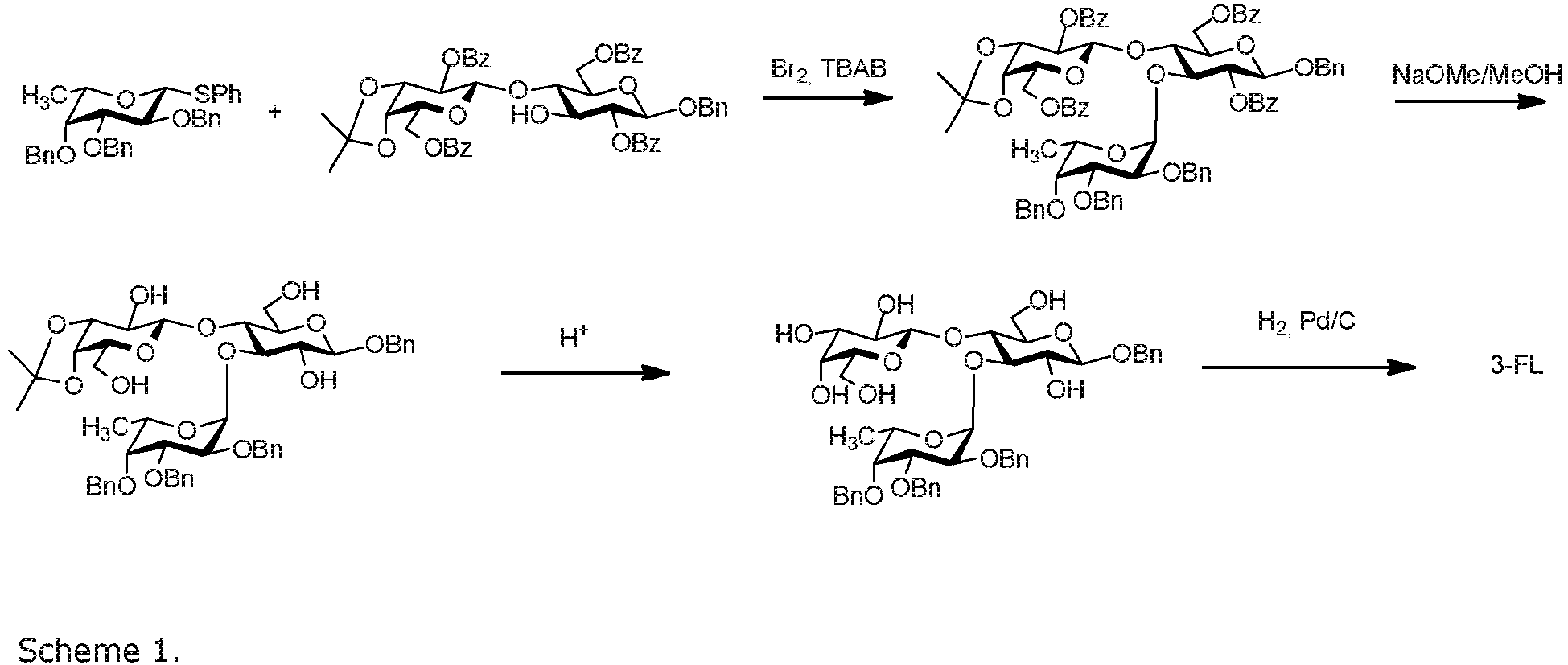
- The crystalline 3-FL of this invention is suitable for use as a pharmaceutical agent. Pharmaceutical compositions for such use can contain the crystalline 3-FL as an active ingredient and one or more conventional pharmaceutically acceptable carriers, as well as additives, adjuvants, excipients and diluents (water, gelatine, talc, sugars, starch, gum arabic, vegetable gums, vegetable oils, polyalkylene glycols, flavouring agents, preservatives, stabilizers, emulsifying agents, lubricants, colorants, fillers, wetting agents, etc.) as described in the standard reference text, Remington's Pharmaceutical Sciences. The amounts of such ingredients can vary depending on whether the pharmaceutical compositions are intended for use with infants, children or adults or subjects having specialized needs.
- The crystalline 3-FL of this invention is suitable also for nutritional use. Nutritional formulations, such as foods, drinks or feeds, for such use can contain the crystalline 3-FL as an active ingredient, together with other edible micronutrients, vitamins and minerals. The amounts of such ingredients can vary depending on whether the nutritional formulations are intended for use with normal, healthy infants, children, adults or subjects having specialized needs (e.g. suffering from metabolic disorders). Micronutrients include, for example, edible oils, fats or fatty acids (such as coconut oil, soy-bean oil, monoglycerides, diglycerides, palm olein, sunflower oil, fish oil, linoleic acid, linolenic acid etc.), carbohydrates (such as glucose, fructose, sucrose, maltodextrin, starch, hydrolysed cornstarch, etc.) and proteins from casein, soy-bean, whey or skim milk, or hydrolysates of these proteins, but protein from other sources (either intact or hydrolysed) can be used as well. Vitamins A, Bl, B2, B5, B6, B12, C, D, E, H, K, folic acid, inositol and nicotinic acid and minerals and trace elements, such as Ca, P, K, Na, CI, Mg, Mn, Fe, Cu, Zn, Se, Cr and I, can also be used.
- A preferred nutritional formulation containing the crystalline 3-FL of this invention is an infant formula, i.e., a foodstuff intended for use by infants during their first 4-6 months of life and satisfying by itself their nutritional requirements. The infant formula can contain one or more probiotic Bifidobacterium species, prebiotics such as fructooligosaccharides and galactooligosaccharides, proteins from casein, soy-bean, whey or skim milk, carbohydrates such as lactose, saccharose, maltodextrin, starch or mixtures thereof, lipids (e.g. palm olein, sunflower oil, safflower oil) and vitamins and minerals essential in a daily diet. The infant formula preferably contains 0.1-3.0 g of the crystalline 3-FL/100 g of the infant formula.
- The crystalline 3-FL of this invention can also be used as a food supplement. The food supplement can also contain other active ingredients, such as one or more probiotics, vitamins, minerals, trace elements and other micronutrients. The food supplement can be for example in the form of tablets, capsules, pastilles or a liquid and contain conventional additives such as binders, coatings, emulsifiers, solubilising agents, encapsulating agents, film forming agents, adsorbents, carriers, fillers, dispersing agents, wetting agents, jellifying agents and gel forming agents. The daily dose of 3-FL can range from 0.1 to 3.0 g.
- The crystalline 3-FL of this invention is further suitable for use as an active ingredient in the preparation of nutritional formulations including foods, drinks and feeds, preferably infant formulas, and food supplements. The nutritional formulations can be prepared in a conventional manner, for example by admixing micronutrient components in appropriate proportions, then adding vitamins and minerals. To avoid thermal degradation or decomposition, heat sensitive vitamins can be added after homogenization. Lipophilic vitamins can be dissolved in a fat source before mixing. A liquid mixture can made with water, the temperature of which is preferably about 50-80 °C to help dissolution or dispersal of the ingredients. The crystalline 3-FL polymorph can then be added. The resulting mixture can then be homogenized by flash heating to about 80-150 °C by steam injection, heat exchanger or autoclave. This thermal treatment also reduces significantly the bacterial loads. The hot mixture can then be cooled rapidly to about 60-80 °C. If needed, further homogenization can be carried out at this temperature under high pressure of about 2-30 MPa. After cooling, heat sensitive constituents can then be added, and the pH and the content of the solids can be conveniently adjusted. The resulting mixture is then dried to a powder by, for example, conventional spray drying or freeze drying methods. Probiotics can then be added by dry-mixing.
- Other features of the invention will become apparent from the following examples which illustrate the invention but do not limit it.
- Benzyl 3',4'-O-isopropylidene-β-lactoside (20 g) was dissolved in pyridine (30 ml). The solution was cooled to 0 °C and a mixture of benzoyl chloride (21 ml) and DCM (40 ml) was added dropwise through a dropping funnel over 6 h. The reaction mixture was stirred for another 2 h at 0 °C and at 5 °C for 24 hours. Methanol (10 ml) was then added and the solvents were removed in vacuo. The remaining residue was redissolved in EtOAc (200 ml) and washed with water (100 ml), sat. NaHCO3 (100 ml), 2x 1M HCl (100 ml), water (100 ml) and brine (100 ml). After removing the solvent in vacuo, the residue was recrystallized from MeOH (28 g, 72%).
- To a solution of phenyl 2,3,4-tri-O-benzyl-1-thio-β-L-fucopyranoside (133 g) in DCM (439 ml) bromine (16 ml) in DCM (50 ml) was added dropwise at 0 °C over a period of 60 minutes. After addition of the bromine solution the reaction mixture was stirred for additional 15 to 20 minutes. Cyclohexene (35 ml) was then added dropwise, followed by the addition of the product of Example 1 (120 g) and TBAB (8 g) in DCM (330 ml) and DMF (330 ml). The reaction mixture was stirred until TLC (Toluene/Acetone 12:1) showed completion, then it was diluted with 1.7 l of EtOAc. The organic layer was washed with sat. Na2S2O3/sat. NaHCO3 (1:1), sat. NaHCO3/brine (4:1), water/brine, water/brine/1N HCl (1:1:1), sat. NaHCO3/brine (2:1), and brine. The organic phase was dried over MgSO4 and the solvents were removed in vacuo to obtain an orange oil which was recrystallized from EtOAc/Hexane (1:3) to obtain 148 g of crystals (84%).
- The product of example 2 (148 g) was added to a 0.1 M solution of NaOMe in methanol (1.5 I). The suspension was warmed to 40 °C. Complete debenzoylation was confirmed by TLC (toluene/acetone 1:1). H+-IR120 Amberlite resin was added to neutralize the solution and the methanol was removed in vacuo. The residue was redissolved in EtOAc (1350 ml) and extracted with water (900 ml) 0.5 N HCl (900 ml), sat. NaHCO3 (900 ml) and brine (450 ml).
- The solvent was removed in vacuo and the product was crystallised from EtOAc/hexane (1:2) to yield 79 g of product (79 %). M.p.: 101-103 °C
- The product of example 3 (79 g) was dissolved in DCM (400 ml), MeOH (280 ml) and water (40 ml). TFA (80 ml) was then added slowly at room temperature. After the addition is completed, the temperature was raised to 40 °C. The progress of the reaction was followed by TLC (toluene/acetone 1:2). When no starting material could be detected, the reaction was cooled down in an ice-bath to 0 °C. Slowly and portionwise 500 ml of sat. NaHCO3 solution was added followed by EtOAc (1.2 l) together with additional 250 ml of sat. NaHCO3 solution and 250 ml of brine. The organic layer was extracted two more times with 500 ml of sat. NaHCO3 solution and 500 ml of brine. The solvent was removed in vacuo and the residue was crystallised from EtOAc/Et2O (2:3) to yield 60 g of product (80 %). 1H-NMR (CD3OD) δ (ppm): 1.18 (d, J=6.1Hz, 3H); 3.34-3.56 (m, 4H); 3.57-3.69 (m, 2H); 3.78 (m, 2H); 3.95 (m, 7H); 4.1 (dd, J=2.9Hz, J=10.1Hz, 1H); 4.4 (d, J=7.6Hz, 1H); 4.44 (d, J=7Hz, 1H); 4.57 (d, J=11.0Hz, 1H); 4.65 (d, H=11.7Hz, 1H); 4.69 (d, 11.7Hz, 1H); 4.81 (m, 1H); 4.93 (m, 3H); 5.7 (d, J=3.96Hz, 1H); 7.15-7.57 (m, 20H). 13C-NMR (CD3OD) δ (ppm): 15.75, 60.17, 60.18, 62.34, 66.43, 69.00, 70.77, 71.78, 71.93, 72.82, 73.65, 75.25, 75.55, 75.93, 76.14, 76.28, 77.57, 78.90, 78.94, 78.97, 97.09, 102.38, 102.58, 127.22, 127.28, 127.32, 127.37, 127.51, 127.62, 127.98, 128.07, 128.11, 128.12, 128.16, 128.45, 137.78, 138.50, 139.11, 139.42. M.p.: 123-125 °C
- The product of Example 4 (3.8 g) was dissolved in a mixture of isopropanol-methanol (1:2, 60 ml). 10 % Pd on charcoal (0.23 g) was added and the mixture was stirred under H2-atmosphere (20 bar in an autoclave) at 40 °C for 24 hours. The precipitated product was dissolved by adding small amount of water and few drops of acetic acid, and the hydrogenolysis was continued for 8 hours. The catalyst was filtered off and the solvents were removed. The product was dried in vacuo and precipitated by adding propanol (practically quantitative yield) giving an amorphous powder. 1H-NMR (D2O) δ (ppm): 1.0 (d, J=7Hz, 3H); 3.23-3.34 (m, 2H); 3.35-3.51 (m, 3H); 3.52-3.74 (m, 9H); 3.74-3.83 (m, 2H); 4.24 (d, J=7.9Hz, 1H); 4.46 (d, J=7.9Hz, 0.52H); 5.00 (d, J=3.7Hz, 0.43H); 5.19 (d, J=4Hz, 0.43H); 5.25 (d, J=4.1Hz, 0.57H). 13C-NMR (D2O) δ (ppm): 15.34, 59.78, 59.87, 61.62, 61.66, 66.57, 66.61, 68.13, 68.16, 68.43, 69.32, 69.38, 71.01, 71.24, 72.06, 72.50, 72.69, 72.75, 72.78, 74.80, 75.06, 75.47, 75.63, 77.09, 92.19, 95.92, 98.48, 98.61, 101.90. HPLC purity: 95-98 %.
- The procedure according to Example 5 was repeated - except after removal of the solvents, the resulting syrupy or oily product was kept under high vacuum (5 mbar) for 18 hours at room temperature, and the 3-O-fucosyllactose product was obtained as crystalline material.
- Amorphous 3-FL according to Example 5 (1.0 g) was suspended in methanol (10 ml) and stirred at room temperature for overnight. The solid was then filtered off, washed with cold methanol and dried to get crystalline 3-FL (614 mg).
- Amorphous 3-FL according to Example 5 (1.5 g) was suspended in methanol (6 ml) and heated at 60 °C for 3 hours. After cooling down the solid was filtered off, washed with cold methanol and dried to get crystalline 3-FL (778 mg).
- Amorphous 3-FL according to Example 5 (2.76 g) was suspended in methanol (4 ml) and heated to 50-60 °C. Water was then added until a clear solution was obtained at the same temperature. The solution was allowed to start cooling down, seeding crystals (obtained according to any one of Examples 6 to 8) were added and while the seeded solution was cooling down, 6 portions of methanol (2 ml each) were added successively. The solid formed was then filtered off, washed with cold methanol and dried to get crystalline 3-FL (1.31 g).
- XRPD investigation was conducted with a Philips PW 1830/PW1050 instrument in transmission geometry, using Cubα radiation made monochromatic by means of a graphite monochromator. D-spacings were calculated from the 2Θ values, based on a wavelength of 1.54186 Å. As a general rule the 2Θ values have an error rate of ± 0.2 Å.
Figure 1 clearly shows that the X-ray powder diffraction patterns of the crystalline 3-FL samples obtained in Examples 6-9 are identical. - The measurement was carried out on a SETARAM Labsys Evo TG-DSC thermoanalyzer, in flowing high purity (6.0) helium atmosphere (flow rate 30 ml/min) in the temperature range of 30-300 °C with a constant heating rate of 10 K/min, using standard 100 µl platinum crucible. Sample amount was 4.65 mg.
Claims (15)
- Crystalline 3-O-fucosyllactose.
- The crystalline 3-O-fucosyllactose according to claim 1, characterized in that it displays X-ray powder diffraction reflections, based on a measurement using CuKa radiation, at 18,36±0.20 2Θ, more preferably at 18.36±0.20 2Θ and 14.26±0.20 2Θ, even more preferably at 18.36±0.20 2Θ, 14.26±0.20 2Θ and 23.75±0.20 2Θ, and most preferably at 18.36±0.20 2Θ, 14.26±0.20 2Θ, 23,75±0.20 2Θ and 9.99±0.20 2Θ.
- The crystalline 3-O-fucosyllactose according to any one of the claims 1 to 2, characterized in that it displays, in DSC investigations, an endothermic reaction with peak temperature at 243±5 °C, more preferably at 243±4 °C, even more preferably at 243±3 °C, most preferably at 243±2 °C, in particular at 243±1 1 °C.
- The crystalline 3-O-fucosyllactose according to any one of the claims 1 to 3 which is substantially pure.
- The crystalline 3-O-fucosyllactose according to any one of the claims 1 to 4 which is substantially free from organic solvent and/or water.
- A method for producing crystalline 3-O-fucosyllactose according to any one of the claims 1 to 5, characterized in that a syrupy 3-O-fucosyllactose is kept under vacuum of 30 mbar or less, preferably about 15 mbar or less, more preferably about 5 mbar or less.
- A method for producing crystalline 3-O-fucosyllactose according to any one of the claims 1 to 5, characterized in that amorphous 3-O-fucosyllactose is suspended in an antisolvent and stirred.
- A method for producing crystalline 3-O-fucosyllactose according to any one of the claims 1 to 5, characterized in that crystallization is carried out from a solvent or solvent system in the presence of seed crystals, the seeding crystals are preferably obtained by any of the methods according to claims 6 or 7.
- Crystalline 3-O-fucosyllactose according to any one of the claims 1 to 5 for use as a pharmaceutical agent.
- A use of crystalline 3-O-fucosyllactose according to any one of the claims 1 to 5 as a pharmaceutically active ingredient in a pharmaceutical composition.
- A pharmaceutical composition comprising crystalline 3-O-fucosyllactose according to any one of the claims 1 to 5 and a pharmaceutically acceptable carrier.
- A nutritional formulation comprising crystalline 3-O-fucosyllactose according to any one of the claims 1 to 5.
- The nutritional formulation according to claim 12, which is an infant formula.
- The nutritional formulation according to claim 12, which is a food supplement.
- A use of crystalline 3-O-fucosyllactose according to any one of the claims 1 to 5 as a nutritionally active ingredient for the preparation of a nutritional formulation.
Applications Claiming Priority (2)
| Application Number | Priority Date | Filing Date | Title |
|---|---|---|---|
| DKPA201270696 | 2012-11-13 | ||
| PCT/DK2013/050300 WO2014075680A1 (en) | 2012-11-13 | 2013-09-19 | Crystalline 3-o-fucosyllactose |
Publications (3)
| Publication Number | Publication Date |
|---|---|
| EP2943500A1 EP2943500A1 (en) | 2015-11-18 |
| EP2943500A4 EP2943500A4 (en) | 2016-06-22 |
| EP2943500B1 true EP2943500B1 (en) | 2017-11-08 |
Family
ID=50730610
Family Applications (1)
| Application Number | Title | Priority Date | Filing Date |
|---|---|---|---|
| EP13854558.7A Active EP2943500B1 (en) | 2012-11-13 | 2013-09-19 | Crystalline 3-o-fucosyllactose |
Country Status (4)
| Country | Link |
|---|---|
| US (1) | US9834574B2 (en) |
| EP (1) | EP2943500B1 (en) |
| CN (1) | CN104812768B (en) |
| WO (1) | WO2014075680A1 (en) |
Families Citing this family (13)
| Publication number | Priority date | Publication date | Assignee | Title |
|---|---|---|---|---|
| US20150065702A1 (en) * | 2012-03-20 | 2015-03-05 | Glycom A/S | Synthesis of the Trisaccharide 3-O-Fucosyllactose and Intermediates Thereof |
| EP3227309B1 (en) | 2014-12-05 | 2025-09-24 | Glycom A/S | Crystalline difucosyllactose |
| EP3532787A4 (en) | 2016-10-31 | 2020-07-29 | Glycom A/S | METHOD FOR REMOVING ORGANIC RESIDUAL SOLVENT FROM A CRYSTALLINE OLIGOSACCHARIDE |
| CN119655445A (en) | 2017-07-12 | 2025-03-21 | 格礼卡姆股份公司 | Amorphous mixture comprising neutral mono-or oligosaccharides and an acidic non-carbohydrate component |
| PL3494805T3 (en) | 2017-12-08 | 2025-10-06 | Chr. Hansen HMO GmbH | Spray-dried tetrasaccharides |
| EP3494807A1 (en) | 2017-12-11 | 2019-06-12 | Jennewein Biotechnologie GmbH | Spray-dried sialyllactose |
| ES3040419T3 (en) | 2017-12-08 | 2025-10-30 | Chr Hansen Hmo Gmbh | Spray-dried lacto-n-fucopentaose |
| ES3039971T3 (en) | 2017-12-08 | 2025-10-28 | Chr Hansen Hmo Gmbh | Spray-dried 3-fucosyllactose |
| AU2018380962B2 (en) | 2017-12-08 | 2024-12-19 | Chr. Hansen HMO GmbH | Spray-dried lacto-N-fucopentaose |
| ES3026362T3 (en) | 2018-02-08 | 2025-06-11 | Chr Hansen Hmo Gmbh | Spray-dried mixture of human milk oligosaccharides |
| CN122028805A (en) * | 2023-08-29 | 2026-05-12 | 雀巢产品有限公司 | Composition comprising human milk oligosaccharides for use in individuals to support brain development and/or social mood development |
| CN118724987B (en) * | 2024-07-10 | 2025-11-14 | 南京工业大学 | A method for preparing high-quality 2'-fucosylated lactose |
| CN119241606B (en) * | 2024-12-05 | 2025-02-28 | 天津合生领航生物科技有限公司 | A method for separating and purifying 3-fucosyllactose |
Family Cites Families (10)
| Publication number | Priority date | Publication date | Assignee | Title |
|---|---|---|---|---|
| US5326752A (en) | 1991-11-27 | 1994-07-05 | Glycomed Incorporated | Substituted lactose and lactosamine derivatives as cell adhesion inhibitors |
| US6045854A (en) * | 1997-03-31 | 2000-04-04 | Abbott Laboraties | Nutritional formulations containing oligosaccharides |
| IT1392456B1 (en) * | 2008-12-18 | 2012-03-09 | Inalco Spa | PROCESS FOR THE SYNTHESIS OF L-PHUCOSILATED OLIGOSACCHARIDES AND THEIR NEW INTERMEDIATES 2,3,4-TRIBENZYL-FUCHOSIL-DERIVATIVES. |
| BRPI0923433B1 (en) * | 2008-12-19 | 2021-06-01 | Jennewein Biotechnologie Gmbh | METHOD TO PRODUCE A GENETICALLY MODIFIED CELL HAVING THE ABILITY TO PRODUCE FUCOSYLATE COMPOUNDS AND METHOD TO MAKE A FUCOSYLATE COMPOUND |
| CA2758097A1 (en) | 2009-04-07 | 2010-10-14 | Glycom A/S | Synthesis of 2'-o-fucosyllactose |
| CA2798675A1 (en) * | 2010-06-01 | 2011-12-08 | Glycom A/S | Polymorphs of 2'-o-fucosyllactose and producing thereof |
| US9102966B2 (en) * | 2010-07-16 | 2015-08-11 | Glycom A/S | Synthesis of sialooligosaccharide derivatives |
| EP2455387A1 (en) * | 2010-11-23 | 2012-05-23 | Nestec S.A. | Oligosaccharide mixture and food product comprising this mixture, especially infant formula |
| AU2012217650B9 (en) * | 2011-02-16 | 2017-09-14 | Glycosyn LLC | Biosynthesis of human milk oligosaccharides in engineered bacteria |
| US20150065702A1 (en) * | 2012-03-20 | 2015-03-05 | Glycom A/S | Synthesis of the Trisaccharide 3-O-Fucosyllactose and Intermediates Thereof |
-
2013
- 2013-09-19 US US14/442,017 patent/US9834574B2/en active Active
- 2013-09-19 CN CN201380059014.4A patent/CN104812768B/en active Active
- 2013-09-19 WO PCT/DK2013/050300 patent/WO2014075680A1/en not_active Ceased
- 2013-09-19 EP EP13854558.7A patent/EP2943500B1/en active Active
Also Published As
| Publication number | Publication date |
|---|---|
| CN104812768B (en) | 2019-06-21 |
| US9834574B2 (en) | 2017-12-05 |
| CN104812768A (en) | 2015-07-29 |
| EP2943500A1 (en) | 2015-11-18 |
| EP2943500A4 (en) | 2016-06-22 |
| US20150291642A1 (en) | 2015-10-15 |
| WO2014075680A1 (en) | 2014-05-22 |
Similar Documents
| Publication | Publication Date | Title |
|---|---|---|
| US9834574B2 (en) | Crystalline 3-O-fucosyllactose | |
| DK2576578T3 (en) | Polymorphs of 2'-o-fucosyllactose and producing thereof | |
| EP3241836B1 (en) | Polymorph of a tetrasaccharide containing nacetyl-lactosamine | |
| KR20120138772A (en) | Production of 6'-o-sialyllactose and intermediates | |
| EP3227309B1 (en) | Crystalline difucosyllactose | |
| US11267839B2 (en) | Crystalline forms of LNT | |
| EP2935300B1 (en) | Novel polymorphs of lnnt | |
| US20150183814A1 (en) | Enhancing the Stability and Purity and Increasing the Bioavailability of Human Milk Oligosaccharides or Precursors or Blends Thereof | |
| CN103108881A (en) | Derivatization of oligosaccharides | |
| KR20260036551A (en) | Crystallization of Lacto-N-Trios II | |
| HK1246302B (en) | Polymorph of a tetrasaccharide containing nacetyl-lactosamine |
Legal Events
| Date | Code | Title | Description |
|---|---|---|---|
| PUAI | Public reference made under article 153(3) epc to a published international application that has entered the european phase |
Free format text: ORIGINAL CODE: 0009012 |
|
| 17P | Request for examination filed |
Effective date: 20150615 |
|
| AK | Designated contracting states |
Kind code of ref document: A1 Designated state(s): AL AT BE BG CH CY CZ DE DK EE ES FI FR GB GR HR HU IE IS IT LI LT LU LV MC MK MT NL NO PL PT RO RS SE SI SK SM TR |
|
| AX | Request for extension of the european patent |
Extension state: BA ME |
|
| DAX | Request for extension of the european patent (deleted) | ||
| A4 | Supplementary search report drawn up and despatched |
Effective date: 20160520 |
|
| RIC1 | Information provided on ipc code assigned before grant |
Ipc: C07H 3/06 20060101AFI20160513BHEP Ipc: A23L 33/00 20160101ALI20160513BHEP Ipc: A61K 31/702 20060101ALI20160513BHEP |
|
| REG | Reference to a national code |
Ref country code: DE Ref legal event code: R079 Ref document number: 602013029287 Country of ref document: DE Free format text: PREVIOUS MAIN CLASS: C07H0003040000 Ipc: C07H0003060000 |
|
| RAP1 | Party data changed (applicant data changed or rights of an application transferred) |
Owner name: GLYCOM A/S |
|
| GRAP | Despatch of communication of intention to grant a patent |
Free format text: ORIGINAL CODE: EPIDOSNIGR1 |
|
| STAA | Information on the status of an ep patent application or granted ep patent |
Free format text: STATUS: GRANT OF PATENT IS INTENDED |
|
| RIC1 | Information provided on ipc code assigned before grant |
Ipc: C07H 3/06 20060101AFI20170130BHEP Ipc: A61K 31/702 20060101ALI20170130BHEP Ipc: A23L 33/00 20160101ALI20170130BHEP |
|
| INTG | Intention to grant announced |
Effective date: 20170303 |
|
| TPAC | Observations filed by third parties |
Free format text: ORIGINAL CODE: EPIDOSNTIPA |
|
| TPAC | Observations filed by third parties |
Free format text: ORIGINAL CODE: EPIDOSNTIPA |
|
| GRAS | Grant fee paid |
Free format text: ORIGINAL CODE: EPIDOSNIGR3 |
|
| GRAA | (expected) grant |
Free format text: ORIGINAL CODE: 0009210 |
|
| STAA | Information on the status of an ep patent application or granted ep patent |
Free format text: STATUS: THE PATENT HAS BEEN GRANTED |
|
| AK | Designated contracting states |
Kind code of ref document: B1 Designated state(s): AL AT BE BG CH CY CZ DE DK EE ES FI FR GB GR HR HU IE IS IT LI LT LU LV MC MK MT NL NO PL PT RO RS SE SI SK SM TR |
|
| REG | Reference to a national code |
Ref country code: GB Ref legal event code: FG4D |
|
| REG | Reference to a national code |
Ref country code: CH Ref legal event code: EP Ref country code: AT Ref legal event code: REF Ref document number: 944052 Country of ref document: AT Kind code of ref document: T Effective date: 20171115 |
|
| REG | Reference to a national code |
Ref country code: IE Ref legal event code: FG4D |
|
| REG | Reference to a national code |
Ref country code: DE Ref legal event code: R096 Ref document number: 602013029287 Country of ref document: DE |
|
| REG | Reference to a national code |
Ref country code: NL Ref legal event code: MP Effective date: 20171108 |
|
| REG | Reference to a national code |
Ref country code: LT Ref legal event code: MG4D |
|
| REG | Reference to a national code |
Ref country code: AT Ref legal event code: MK05 Ref document number: 944052 Country of ref document: AT Kind code of ref document: T Effective date: 20171108 |
|
| PG25 | Lapsed in a contracting state [announced via postgrant information from national office to epo] |
Ref country code: ES Free format text: LAPSE BECAUSE OF FAILURE TO SUBMIT A TRANSLATION OF THE DESCRIPTION OR TO PAY THE FEE WITHIN THE PRESCRIBED TIME-LIMIT Effective date: 20171108 Ref country code: LT Free format text: LAPSE BECAUSE OF FAILURE TO SUBMIT A TRANSLATION OF THE DESCRIPTION OR TO PAY THE FEE WITHIN THE PRESCRIBED TIME-LIMIT Effective date: 20171108 Ref country code: SE Free format text: LAPSE BECAUSE OF FAILURE TO SUBMIT A TRANSLATION OF THE DESCRIPTION OR TO PAY THE FEE WITHIN THE PRESCRIBED TIME-LIMIT Effective date: 20171108 Ref country code: NO Free format text: LAPSE BECAUSE OF FAILURE TO SUBMIT A TRANSLATION OF THE DESCRIPTION OR TO PAY THE FEE WITHIN THE PRESCRIBED TIME-LIMIT Effective date: 20180208 Ref country code: FI Free format text: LAPSE BECAUSE OF FAILURE TO SUBMIT A TRANSLATION OF THE DESCRIPTION OR TO PAY THE FEE WITHIN THE PRESCRIBED TIME-LIMIT Effective date: 20171108 Ref country code: NL Free format text: LAPSE BECAUSE OF FAILURE TO SUBMIT A TRANSLATION OF THE DESCRIPTION OR TO PAY THE FEE WITHIN THE PRESCRIBED TIME-LIMIT Effective date: 20171108 |
|
| PG25 | Lapsed in a contracting state [announced via postgrant information from national office to epo] |
Ref country code: BG Free format text: LAPSE BECAUSE OF FAILURE TO SUBMIT A TRANSLATION OF THE DESCRIPTION OR TO PAY THE FEE WITHIN THE PRESCRIBED TIME-LIMIT Effective date: 20180208 Ref country code: HR Free format text: LAPSE BECAUSE OF FAILURE TO SUBMIT A TRANSLATION OF THE DESCRIPTION OR TO PAY THE FEE WITHIN THE PRESCRIBED TIME-LIMIT Effective date: 20171108 Ref country code: RS Free format text: LAPSE BECAUSE OF FAILURE TO SUBMIT A TRANSLATION OF THE DESCRIPTION OR TO PAY THE FEE WITHIN THE PRESCRIBED TIME-LIMIT Effective date: 20171108 Ref country code: LV Free format text: LAPSE BECAUSE OF FAILURE TO SUBMIT A TRANSLATION OF THE DESCRIPTION OR TO PAY THE FEE WITHIN THE PRESCRIBED TIME-LIMIT Effective date: 20171108 Ref country code: GR Free format text: LAPSE BECAUSE OF FAILURE TO SUBMIT A TRANSLATION OF THE DESCRIPTION OR TO PAY THE FEE WITHIN THE PRESCRIBED TIME-LIMIT Effective date: 20180209 Ref country code: IS Free format text: LAPSE BECAUSE OF FAILURE TO SUBMIT A TRANSLATION OF THE DESCRIPTION OR TO PAY THE FEE WITHIN THE PRESCRIBED TIME-LIMIT Effective date: 20180308 Ref country code: AT Free format text: LAPSE BECAUSE OF FAILURE TO SUBMIT A TRANSLATION OF THE DESCRIPTION OR TO PAY THE FEE WITHIN THE PRESCRIBED TIME-LIMIT Effective date: 20171108 |
|
| PG25 | Lapsed in a contracting state [announced via postgrant information from national office to epo] |
Ref country code: EE Free format text: LAPSE BECAUSE OF FAILURE TO SUBMIT A TRANSLATION OF THE DESCRIPTION OR TO PAY THE FEE WITHIN THE PRESCRIBED TIME-LIMIT Effective date: 20171108 Ref country code: CY Free format text: LAPSE BECAUSE OF FAILURE TO SUBMIT A TRANSLATION OF THE DESCRIPTION OR TO PAY THE FEE WITHIN THE PRESCRIBED TIME-LIMIT Effective date: 20171108 Ref country code: CZ Free format text: LAPSE BECAUSE OF FAILURE TO SUBMIT A TRANSLATION OF THE DESCRIPTION OR TO PAY THE FEE WITHIN THE PRESCRIBED TIME-LIMIT Effective date: 20171108 Ref country code: DK Free format text: LAPSE BECAUSE OF FAILURE TO SUBMIT A TRANSLATION OF THE DESCRIPTION OR TO PAY THE FEE WITHIN THE PRESCRIBED TIME-LIMIT Effective date: 20171108 Ref country code: SK Free format text: LAPSE BECAUSE OF FAILURE TO SUBMIT A TRANSLATION OF THE DESCRIPTION OR TO PAY THE FEE WITHIN THE PRESCRIBED TIME-LIMIT Effective date: 20171108 |
|
| REG | Reference to a national code |
Ref country code: DE Ref legal event code: R097 Ref document number: 602013029287 Country of ref document: DE |
|
| PG25 | Lapsed in a contracting state [announced via postgrant information from national office to epo] |
Ref country code: SM Free format text: LAPSE BECAUSE OF FAILURE TO SUBMIT A TRANSLATION OF THE DESCRIPTION OR TO PAY THE FEE WITHIN THE PRESCRIBED TIME-LIMIT Effective date: 20171108 Ref country code: IT Free format text: LAPSE BECAUSE OF FAILURE TO SUBMIT A TRANSLATION OF THE DESCRIPTION OR TO PAY THE FEE WITHIN THE PRESCRIBED TIME-LIMIT Effective date: 20171108 Ref country code: RO Free format text: LAPSE BECAUSE OF FAILURE TO SUBMIT A TRANSLATION OF THE DESCRIPTION OR TO PAY THE FEE WITHIN THE PRESCRIBED TIME-LIMIT Effective date: 20171108 Ref country code: PL Free format text: LAPSE BECAUSE OF FAILURE TO SUBMIT A TRANSLATION OF THE DESCRIPTION OR TO PAY THE FEE WITHIN THE PRESCRIBED TIME-LIMIT Effective date: 20171108 |
|
| PLBE | No opposition filed within time limit |
Free format text: ORIGINAL CODE: 0009261 |
|
| STAA | Information on the status of an ep patent application or granted ep patent |
Free format text: STATUS: NO OPPOSITION FILED WITHIN TIME LIMIT |
|
| REG | Reference to a national code |
Ref country code: FR Ref legal event code: PLFP Year of fee payment: 6 |
|
| 26N | No opposition filed |
Effective date: 20180809 |
|
| PG25 | Lapsed in a contracting state [announced via postgrant information from national office to epo] |
Ref country code: SI Free format text: LAPSE BECAUSE OF FAILURE TO SUBMIT A TRANSLATION OF THE DESCRIPTION OR TO PAY THE FEE WITHIN THE PRESCRIBED TIME-LIMIT Effective date: 20171108 |
|
| PG25 | Lapsed in a contracting state [announced via postgrant information from national office to epo] |
Ref country code: MC Free format text: LAPSE BECAUSE OF FAILURE TO SUBMIT A TRANSLATION OF THE DESCRIPTION OR TO PAY THE FEE WITHIN THE PRESCRIBED TIME-LIMIT Effective date: 20171108 |
|
| REG | Reference to a national code |
Ref country code: CH Ref legal event code: PL |
|
| REG | Reference to a national code |
Ref country code: BE Ref legal event code: MM Effective date: 20180930 |
|
| REG | Reference to a national code |
Ref country code: IE Ref legal event code: MM4A |
|
| PG25 | Lapsed in a contracting state [announced via postgrant information from national office to epo] |
Ref country code: LU Free format text: LAPSE BECAUSE OF NON-PAYMENT OF DUE FEES Effective date: 20180919 |
|
| PG25 | Lapsed in a contracting state [announced via postgrant information from national office to epo] |
Ref country code: IE Free format text: LAPSE BECAUSE OF NON-PAYMENT OF DUE FEES Effective date: 20180919 |
|
| PG25 | Lapsed in a contracting state [announced via postgrant information from national office to epo] |
Ref country code: CH Free format text: LAPSE BECAUSE OF NON-PAYMENT OF DUE FEES Effective date: 20180930 Ref country code: LI Free format text: LAPSE BECAUSE OF NON-PAYMENT OF DUE FEES Effective date: 20180930 Ref country code: BE Free format text: LAPSE BECAUSE OF NON-PAYMENT OF DUE FEES Effective date: 20180930 |
|
| PG25 | Lapsed in a contracting state [announced via postgrant information from national office to epo] |
Ref country code: MT Free format text: LAPSE BECAUSE OF NON-PAYMENT OF DUE FEES Effective date: 20180919 |
|
| PG25 | Lapsed in a contracting state [announced via postgrant information from national office to epo] |
Ref country code: TR Free format text: LAPSE BECAUSE OF FAILURE TO SUBMIT A TRANSLATION OF THE DESCRIPTION OR TO PAY THE FEE WITHIN THE PRESCRIBED TIME-LIMIT Effective date: 20171108 |
|
| PG25 | Lapsed in a contracting state [announced via postgrant information from national office to epo] |
Ref country code: PT Free format text: LAPSE BECAUSE OF FAILURE TO SUBMIT A TRANSLATION OF THE DESCRIPTION OR TO PAY THE FEE WITHIN THE PRESCRIBED TIME-LIMIT Effective date: 20171108 |
|
| PG25 | Lapsed in a contracting state [announced via postgrant information from national office to epo] |
Ref country code: MK Free format text: LAPSE BECAUSE OF NON-PAYMENT OF DUE FEES Effective date: 20171108 Ref country code: HU Free format text: LAPSE BECAUSE OF FAILURE TO SUBMIT A TRANSLATION OF THE DESCRIPTION OR TO PAY THE FEE WITHIN THE PRESCRIBED TIME-LIMIT; INVALID AB INITIO Effective date: 20130919 |
|
| PG25 | Lapsed in a contracting state [announced via postgrant information from national office to epo] |
Ref country code: AL Free format text: LAPSE BECAUSE OF FAILURE TO SUBMIT A TRANSLATION OF THE DESCRIPTION OR TO PAY THE FEE WITHIN THE PRESCRIBED TIME-LIMIT Effective date: 20171108 |
|
| P01 | Opt-out of the competence of the unified patent court (upc) registered |
Effective date: 20230520 |
|
| PGFP | Annual fee paid to national office [announced via postgrant information from national office to epo] |
Ref country code: DE Payment date: 20250902 Year of fee payment: 13 |
|
| PGFP | Annual fee paid to national office [announced via postgrant information from national office to epo] |
Ref country code: GB Payment date: 20250904 Year of fee payment: 13 |
|
| PGFP | Annual fee paid to national office [announced via postgrant information from national office to epo] |
Ref country code: FR Payment date: 20250908 Year of fee payment: 13 |