EP2943476B1 - Process for the preparation of substituted oxiranes and triazoles - Google Patents
Process for the preparation of substituted oxiranes and triazoles Download PDFInfo
- Publication number
- EP2943476B1 EP2943476B1 EP13814101.5A EP13814101A EP2943476B1 EP 2943476 B1 EP2943476 B1 EP 2943476B1 EP 13814101 A EP13814101 A EP 13814101A EP 2943476 B1 EP2943476 B1 EP 2943476B1
- Authority
- EP
- European Patent Office
- Prior art keywords
- alkyl
- cycloalkyl
- phenyl
- compound
- specific embodiment
- Prior art date
- Legal status (The legal status is an assumption and is not a legal conclusion. Google has not performed a legal analysis and makes no representation as to the accuracy of the status listed.)
- Active
Links
- 0 C*1C=CC(OC2=CC(C)(*)C=I(C(*)(C[n]3ncnc3)O)C=C2)=CC=C1 Chemical compound C*1C=CC(OC2=CC(C)(*)C=I(C(*)(C[n]3ncnc3)O)C=C2)=CC=C1 0.000 description 1
Classifications
-
- A—HUMAN NECESSITIES
- A01—AGRICULTURE; FORESTRY; ANIMAL HUSBANDRY; HUNTING; TRAPPING; FISHING
- A01N—PRESERVATION OF BODIES OF HUMANS OR ANIMALS OR PLANTS OR PARTS THEREOF; BIOCIDES, e.g. AS DISINFECTANTS, AS PESTICIDES OR AS HERBICIDES; PEST REPELLANTS OR ATTRACTANTS; PLANT GROWTH REGULATORS
- A01N43/00—Biocides, pest repellants or attractants, or plant growth regulators containing heterocyclic compounds
- A01N43/64—Biocides, pest repellants or attractants, or plant growth regulators containing heterocyclic compounds having rings with three nitrogen atoms as the only ring hetero atoms
- A01N43/647—Triazoles; Hydrogenated triazoles
- A01N43/653—1,2,4-Triazoles; Hydrogenated 1,2,4-triazoles
-
- C—CHEMISTRY; METALLURGY
- C07—ORGANIC CHEMISTRY
- C07D—HETEROCYCLIC COMPOUNDS
- C07D301/00—Preparation of oxiranes
- C07D301/02—Synthesis of the oxirane ring
-
- C—CHEMISTRY; METALLURGY
- C07—ORGANIC CHEMISTRY
- C07D—HETEROCYCLIC COMPOUNDS
- C07D249/00—Heterocyclic compounds containing five-membered rings having three nitrogen atoms as the only ring hetero atoms
- C07D249/02—Heterocyclic compounds containing five-membered rings having three nitrogen atoms as the only ring hetero atoms not condensed with other rings
- C07D249/04—1,2,3-Triazoles; Hydrogenated 1,2,3-triazoles
-
- C—CHEMISTRY; METALLURGY
- C07—ORGANIC CHEMISTRY
- C07D—HETEROCYCLIC COMPOUNDS
- C07D249/00—Heterocyclic compounds containing five-membered rings having three nitrogen atoms as the only ring hetero atoms
- C07D249/02—Heterocyclic compounds containing five-membered rings having three nitrogen atoms as the only ring hetero atoms not condensed with other rings
- C07D249/08—1,2,4-Triazoles; Hydrogenated 1,2,4-triazoles
-
- C—CHEMISTRY; METALLURGY
- C07—ORGANIC CHEMISTRY
- C07D—HETEROCYCLIC COMPOUNDS
- C07D303/00—Compounds containing three-membered rings having one oxygen atom as the only ring hetero atom
- C07D303/02—Compounds containing oxirane rings
- C07D303/12—Compounds containing oxirane rings with hydrocarbon radicals, substituted by singly or doubly bound oxygen atoms
- C07D303/18—Compounds containing oxirane rings with hydrocarbon radicals, substituted by singly or doubly bound oxygen atoms by etherified hydroxyl radicals
- C07D303/20—Ethers with hydroxy compounds containing no oxirane rings
- C07D303/22—Ethers with hydroxy compounds containing no oxirane rings with monohydroxy compounds
- C07D303/23—Oxiranylmethyl ethers of compounds having one hydroxy group bound to a six-membered aromatic ring, the oxiranylmethyl radical not being further substituted, i.e.
-
- C—CHEMISTRY; METALLURGY
- C07—ORGANIC CHEMISTRY
- C07B—GENERAL METHODS OF ORGANIC CHEMISTRY; APPARATUS THEREFOR
- C07B2200/00—Indexing scheme relating to specific properties of organic compounds
- C07B2200/13—Crystalline forms, e.g. polymorphs
Definitions
- the present invention relates to a process for providing oxiranes using an aqueous solution of trimethylsulfonium methylsulfate in the presence of KOH, and optionally further converting the resulting oxiranes into triazole compounds by reacting the substituted oxiranes with 1H-1,2,4-triazole under basic conditions. Furthermore, the invention relates to an aqueous reagent of trimethylsulfonium methylsulfate and its use for the conversion of oxo-groups into oxiranes.
- Triazole compounds that are accessible via an oxirane intermediate are, for example described in WO 2013/010862 ( PCT/EP2012/063526 ), WO 2013/010894 ( PCT/EP2012/063635 ), WO 2013/010885 ( PCT/EP2012/063620 ), WO 2013/024076 ( PCT/EP2012/065835 ), WO 2013/024075 ( PCT/EP2012/065834 ), WO 2013/024082 ( PCT/EP2012/065850 ), WO 2013/024077 ( PCT/EP2012/065836 ), WO 2013/024081 ( PCT/EP2012/065848 ), WO 2013/024080 ( PCT/EP2012/065847 ), WO 2013/024083 ( PCT/EP2012/065852 )
- WO 2013/007767 ( PCT/EP2012/063626 ) is directed to fungicidal substituted 2-[2-halogenalkyl-4-phenoxy-phenyl]-1-[1,2,4]triazol-1-yl-ethanol compounds, that can also be synthesized via a respective oxirane intermediate compound.
- a common process for the synthesis of oxiranes from carbonyl compounds such as aldehydes and ketones is the reaction with trimethylsulfonium iodide in the presence of a base ( JACS 1965, 87, p 1353ff ). This reagent is very expensive and not suitable for industrial scales.
- An alternative reagent is trimethylsulfonium methylsulfate that can be obtained from dimethylsulfide and dimethylsulfate ( Heterocycles 8, 1977, p. 397 ff ).
- this reagent (melting point 100 to 104 °C) is very hygroscopic and difficult to handle in solid form ( Synth. Communications, 15, 1985, p 753 ).
- an exact dosage of said reagent is only possible under the exclusion of atmospheric humidity.
- certain 2-arylphenyl-ether-3-(1H-1,2,4-triazol-1-yl)propan-2-ol derivatives are synthesized via an oxirane.
- Synthetic Communications 15, 1985, p. 749 et seq. generally describes the reaction of trimethylsulfonium methyl sulfate with aldehydes and ketones using 50% NaOH solution under phase transfer conditions.
- NaOH is used as base for the reaction and high amounts of water are used because the base is added as 50% aqueous solution.
- high excess of base and preferably methylenechloride are used in the process, which is not suitable for an industrial process also because of environmental issues.
- the reaction of aldehydes is described that are generally more reactive than ketones. NaOH is used as 50% aqueous solution, i.e. high amounts of water are present.
- DE3733755 is directed to a process for the preparation of 2-(4-chlorophenyl-ethyl)-2-tert-butyl-oxirane from the respective ketone using trimethylsulfonium methylfulfate in the presence of potassium hydroxide, dimethylsulfide and water.
- the amount of water present in the reaction must be between 1.0 and 1.5 mole per mole of ketone, otherwise the yields are not high enough. Such restricted amounts of water are, however, not favorable for an industrial process.
- A.V. Kuzenkov describes in Chemistry of Heterocyclic compounds 2003, 39(11), 1492-1495 the synthesis of various 2-azolyl-1-pyridylethan-1-ols through epoxidation of pyridyl ketones with trimethylsulfonium iodide in the presence of potassium tert-butoxide in DMSO. No water is present.
- EP-A-0113640 relates to the conversion of dichlorophenyl ketones into the corresponding oxiranes using trimethyloxosulfonium iodide in the presence of sodium hydride as a base in anhydrous DMSO as solvent. No water is present.
- WO 02/085891 relates to the synthesis of 3,4-dimethylphenyloxirane under phase transfer conditions starting from 3,4-dimethylbenzaldehyde and using trimethylsulfonium methylsulfate in the presence of water, 50% NaOH, methylene chloride and tetrabutylammonium bromide as phase transfer catalyst.
- An object of the present invention was to provide an improved process for the synthesis of oxiranes that are valuable intermediates for the preparation of fungicidal active triazole compounds starting from the respective oxo-group containing compounds.
- one aspect of the present invention is a process for the preparation of compounds II comprising the following step:
- compounds II and III are the following: wherein R is selected from halogen and (C 1 -C 2 )-haloalkyl, in particular Cl, Br, F or CF 3 , more specifically Cl or CF 3 , and R 1 , R 3 , R 4 and m are as defined and preferably defined herein, and n1 is 0, 1, 2 or 3.
- the compounds of formula III are of sub formula IIIA wherein R 1 is C 1 -C 6 -alkyl or C 3 -C 8 -cycloalkyl and R 4 is F or Cl.
- R 1 is C 1 -C 6 -alkyl, more specifically C 1 -C 4 -alkyl, in particular selected from CH 3 , C 2 H 5 , n-C 3 H 7 , CH(CH 3 ) 2 , n-butyl, iso-butyl and tert-butyl, more particularly selecetd from CH 3 , C 2 H 5 , CH(CH 3 ) 2 and C(CH 3 ) 3 .
- R 1 is C 3 -C 8 -cycloalkyl, in particular C 3 -C 6 -cycloalkyl, such as C 3 H 5 (cyclopropyl), C 4 H 7 (cyclobutyl), cyclopentyl or cyclohexyl.
- a further embodiment relates to compounds, wherein R 1 is C 3 H 5 (cyclopropyl) or C 4 H 7 (cyclobutyl).
- R 4 is F or Cl, in particular Cl.
- R 1 is selected from CH 3 , CH(CH 3 ) 2 and cyclopropyl and R 4 is Cl.
- an oxo compound of the formula III is reacted with trimethylsulfonium methylsulfate of the formula IV IV (CH 3 ) 3 S + CH 3 SO 4 - in aqueous solution in the presence of KOH.
- more than 1.5 eq of water to 4 eq of water, more specifically more than 1.5 eq to 3.5 eq of water, even more particularly more than 1.5 eq water to 2.5 eq water per mole of compound III are used.
- the ratios of 1.6 to 3.8, more specifically 1.7 to 3.3 eq, more specifically 1.8 to 2.8 eq or 1.9 to 2.5 of water per mole of compound III may be favorable according to the present invention.
- the reagent IV is preferably used in an amount of 1.1 to 2.5, in particular 1.2 to 2, more specifically 1.3 to 1.6 equivalents of IV per 1 equivalent (mole) of compound III.
- the reagent of formula IV can be prepared from dimethylsulfide and dimethylsulfate.
- reagent IV is prepared in-situ by adding dimethylsulfate to the reaction mixture containing dimethylsulfide. The dimethylsulfide is usually used in excess.
- reagent IV an aqueous solution of trimethylsulfonium methylsulfate III containing 33 to 37 wt%, preferably 34 to 36 wt%, more specifically 34 to 35.3 wt%, also more specifically 34.3 to 35.9 wt%, of trimethylsulfonium cation.
- the present invention relates to an aqueous solution of trimethylsulfonium methylsulfate III containing 33 to 37 wt%, preferably 34 to 36 wt%, more specifically 34 to 35.3 wt%, also more specifically 34.3 to 35.9 wt%, of trimethylsulfonium cation.
- the inventive reagent IV solution contains 33 to 37 wt%, preferably 34 to 36 wt%, more specifically 34 to 35.3 wt%, also more specifically 34.3 to 35.9 wt%, of trimethylsulfonium cation.
- the amount of trimethylsulfonium-methylsulfate in the reagent measured as summation of trimethsulfonium-cation and methylsulfate-anion, is about 80 to 90 wt%, preferably about 83 to 88 wt-%, more specifically about 83 to 86 wt-%.
- the quantification can be, for example, accomplished by means of quantitative NMR-spectroscopie.
- the viscosity of the aqueous reagent IV solution of the invention is comparatively low.
- inventive solutions are stable at room temparture, in particular at 25°C, and can be stored over a longer time.
- the inventive reagent solution does not crystallize out during storage over a longer time, such as several weeks, e.g. up to 12 weeks, at at temperatures of 10 to 25°C.
- the reagent can be prepared by adding dimethylsulfate to water and dimethylsulfide.
- Dimethylsulfide is normally used in excess, generally 2 to 8, more preferably 4 to 6, more specifically 4.5 to 5.5, equivalents.
- aqueous solution of reagent IV preferably 1.3 to 2.2 eq, more preferably 1.45 to 2.0 eq, water in relation to the dimethylsulfate are used.
- the temperature of the reaction mixture when adding the dimethylsulfate is room temperature, in particular 25°C to 40°C.
- the aqueous reagent separates as the lower phase and can be further used as such.
- another aspect of the invention is the general use of the inventive aqueous solution of trimethylsulfonium methylsulfate IV for the synthesis of an oxirane from the respective oxo compound, more specifically a compound II from a compound III as defined herein.
- the reagent IV is added as an aqueous solution of trimethylsulfonium methylsulfate III containing 33 to 37 wt%, preferably 34 to 36 wt%, more specifically 34 to 35.3 wt%, also more specifically 34.3 to 35.9 wt% of trimethylsulfonium cation or any preferred embodiment thereof defined herein.
- the base used in step (i) according to the invention is KOH.
- KOH is used in solid form, preferably as solid pellets, flakes, microprills and/or powder. It is preferred if at least 3 equivalents of base, preferably at least 3.2 eq, more specifically at least 3.4 eq per 1 equivalent of compound III are used. It may be preferred if the amount of base is 3 to 6 eq, more specifically 3 to 5 eq per mole of compound III.
- the base in particular solid KOH, is used such that the inventive range of water present in the reaction is kept. Then, some of the base is dissolved in the reaction solution and some is still present in solid form during the reaction.
- dimethylsulfide is also used as solvent in step (i).
- an additional solvent is used.
- an aprotic organic solvent is suitable, such as for example diethylether, methyl-tert-butylether, chlorobenzene, xylene or toluene.
- the reaction temperature in step (i) is preferably held at a maximum of 50°C, in particular at a maximum of 45, more preferably at a maximum of 40°C.
- the temperature is at least 30°C. It may be preferred if the temperature is at least 35 °C.
- the oxiranes of formula II can be prepared in high yields.
- the yields are at least 60%, more preferably 70 %, even more preferred at least 75%, even more preferred at least 80%.
- the order of adding the reactants to the reaction mixture is variable.
- the base is added to the solution of compound III and solvent first and then reagent IV is added.
- the reagent IV is added first to the solution of compound III and then the base is added.
- a solution of compound III and the reagent IV are added simultaneously to the base.
- the base is preferably suspended in sufficient solvent and is stirred during the addition of the reagents.
- step (i) The oxirane obtained according to the inventive process (step (i)) can be further converted into a triazole of formula I. Consequently, according to a further embodiment of the invention, the process further comprises the following step: (ii) reacting the oxirane of the formula II resulting from step (i) with 1H-1,2,4-triazole and an inorganic base, resulting in compounds of formula I,
- step (ii) the oxirane is reacted with 1H-1,2,4-triazole and an inorganic base.
- the inorganic base used in step (ii) is preferably selected from NaOH, KOH, Na 2 CO 3 and K 2 CO 3 , more specifically from NaOH and KOH. According to one embodiment, NaOH is used. According to a further embodiment, KOH is used.
- the sodium salt of 1H-1,2,4-triazole as a base is used, wherein said sodium salt is prepared using triazole and a base preferably selected from NaOH, NaH and Na-alcoholates. See also DE 3042302 .
- the amount of base used in step (ii) is preferably equal to or less than 1 eq, in particular less than 1 eq, more preferably equal to or less than 0.8 eq, even more preferably equal to or less than 0.6 equivalents per 1 equivalent of compound II.
- amounts of base being equal to or less than 0.4 equivalents, in particular equal to or less than 0.2 equivalents, specifically equal to or less than 0.1 eq per 1 equivalent of compound II.
- at least 0.1 eq, more preferably at least 0.2 equivalents, in particular at least 0.3, more specifically at least 0.4 eq base per 1 equivalent of compound II are used.
- temperatures of at least 100°C, more preferably at least 110 °C, in particular at least 120 °C are favorable. It is also an embodiment to reflux the reaction mixture.
- the reaction temperature is not higher than 150°C, in particular not higher than 140°C. Specifically, a reaction temperature of 120°C to 140°C is used.
- the amount of 1H-1,2,4-triazole used in step (ii) generally is at least 1 eq per mole of oxirane II.
- the 1H-1,2,4-triazole is used in excess in relation to the oxirane II.
- Preferred are more than 1 eq to 2 eq, more preferably more than 1 eq to 1.8 eq, even more preferred more than 1 eq to 1.6 eq.
- the solvent used in step (ii) is preferably selected from dimethylformamide, dimethylacetamide, N-metylpyrrolidone. Most preferred is dimethylformamide.
- R 1 is iso-propyl
- compound II more specifically IIa: wherein R 3 , R 4 , n and m are defined above.
- R 3 is CF 3 or Cl and R 4 is CI.
- the side product can be repressed or avoided and higher yields can be obtained.
- one further undesired side product in the synthesis of compounds I that may occur in undesired amounts is the symmetric triazole I" that is formed together with the desired triazole of formula I, sometimes in high excess compared to the desired compound I, leading, consequently, to lower yields of the desired product of formula I.
- R 1 , R 3 , R 4 , n and m are defined above. In particular la” may occur, wherein R 3 is R 3 is CF 3 or Cl and R 4 is Cl and R 1 is as defined and preferably defined herein:
- reaction conditions of the invention it is possible to reduce the amount of I" in favor of the desired product I. Consequently, according to the inventive process, it is possible to highly improve the yield of the triazole I compared to common prior art processes.
- reaction product I resulting from step (ii) is crystallized as described according to the invention, the product can be obtained in high yields and purity.
- the compounds I resulting from step (ii) are crystallized from a suitable solvent such as, for example toluene, an aliphatic alcohol, acetonitrile, ethyl acetate and/or cyclohexane, in particular toluene and/or an aliphatic alcohol.
- a suitable solvent such as, for example toluene, an aliphatic alcohol, acetonitrile, ethyl acetate and/or cyclohexane, in particular toluene and/or an aliphatic alcohol.
- the aliphatic alcohol is selected from methanol, ethanol, n-propanol, iso-propanol, n-butanol, isobutanol or any mixture thereof.
- the aliphatic alcohol is selected from methanol and ethanol.
- the solvent in particular dimethylformide as described above, is firstly evaporated in large part, preferably under reduced pressure.
- at least 55% of the solvent more preferably at least 60 % of the sovent, more specifically at least 70% of the solvent are removed.
- the solvent can then be recycled to be used again in the process step (ii), if necessary after it has been further rectificated before.
- water and the respective suitable solvent such as an ether, for example diethylether, diisopropylether, methyl-tert-butylether (MTBE), methylenechlorid and /or tolulene, in particular toluene, are added.
- a suitable solvent such as an ether, for example diethylether, diisopropylether, methyl-tert-butylether (MTBE), methylenechlorid and /or tolulene, in particular toluene.
- MTBE methyl-tert-butylether
- methylenechlorid methylenechlorid
- tolulene in particular toluene
- ethyl acetate can be appropriate as solvent.
- the product I is then preferably obtained by crystallization directly from the concentrated, e.g. toluene-reaction mixture.
- solvent e.g. methanol or ethanol (see above) for the crystall
- seed crystals are added for the crystallization step.
- the formation of the undesired symmetric triazole I" can be reduced to equal or less than 10%, more preferably equal or less than 8%, even more preferably equal or less than 5%, even more preferably equal or less than 2%.
- the ratio of isolated compound I to I" is at least 20:1, more preferably at least 30:1, even more preferably 50:1, more specifically 70:1. In particular, the ratio of compound I to I" is at least 30:1.
- step (i) also common methods of further reacting the oxiranes II to end products I can be carried out.
- the epoxide ring of compounds II may be cleaved by reaction with alcohols R 2 OH preferably under acidic conditions to result in compounds V:
- halogenating agents or sulfonating agents such as PBr 3 , PCl 3 mesyl chloride, tosyl chloride or thionyl chloride, to obtain compounds VI wherein LG' is a nucleophilically replaceable leaving group such as halogen, alkylsulfonyl, alkylsulfonyloxy and arylsulfonyloxy, preferably chloro, bromo or iodo, particularly preferably bromo or alkylsulfonyl.
- compounds VI are reacted with 1H-1,2,4-triazole to obtain compounds I as known in the art and/or described above:
- Suitable solvents are for example ethers, in particular cyclic ethers. Possible solvents are for example tetrahydrofuran (THF), 2-methyl-tetrahydrofuran (2-Me-THF), diethyl ether, TBME (tert-butyl methyl ether), CPME (cyclopentyl methyl ether), DME (1,2-dimethoxyethane) and 1,4-dioxane. Further solvents that may be suitable are, for example, diisopropyl ether, di-n-butyl ether and/or diglyme. Often, the use of THF or 2-methyl-THF is particularly suitable.
- solvents such as for example any combination of the solvents listed above or any one of the listed ethers with aliphatic hydrocarbons like n-hexane, heptane or aromatic hydrocarbons like toluene or xylenes.
- step (iii) The skilled person is familiar with the reaction in step (iii) and may vary the reaction conditions analogously to known syntheses.
- the starting oxo-group containing compounds III for the inventive processes can be synthesized as descibed in the above mentioned literature and patent applications.
- the skilled person may be obtained by various routes in analogy to prior art processes known (cf. J.Agric. Food Chem. (2009) 57, 4854-4860 ; EP 0 275 955 A1 ; DE 40 03 180 A1 ; EP 0 113 640 A2 ; EP 0 126 430 A2 ).
- synthesis routes for obtaining the precursors are given.
- the resulting compounds C are then transformed into Grignard reagents by the reaction with transmetallation reagents such as isopropylmagnesium halides and subsequently reacted with acetyl chloride preferably under anhydrous conditions and preferably in the presence of a catalyst such as CuCl, CuCl 2 , AlCl 3 , LiCl and mixtures thereof, to obtain acetophenones D.
- transmetallation reagents such as isopropylmagnesium halides
- acetyl chloride preferably under anhydrous conditions and preferably in the presence of a catalyst such as CuCl, CuCl 2 , AlCl 3 , LiCl and mixtures thereof, to obtain acetophenones D.
- a second process to obtain the precursors is as follows: In a first step, a halo derivative E, wherein X 2 is halogen, in particular F, and X 3 is halogen, in particular Br, is reacted with a transmetallation agent such as e.g. isopropylmagnesium bromide followed by an acyl chloride agent R 1 COCl (e.g. acetyl chloride) preferably under anhydrous conditions and optionally in the presence of a catalyst such as CuCl, CuCl 2 , AlCl 3 , LiCl and mixtures thereof, to obtain ketones F.
- a transmetallation agent such as e.g. isopropylmagnesium bromide
- R 1 COCl e.g. acetyl chloride
- a catalyst such as CuCl, CuCl 2 , AlCl 3 , LiCl and mixtures thereof
- ketones F are reacted with phenols A preferably in the presence of a base to obtain compounds III wherein R 1 is as defined and preferably defined, respectively, herein.
- Compounds III may also be obtained in analogy to the first process described for compounds D (preferred conditions for the process step, see above). This is illustrated in the following:
- compounds III can be synthesized via a Friedel Crafts acylation as follows: hers H can be synthesized by nucleophilic substitution of X group in compound G ( Angewandte Chemie, International Edition, 45(35), 5803-5807; 2006 , US 20070088015 A1 , Journal of the American Chemical Society, 134(17), 7384-7391; 2012 ). Then, a Lewis acid catalyzed addition of an acid halide, preferably will lead to compounds III ( Journal of Chemical Research, Synopses, (8), 245; 1992 , WO2010096777 A1 ).
- reaction mixture in any of the reaction steps of the inventive process or the other processes described, is suitable, it can be carried out by procedures known in a general manner to the person skilled in the art.
- the reaction mixture is extracted with a suitable organic solvent (for example aromatic hydrocarbons such as toluene and xylenes) and the residue is, if appropriate, purified by recrystallization and/or chromatography.
- a suitable organic solvent for example aromatic hydrocarbons such as toluene and xylenes
- C n -C m indicates the number of carbon atoms possible in each case in the substituent or substituent moiety in question.
- halogen refers to fluorine, chlorine, bromine and iodine.
- C 1 -C 6 -alkyl refers to a straight-chained or branched saturated hydrocarbon group having 1 to 6 carbon atoms, e.g. methyl, ethyl, propyl, 1-methylethyl, butyl, 1-methylpropyl, 2-methylpropyl, 1,1-dimethylethyl, pentyl, 1-methylbutyl, 2-methylbutyl, 3-methylbutyl, 2,2-dimethylpropyl, 1-ethylpropyl, 1,1-dimethylpropyl, 1,2-dimethylpropyl, hexyl, 1-methylpentyl, 2-methylpentyl, 3-methylpentyl, 4-methylpentyl, 1,1-dimethylbutyl, 1,2-dimethylbutyl, 1,3-dimethylbutyl, 2,2-dimethylbutyl, 2,3-dimethylbutyl, 3,3-dimethylbutyl, 1-ethylbutyl,
- C 2 -C 4 -alkyl refers to a straight-chained or branched alkyl group having 2 to 4 carbon atoms, such as ethyl, propyl (n-propyl), 1-methylethyl (iso-propoyl), butyl, 1-methylpropyl (sec.-butyl), 2-methylpropyl (iso-butyl), 1,1-dimethylethyl (tert.-butyl).
- C 1 -C 6 -haloalkyl refers to an alkyl group having 1 or 6 carbon atoms as defined above, wherein some or all of the hydrogen atoms in these groups may be replaced by halogen atoms as mentioned above.
- C 1 -C 2 -haloalkyl such as chloromethyl, bromomethyl, dichloromethyl, trichloromethyl, fluoromethyl, difluoromethyl, trifluoromethyl, chloro-fluoromethyl, dichlorofluoromethyl, chlorodifluoromethyl, 1-chloroethyl, 1-bromoethyl, 1-fluoroethyl, 2-fluoroethyl, 2,2-difluoroethyl, 2,2,2-trifluoroethyl, 2-chloro-2-fluoroethyl, 2-chloro-2,2-difluoroethyl, 2,2-dichloro-2-fluoroethyl, 2,2,2-trichloroethyl or pentafluoroethyl.
- C 1 -C 2 -haloalkyl such as chloromethyl, bromomethyl, dichloromethyl, trichloromethyl, fluoromethyl, difluor
- C 2 -C 6 -alkenyl refers to a straight-chain or branched unsaturated hydrocarbon radical having 2 to 6 carbon atoms and a double bond in any position.
- Examples are “C 2 -C 4 -alkenyl” groups, such as ethenyl, 1-propenyl, 2-propenyl (allyl), 1-methylethenyl, 1-butenyl, 2-butenyl, 3-butenyl, 1-methyl-1-propenyl, 2-methyl-1-propenyl, 1-methyl-2-propenyl, 2-methyl-2-propenyl.
- C 2 -C 6 -alkynyl refers to a straight-chain or branched unsaturated hydrocarbon radical having 2 to 6 carbon atoms and containing at least one triple bond.
- Examples are "C 2 -C 4 -alkynyl” groups, such as ethynyl, prop-1-ynyl, prop-2-ynyl (propargyl), but-1-ynyl, but-2-ynyl, but-3-ynyl, 1-methyl-prop-2-ynyl.
- C 3 -C 8 -cycloalkyl refers to monocyclic saturated hydrocarbon radicals having 3 to 8 carbon ring members, such as cyclopropyl, cyclobutyl, cyclopentyl, cyclohexyl, cycloheptyl or cyclooctyl.
- C 3 -C 8 -cycloalkyl-C 1 -C 4 -alkyl refers to alkyl having 1 to 4 carbon atoms (as defined above), wherein one hydrogen atom of the alkyl radical is replaced by a cycloalkyl radical having 3 to 8 carbon atoms (as defined above).
- C 1 -C 6 -alkoxy refers to a straight-chain or branched alkyl group having 1 to 6 carbon atoms which is bonded via an oxygen, at any position in the alkyl group.
- Examples are “C 1 -C 4 -alkoxy” groups, such as methoxy, ethoxy, n-propoxy, 1-methylethoxy, butoxy, 1-methyhpropoxy, 2-methylpropoxy or 1,1-dimethylethoxy.
- C 1 -C 6 -haloalkoxy refers to a C 1 -C 6 -alkoxy radical as defined above, wherein some or all of the hydrogen atoms in these groups may be replaced by halogen atoms as mentioned above.
- C 1 -C 4 -haloalkoxy groups, such as OCH 2 F, OCHF 2 , OCF 3 , OCH 2 Cl, OCHCl 2 , OCCl 3 , chlorofluoromethoxy, dichlorofluoromethoxy, chlorodifluoromethoxy, 2-fluoro-ethoxy, 2-chloroethoxy, 2-bromoethoxy, 2-iodoethoxy, 2,2-difluoroethoxy, 2,2,2-trifluoroethoxy, 2-chloro-2-fluoroethoxy, 2-chloro-2,2-difluoroethoxy, 2,2-dichloro-2-fluoroethoxy, 2,2,2-tri-chloro ⁇ ethoxy, OC 2 F 5 , 2-fluoropropoxy, 3-fluoropropoxy, 2,2-difluoropropoxy, 2,3-difluoro ⁇ propoxy, 2 chloropropoxy, 3-chloropropoxy, 2,3-difluor
- phenyl-C 1 -C 6 -alkyl refers to alkyl having 1 to 6 carbon atoms (as defined above), wherein one hydrogen atom of the alkyl radical is replaced by a phenyl radical.
- phenyl-C 2 -C 6 -alkenyl and “phenyl-C 2 -C 6 -alkynyl” refer to alkenyl and alkynyl, respectively, wherein one hydrogen atom of the aforementioned radicals is replaced by a phenyl radical.
- R 1 is hydrogen, C 1 -C 6 -alkyl, C 2 -C 6 -alkenyl, C 2 -C 6 -alkynyl, C 3 -C 8 -cycloalkyl, C 3 -C 8 -cycloalkyl-C 1 -C 6 -alkyl, phenyl, phenyl-C 1 -C 4 -alkyl, phenyl-C 2 -C 4 -alkenyl or phenyl-C 2 -C 4 -alkynyl, wherein the aliphatic moieties of R 1 may carry one, two, three or up to the maximum possible number of identical or different groupsR 12a which independently of one another are selected from halogen, OH, CN, nitro, C 1 -C 4 -alkoxy, C 3 -C 8 -cycloalkyl, C 3 -C 8 -halocycloalkyl and C 1 -C 4 -hal
- R 1 is H.
- R 1 is selected from C 1 -C 6 -alkyl, C 2 -C 6 -alkenyl, C 2 -C 6 -alkynyl, C 3 -C 8 -cycloalkyl, C 3 -C 8 -cycloalkyl-C 1 -C 4 -alkyl, phenyl, phenyl-C 1 -C 4 -alkyl, phenyl-C 2 -C 4 -alkenyl and phenyl-C 2 -C 4 -alkynyl, wherein the R 1 are in each case unsubstituted or are substituted by R 12a and/or R 12b as defined and preferably defined herein. Specific embodiments thereof can be found in the below Table P1.
- R 1 is C 1 -C 6 -alkyl, in particular C 1 -C 4 -alkyl, such as CH 3 , C 2 H 5 , CH(CH 3 ) 2 or C(CH 3 ) 3 .
- a further embodiment relates to compounds, wherein R 1 is C 1 -C 6 -alkyl, in particular C 1 -C 4 -alkyl, that is substituted by one, two or three or up to the maximum possible number of identical or different groups R 12a , as defined and preferably defined herein.
- R 1 is C 1 -C 6 -haloalkyl, in particular C 1 -C 4 -haloalkyl, more particularly C 1 -C 2 -haloalkyl such as CF 3 or CHF 2 .
- R 1 is C 1 -C 4 -alkoxy-C 1 -C 6 -alkyl, in particular C 1 -C 4 -alkoxy-C 1 -C 4 -alkyl, such as CH 2 -OCH 3 . Further specific embodiments thereof can be found in the below Table P1.
- R 1 is C 3 -C 8 -cycloalkyl-C 1 -C 6 -alkyl, in particular C 3 -C 6 -cycloalkyl-C 1 -C 4 -alkyl.
- a further embodiment relates to compounds, wherein R 1 is C 3 -C 8 -cycloalkyl-C 1 -C 6 -alkyl, in particular C 3 -C 6 -cycloalkyl-C 1 -C 4 -alkyl, that is substituted by one, two or three or up to the maximum possible number of identical or different groups R 12a in the alkyl moiety and/or substituted by one, two, three four or five or up to the maximum possible number of identical or different groups R 12b in the cycloalkyl moiety.
- R 12a and R 12b are in each case as defined and preferably defined herein. Specific embodiments thereof can be found in the below Table P1.
- a further embodiment relates to compounds, wherein R 1 is C 2 -C 6 -alkenyl, in particular C 2 -C 4 -alkenyl, that is substituted by one, two or three or up to the maximum possible number of identical or different groups R 12a as defined and preferably defined herein.
- R 1 is C 2 -C 6 -haloalkenyl, in particular C 2 -C 4 -haloalkenyl.
- R 1 is C 3 -C 8 -cycloalkyl-C 2 -C 6 -alkenyl or C 3 -C 8 -halocycloalkyl-C 2 -C 6 -alkenyl, in particular C 3 -C 6 -cycloalkyl-C 2 -C 4 -alkenyl or C 3 -C 6 -halocycloalkyl-C 2 -C 4 -alkenyl. Further specific embodiments thereof can be found in the below Table P1.
- R 1 is C 2 -C 6 -alkynyl, in particular C 2 -C 4 -alkynyl, such as C ⁇ CH, C ⁇ CCH 3 , CH 2 -C ⁇ C-H or CH 2 -C ⁇ C-CH 3 .
- a further embodiment relates to compounds, wherein R 1 is C 2 -C 6 -alkynyl, in particular C 2 -C 4 -alkynyl, that is substituted by one, two or three or up to the maximum possible number of identical or different groups R 12a , as defined and preferably defined herein.
- R 1 is C 2 -C 6 -haloalkynyl, in particular C 2 -C 4 -haloalkynyl.
- R 1 is C 3 -C 8 -cycloalkyl-C 2 -C 6 -alkynyl or C 3 -C 8 -halocycloalkyl-C 2 -C 6 -alkynyl, in particular C 3 -C 6 -cycloalkyl-C 2 -C 4 -alkynyl or C 3 -C 6 -halocycloalkyl-C 2 -C 4 -alkynyl. Further specific embodiments thereof can be found in the below Table P1.
- R 1 is phenyl-C 1 -C 4 -alkyl, in particular phenyl-C 1 -C 2 -alkyl, such as benzyl, wherein the alkyl moiety in each case is unsubstituted or carries one, two or three R 12a as defined and preferably defined herein, in particular selected from halogen, in particular F and Cl, C 1 -C 4 -alkoxy, in particular OCH 3 , and CN, and wherein the phenyl in each case is unsubstituted or carries one, two or three R 12b as as defined and preferably defined herein, in particular selected from halogen, in particular Cl and F, C 1 -C 4 -alkoxy, in particular OCH 3 , C 1 -C 4 -alkyl, in particular CH 3 or C 2 H 5 , and CN. Specific embodiments thereof can be found in the below Table P1.
- R 1 is phenyl-C 2 -C 4 -alkenyl, in particular phenyl-C 2 -C 3 -alkenyl, such as phenylethenyl, wherein the alkenyl moiety in each case is unsubstituted or carries one, two or three R 12a as defined and preferably defined herein, in particular selected from halogen, in particular F and Cl, C 1 -C 4 -alkoxy, in particular OCH 3 , and CN, and wherein the phenyl in each case is unsubstituted or carries one, two or three R 12b as defined and preferably defined herein, in particular selected from halogen, in particular Cl and F, C 1 -C 4 -alkoxy, in particular OCH 3 , C 1 -C 4 -alkyl, in particular CH 3 or C 2 H 5 , and CN.
- R 1 is phenyl-C 2 -C 4 -alkenyl, in particular phenyl
- R 1 is C 3 -C 8 -cycloalkyl, in particular C 3 -C 6 -cycloalkyl, such as C 3 H 5 (cyclopropyl), C 4 H 7 (cyclobutyl), cyclopentyl or cyclohexyl.
- a further embodiment relates to compounds, wherein R 1 is C 3 -C 8 -cycloalkyl, in particular C 3 -C 6 -cycloalkyl, such as C 3 H 5 (cyclopropyl) or C 4 H 7 (cyclobutyl), that is substituted by one, two, three four or five or up to the maximum possible number of identical or different groups R 12b as defined and preferably defined herein.
- R 1 is C 3 -C 8 -halocycloalkyl, in particular C 3 -C 6 -halocycloalkyl, such as halocyclopropyl, in particular 1-F-cyclopropyl or 1-Cl-cyclopropyl.
- R 1 is C 3 -C 8 -cycloalkyl-C 3 -C 8 -cycloalkyl, in particular C 3 -C 6 -cycloalkyl-C 3 -C 6 -cycloalkyl, wherein each of said cycloalkyl-cycloalkyl moieties is unsubstituted or carries one, two or three R 12b as defined and preferably defined herein, such as 1-cyclopropyl-cyclopropyl or 2-cyclopropyl-cyclopropyl. Specific embodiments thereof can be found in the below Table P1.
- R 1 is phenyl, wherein the phenyl is unsubstituted or carries one, two, three, four or five independently selected R 12b as defined and preferably defined herein, in particular selected from halogen, in particular Cl and F, C 1 -C 4 -alkoxy, in particular OCH 3 , C 1 -C 4 -alkyl, in particular CH 3 or C 2 H 5 , and CN. Specific embodiments thereof can be found in the below Table P1.
- R 1 is selected from hydrogen, C 1 -C 6 -alkyl, C 2 -C 6 -alkenyl, C 2 -C 6 -alkynyl and C 3 -C 6 -cycloalkyl, wherein the R 1 are in each case unsubstituted or are substituted by R 12a and/or R 12b as defined and preferably defined herein.
- the substituents may also have the preferred meanings for the respective substituent as defined above. Specific embodiments thereof can be found in the below Table P1.
- R 1 Particularly preferred embodiments of R 1 according to the invention are in Table P1 below, wherein each line of lines P1-1 to P1-160 corresponds to one particular embodiment of the invention, wherein P1-1 to P1-160 are also in any combination a preferred embodiment of the present invention.
- R 2 in compounds I-1 prepared according to the present invention or in precursors thereof is C 1 -C 6 -alkyl, C 2 -C 6 -alkenyl, C 2 -C 6 -alkynyl, C 3 -C 8 -cycloalkyl, C 3 -C 8 -cycloalkyl-C 1 -C 6 -alkyl, phenyl, phenyl-C 1 -C 4 -alkyl, phenyl-C 2 -C 4 -alkenyl or phenyl-C 2 -C 4 -alkynyl, wherein the aliphatic groups of R 2 may carry one, two, three or up to the maximum possible number of identical or different groups R 12a which independently of one another are selected from halogen, OH, CN, nitro, C 1 -C 4 -alkoxy, C 3 -C 8 -cycloalkyl, C 3 -C 8 -halocycloalkyl and C 1
- R 2 is selected from C 1 -C 6 -alkyl, C 2 -C 6 -alkenyl, C 2 -C 6 -alkynyl, C 3 -C 8 -cycloalkyl, C 3 -C 8 -cycloalkyl-C 1 -C 4 -alkyl, phenyl, phenyl-C 1 -C 4 -alkyl, phenyl-C 2 -C 4 -alkenyl and phenyl-C 2 -C 4 -alkynyl, wherein the R 2 are in each case unsubstituted or are substituted by R 12a and/or R 12b as defined and preferably defined herein. Specific embodiments thereof can be found in the below Table P2.
- R 2 is C 1 -C 6 -alkyl, in particular C 1 -C 4 -alkyl, such as CH 3 , C 2 H 5 , CH(CH 3 ) 2 , CH 2 CH 2 CH 3 , CH 2 CH 2 CH 2 CH 3 , CH 2 CH(CH 3 ) 2 .
- a further embodiment relates to compounds, wherein R 2 is C 1 -C 6 -alkyl, in particular C 1 -C 4 -alkyl, that is substituted by one, two or three or up to the maximum possible number of identical or different groups R 12a , as defined and preferably defined herein.
- R 2 is C 1 -C 6 -haloalkyl, in particular C 1 -C 4 -haloalkyl, more particularly C 1 -C 2 -haloalkyl.
- R 2 is C 1 -C 4 -alkoxy-C 1 -C 6 -alkyl, in particular C 1 -C 4 -alkoxy-C 1 -C 4 -alkyl, such as CH 2 OCH 3 or CH 2 CH 2 OCH 3 .
- R 2 is hydroxy-C 1 -C 6 -alkyl, in particular hydroxyl-C 1 -C 4 -alkyl, such as CH 2 CH 2 OH. Further specific embodiments thereof can be found in the below Table P2
- R 2 is C 3 -C 8 -cycloalkyl-C 1 -C 6 -alkyl, in particular C 3 -C 6 -cycloalkyl-C 1 -C 4 -alkyl.
- a further embodiment relates to compounds, wherein R 2 is C 3 -C 8 -cycloalkyl-C 1 -C 6 -alkyl, in particular C 3 -C 6 -cycloalkyl-C 1 -C 4 -alkyl, more particularly C 3 -C 6 -cycloalkyl-C 1 -C 2 -alkyl, that is substituted by one, two or three or up to the maximum possible number of identical or different groups R 12a in the alkyl moiety and/or substituted by one, two, three four or five or up to the maximum possible number of identical or different groups R 12b in the cycloalkyl moiety.
- R 12a and R 12b are in each case as defined and preferably defined herein. Specific embodiments thereof can be
- a further embodiment relates to compounds, wherein R 2 is C 2 -C 6 -alkenyl, in particular C 2 -C 4 -alkenyl, that is substituted by one, two or three or up to the maximum possible number of identical or different groups R 12a as defined and preferably defined herein.
- R 2 is C 3 -C 8 -cycloalkyl-C 2 -C 6 -alkenyl or C 3 -C 8 -halocycloalkyl-C 2 -C 6 -alkenyl, in particular C 3 -C 6 -cycloalkyl-C 2 -C 4 -alkenyl or C 3 -C 6 -halocycloalkyl-C 2 -C 4 -alkenyl. Further specific embodiments thereof can be found in the below Table P2.
- R 2 is C 2 -C 6 -alkynyl, in particular C 2 -C 4 -alkynyl, such as CH 2 C ⁇ CH or CH 2 C ⁇ CCH 3 .
- a further embodiment relates to compounds, wherein R 2 is C 2 -C 6 -alkynyl, in particular C 2 -C 4 -alkynyl, that is substituted by one, two or three or up to the maximum possible number of identical or different groups R 12a , as defined and preferably defined herein.
- R 2 is C 2 -C 6 -haloalkynyl, in particular C 2 -C 4 -haloalkynyl.
- R 2 is C 3 -C 8 -cycloalkyl-C 2 -C 6 -alkynyl or C 3 -C 8 -halocycloalkyl-C 2 -C 6 -alkynyl, in particular C 3 -C 6 -cycloalkyl-C 2 -C 4 -alkynyl or C 3 -C 6 -halocycloalkyl-C 2 -C 4 -alkynyl. Specific embodiments thereof can be found in the below Table P2.
- R 2 is phenyl-C 1 -C 4 -alkyl, in particular phenyl-C 1 -C 2 -alkyl, such as benzyl, wherein the alkyl moiety in each case is unsubstituted or carries one, two or three R 12a as defined and preferably defined herein, in particular selected from halogen, in particular F and Cl, C 1 -C 4 -alkoxy, in particular OCH 3 , and CN, and wherein the phenyl in each case is unsubstituted or carries one, two or three R 12b as as defined and preferably defined herein, in particular selected from halogen, in particular Cl and F, C 1 -C 4 -alkoxy, in particular OCH 3 , C 1 -C 4 -alkyl, in particular CH 3 or C 2 H 5 , and CN. Specific embodiments thereof can be found in the below Table P2.
- R 2 is phenyl-C 2 -C 4 -alkenyl, in particular phenyl-C 2 -C 3 -alkenyl, such as phenylethenyl, wherein the alkenyl moiety in each case is unsubstituted or carries one, two or three R 12a as defined and preferably defined herein, in particular selected from halogen, in particular F and Cl, C 1 -C 4 -alkoxy, in particular OCH 3 , and CN, and wherein the phenyl in each case is unsubstituted or carries one, two or three R 12b as defined and preferably defined herein, in particular selected from halogen, in particular Cl and F, C 1 -C 4 -alkoxy, in particular OCH 3 , C 1 -C 4 -alkyl, in particular CH 3 or C 2 H 5 , and CN.
- R 12a as defined and preferably defined herein, in particular selected from halogen, in particular F and Cl, C
- R 2 is phenyl-C 2 -C 4 -alkynyl, in particular phenyl-C 2 -C 3 -alkynyl, such as phenylethinyl, wherein the alkynyl moiety in each case is unsubstituted or carries one, two or three R 12a , as defined and preferably defined herein, in particular selected from halogen, in particular F and Cl, C 1 -C 4 -alkoxy, in particular OCH 3 , and CN, and wherein the phenyl in each case is unsubstituted or carries one, two or three R 12b as defined and preferably defined herein, in particular selected from halogen, in particular Cl and F, C 1 -C 4 -alkoxy, in particular OCH 3 , C 1 -C 4 -alkyl, in particular CH 3 or C 2 H 5 , and CN.
- R 12a as defined and preferably defined herein, in particular selected from halogen, in particular
- R 2 is C 3 -C 8 -cycloalkyl, in particular C 3 -C 6 -cycloalkyl, such as C 3 H 5 (cyclopropyl), C 4 H 7 (cyclobutyl), cyclopentyl or cyclohexyl.
- a further embodiment relates to compounds, wherein R 2 is C 3 -C 8 -cycloalkyl, in particular C 3 -C 6 -cycloalkyl, such as C 3 H 5 (cyclopropyl) or C 4 H 7 (cyclobutyl), that is substituted by one, two, three four or five or up to the maximum possible number of identical or different groups R 12b as defined and preferably defined herein.
- R 2 is C 3 -C 8 -halocycloalkyl, in particular C 3 -C 6 -halocycloalkyl, such as halocyclopropyl, in particular 1-F-cyclopropyl or 1-Cl-cyclopropyl.
- R 2 is C 3 -C 8 -cycloalkyl-C 3 -C 8 -cycloalkyl, in particular C 3 -C 6 -cycloalkyl-C 3 -C 6 -cycloalkyl, wherein each of said cycloalkyl-cycloalkyl moieties is unsubstituted or carries one, two or three R 12b as defined and preferably defined herein.
- R 2 is phenyl, wherein the phenyl is unsubstituted or carries one, two, three, four or five independently selected R 12b as defined and preferably defined herein, in particular selected from halogen, in particular Cl and F, C 1 -C 4 -alkoxy, in particular OCH 3 , C 1 -C 4 -alkyl, in particular CH 3 or C 2 H 5 , and CN.
- R 2 is selected from C 1 -C 6 -alkyl, C 2 -C 6 -alkenyl and C 2 -C 6 -alkynyl, wherein the R 2 are in each case unsubstituted or are substituted by R 12a and/or R 12b as defined and preferably defined herein.
- the substituents may also have the preferred meanings for the respective substituent as defined above. Specific embodiments thereof can be found in the below Table P2.
- R 12a are the possible substituents for any aliphatic moiety of R 1 and/or R 2 and can independently be defined for R 1 and R 2 .
- R 12a is independently selected from halogen, OH, CN, nitro, C 1 -C 4 -alkoxy, C 3 -C 8 -cycloalkyl, C 3 -C 8 -halocycloalkyl and C 1 -C 4 -halogenalkoxy.
- R 12a is independently selected from halogen, OH, CN, C 1 -C 2 -alkoxy, C 3 -C 6 -cycloalkyl, C 3 -C 6 -halocycloalkyl and C 1 -C 2 -halogenalkoxy.
- R 12a is independently selected from F, Cl, OH, CN, C 1 -C 2 -alkoxy, cyclopropyl, 1-F-cyclopropyl, 1-Cl-cyclopropyl and C 1 -C 2 -halogenalkoxy.
- R 12b are the possible substituents for any cycloalkyl and/or phenyl moiety of R 1 and/or R 2 and can independently be defined for R 1 and R 2 .
- R 12b according to the invention is is independently selected from halogen, OH, CN, nitro, C 1 -C 4 -alkyl, C 1 -C 4 -alkoxy, C 1 -C 4 -halogenalkyl, C 3 -C 8 -cycloalkyl, C 3 -C 8 -halocycloalkyl and C 1 -C 4 -halogenalkoxy.
- R 12b is independently selected from halogen, CN, nitro, C 1 -C 2 -alkyl, C 1 -C 2 -alkoxy, C 1 -C 2 -halogenalkyl, C 3 -C 6 -cycloalkyl, C 3 -C 6 -halocycloalkyl and C 1 -C 2 -halogenalkoxy.
- R 12b is independently selected from F, Cl, OH, CN, nitro, CH 3 , OCH 3 , cyclopropyl, 1-F-cyclopropyl, 1-Cl-cyclopropyl and halogenmethoxy.
- R 2 Particularly preferred embodiments of R 2 according to the invention are in Table P2 below, wherein each line of lines P2-1 to P2-87 corresponds to one particular embodiment of the invention, wherein P2-1 to P2-87 are also in any combination a preferred embodiment of the present invention.
- n 0, 1, 2, 3 or 4.
- n 0.
- n is 1. According to still a further embodiment, n is 1 or 2.
- n is 2 or 3. According to one specific embodiment thereof, n is 2, according to a further specific embodiment, n is 3.
- one R 3 is attached to the 2-position (R 31 ).
- n is 1, according to a further specific embodiment, n is 2.
- one R 3 is attached to the 3-position (R 32 ).
- n is 1, according to a further specific embodiment, n is 2.
- one R 3 is attached to the 5-position (R 34 ).
- n is 1, according to a further specific embodiment, n is 2.
- n is 1, 2 or 3 and one R 3 is in 2- or 6-position.
- two R 3 are attached in 2,3-position.
- n is 2, according to a further specific embodiment, n is 3.
- two R 3 are attached in 2,5-position.
- n is 2, according to a further specific embodiment, n is 3.
- two R 3 are attached in 2,6-position.
- n is 2, according to a further specific embodiment, n is 3.
- two R 3 are attached in 3,5-position.
- n is 2, according to a further specific embodiment, n is 3.
- R 3 (or R 31 , R 32 , R 34 , R 35 , respectively) that is present in the compounds
- the following embodiments and preferences apply independently of the meaning of any other R 3 (or R 31 , R 32 , R 33 , R 34 , R 35 , respectively) that may be present in the phenyl ring.
- R 3 is independently selected from F, Cl, Br, CN, C 1 -C 4 -alkyl, C 1 -C 4 -haloalkyl, C 1 -C 4 -alkoxy, C 1 -C 4 -haloalkoxy, S(C 1 -C 4 -alkyl), S(O)(C 1 -C 4 -alkyl) and S(O) 2 (C 1 -C 4 -alkyl).
- R 3 is halogen, in particular Br, F or Cl, more specifically For Cl.
- R 3 is CN
- R 3 is C 1 -C 6 -alkyl, in particular C 1 -C 4 -alkyl, such as CH 3 .
- R 3 is C 1 -C 6 -haloalkyl, in particular C 1 -C 4 -haloalkyl, such as CF 3 , CHF 2 , CH 2 F, CCl 3 , CHCl 2 or CH 2 Cl.
- R 3 is C 1 -C 6 -alkoxy, in particular C 1 -C 4 -alkoxy, more specifically C 1 -C 2 -alkoxy such as OCH 3 or OCH 2 CH 3 .
- R 3 is C 1 -C 6 -haloalkoxy, in particular C 1 -C 4 -haloalkoxy, more specifically C 1 -C 2 -haloalkoxy such as OCF 3 , OCHF 2 , OCH 2 F, OCCl 3 , OCHCl 2 or OCH 2 Cl, in particular OCF 3 , OCHF 2 , OCCl 3 or OCHCl 2 .
- R 3 is C 2 -C 6 -alkynyl or C 2 -C 6 -haloalkynyl, in particular C 2 -C 4 -alkynyl or C 2 -C 4 -haloalkynyl, such as C ⁇ CH.
- R 3 is selected from S(C 1 -C 2 -alkyl), S(O)(C 1 -C 2 -alkyl) and S(O) 2 (C 1 -C 2 -alkyl), in particular SCH 3 , S(O)(CH 3 ) and S(O) 2 (CH 3 ).
- R 3a is independently selected from halogen, CN, NO 2 , OH, C 1 -C 4 -alkyl, C 1 -C 4 -haloalkyl, C 3 -C 8 -cycloalkyl, C 3 -C 8 -halocycloalkyl, C 1 -C 4 -alkoxy and C 1 -C 4 -halogenalkoxy, in particular selected from halogen, CN, C 1 -C 2 -alkyl, C 1 -C 2 -haloalkyl, C 3 -C 6 -cycloalkyl, C 3 -C 6 -halocycloalkyl, C 1 -C 2 -alkoxy and C 1 -C 2 -halogenalkoxy.
- R 3a is independently selected from F, Cl, CN, OH, CH 3 , halomethyl, cyclopropyl, halocyclopropyl, OCH 3 and halogenmethoxy.
- R 3 Particularly preferred embodiments of R 3 according to the invention are in Table P3 below, wherein each line of lines P3-1 to P3-16 corresponds to one particular embodiment of the invention, wherein P3-1 to P3-16 are also in any combination with one another a preferred embodiment of the present invention.
- Table P3 No.
- R 4 there can be zero, one, two, three, four or five R 4 present, namely for m is 0, 1, 2, 3, 4 or 5.
- m is 0, 1, 2, 3 or 4.
- m is 0.
- n is 1, 2, 3 or 4, in particular 1, 2 or 3, more specifically 1 or 2. According to one specific embodiment thereof, m is 1, according to a further specific embodiment, m is 2.
- m is 2, 3 or 4.
- m is 3.
- one R 4 is attached to the para-position (4-position).
- one R 4 is attached to the meta-position (3-position).
- one R 4 is attached to the ortho-position (2-position).
- two R 4 are attached in 2,4-position.
- two R 4 are attached in 2,3-position.
- two R 4 are attached in 2,5-position.
- two R 4 are attached in 2,6-position.
- two R 4 are attached in 3,4-position.
- two R 4 are attached in 3,5-position.
- three R 4 are attached in 2,4,6-position.
- R 4 is independently selected from F, Cl, Br, CN, C 1 -C 4 -alkyl, C 1 -C 4 -haloalkyl, C 1 -C 4 -alkoxy, C 1 -C 4 -haloalkoxy, S(C 1 -C 4 -alkyl), S(O)(C 1 -C 4 -alkyl) and S(O) 2 (C 1 -C4-alkyl).
- R 4 is independently selected from halogen, in particular from Br, F and Cl, more specifically from F and Cl.
- R 4 is CN
- R 4 is NO 2 .
- R 4 is OH.
- R 4 is SH.
- R 4 is C 1 -C 6 -alkyl, in particular C 1 -C 4 -alkyl, such as CH 3 .
- Further appropriate alkyls are ethyl, n-propyl, i-propyl, n-butyl, i-butyl and t-butyl.
- R 4 is C 1 -C 6 -haloalkyl, in particular C 1 -C 4 -haloalkyl, such as CF 3 , CHF 2 , CH 2 F, CCl 3 , CHCl 2 or CH 2 Cl.
- R 4 is C 1 -C 6 -alkyl, preferably C 1 -C 4 -alkyl, substituted by OH, more preferably CH 2 OH, CH 2 CH 2 OH, CH 2 CH 2 CH 2 OH, CH(CH 3 )CH 2 OH, CH 2 CH(CH 3 )OH, CH 2 CH 2 CH 2 CH 2 OH.
- R 4 is CH 2 OH.
- R 4 is C 1 -C 6 -alkyl, preferably C 1 -C 4 -alkyl substituted by CN, more preferably CH 2 CN, CH 2 CH 2 CN, CH 2 CH 2 CH 2 CN, CH(CH 3 )CH 2 CN, CH 2 CH(CH 3 )CN, CH 2 CH- 2 CH 2 CH 2 CN.
- R 4 is CH 2 CH 2 CN.
- R 4 is CH(CH 3 )CN.
- R 4 is C 1 -C 4 -alkoxy-C 1 -C 6 -alkyl, more preferably C 1 -C 4 -alkoxy-C 1 -C 4 -alkyl.
- R 4 is CH 2 OCH 3 . In a further special embodiment R 4 is CH 2 CH 2 OCH 3 . In a further special embodiment R 4 is CH(CH 3 )OCH 3 . In a further special embodiment R 4 is CH(CH 3 )OCH 2 CH 3 . In a further special embodiment R 4 is CH 2 CH 2 OCH 2 CH 3 . According to a further specific embodiment R 4 is C 1 -C 4 -haloalkoxy-C 1 -C 6 -alkyl, more preferably C 1 -C 4 -alkoxy-C 1 -C 4 -alkyl. In a special embodiment R 4 is CH 2 OCF 3 . In a further special embodiment R 4 is CH 2 CH 2 OCF 3 . In a further special embodiment R 4 is CH 2 OCCl 3 . In a further special embodiment R 4 is CH 2 CH 2 OCCl 3 .
- R 4 is C 1 -C 6 -alkoxy, in particular C 1 -C 4 -alkoxy, more specifically C 1 -C 2 -alkoxy such as OCH 3 or OCH 2 CH 3 .
- R 4 is C 1 -C 6 -haloalkoxy, in particular C 1 -C 4 -haloalkoxy, more specifically C 1 -C 2 -haloalkoxy such as OCF 3 , OCHF 2 , OCH 2 F, OCCl 3 , OCHCl 2 or OCH 2 Cl, in particular OCF 3 , OCHF 2 , OCCl 3 or OCHCl 2 .
- R 4 is C 1 -C 4 -alkoxy-C 2 -C 6 -alkenyl, more preferably C 1 -C 4 -alkoxy-C 2 -C 4 -alkenyl.
- R 4 is C 1 -C 4 -haloalkoxy-C 2 -C 6 -alkenyl, more preferably C 1 -C 4 -haloalkoxy-C 2 -C 4 -alkenyl.
- R 4 is C 3 -C 8 -cycloalkyl-C 2 -C 6 -alkenyl, preferably C 3 -C 6 -cycloalkyl-C 2 -C 4 -alkenyl.
- R 4 is C 3 -C 6 -halocycloalkyl-C 2 -C 4 -alkenyl, preferably C 3 -C 8 -halocycloalkyl-C 2 -C 6 -alkenyl.
- R 4 is C 2 -C 6 -alkynyl or C 2 -C 6 -haloalkynyl, in particular C 2 -C 4 -alkynyl or C 2 -C 4 -haloalkynyl, such as C ⁇ CH, CH 2 CCH or CH 2 CCCH 3 .
- R 4 is C 2 -C 6 -alkynyl, preferably C 2 -C 4 -alkynyl, substituted by OH, more preferably, CCOH, CH 2 CCOH.
- R 4 is CCOH.
- R 4 is CH 2 CCOH.
- R 4 is C 1 -C 4 -alkoxy-C 2 -C 6 -alkynyl, more preferably C 1 -C 4 -alkoxy-C 2 -C 4 -alkynyl.
- R 4 is CCOCH 3 .
- R 4 is CH 2 CCOCH 3 .
- R 4 is C 1 -C 4 -haloalkoxy-C 2 -C 6 -alkynyl, more preferably C 1 -C 4 -haloalkoxy-C 2 -C 4 -alkynyl.
- R 4 is CCOCF 3 .
- R 4 is CH 2 CCOCF 3 .
- R 4 is CCOCCl 3 .
- R 4 is CH 2 CCOCCl 3 .
- R 4 is C 3 -C 8 -cycloalkyl-C 2 -C 6 -alkynyl, preferably C 3 -C 6 -cycloalkyl-C 2 -C 4 -alkynyl.
- R 4 is C 3 -C 6 -halocycloalkyl-C 2 -C 4 -alkynyl, preferably C 3 -C 8 -halocycloalkyl-C 2 -C 6 -alkynyl.
- R 4 is C 3 -C 8 -cycloalkyl, preferably cyclopropyl, cyclobutyl, cyclopentyl or cyclohexyl, in particular cyclopropyl or cyclobutyl.
- R 4 is cyclopropyl.
- R 4 is cyclobutyl.
- R 4 is cyclopentyl.
- R 4 is cyclohexyl.
- R 4 is C 3 -C 8 -cycloalkoxy, preferably C 3 -C 6 -cycloalkoxy. In a special embodiment R 4 is O-cyclopropyl.
- R 4 is C 3 -C 8 -halocycloalkyl, more preferably fully or partially halogenated C 3 -C 6 -cycloalkyl.
- R 4 is fully or partially halogenated cyclopropyl.
- R 4 is 1-Cl-cyclopropyl.
- R 4 is 2-Cl-cyclopropyl.
- R 4 is 1-F-cyclopropyl.
- R 4 is 2-F-cyclopropyl.
- R 4 is fully or partially halogenated cyclobutyl.
- R 4 is 1-Cl-cyclobutyl.
- R 4 is 1-F-cyclobutyl. In a further special embodiment R 4 is 3,3-Cl 2 -cyclobutyl. In a further special embodiment R 4 is 3,3-F 2 -cyclobutyl. According to a specific embodiment R 4 is C 3 -C 8 -cycloalkyl substituted by C 1 -C 4 -alkyl, more preferably is C 3 -C 6 -cycloalkyl substituted by C 1 -C 4 -alkyl. In a special embodiment R 4 is 1-CH 3 -cyclopropyl.
- R 4 is C 3 -C 8 -cycloalkyl substituted by CN, more preferably is C 3 -C 6 -cycloalkyl substituted by CN.
- R 4 is 1-CN-cyclopropyl.
- R 4 is C 3 -C 8 -cycloalkyl-C 3 -C 8 -cycloalkyl, preferably C 3 -C 6 -cycloalkyl-C 3 -C 6 -cycloalkyl.
- R 4 is cyclopropyl-cyclopropyl.
- R 4 is 2-cyclopropyl-cyclopropyl.
- R 4 is C 3 -C 8 -cycloalkyl-C 3 -C 8 -halocycloalkyl, preferably C 3 -C 6 -cycloalkyl-C 3 -C 6 -halocycloalkyl.
- R 4 is C 3 -C 8 -cycloalkyl-C 1 -C 4 -alkyl, preferably C 3 -C 6 -cycloalkyl-C 1 -C 4 -alkyl.
- R 4 is CH(CH 3 )(cyclopropyl).
- R 4 is CH 2 -(cyclopropyl).
- R 4 is C 3 -C 8 -cycloalkyl-C 1 -C 4 -alkyl wherein the alkyl moiety can be substituted by one, two, three or up to the maximum possible number of identical or different groups R a as defined and preferably herein and the cycloalkyl moiety can be substituted by one, two, three or up to the maximum possible number of identical or different groups R b as defined and preferably herein.
- R 4 is C 3 -C 8 -cycloalkyl-C 1 -C 4 -haloalkyl, C 3 -C 6 -cycloalkyl-C 1 -C 4 -haloalkyl.
- R 4 is C 3 -C 8 -halocycloalkyl-C 1 -C 4 -alkyl, C 3 -C 6 -halocycloalkyl-C 1 -C 4 -alkyl.
- R 4 is fully or partially halogenated cyclopropyl-C 1 -C 4 -alkyl.
- R 4 is 1-Cl-cyclopropyl-C 1 -C 4 -alkyl.
- R 4 is 1-F-cyclopropyl-C 1 -C 4 -alkyl.
- R 4 is NH 2 .
- R 4 is NH(C 1 -C 4 -alkyl). According to a specific embodiment R 4 is NH(CH 3 ). According to a specific embodiment R 4 is NH(CH 2 CH 3 ). According to a specific embodiment R 4 is NH(CH 2 CH 2 CH 3 ). According to a specific embodiment R 4 is NH(CH(CH 3 ) 2 ). According to a specific embodiment R 4 is NH(CH 2 CH 2 CH 2 CH 3 ). According to a specific embodiment R 4 is NH(C(CH 3 ) 3 ).
- R 4 is N(C 1 -C 4 -alkyl) 2 . According to a specific embodiment R 4 is N(CH 3 ) 2 . According to a specific embodiment R 4 is N(CH 2 CH 3 ) 2 . According to a specific embodiment R 4 is N(CH 2 CH 2 CH 3 ) 2 . According to a specific embodiment R 4 is N(CH(CH 3 ) 2 ) 2 .
- R 4 is N(CH 2 CH 2 CH 2 CH 3 ) 2 . According to a specific embodiment R 4 is NH(C(CH 3 ) 3 ) 2 .
- R 4 is NH(C 3 -C 8 -cycloalkyl) preferably NH(C 3 -C 6 -cycloalkyl). According to a specific embodiment R 4 is NH(cyclopropyl). According to a specific embodiment R 4 is NH(cyclobutyl). According to a specific embodiment R 4 is NH(cyclopentyl).
- R 4 is NH(cyclohexyl).
- R 4 is N(C 3 -C 8 -cycloalkyl) 2 preferably N(C 3 -C 6 -cycloalkyl) 2 . According to a specific embodiment R 4 is N(cyclopropyl) 2 . According to a specific embodiment R 4 is N(cyclobutyl) 2 . According to a specific embodiment R 4 is N(cyclopentyl) 2 .
- R 4 is N(cyclohexyl) 2 .
- R 4 is selected from S(C 1 -C 2 -alkyl), S(O)(C 1 -C 2 -alkyl) and S(O) 2 (C 1 -C 2 -alkyl), in particular SCH 3 , S(O)(CH 3 ) and S(O) 2 (CH 3 ).
- R 4 is selected from S(C 1 -C 2 -haloalkyl), S(O)(C 1 -C 2 -haloalkyl) and S(O) 2 (C 1 -C 2 -haloalkyl), such as SO 2 CF 3 .
- R 4 Particularly preferred embodiments of R 4 according to the invention are in Table P4 below, wherein each line of lines P4-1 to P4-16 corresponds to one particular embodiment of the invention, wherein P4-1 to P4-16 are also in any combination with one another a preferred embodiment of the present invention.
- Table P4 No.
- compounds III.a are used to obtain compounds II.a and, then may be further reacted to compounds la, and optionally further reacted to the respective I-1 compounds (containing "OR 2 " see above):
- substituents are as defined and preferably defined above.
- substituents have the following preferred meanings. There, the specific meanings of the respective substituents are in each case on their own but also in any combination with one another, particular embodiments of the present invention.
- R 1 is (C 1 -C 4 )-alkyl, (C 3 -C 6 )-cycloalkyl or (C 2 -C 4 )-alkinyl.
- R 1 is (C 1 -C 4 )-alkyl, (C 3 )-cycloalkyl or (C 3 )-alkinyl.
- R 1 is CH 3 .
- R 1 is C 2 H 5 .
- R 1 is n-(C 3 H 7 ).
- R 1 is i-(C 3 H 7 ).
- R 1 is C(CH 3 ) 3 .
- R 1 is cyclopropyl.
- R 1 is C ⁇ C-CH 3 .
- R 2 is (C 1 -C 3 )-alkyl, (C 2 -C 4 )-alkenyl or (C 2 -C 4 )-alkynyl, in particular hydrogen, (C 1 -C 3 )-alkyl, (C 2 -C 3 )-alkenyl or (C 2 -C 4 )-alkynyl.
- R 2 is (C 1 -C 3 )-alkyl.
- R 2 is CH 3 .
- R 2 is C 2 H 5 .
- R 2 is n-(C 3 H 7 ).
- R 3 is Cl or CF 3 .
- R 3 is Cl.
- R 3 is CF 3 .
- R 4 is Cl or F. In one embodiment R 4 is Cl. In the further embodiment R 4 is F.
- the following compounds IC.1 to IC.7 can advantageously be prepared using the process according to the present invention:
- Compounds I comprise chiral centers and they are generally obtained in the form of racemates.
- the R- and S-enantiomers of the compounds can be separated and isolated in pure form with methods known by the skilled person, e.g. by using chiral HPLC.
- components I can be present in different crystal modifications, which may differ in biological activity.
- the compounds obtained with the process of the invention may be present in various crystal modifications.
- solvates may occur, in particular from any one of compounds I.1 to 1.18.
- the solvate is formed using an aliphatic alocohol as detailed above, in particular methanol or ethanol.
- 2-[4-(4-chlorophenoxy)-2-(trifluoromethyl)phenyl]-1-(1,2,4-triazol-1-yl)propane-2-ol is a compound of formula I, where R1 is methyl, (R 3 ) n is trifluoromethyl, which is located in the meta postion with respect to the phenoxy radical and is (R 4 ) m chlorine, which is located para with respect to the oxygen atom.
- Form A of compound 1.3 can be characterized by its X-ray powder diffractogram at 25°C using Cu-K ⁇ radiation. Said X-ray powder diffractogram shows at least six, in particular at least 8, more particularly at least 10 or 12 and especially all of the fifteen following reflexes, given in the following table 1 as 2 ⁇ values and d-spacings: Table 1: Relevant reflections in the XRPD pattern of crystalline form of Form A of compound 1.3 2 ⁇ values [°] d [ ⁇ ] 9.16 ⁇ 0.2 9.65 13.95 ⁇ 0.2 6.35 15.35 ⁇ 0.2 5.77 16.04 ⁇ 0.2 5.52 16.51 ⁇ 0.2 5.37 17.17 ⁇ 0.2 5.17 18.26 ⁇ 0.2 4.86 18.89 ⁇ 0.2 4.70 20.59 ⁇ 0.2 4.31 21.11 ⁇ 0.2 4.21 21.49 ⁇ 0.2 4.14 22.33 ⁇ 0.2 3.98 22.60 ⁇ 0.2 3.93 23.26 ⁇ 0.2 3.82 26.46 ⁇ 0.2 3.37
- Cu-K ⁇ radiation is electromagnetic radiation having maximum intensity at wavelength of 1.54178 ⁇ .
- the crystal form A of compound 1.3 is easier to handle than the previously known form of compound 1.3 (known e.g. from PCT/EP2012/063626 ), since during production form A is obtained in the form of discrete crystals or crystallites having increased particle size in comparison to other forms of compound 1.3. Increased particle size and the compact habit of form A facilitates filtration from mother liquour and allows easer drying of the solid material.
- pure form A is likely to display increased stability with regard to conversion into another modification.
- the stability of formulations which contain the compound 1.3 in form A is likely higher than the stability of formulations which contain mixtures of different modifications of compound 1.3.
- the terms "pure form A" should be understood to mean that the proportion of the modification in question, based on the total quantity of compound 1.3, is at least 80 % by weight in particular at least 90 % by weight and especially at least 95 % by weight.
- form A of compound 1.3 may be distinguished from the known forms of compound 1.3 by differences in one or more of the following properties: solubility, vapor pressure, dissolution rate, stability against a phase change into a different modification, stability during grinding, suspension stability, optical and mechanical properties, hygroscopicity, crystal form and size, filterability, density, melting point, stability to decomposition, color and even chemical reactivity or biological activity.
- Form A of compound 1.3 displays a thermogram with a characteristic melting peak in the range from 120 to 135°C.
- the melting point determined as the onset of the melting peak, typically lies in the range from about 125°C to 126°C.
- the values quoted here relate to values determined by differential calorimetry (differential scanning calorimetry: DSC, crimped but vented aluminium pans, heating rate 10 K/min, vented with nitrogen 150 ml/min).
- Form A of compound 1.3 was prepared by example C.1 as described hereinafter, followed by crystallization from a solution of compound 1.3 in an aromatic hydrocarbon solvents, such as toluene.
- crystallization is achieved by cooling a hot solution of compound 1.3 in the aromatic hydrocarbon solvent.
- the hot solution has a temperature of at least 60°, e.g. from 70 to 110°C.
- cooling is performed with controlled cooling rate, the cooling rate being in particular from 1 to 20 k/h, in particular from 2 to 10 k/h.
- Single crystals of form A of compound 1.3 were obtained from slow evaporation of a solution of compound 1.3 in acetonitrile.
- the crystallization of form A can be promoted or accelerated by seeding with seed crystals of form A of compound 1.3, for example by adding seed crystals of form 3 before or during the crystallization. If seed crystals are added during the crystallization, the quantity thereof is typically 0.001 to 10 wt.%, often 0.005 to 5 wt.%, in particular 0.01 to 1 wt.% and especially 0.05 to 0.5 wt.%, based on the total amount of compound 1.3 to be crystallized.
- 2-[4-(4-chlorophenoxy)-2-(trifluoromethyl)phenyl]-3-methyl-1-(1,2,4-triazol-1-yl)butane-2-ol is a compound of formula I, where R 1 is isopropyl, (R 3 ) n is trifloromethyl, which is located in the meta postion with respect to the phenoxy radical and is (R 4 ) m chlorine, which is located para with respect to the oxygen atom.
- Form A of compound 1.5 can be characterized by its X-ray powder diffractogram at 25°C and Cu-K ⁇ radiation, which shows at least six, in particular at least 8, more particularly at least 10 or 12 and especially all of the fourteen following reflexes, given as 2 ⁇ values and d-spacings in the following table 3:
- the crystal form A of compound 1.5 is easier to handle than the previously known forms of compound 1.5 (known e.g. from PCT/EP2012/063626 ), since during production form A is obtained in the form of discrete crystals or crystallites having increased particle size in comparison to other forms of compound 1.5. Increased particle size and the compact habit of form A facilitates filtration from mother liquour and allows easer drying of the solid material.
- pure form A is likely to display increased stability with regard to conversion into another modification.
- the stability of formulations which contain the compound I.5 in form A is likely higher than the stability of formulations which contain mixtures of different modifications of compound I.3.
- the terms "pure form A" should be understood to mean that the proportion of the modification in question, based on the total quantity of compound I.5, is at least 80 % by weight in particular at least 90 % by weight and especially at least 95 % by weight.
- form A of compound I.5 may be distinguished from the known forms of compound 1.5 by differences in one or more of the following properties: solubility, vapor pressure, dissolution rate, stability against a phase change into a different modification, stability during grinding, suspension stability, optical and mechanical properties, hygroscopicity, crystal form and size, filterability, density, melting point, stability to decomposition, color and even chemical reactivity or biological activity.
- Form A of compound 1.5 displays a thermogram with a characteristic melting peak in the range from 109 to 116°C.
- the melting point determined as the onset of the melting peak, typically lies in the range from about 114°C to 115°C.
- the values quoted here relate to values determined by differential calorimetry (differential scanning calorimetry: DSC, crimped but vented aluminium pans, heating rate 10 K/min, vented with nitrogen 150 ml/min).
- Form A of compound 1.5 was prepared by example C.3 as described hereinafter, followed by crystallization from a solution of compound 1.5 in lower alkanol, such as methanol.
- crystallization is achieved by cooling a hot solution of compound 1.5 in the alkanol.
- the hot solution has a temperature of at least 50°, e.g. from 50 to 70°C.
- cooling is performed with controlled cooling rate, the cooling rate being in particular from 1 to 20 k/h, in particular from 2 to 10 k/h.
- Single crystals of form A of compound 1.5 were obtained by diffusion of heptane into a solution of compound I.5 in 2-propanol.
- the crystallization of form A can be promoted or accelerated by seeding with seed crystals of form A of compound I.5, for example by adding seed crystals of form A before or during the crystallization. If seed crystals are added during the crystallization, the quantity thereof is typically 0.001 to 10 wt.%, often 0.005 to 5 wt.%, in particular 0.01 to 1 wt.% and especially 0.05 to 0.5 wt.%, based on the total amount of compound 1.5 to be crystallized.
- forms A of compounds I.3 and I.5, respectively are suitable as fungicides, i.e. for controlling harmful fungi, in particular for controlling plant pathogenic fungi. However they are superior to these as regards its handling and formulation properties..
- the recorded 2 ⁇ valuese were used to calculate the d values.
- the intensity of the peaks (linear intensity counts) is plotted versus 2 ⁇ angel (x axis in °2 ⁇ ).
- the water content of the solution was measure by means of Karl-Fischer-titration and was 11.3 wt-%.
- the content of trimethylsulfonium-methylsulfate was quantified to be 85.3 wt-%; (SMe 3 ) + : 35 wt-% (quant.-NMR in D 2 O, di-Na-salt of fumaric acid as internal standard).
- the viscosity of the solution at 25°C was 18.3 mPa*s.
- the water content of the solution was measure by means of Karl-Fischer-titration and was 14.9 wt-%.
- the content of trimethylsulfonium-methylsulfate was quantified to be 83.2 wt-%; (SMe 3 ) + : 34 wt-% (quant.-NMR in D 2 O, di-Na-salt of fumaric acid as internal standard).
- the viscosity of the solution at 25°C was 12.5 mPa*s.
- the water content of the solution was measure by means of Karl-Fischer-titration and was 11.2 wt-%.
- the content of trimethylsulfonium-methylsulfate was quantified to be 84.5 wt-%; (SMe 3 ) + : 34.8 wt-% (quant.-NMR in D 2 O, di-Na-salt of fumaric acid as internal standard).
- the water content of the solution was measured by means of Karl-Fischer-titration and was 6.5 wt-%.
- the content of trimethylsulfonium-methylsulfate was quantified to be 89.6 wt-%; (SMe 3 ) + : 37,2 wt-% (quant.-NMR in D 2 O, di-Na-salt of fumaric acid as internal standard).
- the viscosity of the solution at 30°C was 35.1 mPa*s.
- the solution was not stable at 25°C. Long specular crystals were formed.
- Example C1 2-[4-(4-chlorophenoxy)-2-(trifluoromethyl)phenyl]-1-(1,2,4-triazol-1-yl)propan-2-ol (compound 1.3)
- Example C2 1-[4-(4-chlorophenoxy)-2-(trifluoromethyl)phenyl]-1-cyclopropyl-2-(1,2,4-triazol-1-yl)ethanol
- the solid compound was dried at 55°C and 15 mbar. Yield: 42.4 g (94.6 wt-%; about 3 wt-% MeOH; ratio triazole-1-yl/triazole-4-yl about 39:1); 68% of the theory.
- Example C2a crystallization of 1-[4-(4-chlorophenoxy)-2-(trifluoromethyl)phenyl]-1-cyclopropyl-2-(1,2,4-triazol-1 -yl)ethanol
- the suspension of solids was easily stirrable and was separated by suction filtration and washed 1 time with 25 g of fresh and cold (0°C) methanol.
- the solid compound was dried at 55°C und 50 mbar. Yield: 64.8 g (96.9 wt-%; ratio triazole-1-yl/triazole-4-yl about 100:1); 73% of the theory.
- Example C4 2-[4-(4-chlorophenoxy)-2-(trifluoromethyl)phenyl]-3-methyl-1-(1,2,4-triazol-1 - yl)butan-2-ol (compound 1.5)
Landscapes
- Chemical & Material Sciences (AREA)
- Organic Chemistry (AREA)
- Life Sciences & Earth Sciences (AREA)
- Agronomy & Crop Science (AREA)
- Pest Control & Pesticides (AREA)
- Plant Pathology (AREA)
- Health & Medical Sciences (AREA)
- Engineering & Computer Science (AREA)
- Dentistry (AREA)
- General Health & Medical Sciences (AREA)
- Wood Science & Technology (AREA)
- Zoology (AREA)
- Environmental Sciences (AREA)
- Plural Heterocyclic Compounds (AREA)
- Epoxy Compounds (AREA)
- Pharmaceuticals Containing Other Organic And Inorganic Compounds (AREA)
- Organic Low-Molecular-Weight Compounds And Preparation Thereof (AREA)
- Agricultural Chemicals And Associated Chemicals (AREA)
Description
- The present invention relates to a process for providing oxiranes using an aqueous solution of trimethylsulfonium methylsulfate in the presence of KOH, and optionally further converting the resulting oxiranes into triazole compounds by reacting the substituted oxiranes with 1H-1,2,4-triazole under basic conditions. Furthermore, the invention relates to an aqueous reagent of trimethylsulfonium methylsulfate and its use for the conversion of oxo-groups into oxiranes.
- The substituted oxiranes provided by the process according to the present invention are valuable intermediate compounds for the synthesis of triazole compounds having pesticidal, in particular fungicidal activity. Triazole compounds that are accessible via an oxirane intermediate are, for example described in
WO 2013/010862 (PCT/EP2012/063526 WO 2013/010894 (PCT/EP2012/063635 WO 2013/010885 (PCT/EP2012/063620 WO 2013/024076 (PCT/EP2012/065835 WO 2013/024075 (PCT/EP2012/065834 WO 2013/024082 (PCT/EP2012/065850 WO 2013/024077 (PCT/EP2012/065836 WO 2013/024081 (PCT/EP2012/065848 WO 2013/024080 (PCT/EP2012/065847 WO 2013/024083 (PCT/EP2012/065852 EP 2559688 (EP 11177556.5 WO 2013/007767 (PCT/EP2012/063626 - G.-P. Yu et al. describe in J. Agric. Food Chem., 2009, 57, 4854-4860 the preparation of oxiranes by reacting a carbonyl compound with a trimethylsulfonium salt under basic conditions. For this purpose, in a first synthetic approach, a ketone is reacted with trimethylsulfoxonium iodide in the presence of sodium hydroxide used as a 20% aqueous solution. This results in the use of rather high amounts of water. In an alternative approach, a ketone and trimethylsulfonium methylsulfate are reacted in the presence of potassium hydroxide. Potassium hydroxide is used as powder and the reaction is carried out in ethyl ether as solvent, and thus in the absence of water.
- Synthetic Communications 15, 1985, p. 749 et seq. generally describes the reaction of trimethylsulfonium methyl sulfate with aldehydes and ketones using 50% NaOH solution under phase transfer conditions. However, not with every ketone or aldehyde, satisfying yields can be achieved, in particular, aldehydes that are more reactive are reacted. According to this document, NaOH is used as base for the reaction and high amounts of water are used because the base is added as 50% aqueous solution. Furthermore, high excess of base and preferably methylenechloride are used in the process, which is not suitable for an industrial process also because of environmental issues.
- A.A. Afonkin et al. In the Russian Journal of Organic Chemistry, vol. 44, no. 12, 2008, pp 1776 to 1779, is directed to the synthesis of some electron-rich aryl (heteroaryl) oxiranes under phase-transfer and homogenous conditions using trimethylsulfonium methyl sulfate as reagent. In this reference, the reaction of aldehydes is described that are generally more reactive than ketones. NaOH is used as 50% aqueous solution, i.e. high amounts of water are present.
DE3733755 is directed to a process for the preparation of 2-(4-chlorophenyl-ethyl)-2-tert-butyl-oxirane from the respective ketone using trimethylsulfonium methylfulfate in the presence of potassium hydroxide, dimethylsulfide and water. According to this document, the amount of water present in the reaction must be between 1.0 and 1.5 mole per mole of ketone, otherwise the yields are not high enough. Such restricted amounts of water are, however, not favorable for an industrial process. - J. Forrester et al. elucidate in J. Chem. Soc. Perkin Trans. 1995, 2289-2291 the mechanism of the reaction of dimethyl sulfoxide and dimethyl sulfate and describe i.a. the conversion of 2,4-dichlorophenyl)-pentan-1-one into the corresponding oxirane by reaction with pre-formed or in situ formed trimethylsulfonium methylsulfate in the presence of potassium hydroxide, dichloromethane, tert-butanol and water. The molar ratio of water to the ketone is 1:1.
- A.V. Kuzenkov describes in Chemistry of Heterocyclic compounds 2003, 39(11), 1492-1495 the synthesis of various 2-azolyl-1-pyridylethan-1-ols through epoxidation of pyridyl ketones with trimethylsulfonium iodide in the presence of potassium tert-butoxide in DMSO. No water is present.
-
EP-A-0113640 relates to the conversion of dichlorophenyl ketones into the corresponding oxiranes using trimethyloxosulfonium iodide in the presence of sodium hydride as a base in anhydrous DMSO as solvent. No water is present. - B.D. Brandes et al. describe in Tetrahedron Asymmetry, 1997, 8(23), 3927-3933 the synthesis of enantiopure 3-chlorostyrene oxide. One approach to the styrene oxide is the reaction of 3-chlorobenzaldehyde with trimethylsulfonium ylide. Specifically, 3-chlorobenzaldehyde is reacted with an aqueous solution of trimethylsulfonium hydrogensulfate in a phase transfer system using 100 ml of 50% NaOH, methylene chloride and tetrabutylammonium bromide as phase transfer catalyst.
-
WO 02/085891 - Consequently, the methods known from the literature are sometimes not suitable for the efficient synthesis of substituted oxiranes because the yield is not sufficient and/or the reaction conditions and parameters such as water content and/or the proportion of the reactants and ingredients to each other are not suitable for an upscale to industrially relevant amounts. Inter alia because some oxiranes are valuable intermediates for the synthesis of triazole compounds with promising fungicidally activity, there is an ongoing need for improved processes that easily make such intermediates and compounds available.
- An object of the present invention was to provide an improved process for the synthesis of oxiranes that are valuable intermediates for the preparation of fungicidal active triazole compounds starting from the respective oxo-group containing compounds.
- It has now surprisingly been found a highly efficient synthesis for the conversion of specific oxo-group containing compounds into oxiranes that are useful as intermediates in the synthesis of certain pesticidal triazole compounds.
- Accordingly, one aspect of the present invention is a process for the preparation of compounds II

- (i) reacting an oxo compound of the formula III

IV (CH3)3S+CH3SO4 -
in aqueous solution in the presence of KOH, wherein more than 1.5 equivalents, but at most 4 equivalents of water in relation to one equivalent of compound III are used, wherein the variables R1, R3, R4, n and m are defined as follows:- R1 is selected from C1-C6-alkyl, C2-C6-alkenyl, C2-C6-alkynyl, C3-C8-cycloalkyl, C3-C8-cycloalkyl-C1-C6-alkyl, phenyl, phenyl-C1-C4-alkyl, phenyl-C2-C4-alkenyl or phenyl-C2-C4-alkynyl;
- wherein the aliphatic moieties of R1 are not further substituted or do carry one, two, three or up to the maximum possible number of identical or different groups R12a which independently are selected from:
- R12a halogen, OH, CN, nitro, C1-C4-alkoxy, C3-C8-cycloalkyl, C3-C8-halocycloalkyl and C1-C4-halogenalkoxy;
- wherein the cycloalkyl and/or phenyl moieties of R1 are not further substituted or do carry one, two, three, four, five or up to the maximum number of identical or different groups R12b which independently are selected from:
- R12b halogen, OH, CN, nitro, C1-C4-alkyl, C1-C4-alkoxy, C1-C4-halogenalkyl, C3-C8-cycloalkyl, C3-C8-halocycloalkyl and C1-C4-halogenalkoxy
- R3 is independently selected from halogen, CN, NO2, OH, SH, C1-C6-alkyl, C1-C6-alkoxy, C2-C6-alkenyl, C2-C6-alkynyl, C3-C8-cycloalkyl, C3-C8-cycloalkyloxy, NH2, NH(C1-C4-alkyl), N(C1-C4-alkyl)2, NH(C3-C6-cycloalkyl), N(C3-C6-cycloalkyl)2, S(O)p(C1-C4-alkyl), C(=O)(C1-C4-alkyl), C(=O)(OH), C(=O)(O-C1-C4-alkyl), C(=O)(NH(C1-C4-alkyl)), C(=O)(N(C1-C4-alkyl)2), C(=O)(NH(C3-C6-cycloalkyl)) and C(=O)-(N(C3-C6-cycloalkyl)2); wherein each of R3 is unsubstituted or further substituted by one, two, three or four R3a; wherein p is 0,1 or 2, and wherein
- R3a is independently selected from halogen, CN, NO2, OH, C1-C4-alkyl, C1-C4-haloalkyl, C3-C8-cycloalkyl, C3-C8-halocycloalkyl, C1-C4-alkoxy and C1-C4-haloalkoxy;
- R4 is independently selected from the substituents as defined for R3, wherein said R4 are unsubstituted or further substituted by one, two, three or four R4a, wherein each R4a is independently selected from the substituents as defined for R3a;
- n is 0, 1, 2, 3 or 4; and
- m is 0, 1, 2, 3, 4 or 5.
- More specifically, compounds II and III are the following:

- In one embodiment, the compounds of formula III are of sub formula IIIA

- According to one embodiment, R1 is C1-C6-alkyl, more specifically C1-C4-alkyl, in particular selected from CH3, C2H5, n-C3H7, CH(CH3)2, n-butyl, iso-butyl and tert-butyl, more particularly selecetd from CH3, C2H5, CH(CH3)2 and C(CH3)3. According to a further embodiment, R1 is C3-C8-cycloalkyl, in particular C3-C6-cycloalkyl, such as C3H5 (cyclopropyl), C4H7 (cyclobutyl), cyclopentyl or cyclohexyl. A further embodiment relates to compounds, wherein R1 is C3H5 (cyclopropyl) or C4H7 (cyclobutyl).
R4 is F or Cl, in particular Cl. - In particular, R1 is selected from CH3, CH(CH3)2 and cyclopropyl and R4 is Cl.
- This embodiment applies to formula II and I accordingly:

- In the process step (i) according to the present invention, an oxo compound of the formula III is reacted with trimethylsulfonium methylsulfate of the formula IV
IV (CH3)3S+CH3SO4 -
in aqueous solution in the presence of KOH. - In the inventive process, more than 1.5 eq of water to 4 eq of water, more specifically more than 1.5 eq to 3.5 eq of water, even more particularly more than 1.5 eq water to 2.5 eq water per mole of compound III are used. In particular the ratios of 1.6 to 3.8, more specifically 1.7 to 3.3 eq, more specifically 1.8 to 2.8 eq or 1.9 to 2.5 of water per mole of compound III may be favorable according to the present invention.
- The reagent IV is preferably used in an amount of 1.1 to 2.5, in particular 1.2 to 2, more specifically 1.3 to 1.6 equivalents of IV per 1 equivalent (mole) of compound III.
- In general, the reagent of formula IV can be prepared from dimethylsulfide and dimethylsulfate. According to one embodiment of the invention, reagent IV is prepared in-situ by adding dimethylsulfate to the reaction mixture containing dimethylsulfide. The dimethylsulfide is usually used in excess.
- It is preferred according to the present invention to use as reagent IV an aqueous solution of trimethylsulfonium methylsulfate III containing 33 to 37 wt%, preferably 34 to 36 wt%, more specifically 34 to 35.3 wt%, also more specifically 34.3 to 35.9 wt%, of trimethylsulfonium cation.
- Such stable aqueous solutions of the reagents are novel. Thus, according to a further aspect, the present invention relates to an aqueous solution of trimethylsulfonium methylsulfate III containing 33 to 37 wt%, preferably 34 to 36 wt%, more specifically 34 to 35.3 wt%, also more specifically 34.3 to 35.9 wt%, of trimethylsulfonium cation.
- In particular, the inventive reagent IV solution contains 33 to 37 wt%, preferably 34 to 36 wt%, more specifically 34 to 35.3 wt%, also more specifically 34.3 to 35.9 wt%, of trimethylsulfonium cation. Accordingly, the amount of trimethylsulfonium-methylsulfate in the reagent, measured as summation of trimethsulfonium-cation and methylsulfate-anion, is about 80 to 90 wt%, preferably about 83 to 88 wt-%, more specifically about 83 to 86 wt-%. The quantification can be, for example, accomplished by means of quantitative NMR-spectroscopie.
- The viscosity of the aqueous reagent IV solution of the invention is comparatively low. The inventive solutions are stable at room temparture, in particular at 25°C, and can be stored over a longer time. In particular, the inventive reagent solution does not crystallize out during storage over a longer time, such as several weeks, e.g. up to 12 weeks, at at temperatures of 10 to 25°C.
- The reagent can be prepared by adding dimethylsulfate to water and dimethylsulfide. Dimethylsulfide is normally used in excess, generally 2 to 8, more preferably 4 to 6, more specifically 4.5 to 5.5, equivalents.
- In the preparation of the aqueous solution of reagent IV according to the invention, preferably 1.3 to 2.2 eq, more preferably 1.45 to 2.0 eq, water in relation to the dimethylsulfate are used.
- Preferably, the temperature of the reaction mixture when adding the dimethylsulfate is room temperature, in particular 25°C to 40°C.
- The aqueous reagent separates as the lower phase and can be further used as such.
- Following the state of the art, it was not possible to provide stable aqueous solutions of reagent IV that can be used in process for the synthesis of oxiranes from oxo-group containing compounds. It has now surprisingly been found within the framework of the present invention that stable aqueous solution of reagent IV can be provided if specific ranges of water as defined above in relation to the dimethylsulfate are kept.
- Thus, another aspect of the invention is the general use of the inventive aqueous solution of trimethylsulfonium methylsulfate IV for the synthesis of an oxirane from the respective oxo compound, more specifically a compound II from a compound III as defined herein.
- The use of the inventive aqueous solution of the reagent IV has been proven very efficient also for upscaled reaction conditions, since it is stable and since it contains a defined amount of reagent, so that reagent IV can be easily and precisely dosed to the reaction mixture.
- Thus it is a preferred embodiment, if in step (i) of the inventive process, the reagent IV is added as an aqueous solution of trimethylsulfonium methylsulfate III containing 33 to 37 wt%, preferably 34 to 36 wt%, more specifically 34 to 35.3 wt%, also more specifically 34.3 to 35.9 wt% of trimethylsulfonium cation or any preferred embodiment thereof defined herein.
- The base used in step (i) according to the invention is KOH. In a preferred embodiment, KOH is used in solid form, preferably as solid pellets, flakes, microprills and/or powder. It is preferred if at least 3 equivalents of base, preferably at least 3.2 eq, more specifically at least 3.4 eq per 1 equivalent of compound III are used. It may be preferred if the amount of base is 3 to 6 eq, more specifically 3 to 5 eq per mole of compound III.
- The base, in particular solid KOH, is used such that the inventive range of water present in the reaction is kept. Then, some of the base is dissolved in the reaction solution and some is still present in solid form during the reaction.
- According to one embodiment of the inventive process, dimethylsulfide is also used as solvent in step (i). According to a further embodiment, an additional solvent is used. In particular, an aprotic organic solvent is suitable, such as for example diethylether, methyl-tert-butylether, chlorobenzene, xylene or toluene.
- The reaction temperature in step (i) is preferably held at a maximum of 50°C, in particular at a maximum of 45, more preferably at a maximum of 40°C. Generally, it is also preferred to have a reaction temperature of at least 20 °C, in particular at least room temperature, in particular at least 25°C. In a further embodiment, the temperature is at least 30°C. It may be preferred if the temperature is at least 35 °C.
- By means of the inventive process, the oxiranes of formula II can be prepared in high yields. Preferably, the yields are at least 60%, more preferably 70 %, even more preferred at least 75%, even more preferred at least 80%.
- The order of adding the reactants to the reaction mixture is variable. In one embodiment, the base is added to the solution of compound III and solvent first and then reagent IV is added. According to another embodiment, the reagent IV is added first to the solution of compound III and then the base is added. According to a further embodiment, a solution of compound III and the reagent IV are added simultaneously to the base. In the latter embodiment, the base is preferably suspended in sufficient solvent and is stirred during the addition of the reagents.
- The oxirane obtained according to the inventive process (step (i)) can be further converted into a triazole of formula I. Consequently, according to a further embodiment of the invention, the process further comprises the following step:
(ii) reacting the oxirane of the formula II resulting from step (i) with 1H-1,2,4-triazole and an inorganic base, resulting in compounds of formula I,
- In step (ii), the oxirane is reacted with 1H-1,2,4-triazole and an inorganic base.
- The inorganic base used in step (ii) is preferably selected from NaOH, KOH, Na2CO3 and K2CO3, more specifically from NaOH and KOH. According to one embodiment, NaOH is used. According to a further embodiment, KOH is used.
- According to a specific embodiment, the sodium salt of 1H-1,2,4-triazole as a base is used, wherein said sodium salt is prepared using triazole and a base preferably selected from NaOH, NaH and Na-alcoholates. See also
DE 3042302 . - The amount of base used in step (ii) is preferably equal to or less than 1 eq, in particular less than 1 eq, more preferably equal to or less than 0.8 eq, even more preferably equal to or less than 0.6 equivalents per 1 equivalent of compound II. Also preferred are amounts of base being equal to or less than 0.4 equivalents, in particular equal to or less than 0.2 equivalents, specifically equal to or less than 0.1 eq per 1 equivalent of compound II. Preferably, at least 0.1 eq, more preferably at least 0.2 equivalents, in particular at least 0.3, more specifically at least 0.4 eq base per 1 equivalent of compound II are used.
- It has surprisingly been found according to the invention, that higher yields of compounds I can be acchieved, if less than 1 eq of base is used in relation to the compound II. In specific embodiments thereof, NaOH is used in as base, preferably in an amount as given above, in particular in an amount of 0.1 to 0.55 eq in relation to the oxirane of formula II.
- In order to have preferably low reaction times, temperatures of at least 100°C, more preferably at least 110 °C, in particular at least 120 °C are favorable. It is also an embodiment to reflux the reaction mixture. Preferably, the reaction temperature is not higher than 150°C, in particular not higher than 140°C. Specifically, a reaction temperature of 120°C to 140°C is used.
- The amount of 1H-1,2,4-triazole used in step (ii) generally is at least 1 eq per mole of oxirane II. According to one embodiment, the 1H-1,2,4-triazole is used in excess in relation to the oxirane II. Preferred are more than 1 eq to 2 eq, more preferably more than 1 eq to 1.8 eq, even more preferred more than 1 eq to 1.6 eq. Mostly for economic reason, it can be preferred to use at least 1.1 eq, specifically 1.15 eq, to 1.5 eq of triazole in relation to oxirane II.
- The solvent used in step (ii) is preferably selected from dimethylformamide, dimethylacetamide, N-metylpyrrolidone. Most preferred is dimethylformamide.
- One side product that may occur, if R1 is iso-propyl is the following compound II", more specifically IIa":

- According to the inventive process conditions, the side product can be repressed or avoided and higher yields can be obtained.
- Generally, one further undesired side product in the synthesis of compounds I that may occur in undesired amounts is the symmetric triazole I" that is formed together with the desired triazole of formula I, sometimes in high excess compared to the desired compound I, leading, consequently, to lower yields of the desired product of formula I.


- Particular side products la" that may occur during the inventive process depending on the substituents in the reagents are compiled in Table S1. Each line of lines S1-1 to S1-320 of Table S1 corresponds to a side product la" having the substituents specified in the respective line:


- According the reaction conditions of the invention, it is possible to reduce the amount of I" in favor of the desired product I. Consequently, according to the inventive process, it is possible to highly improve the yield of the triazole I compared to common prior art processes.
- Furthermore, it has been found that if the reaction product I resulting from step (ii) is crystallized as described according to the invention, the product can be obtained in high yields and purity.
- Consequently, according to one preferred embodiment of the invention, the compounds I resulting from step (ii) are crystallized from a suitable solvent such as, for example toluene, an aliphatic alcohol, acetonitrile, ethyl acetate and/or cyclohexane, in particular toluene and/or an aliphatic alcohol.
- In particular, the aliphatic alcohol is selected from methanol, ethanol, n-propanol, iso-propanol, n-butanol, isobutanol or any mixture thereof. In particular, the aliphatic alcohol is selected from methanol and ethanol.
- Generally, for the crystallizing step, the solvent, in particular dimethylformide as described above, is firstly evaporated in large part, preferably under reduced pressure. Preferably, at least 55% of the solvent, more preferably at least 60 % of the sovent, more specifically at least 70% of the solvent are removed. Specifically, it may be preferred, if at least 80%, more specifically at least 90 % of the solvent, such as DMF, are removed The solvent can then be recycled to be used again in the process step (ii), if necessary after it has been further rectificated before.
- Then, water and the respective suitable solvent such as an ether, for example diethylether, diisopropylether, methyl-tert-butylether (MTBE), methylenechlorid and /or tolulene, in particular toluene, are added. Also ethyl acetate can be appropriate as solvent. The product I is then preferably obtained by crystallization directly from the concentrated, e.g. toluene-reaction mixture. Also preferred and suitable according to the invention is the change of solvent to e.g. methanol or ethanol (see above) for the crystallization of the products.
- According to one embodiment, seed crystals are added for the crystallization step.
- By using the inventive crystallizing step according to the inventive process, in particular when carrying out the process steps (ii) the formation of the undesired symmetric triazole I" can be reduced to equal or less than 10%, more preferably equal or less than 8%, even more preferably equal or less than 5%, even more preferably equal or less than 2%.
- Preferably, the ratio of isolated compound I to I" is at least 20:1, more preferably at least 30:1, even more preferably 50:1, more specifically 70:1. In particular, the ratio of compound I to I" is at least 30:1.
- Following the inventive process comprising step (i), also common methods of further reacting the oxiranes II to end products I can be carried out.
- For example, the epoxide ring of compounds II may be cleaved by reaction with alcohols R2OH preferably under acidic conditions to result in compounds V:

- Thereafter, the resulting compounds V are reacted with halogenating agents or sulfonating agents such as PBr3, PCl3 mesyl chloride, tosyl chloride or thionyl chloride, to obtain compounds VI wherein LG' is a nucleophilically replaceable leaving group such as halogen, alkylsulfonyl, alkylsulfonyloxy and arylsulfonyloxy, preferably chloro, bromo or iodo, particularly preferably bromo or alkylsulfonyl. Then compounds VI are reacted with 1H-1,2,4-triazole to obtain compounds I as known in the art and/or described above:

- For obtaining compounds of formula I, wherein the alcohol group is derivatized into an ether group to result in compounds of formula 1-1,

- R2
- is hydrogen, C1-C6-alkyl, C2-C6-alkenyl, C2-C6-alkynyl, C3-C8-cycloalkyl, C3-C8-cycloalkyl-C1-C6-alkyl, phenyl, phenyl-C1-C4-alkyl, phenyl-C2-C4-alkenyl or phenyl-C2-C4-alkynyl;
- Suitable solvents are for example ethers, in particular cyclic ethers. Possible solvents are for example tetrahydrofuran (THF), 2-methyl-tetrahydrofuran (2-Me-THF), diethyl ether, TBME (tert-butyl methyl ether), CPME (cyclopentyl methyl ether), DME (1,2-dimethoxyethane) and 1,4-dioxane. Further solvents that may be suitable are, for example, diisopropyl ether, di-n-butyl ether and/or diglyme. Often, the use of THF or 2-methyl-THF is particularly suitable. Furthermore, it may also be suitable to use combinations of two or more different solvents, such as for example any combination of the solvents listed above or any one of the listed ethers with aliphatic hydrocarbons like n-hexane, heptane or aromatic hydrocarbons like toluene or xylenes.
- The skilled person is familiar with the reaction in step (iii) and may vary the reaction conditions analogously to known syntheses.
- The starting oxo-group containing compounds III for the inventive processes can be synthesized as descibed in the above mentioned literature and patent applications. Generally, the skilled person may be obtained by various routes in analogy to prior art processes known (cf. J.Agric. Food Chem. (2009) 57, 4854-4860;
EP 0 275 955 A1 ;DE 40 03 180 A1 ;EP 0 113 640 A2 ;EP 0 126 430 A2 ). In the following, synthesis routes for obtaining the precursors are given. - In a first process, for example, phenols A are reacted, in a first step, with derivatives B, wherein X1 stands for I or Br, in particular Br (=bromo derivatives III), preferably in the presence of a base to result in compounds C.

- Thereafter, the resulting compounds C, in particular X1 is Br, are then transformed into Grignard reagents by the reaction with transmetallation reagents such as isopropylmagnesium halides and subsequently reacted with acetyl chloride preferably under anhydrous conditions and preferably in the presence of a catalyst such as CuCl, CuCl2, AlCl3, LiCl and mixtures thereof, to obtain acetophenones D.

- In a second process to obtain the precursors is as follows: In a first step, a halo derivative E, wherein X2 is halogen, in particular F, and X3 is halogen, in particular Br, is reacted with a transmetallation agent such as e.g. isopropylmagnesium bromide followed by an acyl chloride agent R1COCl (e.g. acetyl chloride) preferably under anhydrous conditions and optionally in the presence of a catalyst such as CuCl, CuCl2, AlCl3, LiCl and mixtures thereof, to obtain ketones F.

- Thereafter, ketones F are reacted with phenols A preferably in the presence of a base to obtain compounds III wherein R1 is as defined and preferably defined, respectively, herein.
- Compounds III may also be obtained in analogy to the first process described for compounds D (preferred conditions for the process step, see above). This is illustrated in the following:

- Alternatively, compounds III can be synthesized via a Friedel Crafts acylation as follows:

US 20070088015 A1 , Journal of the American Chemical Society, 134(17), 7384-7391; 2012). Then, a Lewis acid catalyzed addition of an acid halide, preferably will lead to compounds III (Journal of Chemical Research, Synopses, (8), 245; 1992,WO2010096777 A1 ). - If individual compounds cannot be directly obtained by the routes described above, they can be prepared by derivatization of other compounds.
- In case a work-up of the reaction mixture in any of the reaction steps of the inventive process or the other processes described, is suitable, it can be carried out by procedures known in a general manner to the person skilled in the art. Usually, the reaction mixture is extracted with a suitable organic solvent (for example aromatic hydrocarbons such as toluene and xylenes) and the residue is, if appropriate, purified by recrystallization and/or chromatography.
- In the definitions of the variables given herein, collective terms are used which are generally representative for the substituents in question. The term "Cn-Cm" indicates the number of carbon atoms possible in each case in the substituent or substituent moiety in question.
- The term "halogen" refers to fluorine, chlorine, bromine and iodine.
- The term "C1-C6-alkyl" refers to a straight-chained or branched saturated hydrocarbon group having 1 to 6 carbon atoms, e.g. methyl, ethyl, propyl, 1-methylethyl, butyl, 1-methylpropyl, 2-methylpropyl, 1,1-dimethylethyl, pentyl, 1-methylbutyl, 2-methylbutyl, 3-methylbutyl, 2,2-dimethylpropyl, 1-ethylpropyl, 1,1-dimethylpropyl, 1,2-dimethylpropyl, hexyl, 1-methylpentyl, 2-methylpentyl, 3-methylpentyl, 4-methylpentyl, 1,1-dimethylbutyl, 1,2-dimethylbutyl, 1,3-dimethylbutyl, 2,2-dimethylbutyl, 2,3-dimethylbutyl, 3,3-dimethylbutyl, 1-ethylbutyl, 2-ethylbutyl, 1,1,2-trimethylpropyl, 1,2,2-trimethylpropyl, 1-ethyl-1-methylpropyl and 1-ethyl-2-methylpropyl. Likewise, the term "C2-C4-alkyl" refers to a straight-chained or branched alkyl group having 2 to 4 carbon atoms, such as ethyl, propyl (n-propyl), 1-methylethyl (iso-propoyl), butyl, 1-methylpropyl (sec.-butyl), 2-methylpropyl (iso-butyl), 1,1-dimethylethyl (tert.-butyl).
- The term "C1-C6-haloalkyl" refers to an alkyl group having 1 or 6 carbon atoms as defined above, wherein some or all of the hydrogen atoms in these groups may be replaced by halogen atoms as mentioned above. Examples are "C1-C2-haloalkyl" groups such as chloromethyl, bromomethyl, dichloromethyl, trichloromethyl, fluoromethyl, difluoromethyl, trifluoromethyl, chloro-fluoromethyl, dichlorofluoromethyl, chlorodifluoromethyl, 1-chloroethyl, 1-bromoethyl, 1-fluoroethyl, 2-fluoroethyl, 2,2-difluoroethyl, 2,2,2-trifluoroethyl, 2-chloro-2-fluoroethyl, 2-chloro-2,2-difluoroethyl, 2,2-dichloro-2-fluoroethyl, 2,2,2-trichloroethyl or pentafluoroethyl.
- The term "C2-C6-alkenyl" refers to a straight-chain or branched unsaturated hydrocarbon radical having 2 to 6 carbon atoms and a double bond in any position. Examples are "C2-C4-alkenyl" groups, such as ethenyl, 1-propenyl, 2-propenyl (allyl), 1-methylethenyl, 1-butenyl, 2-butenyl, 3-butenyl, 1-methyl-1-propenyl, 2-methyl-1-propenyl, 1-methyl-2-propenyl, 2-methyl-2-propenyl.
- The term "C2-C6-alkynyl" refers to a straight-chain or branched unsaturated hydrocarbon radical having 2 to 6 carbon atoms and containing at least one triple bond. Examples are "C2-C4-alkynyl" groups, such as ethynyl, prop-1-ynyl, prop-2-ynyl (propargyl), but-1-ynyl, but-2-ynyl, but-3-ynyl, 1-methyl-prop-2-ynyl.
- The term "C3-C8-cycloalkyl" refers to monocyclic saturated hydrocarbon radicals having 3 to 8 carbon ring members, such as cyclopropyl, cyclobutyl, cyclopentyl, cyclohexyl, cycloheptyl or cyclooctyl.
- The term "C3-C8-cycloalkyl-C1-C4-alkyl" refers to alkyl having 1 to 4 carbon atoms (as defined above), wherein one hydrogen atom of the alkyl radical is replaced by a cycloalkyl radical having 3 to 8 carbon atoms (as defined above).
- The term "C1-C6-alkoxy" refers to a straight-chain or branched alkyl group having 1 to 6 carbon atoms which is bonded via an oxygen, at any position in the alkyl group. Examples are "C1-C4-alkoxy" groups, such as methoxy, ethoxy, n-propoxy, 1-methylethoxy, butoxy, 1-methyhpropoxy, 2-methylpropoxy or 1,1-dimethylethoxy.
- The term "C1-C6-haloalkoxy" refers to a C1-C6-alkoxy radical as defined above, wherein some or all of the hydrogen atoms in these groups may be replaced by halogen atoms as mentioned above. Examples are "C1-C4-haloalkoxy" groups, such as OCH2F, OCHF2, OCF3, OCH2Cl, OCHCl2, OCCl3, chlorofluoromethoxy, dichlorofluoromethoxy, chlorodifluoromethoxy, 2-fluoro-ethoxy, 2-chloroethoxy, 2-bromoethoxy, 2-iodoethoxy, 2,2-difluoroethoxy, 2,2,2-trifluoroethoxy, 2-chloro-2-fluoroethoxy, 2-chloro-2,2-difluoroethoxy, 2,2-dichloro-2-fluoroethoxy, 2,2,2-tri-chloro¬ethoxy, OC2F5, 2-fluoropropoxy, 3-fluoropropoxy, 2,2-difluoropropoxy, 2,3-difluoro¬propoxy, 2 chloropropoxy, 3-chloropropoxy, 2,3-dichloropropoxy, 2-bromo¬propoxy, 3 bromopropoxy, 3,3,3-trifluoropropoxy, 3,3,3-trichloropropoxy, OCH2-C2F5, OCF2-C2F5, 1-fluoromethyl-2-fluoroethoxy, 1-chloromethyl-2-chloroethoxy, 1-bromomethyl-2-bromo¬ethoxy, 4-fluorobutoxy, 4-chlorobutoxy, 4-bromobutoxy or nonafluorobutoxy.
- The term "phenyl-C1-C6-alkyl" refers to alkyl having 1 to 6 carbon atoms (as defined above), wherein one hydrogen atom of the alkyl radical is replaced by a phenyl radical. Likewise, the terms "phenyl-C2-C6-alkenyl" and "phenyl-C2-C6-alkynyl" refer to alkenyl and alkynyl, respectively, wherein one hydrogen atom of the aforementioned radicals is replaced by a phenyl radical.
- The meanings and preferred meanings described in the following for the variables R1, R2, R3, R4, n and m apply to compounds and the precursors of the compounds I and side products in the above detailed inventive process.
- R1 according to the present invention is hydrogen, C1-C6-alkyl, C2-C6-alkenyl, C2-C6-alkynyl, C3-C8-cycloalkyl, C3-C8-cycloalkyl-C1-C6-alkyl, phenyl, phenyl-C1-C4-alkyl, phenyl-C2-C4-alkenyl or phenyl-C2-C4-alkynyl, wherein the aliphatic moieties of R1 may carry one, two, three or up to the maximum possible number of identical or different groupsR12a which independently of one another are selected from halogen, OH, CN, nitro, C1-C4-alkoxy, C3-C8-cycloalkyl, C3-C8-halocycloalkyl and C1-C4-halogenalkoxy; and wherein the cycloalkyl and/or phenyl moieties of R1 may carry one, two, three, four, five or up to the maximum number of identical or different groups R12b, which independently of one another are selected from halogen, OH, CN, nitro, C1-C4-alkyl, C1-C4-alkoxy, C1-C4-halogenalkyl, C3-C8-cycloalkyl, C3-C8-halocycloalkyl and C1-C4-halogenalkoxy.
- According to one embodiment, R1 is H.
- According to a further embodiment of the invention, R1 is selected from C1-C6-alkyl, C2-C6-alkenyl, C2-C6-alkynyl, C3-C8-cycloalkyl, C3-C8-cycloalkyl-C1-C4-alkyl, phenyl, phenyl-C1-C4-alkyl, phenyl-C2-C4-alkenyl and phenyl-C2-C4-alkynyl, wherein the R1 are in each case unsubstituted or are substituted by R12a and/or R12b as defined and preferably defined herein. Specific embodiments thereof can be found in the below Table P1.
- According to one particular embodiment, R1 is C1-C6-alkyl, in particular C1-C4-alkyl, such as CH3, C2H5, CH(CH3)2 or C(CH3)3. A further embodiment relates to compounds, wherein R1 is C1-C6-alkyl, in particular C1-C4-alkyl, that is substituted by one, two or three or up to the maximum possible number of identical or different groups R12a, as defined and preferably defined herein. According to a specific embodiment thereof, R1 is C1-C6-haloalkyl, in particular C1-C4-haloalkyl, more particularly C1-C2-haloalkyl such as CF3 or CHF2. According to a further specific embodiment thereof, R1 is C1-C4-alkoxy-C1-C6-alkyl, in particular C1-C4-alkoxy-C1-C4-alkyl, such as CH2-OCH3. Further specific embodiments thereof can be found in the below Table P1.
- According to still another embodiment, R1 is C3-C8-cycloalkyl-C1-C6-alkyl, in particular C3-C6-cycloalkyl-C1-C4-alkyl. A further embodiment relates to compounds, wherein R1 is C3-C8-cycloalkyl-C1-C6-alkyl, in particular C3-C6-cycloalkyl-C1-C4-alkyl, that is substituted by one, two or three or up to the maximum possible number of identical or different groups R12a in the alkyl moiety and/or substituted by one, two, three four or five or up to the maximum possible number of identical or different groups R12b in the cycloalkyl moiety. R12a and R12b are in each case as defined and preferably defined herein. Specific embodiments thereof can be found in the below Table P1.
- According to another embodiment, R1 is C2-C6-alkenyl, in particular C2-C4-alkenyl, such as CH=CH2, CH2CH=CH2, CH=CHCH3 or C(CH3)=CH2. A further embodiment relates to compounds, wherein R1 is C2-C6-alkenyl, in particular C2-C4-alkenyl, that is substituted by one, two or three or up to the maximum possible number of identical or different groups R12a as defined and preferably defined herein. According to a specific embodiment thereof, R1 is C2-C6-haloalkenyl, in particular C2-C4-haloalkenyl. According to a further specific embodiment thereof, R1 is C3-C8-cycloalkyl-C2-C6-alkenyl or C3-C8-halocycloalkyl-C2-C6-alkenyl, in particular C3-C6-cycloalkyl-C2-C4-alkenyl or C3-C6-halocycloalkyl-C2-C4-alkenyl. Further specific embodiments thereof can be found in the below Table P1.
- According to still another embodiment, R1 is C2-C6-alkynyl, in particular C2-C4-alkynyl, such as C≡CH, C≡CCH3, CH2-C≡C-H or CH2-C≡C-CH3. A further embodiment relates to compounds, wherein R1 is C2-C6-alkynyl, in particular C2-C4-alkynyl, that is substituted by one, two or three or up to the maximum possible number of identical or different groups R12a, as defined and preferably defined herein. According to a specific embodiment thereof, R1 is C2-C6-haloalkynyl, in particular C2-C4-haloalkynyl. According to a further specific embodiment thereof, R1 is C3-C8-cycloalkyl-C2-C6-alkynyl or C3-C8-halocycloalkyl-C2-C6-alkynyl, in particular C3-C6-cycloalkyl-C2-C4-alkynyl or C3-C6-halocycloalkyl-C2-C4-alkynyl. Further specific embodiments thereof can be found in the below Table P1.
- According to still another embodiment, R1 is phenyl-C1-C4-alkyl, in particular phenyl-C1-C2-alkyl, such as benzyl, wherein the alkyl moiety in each case is unsubstituted or carries one, two or three R12a as defined and preferably defined herein, in particular selected from halogen, in particular F and Cl, C1-C4-alkoxy, in particular OCH3, and CN, and wherein the phenyl in each case is unsubstituted or carries one, two or three R12b as as defined and preferably defined herein, in particular selected from halogen, in particular Cl and F, C1-C4-alkoxy, in particular OCH3, C1-C4-alkyl, in particular CH3 or C2H5, and CN. Specific embodiments thereof can be found in the below Table P1.
- According to still another embodiment, R1 is phenyl-C2-C4-alkenyl, in particular phenyl-C2-C3-alkenyl, such as phenylethenyl, wherein the alkenyl moiety in each case is unsubstituted or carries one, two or three R12a as defined and preferably defined herein, in particular selected from halogen, in particular F and Cl, C1-C4-alkoxy, in particular OCH3, and CN, and wherein the phenyl in each case is unsubstituted or carries one, two or three R12b as defined and preferably defined herein, in particular selected from halogen, in particular Cl and F, C1-C4-alkoxy, in particular OCH3, C1-C4-alkyl, in particular CH3 or C2H5, and CN.According to still another embodiment, R1 is phenyl-C2-C4-alkynyl, in particular phenyl-C2-C3-alkynyl, such as phenylethinyl, wherein the alkynyl moiety in each case is unsubstituted or carries one, two or three R12a, as defined and preferably defined herein, in particular selected from halogen, in particular F and Cl, C1-C4-alkoxy, in particular OCH3, and CN, and wherein the phenyl in each case is unsubstituted or carries one, two or three R12b as defined and preferably defined herein, in particular selected from halogen, in particular Cl and F, C1-C4-alkoxy, in particular OCH3, C1-C4-alkyl, in particular CH3 or C2H5, and CN. Specific embodiments thereof can be found in the below Table P1.
- According to still another embodiment, R1 is C3-C8-cycloalkyl, in particular C3-C6-cycloalkyl, such as C3H5 (cyclopropyl), C4H7 (cyclobutyl), cyclopentyl or cyclohexyl. A further embodiment relates to compounds, wherein R1 is C3-C8-cycloalkyl, in particular C3-C6-cycloalkyl, such as C3H5 (cyclopropyl) or C4H7 (cyclobutyl), that is substituted by one, two, three four or five or up to the maximum possible number of identical or different groups R12b as defined and preferably defined herein. According to a specific embodiment thereof, R1 is C3-C8-halocycloalkyl, in particular C3-C6-halocycloalkyl, such as halocyclopropyl, in particular 1-F-cyclopropyl or 1-Cl-cyclopropyl. According to a further specific embodiment thereof, R1 is C3-C8-cycloalkyl-C3-C8-cycloalkyl, in particular C3-C6-cycloalkyl-C3-C6-cycloalkyl, wherein each of said cycloalkyl-cycloalkyl moieties is unsubstituted or carries one, two or three R12b as defined and preferably defined herein, such as 1-cyclopropyl-cyclopropyl or 2-cyclopropyl-cyclopropyl. Specific embodiments thereof can be found in the below Table P1.
- According to still another embodiment, R1 is phenyl, wherein the phenyl is unsubstituted or carries one, two, three, four or five independently selected R12b as defined and preferably defined herein, in particular selected from halogen, in particular Cl and F, C1-C4-alkoxy, in particular OCH3, C1-C4-alkyl, in particular CH3 or C2H5, and CN. Specific embodiments thereof can be found in the below Table P1.
- In a further embodiment of the invention, R1 is selected from hydrogen, C1-C6-alkyl, C2-C6-alkenyl, C2-C6-alkynyl and C3-C6-cycloalkyl, wherein the R1 are in each case unsubstituted or are substituted by R12a and/or R12b as defined and preferably defined herein. In each case, the substituents may also have the preferred meanings for the respective substituent as defined above. Specific embodiments thereof can be found in the below Table P1.
- Particularly preferred embodiments of R1 according to the invention are in Table P1 below, wherein each line of lines P1-1 to P1-160 corresponds to one particular embodiment of the invention, wherein P1-1 to P1-160 are also in any combination a preferred embodiment of the present invention.


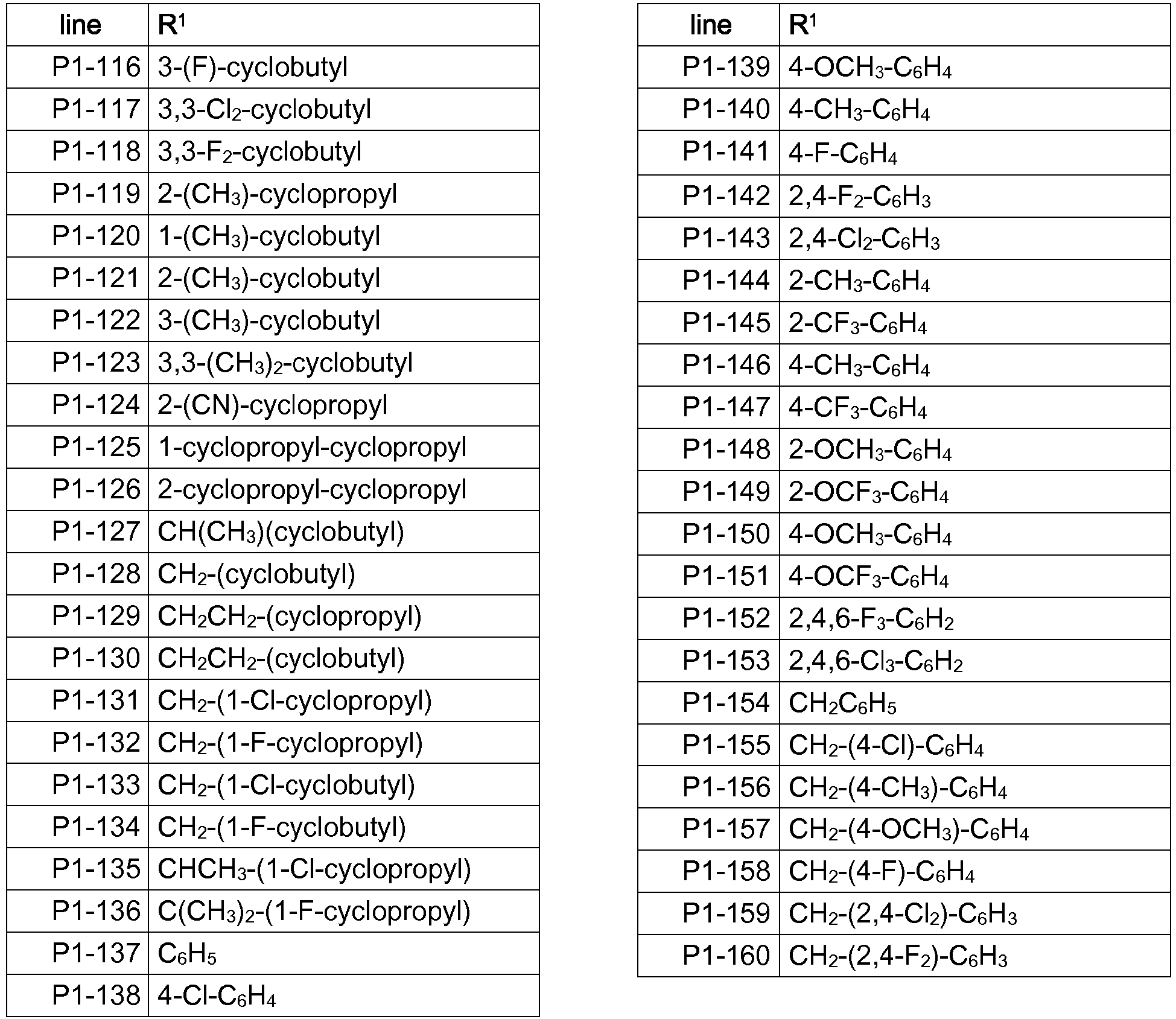
- According to a further embodiment of the invention, R2 is selected from C1-C6-alkyl, C2-C6-alkenyl, C2-C6-alkynyl, C3-C8-cycloalkyl, C3-C8-cycloalkyl-C1-C4-alkyl, phenyl, phenyl-C1-C4-alkyl, phenyl-C2-C4-alkenyl and phenyl-C2-C4-alkynyl, wherein the R2 are in each case unsubstituted or are substituted by R12a and/or R12b as defined and preferably defined herein. Specific embodiments thereof can be found in the below Table P2.
- According to one particular embodiment, R2 is C1-C6-alkyl, in particular C1-C4-alkyl, such as CH3, C2H5, CH(CH3)2, CH2CH2CH3, CH2CH2CH2CH3, CH2CH(CH3)2. A further embodiment relates to compounds, wherein R2 is C1-C6-alkyl, in particular C1-C4-alkyl, that is substituted by one, two or three or up to the maximum possible number of identical or different groups R12a, as defined and preferably defined herein. According to a specific embodiment thereof, R2 is C1-C6-haloalkyl, in particular C1-C4-haloalkyl, more particularly C1-C2-haloalkyl. According to a further specific embodiment thereof, R2 is C1-C4-alkoxy-C1-C6-alkyl, in particular C1-C4-alkoxy-C1-C4-alkyl, such as CH2OCH3 or CH2CH2OCH3. According to still a further specific embodiment thereof, R2 is hydroxy-C1-C6-alkyl, in particular hydroxyl-C1-C4-alkyl, such as CH2CH2OH. Further specific embodiments thereof can be found in the below Table P2
- According to still another embodiment, R2 is C3-C8-cycloalkyl-C1-C6-alkyl, in particular C3-C6-cycloalkyl-C1-C4-alkyl. A further embodiment relates to compounds, wherein R2 is C3-C8-cycloalkyl-C1-C6-alkyl, in particular C3-C6-cycloalkyl-C1-C4-alkyl, more particularly C3-C6-cycloalkyl-C1-C2-alkyl, that is substituted by one, two or three or up to the maximum possible number of identical or different groups R12a in the alkyl moiety and/or substituted by one, two, three four or five or up to the maximum possible number of identical or different groups R12b in the cycloalkyl moiety. R12a and R12b are in each case as defined and preferably defined herein. Specific embodiments thereof can be found in the below Table P2.
- According to another embodiment, R2 is C2-C6-alkenyl, in particular C2-C4-alkenyl, such as CH2CH=CH2, CH2C(CH3)=CH2 or CH2CH=CHCH3. A further embodiment relates to compounds, wherein R2 is C2-C6-alkenyl, in particular C2-C4-alkenyl, that is substituted by one, two or three or up to the maximum possible number of identical or different groups R12a as defined and preferably defined herein. According to a specific embodiment thereof, R2 is C2-C6-haloalkenyl, in particular C2-C4-haloalkenyl, such as CH2C(Cl)=CH2 and CH2C(H)=CHCl. According to a further specific embodiment thereof, R2 is C3-C8-cycloalkyl-C2-C6-alkenyl or C3-C8-halocycloalkyl-C2-C6-alkenyl, in particular C3-C6-cycloalkyl-C2-C4-alkenyl or C3-C6-halocycloalkyl-C2-C4-alkenyl. Further specific embodiments thereof can be found in the below Table P2.
- According to still another embodiment, R2 is C2-C6-alkynyl, in particular C2-C4-alkynyl, such as CH2C≡CH or CH2C≡CCH3. A further embodiment relates to compounds, wherein R2 is C2-C6-alkynyl, in particular C2-C4-alkynyl, that is substituted by one, two or three or up to the maximum possible number of identical or different groups R12a, as defined and preferably defined herein. According to a specific embodiment thereof, R2 is C2-C6-haloalkynyl, in particular C2-C4-haloalkynyl. According to a further specific embodiment thereof, R2 is C3-C8-cycloalkyl-C2-C6-alkynyl or C3-C8-halocycloalkyl-C2-C6-alkynyl, in particular C3-C6-cycloalkyl-C2-C4-alkynyl or C3-C6-halocycloalkyl-C2-C4-alkynyl. Specific embodiments thereof can be found in the below Table P2.
- According to still another embodiment, R2 is phenyl-C1-C4-alkyl, in particular phenyl-C1-C2-alkyl, such as benzyl, wherein the alkyl moiety in each case is unsubstituted or carries one, two or three R12a as defined and preferably defined herein, in particular selected from halogen, in particular F and Cl, C1-C4-alkoxy, in particular OCH3, and CN, and wherein the phenyl in each case is unsubstituted or carries one, two or three R12b as as defined and preferably defined herein, in particular selected from halogen, in particular Cl and F, C1-C4-alkoxy, in particular OCH3, C1-C4-alkyl, in particular CH3 or C2H5, and CN. Specific embodiments thereof can be found in the below Table P2.
- According to still another embodiment, R2 is phenyl-C2-C4-alkenyl, in particular phenyl-C2-C3-alkenyl, such as phenylethenyl, wherein the alkenyl moiety in each case is unsubstituted or carries one, two or three R12a as defined and preferably defined herein, in particular selected from halogen, in particular F and Cl, C1-C4-alkoxy, in particular OCH3, and CN, and wherein the phenyl in each case is unsubstituted or carries one, two or three R12b as defined and preferably defined herein, in particular selected from halogen, in particular Cl and F, C1-C4-alkoxy, in particular OCH3, C1-C4-alkyl, in particular CH3 or C2H5, and CN.
- According to still another embodiment, R2 is phenyl-C2-C4-alkynyl, in particular phenyl-C2-C3-alkynyl, such as phenylethinyl, wherein the alkynyl moiety in each case is unsubstituted or carries one, two or three R12a, as defined and preferably defined herein, in particular selected from halogen, in particular F and Cl, C1-C4-alkoxy, in particular OCH3, and CN, and wherein the phenyl in each case is unsubstituted or carries one, two or three R12b as defined and preferably defined herein, in particular selected from halogen, in particular Cl and F, C1-C4-alkoxy, in particular OCH3, C1-C4-alkyl, in particular CH3 or C2H5, and CN.
- According to still another embodiment, R2 is C3-C8-cycloalkyl, in particular C3-C6-cycloalkyl, such as C3H5 (cyclopropyl), C4H7 (cyclobutyl), cyclopentyl or cyclohexyl. A further embodiment relates to compounds, wherein R2 is C3-C8-cycloalkyl, in particular C3-C6-cycloalkyl, such as C3H5 (cyclopropyl) or C4H7 (cyclobutyl), that is substituted by one, two, three four or five or up to the maximum possible number of identical or different groups R12b as defined and preferably defined herein. According to a specific embodiment thereof, R2 is C3-C8-halocycloalkyl, in particular C3-C6-halocycloalkyl, such as halocyclopropyl, in particular 1-F-cyclopropyl or 1-Cl-cyclopropyl. According to a further specific embodiment thereof, R2 is C3-C8-cycloalkyl-C3-C8-cycloalkyl, in particular C3-C6-cycloalkyl-C3-C6-cycloalkyl, wherein each of said cycloalkyl-cycloalkyl moieties is unsubstituted or carries one, two or three R12b as defined and preferably defined herein.
- According to still another embodiment, R2 is phenyl, wherein the phenyl is unsubstituted or carries one, two, three, four or five independently selected R12b as defined and preferably defined herein, in particular selected from halogen, in particular Cl and F, C1-C4-alkoxy, in particular OCH3, C1-C4-alkyl, in particular CH3 or C2H5, and CN.
- In a further embodiment of the invention, R2 is selected from C1-C6-alkyl, C2-C6-alkenyl and C2-C6-alkynyl, wherein the R2 are in each case unsubstituted or are substituted by R12a and/or R12b as defined and preferably defined herein. In each case, the substituents may also have the preferred meanings for the respective substituent as defined above. Specific embodiments thereof can be found in the below Table P2.
- R12a are the possible substituents for any aliphatic moiety of R1 and/or R2 and can independently be defined for R1 and R2.
- R12a according to the invention is independently selected from halogen, OH, CN, nitro, C1-C4-alkoxy, C3-C8-cycloalkyl, C3-C8-halocycloalkyl and C1-C4-halogenalkoxy.
- According to one embodiment R12a is independently selected from halogen, OH, CN, C1-C2-alkoxy, C3-C6-cycloalkyl, C3-C6-halocycloalkyl and C1-C2-halogenalkoxy. Specifically, R12a is independently selected from F, Cl, OH, CN, C1-C2-alkoxy, cyclopropyl, 1-F-cyclopropyl, 1-Cl-cyclopropyl and C1-C2-halogenalkoxy.
- R12b are the possible substituents for any cycloalkyl and/or phenyl moiety of R1 and/or R2 and can independently be defined for R1 and R2.
- R12b according to the invention is is independently selected from halogen, OH, CN, nitro, C1-C4-alkyl, C1-C4-alkoxy, C1-C4-halogenalkyl, C3-C8-cycloalkyl, C3-C8-halocycloalkyl and C1-C4-halogenalkoxy.
- According to one embodiment R12b is independently selected from halogen, CN, nitro, C1-C2-alkyl, C1-C2-alkoxy, C1-C2-halogenalkyl, C3-C6-cycloalkyl, C3-C6-halocycloalkyl and C1-C2-halogenalkoxy. Specifically, R12b is independently selected from F, Cl, OH, CN, nitro, CH3, OCH3, cyclopropyl, 1-F-cyclopropyl, 1-Cl-cyclopropyl and halogenmethoxy.
- Particularly preferred embodiments of R2 according to the invention are in Table P2 below, wherein each line of lines P2-1 to P2-87 corresponds to one particular embodiment of the invention, wherein P2-1 to P2-87 are also in any combination a preferred embodiment of the present invention.


- Particularly preferred embodiments of combination of R1 and R2 according to the invention are given in Table A below, wherein each line of lines A-1 to A-56 corresponds to one particular embodiment of the invention, wherein A-1 to A-56 are also in any combination a preferred embodiment for combinations of R1 and R2 of the present invention.


- According to the invention, there can be zero, one, two, three or four R3 present, namely for n is 0, 1, 2, 3 or 4.
- According to one embodiment, n is 0.
- According to a further embodiment, n is 1. According to still a further embodiment, n is 1 or 2.
- According to still a further embodiment, n is 2 or 3. According to one specific embodiment thereof, n is 2, according to a further specific embodiment, n is 3.
- According to one embodiment of the invention, one R3 is attached to the 2-position (R31).
- According to one specific embodiment thereof, n is 1, according to a further specific embodiment, n is 2.
- According to one embodiment of the invention, one R3 is attached to the 3-position (R32).
- According to one specific embodiment thereof, n is 1, according to a further specific embodiment, n is 2.
- According to a further embodiment of the invention, one R3 is attached to the 5-position (R34).
- According to one specific embodiment thereof, n is 1, according to a further specific embodiment, n is 2.
- According to still a further embodiment, n is 1, 2 or 3 and one R3 is in 2- or 6-position.
- According to a further embodiment of the invention, two R3 are attached in 2,3-position.
- According to one specific embodiment thereof, n is 2, according to a further specific embodiment, n is 3.
- According to a further embodiment of the invention, two R3 are attached in 2,5-position.
- According to one specific embodiment thereof, n is 2, according to a further specific embodiment, n is 3.
- According to a further embodiment of the invention, two R3 are attached in 2,6-position.
- According to one specific embodiment thereof, n is 2, according to a further specific embodiment, n is 3.
- According to a further embodiment of the invention, two R3 are attached in 3,5-position.
- According to one specific embodiment thereof, n is 2, according to a further specific embodiment, n is 3.
- For every R3 (or R31, R32, R34, R35, respectively) that is present in the compounds, the following embodiments and preferences apply independently of the meaning of any other R3 (or R31, R32, R33, R34, R35, respectively) that may be present in the phenyl ring. Furthermore, the particular embodiments and preferences given herein for R3 (or R31, R32, R33, R34, R35, respectively) apply independently for each of n=1, n=2, n=3 and n=4.
- According to the invention, each R3 is independently selected from halogen, CN, NO2, OH, SH, C1-C6-alkyl, C1-C6-alkoxy, C2-C6-alkenyl, C2-C6-alkynyl, C3-C8-cycloalkyl, C3-C8-cycloalkyloxy, NH2, NH(C1-C4-alkyl), N(C1-C4-alkyl)2, NH(C3-C6-cycloalkyl), N(C3-C6-cycloalkyl)2, S(O)p(C1-C4-alkyl), C(=O)(C1-C4-alkyl), C(=O)(OH), C(=O)(O-C1-C4-alkyl), C(=O)(NH(C1-C4-alkyl)), C(=O)(N(C1-C4-alkyl)2), C(=O)(NH(C3-C6-cycloalkyl)) and C(=O)-(N(C3-C6-cycloalkyl)2); wherein each of R3 is unsubstituted or further substituted by one, two, three or four R3a; wherein R3a is independently selected from halogen, CN, NO2, OH, C1-C4-alkyl, C1-C4-haloalkyl, C3-C8-cycloalkyl, C3-C8-halocycloalkyl, C1-C4-alkoxy and C1-C4-haloalkoxy.
- According to one embodiment, R3 is independently selected from halogen, CN, NO2, C1-C4-alkyl, C1-C4-haloalkyl, C1-C4-alkoxy, C1-C4-haloalkoxy, C2-C4-alkenyl, C2-C4-haloalkenyl, C2-C4-alkynyl, C2-C4-haloalkynyl, C3-C6-cycloalkyl, C3-C6-halocycloalkyl, S(C1-C2-alkyl), S(O)(C1-C2-alkyl), S(O)2(C1-C2-alkyl), C(=O)(C1-C2-alkyl), C(=O)(OH) and C(=O)(O-C1-C2-alkyl).
- According to a further embodiment, R3 is independently selected from halogen, CN, NO2, OH, SH, C1-C6-alkyl, C1-C6-alkoxy, C2-C6-alkenyl, C2-C6-alkynyl, C3-C8-cycloalkyl, C3-C8-cycloalkyloxy, NH2, NH(C1-C4-alkyl), N(C1-C4-alkyl)2, NH(C3-C6-cycloalkyl), N(C3-C6-cycloalkyl)2, S(O)p(C1-C4-alkyl) (p=0, 1 or 2), C(=O)(C1-C4-alkyl), C(=O)(OH), C(=O)(O-C1-C4-alkyl), C(=O)(NH(C1-C4-alkyl)), C(=O)(N(C1-C4-alkyl)2), C(=O)(NH(C3-C6-cycloalkyl)) and C(=O)-(N(C3-C6-cycloalkyl)2); wherein each of R3 is unsubstituted or further substituted by one, two, three or four R3a, wherein R3a is as defined and preferably defined herein.
- According to still a further embodiment, R3 is independently selected from halogen, CN, NO2, C1-C4-alkyl, C1-C4-haloalkyl, C1-C4-alkoxy, C1-C4-haloalkoxy, C2-C4-alkenyl, C2-C4-haloalkenyl, C2-C4-alkynyl, C2-C4-haloalkynyl, C3-C6-cycloalkyl, C3-C6-halocycloalkyl, S(C1-C2-alkyl), S(O)(C1-C2-alkyl), S(O)2(C1-C2-alkyl), C(=O)(C1-C2-alkyl), C(=O)(OH) and C(=O)(O-C1-C2-alkyl). According to still a further embodiment, R3 is independently selected from F, Cl, Br, CN, C1-C4-alkyl, C1-C4-haloalkyl, C1-C4-alkoxy, C1-C4-haloalkoxy, S(C1-C4-alkyl), S(O)(C1-C4-alkyl) and S(O)2(C1-C4-alkyl).
- According to one specific embodiment, R3 is halogen, in particular Br, F or Cl, more specifically For Cl.
- According to a further specific embodiment, R3 is CN.
- According to a further specific embodiment, R3 is C1-C6-alkyl, in particular C1-C4-alkyl, such as CH3.
- According to a further specific embodiment, R3 is C1-C6-haloalkyl, in particular C1-C4-haloalkyl, such as CF3, CHF2, CH2F, CCl3, CHCl2 or CH2Cl.
- According to a further specific embodiment, R3 is C1-C6-alkoxy, in particular C1-C4-alkoxy, more specifically C1-C2-alkoxy such as OCH3 or OCH2CH3.
- According to a further specific embodiment, R3 is C1-C6-haloalkoxy, in particular C1-C4-haloalkoxy, more specifically C1-C2-haloalkoxy such as OCF3, OCHF2, OCH2F, OCCl3, OCHCl2 or OCH2Cl, in particular OCF3, OCHF2, OCCl3 or OCHCl2.
- According to still a further embodiment, R3 is C2-C6-alkenyl or C2-C6-haloalkenyl, in particular C2-C4-alkenyl or C2-C4-haloalkenyl, such as CH=CH2.
- According to still a further embodiment, R3 is C2-C6-alkynyl or C2-C6-haloalkynyl, in particular C2-C4-alkynyl or C2-C4-haloalkynyl, such as C≡CH.
- According to still a further embodiment, R3 is selected from C(=O)(C1-C4-alkyl), C(=O)(OH), C(=O)(O-C1-C4-alkyl), C(=O)(NH(C1-C4-alkyl)), C(=O)(N(C1-C4-alkyl)2), C(=O)(NH(C3-C6-cycloalkyl)) and C(=O)(N(C3-C6-cycloalkyl)2), in particular selected from C(=O)(C1-C2-alkyl), C(=O)(OH), C(=O)(O-C1-C2-alkyl), C(=O)(NH(C1-C2-alkyl)), C(=O)(N(C1-C2-alkyl)2), C(=O)(NH(C3-C6-cycloalkyl)) and C(=O)(N(C3-C6-cycloalkyl)2). According to one specific embodiment thereof, R3 is C(=O)(OH) or C(=O)(O-C1-C4-alkyl), in particular C(=O)(OCH3).
- According to still a further embodiment, R3 is selected from S(C1-C2-alkyl), S(O)(C1-C2-alkyl) and S(O)2(C1-C2-alkyl), in particular SCH3, S(O)(CH3) and S(O)2(CH3).
- R3a is independently selected from halogen, CN, NO2, OH, C1-C4-alkyl, C1-C4-haloalkyl, C3-C8-cycloalkyl, C3-C8-halocycloalkyl, C1-C4-alkoxy and C1-C4-halogenalkoxy, in particular selected from halogen, CN, C1-C2-alkyl, C1-C2-haloalkyl, C3-C6-cycloalkyl, C3-C6-halocycloalkyl, C1-C2-alkoxy and C1-C2-halogenalkoxy. Specifically, R3a is independently selected from F, Cl, CN, OH, CH3, halomethyl, cyclopropyl, halocyclopropyl, OCH3 and halogenmethoxy.
- Particularly preferred embodiments of R3 according to the invention are in Table P3 below, wherein each line of lines P3-1 to P3-16 corresponds to one particular embodiment of the invention, wherein P3-1 to P3-16 are also in any combination with one another a preferred embodiment of the present invention. Thereby, for every R3 that is present in the compounds, these specific embodiments and preferences apply independently of the meaning of any other R3 that may be present in the phenyl ring:
Table P3: No. R3 P3-1 Cl P3-2 F P3-3 CN P3-4 NO2 P3-5 CH3 P3-6 CH2CH3 P3-7 CF3 P3-8 CHF2 P3-9 OCH3 P3-10 OCH2CH3 P3-11 OCF3 P3-12 OCHF2 P3-13 SCH3 P3-14 SOCH3 P3-15 SO2CH3 P3-16 CO2CH3 - Particularly preferred embodiments of (R3)n according to the invention are in Table P33 below, wherein each line of lines P33-1 to P33-60 corresponds to one particular embodiment of the invention, wherein P33-1 to P33-60 are also in any combination a preferred embodiment of the present invention.


- Each R4 according to the present invention is independently selected from halogen, CN, NO2, OH, SH, C1-C6-alkyl, C1-C6-alkoxy, C2-C6-alkenyl, C2-C6-alkynyl, C3-C8-cycloalkyl, C3-C8-cycloalkyloxy, NH2, NH(C1-C4-alkyl), N(C1-C4-alkyl)2, NH(C3-C6-cycloalkyl), N(C3-C6-cycloalkyl)2, S(O)p(C1-C4-alkyl), C(=O)(C1-C4-alkyl), C(=O)(OH), C(=O)(O-C1-C4-alkyl), C(=O)(NH(C1-C4-alkyl)), C(=O)(N(C1-C4-alkyl)2), C(=O)(NH(C3-C6-cycloalkyl)) and C(=O)-(N(C3-C6-cycloalkyl)2); wherein each of R4 is unsubstituted or further substituted by one, two, three or four R4a independently selected from halogen, CN, NO2, OH, C1-C4-alkyl, C1-C4-haloalkyl, C3-C8-cycloalkyl, C3-C8-halocycloalkyl, C1-C4-alkoxy and C1-C4-haloalkoxy.
- According to the invention, there can be zero, one, two, three, four or five R4 present, namely for m is 0, 1, 2, 3, 4 or 5. In particular, m is 0, 1, 2, 3 or 4.
- According to one embodiment, m is 0.
- According to a further embodiment, m is 1, 2, 3 or 4, in particular 1, 2 or 3, more specifically 1 or 2. According to one specific embodiment thereof, m is 1, according to a further specific embodiment, m is 2.
- According to still a further embodiment, m is 2, 3 or 4.
- According to still a further embodiment, m is 3.
- According to one embodiment of the invention, one R4 is attached to the para-position (4-position).
- According to a further embodiment of the invention, one R4 is attached to the meta-position (3-position).
- According to a further embodiment of the invention, one R4 is attached to the ortho-position (2-position).
- According to a further embodiment of the invention, two R4 are attached in 2,4-position.
- According to a further embodiment of the invention, two R4 are attached in 2,3-position.
- According to a further embodiment of the invention, two R4 are attached in 2,5-position.
- According to a further embodiment of the invention, two R4 are attached in 2,6-position.
- According to a further embodiment of the invention, two R4 are attached in 3,4-position.
- According to a further embodiment of the invention, two R4 are attached in 3,5-position.
- According to a further embodiment of the invention, three R4 are attached in 2,4,6-position.
- For every R4 that is present in the compounds, the following embodiments and preferences apply independently of the meaning of any other R4 that may be present in the phenyl ring. Furthermore, the particular embodiments and preferences given herein for R4 apply independently for each of m=1, m=2, m=3, m= 4 and m=5.
- According to one embodiment, R4 is independently selected from halogen, CN, NO2, OH, SH, C1-C6-alkyl, C1-C6-alkoxy, C2-C6-alkenyl, C2-C6-alkynyl, C3-C8-cycloalkyl, C3-C8-cycloalkyloxy, NH2, NH(C1-C4-alkyl), N(C1-C4-alkyl)2, NH(C3-C6-cycloalkyl), N(C3-C6-cycloalkyl)2, S(O)p(C1-C4-alkyl) (p=0, 1 or 2), C(=O)(C1-C4-alkyl), C(=O)(OH), C(=O)(O-C1-C4-alkyl), C(=O)(NH(C1-C4-alkyl)), C(=O)(N(C1-C4-alkyl)2), C(=O)(NH(C3-C6-cycloalkyl)) and C(=O)-(N(C3-C6-cycloalkyl)2); wherein each of R4 is unsubstituted or further substituted by one, two, three or four independently selected R4a, wherein R4a is as defined and preferably defined herein.
- According to a further embodiment, R4 is independently selected from halogen, CN, NO2, C1-C4-alkyl, C1-C4-alkoxy, C2-C4-alkenyl, C2-C4-alkynyl, C3-C6-cycloalkyl, C3-C6-cycloalkyloxy, NH2, NH(C1-C42-alkyl), N(C1-C2-alkyl)2, S(O)p(C1-C2-alkyl) (p=0, 1 or 2), C(=O)(C1-C2-alkyl), C(=O)(OH) and C(=O)(O-C1-C2-alkyl), wherein each of R4 is unsubstituted or further substituted by one, two, three or four independently selected R4a, wherein R4a is as defined and preferably defined herein.
- According to a further embodiment, R4 is independently selected from halogen, CN, NO2, C1-C4-alkyl, C1-C4-haloalkyl, C1-C4-alkoxy, C1-C4-haloalkoxy, C2-C4-alkenyl, C2-C4-haloalkenyl, C2-C4-alkynyl, C2-C4-haloalkynyl, C3-C6-cycloalkyl, C3-C6-halocycloalkyl, S(C1-C2-alkyl), S(O)(C1-C2-alkyl), S(O)2(C1-C2-alkyl), C(=O)(C1-C2-alkyl), C(=O)(OH) and C(=O)(O-C1-C2-alkyl).
- According to a further embodiment, R4 is independently selected from halogen, CN, NO2, C1-C2-alkyl, C1-C2-haloalkyl, C1-C2-alkoxy, C1-C2-haloalkoxy, S(C1-C2-alkyl), S(O)(C1-C2-alkyl), S(O)2(C1-C2-alkyl), C(=O)(OH) and C(=O)(O-C1-C2-alkyl).
- According to a further embodiment, R4 is independently selected from F, Cl, Br, CN, C1-C4-alkyl, C1-C4-haloalkyl, C1-C4-alkoxy, C1-C4-haloalkoxy, S(C1-C4-alkyl), S(O)(C1-C4-alkyl) and S(O)2(C1-C4-alkyl).
- According to still a further specific embodiment, R4 is independently selected from halogen, in particular from Br, F and Cl, more specifically from F and Cl.
- According to a further specific embodiment, R4 is CN.
- According to one further embodiment R4 is NO2.
- According to one further embodiment R4 is OH.
- According to one further embodiment R4 is SH.
- According to a further specific embodiment, R4 is C1-C6-alkyl, in particular C1-C4-alkyl, such as CH3. Further appropriate alkyls are ethyl, n-propyl, i-propyl, n-butyl, i-butyl and t-butyl.
- According to a further specific embodiment, R4 is C1-C6-haloalkyl, in particular C1-C4-haloalkyl, such as CF3, CHF2, CH2F, CCl3, CHCl2 or CH2Cl.
- According to a further specific embodiment R4 is C1-C6-alkyl, preferably C1-C4-alkyl, substituted by OH, more preferably CH2OH, CH2CH2OH, CH2CH2CH2OH, CH(CH3)CH2OH, CH2CH(CH3)OH, CH2CH2CH2CH2OH. In a special embodiment R4 is CH2OH. According to a further specific embodiment R4 is C1-C6-alkyl, preferably C1-C4-alkyl substituted by CN, more preferably CH2CN, CH2CH2CN, CH2CH2CH2CN, CH(CH3)CH2CN, CH2CH(CH3)CN, CH2CH-2CH2CH2CN. In a special embodiment R4 is CH2CH2CN. In a further special embodiment R4 is CH(CH3)CN. According to a further specific embodiment R4 is C1-C4-alkoxy-C1-C6-alkyl, more preferably C1-C4-alkoxy-C1-C4-alkyl. In a special embodiment R4 is CH2OCH3. In a further special embodiment R4 is CH2CH2OCH3. In a further special embodiment R4 is CH(CH3)OCH3. In a further special embodiment R4 is CH(CH3)OCH2CH3. In a further special embodiment R4 is CH2CH2OCH2CH3. According to a further specific embodiment R4 is C1-C4-haloalkoxy-C1-C6-alkyl, more preferably C1-C4-alkoxy-C1-C4-alkyl. In a special embodiment R4 is CH2OCF3. In a further special embodiment R4 is CH2CH2OCF3. In a further special embodiment R4 is CH2OCCl3. In a further special embodiment R4 is CH2CH2OCCl3.
- According to a further specific embodiment, R4 is C1-C6-alkoxy, in particular C1-C4-alkoxy, more specifically C1-C2-alkoxy such as OCH3 or OCH2CH3.
- According to a further specific embodiment, R4 is C1-C6-haloalkoxy, in particular C1-C4-haloalkoxy, more specifically C1-C2-haloalkoxy such as OCF3, OCHF2, OCH2F, OCCl3, OCHCl2 or OCH2Cl, in particular OCF3, OCHF2, OCCl3 or OCHCl2.
- According to still a further embodiment, R4 is C2-C6-alkenyl or C2-C6-haloalkenyl, in particular C2-C4-alkenyl or C2-C4-haloalkenyl, such as CH=CH2, CH2CH=CH2, CH=CHCH3 or C(CH3)=CH2.
- According to a further specific embodiment R4 is C2-C6-alkenyl, preferably C2-C4-alkenyl, substituted by OH, more preferably, CH=CHOH, CH=CHCH2OH, C(CH3)=CHOH, CH=C(CH3)OH. In a special embodiment R4 is CH=CHOH. In a further special embodiment R4 is CH=CHCH2OH. According to a further specific embodiment R4 is C1-C4-alkoxy-C2-C6-alkenyl, more preferably C1-C4-alkoxy-C2-C4-alkenyl. In a special embodiment R4 is CH=CHOCH3. In a further special embodiment R4 is CH=CHCH2OCH3. According to a further specific embodiment R4 is C1-C4-haloalkoxy-C2-C6-alkenyl, more preferably C1-C4-haloalkoxy-C2-C4-alkenyl. In a special embodiment R4 is CH=CHOCF3. In a further special embodiment R4 is CH=CHCH2OCF3. In a further special embodiment R4 is CH=CHOCCl3. In a further special embodiment R4 is CH=CHCH2OCCl3. According to a further specific embodiment R4 is C3-C8-cycloalkyl-C2-C6-alkenyl, preferably C3-C6-cycloalkyl-C2-C4-alkenyl. According to a further specific embodiment R4 is C3-C6-halocycloalkyl-C2-C4-alkenyl, preferably C3-C8-halocycloalkyl-C2-C6-alkenyl.
- According to still a further embodiment, R4 is C2-C6-alkynyl or C2-C6-haloalkynyl, in particular C2-C4-alkynyl or C2-C4-haloalkynyl, such as C≡CH, CH2CCH or CH2CCCH3.
- According to a further specific embodiment R4 is C2-C6-alkynyl, preferably C2-C4-alkynyl, substituted by OH, more preferably, CCOH, CH2CCOH. In a special embodiment R4 is CCOH. In a further special embodiment R4 is CH2CCOH. According to a further specific embodiment R4 is C1-C4-alkoxy-C2-C6-alkynyl, more preferably C1-C4-alkoxy-C2-C4-alkynyl. In a special embodiment R4 is CCOCH3. In a further special embodiment R4 is CH2CCOCH3. According to a further specific embodiment R4 is C1-C4-haloalkoxy-C2-C6-alkynyl, more preferably C1-C4-haloalkoxy-C2-C4-alkynyl. In a special embodiment R4 is CCOCF3. In a further special embodiment R4 is CH2CCOCF3. In a further special embodiment R4 is CCOCCl3. In a further special embodiment R4 is CH2CCOCCl3. According to a further specific embodiment R4 is C3-C8-cycloalkyl-C2-C6-alkynyl, preferably C3-C6-cycloalkyl-C2-C4-alkynyl. According to a further specific embodiment R4 is C3-C6-halocycloalkyl-C2-C4-alkynyl, preferably C3-C8-halocycloalkyl-C2-C6-alkynyl.
- According to one another embodiment R4 is C3-C8-cycloalkyl, preferably cyclopropyl, cyclobutyl, cyclopentyl or cyclohexyl, in particular cyclopropyl or cyclobutyl. In a special embodiment R4 is cyclopropyl. In a further special embodiment R4 is cyclobutyl. In a further special embodiment R4 is cyclopentyl. In a further special embodiment R4 is cyclohexyl.
- According to one another embodiment R4 is C3-C8-cycloalkoxy, preferably C3-C6-cycloalkoxy. In a special embodiment R4 is O-cyclopropyl.
- According to a specific embodiment R4 is C3-C8-halocycloalkyl, more preferably fully or partially halogenated C3-C6-cycloalkyl. In a special embodiment R4 is fully or partially halogenated cyclopropyl. In a further special embodiment R4 is 1-Cl-cyclopropyl. In a further special embodiment R4 is 2-Cl-cyclopropyl. In a further special embodiment R4 is 1-F-cyclopropyl. In a further special embodiment R4 is 2-F-cyclopropyl. In a further special embodiment R4 is fully or partially halogenated cyclobutyl. In a further special embodiment R4 is 1-Cl-cyclobutyl. In a further special embodiment R4 is 1-F-cyclobutyl. In a further special embodiment R4 is 3,3-Cl2-cyclobutyl. In a further special embodiment R4 is 3,3-F2-cyclobutyl. According to a specific embodiment R4 is C3-C8-cycloalkyl substituted by C1-C4-alkyl, more preferably is C3-C6-cycloalkyl substituted by C1-C4-alkyl. In a special embodiment R4 is 1-CH3-cyclopropyl. According to a specific embodiment R4 is C3-C8-cycloalkyl substituted by CN, more preferably is C3-C6-cycloalkyl substituted by CN. In a special embodiment R4 is 1-CN-cyclopropyl.According to a further specific embodiment R4 is C3-C8-cycloalkyl-C3-C8-cycloalkyl, preferably C3-C6-cycloalkyl-C3-C6-cycloalkyl. In a special embodiment R4 is cyclopropyl-cyclopropyl. In a special embodiment R4 is 2-cyclopropyl-cyclopropyl. According to a further specific embodiment R4 is C3-C8-cycloalkyl-C3-C8-halocycloalkyl, preferably C3-C6-cycloalkyl-C3-C6-halocycloalkyl.
- According to one another embodiment R4 is C3-C8-cycloalkyl-C1-C4-alkyl, preferably C3-C6-cycloalkyl-C1-C4-alkyl. In a special embodiment R4 is CH(CH3)(cyclopropyl). In a further special embodiment R4 is CH2-(cyclopropyl).
- According to a further preferred embodiment R4 is C3-C8-cycloalkyl-C1-C4-alkyl wherein the alkyl moiety can be substituted by one, two, three or up to the maximum possible number of identical or different groups Ra as defined and preferably herein and the cycloalkyl moiety can be substituted by one, two, three or up to the maximum possible number of identical or different groups Rb as defined and preferably herein.
- According to a specific embodiment R4 is C3-C8-cycloalkyl-C1-C4-haloalkyl, C3-C6-cycloalkyl-C1-C4-haloalkyl. According to a specific embodiment R4 is C3-C8-halocycloalkyl-C1-C4-alkyl, C3-C6-halocycloalkyl-C1-C4-alkyl. In a special embodiment R4 is fully or partially halogenated cyclopropyl-C1-C4-alkyl. In a further special embodiment R4 is 1-Cl-cyclopropyl-C1-C4-alkyl. In a further special embodiment R4 is 1-F-cyclopropyl-C1-C4-alkyl.
- According to one another embodiment R4 is NH2.
- According to one another embodiment R4 is NH(C1-C4-alkyl). According to a specific embodiment R4 is NH(CH3). According to a specific embodiment R4 is NH(CH2CH3). According to a specific embodiment R4 is NH(CH2CH2CH3). According to a specific embodiment R4 is NH(CH(CH3)2). According to a specific embodiment R4 is NH(CH2CH2CH2CH3). According to a specific embodiment R4 is NH(C(CH3)3).
- According to one another embodiment R4 is N(C1-C4-alkyl)2. According to a specific embodiment R4 is N(CH3)2. According to a specific embodiment R4 is N(CH2CH3)2. According to a specific embodiment R4 is N(CH2CH2CH3)2. According to a specific embodiment R4 is N(CH(CH3)2)2.
- According to a specific embodiment R4 is N(CH2CH2CH2CH3)2. According to a specific embodiment R4 is NH(C(CH3)3)2.
- According to one another embodiment R4 is NH(C3-C8-cycloalkyl) preferably NH(C3-C6-cycloalkyl). According to a specific embodiment R4 is NH(cyclopropyl). According to a specific embodiment R4 is NH(cyclobutyl). According to a specific embodiment R4 is NH(cyclopentyl).
- According to a specific embodiment R4 is NH(cyclohexyl).
- According to one another embodiment R4 is N(C3-C8-cycloalkyl)2 preferably N(C3-C6-cycloalkyl)2. According to a specific embodiment R4 is N(cyclopropyl)2. According to a specific embodiment R4 is N(cyclobutyl)2. According to a specific embodiment R4 is N(cyclopentyl)2.
- According to a specific embodiment R4 is N(cyclohexyl)2.
- According to still a further embodiment, R4 is selected from C(=O)(C1-C4-alkyl), C(=O)(OH), C(=O)(O-C1-C4-alkyl), C(=O)(NH(C1-C4-alkyl)), C(=O)(N(C1-C4-alkyl)2), C(=O)(NH(C3-C6-cycloalkyl)) and C(=0)(N(C3-C6-cycloalkyl)2), in particular selected from C(=O)(C1-C2-alkyl), C(=O)(OH), C(=O)(O-C1-C2-alkyl), C(=O)(NH(C1-C2-alkyl)), C(=O)(N(C1-C2-alkyl)2), C(=O)(NH(C3-C6-cycloalkyl)) and C(=O)(N(C3-C6-cycloalkyl)2). According to one specific embodiment thereof, R4 is C(=O)(OH) or C(=O)(O-C1-C4-alkyl), in particular C(=O)(OCH3).
- According to one another embodiment R4 is C(=O)(-C1-C4-alkyl). According to a specific embodiment R4 is C(=O)CH3.. According to a further specific embodiment R4 is C(=O)CH2CH3. According to a further specific embodiment R4 is C(=O)CH2CH2CH3. According to a further specific embodiment R4 is C(=O)CH(CH3)2. According to a further specific embodiment R4 is C(=O)C(CH3)3.
- According to one another embodiment R4 is C(=O)OH.
- According to one another embodiment R4 is C(=O)(-O-C1-C4-alkyl). According to a specific embodiment R4 is C(=O)OCH3. According to a further specific embodiment R4 is C(=O)OCH2CH3.
- According to a further specific embodiment R4 is C(=O)OCH2CH2CH3 According to a further specific embodiment R4 is C(=O)OCH(CH3)2. According to a further specific embodiment R4 is C(=O)OC(CH3)3.
- According to one another embodiment R4 is C(=O)-NH(C1-C4-alkyl). According to a specific embodiment R4 is C(=O)NHCH3. According to a further specific embodiment R4 is C(=O)NHCH2CH3.
- According to a further specific embodiment R4 is C(=O)NHCH2CH2CH3. According to a further specific embodiment R4 is C(=O)NHCH(CH3)2. According to a further specific embodiment R4 is C(=O)NHC(CH3)3.
- According to one another embodiment R4 is C(=O)-N(C1-C4-alkyl)2. According to a specific embodiment R4 is C(=O)N(CH3)2. According to a further specific embodiment R4 is C(=O)N(CH2CH3)2. According to a further specific embodiment R4 is C(=O)N(CH2CH2CH3)2. According to a further specific embodiment R4 is C(=O)N(CH(CH3)2)2. According to a further specific embodiment R4 is C(=O)N(C(CH3)3)2.
- According to one another embodiment R4 is C(=O)-NH(C3-C6-cycloalkyl). According to a specific embodiment R4 is C(=O)NH(cyclopropyl).. According to a further specific embodiment R4 is C(=O)NH(cyclobutyl). According to a further specific embodiment R4 is C(=O)NH(cyclopentyl). According to a further specific embodiment R4 is C(=O)NH(cyclohexyl).
- According to one another embodiment R4 is C(=O)-N(C3-C6-cycloalkyl)2. According to a specific embodiment R4 is C(=O)N(cyclopropyl)2. According to a further specific embodiment R4 is C(=O)N(cyclobutyl)2. According to a further specific embodiment R4 is C(=O)N(cyclopentyl)2. According to a further specific embodiment R4 is C(=O)N(cyclohexyl)2.
- According to still a further embodiment, R4 is selected from S(C1-C2-alkyl), S(O)(C1-C2-alkyl) and S(O)2(C1-C2-alkyl), in particular SCH3, S(O)(CH3) and S(O)2(CH3). According to a specific embodiment R4 is selected from S(C1-C2-haloalkyl), S(O)(C1-C2-haloalkyl) and S(O)2(C1-C2-haloalkyl), such as SO2CF3.
- Particularly preferred embodiments of R4 according to the invention are in Table P4 below, wherein each line of lines P4-1 to P4-16 corresponds to one particular embodiment of the invention, wherein P4-1 to P4-16 are also in any combination with one another a preferred embodiment of the present invention. Thereby, for every R4 that is present in the compounds, these specific embodiments and preferences apply independently of the meaning of any other R4 that may be present in the phenyl ring:
Table P4: No. R4 P4-1 Cl P4-2 F P4-3 CN P4-4 NO2 P4-5 CH3 P4-6 CH2CH3 P4-7 CF3 P4-8 CHF2 P4-9 OCH3 P4-10 OCH2CH3 P4-11 OCF3 P4-12 OCHF2 P4-13 SCH3 P4-14 SOCH3 P4-15 SO2CH3 P4-16 CO2CH3 - Particularly preferred embodiments of (R4)m according to the invention are in Table P44 below, wherein each line of lines P44-1 to P44-155 corresponds to one particular embodiment of the invention, wherein P44-1 to P44-155 are also in any combination a preferred embodiment of the present invention.


- In particular, in the inventive process, compounds III.a are used to obtain compounds II.a and, then may be further reacted to compounds la, and optionally further reacted to the respective I-1 compounds (containing "OR2" see above):


- Wherein the substituents are as defined and preferably defined above. In particular, the substituents have the following preferred meanings. There, the specific meanings of the respective substituents are in each case on their own but also in any combination with one another, particular embodiments of the present invention.
- According to one particular embodiment of the invention, in the compounds I (or 1-1), II and III, respectively, R1 is (C1-C4)-alkyl, (C3-C6)-cycloalkyl or (C2-C4)-alkinyl. Preferably, R1 is (C1-C4)-alkyl, (C3)-cycloalkyl or (C3)-alkinyl. In one specific embodiment thereof, R1 is CH3. In a further specific embodiment R1 is C2H5. In still a further specific embodiment R1 is n-(C3H7). In still a further specific embodiment R1 is i-(C3H7). In still a further specific embodiment R1 is C(CH3)3. In still a further embodiment R1 is cyclopropyl. In still a further embodiment R1 is C≡C-CH3.
- According to one particular embodiment of the invention, in the compounds 1-1, R2 is (C1-C3)-alkyl, (C2-C4)-alkenyl or (C2-C4)-alkynyl, in particular hydrogen, (C1-C3)-alkyl, (C2-C3)-alkenyl or (C2-C4)-alkynyl. Preferably, R2 is (C1-C3)-alkyl. In a further specifc embodiment R2 is CH3. In still a further specific embodiment R2 is C2H5. In still a further specifc embodiment R2 is n-(C3H7). In still a further specific embodiment R2 is i-(C3H7). In still a further specifc embodiment R2 is CH2CH=CH2 (allyl). In still a further specific embodiment R2 is CH2C(CH3)=CH2. In still a further specific embodiment R2 is CH2C≡CH.
- According to one particular embodiment of the invention, in the compounds I (or 1-1), II and III, respectively, R3 is Cl or CF3. In one embodiment R3 is Cl. In the further embodiment, R3 is CF3.
- According to one particular embodiment of the invention, in the compounds I (or 1-1), II and III, respectively, R4 is is Cl or F. In one embodiment R4 is Cl. In the further embodiment R4 is F.
- Specifically, the following compounds I.1 to 1.18 and 1.19 to 1.31 can advantageously be prepared using the process according to the present invention:
- compound I.1 2-[2-chloro-4-(4-chlorophenoxy)phenyl]-1-(1,2,4-triazol-1-yl)pent-3-yn-2-ol;
- compound 1.2 1-[2-chloro-4-(4-chlorophenoxy)phenyl]-1-cyclopropyl-2-(1,2,4-triazol-1-yl)ethanol;
- compound 1.3 2-[4-(4-chlorophenoxy)-2-(trifluoromethyl)phenyl]-1-(1,2,4-triazol-1-yl)propan-2-ol;
- compound 1.4 1-[4-(4-chlorophenoxy)-2-(trifluoromethyl)phenyl]-1-cyclopropyl-2-(1,2,4-triazol-1-yl)ethanol;
- compound 1.5 2-[4-(4-chlorophenoxy)-2-(trifluoromethyl)phenyl]-3-methyl-1-(1,2,4-triazol-1-yl)butan-2-ol;
- compound 1.6 1-[2-[2-chloro-4-(4-chlorophenoxy)phenyl]-2-methoxy-pent-3-ynyl]-1,2,4-triazole;
- compound I.7 2-[4-(4-chlorophenoxy)-2-(trifluoromethyl)phenyl]-1-(1,2,4-triazol-1-yl)butan-2-ol;
- compound 1.8 1-[2-[2-chloro-4-(4-chlorophenoxy)phenyl]-2-cyclopropyl-2-methoxy-ethyl]-1,2,4-triazole;
- compound 1.9 1-[2-[4-(4-chlorophenoxy)-2-(trifluoromethyl)phenyl]-2-methoxy-propyl]-1,2,4-triazole;
- compound I.10 2-[2-chloro-4-(4-chlorophenoxy)phenyl]-3,3-dimethyl-1-(1,2,4-triazol-1-yl)butan-2-ol,
- compound I.11 1-[2-[4-(4-chlorophenoxy)-2-(trifluoromethyl)phenyl]-2-cyclopropyl-2-methoxyethyl]-1,2,4-triazole;
- compound I.12 1-[2-[2-chloro-4-(4-chlorophenoxy)phenyl]-2-methoxy-3,3-dimethyl-butyl]-1,2,4-triazole;
- compound I.13 1-[2-[4-(4-chlorophenoxy)-2-(trifluoromethyl)phenyl]-2-methoxy-butyl]1,2,4-triazole;
- compound I.14 2-[4-(4-chlorophenoxy)-2-(trifluoromethyl)phenyl]-1-(1,2,4-triazol-1-yl)pent-3-yn-2-ol;
- compound I.15 1-[2-[4-(4-chlorophenoxy)-2-(trifluoromethyl)phenyl]-2-methoxy-pent-3-ynyl]-1,2,4-triazole;
- compound I.16 2-[4-(4-chlorophenoxy)-2-(trifluoromethyl)phenyl]-1-(1,2,4-triazol-1-yl)but-3-yn-2-ol;
- compound I.17 2-[2-chloro-4-(4-chlorophenoxy)phenyl]-1-(1,2,4-triazol-1-yl)propan-2-ol; and compound I.18 2-[2-chloro-4-(4-fluorophenoxy)phenyl]-1-(1,2,4-triazol-1-yl)propan-2-ol.
- compound I.19 2-[2-chloro-4-(4-chlorophenoxy)phenyl]-3-methyl-1-(1,2,4-triazol-1-yl)butan-2-ol;
- compound I.20 1-[2-[2-chloro-4-(4-chlorophenoxy)phenyl]-2-methoxy-propyl]-1,2,4-triazole;
- compound I.21 1-[2-[2-chloro-4-(4-chlorophenoxy)phenyl]-2-methoxy-butyl]-1,2,4-riazole;
- compound I.22 1-[2-[2-chloro-4-(4-chlorophenoxy)phenyl]-2-methoxy-pentyl]-1,2,4-triazole;
- compound I.23 2-[2-chloro-4-(4-chlorophenoxy)phenyl]-1,1,1-trifluoro-3-(1,2,4-triazol-1 - yl)propan-2-ol;
- compound I.24 2-[2-chloro-4-(4-chlorophenoxy)phenyl]-3-fluoro-1-(1,2,4-triazol-1-yl)butan-2-ol hydrochloride;
- compound I.25 2-[2-chloro-4-(4-chlorophenoxy)phenyl]-1-(1,2,4-triazol-1-yl)pent-4-yn-2-ol;
- compound 1.26 2-[2-chloro-4-(4-chlorophenoxy)phenyl]-1-methoxy-3-(1,2,4-triazol-1-yl)propan-2-ol;
- compound I.27 2-[2-chloro-4-(4-fluorophenoxy)phenyl]-1-methoxy-3-(1,2,4-triazol-1-yl)propan-2-ol;
- compound I.28 2-[4-(4-chlorophenoxy)-2-(trifluoromethyl)phenyl]-1-(1,2,4-triazol-1-yl)pentan-2-ol;
- compound I.29 and2-[4-(4-fluorophenoxy)-2-(trifluoromethyl)phenyl]-1-(1,2,4-triazol-1-yl)propan-2-ol;
- compound I.30 2-[2-chloro-4-(4-chlorophenoxy)phenyl]-1-(1,2,4-triazol-1-yl)butan-2-ol; and compound I.31 2-[2-chloro-4-(4-chlorophenoxy)phenyl]-1-(1,2,4-triazol-1-yl)pentan-2-ol.
- Specifically, the following compounds IC.1 to IC.7 can advantageously be prepared using the process according to the present invention:
- compound IC.1 2-[4-(4-chlorophenoxy)-2-(trifluoromethyl)phenyl]-1-(1,2,4-triazol-1-yl)propan-2-ol;
- compound IC.2 1-[4-(4-chlorophenoxy)-2-(trifluoromethyl)phenyl]-1-cyclopropyl-2-(1,2,4-triazol-1-yl)ethanol;
- compound IC.3 2-[4-(4-chlorophenoxy)-2-(trifluoromethyl)phenyl]-3-methyl-1-(1,2,4-triazol-1-yl)butan-2-ol;
- compound IC.4 2-[4-(4-chlorophenoxy)-2-(trifluoromethyl)phenyl]-1-(1,2,4-triazol-1-yl)butan-2-ol;
- compound IC.5 1-[2-[4-(4-chlorophenoxy)-2-(trifluoromethyl)phenyl]-2-methoxy-propyl]-1,2,4-triazole;
- compound IC.6 1-[2-[4-(4-chlorophenoxy)-2-(trifluoromethyl)phenyl]-2-cyclopropyl-2-methoxyethyl]-1,2,4-triazole;
- compound IC.7 1-[2-[4-(4-chlorophenoxy)-2-(trifluoromethyl)phenyl]-2-methoxy-butyl]1,2,4-triazole.
- Compounds I comprise chiral centers and they are generally obtained in the form of racemates. The R- and S-enantiomers of the compounds can be separated and isolated in pure form with methods known by the skilled person, e.g. by using chiral HPLC. Furthermore, components I can be present in different crystal modifications, which may differ in biological activity.
- The compounds obtained with the process of the invention may be present in various crystal modifications.
- Furthermore, using the inventive crystallization step, solvates may occur, in particular from any one of compounds I.1 to 1.18. In particular, the solvate is formed using an aliphatic alocohol as detailed above, in particular methanol or ethanol.
- It was surprisingly found that the process of the present invention allows to prepare a specific crystalline form of 2-[4-(4-chlorophenoxy)-2-(trifluoromethyl)phenyl]-1-(1,2,4-triazol-1-yl)propane-2-ol (compound 1.3), hereinafter also termed form A of compound 1.3, which has not yet been described sofar and which has beneficial properties in comparison with the known solid forms of the compound 1.3. 2-[4-(4-chlorophenoxy)-2-(trifluoromethyl)phenyl]-1-(1,2,4-triazol-1-yl)propane-2-ol is a compound of formula I, where R1 is methyl, (R3)n is trifluoromethyl, which is located in the meta postion with respect to the phenoxy radical and is (R4)m chlorine, which is located para with respect to the oxygen atom.
- Form A of compound 1.3 can be caracterized by its X-ray powder diffractogram at 25°C using Cu-Kα radiation. Said X-ray powder diffractogram shows at least six, in particular at least 8, more particularly at least 10 or 12 and especially all of the fifteen following reflexes, given in the following table 1 as 2θ values and d-spacings:
Table 1: Relevant reflections in the XRPD pattern of crystalline form of Form A of compound 1.3 2θ values [°] d[Å] 9.16±0.2 9.65 13.95±0.2 6.35 15.35±0.2 5.77 16.04±0.2 5.52 16.51±0.2 5.37 17.17±0.2 5.17 18.26±0.2 4.86 18.89±0.2 4.70 20.59±0.2 4.31 21.11±0.2 4.21 21.49±0.2 4.14 22.33±0.2 3.98 22.60±0.2 3.93 23.26±0.2 3.82 26.46±0.2 3.37 - A skilled person appreciates understands that Cu-Kα radiation is electromagnetic radiation having maximum intensity at wavelength of 1.54178 Å.
- The crystal form A of compound 1.3 is easier to handle than the previously known form of compound 1.3 (known e.g. from
PCT/EP2012/063626 - Compared to the known forms of compound 1.3, pure form A is likely to display increased stability with regard to conversion into another modification. The stability of formulations which contain the compound 1.3 in form A is likely higher than the stability of formulations which contain mixtures of different modifications of compound 1.3. The terms "pure form A" should be understood to mean that the proportion of the modification in question, based on the total quantity of compound 1.3, is at least 80 % by weight in particular at least 90 % by weight and especially at least 95 % by weight.
- Furthermore, form A of compound 1.3 may be distinguished from the known forms of compound 1.3 by differences in one or more of the following properties: solubility, vapor pressure, dissolution rate, stability against a phase change into a different modification, stability during grinding, suspension stability, optical and mechanical properties, hygroscopicity, crystal form and size, filterability, density, melting point, stability to decomposition, color and even chemical reactivity or biological activity.
- Studies on single crystals of form A of compound 1.3 demonstrate that the underlying crystal structure is orthorhombic. The unit cell has the space group Iba2. The characteristic data of the crystal structure of form A (determined at 100 K, Cu-Kα radiation) are compiled in the following table 2.
Table 2: Crystallographic characteristics of form A of compound 1.3 Parameter Form A class orthorhombic space group Iba2 a 38.612(2) Å b 8.5677(5) Å c 10.6625(6) Å α 90° β 90° γ 90° volume 3527.3(3) Å3 Z 8 R factor 10.81 % a,b,c = unit cell length
α,β,γ = unit cell angle
Z = number of molecules in the unit cell - Form A of compound 1.3 displays a thermogram with a characteristic melting peak in the range from 120 to 135°C. The melting point, determined as the onset of the melting peak, typically lies in the range from about 125°C to 126°C. The values quoted here relate to values determined by differential calorimetry (differential scanning calorimetry: DSC, crimped but vented aluminium pans, heating rate 10 K/min, vented with nitrogen 150 ml/min).
- Form A of compound 1.3 was prepared by example C.1 as described hereinafter, followed by crystallization from a solution of compound 1.3 in an aromatic hydrocarbon solvents, such as toluene. Preferably, crystallization is achieved by cooling a hot solution of compound 1.3 in the aromatic hydrocarbon solvent. Preferably, the hot solution has a temperature of at least 60°, e.g. from 70 to 110°C. Preferably cooling is performed with controlled cooling rate, the cooling rate being in particular from 1 to 20 k/h, in particular from 2 to 10 k/h. Single crystals of form A of compound 1.3 were obtained from slow evaporation of a solution of compound 1.3 in acetonitrile.
- The crystallization of form A can be promoted or accelerated by seeding with seed crystals of form A of compound 1.3, for example by adding seed crystals of form 3 before or during the crystallization. If seed crystals are added during the crystallization, the quantity thereof is typically 0.001 to 10 wt.%, often 0.005 to 5 wt.%, in particular 0.01 to 1 wt.% and especially 0.05 to 0.5 wt.%, based on the total amount of compound 1.3 to be crystallized.
- It was also surprisingly found that the process of the present invention allows to prepare a specific crystalline form of 2-[4-(4-chlorophenoxy)-2-(trifluoromethyl)phenyl]-3-methyl-1-(1,2,4-triazol-1-yl)butane-2-ol (compound 1.5), hereinafter also termed form A of compound 1.5, which has not yet been described sofar and which has beneficial properties in comparison with the known solid forms of the compound 1.5. 2-[4-(4-chlorophenoxy)-2-(trifluoromethyl)phenyl]-3-methyl-1-(1,2,4-triazol-1-yl)butane-2-ol is a compound of formula I, where R1 is isopropyl, (R3)n is trifloromethyl, which is located in the meta postion with respect to the phenoxy radical and is (R4)m chlorine, which is located para with respect to the oxygen atom.
- Form A of compound 1.5 can be caracterized by its X-ray powder diffractogram at 25°C and Cu-Kα radiation, which shows at least six, in particular at least 8, more particularly at least 10 or 12 and especially all of the fourteen following reflexes, given as 2θ values and d-spacings in the following table 3:
Table 3: Relevant reflections in the XRPD pattern of compound 1.5 form A 2θ values [°] d[Å] 6.26±0.2 14.11 11.68±0.2 7.58 12.52±0.2 7.07 13.64±0.2 6.49 14.69±0.2 6.03 18.84±0.2 4.71 19.36±0.2 4.59 20.44±0.2 4.35 21.32±0.2 4.17 22.02±0.2 4.04 22.99±0.2 3.87 24.18±0.2 3.68 25.22±0.2 3.53 25.68±0.2 3.47 - The crystal form A of compound 1.5 is easier to handle than the previously known forms of compound 1.5 (known e.g. from
PCT/EP2012/063626 - Compared to the known forms of compound 1.5, pure form A is likely to display increased stability with regard to conversion into another modification. The stability of formulations which contain the compound I.5 in form A is likely higher than the stability of formulations which contain mixtures of different modifications of compound I.3. The terms "pure form A" should be understood to mean that the proportion of the modification in question, based on the total quantity of compound I.5, is at least 80 % by weight in particular at least 90 % by weight and especially at least 95 % by weight.
- Furthermore, form A of compound I.5 may be distinguished from the known forms of compound 1.5 by differences in one or more of the following properties: solubility, vapor pressure, dissolution rate, stability against a phase change into a different modification, stability during grinding, suspension stability, optical and mechanical properties, hygroscopicity, crystal form and size, filterability, density, melting point, stability to decomposition, color and even chemical reactivity or biological activity.
- Studies on single crystals of form A demonstrate that the underlying crystal structure is monoclinic. The unit cell has the space group P21/n. The characteristic data of the crystal structure of form A (determined at 100 K, Cu-Kα radiation) are compiled in the following table 4.
Table 4: Crystallographic characteristics of form A of compound 1.5 Parameter Form A class Monoclinic space group P21/n a 8.0285(2) Å b 27.8467(6) Å c 9.1925(2) Å α 90° β 103.3169(10)° γ 90° volume 1991.32(8) Å3 Z 4 R factor 2.80 % a,b,c = unit cell length
α,β,γ = unit cell angle
Z = number of molecules in the unit cell - Form A of compound 1.5 displays a thermogram with a characteristic melting peak in the range from 109 to 116°C. The melting point, determined as the onset of the melting peak, typically lies in the range from about 114°C to 115°C. The values quoted here relate to values determined by differential calorimetry (differential scanning calorimetry: DSC, crimped but vented aluminium pans, heating rate 10 K/min, vented with nitrogen 150 ml/min).
- Form A of compound 1.5 was prepared by example C.3 as described hereinafter, followed by crystallization from a solution of compound 1.5 in lower alkanol, such as methanol. Preferably, crystallization is achieved by cooling a hot solution of compound 1.5 in the alkanol. Preferably, the hot solution has a temperature of at least 50°, e.g. from 50 to 70°C. Preferably cooling is performed with controlled cooling rate, the cooling rate being in particular from 1 to 20 k/h, in particular from 2 to 10 k/h. Single crystals of form A of compound 1.5 were obtained by diffusion of heptane into a solution of compound I.5 in 2-propanol.
- The crystallization of form A can be promoted or accelerated by seeding with seed crystals of form A of compound I.5, for example by adding seed crystals of form A before or during the crystallization. If seed crystals are added during the crystallization, the quantity thereof is typically 0.001 to 10 wt.%, often 0.005 to 5 wt.%, in particular 0.01 to 1 wt.% and especially 0.05 to 0.5 wt.%, based on the total amount of compound 1.5 to be crystallized.
- Just like the known forms of compounds I.3 and I.5, forms A of compounds I.3 and I.5, respectively are suitable as fungicides, i.e. for controlling harmful fungi, in particular for controlling plant pathogenic fungi. However they are superior to these as regards its handling and formulation properties..
- The following examples further illustrate the present invention and do not restrict the invention in any manner.
- The X-ray powder diffractogramm of forms A and B were recorded with a Panalytical X'Pert Pro diffractometer in reflection geometry in the range from 2θ = 3° - 35° with a step width of 0.0167° using Cu-Kα radiation (1.54178 Å) at 25°C. The recorded 2θ valuese were used to calculate the d values. The intensity of the peaks (linear intensity counts) is plotted versus 2θ angel (x axis in °2θ).
- Single crystal X-ray diffraction data were collected at 100 K on a Bruker AXS CCD Detector, using graphite-monochromated CuKα radiation (λ = 1.54178 Å). The structure was solved with direct methods, refined, and expanded by using Fourier techniques with the SHELX software package (G.M. Sheldrick, SHELX-97, University of Göttingen 1997). Absorbtion correction was performed with SADABS software.
- DSC was performed on a Mettler Toledo DSC 823e module. The sample was placed in crimped but vented aluminium pans. Sample size was 3 mg. The thermal behaviour was analysed in the range 30 - 200°C by using a heating rate of 10°C/min and a nitrogen stream of 150 mL/min. Melting point values and polymorphic transitions were confirmed by a Mettler Hot Stage in combination with a light microscope.
- Preparation of an aqueous trimethylsulfonium-methylsulfate solution (11.3 wt-% water) 304 g dimethylsulfide and 30 g water (1.67 mole) were stirred at 25°C. Then, 146 g dimethylsulfate (1.15 mole) were added over 60 min, wherein the temperature increased to up to 35°C. Then, it was stirred 2 h at 35 to 38°C. In order to achieve phase separation, it was cooled to 30°C and not stirred. 246 g of the lower aqueous phase were obtained.
- The water content of the solution was measure by means of Karl-Fischer-titration and was 11.3 wt-%. The content of trimethylsulfonium-methylsulfate was quantified to be 85.3 wt-%; (SMe3)+: 35 wt-% (quant.-NMR in D2O, di-Na-salt of fumaric acid as internal standard). The viscosity of the solution at 25°C was 18.3 mPa*s.
- Characterization: 1H-NMR (400 MHz, D2O): δ/ppm = 2,9 (s, 9H), 3,72 (s, 3H), 4,66 (s, H2O).
- 304 g dimethylsulfide and 41.3 g water (2.3 mole) were stirred at 25°C. Then, 146 g dimethylsulfate (1.15 mole) were added over 60 min, wherein the temperature increased to up to 35°C. Then, it was stirred 2 h at 35 to 38°C. In order to achieve phase separation, it was cooled to 30°C and not stirred. 259 g of the lower aqueous phase were obtained.
- The water content of the solution was measure by means of Karl-Fischer-titration and was 14.9 wt-%. The content of trimethylsulfonium-methylsulfate was quantified to be 83.2 wt-%; (SMe3)+: 34 wt-% (quant.-NMR in D2O, di-Na-salt of fumaric acid as internal standard). The viscosity of the solution at 25°C was 12.5 mPa*s.
- 144 g dimethylsulfide, 30 g water (1.67 mole) and 236 g toluene were stirred at 25°C. Then, 146 g dimethylsulfate (1.15 mole) were added over 60 min, wherein the temperature increased to up to 46°C. Then, it was stirred 2 h at 30°C. In order to achieve phase separation, it was cooled to 30°C and not stirred. 245 g of the lower aqueous phase were obtained.
- The water content of the solution was measure by means of Karl-Fischer-titration and was 11.2 wt-%. The content of trimethylsulfonium-methylsulfate was quantified to be 84.5 wt-%; (SMe3)+: 34.8 wt-% (quant.-NMR in D2O, di-Na-salt of fumaric acid as internal standard).
- 304 g dimethylsulfide and 15.0 g water (0.83 mole) were stirred at 25°C. Then, 146 g dimethylsulfate (1.15 mole) were added over 60 min, wherein the temperature was at most 35°C. Then, it was stirred for 2 h at 35 to 38°C. In order to achieve phase separation, it was cooled to 30°C and not stirred. 237 g of the lower aqueous phase were obtained.
- The water content of the solution was measured by means of Karl-Fischer-titration and was 6.5 wt-%. The content of trimethylsulfonium-methylsulfate was quantified to be 89.6 wt-%; (SMe3)+: 37,2 wt-% (quant.-NMR in D2O, di-Na-salt of fumaric acid as internal standard). The viscosity of the solution at 30°C was 35.1 mPa*s. The solution was not stable at 25°C. Long specular crystals were formed.
- 1-[4-(4-chlorophenoxy)-2-(trifluoromethyl)phenyl]ethanone (0.87 mole) dissolved in 372 g dimethylsulfide together with 250 g aqueous trimethylsulfonium-methylsulfate (86 wt-%, prepared according to Example A1) were provided at 23°C. 15 g KOH pellets, 85 wt-% (2.65 mole), were added while stirring heavily. This led to an increase of temperature of about 5°C. Then, it was continued stirring for 10 h at 38°C. A sample of the reaction mixture showed full conversion of the ketone (HPLC). After that, 1350 g 20 wt-% NaCl solution was added at 30°C. After separation of the aqueous phase, the dimethylsulfide-solution was concentrated by means of distillation of the solvent at a temperature of up to 98°C. 324 g 2-[4-(4-chlorophenoxy)-2-(trifluoromethyl)phenyl]-2-methyl-oxirane having about 90 wt-% (quant. HPLC) were obtained; yield > 99%.
- A sample oft the raw product was dissolved at 40°C in diisopropylether and cooled down to - 5°C. The product was obtained as crystalline compound. Melting point: 60°C
1H-NMR (400 MHz, CDCl3): δ/ppm = 1,63 (s, 3H), 2,92 (d, 1H), 3,02 (d, 1H), 6,95 (d, 2H), 7,13 (m, 1H), 7,22 (s, 1H), 7,34 (d, 2H) 7,64 (d, 1H);
13C-NMR (125 MHz, CDCl3): δ/ppm = 24,82 (q), 55,41 (t), 57,27 (s), 115,94 (d), 120,63 (d, 2C) 121,48 (d), 123,91 (s), 128,60 (s), 129,36 (s), 130,05 (d, 2C), 131,04 (d), 134,59 (s), 154,50 (s), 156,56 (s) - 1-[4-(4-chlorophenoxy)-2-(trifluoromethyl)phenyl]cyclopropyl-methanone (0.80 mole) dissolved in 343 g dimethylsulfide together with 263.4 g aqueous trimethylsulfonium-methylsulfate (86 wt-%, prepared according to Example A1) were provided at 23°C. 212 g KOH pellets, 85 wt-% (3.21 mole), were added while stirring heavily. This led to an increase of temperature of about 5°C to 7°C. Then, it was continued stirring for 8 h at 38°C. A sample of the reaction mixture showed full conversion of the ketone (HPLC). After that, 1236 g 20 wt-%ige NaCl solution was added at 30°C. After separation of the aqueous phase, the dimethylsulfide-solution was concentrated by means of distillation of the solvent at a temperature of up to 90°C. 332 g of 82 wt-%-product (quant. HPLC) (2-[4-(4-chlorophenoxy)-2-(trifluoromethyl)phenyl]-2-cyclopropyl-oxirane) were obtained; yield > 95%.
- A sample oft the raw product was dissolved at 60°C in isopropanole and cooled down to 10°C. The product was obtained as crystalline compound. Melting point: 45°C
13C-NMR (125 MHz, CDCl3): δ/ppm = 1,06 (t), 2,17 (t), 15,87 (d), 53,09 (t), 58,46 (s), 115,47 (d), 121,20 (d, 2C) 121,65 (d), 124,01 (s), 127,59 (s), 128,4 (s), 130,16 (d, 2C), 132,10 (d), 133,52 (s), 154,26 (s), 156,27 (s) - 1-[4-(4-chlorophenoxy)-2-(trifluoromethyl)phenyl]-2-methyl-propan-1-one (0,078 mole) dissolved in 62 g dimethylsulfide together with 22.2 g aqueous trimethylsulfonium-methylsulfate (80 wt-%, prepared according to Example A1) were provided at 27 °C. 15.4 g KOH pellets, 85 wt-% (0.23 mole), were added while stirring heavily. This led to an increase of temperature of about 5°C to 7°C. Then, it was continued stirring for 3.5 h at 38°C. A sample of the reaction mixture showed full conversion of the ketone (HPLC). After that, 45 g water were added at 25°C. After separation of the aqueous phase, the dimethylsulfide-solution was diluted with a little toluene and washed again with 105 g water. Then, the organic phase was concentrated by means of distillation of the solvent at 50°C and up to a pressure of 2 mbar. 30 g of about 81 % (area-% HPLC) 2-[4-(4-chlorophenoxy)-2-(trifluoromethyl)phenyl]-2-isopropyl-oxirane were obtained; yield about 88%.
- A sample of the raw product was analyzed by menas of NMR spectroscopy.
13C-NMR (125 MHz, CDCl3): δ/ppm = 17,32 (q), 17,55 (q), 31,57 (d), 52,93 (t), 62,71 (s), 116,28 (d), 120,73 (d, 2C) 121,69 (d), 123,95 (s), 127,41 (s), 129,41 (s), 130,12 (d, 2C), 131,97 (d), 134,12 (s), 154,67 (s), 156,56 (s)
1H-NMR (400 MHz, CDCl3): δ/ppm = 0,85-0,95 (dd, 6H), 2,22-2,35(md, 1H), 2,78 (d, 1H), 3,20 (d, 1H), 6,98 (d, 2H), 7,10 (m, 1H), 7,23 (s, 1H), 7,35 (d, 2H) 7,55 (d, 1H) - 1-[4-(4-chlorophenoxy)-2-(trifluoromethyl)phenyl]ethanone (0.13 mole) dissolved in 55 g dimethylsulfide together with 45 g aqueous trimethylsulfonium-methylsulfate (80 wt-%, 17 wt-% H2O), prepared according to Example A2), were provided at 23°C. 25 g KOH pellets, 85 wt-% (0.38 mole), were added while stirring heavily. This led to an increase of temperature of about 5°C. Then, it was continued stirring for 8 h at 38°C. A sample of the reaction mixture showed full conversion of the ketone (HPLC). After that, 199 g 20 wt-% NaCl solution was added at 30°C. After separation of the aqueous phase, the dimethylsulfide-solution was concentrated by means of distillation of the solvent at a temperature of up to 90°C. 56 g of 77 wt-% (quant. HPLC) 2-[4-(4-chlorophenoxy)-2-(trifluoromethyl)phenyl]-2-methyl-oxirane were obtained; yield > 95%.
- 1-[4-(4-chlorophenoxy)-2-(trifluoromethyl)phenyl]ethanone (0.45 mole) dissolved in 280 g toluene together with 129 g aqueous trimethylsulfonium-methylsulfate (86 wt-%), prepared according to Example A1, were provided at 24°C. 89 g KOH pellets, 85 wt-% (0.38 mole) were added while stirring heavily. This led to an increase of temperature of about 4°C. Then, it was continued stirring for 21 h at 38°C. A sample of the reaction mixture showed full conversion of the ketone (HPLC). After that, 500 g 20 wt-% 20 wt-% NaCl solution was added at 30°C. After separation of the aqueous phase, the toluene solution was concentrated by means of distillation of the solvent at a temperature of up to 98°C and a pressure of 50 mbar. 163 g of about 89 wt-% (quant. HPLC) 2-[4-(4-chlorophenoxy)-2-(trifluoromethyl)phenyl]-2-cyclopropyl-oxirane were obtained; yield > 95%.
- 1-[4-(4-chlorophenoxy)-2-(trifluoromethyl)phenyl]ethanone (0.128 mole) dissolved in 55.4 g dimethylsulfide were provided at 22°C. 25.4 g KOH pellets, 85 wt-% (0.385 mole) were added while stirring heavily. Then, 42.1 g aqueous trimethylsulfonium-methylsulfate (85.6 wt-%, prepared according to Example A1) were added. This led to an increase of temperature of about 2 to 3°C. Then, it was continued stirring for 8 h at 38°C. A sample of the reaction mixture showed full conversion of the ketone (HPLC). After that, 199 g 20 wt-%ige 20 wt-% NaCl solution was added at 30°C. After separation of the aqueous phase, the dimethylsulfide solution was concentrated by means of distillation of the solvent at a temperature of up to 90°C. 49.7 g of about 82 wt-% (quant. HPLC) 2-[4-(4-chlorophenoxy)-2-(trifluoromethyl)phenyl]-2-methyl-oxirane were obtained; yield about 97 %.
- 1-[4-(4-chlorophenoxy)-2-(trifluoromethyl)phenyl]cyclopropyl-methanone (0.122 mole) dissolved in 52 g dimethylsulfide were provided at 22°C. 32.2 g KOH pellets, 85 wt-% (0.488 mole), were added while stirring heavily. Then, 40.1 g aqueous trimethylsulfonium-methylsulfate (85.6 wt-%, prepared according to Example A1) were added. This led to an increase of temperature of about 3 to 5°C. Then, it was continued stirring for 8 h at 38°C. A sample of the reaction mixture showed full conversion of the ketone (HPLC). After that, 187 g 20 wt-%ige 20 wt-% NaCl solution was added at 30°C. After separation of the aqueous phase, the dimethylsulfide solution was concentrated by means of distillation of the solvent at a temperature of up to 90°C. 50.0 g, abou 82 wt-% (quant. HPLC) 2-[4-(4-chlorophenoxy)-2-(trifluoromethyl)phenyl]-2-methyl-oxirane were obtained; yield about 91 %.
- 235.3 g (95.4 wt-%;0.683 mole) 2-[4-(4-chlorophenoxy)-2-(trifluoromethyl)phenyl]-2-methyl-oxirane were provided in 496 g DMF and heated to 60°C. Then, one after the other, 60.6 g (99 wt-%; 0.869 mole) of triazole and 13.4 g (0.335 mole) NaOH-powder were added under stirring. The reaction mixture was heated to 125 °C and then stirred for 4 h in total at this temperature. A HPLC-sample showed almost complete conversion to the desired product (ratio triazol-1-yl/triazol-4-yl about 10:1). About 80% of the DMF was evaporated at 65°C/4mbar. To the concentrated reaction mixture, 714 g toluene and 400 g water were added. Then, the aqueous phase was separated at 60°C. The toluene phase was washed again with 200 g water. The aqueous phase was separated and the toluene solution was concentrated at 70°C/50 mbar to a solution containing about 50% of the product. Precipitated solids were re-dissolved by heating to 80°C. The solution was cooled down from 80°C to 0°C with a rate of 5°K/h under stirring. The suspension of solids was easily stirrable and was separated by suction filtration and washed 2 times with 2x100 g fresh and cold toluene. The solid compound was dried at 25°C / 50 mbar.
Yield: 456 g (98 wt-%; triazol-4-yl-Isomer: not detectable); 82% of the theory. - The thus obtained crystalline material was analyzed by means of DSC and by means of X-ray powder diffractometry (XRPD). The reflections are summarized in table 1.
1H-NMR (400 MHz, CDCl3): δ/ppm =1,64 (s, 3H), 4,55 (s, OH), 4,44 (d, 1H), 4,62 (d, 1H), 6,92-7,61 (m, 7H), 7,87 (s, 1H), 8,02 (s, 1H)
13C-NMR (125 MHz, CDCl3): δ/ppm = 27,8 (q), 59,02 (t), 74,77 (s), 118,21 (d), 120,50 (d), 120,82 (d, 2C), ,123,95 (CF3), 128,96 (s), 129,54(s), 130,09 (d, 2C), 130,42 (d), 137,30 (s), 144,34 (d), 151,46 (d), 154,24 (s), 156,49 (s)
Single crystals of form A of compound 1.3 were obtained by evaporation from a solution of the title compound in acetonitrile at ambient temperature. Single crystal X-ray diffraction data were collected as described above and the crystallographic parameters were calculated therefrom. The thus calculated crystallographic parameters are summarized in table 2. - 12.8 g (98 wt-%; 0.182 mole) triazole and 2.86 g (0.07 mole) NaOH powder were added to 217.5 of a 22.8 wt-% DMF-solution of 2-[4-(4-chlorophenoxy)-2-(trifluoromethyl)phenyl]-2-cyclopropyl-oxirane (0.14 mole) at 25°C. After heating to 125 °C the reaction mixture was stirred at this temperature for 10 h in total. A HPLC-sample showed almost complete conversion to the desired product (ratio triazol-1-yl/triazol-4-yl about 7.3:1). About 90 % of the DMF was evaporated at 125°C/60mbar. To the concentrated reaction mixture, 140 g toluene and 86 g water were added at 40 °C. Then, the aqueous phase was separated at 80°C. The toluene solution was concentrated up to 86°C/40 mbar. About 133 g of destillate were obtained. The residue was cooled to 60°C and 25 g methanol were added. After cooling to 45°C, seed crystalls were added and the reaction mixture was held at 45°C for 30 min. Then, the mixture was cooled to 0 °C within 5 h and stirred for 12 h. The suspension of solids was easily stirrable and was separated by suction filtration and washed 1 time with 21 g methanol of a temperature of 0°C. The solid compound was dried at 55°C and 15 mbar.
Yield: 42.4 g (94.6 wt-%; about 3 wt-% MeOH; ratio triazole-1-yl/triazole-4-yl about 39:1); 68% of the theory.
Melting point: 86 to 87°C
1H-NMR (400 MHz, CDCl3): δ/ppm = 0,28-0,42 (m, 4H), 1,38-1,43 (m, 1H), 4,2-4,4 (s, breit, OH), 4,49 (d, 1H), 4,76 (d, 1H), 6,92-7,76 (m, 7H), 7,92 (s, 1H), 8,0 (s, 1H)
13C-NMR (125 MHz, CDCl3): δ/ppm = -0,12 (t), 1,61 (t), 18,91 (d), 58,78 (t), 75,09 (s), 118,14 (d), 120,34 (d), 120,9 (d, 2C), ,123,97 (CF3), 129,20 (s), 129,53(s), 130,08 (d, 2C), 130,92 (d), 137,06 (s), 144,18 (d), 151,84 (d), 154,24 (s), 156,44 (s) - 206.5 g of a toluene solution of 1-[4-(4-chlorophenoxy)-2-(trifluoromethyl)phenyl]-1-cyclopropyl-2-(1,2,4-triazol-1-yl)ethanol (41,8 wt-%; 0.204 mol) prepared as described in expample C2 were concentrated up to 60°C/10 mbar. The residue was cooled to 50°C and dissolved in mixture of 50 g ethanole and 9 g water. After cooling to 30°C, seed crystalls are added and the reaction mixture was held at 30°C for 60 min. Then, the mixture was cooled to 0 °C with a rate of 2,5°K/min 5 h and stirred for at 0°C for 4 days. The suspension of solids was easily stirrable and was separated by suction filtration and washed 1 time with 39 g ethanole of a temperature of 0°C. The solid compound was dried at 60°C/10 mbar.
76.4 g (93.7 wt-%; ratio triazole-1-yl/triazole-4-yl about 44:1) colourless crystals cotaining ethanole in a molar ratio relative to the product of about 1/3 (detected by 1H-NMR spectroscopy) were obtained; 83% crystallization yield. - 2-[4-(4-chlorophenoxy)-2-(trifluoromethyl)phenyl]-2-isopropyl-oxirane (92.9 g, 76.9 wt-%, 0.217 mole) were dissolved in 180.6 g DMF. To this solution, 27.4 g (98 wt-%; 0.391 mole) triazole and 4.7 g (0.117 mole) NaOH powder were added at 25°C. After heating to 125 °C the reaction mixture was stirred at this temperature for 22.5 h in total. A HPLC-sample showed still remaining oxirane and a ratio of the triazole products of 10.3:1 (triazole-1-yl/triazole-4-yl). The addition of additional 0.3 eq triazole and stirring for another 2h at 125°C did not improve the conversion. About 79% of the DMF were evapoarted at up to 60°C/4mbar. 413 g toluene and 205 g water were added to the concentrated reaction mixture at 80°C. Then, the aqueous phase was separated at 55°C. The toluene solution was concentrated at up to 90°C/40 mbar until a residue of 108 g remained. 111 g methanol were added to the residue at 60°C. The solution obtained was cooled down to -1 °C with a rate of 5°C/h. Seed crystals were added at 45°C. The suspension of solids was easily stirrable and was separated by suction filtration and washed 1 time with 25 g of fresh and cold (0°C) methanol. The solid compound was dried at 55°C und 50 mbar.
Yield: 64.8 g (96.9 wt-%; ratio triazole-1-yl/triazole-4-yl about 100:1); 73% of the theory. The crystals contained residual methanol as detected be 1H-NMR
Melting point: 114 to 115°C
1H-NMR (400 MHz, CDCl3): δ/ppm = 0,87 (d, 3H), 1,2 (d, 3H), 2,38 (m, 1H), 4,3-4,65 (s, breit, OH), 4,58 (d, 1H), 4,75 (d, 1H), 6,85-7,54 (m, 7H), 7,7 (s, 1H), 7,8 (s, 1H)
13C-NMR (125 MHz, CDCl3): δ/ppm = 16,83 (q), 17,44 (q), 37,00 (d), 57,70 (t), 80,43 (s), 117,98 (d), 120,13 (d), 120,87 (d, 2C), ,123,75 (CF3), 129,54 (s), 130,10 (d, 2C), 130,20 (d), 130,82 (s), 136,65 (s), 143,83 (d), 151,69 (d), 154,20 (s), 156,06 (s) - Preparation of compound 1.5 was performed as described for experiment C.3, except that no seed crystals were added at 45°C during cooling of the solution of compound 1.5 in methanol. The thus obtained crystalline material was analyzed by means of DSC and by means of X-ray powder diffractometry (XRPD). The reflections are summarized in table 3.
- Single crystals of form A of compound 1.5 were obtained by dissolving thus obtained compound 1.5 in 3-propanol and allowing heptane to diffuse into this solution at ambient temperature. Single crystal X-ray diffraction data were collected as described above and the crystallographic parameters were calculated therefrom. The thus calculated crystallographic parameters are summarized in table 4.
- The base and the triazole in the amounts detailled in the table D below were added to a 20-25% solution of the respective oxirane II in DMF. At 125°C, the product of formula I was obtained. After evaporation of the major amount of DMF, the residue was partioned between toluene and water. The yield was determined after azeotropic drying and concentration by means of quantitative HPLC from the toluene solution.
Table D: example 1 eq oxirane II eq triazole eq base temp./duration yield of 1-triazolyl D1 R1=cylopropyl 1.3 NaOH/0,5 125°C/10h 82% (R3)n=2-CF3 (R4)m=4-Cl D2 R1=CH3 1.3 NaOH/1.3 125°C/6h 86% (R3)n=2-CF3 (R4)m=4-Cl D3 R1=cylopropyl 1.3 NaOH/1.3 125°C/12h 75% (R3)n=2-CF3 (R4)m=4-Cl D4 R1=CH3 1.3 KOH/0,3 125°C/5.5h 93% (R3)n=2-CF3 (R4)m=4-Cl D5 R1=CH3 1.3 NaOH/0,3 125°C/5h 91% (R3)n=2-CF3 (R4)m=4-Cl D6 R1=CH3 1.3 KOH/1.3 125°C/6h 89% (R3)n=2-CF3 (R4)m=4-Cl D7 R1=cylopropyl 1.3 KOH/1.3 125°C/16h 56% (R3)n=2-CF3 (R4)m=4-Cl D8 R1=cylopropyl 1.3 KOH/0,3 125°C/12h 76% (R3)n=2-CF3 (R4)m=4-Cl - To 1-[4-(4-chlorophenoxy)-2-(trifluoromethyl)phenyl]cyclopropyl-methanone (0.13 mol) dissolved in 55 g dimethylsulfide together with 42 g aqueous trimethylsulfonium-methylsulfate (86 wt-%, prepared according top Example A1) at 22°C, 15.7 g NaOH pellets (98 wt-%) (0.385 mol) were added under vigorous stirring. This led to an increase in temperature of about 5 to 6°C.Then, stirring was continued for 20 h at 38°C. A sample of the reaction solution showed incomplete conversion of the keton (detection by means of HPLC). Then, 199 g 20 wt-% NaCl solution were added at 30°C. After separation of the aqueous phase, the dimethyl sulfide solution was concentrated by means of distillation of the solvent at a temperature of up to 90°C. 59.7 g (about 47 wt-% product, determined with quantitative HPLC) 2-[4-(4-chlorophenoxy)-2-(trifluoromethyl)phenyl]-2-methyl-oxirane were obtained; Yield: 66%
- To 1-[4-(4-chlorophenoxy)-2-(trifluoromethyl)phenyl]cyclopropyl-methanone (0.13 mol), dissolved in 55 g dimethylsulfide together with 42 g aqueous trimethylsulfonium-methylsulfate (86 wt-%, prepared according to Example A1) at 22°C, 15.743 g 50% aqueous KOH (0.385 mol) were added under vigorous stirring. This led to an increase in temperature of about 5 to 6°C.Then, stirring was continued for 32 h at 38°C. A sample of the reaction solution showed incomplete conversion of the keton (detection by means of HPLC). Then, 199 g 20 wt-% NaCl solution were added at 30°C. After separation of the aqueous phase, the dimethyl sulfide solution was concentrated by means of distillation of the solvent at a temperature of up to 90°C. 53.5 g (about 34.5 wt-% product, determined with quantitative HPLC) of 2-[4-(4-chlorophenoxy)-2-(trifluoromethyl)phenyl]-2-methyl-oxirane were obtained. Yield: 44%.
R12a halogen, OH, CN, nitro, C1-C4-alkoxy, C3-C8-cycloalkyl, C3-C8-halocycloalkyl and C1-C4-halogenalkoxy;
wherein the cycloalkyl and/or phenyl moieties of R2 are not further substituted or do carry one, two, three, four, five or up to the maximum number of identical or different groups R12b which independently are selected from:
R12b halogen, OH, CN, nitro, C1-C4-alkyl, C1-C4-alkoxy, C1-C4-halogenalkyl, C3-C8-cycloalkyl, C3-C8-halocycloalkyl and C1-C4-halogenalkoxy;
the following step can be carried out:
(iii) derivatizing the compound of formula I from step (i) under basic conditions with R2-LG, wherein LG is a nucleophilically replaceable leaving group;
LG represents a nucleophilically replaceable leaving group such as halogen, alkylsulfonyl, alkylsulfonyloxy and arylsulfonyloxy, preferably chloro, bromo or iodo, particularly preferably bromo. Preferably a base is ues in step (iii) such as for example, NaH.
Claims (12)
- A process for the preparation of the compounds of formula II
 (i) reacting an oxo compound of the formula III
IV (CH3)3S+ CH3SO4 -
in aqueous solution in the presence of potassium hydroxide (KOH), wherein more than 1.5 equivalents, but at most 4 equivalents of water in relation to one equivalent of compound III are used,
wherein the variables R1, R3, R4, n and m are defined as follows:R1 is selected from C1-C6-alkyl, C2-C6-alkenyl, C2-C6-alkynyl, C3-C8-cycloalkyl, C3-C8-cycloalkyl-C1-C6-alkyl, phenyl, phenyl-C1-C4-alkyl, phenyl-C2-C4-alkenyl or phenyl-C2-C4-alkynyl;
wherein the aliphatic moieties of R1 are not further substituted or do carry one, two, three or up to the maximum possible number of identical or different groups R12a which independently are selected from:R12a halogen, OH, CN, nitro, C1-C4-alkoxy, C3-C8-cycloalkyl, C3-C8-halocycloalkyl and C1-C4-halogenalkoxy;wherein the cycloalkyl and/or phenyl moieties of R1 are not further substituted or do carry one, two, three, four, five or up to the maximum number of identical or different groups R12b which independently are selected from:R12b halogen, OH, CN, nitro, C1-C4-alkyl, C1-C4-alkoxy, C1-C4-halogenalkyl, C3-C8-cycloalkyl, C3-C8-halocycloalkyl and C1-C4-halogenalkoxyR3 is independently selected from halogen, CN, NO2, OH, SH, C1-C6-alkyl, C1-C6-alkoxy, C2-C6-alkenyl, C2-C6-alkynyl, C3-C8-cycloalkyl, C3-C8-cycloalkyloxy, NH2, NH(C1-C4-alkyl), N(C1-C4-alkyl)2, NH(C3-C6-cycloalkyl), N(C3-C6-cycloalkyl)2, S(O)p(C1-C4-alkyl), C(=O)(C1-C4-alkyl), C(=O)(OH), C(=O)(O-C1-C4-alkyl), C(=O)(NH(C1-C4-alkyl)), C(=O)(N(C1-C4-alkyl)2), C(=O)(NH(C3-C6-cycloalkyl)) and C(=O)-(N(C3-C6-cycloalkyl)2); wherein p is 0, 1 or 2; and wherein each of R3 is unsubstituted or further substituted by one, two, three or four R3a; whereinR3a is independently selected from halogen, CN, NO2, OH, C1-C4-alkyl, C1-C4-haloalkyl, C3-C8-cycloalkyl, C3-C8-halocycloalkyl, C1-C4-alkoxy and C1-C4-haloalkoxy;R4 is independently selected from the substituents as defined for R3, wherein said R4 are unsubstituted or further substituted by one, two, three or four R4a, wherein each R4a is independently selected from the substituents as defined for R3a;n is 0, 1, 2, 3 or 4; andm is 0, 1, 2, 3, 4 or 5. - The process of claim 1, wherein 1.3 to 1.6 equivalents of the trimethylsulfonium methylsulfate IV per 1 equivalent of compound III are used.
- The process of claim 1 or 2, wherein at least 3 equivalents of base per 1 equivalent of compound III are used.
- The process of any of claims 1 to 3, wherein as reagent IV an aqueous solution of trimethylsulfonium methylsulfate III containing 33 to 37 wt% of trimethylsulfonium cation is used.
- The process of any of claims 1 to 4, further comprising the following step:
(ii) reacting the oxirane of the formula II resulting from step (i) with 1H-1,2,4-triazole and an inorganic base, resulting in compounds of formula I
- The process of claim 5, wherein the product resulting from step (ii) is crystallized from toluene and/or an aliphatic alcohol.
- The process of claim 6, wherein the aliphatic alcohol is selected from methanol, ethanol, n-propanol, iso-propanol, n-butanol, isobutanol or any mixture thereof.
- The process of any one of claims 5 to 7, wherein the base used in step (ii) is selected from NaOH, KOH, Na2CO3 and K2CO3.
- The process any one of claims 5 to 7, wherein the base used in step (ii) is selected from NaOH and KOH.
- The process of any one of claims 5 to 9, wherein the amount of base used in step (ii) is equal to or less than 1 equivalent per 1 equivalent of compound II.
- An aqueous solution of trimethylsulfonium methylsulfate IV containing 33 to 37 wt% of trimethylsulfonium cation.
- A use of the aqueous solution of trimethylsulfonium methylsulfate IV according to claim 11 for the synthesis of an oxirane from the respective oxo compound.
Priority Applications (4)
| Application Number | Priority Date | Filing Date | Title |
|---|---|---|---|
| DK17155867.9T DK3219707T3 (en) | 2013-01-09 | 2013-12-18 | PROCEDURE FOR PREPARING SUBSTITUTED OXIRANES AND TRIAZOLES |
| EP13814101.5A EP2943476B1 (en) | 2013-01-09 | 2013-12-18 | Process for the preparation of substituted oxiranes and triazoles |
| PL17155867T PL3219707T3 (en) | 2013-01-09 | 2013-12-18 | Process for the preparation of substituted oxiranes and triazoles |
| EP17155867.9A EP3219707B1 (en) | 2013-01-09 | 2013-12-18 | Process for the preparation of substituted oxiranes and triazoles |
Applications Claiming Priority (5)
| Application Number | Priority Date | Filing Date | Title |
|---|---|---|---|
| EP13150663 | 2013-01-09 | ||
| EP13195331 | 2013-12-02 | ||
| EP13196978 | 2013-12-12 | ||
| EP13814101.5A EP2943476B1 (en) | 2013-01-09 | 2013-12-18 | Process for the preparation of substituted oxiranes and triazoles |
| PCT/EP2013/077083 WO2014108286A1 (en) | 2013-01-09 | 2013-12-18 | Process for the preparation of substituted oxiranes and triazoles |
Related Child Applications (2)
| Application Number | Title | Priority Date | Filing Date |
|---|---|---|---|
| EP17155867.9A Division EP3219707B1 (en) | 2013-01-09 | 2013-12-18 | Process for the preparation of substituted oxiranes and triazoles |
| EP17155867.9A Division-Into EP3219707B1 (en) | 2013-01-09 | 2013-12-18 | Process for the preparation of substituted oxiranes and triazoles |
Publications (2)
| Publication Number | Publication Date |
|---|---|
| EP2943476A1 EP2943476A1 (en) | 2015-11-18 |
| EP2943476B1 true EP2943476B1 (en) | 2019-05-15 |
Family
ID=49883084
Family Applications (2)
| Application Number | Title | Priority Date | Filing Date |
|---|---|---|---|
| EP17155867.9A Active EP3219707B1 (en) | 2013-01-09 | 2013-12-18 | Process for the preparation of substituted oxiranes and triazoles |
| EP13814101.5A Active EP2943476B1 (en) | 2013-01-09 | 2013-12-18 | Process for the preparation of substituted oxiranes and triazoles |
Family Applications Before (1)
| Application Number | Title | Priority Date | Filing Date |
|---|---|---|---|
| EP17155867.9A Active EP3219707B1 (en) | 2013-01-09 | 2013-12-18 | Process for the preparation of substituted oxiranes and triazoles |
Country Status (15)
| Country | Link |
|---|---|
| US (3) | US9981931B2 (en) |
| EP (2) | EP3219707B1 (en) |
| CN (3) | CN109503519A (en) |
| BR (2) | BR112015016446B1 (en) |
| CA (1) | CA2895256C (en) |
| DK (1) | DK3219707T3 (en) |
| EA (1) | EA033780B1 (en) |
| ES (2) | ES2742288T3 (en) |
| HU (1) | HUE045274T2 (en) |
| IL (2) | IL239455B (en) |
| MX (1) | MX382708B (en) |
| PL (1) | PL3219707T3 (en) |
| UA (3) | UA122520C2 (en) |
| UY (1) | UY35262A (en) |
| WO (1) | WO2014108286A1 (en) |
Families Citing this family (28)
| Publication number | Priority date | Publication date | Assignee | Title |
|---|---|---|---|---|
| BR112015016446B1 (en) * | 2013-01-09 | 2019-10-29 | Basf Agro Bv | process for preparing compounds of formula ii, aqueous solution and use of aqueous solution |
| WO2015086462A1 (en) | 2013-12-12 | 2015-06-18 | Basf Se | Substituted [1,2,4]triazole and imidazole compounds |
| MX377786B (en) | 2013-12-18 | 2025-03-10 | Basf Agro Bv | PROCEDURE FOR THE PREPARATION OF SUBSTITUTED PHENOXYPHENYLIC KETONES. |
| BR112016020117B1 (en) | 2014-03-26 | 2020-03-17 | Basf Se | “COMPOUNDS, COMPOSITION AND METHOD FOR COMBATING PHYTOPATHOGENIC FUNGI |
| EA033460B1 (en) | 2014-05-13 | 2019-10-31 | Basf Se | Substituted [1,2,4]triazole compounds as fungicides |
| US10053436B2 (en) | 2014-07-08 | 2018-08-21 | BASF Agro B.V. | Process for the preparation of substituted oxiranes and triazoles |
| US9661846B2 (en) * | 2014-09-08 | 2017-05-30 | Upl Limited | Agrochemical compositions |
| US10167297B2 (en) | 2014-10-24 | 2019-01-01 | Basf Se | Substituted pyridine compounds having herbicidal activity |
| EP3036995A1 (en) | 2014-12-22 | 2016-06-29 | Basf Se | Use of an enantioenriched triazole compound as fungicide |
| WO2016180614A1 (en) | 2015-05-08 | 2016-11-17 | Basf Se | A process for the preparation of limonene-4-ol |
| WO2016180642A1 (en) | 2015-05-08 | 2016-11-17 | BASF Agro B.V. | A process for the preparation of terpinolene epoxide |
| WO2016202807A1 (en) * | 2015-06-17 | 2016-12-22 | BASF Agro B.V. | Process for the preparation of substituted phenyl ketones |
| UY36964A (en) | 2015-10-27 | 2017-05-31 | Bayer Cropscience Ag | COMBINATIONS OF ACTIVE PRINCIPLES THAT INCLUDE A DERIVATIVE OF (UNCLE) CARBOXAMIDE AND A FUNGUITED COMPOUND |
| WO2017102905A1 (en) * | 2015-12-18 | 2017-06-22 | BASF Agro B.V. | Method for producing 2-[4-(4-chlorophenoxy)-2-(trifluoromethyl)phenyl]-1-(1,2,4-triazol-1-yl)propan-2-ol |
| KR20190017924A (en) | 2016-06-15 | 2019-02-20 | 바스프 아그로 비.브이. | Epoxidation method of tetra-substituted alkene |
| ES2877169T3 (en) | 2016-06-15 | 2021-11-16 | Basf Agro Bv | Procedure for the epoxidation of a tetra-substituted alkene |
| ES2891352T3 (en) | 2017-06-14 | 2022-01-27 | Basf Agro Bv | Process for the preparation of substituted phenoxyphenyl alcohols |
| WO2019016115A1 (en) | 2017-07-21 | 2019-01-24 | BASF Agro B.V. | Process for the preparation of substituted aryl ketones |
| EP3670501A1 (en) | 2018-12-17 | 2020-06-24 | Basf Se | Substituted [1,2,4]triazole compounds as fungicides |
| EP3670487A1 (en) | 2018-12-18 | 2020-06-24 | BASF Agro B.V. | Process for the preparation of substituted phenoxyphenyl ketones |
| EP3670492A1 (en) | 2018-12-18 | 2020-06-24 | BASF Agro B.V. | Process for the preparation of 4-nitro-2-(trifluoromethyl)-1-(1-nitroethyl)-benzene |
| EP3670491A1 (en) | 2018-12-18 | 2020-06-24 | BASF Agro B.V. | Process for the preparation of 4-nitro-2-trifluoromethyl-acetophenone |
| EP3696159A1 (en) | 2019-02-14 | 2020-08-19 | BASF Agro B.V. | Process for the preparation of substituted phenoxyphenyl ketones |
| EP3696165A1 (en) | 2019-02-14 | 2020-08-19 | BASF Agro B.V. | Process for the preparation of 4-halophenoxy-2-trifluoromethyl benzonitrile |
| EP3696164A1 (en) | 2019-02-14 | 2020-08-19 | BASF Agro B.V. | Process for the preparation of 4-nitro-2-(trifluoromethyl)-benzonitrile |
| EP4200271A1 (en) | 2020-08-19 | 2023-06-28 | Arxada AG | Process for the preparation of phenyl ketones |
| JP7515684B2 (en) * | 2021-02-22 | 2024-07-12 | 株式会社クレハ | Method for producing azole derivatives |
| WO2023247239A1 (en) | 2022-06-20 | 2023-12-28 | BASF Agro B.V. | Method for producing 2-[4-(4-chlorophenoxy)-2-(trifluoromethyl)phenyl]-1-(1,2,4-triazol-1-yl)propan-2-ol |
Citations (1)
| Publication number | Priority date | Publication date | Assignee | Title |
|---|---|---|---|---|
| WO2013007767A1 (en) * | 2011-07-13 | 2013-01-17 | Basf Se | Fungicidal substituted 2-[2-halogenalkyl-4-(phenoxy)-phenyl]-1-[1,2,4]triazol-1-yl-ethanol compounds |
Family Cites Families (112)
| Publication number | Priority date | Publication date | Assignee | Title |
|---|---|---|---|---|
| DE2325878A1 (en) | 1973-05-22 | 1974-12-12 | Kalk Chemische Fabrik Gmbh | Trifluoromethyl-phenyl aryl ethers - useful as heat-transfer fluids, lubricant fluids, dielectrics, and intermediates for pharmaceuticals |
| GB1543964A (en) | 1976-04-08 | 1979-04-11 | Ici Ltd | Method of antagonising herbicides on soyabean and cotton |
| DE2725314A1 (en) | 1977-06-04 | 1978-12-14 | Bayer Ag | 1- (2-PHENYLAETHYL) TRIAZOLIUM SALTS, METHOD FOR THE PRODUCTION THEREOF AND THEIR USE AS FUNGICIDES |
| CH647513A5 (en) | 1979-11-13 | 1985-01-31 | Sandoz Ag | TRIAZOLE DERIVATIVES, THEIR PRODUCTION AND USE. |
| JPS5764632A (en) | 1980-10-09 | 1982-04-19 | Mitsui Toatsu Chem Inc | Novel 2-arylethyl ether derivative and thioether derivative, their production and insecticide and acaricide |
| DE3140276A1 (en) | 1981-10-10 | 1983-04-28 | Bayer Ag, 5090 Leverkusen | PHENOXYPHENYL-AZOLYLMETHYL-KETONE AND CARBINOLS, METHOD FOR THE PRODUCTION THEREOF AND THEIR USE AS FUNGICIDES AND AS INTERMEDIATE PRODUCTS |
| PH19709A (en) | 1982-11-23 | 1986-06-16 | Ciba Geigy Ag | Microbicidal 1-carbonyl-1-phenoxyphenyl-2-azolylethanol derivatives |
| BG48681A3 (en) * | 1982-12-14 | 1991-04-15 | Ciba - Geigy Ag | FUNGICIDE |
| ATE66676T1 (en) | 1983-05-19 | 1991-09-15 | Ciba Geigy Ag | PROCESS FOR THE MANUFACTURE OF 1TRIAZOLYLETHYLETHER DERIVATIVES, AS WELL AS MICROBICIDES CONTAINING NEW 1-TRIAZOLYL-PHENOXYPHENYLETHYLETHER DERIVATIVES AS ACTIVE SUBSTANCES AND THEIR USE. |
| ATE54313T1 (en) | 1987-01-21 | 1990-07-15 | Ciba Geigy Ag | MICROBICIDE AGENT. |
| DE3801233A1 (en) | 1987-01-21 | 1988-08-04 | Ciba Geigy Ag | Microbicide |
| DE3733755A1 (en) | 1987-10-06 | 1989-04-20 | Bayer Ag | Process for the preparation of 2-(4-chlorophenylethyl)-2-tert-butyloxirane |
| ATE84669T1 (en) | 1988-08-04 | 1993-02-15 | Ciba Geigy Ag | MICROBICIDES. |
| EP0354182B1 (en) | 1988-08-04 | 1993-01-20 | Ciba-Geigy Ag | Microbicidal agents |
| US4940720A (en) | 1989-08-02 | 1990-07-10 | Ciba-Geigy Corporation | Microbicidal compositions |
| DE4003180A1 (en) | 1990-02-03 | 1991-08-08 | Bayer Ag | Halo-allyl-azolyl derivs. - are microbicide(s) for protecting plants and materials from fungal and bacterial attack |
| EP0470466A3 (en) | 1990-08-09 | 1992-07-29 | Bayer Ag | Halogenalkyl-azolyl derivatives |
| DE4025204A1 (en) | 1990-08-09 | 1992-02-13 | Bayer Ag | HALOGENALKYL-AZOLYL DERIVATIVES |
| WO1996015866A1 (en) | 1994-11-21 | 1996-05-30 | Pechiney Recherche (G.I.E.) | Ceramic core for investment casting and method for preparation of the same |
| DE69616122T2 (en) | 1995-03-29 | 2002-07-04 | Sumika Fine Chemical Co. Ltd., Osaka | Process for the preparation of (R) -styrene oxides |
| DE19521487A1 (en) | 1995-06-13 | 1996-12-19 | Bayer Ag | Mercapto-triazolyl-dioxacycloalkanes |
| US5959636A (en) | 1996-02-23 | 1999-09-28 | Intel Corporation | Method and apparatus for performing saturation instructions using saturation limit values |
| AR035858A1 (en) | 2001-04-23 | 2004-07-21 | Bayer Corp | CHROME DERIVATIVES 2,6-SUBSTITUTES, PHARMACEUTICAL COMPOSITIONS, USE OF SUCH DERIVATIVES FOR THE MANUFACTURE OF USEFUL MEDICINES AS BETA-3 ADRENORRECEPTING AGONISTS |
| ATE463478T1 (en) | 2001-09-27 | 2010-04-15 | Kyorin Seiyaku Kk | DIARYL ETHER DERIVATIVE, ITS ADDITION SALT AND IMMUNOSUPPRESSANT |
| US20030166476A1 (en) | 2002-01-31 | 2003-09-04 | Winemiller Mark D. | Lubricating oil compositions with improved friction properties |
| DE502005009089D1 (en) | 2004-06-18 | 2010-04-08 | Basf Se | 1-METHYL-3-TRIFLUOROMETHYL-PYRAZOLE-4-CARBOXYLIC ACID (ORTHO-PHENYL) -ANILIDES AND THEIR USE AS FUNGICIDES |
| CN1968934A (en) | 2004-06-18 | 2007-05-23 | 巴斯福股份公司 | 1-methyl-3-difluoromethyl-pyrazol-4-carbonic acid-(ortho-phenyl)-anilides, and use thereof as a fungicide |
| GB0418048D0 (en) | 2004-08-12 | 2004-09-15 | Syngenta Participations Ag | Method for protecting useful plants or plant propagation material |
| JP4828550B2 (en) | 2005-02-17 | 2011-11-30 | エフ.ホフマン−ラ ロシュ アーゲー | Use of the NT-proANP / NT-proBNP ratio to diagnose cardiac dysfunction |
| WO2006109933A1 (en) | 2005-03-30 | 2006-10-19 | Daewoong Pharmaceutical Co., Ltd. | Antifungal triazole derivatives |
| EP1879454A1 (en) | 2005-05-07 | 2008-01-23 | Merial Ltd. | Pesticidal substituted phenylethers |
| PL1763998T3 (en) | 2005-09-16 | 2007-10-31 | Syngenta Participations Ag | Fungicidal compositions |
| CN101287702A (en) | 2005-10-19 | 2008-10-15 | 弗·哈夫曼-拉罗切有限公司 | N-phenylphenylacetamide non-nucleoside reverse transcriptase inhibitor |
| EP1991054A4 (en) | 2005-11-10 | 2012-04-25 | Univ Minnesota | SYSTEMIC PACKAGING COMPOSITION |
| TWD119413S1 (en) | 2005-12-05 | 2007-10-11 | 大豪爾公司 | Glasses |
| DE102006015467A1 (en) | 2006-03-31 | 2007-10-04 | Bayer Cropscience Ag | New cyclic enamine ketone derivatives useful for controlling pests, especially insects |
| KR20080062876A (en) | 2006-12-29 | 2008-07-03 | 주식회사 대웅제약 | Novel Antifungal Triazole Derivatives |
| CN101225074A (en) | 2007-01-18 | 2008-07-23 | 青岛科技大学 | Synthesis and fungicidal activity of a class of triazole compounds containing aryl ethers |
| TWI428091B (en) | 2007-10-23 | 2014-03-01 | Du Pont | Fungicide mixture |
| EP2283020B8 (en) | 2008-05-19 | 2012-12-12 | OSI Pharmaceuticals, LLC | Substituted imidazopyr-and imidazotri-azines |
| WO2010034737A1 (en) | 2008-09-24 | 2010-04-01 | Basf Se | Pyrazole compounds for controlling invertebrate pests |
| WO2010096777A1 (en) | 2009-02-23 | 2010-08-26 | Presidio Pharmaceuticals, Inc. | Inhibitors of hcv ns5a |
| TWI508962B (en) | 2009-04-22 | 2015-11-21 | Du Pont | Solid forms of an azocyclic amide |
| CN101565406B (en) * | 2009-04-29 | 2010-11-10 | 江苏七洲绿色化工股份有限公司 | Preparation process for cyproconazole |
| BRPI1009642A2 (en) | 2009-06-18 | 2015-08-18 | Basf Se | "triazole compounds of formulas ie ii, compounds of formula iv, agricultural composition, use of a compound of formula i, ii and / or iv, method for controlling harmful fungi, seed, pharmaceutical composition and method for treating cancer or viral infections, or to combat zoopathogenic or humanopathogenic fungi " |
| EP2536697B1 (en) | 2010-02-12 | 2016-10-19 | Daewoong Pharmaceutical Co., Ltd | Novel antifungal triazole derivatives |
| JP6042335B2 (en) | 2010-09-15 | 2016-12-14 | ノヴォ ノルディスク アー/エス | Factor VIII mutant with reduced cellular uptake |
| JP2013537203A (en) | 2010-09-20 | 2013-09-30 | グラクソ グループ リミテッド | Tricyclic compounds, production methods, and uses thereof |
| US20130267476A1 (en) | 2010-12-20 | 2013-10-10 | Basf Se | Pesticidal Active Mixtures Comprising Pyrazole Compounds |
| KR20140018866A (en) | 2010-12-27 | 2014-02-13 | 스미또모 가가꾸 가부시끼가이샤 | Arthropod pest control composition and method for controlling arthropod pests |
| TWI528899B (en) | 2010-12-29 | 2016-04-11 | 杜邦股份有限公司 | Mesoionic pesticides |
| CN103492378B (en) | 2011-04-21 | 2016-09-28 | 巴斯夫欧洲公司 | Parasite killing pyrazole compound |
| WO2013010894A1 (en) | 2011-07-15 | 2013-01-24 | Basf Se | Fungicidal phenylalkyl-substituted 2-[2-chloro-4-(4-chloro-phenoxy)-phenyl]-1-[1,2,4]triazol-1-yl-ethanol compounds |
| US9173402B2 (en) | 2011-07-15 | 2015-11-03 | Basf Se | Fungicidal alkyl-substituted 2[2-chloro-4-(4-chioro-phenoxy)-phenyl]-1[1,2,4]triazol-1-yl-ethanol compounds |
| US9137996B2 (en) | 2011-07-15 | 2015-09-22 | Basf Se | Fungicidal alkyl- and aryl-substituted 2[-2-chloro-4-(dihalo-phenoxy)-phenyl]-1-[1,2,4]triazol-1-yl-ethanol compounds |
| MX2014000511A (en) | 2011-08-15 | 2014-02-19 | Basf Se | Fungicidal substituted 1-{2-[2-halo-4-(4-halogen-phenoxy)-phenyl] -2-ethoxy-ethyl}-1h- [1,2,4]triazole compounds. |
| MX2014001669A (en) | 2011-08-15 | 2014-05-27 | Basf Se | Fungicidal substituted 1-{2-[2-halo-4-(4-halogen-phenoxy)-phenyl] -2-alkoxy-2-alkynyl/alkenyl-ethyl}-1h-[1,2,4]triazole compounds. |
| JP2014524431A (en) | 2011-08-15 | 2014-09-22 | ビーエーエスエフ ソシエタス・ヨーロピア | Bactericidal substituted 1- {2- [2-halo-4- (4-halogen-phenoxy) -phenyl] -2-alkoxy-hexyl} -1H- [1,2,4] triazole compounds |
| AU2012296887A1 (en) | 2011-08-15 | 2014-01-30 | Basf Se | Fungicidal substituted 1-{2-[2-halo-4-(4-halogen-phenoxy)-phenyl]-2-alkoxy-3-methyl-butyl}-1H-[1,2,4]triazole compounds |
| MX2014001671A (en) | 2011-08-15 | 2014-05-27 | Basf Se | Fungicidal substituted 1-{2-[2-halo-4-(4-halogen-phenoxy)-phenyl] -2-alkynyloxy-ethyl}-1h-[1,2,4]triazole compounds. |
| KR20140054235A (en) | 2011-08-15 | 2014-05-08 | 바스프 에스이 | Fungicidal substituted 1-{2-[2-halo-4-(4-halogen-phenoxy)-phenyl]-2-alkoxy-2-cyclyl-ethyl}-1h-[1,2,4]triazole compounds |
| EP2559688A1 (en) | 2011-08-15 | 2013-02-20 | Basf Se | Fungicidal substituted 1-{2-[2-halo-4-(4-halogen-phenoxy)-phenyl]-2-butoxy-ethyl}-1h [1,2,4]triazole compounds |
| BR112014003412A2 (en) | 2011-08-15 | 2017-03-14 | Basf Se | compounds of formula i, process, compounds of formula xii, viii and xi, agrochemical compositions, use and coated seed |
| US9483544B2 (en) | 2012-05-25 | 2016-11-01 | Crimson Hexagon, Inc. | Systems and methods for calculating category proportions |
| WO2013189801A1 (en) | 2012-06-20 | 2013-12-27 | Basf Se | Pyrazole compound and pesticidal mixtures comprising a pyrazole compound |
| AR093828A1 (en) | 2012-10-01 | 2015-06-24 | Basf Se | ACTIVE MIXTURES AS PESTICIDES, WHICH INCLUDE ANTRANILAMIDE COMPOUNDS |
| WO2014079728A1 (en) | 2012-11-22 | 2014-05-30 | Basf Se | Pesticidal mixtures |
| CN105377040A (en) | 2012-11-22 | 2016-03-02 | 巴斯夫公司 | Pesticidal mixtures |
| CA2889775A1 (en) | 2012-11-22 | 2014-05-30 | Basf Corporation | Pesticidal mixtures |
| WO2014079774A1 (en) | 2012-11-22 | 2014-05-30 | Basf Se | Pesticidal mixtures |
| WO2014079773A1 (en) | 2012-11-22 | 2014-05-30 | Basf Se | Pesticidal mixtures |
| CN104902756B (en) | 2012-11-22 | 2018-11-27 | 巴斯夫公司 | Pesticide combination |
| WO2014079841A1 (en) | 2012-11-22 | 2014-05-30 | Basf Se | Pesticidal mixtures |
| WO2014079766A1 (en) | 2012-11-22 | 2014-05-30 | Basf Se | Pesticidal mixtures |
| WO2014079772A1 (en) | 2012-11-22 | 2014-05-30 | Basf Se | Pesticidal mixtures |
| WO2014079804A1 (en) | 2012-11-22 | 2014-05-30 | Basf Se | Pesticidal mixtures |
| WO2014079771A1 (en) | 2012-11-22 | 2014-05-30 | Basf Se | Pesticidal mixtures |
| WO2014079724A1 (en) | 2012-11-22 | 2014-05-30 | Basf Se | Pesticidal mixtures |
| WO2014079770A1 (en) | 2012-11-22 | 2014-05-30 | Basf Se | Pesticidal mixtures |
| WO2014079730A1 (en) | 2012-11-23 | 2014-05-30 | Basf Se | Pesticidal mixtures |
| WO2014079754A1 (en) | 2012-11-23 | 2014-05-30 | Basf Se | Pesticidal mixtures |
| WO2014079813A1 (en) | 2012-11-23 | 2014-05-30 | Basf Se | Pesticidal mixtures |
| WO2014079769A1 (en) | 2012-11-23 | 2014-05-30 | Basf Se | Pesticidal mixtures |
| WO2014079752A1 (en) | 2012-11-23 | 2014-05-30 | Basf Se | Pesticidal mixtures |
| BR112015014753B8 (en) | 2012-12-20 | 2020-03-03 | Basf Agro Bv | compositions, use of a composition, method for combating phytopathogenic fungi and use of the components |
| CN104936450A (en) | 2012-12-20 | 2015-09-23 | 巴斯夫欧洲公司 | Compositions comprising triazole compound |
| BR112015016446B1 (en) * | 2013-01-09 | 2019-10-29 | Basf Agro Bv | process for preparing compounds of formula ii, aqueous solution and use of aqueous solution |
| BR112016000299B8 (en) | 2013-07-08 | 2021-04-20 | Basf Agro Bv | compositions, use of a composition, method for combating phytopathogenic fungi and use of the components |
| KR102053258B1 (en) | 2013-07-16 | 2019-12-06 | 엘지이노텍 주식회사 | Touch window |
| EP2835052A1 (en) | 2013-08-07 | 2015-02-11 | Basf Se | Fungicidal mixtures comprising pyrimidine fungicides |
| WO2015055497A1 (en) | 2013-10-16 | 2015-04-23 | Basf Se | Substituted pesticidal pyrazole compounds |
| FR3014108B1 (en) | 2013-12-04 | 2017-02-24 | Rawya Lotfy Mansour | DEVICE FOR PRODUCING GREEN CHARCOAL FOR AGRICULTURAL USE |
| CN105939602B (en) | 2014-01-30 | 2020-01-14 | 巴斯夫欧洲公司 | Asymmetric formals and acetals as adjuvants in crop protection |
| US20150248203A1 (en) | 2014-03-03 | 2015-09-03 | Microsoft Technology Licensing, Llc | Portable business logic with branching and gating |
| ES2879326T3 (en) | 2014-03-12 | 2021-11-22 | Basf Se | Alcohol alkoxylate carbonates as adjuvants for crop protection |
| CN106455555B (en) | 2014-05-06 | 2021-03-12 | 巴斯夫欧洲公司 | Compositions comprising a pesticide and a hydroxyalkyl polyoxyalkylene glycol ether |
| WO2015189080A1 (en) | 2014-06-12 | 2015-12-17 | Basf Se | Pesticidally active mixtures |
| AU2015281187B2 (en) | 2014-06-25 | 2018-10-04 | BASF Agro B.V. | Pesticidal compositions |
| US10053436B2 (en) * | 2014-07-08 | 2018-08-21 | BASF Agro B.V. | Process for the preparation of substituted oxiranes and triazoles |
| KR102469841B1 (en) | 2014-07-14 | 2022-11-22 | 바스프 에스이 | Pesticidal compositions |
| US20170213908A1 (en) | 2014-07-25 | 2017-07-27 | United Silicon Carbide, Inc. | Self-aligned shielded-gate trench mos-controlled silicon carbide switch with reduced miller capacitance and method of manufacturing the same |
| GB201418817D0 (en) | 2014-10-22 | 2014-12-03 | British American Tobacco Co | Apparatus and method for generating an inhalable medium, and a cartridge for use therewith |
| WO2016079043A1 (en) | 2014-11-18 | 2016-05-26 | BASF Agro B.V. | Pesticidal compositions comprising a triazole compound |
| WO2016078995A1 (en) | 2014-11-21 | 2016-05-26 | BASF Agro B.V. | Pesticidal compositions |
| WO2016128240A1 (en) | 2015-02-11 | 2016-08-18 | Basf Se | Pesticidal mixture comprising a pyrazole compound and two fungicides |
| WO2016128261A2 (en) | 2015-02-11 | 2016-08-18 | Basf Se | Pesticidal mixture comprising a pyrazole compound, an insecticide and a fungicide |
| WO2016128239A1 (en) | 2015-02-11 | 2016-08-18 | Basf Se | Pesticidal mixture comprising a pyrazole compound and a biopesticide |
| CN107429115A (en) | 2015-02-26 | 2017-12-01 | 道康宁东丽株式会社 | Paint base composition, adhesion method and electricity/electronic unit |
| WO2016142456A1 (en) | 2015-03-11 | 2016-09-15 | BASF Agro B.V. | Pesticidal mixture comprising a carboxamide compound and a biopesticide |
| CN107809906A (en) | 2015-07-02 | 2018-03-16 | 巴斯夫农业公司 | Composition pesticide comprising triazole compounds |
| KR102679834B1 (en) | 2017-01-26 | 2024-07-01 | 엘지전자 주식회사 | Dishwasher |
| EP3470466A1 (en) | 2017-10-13 | 2019-04-17 | LANXESS Deutschland GmbH | New methine dyes |
-
2013
- 2013-12-18 BR BR112015016446-3A patent/BR112015016446B1/en active IP Right Grant
- 2013-12-18 UA UAA201810305A patent/UA122520C2/en unknown
- 2013-12-18 CA CA2895256A patent/CA2895256C/en active Active
- 2013-12-18 BR BR122019013926-1A patent/BR122019013926B1/en active IP Right Grant
- 2013-12-18 CN CN201810547186.0A patent/CN109503519A/en active Pending
- 2013-12-18 EP EP17155867.9A patent/EP3219707B1/en active Active
- 2013-12-18 EP EP13814101.5A patent/EP2943476B1/en active Active
- 2013-12-18 UA UAA201507805A patent/UA118444C2/en unknown
- 2013-12-18 PL PL17155867T patent/PL3219707T3/en unknown
- 2013-12-18 WO PCT/EP2013/077083 patent/WO2014108286A1/en not_active Ceased
- 2013-12-18 EA EA201500738A patent/EA033780B1/en not_active IP Right Cessation
- 2013-12-18 ES ES13814101T patent/ES2742288T3/en active Active
- 2013-12-18 MX MX2015008927A patent/MX382708B/en unknown
- 2013-12-18 CN CN201710437742.4A patent/CN107488154B/en active Active
- 2013-12-18 DK DK17155867.9T patent/DK3219707T3/en active
- 2013-12-18 ES ES17155867T patent/ES2746932T3/en active Active
- 2013-12-18 UA UAA201810304A patent/UA122519C2/en unknown
- 2013-12-18 CN CN201380069851.5A patent/CN104968651A/en active Pending
- 2013-12-18 HU HUE17155867A patent/HUE045274T2/en unknown
- 2013-12-18 US US14/759,779 patent/US9981931B2/en active Active
-
2014
- 2014-01-09 UY UY0001035262A patent/UY35262A/en unknown
-
2015
- 2015-06-16 IL IL239455A patent/IL239455B/en active IP Right Grant
-
2017
- 2017-11-07 US US15/805,679 patent/US10519122B2/en active Active
-
2019
- 2019-09-10 IL IL269259A patent/IL269259B/en active IP Right Grant
- 2019-11-25 US US16/694,296 patent/US10981883B2/en active Active
Patent Citations (1)
| Publication number | Priority date | Publication date | Assignee | Title |
|---|---|---|---|---|
| WO2013007767A1 (en) * | 2011-07-13 | 2013-01-17 | Basf Se | Fungicidal substituted 2-[2-halogenalkyl-4-(phenoxy)-phenyl]-1-[1,2,4]triazol-1-yl-ethanol compounds |
Also Published As
Similar Documents
| Publication | Publication Date | Title |
|---|---|---|
| EP3219707B1 (en) | Process for the preparation of substituted oxiranes and triazoles | |
| EP3310748B1 (en) | Process for the preparation of substituted phenyl ketones | |
| ES2688377T3 (en) | Process for the preparation of oxiranes and substituted triazoles | |
| BR112016014018B1 (en) | PROCESS FOR THE PREPARATION OF KETONE COMPOUNDS (IA), AND PROCESS FOR THE PREPARATION OF FORMULA TRIAZOLE COMPOUNDS | |
| HU194839B (en) | Process for production of derivatives of triasole and imidasole and medical preparatives containing such compounds | |
| JPS5921667A (en) | Hydroxyalkynyl-azolyl derivative, manufacture and use as bactericide | |
| JPH0582387B2 (en) | ||
| JPH0458472B2 (en) | ||
| CN110740995B (en) | Process for preparing substituted phenoxyphenyl alcohols | |
| JPH0131492B2 (en) | ||
| JPH0468309B2 (en) | ||
| JPS6247178B2 (en) | ||
| WO2026078690A1 (en) | Process for the preparation of phenoxyphenyl oxo compound | |
| JP4754145B2 (en) | Process for producing 2- (1,2,4-triazol-1-yl) -ethanols | |
| EA037646B1 (en) | Process for the preparation of substituted triazoles | |
| JPH0131493B2 (en) | ||
| JPS5942338A (en) | Ketoaldehyde derivative, manufacture and use | |
| EP3696159A1 (en) | Process for the preparation of substituted phenoxyphenyl ketones | |
| EP3696164A1 (en) | Process for the preparation of 4-nitro-2-(trifluoromethyl)-benzonitrile | |
| EP3696165A1 (en) | Process for the preparation of 4-halophenoxy-2-trifluoromethyl benzonitrile | |
| CA1231711A (en) | Fluoroazolyl methyl oxiranes | |
| JPH0373543B2 (en) | ||
| JPS62120368A (en) | Manufacture of beta-hydroxyethyl-azole derivative |
Legal Events
| Date | Code | Title | Description |
|---|---|---|---|
| PUAI | Public reference made under article 153(3) epc to a published international application that has entered the european phase |
Free format text: ORIGINAL CODE: 0009012 |
|
| 17P | Request for examination filed |
Effective date: 20150810 |
|
| AK | Designated contracting states |
Kind code of ref document: A1 Designated state(s): AL AT BE BG CH CY CZ DE DK EE ES FI FR GB GR HR HU IE IS IT LI LT LU LV MC MK MT NL NO PL PT RO RS SE SI SK SM TR |
|
| AX | Request for extension of the european patent |
Extension state: BA ME |
|
| DAX | Request for extension of the european patent (deleted) | ||
| STAA | Information on the status of an ep patent application or granted ep patent |
Free format text: STATUS: EXAMINATION IS IN PROGRESS |
|
| 17Q | First examination report despatched |
Effective date: 20170630 |
|
| GRAP | Despatch of communication of intention to grant a patent |
Free format text: ORIGINAL CODE: EPIDOSNIGR1 |
|
| STAA | Information on the status of an ep patent application or granted ep patent |
Free format text: STATUS: GRANT OF PATENT IS INTENDED |
|
| INTG | Intention to grant announced |
Effective date: 20190111 |
|
| GRAS | Grant fee paid |
Free format text: ORIGINAL CODE: EPIDOSNIGR3 |
|
| GRAA | (expected) grant |
Free format text: ORIGINAL CODE: 0009210 |
|
| STAA | Information on the status of an ep patent application or granted ep patent |
Free format text: STATUS: THE PATENT HAS BEEN GRANTED |
|
| AK | Designated contracting states |
Kind code of ref document: B1 Designated state(s): AL AT BE BG CH CY CZ DE DK EE ES FI FR GB GR HR HU IE IS IT LI LT LU LV MC MK MT NL NO PL PT RO RS SE SI SK SM TR |
|
| REG | Reference to a national code |
Ref country code: CH Ref legal event code: EP |
|
| REG | Reference to a national code |
Ref country code: DE Ref legal event code: R096 Ref document number: 602013055510 Country of ref document: DE |
|
| REG | Reference to a national code |
Ref country code: IE Ref legal event code: FG4D |
|
| REG | Reference to a national code |
Ref country code: NL Ref legal event code: MP Effective date: 20190515 |
|
| REG | Reference to a national code |
Ref country code: LT Ref legal event code: MG4D |
|
| PG25 | Lapsed in a contracting state [announced via postgrant information from national office to epo] |
Ref country code: SE Free format text: LAPSE BECAUSE OF FAILURE TO SUBMIT A TRANSLATION OF THE DESCRIPTION OR TO PAY THE FEE WITHIN THE PRESCRIBED TIME-LIMIT Effective date: 20190515 Ref country code: PT Free format text: LAPSE BECAUSE OF FAILURE TO SUBMIT A TRANSLATION OF THE DESCRIPTION OR TO PAY THE FEE WITHIN THE PRESCRIBED TIME-LIMIT Effective date: 20190915 Ref country code: NL Free format text: LAPSE BECAUSE OF FAILURE TO SUBMIT A TRANSLATION OF THE DESCRIPTION OR TO PAY THE FEE WITHIN THE PRESCRIBED TIME-LIMIT Effective date: 20190515 Ref country code: AL Free format text: LAPSE BECAUSE OF FAILURE TO SUBMIT A TRANSLATION OF THE DESCRIPTION OR TO PAY THE FEE WITHIN THE PRESCRIBED TIME-LIMIT Effective date: 20190515 Ref country code: NO Free format text: LAPSE BECAUSE OF FAILURE TO SUBMIT A TRANSLATION OF THE DESCRIPTION OR TO PAY THE FEE WITHIN THE PRESCRIBED TIME-LIMIT Effective date: 20190815 Ref country code: LT Free format text: LAPSE BECAUSE OF FAILURE TO SUBMIT A TRANSLATION OF THE DESCRIPTION OR TO PAY THE FEE WITHIN THE PRESCRIBED TIME-LIMIT Effective date: 20190515 Ref country code: HR Free format text: LAPSE BECAUSE OF FAILURE TO SUBMIT A TRANSLATION OF THE DESCRIPTION OR TO PAY THE FEE WITHIN THE PRESCRIBED TIME-LIMIT Effective date: 20190515 |
|
| PG25 | Lapsed in a contracting state [announced via postgrant information from national office to epo] |
Ref country code: GR Free format text: LAPSE BECAUSE OF FAILURE TO SUBMIT A TRANSLATION OF THE DESCRIPTION OR TO PAY THE FEE WITHIN THE PRESCRIBED TIME-LIMIT Effective date: 20190816 Ref country code: LV Free format text: LAPSE BECAUSE OF FAILURE TO SUBMIT A TRANSLATION OF THE DESCRIPTION OR TO PAY THE FEE WITHIN THE PRESCRIBED TIME-LIMIT Effective date: 20190515 Ref country code: BG Free format text: LAPSE BECAUSE OF FAILURE TO SUBMIT A TRANSLATION OF THE DESCRIPTION OR TO PAY THE FEE WITHIN THE PRESCRIBED TIME-LIMIT Effective date: 20190815 Ref country code: RS Free format text: LAPSE BECAUSE OF FAILURE TO SUBMIT A TRANSLATION OF THE DESCRIPTION OR TO PAY THE FEE WITHIN THE PRESCRIBED TIME-LIMIT Effective date: 20190515 |
|
| PG25 | Lapsed in a contracting state [announced via postgrant information from national office to epo] |
Ref country code: DK Free format text: LAPSE BECAUSE OF FAILURE TO SUBMIT A TRANSLATION OF THE DESCRIPTION OR TO PAY THE FEE WITHIN THE PRESCRIBED TIME-LIMIT Effective date: 20190515 Ref country code: EE Free format text: LAPSE BECAUSE OF FAILURE TO SUBMIT A TRANSLATION OF THE DESCRIPTION OR TO PAY THE FEE WITHIN THE PRESCRIBED TIME-LIMIT Effective date: 20190515 Ref country code: CZ Free format text: LAPSE BECAUSE OF FAILURE TO SUBMIT A TRANSLATION OF THE DESCRIPTION OR TO PAY THE FEE WITHIN THE PRESCRIBED TIME-LIMIT Effective date: 20190515 Ref country code: RO Free format text: LAPSE BECAUSE OF FAILURE TO SUBMIT A TRANSLATION OF THE DESCRIPTION OR TO PAY THE FEE WITHIN THE PRESCRIBED TIME-LIMIT Effective date: 20190515 Ref country code: SK Free format text: LAPSE BECAUSE OF FAILURE TO SUBMIT A TRANSLATION OF THE DESCRIPTION OR TO PAY THE FEE WITHIN THE PRESCRIBED TIME-LIMIT Effective date: 20190515 |
|
| REG | Reference to a national code |
Ref country code: ES Ref legal event code: FG2A Ref document number: 2742288 Country of ref document: ES Kind code of ref document: T3 Effective date: 20200213 |
|
| REG | Reference to a national code |
Ref country code: DE Ref legal event code: R097 Ref document number: 602013055510 Country of ref document: DE |
|
| PG25 | Lapsed in a contracting state [announced via postgrant information from national office to epo] |
Ref country code: SM Free format text: LAPSE BECAUSE OF FAILURE TO SUBMIT A TRANSLATION OF THE DESCRIPTION OR TO PAY THE FEE WITHIN THE PRESCRIBED TIME-LIMIT Effective date: 20190515 Ref country code: IT Free format text: LAPSE BECAUSE OF FAILURE TO SUBMIT A TRANSLATION OF THE DESCRIPTION OR TO PAY THE FEE WITHIN THE PRESCRIBED TIME-LIMIT Effective date: 20190515 |
|
| PLBE | No opposition filed within time limit |
Free format text: ORIGINAL CODE: 0009261 |
|
| STAA | Information on the status of an ep patent application or granted ep patent |
Free format text: STATUS: NO OPPOSITION FILED WITHIN TIME LIMIT |
|
| PG25 | Lapsed in a contracting state [announced via postgrant information from national office to epo] |
Ref country code: TR Free format text: LAPSE BECAUSE OF FAILURE TO SUBMIT A TRANSLATION OF THE DESCRIPTION OR TO PAY THE FEE WITHIN THE PRESCRIBED TIME-LIMIT Effective date: 20190515 |
|
| 26N | No opposition filed |
Effective date: 20200218 |
|
| PG25 | Lapsed in a contracting state [announced via postgrant information from national office to epo] |
Ref country code: PL Free format text: LAPSE BECAUSE OF FAILURE TO SUBMIT A TRANSLATION OF THE DESCRIPTION OR TO PAY THE FEE WITHIN THE PRESCRIBED TIME-LIMIT Effective date: 20190515 |
|
| PG25 | Lapsed in a contracting state [announced via postgrant information from national office to epo] |
Ref country code: SI Free format text: LAPSE BECAUSE OF FAILURE TO SUBMIT A TRANSLATION OF THE DESCRIPTION OR TO PAY THE FEE WITHIN THE PRESCRIBED TIME-LIMIT Effective date: 20190515 |
|
| REG | Reference to a national code |
Ref country code: BE Ref legal event code: MM Effective date: 20191231 |
|
| PG25 | Lapsed in a contracting state [announced via postgrant information from national office to epo] |
Ref country code: MC Free format text: LAPSE BECAUSE OF FAILURE TO SUBMIT A TRANSLATION OF THE DESCRIPTION OR TO PAY THE FEE WITHIN THE PRESCRIBED TIME-LIMIT Effective date: 20190515 |
|
| PG25 | Lapsed in a contracting state [announced via postgrant information from national office to epo] |
Ref country code: LU Free format text: LAPSE BECAUSE OF NON-PAYMENT OF DUE FEES Effective date: 20191218 Ref country code: IE Free format text: LAPSE BECAUSE OF NON-PAYMENT OF DUE FEES Effective date: 20191218 |
|
| PG25 | Lapsed in a contracting state [announced via postgrant information from national office to epo] |
Ref country code: BE Free format text: LAPSE BECAUSE OF NON-PAYMENT OF DUE FEES Effective date: 20191231 |
|
| PG25 | Lapsed in a contracting state [announced via postgrant information from national office to epo] |
Ref country code: CY Free format text: LAPSE BECAUSE OF FAILURE TO SUBMIT A TRANSLATION OF THE DESCRIPTION OR TO PAY THE FEE WITHIN THE PRESCRIBED TIME-LIMIT Effective date: 20190515 |
|
| PG25 | Lapsed in a contracting state [announced via postgrant information from national office to epo] |
Ref country code: IS Free format text: LAPSE BECAUSE OF FAILURE TO SUBMIT A TRANSLATION OF THE DESCRIPTION OR TO PAY THE FEE WITHIN THE PRESCRIBED TIME-LIMIT Effective date: 20190915 |
|
| PG25 | Lapsed in a contracting state [announced via postgrant information from national office to epo] |
Ref country code: HU Free format text: LAPSE BECAUSE OF FAILURE TO SUBMIT A TRANSLATION OF THE DESCRIPTION OR TO PAY THE FEE WITHIN THE PRESCRIBED TIME-LIMIT; INVALID AB INITIO Effective date: 20131218 Ref country code: MT Free format text: LAPSE BECAUSE OF FAILURE TO SUBMIT A TRANSLATION OF THE DESCRIPTION OR TO PAY THE FEE WITHIN THE PRESCRIBED TIME-LIMIT Effective date: 20190515 |
|
| REG | Reference to a national code |
Ref country code: AT Ref legal event code: UEP Ref document number: 1133267 Country of ref document: AT Kind code of ref document: T Effective date: 20190515 |
|
| PG25 | Lapsed in a contracting state [announced via postgrant information from national office to epo] |
Ref country code: MK Free format text: LAPSE BECAUSE OF FAILURE TO SUBMIT A TRANSLATION OF THE DESCRIPTION OR TO PAY THE FEE WITHIN THE PRESCRIBED TIME-LIMIT Effective date: 20190515 |
|
| P01 | Opt-out of the competence of the unified patent court (upc) registered |
Effective date: 20230330 |
|
| REG | Reference to a national code |
Ref country code: CH Ref legal event code: U11 Free format text: ST27 STATUS EVENT CODE: U-0-0-U10-U11 (AS PROVIDED BY THE NATIONAL OFFICE) Effective date: 20260101 |
|
| PGFP | Annual fee paid to national office [announced via postgrant information from national office to epo] |
Ref country code: GB Payment date: 20251223 Year of fee payment: 13 |
|
| PGFP | Annual fee paid to national office [announced via postgrant information from national office to epo] |
Ref country code: AT Payment date: 20251218 Year of fee payment: 13 |
|
| PGFP | Annual fee paid to national office [announced via postgrant information from national office to epo] |
Ref country code: FI Payment date: 20251222 Year of fee payment: 13 |
|
| PGFP | Annual fee paid to national office [announced via postgrant information from national office to epo] |
Ref country code: FR Payment date: 20251223 Year of fee payment: 13 |
|
| PGFP | Annual fee paid to national office [announced via postgrant information from national office to epo] |
Ref country code: ES Payment date: 20260122 Year of fee payment: 13 |
|
| PGFP | Annual fee paid to national office [announced via postgrant information from national office to epo] |
Ref country code: DE Payment date: 20251229 Year of fee payment: 13 |
|
| PGFP | Annual fee paid to national office [announced via postgrant information from national office to epo] |
Ref country code: CH Payment date: 20260101 Year of fee payment: 13 |