EP2941946A1 - Guiding unit for agricultural products for a pick-up device for harvesting the agricultural products and pick-up device comprising the guiding unit - Google Patents
Guiding unit for agricultural products for a pick-up device for harvesting the agricultural products and pick-up device comprising the guiding unit Download PDFInfo
- Publication number
- EP2941946A1 EP2941946A1 EP15166394.5A EP15166394A EP2941946A1 EP 2941946 A1 EP2941946 A1 EP 2941946A1 EP 15166394 A EP15166394 A EP 15166394A EP 2941946 A1 EP2941946 A1 EP 2941946A1
- Authority
- EP
- European Patent Office
- Prior art keywords
- pick
- supporting body
- guiding
- guiding element
- guiding unit
- Prior art date
- Legal status (The legal status is an assumption and is not a legal conclusion. Google has not performed a legal analysis and makes no representation as to the accuracy of the status listed.)
- Granted
Links
Images

Classifications
-
- A—HUMAN NECESSITIES
- A01—AGRICULTURE; FORESTRY; ANIMAL HUSBANDRY; HUNTING; TRAPPING; FISHING
- A01D—HARVESTING; MOWING
- A01D57/00—Delivering mechanisms for harvesters or mowers
- A01D57/20—Delivering mechanisms for harvesters or mowers with conveyor belts
-
- A—HUMAN NECESSITIES
- A01—AGRICULTURE; FORESTRY; ANIMAL HUSBANDRY; HUNTING; TRAPPING; FISHING
- A01D—HARVESTING; MOWING
- A01D84/00—Haymakers not provided for in a single one of groups A01D76/00 - A01D82/00
-
- A—HUMAN NECESSITIES
- A01—AGRICULTURE; FORESTRY; ANIMAL HUSBANDRY; HUNTING; TRAPPING; FISHING
- A01D—HARVESTING; MOWING
- A01D89/00—Pick-ups for loaders, chaff-cutters, balers, field-threshers, or the like, i.e. attachments for picking-up hay or the like field crops
- A01D89/006—Accessories
- A01D89/008—Devices cooperating with the pick-up
Definitions
- This invention relates to a guiding unit for agricultural products for a device for harvesting the agricultural products and a device for harvesting agricultural products comprising the guiding unit.
- This invention is thus applied in particular in the agricultural sector, in particular in the harvesting of products performed immediately after the cutting (or mowing), or in a subsequent step.
- Harvesting devices are normally used for picking up from the ground grass, straw, hay (also cut by other machines) or for picking up pulses and, in any case, for picking up similar agricultural products (usually plants), with a long shape.
- a pulling vehicle such as a tractor or a self-propelled agricultural machine
- a pulling vehicle such as a tractor or a self-propelled agricultural machine
- Prior art harvesting devices have a main axis of extension which, during use, remains transversal to the axis of movement of the pulling vehicle.
- harvesting devices use a plurality of harvesting elements associated therewith and driven by a movement system.
- the movement system is generally driven by a Cardan joint or the like which, through a power take-off, draws drive power from the engine of the pulling vehicle.
- Each pick-up element is in turn provided with one or more juxtaposed tines.
- the pick-up elements (and the related tines) are usually positioned around the preferred axis of extension along rows parallel with the preferred axis of extension.
- Each pick-up element (and the related tines) is moved by the movement system along a closed trajectory surrounding the preferred axis of extension.
- the tines are straight elements with one end coupled (either directly or by means of parts of the respective pick-up element) to the movement system and the other end free.
- devices of this type Operatively downstream of the pick-up elements, devices of this type generally also comprise means for unloading the agricultural products harvested, usually consisting of movement devices, such as conveyor belts, chain conveyors or screw conveyors, located along the axis of extension of the pick-up device immediately downstream of the pick-up elements, in order to transport the agricultural products to the sides of the pulling vehicle.
- movement devices such as conveyor belts, chain conveyors or screw conveyors
- each of the unloading means has a respective axis of movement, generally parallel to the main line of the frame, that is, transversal to the advancing axis.
- the products harvested tend to accumulate at the pick-up means, making the outfeed flow from the unloading means irregular and, in any case, causing problems linked to the clogging of the movement zones.
- This may actually block the device or form piles with inconstant volumes, which may disturb the pick-up operation.
- patent document EP2037727 illustrates a guiding unit defined by a pair of arms pivoted to the frame of the device in such a way as to surmount the unloading means and provided, at their ends, with an array of combs which, in use, are facing the pick-up tines in such a way as to compact the products picked up, thus facilitating the harvesting.
- the arms are connected to the frame, at the rear of it, through a four-bar linkage which allows the inclination to be varied as a function of the quantity of products to be picked up.
- this solution is complex from the constructional viewpoint since it requires the replacement of various components of the frame of the device and the design of structurally complex joints.
- the rotational movement of the guiding unit about a horizontal axis located to the rear of the unloading means does not allow a precise modulation of its action, since a rotation of the arm, even minimal, results in a very substantial translation of the combs.
- the aim of this invention is therefore to provide a guiding unit for agricultural products for a device for picking up the agricultural products and a device for picking up the agricultural products which is able to overcome the drawbacks of the prior art.
- the aim of this invention is to provide a guiding unit for agricultural products with high performance levels and ease of installation in a device for picking up the agricultural products.
- the aim of this invention is to provide a device for picking up agricultural products with high performance levels and which is able to adapt to the flow of the products to be collected.
- a guiding unit for agricultural products for a device for picking up the agricultural products of the type comprising a frame extending along a main line, pick-up means associated with the frame and unloading means positioned operatively downstream of the pick-up means and movable along the main line
- the guiding unit comprises a supporting body connectable to the frame of the pick-up device and provided with a supporting portion which, during use, is located above the unloading means, a guiding element extending mainly along the operating direction and delimited, transversally to the operating direction, by an upper longitudinal edge, proximal to the supporting body, and by a lower longitudinal edge, distal from the supporting body and, in use, opposite and in front of the pick-up means in such a way as to delimit a pass-through section for the products to be harvested, guiding them.
- the guiding element comprises connecting means operatively interposed between the guiding element and the supporting portion of the supporting body, designed to allow a translation of the guiding element towards and away from the supporting body.
- the connecting means are fixed to the upper longitudinal edge of the guiding element.
- the connecting means are designed to constrain the guiding element to move towards and away from the supporting body in a single sliding plane.
- the guiding element translates in a "front" plane, that is, transversal to the feed direction making it more easy to control its movement, and more easy to adjust the flow of products.
- the guiding unit is movable, in roto-translation, in a plane transversal to the feed direction, preferably inclined relative to a horizontal plane for supporting the device.
- the guiding element can be translated both after a vertical action, performed by the products picked up by the pick-up means, and after a horizontal action.
- the connecting means comprise a first and a second elbow-style kinematic mechanism spaced from each other along the operating direction, each connected to a half-part of the guiding element to allow a roto-translation relative to the supporting body.
- the guiding element is connected to the supporting body in such a way that it can both oscillate rigidly towards and away from the guiding element and tilt, varying its inclination, in the sliding plane, relative to the supporting body.
- the guiding unit is able to adapt to the various operating conditions, varying the position of the guiding element relative to the supporting body in a localised manner, that is, adapting the inclination of the guiding element as a function of the quantity of products in the various pick-up zones.
- the numeral 1 denotes a guiding unit for a device 100 for harvesting agricultural products, preferably fine-stemmed and longitudinal products, such as, for example, grass, straw, hay or for harvesting pulses.
- the harvesting device 100 is of the type which can be moved by a movement (or pulling) vehicle along a path on which a multitude of long, and preferably thin, agricultural products lie, the harvesting device 100 being designed to lift them from the ground using pick-up means 102 and to transport them on specific unloading means or into a receiving chamber by means of a specific movement system.
- the device comprises a frame 101 extensing along a main axis of extension "A" which, during use, remains transversal to the axis of movement (or of advancing) of the pulling vehicle.
- the frame preferably comprises coupling means (not illustrated) by which it is connected to the pulling vehicle and protruding transversely (preferably at right angles) to the direction of extension "A".
- the device 100 comprises pick-up means 102 for harvesting the agricultural products.
- the pick-up means 102 comprise a plurality of rotatable pick-up elements 102a, each in turn equipped with at least one long harvesting tine.
- pick-up elements 102a are arranged in succession along the main line "A" (and spaced, preferably equispaced, from each other).
- the pick-up elements 102a are arranged along the extension of the device, thereby increasing the working portion thereof.
- the tines are arranged around the same central axis of rotation, oriented radially thereto in spoke-like fashion.
- the harvesting device 100 comprises a movement system for moving each of the pick-up elements 102a along a closed path surrounding the main line "A" (corresponding to the aforementioned central axis).
- the product harvesting axis is transversal, preferably at right angles, to the main line "A".
- the closed path comprises a transporting stretch along which the agricultural product is transported between a pickup point where the product is lifted from the ground by the long tines and a release point where the agricultural product is disengaged from the tines.
- the harvesting device 100 also comprises a plurality of bands 104 fixed to the frame 101, juxtaposed along the main line "A" and spaced from each other in such a way that each pick-up element 102a is at least partly interposed between two consecutive bands 104.
- the bands 104 are defined by curved members shaped in such a way as to surround the main line "A" at least at the forward stroke of the tines (that is, the closed path).
- the harvesting device 100 comprises agricultural product unloading means 106 located downstream of the pick-up means 102 (more specifically, downstream of the release point), configured to transport the agricultural products and release them at the sides (or, if necessary, at the back) of the pulling vehicle.
- the main line "A" is a direction of movement of the unloading means 106. This direction is transversal, preferably at right angles, to the harvesting direction described above.
- the direction "A" denotes both the direction of extension and the direction of movement.
- the unloading means 106 form a supporting surface "B" for the agricultural products harvested and are mobile along the main line "A" to release the agricultural products to the sides of the pulling vehicle.
- the device 100 (and more specifically, the unloading means 106) comprises a conveyor belt 106a operatively located downstream of the pick-up means 102 and forming a supporting surface "B" for the agricultural products transported by the conveyor unit 1.
- the conveyor belt 106a forms a supporting surface "B" which is mobile along the axis "A" to release the agricultural products to the sides of the pulling vehicle.
- the conveyor belt could be replaced by any cyclic movement apparatus capable of defining a mobile supporting surface for the products, such as, for example, a chain conveyor, a track conveyor or the like.
- the unloading means might be defined by more aggressive means, such as a screw feeder or the like.
- the device comprises a unit 1 for guiding the agricultural products, associated with the frame 101 and operating at the pick-up means 102.
- the guiding unit 1 can be preferably associated with the frame 101 in a removable fashion, that is, it can be both integrated in the device 1 and marketed as an accessory element.
- the guiding unit 1 comprises a supporting body 2 connected to the frame 101 of the harvesting device 100 and provided with a supporting portion 2a which, during use, is located above the unloading means 106.
- the supporting body 2 extends at least in part above the unloading means 106, at a predetermined distance from them.
- the supporting portion 2a is situated at a greater height than the supporting surface "B," at a predetermined distance from it.
- the supporting body 2 is over the unloading means 106 and the supporting portion 2a is positioned above a half-part of the unloading means 106 proximal to the pick-up means 102.
- This half-part is measured with reference to a middle axis of the unloading means 106 which is oriented along (that is, parallel to) the main line "A".
- the frame 101 comprises at least one rear element 101 a, positioned on the opposite side of the unloading means 106 relative to the pick-up means 102.
- the unloading means 106 extend along the main line “A" along two edges "E1," “E2,” wherein a first edge “E1” is facing the rear element 101 a of the frame 101 and a second edge “E2" is facing the pick-up means 102.
- the rear element 101 a of the frame 101 is equipped with at least one a free end, projecting above the unloading means 106.
- the rear element 101 a is protruding above the supporting surface "B", that is, it rises away from it.
- the supporting body 2 comprises at least a bar 3 extending above the unloading means 106 (that is, of the supporting surface "B") between its own first end 3a, rigidly constrained to the free end of the rear element 101 a, and a second end 3b forming the supporting portion 2a.
- the bar 3 is positioned in a cantilever fashion relative to the rear element 101 a of the frame 101.
- the supporting body 2 comprises a plurality of bars 3, preferably two, positioned in succession, that is, spaced from each other, along the main line "A".
- the supporting body 2 comprises a covering element 21 extending between the bars 3 and opposite the unloading means 106.
- the guiding unit 1 comprises adjustment means 4 interposed between the rear portion 101 a of the frame 101 and the supporting body 2.
- the adjustment means 4 are operatively interposed between the rear portion 101 a of the frame 101 and the bar 3 (that is, the bars 3).
- the adjustment means 4 are designed to allow the setting of the angle delimited between the rear portion 101 a and the bar 4.
- the adjustment means 4 comprise a pair of slidably associated bodies and an adjusting pin designed to lock the relative sliding between the bodies in a predetermined angular position.
- the guiding unit 1 also comprises a guiding element 5 extending mainly along the main line "A" and delimited, transversally to it, by an upper longitudinal edge 5a, proximal to the supporting body 2, and by a lower longitudinal edge 5b, distal from the supporting body 2.
- the guiding element 5 extends along the main line "A" (that is, parallel to it) between two longitudinal edges, upper 5a and lower 5b.
- the longitudinal edge 5b is opposite and in front of the pick-up means 102 in such a way as to delimit a pass-through section for the products to be harvested, guiding them.
- the lower edge 5b of the guiding element 5 is located at a distance from the pick-up means such as to define (and delimit) the space for transit of the agricultural products.
- the guiding element 5 is provided, at its lower longitudinal edge 5b, with an active portion 6 having a weight such that, in the absence of external forces, it keeps the guiding element close to the pick-up means 102 (that is, in a position away from the supporting body 2).
- the active portion is defined by a tubular body 6a or by a bar extending along the main line "A" and defining the lower longitudinal edge 5b of the guiding element 5.
- the active portion could be defined by a roller or by a grille.
- the guiding element 5 comprises at least one panel 7 extending along the main line "A” and delimited, transversally to the main line "A", by the upper longitudinal edge 5a and by the lower longitudinal edge 5b.
- the guiding element 5 is defined by a panel 7 or covering element extending between the upper longitudinal edge 5a, connected to the supporting body 2, and the lower longitudinal edge 5b, defined by the active portion 6.
- the panel 7 has, near to the lower longitudinal edge 5b, a concavity oriented towards the pick-up means 102, in order to follow a curved path which the products move along on the pick-up means 102.
- the panel 7, near to the lower longitudinal edge 5b, has a concavity oriented towards the pick-up means 102 in order to follow the movement of the pick-up elements 102a.
- the guiding unit 1 comprises connecting means 8 operatively interposed between the guiding element 5 and the supporting portion 2a of the supporting body 2.
- the connecting means 8 are fixed in the proximity of the upper longitudinal edge 5a of the guiding element 5.
- These connecting means 8 are designed to allow a translation of the guiding element 5 towards and away from the supporting body 2.
- the guiding element 5 is movable towards and away from the supporting body 2 to define, respectively, up and down movements depending on the quantity of products to be harvested, for guiding their flow on the pick-up means 102.
- the guiding element 5 is simple to construct and to install, and at the same time the translating movement allows a precise adjustment of the space for transit of the products.
- the connecting means 8 are designed to constrain the guiding element 5 to move towards and away from the supporting body in a single sliding plane "P".
- the connecting means 8 are designed to allow translation of the guiding element 5 in a sliding plane "P" which is set at an angle to a vertical direction.
- the guiding element 5 and the connecting means 8 are designed to allow a translation of the guiding element 5 in the sliding plane following both a pushing action performed by the products on the pick-up means (substantially vertical) and a pushing action performed horizontally on the lower longitudinal edge 5b.
- the sliding plane "P" is set at an angle, relative to a vertical direction, of between -70° and +45°.
- the preferred angle of inclination is between -40° and -20°.
- adjusting units designed to allow the setting of a predetermined inclination of the sliding plane "P," that is, a predetermined inclination between the supporting body 2 and the guiding element 5.
- the connecting means 8 comprise at least first connecting means 9 and second connecting means 10 both interposed between the supporting body 2 and the guiding element 5.
- the first 9 and second 9 connecting means are spaced from each other along the main line "A".
- first connecting means 9 and the second connecting means 10 being movable independently of one another between a contracted position and an extended position for allowing a roto-translation of the guiding element 5 relative to the supporting body 2.
- the guiding unit 1 is able to adapt to the different flow conditions of the products at the two sides of the device.
- first 9 and second 10 connection means are preferably connected to two separate half-parts of the guiding element 5, located on opposite sides of a median line of the device 1 at right angles to the main line "A.”
- first connecting means 9 and second connecting means 10 are connected to the supporting body 2 and to the guiding element 5 at respective joint points "G".
- the connecting means 8 (that is, both the first 9 and second 10 connecting means) comprise at least a first arm 12 pivoting at the supporting body 2 at a first pin 13 and a second arm 14 pivoting at the guiding element 5 at a second pin 15.
- first pin 13 and the second pin 15 define the joint points "G" mentioned above.
- first arm 12 and second arm 14 are rotatably connected to one another at a third pin 16 for forming an elbow-style kinematic mechanism 17a, 17b in which the arms 12, 14 are rotatably movable between a closed position and an open position.
- first pin 13, second pin 15 and third pin 16 define axes of rotation "C" which are substantially parallel to one another and orthogonal to a plane of movement "P" of the guiding element 5.
- the connecting means 8 comprise two elbow-style kinematic mechanisms 17a, 17b, each forming, respectively, the first 9 and the second 10 connecting means.
- the connecting means 8 comprise a first 17a and a second elbow-style kinematic mechanism 17a.
- each elbow-style kinematic mechanism 17a, 17b is connected to a different half-part of the guiding element 5 for allowing a roto-translation (in the sliding plane "P") relative to the supporting body 2.
- the elbow-style kinematic mechanisms 17a, 17b are oriented towards each other.
- the third pins 16 are proximal to each other relative to the first 13 and second 15 pins.
- each elbow-style kinematic mechanism 17a, 17b comprises at least one locking body 18 operatively interposed between the first arm 9 and the second arm 10 for limiting the opening of the first arm 12 and the second arm 14 to a predetermined angular value.
- the locking element 18 is designed to limit the distance between the guiding element 5 and the supporting body 2 in the far position.
- the locking body 18 is defined by a pin or split pin 18a which can be inserted in the first arm 12 or second arm 14 and which can come into abutment respectively with the second arm 14 or with the first arm 12 in the open position (corresponding to the extended position of the first 9 and second 10 connecting means).
- the first arm 12 or the second arm 14 is equipped with a plurality of seats 18b which can be coupled with the split pin 18a to allow an adjustment of the opening stroke between the arms 12, 14.
- the first connecting means 9 are provided with at least one constraining element 11 designed to keep linear the relative movement of its joint points "G" during the movement between the contracted position and the extended position.
- one of the elbow-style kinematic mechanisms 17a (that is, the first) comprises at least a rod 19 extending between a first end 19a connected to the guiding element 5 and a second end 19b connected to the first arm 12 for constraining the movement of the second pin 15 relative to the first pin 13 limiting their offset.
- the rod 19 defines at least partly the constraining element 11.
- the connecting means 8 comprise a piston (not illustrated) operatively interposed between the first arm 12 and the second arm 14 of at least one elbow-style kinematic mechanism 17a, 17b, preferably of both.
- the piston (preferably of a pneumatic or hydraulic type) is designed to contribute to the movement from the open position to the closed position.
- the piston acts as an auxiliary actuator during the rising of the guiding element 5.
- the piston is designed to oppose the lowering of the guiding element 5, that is, the opening of the elbow-style kinematic mechanism 17a, 17b.
- this reduces the impacts and the stress on the pins, increasing the working life of the guiding unit 1.
- the guiding element 5 is modularly disconnectable from the supporting body 2.
- the third pins 13 are removable to allow an uncoupling between the guiding element 5 and the supporting body 2.
- the operator if it is not used, remove the guiding element 5 (and the connecting means 8), keeping solely the supporting body 2 anchored to the frame of the device 100.
- the supporting body 2 comprises the covering element 21
- this allows the operator to unlink the screening function of the covering element 21 from that of guiding the guiding element 5.
- the invention achieves the preset aims and brings major advantages.
- a slidable guiding element preferably in a single plane, during raising and lowering, allows a more effective and simple adjustment of the action of the products.
- the presence of at least two connecting units movable independently of each other allows a roto-translation of the guiding element, preferably a panel, in the sliding plane, which makes the guiding unit even more functional and high performing.
Landscapes
- Life Sciences & Earth Sciences (AREA)
- Environmental Sciences (AREA)
- Chain Conveyers (AREA)
Abstract
Description
- This invention relates to a guiding unit for agricultural products for a device for harvesting the agricultural products and a device for harvesting agricultural products comprising the guiding unit.
- This invention is thus applied in particular in the agricultural sector, in particular in the harvesting of products performed immediately after the cutting (or mowing), or in a subsequent step.
- Harvesting devices are normally used for picking up from the ground grass, straw, hay (also cut by other machines) or for picking up pulses and, in any case, for picking up similar agricultural products (usually plants), with a long shape.
- For this purpose, they are connected to a pulling vehicle (such as a tractor or a self-propelled agricultural machine) which is used to tow them.
- Prior art harvesting devices have a main axis of extension which, during use, remains transversal to the axis of movement of the pulling vehicle. To lift the agricultural products from the ground and move them (prior to unloading), harvesting devices use a plurality of harvesting elements associated therewith and driven by a movement system. The movement system is generally driven by a Cardan joint or the like which, through a power take-off, draws drive power from the engine of the pulling vehicle. Each pick-up element is in turn provided with one or more juxtaposed tines. The pick-up elements (and the related tines) are usually positioned around the preferred axis of extension along rows parallel with the preferred axis of extension. Each pick-up element (and the related tines) is moved by the movement system along a closed trajectory surrounding the preferred axis of extension. The tines are straight elements with one end coupled (either directly or by means of parts of the respective pick-up element) to the movement system and the other end free.
- Operatively downstream of the pick-up elements, devices of this type generally also comprise means for unloading the agricultural products harvested, usually consisting of movement devices, such as conveyor belts, chain conveyors or screw conveyors, located along the axis of extension of the pick-up device immediately downstream of the pick-up elements, in order to transport the agricultural products to the sides of the pulling vehicle.
- It should be noted that each of the unloading means has a respective axis of movement, generally parallel to the main line of the frame, that is, transversal to the advancing axis.
- Due to the type and the quantity, the products harvested tend to accumulate at the pick-up means, making the outfeed flow from the unloading means irregular and, in any case, causing problems linked to the clogging of the movement zones.
- This may actually block the device or form piles with inconstant volumes, which may disturb the pick-up operation.
- In this regard, guiding units have been introduced in these devices in the prior art which are able to facilitate the feed motion of the products in the pick-up means thus reducing the causes of malfunctions.
- An example of these guiding units is shown in patent document
EP2037727 , which illustrates a guiding unit defined by a pair of arms pivoted to the frame of the device in such a way as to surmount the unloading means and provided, at their ends, with an array of combs which, in use, are facing the pick-up tines in such a way as to compact the products picked up, thus facilitating the harvesting. - More specifically, the arms are connected to the frame, at the rear of it, through a four-bar linkage which allows the inclination to be varied as a function of the quantity of products to be picked up.
- Disadvantageously, this solution is complex from the constructional viewpoint since it requires the replacement of various components of the frame of the device and the design of structurally complex joints.
- Moreover, the rotational movement of the guiding unit about a horizontal axis located to the rear of the unloading means does not allow a precise modulation of its action, since a rotation of the arm, even minimal, results in a very substantial translation of the combs.
- Moreover, the use of that system does not allow a difference in the inflow of products in the various zones of the device to be taken into consideration, the position of the guiding unit being constrained to that imparted by the zone with the greatest density of products.
- The aim of this invention is therefore to provide a guiding unit for agricultural products for a device for picking up the agricultural products and a device for picking up the agricultural products which is able to overcome the drawbacks of the prior art.
- More specifically, the aim of this invention is to provide a guiding unit for agricultural products with high performance levels and ease of installation in a device for picking up the agricultural products.
- Moreover, the aim of this invention is to provide a device for picking up agricultural products with high performance levels and which is able to adapt to the flow of the products to be collected.
- These aims are achieved by a guiding unit for agricultural products according to one or more of
claims 1 to 13, as well as by a device for picking up the agricultural products according to one or more ofclaims 14 to 19. - More specifically, these aims are achieved by a guiding unit for agricultural products for a device for picking up the agricultural products of the type comprising a frame extending along a main line, pick-up means associated with the frame and unloading means positioned operatively downstream of the pick-up means and movable along the main line, wherein the guiding unit comprises a supporting body connectable to the frame of the pick-up device and provided with a supporting portion which, during use, is located above the unloading means, a guiding element extending mainly along the operating direction and delimited, transversally to the operating direction, by an upper longitudinal edge, proximal to the supporting body, and by a lower longitudinal edge, distal from the supporting body and, in use, opposite and in front of the pick-up means in such a way as to delimit a pass-through section for the products to be harvested, guiding them.
- According to one aspect of the invention, the guiding element comprises connecting means operatively interposed between the guiding element and the supporting portion of the supporting body, designed to allow a translation of the guiding element towards and away from the supporting body.
- In particular, the connecting means are fixed to the upper longitudinal edge of the guiding element.
- Preferably, the connecting means are designed to constrain the guiding element to move towards and away from the supporting body in a single sliding plane.
- Advantageously, in this way the guiding element translates in a "front" plane, that is, transversal to the feed direction making it more easy to control its movement, and more easy to adjust the flow of products. Preferably, the guiding unit is movable, in roto-translation, in a plane transversal to the feed direction, preferably inclined relative to a horizontal plane for supporting the device.
- Advantageously, in this way the guiding element can be translated both after a vertical action, performed by the products picked up by the pick-up means, and after a horizontal action.
- In this regard, it should be noted that, preferably, the connecting means comprise a first and a second elbow-style kinematic mechanism spaced from each other along the operating direction, each connected to a half-part of the guiding element to allow a roto-translation relative to the supporting body.
- In other words, the guiding element is connected to the supporting body in such a way that it can both oscillate rigidly towards and away from the guiding element and tilt, varying its inclination, in the sliding plane, relative to the supporting body.
- Advantageously, in this way the guiding unit is able to adapt to the various operating conditions, varying the position of the guiding element relative to the supporting body in a localised manner, that is, adapting the inclination of the guiding element as a function of the quantity of products in the various pick-up zones.
- These and other features are more apparent from the detailed description, set out below, of a preferred non-limiting example embodiment of a guiding unit for agricultural products for a device for harvesting the agricultural products and a device for harvesting agricultural products comprising the guiding unit as illustrated in the accompanying drawings, in which:
-
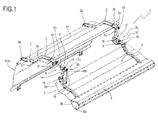
Figure 1 is a perspective view of a guiding unit for a device for picking up agricultural products according to this invention; -
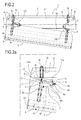
Figures 2 and 2a are a front view and a detail of the guiding unit ofFigure 1 ; -
Figures 3a and 3b are a front view and a side view of a device for picking up agricultural products according to this invention, wherein the guiding unit is in a first operating position; -
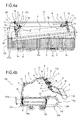
Figures 4a and 4b are a front view and a side view of a device for picking up agricultural products according to this invention, wherein the guiding unit is in a second operating position; - With reference to the accompanying drawings, the
numeral 1 denotes a guiding unit for adevice 100 for harvesting agricultural products, preferably fine-stemmed and longitudinal products, such as, for example, grass, straw, hay or for harvesting pulses. - The
harvesting device 100 is of the type which can be moved by a movement (or pulling) vehicle along a path on which a multitude of long, and preferably thin, agricultural products lie, theharvesting device 100 being designed to lift them from the ground using pick-up means 102 and to transport them on specific unloading means or into a receiving chamber by means of a specific movement system. - More precisely, the device comprises a
frame 101 extensing along a main axis of extension "A" which, during use, remains transversal to the axis of movement (or of advancing) of the pulling vehicle. The frame preferably comprises coupling means (not illustrated) by which it is connected to the pulling vehicle and protruding transversely (preferably at right angles) to the direction of extension "A". - The
device 100 comprises pick-up means 102 for harvesting the agricultural products. Preferably, the pick-up means 102 comprise a plurality of rotatable pick-up elements 102a, each in turn equipped with at least one long harvesting tine. - It should be noted that the pick-
up elements 102a are arranged in succession along the main line "A" (and spaced, preferably equispaced, from each other). - Advantageously, therefore, the pick-
up elements 102a are arranged along the extension of the device, thereby increasing the working portion thereof. Preferably, the tines are arranged around the same central axis of rotation, oriented radially thereto in spoke-like fashion. - In this regard, the
harvesting device 100 comprises a movement system for moving each of the pick-up elements 102a along a closed path surrounding the main line "A" (corresponding to the aforementioned central axis). In other words, the product harvesting axis is transversal, preferably at right angles, to the main line "A". - The closed path comprises a transporting stretch along which the agricultural product is transported between a pickup point where the product is lifted from the ground by the long tines and a release point where the agricultural product is disengaged from the tines.
- The
harvesting device 100 also comprises a plurality ofbands 104 fixed to theframe 101, juxtaposed along the main line "A" and spaced from each other in such a way that each pick-up element 102a is at least partly interposed between twoconsecutive bands 104. - The
bands 104 are defined by curved members shaped in such a way as to surround the main line "A" at least at the forward stroke of the tines (that is, the closed path). - Moreover, the
harvesting device 100 comprises agricultural product unloading means 106 located downstream of the pick-up means 102 (more specifically, downstream of the release point), configured to transport the agricultural products and release them at the sides (or, if necessary, at the back) of the pulling vehicle. - Consequently, the main line "A" is a direction of movement of the unloading means 106. This direction is transversal, preferably at right angles, to the harvesting direction described above.
- Hereinafter, unless otherwise specified, the direction "A" denotes both the direction of extension and the direction of movement.
- In the preferred embodiment, the unloading means 106 form a supporting surface "B" for the agricultural products harvested and are mobile along the main line "A" to release the agricultural products to the sides of the pulling vehicle.
- As illustrated, the device 100 (and more specifically, the unloading means 106) comprises a
conveyor belt 106a operatively located downstream of the pick-up means 102 and forming a supporting surface "B" for the agricultural products transported by theconveyor unit 1. - More specifically, the
conveyor belt 106a forms a supporting surface "B" which is mobile along the axis "A" to release the agricultural products to the sides of the pulling vehicle. - It should be noted that the conveyor belt could be replaced by any cyclic movement apparatus capable of defining a mobile supporting surface for the products, such as, for example, a chain conveyor, a track conveyor or the like.
- Alternatively, in an embodiment not illustrated, the unloading means might be defined by more aggressive means, such as a screw feeder or the like. According to the invention, the device comprises a
unit 1 for guiding the agricultural products, associated with theframe 101 and operating at the pick-up means 102. - The guiding
unit 1 can be preferably associated with theframe 101 in a removable fashion, that is, it can be both integrated in thedevice 1 and marketed as an accessory element. - The guiding
unit 1 comprises a supportingbody 2 connected to theframe 101 of theharvesting device 100 and provided with a supportingportion 2a which, during use, is located above the unloading means 106. - Thus, the supporting
body 2 extends at least in part above the unloading means 106, at a predetermined distance from them. - More specifically, the supporting
portion 2a is situated at a greater height than the supporting surface "B," at a predetermined distance from it. - For this reason, the supporting
body 2 is over the unloading means 106 and the supportingportion 2a is positioned above a half-part of the unloading means 106 proximal to the pick-up means 102. - This half-part is measured with reference to a middle axis of the unloading means 106 which is oriented along (that is, parallel to) the main line "A".
- It should be noted that the
frame 101 comprises at least onerear element 101 a, positioned on the opposite side of the unloading means 106 relative to the pick-up means 102. - In other words, the unloading means 106 extend along the main line "A" along two edges "E1," "E2," wherein a first edge "E1" is facing the
rear element 101 a of theframe 101 and a second edge "E2" is facing the pick-up means 102. - Preferably, the
rear element 101 a of theframe 101 is equipped with at least one a free end, projecting above the unloading means 106. - Thus, preferably, the
rear element 101 a is protruding above the supporting surface "B", that is, it rises away from it. - The supporting
body 2 comprises at least abar 3 extending above the unloading means 106 (that is, of the supporting surface "B") between its ownfirst end 3a, rigidly constrained to the free end of therear element 101 a, and asecond end 3b forming the supportingportion 2a. - Thus, in the embodiment illustrated, the
bar 3 is positioned in a cantilever fashion relative to therear element 101 a of theframe 101. - It should be noted that the supporting
body 2 comprises a plurality ofbars 3, preferably two, positioned in succession, that is, spaced from each other, along the main line "A". - Further, as illustrated in the accompanying drawings, the supporting
body 2 comprises a coveringelement 21 extending between thebars 3 and opposite the unloading means 106. - In the preferred embodiment, the guiding
unit 1 comprises adjustment means 4 interposed between therear portion 101 a of theframe 101 and the supportingbody 2. - More specifically, the adjustment means 4 are operatively interposed between the
rear portion 101 a of theframe 101 and the bar 3 (that is, the bars 3). - In the embodiment illustrated, the adjustment means 4 are designed to allow the setting of the angle delimited between the
rear portion 101 a and the bar 4. - Preferably, the adjustment means 4 comprise a pair of slidably associated bodies and an adjusting pin designed to lock the relative sliding between the bodies in a predetermined angular position.
- To allow the action on the products picked up (or being picked up), the guiding
unit 1 also comprises a guidingelement 5 extending mainly along the main line "A" and delimited, transversally to it, by an upperlongitudinal edge 5a, proximal to the supportingbody 2, and by a lowerlongitudinal edge 5b, distal from the supportingbody 2. - Thus, the guiding
element 5 extends along the main line "A" (that is, parallel to it) between two longitudinal edges, upper 5a and lower 5b. - In use, the
longitudinal edge 5b is opposite and in front of the pick-up means 102 in such a way as to delimit a pass-through section for the products to be harvested, guiding them. - Thus, the
lower edge 5b of the guidingelement 5 is located at a distance from the pick-up means such as to define (and delimit) the space for transit of the agricultural products. - In this regard, the guiding
element 5 is provided, at its lowerlongitudinal edge 5b, with anactive portion 6 having a weight such that, in the absence of external forces, it keeps the guiding element close to the pick-up means 102 (that is, in a position away from the supporting body 2). - Preferably, the active portion is defined by a
tubular body 6a or by a bar extending along the main line "A" and defining the lowerlongitudinal edge 5b of the guidingelement 5. - Alternatively, the active portion could be defined by a roller or by a grille.
- Structurally, also, the guiding
element 5 comprises at least onepanel 7 extending along the main line "A" and delimited, transversally to the main line "A", by the upperlongitudinal edge 5a and by the lowerlongitudinal edge 5b. - Thus, in the preferred embodiment, the guiding
element 5 is defined by apanel 7 or covering element extending between the upperlongitudinal edge 5a, connected to the supportingbody 2, and the lowerlongitudinal edge 5b, defined by theactive portion 6. - Preferably, the
panel 7 has, near to the lowerlongitudinal edge 5b, a concavity oriented towards the pick-up means 102, in order to follow a curved path which the products move along on the pick-up means 102. - In other words, the
panel 7, near to the lowerlongitudinal edge 5b, has a concavity oriented towards the pick-up means 102 in order to follow the movement of the pick-upelements 102a. - According to one aspect of the invention, the guiding
unit 1 comprises connectingmeans 8 operatively interposed between the guidingelement 5 and the supportingportion 2a of the supportingbody 2. - More specifically, the connecting
means 8 are fixed in the proximity of the upperlongitudinal edge 5a of the guidingelement 5. - These connecting means 8 are designed to allow a translation of the guiding
element 5 towards and away from the supportingbody 2. - More specifically, the guiding
element 5 is movable towards and away from the supportingbody 2 to define, respectively, up and down movements depending on the quantity of products to be harvested, for guiding their flow on the pick-up means 102. - Advantageously, in this way the guiding
element 5 is simple to construct and to install, and at the same time the translating movement allows a precise adjustment of the space for transit of the products. - Preferably, the connecting
means 8 are designed to constrain the guidingelement 5 to move towards and away from the supporting body in a single sliding plane "P". - More specifically, the connecting
means 8 are designed to allow translation of the guidingelement 5 in a sliding plane "P" which is set at an angle to a vertical direction. - Thus, the guiding
element 5 and the connectingmeans 8 are designed to allow a translation of the guidingelement 5 in the sliding plane following both a pushing action performed by the products on the pick-up means (substantially vertical) and a pushing action performed horizontally on the lowerlongitudinal edge 5b. - In the preferred embodiment, the sliding plane "P" is set at an angle, relative to a vertical direction, of between -70° and +45°.
- Preferably, the preferred angle of inclination is between -40° and -20°.
- It should be noted that, during use, the inclination of the sliding plane "P" is fixed.
- However, in the preferred embodiments there are adjusting units designed to allow the setting of a predetermined inclination of the sliding plane "P," that is, a predetermined inclination between the supporting
body 2 and the guidingelement 5. - Advantageously, in this way it is possible adapt the performance and the behaviour of the guiding
unit 1 depending on the application of the device, that is, the type and quantity of products to be picked up. - Preferably, the connecting
means 8 comprise at least first connectingmeans 9 and second connecting means 10 both interposed between the supportingbody 2 and the guidingelement 5. - The first 9 and second 9 connecting means are spaced from each other along the main line "A".
- Moreover, the first connecting
means 9 and the second connecting means 10 being movable independently of one another between a contracted position and an extended position for allowing a roto-translation of the guidingelement 5 relative to the supportingbody 2. - Advantageously, in this way the guiding
unit 1 is able to adapt to the different flow conditions of the products at the two sides of the device. - In effect, since the extension of the
device 100 and the pick-up means 102 is very pronounced along the main line "A", the flow of products in the various zones is subject, due to its very nature or after previous processing operations, to a certain variability. - In this regard, the first 9 and second 10 connection means are preferably connected to two separate half-parts of the guiding
element 5, located on opposite sides of a median line of thedevice 1 at right angles to the main line "A." - The presence of an independent movement between the two half-parts of the guiding
element 5 allows theunit 1 to adapt better to this variability. Preferably, the first connectingmeans 9 and second connectingmeans 10 are connected to the supportingbody 2 and to the guidingelement 5 at respective joint points "G". - More specifically, the connecting means 8 (that is, both the first 9 and second 10 connecting means) comprise at least a
first arm 12 pivoting at the supportingbody 2 at afirst pin 13 and asecond arm 14 pivoting at the guidingelement 5 at asecond pin 15. - It should be noted that the
first pin 13 and thesecond pin 15 define the joint points "G" mentioned above. - Moreover, the
first arm 12 andsecond arm 14 are rotatably connected to one another at athird pin 16 for forming an elbow-style kinematic mechanism arms - It should be noted that the
first pin 13,second pin 15 andthird pin 16 define axes of rotation "C" which are substantially parallel to one another and orthogonal to a plane of movement "P" of the guidingelement 5. Thus, the connectingmeans 8 comprise two elbow-style kinematic mechanisms - More specifically, the connecting
means 8 comprise a first 17a and a second elbow-style kinematic mechanism 17a. - In other words, each elbow-
style kinematic mechanism element 5 for allowing a roto-translation (in the sliding plane "P") relative to the supportingbody 2. In the preferred embodiment, the elbow-style kinematic mechanisms - In other words, the
third pins 16 are proximal to each other relative to the first 13 and second 15 pins. - Preferably, each elbow-
style kinematic mechanism body 18 operatively interposed between thefirst arm 9 and thesecond arm 10 for limiting the opening of thefirst arm 12 and thesecond arm 14 to a predetermined angular value. - In other words, the locking
element 18 is designed to limit the distance between the guidingelement 5 and the supportingbody 2 in the far position. - In the preferred embodiment, the locking
body 18 is defined by a pin or splitpin 18a which can be inserted in thefirst arm 12 orsecond arm 14 and which can come into abutment respectively with thesecond arm 14 or with thefirst arm 12 in the open position (corresponding to the extended position of the first 9 and second 10 connecting means). - Preferably, the
first arm 12 or thesecond arm 14 is equipped with a plurality ofseats 18b which can be coupled with thesplit pin 18a to allow an adjustment of the opening stroke between thearms - It should be noted that, preferably, the first connecting
means 9 are provided with at least one constrainingelement 11 designed to keep linear the relative movement of its joint points "G" during the movement between the contracted position and the extended position. - More specifically, one of the elbow-
style kinematic mechanisms 17a (that is, the first) comprises at least arod 19 extending between afirst end 19a connected to the guidingelement 5 and asecond end 19b connected to thefirst arm 12 for constraining the movement of thesecond pin 15 relative to thefirst pin 13 limiting their offset. - The
rod 19 defines at least partly the constrainingelement 11. - Preferably, also, the connecting
means 8 comprise a piston (not illustrated) operatively interposed between thefirst arm 12 and thesecond arm 14 of at least one elbow-style kinematic mechanism - The piston (preferably of a pneumatic or hydraulic type) is designed to contribute to the movement from the open position to the closed position. Thus, the piston acts as an auxiliary actuator during the rising of the guiding
element 5. - Preferably, moreover, the piston is designed to oppose the lowering of the guiding
element 5, that is, the opening of the elbow-style kinematic mechanism - Advantageously, this reduces the impacts and the stress on the pins, increasing the working life of the guiding
unit 1. - In a preferred embodiment, the guiding
element 5 is modularly disconnectable from the supportingbody 2. - Preferably, the
third pins 13 are removable to allow an uncoupling between the guidingelement 5 and the supportingbody 2. Advantageously, in this way may, the operator, if it is not used, remove the guiding element 5 (and the connecting means 8), keeping solely the supportingbody 2 anchored to the frame of thedevice 100. - In particular, when the supporting
body 2 comprises the coveringelement 21, this allows the operator to unlink the screening function of the coveringelement 21 from that of guiding the guidingelement 5. - The invention achieves the preset aims and brings major advantages.
- In effect, the presence of a slidable guiding element, preferably in a single plane, during raising and lowering, allows a more effective and simple adjustment of the action of the products.
- Moreover, the use of one or more joints at a front zone of the device, immediately above the pick-up means, considerably reduces the lever effect and thus the stress on the structure.
- Also, the presence of at least two connecting units movable independently of each other allows a roto-translation of the guiding element, preferably a panel, in the sliding plane, which makes the guiding unit even more functional and high performing.
Claims (15)
- A guiding unit for agricultural products for a pick-up device for harvesting said agricultural products, said pick-up device comprising a frame (101) extending along a main line (A), pick-up means (102) associated with the frame (101) and unloading means (106) which are operatively positioned downstream of the pick-up means (102) and are movable along the main line (A), said guiding unit comprising:- a supporting body (2) connectable to the frame (101) of the harvesting device (100) and provided with a supporting portion (2a) which, during use, is located above the unloading means (106);- a guiding element (5) extending mainly along said main line (A) and delimited, transversally to said operating line, by an upper longitudinal edge (5a), proximal to the supporting body (2), and by a lower longitudinal edge (5b), distal from the supporting body (2) and, in use, opposite and in front of the pick-up means (102) in such a way as to delimit a pass-through section for the products to be harvested, guiding them;characterised in that it comprises connecting means (8) operatively interposed between the guiding element (5) and said supporting portion (2a) of the supporting body (2), designed to allow a translation, in a plane extending along said main line (A), of said guiding element (5) towards and away from the supporting body (2).
- The guiding unit according to claim 1, characterised in that said connecting means (8) are designed to constrain said guiding element (5) to move towards and away from the supporting body in a single sliding plane (P).
- The guiding unit according to either of the preceding claims, characterised in that said connecting means (8) comprise at least first connecting means (9) and second connecting means (10) both interposed between the supporting body (2) and the guiding element (5) and spaced from one another along the main line (A); said first connecting means (9) and said second connecting means (10) being movable independently of one another between a contracted position and an extended position for allowing a roto-translation of the guiding element (5) relative to said supporting body (2).
- The guiding unit according to claim 3, characterised in that said first connecting means (9) and second connecting means (10) are connected to the supporting body (2) and to the guiding element (5) at respective joint points (G); said first connecting means (9) being provided with at least one constraining element (11) designed to keep linear the relative movement of its joint points (G) during the movement between the contracted position and the extended position.
- The guiding unit according to any one of the preceding claims, characterised in that the connecting means (8) comprise at least a first arm (12) pivoting at the supporting body (2) at a first pin (13) and a second arm (14) pivoting at the guiding element (5) at a second pin (15); said first arm (12) and second arm (14) being rotatably connected to one another at a third pin (16) for forming an elbow-style kinematic mechanism (17a, 17b) in which the arms (12, 14) are rotatably movable between a closed position and an open position.
- The guiding unit according to claim 5, characterised in that said elbow-style kinematic mechanism (17a, 17b) comprises at least one locking body (18) operatively interposed between said first arm (12) and said second arm (14) for limiting the opening of the first arm (12) and the second arm (14) to a predetermined angular value.
- The guiding unit according to claim 5 or 6, characterised in that said first pin (13), second pin (15) and third pin (16) define axes of rotation (C) which are substantially parallel to one another and orthogonal to a plane of movement of the guiding element (5).
- The guiding unit according to any one of claims 5 to 7, characterised in that the connecting means (8) comprise a first (17a) and a second (17b) elbow-style kinematic mechanism, spaced from one another along the main line (A), each connected to a half-part of said guiding element (5) for allowing its roto-translation relative to said supporting body (2).
- The guiding unit according to claim 8, characterised in that said first elbow-style kinematic mechanism (17a) comprises at least a rod (19) extending between a first end (19a) connected to the guiding element (5) and a second end (19b) connected to the first arm (12) for constraining the movement of the second pin (15) relative to the first pin (13) limiting their offset.
- The guiding unit according to any one of claims 5 to 9, characterised in that the connecting means (8) comprise a piston (20) operatively interposed between the first arm (12) and the second arm (14) and designed to contribute to the movement from the closed position to the open position.
- The guiding unit according to any one of the preceding claims, characterised in that said guiding element (5) is provided, at its lower longitudinal edge (5b), with an active portion (6) having a weight such that, in the absence of external forces, it keeps the guiding element in a position away from the supporting body (2).
- A pick-up device for harvesting long agricultural products, such as grass, straw, leguminous plants and the like, of the type comprising:- a frame (101) extending along its own main line (A), in use transversal to a line of travel of the device (100);- agricultural product pick-up means (102) designed to pick-up said agricultural products from the ground;- unloading means (106) operatively positioned downstream of the pick-up means (102) and movable along said main line (A);characterised in that it comprises a guiding unit (1) according to any one of the preceding claims, in which the supporting body (2) is anchored to the frame (101) in such a way that the supporting portion (2a) is positioned above the unloading means (106) and the guiding element (5) is opposite the pick-up means (102) with its lower longitudinal edge (5b) projecting in front of them; said guiding element (5) being movable towards and away from said supporting body (2) to define, respectively, up and down movements depending on the quantity of products to be harvested, for guiding their flow on the pick-up means (102).
- The agricultural product harvesting device according to claim 12, characterised in that said connecting means (8) are designed to allow translation of the guiding element (5) in a sliding plane (P) which is set at an angle to a vertical direction.
- The agricultural product harvesting device according to any one of claims 12 to 13, characterised in that said supporting body (2) is over said unloading means (106) and the supporting portion (2a) is positioned above a half-part of said unloading means (106) proximal to the pick-up means (102) relative to a middle axis of the unloading means (106) which is oriented along the main line (A).
- The agricultural product harvesting device according to claim 14, characterised in that the frame (101) comprises at least a rear element (101 a), positioned on the opposite side of the unloading means (106) relative to the pick-up means (102) and provided with at least one free end projecting above the unloading means (106); said supporting body (2) comprising at least a bar (3) extending above the unloading means (106) between its own first end (3a), rigidly constrained to said free end of the rear element (101 a), and a second end (3b) forming said supporting portion (2a).
Priority Applications (2)
| Application Number | Priority Date | Filing Date | Title |
|---|---|---|---|
| SI201530407T SI2941946T1 (en) | 2014-05-05 | 2015-05-05 | Guiding unit for agricultural products for a pick-up device for harvesting the agricultural products and pick-up device comprising the guiding unit |
| PL15166394T PL2941946T3 (en) | 2014-05-05 | 2015-05-05 | Guiding unit for agricultural products for a pick-up device for harvesting the agricultural products and pick-up device comprising the guiding unit |
Applications Claiming Priority (1)
| Application Number | Priority Date | Filing Date | Title |
|---|---|---|---|
| ITBO20140260 | 2014-05-05 |
Publications (2)
| Publication Number | Publication Date |
|---|---|
| EP2941946A1 true EP2941946A1 (en) | 2015-11-11 |
| EP2941946B1 EP2941946B1 (en) | 2018-07-04 |
Family
ID=51220634
Family Applications (1)
| Application Number | Title | Priority Date | Filing Date |
|---|---|---|---|
| EP15166394.5A Active EP2941946B1 (en) | 2014-05-05 | 2015-05-05 | Guiding unit for agricultural products for a pick-up device for harvesting the agricultural products and pick-up device comprising the guiding unit |
Country Status (4)
| Country | Link |
|---|---|
| US (1) | US9521807B2 (en) |
| EP (1) | EP2941946B1 (en) |
| PL (1) | PL2941946T3 (en) |
| SI (1) | SI2941946T1 (en) |
Cited By (2)
| Publication number | Priority date | Publication date | Assignee | Title |
|---|---|---|---|---|
| EP3516941A1 (en) * | 2018-01-29 | 2019-07-31 | MacDon Industries Ltd. | Connecting ends of the draper conveyor of a harvest header |
| EP3666059A1 (en) * | 2018-12-10 | 2020-06-17 | PÖTTINGER Landtechnik GmbH | Agrciltural harvesting machine |
Families Citing this family (6)
| Publication number | Priority date | Publication date | Assignee | Title |
|---|---|---|---|---|
| US9878848B2 (en) * | 2015-09-11 | 2018-01-30 | Mgs Machine Corporation | Friction feeder |
| DE202018107313U1 (en) | 2018-12-20 | 2020-03-23 | Pöttinger Landtechnik Gmbh | Agricultural harvester |
| US12063892B2 (en) * | 2019-08-15 | 2024-08-20 | Kuhn North America, Inc. | Systems, apparatus, and related methods for use with mergers |
| US12089536B2 (en) * | 2020-05-19 | 2024-09-17 | Cnh Industrial America Llc | Agricultural vehicle with retainer for blockage removing windguard |
| DE202022105171U1 (en) | 2022-09-14 | 2023-12-19 | Pöttinger Landtechnik Gmbh | Agricultural harvester |
| ES3037929T3 (en) * | 2022-12-01 | 2025-10-08 | Roc S R L | Windrow merger and method for forming windrows through a windrow merger which collects agricultural products from a field |
Citations (4)
| Publication number | Priority date | Publication date | Assignee | Title |
|---|---|---|---|---|
| EP2037727A1 (en) | 2006-06-30 | 2009-03-25 | Kuhn S.A. | Agricultural machine for harvesting forage |
| US20120023884A1 (en) * | 2010-07-28 | 2012-02-02 | Biolink J.V. | Biomass handling and processing |
| DE102012011591A1 (en) * | 2012-06-13 | 2013-12-19 | Claas Saulgau Gmbh | Receiving device for gathering e.g. mowing crop in agricultural harvester, has gathering drum for gathering crop lying at ground, worm arranged at transportation channel, and blank holder swingable around rotational axis of worm |
| EP2689653A1 (en) * | 2012-07-27 | 2014-01-29 | CNH Belgium N.V. | A windguard mechanism of a pick-up for an agricultural machine |
Family Cites Families (36)
| Publication number | Priority date | Publication date | Assignee | Title |
|---|---|---|---|---|
| US2362861A (en) * | 1941-04-19 | 1944-11-14 | Case Co J I | Baler |
| US2524233A (en) * | 1941-04-19 | 1950-10-03 | Case Co J I | Pickup device for balers |
| US2571489A (en) * | 1944-06-16 | 1951-10-16 | Case Co J I | Baling machine with spiral feeding and compression means |
| US2647355A (en) * | 1949-03-05 | 1953-08-04 | Massey Harris Co Ltd | Pickup baler |
| US2872772A (en) * | 1951-10-30 | 1959-02-10 | Sperry Rand Corp | Adjustable wind-guard for baler pick-up |
| US2691266A (en) * | 1953-03-23 | 1954-10-12 | Volk | Wind guard attachment for pickup devices |
| US3788053A (en) * | 1972-05-30 | 1974-01-29 | C Bonnett | Windrow controller |
| US3815344A (en) * | 1972-11-29 | 1974-06-11 | Lowell R | Machine for forming large round bales of a fibrous material |
| US3815346A (en) * | 1973-06-01 | 1974-06-11 | Deere & Co | Harvester pickup |
| US3924391A (en) * | 1975-03-03 | 1975-12-09 | Deere & Co | Adjustable crop compressor for a pickup mechanism |
| DD139380A1 (en) * | 1978-06-20 | 1980-01-02 | Spaida Hans Peter | RECORDING DEVICE FOR HALF FEEDING MACHINES |
| US4304090A (en) * | 1980-02-11 | 1981-12-08 | Gavrilenko Boris P | Pickup of an agricultural machine |
| NL8003794A (en) * | 1980-07-01 | 1982-02-01 | Multinorm Bv | DEVICE FOR LAND RECEPTION. |
| US4411127A (en) * | 1982-04-05 | 1983-10-25 | Sperry Corporation | Floating windguard |
| US4495756A (en) * | 1983-08-15 | 1985-01-29 | Sperry Corporation | Pickup attachment for harvesting machines |
| US4516389A (en) * | 1984-09-04 | 1985-05-14 | Core Grant M | Round hay baling machine |
| US4905466A (en) * | 1988-08-12 | 1990-03-06 | Alden Heppner | Windrow mover |
| US4981013A (en) * | 1989-08-21 | 1991-01-01 | Underwood Chester E | Corn harvesting apparatus |
| GB9903624D0 (en) * | 1999-02-18 | 1999-04-07 | Ford New Holland Nv | Movable windguard |
| US6688092B2 (en) * | 2002-01-14 | 2004-02-10 | Deere & Company | Pick-up crop baffle including integral crop hold down rods and suspension for use in widely varied crops |
| US6810650B2 (en) * | 2002-03-28 | 2004-11-02 | New Holland North America, Inc. | Replaceable windguard tines for a round baler |
| US6935094B1 (en) * | 2004-04-15 | 2005-08-30 | Cnh America Llc | Wind guard latch retainer |
| US6962041B1 (en) * | 2004-07-31 | 2005-11-08 | Cnh America Llc | Windguard for round baler including float arms |
| US6877304B1 (en) * | 2004-07-31 | 2005-04-12 | Cnh America Llc | Windguard for round baler |
| US7107748B2 (en) * | 2004-07-31 | 2006-09-19 | Cnh America Llc | Agricultural implement pickup |
| US20060277889A1 (en) * | 2005-06-10 | 2006-12-14 | Sheedy Ronald L | Wind screen hold down attachment |
| US7617662B2 (en) * | 2005-06-14 | 2009-11-17 | Deere & Company | Integrated crop baffle and hold-down assembly used with baler pick-up and suspension for same |
| US7650741B2 (en) * | 2007-01-05 | 2010-01-26 | Agco Corporation | Articulating windguard for agricultural baler |
| US7448196B2 (en) * | 2007-01-05 | 2008-11-11 | Agco Corporation | Baler with multi-auger pickup |
| US20090100814A1 (en) * | 2007-10-22 | 2009-04-23 | Philip Egging | Non-Powered Roller for Assisting Crop Pick-Up With a Baler |
| US7654069B1 (en) * | 2008-12-10 | 2010-02-02 | Vermeer Manufacturing Co. | Baler slider frame for mounting accessories to a crop pickup device |
| US8051634B2 (en) * | 2010-01-19 | 2011-11-08 | Cnh America Llc | Replaceable guide assembly tines for an agricultural harvester |
| BE1020227A3 (en) * | 2011-10-10 | 2013-06-04 | Cnh Belgium Nv | UNIT WITH MOVABLE WINDSCREEN. |
| FR2999868B1 (en) * | 2012-12-20 | 2014-12-12 | Kuhn Sa | AGRICULTURAL HARVESTING MACHINE HAVING AN IMPROVED GUIDING DEVICE FOR VEGETABLES |
| US9681603B2 (en) * | 2013-03-15 | 2017-06-20 | Cnh Industrial America Llc | Cam action windguard |
| DE202014003637U1 (en) * | 2014-04-29 | 2015-07-30 | Alois Pöttinger Maschinenfabrik Gmbh | Agricultural machine |
-
2015
- 2015-05-04 US US14/703,268 patent/US9521807B2/en active Active
- 2015-05-05 PL PL15166394T patent/PL2941946T3/en unknown
- 2015-05-05 SI SI201530407T patent/SI2941946T1/en unknown
- 2015-05-05 EP EP15166394.5A patent/EP2941946B1/en active Active
Patent Citations (4)
| Publication number | Priority date | Publication date | Assignee | Title |
|---|---|---|---|---|
| EP2037727A1 (en) | 2006-06-30 | 2009-03-25 | Kuhn S.A. | Agricultural machine for harvesting forage |
| US20120023884A1 (en) * | 2010-07-28 | 2012-02-02 | Biolink J.V. | Biomass handling and processing |
| DE102012011591A1 (en) * | 2012-06-13 | 2013-12-19 | Claas Saulgau Gmbh | Receiving device for gathering e.g. mowing crop in agricultural harvester, has gathering drum for gathering crop lying at ground, worm arranged at transportation channel, and blank holder swingable around rotational axis of worm |
| EP2689653A1 (en) * | 2012-07-27 | 2014-01-29 | CNH Belgium N.V. | A windguard mechanism of a pick-up for an agricultural machine |
Cited By (2)
| Publication number | Priority date | Publication date | Assignee | Title |
|---|---|---|---|---|
| EP3516941A1 (en) * | 2018-01-29 | 2019-07-31 | MacDon Industries Ltd. | Connecting ends of the draper conveyor of a harvest header |
| EP3666059A1 (en) * | 2018-12-10 | 2020-06-17 | PÖTTINGER Landtechnik GmbH | Agrciltural harvesting machine |
Also Published As
| Publication number | Publication date |
|---|---|
| US9521807B2 (en) | 2016-12-20 |
| PL2941946T3 (en) | 2019-01-31 |
| SI2941946T1 (en) | 2018-11-30 |
| US20150313082A1 (en) | 2015-11-05 |
| EP2941946B1 (en) | 2018-07-04 |
Similar Documents
| Publication | Publication Date | Title |
|---|---|---|
| EP2941946B1 (en) | Guiding unit for agricultural products for a pick-up device for harvesting the agricultural products and pick-up device comprising the guiding unit | |
| US9750187B2 (en) | Adjustable row unit deck plate for a header of an agricultural harvester | |
| EP3440919A1 (en) | Float arm support | |
| DK2839731T3 (en) | Green fodder harvesting machine | |
| EP2420128A2 (en) | Flexible draper belt drive for an agricultural harvesting machine | |
| CA3000273C (en) | Device for harvesting stalk-like stem crops with adjustable picking plates | |
| US8616812B2 (en) | Header trailer | |
| US12484481B2 (en) | Headland grain capture sequence for agricultural vehicle header | |
| BE1026187B1 (en) | Ejection arrangement for attachment to the end of a discharge device | |
| EP3659421A1 (en) | Harvesting header with adjustable transverse auger | |
| US8109070B1 (en) | Dual windrow crop inverting and combining apparatus and method | |
| US9615513B2 (en) | Harvester pick-up support | |
| JP6436884B2 (en) | Harvesting machine | |
| BR112017007370B1 (en) | STONE SEPARATOR ASSEMBLY FOR A HARVESTER | |
| EP4346369B1 (en) | Multi-segment header for an agricultural harvester | |
| US20200275609A1 (en) | Cam Track Adjustment Assembly for a Harvesting Reel | |
| EP3058805B1 (en) | Hay baler | |
| US20250331463A1 (en) | Pick-up attachment for a harvesting machine | |
| EP1595434B1 (en) | Reel arrangement | |
| EP3669638A1 (en) | Agricultural harvesting machine | |
| JPH10313634A (en) | Harvest carrying device in agricultural product harvester | |
| BR112021015451A2 (en) | REEL SET OF AN AGRICULTURAL PLATFORM | |
| US20250017143A1 (en) | Pick-up attachment for a harvesting machine | |
| ITMC20110030A1 (en) | AGRICULTURAL MACHINE PERFECTED FOR TOMATO HARVEST. |
Legal Events
| Date | Code | Title | Description |
|---|---|---|---|
| PUAI | Public reference made under article 153(3) epc to a published international application that has entered the european phase |
Free format text: ORIGINAL CODE: 0009012 |
|
| AK | Designated contracting states |
Kind code of ref document: A1 Designated state(s): AL AT BE BG CH CY CZ DE DK EE ES FI FR GB GR HR HU IE IS IT LI LT LU LV MC MK MT NL NO PL PT RO RS SE SI SK SM TR |
|
| AX | Request for extension of the european patent |
Extension state: BA ME |
|
| 17P | Request for examination filed |
Effective date: 20160511 |
|
| RBV | Designated contracting states (corrected) |
Designated state(s): AL AT BE BG CH CY CZ DE DK EE ES FI FR GB GR HR HU IE IS IT LI LT LU LV MC MK MT NL NO PL PT RO RS SE SI SK SM TR |
|
| RIN1 | Information on inventor provided before grant (corrected) |
Inventor name: UBALDI, RAFFAELE |
|
| REG | Reference to a national code |
Ref country code: DE Ref legal event code: R079 Ref document number: 602015012899 Country of ref document: DE Free format text: PREVIOUS MAIN CLASS: A01D0084000000 Ipc: A01D0089000000 |
|
| GRAP | Despatch of communication of intention to grant a patent |
Free format text: ORIGINAL CODE: EPIDOSNIGR1 |
|
| STAA | Information on the status of an ep patent application or granted ep patent |
Free format text: STATUS: GRANT OF PATENT IS INTENDED |
|
| RIC1 | Information provided on ipc code assigned before grant |
Ipc: A01D 84/00 20060101ALI20171208BHEP Ipc: A01D 57/20 20060101ALI20171208BHEP Ipc: A01D 89/00 20060101AFI20171208BHEP |
|
| INTG | Intention to grant announced |
Effective date: 20180105 |
|
| GRAS | Grant fee paid |
Free format text: ORIGINAL CODE: EPIDOSNIGR3 |
|
| GRAA | (expected) grant |
Free format text: ORIGINAL CODE: 0009210 |
|
| STAA | Information on the status of an ep patent application or granted ep patent |
Free format text: STATUS: THE PATENT HAS BEEN GRANTED |
|
| AK | Designated contracting states |
Kind code of ref document: B1 Designated state(s): AL AT BE BG CH CY CZ DE DK EE ES FI FR GB GR HR HU IE IS IT LI LT LU LV MC MK MT NL NO PL PT RO RS SE SI SK SM TR |
|
| REG | Reference to a national code |
Ref country code: GB Ref legal event code: FG4D |
|
| REG | Reference to a national code |
Ref country code: CH Ref legal event code: EP |
|
| REG | Reference to a national code |
Ref country code: AT Ref legal event code: REF Ref document number: 1013499 Country of ref document: AT Kind code of ref document: T Effective date: 20180715 |
|
| REG | Reference to a national code |
Ref country code: IE Ref legal event code: FG4D |
|
| REG | Reference to a national code |
Ref country code: DE Ref legal event code: R096 Ref document number: 602015012899 Country of ref document: DE |
|
| REG | Reference to a national code |
Ref country code: NL Ref legal event code: MP Effective date: 20180704 |
|
| REG | Reference to a national code |
Ref country code: LT Ref legal event code: MG4D |
|
| PG25 | Lapsed in a contracting state [announced via postgrant information from national office to epo] |
Ref country code: NL Free format text: LAPSE BECAUSE OF FAILURE TO SUBMIT A TRANSLATION OF THE DESCRIPTION OR TO PAY THE FEE WITHIN THE PRESCRIBED TIME-LIMIT Effective date: 20180704 |
|
| PG25 | Lapsed in a contracting state [announced via postgrant information from national office to epo] |
Ref country code: GR Free format text: LAPSE BECAUSE OF FAILURE TO SUBMIT A TRANSLATION OF THE DESCRIPTION OR TO PAY THE FEE WITHIN THE PRESCRIBED TIME-LIMIT Effective date: 20181005 Ref country code: BG Free format text: LAPSE BECAUSE OF FAILURE TO SUBMIT A TRANSLATION OF THE DESCRIPTION OR TO PAY THE FEE WITHIN THE PRESCRIBED TIME-LIMIT Effective date: 20181004 Ref country code: NO Free format text: LAPSE BECAUSE OF FAILURE TO SUBMIT A TRANSLATION OF THE DESCRIPTION OR TO PAY THE FEE WITHIN THE PRESCRIBED TIME-LIMIT Effective date: 20181004 Ref country code: SE Free format text: LAPSE BECAUSE OF FAILURE TO SUBMIT A TRANSLATION OF THE DESCRIPTION OR TO PAY THE FEE WITHIN THE PRESCRIBED TIME-LIMIT Effective date: 20180704 Ref country code: RS Free format text: LAPSE BECAUSE OF FAILURE TO SUBMIT A TRANSLATION OF THE DESCRIPTION OR TO PAY THE FEE WITHIN THE PRESCRIBED TIME-LIMIT Effective date: 20180704 Ref country code: IS Free format text: LAPSE BECAUSE OF FAILURE TO SUBMIT A TRANSLATION OF THE DESCRIPTION OR TO PAY THE FEE WITHIN THE PRESCRIBED TIME-LIMIT Effective date: 20181104 Ref country code: FI Free format text: LAPSE BECAUSE OF FAILURE TO SUBMIT A TRANSLATION OF THE DESCRIPTION OR TO PAY THE FEE WITHIN THE PRESCRIBED TIME-LIMIT Effective date: 20180704 Ref country code: CZ Free format text: LAPSE BECAUSE OF FAILURE TO SUBMIT A TRANSLATION OF THE DESCRIPTION OR TO PAY THE FEE WITHIN THE PRESCRIBED TIME-LIMIT Effective date: 20180704 Ref country code: LT Free format text: LAPSE BECAUSE OF FAILURE TO SUBMIT A TRANSLATION OF THE DESCRIPTION OR TO PAY THE FEE WITHIN THE PRESCRIBED TIME-LIMIT Effective date: 20180704 |
|
| PG25 | Lapsed in a contracting state [announced via postgrant information from national office to epo] |
Ref country code: LV Free format text: LAPSE BECAUSE OF FAILURE TO SUBMIT A TRANSLATION OF THE DESCRIPTION OR TO PAY THE FEE WITHIN THE PRESCRIBED TIME-LIMIT Effective date: 20180704 Ref country code: ES Free format text: LAPSE BECAUSE OF FAILURE TO SUBMIT A TRANSLATION OF THE DESCRIPTION OR TO PAY THE FEE WITHIN THE PRESCRIBED TIME-LIMIT Effective date: 20180704 Ref country code: HR Free format text: LAPSE BECAUSE OF FAILURE TO SUBMIT A TRANSLATION OF THE DESCRIPTION OR TO PAY THE FEE WITHIN THE PRESCRIBED TIME-LIMIT Effective date: 20180704 Ref country code: AL Free format text: LAPSE BECAUSE OF FAILURE TO SUBMIT A TRANSLATION OF THE DESCRIPTION OR TO PAY THE FEE WITHIN THE PRESCRIBED TIME-LIMIT Effective date: 20180704 |
|
| REG | Reference to a national code |
Ref country code: DE Ref legal event code: R097 Ref document number: 602015012899 Country of ref document: DE |
|
| PG25 | Lapsed in a contracting state [announced via postgrant information from national office to epo] |
Ref country code: RO Free format text: LAPSE BECAUSE OF FAILURE TO SUBMIT A TRANSLATION OF THE DESCRIPTION OR TO PAY THE FEE WITHIN THE PRESCRIBED TIME-LIMIT Effective date: 20180704 Ref country code: EE Free format text: LAPSE BECAUSE OF FAILURE TO SUBMIT A TRANSLATION OF THE DESCRIPTION OR TO PAY THE FEE WITHIN THE PRESCRIBED TIME-LIMIT Effective date: 20180704 |
|
| PLBE | No opposition filed within time limit |
Free format text: ORIGINAL CODE: 0009261 |
|
| STAA | Information on the status of an ep patent application or granted ep patent |
Free format text: STATUS: NO OPPOSITION FILED WITHIN TIME LIMIT |
|
| PG25 | Lapsed in a contracting state [announced via postgrant information from national office to epo] |
Ref country code: SK Free format text: LAPSE BECAUSE OF FAILURE TO SUBMIT A TRANSLATION OF THE DESCRIPTION OR TO PAY THE FEE WITHIN THE PRESCRIBED TIME-LIMIT Effective date: 20180704 Ref country code: SM Free format text: LAPSE BECAUSE OF FAILURE TO SUBMIT A TRANSLATION OF THE DESCRIPTION OR TO PAY THE FEE WITHIN THE PRESCRIBED TIME-LIMIT Effective date: 20180704 Ref country code: DK Free format text: LAPSE BECAUSE OF FAILURE TO SUBMIT A TRANSLATION OF THE DESCRIPTION OR TO PAY THE FEE WITHIN THE PRESCRIBED TIME-LIMIT Effective date: 20180704 |
|
| 26N | No opposition filed |
Effective date: 20190405 |
|
| REG | Reference to a national code |
Ref country code: CH Ref legal event code: PL |
|
| GBPC | Gb: european patent ceased through non-payment of renewal fee |
Effective date: 20190505 |
|
| PG25 | Lapsed in a contracting state [announced via postgrant information from national office to epo] |
Ref country code: MC Free format text: LAPSE BECAUSE OF FAILURE TO SUBMIT A TRANSLATION OF THE DESCRIPTION OR TO PAY THE FEE WITHIN THE PRESCRIBED TIME-LIMIT Effective date: 20180704 Ref country code: CH Free format text: LAPSE BECAUSE OF NON-PAYMENT OF DUE FEES Effective date: 20190531 Ref country code: LI Free format text: LAPSE BECAUSE OF NON-PAYMENT OF DUE FEES Effective date: 20190531 |
|
| REG | Reference to a national code |
Ref country code: BE Ref legal event code: MM Effective date: 20190531 |
|
| PG25 | Lapsed in a contracting state [announced via postgrant information from national office to epo] |
Ref country code: LU Free format text: LAPSE BECAUSE OF NON-PAYMENT OF DUE FEES Effective date: 20190505 |
|
| REG | Reference to a national code |
Ref country code: DE Ref legal event code: R081 Ref document number: 602015012899 Country of ref document: DE Owner name: ROC S.R.L., IT Free format text: FORMER OWNER: ROC S.R.L, POGGIO TORRIANA, (RIMINI), IT Ref country code: DE Ref legal event code: R082 Ref document number: 602015012899 Country of ref document: DE Representative=s name: BETTEN & RESCH PATENT- UND RECHTSANWAELTE PART, DE Ref country code: DE Ref legal event code: R081 Ref document number: 602015012899 Country of ref document: DE Owner name: ROC GROUP S.R.L., IT Free format text: FORMER OWNER: ROC S.R.L, POGGIO TORRIANA, (RIMINI), IT |
|
| PG25 | Lapsed in a contracting state [announced via postgrant information from national office to epo] |
Ref country code: TR Free format text: LAPSE BECAUSE OF FAILURE TO SUBMIT A TRANSLATION OF THE DESCRIPTION OR TO PAY THE FEE WITHIN THE PRESCRIBED TIME-LIMIT Effective date: 20180704 |
|
| PG25 | Lapsed in a contracting state [announced via postgrant information from national office to epo] |
Ref country code: GB Free format text: LAPSE BECAUSE OF NON-PAYMENT OF DUE FEES Effective date: 20190505 Ref country code: IE Free format text: LAPSE BECAUSE OF NON-PAYMENT OF DUE FEES Effective date: 20190505 |
|
| PG25 | Lapsed in a contracting state [announced via postgrant information from national office to epo] |
Ref country code: BE Free format text: LAPSE BECAUSE OF NON-PAYMENT OF DUE FEES Effective date: 20190531 |
|
| PG25 | Lapsed in a contracting state [announced via postgrant information from national office to epo] |
Ref country code: PT Free format text: LAPSE BECAUSE OF FAILURE TO SUBMIT A TRANSLATION OF THE DESCRIPTION OR TO PAY THE FEE WITHIN THE PRESCRIBED TIME-LIMIT Effective date: 20181104 |
|
| REG | Reference to a national code |
Ref country code: AT Ref legal event code: PC Ref document number: 1013499 Country of ref document: AT Kind code of ref document: T Owner name: ROC GROUP S.R.L. MIT DER UID-NUMMER 0374617040, IT Effective date: 20200804 |
|
| PG25 | Lapsed in a contracting state [announced via postgrant information from national office to epo] |
Ref country code: CY Free format text: LAPSE BECAUSE OF FAILURE TO SUBMIT A TRANSLATION OF THE DESCRIPTION OR TO PAY THE FEE WITHIN THE PRESCRIBED TIME-LIMIT Effective date: 20180704 |
|
| PG25 | Lapsed in a contracting state [announced via postgrant information from national office to epo] |
Ref country code: MT Free format text: LAPSE BECAUSE OF FAILURE TO SUBMIT A TRANSLATION OF THE DESCRIPTION OR TO PAY THE FEE WITHIN THE PRESCRIBED TIME-LIMIT Effective date: 20180704 Ref country code: HU Free format text: LAPSE BECAUSE OF FAILURE TO SUBMIT A TRANSLATION OF THE DESCRIPTION OR TO PAY THE FEE WITHIN THE PRESCRIBED TIME-LIMIT; INVALID AB INITIO Effective date: 20150505 |
|
| REG | Reference to a national code |
Ref country code: DE Ref legal event code: R081 Ref document number: 602015012899 Country of ref document: DE Owner name: ROC S.R.L., IT Free format text: FORMER OWNER: ROC GROUP S.R.L., POGGIO TORRIANA, IT |
|
| REG | Reference to a national code |
Ref country code: AT Ref legal event code: PC Ref document number: 1013499 Country of ref document: AT Kind code of ref document: T Owner name: ROC S.R.L., IT Effective date: 20220405 |
|
| PG25 | Lapsed in a contracting state [announced via postgrant information from national office to epo] |
Ref country code: MK Free format text: LAPSE BECAUSE OF FAILURE TO SUBMIT A TRANSLATION OF THE DESCRIPTION OR TO PAY THE FEE WITHIN THE PRESCRIBED TIME-LIMIT Effective date: 20180704 |
|
| P01 | Opt-out of the competence of the unified patent court (upc) registered |
Effective date: 20230525 |
|
| PGFP | Annual fee paid to national office [announced via postgrant information from national office to epo] |
Ref country code: PL Payment date: 20250428 Year of fee payment: 11 Ref country code: DE Payment date: 20250521 Year of fee payment: 11 |
|
| PGFP | Annual fee paid to national office [announced via postgrant information from national office to epo] |
Ref country code: IT Payment date: 20250527 Year of fee payment: 11 |
|
| PGFP | Annual fee paid to national office [announced via postgrant information from national office to epo] |
Ref country code: FR Payment date: 20250528 Year of fee payment: 11 |
|
| PGFP | Annual fee paid to national office [announced via postgrant information from national office to epo] |
Ref country code: AT Payment date: 20250522 Year of fee payment: 11 |
|
| PGFP | Annual fee paid to national office [announced via postgrant information from national office to epo] |
Ref country code: SI Payment date: 20250424 Year of fee payment: 11 |