EP2940007A2 - Tyrosine derivative and manufacturing method for tyrosine derivative - Google Patents
Tyrosine derivative and manufacturing method for tyrosine derivative Download PDFInfo
- Publication number
- EP2940007A2 EP2940007A2 EP13869779.2A EP13869779A EP2940007A2 EP 2940007 A2 EP2940007 A2 EP 2940007A2 EP 13869779 A EP13869779 A EP 13869779A EP 2940007 A2 EP2940007 A2 EP 2940007A2
- Authority
- EP
- European Patent Office
- Prior art keywords
- group
- compound
- alkyl
- atom
- amino
- Prior art date
- Legal status (The legal status is an assumption and is not a legal conclusion. Google has not performed a legal analysis and makes no representation as to the accuracy of the status listed.)
- Granted
Links
- 0 *C(*)(Cc1ccccc1)O Chemical compound *C(*)(Cc1ccccc1)O 0.000 description 2
- XBXDWRNJCIHIKS-UHFFFAOYSA-N CC(C)(C)OC(C(Cc1cc(OCCBr)ccc1I)NC(OC(C)(C)C)=O)=O Chemical compound CC(C)(C)OC(C(Cc1cc(OCCBr)ccc1I)NC(OC(C)(C)C)=O)=O XBXDWRNJCIHIKS-UHFFFAOYSA-N 0.000 description 1
Classifications
-
- C—CHEMISTRY; METALLURGY
- C07—ORGANIC CHEMISTRY
- C07C—ACYCLIC OR CARBOCYCLIC COMPOUNDS
- C07C229/00—Compounds containing amino and carboxyl groups bound to the same carbon skeleton
- C07C229/02—Compounds containing amino and carboxyl groups bound to the same carbon skeleton having amino and carboxyl groups bound to acyclic carbon atoms of the same carbon skeleton
- C07C229/34—Compounds containing amino and carboxyl groups bound to the same carbon skeleton having amino and carboxyl groups bound to acyclic carbon atoms of the same carbon skeleton the carbon skeleton containing six-membered aromatic rings
- C07C229/36—Compounds containing amino and carboxyl groups bound to the same carbon skeleton having amino and carboxyl groups bound to acyclic carbon atoms of the same carbon skeleton the carbon skeleton containing six-membered aromatic rings with at least one amino group and one carboxyl group bound to the same carbon atom of the carbon skeleton
-
- C—CHEMISTRY; METALLURGY
- C07—ORGANIC CHEMISTRY
- C07C—ACYCLIC OR CARBOCYCLIC COMPOUNDS
- C07C227/00—Preparation of compounds containing amino and carboxyl groups bound to the same carbon skeleton
- C07C227/14—Preparation of compounds containing amino and carboxyl groups bound to the same carbon skeleton from compounds containing already amino and carboxyl groups or derivatives thereof
- C07C227/16—Preparation of compounds containing amino and carboxyl groups bound to the same carbon skeleton from compounds containing already amino and carboxyl groups or derivatives thereof by reactions not involving the amino or carboxyl groups
-
- C—CHEMISTRY; METALLURGY
- C07—ORGANIC CHEMISTRY
- C07C—ACYCLIC OR CARBOCYCLIC COMPOUNDS
- C07C271/00—Derivatives of carbamic acids, i.e. compounds containing any of the groups, the nitrogen atom not being part of nitro or nitroso groups
- C07C271/06—Esters of carbamic acids
- C07C271/08—Esters of carbamic acids having oxygen atoms of carbamate groups bound to acyclic carbon atoms
- C07C271/10—Esters of carbamic acids having oxygen atoms of carbamate groups bound to acyclic carbon atoms with the nitrogen atoms of the carbamate groups bound to hydrogen atoms or to acyclic carbon atoms
- C07C271/22—Esters of carbamic acids having oxygen atoms of carbamate groups bound to acyclic carbon atoms with the nitrogen atoms of the carbamate groups bound to hydrogen atoms or to acyclic carbon atoms to carbon atoms of hydrocarbon radicals substituted by carboxyl groups
-
- Y—GENERAL TAGGING OF NEW TECHNOLOGICAL DEVELOPMENTS; GENERAL TAGGING OF CROSS-SECTIONAL TECHNOLOGIES SPANNING OVER SEVERAL SECTIONS OF THE IPC; TECHNICAL SUBJECTS COVERED BY FORMER USPC CROSS-REFERENCE ART COLLECTIONS [XRACs] AND DIGESTS
- Y02—TECHNOLOGIES OR APPLICATIONS FOR MITIGATION OR ADAPTATION AGAINST CLIMATE CHANGE
- Y02P—CLIMATE CHANGE MITIGATION TECHNOLOGIES IN THE PRODUCTION OR PROCESSING OF GOODS
- Y02P20/00—Technologies relating to chemical industry
- Y02P20/50—Improvements relating to the production of bulk chemicals
- Y02P20/55—Design of synthesis routes, e.g. reducing the use of auxiliary or protecting groups
Definitions
- the present invention relates to a tyrosine derivative which is a melatonin MT 1 receptor antagonist, and a method for producing a tyrosine derivative with high yield by introducing an iodine atom at the para position to the position of the phenolic hydroxy group in the benzene ring of tyrosine with good regioselectivity.
- Melatonin is a kind of indoleamine and synthesized from L-tryptophan through serotonin mainly in pineal organ.
- MT 1 , MT 2 and MT 3 are known.
- a melatonin MT 1 receptor inhibits nerve firing in suprachiasmatic nucleus and has a function to induce sleep. It has been known that a melatonin MT 1 receptor antagonist has antidepressive activity.
- Tyrosine is one kind of natural amino acids, and utilized as an amino acid which constitutes an enzyme and a structural protein in a living body and as a biologically active substance or the raw material compound thereof.
- m-tyrosine can be used as a herbicide to inhibit root growth of a plant.
- a tyrosine derivative is useful as a synthetic intermediate of various useful substances.
- an iodine atom can be introduced in a benzene ring of tyrosine
- various compounds which are chemically or pharmaceutically useful can be synthesized from the thus obtained derivative by a functional group transformation reaction or the like, since an iodine atom is more reactive than a general chlorine atom and bromine atom among a halogen atom.
- a compound which has an iodinated benzene ring can be utilized as a substance of Grignard reaction, Heck reaction and other coupling reaction.
- an iodine atom is introduced in a benzene ring of tyrosine, it is necessary to control the position of the iodine atom to be introduced.
- an iodine atom is introduced at the para position to the position of a protected phenolic hydroxy group of a benzene compound by reacting iodine with the benzene compound in the presence of silver trifluoroacetate.
- a melatonin MT 1 receptor antagonist has antidepressive activity. Therefore, a compound which has antagonistic activity against a melatonin MT 1 receptor is needed.
- the ratio of the target compound in which an iodine atom was introduced at the para position to the position of the phenolic hydroxy group was merely 89% in the reaction product, and a regioisomer in which an iodine atom was introduced at the ortho position was also produced at a ratio of 8%, and the yield of the mixture of the target compound and the regioisomer was merely 61%.
- the objective of the present invention is to provide a tyrosine derivative which is useful as a melatonin MT 1 receptor antagonist, and a method for producing a specific tyrosine derivative with high yield by efficiently introducing an iodine atom at the para position to the position of the phenolic hydroxy group in the benzene ring of tyrosine with good regioselectivity.
- the inventors of the present invention intensively studied for solving the above problem. As a result, the inventors found that the specific tyrosine derivative exhibits antagonism against a melatonin MT 1 receptor. In addition, the inventors completed the present invention by finding that when iodination reaction of a phenol compound is carried out at - 50°C or lower whereas the corresponding temperature is 0°C in the method described in Non-patent Document 2, the yield can be increased, far from decreasing, and regioselectivity of para position of phenolic hydroxy group can be improved.
- an iodine atom can be introduced at the para position of the phenolic hydroxy group in the benzene ring of a tyrosine derivative with high yield and high regioselectivity. Therefore, the present invention is useful particularly for industrial mass production of the tyrosine derivative in which an iodine atom is introduced at the above-described position, since the tyrosine derivative can be efficiently produced by the present invention.
- the tyrosine derivative of the present invention has an actively reactive group in the substituent group at the phenolic hydroxy group and on the benzene ring, and therefore the tyrosine derivative is useful as a synthetic intermediate.
- the tyrosine derivative itself can be used as a non-naturally occurring amino acid for improving or modifying an activity of an enzyme such as t-PA by replacing a portion of the amino acids which constitute the enzyme with the tyrosine derivative.
- the tyrosine derivative can be used as a diagnostic agent and a bioimaging agent which utilizes in vivo redox reaction, a nitroxyl radical or the like.
- the tyrosine derivative of the present invention exhibits antagonism against a melatonin MT 1 receptor and is useful as a melatonin MT 1 receptor antagonist. Therefore, the tyrosine derivative of the present invention can be utilized as antidepressant agent or the like.
- tyrosine of which the amino group, the carboxy group and the phenolic hydroxy group are protected is preferably used as a raw material compound.
- each step of the present invention method is described in order.
- the order in which the amino group, the carboxy group and the phenolic hydroxy group are protected is not particularly limited. In general, the amino group is protected first, since the amino group can be easily protected and there are many kinds of suitable protective groups.
- a protective group for the amino group does not inhibit the after-described iodination reaction, and is not removed in the following reactions but can be easily removed in case of necessity.
- the protective group is exemplified by a carbamate-type protective group such as a t-butoxycarbonyl group, i.e. Boc group, a benzyloxycarbonyl group, i.e. Z group or Cbz group, a 2,2,2-trichloroethoxycarbonyl group, i.e. Troc group, an allyloxycarbonyl group, i.e.
- Alloc group a methylcarbamate group, an ethylcarbamate group, a 9-fluorenylmethylcarbamate group, i.e. Fmoc group, a 9-(2-sulfo)fluorenylmethylcarbamate group, a 9-(2,7-dibromo)fluorenylmethylcarbamate group and a 4-methoxyphenacylcarbamate group; a sulfonamide-type protective group such as a p-toluenesulfonyl group, i.e. Ts group, and a 2-nitrobenzenesulfonyl group, i.e. a nosyl group or Ns group; an amide-type protective group such as a trifluoroacetyl group; a benzyl-type protective group; and a triphenylmethyl group, i.e. Tr group.
- a sulfonamide-type protective group such as a p-
- a cyclic protective group which further reacts with -NH- group to form a ring including the nitrogen atom, can be used in the present invention.
- a cyclic protective group is exemplified by a 4,5-diphenyl-3-oxazoline-2-one group, a N-phthalimide group, an N-dithiasuccinimide group, a N-2,3-diphenylmaleimide group, a N-2,5-dimethylpyrrol group, a N-1,1,4,4-tetramethyldisilylazacyclopentane group, a 1,3-dimethyl-1,3,5-triazacyclohexane-2-one group and a 3,5-dinitro-4-pyridone group.
- the above-described protective groups are represented as a form including the nitrogen atom of the amino group to be protected.
- a protective group for the carboxy group does not inhibit the after-described iodination reaction, and is not removed in the following reactions but can be easily removed in case of necessity.
- an ester group such as a methoxymethyl ester group, a tetrahydropyranyl ester group and a t-butyl ester group can be used.
- a protective group for the phenolic hydroxy group does not inhibit the after-described iodination reaction, and is not removed in the following reactions but can be easily removed in case of necessity.
- a substituent group may be introduced in the phenolic hydroxy group to obtain a derivative in some cases. Therefore, it is preferred that a protective group of the phenolic hydroxy group selectively removed while the amino group and the carboxy group are protected.
- a protective group of the phenolic hydroxy group is exemplified by a silyl ether group selected from a trimethylsilyl group, a triethylsilyl group, a t-butyldimethylsilyl group, a triisopropylsilyl group and a t-butyldiphenylsilyl group.
- the present invention method comprises the step of reacting the compound (II), of which the amino group, the carboxy group and the phenolic hydroxy group are protected in the above-described steps 1 to 3, with an iodination reagent at -50°C or lower.
- an iodine atom can be regioselectively introduced at the para position of the R 5 O-group.
- R 1 ', R 2 ', R 4 and R 5 are the same as the above, and the position of the iodine atom in the compound (III) is para position of the R 5 O- group.
- the tyrosine derivative of the present invention is a m-tyrosine derivative or a o-tyrosine derivative, and preferably a m-tyrosine derivative, since an iodine atom is introduced at the para position of the phenolic hydroxy group or the protected phenolic hydroxy group in the present invention.
- a solvent is not particularly limited as long as the solvent does not inhibit the above reaction and can adequately dissolve a part of or all of the compound (II) and the like.
- the solvent is exemplified by a halogenated hydrocarbon solvent such as dichloromethane and chloroform; an aromatic hydrocarbon solvent such as benzene and toluene; an ether solvent such as diethyl ether and tetrahydrofuran; and an amide solvent such as dimethylformamide and dimethylacetamide.
- An iodination reagent to be used is not particularly limited as long as the iodination reagent is generally used for iodination of a benzene ring.
- molecular iodine i.e. I 2
- N-iodosuccinimide i.e. NIS
- An amount of the iodination reagent to be used may be properly adjusted, and is preferably exemplified by not less than 0.9 times by mole and not more than 1.5 times by mole relative to the compound (II).
- the ratio is more preferably not less than 0.9 times by mole, even more preferably not less than 1.0 time by mole, and more preferably not more than 1.4 times by mole, even more preferably not more than 1.3 times by mole, particularly preferably not more than 1.25 times by mole.
- an iodination reaction accelerator is preferably used in combination to accelerate the reaction.
- an iodination reaction accelerator for example, silver trifluoroacetate and silver acetate can be used.
- An amount of the iodination reaction accelerator to be used may be properly adjusted, and is preferably exemplified by not less than 0.5 times by mole and not more than 1.5 times by mole relative to the compound (II).
- the ratio is more preferably not less than 0.8 times by mole, even more preferably not less than 1.0 time by mole, particularly preferably not less than 1.1 times by mole, and more preferably not more than 1.4 times by mole, even more preferably not more than 1.3 times by mole, particularly preferably not more than 1.25 times by mole.
- the above reaction which is characteristic of the present invention method is carried out at -50°C or lower.
- the yield is not decreased and an iodine atom can be selectively introduced at the para position of the phenolic hydroxy group of tyrosine.
- the lower limit of the reaction temperature is particularly not limited. However, when the temperature is excessively low, the yield may possibly be decreased in some cases. Therefore, the reaction temperature is preferably not less than -100°C.
- the reaction temperature is more preferably not less than -55°C, even more preferably not more than -60°C, and more preferably not less than -90°C, even more preferably not less than -80°C, particularly preferably not less than - 70°C.
- the compound (II) is dispersed or dissolved in a solvent, the temperature of the obtained mixed liquid is adjusted to be -50°C or lower, and then an iodination reagent is added thereto to be reacted at-50°C or lower.
- the reaction time may be properly adjusted.
- the reaction may be continued until the presence of the compound (II) can not be observed by thin-layer chromatography or the like.
- the reaction time can be determined by a preliminary experiment or the like.
- the reaction time may be settled to be not less than about 12 hours and not more than about 48 hours.
- reaction mixture is washed with sodium thiosulfate aqueous solution and the like to decompose unreacted iodine, dried, concentrated under reduced pressure, and the target compound is purified from the obtained residue by chromatography or the like.
- the iodine atom of the above compound (III) may be transformed to other substituent group to obtain the compound (IV).
- Such a functional group transformation reaction can be carried out by the person skilled in the art.
- R 1 ', R 2 ' and R 3 to R 5 are the same as the above, and the positions of the iodine atom in the compound (III) and the R 4 of the compound (IV) are para to the position of the R 5 O- group.
- the phenolic hydroxy group of the compound (III) or the compound (IV) synthesized as the above may be deprotected and then, a substituent group may be introduced thereto.
- the following reaction may be carried out.
- R 1 , R 2 , R 1 ', R 2 ', R 3 to R 5 , A, X and Y are the same as the above; the position of the R 4 of the compound (IV) is para to the position of the R 5 O- group; the position of the R 4 of the compound (V) is para to the position of the hydroxy group; and the position of the R 4 of the compound (I") and the compound (I) is para to the position of the X-A-O- group.
- the phenolic hydroxy group is selectively deprotected.
- a deprotective condition in which the protective groups of the amino group and the carboxy group are maintained and which is suitable for the kind of the protective group of the phenolic hydroxy group may be applied.
- tetrabutylammonium fluoride TBAF
- hydrofluoric acid HF
- cesium fluoride CsF
- potassium fluoride KF
- TBAF tetrabutylammonium fluoride
- HF hydrofluoric acid
- CsF cesium fluoride
- KF potassium fluoride
- reaction condition such as a solvent and temperature of the present step
- an ordinary condition which is well-known to the person skilled in the art may be applied similarly to the case of the protective group of the amino group.
- the tyrosine derivative (I") can be synthesized by reacting the phenolic hydroxy group of the compound (V), which is obtained by removing the protective group of the phenolic hydroxy group, with the compound (VI).
- the term "leaving group” is a group which is eliminated by the attack of a nucleophilic agent in a nucleophilic substitution reaction, and is exemplified by a group which can form an ether bond with the phenolic hydroxy group.
- Such a leaving group to be used is exemplified by a halogen atom leaving group which has a leaving ability, such as a chlorine atom, a bromine atom and an iodine atom; a sulfonyloxy group such as a methanesulfonyloxy group, a trifluoromethanesulfonyloxy group, a chloromethanesulfonyloxy group, an ethanesulfonyloxy group, a benzenesulfonyloxy group and a toluenesulfonyloxy group.
- Two leaving groups of the compound (VI), i.e. "X" and "Y” may be the same or different from each other. When two leaving groups are different from each other, a leaving group of which reactivity to the phenolic hydroxy group is higher is selected as "Y" more than that of "X".
- any one end of "A", i.e. -(CH 2 ) l -[Z(CH 2 ) m ] n -, in the compound (VI) and the like may be bound to the "X" or the oxygen atom in the phenolic hydroxy group.
- the structure of the compound (VI) may be any one of X-(CH 2 ) l -[Z(CH 2 ) m ] n -Y and Y-(CH 2 ) l -[Z(CH 2 ) m ] n -X.
- the structure of X-A-O-Ph, wherein Ph is a benzene ring, in the compound (I), the compound (I') and the compound (I") may be any one of X-(CH 2 ) l -[Z(CH 2 ) m ] n -O-Ph and X-[(CH 2 ) m -Z] n -(CH 2 ) l -O-Ph. It is preferred that the compound (VI), the compound (I), the compound (I') and the compound (I") have a structure of -O-(CH 2 ) l -[Z(CH 2 ) m ] n -X.
- the above reaction is carried out in a solvent in the presence of a base.
- the solvent to be used is exemplified by an alcohol solvent such as methanol and ethanol; an ether solvent such as diethyl ether and tetrahydrofuran; an amide solvent such as dimethylformamide and dimethylacetamide.
- an organic amine such as triethylamine, diethylaminoethanol and pyridine
- a hydroxide of an alkali metal such as sodium hydroxide and potassium hydroxide
- a hydrogencarbonate of an alkali metal such as sodium hydrogencarbonate and potassium hydrogencarbonate
- a carbonate of an alkali metal such as sodium carbonate and potassium carbonate
- the hydroxy group may be selectively reacted with the phenolic hydroxy group in the presence of triphenylphosphine and diethyl azodicarboxylate to obtain a phenol ether.
- the tyrosine derivative of the present invention is characterized in being represented by the following formula (I).
- R 1 is a hydrogen atom or a protective group for the amino group
- R 2 is a hydrogen atom or a protective group for the carboxy group
- R 3 is a hydrogen atom or a C 1-6 alkyl group
- R 4 is a halogen atom, a hydroxy group, a C 1-6 alkyl group, a C 1-6 halogenated alkyl group, an amino group, a mono(C 1-6 alkyl)amino group, a di(C 1-6 alkyl)amino group, an aryl group optionally having substituent ⁇ , a heterocyclic group optionally having substituent ⁇ , a C 1-6 alkoxy group, a C 1-6 alkylthio group, a C 1-6 halogenated alkoxy group or a C 7-13 aralkyloxy group optionally having substituent ⁇ ;
- A is -(CH 2
- halogen atom is a fluorine atom, chlorine atom, a bromine atom, an iodine atom, preferably a chlorine atom, a bromine atom, an iodine atom.
- C 1-6 alkyl group is a linear, branched or cyclic saturated aliphatic hydrocarbon group of which carbon number is not less than 1 and not more than 6.
- the group is exemplified by a methyl group, an ethyl group, a n-propyl group, an isopropyl group, a n-butyl group, an isobutyl group, a t-butyl group, a n-pentyl group , a n-hexyl group, a cyclopropyl group, a cyclobutyl group, a cyclopentyl group and a cyclohexyl group.
- the group is preferably a C 1-4 alkyl group, more preferably a C 1-2 alkyl group, and most preferably a methyl group.
- C 1-6 halogenated alkyl group is a C 1-6 alkyl group which is substituted by at least one halogen atom.
- the group is exemplified by a chloromethyl group, a bromomethyl group, a trifluoromethyl group and a pentafluoroethyl group.
- the group is preferably a C 1-4 halogenated alkyl group, and more preferably C 1-2 halogenated alkyl group.
- the term "mono(C 1-6 alkyl)amino group” is an amino group which is substituted by one C 1-6 alkyl group.
- the group is exemplified by a methylamino group, an ethylamino group, an isopropylamino group, a t-butylamino group, a n-pentylamino group and a n-hexylamino group.
- di(C 1-6 alkyl)amino group is an amino group which is substituted by two C 1-6 alkyl groups.
- the C 1-6 alkyl groups may be the same or different from each other.
- the group is exemplified by a dimethylamino group, a diethylamino group, a diisopropylamino group, a t-butylmethylamino group, a t-butylethylamino group, a di(t-butyl)amino group, a di(n-pentyl)amino group and a di(n-hexyl)amino group.
- C 6-12 aryl group is an aromatic hydrocarbon group of which carbon number is not less than 6 and not more than 12.
- the group is exemplified by a phenyl group, an indenyl group, a naphthyl group and a biphenyl group, and is preferably a phenyl group.
- heterocyclic group is a five-membered, six-membered or condensed saturated heterocyclic group or a five-membered, six-membered or condensed heteroaryl group which have at least one hetero atom such as a nitrogen atom, an oxygen atom and a sulfur atom.
- heterocyclic group is exemplified by a five-membered saturated heterocyclic group such as a pyrrolidinyl group, an imidazolidinyl group, a pyrazolidinyl group, a tetrahydrothiophenyl group, a tetrahydrofuranyl group, an oxazolidinyl group, an isoxazolidinyl group, a thiazolidinyl group and an isothiazolidinyl group; and a six-membered saturated heterocyclic group such as a piperidinyl group, a piperazinyl group, a morpholinyl group and a thiomorpholinyl group.
- heteroaryl group is exemplified by a five-membered heteroaryl group such as a pyrrolyl group, an imidazolyl group, a pyrazolyl group, a tetrazolyl group, a thienyl group, a furyl group, an oxazolyl group, an isoxazolyl group, a thiazolyl group and an isothiazolyl group; a six-membered heteroaryl group such as pyridyl group, a pyrazinyl group, a pyrimidinyl group and a pyridazinyl group; and a condensed heteroaryl group such as an indolyl group, an isoindolyl group, an isoindole-1,3-dione-2-yl group, a quinolyl group, an isoquinolyl group, a benzofuranyl group, a chromenyl group, a
- C 1-6 alkoxy group is a linear, branched or cyclic aliphatic hydrocarbonoxy group of which carbon number is not less than 1 and not more than 6.
- the group is exemplified by a methoxy group, an ethoxy group, a propoxy group, an isopropoxy group, a butoxy group, an isobutoxy group, a t-butoxy group, a pentoxy group, a hexoxy group, a cyclopropyloxy group, a cyclobutyloxy group, a cyclopentyloxy group and a cyclohexyloxy group.
- the group is preferably a C 1-4 alkoxy group, and more preferably a C 1-2 alkoxy group.
- C 1-6 alkylthio group is a linear, branched or cyclic aliphatic hydrocarbonthio group of which carbon number is not less than 1 and not more than 6.
- the group is exemplified by a methylthio group, an ethylthio group, a propylthio group, an isopropylthio group, a butylthio group, an isobutylthio group, a t-butylthio group, a pentylthio group, a hexylthio group, a cyclopropylthio group, a cyclobutylthio group, a cyclopentylthio group and a cyclohexylthio group.
- the group is preferably a C 1-4 alkylthio group, more preferably a C 1-2 alkylthio group, and most preferably a methylthio group.
- C 1-6 halogenated alkoxy group is a C 1-6 halogenated alkyloxy group.
- the group is exemplified by a chloromethyloxy group, a bromomethyloxy group, a trifluoromethyloxy group and a pentafluoroethyloxy group.
- the group is preferably a C 1-4 halogenated alkoxy group, and more preferably a C 1-2 halogenated alkoxy group.
- C 7-13 aralkyloxy group is an alkyl group which is substituted by one aryl group and of which carbon number is not less than 7 and not more than 13.
- the group is exemplified by a benzyl group, a phenacyl group, a naphthylmethyl group and a biphenylmethyl group, and is preferably a benzyl group.
- the number of substituent ⁇ in a C 6-12 aryl group, a heterocyclic group and a C 7-13 aralkyloxy group is particularly not limited, and is preferably not less than 1 and not more than 5. The number is more preferably not more than 3 and even more preferably not more than 2. When the number of substituent ⁇ is 2 or more, the substituents may be the same or different from each other. When a C 7-13 aralkyloxy group has substituent ⁇ , the substituent exists on the aryl group.
- the carbon number of substituent ⁇ is not included in the carbon number of a C 6-12 aryl group and a C 7-13 aralkyloxy group.
- a tyrosine derivative there are a L-tyrosine derivative and a D-tyrosine derivative, both of which are included in the range of the present invention.
- a L-tyrosine derivative, a D-tyrosine derivative or the mixture thereof, such as racemate may be properly selected.
- a racemate consists of L body and D body in a ratio of 1 : 1.
- a L-tyrosine derivative, which is a derivative of a natural amino acid has highest utilization value.
- the tyrosine derivative (I) of the present invention may be a salt.
- a salt is exemplified by an inorganic acid salt such as a hydrochloride, a hydrobromide, a hydroiodide, a nitrate, a sulfate and a phosphate; an organic acid salt such as an oxalate, a malonate, a maleate, a fumarate, a lactate, a malate, a citrate, a tartrate, a benzoate, a trifluoroacetate, an acetate, a methanesulfonate, a p-toluenesulfonate and a trifluoromethanesulfonate; an alkali metal salt such as a sodium salt and a potassium salt; an alkaline earth metal salt such as a calcium salt and a magnesium salt; an ammonium salt; an amino acid salt such as an aspartate, a glutamate,
- the tyrosine derivative (I) of the present invention can be produced by the above-described present invention method.
- the present invention method may be properly modified by a method which is known to the person skilled in the art to produce the tyrosine derivative (I) of the present invention.
- o-tyrosine may be used as a raw material compound other than m-tyrosine
- the position of an iodine atom to be introduced may be determined by adjusting a reaction temperature in the iodination reaction, and further the introduced iodine atom may be transformed to other functional group if necessary.
- the tyrosine derivative (I) of the present invention has an actively reactive group in the substituent group at the phenolic hydroxy group and on the benzene ring, and therefore the tyrosine derivative is useful as a synthetic intermediate.
- the tyrosine derivative itself can be used as a non-naturally occurring amino acid for improving or modifying an activity of an enzyme such as t-PA by replacing a part of amino acids which constitutes the enzyme by the tyrosine derivative.
- the tyrosine derivative can be used as a diagnostic agent and a bioimaging agent which utilizes in vivo redox reaction, a nitroxyl radical or the like.
- the tyrosine derivative of the present invention exhibits antagonism against a melatonin MT 1 receptor and is useful as a melatonin MT 1 receptor antagonist. Therefore, the tyrosine derivative of the present invention can be utilized as antidepressant agent or the like.
- the tyrosine derivative of the present invention can be used for treating depression or the like as a medicinal preparation containing the derivative as an active component and a pharmaceutically acceptable organic or inorganic solid or liquid excipient which is suitable for oral administration or parenteral administration.
- a medicinal preparation can be developed in a form of an encapsulated formulation, a tablet, a sugar-coated tablet, a granule, an inhalant, a suppository, a solution, a lotion, a dispersion, an emulsion or the like.
- a general additive agent such as an auxiliary agent, a stabilizing agent, a wetting agent, an emulsifier and a buffering agent, can be added to the medicinal preparation.
- a dosage amount of the tyrosine derivative according to the present invention for a treatment is dependent on a severity, age, sex, condition or the like of a patient, and for example, a dosage amount of not less than about 0.01 mg/kg and not more than about 50 mg/kg on a basis of a patient's weight may be effective.
- N-protected tyrosine (Compound 2, 7.5 g, 26.7 mmol) obtained in the above (1) was dissolved in toluene (133 mL), and t-butyl alcohol (35 mL) was further added thereto. After the obtained reaction mixture was heated to reflux, N,N-dimethylformamide dineopentyl acetal (18.5 g, 21.7 mmol) was added dropwise thereto over 55 minutes. After the mixture was heated to reflux for 3 hours, the mixture was cooled to room temperature and saturated sodium hydrogencarbonate solution was added thereto. The target compound was extracted from the aqueous layer with dichloromethane two times, and the obtained organic layer was dried over anhydrous sodium sulfate.
- Compound 5 was synthesized similarly to the above Example 1(4) except that a molar ratio of the iodination reagent: CF 3 CO 2 Ag - I 2 relative to Compound 4, reaction temperature and reaction time were changed as Table 1. After purification with silica gel column chromatography, the obtained compounds were analyzed with 1 H-NMR and yields of Compound 5 as the target compound, in which an iodine atom was introduced at the para position of TBSO-group, Compound 5' as a by-product, in which an iodine atom was introduced at the ortho position of TBSO- group, i.e. at the para position of the benzyl position, and unreacted Compound 4 from the peak area of the obtained charts.
- reaction temperature of an iodination reaction should be adjusted to - 50°C or lower in order to effectively and selectively iodinate the para position of the phenolic hydroxy group or the protected phenolic hydroxy group of a tyrosine derivative.
- optically-active compound 5(s) (99.8%ee) was synthesized similarly to the synthesis route described in the above Example 1 except that an optically-active L-m-tyrosine was used instead of DL-m-tyrosine as a raw material compound.
- Optically-active Compound 6(S) or optically-active Compound 6(R) was synthesized similarly to the synthesis route described in the above Example 1(5) except that optically-active Compound 5 (S) or optically-active Compound 5 (R) obtained in the above Example 11 was used instead of racemic Compound 5.
- Optically-active Compound 7(S) (99.7%ee) or optically-active Compound 7(R) (99.7%ee) was synthesized similarly to the synthesis route described in the above Example 2 except that optically-active Compound 6(S) or optically-active Compound 6(R) obtained in the above (1) was used instead of Compound 6.
- Eluent: hexane / ethanol 60 / 40
- Optically-active Compound 8(S) (99.2%ee) or optically-active Compound 8(R) (99.3%ee) was synthesized similarly to the synthesis route described in the above Example 7 except that optically-active Compound 6(S) or 6(R) was used instead of Compound 6.
- Eluent: hexane / ethanol 80 / 20
- Racemic Compound 14 obtained in the above Example 14 was resolved by HPLC in the following condition using a chiral column.
- Optically-active Compound 15 (99.7%ee) and optically-active Compound 16 (99.7%ee) were obtained by recrystallization from the HPLC product in hexane / ethyl acetate.
- Example 17 Inhibitory activity test against melatonin MT 1 receptor
- tyrosine derivative of the present invention against a melatonin MT 1 receptor was evaluated. Specifically, human recombinant melatonin MT 1 receptors expressed in CHO-K1 cells were used in modified HEPES buffer pH 7.4. The tyrosine derivative obtained in the above Example 8 was preincubated with 0.025 mg/mL of membranes of the cell and 1 ⁇ M of guanosine diphosphate in modified HEPES buffer (pH 7.4) at 25°C for 20 minutes, then SPA, i.e. Scintillation proximity assay, beads were added thereto. The mixture was preincubated at 30°C for 60 minutes.
- the reaction was initiated by adding 0.3 nM of [ 35 S]GTP ⁇ S and incubating the mixture for 30 minutes, and the test compound-induced inhibition of 0.1 nM 2-iodomelatonin-induced increase of [ 35 S]GTP ⁇ S binding response was measured.
- the tyrosine derivative obtained in the above Example 8 inhibited the binding between a melatonin MT 1 receptor and [ 35 S]GTP ⁇ S which was accelerated by 2-iodomelatonin by 33%; therefore, it was experimentally demonstrated that the tyrosine derivative of the present invention is an antagonist against a melatonin MT 1 receptor.
Landscapes
- Chemical & Material Sciences (AREA)
- Organic Chemistry (AREA)
- Chemical Kinetics & Catalysis (AREA)
- Organic Low-Molecular-Weight Compounds And Preparation Thereof (AREA)
- Indole Compounds (AREA)
- Low-Molecular Organic Synthesis Reactions Using Catalysts (AREA)
Abstract

Description
- The present invention relates to a tyrosine derivative which is a melatonin MT1 receptor antagonist, and a method for producing a tyrosine derivative with high yield by introducing an iodine atom at the para position to the position of the phenolic hydroxy group in the benzene ring of tyrosine with good regioselectivity.
- Melatonin is a kind of indoleamine and synthesized from L-tryptophan through serotonin mainly in pineal organ. As a melatonin receptor, MT1, MT2 and MT3 are known. A melatonin MT1 receptor inhibits nerve firing in suprachiasmatic nucleus and has a function to induce sleep. It has been known that a melatonin MT1 receptor antagonist has antidepressive activity.
- Tyrosine is one kind of natural amino acids, and utilized as an amino acid which constitutes an enzyme and a structural protein in a living body and as a biologically active substance or the raw material compound thereof. For example, it is described in Non-patent Document 1 that m-tyrosine can be used as a herbicide to inhibit root growth of a plant. In addition, a tyrosine derivative is useful as a synthetic intermediate of various useful substances.
- If an iodine atom can be introduced in a benzene ring of tyrosine, various compounds which are chemically or pharmaceutically useful can be synthesized from the thus obtained derivative by a functional group transformation reaction or the like, since an iodine atom is more reactive than a general chlorine atom and bromine atom among a halogen atom. For example, a compound which has an iodinated benzene ring can be utilized as a substance of Grignard reaction, Heck reaction and other coupling reaction.
- When an iodine atom is introduced in a benzene ring of tyrosine, it is necessary to control the position of the iodine atom to be introduced. For example, it is described in Non-patent Document 2 that an iodine atom is introduced at the para position to the position of a protected phenolic hydroxy group of a benzene compound by reacting iodine with the benzene compound in the presence of silver trifluoroacetate.
-
- Non-patent Document 1: Bertin C. et al., Proceedings of the National Academy of Sciences of the United States of America, 104(43), pp.16964-16969 (2007)
- Non-patent Document 2: Lars Engman et al., J. Org. Chem., 64, pp.6764-6770 (1999)
- As described above, it has been known that a melatonin MT1 receptor antagonist has antidepressive activity. Therefore, a compound which has antagonistic activity against a melatonin MT1 receptor is needed.
- In addition, various availabilities of a tyrosine derivative have been found, and also a reaction to introduce an iodine atom in a benzene ring has been known. Therefore, it may be possible to obtain more useful tyrosine derivative by introducing an iodine atom in the benzene ring of tyrosine.
- However, it is difficult to introduce an iodine atom at a specific position.
- For example, in Scheme 5 in p.6769 of Non-patent Document 2 it appears as if an iodine atom was regioselectively introduced at the para position of an O-protected phenol derivative. In addition, it is also described that the yield thereof was 96%. However, in fact, the above yield relates to a mixture which was obtained by washing the reaction mixture and concentrating the washed mixture under reduced pressure, and does not relate to the purified target compound. The inventors of the present invention replicated the above example. As a result, the ratio of the target compound in which an iodine atom was introduced at the para position to the position of the phenolic hydroxy group was merely 89% in the reaction product, and a regioisomer in which an iodine atom was introduced at the ortho position was also produced at a ratio of 8%, and the yield of the mixture of the target compound and the regioisomer was merely 61%.
- When a tyrosine derivative in which an iodine atom is regioselectively introduced in the benzene ring thereof is industrially mass-produced, a yield of 61% is never sufficient. If the yield can be increased by even several %, there are significant benefits in terms of a production cost particularly in industrial mass production.
- In addition, if a regioisomer such as the above-described one is produced, it is difficult to remove such a regioisomer from the target compound and the regioisomer would be mixed in the target compound as impurity. Therefore, it is necessary to improve regioselectivity when an iodine atom is introduced at the specific position of the benzene ring of tyrosine.
- Under the above-described circumstance, the objective of the present invention is to provide a tyrosine derivative which is useful as a melatonin MT1 receptor antagonist, and a method for producing a specific tyrosine derivative with high yield by efficiently introducing an iodine atom at the para position to the position of the phenolic hydroxy group in the benzene ring of tyrosine with good regioselectivity.
- The inventors of the present invention intensively studied for solving the above problem. As a result, the inventors found that the specific tyrosine derivative exhibits antagonism against a melatonin MT1 receptor. In addition, the inventors completed the present invention by finding that when iodination reaction of a phenol compound is carried out at - 50°C or lower whereas the corresponding temperature is 0°C in the method described in Non-patent Document 2, the yield can be increased, far from decreasing, and regioselectivity of para position of phenolic hydroxy group can be improved.
- Hereinafter, the present invention is described.
- [1] A tyrosine derivative represented by the following formula (I):

R1 is a hydrogen atom or a protective group for the amino group;
R2 is a hydrogen atom or a protective group for the carboxy group;
R3 is a hydrogen atom or a C1-6 alkyl group;
R4 is a halogen atom, a hydroxy group, a C1-6 alkyl group, a C1-6 halogenated alkyl group, an amino group, a mono(C1-6 alkyl) amino group, a di(C1-6 alkyl) amino group, a C6-12 aryl group optionally having substituent α, a heterocyclic group optionally having substituent α, a C1-6 alkoxy group, a C1-6 alkylthio group, a C1-6 halogenated alkoxy group or a C7-13 aralkyloxy group optionally having substituent α;
A is -(CH2)l-[Z(CH2)m]n- wherein Z is an amino group, an ether group, a thioether group, a carbonyl group, a thionyl group, an ester group, an amide group, a urea group or a thiourea group; 1 is an integer of not less than 1 and not more than 6; m is an integer of not less than 1 and not more than 4; and n is an integer of not less than 0 and not more than 4;
X is a leaving group selected from the group consisting of a chlorine atom, a bromine atom, an iodine atom, a methanesulfonyloxy group, a trifluoromethanesulfonyloxy group, a chloromethanesulfonyloxy group, an ethanesulfonyloxy group, a benzenesulfonyloxy group and a toluenesulfonyloxy group;
substituent α is one or more substituents selected from the group consisting of a halogen atom, a hydroxy group, a cyano group, a thiol group, an amino group, a mono(C1-6 alkyl) amino group, a di(C1-6 alkyl) amino group, a C1-6 alkyl group, a C1-6 alkoxy group, a C1-6 halogenated alkyl group and a C1-6 alkylthio group;
provided that the position of R4 is para to the position of the X-A-O- group. - [2] The tyrosine derivative according to the above [1], represented by the following formula (I'):

- [3] The tyrosine derivative according to the above [1] or [2], wherein R4 is a halogen atom, a hydroxy group, a C6-12 aryl group optionally having substituent α, a heterocyclic group optionally having substituent α or a C1-6 alkoxy group.
- [4] The tyrosine derivative according to any one of the above [1] to [3], wherein R4 is a bromine atom or an iodine atom.
- [5] The tyrosine derivative according to any one of the above [1] to [4], wherein A is -(CH2)l-[O(CH2)m]n-.
- [6] A method for producing a tyrosine derivative represented by the following formula (III):

comprising the step of reacting the compound represented by the formula (II) with an iodination reagent at -50°C or lower. - [7] The production method according to the above [6], wherein a combination of a molecular iodine and an iodination reaction accelerator is used as the iodination reagent.
- [8] The production method according to the above [7], wherein silver trifluoroacetate or silver acetate is used as the iodination reaction accelerator.
- [9] A method for producing a tyrosine derivative represented by the following formula (I):
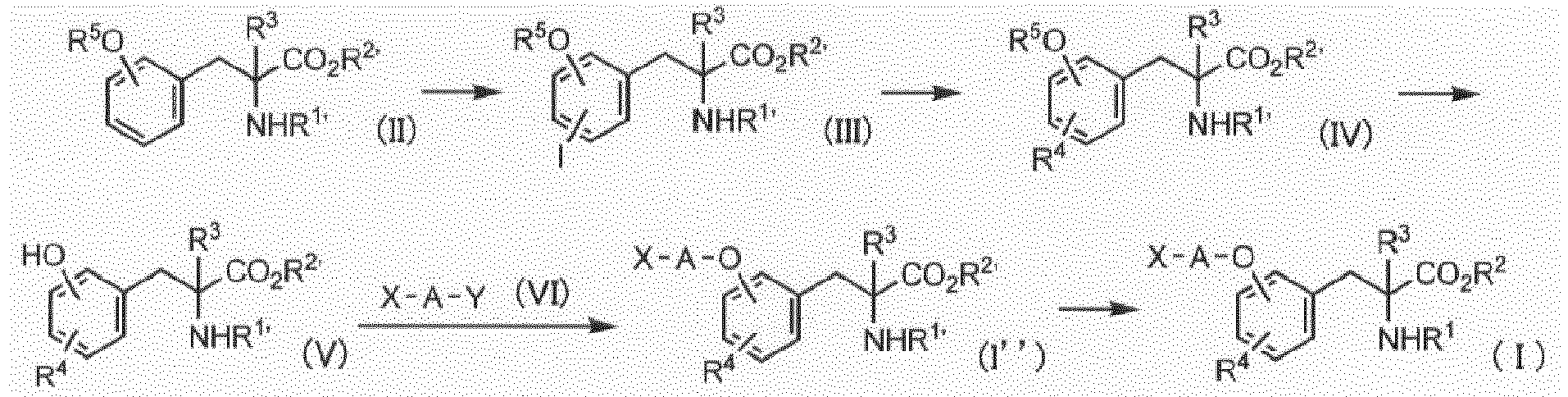
R1 is a hydrogen atom or a protective group for the amino group;
R2 is a hydrogen atom or a protective group for the carboxy group;
R1' is a protective group for the amino group;
R2' is a protective group for the carboxy group;
R3 is a hydrogen atom or a C1-6 alkyl group;
R4 is a halogen atom, a hydroxy group, a C1-6 alkyl group, a C1-6 halogenated alkyl group, an amino group, a mono(C1-6 alkyl) amino group, a di(C1-6 alkyl) amino group, a C6-12 aryl group optionally having substituent α, a heterocyclic group optionally having substituent α, a C1-6 alkoxy group, a C1-6 alkylthio group, a C1-6 halogenated alkoxy group or a C7-13 aralkyloxy group optionally having substituent α;
R5 is a protective group of the phenolic hydroxy group;
A is -(CH2)l-[Z(CH2)m]n- wherein Z is an amino group, an ether group, a thioether group, a carbonyl group, a thionyl group, an ester group, an amide group, a urea group or a thiourea group; 1 is an integer of not less than 1 and not more than 6; m is an integer of not less than 1 and not more than 4; n is an integer of not less than 0 and not more than 4;
X is a leaving group selected from the group consisting of a chlorine atom, a bromine atom, an iodine atom, a methanesulfonyloxy group, a trifluoromethanesulfonyloxy group, a chloromethanesulfonyloxy group, an ethanesulfonyloxy group, a benzenesulfonyloxy group and a toluenesulfonyloxy group;
Y is a hydroxy group or a leaving group selected from the group consisting of a chlorine atom, a bromine atom, an iodine atom, a methanesulfonyloxy group, a trifluoromethanesulfonyloxy group, a chloromethanesulfonyloxy group, an ethanesulfonyloxy group, a benzenesulfonyloxy group and a toluenesulfonyloxy group;
substituent α is one or more substituents selected from the group consisting of a halogen atom, a hydroxy group, a cyano group, a thiol group, an amino group, a mono(C1-6 alkyl) amino group, a di(C1-6 alkyl) amino group, a C1-6 alkyl group, a C1-6 alkoxy group, a C1-6 halogenated alkyl group and a C1-6 alkylthio group;
provided that the position of the iodine atom or R4 is para to the position of the R5O- group, the hydroxy group or X-A-O-group;
comprising the steps of:- reacting the compound represented by the formula (II) with an iodination reagent at -50°C or lower in order to obtain the compound represented by the formula (III);
- transforming the iodine atom of the compound (III) to R4 when R4 of the compound (IV) is not an iodine atom in order to obtain the compound represented by the formula (IV);
- removing the protective group of the phenolic hydroxy group of the compound (IV) in order to obtain the compound represented by the formula (V);
- reacting the compound (V) with the compound represented by the formula (VI) in order to obtain the compound represented by the formula (I"); and
- removing the protective group of at least one of the amino group or the carboxy group if necessary in order to obtain the compound represented by the formula (I).
- According to the present invention, an iodine atom can be introduced at the para position of the phenolic hydroxy group in the benzene ring of a tyrosine derivative with high yield and high regioselectivity. Therefore, the present invention is useful particularly for industrial mass production of the tyrosine derivative in which an iodine atom is introduced at the above-described position, since the tyrosine derivative can be efficiently produced by the present invention.
- In addition, the tyrosine derivative of the present invention has an actively reactive group in the substituent group at the phenolic hydroxy group and on the benzene ring, and therefore the tyrosine derivative is useful as a synthetic intermediate. Further, for example, the tyrosine derivative itself can be used as a non-naturally occurring amino acid for improving or modifying an activity of an enzyme such as t-PA by replacing a portion of the amino acids which constitute the enzyme with the tyrosine derivative. Furthermore, the tyrosine derivative can be used as a diagnostic agent and a bioimaging agent which utilizes in vivo redox reaction, a nitroxyl radical or the like. In particular, the tyrosine derivative of the present invention exhibits antagonism against a melatonin MT1 receptor and is useful as a melatonin MT1 receptor antagonist. Therefore, the tyrosine derivative of the present invention can be utilized as antidepressant agent or the like.
- In the present invention method, tyrosine of which the amino group, the carboxy group and the phenolic hydroxy group are protected is preferably used as a raw material compound. Hereinafter, each step of the present invention method is described in order.
- The order in which the amino group, the carboxy group and the phenolic hydroxy group are protected is not particularly limited. In general, the amino group is protected first, since the amino group can be easily protected and there are many kinds of suitable protective groups.
- It is particularly preferred that a protective group for the amino group does not inhibit the after-described iodination reaction, and is not removed in the following reactions but can be easily removed in case of necessity. The protective group is exemplified by a carbamate-type protective group such as a t-butoxycarbonyl group, i.e. Boc group, a benzyloxycarbonyl group, i.e. Z group or Cbz group, a 2,2,2-trichloroethoxycarbonyl group, i.e. Troc group, an allyloxycarbonyl group, i.e. Alloc group, a methylcarbamate group, an ethylcarbamate group, a 9-fluorenylmethylcarbamate group, i.e. Fmoc group, a 9-(2-sulfo)fluorenylmethylcarbamate group, a 9-(2,7-dibromo)fluorenylmethylcarbamate group and a 4-methoxyphenacylcarbamate group; a sulfonamide-type protective group such as a p-toluenesulfonyl group, i.e. Ts group, and a 2-nitrobenzenesulfonyl group, i.e. a nosyl group or Ns group; an amide-type protective group such as a trifluoroacetyl group; a benzyl-type protective group; and a triphenylmethyl group, i.e. Tr group.
- In addition, a cyclic protective group, which further reacts with -NH- group to form a ring including the nitrogen atom, can be used in the present invention. Such a cyclic protective group is exemplified by a 4,5-diphenyl-3-oxazoline-2-one group, a N-phthalimide group, an N-dithiasuccinimide group, a N-2,3-diphenylmaleimide group, a N-2,5-dimethylpyrrol group, a N-1,1,4,4-tetramethyldisilylazacyclopentane group, a 1,3-dimethyl-1,3,5-triazacyclohexane-2-one group and a 3,5-dinitro-4-pyridone group. The above-described protective groups are represented as a form including the nitrogen atom of the amino group to be protected.
- In the tyrosine derivative (I) and the like of the present invention, there is a description of "-NHR1". However, the compound of which amino group is protected with two R1s, in other words, the compound which has "-N(R1)2" is included in the range of the present invention.
- When the protective group of the amino group is selected, the person skilled in the art can protect the amino group by ordinary method. For example, T. W. Green et al., "PROTECTIVE GROUPS IN ORGANIC SYNTHESIS" JOHN WILEY & SONS, INC. may be referred.
- It is also preferred that a protective group for the carboxy group does not inhibit the after-described iodination reaction, and is not removed in the following reactions but can be easily removed in case of necessity. As such a protective group, an ester group such as a methoxymethyl ester group, a tetrahydropyranyl ester group and a t-butyl ester group can be used.
- The person skilled in the art can protect the carboxy group by ordinary method similarly to the protection of the amino group.
- It is also preferred that a protective group for the phenolic hydroxy group does not inhibit the after-described iodination reaction, and is not removed in the following reactions but can be easily removed in case of necessity. In addition, as described later, a substituent group may be introduced in the phenolic hydroxy group to obtain a derivative in some cases. Therefore, it is preferred that a protective group of the phenolic hydroxy group selectively removed while the amino group and the carboxy group are protected.
- A protective group of the phenolic hydroxy group is exemplified by a silyl ether group selected from a trimethylsilyl group, a triethylsilyl group, a t-butyldimethylsilyl group, a triisopropylsilyl group and a t-butyldiphenylsilyl group.
- The person skilled in the art can protect the phenolic hydroxy group by ordinary method similarly to the protection of the amino group and the carboxy group.
- The present invention method comprises the step of reacting the compound (II), of which the amino group, the carboxy group and the phenolic hydroxy group are protected in the above-described steps 1 to 3, with an iodination reagent at -50°C or lower. In the present step, an iodine atom can be regioselectively introduced at the para position of the R5O-group.

- In the above scheme, R1', R2', R4 and R5 are the same as the above, and the position of the iodine atom in the compound (III) is para position of the R5O- group.
- The tyrosine derivative of the present invention is a m-tyrosine derivative or a o-tyrosine derivative, and preferably a m-tyrosine derivative, since an iodine atom is introduced at the para position of the phenolic hydroxy group or the protected phenolic hydroxy group in the present invention.
- It is preferred that the above reaction is carried out in a solvent. Such a solvent is not particularly limited as long as the solvent does not inhibit the above reaction and can adequately dissolve a part of or all of the compound (II) and the like. The solvent is exemplified by a halogenated hydrocarbon solvent such as dichloromethane and chloroform; an aromatic hydrocarbon solvent such as benzene and toluene; an ether solvent such as diethyl ether and tetrahydrofuran; and an amide solvent such as dimethylformamide and dimethylacetamide.
- An iodination reagent to be used is not particularly limited as long as the iodination reagent is generally used for iodination of a benzene ring. For example, molecular iodine, i.e. I2, 1,3-diiodo-5,5'-dimethylhydantoin, i.e. DIH, and N-iodosuccinimide, i.e. NIS, can be used.
- An amount of the iodination reagent to be used may be properly adjusted, and is preferably exemplified by not less than 0.9 times by mole and not more than 1.5 times by mole relative to the compound (II). The ratio is more preferably not less than 0.9 times by mole, even more preferably not less than 1.0 time by mole, and more preferably not more than 1.4 times by mole, even more preferably not more than 1.3 times by mole, particularly preferably not more than 1.25 times by mole.
- When molecular iodine is used as the iodination reagent, an iodination reaction accelerator is preferably used in combination to accelerate the reaction. As such an iodination reaction accelerator, for example, silver trifluoroacetate and silver acetate can be used.
- An amount of the iodination reaction accelerator to be used may be properly adjusted, and is preferably exemplified by not less than 0.5 times by mole and not more than 1.5 times by mole relative to the compound (II). The ratio is more preferably not less than 0.8 times by mole, even more preferably not less than 1.0 time by mole, particularly preferably not less than 1.1 times by mole, and more preferably not more than 1.4 times by mole, even more preferably not more than 1.3 times by mole, particularly preferably not more than 1.25 times by mole.
- The above reaction which is characteristic of the present invention method is carried out at -50°C or lower. In the above reaction, even at -50°C or lower, the yield is not decreased and an iodine atom can be selectively introduced at the para position of the phenolic hydroxy group of tyrosine. On the other hand, the lower limit of the reaction temperature is particularly not limited. However, when the temperature is excessively low, the yield may possibly be decreased in some cases. Therefore, the reaction temperature is preferably not less than -100°C. The reaction temperature is more preferably not less than -55°C, even more preferably not more than -60°C, and more preferably not less than -90°C, even more preferably not less than -80°C, particularly preferably not less than - 70°C.
- For the above reaction, for example, the compound (II) is dispersed or dissolved in a solvent, the temperature of the obtained mixed liquid is adjusted to be -50°C or lower, and then an iodination reagent is added thereto to be reacted at-50°C or lower.
- The reaction time may be properly adjusted. The reaction may be continued until the presence of the compound (II) can not be observed by thin-layer chromatography or the like. Alternatively, the reaction time can be determined by a preliminary experiment or the like. For example, the reaction time may be settled to be not less than about 12 hours and not more than about 48 hours.
- After the reaction, a general post-treatment may be carried out. For example, the reaction mixture is washed with sodium thiosulfate aqueous solution and the like to decompose unreacted iodine, dried, concentrated under reduced pressure, and the target compound is purified from the obtained residue by chromatography or the like.
- As necessary, the iodine atom of the above compound (III) may be transformed to other substituent group to obtain the compound (IV). Such a functional group transformation reaction can be carried out by the person skilled in the art.

- In the above scheme, R1', R2' and R3 to R5 are the same as the above, and the positions of the iodine atom in the compound (III) and the R4 of the compound (IV) are para to the position of the R5O- group.
- As necessary, the phenolic hydroxy group of the compound (III) or the compound (IV) synthesized as the above may be deprotected and then, a substituent group may be introduced thereto. For example, the following reaction may be carried out.

- In the above scheme, R1, R2, R1', R2', R3 to R5, A, X and Y are the same as the above; the position of the R4 of the compound (IV) is para to the position of the R5O- group; the position of the R4 of the compound (V) is para to the position of the hydroxy group; and the position of the R4 of the compound (I") and the compound (I) is para to the position of the X-A-O- group.
- Hereinafter, each of the above steps are described.
- In the present step, the phenolic hydroxy group is selectively deprotected. In the reaction, a deprotective condition in which the protective groups of the amino group and the carboxy group are maintained and which is suitable for the kind of the protective group of the phenolic hydroxy group may be applied.
- For example, when a silyl ether group is used as the above protective group, tetrabutylammonium fluoride (TBAF), hydrofluoric acid (HF), cesium fluoride (CsF), potassium fluoride (KF) and the like, which can utilize a strong affinity between silicon and fluorine, can be used.
- As a detail reaction condition such as a solvent and temperature of the present step, an ordinary condition which is well-known to the person skilled in the art may be applied similarly to the case of the protective group of the amino group.
- Then, for example, the tyrosine derivative (I") can be synthesized by reacting the phenolic hydroxy group of the compound (V), which is obtained by removing the protective group of the phenolic hydroxy group, with the compound (VI).
- In the present invention, the term "leaving group" is a group which is eliminated by the attack of a nucleophilic agent in a nucleophilic substitution reaction, and is exemplified by a group which can form an ether bond with the phenolic hydroxy group. Such a leaving group to be used is exemplified by a halogen atom leaving group which has a leaving ability, such as a chlorine atom, a bromine atom and an iodine atom; a sulfonyloxy group such as a methanesulfonyloxy group, a trifluoromethanesulfonyloxy group, a chloromethanesulfonyloxy group, an ethanesulfonyloxy group, a benzenesulfonyloxy group and a toluenesulfonyloxy group. Two leaving groups of the compound (VI), i.e. "X" and "Y", may be the same or different from each other. When two leaving groups are different from each other, a leaving group of which reactivity to the phenolic hydroxy group is higher is selected as "Y" more than that of "X".
- Any one end of "A", i.e. -(CH2)l-[Z(CH2)m]n-, in the compound (VI) and the like may be bound to the "X" or the oxygen atom in the phenolic hydroxy group. For example, the structure of the compound (VI) may be any one of X-(CH2)l-[Z(CH2)m]n-Y and Y-(CH2)l-[Z(CH2)m]n-X. In addition, the structure of X-A-O-Ph, wherein Ph is a benzene ring, in the compound (I), the compound (I') and the compound (I") may be any one of X-(CH2)l-[Z(CH2)m]n-O-Ph and X-[(CH2)m-Z]n-(CH2)l-O-Ph. It is preferred that the compound (VI), the compound (I), the compound (I') and the compound (I") have a structure of -O-(CH2)l-[Z(CH2)m]n-X.
- It is preferred that the above reaction is carried out in a solvent in the presence of a base. The solvent to be used is exemplified by an alcohol solvent such as methanol and ethanol; an ether solvent such as diethyl ether and tetrahydrofuran; an amide solvent such as dimethylformamide and dimethylacetamide.
- As the above base, an organic amine such as triethylamine, diethylaminoethanol and pyridine; a hydroxide of an alkali metal, such as sodium hydroxide and potassium hydroxide; a hydrogencarbonate of an alkali metal, such as sodium hydrogencarbonate and potassium hydrogencarbonate; a carbonate of an alkali metal, such as sodium carbonate and potassium carbonate can be used.
- When the "Y" is a hydroxy group, the hydroxy group may be selectively reacted with the phenolic hydroxy group in the presence of triphenylphosphine and diethyl azodicarboxylate to obtain a phenol ether.
- Finally, as necessary, the amino group and/or the carboxy group of the compound (I") may be deprotected.
- The tyrosine derivative of the present invention is characterized in being represented by the following formula (I).

R1 is a hydrogen atom or a protective group for the amino group;
R2 is a hydrogen atom or a protective group for the carboxy group;
R3 is a hydrogen atom or a C1-6 alkyl group;
R4 is a halogen atom, a hydroxy group, a C1-6 alkyl group, a C1-6 halogenated alkyl group, an amino group, a mono(C1-6 alkyl)amino group, a di(C1-6 alkyl)amino group, an aryl group optionally having substituent α, a heterocyclic group optionally having substituent α, a C1-6 alkoxy group, a C1-6 alkylthio group, a C1-6 halogenated alkoxy group or a C7-13 aralkyloxy group optionally having substituent α;
A is -(CH2)l-[Z(CH2)m]n- wherein Z is an amino group, an ether group, a thioether group, a carbonyl group, a thionyl group, an ester group, an amide group, a urea group or a thiourea group; 1 is an integer of not less than 1 and not more than 6; m is an integer of not less than 1 and not more than 4; n is an integer of not less than 0 and not more than 4;
X is a leaving group selected from the group consisting of a chlorine atom, a bromine atom, an iodine atom, a methanesulfonyloxy group, a trifluoromethanesulfonyloxy group, a chloromethanesulfonyloxy group, an ethanesulfonyloxy group, a benzenesulfonyloxy group and a toluenesulfonyloxy group;
substituent α is one or more substituents selected from the group consisting of a halogen atom, a hydroxy group, a cyano group, a thiol group, an amino group, a mono(C1-6 alkyl) amino group, a di(C1-6 alkyl) amino group, a C1-6 alkyl group, a C1-6 alkoxy group, a C1-6 halogenated alkyl group and a C1-6 alkylthio group;
provided that the position of R4 is para to the position of the X-A-O- group. - In the present invention, the term "halogen atom" is a fluorine atom, chlorine atom, a bromine atom, an iodine atom, preferably a chlorine atom, a bromine atom, an iodine atom.
- The term "C1-6 alkyl group" is a linear, branched or cyclic saturated aliphatic hydrocarbon group of which carbon number is not less than 1 and not more than 6. The group is exemplified by a methyl group, an ethyl group, a n-propyl group, an isopropyl group, a n-butyl group, an isobutyl group, a t-butyl group, a n-pentyl group , a n-hexyl group, a cyclopropyl group, a cyclobutyl group, a cyclopentyl group and a cyclohexyl group. The group is preferably a C1-4 alkyl group, more preferably a C1-2 alkyl group, and most preferably a methyl group.
- The term "C1-6 halogenated alkyl group" is a C1-6 alkyl group which is substituted by at least one halogen atom. The group is exemplified by a chloromethyl group, a bromomethyl group, a trifluoromethyl group and a pentafluoroethyl group. The group is preferably a C1-4 halogenated alkyl group, and more preferably C1-2 halogenated alkyl group.
- The term "mono(C1-6 alkyl)amino group" is an amino group which is substituted by one C1-6 alkyl group. The group is exemplified by a methylamino group, an ethylamino group, an isopropylamino group, a t-butylamino group, a n-pentylamino group and a n-hexylamino group.
- The term "di(C1-6 alkyl)amino group" is an amino group which is substituted by two C1-6 alkyl groups. The C1-6 alkyl groups may be the same or different from each other. The group is exemplified by a dimethylamino group, a diethylamino group, a diisopropylamino group, a t-butylmethylamino group, a t-butylethylamino group, a di(t-butyl)amino group, a di(n-pentyl)amino group and a di(n-hexyl)amino group.
- The term "C6-12 aryl group" is an aromatic hydrocarbon group of which carbon number is not less than 6 and not more than 12. The group is exemplified by a phenyl group, an indenyl group, a naphthyl group and a biphenyl group, and is preferably a phenyl group.
- The term "heterocyclic group" is a five-membered, six-membered or condensed saturated heterocyclic group or a five-membered, six-membered or condensed heteroaryl group which have at least one hetero atom such as a nitrogen atom, an oxygen atom and a sulfur atom. The "heterocyclic group" is exemplified by a five-membered saturated heterocyclic group such as a pyrrolidinyl group, an imidazolidinyl group, a pyrazolidinyl group, a tetrahydrothiophenyl group, a tetrahydrofuranyl group, an oxazolidinyl group, an isoxazolidinyl group, a thiazolidinyl group and an isothiazolidinyl group; and a six-membered saturated heterocyclic group such as a piperidinyl group, a piperazinyl group, a morpholinyl group and a thiomorpholinyl group. The "heteroaryl group" is exemplified by a five-membered heteroaryl group such as a pyrrolyl group, an imidazolyl group, a pyrazolyl group, a tetrazolyl group, a thienyl group, a furyl group, an oxazolyl group, an isoxazolyl group, a thiazolyl group and an isothiazolyl group; a six-membered heteroaryl group such as pyridyl group, a pyrazinyl group, a pyrimidinyl group and a pyridazinyl group; and a condensed heteroaryl group such as an indolyl group, an isoindolyl group, an isoindole-1,3-dione-2-yl group, a quinolyl group, an isoquinolyl group, a benzofuranyl group, a chromenyl group, a benzothienyl group and a tetrahydroimidazol[1,2-a]pyrazine group.
- The term "C1-6 alkoxy group" is a linear, branched or cyclic aliphatic hydrocarbonoxy group of which carbon number is not less than 1 and not more than 6. The group is exemplified by a methoxy group, an ethoxy group, a propoxy group, an isopropoxy group, a butoxy group, an isobutoxy group, a t-butoxy group, a pentoxy group, a hexoxy group, a cyclopropyloxy group, a cyclobutyloxy group, a cyclopentyloxy group and a cyclohexyloxy group. The group is preferably a C1-4 alkoxy group, and more preferably a C1-2 alkoxy group.
- The term "C1-6 alkylthio group" is a linear, branched or cyclic aliphatic hydrocarbonthio group of which carbon number is not less than 1 and not more than 6. The group is exemplified by a methylthio group, an ethylthio group, a propylthio group, an isopropylthio group, a butylthio group, an isobutylthio group, a t-butylthio group, a pentylthio group, a hexylthio group, a cyclopropylthio group, a cyclobutylthio group, a cyclopentylthio group and a cyclohexylthio group. The group is preferably a C1-4 alkylthio group, more preferably a C1-2 alkylthio group, and most preferably a methylthio group.
- The term "C1-6 halogenated alkoxy group" is a C1-6 halogenated alkyloxy group. The group is exemplified by a chloromethyloxy group, a bromomethyloxy group, a trifluoromethyloxy group and a pentafluoroethyloxy group. The group is preferably a C1-4 halogenated alkoxy group, and more preferably a C1-2 halogenated alkoxy group.
- The term "C7-13 aralkyloxy group" is an alkyl group which is substituted by one aryl group and of which carbon number is not less than 7 and not more than 13. The group is exemplified by a benzyl group, a phenacyl group, a naphthylmethyl group and a biphenylmethyl group, and is preferably a benzyl group.
- The number of substituent α in a C6-12 aryl group, a heterocyclic group and a C7-13 aralkyloxy group is particularly not limited, and is preferably not less than 1 and not more than 5. The number is more preferably not more than 3 and even more preferably not more than 2. When the number of substituent α is 2 or more, the substituents may be the same or different from each other. When a C7-13 aralkyloxy group has substituent α, the substituent exists on the aryl group. The carbon number of substituent α is not included in the carbon number of a C6-12 aryl group and a C7-13 aralkyloxy group.
- As a tyrosine derivative, there are a L-tyrosine derivative and a D-tyrosine derivative, both of which are included in the range of the present invention. According to a purpose, a L-tyrosine derivative, a D-tyrosine derivative or the mixture thereof, such as racemate, may be properly selected. In general, a racemate consists of L body and D body in a ratio of 1 : 1. In general, a L-tyrosine derivative, which is a derivative of a natural amino acid, has highest utilization value.
- The tyrosine derivative (I) of the present invention may be a salt. Such a salt is exemplified by an inorganic acid salt such as a hydrochloride, a hydrobromide, a hydroiodide, a nitrate, a sulfate and a phosphate; an organic acid salt such as an oxalate, a malonate, a maleate, a fumarate, a lactate, a malate, a citrate, a tartrate, a benzoate, a trifluoroacetate, an acetate, a methanesulfonate, a p-toluenesulfonate and a trifluoromethanesulfonate; an alkali metal salt such as a sodium salt and a potassium salt; an alkaline earth metal salt such as a calcium salt and a magnesium salt; an ammonium salt; an amino acid salt such as an aspartate, a glutamate, a lysine salt, an alginate and a histidine salt.
- The tyrosine derivative (I) of the present invention can be produced by the above-described present invention method. Alternatively, the present invention method may be properly modified by a method which is known to the person skilled in the art to produce the tyrosine derivative (I) of the present invention.
- For example, o-tyrosine may be used as a raw material compound other than m-tyrosine, the position of an iodine atom to be introduced may be determined by adjusting a reaction temperature in the iodination reaction, and further the introduced iodine atom may be transformed to other functional group if necessary.
- The tyrosine derivative (I) of the present invention has an actively reactive group in the substituent group at the phenolic hydroxy group and on the benzene ring, and therefore the tyrosine derivative is useful as a synthetic intermediate. In addition, for example, the tyrosine derivative itself can be used as a non-naturally occurring amino acid for improving or modifying an activity of an enzyme such as t-PA by replacing a part of amino acids which constitutes the enzyme by the tyrosine derivative. Furthermore, the tyrosine derivative can be used as a diagnostic agent and a bioimaging agent which utilizes in vivo redox reaction, a nitroxyl radical or the like. In particular, the tyrosine derivative of the present invention exhibits antagonism against a melatonin MT1 receptor and is useful as a melatonin MT1 receptor antagonist. Therefore, the tyrosine derivative of the present invention can be utilized as antidepressant agent or the like.
- The tyrosine derivative of the present invention can be used for treating depression or the like as a medicinal preparation containing the derivative as an active component and a pharmaceutically acceptable organic or inorganic solid or liquid excipient which is suitable for oral administration or parenteral administration. Such a medicinal preparation can be developed in a form of an encapsulated formulation, a tablet, a sugar-coated tablet, a granule, an inhalant, a suppository, a solution, a lotion, a dispersion, an emulsion or the like. As necessary, a general additive agent, such as an auxiliary agent, a stabilizing agent, a wetting agent, an emulsifier and a buffering agent, can be added to the medicinal preparation.
- A dosage amount of the tyrosine derivative according to the present invention for a treatment is dependent on a severity, age, sex, condition or the like of a patient, and for example, a dosage amount of not less than about 0.01 mg/kg and not more than about 50 mg/kg on a basis of a patient's weight may be effective.
- The present application claims the benefit of the priority dates of
U.S. provisional patent application 61/746,648 filed on December 28, 2012 2012-289111 filed on December 28, 2012 2013-202199 filed on September 27, 2013 U.S. provisional patent application 61/746,648 filed on December 28, 2012 2012-289111 filed on December 28, 2012 2013-202199 filed on September 27, 2013 - Hereinafter, the present invention is described in more detail with Examples. However, the present invention is not limited by the following Examples, and the present invention can be appropriately modified to be carried out within a range which adapts to the contents of this specification. Such a modified embodiment is also included in the range of the present invention.
-

- To a mixed solution obtained by dissolving D/L-m-tyrosine (Compound 1, 5.0 g, 27.6 mmol) and triethylamine (4.19 g, 41.4 mmol) in a mixed solvent of dioxane / water = 1 / 1, di-t-butyl pyrocarbonate (6.62 g, 30.4 mmol) was slowly added at 0°C. The mixture was stirred at -2°C overnight. The reaction mixture was concentrated under reduced pressure, and sodium hydrogencarbonate solution was added thereto. After the aqueous layer was washed with ethyl acetate and neutralized by adding hydrochloric acid, extraction was carried out with ethyl acetate. The obtained organic layers were combined. The organic layer was washed with saturated saline and dried over anhydrous sodium sulfate. The solid components were removed by filtration and the filtrate was concentrated under reduced pressure, to obtain colorless powder (amount: 7.5 g, yield: 97%).
1H-NMR (400MHz, CD3OD, TMS) δ7.08(t, J=7.79Hz, 1H), 6.66(m, 3H), 4.31(m, 1H), 3.05(m, 1H), 2.84(m, 1H), 1.39(s, 9H) - The N-protected tyrosine (Compound 2, 7.5 g, 26.7 mmol) obtained in the above (1) was dissolved in toluene (133 mL), and t-butyl alcohol (35 mL) was further added thereto. After the obtained reaction mixture was heated to reflux, N,N-dimethylformamide dineopentyl acetal (18.5 g, 21.7 mmol) was added dropwise thereto over 55 minutes. After the mixture was heated to reflux for 3 hours, the mixture was cooled to room temperature and saturated sodium hydrogencarbonate solution was added thereto. The target compound was extracted from the aqueous layer with dichloromethane two times, and the obtained organic layer was dried over anhydrous sodium sulfate. The solid components were removed by filtration, and the filtrate was concentrated under reduced pressure. The protected tyrosine as colorless powder was purified from the residue by silica gel column chromatography (amount: 7.06 g, yield: 78%).
1H-NMR (400MHz, CDCl3, TMS) δ7.14(t, J=7.79Hz, 1H), 6.70(m, 3H), 5.26(s, 1H), 5.01(m, 1H), 4.42(m, 1H), 2.99(m, 2H), 1.42(s, 9H), 1.40(s, 9H) - To a DMF (36 mL) solution of TBSCl (3.23 g, 21.4 mmol), the protected tyrosine (Compound 3, 6.03 g, 17.9 mmol) obtained in the above (2) and imidazole (3.04 g, 44.6 mmol) was added at 0°C. The mixture was heated to room temperature. After 2 hours, the reaction mixture was diluted with water and extraction was carried out with ethyl acetate. The extract was washed with water and saturated saline, and then dried over anhydrous sodium sulfate. After filtration, the filtrate was concentrated under reduced pressure. Compound 4 of which phenolic hydroxy group was protected was obtained by purifying from the residue with silica gel column chromatography (amount: 7.66 g, yield: 95%).
1H-NMR (400MHz, CDCl3, TMS) δ7.12(t, J=7.79Hz, 1H), 6.75(d, J=7.79Hz, 1H), 6.70(d, J=7.79Hz, 1H), 6.65(s, 1H), 4.95(m, 1H), 4.43(m, 1H), 3.00(d, J=5.95Hz, 1H), 1.42(s, 9H), 1.41(s, 9H), 0.97(s, 9H) - Compound 4 (8.31 g, 18.4 mmol) obtained in the above (3) and CF3CO2Ag (4.68 g, 21.2 mmol) were added to chloroform (180 mL) to obtain a dispersion, and iodine (5.14 g, 20.2 mmol) was added to the dispersion at -65°C. The mixture was stirred at -65°C overnight. The reaction mixture was filtered. The filtrate was diluted with ethyl acetate, and washed with sodium thiosulfate aqueous solution and saturated saline. The organic layer was dried over anhydrous magnesium sulfate. After filtration, the filtrate was concentrated under reduced pressure. A mixture of Compound 4 as raw material compound and Compound 5 as the target compound was obtained as colorless powder by purifying from the residue with silica gel column chromatography (amount: 8.79 g). 1H-NMR (400MHz, CDCl3, TMS) δ7.62(d, J=8.24Hz, 1H), 6.73(s, 1H), 6.46(d, J=8.24Hz, 1H), 5.00(d, J=8.24Hz, 1H), 4.48(m, 1H), 3.17(m, 1H), 2.96(m, 1H), 1.42(s, 9H), 1.39(s, 9H), 0.96(s, 9H)
- Compound 5 (1.33 g, 2.30 mmol) obtained in the above (4) was dissolved in THF (8 mL). To the solution, TBAF (3.5 mL, 1M THF solution) was added at 0°C. The mixture was stirred for 1 hour. Then, water was added thereto, and extraction was carried out with ethyl acetate two times. The organic layers were combined. The combined organic layer was washed with saturated saline and dried over anhydrous sodium sulfate. After filtration, the filtrate was concentrated under reduced pressure to obtain Compound 6 as the target compound (amount: 1.03 g, yield: 96%). 1H-NMR (400MHz, CDCl3, TMS) δ7.63(d, J=8.24Hz, 1H), 6.80(s, 1H), 6.49(d, J=8.70Hz, 1H), 5.86(s, 1H), 5.08(m, 1H), 4.52(m, 1H), 2.99(m, 1H), 1.43(s, 9H), 1.39(s, 9H)
-

- To an anhydrous DMF (2.5 mL) solution of Compound 6 (0.12 g, 0.25 mmol) obtained in the above Example 1(5) and potassium carbonate (0.10 g, 0.75 mmol), ethyleneglycol bis(p-toluenesulfonate) (0.19 g, 0.5 mmol) was added. After the mixture was stirred at room temperature for 2 days, the mixture was diluted with water and extraction was carried out with ethyl acetate (about 20 mL) three times. The combined organic layer was washed with water and saturated saline, and dried over magnesium sulfate. After filtration, the filtrate was concentrated. Compound 7 was obtained by purifying from the residue with silica gel column chromatography (0.53 g, 54%).
1H-NMR (400 MHz, CDCl3, TMS) δ7.81(dt, J=8.4Hz and 1.9Hz, 2H), 7.65(d, J=8.7Hz, 1H), 7.36(d, J=7.8Hz, 2H), 6.72(s, 1H), 6.43(dd, J=8.7Hz and 1.8Hz, 1H), 5.02(m, 1H), 4.5(m, 1H), 4.35(m, 2H), 4.11(m, 2H), 3.17(dd, J=14.0Hz and 5.7Hz, 1H), 2.98(m, 1H), 2.47(s, 3H), 1.43(s, 9H), 1.38(s, 9H) - Compound 5 was synthesized similarly to the above Example 1(4) except that a molar ratio of the iodination reagent: CF3CO2Ag - I2 relative to Compound 4, reaction temperature and reaction time were changed as Table 1. After purification with silica gel column chromatography, the obtained compounds were analyzed with 1H-NMR and yields of Compound 5 as the target compound, in which an iodine atom was introduced at the para position of TBSO-group, Compound 5' as a by-product, in which an iodine atom was introduced at the ortho position of TBSO- group, i.e. at the para position of the benzyl position, and unreacted Compound 4 from the peak area of the obtained charts. In Table 1, "main" represents non-quantitative production quantity since the target peak was overlapped with other peak of by-product so that yield could not calculated, and "trace" represents the case where the yield calculated from NMR data was less than 1%.
Table 1 Run Amount of iodination reagent Reaction temperature Reaction time (h) Yield (%) Ratio of Compound 5/ Compound 5' Compound 5 Compound 5' Compound 4 1 1.00 eq rt 3 85% 6% 3% 14 2 1.00 eq 2°C (ice bath) 47 83% 5% 4% 17 3 1.25 eq 2°C (ice bath) 5 main trace 0% - 4 1.00 eq -40°C 117 87% 3% 2% 29 5 1.00 eq -60°C 168 85% 2% 8% 43 6 1.25 eq -60°C 114 91% 2% trace 46 - As the results demonstrated in Table 1, when the reaction temperature was -40°C or higher, the ratio of Compound 5 as the target compound relative to Compound 5' as a by-product was about 30 at the most. Hereinafter, the ratio is abbreviated to "Compound 5/Compound 5' ratio". The physical properties of Compound 5 and Compound 5' are similar to each other, and it is very difficult to separate one from the other. Therefore, it is preferred that the value of Compound 5/Compound 5' ratio is large as much as possible. In addition, when the reaction temperature was 2°C and an amount of an iodination reagent to be used relative to Compound 4 was increased to accelerate the reaction, an amount of by-product other than Compound 5' was increased. Such a by-product other than Compound 5' is supposed to be a diiodo compound or a triiodo compound.
- On the other hand, when the reaction temperature was adjusted to be -60°C, Compound 5/Compound 5' ratio was increased to about 40, and the yield of Compound 5 was about 90% whereas the yield of Compound 5' was merely 2%. In addition, even when an amount of an iodination reagent to be used was increased, an amount of by-product to be produced other than Compound 5' was suppressed.
- It was clarified from the above results that the reaction temperature of an iodination reaction should be adjusted to - 50°C or lower in order to effectively and selectively iodinate the para position of the phenolic hydroxy group or the protected phenolic hydroxy group of a tyrosine derivative.
-

- Compound 4 (452 mg, 1.0 mmol) obtained in the above Example 1 (3) and CF3CO2Ag (276 mg, 1.25 mmol) were added to chloroform (10 mL) to obtain a dispersion. Iodine (317 mg, 1.25 mmol) was added to the dispersion at -60°C, and the mixture was stirred at -60°C for 5 days. After the reaction mixture was filtrated and the filtrate was diluted with ethyl acetate, the diluted mixture was washed with sodium thiosulfate aqueous solution and saturated saline. The organic layer was dried over anhydrous magnesium sulfate. After filtration, the filtrate was concentrated under reduced pressure. A mixture of Compound 5 as the target compound and Compound 5' as a by-product was obtained as colorless powder by purifying from the residue with silica gel column chromatography (Compound 5: 528 mg, yield: 91%, Compound 5': 14 mg, yield: 2% (the yields were calculated from NMR)).
Compound 5
1H-NMR (400MHz, CDCl3, TMS) δ7.62(d, J=8.24Hz, 1H), 6.73(s, 1H), 6.46(d, J=8.24Hz, 1H), 5.00(d, J=8.24Hz, 1H), 4.48(m, 1H), 3.17(m, 1H), 2.96(m, 1H), 1.42(s, 9H), 1.39(s, 9H), 0.96(s, 9H), 0.18(s, 6H)
Compound 5'
1H-NMR (400MHz, CDCl3, TMS) δ7.63(d, J=7.76Hz, 1H), 6.65(s, 1H), 6.50(dd, J=8.22Hz and 1.83Hz, 1H), 4.97(d, J=7.77Hz, 1H), 4.43(m, 1H), 2.97(m, 2H), 1.42(s, 9H), 1.41(s, 9H), 1.06(s, 9H), 0.28(s, 6H) -

- Compound 6 (1.6 g, 3.4 mmol) obtained in the above Example 1(5), potassium carbonate (2.5 g, 18.1 mol) and ethyleneglycol bis(p-toluenesulfonate) (4.0 g, 10.8 mmol) were dissolved in anhydrous acetone (30 mL). The obtained solution was heated to reflux for 21 hours. After the reaction mixture was cooled, the mixture was diluted with water and extraction was carried out with ethyl acetate (about 20 mL) three times. The combined organic layers was washed with water and saturated saline, and dried over anhydrous sodium sulfate. After filtration, the filtrate was concentrated. Compound 7 was obtained by purifying from the residue with silica gel column chromatography (1.48 g, 59%).
1H-NMR (400MHz, CDCl3, TMS) δ7.81(dt, J=8.4Hz and 1.9Hz, 2H), 7.65(d, J=8.7Hz, 1H), 7.36(d, J=7.8, 2H), 6.72(s, 1H), 6.43(dd, J=8.7Hz and 1.8Hz, 1H), 5.02(m, 1H), 4.5(m, 1H), 4.35(m, 2H), 4.11(m, 2H), 3.17(dd, J=14.0Hz and 5.7Hz, 1H), 2.98(m, 1H), 2.47(s, 3H), 1.43(s, 9H), 1.38(s, 9H) -

- Compound 6 (116 mg, 0.25 mmol) obtained in the above Example 1(5), triphenylphosphine (131 mg, 0.5 mmol) and 2-hydroxyethyl-4-methyl benzenesulfonate (108 mg, 0.5 mmol) were dissolved in anhydrous THF (2.5 mL). The solution was cooled with ice, and then diethyl azodicarboxylate (218 mg, 0.5 mmol) was added thereto. The temperature of the reaction mixture was increased to room temperature and stirred for 3 hours. Then, the reaction mixture was diluted with water, and extraction was carried out with ethyl acetate. The organic layer was washed with water and saturated saline, and dried over anhydrous magnesium sulfate. After filtration, the filtrate was concentrated under reduced pressure. Compound 7 was obtained by purifying from the residue with silica gel column chromatography (amount: 112 mg, yield: 68%).
-

- Compound 6 (0.6 g, 1.3 mmol) obtained in the above Example 1(5), potassium carbonate (0.9 g, 10 mmol) and di-ethyleneglycol bis(p-toluenesulfonate) (1.61 g, 3.9 mmol) were dissolved in anhydrous DMF (10 mL). After the solution was stirred at room temperature for 5 days, the solution was diluted with water and extraction was carried out with ethyl acetate (about 20 mL) three times. The combined organic layers was washed with water and saturated saline, and dried over anhydrous sodium sulfate. After filtration, the filtrate was concentrated. Compound 8 was obtained by purifying from the residue with silica gel column chromatography (0.61 g, 67%).
1H-NMR (400MHz, CDCl3, TMS) δ7.80(dt, J=8.5Hz and 1.9Hz, 2H), 7.67(d, J=8.7Hz, 1H), 7.32(d, J=8.2Hz, 2H), 6.81(s, 1H), 6.53(dd, J=8.5Hz and 2.5Hz, 1H), 5.09(m, 1H), 4.5(m, 1H), 4.19(m, 2H), 4.01(m, 2H), 3.76(m, 4H), 3.19(dd, J=14.0Hz and 5.7Hz, 1H), 2.98(m, 1H), 2.44(s, 3H), 1.43(s, 9H), 1.38(s, 9H) -

- To a THF (2 mL) solution of Compound 6 (0.35 g, 0.76 mmol) obtained in the above Example 1(5) and triphenylphosphine (396 mg, 1.5 mmol), 2-chloroethanol (100 µL, 1.5 mmol) was added. The mixture was cooled with ice. Diethyl azodicarboxylate (690 µL, 1.5 mmol) was slowly added thereto. After addition, the mixture was stirred at room temperature. After the reaction, the mixture was concentrated. Compound 9 was obtained by purifying from the residue with silica gel chromatography (0.31 g, 77%).
1H-NMR (400MHz, CDCl3, TMS) δ7.70(d, J=8.7Hz, 1H), 6.84(s, 1H), 6.56(dd, J=8.7Hz and 1.8Hz, 1H), 5.04(m, 1H), 4.5(m, 1H), 4.19(t, J=5.7Hz, 2H), 3.79(t, J=5.7Hz, 2H), 3.21(dd, J=13.7Hz and 5.5Hz, 1H), 2.99(m, 1H), 1.44(s, 9H), 1.39(s, 9H) -

- Compound 6 (0.35 g, 0.76 mmol) obtained in the above Example 1(5) and triphenylphosphine (254 mg, 0.97 mmol) were dissolved in THF (2 mL). To the solution, 2-bromoethanol (70 µL, 0.97 mmol) was added. The mixture was cooled with ice. Diethyl azodicarboxylate (440 µL, 0.97 mmol) was slowly added thereto. After addition, the mixture was stirred at room temperature. After the reaction, the mixture was concentrated. Compound 10 was obtained by purifying from the residue with silica gel chromatography (0.21 g, 57%).
1H-NMR (400MHz, CDCl3, TMS) δ7.70(d, J=8.7Hz, 1H), 6.83(s, 1H), 6.56(t, J=4.3Hz, 1H), 5.04(m, 1H), 4.5(m, 1H), 4.25(t, J=6.2Hz, 2H), 3.62(t, J=6.2Hz, 2H), 3.20(dd, J=14.0Hz and 5.7Hz, 1H), 3.00(m, 1H), 1.44(s, 9H), 1.39(s, 9H) -

- An optically-active compound 5(s) (99.8%ee) was synthesized similarly to the synthesis route described in the above Example 1 except that an optically-active L-m-tyrosine was used instead of DL-m-tyrosine as a raw material compound.
- HPLC retention time: 11.46 min
Column: CHIRALPAC IA 4.6 mmϕ × 250 mm, manufactured by Daicel Corporation
Flow speed: 0.8 mL/min
Column oven temperature: 25°C
Detection light wave-length: 233 nm
Eluent: hexane / ethanol = 99 / 1 -

- Compound 5 obtained in the above Example 1(4) was resolved by HPLC in the following condition using a chiral column.
Column: CHIRALPAC IA 20 mmϕ × 250 mm, manufactured by Daicel Corporation
Flow speed: 13 mL/min
Column oven temperature: 25°C
Detection light wave-length: 233 nm
Eluent: hexane / ethanol = 100 / 1
HPLC retention time: 5(S) - 11.46 min, 5(R) - 8.12 min
Column: CHIRALPAC IA 4.6 mmϕ × 250 mm, manufactured by Daicel Corporation
Flow speed: 0.8 mL/min
Column oven temperature: 25°C
Detection light wave-length: 233 nm
Eluent: hexane / ethanol = 99 / 1 -

- Optically-active Compound 6(S) or optically-active Compound 6(R) was synthesized similarly to the synthesis route described in the above Example 1(5) except that optically-active Compound 5 (S) or optically-active Compound 5 (R) obtained in the above Example 11 was used instead of racemic Compound 5.
- Optically-active Compound 7(S) (99.7%ee) or optically-active Compound 7(R) (99.7%ee) was synthesized similarly to the synthesis route described in the above Example 2 except that optically-active Compound 6(S) or optically-active Compound 6(R) obtained in the above (1) was used instead of Compound 6.
HPLC retention time: 7(S) - 12.94 min, 7(R) - 9.33 min
Column: CHIRALPAC IA 4.6 mmϕ × 250 mm, manufactured by Daicel Corporation
Flow speed: 0.8 mL/min
Column oven temperature: 25°C
Detection light wave-length: 254 nm
Eluent: hexane / ethanol = 60 / 40 -

- Optically-active Compound 8(S) (99.2%ee) or optically-active Compound 8(R) (99.3%ee) was synthesized similarly to the synthesis route described in the above Example 7 except that optically-active Compound 6(S) or 6(R) was used instead of Compound 6.
HPLC retention time: 8(S) - 7.09 min, 8(R) - 6.35 min
Column: CHIRALPAC IB 4.6 mmϕ × 250 mm, manufactured by Daicel Corporation
Flow speed: 1.0 mL/min
Column oven temperature: 25°C
Detection light wave-length: 254 nm
Eluent: hexane / ethanol = 80 / 20 -

- To deaerate toluene (2mL) solution of Compound 5 (100 mg, 0.17 mmol) obtained in the above Example 1(4), tetrakis(triphenylphosphine) palladium (60 mg, 0.05 mmol) and lithium chloride (37 mg, 0.87 mmol), hexamethyldistannane (72 µL, 0.35 mmol) was added under argon atmosphere. The mixture was heated at 100°C for 6 hours. The mixture was cooled, and then filtered using Celite. The filtrate was concentrated. Compound 11 was obtained by purifying from the residue with silica gel column chromatography (66.3 mg, 62%).
1H-NMR (400MHz, CDCl3, TMS) δ7.27(d, J=7.6Hz, 1H), 6.71(m, 2H), 4.83(m, 1H), 4.36(m, 1H), 3.04(m, 1H), 2.89(m, 1H), 1.45(s, 9H), 1.39(s, 9H), 0.99(s, 9H), 0.34(s, 9H), 0.21(s, 6H) - The methanol / diethyl ether solution (1/1, 7 mL) of Compound 11 (20 mg, 0.03 mmol) obtained in the above (1) was cooled to - 70°C, and methanol (2 mL) solution of bromine (1.6 µL, 0.03 mmol) was added thereto. After 30 minutes, sodium thiosulfate aqueous solution was added thereto. The mixture was stirred at room temperature. Extraction was carried out with ethyl acetate. The organic layer was washed with saturated saline, and then dried over anhydrous sodium sulfate. After the organic layer was filtered, the filtrate was concentrated under reduced pressure. Compound 12 was obtained by purifying from the residue with silica gel column chromatography (17 mg, 97%).
1H-NMR (400MHz, CDCl3, TMS) δ7.36(d, J=8.7Hz, 1H), 6.73(s, 1H), 6.59(dd, J=8.7Hz and 2.7Hz, 1H), 5.03(m, 1H), 4.50(m, 1H), 3.20(m, 1H), 3.00(m, 1H), 1.42(s, 9H), 1.40(s, 9H), 0.98(s, 9H), 0.19(s, 6H) - Compound 12 (15 mg, 0.03 mmol) obtained in the above (2) was dissolved in THF (0.1 mL). To the solution, TBAF (42 µL, 1M THF solution) was added at 0°C. The mixture was stirred for 1 hour. After the reaction mixture was filtered, the filtrate was concentrated under reduced pressure to obtain Compound 13 (amount: 11 mg).
1H-NMR (400MHz, CDCl3, TMS) δ7.37(d, J=8.7Hz, 1H), 6.79(s, 1H), 6.63(m, 1H), 5.10(m, 1H), 4.51(m, 1H), 3.18(m, 1H), 3.00(m, 1H), 1.43(s, 9H), 1.40(s, 9H) - Anhydrous acetone (40 mL) solution of Compound 13 (2.0 g, 4.8 mmol) obtained in the above (3), potassium carbonate (3.3 g, 24.0 mol) and ethyleneglycol bis(p-toluenesulfonate) (5.3 g, 14.4 mmol) was heated to reflux for 23 hours. The reaction mixture was cooled, and then diluted with water. Extraction was carried out with ethyl acetate (about 50 mL) two times. The combined organic layers was washed with water and saturated saline, and dried over sodium sulfate. After filtration, the filtrate was concentrated. Compound 14 was obtained by purifying from the residue with silica gel column chromatography (2.19 g, 74%).
1H-NMR (400MHz, CDCl3, TMS) δ7.82(dt, J=8.4Hz and 1.9Hz, 2H), 7.39(d, J=8.8Hz, 1H), 7.36(d, J=7.6Hz, 2H), 6.71(s, 1H), 6.56(m, 1H), 5.04(m, 1H), 4.51(m, 1H), 4.34(m, 2H), 4.11(m, 2H), 3.19(dd, J=14.2Hz and 5.9Hz, 1H), 2.99(m, 1H), 2.47(s, 3H), 1.42(s, 9H), 1.38 (s, 9H) -

- Racemic Compound 14 obtained in the above Example 14 was resolved by HPLC in the following condition using a chiral column. Optically-active Compound 15 (99.7%ee) and optically-active Compound 16 (99.7%ee) were obtained by recrystallization from the HPLC product in hexane / ethyl acetate.
Column: CHIRALPAC IA 20 mmϕ × 250 mm, manufactured by Daicel Corporation
Flow speed: 13 mL/min
Column oven temperature: 25°C
Detection light wave-length: 254 nm
Eluent: hexane / ethanol = 7 / 3
HPLC retention time: Compound 15 - 11.56 min
Compound 16 - 15.12 min
Column: CHIRALPAC IA 4.6 mmϕ × 250 mm, manufactured by Daicel Corporation
Flow speed: 1.0 mL/min
Column oven temperature: 25°C
Detection light wave-length: 254 nm
Eluent: hexane / ethanol = 70 / 30 -

- To dichloromethane (0.8 mL) solution of Compound 7 (100 mg, 0.15 mmol) obtained in the above Example 2, trifluoroacetic acid (340 µL) was added. The mixture was stirred at room temperature for 1 day. Then, the reaction mixture was concentrated, and water and ammonia water were added thereto. The precipitated solid was separated by filtration and washed with water to obtain Compound 17 (45 mg, 59%).
1H-NMR (400MHz, DCl/H2O, DSS) δ7.78(m, 3H), 7.39(d, J=8.7Hz, 2H), 6.80(d, J=3.2Hz, 1H), 6.55(dd, J=8.7Hz and 3.2Hz, 1H), 4.51(t, J=4.1Hz, 2H), 4.40(t, J=7.8Hz, 1H), 4.28(m, 2H), 3.45(m, 1H), 3.27(m, 1H), 2.43(s, 3H) - An inhibitory activity of the tyrosine derivative of the present invention against a melatonin MT1 receptor was evaluated. Specifically, human recombinant melatonin MT1 receptors expressed in CHO-K1 cells were used in modified HEPES buffer pH 7.4. The tyrosine derivative obtained in the above Example 8 was preincubated with 0.025 mg/mL of membranes of the cell and 1 µM of guanosine diphosphate in modified HEPES buffer (pH 7.4) at 25°C for 20 minutes, then SPA, i.e. Scintillation proximity assay, beads were added thereto. The mixture was preincubated at 30°C for 60 minutes. The reaction was initiated by adding 0.3 nM of [35S]GTPγS and incubating the mixture for 30 minutes, and the test compound-induced inhibition of 0.1 nM 2-iodomelatonin-induced increase of [35S]GTPγS binding response was measured.
- As a result, the tyrosine derivative obtained in the above Example 8 inhibited the binding between a melatonin MT1 receptor and [35S]GTPγS which was accelerated by 2-iodomelatonin by 33%; therefore, it was experimentally demonstrated that the tyrosine derivative of the present invention is an antagonist against a melatonin MT1 receptor.
Claims (9)
- A tyrosine derivative represented by the following formula (I) :

R1 is a hydrogen atom or a protective group for the amino group;
R2 is a hydrogen atom or a protective group for the carboxy group;
R3 is a hydrogen atom or a C1-6 alkyl group;
R4 is a halogen atom, a hydroxy group, a C1-6 alkyl group, a C1-6 halogenated alkyl group, an amino group, a mono(C1-6 alkyl) amino group, a di(C1-6 alkyl) amino group, a C6-12 aryl group optionally having substituent α, a heterocyclic group optionally having substituent α, a C1-6 alkoxy group, a C1-6 alkylthio group, a C1-6 halogenated alkoxy group or a C7-13 aralkyloxy group optionally having substituent α;
A is -(CH2)l-[Z(CH2)m]n- wherein Z is an amino group, an ether group, a thioether group, a carbonyl group, a thionyl group, an ester group, an amide group, a urea group or a thiourea group; 1 is an integer of not less than 1 and not more than 6; m is an integer of not less than 1 and not more than 4; and n is an integer of not less than 0 and not more than 4;
X is a leaving group selected from the group consisting of a chlorine atom, a bromine atom, an iodine atom, a methanesulfonyloxy group, a trifluoromethanesulfonyloxy group, a chloromethanesulfonyloxy group, an ethanesulfonyloxy group, a benzenesulfonyloxy group and a toluenesulfonyloxy group;
substituent α is one or more substituents selected from the group consisting of a halogen atom, a hydroxy group, a cyano group, a thiol group, an amino group, a mono(C1-6 alkyl) amino group, a di(C1-6 alkyl) amino group, a C1-6 alkyl group, a C1-6 alkoxy group, a C1-6 halogenated alkyl group and a C1-6 alkylthio group;
provided that the position of R4 is para to the position of the X-A-O- group. - The tyrosine derivative according to claim 1, represented by the following formula (I'):

- The tyrosine derivative according to claim 1 or 2, wherein R4 is a halogen atom, a hydroxy group, a C6-12 aryl group optionally having substituent α, a heterocyclic group optionally having substituent α or a C1-6 alkoxy group.
- The tyrosine derivative according to any one of claims 1 to 3, wherein R4 is a bromine atom or an iodine atom.
- The tyrosine derivative according to any one of claims 1 to 4, wherein A is -(CH2)l-[O(CH2)m]n-.
- A method for producing a tyrosine derivative represented by the following formula (III):

comprising the step of reacting the compound represented by the formula (II) with an iodination reagent at -50°C or lower. - The production method according to claim 6, wherein a combination of a molecular iodine and an iodination reaction accelerator is used as the iodination reagent.
- The production method according to claim 7, wherein silver trifluoroacetate or silver acetate is used as the iodination reaction accelerator.
- A method for producing a tyrosine derivative represented by the following formula (I):

R1 is a hydrogen atom or a protective group for the amino group;
R2 is a hydrogen atom or a protective group for the carboxy group;
R1' is a protective group for the amino group;
R2' is a protective group for the carboxy group;
R3 is a hydrogen atom or a C1-6 alkyl group;
R4 is a halogen atom, a hydroxy group, a C1-6 alkyl group, a C1-6 halogenated alkyl group, an amino group, a mono(C1-6 alkyl) amino group, a di(C1-6 alkyl) amino group, a C6-12 aryl group optionally having substituent α, a heterocyclic group optionally having substituent α, a C1-6 alkoxy group, a C1-6 alkylthio group, a C1-6 halogenated alkoxy group or a C7-13 aralkyloxy group optionally having substituent α;
R5 is a protective group of the phenolic hydroxy group;
A is -(CH2)l-[Z(CH2)m]n- wherein Z is an amino group, an ether group, a thioether group, a carbonyl group, a thionyl group, an ester group, an amide group, a urea group or a thiourea group; 1 is an integer of not less than 1 and not more than 6; m is an integer of not less than 1 and not more than 4; n is an integer of not less than 0 and not more than 4;
X is a leaving group selected from the group consisting of a chlorine atom, a bromine atom, an iodine atom, a methanesulfonyloxy group, a trifluoromethanesulfonyloxy group, a chloromethanesulfonyloxy group, an ethanesulfonyloxy group, a benzenesulfonyloxy group and a toluenesulfonyloxy group;
Y is a hydroxy group or a leaving group selected from the group consisting of a chlorine atom, a bromine atom, an iodine atom, a methanesulfonyloxy group, a trifluoromethanesulfonyloxy group, a chloromethanesulfonyloxy group, an ethanesulfonyloxy group, a benzenesulfonyloxy group and a toluenesulfonyloxy group;
substituent α is one or more substituents selected from the group consisting of a halogen atom, a hydroxy group, a cyano group, a thiol group, an amino group, a mono(C1-6 alkyl) amino group, a di(C1-6 alkyl) amino group, a C1-6 alkyl group, a C1-6 alkoxy group, a C1-6 halogenated alkyl group and a C1-6 alkylthio group;
provided that the position of the iodine atom or R4 is para to the position of the R5O- group, the hydroxy group or X-A-O-group;
comprising the steps of:reacting the compound represented by the formula (II) with an iodination reagent at -50°C or lower in order to obtain the compound represented by the formula (III);transforming the iodine atom of the compound (III) to R4 when R4 of the compound (IV) is not an iodine atom in order to obtain the compound represented by the formula (IV);removing the protective group of the phenolic hydroxy group of the compound (IV) in order to obtain the compound represented by the formula (V);reacting the compound (V) with the compound represented by the formula (VI) in order to obtain the compound represented by the formula (I"); andremoving the protective group of at least one of the amino group or the carboxy group if necessary in order to obtain the compound represented by the formula (I).
Priority Applications (1)
| Application Number | Priority Date | Filing Date | Title |
|---|---|---|---|
| PL13869779T PL2940007T3 (en) | 2012-12-28 | 2013-12-24 | Tyrosine derivative and manufacturing method for tyrosine derivative |
Applications Claiming Priority (4)
| Application Number | Priority Date | Filing Date | Title |
|---|---|---|---|
| US201261746648P | 2012-12-28 | 2012-12-28 | |
| JP2012289111 | 2012-12-28 | ||
| JP2013202199A JP5437525B1 (en) | 2012-12-28 | 2013-09-27 | Tyrosine derivative and method for producing tyrosine derivative |
| PCT/JP2013/084452 WO2014103998A2 (en) | 2012-12-28 | 2013-12-24 | Tyrosine derivative and manufacturing method for tyrosine derivative |
Publications (3)
| Publication Number | Publication Date |
|---|---|
| EP2940007A2 true EP2940007A2 (en) | 2015-11-04 |
| EP2940007A4 EP2940007A4 (en) | 2016-01-13 |
| EP2940007B1 EP2940007B1 (en) | 2017-12-20 |
Family
ID=50396685
Family Applications (1)
| Application Number | Title | Priority Date | Filing Date |
|---|---|---|---|
| EP13869779.2A Active EP2940007B1 (en) | 2012-12-28 | 2013-12-24 | Tyrosine derivative and manufacturing method for tyrosine derivative |
Country Status (7)
| Country | Link |
|---|---|
| US (1) | US8907126B2 (en) |
| EP (1) | EP2940007B1 (en) |
| JP (1) | JP5437525B1 (en) |
| DK (1) | DK2940007T3 (en) |
| ES (1) | ES2657972T3 (en) |
| PL (1) | PL2940007T3 (en) |
| WO (1) | WO2014103998A2 (en) |
Families Citing this family (6)
| Publication number | Priority date | Publication date | Assignee | Title |
|---|---|---|---|---|
| JP5437525B1 (en) * | 2012-12-28 | 2014-03-12 | 株式会社ナード研究所 | Tyrosine derivative and method for producing tyrosine derivative |
| WO2014126071A1 (en) * | 2013-02-12 | 2014-08-21 | 国立大学法人大阪大学 | Aromatic amino acid derivative and positron emission topography (pet) probe utilizing same |
| EP2894476A1 (en) * | 2014-01-14 | 2015-07-15 | Universität Konstanz | Genetically Encoded Spin Label |
| EP3439652A4 (en) | 2016-04-06 | 2020-02-26 | The Regents of The University of California | COMPOSITIONS AND METHODS FOR TREATING BIO- AND DAILY RHYTHM DISORDERS WITH PROKINETICIN-2 AGONISTS AND ANTAGONISTS |
| CN114262263B (en) * | 2021-12-28 | 2024-04-19 | 河北美星化工有限公司 | Preparation method of 4-iodophenol |
| CN119104644B (en) * | 2024-09-09 | 2025-09-02 | 江苏省食品药品监督检验研究院(江苏省食品质量安全监控中心) | An analytical method for determining organic iodine in seaweed iodized salt using an amino acid analyzer |
Family Cites Families (22)
| Publication number | Priority date | Publication date | Assignee | Title |
|---|---|---|---|---|
| US20020028469A1 (en) | 1997-11-14 | 2002-03-07 | Burch Ronald M. | Method of defining genus of chemical compound and method of designing molecules |
| EP1030684A4 (en) | 1997-11-14 | 2004-09-15 | Euro Celtique Sa | Modified antibodies with enhanced ability to elicit an anti-idiotype response |
| US6858148B2 (en) | 2003-07-16 | 2005-02-22 | The Regents Of The University Of California | Method and apparatus for detecting chemical binding |
| US7858385B2 (en) | 2001-05-16 | 2010-12-28 | Los Alamos National Security, Llc | Method for detecting binding events using micro-X-ray fluorescence spectrometry |
| US20040017884A1 (en) | 2002-07-25 | 2004-01-29 | Havrilla George J. | Flow method and apparatus for screening chemicals using micro x-ray fluorescence |
| US9157875B2 (en) | 2001-05-16 | 2015-10-13 | Benjamin P. Warner | Drug development and manufacturing |
| US20080220441A1 (en) | 2001-05-16 | 2008-09-11 | Birnbaum Eva R | Advanced drug development and manufacturing |
| US20030101001A1 (en) | 2001-08-31 | 2003-05-29 | Pfizer Inc. | GPCR subfamily sequence motifs, and methods for characterizing orphan GPCRs |
| CA2480227A1 (en) | 2002-03-28 | 2003-10-09 | Oxis International, Inc. | Neuroprotectant methods, compositions, and screening methods thereof |
| DE10226921A1 (en) * | 2002-06-17 | 2003-12-24 | Bayer Ag | Antibacterial amide macrocycles |
| US7519145B2 (en) | 2002-07-25 | 2009-04-14 | Los Alamos National Security, Llc | Flow method and apparatus for screening chemicals using micro x-ray fluorescence |
| HRP20070241T3 (en) | 2003-12-19 | 2007-07-31 | Bristol-Myers Squibb Company | AZABICYCLIC HETEROCYCLES AS CANABINOID RECEPTOR MODULATORS |
| TW200530246A (en) | 2003-12-19 | 2005-09-16 | Bristol Myers Squibb Co | Azabicyclic heterocycles as cannabinoid receptor modulators |
| ES2284081T3 (en) | 2003-12-19 | 2007-11-01 | Bristol-Myers Squibb Company | AZABICICLIC HETEROCICLES AS MODULAR CANABINOID RECEPTORS. |
| US20080102138A1 (en) | 2006-06-21 | 2008-05-01 | Bieley Harlan C | Replacement of Vitamins, Minerals and Neurotransmitter Losses from Tobacco Smoking |
| US20080103111A1 (en) | 2006-06-21 | 2008-05-01 | Harlan Clayton Bieley | Smoking Cessation Treatment with Appetite Suppression |
| US8889194B2 (en) | 2006-06-21 | 2014-11-18 | Harlan Clayton Bieley | Smoking cessation with body weight maintenance and nutritional supplement |
| US20100021570A1 (en) | 2006-06-21 | 2010-01-28 | Harlan Clayton Bieley | Smoking Cessation Treatment By Reducing Nicotine Cravings, Apetite Suppression, And Altering The Perceived Taste Of Tobacco Smoke |
| JP5143841B2 (en) | 2006-10-10 | 2013-02-13 | ロス アラモス ナショナル セキュリティー,エルエルシー | Advanced drug development and manufacturing |
| US8389544B2 (en) * | 2007-01-17 | 2013-03-05 | The Hong Kong University Of Science And Technology | Isoquinolone compounds as subtype-selective agonists for melatonin receptors MT1 and MT2 |
| AU2009259887A1 (en) | 2008-06-21 | 2009-12-23 | B. William Downs | DNA-directed customization of analgesic compounds as a therapeutic modality |
| JP5437525B1 (en) * | 2012-12-28 | 2014-03-12 | 株式会社ナード研究所 | Tyrosine derivative and method for producing tyrosine derivative |
-
2013
- 2013-09-27 JP JP2013202199A patent/JP5437525B1/en not_active Expired - Fee Related
- 2013-12-24 PL PL13869779T patent/PL2940007T3/en unknown
- 2013-12-24 DK DK13869779.2T patent/DK2940007T3/en active
- 2013-12-24 EP EP13869779.2A patent/EP2940007B1/en active Active
- 2013-12-24 WO PCT/JP2013/084452 patent/WO2014103998A2/en not_active Ceased
- 2013-12-24 ES ES13869779.2T patent/ES2657972T3/en active Active
- 2013-12-27 US US14/141,721 patent/US8907126B2/en active Active
Also Published As
| Publication number | Publication date |
|---|---|
| EP2940007A4 (en) | 2016-01-13 |
| WO2014103998A2 (en) | 2014-07-03 |
| JP5437525B1 (en) | 2014-03-12 |
| US20140187814A1 (en) | 2014-07-03 |
| PL2940007T3 (en) | 2018-06-29 |
| WO2014103998A3 (en) | 2014-08-21 |
| US8907126B2 (en) | 2014-12-09 |
| JP2014141452A (en) | 2014-08-07 |
| EP2940007B1 (en) | 2017-12-20 |
| DK2940007T3 (en) | 2018-01-15 |
| ES2657972T3 (en) | 2018-03-07 |
Similar Documents
| Publication | Publication Date | Title |
|---|---|---|
| EP2940007B1 (en) | Tyrosine derivative and manufacturing method for tyrosine derivative | |
| US12209060B2 (en) | Ketamine derivatives and compositions thereof | |
| JP7334228B2 (en) | Method for preparing cytotoxic benzodiazepine derivatives | |
| JP2019523228A (en) | Process, pharmaceutical formulation and use thereof for the production of cannabinoid prodrugs | |
| US20140030188A1 (en) | Process for production of heterodimers of glutamic acid | |
| JP2025502931A (en) | Methods for preparing drug-linker conjugates | |
| US7666906B2 (en) | β-Benzyloxyaspartate derivatives with amino group on benzene ring | |
| Kondratov et al. | Straightforward synthesis of fluorinated amino acids by Michael addition of ethyl bromodifluoroacetate to α, β-unsaturated α-amino acid derivatives | |
| CA3183771A1 (en) | Process of preparing butyl-(5s)-5-({2-[4-(butoxycarbonyl)phenyl]ethyl}[2-(2-{[3-chloro-4'-(trifluoromethyl)[biphenyl]-4-yl]methoxy}phenyl)ethyl]amino)-5,6,7,8-tetrahydroquinoline-2-carboxylate | |
| WO2019169837A1 (en) | Albumin conjunction-type gemcitabine prodrug and synthetic method and application thereof | |
| KR100634249B1 (en) | Process for preparing paclitaxel C-4 methyl carbonate homologue | |
| US8853453B2 (en) | Processes for reducing impurities in lacosamide | |
| CN104470914A (en) | Synthesis of telaprevir and boceprevir or their pharmaceutically acceptable salts or solvates and intermediates including β-amino acids prepared by Mukaiyama aldol addition | |
| US20220064205A1 (en) | Process for the preparation of a cyclic dinucleotide | |
| US20200172514A1 (en) | Processes for the Preparation of Veliparib and Intermediates Thereof | |
| US20250122143A1 (en) | Stereochemically pure lipids for nucleic acid delivery | |
| US9598373B2 (en) | Method for producing 4,4,7-trifluoro-1,2,3,4-tetrahydro-5H-1-benzazepine compound and intermediate used in the method | |
| KR20260057472A (en) | Linker-Drug Manufacturing Method | |
| HK40029973B (en) | Methods of preparing cytotoxic benzodiazepine derivatives | |
| CN118434749A (en) | Organic copper compound and method for producing the same | |
| CN121889384A (en) | Deuterated 1, 3-dihydro-2H-indol-2-one derivatives | |
| US8697892B2 (en) | Taxane compounds, compositions and methods | |
| WO2022186273A1 (en) | Radioactive compound | |
| HK40117902A (en) | A halide-containing compound for 5’-end capping of nucleic acids and use thereof | |
| HK40117902B (en) | A halide-containing compound for 5’-end capping of nucleic acids and use thereof |
Legal Events
| Date | Code | Title | Description |
|---|---|---|---|
| PUAI | Public reference made under article 153(3) epc to a published international application that has entered the european phase |
Free format text: ORIGINAL CODE: 0009012 |
|
| 17P | Request for examination filed |
Effective date: 20150617 |
|
| AK | Designated contracting states |
Kind code of ref document: A2 Designated state(s): AL AT BE BG CH CY CZ DE DK EE ES FI FR GB GR HR HU IE IS IT LI LT LU LV MC MK MT NL NO PL PT RO RS SE SI SK SM TR |
|
| AX | Request for extension of the european patent |
Extension state: BA ME |
|
| A4 | Supplementary search report drawn up and despatched |
Effective date: 20151210 |
|
| RIC1 | Information provided on ipc code assigned before grant |
Ipc: C07B 57/00 20060101ALI20151204BHEP Ipc: C07C 303/30 20060101ALI20151204BHEP Ipc: C07C 309/73 20060101AFI20151204BHEP Ipc: C07F 7/18 20060101ALI20151204BHEP Ipc: C07C 269/06 20060101ALI20151204BHEP Ipc: C07C 271/22 20060101ALI20151204BHEP |
|
| DAX | Request for extension of the european patent (deleted) | ||
| 17Q | First examination report despatched |
Effective date: 20160801 |
|
| GRAP | Despatch of communication of intention to grant a patent |
Free format text: ORIGINAL CODE: EPIDOSNIGR1 |
|
| STAA | Information on the status of an ep patent application or granted ep patent |
Free format text: STATUS: GRANT OF PATENT IS INTENDED |
|
| INTG | Intention to grant announced |
Effective date: 20170630 |
|
| GRAS | Grant fee paid |
Free format text: ORIGINAL CODE: EPIDOSNIGR3 |
|
| GRAA | (expected) grant |
Free format text: ORIGINAL CODE: 0009210 |
|
| STAA | Information on the status of an ep patent application or granted ep patent |
Free format text: STATUS: THE PATENT HAS BEEN GRANTED |
|
| AK | Designated contracting states |
Kind code of ref document: B1 Designated state(s): AL AT BE BG CH CY CZ DE DK EE ES FI FR GB GR HR HU IE IS IT LI LT LU LV MC MK MT NL NO PL PT RO RS SE SI SK SM TR |
|
| REG | Reference to a national code |
Ref country code: GB Ref legal event code: FG4D |
|
| REG | Reference to a national code |
Ref country code: CH Ref legal event code: EP |
|
| REG | Reference to a national code |
Ref country code: IE Ref legal event code: FG4D |
|
| REG | Reference to a national code |
Ref country code: DK Ref legal event code: T3 Effective date: 20180111 Ref country code: AT Ref legal event code: REF Ref document number: 956229 Country of ref document: AT Kind code of ref document: T Effective date: 20180115 |
|
| REG | Reference to a national code |
Ref country code: DE Ref legal event code: R096 Ref document number: 602013031228 Country of ref document: DE |
|
| REG | Reference to a national code |
Ref country code: FR Ref legal event code: PLFP Year of fee payment: 5 |
|
| REG | Reference to a national code |
Ref country code: CH Ref legal event code: NV Representative=s name: BOHEST AG, CH |
|
| REG | Reference to a national code |
Ref country code: NL Ref legal event code: FP |
|
| REG | Reference to a national code |
Ref country code: ES Ref legal event code: FG2A Ref document number: 2657972 Country of ref document: ES Kind code of ref document: T3 Effective date: 20180307 |
|
| REG | Reference to a national code |
Ref country code: SE Ref legal event code: TRGR |
|
| PG25 | Lapsed in a contracting state [announced via postgrant information from national office to epo] |
Ref country code: NO Free format text: LAPSE BECAUSE OF FAILURE TO SUBMIT A TRANSLATION OF THE DESCRIPTION OR TO PAY THE FEE WITHIN THE PRESCRIBED TIME-LIMIT Effective date: 20180320 Ref country code: FI Free format text: LAPSE BECAUSE OF FAILURE TO SUBMIT A TRANSLATION OF THE DESCRIPTION OR TO PAY THE FEE WITHIN THE PRESCRIBED TIME-LIMIT Effective date: 20171220 Ref country code: LT Free format text: LAPSE BECAUSE OF FAILURE TO SUBMIT A TRANSLATION OF THE DESCRIPTION OR TO PAY THE FEE WITHIN THE PRESCRIBED TIME-LIMIT Effective date: 20171220 |
|
| REG | Reference to a national code |
Ref country code: LT Ref legal event code: MG4D |
|
| PG25 | Lapsed in a contracting state [announced via postgrant information from national office to epo] |
Ref country code: BG Free format text: LAPSE BECAUSE OF FAILURE TO SUBMIT A TRANSLATION OF THE DESCRIPTION OR TO PAY THE FEE WITHIN THE PRESCRIBED TIME-LIMIT Effective date: 20180320 Ref country code: GR Free format text: LAPSE BECAUSE OF FAILURE TO SUBMIT A TRANSLATION OF THE DESCRIPTION OR TO PAY THE FEE WITHIN THE PRESCRIBED TIME-LIMIT Effective date: 20180321 Ref country code: RS Free format text: LAPSE BECAUSE OF FAILURE TO SUBMIT A TRANSLATION OF THE DESCRIPTION OR TO PAY THE FEE WITHIN THE PRESCRIBED TIME-LIMIT Effective date: 20171220 Ref country code: LV Free format text: LAPSE BECAUSE OF FAILURE TO SUBMIT A TRANSLATION OF THE DESCRIPTION OR TO PAY THE FEE WITHIN THE PRESCRIBED TIME-LIMIT Effective date: 20171220 Ref country code: HR Free format text: LAPSE BECAUSE OF FAILURE TO SUBMIT A TRANSLATION OF THE DESCRIPTION OR TO PAY THE FEE WITHIN THE PRESCRIBED TIME-LIMIT Effective date: 20171220 |
|
| PGFP | Annual fee paid to national office [announced via postgrant information from national office to epo] |
Ref country code: TR Payment date: 20180209 Year of fee payment: 5 |
|
| PG25 | Lapsed in a contracting state [announced via postgrant information from national office to epo] |
Ref country code: CY Free format text: LAPSE BECAUSE OF FAILURE TO SUBMIT A TRANSLATION OF THE DESCRIPTION OR TO PAY THE FEE WITHIN THE PRESCRIBED TIME-LIMIT Effective date: 20171220 Ref country code: EE Free format text: LAPSE BECAUSE OF FAILURE TO SUBMIT A TRANSLATION OF THE DESCRIPTION OR TO PAY THE FEE WITHIN THE PRESCRIBED TIME-LIMIT Effective date: 20171220 Ref country code: CZ Free format text: LAPSE BECAUSE OF FAILURE TO SUBMIT A TRANSLATION OF THE DESCRIPTION OR TO PAY THE FEE WITHIN THE PRESCRIBED TIME-LIMIT Effective date: 20171220 Ref country code: SK Free format text: LAPSE BECAUSE OF FAILURE TO SUBMIT A TRANSLATION OF THE DESCRIPTION OR TO PAY THE FEE WITHIN THE PRESCRIBED TIME-LIMIT Effective date: 20171220 |
|
| PG25 | Lapsed in a contracting state [announced via postgrant information from national office to epo] |
Ref country code: SM Free format text: LAPSE BECAUSE OF FAILURE TO SUBMIT A TRANSLATION OF THE DESCRIPTION OR TO PAY THE FEE WITHIN THE PRESCRIBED TIME-LIMIT Effective date: 20171220 Ref country code: IS Free format text: LAPSE BECAUSE OF FAILURE TO SUBMIT A TRANSLATION OF THE DESCRIPTION OR TO PAY THE FEE WITHIN THE PRESCRIBED TIME-LIMIT Effective date: 20180420 Ref country code: RO Free format text: LAPSE BECAUSE OF FAILURE TO SUBMIT A TRANSLATION OF THE DESCRIPTION OR TO PAY THE FEE WITHIN THE PRESCRIBED TIME-LIMIT Effective date: 20171220 |
|
| REG | Reference to a national code |
Ref country code: DE Ref legal event code: R097 Ref document number: 602013031228 Country of ref document: DE |
|
| PG25 | Lapsed in a contracting state [announced via postgrant information from national office to epo] |
Ref country code: MT Free format text: LAPSE BECAUSE OF NON-PAYMENT OF DUE FEES Effective date: 20171224 Ref country code: LU Free format text: LAPSE BECAUSE OF NON-PAYMENT OF DUE FEES Effective date: 20171224 Ref country code: MC Free format text: LAPSE BECAUSE OF FAILURE TO SUBMIT A TRANSLATION OF THE DESCRIPTION OR TO PAY THE FEE WITHIN THE PRESCRIBED TIME-LIMIT Effective date: 20171220 |
|
| PLBE | No opposition filed within time limit |
Free format text: ORIGINAL CODE: 0009261 |
|
| STAA | Information on the status of an ep patent application or granted ep patent |
Free format text: STATUS: NO OPPOSITION FILED WITHIN TIME LIMIT |
|
| 26N | No opposition filed |
Effective date: 20180921 |
|
| PG25 | Lapsed in a contracting state [announced via postgrant information from national office to epo] |
Ref country code: SI Free format text: LAPSE BECAUSE OF FAILURE TO SUBMIT A TRANSLATION OF THE DESCRIPTION OR TO PAY THE FEE WITHIN THE PRESCRIBED TIME-LIMIT Effective date: 20171220 |
|
| PG25 | Lapsed in a contracting state [announced via postgrant information from national office to epo] |
Ref country code: HU Free format text: LAPSE BECAUSE OF FAILURE TO SUBMIT A TRANSLATION OF THE DESCRIPTION OR TO PAY THE FEE WITHIN THE PRESCRIBED TIME-LIMIT; INVALID AB INITIO Effective date: 20131224 |
|
| PG25 | Lapsed in a contracting state [announced via postgrant information from national office to epo] |
Ref country code: MK Free format text: LAPSE BECAUSE OF FAILURE TO SUBMIT A TRANSLATION OF THE DESCRIPTION OR TO PAY THE FEE WITHIN THE PRESCRIBED TIME-LIMIT Effective date: 20171220 |
|
| PGFP | Annual fee paid to national office [announced via postgrant information from national office to epo] |
Ref country code: NL Payment date: 20191219 Year of fee payment: 7 Ref country code: SE Payment date: 20191219 Year of fee payment: 7 |
|
| PGFP | Annual fee paid to national office [announced via postgrant information from national office to epo] |
Ref country code: DK Payment date: 20191227 Year of fee payment: 7 Ref country code: IT Payment date: 20191230 Year of fee payment: 7 Ref country code: PL Payment date: 20191125 Year of fee payment: 7 |
|
| PGFP | Annual fee paid to national office [announced via postgrant information from national office to epo] |
Ref country code: AT Payment date: 20191220 Year of fee payment: 7 |
|
| PGFP | Annual fee paid to national office [announced via postgrant information from national office to epo] |
Ref country code: ES Payment date: 20200121 Year of fee payment: 7 |
|
| PG25 | Lapsed in a contracting state [announced via postgrant information from national office to epo] |
Ref country code: PT Free format text: LAPSE BECAUSE OF FAILURE TO SUBMIT A TRANSLATION OF THE DESCRIPTION OR TO PAY THE FEE WITHIN THE PRESCRIBED TIME-LIMIT Effective date: 20171220 |
|
| PG25 | Lapsed in a contracting state [announced via postgrant information from national office to epo] |
Ref country code: AL Free format text: LAPSE BECAUSE OF FAILURE TO SUBMIT A TRANSLATION OF THE DESCRIPTION OR TO PAY THE FEE WITHIN THE PRESCRIBED TIME-LIMIT Effective date: 20171220 |
|
| REG | Reference to a national code |
Ref country code: DK Ref legal event code: EBP Effective date: 20201231 |
|
| REG | Reference to a national code |
Ref country code: SE Ref legal event code: EUG |
|
| REG | Reference to a national code |
Ref country code: NL Ref legal event code: MM Effective date: 20210101 |
|
| REG | Reference to a national code |
Ref country code: AT Ref legal event code: UEP Ref document number: 956229 Country of ref document: AT Kind code of ref document: T Effective date: 20171220 Ref country code: AT Ref legal event code: MM01 Ref document number: 956229 Country of ref document: AT Kind code of ref document: T Effective date: 20201224 |
|
| PG25 | Lapsed in a contracting state [announced via postgrant information from national office to epo] |
Ref country code: NL Free format text: LAPSE BECAUSE OF NON-PAYMENT OF DUE FEES Effective date: 20210101 |
|
| PG25 | Lapsed in a contracting state [announced via postgrant information from national office to epo] |
Ref country code: AT Free format text: LAPSE BECAUSE OF NON-PAYMENT OF DUE FEES Effective date: 20201224 Ref country code: IT Free format text: LAPSE BECAUSE OF NON-PAYMENT OF DUE FEES Effective date: 20201224 |
|
| PG25 | Lapsed in a contracting state [announced via postgrant information from national office to epo] |
Ref country code: SE Free format text: LAPSE BECAUSE OF NON-PAYMENT OF DUE FEES Effective date: 20201225 |
|
| PG25 | Lapsed in a contracting state [announced via postgrant information from national office to epo] |
Ref country code: DK Free format text: LAPSE BECAUSE OF NON-PAYMENT OF DUE FEES Effective date: 20201231 |
|
| REG | Reference to a national code |
Ref country code: ES Ref legal event code: FD2A Effective date: 20220411 |
|
| PG25 | Lapsed in a contracting state [announced via postgrant information from national office to epo] |
Ref country code: TR Free format text: LAPSE BECAUSE OF NON-PAYMENT OF DUE FEES Effective date: 20201224 |
|
| PG25 | Lapsed in a contracting state [announced via postgrant information from national office to epo] |
Ref country code: ES Free format text: LAPSE BECAUSE OF NON-PAYMENT OF DUE FEES Effective date: 20201225 |
|
| PG25 | Lapsed in a contracting state [announced via postgrant information from national office to epo] |
Ref country code: PL Free format text: LAPSE BECAUSE OF NON-PAYMENT OF DUE FEES Effective date: 20201224 |
|
| PGFP | Annual fee paid to national office [announced via postgrant information from national office to epo] |
Ref country code: IE Payment date: 20221222 Year of fee payment: 10 Ref country code: GB Payment date: 20221223 Year of fee payment: 10 Ref country code: FR Payment date: 20221222 Year of fee payment: 10 Ref country code: DE Payment date: 20220620 Year of fee payment: 10 |
|
| PGFP | Annual fee paid to national office [announced via postgrant information from national office to epo] |
Ref country code: BE Payment date: 20221221 Year of fee payment: 10 |
|
| PGFP | Annual fee paid to national office [announced via postgrant information from national office to epo] |
Ref country code: CH Payment date: 20230103 Year of fee payment: 10 |
|
| REG | Reference to a national code |
Ref country code: DE Ref legal event code: R119 Ref document number: 602013031228 Country of ref document: DE |
|
| REG | Reference to a national code |
Ref country code: CH Ref legal event code: PL |
|
| GBPC | Gb: european patent ceased through non-payment of renewal fee |
Effective date: 20231224 |
|
| REG | Reference to a national code |
Ref country code: BE Ref legal event code: MM Effective date: 20231231 |
|
| REG | Reference to a national code |
Ref country code: IE Ref legal event code: MM4A |
|
| PG25 | Lapsed in a contracting state [announced via postgrant information from national office to epo] |
Ref country code: DE Free format text: LAPSE BECAUSE OF NON-PAYMENT OF DUE FEES Effective date: 20240702 Ref country code: IE Free format text: LAPSE BECAUSE OF NON-PAYMENT OF DUE FEES Effective date: 20231224 |
|
| PG25 | Lapsed in a contracting state [announced via postgrant information from national office to epo] |
Ref country code: GB Free format text: LAPSE BECAUSE OF NON-PAYMENT OF DUE FEES Effective date: 20231224 |
|
| PG25 | Lapsed in a contracting state [announced via postgrant information from national office to epo] |
Ref country code: BE Free format text: LAPSE BECAUSE OF NON-PAYMENT OF DUE FEES Effective date: 20231231 |
|
| PG25 | Lapsed in a contracting state [announced via postgrant information from national office to epo] |
Ref country code: FR Free format text: LAPSE BECAUSE OF NON-PAYMENT OF DUE FEES Effective date: 20231231 |
|
| PG25 | Lapsed in a contracting state [announced via postgrant information from national office to epo] |
Ref country code: CH Free format text: LAPSE BECAUSE OF NON-PAYMENT OF DUE FEES Effective date: 20231231 |
|
| PG25 | Lapsed in a contracting state [announced via postgrant information from national office to epo] |
Ref country code: IE Free format text: LAPSE BECAUSE OF NON-PAYMENT OF DUE FEES Effective date: 20231224 Ref country code: GB Free format text: LAPSE BECAUSE OF NON-PAYMENT OF DUE FEES Effective date: 20231224 Ref country code: FR Free format text: LAPSE BECAUSE OF NON-PAYMENT OF DUE FEES Effective date: 20231231 Ref country code: DE Free format text: LAPSE BECAUSE OF NON-PAYMENT OF DUE FEES Effective date: 20240702 Ref country code: CH Free format text: LAPSE BECAUSE OF NON-PAYMENT OF DUE FEES Effective date: 20231231 Ref country code: BE Free format text: LAPSE BECAUSE OF NON-PAYMENT OF DUE FEES Effective date: 20231231 |