EP2938322B1 - Composition for caring for keratin fibers and use thereof for cleansing and conditioning the keratin fibers - Google Patents
Composition for caring for keratin fibers and use thereof for cleansing and conditioning the keratin fibers Download PDFInfo
- Publication number
- EP2938322B1 EP2938322B1 EP12891073.4A EP12891073A EP2938322B1 EP 2938322 B1 EP2938322 B1 EP 2938322B1 EP 12891073 A EP12891073 A EP 12891073A EP 2938322 B1 EP2938322 B1 EP 2938322B1
- Authority
- EP
- European Patent Office
- Prior art keywords
- weight
- composition according
- composition
- surfactant
- cationic
- Prior art date
- Legal status (The legal status is an assumption and is not a legal conclusion. Google has not performed a legal analysis and makes no representation as to the accuracy of the status listed.)
- Active
Links
- 0 C*(C)NC(*)=O Chemical compound C*(C)NC(*)=O 0.000 description 1
Classifications
-
- A—HUMAN NECESSITIES
- A61—MEDICAL OR VETERINARY SCIENCE; HYGIENE
- A61K—PREPARATIONS FOR MEDICAL, DENTAL OR TOILETRY PURPOSES
- A61K8/00—Cosmetics or similar toiletry preparations
- A61K8/18—Cosmetics or similar toiletry preparations characterised by the composition
- A61K8/30—Cosmetics or similar toiletry preparations characterised by the composition containing organic compounds
- A61K8/40—Cosmetics or similar toiletry preparations characterised by the composition containing organic compounds containing nitrogen
- A61K8/44—Aminocarboxylic acids or derivatives thereof, e.g. aminocarboxylic acids containing sulfur; Salts; Esters or N-acylated derivatives thereof
-
- A—HUMAN NECESSITIES
- A61—MEDICAL OR VETERINARY SCIENCE; HYGIENE
- A61K—PREPARATIONS FOR MEDICAL, DENTAL OR TOILETRY PURPOSES
- A61K8/00—Cosmetics or similar toiletry preparations
- A61K8/18—Cosmetics or similar toiletry preparations characterised by the composition
- A61K8/30—Cosmetics or similar toiletry preparations characterised by the composition containing organic compounds
- A61K8/46—Cosmetics or similar toiletry preparations characterised by the composition containing organic compounds containing sulfur
- A61K8/463—Cosmetics or similar toiletry preparations characterised by the composition containing organic compounds containing sulfur containing sulfuric acid derivatives, e.g. sodium lauryl sulfate
-
- A—HUMAN NECESSITIES
- A61—MEDICAL OR VETERINARY SCIENCE; HYGIENE
- A61K—PREPARATIONS FOR MEDICAL, DENTAL OR TOILETRY PURPOSES
- A61K8/00—Cosmetics or similar toiletry preparations
- A61K8/18—Cosmetics or similar toiletry preparations characterised by the composition
- A61K8/72—Cosmetics or similar toiletry preparations characterised by the composition containing organic macromolecular compounds
- A61K8/81—Cosmetics or similar toiletry preparations characterised by the composition containing organic macromolecular compounds obtained by reactions involving only carbon-to-carbon unsaturated bonds
- A61K8/817—Compositions of homopolymers or copolymers of compounds having one or more unsaturated aliphatic radicals, each having only one carbon-to-carbon double bond, and at least one being terminated by a single or double bond to nitrogen or by a heterocyclic ring containing nitrogen; Compositions or derivatives of such polymers, e.g. vinylimidazol, vinylcaprolactame, allylamines (Polyquaternium 6)
-
- A—HUMAN NECESSITIES
- A61—MEDICAL OR VETERINARY SCIENCE; HYGIENE
- A61K—PREPARATIONS FOR MEDICAL, DENTAL OR TOILETRY PURPOSES
- A61K8/00—Cosmetics or similar toiletry preparations
- A61K8/18—Cosmetics or similar toiletry preparations characterised by the composition
- A61K8/72—Cosmetics or similar toiletry preparations characterised by the composition containing organic macromolecular compounds
- A61K8/84—Cosmetics or similar toiletry preparations characterised by the composition containing organic macromolecular compounds obtained by reactions otherwise than those involving only carbon-carbon unsaturated bonds
- A61K8/89—Polysiloxanes
- A61K8/891—Polysiloxanes saturated, e.g. dimethicone, phenyl trimethicone, C24-C28 methicone or stearyl dimethicone
-
- A—HUMAN NECESSITIES
- A61—MEDICAL OR VETERINARY SCIENCE; HYGIENE
- A61K—PREPARATIONS FOR MEDICAL, DENTAL OR TOILETRY PURPOSES
- A61K8/00—Cosmetics or similar toiletry preparations
- A61K8/18—Cosmetics or similar toiletry preparations characterised by the composition
- A61K8/72—Cosmetics or similar toiletry preparations characterised by the composition containing organic macromolecular compounds
- A61K8/84—Cosmetics or similar toiletry preparations characterised by the composition containing organic macromolecular compounds obtained by reactions otherwise than those involving only carbon-carbon unsaturated bonds
- A61K8/89—Polysiloxanes
- A61K8/896—Polysiloxanes containing atoms other than silicon, carbon, oxygen and hydrogen, e.g. dimethicone copolyol phosphate
- A61K8/898—Polysiloxanes containing atoms other than silicon, carbon, oxygen and hydrogen, e.g. dimethicone copolyol phosphate containing nitrogen, e.g. amodimethicone, trimethyl silyl amodimethicone or dimethicone propyl PG-betaine
-
- A—HUMAN NECESSITIES
- A61—MEDICAL OR VETERINARY SCIENCE; HYGIENE
- A61Q—SPECIFIC USE OF COSMETICS OR SIMILAR TOILETRY PREPARATIONS
- A61Q5/00—Preparations for care of the hair
- A61Q5/02—Preparations for cleaning the hair
-
- A—HUMAN NECESSITIES
- A61—MEDICAL OR VETERINARY SCIENCE; HYGIENE
- A61Q—SPECIFIC USE OF COSMETICS OR SIMILAR TOILETRY PREPARATIONS
- A61Q5/00—Preparations for care of the hair
- A61Q5/12—Preparations containing hair conditioners
-
- C—CHEMISTRY; METALLURGY
- C11—ANIMAL OR VEGETABLE OILS, FATS, FATTY SUBSTANCES OR WAXES; FATTY ACIDS THEREFROM; DETERGENTS; CANDLES
- C11D—DETERGENT COMPOSITIONS; USE OF SINGLE SUBSTANCES AS DETERGENTS; SOAP OR SOAP-MAKING; RESIN SOAPS; RECOVERY OF GLYCEROL
- C11D1/00—Detergent compositions based essentially on surface-active compounds; Use of these compounds as a detergent
- C11D1/02—Anionic compounds
-
- C—CHEMISTRY; METALLURGY
- C11—ANIMAL OR VEGETABLE OILS, FATS, FATTY SUBSTANCES OR WAXES; FATTY ACIDS THEREFROM; DETERGENTS; CANDLES
- C11D—DETERGENT COMPOSITIONS; USE OF SINGLE SUBSTANCES AS DETERGENTS; SOAP OR SOAP-MAKING; RESIN SOAPS; RECOVERY OF GLYCEROL
- C11D1/00—Detergent compositions based essentially on surface-active compounds; Use of these compounds as a detergent
- C11D1/88—Ampholytes; Electroneutral compounds
-
- C—CHEMISTRY; METALLURGY
- C11—ANIMAL OR VEGETABLE OILS, FATS, FATTY SUBSTANCES OR WAXES; FATTY ACIDS THEREFROM; DETERGENTS; CANDLES
- C11D—DETERGENT COMPOSITIONS; USE OF SINGLE SUBSTANCES AS DETERGENTS; SOAP OR SOAP-MAKING; RESIN SOAPS; RECOVERY OF GLYCEROL
- C11D1/00—Detergent compositions based essentially on surface-active compounds; Use of these compounds as a detergent
- C11D1/88—Ampholytes; Electroneutral compounds
- C11D1/94—Mixtures with anionic, cationic or non-ionic compounds
-
- C—CHEMISTRY; METALLURGY
- C11—ANIMAL OR VEGETABLE OILS, FATS, FATTY SUBSTANCES OR WAXES; FATTY ACIDS THEREFROM; DETERGENTS; CANDLES
- C11D—DETERGENT COMPOSITIONS; USE OF SINGLE SUBSTANCES AS DETERGENTS; SOAP OR SOAP-MAKING; RESIN SOAPS; RECOVERY OF GLYCEROL
- C11D3/00—Other compounding ingredients of detergent compositions covered in group C11D1/00
- C11D3/16—Organic compounds
- C11D3/162—Organic compounds containing Si
-
- C—CHEMISTRY; METALLURGY
- C11—ANIMAL OR VEGETABLE OILS, FATS, FATTY SUBSTANCES OR WAXES; FATTY ACIDS THEREFROM; DETERGENTS; CANDLES
- C11D—DETERGENT COMPOSITIONS; USE OF SINGLE SUBSTANCES AS DETERGENTS; SOAP OR SOAP-MAKING; RESIN SOAPS; RECOVERY OF GLYCEROL
- C11D3/00—Other compounding ingredients of detergent compositions covered in group C11D1/00
- C11D3/16—Organic compounds
- C11D3/26—Organic compounds containing nitrogen
- C11D3/30—Amines; Substituted amines ; Quaternized amines
-
- C—CHEMISTRY; METALLURGY
- C11—ANIMAL OR VEGETABLE OILS, FATS, FATTY SUBSTANCES OR WAXES; FATTY ACIDS THEREFROM; DETERGENTS; CANDLES
- C11D—DETERGENT COMPOSITIONS; USE OF SINGLE SUBSTANCES AS DETERGENTS; SOAP OR SOAP-MAKING; RESIN SOAPS; RECOVERY OF GLYCEROL
- C11D3/00—Other compounding ingredients of detergent compositions covered in group C11D1/00
- C11D3/16—Organic compounds
- C11D3/37—Polymers
- C11D3/3746—Macromolecular compounds obtained by reactions only involving carbon-to-carbon unsaturated bonds
- C11D3/3769—(Co)polymerised monomers containing nitrogen, e.g. carbonamides, nitriles or amines
- C11D3/3776—Heterocyclic compounds, e.g. lactam
-
- A—HUMAN NECESSITIES
- A61—MEDICAL OR VETERINARY SCIENCE; HYGIENE
- A61K—PREPARATIONS FOR MEDICAL, DENTAL OR TOILETRY PURPOSES
- A61K2800/00—Properties of cosmetic compositions or active ingredients thereof or formulation aids used therein and process related aspects
- A61K2800/40—Chemical, physico-chemical or functional or structural properties of particular ingredients
- A61K2800/54—Polymers characterized by specific structures/properties
- A61K2800/542—Polymers characterized by specific structures/properties characterized by the charge
- A61K2800/5426—Polymers characterized by specific structures/properties characterized by the charge cationic
-
- A—HUMAN NECESSITIES
- A61—MEDICAL OR VETERINARY SCIENCE; HYGIENE
- A61K—PREPARATIONS FOR MEDICAL, DENTAL OR TOILETRY PURPOSES
- A61K2800/00—Properties of cosmetic compositions or active ingredients thereof or formulation aids used therein and process related aspects
- A61K2800/40—Chemical, physico-chemical or functional or structural properties of particular ingredients
- A61K2800/59—Mixtures
- A61K2800/596—Mixtures of surface active compounds
Definitions
- the present invention relates to hair care cosmetic field, more specifically, it relates to new compositions having improved cleansing and conditioning properties.
- detergent and conditioning hair care composition or shampoos, based essentially on surfactants, in particular of the anionic, nonionic and/or amphoteric type, and more especially of anionic surfactants, in combination with conditioning agents.
- the surfactants especially of anionic type for cleansing and washing the hair are known for the ability of removing the various kinds of soil initially present on the hair, and thus possess good washing power.
- the surfactants may bring to the hair damages due to the aggressive nature of such a cleansing treatment, which leading to the pronounced damage to the hair, such as progressive removal of the lipids or proteins contained in or at the surface of the hair.
- the conditioning agents most commonly used to date in shampoos are cationic polymers, silicones and/or silicone derivatives which impart to washed, dry or wet hair an disentangling, softness and a smoothness which are markedly enhanced in comparison to what can be obtained with corresponding cleansing compositions which do not contain them.
- the present invention is directed towards meeting this need.
- One of the aims of the present invention is to obtain a composition for cleansing and at the same time conditioning keratin fibers, especially the hair, which possess a noteworthy treatment effect which manifests itself, in particular, in disentangling as well as in providing volume, bounce, smoothness, softness, and suppleness, and moreover in providing volume of foam.
- composition for hair care comprising, in a aqueous medium, A) at least one surfactant which is a combination of anionic surfactant and amphoteric surfactant; B) at least one cationic polymer with a charge density greater than 4 meq/g, preferably greater than 5 meq/g; C) at least one aminated silicone; and D) at least one insoluble, non-aminated silicone.
- Another subject of the present invention is a process for washing and conditioning keratin fibers, especially the hair, comprising the steps of applying to said fibers in a wet state an effective amount of the above composition, and then rinsing with water after an optional period of exposure.
- Yet another subject of the present invention is the use of the above composition in cleansing and conditioning keratin fibers, especially hair.
- the invention makes it possible to obtain a composition with good cleansing and conditioning properties, and meanwhile stable over time.
- Such properties are, namely, improved volume of foaming, better in disentangling as well as in providing volume, of bounce, smoothness, softness, and suppleness
- the essential components of the composition according to the invention are A) at least one surfactant selected from the group consisting of anionic, nonionic, amphoteric, cationic surfactant, or a mixture thereof; B) at least one cationic polymer with a charge density greater than 4 meq/g, preferably greater than 5 meq/g; C) at least one aminated silicone; and D) at least one insoluble, non-aminated silicone.
- the hair shampoo composition according to the invention comprises at least one surfactant which is a combination of anionic surfactant and amphoteric surfactant; Anionic surfactant.
- Anionic surfactant agent is understood to mean an amphiphilic compound in which the hydrophobic part carries an anionic hydrophilic group with a cationic counterion which is generally metallic (alkali metal, such as Na or K) or ammonium; the hydrophilic group is thus polar and capable of dissociating to give anions in aqueous solution.
- the anionic part comprising a cationic counter anion such as alkali or alkaline earth metal or organic cationic counter anion such as ammonium.
- anionic surface-active agents of surface-active agents comprising carboxylate, sulfate, sulfonate, sulfoacetate, sulfosuccinate, phosphate, isethionate, sarcosinate, glutamate, lactylate or taurate anionic groups, salts of fatty acids, salts of galactosiduronic acids, salts of ether carboxylic acids and their mixtures.
- anionic surface-active agent or agents according to the invention are chosen from:
- anionic surface-active agents are advantageously found in the form of salts in the composition according to the invention, in particular of salts of alkali metals, such as sodium; of alkaline earth metals, such as, for example, magnesium; of ammonium salts; of amine salts; or of aminoalcohol salts. They might also, according to the conditions, occur in their acid form.
- alkyl or acyl radicals of these various compounds preferably comprise from 12 to 20 carbon atoms.
- the aryl radical denotes a phenyl or benzyl group.
- the polyoxyalkylenated anionic surface-active agents preferably comprise from 2 to 50 alkylene oxide groups, in particular ethylene oxide groups, or sulfates.
- the anionic surface-active agent is chosen from salts of fatty acids.
- the anionic surfactants of the invention are sulfates, more specifically is chosen from (C 6 -C 30 )alkyl sulfates, (C 6 -C 30 )alkyl ether sulfates, (C 6 -C 30 )alkylamido ether sulfates, alkylaryl polyether sulfates and monoglyceride sulfates, their salts such as alkali salts, such as sodium, and their mixtures.
- the anionic surfactants of the invention are chosen from (C 6 -C 30 )alkyl sulfates, (C 6 -C 30 )alkyl ether sulfates, particularly (C 6 -C 30 )alkyl ether sulfates such as lauryl ether sulfate, their salts, such as sodium laureth sulfate.
- amphoteric or zwitterionic surfactant(s) that may be used in the present invention may be quaternized secondary or tertiary aliphatic amine derivatives containing at least one anionic group, for instance a carboxylate, sulfonate, sulfate, phosphate or phosphonate group, and in which the aliphatic group or at least one of the aliphatic groups is a linear or branched chain comprising from 8 to 22 carbon atoms.
- the compounds corresponding to formula (IV) are preferred. These compounds are also classified in the CTFA dictionary, 5th edition, 1993 , under the names disodium cocoamphodiacetate, disodium lauroamphodiacetate, disodium caprylamphodiacetate, disodium caprylamphodiacetate, disodium cocoamphodipropionate, disodium lauroamphodipropionate, disodium caprylamphodipropionate, disodium caprylamphodipropionate, lauroamphodipropionic acid, cocoamphodipropionic acid.
- N-cocoylamidocarboxymethyl glycinate of an alkali metal such as sodium, or cocoamphodiacetate sold for example by the company Rhodia under the trade name Miranol® C2M concentrate.
- amphoteric or zwitterionic surfactants iii) mentioned above use is preferably made of cocoylamidopropylbetaine, cocoylbetaine and the N-cocoylamidocarboxymethyl glycinate of an alkali metal such as sodium.
- the amphoteric surfactant iii) mentioned above is cocoylbetaine.
- the surfactant useful in the invention is a combination of anionic surfactant and amphoteric surfactant. More preferably, the surfactant of the invention contains a combination of a sulfate anionic surfactant and a betaine surfactant, preferably sodium laureth sulfate and cocoylbetain.
- the content of at least one surfactant represents from 4% to 50% by weight, with respect to the weight of the composition, preferably from 6% to 40% by weight, more preferably from 10% to 20% by weight, even more preferably from 12% to 16% by weight with respect to the weight of the composition.
- the hair shampoo composition according to the present invention comprising at least one cationic polymer with a charge density greater than 4 meq/g, preferably greater than 5 meq/g..
- cationic polymer denotes any polymer containing cationic groups and/or groups that can be ionized into cationic groups.
- the charge density of the cationic polymers according to the invention is greater than 4 meq./g and even more preferentially greater than 5 meq./g.
- This charge density is especially determined by the Kjeldahl method.
- These polymers preferably have a number-average molecular mass generally of between 1,000 and 100,000,000.
- Polymers of this type are especially described in FR 2 320 330 , FR 2 270 846 , FR 2 316 271 , FR 2 336 434 , FR 2 413 907 , US 2 273 780 , US 2 375 853 , US 2 388 614 , US 2 454 547 , US 3 206 462 , US 2 261 002 , US 2 271 378 , US 3 874 870 , US 4 001 432 , US 3 929 990 , US 3 966 904 , US 4 005 193 , US 4 025 617 , US 4 025 627 , US 4025 653 , US 4 026 945 and US 4 027 020 .
- cationic polymer(s) are chosen from:
- the cationic cyclopolymer used in the present invention is in presence in the composition from 0.01% to 3% by weight, preferably from 0.1% to 2%, more preferably from 0.3% to 1% by weight relative to the total weight of the composition.
- amino silicone denotes any silicone comprising at least one primary, secondary or tertiary amine or one quaternary ammonium, and more particularly at least one primary amine. Amino silicones do not comprise any quaternary ammonium groups.
- aminated silicones used in the cosmetic composition according to the present invention are chosen from the silicones of formula (XII) below: in which,
- aminated silicones corresponding to the definition of formula (XII) are chosen from the compounds corresponding to the formula (XIII) below: in which R 39 , R 40 and R 41 , which may be identical or different, denote a C 1 -C 4 alkyl radical, preferably CH 3 ; a C 1 -C 4 alkoxy radical, preferably methoxy; or OH; E represents a linear or branched, C 3 -C 8 and preferably C 3 -C 6 alkylene radical; m and n are integers dependent on the molecular weight and the sum of which is between 1 and 2000.
- R 39 , R 40 and R 41 which maybe identical or different, represent a C 1 -C 4 alkyl radical, preferably methyl, or a hydroxyl radical
- E represents a C 1 -C 8 and preferably C 3 -C 4 alkylene radical
- m and n are such that the weight-average molecular weight of the compound is between 5000 and 500 000 approximately.
- the compounds of this type are called "aminodimethicone" in the CTFA dictionary.
- R 39 , R 40 and R 41 which may be identical or different, represent a C 1 -C 4 alkoxy or hydroxyl radical, at least one of the radicals R 39 or R 41 is an alkoxy radical and E represents a C 3 alkylene radical.
- the hydroxy/alkoxy molar ratio is preferably between 0.2/1 and 0.4/1 and advantageously equal to 0.3/1.
- m and n are such that the weight-average molecular weight of the compound is between 2000 and 106. More particularly, n is between 0 and 999 and m is between 1 and 1000, the sum of n and m being between 1 and 1000.
- R 39 or R 41 which are different, represent a C 1 -C 4 alkoxy or hydroxyl radical, at least one of the radicals R 40 or R 41 is an alkoxy radical, R 40 represents a methyl radical and E represents a C 3 alkylene radical.
- the hydroxy/alkoxy molar ratio is preferably between 1/0.8 and 1/1.1, and advantageously is equal to 1/0.95.
- m and n are such that the weight-average molecular weight of the compound is between 2000 and 200 000. More particularly, n is between 0 and 999 and m is between 1 and 1000, the sum of n and m being between 1 and 1000.
- amino silicones used in the composition in accordance with the invention preferably have general formula (XIV) below: in which:
- radicals R 42 are identical and denote a hydroxyl radical.
- the viscosity of the amino silicone according to the invention is greater than 25 000 mm 2 /s measured at 25°C. More preferentially, the viscosity of the amino silicone is between 30 000 and 200 000 mm2/s at 25°C and even more preferentially between 50 000 and 150 000 mm 2 /s, measured at 25°C, and even better still from 70 000 to 120 000 mm 2 /s.
- the viscosities of the silicones are, for example, measured according to standard "ASTM 445 Appendix C".
- the cationic charge of the aminated silicone according to the invention is less than or equal to 0.5 meq/g, preferably ranging from 0.01 to 0.1 meq/g and better still from 0.03 to 0.06 meq./g.
- the amino silicone according to the invention has a weight-average molecular weight (Mw) ranging from 75 000 to 1 000 000 and even more preferentially ranging from 100 000 to 200 000.
- Mw weight-average molecular weight
- the weight-average molecular weights of the amino silicones according to the invention are measured by gel permeation chromatography (GPC) at ambient temperature, as polystyrene equivalents.
- the columns used are ⁇ styragel columns.
- the eluent is THF and the flow rate is 1 ml/minute. 200 ⁇ l of a solution containing 0.5% by weight of silicone in THF are injected. Detection is performed by refractometry and UV-metry.
- a particularly preferred amino silicone corresponding to formula (XIV) is, for example, Dow Corning 2-8299 Cationic Emulsion from the company Dow Corning.
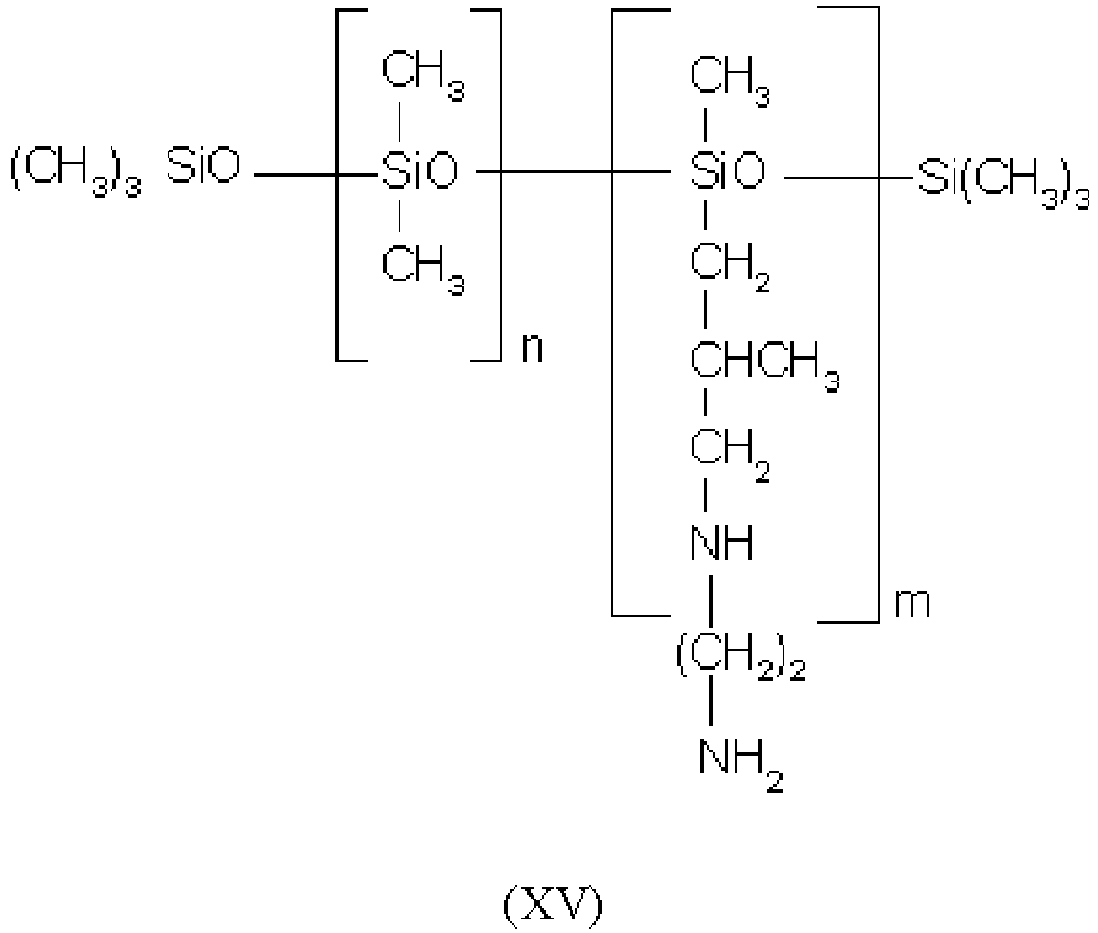
- a product corresponding to the definition of formula (XII) is in particular the polymer called "trimethylsilylamodimethicone" in the CTFA dictionary, corresponding to formula (XV) below: in which n and m have the meanings given above in accordance with formula (XIII).
- amino silicones according to the invention are quaternized amino silicones, and in particular:
- the amino silicones of the invention are non-quaternized, i.e. they do not comprise a nitrogen atom with a permanent charge.
- the silicones which are particularly preferred in accordance with the invention are polysiloxanes comprising amino groups, such as amodimethicones or trimethylsilylamodimethicones, and in particular the compounds of formulae (XIII), (XIV) and (XV).
- aminated silicones of the invention are used, a particularly advantageous embodiment is their joint use with cationic and/or nonionic surfactants.
- Cationic Emulsion DC 929 by the company Dow Corning, which comprises, besides amodimethicone, a cationic surfactant comprising a mixture of products corresponding to the formula: in which R 53 denotes C 14 -C 22 alkenyl and/or alkyl radicals derived from tallow fatty acids, and known under the CTFA name tallowtrimonium chloride, in combination with a nonionic surfactant of formula: C 9 H 19 -C 6 H 4 -(OC 2 H 4 ) 10 -OH, known under the CTFA name Nonoxynol 10.
- Use may also be made, for example, of the product sold under the name Cationic Emulsion DC 939 by the company Dow Corning, which comprises, besides amodimethicone, a cationic surfactant which is trimethylcetylammonium chloride and a nonionic surfactant of formula: C 13 H 27 -(OC 2 H 4 ) 12 -OH, known under the CTFA name Trideceth-12.
- one particularly advantageous embodiment consists in using them in the form of an oil-in-water emulsion.
- the oil-in-water emulsion may comprise one or more surfactants.
- the surfactants may be of any nature but are preferably cationic and/or nonionic.
- the silicone particles in the emulsion have a volume-average diameter [D4.3] generally ranging from 10 nm to 1000 nanometres, preferably from 50 nm to 800 nanometres, more particularly from 100 nm to 600 nanometres and even more particularly from 200 nm to 500 nanometres. These particle sizes maybe determined especially using a laser granulometer, for example the Malvern Mastersizer 2000 granulometer. According to the invention, all the silicones can also be used in the form of emulsions or of microemulsions.
- the aminated silicone(s) of the present invention can represent from 0.01% to 7% by weight, preferably from 0.1% to 5% by weight and more particularly from 0.4% to 2% by weight relative to the total weight of the composition.
- insoluble is understood to mean insoluble in the final composition.
- sicone is understood to mean, in conformity with the generally accepted definition, all organosilicon polymers or oligomers having a linear or cyclic, branched or crosslinked structure, of variable molecular weight, obtained by polymerization and/or polycondensation of appropriately functionalized silanes, and comprising in essence a repetition of main units in which the silicon atoms are joined to one another by oxygen atoms (siloxane link .tbd.Si--O--Si.tbd.), optionally substituted hydrocarbon radicals being linked directly via a carbon atom to the said silicon atoms.
- the most common hydrocarbon radicals are alkyl radicals, in particular C.sub.1-C.sub.10 alkyl radicals and especially methyl, fluoroalkyl radicals, and aryl radicals and especially phenyl.
- the silicone of appropriate viscosity is preferably selected from:
- polydialkylsiloxanes mention may more preferably be made of the polyalkylsiloxanes sold by the company GOLDSCHMIDT under the trade names ABILWAX 9800 and ABILWAX 9801, which are poly(C.sub.1 -C.sub.20)alkylsiloxanes.
- polyalkylarylsiloxanes mention may preferably be made of linear or branched polydimethylmethylphenylsiloxanes or polydimethyldiphenylsiloxanes, such as the product DC 556 COSMETIC GRAD FLUID from DOW CORNING.
- the insoluble non-aminated silicone according to the present invention is polydimethylsiloxanes.
- the amount of the insoluble, non-aminated silicone of the present invention is from 0.01% to 7% by weight, preferably from 0.1% to 5% by weight, more preferably from 0.5% to 3% by weight, even more preferably from 1% to 2% relative to the total weight of the composition.
- compositions according to the invention may naturally contain, in addition, all the standard adjuvants encountered in the field of shampoos, such as, for example, perfumes, preservatives, sequestering agents, thickeners, hydrating agents, antidandruff or antiseborrhoeic agents, vitamins, sunscreen agents, suspending agents and the like.
- standard adjuvants encountered in the field of shampoos such as, for example, perfumes, preservatives, sequestering agents, thickeners, hydrating agents, antidandruff or antiseborrhoeic agents, vitamins, sunscreen agents, suspending agents and the like.
- composition according to the invention may take the form of thickened liquid, creams or gel, They may also take the form of lotions to be rinsed.
- Another aspect of the invention is a process for washing and conditioning keratin fibers, especially the hair, comprising the steps of applying to said fibers in a wet state an effective amount of the composition described above, and then rinsing with water after an optional period of exposure.
- Yet another aspect of the present invention is the use of the above composition of the invention for cleansing and conditioning keratin fibers, especially hair.
- invention A Three hair shampoos were prepared, one according to the invention (Invention A) and two comparative (Comparative B and C): Ingredient name % by weight of active ingredient Invention A Comparative B Comparative C SODIUM LAURETH SULFATE 70% containing 1 mol of ethylene oxide (Sodium laureth sulfate, SLES(N1EO) from Zhejiang Zanyu Technology) 13.5 13.5 13.5 COCOYLBETAINE (Cocoylbetaine, Mirataine® BB/FLA from Rhodia) 2.25 2.25 2.25 POLYQUATERNIUM-6 (Polydiallyl dimethyl ammonium chloride, MerquatTM 100 polymer from Nalco (Lubrizol)) 0.42 POLYQUATERNIUM-10 (Cationic hydroxyethyl cellulose, UcareTM Polymer JR 400 LT from DOW Corning) 0.42 GUAR HYDROXYPROPYLTRIMONIUM CHLORIDE (Guar hydroxypropyltrimonium chloride
- Shampooing was performed by applying approximately 10 g of the compositions A, B and C to previously wetfted hair. The shampoo was worked to lather and the hair was then rinsed copiously with water.
- the performances of each are sorted by level 0 to 5, whereas 0 represents bad performance, and 5 represents excellent performance. The higher the number is, the better the performance is.
- the current invention has a remarkable improvement in all of these properties with comparison to the comparative B and C.
Landscapes
- Life Sciences & Earth Sciences (AREA)
- Health & Medical Sciences (AREA)
- Animal Behavior & Ethology (AREA)
- General Health & Medical Sciences (AREA)
- Public Health (AREA)
- Veterinary Medicine (AREA)
- Birds (AREA)
- Epidemiology (AREA)
- Chemical & Material Sciences (AREA)
- Engineering & Computer Science (AREA)
- Chemical Kinetics & Catalysis (AREA)
- Oil, Petroleum & Natural Gas (AREA)
- Wood Science & Technology (AREA)
- Organic Chemistry (AREA)
- Dermatology (AREA)
- Cosmetics (AREA)
Description
- The present invention relates to hair care cosmetic field, more specifically, it relates to new compositions having improved cleansing and conditioning properties.
- It is known to the art to use detergent and conditioning hair care composition, or shampoos, based essentially on surfactants, in particular of the anionic, nonionic and/or amphoteric type, and more especially of anionic surfactants, in combination with conditioning agents.
- The surfactants, especially of anionic type for cleansing and washing the hair are known for the ability of removing the various kinds of soil initially present on the hair, and thus possess good washing power. However, along with this property, the surfactants may bring to the hair damages due to the aggressive nature of such a cleansing treatment, which leading to the pronounced damage to the hair, such as progressive removal of the lipids or proteins contained in or at the surface of the hair.
- In order to improve the cosmetic properties of the above detergent composition, and more especially detergent compositions for application to sensitized hair, i.e., hair which is damaged or weakened, in particular through the chemical action of environmental agents and/or of hair treatments such as permanent-waving, dyeing or bleaching, it is known to introduce into these compositions conditioning agents. The main purpose of these conditioning agents is to rectify or limit the undesirable effects induced by the various treatments or types of attach to which the hair fibres are more or less repeatedly subjected to and, of course, they can also improve the cosmetic behavior of natural hair.
- The conditioning agents most commonly used to date in shampoos are cationic polymers, silicones and/or silicone derivatives which impart to washed, dry or wet hair an disentangling, softness and a smoothness which are markedly enhanced in comparison to what can be obtained with corresponding cleansing compositions which do not contain them.
- Moreover, it is also known to combine more than one conditioning agents in shampoos to obtain even better conditioning effect to the hair, especially to the sensitized hair. Different types of silicones and its derivatives are most commonly combined to achieve this purpose.
- It has been found that, in spite of the current progress in the field of shampoos based on a combination of particularly and appropriately selected types of silicones and/or its derivatives and cationic polymers, they are not completely satisfactory. Thus there is still a need for new products displaying improved performance in respect to one or more of the cosmetic properties mentioned above.
- The present invention is directed towards meeting this need.
- One of the aims of the present invention is to obtain a composition for cleansing and at the same time conditioning keratin fibers, especially the hair, which possess a noteworthy treatment effect which manifests itself, in particular, in disentangling as well as in providing volume, bounce, smoothness, softness, and suppleness, and moreover in providing volume of foam.
- The aim of the present invention is achieved by a composition for hair care, comprising, in a aqueous medium, A) at least one surfactant which is a combination of anionic surfactant and amphoteric surfactant; B) at least one cationic polymer with a charge density greater than 4 meq/g, preferably greater than 5 meq/g; C) at least one aminated silicone; and D) at least one insoluble, non-aminated silicone.
- Another subject of the present invention is a process for washing and conditioning keratin fibers, especially the hair, comprising the steps of applying to said fibers in a wet state an effective amount of the above composition, and then rinsing with water after an optional period of exposure.
- Yet another subject of the present invention is the use of the above composition in cleansing and conditioning keratin fibers, especially hair.
- Thus, the invention makes it possible to obtain a composition with good cleansing and conditioning properties, and meanwhile stable over time. Such properties are, namely, improved volume of foaming, better in disentangling as well as in providing volume, of bounce, smoothness, softness, and suppleness
- In the description, the terms "at least a" or "at least one" are equivalent to "one or more". Other characteristics and advantages of the invention will emerge more clearly on reading the description and the examples that follow.
- As stated above, the essential components of the composition according to the invention, are A) at least one surfactant selected from the group consisting of anionic, nonionic, amphoteric, cationic surfactant, or a mixture thereof; B) at least one cationic polymer with a charge density greater than 4 meq/g, preferably greater than 5 meq/g; C) at least one aminated silicone; and D) at least one insoluble, non-aminated silicone.
- The hair shampoo composition according to the invention comprises at least one surfactant which is a combination of anionic surfactant and amphoteric surfactant; Anionic surfactant.
- Anionic surfactant agent is understood to mean an amphiphilic compound in which the hydrophobic part carries an anionic hydrophilic group with a cationic counterion which is generally metallic (alkali metal, such as Na or K) or ammonium; the hydrophilic group is thus polar and capable of dissociating to give anions in aqueous solution.
- More particularly the anionic part of the anionic surfactant is belonging to the group chosen from : C(O)OH, -C(O)O-, -SO3H, -S(O)2O-, -OS(O)2OH, -OS(O)2O-, -P(O)OH2, -P(O)2O-,-P(O)O2-,-P(OH)2, =P(O)OH, -P(OH)O-, =P(O)O-, =POH, =PO-, the anionic part comprising a cationic counter anion such as alkali or alkaline earth metal or organic cationic counter anion such as ammonium. Mention may be made, as anionic surface-active agents, of surface-active agents comprising carboxylate, sulfate, sulfonate, sulfoacetate, sulfosuccinate, phosphate, isethionate, sarcosinate, glutamate, lactylate or taurate anionic groups, salts of fatty acids, salts of galactosiduronic acids, salts of ether carboxylic acids and their mixtures.
- More particularly, the anionic surface-active agent or agents according to the invention are chosen from:
- (C6-C30)alkyl sulfates, (C6-C30)alkyl ether sulfates, (C6-C30)alkylamido ether sulfates, alkylaryl polyether sulfates or monoglyceride sulfates;
- (C6-C30)alkyl sulfonates, (C6-C30)alkylamidesulfonates, (C6-C30)alkylaryl sulfonates, α-olefin sulfonates, paraffin sulfonates;
- (C6-C30)akyl phosphates;
- (C6-C30)alkyl sulfosuccinates, (C6-C30)alkyl ether sulfosuccinates or (C6-C30)alkylamido sulfosuccinates;
- (C6-C30)alkyl sulfoacetates;
- (C6-C24)acylsarcosinates;
- (C6-C24)acylglutamates;
- (C6-C30)alkylpolyglycoside carboxylic ethers; (C6-C30)alkylpolyglycoside sulfosuccinates;
- (C6-C30)alkyl sulfosuccinamates;
- (C6-C24)acyl isethionates;
- N-[(C6-C24)acyl] taurates;
- salts of fatty acids;
- (C8-C20)acyl lactylates;
- salts of (C6-C30)alkyl-D-galactosiduronic acids;
- salts of (C6-C30)alkyl polyoxyalkylenated ether carboxylic acids, of (C6-C30)alkylaryl polyoxyalkylenated ether carboxylic acids or of (C6-C30)alkylamido polyoxyalkylenated ether carboxylic acids;
- and their mixtures.
- These anionic surface-active agents are advantageously found in the form of salts in the composition according to the invention, in particular of salts of alkali metals, such as sodium; of alkaline earth metals, such as, for example, magnesium; of ammonium salts; of amine salts; or of aminoalcohol salts. They might also, according to the conditions, occur in their acid form.
- It should be noted that the alkyl or acyl radicals of these various compounds preferably comprise from 12 to 20 carbon atoms. Preferably, the aryl radical denotes a phenyl or benzyl group. Furthermore, the polyoxyalkylenated anionic surface-active agents preferably comprise from 2 to 50 alkylene oxide groups, in particular ethylene oxide groups, or sulfates.
- In accordance with a preferred embodiment of the invention, the anionic surface-active agent is chosen from salts of fatty acids.
- Preferably, the anionic surfactants of the invention are sulfates, more specifically is chosen from (C6-C30)alkyl sulfates, (C6-C30)alkyl ether sulfates, (C6-C30)alkylamido ether sulfates, alkylaryl polyether sulfates and monoglyceride sulfates, their salts such as alkali salts, such as sodium, and their mixtures.
- More preferably the anionic surfactants of the invention are chosen from (C6-C30)alkyl sulfates, (C6-C30)alkyl ether sulfates, particularly (C6-C30)alkyl ether sulfates such as lauryl ether sulfate, their salts, such as sodium laureth sulfate.
- The amphoteric or zwitterionic surfactant(s) that may be used in the present invention may be quaternized secondary or tertiary aliphatic amine derivatives containing at least one anionic group, for instance a carboxylate, sulfonate, sulfate, phosphate or phosphonate group, and in which the aliphatic group or at least one of the aliphatic groups is a linear or branched chain comprising from 8 to 22 carbon atoms.
- Mention may be made in particular of (C8-C20)alkylbetaines, sulfobetaines, (C8-C20 alkyl)amido(C2-C8 alkyl)betaines and (C8-C20 alkyl)amido(C2-C8 alkyl)sulfobetaines.
- Among the optionally quaternized secondary or tertiary aliphatic amine derivatives that may be used, as defined above, mention may also be made of the compounds of respective structures (III) and (IV) below:

- R4 represents a C10-C30 alkyl or alkenyl group derived from an acid R4-C(O)-OH preferably present in hydrolysed coconut oil, or a heptyl, nonyl or undecyl group;
- R5 represents a β-hydroxyethyl group; and
- R6 represents a carboxymethyl group;
- A represents -CH2CH2OX';
- A' represents -(CH2)z-Y', with z = 1 or 2;
- X' represents the group -CH2-C(O)-OH, -CH2-C(O)-OZ', -CH2CH2-C(O)-OH, -CH2-CH2-C(O)-OZ', or a hydrogen atom;
- Y' represents -C(O)-OH, -C(O)-OZ' or the group -CH2-CH(OH)-SO3H or -CH2-CH(OH)-SO3Z';
- Z' represents an ion derived from an alkali or alkaline-earth metal, such as sodium, potassium or magnesium; an ammonium ion; or an ion derived from an organic amine and in particular from an aminoalcohol, such as mono-, di- and triethanolamine, mono-, di- or triisopropanolamine, 2-amino-2-methyl-1-propanol, 2-amino-2-methyl-1,3-propanediol and tris(hydroxymethyl) amino methane.
- R7 represents a C10-C30 alkyl or alkenyl group of an acid R7C(O)-OH preferably present in coconut oil or in hydrolysed linseed oil, an alkyl group, especially of C17 and its iso form, or an unsaturated C17 group.
- The compounds corresponding to formula (IV) are preferred. These compounds are also classified in the CTFA dictionary, 5th edition, 1993, under the names disodium cocoamphodiacetate, disodium lauroamphodiacetate, disodium caprylamphodiacetate, disodium caprylamphodiacetate, disodium cocoamphodipropionate, disodium lauroamphodipropionate, disodium caprylamphodipropionate, disodium caprylamphodipropionate, lauroamphodipropionic acid, cocoamphodipropionic acid.
- By way of example, mention may be made of the N-cocoylamidocarboxymethyl glycinate of an alkali metal such as sodium, or cocoamphodiacetate sold for example by the company Rhodia under the trade name Miranol® C2M concentrate.
- Among all the amphoteric or zwitterionic surfactants iii) mentioned above, use is preferably made of cocoylamidopropylbetaine, cocoylbetaine and the N-cocoylamidocarboxymethyl glycinate of an alkali metal such as sodium.
- According to one specific embodiment of the present invention, the amphoteric surfactant iii) mentioned above is cocoylbetaine. The surfactant useful in the invention is a combination of anionic surfactant and amphoteric surfactant. More preferably, the surfactant of the invention contains a combination of a sulfate anionic surfactant and a betaine surfactant, preferably sodium laureth sulfate and cocoylbetain. Advantageously, the content of at least one surfactant represents from 4% to 50% by weight, with respect to the weight of the composition, preferably from 6% to 40% by weight, more preferably from 10% to 20% by weight, even more preferably from 12% to 16% by weight with respect to the weight of the composition.
- The hair shampoo composition according to the present invention, comprising at least one cationic polymer with a charge density greater than 4 meq/g, preferably greater than 5 meq/g..
- It is first recalled that, for the purposes of the present invention, the term "cationic polymer" denotes any polymer containing cationic groups and/or groups that can be ionized into cationic groups.
- In view of the present invention, the charge density of the cationic polymers according to the invention is greater than 4 meq./g and even more preferentially greater than 5 meq./g.
- This charge density is especially determined by the Kjeldahl method.
- It may also be calculated from the chemical nature of the polymer.
- These polymers preferably have a number-average molecular mass generally of between 1,000 and 100,000,000.
- Polymers of this type are especially described in
FR 2 320 330 FR 2 270 846 FR 2 316 271 FR 2 336 434 FR 2 413 907 US 2 273 780 ,US 2 375 853 ,US 2 388 614 ,US 2 454 547 ,US 3 206 462 ,US 2 261 002 ,US 2 271 378 ,US 3 874 870 ,US 4 001 432 ,US 3 929 990 ,US 3 966 904 ,US 4 005 193 ,US 4 025 617 ,US 4 025 627 ,US 4025 653 ,US 4 026 945 andUS 4 027 020 . - More particularly, the cationic polymer(s) are chosen from:
- a) Cationic cyclopolymer alkyldiallylamine or dialkyldiallylammonium
The said cationic cyclopolymer may be a homopolymer or copolymer containing, as main constituent of the chain, units corresponding to formula (IX) or (X):

FR 2 080 759 FR 2 190 406
The cationic cyclopolymer of the present invention is a water soluble polymer having a charge density greater than 4 meq/g. From the viewpoints of smoothness during foaming and smoothness during rinsing, the charge density is preferably greater than 5 meq/g. The charge density of the water soluble cationic cyclopolymer may be measured by the colloid titration method using, for example, potassium polyvinylsulfate as a titration solution.
Among the polymers defined above, mention may be made more particularly of the dimethyldiallylammonium chloride homopolymer sold under the name "Merquat 100" by the company Nalco (and its homologues of low weight-average molecular mass) and the copolymers of diallyldimethylammonium chloride and of acrylamide, sold under the name Merquat 550. - b) Polyquaternary ammonium polymers consisting of units of formula (XI):

- R33, R34, R35 and R36, which may be identical or different, represent a hydrogen atom or a methyl, ethyl, propyl, b-hydroxyethyl, b-hydroxypropyl or -CH2CH2(OCH2CH2)pOH radical, where p is equal to 0 or to an integer between 1 and 6, with the proviso that R33, R34, R35 and R36 do not simultaneously represent a hydrogen atom,
- f and g, which may be identical or different, are integers between 1 and 6,
- h is equal to 0 or to an integer between 1 and 34,
- X- denotes an anion such as a halide,
- P denotes a dihalide radical or preferably represents -CH2-CH2-O-CH2-CH2-.
- Such compounds are described especially in Patent application
EP-A-122 324 - Among these, mention may be made, for example, of the products Mirapol® A 15, Mirapol® AD1, Mirapol® AZ1 and Mirapol® 175, sold by the company Miranol.
Advantageously, the cationic cyclopolymer used in the present invention is in presence in the composition from 0.01% to 3% by weight, preferably from 0.1% to 2%, more preferably from 0.3% to 1% by weight relative to the total weight of the composition. - According to the invention, the term "aminated silicone", or amino silicone, denotes any silicone comprising at least one primary, secondary or tertiary amine or one quaternary ammonium, and more particularly at least one primary amine. Amino silicones do not comprise any quaternary ammonium groups.
- The aminated silicones used in the cosmetic composition according to the present invention are chosen from the silicones of formula (XII) below:

- D is a hydrogen atom, or a phenyl, hydroxyl (-OH), or C1-C8 alkyl, and preferably methyl, or C1-C8 alkoxy, preferably methoxy, radical,
- i denotes the number 0 or an integer from 1 to 3, and preferably 0,
- k denotes 0 or 1, and in particular 1,
- j and 1 are numbers such that the sum (j + 1) can range especially from 1 to 2000 and in particular from 50 to 150, it being possible for n to denote a number from 0 to 1999 and in particular from 49 to 149, and for m to denote a number from 1 to 2000 and in particular from 1 to 10;
- R37 is a monovalent radical of formula -CqH2qL in which q is a number from 2 to 8, it being possible for one or more hydrogen atoms to be substituted with a hydroxyl group, and L is an optionally quaternized amino group chosen from the groups:
- N(R38)-CH2-CH2-N(R'38)2;
- N(R38)2;
- N+(R38)3Q-;
- N+(R38)(H)2Q-;
- N+(R38)2HQ-;
- N(R38)-CH2-CH2-N+(R'38)(H)2Q-,
- In particular, the aminated silicones corresponding to the definition of formula (XII) are chosen from the compounds corresponding to the formula (XIII) below:

- According to a first possibility, R39, R40 and R41, which maybe identical or different, represent a C1-C4 alkyl radical, preferably methyl, or a hydroxyl radical, E represents a C1-C8 and preferably C3-C4 alkylene radical, and m and n are such that the weight-average molecular weight of the compound is between 5000 and 500 000 approximately. The compounds of this type are called "aminodimethicone" in the CTFA dictionary.
- According to a second possibility, R39, R40 and R41, which may be identical or different, represent a C1-C4 alkoxy or hydroxyl radical, at least one of the radicals R39 or R41 is an alkoxy radical and E represents a C3 alkylene radical. The hydroxy/alkoxy molar ratio is preferably between 0.2/1 and 0.4/1 and advantageously equal to 0.3/1. Moreover, m and n are such that the weight-average molecular weight of the compound is between 2000 and 106. More particularly, n is between 0 and 999 and m is between 1 and 1000, the sum of n and m being between 1 and 1000.
- In this category of compounds, mention may be made, inter alia, of the product Belsil® ADM 652 sold by Wacker.
- According to a third possibility, R39 or R41, which are different, represent a C1-C4 alkoxy or hydroxyl radical, at least one of the radicals R40 or R41 is an alkoxy radical, R40 represents a methyl radical and E represents a C3 alkylene radical. The hydroxy/alkoxy molar ratio is preferably between 1/0.8 and 1/1.1, and advantageously is equal to 1/0.95. Moreover, m and n are such that the weight-average molecular weight of the compound is between 2000 and 200 000. More particularly, n is between 0 and 999 and m is between 1 and 1000, the sum of n and m being between 1 and 1000.
- More particularly, mention may be made of the product Fluid WR® 1300 sold by Wacker, and product Xiameter® MEM-8299 Emulsion sold by Dow Corning.
- The amino silicones used in the composition in accordance with the invention preferably have general formula (XIV) below:


- F denotes a C2-C8 and preferably C2-C6, better still C3, linear or branched alkylene radical;
- R42 and R43 denote, independently of one another, a C1-C4 alkyl, preferably methyl, radical or a C1-C4 alkoxy, preferably methoxy, radical or a hydroxyl radical, m and n are numbers such that the weight-average molecular weight (Mw) is greater than or equal to 75 000.
- Preferably, the radicals R42 are identical and denote a hydroxyl radical.
- Preferably, the viscosity of the amino silicone according to the invention is greater than 25 000 mm2/s measured at 25°C. More preferentially, the viscosity of the amino silicone is between 30 000 and 200 000 mm2/s at 25°C and even more preferentially between 50 000 and 150 000 mm2/s, measured at 25°C, and even better still from 70 000 to 120 000 mm2/s. The viscosities of the silicones are, for example, measured according to standard "ASTM 445 Appendix C".
- Preferably, the cationic charge of the aminated silicone according to the invention is less than or equal to 0.5 meq/g, preferably ranging from 0.01 to 0.1 meq/g and better still from 0.03 to 0.06 meq./g.
- Preferably, the amino silicone according to the invention has a weight-average molecular weight (Mw) ranging from 75 000 to 1 000 000 and even more preferentially ranging from 100 000 to 200 000.
- The weight-average molecular weights of the amino silicones according to the invention are measured by gel permeation chromatography (GPC) at ambient temperature, as polystyrene equivalents. The columns used are µ styragel columns. The eluent is THF and the flow rate is 1 ml/minute. 200 µl of a solution containing 0.5% by weight of silicone in THF are injected. Detection is performed by refractometry and UV-metry.
- A particularly preferred amino silicone corresponding to formula (XIV) is, for example, Dow Corning 2-8299 Cationic Emulsion from the company Dow Corning.
- A product corresponding to the definition of formula (XII) is in particular the polymer called "trimethylsilylamodimethicone" in the CTFA dictionary, corresponding to formula (XV) below:
- Such compounds are described, for example, in
EP 95238 - Other amino silicones according to the invention are quaternized amino silicones, and in particular:
- (a) the compounds corresponding to formula (XVI) below:

- R43 represents a C1-C18 alkyl radical, for example methyl;
- R44 represents a divalent hydrocarbon-based radical, in particular a C1-C18 alkylene radical;
- Q- is an anion, in particular chloride;
- o represents a mean statistical value from 2 to 20 and in particular from 2 to 8;
- p represents a mean statistical value from 20 to 200 and in particular from 20 to 50.
- Such compounds are described more particularly in Patent
US 4185087 .
A compound falling within this class is the product sold by the company Union Carbide under the name Ucar Silicone ALE 56; - (b) the quaternary ammonium silicones of formula (XVII):


- R45, which may be identical or different, represent a monovalent hydrocarbon-based radical containing from 1 to 8 carbon atoms, and in particular a C1-C8 alkyl radical, for example methyl;
- R47 represents a divalent hydrocarbon-based radical, especially a C1-C18 alkylene radical or a divalent C1-C18, and for example C1-C8, alkylenoxy radical linked to the Si via an SiC bond;
- R46, which may be identical or different, represent a hydrogen atom, a monovalent hydrocarbon-based radical containing from 1 to 18 carbon atoms, and in particular a C1-C18 alkyl radical, a C2-C18 alkenyl radical or a radical -R47-NHCOR45;
- X- is an anion such as a halide ion, especially chloride, or an organic acid salt (acetate, etc.);
- r represents a mean statistical value from 2 to 200 and in particular from 5 to 100.
- These silicones are, for example, described in Application
EP-A-0530974 ;
- (c) the aminated silicones of formula (XVIII):

- R48, R49, R50 and R51, which may be identical or different, denote a C1-C4 alkyl radical or a phenyl group,
- R52 denotes a C1-C4 alkyl radical or a hydroxyl group,
- r is an integer ranging from 1 to 5,
- s is an integer ranging from 1 to 5,
- Preferably, the amino silicones of the invention are non-quaternized, i.e. they do not comprise a nitrogen atom with a permanent charge.
- The silicones which are particularly preferred in accordance with the invention are polysiloxanes comprising amino groups, such as amodimethicones or trimethylsilylamodimethicones, and in particular the compounds of formulae (XIII), (XIV) and (XV).
- When the aminated silicones of the invention are used, a particularly advantageous embodiment is their joint use with cationic and/or nonionic surfactants.
- By way of example, it is possible to use the product sold under the name Cationic Emulsion DC 929 by the company Dow Corning, which comprises, besides amodimethicone, a cationic surfactant comprising a mixture of products corresponding to the formula:

- Use may also be made, for example, of the product sold under the name Cationic Emulsion DC 939 by the company Dow Corning, which comprises, besides amodimethicone, a cationic surfactant which is trimethylcetylammonium chloride and a nonionic surfactant of formula: C13H27-(OC2H4)12-OH, known under the CTFA name Trideceth-12.
- When these amino silicones are used, one particularly advantageous embodiment consists in using them in the form of an oil-in-water emulsion.
- The oil-in-water emulsion may comprise one or more surfactants. The surfactants may be of any nature but are preferably cationic and/or nonionic.
- The silicone particles in the emulsion have a volume-average diameter [D4.3] generally ranging from 10 nm to 1000 nanometres, preferably from 50 nm to 800 nanometres, more particularly from 100 nm to 600 nanometres and even more particularly from 200 nm to 500 nanometres. These particle sizes maybe determined especially using a laser granulometer, for example the Malvern Mastersizer 2000 granulometer.
According to the invention, all the silicones can also be used in the form of emulsions or of microemulsions. - According to the invention, the aminated silicone(s) of the present invention can represent from 0.01% to 7% by weight, preferably from 0.1% to 5% by weight and more particularly from 0.4% to 2% by weight relative to the total weight of the composition.
- In the context of the present invention, the term "insoluble" is understood to mean insoluble in the final composition.
- In the context of the present invention, the term "silicone" is understood to mean, in conformity with the generally accepted definition, all organosilicon polymers or oligomers having a linear or cyclic, branched or crosslinked structure, of variable molecular weight, obtained by polymerization and/or polycondensation of appropriately functionalized silanes, and comprising in essence a repetition of main units in which the silicon atoms are joined to one another by oxygen atoms (siloxane link .tbd.Si--O--Si.tbd.), optionally substituted hydrocarbon radicals being linked directly via a carbon atom to the said silicon atoms. The most common hydrocarbon radicals are alkyl radicals, in particular C.sub.1-C.sub.10 alkyl radicals and especially methyl, fluoroalkyl radicals, and aryl radicals and especially phenyl.
- According to the invention, the silicone of appropriate viscosity is preferably selected from:
- (i) polydialkylsiloxanes;
- (ii) polydiarylsiloxanes; and
- (iii) polyalkylarylsiloxanes.
- Among polydialkylsiloxanes, mention may preferably be made of
- linear polydimethylsiloxanes containing terminal trimethylsilyl groups, such as, for example, and without implied limitation, the SILBIONE oils of the 70047 series, marketed by RHONE-POULENC,
- linear polydimethylsiloxanes containing terminal hydroxydimethylsilyl groups, such as the oils of the 48 V series from RHONE-POULENC, product Xiameter® PMX-200 silicone fluid 60000CS sold by Dow Corning, or a mixture thereof
- In this class of polydialkylsiloxanes, mention may more preferably be made of the polyalkylsiloxanes sold by the company GOLDSCHMIDT under the trade names ABILWAX 9800 and ABILWAX 9801, which are poly(C.sub.1 -C.sub.20)alkylsiloxanes.
- Among polyalkylarylsiloxanes, mention may preferably be made of linear or branched polydimethylmethylphenylsiloxanes or polydimethyldiphenylsiloxanes, such as the product DC 556 COSMETIC GRAD FLUID from DOW CORNING.
- Preferably, the insoluble non-aminated silicone according to the present invention is polydimethylsiloxanes.
- Advantageously, the amount of the insoluble, non-aminated silicone of the present invention is from 0.01% to 7% by weight, preferably from 0.1% to 5% by weight, more preferably from 0.5% to 3% by weight, even more preferably from 1% to 2% relative to the total weight of the composition.
- The compositions according to the invention may naturally contain, in addition, all the standard adjuvants encountered in the field of shampoos, such as, for example, perfumes, preservatives, sequestering agents, thickeners, hydrating agents, antidandruff or antiseborrhoeic agents, vitamins, sunscreen agents, suspending agents and the like.
- Naturally, a person skilled in the art will take care to choose this/these possible supplementary compound(s) and/or the amounts thereof in such a way that the advantageous bination according to the invention are not, or are not substantially, impaired by the addition or additions envisaged.
- The composition according to the invention may take the form of thickened liquid, creams or gel, They may also take the form of lotions to be rinsed.
- Another aspect of the invention is a process for washing and conditioning keratin fibers, especially the hair, comprising the steps of applying to said fibers in a wet state an effective amount of the composition described above, and then rinsing with water after an optional period of exposure.
- Yet another aspect of the present invention is the use of the above composition of the invention for cleansing and conditioning keratin fibers, especially hair.
- Non limiting examples illustrating the invention are given.
- Three hair shampoos were prepared, one according to the invention (Invention A) and two comparative (Comparative B and C):
Ingredient name % by weight of active ingredient Invention A Comparative B Comparative C SODIUM LAURETH SULFATE 70% containing 1 mol of ethylene oxide (Sodium laureth sulfate, SLES(N1EO) from Zhejiang Zanyu Technology) 13.5 13.5 13.5 COCOYLBETAINE (Cocoylbetaine, Mirataine® BB/FLA from Rhodia) 2.25 2.25 2.25 POLYQUATERNIUM-6 (Polydiallyl dimethyl ammonium chloride, Merquat™ 100 polymer from Nalco (Lubrizol)) 0.42 POLYQUATERNIUM-10 (Cationic hydroxyethyl cellulose, Ucare™ Polymer JR 400 LT from DOW Corning) 0.42 GUAR HYDROXYPROPYLTRIMONIUM CHLORIDE (Guar hydroxypropyltrimonium chloride, Jaquar C-13-S from Rhodia) 0.42 DIMETHICONE (Polydimethylsiloxanes, Xiameter® PMX-200 silicone fluid 60000CS from Dow Corning) 1.2 1.2 1.2 AMODIMETHICONE (and) TRIDECETH-6 (and) CETRIMONIUM CHLORIDE (A combination of 57% amodimethicone, 5% trideceth-6, and 1% cetrimonium chloride, Xiameter® MEM-8299 Ejulsion from Dow Corning) 0.4 0.4 0.4 CITRIC ACID qs pH 5.2 5.2 5.2 WATER qs 100 g qs 100 g qs 100 g - All the examples are evaluated using wet combing method and dry combing method.
- 0.4 g of the Invention A and Comparative B, C samples was applied respectively on 1 g of bleached Chinese hair. The conditioning compositions were then left on the hair for 5 minutes. The hair are rinsed by warm water for 10 seconds. The friction force between the hair and comb is measured by the instrument named Texture Analyzer provided by Texture Technologies, Scarsdale, USA.
- The combing force of the hair were listed below:
Combing force (N) Invention A Comparative B Comparative C 0.59 1.1 0.91 - The combing force of the hair used the Invention A sample had been reduced significantly, with comparison to Comparative B and C.
- 0.4 g of the A and Comparative B, C samples are applied on 6 g of natural black Chinese hair and damaged Chinese hair, respectively. The conditioning composition is then left on the hair for 5 minutes. Then the hair is rinsed by warm water for 10 seconds, and left to dry over night at room temperature. After 5 times repeated application using the process described herein, the combing force between the hair stress and a comb is measured by the device named Combing Tester JC45A-001, sold by JAU CHUNG. The reduction of combing force is measured based on the following formula:

Attribute Reduction of dry combing force (%) Invention A Comparative B Comparative C Natural black Chinese hair 83 56 70 Damaged Chinese hair 78 48 68 - The dry combing force of the hair using Invention A example has been reduced significantly.
- Shampooing was performed by applying approximately 10 g of the compositions A, B and C to previously wetfted hair. The shampoo was worked to lather and the hair was then rinsed copiously with water.
- A panel of 6 experts evaluated the disentangling of the wet hair, the ease of shaping, the softness, smoothness, and suppleness of the hair. The performances of each are sorted by level 0 to 5, whereas 0 represents bad performance, and 5 represents excellent performance. The higher the number is, the better the performance is.
- The results of the evaluation were listed:
Property Performance Invention A Comparative B Comparative C Disentangling of wet hair 3.1 1.8 2.5 Wet-smoothness 4 2.4 3.4 Wet-suppleness 3.5 2.4 2.5 Dry -smoothness 3.8 2.4 2.5 Dry-Suppleness 3.5 2.7 2.5 - Based on the evaluation made by the panels, the current invention has a remarkable improvement in all of these properties with comparison to the comparative B and C.

Claims (13)
- A composition for caring for keratin fibers, comprising, in an aqueous phase:A) at least one surfactant which is a combination of anionic surfactant and amphoteric surfactant;B) at least one cationic polymer with a charge density greater than 4 meq/g, preferably greater than 5 meq/g;C) at least one aminated silicone; andD) at least one insoluble, non-aminated silicone.
- Composition according to claim 1, wherein the surfactant is a combination of sulfate surfactant and betaine surfactant, more preferably a combination of sodium laureth sulfate and cocoylbetaine.
- Composition according to claim 1 or 2, wherein the said at least a surfactant is in presence in the composition from 4% to 50% by weight, preferably from 6% to 40% by weight, more preferably from 10% to 20% by weight, even more preferably from 12% to 16% by weight relative to the total weight of the composition.
- Composition according to any of the preceding claims, wherein the said at least one cationic polymer is selected from the group consisting of cationic cyclopolymer alkyldiallylamine or dialkyldiallylammonium, diquaternary ammonium cationic polymers, polyquaternary ammonium polymers, or a mixture thereof.
- Composition according to any one of the preceding claims, wherein the cationic cyclopolymer of alkyldiallylamine or dialkyldiallylammonium having a unit of formula (IX) or (X)

 d and e, same or different, equal to 0 or 1,d + e =1,R32 denotes a hydrogen atom or a methyl radical,R30 and R31, independently of each other, denotes a C1-C8 alkyl group, a hydroxyalkyl group in which the alkyl group is C1-C5, an amidoalkyl group in which the alkyl is C1-C4, together with the nitrogen atom to which they are attached, a heterocyclic group such as piperidyl or morpholinyl,Y- is an organic or mineral anion such as bromide, chloride, acetate, borate, citrate, tartrate, bisulfate, bisulfite, sulfate or phosphate, Preferably, R30 and R31, independently of each other, preferably denote a C1-C4 alkyl group,Y- is preferably chloride,wherein the said cationic cyclopolymer of alkyldiallylamine or dialkyldiallylammonium having a unit of formula (IX) or (X) has a charge density greater than 4 meq/g, preferably greater than 5 meq/g, more preferably greater than 6 meq/g.
 - Composition according to any of the preceding claims, wherein the said at least a cationic cyclopolymer of alkyldiallylamine or dialkyldiallylammonium is preferably Polydiallyl dimethyl ammonium chloride.
- Composition according to any of the preceding claims, wherein the amount of the cationic cyclopolymer is from 0.01% to 3% by weight, preferably from 0.1% to 2%, more preferably from 0.3% to 1% by weight relative to the total weight of the composition.
- Composition according to any of the preceding claims, wherein the at least one aminated silicone is preferably polydimethylsiloxanes.
- Composition according to any of the preceding claims, wherein the amount of the aminated silicone is from 0.01% to 7% by weight, preferably from 0.1% to 5% by weight, more preferably from 0.4% to 2% by weight relative to the total weight of the composition.
- Composition according to any of the preceding claims, wherein the at least one insoluble, non-aminated silicone is selected from the group consisting of polydialkylsiloxanes, polydiarylsiloxanes, polyalkylarylsiloxanes, or a mixture thereof.
- Composition according to any of the preceding claims, wherein the amount of the incoluble, non-aminated silicone is from 0.01% to 7% by weight, preferably from 0.1% to 5% by weight, more preferably from 0.5% to 3% by weight, even more preferably from 1% to 2% by weight relative to the total weight of the composition.
- A process for washing and conditioning keratinous fibres, especially the hair, comprising the steps of applying to said fibres in a wet state an effective amount of a composition according to any of the claims 1 to 11, and then rinsing with water after an optional period of exposure.
- Use of a composition according to any of the claims 1 to 11, for caring of keratin fibers, such as cleansing and conditioning keratin fibers, especially hair.
Applications Claiming Priority (1)
| Application Number | Priority Date | Filing Date | Title |
|---|---|---|---|
| PCT/CN2012/087664 WO2014101045A1 (en) | 2012-12-27 | 2012-12-27 | Composition for caring for keratin fibers and use thereof for cleansing and conditioning the keratin fibers |
Publications (3)
| Publication Number | Publication Date |
|---|---|
| EP2938322A1 EP2938322A1 (en) | 2015-11-04 |
| EP2938322A4 EP2938322A4 (en) | 2016-07-06 |
| EP2938322B1 true EP2938322B1 (en) | 2018-07-18 |
Family
ID=51019697
Family Applications (1)
| Application Number | Title | Priority Date | Filing Date |
|---|---|---|---|
| EP12891073.4A Active EP2938322B1 (en) | 2012-12-27 | 2012-12-27 | Composition for caring for keratin fibers and use thereof for cleansing and conditioning the keratin fibers |
Country Status (8)
| Country | Link |
|---|---|
| US (1) | US10071048B2 (en) |
| EP (1) | EP2938322B1 (en) |
| JP (1) | JP6599236B2 (en) |
| CN (2) | CN105007893A (en) |
| BR (1) | BR112015015488B1 (en) |
| ES (1) | ES2691261T3 (en) |
| MX (1) | MX359302B (en) |
| WO (1) | WO2014101045A1 (en) |
Families Citing this family (8)
| Publication number | Priority date | Publication date | Assignee | Title |
|---|---|---|---|---|
| FR3029110B1 (en) * | 2014-11-27 | 2018-03-09 | L'oreal | COSMETIC COMPOSITION COMPRISING AN ORGANOSILANE, A CATIONIC SURFACTANT AND A CATIONIC POLYMER HAVING A CHARGE DENSITY OF MORE THAN 4 MEQ / G |
| JP2016113383A (en) * | 2014-12-12 | 2016-06-23 | ロレアル | Composition for cleaning |
| FR3040301B1 (en) * | 2015-09-01 | 2017-10-13 | Oreal | COMPOSITION COMPRISING AT LEAST ONE ANIONIC SURFACTANT, AT LEAST TWO PARTICULAR NONIONIC SURFACTANTS, AT LEAST ONE AMPHOTERIC SURFACTANT AND AT LEAST ONE PARTICULATE CATIONIC POLYMER |
| WO2022067612A1 (en) * | 2020-09-30 | 2022-04-07 | L'oreal | Composition for cleansing keratin fibers and use thereof |
| CN116941027A (en) | 2021-02-08 | 2023-10-24 | 麦克德米德乐思公司 | Method and wet chemistry for diffusion barrier formation |
| FR3141343B1 (en) * | 2022-10-28 | 2025-07-25 | Oreal | Cosmetic composition comprising an alpha-omega bis-amino silicone, an amino silicone, an anionic surfactant and an amphoteric surfactant |
| FR3141344B1 (en) * | 2022-10-28 | 2025-07-25 | Oreal | Cosmetic composition comprising an anionic surfactant, an amphoteric surfactant, an alpha-omega bis-amino silicone and an amino silicone |
| DE102023204380A1 (en) | 2023-05-11 | 2024-11-14 | Henkel Ag & Co. Kgaa | hair care shampoo |
Family Cites Families (17)
| Publication number | Priority date | Publication date | Assignee | Title |
|---|---|---|---|---|
| US4785067A (en) * | 1986-04-16 | 1988-11-15 | Genesee Polymers Corporation | Protective coating and method of making the same |
| FR2761599B1 (en) * | 1997-04-07 | 1999-12-03 | Oreal | COSMETIC COMPOSITIONS CONTAINING A LOW MOLECULAR MASS CATIONIC POLYMER AND THEIR USES |
| FR2829383B1 (en) | 2001-09-11 | 2005-09-23 | Oreal | COSMETIC COMPOSITIONS CONTAINING A METHACRYLIC ACID COPOLYMER, A SILICONE AND A CATIONIC POLYMER AND USES THEREOF |
| AU2002301801B2 (en) | 2001-11-08 | 2004-09-30 | L'oreal | Cosmetic compositions containing an aminosilicone and a conditioner, and uses thereof |
| US7811552B2 (en) * | 2003-07-28 | 2010-10-12 | L'oreal S.A. | Cosmetic composition comprising a mixture of surfactants, a mixture of cationic polymers and a silicone |
| DE10345998B4 (en) * | 2003-10-02 | 2013-07-25 | Telair International Ab | System for loading and unloading a cargo space of an aircraft with general cargo |
| FR2881954B1 (en) * | 2005-02-11 | 2007-03-30 | Oreal | COSMETIC COMPOSITION COMPRISING A CATION, A CATIONIC POLYMER, A SOLID COMPOUND AND A STARCH AND COSMETIC TREATMENT PROCESS |
| FR2886148B1 (en) * | 2005-05-24 | 2007-11-30 | Oreal | DETERGENT COSMETIC COMPOSITIONS COMPRISING AMINO SILICONE AND USE |
| US8246941B2 (en) * | 2005-05-24 | 2012-08-21 | L'oreal S.A. | Detergent cosmetic compositions comprising at least one amino silicone, and use thereof |
| JP4955959B2 (en) * | 2005-08-08 | 2012-06-20 | 花王株式会社 | Aqueous hair cleanser |
| US20070286837A1 (en) | 2006-05-17 | 2007-12-13 | Torgerson Peter M | Hair care composition comprising an aminosilicone and a high viscosity silicone copolymer emulsion |
| CN101077332B (en) | 2006-05-22 | 2012-05-23 | 花王株式会社 | Aqueous hair cleansing agent |
| JP4728282B2 (en) * | 2006-05-22 | 2011-07-20 | 花王株式会社 | Aqueous hair cleanser |
| FR2917968B1 (en) | 2007-06-29 | 2010-02-26 | Oreal | DETERGENT COSMETIC COMPOSITIONS COMPRISING FOUR SURFACTANTS, CATIONIC POLYMER AND BENEFICATED AGENT AND USE |
| JP2009084525A (en) * | 2007-10-03 | 2009-04-23 | Kao Corp | Cleaning composition |
| JP5554901B2 (en) * | 2008-04-25 | 2014-07-23 | 花王株式会社 | Skin cleanser composition |
| BR112015001575B8 (en) | 2012-08-06 | 2019-12-31 | Unilever Nv | composition of shampoo, method to treat hair and use of a silicone component |
-
2012
- 2012-12-27 ES ES12891073.4T patent/ES2691261T3/en active Active
- 2012-12-27 WO PCT/CN2012/087664 patent/WO2014101045A1/en not_active Ceased
- 2012-12-27 MX MX2015008469A patent/MX359302B/en active IP Right Grant
- 2012-12-27 JP JP2015549919A patent/JP6599236B2/en active Active
- 2012-12-27 US US14/654,955 patent/US10071048B2/en active Active
- 2012-12-27 EP EP12891073.4A patent/EP2938322B1/en active Active
- 2012-12-27 CN CN201280078237.0A patent/CN105007893A/en active Pending
- 2012-12-27 BR BR112015015488-3A patent/BR112015015488B1/en active IP Right Grant
- 2012-12-27 CN CN201910349251.3A patent/CN110051561A/en active Pending
Also Published As
| Publication number | Publication date |
|---|---|
| WO2014101045A1 (en) | 2014-07-03 |
| EP2938322A4 (en) | 2016-07-06 |
| MX359302B (en) | 2018-09-21 |
| BR112015015488B1 (en) | 2022-04-12 |
| US10071048B2 (en) | 2018-09-11 |
| CN105007893A (en) | 2015-10-28 |
| BR112015015488A2 (en) | 2017-07-11 |
| JP6599236B2 (en) | 2019-10-30 |
| US20150328134A1 (en) | 2015-11-19 |
| ES2691261T3 (en) | 2018-11-26 |
| CN110051561A (en) | 2019-07-26 |
| EP2938322A1 (en) | 2015-11-04 |
| MX2015008469A (en) | 2016-10-26 |
| JP2016503810A (en) | 2016-02-08 |
Similar Documents
| Publication | Publication Date | Title |
|---|---|---|
| EP3393597B1 (en) | Hair cosmetic composition comprising silicones and surfactants, and cosmetic treatment process | |
| US7183243B2 (en) | Compositions for washing and conditioning hair | |
| US10071048B2 (en) | Composition for caring for keratin fibers and use thereof for cleansing and conditioning the keratin fibers | |
| US20020006389A1 (en) | Detergent cosmetic compositions and use | |
| US8246941B2 (en) | Detergent cosmetic compositions comprising at least one amino silicone, and use thereof | |
| WO2022067612A1 (en) | Composition for cleansing keratin fibers and use thereof | |
| CN104582682B (en) | Shampoo composition | |
| PT1726293E (en) | Cosmetic detergent compositions comprising an aminosilicon and use thereof | |
| US8470754B2 (en) | Detergent cosmetic compositions comprising at least one amino silicone, and uses thereof | |
| US20040185020A1 (en) | Cosmetic compositions comprising at least one amphoteric surfactant and at least one silicone and their uses | |
| WO2017102727A1 (en) | Cosmetic composition comprising an anionic surfactant, an amphoteric and/or nonionic surfactant, a fatty acid, a cationic polysaccharide and an amino silicone | |
| WO2015089716A1 (en) | Composition comprising cyclodextrin and its derivative, anionic surfactant and polyalkylene glycol ether of alcohol, and its use thereof | |
| EP3236929B1 (en) | Composition for conditioning keratin fibers | |
| JP7250835B2 (en) | Composition for caring for keratin fibers and its use for cleansing and conditioning keratin fibers | |
| WO2020002523A1 (en) | Cosmetic composition comprising surfactants, a polymer comprising at least one (meth)acrylic unit and a silicone | |
| US8476212B2 (en) | Detergent cosmetic compositions comprising at least one amino silicone, and uses thereof | |
| WO2024089068A1 (en) | Cosmetic composition comprising an alpha,omega-bis-amino silicone, an amino silicone, an anionic surfactant and an amphoteric surfactant | |
| WO2016001060A1 (en) | Cosmetic composition for caring for keratin fibers, process for cosmetic treatment and use thereof for cleansing and conditioning the keratin fibers | |
| WO2016102505A1 (en) | Cosmetic composition comprising at least one non-ionic and at least one anionic surfactant, at least one cationic and at least one amphoteric polymer and at least one silicone | |
| MXPA06005784A (en) | Cosmetic detergent compositions comprising an aminosilicon and use thereof |
Legal Events
| Date | Code | Title | Description |
|---|---|---|---|
| PUAI | Public reference made under article 153(3) epc to a published international application that has entered the european phase |
Free format text: ORIGINAL CODE: 0009012 |
|
| 17P | Request for examination filed |
Effective date: 20150629 |
|
| AK | Designated contracting states |
Kind code of ref document: A1 Designated state(s): AL AT BE BG CH CY CZ DE DK EE ES FI FR GB GR HR HU IE IS IT LI LT LU LV MC MK MT NL NO PL PT RO RS SE SI SK SM TR |
|
| AX | Request for extension of the european patent |
Extension state: BA ME |
|
| DAX | Request for extension of the european patent (deleted) | ||
| RIC1 | Information provided on ipc code assigned before grant |
Ipc: A61Q 5/12 20060101ALI20160524BHEP Ipc: A61K 8/44 20060101ALI20160524BHEP Ipc: A61K 8/891 20060101ALI20160524BHEP Ipc: A61K 8/81 20060101ALI20160524BHEP Ipc: A61K 8/898 20060101ALI20160524BHEP Ipc: A61K 8/46 20060101ALI20160524BHEP Ipc: A61Q 5/02 20060101ALI20160524BHEP Ipc: A61K 8/89 20060101AFI20160524BHEP |
|
| A4 | Supplementary search report drawn up and despatched |
Effective date: 20160602 |
|
| STAA | Information on the status of an ep patent application or granted ep patent |
Free format text: STATUS: EXAMINATION IS IN PROGRESS |
|
| 17Q | First examination report despatched |
Effective date: 20170413 |
|
| GRAP | Despatch of communication of intention to grant a patent |
Free format text: ORIGINAL CODE: EPIDOSNIGR1 |
|
| STAA | Information on the status of an ep patent application or granted ep patent |
Free format text: STATUS: GRANT OF PATENT IS INTENDED |
|
| INTG | Intention to grant announced |
Effective date: 20180302 |
|
| GRAS | Grant fee paid |
Free format text: ORIGINAL CODE: EPIDOSNIGR3 |
|
| GRAA | (expected) grant |
Free format text: ORIGINAL CODE: 0009210 |
|
| STAA | Information on the status of an ep patent application or granted ep patent |
Free format text: STATUS: THE PATENT HAS BEEN GRANTED |
|
| AK | Designated contracting states |
Kind code of ref document: B1 Designated state(s): AL AT BE BG CH CY CZ DE DK EE ES FI FR GB GR HR HU IE IS IT LI LT LU LV MC MK MT NL NO PL PT RO RS SE SI SK SM TR |
|
| REG | Reference to a national code |
Ref country code: GB Ref legal event code: FG4D |
|
| REG | Reference to a national code |
Ref country code: CH Ref legal event code: EP |
|
| REG | Reference to a national code |
Ref country code: IE Ref legal event code: FG4D |
|
| REG | Reference to a national code |
Ref country code: AT Ref legal event code: REF Ref document number: 1018598 Country of ref document: AT Kind code of ref document: T Effective date: 20180815 |
|
| REG | Reference to a national code |
Ref country code: DE Ref legal event code: R096 Ref document number: 602012048759 Country of ref document: DE |
|
| REG | Reference to a national code |
Ref country code: NL Ref legal event code: MP Effective date: 20180718 |
|
| REG | Reference to a national code |
Ref country code: ES Ref legal event code: FG2A Ref document number: 2691261 Country of ref document: ES Kind code of ref document: T3 Effective date: 20181126 |
|
| REG | Reference to a national code |
Ref country code: LT Ref legal event code: MG4D |
|
| REG | Reference to a national code |
Ref country code: AT Ref legal event code: MK05 Ref document number: 1018598 Country of ref document: AT Kind code of ref document: T Effective date: 20180718 |
|
| PG25 | Lapsed in a contracting state [announced via postgrant information from national office to epo] |
Ref country code: NL Free format text: LAPSE BECAUSE OF FAILURE TO SUBMIT A TRANSLATION OF THE DESCRIPTION OR TO PAY THE FEE WITHIN THE PRESCRIBED TIME-LIMIT Effective date: 20180718 |
|
| PG25 | Lapsed in a contracting state [announced via postgrant information from national office to epo] |
Ref country code: PL Free format text: LAPSE BECAUSE OF FAILURE TO SUBMIT A TRANSLATION OF THE DESCRIPTION OR TO PAY THE FEE WITHIN THE PRESCRIBED TIME-LIMIT Effective date: 20180718 Ref country code: RS Free format text: LAPSE BECAUSE OF FAILURE TO SUBMIT A TRANSLATION OF THE DESCRIPTION OR TO PAY THE FEE WITHIN THE PRESCRIBED TIME-LIMIT Effective date: 20180718 Ref country code: LT Free format text: LAPSE BECAUSE OF FAILURE TO SUBMIT A TRANSLATION OF THE DESCRIPTION OR TO PAY THE FEE WITHIN THE PRESCRIBED TIME-LIMIT Effective date: 20180718 Ref country code: FI Free format text: LAPSE BECAUSE OF FAILURE TO SUBMIT A TRANSLATION OF THE DESCRIPTION OR TO PAY THE FEE WITHIN THE PRESCRIBED TIME-LIMIT Effective date: 20180718 Ref country code: SE Free format text: LAPSE BECAUSE OF FAILURE TO SUBMIT A TRANSLATION OF THE DESCRIPTION OR TO PAY THE FEE WITHIN THE PRESCRIBED TIME-LIMIT Effective date: 20180718 Ref country code: BG Free format text: LAPSE BECAUSE OF FAILURE TO SUBMIT A TRANSLATION OF THE DESCRIPTION OR TO PAY THE FEE WITHIN THE PRESCRIBED TIME-LIMIT Effective date: 20181018 Ref country code: GR Free format text: LAPSE BECAUSE OF FAILURE TO SUBMIT A TRANSLATION OF THE DESCRIPTION OR TO PAY THE FEE WITHIN THE PRESCRIBED TIME-LIMIT Effective date: 20181019 Ref country code: NO Free format text: LAPSE BECAUSE OF FAILURE TO SUBMIT A TRANSLATION OF THE DESCRIPTION OR TO PAY THE FEE WITHIN THE PRESCRIBED TIME-LIMIT Effective date: 20181018 Ref country code: IS Free format text: LAPSE BECAUSE OF FAILURE TO SUBMIT A TRANSLATION OF THE DESCRIPTION OR TO PAY THE FEE WITHIN THE PRESCRIBED TIME-LIMIT Effective date: 20181118 Ref country code: AT Free format text: LAPSE BECAUSE OF FAILURE TO SUBMIT A TRANSLATION OF THE DESCRIPTION OR TO PAY THE FEE WITHIN THE PRESCRIBED TIME-LIMIT Effective date: 20180718 |
|
| PG25 | Lapsed in a contracting state [announced via postgrant information from national office to epo] |
Ref country code: HR Free format text: LAPSE BECAUSE OF FAILURE TO SUBMIT A TRANSLATION OF THE DESCRIPTION OR TO PAY THE FEE WITHIN THE PRESCRIBED TIME-LIMIT Effective date: 20180718 Ref country code: LV Free format text: LAPSE BECAUSE OF FAILURE TO SUBMIT A TRANSLATION OF THE DESCRIPTION OR TO PAY THE FEE WITHIN THE PRESCRIBED TIME-LIMIT Effective date: 20180718 Ref country code: AL Free format text: LAPSE BECAUSE OF FAILURE TO SUBMIT A TRANSLATION OF THE DESCRIPTION OR TO PAY THE FEE WITHIN THE PRESCRIBED TIME-LIMIT Effective date: 20180718 |
|
| REG | Reference to a national code |
Ref country code: DE Ref legal event code: R097 Ref document number: 602012048759 Country of ref document: DE |
|
| PG25 | Lapsed in a contracting state [announced via postgrant information from national office to epo] |
Ref country code: CZ Free format text: LAPSE BECAUSE OF FAILURE TO SUBMIT A TRANSLATION OF THE DESCRIPTION OR TO PAY THE FEE WITHIN THE PRESCRIBED TIME-LIMIT Effective date: 20180718 Ref country code: RO Free format text: LAPSE BECAUSE OF FAILURE TO SUBMIT A TRANSLATION OF THE DESCRIPTION OR TO PAY THE FEE WITHIN THE PRESCRIBED TIME-LIMIT Effective date: 20180718 Ref country code: EE Free format text: LAPSE BECAUSE OF FAILURE TO SUBMIT A TRANSLATION OF THE DESCRIPTION OR TO PAY THE FEE WITHIN THE PRESCRIBED TIME-LIMIT Effective date: 20180718 |
|
| PLBE | No opposition filed within time limit |
Free format text: ORIGINAL CODE: 0009261 |
|
| STAA | Information on the status of an ep patent application or granted ep patent |
Free format text: STATUS: NO OPPOSITION FILED WITHIN TIME LIMIT |
|
| PG25 | Lapsed in a contracting state [announced via postgrant information from national office to epo] |
Ref country code: SK Free format text: LAPSE BECAUSE OF FAILURE TO SUBMIT A TRANSLATION OF THE DESCRIPTION OR TO PAY THE FEE WITHIN THE PRESCRIBED TIME-LIMIT Effective date: 20180718 Ref country code: SM Free format text: LAPSE BECAUSE OF FAILURE TO SUBMIT A TRANSLATION OF THE DESCRIPTION OR TO PAY THE FEE WITHIN THE PRESCRIBED TIME-LIMIT Effective date: 20180718 Ref country code: DK Free format text: LAPSE BECAUSE OF FAILURE TO SUBMIT A TRANSLATION OF THE DESCRIPTION OR TO PAY THE FEE WITHIN THE PRESCRIBED TIME-LIMIT Effective date: 20180718 |
|
| 26N | No opposition filed |
Effective date: 20190423 |
|
| REG | Reference to a national code |
Ref country code: CH Ref legal event code: PL |
|
| PG25 | Lapsed in a contracting state [announced via postgrant information from national office to epo] |
Ref country code: SI Free format text: LAPSE BECAUSE OF FAILURE TO SUBMIT A TRANSLATION OF THE DESCRIPTION OR TO PAY THE FEE WITHIN THE PRESCRIBED TIME-LIMIT Effective date: 20180718 Ref country code: LU Free format text: LAPSE BECAUSE OF NON-PAYMENT OF DUE FEES Effective date: 20181227 Ref country code: MC Free format text: LAPSE BECAUSE OF FAILURE TO SUBMIT A TRANSLATION OF THE DESCRIPTION OR TO PAY THE FEE WITHIN THE PRESCRIBED TIME-LIMIT Effective date: 20180718 |
|
| REG | Reference to a national code |
Ref country code: IE Ref legal event code: MM4A |
|
| REG | Reference to a national code |
Ref country code: BE Ref legal event code: MM Effective date: 20181231 |
|
| PG25 | Lapsed in a contracting state [announced via postgrant information from national office to epo] |
Ref country code: IE Free format text: LAPSE BECAUSE OF NON-PAYMENT OF DUE FEES Effective date: 20181227 |
|
| PG25 | Lapsed in a contracting state [announced via postgrant information from national office to epo] |
Ref country code: BE Free format text: LAPSE BECAUSE OF NON-PAYMENT OF DUE FEES Effective date: 20181231 |
|
| PG25 | Lapsed in a contracting state [announced via postgrant information from national office to epo] |
Ref country code: CH Free format text: LAPSE BECAUSE OF NON-PAYMENT OF DUE FEES Effective date: 20181231 Ref country code: LI Free format text: LAPSE BECAUSE OF NON-PAYMENT OF DUE FEES Effective date: 20181231 |
|
| PG25 | Lapsed in a contracting state [announced via postgrant information from national office to epo] |
Ref country code: MT Free format text: LAPSE BECAUSE OF NON-PAYMENT OF DUE FEES Effective date: 20181227 |
|
| PG25 | Lapsed in a contracting state [announced via postgrant information from national office to epo] |
Ref country code: TR Free format text: LAPSE BECAUSE OF FAILURE TO SUBMIT A TRANSLATION OF THE DESCRIPTION OR TO PAY THE FEE WITHIN THE PRESCRIBED TIME-LIMIT Effective date: 20180718 |
|
| PG25 | Lapsed in a contracting state [announced via postgrant information from national office to epo] |
Ref country code: PT Free format text: LAPSE BECAUSE OF FAILURE TO SUBMIT A TRANSLATION OF THE DESCRIPTION OR TO PAY THE FEE WITHIN THE PRESCRIBED TIME-LIMIT Effective date: 20180718 |
|
| PG25 | Lapsed in a contracting state [announced via postgrant information from national office to epo] |
Ref country code: HU Free format text: LAPSE BECAUSE OF FAILURE TO SUBMIT A TRANSLATION OF THE DESCRIPTION OR TO PAY THE FEE WITHIN THE PRESCRIBED TIME-LIMIT; INVALID AB INITIO Effective date: 20121227 Ref country code: CY Free format text: LAPSE BECAUSE OF FAILURE TO SUBMIT A TRANSLATION OF THE DESCRIPTION OR TO PAY THE FEE WITHIN THE PRESCRIBED TIME-LIMIT Effective date: 20180718 Ref country code: MK Free format text: LAPSE BECAUSE OF NON-PAYMENT OF DUE FEES Effective date: 20180718 |
|
| PGFP | Annual fee paid to national office [announced via postgrant information from national office to epo] |
Ref country code: DE Payment date: 20250930 Year of fee payment: 14 |
|
| PGFP | Annual fee paid to national office [announced via postgrant information from national office to epo] |
Ref country code: GB Payment date: 20251001 Year of fee payment: 14 |
|
| PGFP | Annual fee paid to national office [announced via postgrant information from national office to epo] |
Ref country code: IT Payment date: 20251121 Year of fee payment: 14 |
|
| PGFP | Annual fee paid to national office [announced via postgrant information from national office to epo] |
Ref country code: FR Payment date: 20251117 Year of fee payment: 14 |
|
| PGFP | Annual fee paid to national office [announced via postgrant information from national office to epo] |
Ref country code: ES Payment date: 20260114 Year of fee payment: 14 |