EP2937391A1 - Bottom layer film-formation composition of self-organizing film containing polycyclic organic vinyl compound - Google Patents
Bottom layer film-formation composition of self-organizing film containing polycyclic organic vinyl compound Download PDFInfo
- Publication number
- EP2937391A1 EP2937391A1 EP13864158.4A EP13864158A EP2937391A1 EP 2937391 A1 EP2937391 A1 EP 2937391A1 EP 13864158 A EP13864158 A EP 13864158A EP 2937391 A1 EP2937391 A1 EP 2937391A1
- Authority
- EP
- European Patent Office
- Prior art keywords
- self
- film
- forming composition
- underlayer film
- assembled
- Prior art date
- Legal status (The legal status is an assumption and is not a legal conclusion. Google has not performed a legal analysis and makes no representation as to the accuracy of the status listed.)
- Withdrawn
Links
- -1 vinyl compound Chemical class 0.000 title claims abstract description 207
- 239000000203 mixture Substances 0.000 title claims abstract description 169
- 229920002554 vinyl polymer Polymers 0.000 title claims abstract description 73
- 125000003367 polycyclic group Chemical group 0.000 title 1
- 229920000642 polymer Polymers 0.000 claims abstract description 192
- IGGDKDTUCAWDAN-UHFFFAOYSA-N 1-vinylnaphthalene Chemical class C1=CC=C2C(C=C)=CC=CC2=C1 IGGDKDTUCAWDAN-UHFFFAOYSA-N 0.000 claims abstract description 29
- 125000004054 acenaphthylenyl group Chemical class C1(=CC2=CC=CC3=CC=CC1=C23)* 0.000 claims abstract description 27
- HXGDTGSAIMULJN-UHFFFAOYSA-N acetnaphthylene Chemical class C1=CC(C=C2)=C3C2=CC=CC3=C1 HXGDTGSAIMULJN-UHFFFAOYSA-N 0.000 claims abstract description 27
- KKFHAJHLJHVUDM-UHFFFAOYSA-N n-vinylcarbazole Chemical class C1=CC=C2N(C=C)C3=CC=CC=C3C2=C1 KKFHAJHLJHVUDM-UHFFFAOYSA-N 0.000 claims abstract description 27
- PPBRXRYQALVLMV-UHFFFAOYSA-N Styrene Natural products C=CC1=CC=CC=C1 PPBRXRYQALVLMV-UHFFFAOYSA-N 0.000 claims abstract description 15
- 125000003011 styrenyl group Chemical class [H]\C(*)=C(/[H])C1=C([H])C([H])=C([H])C([H])=C1[H] 0.000 claims abstract 3
- 239000000758 substrate Substances 0.000 claims description 41
- 239000004793 Polystyrene Substances 0.000 claims description 40
- 229920002223 polystyrene Polymers 0.000 claims description 39
- 239000002904 solvent Substances 0.000 claims description 31
- 239000000178 monomer Substances 0.000 claims description 30
- 239000002253 acid Substances 0.000 claims description 25
- 238000000034 method Methods 0.000 claims description 23
- 239000003431 cross linking reagent Substances 0.000 claims description 20
- 229920000620 organic polymer Polymers 0.000 claims description 17
- 125000002887 hydroxy group Chemical group [H]O* 0.000 claims description 16
- 239000000463 material Substances 0.000 claims description 16
- 229920003229 poly(methyl methacrylate) Polymers 0.000 claims description 11
- 239000004926 polymethyl methacrylate Substances 0.000 claims description 11
- 125000003178 carboxy group Chemical group [H]OC(*)=O 0.000 claims description 8
- 239000002344 surface layer Substances 0.000 claims description 8
- 229920003171 Poly (ethylene oxide) Polymers 0.000 claims description 7
- 230000003667 anti-reflective effect Effects 0.000 claims description 7
- 125000003700 epoxy group Chemical group 0.000 claims description 6
- 239000005062 Polybutadiene Substances 0.000 claims description 4
- 229920002857 polybutadiene Polymers 0.000 claims description 4
- 229920001195 polyisoprene Polymers 0.000 claims description 4
- 239000004205 dimethyl polysiloxane Substances 0.000 claims description 3
- 229920000435 poly(dimethylsiloxane) Polymers 0.000 claims description 3
- 230000015572 biosynthetic process Effects 0.000 abstract description 33
- 239000010408 film Substances 0.000 description 282
- 239000000243 solution Substances 0.000 description 63
- NIXOWILDQLNWCW-UHFFFAOYSA-M Acrylate Chemical compound [O-]C(=O)C=C NIXOWILDQLNWCW-UHFFFAOYSA-M 0.000 description 39
- 239000010410 layer Substances 0.000 description 26
- LLHKCFNBLRBOGN-UHFFFAOYSA-N propylene glycol methyl ether acetate Chemical compound COCC(C)OC(C)=O LLHKCFNBLRBOGN-UHFFFAOYSA-N 0.000 description 26
- 238000003786 synthesis reaction Methods 0.000 description 25
- 150000001875 compounds Chemical class 0.000 description 24
- ARXJGSRGQADJSQ-UHFFFAOYSA-N 1-methoxypropan-2-ol Chemical compound COCC(C)O ARXJGSRGQADJSQ-UHFFFAOYSA-N 0.000 description 23
- 239000004094 surface-active agent Substances 0.000 description 22
- OZAIFHULBGXAKX-UHFFFAOYSA-N 2-(2-cyanopropan-2-yldiazenyl)-2-methylpropanenitrile Chemical compound N#CC(C)(C)N=NC(C)(C)C#N OZAIFHULBGXAKX-UHFFFAOYSA-N 0.000 description 20
- 230000000052 comparative effect Effects 0.000 description 15
- 239000004698 Polyethylene Substances 0.000 description 14
- JHIVVAPYMSGYDF-UHFFFAOYSA-N cyclohexanone Chemical compound O=C1CCCCC1 JHIVVAPYMSGYDF-UHFFFAOYSA-N 0.000 description 14
- 238000005259 measurement Methods 0.000 description 14
- 229920000573 polyethylene Polymers 0.000 description 14
- 239000011148 porous material Substances 0.000 description 14
- XUIMIQQOPSSXEZ-UHFFFAOYSA-N Silicon Chemical compound [Si] XUIMIQQOPSSXEZ-UHFFFAOYSA-N 0.000 description 13
- 239000011347 resin Substances 0.000 description 13
- 229920005989 resin Polymers 0.000 description 13
- 239000010703 silicon Substances 0.000 description 13
- 239000003054 catalyst Substances 0.000 description 12
- 229910052710 silicon Inorganic materials 0.000 description 11
- 239000007787 solid Substances 0.000 description 11
- HRPVXLWXLXDGHG-UHFFFAOYSA-N Acrylamide Chemical compound NC(=O)C=C HRPVXLWXLXDGHG-UHFFFAOYSA-N 0.000 description 10
- 238000004132 cross linking Methods 0.000 description 10
- 239000007789 gas Substances 0.000 description 10
- 239000000047 product Substances 0.000 description 10
- ZDYVRSLAEXCVBX-UHFFFAOYSA-N pyridinium p-toluenesulfonate Chemical compound C1=CC=[NH+]C=C1.CC1=CC=C(S([O-])(=O)=O)C=C1 ZDYVRSLAEXCVBX-UHFFFAOYSA-N 0.000 description 10
- KXYAVSFOJVUIHT-UHFFFAOYSA-N 2-vinylnaphthalene Chemical compound C1=CC=CC2=CC(C=C)=CC=C21 KXYAVSFOJVUIHT-UHFFFAOYSA-N 0.000 description 9
- LYCAIKOWRPUZTN-UHFFFAOYSA-N Ethylene glycol Chemical compound OCCO LYCAIKOWRPUZTN-UHFFFAOYSA-N 0.000 description 9
- OKKJLVBELUTLKV-UHFFFAOYSA-N Methanol Chemical compound OC OKKJLVBELUTLKV-UHFFFAOYSA-N 0.000 description 9
- 238000005530 etching Methods 0.000 description 9
- 229920002818 (Hydroxyethyl)methacrylate Polymers 0.000 description 8
- XGQJGMGAMHFMAO-UHFFFAOYSA-N 1,3,4,6-tetrakis(methoxymethyl)-3a,6a-dihydroimidazo[4,5-d]imidazole-2,5-dione Chemical compound COCN1C(=O)N(COC)C2C1N(COC)C(=O)N2COC XGQJGMGAMHFMAO-UHFFFAOYSA-N 0.000 description 8
- YEJRWHAVMIAJKC-UHFFFAOYSA-N 4-Butyrolactone Chemical compound O=C1CCCO1 YEJRWHAVMIAJKC-UHFFFAOYSA-N 0.000 description 8
- WOBHKFSMXKNTIM-UHFFFAOYSA-N Hydroxyethyl methacrylate Chemical compound CC(=C)C(=O)OCCO WOBHKFSMXKNTIM-UHFFFAOYSA-N 0.000 description 8
- 238000000576 coating method Methods 0.000 description 8
- 238000001312 dry etching Methods 0.000 description 8
- LZCLXQDLBQLTDK-UHFFFAOYSA-N ethyl 2-hydroxypropanoate Chemical compound CCOC(=O)C(C)O LZCLXQDLBQLTDK-UHFFFAOYSA-N 0.000 description 8
- 239000003960 organic solvent Substances 0.000 description 8
- 238000006243 chemical reaction Methods 0.000 description 7
- ZWEHNKRNPOVVGH-UHFFFAOYSA-N 2-Butanone Chemical compound CCC(C)=O ZWEHNKRNPOVVGH-UHFFFAOYSA-N 0.000 description 6
- UHOVQNZJYSORNB-UHFFFAOYSA-N Benzene Chemical compound C1=CC=CC=C1 UHOVQNZJYSORNB-UHFFFAOYSA-N 0.000 description 6
- DKPFZGUDAPQIHT-UHFFFAOYSA-N Butyl acetate Natural products CCCCOC(C)=O DKPFZGUDAPQIHT-UHFFFAOYSA-N 0.000 description 6
- RTZKZFJDLAIYFH-UHFFFAOYSA-N Diethyl ether Chemical compound CCOCC RTZKZFJDLAIYFH-UHFFFAOYSA-N 0.000 description 6
- XEKOWRVHYACXOJ-UHFFFAOYSA-N Ethyl acetate Chemical compound CCOC(C)=O XEKOWRVHYACXOJ-UHFFFAOYSA-N 0.000 description 6
- DNIAPMSPPWPWGF-UHFFFAOYSA-N Propylene glycol Chemical compound CC(O)CO DNIAPMSPPWPWGF-UHFFFAOYSA-N 0.000 description 6
- YXFVVABEGXRONW-UHFFFAOYSA-N Toluene Chemical compound CC1=CC=CC=C1 YXFVVABEGXRONW-UHFFFAOYSA-N 0.000 description 6
- 239000002585 base Substances 0.000 description 6
- KRKNYBCHXYNGOX-UHFFFAOYSA-N citric acid Chemical compound OC(=O)CC(O)(C(O)=O)CC(O)=O KRKNYBCHXYNGOX-UHFFFAOYSA-N 0.000 description 6
- 239000011248 coating agent Substances 0.000 description 6
- MTHSVFCYNBDYFN-UHFFFAOYSA-N diethylene glycol Chemical compound OCCOCCO MTHSVFCYNBDYFN-UHFFFAOYSA-N 0.000 description 6
- 229920002120 photoresistant polymer Polymers 0.000 description 6
- 238000012545 processing Methods 0.000 description 6
- JOXIMZWYDAKGHI-UHFFFAOYSA-N toluene-4-sulfonic acid Chemical compound CC1=CC=C(S(O)(=O)=O)C=C1 JOXIMZWYDAKGHI-UHFFFAOYSA-N 0.000 description 6
- 229960000834 vinyl ether Drugs 0.000 description 6
- 125000000391 vinyl group Chemical group [H]C([*])=C([H])[H] 0.000 description 6
- PEDCQBHIVMGVHV-UHFFFAOYSA-N Glycerine Chemical compound OCC(O)CO PEDCQBHIVMGVHV-UHFFFAOYSA-N 0.000 description 5
- VYPSYNLAJGMNEJ-UHFFFAOYSA-N Silicium dioxide Chemical compound O=[Si]=O VYPSYNLAJGMNEJ-UHFFFAOYSA-N 0.000 description 5
- QYKIQEUNHZKYBP-UHFFFAOYSA-N Vinyl ether Chemical group C=COC=C QYKIQEUNHZKYBP-UHFFFAOYSA-N 0.000 description 5
- 125000000217 alkyl group Chemical group 0.000 description 5
- 239000003795 chemical substances by application Substances 0.000 description 5
- 238000011161 development Methods 0.000 description 5
- 230000018109 developmental process Effects 0.000 description 5
- 238000004090 dissolution Methods 0.000 description 5
- 238000006116 polymerization reaction Methods 0.000 description 5
- FYGHSUNMUKGBRK-UHFFFAOYSA-N 1,2,3-trimethylbenzene Chemical compound CC1=CC=CC(C)=C1C FYGHSUNMUKGBRK-UHFFFAOYSA-N 0.000 description 4
- XLLIQLLCWZCATF-UHFFFAOYSA-N 2-methoxyethyl acetate Chemical compound COCCOC(C)=O XLLIQLLCWZCATF-UHFFFAOYSA-N 0.000 description 4
- XLLXMBCBJGATSP-UHFFFAOYSA-N 2-phenylethenol Chemical group OC=CC1=CC=CC=C1 XLLXMBCBJGATSP-UHFFFAOYSA-N 0.000 description 4
- NIQCNGHVCWTJSM-UHFFFAOYSA-N Dimethyl phthalate Chemical compound COC(=O)C1=CC=CC=C1C(=O)OC NIQCNGHVCWTJSM-UHFFFAOYSA-N 0.000 description 4
- VVQNEPGJFQJSBK-UHFFFAOYSA-N Methyl methacrylate Chemical compound COC(=O)C(C)=C VVQNEPGJFQJSBK-UHFFFAOYSA-N 0.000 description 4
- ATUOYWHBWRKTHZ-UHFFFAOYSA-N Propane Chemical compound CCC ATUOYWHBWRKTHZ-UHFFFAOYSA-N 0.000 description 4
- WYURNTSHIVDZCO-UHFFFAOYSA-N Tetrahydrofuran Chemical compound C1CCOC1 WYURNTSHIVDZCO-UHFFFAOYSA-N 0.000 description 4
- 230000001476 alcoholic effect Effects 0.000 description 4
- 239000003513 alkali Substances 0.000 description 4
- WPYMKLBDIGXBTP-UHFFFAOYSA-N benzoic acid Chemical compound OC(=O)C1=CC=CC=C1 WPYMKLBDIGXBTP-UHFFFAOYSA-N 0.000 description 4
- 229920001400 block copolymer Polymers 0.000 description 4
- SWXVUIWOUIDPGS-UHFFFAOYSA-N diacetone alcohol Chemical compound CC(=O)CC(C)(C)O SWXVUIWOUIDPGS-UHFFFAOYSA-N 0.000 description 4
- FLKPEMZONWLCSK-UHFFFAOYSA-N diethyl phthalate Chemical compound CCOC(=O)C1=CC=CC=C1C(=O)OCC FLKPEMZONWLCSK-UHFFFAOYSA-N 0.000 description 4
- FJKIXWOMBXYWOQ-UHFFFAOYSA-N ethenoxyethane Chemical compound CCOC=C FJKIXWOMBXYWOQ-UHFFFAOYSA-N 0.000 description 4
- FUZZWVXGSFPDMH-UHFFFAOYSA-M hexanoate Chemical compound CCCCCC([O-])=O FUZZWVXGSFPDMH-UHFFFAOYSA-M 0.000 description 4
- 238000007654 immersion Methods 0.000 description 4
- 239000004973 liquid crystal related substance Substances 0.000 description 4
- JESXATFQYMPTNL-UHFFFAOYSA-N mono-hydroxyphenyl-ethylene Natural products OC1=CC=CC=C1C=C JESXATFQYMPTNL-UHFFFAOYSA-N 0.000 description 4
- ISWSIDIOOBJBQZ-UHFFFAOYSA-N phenol group Chemical group C1(=CC=CC=C1)O ISWSIDIOOBJBQZ-UHFFFAOYSA-N 0.000 description 4
- YGSDEFSMJLZEOE-UHFFFAOYSA-N salicylic acid Chemical compound OC(=O)C1=CC=CC=C1O YGSDEFSMJLZEOE-UHFFFAOYSA-N 0.000 description 4
- 238000001878 scanning electron micrograph Methods 0.000 description 4
- 150000003440 styrenes Chemical class 0.000 description 4
- 125000001424 substituent group Chemical group 0.000 description 4
- XLYOFNOQVPJJNP-UHFFFAOYSA-N water Substances O XLYOFNOQVPJJNP-UHFFFAOYSA-N 0.000 description 4
- RWNUSVWFHDHRCJ-UHFFFAOYSA-N 1-butoxypropan-2-ol Chemical compound CCCCOCC(C)O RWNUSVWFHDHRCJ-UHFFFAOYSA-N 0.000 description 3
- LIPRQQHINVWJCH-UHFFFAOYSA-N 1-ethoxypropan-2-yl acetate Chemical compound CCOCC(C)OC(C)=O LIPRQQHINVWJCH-UHFFFAOYSA-N 0.000 description 3
- DMFAHCVITRDZQB-UHFFFAOYSA-N 1-propoxypropan-2-yl acetate Chemical compound CCCOCC(C)OC(C)=O DMFAHCVITRDZQB-UHFFFAOYSA-N 0.000 description 3
- WXHLLJAMBQLULT-UHFFFAOYSA-N 2-[[6-[4-(2-hydroxyethyl)piperazin-1-yl]-2-methylpyrimidin-4-yl]amino]-n-(2-methyl-6-sulfanylphenyl)-1,3-thiazole-5-carboxamide;hydrate Chemical compound O.C=1C(N2CCN(CCO)CC2)=NC(C)=NC=1NC(S1)=NC=C1C(=O)NC1=C(C)C=CC=C1S WXHLLJAMBQLULT-UHFFFAOYSA-N 0.000 description 3
- QTWJRLJHJPIABL-UHFFFAOYSA-N 2-methylphenol;3-methylphenol;4-methylphenol Chemical compound CC1=CC=C(O)C=C1.CC1=CC=CC(O)=C1.CC1=CC=CC=C1O QTWJRLJHJPIABL-UHFFFAOYSA-N 0.000 description 3
- CSCPPACGZOOCGX-UHFFFAOYSA-N Acetone Chemical compound CC(C)=O CSCPPACGZOOCGX-UHFFFAOYSA-N 0.000 description 3
- KAKZBPTYRLMSJV-UHFFFAOYSA-N Butadiene Chemical compound C=CC=C KAKZBPTYRLMSJV-UHFFFAOYSA-N 0.000 description 3
- MRABAEUHTLLEML-UHFFFAOYSA-N Butyl lactate Chemical compound CCCCOC(=O)C(C)O MRABAEUHTLLEML-UHFFFAOYSA-N 0.000 description 3
- QMMFVYPAHWMCMS-UHFFFAOYSA-N Dimethyl sulfide Chemical compound CSC QMMFVYPAHWMCMS-UHFFFAOYSA-N 0.000 description 3
- LFQSCWFLJHTTHZ-UHFFFAOYSA-N Ethanol Chemical compound CCO LFQSCWFLJHTTHZ-UHFFFAOYSA-N 0.000 description 3
- CERQOIWHTDAKMF-UHFFFAOYSA-N Methacrylic acid Chemical compound CC(=C)C(O)=O CERQOIWHTDAKMF-UHFFFAOYSA-N 0.000 description 3
- ZMXDDKWLCZADIW-UHFFFAOYSA-N N,N-Dimethylformamide Chemical compound CN(C)C=O ZMXDDKWLCZADIW-UHFFFAOYSA-N 0.000 description 3
- IMNFDUFMRHMDMM-UHFFFAOYSA-N N-Heptane Chemical compound CCCCCCC IMNFDUFMRHMDMM-UHFFFAOYSA-N 0.000 description 3
- 229930003836 cresol Natural products 0.000 description 3
- 125000001495 ethyl group Chemical group [H]C([H])([H])C([H])([H])* 0.000 description 3
- 229940116333 ethyl lactate Drugs 0.000 description 3
- 125000002768 hydroxyalkyl group Chemical group 0.000 description 3
- 125000001449 isopropyl group Chemical group [H]C([H])([H])C([H])(*)C([H])([H])[H] 0.000 description 3
- 150000007974 melamines Chemical class 0.000 description 3
- 125000002496 methyl group Chemical group [H]C([H])([H])* 0.000 description 3
- 239000012046 mixed solvent Substances 0.000 description 3
- QJGQUHMNIGDVPM-UHFFFAOYSA-N nitrogen group Chemical group [N] QJGQUHMNIGDVPM-UHFFFAOYSA-N 0.000 description 3
- TVMXDCGIABBOFY-UHFFFAOYSA-N octane Chemical compound CCCCCCCC TVMXDCGIABBOFY-UHFFFAOYSA-N 0.000 description 3
- 238000000059 patterning Methods 0.000 description 3
- 125000001997 phenyl group Chemical group [H]C1=C([H])C([H])=C(*)C([H])=C1[H] 0.000 description 3
- 230000005855 radiation Effects 0.000 description 3
- 238000010526 radical polymerization reaction Methods 0.000 description 3
- 238000000518 rheometry Methods 0.000 description 3
- 238000012360 testing method Methods 0.000 description 3
- 229920001187 thermosetting polymer Polymers 0.000 description 3
- 150000003672 ureas Chemical class 0.000 description 3
- PUPZLCDOIYMWBV-UHFFFAOYSA-N (+/-)-1,3-Butanediol Chemical compound CC(O)CCO PUPZLCDOIYMWBV-UHFFFAOYSA-N 0.000 description 2
- 125000000008 (C1-C10) alkyl group Chemical group 0.000 description 2
- KVNYFPKFSJIPBJ-UHFFFAOYSA-N 1,2-diethylbenzene Chemical compound CCC1=CC=CC=C1CC KVNYFPKFSJIPBJ-UHFFFAOYSA-N 0.000 description 2
- BPXVHIRIPLPOPT-UHFFFAOYSA-N 1,3,5-tris(2-hydroxyethyl)-1,3,5-triazinane-2,4,6-trione Chemical compound OCCN1C(=O)N(CCO)C(=O)N(CCO)C1=O BPXVHIRIPLPOPT-UHFFFAOYSA-N 0.000 description 2
- MWZJGRDWJVHRDV-UHFFFAOYSA-N 1,4-bis(ethenoxy)butane Chemical compound C=COCCCCOC=C MWZJGRDWJVHRDV-UHFFFAOYSA-N 0.000 description 2
- UEIPWOFSKAZYJO-UHFFFAOYSA-N 1-(2-ethenoxyethoxy)-2-[2-(2-ethenoxyethoxy)ethoxy]ethane Chemical compound C=COCCOCCOCCOCCOC=C UEIPWOFSKAZYJO-UHFFFAOYSA-N 0.000 description 2
- XXNDEOCNKXHSGK-UHFFFAOYSA-N 1-butoxyethyl 2-methylprop-2-enoate Chemical compound CCCCOC(C)OC(=O)C(C)=C XXNDEOCNKXHSGK-UHFFFAOYSA-N 0.000 description 2
- FUWDFGKRNIDKAE-UHFFFAOYSA-N 1-butoxypropan-2-yl acetate Chemical compound CCCCOCC(C)OC(C)=O FUWDFGKRNIDKAE-UHFFFAOYSA-N 0.000 description 2
- UZKWTJUDCOPSNM-UHFFFAOYSA-N 1-ethenoxybutane Chemical compound CCCCOC=C UZKWTJUDCOPSNM-UHFFFAOYSA-N 0.000 description 2
- GRFNSWBVXHLTCI-UHFFFAOYSA-N 1-ethenyl-4-[(2-methylpropan-2-yl)oxy]benzene Chemical compound CC(C)(C)OC1=CC=C(C=C)C=C1 GRFNSWBVXHLTCI-UHFFFAOYSA-N 0.000 description 2
- JOLQKTGDSGKSKJ-UHFFFAOYSA-N 1-ethoxypropan-2-ol Chemical compound CCOCC(C)O JOLQKTGDSGKSKJ-UHFFFAOYSA-N 0.000 description 2
- OJVAMHKKJGICOG-UHFFFAOYSA-N 2,5-hexanedione Chemical compound CC(=O)CCC(C)=O OJVAMHKKJGICOG-UHFFFAOYSA-N 0.000 description 2
- SMZOUWXMTYCWNB-UHFFFAOYSA-N 2-(2-methoxy-5-methylphenyl)ethanamine Chemical compound COC1=CC=C(C)C=C1CCN SMZOUWXMTYCWNB-UHFFFAOYSA-N 0.000 description 2
- SBASXUCJHJRPEV-UHFFFAOYSA-N 2-(2-methoxyethoxy)ethanol Chemical compound COCCOCCO SBASXUCJHJRPEV-UHFFFAOYSA-N 0.000 description 2
- XNWFRZJHXBZDAG-UHFFFAOYSA-N 2-METHOXYETHANOL Chemical compound COCCO XNWFRZJHXBZDAG-UHFFFAOYSA-N 0.000 description 2
- AFABGHUZZDYHJO-UHFFFAOYSA-N 2-Methylpentane Chemical compound CCCC(C)C AFABGHUZZDYHJO-UHFFFAOYSA-N 0.000 description 2
- QQZOPKMRPOGIEB-UHFFFAOYSA-N 2-Oxohexane Chemical compound CCCCC(C)=O QQZOPKMRPOGIEB-UHFFFAOYSA-N 0.000 description 2
- NIXOWILDQLNWCW-UHFFFAOYSA-N 2-Propenoic acid Natural products OC(=O)C=C NIXOWILDQLNWCW-UHFFFAOYSA-N 0.000 description 2
- LCZVSXRMYJUNFX-UHFFFAOYSA-N 2-[2-(2-hydroxypropoxy)propoxy]propan-1-ol Chemical compound CC(O)COC(C)COC(C)CO LCZVSXRMYJUNFX-UHFFFAOYSA-N 0.000 description 2
- TXBCBTDQIULDIA-UHFFFAOYSA-N 2-[[3-hydroxy-2,2-bis(hydroxymethyl)propoxy]methyl]-2-(hydroxymethyl)propane-1,3-diol Chemical compound OCC(CO)(CO)COCC(CO)(CO)CO TXBCBTDQIULDIA-UHFFFAOYSA-N 0.000 description 2
- ZNQVEEAIQZEUHB-UHFFFAOYSA-N 2-ethoxyethanol Chemical compound CCOCCO ZNQVEEAIQZEUHB-UHFFFAOYSA-N 0.000 description 2
- SVONRAPFKPVNKG-UHFFFAOYSA-N 2-ethoxyethyl acetate Chemical compound CCOCCOC(C)=O SVONRAPFKPVNKG-UHFFFAOYSA-N 0.000 description 2
- YIWUKEYIRIRTPP-UHFFFAOYSA-N 2-ethylhexan-1-ol Chemical compound CCCCC(CC)CO YIWUKEYIRIRTPP-UHFFFAOYSA-N 0.000 description 2
- QPRQEDXDYOZYLA-UHFFFAOYSA-N 2-methylbutan-1-ol Chemical compound CCC(C)CO QPRQEDXDYOZYLA-UHFFFAOYSA-N 0.000 description 2
- SVTBMSDMJJWYQN-UHFFFAOYSA-N 2-methylpentane-2,4-diol Chemical compound CC(O)CC(C)(C)O SVTBMSDMJJWYQN-UHFFFAOYSA-N 0.000 description 2
- KUDUQBURMYMBIJ-UHFFFAOYSA-N 2-prop-2-enoyloxyethyl prop-2-enoate Chemical compound C=CC(=O)OCCOC(=O)C=C KUDUQBURMYMBIJ-UHFFFAOYSA-N 0.000 description 2
- LDMRLRNXHLPZJN-UHFFFAOYSA-N 3-propoxypropan-1-ol Chemical compound CCCOCCCO LDMRLRNXHLPZJN-UHFFFAOYSA-N 0.000 description 2
- FEPBITJSIHRMRT-UHFFFAOYSA-N 4-hydroxybenzenesulfonic acid Chemical compound OC1=CC=C(S(O)(=O)=O)C=C1 FEPBITJSIHRMRT-UHFFFAOYSA-N 0.000 description 2
- FJKROLUGYXJWQN-UHFFFAOYSA-M 4-hydroxybenzoate Chemical compound OC1=CC=C(C([O-])=O)C=C1 FJKROLUGYXJWQN-UHFFFAOYSA-M 0.000 description 2
- GZVHEAJQGPRDLQ-UHFFFAOYSA-N 6-phenyl-1,3,5-triazine-2,4-diamine Chemical class NC1=NC(N)=NC(C=2C=CC=CC=2)=N1 GZVHEAJQGPRDLQ-UHFFFAOYSA-N 0.000 description 2
- DLFVBJFMPXGRIB-UHFFFAOYSA-N Acetamide Chemical compound CC(N)=O DLFVBJFMPXGRIB-UHFFFAOYSA-N 0.000 description 2
- KWOLFJPFCHCOCG-UHFFFAOYSA-N Acetophenone Chemical compound CC(=O)C1=CC=CC=C1 KWOLFJPFCHCOCG-UHFFFAOYSA-N 0.000 description 2
- 239000005711 Benzoic acid Substances 0.000 description 2
- KCXZNSGUUQJJTR-UHFFFAOYSA-N Di-n-hexyl phthalate Chemical compound CCCCCCOC(=O)C1=CC=CC=C1C(=O)OCCCCCC KCXZNSGUUQJJTR-UHFFFAOYSA-N 0.000 description 2
- IAZDPXIOMUYVGZ-UHFFFAOYSA-N Dimethylsulphoxide Chemical compound CS(C)=O IAZDPXIOMUYVGZ-UHFFFAOYSA-N 0.000 description 2
- 239000004593 Epoxy Substances 0.000 description 2
- IMROMDMJAWUWLK-UHFFFAOYSA-N Ethenol Chemical compound OC=C IMROMDMJAWUWLK-UHFFFAOYSA-N 0.000 description 2
- YNQLUTRBYVCPMQ-UHFFFAOYSA-N Ethylbenzene Chemical compound CCC1=CC=CC=C1 YNQLUTRBYVCPMQ-UHFFFAOYSA-N 0.000 description 2
- LHXDLQBQYFFVNW-UHFFFAOYSA-N Fenchone Chemical compound C1CC2(C)C(=O)C(C)(C)C1C2 LHXDLQBQYFFVNW-UHFFFAOYSA-N 0.000 description 2
- NHTMVDHEPJAVLT-UHFFFAOYSA-N Isooctane Chemical compound CC(C)CC(C)(C)C NHTMVDHEPJAVLT-UHFFFAOYSA-N 0.000 description 2
- RRHGJUQNOFWUDK-UHFFFAOYSA-N Isoprene Chemical compound CC(=C)C=C RRHGJUQNOFWUDK-UHFFFAOYSA-N 0.000 description 2
- LRHPLDYGYMQRHN-UHFFFAOYSA-N N-Butanol Chemical compound CCCCO LRHPLDYGYMQRHN-UHFFFAOYSA-N 0.000 description 2
- SECXISVLQFMRJM-UHFFFAOYSA-N N-Methylpyrrolidone Chemical compound CN1CCCC1=O SECXISVLQFMRJM-UHFFFAOYSA-N 0.000 description 2
- AMQJEAYHLZJPGS-UHFFFAOYSA-N N-Pentanol Chemical compound CCCCCO AMQJEAYHLZJPGS-UHFFFAOYSA-N 0.000 description 2
- ATHHXGZTWNVVOU-UHFFFAOYSA-N N-methylformamide Chemical compound CNC=O ATHHXGZTWNVVOU-UHFFFAOYSA-N 0.000 description 2
- CTQNGGLPUBDAKN-UHFFFAOYSA-N O-Xylene Chemical compound CC1=CC=CC=C1C CTQNGGLPUBDAKN-UHFFFAOYSA-N 0.000 description 2
- OFBQJSOFQDEBGM-UHFFFAOYSA-N Pentane Chemical compound CCCCC OFBQJSOFQDEBGM-UHFFFAOYSA-N 0.000 description 2
- 239000004642 Polyimide Substances 0.000 description 2
- 229920001214 Polysorbate 60 Polymers 0.000 description 2
- 229910052581 Si3N4 Inorganic materials 0.000 description 2
- 239000004147 Sorbitan trioleate Substances 0.000 description 2
- PRXRUNOAOLTIEF-ADSICKODSA-N Sorbitan trioleate Chemical compound CCCCCCCC\C=C/CCCCCCCC(=O)OC[C@@H](OC(=O)CCCCCCC\C=C/CCCCCCCC)[C@H]1OC[C@H](O)[C@H]1OC(=O)CCCCCCC\C=C/CCCCCCCC PRXRUNOAOLTIEF-ADSICKODSA-N 0.000 description 2
- NINIDFKCEFEMDL-UHFFFAOYSA-N Sulfur Chemical compound [S] NINIDFKCEFEMDL-UHFFFAOYSA-N 0.000 description 2
- DKGAVHZHDRPRBM-UHFFFAOYSA-N Tert-Butanol Chemical compound CC(C)(C)O DKGAVHZHDRPRBM-UHFFFAOYSA-N 0.000 description 2
- YTPLMLYBLZKORZ-UHFFFAOYSA-N Thiophene Chemical compound C=1C=CSC=1 YTPLMLYBLZKORZ-UHFFFAOYSA-N 0.000 description 2
- YRKCREAYFQTBPV-UHFFFAOYSA-N acetylacetone Chemical compound CC(=O)CC(C)=O YRKCREAYFQTBPV-UHFFFAOYSA-N 0.000 description 2
- 150000007513 acids Chemical class 0.000 description 2
- 150000001338 aliphatic hydrocarbons Chemical class 0.000 description 2
- 125000005907 alkyl ester group Chemical group 0.000 description 2
- 150000004945 aromatic hydrocarbons Chemical class 0.000 description 2
- 125000003118 aryl group Chemical group 0.000 description 2
- 235000010233 benzoic acid Nutrition 0.000 description 2
- QUKGYYKBILRGFE-UHFFFAOYSA-N benzyl acetate Chemical compound CC(=O)OCC1=CC=CC=C1 QUKGYYKBILRGFE-UHFFFAOYSA-N 0.000 description 2
- BTANRVKWQNVYAZ-UHFFFAOYSA-N butan-2-ol Chemical compound CCC(C)O BTANRVKWQNVYAZ-UHFFFAOYSA-N 0.000 description 2
- 239000001191 butyl (2R)-2-hydroxypropanoate Substances 0.000 description 2
- 229940043232 butyl acetate Drugs 0.000 description 2
- KBPLFHHGFOOTCA-UHFFFAOYSA-N caprylic alcohol Natural products CCCCCCCCO KBPLFHHGFOOTCA-UHFFFAOYSA-N 0.000 description 2
- RWGFKTVRMDUZSP-UHFFFAOYSA-N cumene Chemical compound CC(C)C1=CC=CC=C1 RWGFKTVRMDUZSP-UHFFFAOYSA-N 0.000 description 2
- MGNZXYYWBUKAII-UHFFFAOYSA-N cyclohexa-1,3-diene Chemical compound C1CC=CC=C1 MGNZXYYWBUKAII-UHFFFAOYSA-N 0.000 description 2
- 125000000113 cyclohexyl group Chemical group [H]C1([H])C([H])([H])C([H])([H])C([H])(*)C([H])([H])C1([H])[H] 0.000 description 2
- BGTOWKSIORTVQH-UHFFFAOYSA-N cyclopentanone Chemical compound O=C1CCCC1 BGTOWKSIORTVQH-UHFFFAOYSA-N 0.000 description 2
- MWKFXSUHUHTGQN-UHFFFAOYSA-N decan-1-ol Chemical compound CCCCCCCCCCO MWKFXSUHUHTGQN-UHFFFAOYSA-N 0.000 description 2
- 235000014113 dietary fatty acids Nutrition 0.000 description 2
- LJSQFQKUNVCTIA-UHFFFAOYSA-N diethyl sulfide Chemical compound CCSCC LJSQFQKUNVCTIA-UHFFFAOYSA-N 0.000 description 2
- XXJWXESWEXIICW-UHFFFAOYSA-N diethylene glycol monoethyl ether Chemical compound CCOCCOCCO XXJWXESWEXIICW-UHFFFAOYSA-N 0.000 description 2
- 229940075557 diethylene glycol monoethyl ether Drugs 0.000 description 2
- MGWAVDBGNNKXQV-UHFFFAOYSA-N diisobutyl phthalate Chemical compound CC(C)COC(=O)C1=CC=CC=C1C(=O)OCC(C)C MGWAVDBGNNKXQV-UHFFFAOYSA-N 0.000 description 2
- FBSAITBEAPNWJG-UHFFFAOYSA-N dimethyl phthalate Natural products CC(=O)OC1=CC=CC=C1OC(C)=O FBSAITBEAPNWJG-UHFFFAOYSA-N 0.000 description 2
- 229960001826 dimethylphthalate Drugs 0.000 description 2
- 238000010828 elution Methods 0.000 description 2
- 239000003759 ester based solvent Substances 0.000 description 2
- 239000004210 ether based solvent Substances 0.000 description 2
- FKRCODPIKNYEAC-UHFFFAOYSA-N ethyl propionate Chemical compound CCOC(=O)CC FKRCODPIKNYEAC-UHFFFAOYSA-N 0.000 description 2
- 239000000194 fatty acid Substances 0.000 description 2
- 229930195729 fatty acid Natural products 0.000 description 2
- 125000000524 functional group Chemical group 0.000 description 2
- GAEKPEKOJKCEMS-UHFFFAOYSA-N gamma-valerolactone Chemical compound CC1CCC(=O)O1 GAEKPEKOJKCEMS-UHFFFAOYSA-N 0.000 description 2
- 239000011521 glass Substances 0.000 description 2
- 235000011187 glycerol Nutrition 0.000 description 2
- VOZRXNHHFUQHIL-UHFFFAOYSA-N glycidyl methacrylate Chemical compound CC(=C)C(=O)OCC1CO1 VOZRXNHHFUQHIL-UHFFFAOYSA-N 0.000 description 2
- 125000001046 glycoluril group Chemical class [H]C12N(*)C(=O)N(*)C1([H])N(*)C(=O)N2* 0.000 description 2
- CATSNJVOTSVZJV-UHFFFAOYSA-N heptan-2-one Chemical compound CCCCCC(C)=O CATSNJVOTSVZJV-UHFFFAOYSA-N 0.000 description 2
- NGAZZOYFWWSOGK-UHFFFAOYSA-N heptan-3-one Chemical compound CCCCC(=O)CC NGAZZOYFWWSOGK-UHFFFAOYSA-N 0.000 description 2
- ZSIAUFGUXNUGDI-UHFFFAOYSA-N hexan-1-ol Chemical compound CCCCCCO ZSIAUFGUXNUGDI-UHFFFAOYSA-N 0.000 description 2
- 229920001519 homopolymer Polymers 0.000 description 2
- 230000002209 hydrophobic effect Effects 0.000 description 2
- GJRQTCIYDGXPES-UHFFFAOYSA-N isobutyl acetate Chemical compound CC(C)COC(C)=O GJRQTCIYDGXPES-UHFFFAOYSA-N 0.000 description 2
- JMMWKPVZQRWMSS-UHFFFAOYSA-N isopropyl acetate Chemical compound CC(C)OC(C)=O JMMWKPVZQRWMSS-UHFFFAOYSA-N 0.000 description 2
- 239000005453 ketone based solvent Substances 0.000 description 2
- 238000001459 lithography Methods 0.000 description 2
- 238000004519 manufacturing process Methods 0.000 description 2
- XJRBAMWJDBPFIM-UHFFFAOYSA-N methyl vinyl ether Chemical compound COC=C XJRBAMWJDBPFIM-UHFFFAOYSA-N 0.000 description 2
- UAEPNZWRGJTJPN-UHFFFAOYSA-N methylcyclohexane Chemical compound CC1CCCCC1 UAEPNZWRGJTJPN-UHFFFAOYSA-N 0.000 description 2
- WTNTZFRNCHEDOS-UHFFFAOYSA-N n-(2-hydroxyethyl)-2-methylpropanamide Chemical compound CC(C)C(=O)NCCO WTNTZFRNCHEDOS-UHFFFAOYSA-N 0.000 description 2
- VLKZOEOYAKHREP-UHFFFAOYSA-N n-Hexane Chemical compound CCCCCC VLKZOEOYAKHREP-UHFFFAOYSA-N 0.000 description 2
- QYZFTMMPKCOTAN-UHFFFAOYSA-N n-[2-(2-hydroxyethylamino)ethyl]-2-[[1-[2-(2-hydroxyethylamino)ethylamino]-2-methyl-1-oxopropan-2-yl]diazenyl]-2-methylpropanamide Chemical compound OCCNCCNC(=O)C(C)(C)N=NC(C)(C)C(=O)NCCNCCO QYZFTMMPKCOTAN-UHFFFAOYSA-N 0.000 description 2
- 125000001280 n-hexyl group Chemical group C(CCCCC)* 0.000 description 2
- ZWRUINPWMLAQRD-UHFFFAOYSA-N nonan-1-ol Chemical compound CCCCCCCCCO ZWRUINPWMLAQRD-UHFFFAOYSA-N 0.000 description 2
- GJQIMXVRFNLMTB-UHFFFAOYSA-N nonyl acetate Chemical compound CCCCCCCCCOC(C)=O GJQIMXVRFNLMTB-UHFFFAOYSA-N 0.000 description 2
- 229920003986 novolac Polymers 0.000 description 2
- FJKROLUGYXJWQN-UHFFFAOYSA-N papa-hydroxy-benzoic acid Natural products OC(=O)C1=CC=C(O)C=C1 FJKROLUGYXJWQN-UHFFFAOYSA-N 0.000 description 2
- WXZMFSXDPGVJKK-UHFFFAOYSA-N pentaerythritol Chemical compound OCC(CO)(CO)CO WXZMFSXDPGVJKK-UHFFFAOYSA-N 0.000 description 2
- XNLICIUVMPYHGG-UHFFFAOYSA-N pentan-2-one Chemical compound CCCC(C)=O XNLICIUVMPYHGG-UHFFFAOYSA-N 0.000 description 2
- FDPIMTJIUBPUKL-UHFFFAOYSA-N pentan-3-one Chemical compound CCC(=O)CC FDPIMTJIUBPUKL-UHFFFAOYSA-N 0.000 description 2
- PGMYKACGEOXYJE-UHFFFAOYSA-N pentyl acetate Chemical compound CCCCCOC(C)=O PGMYKACGEOXYJE-UHFFFAOYSA-N 0.000 description 2
- 238000005191 phase separation Methods 0.000 description 2
- 229920001223 polyethylene glycol Polymers 0.000 description 2
- 229920001721 polyimide Polymers 0.000 description 2
- 229920001451 polypropylene glycol Polymers 0.000 description 2
- BDERNNFJNOPAEC-UHFFFAOYSA-N propan-1-ol Chemical compound CCCO BDERNNFJNOPAEC-UHFFFAOYSA-N 0.000 description 2
- 239000001294 propane Substances 0.000 description 2
- YKYONYBAUNKHLG-UHFFFAOYSA-N propyl acetate Chemical compound CCCOC(C)=O YKYONYBAUNKHLG-UHFFFAOYSA-N 0.000 description 2
- ODLMAHJVESYWTB-UHFFFAOYSA-N propylbenzene Chemical compound CCCC1=CC=CC=C1 ODLMAHJVESYWTB-UHFFFAOYSA-N 0.000 description 2
- 150000003254 radicals Chemical class 0.000 description 2
- 229960004889 salicylic acid Drugs 0.000 description 2
- 239000000377 silicon dioxide Substances 0.000 description 2
- 235000012239 silicon dioxide Nutrition 0.000 description 2
- HQVNEWCFYHHQES-UHFFFAOYSA-N silicon nitride Chemical compound N12[Si]34N5[Si]62N3[Si]51N64 HQVNEWCFYHHQES-UHFFFAOYSA-N 0.000 description 2
- 229910052814 silicon oxide Inorganic materials 0.000 description 2
- 235000019337 sorbitan trioleate Nutrition 0.000 description 2
- 229960000391 sorbitan trioleate Drugs 0.000 description 2
- 239000000126 substance Substances 0.000 description 2
- KZNICNPSHKQLFF-UHFFFAOYSA-N succinimide Chemical compound O=C1CCC(=O)N1 KZNICNPSHKQLFF-UHFFFAOYSA-N 0.000 description 2
- 239000011593 sulfur Substances 0.000 description 2
- 229910052717 sulfur Inorganic materials 0.000 description 2
- YLQBMQCUIZJEEH-UHFFFAOYSA-N tetrahydrofuran Natural products C=1C=COC=1 YLQBMQCUIZJEEH-UHFFFAOYSA-N 0.000 description 2
- 238000001029 thermal curing Methods 0.000 description 2
- 238000012719 thermal polymerization Methods 0.000 description 2
- 239000010409 thin film Substances 0.000 description 2
- 150000003585 thioureas Chemical class 0.000 description 2
- ZIBGPFATKBEMQZ-UHFFFAOYSA-N triethylene glycol Chemical compound OCCOCCOCCO ZIBGPFATKBEMQZ-UHFFFAOYSA-N 0.000 description 2
- ITMCEJHCFYSIIV-UHFFFAOYSA-N triflic acid Chemical compound OS(=O)(=O)C(F)(F)F ITMCEJHCFYSIIV-UHFFFAOYSA-N 0.000 description 2
- 239000008096 xylene Substances 0.000 description 2
- LHXDLQBQYFFVNW-XCBNKYQSSA-N (+)-Fenchone Natural products C1C[C@]2(C)C(=O)C(C)(C)[C@H]1C2 LHXDLQBQYFFVNW-XCBNKYQSSA-N 0.000 description 1
- YUOCJTKDRNYTFJ-UHFFFAOYSA-N (2,5-dioxopyrrolidin-1-yl) 1,1,2,2,3,3,4,4,4-nonafluorobutane-1-sulfonate Chemical compound FC(F)(F)C(F)(F)C(F)(F)C(F)(F)S(=O)(=O)ON1C(=O)CCC1=O YUOCJTKDRNYTFJ-UHFFFAOYSA-N 0.000 description 1
- OKRLWHAZMUFONP-UHFFFAOYSA-N (2,5-dioxopyrrolidin-1-yl) trifluoromethanesulfonate Chemical compound FC(F)(F)S(=O)(=O)ON1C(=O)CCC1=O OKRLWHAZMUFONP-UHFFFAOYSA-N 0.000 description 1
- MCVVDMSWCQUKEV-UHFFFAOYSA-N (2-nitrophenyl)methyl 4-methylbenzenesulfonate Chemical compound C1=CC(C)=CC=C1S(=O)(=O)OCC1=CC=CC=C1[N+]([O-])=O MCVVDMSWCQUKEV-UHFFFAOYSA-N 0.000 description 1
- DLDWUFCUUXXYTB-UHFFFAOYSA-N (2-oxo-1,2-diphenylethyl) 4-methylbenzenesulfonate Chemical compound C1=CC(C)=CC=C1S(=O)(=O)OC(C=1C=CC=CC=1)C(=O)C1=CC=CC=C1 DLDWUFCUUXXYTB-UHFFFAOYSA-N 0.000 description 1
- HHYVKZVPYXHHCG-UHFFFAOYSA-M (7,7-dimethyl-3-oxo-4-bicyclo[2.2.1]heptanyl)methanesulfonate;diphenyliodanium Chemical compound C=1C=CC=CC=1[I+]C1=CC=CC=C1.C1CC2(CS([O-])(=O)=O)C(=O)CC1C2(C)C HHYVKZVPYXHHCG-UHFFFAOYSA-M 0.000 description 1
- FJALTVCJBKZXKY-UHFFFAOYSA-M (7,7-dimethyl-3-oxo-4-bicyclo[2.2.1]heptanyl)methanesulfonate;triphenylsulfanium Chemical compound C1CC2(CS([O-])(=O)=O)C(=O)CC1C2(C)C.C1=CC=CC=C1[S+](C=1C=CC=CC=1)C1=CC=CC=C1 FJALTVCJBKZXKY-UHFFFAOYSA-M 0.000 description 1
- MIOPJNTWMNEORI-GMSGAONNSA-N (S)-camphorsulfonic acid Chemical compound C1C[C@@]2(CS(O)(=O)=O)C(=O)C[C@@H]1C2(C)C MIOPJNTWMNEORI-GMSGAONNSA-N 0.000 description 1
- FFJCNSLCJOQHKM-CLFAGFIQSA-N (z)-1-[(z)-octadec-9-enoxy]octadec-9-ene Chemical compound CCCCCCCC\C=C/CCCCCCCCOCCCCCCCC\C=C/CCCCCCCC FFJCNSLCJOQHKM-CLFAGFIQSA-N 0.000 description 1
- VLLPVDKADBYKLM-UHFFFAOYSA-M 1,1,2,2,3,3,4,4,4-nonafluorobutane-1-sulfonate;triphenylsulfanium Chemical compound [O-]S(=O)(=O)C(F)(F)C(F)(F)C(F)(F)C(F)(F)F.C1=CC=CC=C1[S+](C=1C=CC=CC=1)C1=CC=CC=C1 VLLPVDKADBYKLM-UHFFFAOYSA-M 0.000 description 1
- GPHWXFINOWXMDN-UHFFFAOYSA-N 1,1-bis(ethenoxy)hexane Chemical compound CCCCCC(OC=C)OC=C GPHWXFINOWXMDN-UHFFFAOYSA-N 0.000 description 1
- HIYIGPVBMDKPCR-UHFFFAOYSA-N 1,1-bis(ethenoxymethyl)cyclohexane Chemical compound C=COCC1(COC=C)CCCCC1 HIYIGPVBMDKPCR-UHFFFAOYSA-N 0.000 description 1
- ZORQXIQZAOLNGE-UHFFFAOYSA-N 1,1-difluorocyclohexane Chemical compound FC1(F)CCCCC1 ZORQXIQZAOLNGE-UHFFFAOYSA-N 0.000 description 1
- VIDOPANCAUPXNH-UHFFFAOYSA-N 1,2,3-triethylbenzene Chemical compound CCC1=CC=CC(CC)=C1CC VIDOPANCAUPXNH-UHFFFAOYSA-N 0.000 description 1
- SKYXLDSRLNRAPS-UHFFFAOYSA-N 1,2,4-trifluoro-5-methoxybenzene Chemical compound COC1=CC(F)=C(F)C=C1F SKYXLDSRLNRAPS-UHFFFAOYSA-N 0.000 description 1
- CYIGRWUIQAVBFG-UHFFFAOYSA-N 1,2-bis(2-ethenoxyethoxy)ethane Chemical compound C=COCCOCCOCCOC=C CYIGRWUIQAVBFG-UHFFFAOYSA-N 0.000 description 1
- ZXHDVRATSGZISC-UHFFFAOYSA-N 1,2-bis(ethenoxy)ethane Chemical compound C=COCCOC=C ZXHDVRATSGZISC-UHFFFAOYSA-N 0.000 description 1
- LZDKZFUFMNSQCJ-UHFFFAOYSA-N 1,2-diethoxyethane Chemical compound CCOCCOCC LZDKZFUFMNSQCJ-UHFFFAOYSA-N 0.000 description 1
- VPBZZPOGZPKYKX-UHFFFAOYSA-N 1,2-diethoxypropane Chemical compound CCOCC(C)OCC VPBZZPOGZPKYKX-UHFFFAOYSA-N 0.000 description 1
- LEEANUDEDHYDTG-UHFFFAOYSA-N 1,2-dimethoxypropane Chemical compound COCC(C)OC LEEANUDEDHYDTG-UHFFFAOYSA-N 0.000 description 1
- FSSPGSAQUIYDCN-UHFFFAOYSA-N 1,3-Propane sultone Chemical compound O=S1(=O)CCCO1 FSSPGSAQUIYDCN-UHFFFAOYSA-N 0.000 description 1
- AITKNDQVEUUYHE-UHFFFAOYSA-N 1,3-bis(ethenoxy)-2,2-dimethylpropane Chemical compound C=COCC(C)(C)COC=C AITKNDQVEUUYHE-UHFFFAOYSA-N 0.000 description 1
- 229940058015 1,3-butylene glycol Drugs 0.000 description 1
- WNXJIVFYUVYPPR-UHFFFAOYSA-N 1,3-dioxolane Chemical compound C1COCO1 WNXJIVFYUVYPPR-UHFFFAOYSA-N 0.000 description 1
- RYHBNJHYFVUHQT-UHFFFAOYSA-N 1,4-Dioxane Chemical compound C1COCCO1 RYHBNJHYFVUHQT-UHFFFAOYSA-N 0.000 description 1
- CGHMMUAOPPRRMX-UHFFFAOYSA-N 1,4-bis(ethenoxy)cyclohexane Chemical compound C=COC1CCC(OC=C)CC1 CGHMMUAOPPRRMX-UHFFFAOYSA-N 0.000 description 1
- CUVLMZNMSPJDON-UHFFFAOYSA-N 1-(1-butoxypropan-2-yloxy)propan-2-ol Chemical compound CCCCOCC(C)OCC(C)O CUVLMZNMSPJDON-UHFFFAOYSA-N 0.000 description 1
- GDXHBFHOEYVPED-UHFFFAOYSA-N 1-(2-butoxyethoxy)butane Chemical compound CCCCOCCOCCCC GDXHBFHOEYVPED-UHFFFAOYSA-N 0.000 description 1
- QWOZZTWBWQMEPD-UHFFFAOYSA-N 1-(2-ethoxypropoxy)propan-2-ol Chemical compound CCOC(C)COCC(C)O QWOZZTWBWQMEPD-UHFFFAOYSA-N 0.000 description 1
- KZVBBTZJMSWGTK-UHFFFAOYSA-N 1-[2-(2-butoxyethoxy)ethoxy]butane Chemical compound CCCCOCCOCCOCCCC KZVBBTZJMSWGTK-UHFFFAOYSA-N 0.000 description 1
- MQGIBEAIDUOVOH-UHFFFAOYSA-N 1-[2-[2-[2-(2-butoxyethoxy)ethoxy]ethoxy]ethoxy]butane Chemical compound CCCCOCCOCCOCCOCCOCCCC MQGIBEAIDUOVOH-UHFFFAOYSA-N 0.000 description 1
- DPOPGHCRRJYPMP-UHFFFAOYSA-N 1-[diazo(methylsulfonyl)methyl]sulfonyl-4-methylbenzene Chemical compound CC1=CC=C(S(=O)(=O)C(=[N+]=[N-])S(C)(=O)=O)C=C1 DPOPGHCRRJYPMP-UHFFFAOYSA-N 0.000 description 1
- OESYNCIYSBWEQV-UHFFFAOYSA-N 1-[diazo-(2,4-dimethylphenyl)sulfonylmethyl]sulfonyl-2,4-dimethylbenzene Chemical compound CC1=CC(C)=CC=C1S(=O)(=O)C(=[N+]=[N-])S(=O)(=O)C1=CC=C(C)C=C1C OESYNCIYSBWEQV-UHFFFAOYSA-N 0.000 description 1
- GYQQFWWMZYBCIB-UHFFFAOYSA-N 1-[diazo-(4-methylphenyl)sulfonylmethyl]sulfonyl-4-methylbenzene Chemical compound C1=CC(C)=CC=C1S(=O)(=O)C(=[N+]=[N-])S(=O)(=O)C1=CC=C(C)C=C1 GYQQFWWMZYBCIB-UHFFFAOYSA-N 0.000 description 1
- DURPTKYDGMDSBL-UHFFFAOYSA-N 1-butoxybutane Chemical compound CCCCOCCCC DURPTKYDGMDSBL-UHFFFAOYSA-N 0.000 description 1
- DNJRKFKAFWSXSE-UHFFFAOYSA-N 1-chloro-2-ethenoxyethane Chemical compound ClCCOC=C DNJRKFKAFWSXSE-UHFFFAOYSA-N 0.000 description 1
- CZAVRNDQSIORTH-UHFFFAOYSA-N 1-ethenoxy-2,2-bis(ethenoxymethyl)butane Chemical compound C=COCC(CC)(COC=C)COC=C CZAVRNDQSIORTH-UHFFFAOYSA-N 0.000 description 1
- SAMJGBVVQUEMGC-UHFFFAOYSA-N 1-ethenoxy-2-(2-ethenoxyethoxy)ethane Chemical compound C=COCCOCCOC=C SAMJGBVVQUEMGC-UHFFFAOYSA-N 0.000 description 1
- GXZPMXGRNUXGHN-UHFFFAOYSA-N 1-ethenoxy-2-methoxyethane Chemical compound COCCOC=C GXZPMXGRNUXGHN-UHFFFAOYSA-N 0.000 description 1
- UVHXEHGUEKARKZ-UHFFFAOYSA-N 1-ethenylanthracene Chemical compound C1=CC=C2C=C3C(C=C)=CC=CC3=CC2=C1 UVHXEHGUEKARKZ-UHFFFAOYSA-N 0.000 description 1
- OSSNTDFYBPYIEC-UHFFFAOYSA-N 1-ethenylimidazole Chemical compound C=CN1C=CN=C1 OSSNTDFYBPYIEC-UHFFFAOYSA-N 0.000 description 1
- RRQYJINTUHWNHW-UHFFFAOYSA-N 1-ethoxy-2-(2-ethoxyethoxy)ethane Chemical compound CCOCCOCCOCC RRQYJINTUHWNHW-UHFFFAOYSA-N 0.000 description 1
- 125000006433 1-ethyl cyclopropyl group Chemical group [H]C([H])([H])C([H])([H])C1(*)C([H])([H])C1([H])[H] 0.000 description 1
- HYFLWBNQFMXCPA-UHFFFAOYSA-N 1-ethyl-2-methylbenzene Chemical compound CCC1=CC=CC=C1C HYFLWBNQFMXCPA-UHFFFAOYSA-N 0.000 description 1
- BPIUIOXAFBGMNB-UHFFFAOYSA-N 1-hexoxyhexane Chemical compound CCCCCCOCCCCCC BPIUIOXAFBGMNB-UHFFFAOYSA-N 0.000 description 1
- 125000006438 1-i-propyl cyclopropyl group Chemical group [H]C([H])([H])C([H])(C([H])([H])[H])C1(*)C([H])([H])C1([H])[H] 0.000 description 1
- 125000006432 1-methyl cyclopropyl group Chemical group [H]C([H])([H])C1(*)C([H])([H])C1([H])[H] 0.000 description 1
- VBICKXHEKHSIBG-UHFFFAOYSA-N 1-monostearoylglycerol Chemical compound CCCCCCCCCCCCCCCCCC(=O)OCC(O)CO VBICKXHEKHSIBG-UHFFFAOYSA-N 0.000 description 1
- 125000006439 1-n-propyl cyclopropyl group Chemical group [H]C([H])([H])C([H])([H])C([H])([H])C1(*)C([H])([H])C1([H])[H] 0.000 description 1
- LNETULKMXZVUST-UHFFFAOYSA-N 1-naphthoic acid Chemical compound C1=CC=C2C(C(=O)O)=CC=CC2=C1 LNETULKMXZVUST-UHFFFAOYSA-N 0.000 description 1
- IOVNHINTOHPELQ-UHFFFAOYSA-N 1-o-butyl 2-o-(8-methylnonyl) benzene-1,2-dicarboxylate Chemical compound CCCCOC(=O)C1=CC=CC=C1C(=O)OCCCCCCCC(C)C IOVNHINTOHPELQ-UHFFFAOYSA-N 0.000 description 1
- WAPNOHKVXSQRPX-UHFFFAOYSA-N 1-phenylethanol Chemical compound CC(O)C1=CC=CC=C1 WAPNOHKVXSQRPX-UHFFFAOYSA-N 0.000 description 1
- 125000000453 2,2,2-trichloroethyl group Chemical group [H]C([H])(*)C(Cl)(Cl)Cl 0.000 description 1
- 125000004206 2,2,2-trifluoroethyl group Chemical group [H]C([H])(*)C(F)(F)F 0.000 description 1
- SUFSXWBMZQUYOC-UHFFFAOYSA-N 2,2-bis(ethenoxymethyl)propane-1,3-diol Chemical compound C=COCC(CO)(CO)COC=C SUFSXWBMZQUYOC-UHFFFAOYSA-N 0.000 description 1
- LTMRRSWNXVJMBA-UHFFFAOYSA-L 2,2-diethylpropanedioate Chemical compound CCC(CC)(C([O-])=O)C([O-])=O LTMRRSWNXVJMBA-UHFFFAOYSA-L 0.000 description 1
- JKTCBAGSMQIFNL-UHFFFAOYSA-N 2,3-dihydrofuran Chemical compound C1CC=CO1 JKTCBAGSMQIFNL-UHFFFAOYSA-N 0.000 description 1
- NJQJGRGGIUNVAB-UHFFFAOYSA-N 2,4,4,6-tetrabromocyclohexa-2,5-dien-1-one Chemical compound BrC1=CC(Br)(Br)C=C(Br)C1=O NJQJGRGGIUNVAB-UHFFFAOYSA-N 0.000 description 1
- AWBIJARKDOFDAN-UHFFFAOYSA-N 2,5-dimethyl-1,4-dioxane Chemical compound CC1COC(C)CO1 AWBIJARKDOFDAN-UHFFFAOYSA-N 0.000 description 1
- OAYXUHPQHDHDDZ-UHFFFAOYSA-N 2-(2-butoxyethoxy)ethanol Chemical compound CCCCOCCOCCO OAYXUHPQHDHDDZ-UHFFFAOYSA-N 0.000 description 1
- VXQBJTKSVGFQOL-UHFFFAOYSA-N 2-(2-butoxyethoxy)ethyl acetate Chemical compound CCCCOCCOCCOC(C)=O VXQBJTKSVGFQOL-UHFFFAOYSA-N 0.000 description 1
- FPZWZCWUIYYYBU-UHFFFAOYSA-N 2-(2-ethoxyethoxy)ethyl acetate Chemical compound CCOCCOCCOC(C)=O FPZWZCWUIYYYBU-UHFFFAOYSA-N 0.000 description 1
- CKCGJBFTCUCBAJ-UHFFFAOYSA-N 2-(2-ethoxypropoxy)propyl acetate Chemical compound CCOC(C)COC(C)COC(C)=O CKCGJBFTCUCBAJ-UHFFFAOYSA-N 0.000 description 1
- ZKCAGDPACLOVBN-UHFFFAOYSA-N 2-(2-ethylbutoxy)ethanol Chemical compound CCC(CC)COCCO ZKCAGDPACLOVBN-UHFFFAOYSA-N 0.000 description 1
- GZMAAYIALGURDQ-UHFFFAOYSA-N 2-(2-hexoxyethoxy)ethanol Chemical compound CCCCCCOCCOCCO GZMAAYIALGURDQ-UHFFFAOYSA-N 0.000 description 1
- BJINVQNEBGOMCR-UHFFFAOYSA-N 2-(2-methoxyethoxy)ethyl acetate Chemical compound COCCOCCOC(C)=O BJINVQNEBGOMCR-UHFFFAOYSA-N 0.000 description 1
- DRLRGHZJOQGQEC-UHFFFAOYSA-N 2-(2-methoxypropoxy)propyl acetate Chemical compound COC(C)COC(C)COC(C)=O DRLRGHZJOQGQEC-UHFFFAOYSA-N 0.000 description 1
- XYVAYAJYLWYJJN-UHFFFAOYSA-N 2-(2-propoxypropoxy)propan-1-ol Chemical compound CCCOC(C)COC(C)CO XYVAYAJYLWYJJN-UHFFFAOYSA-N 0.000 description 1
- JAHNSTQSQJOJLO-UHFFFAOYSA-N 2-(3-fluorophenyl)-1h-imidazole Chemical compound FC1=CC=CC(C=2NC=CN=2)=C1 JAHNSTQSQJOJLO-UHFFFAOYSA-N 0.000 description 1
- OEPOKWHJYJXUGD-UHFFFAOYSA-N 2-(3-phenylmethoxyphenyl)-1,3-thiazole-4-carbaldehyde Chemical compound O=CC1=CSC(C=2C=C(OCC=3C=CC=CC=3)C=CC=2)=N1 OEPOKWHJYJXUGD-UHFFFAOYSA-N 0.000 description 1
- WVXLLHWEQSZBLW-UHFFFAOYSA-N 2-(4-acetyl-2-methoxyphenoxy)acetic acid Chemical compound COC1=CC(C(C)=O)=CC=C1OCC(O)=O WVXLLHWEQSZBLW-UHFFFAOYSA-N 0.000 description 1
- JJRUAPNVLBABCN-UHFFFAOYSA-N 2-(ethenoxymethyl)oxirane Chemical compound C=COCC1CO1 JJRUAPNVLBABCN-UHFFFAOYSA-N 0.000 description 1
- RWLALWYNXFYRGW-UHFFFAOYSA-N 2-Ethyl-1,3-hexanediol Chemical compound CCCC(O)C(CC)CO RWLALWYNXFYRGW-UHFFFAOYSA-N 0.000 description 1
- HQLKZWRSOHTERR-UHFFFAOYSA-N 2-Ethylbutyl acetate Chemical compound CCC(CC)COC(C)=O HQLKZWRSOHTERR-UHFFFAOYSA-N 0.000 description 1
- GQKZRWSUJHVIPE-UHFFFAOYSA-N 2-Pentanol acetate Chemical compound CCCC(C)OC(C)=O GQKZRWSUJHVIPE-UHFFFAOYSA-N 0.000 description 1
- WFSMVVDJSNMRAR-UHFFFAOYSA-N 2-[2-(2-ethoxyethoxy)ethoxy]ethanol Chemical compound CCOCCOCCOCCO WFSMVVDJSNMRAR-UHFFFAOYSA-N 0.000 description 1
- SDHQGBWMLCBNSM-UHFFFAOYSA-N 2-[2-(2-methoxyethoxy)ethoxy]ethyl acetate Chemical compound COCCOCCOCCOC(C)=O SDHQGBWMLCBNSM-UHFFFAOYSA-N 0.000 description 1
- WAEVWDZKMBQDEJ-UHFFFAOYSA-N 2-[2-(2-methoxypropoxy)propoxy]propan-1-ol Chemical compound COC(C)COC(C)COC(C)CO WAEVWDZKMBQDEJ-UHFFFAOYSA-N 0.000 description 1
- DXVLAUMXGHQKAV-UHFFFAOYSA-N 2-[2-[2-[2-[2-[2-[2-[2-(2-hydroxypropoxy)propoxy]propoxy]propoxy]propoxy]propoxy]propoxy]propoxy]propan-1-ol Chemical compound CC(O)COC(C)COC(C)COC(C)COC(C)COC(C)COC(C)COC(C)COC(C)CO DXVLAUMXGHQKAV-UHFFFAOYSA-N 0.000 description 1
- JTXMVXSTHSMVQF-UHFFFAOYSA-N 2-acetyloxyethyl acetate Chemical compound CC(=O)OCCOC(C)=O JTXMVXSTHSMVQF-UHFFFAOYSA-N 0.000 description 1
- 125000005999 2-bromoethyl group Chemical group 0.000 description 1
- POAOYUHQDCAZBD-UHFFFAOYSA-N 2-butoxyethanol Chemical compound CCCCOCCO POAOYUHQDCAZBD-UHFFFAOYSA-N 0.000 description 1
- PGYJSURPYAAOMM-UHFFFAOYSA-N 2-ethenoxy-2-methylpropane Chemical compound CC(C)(C)OC=C PGYJSURPYAAOMM-UHFFFAOYSA-N 0.000 description 1
- GNUGVECARVKIPH-UHFFFAOYSA-N 2-ethenoxypropane Chemical compound CC(C)OC=C GNUGVECARVKIPH-UHFFFAOYSA-N 0.000 description 1
- XUDBVJCTLZTSDC-UHFFFAOYSA-N 2-ethenylbenzoic acid Chemical compound OC(=O)C1=CC=CC=C1C=C XUDBVJCTLZTSDC-UHFFFAOYSA-N 0.000 description 1
- TZYRSLHNPKPEFV-UHFFFAOYSA-N 2-ethyl-1-butanol Chemical compound CCC(CC)CO TZYRSLHNPKPEFV-UHFFFAOYSA-N 0.000 description 1
- WOYWLLHHWAMFCB-UHFFFAOYSA-N 2-ethylhexyl acetate Chemical compound CCCCC(CC)COC(C)=O WOYWLLHHWAMFCB-UHFFFAOYSA-N 0.000 description 1
- CETWDUZRCINIHU-UHFFFAOYSA-N 2-heptanol Chemical compound CCCCCC(C)O CETWDUZRCINIHU-UHFFFAOYSA-N 0.000 description 1
- UPGSWASWQBLSKZ-UHFFFAOYSA-N 2-hexoxyethanol Chemical compound CCCCCCOCCO UPGSWASWQBLSKZ-UHFFFAOYSA-N 0.000 description 1
- 125000004200 2-methoxyethyl group Chemical group [H]C([H])([H])OC([H])([H])C([H])([H])* 0.000 description 1
- PFNHSEQQEPMLNI-UHFFFAOYSA-N 2-methyl-1-pentanol Chemical compound CCCC(C)CO PFNHSEQQEPMLNI-UHFFFAOYSA-N 0.000 description 1
- MSXVEPNJUHWQHW-UHFFFAOYSA-N 2-methylbutan-2-ol Chemical compound CCC(C)(C)O MSXVEPNJUHWQHW-UHFFFAOYSA-N 0.000 description 1
- JWUJQDFVADABEY-UHFFFAOYSA-N 2-methyltetrahydrofuran Chemical compound CC1CCCO1 JWUJQDFVADABEY-UHFFFAOYSA-N 0.000 description 1
- ZPVFWPFBNIEHGJ-UHFFFAOYSA-N 2-octanone Chemical compound CCCCCCC(C)=O ZPVFWPFBNIEHGJ-UHFFFAOYSA-N 0.000 description 1
- QCDWFXQBSFUVSP-UHFFFAOYSA-N 2-phenoxyethanol Chemical compound OCCOC1=CC=CC=C1 QCDWFXQBSFUVSP-UHFFFAOYSA-N 0.000 description 1
- AGBXYHCHUYARJY-UHFFFAOYSA-N 2-phenylethenesulfonic acid Chemical compound OS(=O)(=O)C=CC1=CC=CC=C1 AGBXYHCHUYARJY-UHFFFAOYSA-N 0.000 description 1
- KGIGUEBEKRSTEW-UHFFFAOYSA-N 2-vinylpyridine Chemical compound C=CC1=CC=CC=N1 KGIGUEBEKRSTEW-UHFFFAOYSA-N 0.000 description 1
- BRRVXFOKWJKTGG-UHFFFAOYSA-N 3,3,5-trimethylcyclohexanol Chemical compound CC1CC(O)CC(C)(C)C1 BRRVXFOKWJKTGG-UHFFFAOYSA-N 0.000 description 1
- DXIJHCSGLOHNES-UHFFFAOYSA-N 3,3-dimethylbut-1-enylbenzene Chemical compound CC(C)(C)C=CC1=CC=CC=C1 DXIJHCSGLOHNES-UHFFFAOYSA-N 0.000 description 1
- PKNKULBDCRZSBT-UHFFFAOYSA-N 3,4,5-trimethylnonan-2-one Chemical compound CCCCC(C)C(C)C(C)C(C)=O PKNKULBDCRZSBT-UHFFFAOYSA-N 0.000 description 1
- YHCCCMIWRBJYHG-UHFFFAOYSA-N 3-(2-ethylhexoxymethyl)heptane Chemical compound CCCCC(CC)COCC(CC)CCCC YHCCCMIWRBJYHG-UHFFFAOYSA-N 0.000 description 1
- QCAHUFWKIQLBNB-UHFFFAOYSA-N 3-(3-methoxypropoxy)propan-1-ol Chemical compound COCCCOCCCO QCAHUFWKIQLBNB-UHFFFAOYSA-N 0.000 description 1
- ZIMRPXDNQMWIFQ-UHFFFAOYSA-N 3-(4-ethenoxybutoxycarbonyl)benzoic acid Chemical compound OC(=O)C1=CC=CC(C(=O)OCCCCOC=C)=C1 ZIMRPXDNQMWIFQ-UHFFFAOYSA-N 0.000 description 1
- DSSAWHFZNWVJEC-UHFFFAOYSA-N 3-(ethenoxymethyl)heptane Chemical compound CCCCC(CC)COC=C DSSAWHFZNWVJEC-UHFFFAOYSA-N 0.000 description 1
- REEBWSYYNPPSKV-UHFFFAOYSA-N 3-[(4-formylphenoxy)methyl]thiophene-2-carbonitrile Chemical compound C1=CC(C=O)=CC=C1OCC1=C(C#N)SC=C1 REEBWSYYNPPSKV-UHFFFAOYSA-N 0.000 description 1
- WGKYSFRFMQHMOF-UHFFFAOYSA-N 3-bromo-5-methylpyridine-2-carbonitrile Chemical compound CC1=CN=C(C#N)C(Br)=C1 WGKYSFRFMQHMOF-UHFFFAOYSA-N 0.000 description 1
- ILRVMZXWYVQUMN-UHFFFAOYSA-N 3-ethenoxy-2,2-bis(ethenoxymethyl)propan-1-ol Chemical compound C=COCC(CO)(COC=C)COC=C ILRVMZXWYVQUMN-UHFFFAOYSA-N 0.000 description 1
- JSGVZVOGOQILFM-UHFFFAOYSA-N 3-methoxy-1-butanol Chemical compound COC(C)CCO JSGVZVOGOQILFM-UHFFFAOYSA-N 0.000 description 1
- QMYGFTJCQFEDST-UHFFFAOYSA-N 3-methoxybutyl acetate Chemical compound COC(C)CCOC(C)=O QMYGFTJCQFEDST-UHFFFAOYSA-N 0.000 description 1
- DBCAQXHNJOFNGC-UHFFFAOYSA-N 4-bromo-1,1,1-trifluorobutane Chemical compound FC(F)(F)CCCBr DBCAQXHNJOFNGC-UHFFFAOYSA-N 0.000 description 1
- RJWBTWIBUIGANW-UHFFFAOYSA-N 4-chlorobenzenesulfonic acid Chemical compound OS(=O)(=O)C1=CC=C(Cl)C=C1 RJWBTWIBUIGANW-UHFFFAOYSA-N 0.000 description 1
- SXIFAEWFOJETOA-UHFFFAOYSA-N 4-hydroxy-butyl Chemical group [CH2]CCCO SXIFAEWFOJETOA-UHFFFAOYSA-N 0.000 description 1
- FWGYRFWKBWPRJD-UHFFFAOYSA-N 4-methyl-2,3-dihydrofuran Chemical compound CC1=COCC1 FWGYRFWKBWPRJD-UHFFFAOYSA-N 0.000 description 1
- MQWCXKGKQLNYQG-UHFFFAOYSA-N 4-methylcyclohexan-1-ol Chemical compound CC1CCC(O)CC1 MQWCXKGKQLNYQG-UHFFFAOYSA-N 0.000 description 1
- VGVHNLRUAMRIEW-UHFFFAOYSA-N 4-methylcyclohexan-1-one Chemical compound CC1CCC(=O)CC1 VGVHNLRUAMRIEW-UHFFFAOYSA-N 0.000 description 1
- LBKMJZAKWQTTHC-UHFFFAOYSA-N 4-methyldioxolane Chemical compound CC1COOC1 LBKMJZAKWQTTHC-UHFFFAOYSA-N 0.000 description 1
- RNMDNPCBIKJCQP-UHFFFAOYSA-N 5-nonyl-7-oxabicyclo[4.1.0]hepta-1,3,5-trien-2-ol Chemical compound C(CCCCCCCC)C1=C2C(=C(C=C1)O)O2 RNMDNPCBIKJCQP-UHFFFAOYSA-N 0.000 description 1
- XZIIFPSPUDAGJM-UHFFFAOYSA-N 6-chloro-2-n,2-n-diethylpyrimidine-2,4-diamine Chemical compound CCN(CC)C1=NC(N)=CC(Cl)=N1 XZIIFPSPUDAGJM-UHFFFAOYSA-N 0.000 description 1
- NWSGBTCJMJADLE-UHFFFAOYSA-N 6-o-decyl 1-o-octyl hexanedioate Chemical compound CCCCCCCCCCOC(=O)CCCCC(=O)OCCCCCCCC NWSGBTCJMJADLE-UHFFFAOYSA-N 0.000 description 1
- LPEKGGXMPWTOCB-UHFFFAOYSA-N 8beta-(2,3-epoxy-2-methylbutyryloxy)-14-acetoxytithifolin Natural products COC(=O)C(C)O LPEKGGXMPWTOCB-UHFFFAOYSA-N 0.000 description 1
- XDTMQSROBMDMFD-UHFFFAOYSA-N Cyclohexane Chemical compound C1CCCCC1 XDTMQSROBMDMFD-UHFFFAOYSA-N 0.000 description 1
- YYLLIJHXUHJATK-UHFFFAOYSA-N Cyclohexyl acetate Chemical compound CC(=O)OC1CCCCC1 YYLLIJHXUHJATK-UHFFFAOYSA-N 0.000 description 1
- IEPRKVQEAMIZSS-UHFFFAOYSA-N Di-Et ester-Fumaric acid Natural products CCOC(=O)C=CC(=O)OCC IEPRKVQEAMIZSS-UHFFFAOYSA-N 0.000 description 1
- 239000004641 Diallyl-phthalate Substances 0.000 description 1
- XTJFFFGAUHQWII-UHFFFAOYSA-N Dibutyl adipate Chemical compound CCCCOC(=O)CCCCC(=O)OCCCC XTJFFFGAUHQWII-UHFFFAOYSA-N 0.000 description 1
- OIFBSDVPJOWBCH-UHFFFAOYSA-N Diethyl carbonate Chemical compound CCOC(=O)OCC OIFBSDVPJOWBCH-UHFFFAOYSA-N 0.000 description 1
- IEPRKVQEAMIZSS-WAYWQWQTSA-N Diethyl maleate Chemical compound CCOC(=O)\C=C/C(=O)OCC IEPRKVQEAMIZSS-WAYWQWQTSA-N 0.000 description 1
- BUDQDWGNQVEFAC-UHFFFAOYSA-N Dihydropyran Chemical compound C1COC=CC1 BUDQDWGNQVEFAC-UHFFFAOYSA-N 0.000 description 1
- RDOFJDLLWVCMRU-UHFFFAOYSA-N Diisobutyl adipate Chemical compound CC(C)COC(=O)CCCCC(=O)OCC(C)C RDOFJDLLWVCMRU-UHFFFAOYSA-N 0.000 description 1
- HXQPUEQDBSPXTE-UHFFFAOYSA-N Diisobutylcarbinol Chemical compound CC(C)CC(O)CC(C)C HXQPUEQDBSPXTE-UHFFFAOYSA-N 0.000 description 1
- ZAFNJMIOTHYJRJ-UHFFFAOYSA-N Diisopropyl ether Chemical compound CC(C)OC(C)C ZAFNJMIOTHYJRJ-UHFFFAOYSA-N 0.000 description 1
- XXRCUYVCPSWGCC-UHFFFAOYSA-N Ethyl pyruvate Chemical compound CCOC(=O)C(C)=O XXRCUYVCPSWGCC-UHFFFAOYSA-N 0.000 description 1
- IAYPIBMASNFSPL-UHFFFAOYSA-N Ethylene oxide Chemical compound C1CO1 IAYPIBMASNFSPL-UHFFFAOYSA-N 0.000 description 1
- YCKRFDGAMUMZLT-UHFFFAOYSA-N Fluorine atom Chemical compound [F] YCKRFDGAMUMZLT-UHFFFAOYSA-N 0.000 description 1
- RZKSECIXORKHQS-UHFFFAOYSA-N Heptan-3-ol Chemical compound CCCCC(O)CC RZKSECIXORKHQS-UHFFFAOYSA-N 0.000 description 1
- KFZMGEQAYNKOFK-UHFFFAOYSA-N Isopropanol Chemical compound CC(C)O KFZMGEQAYNKOFK-UHFFFAOYSA-N 0.000 description 1
- PEEHTFAAVSWFBL-UHFFFAOYSA-N Maleimide Chemical compound O=C1NC(=O)C=C1 PEEHTFAAVSWFBL-UHFFFAOYSA-N 0.000 description 1
- CERQOIWHTDAKMF-UHFFFAOYSA-M Methacrylate Chemical compound CC(=C)C([O-])=O CERQOIWHTDAKMF-UHFFFAOYSA-M 0.000 description 1
- NTIZESTWPVYFNL-UHFFFAOYSA-N Methyl isobutyl ketone Chemical compound CC(C)CC(C)=O NTIZESTWPVYFNL-UHFFFAOYSA-N 0.000 description 1
- WRQNANDWMGAFTP-UHFFFAOYSA-N Methylacetoacetic acid Chemical compound COC(=O)CC(C)=O WRQNANDWMGAFTP-UHFFFAOYSA-N 0.000 description 1
- FXHOOIRPVKKKFG-UHFFFAOYSA-N N,N-Dimethylacetamide Chemical compound CN(C)C(C)=O FXHOOIRPVKKKFG-UHFFFAOYSA-N 0.000 description 1
- SUAKHGWARZSWIH-UHFFFAOYSA-N N,N‐diethylformamide Chemical compound CCN(CC)C=O SUAKHGWARZSWIH-UHFFFAOYSA-N 0.000 description 1
- WHNWPMSKXPGLAX-UHFFFAOYSA-N N-Vinyl-2-pyrrolidone Chemical compound C=CN1CCCC1=O WHNWPMSKXPGLAX-UHFFFAOYSA-N 0.000 description 1
- OHLUUHNLEMFGTQ-UHFFFAOYSA-N N-methylacetamide Chemical compound CNC(C)=O OHLUUHNLEMFGTQ-UHFFFAOYSA-N 0.000 description 1
- JKRZOJADNVOXPM-UHFFFAOYSA-N Oxalic acid dibutyl ester Chemical compound CCCCOC(=O)C(=O)OCCCC JKRZOJADNVOXPM-UHFFFAOYSA-N 0.000 description 1
- QVHMSMOUDQXMRS-UHFFFAOYSA-N PPG n4 Chemical compound CC(O)COC(C)COC(C)COC(C)CO QVHMSMOUDQXMRS-UHFFFAOYSA-N 0.000 description 1
- 239000002202 Polyethylene glycol Substances 0.000 description 1
- 229920001213 Polysorbate 20 Polymers 0.000 description 1
- OFOBLEOULBTSOW-UHFFFAOYSA-N Propanedioic acid Natural products OC(=O)CC(O)=O OFOBLEOULBTSOW-UHFFFAOYSA-N 0.000 description 1
- XBDQKXXYIPTUBI-UHFFFAOYSA-M Propionate Chemical compound CCC([O-])=O XBDQKXXYIPTUBI-UHFFFAOYSA-M 0.000 description 1
- GOOHAUXETOMSMM-UHFFFAOYSA-N Propylene oxide Chemical compound CC1CO1 GOOHAUXETOMSMM-UHFFFAOYSA-N 0.000 description 1
- 239000006087 Silane Coupling Agent Substances 0.000 description 1
- IYFATESGLOUGBX-YVNJGZBMSA-N Sorbitan monopalmitate Chemical compound CCCCCCCCCCCCCCCC(=O)OC[C@@H](O)[C@H]1OC[C@H](O)[C@H]1O IYFATESGLOUGBX-YVNJGZBMSA-N 0.000 description 1
- HVUMOYIDDBPOLL-XWVZOOPGSA-N Sorbitan monostearate Chemical compound CCCCCCCCCCCCCCCCCC(=O)OC[C@@H](O)[C@H]1OC[C@H](O)[C@H]1O HVUMOYIDDBPOLL-XWVZOOPGSA-N 0.000 description 1
- ZJCCRDAZUWHFQH-UHFFFAOYSA-N Trimethylolpropane Chemical compound CCC(CO)(CO)CO ZJCCRDAZUWHFQH-UHFFFAOYSA-N 0.000 description 1
- 239000007983 Tris buffer Substances 0.000 description 1
- XTXRWKRVRITETP-UHFFFAOYSA-N Vinyl acetate Chemical compound CC(=O)OC=C XTXRWKRVRITETP-UHFFFAOYSA-N 0.000 description 1
- BZHJMEDXRYGGRV-UHFFFAOYSA-N Vinyl chloride Chemical compound ClC=C BZHJMEDXRYGGRV-UHFFFAOYSA-N 0.000 description 1
- NJSSICCENMLTKO-HRCBOCMUSA-N [(1r,2s,4r,5r)-3-hydroxy-4-(4-methylphenyl)sulfonyloxy-6,8-dioxabicyclo[3.2.1]octan-2-yl] 4-methylbenzenesulfonate Chemical compound C1=CC(C)=CC=C1S(=O)(=O)O[C@H]1C(O)[C@@H](OS(=O)(=O)C=2C=CC(C)=CC=2)[C@@H]2OC[C@H]1O2 NJSSICCENMLTKO-HRCBOCMUSA-N 0.000 description 1
- IJCWFDPJFXGQBN-RYNSOKOISA-N [(2R)-2-[(2R,3R,4S)-4-hydroxy-3-octadecanoyloxyoxolan-2-yl]-2-octadecanoyloxyethyl] octadecanoate Chemical compound CCCCCCCCCCCCCCCCCC(=O)OC[C@@H](OC(=O)CCCCCCCCCCCCCCCCC)[C@H]1OC[C@H](O)[C@H]1OC(=O)CCCCCCCCCCCCCCCCC IJCWFDPJFXGQBN-RYNSOKOISA-N 0.000 description 1
- ISMQAUDWMOBRRW-UHFFFAOYSA-N [9-[2,11-dihydroxy-1,12-di(prop-2-enoyloxy)dodecan-4-yl]oxy-2,11-dihydroxy-12-prop-2-enoyloxydodecyl] prop-2-enoate Chemical compound C=CC(=O)OCC(O)CCCCCCC(CC(O)COC(=O)C=C)OC(CC(O)COC(=O)C=C)CCCCCCC(O)COC(=O)C=C ISMQAUDWMOBRRW-UHFFFAOYSA-N 0.000 description 1
- QFKJMDYQKVPGNM-UHFFFAOYSA-N [benzenesulfonyl(diazo)methyl]sulfonylbenzene Chemical compound C=1C=CC=CC=1S(=O)(=O)C(=[N+]=[N-])S(=O)(=O)C1=CC=CC=C1 QFKJMDYQKVPGNM-UHFFFAOYSA-N 0.000 description 1
- GLGXSTXZLFQYKJ-UHFFFAOYSA-N [cyclohexylsulfonyl(diazo)methyl]sulfonylcyclohexane Chemical compound C1CCCCC1S(=O)(=O)C(=[N+]=[N-])S(=O)(=O)C1CCCCC1 GLGXSTXZLFQYKJ-UHFFFAOYSA-N 0.000 description 1
- FDTRPMUFAMGRNM-UHFFFAOYSA-N [diazo(trifluoromethylsulfonyl)methyl]sulfonyl-trifluoromethane Chemical compound FC(F)(F)S(=O)(=O)C(=[N+]=[N-])S(=O)(=O)C(F)(F)F FDTRPMUFAMGRNM-UHFFFAOYSA-N 0.000 description 1
- 239000002250 absorbent Substances 0.000 description 1
- 230000002745 absorbent Effects 0.000 description 1
- 229940022663 acetate Drugs 0.000 description 1
- KXKVLQRXCPHEJC-UHFFFAOYSA-N acetic acid trimethyl ester Natural products COC(C)=O KXKVLQRXCPHEJC-UHFFFAOYSA-N 0.000 description 1
- 239000000654 additive Substances 0.000 description 1
- 150000001278 adipic acid derivatives Chemical class 0.000 description 1
- 150000001298 alcohols Chemical class 0.000 description 1
- 125000004849 alkoxymethyl group Chemical group 0.000 description 1
- 150000005215 alkyl ethers Chemical class 0.000 description 1
- 150000004808 allyl alcohols Chemical class 0.000 description 1
- XYLMUPLGERFSHI-UHFFFAOYSA-N alpha-Methylstyrene Chemical compound CC(=C)C1=CC=CC=C1 XYLMUPLGERFSHI-UHFFFAOYSA-N 0.000 description 1
- PNEYBMLMFCGWSK-UHFFFAOYSA-N aluminium oxide Inorganic materials [O-2].[O-2].[O-2].[Al+3].[Al+3] PNEYBMLMFCGWSK-UHFFFAOYSA-N 0.000 description 1
- 239000002518 antifoaming agent Substances 0.000 description 1
- 239000003963 antioxidant agent Substances 0.000 description 1
- MIAUJDCQDVWHEV-UHFFFAOYSA-N benzene-1,2-disulfonic acid Chemical compound OS(=O)(=O)C1=CC=CC=C1S(O)(=O)=O MIAUJDCQDVWHEV-UHFFFAOYSA-N 0.000 description 1
- XJHABGPPCLHLLV-UHFFFAOYSA-N benzo[de]isoquinoline-1,3-dione Chemical compound C1=CC(C(=O)NC2=O)=C3C2=CC=CC3=C1 XJHABGPPCLHLLV-UHFFFAOYSA-N 0.000 description 1
- 229940007550 benzyl acetate Drugs 0.000 description 1
- 125000001797 benzyl group Chemical group [H]C1=C([H])C([H])=C(C([H])=C1[H])C([H])([H])* 0.000 description 1
- HMNFSPVCKZFHGZ-UHFFFAOYSA-N bis(4-ethenoxybutyl) benzene-1,4-dicarboxylate Chemical compound C=COCCCCOC(=O)C1=CC=C(C(=O)OCCCCOC=C)C=C1 HMNFSPVCKZFHGZ-UHFFFAOYSA-N 0.000 description 1
- MDUKBVGQQFOMPC-UHFFFAOYSA-M bis(4-tert-butylphenyl)iodanium;(7,7-dimethyl-3-oxo-4-bicyclo[2.2.1]heptanyl)methanesulfonate Chemical compound C1CC2(CS([O-])(=O)=O)C(=O)CC1C2(C)C.C1=CC(C(C)(C)C)=CC=C1[I+]C1=CC=C(C(C)(C)C)C=C1 MDUKBVGQQFOMPC-UHFFFAOYSA-M 0.000 description 1
- VGZKCAUAQHHGDK-UHFFFAOYSA-M bis(4-tert-butylphenyl)iodanium;trifluoromethanesulfonate Chemical compound [O-]S(=O)(=O)C(F)(F)F.C1=CC(C(C)(C)C)=CC=C1[I+]C1=CC=C(C(C)(C)C)C=C1 VGZKCAUAQHHGDK-UHFFFAOYSA-M 0.000 description 1
- CJFLBOQMPJCWLR-UHFFFAOYSA-N bis(6-methylheptyl) hexanedioate Chemical compound CC(C)CCCCCOC(=O)CCCCC(=O)OCCCCCC(C)C CJFLBOQMPJCWLR-UHFFFAOYSA-N 0.000 description 1
- PIPBVABVQJZSAB-UHFFFAOYSA-N bis(ethenyl) benzene-1,2-dicarboxylate Chemical compound C=COC(=O)C1=CC=CC=C1C(=O)OC=C PIPBVABVQJZSAB-UHFFFAOYSA-N 0.000 description 1
- JZQAAQZDDMEFGZ-UHFFFAOYSA-N bis(ethenyl) hexanedioate Chemical compound C=COC(=O)CCCCC(=O)OC=C JZQAAQZDDMEFGZ-UHFFFAOYSA-N 0.000 description 1
- QUDWYFHPNIMBFC-UHFFFAOYSA-N bis(prop-2-enyl) benzene-1,2-dicarboxylate Chemical compound C=CCOC(=O)C1=CC=CC=C1C(=O)OCC=C QUDWYFHPNIMBFC-UHFFFAOYSA-N 0.000 description 1
- SDNBHBGJJPWRJG-UHFFFAOYSA-N bis[[4-(ethenoxymethyl)cyclohexyl]methyl] pentanedioate Chemical compound C1CC(COC=C)CCC1COC(=O)CCCC(=O)OCC1CCC(COC=C)CC1 SDNBHBGJJPWRJG-UHFFFAOYSA-N 0.000 description 1
- 238000009835 boiling Methods 0.000 description 1
- 125000001246 bromo group Chemical group Br* 0.000 description 1
- PVEOYINWKBTPIZ-UHFFFAOYSA-N but-3-enoic acid Chemical compound OC(=O)CC=C PVEOYINWKBTPIZ-UHFFFAOYSA-N 0.000 description 1
- 235000019437 butane-1,3-diol Nutrition 0.000 description 1
- 125000000484 butyl group Chemical group [H]C([*])([H])C([H])([H])C([H])([H])C([H])([H])[H] 0.000 description 1
- ULBTUVJTXULMLP-UHFFFAOYSA-N butyl octadecanoate Chemical compound CCCCCCCCCCCCCCCCCC(=O)OCCCC ULBTUVJTXULMLP-UHFFFAOYSA-N 0.000 description 1
- BTMVHUNTONAYDX-UHFFFAOYSA-N butyl propionate Chemical compound CCCCOC(=O)CC BTMVHUNTONAYDX-UHFFFAOYSA-N 0.000 description 1
- JHRWWRDRBPCWTF-OLQVQODUSA-N captafol Chemical class C1C=CC[C@H]2C(=O)N(SC(Cl)(Cl)C(Cl)Cl)C(=O)[C@H]21 JHRWWRDRBPCWTF-OLQVQODUSA-N 0.000 description 1
- 150000001768 cations Chemical class 0.000 description 1
- 125000001309 chloro group Chemical group Cl* 0.000 description 1
- 239000008199 coating composition Substances 0.000 description 1
- 239000008119 colloidal silica Substances 0.000 description 1
- 239000013065 commercial product Substances 0.000 description 1
- 238000009833 condensation Methods 0.000 description 1
- 238000007334 copolymerization reaction Methods 0.000 description 1
- LDHQCZJRKDOVOX-NSCUHMNNSA-N crotonic acid Chemical compound C\C=C\C(O)=O LDHQCZJRKDOVOX-NSCUHMNNSA-N 0.000 description 1
- 125000006165 cyclic alkyl group Chemical group 0.000 description 1
- 125000004122 cyclic group Chemical group 0.000 description 1
- 125000001995 cyclobutyl group Chemical group [H]C1([H])C([H])([H])C([H])(*)C1([H])[H] 0.000 description 1
- HPXRVTGHNJAIIH-UHFFFAOYSA-N cyclohexanol Chemical compound OC1CCCCC1 HPXRVTGHNJAIIH-UHFFFAOYSA-N 0.000 description 1
- 125000001511 cyclopentyl group Chemical group [H]C1([H])C([H])([H])C([H])([H])C([H])(*)C1([H])[H] 0.000 description 1
- 125000001559 cyclopropyl group Chemical group [H]C1([H])C([H])([H])C1([H])* 0.000 description 1
- JBSLOWBPDRZSMB-FPLPWBNLSA-N dibutyl (z)-but-2-enedioate Chemical compound CCCCOC(=O)\C=C/C(=O)OCCCC JBSLOWBPDRZSMB-FPLPWBNLSA-N 0.000 description 1
- WYACBZDAHNBPPB-UHFFFAOYSA-N diethyl oxalate Chemical compound CCOC(=O)C(=O)OCC WYACBZDAHNBPPB-UHFFFAOYSA-N 0.000 description 1
- 229940019778 diethylene glycol diethyl ether Drugs 0.000 description 1
- 229940031769 diisobutyl adipate Drugs 0.000 description 1
- PQJYOOFQDXGDDS-ZCXUNETKSA-N dinonyl (z)-but-2-enedioate Chemical compound CCCCCCCCCOC(=O)\C=C/C(=O)OCCCCCCCCC PQJYOOFQDXGDDS-ZCXUNETKSA-N 0.000 description 1
- OZLBDYMWFAHSOQ-UHFFFAOYSA-N diphenyliodanium Chemical compound C=1C=CC=CC=1[I+]C1=CC=CC=C1 OZLBDYMWFAHSOQ-UHFFFAOYSA-N 0.000 description 1
- ORPDKMPYOLFUBA-UHFFFAOYSA-M diphenyliodanium;1,1,2,2,3,3,4,4,4-nonafluorobutane-1-sulfonate Chemical compound C=1C=CC=CC=1[I+]C1=CC=CC=C1.[O-]S(=O)(=O)C(F)(F)C(F)(F)C(F)(F)C(F)(F)F ORPDKMPYOLFUBA-UHFFFAOYSA-M 0.000 description 1
- SBQIJPBUMNWUKN-UHFFFAOYSA-M diphenyliodanium;trifluoromethanesulfonate Chemical compound [O-]S(=O)(=O)C(F)(F)F.C=1C=CC=CC=1[I+]C1=CC=CC=C1 SBQIJPBUMNWUKN-UHFFFAOYSA-M 0.000 description 1
- SZXQTJUDPRGNJN-UHFFFAOYSA-N dipropylene glycol Chemical compound OCCCOCCCO SZXQTJUDPRGNJN-UHFFFAOYSA-N 0.000 description 1
- ODQWQRRAPPTVAG-GZTJUZNOSA-N doxepin Chemical compound C1OC2=CC=CC=C2C(=C/CCN(C)C)/C2=CC=CC=C21 ODQWQRRAPPTVAG-GZTJUZNOSA-N 0.000 description 1
- 230000000694 effects Effects 0.000 description 1
- QYDYPVFESGNLHU-UHFFFAOYSA-N elaidic acid methyl ester Natural products CCCCCCCCC=CCCCCCCCC(=O)OC QYDYPVFESGNLHU-UHFFFAOYSA-N 0.000 description 1
- 238000010894 electron beam technology Methods 0.000 description 1
- 238000000609 electron-beam lithography Methods 0.000 description 1
- 239000003480 eluent Substances 0.000 description 1
- 239000012156 elution solvent Substances 0.000 description 1
- 150000002148 esters Chemical class 0.000 description 1
- AZDCYKCDXXPQIK-UHFFFAOYSA-N ethenoxymethylbenzene Chemical compound C=COCC1=CC=CC=C1 AZDCYKCDXXPQIK-UHFFFAOYSA-N 0.000 description 1
- UIWXSTHGICQLQT-UHFFFAOYSA-N ethenyl propanoate Chemical compound CCC(=O)OC=C UIWXSTHGICQLQT-UHFFFAOYSA-N 0.000 description 1
- NKSJNEHGWDZZQF-UHFFFAOYSA-N ethenyl(trimethoxy)silane Chemical compound CO[Si](OC)(OC)C=C NKSJNEHGWDZZQF-UHFFFAOYSA-N 0.000 description 1
- 150000002170 ethers Chemical class 0.000 description 1
- 229940052303 ethers for general anesthesia Drugs 0.000 description 1
- 125000005745 ethoxymethyl group Chemical group [H]C([H])([H])C([H])([H])OC([H])([H])* 0.000 description 1
- CKSRFHWWBKRUKA-UHFFFAOYSA-N ethyl 2-ethoxyacetate Chemical compound CCOCC(=O)OCC CKSRFHWWBKRUKA-UHFFFAOYSA-N 0.000 description 1
- GFUIDHWFLMPAGY-UHFFFAOYSA-N ethyl 2-hydroxy-2-methylpropanoate Chemical compound CCOC(=O)C(C)(C)O GFUIDHWFLMPAGY-UHFFFAOYSA-N 0.000 description 1
- ZANNOFHADGWOLI-UHFFFAOYSA-N ethyl 2-hydroxyacetate Chemical compound CCOC(=O)CO ZANNOFHADGWOLI-UHFFFAOYSA-N 0.000 description 1
- BHXIWUJLHYHGSJ-UHFFFAOYSA-N ethyl 3-ethoxypropanoate Chemical compound CCOCCC(=O)OCC BHXIWUJLHYHGSJ-UHFFFAOYSA-N 0.000 description 1
- IJUHLFUALMUWOM-UHFFFAOYSA-N ethyl 3-methoxypropanoate Chemical compound CCOC(=O)CCOC IJUHLFUALMUWOM-UHFFFAOYSA-N 0.000 description 1
- 229940093499 ethyl acetate Drugs 0.000 description 1
- XYIBRDXRRQCHLP-UHFFFAOYSA-N ethyl acetoacetate Chemical compound CCOC(=O)CC(C)=O XYIBRDXRRQCHLP-UHFFFAOYSA-N 0.000 description 1
- 229940117360 ethyl pyruvate Drugs 0.000 description 1
- STVZJERGLQHEKB-UHFFFAOYSA-N ethylene glycol dimethacrylate Substances CC(=C)C(=O)OCCOC(=O)C(C)=C STVZJERGLQHEKB-UHFFFAOYSA-N 0.000 description 1
- 238000011156 evaluation Methods 0.000 description 1
- 229930006735 fenchone Natural products 0.000 description 1
- 229910052731 fluorine Inorganic materials 0.000 description 1
- 239000011737 fluorine Substances 0.000 description 1
- 125000001153 fluoro group Chemical group F* 0.000 description 1
- ZYMKZMDQUPCXRP-UHFFFAOYSA-N fluoro prop-2-enoate Chemical compound FOC(=O)C=C ZYMKZMDQUPCXRP-UHFFFAOYSA-N 0.000 description 1
- 229940075529 glyceryl stearate Drugs 0.000 description 1
- 125000003055 glycidyl group Chemical group C(C1CO1)* 0.000 description 1
- 125000005843 halogen group Chemical group 0.000 description 1
- 238000010438 heat treatment Methods 0.000 description 1
- XVEOUOTUJBYHNL-UHFFFAOYSA-N heptane-2,4-diol Chemical compound CCCC(O)CC(C)O XVEOUOTUJBYHNL-UHFFFAOYSA-N 0.000 description 1
- QNVRIHYSUZMSGM-UHFFFAOYSA-N hexan-2-ol Chemical compound CCCCC(C)O QNVRIHYSUZMSGM-UHFFFAOYSA-N 0.000 description 1
- RXTNIJMLAQNTEG-UHFFFAOYSA-N hexan-2-yl acetate Chemical compound CCCCC(C)OC(C)=O RXTNIJMLAQNTEG-UHFFFAOYSA-N 0.000 description 1
- OHMBHFSEKCCCBW-UHFFFAOYSA-N hexane-2,5-diol Chemical compound CC(O)CCC(C)O OHMBHFSEKCCCBW-UHFFFAOYSA-N 0.000 description 1
- 125000004029 hydroxymethyl group Chemical group [H]OC([H])([H])* 0.000 description 1
- 239000003112 inhibitor Substances 0.000 description 1
- 230000000977 initiatory effect Effects 0.000 description 1
- 238000007641 inkjet printing Methods 0.000 description 1
- 125000002346 iodo group Chemical group I* 0.000 description 1
- QWTDNUCVQCZILF-UHFFFAOYSA-N iso-pentane Natural products CCC(C)C QWTDNUCVQCZILF-UHFFFAOYSA-N 0.000 description 1
- ZXEKIIBDNHEJCQ-UHFFFAOYSA-N isobutanol Chemical compound CC(C)CO ZXEKIIBDNHEJCQ-UHFFFAOYSA-N 0.000 description 1
- 125000000959 isobutyl group Chemical group [H]C([H])([H])C([H])(C([H])([H])[H])C([H])([H])* 0.000 description 1
- KXUHSQYYJYAXGZ-UHFFFAOYSA-N isobutylbenzene Chemical compound CC(C)CC1=CC=CC=C1 KXUHSQYYJYAXGZ-UHFFFAOYSA-N 0.000 description 1
- 239000012948 isocyanate Substances 0.000 description 1
- 238000010552 living cationic polymerization reaction Methods 0.000 description 1
- VZCYOOQTPOCHFL-UPHRSURJSA-N maleic acid Chemical compound OC(=O)\C=C/C(O)=O VZCYOOQTPOCHFL-UPHRSURJSA-N 0.000 description 1
- 239000011976 maleic acid Substances 0.000 description 1
- 150000002688 maleic acid derivatives Chemical class 0.000 description 1
- FPYJFEHAWHCUMM-UHFFFAOYSA-N maleic anhydride Chemical compound O=C1OC(=O)C=C1 FPYJFEHAWHCUMM-UHFFFAOYSA-N 0.000 description 1
- 239000011159 matrix material Substances 0.000 description 1
- VNWKTOKETHGBQD-UHFFFAOYSA-N methane Natural products C VNWKTOKETHGBQD-UHFFFAOYSA-N 0.000 description 1
- 125000004184 methoxymethyl group Chemical group [H]C([H])([H])OC([H])([H])* 0.000 description 1
- IMXBRVLCKXGWSS-UHFFFAOYSA-N methyl 2-cyclohexylacetate Chemical compound COC(=O)CC1CCCCC1 IMXBRVLCKXGWSS-UHFFFAOYSA-N 0.000 description 1
- YSGBMDFJWFIEDF-UHFFFAOYSA-N methyl 2-hydroxy-3-methylbutanoate Chemical compound COC(=O)C(O)C(C)C YSGBMDFJWFIEDF-UHFFFAOYSA-N 0.000 description 1
- HSDFKDZBJMDHFF-UHFFFAOYSA-N methyl 3-ethoxypropanoate Chemical compound CCOCCC(=O)OC HSDFKDZBJMDHFF-UHFFFAOYSA-N 0.000 description 1
- BDJSOPWXYLFTNW-UHFFFAOYSA-N methyl 3-methoxypropanoate Chemical compound COCCC(=O)OC BDJSOPWXYLFTNW-UHFFFAOYSA-N 0.000 description 1
- 229940057867 methyl lactate Drugs 0.000 description 1
- QYDYPVFESGNLHU-KHPPLWFESA-N methyl oleate Chemical compound CCCCCCCC\C=C/CCCCCCCC(=O)OC QYDYPVFESGNLHU-KHPPLWFESA-N 0.000 description 1
- 229940073769 methyl oleate Drugs 0.000 description 1
- CWKLZLBVOJRSOM-UHFFFAOYSA-N methyl pyruvate Chemical compound COC(=O)C(C)=O CWKLZLBVOJRSOM-UHFFFAOYSA-N 0.000 description 1
- GYNNXHKOJHMOHS-UHFFFAOYSA-N methyl-cycloheptane Natural products CC1CCCCCC1 GYNNXHKOJHMOHS-UHFFFAOYSA-N 0.000 description 1
- LVHBHZANLOWSRM-UHFFFAOYSA-N methylenebutanedioic acid Natural products OC(=O)CC(=C)C(O)=O LVHBHZANLOWSRM-UHFFFAOYSA-N 0.000 description 1
- 238000002156 mixing Methods 0.000 description 1
- 239000003607 modifier Substances 0.000 description 1
- 125000004108 n-butyl group Chemical group [H]C([H])([H])C([H])([H])C([H])([H])C([H])([H])* 0.000 description 1
- 229940017144 n-butyl lactate Drugs 0.000 description 1
- WIBFFTLQMKKBLZ-SEYXRHQNSA-N n-butyl oleate Chemical compound CCCCCCCC\C=C/CCCCCCCC(=O)OCCCC WIBFFTLQMKKBLZ-SEYXRHQNSA-N 0.000 description 1
- QJQAMHYHNCADNR-UHFFFAOYSA-N n-methylpropanamide Chemical compound CCC(=O)NC QJQAMHYHNCADNR-UHFFFAOYSA-N 0.000 description 1
- 125000000740 n-pentyl group Chemical group [H]C([H])([H])C([H])([H])C([H])([H])C([H])([H])C([H])([H])* 0.000 description 1
- 125000004123 n-propyl group Chemical group [H]C([H])([H])C([H])([H])C([H])([H])* 0.000 description 1
- RDMQYWPHYCZEKB-UHFFFAOYSA-N naphthalene-1-sulfonate;pyridin-1-ium Chemical compound C1=CC=[NH+]C=C1.C1=CC=C2C(S(=O)(=O)[O-])=CC=CC2=C1 RDMQYWPHYCZEKB-UHFFFAOYSA-N 0.000 description 1
- PSZYNBSKGUBXEH-UHFFFAOYSA-N naphthalene-1-sulfonic acid Chemical compound C1=CC=C2C(S(=O)(=O)O)=CC=CC2=C1 PSZYNBSKGUBXEH-UHFFFAOYSA-N 0.000 description 1
- 125000001624 naphthyl group Chemical group 0.000 description 1
- 229910052757 nitrogen Inorganic materials 0.000 description 1
- 239000012299 nitrogen atmosphere Substances 0.000 description 1
- 125000004433 nitrogen atom Chemical group N* 0.000 description 1
- WSGCRAOTEDLMFQ-UHFFFAOYSA-N nonan-5-one Chemical compound CCCCC(=O)CCCC WSGCRAOTEDLMFQ-UHFFFAOYSA-N 0.000 description 1
- 239000002736 nonionic surfactant Substances 0.000 description 1
- 229920000847 nonoxynol Polymers 0.000 description 1
- QIQXTHQIDYTFRH-UHFFFAOYSA-N octadecanoic acid Chemical class CCCCCCCCCCCCCCCCCC(O)=O QIQXTHQIDYTFRH-UHFFFAOYSA-N 0.000 description 1
- SJWFXCIHNDVPSH-UHFFFAOYSA-N octan-2-ol Chemical compound CCCCCCC(C)O SJWFXCIHNDVPSH-UHFFFAOYSA-N 0.000 description 1
- 150000002888 oleic acid derivatives Chemical class 0.000 description 1
- 125000000962 organic group Chemical group 0.000 description 1
- 125000005375 organosiloxane group Chemical group 0.000 description 1
- GIPDEPRRXIBGNF-KTKRTIGZSA-N oxolan-2-ylmethyl (z)-octadec-9-enoate Chemical compound CCCCCCCC\C=C/CCCCCCCC(=O)OCC1CCCO1 GIPDEPRRXIBGNF-KTKRTIGZSA-N 0.000 description 1
- JYVLIDXNZAXMDK-UHFFFAOYSA-N pentan-2-ol Chemical compound CCCC(C)O JYVLIDXNZAXMDK-UHFFFAOYSA-N 0.000 description 1
- GTCCGKPBSJZVRZ-UHFFFAOYSA-N pentane-2,4-diol Chemical compound CC(O)CC(C)O GTCCGKPBSJZVRZ-UHFFFAOYSA-N 0.000 description 1
- GXOHBWLPQHTYPF-UHFFFAOYSA-N pentyl 2-hydroxypropanoate Chemical compound CCCCCOC(=O)C(C)O GXOHBWLPQHTYPF-UHFFFAOYSA-N 0.000 description 1
- YFSUTJLHUFNCNZ-UHFFFAOYSA-N perfluorooctane-1-sulfonic acid Chemical compound OS(=O)(=O)C(F)(F)C(F)(F)C(F)(F)C(F)(F)C(F)(F)C(F)(F)C(F)(F)C(F)(F)F YFSUTJLHUFNCNZ-UHFFFAOYSA-N 0.000 description 1
- 229960005323 phenoxyethanol Drugs 0.000 description 1
- WVDDGKGOMKODPV-ZQBYOMGUSA-N phenyl(114C)methanol Chemical compound O[14CH2]C1=CC=CC=C1 WVDDGKGOMKODPV-ZQBYOMGUSA-N 0.000 description 1
- 150000003021 phthalic acid derivatives Chemical class 0.000 description 1
- 238000001020 plasma etching Methods 0.000 description 1
- 229920000259 polyoxyethylene lauryl ether Polymers 0.000 description 1
- 239000000256 polyoxyethylene sorbitan monolaurate Substances 0.000 description 1
- 235000010486 polyoxyethylene sorbitan monolaurate Nutrition 0.000 description 1
- 239000000249 polyoxyethylene sorbitan monopalmitate Substances 0.000 description 1
- 235000010483 polyoxyethylene sorbitan monopalmitate Nutrition 0.000 description 1
- 239000001818 polyoxyethylene sorbitan monostearate Substances 0.000 description 1
- 235000010989 polyoxyethylene sorbitan monostearate Nutrition 0.000 description 1
- 239000001816 polyoxyethylene sorbitan tristearate Substances 0.000 description 1
- 235000010988 polyoxyethylene sorbitan tristearate Nutrition 0.000 description 1
- 238000002360 preparation method Methods 0.000 description 1
- HJWLCRVIBGQPNF-UHFFFAOYSA-N prop-2-enylbenzene Chemical compound C=CCC1=CC=CC=C1 HJWLCRVIBGQPNF-UHFFFAOYSA-N 0.000 description 1
- 125000001436 propyl group Chemical group [H]C([*])([H])C([H])([H])C([H])([H])[H] 0.000 description 1
- 230000007261 regionalization Effects 0.000 description 1
- 150000003839 salts Chemical group 0.000 description 1
- DCKVNWZUADLDEH-UHFFFAOYSA-N sec-butyl acetate Chemical compound CCC(C)OC(C)=O DCKVNWZUADLDEH-UHFFFAOYSA-N 0.000 description 1
- 125000002914 sec-butyl group Chemical group [H]C([H])([H])C([H])([H])C([H])(*)C([H])([H])[H] 0.000 description 1
- 239000004065 semiconductor Substances 0.000 description 1
- 238000007086 side reaction Methods 0.000 description 1
- 125000003808 silyl group Chemical group [H][Si]([H])([H])[*] 0.000 description 1
- 229940035044 sorbitan monolaurate Drugs 0.000 description 1
- 239000001593 sorbitan monooleate Substances 0.000 description 1
- 235000011069 sorbitan monooleate Nutrition 0.000 description 1
- 229940035049 sorbitan monooleate Drugs 0.000 description 1
- 239000001570 sorbitan monopalmitate Substances 0.000 description 1
- 235000011071 sorbitan monopalmitate Nutrition 0.000 description 1
- 229940031953 sorbitan monopalmitate Drugs 0.000 description 1
- 239000001587 sorbitan monostearate Substances 0.000 description 1
- 235000011076 sorbitan monostearate Nutrition 0.000 description 1
- 229940035048 sorbitan monostearate Drugs 0.000 description 1
- 239000001589 sorbitan tristearate Substances 0.000 description 1
- 235000011078 sorbitan tristearate Nutrition 0.000 description 1
- 229960004129 sorbitan tristearate Drugs 0.000 description 1
- 239000007921 spray Substances 0.000 description 1
- 238000003860 storage Methods 0.000 description 1
- 229960002317 succinimide Drugs 0.000 description 1
- HXJUTPCZVOIRIF-UHFFFAOYSA-N sulfolane Chemical compound O=S1(=O)CCCC1 HXJUTPCZVOIRIF-UHFFFAOYSA-N 0.000 description 1
- 125000000999 tert-butyl group Chemical group [H]C([H])([H])C(*)(C([H])([H])[H])C([H])([H])[H] 0.000 description 1
- BRGJIIMZXMWMCC-UHFFFAOYSA-N tetradecan-2-ol Chemical compound CCCCCCCCCCCCC(C)O BRGJIIMZXMWMCC-UHFFFAOYSA-N 0.000 description 1
- UWHCKJMYHZGTIT-UHFFFAOYSA-N tetraethylene glycol Chemical compound OCCOCCOCCOCCO UWHCKJMYHZGTIT-UHFFFAOYSA-N 0.000 description 1
- 229940072958 tetrahydrofurfuryl oleate Drugs 0.000 description 1
- RAOIDOHSFRTOEL-UHFFFAOYSA-N tetrahydrothiophene Chemical compound C1CCSC1 RAOIDOHSFRTOEL-UHFFFAOYSA-N 0.000 description 1
- 229930192474 thiophene Natural products 0.000 description 1
- VZCYOOQTPOCHFL-UHFFFAOYSA-N trans-butenedioic acid Natural products OC(=O)C=CC(O)=O VZCYOOQTPOCHFL-UHFFFAOYSA-N 0.000 description 1
- LDHQCZJRKDOVOX-UHFFFAOYSA-N trans-crotonic acid Natural products CC=CC(O)=O LDHQCZJRKDOVOX-UHFFFAOYSA-N 0.000 description 1
- 238000012546 transfer Methods 0.000 description 1
- 150000004654 triazenes Chemical class 0.000 description 1
- QXJQHYBHAIHNGG-UHFFFAOYSA-N trimethylolethane Chemical compound OCC(C)(CO)CO QXJQHYBHAIHNGG-UHFFFAOYSA-N 0.000 description 1
- FAYMLNNRGCYLSR-UHFFFAOYSA-M triphenylsulfonium triflate Chemical compound [O-]S(=O)(=O)C(F)(F)F.C1=CC=CC=C1[S+](C=1C=CC=CC=1)C1=CC=CC=C1 FAYMLNNRGCYLSR-UHFFFAOYSA-M 0.000 description 1
- XMUJIPOFTAHSOK-UHFFFAOYSA-N undecan-2-ol Chemical compound CCCCCCCCCC(C)O XMUJIPOFTAHSOK-UHFFFAOYSA-N 0.000 description 1
- 150000003673 urethanes Chemical class 0.000 description 1
Images

Classifications
-
- C—CHEMISTRY; METALLURGY
- C08—ORGANIC MACROMOLECULAR COMPOUNDS; THEIR PREPARATION OR CHEMICAL WORKING-UP; COMPOSITIONS BASED THEREON
- C08F—MACROMOLECULAR COMPOUNDS OBTAINED BY REACTIONS ONLY INVOLVING CARBON-TO-CARBON UNSATURATED BONDS
- C08F212/00—Copolymers of compounds having one or more unsaturated aliphatic radicals, each having only one carbon-to-carbon double bond, and at least one being terminated by an aromatic carbocyclic ring
- C08F212/02—Monomers containing only one unsaturated aliphatic radical
- C08F212/32—Monomers containing only one unsaturated aliphatic radical containing two or more rings
-
- G—PHYSICS
- G03—PHOTOGRAPHY; CINEMATOGRAPHY; ANALOGOUS TECHNIQUES USING WAVES OTHER THAN OPTICAL WAVES; ELECTROGRAPHY; HOLOGRAPHY
- G03F—PHOTOMECHANICAL PRODUCTION OF TEXTURED OR PATTERNED SURFACES, e.g. FOR PRINTING, FOR PROCESSING OF SEMICONDUCTOR DEVICES; MATERIALS THEREFOR; ORIGINALS THEREFOR; APPARATUS SPECIALLY ADAPTED THEREFOR
- G03F7/00—Photomechanical, e.g. photolithographic, production of textured or patterned surfaces, e.g. printing surfaces; Materials therefor, e.g. comprising photoresists; Apparatus specially adapted therefor
- G03F7/004—Photosensitive materials
- G03F7/09—Photosensitive materials characterised by structural details, e.g. supports, auxiliary layers
- G03F7/11—Photosensitive materials characterised by structural details, e.g. supports, auxiliary layers having cover layers or intermediate layers, e.g. subbing layers
-
- B—PERFORMING OPERATIONS; TRANSPORTING
- B05—SPRAYING OR ATOMISING IN GENERAL; APPLYING FLUENT MATERIALS TO SURFACES, IN GENERAL
- B05D—PROCESSES FOR APPLYING FLUENT MATERIALS TO SURFACES, IN GENERAL
- B05D1/00—Processes for applying liquids or other fluent materials
- B05D1/002—Processes for applying liquids or other fluent materials the substrate being rotated
- B05D1/005—Spin coating
-
- B—PERFORMING OPERATIONS; TRANSPORTING
- B05—SPRAYING OR ATOMISING IN GENERAL; APPLYING FLUENT MATERIALS TO SURFACES, IN GENERAL
- B05D—PROCESSES FOR APPLYING FLUENT MATERIALS TO SURFACES, IN GENERAL
- B05D1/00—Processes for applying liquids or other fluent materials
- B05D1/32—Processes for applying liquids or other fluent materials using means for protecting parts of a surface not to be coated, e.g. using stencils, resists
- B05D1/322—Removable films used as masks
-
- B—PERFORMING OPERATIONS; TRANSPORTING
- B05—SPRAYING OR ATOMISING IN GENERAL; APPLYING FLUENT MATERIALS TO SURFACES, IN GENERAL
- B05D—PROCESSES FOR APPLYING FLUENT MATERIALS TO SURFACES, IN GENERAL
- B05D1/00—Processes for applying liquids or other fluent materials
- B05D1/36—Successively applying liquids or other fluent materials, e.g. without intermediate treatment
- B05D1/38—Successively applying liquids or other fluent materials, e.g. without intermediate treatment with intermediate treatment
-
- B—PERFORMING OPERATIONS; TRANSPORTING
- B05—SPRAYING OR ATOMISING IN GENERAL; APPLYING FLUENT MATERIALS TO SURFACES, IN GENERAL
- B05D—PROCESSES FOR APPLYING FLUENT MATERIALS TO SURFACES, IN GENERAL
- B05D3/00—Pretreatment of surfaces to which liquids or other fluent materials are to be applied; After-treatment of applied coatings, e.g. intermediate treating of an applied coating preparatory to subsequent applications of liquids or other fluent materials
- B05D3/02—Pretreatment of surfaces to which liquids or other fluent materials are to be applied; After-treatment of applied coatings, e.g. intermediate treating of an applied coating preparatory to subsequent applications of liquids or other fluent materials by baking
- B05D3/0254—After-treatment
-
- B—PERFORMING OPERATIONS; TRANSPORTING
- B05—SPRAYING OR ATOMISING IN GENERAL; APPLYING FLUENT MATERIALS TO SURFACES, IN GENERAL
- B05D—PROCESSES FOR APPLYING FLUENT MATERIALS TO SURFACES, IN GENERAL
- B05D3/00—Pretreatment of surfaces to which liquids or other fluent materials are to be applied; After-treatment of applied coatings, e.g. intermediate treating of an applied coating preparatory to subsequent applications of liquids or other fluent materials
- B05D3/10—Pretreatment of surfaces to which liquids or other fluent materials are to be applied; After-treatment of applied coatings, e.g. intermediate treating of an applied coating preparatory to subsequent applications of liquids or other fluent materials by other chemical means
-
- B—PERFORMING OPERATIONS; TRANSPORTING
- B05—SPRAYING OR ATOMISING IN GENERAL; APPLYING FLUENT MATERIALS TO SURFACES, IN GENERAL
- B05D—PROCESSES FOR APPLYING FLUENT MATERIALS TO SURFACES, IN GENERAL
- B05D7/00—Processes, other than flocking, specially adapted for applying liquids or other fluent materials to particular surfaces or for applying particular liquids or other fluent materials
- B05D7/24—Processes, other than flocking, specially adapted for applying liquids or other fluent materials to particular surfaces or for applying particular liquids or other fluent materials for applying particular liquids or other fluent materials
-
- C—CHEMISTRY; METALLURGY
- C08—ORGANIC MACROMOLECULAR COMPOUNDS; THEIR PREPARATION OR CHEMICAL WORKING-UP; COMPOSITIONS BASED THEREON
- C08J—WORKING-UP; GENERAL PROCESSES OF COMPOUNDING; AFTER-TREATMENT NOT COVERED BY SUBCLASSES C08B, C08C, C08F, C08G or C08H
- C08J5/00—Manufacture of articles or shaped materials containing macromolecular substances
- C08J5/18—Manufacture of films or sheets
-
- C—CHEMISTRY; METALLURGY
- C09—DYES; PAINTS; POLISHES; NATURAL RESINS; ADHESIVES; COMPOSITIONS NOT OTHERWISE PROVIDED FOR; APPLICATIONS OF MATERIALS NOT OTHERWISE PROVIDED FOR
- C09D—COATING COMPOSITIONS, e.g. PAINTS, VARNISHES OR LACQUERS; FILLING PASTES; CHEMICAL PAINT OR INK REMOVERS; INKS; CORRECTING FLUIDS; WOODSTAINS; PASTES OR SOLIDS FOR COLOURING OR PRINTING; USE OF MATERIALS THEREFOR
- C09D125/00—Coating compositions based on homopolymers or copolymers of compounds having one or more unsaturated aliphatic radicals, each having only one carbon-to-carbon double bond, and at least one being terminated by an aromatic carbocyclic ring; Coating compositions based on derivatives of such polymers
-
- C—CHEMISTRY; METALLURGY
- C09—DYES; PAINTS; POLISHES; NATURAL RESINS; ADHESIVES; COMPOSITIONS NOT OTHERWISE PROVIDED FOR; APPLICATIONS OF MATERIALS NOT OTHERWISE PROVIDED FOR
- C09D—COATING COMPOSITIONS, e.g. PAINTS, VARNISHES OR LACQUERS; FILLING PASTES; CHEMICAL PAINT OR INK REMOVERS; INKS; CORRECTING FLUIDS; WOODSTAINS; PASTES OR SOLIDS FOR COLOURING OR PRINTING; USE OF MATERIALS THEREFOR
- C09D139/00—Coating compositions based on homopolymers or copolymers of compounds having one or more unsaturated aliphatic radicals, each having only one carbon-to-carbon double bond, and at least one being terminated by a single or double bond to nitrogen or by a heterocyclic ring containing nitrogen; Coating compositions based on derivatives of such polymers
- C09D139/04—Homopolymers or copolymers of monomers containing heterocyclic rings having nitrogen as ring member
-
- C—CHEMISTRY; METALLURGY
- C09—DYES; PAINTS; POLISHES; NATURAL RESINS; ADHESIVES; COMPOSITIONS NOT OTHERWISE PROVIDED FOR; APPLICATIONS OF MATERIALS NOT OTHERWISE PROVIDED FOR
- C09D—COATING COMPOSITIONS, e.g. PAINTS, VARNISHES OR LACQUERS; FILLING PASTES; CHEMICAL PAINT OR INK REMOVERS; INKS; CORRECTING FLUIDS; WOODSTAINS; PASTES OR SOLIDS FOR COLOURING OR PRINTING; USE OF MATERIALS THEREFOR
- C09D145/00—Coating compositions based on homopolymers or copolymers of compounds having no unsaturated aliphatic radicals in a side chain, and having one or more carbon-to-carbon double bonds in a carbocyclic or in a heterocyclic system; Coating compositions based on derivatives of such polymers
-
- C—CHEMISTRY; METALLURGY
- C09—DYES; PAINTS; POLISHES; NATURAL RESINS; ADHESIVES; COMPOSITIONS NOT OTHERWISE PROVIDED FOR; APPLICATIONS OF MATERIALS NOT OTHERWISE PROVIDED FOR
- C09D—COATING COMPOSITIONS, e.g. PAINTS, VARNISHES OR LACQUERS; FILLING PASTES; CHEMICAL PAINT OR INK REMOVERS; INKS; CORRECTING FLUIDS; WOODSTAINS; PASTES OR SOLIDS FOR COLOURING OR PRINTING; USE OF MATERIALS THEREFOR
- C09D153/00—Coating compositions based on block copolymers containing at least one sequence of a polymer obtained by reactions only involving carbon-to-carbon unsaturated bonds; Coating compositions based on derivatives of such polymers
-
- C—CHEMISTRY; METALLURGY
- C09—DYES; PAINTS; POLISHES; NATURAL RESINS; ADHESIVES; COMPOSITIONS NOT OTHERWISE PROVIDED FOR; APPLICATIONS OF MATERIALS NOT OTHERWISE PROVIDED FOR
- C09D—COATING COMPOSITIONS, e.g. PAINTS, VARNISHES OR LACQUERS; FILLING PASTES; CHEMICAL PAINT OR INK REMOVERS; INKS; CORRECTING FLUIDS; WOODSTAINS; PASTES OR SOLIDS FOR COLOURING OR PRINTING; USE OF MATERIALS THEREFOR
- C09D201/00—Coating compositions based on unspecified macromolecular compounds
-
- G—PHYSICS
- G03—PHOTOGRAPHY; CINEMATOGRAPHY; ANALOGOUS TECHNIQUES USING WAVES OTHER THAN OPTICAL WAVES; ELECTROGRAPHY; HOLOGRAPHY
- G03F—PHOTOMECHANICAL PRODUCTION OF TEXTURED OR PATTERNED SURFACES, e.g. FOR PRINTING, FOR PROCESSING OF SEMICONDUCTOR DEVICES; MATERIALS THEREFOR; ORIGINALS THEREFOR; APPARATUS SPECIALLY ADAPTED THEREFOR
- G03F7/00—Photomechanical, e.g. photolithographic, production of textured or patterned surfaces, e.g. printing surfaces; Materials therefor, e.g. comprising photoresists; Apparatus specially adapted therefor
- G03F7/0002—Lithographic processes using patterning methods other than those involving the exposure to radiation, e.g. by stamping
-
- C—CHEMISTRY; METALLURGY
- C08—ORGANIC MACROMOLECULAR COMPOUNDS; THEIR PREPARATION OR CHEMICAL WORKING-UP; COMPOSITIONS BASED THEREON
- C08J—WORKING-UP; GENERAL PROCESSES OF COMPOUNDING; AFTER-TREATMENT NOT COVERED BY SUBCLASSES C08B, C08C, C08F, C08G or C08H
- C08J2325/00—Characterised by the use of homopolymers or copolymers of compounds having one or more unsaturated aliphatic radicals, each having only one carbon-to-carbon double bond, and at least one being terminated by an aromatic carbocyclic ring; Derivatives of such polymers
- C08J2325/02—Homopolymers or copolymers of hydrocarbons
-
- C—CHEMISTRY; METALLURGY
- C08—ORGANIC MACROMOLECULAR COMPOUNDS; THEIR PREPARATION OR CHEMICAL WORKING-UP; COMPOSITIONS BASED THEREON
- C08J—WORKING-UP; GENERAL PROCESSES OF COMPOUNDING; AFTER-TREATMENT NOT COVERED BY SUBCLASSES C08B, C08C, C08F, C08G or C08H
- C08J2325/00—Characterised by the use of homopolymers or copolymers of compounds having one or more unsaturated aliphatic radicals, each having only one carbon-to-carbon double bond, and at least one being terminated by an aromatic carbocyclic ring; Derivatives of such polymers
- C08J2325/02—Homopolymers or copolymers of hydrocarbons
- C08J2325/04—Homopolymers or copolymers of styrene
- C08J2325/08—Copolymers of styrene
-
- C—CHEMISTRY; METALLURGY
- C08—ORGANIC MACROMOLECULAR COMPOUNDS; THEIR PREPARATION OR CHEMICAL WORKING-UP; COMPOSITIONS BASED THEREON
- C08J—WORKING-UP; GENERAL PROCESSES OF COMPOUNDING; AFTER-TREATMENT NOT COVERED BY SUBCLASSES C08B, C08C, C08F, C08G or C08H
- C08J2325/00—Characterised by the use of homopolymers or copolymers of compounds having one or more unsaturated aliphatic radicals, each having only one carbon-to-carbon double bond, and at least one being terminated by an aromatic carbocyclic ring; Derivatives of such polymers
- C08J2325/02—Homopolymers or copolymers of hydrocarbons
- C08J2325/04—Homopolymers or copolymers of styrene
- C08J2325/08—Copolymers of styrene
- C08J2325/14—Copolymers of styrene with unsaturated esters
-
- C—CHEMISTRY; METALLURGY
- C08—ORGANIC MACROMOLECULAR COMPOUNDS; THEIR PREPARATION OR CHEMICAL WORKING-UP; COMPOSITIONS BASED THEREON
- C08J—WORKING-UP; GENERAL PROCESSES OF COMPOUNDING; AFTER-TREATMENT NOT COVERED BY SUBCLASSES C08B, C08C, C08F, C08G or C08H
- C08J2333/00—Characterised by the use of homopolymers or copolymers of compounds having one or more unsaturated aliphatic radicals, each having only one carbon-to-carbon double bond, and only one being terminated by only one carboxyl radical, or of salts, anhydrides, esters, amides, imides, or nitriles thereof; Derivatives of such polymers
- C08J2333/04—Characterised by the use of homopolymers or copolymers of compounds having one or more unsaturated aliphatic radicals, each having only one carbon-to-carbon double bond, and only one being terminated by only one carboxyl radical, or of salts, anhydrides, esters, amides, imides, or nitriles thereof; Derivatives of such polymers esters
- C08J2333/06—Characterised by the use of homopolymers or copolymers of compounds having one or more unsaturated aliphatic radicals, each having only one carbon-to-carbon double bond, and only one being terminated by only one carboxyl radical, or of salts, anhydrides, esters, amides, imides, or nitriles thereof; Derivatives of such polymers esters of esters containing only carbon, hydrogen, and oxygen, the oxygen atom being present only as part of the carboxyl radical
- C08J2333/10—Homopolymers or copolymers of methacrylic acid esters
- C08J2333/12—Homopolymers or copolymers of methyl methacrylate
-
- C—CHEMISTRY; METALLURGY
- C08—ORGANIC MACROMOLECULAR COMPOUNDS; THEIR PREPARATION OR CHEMICAL WORKING-UP; COMPOSITIONS BASED THEREON
- C08J—WORKING-UP; GENERAL PROCESSES OF COMPOUNDING; AFTER-TREATMENT NOT COVERED BY SUBCLASSES C08B, C08C, C08F, C08G or C08H
- C08J2339/00—Characterised by the use of homopolymers or copolymers of compounds having one or more unsaturated aliphatic radicals, each having only one carbon-to-carbon double bond, and at least one being terminated by a single or double bond to nitrogen or by a heterocyclic ring containing nitrogen; Derivatives of such polymers
- C08J2339/04—Homopolymers or copolymers of monomers containing heterocyclic rings having nitrogen as ring member
-
- Y—GENERAL TAGGING OF NEW TECHNOLOGICAL DEVELOPMENTS; GENERAL TAGGING OF CROSS-SECTIONAL TECHNOLOGIES SPANNING OVER SEVERAL SECTIONS OF THE IPC; TECHNICAL SUBJECTS COVERED BY FORMER USPC CROSS-REFERENCE ART COLLECTIONS [XRACs] AND DIGESTS
- Y10—TECHNICAL SUBJECTS COVERED BY FORMER USPC
- Y10T—TECHNICAL SUBJECTS COVERED BY FORMER US CLASSIFICATION
- Y10T428/00—Stock material or miscellaneous articles
- Y10T428/24—Structurally defined web or sheet [e.g., overall dimension, etc.]
- Y10T428/24802—Discontinuous or differential coating, impregnation or bond [e.g., artwork, printing, retouched photograph, etc.]
Definitions
- the present invention relates to an underlayer film-forming composition for forming an underlayer film of a self-assembled film, and the underlayer film formed by heat baking the underlayer film-forming composition is used for liquid crystal displays, recording materials for hard disks, solid-state image sensing devices, solar cell panels, light emitting diodes, organic light emitting devices, luminescent films, fluorescent films, MEMS, actuators, anti-reflective materials, resists, resist underlayer films, resist upper layer films, templates (molds) for nanoimprint, and other devices.
- the present invention also relates to a method for forming a pattern structure constituting a self-assembled film using the underlayer film-forming composition.
- Self-assembled films having a nanoscale repeating structure are known to have different characteristics from those of common homogeneous films, and a self-assembled film having a nanoscale repeating structure including a block polymer has been applied.
- Non-Patent Document 1 the characteristics of a mixture of an organic photochromic material with a non-curable polystyrene/poly(methyl methacrylate) copolymer have been described (Non-Patent Document 1).
- Patent Document 2 The characteristics of nano-patterning prepared by plasma etching using a non-curable polystyrene/poly(methyl methacrylate) copolymer have also been described (Patent Document 2).
- Patent Document 3 The characteristics of nano-patterning prepared by using a non-curable polystyrene/poly(methyl methacrylate) copolymer have also been described (Patent Document 3).
- a coating composition has been described that is used for thin films and includes a block polymer configured to contain a polymer chain having a fluorine-containing vinyl monomer unit and a polymer chain including a vinyl monomer unit having at least a silyl group (see Patent Document 1).
- Patent Document 2 A pattern formation method by regularly arranging a plurality of segments constituting a block polymer to form a pattern in a block polymer layer has been described (see Patent Document 2).
- a film-forming composition including a block polymer, a crosslinking agent, and an organic solvent has been described.
- an underlayer film for example, an organic film is used
- an underlayer film can have pattern information in order to pattern the block polymer in a cylinder shape.
- ultraviolet rays or radiation rays are applied so as to overlap with the arranging position to cause a variation of unevenness or surface energy (hydrophilic/hydrophobic).
- a polymer chain (A) component and a polymer chain (B) component in a (self-assembled) film-forming composition including a block polymer can be arranged at respective intended positions (see Patent Document 3).
- the present invention provides a composition for forming an underlayer film that is advantageously used for facilitating the arrangement of a self-assembled film including a block polymer or the like into a desired vertical pattern when the self-assembled film is formed.
- the present invention also provides a composition that is used for forming an underlayer film for a self-assembled film and that does not intermix (layer-mix) with the self-assembled film as the upper layer and that enables the formation of a vertical pattern of the self-assembled film.
- the present invention provides: as a first aspect, an underlayer film-forming composition for a self-assembled film, the underlayer film-forming composition characterized by comprising a polymer including 0.2% by mole or more of a unit structure of a polycyclic aromatic vinyl compound relative to all unit structures of the polymer; as a second aspect, the underlayer film-forming composition for a self-assembled film according to the first aspect, characterized in that the polymer includes 20% by mole or more of a unit structure of an aromatic vinyl compound relative to all the unit structures of the polymer and includes 1% by mole or more of a unit structure of the polycyclic aromatic vinyl compound relative to all the unit structures of the aromatic vinyl compound; as a third aspect, the underlayer film-forming composition for a self-assembled film according to the second aspect, in which the aromatic vinyl compound includes an optionally substituted vinylnaphthalene, an optionally substituted acenaphthylene, or an optionally substituted vinylcarbazole, and the polycyclic aromatic vinyl compound is vinyln
- the underlayer film-forming composition for a self-assembled film of the present invention enables the formation of an underlayer film that facilitates the arrangement of a self-assembled film formed on the underlayer film into a desired vertical pattern.
- An underlayer film formed from the underlayer film-forming composition for a self-assembled film of the present invention causes no intermixing with a self-assembled film formed as the upper layer and enables the formation of a vertical pattern of the self-assembled film.
- the underlayer film-forming composition of the present invention is a composition for forming an underlayer film for a self-assembled film specifically formed from an organic polymer chain (A) that includes an organic monomer (a) as a unit structure and a polymer chain (B) that includes a monomer (b) different from the organic monomer (a) as a unit structure and is bonded to the organic polymer chain (A) and are obtained by heat baking the polymer.
- An underlayer film formed from the underlayer film-forming composition of the present invention allows the block polymer in such a self-assembled film to induce micro-phase separation and to be self-assembled.
- the polymer contained in the underlayer film-forming composition of the present invention is a polymer including a unit structure of a polycyclic aromatic vinyl compound, such as a unit structure of vinylnaphthalene.
- An underlayer film formed from the polymer allows a self-assembling polymer present in a self-assembled film as the upper layer to cause micro-phase separation and enables the formation of a self-assembled film having a perpendicular lamellar structure or a perpendicular cylinder structure.
- the present invention intends to provide an underlayer film-forming composition for self-assembled films, and specifically relates to an underlayer film-forming composition that is for self-assembled films and comprises a polymer including 0.2% by mole or more of a unit structure of a polycyclic aromatic vinyl compound relative to all the unit structures of the polymer.
- the underlayer film-forming composition for self-assembled films of the present invention comprises the polymer and preferably a solvent, may further comprise a crosslinking agent, and may further comprise an acid or an acid generator.
- the composition may comprise a surfactant if desired.
- the underlayer film-forming composition for self-assembled films of the present invention is a composition for forming a film that underlies a self-assembled film.
- the underlayer film-forming composition is applied onto a substrate and baked to form an underlayer film, and a self-assembled film-forming composition is applied onto the underlayer film and dried to form the self-assembled film.
- the underlayer film-forming composition of the present invention may have a solid content of 0.01% by mass to 20% by mass, 0.01% by mass to 15% by mass, or 0.1% by mass to 15% by mass.
- the solid content is the ratio of a residue obtained by removing solvents and water from the underlayer film-forming composition.
- the ratio of the polymer may be 60% by mass to 100% by mass, 70% by mass to 99% by mass, or 70% by mass to 99% by mass relative to all the solid contents.
- the underlayer film-forming composition of the present invention preferably comprises a polymer including 20% by mole or more of a unit structure of an aromatic vinyl compound relative to all the unit structures of the polymer and including a unit structure of a polycyclic aromatic vinyl compound in a range of 1 % by mole or more, 20% by mole to 100% by mole, or 50% by mole to 100% by mole relative to all the unit structures of the aromatic vinyl compound.
- the aromatic vinyl compound preferably includes an optionally substituted vinylnaphthalene, an optionally substituted acenaphthylene, or an optionally substituted vinylcarbazole, and the polycyclic aromatic vinyl compound is preferably vinylnaphthalene, acenaphthylene, or vinylcarbazole.
- the polymer included in the underlayer film-forming composition of the present invention contains the polycyclic aromatic vinyl compound as an essential component, and may optionally contain the aromatic vinyl compound, which is a broader concept compound of the polycyclic aromatic vinyl compound.
- polycyclic aromatic vinyl compound examples include vinylnaphthalene, vinyl anthracene, acenaphthylene, and vinylcarbazole.
- the aromatic vinyl compound except the polycyclic aromatic vinyl compound is exemplified by styrene.
- the aromatic vinyl compound preferably includes an optionally substituted styrene and an optionally substituted vinylnaphthalene, an optionally substituted acenaphthylene, or an optionally substituted vinylcarbazole, where the polycyclic aromatic vinyl compound may be vinylnaphthalene, acenaphthylene, or vinylcarbazole.
- the aromatic vinyl compound is preferably an optionally substituted styrene and an optionally substituted vinylnaphthalene, an optionally substituted acenaphthylene, or an optionally substituted vinylcarbazole, where the polycyclic aromatic vinyl compound may be accordingly an optionally substituted vinylnaphthalene, an optionally substituted acenaphthylene, or an optionally substituted vinylcarbazole.
- the aromatic vinyl compound when the aromatic vinyl compound consists of the polycyclic aromatic vinyl compound only, the aromatic vinyl compound may be an optionally substituted vinylnaphthalene, an optionally substituted acenaphthylene, or an optionally substituted vinylcarbazole.
- the polymer preferably contains 60% by mole to 95% by mole of the unit structure of the aromatic vinyl compound relative to all the unit structures of the polymer.
- the aromatic vinyl compound may be copolymerized with the polycyclic aromatic vinyl compound to form a polymer.
- the substituent on the aromatic ring is exemplified by an alkyl group, a hydroxy group, a carboxy group, and halogen groups (for example, a fluoro group, a chloro group, a bromo group, and an iodo group).
- alkyl group examples include a methyl group, an ethyl group, an n-propyl group, an i-propyl group, an n-butyl group, an i-butyl group, an s-butyl group, a t-butyl group, an n-pentyl group, a 1-methyl-n-butyl group, a 2-methyl-n-butyl group, a 3-methyl-n-butyl group, a 1,1-dimethyl-n-propyl group, a 1,2-dimethyl-n-propyl group, a 2,2-dimethyl-n-propyl group, a 1-ethyl-n-propyl group, an n-hexyl group, a 1-methyl-n-pentyl group, a 2-methyl-n-pentyl group, a 3-methyl-n-pentyl group, a 4-methyl-n-pentyl group, a 1,1-dimethyl-
- the alkyl group may be a cyclic alkyl group.
- a cyclic C 1-10 alkyl group include a cyclopropyl group, a cyclobutyl group, a 1-methyl-cyclopropyl group, a 2-methyl-cyclopropyl group, a cyclopentyl group, a 1-methyl-cyclobutyl group, a 2-methyl-cyclobutyl group, a 3-methyl-cyclobutyl group, a 1,2-dimethyl-cyclopropyl group, a 2,3-dimethyl-cyclopropyl group, a 1-ethyl-cyclopropyl group, a 2-ethyl-cyclopropyl group, a cyclohexyl group, a 1-methyl-cyclopentyl group, a 2-methyl-cyclopentyl group, a 3-methyl-cyclopentyl group, a 1-ethyl-cyclobutyl group, a 2-ethyl-cycl
- the polymer may further include a unit structure having a crosslinkable group as a copolymerization component.
- the polymer may contain the unit structure having a crosslinkable group in a ratio of 1% by mole to 80% by mole and preferably 5% by mole to 40% by mole relative to all the unit structures of the polymer.
- the crosslinkable group may be a hydroxy group, an epoxy group, a protected hydroxy group, or a protected carboxy group.
- the monomer including a unit structure having a hydroxy group is exemplified by vinyl group-containing hydroxy groups derived from hydroxyalkyl (meth)acrylate, vinyl alcohol, and the like and phenolic hydroxy groups such as hydroxystyrene.
- the alkyl group is exemplified by the above-mentioned alkyl groups, and the examples include a methyl group, an ethyl group, a propyl group, an isopropyl group, and a butyl group.
- the (meth)acrylate means both methacrylate and acrylate.
- the monomer including a unit structure having an epoxy group is exemplified by vinyl group-containing epoxy groups derived from epoxy(meth)acrylate, glycidyl (meth)acrylate, and the like.
- the monomer including a unit structure having a protected hydroxy group is exemplified by the monomer (4-tert-butoxystyrene) prepared by protecting the hydroxy group of hydroxystyrene with a tertiary butoxy (tert-butoxy) group.
- the monomer is further exemplified by monomers having a protected hydroxy group prepared by reacting a phenolic hydroxy group of hydroxystyrene or the like with a vinyl ether compound and monomers having a protected hydroxy group prepared by reacting an alcoholic hydroxy group of hydroxyethyl methacrylate or the like with a vinyl ether compound.
- vinyl ether compound examples include aliphatic vinyl ether compounds having a C 1-10 alkyl chain and a vinyl ether group, such as methyl vinyl ether, ethyl vinyl ether, isopropyl vinyl ether, n-butyl vinyl ether, 2-ethylhexyl vinyl ether, tert-butyl vinyl ether, and cyclohexyl vinyl ether; and cyclic vinyl ether compounds such as 2,3-dihydrofuran, 4-methyl-2,3-dihydrofuran, and 2,3-dihydro-4H-pyran.
- aliphatic vinyl ether compounds having a C 1-10 alkyl chain and a vinyl ether group such as methyl vinyl ether, ethyl vinyl ether, isopropyl vinyl ether, n-butyl vinyl ether, 2-ethylhexyl vinyl ether, tert-butyl vinyl ether, and cyclohexyl vinyl ether
- the monomer including a unit structure having a protected carboxy group is exemplified by monomers having a protected carboxy group prepared by reacting a carboxy group of (meth)acrylic acid or vinylbenzoic acid with a vinyl ether compound.
- the vinyl ether compound used here is exemplified by the above-mentioned vinyl ether compounds.
- the polymer contained in the underlayer film-forming composition of the present invention may include a polymer prepared by further copolymerizing a vinyl compound as a unit structure.
- the polymer may contain the unit structure derived from the vinyl compound in a ratio of 1% by mole to 80% by mole and preferably 5% by mole to 40% by mole relative to all the unit structures of the polymer.
- vinyl compound examples include methyl (meth)acrylate, ethyl (meth)acrylate, n-hexyl (meth)acrylate, isopropyl (meth)acrylate, cyclohexyl (meth)acrylate, benzyl (meth)acrylate, phenyl (meth)acrylate, anthrylmethyl (meth)acrylate, 2,2,2-trifluoroethyl (meth)acrylate, 2,2,2-trichloroethyl (meth)acrylate, 2-bromoethyl (meth)acrylate, 4-hydroxybutyl (meth)acrylate, 2-methoxyethyl (meth)acrylate, butoxy(2-ethyl) (meth)acrylate, 2-methyl-2-adamantyl (meth)acrylate, (meth)acrylamide, N-methyl(meth)acrylamide, N-ethyl(meth)acrylamide, N-benzyl(meth)acrylamide, N-pheny
- the polymer included in the underlayer film-forming composition for self-assembled films of the present invention may have a weight-average molecular weight ranging from 1,000 to 200,000, 1,000 to 100,000, or 1,000 to 50,000.
- the weight-average molecular weight can be determined by GPC.
- the GPC measurement can be carried out under conditions, for example, using a GPC apparatus (trade name: HLC-8220GPC, manufactured by Tosoh Corporation), using a GPC column (trade name: Shodex KF803L, KF802, KF801, manufactured by Showa Denko K.K.), at a column temperature of 40°C, using tetrahydrofuran as the eluent (elution solvent), at a flow rate (flow speed) of 1.0 ml/min, and using polystyrene (manufactured by Showa Denko K.K.) as the standard sample.
- the underlayer film-forming composition for self-assembled films of the present invention may contain a crosslinking agent component.
- the crosslinking agent is exemplified by melamine compounds, substituted urea compounds, and polymeric compounds thereof.
- the crosslinking agent is preferably a crosslinking agent having at least two crosslinkable substituents.
- Specific examples of the agent include compounds such as methoxymethylated glycoluril, butoxymethylated glycoluril, methoxymethylated melamine, butoxymethylated melamine, methoxymethylated benzoguanamine, butoxymethylated benzoguanamine, methoxymethylated urea, butoxymethylated urea, methoxymethylated thiourea, and methoxymethylated thiourea. Condensates of these compounds may also be used.
- the amount of the crosslinking agent in the underlayer film-forming composition for self-assembled films of the present invention varies according to a coating solvent to be used, an underlying substrate to be used, a required solution viscosity, a required film shape, and the like.
- the amount is 0.001% by mass to 80% by mass, preferably 0.01% by mass to 50% by mass, and more preferably 0.05% by mass to 40% by mass relative to all the solid contents.
- crosslinking agent may cause crosslinking reaction by self-condensation
- the crosslinking agent can be crosslinked with such a crosslinkable substituent.
- an acid or an acid generator may be contained as a catalyst for accelerating the crosslinking reaction.
- an acidic compound such as p-toluenesulfonic acid, trifluoromethanesulfonic acid, pyridinium p-toluenesulfonate, salicylic acid, sulfosalicylic acid, citric acid, benzoic acid, hydroxybenzoic acid, and naphthalenecarboxylic acid and/or a thermal acid generator such as 2,4,4,6-tetrabromocyclohexadienone, benzoin tosylate, 2-nitrobenzyl tosylate, and other organic sulfonic acid alkyl esters may be contained.
- the amount of such a catalyst is 0.0001 % by mass to 20% by mass, preferably 0.0005% by mass to 10% by mass, and more preferably 0.01 % by mass to 3% by mass relative to all the solid contents of the underlayer film-forming composition of the present invention.
- Examples of the acid generator include not only thermal acid generators but also photo acid generators.
- the photo acid generator generates acids during the exposure of a resist, and thus can control the acidity of an underlayer film. This is one method for matching the acidity of the underlayer film to the acidity of an upper layer resist.
- the adjustment of the acidity of the underlayer film allows the adjustment of a pattern shape of a resist formed as the upper layer.
- the photo acid generator contained in the underlayer film-forming composition for self-assembled films of the present invention is exemplified by onium salt compounds, sulfonimide compounds, and disulfonyldiazomethane compounds.
- onium salt compound examples include iodonium salt compounds such as diphenyliodonium hexafluorophosphate, diphenyliodonium trifluoromethanesulfonate, diphenyliodonium nonafluoro-n-butanesulfonate, diphenyliodonium perfluoro-n-octanesulfonate, diphenyliodonium camphorsulfonate, bis(4-tert-butylphenyl)iodonium camphorsulfonate, and bis(4-tert-butylphenyl)iodonium trifluoromethanesulfonate; and sulfonium salt compounds such as triphenylsulfonium hexafluoroantimonate, triphenylsulfonium nonafluoro-n-butanesulfonate, triphenylsulfonium camphorsulfonate, and triphenyl
- sulfonimide compound examples include N-(trifluoromethanesulfonyloxy)succinimide, N-(nonafluoro-n-butanesulfonyloxy)succinimide, N-(camphorsulfonyloxy)succinimide, and N-(trifluoromethanesulfonyloxy)naphthalimide.
- disulfonyldiazomethane compound examples include bis(trifluoromethylsulfonyl)diazomethane, bis(cyclohexylsulfonyl)diazomethane, bis(phenylsulfonyl)diazomethane, bis(p-toluenesulfonyl)diazomethane, bis(2,4-dimethylbenzenesulfonyl)diazomethane, and methylsulfonyl-p-toluenesulfonyldiazomethane.
- the photo acid generators may be used singly or in combination of two or more of them.
- the ratio is 0.01 part by mass to 5 parts by mass, 0.1 part by mass to 3 parts by mass, or 0.5 part by mass to 1 part by mass relative to 100 parts by mass of the solid contents of the underlayer film-forming composition of the present invention.
- the underlayer film-forming composition of the present invention may further contain a rheology control agent, an adhesion assistant, a surfactant, and the like as necessary in addition to the above-mentioned components.
- the rheology control agent is added for the purpose of mainly improving the flowability of the underlayer film-forming composition and, specifically in a baking step, improving the film thickness uniformity of the underlayer film-forming composition.
- the agent include phthalic acid derivatives such as dimethyl phthalate, diethyl phthalate, diisobutyl phthalate, dihexyl phthalate, and butyl isodecyl phthalate; adipic acid derivatives such as di-n-butyl adipate, diisobutyl adipate, diisooctyl adipate, and octyl decyl adipate; maleic acid derivatives such as di-n-butyl maleate, diethyl maleate, and dinonyl maleate; oleic acid derivatives such as methyl oleate, butyl oleate, and tetrahydrofurfuryl oleate; and stearic acid derivatives such as
- Such a rheology control agent is typically contained in a ratio of less than 30% by mass relative to all the solid contents of the underlayer film-forming composition of the present invention.
- the surfactant may be added to suppress generation of pinholes, striations, or the like of the underlayer film-forming composition and to further improve the coating properties against surface unevenness.
- the surfactant include nonionic surfactants including polyoxyethylene alkyl ethers such as polyoxyethylene lauryl ether, polyoxyethylene stearyl ether, polyoxyethylene cetyl ether, and polyoxyethylene oleyl ether; polyoxyethylene alkylallyl ethers such as polyoxyethylene octylphenol ether and polyoxyethylene nonylphenol ether; polyoxyethylene/polyoxypropylene block copolymers; sorbitan fatty acid esters such as sorbitan monolaurate, sorbitan monopalmitate, sorbitan monostearate, sorbitan monooleate, sorbitan trioleate, and sorbitan tristearate; polyoxyethylene sorbitan fatty acid esters such as polyoxyethylene sorbitan monolaurate, polyoxyethylene sorb
- the amount of such a surfactant is typically 2.0% by mass or less and preferably 1.0% by mass or less relative to all the solid contents of the underlayer film-forming composition of the present invention.
- These surfactants may be added singly or in combination of two or more of them.
- examples of the solvent used for producing the underlayer film-forming composition by dissolving the above-mentioned polymer and, if desired, the crosslinking agent component, the crosslinking catalyst, and the like include ethylene glycol monomethyl ether, ethylene glycol monoethyl ether, methyl cellosolve acetate, ethyl cellosolve acetate, diethylene glycol monomethyl ether, diethylene glycol monoethyl ether, propylene glycol, propylene glycol monomethyl ether, propylene glycol monomethyl ether acetate, propylene glycol monoethyl ether, propylene glycol monoethyl ether acetate, propylene glycol propyl ether acetate, toluene, xylene, methyl ethyl ketone, cyclopentanone, cyclohexanone, ethyl 2-hydroxypropionate, ethyl 2-hydroxy
- a high-boiling point solvent such as propylene glycol monobutyl ether and propylene glycol monobutyl ether acetate may further be mixed to use.
- propylene glycol monomethyl ether propylene glycol monomethyl ether acetate, butyl acetate, ethyl lactate, butyl lactate, ⁇ -butyrolactone, cyclohexanone, and the like are preferably used for improving the leveling properties.
- underlayer film-forming composition for self-assembled films of the present invention.
- a step of applying the above-mentioned underlayer film-forming composition for self-assembled films onto a substrate and baking the applied underlayer film-forming composition to form an underlayer film and a step of applying the self-assembled film-forming composition described later onto the underlayer film and baking the applied self-assembled film-forming composition a pattern structure (also called a micro-phase-separated structure) constituting the self-assembled film is formed.
- the substrate examples include a silicon wafer substrate, a silicon/silicon dioxide coated substrate, a silicon nitride substrate, a glass substrate, an ITO substrate, a polyimide substrate, and a low dielectric constant material (low-k material)-coated substrate.
- the underlayer film-forming composition of the present invention is applied with an appropriate coating method such as a spinner and a coater and then is baked to form an underlayer film.
- the baking conditions are appropriately selected from a baking temperature of 80°C to 300°C or 80°C to 250°C and a baking time of 0.3 minute to 60 minutes.
- the baking temperature is preferably 150°C to 250°C, and the baking time is preferably 0.5 minute to 2 minutes.
- the underlayer film formed here has a film thickness of, for example, 10 nm to 1,000 nm, 20 nm to 500 nm, 10 nm to 300 nm, or 5 nm to 100 nm.
- a layer of a self-assembled film is formed, for example.
- the layer of the self-assembled film is formed by applying a solution of a self-assembled film-forming composition described later onto the underlayer film and baking the applied self-assembled film-forming composition.
- the baking temperature is appropriately selected from 80°C to 140°C, and the baking time is appropriately selected from 0.3 minute to 60 minutes, for example.
- the baking temperature is preferably 80°C to 120°C, and the baking time is preferably about 0.5 minute to 2 minutes.
- the self-assembled film has a film thickness of 30 nm to 10,000 nm, 20 nm to 2,000 nm, or about 10 nm to 200 nm, for example.
- the self-assembled film used in the present invention may be a film formed from a block polymer that comprises an organic polymer chain (A) including an organic monomer (a) as a unit structure and an organic polymer chain (B) including a monomer (b) different from the organic monomer (a) as a unit structure and is formed by bonding the organic polymer chain (B) to the organic polymer chain (A).
- a composition (called self-assembled film-forming composition) for forming the self-assembled film may contain the block polymer and the organic solvent described later, where the self-assembled film-forming composition may have a solid content of 0.1% by mass to 70% by mass, 0.1 % by mass to 50% by mass, or 0.1% by mass to 30% by mass.
- the solid content is the ratio of a residue obtained by removing solvents from the self-assembled film-forming composition.
- the ratio of the block polymer may be 30% by mass to 100% by mass, 50% by mass to 100% by mass, 50% by mass to 90% by mass, or 50% by mass to 80% by mass relative to all the solid contents.
- the block polymer may contain two or three or more types of blocks.
- the number of blocks in the block polymer may be 2 or 3 or more.
- an organic polymer chain (C) containing a monomer (c) as a unit structure may be used in the block polymer.
- the pattern of the block polymer may be exemplified by AB, ABAB, ABA, and ABC.
- the block polymer is preferably synthesized by polymerization chosen from living radical polymerization and living cationic polymerization that involves initiation reaction and growth reaction alone in the polymerization process but involves no side reaction deactivating a growth terminal.
- the growth terminal can retain a growth active reaction during the polymerization reaction. Accordingly prohibited chain transfer allows the generation of a polymer (A) having a uniform length from the monomer (a).
- the monomer (b) undergoes polymerization, and a block polymer (AB) can be formed.
- the polymer chain (A) and the polymer chain (B) may have a molar ratio of 1:9 to 9:1, preferably 3:7 to 5:5.
- a homopolymer chain A or B is a polymerizable compound having at least one reactive group (a vinyl group or a vinyl group-containing organic group) that can undergo radical polymerization.
- the block polymer used in the present invention preferably has a weight-average molecular weight Mn of 1,000 to 100,000 or 5,000 to 100,000.
- a block copolymer having a weight-average molecular weight of less than 1,000 may have poor coating properties on an underlying substrate, and a block copolymer having a weight-average molecular weight of 100,000 or more may have poor solubility in solvents.
- Examples of the monomer (a) and the monomer (b) to form the block polymer include compounds selected from acrylic acid and alkyl esters of the acid, methacrylic acid and alkyl esters of the acid, N,N-dimethyl(meth)acrylamide, dimethylaminoethyl (meth)acrylate optionally converted into quaternary salts, (meth)acrylamide, N-t-butyl(meth)acrylamide, maleic acid and hemiesters of the acid, maleic anhydride, crotonic acid, itaconic acid, hydroxylated (meth)acrylate, diallyldimethylammonium chloride, N-vinyl-2-pyrrolidone, vinyl ether, maleimide, vinylpyridine, vinylimidazole, heterocyclic vinyl compounds, styrene sulfonate, allyl alcohols, vinyl alcohol, esters of C 1-13 alcohols with acrylic acid or methacrylic acid, fluoroacrylate, sty
- the self-assembled film-forming composition used in the present invention may include a block polymer that has no crosslinkable group such as a hydroxy group, an epoxy group, a protected hydroxy group, or a protected carboxy group or has a crosslinkable group.
- the block polymer is formed by combining polystyrene (A) and polymethyl methacrylate (B), polystyrene (A) and polyisoprene (B), polystyrene (A) and polybutadiene (B), polystyrene (A) and polydimethylsiloxane (B), polystyrene (A) and poly(ethylene oxide) (B), or polystyrene (A) and poly(vinylpyridine) (B).
- the block polymer is preferably a polystyrene/poly(methyl methacrylate) copolymer, a polystyrene/polyisoprene copolymer, or a polystyrene/polybutadiene copolymer.
- the self-assembled film-forming composition used in the present invention may contain the block polymer and an organic solvent and, as necessary, further contain crosslinkable compounds, crosslinking catalysts, absorbent compounds, surfactants, hardness adjusting polymer compounds, antioxidants, thermal polymerization inhibitors, surface modifiers, defoaming agents, and the like.
- the self-assembled film-forming composition of the present invention may further contain ⁇ -diketones, colloidal silica, colloidal alumina, organic polymers, silane coupling agents, radical generators, triazene compounds, alkali compounds, and the like.
- the self-assembled film-forming composition used in the present invention is typically prepared by dissolving or dispersing the block polymer containing two homopolymer chains (A) and (B) in an organic solvent.
- the organic solvent used here is at least one selected from the group consisting of aliphatic hydrocarbon solvents, aromatic hydrocarbon solvents, alcoholic solvents, ketone solvents, ether solvents, ester solvents, nitrogen-containing solvents, and sulfur-containing solvents.
- organic solvent examples include aliphatic hydrocarbon solvents such as n-pentane, i-pentane, n-hexane, i-hexane, n-heptane, i-heptane, 2,2,4-trimethylpentane, n-octane, i-octane, cyclohexane, and methylcyclohexane; aromatic hydrocarbon solvents such as benzene, toluene, xylene, ethylbenzene, trimethylbenzene, methylethylbenzene, n-propylbenzene, i-propylbenzene, diethylbenzene, i-butylbenzene, triethylbenzene, di-i-propylbenzene, n-amylnaphthalene, and trimethylbenzene; monohydric alcoholic solvents such as methanol, ethanol, n
- propylene glycol monomethyl ether propylene glycol monoethyl ether, propylene glycol monopropyl ether, propylene glycol monobutyl ether, propylene glycol dimethyl ether, propylene glycol diethyl ether, propylene glycol monomethyl ether acetate, propylene glycol monoethyl ether acetate, and propylene glycol monopropyl ether acetate are preferred in terms of the storage stability of a solution of the self-assembled film-forming composition.
- a catalyst For thermal curing of the self-assembled film-forming composition, a catalyst may be used.
- the catalyst used for the thermal curing may be the acid or the acid generator used to form (cure) an underlayer film from the above-mentioned underlayer film-forming composition of the present invention.
- a polymer without the block polymer may be mixed with the self-assembled film-forming composition containing the block polymer, as necessary.
- the polymer without the block polymer may be a polymer prepared by radical polymerization of the polymerizable compound described below.
- the mixing ratio of the polymer without the block polymer is 10 parts by mass to 1,000 parts by mass and preferably 10 parts by mass to 100 parts by mass relative to 100 parts by mass of the block polymer.
- a crosslinkable polymer may be used as the polymer containing no block polymer.
- examples thereof include the polymer of polymerizable compound such as polymers of hydroxystyrene, tris-(2-hydroxyethyl)-isocyanuric acid, and tris-(2-hydroxyethyl)-isocyanurate (meth)acrylate.
- polymerizable compound examples include, excluding the above-mentioned compounds, ethylene glycol di(meth)acrylate, diethylene glycol di(meth)acrylate, triethylene glycol di(meth)acrylate, tetraethylene glycol di(meth)acrylate, nonaethylene glycol di(meth)acrylate, polyethylene glycol di(meth)acrylate, tripropylene glycol di(meth)acrylate, tetrapropylene glycol di(meth)acrylate, nonapropylene glycol di(meth)acrylate, polypropylene glycol di(meth)acrylate, 2,2-bis[4-(acryloxydiethoxy)phenyl]propane, 2,2-bis[4-(methacryloxydiethoxy)phenyl]propane, 3-phenoxy-2-propanoyl acrylate, 1,6-bis(3-acryloxy-2-hydroxypropyl)-hexyl ether, pentaery
- polymerizable compound examples include the polymerizable compound having an ethylenically unsaturated bond.
- examples of the polymerizable compound having the ethylenically unsaturated bond also include urethane compounds that can be obtained by reacting a polyvalent isocyanate compound with a hydroxyalkyl unsaturated carboxylic ester compound, compounds that can be obtained by reacting a polyvalent epoxy compound with a hydroxyalkyl unsaturated carboxylic ester compound, diallyl ester compounds such as diallyl phthalate, and divinyl compounds such as divinyl phthalate.
- polymerizable compound also include the polymerizable compound having a vinyl ether structure.
- polymerizable compound having a vinyl ether structure include vinyl 2-chloroethyl ether, vinyl n-butyl ether, 1,4-cyclohexanedimethanol divinyl ether, vinyl glycidyl ether, bis(4-(vinyloxymethyl)cyclohexylmethyl) glutarate, tri(ethylene glycol) divinyl ether, divinyl adipate, diethylene glycol divinyl ether, tris(4-vinyloxy)butyl trimellitate, bis(4-(vinyloxy)butyl) terephthalate, bis(4-(vinyloxy)butyl isophthalate, ethylene glycol divinyl ether, 1,4-butanediol divinyl ether, tetramethylene glycol divinyl ether, tetra
- the self-assembled film-forming composition used in the present invention may contain a crosslinking agent as an optional component.
- crosslinking agent examples include nitrogen-containing compounds that have a nitrogen atom and that are substituted with a hydroxymethyl group or an alkoxymethyl group such as a methoxymethyl group, an ethoxymethyl group, a butoxymethyl group, and a hexyloxymethyl group.
- the crosslinking agent can form a crosslinkage with the block polymer or a crosslinkable polymer (excluding the block polymer). When the block polymer has no crosslinkable group, the crosslinking agent is self-crosslinked to form a matrix, which can fix the block polymer.
- the crosslinking agent may be used in an amount of 1 part by mass to 50 parts by mass, 3 parts by mass to 50 parts by mass, 5 parts by mass to 50 parts by mass, 10 parts by mass to 40 parts by mass, or 20 parts by mass to 30 parts by mass relative to 100 parts by mass of the block copolymer.
- the self-assembled film-forming composition used in the present invention may further contain crosslinking catalysts that can generate cations or radicals by heat baking (heating) to initiate a thermal polymerization reaction of the self-assembled film.
- the use of the crosslinking catalyst accelerates the reaction by the crosslinking agent.
- crosslinking catalyst examples include acid compounds such as p-toluenesulfonic acid, trifluoromethanesulfonic acid, pyridinium p-toluenesulfonate, salicylic acid, camphorsulfonic acid, sulfosalicylic acid, citric acid, benzoic acid, and hydroxybenzoic acid.
- acid compounds such as p-toluenesulfonic acid, trifluoromethanesulfonic acid, pyridinium p-toluenesulfonate, salicylic acid, camphorsulfonic acid, sulfosalicylic acid, citric acid, benzoic acid, and hydroxybenzoic acid.
- the crosslinking catalyst may be aromatic sulfonic acid compounds.
- aromatic sulfonic acid compound include p-toluenesulfonic acid, pyridinium p-toluenesulfonate, sulfosalicylic acid, 4-chlorobenzenesulfonic acid, 4-hydroxybenzenesulfonic acid, benzenedisulfonic acid, 1-naphthalenesulfonic acid, and pyridinium 1-naphthalenesulfonate.
- the crosslinking catalysts may be used singly or in combination of two or more of them.
- the crosslinking catalyst may be used in an amount of 0.01 part by mass to 10 parts by mass, 0.05 part by mass to 5 parts by mass, 0.1 part by mass to 3 parts by mass, 0.3 part by mass to 2 parts by mass, or 0.5 part by mass to 1 part by mass relative to 100 parts by mass of the block polymer.
- a step of application of a self-assembled film-forming composition onto a processing substrate to form a coating film and a step of photoirradiation or heat baking of the coating film to form a self-assembled film enable the formation of self-assembled films that are used for liquid crystal displays, recording materials for hard disks, solid-state image sensing devices, solar cell panels, light emitting diodes, organic light emitting devices, luminescent films, fluorescent films, MEMS, actuators, anti-reflective materials, resists, resist underlayer films, resist upper layer films, or templates (molds) for nanoimprint.
- the underlayer film-forming composition of the present invention on which pattern information is to be recorded by electron beam lithography or laser exposure may be applied to form an underlayer film before the formation of a self-assembled film (thermoset film).
- a self-assembled film prior to the production of the self-assembled film (thermoset film), a resist is coated on the underlayer film, and lithography is performed. Alternatively, no resist is coated, and lithography is performed.
- the block polymer contained in the self-assembled film- (thermoset film-) forming composition used in the present invention has pattern forming ability by self-assembling, and thus the resist is not necessarily required so as to make use of the ability in some cases.
- the underlayer film (Brush Layer, Migaku/Layer) forming composition of the present application on which pattern information is to be recorded with a variation of unevenness or a variation of surface energy by electron beam or laser exposure may be applied.
- a self-assembled film-forming composition is applied with an appropriate coating method such as a spinner, a coater, a spray, and an ink
- the polymer in the underlayer film preferably has a water contact angle between a water contact angle of the organic polymer chain (A) of the block polymer and a water contact angle of the organic polymer chain (B) of the block polymer in the self-assembled film as the upper layer.
- an underlayer film is formed by applying the underlayer film-forming composition of the present invention onto a substrate and baking the applied underlayer film-forming composition, a self-assembled film is formed on the underlayer film, and the self-assembled film forms a pattern.
- the self-assembled film may be applied along a preset pattern guide and may form a self-assembled pattern.
- the pattern guide can be formed by the application of a resist, exposure, and development.
- the self-assembled film that is self-assembled along the pattern guide has an area that is preferentially removed by a developer, an etching gas, or the like according to the type of a unit structure in a polymer chain constituting the self-assembled film.
- These unit structures may be removed by development to shrink the width of a resist pattern or to form sidewalls.
- the photoresist to be applied and formed may be any photoresist that is sensitive to the light used for exposure, and both negative photoresists and positive photoresists may be used.
- exposure is carried out through a predetermined mask.
- development is carried out with an alkaline developer, for example.
- the underlayer film-forming composition of the present invention is applied to form an underlayer film in order to make the block polymer form patterning of a perpendicular lamellar structure or a perpendicular cylinder structure on the processing substrate in advance.
- the underlayer film formed from the underlayer film-forming composition of the present invention contains an aromatic vinyl compound at a particular ratio as described above and thus allows the block polymer contained in the self-assembled film as the upper layer to self-assemble. By varying the surface nature of the underlayer film, pattern information can also be input.
- an external stimulus such as heat, ultraviolet rays, laser, and radiation rays may be applied so as to overlap the arranging position to induce a variation of unevenness or surface energy (hydrophilic/hydrophobic), and thus a component of the polymer chain (A) and a component of the polymer chain (B) in the self-assembled film-forming composition including the block polymer can be arranged at respective intended positions.
- the polymer in the underlayer film used in the present invention includes the aromatic vinyl compound.
- the aromatic ring for example, a naphthalene ring and a benzene ring
- the aromatic ring is thought to sensitively respond to an external stimulus, resulting in the change of the shape to record information.
- the self-assembled film having an alkali dissolution rate, a solvent dissolution rate, or a gas etching rate that varies with the type of a unit structure of a polymer chain in the self-assembled film is arranged at an intended position; a resist film is formed; ultraviolet rays or radiation rays are applied onto the resist so as to overlap the arranging position; development is carried out to dissolve the resist together with the self-assembled film having an alkali dissolution rate or a solvent dissolution rate that varies; this completes high contrast development; and consequently an excellent resist pattern can be formed.
- the present invention thus also intends to provide a method for forming a pattern structure constituting a self-assembled film, the method comprising the steps of applying the underlayer film-forming composition for self-assembled films and baking the applied underlayer film-forming composition to form an underlayer film; bringing the underlayer film into contact with a solvent to remove a surface layer of the underlayer film; and applying a self-assembled film-forming composition onto the underlayer film in which the surface layer has been removed and baking the applied self-assembled film-forming composition.
- the solvent to be brought into contact with the underlayer film may be the solvent used in the underlayer film-forming composition.
- the surface layer of the underlayer film can be removed, and the removal of the surface layer can reduce the film thickness of the underlayer film to 1/10 or less of the original thickness.
- the step allows the underlayer film to become a thin film having a thickness of 1 nm to 10 nm, for example.
- the method for forming a pattern structure of the present invention may comprise a step of forming a base film on a base material before applying the underlayer film-forming composition for self-assembled films and baking the applied underlayer film-forming composition to form an underlayer film.
- the base film may be an anti-reflective film, a hard mask, or a similar film.
- the terminal of the polymer was bonded to a functional group corresponding to Formula (1-10-1).
- the dotted line indicates the bond with the polymer.
- the resulting polymer had a weight-average molecular weight Mw of 5,630 in terms of polystyrene by GPC measurement.
- Each solution of the underlayer film-forming compositions for self-assembled films prepared in Examples 1 to 9 and Comparative Example 1 was applied onto a silicon wafer using a spin coater. Each solution applied onto the silicon wafer was baked on a hot plate at 240°C for 1 minute, forming an underlayer film layer for self-assembled films (a film thickness of 0.20 ⁇ m). These underlayer film layers were subjected to immersion test in propylene glycol monomethyl ether (PGME) and propylene glycol monomethyl ether acetate (PGMEA), which are solvents used for resists. Table 1 shows the results.
- PGME propylene glycol monomethyl ether
- PMEA propylene glycol monomethyl ether acetate
- the residual film ratio was determined as follows: the underlayer film was immersed in each solvent for 60 seconds; the film thickness was measured before and after the immersion; and the ratio was calculated in accordance with (film thickness after immersion)/(film thickness before immersion) ⁇ 100. [Table 1] Table 1 Residual film ratio (%) after elution test (%) PGME PGMEA Example 1 Film after baking at 240°C 100% 100% Example 2 Film after baking at 240°C 100% 100% Example 3 Film after baking at 240°C 99% 100% Example 4 Film after baking at 240°C 100% 100% Example 5 Film after baking at 240°C 100% 100% Example 6 Film after baking at 240°C 100% 100% 100% Example 7 Film after baking at 240°C 100% 100% Example 8 Film after baking at 240°C 100% 100% 100% Comparative Example 1 Film after baking at 240°C 98% 100%
- Each solution of the underlayer film-forming compositions for self-assembled films prepared in Examples 1 to 9 and Comparative Example 1 was applied onto a silicon wafer using a spin coater.
- the solution applied onto the silicon wafer was baked on a hot plate at 240°C for 1 minute, forming an underlayer film-forming composition for self-assembled films (film thickness of 0.20 ⁇ m).
- the dry etching rate was determined by using CF 4 gas as an etching gas.
- a solution of a cresol novolac resin (commercial product, a weight-average molecular weight of 4,000) was applied onto a silicon wafer using a spin coater and the resulting the applied solution was baked at 205°C for 1 minute, forming an organic hard mask layer (a film thickness of 0.20 ⁇ m).
- the dry etching rate was determined by using CF 4 gas as an etching gas in the same manner as for Examples 1 to 9 and Comparative Example 1, and the dry etching rate of the organic hard mask layer was compared with those of Examples 1 to 9 and Comparative Example 1. Table 2 shows the results.
- the ratios of etching rates (1) are the ratios calculated in accordance with (the dry etching rates of the underlayer films for self-assembled films prepared by baking the applied compositions of Examples 1 to 9 and Comparative Example 1 at 240°C for 1 minute)/(the dry etching rate of the film prepared by baking the cresol novolac resin at 205°C for 1 minute).
- Each underlayer film-forming composition for self-assembled films obtained in Examples 1 to 7 and Comparative Example 1 was applied onto a silicon wafer, and the composition applied on the substrate was heated on a hot plate at 240°C for 1 minute, giving an underlayer film (A layer) to be present as the underlayer of a self-assembled film.
- These underlayer film had a film thickness of 200 nm.
- Example 8 and Example 9 Each underlayer film-forming composition for self-assembled films obtained in Example 8 and Example 9 was applied onto a silicon wafer, and the composition applied on the substrate was heated on a hot plate at 240°C for 1 minute, giving an underlayer film (A layer) to be present as the underlayer of the self-assembled film.
- These underlayer films had a film thickness of 30 nm.
- Each underlayer film-forming composition for self-assembled films obtained in Examples 10 to 12 was applied onto a silicon wafer, and the composition applied on the substrate was heated on a hot plate at 240°C for 1 minute, giving an underlayer film having a film thickness of 30 nm.
- the underlayer film was immersed in a mixed solvent of propylene glycol monomethyl ether/propylene glycol monomethyl ether acetate (70/30) for 60 seconds, giving an underlayer film (A layer) to be present as the underlayer of the self-assembled film.
- Each underlayer film had a film thickness of 3 nm.
- the self-assembled film-forming composition composed of the above-mentioned block polymer was applied with a spinner, and the composition applied on the substrate was heated on a hot plate at 100°C for 1 minute, forming a self-assembled film (B layer) having a film thickness of 40 nm.
- the resulting substrate was subsequently heated on a hot plate at 240°C for 5 minutes under a nitrogen atmosphere, and a micro-phase-separated structure of the block polymer was induced.
- FIG. 1 illustrates the scanning electron micrograph of the self-assembled film formed on the underlayer film obtained from Example 1
- FIG. 2 illustrates the scanning electron micrograph of the self-assembled film formed on the underlayer film obtained from Comparative Example 1.
- Table 3 Shape observation of block polymer (self-assembled film) on underlayer film Underlayer film obtained from Example 1 Perpendicular lamellar Underlayer film obtained from Example 2 Perpendicular lamellar Underlayer film obtained from Example 3 Perpendicular lamellar Underlayer film obtained from Example 4 Perpendicular lamellar Underlayer film obtained from Example 5 Perpendicular lamellar Underlayer film obtained from Example 6 Perpendicular lamellar Underlayer film obtained from Example 7 Perpendicular lamellar Underlayer film obtained from Example 8 Perpendicular lamellar Underlayer film obtained from Example 9 Perpendicular lamellar Underlayer film obtained from Example 10 Perpendicular lamellar Underlayer film obtained from Example 11 Perpendicular lamellar Underlayer film obtained from Example 12 Perpendicular lamellar Underlayer film obtained from Comparative Example 1 Horizontal lamellar
- the underlayer films obtained from Examples 1 to 12 can induce the micro-phase-separated structure of the block polymer composed of polystyrene and poly(methyl methacrylate) in a direction perpendicular to the substrate in the self-assembled film as the upper layer.
- the ability to induce the structure perpendicular to the substrate was not restricted by any components besides the polycyclic vinyl structure.
- the film containing no vinylnaphthalene or the like having the polycyclic vinyl structure fails to induce the micro-phase-separated structure of the block polymer in a direction perpendicular to the substrate in the self-assembled film as the upper layer.
- Self-assembled films are used for liquid crystal displays, recording materials for hard disks, solid-state image sensing devices, solar cell panels, light emitting diodes, organic light emitting devices, luminescent films, fluorescent films, MEMS, actuators, anti-reflective materials, resists, resist underlayer films, resist upper layer films, templates for nanoimprint, or the like.
- a polymer having a polycyclic aromatic vinyl compound is used in an underlayer film of the self-assembled film.
- the underlayer film particularly containing vinylnaphthalene can induce a micro-phase-separated structure of a block polymer in a perpendicular direction to a substrate.
Landscapes
- Chemical & Material Sciences (AREA)
- Engineering & Computer Science (AREA)
- Organic Chemistry (AREA)
- Wood Science & Technology (AREA)
- Life Sciences & Earth Sciences (AREA)
- Materials Engineering (AREA)
- Chemical Kinetics & Catalysis (AREA)
- Health & Medical Sciences (AREA)
- Medicinal Chemistry (AREA)
- Polymers & Plastics (AREA)
- General Physics & Mathematics (AREA)
- Physics & Mathematics (AREA)
- Manufacturing & Machinery (AREA)
- Structural Engineering (AREA)
- Architecture (AREA)
- General Chemical & Material Sciences (AREA)
- Compositions Of Macromolecular Compounds (AREA)
- Paints Or Removers (AREA)
- Addition Polymer Or Copolymer, Post-Treatments, Or Chemical Modifications (AREA)
- Laminated Bodies (AREA)
- Materials For Photolithography (AREA)
Abstract
Description
- The present invention relates to an underlayer film-forming composition for forming an underlayer film of a self-assembled film, and the underlayer film formed by heat baking the underlayer film-forming composition is used for liquid crystal displays, recording materials for hard disks, solid-state image sensing devices, solar cell panels, light emitting diodes, organic light emitting devices, luminescent films, fluorescent films, MEMS, actuators, anti-reflective materials, resists, resist underlayer films, resist upper layer films, templates (molds) for nanoimprint, and other devices. The present invention also relates to a method for forming a pattern structure constituting a self-assembled film using the underlayer film-forming composition.
- Self-assembled films having a nanoscale repeating structure are known to have different characteristics from those of common homogeneous films, and a self-assembled film having a nanoscale repeating structure including a block polymer has been applied.
- For example, the characteristics of a mixture of an organic photochromic material with a non-curable polystyrene/poly(methyl methacrylate) copolymer have been described (Non-Patent Document 1).
- The characteristics of nano-patterning prepared by plasma etching using a non-curable polystyrene/poly(methyl methacrylate) copolymer have also been described (Patent Document 2).
- The characteristics of nano-patterning prepared by using a non-curable polystyrene/poly(methyl methacrylate) copolymer have also been described (Patent Document 3).
- A coating composition has been described that is used for thin films and includes a block polymer configured to contain a polymer chain having a fluorine-containing vinyl monomer unit and a polymer chain including a vinyl monomer unit having at least a silyl group (see Patent Document 1).
- A pattern formation method by regularly arranging a plurality of segments constituting a block polymer to form a pattern in a block polymer layer has been described (see Patent Document 2).
- A film-forming composition including a block polymer, a crosslinking agent, and an organic solvent has been described. In a self-assembled film prepared by using the film-forming composition, an underlayer film (for example, an organic film is used) can have pattern information in order to pattern the block polymer in a cylinder shape. In order to arrange a pattern at an intended position on an underlayer film (for example, an organic film) on a processing substrate, ultraviolet rays or radiation rays are applied so as to overlap with the arranging position to cause a variation of unevenness or surface energy (hydrophilic/hydrophobic). Thus, a polymer chain (A) component and a polymer chain (B) component in a (self-assembled) film-forming composition including a block polymer can be arranged at respective intended positions (see Patent Document 3).
-
- Patent Document 1:
Japanese Patent Application Publication No. 2007-284623 JP 2007-284623 A - Patent Document 2:
Japanese Patent Application Publication No. 2009-234114 JP 2009-234114 A - Patent Document 3:
Japanese Patent Application Publication No. 2011-122081 JP 2011-122081 A - Non-Patent Documents
- Non-Patent Document 1: Toshiko Mizokuro et al., Japanese Journal of Applied Physics, 42, L983 (2003)
- Non-Patent Document 2: Koji Asakawa et al., Japanese Journal of Applied Physics, 41, 6112 (2002)
- Non-Patent Document 3: Rachel A. Segalaman, Materials Science and Engineering, R48, 191 (2005)
- The present invention provides a composition for forming an underlayer film that is advantageously used for facilitating the arrangement of a self-assembled film including a block polymer or the like into a desired vertical pattern when the self-assembled film is formed. The present invention also provides a composition that is used for forming an underlayer film for a self-assembled film and that does not intermix (layer-mix) with the self-assembled film as the upper layer and that enables the formation of a vertical pattern of the self-assembled film.
- The present invention provides: as a first aspect, an underlayer film-forming composition for a self-assembled film, the underlayer film-forming composition characterized by comprising a polymer including 0.2% by mole or more of a unit structure of a polycyclic aromatic vinyl compound relative to all unit structures of the polymer;
as a second aspect, the underlayer film-forming composition for a self-assembled film according to the first aspect, characterized in that the polymer includes 20% by mole or more of a unit structure of an aromatic vinyl compound relative to all the unit structures of the polymer and includes 1% by mole or more of a unit structure of the polycyclic aromatic vinyl compound relative to all the unit structures of the aromatic vinyl compound;
as a third aspect, the underlayer film-forming composition for a self-assembled film according to the second aspect, in which the aromatic vinyl compound includes an optionally substituted vinylnaphthalene, an optionally substituted acenaphthylene, or an optionally substituted vinylcarbazole, and the polycyclic aromatic vinyl compound is vinylnaphthalene, acenaphthylene, or vinylcarbazole;
as a fourth aspect, the underlayer film-forming composition for a self-assembled film according to the second aspect or the third aspect, in which the aromatic vinyl compound includes an optionally substituted styrene and an optionally substituted vinylnaphthalene, an optionally substituted acenaphthylene, or an optionally substituted vinylcarbazole, and the polycyclic aromatic vinyl compound is vinylnaphthalene, acenaphthylene, or vinylcarbazole;
as a fifth aspect, the underlayer film-forming composition for a self-assembled film according to any one of the second aspect to the fourth aspect, in which the aromatic vinyl compound is an optionally substituted styrene and an optionally substituted vinylnaphthalene, an optionally substituted acenaphthylene, or an optionally substituted vinylcarbazole, and the polycyclic aromatic vinyl compound is an optionally substituted vinylnaphthalene, an optionally substituted acenaphthylene, or an optionally substituted vinylcarbazole;
as a sixth aspect, the underlayer film-forming composition for a self-assembled film according to any one of the second aspect to the fifth aspect, in which the aromatic vinyl compound consists of a polycyclic aromatic vinyl compound only, and the aromatic vinyl compound is an optionally substituted vinylnaphthalene, an optionally substituted acenaphthylene, or an optionally substituted vinylcarbazole;
as a seventh aspect, the underlayer film-forming composition for a self-assembled film according to any one of the second aspect to the sixth aspect, in which the polymer includes 60% by mole to 95% by mole of a unit structure of the aromatic vinyl compound relative to all the unit structures of the polymer;
as an eighth aspect, the underlayer film-forming composition for a self-assembled film according to any one of the first aspect to the seventh aspect, in which the polymer further includes a unit structure having a crosslinkable group;
as a ninth aspect, the underlayer film-forming composition for a self-assembled film according to the eighth aspect, in which the crosslinkable group is a hydroxy group, an epoxy group, a protected hydroxy group, or a protected carboxy group;
as a tenth aspect, the underlayer film-forming composition for a self-assembled film according to any one of the first aspect to the ninth aspect, the underlayer film-forming composition further comprising a crosslinking agent;
as an eleventh aspect, the underlayer film-forming composition for a self-assembled film according to any one of the first aspect to the tenth aspect, the underlayer film-forming composition further comprising an acid or an acid generator;
as a twelfth aspect, the underlayer film-forming composition for a self-assembled film according to any one of the first aspect to the eleventh aspect, in which the self-assembled film is a film formed from a block polymer comprising an organic polymer chain (A) that includes an organic monomer (a) as a unit structure and comprising a polymer chain (B) that includes a monomer (b) different from the organic monomer (a) as a unit structure and is bonded to the organic polymer chain (A);
as a thirteenth aspect, the underlayer film-forming composition for a self-assembled film according to the twelfth aspect, in which the block polymer is a block polymer formed by combining polystyrene (A) and polymethyl methacrylate (B), polystyrene (A) and polyisoprene (B), polystyrene (A) and polybutadiene (B), polystyrene (A) and polydimethylsiloxane (B), polystyrene (A) and poly(ethylene oxide) (B), or polystyrene (A) and poly(vinylpyridine) (B);
as a fourteenth aspect, a method for forming a pattern structure constituting a self-assembled film, the method comprising the steps of: applying the underlayer film-forming composition for a self-assembled film according to any one of the first aspect to the thirteenth aspect onto a substrate and baking the applied underlayer film-forming composition to form an underlayer film; and applying a self-assembled film-forming composition onto the underlayer film and baking the applied self-assembled film-forming composition;
as a fifteenth aspect, a method for forming a pattern structure constituting a self-assembled film, the method comprising the steps of: applying the underlayer film-forming composition for a self-assembled film according to the eighth aspect or the ninth aspect onto a substrate and baking the applied underlayer film-forming composition to form an underlayer film; bringing the underlayer film into contact with a solvent to remove a surface layer of the underlayer film; and applying a self-assembled film-forming composition onto the underlayer film after removal of the surface layer and baking the applied self-assembled film-forming composition;
as a sixteenth aspect, the method for forming a pattern structure according to the fourteenth aspect or the fifteenth aspect, the method further comprising the step of forming a base film on a base material before applying the underlayer film-forming composition for a self-assembled film and baking the applied underlayer film-forming composition to form an underlayer film;
as a seventeenth aspect, the method for forming a pattern structure according to the sixteenth aspect, in which the base film is an anti-reflective film or a hard mask; and
as an eighteenth aspect, a device obtained by the method for forming a pattern structure according to any one of the fourteenth aspect to the seventeenth aspect. - The underlayer film-forming composition for a self-assembled film of the present invention enables the formation of an underlayer film that facilitates the arrangement of a self-assembled film formed on the underlayer film into a desired vertical pattern.
- An underlayer film formed from the underlayer film-forming composition for a self-assembled film of the present invention causes no intermixing with a self-assembled film formed as the upper layer and enables the formation of a vertical pattern of the self-assembled film.
- The underlayer film-forming composition of the present invention is a composition for forming an underlayer film for a self-assembled film specifically formed from an organic polymer chain (A) that includes an organic monomer (a) as a unit structure and a polymer chain (B) that includes a monomer (b) different from the organic monomer (a) as a unit structure and is bonded to the organic polymer chain (A) and are obtained by heat baking the polymer.
- An underlayer film formed from the underlayer film-forming composition of the present invention allows the block polymer in such a self-assembled film to induce micro-phase separation and to be self-assembled.
- In particular, the polymer contained in the underlayer film-forming composition of the present invention is a polymer including a unit structure of a polycyclic aromatic vinyl compound, such as a unit structure of vinylnaphthalene. An underlayer film formed from the polymer allows a self-assembling polymer present in a self-assembled film as the upper layer to cause micro-phase separation and enables the formation of a self-assembled film having a perpendicular lamellar structure or a perpendicular cylinder structure.
- Various applications of such a self-assembled film micro-phase-separated by the underlayer film formed from the underlayer film-forming composition for a self-assembled film of the present invention are conceivable by using differences in polymer characteristics between the organic polymer chain (A) and the polymer chain (B). For example, by using differences in etching rate (the difference in alkali dissolution rate or the difference in gas etching rate) between the polymers, a pattern corresponding to a resist pattern can be formed.
-
- [
FIG. 1] FIG. 1 is a scanning electron micrograph (a magnification of 200,000) illustrating a state in which a self-assembled film including a block polymer was formed on an underlayer film of the self-assembled film obtained from Example 1 and the self-assembled film formed a perpendicular lamellar structure. - [
FIG. 2] FIG. 2 is a scanning electron micrograph (a magnification of 200,000) illustrating a state in which a self-assembled film including a block polymer was formed on an underlayer film of the self-assembled film obtained from Comparative Example 1 and the self-assembled film formed a horizontal lamellar structure. - The present invention intends to provide an underlayer film-forming composition for self-assembled films, and specifically relates to an underlayer film-forming composition that is for self-assembled films and comprises a polymer including 0.2% by mole or more of a unit structure of a polycyclic aromatic vinyl compound relative to all the unit structures of the polymer.
- The underlayer film-forming composition for self-assembled films of the present invention comprises the polymer and preferably a solvent, may further comprise a crosslinking agent, and may further comprise an acid or an acid generator. The composition may comprise a surfactant if desired.
- The underlayer film-forming composition for self-assembled films of the present invention is a composition for forming a film that underlies a self-assembled film. The underlayer film-forming composition is applied onto a substrate and baked to form an underlayer film, and a self-assembled film-forming composition is applied onto the underlayer film and dried to form the self-assembled film.
- The underlayer film-forming composition of the present invention may have a solid content of 0.01% by mass to 20% by mass, 0.01% by mass to 15% by mass, or 0.1% by mass to 15% by mass. The solid content is the ratio of a residue obtained by removing solvents and water from the underlayer film-forming composition.
- In the underlayer film-forming composition of the present invention, the ratio of the polymer may be 60% by mass to 100% by mass, 70% by mass to 99% by mass, or 70% by mass to 99% by mass relative to all the solid contents.
- [Underlayer Film-Forming Composition for Self-Assembled Films]
- The underlayer film-forming composition of the present invention preferably comprises a polymer including 20% by mole or more of a unit structure of an aromatic vinyl compound relative to all the unit structures of the polymer and including a unit structure of a polycyclic aromatic vinyl compound in a range of 1 % by mole or more, 20% by mole to 100% by mole, or 50% by mole to 100% by mole relative to all the unit structures of the aromatic vinyl compound.
- The aromatic vinyl compound preferably includes an optionally substituted vinylnaphthalene, an optionally substituted acenaphthylene, or an optionally substituted vinylcarbazole, and the polycyclic aromatic vinyl compound is preferably vinylnaphthalene, acenaphthylene, or vinylcarbazole.
- The polymer included in the underlayer film-forming composition of the present invention contains the polycyclic aromatic vinyl compound as an essential component, and may optionally contain the aromatic vinyl compound, which is a broader concept compound of the polycyclic aromatic vinyl compound.
- Examples of the polycyclic aromatic vinyl compound include vinylnaphthalene, vinyl anthracene, acenaphthylene, and vinylcarbazole. The aromatic vinyl compound except the polycyclic aromatic vinyl compound is exemplified by styrene.
- The aromatic vinyl compound preferably includes an optionally substituted styrene and an optionally substituted vinylnaphthalene, an optionally substituted acenaphthylene, or an optionally substituted vinylcarbazole, where the polycyclic aromatic vinyl compound may be vinylnaphthalene, acenaphthylene, or vinylcarbazole.
- The aromatic vinyl compound is preferably an optionally substituted styrene and an optionally substituted vinylnaphthalene, an optionally substituted acenaphthylene, or an optionally substituted vinylcarbazole, where the polycyclic aromatic vinyl compound may be accordingly an optionally substituted vinylnaphthalene, an optionally substituted acenaphthylene, or an optionally substituted vinylcarbazole.
- When the aromatic vinyl compound consists of the polycyclic aromatic vinyl compound only, the aromatic vinyl compound may be an optionally substituted vinylnaphthalene, an optionally substituted acenaphthylene, or an optionally substituted vinylcarbazole.
- In such a case, the polymer preferably contains 60% by mole to 95% by mole of the unit structure of the aromatic vinyl compound relative to all the unit structures of the polymer.
- The aromatic vinyl compound may be copolymerized with the polycyclic aromatic vinyl compound to form a polymer.
- In the aromatic vinyl compound and the polycyclic aromatic vinyl compound, the substituent on the aromatic ring is exemplified by an alkyl group, a hydroxy group, a carboxy group, and halogen groups (for example, a fluoro group, a chloro group, a bromo group, and an iodo group). Examples of the alkyl group include a methyl group, an ethyl group, an n-propyl group, an i-propyl group, an n-butyl group, an i-butyl group, an s-butyl group, a t-butyl group, an n-pentyl group, a 1-methyl-n-butyl group, a 2-methyl-n-butyl group, a 3-methyl-n-butyl group, a 1,1-dimethyl-n-propyl group, a 1,2-dimethyl-n-propyl group, a 2,2-dimethyl-n-propyl group, a 1-ethyl-n-propyl group, an n-hexyl group, a 1-methyl-n-pentyl group, a 2-methyl-n-pentyl group, a 3-methyl-n-pentyl group, a 4-methyl-n-pentyl group, a 1,1-dimethyl-n-butyl group, a 1,2-dimethyl-n-butyl group, a 1,3-dimethyl-n-butyl group, a 2,2-dimethyl-n-butyl group, a 2,3-dimethyl-n-butyl group, a 3,3-dimethyl-n-butyl group, a 1-ethyl-n-butyl group, a 2-ethyl-n-butyl group, a 1,1,2-trimethyl-n-propyl group, a 1,2,2-trimethyl-n-propyl group, a 1-ethyl-1-methyl-n-propyl group, and a 1-ethyl-2-methyl-n-propyl group. The alkyl group may be a cyclic alkyl group. Examples of a cyclic C1-10 alkyl group include a cyclopropyl group, a cyclobutyl group, a 1-methyl-cyclopropyl group, a 2-methyl-cyclopropyl group, a cyclopentyl group, a 1-methyl-cyclobutyl group, a 2-methyl-cyclobutyl group, a 3-methyl-cyclobutyl group, a 1,2-dimethyl-cyclopropyl group, a 2,3-dimethyl-cyclopropyl group, a 1-ethyl-cyclopropyl group, a 2-ethyl-cyclopropyl group, a cyclohexyl group, a 1-methyl-cyclopentyl group, a 2-methyl-cyclopentyl group, a 3-methyl-cyclopentyl group, a 1-ethyl-cyclobutyl group, a 2-ethyl-cyclobutyl group, a 3-ethyl-cyclobutyl group, a 1,2-dimethyl-cyclobutyl group, a 1,3-dimethyl-cyclobutyl group, a 2,2-dimethyl-cyclobutyl group, a 2,3-dimethyl-cyclobutyl group, a 2,4-dimethyl-cyclobutyl group, a 3,3-dimethyl-cyclobutyl group, a 1-n-propyl-cyclopropyl group, a 2-n-propyl-cyclopropyl group, a 1-i-propyl-cyclopropyl group, a 2-i-propyl-cyclopropyl group, a 1,2,2-trimethyl-cyclopropyl group, a 1,2,3-trimethyl-cyclopropyl group, a 2,2,3-trimethyl-cyclopropyl group, a 1-ethyl-2-methyl-cyclopropyl group, a 2-ethyl-1-methyl-cyclopropyl group, a 2-ethyl-2-methyl-cyclopropyl group, and a 2-ethyl-3-methyl-cyclopropyl group.
- The polymer may further include a unit structure having a crosslinkable group as a copolymerization component. When including the unit structure having a crosslinkable group, the polymer may contain the unit structure having a crosslinkable group in a ratio of 1% by mole to 80% by mole and preferably 5% by mole to 40% by mole relative to all the unit structures of the polymer.
- The crosslinkable group may be a hydroxy group, an epoxy group, a protected hydroxy group, or a protected carboxy group.
- The monomer including a unit structure having a hydroxy group is exemplified by vinyl group-containing hydroxy groups derived from hydroxyalkyl (meth)acrylate, vinyl alcohol, and the like and phenolic hydroxy groups such as hydroxystyrene. The alkyl group is exemplified by the above-mentioned alkyl groups, and the examples include a methyl group, an ethyl group, a propyl group, an isopropyl group, and a butyl group. In the present specification, the (meth)acrylate means both methacrylate and acrylate.
- The monomer including a unit structure having an epoxy group is exemplified by vinyl group-containing epoxy groups derived from epoxy(meth)acrylate, glycidyl (meth)acrylate, and the like.
- The monomer including a unit structure having a protected hydroxy group is exemplified by the monomer (4-tert-butoxystyrene) prepared by protecting the hydroxy group of hydroxystyrene with a tertiary butoxy (tert-butoxy) group. The monomer is further exemplified by monomers having a protected hydroxy group prepared by reacting a phenolic hydroxy group of hydroxystyrene or the like with a vinyl ether compound and monomers having a protected hydroxy group prepared by reacting an alcoholic hydroxy group of hydroxyethyl methacrylate or the like with a vinyl ether compound. Examples of the vinyl ether compound include aliphatic vinyl ether compounds having a C1-10 alkyl chain and a vinyl ether group, such as methyl vinyl ether, ethyl vinyl ether, isopropyl vinyl ether, n-butyl vinyl ether, 2-ethylhexyl vinyl ether, tert-butyl vinyl ether, and cyclohexyl vinyl ether; and cyclic vinyl ether compounds such as 2,3-dihydrofuran, 4-methyl-2,3-dihydrofuran, and 2,3-dihydro-4H-pyran.
- The monomer including a unit structure having a protected carboxy group is exemplified by monomers having a protected carboxy group prepared by reacting a carboxy group of (meth)acrylic acid or vinylbenzoic acid with a vinyl ether compound. The vinyl ether compound used here is exemplified by the above-mentioned vinyl ether compounds.
- In addition to the unit structures of the aromatic vinyl compound, the unit structures of the polycyclic aromatic vinyl compound, and the unit structures having the crosslinkable group, the polymer contained in the underlayer film-forming composition of the present invention may include a polymer prepared by further copolymerizing a vinyl compound as a unit structure. When the polymer includes the unit structure of a vinyl compound, the polymer may contain the unit structure derived from the vinyl compound in a ratio of 1% by mole to 80% by mole and preferably 5% by mole to 40% by mole relative to all the unit structures of the polymer.
- Examples of the vinyl compound include methyl (meth)acrylate, ethyl (meth)acrylate, n-hexyl (meth)acrylate, isopropyl (meth)acrylate, cyclohexyl (meth)acrylate, benzyl (meth)acrylate, phenyl (meth)acrylate, anthrylmethyl (meth)acrylate, 2,2,2-trifluoroethyl (meth)acrylate, 2,2,2-trichloroethyl (meth)acrylate, 2-bromoethyl (meth)acrylate, 4-hydroxybutyl (meth)acrylate, 2-methoxyethyl (meth)acrylate, butoxy(2-ethyl) (meth)acrylate, 2-methyl-2-adamantyl (meth)acrylate, (meth)acrylamide, N-methyl(meth)acrylamide, N-ethyl(meth)acrylamide, N-benzyl(meth)acrylamide, N-phenyl(meth)acrylamide, N,N-dimethyl(meth)acrylamide, N-anthryl(meth)acrylamide, methyl vinyl ether, ethyl vinyl ether, benzyl vinyl ether, vinylacetic acid, vinyltrimethoxysilane, 2-chloroethyl vinyl ether, and 2-methoxyethyl vinyl ether.
- The polymer included in the underlayer film-forming composition for self-assembled films of the present invention may have a weight-average molecular weight ranging from 1,000 to 200,000, 1,000 to 100,000, or 1,000 to 50,000.
- The weight-average molecular weight can be determined by GPC. The GPC measurement can be carried out under conditions, for example, using a GPC apparatus (trade name: HLC-8220GPC, manufactured by Tosoh Corporation), using a GPC column (trade name: Shodex KF803L, KF802, KF801, manufactured by Showa Denko K.K.), at a column temperature of 40°C, using tetrahydrofuran as the eluent (elution solvent), at a flow rate (flow speed) of 1.0 ml/min, and using polystyrene (manufactured by Showa Denko K.K.) as the standard sample.
- The underlayer film-forming composition for self-assembled films of the present invention may contain a crosslinking agent component. The crosslinking agent is exemplified by melamine compounds, substituted urea compounds, and polymeric compounds thereof. The crosslinking agent is preferably a crosslinking agent having at least two crosslinkable substituents. Specific examples of the agent include compounds such as methoxymethylated glycoluril, butoxymethylated glycoluril, methoxymethylated melamine, butoxymethylated melamine, methoxymethylated benzoguanamine, butoxymethylated benzoguanamine, methoxymethylated urea, butoxymethylated urea, methoxymethylated thiourea, and methoxymethylated thiourea. Condensates of these compounds may also be used.
- The amount of the crosslinking agent in the underlayer film-forming composition for self-assembled films of the present invention varies according to a coating solvent to be used, an underlying substrate to be used, a required solution viscosity, a required film shape, and the like. The amount is 0.001% by mass to 80% by mass, preferably 0.01% by mass to 50% by mass, and more preferably 0.05% by mass to 40% by mass relative to all the solid contents.
- Although such a crosslinking agent may cause crosslinking reaction by self-condensation, when the polymer of the present invention has a crosslinkable substituent, the crosslinking agent can be crosslinked with such a crosslinkable substituent.
- In the present invention, an acid or an acid generator may be contained as a catalyst for accelerating the crosslinking reaction. In other words, an acidic compound such as p-toluenesulfonic acid, trifluoromethanesulfonic acid, pyridinium p-toluenesulfonate, salicylic acid, sulfosalicylic acid, citric acid, benzoic acid, hydroxybenzoic acid, and naphthalenecarboxylic acid and/or a thermal acid generator such as 2,4,4,6-tetrabromocyclohexadienone, benzoin tosylate, 2-nitrobenzyl tosylate, and other organic sulfonic acid alkyl esters may be contained. The amount of such a catalyst is 0.0001 % by mass to 20% by mass, preferably 0.0005% by mass to 10% by mass, and more preferably 0.01 % by mass to 3% by mass relative to all the solid contents of the underlayer film-forming composition of the present invention.
- Examples of the acid generator include not only thermal acid generators but also photo acid generators.
- The photo acid generator generates acids during the exposure of a resist, and thus can control the acidity of an underlayer film. This is one method for matching the acidity of the underlayer film to the acidity of an upper layer resist. The adjustment of the acidity of the underlayer film allows the adjustment of a pattern shape of a resist formed as the upper layer.
- The photo acid generator contained in the underlayer film-forming composition for self-assembled films of the present invention is exemplified by onium salt compounds, sulfonimide compounds, and disulfonyldiazomethane compounds.
- Examples of the onium salt compound include iodonium salt compounds such as diphenyliodonium hexafluorophosphate, diphenyliodonium trifluoromethanesulfonate, diphenyliodonium nonafluoro-n-butanesulfonate, diphenyliodonium perfluoro-n-octanesulfonate, diphenyliodonium camphorsulfonate, bis(4-tert-butylphenyl)iodonium camphorsulfonate, and bis(4-tert-butylphenyl)iodonium trifluoromethanesulfonate; and sulfonium salt compounds such as triphenylsulfonium hexafluoroantimonate, triphenylsulfonium nonafluoro-n-butanesulfonate, triphenylsulfonium camphorsulfonate, and triphenylsulfonium trifluoromethanesulfonate.
- Examples of the sulfonimide compound include N-(trifluoromethanesulfonyloxy)succinimide, N-(nonafluoro-n-butanesulfonyloxy)succinimide, N-(camphorsulfonyloxy)succinimide, and N-(trifluoromethanesulfonyloxy)naphthalimide.
- Examples of the disulfonyldiazomethane compound include bis(trifluoromethylsulfonyl)diazomethane, bis(cyclohexylsulfonyl)diazomethane, bis(phenylsulfonyl)diazomethane, bis(p-toluenesulfonyl)diazomethane, bis(2,4-dimethylbenzenesulfonyl)diazomethane, and methylsulfonyl-p-toluenesulfonyldiazomethane.
- The photo acid generators may be used singly or in combination of two or more of them.
- When the photo acid generator is used, the ratio is 0.01 part by mass to 5 parts by mass, 0.1 part by mass to 3 parts by mass, or 0.5 part by mass to 1 part by mass relative to 100 parts by mass of the solid contents of the underlayer film-forming composition of the present invention.
- The underlayer film-forming composition of the present invention may further contain a rheology control agent, an adhesion assistant, a surfactant, and the like as necessary in addition to the above-mentioned components.
- The rheology control agent is added for the purpose of mainly improving the flowability of the underlayer film-forming composition and, specifically in a baking step, improving the film thickness uniformity of the underlayer film-forming composition. Specific examples of the agent include phthalic acid derivatives such as dimethyl phthalate, diethyl phthalate, diisobutyl phthalate, dihexyl phthalate, and butyl isodecyl phthalate; adipic acid derivatives such as di-n-butyl adipate, diisobutyl adipate, diisooctyl adipate, and octyl decyl adipate; maleic acid derivatives such as di-n-butyl maleate, diethyl maleate, and dinonyl maleate; oleic acid derivatives such as methyl oleate, butyl oleate, and tetrahydrofurfuryl oleate; and stearic acid derivatives such as n-butyl stearate and glyceryl stearate.
- Such a rheology control agent is typically contained in a ratio of less than 30% by mass relative to all the solid contents of the underlayer film-forming composition of the present invention.
- The surfactant may be added to suppress generation of pinholes, striations, or the like of the underlayer film-forming composition and to further improve the coating properties against surface unevenness. Examples of the surfactant include nonionic surfactants including polyoxyethylene alkyl ethers such as polyoxyethylene lauryl ether, polyoxyethylene stearyl ether, polyoxyethylene cetyl ether, and polyoxyethylene oleyl ether; polyoxyethylene alkylallyl ethers such as polyoxyethylene octylphenol ether and polyoxyethylene nonylphenol ether; polyoxyethylene/polyoxypropylene block copolymers; sorbitan fatty acid esters such as sorbitan monolaurate, sorbitan monopalmitate, sorbitan monostearate, sorbitan monooleate, sorbitan trioleate, and sorbitan tristearate; polyoxyethylene sorbitan fatty acid esters such as polyoxyethylene sorbitan monolaurate, polyoxyethylene sorbitan monopalmitate, polyoxyethylene sorbitan monostearate, polyoxyethylene sorbitan trioleate, and polyoxyethylene sorbitan tristearate; fluorochemical surfactants including EFTOP EF301, EF303, and EF352 (manufactured by Mitsubishi Materials Electronic Chemicals Co., Ltd. (formerly Tochem Products), trade name), MEGAFAC F171, F173, and R-30 (manufactured by DIC Corporation, trade name), Fluorad FC430 and FC431 (manufactured by Sumitomo 3M Limited, trade name), Asahiguard AG710, and Surflon S-382, SC101, SC102, SC103, SC104, SC105, and SC106 (manufactured by Asahi Glass Co., Ltd., trade name); and organosiloxane polymer KP341 (manufactured by Shin-Etsu Chemical Co., Ltd.).
- The amount of such a surfactant is typically 2.0% by mass or less and preferably 1.0% by mass or less relative to all the solid contents of the underlayer film-forming composition of the present invention. These surfactants may be added singly or in combination of two or more of them.
- In the underlayer film-forming composition of the present invention, examples of the solvent used for producing the underlayer film-forming composition by dissolving the above-mentioned polymer and, if desired, the crosslinking agent component, the crosslinking catalyst, and the like include ethylene glycol monomethyl ether, ethylene glycol monoethyl ether, methyl cellosolve acetate, ethyl cellosolve acetate, diethylene glycol monomethyl ether, diethylene glycol monoethyl ether, propylene glycol, propylene glycol monomethyl ether, propylene glycol monomethyl ether acetate, propylene glycol monoethyl ether, propylene glycol monoethyl ether acetate, propylene glycol propyl ether acetate, toluene, xylene, methyl ethyl ketone, cyclopentanone, cyclohexanone, ethyl 2-hydroxypropionate, ethyl 2-hydroxy-2-methylpropionate, ethyl ethoxyacetate, ethyl hydroxyacetate, methyl 2-hydroxy-3-methylbutanoate, methyl 3-methoxypropionate, ethyl 3-methoxypropionate, ethyl 3-ethoxypropionate, methyl 3-ethoxypropionate, methyl pyruvate, ethyl pyruvate, ethyl acetate, butyl acetate, ethyl lactate, butyl lactate, and γ-butyrolactone. These organic solvents are used singly or in combination of two or more of them.
- A high-boiling point solvent such as propylene glycol monobutyl ether and propylene glycol monobutyl ether acetate may further be mixed to use.
- Among these solvents, propylene glycol monomethyl ether, propylene glycol monomethyl ether acetate, butyl acetate, ethyl lactate, butyl lactate, γ-butyrolactone, cyclohexanone, and the like are preferably used for improving the leveling properties.
- The use of the underlayer film-forming composition for self-assembled films of the present invention will next be described.
- Through a step of applying the above-mentioned underlayer film-forming composition for self-assembled films onto a substrate and baking the applied underlayer film-forming composition to form an underlayer film and a step of applying the self-assembled film-forming composition described later onto the underlayer film and baking the applied self-assembled film-forming composition, a pattern structure (also called a micro-phase-separated structure) constituting the self-assembled film is formed.
- Examples of the substrate include a silicon wafer substrate, a silicon/silicon dioxide coated substrate, a silicon nitride substrate, a glass substrate, an ITO substrate, a polyimide substrate, and a low dielectric constant material (low-k material)-coated substrate.
- Onto the substrate, the underlayer film-forming composition of the present invention is applied with an appropriate coating method such as a spinner and a coater and then is baked to form an underlayer film.
- The baking conditions are appropriately selected from a baking temperature of 80°C to 300°C or 80°C to 250°C and a baking time of 0.3 minute to 60 minutes. The baking temperature is preferably 150°C to 250°C, and the baking time is preferably 0.5 minute to 2 minutes.
- The underlayer film formed here has a film thickness of, for example, 10 nm to 1,000 nm, 20 nm to 500 nm, 10 nm to 300 nm, or 5 nm to 100 nm.
- Next, on the obtained underlayer film, a layer of a self-assembled film is formed, for example. The layer of the self-assembled film is formed by applying a solution of a self-assembled film-forming composition described later onto the underlayer film and baking the applied self-assembled film-forming composition. The baking temperature is appropriately selected from 80°C to 140°C, and the baking time is appropriately selected from 0.3 minute to 60 minutes, for example. The baking temperature is preferably 80°C to 120°C, and the baking time is preferably about 0.5 minute to 2 minutes.
- The self-assembled film has a film thickness of 30 nm to 10,000 nm, 20 nm to 2,000 nm, or about 10 nm to 200 nm, for example.
- The self-assembled film used in the present invention may be a film formed from a block polymer that comprises an organic polymer chain (A) including an organic monomer (a) as a unit structure and an organic polymer chain (B) including a monomer (b) different from the organic monomer (a) as a unit structure and is formed by bonding the organic polymer chain (B) to the organic polymer chain (A).
- A composition (called self-assembled film-forming composition) for forming the self-assembled film may contain the block polymer and the organic solvent described later, where the self-assembled film-forming composition may have a solid content of 0.1% by mass to 70% by mass, 0.1 % by mass to 50% by mass, or 0.1% by mass to 30% by mass. The solid content is the ratio of a residue obtained by removing solvents from the self-assembled film-forming composition.
- In the self-assembled film-forming composition, the ratio of the block polymer may be 30% by mass to 100% by mass, 50% by mass to 100% by mass, 50% by mass to 90% by mass, or 50% by mass to 80% by mass relative to all the solid contents.
- The block polymer may contain two or three or more types of blocks. The number of blocks in the block polymer may be 2 or 3 or more.
- By changing the organic polymer chain (B), for example, an organic polymer chain (C) containing a monomer (c) as a unit structure may be used in the block polymer.
- Accordingly, the pattern of the block polymer may be exemplified by AB, ABAB, ABA, and ABC.
- The block polymer is preferably synthesized by polymerization chosen from living radical polymerization and living cationic polymerization that involves initiation reaction and growth reaction alone in the polymerization process but involves no side reaction deactivating a growth terminal. In such a polymerization reaction, the growth terminal can retain a growth active reaction during the polymerization reaction. Accordingly prohibited chain transfer allows the generation of a polymer (A) having a uniform length from the monomer (a).
- By using the growth terminal of the organic polymer chain (A) and by adding a monomer (b) different from the monomer (a), the monomer (b) undergoes polymerization, and a block polymer (AB) can be formed.
- For example, when the types of blocks are two types of A and B, the polymer chain (A) and the polymer chain (B) may have a molar ratio of 1:9 to 9:1, preferably 3:7 to 5:5.
- Here, a homopolymer chain A or B is a polymerizable compound having at least one reactive group (a vinyl group or a vinyl group-containing organic group) that can undergo radical polymerization.
- The block polymer used in the present invention preferably has a weight-average molecular weight Mn of 1,000 to 100,000 or 5,000 to 100,000. A block copolymer having a weight-average molecular weight of less than 1,000 may have poor coating properties on an underlying substrate, and a block copolymer having a weight-average molecular weight of 100,000 or more may have poor solubility in solvents.
- Examples of the monomer (a) and the monomer (b) to form the block polymer include compounds selected from acrylic acid and alkyl esters of the acid, methacrylic acid and alkyl esters of the acid, N,N-dimethyl(meth)acrylamide, dimethylaminoethyl (meth)acrylate optionally converted into quaternary salts, (meth)acrylamide, N-t-butyl(meth)acrylamide, maleic acid and hemiesters of the acid, maleic anhydride, crotonic acid, itaconic acid, hydroxylated (meth)acrylate, diallyldimethylammonium chloride, N-vinyl-2-pyrrolidone, vinyl ether, maleimide, vinylpyridine, vinylimidazole, heterocyclic vinyl compounds, styrene sulfonate, allyl alcohols, vinyl alcohol, esters of C1-13 alcohols with acrylic acid or methacrylic acid, fluoroacrylate, styrene, vinyl acetate, vinyl chloride, vinylidene chloride, vinyl propionate, α-methylstyrene, t-butylstyrene, isoprene, butadiene, cyclohexadiene, ethylene, propylene, and vinyltoluene.
- The self-assembled film-forming composition used in the present invention may include a block polymer that has no crosslinkable group such as a hydroxy group, an epoxy group, a protected hydroxy group, or a protected carboxy group or has a crosslinkable group. Specifically, the block polymer is formed by combining polystyrene (A) and polymethyl methacrylate (B), polystyrene (A) and polyisoprene (B), polystyrene (A) and polybutadiene (B), polystyrene (A) and polydimethylsiloxane (B), polystyrene (A) and poly(ethylene oxide) (B), or polystyrene (A) and poly(vinylpyridine) (B).
- Among them, the block polymer is preferably a polystyrene/poly(methyl methacrylate) copolymer, a polystyrene/polyisoprene copolymer, or a polystyrene/polybutadiene copolymer.
- The self-assembled film-forming composition used in the present invention may contain the block polymer and an organic solvent and, as necessary, further contain crosslinkable compounds, crosslinking catalysts, absorbent compounds, surfactants, hardness adjusting polymer compounds, antioxidants, thermal polymerization inhibitors, surface modifiers, defoaming agents, and the like.
- The self-assembled film-forming composition of the present invention may further contain β-diketones, colloidal silica, colloidal alumina, organic polymers, silane coupling agents, radical generators, triazene compounds, alkali compounds, and the like.
- The self-assembled film-forming composition used in the present invention is typically prepared by dissolving or dispersing the block polymer containing two homopolymer chains (A) and (B) in an organic solvent.
- The organic solvent used here is at least one selected from the group consisting of aliphatic hydrocarbon solvents, aromatic hydrocarbon solvents, alcoholic solvents, ketone solvents, ether solvents, ester solvents, nitrogen-containing solvents, and sulfur-containing solvents.
- Specific examples of the organic solvent include aliphatic hydrocarbon solvents such as n-pentane, i-pentane, n-hexane, i-hexane, n-heptane, i-heptane, 2,2,4-trimethylpentane, n-octane, i-octane, cyclohexane, and methylcyclohexane; aromatic hydrocarbon solvents such as benzene, toluene, xylene, ethylbenzene, trimethylbenzene, methylethylbenzene, n-propylbenzene, i-propylbenzene, diethylbenzene, i-butylbenzene, triethylbenzene, di-i-propylbenzene, n-amylnaphthalene, and trimethylbenzene; monohydric alcoholic solvents such as methanol, ethanol, n-propanol, i-propanol, n-butanol, i-butanol, sec-butanol, t-butanol, n-pentanol, i-pentanol, 2-methylbutanol, sec-pentanol, t-pentanol, 3-methoxybutanol, n-hexanol, 2-methylpentanol, sec-hexanol, 2-ethylbutanol, sec-heptanol, heptanol-3, n-octanol, 2-ethylhexanol, sec-octanol, n-nonyl alcohol, 2,6-dimethyl-4-heptanol, n-decanol, sec-undecyl alcohol, trimethylnonyl alcohol, sec-tetradecyl alcohol, sec-heptadecyl alcohol, phenol, cyclohexanol, methylcyclohexanol, 3,3,5-trimethylcyclohexanol, benzyl alcohol, phenylmethylcarbinol, diacetone alcohol, and cresol; polyhydric alcoholic solvents such as ethylene glycol, propylene glycol, 1,3-butylene glycol, 2,4-pentanediol, 2-methylpentane-2,4-diol, 2,5-hexanediol, 2,4-heptanediol, 2-ethylhexane-1,3-diol, diethylene glycol, dipropylene glycol, triethylene glycol, tripropylene glycol, and glycerin; ketone solvents such as acetone, methyl ethyl ketone, methyl n-propyl ketone, methyl n-butyl ketone, diethyl ketone, methyl i-butyl ketone, methyl n-pentyl ketone, ethyl n-butyl ketone, methyl n-hexyl ketone, di-i-butyl ketone, trimethylnonanone, cyclohexanone, methylcyclohexanone, 2,4-pentanedione, acetonylacetone, diacetone alcohol, acetophenone, and fenchone; ether solvents such as ethyl ether, i-propyl ether, n-butyl ether, n-hexyl ether, 2-ethylhexyl ether, ethylene oxide, 1,2-propylene oxide, dioxolane, 4-methyldioxolane, dioxane, dimethyldioxane, ethylene glycol monomethyl ether, ethylene glycol monoethyl ether, ethylene glycol diethyl ether, ethylene glycol mono-n-butyl ether, ethylene glycol mono-n-hexyl ether, ethylene glycol monophenyl ether, ethylene glycol mono-2-ethylbutyl ether, ethylene glycol dibutyl ether, diethylene glycol monomethyl ether, diethylene glycol monoethyl ether, diethylene glycol diethyl ether, diethylene glycol mono-n-butyl ether, diethylene glycol di-n-butyl ether, diethylene glycol mono-n-hexyl ether, ethoxytriglycol, tetraethylene glycol di-n-butyl ether, propylene glycol monomethyl ether, propylene glycol monomethyl ether, propylene glycol monopropyl ether, propylene glycol monobutyl ether, dipropylene glycol monomethyl ether, dipropylene glycol monoethyl ether, dipropylene glycol monopropyl ether, dipropylene glycol monobutyl ether, tripropylene glycol monomethyl ether, tetrahydrofuran, and 2-methyltetrahydrofuran; ester solvents such as diethyl carbonate, methyl acetate, ethyl acetate, γ-butyrolactone, γ-valerolactone, n-propyl acetate, i-propyl acetate, n-butyl acetate, i-butyl acetate, sec-butyl acetate, n-pentyl acetate, sec-pentyl acetate, 3-methoxybutyl acetate, methylpentyl acetate, 2-ethylbutyl acetate, 2-ethylhexyl acetate, benzyl acetate, cyclohexyl acetate, methylcyclohexyl acetate, n-nonyl acetate, methyl acetoacetate, ethyl acetoacetate, ethylene glycol monomethyl ether acetate, ethylene glycol monoethyl ether acetate, diethylene glycol monomethyl ether acetate, diethylene glycol monoethyl ether acetate, diethylene glycol mono-n-butyl ether acetate, propylene glycol monomethyl ether acetate, propylene glycol monoethyl ether acetate, propylene glycol monopropyl ether acetate, propylene glycol monobutyl ether acetate, dipropylene glycol monomethyl ether acetate, dipropylene glycol monoethyl ether acetate, glycol diacetate, methoxytriglycol acetate, ethyl propionate, n-butyl propionate, i-amyl propionate, diethyl oxalate, di-n-butyl oxalate, methyl lactate, ethyl lactate, n-butyl lactate, n-amyl lactate, diethyl malonate, dimethyl phthalate, and diethyl phthalate; nitrogen-containing solvents such as N-methylformamide, N,N-dimethylformamide, N,N-diethylformamide, acetamide, N-methylacetamide, N,N-dimethylacetamide, N-methylpropionamide, and N-methyl-2-pyrrolidone; and sulfur-containing solvents such as dimethyl sulfide, diethyl sulfide, thiophene, tetrahydrothiophene, dimethyl sulfoxide, sulfolane, and 1,3-propane sultone.
- Among these organic solvents, in particular, propylene glycol monomethyl ether, propylene glycol monoethyl ether, propylene glycol monopropyl ether, propylene glycol monobutyl ether, propylene glycol dimethyl ether, propylene glycol diethyl ether, propylene glycol monomethyl ether acetate, propylene glycol monoethyl ether acetate, and propylene glycol monopropyl ether acetate are preferred in terms of the storage stability of a solution of the self-assembled film-forming composition.
- For thermal curing of the self-assembled film-forming composition, a catalyst may be used. The catalyst used for the thermal curing may be the acid or the acid generator used to form (cure) an underlayer film from the above-mentioned underlayer film-forming composition of the present invention.
- In order to improve adhesion, surface wettability with respect to an underlying substrate, flexibility, planarization performance, and the like, a polymer without the block polymer may be mixed with the self-assembled film-forming composition containing the block polymer, as necessary. The polymer without the block polymer may be a polymer prepared by radical polymerization of the polymerizable compound described below.
- In the self-assembled film-forming composition, the mixing ratio of the polymer without the block polymer is 10 parts by mass to 1,000 parts by mass and preferably 10 parts by mass to 100 parts by mass relative to 100 parts by mass of the block polymer.
- As the polymer containing no block polymer, a crosslinkable polymer may be used. Examples thereof include the polymer of polymerizable compound such as polymers of hydroxystyrene, tris-(2-hydroxyethyl)-isocyanuric acid, and tris-(2-hydroxyethyl)-isocyanurate (meth)acrylate.
- For the polymer containing no block polymer, specific examples of the polymerizable compound include, excluding the above-mentioned compounds, ethylene glycol di(meth)acrylate, diethylene glycol di(meth)acrylate, triethylene glycol di(meth)acrylate, tetraethylene glycol di(meth)acrylate, nonaethylene glycol di(meth)acrylate, polyethylene glycol di(meth)acrylate, tripropylene glycol di(meth)acrylate, tetrapropylene glycol di(meth)acrylate, nonapropylene glycol di(meth)acrylate, polypropylene glycol di(meth)acrylate, 2,2-bis[4-(acryloxydiethoxy)phenyl]propane, 2,2-bis[4-(methacryloxydiethoxy)phenyl]propane, 3-phenoxy-2-propanoyl acrylate, 1,6-bis(3-acryloxy-2-hydroxypropyl)-hexyl ether, pentaerythritol tri(meth)acrylate, trimethylolpropane tri(meth)acrylate, glycerol tri(meth)acrylate, pentaerythritol tetra(meth)acrylate, dipentaerythritol penta(meth)acrylate, and dipentaerythritol hexa (meth)acrylate. Here, the ethylene glycol di(meth)acrylate means ethylene glycol diacrylate and ethylene glycol dimethacrylate, for example.
- For the polymer containing no block polymer, specific examples of the polymerizable compound include the polymerizable compound having an ethylenically unsaturated bond. Examples of the polymerizable compound having the ethylenically unsaturated bond also include urethane compounds that can be obtained by reacting a polyvalent isocyanate compound with a hydroxyalkyl unsaturated carboxylic ester compound, compounds that can be obtained by reacting a polyvalent epoxy compound with a hydroxyalkyl unsaturated carboxylic ester compound, diallyl ester compounds such as diallyl phthalate, and divinyl compounds such as divinyl phthalate.
- For the polymer containing no block polymer, specific examples of the polymerizable compound also include the polymerizable compound having a vinyl ether structure. Specific examples of the polymerizable compound having a vinyl ether structure include vinyl 2-chloroethyl ether, vinyl n-butyl ether, 1,4-cyclohexanedimethanol divinyl ether, vinyl glycidyl ether, bis(4-(vinyloxymethyl)cyclohexylmethyl) glutarate, tri(ethylene glycol) divinyl ether, divinyl adipate, diethylene glycol divinyl ether, tris(4-vinyloxy)butyl trimellitate, bis(4-(vinyloxy)butyl) terephthalate, bis(4-(vinyloxy)butyl isophthalate, ethylene glycol divinyl ether, 1,4-butanediol divinyl ether, tetramethylene glycol divinyl ether, tetraethylene glycol divinyl ether, neopentyl glycol divinyl ether, trimethylolpropane trivinyl ether, trimethylolethane trivinyl ether, hexanediol divinyl ether, 1,4-cyclohexanediol divinyl ether, tetraethylene glycol divinyl ether, pentaerythritol divinyl ether, pentaerythritol trivinyl ether, and cyclohexanedimethanol divinyl ether.
- The self-assembled film-forming composition used in the present invention may contain a crosslinking agent as an optional component.
- Examples of the crosslinking agent include nitrogen-containing compounds that have a nitrogen atom and that are substituted with a hydroxymethyl group or an alkoxymethyl group such as a methoxymethyl group, an ethoxymethyl group, a butoxymethyl group, and a hexyloxymethyl group. The crosslinking agent can form a crosslinkage with the block polymer or a crosslinkable polymer (excluding the block polymer). When the block polymer has no crosslinkable group, the crosslinking agent is self-crosslinked to form a matrix, which can fix the block polymer.
- The crosslinking agent may be used in an amount of 1 part by mass to 50 parts by mass, 3 parts by mass to 50 parts by mass, 5 parts by mass to 50 parts by mass, 10 parts by mass to 40 parts by mass, or 20 parts by mass to 30 parts by mass relative to 100 parts by mass of the block copolymer. By changing the type and the amount of the crosslinking agent, elastic modulus and step coverage can be controlled.
- The self-assembled film-forming composition used in the present invention may further contain crosslinking catalysts that can generate cations or radicals by heat baking (heating) to initiate a thermal polymerization reaction of the self-assembled film. The use of the crosslinking catalyst accelerates the reaction by the crosslinking agent.
- Examples of the crosslinking catalyst include acid compounds such as p-toluenesulfonic acid, trifluoromethanesulfonic acid, pyridinium p-toluenesulfonate, salicylic acid, camphorsulfonic acid, sulfosalicylic acid, citric acid, benzoic acid, and hydroxybenzoic acid.
- The crosslinking catalyst may be aromatic sulfonic acid compounds. Specific examples of the aromatic sulfonic acid compound include p-toluenesulfonic acid, pyridinium p-toluenesulfonate, sulfosalicylic acid, 4-chlorobenzenesulfonic acid, 4-hydroxybenzenesulfonic acid, benzenedisulfonic acid, 1-naphthalenesulfonic acid, and pyridinium 1-naphthalenesulfonate. The crosslinking catalysts may be used singly or in combination of two or more of them.
- The crosslinking catalyst may be used in an amount of 0.01 part by mass to 10 parts by mass, 0.05 part by mass to 5 parts by mass, 0.1 part by mass to 3 parts by mass, 0.3 part by mass to 2 parts by mass, or 0.5 part by mass to 1 part by mass relative to 100 parts by mass of the block polymer.
- In the present invention, a step of application of a self-assembled film-forming composition onto a processing substrate to form a coating film and a step of photoirradiation or heat baking of the coating film to form a self-assembled film enable the formation of self-assembled films that are used for liquid crystal displays, recording materials for hard disks, solid-state image sensing devices, solar cell panels, light emitting diodes, organic light emitting devices, luminescent films, fluorescent films, MEMS, actuators, anti-reflective materials, resists, resist underlayer films, resist upper layer films, or templates (molds) for nanoimprint.
- In the present invention, the underlayer film-forming composition of the present invention on which pattern information is to be recorded by electron beam lithography or laser exposure may be applied to form an underlayer film before the formation of a self-assembled film (thermoset film). Prior to the production of the self-assembled film (thermoset film), a resist is coated on the underlayer film, and lithography is performed. Alternatively, no resist is coated, and lithography is performed. The block polymer contained in the self-assembled film- (thermoset film-) forming composition used in the present invention has pattern forming ability by self-assembling, and thus the resist is not necessarily required so as to make use of the ability in some cases.
- Typical applications of the present invention will next be described.
- Onto processing substrates (for example, silicon/silicon dioxide coated substrates, silicon wafer substrates, silicon nitride substrates, glass substrates, ITO substrates, polyimide substrates, and low dielectric constant material- (low-k material-) coated substrates) used for the production of semiconductors, liquid crystal displays, recording materials for hard disks, solid-state image sensing devices, solar cell panels, light emitting diodes, organic light emitting devices, luminescent films, fluorescent films, MEMS, actuators, anti-reflective materials, resists, resist underlayer films, resist upper layer films, or templates (molds) for nanoimprint, the underlayer film (Brush Layer, Migaku/Layer) forming composition of the present application on which pattern information is to be recorded with a variation of unevenness or a variation of surface energy by electron beam or laser exposure may be applied. Onto the underlayer film, a self-assembled film-forming composition is applied with an appropriate coating method such as a spinner, a coater, a spray, and an inkjet printing to form a coating film.
- When the variation of surface energy is used, the polymer in the underlayer film preferably has a water contact angle between a water contact angle of the organic polymer chain (A) of the block polymer and a water contact angle of the organic polymer chain (B) of the block polymer in the self-assembled film as the upper layer.
- In the present invention, an underlayer film is formed by applying the underlayer film-forming composition of the present invention onto a substrate and baking the applied underlayer film-forming composition, a self-assembled film is formed on the underlayer film, and the self-assembled film forms a pattern. The self-assembled film may be applied along a preset pattern guide and may form a self-assembled pattern. The pattern guide can be formed by the application of a resist, exposure, and development.
- The self-assembled film that is self-assembled along the pattern guide has an area that is preferentially removed by a developer, an etching gas, or the like according to the type of a unit structure in a polymer chain constituting the self-assembled film. These unit structures may be removed by development to shrink the width of a resist pattern or to form sidewalls.
- The photoresist to be applied and formed may be any photoresist that is sensitive to the light used for exposure, and both negative photoresists and positive photoresists may be used. After the photoresist is applied, exposure is carried out through a predetermined mask. Subsequently, development is carried out with an alkaline developer, for example.
- Before the self-assembled film-forming composition including a block polymer is applied onto a processing substrate, the underlayer film-forming composition of the present invention is applied to form an underlayer film in order to make the block polymer form patterning of a perpendicular lamellar structure or a perpendicular cylinder structure on the processing substrate in advance.
- The underlayer film formed from the underlayer film-forming composition of the present invention contains an aromatic vinyl compound at a particular ratio as described above and thus allows the block polymer contained in the self-assembled film as the upper layer to self-assemble. By varying the surface nature of the underlayer film, pattern information can also be input.
- In order to arrange a pattern at an intended position in the underlayer film formed by the underlayer film-forming composition of the present invention on a processing substrate, an external stimulus such as heat, ultraviolet rays, laser, and radiation rays may be applied so as to overlap the arranging position to induce a variation of unevenness or surface energy (hydrophilic/hydrophobic), and thus a component of the polymer chain (A) and a component of the polymer chain (B) in the self-assembled film-forming composition including the block polymer can be arranged at respective intended positions.
- The polymer in the underlayer film used in the present invention includes the aromatic vinyl compound. The aromatic ring (for example, a naphthalene ring and a benzene ring) bonded to a main chain is thought to sensitively respond to an external stimulus, resulting in the change of the shape to record information.
- After the formation of the underlayer film, the self-assembled film having an alkali dissolution rate, a solvent dissolution rate, or a gas etching rate that varies with the type of a unit structure of a polymer chain in the self-assembled film is arranged at an intended position; a resist film is formed; ultraviolet rays or radiation rays are applied onto the resist so as to overlap the arranging position; development is carried out to dissolve the resist together with the self-assembled film having an alkali dissolution rate or a solvent dissolution rate that varies; this completes high contrast development; and consequently an excellent resist pattern can be formed.
- The present invention thus also intends to provide a method for forming a pattern structure constituting a self-assembled film, the method comprising the steps of applying the underlayer film-forming composition for self-assembled films and baking the applied underlayer film-forming composition to form an underlayer film; bringing the underlayer film into contact with a solvent to remove a surface layer of the underlayer film; and applying a self-assembled film-forming composition onto the underlayer film in which the surface layer has been removed and baking the applied self-assembled film-forming composition.
- The solvent to be brought into contact with the underlayer film may be the solvent used in the underlayer film-forming composition. By bringing the underlayer film into contact with the solvent, the surface layer of the underlayer film can be removed, and the removal of the surface layer can reduce the film thickness of the underlayer film to 1/10 or less of the original thickness. The step allows the underlayer film to become a thin film having a thickness of 1 nm to 10 nm, for example.
- The method for forming a pattern structure of the present invention may comprise a step of forming a base film on a base material before applying the underlayer film-forming composition for self-assembled films and baking the applied underlayer film-forming composition to form an underlayer film. The base film may be an anti-reflective film, a hard mask, or a similar film.
- The present invention will now be described in more detail with reference to examples, but the present invention is not limited to these examples.
- 8.00 g of 2-vinylnaphthalene (80% by mole relative to the total polymer), 1.05 g of glycidyl methacrylate (10% by mole relative to the total polymer), 1.38 g of butoxy(2-ethyl) methacrylate (10% by mole relative to the total polymer), and 0.6 g of 2,2'-azobisisobutyronitrile were dissolved in 38.03 g of cyclohexanone, and the solution was heated and stirred at 85°C for about 15 hours. The resulting polymer corresponded to Formula (1-1) and had a weight-average molecular weight Mw of 6,000 in terms of polystyrene by GPC measurement.
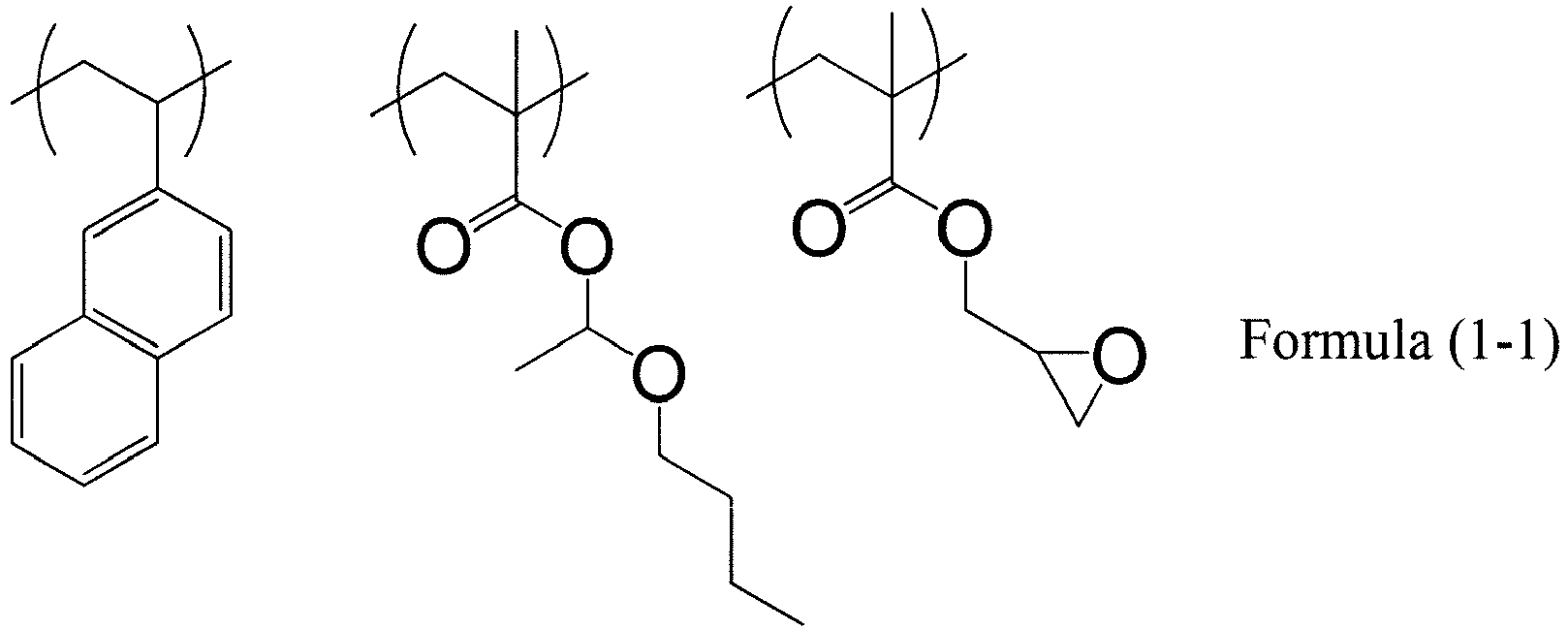
- 12.0 g of 2-vinylnaphthalene (70% by mole relative to the total polymer), 2.4 g of glycidyl methacrylate (15% by mole relative to the total polymer), 3.2 g of butoxy(2-ethyl) methacrylate (15% by mole relative to the total polymer) and 0.72 g of 2,2'-azobisisobutyronitrile were dissolved in 35.4 g of propylene glycol monomethyl ether acetate, and the solution was heated and stirred at 85°C for about 19 hours. The resulting polymer corresponded to Formula (1-2) and had a weight-average molecular weight Mw of 8,380 in terms of polystyrene by GPC measurement.

- 20.0 g of 2-vinylnaphthalene (80% by mole relative to the total polymer), 4.2 g of hydroxyethyl methacrylate (20% by mole relative to the total polymer) and 1.2 g of 2,2'-azobisisobutyronitrile were dissolved in 106.7 g of propylene glycol monomethyl ether acetate, and the solution was heated and stirred at 85°C for about 15 hours. The resulting polymer corresponded to Formula (1-3) and had a weight-average molecular weight Mw of 4,150 in terms of polystyrene by GPC measurement.

- 18.0 g of 2-vinylnaphthalene (90% by mole relative to the total polymer), 1.69 g of hydroxyethyl methacrylate (10% by mole relative to the total polymer) and 0.98 g of 2,2'-azobisisobutyronitrile were dissolved in 48.4 g of propylene glycol monomethyl ether acetate, and the solution was heated and stirred at 85°C for about 20 hours. The resulting polymer corresponded to Formula (1-4) and had a weight-average molecular weight Mw of 8,420 in terms of polystyrene by GPC measurement.

- 25.0 g of 2-vinylnaphthalene (50% by mole relative to the total polymer), 28.6 g of 4-tert-butoxystyrene (50% by mole relative to the total polymer) and 2.69 g of 2,2'-azobisisobutyronitrile were dissolved in 131.3 g of propylene glycol monomethyl ether, and the solution was heated and stirred at 85°C for about 20 hours. The resulting polymer corresponded to Formula (1-5) and had a weight-average molecular weight Mw of 8,180 in terms of polystyrene by GPC measurement.

- 18.0 g of 2-vinylnaphthalene (60% by mole relative to the total polymer), 3.90 g of methyl methacrylate (20% by mole relative to the total polymer), 5.06 g of hydroxyethyl methacrylate (20% by mole relative to the total polymer) and 1.35 g of 2,2'-azobisisobutyronitrile were dissolved in 66.0 g of propylene glycol monomethyl ether acetate, and the solution was heated and stirred at 85°C for about 20 hours. The resulting polymer corresponded to Formula (1-6) and had a weight-average molecular weight Mw of 7,500 in terms of polystyrene by GPC measurement.

- 8.88 g of 2-vinylnaphthalene (20% by mole relative to the total polymer), 18.0 g of styrene (60% by mole relative to the total polymer), 7.51 g of hydroxyethyl methacrylate (20% by mole relative to the total polymer) and 1.72 g of 2,2'-azobisisobutyronitrile were dissolved in 84.4 g of propylene glycol monomethyl ether acetate, and the solution was heated and stirred at 85°C for about 20 hours. The resulting polymer corresponded to Formula (1-7) and had a weight-average molecular weight Mw of 8,520 in terms of polystyrene by GPC measurement.

- 11.00 g of acenaphthylene (80% by mole relative to the total polymer), 2.32 g of hydroxyethyl methacrylate (20% by mole relative to the total polymer) and 0.40 g of 2,2'-azobisisobutyronitrile were dissolved in 32.01 g of propylene glycol monomethyl ether acetate, and the solution was heated and stirred at 85°C for about 18 hours. The resulting polymer corresponded to Formula (1-8) and had a weight-average molecular weight Mw of 8,820 in terms of polystyrene by GPC measurement.

- 11.00 g of vinylcarbazole (80% by mole relative to the total polymer), 1.85 g of hydroxyethyl methacrylate (20% by mole relative to the total polymer) and 0.39 g of 2,2'-azobisisobutyronitrile were dissolved in 30.89 g of cyclohexanone, and the solution was heated and stirred at 85°C for about 19 hours. The resulting polymer corresponded to Formula (1-9) and had a weight-average molecular weight Mw of 6,950 in terms of polystyrene by GPC measurement.

- 5.23 g of 2-vinylnaphthalene (60% by mole relative to the total polymer), 2.28 g of methyl methacrylate (40% by mole relative to the total polymer) and 1.50 g of 2,2'-azobis[2-methyl-N-(2-hydroxyethyl) propionamide (manufactured by Wako Pure Chemical Industries, Ltd., product name: VA-086) were dissolved in a mixed solvent of 54.60 g of propylene glycol monomethyl ether acetate and 36.40 g of methanol. The resultant solution was heated and stirred at 100°C for about 12 hours. The resulting polymer corresponded to Formula (1-10). The terminal of the polymer was bonded to a functional group corresponding to Formula (1-10-1). In Formula (1-10-1), the dotted line indicates the bond with the polymer. The resulting polymer had a weight-average molecular weight Mw of 5,630 in terms of polystyrene by GPC measurement.


- 2.98 g of 2-vinylnaphthalene (30% by mole relative to the total polymer), 4.52 g of methyl methacrylate (70% by mole relative to the total polymer) and 1.50 g of 2,2'-azobis[2-methyl-N-(2-hydroxyethyl) propionamide (manufactured by Wako Pure Chemical Industries, Ltd. product name: VA-086) were dissolved in a mixed solvent of 54.60 g of propylene glycol monomethyl ether acetate and 36.40 g of methanol. The resultant solution was heated and stirred at 100°C for about 12 hours. The resulting polymer corresponded to Formula (1-11). The terminal of the polymer is bonded to a functional group corresponding to Formula (1-11-1). In Formula (1-11-1), the dotted line indicates the bond with the polymer. The resulting polymer had a weight-average molecular weight Mw of 5,850 in terms of polystyrene by GPC measurement.


- 6.0 g of styrene(60% by mole relative to the total polymer), 2.0 g of methyl methacrylate (20% by mole relative to the total polymer), 2.0 g of hydroxyethyl methacrylate (20% by mole relative to the total polymer) and 0.50 g of 2,2'-azobisisobutyronitrile were dissolved in 42.0 g of propylene glycol monomethyl ether, and the solution was heated and stirred at 100°C for about 16 hours. The resulting polymer corresponded to Formula (1-12) and had a weight-average molecular weight Mw of 10,120 in terms of polystyrene by GPC measurement.

- In 3.38 g of propylene glycol monomethyl ether acetate, 18.0 g of cyclohexanone, and 1.1 g of γ-butyrolactone, 2 g of the resin obtained in Synthesis Example 1 and 0.01 g of a surfactant (manufactured by DIC Corporation, product name: MEGAFAC [trade name] R-30, a fluorochemical surfactant) were dissolved to give a solution. The solution was filtered through a polyethylene microfilter having a pore size of 0.2 µm, preparing a solution of an underlayer film-forming composition for self-assembled films.
- In 15.8 g of propylene glycol monomethyl ether acetate and 6.8 g of propylene glycol monomethyl ether, 2 g of the resin obtained in Synthesis Example 2 and 0.01 g of the surfactant (manufactured by DIC Corporation, product name: MEGAFAC [trade name] R-30, a fluorochemical surfactant) were dissolved to give a solution. The solution was filtered through a polyethylene microfilter having a pore size of 0.2 µm, preparing a solution of an underlayer film-forming composition for self-assembled films.
- In 6.8 g of propylene glycol monomethyl ether acetate and 15.8 g of propylene glycol monomethyl ether, 2 g of the resin obtained in Synthesis Example 3, 0.3 g of tetramethoxymethylglycoluril, 0.03 g of pyridinium p-toluenesulfonate, and 0.002 g of the surfactant (manufactured by DIC Corporation, product name: MEGAFAC [trade name] R-30, a fluorochemical surfactant) were dissolved to give a solution. The solution was filtered through a polyethylene microfilter having a pore size of 0.2 µm, preparing a solution of an underlayer film-forming composition for self-assembled films.
- In 13.5 g of propylene glycol monomethyl ether acetate and 9.0 g of propylene glycol monomethyl ether, 2 g of the resin obtained in Synthesis Example 4, 0.3 g of tetramethoxymethylglycoluril, 0.03 g of pyridinium p-toluenesulfonate, and 0.002 g of the surfactant (manufactured by DIC Corporation, product name: MEGAFAC [trade name] R-30, a fluorochemical surfactant) were dissolved to give a solution. The solution was filtered through a polyethylene microfilter having a pore size of 0.2 µm, preparing a solution of an underlayer film-forming composition for self-assembled films.
- In 13.5 g of propylene glycol monomethyl ether acetate and 9.0 g of propylene glycol monomethyl ether, 2 g of the resin obtained in Synthesis Example 5, 0.3 g of tetramethoxymethylglycoluril, 0.03 g of pyridinium p-toluenesulfonate, and 0.002 g of the surfactant (manufactured by DIC Corporation, product name: MEGAFAC [trade name] R-30, a fluorochemical surfactant) were dissolved to give a solution. The solution was filtered through a polyethylene microfilter having a pore size of 0.2 µm, preparing a solution of an underlayer film-forming composition for self-assembled films.
- In 13.5 g of propylene glycol monomethyl ether acetate and 9.0 g of propylene glycol monomethyl ether, 2 g of the resin obtained in Synthesis Example 6, 0.3 g of tetramethoxymethylglycoluril, 0.03 g of pyridinium p-toluenesulfonate, and 0.002 g of the surfactant (manufactured by DIC Corporation, product name: MEGAFAC [trade name] R-30, a fluorochemical surfactant) were dissolved to give a solution. The solution was filtered through a polyethylene microfilter having a pore size of 0.2 µm, preparing a solution of an underlayer film-forming composition for self-assembled films.
- In 13.5 g of propylene glycol monomethyl ether acetate and 9.0 g of propylene glycol monomethyl ether, 2 g of the resin obtained in Synthesis Example 7, 0.3 g of tetramethoxymethylglycoluril, 0.03 g of pyridinium p-toluenesulfonate, and 0.002 g of the surfactant (manufactured by DIC Corporation, product name: MEGAFAC [trade name] R-30, a fluorochemical surfactant) were dissolved to give a solution. The solution was filtered through a polyethylene microfilter having a pore size of 0.2 µm, preparing a solution of an underlayer film-forming composition for self-assembled films.
- In 26.6 g of propylene glycol monomethyl ether acetate and 3.0 g of propylene glycol monomethyl ether, 0.37 g of the resin obtained in Synthesis Example 8, 0.07 g of tetramethoxymethylglycoluril, and 0.01 g of pyridinium p-toluenesulfonate were dissolved to give a solution. The solution was filtered through a polyethylene microfilter having a pore size of 0.2 µm, preparing a solution of an underlayer film-forming composition for self-assembled films.
- In 8.9 g of cyclohexanone, 8.9 g of propylene glycol monomethyl ether acetate and 11.8 g of propylene glycol monomethyl ether, 0.37 g of the resin obtained in Synthesis Example 9, 0.07 g of tetramethoxymethylglycoluril, and 0.01 g of pyridinium p-toluenesulfonate were dissolved to give a solution. The solution was filtered through a polyethylene microfilter having a pore size of 0.2 µm, preparing a solution of an underlayer film-forming composition for self-assembled films.
- In 13.8 g of propylene glycol monomethyl ether acetate and 5.9 g of propylene glycol monomethyl ether, 0.2 g of the resin obtained in Synthesis Example 4 was dissolved to give a solution. The solution was filtered through a polyethylene microfilter having a pore size of 0.2 µm, preparing a solution of an underlayer film-forming composition for self-assembled films.
- In 19.8 g of butyl acetate, 0.2 g of the resin obtained in Synthesis Example 10 was dissolved to give a solution. The solution was filtered through a polyethylene microfilter having a pore size of 0.2 µm, preparing a solution of an underlayer film-forming composition for self-assembled films.
- In 19.8 g of butyl acetate, 0.2 g of the resin obtained in Synthesis Example 11 was dissolved to give a solution. The solution was filtered through a polyethylene microfilter having a pore size of 0.2 µm, preparing a solution of an underlayer film-forming composition for self-assembled films.
- In 14.8 g of propylene glycol monomethyl ether acetate and 31.4 g of propylene glycol monomethyl ether, 0.59 g of the resin obtained in Comparative Synthesis Example 1, 0.15 g of tetramethoxymethylglycoluril, and 0.01 g of para-phenol sulfonic acid were dissolved to give a solution. The solution was filtered through a polyethylene microfilter having a pore size of 0.2 µm, preparing a solution of an underlayer film-forming composition for self-assembled films.
- Each solution of the underlayer film-forming compositions for self-assembled films prepared in Examples 1 to 9 and Comparative Example 1 was applied onto a silicon wafer using a spin coater. Each solution applied onto the silicon wafer was baked on a hot plate at 240°C for 1 minute, forming an underlayer film layer for self-assembled films (a film thickness of 0.20 µm). These underlayer film layers were subjected to immersion test in propylene glycol monomethyl ether (PGME) and propylene glycol monomethyl ether acetate (PGMEA), which are solvents used for resists. Table 1 shows the results. The residual film ratio was determined as follows: the underlayer film was immersed in each solvent for 60 seconds; the film thickness was measured before and after the immersion; and the ratio was calculated in accordance with (film thickness after immersion)/(film thickness before immersion) × 100.
[Table 1]Table 1 Residual film ratio (%) after elution test (%) PGME PGMEA Example 1 Film after baking at 240°C 100% 100% Example 2 Film after baking at 240°C 100% 100% Example 3 Film after baking at 240°C 99% 100% Example 4 Film after baking at 240°C 100% 100% Example 5 Film after baking at 240°C 100% 100% Example 6 Film after baking at 240°C 100% 100% Example 7 Film after baking at 240°C 100% 100% Example 8 Film after baking at 240°C 100% 100% Example 9 Film after baking at 240°C 100% 100% Comparative Example 1 Film after baking at 240°C 98% 100% - (Measurement of Dry Etching Rate)
- Dry etching rates were determined by using the following etcher and etching gas. RIE-10NR (manufactured by Samco Inc.): CF4
- Each solution of the underlayer film-forming compositions for self-assembled films prepared in Examples 1 to 9 and Comparative Example 1 was applied onto a silicon wafer using a spin coater. The solution applied onto the silicon wafer was baked on a hot plate at 240°C for 1 minute, forming an underlayer film-forming composition for self-assembled films (film thickness of 0.20 µm). The dry etching rate was determined by using CF4 gas as an etching gas.
- Separately, a solution of a cresol novolac resin (commercial product, a weight-average molecular weight of 4,000) was applied onto a silicon wafer using a spin coater and the resulting the applied solution was baked at 205°C for 1 minute, forming an organic hard mask layer (a film thickness of 0.20 µm). The dry etching rate was determined by using CF4 gas as an etching gas in the same manner as for Examples 1 to 9 and Comparative Example 1, and the dry etching rate of the organic hard mask layer was compared with those of Examples 1 to 9 and Comparative Example 1. Table 2 shows the results. The ratios of etching rates (1) are the ratios calculated in accordance with (the dry etching rates of the underlayer films for self-assembled films prepared by baking the applied compositions of Examples 1 to 9 and Comparative Example 1 at 240°C for 1 minute)/(the dry etching rate of the film prepared by baking the cresol novolac resin at 205°C for 1 minute).
[Table 2]Table 2 Ratio of dry etching rates Example 1 Ratio of film after baking at 240°C (1) 0.83 Example 2 Ratio of film after baking at 240°C (1) 0.86 Example 3 Ratio of film after baking at 240°C (1) 0.92 Example 4 Ratio of film after baking at 240°C (1) 0.82 Example 5 Ratio of film after baking at 240°C (1) 0.83 Example 6 Ratio of film after baking at 240°C (1) 0.93 Example 7 Ratio of film after baking at 240°C (1) 0.93 Example 8 Ratio of film after baking at 240°C (1) 0.82 Example 9 Ratio of film after baking at 240°C (1) 1.00 Comparative Example 1 Ratio of film after baking at 240°C (1) 1.14 - In 32.33 g of propylene glycol monomethyl ether, 1.0 g of polystyrene/poly(methyl methacrylate) copolymer (manufactured by POLYMER SOURCE INC., PS (18,000) -b-PMMA (18,000), polydispersity = 1.07) as a block polymer was dissolved, giving a 2% by mass solution. The solution was filtered through a polyethylene microfilter having a pore size of 0.02 µm, preparing a solution of a self-assembled film-forming composition as a block polymer.
- Each underlayer film-forming composition for self-assembled films obtained in Examples 1 to 7 and Comparative Example 1 was applied onto a silicon wafer, and the composition applied on the substrate was heated on a hot plate at 240°C for 1 minute, giving an underlayer film (A layer) to be present as the underlayer of a self-assembled film. These underlayer film had a film thickness of 200 nm.
- Each underlayer film-forming composition for self-assembled films obtained in Example 8 and Example 9 was applied onto a silicon wafer, and the composition applied on the substrate was heated on a hot plate at 240°C for 1 minute, giving an underlayer film (A layer) to be present as the underlayer of the self-assembled film. These underlayer films had a film thickness of 30 nm.
- Each underlayer film-forming composition for self-assembled films obtained in Examples 10 to 12 was applied onto a silicon wafer, and the composition applied on the substrate was heated on a hot plate at 240°C for 1 minute, giving an underlayer film having a film thickness of 30 nm. The underlayer film was immersed in a mixed solvent of propylene glycol monomethyl ether/propylene glycol monomethyl ether acetate (70/30) for 60 seconds, giving an underlayer film (A layer) to be present as the underlayer of the self-assembled film. Each underlayer film had a film thickness of 3 nm.
- Onto each underlayer film (A layer), the self-assembled film-forming composition composed of the above-mentioned block polymer was applied with a spinner, and the composition applied on the substrate was heated on a hot plate at 100°C for 1 minute, forming a self-assembled film (B layer) having a film thickness of 40 nm. The resulting substrate was subsequently heated on a hot plate at 240°C for 5 minutes under a nitrogen atmosphere, and a micro-phase-separated structure of the block polymer was induced.
- The silicon wafer having the induced micro-phase-separated structure was etched for 3 seconds with an etcher (Lam 2300) manufactured by Lam using O2/N2 gas as the etching gas, and thus the PMMA region was preferentially etched. Subsequently, the shape was observed under a scanning electron microscope (Hitachi S-9380). Table 3 shows the obtained results.
FIG. 1 illustrates the scanning electron micrograph of the self-assembled film formed on the underlayer film obtained from Example 1, andFIG. 2 illustrates the scanning electron micrograph of the self-assembled film formed on the underlayer film obtained from Comparative Example 1.
[Table 3]Table 3 Shape observation of block polymer (self-assembled film) on underlayer film Underlayer film obtained from Example 1 Perpendicular lamellar Underlayer film obtained from Example 2 Perpendicular lamellar Underlayer film obtained from Example 3 Perpendicular lamellar Underlayer film obtained from Example 4 Perpendicular lamellar Underlayer film obtained from Example 5 Perpendicular lamellar Underlayer film obtained from Example 6 Perpendicular lamellar Underlayer film obtained from Example 7 Perpendicular lamellar Underlayer film obtained from Example 8 Perpendicular lamellar Underlayer film obtained from Example 9 Perpendicular lamellar Underlayer film obtained from Example 10 Perpendicular lamellar Underlayer film obtained from Example 11 Perpendicular lamellar Underlayer film obtained from Example 12 Perpendicular lamellar Underlayer film obtained from Comparative Example 1 Horizontal lamellar - As shown in Table 3, the underlayer films obtained from Examples 1 to 12 can induce the micro-phase-separated structure of the block polymer composed of polystyrene and poly(methyl methacrylate) in a direction perpendicular to the substrate in the self-assembled film as the upper layer. As shown by the components contained in the underlayer films obtained from Examples 1 to 12, the ability to induce the structure perpendicular to the substrate was not restricted by any components besides the polycyclic vinyl structure.
- In contrast, it is concluded that as shown by the results of the underlayer film obtained from Comparative Example, the film containing no vinylnaphthalene or the like having the polycyclic vinyl structure fails to induce the micro-phase-separated structure of the block polymer in a direction perpendicular to the substrate in the self-assembled film as the upper layer.
- Self-assembled films are used for liquid crystal displays, recording materials for hard disks, solid-state image sensing devices, solar cell panels, light emitting diodes, organic light emitting devices, luminescent films, fluorescent films, MEMS, actuators, anti-reflective materials, resists, resist underlayer films, resist upper layer films, templates for nanoimprint, or the like. In the present invention, a polymer having a polycyclic aromatic vinyl compound is used in an underlayer film of the self-assembled film. The underlayer film particularly containing vinylnaphthalene can induce a micro-phase-separated structure of a block polymer in a perpendicular direction to a substrate.
Claims (18)
- An underlayer film-forming composition for a self-assembled film, the underlayer film-forming composition characterized by comprising a polymer including 0.2% by mole or more of a unit structure of a polycyclic aromatic vinyl compound relative to all unit structures of the polymer.
- The underlayer film-forming composition for a self-assembled film according to claim 1, characterized in that the polymer includes 20% by mole or more of a unit structure of an aromatic vinyl compound relative to all the unit structures of the polymer and includes 1% by mole or more of a unit structure of the polycyclic aromatic vinyl compound relative to all the unit structures of the aromatic vinyl compound.
- The underlayer film-forming composition for a self-assembled film according to claim 2, wherein the aromatic vinyl compound includes an optionally substituted vinylnaphthalene, an optionally substituted acenaphthylene, or an optionally substituted vinylcarbazole, and the polycyclic aromatic vinyl compound is vinylnaphthalene, acenaphthylene, or vinylcarbazole.
- The underlayer film-forming composition for a self-assembled film according to claim 2 or 3, wherein the aromatic vinyl compound includes an optionally substituted styrene and an optionally substituted vinylnaphthalene, an optionally substituted acenaphthylene, or an optionally substituted vinylcarbazole, and the polycyclic aromatic vinyl compound is vinylnaphthalene, acenaphthylene, or vinylcarbazole.
- The underlayer film-forming composition for a self-assembled film according to any one of claims 2 to 4, wherein the aromatic vinyl compound is an optionally substituted styrene and an optionally substituted vinylnaphthalene, an optionally substituted acenaphthylene, or an optionally substituted vinylcarbazole, and the polycyclic aromatic vinyl compound is an optionally substituted vinylnaphthalene, an optionally substituted acenaphthylene, or an optionally substituted vinylcarbazole.
- The underlayer film-forming composition for a self-assembled film according to any one of claims 2 to 5, wherein the aromatic vinyl compound consists of a polycyclic aromatic vinyl compound only, and the aromatic vinyl compound is an optionally substituted vinylnaphthalene, an optionally substituted acenaphthylene, or an optionally substituted vinylcarbazole.
- The underlayer film-forming composition for a self-assembled film according to any one of claims 2 to 6, wherein the polymer includes 60% by mole to 95% by mole of a unit structure of the aromatic vinyl compound relative to all the unit structures of the polymer.
- The underlayer film-forming composition for a self-assembled film according to any one of claims 1 to 7, wherein the polymer further includes a unit structure having a crosslinkable group.
- The underlayer film-forming composition for a self-assembled film according to claim 8, wherein the crosslinkable group is a hydroxy group, an epoxy group, a protected hydroxy group, or a protected carboxy group.
- The underlayer film-forming composition for a self-assembled film according to any one of claims 1 to 9, further comprising a crosslinking agent.
- The underlayer film-forming composition for a self-assembled film according to any one of claims 1 to 10, further comprising an acid or an acid generator.
- The underlayer film-forming composition for a self-assembled film according to any one of claims 1 to 11, wherein the self-assembled film is a film formed from a block polymer comprising an organic polymer chain (A) that includes an organic monomer (a) as a unit structure and comprising a polymer chain (B) that includes a monomer (b) different from the organic monomer (a) as a unit structure and is bonded to the organic polymer chain (A).
- The underlayer film-forming composition for a self-assembled film according to claim 12, wherein the block polymer is a block polymer formed by combining polystyrene (A) and polymethyl methacrylate (B), polystyrene (A) and polyisoprene (B), polystyrene (A) and polybutadiene (B), polystyrene (A) and polydimethylsiloxane (B), polystyrene (A) and poly(ethylene oxide) (B), or polystyrene (A) and poly(vinylpyridine) (B).
- A method for forming a pattern structure constituting a self-assembled film, the method comprising the steps of:applying the underlayer film-forming composition for a self-assembled film according to any one of claims 1 to 13 onto a substrate and baking the applied underlayer film-forming composition to form an underlayer film; andapplying a self-assembled film-forming composition onto the underlayer film and baking the applied self-assembled film-forming composition.
- A method for forming a pattern structure constituting a self-assembled film, the method comprising the steps of:applying the underlayer film-forming composition for a self-assembled film according to claim 8 or 9 onto a substrate and baking the applied underlayer film-forming composition to form an underlayer film;bringing the underlayer film into contact with a solvent to remove a surface layer of the underlayer film; andapplying a self-assembled film-forming composition onto the underlayer film after removal of the surface layer and baking the applied self-assembled film-forming composition.
- The method for forming a pattern structure according to claim 14 or 15, the method further comprising the step of forming a base film on a base material before applying the underlayer film-forming composition for a self-assembled film and baking the applied underlayer film-forming composition to form an underlayer film.
- The method for forming a pattern structure according to claim 16, wherein the base film is an anti-reflective film or a hard mask.
- A device obtained by the method for forming a pattern structure according to any one of claims 14 to 17.
Applications Claiming Priority (2)
| Application Number | Priority Date | Filing Date | Title |
|---|---|---|---|
| JP2012276135 | 2012-12-18 | ||
| PCT/JP2013/083492 WO2014097993A1 (en) | 2012-12-18 | 2013-12-13 | Bottom layer film-formation composition of self-organizing film containing polycyclic organic vinyl compound |
Publications (2)
| Publication Number | Publication Date |
|---|---|
| EP2937391A1 true EP2937391A1 (en) | 2015-10-28 |
| EP2937391A4 EP2937391A4 (en) | 2016-08-31 |
Family
ID=50978325
Family Applications (1)
| Application Number | Title | Priority Date | Filing Date |
|---|---|---|---|
| EP13864158.4A Withdrawn EP2937391A4 (en) | 2012-12-18 | 2013-12-13 | Bottom layer film-formation composition of self-organizing film containing polycyclic organic vinyl compound |
Country Status (7)
| Country | Link |
|---|---|
| US (1) | US10508181B2 (en) |
| EP (1) | EP2937391A4 (en) |
| JP (1) | JPWO2014097993A1 (en) |
| KR (2) | KR102357731B1 (en) |
| CN (1) | CN104854205B (en) |
| TW (1) | TWI638235B (en) |
| WO (1) | WO2014097993A1 (en) |
Families Citing this family (19)
| Publication number | Priority date | Publication date | Assignee | Title |
|---|---|---|---|---|
| JP6088843B2 (en) * | 2013-02-20 | 2017-03-01 | 東京応化工業株式会社 | Pattern formation method |
| KR102285718B1 (en) * | 2013-09-19 | 2021-08-04 | 닛산 가가쿠 가부시키가이샤 | Composition for forming underlayer film of self-assembling film including aliphatic polycyclic structure |
| US9690192B2 (en) * | 2014-04-21 | 2017-06-27 | Jsr Corporation | Composition for base, and directed self-assembly lithography method |
| TWI592760B (en) * | 2014-12-30 | 2017-07-21 | 羅門哈斯電子材料韓國有限公司 | Coating compositions for use with an overcoated photoresist |
| TWI662370B (en) | 2015-11-30 | 2019-06-11 | Rohm And Haas Electronic Materials Korea Ltd. | Coating compositions for use with an overcoated photoresist |
| JPWO2018131495A1 (en) * | 2017-01-10 | 2019-11-07 | Jsr株式会社 | Cover film forming method, substrate processing method and composition |
| JP7092038B2 (en) | 2017-01-19 | 2022-06-28 | 日産化学株式会社 | Underlayer film forming composition for forming fine phase separation pattern |
| US10995172B2 (en) | 2017-01-19 | 2021-05-04 | Nissan Chemical Corporation | Self-organized film-forming composition for use in forming a micro-phase-separated pattern |
| JP7076237B2 (en) * | 2017-03-23 | 2022-05-27 | 東京応化工業株式会社 | Method for manufacturing a structure including a base material and a phase-separated structure |
| TWI797243B (en) | 2018-02-09 | 2023-04-01 | 日商富士軟片股份有限公司 | Kit, underlayer film-forming composition for imprint, laminate, and manufacturing method using the same |
| US11201051B2 (en) * | 2018-11-13 | 2021-12-14 | Tokyo Electron Limited | Method for layer by layer growth of conformal films |
| TW202216819A (en) | 2020-05-26 | 2022-05-01 | 日商日產化學股份有限公司 | Vertically phase-separated block copolymer layer |
| CN115943036A (en) * | 2020-08-19 | 2023-04-07 | 日产化学株式会社 | Vertically phase-separated block copolymer layers |
| WO2022050405A1 (en) | 2020-09-07 | 2022-03-10 | 日産化学株式会社 | Wafer treatment method |
| KR20230163518A (en) | 2021-03-31 | 2023-11-30 | 닛산 가가쿠 가부시키가이샤 | Composition for forming silicon-containing lower layer film for induced self-organization |
| US20250206901A1 (en) * | 2022-03-31 | 2025-06-26 | Nissan Chemical Corporation | Brush material for self-assembled film |
| WO2024106492A1 (en) | 2022-11-17 | 2024-05-23 | 日産化学株式会社 | Underlayer film material for self-assembled film |
| JP7792357B2 (en) * | 2023-01-10 | 2025-12-25 | 信越化学工業株式会社 | Composition for forming resist underlayer film, pattern forming method, and method for forming resist underlayer film |
| TW202506762A (en) | 2023-06-08 | 2025-02-16 | 日商日產化學股份有限公司 | Used as the bottom layer of self-assembly materials |
Family Cites Families (30)
| Publication number | Priority date | Publication date | Assignee | Title |
|---|---|---|---|---|
| US1982676A (en) * | 1929-08-21 | 1934-12-04 | Du Pont | Polymerization of vinyl naphthalene |
| US4777227A (en) * | 1985-11-21 | 1988-10-11 | Allied Corporation | High temperature thermosetting resin compositions |
| JP2551632B2 (en) | 1988-07-11 | 1996-11-06 | 株式会社日立製作所 | Pattern forming method and semiconductor device manufacturing method |
| JP3782357B2 (en) * | 2002-01-18 | 2006-06-07 | 株式会社東芝 | Manufacturing method of semiconductor light emitting device |
| TWI317365B (en) * | 2002-07-31 | 2009-11-21 | Jsr Corp | Acenaphthylene derivative, polymer, and antireflection film-forming composition |
| JP4702559B2 (en) * | 2004-04-09 | 2011-06-15 | 日産化学工業株式会社 | Antireflection film for semiconductor having condensed polymer |
| WO2007023710A1 (en) | 2005-08-25 | 2007-03-01 | Nissan Chemical Industries, Ltd. | Lithographic coated-type underlayer film forming composition containing vinylnaphthalene resin derivative |
| JPWO2007046453A1 (en) * | 2005-10-20 | 2009-04-23 | Jsr株式会社 | Polymer of vinyl naphthalene derivative, composition for forming antireflection film, and antireflection film |
| JP2007284623A (en) | 2006-04-19 | 2007-11-01 | Asahi Kasei Corp | Coating composition for thin film |
| US20080038467A1 (en) * | 2006-08-11 | 2008-02-14 | Eastman Kodak Company | Nanostructured pattern method of manufacture |
| EP2087404A4 (en) * | 2006-11-20 | 2010-12-29 | Jsr Corp | Composition for resist lower layer film formation and method for pattern formation |
| JP2010112966A (en) * | 2007-03-08 | 2010-05-20 | Nissan Chem Ind Ltd | Coating solution for film formation, method for production of the coating solution, and method for production of semiconductor device |
| US7794905B2 (en) * | 2007-03-23 | 2010-09-14 | Xerox Corporation | Photoreceptor device having a self-assembled patterned binder layer |
| JP4892670B2 (en) * | 2007-07-20 | 2012-03-07 | Jsr株式会社 | Composition for forming a resist underlayer film |
| CN101970537A (en) | 2008-03-10 | 2011-02-09 | 日产化学工业株式会社 | Underlayer film composition for image formation |
| JP2009234114A (en) | 2008-03-27 | 2009-10-15 | Canon Inc | Pattern forming method, substrate processing method, polarizing plate and magnetic recording medium |
| JP5077026B2 (en) * | 2008-04-02 | 2012-11-21 | Jsr株式会社 | Composition for forming resist underlayer film and method of forming dual damascene structure using the same |
| KR101674645B1 (en) | 2008-10-23 | 2016-11-09 | 닛산 가가쿠 고교 가부시키 가이샤 | Underlayer Film for Image Formation |
| SG176777A1 (en) * | 2009-06-19 | 2012-01-30 | Nissan Chemical Ind Ltd | Carbazole novolak resin |
| KR101175325B1 (en) * | 2009-08-24 | 2012-08-20 | 한국기초과학지원연구원 | Method of fabricating quantum dot |
| JP2011122081A (en) | 2009-12-11 | 2011-06-23 | Nissan Chem Ind Ltd | Thermosetting film-forming composition |
| KR101344794B1 (en) * | 2009-12-31 | 2014-01-16 | 제일모직주식회사 | Aromatic ring-containing polymer for resist underlayer and resist underlayer composition including same |
| CN102754034B (en) | 2010-02-19 | 2016-05-18 | 日产化学工业株式会社 | There is the composition containing the formation resist lower membrane that contains silicon of azo-cycle |
| TWI556958B (en) | 2010-09-14 | 2016-11-11 | 東京應化工業股份有限公司 | Base material and method of forming pattern including block copolymer |
| CN103229104B (en) * | 2010-12-09 | 2016-08-24 | 日产化学工业株式会社 | Comprise the compositions forming resist lower membrane of the Carbazole Novolak Resin containing hydroxyl |
| JP5606352B2 (en) * | 2011-02-14 | 2014-10-15 | リンテック株式会社 | Flame retardant adhesive composition, flame retardant adhesive tape, and flame retardant adhesive sheet |
| US9110373B2 (en) | 2011-06-03 | 2015-08-18 | Mitsubishi Gas Chemical Company, Inc. | Phenolic resin and material for forming underlayer film for lithography |
| JP6186116B2 (en) * | 2012-03-09 | 2017-08-23 | 東京応化工業株式会社 | Method for forming pattern of layer containing block copolymer and base material |
| JP6118573B2 (en) * | 2012-03-14 | 2017-04-19 | 東京応化工業株式会社 | Pattern forming method for layer containing base agent and block copolymer |
| US10000664B2 (en) | 2012-03-27 | 2018-06-19 | Nissan Chemical Industries, Ltd. | Underlayer film-forming composition for self-assembled films |
-
2013
- 2013-12-13 CN CN201380066230.1A patent/CN104854205B/en active Active
- 2013-12-13 EP EP13864158.4A patent/EP2937391A4/en not_active Withdrawn
- 2013-12-13 JP JP2014553113A patent/JPWO2014097993A1/en active Pending
- 2013-12-13 KR KR1020207025553A patent/KR102357731B1/en active Active
- 2013-12-13 KR KR1020157016047A patent/KR20150097516A/en not_active Ceased
- 2013-12-13 US US14/651,998 patent/US10508181B2/en active Active
- 2013-12-13 WO PCT/JP2013/083492 patent/WO2014097993A1/en not_active Ceased
- 2013-12-17 TW TW102146658A patent/TWI638235B/en active
Also Published As
| Publication number | Publication date |
|---|---|
| TW201430501A (en) | 2014-08-01 |
| US10508181B2 (en) | 2019-12-17 |
| KR20150097516A (en) | 2015-08-26 |
| KR102357731B1 (en) | 2022-02-08 |
| EP2937391A4 (en) | 2016-08-31 |
| CN104854205B (en) | 2018-12-28 |
| TWI638235B (en) | 2018-10-11 |
| CN104854205A (en) | 2015-08-19 |
| WO2014097993A1 (en) | 2014-06-26 |
| JPWO2014097993A1 (en) | 2017-01-12 |
| US20150322219A1 (en) | 2015-11-12 |
| KR20200106560A (en) | 2020-09-14 |
Similar Documents
| Publication | Publication Date | Title |
|---|---|---|
| US10508181B2 (en) | Bottom layer film-formation composition of self-organizing film containing polycyclic organic vinyl compound | |
| JP6402035B2 (en) | Composition for forming underlayer of self-assembled film containing styrene structure | |
| KR102285718B1 (en) | Composition for forming underlayer film of self-assembling film including aliphatic polycyclic structure | |
| US10995172B2 (en) | Self-organized film-forming composition for use in forming a micro-phase-separated pattern | |
| US11440985B2 (en) | Underlayer film-forming composition for use in forming a microphase-separated pattern | |
| US12030974B2 (en) | Composition for forming block copolymer layer for formation of microphase-separated pattern | |
| KR20250112748A (en) | Sublayer materials for self-organizing materials | |
| KR20260019445A (en) | Sublayer materials for self-organizing materials | |
| WO2023190807A1 (en) | Brush material for self-assembled film |
Legal Events
| Date | Code | Title | Description |
|---|---|---|---|
| PUAI | Public reference made under article 153(3) epc to a published international application that has entered the european phase |
Free format text: ORIGINAL CODE: 0009012 |
|
| 17P | Request for examination filed |
Effective date: 20150708 |
|
| AK | Designated contracting states |
Kind code of ref document: A1 Designated state(s): AL AT BE BG CH CY CZ DE DK EE ES FI FR GB GR HR HU IE IS IT LI LT LU LV MC MK MT NL NO PL PT RO RS SE SI SK SM TR |
|
| AX | Request for extension of the european patent |
Extension state: BA ME |
|
| DAX | Request for extension of the european patent (deleted) | ||
| A4 | Supplementary search report drawn up and despatched |
Effective date: 20160728 |
|
| RIC1 | Information provided on ipc code assigned before grant |
Ipc: C09D 145/00 20060101ALI20160722BHEP Ipc: B05D 1/38 20060101ALI20160722BHEP Ipc: H01L 21/027 20060101ALI20160722BHEP Ipc: B05D 3/10 20060101ALI20160722BHEP Ipc: G03F 7/26 20060101ALI20160722BHEP Ipc: B05D 7/24 20060101ALI20160722BHEP Ipc: G03F 7/11 20060101ALI20160722BHEP Ipc: C09D 5/00 20060101ALI20160722BHEP Ipc: C09D 125/00 20060101ALI20160722BHEP Ipc: C09D 201/00 20060101AFI20160722BHEP Ipc: C09D 139/04 20060101ALI20160722BHEP |
|
| 17Q | First examination report despatched |
Effective date: 20180426 |
|
| RAP1 | Party data changed (applicant data changed or rights of an application transferred) |
Owner name: NISSAN CHEMICAL CORPORATION |
|
| GRAP | Despatch of communication of intention to grant a patent |
Free format text: ORIGINAL CODE: EPIDOSNIGR1 |
|
| INTG | Intention to grant announced |
Effective date: 20181109 |
|
| STAA | Information on the status of an ep patent application or granted ep patent |
Free format text: STATUS: THE APPLICATION IS DEEMED TO BE WITHDRAWN |
|
| 18D | Application deemed to be withdrawn |
Effective date: 20190320 |