EP2937341A1 - 4-(benzyl)-piperazine-1-carboxylic acid phenylamide derivatives and related compounds as modulators of fatty acid amide hydrolase (faah) for the treatment of anxiety, pain and other conditions - Google Patents
4-(benzyl)-piperazine-1-carboxylic acid phenylamide derivatives and related compounds as modulators of fatty acid amide hydrolase (faah) for the treatment of anxiety, pain and other conditions Download PDFInfo
- Publication number
- EP2937341A1 EP2937341A1 EP15160349.5A EP15160349A EP2937341A1 EP 2937341 A1 EP2937341 A1 EP 2937341A1 EP 15160349 A EP15160349 A EP 15160349A EP 2937341 A1 EP2937341 A1 EP 2937341A1
- Authority
- EP
- European Patent Office
- Prior art keywords
- piperazine
- alkyl
- carboxylic acid
- ylmethyl
- benzyl
- Prior art date
- Legal status (The legal status is an assumption and is not a legal conclusion. Google has not performed a legal analysis and makes no representation as to the accuracy of the status listed.)
- Granted
Links
- 0 *N1CCN(Cc2ccccc2)CC1 Chemical compound *N1CCN(Cc2ccccc2)CC1 0.000 description 3
- IIFWSYNWPNMNAL-UHFFFAOYSA-N CC(C)Oc1ccc(CN(CC2)CCN2C(Nc2ccccc2)=O)cc1 Chemical compound CC(C)Oc1ccc(CN(CC2)CCN2C(Nc2ccccc2)=O)cc1 IIFWSYNWPNMNAL-UHFFFAOYSA-N 0.000 description 1
- OLKNJRAVFKGSBW-UHFFFAOYSA-N CC1C(CN(CC2)CCN2C(Nc2ncccn2)=O)=CN=C2C=CC=CC12 Chemical compound CC1C(CN(CC2)CCN2C(Nc2ncccn2)=O)=CN=C2C=CC=CC12 OLKNJRAVFKGSBW-UHFFFAOYSA-N 0.000 description 1
- KQXXSYGOSWXNMM-UHFFFAOYSA-N CCOc1ccc(CN(CC2)CCN2C(Nc2ccccc2)=O)cc1 Chemical compound CCOc1ccc(CN(CC2)CCN2C(Nc2ccccc2)=O)cc1 KQXXSYGOSWXNMM-UHFFFAOYSA-N 0.000 description 1
- MLJOKPBESJWYGL-UHFFFAOYSA-N CN1CCN(Cc2ccccc2)CC1 Chemical compound CN1CCN(Cc2ccccc2)CC1 MLJOKPBESJWYGL-UHFFFAOYSA-N 0.000 description 1
- ZCBMBTNOASDXMI-UHFFFAOYSA-N COc(cc1)ccc1Oc1cc(CN(CC2)CCN2C(Nc2ccccc2)=O)ccc1 Chemical compound COc(cc1)ccc1Oc1cc(CN(CC2)CCN2C(Nc2ccccc2)=O)ccc1 ZCBMBTNOASDXMI-UHFFFAOYSA-N 0.000 description 1
- OTTYIWVAUNQAOB-UHFFFAOYSA-N COc1cc(Br)cc(CN(CC2)CCN2C(Nc2ccccc2)=O)c1O Chemical compound COc1cc(Br)cc(CN(CC2)CCN2C(Nc2ccccc2)=O)c1O OTTYIWVAUNQAOB-UHFFFAOYSA-N 0.000 description 1
- NBSXUTBBDLALSF-UHFFFAOYSA-N COc1ccc(CN(CC2)CCN2C(Nc2ccccc2)=O)cc1 Chemical compound COc1ccc(CN(CC2)CCN2C(Nc2ccccc2)=O)cc1 NBSXUTBBDLALSF-UHFFFAOYSA-N 0.000 description 1
- UZDRREKLRYAVAV-UHFFFAOYSA-N Cc1cc(CN(CC2)CCN2C(Nc2ccccc2)=O)c(C)[n]1-c1cc(C(F)(F)F)ccc1 Chemical compound Cc1cc(CN(CC2)CCN2C(Nc2ccccc2)=O)c(C)[n]1-c1cc(C(F)(F)F)ccc1 UZDRREKLRYAVAV-UHFFFAOYSA-N 0.000 description 1
- VQDMJSJQRRKONW-UHFFFAOYSA-N O=C(NC1C=CC=CC1)N1CCN(Cc2cccc(OCc3ccccc3)c2)CC1 Chemical compound O=C(NC1C=CC=CC1)N1CCN(Cc2cccc(OCc3ccccc3)c2)CC1 VQDMJSJQRRKONW-UHFFFAOYSA-N 0.000 description 1
- GJJUIEDKDMPUJQ-UHFFFAOYSA-N O=C(Nc1ccccc1)N1CCN(CCc2ccccc2)CC1 Chemical compound O=C(Nc1ccccc1)N1CCN(CCc2ccccc2)CC1 GJJUIEDKDMPUJQ-UHFFFAOYSA-N 0.000 description 1
- YPPZEDFQBBFFNY-UHFFFAOYSA-N O=C(Nc1ccccc1)N1CCN(Cc(cc2Br)ccc2F)CC1 Chemical compound O=C(Nc1ccccc1)N1CCN(Cc(cc2Br)ccc2F)CC1 YPPZEDFQBBFFNY-UHFFFAOYSA-N 0.000 description 1
- VSCRQEIVWIBIOB-UHFFFAOYSA-N O=C(Nc1ccccc1)N1CCN(Cc2cc3ccccc3nc2Cl)CC1 Chemical compound O=C(Nc1ccccc1)N1CCN(Cc2cc3ccccc3nc2Cl)CC1 VSCRQEIVWIBIOB-UHFFFAOYSA-N 0.000 description 1
- IORNRLOPPQQIRT-UHFFFAOYSA-N O=C(Nc1ccccc1)N1CCN(Cc2ccc3OCCOc3c2)CC1 Chemical compound O=C(Nc1ccccc1)N1CCN(Cc2ccc3OCCOc3c2)CC1 IORNRLOPPQQIRT-UHFFFAOYSA-N 0.000 description 1
- KAOBKABJOCVZPX-UHFFFAOYSA-N O=C(Nc1ccccc1)N1CCN(Cc2cccc(Oc(cc3Cl)ccc3Cl)c2)CC1 Chemical compound O=C(Nc1ccccc1)N1CCN(Cc2cccc(Oc(cc3Cl)ccc3Cl)c2)CC1 KAOBKABJOCVZPX-UHFFFAOYSA-N 0.000 description 1
- DOHWHMBCXUDGDI-UHFFFAOYSA-N O=C(Nc1ccccc1)N1CCN(Cc2cccc(S(c(cc3)ccc3Cl)(=O)=O)c2)CC1 Chemical compound O=C(Nc1ccccc1)N1CCN(Cc2cccc(S(c(cc3)ccc3Cl)(=O)=O)c2)CC1 DOHWHMBCXUDGDI-UHFFFAOYSA-N 0.000 description 1
- DGJFPSONOUSMCX-UHFFFAOYSA-N O=C(Nc1ccncn1)N1CCN(Cc2cnc(cccc3)c3c2)CC1 Chemical compound O=C(Nc1ccncn1)N1CCN(Cc2cnc(cccc3)c3c2)CC1 DGJFPSONOUSMCX-UHFFFAOYSA-N 0.000 description 1
- RQWZBYLWUUPXJE-UHFFFAOYSA-N O=Cc1ccc(cccc2Cl)c2n1 Chemical compound O=Cc1ccc(cccc2Cl)c2n1 RQWZBYLWUUPXJE-UHFFFAOYSA-N 0.000 description 1
- CHDLHDMNVISUIK-UHFFFAOYSA-N OC(c1cccc(NC(N2CCN(Cc3cc(cccc4)c4nc3)CC2)=O)c1)=O Chemical compound OC(c1cccc(NC(N2CCN(Cc3cc(cccc4)c4nc3)CC2)=O)c1)=O CHDLHDMNVISUIK-UHFFFAOYSA-N 0.000 description 1
- BAUYKFJMTIBHNJ-UHFFFAOYSA-N Oc1cc(CN(CC2)CCN2C(Nc2ccccc2)=O)ccc1 Chemical compound Oc1cc(CN(CC2)CCN2C(Nc2ccccc2)=O)ccc1 BAUYKFJMTIBHNJ-UHFFFAOYSA-N 0.000 description 1
Classifications
-
- C—CHEMISTRY; METALLURGY
- C07—ORGANIC CHEMISTRY
- C07D—HETEROCYCLIC COMPOUNDS
- C07D295/00—Heterocyclic compounds containing polymethylene-imine rings with at least five ring members, 3-azabicyclo [3.2.2] nonane, piperazine, morpholine or thiomorpholine rings, having only hydrogen atoms directly attached to the ring carbon atoms
- C07D295/16—Heterocyclic compounds containing polymethylene-imine rings with at least five ring members, 3-azabicyclo [3.2.2] nonane, piperazine, morpholine or thiomorpholine rings, having only hydrogen atoms directly attached to the ring carbon atoms acylated on ring nitrogen atoms
- C07D295/20—Heterocyclic compounds containing polymethylene-imine rings with at least five ring members, 3-azabicyclo [3.2.2] nonane, piperazine, morpholine or thiomorpholine rings, having only hydrogen atoms directly attached to the ring carbon atoms acylated on ring nitrogen atoms by radicals derived from carbonic acid, or sulfur or nitrogen analogues thereof
-
- C—CHEMISTRY; METALLURGY
- C07—ORGANIC CHEMISTRY
- C07D—HETEROCYCLIC COMPOUNDS
- C07D295/00—Heterocyclic compounds containing polymethylene-imine rings with at least five ring members, 3-azabicyclo [3.2.2] nonane, piperazine, morpholine or thiomorpholine rings, having only hydrogen atoms directly attached to the ring carbon atoms
- C07D295/16—Heterocyclic compounds containing polymethylene-imine rings with at least five ring members, 3-azabicyclo [3.2.2] nonane, piperazine, morpholine or thiomorpholine rings, having only hydrogen atoms directly attached to the ring carbon atoms acylated on ring nitrogen atoms
- C07D295/18—Heterocyclic compounds containing polymethylene-imine rings with at least five ring members, 3-azabicyclo [3.2.2] nonane, piperazine, morpholine or thiomorpholine rings, having only hydrogen atoms directly attached to the ring carbon atoms acylated on ring nitrogen atoms by radicals derived from carboxylic acids, or sulfur or nitrogen analogues thereof
- C07D295/195—Radicals derived from nitrogen analogues of carboxylic acids
-
- C—CHEMISTRY; METALLURGY
- C07—ORGANIC CHEMISTRY
- C07D—HETEROCYCLIC COMPOUNDS
- C07D295/00—Heterocyclic compounds containing polymethylene-imine rings with at least five ring members, 3-azabicyclo [3.2.2] nonane, piperazine, morpholine or thiomorpholine rings, having only hydrogen atoms directly attached to the ring carbon atoms
- C07D295/16—Heterocyclic compounds containing polymethylene-imine rings with at least five ring members, 3-azabicyclo [3.2.2] nonane, piperazine, morpholine or thiomorpholine rings, having only hydrogen atoms directly attached to the ring carbon atoms acylated on ring nitrogen atoms
- C07D295/18—Heterocyclic compounds containing polymethylene-imine rings with at least five ring members, 3-azabicyclo [3.2.2] nonane, piperazine, morpholine or thiomorpholine rings, having only hydrogen atoms directly attached to the ring carbon atoms acylated on ring nitrogen atoms by radicals derived from carboxylic acids, or sulfur or nitrogen analogues thereof
-
- A—HUMAN NECESSITIES
- A61—MEDICAL OR VETERINARY SCIENCE; HYGIENE
- A61K—PREPARATIONS FOR MEDICAL, DENTAL OR TOILETRY PURPOSES
- A61K31/00—Medicinal preparations containing organic active ingredients
- A61K31/33—Heterocyclic compounds
- A61K31/395—Heterocyclic compounds having nitrogen as a ring hetero atom, e.g. guanethidine or rifamycins
- A61K31/495—Heterocyclic compounds having nitrogen as a ring hetero atom, e.g. guanethidine or rifamycins having six-membered rings with two or more nitrogen atoms as the only ring heteroatoms, e.g. piperazine or tetrazines
-
- A—HUMAN NECESSITIES
- A61—MEDICAL OR VETERINARY SCIENCE; HYGIENE
- A61P—SPECIFIC THERAPEUTIC ACTIVITY OF CHEMICAL COMPOUNDS OR MEDICINAL PREPARATIONS
- A61P1/00—Drugs for disorders of the alimentary tract or the digestive system
-
- A—HUMAN NECESSITIES
- A61—MEDICAL OR VETERINARY SCIENCE; HYGIENE
- A61P—SPECIFIC THERAPEUTIC ACTIVITY OF CHEMICAL COMPOUNDS OR MEDICINAL PREPARATIONS
- A61P1/00—Drugs for disorders of the alimentary tract or the digestive system
- A61P1/04—Drugs for disorders of the alimentary tract or the digestive system for ulcers, gastritis or reflux esophagitis, e.g. antacids, inhibitors of acid secretion, mucosal protectants
-
- A—HUMAN NECESSITIES
- A61—MEDICAL OR VETERINARY SCIENCE; HYGIENE
- A61P—SPECIFIC THERAPEUTIC ACTIVITY OF CHEMICAL COMPOUNDS OR MEDICINAL PREPARATIONS
- A61P1/00—Drugs for disorders of the alimentary tract or the digestive system
- A61P1/08—Drugs for disorders of the alimentary tract or the digestive system for nausea, cinetosis or vertigo; Antiemetics
-
- A—HUMAN NECESSITIES
- A61—MEDICAL OR VETERINARY SCIENCE; HYGIENE
- A61P—SPECIFIC THERAPEUTIC ACTIVITY OF CHEMICAL COMPOUNDS OR MEDICINAL PREPARATIONS
- A61P1/00—Drugs for disorders of the alimentary tract or the digestive system
- A61P1/12—Antidiarrhoeals
-
- A—HUMAN NECESSITIES
- A61—MEDICAL OR VETERINARY SCIENCE; HYGIENE
- A61P—SPECIFIC THERAPEUTIC ACTIVITY OF CHEMICAL COMPOUNDS OR MEDICINAL PREPARATIONS
- A61P1/00—Drugs for disorders of the alimentary tract or the digestive system
- A61P1/14—Prodigestives, e.g. acids, enzymes, appetite stimulants, antidyspeptics, tonics, antiflatulents
-
- A—HUMAN NECESSITIES
- A61—MEDICAL OR VETERINARY SCIENCE; HYGIENE
- A61P—SPECIFIC THERAPEUTIC ACTIVITY OF CHEMICAL COMPOUNDS OR MEDICINAL PREPARATIONS
- A61P1/00—Drugs for disorders of the alimentary tract or the digestive system
- A61P1/16—Drugs for disorders of the alimentary tract or the digestive system for liver or gallbladder disorders, e.g. hepatoprotective agents, cholagogues, litholytics
-
- A—HUMAN NECESSITIES
- A61—MEDICAL OR VETERINARY SCIENCE; HYGIENE
- A61P—SPECIFIC THERAPEUTIC ACTIVITY OF CHEMICAL COMPOUNDS OR MEDICINAL PREPARATIONS
- A61P11/00—Drugs for disorders of the respiratory system
-
- A—HUMAN NECESSITIES
- A61—MEDICAL OR VETERINARY SCIENCE; HYGIENE
- A61P—SPECIFIC THERAPEUTIC ACTIVITY OF CHEMICAL COMPOUNDS OR MEDICINAL PREPARATIONS
- A61P11/00—Drugs for disorders of the respiratory system
- A61P11/04—Drugs for disorders of the respiratory system for throat disorders
-
- A—HUMAN NECESSITIES
- A61—MEDICAL OR VETERINARY SCIENCE; HYGIENE
- A61P—SPECIFIC THERAPEUTIC ACTIVITY OF CHEMICAL COMPOUNDS OR MEDICINAL PREPARATIONS
- A61P15/00—Drugs for genital or sexual disorders; Contraceptives
-
- A—HUMAN NECESSITIES
- A61—MEDICAL OR VETERINARY SCIENCE; HYGIENE
- A61P—SPECIFIC THERAPEUTIC ACTIVITY OF CHEMICAL COMPOUNDS OR MEDICINAL PREPARATIONS
- A61P15/00—Drugs for genital or sexual disorders; Contraceptives
- A61P15/04—Drugs for genital or sexual disorders; Contraceptives for inducing labour or abortion; Uterotonics
-
- A—HUMAN NECESSITIES
- A61—MEDICAL OR VETERINARY SCIENCE; HYGIENE
- A61P—SPECIFIC THERAPEUTIC ACTIVITY OF CHEMICAL COMPOUNDS OR MEDICINAL PREPARATIONS
- A61P15/00—Drugs for genital or sexual disorders; Contraceptives
- A61P15/08—Drugs for genital or sexual disorders; Contraceptives for gonadal disorders or for enhancing fertility, e.g. inducers of ovulation or of spermatogenesis
-
- A—HUMAN NECESSITIES
- A61—MEDICAL OR VETERINARY SCIENCE; HYGIENE
- A61P—SPECIFIC THERAPEUTIC ACTIVITY OF CHEMICAL COMPOUNDS OR MEDICINAL PREPARATIONS
- A61P15/00—Drugs for genital or sexual disorders; Contraceptives
- A61P15/10—Drugs for genital or sexual disorders; Contraceptives for impotence
-
- A—HUMAN NECESSITIES
- A61—MEDICAL OR VETERINARY SCIENCE; HYGIENE
- A61P—SPECIFIC THERAPEUTIC ACTIVITY OF CHEMICAL COMPOUNDS OR MEDICINAL PREPARATIONS
- A61P15/00—Drugs for genital or sexual disorders; Contraceptives
- A61P15/18—Feminine contraceptives
-
- A—HUMAN NECESSITIES
- A61—MEDICAL OR VETERINARY SCIENCE; HYGIENE
- A61P—SPECIFIC THERAPEUTIC ACTIVITY OF CHEMICAL COMPOUNDS OR MEDICINAL PREPARATIONS
- A61P17/00—Drugs for dermatological disorders
-
- A—HUMAN NECESSITIES
- A61—MEDICAL OR VETERINARY SCIENCE; HYGIENE
- A61P—SPECIFIC THERAPEUTIC ACTIVITY OF CHEMICAL COMPOUNDS OR MEDICINAL PREPARATIONS
- A61P17/00—Drugs for dermatological disorders
- A61P17/04—Antipruritics
-
- A—HUMAN NECESSITIES
- A61—MEDICAL OR VETERINARY SCIENCE; HYGIENE
- A61P—SPECIFIC THERAPEUTIC ACTIVITY OF CHEMICAL COMPOUNDS OR MEDICINAL PREPARATIONS
- A61P19/00—Drugs for skeletal disorders
- A61P19/02—Drugs for skeletal disorders for joint disorders, e.g. arthritis, arthrosis
-
- A—HUMAN NECESSITIES
- A61—MEDICAL OR VETERINARY SCIENCE; HYGIENE
- A61P—SPECIFIC THERAPEUTIC ACTIVITY OF CHEMICAL COMPOUNDS OR MEDICINAL PREPARATIONS
- A61P25/00—Drugs for disorders of the nervous system
-
- A—HUMAN NECESSITIES
- A61—MEDICAL OR VETERINARY SCIENCE; HYGIENE
- A61P—SPECIFIC THERAPEUTIC ACTIVITY OF CHEMICAL COMPOUNDS OR MEDICINAL PREPARATIONS
- A61P25/00—Drugs for disorders of the nervous system
- A61P25/02—Drugs for disorders of the nervous system for peripheral neuropathies
-
- A—HUMAN NECESSITIES
- A61—MEDICAL OR VETERINARY SCIENCE; HYGIENE
- A61P—SPECIFIC THERAPEUTIC ACTIVITY OF CHEMICAL COMPOUNDS OR MEDICINAL PREPARATIONS
- A61P25/00—Drugs for disorders of the nervous system
- A61P25/04—Centrally acting analgesics, e.g. opioids
-
- A—HUMAN NECESSITIES
- A61—MEDICAL OR VETERINARY SCIENCE; HYGIENE
- A61P—SPECIFIC THERAPEUTIC ACTIVITY OF CHEMICAL COMPOUNDS OR MEDICINAL PREPARATIONS
- A61P25/00—Drugs for disorders of the nervous system
- A61P25/06—Antimigraine agents
-
- A—HUMAN NECESSITIES
- A61—MEDICAL OR VETERINARY SCIENCE; HYGIENE
- A61P—SPECIFIC THERAPEUTIC ACTIVITY OF CHEMICAL COMPOUNDS OR MEDICINAL PREPARATIONS
- A61P25/00—Drugs for disorders of the nervous system
- A61P25/08—Antiepileptics; Anticonvulsants
-
- A—HUMAN NECESSITIES
- A61—MEDICAL OR VETERINARY SCIENCE; HYGIENE
- A61P—SPECIFIC THERAPEUTIC ACTIVITY OF CHEMICAL COMPOUNDS OR MEDICINAL PREPARATIONS
- A61P25/00—Drugs for disorders of the nervous system
- A61P25/14—Drugs for disorders of the nervous system for treating abnormal movements, e.g. chorea, dyskinesia
-
- A—HUMAN NECESSITIES
- A61—MEDICAL OR VETERINARY SCIENCE; HYGIENE
- A61P—SPECIFIC THERAPEUTIC ACTIVITY OF CHEMICAL COMPOUNDS OR MEDICINAL PREPARATIONS
- A61P25/00—Drugs for disorders of the nervous system
- A61P25/14—Drugs for disorders of the nervous system for treating abnormal movements, e.g. chorea, dyskinesia
- A61P25/16—Anti-Parkinson drugs
-
- A—HUMAN NECESSITIES
- A61—MEDICAL OR VETERINARY SCIENCE; HYGIENE
- A61P—SPECIFIC THERAPEUTIC ACTIVITY OF CHEMICAL COMPOUNDS OR MEDICINAL PREPARATIONS
- A61P25/00—Drugs for disorders of the nervous system
- A61P25/20—Hypnotics; Sedatives
-
- A—HUMAN NECESSITIES
- A61—MEDICAL OR VETERINARY SCIENCE; HYGIENE
- A61P—SPECIFIC THERAPEUTIC ACTIVITY OF CHEMICAL COMPOUNDS OR MEDICINAL PREPARATIONS
- A61P25/00—Drugs for disorders of the nervous system
- A61P25/22—Anxiolytics
-
- A—HUMAN NECESSITIES
- A61—MEDICAL OR VETERINARY SCIENCE; HYGIENE
- A61P—SPECIFIC THERAPEUTIC ACTIVITY OF CHEMICAL COMPOUNDS OR MEDICINAL PREPARATIONS
- A61P25/00—Drugs for disorders of the nervous system
- A61P25/28—Drugs for disorders of the nervous system for treating neurodegenerative disorders of the central nervous system, e.g. nootropic agents, cognition enhancers, drugs for treating Alzheimer's disease or other forms of dementia
-
- A—HUMAN NECESSITIES
- A61—MEDICAL OR VETERINARY SCIENCE; HYGIENE
- A61P—SPECIFIC THERAPEUTIC ACTIVITY OF CHEMICAL COMPOUNDS OR MEDICINAL PREPARATIONS
- A61P25/00—Drugs for disorders of the nervous system
- A61P25/30—Drugs for disorders of the nervous system for treating abuse or dependence
- A61P25/36—Opioid-abuse
-
- A—HUMAN NECESSITIES
- A61—MEDICAL OR VETERINARY SCIENCE; HYGIENE
- A61P—SPECIFIC THERAPEUTIC ACTIVITY OF CHEMICAL COMPOUNDS OR MEDICINAL PREPARATIONS
- A61P27/00—Drugs for disorders of the senses
- A61P27/02—Ophthalmic agents
-
- A—HUMAN NECESSITIES
- A61—MEDICAL OR VETERINARY SCIENCE; HYGIENE
- A61P—SPECIFIC THERAPEUTIC ACTIVITY OF CHEMICAL COMPOUNDS OR MEDICINAL PREPARATIONS
- A61P27/00—Drugs for disorders of the senses
- A61P27/02—Ophthalmic agents
- A61P27/06—Antiglaucoma agents or miotics
-
- A—HUMAN NECESSITIES
- A61—MEDICAL OR VETERINARY SCIENCE; HYGIENE
- A61P—SPECIFIC THERAPEUTIC ACTIVITY OF CHEMICAL COMPOUNDS OR MEDICINAL PREPARATIONS
- A61P29/00—Non-central analgesic, antipyretic or antiinflammatory agents, e.g. antirheumatic agents; Non-steroidal antiinflammatory drugs [NSAID]
-
- A—HUMAN NECESSITIES
- A61—MEDICAL OR VETERINARY SCIENCE; HYGIENE
- A61P—SPECIFIC THERAPEUTIC ACTIVITY OF CHEMICAL COMPOUNDS OR MEDICINAL PREPARATIONS
- A61P3/00—Drugs for disorders of the metabolism
-
- A—HUMAN NECESSITIES
- A61—MEDICAL OR VETERINARY SCIENCE; HYGIENE
- A61P—SPECIFIC THERAPEUTIC ACTIVITY OF CHEMICAL COMPOUNDS OR MEDICINAL PREPARATIONS
- A61P3/00—Drugs for disorders of the metabolism
- A61P3/08—Drugs for disorders of the metabolism for glucose homeostasis
- A61P3/10—Drugs for disorders of the metabolism for glucose homeostasis for hyperglycaemia, e.g. antidiabetics
-
- A—HUMAN NECESSITIES
- A61—MEDICAL OR VETERINARY SCIENCE; HYGIENE
- A61P—SPECIFIC THERAPEUTIC ACTIVITY OF CHEMICAL COMPOUNDS OR MEDICINAL PREPARATIONS
- A61P31/00—Antiinfectives, i.e. antibiotics, antiseptics, chemotherapeutics
-
- A—HUMAN NECESSITIES
- A61—MEDICAL OR VETERINARY SCIENCE; HYGIENE
- A61P—SPECIFIC THERAPEUTIC ACTIVITY OF CHEMICAL COMPOUNDS OR MEDICINAL PREPARATIONS
- A61P31/00—Antiinfectives, i.e. antibiotics, antiseptics, chemotherapeutics
- A61P31/12—Antivirals
- A61P31/14—Antivirals for RNA viruses
- A61P31/18—Antivirals for RNA viruses for HIV
-
- A—HUMAN NECESSITIES
- A61—MEDICAL OR VETERINARY SCIENCE; HYGIENE
- A61P—SPECIFIC THERAPEUTIC ACTIVITY OF CHEMICAL COMPOUNDS OR MEDICINAL PREPARATIONS
- A61P35/00—Antineoplastic agents
-
- A—HUMAN NECESSITIES
- A61—MEDICAL OR VETERINARY SCIENCE; HYGIENE
- A61P—SPECIFIC THERAPEUTIC ACTIVITY OF CHEMICAL COMPOUNDS OR MEDICINAL PREPARATIONS
- A61P37/00—Drugs for immunological or allergic disorders
- A61P37/02—Immunomodulators
- A61P37/04—Immunostimulants
-
- A—HUMAN NECESSITIES
- A61—MEDICAL OR VETERINARY SCIENCE; HYGIENE
- A61P—SPECIFIC THERAPEUTIC ACTIVITY OF CHEMICAL COMPOUNDS OR MEDICINAL PREPARATIONS
- A61P37/00—Drugs for immunological or allergic disorders
- A61P37/02—Immunomodulators
- A61P37/06—Immunosuppressants, e.g. drugs for graft rejection
-
- A—HUMAN NECESSITIES
- A61—MEDICAL OR VETERINARY SCIENCE; HYGIENE
- A61P—SPECIFIC THERAPEUTIC ACTIVITY OF CHEMICAL COMPOUNDS OR MEDICINAL PREPARATIONS
- A61P37/00—Drugs for immunological or allergic disorders
- A61P37/08—Antiallergic agents
-
- A—HUMAN NECESSITIES
- A61—MEDICAL OR VETERINARY SCIENCE; HYGIENE
- A61P—SPECIFIC THERAPEUTIC ACTIVITY OF CHEMICAL COMPOUNDS OR MEDICINAL PREPARATIONS
- A61P43/00—Drugs for specific purposes, not provided for in groups A61P1/00-A61P41/00
-
- A—HUMAN NECESSITIES
- A61—MEDICAL OR VETERINARY SCIENCE; HYGIENE
- A61P—SPECIFIC THERAPEUTIC ACTIVITY OF CHEMICAL COMPOUNDS OR MEDICINAL PREPARATIONS
- A61P9/00—Drugs for disorders of the cardiovascular system
-
- A—HUMAN NECESSITIES
- A61—MEDICAL OR VETERINARY SCIENCE; HYGIENE
- A61P—SPECIFIC THERAPEUTIC ACTIVITY OF CHEMICAL COMPOUNDS OR MEDICINAL PREPARATIONS
- A61P9/00—Drugs for disorders of the cardiovascular system
- A61P9/12—Antihypertensives
-
- C—CHEMISTRY; METALLURGY
- C07—ORGANIC CHEMISTRY
- C07D—HETEROCYCLIC COMPOUNDS
- C07D207/00—Heterocyclic compounds containing five-membered rings not condensed with other rings, with one nitrogen atom as the only ring hetero atom
- C07D207/02—Heterocyclic compounds containing five-membered rings not condensed with other rings, with one nitrogen atom as the only ring hetero atom with only hydrogen or carbon atoms directly attached to the ring nitrogen atom
- C07D207/30—Heterocyclic compounds containing five-membered rings not condensed with other rings, with one nitrogen atom as the only ring hetero atom with only hydrogen or carbon atoms directly attached to the ring nitrogen atom having two double bonds between ring members or between ring members and non-ring members
- C07D207/32—Heterocyclic compounds containing five-membered rings not condensed with other rings, with one nitrogen atom as the only ring hetero atom with only hydrogen or carbon atoms directly attached to the ring nitrogen atom having two double bonds between ring members or between ring members and non-ring members with only hydrogen atoms, hydrocarbon or substituted hydrocarbon radicals, directly attached to ring carbon atoms
- C07D207/33—Heterocyclic compounds containing five-membered rings not condensed with other rings, with one nitrogen atom as the only ring hetero atom with only hydrogen or carbon atoms directly attached to the ring nitrogen atom having two double bonds between ring members or between ring members and non-ring members with only hydrogen atoms, hydrocarbon or substituted hydrocarbon radicals, directly attached to ring carbon atoms with substituted hydrocarbon radicals, directly attached to ring carbon atoms
- C07D207/335—Radicals substituted by nitrogen atoms not forming part of a nitro radical
-
- C—CHEMISTRY; METALLURGY
- C07—ORGANIC CHEMISTRY
- C07D—HETEROCYCLIC COMPOUNDS
- C07D209/00—Heterocyclic compounds containing five-membered rings, condensed with other rings, with one nitrogen atom as the only ring hetero atom
- C07D209/02—Heterocyclic compounds containing five-membered rings, condensed with other rings, with one nitrogen atom as the only ring hetero atom condensed with one carbocyclic ring
- C07D209/04—Indoles; Hydrogenated indoles
- C07D209/08—Indoles; Hydrogenated indoles with only hydrogen atoms or radicals containing only hydrogen and carbon atoms, directly attached to carbon atoms of the hetero ring
-
- C—CHEMISTRY; METALLURGY
- C07—ORGANIC CHEMISTRY
- C07D—HETEROCYCLIC COMPOUNDS
- C07D209/00—Heterocyclic compounds containing five-membered rings, condensed with other rings, with one nitrogen atom as the only ring hetero atom
- C07D209/02—Heterocyclic compounds containing five-membered rings, condensed with other rings, with one nitrogen atom as the only ring hetero atom condensed with one carbocyclic ring
- C07D209/04—Indoles; Hydrogenated indoles
- C07D209/10—Indoles; Hydrogenated indoles with substituted hydrocarbon radicals attached to carbon atoms of the hetero ring
- C07D209/14—Radicals substituted by nitrogen atoms, not forming part of a nitro radical
-
- C—CHEMISTRY; METALLURGY
- C07—ORGANIC CHEMISTRY
- C07D—HETEROCYCLIC COMPOUNDS
- C07D209/00—Heterocyclic compounds containing five-membered rings, condensed with other rings, with one nitrogen atom as the only ring hetero atom
- C07D209/56—Ring systems containing three or more rings
- C07D209/80—[b, c]- or [b, d]-condensed
- C07D209/82—Carbazoles; Hydrogenated carbazoles
-
- C—CHEMISTRY; METALLURGY
- C07—ORGANIC CHEMISTRY
- C07D—HETEROCYCLIC COMPOUNDS
- C07D211/00—Heterocyclic compounds containing hydrogenated pyridine rings, not condensed with other rings
- C07D211/04—Heterocyclic compounds containing hydrogenated pyridine rings, not condensed with other rings with only hydrogen or carbon atoms directly attached to the ring nitrogen atom
- C07D211/06—Heterocyclic compounds containing hydrogenated pyridine rings, not condensed with other rings with only hydrogen or carbon atoms directly attached to the ring nitrogen atom having no double bonds between ring members or between ring members and non-ring members
- C07D211/08—Heterocyclic compounds containing hydrogenated pyridine rings, not condensed with other rings with only hydrogen or carbon atoms directly attached to the ring nitrogen atom having no double bonds between ring members or between ring members and non-ring members with hydrocarbon or substituted hydrocarbon radicals directly attached to ring carbon atoms
- C07D211/10—Heterocyclic compounds containing hydrogenated pyridine rings, not condensed with other rings with only hydrogen or carbon atoms directly attached to the ring nitrogen atom having no double bonds between ring members or between ring members and non-ring members with hydrocarbon or substituted hydrocarbon radicals directly attached to ring carbon atoms with radicals containing only carbon and hydrogen atoms attached to ring carbon atoms
- C07D211/16—Heterocyclic compounds containing hydrogenated pyridine rings, not condensed with other rings with only hydrogen or carbon atoms directly attached to the ring nitrogen atom having no double bonds between ring members or between ring members and non-ring members with hydrocarbon or substituted hydrocarbon radicals directly attached to ring carbon atoms with radicals containing only carbon and hydrogen atoms attached to ring carbon atoms with acylated ring nitrogen atom
-
- C—CHEMISTRY; METALLURGY
- C07—ORGANIC CHEMISTRY
- C07D—HETEROCYCLIC COMPOUNDS
- C07D213/00—Heterocyclic compounds containing six-membered rings, not condensed with other rings, with one nitrogen atom as the only ring hetero atom and three or more double bonds between ring members or between ring members and non-ring members
- C07D213/02—Heterocyclic compounds containing six-membered rings, not condensed with other rings, with one nitrogen atom as the only ring hetero atom and three or more double bonds between ring members or between ring members and non-ring members having three double bonds between ring members or between ring members and non-ring members
- C07D213/04—Heterocyclic compounds containing six-membered rings, not condensed with other rings, with one nitrogen atom as the only ring hetero atom and three or more double bonds between ring members or between ring members and non-ring members having three double bonds between ring members or between ring members and non-ring members having no bond between the ring nitrogen atom and a non-ring member or having only hydrogen or carbon atoms directly attached to the ring nitrogen atom
- C07D213/24—Heterocyclic compounds containing six-membered rings, not condensed with other rings, with one nitrogen atom as the only ring hetero atom and three or more double bonds between ring members or between ring members and non-ring members having three double bonds between ring members or between ring members and non-ring members having no bond between the ring nitrogen atom and a non-ring member or having only hydrogen or carbon atoms directly attached to the ring nitrogen atom with substituted hydrocarbon radicals attached to ring carbon atoms
- C07D213/36—Radicals substituted by singly-bound nitrogen atoms
- C07D213/38—Radicals substituted by singly-bound nitrogen atoms having only hydrogen or hydrocarbon radicals attached to the substituent nitrogen atom
-
- C—CHEMISTRY; METALLURGY
- C07—ORGANIC CHEMISTRY
- C07D—HETEROCYCLIC COMPOUNDS
- C07D213/00—Heterocyclic compounds containing six-membered rings, not condensed with other rings, with one nitrogen atom as the only ring hetero atom and three or more double bonds between ring members or between ring members and non-ring members
- C07D213/02—Heterocyclic compounds containing six-membered rings, not condensed with other rings, with one nitrogen atom as the only ring hetero atom and three or more double bonds between ring members or between ring members and non-ring members having three double bonds between ring members or between ring members and non-ring members
- C07D213/04—Heterocyclic compounds containing six-membered rings, not condensed with other rings, with one nitrogen atom as the only ring hetero atom and three or more double bonds between ring members or between ring members and non-ring members having three double bonds between ring members or between ring members and non-ring members having no bond between the ring nitrogen atom and a non-ring member or having only hydrogen or carbon atoms directly attached to the ring nitrogen atom
- C07D213/24—Heterocyclic compounds containing six-membered rings, not condensed with other rings, with one nitrogen atom as the only ring hetero atom and three or more double bonds between ring members or between ring members and non-ring members having three double bonds between ring members or between ring members and non-ring members having no bond between the ring nitrogen atom and a non-ring member or having only hydrogen or carbon atoms directly attached to the ring nitrogen atom with substituted hydrocarbon radicals attached to ring carbon atoms
- C07D213/54—Radicals substituted by carbon atoms having three bonds to hetero atoms with at the most one bond to halogen, e.g. ester or nitrile radicals
- C07D213/56—Amides
-
- C—CHEMISTRY; METALLURGY
- C07—ORGANIC CHEMISTRY
- C07D—HETEROCYCLIC COMPOUNDS
- C07D213/00—Heterocyclic compounds containing six-membered rings, not condensed with other rings, with one nitrogen atom as the only ring hetero atom and three or more double bonds between ring members or between ring members and non-ring members
- C07D213/02—Heterocyclic compounds containing six-membered rings, not condensed with other rings, with one nitrogen atom as the only ring hetero atom and three or more double bonds between ring members or between ring members and non-ring members having three double bonds between ring members or between ring members and non-ring members
- C07D213/04—Heterocyclic compounds containing six-membered rings, not condensed with other rings, with one nitrogen atom as the only ring hetero atom and three or more double bonds between ring members or between ring members and non-ring members having three double bonds between ring members or between ring members and non-ring members having no bond between the ring nitrogen atom and a non-ring member or having only hydrogen or carbon atoms directly attached to the ring nitrogen atom
- C07D213/60—Heterocyclic compounds containing six-membered rings, not condensed with other rings, with one nitrogen atom as the only ring hetero atom and three or more double bonds between ring members or between ring members and non-ring members having three double bonds between ring members or between ring members and non-ring members having no bond between the ring nitrogen atom and a non-ring member or having only hydrogen or carbon atoms directly attached to the ring nitrogen atom with hetero atoms or with carbon atoms having three bonds to hetero atoms with at the most one bond to halogen, e.g. ester or nitrile radicals, directly attached to ring carbon atoms
- C07D213/61—Halogen atoms or nitro radicals
-
- C—CHEMISTRY; METALLURGY
- C07—ORGANIC CHEMISTRY
- C07D—HETEROCYCLIC COMPOUNDS
- C07D213/00—Heterocyclic compounds containing six-membered rings, not condensed with other rings, with one nitrogen atom as the only ring hetero atom and three or more double bonds between ring members or between ring members and non-ring members
- C07D213/02—Heterocyclic compounds containing six-membered rings, not condensed with other rings, with one nitrogen atom as the only ring hetero atom and three or more double bonds between ring members or between ring members and non-ring members having three double bonds between ring members or between ring members and non-ring members
- C07D213/04—Heterocyclic compounds containing six-membered rings, not condensed with other rings, with one nitrogen atom as the only ring hetero atom and three or more double bonds between ring members or between ring members and non-ring members having three double bonds between ring members or between ring members and non-ring members having no bond between the ring nitrogen atom and a non-ring member or having only hydrogen or carbon atoms directly attached to the ring nitrogen atom
- C07D213/60—Heterocyclic compounds containing six-membered rings, not condensed with other rings, with one nitrogen atom as the only ring hetero atom and three or more double bonds between ring members or between ring members and non-ring members having three double bonds between ring members or between ring members and non-ring members having no bond between the ring nitrogen atom and a non-ring member or having only hydrogen or carbon atoms directly attached to the ring nitrogen atom with hetero atoms or with carbon atoms having three bonds to hetero atoms with at the most one bond to halogen, e.g. ester or nitrile radicals, directly attached to ring carbon atoms
- C07D213/72—Nitrogen atoms
- C07D213/75—Amino or imino radicals, acylated by carboxylic or carbonic acids, or by sulfur or nitrogen analogues thereof, e.g. carbamates
-
- C—CHEMISTRY; METALLURGY
- C07—ORGANIC CHEMISTRY
- C07D—HETEROCYCLIC COMPOUNDS
- C07D215/00—Heterocyclic compounds containing quinoline or hydrogenated quinoline ring systems
- C07D215/02—Heterocyclic compounds containing quinoline or hydrogenated quinoline ring systems having no bond between the ring nitrogen atom and a non-ring member or having only hydrogen atoms or carbon atoms directly attached to the ring nitrogen atom
- C07D215/12—Heterocyclic compounds containing quinoline or hydrogenated quinoline ring systems having no bond between the ring nitrogen atom and a non-ring member or having only hydrogen atoms or carbon atoms directly attached to the ring nitrogen atom with substituted hydrocarbon radicals attached to ring carbon atoms
-
- C—CHEMISTRY; METALLURGY
- C07—ORGANIC CHEMISTRY
- C07D—HETEROCYCLIC COMPOUNDS
- C07D215/00—Heterocyclic compounds containing quinoline or hydrogenated quinoline ring systems
- C07D215/02—Heterocyclic compounds containing quinoline or hydrogenated quinoline ring systems having no bond between the ring nitrogen atom and a non-ring member or having only hydrogen atoms or carbon atoms directly attached to the ring nitrogen atom
- C07D215/16—Heterocyclic compounds containing quinoline or hydrogenated quinoline ring systems having no bond between the ring nitrogen atom and a non-ring member or having only hydrogen atoms or carbon atoms directly attached to the ring nitrogen atom with hetero atoms or with carbon atoms having three bonds to hetero atoms with at the most one bond to halogen, e.g. ester or nitrile radicals, directly attached to ring carbon atoms
- C07D215/18—Halogen atoms or nitro radicals
-
- C—CHEMISTRY; METALLURGY
- C07—ORGANIC CHEMISTRY
- C07D—HETEROCYCLIC COMPOUNDS
- C07D239/00—Heterocyclic compounds containing 1,3-diazine or hydrogenated 1,3-diazine rings
- C07D239/02—Heterocyclic compounds containing 1,3-diazine or hydrogenated 1,3-diazine rings not condensed with other rings
- C07D239/24—Heterocyclic compounds containing 1,3-diazine or hydrogenated 1,3-diazine rings not condensed with other rings having three or more double bonds between ring members or between ring members and non-ring members
- C07D239/28—Heterocyclic compounds containing 1,3-diazine or hydrogenated 1,3-diazine rings not condensed with other rings having three or more double bonds between ring members or between ring members and non-ring members with hetero atoms or with carbon atoms having three bonds to hetero atoms with at the most one bond to halogen, directly attached to ring carbon atoms
- C07D239/32—One oxygen, sulfur or nitrogen atom
- C07D239/42—One nitrogen atom
-
- C—CHEMISTRY; METALLURGY
- C07—ORGANIC CHEMISTRY
- C07D—HETEROCYCLIC COMPOUNDS
- C07D241/00—Heterocyclic compounds containing 1,4-diazine or hydrogenated 1,4-diazine rings
- C07D241/36—Heterocyclic compounds containing 1,4-diazine or hydrogenated 1,4-diazine rings condensed with carbocyclic rings or ring systems
- C07D241/38—Heterocyclic compounds containing 1,4-diazine or hydrogenated 1,4-diazine rings condensed with carbocyclic rings or ring systems with only hydrogen or carbon atoms directly attached to the ring nitrogen atoms
- C07D241/40—Benzopyrazines
- C07D241/42—Benzopyrazines with only hydrogen atoms, hydrocarbon or substituted hydrocarbon radicals, directly attached to carbon atoms of the hetero ring
-
- C—CHEMISTRY; METALLURGY
- C07—ORGANIC CHEMISTRY
- C07D—HETEROCYCLIC COMPOUNDS
- C07D295/00—Heterocyclic compounds containing polymethylene-imine rings with at least five ring members, 3-azabicyclo [3.2.2] nonane, piperazine, morpholine or thiomorpholine rings, having only hydrogen atoms directly attached to the ring carbon atoms
- C07D295/16—Heterocyclic compounds containing polymethylene-imine rings with at least five ring members, 3-azabicyclo [3.2.2] nonane, piperazine, morpholine or thiomorpholine rings, having only hydrogen atoms directly attached to the ring carbon atoms acylated on ring nitrogen atoms
-
- C—CHEMISTRY; METALLURGY
- C07—ORGANIC CHEMISTRY
- C07D—HETEROCYCLIC COMPOUNDS
- C07D295/00—Heterocyclic compounds containing polymethylene-imine rings with at least five ring members, 3-azabicyclo [3.2.2] nonane, piperazine, morpholine or thiomorpholine rings, having only hydrogen atoms directly attached to the ring carbon atoms
- C07D295/16—Heterocyclic compounds containing polymethylene-imine rings with at least five ring members, 3-azabicyclo [3.2.2] nonane, piperazine, morpholine or thiomorpholine rings, having only hydrogen atoms directly attached to the ring carbon atoms acylated on ring nitrogen atoms
- C07D295/20—Heterocyclic compounds containing polymethylene-imine rings with at least five ring members, 3-azabicyclo [3.2.2] nonane, piperazine, morpholine or thiomorpholine rings, having only hydrogen atoms directly attached to the ring carbon atoms acylated on ring nitrogen atoms by radicals derived from carbonic acid, or sulfur or nitrogen analogues thereof
- C07D295/215—Radicals derived from nitrogen analogues of carbonic acid
-
- C—CHEMISTRY; METALLURGY
- C07—ORGANIC CHEMISTRY
- C07D—HETEROCYCLIC COMPOUNDS
- C07D307/00—Heterocyclic compounds containing five-membered rings having one oxygen atom as the only ring hetero atom
- C07D307/77—Heterocyclic compounds containing five-membered rings having one oxygen atom as the only ring hetero atom ortho- or peri-condensed with carbocyclic rings or ring systems
- C07D307/78—Benzo [b] furans; Hydrogenated benzo [b] furans
- C07D307/79—Benzo [b] furans; Hydrogenated benzo [b] furans with only hydrogen atoms, hydrocarbon or substituted hydrocarbon radicals, directly attached to carbon atoms of the hetero ring
-
- C—CHEMISTRY; METALLURGY
- C07—ORGANIC CHEMISTRY
- C07D—HETEROCYCLIC COMPOUNDS
- C07D307/00—Heterocyclic compounds containing five-membered rings having one oxygen atom as the only ring hetero atom
- C07D307/77—Heterocyclic compounds containing five-membered rings having one oxygen atom as the only ring hetero atom ortho- or peri-condensed with carbocyclic rings or ring systems
- C07D307/78—Benzo [b] furans; Hydrogenated benzo [b] furans
- C07D307/79—Benzo [b] furans; Hydrogenated benzo [b] furans with only hydrogen atoms, hydrocarbon or substituted hydrocarbon radicals, directly attached to carbon atoms of the hetero ring
- C07D307/81—Radicals substituted by nitrogen atoms not forming part of a nitro radical
-
- C—CHEMISTRY; METALLURGY
- C07—ORGANIC CHEMISTRY
- C07D—HETEROCYCLIC COMPOUNDS
- C07D317/00—Heterocyclic compounds containing five-membered rings having two oxygen atoms as the only ring hetero atoms
- C07D317/08—Heterocyclic compounds containing five-membered rings having two oxygen atoms as the only ring hetero atoms having the hetero atoms in positions 1 and 3
- C07D317/44—Heterocyclic compounds containing five-membered rings having two oxygen atoms as the only ring hetero atoms having the hetero atoms in positions 1 and 3 ortho- or peri-condensed with carbocyclic rings or ring systems
- C07D317/46—Heterocyclic compounds containing five-membered rings having two oxygen atoms as the only ring hetero atoms having the hetero atoms in positions 1 and 3 ortho- or peri-condensed with carbocyclic rings or ring systems condensed with one six-membered ring
-
- C—CHEMISTRY; METALLURGY
- C07—ORGANIC CHEMISTRY
- C07D—HETEROCYCLIC COMPOUNDS
- C07D317/00—Heterocyclic compounds containing five-membered rings having two oxygen atoms as the only ring hetero atoms
- C07D317/08—Heterocyclic compounds containing five-membered rings having two oxygen atoms as the only ring hetero atoms having the hetero atoms in positions 1 and 3
- C07D317/44—Heterocyclic compounds containing five-membered rings having two oxygen atoms as the only ring hetero atoms having the hetero atoms in positions 1 and 3 ortho- or peri-condensed with carbocyclic rings or ring systems
- C07D317/46—Heterocyclic compounds containing five-membered rings having two oxygen atoms as the only ring hetero atoms having the hetero atoms in positions 1 and 3 ortho- or peri-condensed with carbocyclic rings or ring systems condensed with one six-membered ring
- C07D317/48—Methylenedioxybenzenes or hydrogenated methylenedioxybenzenes, unsubstituted on the hetero ring
- C07D317/50—Methylenedioxybenzenes or hydrogenated methylenedioxybenzenes, unsubstituted on the hetero ring with only hydrogen atoms, hydrocarbon or substituted hydrocarbon radicals, directly attached to atoms of the carbocyclic ring
- C07D317/58—Radicals substituted by nitrogen atoms
-
- C—CHEMISTRY; METALLURGY
- C07—ORGANIC CHEMISTRY
- C07D—HETEROCYCLIC COMPOUNDS
- C07D319/00—Heterocyclic compounds containing six-membered rings having two oxygen atoms as the only ring hetero atoms
- C07D319/10—1,4-Dioxanes; Hydrogenated 1,4-dioxanes
- C07D319/14—1,4-Dioxanes; Hydrogenated 1,4-dioxanes condensed with carbocyclic rings or ring systems
- C07D319/16—1,4-Dioxanes; Hydrogenated 1,4-dioxanes condensed with carbocyclic rings or ring systems condensed with one six-membered ring
-
- C—CHEMISTRY; METALLURGY
- C07—ORGANIC CHEMISTRY
- C07D—HETEROCYCLIC COMPOUNDS
- C07D319/00—Heterocyclic compounds containing six-membered rings having two oxygen atoms as the only ring hetero atoms
- C07D319/10—1,4-Dioxanes; Hydrogenated 1,4-dioxanes
- C07D319/14—1,4-Dioxanes; Hydrogenated 1,4-dioxanes condensed with carbocyclic rings or ring systems
- C07D319/16—1,4-Dioxanes; Hydrogenated 1,4-dioxanes condensed with carbocyclic rings or ring systems condensed with one six-membered ring
- C07D319/18—Ethylenedioxybenzenes, not substituted on the hetero ring
-
- C—CHEMISTRY; METALLURGY
- C07—ORGANIC CHEMISTRY
- C07D—HETEROCYCLIC COMPOUNDS
- C07D333/00—Heterocyclic compounds containing five-membered rings having one sulfur atom as the only ring hetero atom
- C07D333/50—Heterocyclic compounds containing five-membered rings having one sulfur atom as the only ring hetero atom condensed with carbocyclic rings or ring systems
- C07D333/52—Benzo[b]thiophenes; Hydrogenated benzo[b]thiophenes
- C07D333/54—Benzo[b]thiophenes; Hydrogenated benzo[b]thiophenes with only hydrogen atoms, hydrocarbon or substituted hydrocarbon radicals, directly attached to carbon atoms of the hetero ring
- C07D333/58—Radicals substituted by nitrogen atoms
-
- C—CHEMISTRY; METALLURGY
- C07—ORGANIC CHEMISTRY
- C07D—HETEROCYCLIC COMPOUNDS
- C07D333/00—Heterocyclic compounds containing five-membered rings having one sulfur atom as the only ring hetero atom
- C07D333/50—Heterocyclic compounds containing five-membered rings having one sulfur atom as the only ring hetero atom condensed with carbocyclic rings or ring systems
- C07D333/52—Benzo[b]thiophenes; Hydrogenated benzo[b]thiophenes
- C07D333/54—Benzo[b]thiophenes; Hydrogenated benzo[b]thiophenes with only hydrogen atoms, hydrocarbon or substituted hydrocarbon radicals, directly attached to carbon atoms of the hetero ring
- C07D333/60—Radicals substituted by carbon atoms having three bonds to hetero atoms with at the most one bond to halogen, e.g. ester or nitrile radicals
-
- C—CHEMISTRY; METALLURGY
- C07—ORGANIC CHEMISTRY
- C07D—HETEROCYCLIC COMPOUNDS
- C07D401/00—Heterocyclic compounds containing two or more hetero rings, having nitrogen atoms as the only ring hetero atoms, at least one ring being a six-membered ring with only one nitrogen atom
- C07D401/02—Heterocyclic compounds containing two or more hetero rings, having nitrogen atoms as the only ring hetero atoms, at least one ring being a six-membered ring with only one nitrogen atom containing two hetero rings
- C07D401/12—Heterocyclic compounds containing two or more hetero rings, having nitrogen atoms as the only ring hetero atoms, at least one ring being a six-membered ring with only one nitrogen atom containing two hetero rings linked by a chain containing hetero atoms as chain links
-
- C—CHEMISTRY; METALLURGY
- C07—ORGANIC CHEMISTRY
- C07D—HETEROCYCLIC COMPOUNDS
- C07D405/00—Heterocyclic compounds containing both one or more hetero rings having oxygen atoms as the only ring hetero atoms, and one or more rings having nitrogen as the only ring hetero atom
- C07D405/02—Heterocyclic compounds containing both one or more hetero rings having oxygen atoms as the only ring hetero atoms, and one or more rings having nitrogen as the only ring hetero atom containing two hetero rings
- C07D405/12—Heterocyclic compounds containing both one or more hetero rings having oxygen atoms as the only ring hetero atoms, and one or more rings having nitrogen as the only ring hetero atom containing two hetero rings linked by a chain containing hetero atoms as chain links
-
- C—CHEMISTRY; METALLURGY
- C07—ORGANIC CHEMISTRY
- C07D—HETEROCYCLIC COMPOUNDS
- C07D417/00—Heterocyclic compounds containing two or more hetero rings, at least one ring having nitrogen and sulfur atoms as the only ring hetero atoms, not provided for by group C07D415/00
- C07D417/02—Heterocyclic compounds containing two or more hetero rings, at least one ring having nitrogen and sulfur atoms as the only ring hetero atoms, not provided for by group C07D415/00 containing two hetero rings
- C07D417/12—Heterocyclic compounds containing two or more hetero rings, at least one ring having nitrogen and sulfur atoms as the only ring hetero atoms, not provided for by group C07D415/00 containing two hetero rings linked by a chain containing hetero atoms as chain links
Definitions
- the present invention relates to certain piperazinyl and piperidinyl urea compounds, pharmaceutical compositions containing them, and methods of using them for the treatment of disease states, disorders, and conditions mediated by fatty acid amide hydrolase (FAAH) activity.
- FAAH fatty acid amide hydrolase
- THC tetrahydro-cannabinol
- FAAH integral membrane bound protein fatty acid amide hydrolase
- FAAH is additionally responsible for the catabolism of a large number of important lipid signaling fatty acid amides including: another major endocannabinoid, 2-arachidonoylglycerol (2-AG) ( Science 1992, 258, 1946-1949 ); the sleep-inducing substance, oleamide (OEA) ( Science 1995, 268, 1506 ); the appetite-suppressing agent, N-oleoylethanolamine ( Rodriguez de Fonesca, Nature 2001, 414, 209 ); and the anti-inflammatory agent, palmitoylethanolamide (PEA) ( Lambert, Curr. Med. Chem. 2002, 9(6), 663 ).
- 2-AG 2-arachidonoylglycerol
- the sulfonylfluoride AM374 was also shown to significantly reduce spasticity in chronic relapsing experimental autoimmune encephalomyelitis (CREAE) mice, an animal model of multiple sclerosis ( Baker, FASEB J. 2001, 15(2), 300 ).
- oxazolopyridine ketone OL-135 is reported to be a potent inhibitor of FAAH, and has been reported to have analgesic activity in both the hot plate and tail emersion tests of thermal nociception in rats ( WO 04/033652 ).
- a FAAH inhibitor may be useful for treating various conditions, diseases, disorders, or symptoms. These include pain, nausea/emesis, anorexia, spasticity, movement disorders, epilepsy and glaucoma.
- approved therapeutic uses for cannabinoids include the relief of chemotherapy-induced nausea and emesis among patients with cancer and appetite enhancement in patients with HIV/AIDs who experience anorexia as a result of wasting syndrome.
- Two products are commercially available in some countries for these indications, namely, dronabinol (Marinol ® ) and nabilone.
- analgesia i.e., the treatment of pain.
- Five small randomized controlled trials showed that THC is superior to placebo, producing dose-related analgesia ( Robson, Br. J. Psychiatry 2001, 178, 107-115 ).
- Atlantic Pharmaceuticals is reported to be developing a synthetic cannabinoid, CT-3, a 1,1-dimethyl heptyl derivative of the carboxylic metabolite of tetrahydrocannabinol, as an orally active analgesic and anti-inflammatory agent.
- CT-3 a synthetic cannabinoid
- CT-3 1,1-dimethyl heptyl derivative of the carboxylic metabolite of tetrahydrocannabinol
- cannabinoids produced dose-related reductions in intraocular pressure (IOP) and therefore may relieve glaucoma symptoms.
- IOP intraocular pressure
- Ophthalmologists have prescribed cannabis for patients with glaucoma in whom other drugs have failed to adequately control intraocular pressure (Robson, 2001).
- Inhibition of FAAH using a small-molecule inhibitor may be advantageous compared to treatment with a direct-acting CB 1 agonist.
- Administration of exogenous CB 1 agonists may produce a range of responses, including reduced nociception, catalepsy, hypothermia, and increased feeding behavior. These four in particular are termed the "cannabinoid tetrad.”
- Cannabinoid tetrad Experiments with FAAH -/- mice show reduced responses in tests of nociception, but did not show catalepsy, hypothermia, or increased feeding behavior ( Cravatt, Proc. Natl. Acad. Sci. USA 2001, 98(16), 9371 ).
- inhibitors of FAAH's catabolism of other lipid mediators may be used in treating other therapeutic indications.
- PEA has demonstrated biological effects in animal models of inflammation, immunosuppression, analgesia, and neuroprotection ( Ueda, J. Biol. Chem. 2001, 276(38), 35552 ).
- Oleamide another substrate of FAAH, induces sleep ( Boger, Proc. Natl. Acad. Sci. USA 2000, 97(10), 5044 ; Mendelson, Neuropsychopharmacology 2001, 25, S36 ).
- piperazinyl or piperidinyl derivatives have been disclosed in the literature for different uses.
- JP 11139969 describes certain phenol derivatives as antioxidants and ACAT inhibitors
- WO 96/21648 discloses various piperazine derivatives as antitumor agents
- JP 48010160 describes certain piperazine derivatives as anti-inflammatory agents
- WO 04/072025 discloses certain substituted N-arylheterocycles as obesity, diabetes, and drug abuse agents
- 3,813,395 disclose various piperazinylthieno-benzothiazepines as psychotropics and anesthetics; and WO 98/37077 and WO 99/42107 describe certain piperazine-based compounds as calcitonin mimetics for treatment of bone deficits.
- WO 97/42230 describes a solid-phase synthesis of certain piperazine ureas.
- WO 97/23458 discloses certain piperidine derivatives as intermediates toward NMDA receptor ligands.
- various small-molecule FAAH modulators have been reported, e.g., in WO 04/033652 , U.S. Patent No. 6,462,054 , U.S. Patent No. 6,096,784 , WO 99/26584 , WO 97/49667 , and WO 96/09817 .
- the invention relates to compounds of the following Formula (I): wherein:
- the compound of Formula (I) is a compound specifically described or exemplified in the detailed description below.
- compositions each comprising: (a) an effective amount of an agent selected from compounds of Formula (I) and pharmaceutically acceptable salts, pharmaceutically acceptable prodrugs, and pharmaceutically active metabolites thereof; and (b) a pharmaceutically acceptable excipient.
- the invention is directed to a method of treating a subject suffering from or diagnosed with a disease, disorder, or medical condition mediated by FAAH activity, comprising administering to the subject in need of such treatment an effective amount of a compound of Formula (I) wherein:
- the disease, disorder, or medical condition is selected from: anxiety, pain, sleep disorders, eating disorders, inflammation, multiple sclerosis and other movement disorders, HIV wasting syndrome, closed head injury, stroke, Alzheimer's disease, epilepsy, Tourette's syndrome, Niemann-Pick disease, Parkinson's disease, Huntington's chorea, optic neuritis, autoimmune uveitis, symptoms of drug withdrawal, nausea, emesis, sexual dysfunction, post-traumatic stress disorder, cerebral vasospasm, glaucoma, irritable bowel syndrome, inflammatory bowel disease, immunosuppression, gastroesophageal reflux disease, paralytic ileus, secretory diarrhea, gastric ulcer, rheumatoid arthritis, unwanted pregnancy, hypertension, cancer, hepatitis, allergic airway disease, auto-immune diabetes, intractable pruritis, and neuroinflammation.
- HIV wasting syndrome closed head injury, stroke, Alzheimer's disease, epilepsy, Tourette's syndrome, Niemann-Pick disease, Parkinson'
- alkyl refers to a straight- or branched-chain alkyl group having from 1 to 12 carbon atoms in the chain.
- exemplary alkyl groups include methyl (Me, which also may be structurally depicted by /), ethyl (Et), n-propyl, isopropyl, butyl, isobutyl, sec-butyl, tert-butyl (tBu), pentyl, isopentyl, tert-pentyl, hexyl, isohexyl, and the like.
- alkylene refers to a divalent straight- or branched-chain alkyl group having from 1 to 12 carbon atoms in the chain.
- exemplary alkylene groups include methylene, ethylene, propylene, and the like.
- alkenyl refers to a straight- or branched-chain alkenyl group having from 2 to 12 carbon atoms in the chain. (The double bond of the alkenyl group is formed by two sp 2 hybridized carbon atoms.)
- Illustrative alkenyl groups include prop-2-enyl, but-2-enyl, but-3-enyl, 2-methylprop-2-enyl, hex-2-enyl, and the like.
- alkynyl refers to a straight- or branched-chain alkynyl group having from 2 to 12 carbon atoms in the chain. (The triple bond of the alkynyl group is formed by two sp hybridized carbon atoms.)
- Illustrative alkynyl groups include prop-2-ynyl, but-2-ynyl, but-3-ynyl, 2-methylbut-2-ynyl, hex-2-ynyl, and the like.
- aryl refers to a monocyclic, or fused or spiro polycyclic, aromatic carbocycle (ring structure having ring atoms that are all carbon) having from 3 to 12 ring atoms per ring. (Carbon atoms in aryl groups are sp 2 hybridized.) Illustrative examples of aryl groups include the following moieties: and the like.
- heteroaryl refers to a monocyclic, or fused or spiro bicyclic or polycyclic, aromatic heterocycle (ring structure having ring atoms selected from carbon atoms as well as nitrogen, oxygen, and sulfur heteroatoms) having from 3 to 12 ring atoms per ring.
- aromatic heterocycle ring structure having ring atoms selected from carbon atoms as well as nitrogen, oxygen, and sulfur heteroatoms
- ring structure having ring atoms selected from carbon atoms as well as nitrogen, oxygen, and sulfur heteroatoms
- cycloalkyl refers to a saturated or partially saturated, monocyclic or fused or spiro polycyclic, carbocycle having from 3 to 12 ring atoms per ring.
- Illustrative examples of cycloalkyl groups include the following moieties: and the like.
- heterocycloalkyl refers to a monocyclic, or fused or spiro polycyclic, ring structure that is saturated or partially saturated and has from 3 to 12 ring atoms per ring selected from C atoms and N, O, and S heteroatoms.
- ring atoms per ring selected from C atoms and N, O, and S heteroatoms.
- Illustrative examples of heterocycloalkyl groups include: and the like.
- halogen represents chlorine, fluorine, bromine or iodine.
- halo represents chloro, fluoro, bromo or iodo.
- substituted means that the specified group or moiety bears one or more substituents.
- unsubstituted means that the specified group bears no substituents.
- optionally substituted means that the specified group is unsubstituted or substituted by one or more substituents. Where the term “substituted” is used to describe a structural system, the substitution is meant to occur at any valency-allowed position on the system.
- Formula (I) is intended to represent compounds having structures depicted by the structural formula as well as certain variations or forms.
- compounds of Formula (I) may have asymmetric centers and therefore exist in different enantiomeric forms. All optical isomers and stereoisomers of the compounds of the general formula, and mixtures thereof, are considered within the scope of the formula.
- Formula (I) is intended to represent a racemate, one or more enantiomeric forms, one or more diastereomeric forms, and mixtures thereof.
- Formula (I) may exist as geometric isomers (i.e., cis and trans isomers) or as tautomers. Additionally, Formula (I) is intended to represent hydrates, solvates, and polymorphs of such compounds, and mixtures thereof.
- Formula (I) is also intended to represent unlabeled forms as well as isotopically labeled forms of the compounds.
- Isotopically labeled compounds have structures depicted by Formula (I) except that one or more atoms are replaced by an atom having an atomic mass or mass number different from the atomic mass or mass number usually found in nature.
- isotopes that can be incorporated into compounds of the invention include isotopes of hydrogen, carbon, nitrogen, oxygen, sulfur, phosphorous, fluorine and chlorine, such as 2 H, 3 H, 11 C, 13 C, 14 C, 15 N, 18 O, 17 O, 31 P, 32 P, 35 S, 18 F, and 36 Cl, respectively.
- isotopically labeled compounds of the present invention for example those into which radioactive isotopes such as 3 H, 11 C, and 14 C are incorporated, are useful in drug or substrate tissue distribution assays.
- Tritiated (i.e., 3 H) and carbon-14 (i.e., 14 C) isotopes are particularly preferred for their ease of preparation and detectability.
- substitution with heavier isotopes such as deuterium (i.e., 2 H) may afford certain therapeutic advantages resulting from greater metabolic stability, for example increased in vivo half-life or reduced dosage requirements.
- Isotopically labeled compounds of this invention and prodrugs thereof can generally be prepared by carrying out the procedures disclosed in the schemes or in the examples and preparations described below by substituting a readily available isotopically labeled reagent for a non-isotopically labeled reagent.
- variable Z is -N-.
- variable R 1 is -H, methyl, ethyl, isopropyl, propyl, or t-butyl. More preferably, R 1 is -H. Alternatively, R 1 is methyl.
- Ar 1 is 2-pyridyl, 3-pyridyl, 4-pyridyl, 2-pyrimidinyl, or 4-pyrimidinyl, each unsubstituted or substituted at a carbon ring atom with one or two R a moieties as previously defined.
- Ar 1 is 2-thiazolyl.
- Ar 1 is phenyl unsubstituted or substituted at a carbon ring atom with one or two R a moieties as previously defined.
- each R a is independently selected from methyl, ethyl, isopropyl, tert-butyl, vinyl, allyl, hydroxyl, methoxy, ethoxy, isopropoxy, fluoro, bromo, chloro, iodo, -CF 3 , -OCF 3 , methylsulfanyl, methylsulfoxy, methylsulfonyl, ethylsulfonyl, isopropylsulfonyl, methanesulfonyloxy, carbomethoxy, -CO 2 H, acetyl, propionyl, amino, methylamino, dimethylamino, ethylmethylamin
- R a is independently selected from the group consisting of fluoro, bromo, iodo, methoxy, methyl, carbomethoxy, and carboxy.
- Ar 1 is 2-fluorophenyl, 3-fluorophenyl, 4-fluorophenyl, 2,4-difluorophenyl, 2-chlorophenyl, 3-chlorophenyl, 4-chlorophenyl, 2-methylphenyl, 3-methylphenyl, 4-methylphenyl, 2-methoxyphenyl, 3-methoxyphenyl, 4-methoxyphenyl, 2-carbomethoxyphenyl, 3-carbomethoxyphenyl, 4-carbomethoxyphenyl, 2-carboxyphenyl, 3-carboxyphenyl, or unsubstituted phenyl.
- Ar 2 is phenanthren-9-yl, pyren-1-yl, 9H-fluoren-2-yl, 1-naphthyl, 2-naphthyl, 1-hydroxynaphthalen-2-yl, 6-methoxynaphthalen-2-yl, 9-ethyl-9H-carbazol-3-yl, furanyl, oxazolyl, isoxazolyl, 1,2,3-oxadiazolyl, 1,2,4-oxadiazolyl, 1,2,5-oxadiazolyl, 1,3,4-oxadiazolyl, thiophenyl, thiazolyl, isothiazolyl, pyrrolyl, imidazolyl, pyrazolyl, 1,2,3-triazolyl, 1,2,4-triazolyl, tetrazolyl, indolyl, benzofuranyl, benzothiophenyl, benzoxazolyl, benzothiazolyl, tetra
- Ar 2 is 1-phenyl-1 H-pyrrolyl, 2-pyridyl, 3-pyridyl, 4-pyridyl, or 6-bromo-pyridin-2-yl, each unsubstituted or substituted with one, two, or three R e substituents as previously defined.
- Ar 2 is unsubstituted 2,2-difluoro-benzo[1,3]dioxolyl or unsubstituted 4-benzo[1,3]dioxolyl.
- Ar 2 is 2-indolyl, 3-indolyl, 2-quinolinyl, 3-quinolinyl, or 2-quinoxalinyl, each unsubstituted or substituted with one, two, or three R e substituents as previously defined. Even more preferably, Ar 2 is 2-quinolinyl or 3-quinolinyl.
- Ar 2 is phenyl, substituted at the 3- or 4-position with a moiety selected from the group consisting of ethyl, propyl, isopropyl, butyl, isobutyl, pentyl, hexyl, octyl, vinyl, allyl, cyclopropyloxy, cyclobutyloxy, cyclopentyloxy, cyclohexyloxy, cycloheptyloxy, 2-dimethylaminoethoxy, 2-dimethylaminopropoxy, 4-piperidinyloxy, ethoxy, propoxy, isopropoxy, isobutyloxy, pentyloxy, hexyloxy, heptyloxy, octyloxy, nonyloxy, decyloxy, 2-piperidin-1-ylethoxy, and 3-piperidin-1-ylpropoxy.
- a moiety selected from the group consisting of ethyl, propyl,
- R i and R j are each independently selected from the group consisting of hydrogen, methyl, ethyl, propyl, isopropyl, butyl, isobutyl, and t-butyl.
- R i and R j are taken together with the nitrogen ring atom of attachment to form a ring selected from the group consisting of pyrrolidinyl, pyrazolinyl, piperidinyl, homopiperidinyl, azepanyl, tetrahydrofuranyl, tetrahydropyranyl, piperazinyl, morpholinyl, and thiomorpholinyl.
- Ar 2 is 4-ethylphenyl, 4-isopropylphenyl, 3-vinylphenyl, 3-ethoxyphenyl, 4-ethoxyphenyl, 3-propoxyphenyl, 4-propoxyphenyl, 3-isobutoxyphenyl, 4-isopropoxyphenyl, 3-isobutoxyphenyl, 4-isobutoxyphenyl, 4-cyclohexyloxyphenyl, 3-(2-dimethylaminoethoxy)phenyl, 3-(2-piperidin-1-ylethoxy)phenyl, 3-(3-dimethylaminopropoxy)phenyl, or 3-(3-piperidin-1-ylpropoxy)phenyl.
- Ar 3 is phenyl, naphthyl, phenanthrenyl, pyridyl, pyrimidinyl, pyrazinyl, furanyl, oxazolyl, isoxazolyl, 1,2,3-oxadiazolyl, 1,2,4-oxadiazolyl, 1,2,5-oxadiazolyl, 1,3,4-oxadiazolyl, thiophenyl, thiazolyl, isothiazolyl, pyrrolyl, imidazolyl, pyrazolyl, 1,2,3-triazolyl, 1,2,4-triazolyl, tetrazolyl, indolyl, benzofuranyl, benzothiophenyl, benzoxazolyl, benzothiazolyl, benzimidazolyl, indazolyl, imidazo[1,2-a]pyridinyl, pyrazolo[1,5-a]pyridinyl, 1 H-pyr
- Ar 3 is phenyl, 4-chlorophenyl, 3,4-dichlorophenyl, 4-methylphenyl, 4-t-butylphenyl, 3-trifluoromethylphenyl, 4-methoxyphenyl, 3,5-dichlorophenyl, 1-naphthyl, 2-naphthyl, 3-chlorophenyl, 9-phenanthrenyl, 4-carbomethoxylphenyl, 4-methanesulfonylphenyl, 3-methoxyphenyl, or benzo[1,3]dioxol-5-yl.
- Ar 2 is 2-hydroxyphenyl, 5-bromo-2-hydroxy-3-methoxyphenyl, or 5-bromo-2-hydroxyphenyl.
- Ar 2 is 3,4-dibromophenyl, 3-bromo-4-fluorophenyl, or 4-chloro-3-trifluoromethyl.
- Ar 2 is 3,4-dichlorophenyl.
- Ar 2 is 3,4-dibromophenyl.
- Preferred compounds of the present invention include the following:
- the invention includes also pharmaceutically acceptable salts of the compounds represented by Formula (I), such as of those described above.
- Pharmaceutically acceptable salts of the specific compounds exemplified herein are especially preferred.
- a “pharmaceutically acceptable salt” is intended to mean a salt of a free acid or base of a compound represented by Formula (I) that is not toxic, biologically intolerable, or otherwise biologically undesirable. See, generally, e.g., S.M. Berge, et al., "Pharmaceutical Salts", J. Pharm. Sci., 1977, 66:1-19 , and Handbook of Pharmaceutical Salts, Propertions, Selection, and Use; Stahl, P.H., Wermuth, C.G., Eds.; Wiley-VCH and VHCA: Zurich, 2002 .
- Preferred pharmaceutically acceptable salts are those that are pharmacologically effective and suitable for contact with the tissues of patients without undue toxicity, irritation, or allergic response.
- a compound of Formula (I) may possess a sufficiently acidic group, a sufficiently basic group, or both types of functional groups, and accordingly react with a number of inorganic or organic bases, and inorganic and organic acids, to form a pharmaceutically acceptable salt.
- exemplary pharmaceutically acceptable salts include sulfates, pyrosulfates, bisulfates, sulfites, bisulfites, phosphates, monohydrogen-phosphates, dihydrogenphosphates, metaphosphates, pyrophosphates, chlorides, bromides, iodides, acetates, propionates, decanoates, caprylates, acrylates, formates, isobutyrates, caproates, heptanoates, propiolates, oxalates, malonates, succinates, suberates, sebacates, fumarates, maleates, butyne-1,4-dioates, hexyne-1,6-dioates, benzo
- the desired pharmaceutically acceptable salt may be prepared by any suitable method available in the art, for example, treatment of the free base with an inorganic acid, such as hydrochloric acid, hydrobromic acid, sulfuric acid, sulfamic acid, nitric acid, boric acid, phosphoric acid, and the like, or with an organic acid, such as acetic acid, phenylacetic acid, propionic acid, stearic acid, lactic acid, ascorbic acid, maleic acid, hydroxymaleic acid, isethionic acid, succinic acid, valeric acid, fumaric acid, malonic acid, pyruvic acid, oxalic acid, glycolic acid, salicylic acid, oleic acid, palmitic acid, lauric acid, a pyranosidyl acid, such as glucuronic acid or galacturonic acid, an alpha-hydroxy acid, such as mandelic acid, citric acid, or tartaric acid, an inorganic acid, such as hydrochloric acid,
- the desired pharmaceutically acceptable salt may be prepared by any suitable method, for example, treatment of the free acid with an inorganic or organic base, such as an amine (primary, secondary or tertiary), an alkali metal hydroxide, or alkaline earth metal hydroxide, or the like.
- an inorganic or organic base such as an amine (primary, secondary or tertiary), an alkali metal hydroxide, or alkaline earth metal hydroxide, or the like.
- suitable salts include organic salts derived from amino acids, such as glycine and arginine, ammonia, carbonates, bicarbonates, primary, secondary, and tertiary amines, and cyclic amines, such as benzylamines, pyrrolidines, piperidine, morpholine, and piperazine, and inorganic salts derived from sodium, calcium, potassium, magnesium, manganese, iron, copper, zinc, aluminum, and lithium.
- amino acids such as glycine and arginine
- ammonia carbonates, bicarbonates, primary, secondary, and tertiary amines
- cyclic amines such as benzylamines, pyrrolidines, piperidine, morpholine, and piperazine
- inorganic salts derived from sodium, calcium, potassium, magnesium, manganese, iron, copper, zinc, aluminum, and lithium.
- the invention also relates to treatment methods employing pharmaceutically acceptable prodrugs of the compounds of Formula (I).
- prodrug means a precursor of a designated compound that, following administration to a subject, yields the compound in vivo via a chemical or physiological process such as solvolysis or physiological conditions (e.g., a prodrug on being brought to physiological pH is converted to the compound of Formula (I)).
- a "pharmaceutically acceptable prodrug” is a prodrug that is not toxic, biologically intolerable, or otherwise biologically unsuitable for administration to the subject. Illustrative procedures for the selection and preparation of suitable prodrug derivatives are described, for example, in " Design of Prodrugs", ed. H. Bundgaard, Elsevier, 1985 .
- Exemplary prodrugs include compounds having an amino acid residue, or a polypeptide chain of two or more (e.g., two, three or four) amino acid residues, covalently joined through an amide or ester bond to a free amino, hydroxy or carboxylic acid group of a compound of Formula (I).
- amino acid residues include the twenty naturally occurring amino acids commonly designated by three letter symbols as well as 4-hydroxyproline, hydroxylysine, demosine, isodemosine, 3-methylhistidine, norvalin, beta-alanine, gamma-aminobutyric acid, citrulline homocysteine, homoserine, ornithine and methionine sulfone.
- amides or alkyl esters may be produced, for instance, by derivatizing free carboxyl groups of structures of Formula (I) as amides or alkyl esters.
- exemplary amides include those derived from ammonia, primary C 1-6 alkyl amines and secondary di(C 1-6 alkyl) amines.
- Secondary amines include 5- or 6-membered heterocycloalkyl or heteroaryl ring moieties having from 1 to 3 heteroatoms where at least one is a nitrogen atom.
- Preferred amides are derived from ammonia, C 1-3 alkyl primary amines, and di(C 1-2 alkyl)amines.
- esters of the invention include C 1-7 alkyl, C 5-7 carbocyclyl, phenyl, and phenyl(C 1-6 alkyl) esters.
- Preferred esters include methyl esters.
- Prodrugs may also be prepared by derivatizing free hydroxy groups using groups including hemisuccinates, phosphate esters, dimethylaminoacetates, and phosphoryloxymethyloxycarbonyls, following procedures such as those outlined in Adv. Drug Delivery Rev. 1996, 19, 115 . Carbamate derivatives of hydroxy and amino groups may also yield prodrugs. Carbonate derivatives, sulfonate esters and sulfate esters of hydroxy groups may also provide prodrugs.
- acyloxy groups as (acyloxy)methyl and (acyloxy)ethyl ethers, wherein the acyl group may be an alkyl ester, optionally substituted with one or more ether, amine or carboxylic acid functionalities, or where the acyl group is an amino acid ester as described above, is also useful to yield prodrugs.
- Prodrugs of this type may be prepared as described in J. Med. Chem. 1996, 39, 10 .
- Free amines can also be derivatized as amides, sulfonamides or phosphonamides. All of these prodrug moieties may incorporate groups including ether, amine and carboxylic acid functionalities.
- Pharmaceutically active metabolites may also be used in the methods of the invention.
- a "pharmaceutically active metabolite” means a pharmacologically active product of metabolism in the body of a compound of Formula (I) or salt thereof.
- Prodrugs and active metabolites of a compound may be determined using routine techniques known or available in the art. See, e.g., Bertolini et al., J. Med. Chem. 1997, 40, 2011-2016 ; Shan et al., J. Pharm. Sci. 1997, 86 (7), 765-767 ; Bagshawe, Drug Dev. Res. 1995, 34, 220-230 ; Bodor, Adv. Drug Res.
- agents useful as FAAH inhibitors in the methods of the invention.
- the agents may be used in the inventive methods for the treatment or prevention of medical conditions, diseases, or disorders mediated through inhibition or modulation of FAAH, such as those described herein.
- Agents according to the invention may therefore be used as an analgesic, neuroprotectant, sedative, appetite stimulant, or contraceptive.
- Exemplary medical conditions, diseases, and disorders include anxiety, pain, sleep disorders, eating disorders, inflammation, multiple sclerosis and other movement disorders, HIV wasting syndrome, closed head injury, stroke, Alzheimer's disease, epilepsy, Tourette's syndrome, epilepsy, Niemann-Pick disease, Parkinson's disease, Huntington's chorea, optic neuritis, autoimmune uveitis, symptoms of drug withdrawal, nausea, emesis, sexual dysfunction, post-traumatic stress disorder, or cerebral vasospasm.
- the pharmaceutical agents may be used to treat subjects diagnosed with or suffering from a disorder or condition mediated through FAAH activity.
- Treating or “treating” as used herein is intended to refer to administration of an agent or composition of the invention to a subject for the purpose of effecting a therapeutic or prophylactic benefit through modulation of FAAH activity. Treating includes reversing, ameliorating, alleviating, inhibiting the progress of, lessening the severity of, or preventing a disease, disorder or condition, or one or more symptoms of such disease, disorder or condition mediated through modulation of FAAH activity.
- subject refers to a mammalian patient in need of such treatment, such as a human.
- Modules include both inhibitors and activators, where “inhibitors” refer to compounds that decrease, prevent, inactivate, desensitize or down-regulate FAAH expression or activity, and “activators” are compounds that increase, activate, facilitate, sensitize or up-regulate FAAH expression or activity.
- the invention relates to methods of using the pharmaceutical agents described herein to treat subjects diagnosed with or suffering from a disorder or condition mediated through FAAH activity, such as: anxiety, pain, sleep disorders, eating disorders, inflammation, or movement disorders (e.g., multiple sclerosis).
- a disorder or condition mediated through FAAH activity such as: anxiety, pain, sleep disorders, eating disorders, inflammation, or movement disorders (e.g., multiple sclerosis).
- Symptoms or disease states are intended to be included within the scope of "medical conditions, disorders, or diseases.”
- pain may be associated with various diseases and disorders, and may include various etiologies.
- Illustrative types of pain treatable with a FAAH-modulating agent according to the invention include cancer pain, postoperative pain, GI tract pain, spinal cord injury pain, visceral hyperalgesia, thalamic pain, headache (including stress headache and migraine), low back pain, neck pain, musculoskeletal pain, peripheral neuropathic pain, central neuropathic pain, neurogenerative disorder related pain, and menstrual pain.
- HIV wasting syndrome includes associated symptoms such as appetite loss and nausea.
- Parkinson's disease includes, for example, levodopa-induced dyskinesia.
- Treatment of multiple sclerosis may include treatment of symptoms such as spasticity, neurogenic pain, central pain, or bladder dysfunction. Symptoms of drug withdrawal may be caused by, for example, addiction to opiates or nicotine. Nausea or emesis may be due to chemotherapy, postoperative, or opioid related causes. Treatment of sexual dysfunction may include improving libido or delaying ejaculation. Treatment of cancer may include treatment of glioma. Sleep disorders include, for example, sleep apnea, insomnia, and disorders calling for treatment with an agent having a sedative or narcotic-type effect. Eating disorders include, for example, anorexia or appetite loss associated with a disease such as cancer or HIV infection/AIDS.
- an effective amount of a pharmaceutical agent according to the invention is administered to a subject suffering from or diagnosed as having such a disease, disorder or condition.
- An "effective amount” means an amount or dose sufficient to generally bring about the desired therapeutic or prophylactic benefit in patients in need of such treatment.
- Effective amounts or doses of the agents of the present invention may be ascertained by routine methods such as modeling, dose escalation studies or clinical trials, and by taking into consideration routine factors, e.g., the mode or route of administration or drug delivery, the pharmacokinetics of the agent, the severity and course of the disorder or condition, the subject's previous or ongoing therapy, the subject's health status and response to drugs, and the judgment of the treating physician.
- An exemplary dose is in the range of from about 0.001 to about 200 mg of agent per kg of subject's body weight per day, preferably about 0.05 to 100 mg/kg/day, or about 1 to 35 mg/kg/day, in single or divided dosage units (e.g., BID, TID, QID).
- an illustrative range for a suitable dosage amount is from about 0.05 to about 7 g/day, or about 0.2 to about 2.5 g/day.
- the dose may be adjusted for preventative or maintenance treatment.
- the dosage or the frequency of administration, or both may be reduced as a function of the symptoms, to a level at which the desired therapeutic or prophylactic effect is maintained.
- treatment may cease. Patients may, however, require intermittent treatment on a long-term basis upon any recurrence of symptoms.
- the agents of the invention may be used in combination with additional active compounds in the treatment of the above conditions.
- the additional compounds may be coadministered separately with an agent of Formula (I) or included with such an agent as an additional active ingredient in a pharmaceutical composition according to the invention.
- additional active compounds are those that are known or discovered to be effective in the treatment of conditions, disorders, or diseases mediated by FAAH activity, such as another FAAH modulator or a compound active against another target associated with the particular condition, disorder, or disease.
- the combination may serve to increase efficacy (e.g., by including in the combination a compound potentiating the potency or effectiveness of an agent according to the invention), decrease one or more side effects, or decrease the required dose of the agent according to the invention.
- a composition according to the invention may contain one or more additional active ingredients selected from opioids, NSAIDs (e.g., ibuprofen, cyclooxygenase-2 (COX-2) inhibitors, and naproxen), gabapentin, pregabalin, tramadol, acetaminophen, and aspirin.
- opioids e.g., ibuprofen, cyclooxygenase-2 (COX-2) inhibitors, and naproxen
- COX-2 cyclooxygenase-2
- naproxen naproxen
- a pharmaceutical composition of the invention comprises: an effective amount of a pharmaceutical agent in accordance with the invention; and a pharmaceutically acceptable excipient.
- a "pharmaceutically acceptable excipient” refers to a substance that is not toxic, biologically intolerable, or otherwise biologically unsuitable for administration to a subject, such as an inert substance, added to a pharmacological composition or otherwise used as a vehicle, carrier, or diluent to facilitate administration of a pharmaceutical agent and that is compatible therewith.
- excipients include calcium carbonate, calcium phosphate, various sugars and types of starch, cellulose derivatives, gelatin, vegetable oils and polyethylene glycols.
- compositions containing one or more dosage units of the pharmaceutical agents may be prepared using suitable pharmaceutical excipients and compounding techniques now or later known or available to those skilled in the art.
- the compositions may be administered in the inventive methods by oral, parenteral, rectal, topical, or ocular routes or by inhalation.
- the preparation may be in the form of tablets, capsules, sachets, dragees, powders, granules, lozenges, powders for reconstitution, liquid preparations, or suppositories.
- the compositions are formulated for intravenous infusion, topical administration, or oral administration.
- the compounds of the invention can be provided in the form of tablets or capsules, or as a solution, emulsion, or suspension.
- the agents may be formulated to yield a dosage of, e.g., from about 0.05 to about 50 mg/kg daily, or from about 0.05 to about 20 mg/kg daily, or from about 0.1 to about 10 mg/kg daily.
- Oral tablets may include the active ingredient mixed with pharmaceutically acceptable excipients such as inert diluents, disintegrating agents, binding agents, lubricating agents, sweetening agents, flavoring agents, coloring agents and preservatives agents.
- suitable inert fillers include sodium and calcium carbonate, sodium and calcium phosphate, lactose, starch, sugar, glucose, methyl cellulose, magnesium stearate, mannitol, sorbitol, and the like.
- Exemplary liquid oral excipients include ethanol, glycerol, water and the like.
- Starch, polyvinylpyrrolidone (PVP), sodium starch glycolate, microcrystalline cellulose, and alginic acid are suitable disintegrating agents.
- Binding agents may include starch and gelatin.
- the lubricating agent if present, may be magnesium stearate, stearic acid or talc. If desired, the tablets may be coated with a material such as glyceryl monostearate or glyceryl distearate to delay absorption in the gastrointestinal tract, or may be coated with an enteric coating.
- Capsules for oral administration include hard and soft gelatin capsules.
- active ingredient may be mixed with a solid, semisolid, or liquid diluent.
- Soft gelatin capsules may be prepared by mixing the active ingredient with water, an oil such as peanut oil or olive oil, liquid paraffin, a mixture of mono and di-glycerides of short chain fatty acids, polyethylene glycol 400, or propylene glycol.
- Liquids for oral administration may be in the form of suspensions, solutions, emulsions or syrups or may be presented as a dry product for reconstitution with water or other suitable vehicle before use.
- Such liquid compositions may optionally contain: pharmaceutically-acceptable excipients such as suspending agents (for example, sorbitol, methyl cellulose, sodium alginate, gelatin, hydroxyethylcellulose, carboxymethylcellulose, aluminum stearate gel and the like); non-aqueous vehicles, e.g., oil (for example, almond oil or fractionated coconut oil), propylene glycol, ethyl alcohol or water; preservatives (for example, methyl or propyl p-hydroxybenzoate or sorbic acid); wetting agents such as lecithin; and, if desired, flavoring or coloring agents.
- suspending agents for example, sorbitol, methyl cellulose, sodium alginate, gelatin, hydroxyethylcellulose, carboxymethylcellulose, aluminum stearate gel
- the agents of this invention may also be administered by non-oral routes.
- the compositions may be formulated for rectal administration as a suppository.
- parenteral use including intravenous, intramuscular, intraperitoneal, or subcutaneous routes, the agents of the invention may be provided in sterile aqueous solutions or suspensions, buffered to an appropriate pH and isotonicity or in parenterally acceptable oil.
- Suitable aqueous vehicles include Ringer's solution and isotonic sodium chloride.
- Such forms will be presented in unit-dose form such as ampules or disposable injection devices, in multi-dose forms such as vials from which the appropriate dose may be withdrawn, or in a solid form or pre-concentrate that can be used to prepare an injectable formulation.
- Illustrative infusion doses may range from about 1 to 1000 ⁇ g/kg/minute of agent, admixed with a pharmaceutical carrier over a period ranging from several minutes to several days.
- the agents may be mixed with a pharmaceutical carrier at a concentration of about 0.1 % to about 10% of drug to vehicle.
- a pharmaceutical carrier for topical administration, may be mixed with a pharmaceutical carrier at a concentration of about 0.1 % to about 10% of drug to vehicle.
- Another mode of administering the agents of the invention may utilize a patch formulation to affect transdermal delivery.
- Agents may alternatively be administered in methods of this invention by inhalation, via the nasal or oral routes, e.g., in a spray formulation also containing a suitable carrier.
- a compound of formula (IV) may be obtained by reacting a compound of formula (II) with a compound of formula (III), in which Q 1 represents an aryl group, under chloroformate condensation conditions.
- Q 1 is substituted or unsubstituted phenyl, and the reaction occurs in the presence of a base in a solvent at a temperature from 0 °C to 50 °C.
- Q 1 is phenyl, and the reaction occurs in the presence of pyridine in dichloromethane at 0 °C followed by warming to room temperature.
- a compound of formula (VII) is prepared from a compound of formula (V).
- the group Q 2 is either CH 2 Ar 2 or a nitrogen protecting group Q 3 when Z is N.
- a compound of formula (VII) is obtained by reacting a compound of formula (V) with a compound of formula (VI) under isocyanate addition conditions. In a preferred embodiment, the reaction is performed in a solvent at a temperature from 0 °C to 100 °C. Preferred conditions employ dichloromethane at room temperature.
- a compound of formula (VII) is obtained by reacting a compound of formula (V) with a compound of formula (IV) under aryl carbamate condensation conditions. In a preferred embodiment, the reaction takes place in a solvent at a temperature from room temperature to 120 °C.
- Q 1 is phenyl, and the reaction is performed in DMSO in a microwave reactor at 100 °C.
- a compound of formula (XV) is prepared from a compound of formula (XI).
- a suitable protecting group Q 3 compatible with the transformations in Scheme C is selected.
- Q 3 is tert -butyl-carbamoyl.
- a compound of formula (X) is obtained by reacting a compound of formula (XI) with either a compound of formula (VI) or with a compound of formula (IV) as described in Scheme B.
- An amine of formula (XIV) is obtained by deprotecting a compound of formula (X) with a reagent under suitable Q 3 deprotection conditions.
- a compound of formula (X), in which Q 3 is tert -butyl-carbamoyl, is reacted with ethereal hydrogen chloride in the presence or absence of methanol at room temperature.
- a compound of formula (XV) is obtained by reacting a compound of formula (XIV) with a compound of formula (XII) under reductive amination conditions in the presence of a reductant such as sodium triacetoxyborohydride, sodium cyanoborohydride, or phenylsilane in a solvent such as THF, DCE, DCM, methanol, ethanol, or diethyl ether at a temperature from 0 °C to 80 °C.
- a reductant such as sodium triacetoxyborohydride, sodium cyanoborohydride, or phenylsilane
- a solvent such as THF, DCE, DCM, methanol, ethanol, or diethyl ether
- a promoter or catalyst with acidic character such as organometallic complexes or carboxylic acids may increase the rate of the reaction and/or reduce the formation of bypoducts.
- acidic character such as organometallic complexes or carboxylic acids
- sodium triacetoxyborohydride in DCE is employed at room temperature.
- a compound of formula (XIII) is obtained by reacting a compound of formula (XI) with a compound of formula (XII) under reductive amination conditions as outlined above.
- a compound of formula (XVI) is obtained by removing Q 3 from a compound of formula (XIII) under deprotection conditions as described above.
- a compound of formula (XV) is obtained by reacting a compound of formula (XVI) with either a compound of formula (IV) or with a compound of formula (VI) as described in Scheme B.
- a compound of formula (XIX) is prepared from a compound of formula (XVII), in which Q 4 is either CONR 1 Ar 1 or the nitrogen protecting group Q 3 .
- a compound of formula (XVII) is prepared in analogy with Scheme C.
- a compound of formula (XIX) is obtained by reacting a compound of formula (XVII) with a compound of formula (XVIII) under Mitsunobu conditions in the presence of a phosphine such as triphenylphosphine or polymer supported triphenyl phosphine, and an azodicarboxylate such as DBAD or DEAD, in an organic solvent such as DCM, THF, and the like.
- a drying agent such as powdered 4A molecular sieves
- a promoter such as copper(II) acetate
- a base such as pyridine or triethylamine
- a compound of formula (XXI), in which Ar 4 contains an sp 3 hybridized carbon atom directly bound to the linking oxygen atom is prepared by reacting a phenol (XVII) with a compound of formula (XXII) under Mitsunobu conditions as described in Scheme D.
- a compound of formula (XXIV), where Q 4 is defined as above is obtained by reacting a compound of formula (XVII), where Ar 3 is a moiety as defined for Formula (I), with a compound of formula (XXIII), in the presence of a base such as pyridine or triethylamine in a solvent such as DCM at a temperature from 0 °C to room temperature.
- a base such as pyridine or triethylamine
- Compound (XXV) is converted to a compound of formula (XXVII) by reaction with a compound of formula (XXVI), in which X 1 is iodo, bromo, chloro, or trifluoromethanesulfonate ester, under Heck conditions in the presence of a palladium source such as palladium(II) acetate, a phosphine ligand such as triphenylphosphine, an optional promoter such as tetrabutylammonium chloride, and a base such as aqueous potassium carbonate in a solvent such as DMF.
- a palladium source such as palladium(II) acetate
- a phosphine ligand such as triphenylphosphine
- an optional promoter such as tetrabutylammonium
- a compound of formula (XXX), where Q 4 is defined as above, is prepared from a compound of formula (XXVIII) or (XXXI), each available from a preparation in analogy with Scheme C.
- Ar 3 and X 1 are defined as described above.
- a compound of formula (XXX) is prepared by reacting a compound of formula (XXVIII) with a compound of formula (XXIX) under Sonogashira conditions in the presence of a palladium-containing entity such as palladium on carbon, Pd 2 (dba) 3 , Pd 2 (dba) 3 •CHCl 3 , Pd(P t Bu 3 ) 2 , Pd 2 (dba) 3 •CHCl 3 / Pd(P t Bu 3 ) 2 , Pd(OAc) 2 , Pd(PhCN) 2 Cl 2 , or PdCl 2 and a base such as triethylamine, DIEA, di- iso -propylamine, sodium carbonate, potassium carbonate, or cesium carbonate in a solvent such as THF, DME, dioxane, DCE, DCM, toluene, and acetonitrile at a temperature from 0 °C to 100 °C.
- a compound of formula (XXX) is prepared by reacting a compound of formula (XXXI) with a compound of formula (XXVI) using Sonogashira conditions.
- a base such as sodium hydride
- a palladium source such as tetrakis(triphenylphosphine)palladium(0)
- a compound of formula (XL) is prepared from a compound of formula (XXXV), in which Q 3 is a nitrogen protecting group.
- a protecting group Q 3 compatible with the processes outlined in Scheme J is selected, e.g., benzyl.
- a compound of formula (XXXVI) may be obtained from a commercial source or may be prepared from a suitable bromide, alcohol, aldehyde, or other precursor following methods known in the art.
- a compound of formula (XXXVII) is prepared by treating a compound of formula (XXXVI) with a base such as sodium hydride in a solvent such as DMSO followed by treatment with a compound of formula (XXXV).
- a compound of formula (XXXVIII) is prepared by treating a compound of formula (XXXVII) with a catalyst such as platinum(II) oxide in solvent such as methanol in the presence of 10-100 psi hydrogen gas.
- a compound of formula (XXXIX) is prepared by reacting a compound of formula (XXXVIII) with a reagent capable of removing the protecting group Q 3 .
- suitable conditions include a catalyst such as palladium on carbon in a solvent such as ethanol in the presence of 20-100 psi hydrogen gas.
- a compound of formula (XL) is prepared by reacting a compound of formula (XXXIX) with either a compound of formula (IV) or a compound of formula (VI) as described in Scheme B.
- Analytical Reversed-Phase HPLC was performed under the following conditions: Instrument, Shimadzu; Column, Princeton SPHER HTS, 5 ⁇ m, 3x50 mm; Flow rate, 2.2 mL/min; Detection, Sedex 75 ELS coupled to Finnigan AQA electrospray mass spectrometer; Gradient, 0.1 to 100% acetonitrile/water (0.1% trifluoroacetic acid) over 8 min.
- Mass spectra were obtained on a Finnigan AQA using electrospray ionization (ESI) in either positive or negative modes as indicated.
- ESI electrospray ionization
- NMR spectra were obtained on either a Varian model VXR-300S (300 MHz) spectrometer.
- the format of the 1 H NMR data below is: chemical shift in ppm down field of the tetramethylsilane reference (multiplicity, coupling constant J in Hz, integration).
- Examples 1 through 17 describe the synthesis of intermediates used to prepare certain compounds of the invention.
- Examples 19-84 were prepared from piperazine-1-carboxylic acid phenylamide and the specified carbonyl compounds in analogy with Example 18. Products were isolated either by filtration of the reaction mixture or by column chromatography.
- Example 48 4-(4-Isopropoxy-benzyl)-piperazine-1-carboxylic acid phenylamide
- Example 54 4-(6-Chloro-quinolin-2-ylmethyl)-piperazine-1-carboxylic acid phenylamide
- Example 62 4-(3-p-Tolyloxy-benzyl)-piperazine-1-carboxylic acid phenylamide
- Example 64 4-[3-(3-Trifluoromethyl-phenoxy)-benzyl]-piperazine-1-carboxylic acid phenylamide
- Example 65 4-f3-(4-Methoxy-phenoxy)-benzyl]-piperazine-1-carboxylic acid phenylamide
- Example 70 4-Biphenyl-3-ylmethyl-piperazine-1-carboxylic acid phenylamide
- Example 72 4-[3-(4-Chloro-benzenesulfonyl)-benzyl]-piperazine-1-carboxylic acid phenylamide
- Example 78 4-[3-(3,5-Dichloro-phenoxy)-benzyl]-piperazine-1-carboxylic acid phenylamide
- Example 80 4-(9-Ethyl-9H-carbazol-3-ylmethyl)-piperazine-1-carboxylic acid phenylamide
- Example 82 4-(4-Chloro-3-trifluoromethyl-benzyl)-piperazine-1-carboxylic acid phenylamide
- Examples 86-96 were prepared from 1-(3,4-dibromo-benzyl)-piperazine and the specified isocyanates in analogy with Example 85. Products were isolated either by filtration of the reaction mixture or by chromatography.
- Examples 97-115 were prepared from 3-piperazin-1-ylmethyl-quinoline (unless otherwise specified) and the specified isocyanates in analogy with Example 85. Products were isolated either by filtration of the reaction mixture or by chromatography.
- Example 102 4-Quinolin-3-ylmethyl-piperazine-1-carboxylic acid (2-methoxy-phenyl)-amide
- Example 104 4-Quinolin-3-ylmethyl-piperazine-1-carboxylic acid p-tolylamide
- Example 111 4-Quinolin-3-ylmethyl-piperazine-1-carboxylic acid (2,4-difluoro-phenyl)-amide
- Examples 117-118 were prepared from 1-(3,4-dibromo-benzyl)-piperazine and the specified aryl carbamate in analogy with Example 116.
- Examples 120-129 were prepared from 4-(3-hydroxy-benzyl)-piperazine-1-carboxylic acid phenylamide or 4-(4-hydroxy-benzyl)-piperazine-1-carboxylic acid phenylamide and the specified alcohols in analogy with Example 119.
- Example 120 4-(3-Propoxy-benzyl)-piperazine-1-carboxylic acid phenylamide
- Example 121 4-(3-Isobutoxy-benzyl)-pjperazine-1-carboxylic acid phenylamide
- Example 122 4-(3-Ethoxy-benzyl)-piperazine-1-carboxylic acid phenylamide
- Example 125 4-[3-(2-Dimethylamino-ethoxy)-benzyl]-piperazine-1-carboxylic acid phenylamide
- Example 126 4-[3-(2-Piperidin-1-yl-ethoxy)-benzyl]-piperazine-1-carboxylic acid phenylamide
- Example 127 4-[3-(3-Dimethylamino-propoxy)-benzyl]-piperazine-1-carboxylic acid phenylamide
- Example 128 4-[3-(3-Piperidin-1-yl-propoxy)-benzyl]-piperazine-1-carboxylic acid phenylamide
- Example 129 4-(4-Ethoxy-benzyl)-piperazine-1-carboxylic acid phenylamide
- Example 130 4-[3-(3-Chloro-phenoxy)-benzyl]-piperazine-1-carboxylic acid phenylamide
- Examples 131-136 were prepared from 4-(3-hydroxy-benzyl)-piperazine-1-carboxylic acid phenylamide and the specified areneboronic acids in analogy with Example 130.
- Example 131 4-[3-(Naphthalen-2-yloxy)-benzyl]-piperazine-1-carboxylic acid phenylamide
- Example 132 4-[3-(Phenanthren-9-yloxy)-benzyl]-piperazine-1-carboxylic acid phenylamide
- Example 133 4-[3-(4-Phenylcarbamoyl-piperazin-1-ylmethyl)-phenoxy]-benzoic acid methyl ester
- Example 134 4-[3-(4-Methanesulfonyl-phenoxy)-benzyl]-piperazine-1-carboxylic acid phenylamide
- Example 135 4-[3-(3-Methoxy-phenoxy)-benzyl]-piperazine-1-carboxylic acid phenylamide
- Example 136 4-[3-(Benzo[1,3]dioxol-5-yloxy)-benzyl]-piperazine-1-carboxylic acid phenylamide
- Examples 138-139 were prepared from 4-(3-hydroxy-benzyl)-piperazine-1-carboxylic acid phenylamide in analogy with Example 137 using the specified sulfonyl chloride.
- Example 138 Benzenesulfonic acid 3-(4-phenylcarbamoyl-piperazin-1-ylmethyl)-phenyl ester
- Example 142 4-Quinolin-3-ylmethyl-piperazine-1-carboxylic acid pyridin-3-ylamide
- Examples 143-145 were prepared from 3-piperazin-1-ylmethyl-quinoline and the specified phenyl carbamates in analogy with Example 142.
- Step 1 Pyrimidin-2-yl-carbamic acid phenyl ester .
- the title compound was prepared in analogy with Example 15 using 2-aminopyrimidine.
- Step 2 The title compound was prepared from pyrimidin-2-yl-carbamic acid phenyl ester and 3-piperazin-1-ylmethyl-quinoline in analogy with Example 142.
- 1 H NMR 400 MHz, CDCl 3 ): 8.72 (s, 1H), 8.10-8.02 (m, 1H), 8.43-8.41 (m, 2H), 7.69-7.66 (m, 2H), 7.50-7.40 (m, 2H), 6.82-7.70 (m, 1 H), 3.81 (s, 2H), 3.42-3.38 (m, 4H), 2.41-2.36 (m, 4H).
- Step 1 4-Benzo[1,3]dioxol-5-ylmethyl-piperazine-1-carboxylic acid tert-butyl ester.
- the title compound was prepared from benzo[1,3]dioxole-5-carbaldehyde in analogy with Example 5.
- Step 2 1-Benzo[1,3]dioxol-5-ylmethyl-piperazine .
- the title compound was prepared from 4-benzo[1,3]dioxol-5-ylmethyl-piperazine-1-carboxylic acid tert-butyl ester in analogy with Example 6.
- Step 3 The title compound was prepared from 1-benzo[1,3]dioxol-5-ylmethyl-piperazine and pyridin-3-yl-carbamic acid phenyl ester in analogy with Example 142.
- 1 H NMR 400 MHz, CDCl 3 ): 8.44-8.43 (m, 1H), 8.19-8.17 (m, 1H), 7.98-7.95 (m, 1H), 7.18-7.16 (m, 1H), 6.83-6.80 (m, 2H), 6.70 (s, 1H), 5.89 (s, 2H), 3.55-3.52 (m, 4H), 3.47 (s, 2H), 2.51-2.48 (m, 4H).
- Examples 147-149 were prepared in analogy with Example 142.
- Example 150 4-(2,2-Difluoro-benzo[1,3]dioxol-5-ylmethyl)-piperazine-1-carboxylic acid pyridin-3-ylamide
- Step 1 4-(2,2-Difluoro-benzo[1,3]dioxol-5-ylmethyl)-piperazine-1-carboxyli acid tert-butyl ester.
- the title compound was prepared from 2,2-difluoro-benzo[1,3]dioxole-5-carbaldehyde in analogy with Example 5.
- Step 2 1-(2,2-Difluoro-benzo[1,3]dioxol-5-ylmethyl)-piperazine .
- the title compound was prepared from 4-(2,2-difluoro-benzo[1,3]dioxol-5-ylmethyl)-piperazine-1-carboxylic acid tert-butyl ester in analogy with Example 6.
- Step 3 The title compound was prepared from pyridin-3-yl-carbamic acid phenyl ester and 1-(2,2-difluoro-benzo(1,3]dioxol-5-ylmethyl)-piperazine in analogy with Example 142.
- Example 151 4-(2.2-Difluoro-benzo[1,3]dioxol-5-ylmethyl)-piperazine-1-carboxylic acid pyridin-4-ylamide
- Example 152 4-Quinolin-3-ylmethyl-piperazine-1-carboxylic acid pyrimidin-4-ylamide
- Step 1 Pyrimidin-4-yl-carbamic acid phenyl ester .
- the title compound was prepared from pyrimidin-4-ylamine in analogy with Example 15.
- Step 2 The title compound was prepared from pyrimidin-4-yl-carbamic acid phenyl ester and 3-piperazin-1-ylmethyl-quinoline in analogy with Example 142.
- Example 153 4-(2,2-Difluoro-benzo[1,3]dioxol-5-ylmethyl)-piperazine-1-carboxylic acid pyrimidin-4-ylamide
- Example 154 4-(3,4-Dibromo-benzyl)-pperazine-1-carboxylic acid pyrimidin-4-ylamide
- Example 156 4-Quinoxalin-2-ylmethyl-piperazine-1-carboxylic acid phenylamide
- Step 1 Thiazol-2-yl-carbamic acid phenyl ester .
- the title compound was prepared in analogy with Example 15 using 2-aminothiazole.
- Step 2 The title compound was prepared from thiazol-2-yl-carbamic acid phenyl ester and 3-piperazin-1-ylmethyl-quinoline in analogy with Example 142.
- Example 160 4-(3,4-Dibromo-benzyl)-piperazine-1-carboxylic acid methyl-phenyl-amide
- Example 161 4-(5-Bromo-2-hydroxy-3-methoxy-benzyl)-piperazine-1-carboxylic acid phenylamide hydrochloride
- Example 162 4-(3,4-Dibromo-benzyl)-piperazine-1-carboxylic acid phenylamide hydrochloride
- Example B 4-Benzo[1,3]dioxol-5-ylmethyl-piperazine-1-carboxylic acid phenylamide
- Example B1 The hydrochloride salt of the title compound was prepared in analogy with Example 161.
- Example C 4-(3-Bromo-benzyl)-piperazine-1-carboxylic acid phenylamide
- Example D 4-(3,4-Dimethyl-benzyl)-piperazine-1-carboxylic acid phenylamide
- Example E 4-(4-Methyl-benzyl)-piperazine-1-carboxylic acid phenylamide
- Example F 4-Phenethyl-piperazine-1-carboxylic acid phenylamide
- Example I 4-(3-Phenyl-propyl)-piperazine-1-carboxylic acid phenylamide
- Example K 4-(2-Benzyloxy-benzyl)-piperazine-1-carboxylic acid phenylamide
- Example L 4-(6-Bromo-1,2,3,4-tetrahydro-naphthalen-2-yl)-piperazine-1-carboxylic acid phenylamide
- T84 frozen pellets (contents of 1-4 x 15 cm culture dishes) were homogenized in 300 mL of FAAH assay buffer (125 mM Tris, 1 mM EDTA, 0.2% glycerol, 0.02% Triton X-100, 0.4 mM Hepes, pH 9).
- the assay mixture was prepared from 50 ⁇ L of the cell homogenate, 10 ⁇ L of the test compound, and 40 ⁇ L of anandamide [1- 3 H-ethanolamine] ( 3 H-AEA; Perkin-Elmer, 10.3 C i /mmol), which was added last, for a final tracer concentration of 200 nM.
- the reaction mixture was incubated at rt for 1 hour (h).
- 96-well Multiscreen filter plates (catalog number MAFCNOB50; Millipore, Bedford, Massachussetts, USA) were loaded with 25 ⁇ L of activated charcoal (Multiscreen column loader, catalog number MACL09625, Millipore) and washed once with 100 ⁇ L of MeOH.
- 96-well DYNEX MicroLite plates (catalog number NL510410 ) were loaded with 100 ⁇ L of MicroScint40 (catalog number 6013641, Packard Bioscience, Meriden, Connecticut, USA).
- IC 50 (nM) 18 17 63 69 111 250 19 19 64 220 112 61 20 19 65 9 113 8000 21 31 66 1600 114 2300 22 26 67 8000 115 4000 23 73 68 95 116 240 24 52 69 23 117 360 25 57 70 410 118 27 26 79 71 6000 119 1000 27 69 72 110 120 170 28 80 73 29 121 210 29 120 74 2000 122 220 30 180 75 24 123 1500 31 200 76 350 124 1800 32 220 77 32 125 10000 33 280 78 5000 126 2000 34 290 79 8000 127 2000 35 460 80 330 128 2000 36 470 81 6000 129 2000 37 590 82 80 130 160 38 620 83 480 131 33 39 1100 84 2500 132 3000 40 1100 85 19 133 50 41 1300 86 21 134 65 42 2000 87 48 135 83 43 4000 88 100 136 67 44 4000 89 22 137 1000 45
- a 10-cm tissue culture dish with a confluent monolayer of SK-N-MC cells was split 2 days (d) prior to transfection. Using sterile technique, the media was removed and the cells were detached from the dish by the addition of trypsin. One fifth of the cells were then placed onto a new 10-cm dish. Cells were grown in a 37 °C incubator with 5% CO 2 in Minimal Essential Media Eagle with 10% Fetal Bovine Serum. After 2 d, cells were approximately 80% confluent. These cells were removed from the dish with trypsin and pelleted in a clinical centrifuge. The pellet was re-suspended in 400 ⁇ L complete media and transferred to an electroporation cuvette with a 0.4 cm gap between the electrodes.
- T84 frozen cell pellets or transfected SK-N-MC cells were homogenized in 50 mL of FAAH assay buffer (125 mM Tris, 1mM EDTA, 0.2% Glycerol, 0.02% Triton X-100, 0.4 mM Hepes, pH 9).
- the assay mixture consisted of 50 ⁇ L of the cell homogenate, 10 ⁇ L of the test compound, and 40 ⁇ L of anandamide [1- 3 H-ethanolamine] ( 3 H-AEA, Perkin-Elmer, 10.3 C i /mmol), which was added last, for a final tracer concentration of 80 nM.
- the reaction mixture was incubated at rt for 1 h.
- 96-well Multiscreen filter plates (catalog number MAFCNOB50; Millipore, Bedford, Massachussetts, USA) were loaded with 25 ⁇ L of activated charcoal (Multiscreen column loader, catalog number MACL09625, Millipore) and washed once with 100 ⁇ L of MeOH.
- 96-well DYNEX MicroLite plates (catalog number NL510410 ) were loaded with 100 ⁇ L of MicroScint40 (catalog number 6013641, Packard Bioscience, Meriden, Connecticut, USA).
- a 10-cm tissue culture dish with a confluent monolayer of SK-N-MC cells was split 2 days (d) prior to transfection. Using sterile technique, the media was removed and the cells were detached from the dish by the addition of trypsin. One fifth of the cells were then placed onto a new 10-cm dish. Cells were grown in a 37 °C incubator with 5% CO 2 in Minimal Essential Media Eagle with 10% Fetal Bovine Serum. After 2 d, cells were approximately 80% confluent. These cells were removed from the dish with trypsin and pelleted in a clinical centrifuge. The pellet was re-suspended in 400 ⁇ L complete media and transferred to an electroporation cuvette with a 0.4 cm gap between the electrodes.
- T84 frozen cell pellets or transfected SK-N-MC cells were homogenized in 50 mL of FAAH assay buffer (125 mM Tris, 1 mM EDTA, 0.2% Glycerol, 0.02% Triton X-100, 0.4 mM Hepes, pH 9).
- the assay mixture consisted of 50 ⁇ L of the cell homogenate, 10 ⁇ L of the test compound, and 40 ⁇ L of anandamide [1- 3 H-ethanolamine] ( 3 H-AEA, Perkin-Elmer, 10.3 C i /mmol), which was added last, for a final tracer concentration of 80 nM.
- the reaction mixture was incubated at rt for 1 h.
- 96-well Multiscreen filter plates (catalog number MAFCNOB50; Millipore, Bedford, MA, USA) were loaded with 25 ⁇ L of activated charcoal (Multiscreen column loader, catalog number MACL09625, Millipore) and washed once with 100 ⁇ L of MeOH.
- 96-well DYNEX MicroLite plates (catalog number NL510410 ) were loaded with 100 ⁇ L of MicroScint40 (catalog number 6013641, Packard Bioscience, Meriden, CT, USA).
Landscapes
- Chemical & Material Sciences (AREA)
- Organic Chemistry (AREA)
- Health & Medical Sciences (AREA)
- Life Sciences & Earth Sciences (AREA)
- Veterinary Medicine (AREA)
- General Health & Medical Sciences (AREA)
- Public Health (AREA)
- Pharmacology & Pharmacy (AREA)
- Medicinal Chemistry (AREA)
- Animal Behavior & Ethology (AREA)
- Chemical Kinetics & Catalysis (AREA)
- General Chemical & Material Sciences (AREA)
- Nuclear Medicine, Radiotherapy & Molecular Imaging (AREA)
- Engineering & Computer Science (AREA)
- Bioinformatics & Cheminformatics (AREA)
- Biomedical Technology (AREA)
- Neurology (AREA)
- Neurosurgery (AREA)
- Immunology (AREA)
- Endocrinology (AREA)
- Reproductive Health (AREA)
- Diabetes (AREA)
- Gynecology & Obstetrics (AREA)
- Pulmonology (AREA)
- Pain & Pain Management (AREA)
- Ophthalmology & Optometry (AREA)
- Oncology (AREA)
- Dermatology (AREA)
- Hematology (AREA)
- Communicable Diseases (AREA)
- Pregnancy & Childbirth (AREA)
- Rheumatology (AREA)
- Obesity (AREA)
- Cardiology (AREA)
- Otolaryngology (AREA)
- Virology (AREA)
- Addiction (AREA)
- Psychiatry (AREA)
- Psychology (AREA)
- Hospice & Palliative Care (AREA)
Abstract
Description
- This application claims priority to United States Provisional Application No.
60/640,869, filed December 30, 2004 - The present invention relates to certain piperazinyl and piperidinyl urea compounds, pharmaceutical compositions containing them, and methods of using them for the treatment of disease states, disorders, and conditions mediated by fatty acid amide hydrolase (FAAH) activity.
- Medicinal benefits have been attributed to the cannabis plant for centuries. The primary bioactive constituent of cannabis is Δ9-tetrahydro-cannabinol (THC). The discovery of THC eventually led to the identification of two endogenous cannabinoid receptors responsible for its pharmacological actions, namely CB1 and CB2 (Goya, Exp. Opin. Ther. Patents 2000, 10, 1529). These discoveries not only established the site of action of THC, but also inspired inquiries into the endogenous agonists of these receptors, or "endocannabinoids". The first endocannabinoid identified was the fatty acid amide anandamide (AEA). AEA itself elicits many of the pharmacological effects of exogenous cannabinoids (Piomelli, Nat. Rev. Neurosci. 2003, 4(11), 873).
- The catabolism of AEA is primarily attributable to the integral membrane bound protein fatty acid amide hydrolase (FAAH), which hydrolyzes AEA to arachidonic acid. FAAH was characterized in 1996 by Cravatt and co-workers (Cravatt, Nature 1996, 384, 83). It was subsequently determined that FAAH is additionally responsible for the catabolism of a large number of important lipid signaling fatty acid amides including: another major endocannabinoid, 2-arachidonoylglycerol (2-AG) ( Science 1992, 258, 1946-1949); the sleep-inducing substance, oleamide (OEA) ( Science 1995, 268, 1506); the appetite-suppressing agent, N-oleoylethanolamine (Rodriguez de Fonesca, Nature 2001, 414, 209); and the anti-inflammatory agent, palmitoylethanolamide (PEA) (Lambert, Curr. Med. Chem. 2002, 9(6), 663).
- Small-molecule inhibitors of FAAH should elevate the concentrations of these endogenous signaling lipids and thereby produce their associated beneficial pharmacological effects. There have been some reports of the effects of various FAAH inhibitors in pre-clinical models.
- In particular, two carbamate-based inhibitors of FAAH were reported to have analgesic properties in animal models. In rats, BMS-1 (see
WO 02/087569 

- In addition, the oxazolopyridine ketone OL-135 is reported to be a potent inhibitor of FAAH, and has been reported to have analgesic activity in both the hot plate and tail emersion tests of thermal nociception in rats (
WO 04/033652 
- Results of research on the effects of certain exogenous cannabinoids has elucidated that a FAAH inhibitor may be useful for treating various conditions, diseases, disorders, or symptoms. These include pain, nausea/emesis, anorexia, spasticity, movement disorders, epilepsy and glaucoma. To date, approved therapeutic uses for cannabinoids include the relief of chemotherapy-induced nausea and emesis among patients with cancer and appetite enhancement in patients with HIV/AIDs who experience anorexia as a result of wasting syndrome. Two products are commercially available in some countries for these indications, namely, dronabinol (Marinol®) and nabilone.
- Apart from the approved indications, a therapeutic field that has received much attention for cannabinoid use is analgesia, i.e., the treatment of pain. Five small randomized controlled trials showed that THC is superior to placebo, producing dose-related analgesia (Robson, Br. J. Psychiatry 2001, 178, 107-115). Atlantic Pharmaceuticals is reported to be developing a synthetic cannabinoid, CT-3, a 1,1-dimethyl heptyl derivative of the carboxylic metabolite of tetrahydrocannabinol, as an orally active analgesic and anti-inflammatory agent. A pilot phase II trial in chronic neuropathic pain with CT-3 was reported to have been initiated in Germany in May 2002.
- A number of individuals with multiple sclerosis have claimed a benefit from cannabis for both disease-related pain and spasticity, with support from small controlled trials (Svendsen, Br. Med. J. 2004, 329, 253). Likewise, various victims of spinal cord injuries, such as paraplegia, have reported that their painful spasms are alleviated after smoking marijuana. A report showing that cannabinoids appear to control spasticity and tremor in the CREAE model of multiple sclerosis demonstrated that these effects are mediated by CB1 and CB2 receptors (Baker, Nature 2000, 404, 84-87). Phase 3 clinical trials have been undertaken in multiple sclerosis and spinal cord injury patients with a narrow ratio mixture of tetrahydrocannabinol/cannabidiol (THC/CBD).
- Reports of small-scale controlled trials have been conducted to investigate other potential commercial uses of cannabinoids have been made. Trials in volunteers have been reported to have confirmed that oral, injected and smoked cannabinoids produced dose-related reductions in intraocular pressure (IOP) and therefore may relieve glaucoma symptoms. Ophthalmologists have prescribed cannabis for patients with glaucoma in whom other drugs have failed to adequately control intraocular pressure (Robson, 2001).
- Inhibition of FAAH using a small-molecule inhibitor may be advantageous compared to treatment with a direct-acting CB1 agonist. Administration of exogenous CB1 agonists may produce a range of responses, including reduced nociception, catalepsy, hypothermia, and increased feeding behavior. These four in particular are termed the "cannabinoid tetrad." Experiments with FAAH -/- mice show reduced responses in tests of nociception, but did not show catalepsy, hypothermia, or increased feeding behavior (Cravatt, Proc. Natl. Acad. Sci. USA 2001, 98(16), 9371). Fasting caused levels of AEA to increase in rat limbic forebrain, but not in other brain areas, providing evidence that stimulation of AEA biosynthesis may be anatomically regionalized to targeted CNS pathways (Kirkham, Br. J. Pharmacol. 2002, 136, 550). The finding that AEA increases are localized within the brain, rather than systemic, suggests that FAAH inhibition with a small molecule could enhance the actions of AEA and other fatty acid amides in tissue regions where synthesis and release of these signaling molecules is occurring in a given pathophysiological condition (Piomelli, 2003).
- In addition to the effects of a FAAH inhibitor on AEA and other endocannabinoids, inhibitors of FAAH's catabolism of other lipid mediators may be used in treating other therapeutic indications. For example, PEA has demonstrated biological effects in animal models of inflammation, immunosuppression, analgesia, and neuroprotection (Ueda, J. Biol. Chem. 2001, 276(38), 35552). Oleamide, another substrate of FAAH, induces sleep (Boger, Proc. Natl. Acad. Sci. USA 2000, 97(10), 5044; Mendelson, Neuropsychopharmacology 2001, 25, S36).
- Certain piperazinyl or piperidinyl derivatives have been disclosed in the literature for different uses. For example,
JP 11139969 WO 96/21648 JP 48010160 WO 04/072025 DE 2123784 andU.S. Patent No. 3,813,395 disclose various piperazinylthieno-benzothiazepines as psychotropics and anesthetics; andWO 98/37077 WO 99/42107 WO 97/42230 WO 97/23458 WO 04/033652 U.S. Patent No. 6,462,054 ,U.S. Patent No. 6,096,784 ,WO 99/26584 WO 97/49667 WO 96/09817 - Certain piperazinyl or piperidinyl derivatives have now been found to have FAAH-modulating activity.
- In particular, in one general aspect the invention relates to compounds of the following Formula (I):

- Z is -N- or >CH;
- R1 is -H or -C1-4alkyl;
- Ar1 is 2-thiazolyl, 2-pyridyl, 3-pyridyl, 4-pyridyl, 2-pyrimidinyl, 4-pyrimidinyl, 5-pyrimidinyl, or phenyl, each unsubstituted or substituted at a carbon ring member with one or two Ra moieties;
where each Ra moiety is independently selected from the group consisting of -C1-4alkyl, -C2-4alkenyl, -OH, -OC1-4alkyl, halo, -CF3, -OCF3, -SCF3, -SH, -S(O)0-2C1-4alkyl, -OSO2C1-4alkyl, -CO2C1-4alkyl, -CO2H, -COC1-4alkyl, -N(Rb)Rc, -SO2NRbRc, -NRbSO2Rc, -C(=O)NRbRc, -NO2, and -CN, wherein Rb and Rc are each independently -H or -C1-4alkyl; and - Ar2 is:
- (a) unsubstituted 1-naphthyl; or phenanthrenyl, pyrenyl, fluorenyl, 2-naphthyl, or N-Rd-9H-carbazolyl moieties, wherein Rd is selected from the group consisting of -H, -C1-4alkyl, and phenyl, each said moiety unsubstituted or substituted with one, two, or three Re substituents,
wherein each Re substituent is independently selected from the group consisting of -C1-4alkyl, -C2-4alkenyl, -OH, -OC1-4alkyl, halo, -CF3, -OCF3, -SCF3, -SH, -S(O)0-2C1-4alkyl, -OSO2C1-4alkyl, -CO2C1-4alkyl, -CO2H, -COC1-4alkyl, -N(Rb)Rc, -SO2NRbRc, -NRbSO2Rc, -C(=O)NRbRc, -NO2, and -CN, wherein Rb and Rc are as previously defined (each independently -H or -C1-4alkyl); - (b) phenyl fused at two adjacent ring carbon atoms to a group selected from the group consisting of -(CH2)3-5- having 0 or 1 double bonds, -(CH2)2-3O-, -OCH2CH2O-, and -OCF2O- to form a fused ring structure; or phenyl substituted on adjacent ring carbon atoms with -OCH2O- (to form 4-benzo[1,3]dioxolyl); each phenyl moiety further unsubstituted or substituted with one, two, or three Re substituents as previously defined;
- (c) Ar6, where Ar6 is a 6-membered monocyclic heteroaryl having carbon as a point of attachment, with one or two nitrogen heteroatoms (-N=), unsubstituted or substituted with one, two, or three Re substituents as previously defined;
- (d) Ar5, where Ar5 is a 5-membered monocyclic heteroaryl having carbon as a point of attachment, with one heteroatom selected from the group consisting of O, S, >NH, and >NRf, wherein Rf is C1-8alkyl or C0-3phenalkyl, having zero, one, two, or three additional nitrogen heteroatoms (-N=), unsubstituted or substituted with one, two, or three Re substituents as previously defined;
- (e) a 9- or 10-membered fused bicyclic heteroaryl having one heteroatom selected from the group consisting of N, O, and S, with a carbon atom as point of ring attachment, and optionally having up to four additional carbon ring atoms replaced with nitrogen, said fused bicyclic heteroaryl having not more than five heteroatoms, and unsubstituted or substituted with one, two, or three Re substituents as previously defined;
- (f) phenyl substituted at the 3- or 4-position with Rg, and optionally further substituted with one, two, or three substituents Rh,
wherein each Rg is independently selected from the group consisting of -C2-8alkyl, -C2-8alkenyl, -OC3-8cycloalkyl, -OC3-8heterocycloalkyl, and -O-C2-10alkyl optionally substituted with -NRiRj, wherein Ri and Rj are each independently -H or -C1-8alkyl, or Ri and Rj are taken together with the nitrogen ring atom of attachment to form a 5-, 6-, or 7-membered heterocycloalkyl ring optionally having one additional carbon ring atom replaced with O, S, >NH, or >NC1-4alkyl; and
each Rh substituent is independently selected from the group consisting of -C1-4alkyl, -C2-4alkenyl, -OH, -OC1-4alkyl, halo, -CF3, -OCF3, -SCF3, -SH, -S(O)0-2C1-4alkyl, -OSO2C1-4alkyl, -CO2C1-4alkyl, -CO2H, -COC1-4alkyl, -N(Rb)Rc, -SO2NRbRc, -NRbSO2Rc, -C(=O)NRbRc, -NO2, and -CN, wherein Rb and Rc are as previously defined; - (g) phenyl substituted at the 3- or 4-position with -L-Ar3, wherein:
- o L is a linker selected from the group consisting of -(CH2)1-3-, -CH=CH-, -O-, -OCH2-, -CH2O-, -NH-, >NC1-4alkyl, >S(=O)0-2, -OSO2-, -C≡C-, -C(=O)-, and a covalent bond; and
- o Ar3 is a moiety selected from the group consisting of:
- (1) phenyl, naphthyl, and phenanthrenyl,
- (2) Ar6', where Ar6' is a 6-membered monocyclic heteroaryl having carbon as a point of attachment, having one or two nitrogen heteroatoms (-N=),
- (3) Ar5, where Ar5' is a 5-membered monocyclic heteroaryl having carbon as a point of attachment, with one heteroatom selected from the group consisting of O, S, >NH, and >NRf, wherein Rf is -C1-8alkyl or -C0-3phenalkyl, and having zero, one, two, or three additional nitrogen heteroatoms (-N=), and
- (4) a 9- or 10-membered fused bicyclic heteroaryl, having one heteroatom selected from the group consisting of N, O, and S, with a carbon as point of ring attachment, and optionally having up to four additional carbon ring atoms replaced with nitrogen, said fused bicyclic heteroaryl having not more than five heteroatoms;
where each of the moieties (1) through (4) is optionally di-substituted on adjacent carbons with -OC1-4alkyleneO-, -(CH2)2-3NH-, -(CH2)1-2NH(CH2)-, -(CH2)2-3N(C1-4alkyl)-, or -(CH2)1-2N(C1-4alkyl)(CH2)- to form a fused ring structure, and is further optionally substituted with one, two, or three substituents Rk,
wherein each Rk substituent is independently selected from the group consisting of -C1-4alkyl, -C2-4alkenyl, -OH, -OC1-4alkyl, halo, -CF3, -OCF3, -SCF3, -SH, -S(O)0-2C1-4alkyl, -OSO2C1-4alkyl, -CO2C1-4alkyl, -CO2H, -COC1-4alkyl, -N(Rb)Rc, -SO2NRbRc, -NRbSO2Rc, -C(=O)NRbRc, -NO2, and -CN, wherein Rb and Rc are as previously defined;
- (h) 2-hydroxyphenyl or 2-methoxyphenyl, unsubstituted or substituted with one, two, or three substituents Rl,
wherein each Rl substituent is independently selected from the group consisting of -CH3, 6-C2-4alkyl, 6-C2-4alkenyl, -OH, -OCH3, 6-OC2-6alkyl, halo, -CF3, -OCF3, -SCF3, -SH, -SC1-4alkyl, -SO2C1-4alkyl, -CO2C1-4alkyl, -CO2H, -COC1-4alkyl, -N(Rb)Rc, -SO2NRbRc, -NRbSO2Rc, -C(=O)NRbRc, -NO2, and -CN, wherein Rb and Rc are as previously defined; - (i) 4-halophenyl, unsubstituted or substituted with one, two, or three substituents Rm,
wherein each Rm substituent is independently selected from the group consisting of -CH3, 2-C2-4alkyl, 2-C2-4alkenyl, 3-hydroxy, 4-hydroxy, -OCH3, 2-OC2-6alkyl, halo, -CF3, -OCF3, -SCF3, -SH, -SC1-4alkyl, -SO2C1-4alkyl, -CO2C1-4alkyl, -CO2H, -COC1-4alkyl, -N(Rb)Rc, -SO2NRbRc, -NRbSO2Rc, -C(=O)NRbRc, -NO2, and -CN, wherein Rb and Rc are as previously defined; or - (j) 2-bromophenyl, 3-methylphenyl, 3-methoxyphenyl, 4-methoxyphenyl, or 3,4-dimethoxyphenyl;
where when Ar2 is 4-fluorophenyl, 3,4-difluorophenyl, 4-chlorophenyl, or 3-methoxyphenyl, Ar1 is not unsubstituted phenyl or phenyl substituted with 4-Cl, -NO2, -CF3, or 4-CO2Et; and
where when Ar2 is 3,4-dichlorophenyl, Ar1 is not phenyl substituted with 4-Cl, -NO2, -CF3, or 4-CO2Et;
- (a) unsubstituted 1-naphthyl; or phenanthrenyl, pyrenyl, fluorenyl, 2-naphthyl, or N-Rd-9H-carbazolyl moieties, wherein Rd is selected from the group consisting of -H, -C1-4alkyl, and phenyl, each said moiety unsubstituted or substituted with one, two, or three Re substituents,
- In preferred embodiments, the compound of Formula (I) is a compound specifically described or exemplified in the detailed description below.
- In a further general aspect, the invention relates to pharmaceutical compositions each comprising: (a) an effective amount of an agent selected from compounds of Formula (I) and pharmaceutically acceptable salts, pharmaceutically acceptable prodrugs, and pharmaceutically active metabolites thereof; and (b) a pharmaceutically acceptable excipient.
- In another general aspect, the invention is directed to a method of treating a subject suffering from or diagnosed with a disease, disorder, or medical condition mediated by FAAH activity, comprising administering to the subject in need of such treatment an effective amount of a compound of Formula (I) wherein:
- Z is as defined above;
- R1 is as defined above;
- Ar1 is as previously defined; and
- Ar2 is:
- (a) phenanthrenyl, pyrenyl, fluorenyl, naphthyl, or N-Rd-9H-carbazolyl moieties, wherein Rd is selected from the group consisting of -H, -C1-4alkyl, and phenyl,
each said moiety unsubstituted or substituted with one, two, or three Re substituents,
wherein each Re substituent is independently selected from the group consisting of -C1-4alkyl, -C2-4alkenyl, -OH, -OC1-4alkyl, halo, -CF3, -OCF3, -SCF3, -SH, -S(O)0-2C1-4alkyl, -OSO2C1-4alkyl, -CO2C1-4alkyl, -CO2H, -COC1-4alkyl, -N(Rb)Rc, -SO2NRbRc, -NRbSO2Rc, -C(=O)NRbRc, -NO2, and -CN, wherein Rb and Rc are as previously defined (each independently -H or -C1-4alkyl); - (b) phenyl fused at two adjacent ring carbon atoms to a group selected from the group consisting of -(CH2)3-5- having 0 or 1 double bonds, -(CH2)2-3O-, -OCH2CH2O-, -OCF2O- and -OCH2O- to form a fused ring structure, unsubstituted or substituted with one, two, or three Re substituents as previously defined;
- (c) Ar6, where Ar6 is a 6-membered monocyclic heteroaryl having carbon as a point of attachment, with one or two nitrogen heteroatoms (-N=), unsubstituted or substituted with one, two, or three Re substituents as previously defined;
- (d) Ar5, where Ar5 is a 5-membered monocyclic heteroaryl having carbon as a point of attachment, with one heteroatom selected from the group consisting of O, S, >NH, and >NRf, wherein Rf is C1-8alkyl or C0-3phenalkyl, having zero, one, two, or three additional nitrogen heteroatoms (-N=), unsubstituted or substituted with one, two, or three Re substituents as previously defined;
- (e) a 9- or 10-membered fused bicyclic heteroaryl having one heteroatom selected from the group consisting of N, O, and S, with a carbon atom as point of ring attachment, and optionally having up to four additional carbon ring atoms replaced with nitrogen, said fused bicyclic heteroaryl having not more than five heteroatoms, and unsubstituted or substituted with one, two, or three Re substituents as previously defined;
- (f) phenyl substituted at the 3- or 4-position with R9, and optionally further substituted with one, two, or three substituents Rh,
wherein each Rg is independently selected from the group consisting of -C2-8alkyl, -C2-8alkenyl, -OC3-8cycloalkyl, -OC3-8heterocycloalkyl, and -O-C2-10alkyl optionally substituted with -NRiRj, wherein Ri and Rj are each independently -H or -C1-8alkyl, or Ri and Rj are taken together with the nitrogen ring atom of attachment to form a 5-, 6-, or 7-membered heterocycloalkyl ring optionally having one additional carbon ring atom replaced with O, S, >NH, or >NC1-4alkyl; and
each Rh substituent is independently selected from the group consisting of -C1-4alkyl, -C2-4alkenyl, -OH, -OC1-4alkyl, halo, -CF3, -OCF3, -SCF3, -SH, -S(O)0-2C1-4alkyl, -OSO2C1-4alkyl, -CO2C1-4alkyl, -CO2H, -COC1-4alkyl, -N(Rb)Rc, -SO2NRbRc, -NRbSO2Rc, -C(=O)NRbRc, -NO2, and -CN, wherein Rb and Rc are as previously defined; - (g) phenyl substituted at the 3- or 4-position with -L-Ar3, wherein:
- o L is a linker selected from the group consisting of -(CH2)1-3-, -CH=CH-, -O-, -OCH2-, -CH2O-, -NH-, >NC1-4alkyl, >S(=O)0-2, -OSO2-, -C≡C-, -C(=O)-, and a covalent bond; and
- o Ar3 is a moiety selected from the group consisting of:
- (1) phenyl, naphthyl, and phenanthrenyl,
- (2) Ar6', where Ar6' is a 6-membered monocyclic heteroaryl having carbon as a point of attachment, having one or two nitrogen heteroatoms (-N=),
- (3) Ar5, where Ar5 is a 5-membered monocyclic heteroaryl having carbon as a point of attachment, with one heteroatom selected from the group consisting of O, S, >NH, and >NRf, wherein Rf is -C1-8alkyl or -C0-3phenalkyl, and having zero, one, two, or three additional nitrogen heteroatoms (-N=), and
- (4) a 9- or 10-membered fused bicyclic heteroaryl, having one heteroatom selected from the group consisting of N, O, and S, with a carbon as point of ring attachment, and optionally having up to four additional carbon ring atoms replaced with nitrogen, said fused bicyclic heteroaryl having not more than five heteroatoms;
wherein each Rk substituent is independently selected from the group consisting of -C1-4alkyl, -C2-4alkenyl, -OH, -OC1-4alkyl, halo, -CF3, -OCF3, -SCF3, -SH, -S(O)0-2C1-4alkyl, -OSO2C1-4alkyl, -CO2C1-4alkyl, -CO2H, -COC1-4alkyl, -N(Rb)Rc, -SO2NRbRc, -NRbSO2Rc, -C(=O)NRbRc, -NO2, and -CN, wherein Rb and Rc are as previously defined; - (h) 2-hydroxyphenyl or 2-methoxyphenyl, unsubstituted or substituted with one, two, or three substituents Rl,
wherein each Rl substituent is independently selected from the group consisting of -CH3, 6-C2-4alkyl, 6-C2-4alkenyl, -OH, -OCH3, 6-OC2-6alkyl, halo, -CF3, -OCF3, -SCF3, -SH, -SC1-4alkyl, -SO2C1-4alkyl, -CO2C1-4alkyl, -CO2H, -COC1-4alkyl, -N(Rb)Rc, -SO2NRbRc, -NRbSO2Rc, -C(=O)NRbRc, -NO2, and -CN, wherein Rb and Rc are as previously defined; - (i) 4-halophenyl, unsubstituted or substituted with one, two, or three substituents Rm,
wherein each Rm substituent is independently selected from the group consisting of -CH3, 2-C2-4alkyl, 2-C2-4alkenyl, 3-hydroxy, 4-hydroxy, -OCH3, 2-OC2-6alkyl, halo, -CF3, -OCF3, -SCF3, -SH, -SC1-4alkyl, -SO2C1-4alkyl, -CO2C1-4alkyl, -CO2H, -COC1-4alkyl, -N(Rb)Rc, -SO2NRbRc, -NRbSO2Rc, -C(=O)NRbRc, -NO2, and -CN, wherein Rb and Rc are as previously defined; or - (j) 2-bromophenyl, 3-methylphenyl, 3-methoxyphenyl, 4-methoxyphenyl, or 3,4-dimethoxyphenyl;
- (a) phenanthrenyl, pyrenyl, fluorenyl, naphthyl, or N-Rd-9H-carbazolyl moieties, wherein Rd is selected from the group consisting of -H, -C1-4alkyl, and phenyl,
- In certain preferred embodiments of the inventive method, the disease, disorder, or medical condition is selected from: anxiety, pain, sleep disorders, eating disorders, inflammation, multiple sclerosis and other movement disorders, HIV wasting syndrome, closed head injury, stroke, Alzheimer's disease, epilepsy, Tourette's syndrome, Niemann-Pick disease, Parkinson's disease, Huntington's chorea, optic neuritis, autoimmune uveitis, symptoms of drug withdrawal, nausea, emesis, sexual dysfunction, post-traumatic stress disorder, cerebral vasospasm, glaucoma, irritable bowel syndrome, inflammatory bowel disease, immunosuppression, gastroesophageal reflux disease, paralytic ileus, secretory diarrhea, gastric ulcer, rheumatoid arthritis, unwanted pregnancy, hypertension, cancer, hepatitis, allergic airway disease, auto-immune diabetes, intractable pruritis, and neuroinflammation.
- Additional embodiments, features, and advantages of the invention will be apparent from the following detailed description as well as the appended claims.
- The invention may be more fully appreciated by reference to the following description, including the following glossary of terms and the concluding examples. For the sake of brevity, the disclosures of the publications cited in this specification are herein incorporated by reference.
- As used herein, the terms "including", "containing" and "comprising" are used herein in their open, non-limiting sense.
- The term "alkyl" refers to a straight- or branched-chain alkyl group having from 1 to 12 carbon atoms in the chain. Exemplary alkyl groups include methyl (Me, which also may be structurally depicted by /), ethyl (Et), n-propyl, isopropyl, butyl, isobutyl, sec-butyl, tert-butyl (tBu), pentyl, isopentyl, tert-pentyl, hexyl, isohexyl, and the like.
- The term "alkylene" refers to a divalent straight- or branched-chain alkyl group having from 1 to 12 carbon atoms in the chain. Exemplary alkylene groups include methylene, ethylene, propylene, and the like.
- The term "alkenyl" refers to a straight- or branched-chain alkenyl group having from 2 to 12 carbon atoms in the chain. (The double bond of the alkenyl group is formed by two sp2 hybridized carbon atoms.) Illustrative alkenyl groups include prop-2-enyl, but-2-enyl, but-3-enyl, 2-methylprop-2-enyl, hex-2-enyl, and the like.
- The term "alkynyl" refers to a straight- or branched-chain alkynyl group having from 2 to 12 carbon atoms in the chain. (The triple bond of the alkynyl group is formed by two sp hybridized carbon atoms.) Illustrative alkynyl groups include prop-2-ynyl, but-2-ynyl, but-3-ynyl, 2-methylbut-2-ynyl, hex-2-ynyl, and the like.
- The term "aryl" refers to a monocyclic, or fused or spiro polycyclic, aromatic carbocycle (ring structure having ring atoms that are all carbon) having from 3 to 12 ring atoms per ring. (Carbon atoms in aryl groups are sp2 hybridized.) Illustrative examples of aryl groups include the following moieties:

- The term "heteroaryl" refers to a monocyclic, or fused or spiro bicyclic or polycyclic, aromatic heterocycle (ring structure having ring atoms selected from carbon atoms as well as nitrogen, oxygen, and sulfur heteroatoms) having from 3 to 12 ring atoms per ring. Illustrative examples of heteroaryl groups include the following moieties:


- The term "cycloalkyl" refers to a saturated or partially saturated, monocyclic or fused or spiro polycyclic, carbocycle having from 3 to 12 ring atoms per ring. Illustrative examples of cycloalkyl groups include the following moieties:


- A "heterocycloalkyl" refers to a monocyclic, or fused or spiro polycyclic, ring structure that is saturated or partially saturated and has from 3 to 12 ring atoms per ring selected from C atoms and N, O, and S heteroatoms. Illustrative examples of heterocycloalkyl groups include:


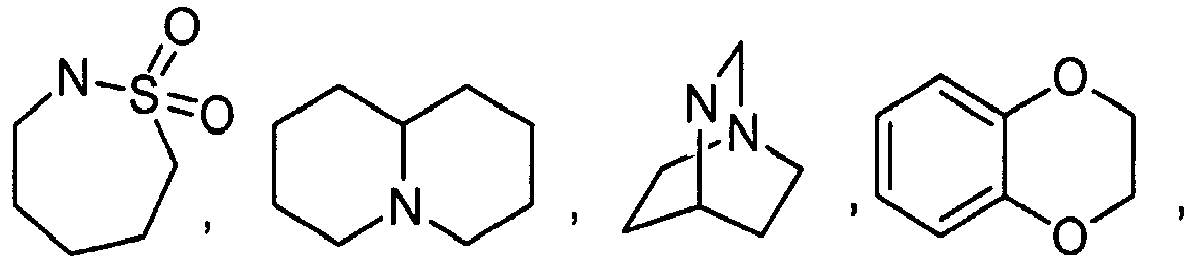
- The term "halogen" represents chlorine, fluorine, bromine or iodine. The term "halo" represents chloro, fluoro, bromo or iodo.
- The term "substituted" means that the specified group or moiety bears one or more substituents. The term "unsubstituted" means that the specified group bears no substituents. The term "optionally substituted" means that the specified group is unsubstituted or substituted by one or more substituents. Where the term "substituted" is used to describe a structural system, the substitution is meant to occur at any valency-allowed position on the system.
- Formula (I) is intended to represent compounds having structures depicted by the structural formula as well as certain variations or forms. In particular, compounds of Formula (I) may have asymmetric centers and therefore exist in different enantiomeric forms. All optical isomers and stereoisomers of the compounds of the general formula, and mixtures thereof, are considered within the scope of the formula. Thus Formula (I) is intended to represent a racemate, one or more enantiomeric forms, one or more diastereomeric forms, and mixtures thereof.
- Furthermore, certain structures depicted by Formula (I) may exist as geometric isomers (i.e., cis and trans isomers) or as tautomers. Additionally, Formula (I) is intended to represent hydrates, solvates, and polymorphs of such compounds, and mixtures thereof.
- Formula (I) is also intended to represent unlabeled forms as well as isotopically labeled forms of the compounds. Isotopically labeled compounds have structures depicted by Formula (I) except that one or more atoms are replaced by an atom having an atomic mass or mass number different from the atomic mass or mass number usually found in nature. Examples of isotopes that can be incorporated into compounds of the invention include isotopes of hydrogen, carbon, nitrogen, oxygen, sulfur, phosphorous, fluorine and chlorine, such as 2H, 3H, 11C, 13C, 14C, 15N, 18O, 17O, 31P, 32P, 35S, 18F, and 36Cl, respectively. Various isotopically labeled compounds of the present invention, for example those into which radioactive isotopes such as 3H, 11C, and 14C are incorporated, are useful in drug or substrate tissue distribution assays. Tritiated (i.e., 3H) and carbon-14 (i.e., 14C) isotopes are particularly preferred for their ease of preparation and detectability. Further, substitution with heavier isotopes such as deuterium (i.e., 2H) may afford certain therapeutic advantages resulting from greater metabolic stability, for example increased in vivo half-life or reduced dosage requirements. Isotopically labeled compounds of this invention and prodrugs thereof can generally be prepared by carrying out the procedures disclosed in the schemes or in the examples and preparations described below by substituting a readily available isotopically labeled reagent for a non-isotopically labeled reagent.
- When referring to Formula (I), the selection of a particular moiety from a list of possible species for a specified variable is not intended to define the moiety for the variable appearing elsewhere. In other words, where a variable appears more than once, the choice of the species from a specified list is independent of the choice of the species for the same variable elsewhere in the formula.
- In preferred embodiments of compounds of Formula (I), the variable Z is -N-.
- In other preferred embodiments, the variable R1 is -H, methyl, ethyl, isopropyl, propyl, or t-butyl. More preferably, R1 is -H. Alternatively, R1 is methyl.
- Preferably, Ar1 is 2-pyridyl, 3-pyridyl, 4-pyridyl, 2-pyrimidinyl, or 4-pyrimidinyl, each unsubstituted or substituted at a carbon ring atom with one or two Ra moieties as previously defined. Alternatively, Ar1 is 2-thiazolyl. In an alternate embodiment, Ar1 is phenyl unsubstituted or substituted at a carbon ring atom with one or two Ra moieties as previously defined. When Ar1 is 2-pyridyl, 3-pyridyl, 4-pyridyl, 2-pyrimidinyl, 4-pyrimidinyl, 5-pyrimidinyl, or phenyl, substituted with one or more Ra substituents, preferably each Ra is independently selected from methyl, ethyl, isopropyl, tert-butyl, vinyl, allyl, hydroxyl, methoxy, ethoxy, isopropoxy, fluoro, bromo, chloro, iodo, -CF3, -OCF3, methylsulfanyl, methylsulfoxy, methylsulfonyl, ethylsulfonyl, isopropylsulfonyl, methanesulfonyloxy, carbomethoxy, -CO2H, acetyl, propionyl, amino, methylamino, dimethylamino, ethylmethylamino, -SO2NH2, -SO2NHCH3, -NHSO2CH3, -C(=O)NH2, -C(=O)NHCH3, -NO2, and -CN. More preferably, Ra is independently selected from the group consisting of fluoro, bromo, iodo, methoxy, methyl, carbomethoxy, and carboxy. In some preferred embodiments, Ar1 is 2-fluorophenyl, 3-fluorophenyl, 4-fluorophenyl, 2,4-difluorophenyl, 2-chlorophenyl, 3-chlorophenyl, 4-chlorophenyl, 2-methylphenyl, 3-methylphenyl, 4-methylphenyl, 2-methoxyphenyl, 3-methoxyphenyl, 4-methoxyphenyl, 2-carbomethoxyphenyl, 3-carbomethoxyphenyl, 4-carbomethoxyphenyl, 2-carboxyphenyl, 3-carboxyphenyl, or unsubstituted phenyl.
- Preferably, the substituent on variable Ar2 designated as Re is methyl, ethyl, isopropyl, tert-butyl, vinyl, allyl, hydroxyl, methoxy, ethoxy, isopropoxy, fluoro, bromo, chloro, iodo, -CF3, -OCF3, methylsulfanyl, methylsulfoxy, methylsulfonyl, ethylsulfonyl, isopropylsulfonyl, methanesulfonyloxy, carbomethoxy, -CO2H, acetyl, propionyl, amino, methylamino, dimethylamino, ethylmethylamino, -SO2NH2, -SO2NHCH3, -NHSO2CH3, -C(=O)NH2, -C(=O)NHCH3, -NO2, or -CN.
- Preferably, Ar2 is phenanthren-9-yl, pyren-1-yl, 9H-fluoren-2-yl, 1-naphthyl, 2-naphthyl, 1-hydroxynaphthalen-2-yl, 6-methoxynaphthalen-2-yl, 9-ethyl-9H-carbazol-3-yl, furanyl, oxazolyl, isoxazolyl, 1,2,3-oxadiazolyl, 1,2,4-oxadiazolyl, 1,2,5-oxadiazolyl, 1,3,4-oxadiazolyl, thiophenyl, thiazolyl, isothiazolyl, pyrrolyl, imidazolyl, pyrazolyl, 1,2,3-triazolyl, 1,2,4-triazolyl, tetrazolyl, indolyl, benzofuranyl, benzothiophenyl, benzoxazolyl, benzothiazolyl, benzimidazolyl, indazolyl, imidazo[1,2-a]pyridinyl, pyrazolo[1,5-a]pyridinyl, 1 H-pyrrolo[3,2-b]pyridinyl, 1 H-pyrrolo[2,3-b]pyridinyl, 1 H-pyrrolo[3,2-c]pyridinyl, 1 H-pyrrolo[2,3-c]pyridinyl, 1 H-pyrrolo[3,2-b]pyridinyl, isoquinolinyl, quinolinyl, quinoxalinyl, quinazolinyl, indanyl, indenyl, tetrahydronaphthyl, 2,3-dihydro-benzofuranyl, chromanyl, 2,3-dihydro-benzo[1,4]dioxinyl, and 2,2-difluoro-benzo[1,3]dioxolyl, pyrimidinyl, pyrazinyl, or pyridyl, each unsubstituted or substituted with one, two, or three Re substituents as previously defined.
- More preferably, Ar2 is 1-phenyl-1 H-pyrrolyl, 2-pyridyl, 3-pyridyl, 4-pyridyl, or 6-bromo-pyridin-2-yl, each unsubstituted or substituted with one, two, or three Re substituents as previously defined. In other more preferred embodiments, Ar2 is unsubstituted 2,2-difluoro-benzo[1,3]dioxolyl or unsubstituted 4-benzo[1,3]dioxolyl. More preferably, Ar2 is 2-indolyl, 3-indolyl, 2-quinolinyl, 3-quinolinyl, or 2-quinoxalinyl, each unsubstituted or substituted with one, two, or three Re substituents as previously defined. Even more preferably, Ar2 is 2-quinolinyl or 3-quinolinyl.
- In alternative embodiments, Ar2 is phenyl, substituted at the 3- or 4-position with a moiety selected from the group consisting of ethyl, propyl, isopropyl, butyl, isobutyl, pentyl, hexyl, octyl, vinyl, allyl, cyclopropyloxy, cyclobutyloxy, cyclopentyloxy, cyclohexyloxy, cycloheptyloxy, 2-dimethylaminoethoxy, 2-dimethylaminopropoxy, 4-piperidinyloxy, ethoxy, propoxy, isopropoxy, isobutyloxy, pentyloxy, hexyloxy, heptyloxy, octyloxy, nonyloxy, decyloxy, 2-piperidin-1-ylethoxy, and 3-piperidin-1-ylpropoxy.
- Preferably, Ri and Rj are each independently selected from the group consisting of hydrogen, methyl, ethyl, propyl, isopropyl, butyl, isobutyl, and t-butyl.
- Alternatively, Ri and Rj are taken together with the nitrogen ring atom of attachment to form a ring selected from the group consisting of pyrrolidinyl, pyrazolinyl, piperidinyl, homopiperidinyl, azepanyl, tetrahydrofuranyl, tetrahydropyranyl, piperazinyl, morpholinyl, and thiomorpholinyl.
- Preferably, Ar2 is 4-ethylphenyl, 4-isopropylphenyl, 3-vinylphenyl, 3-ethoxyphenyl, 4-ethoxyphenyl, 3-propoxyphenyl, 4-propoxyphenyl, 3-isobutoxyphenyl, 4-isopropoxyphenyl, 3-isobutoxyphenyl, 4-isobutoxyphenyl, 4-cyclohexyloxyphenyl, 3-(2-dimethylaminoethoxy)phenyl, 3-(2-piperidin-1-ylethoxy)phenyl, 3-(3-dimethylaminopropoxy)phenyl, or 3-(3-piperidin-1-ylpropoxy)phenyl.
- Preferably, L is methylene, ethylene, propylene, alkenylene, -O-, methylenyloxy, -NH-, >NC1-4alkyl, -S-, -S(=O)-, -S(=O)2-, -OSO2-, alkynylene, or a covalent bond. More preferably, L is -CH=CH-, -O-,-OCH2-, -SO2- -OSO2-, or a covalent bond.
- Preferably, Ar3 is phenyl, naphthyl, phenanthrenyl, pyridyl, pyrimidinyl, pyrazinyl, furanyl, oxazolyl, isoxazolyl, 1,2,3-oxadiazolyl, 1,2,4-oxadiazolyl, 1,2,5-oxadiazolyl, 1,3,4-oxadiazolyl, thiophenyl, thiazolyl, isothiazolyl, pyrrolyl, imidazolyl, pyrazolyl, 1,2,3-triazolyl, 1,2,4-triazolyl, tetrazolyl, indolyl, benzofuranyl, benzothiophenyl, benzoxazolyl, benzothiazolyl, benzimidazolyl, indazolyl, imidazo[1,2-a]pyridinyl, pyrazolo[1,5-a]pyridinyl, 1 H-pyrrolo[3,2-b]pyridinyl, 1 H-pyrrolo[2,3-b]pyridinyl, 1 H-pyrrolo[3,2-c]pyridinyl, 1 H-pyrrolo[2,3-c]pyridinyl, 1 H-pyrrolo[3,2-b]pyridinyl, isoquinolinyl, quinolinyl, quinoxalinyl, or quinazolinyl.
- More preferably, Ar3 is phenyl, 4-chlorophenyl, 3,4-dichlorophenyl, 4-methylphenyl, 4-t-butylphenyl, 3-trifluoromethylphenyl, 4-methoxyphenyl, 3,5-dichlorophenyl, 1-naphthyl, 2-naphthyl, 3-chlorophenyl, 9-phenanthrenyl, 4-carbomethoxylphenyl, 4-methanesulfonylphenyl, 3-methoxyphenyl, or benzo[1,3]dioxol-5-yl.
- Preferably, Ar2 is 2-hydroxyphenyl, unsubstituted or substituted with a moiety selected from the group consisting of methyl, 6-ethyl, 6-isopropyl, 6-tert-butyl, 6-vinyl, 6-allyl, hydroxyl, methoxy, 6-ethoxy, 6-isopropoxy, fluoro, bromo, chloro, iodo, -CF3, -OCF3, methylsulfanyl, methylsulfoxy, methylsulfonyl, ethylsulfonyl, isopropylsulfonyl, carbomethoxy, -CO2H, acetyl, propionyl, amino, methylamino, dimethylamino, ethylmethylamino, -SO2NH2, -SO2NHCH3, -NHSO2CH3, -C(=O)NH2, -C(=O)NHCH3, -NO2, and -CN. Alternatively, Ar2 is 2-methoxyphenyl, optionally substituted as described above.
- More preferably, Ar2 is 2-hydroxyphenyl, 5-bromo-2-hydroxy-3-methoxyphenyl, or 5-bromo-2-hydroxyphenyl.
- Preferably, Ar2 is 4-halophenyl, unsubstituted or substituted with a moiety selected from the group consisting of methyl, 2-ethyl, 2-isopropyl, 2-tert-butyl, 2-vinyl, 2-allyl, 3-hydroxy, 4-hydroxy, methoxy, 2-ethoxy, 2-isopropoxy, fluoro, bromo, chloro, iodo, -CF3, -OCF3, methylsulfanyl, methylsulfoxy, methylsulfonyl, ethylsulfonyl, isopropylsulfonyl, carbomethoxy, -CO2H, acetyl, propionyl, amino, methylamino, dimethylamino, ethylmethylamino, -SO2NH2, -SO2NHCH3, -NHSO2CH3, -C(=O)NH2, -C(=O)NHCH3, -NO2, and -CN; and Ar1 is phenyl.
- More preferably, Ar2 is 3,4-dibromophenyl, 3-bromo-4-fluorophenyl, or 4-chloro-3-trifluoromethyl. Alternatively, Ar2 is 3,4-dichlorophenyl.
- Even more preferably, Ar2 is 3,4-dibromophenyl.
- Preferred compounds of the present invention include the following:
- 4-Naphthalen-2-ylmethyl-piperazine-1-carboxylic acid phenylamide;
- 4-Quinolin-2-ylmethyl-piperazine-1-carboxylic acid phenylamide;
- 4-Benzo[b]thiophen-2-ylmethyl-piperazine-1-carboxylic acid phenylamide;
- 4-(3,4-Dibromo-benzyl)-piperazine-1-carboxylic acid phenylamide;
- 4-(1-Methyl-1H-indol-2-ylmethyl)-piperazine-1-carboxylic acid phenylamide;
- 4-Quinolin-3-ylmethyl-piperazine-1-carboxylic acid phenylamide;
- 4-(4-lodo-benzyl)-piperazine-1-carboxylic acid phenylamide;
- 4-(3-Benzyloxy-benzyl)-piperazine-1-carboxylic acid phenylamide;
- 4-(5-Bromo-2-hydroxy-3-methoxy-benzyl)-piperazine-1-carboxylic acid phenylamide;
- 4-(4-Bromo-benzyl)-piperazine-1-carboxylic acid phenylamide;
- 4-(3-Phenoxy-benzyl)-piperazine-1-carboxylic acid phenylamide;
- 4-(3-Bromo-4-fluoro-benzyl)-piperazine-1-carboxylic acid phenylamide;
- 4-Indan-5-ylmethyl-piperazine-1-carboxylic acid phenylamide;
- 4-Benzo[b]thiophen-3-ylmethyl-piperazine-1-carboxylic acid phenylamide;
- 4-(4-Isopropyl-benzyl)-piperazine-1-carboxylic acid phenylamide;
- 4-(4-Ethyl-benzyl)-piperazine-1-carboxylic acid phenylamide;
- 4-(5-Bromo-2-hydroxy-benzyl)-piperazine-1-carboxylic acid phenylamide;
- 4-(2,3-Dihydro-benzo[1,4]dioxin-6-ylmethyl)-piperazine-1-carboxylic acid phenylamide;
- 4-(4-Methoxy-benzyl)-piperazine-1-carboxylic acid phenylamide;
- 4-(3-Vinyl-benzyl)-piperazine-1-carboxylic acid phenylamide;
- 4-(2,3-Dihydro-benzofuran-5-ylmethyl)-piperazine-1-carboxylic acid phenylamide;
- 4-(3-Methoxy-benzyl)-piperazine-1-carboxylic acid phenylamide;
- 4-Naphthalen-1-ylmethyl-piperazine-1-carboxylic acid phenylamide;
- 4-(2-Hydroxy-benzyl)-piperazine-1-carboxylic acid phenylamide;
- 4-(3-Methyl-benzyl)-piperazine-1-carboxylic acid phenylamide;
- 4-(1H-Indol-5-ylmethyl)-piperazine-1-carboxylic acid phenylamide;
- 4-(3,4-Dimethoxy-benzyl)-piperazine-1-carboxylic acid phenylamide;
- 4-Pyridin-4-ylmethyl-piperazine-1-carboxylic acid phenylamide;
- 4-Pyridin-2-ylmethyl-piperazine-1-carboxylic acid phenylamide;
- 4-Pyridin-3-ylmethyl-piperazine-1-carboxylic acid phenylamide;
- 4-(4-Isopropoxy-benzyl)-piperazine-1-carboxylic acid phenylamide;
- 4-Biphenyl-4-ylmethyl-piperazine-1-carboxylic acid phenylamide;
- 4-Quinolin-4-ylmethyl-piperazine-1-carboxylic acid phenylamide;
- 4-Benzo[1,3]dioxol-4-ylmethyl-piperazine-1-carboxylic acid phenylamide;
- 4-(2,2-Difluoro-benzo[1,3]dioxol-5-ylmethyl)-piperazine-1-carboxylic acid phenylamide;
- 4-(1-Methyl-1H-indol-5-ylmethyl)-piperazine-1-carboxylic acid phenylamide;
- 4-(6-Chloro-quinolin-2-ylmethyl)-piperazine-1-carboxylic acid phenylamide;
- 4-(8-Chloro-quinolin-2-ylmethyl)-piperazine-1-carboxylic acid phenylamide;
- 4-(2-Chloro-quinolin-3-ylmethyl)-piperazine-1-carboxylic acid phenylamide;
- 4-Naphthalen-2-ylmethyl-piperazine-1-carboxylic acid (4-fluoro-phenyl)-amide;
- 4-Quinolin-2-ylmethyl-piperazine-1-carboxylic acid (4-fluoro-phenyl)-amide;
- 4-(1-Hydroxy-naphthalen-2-ylmethyl)-piperazine-1-carboxylic acid phenylamide;
- 4-[3-(4-Chloro-phenoxy)-benzyl]-piperazine-1-carboxylic acid phenylamide;
- 4-[3-(3,4-Dichloro-phenoxy)-benzyl]-piperazine-1-carboxylic acid phenylamide;
- 4-(3-p-Tolyloxy-benzyl)-piperazine-1-carboxylic acid phenylamide;
- 4-[3-(4-tert-Butyl-phenoxy)-benzyl]-piperazine-1-carboxylic acid phenylamide;
- 4-[3-(3-Trifluoromethyl-phenoxy)-benzyl]-piperazine-1-carboxylic acid phenylamide;
- 4-[3-(4-Methoxy-phenoxy)-benzyl]-piperazine-1-carboxylic acid phenylamide;
- 4-(6-Methoxy-naphthalen-2-ylmethyl)-piperazine-1-carboxylic acid phenylamide;
- 4-Phenanthren-9-ylmethyl-piperazine-1-carboxylic acid phenylamide;
- 4-Pyren-1-ylmethyl-piperazine-1-carboxylic acid phenylamide;
- 4-(6-Chloro-quinolin-3-ylmethyl)-piperazine-1-carboxylic acid phenylamide;
- 4-Biphenyl-3-ylmethyl-piperazine-1-carboxylic acid phenylamide;
- 4-(6-Bromo-pyridin-2-ylmethyl)-piperazine-1-carboxylic acid phenylamide;
- 4-[3-(4-Chloro-benzenesulfonyl)-benzyl]-piperazine-1-carboxylic acid phenylamide;
- 4-(1 H-Indol-6-ylmethyl)-piperazine-1-carboxylic acid phenylamide;
- 4-(4-Phenoxy-benzyl)-piperazine-1-carboxylic acid phenylamide;
- 4-(2-Chloro-8-methyl-quinolin-3-ylmethyl)-piperazine-1-carboxylic acid phenylamide;
- 4-(1-Methyl-1H-indol-6-ylmethyl)-piperazine-1-carboxylic acid phenylamide;
- 4-(4-Benzyloxy-benzyl)-piperazine-1-carboxylic acid phenylamide;
- 4-[3-(3,5-Dichloro-phenoxy)-benzyl]-piperazine-1-carboxylic acid phenylamide;
- 4-(9H-Fluoren-2-ylmethyl)-piperazine-1-carboxylic acid phenylamide;
- 4-(9-Ethyl-9H-carbazol-3-ylmethyl)-piperazine-1-carboxylic acid phenylamide;
- 4-(4-Styryl-benzyl)-piperazine-1-carboxylic acid phenylamide;
- 4-(4-Chloro-3-trifluoromethyl-benzyl)-piperazine-1-carboxylic acid phenylamide;
- 4-[2,5-Dimethyl-1-(3-trifluoromethyl-phenyl)-1H-pyrrol-3-ylmethyl]-piperazine-1-carboxylic acid phenylamide;
- 4-(2-Bromo-benzyl)-piperazine-1-carboxylic acid phenylamide;
- 4-(3,4-Dibromo-benzyl)-piperazine-1-carboxylic acid (3-fluoro-phenyl)-amide;
- 4-(3,4-Dibromo-benzyl)-piperazine-1-carboxylic acid (4-fluoro-phenyl)-amide;
- 4-(3,4-Dibromo-benzyl)-piperazine-1-carboxylic acid (3-methoxy-phenyl)-amide;
- 4-(3,4-Dibromo-benzyl)-piperazine-1-carboxylic acid m-tolylamide;
- 4-(3,4-Dibromo-benzyl)-piperazine-1-carboxylic acid (2-fluoro-phenyl)-amide;
- 4-(3,4-Dibromo-benzyl)-piperazine-1-carboxylic acid (4-methoxy-phenyl)-amide;
- 4-(3,4-Dibromo-benzyl)-piperazine-1-carboxylic acid (2-methoxy-phenyl)-amide;
- 4-(3,4-Dibromo-benzyl)-piperazine-1-carboxylic acid (3-chloro-phenyl)-amide;
- 4-(3,4-Dibromo-benzyl)-piperazine-1-carboxylic acid (2-chloro-phenyl)-amide;
- 4-(3,4-Dibromo-benzyl)-piperazine-1-carboxylic acid p-tolylamide;
- 4-(3,4-Dibromo-benzyl)-piperazine-1-carboxylic acid (4-chloro-phenyl)-amide;
- 4-(3,4-Dibromo-benzyl)-piperazine-1-carboxylic acid o-tolylamide;
- 4-Quinolin-3-ylmethyl-piperazine-1-carboxylic acid (3-fluoro-phenyl)-amide;
- 4-Quinolin-3-ylmethyl-piperazine-1-carboxylic acid (4-fluoro-phenyl)-amide;
- 4-Quinolin-3-ylmethyl-piperazine-1-carboxylic acid (2-chloro-phenyl)-amide;
- 4-Quinolin-3-ylmethyl-piperazine-1-carboxylic acid (3-chloro-phenyl)-amide;
- 4-Quinolin-3-ylmethyl-piperazine-1-carboxylic acid (4-chloro-phenyl)-amide;
- 4-Quinolin-3-ylmethyl-piperazine-1-carboxylic acid (2-methoxy-phenyl)-amide;
- 4-Quinolin-3-ylmethyl-piperazine-1-carboxylic acid o-tolylamide;
- 4-Quinolin-3-ylmethyl-piperazine-1-carboxylic acid p-tolylamide;
- 2-[(4-Quinolin-3-ylmethyl-piperazine-1-carbonyl)-amino]-benzoic acid methyl ester;
- 3-[(4-Quinolin-3-ylmethyl-piperazine-1-carbonyl)-amino]-benzoic acid methyl ester;
- 4-[(4-Quinolin-3-ylmethyl-piperazine-1-carbonyl)-amino]-benzoic acid methyl ester;
- 4-Quinolin-3-ylmethyl-piperazine-1-carboxylic acid (4-methoxy-phenyl)-amide;
- 4-Quinolin-3-ylmethyl-piperazine-1-carboxylic acid m-tolylamide;
- 4-Quinolin-3-ylmethyl-piperazine-1-carboxylic acid (3-methoxy-phenyl)-amide;
- 4-Quinolin-3-ylmethyl-piperazine-1-carboxylic acid (2,4-difluoro-phenyl)-amide;
- 4-Quinolin-3-ylmethyl-piperazine-1-carboxylic acid (2-fluoro-phenyl)-amide;
- 4-Benzyl-piperidine-1-carboxylic acid p-tolylamide;
- 4-Benzyl-piperidine-1-carboxylic acid m-tolylamide;
- 4-Benzyl-piperidine-1-carboxylic acid (2-chloro-phenyl)-amide;
- 4-(3,4-Dibromo-benzyl)-piperazine-1-carboxylic acid pyridin-4-ylamide;
- 4-(3,4-Dibromo-benzyl)-piperazine-1-carboxylic acid pyridin-2-ylamide;
- 4-(3,4-Dibromo-benzyl)-piperazine-1-carboxylic acid pyridin-3-ylamide;
- 4-(4-Cyclohexyloxy-benzyl)-piperazine-1-carboxylic acid phenylamide;
- 4-(3-Propoxy-benzyl)-piperazine-1-carboxylic acid phenylamide;
- 4-(3-Isobutoxy-benzyl)-piperazine-1-carboxylic acid phenylamide;
- 4-(3-Ethoxy-benzyl)-piperazine-1-carboxylic acid phenylamide;
- 4-(4-Propoxy-benzyl)-piperazine-1-carboxylic acid phenylamide;
- 4-(4-Isobutoxy-benzyl)-piperazine-1-carboxylic acid phenylamide;
- 4-[3-(2-Dimethylamino-ethoxy)-benzyl]-piperazine-1-carboxylic acid phenylamide;
- 4-[3-(2-Piperidin-1-yl-ethoxy)-benzyl]-piperazine-1-carboxylic acid phenylamide;
- 4-[3-(3-Dimethylamino-propoxy)-benzyl]-piperazine-1-carboxylic acid phenylamide;
- 4-[3-(3-Piperidin-1-yl-propoxy)-benzyl]-piperazine-1-carboxylic acid phenylamide;
- 4-(4-Ethoxy-benzyl)-piperazine-1-carboxylic acid phenylamide;
- 4-[3-(3-Chloro-phenoxy)-benzyl]-piperazine-1-carboxylic acid phenylamide;
- 4-[3-(Naphthalen-2-yloxy)-benzyl]-piperazine-1-carboxylic acid phenylamide;
- 4-[3-(Phenanthren-9-yloxy)-benzyl]-piperazine-1-carboxylic acid phenylamide;
- 4-[3-(4-Phenylcarbamoyl-piperazin-1-ylmethyl)-phenoxy]-benzoic acid methyl ester;
- 4-[3-(4-Methanesulfonyl-phenoxy)-benzyl]-piperazine-1-carboxylic acid phenylamide;
- 4-[3-(3-Methoxy-phenoxy)-benzyl]-piperazine-1-carboxylic acid phenylamide;
- 4-[3-(Benzo[1,3]dioxol-5-yloxy)-benzyl]-piperazine-1-carboxylic acid phenylamide;
- Methanesulfonic acid 3-(4-phenylcarbamoyl-piperazin-1-ylmethyl)-phenyl ester;
- Benzenesulfonic acid 3-(4-phenylcarbamoyl-piperazin-1-ylmethyl)-phenyl ester;
- 4-Chloro-benzenesulfonic acid 3-(4-phenylcarbamoyl-piperazin-1-ylmethyl)-phenyl ester;
- 2-[(4-Quinolin-3-ylmethyl-piperazine-1-carbonyl)-amino]-benzoic acid (potassium salt);
- 3-[(4-Quinolin-3-ylmethyl-piperazine-1-carbonyl)-amino]-benzoic acid (potassium salt);
- 4-Quinolin-3-ylmethyl-piperazine-1-carboxylic acid pyridin-3-ylamide;
- 4-Quinolin-3-ylmethyl-piperazine-1-carboxylic acid pyridin-2-ylamide;
- 4-Quinolin-3-ylmethyl-piperazine-1-carboxylic acid pyridin-4-ylamide;
- 4-Quinolin-3-ylmethyl-piperazine-1-carboxylic acid pyrimidin-2-ylamide;
- 4-Benzo[1,3]dioxol-5-ylmethyl-piperazine-1-carboxylic acid pyridin-3-ylamide;
- 4-Benzo[1,3]dioxol-5-ylmethyl-piperazine-1-carboxylic acid pyridin-4-ylamide;
- 4-Benzo[1,3]dioxol-5-ylmethyl-piperazine-1-carboxylic acid pyrimidin-2-ylamide;
- 4-Benzo[1,3]dioxol-5-ylmethyl-piperazine-1-carboxylic acid pyridin-2-ylamide;
- 4-(2,2-Difluoro-benzo[1,3]dioxol-5-ylmethyl)-piperazine-1-carboxylic acid pyridin-3-ylamide;
- 4-(2,2-Difluoro-benzo[1,3]dioxol-5-ylmethyl)-piperazine-1-carboxylic acid pyridin-4-ylamide;
- 4-Quinolin-3-ylmethyl-piperazine-1-carboxylic acid pyrimidin-4-ylamide;
- 4-(2,2-Difluoro-benzo[1,3]dioxol-5-ylmethyl)-piperazine-1-carboxylic acid pyrimidin-4-ylamide;
- 4-(3,4-Dibromo-benzyl)-piperazine-1-carboxylic acid pyrimidin-4-ylamide;
- 4-[(4-Quinolin-3-ylmethyl-piperazine-1-carbonyl)-amino]-benzoic acid;
- 4-Quinoxalin-2-ylmethyl-piperazine-1-carboxylic acid phenylamide;
- 4-(3,4-Dichloro-benzyl)-piperazine-1-carboxylic acid phenylamide;
- 4-Quinolin-3-ylmethyl-piperazine-1-carboxylic acid thiazol-2-ylamide;
- 4-Benzo[1,3]dioxol-5-ylmethyl-piperazine-1-carboxylic acid thiazol-2-ylamide;
- 4-(3,4-Dibromo-benzyl)-piperazine-1-carboxylic acid methyl-phenyl-amide;
- 4-(2-Methoxy-benzyl)-piperazine-1-carboxylic acid phenylamide;
- 4-Benzofuran-2-ylmethyl-piperazine-1-carboxylic acid phenylamide;
- 4-(3,4-Dibromo-benzyl)-piperazine-1-carboxylic acid (4-nitro-phenyl)-amide;
- 4-(3,4-Dibromo-benzyl)-piperazine-1-carboxylic acid (4-trifluoromethyl-phenyl)-amide;
- 4-(5-Bromo-2-hydroxy-3-methoxy-benzyl)-piperazine-1-carboxylic acid phenylamide hydrochloride;
- 4-(3,4-Dibromo-benzyl)-piperazine-1-carboxylic acid phenylamide hydrochloride;
- 4-Quinolin-2-ylmethyl-piperazine-1-carboxylic acid phenylamide dihydrochloride;
- 4-Benzo[1,3]dioxol-5-ylmethyl-piperazine-1-carboxylic acid phenylamide;
- 4-Benzo[1,3]dioxol-5-ylmethyl-piperazine-1-carboxylic acid phenylamide hydrochloride; and
- 4-Benzo[1,3]dioxol-5-ylmethyl-piperazine-1-carboxylic acid (4-fluoro-phenyl)-amide.
- The invention includes also pharmaceutically acceptable salts of the compounds represented by Formula (I), such as of those described above. Pharmaceutically acceptable salts of the specific compounds exemplified herein are especially preferred.
- A "pharmaceutically acceptable salt" is intended to mean a salt of a free acid or base of a compound represented by Formula (I) that is not toxic, biologically intolerable, or otherwise biologically undesirable. See, generally, e.g., S.M. Berge, et al., "Pharmaceutical Salts", J. Pharm. Sci., 1977, 66:1-19, and Handbook of Pharmaceutical Salts, Propertions, Selection, and Use; Stahl, P.H., Wermuth, C.G., Eds.; Wiley-VCH and VHCA: Zurich, 2002. Preferred pharmaceutically acceptable salts are those that are pharmacologically effective and suitable for contact with the tissues of patients without undue toxicity, irritation, or allergic response. A compound of Formula (I) may possess a sufficiently acidic group, a sufficiently basic group, or both types of functional groups, and accordingly react with a number of inorganic or organic bases, and inorganic and organic acids, to form a pharmaceutically acceptable salt. Exemplary pharmaceutically acceptable salts include sulfates, pyrosulfates, bisulfates, sulfites, bisulfites, phosphates, monohydrogen-phosphates, dihydrogenphosphates, metaphosphates, pyrophosphates, chlorides, bromides, iodides, acetates, propionates, decanoates, caprylates, acrylates, formates, isobutyrates, caproates, heptanoates, propiolates, oxalates, malonates, succinates, suberates, sebacates, fumarates, maleates, butyne-1,4-dioates, hexyne-1,6-dioates, benzoates, chlorobenzoates, methylbenzoates, dinitrobenzoates, hydroxybenzoates, methoxybenzoates, phthalates, sulfonates, xylenesulfonates, phenylacetates, phenylpropionates, phenylbutyrates, citrates, lactates, γ-hydroxybutyrates, glycolates, tartrates, methane-sulfonates, propanesulfonates, naphthalene-1-sulfonates, naphthalene-2-sulfonates, and mandelates.
- If the compound of Formula (I) contains a basic nitrogen, the desired pharmaceutically acceptable salt may be prepared by any suitable method available in the art, for example, treatment of the free base with an inorganic acid, such as hydrochloric acid, hydrobromic acid, sulfuric acid, sulfamic acid, nitric acid, boric acid, phosphoric acid, and the like, or with an organic acid, such as acetic acid, phenylacetic acid, propionic acid, stearic acid, lactic acid, ascorbic acid, maleic acid, hydroxymaleic acid, isethionic acid, succinic acid, valeric acid, fumaric acid, malonic acid, pyruvic acid, oxalic acid, glycolic acid, salicylic acid, oleic acid, palmitic acid, lauric acid, a pyranosidyl acid, such as glucuronic acid or galacturonic acid, an alpha-hydroxy acid, such as mandelic acid, citric acid, or tartaric acid, an amino acid, such as aspartic acid or glutamic acid, an aromatic acid, such as benzoic acid, 2-acetoxybenzoic acid, naphthoic acid, or cinnamic acid, a sulfonic acid, such as laurylsulfonic acid, p-toluenesulfonic acid, methanesulfonic acid, or ethanesulfonic acid, or the like.
- If the compound of Formula (I) is an acid, such as a carboxylic acid or sulfonic acid, the desired pharmaceutically acceptable salt may be prepared by any suitable method, for example, treatment of the free acid with an inorganic or organic base, such as an amine (primary, secondary or tertiary), an alkali metal hydroxide, or alkaline earth metal hydroxide, or the like. Illustrative examples of suitable salts include organic salts derived from amino acids, such as glycine and arginine, ammonia, carbonates, bicarbonates, primary, secondary, and tertiary amines, and cyclic amines, such as benzylamines, pyrrolidines, piperidine, morpholine, and piperazine, and inorganic salts derived from sodium, calcium, potassium, magnesium, manganese, iron, copper, zinc, aluminum, and lithium.
- The invention also relates to treatment methods employing pharmaceutically acceptable prodrugs of the compounds of Formula (I). The term "prodrug" means a precursor of a designated compound that, following administration to a subject, yields the compound in vivo via a chemical or physiological process such as solvolysis or physiological conditions (e.g., a prodrug on being brought to physiological pH is converted to the compound of Formula (I)). A "pharmaceutically acceptable prodrug" is a prodrug that is not toxic, biologically intolerable, or otherwise biologically unsuitable for administration to the subject. Illustrative procedures for the selection and preparation of suitable prodrug derivatives are described, for example, in "Design of Prodrugs", ed. H. Bundgaard, Elsevier, 1985.
- Exemplary prodrugs include compounds having an amino acid residue, or a polypeptide chain of two or more (e.g., two, three or four) amino acid residues, covalently joined through an amide or ester bond to a free amino, hydroxy or carboxylic acid group of a compound of Formula (I). Examples of amino acid residues include the twenty naturally occurring amino acids commonly designated by three letter symbols as well as 4-hydroxyproline, hydroxylysine, demosine, isodemosine, 3-methylhistidine, norvalin, beta-alanine, gamma-aminobutyric acid, citrulline homocysteine, homoserine, ornithine and methionine sulfone.
- Additional types of prodrugs may be produced, for instance, by derivatizing free carboxyl groups of structures of Formula (I) as amides or alkyl esters. Exemplary amides include those derived from ammonia, primary C1-6alkyl amines and secondary di(C1-6alkyl) amines. Secondary amines include 5- or 6-membered heterocycloalkyl or heteroaryl ring moieties having from 1 to 3 heteroatoms where at least one is a nitrogen atom. Preferred amides are derived from ammonia, C1-3alkyl primary amines, and di(C1-2alkyl)amines. Exemplary esters of the invention include C1-7alkyl, C5-7carbocyclyl, phenyl, and phenyl(C1-6alkyl) esters. Preferred esters include methyl esters. Prodrugs may also be prepared by derivatizing free hydroxy groups using groups including hemisuccinates, phosphate esters, dimethylaminoacetates, and phosphoryloxymethyloxycarbonyls, following procedures such as those outlined in Adv. Drug Delivery Rev. 1996, 19, 115. Carbamate derivatives of hydroxy and amino groups may also yield prodrugs. Carbonate derivatives, sulfonate esters and sulfate esters of hydroxy groups may also provide prodrugs. Derivatization of hydroxy groups as (acyloxy)methyl and (acyloxy)ethyl ethers, wherein the acyl group may be an alkyl ester, optionally substituted with one or more ether, amine or carboxylic acid functionalities, or where the acyl group is an amino acid ester as described above, is also useful to yield prodrugs. Prodrugs of this type may be prepared as described in J. Med. Chem. 1996, 39, 10. Free amines can also be derivatized as amides, sulfonamides or phosphonamides. All of these prodrug moieties may incorporate groups including ether, amine and carboxylic acid functionalities.
- Pharmaceutically active metabolites may also be used in the methods of the invention. A "pharmaceutically active metabolite" means a pharmacologically active product of metabolism in the body of a compound of Formula (I) or salt thereof. Prodrugs and active metabolites of a compound may be determined using routine techniques known or available in the art. See, e.g., Bertolini et al., J. Med. Chem. 1997, 40, 2011-2016; Shan et al., J. Pharm. Sci. 1997, 86 (7), 765-767; Bagshawe, Drug Dev. Res. 1995, 34, 220-230; Bodor, Adv. Drug Res. 1984, 13, 224-331; Bundgaard, Design of Prodrugs (Elsevier Press, 1985 ); and Larsen, Design and Application of Prodrugs, Drug Design and Development (Krogsgaard-Larsen et al., eds., Harwood Academic Publishers, 1991 ).
- The compounds of Formula (I) and their pharmaceutically acceptable salts, pharmaceutically acceptable prodrugs, and pharmaceutically active metabolites (collectively, "agents") of the present invention are useful as FAAH inhibitors in the methods of the invention. The agents may be used in the inventive methods for the treatment or prevention of medical conditions, diseases, or disorders mediated through inhibition or modulation of FAAH, such as those described herein. Agents according to the invention may therefore be used as an analgesic, neuroprotectant, sedative, appetite stimulant, or contraceptive.
- Exemplary medical conditions, diseases, and disorders include anxiety, pain, sleep disorders, eating disorders, inflammation, multiple sclerosis and other movement disorders, HIV wasting syndrome, closed head injury, stroke, Alzheimer's disease, epilepsy, Tourette's syndrome, epilepsy, Niemann-Pick disease, Parkinson's disease, Huntington's chorea, optic neuritis, autoimmune uveitis, symptoms of drug withdrawal, nausea, emesis, sexual dysfunction, post-traumatic stress disorder, or cerebral vasospasm.
- Thus, the pharmaceutical agents may be used to treat subjects diagnosed with or suffering from a disorder or condition mediated through FAAH activity. The term "treat" or "treating" as used herein is intended to refer to administration of an agent or composition of the invention to a subject for the purpose of effecting a therapeutic or prophylactic benefit through modulation of FAAH activity. Treating includes reversing, ameliorating, alleviating, inhibiting the progress of, lessening the severity of, or preventing a disease, disorder or condition, or one or more symptoms of such disease, disorder or condition mediated through modulation of FAAH activity. The term "subject" refers to a mammalian patient in need of such treatment, such as a human. "Modulators" include both inhibitors and activators, where "inhibitors" refer to compounds that decrease, prevent, inactivate, desensitize or down-regulate FAAH expression or activity, and "activators" are compounds that increase, activate, facilitate, sensitize or up-regulate FAAH expression or activity.
- Accordingly, the invention relates to methods of using the pharmaceutical agents described herein to treat subjects diagnosed with or suffering from a disorder or condition mediated through FAAH activity, such as: anxiety, pain, sleep disorders, eating disorders, inflammation, or movement disorders (e.g., multiple sclerosis).
- Symptoms or disease states are intended to be included within the scope of "medical conditions, disorders, or diseases." For example, pain may be associated with various diseases and disorders, and may include various etiologies. Illustrative types of pain treatable with a FAAH-modulating agent according to the invention include cancer pain, postoperative pain, GI tract pain, spinal cord injury pain, visceral hyperalgesia, thalamic pain, headache (including stress headache and migraine), low back pain, neck pain, musculoskeletal pain, peripheral neuropathic pain, central neuropathic pain, neurogenerative disorder related pain, and menstrual pain. HIV wasting syndrome includes associated symptoms such as appetite loss and nausea. Parkinson's disease includes, for example, levodopa-induced dyskinesia. Treatment of multiple sclerosis may include treatment of symptoms such as spasticity, neurogenic pain, central pain, or bladder dysfunction. Symptoms of drug withdrawal may be caused by, for example, addiction to opiates or nicotine. Nausea or emesis may be due to chemotherapy, postoperative, or opioid related causes. Treatment of sexual dysfunction may include improving libido or delaying ejaculation. Treatment of cancer may include treatment of glioma. Sleep disorders include, for example, sleep apnea, insomnia, and disorders calling for treatment with an agent having a sedative or narcotic-type effect. Eating disorders include, for example, anorexia or appetite loss associated with a disease such as cancer or HIV infection/AIDS.
- In a treatment method according to the invention, an effective amount of a pharmaceutical agent according to the invention is administered to a subject suffering from or diagnosed as having such a disease, disorder or condition. An "effective amount" means an amount or dose sufficient to generally bring about the desired therapeutic or prophylactic benefit in patients in need of such treatment.
- Effective amounts or doses of the agents of the present invention may be ascertained by routine methods such as modeling, dose escalation studies or clinical trials, and by taking into consideration routine factors, e.g., the mode or route of administration or drug delivery, the pharmacokinetics of the agent, the severity and course of the disorder or condition, the subject's previous or ongoing therapy, the subject's health status and response to drugs, and the judgment of the treating physician. An exemplary dose is in the range of from about 0.001 to about 200 mg of agent per kg of subject's body weight per day, preferably about 0.05 to 100 mg/kg/day, or about 1 to 35 mg/kg/day, in single or divided dosage units (e.g., BID, TID, QID). For a 70-kg human, an illustrative range for a suitable dosage amount is from about 0.05 to about 7 g/day, or about 0.2 to about 2.5 g/day.
- Once improvement of the patient's conditions has occurred, the dose may be adjusted for preventative or maintenance treatment. For example, the dosage or the frequency of administration, or both, may be reduced as a function of the symptoms, to a level at which the desired therapeutic or prophylactic effect is maintained. Of course, if symptoms have been alleviated to an appropriate level, treatment may cease. Patients may, however, require intermittent treatment on a long-term basis upon any recurrence of symptoms.
- In addition, the agents of the invention may be used in combination with additional active compounds in the treatment of the above conditions. The additional compounds may be coadministered separately with an agent of Formula (I) or included with such an agent as an additional active ingredient in a pharmaceutical composition according to the invention. In an exemplary embodiment, additional active compounds are those that are known or discovered to be effective in the treatment of conditions, disorders, or diseases mediated by FAAH activity, such as another FAAH modulator or a compound active against another target associated with the particular condition, disorder, or disease. The combination may serve to increase efficacy (e.g., by including in the combination a compound potentiating the potency or effectiveness of an agent according to the invention), decrease one or more side effects, or decrease the required dose of the agent according to the invention. In one illustrative embodiment, a composition according to the invention may contain one or more additional active ingredients selected from opioids, NSAIDs (e.g., ibuprofen, cyclooxygenase-2 (COX-2) inhibitors, and naproxen), gabapentin, pregabalin, tramadol, acetaminophen, and aspirin.
- The agents of the invention are used, alone or in combination with one or more other active ingredients, to formulate pharmaceutical compositions of the invention. A pharmaceutical composition of the invention comprises: an effective amount of a pharmaceutical agent in accordance with the invention; and a pharmaceutically acceptable excipient.
- A "pharmaceutically acceptable excipient" refers to a substance that is not toxic, biologically intolerable, or otherwise biologically unsuitable for administration to a subject, such as an inert substance, added to a pharmacological composition or otherwise used as a vehicle, carrier, or diluent to facilitate administration of a pharmaceutical agent and that is compatible therewith. Examples of excipients include calcium carbonate, calcium phosphate, various sugars and types of starch, cellulose derivatives, gelatin, vegetable oils and polyethylene glycols.
- Delivery forms of the pharmaceutical compositions containing one or more dosage units of the pharmaceutical agents may be prepared using suitable pharmaceutical excipients and compounding techniques now or later known or available to those skilled in the art. The compositions may be administered in the inventive methods by oral, parenteral, rectal, topical, or ocular routes or by inhalation.
- The preparation may be in the form of tablets, capsules, sachets, dragees, powders, granules, lozenges, powders for reconstitution, liquid preparations, or suppositories. Preferably, the compositions are formulated for intravenous infusion, topical administration, or oral administration.
- For oral administration, the compounds of the invention can be provided in the form of tablets or capsules, or as a solution, emulsion, or suspension. To prepare the oral compositions, the agents may be formulated to yield a dosage of, e.g., from about 0.05 to about 50 mg/kg daily, or from about 0.05 to about 20 mg/kg daily, or from about 0.1 to about 10 mg/kg daily.
- Oral tablets may include the active ingredient mixed with pharmaceutically acceptable excipients such as inert diluents, disintegrating agents, binding agents, lubricating agents, sweetening agents, flavoring agents, coloring agents and preservatives agents. Suitable inert fillers include sodium and calcium carbonate, sodium and calcium phosphate, lactose, starch, sugar, glucose, methyl cellulose, magnesium stearate, mannitol, sorbitol, and the like. Exemplary liquid oral excipients include ethanol, glycerol, water and the like. Starch, polyvinylpyrrolidone (PVP), sodium starch glycolate, microcrystalline cellulose, and alginic acid are suitable disintegrating agents. Binding agents may include starch and gelatin. The lubricating agent, if present, may be magnesium stearate, stearic acid or talc. If desired, the tablets may be coated with a material such as glyceryl monostearate or glyceryl distearate to delay absorption in the gastrointestinal tract, or may be coated with an enteric coating.
- Capsules for oral administration include hard and soft gelatin capsules. To prepare hard gelatin capsules, active ingredient may be mixed with a solid, semisolid, or liquid diluent. Soft gelatin capsules may be prepared by mixing the active ingredient with water, an oil such as peanut oil or olive oil, liquid paraffin, a mixture of mono and di-glycerides of short chain fatty acids, polyethylene glycol 400, or propylene glycol.
- Liquids for oral administration may be in the form of suspensions, solutions, emulsions or syrups or may be presented as a dry product for reconstitution with water or other suitable vehicle before use. Such liquid compositions may optionally contain: pharmaceutically-acceptable excipients such as suspending agents (for example, sorbitol, methyl cellulose, sodium alginate, gelatin, hydroxyethylcellulose, carboxymethylcellulose, aluminum stearate gel and the like); non-aqueous vehicles, e.g., oil (for example, almond oil or fractionated coconut oil), propylene glycol, ethyl alcohol or water; preservatives (for example, methyl or propyl p-hydroxybenzoate or sorbic acid); wetting agents such as lecithin; and, if desired, flavoring or coloring agents.
- The agents of this invention may also be administered by non-oral routes. For example, the compositions may be formulated for rectal administration as a suppository. For parenteral use, including intravenous, intramuscular, intraperitoneal, or subcutaneous routes, the agents of the invention may be provided in sterile aqueous solutions or suspensions, buffered to an appropriate pH and isotonicity or in parenterally acceptable oil. Suitable aqueous vehicles include Ringer's solution and isotonic sodium chloride. Such forms will be presented in unit-dose form such as ampules or disposable injection devices, in multi-dose forms such as vials from which the appropriate dose may be withdrawn, or in a solid form or pre-concentrate that can be used to prepare an injectable formulation. Illustrative infusion doses may range from about 1 to 1000 µg/kg/minute of agent, admixed with a pharmaceutical carrier over a period ranging from several minutes to several days.
- For topical administration, the agents may be mixed with a pharmaceutical carrier at a concentration of about 0.1 % to about 10% of drug to vehicle. Another mode of administering the agents of the invention may utilize a patch formulation to affect transdermal delivery.
- Agents may alternatively be administered in methods of this invention by inhalation, via the nasal or oral routes, e.g., in a spray formulation also containing a suitable carrier.
- Exemplary agents useful in methods of the invention will now be described by reference to the illustrative synthetic schemes for their general preparation below and the specific examples that follow. Artisans will recognize that, to obtain the various compounds herein, starting materials may be suitably selected so that the ultimately desired substituents will be carried through the reaction scheme with or without protection as appropriate to yield the desired product. Alternatively, it may be necessary or desirable to employ, in the place of the ultimately desired substituent, a suitable group that may be carried through the reaction scheme and replaced as appropriate with the desired substituent. Unless otherwise specified, the variables are as defined above in reference to Formula (I).

- Referring to Scheme A, a compound of formula (IV) may be obtained by reacting a compound of formula (II) with a compound of formula (III), in which Q1 represents an aryl group, under chloroformate condensation conditions. In a preferred embodiment, Q1 is substituted or unsubstituted phenyl, and the reaction occurs in the presence of a base in a solvent at a temperature from 0 °C to 50 °C. In a particularly preferred embodiment, Q1 is phenyl, and the reaction occurs in the presence of pyridine in dichloromethane at 0 °C followed by warming to room temperature.

- Referring to Scheme B, a compound of formula (VII) is prepared from a compound of formula (V). The group Q2 is either CH2Ar2 or a nitrogen protecting group Q3 when Z is N. A compound of formula (VII) is obtained by reacting a compound of formula (V) with a compound of formula (VI) under isocyanate addition conditions. In a preferred embodiment, the reaction is performed in a solvent at a temperature from 0 °C to 100 °C. Preferred conditions employ dichloromethane at room temperature. Alternatively, a compound of formula (VII) is obtained by reacting a compound of formula (V) with a compound of formula (IV) under aryl carbamate condensation conditions. In a preferred embodiment, the reaction takes place in a solvent at a temperature from room temperature to 120 °C. In a particularly preferred embodiment, Q1 is phenyl, and the reaction is performed in DMSO in a microwave reactor at 100 °C.

- Referring to Scheme C, a compound of formula (XV) is prepared from a compound of formula (XI). A suitable protecting group Q3 compatible with the transformations in Scheme C is selected. Preferably, Q3 is tert-butyl-carbamoyl. A compound of formula (X) is obtained by reacting a compound of formula (XI) with either a compound of formula (VI) or with a compound of formula (IV) as described in Scheme B. An amine of formula (XIV) is obtained by deprotecting a compound of formula (X) with a reagent under suitable Q3 deprotection conditions. In a particularly preferred embodiment, a compound of formula (X), in which Q3 is tert-butyl-carbamoyl, is reacted with ethereal hydrogen chloride in the presence or absence of methanol at room temperature. A compound of formula (XV) is obtained by reacting a compound of formula (XIV) with a compound of formula (XII) under reductive amination conditions in the presence of a reductant such as sodium triacetoxyborohydride, sodium cyanoborohydride, or phenylsilane in a solvent such as THF, DCE, DCM, methanol, ethanol, or diethyl ether at a temperature from 0 °C to 80 °C. The use of a promoter or catalyst with acidic character such as organometallic complexes or carboxylic acids may increase the rate of the reaction and/or reduce the formation of bypoducts. In a particularly preferred embodiment, sodium triacetoxyborohydride in DCE is employed at room temperature.
- Alternatively, a compound of formula (XIII) is obtained by reacting a compound of formula (XI) with a compound of formula (XII) under reductive amination conditions as outlined above. A compound of formula (XVI) is obtained by removing Q3 from a compound of formula (XIII) under deprotection conditions as described above. A compound of formula (XV) is obtained by reacting a compound of formula (XVI) with either a compound of formula (IV) or with a compound of formula (VI) as described in Scheme B.

- Referring to Scheme D, a compound of formula (XIX) is prepared from a compound of formula (XVII), in which Q4 is either CONR1Ar1 or the nitrogen protecting group Q3. A compound of formula (XVII) is prepared in analogy with Scheme C. A compound of formula (XIX) is obtained by reacting a compound of formula (XVII) with a compound of formula (XVIII) under Mitsunobu conditions in the presence of a phosphine such as triphenylphosphine or polymer supported triphenyl phosphine, and an azodicarboxylate such as DBAD or DEAD, in an organic solvent such as DCM, THF, and the like.

- Referring to Scheme E, a compound of formula (XVII), where Q4 is either CONR1Ar1 or the nitrogen protecting group Q3, prepared in analogy with Scheme C, is converted to a compound of formula (XXI). A compound of formula (XXI), wherein Ar4 is a moiety Ar3 as defined in Formula (I) and is directly bound to the linking oxygen atom, is obtained by reacting a compound of formula (XVII) with a boronic acid (XX) in the presence of a drying agent such as powdered 4A molecular sieves, a promoter such as copper(II) acetate, and a base such as pyridine or triethylamine in a solvent such as DCM or DCE. Alternatively, a compound of formula (XXI), in which Ar4 contains an sp3 hybridized carbon atom directly bound to the linking oxygen atom, is prepared by reacting a phenol (XVII) with a compound of formula (XXII) under Mitsunobu conditions as described in Scheme D.

- Referring to Scheme F, a compound of formula (XXIV), where Q4 is defined as above, is obtained by reacting a compound of formula (XVII), where Ar3 is a moiety as defined for Formula (I), with a compound of formula (XXIII), in the presence of a base such as pyridine or triethylamine in a solvent such as DCM at a temperature from 0 °C to room temperature.

- Referring to Scheme G, a compound of formula (XXV), , where Q4 is defined as above and where Ar3 is as defined for Formula (I), is obtained as described in Scheme C. Compound (XXV) is converted to a compound of formula (XXVII) by reaction with a compound of formula (XXVI), in which X1 is iodo, bromo, chloro, or trifluoromethanesulfonate ester, under Heck conditions in the presence of a palladium source such as palladium(II) acetate, a phosphine ligand such as triphenylphosphine, an optional promoter such as tetrabutylammonium chloride, and a base such as aqueous potassium carbonate in a solvent such as DMF.

- Referring to Scheme H, a compound of formula (XXX), where Q4 is defined as above, is prepared from a compound of formula (XXVIII) or (XXXI), each available from a preparation in analogy with Scheme C. Ar3 and X1 are defined as described above. A compound of formula (XXX) is prepared by reacting a compound of formula (XXVIII) with a compound of formula (XXIX) under Sonogashira conditions in the presence of a palladium-containing entity such as palladium on carbon, Pd2(dba)3, Pd2(dba)3•CHCl3, Pd(P t Bu3)2, Pd2(dba)3•CHCl3/ Pd(P t Bu3)2, Pd(OAc)2, Pd(PhCN)2Cl2, or PdCl2 and a base such as triethylamine, DIEA, di-iso-propylamine, sodium carbonate, potassium carbonate, or cesium carbonate in a solvent such as THF, DME, dioxane, DCE, DCM, toluene, and acetonitrile at a temperature from 0 °C to 100 °C. The use of substoichiometric quantities of a copper salt such as CuI and phosphine ligands such as PPh3 or P(tBu)3 may be necessary or desirable. Additionally, the use of water as a cosolvent may accelerate the reaction and prevent the formation of byproducts.
- Alternatively, a compound of formula (XXX) is prepared by reacting a compound of formula (XXXI) with a compound of formula (XXVI) using Sonogashira conditions.

- As depicted above, a compound of formula (XXXII), where Q4 is defined as above, prepared in analogy with Scheme C, is reacted with a compound of formula (XXXIII) in the presence of a base such as sodium hydride, and a palladium source such as tetrakis(triphenylphosphine)palladium(0), in a solvent such as n-butanol, at a temperature from room temperature to 116 °C.

- Referring to Scheme J, a compound of formula (XL) is prepared from a compound of formula (XXXV), in which Q3 is a nitrogen protecting group. A protecting group Q3 compatible with the processes outlined in Scheme J is selected, e.g., benzyl. A compound of formula (XXXVI) may be obtained from a commercial source or may be prepared from a suitable bromide, alcohol, aldehyde, or other precursor following methods known in the art. A compound of formula (XXXVII) is prepared by treating a compound of formula (XXXVI) with a base such as sodium hydride in a solvent such as DMSO followed by treatment with a compound of formula (XXXV). A compound of formula (XXXVIII) is prepared by treating a compound of formula (XXXVII) with a catalyst such as platinum(II) oxide in solvent such as methanol in the presence of 10-100 psi hydrogen gas. A compound of formula (XXXIX) is prepared by reacting a compound of formula (XXXVIII) with a reagent capable of removing the protecting group Q3. In a preferred embodiment, in which Q3 is benzyl, suitable conditions include a catalyst such as palladium on carbon in a solvent such as ethanol in the presence of 20-100 psi hydrogen gas. A compound of formula (XL) is prepared by reacting a compound of formula (XXXIX) with either a compound of formula (IV) or a compound of formula (VI) as described in Scheme B.
- The following specific examples are provided to further illustrate the invention and various preferred embodiments.
- In obtaining the characterization data described in the examples below, the following analytical protocols were followed as indicated.
- Preparative Reversed-Phase HPLC was performed under the following conditions: Instrument, Waters®; Column, Waters Xterra C-18, 5 µm, 19x50 mm; Flow rate, 30 mL/min; Detection, λ = 254 nm; Gradient, 5% to 100% acetonitrile/water (0.1 % formic acid) over 8 min.
- Analytical Reversed-Phase HPLC was performed under the following conditions: Instrument, Shimadzu; Column, Princeton SPHER HTS, 5 µm, 3x50 mm; Flow rate, 2.2 mL/min; Detection, Sedex 75 ELS coupled to Finnigan AQA electrospray mass spectrometer; Gradient, 0.1 to 100% acetonitrile/water (0.1% trifluoroacetic acid) over 8 min.
- Unless otherwise specified, column chromatography was performed on silica gel, eluting with 2 M NH3 in MeOH/DCM.
- Mass spectra were obtained on a Finnigan AQA using electrospray ionization (ESI) in either positive or negative modes as indicated.
- NMR spectra were obtained on either a Varian model VXR-300S (300 MHz) spectrometer. The format of the 1H NMR data below is: chemical shift in ppm down field of the tetramethylsilane reference (multiplicity, coupling constant J in Hz, integration).
- Where solutions are "concentrated", they are concentrated on a rotary evaporator under reduced pressure.
- Examples 1 through 17 describe the synthesis of intermediates used to prepare certain compounds of the invention.
-

- A solution of piperazine-1-carboxylic acid tert-butyl ester (114 g) in DCM (500 mL) was cooled in an ice bath and treated with phenyl isocyanate (65 mL). After 1 hour (h), the bath was removed. After 15 h, the resulting mixture was filtered and the solid was washed with dichloromethane (DCM, 2x100 mL), giving the title compound as a white amorphous solid (95 g).
-

- A solution of 4-phenylcarbamoyl-piperazine-1-carboxylic acid tert-butyl ester (50 g) in MeOH (1 L) was treated with 2 M HCl in Et2O (164 mL). After 48 h, the resulting suspension was diluted with Et2O (1 L) and filtered. The solid was washed with Et2O (3x100 mL) and dried in vacuo, giving a white powder (32 g). This powder was partitioned between DCM (400 mL) and 10% aq. KOH (400 mL). The aqueous phase was extracted with DCM (2x400 mL). The organic phases were combined, dried (MgSO4), and concentrated, giving the title compound as a white amorphous solid (26 g).
-

- The title compound was prepared in analogy with Example 1, using 4-fluorophenyl isocyanate.
-

- The title compound was prepared in analogy with Example 2, using 4-(4-fluoro-phenylcarbamoyl)-piperazine-1-carboxylic acid tert-butyl ester.
-

- A solution of piperazine-1-carboxylic acid tert-butyl ester (3.5 g) and 3,4-dibromobenzaldehyde (5.0 g) in DCM (80 mL) was treated with NaB(OAc)3H (5.6 g). After 16 h, the resulting mixture was treated with 10% aq. KOH (80 mL). The aqueous phase was extracted with DCM (1x80 mL). The organic extracts were combined and dried (MgSO4). Most of the solvent was removed by concentration. Upon standing overnight, the resulting mixture produced crystals that were filtered and washed with DCM (1x5 mL), giving the title compound as a white crystalline solid (6.0 g).
-

- A suspension of 4-(3,4-dibromo-benzyl)-piperazine-1-carboxylic acid tert-butyl ester (6.0 g) in MeOH (100 mL) was treated with 2 M HCl in Et2O (28 mL). After 16 h, the resulting suspension was diluted with Et2O (100 mL) and filtered. The solid was washed with Et2O (2x20 mL) and dried in vacuo, giving a white solid (5.0 g). This solid was partitioned between 10% aq. KOH (50 mL) and DCM (3x50 mL). The combined organic extracts were dried (MgSO4) and concentrated to give the title compound as a colorless glassy oil.
-

- The title compound was prepared in analogy with Example 5, using quinoline-3-carbaldehyde.
-

- The title compound was prepared in analogy with Example 6, using 4-Quinolin-3-ylmethyl-piperazine-1-carboxylic acid tert-butyl ester.
-

- To a solution of piperazine-1-carboxylic acid phenylamide (2.0 g) and 3-hydroxybenzaldehyde (3.0 g) in DCM (200 mL) was added acetic acid (1.1 mL) followed by portion-wise addition of NaB(OAc)3H (6.0 g). The reaction mixture was stirred overnight. A solution of 10% aq. NaOH (30 mL) was added until the pH of the aqueous phase was 11. A solution of 1 N HCl was then added until the pH of the aqueous phase was 6-7. The aqueous phase was extracted with DCM (200 mL). The combined organic layers were dried (MgSO4) and concentrated. Chromatography of the residue gave the title compound as a white solid (2.5 g).
-

- The title compound was prepared in analogy to Example 9, using 4-hydroxybenzaldehyde.
-

- A suspension of 6-chloro-2-methyl-quinoline (355 mg) and SeO2 (233 mg) in 1,4-dioxane (3 mL) was heated at 80 °C for 16 h. The resulting black mixture was filtered through diatomaceous earth. Concentration of the filtrate gave the title compound as a yellow powder (324 mg).
-

- The title compound was prepared in analogy to Example 11, using 8-chloro-2-methyl-quinoline.
-

- A solution of indole-5-carbaldehyde (0.5 g) in dimethyl carbonate (5 mL) was treated with 1,4-diaza-bicyclo[2.2.2]octane (38 mg). The resulting mixture was heated to 90 °C for 5 h and cooled to room temperature (rt). EtOAc (10 mL) and water (10 mL) were added, and the aqueous phase was extracted with EtOAc (3x10 mL). The combined organic extracts were washed with brine (1x20 mL), dried (MgSO4), and concentrated. Chromatography of the residue (0-50% EtOAc-hexanes) gave the title compound as a white solid (46%).
-

- The title compound was prepared in analogy to Example 13, using indole-6-carboxaldehyde.
-

- To a solution of 2-aminopyridine (3.0 g) in dry THF (30 mL) was added phenyl chloroformate (1.0 g, 0.8 mL) dropwise at 0 °C, followed by another batch of phenyl chloroformate (1.0 g, 0.8 mL). The reaction mixture was allowed to warm to rt. After 18 h, the mixture was diluted with EtOAc (100 mL) and washed with satd. aq. NaHCO3 (20 mL). The organic layer was dried (MgSO4) and concentrated. The residue was chromatographed to give a white solid (1.7 g).
-

- The title compound was prepared in analogy with Example 15 using 3-aminopyridine.
-

- The title compound was prepared in analogy with Example 15 using 4-aminopyridine.
-

- A solution of piperazine-1-carboxylic acid phenylamide (103 mg) and 2-naphthaldehyde (94 mg) in DCM (2 mL) was treated with NaB(OAc)3H (148 mg). After 16 h, the resulting mixture was treated with 10% aq. KOH (2 mL). The aqueous phase was extracted with DCM (2x3 mL). The combined extracts were dried (MgSO4) and concentrated. Chromatography of the residue gave the title compound as a white foam (111 mg). 1H NMR (400 MHz, CDCl3): 7.85-7.80 (m, 3H), 7.74 (s, 1 H), 7.52-7.45 (m, 3H), 7.35-7.25 (m, 4H), 7.05-7.00 (m, 1 H), 6.37 (br s, 1 H), 3.69 (s, 2H), 3.53-3.48 (m, 4H), 2.55-2.49 (m, 4H).
- Examples 19-84 were prepared from piperazine-1-carboxylic acid phenylamide and the specified carbonyl compounds in analogy with Example 18. Products were isolated either by filtration of the reaction mixture or by column chromatography.
-

- The title compound was prepared from 2-quinolinecarboxaldehyde. 1H NMR (400 MHz, CDCl3): 8.16 (d, J = 8.4 Hz, 1 H), 8.08 (d, J = 8.4 Hz, 1 H), 7.82 (d, J = 8.1 Hz, 1 H), 7.74-7.69 (m, 1 H), 7.63 (d, J = 8.6 Hz, 1 H), 7.56-7.51 (m, 1 H), 7.36-7.21 (m, 4H), 7.05-7.00 (m, 1 H), 6.37 (br s, 1 H), 3.89 (s, 2H), 3.55-3.53 (m, 4H), 2.63-2.58 (m, 4H).
-

- The title compound was prepared from benzo[b]thiophene-2-carbaldehyde. 1H NMR (400 MHz, CDCl3): 7.81-7.79 (m, 1 H), 7.71-7.69 (m, 1 H), 7.36-7.26 (m, 6H), 7.16 (s, 1 H), 7.05-7.01 (m, 1 H), 6.32 (s, 1 H), 3.83-3.83 (m, 2H), 3.54-3.52 (m, 4H), 2.60-2.57 (m, 4H).
-

- The title compound was prepared from 3,4-dibromobenzaldehyde. 1H NMR (400 MHz, CDCl3): 7.62 (d, J = 1.8 Hz, 1 H), 7.57 (d, J = 8.1 Hz, 1 H), 7.36-7.25 (m, 4H), 7.14 (dd, J = 8.0, 2.0 Hz, 1 H), 7.06-7.01 (m, 1 H), 6.36 (br s, 1 H), 3.52-3.48 (m, 4H), 3.45 (s, 2H), 2.48-2.44 (m, 4H).
-

- The title compound was prepared from 1-methyl-1H-indole-2-carbaldehyde. 1H NMR (400 MHz, CDCl3): 7.56 (d, J = 7.6 Hz, 1H), 7.34-7.18 (m, 6H), 7.11-7.06 (m, 1 H), 7.02-6.98 (m, 1 H), 6.49 (br s, 1 H), 6.36 (s, 1 H), 3.78 (s, 3H), 3.63 (s, 2H), 3.44-3.39 (m, 4H), 2.47-2.42 (m, 4H).
-

- The title compound was prepared from 3-quinolinecarboxaldehyde. 1H NMR (400 MHz, CDCl3): 8.91 (d, J = 2.0 Hz, 1H), 8.15-8.05 (m, 2H), 7.83-7.80 (m, 1 H), 7.73-7.68 (m, 1 H), 7.59-7.53 (m, 1 H), 7.36-7.24 (m, 4H), 7.05-7.00 (m, 1 H), 6.50 (br s, 1 H), 3.72 (s, 2H), 3.53-3.28 (m, 4H), 2.55-2.50 (m, 4H).
-

- The title compound was prepared from 4-iodobenzaldehyde. 1H NMR (400 MHz, CDCl3): 7.67-7.64 (m, 2H), 7.35-7.26 (m, 4H), 7.10-7.01 (m, 3H), 6.32 (s, 1H), 3.51-3.48 (m, 6H), 2.48-2.45 (m, 4H).
-

- The title compound was prepared from 3-benzyloxybenzaldehyde. 1H NMR (400 MHz, CDCl3): 7.45-7.22 (m, 10H), 7.05-6.88 (m, 4H), 6.31 (s, 1 H), 5.08 (s, 2H), 3.51-3.47 (m, 6H), 2.48-2.46 (m, 4H).
-

- The title compound was prepared from 5-bromo-2-hydroxy-3-methoxy-benzaldehyde. 1H NMR (400 MHz, CDCl3): 10.7 (br s, 1H), 7.32-7.25 (7.35-7.25, m, 4H), 7.06-7.01 (m, 1 H), 6.94 (d, J = 2.0 Hz, 1 H), 6.76 (d, J = 2.0 Hz, 1 H), 6.50 (br s, 1 H), 3.86 (s, 3H), 3.70 (s, 2H), 3.56-3.50 (m, 4H), 2.60-2.55 (m, 4H).
-

- The title compound was prepared from 4-bromobenzaldehyde. 1H NMR (400 MHz, CDCl3): 7.47-7.43 (m, 2H), 7.35-7.20 (m, 6H), 7.05-7.00 (m, 1 H), 6.35 (s, 1 H), 3.51-3.47 (m, 6H), 2.48-2.44 (m, 4H).
-

- The title compound was prepared from 3-phenoxybenzaldehyde. 1H NMR (400 MHz, CDCl3): 7.36-7.26 (m, 7H), 7.13-6.99 (m, 6H), 6.92-6.89 (m, 1H), 6.30 (s, 1 H), 3.52-3.48 (m, 6H), 2.49-2.47 (m, 4H).
-

- The title compound was prepared from 3-bromo-4-fluorobenzaldehyde. 1H NMR (400 MHz, CDCl3): 7.55 (dd, J = 6.6, 2.1 Hz, 1 H), 7.35-7.21 (m, 5H), 7.07 (t, J = 8.4 Hz, 1 H), 7.05-7.00 (m, 1 H), 6.43 (br s, 1 H), 3.50-3.45 (m, 6H), 2.47-2.42 (m, 4H).
-

- The title compound was prepared from indan-5-carbaldehyde. 1H NMR (400 MHz, CDCl3): 7.35-7.00 (m, 8H), 6.30 (s, 1 H), 3.51-3.47 (m, 6H), 2.92-2.88 (m, 4H), 2.50-2.47 (m, 4H), 2.12-2.04 (m, 2H).
-

- The title compound was prepared from benzo[b]thiophene-3-carbaldehyde. 1H NMR (400 MHz, CDCl3): 8.00-7.98 (m, 1 H), 7.88-7.85 (m, 1 H), 7.42-7.28 (m, 7H), 7.05-7.01 (m, 1 H), 6.32 (s, 1 H), 3.78 (d, J = 0.8Hz, 2H), 3.51-3.49 (m, 4H), 2.56-2.53 (m, 4H).
-
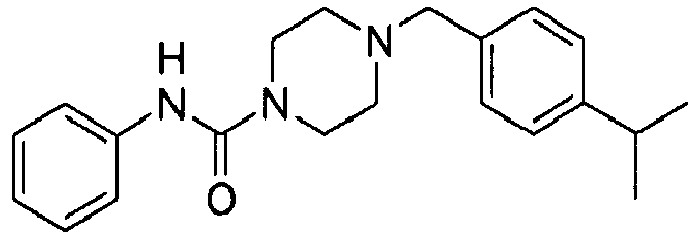
- The title compound was prepared from 4-isopropylbenzaldehyde. 1H NMR (400 MHz, CDCl3): 7.35-7.18 (m, 8H), 7.05-7.01 (m, 1 H), 6.30 (s, 1H), 3.50-3.49 (m, 6H), 2.94-2.87 (m, 1 H), 2.50-2.47 (m, 4H), 1.25 (d, J = 6.9 Hz, 6H).
-

- The title compound was prepared from 4-ethylbenzaldehyde. 1H NMR (400 MHz, CDCl3): 7.35-7.00 (m, 9H), 6.32 (s, 1H), 3.62-3.48 (m, 6H), 2.68-2.62 (m, 2H), 2.49-2.47(m, 4H), 1.26-1.22 (m, 3H).
-

- The title compound was prepared from 5-bromo-2-hydroxy-benzaldehyde. 1H NMR (400 MHz, CDCl3): 10.54 (br s, 1 H), 7.35-7.25 (m, 5H), 7.12-7.02 (m, 2H), 6.73 (d, J = 8.6 Hz, 1 H), 6.42 (br s, 1H), 3.70 (s, 2H), 3.55 (br s, 4H), 2.58 (br s, 4H).
-

- The title compound was prepared from 2,3-dihydro-benzo[1,4]dioxine-6-carbaldehyde. 1H NMR (400 MHz, CDCl3): 7.36-7.25 (m, 4H), 7.05-7.00 (m, 1H), 6.85-6.76 (m, 3H), 6.33 (br s, 1 H), 4.26 (s, 4H), 3.51-3.46 (m, 4H), 3.42 (s, 2H), 2.49-2.45 (m, 4H).
-

- The title compound was prepared from 4-methoxybenzaldehyde. 1H NMR (400 MHz, CDCl3): 7.35-7.21 (m, 6H), 7.04-6.99 (m, 1 H), 6.89-6.84 (m, 2H), 6.43 (br s, 1H), 3.80 (s, 3H), 3.50-3.45 (m, 6H), 2.46-2.42 (m, 4H).
-
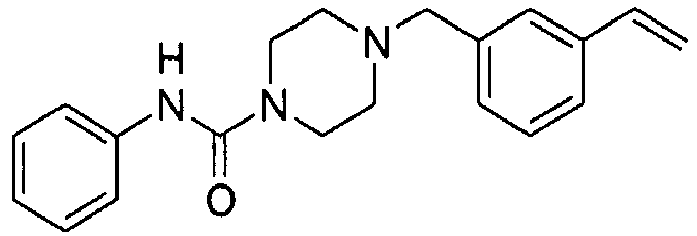
- The title compound was prepared from 3-vinylbenzaldehyde. 1H NMR (400 MHz, CDCl3): 7.36-7.23 (m, 7H), 7.21-6.99 (m, 1 H), 6.76-6.69 (m, 1 H), 6.49 (s, 1 H), 5.79-5.74 (m, 1H), 5.27-5.24 (m, 1 H), 3.52-3.45 (m, 6H), 2.47-2.45 (m, 4H).
-

- The title compound was prepared from 2,3-dihydro-benzofuran-5-carbaldehyde. 1H NMR (400 MHz, CDCl3): 7.36-7.28 (m, 4H), 7.17 (s, 1H), 7.06-7.01 (m, 1H), 6.73 (d, J = 8.1 Hz, 1H), 6.30 (s, 1H), 4.60-4.55 (m, 2H), 3.51-3.46 (m, 6H), 3.23-3.19 (m, 2H), 2.49-2.47 (m, 4H).
-

- The title compound was prepared from 3-methoxybenzaldehyde. 1H NMR (400 MHz, CDCl3): 7.35-7.32 (m, 2H), 7.28-7.22 (m, 3H), 7.03-6.98 (m, 1H), 6.92-6.89 (m, 2H), 6.83-6.79 (m, 1 H), 6.49 (br s, 1 H), 3.81 (s, 3H), 3.50-3.45 (m, 6H), 2.47-2.43 (m, 4H).
-

- The title compound was prepared from 1-naphthalenecarboxaldehyde. 1H NMR (400 MHz, CDCl3): 8.31-8.27 (m, 1H), 7.88-7.77 (m, 2H), 7.55-7.47 (m, 2H), 7.43-7.24 (m, 6H), 7.04-6.99 (m, 1 H), 6.37 (br s, 1 H), 3.93 (s, 2H), 3.49-3.44 (m, 4H), 2.55-2.51 (m, 4H).
-

- The title compound was prepared from 2-hydroxybenzaldehyde. 1H NMR (400 MHz, CDCl3): 10.42 (br s, 1H), 7.36-7.17 (m, 5H), 7.07-6.97 (m, 2H), 6.88-6.77 (m, 2H), 6.50 (br s, 1 H), 3.73 (s, 2H), 3.53 (br s, 4H), 2.57 (br s, 4H).
-

- The title compound was prepared from 3-methylbenzaldehyde. 1H NMR (400 MHz, CDCl3): 7.35-7.00 (m, 9H), 6.34 (s, 1 H), 3.51-3.49 (m, 6H), 2.49-2.47 (m, 4H), 2.36 (s, 3H).
-

- The title compound was prepared from 5-indolecarboxaldehyde. 1H NMR (400 MHz, CDCl3): 7.55 (br s, 1 H), 7.40-7.20 (m, 6H), 7.15 (dd, J = 8.2 Hz, 1.6, 1 H), 7.05-6.99 (m, 1 H), 6.50 (dd, J = 3.0, 0.9 Hz, 1H), 3.65 (m, 2H), 3.53-3.47 (m, 4H), 2.55-2.50 (m, 4H).
-

- The title compound was prepared from 3,4-dimethoxybenzaldehyde. 1H NMR (400 MHz, CDCl3): 7.36-7.32 (m, 2H), 7.28-7.23 (m, 2H), 7.04-6.98 (m, 1 H), 6.90-6.80 (m, 3H), 6.53 (br s, 1 H), 3.89 (s, 3H), 3.87 (s, 3H), 3.50-3.45 (m, 6H), 2.46-2.42 (m, 4H).
-

- The title compound was prepared from 4-pyridinecarboxaldehyde. 1H NMR (400 MHz, CDCl3): 8.57-8.56 (m, 2H), 7.36-7.27 (m, 6H), 7.06-7.02 (m, 1 H), 6.34 (s, 1 H), 3.55-3.51 (m, 6H), 2.51-2.49 (m, 4H).
-

- The title compound was prepared from 2-pyridinecarboxaldehyde. 1H NMR (400 MHz, CDCl3): 8.60-8.58 (m, 1 H), 7.70-7.52 (m, 1 H), 7.42-7.18 (m, 6H), 7.05-7.00 (m, 1 H), 6.32 (s, 1 H), 3.71 (s, 2H), 3.55-3.53 (m, 4H), 2.58-2.55 (m, 4H).
-

- The title compound was prepared from 3-pyridinecarboxaldehyde. 1H NMR (400 MHz, CDCl3): 8.56-8.53 (m, 2H), 7.70-7.67 (m, 1H), 7.36-7.26 (m, 5H), 7.06-7.01 (m, 1 H), 6.33 (s, 1 H), 3.56 (s, 2H), 3.52-3.50 (m, 4H), 2.51-2.49 (m, 4H).
-

- The title compound was prepared from 4-isopropoxybenzaldehyde. 1H NMR (400 MHz, CDCl3): 7.35-7.20 (m, 7H), 7.05-7.00 (m, 1 H), 6.86-6.83 (m, 1 H), 6.32 (br m, 1 H), 4.57-4.50 (m, 1 H), 3.51-3.47 (m, 6H), 2.50-2.45 (m, 4H), 1.34 (d, J = 6.0 Hz, 6H).
-

- The title compound was prepared from 4-phenylbenzaldehyde. 1H NMR (400 MHz, CDCl3): 7.61-7.55 (m, 4H), 7.46-7.25 (m, 9H), 7.05-7.00 (m, 1 H), 6.44 (br s, 1 H), 3.59 (s, 2H), 3.54-3.49 (m, 4H), 2.55-2.50 (m, 4H).
-

- The title compound was prepared from 4-quinolinecarboxaldehyde. 1H NMR (400 MHz, CDCl3): 8.87 (d, J = 4.3 Hz, 1H), 8.24 (d, J = 8.4 Hz, 1 H), 8.14 (d, J = 8.5 Hz, 1H), 7.75-7.70 (m, 1 H), 7.61-7.55 (m, 1 H), 7.43 (d, J = 4.3 Hz, 1H), 7.36-7.25 (m, 4H), 7.05-7.00 (m, 1 H), 6.44 (br s, 1 H), 3.55-3.50 (m, 4H), 2.60-2.55 (m, 4H).
-

- The title compound was prepared from benzo[1,3]dioxole-4-carbaldehyde. 1H NMR (400 MHz, CDCl3): 7.36-7.25 (m, 4H), 7.06-7.00 (m, 1H), 6.85-6.75 (m, 3H), 6.30 (s, 1 H), 3.57 (s, 2H), 3.54-3.49 (m, 4H), 2.56-2.50 (m, 4H).
-

- The title compound was prepared from 2,2-difluoro-benzo[1,3]dioxole-5-carbaldehyde. 1H NMR (400 MHz, CDCl3): 7.37-7.25 (m, 4H), 7.12 (s, 1H), 7.06-6.98 (m, 3H), 6.32 (s, 1 H), 3.54-3.46 (m, 6H), 2.50-2.45 (m, 4H).
-

- The title compound was prepared from 1-methyl-1H-indole-5-carbaldehyde. 1H NMR (400 MHz, CDCl3): 7.55 (s, 1 H), 7.36-7.25 (m, 5H), 7.21 (dd, J = 8.4, 1.6 Hz, 1 H), 7.06-7.00 (m, 2H), 6.46 (dd, J = 3.0, 0.8 Hz, 1 H), 6.29 (br s, 1 H), 3.80 (s, 3H), 3.65 (s, 2H), 3.50 (t, J = 5.1 Hz, 4H), 2.51 (t, J = 5.1 hz, 4H).
-

- The title compound was prepared from 6-chloro-quinoline-2-carbaldehyde. 1H NMR (400 MHz, CDCl3): 8.07 (d, J = 8.4 Hz, 1H), 8.01 (d, J = 8.8 Hz, 1H), 7.80 (d, J = 2.2 Hz, 1 H), 7.67-7.62 (m, 2H), 7.36-7.26 (m, 4H), 7.05-7.00 (m, 1 H), 6.38 (s, 1 H), 3.86 (s, 2H), 3.54 (t, J = 5.1 Hz, 4H), 2.60 (t, J = 5.1 Hz, 4H).
-

- The title compound was prepared from 8-chloro-quinoline-2-carbaldehyde. 1H NMR (400 MHz, CDCl3): 8.17 (d, J = 8.4 Hz, 1H), 7.82 (dd, J = 7.5, 1.3 Hz, 1H), 7.75, 7.71 (m, 2H), 7.44 (t, J = 7.7 Hz, 1 H), 7.37-7.34 (m, 2H), 7.30-7.25 (m, 2H), 7.05-7.00 (m, 1 H), 6.40 (s, 1 H), 3.97 (s, 2H), 3.55 (t, J = 5.1 Hz, 4H), 2.64 (t, J = 5.1 Hz, 4H).
-

- The title compound was prepared from 2-chloro-quinoline-3-carbaldehyde. 1H NMR (400 MHz, CDCl3): 8.23 (s, 1 H), 8.02 (d, J = 8.1 Hz, 1 H), 7.84 (d, J = 8.3 Hz, 1H), 7.75-7.70 (m, 1H), 7.60-7.55 (m, 1H), 7.37-7.25 (m, 4H), 7.05-7.00 (m, 1 H), 6.42 (s, 1 H), 3.79 (s, 2H), 3.56 (t, J = 5.0 Hz, 4H), 2.63 (t, J = 5.1 Hz, 4H).
-

- The title compound was prepared from piperazine-1-carboxylic acid (4-fluoro-phenyl)-amide and 2-naphthalenecarbaldehyde. 1H NMR (400 MHz, CDCl3): 7.85-7.80 (m, 3H), 7.74 (s, 1H), 7.52-7.45 (m, 3H), 7.30-7.25 (m, 2H), 6.98-6.92 (m, 2H), 6.36 (s, 1 H), 3.69 (s, 2H), 3.49 (t, J = 5.1 Hz, 4H), 2.51 (t, J = 5.1 Hz, 4H).
-
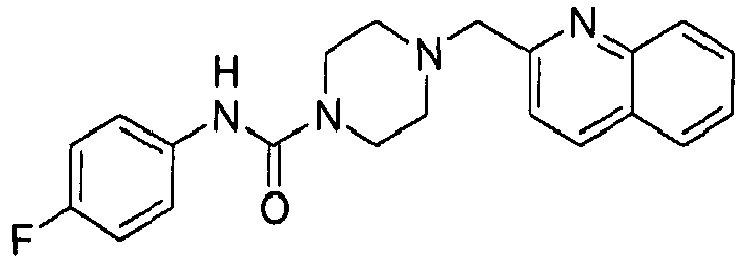
- The title compound was prepared from piperazine-1-carboxylic acid (4-fluoro-phenyl)-amide and 2-quinolinecarbaldehyde. 1H NMR (400 MHz, CDCl3): 8.16 (d, J = 8.3 Hz, 1 H), 8.08 (d, J = 8.6 Hz, 1H), 7.82 (d, J = 7.6 Hz, 1 H), 7.74-6.69 (m, 1 H), 7.63 (d, J = 8.3 Hz, 1 H), 7.56-7.52 (m, 1 H), 7.32-7.25 (m, 2H), 6.99-6.94 (m, 2H), 6.38 (s, 1 H), 3.88 (s, 2H), 3.52 (t, J = 5.1 Hz, 4H), 2.60 (t, J = 5.1 Hz, 4H).
-

- The title compound was prepared from 1-hydroxy-naphthalene-2-carbaldehyde. 1H NMR (400 MHz, CDCl3): 8.26-8.22 (m, 1H), 7.78-7.74 (m, 1H), 7.49-7.45 (m, 2H), 7.35-7.26 (m, 5H), 7.10-7.01 (m, 2H), 6.42 (s, 1H), 3.89 (s, 2H), 3.70-3.40 (br s, 4H), 2.80-2.50 (br s, 4H).
-

- The title compound was prepared from 3-(4-chloro-phenoxy)-benzaldehyde. 1H NMR (400 MHz, CDCl3): 7.36-7.25 (m, 7H), 7.11-6.87 (m, 6H), 6.31 (s, 1 H), 3.55-3.47 (m, 6H), 2.51-2.46 (m, 4H).
-

- The title compound was prepared from 3-(3,4-dichloro-phenoxy)-benzaldehyde. 1H NMR (400 MHz, CDCl3): 7.40-7.25 (m, 6H), 7.15-7.00 (m, 4H), 6.94-6.84 (m, 2H), 6.29 (s, 1H), 3.56-3.48 (m, 6H), 2.52-2.47 (m, 10H).
-

- The title compound was prepared from 3-p-tolyloxy-benzaldehyde. 1H NMR (400 MHz, CDCl3): 7.36-7.24 (m, 5H), 7.16-7.12 (m, 2H), 7.06-6.98 (m, 3H), 6.94-6.85 (m, 3H), 6.31 (s, 1 H), 3.53-3.46 (m, 6H), 2.51-2.45 (m, 4H).
-

- The title compound was prepared from 3-(4-tert-butyl-phenoxy)-benzaldehyde. 1H NMR (400 MHz, CDCl3): 7.37-7.24 (m, 7H), 7.09-7.00 (m, 3H), 6.96-6.85 (m, 3H), 6.31 (s, 1 H), 3.55-3.45 (m, 6H), 2.53-2.45 (m, 4H), 1.33 (s, 9H).
-

- The title compound was prepared from 3-(3-trifluoromethyl-phenoxy)-benzaldehyde. 1H NMR (400 MHz, CDCl3): 7.50-6.90 (m, 13H), 6.31 (s, 1 H), 3.56-3.46 (m, 6H), 2.53-2.45 (m, 4H).
-

- The title compound was prepared from 3-(4-methoxy-phenoxy)-benzaldehyde. 1H NMR (400 MHz, CDCl3): 7.36-7.21 (m, 6H), 7.06-6.80 (m, 7H), 6.30 (s, 1 H), 3.81 (s, 3H), 3.52-3.45 (m, 6H), 2.51-2.45 (m, 4H).
-

- The title compound was prepared from 6-methoxy-naphthalene-2-carbaldehyde. 1H NMR (400 MHz, CDCl3): 7.72 (d, J = 8.3 Hz, 2H), 7.66 (s, 1 H), 7.45 (dd, J = 8.4, 1.6 Hz, 1 H), 7.35-7.24 (m, 4H), 7.17-7.13 (m, 2H), 7.05-6.99 (m, 1 H), 6.37 (s, 1 H), 3.92 (s, 3H), 3.65 (s, 2H), 3.50 (t, J = 5.1 Hz, 4H), 2.50 (t, J = 5.1 Hz, 4H).
-
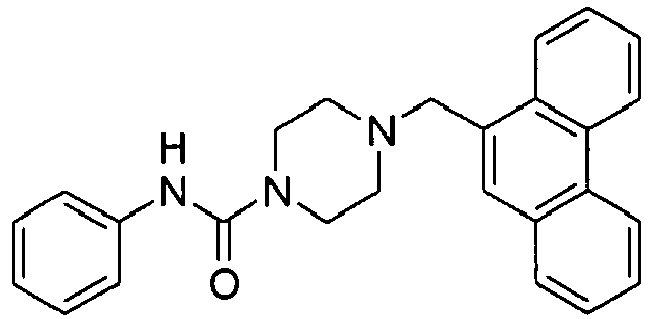
- The title compound was prepared from phenanthrene-9-carbaldehyde. 1H NMR (400 MHz, CDCl3): 8.75-8.66 (m, 2H), 8.41-8.38 (m, 1H), 7.87 (dd, J = 7.7, 1.3 Hz, 1 H), 7.70-7.57 (m, 5H), 7.36-7.26 (m, 4H), 7.05-7.00 (m, 1 H), 6.30 (s, 1 H), 3.98 (s, 2H), 3.50 (t, J = 5.1 Hz, 4H), 2.61 (t, J = 5.1 Hz, 4H).
-

- The title compound was prepared from pyrene-1-carbaldehyde. 1H NMR (400 MHz, CDCl3): 8.53 (d, J = 9.1 Hz, 1 H), 8.22-8.12 (m, 4H), 8.06 (s, 2H), 8.04-7.96 (m, 2H), 7.36-7.25 (m, 4H), 7.05-7.00 (m, 1 H), 6.30 (s, 1 H), 4.22 (s, 2H), 3.50 (t, J = 5.1 Hz, 4H), 2.62 (t, J = 5.1 Hz, 4H).
-
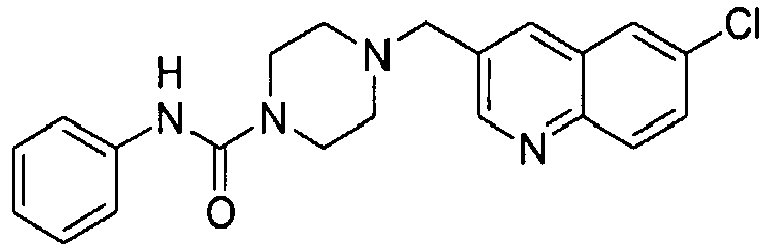
- The title compound was prepared from 6-chloro-quinoline-3-carbaldehyde. 1H NMR (400 MHz, CDCl3): 8.13 (d, J = 8.6 Hz, 1H), 8.09 (d, J = 2.0 Hz, 1H), 7.75 (d, J = 8.4 Hz, 1 H), 7.63 (d, J = 8.4 Hz, 1 H), 7.49 (dd, J = 8.4, 2.0 Hz, 1 H), 7.36-7.26 (m, 4H), 7.05-7.00 (m, 1 H), 6.35 (s, 1 H), 3.87 (s, 2H), 3.55 (d, J = 5.1 Hz, 4H), 2.61 (d, J = 5.1 Hz, 4H).
-

- The title compound was prepared from biphenyl-3-carbaldehyde. 1H NMR (400 MHz, CDCl3): 7.65-7.25 (m, 13H), 7.06-7.00 (m, 1H), 6.31 (s, 1 H), 3.61 (s, 2H), 3.55-3.49 (m, 4H), 2.58-2.50 (m, 4H).
-

- The title compound was prepared from 6-bromo-pyridine-2-carbaldehyde. 1H NMR (400 MHz, CDCl3): 7.57-7.26 (m, 7H), 7.06-7.01 (m, 1 H), 6.32 (s, 1 H), 3.70 (s, 2H), 3.54 (t, J = 5.1 Hz, 4H), 2.57 (t, J = 5.1 Hz, 4H).
-

- The title compound was prepared from 3-(4-chloro-benzenesulfonyl)-benzaldehyde. 1H NMR (400 MHz, CDCl3): 7.94-7.85 (m, 6H), 7.54-7.45 (m, 6H), 7.06-7.00 (m, 1 H), 6.29 (s, 1 H), 3.58 (s, 2H), 3.53-3.47 (m, 4H), 2.50-2.49 (m, 4H).
-

- The title compound was prepared from indole-6-carboxaldehyde. 1H NMR (400 MHz, CDCl3): 8.15 (s, 1 H), 7.62-7.58 (m, 1 H), 7.40-7.19 (m, 6H), 7.12-6.99 (m, 2H), 6.53-6.56 (m, 1 H), 6.29 (s, 1 H), 3.66 (s, 2H), 3.54-3.47 (m, 4H), 2.55-2.50 (m, 4H).
-

- The title compound was prepared from 4-phenoxybenzaldehyde. 1H NMR (400 MHz, CDCl3): 7.40-7.25 (m, 8H), 7.15-6.95 (m, 6H), 6.31 (s, 1 H), 3.55-3.48 (m, 6H), 2.55-2.45 (m, 4H).
-

- The title compound was prepared from 2-chloro-8-methyl-quinoline-3-carbaldehyde. 1H NMR (400 MHz, CDCl3): 8.17 (s, 1H), 7.67 (d, J = 7.8 Hz, 1H), 7.56 (d, J = 6.8 Hz, 1 H), 7.45 (t, J = 7.5 Hz, 1 H), 7.37-7.33 (m, 2H), 7.30-7.25 (m, 2H), 7.05-7.00 (m, 1 H), 6.46 (s, 1H), 3.77 (s, 2H), 3.54 (t, J = 5.1 Hz, 4H), 2.77 (s, 3H), 2.61 (t, J = 5.0 Hz, 4H).
-

- The title compound was prepared from 1-methyl-1 H-indole-6-carbaldehyde. 1H NMR (400 MHz, CDCl3): 7.57 (d, J = 8.1 Hz, 1H), 7.38-7.24 (m, 5H), 7.11-7.00 (m, 3H), 6.49-6.47 (dd, J = 3.1, 0.8 Hz, 1 H), 6.31 (s, 1 H), 3.80 (s, 3H), 3.68 (s, 2H), 3.54-3.48 (m, 4H), 2.56-2.50 (m, 4H).
-

- The title compound was prepared from 4-benzyloxybenzaldehyde. 1H NMR (400 MHz, CDCl3): 7.47-7.20 (m, 11 H), 7.05-6.98 (m, 1 H), 6.97-6.91 (m, 2H), 5.05 (s, 2H), 3.50-3.42 (m, 6H), 2.47-2.40 (m, 4H).
-

- The title compound was prepared from 3-(3,5-dichloro-phenoxy)-benzaldehyde. 1H NMR (400 MHz, CDCl3): 7.37-7.25 (m, 5H), 7.16 (d, J =7.7 Hz, 1 H), 7.10-7.00 (m, 3H), 6.97-6.91 (m, 1 H), 6.86 (d, J = 1.8 Hz, 2H), 6.31 (s, 1 H), 3.57-3.47 (m, 6H), 2.53-2.45 (m, 4H).
-

- The title compound was prepared from 9H-fluorene-2-carbaldehyde. 1H NMR (400 MHz, CDCl3): 7.79-7.72 (m, 2H), 7.55-7.50 (m, 2H), 7.40-7.23 (m, 7H), 7.04-6.99 (m, 1 H), 6.40 (s, 1 H), 3.90 (s, 2H), 3.60 (s, 2H), 3.50 (t, J = 5.1 Hz, 4H), 2.50 (t, J = 5.1 Hz, 4H).
-

- The title compound was prepared from 9-ethyl-9H-carbazole-3-carbaldehyde. 1H NMR (400 MHz, CDCl3): 8.10 (d, 7.6 Hz, 1H), 8.03 (s, 1H), 7.49-7.21 (m, 9 H), 7.04-6.99 (m, 1 H), 6.35 (s, 1 H), 4.37 (q, 7.2 Hz, 2H), 3.72 (s, 2H), 3.51 (t, J = 5.1 Hz, 4H), 2.54 (t, J = 5.1 Hz, 4H), 1.44 (t, J = 7.2 Hz, 3H).
-

- The title compound was prepared from 4-styryl-benzaldehyde. 1H NMR (400 MHz, CDCl3): 7.54-7.47 (m, 4H), 7.39-7.25 (m, 9 H), 7.11 (s, 2H), 7.05-7.00 (m, 7.00, 1 H), 6.37 (s, 1 H), 3.54 (s, 2H), 3.50 (t, J = 5.0 Hz, 4H), 2.49 (t, J = 5.0 Hz, 4H).
-

- The title compound was prepared from 4-chloro-3-trifluoromethyl-benzaldehyde. 1H NMR (400 MHz, CDCl3): 7.67 (s, 1H), 7.46 (s, 2H), 7.35-7.25 (m, 4H), 7.05-7.00 (m, 1 H), 6.42 (s, 1 H), 3.54 (s, 2H), 3.50 (t, J = 5.1 Hz, 4H), 2.46 (t, J = 5.1 Hz, 4H).
-

- The title compound was prepared from 2,5-dimethyl-1-(3-trifluoromethylphenyl)-1H-pyrrole-3-carbaldehyde. 1H NMR (400 MHz, CDCl3): 7.69-7.58 (m, 2H), 7.47 (s, 1 H), 7.42-7.25 (m, 5H), 7.04-7.00 (m, 1 H), 6.45 (s, 1 H), 6.94 (s, 1 H), 3.52 (t, J = 5.1 Hz, 4H), 3.41 (s, 2H), 2.52 (t, J = 5.1 Hz, 4H), 2.02 (s, 3H), 1.98 (s, 3H).
-

- The title compound was prepared from 2-bromobenzaldehyde. 1H NMR (400 MHz, CDCl3): 7.56 (dd, J = 8.0, 1.3 Hz, 1 H), 7.46 (dd, J = 7.8, 1.6 Hz, 1 H), 7.36-7.24 (m, 5H), 7.13 (td, J = 7.7, 1.7 Hz, 1 H), 7.04-6.99 (m, 1H), 6.37 (br s, 1 H), 3.63 (s, 2H), 3.51-3.47 (m, 4H), 2.56-2.52 (m, 4H).
-

- A solution of 1-(3,4-dibromo-benzyl)-piperazine (167 mg) in DCM (2 mL) was treated with 3-fluorophenyl isocyanate (0.07 mL). After 16 h, the resulting mixture was chromatographed, giving the title compound as a white foam (188 mg). 1H NMR (400 MHz, CDCl3): 7.61 (d, J = 2.0 Hz, 1H), 7.56 (d, J = 8.1 Hz, 1H), 7.31-7.12 (m, 3H), 7.01-6.97 (m, 1H), 6.75-6.99 (m, 1H), 6.47 (br m, 1H), 3.51-3.47 (m, 4H), 3.45 (s, 2H), 2.48-2.43 (m, 4H).
- Examples 86-96 were prepared from 1-(3,4-dibromo-benzyl)-piperazine and the specified isocyanates in analogy with Example 85. Products were isolated either by filtration of the reaction mixture or by chromatography.
-

- The title compound was prepared from 4-fluorophenyl isocyanate. 1H NMR (400 MHz, CDCl3): 7.62 (d, J = 2.0 Hz, 1 H), 7.57 (d, J = 8.0 Hz, 1 H), 7.31-7.27 (m, 2H), 7.15 (dd, J = 8.0, 2.0 Hz, 1 H), 7.01-6.95 (m, 2H), 6.28 (br s, 1H), 3.51-3.47 (m, 4H), 3.46 (s, 2H), 2.50-2.45 (m, 4H).
-

- The title compound was prepared from 3-methoxyphenyl isocyanate. 1H NMR (400 MHz, CDCl3): 7.65-7.55 (m, 2H), 7.20-7.10 (m, 3H), 6.85-6.79 (m, 1 H), 6.62-6.56 (m, 1 H), 6.32 (s, 1 H), 3.80 (s, 3H), 3.55-3.45 (m, 6H), 2.51-2.44 (m, 4H).
-

- The title compound was prepared from 3-methylphenyl isocyanate. 1H NMR (400 MHz, CDCl3): 7.65-7.55 (m, 2H), 7.25-7.07 (m, 4H), 6.86 (d, J = 7.4 Hz, 1 H), 6.26 (s, 1 H), 3.55-3.44 (m, 6H), 2.50-2.44 (m, 4H), 2.32 (s, 3H).
-

- The title compound was prepared from 2-fluorophenyl isocyanate. 1H NMR (400 MHz, CDCl3): 8.08 (td, J = 8.2, 1.6 Hz, 1 H), 7.62 (d, J = 1.8 Hz, 1H), 7.57 (d, J = 8.0 Hz, 1 H), 7.17-6.93 (m, 4H), 6.58 (br s, 1H), 3.55-3.50 (m, 4H), 3.47 (s, 2H), 2.51-2.46 (m, 4H).
-

- The title compound was prepared from 4-methoxyphenyl isocyanate. 1H NMR (400 MHz, CDCl3): 7.63-7.62 (m, 1 H), 7.57 (d, J = 8.0 Hz, 1 H), 7.25-7.22 (m, 2H), 7.16-7.13 (m, 1 H), 6.85-6.82 (m, 2H), 6.19 (s, 1H), 3.78 (s, 3H), 3.50-3.46 (m, 6H), 2.48-2.46 (m, 4H).
-

- The title compound was prepared from 2-methoxyphenyl isocyanate. 1H NMR (400 MHz, CDCl3): 8.15-8.13 (m, 1H), 7.63-7.56 (m, 2H), 7.16-7.09 (m, 2H), 6.96-6.93 (m, 2H), 6.86-6.83 (m, 1 H), 3.87 (s, 3H), 3.53-3.51 (m, 4H), 3.46 (s, 2H), 2.50-2.47 (m, 4H).
-

- The title compound was prepared from 3-chlorophenyl isocyanate. 1H NMR (400 MHz, CDCl3): 7.62 (d, 1.9 Hz, 1H), 7.57 (d, J = 8.2 Hz, 2H), 7.20-7.13 (m, 3H), 7.02-6.99 (m, 1 H), 6.34 (s, 1 H), 3.51-3.47 (m, 6H), 2.49-2.46 (m, 4H).
-

- The title compound was prepared from 2-chlorophenyl isocyanate. 1H NMR (400 MHz, CDCl3): 8.20-8.18 (m, 1H), 7.63-7.56 (m, 2H), 7.34-7.14 (m, 3H), 7.00-6.93 (m, 2H), 3.56-3.54 (m, 4H), 3.48 (s, 2H), 2.51-2.49 (m, 4H).
-

- The title compound was prepared from 4-methylphenyl isocyanate. 1H NMR (400 MHz, CDCl3): 7.62-7.55 (m, 2H), 7.23-7.07 (m, 5H), 6.25 (s, 1H), 3.50-3.46 (m, 6H), 2.48-2.45 (m, 4H), 2.29 (s, 3H).
-

- The title compound was prepared from 4-chlorophenyl isocyanate. 1H NMR (400 MHz, CDCl3): 7.63-7.56 (m, 2H), 7.31-7.23 (m, 4H), 7.16-7.13 (m, 1H), 6.29 (s, 1 H), 3.51-3.47 (m, 6H), 2.49-2.46 (m, 4H).
-

- The title compound was prepared from 2-methylphenyl isocyanate. 1H NMR (400 MHz, CDCl3): 7.63-7.56 (m, 3H), 7.21-7.13 (m, 3H), 7.04-6.99 (m, 1 H), 6.10 (s, 1 H), 3.52-3.47 (m, 6H), 2.50-2.47 (m, 4H).
- Examples 97-115 were prepared from 3-piperazin-1-ylmethyl-quinoline (unless otherwise specified) and the specified isocyanates in analogy with Example 85. Products were isolated either by filtration of the reaction mixture or by chromatography.
-

- The title compound was prepared from 3-fluorophenyl isocyanate. 1H NMR (400 MHz, CDCl3): 7.41-7.25 (m, 9H), 7.05-7.00 (m, 1H), 6.33 (s, 1H), 3.69 (s, 2H), 3.49 (t, J = 5.1 Hz, 4H), 2.54 (t, J = 5.1 Hz, 4H).
-

- The title compound was prepared from 4-fluorophenyl isocyanate. 1H NMR (400 MHz, CDCl3): 8.92 (s, 1H), 8.12-8.07 (m, 1H), 7.83-7.80 (m, 1H), 7.71 (ddd, J = 8.4, 6.9, 1.5 Hz, 1 H), 7.52 (ddd, J = 8.0, 7.0, 1.1 Hz, 1 H), 7.30-7.27 (m, 2H), 6.99-6.95 (m, 2H), 6.38 (s, 1 H), 3.74 (s, 2H), 3.50-3.52 (m, 4H), 2.55-2.54 (m, 4H)
-

- The title compound was prepared from 2-chlorophenyl isocyanate. 1H NMR (400 MHz, CDCl3): 8.76 (d, J = 2.1 Hz, 1 H), 8.02 (dd, J = 8.3, 1.4 Hz, 1H), 7.97-7.90 (m, 2H), 7.67-7.64 (m, 1 H), 7.55 (ddd, J = 8.4, 7.0, 1.4 Hz, 1 H), 7.40 (ddd, J = 8.0, 7.0, 1.1 Hz, 1 H), 7.15 (dd, J = 8.0, 1.5 Hz, 1 H), 7.08-7.05 (m, 1 H), 6.83 (s, 1 H), 6.80-6.76 (m, 1 H), 3.41 (m, 4H), 2.43-2.40 (m, 4H).
-

- The title compound was prepared from 3-chlorophenyl isocyanate. 1H NMR (400 MHz, CDCl3): 8.93 (d, J = 2.1 Hz, 1 H), 8.12-8.08 (m, 2H), 7.82 (d, J = 8.1 Hz), 7.72 (ddd, J = 8.4, 6.9, 1.4 Hz, 1 H), 7.57 (ddd, J = 8.1, 7.0, 1.1 Hz, 1 H), 7.48-7.46 (m, 1H), 7.19-7.18 (m, 2H), 7.01-6.98 (m, 1H), 6.36 (s, 1H), 3.75 (s, 1 H), 3.54-3.51 (m, 4H), 2.57-2.55 (m, 4H).
-

- The title compound was prepared from 4-chlorophenyl isocyanate. 1H NMR (400 MHz, CDCl3): 8.92 (d, J = 2.1 Hz, 1 H), 8.12-8.07 (m, 2H), 7.82 (dd, J = 8.2, 1.0 Hz, 1H), 7.72 (ddd, J = 8.4, 6.9, 1.4 Hz, 1H), 7.56 (ddd, J = 8.1, 7.0, 1.1 Hz, 1 H), 7.32-7.30 (m, 1 H), 7.29-7.28 (m, 1 H), 7.25-7.23 (m, 1 H), 7.22-7.21 (m, 1H), 6.39 (s, 1 H), 3.74 (s, 2H), 3.53-3.50 (m, 4H), 2.56-2.53 (m, 4H).
-

- The title compound was prepared from 2-methoxyphenyl isocyanate. 1H NMR (400 MHz, CDCl3): 8.93 (d, J = 2.0 Hz, 1 H), 8.14-8.11 (m, 3H), 7.82 (d, J = 8.4 Hz, 1 H), 7.74-7.70 (m, 1 H), 7.58-7.55 (m, 1 H), 7.10 (s, 1 H), 6.97-6.92 (m, 2H), 6.86-6.83 (m, 1 H), 3.86 (s, 3H), 3.76 (s, 2H), 3.56 (s, 4H), 2.58 (s, 4H).
-

- The title compound was prepared from 2-methylphenyl isocyanate. 1H NMR (400 MHz, CDCl3): 8.92 (d, J = 2.0 Hz, 1H), 8.12 (d, J = 8.4 Hz, 1H), 7.82 (d, J = 8.4 Hz, 1H), 7.74-7.70 (m, 2H), 7.62-7.55 (m, 2H), 7.20-7.14 (m, 2H), 7.03-6.99 (m, 1 H), 6.10 (s, 1 H), 3.56 (s, 2H), 3.52 (s, 4H), 2.58 (s, 4H), 2.23 (s, 3H).
-

- The title compound was prepared from 4-methylphenyl isocyanate. 1H NMR (400 MHz, CDCl3): 8.92 (d, J = 2.0 Hz, 1 H), 8.12-8.09 (m, 2H), 7.82 (dd, J = 8.2, 0.8 Hz, 1 H), 7.72 (ddd, J = 8.4, 7.0, 1.4 Hz, 1 H), 7.56 (ddd, J = 8.0, 6.8, 1.0 Hz, 1H), 7.23-7.20 (m, 2H), 7.09-7.07 (m, 2H), 6.25 (s, 1 H), 3.75 (s, 2H), 3.53-3.51 (m, 4H), 2.58-2.54 (m, 4H), 2.22 (s, 3H).
-

- The title compound was prepared from 2-carbomethoxyphenyl isocyanate. 1H NMR (400 MHz, CDCl3): 10.77 (s, 1 H), 8.94 (d, J = 2.1 Hz, 1 H), 8.56 (dd, J = 8.6, 0.9 Hz, 1 H), 8.13-8.11 (m, 2H), 8.00 (dd, J = 8.1, 1.6 Hz, 1 H), 7.83 (d, J = 8.0 Hz, 1 H), 7.74-7.70 (m, 1 H), 7.59-7.55 (m, 1 H), 7.51 (ddd, J = 8.8, 7.3, 1.7 Hz, 1 H), 6.99-6.95 (m, 1 H), 3.89 (s, 3H), 3.77 (s, 2H), 3.66-3.64 (m, 4H), 2.62-2.59 (m, 4H).
-

- The title compound was prepared from 3-carbomethoxyphenyl isocyanate. 1H NMR (400 MHz, CDCl3): 8.92 (d, J = 2.1 Hz, 1H), 8.13-8.10 (m, 2H), 7.89 (t, J = 2.2 Hz, 1 H), 7.83 (dd, J = 8.1, 1.1 Hz, 1 H), 7.75-7.68 (m, 3H), 7.59-7.54 (m, 1 H), 7.38-7.32 (m, 1H), 6.60 (s, 1 H), 3.88 (s, 3H), 3.77 (s, 2H), 3.56 (t, J = 4.8 Hz, 4H), 2.58 (t, J = 4.6 Hz, 4H).
-

- The title compound was prepared from 4-carbomethoxyphenyl isocyanate. 1H NMR (400 MHz, CDCl3): 8.92 (d, J = 2.1 Hz, 1H), 8.12-8.05 (m, 2H), 7.97-7.94 (m, 2H), 7.83-7.80 (m, 1H), 7.71 (ddd, J = 8.4, 6.9, 1.4 Hz, 1 H), 7.56 (ddd, J = 8.1, 6.9, 1.1 Hz, 1H), 7.46-7.42 (m, 2H), 6.64 (s, 1H), 3.87 (s, 3H), 3.73 (s, 2H), 3.54 (t, J = 5.0 Hz, 4H), 2.55 (t, J = 5.0 Hz, 4H).
-

- The title compound was prepared from 4-methoxyphenyl isocyanate. 1H NMR (400 MHz, CDCl3): 8.92 (d, J = 2.1 Hz, 1H), 8.12-8.08 (m, 2H), 7.82 (d, J = 7.2 Hz, 1 H), 7.71 (ddd, J = 8.4, 6.9, 1.4 Hz, 1 H), 7.56 (ddd, J = 8.1, 7.0, 1.1 Hz, 1 H), 7.25-7.22 (m, 2H), 6.86-6.81 (m, 2H), 6.19 (s, 1 H), 3.77 (s, 3H), 3.74 (s, 2H), 3.51 (t, J = 5.0 Hz, 4H), 2.56 (t, J = 4.8 Hz, 4H).
-

- The title compound was prepared from 3-methylphenyl isocyanate. 1H NMR (400 MHz, CDCl3): 8.92 (d, J = 2.1 Hz, 1 H), 8.15-8.10 (m, 2H), 7.83 (dd, J = 8.2, 1.0 Hz, 1 H), 7.72 (ddd, J = 8.4, 6.9, 1.4 Hz, 1 H), 7.60-7.54 (m, 1 H), 7.22 (s, 1H), 7.18-7.13 (m, 1H), 7.12-7.07 (m, 1H), 6.85 (d, J = 7.3 Hz, 1H), 6.27 (s, 1H), 3.76 (s, 2H), 3.56-3.51 (m, 4H), 2.60-2.54 (m, 4H), 2.31 (s, 3H).
-

- The title compound was prepared from 3-methoxyphenyl isocyanate. 1H NMR (400 MHz, CDCl3): 8.93 (d, J = 2.0 Hz, 1 H), 8.13-8.07 (m, 2H), 7.82 (d, J = 8.1 Hz, 1 H), 7.72 (ddd, J = 8.4, 7.0, 1.4 Hz, 1 H), 7.59-7.54 (m, 1 H), 7.19-7.14 (m, 1 H), 7.13 (t, J = 2.2 Hz, 1 H), 6.81 (dd, J = 7.7, 1.6 Hz, 1 H), 6.59 (dd, J = 8.0, 2.1 Hz, 1 H), 6.31 (s, 1 H), 3.79 (s, 3H), 3.74 (s, 2H), 3.52 (t, J = 4.8 Hz, 4H), 2.56 (t, J = 4.8 Hz, 4H).
-

- The title compound was prepared from 2,4-difluorophenylisocyanate. 1H NMR (400 MHz, CDCl3): 8.92 (d, J = 2.0 Hz, 1 H), 8.11 (d, J = 8.6 Hz, 1 H), 8.06 (s, 1 H), 7.99-7.92 (m, 1 H), 7.82 (dd, J = 8.3, 1.1 Hz, 1 H), 7.73-7.69 (m, 1 H), 7.58-7.54 (m, 1 H), 6.87-7.79 (m, 2H), 6.52 (s, 1 H), 3.73 (s, 2H), 3.53 (t, J = 5.1 Hz, 4H), 2.55 (t, J = 5.1 Hz, 4H).
-

- The title compound was prepared from 2-fluorophenylisocyanate. 1H NMR (400 MHz, CDCl3): 8.92 (d, J = 2.0 Hz, 1 H), 8.13-8.05 (m, 3H), 7.82 (dd, J = 8.1, 1.3 Hz, 1H), 7.74-7.69 (m, 1 H), 7.58-7.54 (m, 1H), 7.12-7.01 (m, 2H), 6.98-6.92 (m, 1 H), 6.61 (d, J = 3.5 Hz, 1 H), 3.74 (s, 2H), 3.55 (t, J = 5.1 Hz, 4H), 2.56 (t, J = 5.1 Hz, 4H).
-

- The title compound was prepared from 4-benzylpiperidine and 4-phenylphenyl isocyanate. 1H NMR (400 MHz, CDCl3): 7.31-7.12 (m, 7H), 7.07 (d, J = 8.0 Hz, 2H), 6.32 (s, 1 H), 4.06-4.00 (m, 2H), 2.79 (td, J = 13, 2.5 Hz, 2H), 2.56 (d, J = 6.8 Hz, 2H), 2.28 (s, 3H), 1.79-.165 (m, 3H), 1.30-1.18 (m, 2H).
-
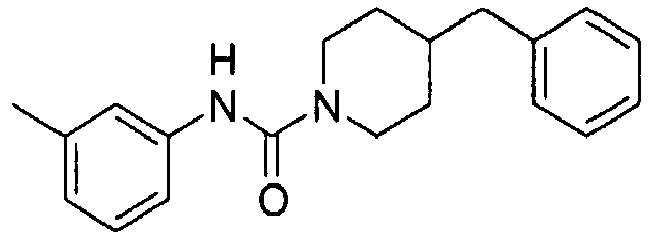
- The title compound was prepared from 4-benzylpiperidine and 3-methylphenyl isocyanate. 1H NMR (400 MHz, CDCl3): 7.32-7.07 (m, 8H), 6.84-6.80 (m, 1 H), 6.41 (br s, 1 H), 4.06-4.00 (m, 2H), 2.78 (td, J = 13 Hz, 2.4 Hz, 2H), 2.55 (d, J = 7.0 Hz, 2H), 2.30 (s, 3H), 1.77-1.64 (m, 3H), 1.28-1.16 (m, 2H).
-

- The title compound was prepared from 4-benzylpiperidine and 2-chlorophenyl isocyanate. 1H NMR (400 MHz, CDCl3): 8.19 (dd, J = 8.3, 1.5 Hz, 1 H), 7.33-7.12 (m, 7H), 7.03 (br s, 1 H), 6.96-6.90 (m, 1 H), 4.12-4.05 (m, 2H), 2.85 (td, J = 13, 2.3 Hz, 2H), 2.57 (d, J = 6.8 Hz, 2H), 1.82-1.69 (m, 3H), 1.34-1.20 (m, 2H).
-
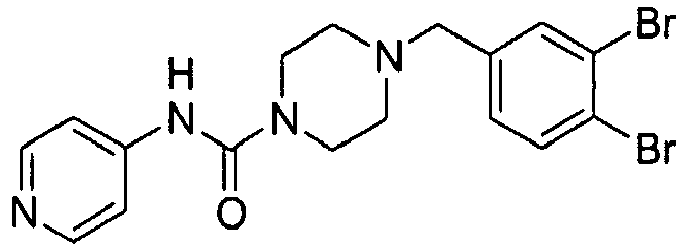
- A mixture of 1-(3,4-dibromo-benzyl)-piperazine (316 mg) and pyridin-4-yl-carbamic acid phenyl ester (204 mg) in DMSO (4 mL) was stirred at rt for 16 h. The resulting mixture was diluted with EtOAc (20 mL) and washed with satd. aq. NaHCO3 (2 mL). The organic layer was dried (MgSO4) and concentrated. Chromatography of the residue gave a white solid (370 mg). 1H NMR (400 MHz, CDCl3): 8.45-8.40 (m, 2H), 7.62 (d, J = 1.9 Hz, 1 H), 7.57 (d, J = 8.2 Hz, 1 H), 7.35-7.30 (m, 2H), 7.16-7.12 (m, 1H), 6.59 (s, 1H), 3.56-3.50 (m, 4H), 3.47 (s, 2H), 2.51-2.45 (m, 4H).
- Examples 117-118 were prepared from 1-(3,4-dibromo-benzyl)-piperazine and the specified aryl carbamate in analogy with Example 116.
-

- The title compound was prepared from pyridin-2-yl-carbamic acid phenyl ester. 1H NMR (400 MHz, CDCl3): 8.22-8.18 (m, 1H), 8.05-8.01 (m, 1H), 7.70-7.55 (m, 3H), 7.16-7.12 (m, 1 H), 6.98-6.90 (m, 2H), 3.56-3.50 (m, 4H), 3.46 (s, 2H), 2.49-2.46 (m, 4H).
-

- The title compound was prepared from pyridin-3-yl-carbamic acid phenyl ester. 1H NMR (400 MHz, CDCl3): 8.44-8.41 (m, 1H), 8.29-8.27 (m, 1H), 8.01-7.96 (m, 1H), 7.65-7.52 (m, 2H), 7.26-7.21 (m, 1H), 7.17-7.11 (m, 1H), 6.43 (s, 1 H), 3.56-3.51 (m, 4H), 3.48 (s, 2H), 2.53-2.46 (m, 4H).
-

- To a mixture of 4-(4-hydroxy-benzyl)-piperazine-1-carboxylic acid phenylamide (311 mg) and cyclohexanol (150 mg) in DCM (4 mL) was added polymer-supported Ph3P (500 mg) followed by di-tert-butyl azodicarboxylate (345 mg). The reaction mixture was shaken overnight, and filtered. Chromatography of the filtrate gave the title compound as a white solid (110 mg). 1H NMR (400 MHz, CDCl3): 7.36-7.19 (m, 6H), 7.05-7.00 (m, 1H), 6.88-6.84 (m, 2H), 6.30 (s, 1 H), 4.25-4.20 (m, 1 H), 3.50-3.47 (m, 6H), 2.48-2.46 (m, 4H), 2.01-1.97 (m, 2H), 1.82-1.80 (m, 2H), 1.60-1.29 (m, 6H).
- Examples 120-129 were prepared from 4-(3-hydroxy-benzyl)-piperazine-1-carboxylic acid phenylamide or 4-(4-hydroxy-benzyl)-piperazine-1-carboxylic acid phenylamide and the specified alcohols in analogy with Example 119.
-

- The title compound was prepared from 1-propanol. 1H NMR (400 MHz, CDCl3): 7.36-7.21 (m, 5H), 7.05-6.90 (m, 1 H), 6.88-6.80 (m, 3H), 6.32 (s, 1 H), 3.94-3.91 (m, 2H), 3.51-3.49 (m, 6H), 2.50-2.48 (m, 4H), 1.86-1.77 (m, 2H), 1.06-0.98 (m, 3H).
-

- The title compound was prepared isobutanol. 1H NMR (400 MHz, CDCl3): 7.36-7.21 (m, 5H), 7.05-7.01 (m, 1 H), 6.90-6.88 (m, 2H), 6.82-6.80 (m, 1 H), 6.33 (s, 1H), 3.72 (d, J = 6.6 Hz, 2H), 3.21-3.49 (m, 6H), 2.50-2.48 (m, 4H), 2.12-2.05 (m, 1 H), 1.03 (d, J = 6.7 Hz, 3H).
-

- The title compound was prepared from ethanol. 1H NMR (400 MHz, CDCl3): 7.36-7.21 (m, 5H), 7.05-7.01 (m, 1H), 6.91-6.89 (m, 2H), 6.82-6.79 (m, 1 H), 6.30 (s, 1H), 4.07-4.02 (m, 2H), 3.51-3.49 (m, 6H), 2.50-2.48 (m, 4H), 1.43-1.40 (m, 3H).
-

- The title compound was prepared from 1-propanol. 1H NMR (400 MHz, CDCl3): 7.36-7.20 (m, 6H), 7.05-7.01 (m, 1H), 6.88-6.84 (m, 2H), 6.30 (s, 1H), 3.93-3.90 (m, 2H), 3.50-3.48 (m, 6H), 2.48-2.46 (m, 4H), 1.85-1.76 (m, 2H), 1.06-1.02 (m, 3H).
-

- The title compound was prepared from iso-butanol. 1H NMR (400 MHz, CDCl3): 7.35-7.20 (m, 6H), 7.05-7.00 (m, 1 H), 6.88-6.84 (m, 2H), 6.31 (s, 1 H), 3.71 (d, J = 6.6 Hz, 2H), 3.50-3.47 (m, 6H), 2.48-2.45 (m, 4H), 2.11-2.05 (m, 1 H), 1.02 (d, J = 6.7 Hz, 6H).
-

- The title compound was prepared from 2-dimethylamino-ethanol. 1H NMR (400 MHz, CDCl3): 7.39-7.20 (m, 5H), 7.06-6.99 (m, 1H), 6.96-6.88 (m, 2H), 6.86-6.80 (m, 1 H), 6.32 (s, 1 H), 4.08 (t, J = 5.7 Hz, 2H), 3.56-3.46 (m, 6H), 2.75 (t, J = 5.7 Hz, 2H), 2.52-2.45 (m, 4H), 2.36 (s, 6H).
-

- The title compound was prepared from 2-piperidin-1-yl-ethanol. 1H NMR (400 MHz, CDCl3): 7.40-7.20 (m, 5H), 7.06-6.99 (m, 1 H), 6.94-6.79 (m, 3H), 6.34 (s, 1 H), 4.11 (t, J = 6.1 Hz, 2H), 3.55-3.45 (m, 6H), 2.78 (t, J = 6.1 Hz, 2H), 2.57-2.40 (m, 8H), 1.68-1.51 (m, 4H), 1.50-1.40 (m, 2H).
-

- The title compound was prepared from 3-dimethylamino-propan-1-ol. 1H NMR (400 MHz, CDCl3): 7.40-7.19 (m, 5H), 7.06-7.00 (m, 1 H), 6.92-6.79 (m, 3H), 6.33 (s, 1 H), 4.02 (t, J = 6.4 Hz, 2H), 3.55-3.45 (m, 6H), 2.51-2.45 (m, 6H), 2.57 (s, 6H), 2.02-1.92 (m, 2H).
-

- The title compound was prepared from 3-piperidin-1-yl-propan-1-ol. 1H NMR (400 MHz, CDCl3): 7.37-7.19 (m, 5H), 7.07-7.00 (m, 1 H), 6.93-6.77 (m, 3H), 6.32 (s, 1 H), 4.01 (t, J = 6.4 Hz, 2H), 3.55-3.45 (m, 6H), 2.60-2.30 (m, 10H), 2.04-1.94 (m, 2H), 1.79-1.39 (m, 6H).
-

- The title compound was prepared from ethanol. 1H NMR (400 MHz, CDCl3): 7.36-7.21 (m, 6H), 7.05-7.01 (m, 1 H), 6.88-6.85 (m, 2H), 6.30 (s, 1 H), 4.06-4.00 (m, 2H), 3.50-3.48 (m, 6H), 2.48-2.46 (m, 4H), 1.43-1.40 (m, 3H).
-

- To a mixture or 4-(3-hydroxy-benzyl)-piperazine-1-carboxylic acid phenylamide (311 mg), 3-chlorophenylboronic acid (313 mg), Cu(OAc)2 (182 mg) and powdered 4 A molecular sieves (300 mg) in DCM (10 mL) was added pyridine (0.403 mL). The resulting mixture was stirred at rt under ambient atmosphere for 16 h, filtered, and washed with DCM. The filtrate was concentrated and the residue was chromatographed to give a brown solid (350 mg). 1H NMR (400 MHz, CDCl3): 7.36-7.22 (m, 6H), 7.15-6.85 (m, 7H), 6.37 (m, 1 H), 3.56-3.46 (m, 6H), 2.55-2.45 (m, 4H).
- Examples 131-136 were prepared from 4-(3-hydroxy-benzyl)-piperazine-1-carboxylic acid phenylamide and the specified areneboronic acids in analogy with Example 130.
-

- The title compound was prepared from 2-naphthylboronic acid. 1H NMR (400 MHz, CDCl3): 7.86-7.81 (m, 2H), 7.73-7.65 (m, 1 H), 7.50-7.38 (m, 2H), 7.36-7.24 (m, 7H), 7.14-6.95 (m, 4H), 6.30 (s, 1 H), 3.55-3.45 (m, 6H), 2.55-2.45 (m, 4H).
-

- The title compound was prepared from 9-phenanthreneboronic acid. 1H NMR (400 MHz, CDCl3): 8.71-8.60 (m, 2H), 8.35-8.31 (m, 1H), 7.76-7.50 (m, 7H), 7.36-7.25 (m, 3H), 7.16-7.00 (m, 5H), 6.33 (s, 1 H), 3.54 (s, 2H), 3.48-3.43 (m, 4H), 2.51-2.45 (m, 4H).
-

- The title compound was prepared from 4-carbomethoxyphenylboronic acid. 1H NMR (400 MHz, CDCl3): 8.65-8.60 (m, 2H), 8.05-7.97 (m, 2H), 7.75-7.68 (m, 1H), 7.28-7.25 (m, 2H), 7.17-7.13 (m, 1H), 7.10-6.95 (m, 5H), 6.40 (s, 1 H), 3.91 (s, 3H), 3.57-3.47 (m, 6H), 2.54-2.47 (m, 4H).
-

- The title compound was prepared from 4-methanesulfonyl-boronic acid. 1H NMR (400 MHz, CDCl3): 7.92-7.86 (m, 2H), 7.41-7.18 (m, 6H), 7.12-6.93 (m, 5H), 6.31 (s, 1 H), 3.57 (s, 2H), 3.54-3.48 (m, 4H), 3.06 (s, 3H), 2.55-2.47 (m, 4H).
-

- The title compound was prepared from 3-methoxyphenylboronic acid. 1H NMR (400 MHz, CDCl3): 7.36-7.20 (m, 6H), 7.10-7.00 (m, 3H), 6.95-6.90 (m, 1H), 6.68-6.55 (m, 3H), 6.30 (s, 1 H), 3.78 (s, 3H), 3.55-3.45 (m, 6H), 2.53-2.46 (m, 4H).
-

- The title compound was prepared from benzo[1,3]dioxole-5-boronic acid. 1H NMR (400 MHz, CDCl3): 7.36-7.22 (m, 5H), 7.06-6.95 (m, 3H), 6.88-6.82 (m, 1 H), 6.76 (d, J = 8.4 Hz, 1 H), 6.58 (d, J = 2.4 Hz, 1 H), 6.49 (dd, J = 8.4, 2.4 Hz, 1 H), 6.34 (s, 1H), 3.55-3.45 (m, 6H), 2.53-2.46 (m, 4H).
-

- To a 0 °C solution of 4-(3-hydroxy-benzyl)-piperazine-1-carboxylic acid phenylamide (50 mg) in DCM (1 mL) was added methanesulfonyl chloride (0.015 mL) followed by Et3N (0.029 mL). The resulting mixture was stirred at rt for 2 h, and chromatographed to give a colorless oil (80 mg). 1H NMR (400 MHz, CDCl3): 7.42-7.22 (m, 7H), 7.22-7.16 (m, 1H), 7.07-7.01 (m, 1H), 3.65-3.46 (m, 6H), 3.22-3.15 (m, 3H), 2.60-2.45 (m, 4H).
- Examples 138-139 were prepared from 4-(3-hydroxy-benzyl)-piperazine-1-carboxylic acid phenylamide in analogy with Example 137 using the specified sulfonyl chloride.
-

- The title compound was prepared from benzenesulfonyl chloride. 1H NMR (400 MHz, CDCl3): 7.87-7.82 (m, 2H), 7.71-7.65 (m, 1H), 7.56-7.50 (m, 2H), 7.37-7.18 (m, 6H), 7.07-6.98 (m, 2H), 6.95-6.89 (m, 1 H), 6.30 (s, 1 H), 3.50-3.43 (m, 6H), 2.45-2.35 (m, 4H).
-

- The title compound was prepared from 4-chloro-benzenesulfonyl chloride. 1H NMR (400 MHz, CDCl3): 7.81-7.79 (m, 2H), 7.54-7.49 (m, 2H), 7.40-7.20 (m, 6H), 7.09-6.89 (m, 3H), 6.30 (s, 1 H), 3.52-2.45 (m, 6H), 2.45-2.37 (m, 4H).
-

- To a solution of 2-[(4-quinolin-3-ylmethyl-piperazine-1-carbonyl)-amino]-benzoic acid methyl ester (26 mg) in THF (0.5 mL) under N2 was added potassium trimethyl silanoate (9 mg) in one portion and the mixture was stirred at rt for 14 h. The mixture was concentrated to give the title compound as a white amorphous solid (22 mg). 1H NMR (400 MHz, CD3OD): 8.81 (d, J = 2.1 Hz, 1H), 8.23-8.21 (m, 1H), 8.14 (dd, J = 8.4, 0.9 Hz, 1H), 7.96-7.93 (m, 1H), 7.91 (dd, J = 7.9, 1.6 Hz, 1H), 7.88-7.85 (m, 1 H), 7.68 (ddd, J = 8.4, 6.9, 1.4 Hz, 1 H), 7.54 (ddd, J = 8.1, 7.0, 1.1 Hz, 1 H), 7.19-7.23 (m, 1 H), 6.81-6.85 (m, 1 H), 3.71 (s, 2H), 3.51-3.54 (m, 4H), 2.49-2.51 (m, 4H).
-

- The title compound was prepared from 3-[(4-quinolin-3-ylmethyl-piperazine-1-carbonyl)-amino]-benzoic acid methyl ester in analogy with Example 140. 1H NMR (400 MHz, CD3OD): 8.86 (d, J = 2.0 Hz, 1 H), 8.28 (s, 1 H), 7.99 (d, J = 8.4 Hz, 1 H), 7.92 (d, J = 8.2 Hz, 1 H), 7.75-7.71 (m, 1 H), 7.66 (m, 1 H), 7.61-7.56 (m, 2H), 7.53 (d, J = 8.0 Hz, 1 H), 7.24-7.20 (m, 1 H), 3.77 (s, 2H), 3.56-3.53 (m, 4H), 2.56-2.53 (m, 4H).
-

- A solution of pyridin-3-yl-carbamic acid phenyl ester (0.3 g) and 3-piperazin-1-ylmethyl-quinoline (0.32 g) in DMSO (0.5 mL) was heated in a microwave reactor at 100 °C for 0.5 h. The reaction mixture was partitioned between DCM and water. The combined organic layers were washed with brine (3x), dried (Na2SO4), and concentrated. The residue was purified by column chromatography to yield the title compound as a beige solid (80%). 1H NMR (400 MHz, CDCl3): 8.92 (d, J = 2.3 Hz, 1 H), 8.72 (d, J = 2.3 Hz, 1 H), 8.28 (d, J = 8.1 Hz, 1H), 8.23-8.21 (m, 1H), 8.13-8.10 (m, 2H), 7.84-7.82 (m, 1H), 7.74-7.70 (m, 1H), 7.59-7.55 (m, 1 H), 7.37-7.34 (m, 2H), 3.77 (s, 2H), 3.64-3.62 (m, 4H), 2.62-2.59 (m, 4H).
- Examples 143-145 were prepared from 3-piperazin-1-ylmethyl-quinoline and the specified phenyl carbamates in analogy with Example 142.
-

- The title compound was prepared from pyridin-2-yl-carbamic acid phenyl ester. 1H NMR (400 MHz, CDCl3): 8.91 (d, J = 2.3 Hz, 1 H), 8.18-8.16 (m, 1 H), 8.12-8.00 (m, 3H), 7.82-7.80 (m, 1H), 7.73-7.62 (m, 2H), 7.58-7.54 (m, 1 H), 6.95-6.92 (m, 1 H), 3.73 (s, 2H), 3.57-3.55 (m, 4H), 2.56-2.54 (m, 4H).
-

- The title compound was prepared from pyridin-4-yl-carbamic acid phenyl ester. 1H NMR (400 MHz, CDCl3): 8.88 (d, J = 2.3 Hz, 1H), 8.36-8.34 (m, 2H), 8.10-8.05 (m, 2H), 7.82-7.79 (m, 1 H), 7.73-7.68 (m, 1 H), 7.58-7.54 (m, 1 H), 7.40-7.38 (m, 2H), 3.71 (s, 2H), 3.57-3.54 (m, 4H), 2.52-2.49 (m, 4H).
-

- Step 1; Pyrimidin-2-yl-carbamic acid phenyl ester. The title compound was prepared in analogy with Example 15 using 2-aminopyrimidine.
- Step 2. The title compound was prepared from pyrimidin-2-yl-carbamic acid phenyl ester and 3-piperazin-1-ylmethyl-quinoline in analogy with Example 142. 1H NMR (400 MHz, CDCl3): 8.72 (s, 1H), 8.10-8.02 (m, 1H), 8.43-8.41 (m, 2H), 7.69-7.66 (m, 2H), 7.50-7.40 (m, 2H), 6.82-7.70 (m, 1 H), 3.81 (s, 2H), 3.42-3.38 (m, 4H), 2.41-2.36 (m, 4H).
-

- Step 1; 4-Benzo[1,3]dioxol-5-ylmethyl-piperazine-1-carboxylic acid tert-butyl ester. The title compound was prepared from benzo[1,3]dioxole-5-carbaldehyde in analogy with Example 5.
- Step 2; 1-Benzo[1,3]dioxol-5-ylmethyl-piperazine. The title compound was prepared from 4-benzo[1,3]dioxol-5-ylmethyl-piperazine-1-carboxylic acid tert-butyl ester in analogy with Example 6.
- Step 3. The title compound was prepared from 1-benzo[1,3]dioxol-5-ylmethyl-piperazine and pyridin-3-yl-carbamic acid phenyl ester in analogy with Example 142. 1H NMR (400 MHz, CDCl3): 8.44-8.43 (m, 1H), 8.19-8.17 (m, 1H), 7.98-7.95 (m, 1H), 7.18-7.16 (m, 1H), 6.83-6.80 (m, 2H), 6.70 (s, 1H), 5.89 (s, 2H), 3.55-3.52 (m, 4H), 3.47 (s, 2H), 2.51-2.48 (m, 4H).
- Examples 147-149 were prepared in analogy with Example 142.
-

- The title compound was prepared from pyridin-4-yl-carbamic acid phenyl ester and 1-benzo[1,3]dioxol-5-ylmethyl-piperazine. 1H NMR (400 MHz, CDCl3): 8.33 (d, J = 5.3 Hz, 2H), 7.35-7.34 (m, 2H), 6.79 (s, 1H), 6.68-6.67 (m, 2H), 5.89 (s, 2H), 3.48-3.45 (m, 4H), 3.39 (s, 2H), 2.43-2.40 (m, 4H).
-

- The title compound was prepared from pyrimidin-2-yl-carbamic acid phenyl ester and 1-benzo[1,3]dioxol-5-ylmethyl-piperazine. 1H NMR (400 MHz, CDCl3): 8.46 (d, J = 5.3 Hz, 2H), 7.31 (br s, 1 H), 6.85-6.83 (m, 2H), 6.72-6.68 (m, 2H), 5.89 (s, 2H), 3.56 (br s, 4H), 3.45 (bs, 2H), 2.48 (br s, 4H).
-

- The title compound was prepared from pyridin-2-yl-carbamic acid phenyl ester and 1-benzo[1,3]dioxol-5-ylmethyl-piperazine. 1H NMR (400 MHz, CDCl3): 8.18 (d, J = 3.9 Hz, 1H), 7.67-7.64 (m, 1H), 6.66-6.64 (m, 2H), 6.54-6.51 (m, 3H), 5.94 (s, 2H), 3.80 (s, 2H), 3.53 (t, J = 4.9 Hz, 4H), 2.36 (t, J = 4.8 Hz, 4H).
-

- Step 1; 4-(2,2-Difluoro-benzo[1,3]dioxol-5-ylmethyl)-piperazine-1-carboxyli acid tert-butyl ester. The title compound was prepared from 2,2-difluoro-benzo[1,3]dioxole-5-carbaldehyde in analogy with Example 5.
- Step 2; 1-(2,2-Difluoro-benzo[1,3]dioxol-5-ylmethyl)-piperazine. The title compound was prepared from 4-(2,2-difluoro-benzo[1,3]dioxol-5-ylmethyl)-piperazine-1-carboxylic acid tert-butyl ester in analogy with Example 6.
- Step 3. The title compound was prepared from pyridin-3-yl-carbamic acid phenyl ester and 1-(2,2-difluoro-benzo(1,3]dioxol-5-ylmethyl)-piperazine in analogy with Example 142. 1H NMR (400 MHz, CDCl3): 8.46 (d, J = 2.5 Hz, 1H), 8.23-8.21 (m, 1H), 7.99-7.96 (m, 1 H), 7.22-7.19 (m, 2H), 7.11 (s, 1H), 6.99-6.98 (m, 2H), 3.54-3.52 (m, 4H), 3.49 (s, 2H), 2.46-2.44 (m, 4H).
-

- The title compound was prepared from pyridin-4-yl-carbamic acid phenyl ester and 1-(2,2-difluoro-benzo[1,3]dioxol-5-ylmethyl)-piperazine in analogy with Example 142. 1H NMR (400 MHz, CDCl3): 8.36-8.34 (d, J = 6.8 Hz, 2H), 7.41-7.39 (d, J = 5.8 Hz, 2H), 7.10 (s, 1H), 6.99 (s, 2H), 3.55-3.53 (m, 4H), 3.49 (s, 2H), 2.47-2.44 (m, 4H).
-

- Step 1; Pyrimidin-4-yl-carbamic acid phenyl ester. The title compound was prepared from pyrimidin-4-ylamine in analogy with Example 15.
- Step 2. The title compound was prepared from pyrimidin-4-yl-carbamic acid phenyl ester and 3-piperazin-1-ylmethyl-quinoline in analogy with Example 142. 1H NMR (400 MHz, CDCl3): 8.94 (d, J = 2.0 Hz, 1H), 8.76 (s, 1H), 8.54 (d, J = 6.1 Hz, 1 H), 8.25 (s, 1 H), 8.20 (d, J = 8.8 Hz, 1H), 7.99 (d, J = 5.8 Hz, 1 H), 7.87 (d, J = 7.8 Hz, 1 H), 7.79-7.75 (m, 1 H), 7.64-7.60 (m, 1 H), 7.38 (br s, 1 H), 3.85 (s, 2H), 3.64 (br s, 4H), 2.66 (bs, 4H).
-

- The title compound was prepared from pyrimidin-4-yl-carbamic acid phenyl ester and 1-(2,2-difluoro-benzo[1,3]dioxol-5-ylmethyl)-piperazine in analogy with Example 142. 1H NMR (400 MHz, CDCl3): 8.76 (s, 1H), 8.54 (d, J = 6.1 Hz, 1H), 7.97 (d, J = 5.3 Hz, 1H), 7.65-7.39 (m, 2H), 7.19-7.01 (m, 2H), 4.03-3.55 (m, 6H), 2.91-2.49 (m, 4H).
-

- The title compound was prepared from pyrimidin-4-yl-carbamic acid phenyl ester and 1-(3,4-dibromo-benzyl)-piperazine in analogy with Example 142. 1H NMR (400 MHz, CDCl3): 8.40 (s, 1H), 8.10-7.80 (m, 1H), 7.70-7.50 (m, 1H), 7.58-7.45 (m, 1H), 7.14-7.10 (m, 1 H), 6.55-6.40 (m, 1H), 3.40 (s, 2H), 2.87 (t, J = 4.8 Hz, 4H), 2.38 (t, J = 4.8 Hz, 4H).
-

- The title compound was prepared from 4-[(4-quinolin-3-ylmethyl-piperazine-1-carbonyl)-amino]-benzoic acid methyl ester in analogy with Example 140. 1H NMR (400 MHz, CD3OD): 8.89 (d, J = 1.8 Hz, 1H), 8.31 (d, J = 1.3 Hz, 1H), 8.03 (d, J = 8.8 Hz, 1H), 7.97-7.95 (m, 1H), 7.90-7.87 (m, 2H), 7.79-7.75 (m, 1H), 7.65-7.61 (m, 1 H), 7.42-7.40 (m, 2H), 3.81 (s, 2H), 3.60-3.57 (m, 4H), 2.59-2.57 (m, 4H).
-

- The title compound was prepared from piperazine-1-carboxylic acid phenylamide and 2-quinoxaline-carboxaldehyde in analogy with Example 18. 1H NMR (400 MHz, CDCl3): 8.96 (s, 1 H), 8.06-7.98 (m, 2H), 7.72-7.66 (m, 2H), 7.28-7.16 (m, 4H), 7.96-7.92 (m, 1 H), 6.42 (s, 1 H), 3.85 (s, 2H), 3.48-3.45 (m, 4H), 3.55-3.52 (m, 4H).
-

- The title compound was prepared from piperazine-1-carboxylic acid phenylamide and 3,4-dichlorobenzaldehyde in analogy to Example 18. 1H NMR (400 MHz, CDCl3): 8.82-8.81 (m, 2H), 7.98-7.96 (m, 2H), 7.65-7.57 (m, 3H), 7.16-7.13 (m, 1 H), 3.88-3.81 (m, 4H), 3.50 (s, 2H), 2.60-2.53 (m, 4H).
-

- Step 1; Thiazol-2-yl-carbamic acid phenyl ester. The title compound was prepared in analogy with Example 15 using 2-aminothiazole.
- Step 2. The title compound was prepared from thiazol-2-yl-carbamic acid phenyl ester and 3-piperazin-1-ylmethyl-quinoline in analogy with Example 142. 1H NMR (400 MHz, CDCl3): 9.03 (d, J = 2.0 Hz, 1 H), 8.24-8.20 (m, 2H), 7.94 (d, J = 8.1 Hz, 1 H), 7.86-7.81 (m, 1 H), 7.70-7.66 (m, 1 H), 7.43 (d, J = 3.3 Hz, 1 H), 6.98 (d, J = 3.5 Hz, 1 H), 3.87 (s, 2H), 3.73-3.69 (m, 4H), 2.68 (bs, 4H).
-

- The title compound was prepared from 1-benzo[1,3]dioxol-5-ylmethyl-piperazine and thiazol-2-yl-carbamic acid phenyl ester in analogy with Example 142. 1H NMR (400 MHz, CDCl3): 7.30 (d, J = 4.0 Hz, 1 H), 6.89 (s, 1H), 6.85 (d, J = 3.8 Hz, 1 H), 6.77 (s, 2H), 5.97 (s, 1 H), 5.96 (s, 2H), 3.62 (bs, 4H), 3.53 (s, 2H), 2.54 (bs, 4H).
-

- To a solution of 4-(3,4-dibromo-benzyl)-piperazine-1-carboxylic acid phenylamide (0.02 g) in DMF (0.6 mL) was added NaH (60% dispersion in oil; 3 mg) in one portion. The resulting mixture was allowed to stir for 30 min, then was treated with Mel (0.005 mL), and was stirred at rt for 12 h. The mixture was concentrated and the residue was purified by column chromatography (5% MeOH/DCM), giving the product as a white solid (0.015 g). 1H NMR (400 MHz, CDCl3): 7.54-7.50 (m, 2H), 7.33-7.31 (m, 2H), 7.12-7.05 (m, 4H), 3.34 (s, 2H), 3.22-3.20 (m, 6H), 2.23-2.21 (m, 4H), 1.63 (s, 3H).
-

- To a solution of 4-(5-bromo-2-hydroxy-3-methoxy-benzyl)-piperazine-1-carboxylic acid phenylamide (1.2 g) in Et2O (16 mL) was added HCl (2 M in Et2O, 3.5 mL). After 1 h, the mixture was concentrated to give the title compound as a white solid. 1H NMR (400 MHz, CD3OD): 7.40-7.20 (m, 6H), 7.10-7.05 (m, 1H), 4.37 (s, 2H), 3.94 (s, 3H).
- The compounds in Examples 162-163 were prepared in analogy with Example 161.
-

- 1H NMR (400 MHz, CD3OD): 7.93 (d, J = 2.0 Hz, 1 H), 7.85 (d, J = 8.1 Hz, 1 H), 7.45-7.42 (m, 1H), 7.73-7.34 (m, 2H), 7.30-7.25 (m, 2H), 7.07-7.02 (m, 1 H), 4.30 (br s, 2H), 3.55-3.10 (br m, 8H).
-

- 1H NMR (400 MHz, CD3OD): 8.73 (s, 1 H), 8.42 (d, J = 8.4 Hz, 2H), 8.01-7.94 (m, 2H), 7.77-7.72 (m, 1.2H), 7.65-7.56 (m, 2H), 7.36-7.32 (m, 2H), 7.16-7.10 (m, 2H), 6.87-6.82 (m, 1 H), 4.63 (s, 2H), 3.70 (br s, 4H).
- The following compounds in Examples 164-167 may be prepared using methods analogous to those described in the preceding examples.
-
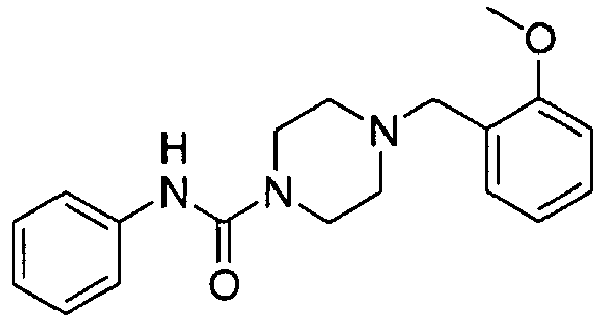
-
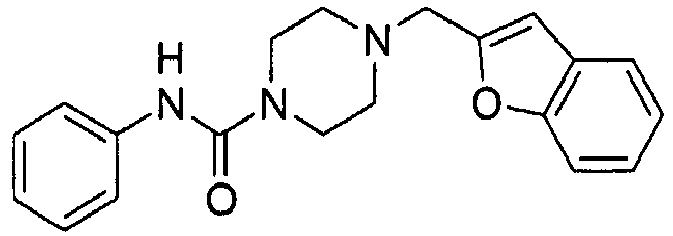
-

-

- The title compounds per se of Examples A through J are known and may be obtained from commercial sources. The compounds described in Examples K and L are provided for comparative purposes. All compounds in Examples A through L were prepared according to the general procedures described above.
-

- The title compound was prepared from piperazine-1-carboxylic acid phenylamide and 3-iodobenzaldehyde. 1H NMR (400 MHz, CDCl3): 7.71 (s, 1 H), 7.62-7.60 (m, 1H), 7.36-7.26 (m, 5H), 7.09-7.01 (m, 2H), 6.33 (s, 1H), 3.52-3.48 (m, 6H), 2.49-2.46 (m, 4H).
-

- The title compound was prepared from piperazine-1-carboxylic acid phenylamide and benzo[1,3]dioxole-5-carbaldehyde. 1H NMR (400 MHz, CDCl3): 7.36-7.24 (m, 4H), 7.05-6.99 (m, 1 H), 6.86 (br s, 1H), 6.77-6.72 (m, 2H), 6.43 (br s, 1 H), 5.95 (s, 2H), 3.50-3.46 (m, 4H), 3.43 (s, 2H), 2.46-2.42 (m, 4H).
- Example B1. The hydrochloride salt of the title compound was prepared in analogy with Example 161. 1H NMR (400 MHz, CD3OD): 7.37-7.27 (m, 4H), 7.09-7.00 (m, 3H), 6.90 (d, J = 7.8 Hz, 1 H), 6.05 (s, 2H), 4.40-4.26 (br m, 2H), 4.25 (s, 2H), 3.50-3.38 (br m, 4H), 3.10-3.00 (br m, 2H).
-

- The title compound was prepared from piperazine-1-carboxylic acid phenylamide and 3-bromobenzaldehyde. 1H NMR (400 MHz, CDCl3): 7.50 (br s, 1H), 7.43-7.17 (m, 7H), 7.05-7.00 (m, 1H), 6.47 (br s, 1H), 3.52-3.45 (m, 6H), 2.48-2.42 (m, 4H).
-

- The title compound was prepared from piperazine-1-carboxylic acid phenylamide and 3,4-dimethylbenzaldehyde. 1H NMR (400 MHz, CDCl3): 7.35-7.26 (m, 4H), 7.11-7.00 (m, 4H), 6.31 (s, 1H), 3.51-3.48 (m, 6H), 2.49-2.26 (m, 4H), 2.26 (d, J = 3.8 Hz, 6H).
-

- The title compound was prepared from piperazine-1-carboxylic acid phenylamide and 4-methylbenzaldehyde. 1H NMR (400 MHz, CDCl3): 7.35-7.00 (m, 9H), 6.32 (s, 1 H), 3.50-3.48 (m, 6H), 2.49-2.46 (m, 4H), 2.35 (s, 3H).
-

- The title compound was prepared from piperazine-1-carboxylic acid phenylamide and phenylacetaldehyde. 1H NMR (400 MHz, CDCl3): 7.37-7.19 (m, 9H), 7.06-7.02 (m, 1 H), 6.31 (s, 1 H), 3.55-3.53 (m, 4H), 2.85-2.81 (m, 2H), 2.67-2.56 (m, 6H).
-
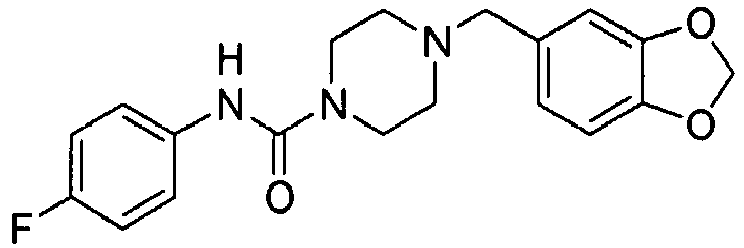
- The title compound was prepared from piperazine-1-carboxylic acid (4-fluoro-phenyl)-amide and piperonal. 1H NMR (400 MHz, CDCl3): 7.29-7.24 (m, 2H), 6.98-6.92 (m, 2H), 6.85 (s, 1 H), 6.77-6.71 (m, 2H), 6.56 (s, 1 H), 5.95 (s, 2H), 3.50-3.45 (m, 6H), 2.45 (t, J = 5.1 Hz, 4H).
-

- The title compound was prepared from 4-benzylpiperidine and phenyl isocyanate. 1H NMR (400 MHz, CDCl3): 7.35-7.10 (m, 9H), 7.02-6.97 (m, 1H), 6.50 (br s, 1 H), 4.07-4.00 (m, 2H), 2.77 (td, J = 13, 2.4 Hz, 2H), 2.54 (d, J = 6.8 Hz, 2H), 1.76-1.64 (m, 3H), 1.28-1.15 (m, 2H).
-

- The title compound was prepared from piperazine-1-carboxylic acid phenylamide and 3-phenylpropionaldehyde. 1H NMR (400 MHz, CDCl3): 7.36-7.16 (m, 9H), 7.05-7.00 (m, 1 H), 6.40 (br s, 1 H), 3.52-3.47 (m, 4H), 2.65 (t, J = 7.6 Hz, 2H), 2.47-2.38 (m, 4H), 2.39 (t, J = 7.4 Hz, 2H), 1.88-1.79 (m, 2H).
-

- The title compound was prepared from 1-benzylpiperazine and phenyl isocyanate. 1H NMR (400 MHz, CDCl3): 7.35-7.22 (m, 9H), 7.02-6.97 (m, 1H), 6.55 (br s, 1 H), 3.56 (s, 2H), 3.48-3.45 (m, 4H), 2.45-2.41 (m, 4H).
-

- The title compound was prepared from piperazine-1-carboxylic acid phenylamide and 2-benzyloxybenzaldehyde. 1H NMR (400 MHz, CDCl3): 7.49-7.20 (m, 11 H), 7.05-6.92 (m, 3H), 6.41 (s, 1 H), 5.08 (s, 2H), 3.65 (s, 2H), 3.51-3.45 (m, 4H), 2.55-2.49 (m, 4H).
-

- The title compound was prepared from piperazine-1-carboxylic acid phenylamide and 6-bromo-3,4-dihydro-1H-naphthalen-2-one. 1H NMR (400 MHz, CDCl3): 7.37-7.21 (m, 6H), 7.06-7.02 (m, 1 H), 6.96-6.94 (m, 1 H), 6.33 (s, 1 H), 3.55-3.53 (m, 4H), 2.94-2.64 (m, 9H), 2.12-2.08 (m, 1 H), 1.69-1.61 (m, 1 H).
- T84 frozen pellets (contents of 1-4 x 15 cm culture dishes) were homogenized in 300 mL of FAAH assay buffer (125 mM Tris, 1 mM EDTA, 0.2% glycerol, 0.02% Triton X-100, 0.4 mM Hepes, pH 9). The assay mixture was prepared from 50 µL of the cell homogenate, 10 µL of the test compound, and 40 µL of anandamide [1-3H-ethanolamine] (3H-AEA; Perkin-Elmer, 10.3 Ci/mmol), which was added last, for a final tracer concentration of 200 nM. The reaction mixture was incubated at rt for 1 hour (h). During the incubation, 96-well Multiscreen filter plates (catalog number MAFCNOB50; Millipore, Bedford, Massachussetts, USA) were loaded with 25 µL of activated charcoal (Multiscreen column loader, catalog number MACL09625, Millipore) and washed once with 100 µL of MeOH. Also during the incubation, 96-well DYNEX MicroLite plates (catalog number
NL510410 Table 1 Ex. IC50 (nM) Ex. IC50 (nM) Ex. IC50 (nM) 18 17 63 69 111 250 19 19 64 220 112 61 20 19 65 9 113 8000 21 31 66 1600 114 2300 22 26 67 8000 115 4000 23 73 68 95 116 240 24 52 69 23 117 360 25 57 70 410 118 27 26 79 71 6000 119 1000 27 69 72 110 120 170 28 80 73 29 121 210 29 120 74 2000 122 220 30 180 75 24 123 1500 31 200 76 350 124 1800 32 220 77 32 125 10000 33 280 78 5000 126 2000 34 290 79 8000 127 2000 35 460 80 330 128 2000 36 470 81 6000 129 2000 37 590 82 80 130 160 38 620 83 480 131 33 39 1100 84 2500 132 3000 40 1100 85 19 133 50 41 1300 86 21 134 65 42 2000 87 48 135 83 43 4000 88 100 136 67 44 4000 89 22 137 1000 45 >10000 90 75 138 59 46 >10000 91 130 139 380 47 >10000 92 240 161 210 48 3500 93 460 162 38 49 4500 94 470 163 23 50 3000 95 500 A 120 51 6000 96 >10000 B 350 52 87 97 120 B1 1200 53 230 98 130 C 280 54 170 99 1600 D 630 55 28 100 200 E 1300 56 9000 101 360 F >10000 57 54 102 540 G 1600 58 100 103 6000 H 270 59 21 104 690 I 1700 60 9 108 270 J 2000 61 20 109 200 K >10000 62 18 110 200 L 370 - A 10-cm tissue culture dish with a confluent monolayer of SK-N-MC cells was split 2 days (d) prior to transfection. Using sterile technique, the media was removed and the cells were detached from the dish by the addition of trypsin. One fifth of the cells were then placed onto a new 10-cm dish. Cells were grown in a 37 °C incubator with 5% CO2 in Minimal Essential Media Eagle with 10% Fetal Bovine Serum. After 2 d, cells were approximately 80% confluent. These cells were removed from the dish with trypsin and pelleted in a clinical centrifuge. The pellet was re-suspended in 400 µL complete media and transferred to an electroporation cuvette with a 0.4 cm gap between the electrodes. Supercoiled human FAAH cDNA (1 µg) was added to the cells and mixed. The voltage for the electroporation was set at 0.25 kV, and the capacitance was set at 960 µF. After electroporation, the cells were diluted into complete media (10 mL) and plated onto four 10-cm dishes. Because of the variability in the efficiency of electroporation, four different concentrations of cells were plated. The ratios used were 1:20, 1:10, and 1:5, with the remainder of the cells being added to the fourth dish. The cells were allowed to recover for 24 h before adding the selection media (complete media with 600 µg/mL G418). After 10 d, dishes were analyzed for surviving colonies of cells. Dishes with well-isolated colonies were used. Cells from individual colonies were isolated and tested. The clones that showed the most FAAH activity, as measured by anandamide hydrolysis, were used for further study.
- T84 frozen cell pellets or transfected SK-N-MC cells (contents of 1 x 15 cm culture dishes) were homogenized in 50 mL of FAAH assay buffer (125 mM Tris, 1mM EDTA, 0.2% Glycerol, 0.02% Triton X-100, 0.4 mM Hepes, pH 9). The assay mixture consisted of 50 µL of the cell homogenate, 10 µL of the test compound, and 40 µL of anandamide [1-3H-ethanolamine] (3H-AEA, Perkin-Elmer, 10.3 Ci/mmol), which was added last, for a final tracer concentration of 80 nM. The reaction mixture was incubated at rt for 1 h. During the incubation, 96-well Multiscreen filter plates (catalog number MAFCNOB50; Millipore, Bedford, Massachussetts, USA) were loaded with 25 µL of activated charcoal (Multiscreen column loader, catalog number MACL09625, Millipore) and washed once with 100 µL of MeOH. Also during the incubation, 96-well DYNEX MicroLite plates (catalog number
NL510410 Table 2 Ex. IC50 (nM) Ex. IC50 (nM) 18 23 145 8000 21 19 146 380 32 380 147 3000 34 330 148 >10000 41 3000 149 4000 52 100 150 130 59 16 151 1700 98 220 152 4000 105 >10000 153 1000 106 230 154 282 107 650 155 8000 140 >10000 156 840 141 5000 157 65 142 4100 158 >10000 143 1800 159 >10000 144 2000 160 >10000 - A 10-cm tissue culture dish with a confluent monolayer of SK-N-MC cells was split 2 days (d) prior to transfection. Using sterile technique, the media was removed and the cells were detached from the dish by the addition of trypsin. One fifth of the cells were then placed onto a new 10-cm dish. Cells were grown in a 37 °C incubator with 5% CO2 in Minimal Essential Media Eagle with 10% Fetal Bovine Serum. After 2 d, cells were approximately 80% confluent. These cells were removed from the dish with trypsin and pelleted in a clinical centrifuge. The pellet was re-suspended in 400 µL complete media and transferred to an electroporation cuvette with a 0.4 cm gap between the electrodes. Supercoiled rat FAAH cDNA (1 µg) was added to the cells and mixed. The voltage for the electroporation was set at 0.25 kV, and the capacitance was set at 960 µF. After electroporation, the cells were diluted into complete media (10 mL) and plated onto four 10-cm dishes. Because of the variability in the efficiency of electroporation, four different concentrations of cells were plated. The ratios used were 1:20, 1:10, and 1:5, with the remainder of the cells being added to the fourth dish. The cells were allowed to recover for 24 h before adding the selection media (complete media with 600 µg/mL G418). After 10 d, dishes were analyzed for surviving colonies of cells. Dishes with well-isolated colonies were used. Cells from individual colonies were isolated and tested. The clones that showed the most FAAH activity, as measured by anandamide hydrolysis, were used for further study.
- T84 frozen cell pellets or transfected SK-N-MC cells (contents of 1 x 15 cm culture dishes) were homogenized in 50 mL of FAAH assay buffer (125 mM Tris, 1 mM EDTA, 0.2% Glycerol, 0.02% Triton X-100, 0.4 mM Hepes, pH 9). The assay mixture consisted of 50 µL of the cell homogenate, 10 µL of the test compound, and 40 µL of anandamide [1-3H-ethanolamine] (3H-AEA, Perkin-Elmer, 10.3 Ci/mmol), which was added last, for a final tracer concentration of 80 nM. The reaction mixture was incubated at rt for 1 h. During the incubation, 96-well Multiscreen filter plates (catalog number MAFCNOB50; Millipore, Bedford, MA, USA) were loaded with 25 µL of activated charcoal (Multiscreen column loader, catalog number MACL09625, Millipore) and washed once with 100 µL of MeOH. Also during the incubation, 96-well DYNEX MicroLite plates (catalog number
NL510410 Table 3 Ex. IC50 (nM) Ex. IC50 (nM) 18 265 143 8000 19 350 144 10000 21 180 145 10000 22 1400 146 6500 26 130 147 10000 32 10000 148 10000 34 410 149 10000 41 10000 150 290 52 290 151 2000 57 430 152 10000 59 50 153 60000 68 610 154 2000 98 6500 155 10000 105 10000 156 8000 106 2000 157 350 107 8000 158 10000 111 2000 159 10000 112 370 160 10000 140 10000 162 270 141 8000 B 8000 142 4000 G 10000 - While the invention has been illustrated by reference to exemplary and preferred embodiments, it will be understood that the invention is intended not to be limited to the foregoing detailed description, but to be defined by the appended claims as properly construed under principles of patent law.
- Embodiments of the invention:
- 1. A compound of Formula (I):
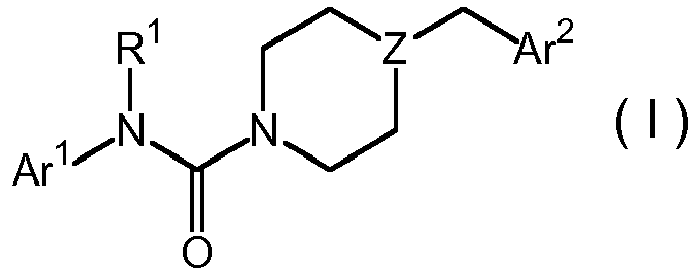
- Z is -N- or >CH;
- R1 is -H or -C1-4alkyl;
- Ar1 is 2-thiazolyl, 2-pyridyl, 3-pyridyl, 4-pyridyl, 2-pyrimidinyl, 4-pyrimidinyl, 5-pyrimidinyl, or phenyl, each unsubstituted or substituted at a carbon ring member with one or two Ra moieties;
where each Ra moiety is independently selected from the group consisting of -C1-4alkyl, -C2-4alkenyl, -OH, -OC1-4alkyl, halo, -CF3, -OCF3, -SCF3, -SH, -S(O)0-2C1-4alkyl, -OSO2C1-4alkyl, -CO2C1-4alkyl, -CO2H, -COC1-4alkyl, -N(Rb)Rc, -SO2NRbRc, -NRbSO2Rc, -C(=O)NRbRc, -NO2, and -CN, wherein Rb and Rc are each independently -H or -C1-4alkyl; and - Ar2 is:
- (a) unsubstituted 1-naphthyl; or a phenanthrenyl, pyrenyl, fluorenyl, 2-naphthyl, or N-Rd-9H-carbazolyl moiety, wherein Rd is selected from the group consisting of -H, -C1-4alkyl, and phenyl, each said moiety unsubstituted or substituted with one, two, or three Re substituents,
wherein each Re substituent is independently selected from the group consisting of -C1-4alkyl, -C2-4alkenyl, -OH, -OC1-4alkyl, halo, -CF3, -OCF3, -SCF3, -SH, -S(O)0-2C1-4alkyl, -OSO2C1-4alkyl, -CO2C1-4alkyl, -CO2H, -COC1-4alkyl, -N(Rb)Rc, -SO2NRbRc, -NRbSO2Rc, -C(=O)NRbRc, -NO2, and -CN, wherein Rb and Rc are as previously defined; - (b) phenyl fused at two adjacent ring carbon atoms to a group selected from the group consisting of -(CH2)3-5- having 0 or 1 double bonds, , -OCH2CH2O-, and -OCF2O- to form a fused ring structure; or phenyl substituted on adjacent ring carbon atoms with -OCH2O- to form 4-benzo[1,3]dioxolyl; each phenyl moiety further unsubstituted or substituted with one, two, or three Re substituents as previously defined;
- (c) Ar6, where Ar6 is a 6-membered monocyclic heteroaryl having carbon as a point of attachment, with one or two nitrogen heteroatoms, unsubstituted or substituted with one, two, or three Re substituents as previously defined;
- (d) a 9- or 10-membered fused bicyclic heteroaryl having one heteroatom selected from the group consisting of N, O, and S, with a carbon atom as point of ring attachment, and optionally having up to four additional carbon ring atoms replaced with nitrogen, said fused bicyclic heteroaryl having not more than five heteroatoms, and unsubstituted or substituted with one, two, or three Re substituents as previously defined;
- (e) phenyl substituted at the 3- or 4-position with Rg, and optionally further substituted with one, two, or three substituents Rh,
wherein each Rg is independently selected from the group consisting of -C2-8alkyl, -C2-8alkenyl, -OC3-8cycloalkyl, -OC3-8heterocycloalkyl, and -O-C2-10alkyl optionally substituted with -NRiRj, wherein Ri and Rj are each independently -H or -C1-8alkyl, or Ri and Rj are taken together with the nitrogen ring atom of attachment to form a 5-, 6-, or 7-membered heterocycloalkyl ring optionally having one additional carbon ring atom replaced with O, S, >NH, or >NC1-4alkyl; and
each Rh substituent is independently selected from the group consisting of -C1-4alkyl, -C2-4alkenyl, -OH, -OC1-4alkyl, halo, -CF3, -OCF3, -SCF3, -SH, -S(O)0-2C1-4alkyl, -OSO2C1-4alkyl, -CO2C1-4alkyl, -CO2H, -COC1-4alkyl, -N(Rb)Rc, -SO2NRbRc, -NRbSO2Rc, -C(=O)NRbRc, -NO2, and -CN, wherein Rb and Rc are as previously defined; - (f) phenyl substituted at the 3- or 4-position with -L-Ar3, wherein:
- o L is a linker selected from the group consisting of -(CH2)1-3-, -CH=CH-, -O-, -OCH2-, -CH2O-, -NH-, >NC1-4alkyl, >S(=O)0-2, -OSO2-, -CΞC-, -C(=O)-, and a covalent bond; and
- o Ar3 is a moiety selected from the group consisting of:
- (1) phenyl, naphthyl, and phenanthrenyl,
- (2) Ar6', where Ar6' is a 6-membered monocyclic heteroaryl having carbon as a point of attachment, having one or two nitrogen heteroatoms,
- (3) Ar5, where Ar5' is a 5-membered monocyclic heteroaryl having carbon as a point of attachment, with one heteroatom selected from the group consisting of O, S, >NH, and >NRf, wherein Rf is -C1-8alkyl or -C0-3phenalkyl, and having zero, one, two, or three additional nitrogen heteroatoms, and
- (4) a 9- or 10-membered fused bicyclic heteroaryl, having one heteroatom selected from the group consisting of N, O, and S, with a carbon as point of ring attachment, and optionally having up to four additional carbon ring atoms replaced with nitrogen, said fused bicyclic heteroaryl having not more than five heteroatoms;
with -OC1-4alkyleneO-, -(CH2)2-3NH-, -(CH2)1-2NH(CH2)-, -(CH2)2-3N(C1-4alk yl)-, or -(CH2)1-2N(C1-4alkyl)(CH2)- to form a fused ring structure, and is optionally further substituted with one, two, or three substituents Rk,
wherein each Rk substituent is independently selected from the group consisting of -C1-4alkyl, -C2-4alkenyl, -OH, -OC1-4alkyl, halo, -CF3, -OCF3, -SCF3, -SH, -S(O)0-2C1-4alkyl, -OSO2C1-4alkyl, -CO2C1-4alkyl, -CO2H, -COC1-4alkyl, -N(Rb)Rc, -SO2NRbRc, -NRbSO2Rc, -C(=O)NRbRc, -NO2, and -CN, wherein Rb and Rc are as previously defined;
- (g) 2-hydroxyphenyl or 2-methoxyphenyl, unsubstituted or substituted with one, two, or three substituents Rl,
wherein each Rl substituent is independently selected from the group consisting of -CH3, 6-C2-4alkyl, 6-C2-4alkenyl, -OH, -OCH3, 6-OC2-6alkyl, halo, -CF3, -OCF3, -SCF3, -SH, -SC1-4alkyl, -SO2C1-4alkyl, -CO2C1-4alkyl, -CO2H, -COC1-4alkyl, -N(Rb)Rc, -SO2NRb,Rc, -NRbSO2Rc, -C(=O)NRbRc, -NO2, and -CN, wherein Rb and Rc are as previously defined; - (h) 4-halophenyl, unsubstituted or substituted with one, two, or three substituents Rm,
wherein each Rm substituent is independently selected from the group consisting of -CH3, 2-C2-4alkyl, 2-C2-4alkenyl, 3-hydroxy, 4-hydroxy, -OCH3, 2-OC2-6alkyl, halo, -CF3, -OCF3, -SCF3, -SH, -SC1-4alkyl, -SO2C1-4alkyl, -CO2C1-4alkyl, -CO2H, -COC1-4alkyl, -N(Rb)Rc, -SO2NRbRc, -NRbSO2Rc, -C(=O)NRbRc, -NO2, and -CN, wherein Rb and Rc are as previously defined; or - (i) 2-bromophenyl, 3-methylphenyl, 3-methoxyphenyl, 4-methoxyphenyl, or 3,4-dimethoxyphenyl;
where when Ar2 is 4-fluorophenyl, 3,4-difluorophenyl, 4-chlorophenyl, or 3-methoxyphenyl, Ar1 is not unsubstituted phenyl or phenyl substituted with 4-Cl, -NO2, -CF3, or 4-CO2Et; and
where when Ar2 is 3,4-dichlorophenyl, Ar1 is not phenyl substituted with 4-Cl, -NO2, -CF3, or 4-CO2Et;
- (a) unsubstituted 1-naphthyl; or a phenanthrenyl, pyrenyl, fluorenyl, 2-naphthyl, or N-Rd-9H-carbazolyl moiety, wherein Rd is selected from the group consisting of -H, -C1-4alkyl, and phenyl, each said moiety unsubstituted or substituted with one, two, or three Re substituents,
- 2. A compound as defined in embodiment 1, wherein R1 is methyl.
- 3. A compound as defined in embodiment 1, wherein Ar1 is 2-thiazolyl.
- 4. A compound as defined in embodiment 1, wherein Ar2 is 2-methoxyphenyl, unsubstituted or substituted with one, two, or three substituents Rl.
- 5. A compound as defined in embodiment 1, wherein Ar2 is 3,4-dichlorophenyl.
- 6. A compound as defined in embodiment 1, wherein:
- Z is -N- or >CH;
- R1 is -H or -C1-4alkyl;
- Ar1 is 2-pyridyl, 3-pyridyl, 4-pyridyl, 2-pyrimidinyl, 4-pyrimidinyl, 5-pyrimidinyl, or phenyl, each unsubstituted or substituted at a carbon ring member with one or two Ra moieties;
where each Ra moiety is independently selected from the group consisting of -C1-4alkyl, -C2-4alkenyl, -OH, -OC1-4alkyl,
halo, -CF3, -OCF3, -SCF3, -SH, -S(O)0-2C1-4alkyl, -OSO2C1-4alkyl, -CO2C1-4alkyl, -CO2H, -COC1-4alkyl, -N(Rb)Rc, -SO2NRbRc, -NRbSO2Rc, -C(=O)NRbRc, -NO2, and -CN,
wherein Rb and Rc are each independently -H or -C1-4alkyl; and - Ar2 is:
- (a) unsubstituted 1-naphthyl; or phenanthrenyl, pyrenyl, fluorenyl, 2-naphthyl, or N-Rd-9H-carbazolyl moieties, wherein Rd is selected from the group consisting of -H, -C1-4alkyl, and phenyl, each said moiety unsubstituted or substituted with one, two, or three Re substituents,
wherein each Re substituent is independently selected from the group consisting of -C1-4alkyl, -C2-4alkenyl, -OH, -OC1-4alkyl,
halo, -CF3, -OCF3, -SCF3, -SH, -S(O)0-2C1-4alkyl, -OSO2C1-4alkyl, -CO2C1-4alkyl, -CO2H, -COC1-4alkyl, -N(Rb)Rc, -SO2NRbRc, -NRbSO2Rc, -C(=O)NRbRc, -NO2, and -CN, wherein Rb and Rc are as previously defined; - (b) phenyl fused at two adjacent ring carbon atoms to a group selected from the group consisting of -(CH2)3-5- having 0 or 1 double bonds, , -OCH2CH2O-, and -OCF2O- to form a fused ring structure; or phenyl substituted on adjacent ring carbon atoms with -OCH2O- to form 4-benzo[1,3]dioxolyl; each phenyl moiety further unsubstituted or substituted with one, two, or three Re substituents as previously defined;
- (c) Ar6, where Ar6 is a 6-membered monocyclic heteroaryl having carbon as a point of attachment, with one or two nitrogen heteroatoms, unsubstituted or substituted with one, two, or three Re substituents as previously defined;
- (d) a 9- or 10-membered fused bicyclic heteroaryl having one heteroatom selected from the group consisting of N, O, and S, with a carbon atom as point of ring attachment, and optionally having up to four additional carbon ring atoms replaced with nitrogen, said fused bicyclic heteroaryl having not more than five heteroatoms, and unsubstituted or substituted with one, two, or three Re substituents as previously defined;
- (e) phenyl substituted at the 3- or 4-position with Rg, and optionally further substituted with one, two, or three substituents Rh,
wherein each Rg is independently selected from the group consisting of -C2-8alkyl, -C2-8alkenyl, -OC3-8cycloalkyl, -OC3-8heterocycloalkyl, and -O-C2-10alkyl optionally substituted with -NRiRj, wherein Ri and Rj are each independently -H or -C1-8alkyl, or Ri and Rj are taken together with the nitrogen ring atom of attachment to form a 5-, 6-, or 7-membered heterocycloalkyl ring optionally having one additional carbon ring atom replaced with O, S, >NH, or >NC1-4alkyl; and
each Rh substituent is independently selected from the group consisting of -C1-4alkyl, -C2-4alkenyl, -OH, -OC1-4alkyl,
halo, -CF3, -OCF3, -SCF3, -SH, -S(O)0-2C1-4alkyl, -OSO2C1-4alkyl, -CO2C1-4alkyl, -CO2H, -COC1-4alkyl, -N(Rb)Rc, -SO2NRb,Rc, -NRbSO2Rc, -C(=O)NRbRc, -NO2, and -CN, wherein Rb and Rc are as previously defined; - (f) phenyl substituted at the 3- or 4-position with -L-Ar3, wherein:
- o L is a linker selected from the group consisting of -(CH2)1-3-, -CH=CH-, -O-, -OCH2-, -CH2O-, -NH-, >NC1-4alkyl, >S(=O)0-2, -OSO2-, -C≡C-, -C(=O)-, and a covalent bond; and
- o Ar3 is a moiety selected from the group consisting of:
- (1) phenyl, naphthyl, and phenanthrenyl,
- (2) Ar6', where Ar6' is a 6-membered monocyclic heteroaryl having carbon as a point of attachment, having one or two nitrogen heteroatoms,
- (3) Ar5', where Ar5' is a 5-membered monocyclic heteroaryl having carbon as a point of attachment, with one heteroatom selected from the group consisting of O, S, >NH, and >NRf, wherein Rf is -C1-8alkyl or -C0-3phenalkyl, and having zero, one, two, or three additional nitrogen heteroatoms, and
- (4) a 9- or 10-membered fused bicyclic heteroaryl, having one heteroatom selected from the group consisting of N, O, and S, with a carbon as point of ring attachment, and optionally having up to four additional carbon ring atoms replaced with nitrogen, said fused bicyclic heteroaryl having not more than five heteroatoms;
where each of the moieties (1) through (4) is optionally di-substituted on adjacent carbons
with -OC1-4alkyleneO-, -(CH2)2-3NH-, -(CH2)1-2NH(CH2)-, -(CH2)2-3N(C1-4alk yl)-, or -(CH2)1-2N(C1-4alkyl)(CH2)- to form a fused ring structure, and is optionally further substituted with one, two, or three substituents Rk,
wherein each Rk substituent is independently selected from the group consisting of -C1-4alkyl, -C2-4alkenyl, -OH, -OC1-4alkyl,
halo, -CF3, -OCF3, -SCF3, -SH, -S(O)0-2C1-4alkyl, -OSO2C1-4alkyl, -CO2C1-4alkyl, -CO2H, -COC1-4alkyl, -N(Rb)Rc, -SO2NRb,Rc, -NRbSO2Rc, -C(=O)NRbRc, -NO2, and -CN, wherein Rb and Rc are as previously defined;
- (g) 2-hydroxyphenyl, unsubstituted or substituted with one, two, or three substituents Rl,
wherein each Rl substituent is independently selected from the group consisting of -CH3, 6-C2-4alkyl, 6-C2-4alkenyl, -OH, -OCH3, 6-OC2-6alkyl, halo, -CF3, -OCF3, -SCF3, -SH, -SC1-4alkyl, -SO2C1-4alkyl, -CO2C1-4alkyl, -CO2H, -COC1-4alkyl, -N(Rb)Rc, -SO2NRb,Rc, -NRbSO2Rc, -C(=O)NRbRc, -NO2, and -CN, wherein Rb and Rc are as previously defined; - (h) 4-halophenyl, unsubstituted or substituted with one, two, or three substituents Rm,
wherein each Rm substituent is independently selected from the group consisting of -CH3, 2-C2-4alkyl, 2-C2-4alkenyl, 3-hydroxy, 4-hydroxy, -OCH3, 2-OC2-6alkyl, halo, -CF3, -OCF3, -SCF3, -SH, -SC1-4alkyl, -SO2C1-4alkyl, -CO2C1-4alkyl, -CO2H, -COC1-4alkyl, -N(Rb)Rc, -SO2NRb,Rc, -NRbSO2Rc, -C(=O)NRbRc, -NO2, and -CN, wherein Rb and Rc are as previously defined; or - (i) 2-bromophenyl, 3-methylphenyl, 3-methoxyphenyl, 4-methoxyphenyl, or 3,4-dimethoxyphenyl;
where when Ar2 is 4-fluorophenyl, 3,4-difluorophenyl, 4-chlorophenyl, or 3-methoxyphenyl, Ar1 is not unsubstituted phenyl or phenyl substituted with 4-Cl, -NO2, -CF3, or 4-CO2Et; and
where when Ar2 is 3,4-dichlorophenyl, Ar1 is not phenyl substituted with 4-Cl, -NO2, -CF3, or 4-CO2Et;
- (a) unsubstituted 1-naphthyl; or phenanthrenyl, pyrenyl, fluorenyl, 2-naphthyl, or N-Rd-9H-carbazolyl moieties, wherein Rd is selected from the group consisting of -H, -C1-4alkyl, and phenyl, each said moiety unsubstituted or substituted with one, two, or three Re substituents,
- 7. A compound as defined in embodiment 6, wherein Z is -N-.
- 8. A compound as defined in embodiment 7, wherein R1 is -H.
- 9. A compound as defined in embodiment 7, wherein Ar2 is phenanthren-9-yl, pyren-1-yl, 9H-fluoren-2-yl, 1-naphthyl, 2-naphthyl, 1-hydroxynaphthalen-2-yl, 6-methoxynaphthalen-2-yl, or 9-ethyl-9H-carbazol-3-yl, each unsubstituted or substituted with one, two, or three Re substituents as previously defined.
- 10. A compound as defined in embodiment 7, wherein Ar2 is indanyl, indenyl, tetrahydronaphthyl, 2,3-dihydro-benzofuranyl, chromanyl, 2,3-dihydro-benzo[1,4]dioxinyl, or 2,2-difluoro-benzo[1,3]dioxolyl, each unsubstituted or substituted with one, two, or three Re substituents as previously defined.
- 11. A compound as defined in embodiment 7, wherein Ar2 is phenyl-1 H-pyrrolyl, 2-pyridyl, 3-pyridyl, 4-pyridyl, or 6-bromo-pyridin-2-yl, each unsubstituted or substituted with one, two, or three Re substituents as previously defined.
- 12. A compound as defined in embodiment 7, wherein Ar2 is phenyl substituted at the 3- or 4-position with -L-Ar3, where L is -CH=CH-, -O-, -OCH2-, -SO2-, -OSO2-, or a covalent bond.
- 13. A compound as defined in embodiment 7, wherein Ar2 is 2-hydroxyphenyl, 5-bromo-2-hydroxy-3-methoxyphenyl, or 5-bromo-2-hydroxyphenyl.
- 14. A compound as defined in embodiment 8, wherein Ar1 is 2-pyridyl, 3-pyridyl, 4-pyridyl, 2-pyrimidinyl, or 4-pyrimidinyl, each unsubstituted or substituted at a carbon ring atom with one or two Ra moieties as previously defined.
- 15. A compound as defined in embodiment 8, wherein Ar1 is phenyl unsubstituted or substituted at a carbon ring atom with one or two Ra moieties as previously defined.
- 16. A compound as defined in embodiment 8, wherein Ar1 is 2-fluorophenyl, 3-fluorophenyl, 4-fluorophenyl, 2,4-difluorophenyl, 2-chlorophenyl, 3-chlorophenyl, 4-chlorophenyl, 2-methylphenyl, 3-methylphenyl, 4-methylphenyl, 2-methoxyphenyl, 3-methoxyphenyl, 4-methoxyphenyl, 2-carbomethoxyphenyl, 3-carbomethoxyphenyl, 4-carbomethoxyphenyl, 2-carboxyphenyl, 3-carboxyphenyl, or unsubstituted phenyl.
- 17. A compound as defined in embodiment 16, wherein Ar2 is unsubstituted 2,2-difluoro-benzo[1,3]dioxolyl.
- 18. A compound as defined in embodiment 16, wherein Ar2 is unsubstituted 4-benzo[1,3]dioxolyl.
- 19. A compound as defined in embodiment 16, wherein Ar2 is 2-indolyl, 3-indolyl, 2-quinolinyl, 3-quinolinyl, or 2-quinoxalinyl, each unsubstituted or substituted with one, two, or three Re substituents as previously defined.
- 20. A compound as defined in embodiment 16, wherein Ar2 is 2-quinolinyl or 3-quinolinyl.
- 21. A compound as defined in embodiment 16, wherein Ar2 is 4-ethylphenyl, 4-isopropylphenyl, 3-vinylphenyl, 3-ethoxyphenyl, 4-ethoxyphenyl, 3-propoxyphenyl, 4-propoxyphenyl, 3-isobutoxyphenyl, 4-isopropoxyphenyl, 3-isobutoxyphenyl, 4-isobutoxyphenyl, 4-cyclohexyloxyphenyl, 3-(2-dimethylaminoethoxy)phenyl, 3-(2-piperidin-1-ylethoxy)phenyl, 3-(3-dimethylaminopropoxy)phenyl, or 3-(3-piperidin-1-ylpropoxy)phenyl.
- 22. A compound as defined in embodiment 16, wherein Ar3 is 4-chlorophenyl, 3,4-dichlorophenyl, 4-methylphenyl, 4-t-butylphenyl, 3-trifluoromethylphenyl, 4-methoxyphenyl, 3,5-dichlorophenyl, 1-naphthyl, 2-naphthyl, 3-chlorophenyl, 9-phenanthrenyl, 4-carbomethoxylphenyl, 4-methanesulfonylphenyl, 3-methoxyphenyl, benzo[1,3]dioxol-5-yl, or unsubstituted phenyl.
- 23. A compound as defined in embodiment 16, wherein Ar2 is 3,4-dibromophenyl, 3-bromo-4-fluorophenyl, or 4-chloro-3-trifluoromethyl.
- 24. A compound as defined in embodiment 16, wherein Ar2 is 3,4-dibromophenyl.
- 25. A compound selected from the group consisting of:
- 4-naphthalen-2-ylmethyl-piperazine-1-carboxylic acid phenylamide;
- 4-quinolin-2-ylmethyl-piperazine-1-carboxylic acid phenylamide;
- 4-benzo[b]thiophen-2-ylmethyl-piperazine-1-carboxylic acid phenylamide;
- 4-(3,4-dibromo-benzyl)-piperazine-1-carboxylic acid phenylamide;
- 4-(1-methyl-1H-indol-2-ylmethyl)-piperazine-1-carboxylic acid phenylamide;
- 4-quinolin-3-ylmethyl-piperazine-1-carboxylic acid phenylamide;
- 4-(4-iodo-benzyl)-piperazine-1-carboxylic acid phenylamide;
- 4-(3-benzyloxy-benzyl)-piperazine-1-carboxylic acid phenylamide;
- 4-(5-bromo-2-hydroxy-3-methoxy-benzyl)-piperazine-1-carboxylic acid phenylamide;
- 4-(4-bromo-benzyl)-piperazine-1-carboxylic acid phenylamide;
- 4-(3-phenoxy-benzyl)-piperazine-1-carboxylic acid phenylamide;
- 4-(3-bromo-4-fluoro-benzyl)-piperazine-1-carboxylic acid phenylamide;
- 4-indan-5-ylmethyl-piperazine-1-carboxylic acid phenylamide;
- 4-benzo[b]thiophen-3-ylmethyl-piperazine-1-carboxylic acid phenylamide;
- 4-(4-isopropyl-benzyl)-piperazine-1-carboxylic acid phenylamide;
- 4-(4-ethyl-benzyl)-piperazine-1-carboxylic acid phenylamide;
- 4-(5-bromo-2-hydroxy-benzyl)-piperazine-1-carboxylic acid phenylamide;
- 4-(2,3-dihydro-benzo[1,4]dioxin-6-ylmethyl)-piperazine-1-carboxylic acid phenylamide;
- 4-(3-vinyl-benzyl)-piperazine-1-carboxylic acid phenylamide;
- 4-(2,3-dihydro-benzofuran-5-ylmethyl)-piperazine-1-carboxylic acid phenylamide;
- 4-naphthalen-1-ylmethyl-piperazine-1-carboxylic acid phenylamide;
- 4-(2-hydroxy-benzyl)-piperazine-1-carboxylic acid phenylamide;
- 4-(1 H-indol-5-ylmethyl)-piperazine-1-carboxylic acid phenylamide;
- 4-pyridin-4-ylmethyl-piperazine-1-carboxylic acid phenylamide;
- 4-pyridin-2-ylmethyl-piperazine-1-carboxylic acid phenylamide;
- 4-pyridin-3-ylmethyl-piperazine-1-carboxylic acid phenylamide;
- 4-(4-isopropoxy-benzyl)-piperazine-1-carboxylic acid phenylamide;
- 4-biphenyl-4-ylmethyl-piperazine-1-carboxylic acid phenylamide;
- 4-quinolin-4-ylmethyl-piperazine-1-carboxylic acid phenylamide;
- 4-benzo[1,3]dioxol-4-ylmethyl-piperazine-1-carboxylic acid phenylamide;
- 4-(2,2-difluoro-benzo[1,3]dioxol-5-ylmethyl)-piperazine-1-carboxylic acid phenylamide;
- 4-(1-methyl-1H-indol-5-ylmethyl)-piperazine-1-carboxylic acid phenylamide;
- 4-(6-chloro-quinolin-2-ylmethyl)-piperazine-1-carboxylic acid phenylamide;
- 4-(8-chloro-quinolin-2-ylmethyl)-piperazine-1-carboxylic acid phenylamide;
- 4-(2-chloro-quinolin-3-ylmethyl)-piperazine-1-carboxylic acid phenylamide;
- 4-naphthalen-2-ylmethyl-piperazine-1-carboxylic acid (4-fluoro-phenyl)-amide;
- 4-quinolin-2-ylmethyl-piperazine-1-carboxylic acid (4-fluoro-phenyl)-amide;
- 4-(1-hydroxy-naphthalen-2-ylmethyl)-piperazine-1-carboxylic acid phenylamide;
- 4-[3-(4-chloro-phenoxy)-benzyl]-piperazine-1-carboxylic acid phenylamide;
- 4-[3-(3,4-dichloro-phenoxy)-benzyl]-piperazine-1-carboxylic acid phenylamide;
- 4-(3-p-tolyloxy-benzyl)-piperazine-1-carboxylic acid phenylamide;
- 4-[3-(4-tert-butyl-phenoxy)-benzyl]-piperazine-1-carboxylic acid phenylamide;
- 4-[3-(3-trifluoromethyl-phenoxy)-benzyl]-piperazine-1-carboxylic acid phenylamide;
- 4-[3-(4-methoxy-phenoxy)-benzyl]-piperazine-1-carboxylic acid phenylamide;
- 4-(6-methoxy-naphthalen-2-ylmethyl)-piperazine-1-carboxylic acid phenylamide;
- 4-phenanthren-9-ylmethyl-piperazine-1-carboxylic acid phenylamide;
- 4-pyren-1-ylmethyl-piperazine-1-carboxylic acid phenylamide;
- 4-(6-chloro-quinolin-3-ylmethyl)-piperazine-1-carboxylic acid phenylamide;
- 4-biphenyl-3-ylmethyl-piperazine-1-carboxylic acid phenylamide;
- 4-(6-bromo-pyridin-2-ylmethyl)-piperazine-1-carboxylic acid phenylamide;
- 4-[3-(4-chloro-benzenesulfonyl)-benzyl]-piperazine-1-carboxylic acid phenylamide;
- 4-(1 H-indol-6-ylmethyl)-piperazine-1-carboxylic acid phenylamide;
- 4-(4-phenoxy-benzyl)-piperazine-1-carboxylic acid phenylamide;
- 4-(2-chloro-8-methyl-quinolin-3-ylmethyl)-piperazine-1-carboxylic acid phenylamide;
- 4-(1-methyl-1H-indol-6-ylmethyl)-piperazine-1-carboxylic acid phenylamide;
- 4-(4-benzyloxy-benzyl)-piperazine-1-carboxylic acid phenylamide;
- 4-[3-(3,5-dichloro-phenoxy)-benzyl]-piperazine-1-carboxylic acid phenylamide;
- 4-(9H-fluoren-2-ylmethyl)-piperazine-1-carboxylic acid phenylamide;
- 4-(9-ethyl-9H-carbazol-3-ylmethyl)-piperazine-1-carboxylic acid phenylamide;
- 4-(4-styryl-benzyl)-piperazine-1-carboxylic acid phenylamide;
- 4-(4-chloro-3-trifluoromethyl-benzyl)-piperazine-1-carboxylic acid phenylamide;
- 4-[2,5-dimethyl-1-(3-trifluoromethyl-phenyl)-1H-pyrrol-3-ylmethyl]-piperazine-1-carboxylic acid phenylamide;
- 4-(2-bromo-benzyl)-piperazine-1-carboxylic acid phenylamide;
- 4-(3,4-dibromo-benzyl)-piperazine-1-carboxylic acid (3-fluoro-phenyl)-amide;
- 4-(3,4-dibromo-benzyl)-piperazine-1-carboxylic acid (4-fluoro-phenyl)-amide;
- 4-(3,4-dibromo-benzyl)-piperazine-1-carboxylic acid (3-methoxy-phenyl)-amide;
- 4-(3,4-dibromo-benzyl)-piperazine-1-carboxylic acid m-tolylamide;
- 4-(3,4-dibromo-benzyl)-piperazine-1-carboxylic acid (2-fluoro-phenyl)-amide;
- 4-(3,4-dibromo-benzyl)-piperazine-1-carboxylic acid (4-methoxy-phenyl)-amide;
- 4-(3,4-dibromo-benzyl)-piperazine-1-carboxylic acid (2-methoxy-phenyl)-amide;
- 4-(3,4-dibromo-benzyl)-piperazine-1-carboxylic acid (3-chloro-phenyl)-amide;
- 4-(3,4-dibromo-benzyl)-piperazine-1-carboxylic acid (2-chloro-phenyl)-amide;
- 4-(3,4-dibromo-benzyl)-piperazine-1-carboxylic acid p-tolylamide;
- 4-(3,4-dibromo-benzyl)-piperazine-1-carboxylic acid (4-chloro-phenyl)-amide;
- 4-(3,4-dibromo-benzyl)-piperazine-1-carboxylic acid o-tolylamide;
- 4-quinolin-3-ylmethyl-piperazine-1-carboxylic acid (3-fluoro-phenyl)-amide;
- 4-quinolin-3-ylmethyl-piperazine-1-carboxylic acid (4-fluoro-phenyl)-amide;
- 4-quinolin-3-ylmethyl-piperazine-1-carboxylic acid (2-chloro-phenyl)-amide;
- 4-quinolin-3-ylmethyl-piperazine-1-carboxylic acid (3-chloro-phenyl)-amide;
- 4-quinolin-3-ylmethyl-piperazine-1-carboxylic acid (4-chloro-phenyl)-amide;
- 4-quinolin-3-ylmethyl-piperazine-1-carboxylic acid (2-methoxy-phenyl)-amide;
- 4-quinolin-3-ylmethyl-piperazine-1-carboxylic acid o-tolylamide;
- 4-quinolin-3-ylmethyl-piperazine-1-carboxylic acid p-tolylamide;
- 2-[(4-quinolin-3-ylmethyl-piperazine-1-carbonyl)-amino]-benzoic acid methyl ester;
- 3-[(4-quinolin-3-ylmethyl-piperazine-1-carbonyl)-amino]-benzoic acid methyl ester;
- 4-[(4-quinolin-3-ylmethyl-piperazine-1-carbonyl)-amino]-benzoic acid methyl ester;
- 4-quinolin-3-ylmethyl-piperazine-1-carboxylic acid (4-methoxy-phenyl)-amide;
- 4-quinolin-3-ylmethyl-piperazine-1-carboxylic acid m-tolylamide;
- 4-quinolin-3-ylmethyl-piperazine-1-carboxylic acid (3-methoxy-phenyl)-amide;
- 4-quinolin-3-ylmethyl-piperazine-1-carboxylic acid (2,4-difluoro-phenyl)-amide;
- 4-quinolin-3-ylmethyl-piperazine-1-carboxylic acid (2-fluoro-phenyl)-amide;
- 4-benzyl-piperidine-1-carboxylic acid p-tolylamide;
- 4-benzyl-piperidine-1-carboxylic acid m-tolylamide;
- 4-benzyl-piperidine-1-carboxylic acid (2-chloro-phenyl)-amide;
- 4-(3,4-dibromo-benzyl)-piperazine-1-carboxylic acid pyridin-4-ylamide;
- 4-(3,4-dibromo-benzyl)-piperazine-1-carboxylic acid pyridin-2-ylamide;
- 4-(3,4-dibromo-benzyl)-piperazine-1-carboxylic acid pyridin-3-ylamide;
- 4-(4-cyclohexyloxy-benzyl)-piperazine-1-carboxylic acid phenylamide;
- 4-(3-propoxy-benzyl)-piperazine-1-carboxylic acid phenylamide;
- 4-(3-isobutoxy-benzyl)-piperazine-1-carboxylic acid phenylamide;
- 4-(3-ethoxy-benzyl)-piperazine-1-carboxylic acid phenylamide;
- 4-(4-propoxy-benzyl)-piperazine-1-carboxylic acid phenylamide;
- 4-(4-isobutoxy-benzyl)-piperazine-1-carboxylic acid phenylamide;
- 4-[3-(2-dimethylamino-ethoxy)-benzyl]-piperazine-1-carboxylic acid phenylamide;
- 4-[3-(2-piperidin-1-yl-ethoxy)-benzyl]-piperazine-1-carboxylic acid phenylamide;
- 4-[3-(3-dimethylamino-propoxy)-benzyl]-piperazine-1-carboxylic acid phenylamide;
- 4-[3-(3-piperidin-1-yl-propoxy)-benzyl]-piperazine-1-carboxylic acid phenylamide;
- 4-(4-ethoxy-benzyl)-piperazine-1-carboxylic acid phenylamide;
- 4-[3-(3-chloro-phenoxy)-benzyl]-piperazine-1-carboxylic acid phenylamide;
- 4-[3-(naphthalen-2-yloxy)-benzyl]-piperazine-1-carboxylic acid phenylamide;
- 4-[3-(phenanthren-9-yloxy)-benzyl]-piperazine-1-carboxylic acid phenylamide;
- 4-[3-(4-phenylcarbamoyl-piperazin-1-ylmethyl)-phenoxy]-benzoic acid methyl ester;
- 4-[3-(4-methanesulfonyl-phenoxy)-benzyl]-piperazine-1-carboxylic acid phenylamide;
- 4-[3-(3-methoxy-phenoxy)-benzyl]-piperazine-1-carboxylic acid phenylamide;
- 4-[3-(benzo[1,3]dioxol-5-yloxy)-benzyl]-piperazine-1-carboxylic acid phenylamide;
- methanesulfonic acid 3-(4-phenylcarbamoyl-piperazin-1-ylmethyl)-phenyl ester;
- benzenesulfonic acid 3-(4-phenylcarbamoyl-piperazin-1-ylmethyl)-phenyl ester;
- 4-chloro-benzenesulfonic acid 3-(4-phenylcarbamoyl-piperazin-1-ylmethyl)-phenyl ester;
- 2-[(4-quinolin-3-ylmethyl-piperazine-1-carbonyl)-amino]-benzoic acid;
- 3-[(4-quinolin-3-ylmethyl-piperazine-1-carbonyl)-amino]-benzoic acid;
- 4-quinolin-3-ylmethyl-piperazine-1-carboxylic acid pyridin-3-ylamide;
- 4-quinolin-3-ylmethyl-piperazine-1-carboxylic acid pyridin-2-ylamide;
- 4-quinolin-3-ylmethyl-piperazine-1-carboxylic acid pyridin-4-ylamide;
- 4-quinolin-3-ylmethyl-piperazine-1-carboxylic acid pyrimidin-2-ylamide;
- 4-benzo[1,3]dioxol-5-ylmethyl-piperazine-1-carboxylic acid pyridin-3-ylamide;
- 4-benzo[1,3]dioxol-5-ylmethyl-piperazine-1-carboxylic acid pyridin-4-ylamide;
- 4-benzo[1,3]dioxol-5-ylmethyl-piperazine-1-carboxylic acid pyrimidin-2-ylamide;
- 4-benzo[1,3]dioxol-5-ylmethyl-piperazine-1-carboxylic acid pyridin-2-ylamide;
- 4-(2,2-difluoro-benzo[1,3]dioxol-5-ylmethyl)-piperazine-1-carboxylic acid pyridin-3-ylamide;
- 4-(2,2-difluoro-benzo[1,3]dioxol-5-ylmethyl)-piperazine-1-carboxylic acid pyridin-4-ylamide;
- 4-quinolin-3-ylmethyl-piperazine-1-carboxylic acid pyrimidin-4-ylamide;
- 4-(2,2-difluoro-benzo[1,3]dioxol-5-ylmethyl)-piperazine-1-carboxylic acid pyrimidin-4-ylamide;
- 4-(3,4-dibromo-benzyl)-piperazine-1-carboxylic acid pyrimidin-4-ylamide;
- 4-[(4-quinolin-3-ylmethyl-piperazine-1-carbonyl)-amino]-benzoic acid; and
- 4-quinoxalin-2-ylmethyl-piperazine-1-carboxylic acid phenylamide;
- 26. A compound selected from the group consisting of:
- 4-(3,4-dichloro-benzyl)-piperazine-1-carboxylic acid phenylamide;
- 4-quinolin-3-ylmethyl-piperazine-1-carboxylic acid thiazol-2-ylamide;
- 4-benzo[1,3]dioxol-5-ylmethyl-piperazine-1-carboxylic acid thiazol-2-ylamide;
- 4-(3,4-dibromo-benzyl)-piperazine-1-carboxylic acid methyl-phenyl-amide;
- 4-(2-methoxy-benzyl)-piperazine-1-carboxylic acid phenylamide;
- 4-benzofuran-2-ylmethyl-piperazine-1-carboxylic acid phenylamide;
- 4-(3,4-dibromo-benzyl)-piperazine-1-carboxylic acid (4-nitro-phenyl)-amide; and
- 4-(3,4-dibromo-benzyl)-piperazine-1-carboxylic acid (4-trifluoromethyl-phenyl)-amide;
- 27. A method of treating a subject suffering from or diagnosed with a disease, disorder, or medical condition mediated by FAAH activity, comprising administering to the subject in need of such treatment an effective amount of a compound of Formula (I):

- Z is -N- or >CH;
- R1 is -H or -C1-4alkyl;
- Ar1 is 2-thiazolyl, 2-pyridyl, 3-pyridyl, 4-pyridyl, 2-pyrimidinyl, 4-pyrimidinyl, 5-pyrimidinyl, or phenyl, each unsubstituted or substituted at a carbon ring member with one or two Ra moieties;
where each Ra moiety is independently selected from the group consisting of -C1-4alkyl, -C2-4alkenyl, -OH, -OC1-4alkyl,
halo, -CF3, -OCF3, -SCF3, -SH, -S(O)0-2C1-4alkyl, -OSO2C1-4alkyl, -CO2C1-4alkyl, -CO2H, -COC1-4alkyl, -N(Rb)Rc, -SO2NRbRc, -NRbSO2Rc, -C(=O)NRbRc, -NO2, and -CN, wherein Rb and Rc are each independently -H or -C1-4alkyl; and - Ar2 is:
- (a) phenanthrenyl, pyrenyl, fluorenyl, naphthyl, or N-Rd-9H-carbazolyl moieties, wherein Rd is selected from the group consisting of -H, -C1-4alkyl, and phenyl, each said moiety unsubstituted or substituted with one, two, or three Re substituents,
wherein each Re substituent is independently selected from the group consisting of -C1-4alkyl, -C2-4alkenyl, -OH, -OC1-4alkyl,
halo, -CF3, -OCF3, -SCF3, -SH, -S(O)0-2C1-4alkyl, -OSO2C1-4alkyl, -CO2C1-4alkyl, -CO2H, -COC1-4alkyl, -N(Rb)Rc, -SO2NRbRc, -NRbSO2Rc, -C(=O)NRbRc, -NO2, and -CN, wherein Rb and Rc are as previously defined; - (b) phenyl fused at two adjacent ring carbon atoms to a group selected from the group consisting of -(CH2)3-5- having 0 or 1 double bonds, -(CH2)2-3O-, -OCH2CH2O-, -OCF2O- and -OCH2O- to form a fused ring structure, unsubstituted or substituted with one, two, or three Re substituents as previously defined;
- (c) Ar6, where Ar6 is a 6-membered monocyclic heteroaryl having carbon as a point of attachment, with one or two nitrogen heteroatoms, unsubstituted or substituted with one, two, or three Re substituents as previously defined;
- (d) a 9- or 10-membered fused bicyclic heteroaryl having one heteroatom selected from the group consisting of N, O, and S, with a carbon atom as point of ring attachment, and optionally having up to four additional carbon ring atoms replaced with nitrogen, said fused bicyclic heteroaryl having not more than five heteroatoms, and unsubstituted or substituted with one, two, or three Re substituents as previously defined;
- (e) phenyl substituted at the 3- or 4-position with Rg, and optionally further substituted with one, two, or three substituents Rh,
wherein each Rg is independently selected from the group consisting of -C2-8alkyl, -C2-8alkenyl, -OC3-8cycloalkyl, -OC3-8heterocycloalkyl, and -O-C2-10alkyl optionally substituted with -NRiRj, wherein Ri and Rj are each independently -H or -C1-8alkyl, or Ri and Rj are taken together with the nitrogen ring atom of attachment to form a 5-, 6-, or 7-membered heterocycloalkyl ring optionally having one additional carbon ring atom replaced with O, S, >NH, or >NC1-4alkyl; and
each Rh substituent is independently selected from the group consisting of -C1-4alkyl, -C2-4alkenyl, -OH, -OC1-4alkyl,
halo, -CF3, -OCF3, -SCF3, -SH, -S(O)0-2C1-4alkyl, -OSO2C1-4alkyl, -CO2C1-4alkyl, -CO2H, -COC1-4alkyl, -N(Rb)Rc, -SO2NRbRc, -NRbSO2Rc, -C(=O)NRbRc, -NO2, and -CN, wherein Rb and Rc are as previously defined; - (f) phenyl substituted at the 3- or 4-position with -L-Ar3, wherein:
- o L is a linker selected from the group consisting of -(CH2)1-3-, -CH=CH-, -O-, -OCH2-, -CH2O-, -NH-, >NC1-4alkyl, >S(=O)0-2, -OSO2-, -C≡C-, -C(=O)-, and a covalent bond; and
- o Ar3 is a moiety selected from the group consisting of:
- (1) phenyl, naphthyl, and phenanthrenyl,
- (2) Ar6', where Ar6' is a 6-membered monocyclic heteroaryl having carbon as a point of attachment, having one or two nitrogen heteroatoms,
- (3) Ar5', where Ar5' is a 5-membered monocyclic heteroaryl having carbon as a point of attachment, with one heteroatom selected from the group consisting of O, S, >NH, and >NRf, wherein Rf is -C1-8alkyl or -C0-3phenalkyl, and having zero, one, two, or three additional nitrogen heteroatoms, and
- (4) a 9- or 10-membered fused bicyclic heteroaryl, having one heteroatom selected from the group consisting of N, O, and S, with a carbon as point of ring attachment, and optionally having up to four additional carbon ring atoms replaced with nitrogen, said fused bicyclic heteroaryl having not more than five heteroatoms;
with -OC1-4alkyleneO-, -(CH2)2-3NH-, -(CH2)1-2NH(CH2)-, -(CH2)2-3N(C1-4alk yl)-, or -(CH2)1-2N(C1-4alkyl)(CH2)- to form a fused ring structure, and is optionally further substituted with one, two, or three substituents Rk,
wherein each Rk substituent is independently selected from the group consisting of -C1-4alkyl, -C2-4alkenyl, -OH, -OC1-4alkyl,
halo, -CF3, -OCF3, -SCF3, -SH, -S(O)0-2C1-4alkyl, -OSO2C1-4alkyl, -CO2C1-4alkyl, -CO2H, -COC1-4alkyl, -N(Rb)Rc, -SO2NRbRc, -NRbSO2Rc, -C(=O)NRbRc, -NO2, and -CN, wherein Rb and Rc are as previously defined;
- (g) 2-hydroxyphenyl or 2-methoxyphenyl, unsubstituted or substituted with one, two, or three substituents Rl,
wherein each Rl substituent is independently selected from the group consisting of -CH3, 6-C2-4alkyl, 6-C2-4alkenyl, -OH, -OCH3, 6-OC2-6alkyl, halo, -CF3, -OCF3, -SCF3, -SH, -SC1-4alkyl, -SO2C1-4alkyl, -CO2C1-4alkyl, -CO2H, -COC1-4alkyl, -N(Rb)Rc, -SO2NRbRc, -NRbSO2Rc, -C(=O)NRbRc, -NO2, and -CN, wherein Rb and Rc are as previously defined; - (h) 4-halophenyl, unsubstituted or substituted with one, two, or three substituents Rm,
wherein each Rm substituent is independently selected from the group
consisting of -CH3, 2-C2-4alkyl, 2-C2-4alkenyl, 3-hydroxy, 4-hydroxy, -OCH3, 2-OC2-6alkyl, halo, -CF3, -OCF3, -SCF3, -SH, -SC1-4alkyl, -SO2C1-4alkyl, -CO2C1-4alkyl, -CO2H, -COC1-4alkyl, -N(Rb)Rc, -SO2NRbRc, -NRbSO2Rc, -C(=O)NRbRc, -NO2, and -CN, wherein Rb and Rc are as previously defined; or - (i) 2-bromophenyl, 3-methylphenyl, 3-methoxyphenyl, 4-methoxyphenyl, or 3,4-dimethoxyphenyl;
- (a) phenanthrenyl, pyrenyl, fluorenyl, naphthyl, or N-Rd-9H-carbazolyl moieties, wherein Rd is selected from the group consisting of -H, -C1-4alkyl, and phenyl, each said moiety unsubstituted or substituted with one, two, or three Re substituents,
- 28. A method according to embodiment 27, wherein said compound is selected from the group consisting of:
- 4-naphthalen-2-ylmethyl-piperazine-1-carboxylic acid phenylamide;
- 4-quinolin-2-ylmethyl-piperazine-1-carboxylic acid phenylamide;
- 4-benzo[b]thiophen-2-ylmethyl-piperazine-1-carboxylic acid phenylamide;
- 4-(3,4-dibromo-benzyl)-piperazine-1-carboxylic acid phenylamide;
- 4-(1-methyl-1H-indol-2-ylmethyl)-piperazine-1-carboxylic acid phenylamide;
- 4-quinolin-3-ylmethyl-piperazine-1-carboxylic acid phenylamide;
- 4-(4-iodo-benzyl)-piperazine-1-carboxylic acid phenylamide;
- 4-(3-benzyloxy-benzyl)-piperazine-1-carboxylic acid phenylamide;
- 4-(5-bromo-2-hydroxy-3-methoxy-benzyl)-piperazine-1-carboxylic acid phenylamide;
- 4-(4-bromo-benzyl)-piperazine-1-carboxylic acid phenylamide;
- 4-(3-phenoxy-benzyl)-piperazine-1-carboxylic acid phenylamide;
- 4-(3-bromo-4-fluoro-benzyl)-piperazine-1-carboxylic acid phenylamide;
- 4-indan-5-ylmethyl-piperazine-1-carboxylic acid phenylamide;
- 4-benzo[b]thiophen-3-ylmethyl-piperazine-1-carboxylic acid phenylamide;
- 4-(4-isopropyl-benzyl)-piperazine-1-carboxylic acid phenylamide;
- 4-(4-ethyl-benzyl)-piperazine-1-carboxylic acid phenylamide;
- 4-(5-bromo-2-hydroxy-benzyl)-piperazine-1-carboxylic acid phenylamide;
- 4-(2,3-dihydro-benzo[1,4]dioxin-6-ylmethyl)-piperazine-1-carboxylic acid phenylamide;
- 4-(4-methoxy-benzyl)-piperazine-1-carboxylic acid phenylamide;
- 4-(3-vinyl-benzyl)-piperazine-1-carboxylic acid phenylamide;
- 4-(2,3-dihydro-benzofuran-5-ylmethyl)-piperazine-1-carboxylic acid phenylamide;
- 4-(3-methoxy-benzyl)-piperazine-1-carboxylic acid phenylamide;
- 4-naphthalen-1-ylmethyl-piperazine-1-carboxylic acid phenylamide;
- 4-(2-hydroxy-benzyl)-piperazine-1-carboxylic acid phenylamide;
- 4-(3-methyl-benzyl)-piperazine-1-carboxylic acid phenylamide;
- 4-(1 H-indol-5-ylmethyl)-piperazine-1-carboxylic acid phenylamide;
- 4-(3,4-dimethoxy-benzyl)-piperazine-1-carboxylic acid phenylamide;
- 4-pyridin-4-ylmethyl-piperazine-1-carboxylic acid phenylamide;
- 4-pyridin-2-ylmethyl-piperazine-1-carboxylic acid phenylamide;
- 4-pyridin-3-ylmethyl-piperazine-1-carboxylic acid phenylamide;
- 4-(4-isopropoxy-benzyl)-piperazine-1-carboxylic acid phenylamide;
- 4-biphenyl-4-ylmethyl-piperazine-1-carboxylic acid phenylamide;
- 4-quinolin-4-ylmethyl-piperazine-1-carboxylic acid phenylamide;
- 4-benzo[1,3]dioxol-4-ylmethyl-piperazine-1-carboxylic acid phenylamide;
- 4-(2,2-difluoro-benzo[1,3]dioxol-5-ylmethyl)-piperazine-1-carboxylic acid phenylamide;
- 4-(1-methyl-1H-indol-5-ylmethyl)-piperazine-1-carboxylic acid phenylamide;
- 4-(6-chloro-quinolin-2-ylmethyl)-piperazine-1-carboxylic acid phenylamide;
- 4-(8-chloro-quinolin-2-ylmethyl)-piperazine-1-carboxylic acid phenylamide;
- 4-(2-chloro-quinolin-3-ylmethyl)-piperazine-1-carboxylic acid phenylamide;
- 4-naphthalen-2-ylmethyl-piperazine-1-carboxylic acid (4-fluoro-phenyl)-amide;
- 4-quinolin-2-ylmethyl-piperazine-1-carboxylic acid (4-fluoro-phenyl)-amide;
- 4-(1-hydroxy-naphthalen-2-ylmethyl)-piperazine-1-carboxylic acid phenylamide;
- 4-[3-(4-chloro-phenoxy)-benzyl]-piperazine-1-carboxylic acid phenylamide;
- 4-[3-(3,4-dichloro-phenoxy)-benzyl]-piperazine-1-carboxylic acid phenylamide;
- 4-(3-p-tolyloxy-benzyl)-piperazine-1-carboxylic acid phenylamide;
- 4-[3-(4-tert-butyl-phenoxy)-benzyl]-piperazine-1-carboxylic acid phenylamide;
- 4-[3-(3-trifluoromethyl-phenoxy)-benzyl]-piperazine-1-carboxylic acid phenylamide;
- 4-[3-(4-methoxy-phenoxy)-benzyl]-piperazine-1-carboxylic acid phenylamide;
- 4-(6-methoxy-naphthalen-2-ylmethyl)-piperazine-1-carboxylic acid phenylamide;
- 4-phenanthren-9-ylmethyl-piperazine-1-carboxylic acid phenylamide;
- 4-pyren-1-ylmethyl-piperazine-1-carboxylic acid phenylamide;
- 4-(6-chloro-quinolin-3-ylmethyl)-piperazine-1-carboxylic acid phenylamide;
- 4-biphenyl-3-ylmethyl-piperazine-1-carboxylic acid phenylamide;
- 4-(6-bromo-pyridin-2-ylmethyl)-piperazine-1-carboxylic acid phenylamide;
- 4-[3-(4-chloro-benzenesulfonyl)-benzyl]-piperazine-1-carboxylic acid phenylamide;
- 4-(1 H-indol-6-ylmethyl)-piperazine-1-carboxylic acid phenylamide;
- 4-(4-phenoxy-benzyl)-piperazine-1-carboxylic acid phenylamide;
- 4-(2-chloro-8-methyl-quinolin-3-ylmethyl)-piperazine-1-carboxylic acid phenylamide;
- 4-(1-methyl-1H-indol-6-ylmethyl)-piperazine-1-carboxylic acid phenylamide;
- 4-(4-benzyloxy-benzyl)-piperazine-1-carboxylic acid phenylamide;
- 4-[3-(3,5-dichloro-phenoxy)-benzyl]-piperazine-1-carboxylic acid phenylamide;
- 4-(9H-fluoren-2-ylmethyl)-piperazine-1-carboxylic acid phenylamide;
- 4-(9-ethyl-9H-carbazol-3-ylmethyl)-piperazine-1-carboxylic acid phenylamide;
- 4-(4-styryl-benzyl)-piperazine-1-carboxylic acid phenylamide;
- 4-(4-chloro-3-trifluoromethyl-benzyl)-piperazine-1-carboxylic acid phenylamide;
- 4-[2,5-dimethyl-1-(3-trifluoromethyl-phenyl)-1H-pyrrol-3-ylmethyl]-piperazine-1-carboxylic acid phenylamide;
- 4-(2-bromo-benzyl)-piperazine-1-carboxylic acid phenylamide;
- 4-(3,4-dibromo-benzyl)-piperazine-1-carboxylic acid (3-fluoro-phenyl)-amide;
- 4-(3,4-dibromo-benzyl)-piperazine-1-carboxylic acid (4-fluoro-phenyl)-amide;
- 4-(3,4-dibromo-benzyl)-piperazine-1-carboxylic acid (3-methoxy-phenyl)-amide;
- 4-(3,4-dibromo-benzyl)-piperazine-1-carboxylic acid m-tolylamide;
- 4-(3,4-dibromo-benzyl)-piperazine-1-carboxylic acid (2-fluoro-phenyl)-amide;
- 4-(3,4-dibromo-benzyl)-piperazine-1-carboxylic acid (4-methoxy-phenyl)-amide;
- 4-(3,4-dibromo-benzyl)-piperazine-1-carboxylic acid (2-methoxy-phenyl)-amide;
- 4-(3,4-dibromo-benzyl)-piperazine-1-carboxylic acid (3-chloro-phenyl)-amide;
- 4-(3,4-dibromo-benzyl)-piperazine-1-carboxylic acid (2-chloro-phenyl)-amide;
- 4-(3,4-dibromo-benzyl)-piperazine-1-carboxylic acid p-tolylamide;
- 4-(3,4-dibromo-benzyl)-piperazine-1-carboxylic acid (4-chloro-phenyl)-amide;
- 4-(3,4-dibromo-benzyl)-piperazine-1-carboxylic acid o-tolylamide;
- 4-quinolin-3-ylmethyl-piperazine-1-carboxylic acid (3-fluoro-phenyl)-amide;
- 4-quinolin-3-ylmethyl-piperazine-1-carboxylic acid (4-fluoro-phenyl)-amide;
- 4-quinolin-3-ylmethyl-piperazine-1-carboxylic acid (2-chloro-phenyl)-amide;
- 4-quinolin-3-ylmethyl-piperazine-1-carboxylic acid (3-chloro-phenyl)-amide;
- 4-quinolin-3-ylmethyl-piperazine-1-carboxylic acid (4-chloro-phenyl)-amide;
- 4-quinolin-3-ylmethyl-piperazine-1-carboxylic acid (2-methoxy-phenyl)-amide;
- 4-quinolin-3-ylmethyl-piperazine-1-carboxylic acid o-tolylamide;
- 4-quinolin-3-ylmethyl-piperazine-1-carboxylic acid p-tolylamide;
- 2-[(4-quinolin-3-ylmethyl-piperazine-1-carbonyl)-amino]-benzoic acid methyl ester;
- 3-[(4-quinolin-3-ylmethyl-piperazine-1-carbonyl)-amino]-benzoic acid methyl ester;
- 4-[(4-quinolin-3-ylmethyl-piperazine-1-carbonyl)-amino]-benzoic acid methyl ester;
- 4-quinolin-3-ylmethyl-piperazine-1-carboxylic acid (4-methoxy-phenyl)-amide;
- 4-quinolin-3-ylmethyl-piperazine-1-carboxylic acid m-tolylamide;
- 4-quinolin-3-ylmethyl-piperazine-1-carboxylic acid (3-methoxy-phenyl)-amide;
- 4-quinolin-3-ylmethyl-piperazine-1-carboxylic acid (2,4-difluoro-phenyl)-amide;
- 4-quinolin-3-ylmethyl-piperazine-1-carboxylic acid (2-fluoro-phenyl)-amide;
- 4-benzyl-piperidine-1-carboxylic acid p-tolylamide;
- 4-benzyl-piperidine-1-carboxylic acid m-tolylamide;
- 4-benzyl-piperidine-1-carboxylic acid (2-chloro-phenyl)-amide;
- 4-(3,4-dibromo-benzyl)-piperazine-1-carboxylic acid pyridin-4-ylamide;
- 4-(3,4-dibromo-benzyl)-piperazine-1-carboxylic acid pyridin-2-ylamide;
- 4-(3,4-dibromo-benzyl)-piperazine-1-carboxylic acid pyridin-3-ylamide;
- 4-(4-cyclohexyloxy-benzyl)-piperazine-1-carboxylic acid phenylamide;
- 4-(3-propoxy-benzyl)-piperazine-1-carboxylic acid phenylamide;
- 4-(3-isobutoxy-benzyl)-piperazine-1-carboxylic acid phenylamide;
- 4-(3-ethoxy-benzyl)-piperazine-1-carboxylic acid phenylamide;
- 4-(4-propoxy-benzyl)-piperazine-1-carboxylic acid phenylamide;
- 4-(4-isobutoxy-benzyl)-piperazine-1-carboxylic acid phenylamide;
- 4-[3-(2-dimethylamino-ethoxy)-benzyl]-piperazine-1-carboxylic acid phenylamide;
- 4-[3-(2-piperidin-1-yl-ethoxy)-benzyl]-piperazine-1-carboxylic acid phenylamide;
- 4-[3-(3-dimethylamino-propoxy)-benzyl]-piperazine-1-carboxylic acid phenylamide;
- 4-[3-(3-piperidin-1-yl-propoxy)-benzyl]-piperazine-1-carboxylic acid phenylamide;
- 4-(4-ethoxy-benzyl)-piperazine-1-carboxylic acid phenylamide;
- 4-[3-(3-chloro-phenoxy)-benzyl]-piperazine-1-carboxylic acid phenylamide;
- 4-[3-(naphthalen-2-yloxy)-benzyl]-piperazine-1-carboxylic acid phenylamide;
- 4-[3-(phenanthren-9-yloxy)-benzyl]-piperazine-1-carboxylic acid phenylamide;
- 4-[3-(4-phenylcarbamoyl-piperazin-1-ylmethyl)-phenoxy]-benzoic acid methyl ester;
- 4-[3-(4-methanesulfonyl-phenoxy)-benzyl]-piperazine-1-carboxylic acid phenylamide;
- 4-[3-(3-methoxy-phenoxy)-benzyl]-piperazine-1-carboxylic acid phenylamide;
- 4-[3-(benzo[1,3]dioxol-5-yloxy)-benzyl]-piperazine-1-carboxylic acid phenylamide;
- methanesulfonic acid 3-(4-phenylcarbamoyl-piperazin-1-ylmethyl)-phenyl ester;
- benzenesulfonic acid 3-(4-phenylcarbamoyl-piperazin-1-ylmethyl)-phenyl ester;
- 4-chloro-benzenesulfonic acid 3-(4-phenylcarbamoyl-piperazin-1-ylmethyl)-phenyl ester;
- 2-[(4-quinolin-3-ylmethyl-piperazine-1-carbonyl)-amino]-benzoic acid;
- 3-[(4-quinolin-3-ylmethyl-piperazine-1-carbonyl)-amino]-benzoic acid;
- 4-quinolin-3-ylmethyl-piperazine-1-carboxylic acid pyridin-3-ylamide;
- 4-quinolin-3-ylmethyl-piperazine-1-carboxylic acid pyridin-2-ylamide;
- 4-quinolin-3-ylmethyl-piperazine-1-carboxylic acid pyridin-4-ylamide;
- 4-quinolin-3-ylmethyl-piperazine-1-carboxylic acid pyrimidin-2-ylamide;
- 4-benzo[1,3]dioxol-5-ylmethyl-piperazine-1-carboxylic acid pyridin-3-ylamide;
- 4-benzo[1,3]dioxol-5-ylmethyl-piperazine-1-carboxylic acid pyridin-4-ylamide;
- 4-benzo[1,3]dioxol-5-ylmethyl-piperazine-1-carboxylic acid pyrimidin-2-ylamide;
- 4-benzo[1,3]dioxol-5-ylmethyl-piperazine-1-carboxylic acid pyridin-2-ylamide;
- 4-(2,2-difluoro-benzo[1,3]dioxol-5-ylmethyl)-piperazine-1-carboxylic acid pyridin-3-ylamide;
- 4-(2,2-difluoro-benzo[1,3]dioxol-5-ylmethyl)-piperazine-1-carboxylic acid pyridin-4-ylamide;
- 4-quinolin-3-ylmethyl-piperazine-1-carboxylic acid pyrimidin-4-ylamide;
- 4-(2,2-difluoro-benzo[1,3]dioxol-5-ylmethyl)-piperazine-1-carboxylic acid pyrimidin-4-ylamide;
- 4-(3,4-dibromo-benzyl)-piperazine-1-carboxylic acid pyrimidin-4-ylamide;
- 4-[(4-quinolin-3-ylmethyl-piperazine-1-carbonyl)-amino]-benzoic acid;
- 4-quinoxalin-2-ylmethyl-piperazine-1-carboxylic acid phenylamide;
- 4-(3,4-dichloro-benzyl)-piperazine-1-carboxylic acid phenylamide;
- 4-quinolin-3-ylmethyl-piperazine-1-carboxylic acid thiazol-2-ylamide;
- 4-benzo[1,3]dioxol-5-ylmethyl-piperazine-1-carboxylic acid thiazol-2-ylamide;
- 4-(3,4-dibromo-benzyl)-piperazine-1-carboxylic acid methyl-phenyl-amide;
- 4-(2-Methoxy-benzyl)-piperazine-1-carboxylic acid phenylamide;
- 4-Benzofuran-2-ylmethyl-piperazine-1-carboxylic acid phenylamide;
- 4-(3,4-Dibromo-benzyl)-piperazine-1-carboxylic acid (4-nitro-phenyl)-amide;
- 4-(3,4-Dibromo-benzyl)-piperazine-1-carboxylic acid (4-trifluoromethyl-phenyl)-amide;
- 4-benzo[1,3]dioxol-5-ylmethyl-piperazine-1-carboxylic acid phenylamide; and
- 4-benzo[1,3]dioxol-5-ylmethyl-piperazine-1-carboxylic acid (4-fluoro-phenyl)-amide;
- 29. A method according to embodiment 27, wherein the disease, disorder, or medical condition is selected from the group consisting of: anxiety, pain, sleep disorders, eating disorders, inflammation, movement disorders, HIV wasting syndrome, closed head injury, stroke, Alzheimer's disease, epilepsy, Tourette's syndrome, Niemann-Pick disease, Parkinson's disease, Huntington's chorea, optic neuritis, autoimmune uveitis, drug withdrawal, nausea, emesis, sexual dysfunction, post-traumatic stress disorder, cerebral vasospasm, glaucoma, irritable bowel syndrome, inflammatory bowel disease, immunosuppression, gastroesophageal reflux disease, paralytic ileus, secretory diarrhea, gastric ulcer, rheumatoid arthritis, unwanted pregnancy, hypertension, cancer, hepatitis, allergic airway disease, autoimmune diabetes, intractable pruritis, and neuroinflammation.
- 30. A method according to embodiment 27, wherein the disease, disorder, or medical condition is selected from the group consisting of: anxiety, pain, inflammation, sleep disorders, eating disorders, and movement disorders.
- 31. A method according to embodiment 27, wherein the disease, disorder, or medical condition is multiple sclerosis.
- 32. A method according to embodiment 27, wherein the disease, disorder, or medical condition is pain in inflammation.
- 33. A pharmaceutical composition for treating a disease, disorder, or medical condition mediated by FAAH activity, comprising:
- (a) an effective amount of an agent selected from the group consisting of compounds of Formula (I):

- Z is -N- or >CH;
- R1 is -H or -C1-4alkyl;
- Ar1 is 2-thiazolyl, 2-pyridyl, 3-pyridyl, 4-pyridyl, 2-pyrimidinyl, 4-pyrimidinyl, 5-pyrimidinyl, or phenyl, each unsubstituted or substituted at a carbon ring member with one or two Ra moieties;
where each Ra moiety is independently selected from the group consisting of -C1-4alkyl, -C2-4alkenyl, -OH, -OC1-4alkyl, halo, -CF3, -OCF3, -SCF3, -SH, -S(O)0-2C1-4alkyl, -OSO2C1-4alkyl, -CO2C1-4alkyl, -CO2H, -COC1-4alkyl, -N(Rb)Rc, -SO2NRbRc, -NRbSO2Rc, -C(=O)NRbRc, -NO2, and -CN, wherein Rb and Rc are each independently -H or -C1-4alkyl; and - Ar2 is:
- (a) unsubstituted 1-naphthyl; or phenanthrenyl, pyrenyl, fluorenyl, 2-naphthyl, or N-Rd-9H-carbazolyl moieties, wherein Rd is selected from the group consisting of -H, -C1-4alkyl, and phenyl, each said moiety unsubstituted or substituted with one, two, or three Re substituents,
wherein each Re substituent is independently selected from the group consisting of -C1-4alkyl, -C2-4alkenyl, -OH, -OC1-4alkyl,
halo, -CF3, -OCF3, -SCF3, -SH, -S(O)0-2C1-4alkyl, -OSO2C1-4alkyl, -CO2C1-4alkyl, -CO2H, -COC1-4alkyl, -N(Rb)Rc, -SO2NRbRc, -NRbSO2Rc, -C(=O)NRbRc, -NO2, and -CN, wherein Rb and Rc are as previously defined; - (b) phenyl fused at two adjacent ring carbon atoms to a group selected from the group consisting of -(CH2)3-5- having 0 or 1 double bonds, -OCH2CH2O-, and -OCF2O- to form a fused ring structure; or phenyl substituted on adjacent ring carbon atoms with -OCH2O- to form 4-benzo[1,3]dioxolyl; each phenyl moiety further unsubstituted or substituted with one, two, or three Re substituents as previously defined;
- (c) Ar6, where Ar6 is a 6-membered monocyclic heteroaryl having carbon as a point of attachment, with one or two nitrogen heteroatoms, unsubstituted or substituted with one, two, or three Re substituents as previously defined;
- (d) a 9- or 10-membered fused bicyclic heteroaryl having one heteroatom selected from the group consisting of N, O, and S, with a carbon atom as point of ring attachment, and optionally having up to four additional carbon ring atoms replaced with nitrogen, said fused bicyclic heteroaryl having not more than five heteroatoms, and unsubstituted or substituted with one, two, or three Re substituents as previously defined;
- (e) phenyl substituted at the 3- or 4-position with Rg, and optionally further substituted with one, two, or three substituents Rh,
wherein each Rg is independently selected from the group consisting of -C2-8alkyl, -C2-8alkenyl, -OC3-8cycloalkyl, -OC3-8heterocycloalkyl, and -O-C2-10alkyl optionally substituted with -NRiRj, wherein Ri and Rj are each independently -H or -C1-8alkyl, or Ri and Rj are taken together with the nitrogen ring atom of attachment to form a 5-, 6-, or 7-membered heterocycloalkyl ring optionally having one additional carbon ring atom replaced with O, S, >NH, or >NC1-4alkyl; and
each Rh substituent is independently selected from the group consisting of -C1-4alkyl, -C2-4alkenyl, -OH, -OC1-4alkyl,
halo, -CF3, -OCF3, -SCF3, -SH, -S(O)0-2C1-4alkyl, -OSO2C1-4alkyl, -CO2C1-4alkyl, -CO2H, -COC1-4alkyl, -N(Rb)Rc, -SO2NRbRc, -NRbSO2Rc, -C(=O)NRbRc, -NO2, and -CN, wherein Rb and Rc are as previously defined; - (f) phenyl substituted at the 3- or 4-position with -L-Ar3, wherein:
- o L is a linker selected from the group consisting of -(CH2)1-3-, -CH=CH-, -O-, -OCH2-, -CH2O-, -NH-, >NC1-4alkyl, >S(=O)0-2, -OSO2-, -C≡C-, -C(=O)-, and a covalent bond; and
- o Ar3 is a moiety selected from the group consisting of:
- (1) phenyl, naphthyl, and phenanthrenyl,
- (2) Ar6', where Ar6' is a 6-membered monocyclic heteroaryl having carbon as a point of attachment, having one or two nitrogen heteroatoms,
- (3) Ar5', where Ar5' is a 5-membered monocyclic heteroaryl having carbon as a point of attachment, with one heteroatom selected from the group consisting of O, S, >NH, and >NRf, wherein Rf is -C1-8alkyl or -C0-3phenalkyl, and having zero, one, two, or three additional nitrogen heteroatoms, and
- (4) a 9- or 10-membered fused bicyclic heteroaryl, having one heteroatom selected from the group consisting of N, O, and S, with a carbon as point of ring attachment, and optionally having up to four additional carbon ring atoms replaced with nitrogen, said fused bicyclic heteroaryl having not more than five heteroatoms;
with -OC1-4alkyleneO-, -(CH2)2-3NH-, -(CH2)1-2NH(CH2)-, -(CH2)2-3N(C1-4alk yl)-, or -(CH2)1-2N(C1-4alkyl)(CH2)- to form a fused ring structure, and is optionally further substituted with one, two, or three substituents Rk,
wherein each Rk substituent is independently selected from the group consisting of -C1-4alkyl, -C2-4alkenyl, -OH, -OC1-4alkyl, halo, -CF3, -OCF3, -SCF3, -SH, -S(O)0-2C1-4alkyl, -OSO2C1-4alkyl, -CO2C1-4alkyl, -CO2H, -COC1-4alkyl, -N(Rb)Rc, -SO2NRbRc, -NRbSO2Rc, -C(=O)NRbRc, -NO2, and -CN, wherein Rb and Rc are as previously defined;
- (g) 2-hydroxyphenyl or 2-methoxyphenyl, unsubstituted or substituted with one, two, or three substituents Rl,
wherein each Rl substituent is independently selected from the group consisting of -CH3, 6-C2-4alkyl, 6-C2-4alkenyl, -OH, -OCH3, 6-OC2-6alkyl, halo, -CF3, -OCF3, -SCF3, -SH, -SC1-4alkyl, -SO2C1-4alkyl, -CO2C1-4alkyl, -CO2H, -COC1-4alkyl, -N(Rb)Rc, -SO2NRbRc, -NRbSO2Rc, -C(=O)NRbRc, -NO2, and -CN, wherein Rb and Rc are as previously defined; - (h) 4-halophenyl, unsubstituted or substituted with one, two, or three substituents Rm,
wherein each Rm substituent is independently selected from the group consisting of -CH3, 2-C2-4alkyl, 2-C2-4alkenyl, 3-hydroxy, 4-hydroxy, -OCH3, 2-OC2-6alkyl, halo, -CF3, -OCF3, -SCF3, -SH, -SC1-4alkyl, -SO2C1-4alkyl, -CO2C1-4alkyl, -CO2H, -COC1-4alkyl, -N(Rb)Rc, -SO2NRbRc, -NRbSO2Rc, -C(=O)NRbRc, -NO2, and -CN, wherein Rb and Rc are as previously defined; or - (i) 2-bromophenyl, 3-methylphenyl, 3-methoxyphenyl, 4-methoxyphenyl, or 3,4-dimethoxyphenyl;
where when Ar2 is 4-fluorophenyl, 3,4-difluorophenyl, 4-chlorophenyl, or 3-methoxyphenyl, Ar1 is not unsubstituted phenyl or phenyl substituted with 4-Cl, -NO2, -CF3, or 4-CO2Et; and
where when Ar2 is 3,4-dichlorophenyl, Ar1 is not phenyl substituted with 4-Cl, -NO2, -CF3, or 4-CO2Et;
- (a) unsubstituted 1-naphthyl; or phenanthrenyl, pyrenyl, fluorenyl, 2-naphthyl, or N-Rd-9H-carbazolyl moieties, wherein Rd is selected from the group consisting of -H, -C1-4alkyl, and phenyl, each said moiety unsubstituted or substituted with one, two, or three Re substituents,
- (b) a pharmaceutically acceptable excipient.
- (a) an effective amount of an agent selected from the group consisting of compounds of Formula (I):
- 34. A pharmaceutical composition according to embodiment 33, wherein said agent is selected from the group consisting of:
- 4-naphthalen-2-ylmethyl-piperazine-1-carboxylic acid phenylamide;
- 4-quinolin-2-ylmethyl-piperazine-1-carboxylic acid phenylamide;
- 4-benzo[b]thiophen-2-ylmethyl-piperazine-1-carboxylic acid phenylamide;
- 4-(3,4-dibromo-benzyl)-piperazine-1-carboxylic acid phenylamide;
- 4-(1-methyl-1 H-indol-2-ylmethyl)-piperazine-1-carboxylic acid phenylamide;
- 4-quinolin-3-ylmethyl-piperazine-1-carboxylic acid phenylamide;
- 4-(4-iodo-benzyl)-piperazine-1-carboxylic acid phenylamide;
- 4-(3-benzyloxy-benzyl)-piperazine-1-carboxylic acid phenylamide;
- 4-(5-bromo-2-hydroxy-3-methoxy-benzyl)-piperazine-1-carboxylic acid phenylamide;
- 4-(4-bromo-benzyl)-piperazine-1-carboxylic acid phenylamide;
- 4-(3-phenoxy-benzyl)-piperazine-1-carboxylic acid phenylamide;
- 4-(3-bromo-4-fluoro-benzyl)-piperazine-1-carboxylic acid phenylamide;
- 4-indan-5-ylmethyl-piperazine-1-carboxylic acid phenylamide;
- 4-benzo[b]thiophen-3-ylmethyl-piperazine-1-carboxylic acid phenylamide;
- 4-(4-isopropyl-benzyl)-piperazine-1-carboxylic acid phenylamide;
- 4-(4-ethyl-benzyl)-piperazine-1-carboxylic acid phenylamide;
- 4-(5-bromo-2-hydroxy-benzyl)-piperazine-1-carboxylic acid phenylamide;
- 4-(2,3-dihydro-benzo[1,4]dioxin-6-ylmethyl)-piperazine-1-carboxylic acid phenylamide;
- 4-(3-vinyl-benzyl)-piperazine-1-carboxylic acid phenylamide;
- 4-(2,3-dihydro-benzofuran-5-ylmethyl)-piperazine-1-carboxylic acid phenylamide;
- 4-naphthalen-1-ylmethyl-piperazine-1-carboxylic acid phenylamide;
- 4-(2-hydroxy-benzyl)-piperazine-1-carboxylic acid phenylamide;
- 4-(1 H-indol-5-ylmethyl)-piperazine-1-carboxylic acid phenylamide;
- 4-pyridin-4-ylmethyl-piperazine-1-carboxylic acid phenylamide;
- 4-pyridin-2-ylmethyl-piperazine-1-carboxylic acid phenylamide;
- 4-pyridin-3-ylmethyl-piperazine-1-carboxylic acid phenylamide;
- 4-(4-isopropoxy-benzyl)-piperazine-1-carboxylic acid phenylamide;
- 4-biphenyl-4-ylmethyl-piperazine-1-carboxylic acid phenylamide;
- 4-quinolin-4-ylmethyl-piperazine-1-carboxylic acid phenylamide;
- 4-benzo[1,3]dioxol-4-ylmethyl-piperazine-1-carboxylic acid phenylamide;
- 4-(2,2-difluoro-benzo[1,3]dioxol-5-ylmethyl)-piperazine-1-carboxylic acid phenylamide;
- 4-(1-methyl-1H-indol-5-ylmethyl)-piperazine-1-carboxylic acid phenylamide;
- 4-(6-chloro-quinolin-2-ylmethyl)-piperazine-1-carboxylic acid phenylamide;
- 4-(8-chloro-qu inol in-2-ylmethyl)-piperazine-1-carboxyl ic acid phenylamide;
- 4-(2-chloro-quinolin-3-ylmethyl)-piperazine-1-carboxylic acid phenylamide;
- 4-naphthalen-2-ylmethyl-piperazine-1-carboxylic acid (4-fluoro-phenyl)-amide;
- 4-quinolin-2-ylmethyl-piperazine-1-carboxylic acid (4-fluoro-phenyl)-amide;
- 4-(1-hydroxy-naphthalen-2-ylmethyl)-piperazine-1-carboxylic acid phenylamide;
- 4-[3-(4-chloro-phenoxy)-benzyl]-piperazine-1-carboxylic acid phenylamide;
- 4-[3-(3,4-dichloro-phenoxy)-benzyl]-piperazine-1-carboxylic acid phenylamide;
- 4-(3-p-tolyloxy-benzyl)-piperazine-1-carboxylic acid phenylamide;
- 4-[3-(4-tert-butyl-phenoxy)-benzyl]-piperazine-1-carboxylic acid phenylamide;
- 4-[3-(3-trifluoromethyl-phenoxy)-benzyl]-piperazine-1-carboxylic acid phenylamide;
- 4-[3-(4-methoxy-phenoxy)-benzyl]-piperazine-1-carboxylic acid phenylamide;
- 4-(6-methoxy-naphthalen-2-ylmethyl)-piperazine-1-carboxylic acid phenylamide;
- 4-phenanthren-9-ylmethyl-piperazine-1-carboxylic acid phenylamide;
- 4-pyren-1-ylmethyl-piperazine-1-carboxylic acid phenylamide;
- 4-(6-chloro-quinolin-3-ylmethyl)-piperazine-1-carboxylic acid phenylamide;
- 4-biphenyl-3-ylmethyl-piperazine-1-carboxylic acid phenylamide;
- 4-(6-bromo-pyridin-2-ylmethyl)-piperazine-1-carboxylic acid phenylamide;
- 4-[3-(4-chloro-benzenesulfonyl)-benzyl]-piperazine-1-carboxylic acid phenylamide;
- 4-(1 H-indol-6-ylmethyl)-piperazine-1-carboxylic acid phenylamide;
- 4-(4-phenoxy-benzyl)-piperazine-1-carboxylic acid phenylamide;
- 4-(2-chloro-8-methyl-quinolin-3-ylmethyl)-piperazine-1-carboxylic acid phenylamide;
- 4-(1-methyl-1H-indol-6-ylmethyl)-piperazine-1-carboxylic acid phenylamide;
- 4-(4-benzyloxy-benzyl)-piperazine-1-carboxylic acid phenylamide;
- 4-[3-(3,5-dichloro-phenoxy)-benzyl]-piperazine-1-carboxylic acid phenylamide;
- 4-(9H-fluoren-2-ylmethyl)-piperazine-1-carboxylic acid phenylamide;
- 4-(9-ethyl-9H-carbazol-3-ylmethyl)-piperazine-1-carboxylic acid phenylamide;
- 4-(4-styryl-benzyl)-piperazine-1-carboxylic acid phenylamide;
- 4-(4-chloro-3-trifluoromethyl-benzyl)-piperazine-1-carboxylic acid phenylamide;
- 4-[2,5-dimethyl-1-(3-trifluoromethyl-phenyl)-1H-pyrrol-3-ylmethyl]-piperazine-1-carboxylic acid phenylamide;
- 4-(2-bromo-benzyl)-piperazine-1-carboxylic acid phenylamide;
- 4-(3,4-dibromo-benzyl)-piperazine-1-carboxylic acid (3-fluoro-phenyl)-amide;
- 4-(3,4-dibromo-benzyl)-piperazine-1-carboxylic acid (4-fluoro-phenyl)-amide;
- 4-(3,4-dibromo-benzyl)-piperazine-1-carboxylic acid (3-methoxy-phenyl)-amide;
- 4-(3,4-dibromo-benzyl)-piperazine-1-carboxylic acid m-tolylamide;
- 4-(3,4-dibromo-benzyl)-piperazine-1-carboxylic acid (2-fluoro-phenyl)-amide;
- 4-(3,4-dibromo-benzyl)-piperazine-1-carboxylic acid (4-methoxy-phenyl)-amide;
- 4-(3,4-dibromo-benzyl)-piperazine-1-carboxylic acid (2-methoxy-phenyl)-amide;
- 4-(3,4-dibromo-benzyl)-piperazine-1-carboxylic acid (3-chloro-phenyl)-amide;
- 4-(3,4-dibromo-benzyl)-piperazine-1-carboxylic acid (2-chloro-phenyl)-amide;
- 4-(3,4-dibromo-benzyl)-piperazine-1-carboxylic acid p-tolylamide;
- 4-(3,4-dibromo-benzyl)-piperazine-1-carboxylic acid (4-chloro-phenyl)-amide;
- 4-(3,4-dibromo-benzyl)-piperazine-1-carboxylic acid o-tolylamide;
- 4-quinolin-3-ylmethyl-piperazine-1-carboxylic acid (3-fluoro-phenyl)-amide;
- 4-quinolin-3-ylmethyl-piperazine-1-carboxylic acid (4-fluoro-phenyl)-amide;
- 4-quinolin-3-ylmethyl-piperazine-1-carboxylic acid (2-chloro-phenyl)-amide;
- 4-quinolin-3-ylmethyl-piperazine-1-carboxylic acid (3-chloro-phenyl)-amide;
- 4-quinolin-3-ylmethyl-piperazine-1-carboxylic acid (4-chloro-phenyl)-amide;
- 4-quinolin-3-ylmethyl-piperazine-1-carboxylic acid (2-methoxy-phenyl)-amide;
- 4-quinolin-3-ylmethyl-piperazine-1-carboxylic acid o-tolylamide;
- 4-quinolin-3-ylmethyl-piperazine-1-carboxylic acid p-tolylamide;
- 2-[(4-quinolin-3-ylmethyl-piperazine-1-carbonyl)-amino]-benzoic acid methyl ester;
- 3-[(4-quinolin-3-ylmethyl-piperazine-1-carbonyl)-amino]-benzoic acid methyl ester;
- 4-[(4-quinolin-3-ylmethyl-piperazine-1-carbonyl)-amino]-benzoic acid methyl ester;
- 4-quinolin-3-ylmethyl-piperazine-1-carboxylic acid (4-methoxy-phenyl)-amide;
- 4-quinolin-3-ylmethyl-piperazine-1-carboxylic acid m-tolylamide;
- 4-quinolin-3-ylmethyl-piperazine-1-carboxylic acid (3-methoxy-phenyl)-amide;
- 4-quinolin-3-ylmethyl-piperazine-1-carboxylic acid (2,4-difluoro-phenyl)-amide;
- 4-quinolin-3-ylmethyl-piperazine-1-carboxylic acid (2-fluoro-phenyl)-amide;
- 4-benzyl-piperidine-1-carboxylic acid p-tolylamide;
- 4-benzyl-piperidine-1-carboxylic acid m-tolylamide;
- 4-benzyl-piperidine-1-carboxylic acid (2-chloro-phenyl)-amide;
- 4-(3,4-dibromo-benzyl)-piperazine-1-carboxylic acid pyridin-4-ylamide;
- 4-(3,4-dibromo-benzyl)-piperazine-1-carboxylic acid pyridin-2-ylamide;
- 4-(3,4-dibromo-benzyl)-piperazine-1-carboxylic acid pyridin-3-ylamide;
- 4-(4-cyclohexyloxy-benzyl)-piperazine-1-carboxylic acid phenylamide;
- 4-(3-propoxy-benzyl)-piperazine-1-carboxylic acid phenylamide;
- 4-(3-isobutoxy-benzyl)-piperazine-1-carboxylic acid phenylamide;
- 4-(3-ethoxy-benzyl)-piperazine-1-carboxylic acid phenylamide;
- 4-(4-propoxy-benzyl)-piperazine-1-carboxylic acid phenylamide;
- 4-(4-isobutoxy-benzyl)-piperazine-1-carboxylic acid phenylamide;
- 4-[3-(2-dimethylamino-ethoxy)-benzyl]-piperazine-1-carboxylic acid phenylamide;
- 4-[3-(2-piperidin-1-yl-ethoxy)-benzyl]-piperazine-1-carboxylic acid phenylamide;
- 4-[3-(3-dimethylamino-propoxy)-benzyl]-piperazine-1-carboxylic acid phenylamide;
- 4-[3-(3-piperidin-1-yl-propoxy)-benzyl]-piperazine-1-carboxylic acid phenylamide;
- 4-(4-ethoxy-benzyl)-piperazine-1-carboxylic acid phenylamide;
- 4-[3-(3-chloro-phenoxy)-benzyl]-piperazine-1-carboxylic acid phenylamide;
- 4-[3-(naphthalen-2-yloxy)-benzyl]-piperazine-1-carboxylic acid phenylamide;
- 4-[3-(phenanthren-9-yloxy)-benzyl]-piperazine-1-carboxylic acid phenylamide;
- 4-[3-(4-phenylcarbamoyl-piperazin-1-ylmethyl)-phenoxy]-benzoic acid methyl ester;
- 4-[3-(4-methanesulfonyl-phenoxy)-benzyl]-piperazine-1-carboxylic acid phenylamide;
- 4-[3-(3-methoxy-phenoxy)-benzyl]-piperazine-1-carboxylic acid phenylamide;
- 4-[3-(benzo[1,3]dioxol-5-yloxy)-benzyl]-piperazine-1-carboxylic acid phenylamide;
- methanesulfonic acid 3-(4-phenylcarbamoyl-piperazin-1-ylmethyl)-phenyl ester;
- benzenesulfonic acid 3-(4-phenylcarbamoyl-piperazin-1-ylmethyl)-phenyl ester;
- 4-chloro-benzenesulfonic acid 3-(4-phenylcarbamoyl-piperazin-1-ylmethyl)-phenyl ester;
- 2-[(4-quinolin-3-ylmethyl-piperazine-1-carbonyl)-amino]-benzoic acid;
- 3-[(4-quinolin-3-ylmethyl-piperazine-1-carbonyl)-amino]-benzoic acid;
- 4-quinolin-3-ylmethyl-piperazine-1-carboxylic acid pyridin-3-ylamide;
- 4-quinolin-3-ylmethyl-piperazine-1-carboxylic acid pyridin-2-ylamide;
- 4-quinolin-3-ylmethyl-piperazine-1-carboxylic acid pyridin-4-ylamide;
- 4-quinolin-3-ylmethyl-piperazine-1-carboxylic acid pyrimidin-2-ylamide;
- 4-benzo[1,3]dioxol-5-ylmethyl-piperazine-1-carboxylic acid pyridin-3-ylamide;
- 4-benzo[1,3]dioxol-5-ylmethyl-piperazine-1-carboxylic acid pyridin-4-ylamide;
- 4-benzo[1,3]dioxol-5-ylmethyl-piperazine-1-carboxylic acid pyrimidin-2-ylamide;
- 4-benzo[1,3]dioxol-5-ylmethyl-piperazine-1-carboxylic acid pyridin-2-ylamide;
- 4-(2,2-difluoro-benzo[1,3]dioxol-5-ylmethyl)-piperazine-1-carboxylic acid pyridin-3-ylamide;
- 4-(2,2-difluoro-benzo[1,3]dioxol-5-ylmethyl)-piperazine-1-carboxylic acid pyridin-4-ylamide;
- 4-quinolin-3-ylmethyl-piperazine-1-carboxylic acid pyrimidin-4-ylamide;
- 4-(2,2-difluoro-benzo[1,3]dioxol-5-ylmethyl)-piperazine-1-carboxylic acid pyrimidin-4-ylamide;
- 4-(3,4-dibromo-benzyl)-piperazine-1-carboxylic acid pyrimidin-4-ylamide;
- 4-[(4-quinolin-3-ylmethyl-piperazine-1-carbonyl)-amino]-benzoic acid; and
- 4-quinoxalin-2-ylmethyl-piperazine-1-carboxylic acid phenylamide;
- 35. A pharmaceutical composition according to embodiment 33, further comprising: an analgesic selected from the group consisting of opioids and non-steroidal anti-inflammatory drugs.
- 36. A pharmaceutical composition according to embodiment 33, further comprising: an additional active ingredient selected from the group consisting of aspirin, acetaminophen, opioids, ibuprofen, naproxen, COX-2 inhibitors, gabapentin, pregabalin, and tramadol.
- 37. A compound of Formula (I) as defined in embodiment 1 or a pharmaceutically acceptable salt of such compound.
- 38. A compound of Formula (I) as defined in embodiment 2 or a pharmaceutically acceptable salt of such compound.
Claims (18)
- A compound of Formula (I):
 • Z is -N- or >CH;• R1 is -H or -C1-4alkyl;• Ar1 is 2-thiazolyl, 2-pyridyl, 3-pyridyl, 4-pyridyl, 2-pyrimidinyl, 4-pyrimidinyl, 5-pyrimidinyl, or phenyl, each unsubstituted or substituted at a carbon ring member with one or two Ra moieties;
where each Ra moiety is independently selected from the group consisting of -C1-4alkyl, -C2-4alkenyl, -OH, -OC1-4alkyl, halo, -CF3, -OCF3, -SCF3, -SH, -S(O)0-2C1-4alkyl, -OSO2C1-4alkyl, -CO2C1-4alkyl, -CO2H, -COC1-4alkyl, -N(Rb)Rc, -SO2NRbRc, -NRbSO2Rc, -C(=O)NRbRc, -NO2, and -CN, wherein Rb and Rc are each independently -H or -C1-4alkyl; and• Ar2 is:or a pharmaceutically acceptable salt of such compound.phenyl fused at two adjacent ring carbon atoms to a group selected from the group consisting of -(CH2)3-5- having 0 or 1 double bonds, -OCH2CH2O-,
and -OCF2O- to form a fused ring structure; or phenyl substituted on adjacent ring carbon atoms with -OCH2O- to form 4-benzo[1,3]dioxolyl; each phenyl moiety further unsubstituted or substituted with one, two, or three Re substituents, wherein each Re substituent is independently selected from the group consisting of -C1-4alkyl, -C2-4alkenyl, -OH, -OC1-4alkyl, halo, -CF3, -OCF3, -SCF3, -SH, -S(O)0-2C1-4alkyl, -OSO2C1-4alkyl, -CO2C1-4alkyl, -CO2H, -COC1-4alkyl, -N(Rb)Rc, -SO2NRbRc, -NRbSO2Rc, -C(=O)NRbRc, -NO2, and -CN, wherein Rb and Rc as previously defined; - A compound as defined in claim 1, wherein:• Z is -N- or >CH;• R1 is -H or -C1-4alkyl;• Ar1 is 2-pyridyl, 3-pyridyl, 4-pyridyl, 2-pyrimidinyl, 4-pyrimidinyl, 5-pyrimidinyl, or phenyl, each unsubstituted or substituted at a carbon ring member with one or two Ra moieties;
where each Ra moiety is independently selected from the group consisting of -C1-4alkyl, -C2-4alkenyl, -OH, -OC1-4alkyl, halo, -CF3, -OCF3, -SCF3, -SH, -S(O)0-2C1-4alkyl, -OSO2C1-4alkyl, -CO2C1-4alkyl, -CO2H, -COC1-4alkyl, -N(Rb)Rc, -SO2NRbRc, -NRbSO2Rc, -C(=O)NRbRc, -NO2, and -CN, wherein Rb and Rc are each independently -H or -C1-4alkyl; and• Ar2 is:phenyl fused at two adjacent ring carbon atoms to a group selected from the group consisting of -(CH2)3-5- having 0 or 1 double bonds, -OCH2CH2O-, and -OCF2O- to form a fused ring structure; or phenyl substituted on adjacent ring carbon atoms with -OCH2O- to form 4-benzo[1,3]dioxolyl; each phenyl moiety further unsubstituted or substituted with one, two, or three Re substituents, wherein each Re substituent is independently selected from the group consisting of -C1-4alkyl, -C2-4alkenyl, -OH, -OC1-4alkyl, halo, -CF3, -OCF3, -SCF3, -SH, -S(O)0-2C1-4alkyl, -OSO2C1-4alkyl, -CO2C1-4alkyl, -CO2H, -COC1-4alkyl, -N(Rb)Rc, -SO2NRbRc, -NRbSO2Rc, -C(=O)NRbRc, -NO2, and -CN, wherein Rb and Rc are as previously defined;or a pharmaceutically acceptable salt of such compound. - A compound as defined in claim 2, wherein Z is -N-.
- A compound as defined in claim 3, wherein R1 is -H.
- A compound as defined in claim 3, wherein Ar2 is 2,3-dihydro-benzofuranyl, 2,3-dihydro-benzo[1,4]dioxinyl, or 2,2-difluoro-benzo[1,3]dioxolyl, each unsubstituted or substituted with one, two, or three Re substituents as previously defined.
- A compound as defined in claim 5, wherein Ar2 is unsubstituted 2,2-difluoro-benzo[1,3]dioxolyl.
- A compound as defined in claim 4, wherein Ar1 is 2-pyridyl, 3-pyridyl, 4-pyridyl, 2-pyrimidinyl, or 4-pyrimidinyl, each unsubstituted or substituted at a carbon ring atom with one or two Ra moieties as previously defined.
- A compound as defined in claim 4, wherein Ar1 is phenyl unsubstituted or substituted at a carbon ring atom with one or two Ra moieties as previously defined.
- A compound as defined in claim 4, wherein Ar1 is 2-fluorophenyl, 3-fluorophenyl, 4-fluorophenyl, 2,4-difluorophenyl, 2-chlorophenyl, 3-chlorophenyl, 4-chlorophenyl, 2-methylphenyl, 3-methylphenyl, 4-methylphenyl, 2-methoxyphenyl, 3-methoxyphenyl, 4-methoxyphenyl, 2-carbomethoxyphenyl, 3-carbomethoxyphenyl, 4-carbomethoxyphenyl, 2-carboxyphenyl, 3-carboxyphenyl, or unsubstituted phenyl.
- A compound as defined in claim 9, wherein Ar2 is unsubstituted 4-benzo[1,3]dioxolyl.
- A compound of Formula (I):
 • Z is -N- or >CH;• R1 is -H or -C1-4alkyl;• Ar1 is 2-thiazolyl, 2-pyridyl, 3-pyridyl, 4-pyridyl, 2-pyrimidinyl, 4-pyrimidinyl, 5-pyrimidinyl, or phenyl, each unsubstituted or substituted at a carbon ring member with one or two Ra moieties;
where each Ra moiety is independently selected from the group consisting of -C1-4alkyl, -C2-4alkenyl, -OH, -OC1-4alkyl, halo, -CF3, -OCF3, -SCF3, -SH, -S(O)0-2C1-4alkyl, -OSO2C1-4alkyl, -CO2C1-4alkyl, -CO2H, -COC1-4alkyl, -N(Rb)Rc, -SO2NRbRc, -NRbSO2Rc, -C(=O)NRbRc, -NO2, and -CN, wherein Rb and Rc are each independently -H or -C1-4alkyl; and• Ar2 is:or a pharmaceutically acceptable salt of such compound for use in treating a disease, disorder or medical condition mediated by FAAH activity.phenyl fused at two adjacent ring carbon atoms to a group selected from the group consisting of -(CH2)3-5- having 0 or 1 double bonds, -(CH2)2-3O-, -OCH2CH2O-, -OCF2O- and -OCH2O- to form a fused ring structure, unsubstituted or substituted with one, two, or three Re substituents, wherein each Re substituent is independently selected from the group consisting of -C1-4alkyl, -C2-4alkenyl, -OH, -OC1-4alkyl,
halo, -CF3, -OCF3, -SCF3, -SH, -S(O)0-2C1-4alkyl, -OSO2C1-4alkyl, -CO2C1-4alkyl, -CO2H, -COC1-4alkyl, -N(Rb)Rc, -SO2NRbRc, -NRbSO2Rc, -C(=O)NRbRc, -NO2, and -CN, wherein Rb and Rc are as previously defined; - A compound according to claim 11, wherein the disease, disorder, or medical condition is selected from the group consisting of: anxiety, pain, sleep disorders, eating disorders, inflammation, movement disorders, HIV wasting syndrome, closed head injury, stroke, Alzheimer's disease, epilepsy, Tourette's syndrome, Niemann-Pick disease, Parkinson's disease, Huntington's chorea, optic neuritis, autoimmune uveitis, drug withdrawal, nausea, emesis, sexual dysfunction, post-traumatic stress disorder, cerebral vasospasm, glaucoma, irritable bowel syndrome, inflammatory bowel disease, immunosuppression, gastroesophageal reflux disease, paralytic ileus, secretory diarrhea, gastric ulcer, rheumatoid arthritis, unwanted pregnancy, hypertension, cancer, hepatitis, allergic airway disease, autoimmune diabetes, intractable pruritis, and neuroinflammation.
- A compound according to claim 11, wherein the disease, disorder, or medical condition is selected from the group consisting of: anxiety, pain, inflammation, sleep disorders, eating disorders, and movement disorders.
- A pharmaceutical composition for treating a disease, disorder, or medical condition mediated by FAAH activity, comprising:(a) an effective amount of an agent selected from the group consisting of compounds of Formula (I):
 • Z is -N- or >CH;• R1 is -H or -C1-4alkyl;• Ar1 is 2-thiazolyl, 2-pyridyl, 3-pyridyl, 4-pyridyl, 2-pyrimidinyl, 4-pyrimidinyl, 5-pyrimidinyl, or phenyl, each unsubstituted or substituted at a carbon ring member with one or two Ra moieties;
where each Ra moiety is independently selected from the group consisting of -C1-4alkyl, -C2-4alkenyl, -OH, -OC1-4alkyl, halo, -CF3, -OCF3, -SCF3, -SH, -S(O)0-2C1-4alkyl, -OSO2C1-4alkyl, -CO2C1-4alkyl, -CO2H, -COC1-4alkyl, -N(Rb)Rc, -SO2NRbRc, -NRbSO2Rc, -C(=O)NRbRc, -NO2, and -CN, wherein Rb and Rc are each independently -H or -C1-4alkyl; and• Ar2 is:and pharmaceutically acceptable salts thereof; andphenyl fused at two adjacent ring carbon atoms to a group selected from the group consisting of -(CH2)3-5- having 0 or 1 double bonds, -OCH2CH2O-, and -OCF2O- to form a fused ring structure; or phenyl substituted on adjacent ring carbon atoms with -OCH2O- to form 4-benzo[1,3]dioxolyl; each phenyl moiety further unsubstituted or substituted with one, two, or three Re substituents, wherein each Re substituent is independently selected from the group consisting of -C1-4alkyl, -C2-4alkenyl, -OH, -OC1-4alkyl, halo, -CF3, -OCF3, -SCF3, -SH, -S(O)0-2C1-4alkyl, -OSO2C1-4alkyl, -CO2C1-4alkyl, -CO2H, -COC1-4alkyl, -N(Rb)Rc, -SO2NRbRc, -NRbSO2Rc, -C(=O)NRbRc, -NO2, and -CN, wherein Rb and Rc are as previously defined;(b) a pharmaceutically acceptable excipient. - A compound as defined in claim 11 for use in treating a disease, disorder or medical condition mediated by FAAH activity, or a pharmaceutical composition according to claim 14 for treating a disease, disorder, or medical condition mediated by FAAH activity, wherein Z is -N-.
- A compound or a pharmaceutical composition as defined in claim 15, wherein R1 is -H.
- A compound or a pharmaceutical composition as defined in claim 15, wherein Ar2 is 2,3-dihydro-benzofuranyl, 2,3-dihydro-benzo[1,4]dioxinyl, or 2,2-difluoro-benzo[1,3]dioxolyl, each unsubstituted or substituted with one, two, or three Re substituents as previously defined.
- A compound or a pharmaceutical composition as defined in claim 17, wherein Ar2 is unsubstituted 2,2-difluoro-benzo[1,3]dioxolyl.
Priority Applications (5)
| Application Number | Priority Date | Filing Date | Title |
|---|---|---|---|
| MEP-2017-197A ME02929B (en) | 2004-12-30 | 2005-12-29 | 4- (BENZYL) -PIPERAZINE-1-CARBOXYLIC ACID PHENYLAMIDE DERIVATIVES AND RELATED COMPOUNDS AS FATTY ACID AMIDHYDROLASE (FAAH) MODULATORS FOR THE TREATMENT OF FEARING STATES, PAIN AND OTHER DISEASES |
| RS20170834A RS56194B1 (en) | 2004-12-30 | 2005-12-29 | Phenylamide 4- (benzyl) -piperazine-1-carboxylic acid derivatives and similar compounds as fatty acid amide hydrolysis modulators (FAAH) for the treatment of anxiety, pain and other conditions |
| SI200532164T SI2937341T1 (en) | 2004-12-30 | 2005-12-29 | 4-(benzyl)-piperazine-1-carboxylic acid phenylamide derivatives and related compounds as modulators of fatty acid amide hydrolase (faah) for the treatment of anxiety, pain and other conditions |
| PL15160349T PL2937341T3 (en) | 2004-12-30 | 2005-12-29 | 4-(benzyl)-piperazine-1-carboxylic acid phenylamide derivatives and related compounds as modulators of fatty acid amide hydrolase (faah) for the treatment of anxiety, pain and other conditions |
| HRP20171294TT HRP20171294T1 (en) | 2004-12-30 | 2017-08-28 | 4-(benzyl)-piperazine-1-carboxylic acid phenylamide derivatives and related compounds as modulators of fatty acid amide hydrolase (faah) for the treatment of anxiety, pain and other conditions |
Applications Claiming Priority (2)
| Application Number | Priority Date | Filing Date | Title |
|---|---|---|---|
| US64086904P | 2004-12-30 | 2004-12-30 | |
| EP20050855824 EP1836179B1 (en) | 2004-12-30 | 2005-12-29 | Piperidine- and piperazine-1-carboxylic acid amide derivatives and related compounds as modulators of fatty acid amide hydrolase (faah) for the treatment of anxiety, pain and other conditions |
Related Parent Applications (2)
| Application Number | Title | Priority Date | Filing Date |
|---|---|---|---|
| EP20050855824 Division-Into EP1836179B1 (en) | 2004-12-30 | 2005-12-29 | Piperidine- and piperazine-1-carboxylic acid amide derivatives and related compounds as modulators of fatty acid amide hydrolase (faah) for the treatment of anxiety, pain and other conditions |
| EP20050855824 Division EP1836179B1 (en) | 2004-12-30 | 2005-12-29 | Piperidine- and piperazine-1-carboxylic acid amide derivatives and related compounds as modulators of fatty acid amide hydrolase (faah) for the treatment of anxiety, pain and other conditions |
Publications (2)
| Publication Number | Publication Date |
|---|---|
| EP2937341A1 true EP2937341A1 (en) | 2015-10-28 |
| EP2937341B1 EP2937341B1 (en) | 2017-07-05 |
Family
ID=36153917
Family Applications (2)
| Application Number | Title | Priority Date | Filing Date |
|---|---|---|---|
| EP20050855824 Expired - Lifetime EP1836179B1 (en) | 2004-12-30 | 2005-12-29 | Piperidine- and piperazine-1-carboxylic acid amide derivatives and related compounds as modulators of fatty acid amide hydrolase (faah) for the treatment of anxiety, pain and other conditions |
| EP15160349.5A Expired - Lifetime EP2937341B1 (en) | 2004-12-30 | 2005-12-29 | 4-(benzyl)-piperazine-1-carboxylic acid phenylamide derivatives and related compounds as modulators of fatty acid amide hydrolase (faah) for the treatment of anxiety, pain and other conditions |
Family Applications Before (1)
| Application Number | Title | Priority Date | Filing Date |
|---|---|---|---|
| EP20050855824 Expired - Lifetime EP1836179B1 (en) | 2004-12-30 | 2005-12-29 | Piperidine- and piperazine-1-carboxylic acid amide derivatives and related compounds as modulators of fatty acid amide hydrolase (faah) for the treatment of anxiety, pain and other conditions |
Country Status (33)
| Country | Link |
|---|---|
| US (3) | US7598249B2 (en) |
| EP (2) | EP1836179B1 (en) |
| JP (2) | JP5507810B2 (en) |
| KR (1) | KR101287955B1 (en) |
| CN (1) | CN101146786B (en) |
| AR (1) | AR055831A1 (en) |
| AU (1) | AU2005322920B2 (en) |
| BR (1) | BRPI0519343A2 (en) |
| CA (1) | CA2596393C (en) |
| CR (1) | CR9277A (en) |
| CY (1) | CY1119428T1 (en) |
| DK (2) | DK1836179T3 (en) |
| EA (1) | EA012589B1 (en) |
| ES (2) | ES2542021T3 (en) |
| HR (2) | HRP20150765T1 (en) |
| HU (2) | HUE033441T2 (en) |
| IL (1) | IL184295A (en) |
| LT (1) | LT2937341T (en) |
| ME (2) | ME02929B (en) |
| MX (1) | MX2007008134A (en) |
| NI (1) | NI200700166A (en) |
| NO (1) | NO338957B1 (en) |
| NZ (1) | NZ590148A (en) |
| PE (1) | PE20061114A1 (en) |
| PL (2) | PL2937341T3 (en) |
| PT (2) | PT1836179E (en) |
| RS (2) | RS54136B1 (en) |
| SI (2) | SI2937341T1 (en) |
| TW (1) | TWI382977B (en) |
| UA (1) | UA89514C2 (en) |
| UY (1) | UY29321A1 (en) |
| WO (1) | WO2006074025A1 (en) |
| ZA (1) | ZA200706253B (en) |
Cited By (1)
| Publication number | Priority date | Publication date | Assignee | Title |
|---|---|---|---|---|
| US11597715B2 (en) | 2018-01-11 | 2023-03-07 | Centaurus Therapeutics | Inhibitors of dihydroceramide desaturase for treating disease |
Families Citing this family (66)
| Publication number | Priority date | Publication date | Assignee | Title |
|---|---|---|---|---|
| TW200633990A (en) * | 2004-11-18 | 2006-10-01 | Takeda Pharmaceuticals Co | Amide compound |
| EP1836179B1 (en) * | 2004-12-30 | 2015-05-06 | Janssen Pharmaceutica NV | Piperidine- and piperazine-1-carboxylic acid amide derivatives and related compounds as modulators of fatty acid amide hydrolase (faah) for the treatment of anxiety, pain and other conditions |
| GB0503056D0 (en) * | 2005-02-14 | 2005-03-23 | Smithkline Beecham Corp | Chemical compounds |
| PE20070099A1 (en) * | 2005-06-30 | 2007-02-06 | Janssen Pharmaceutica Nv | N-HETEROARYLPIPERAZINYL UREAS AS MODULATORS OF FATTY ACID AMIDE HYDROLASE |
| EP1923388A4 (en) * | 2005-08-12 | 2011-03-09 | Takeda Pharmaceutical | BRAIN / NERVE CELL PROTECTION AND THERAPEUTIC FOR SLEEP DISORDERS |
| WO2007086584A1 (en) * | 2006-01-30 | 2007-08-02 | Meiji Seika Kaisha, Ltd. | NOVEL INHIBITOR OF FabK AND FabI/K |
| ITRM20060090A1 (en) * | 2006-02-22 | 2007-08-23 | Sigma Tau Ind Farmaceuti | NEW COMPOUNDS CPT INHIBITORS AT LEVEL OF THE SNC AS ANTI-DIABETIC AND OR ANTI-BESIDE DRUGS |
| EP2023728A4 (en) * | 2006-05-26 | 2010-11-24 | Janssen Pharmaceutica Nv | Oxazolyl piperidine modulators of fatty acid amide hydrolase |
| WO2008023720A1 (en) | 2006-08-23 | 2008-02-28 | Astellas Pharma Inc. | Urea compound or salt thereof |
| SI2076508T1 (en) * | 2006-10-18 | 2011-04-29 | Pfizer Prod Inc | Biaryl ether urea compounds |
| RU2009148304A (en) * | 2007-05-25 | 2011-06-27 | Янссен Фармацевтика Н.В. (Be) | HYDROLASE MODULES OF FATTY ACID AMIDES BASED ON HETEROARYL SUBSTITUTED UREA |
| CA2714743C (en) * | 2008-02-19 | 2017-01-17 | Janssen Pharmaceutica N.V. | Aryl-hydroxyethylamino-pyrimidines and triazines as modulators of fatty acid amide hydrolase |
| JP2011518146A (en) * | 2008-04-17 | 2011-06-23 | ファイザー・インク | 4- [3- (Aryloxy) benzylidene] -3-methylpiperidine arylcarboxamide compounds useful as FAAH inhibitors |
| US20110060012A1 (en) * | 2008-04-17 | 2011-03-10 | Pfizer Inc. | 4-[3-(aryloxy)benzylidene]-3-methyl piperidine 5-membered aryl carboxamide compounds useful as faah inhibitors |
| CA2719784A1 (en) * | 2008-04-17 | 2009-10-22 | Pfizer Inc. | Ether benzylidene piperidine 5-membered aryl carboxamide compounds |
| WO2009127946A1 (en) * | 2008-04-17 | 2009-10-22 | Pfizer Inc. | 4-benzylidene-3-methylpiperidine aryl carboxamide compounds useful as faah inhibitors |
| CA2719785A1 (en) * | 2008-04-17 | 2009-10-22 | Pfizer Inc. | Ether benzylidene piperidine aryl carboxamide compounds |
| US8080566B1 (en) | 2008-06-11 | 2011-12-20 | Kalypsys, Inc | Carbazole inhibitors of histamine receptors for the treatment of disease |
| US20100113465A1 (en) * | 2008-10-30 | 2010-05-06 | Pfizer Inc. | 7-azaspiro[3.5]nonane-7-carboxamide compounds |
| US20110230493A1 (en) * | 2008-11-21 | 2011-09-22 | Pfizer Inc. | 1-OXA-8-Azaspiro [4,5] Decabe-8-Carboxamide Compounds as FAAH Inhibitors |
| US8598356B2 (en) | 2008-11-25 | 2013-12-03 | Janssen Pharmaceutica Nv | Heteroaryl-substituted urea modulators of fatty acid amide hydrolase |
| US8461159B2 (en) * | 2008-11-25 | 2013-06-11 | Jannsen Pharmaceutica BV | Heteroaryl-substituted urea modulators of fatty acid amide hydrolase |
| TWI469979B (en) * | 2008-12-24 | 2015-01-21 | Bial Portela & Ca Sa | Faah inhibitor, and pharmaceutical composition and use thereof |
| US20120083476A1 (en) | 2009-06-05 | 2012-04-05 | Janssen Pharmaceutica Nv | Heteroaryl-substituted spirocyclic diamine urea modulators of fatty acid amide hydrolase |
| US8901111B2 (en) | 2009-06-05 | 2014-12-02 | Janssen Pharmaceutica Nv | Aryl-substituted heterocyclic urea modulators of fatty acid amide hydrolase |
| US8906914B2 (en) | 2009-08-18 | 2014-12-09 | Janssen Pharmaceutica Nv | Ethylene diamine modulators of fatty acid hydrolase |
| WO2011060026A1 (en) | 2009-11-12 | 2011-05-19 | Jansen Pharmaceutica Nv | Piperazinecarboxamide derivative useful as a modulator of fatty acid amide hydrolase (faah) |
| EP2509596B1 (en) | 2009-12-08 | 2019-08-28 | Case Western Reserve University | Gamma aminoacids for treating ocular disorders |
| JPWO2011078369A1 (en) | 2009-12-25 | 2013-05-09 | 持田製薬株式会社 | Novel aryl urea derivatives |
| US20130150346A1 (en) | 2010-01-08 | 2013-06-13 | Quest Ventures Ltd. | Use of FAAH Inhibitors for Treating Parkinson's Disease and Restless Legs Syndrome |
| US20130030000A1 (en) * | 2010-01-28 | 2013-01-31 | Chobanian Harry R | Pharmaceutical compositions for the treatment of pain and other indications |
| WO2011123719A2 (en) | 2010-03-31 | 2011-10-06 | Ironwood Pharmaceuticals, Inc. | Use of faah inhibitors for treating abdominal, visceral and pelvic pain |
| UA108233C2 (en) | 2010-05-03 | 2015-04-10 | Fatty acid amide hydrolysis activity modulators | |
| EP2758375A1 (en) | 2011-09-23 | 2014-07-30 | Advinus Therapeutics Limited | Amide compounds, compositions and applications thereof |
| MX350788B (en) | 2012-01-06 | 2017-09-13 | Abide Therapeutics Inc | Carbamate compounds and of making and using same. |
| WO2013170072A2 (en) * | 2012-05-09 | 2013-11-14 | Neurop, Inc. | Compounds for the treatment of neurological disorders |
| JP5976224B2 (en) | 2012-08-31 | 2016-08-23 | ノバドラッグ, エルエルシー | Heterocyclylcarboxamide for treating viral diseases |
| EP2956441A4 (en) * | 2013-02-18 | 2016-11-02 | Scripps Research Inst | MODULATORS OF VASOPRESSINE RECEPTORS WITH THERAPEUTIC POWERS |
| WO2014179144A1 (en) * | 2013-04-29 | 2014-11-06 | E. I. Du Pont De Nemours And Company | Fungicidal heterocyclic compounds |
| KR20160034359A (en) * | 2013-07-24 | 2016-03-29 | 바이알 - 포르텔라 앤드 씨에이 에스에이 | Imidazolecarboxamides and their use as faah inhibitors |
| WO2016045587A1 (en) | 2014-09-26 | 2016-03-31 | 常州寅盛药业有限公司 | Benzofuran analogue as ns4b inhibitor |
| US10758525B2 (en) | 2015-01-22 | 2020-09-01 | MyoKardia, Inc. | 4-methylsulfonyl-substituted piperidine urea compounds |
| WO2016149401A2 (en) * | 2015-03-18 | 2016-09-22 | Abide Therapeutics, Inc. | Piperazine carbamates and methods of making and using same |
| US10463753B2 (en) | 2016-02-19 | 2019-11-05 | Lundbeck La Jolla Research Center, Inc. | Radiolabeled monoacylglycerol lipase occupancy probe |
| KR20190022728A (en) * | 2016-06-30 | 2019-03-06 | 바실리어 파마슈티카 인터내셔널 리미티드 | Mitochondrial inhibitors for the treatment of proliferative disorders |
| CN109996790B (en) | 2016-09-19 | 2023-05-16 | H.隆德贝克有限公司 | Piperazine carbamates and methods for their preparation and use |
| JP2019533022A (en) | 2016-10-24 | 2019-11-14 | ユマニティ セラピューティクス,インコーポレーテッド | Compounds and uses thereof |
| JOP20190106A1 (en) | 2016-11-16 | 2019-05-09 | Lundbeck La Jolla Research Center Inc | Magl inhibitors |
| JOP20190105A1 (en) | 2016-11-16 | 2019-05-09 | Lundbeck La Jolla Research Center Inc | Magl inhibitors |
| CA3049010A1 (en) | 2017-01-06 | 2018-07-12 | Yumanity Therapeutics, Inc. | Methods for the treatment of neurological disorders |
| US10364245B2 (en) | 2017-06-07 | 2019-07-30 | Chiesi Farmaceutici S.P.A. | Kinase inhibitors |
| TW201927302A (en) * | 2017-10-12 | 2019-07-16 | 瑞士商巴塞利亞藥業國際股份有限公司 | Mitochondrial inhibitors for the treatment of proliferation disorders |
| CA3083000A1 (en) | 2017-10-24 | 2019-05-02 | Yumanity Therapeutics, Inc. | Compounds and uses thereof |
| CA3094527A1 (en) | 2018-03-23 | 2019-09-26 | Yumanity Therapeutics, Inc. | Compounds and uses thereof |
| EP3793552B1 (en) | 2018-05-15 | 2023-07-12 | The Scripps Research Institute | Abhd12 inhibitors and methods of making and using same |
| EP3793547A4 (en) | 2018-05-15 | 2021-11-17 | H. Lundbeck A/S | MAGL INHIBITORS |
| CN110878070B (en) * | 2018-09-06 | 2021-08-31 | 中国科学院化学研究所 | A kind of method for preparing asymmetric urea compound |
| US12098146B2 (en) | 2019-01-24 | 2024-09-24 | Janssen Pharmaceutica Nv | Compounds and uses thereof |
| US20220213074A1 (en) * | 2019-05-14 | 2022-07-07 | H. Lundbeck A/S | Abhd12 inhibitors and methods of making and using same |
| AU2020315605A1 (en) | 2019-07-16 | 2022-03-03 | MyoKardia, Inc. | Polymorphic forms of (R)-4-(1-((3-(difluoromethyl)-1-methyl-1H-pyrazol-4-yl)sulfonyl)-1-fluoroethyl)-N-(isoxazol-3-yl)piperidine-1-carboxamide |
| EA202192047A1 (en) | 2019-11-13 | 2021-12-08 | Юманити Терапьютикс, Инк. | COMPOUNDS AND THEIR APPLICATIONS |
| AU2021259496A1 (en) | 2020-04-21 | 2022-11-10 | H. Lundbeck A/S | Synthesis of a monoacylglycerol lipase inhibitor |
| ES3034251T3 (en) | 2021-10-07 | 2025-08-14 | Univ Degli Studi Di Pavia | Substituted vinyl piperazine-piperidine urea derivatives as anticancer agents |
| CN114605385B (en) * | 2022-03-25 | 2023-09-08 | 河南大学 | Indolepiperidine ureas TRPV1 antagonist/FAAH inhibitor dual-target drugs and their preparation methods and applications |
| US20260083728A1 (en) * | 2022-09-16 | 2026-03-26 | Ohio State Innovatiion Foundation | Compounds for treating infections with parasitic protozoa |
| US12410137B2 (en) | 2023-07-17 | 2025-09-09 | Apogee Pharmaceuticals, Inc. | Fatty acid amide hydrolase modulators, compositions comprising the same and uses thereof |
Citations (16)
| Publication number | Priority date | Publication date | Assignee | Title |
|---|---|---|---|---|
| DE2123784A1 (en) | 1970-05-13 | 1971-12-02 | Yoshitomi Pharmaceutical Industries Ltd., Osaka (Japan) | Thienobenzothiazepine derivatives |
| WO1996009817A1 (en) | 1994-09-27 | 1996-04-04 | The Scripps Research Institute | Method for sleep induction |
| WO1996021648A1 (en) | 1995-01-11 | 1996-07-18 | Samjin Pharmaceutical Co., Ltd. | New piperazine derivatives and methods for the preparation thereof and compositions containing the same |
| WO1997023458A1 (en) | 1995-12-22 | 1997-07-03 | Warner-Lambert Company | Subtype-selective nmda receptor ligands and the use thereof |
| WO1997042230A1 (en) | 1996-05-03 | 1997-11-13 | Warner-Lambert Company | Rapid purification by polymer supported quench |
| WO1997049667A1 (en) | 1996-06-26 | 1997-12-31 | The Scripps Research Institute | Inhibitors of oleamide hydrolase |
| WO1998037077A1 (en) | 1997-02-24 | 1998-08-27 | Zymogenetics, Inc. | Calcitonin mimetics |
| JPH11139969A (en) | 1997-08-07 | 1999-05-25 | Tanabe Seiyaku Co Ltd | Pharmaceutical composition |
| WO1999026584A2 (en) | 1997-11-24 | 1999-06-03 | The Scripps Research Institute | Inhibitors of gap junction communication |
| WO1999042107A1 (en) | 1998-02-23 | 1999-08-26 | Zymogenetics, Inc. | Piperazine derivatives for treating bone deficit conditions |
| WO2001036386A1 (en) * | 1999-11-17 | 2001-05-25 | Sumitomo Pharmaceuticals Co., Ltd. | Diabetic remedy containing dipiperazine derivative |
| US6462054B1 (en) | 2000-03-27 | 2002-10-08 | The Scripps Research Institute | Inhibitors of fatty acid amide hydrolase |
| WO2002087569A1 (en) | 2001-04-27 | 2002-11-07 | Bristol-Myers Squibb Company | Bisarylimidazolyl fatty acid amide hydrolase inhibitors |
| WO2004033652A2 (en) | 2002-10-08 | 2004-04-22 | The Scripps Research Institute | Inhibitors of fatty acid amide hydrolase |
| WO2004072025A2 (en) | 2003-02-14 | 2004-08-26 | Aventis Pharma Deutschland Gmbh | Substituted n-arylheterocycles, method for production and use thereof as medicaments |
| WO2004099176A1 (en) * | 2003-05-07 | 2004-11-18 | Sanofi-Aventis | Derivatives of piperidinyl- and piperazinyl-alkyl carbamates, preparation methods thereof and application of same in therapeutics |
Family Cites Families (43)
| Publication number | Priority date | Publication date | Assignee | Title |
|---|---|---|---|---|
| JPS4810160Y1 (en) | 1969-10-14 | 1973-03-16 | ||
| JPS5347725Y2 (en) | 1971-06-18 | 1978-11-15 | ||
| JPS5515456A (en) * | 1978-07-19 | 1980-02-02 | Morishita Seiyaku Kk | 2-substituted-piperazinomethyl-1,4-benzodioxane |
| NZ223847A (en) | 1987-04-01 | 1989-12-21 | Janssen Pharmaceutica Nv | Substituted piperazine derivatives and pharmaceutical compositions |
| WO1993000342A1 (en) | 1991-06-21 | 1993-01-07 | Boehringer Mannheim Italia S.P.A. | 2-amino-4-aryl-thiazoles with antiasthmatic and anti-inflammatory activities on the respiratory tract |
| JPH0810160A (en) | 1994-06-28 | 1996-01-16 | Tokyo Gas Co Ltd | Food steamer |
| JP2001522845A (en) * | 1997-11-07 | 2001-11-20 | シェーリング コーポレイション | Imidazoylalkyl substituted with 5, 6 or 7 membered heterocyclic rings containing one nitrogen atom |
| AU762726B2 (en) | 1998-03-31 | 2003-07-03 | Acadia Pharmaceuticals, Inc. | Compounds with activity on muscarinic receptors |
| US6528529B1 (en) | 1998-03-31 | 2003-03-04 | Acadia Pharmaceuticals Inc. | Compounds with activity on muscarinic receptors |
| GB9823873D0 (en) | 1998-10-30 | 1998-12-30 | Pharmacia & Upjohn Spa | 2-ureido-thiazole derivatives,process for their preparation,and their use as antitumour agents |
| US6100279A (en) * | 1998-11-05 | 2000-08-08 | Schering Corporation | Imidazoylalkyl substituted with a five, six or seven membered heterocyclic ring containing one nitrogen atom |
| US6387900B1 (en) | 1999-08-12 | 2002-05-14 | Pharmacia & Upjohn S.P.A. | 3(5)-ureido-pyrazole derivatives process for their preparation and their use as antitumor agents |
| WO2002008221A2 (en) | 2000-07-20 | 2002-01-31 | Neurogen Corporation | Capsaicin receptor ligands |
| DE10047760A1 (en) | 2000-09-27 | 2002-04-11 | Henkel Kgaa | Dentifrice |
| US20020183316A1 (en) | 2000-10-27 | 2002-12-05 | Kevin Pan | Amidoalkyl-piperidine and amidoalkyl-piperazine derivatives useful for the treatment of nervous system disorders |
| GB0031088D0 (en) * | 2000-12-20 | 2001-01-31 | Smithkline Beecham Plc | Medicaments |
| AU2002344854B2 (en) | 2001-06-11 | 2008-11-06 | Vertex Pharmaceuticals (Canada) Incorporated | Thiophene derivatives as antiviral agents for flavivirus infection |
| WO2002100399A1 (en) * | 2001-06-12 | 2002-12-19 | Elan Pharmaceuticals, Inc. | Macrocycles useful in the treatment of alzheimer's disease |
| AU2002363236A1 (en) * | 2001-10-30 | 2003-05-12 | Millennium Pharmaceuticals, Inc. | Compounds, pharmaceutical compositions and methods of use therefor |
| WO2003047569A1 (en) | 2001-12-03 | 2003-06-12 | Gpc Biotech, Inc. | Compositions and methods for inhibiting prenyltransferases |
| US6727247B2 (en) | 2001-12-10 | 2004-04-27 | Hoffman-La Roche Inc. | Substituted benzothiazole amide derivatives |
| AU2003210824A1 (en) | 2002-02-08 | 2003-09-02 | Bristol-Myers Squibb Company | (oxime)carbamoyl fatty acid amide hydrolase inhibitors |
| US20040110802A1 (en) | 2002-08-23 | 2004-06-10 | Atli Thorarensen | Antibacterial benzoic acid derivatives |
| FR2850377B1 (en) | 2003-01-23 | 2009-02-20 | Sanofi Synthelabo | ARYLALKYLCARBAMATE DERIVATIVES, THEIR PREPARATION AND THEIR THERAPEUTIC APPLICATION |
| US7223788B2 (en) | 2003-02-14 | 2007-05-29 | Sanofi-Aventis Deutschland Gmbh | Substituted N-aryl heterocycles, process for their preparation and their use as medicaments |
| WO2004080966A1 (en) * | 2003-03-14 | 2004-09-23 | Ono Pharmaceutical Co., Ltd. | Nitrogen-containing heterocyclic derivatives and drugs containing the same as the active ingredient |
| US20040191155A1 (en) | 2003-03-25 | 2004-09-30 | Mahler Barry Asher | Thermal process for reducing the concentration of dinitrogen difluoride and dinitrogen tetrafluoride in nitrogen trifluoride |
| WO2004110451A1 (en) | 2003-06-10 | 2004-12-23 | Janssen Pharmaceutica N.V. | Combinations for opioid-based treatment of pain comprising 1-(1,2-disubstituted piperidinyl)-4-substituted piperazine derivatives |
| US7262020B2 (en) | 2003-07-03 | 2007-08-28 | The Regents Of The University Of California | Methods for comparing relative flux rates of two or more biological molecules in vivo through a single protocol |
| SE0401971D0 (en) | 2004-08-02 | 2004-08-02 | Astrazeneca Ab | Piperidne derivatives |
| US7725550B2 (en) | 2004-12-17 | 2010-05-25 | Nhn Corporation | System and method for filtering message |
| EP1836179B1 (en) * | 2004-12-30 | 2015-05-06 | Janssen Pharmaceutica NV | Piperidine- and piperazine-1-carboxylic acid amide derivatives and related compounds as modulators of fatty acid amide hydrolase (faah) for the treatment of anxiety, pain and other conditions |
| US7331398B2 (en) * | 2005-06-14 | 2008-02-19 | Schlumberger Technology Corporation | Multi-drop flow control valve system |
| PE20070099A1 (en) | 2005-06-30 | 2007-02-06 | Janssen Pharmaceutica Nv | N-HETEROARYLPIPERAZINYL UREAS AS MODULATORS OF FATTY ACID AMIDE HYDROLASE |
| ITRM20060090A1 (en) | 2006-02-22 | 2007-08-23 | Sigma Tau Ind Farmaceuti | NEW COMPOUNDS CPT INHIBITORS AT LEVEL OF THE SNC AS ANTI-DIABETIC AND OR ANTI-BESIDE DRUGS |
| WO2007134958A1 (en) | 2006-05-18 | 2007-11-29 | F. Hoffmann-La Roche Ag | Thiazolo-pyramidine / pyridine urea derivatives as adenosine a2b receptor antagonists |
| WO2008024139A2 (en) | 2006-08-18 | 2008-02-28 | N.V. Organon | Inhibitors of fatty acid amide hydrolase |
| WO2008023720A1 (en) | 2006-08-23 | 2008-02-28 | Astellas Pharma Inc. | Urea compound or salt thereof |
| SI2076508T1 (en) | 2006-10-18 | 2011-04-29 | Pfizer Prod Inc | Biaryl ether urea compounds |
| RU2009148304A (en) | 2007-05-25 | 2011-06-27 | Янссен Фармацевтика Н.В. (Be) | HYDROLASE MODULES OF FATTY ACID AMIDES BASED ON HETEROARYL SUBSTITUTED UREA |
| EA201070451A1 (en) | 2007-10-10 | 2010-10-29 | Такеда Фармасьютикал Компани Лимитед | AMIDE CONNECTIONS |
| US8461159B2 (en) | 2008-11-25 | 2013-06-11 | Jannsen Pharmaceutica BV | Heteroaryl-substituted urea modulators of fatty acid amide hydrolase |
| US8598356B2 (en) | 2008-11-25 | 2013-12-03 | Janssen Pharmaceutica Nv | Heteroaryl-substituted urea modulators of fatty acid amide hydrolase |
-
2005
- 2005-12-29 EP EP20050855824 patent/EP1836179B1/en not_active Expired - Lifetime
- 2005-12-29 ME MEP-2017-197A patent/ME02929B/en unknown
- 2005-12-29 PL PL15160349T patent/PL2937341T3/en unknown
- 2005-12-29 AR ARP050105629A patent/AR055831A1/en active IP Right Grant
- 2005-12-29 JP JP2007549603A patent/JP5507810B2/en not_active Expired - Fee Related
- 2005-12-29 WO PCT/US2005/047329 patent/WO2006074025A1/en not_active Ceased
- 2005-12-29 MX MX2007008134A patent/MX2007008134A/en active IP Right Grant
- 2005-12-29 TW TW094147097A patent/TWI382977B/en not_active IP Right Cessation
- 2005-12-29 PL PL05855824T patent/PL1836179T3/en unknown
- 2005-12-29 KR KR1020077017328A patent/KR101287955B1/en not_active Expired - Fee Related
- 2005-12-29 SI SI200532164T patent/SI2937341T1/en unknown
- 2005-12-29 CN CN2005800488137A patent/CN101146786B/en not_active Expired - Fee Related
- 2005-12-29 HU HUE15160349A patent/HUE033441T2/en unknown
- 2005-12-29 HR HRP20150765TT patent/HRP20150765T1/en unknown
- 2005-12-29 ME MEP-2015-104A patent/ME02222B/en unknown
- 2005-12-29 HU HUE05855824A patent/HUE025313T2/en unknown
- 2005-12-29 EA EA200701416A patent/EA012589B1/en unknown
- 2005-12-29 ES ES05855824.8T patent/ES2542021T3/en not_active Expired - Lifetime
- 2005-12-29 RS RS20150503A patent/RS54136B1/en unknown
- 2005-12-29 NZ NZ590148A patent/NZ590148A/en not_active IP Right Cessation
- 2005-12-29 RS RS20170834A patent/RS56194B1/en unknown
- 2005-12-29 CA CA2596393A patent/CA2596393C/en not_active Expired - Fee Related
- 2005-12-29 PT PT58558248T patent/PT1836179E/en unknown
- 2005-12-29 DK DK05855824.8T patent/DK1836179T3/en active
- 2005-12-29 DK DK15160349.5T patent/DK2937341T3/en active
- 2005-12-29 UA UAA200707618A patent/UA89514C2/en unknown
- 2005-12-29 LT LTEP15160349.5T patent/LT2937341T/en unknown
- 2005-12-29 US US11/321,710 patent/US7598249B2/en active Active
- 2005-12-29 EP EP15160349.5A patent/EP2937341B1/en not_active Expired - Lifetime
- 2005-12-29 BR BRPI0519343-5A patent/BRPI0519343A2/en active Search and Examination
- 2005-12-29 AU AU2005322920A patent/AU2005322920B2/en not_active Ceased
- 2005-12-29 ES ES15160349.5T patent/ES2639621T3/en not_active Expired - Lifetime
- 2005-12-29 PT PT151603495T patent/PT2937341T/en unknown
- 2005-12-29 UY UY29321A patent/UY29321A1/en active IP Right Grant
- 2005-12-29 SI SI200531973T patent/SI1836179T1/en unknown
-
2006
- 2006-01-03 PE PE2006000030A patent/PE20061114A1/en not_active Application Discontinuation
-
2007
- 2007-06-28 IL IL184295A patent/IL184295A/en active IP Right Grant
- 2007-06-29 NI NI200700166A patent/NI200700166A/en unknown
- 2007-07-26 NO NO20073923A patent/NO338957B1/en not_active IP Right Cessation
- 2007-07-27 ZA ZA200706253A patent/ZA200706253B/en unknown
- 2007-07-27 CR CR9277A patent/CR9277A/en not_active Application Discontinuation
-
2009
- 2009-09-11 US US12/557,650 patent/US8530476B2/en not_active Expired - Fee Related
-
2012
- 2012-08-06 JP JP2012173902A patent/JP2012236848A/en active Pending
-
2013
- 2013-08-13 US US13/965,722 patent/US9169224B2/en not_active Expired - Lifetime
-
2017
- 2017-08-28 HR HRP20171294TT patent/HRP20171294T1/en unknown
- 2017-09-18 CY CY20171100981T patent/CY1119428T1/en unknown
Patent Citations (18)
| Publication number | Priority date | Publication date | Assignee | Title |
|---|---|---|---|---|
| US3813395A (en) | 1970-05-13 | 1974-05-28 | Yoshitomi Pharmaceutical | 4-aryl alkyl piperazino thienobenzo thiazepines |
| DE2123784A1 (en) | 1970-05-13 | 1971-12-02 | Yoshitomi Pharmaceutical Industries Ltd., Osaka (Japan) | Thienobenzothiazepine derivatives |
| WO1996009817A1 (en) | 1994-09-27 | 1996-04-04 | The Scripps Research Institute | Method for sleep induction |
| WO1996021648A1 (en) | 1995-01-11 | 1996-07-18 | Samjin Pharmaceutical Co., Ltd. | New piperazine derivatives and methods for the preparation thereof and compositions containing the same |
| WO1997023458A1 (en) | 1995-12-22 | 1997-07-03 | Warner-Lambert Company | Subtype-selective nmda receptor ligands and the use thereof |
| WO1997042230A1 (en) | 1996-05-03 | 1997-11-13 | Warner-Lambert Company | Rapid purification by polymer supported quench |
| US6096784A (en) | 1996-06-26 | 2000-08-01 | The Scripps Research Institute | Inhibitors of oleamide hydrolase |
| WO1997049667A1 (en) | 1996-06-26 | 1997-12-31 | The Scripps Research Institute | Inhibitors of oleamide hydrolase |
| WO1998037077A1 (en) | 1997-02-24 | 1998-08-27 | Zymogenetics, Inc. | Calcitonin mimetics |
| JPH11139969A (en) | 1997-08-07 | 1999-05-25 | Tanabe Seiyaku Co Ltd | Pharmaceutical composition |
| WO1999026584A2 (en) | 1997-11-24 | 1999-06-03 | The Scripps Research Institute | Inhibitors of gap junction communication |
| WO1999042107A1 (en) | 1998-02-23 | 1999-08-26 | Zymogenetics, Inc. | Piperazine derivatives for treating bone deficit conditions |
| WO2001036386A1 (en) * | 1999-11-17 | 2001-05-25 | Sumitomo Pharmaceuticals Co., Ltd. | Diabetic remedy containing dipiperazine derivative |
| US6462054B1 (en) | 2000-03-27 | 2002-10-08 | The Scripps Research Institute | Inhibitors of fatty acid amide hydrolase |
| WO2002087569A1 (en) | 2001-04-27 | 2002-11-07 | Bristol-Myers Squibb Company | Bisarylimidazolyl fatty acid amide hydrolase inhibitors |
| WO2004033652A2 (en) | 2002-10-08 | 2004-04-22 | The Scripps Research Institute | Inhibitors of fatty acid amide hydrolase |
| WO2004072025A2 (en) | 2003-02-14 | 2004-08-26 | Aventis Pharma Deutschland Gmbh | Substituted n-arylheterocycles, method for production and use thereof as medicaments |
| WO2004099176A1 (en) * | 2003-05-07 | 2004-11-18 | Sanofi-Aventis | Derivatives of piperidinyl- and piperazinyl-alkyl carbamates, preparation methods thereof and application of same in therapeutics |
Non-Patent Citations (27)
| Title |
|---|
| ADV. DRUG DELIVERY REV., vol. 19, 1996, pages 115 |
| BAGSHAWE, DRUG DEV. RES., vol. 34, 1995, pages 220 - 230 |
| BAKER, FASEB J., vol. 15, no. 2, 2001, pages 300 |
| BAKER, NATURE, vol. 404, 2000, pages 84 - 87 |
| BERTOLINI ET AL., J. MED. CHEM., vol. 40, 1997, pages 2011 - 2016 |
| BODOR, ADV. DRUG RES., vol. 13, 1984, pages 224 - 331 |
| BOGER, PROC. NATL. ACAD. SCI. USA, vol. 97, no. 10, 2000, pages 5044 |
| CRAVATT, NATURE, vol. 384, 1996, pages 83 |
| CRAVATT, PROC. NATL. ACAD. SCI. USA, vol. 98, no. 16, 2001, pages 9371 |
| GOYA, EXP. OPIN. THER. PATENTS, vol. 10, 2000, pages 1529 |
| H. BUNDGAARD: "Design of Prodrugs", 1985, ELSEVIER |
| J. MED. CHEM., vol. 39, 1996, pages 10 |
| KATHURIA, NAT. MED., vol. 9, no. 1, 2003, pages 76 |
| KIRKHAM, BR. J. PHARMACOL., vol. 136, 2002, pages 550 |
| LAMBERT, CURR. MED. CHEM., vol. 9, no. 6, 2002, pages 663 |
| LARSEN ET AL.: "Design and Application of Prodrugs, Drug Design and Development", 1991, HARWOOD ACADEMIC PUBLISHERS |
| MENDELSON, NEUROPSYCHOPHARMACOLOGY, vol. 25, 2001, pages S36 |
| PIOMELLI, NAT. REV. NEUROSCI., vol. 4, no. 11, 2003, pages 873 |
| ROBSON, BR. J. PSYCHIATRY, vol. 178, 2001, pages 107 - 115 |
| RODRIGUEZ DE FONESCA, NATURE, vol. 414, 2001, pages 209 |
| S.M. BERGE ET AL.: "Pharmaceutical Salts", J. PHARM. SCI., vol. 66, 1977, pages 1 - 19, XP002675560, DOI: doi:10.1002/jps.2600660104 |
| SCIENCE, vol. 258, 1992, pages 1946 - 1949 |
| SCIENCE, vol. 268, 1995, pages 1506 |
| SHAN ET AL., J. PHARM. SCI., vol. 86, no. 7, 1997, pages 765 - 767 |
| STAHL, P.H., WERMUTH, C.G.: "Handbook of Pharmaceutical Salts, Propertions, Selection, and Use", 2002, WILEY-VCH AND VHCA |
| SVENDSEN, BR. MED. J., vol. 329, 2004, pages 253 |
| UEDA, J. BIOL. CHEM., vol. 276, no. 38, 2001, pages 35552 |
Cited By (2)
| Publication number | Priority date | Publication date | Assignee | Title |
|---|---|---|---|---|
| US11597715B2 (en) | 2018-01-11 | 2023-03-07 | Centaurus Therapeutics | Inhibitors of dihydroceramide desaturase for treating disease |
| US12247019B2 (en) | 2018-01-11 | 2025-03-11 | Centaurus Therapeutics | Inhibitors of dihydroceramide desaturase for treating disease |
Also Published As
Similar Documents
| Publication | Publication Date | Title |
|---|---|---|
| EP1836179B1 (en) | Piperidine- and piperazine-1-carboxylic acid amide derivatives and related compounds as modulators of fatty acid amide hydrolase (faah) for the treatment of anxiety, pain and other conditions | |
| US20100292266A1 (en) | Oxazolyl Piperidine Modulators of Fatty Acid Amide Hydrolase | |
| US8877769B2 (en) | Heteroaryl-substituted urea modulators of fatty acid amide hydrolase | |
| US20090062294A1 (en) | Heteroaryl-substituted urea modulators of fatty acid amide hydrolase | |
| US6432962B2 (en) | Benzophenones as inhibitors of IL-1β and TNF-α | |
| EP4269392A1 (en) | Tetrahydroquinoline derivative and medicinal use thereof | |
| HK1107641B (en) | Piperidine- and piperazine-1-carboxylic acid amide derivatives and related compounds as modulators of fatty acid amide hydrolase (faah) for the treatment of anxiety, pain and other conditions | |
| HK1118282B (en) | Piperazinyl and piperidinyl ureas as modulators of fatty acid amide hydrolase |
Legal Events
| Date | Code | Title | Description |
|---|---|---|---|
| PUAI | Public reference made under article 153(3) epc to a published international application that has entered the european phase |
Free format text: ORIGINAL CODE: 0009012 |
|
| AC | Divisional application: reference to earlier application |
Ref document number: 1836179 Country of ref document: EP Kind code of ref document: P |
|
| AK | Designated contracting states |
Kind code of ref document: A1 Designated state(s): AT BE BG CH CY CZ DE DK EE ES FI FR GB GR HU IE IS IT LI LT LU LV MC NL PL PT RO SE SI SK TR |
|
| AX | Request for extension of the european patent |
Extension state: AL BA HR MK YU |
|
| 17P | Request for examination filed |
Effective date: 20160422 |
|
| RAX | Requested extension states of the european patent have changed |
Extension state: AL Payment date: 20160422 Extension state: BA Payment date: 20160422 Extension state: YU Payment date: 20160422 Extension state: MK Payment date: 20160422 Extension state: HR Payment date: 20160422 |
|
| RBV | Designated contracting states (corrected) |
Designated state(s): AT BE BG CH CY CZ DE DK EE ES FI FR GB GR HU IE IS IT LI LT LU LV MC NL PL PT RO SE SI SK TR |
|
| 17Q | First examination report despatched |
Effective date: 20160613 |
|
| GRAP | Despatch of communication of intention to grant a patent |
Free format text: ORIGINAL CODE: EPIDOSNIGR1 |
|
| INTG | Intention to grant announced |
Effective date: 20170117 |
|
| GRAS | Grant fee paid |
Free format text: ORIGINAL CODE: EPIDOSNIGR3 |
|
| GRAA | (expected) grant |
Free format text: ORIGINAL CODE: 0009210 |
|
| AC | Divisional application: reference to earlier application |
Ref document number: 1836179 Country of ref document: EP Kind code of ref document: P |
|
| AK | Designated contracting states |
Kind code of ref document: B1 Designated state(s): AT BE BG CH CY CZ DE DK EE ES FI FR GB GR HU IE IS IT LI LT LU LV MC NL PL PT RO SE SI SK TR |
|
| AX | Request for extension of the european patent |
Extension state: AL BA HR MK YU |
|
| REG | Reference to a national code |
Ref country code: GB Ref legal event code: FG4D |
|
| REG | Reference to a national code |
Ref country code: CH Ref legal event code: EP |
|
| REG | Reference to a national code |
Ref country code: AT Ref legal event code: REF Ref document number: 906518 Country of ref document: AT Kind code of ref document: T Effective date: 20170715 |
|
| REG | Reference to a national code |
Ref country code: IE Ref legal event code: FG4D |
|
| REG | Reference to a national code |
Ref country code: CH Ref legal event code: NV Representative=s name: E. BLUM AND CO. AG PATENT- UND MARKENANWAELTE , CH |
|
| REG | Reference to a national code |
Ref country code: DE Ref legal event code: R096 Ref document number: 602005052286 Country of ref document: DE |
|
| REG | Reference to a national code |
Ref country code: SE Ref legal event code: TRGR |
|
| REG | Reference to a national code |
Ref country code: HR Ref legal event code: TUEP Ref document number: P20171294 Country of ref document: HR |
|
| REG | Reference to a national code |
Ref country code: PT Ref legal event code: SC4A Ref document number: 2937341 Country of ref document: PT Date of ref document: 20170901 Kind code of ref document: T Free format text: AVAILABILITY OF NATIONAL TRANSLATION Effective date: 20170828 |
|
| REG | Reference to a national code |
Ref country code: RO Ref legal event code: EPE |
|
| REG | Reference to a national code |
Ref country code: DK Ref legal event code: T3 Effective date: 20170906 |
|
| REG | Reference to a national code |
Ref country code: NL Ref legal event code: FP |
|
| REG | Reference to a national code |
Ref country code: HR Ref legal event code: T1PR Ref document number: P20171294 Country of ref document: HR |
|
| REG | Reference to a national code |
Ref country code: ES Ref legal event code: FG2A Ref document number: 2639621 Country of ref document: ES Kind code of ref document: T3 Effective date: 20171027 |
|
| REG | Reference to a national code |
Ref country code: FR Ref legal event code: PLFP Year of fee payment: 13 |
|
| REG | Reference to a national code |
Ref country code: EE Ref legal event code: FG4A Ref document number: E014280 Country of ref document: EE Effective date: 20170909 |
|
| REG | Reference to a national code |
Ref country code: HU Ref legal event code: AG4A Ref document number: E033441 Country of ref document: HU |
|
| REG | Reference to a national code |
Ref country code: SK Ref legal event code: T3 Ref document number: E 25047 Country of ref document: SK |
|
| REG | Reference to a national code |
Ref country code: GR Ref legal event code: EP Ref document number: 20170402529 Country of ref document: GR Effective date: 20180309 |
|
| REG | Reference to a national code |
Ref country code: DE Ref legal event code: R097 Ref document number: 602005052286 Country of ref document: DE |
|
| PLBE | No opposition filed within time limit |
Free format text: ORIGINAL CODE: 0009261 |
|
| STAA | Information on the status of an ep patent application or granted ep patent |
Free format text: STATUS: NO OPPOSITION FILED WITHIN TIME LIMIT |
|
| 26N | No opposition filed |
Effective date: 20180406 |
|
| REG | Reference to a national code |
Ref country code: HR Ref legal event code: ODRP Ref document number: P20171294 Country of ref document: HR Payment date: 20181112 Year of fee payment: 14 |
|
| REG | Reference to a national code |
Ref country code: HR Ref legal event code: ODRP Ref document number: P20171294 Country of ref document: HR Payment date: 20191115 Year of fee payment: 15 |
|
| REG | Reference to a national code |
Ref country code: HR Ref legal event code: ODRP Ref document number: P20171294 Country of ref document: HR Payment date: 20201223 Year of fee payment: 16 |
|
| PGFP | Annual fee paid to national office [announced via postgrant information from national office to epo] |
Ref country code: DE Payment date: 20201216 Year of fee payment: 16 Ref country code: HU Payment date: 20201122 Year of fee payment: 16 Ref country code: AT Payment date: 20201125 Year of fee payment: 16 Ref country code: EE Payment date: 20201123 Year of fee payment: 16 Ref country code: GR Payment date: 20201112 Year of fee payment: 16 Ref country code: SE Payment date: 20201211 Year of fee payment: 16 Ref country code: IE Payment date: 20201209 Year of fee payment: 16 Ref country code: CH Payment date: 20201215 Year of fee payment: 16 Ref country code: BG Payment date: 20201117 Year of fee payment: 16 Ref country code: IT Payment date: 20201110 Year of fee payment: 16 Ref country code: CZ Payment date: 20201217 Year of fee payment: 16 Ref country code: FI Payment date: 20201209 Year of fee payment: 16 Ref country code: GB Payment date: 20201217 Year of fee payment: 16 Ref country code: FR Payment date: 20201112 Year of fee payment: 16 Ref country code: DK Payment date: 20201210 Year of fee payment: 16 Ref country code: MC Payment date: 20201127 Year of fee payment: 16 Ref country code: PT Payment date: 20201229 Year of fee payment: 16 Ref country code: RO Payment date: 20201201 Year of fee payment: 16 Ref country code: LT Payment date: 20201123 Year of fee payment: 16 |
|
| PGFP | Annual fee paid to national office [announced via postgrant information from national office to epo] |
Ref country code: LV Payment date: 20201125 Year of fee payment: 16 Ref country code: PL Payment date: 20201119 Year of fee payment: 16 Ref country code: BE Payment date: 20201116 Year of fee payment: 16 Ref country code: SI Payment date: 20201117 Year of fee payment: 16 Ref country code: SK Payment date: 20201113 Year of fee payment: 16 Ref country code: IS Payment date: 20201106 Year of fee payment: 16 |
|
| PGFP | Annual fee paid to national office [announced via postgrant information from national office to epo] |
Ref country code: NL Payment date: 20201214 Year of fee payment: 16 Ref country code: LU Payment date: 20201210 Year of fee payment: 16 |
|
| PGFP | Annual fee paid to national office [announced via postgrant information from national office to epo] |
Ref country code: CY Payment date: 20201222 Year of fee payment: 16 |
|
| PGFP | Annual fee paid to national office [announced via postgrant information from national office to epo] |
Ref country code: ES Payment date: 20210111 Year of fee payment: 16 Ref country code: TR Payment date: 20201223 Year of fee payment: 16 |
|
| REG | Reference to a national code |
Ref country code: AT Ref legal event code: UEP Ref document number: 906518 Country of ref document: AT Kind code of ref document: T Effective date: 20170705 |
|
| REG | Reference to a national code |
Ref country code: DE Ref legal event code: R119 Ref document number: 602005052286 Country of ref document: DE |
|
| REG | Reference to a national code |
Ref country code: FI Ref legal event code: MAE |
|
| REG | Reference to a national code |
Ref country code: HR Ref legal event code: PBON Ref document number: P20171294 Country of ref document: HR Effective date: 20211229 |
|
| REG | Reference to a national code |
Ref country code: EE Ref legal event code: MM4A Ref document number: E014280 Country of ref document: EE Effective date: 20211231 |
|
| REG | Reference to a national code |
Ref country code: LT Ref legal event code: MM4D Effective date: 20211229 Ref country code: DK Ref legal event code: EBP Effective date: 20211231 |
|
| PG25 | Lapsed in a contracting state [announced via postgrant information from national office to epo] |
Ref country code: SK Free format text: LAPSE BECAUSE OF NON-PAYMENT OF DUE FEES Effective date: 20211229 Ref country code: RO Free format text: LAPSE BECAUSE OF NON-PAYMENT OF DUE FEES Effective date: 20211229 Ref country code: PT Free format text: LAPSE BECAUSE OF NON-PAYMENT OF DUE FEES Effective date: 20220629 Ref country code: MC Free format text: LAPSE BECAUSE OF NON-PAYMENT OF DUE FEES Effective date: 20211231 Ref country code: CY Free format text: LAPSE BECAUSE OF NON-PAYMENT OF DUE FEES Effective date: 20211229 |
|
| REG | Reference to a national code |
Ref country code: CH Ref legal event code: PL |
|
| REG | Reference to a national code |
Ref country code: SE Ref legal event code: EUG |
|
| REG | Reference to a national code |
Ref country code: NL Ref legal event code: MM Effective date: 20220101 |
|
| REG | Reference to a national code |
Ref country code: SK Ref legal event code: MM4A Ref document number: E 25047 Country of ref document: SK Effective date: 20211229 |
|
| REG | Reference to a national code |
Ref country code: AT Ref legal event code: MM01 Ref document number: 906518 Country of ref document: AT Kind code of ref document: T Effective date: 20211229 |
|
| GBPC | Gb: european patent ceased through non-payment of renewal fee |
Effective date: 20211229 |
|
| PG25 | Lapsed in a contracting state [announced via postgrant information from national office to epo] |
Ref country code: LV Free format text: LAPSE BECAUSE OF NON-PAYMENT OF DUE FEES Effective date: 20211229 Ref country code: FI Free format text: LAPSE BECAUSE OF NON-PAYMENT OF DUE FEES Effective date: 20211229 |
|
| REG | Reference to a national code |
Ref country code: BE Ref legal event code: MM Effective date: 20211231 |
|
| PG25 | Lapsed in a contracting state [announced via postgrant information from national office to epo] |
Ref country code: NL Free format text: LAPSE BECAUSE OF NON-PAYMENT OF DUE FEES Effective date: 20220101 |
|
| REG | Reference to a national code |
Ref country code: SI Ref legal event code: KO00 Effective date: 20220817 |
|
| PG25 | Lapsed in a contracting state [announced via postgrant information from national office to epo] |
Ref country code: SE Free format text: LAPSE BECAUSE OF NON-PAYMENT OF DUE FEES Effective date: 20211230 Ref country code: LU Free format text: LAPSE BECAUSE OF NON-PAYMENT OF DUE FEES Effective date: 20211229 Ref country code: LT Free format text: LAPSE BECAUSE OF NON-PAYMENT OF DUE FEES Effective date: 20211229 Ref country code: IE Free format text: LAPSE BECAUSE OF NON-PAYMENT OF DUE FEES Effective date: 20211229 Ref country code: GR Free format text: LAPSE BECAUSE OF NON-PAYMENT OF DUE FEES Effective date: 20220706 Ref country code: EE Free format text: LAPSE BECAUSE OF NON-PAYMENT OF DUE FEES Effective date: 20211231 Ref country code: DE Free format text: LAPSE BECAUSE OF NON-PAYMENT OF DUE FEES Effective date: 20220701 Ref country code: CZ Free format text: LAPSE BECAUSE OF NON-PAYMENT OF DUE FEES Effective date: 20211229 Ref country code: BG Free format text: LAPSE BECAUSE OF NON-PAYMENT OF DUE FEES Effective date: 20220630 Ref country code: AT Free format text: LAPSE BECAUSE OF NON-PAYMENT OF DUE FEES Effective date: 20211229 Ref country code: GB Free format text: LAPSE BECAUSE OF NON-PAYMENT OF DUE FEES Effective date: 20211229 |
|
| PG25 | Lapsed in a contracting state [announced via postgrant information from national office to epo] |
Ref country code: SI Free format text: LAPSE BECAUSE OF NON-PAYMENT OF DUE FEES Effective date: 20211230 Ref country code: HU Free format text: LAPSE BECAUSE OF NON-PAYMENT OF DUE FEES Effective date: 20211230 Ref country code: FR Free format text: LAPSE BECAUSE OF NON-PAYMENT OF DUE FEES Effective date: 20211231 Ref country code: BE Free format text: LAPSE BECAUSE OF NON-PAYMENT OF DUE FEES Effective date: 20211231 |
|
| PG25 | Lapsed in a contracting state [announced via postgrant information from national office to epo] |
Ref country code: LI Free format text: LAPSE BECAUSE OF NON-PAYMENT OF DUE FEES Effective date: 20211231 Ref country code: CH Free format text: LAPSE BECAUSE OF NON-PAYMENT OF DUE FEES Effective date: 20211231 |
|
| PG25 | Lapsed in a contracting state [announced via postgrant information from national office to epo] |
Ref country code: IT Free format text: LAPSE BECAUSE OF NON-PAYMENT OF DUE FEES Effective date: 20211229 Ref country code: DK Free format text: LAPSE BECAUSE OF NON-PAYMENT OF DUE FEES Effective date: 20211231 |
|
| REG | Reference to a national code |
Ref country code: ES Ref legal event code: FD2A Effective date: 20230224 |
|
| PG25 | Lapsed in a contracting state [announced via postgrant information from national office to epo] |
Ref country code: ES Free format text: LAPSE BECAUSE OF NON-PAYMENT OF DUE FEES Effective date: 20211230 |
|
| PG25 | Lapsed in a contracting state [announced via postgrant information from national office to epo] |
Ref country code: PL Free format text: LAPSE BECAUSE OF NON-PAYMENT OF DUE FEES Effective date: 20211229 |
|
| PG25 | Lapsed in a contracting state [announced via postgrant information from national office to epo] |
Ref country code: IS Free format text: LAPSE BECAUSE OF NON-PAYMENT OF DUE FEES Effective date: 20220707 |