EP2936780B1 - Anfragenrichtlinie für downloads mit höchster bandbreite in einem live-streaming-p2p-netzwerk - Google Patents
Anfragenrichtlinie für downloads mit höchster bandbreite in einem live-streaming-p2p-netzwerk Download PDFInfo
- Publication number
- EP2936780B1 EP2936780B1 EP13795779.1A EP13795779A EP2936780B1 EP 2936780 B1 EP2936780 B1 EP 2936780B1 EP 13795779 A EP13795779 A EP 13795779A EP 2936780 B1 EP2936780 B1 EP 2936780B1
- Authority
- EP
- European Patent Office
- Prior art keywords
- peers
- peer
- network
- entering
- level
- Prior art date
- Legal status (The legal status is an assumption and is not a legal conclusion. Google has not performed a legal analysis and makes no representation as to the accuracy of the status listed.)
- Active
Links
Images



Classifications
-
- H—ELECTRICITY
- H04—ELECTRIC COMMUNICATION TECHNIQUE
- H04L—TRANSMISSION OF DIGITAL INFORMATION, e.g. TELEGRAPHIC COMMUNICATION
- H04L67/00—Network arrangements or protocols for supporting network services or applications
- H04L67/01—Protocols
- H04L67/10—Protocols in which an application is distributed across nodes in the network
- H04L67/104—Peer-to-peer [P2P] networks
- H04L67/1044—Group management mechanisms
- H04L67/1046—Joining mechanisms
-
- H—ELECTRICITY
- H04—ELECTRIC COMMUNICATION TECHNIQUE
- H04L—TRANSMISSION OF DIGITAL INFORMATION, e.g. TELEGRAPHIC COMMUNICATION
- H04L67/00—Network arrangements or protocols for supporting network services or applications
- H04L67/01—Protocols
- H04L67/10—Protocols in which an application is distributed across nodes in the network
- H04L67/1001—Protocols in which an application is distributed across nodes in the network for accessing one among a plurality of replicated servers
- H04L67/1004—Server selection for load balancing
- H04L67/1008—Server selection for load balancing based on parameters of servers, e.g. available memory or workload
-
- H—ELECTRICITY
- H04—ELECTRIC COMMUNICATION TECHNIQUE
- H04L—TRANSMISSION OF DIGITAL INFORMATION, e.g. TELEGRAPHIC COMMUNICATION
- H04L67/00—Network arrangements or protocols for supporting network services or applications
- H04L67/01—Protocols
- H04L67/10—Protocols in which an application is distributed across nodes in the network
- H04L67/104—Peer-to-peer [P2P] networks
- H04L67/1044—Group management mechanisms
- H04L67/1053—Group management mechanisms with pre-configuration of logical or physical connections with a determined number of other peers
- H04L67/1055—Group management mechanisms with pre-configuration of logical or physical connections with a determined number of other peers involving connection limits
Definitions
- the invention relates to a method of arranging peers in a P2P network and a device for arranging peers in a P2P network, as well as a method for a peer device to request download of content, and a peer device.
- the video stream is downloaded from the streaming server (i.e. the source of content to be streamed) to the client.
- a video stream consists of a set of consecutive data pieces, or data subset, that the client periodically requests in order to play the video.
- a scalable live streaming service requires high streaming server bandwidth to satisfy an increasing number of clients over the internet.
- Peer-to-peer (P2P) live streaming has been developed. The basic concept of P2P live streaming is to make the clients, referred to as peers in this context, share the load with the streaming server.
- P2P live streaming systems has gained a lot of interest in the recent years as it has the advantage of allowing a streaming source to broadcast e.g. a live video event to a large number of peers, without having to provide all the required bandwidth. This is done by making use of the peers' upload capacity to assist the streaming source in broadcasting the content to the peers.
- P2P networks comprise any networks composed of entities that each provides access to a portion of their resources (e.g., processing capacity, disk storage, and/or bandwidth) to other entities.
- the P2P concept differs from traditional client/server architecture based networks where one or more entities (e.g., computers) are dedicated to serving the others in the network.
- entities in a P2P network run similar networking protocols and software.
- Applications for P2P networks are numerous and may for example comprise transporting and/or storing data on the Internet, such as video distribution for content owner.
- Tree-based systems are based on constructing one or more structured trees in an overlay network where peers at the top of each tree feed the peers below them. This approach works well when the peers do not join or leave the system at high frequency as data flow is achieved without any further messages between the peers.
- tree maintenance can be very costly and sometimes destruction and reconstruction of the tree(s) are necessary.
- Mesh-based systems do not enforce a tree construction, or in other words peer connectivity does not form a specified overlay, and they are connected to each other in an unstructured manner. They exchange data through so called gossip communication or by sending data request messages to each other.
- a disadvantage with mesh-based systems is that they can have a long setup time, as nodes need to negotiate with each other to find peers.
- many systems use the mesh-based approach as it is very robust to high churn. In such systems each peer has a number of neighbours that it potentially downloads from and failure of any neighbour is thus not as critical as in tree-based approaches.
- each peer has k neighbouring peers from which it can attempt to download data content.
- the peer will try to find a neighbouring peer that it can download from instead of downloading the data content from the streaming server.
- the peers start streaming data content from the same point in time, all the peers will not find an uploading peer that has useful content. Hence, almost all the peers will download from the streaming server, which ultimately leads to minimal savings in streaming server bandwidth utilization.
- An object of the present invention is to solve or at least mitigate these problems in the art of how to increase streaming server savings in P2P live streaming networks.
- This object is attained in a first aspect of the present invention by a method of arranging peers in a P2P network comprising a streaming source and a plurality of network peers arranged at distribution levels in the P2P network.
- the method comprises receiving a request from a peer entering the network to receive data content, and determining a distribution level at which the entering peer is to be arranged with respect to the streaming source.
- the method comprises providing the entering peer with a plurality of peers selected from the network peers from which the requested data content can be downloaded with an expected probability depending on the determined distribution level and further indicating upload capacity of each of the plurality of peers, wherein the entering peer is enabled to download, with the expected probability, the requested data content from a selected one of said plurality of peers having a highest upload capacity among the plurality of selected peers.
- a device for arranging peers in a P2P network comprising a streaming source and network peers arranged at distribution levels in the P2P network.
- the device comprises a processing unit arranged to receive a request from a peer entering the network to receive data content, and determine a distribution level in the P2P network at which the entering peer is to be arranged with respect to the streaming source.
- the processing unit is further arranged to provide the entering peer with a plurality of peers selected from the network peers from which the requested data content can be downloaded with an expected probability depending on the determined distribution level and further indicate upload capacity of each of the plurality of peers, wherein the entering peer is enabled to download, with the expected probability, the requested data content from a selected one of the plurality of peers having a highest upload capacity among the plurality of selected peers.
- a method of requesting data content in a P2P network comprising a streaming source and a plurality of network peers arranged at distribution levels in the P2P network.
- the method comprises sending a request from an entering peer to a network supervising entity to receive data content and receiving an indication of a distribution level at which the entering peer is to be arranged with respect to the streaming source, and a list indicating a plurality of peers selected from the network peers from which the requested data content can be downloaded with an expected probability depending on the determined distribution level and which list further indicates upload capacity of each of the plurality of peers.
- the method comprises sending a download request to a selected one of said plurality of peers indicated to have the highest upload capacity, and downloading the requested data content from the selected peer with the expected probability .
- a peer device for requesting data content in a P2P network comprising a streaming source and a plurality of network peers arranged at distribution levels in the P2P network.
- the device comprises a processing unit being arranged to send a request to a network supervising entity to receive data content, and to receive an indication of a distribution level at which the peer device is to be arranged with respect to the streaming source, and a list indicating a plurality of peers selected from the network peers from which the requested data content can be downloaded with an expected probability depending on the determined distribution level, which list further indicates upload capacity of each of the plurality of peers.
- the processing unit is further arranged to send a download request to a selected one of the plurality of peers indicated to have the highest upload capacity, and to download the requested data content from said selected peer with the expected probability.
- a request is received at a P2P network supervising entity known as a tracker from a peer entering the network to receive data content.
- a distribution level is determined at which the entering peer is to be arranged in the P2P network.
- the entering peer is provided with a list comprising a plurality of peers from which the requested data content can be downloaded with an expected probability depending on the determined distribution level.
- the entering peer is enabled to download, with the expected probability, the requested data content from a selected one of the randomly selected peers arranged at a lower distribution level than that determined for the entering peer.
- the possibility of having the entering peer download from one of its neighbouring peers can be increased. Analogously, this decreases the risk of having a peer download the data content from the streaming source.
- the list contains information regarding upload capacity of the respective peer.
- the entering peer will give priority to peers having higher upload capacity among the plurality of selected peers on the basis of the upload capacity information provided in the list. With this bandwidth information, the load among peers in the network will be better distributed, since not merely a random selection is made by the entering peer when the request to download is made, but further priority is given to peers with higher upload capacity over peers with lower upload capacity.
- the request from the entering peer comprises its upload capacity.
- the determination of distribution level of the entering peer comprises sampling the determined distribution level from a conditional probability distribution of distribution level and upload capacity for the network peers.
- the entering peer is thus assigned a distribution level which takes into account its upload capacity, which will further facilitate optimization of the P2P network.
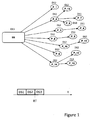
- FIG 1 shows a prior art P2P overlay network with peers p 1 -p 15 (in practice peer devices such as television sets, mobile phones, computers, etc.) randomly connected to a streaming source in the form of a streaming server SS.
- Streaming source and streaming server will be used alternately throughout the application to denote the same network element.
- the streaming server distributes data content divided into smaller pieces of data that are streamed to the network peers.
- the data content is divided into consecutive pieces of data referred to as data subsets throughout this application. This is illustrated in the lower section of Figure 1 , where the data content is divided into smaller data subsets DS1-DS3.
- the streaming source SS Once the streaming source SS has "packeted" a data subset DS, it can be submitted to a peer, which then can start playback of the data subset while the streaming source produces the next data subset.
- the streaming server uploads data subset DS1 to peers p 1 , p 2 , p 3 , p 6 , p 8 , p 10 and p 14 , wherein playback of DS1 may resume at each respective peer and/or further distribution of DS1 may be effected by the respective peer to further downstream peer(s).
- the streaming server produces data subset DS2 and uploads data subset DS2 to the peers p 1 , p 2 , p 3 , p 6 , p 8 , p 10 and p 14 , while peer p 2 uploads the latest fully downloaded data subset DS1 to peers p 7 , p 9 and p 13 , peer p 3 uploads DS1 to peer p 4 , and so on.
- each peer entering the network will ask a tracker (not shown) for the latest data subset to start streaming from as well as k random peers to be its neighbours. Then, the entering peer will turn to its neighbours for the latest subset of data, and if it finds the required data subset on any neighbouring peer, it will start streaming from that neighbouring peer.
- the entering peer will be delayed by at least the full duration of one data subset from its uploader and at least twice that from the streaming server on condition that the entering peer's uploader is delayed by at least the full duration of one data subset from the source.
- the entering peer will have a latency of at least two data subsets, while its uploader will have a latency of at least one data subset. If the entering peer cannot find the latest data subset on one of its neighbouring peers, it will download it from the streaming server.
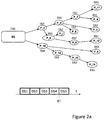
- a new peer p i is entering the network and requests the tracker (not shown) to receive data content originally streamed from the streaming source SS.
- the tracker determines that the latency, with respect to a real-time playback point RT of the data content distributed by the streaming source, with which the entering peer is to receive the data content is d i time units, i.e. the entering peer will receive and be able to playback a data subset d i time units after the same data subset have been rendered in real-time by the streaming source.
- the tracker will then provide the entering peer with a list of randomly selected peers from which the data content can be downloaded.
- This list of peers is derived or sampled from a probability density function for the peer as a function of latency.
- the entering peer p i is enabled to download, from a selected subset of the listed peers having a lower latency than that determined for the entering peer, the data content with the determined latency d i with respect to the real-time playback point RT of the streaming source SS.
- the data subset which is rendered by the streaming source SS in real-time when the peer p i enters the network is DS5.
- the determined latency d i is 3 units and expressed in a resolution of data subset durations, i.e.
- the determined latency is three full data subsets
- the list provided by the tracker to the entering peer p i comprises peers p 2 , p 5 , p 6 , p 7 and p 8 (in practice this number is substantially higher)
- the entering peer p i can find the required data subset DS2 at either peer p 2 or p 6 , being the latest fully downloaded data subset stored in a playback buffer of p 2 and p 6 , respectively.
- DS2 is the latest data subset that can be uploaded by peer p 2 and p 6 .
- since peer p 2 is uploading to three other peers, it may be preferred that the entering peer p i downloads from p 6 .
- the entering peer cannot download from either one of p 5 , p 7 or p 8 , since they all are rendering data subset DS2 at the moment peer p i is entering the network.
- the latest fully downloaded data subset stored in the respective playback buffer of p 5 , p 7 and p 8 is data subset DS1.
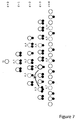
- an alternative definition of "latency” will be introduced. As can be seen in Figure 2a , the determined latency d i for the entering peer p i is 3 units. Thus, the entering peer is placed at a third "distribution level" in the P2P network.
- peers p 1 and p 10 reside at the first level (the streaming server SS is always at level zero), while peers p 2 , p 6 and p 14 are positioned in the second layer, and so on.
- a distribution level in a P2P network is occasionally referred to as a "distribution layer".
- a network peer will download data content from a peer on a higher distribution level, i.e. an upstream peer, while the network peer will upload data content to a peer on a lower distribution level, i.e. a downstream peer.
- peers have a buffer that allows for continuous playback even if there are some interruptions in the downloaded data pieces.
- a given distribution level may contain peers which are slightly behind or ahead (due to e.g. delay variations and asynchronicity) the other peers at the same level in terms of absolute latency, but still within a carefully choosen tolerance such that it safely can be asserted that, with respect to playback of the peers that are positioned at the next downstream level, all peers at the upstream level always possess content that is useful for the downstream uploaders in a manner that will not induce playback interruptions.
- the determined latency with which an entering peer downloads data content with respect to a real-time playback point RT of the data content distributed by the streaming source is represented by time units equivalent to the duration of a data subset.
- a latency of one unit implies that a peer downloads a data subset 300ms after the same data subset has been rendered by the streaming source.
- the downloading peer is located at a first distribution level, i.e. the first level downstream from the streaming source. In practice, there may be some fluctuation in the latencies.
- a peer with a latency in the range 250-350ms could be positioned at the first level
- a peer with a latency in the range 550-650ms could be positioned at the second level, etc.
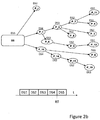
- the list provided by the tracker to the entering peer p i comprises peers p 3 , p 4 , p 7 , p 8 and p 11 .
- the entering peer p i placed at the third level it cannot find the required data subset DS2 at either of the listed peers.
- the latest fully downloaded data subset stored in the respective playback buffer is DS0, while peers p 3 , p 7 and p 8 have DS1 as the latest fully downloaded data subset.
- none of the listed peers can upload the required data subset DS2 to the entering peer, which has as a consequence that the entering peer must turn to the streaming source SS for the required data subset.
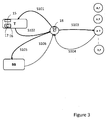
- FIG. 3 shows a P2P network in which embodiments of the present invention could be implemented, which Figure further illustrates the teachings set forth in connection to Figures 2a and 2b .
- Continuous lines denote request/reply messages, while dashed lines denote streaming channels.
- a new peer p i enters the network and requests the tracker T in step S101 via its communication interface CI to receive data content originally streamed from the streaming source SS.
- the tracker determines the level at which the entering peer p i is to be arranged and provides in step S102 the entering peer with a list of k randomly selected peers from which the data content can be downloaded.
- the entering peer requests in step S103 one of the peers on the list to supply it with the latest subset of data given the determined network level for the entering peer.
- step S104 If there exists at least one peer out the k randomly selected peers which is arranged at a level closer to the streaming source than that determined for the entering peer, the requested data content will be uploaded in step S104 to the entering peer with some given probability.
- peer p 3 uploads the requested data content to the entering peer p i .
- the probability that a peer can upload the requested data content to the entering peer in step S104 can be increased. If no randomly selected peer exists which is located at a level closer to the source than that determined for the entering peer, i.e. all k peers are at level which is equal to or further downstream that the level that is determined for the entering peer, the requested data content cannot be uploaded in step S104 to the entering peer.
- the entering peer will in step S105 turn to the streaming server SS for the requested data content, which in its turn will upload the requested data content to the entering peer in step S106.
- the probability that the streaming server will have to upload the requested data content to the entering peer in step S106 can be decreased.
- the tracker determines the delay d i when an entering peer is to receive the content data, with respect to a real-time playback point RT of the data content uploaded by the streaming source SS on the basis of statistical information.
- the behaviour of a P2P network in which the present invention is implemented is stochastic, which is based on currently streaming network peers. Thus, statistical information should be considered such that a probability distribution that represents the behaviour of peers in the P2P live streaming network can be formed.
- p(d) of the distribution levels of the peers with respect to the streaming server expected savings in the streaming server bandwidth load can be calculated.
- the savings of the stream server will approach the expected savings calculated using the said distribution.
- the probability that a network peer can be found from which the entering peer can download requested data content can be increased.
- the savings in the streaming server bandwidth is directly related to the probability that a network peer can upload requested data content to the entering peer.
- the tracker T for performing the method of arranging peers in a P2P network are typically equipped with one or more processing units 15,18 embodied in the form of one or more microprocessors arranged to execute a computer program 17 downloaded to a suitable storage medium 16 associated with the microprocessor, such as a Random Access Memory (RAM), a Flash memory or a hard disk drive.
- the processing unit 15 is arranged to at least partly carry out the method according to embodiments of the present invention when the appropriate computer program 17 comprising computer-executable instructions is downloaded to the storage medium 16 and executed by the processing unit 15.
- the storage medium 16 may also be a computer program product comprising the computer program 17.
- the computer program 17 may be transferred to the storage medium 16 by means of a suitable computer program product, such as a compact disc or a memory stick.
- the computer program 17 may be downloaded to the storage medium 16 over a network.
- the processing unit 15 may alternatively be embodied in the form of an application specific integrated circuit (ASIC), a field-programmable gate array (FPGA), a complex programmable logic device (CPLD), etc.
- Figure 4 shows an assumed shape for the distribution of the distribution level with respect to the streaming source.
- a relationship between the expected savings and this distribution can be formulated.
- any entering peer i having k randomly selected neighbors and being arranged at a certain level d i with respect to the streaming source determined by the tracker will search among its neighbors for the requested data content, i.e. the data subset which was rendered in real-time at the streaming source d i data subsets earlier, see Figures 2a and 2b . If it does not find the particular data subset, it will request it from the streaming server incurring a cost to the streaming server bandwidth.
- region ⁇ is limited by d i - ⁇ , where ⁇ typically amounts to the duration of one data subset. That is, if the entering peer is determined to e arranged at level three, it can download the requested data subset from a peer arranged at level two or closer to the source. Hence, an entering peer can only download from any neighbouring peer that precedes it by at least ⁇ .
- the probability P di for an entering peer that a randomly selected neighbouring peer is in the region ⁇ is simply the cumulative distribution function (cdf) value of the random variable d at the value d i - ⁇ :
- the level d i of the entering peer can be determined by the tracker using the teachings set forth in Equation (1) such that the requested data content can be downloaded from one of the k randomly selected peers with a sufficiently high probability.
- the possibility of having the entering peer download from one of its k neighbouring peers can be increased (or decreased, if required).
- a cost of having the entering peer downloading from a neighbouring peer with a higher probability is that the latency experienced by the entering peer increases.
- the probability of successful download from a neighbouring peer already is high, the latency may be selected by the tracker to be low with a still high download probability.
- this may be stipulated by a predetermined threshold value which the probability should exceed for the chance that the requested data content could be downloaded from a neighbouring peer should be considered great enough.
- each peer will be given a list of k randomly selected neighbouring peers, as described hereinabove, in order to ensure that the determined latencies from the real-time playback point will concur with the probability distribution p(d) and thus do not have any bias.
- an entering peer will download from the streaming server when the respective latest fully downloaded data subset of each peer among the k neighbouring peers is older than the data subset that the entering peer is requesting.
- none of the listed peers can upload the required data subset DS2 to the entering peer, since the available data subsets DS1 and DS0 both are older than the requested data subset DS2, which has as a consequence that the entering peer must turn to the streaming source for the required data subset.
- this occurs if all k randomly selected neighbouring peers are placed at a level upstream of the entering peer, i.e. fall in region ⁇ of the probability distribution p(d).
- the probability that all the k neighbouring peers will be in the region ⁇ can be expressed as a binomial experiment, where the probability of attaining zero success trials out of a total number k of trails is determined.
- P F (d i ) expresses the probability that a downloading peer at a determined level d i will have to stream required data content from the streaming server since no neighbouring peer out of the k randomly selected peers is located in region ⁇ of Figure 4 .
- the probability that an entering peer at level d i will find at least one neighbouring peer out of the k randomly selected peers in region ⁇ (from which it may download the requested data content) can be expressed as 1 - P F (d i ).
- This embodiment presents a simple model which the tracker can use to determine level d i for an entering peer such that data content can be streamed from a neighbouring peer with a certain probability.
- the number of download requests from peers at level d i is, in case the download requests are made to the peers in region ⁇ in a random and unbiased manner:
- R ij ⁇ N p i p d j P ⁇ i if d j ⁇ d i ⁇ ⁇ 0 otherwise
- N pi (1- P F (d i ))N i is the expected number of peers at level d i that will attempt to download from peers in region ⁇ .
- u is the number of simultaneous uploads per peer and is determined by bandwidth distribution p bw and the streaming bitrate br.
- the peer can simultaneously upload to five other peers.
- B i ( l ) determines the share of peers at level d j that will receive l download requests. For l ⁇ u, the number of successful requests will be l xB j ( l ) x N i , while for l > u, the number of successful requests will be u x B j ( l ) x N j .
- peers at level d i receive R j download requests, and each request will fall on one of the plurality N j of peers randomly, wherein the distribution of download requests can be modelled as a binomial distribution.
- the probability that a download request which a neighbouring peer makes to peers at level d j is successful can be calculated as the ratio between the expected number of successful responses and the total number of download requests, i.e. L j /R j .
- the probability that a download request from a peer at level d j will fall in region ⁇ is(1-P F (d i )), i.e. the probability that a peer at level d i will find at least one neighbouring peer out of the k randomly selected peers in region ⁇ from which it may download the requested data content can be expressed as 1 - P F (d i ).
- the probability that one of those requests to peers in region ⁇ actually will go to peers at the particular level d j is p(d j )/P ⁇ i (deducted from Equation (3) which defines this probability for a number N i of peers at level d i ).
- the summation covers all peers at a level lower than d i and not only peers at a particular level of dj.
- Equation (6) set forth in the above takes these bandwidth limitations into account and calculates P s (d i ), i.e. the probability that a peer at a level d i makes a successful download from the P2P network.
- a peer when a peer enters the network, it receives from the tracker a list of k randomly selected neighbouring peers from which requested data content can be downloaded with an expected probability depending on a determined level at which the entering peer is to be arranged with respect to the streaming source.
- the entering peer is enabled to download, with the expected probability, the requested data content from a selected one of the k randomly selected peers at a lower level than that determined for the entering peer (i.e. at a level upstream from the entering peer).
- the probability that the entering peer is capable of downloading the requested data content from a selected one of the plurality of randomly selected peers it thus determined on the basis of the upload capacity of the peers as well as the determined level at which the entering peer is to be arranged.
- the tracker did not take into account a situation where a joint probability of distribution level and upload capacity p(u, d) exists. If the distribution level and upload capacity is modelled as joint probability variables, it is possible to attain even better results in determining distribution level of an entering peer.
- load allocation among peers in the network could be better balanced by having the tracker not only take into account the level and upload capacity u of the peers, i.e. not only the joint probability p(u, d j ) of the level and upload capacity is considered, but also by giving priority to peers having a higher upload capacity.
- the entering peer will send a request to the neighbouring peer having the highest upload capacity u. If two or more neighbouring peers have the same upload capacity, any one of the two or more peers could be selected for receiving the request.
- the probability that its download request actually will go to a peer at level d j and upload capacity u is p(u, d j )/P( ⁇ i .
- the joint probability p(u, d j ) of the level and upload capacity is weighted with upload capacity, resulting in u x p(u, d j ) wherein the probability that a request for content data is made to a peer having a higher upload capacity will increase.
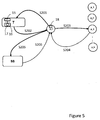
- FIG. 5 shows a P2P network in which embodiments of the present invention are implemented. Continuous lines denote request/reply messages, while dashed lines denote streaming channels.
- a new peer p i enters the network and requests the tracker T in step S201 via its communication interface to receive data content originally streamed from the streaming source SS.
- the tracker determines the level at which the entering peer p i is to be arranged. By controlling the level, the expected probability of a successful download can be varied accordingly; the more downstream the level, the higher the chance of successful download. However, this will on the other hand imply further delay from the real-time playback point RT.
- each entering peer provides its upload capacity to the tracker with the request as submitted in step S201.
- step S202 the tracker T provides the entering peer p i with a list of a plurality k of peers from which the data content can be downloaded. Further, the list indicates upload capacity u of each among the k peers in order to have the entering peer subsequently give priority to a first peer having higher upload capacity u than a second peer among the plurality of randomly selected peers, when the entering peer p i is to determine a peer on the list from which to download the requested data content.
- the upload capacity could be indicated either as an actual upload measure, but could alternatively be indicated by a prioritization number, where for instance 10 is the highest priority and 1 is the lowest priority.
- Each peer may thus be reporting to the tracker T its respective upload capacity when the peer enters the network.
- the tracker T selecting a plurality k of peers, this can be undertaken in a number of different ways.
- the plurality of peers are randomly selected, thus making it easy for the tracker T to make the selection.
- the tracker T first selects a group of peers and then filters out a plurality k of peers at a level lower than that of the entering peer p i . To the contrary, this filtering could alternatively be undertaken by the entering peer p i itself once the list of k randomly selected peer is received.
- the tracker T provides the entering peer with a list which is more biased towards peers who have joined the network recently while incorporating their upload capacity, which peers are more likely to have available upload bandwidth since recently joining peers are less likely to yet have been fully loaded.
- peers are network address translation (NAT) compatible or not.
- NAT network address translation
- the list provided by the tracker T to the entering peer p i in step S202 could have the appearance set out in Table 1.
- Table 1. Peer no. Upload capacity (u) Level (d) p i 1 3 p 1 1 2 p 2 2 2 p 3 3 1 p 4 2 2 p 5 1 3 p 6 1 3 p 7 0 4 p 8 1 4 p 9 0 4 p 10 0 4
- the entering peer requests in step S203 a selected peer on the list, i.e. a selected one of peers p 1 , p 2 , p 3 ,..., p k , to supply it with the latest subset of data given the determined level d i for the entering peer p i . If there exists at least one peer out the k randomly selected peers at a level with respect to the streaming source that is lower than that determined for the entering peer, it is possible that the requested data content can be uploaded to the entering peer p i .
- peer p 3 is selected by the entering peer p i since it has the highest upload capacity of the peers selected by the tracker T and is thus given priority among the plurality of peers selected by the tracker T.
- the peer p 3 further is at a level lower than that of the entering peer p i .
- a request from the entering peer p i to the neighbouring peer p 3 to download a desired piece of content is thus successful (given that the peer p 3 has free capacity, which in this case is assumed).
- the neighbouring peer p 3 subsequently uploads, in step S204, the requested data content to the entering peer p i .
- the entering peer p i will in step S205 turn to the streaming server SS for the requested data content, which in its turn will upload the requested data content to the entering peer in step S206.
- the entering peer p i may also have to turn to the streaming server SS in case one or more neighbouring peers out of the k selected peers are located in region ⁇ , but cannot upload due to limitations in upload capacity.
- example peer p 3 no longer has the highest upload capacity of the peers selected by the tracker T.
- peer p 5 is arranged at a level equal to that of the entering peer p i . A request from the entering peer p i to the neighbouring peer p 3 to download a desired piece of content will thus not be successful since the neighbouring peer p 3 does not have access to the content data requested by the entering peer.
- the tracker T or alternatively the entering peer p i itself, has filtered out all peers at a level equal to or greater than that of the entering peer p i , which raises the requirements on the tracker T (or the entering peer), but will increase the probability that the entering peer p i successfully will download requested data from one of its neighbouring peers.
- the entering peer has either neighbouring peer p 2 , p 3 or p 4 available for request of data in step S203, since p 1 will not be considered due to lower upload capacity. Thus the request can go to any one of these three peers in step S203.
- the probability that the streaming server SS will have to upload the requested data content to the entering peer in step S206 can be increased or decreased. These probabilities will be discussed in detail in the following.
- the savings in the streaming server SS bandwidth is directly related to the probability that a network peer can upload requested data content to the entering peer p i .
- each peer is more likely to request data content from a neighbouring peer with a higher bandwidth/upload capacity u, the selection policy still requiring that the neighbouring peer is arranged at a level lower than that of the requesting peer.
- this embodiment enhances the selection policy by requesting data content with higher probability from peers having higher upload capacity, which will facilitate load balancing as peers with higher upload capacity will receive more requests than peers with low upload capacity and hence this will increase the savings, since the probability of having peers falling back on the streaming server for requested data content decreases.
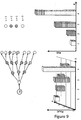
- Figure 9 illustrates joint probability of distribution level and upload capacity p(u, d).
- the lower left part of Figure 9 illustrates the joint probability p(u ,d) on the z axis, while the y axis represents the upload capacity and the x axis represents the distribution level of the peers in the P2P network.
- the lower right part of Figure 9 shows a discrete version of a p(d) distribution (previously illustrated in Figure 4 ) derived from the p(u, d) distribution shown in the lower left part. That is, the p(d) distribution is formed by aggregating probability masses at each distribution level. Analogously, a p(u) distribution could be formed by aggregating the probability masses at each upload capacity measure.
- N ju p(u, j)N is the expected number of peers at level d j and upload capacity u. Therefore, the expected number of successful responses that peers at level d j and upload capacity u make to download requests from neighbouring peers (i.e.
- P s (d i ) can be calculated, i.e. the probability that a peer with at a level d i makes a successful download from the P2P network when peer upload capacity represented by u p(u, d j ) is taken into account, where u' is for summation in the numerator and represents a summation over all possible values of upload capacity.
- the expected savings and/or streaming source load can be estimated a priori, which has the resulting advantage that expected streaming source capacity can be calculated in advance.
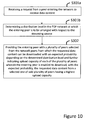
- FIG 10 shows a flowchart illustrating the method of arranging peers in a P2P network comprising a streaming source and network peers arranged at distribution levels in the P2P network according to the first aspect of the present invention.
- a tracker receives a request from a peer entering the network to receive data content.
- the tracker determines a distribution level in the P2P network at which the entering peer is to be arranged with respect to the streaming source.
- the tracker provides the entering peer with a plurality of peers selected from the network peers from which the requested data content can be downloaded with an expected probability depending on the determined distribution level and further indicating upload capacity of each of the plurality of peers, wherein the entering peer is enabled to download, with the expected probability, the requested data content from a selected one of said plurality of peers having a highest upload capacity.
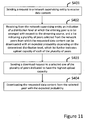
- FIG 11 shows a flowchart illustrating the method of arranging peers in a P2P network comprising a streaming source and network peers arranged at distribution levels in the P2P network according to the third aspect of the present invention.
- an entering peer in practice a peer device such as a television sets, mobile phone, a laptop, etc. sends a request to a network supervising entity, i.e. the tracker to receive data content.
- step S402 the entering peer receives from the tracker an indication of a distribution level at which the entering peer is to be arranged with respect to the streaming source, and a list indicating a plurality of peers selected from the network peers from which the requested data content can be downloaded with an expected probability depending on the determined distribution level, which list further indicates upload capacity of each of the plurality of peers. Further, in step S403, the entering peer sends a download request to a selected one of the plurality of peers indicated to have the highest upload capacity. Finally in step S404, the entering peer downloads the requested data content from the selected peer with the expected probability.
- the entering peer will send the request to the one of the two or more neighbouring peers being nearest positioned in the P2P network, i.e. the one of the two or more peers at a level closest to that of the entering peer p i .
- peers at a level close to the streaming source will be assigned a greater load than those peers which are located further downstream, even if the distribution over distribution levels is assumed to be uniform. That is because peers at a level d i potentially will be a target for content requests from all peers at levels d i + ⁇ , d i +2 ⁇ , d i +3 ⁇ , and so on.
- streaming server savings are to be improved, there is a trade-off between increasing density among peers being located at a level closes to the streaming source to handle the load from peers being located at levels further away from the source, and increasing the probability that peers will download directly from the streaming server since the density of peers closes to the streaming server is increased.
- the entering peer p i will send a download request to any one of the neighbouring peers p 2 or p 4 rather than to the neighbouring peer p 3 ; if a multiplicity of peers have the same bandwidth, the nearest peer is selected for receiving a download request.
Landscapes
- Engineering & Computer Science (AREA)
- Physics & Mathematics (AREA)
- Computing Systems (AREA)
- Mathematical Physics (AREA)
- Theoretical Computer Science (AREA)
- Computer Networks & Wireless Communication (AREA)
- Signal Processing (AREA)
- Computer And Data Communications (AREA)
- Information Transfer Between Computers (AREA)
- Two-Way Televisions, Distribution Of Moving Picture Or The Like (AREA)
Claims (15)
- Verfahren zum Einrichten von gleichrangigen Teilnehmern in einem P2P-Netzwerk, das eine Streaming-Quelle und gleichrangige Netzwerkteilnehmer aufweist, die auf Verteilungsebenen im P2P-Netzwerk eingerichtet sind, wobei das Verfahren umfasst, dass:von einem gleichrangigen Teilnehmer, der zum Netzwerk hinzukommt, eine Anforderung zum Empfang von Dateninhalt erhalten wird (S301a),eine Verteilungsebene im P2P-Netzwerk bestimmt wird (S301b), auf welcher der hinzukommende gleichrangige Teilnehmer mit Bezug auf die Streaming-Quelle einzurichten ist, indem die bestimmte Verteilungsebene aus einer bedingten Verteilungsebenen-Wahrscheinlichkeitsverteilung und einer Upload-Kapazität für die gleichrangigen Netzwerkteilnehmer entnommen wird,dem hinzukommenden gleichrangigen Teilnehmer mehrere gleichrangige Teilnehmer zur Verfügung gestellt werden (S302), die aus den gleichrangigen Netzwerkteilnehmern ausgewählt sind, von denen der angeforderte Dateninhalt mit einer erwarteten Wahrscheinlichkeit heruntergeladen werden kann, die von der bestimmten Verteilungsebene abhängt, und ferner die Upload-Kapazität eines jeden von den mehreren gleichrangigen Teilnehmern angezeigt wird, wobei der hinzukommende gleichrangige Teilnehmer in der Lage ist, den angeforderten Dateninhalt von einem ausgewählten Teilnehmer von den mehreren gleichrangigen Teilnehmern, der eine höchste Upload-Kapazität aufweist, mit der erwarteten Wahrscheinlichkeit herunterzuladen.
- Verfahren nach Anspruch 1, wobei die erhaltene Anforderung eine Upload-Kapazität des hinzukommenden gleichrangigen Teilnehmers umfasst.
- Verfahren nach einem der Ansprüche 1-2, wobei die mehreren gleichrangigen Teilnehmer aus den gleichrangigen Netzwerkteilnehmern ausgewählt werden, die für weniger als eine vorgegebene Zeit an das Netzwerk angeschlossen gewesen sind.
- Verfahren nach einem der vorhergehenden Ansprüche, wobei die Wahrscheinlichkeit, dass der hinzukommende gleichrangige Teilnehmer in der Lage ist, den angeforderten Dateninhalt von einem ausgewählten Teilnehmer von den mehreren gleichrangigen Teilnehmern herunterzuladen, auf der Basis der Verbundwahrscheinlichkeit der Verteilungsebene und der Upload-Kapazität bestimmt wird, wobei die Verbundwahrscheinlichkeit ferner mit der Upload-Kapazität des entsprechenden Teilnehmers von den mehreren gleichrangigen Teilnehmern gewichtet wird.
- Verfahren nach einem der vorhergehenden Ansprüche, wobei der Schritt (S302), dem hinzukommenden gleichrangigen Teilnehmer mehrere Teilnehmer zur Verfügung zu stellen, die aus den gleichrangigen Netzwerkteilnehmern ausgewählt sind, von denen der angeforderte Dateninhalt heruntergeladen werden kann, ferner umfasst:Anzeigen der Verteilungsebene, auf der jeder von den mehreren gleichrangigen Teilnehmern eingerichtet ist, wobei in dem Fall, dass zwei oder mehr von den mehreren gleichrangigen Teilnehmern die gleiche Upload-Kapazität aufweisen, der ausgewählte Teilnehmer derjenige Teilnehmer von den zwei oder mehr gleichrangigen Teilnehmern ist, der auf einer Verteilungsebene eingerichtet ist, die am nächsten zu derjenigen ist, die für den hinzukommenden gleichrangigen Teilnehmer bestimmt wurde.
- Verfahren zum Anfordern von Dateninhalt in einem P2P-Netzwerk, das eine Streaming-Quelle und mehrere gleichrangige Netzwerkteilnehmer aufweist, die auf Verteilungsebenen im P2P-Netzwerk eingerichtet sind, wobei das Verfahren umfasst:Senden (S401) einer Anforderung an eine Netzwerküberwachungseinheit von einem hinzukommenden gleichrangigen Teilnehmer aus zum Empfang von Dateninhalt,Empfangen (S402) einer Anzeige einer Verteilungsebene, auf welcher der hinzukommende gleichrangige Teilnehmer mit Bezug auf die Streaming-Quelle einzurichten ist, wobei die bestimmte Verteilungsebene aus einer bedingten Verteilungsebenen-Wahrscheinlichkeitsverteilung und einer Upload-Kapazität für die gleichrangigen Netzwerkteilnehmer entnommen wird, und einer Liste, die mehrere gleichrangige Teilnehmer anzeigt, die aus den gleichrangigen Netzwerkteilnehmern ausgewählt sind, von denen der angeforderte Dateninhalt mit einer erwarteten Wahrscheinlichkeit heruntergeladen werden kann, die von der bestimmten Verteilungsebene abhängt, wobei die Liste ferner die Upload-Kapazität eines jeden von den mehreren gleichrangigen Teilnehmern anzeigt,Senden (S403) einer Download-Anforderung an einen ausgewählten Teilnehmer von den mehreren gleichrangigen Teilnehmern, von dem angezeigt ist, dass er die höchste Upload-Kapazität aufweist, und Herunterladen (S404) des angeforderten Dateninhalts von dem ausgewählten gleichrangigen Teilnehmer mit der erwarteten Wahrscheinlichkeit.
- Verfahren nach Anspruch 6, wobei die Liste ferner die Verteilungsebene eines jeden von den mehreren gleichrangigen Teilnehmern anzeigt und in dem Fall, dass zwei oder mehr von den mehreren gleichrangigen Teilnehmern auf der am nächsten liegenden Verteilungsebene eingerichtet sind, der ausgewählte gleichrangige Teilnehmer, an den die Download-Anforderung gesendet wird (S403), derjenige gleichrangige Teilnehmer von den zwei oder mehr gleichrangigen Teilnehmern ist, der eine höchste Upload-Kapazität aufweist.
- Vorrichtung (T) zum Einrichten von gleichrangigen Teilnehmern in einem P2P-Netzwerk, das eine Streaming-Quelle (SS) und gleichrangige Netzwerkteilnehmer (p1, p2, ..., pk) aufweist, die auf Verteilungsebenen im P2P-Netzwerk eingerichtet sind, wobei die Vorrichtung eine Bearbeitungseinheit (15) aufweist, die eingerichtet ist:von einem gleichrangigen Teilnehmer (pi), der zum Netzwerk hinzukommt, eine Anforderung zum Empfang von Dateninhalt zu erhalten,eine Verteilungsebene im P2P-Netzwerk zu bestimmen, auf welcher der hinzukommende gleichrangige Teilnehmer mit Bezug auf die Streaming-Quelle einzurichten ist, indem die bestimmte Verteilungsebene aus einer bedingten Verteilungsebenen-Wahrscheinlichkeitsverteilung und einer Upload-Kapazität für die gleichrangigen Netzwerkteilnehmer (p1, p2, ..., pk) entnommen wird,dem hinzukommenden gleichrangigen Teilnehmer mehrere gleichrangige Teilnehmer zur Verfügung zu stellen, die aus den gleichrangigen Netzwerkteilnehmern ausgewählt sind, von denen der angeforderte Dateninhalt mit einer erwarteten Wahrscheinlichkeit heruntergeladen werden kann, die von der bestimmten Verteilungsebene abhängt, und ferner die Upload-Kapazität eines jeden von den mehreren gleichrangigen Teilnehmern anzuzeigen, wobei der hinzukommende gleichrangige Teilnehmer in der Lage ist, den angeforderten Dateninhalt von einem ausgewählten Teilnehmer von den mehreren gleichrangigen Teilnehmern, der eine höchste Upload-Kapazität aufweist, mit der erwarteten Wahrscheinlichkeit herunterzuladen.
- Vorrichtung (T) nach Anspruch 8, wobei die erhaltene Anforderung eine Upload-Kapazität des hinzukommenden gleichrangigen Teilnehmers (pi) umfasst.
- Vorrichtung (T) nach einem der Ansprüche 8-9, wobei die Bearbeitungseinheit (15) ferner eingerichtet ist, die mehreren gleichrangigen Teilnehmer aus den gleichrangigen Netzwerkteilnehmern (p1, p2, ..., pk) derart auszuwählen, dass nur gleichrangige Teilnehmer, die auf einer Verteilungsebene eingerichtet sind, die niedriger als diejenige ist, die für den hinzukommenden gleichrangigen Teilnehmer (pi) bestimmt wurde, für den hinzukommenden gleichrangigen Teilnehmer zur Verfügung gestellt werden.
- Vorrichtung (T) nach einem der Ansprüche 8-10, wobei die Bearbeitungseinheit (15) dann, wenn dem hinzukommenden gleichrangigen Teilnehmer (pi) mehrere Teilnehmer zur Verfügung gestellt werden, die aus den gleichrangigen Netzwerkteilnehmern (p1, p2, ..., pk) ausgewählt sind, von denen der angeforderte Dateninhalt mit einer erwarteten Wahrscheinlichkeit heruntergeladen werden kann, ferner eingerichtet ist zum:Anzeigen der Verteilungsebene, auf der jeder von den mehreren gleichrangigen Teilnehmern eingerichtet ist, wobei in dem Fall, dass zwei oder mehr von den mehreren gleichrangige Teilnehmern die gleiche Upload-Kapazität aufweisen, der ausgewählte Teilnehmer derjenige Teilnehmer von den zwei oder mehr gleichrangigen Teilnehmern ist, der auf einer Verteilungsebene eingerichtet ist, die am nächsten zu derjenigen ist, die für den hinzukommenden gleichrangigen Teilnehmer bestimmt wurde.
- Gleichrangige Teilnehmervorrichtung (pi) zum Anfordern von Dateninhalt in einem P2P-Netzwerk, das eine Streaming-Quelle (SS) und mehrere gleichrangige Netzwerkteilnehmer (p1, p2, ..., pk) aufweist, die auf Verteilungsebenen im P2P-Netzwerk eingerichtet sind, wobei die Vorrichtung eine Bearbeitungseinheit (18) aufweist, die eingerichtet ist zum:Senden einer Anforderung zum Empfang von Dateninhalt an eine Netzwerküberwachungseinheit (T),Empfangen einer Anzeige einer Verteilungsebene, auf welcher die gleichrangige Teilnehmervorrichtung (pi) mit Bezug auf die Streaming-Quelle einzurichten ist, wobei die bestimmte Verteilungsebene aus einer bedingten Verteilungsebenen-Wahrscheinlichkeitsverteilung und einer Upload-Kapazität für die gleichrangigen Netzwerkteilnehmer entnommen wird, und einer Liste, die mehrere gleichrangige Teilnehmer anzeigt, die aus den gleichrangigen Netzwerkteilnehmern ausgewählt sind, von denen der angeforderte Dateninhalt mit einer erwarteten Wahrscheinlichkeit heruntergeladen werden kann, die von der bestimmten Verteilungsebene abhängt, wobei die Liste ferner die Upload-Kapazität eines jeden von den mehreren gleichrangigen Teilnehmern anzeigt,Senden einer Download-Anforderung an einen ausgewählten Teilnehmer von den mehreren gleichrangigen Teilnehmern, von dem angezeigt ist, dass er die höchste Upload-Kapazität aufweist, undHerunterladen des angeforderten Dateninhalts von dem ausgewählten gleichrangigen Teilnehmer mit der erwarteten Wahrscheinlichkeit.
- Gleichrangige Teilnehmervorrichtung (pi) nach Anspruch 12, wobei die Liste ferner die Verteilungsebene eines jeden von den mehreren gleichrangigen Teilnehmern anzeigt, wobei der ausgewählte gleichrangige Teilnehmer von den mehreren gleichrangigen Teilnehmern, an den die Download-Anforderung gesendet wird, derjenige gleichrangige Teilnehmer ist, von dem angezeigt ist, dass er auf einer Verteilungsebene eingerichtet ist, die am nächsten zu derjenigen ist, die für den hinzukommenden gleichrangigen Teilnehmer bestimmt wurde.
- Computerprogramm (17) mit computerausführbaren Anweisungen, um eine Vorrichtung (T, pi) zu veranlassen, die in einem der Ansprüche 1-7 angegebenen Schritte durchzuführen, wenn die computerausführbaren Anweisungen in einer Bearbeitungseinheit (15, 18) ausgeführt werden, die in der Vorrichtung enthalten ist.
- Computerprogrammprodukt (16) mit einem computerlesbaren Medium, wobei das computerlesbare Medium das Computerprogrammprodukt (17) nach Anspruch 14 aufweist, das darin enthalten ist.
Applications Claiming Priority (3)
| Application Number | Priority Date | Filing Date | Title |
|---|---|---|---|
| US13/720,254 US9544366B2 (en) | 2012-12-19 | 2012-12-19 | Highest bandwidth download request policy in a live streaming P2P network |
| SE1251455 | 2012-12-19 | ||
| PCT/EP2013/074817 WO2014095273A1 (en) | 2012-12-19 | 2013-11-27 | Highest bandwidth download request policy in a live streaming p2p network |
Publications (2)
| Publication Number | Publication Date |
|---|---|
| EP2936780A1 EP2936780A1 (de) | 2015-10-28 |
| EP2936780B1 true EP2936780B1 (de) | 2016-05-04 |
Family
ID=49667165
Family Applications (1)
| Application Number | Title | Priority Date | Filing Date |
|---|---|---|---|
| EP13795779.1A Active EP2936780B1 (de) | 2012-12-19 | 2013-11-27 | Anfragenrichtlinie für downloads mit höchster bandbreite in einem live-streaming-p2p-netzwerk |
Country Status (4)
| Country | Link |
|---|---|
| EP (1) | EP2936780B1 (de) |
| AU (1) | AU2013361959B2 (de) |
| CA (1) | CA2896198C (de) |
| WO (1) | WO2014095273A1 (de) |
Families Citing this family (1)
| Publication number | Priority date | Publication date | Assignee | Title |
|---|---|---|---|---|
| FR3042670A1 (fr) * | 2015-10-19 | 2017-04-21 | Wepstr Innovation | Procedes et dispositifs de communication pour ordonnancer la distribution de donnees dans un reseau pair-a-pair |
Family Cites Families (2)
| Publication number | Priority date | Publication date | Assignee | Title |
|---|---|---|---|---|
| DE602006013405D1 (de) * | 2006-02-21 | 2010-05-20 | Microsoft Corp | Topologieverwaltung in Peer-to-peer Datenverteilungswolken |
| WO2008064356A1 (en) * | 2006-11-22 | 2008-05-29 | Metis Enterprise Technologies Llc | Real-time multicast peer-to-peer video streaming platform |
-
2013
- 2013-11-27 EP EP13795779.1A patent/EP2936780B1/de active Active
- 2013-11-27 CA CA2896198A patent/CA2896198C/en not_active Expired - Fee Related
- 2013-11-27 WO PCT/EP2013/074817 patent/WO2014095273A1/en not_active Ceased
- 2013-11-27 AU AU2013361959A patent/AU2013361959B2/en not_active Ceased
Also Published As
| Publication number | Publication date |
|---|---|
| WO2014095273A1 (en) | 2014-06-26 |
| CA2896198A1 (en) | 2014-06-26 |
| CA2896198C (en) | 2020-07-14 |
| AU2013361959A1 (en) | 2015-06-18 |
| AU2013361959B2 (en) | 2016-06-16 |
| EP2936780A1 (de) | 2015-10-28 |
Similar Documents
| Publication | Publication Date | Title |
|---|---|---|
| US9591070B2 (en) | Multiple requests for content download in a live streaming P2P network | |
| US20140280563A1 (en) | Method and Device for Peer Arrangement in Multiple Substream Upload P2P Overlay Networks | |
| US8898327B2 (en) | Method and device for arranging peers in a live streaming P2P network | |
| WO2010101496A1 (en) | Methods and arrangements for prioritization in a peer-to-peer network | |
| US9680926B2 (en) | Nearest peer download request policy in a live streaming P2P network | |
| EP2936778B1 (de) | Richtlinie der nearest-peer-download-anfrage in einem live-streamenden p2p-netzwerk | |
| US9544366B2 (en) | Highest bandwidth download request policy in a live streaming P2P network | |
| AU2013361959B2 (en) | Highest bandwidth download request policy in a live streaming P2P network | |
| EP2936779B1 (de) | Bearbeitung mehrerer inhaltsdownload-anfragen in einem live-streaming-p2p-netzwerk | |
| EP2697954B1 (de) | Verfahren und vorrichtung zur anordnung von peers in einem livestreaming-p2p-netzwerk | |
| EP2815562B1 (de) | Verfahren und vorrichtung für zentralisierte peer-anordnung in p2p-overlay-netzwerken | |
| EP2781073B1 (de) | Verfahren und vorrichtung zur teilnehmeranordnung in p2p-überlappungsnetzwerken mit eingeschränktem streaming | |
| EP2974227B1 (de) | Verfahren und vorrichtung zur peeranordnung in mehreren substream-upload-p2p-overlay-netzwerken |
Legal Events
| Date | Code | Title | Description |
|---|---|---|---|
| PUAI | Public reference made under article 153(3) epc to a published international application that has entered the european phase |
Free format text: ORIGINAL CODE: 0009012 |
|
| 17P | Request for examination filed |
Effective date: 20150630 |
|
| AK | Designated contracting states |
Kind code of ref document: A1 Designated state(s): AL AT BE BG CH CY CZ DE DK EE ES FI FR GB GR HR HU IE IS IT LI LT LU LV MC MK MT NL NO PL PT RO RS SE SI SK SM TR |
|
| AX | Request for extension of the european patent |
Extension state: BA ME |
|
| RAP1 | Party data changed (applicant data changed or rights of an application transferred) |
Owner name: HIVE STREAMING AB |
|
| RIN1 | Information on inventor provided before grant (corrected) |
Inventor name: NAIEM, AMGAD Inventor name: EL-BELTAGY, MOHAMMED Inventor name: ESSAYADI, FOUAD |
|
| GRAP | Despatch of communication of intention to grant a patent |
Free format text: ORIGINAL CODE: EPIDOSNIGR1 |
|
| INTG | Intention to grant announced |
Effective date: 20151127 |
|
| GRAS | Grant fee paid |
Free format text: ORIGINAL CODE: EPIDOSNIGR3 |
|
| DAX | Request for extension of the european patent (deleted) | ||
| GRAA | (expected) grant |
Free format text: ORIGINAL CODE: 0009210 |
|
| RAP1 | Party data changed (applicant data changed or rights of an application transferred) |
Owner name: HIVE STREAMING AB |
|
| AK | Designated contracting states |
Kind code of ref document: B1 Designated state(s): AL AT BE BG CH CY CZ DE DK EE ES FI FR GB GR HR HU IE IS IT LI LT LU LV MC MK MT NL NO PL PT RO RS SE SI SK SM TR |
|
| REG | Reference to a national code |
Ref country code: GB Ref legal event code: FG4D |
|
| REG | Reference to a national code |
Ref country code: CH Ref legal event code: EP |
|
| REG | Reference to a national code |
Ref country code: AT Ref legal event code: REF Ref document number: 797775 Country of ref document: AT Kind code of ref document: T Effective date: 20160515 |
|
| REG | Reference to a national code |
Ref country code: IE Ref legal event code: FG4D |
|
| REG | Reference to a national code |
Ref country code: DE Ref legal event code: R096 Ref document number: 602013007355 Country of ref document: DE |
|
| REG | Reference to a national code |
Ref country code: SE Ref legal event code: TRGR |
|
| REG | Reference to a national code |
Ref country code: NL Ref legal event code: FP |
|
| REG | Reference to a national code |
Ref country code: LT Ref legal event code: MG4D |
|
| PG25 | Lapsed in a contracting state [announced via postgrant information from national office to epo] |
Ref country code: NO Free format text: LAPSE BECAUSE OF FAILURE TO SUBMIT A TRANSLATION OF THE DESCRIPTION OR TO PAY THE FEE WITHIN THE PRESCRIBED TIME-LIMIT Effective date: 20160804 Ref country code: LT Free format text: LAPSE BECAUSE OF FAILURE TO SUBMIT A TRANSLATION OF THE DESCRIPTION OR TO PAY THE FEE WITHIN THE PRESCRIBED TIME-LIMIT Effective date: 20160504 Ref country code: FI Free format text: LAPSE BECAUSE OF FAILURE TO SUBMIT A TRANSLATION OF THE DESCRIPTION OR TO PAY THE FEE WITHIN THE PRESCRIBED TIME-LIMIT Effective date: 20160504 |
|
| REG | Reference to a national code |
Ref country code: AT Ref legal event code: MK05 Ref document number: 797775 Country of ref document: AT Kind code of ref document: T Effective date: 20160504 |
|
| REG | Reference to a national code |
Ref country code: FR Ref legal event code: PLFP Year of fee payment: 4 |
|
| PG25 | Lapsed in a contracting state [announced via postgrant information from national office to epo] |
Ref country code: GR Free format text: LAPSE BECAUSE OF FAILURE TO SUBMIT A TRANSLATION OF THE DESCRIPTION OR TO PAY THE FEE WITHIN THE PRESCRIBED TIME-LIMIT Effective date: 20160805 Ref country code: ES Free format text: LAPSE BECAUSE OF FAILURE TO SUBMIT A TRANSLATION OF THE DESCRIPTION OR TO PAY THE FEE WITHIN THE PRESCRIBED TIME-LIMIT Effective date: 20160504 Ref country code: PT Free format text: LAPSE BECAUSE OF FAILURE TO SUBMIT A TRANSLATION OF THE DESCRIPTION OR TO PAY THE FEE WITHIN THE PRESCRIBED TIME-LIMIT Effective date: 20160905 Ref country code: HR Free format text: LAPSE BECAUSE OF FAILURE TO SUBMIT A TRANSLATION OF THE DESCRIPTION OR TO PAY THE FEE WITHIN THE PRESCRIBED TIME-LIMIT Effective date: 20160504 Ref country code: LV Free format text: LAPSE BECAUSE OF FAILURE TO SUBMIT A TRANSLATION OF THE DESCRIPTION OR TO PAY THE FEE WITHIN THE PRESCRIBED TIME-LIMIT Effective date: 20160504 Ref country code: RS Free format text: LAPSE BECAUSE OF FAILURE TO SUBMIT A TRANSLATION OF THE DESCRIPTION OR TO PAY THE FEE WITHIN THE PRESCRIBED TIME-LIMIT Effective date: 20160504 |
|
| PG25 | Lapsed in a contracting state [announced via postgrant information from national office to epo] |
Ref country code: IT Free format text: LAPSE BECAUSE OF FAILURE TO SUBMIT A TRANSLATION OF THE DESCRIPTION OR TO PAY THE FEE WITHIN THE PRESCRIBED TIME-LIMIT Effective date: 20160504 |
|
| PG25 | Lapsed in a contracting state [announced via postgrant information from national office to epo] |
Ref country code: SK Free format text: LAPSE BECAUSE OF FAILURE TO SUBMIT A TRANSLATION OF THE DESCRIPTION OR TO PAY THE FEE WITHIN THE PRESCRIBED TIME-LIMIT Effective date: 20160504 Ref country code: EE Free format text: LAPSE BECAUSE OF FAILURE TO SUBMIT A TRANSLATION OF THE DESCRIPTION OR TO PAY THE FEE WITHIN THE PRESCRIBED TIME-LIMIT Effective date: 20160504 Ref country code: RO Free format text: LAPSE BECAUSE OF FAILURE TO SUBMIT A TRANSLATION OF THE DESCRIPTION OR TO PAY THE FEE WITHIN THE PRESCRIBED TIME-LIMIT Effective date: 20160504 Ref country code: CZ Free format text: LAPSE BECAUSE OF FAILURE TO SUBMIT A TRANSLATION OF THE DESCRIPTION OR TO PAY THE FEE WITHIN THE PRESCRIBED TIME-LIMIT Effective date: 20160504 Ref country code: DK Free format text: LAPSE BECAUSE OF FAILURE TO SUBMIT A TRANSLATION OF THE DESCRIPTION OR TO PAY THE FEE WITHIN THE PRESCRIBED TIME-LIMIT Effective date: 20160504 |
|
| REG | Reference to a national code |
Ref country code: DE Ref legal event code: R097 Ref document number: 602013007355 Country of ref document: DE |
|
| PG25 | Lapsed in a contracting state [announced via postgrant information from national office to epo] |
Ref country code: BE Free format text: LAPSE BECAUSE OF FAILURE TO SUBMIT A TRANSLATION OF THE DESCRIPTION OR TO PAY THE FEE WITHIN THE PRESCRIBED TIME-LIMIT Effective date: 20160504 Ref country code: PL Free format text: LAPSE BECAUSE OF FAILURE TO SUBMIT A TRANSLATION OF THE DESCRIPTION OR TO PAY THE FEE WITHIN THE PRESCRIBED TIME-LIMIT Effective date: 20160504 Ref country code: SM Free format text: LAPSE BECAUSE OF FAILURE TO SUBMIT A TRANSLATION OF THE DESCRIPTION OR TO PAY THE FEE WITHIN THE PRESCRIBED TIME-LIMIT Effective date: 20160504 Ref country code: AT Free format text: LAPSE BECAUSE OF FAILURE TO SUBMIT A TRANSLATION OF THE DESCRIPTION OR TO PAY THE FEE WITHIN THE PRESCRIBED TIME-LIMIT Effective date: 20160504 |
|
| PLBE | No opposition filed within time limit |
Free format text: ORIGINAL CODE: 0009261 |
|
| STAA | Information on the status of an ep patent application or granted ep patent |
Free format text: STATUS: NO OPPOSITION FILED WITHIN TIME LIMIT |
|
| 26N | No opposition filed |
Effective date: 20170207 |
|
| PG25 | Lapsed in a contracting state [announced via postgrant information from national office to epo] |
Ref country code: SI Free format text: LAPSE BECAUSE OF FAILURE TO SUBMIT A TRANSLATION OF THE DESCRIPTION OR TO PAY THE FEE WITHIN THE PRESCRIBED TIME-LIMIT Effective date: 20160504 |
|
| REG | Reference to a national code |
Ref country code: IE Ref legal event code: MM4A |
|
| PG25 | Lapsed in a contracting state [announced via postgrant information from national office to epo] |
Ref country code: LU Free format text: LAPSE BECAUSE OF NON-PAYMENT OF DUE FEES Effective date: 20161130 |
|
| REG | Reference to a national code |
Ref country code: FR Ref legal event code: PLFP Year of fee payment: 5 |
|
| PG25 | Lapsed in a contracting state [announced via postgrant information from national office to epo] |
Ref country code: IE Free format text: LAPSE BECAUSE OF NON-PAYMENT OF DUE FEES Effective date: 20161127 |
|
| PG25 | Lapsed in a contracting state [announced via postgrant information from national office to epo] |
Ref country code: HU Free format text: LAPSE BECAUSE OF FAILURE TO SUBMIT A TRANSLATION OF THE DESCRIPTION OR TO PAY THE FEE WITHIN THE PRESCRIBED TIME-LIMIT; INVALID AB INITIO Effective date: 20131127 |
|
| PG25 | Lapsed in a contracting state [announced via postgrant information from national office to epo] |
Ref country code: CY Free format text: LAPSE BECAUSE OF FAILURE TO SUBMIT A TRANSLATION OF THE DESCRIPTION OR TO PAY THE FEE WITHIN THE PRESCRIBED TIME-LIMIT Effective date: 20160504 Ref country code: MC Free format text: LAPSE BECAUSE OF FAILURE TO SUBMIT A TRANSLATION OF THE DESCRIPTION OR TO PAY THE FEE WITHIN THE PRESCRIBED TIME-LIMIT Effective date: 20160504 Ref country code: MK Free format text: LAPSE BECAUSE OF FAILURE TO SUBMIT A TRANSLATION OF THE DESCRIPTION OR TO PAY THE FEE WITHIN THE PRESCRIBED TIME-LIMIT Effective date: 20160504 Ref country code: IS Free format text: LAPSE BECAUSE OF FAILURE TO SUBMIT A TRANSLATION OF THE DESCRIPTION OR TO PAY THE FEE WITHIN THE PRESCRIBED TIME-LIMIT Effective date: 20160504 |
|
| PG25 | Lapsed in a contracting state [announced via postgrant information from national office to epo] |
Ref country code: BG Free format text: LAPSE BECAUSE OF FAILURE TO SUBMIT A TRANSLATION OF THE DESCRIPTION OR TO PAY THE FEE WITHIN THE PRESCRIBED TIME-LIMIT Effective date: 20160504 |
|
| PG25 | Lapsed in a contracting state [announced via postgrant information from national office to epo] |
Ref country code: MT Free format text: LAPSE BECAUSE OF NON-PAYMENT OF DUE FEES Effective date: 20161127 |
|
| PG25 | Lapsed in a contracting state [announced via postgrant information from national office to epo] |
Ref country code: AL Free format text: LAPSE BECAUSE OF FAILURE TO SUBMIT A TRANSLATION OF THE DESCRIPTION OR TO PAY THE FEE WITHIN THE PRESCRIBED TIME-LIMIT Effective date: 20160504 Ref country code: TR Free format text: LAPSE BECAUSE OF FAILURE TO SUBMIT A TRANSLATION OF THE DESCRIPTION OR TO PAY THE FEE WITHIN THE PRESCRIBED TIME-LIMIT Effective date: 20160504 |
|
| PGFP | Annual fee paid to national office [announced via postgrant information from national office to epo] |
Ref country code: NL Payment date: 20201117 Year of fee payment: 8 |
|
| PGFP | Annual fee paid to national office [announced via postgrant information from national office to epo] |
Ref country code: SE Payment date: 20201117 Year of fee payment: 8 Ref country code: GB Payment date: 20201118 Year of fee payment: 8 Ref country code: CH Payment date: 20201119 Year of fee payment: 8 Ref country code: FR Payment date: 20201116 Year of fee payment: 8 |
|
| REG | Reference to a national code |
Ref country code: DE Ref legal event code: R079 Ref document number: 602013007355 Country of ref document: DE Free format text: PREVIOUS MAIN CLASS: H04L0029080000 Ipc: H04L0065000000 |
|
| REG | Reference to a national code |
Ref country code: CH Ref legal event code: PL |
|
| REG | Reference to a national code |
Ref country code: NL Ref legal event code: MM Effective date: 20211201 |
|
| GBPC | Gb: european patent ceased through non-payment of renewal fee |
Effective date: 20211127 |
|
| PG25 | Lapsed in a contracting state [announced via postgrant information from national office to epo] |
Ref country code: SE Free format text: LAPSE BECAUSE OF NON-PAYMENT OF DUE FEES Effective date: 20211128 |
|
| PG25 | Lapsed in a contracting state [announced via postgrant information from national office to epo] |
Ref country code: NL Free format text: LAPSE BECAUSE OF NON-PAYMENT OF DUE FEES Effective date: 20211201 |
|
| PG25 | Lapsed in a contracting state [announced via postgrant information from national office to epo] |
Ref country code: GB Free format text: LAPSE BECAUSE OF NON-PAYMENT OF DUE FEES Effective date: 20211127 |
|
| PG25 | Lapsed in a contracting state [announced via postgrant information from national office to epo] |
Ref country code: FR Free format text: LAPSE BECAUSE OF NON-PAYMENT OF DUE FEES Effective date: 20211130 |
|
| PG25 | Lapsed in a contracting state [announced via postgrant information from national office to epo] |
Ref country code: LI Free format text: LAPSE BECAUSE OF NON-PAYMENT OF DUE FEES Effective date: 20220630 Ref country code: CH Free format text: LAPSE BECAUSE OF NON-PAYMENT OF DUE FEES Effective date: 20220630 |
|
| PGFP | Annual fee paid to national office [announced via postgrant information from national office to epo] |
Ref country code: DE Payment date: 20251118 Year of fee payment: 13 |