EP2935367B2 - Branched polyethylene with improved processing and high tear films made therefrom - Google Patents
Branched polyethylene with improved processing and high tear films made therefrom Download PDFInfo
- Publication number
- EP2935367B2 EP2935367B2 EP13864341.6A EP13864341A EP2935367B2 EP 2935367 B2 EP2935367 B2 EP 2935367B2 EP 13864341 A EP13864341 A EP 13864341A EP 2935367 B2 EP2935367 B2 EP 2935367B2
- Authority
- EP
- European Patent Office
- Prior art keywords
- ethylene
- based copolymer
- film
- inventive
- films
- Prior art date
- Legal status (The legal status is an assumption and is not a legal conclusion. Google has not performed a legal analysis and makes no representation as to the accuracy of the status listed.)
- Active
Links
Images







Classifications
-
- C—CHEMISTRY; METALLURGY
- C08—ORGANIC MACROMOLECULAR COMPOUNDS; THEIR PREPARATION OR CHEMICAL WORKING-UP; COMPOSITIONS BASED THEREON
- C08F—MACROMOLECULAR COMPOUNDS OBTAINED BY REACTIONS ONLY INVOLVING CARBON-TO-CARBON UNSATURATED BONDS
- C08F210/00—Copolymers of unsaturated aliphatic hydrocarbons having only one carbon-to-carbon double bond
- C08F210/16—Copolymers of ethene with alpha-alkenes, e.g. EP rubbers
-
- B—PERFORMING OPERATIONS; TRANSPORTING
- B32—LAYERED PRODUCTS
- B32B—LAYERED PRODUCTS, i.e. PRODUCTS BUILT-UP OF STRATA OF FLAT OR NON-FLAT, e.g. CELLULAR OR HONEYCOMB, FORM
- B32B27/00—Layered products comprising a layer of synthetic resin
- B32B27/06—Layered products comprising a layer of synthetic resin as the main or only constituent of a layer, which is next to another layer of the same or of a different material
- B32B27/08—Layered products comprising a layer of synthetic resin as the main or only constituent of a layer, which is next to another layer of the same or of a different material of synthetic resin
-
- B—PERFORMING OPERATIONS; TRANSPORTING
- B32—LAYERED PRODUCTS
- B32B—LAYERED PRODUCTS, i.e. PRODUCTS BUILT-UP OF STRATA OF FLAT OR NON-FLAT, e.g. CELLULAR OR HONEYCOMB, FORM
- B32B27/00—Layered products comprising a layer of synthetic resin
- B32B27/18—Layered products comprising a layer of synthetic resin characterised by the use of special additives
- B32B27/20—Layered products comprising a layer of synthetic resin characterised by the use of special additives using fillers, pigments, thixotroping agents
-
- B—PERFORMING OPERATIONS; TRANSPORTING
- B32—LAYERED PRODUCTS
- B32B—LAYERED PRODUCTS, i.e. PRODUCTS BUILT-UP OF STRATA OF FLAT OR NON-FLAT, e.g. CELLULAR OR HONEYCOMB, FORM
- B32B27/00—Layered products comprising a layer of synthetic resin
- B32B27/18—Layered products comprising a layer of synthetic resin characterised by the use of special additives
- B32B27/22—Layered products comprising a layer of synthetic resin characterised by the use of special additives using plasticisers
-
- B—PERFORMING OPERATIONS; TRANSPORTING
- B32—LAYERED PRODUCTS
- B32B—LAYERED PRODUCTS, i.e. PRODUCTS BUILT-UP OF STRATA OF FLAT OR NON-FLAT, e.g. CELLULAR OR HONEYCOMB, FORM
- B32B27/00—Layered products comprising a layer of synthetic resin
- B32B27/30—Layered products comprising a layer of synthetic resin comprising vinyl (co)polymers; comprising acrylic (co)polymers
-
- B—PERFORMING OPERATIONS; TRANSPORTING
- B32—LAYERED PRODUCTS
- B32B—LAYERED PRODUCTS, i.e. PRODUCTS BUILT-UP OF STRATA OF FLAT OR NON-FLAT, e.g. CELLULAR OR HONEYCOMB, FORM
- B32B27/00—Layered products comprising a layer of synthetic resin
- B32B27/32—Layered products comprising a layer of synthetic resin comprising polyolefins
-
- B—PERFORMING OPERATIONS; TRANSPORTING
- B32—LAYERED PRODUCTS
- B32B—LAYERED PRODUCTS, i.e. PRODUCTS BUILT-UP OF STRATA OF FLAT OR NON-FLAT, e.g. CELLULAR OR HONEYCOMB, FORM
- B32B27/00—Layered products comprising a layer of synthetic resin
- B32B27/32—Layered products comprising a layer of synthetic resin comprising polyolefins
- B32B27/327—Layered products comprising a layer of synthetic resin comprising polyolefins comprising polyolefins obtained by a metallocene or single-site catalyst
-
- C—CHEMISTRY; METALLURGY
- C08—ORGANIC MACROMOLECULAR COMPOUNDS; THEIR PREPARATION OR CHEMICAL WORKING-UP; COMPOSITIONS BASED THEREON
- C08J—WORKING-UP; GENERAL PROCESSES OF COMPOUNDING; AFTER-TREATMENT NOT COVERED BY SUBCLASSES C08B, C08C, C08F, C08G or C08H
- C08J5/00—Manufacture of articles or shaped materials containing macromolecular substances
- C08J5/18—Manufacture of films or sheets
-
- C—CHEMISTRY; METALLURGY
- C08—ORGANIC MACROMOLECULAR COMPOUNDS; THEIR PREPARATION OR CHEMICAL WORKING-UP; COMPOSITIONS BASED THEREON
- C08L—COMPOSITIONS OF MACROMOLECULAR COMPOUNDS
- C08L23/00—Compositions of homopolymers or copolymers of unsaturated aliphatic hydrocarbons having only one carbon-to-carbon double bond; Compositions of derivatives of such polymers
- C08L23/02—Compositions of homopolymers or copolymers of unsaturated aliphatic hydrocarbons having only one carbon-to-carbon double bond; Compositions of derivatives of such polymers not modified by chemical after-treatment
- C08L23/04—Homopolymers or copolymers of ethene
- C08L23/06—Polyethylene
-
- C—CHEMISTRY; METALLURGY
- C08—ORGANIC MACROMOLECULAR COMPOUNDS; THEIR PREPARATION OR CHEMICAL WORKING-UP; COMPOSITIONS BASED THEREON
- C08L—COMPOSITIONS OF MACROMOLECULAR COMPOUNDS
- C08L23/00—Compositions of homopolymers or copolymers of unsaturated aliphatic hydrocarbons having only one carbon-to-carbon double bond; Compositions of derivatives of such polymers
- C08L23/02—Compositions of homopolymers or copolymers of unsaturated aliphatic hydrocarbons having only one carbon-to-carbon double bond; Compositions of derivatives of such polymers not modified by chemical after-treatment
- C08L23/04—Homopolymers or copolymers of ethene
- C08L23/08—Copolymers of ethene
- C08L23/0807—Copolymers of ethene with unsaturated hydrocarbons only containing four or more carbon atoms
- C08L23/0815—Copolymers of ethene with unsaturated hydrocarbons only containing four or more carbon atoms with aliphatic 1-olefins containing one carbon-to-carbon double bond
-
- B—PERFORMING OPERATIONS; TRANSPORTING
- B32—LAYERED PRODUCTS
- B32B—LAYERED PRODUCTS, i.e. PRODUCTS BUILT-UP OF STRATA OF FLAT OR NON-FLAT, e.g. CELLULAR OR HONEYCOMB, FORM
- B32B2270/00—Resin or rubber layer containing a blend of at least two different polymers
-
- B—PERFORMING OPERATIONS; TRANSPORTING
- B32—LAYERED PRODUCTS
- B32B—LAYERED PRODUCTS, i.e. PRODUCTS BUILT-UP OF STRATA OF FLAT OR NON-FLAT, e.g. CELLULAR OR HONEYCOMB, FORM
- B32B2307/00—Properties of the layers or laminate
- B32B2307/30—Properties of the layers or laminate having particular thermal properties
- B32B2307/31—Heat sealable
-
- B—PERFORMING OPERATIONS; TRANSPORTING
- B32—LAYERED PRODUCTS
- B32B—LAYERED PRODUCTS, i.e. PRODUCTS BUILT-UP OF STRATA OF FLAT OR NON-FLAT, e.g. CELLULAR OR HONEYCOMB, FORM
- B32B2307/00—Properties of the layers or laminate
- B32B2307/40—Properties of the layers or laminate having particular optical properties
-
- B—PERFORMING OPERATIONS; TRANSPORTING
- B32—LAYERED PRODUCTS
- B32B—LAYERED PRODUCTS, i.e. PRODUCTS BUILT-UP OF STRATA OF FLAT OR NON-FLAT, e.g. CELLULAR OR HONEYCOMB, FORM
- B32B2307/00—Properties of the layers or laminate
- B32B2307/40—Properties of the layers or laminate having particular optical properties
- B32B2307/406—Bright, glossy, shiny surface
-
- B—PERFORMING OPERATIONS; TRANSPORTING
- B32—LAYERED PRODUCTS
- B32B—LAYERED PRODUCTS, i.e. PRODUCTS BUILT-UP OF STRATA OF FLAT OR NON-FLAT, e.g. CELLULAR OR HONEYCOMB, FORM
- B32B2307/00—Properties of the layers or laminate
- B32B2307/50—Properties of the layers or laminate having particular mechanical properties
-
- B—PERFORMING OPERATIONS; TRANSPORTING
- B32—LAYERED PRODUCTS
- B32B—LAYERED PRODUCTS, i.e. PRODUCTS BUILT-UP OF STRATA OF FLAT OR NON-FLAT, e.g. CELLULAR OR HONEYCOMB, FORM
- B32B2307/00—Properties of the layers or laminate
- B32B2307/50—Properties of the layers or laminate having particular mechanical properties
- B32B2307/558—Impact strength, toughness
-
- B—PERFORMING OPERATIONS; TRANSPORTING
- B32—LAYERED PRODUCTS
- B32B—LAYERED PRODUCTS, i.e. PRODUCTS BUILT-UP OF STRATA OF FLAT OR NON-FLAT, e.g. CELLULAR OR HONEYCOMB, FORM
- B32B2307/00—Properties of the layers or laminate
- B32B2307/50—Properties of the layers or laminate having particular mechanical properties
- B32B2307/582—Tearability
- B32B2307/5825—Tear resistant
-
- B—PERFORMING OPERATIONS; TRANSPORTING
- B32—LAYERED PRODUCTS
- B32B—LAYERED PRODUCTS, i.e. PRODUCTS BUILT-UP OF STRATA OF FLAT OR NON-FLAT, e.g. CELLULAR OR HONEYCOMB, FORM
- B32B2439/00—Containers; Receptacles
- B32B2439/40—Closed containers
- B32B2439/46—Bags
-
- B—PERFORMING OPERATIONS; TRANSPORTING
- B32—LAYERED PRODUCTS
- B32B—LAYERED PRODUCTS, i.e. PRODUCTS BUILT-UP OF STRATA OF FLAT OR NON-FLAT, e.g. CELLULAR OR HONEYCOMB, FORM
- B32B2439/00—Containers; Receptacles
- B32B2439/70—Food packaging
-
- B—PERFORMING OPERATIONS; TRANSPORTING
- B32—LAYERED PRODUCTS
- B32B—LAYERED PRODUCTS, i.e. PRODUCTS BUILT-UP OF STRATA OF FLAT OR NON-FLAT, e.g. CELLULAR OR HONEYCOMB, FORM
- B32B2553/00—Packaging equipment or accessories not otherwise provided for
-
- C—CHEMISTRY; METALLURGY
- C08—ORGANIC MACROMOLECULAR COMPOUNDS; THEIR PREPARATION OR CHEMICAL WORKING-UP; COMPOSITIONS BASED THEREON
- C08J—WORKING-UP; GENERAL PROCESSES OF COMPOUNDING; AFTER-TREATMENT NOT COVERED BY SUBCLASSES C08B, C08C, C08F, C08G or C08H
- C08J2323/00—Characterised by the use of homopolymers or copolymers of unsaturated aliphatic hydrocarbons having only one carbon-to-carbon double bond; Derivatives of such polymers
- C08J2323/02—Characterised by the use of homopolymers or copolymers of unsaturated aliphatic hydrocarbons having only one carbon-to-carbon double bond; Derivatives of such polymers not modified by chemical after treatment
- C08J2323/04—Homopolymers or copolymers of ethene
- C08J2323/08—Copolymers of ethene
-
- C—CHEMISTRY; METALLURGY
- C08—ORGANIC MACROMOLECULAR COMPOUNDS; THEIR PREPARATION OR CHEMICAL WORKING-UP; COMPOSITIONS BASED THEREON
- C08L—COMPOSITIONS OF MACROMOLECULAR COMPOUNDS
- C08L2205/00—Polymer mixtures characterised by other features
- C08L2205/02—Polymer mixtures characterised by other features containing two or more polymers of the same C08L -group
- C08L2205/025—Polymer mixtures characterised by other features containing two or more polymers of the same C08L -group containing two or more polymers of the same hierarchy C08L, and differing only in parameters such as density, comonomer content, molecular weight, structure
Definitions
- This invention relates to branched polyethylenes produced at low pressure and temperature using a metallocene compound and films produced therefrom, in particular blown film.
- low density polyethylene is generally prepared at high pressure using free radical initiators (known in the industry as "LDPE”).
- LDPE is also known as “branched” or “heterogeneously branched” polyethylene because of the relatively large number of branches extending from the polymer backbone.
- Polyethylene in the same density range, i.e., 0.916 to 0.950 g/cm 3 , which is linear and does not contain long chain branching is known as “linear low density polyethylene” (“LLDPE”) and may be produced, for example in a gas phase process, with conventional Ziegler-Natta catalysts or with metallocene compounds.
- a large portion of global LDPE demand includes film, carrying bag, and sack applications. Some examples of these applications include agricultural, multi-layer, and shrink films, as well as reinforcements for levees.
- LDPE which is soft, ductile, and flexible, is additionally utilized for strong, elastic goods, such as screw caps, lids, and coatings.
- Films made from LDPE have limited impact resistance compared to the catalyst produced LLDPEs.
- LLDPE's have a high impact resistance but are difficult to process. Blending these resins often creates a composition that is easier to process, but the desirable toughness of the LLDPE's is reduced. What would be desirable is to improve the processability of LLDPE-type resins while maintaining high tear and toughness in the films produced from such resins.
- This invention relates to ethylene-based copolymers as defined in claim 1.
- This invention also relates to polymer blend compositions comprising from 0.5 wt% to 99.9 wt% of an inventive ethylene-based copolymer and from 0.1 wt% to 99.5 wt% of a polymer preferably selected from the group consisting of high density polyethylene, linear low density polyethylene, low density polyethylene, medium density polyethylene, and combinations thereof.
- This invention yet further relates to a film as defined in claim 14.
- LDPE is typically produced in a tubular reactor system using a free radical initiator under conditions of very high pressure and temperature.
- the inventors have surprisingly found a branched low density polyethylene (the invention resin referred to as an "ethylene-based copolymer", or "LCB m-LLDPE”) can be produced under less extreme conditions by, for example, a metallocene-driven catalytic process.
- this ethylene-based copolymer may be produced in gas phase polymerization processes.
- the ability to produce ethylene-based copolymer using gas phase polymerization systems is particularly advantageous because the production rate can be much greater than that achievable in tubular reactors, at lower pressures and temperatures. This increased productivity coupled with being able to run at reduced temperatures and pressures provides a significant cost advantage for ethylene-based copolymers in the gas phase over traditional LDPEs.
- ethylene-based copolymer resins and blends thereof proved to have several processing advantages including reduced motor load, die pressure, torque, and head pressure. These advantages all lead to less wear on the processing equipment which reduces replacement cost and down time. Even more advantageously, films made from these ethylene-based copolymer resins demonstrate excellent physical properties such as tear performance, dart impact, stiffness, and haze.
- process to produce the polymer, blends of the polymer (both physical and in-reactor), and films made from the polymer are discussed below.
- the inventive ethylene-based copolymer are preferably made in a process comprising contacting ethylene and one of butene, hexene and octene in at least one gas phase reactor at a temperature in the range of from 60°C to 90°C and at a reactor pressure of from 70 kPa to 7000 kPa, in the presence of a metallocene catalyst system comprising a bridged metallocene compound represented by the following formula: wherein:
- the polymerization process of the present invention may be carried out using any suitable process, such as, for example, solution, slurry, high pressure, and gas phase.
- a particularly desirable method for producing polyolefin polymers according to the present invention is a gas phase polymerization process preferably utilizing a fluidized bed reactor.
- gas phase polymerization processes are such that the polymerization medium is either mechanically agitated or fluidized by the continuous flow of the gaseous monomer and diluent.
- Other gas phase processes contemplated by the process of the invention include series or multistage polymerization processes.
- the metallocene catalyst is used with an activator in the polymerization process to produce the inventive polyethylenes.
- activator is used herein to be any compound which can activate any one of the metallocene compounds described above by converting the neutral catalyst compound to a catalytically active metallocene compound cation.
- the catalyst system comprises an activator.
- Activators useful herein include alumoxanes or so called “non-coordinating anion" activators such as boron-based compounds (e.g., tris(perfluorophenyl)borane, or ammonium tetrakis(pentafluorophenyl)borate).
- Preferred activators typically include alumoxane compounds (or "alumoxanes”) and modified alumoxane compounds.
- Alumoxanes are generally oligomeric compounds containing -Al(R 1 )-O- sub-units, where R 1 is an alkyl group.
- Examples of alumoxanes include methylalumoxane (MAO), modified methylalumoxane (MMAO), ethylalumoxane, isobutylalumoxane, and mixtures thereof.
- Alkylalumoxanes and modified alkylalumoxanes are suitable as catalyst activators, particularly when the abstractable ligand is an alkyl, halide, alkoxide, or amide.
- alumoxanes Mixtures of different alumoxanes and modified alumoxanes may also be used. It may be preferable to use a visually clear methylalumoxane.
- a cloudy or gelled alumoxane can be filtered to produce a clear solution or clear alumoxane can be decanted from the cloudy solution.
- Another useful alumoxane is a modified methylalumoxane (MMAO) cocatalyst type 3A (commercially available from Akzo Chemicals, Inc. under the trade name Modified Methylalumoxane type 3A, disclosed in US 5,041,584 ).
- the activator is an alkylalumoxane, preferably methylalumoxane or isobutylalumoxane, most preferably methylalumoxane.
- the alumoxane activator is supported on a support material prior to contact with the metallocene compound. Also, the alumoxane activator is combined with the metallocene compound prior to being placed upon a support material. Preferably, the alumoxane activator may be combined with the metallocene compound in the absence of a support material.
- cocatalysts may be used.
- Aluminum alkyl or organometallic compounds which may be utilized as cocatalysts (or scavengers) include, for example, triethylaluminum, tri-isobutylaluminum, tri-n-hexylaluminum, tri-n-octylaluminum, diethyl aluminum chloride, dibutyl zinc, diethyl zinc.
- the catalyst system comprises an inert support material.
- the supported material is a porous support material, for example, talc, and inorganic oxides.
- Other support materials include zeolites, clays, organoclays, or any other organic or inorganic support material, or mixtures thereof.
- the support material is an inorganic oxide in a finely divided form.
- Suitable inorganic oxide materials for use in metallocene compounds herein include Groups 2, 4, 13, and 14 metal oxides such as silica, alumina, and mixtures thereof.
- Other inorganic oxides that may be employed, either alone or in combination, with the silica or alumina are magnesia, titania, zirconia.
- suitable support materials can be employed, for example, finely divided functionalized polyolefins such as finely divided polyethylene.
- Particularly useful supports include magnesia, titania, zirconia, montmorillonite, phyllosilicate, zeolites, talc, clays.
- support materials may be used, for example, silica-chromium, silica-alumina, silica-titania.
- Preferred support materials include Al 2 O 3 , ZrO 2 , SiO 2 , and combinations thereof, more preferably SiO 2 Al 2 O 3 , or SiO 2 /Al 2 O 3 .
- the supported catalyst system may be suspended in a paraffinic agent, such as mineral oil, for easy addition to a reactor system, for example a gas phase polymerization system.
- a paraffinic agent such as mineral oil
- the present invention relates to ethylene-based polymers made in a low pressure catalytic process ("ethylene-based copolymer”) comprising from 75.0 wt% to 99.5 wt% of ethylene-derived units and from 0.5 wt% to 25.0 wt% of C 3 to C 8 olefin derived units.
- ethylene-based copolymer made in a low pressure catalytic process
- the inventive ethylene-based copolymer typically have for example a density in the range of from 0.900 or 0.920 g/cm 3 to less than 0.950 g/cm 3 ; a g'(vis) of less than 0.80; a melt index, I 2 , of from 0.25 to 1.5 g/10 min.; a Mw/Mn within a range from 3.0 to 6.0; an Mz/Mn of greater than 8, and preferably has an absence of a local minimum loss angle at a complex modulus, G*, of 1.00 ⁇ 10 4 to 3.00 ⁇ 10 4 Pa, where the ranges for each parameter for which may be within the various ranges as described herein.
- the "...absence of a local minimum loss angle at a complex modulus, G*, of 1.00 ⁇ 10 4 to 3.00 ⁇ 10 4 Pa" indicates a strong interaction term according to Flory-Huggins Theory, that is, the long chain branched material is soluble in m-LLDPE material, while the appearance "...of a local minimum loss angle at a complex modulus, G*, of 1.00 ⁇ 10 4 to 3.00 ⁇ 10 4 Pa" indicates a weak interaction term, i.e., the long chain branched material is not as soluble in m-LLDPE material.
- the Enable products have a local minimum loss angle indicating the branched material in those resins are not soluble in the m-LLDPE material, in other words, it is like a gel.
- the inventive ethylene-based copolymer compositions herein preferably refer to a polyethylene copolymer having from 99.5 wt% to 75.0 wt% ethylene-derived units, more preferably from 99.0 wt% to 80.0 wt%, or 99.0 wt% to 85 wt%, or 99.0 wt% to 90.0 wt%, or 99.0 wt% to 92.5 wt%, or 99.0 wt% to 95.0 wt%, or 99.0 wt% to 97.0 wt% ethylene-derived units; and from 0.5 wt% to 25.0 wt% C 3 to C 8 olefin derived units, more preferably 1.0 wt% to 20.0 wt%, or 1.0 wt% to 15 wt%, or 1.0 wt% to 10.0 wt%, or 1.0 wt% to 7.5 wt%, or 1.0 wt% to 5.0
- the inventive ethylene-based copolymers have a density within the range from 0.900 g/cm 3 to 0.950 g/cm 3 , more preferably within a range from 0.910 or 0.915 or 0.920 or 0.925 or 0.930 or 0.935 g/cm 3 to 0.940 or 0.945 or 0.950 g/cm 3 , determined using chips cut from plaques compression molded in accordance with ASTM D-1928 Procedure C, aged in accordance with ASTM D-618 Procedure A, and measured as specified by ASTM D-1505.
- the ethylene-based copolymers are highly branched.
- the degree of long-chain branching in the inventive ethylene-based copolymers may be quantified by determination of the branching index, g', which is inversely proportional to the amount of branching. Thus, lower values for g' indicate relatively higher amounts of branching.
- the inventive ethylene-based copolymers have a g'(vis) of less than 0.80 (preferably less than 0.75, less than 0.70, less than 0.65, less than 0.60; and alternatively greater than 0.25, greater than 0.30, or greater than 0.35).
- the inventive ethylene-based copolymers may also have a g'(z avg) of less than 0.75 (preferably less than 0.70, less than 0.65, less than 0.60, less than 0.55; and alternatively greater than 0.10, greater than 0.15, or greater than 0.20).
- the inventive ethylene-based copolymers preferably have a melt index, I 2 , of 0.25 to 1.5 g/10 min, more preferably 0.25 to 1.25 g/10 min or 0.10 to 1.10 g/10 min or more preferably 0.15 to 1.10 g/10 min, as determined in accordance with ASTM D-1238 under a load of 2.16 kg and at a temperature of 190°C.
- the inventive ethylene-based copolymers also have a high-load melt index, I 21 , of 5.0 to 30.0 g/10 min, more preferably 7.0 to 25.0 g/10 min, or more preferably 9.0 to 20.0 g/10 min, as determined in accordance with ASTM D-1238 under a load of 21.6 kg and at a temperature of 190°C.
- the melt index ratio (I 21 /I 2 ) of the inventive ethylene-based copolymers has a lower limit of 10.0 and an upper limit of 100.0.
- the lower limit on the melt index ratio may be 20.0, 25.0, 30.0, or 35.0.
- the upper limit on the melt index ratio may be 95.0, 90.0, 85.0, 80.0, 75.0, 70.0, 65.0, 60.0, 50.0, or 40.0. Any combination of lower and upper limits should be considered to be disclosed by the above limits on the melt index ratio, e.g., 35.0 to 90.0, 40.0 to 60.0, or 45.0 to 80.0.
- the inventive ethylene-based copolymers have a "molecular weight distribution" (or MWD) which means the ratio of Mw to number average molecular weight (Mn) or Mw/Mn. Mw and Mn are determined by GPC.
- MWD molecular weight distribution
- the inventive ethylene-based copolymers have a molecular weight distribution (MWD, defined as M W /M n ) within a range from 3.0 to 6.0, or preferably within a range of from 3.0 or 3.2 or 3.4 to 4.2 or 4.6 or 5.0 or 5.5 or 6.0.
- the inventive ethylene-based copolymers preferably have a Mw of greater than 75,000 g/mol or 80,000 g/mol, or 85,000 g/mol or 90,000 g/mol.
- the inventive ethylene-based copolymers have a Mw of less than 1,000,000 g/mol or 500,000 g/mol, or 350,000 g/mol or 300,000 g/mol.
- the ethylene-based copolymers preferably have a Mz/Mn of greater than 8.0 or 9.0 or 10.0, or within a range of from 5.0 or 6.0 or 7.0 to 8.0 or 9.0 or 10.0 or 11.0 or 12.0 or 14.0 or 16.0 or 18.0.
- ethylene-based copolymers may be characterized by a value of the complex modulus at a particular loss angle as described below
- another way to describe some inventive ethylene-based copolymers of the invention relates to features of the complex modulus values, G*, when considered over the range of loss angles from 30° to 90°.
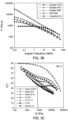
- the inventive ethylene-based copolymers herein have an absence of a local minimum loss angle at a complex modulus, G*, of 1.00 ⁇ 10 4 to 3.00 ⁇ 10 4 Pa (see Figure 3C ).
- the inventive ethylene-based copolymers of this invention also have a complex modulus, G* 50 , greater than 50.00 ⁇ 10 3 Pa (preferably greater than 60.00 ⁇ 10 3 Pa, greater than 70.00 ⁇ 10 3 Pa, or greater than 75.00 ⁇ 10 3 Pa).
- Complex modulus, G*, and loss angles, ⁇ may be obtained from rheological data determined at the test temperature of 190°C and analyzed using the Van Gurp-Palmen treatment (reference: M.Van Gurp and J.
- Palmen, 67 RHEOLOGY BULLETIN 5 (1998 )), whereby the loss angle, ⁇ , (wherein ⁇ arctan -1 (G"/G'); G" represents the loss modulus (Pa) and G' represents the storage modulus (Pa)) is plotted against the absolute value of the complex modulus
- (G' 2 + G" 2 ) 1/2 .
- This representation of linear viscoelastic data is a powerful means of characterizing molecular and structural features of polymers. For example, low levels of long-chain branching in polyolefins can be detected and quantified on a relative basis, using this methodology.
- the inventive ethylene-based copolymer displays a high molecular weight "tail” or "bump” in dissolution temperatures.
- an inventive ethylene-based copolymer that displays a first dissolution temperature and a second, higher dissolution temperature is considered to exhibit "bump” or "tail” in the dissolution temperatures (see Figures 2A and 2B ). This is reflected in the ethylene-based copolymer having higher Mz and Mz/Mn values described above.
- the inventive ethylene-based copolymers have an Mz value of greater than 250,000 g/mole or 300,000 g/mole or 350,000 g/mole, or 400,000 g/mole, or 450,000 g/mole, or within a range from 250,000 or 300,000 or 350,000 g/mole to 550,000 or 600,000 or 650,000 or 700,000 or 800,000 g/mole.
- the inventive ethylene-based copolymers preferably have an Mz/Mn of greater than 8.0 or 9.0 or 10.0, or within a range of from 5.0 or 6.0 or 7.0 to 8.0 or 9.0 or 10.0 or 11.0 or 12.0 or 14.0 or 16.0 or 18.0
- the inventive ethylene-based copolymer has a T 90 -T 10 value of 5°C or greater, wherein T 10 is the temperature at which 10% of the eluted polymer is obtained, and T 90 is the temperature at which 90% of the eluted polymer is obtained in a TREF analysis, as described in Wild, et al., 20 J. POLY. SCI. POLY. PHYS. ED. 441 (1982 ).
- at least one of T 10 or T 90 is in the range of from 45°C to 85°C, and preferably T 90 is greater than 90°C.
- the inventive ethylene-based copolymer comprises branching that is reflective of the number of carbon atoms in the olefin used to copolymerize with the ethylene.
- This molecular architecture is in contrast to traditional LDPE resins for which the molecular structure is built upon the primary monomer, ethylene, coming together in any number of ways and number of repeating units determined by the amount, order and timing with which the ethylene monomer, initiator(s) and chain transfer agents are introduced into the reactors.
- the free radical chemistry leads to polymers with short chain branches (side groups) consisting of methyl, ethyl, propyl, butyl, pentyl, hexyl.
- the ethylene-based copolymer wherein if the ethylene-based copolymer comprises Cx monomer derived units, wherein x represents the number of carbons in the Cx monomer and is an integer in the range of from 3 to 8, then only short chain branches of the Cx_2 type arc observed in the polymer.
- thermoplastic polyolefins display visco-elastic flow behavior and their viscosity decreases with increasing shear rate (also termed shear thinning).
- the inventive ethylene-based copolymers have good shear thinning.
- One way to quantify the shear thinning is to use a ratio of complex viscosity at a frequency of 0.01 rad/s to the complex viscosity at a frequency of 100 rad/s.
- the complex viscosity ratio of the inventive ethylene-based copolymers produced herein is 50 or more, more preferably 100 or more, even more preferably 250 or more when the complex viscosity is measured at 190°C.
- the complex viscosity is measured at 190°C over an angular frequency range from 0.01 to 100 rad/s using the procedure described below using Small Amplitude Oscillatory Shear (SAOS) testing. From the data generated by such a test, it is possible to determine the phase or loss angle ⁇ , which is the inverse tangent of the ratio of G" (the loss modulus) to G' (the storage modulus). For a typical linear polymer, the loss angle at low frequencies (or long times) approaches 90° making the loss modulus much larger than the storage modulus. As frequencies increase, more of the chains relax too slowly to absorb energy during the oscillations, and the storage modulus grows relative to the loss modulus. Eventually, the storage and loss moduli become equal and the loss angle reaches 45°.
- SAOS Small Amplitude Oscillatory Shear
- a branched chain polymer relaxes very slowly.
- Such branched polymers never reach a state where all its chains can relax during an oscillation, and the loss angle never reaches 90° even at the lowest frequency, ⁇ , of the experiments.
- the loss angle is also relatively independent of the frequency of the oscillations in the SAOS experiment; another indication that the chains cannot relax on these timescales.
- polymers that have long chain branches exhibit a plateau in the function of ⁇ ( ⁇ ), whereas linear polymers do not have such a plateau. According to Garcia-Franco et al.
- the inventive ethylene-based copolymer has a zero shear viscosity of 10,000 Pa ⁇ s or more, 15,000 Pa ⁇ s or more, 5,000 Pa ⁇ s or more; alternatively 80,000 Pa ⁇ s or less, 70,000 Pa ⁇ s or less or 50,000 Pa ⁇ s or less, as determined by small angle oscillatory shear analysis.
- the inventive ethylene-based copolymers preferably have 0.10 or greater vinyl chain ends per 1000 carbon atoms, more preferably 0.15 or 0.20 or 0.25 or greater vinyl chain ends per 1000 carbon atoms. Some inventive ethylene-based copolymers have 0.05 or greater vinylidene chain ends per 1000 carbon atoms, more preferably 0.06 or 0.07 or 0.08 or greater vinylidene chain ends per 1000 carbon atoms. Most preferably, the ethylene-based copolymers have within the range from 0.10 or 0.15 to 0.40 or 0.50 terminal vinyl groups per 1000 carbons, and within a range from 0.06 or 0.07 to 0.11 or 0.12 or 0.12 vinylidene chain ends per 1000 carbon atoms.
- Some inventive ethylene-based copolymers have greater than 35% vinyl chain ends (preferably greater than 40% vinyl chain ends, greater than 45% vinyl chain ends), based on the total number of unsaturations.
- the number of vinyl chain ends was determined using 1 H NMR at 120°C using deuterated tetrachloroethane as the solvent on an at least 250 MHz NMR spectrometer, and in selected cases, confirmed by 13 C NMR. All spectra were recorded at 100°C on a Bruker spectrometer operating at 500 MHz for proton and 125 MHz for carbon) for vinyl terminated propylene oligomers in 114 J. AM. CHEM. SOC. 1025-1032 (1992 ) that are useful herein. Allyl chain ends are reported as a molar percentage of the total number of moles of unsaturated groups (that is, the sum of allyl chain ends, vinylidene chain ends, vinylene chain ends).
- the inventive ethylene-based copolymers have improved processability, whether used neat or as part of a blend with other polymers.
- markedly reduced motor load, reduced die pressure, reduced extruder head pressure, reduced torque, and reduced processing time are noted.
- These improved processability parameters are very important as they improve product output and reduce wear and tear on the film blowing line, thereby improving equipment lifetime and increasing the time period between repairs.
- the extruder motor load is less than 70%, preferably less than 65%, or preferably less than 60% of the value when extruding commercial LLDPE having an I 2 of 1.0 g/10 min and density of 0.918 g/cm 3 (most desirably, Exceed TM 1018 metallocene polyethylene resins from ExxonMobil Chemical Company).
- the extruder die pressure is less than 2500 psi, preferably less than 2400 psi, or preferably less than 2300 psi.
- the extruder head pressure is less than 4000 psi, preferably less than 3750 psi, or preferably less than 3500 psi.
- the extruder torque is preferably less than 0.350 HP/rpm, preferably less than 0.325 HP/rpm or less than 0.315 HP/rpm.
- the inventive ethylene-based copolymer may be used by itself as a polymer (neat) or it may be part of an in-reactor blend, or it may be blended as a modifier into a selected base polymer to form a physical blend.
- the present invention also relates to polymer blends comprising the inventive ethylene-based copolymer.
- the polymer blend compositions may be in-reactor blends or homogeneous physical blends. "Homogeneous,” as used herein, means free from visible gels.
- the physical blends of this invention have less than 1 wt% of insoluble material, when the blend is dissolved in boiling xylenes.
- the polymer blend compositions of this invention may comprise 0.5 wt% to 99.9 wt% of the inventive ethylene-based copolymer (preferably 1.0 wt% to 95 wt%, preferably 3 wt% to 75 wt%, preferably 5 wt% to 35 wt%, or preferably 5 wt% to 25 wt%).
- the remaining portion of the blend is preferably 0.1 wt% to 99.5 wt% of a polymer preferably selected from the group consisting of high density polyethylene, linear low density polyethylene, low density polyethylene, medium density polyethylene, and combinations thereof (preferably 5 wt% to 99 wt%, preferably 25 wt% to 97 wt%, preferably 65 wt% to 95 wt%, or preferably 75 wt% to 95 wt%).
- suitable polyethylenes include commercially available from ExxonMobil Chemical Company in Baytown, Texas under the tradenames Exceed TM , Enable TM , and Exact TM , as well as the Engage TM polymers available from DuPont/Dow.
- the Enable products are made using a metallocene catalyst and the products have a small amount of long chain branching in them.
- the Enable products do not perform as well as the inventive ethylene-based polymers.
- the polymer blend composition may also include one or more polymer "additives", such as reinforcing and non-reinforcing fillers, scratch resistant agents, plasticizers, antioxidants, heat stabilizers, extender oils, lubricants, antiblocking agents, antistatic agents, anti-fogging agent, waxes, foaming agents, pigments, flame/fire retardants, dyes and colorants, ultraviolet absorbers, and nano-fillers.
- additives include, for example, blowing agents, processing aids, tackifying resins, and other processing aids known in the polymer compounding art.
- the lists described herein are not intended to be inclusive of all types of additives which can be employed with the present invention.
- additives can be employed to enhance properties.
- the blends of the present invention can be modified to adjust the characteristics of the blends as desired.
- the aforementioned additives can be either added independently or incorporated into an additive or masterbatch.
- Such additives can comprise up to 70 wt%, more preferably up to 65 wt%, of the total additive or masterbatch composition.
- the polymer blend composition may include one or more slip agents or mold-release agents to facilitate moldability, preferably present at 50 ppm to 10 wt%, more preferably 50 ppm to 5000 ppm, even more preferably 0.01 wt% to 0.5 wt% (100 ppm to 5000 ppm), even more preferably 0.1 wt% to 0.3 wt% (1000 ppm to 3000 ppm), based upon the weight of the composition.
- slip agents or mold-release agents to facilitate moldability, preferably present at 50 ppm to 10 wt%, more preferably 50 ppm to 5000 ppm, even more preferably 0.01 wt% to 0.5 wt% (100 ppm to 5000 ppm), even more preferably 0.1 wt% to 0.3 wt% (1000 ppm to 3000 ppm), based upon the weight of the composition.
- Desirable slip additives include but are not limited to saturated fatty acid amides (such as palmitamide, stearamide, arachidamide, behenamide, stearyl stearamide, palmityl pamitamide, and stearyl arachidamide); saturated ethylene-bis-amides (such as stearamido-ethyl-stearamide, stearamido-ethyl-palmitamide, and palmitamido-ethyl-stearamide); unsaturated fatty acid amides (such as oleamide, erucamide, and linoleamide); unsaturated ethylene-bis-amides (such as ethylene-bis-stearamide, ethylene-bis-oleamide, stearyl-erucamide, erucamido-ethyl-erucamide, oleamido-ethyl-oleamide, erucamido-ethyl-oleamide, oleamido-ethyl-leamide,
- This invention also relates to films comprising (or consisting essentially of, or consisting of) the inventive ethylene-based copolymers or the polymer blend compositions described herein.
- inventive ethylene-based copolymers and polymer blend compositions disclosed herein may be utilized to prepare monolayer films or multilayer films. These films may be formed by any number of well-known extrusion or coextrusion techniques discussed below. Films may be unoriented, uniaxially oriented or biaxially oriented. Physical properties of the film may vary depending on the film forming techniques used.
- films containing the ethylene-based copolymer and polymer blend compositions, monolayer or multilayer may be formed by using casting techniques, such as a chill roll casting process.
- chill roll casting processes and apparatus are well known in the art, and are described, for example, in The Wiley-Encyclopedia of Packaging Technology, Second Edition, A. L. Brody and K. S. Marsh, Ed., John Wiley and Sons, Inc., New York (1997 ).
- chill roll casting is one example, other forms of casting may be employed.
- films containing the inventive ethylene-based copolymers and polymer blend compositions, monolayer or multilayer may be formed using blown techniques, i.e., to form a blown film.
- the composition can be extruded in a molten state through an annular die and then blown and cooled to form a tubular, blown film, which can then be axially slit and unfolded to form a flat film.
- blown films can be prepared as follows.
- the polymer blend composition is introduced into the feed hopper of an extruder, such as a 63.5 mm Egan extruder that is water-cooled, resistance heated, and has a L/D ratio of 24:1.
- the film can be produced using a 15.24 cm Sano die with a 2.24 mm die gap, along with a Sano dual orifice non-rotating, non-adjustable air ring.
- the film is extruded through the die into a film cooled by blowing air onto the surface of the film.
- the film is drawn from the die typically forming a cylindrical tube of film that is cooled, collapsed and, optionally, subjected to a desired auxiliary process, such as slitting, treating, sealing, or printing.
- Typical melt temperatures are from 175°C to 225°C.
- Blown film rates are generally from 5 to 30 lbs per hour per inch of die circumference.
- the finished film can be wound into rolls for later processing, or can be fed into a bag machine and converted into bags.
- other blown film forming methods can also be used.
- Physical properties of the film can vary from those of the polymer or polymer blend, depending on the film forming techniques used.
- the films can be of any desirable thickness or composition, but most preferably within a range from 1 or 5 or 10 or 20 microns to 30 or 50 or 100 or 200 or 300 microns.
- the resins used to make the films can be blended with other additives such as pigments, antioxidants, fillers, as is known in the art, as long as they do not interfere with the desired film properties.
- the films of the present invention have a combination of unique and useful properties as described in more detail below. When the blends "consist essentially of" the ethylene-based copolymers and other polyethylenes (e.g., LLDPE, HDPE). what is meant is that the "additives" are present at a level of less than 5 wt% of the blend.
- this invention relates to a film comprising, for example, at least 5 wt% of the inventive ethylene-based copolymer comprising for example from 75.0 wt% to 99.5 wt% of ethylene-derived units and 0.5 wt% to 25.0 wt% of C 3 to C 20 olefin derived units, where the inventive ethylene-based copolymers have, for example, a density in the range of from 0.900 or 0.920 g/cm 3 to less than 0.950 g/cm 3 ; a g'(vis) of less than 0.80; a melt index, I 2 , of from 0.25 to 1.5 g/10 min; a Mw/Mn within a range from 3.0 to 6.0; a Mz/Mn of greater than 8.0; an absence of a local minimum loss angle at a complex modulus, G*, of 1.00 ⁇ 10 4 to 3.00 ⁇ 10 4 Pa; and wherein the film has for example (a) a 1% Secant Modulus
- the inventive films comprise at least 5 wt% of the inventive ethylene-based copolymer described herein, and preferably greater than 8 wt% or 10 wt% or 12 wt% or 15 wt% or 18 wt% or 20 wt% or 25 wt%; alternately the inventive films comprise the ethylene-based copolymers at a level of less than 35 wt% or 30 wt% or 25 wt%.
- the balance of the film may comprise other polyethylenes, which may be homopolymers or copolymers, for example, a VLDPE, a LDPE (such as a "high pressure" derived LDPE, or “HD-LDPE", or just “LD"), a LLDPE, a MDPE, a HDPE, or a DPE, as well as other polyethylenes known in the art.
- the polyethylene can be produced by any suitable process, including metallocene-catalyzed processes and Ziegler-Natta catalyzed processes.
- each layer can be a blend of two or more such polyethylenes, and can include additives known in the art.
- the layers of a multilayer film preferably have the appropriate viscosity match.
- the film is a blown film.
- the film may be a monolayer or multilayer film, and the inventive ethylene-based copolymers described herein may be in multiple layers.
- the inventive films have a good balance of stiffness versus toughness as indicated by machine direction tear strength (MD Elmendorf Tear), 1% Secant Modulus (MD), and dart drop impact strength performance (Dart Impact).
- MD Elmendorf Tear machine direction tear strength
- MD Secant Modulus
- Dart Impact dart drop impact strength performance
- the films exhibit the relationship of having a Dart Drop (g/mil) of greater than -8.09x[Average Elmendorf Tear (g/mil)] + 853.81.
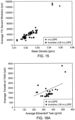
- the films preferably exhibit the relationship of having a Tensile Strength at Yield of greater than 4.274x[Elmendorf Tear (g/mil)] + 300, such as demonstrated by the data in Figure 16A .
- the films may desirably have a 1% Secant Modulus in the machine direction (1% Secant Modulus MD), reported in pounds per square inch (psi), measured according to ASTM D882-95a, of 30,00 or 40,000 or 50,000 or 60,000 psi or greater, or preferably within a range from 30,000 or 50,000 or 60,000 psi to 100,000 or 120,000 or 140,000 psi.
- 1% Secant Modulus MD 1% Secant Modulus in the machine direction
- psi pounds per square inch
- the films may desirably have a MD Elmendorf Tear, as measured by ASTM D1922-94, of 100 g/mil or greater.
- the films can have a MD Elmendorf Tear of 100 g/mil to 450 g/mil.
- the MD Elmendorf Tear can range from a low of 110 g/mil, 120 g/mil, or 150 g/mil to a high of 425 g/mil, 400 g/mil, or 375 g/mil.
- the films may desirably have a Dart Impact (Method A), as measured according to ASTM D1709-91, of 225 g/mil to 450 g/mil (preferably 250 g/mil to 450 g/mil; preferably 275 g/mil to 440 g/mil).
- the film may comprises 25 wt% or more of the inventive ethylene-based copolymer and has a Dart Impact of 320 g/mil or greater (340 g/mil or greater, 350 g/mil or greater, 360 g/mil or greater).
- the films may desirably have a total haze, as measured according to ASTM D1003-95, of 0.2 wt% to 30%.
- the films have a haze of less than 25%; less than 20%; less than 15%; or less than 10%.
- the haze can range from a low of 2%, 4%, or 5% to a high of 10%, 15%, or 25%.
- the films may desirably have an internal haze, as measured according to ASTM D1003-95, of 0.2% to 5%.
- the films have an internal haze of less than 5%; less than 4%; less than 3%; or less than 1.5%.
- the haze can range from a low of 0.2%, 0.75%, or 1.0% to a high of 2%, 4%, or 5%.
- Internal haze is the haze excluding any film surface contribution.
- the film surfaces are coated with ASTM approved inert liquids to eliminate any haze contribution from the film surface topology. The haze measurement procedure is per ASTM D 1003.
- the films may desirably have a Gloss 45° MD, as measured according to ASTM D2457-90, of 45 to 75.
- the Gloss 45° MD may range from a low of 45, 50, or 55 to a high of 60, 65, or 75.
- the films have a desirable "drawability", which is the melt strength of the polymer used to make the blown film and is the ratio of the die gap to film gauge after the polymer is drawn out into a film. A higher drawability or “Draw” is desirable.
- the total draw of the inventive films is 40 or greater, preferably 45 or greater, preferably 50 or greater, preferably 60 or greater, or preferably 70 or greater.
- films containing the ethylene-based copolymers and blends described herein have improved seal strength and hot tack performance.
- a film comprising 25 wt% or more of the inventive ethylene-based copolymer and has a seal strength of at least 2.0 lbs/in (357g/cm) at a seal initiation temperature of 105°C.
- the films preferably have a seal initiation temperature so that it is suitable for packaging applications, such as food packaging.
- the desired seal initiation temperature may depend on the end use application of the film, for example, for chocolate bars the SIT may be the temperature at which the seal strength is 200 g/inch (80 g/cm), for potato chips in the United States the desired SIT may be the temperature at which the seal strength is 500 g/inch (20 g/cm), and for potato chips in Asia the SIT may be the temperature at which the seal strength is 1000 g/inch (400 g/cm).
- the SIT may also depend on the type of seal used, for example, a fin seal as compared to a crimp seal.
- the films preferably have a hot tack strength of greater than 320 g/inch (126 g/cm) (preferably greater than 340 g/inch (134 g/cm), greater than 360 g/inch (142 g/cm), greater than 380 g/inch (150 g/cm), greater than 400 g/inch (157 g/cm), or greater than 410 g/inch (162 g/cm)).
- Hot tack is the strength of a heat seal immediately after sealing, while still in a hot condition, that is, before it has cooled down to ambient temperature and achieved its final strength.
- the package In production lines, the package is often filled by dropping the product into the package from a certain height, or by horizontally filling, both of which will exert a force on the package bottom. If the package bottom cannot resist the disruptive force of filling, the seal on the bottom of the package will fail.
- the interval between heat-sealing the film to make the package and filling the package with product is very short, and it is usually not possible for seal completely cool before filling. Accordingly, hot tack strength becomes important.
- the films possess an excellent balance of mechanical properties, toughness, sealability and cling/adhesive properties.
- the films can be used in hot fill applications or packaging materials heated at temperatures up to 260°F (126°C) during packaging, such as cement, sand, salt, and retort bag applications such as pouches, bags and sacks containing consumer products including food.
- the films can also be used for shrink films and form fill and seal applications requiring abuse resistance.
- the films also possess good softness/feel and optical/clarity properties useful for food packaging at any temperature.
- the resin blends described herein will find utility in other applications like, but not limited to: extrusion coating, injection molding, rotomolding, and blow molding applications.
- Gauge reported in mils, was measured using a Measuretech Series 200 instrument. The instrument measures film thickness using a capacitance gauge. For each film sample, ten film thickness datapoints were measured per inch of film as the film was passed through the gauge in a transverse direction. From these measurements, an average gauge measurement was determined and reported.
- Elmendorf tear (tear) was measured as specified by ASTM D-1922.
- Tensile properties including tensile strength, tensile stress, ultimate tensile stress, tensile strain, ultimate tensile strain, tensile stress at 100% (200%, 300%, 400%, 500%, 600%, 700%, 800%) elongation, stress and strain at the primary yield point, stress and strain at the secondary yield point, 1% and 2% Secant modulus, tensile strength at yield, tensile strength at break, ultimate tensile strength, elongation at yield, elongation at break, yield stress, and strain hardening were measured as specified by ASTM D-882.
- MI Melt index
- HLMI high load melt index
- MIR Melt index ratio
- Density was determined as specified by ASTM D-1505 using chips cut from plaques compression molded in accordance with ASTM D-4703-07, aged in for 40 hrs at 23°C plus or minus 2°C, unless specifically stated otherwise.
- Dart Impact also known as Dart F 50 , or Dart Drop Impact or Dart Drop Impact Strength
- ASTM D-1709 Method A.
- Melting point temperature was measured using the DSC procedure as follows: Samples weighing approximately 5 to 10 mg were sealed in aluminum sample pans. The DSC data were recorded by first cooling the sample to -50°C and then gradually heating it to 200°C at a rate of 10°C/minute. The sample was kept at 200°C for 5 minutes before a second cooling-heating cycle was applied. Both the first and second cycle thermal events were recorded. The melting temperature (Tm) was measured and reported during the second heating cycle (or second melt).
- Molecular weight distribution is Mw/Mn. Measurements of weight average molecular weight (M w ), number average molecular weight (M n ), and z-average molecular weight (Mz) were determined by Gel Permeation Chromatography as described in 34(19) MACROMOLECULES 6812 (2001 ), including that, a High Temperature Size Exclusion Chromatograph (SEC, Waters Alliance 2000), equipped with a differential refractive index detector (DRI) equipped with three Polymer Laboratories PLgel 10 mm Mixed-B columns is used. The instrument was operated with a flow rate of 1.0 cm 3 /min, and an injection volume of 300 ⁇ L.
- SEC High Temperature Size Exclusion Chromatograph
- DRI differential refractive index detector
- the various transfer lines, columns and differential refractometer were housed in an oven maintained at 145°C.
- Polymer solutions were prepared by heating 0.75 to 1.5 mg/mL of polymer in filtered 1,2,4-Trichlorobenzene (TCB) containing about1000 ppm of BHT at 160°C for 2 hours with continuous agitation.
- TBC filtered 1,2,4-Trichlorobenzene
- a sample of the polymer containing solution was injected into the GPC and eluted using filtered 1,2,4-Trichlorobenzene (TCB) containing ⁇ 1000 ppm of BHT.
- the separation efficiency of the column set was calibrated using a series of narrow MWD polystyrene standards reflecting the expected Mw range of the sample being analyzed and the exclusion limits of the column set.
- the dynamic shear viscosity (or complex viscosity) as a function of frequency is determined by small-amplitude oscillatory shear (SAOS) rheology, as described above.
- SAOS small-amplitude oscillatory shear
- Example 1 production of polyethylene resins 3-2, 3-3, & 3-4
- Ethylene-hexene copolymer was made by reacting ethylene with hexene using silica supported dimethylsilylene(2,3,4,5-tetramethyl-1-cyclopentadienyl)(3-phenyl-1-indenyl)zirconium dichloride (Supported Metallocene I) activated with MAO. Three yields were collected under slightly different polymerization conditions (resins 3-2, 3-3, & 3-4).
- the polymerization was conducted in a laboratory gas phase reactor having a fluidized bed reactor equipped with devices for temperature control, catalyst feeding or injection equipment, gas chromatograph analyzer for monitoring and controlling monomer and gas feeds, and equipment for polymer sampling and collecting.
- the reactor consisted of a 6" (15.24 mm) diameter bed section increasing to 10" (25.4 mm) at the reactor top. Gas came in through a perforated distributor plate allowing fluidization of the bed contents and polymer sample was discharged at the reactor top. Table 2.
- Figure 1 shows the GPC chromatogram of the inventive resin 3-2 compared with the comparative resins of Table 1.
- the molar mass distribution of the inventive resin 3-2 is different from that in Exceed TM 1018, Enable TM 20-10, and the LDPE (LD 071) resins, as shown in Figure 1 .
- the inventive resin 3-2 has less lower molecular weight material than Enable TM 20-10 and LDPE LD 071 resins.
- the inventive resin 3-2 also has more lower molecular weight material than Exceed TM 1018 resin and more higher molecular weight material than Exceed TM 1018, Enable TM 20-10 and 35-05, and LDPE LD 071 resins.
- inventive resins 3-2 and 3-4 exhibited multimodality in the TREF traces (see Figures 2A and 2B , respectively), showing a lower melting component having a melting point less than 90°C and a higher melting component having a melting point greater than 90°C.
- the ethylene-hexene copolymers were compared to several commercially available ethylene by SAOS (see Figures 3A and 3B ).
- the SAOS viscosity of the ethylene-hexene copolymers from Run # 3-2 is similar to that of ExxonMobil TM LDPE LD 071, Enable TM 20-10 polyethylene, and Enable TM 35-05 polyethylene. Additionally, the zero shear viscosity of the ethylene-hexene copolymer 3-2 is less than that of ExxonMobil TM LDPE LD 051.
- the SAOS analysis of the ethylene-hexene copolymer 3-2 revealed a complex composition, which may be bimodal.
- the inventors suggest that a second component may add a new dimension to expected melt strength, elongational viscosity, and bubble stability.
- the ethylene-hexene copolymer 3-2 is comparable to Enable TM polyethylene resins and is markedly different from LDPE resins (LDPE LD 071 and LDPE LD 051) (see Figure 3C ).
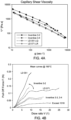
- the viscosity of the ethylene-hexene copolymer resin 3-2 exceeds that of the comparative LDPE resins (LDPE LD 051 and LDPE LD 071), as shown in Figure 4A .
- the viscosity of the ethylene-hexene copolymers from Run number 3-4 is also greater than that of the comparative LDPE resins, as seen in Figure 4A .
- Figures 4B and 4C show that the ethylene-hexene copolymer resin 3-2 has a melt strength greater than those of LDPE LD 071, but less than that of LDPE LD 051. Additionally, the ethylene-hexene copolymer resins 3-3 and 3-4 have a melt strength and elongational viscosity less than that of the comparative LDPE resins.
- the ethylene-hexene copolymers listed in Table 3 were stabilized with an additive package comprising 500 ppm Irganox 1076, 1000 ppm Irgafos 168, 800 ppm Dynamar FX-5920A, and compounded using an Werner Pfeliderer ZSK-57 extruder equipped with a 20 ⁇ 60 ⁇ 80 ⁇ 20 screen pack and operated using counter rotating intermeshing twin screws operated under the conditions shown in Table 4.
- the amount of work put into compounding the ethylene-hexene copolymers was less than 0.025 lbs/hr-hp.
- Example 2A Film (0.75 mil, 60 mil die gap, BUR 2.5:1)
- the inventive resins 3-2, 3-3, and 3-4 offer superior stiffness when compared to Exceed TM 1018 and Enable TM 20-10 and similar or improved optical properties.
- Example 2B Film (0.75 mil, 60 mil die gap, BUR 4:1)
- Example 3A 5 wt% Blends
- Resin blends of Table 7 were made into film using a 2.5 inch blown film line equipped with a low work DSB-II screw, a 30 mil die gap and a Saturn Future Design Air Ring.
- the resin blend was added to the hopper of the blow film line, and converted into blown films.
- the films were processed at a die throughput rate of 10 lbs/hr/die inch to produce a monolayer film having a thickness of 0.75 mil.
- the temperature of the melt was 400°F.
- the film processing parameters and the film properties are reported in Table 7, below.
- Resin blends were made into film using a 2.5 inch blown film line equipped with a low work DSB-II screw, a 30 mil die gap and a Saturn Future Design Air Ring.
- the resin blend was added to the hopper of the blow film line, and converted into blown films.
- the films were processed at a die throughput rate of 10 lbs/hr/die inch to produce a monolayer film having a thickness of 3 mil.
- the temperature of the melt was 410°F.
- Performance of films made with blends of 95 wt% Exceed TM 1018 and 5 wt% of the inventive resins 3-2, 3-3, and 3-4 were evaluated and reported in Table 8, below.
- the inventive films demonstrated similar to superior stiffness when compared to 100 wt% Exceed TM 1018 and 5 wt% LDPE (LD 051 and LD 071) films.
- the inventive films also demonstrated a tear resistance similar to 100 wt% Exceed TM 1018 and superior to the 5 wt% LDPE films.
- Table 8 3 mil Films Air Flow Frost Line Height MD 1% Secant MD Elmendorf Tear Dart Drop, Method A Haze Haze Internal Gloss 45° Units (%) (inches) (psi) (gms/mil) (gms/mil) (%) (%) - 100 wt% Exceed TM 1018 56.2 29 29075 296 450 31 16 32 5 wt% LD 051 65.7 27 29434 267 444 5 3 79 5 wt% LD 071 60 28 30084 283 442 6 4 78 5 wt% Resin 3-2 51.9 33 30581 289 450 14 7 55 5 wt% Resin 3-3 56.2 31 29996 292 451 25 13 36 5 wt% Resin 3-4 58.5 30 30115 297 451 24 11 39
- Example 3B Films made from 25% Blends
- Resin blends were made into film using a 2.5 inch blown film line equipped with a low work DSB-II screw, a 60 mil die gap and a Saturn Future Design Air Ring.
- the resin blend was added to the hopper of the blow film line, and converted into blown films.
- the films were processed at a die throughput rate of 10 lbs/hr/die inch to produce a monolayer film having a thickness of 1 mil.
- the temperature of the melt was 400°F.
- Table 9A Film (1 mil, 60 mil die gap) MD 1% Secant MD Elmendorf Tear Dart Drop, Method A Haze Haze Internal Gloss 45° Units (psi) (gms/mil) (gmslmil) (%) (%) - 100 wt% Exceed TM 1018 24615 244 707 41 1.7 23 25 wt% LD 051 38232 24 191 8 0.8 60 25 wt% LD 071 39265 30 169 3 0.6 83 25 wt% Resin 3-2 32022 99 247 6 1.0 66
- inventive films demonstrated similar to superior stiffness when compared to Exceed TM 1018 and LDPE (LD 051 and LD 071).
- inventive films also demonstrated a tear resistance superior to the LDPE films.
- inventive films exhibited an impact resistance that was similar to that of the films made with LDPE and a clarity that was superior to that of Exceed TM 1018 films.
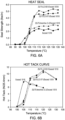
- the film with resin 3-2 exhibited improved heat seal performance and similar hot tack performance when compared with films made from 100 wt% Exceed TM 1018 (see Figures 6A and 6B ).
- Resin blends were made into film using a 2.5 inch blown film line equipped with a low work DSB-II screw, a 30 mil die gap and a Saturn Future Design Air Ring.
- the resin blend was added to the hopper of the blow film line, and converted into blown films.
- the films were processed at a die throughput rate of 10 lbs/hr/die inch to produce a monolayer film having a thickness of 3.0 mil.
- the temperature of the melt was 410°F.
- Table 9B Film (3 mil, 30 mil die gap) 100 wt% Exceed TM 1018 25 wt% LD 051 25 wt% LD 071 25 wt% 3-2 25 wt% 3-3 25 wt% 3-4 Motor load (%) 69.1 65 62.4 67.4 64.7 63.6 Torque (HP/rpm) 0.366 0.344 0.33 0.357 0.343 0.337 Die pressure (psi) 3490 3570 3440 3450 3260 3230 Air Flow (%) 56.2 65.7 60 51.9 56.2 58.5 Frost Line Height (inches) 29 14 20 28 29 27 MD 1% Secant (psi) 29,075 27,323 29,728 33,709 30,407 30,331 MD Elmendorf Tear (g/mil) 296 106 148 283
- the blends had desirable processability similar to LDPE blends.
- the inventive films also demonstrated superior bubble stability, superior MD tear resistance, and superior impact resistance when compared to LDPE blends.
- Example 4 Films made from 5 wt% to 75 wt% Blends
- Comparative films made with greater than 25 wt% LDPE could not be processed into film, for example, the maximum draw for LD 051 blend was 10. Additionally, films with 60 wt% and 75 wt% LD 071 required the maximum airflow the line could deliver and were marginally stable, indicating that these formulations were at the limit of the line's processing capabilities.
- films were easily made with blends of 5 wt% to 75 wt% inventive resins 3-2, 3-3, and 3-4 and 95 wt% to 25 wt% Exceed TM 1018. All the blends with inventive resins were easily processed into film. Indeed, the blends with inventive resins had reduced extruder motor load, extruder pressures and die pressures (see Figures 7A and 7B ). Additionally, the films made from blends with inventive resins were more stable, that is had better bubble stability than the comparative films. The films made from blends with inventive resins required lower air flow rates (see Figures 7C and 8A ), requiring less air to keep the bubble in the pocket and better processing time (see Figures 7D and 8B ) than the comparative films.
- inventive films prove easier to process over a broader density range (see Figure 8A ) and have more consistent processing time over a broader density range (see Figure 8B ).
- This combination of useful properties effectively expands the film manufacturing window, when compared to traditional LDPEs.
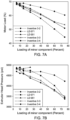
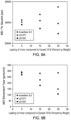
- film stiffness increased with increasing inventive resin 3-2 content. In contrast, film stiffness decreased with increasing comparative LDPE content (see Figure 9A ). Film tear resistance was fairly constant despite increasing inventive resin content. In contrast, the film tear resistance decreased with increasing LDPE content (see Figure 9B ).
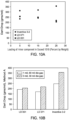
- the film with resin 3-2 exhibited improved impact resistance (by more than 50%), compared with a decreased impact resistance at a 25 wt% loading of LDPE (see Figures 10A and 10B ). This improved impact resistance was observed to be consistent over various film thicknesses (see Figure 10B ).
- the film with resin 3-2 exhibited increased MD tear resistance by more than 50% (see Figure 10E).
- Ethylene-hexene copolymer was made by reacting ethylene with hexene using a silica supported mixed catalyst, that is, 25 wt% dimethylsilylene(2,3,4,5-tetramethyl-1-cyclopentadienyl)(3-phenyl-1-indenyl)zirconium dichloride and 75 wt% bis(1-methyl,3-butylcyclopentadienyl)zirconium dichloride, supported on a single silica support (Mixed Catalyst A) and activated with MAO.
- a silica supported mixed catalyst that is, 25 wt% dimethylsilylene(2,3,4,5-tetramethyl-1-cyclopentadienyl)(3-phenyl-1-indenyl)zirconium dichloride and 75 wt% bis(1-methyl,3-butylcyclopentadienyl)zirconium dichloride, supported on a single si
- the polymerization was conducted in a laboratory gas phase reactor having a fluidized bed reactor equipped with devices for temperature control, catalyst feeding or injection equipment, gas chromatograph analyzer for monitoring and controlling monomer and gas feeds, and equipment for polymer sampling and collecting.
- the reactor consisted of a 6" (15.24 mm) diameter bed section increasing to 10" (25.4 mm) at the reactor top. Gas came in through a perforated distributor plate allowing fluidization of the bed contents and polymer sample was discharged at the reactor top.
- the reactor was operated as shown in Table 10, below.
- the ethylene-hexene copolymers listed in Table 10 were stabilized with an additive package comprising 500 ppm Irganox 1076, 1000 ppm Irgafos 168, and 800 ppm Dynamar FX-5920A, and compounded.
- 100 wt% in-reactor blend resins were made into film using a 2.5 inch blown film line equipped with a low work DSB-II screw, a 60 mil die gap and a Saturn Future Design Air Ring.
- the resin blend was added to the hopper of the blow film line, and converted into blown films.
- the films were processed at a die throughput rate of 10 lbs/hr/die inch to produce a monolayer film having a thickness of 0.75 mil.
- the temperature of the melt was 400°F.
- the films were compared with films made from 100% Exceed TM 1018.
- Tables 12 and 13 below include further characterization data for the inventive ethylene-based copolymers. Films of 0.75 mil (19 ⁇ m) were made as described above, and characterized for their processability as shown in Table 14, and the film characterized in Table 15. Also, in-reactor blends were also demonstrated as shown in Tables 14 and 15, where two metallocene catalysts were on one support and used in a gas phase polymerization process.
- the branching factor indicates the presence of long chain branched material in the resin, which for the inventive ethylene-based polymers is located in the higher molecular weight fractions of the resin. Table 12.
- the inventive ethylene-based copolymers most preferably have a density of at least 0.920 g/cm 3 , an MIR of greater than 35, a g'(vis.ave) of less than 0.80, and an Mz/Mn of greater than 8.
- Table 13 Unsaturation Content On a per K carbon basis: Inventive Exceed 1018 3-2 3-3 3-4 Vinyls 0.27 0.29 0.35 0.03 Vinylenes 0.09 0.08 0.14 0.06 Vinylidenes 0.08 0.08 0.10 0.03 trisubstituted 0.13 0.06 0.12 0.10
- the inventive ethylene-based copolymers most preferably have has within the range from 0.10 or 0.15 to 0.40 or 0.50 terminal vinyl groups per 1000 carbons.
- the processability assessment of the polymer and blends shows a reduced motor load and head pressure.
- Table 14 Resin Characterization and Film Processability parameter Exceed 1018 Inventive 75 wt% LLDPE*/25 wt% Inventive PE *Exceed 1018 3-4 3-3 3-2 3-2 1 2 3 4 I 2 (g/10 min, 190°C) 1.0 1.31 1.11 0.49 0.49 0.87 0.59 0.57 0.58 I 21 (g/10 min, 190°C) 20 48.2 44.1 19.5 19.5 14 10 9 11 I 22 /I 2 20 36.7 39.6 39.7 39.7 16 17 16 19 Density (g/cm 3 ) 0.918 0.9209 0.9204 0.9285 0.9285 0.9201 0.9275 0.9278 0.9342 Die Gap 60 60 60 60 60 60 60 60 60 60 60 60 60 60 60 60 60
- Lower density ethylene-based copolymer containing films will give improved tear resistance: MD tear resistance decreases with increasing resin density, MD tear resistance is greater for 1.0-I 2 resins, and MD tear resistance decreases with an increase in the resin I 22 , with 1.0-I 2 resins being more responsive than fractional I 2 resins.
- Lower density ethylene-based copolymer containing films will improved impact resistance: impact resistance decreases with increasing resin density, impact resistance may increase with increasing I 22 for in-reactor blends, and impact resistance is independent of I 22 for resins made using ethylene-based copolymer alone. The impact resistance surprisingly increases with increasing MD tear resistance for in-reactor blends.
- Long chain branched resins provides converters with the advantage of improved extrudability, that is, higher production rates, without modifying their equipment.
- the motor load for high pressure low density resins (high pressure-LDPE resins like LD140 and LD 113) is about 35% of that of metallocene catalyzed liner low density resins (m-LLDPE resins like Exceed 1018 resin), while extruder and die pressures are about half those observed for the m-LLDPE resin.
- the high pressure-LDPE resins offer blown film converters the opportunity to expand the production capabilities of their existing film lines by at least 50%, a distinct commercial advantage, as shown in Table 16. Table 16.
- HP-LDPE resins have reduced drawability compared to m-LLDPE resins.
- the drawability of m-LLDPE resins exceeds 80, while that of LD-071 and LD-051 are less than 50.
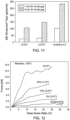
- HP-LDPE resins improve productivity of m-LLDPE resins by reducing the motor load and improving melt strength, but reduce the film's toughness balance: impact-MD tear resistance, as shown in Table 18 and Figure 12 .
- Table 18 Melt Strength and Extensibility Property Blend Composition (in LDPE -071) 0 wt% Exceed 1018 5 wt% 10 wt% 15 wt% 100 wt% I 2 (g/min) (190 °C) 2.0 1.7 1.4 1.2 0.75 Density (g/cm3) 0.918 0.9181 0.9182 0.9183 0.92 Melt Strength(cN) 1.4 2.5 4.5 7.5 11 Extensibility 31 25 22 22 20 20
- the inventive long chain branched metallocene catalyzed liner low density resins have improve productivity compared to m-LLDPE resins due to reduced motor load and improving melt strength, as shown in Table 19 and Figure 13 .
- Table 19 The inventive long chain branched metallocene catalyzed liner low density resins (ethylene-based copolymers) have improve productivity compared to m-LLDPE resins due to reduced motor load and improving melt strength, as shown in Table 19 and Figure 13 . Table 19.
- Inventive LCB m-LLDPE resins have superior toughness balance to HP-LDPE resins, which is demonstrated in Figure 14 .
- the circled data points correspond to LCB m-LLDPE resins: 1 g/10 min, 0.925 g/cm 3 ; and 0.4 g/10 min, 0.943 g/cm 3 .
- LCB m-LLDPE resins have superior film stiffness to m-LLDPE resins as shown by the data in Figure 15 .
- the 0.924 - 0.943 g/cm 3 LCB m-LLDPE resin converted into 0.75 mil film using 60 mil die gap.
- the 0.912 - 0.950 g/cm 3 m-LLDPE resins converted into 0.75 - 1 mil film using a 45 - 110 mil die gap as described above.
- the inventive LCB m-LLDPE film have superior "lifting" ability (Tensile at Yield) to m-LLDPE film at any tear resistance, as shown by the data in Figures 16A and 16B .
- 0.915 - 0.923 g/cc m-LLDPE resins converted into 0.75 - 1 mil film using a 60 mil die gap.
- the 0.912 - 0.950 g/cm 3 m-LLDPE resins were converted into 0.75 - 1 mil film using a 45 - 110 mil die gap as described above.
- the inventive LCB m-LLDPE resins improve MD tear resistance at any impact resistance of films made from blends with m-LLDPE resins compared to that of films made from HP-LDPE / m-LLDPE blends.
- the inventive films comprising blends of the ethylene-based copolymer (LCB m-LLDPE) and LLDPE fall above the lines.
Landscapes
- Chemical & Material Sciences (AREA)
- Chemical Kinetics & Catalysis (AREA)
- Health & Medical Sciences (AREA)
- Medicinal Chemistry (AREA)
- Polymers & Plastics (AREA)
- Organic Chemistry (AREA)
- Engineering & Computer Science (AREA)
- Manufacturing & Machinery (AREA)
- Materials Engineering (AREA)
- Manufacture Of Macromolecular Shaped Articles (AREA)
- Addition Polymer Or Copolymer, Post-Treatments, Or Chemical Modifications (AREA)
- Compositions Of Macromolecular Compounds (AREA)
Description
- This invention relates to branched polyethylenes produced at low pressure and temperature using a metallocene compound and films produced therefrom, in particular blown film.
- Various types of polyethylenes are known in the art and each type has various applications. For example, low density polyethylene is generally prepared at high pressure using free radical initiators (known in the industry as "LDPE"). LDPE is also known as "branched" or "heterogeneously branched" polyethylene because of the relatively large number of branches extending from the polymer backbone. Polyethylene in the same density range, i.e., 0.916 to 0.950 g/cm3, which is linear and does not contain long chain branching is known as "linear low density polyethylene" ("LLDPE") and may be produced, for example in a gas phase process, with conventional Ziegler-Natta catalysts or with metallocene compounds.
- A large portion of global LDPE demand includes film, carrying bag, and sack applications. Some examples of these applications include agricultural, multi-layer, and shrink films, as well as reinforcements for levees. LDPE, which is soft, ductile, and flexible, is additionally utilized for strong, elastic goods, such as screw caps, lids, and coatings. Films made from LDPE, however, have limited impact resistance compared to the catalyst produced LLDPEs. Likewise, LLDPE's have a high impact resistance but are difficult to process. Blending these resins often creates a composition that is easier to process, but the desirable toughness of the LLDPE's is reduced. What would be desirable is to improve the processability of LLDPE-type resins while maintaining high tear and toughness in the films produced from such resins.
- Thus, there is a need for new efficient and cost advantageous processes to produce polymers having a density from 0.900 to 0.950 g/cm3 that are strong but have improved processing. More specifically, there is a need for new and improved products produced from these branched polymers, in particular blown film.
- Related references include
US 6,908,972 ,US 2013-0090433 ,US 2013-0085244 ,US 2013-0211009 ,US 2013-041119 ,WO 2012-133717 ,JP 2011225670A JP2011089019A JP2011137146 - This invention relates to ethylene-based copolymers as defined in
claim 1. - This invention also relates to polymer blend compositions comprising from 0.5 wt% to 99.9 wt% of an inventive ethylene-based copolymer and from 0.1 wt% to 99.5 wt% of a polymer preferably selected from the group consisting of high density polyethylene, linear low density polyethylene, low density polyethylene, medium density polyethylene, and combinations thereof.
- This invention yet further relates to a film as defined in claim 14.
-
-
Figure 1 shows the GPC chromatogram of the inventive resin 3-2 compared with comparative commercial resins. -
Figure 2A shows the TREF trace for inventive resin 3-2. -
Figure 2B shows the TREF trace for inventive resin 3-4. -
Figure 3A shows the comparison of inventive resin 3-2 to comparative commercial resins by SAOS. -
Figure 3B shows the comparison of inventive resin 3-2 to comparative commercial resins by SAOS. -
Figure 3C shows the comparison of inventive resin 3-2 to comparative commercial resins by a Van Gurp-Palmen treatment. -
Figure 4A shows the comparison of the viscosity of the inventive resins 3-2 and 3-4 to comparative commercial LDPE resins. -
Figure 4B shows the comparison of the melt strength of the inventive resins 3-2, 3-3 and 3-4 to comparative commercial resins. -
Figure 4C shows the comparison of the elongational viscosity of the inventive resins 3-2, 3-3 and 3-4 to comparative commercial resins. -
Figure 5 shows the comparison of the processability of the inventive resin 3-2 to comparative commercial resins. -
Figure 6A shows the comparison of the heat seal performance of blends of the inventive resin 3-2 to comparative blends of commercial resins. -
Figure 6B shows the comparison of the hot tack performance of blends of the inventive resin 3-2 to comparative blends of commercial resins. -
Figure 7A shows the comparison of the extruder motor load of blends of the inventive resins 3-2, 3-3, and 3-4 to comparative blends of commercial resins. -
Figure 7B shows the comparison of the extruder head pressure of blends of the inventive resins 3-2, 3-3, and 3-4 to comparative blends of commercial resins. -
Figure 7C shows the comparison of the air flow of blends of the inventive resins 3-2, 3-3, and 3-4 to comparative blends of commercial resins. -
Figure 7D shows the comparison of the processing time of blends of the inventive resins 3-2, 3-3, and 3-4 to comparative blends of commercial resins. -
Figure 8A shows the comparison of the air flow of blends of the inventive resins 3-2, 3-3, and 3-4 to comparative blends of commercial resins, as a function of nominal film density. -
Figure 8B shows the comparison of the processing time of blends of the inventive resins 3-2, 3-3, and 3-4 to comparative blends of commercial resins, as a function of nominal film density. -
Figure 9A shows the comparison of the film stiffness of films of blends of the inventive resin 3-2 to films of comparative blends of commercial resins, as a function of loading of the minor component. -
Figure 9B shows the comparison of the MD Elmendorf Tear of films of blends of the inventive resin 3-2 to films of comparative blends of commercial resins, as a function of loading of the minor component. -
Figure 10A shows the comparison of the Dart Drop of films of blends of the inventive resin 3-2 to films of comparative blends of commercial resins, as a function of loading of the minor component. -
Figure 10B shows the comparison of the Dart Drop of films of blends of the inventive resin 3-2 to films of comparative blends of commercial resins, as a function of film thickness. -
Figure 11 shows the comparison of the MD Elmendorf Tear of films of blends of the inventive resin 3-2 to films of comparative blends of commercial resins, as a function of die gap and film gauge (thickness). -
Figure 12 shows a comparison of Melt Strength of various polyethylene resins and blends as a function of Melt Strength. -
Figure 13 shows a comparison of Pull-Off Force of various polyethylene resins and inventive resins as a function of Draw Ratio. -
Figure 14 shows a comparison Dart Drop of various LDPE resins and inventive resins as a function of Average Elmendorf Tear. -
Figure 15 shows a comparison of Average 1% Secant Modulus (psi) for various polyethylene resins and inventive resins as a function of resin Density. -
Figure 16A andFigure 16B shows a comparison of Average Tensile at Yield for various polyethylenes and inventive resins ("LCB m-LLDPE") as a function of Average Elmendorf Tear. -
Figure 17 shows a comparison of Dart Drop of various polyethylene resins and inventive resins as a function of MD Elmendorf Tear. - LDPE is typically produced in a tubular reactor system using a free radical initiator under conditions of very high pressure and temperature. The inventors have surprisingly found a branched low density polyethylene (the invention resin referred to as an "ethylene-based copolymer", or "LCB m-LLDPE") can be produced under less extreme conditions by, for example, a metallocene-driven catalytic process. In particular, this ethylene-based copolymer may be produced in gas phase polymerization processes. The ability to produce ethylene-based copolymer using gas phase polymerization systems is particularly advantageous because the production rate can be much greater than that achievable in tubular reactors, at lower pressures and temperatures. This increased productivity coupled with being able to run at reduced temperatures and pressures provides a significant cost advantage for ethylene-based copolymers in the gas phase over traditional LDPEs.
- The inventors further discovered that these ethylene-based copolymer resins and blends thereof proved to have several processing advantages including reduced motor load, die pressure, torque, and head pressure. These advantages all lead to less wear on the processing equipment which reduces replacement cost and down time. Even more advantageously, films made from these ethylene-based copolymer resins demonstrate excellent physical properties such as tear performance, dart impact, stiffness, and haze. Each of the polymer, process to produce the polymer, blends of the polymer (both physical and in-reactor), and films made from the polymer are discussed below.
- The inventive ethylene-based copolymer are preferably made in a process comprising contacting ethylene and one of butene, hexene and octene in at least one gas phase reactor at a temperature in the range of from 60°C to 90°C and at a reactor pressure of from 70 kPa to 7000 kPa, in the presence of a metallocene catalyst system comprising a bridged metallocene compound represented by the following formula:

- M is a
group 4 metal, especially zirconium or hafnium; - T is a group 14 atom;
- D is hydrogen, methyl, or a substituted or unsubstituted aryl group, most preferably phenyl;
- Ra and Rb are independently, hydrogen, halogen, or a C1 to C20 substituted or unsubstituted hydrocarbyl, and Ra and Rb can form a cyclic structure including substituted or unsubstituted aromatic, partially saturated, or saturated cyclic or fused ring system;
- each X1 and X2 is independently selected from the group consisting of C1 to C20 substituted or unsubstituted hydrocarbyl groups, hydrides, amides, amines, alkoxides, sulfides, phosphides, halides, dienes, phosphines, and ethers, and X1 and X2 can form a cyclic structure including aromatic, partially saturated, or saturated cyclic or fused ring system;
- each of R1, R2, R3, R4, and R5 is, independently, hydrogen, halide, alkoxide or a C1 to C20 or C40 substituted or unsubstituted hydrocarbyl group, and any of adjacent R2, R3, R4, and/or R5 groups may form a fused ring or multicenter fused ring systems, where the rings may be substituted or unsubstituted, and may be aromatic, partially unsaturated, or unsaturated; and
- each of R6, R7, R8, and R9 is, each independently, hydrogen or a C1 to C20 or C40 substituted or unsubstituted hydrocarbyl group, most preferably methyl, ethyl or propyl; and
- further provided that at least two of R6, R7, R8, and R9 are C1 to C40 substituted or unsubstituted hydrocarbyl groups; wherein "hydrocarbyl" (or "unsubstituted hydrocarbyl") refers to carbon-hydrogen radicals such as methyl, phenyl, iso-propyl, napthyl, (aliphatic, cyclic, and aromatic compounds consisting of carbon and hydrogen), and "substituted hydrocarbyl" refers to hydrocarbyls that have at least one heteroatom bound thereto such as carboxyl, methoxy, phenoxy, BrCH3-, NH2CH3-,.
- The polymerization process of the present invention may be carried out using any suitable process, such as, for example, solution, slurry, high pressure, and gas phase. A particularly desirable method for producing polyolefin polymers according to the present invention is a gas phase polymerization process preferably utilizing a fluidized bed reactor. Desirably, gas phase polymerization processes are such that the polymerization medium is either mechanically agitated or fluidized by the continuous flow of the gaseous monomer and diluent. Other gas phase processes contemplated by the process of the invention include series or multistage polymerization processes.
- The metallocene catalyst is used with an activator in the polymerization process to produce the inventive polyethylenes. The term "activator" is used herein to be any compound which can activate any one of the metallocene compounds described above by converting the neutral catalyst compound to a catalytically active metallocene compound cation. Preferably the catalyst system comprises an activator. Activators useful herein include alumoxanes or so called "non-coordinating anion" activators such as boron-based compounds (e.g., tris(perfluorophenyl)borane, or ammonium tetrakis(pentafluorophenyl)borate).
- Preferred activators typically include alumoxane compounds (or "alumoxanes") and modified alumoxane compounds. Alumoxanes are generally oligomeric compounds containing -Al(R1)-O- sub-units, where R1 is an alkyl group. Examples of alumoxanes include methylalumoxane (MAO), modified methylalumoxane (MMAO), ethylalumoxane, isobutylalumoxane, and mixtures thereof. Alkylalumoxanes and modified alkylalumoxanes are suitable as catalyst activators, particularly when the abstractable ligand is an alkyl, halide, alkoxide, or amide. Mixtures of different alumoxanes and modified alumoxanes may also be used. It may be preferable to use a visually clear methylalumoxane. A cloudy or gelled alumoxane can be filtered to produce a clear solution or clear alumoxane can be decanted from the cloudy solution. Another useful alumoxane is a modified methylalumoxane (MMAO) cocatalyst type 3A (commercially available from Akzo Chemicals, Inc. under the trade name Modified Methylalumoxane type 3A, disclosed in
US 5,041,584 ). Preferably of this invention, the activator is an alkylalumoxane, preferably methylalumoxane or isobutylalumoxane, most preferably methylalumoxane. - Preferably, the alumoxane activator is supported on a support material prior to contact with the metallocene compound. Also, the alumoxane activator is combined with the metallocene compound prior to being placed upon a support material. Preferably, the alumoxane activator may be combined with the metallocene compound in the absence of a support material.
- In addition to these alumoxane activator compounds, cocatalysts may be used. Aluminum alkyl or organometallic compounds which may be utilized as cocatalysts (or scavengers) include, for example, triethylaluminum, tri-isobutylaluminum, tri-n-hexylaluminum, tri-n-octylaluminum, diethyl aluminum chloride, dibutyl zinc, diethyl zinc.
- Preferably, the catalyst system comprises an inert support material. Preferably, the supported material is a porous support material, for example, talc, and inorganic oxides. Other support materials include zeolites, clays, organoclays, or any other organic or inorganic support material, or mixtures thereof.
- Preferably, the support material is an inorganic oxide in a finely divided form. Suitable inorganic oxide materials for use in metallocene compounds herein include
Groups - The supported catalyst system may be suspended in a paraffinic agent, such as mineral oil, for easy addition to a reactor system, for example a gas phase polymerization system.
- [1] Processes and catalyst compounds useful in making the inventive polyethylenes are further described in
US 61/740,938 - The present invention relates to ethylene-based polymers made in a low pressure catalytic process ("ethylene-based copolymer") comprising from 75.0 wt% to 99.5 wt% of ethylene-derived units and from 0.5 wt% to 25.0 wt% of C3 to C8 olefin derived units. The inventive ethylene-based copolymer typically have for example a density in the range of from 0.900 or 0.920 g/cm3 to less than 0.950 g/cm3; a g'(vis) of less than 0.80; a melt index, I2, of from 0.25 to 1.5 g/10 min.; a Mw/Mn within a range from 3.0 to 6.0; an Mz/Mn of greater than 8, and preferably has an absence of a local minimum loss angle at a complex modulus, G*, of 1.00×10⁴ to 3.00×10⁴ Pa, where the ranges for each parameter for which may be within the various ranges as described herein. For Example, in
Figure 3B showing the Enable products contain gel-like material as indicated by the Enable products having "...a local minimum loss angle at a complex modulus, G*, of 1.00×10⁴ to 3.00×10⁴ Pa; whereas the inventive ethylene-based polymers do not contain the gel-like material as shown by the OMC-1480 resins having "...an absence of a local minimum loss angle at a complex modulus, G*, of 1.00×10⁴ to 3.00×10⁴ Pa...". The "...absence of a local minimum loss angle at a complex modulus, G*, of 1.00×10⁴ to 3.00×10⁴ Pa..." indicates a strong interaction term according to Flory-Huggins Theory, that is, the long chain branched material is soluble in m-LLDPE material, while the appearance "...of a local minimum loss angle at a complex modulus, G*, of 1.00×10⁴ to 3.00×10⁴ Pa..." indicates a weak interaction term, i.e., the long chain branched material is not as soluble in m-LLDPE material. The Enable products have a local minimum loss angle indicating the branched material in those resins are not soluble in the m-LLDPE material, in other words, it is like a gel. - In any case, the inventive ethylene-based copolymer compositions herein preferably refer to a polyethylene copolymer having from 99.5 wt% to 75.0 wt% ethylene-derived units, more preferably from 99.0 wt% to 80.0 wt%, or 99.0 wt% to 85 wt%, or 99.0 wt% to 90.0 wt%, or 99.0 wt% to 92.5 wt%, or 99.0 wt% to 95.0 wt%, or 99.0 wt% to 97.0 wt% ethylene-derived units; and from 0.5 wt% to 25.0 wt% C3 to C8 olefin derived units, more preferably 1.0 wt% to 20.0 wt%, or 1.0 wt% to 15 wt%, or 1.0 wt% to 10.0 wt%, or 1.0 wt% to 7.5 wt%, or 1.0 wt% to 5.0 wt%, or 1.0 wt% to 3.0 wt% of C3 to C8 olefin derived units, wherein the inventive ethylene-based copolymer is an ethylene/butene, ethylene/hexene or ethylene/ octene copolymer.
- The inventive ethylene-based copolymers have a density within the range from 0.900 g/cm3 to 0.950 g/cm3, more preferably within a range from 0.910 or 0.915 or 0.920 or 0.925 or 0.930 or 0.935 g/cm3 to 0.940 or 0.945 or 0.950 g/cm3, determined using chips cut from plaques compression molded in accordance with ASTM D-1928 Procedure C, aged in accordance with ASTM D-618 Procedure A, and measured as specified by ASTM D-1505.
- The ethylene-based copolymers are highly branched. The degree of long-chain branching in the inventive ethylene-based copolymers may be quantified by determination of the branching index, g', which is inversely proportional to the amount of branching. Thus, lower values for g' indicate relatively higher amounts of branching. The inventive ethylene-based copolymers have a g'(vis) of less than 0.80 (preferably less than 0.75, less than 0.70, less than 0.65, less than 0.60; and alternatively greater than 0.25, greater than 0.30, or greater than 0.35). The inventive ethylene-based copolymers may also have a g'(z avg) of less than 0.75 (preferably less than 0.70, less than 0.65, less than 0.60, less than 0.55; and alternatively greater than 0.10, greater than 0.15, or greater than 0.20). The two branching indices g'(vis) and g'(z avg) are defined as ratios of average intrinsic viscosities:
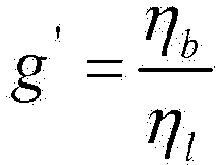
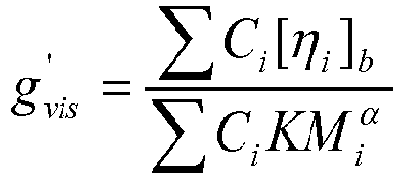
- The inventive ethylene-based copolymers preferably have a melt index, I2, of 0.25 to 1.5 g/10 min, more preferably 0.25 to 1.25 g/10 min or 0.10 to 1.10 g/10 min or more preferably 0.15 to 1.10 g/10 min, as determined in accordance with ASTM D-1238 under a load of 2.16 kg and at a temperature of 190°C. The inventive ethylene-based copolymers also have a high-load melt index, I21, of 5.0 to 30.0 g/10 min, more preferably 7.0 to 25.0 g/10 min, or more preferably 9.0 to 20.0 g/10 min, as determined in accordance with ASTM D-1238 under a load of 21.6 kg and at a temperature of 190°C. The melt index ratio (I21/I2) of the inventive ethylene-based copolymers has a lower limit of 10.0 and an upper limit of 100.0. The lower limit on the melt index ratio may be 20.0, 25.0, 30.0, or 35.0. The upper limit on the melt index ratio may be 95.0, 90.0, 85.0, 80.0, 75.0, 70.0, 65.0, 60.0, 50.0, or 40.0. Any combination of lower and upper limits should be considered to be disclosed by the above limits on the melt index ratio, e.g., 35.0 to 90.0, 40.0 to 60.0, or 45.0 to 80.0.
- The inventive ethylene-based copolymers have a "molecular weight distribution" (or MWD) which means the ratio of Mw to number average molecular weight (Mn) or Mw/Mn. Mw and Mn are determined by GPC. Typically the inventive ethylene-based copolymers have a molecular weight distribution (MWD, defined as MW/Mn) within a range from 3.0 to 6.0, or preferably within a range of from 3.0 or 3.2 or 3.4 to 4.2 or 4.6 or 5.0 or 5.5 or 6.0. The inventive ethylene-based copolymers preferably have a Mw of greater than 75,000 g/mol or 80,000 g/mol, or 85,000 g/mol or 90,000 g/mol. The inventive ethylene-based copolymers have a Mw of less than 1,000,000 g/mol or 500,000 g/mol, or 350,000 g/mol or 300,000 g/mol. As stated above, the ethylene-based copolymers preferably have a Mz/Mn of greater than 8.0 or 9.0 or 10.0, or within a range of from 5.0 or 6.0 or 7.0 to 8.0 or 9.0 or 10.0 or 11.0 or 12.0 or 14.0 or 16.0 or 18.0.
- While the ethylene-based copolymers may be characterized by a value of the complex modulus at a particular loss angle as described below, another way to describe some inventive ethylene-based copolymers of the invention relates to features of the complex modulus values, G*, when considered over the range of loss angles from 30° to 90°. The inventive ethylene-based copolymers herein have an absence of a local minimum loss angle at a complex modulus, G*, of 1.00×10⁴ to 3.00×10⁴ Pa (see
Figure 3C ). The inventive ethylene-based copolymers of this invention also have a complex modulus, G*50, greater than 50.00×10³ Pa (preferably greater than 60.00×10³ Pa, greater than 70.00×10³ Pa, or greater than 75.00×10³ Pa). Complex modulus, G*, and loss angles, δ, may be obtained from rheological data determined at the test temperature of 190°C and analyzed using the Van Gurp-Palmen treatment (reference: M.Van Gurp and J. Palmen, 67 RHEOLOGY BULLETIN 5 (1998)), whereby the loss angle, δ, (wherein δ = arctan-1(G"/G'); G" represents the loss modulus (Pa) and G' represents the storage modulus (Pa)) is plotted against the absolute value of the complex modulus |G*| = (G'2 + G"2)1/2. This representation of linear viscoelastic data is a powerful means of characterizing molecular and structural features of polymers. For example, low levels of long-chain branching in polyolefins can be detected and quantified on a relative basis, using this methodology. - Preferably, the inventive ethylene-based copolymer displays a high molecular weight "tail" or "bump" in dissolution temperatures. For example, an inventive ethylene-based copolymer that displays a first dissolution temperature and a second, higher dissolution temperature is considered to exhibit "bump" or "tail" in the dissolution temperatures (see
Figures 2A and2B ). This is reflected in the ethylene-based copolymer having higher Mz and Mz/Mn values described above. Preferably, the inventive ethylene-based copolymers have an Mz value of greater than 250,000 g/mole or 300,000 g/mole or 350,000 g/mole, or 400,000 g/mole, or 450,000 g/mole, or within a range from 250,000 or 300,000 or 350,000 g/mole to 550,000 or 600,000 or 650,000 or 700,000 or 800,000 g/mole. Also, the inventive ethylene-based copolymers preferably have an Mz/Mn of greater than 8.0 or 9.0 or 10.0, or within a range of from 5.0 or 6.0 or 7.0 to 8.0 or 9.0 or 10.0 or 11.0 or 12.0 or 14.0 or 16.0 or 18.0 - Preferably, the inventive ethylene-based copolymer has a T90-T10 value of 5°C or greater, wherein T10 is the temperature at which 10% of the eluted polymer is obtained, and T90 is the temperature at which 90% of the eluted polymer is obtained in a TREF analysis, as described in Wild, et al., 20 J. POLY. SCI. POLY. PHYS. ED. 441 (1982). Preferably, at least one of T10 or T90 is in the range of from 45°C to 85°C, and preferably T90 is greater than 90°C.
- Preferably, the inventive ethylene-based copolymer comprises branching that is reflective of the number of carbon atoms in the olefin used to copolymerize with the ethylene. This molecular architecture is in contrast to traditional LDPE resins for which the molecular structure is built upon the primary monomer, ethylene, coming together in any number of ways and number of repeating units determined by the amount, order and timing with which the ethylene monomer, initiator(s) and chain transfer agents are introduced into the reactors. The free radical chemistry leads to polymers with short chain branches (side groups) consisting of methyl, ethyl, propyl, butyl, pentyl, hexyl. The ethylene-based copolymers of this invention have a much more ordered molecular architecture, wherein the only short chain branches observed are from the comonomer used, for example, a comonomer of 1-hexene (C6) will typically produce butyl (C6-2 = C4) short chain branches. Accordingly, if only 1-hexene is used as a comonomer, then only butyl side chains will be produced in the ethylene-based copolymer. The ethylene-based copolymer wherein if the ethylene-based copolymer comprises Cx monomer derived units, wherein x represents the number of carbons in the Cx monomer and is an integer in the range of from 3 to 8, then only short chain branches of the Cx_2 type arc observed in the polymer.
- Most thermoplastic polyolefins display visco-elastic flow behavior and their viscosity decreases with increasing shear rate (also termed shear thinning). The inventive ethylene-based copolymers have good shear thinning. One way to quantify the shear thinning is to use a ratio of complex viscosity at a frequency of 0.01 rad/s to the complex viscosity at a frequency of 100 rad/s. Preferably, the complex viscosity ratio of the inventive ethylene-based copolymers produced herein is 50 or more, more preferably 100 or more, even more preferably 250 or more when the complex viscosity is measured at 190°C. The complex viscosity is measured at 190°C over an angular frequency range from 0.01 to 100 rad/s using the procedure described below using Small Amplitude Oscillatory Shear (SAOS) testing. From the data generated by such a test, it is possible to determine the phase or loss angle δ, which is the inverse tangent of the ratio of G" (the loss modulus) to G' (the storage modulus). For a typical linear polymer, the loss angle at low frequencies (or long times) approaches 90° making the loss modulus much larger than the storage modulus. As frequencies increase, more of the chains relax too slowly to absorb energy during the oscillations, and the storage modulus grows relative to the loss modulus. Eventually, the storage and loss moduli become equal and the loss angle reaches 45°. In contrast, a branched chain polymer relaxes very slowly. Such branched polymers never reach a state where all its chains can relax during an oscillation, and the loss angle never reaches 90° even at the lowest frequency, ω, of the experiments. The loss angle is also relatively independent of the frequency of the oscillations in the SAOS experiment; another indication that the chains cannot relax on these timescales. In a plot of the phase angle δ versus the measurement frequency ω, polymers that have long chain branches exhibit a plateau in the function of δ(ω), whereas linear polymers do not have such a plateau. According to Garcia-Franco et al. (34(10) MACROMOLECULES 3115-3117 (2001)), the plateau in the aforementioned plot will shift to lower phase angles δ when the amount of long chain branching occurring in the polymer sample increases. SAOS data can be transformed into discrete relaxation spectra using the procedure in R. B. Bird, R. C. Armstrong, and O. Hassager, 1 DYNAMICS OF POLYMERIC LIQUIDS, FLUID MECHANIC, 273-275 (2nd Edition, John Wiley and Sons, 1987). The storage and loss moduli are simultaneously least squares fit with the functions: G'(ωj)=∑ηkλkωj 2/(1 +(ηkωk)2) G"(ωj)=∑ηkλkωj/(1+(ηkωk)2) at the relaxation times λk=0.01, 0.1, 1, 10, and 100 seconds. The sums are from k=1 to k=5. The sum of the ηk's is equal to the zero shear viscosity, η0. Preferably of this invention, the inventive ethylene-based copolymer has a zero shear viscosity of 10,000 Pa●s or more, 15,000 Pa●s or more, 5,000 Pa●s or more; alternatively 80,000 Pa●s or less, 70,000 Pa●s or less or 50,000 Pa●s or less, as determined by small angle oscillatory shear analysis.
- The inventive ethylene-based copolymers preferably have 0.10 or greater vinyl chain ends per 1000 carbon atoms, more preferably 0.15 or 0.20 or 0.25 or greater vinyl chain ends per 1000 carbon atoms. Some inventive ethylene-based copolymers have 0.05 or greater vinylidene chain ends per 1000 carbon atoms, more preferably 0.06 or 0.07 or 0.08 or greater vinylidene chain ends per 1000 carbon atoms. Most preferably, the ethylene-based copolymers have within the range from 0.10 or 0.15 to 0.40 or 0.50 terminal vinyl groups per 1000 carbons, and within a range from 0.06 or 0.07 to 0.11 or 0.12 or 0.12 vinylidene chain ends per 1000 carbon atoms.
- Some inventive ethylene-based copolymers have greater than 35% vinyl chain ends (preferably greater than 40% vinyl chain ends, greater than 45% vinyl chain ends), based on the total number of unsaturations. The number of vinyl chain ends was determined using 1H NMR at 120°C using deuterated tetrachloroethane as the solvent on an at least 250 MHz NMR spectrometer, and in selected cases, confirmed by 13C NMR. All spectra were recorded at 100°C on a Bruker spectrometer operating at 500 MHz for proton and 125 MHz for carbon) for vinyl terminated propylene oligomers in 114 J. AM. CHEM. SOC. 1025-1032 (1992) that are useful herein. Allyl chain ends are reported as a molar percentage of the total number of moles of unsaturated groups (that is, the sum of allyl chain ends, vinylidene chain ends, vinylene chain ends).
- The inventive ethylene-based copolymers have improved processability, whether used neat or as part of a blend with other polymers. In particular, markedly reduced motor load, reduced die pressure, reduced extruder head pressure, reduced torque, and reduced processing time are noted. These improved processability parameters are very important as they improve product output and reduce wear and tear on the film blowing line, thereby improving equipment lifetime and increasing the time period between repairs. Preferably, the extruder motor load is less than 70%, preferably less than 65%, or preferably less than 60% of the value when extruding commercial LLDPE having an I2 of 1.0 g/10 min and density of 0.918 g/cm3 (most desirably, Exceed™ 1018 metallocene polyethylene resins from ExxonMobil Chemical Company). Preferably, the extruder die pressure is less than 2500 psi, preferably less than 2400 psi, or preferably less than 2300 psi. Preferably, the extruder head pressure is less than 4000 psi, preferably less than 3750 psi, or preferably less than 3500 psi. Finally, the extruder torque is preferably less than 0.350 HP/rpm, preferably less than 0.325 HP/rpm or less than 0.315 HP/rpm.
- The inventive ethylene-based copolymer may be used by itself as a polymer (neat) or it may be part of an in-reactor blend, or it may be blended as a modifier into a selected base polymer to form a physical blend.
- The present invention also relates to polymer blends comprising the inventive ethylene-based copolymer. The polymer blend compositions may be in-reactor blends or homogeneous physical blends. "Homogeneous," as used herein, means free from visible gels. Preferably, the physical blends of this invention have less than 1 wt% of insoluble material, when the blend is dissolved in boiling xylenes.
- The polymer blend compositions of this invention may comprise 0.5 wt% to 99.9 wt% of the inventive ethylene-based copolymer (preferably 1.0 wt% to 95 wt%, preferably 3 wt% to 75 wt%, preferably 5 wt% to 35 wt%, or preferably 5 wt% to 25 wt%). The remaining portion of the blend is preferably 0.1 wt% to 99.5 wt% of a polymer preferably selected from the group consisting of high density polyethylene, linear low density polyethylene, low density polyethylene, medium density polyethylene, and combinations thereof (preferably 5 wt% to 99 wt%, preferably 25 wt% to 97 wt%, preferably 65 wt% to 95 wt%, or preferably 75 wt% to 95 wt%). Examples of suitable polyethylenes include commercially available from ExxonMobil Chemical Company in Baytown, Texas under the tradenames Exceed™, Enable™, and Exact™, as well as the Engage™ polymers available from DuPont/Dow.
- The Enable products, some of which are used herein as comparative examples, are made using a metallocene catalyst and the products have a small amount of long chain branching in them. The Enable products do not perform as well as the inventive ethylene-based polymers.
- Optionally, the polymer blend composition may also include one or more polymer "additives", such as reinforcing and non-reinforcing fillers, scratch resistant agents, plasticizers, antioxidants, heat stabilizers, extender oils, lubricants, antiblocking agents, antistatic agents, anti-fogging agent, waxes, foaming agents, pigments, flame/fire retardants, dyes and colorants, ultraviolet absorbers, and nano-fillers. Other additives include, for example, blowing agents, processing aids, tackifying resins, and other processing aids known in the polymer compounding art. The lists described herein are not intended to be inclusive of all types of additives which can be employed with the present invention. Upon reading this disclosure, those of skilled in the art will appreciate other additives can be employed to enhance properties. As is understood by the skilled in the art, the blends of the present invention can be modified to adjust the characteristics of the blends as desired. The aforementioned additives can be either added independently or incorporated into an additive or masterbatch. Such additives can comprise up to 70 wt%, more preferably up to 65 wt%, of the total additive or masterbatch composition.
- Also, optionally, the polymer blend composition may include one or more slip agents or mold-release agents to facilitate moldability, preferably present at 50 ppm to 10 wt%, more preferably 50 ppm to 5000 ppm, even more preferably 0.01 wt% to 0.5 wt% (100 ppm to 5000 ppm), even more preferably 0.1 wt% to 0.3 wt% (1000 ppm to 3000 ppm), based upon the weight of the composition. Desirable slip additives include but are not limited to saturated fatty acid amides (such as palmitamide, stearamide, arachidamide, behenamide, stearyl stearamide, palmityl pamitamide, and stearyl arachidamide); saturated ethylene-bis-amides (such as stearamido-ethyl-stearamide, stearamido-ethyl-palmitamide, and palmitamido-ethyl-stearamide); unsaturated fatty acid amides (such as oleamide, erucamide, and linoleamide); unsaturated ethylene-bis-amides (such as ethylene-bis-stearamide, ethylene-bis-oleamide, stearyl-erucamide, erucamido-ethyl-erucamide, oleamido-ethyl-oleamide, erucamido-ethyl-oleamide, oleamido-ethyl-lerucamide, stearamido-ethyl-erucamide, erucamido-ethyl-palmitamide, and palmitamido-ethyl-oleamide); glycols; polyether polyols (such as Carbowax); acids of aliphatic hydrocarbons (such as adipic acid and sebacic acid); esters of aromatic or aliphatic hydrocarbons (such as glycerol monostearate and pentaerythritol monooleate); styrene-alpha-methyl styrene; fluoro-containing polymers (such as polytetrafluoroethylene, fluorine oils, and fluorine waxes); silicon compounds (such as silanes and silicone polymers, including silicone oils, modified silicones, and cured silicones); sodium alkylsulfates, alkyl phosphoric acid esters; stearates (such as zinc stearate); and mixtures thereof.
- This invention also relates to films comprising (or consisting essentially of, or consisting of) the inventive ethylene-based copolymers or the polymer blend compositions described herein. The inventive ethylene-based copolymers and polymer blend compositions disclosed herein may be utilized to prepare monolayer films or multilayer films. These films may be formed by any number of well-known extrusion or coextrusion techniques discussed below. Films may be unoriented, uniaxially oriented or biaxially oriented. Physical properties of the film may vary depending on the film forming techniques used.
- Preferably, films containing the ethylene-based copolymer and polymer blend compositions, monolayer or multilayer, may be formed by using casting techniques, such as a chill roll casting process. Such chill roll casting processes and apparatus are well known in the art, and are described, for example, in The Wiley-Encyclopedia of Packaging Technology, Second Edition, A. L. Brody and K. S. Marsh, Ed., John Wiley and Sons, Inc., New York (1997). Although chill roll casting is one example, other forms of casting may be employed.
- More preferably, films containing the inventive ethylene-based copolymers and polymer blend compositions, monolayer or multilayer, may be formed using blown techniques, i.e., to form a blown film. For example, the composition can be extruded in a molten state through an annular die and then blown and cooled to form a tubular, blown film, which can then be axially slit and unfolded to form a flat film. As a specific example, blown films can be prepared as follows. The polymer blend composition is introduced into the feed hopper of an extruder, such as a 63.5 mm Egan extruder that is water-cooled, resistance heated, and has a L/D ratio of 24:1. The film can be produced using a 15.24 cm Sano die with a 2.24 mm die gap, along with a Sano dual orifice non-rotating, non-adjustable air ring. The film is extruded through the die into a film cooled by blowing air onto the surface of the film. The film is drawn from the die typically forming a cylindrical tube of film that is cooled, collapsed and, optionally, subjected to a desired auxiliary process, such as slitting, treating, sealing, or printing. Typical melt temperatures are from 175°C to 225°C. Blown film rates are generally from 5 to 30 lbs per hour per inch of die circumference. The finished film can be wound into rolls for later processing, or can be fed into a bag machine and converted into bags. An example of a blown film process and apparatus suitable for forming films according to
US 5,569,693 . Of course, other blown film forming methods can also be used. - Physical properties of the film can vary from those of the polymer or polymer blend, depending on the film forming techniques used. The films can be of any desirable thickness or composition, but most preferably within a range from 1 or 5 or 10 or 20 microns to 30 or 50 or 100 or 200 or 300 microns. The resins used to make the films can be blended with other additives such as pigments, antioxidants, fillers, as is known in the art, as long as they do not interfere with the desired film properties. The films of the present invention have a combination of unique and useful properties as described in more detail below. When the blends "consist essentially of" the ethylene-based copolymers and other polyethylenes (e.g., LLDPE, HDPE). what is meant is that the "additives" are present at a level of less than 5 wt% of the blend.
- Most preferably, this invention relates to a film comprising, for example, at least 5 wt% of the inventive ethylene-based copolymer comprising for example from 75.0 wt% to 99.5 wt% of ethylene-derived units and 0.5 wt% to 25.0 wt% of C3 to C20 olefin derived units, where the inventive ethylene-based copolymers have, for example, a density in the range of from 0.900 or 0.920 g/cm3 to less than 0.950 g/cm3; a g'(vis) of less than 0.80; a melt index, I2, of from 0.25 to 1.5 g/10 min; a Mw/Mn within a range from 3.0 to 6.0; a Mz/Mn of greater than 8.0; an absence of a local minimum loss angle at a complex modulus, G*, of 1.00×10⁴ to 3.00×10⁴ Pa; and wherein the film has for example (a) a 1% Secant Modulus MD of 30,000 psi or greater; (b) an Elmendorf Tear MD value of 100 g/mil or greater; and (c) a Dart Impact of 225 g/mil or greater.
- As a blend, the inventive films comprise at least 5 wt% of the inventive ethylene-based copolymer described herein, and preferably greater than 8 wt% or 10 wt% or 12 wt% or 15 wt% or 18 wt% or 20 wt% or 25 wt%; alternately the inventive films comprise the ethylene-based copolymers at a level of less than 35 wt% or 30 wt% or 25 wt%. The balance of the film may comprise other polyethylenes, which may be homopolymers or copolymers, for example, a VLDPE, a LDPE (such as a "high pressure" derived LDPE, or "HD-LDPE", or just "LD"), a LLDPE, a MDPE, a HDPE, or a DPE, as well as other polyethylenes known in the art. The polyethylene can be produced by any suitable process, including metallocene-catalyzed processes and Ziegler-Natta catalyzed processes. Further, each layer can be a blend of two or more such polyethylenes, and can include additives known in the art. Further, one skilled in the art will understand that the layers of a multilayer film preferably have the appropriate viscosity match.
- Preferably, the film is a blown film. The film may be a monolayer or multilayer film, and the inventive ethylene-based copolymers described herein may be in multiple layers.
- The inventive films have a good balance of stiffness versus toughness as indicated by machine direction tear strength (MD Elmendorf Tear), 1% Secant Modulus (MD), and dart drop impact strength performance (Dart Impact). Desirably, the films exhibit the relationship of having a Dart Drop (g/mil) of greater than -8.09x[Average Elmendorf Tear (g/mil)] + 853.81. Also the films preferably exhibit the relationship of having a Tensile Strength at Yield of greater than 4.274x[Elmendorf Tear (g/mil)] + 300, such as demonstrated by the data in
Figure 16A . - The films may desirably have a 1% Secant Modulus in the machine direction (1% Secant Modulus MD), reported in pounds per square inch (psi), measured according to ASTM D882-95a, of 30,00 or 40,000 or 50,000 or 60,000 psi or greater, or preferably within a range from 30,000 or 50,000 or 60,000 psi to 100,000 or 120,000 or 140,000 psi.
- The films may desirably have a MD Elmendorf Tear, as measured by ASTM D1922-94, of 100 g/mil or greater. Preferably, the films can have a MD Elmendorf Tear of 100 g/mil to 450 g/mil. Preferably, the MD Elmendorf Tear can range from a low of 110 g/mil, 120 g/mil, or 150 g/mil to a high of 425 g/mil, 400 g/mil, or 375 g/mil.
- The films may desirably have a Dart Impact (Method A), as measured according to ASTM D1709-91, of 225 g/mil to 450 g/mil (preferably 250 g/mil to 450 g/mil; preferably 275 g/mil to 440 g/mil). The film may comprises 25 wt% or more of the inventive ethylene-based copolymer and has a Dart Impact of 320 g/mil or greater (340 g/mil or greater, 350 g/mil or greater, 360 g/mil or greater).
- The films may desirably have a total haze, as measured according to ASTM D1003-95, of 0.2 wt% to 30%. Preferably, the films have a haze of less than 25%; less than 20%; less than 15%; or less than 10%. Preferably, the haze can range from a low of 2%, 4%, or 5% to a high of 10%, 15%, or 25%.
- The films may desirably have an internal haze, as measured according to ASTM D1003-95, of 0.2% to 5%. Preferably, the films have an internal haze of less than 5%; less than 4%; less than 3%; or less than 1.5%. Preferably, the haze can range from a low of 0.2%, 0.75%, or 1.0% to a high of 2%, 4%, or 5%. Internal haze is the haze excluding any film surface contribution. The film surfaces are coated with ASTM approved inert liquids to eliminate any haze contribution from the film surface topology. The haze measurement procedure is per ASTM D 1003.
- The films may desirably have a
Gloss 45° MD, as measured according to ASTM D2457-90, of 45 to 75. TheGloss 45° MD may range from a low of 45, 50, or 55 to a high of 60, 65, or 75. - The films have a desirable "drawability", which is the melt strength of the polymer used to make the blown film and is the ratio of the die gap to film gauge after the polymer is drawn out into a film. A higher drawability or "Draw" is desirable. Preferably, the total draw of the inventive films is 40 or greater, preferably 45 or greater, preferably 50 or greater, preferably 60 or greater, or preferably 70 or greater.
- Additionally, films containing the ethylene-based copolymers and blends described herein have improved seal strength and hot tack performance. Preferably, a film comprising 25 wt% or more of the inventive ethylene-based copolymer and has a seal strength of at least 2.0 lbs/in (357g/cm) at a seal initiation temperature of 105°C. The films preferably have a seal initiation temperature so that it is suitable for packaging applications, such as food packaging. The desired seal initiation temperature ("SIT") may depend on the end use application of the film, for example, for chocolate bars the SIT may be the temperature at which the seal strength is 200 g/inch (80 g/cm), for potato chips in the United States the desired SIT may be the temperature at which the seal strength is 500 g/inch (20 g/cm), and for potato chips in Asia the SIT may be the temperature at which the seal strength is 1000 g/inch (400 g/cm). The SIT may also depend on the type of seal used, for example, a fin seal as compared to a crimp seal.
- The films preferably have a hot tack strength of greater than 320 g/inch (126 g/cm) (preferably greater than 340 g/inch (134 g/cm), greater than 360 g/inch (142 g/cm), greater than 380 g/inch (150 g/cm), greater than 400 g/inch (157 g/cm), or greater than 410 g/inch (162 g/cm)). "Hot tack" is the strength of a heat seal immediately after sealing, while still in a hot condition, that is, before it has cooled down to ambient temperature and achieved its final strength. In production lines, the package is often filled by dropping the product into the package from a certain height, or by horizontally filling, both of which will exert a force on the package bottom. If the package bottom cannot resist the disruptive force of filling, the seal on the bottom of the package will fail. For optimum production line efficiency, the interval between heat-sealing the film to make the package and filling the package with product is very short, and it is usually not possible for seal completely cool before filling. Accordingly, hot tack strength becomes important.
- The films possess an excellent balance of mechanical properties, toughness, sealability and cling/adhesive properties. As such, the films can be used in hot fill applications or packaging materials heated at temperatures up to 260°F (126°C) during packaging, such as cement, sand, salt, and retort bag applications such as pouches, bags and sacks containing consumer products including food. The films can also be used for shrink films and form fill and seal applications requiring abuse resistance. The films also possess good softness/feel and optical/clarity properties useful for food packaging at any temperature.
- In addition to films, the resin blends described herein will find utility in other applications like, but not limited to: extrusion coating, injection molding, rotomolding, and blow molding applications.
- The various descriptive elements and numerical ranges disclosed herein for the inventive ethylene-based copolymer and films can be combined with other descriptive elements and numerical ranges to describe the invention; further, for a given element, any upper numerical limit can be combined with any lower numerical limit described herein. The features of the invention are demonstrated in the following non-limiting examples.
- The properties cited below were determined in accordance with the following test procedures. Where any of these properties is referenced in the appended claims, it is to be measured in accordance with the specified test procedure. Where applicable, the properties and descriptions below are intended to encompass measurements in both the machine and transverse directions. Such measurements are reported separately, with the designation "MD" indicating a measurement in the machine direction, and "TD" indicating a measurement in the transverse direction.
- Gauge, reported in mils, was measured using a
Measuretech Series 200 instrument. The instrument measures film thickness using a capacitance gauge. For each film sample, ten film thickness datapoints were measured per inch of film as the film was passed through the gauge in a transverse direction. From these measurements, an average gauge measurement was determined and reported. - Elmendorf tear (tear) was measured as specified by ASTM D-1922.
- Tensile properties, including tensile strength, tensile stress, ultimate tensile stress, tensile strain, ultimate tensile strain, tensile stress at 100% (200%, 300%, 400%, 500%, 600%, 700%, 800%) elongation, stress and strain at the primary yield point, stress and strain at the secondary yield point, 1% and 2% Secant modulus, tensile strength at yield, tensile strength at break, ultimate tensile strength, elongation at yield, elongation at break, yield stress, and strain hardening were measured as specified by ASTM D-882.
- Melt index (MI) and high load melt index (HLMI) were determined according to ASTM 1238 (190°C, 2.16 (I2) or 21.6 kg (I21), respectively). Melt index ratio (MIR) was determined according to ASTM 1238 and is the ratio of HLMI to MI (e.g., I21/I2). In the event a weight is not specified as part of a melt index, it is assumed that 2.16 kg was used.
- Density was determined measured as specified by ASTM D-1505 using chips cut from plaques compression molded in accordance with ASTM D-4703-07, aged in for 40 hrs at 23°C plus or minus 2°C, unless specifically stated otherwise.
- Dart Impact (also known as Dart F50, or Dart Drop Impact or Dart Drop Impact Strength) was measured as specified by ASTM D-1709, method A.
- Haze (both internal and total) reported as a percentage (%), was measured as specified by ASTM D-1003.
- Gloss, a dimensionless number, was measured as specified by ASTM D-2457 at 45°.
- Melting point temperature was measured using the DSC procedure as follows: Samples weighing approximately 5 to 10 mg were sealed in aluminum sample pans. The DSC data were recorded by first cooling the sample to -50°C and then gradually heating it to 200°C at a rate of 10°C/minute. The sample was kept at 200°C for 5 minutes before a second cooling-heating cycle was applied. Both the first and second cycle thermal events were recorded. The melting temperature (Tm) was measured and reported during the second heating cycle (or second melt).
- Molecular weight distribution (polydispersity) is Mw/Mn. Measurements of weight average molecular weight (Mw), number average molecular weight (Mn), and z-average molecular weight (Mz) were determined by Gel Permeation Chromatography as described in 34(19) MACROMOLECULES 6812 (2001), including that, a High Temperature Size Exclusion Chromatograph (SEC, Waters Alliance 2000), equipped with a differential refractive index detector (DRI) equipped with three
Polymer Laboratories PLgel 10 mm Mixed-B columns is used. The instrument was operated with a flow rate of 1.0 cm3/min, and an injection volume of 300 µL. The various transfer lines, columns and differential refractometer (the DRI detector) were housed in an oven maintained at 145°C. Polymer solutions were prepared by heating 0.75 to 1.5 mg/mL of polymer in filtered 1,2,4-Trichlorobenzene (TCB) containing about1000 ppm of BHT at 160°C for 2 hours with continuous agitation. A sample of the polymer containing solution was injected into the GPC and eluted using filtered 1,2,4-Trichlorobenzene (TCB) containing ∼1000 ppm of BHT. The separation efficiency of the column set was calibrated using a series of narrow MWD polystyrene standards reflecting the expected Mw range of the sample being analyzed and the exclusion limits of the column set. Seventeen individual polystyrene standards, obtained from Polymer Laboratories (Amherst, MA) and ranging from Peak Molecular Weight (Mp) ∼580 to 10,000,000 g/mole, were used to generate the calibration curve. The flow rate was calibrated for each run to give a common peak position for a flow rate marker (taken to be the positive inject peak) before determining the retention volume for each polystyrene standard. The flow marker peak position was used to correct the flow rate when analyzing samples. A calibration curve (log(Mp) vs. retention volume) was generated by recording the retention volume at the peak in the DRI signal for each PS standard, and fitting this data set to a 2nd-order polynomial. The equivalent polyethylene molecular weights were determined by using the Mark-Houwink coefficients shown wherein k is 5.79 x 10⁻⁴ dL/g and "A" is 0.695, both for polyethylene. - 1H NMR data for polymer characterization (such as vinyls/1000C) was collected at 120°C in a 5 mm probe using a Varian Spectrometer with a 1Hydrogen frequency of 400 MHz. The data was recorded using a maximum pulse width of 45°, 8 seconds between pulses, and signal averaging 120 transients in solvent of C2D2Cl4.
- The dynamic shear viscosity (or complex viscosity) as a function of frequency is determined by small-amplitude oscillatory shear (SAOS) rheology, as described above.
- Some commercially available polymers were used as comparative examples and are shown in Table 1, below.
Table 1 Polymer Source Properties Exceed™ 1018 ExxonMobil Chemical Company (Houston, TX) Ethylene-hexene copolymer; density = 0.918 g/cm3; MI (190°C/2.16 kg) = 1 g/10 min., Tm = 119°C ExxonMobil™ LDPE LD 071 ExxonMobil Chemical density = 0.924 g/cm3; Company (Houston, TX) MFR (190°C/2.16 kg) = 0.70 g/10 min. ExxonMobil™ LDPE LD 051 ExxonMobil Chemical Company (Houston, TX) density = 0.919 g/cm3; MI (190°C/2.16 kg) = 0.25 g/10 min.; Tm = 230°F Enable™ 20-10 ExxonMobil Chemical Company (Houston, TX) Ethylene-hexene copolymer; density = 0.920 g/cm3; MI (190°C/2.16 kg) = 1 g/10 min.; Tm = 237°F Enable™ 35-05 ExxonMobil Chemical Company (Houston, TX) Ethylene-hexene copolymer; density = 0.935 g/cm3; MI (190°C/2.16 kg) = 0.5 g/10 min.; Tm = 254°F - Ethylene-hexene copolymer was made by reacting ethylene with hexene using silica supported dimethylsilylene(2,3,4,5-tetramethyl-1-cyclopentadienyl)(3-phenyl-1-indenyl)zirconium dichloride (Supported Metallocene I) activated with MAO. Three yields were collected under slightly different polymerization conditions (resins 3-2, 3-3, & 3-4).
- To a solution of chlorodimethyl(2,3,4,5-tetramethylcyclopenta-2,4-dien-1-yl)silane (5.00 g, 23.3 mmol, 1.00 eq.) in ether (25 mL) at -35°C was added lithium(1-phenylindenide) (4.85g, 24.5 mmol, 1.05 eq.). The reaction was stirred for 23 hours, and the volatiles were then removed under vacuum. The residue was extracted with pentane (40 mL) and the extract was filtered. The resulting solution was evaporated under vacuum to give a thick oil. Yield 7.07 g (82%). 1H NMR (C6D6): δ 7.74 (d, 1H), 7.65 (d, 2H), 7.48 (d, 1H), 7.25 (m, 5H), 6.60 (s, 1H), 3.69, (s, 1H), 2.92 (br s, 1H), 1.93 (s, 3H), 1.90 (s, 3H), 1.82 (s, 3H), 1.821 (s, 3H), -0.09 (s, 3H), -0.39 (s, 3H).
- To a solution of dimethyl(3-phenyl-1H-indenyl)(2,3,4,5-tetramethylcyclopentadienyl)silane (Compound A, 7.03 g, 19.0 mmol, 1.00 eq.) in ether (25 mL) at -35°C was added 2.63M butyllithium in hexanes (14.8 mL, 38.9 mmol, 2.05 eq.). The reaction was stirred for 20 hours and then filtered to give a solid. The solid was washed with pentane (2 x 40 mL) and dried under vacuum. Yield 8.51 g (97%). 1H NMR (THF-d8): δ 7.70 (d, 1H), 7.54 (m, 3H), 7.12 (s, 1H), 7.03 (t, 2H), 6.57 (t, 1H), 6.48, (t, 1H), 6.43 (t, 1H), 3.39 (q, 4.4H), 2.20 (s, 6H), 1.91 (s, 6H), 1.13 (t, 6.5H), 0.64 (br s, 6H).
- To a suspension of zirconium tetrachloride bis(etherate) (2.00 g, 5.25 mmol, 1.00 eq.) in ether (25 mL) at -35°C was added dilithium [tetramethylcyclopentadienidedimethylsilyl(3-phenylindenide) 1.10 etherate (Compound B, 2.43 g, 5.24 mmol, 1.00 eq.). The reaction was stirred for 16 hours and was then evaporated under vacuum, leaving a solid. The solid was extracted with dichloromethane (50 mL, then 3 x 10 mL) and the extracts were filtered. The resulting solution was evaporated under vacuum to yield a solid. The solid was washed with pentane (2 x 20 mL) and dried under vacuum. Yield 2.53 g (91%). 1H NMR (CD2Cl2): δ 7.90. (d, 1H), 7.60 (m, 3H), 7.49 (t, 2H), 7.38 (m, 2H), 7.10 (m, 1H), 6.00 (s, 1H), 2.00 (s, 3H), 1.96 (s, 3H), 1.92 (s, 3H), 1.89 (s, 3H), 1.23 (s, 3H), 1.00 (s, 3H).
- 30 wt% MAO in toluene (Albemarle, Baton Rouge, LA, 6.25 g, 32.3 mmol, 120 eq.) and toluene (6.50 g) were combined and stirred for 15 minutes to give a clear solution. To this MAO solution was added dimethylsilylene(2,3,4,5-tetramethyl-1-cyclopentadienyl)(3-phenyl-1-indenyl)zirconium dichloride (Metallocene I, 0.147 g, 0.27 mmol, 1.00 eq.). The reaction was stirred for 15 minutes and then DAVISON™ 948 silica (5.00 g, dried at 600°C for 16 hours) was added. The slurry was mixed for 10 minutes and then dried under vacuum for 22 hours. Yield 6.87 g (98%). The supported catalysts were then injected with nitrogen into the polymerization reactor as described below.
- The polymerization was conducted in a laboratory gas phase reactor having a fluidized bed reactor equipped with devices for temperature control, catalyst feeding or injection equipment, gas chromatograph analyzer for monitoring and controlling monomer and gas feeds, and equipment for polymer sampling and collecting. The reactor consisted of a 6" (15.24 mm) diameter bed section increasing to 10" (25.4 mm) at the reactor top. Gas came in through a perforated distributor plate allowing fluidization of the bed contents and polymer sample was discharged at the reactor top.
Table 2. Reactor Conditions Resin 3-2 3-3 3-4 Catalyst Supported Metallocene I Supported Metallocene I Supported Metallocene I Temperature, °F (°C) 167(75) 176 (80) 176 (80) Hexene (mol%) 2.1 2.31 2.31 Ethylene (mol%) 70 70 70 Hydrogen (ppm) 50 100 100 Hydrogen/Ethylene Ratio (ppm/%) 0.7 1.4 1.4 - Productivity was 7,000 lbs resin/lb of catalyst and the production rate was 50 lbs of resin per hour.
- The ethylene copolymers produced (Resins 3-2, 3-3, and 3-4) were analyzed for selected physical properties as reported in Table 3.
Table 3 Inventive Comparative Propepties 3-2 3-3 3-4 Exceed™ 1018 MI or I2 (g/10 min.) 0.437 1.1 1.2 1.0 Density (g/cm3) 0.926 0.919 0.92 0.918 Vinyls/1000 C 0.27 0.29 0.35 0.03 Vinylenes/1000 C 0.09 0.08 0.14 0.06 Vinylidenes/1000 C 0.08 0.08 0.10 0.03 Trisubstituted/ 1000 C 0.13 0.06 0.12 0.10 Mn (g/mol) 32,390 29,858 28,887 37,567 Mw (g/mol) 133,792 116,074 115,809 109,001 Mz (g/mol) 406,824 346,471 356,021 249,041 Mw/Mn 4.13 3.89 4.01 2.9 g'(vis) 0.723 0.688 0.706 0.84 g'(z avg) 0.571 0.529 0.546 > 0.8 -
Figure 1 shows the GPC chromatogram of the inventive resin 3-2 compared with the comparative resins of Table 1. The molar mass distribution of the inventive resin 3-2 is different from that in Exceed™ 1018, Enable™ 20-10, and the LDPE (LD 071) resins, as shown inFigure 1 . The inventive resin 3-2 has less lower molecular weight material than Enable™ 20-10 andLDPE LD 071 resins. The inventive resin 3-2 also has more lower molecular weight material than Exceed™ 1018 resin and more higher molecular weight material than Exceed™ 1018, Enable™ 20-10 and 35-05, andLDPE LD 071 resins. - The inventive resins 3-2 and 3-4 exhibited multimodality in the TREF traces (see
Figures 2A and2B , respectively), showing a lower melting component having a melting point less than 90°C and a higher melting component having a melting point greater than 90°C. - The ethylene-hexene copolymers were compared to several commercially available ethylene by SAOS (see
Figures 3A and3B ). The SAOS viscosity of the ethylene-hexene copolymers from Run # 3-2 is similar to that of ExxonMobil™ LDPE LD 071, Enable™ 20-10 polyethylene, and Enable™ 35-05 polyethylene. Additionally, the zero shear viscosity of the ethylene-hexene copolymer 3-2 is less than that of ExxonMobil™ LDPE LD 051. - The SAOS analysis of the ethylene-hexene copolymer 3-2 revealed a complex composition, which may be bimodal. The inventors suggest that a second component may add a new dimension to expected melt strength, elongational viscosity, and bubble stability. Indeed, the ethylene-hexene copolymer 3-2 is comparable to Enable™ polyethylene resins and is markedly different from LDPE resins (
LDPE LD 071 and LDPE LD 051) (seeFigure 3C ). - The viscosity of the ethylene-hexene copolymer resin 3-2 exceeds that of the comparative LDPE resins (
LDPE LD 051 and LDPE LD 071), as shown inFigure 4A . The viscosity of the ethylene-hexene copolymers from Run number 3-4 is also greater than that of the comparative LDPE resins, as seen inFigure 4A . -
Figures 4B and4C show that the ethylene-hexene copolymer resin 3-2 has a melt strength greater than those ofLDPE LD 071, but less than that ofLDPE LD 051. Additionally, the ethylene-hexene copolymer resins 3-3 and 3-4 have a melt strength and elongational viscosity less than that of the comparative LDPE resins. - The ethylene-hexene copolymers listed in Table 3 were stabilized with an additive package comprising 500
ppm Irganox 1076, 1000ppm Irgafos 168, 800 ppm Dynamar FX-5920A, and compounded using an Werner Pfeliderer ZSK-57 extruder equipped with a 20\60\80\20 screen pack and operated using counter rotating intermeshing twin screws operated under the conditions shown in Table 4.Table 4: Extrusion Conditions used to compound ethylene-hexene copolymers with additives Resin 3-2 3-3 3-4 Start Time 13:49:57 6:04:21 10:16:01 End Time 17:04:41 10:01:10 13:50:04 Sample Produced (lbs) 602 762 682 Nitrogen Setting (SCF/hr) 12 12 12 Production Rate (lbs/hr) 180 180 180 Screw Speed (RPM) 180.67 180.87 141.01 Screen Pressure (psi) 450.9 331.5 329.98 Melt temp (°F) 430.27 400.26 398.91 Extruder Temperature (°F) Zone 1338.2 338.0 337.8 Zone 2275.5 288.1 287.8 Zone 3314.6 330.4 331.4 Zone 4325.8 338.4 340.6 Zone 5338.5 339.6 338.3 Zone 6372.4 357.0 351.2 Zone 7 424.3 389.3 388.5 Zone 8 382.7 403.1 389.2 Zone 9 380.4 380.1 383.0 Zone 10431.0 438.6 434.3 Die Pressure (psi) 998.7 758.37 769.05 Pelletizer Speed (rpm 1450 1450 1450 Pelletizer Motor Load (%) 15 15 15 Water Temperature (°F) 120 120 120 Pelletizer Water (GPM) 50 50 50 - The amount of work put into compounding the ethylene-hexene copolymers was less than 0.025 lbs/hr-hp.
- While the manufacture of the blown film equipment is not limited, all example films containing 100 wt% of Resins 3-2, 3-3, and 3-4 were made into film using a 2.5 inch Gloucester blown film line equipped with a low work DSB-II screw, a 60 mil die gap and a Saturn Future Design Air Ring. The inventive resin was added to the hopper of the blow film line, and converted into blown films. The films were processed at a die throughput rate of 10 lbs/hr/die inch to produce a monolayer film having a thickness of 0.75 mil. The temperature of the melts was 400°F. More detailed film run conditions are reported in Table 5.
Table 5A FILMS Comparative Inventive Resin Exceed™ 1018 3-4 3-3 3-2 I2 (g/10 min.) 1 1.2 1.1 0.44 Density (g/cm3) 0.918 0.92 0.919 0.926 Motor Load (%) 68.2 44.8 44.8 56.7 Torque (HP/RPM) 0.361 0.237 0.237 0.300 Extruder Head Pressure (psi) 4020 2340 2340 3310 Die Pressure (psi) 2650 1490 1510 2220 Specific Energy (Lbs/Hr-HP) 8.74 13.08 13.23 9.94 - Total draw for the inventive films was observed to be twice that of the LDPE film, which typically have a maximum total draw of 40. The inventive films were easier to process than Exceed™ 1018 and Enable™ 20-10, thereby reducing motor load, torque and melt pressure (see
Figure 5 ). This leads to more efficient processability due to the decrease in frictional loss. - The films were tested and the film properties reported in Table 5B.
Table 5B FILMS Comparative 1 Inventive Comparative 2 Resins Exceed™ 1018 3-4 3-3 3-2 Enable™ 20-10 I2 (g/10 min.) 1 1.2 1.1 0.44 1 Density (g/cm3) 0.918 0.92 0.919 0.926 0.92 1% Secant (psi) MD 24,541 31,361 31,483 52,208 27,000 TD 27,238 42,971 43,711 75,652 - Elmendorf Tear MD (gms/mil) 240 81 99 17 125 TD (gms/mil) 368 387 357 469 530 Dart Impact, Phenolic, Method A (gms/mil) 768 79 ≤ 91 < 62.3 387 Haze (%) Total 24.2 14.5 19.8 25.6 - Internal 1.1 1.2 1.2 1.1 - - The inventive resins 3-2, 3-3, and 3-4 offer superior stiffness when compared to Exceed™ 1018 and Enable™ 20-10 and similar or improved optical properties.
- Increasing the blow up ratio to 4:1 appears to balance the film properties, as shown in the Table 6, below. Increasing the BUR from 2.5:1 to 4:1 changes the shrink performance, the TD/MD Elmendorf Tear ratio, the MD Elongation at break, and the dart drop (impact resistance).
Table 6 Resin 3-2 3-2 Gauge, mil (microns) 0.75 (19) 0.75 (19) BUR 2.5:1 4.0:1 Die Gap 60 60 MD/TD Draw Ratio 12.8 8 1% Secant Modulus MD (psi) 52,208 42,312 Ultimate Tensile Strength MD (psi) 7,807 6,685 Elongation @ Break MD (%) 391 557 Elongation @ Break TD (%) 779 697 Elmendorf Tear MD (g/mil) 17 33 Elmendorf Tear TD (g/mil) 469 275 TD/MD Ratio 27.6 8.3 Average (g/mil) 243 154 Dart Drop (g/mil) 62 120 Shrink MD (%) 81 74 Shrink TD (%) -6 21 - Physical blends of 95 wt% Exceed™ 1018 and 5 wt% of inventive resin 3-2, 3-3, or 3-4 were extruded into films. Comparative blends comprising 95 wt% Exceed™ 1018 and 5 wt% of LDPE (
LD 051 and LD 071) were also extruded into films. - Resin blends of Table 7 were made into film using a 2.5 inch blown film line equipped with a low work DSB-II screw, a 30 mil die gap and a Saturn Future Design Air Ring. The resin blend was added to the hopper of the blow film line, and converted into blown films. The films were processed at a die throughput rate of 10 lbs/hr/die inch to produce a monolayer film having a thickness of 0.75 mil. The temperature of the melt was 400°F. The film processing parameters and the film properties are reported in Table 7, below.
Table 7: 0.75 mil Films Air Flow Frost Line Height MD 1% Secant MD Elmendorf Tear Dart Impact, Method A Haze Haze Internal Gloss 45° UNITS (%) (inches) (psi) (gms/mil) (gms/mil) (%) (%) - 100 wt% Exceed™ 1018 54 28 25698 228 535 16 1.1 36 5 wt% LD 05171 23 31693 124 449 2 0.5 83 5 wt% LD 07161 28 30427 145 500 2 0.6 83 5 wt% Resin 3-2 54 28 28246 213 461 4 0.8 73 5 wt% 3-3 59 31 27265 228 339 8 1.0 59 5 wt% Resin 3-4 59 30 27876 239 453 8 1.0 62 - Resin blends were made into film using a 2.5 inch blown film line equipped with a low work DSB-II screw, a 30 mil die gap and a Saturn Future Design Air Ring. The resin blend was added to the hopper of the blow film line, and converted into blown films. The films were processed at a die throughput rate of 10 lbs/hr/die inch to produce a monolayer film having a thickness of 3 mil. The temperature of the melt was 410°F.
- Performance of films made with blends of 95 wt% Exceed™ 1018 and 5 wt% of the inventive resins 3-2, 3-3, and 3-4 were evaluated and reported in Table 8, below. The inventive films demonstrated similar to superior stiffness when compared to 100 wt% Exceed™ 1018 and 5 wt% LDPE (
LD 051 and LD 071) films. The inventive films also demonstrated a tear resistance similar to 100 wt% Exceed™ 1018 and superior to the 5 wt% LDPE films. The inventive films exhibited an impact resistance that was similar to that of the films made with 5% LDPE and a clarity that was superior to that of 100 wt% Exceed™ 1018 films, as shown in Table 8, below.Table 8: 3 mil Films Air Flow Frost Line Height MD 1% Secant MD Elmendorf Tear Dart Drop, Method A Haze Haze Internal Gloss 45° Units (%) (inches) (psi) (gms/mil) (gms/mil) (%) (%) - 100 wt% Exceed ™ 1018 56.2 29 29075 296 450 31 16 32 5 wt% LD 05165.7 27 29434 267 444 5 3 79 5 wt% LD 07160 28 30084 283 442 6 4 78 5 wt% Resin 3-2 51.9 33 30581 289 450 14 7 55 5 wt% Resin 3-3 56.2 31 29996 292 451 25 13 36 5 wt% Resin 3-4 58.5 30 30115 297 451 24 11 39 - Physical blends of 75 wt% Exceed™ 1018 and 25 wt% of inventive resin 3-2, 3-3, or 3-4 were compounded. Comparative blends of 75 wt% Exceed™ 1018 and 25 wt% of LDPE (
LD 051 and LD 071) were also compounded. - Resin blends were made into film using a 2.5 inch blown film line equipped with a low work DSB-II screw, a 60 mil die gap and a Saturn Future Design Air Ring. The resin blend was added to the hopper of the blow film line, and converted into blown films. The films were processed at a die throughput rate of 10 lbs/hr/die inch to produce a monolayer film having a thickness of 1 mil. The temperature of the melt was 400°F.
- Performance of films made with blends of 75wt% Exceed™ 1018 and 25 wt% of the inventive resins 3-2, 3-3, and 3-4 were evaluated and reported in Table 9A, below.
Table 9A: Film (1 mil, 60 mil die gap) MD 1% SecantMD Elmendorf Tear Dart Drop, Method A Haze Haze Internal Gloss 45° Units (psi) (gms/mil) (gmslmil) (%) (%) - 100 wt% Exceed ™ 1018 24615 244 707 41 1.7 23 25 wt % LD 05138232 24 191 8 0.8 60 25 wt % LD 07139265 30 169 3 0.6 83 25 wt% Resin 3-2 32022 99 247 6 1.0 66 - The inventive films demonstrated similar to superior stiffness when compared to Exceed™ 1018 and LDPE (
LD 051 and LD 071). The inventive films also demonstrated a tear resistance superior to the LDPE films. The inventive films exhibited an impact resistance that was similar to that of the films made with LDPE and a clarity that was superior to that of Exceed™ 1018 films. - At 25 wt% loading, the film with resin 3-2 exhibited improved heat seal performance and similar hot tack performance when compared with films made from 100 wt% Exceed™ 1018 (see
Figures 6A and 6B ). - Resin blends were made into film using a 2.5 inch blown film line equipped with a low work DSB-II screw, a 30 mil die gap and a Saturn Future Design Air Ring. The resin blend was added to the hopper of the blow film line, and converted into blown films. The films were processed at a die throughput rate of 10 lbs/hr/die inch to produce a monolayer film having a thickness of 3.0 mil. The temperature of the melt was 410°F.
- Performance of films made with blends of 75 wt% Exceed™ 1018 and 25 wt% of the inventive resins 3-2, 3-3, and 3-4 were evaluated and reported in Table 9B, below.
Table 9B: Film (3 mil, 30 mil die gap) 100 wt% Exceed™ 1018 25 wt % LD 05125 wt % LD 07125 wt% 3-2 25 wt% 3-3 25 wt% 3-4 Motor load (%) 69.1 65 62.4 67.4 64.7 63.6 Torque (HP/rpm) 0.366 0.344 0.33 0.357 0.343 0.337 Die pressure (psi) 3490 3570 3440 3450 3260 3230 Air Flow (%) 56.2 65.7 60 51.9 56.2 58.5 Frost Line Height (inches) 29 14 20 28 29 27 MD 1% Secant (psi)29,075 27,323 29,728 33,709 30,407 30,331 MD Elmendorf Tear (g/mil) 296 106 148 283 288 299 Dart Drop (g/mil) 450 200 217 357 363 345 Haze (%) 31 8 5 13 21 18 Haze Internal (%) 15.6 2.1 2.7 6.6 11.5 9.4 Gloss 45°32 64 81 60 47 54 - The blends had desirable processability similar to LDPE blends. The inventive films also demonstrated superior bubble stability, superior MD tear resistance, and superior impact resistance when compared to LDPE blends.
- Physical blends of from 95 wt% to 25 wt% Exceed™ 1018 and from 5 wt% to 75 wt% of inventive resin 3-2, 3-3, or 3-4 were compounded. Comparative blends of 95 wt% to 25 wt% Exceed™ 1018 and from 5 wt% to 75 wt% of LDPE (
LD 051 and LD 071) were also compounded. - Film process conditions were fixed at a total draw of 10, 3 mil film, 30 mil die gap, 410°F, 2.5:1 BUR, and 10 lbs/ hr/die inch. Under these conditions, film made from neat Exceed™ 1018 was unstable and hard to produce. Indeed, the film had an observed melt temperature of 411°F.
- Comparative films made with greater than 25 wt% LDPE could not be processed into film, for example, the maximum draw for
LD 051 blend was 10. Additionally, films with 60 wt% and 75wt% LD 071 required the maximum airflow the line could deliver and were marginally stable, indicating that these formulations were at the limit of the line's processing capabilities. - In contrast, films were easily made with blends of 5 wt% to 75 wt% inventive resins 3-2, 3-3, and 3-4 and 95 wt% to 25 wt% Exceed™ 1018. All the blends with inventive resins were easily processed into film. Indeed, the blends with inventive resins had reduced extruder motor load, extruder pressures and die pressures (see
Figures 7A and 7B ). Additionally, the films made from blends with inventive resins were more stable, that is had better bubble stability than the comparative films. The films made from blends with inventive resins required lower air flow rates (seeFigures 7C and8A ), requiring less air to keep the bubble in the pocket and better processing time (seeFigures 7D and8B ) than the comparative films. Indeed at a 25 wt% loading, the inventive films prove easier to process over a broader density range (seeFigure 8A ) and have more consistent processing time over a broader density range (seeFigure 8B ). This combination of useful properties effectively expands the film manufacturing window, when compared to traditional LDPEs. - The film properties were assessed. Film stiffness increased with increasing inventive resin 3-2 content. In contrast, film stiffness decreased with increasing comparative LDPE content (see
Figure 9A ). Film tear resistance was fairly constant despite increasing inventive resin content. In contrast, the film tear resistance decreased with increasing LDPE content (seeFigure 9B ). - Additionally, at a 25 wt% loading, the film with resin 3-2 exhibited improved impact resistance (by more than 50%), compared with a decreased impact resistance at a 25 wt% loading of LDPE (see
Figures 10A and 10B ). This improved impact resistance was observed to be consistent over various film thicknesses (seeFigure 10B ). - Similarly, at a 25 wt% loading, the film with resin 3-2 exhibited increased MD tear resistance by more than 50% (see Figure 10E).
- Ethylene-hexene copolymer was made by reacting ethylene with hexene using a silica supported mixed catalyst, that is, 25 wt% dimethylsilylene(2,3,4,5-tetramethyl-1-cyclopentadienyl)(3-phenyl-1-indenyl)zirconium dichloride and 75 wt% bis(1-methyl,3-butylcyclopentadienyl)zirconium dichloride, supported on a single silica support (Mixed Catalyst A) and activated with MAO. Four yields were collected under slightly different polymerization conditions (
resins - The polymerization was conducted in a laboratory gas phase reactor having a fluidized bed reactor equipped with devices for temperature control, catalyst feeding or injection equipment, gas chromatograph analyzer for monitoring and controlling monomer and gas feeds, and equipment for polymer sampling and collecting. The reactor consisted of a 6" (15.24 mm) diameter bed section increasing to 10" (25.4 mm) at the reactor top. Gas came in through a perforated distributor plate allowing fluidization of the bed contents and polymer sample was discharged at the reactor top. The reactor was operated as shown in Table 10, below.
Table 10 Resin Catalyst 1 2 2-3 4 Catalyst Mixed Catalyst A Mixed Catalyst A Mixed Catalyst A Mixed Catalyst A Temperature, °F (°C) 167 (75) 176 (80) 185 (85) 210 (99) Hexene (mol%) 1.63 1.63 1.63 1.98 Hydrogen (ppm) 105 105 105 210 Hydrogen/Ethylene Ratio (ppm/%) 1.5 1.5 1.5 3.0 I2 (g/10 min.) 0.9 0.6 0.6 0.6 Density (g/cm3) 0.9201 0.9275 0.9342 0.9278 - Productivity was 7,000 lbs resin/ lb of catalyst and the production rate was 50 lbs of resin per hour.
- The ethylene-hexene copolymers listed in Table 10 were stabilized with an additive package comprising 500
ppm Irganox 1076, 1000ppm Irgafos 168, and 800 ppm Dynamar FX-5920A, and compounded. - 100 wt% in-reactor blend resins were made into film using a 2.5 inch blown film line equipped with a low work DSB-II screw, a 60 mil die gap and a Saturn Future Design Air Ring. The resin blend was added to the hopper of the blow film line, and converted into blown films. The films were processed at a die throughput rate of 10 lbs/hr/die inch to produce a monolayer film having a thickness of 0.75 mil. The temperature of the melt was 400°F. The films were compared with films made from 100% Exceed™ 1018.
- The processability parameters (extruder motor load and extruder head pressure) are reported along with film properties in Table 11, below.
Table 11 Material Comparative Inventive Resins Exceed™ 1018 1 2 4 2/3 Motor load (%) 69 70 69 69 63 Extruder Head Pressure (psi) 4050 4150 4850 4920 4480 I2 (g/10 min.) 1 0.9 0.6 0.6 0.6 Density (g/cm3) 0.918 0.9201 0.9275 0.9278 0.9342 1% Secant (psi) MD 23861 27456 46610 46033 61658 Elmendorf Tear MD (g/mil) 213 253 49 66 33 TD (g/mil) 424 556 988 835 275 Dart Drop, Phenolic, Method A (g/mil) 732 302 140 145 64 - In Tables 12 and 13 below include further characterization data for the inventive ethylene-based copolymers. Films of 0.75 mil (19 µm) were made as described above, and characterized for their processability as shown in Table 14, and the film characterized in Table 15. Also, in-reactor blends were also demonstrated as shown in Tables 14 and 15, where two metallocene catalysts were on one support and used in a gas phase polymerization process. The branching factor (g' value in Table 12) indicates the presence of long chain branched material in the resin, which for the inventive ethylene-based polymers is located in the higher molecular weight fractions of the resin.
Table 12. Molecular Structure Exceed 1018 Inventive 3-4 3-3 3-2 I2 (g/10 min) 1.0 1.31 1.11 0.49 MIR (I22/I2) 20 37 40 40 Density (g/cm3) 0.9180 0.9209 0.9204 0.9285 MALLS / 3D GPC Results Mw 10,9001 14,9555 15,2714 17,4637 Mw/Mn 2.9 4.1 4.0 4.1 Mz/Mw 2.3 3.7 3.6 3.4 Mz/Mn 6.6 15.2 14.4 13.8 g' (Vis. Ave.) 0.84 0.706 0.688 0.723 g' (Z. Ave.) > 0.8 0.546 0.529 0.571 g' (Ultimate) > 0.8 < 0.5 < 0.5 < 0.5 - The inventive ethylene-based copolymers most preferably have a density of at least 0.920 g/cm3, an MIR of greater than 35, a g'(vis.ave) of less than 0.80, and an Mz/Mn of greater than 8.
Table 13. Unsaturation Content On a per K carbon basis: Inventive Exceed 1018 3-2 3-3 3-4 Vinyls 0.27 0.29 0.35 0.03 Vinylenes 0.09 0.08 0.14 0.06 Vinylidenes 0.08 0.08 0.10 0.03 trisubstituted 0.13 0.06 0.12 0.10 - The inventive ethylene-based copolymers most preferably have has within the range from 0.10 or 0.15 to 0.40 or 0.50 terminal vinyl groups per 1000 carbons. The processability assessment of the polymer and blends shows a reduced motor load and head pressure.
Table 14. Resin Characterization and Film Processability parameter Exceed 1018 Inventive 75 wt% LLDPE*/25 wt% Inventive PE *Exceed 1018 3-4 3-3 3-2 3-2 1 2 3 4 I2 (g/10 min, 190°C) 1.0 1.31 1.11 0.49 0.49 0.87 0.59 0.57 0.58 I21 (g/10 min, 190°C) 20 48.2 44.1 19.5 19.5 14 10 9 11 I22/I2 20 36.7 39.6 39.7 39.7 16 17 16 19 Density (g/cm3) 0.918 0.9209 0.9204 0.9285 0.9285 0.9201 0.9275 0.9278 0.9342 Die Gap 60 60 60 60 60 60 60 60 60 BUR 2.5:1 2.5:1 2.5:1 2.5:1 4:1 2.5 2.5 2.5 2.5 Production Rate (lbs/hr) 189 187 189 187 188 187 189 188 186 Melt Temp, °F (°C) 405 (207) 393 (200) 393 (200) 399 (204) 399 (204) 405 (207) 409 (209) 409 (209) 410 (210) Specific Output (lbs/hr/rpm) 3.15 3.1 3.13 2.98 2.91 3.1 2.83 2.79 2.36 Motor Load (%) 68.2 44.8 44.8 56.7 57.7 70 69 69 63 Extruder Head Pressure (psi) 4020 2340 2340 3310 3380 4150 4850 4920 4480 Air Flow Rate (%) 67.4 67.4 67 84.3 60 70.8 86.7 86.7 86.7 Processing Time (sec) 1.9 1.5 1.4 1.2 4.2 1.6 1.2 1.2 1.2 Table 15. Film Characterization Parameter Exceed 1018 Inventive 75 w% LLDPE*/25 wt% Inventive PE *Exceed 1018 3-4 3-3 3-2 1 2 3 4 MD 1% Secant Modulus (psi)24,541 31,361 31,483 52,208 27,456 46,610 46,033 61,658 MD Ultimate Tensile Stength (psi) 11,878 6042 5957 7807 7429 10,659 10,664 10,985 MD Elongation at Break (%) 507 440 408 391 387 388 403 441 TD Elongation at Break (%) 655 759 729 779 650 726 720 804 Elmendorf Tear, MD (g/mil) 240 81 99 17 253 49 66 33 Elmendorf Tear, TD (g/mil) 368 387 357 469 556 988 835 275 TD/MD 1.5 4.8 3.6 27.6 2.2 20.2 12.7 8.3 Average (g/mil) 304 234 228 243 405 519 451 154 Dart Drop (g/mil) 768 79 91 62 302 140 145 64 - Air flow rate measure of a resin's melt strength during extrusion. Melts with increased elongational viscosity require greater air flow to be held in the pocket during extrusion. Lower density ethylene-based copolymer containing films will give improved tear resistance: MD tear resistance decreases with increasing resin density, MD tear resistance is greater for 1.0-I2 resins, and MD tear resistance decreases with an increase in the resin I22, with 1.0-I2 resins being more responsive than fractional I2 resins. Lower density ethylene-based copolymer containing films will improved impact resistance: impact resistance decreases with increasing resin density, impact resistance may increase with increasing I22 for in-reactor blends, and impact resistance is independent of I22 for resins made using ethylene-based copolymer alone. The impact resistance surprisingly increases with increasing MD tear resistance for in-reactor blends.
- Long chain branched resins provides converters with the advantage of improved extrudability, that is, higher production rates, without modifying their equipment. For example, the motor load for high pressure low density resins (high pressure-LDPE resins like LD140 and LD 113) is about 35% of that of metallocene catalyzed liner low density resins (m-LLDPE resins like Exceed 1018 resin), while extruder and die pressures are about half those observed for the m-LLDPE resin. Hence, the high pressure-LDPE resins offer blown film converters the opportunity to expand the production capabilities of their existing film lines by at least 50%, a distinct commercial advantage, as shown in Table 16.
Table 16. Processability of commercial polyethylenes Extrusion Performance of Selected HP-LDPE resins Resins HP-LDPE Property Exceed 1018CA 140.09 113.09 MI-2 (g/10 min) 1 0.75 2.25 Density (g/cc) 0.918 0.921 0.919 Melt Temp (oF) 400 361 350 Extrusion Rate (lb/hr) 188 181 182 Motor Load (%) 68.2 36 30 Torque (Hp/RPM) 0.4 0.2 0.2 Extruder Head Pressure (psi) 4020 2520 1750 Die Pressure (psi) 2650 2000 1460 - Long chain branched resins provides converters with the advantage of improved melt strength that results in better bubble stability, bigger bubbles and thicker films, 6 mil films using blow up ratio of 4:1. For example, the melt strength of LD-071 and LD-051 resins (both high-pressure LDPEs) are an order of magnitude greater than that of Exceed 1018 resin, as shown in Table 17, where Drawability = Die gap / film gauge, and "extensibility" is related to the melt strength of the resins or blend.
Table 17. Drawability Selected Resins Resin HP-LDPE Exceed 1018 Property Units 051 071 Melt Index (g/10 min) 0.25 0.75 1.0 Density (g/cc) 0.919 0.921 0.918 Melt Strength (cN) 23 11 1.4 Extensibility --- 9 20 31 Drawability 30 40 80 - HP-LDPE resins have reduced drawability compared to m-LLDPE resins. The drawability of m-LLDPE resins exceeds 80, while that of LD-071 and LD-051 are less than 50.
- Commercial blown film operations typical use die gaps ranging between 30 mil and 120 mil, with most commercial blown film operations using die gaps of 45 mil or more, and preferable 60 mil or more. However, selected shrink film applications require using 30 mil die gaps to achieve optimum film performance, specifically, shrink performance. Converters prefer to use wider die gaps since wider die gaps increase their production capacity. For example, wider die gaps are used in making cost competitive films such as trash can liners, which are thin (0.75 mil) films. Hence, HP-LDPE resins limit the films that can be made from any blown film line.
- HP-LDPE resins improve productivity of m-LLDPE resins by reducing the motor load and improving melt strength, but reduce the film's toughness balance: impact-MD tear resistance, as shown in Table 18 and
Figure 12 .Table 18. Melt Strength and Extensibility Property Blend Composition (in LDPE -071) 0 wt% Exceed 1018 5 wt% 10 wt% 15 wt% 100 wt% I2 (g/min) (190 °C) 2.0 1.7 1.4 1.2 0.75 Density (g/cm3) 0.918 0.9181 0.9182 0.9183 0.92 Melt Strength(cN) 1.4 2.5 4.5 7.5 11 Extensibility 31 25 22 22 20 - The inventive long chain branched metallocene catalyzed liner low density resins (ethylene-based copolymers) have improve productivity compared to m-LLDPE resins due to reduced motor load and improving melt strength, as shown in Table 19 and
Figure 13 .Table 19. Processability of Inventive ethylene-based copolymers Property Exceed 1018 Inventive 3-4 3-3 3-2 I2 (g/10 min) (190°C) 1.0 1.31 1.11 0.49 Density (g/cm3) 0.918 0.9209 0.9204 0.9285 MD 1% Secant Modulus (psi)24,541 31,361 31,483 52,208 Dart Impact (Method A) (g/mil) 768 79 91 62 MD Elmendorf Tear (g/mil) 240 81 99 17 Motor Load (%) 68.2 44.8 44.8 56.7 Torque (HP/rpm) 0.4 0.2 0.2 0.3 Extruder Head Pressure (psi) 4020 2340 2340 3310 Die Pressure (psi) 2650 1490 1510 2220 - Inventive LCB m-LLDPE resins have superior toughness balance to HP-LDPE resins, which is demonstrated in
Figure 14 . InFigure 14 , the circled data points correspond to LCB m-LLDPE resins: 1 g/10 min, 0.925 g/cm3; and 0.4 g/10 min, 0.943 g/cm3. The limit of the impact-tear resistance of the HP-LDPE resins is expressed by the relationship: Dart Drop (g/mil) = -8.09*[Average Elmendorf Tear (g/mil)] + 853.81. - Also, LCB m-LLDPE resins have superior film stiffness to m-LLDPE resins as shown by the data in
Figure 15 . The 0.924 - 0.943 g/cm3 LCB m-LLDPE resin converted into 0.75 mil film using 60 mil die gap. The 0.912 - 0.950 g/cm3 m-LLDPE resins converted into 0.75 - 1 mil film using a 45 - 110 mil die gap as described above. - Finally, the inventive LCB m-LLDPE film have superior "lifting" ability (Tensile at Yield) to m-LLDPE film at any tear resistance, as shown by the data in
Figures 16A and16B . 0.915 - 0.923 g/cc m-LLDPE resins converted into 0.75 - 1 mil film using a 60 mil die gap. The regression line inFigure 16A has the meaning: Line has the following definition: Tensile at Yield = 4.274 (Elmendorf Tear) + 300. The 0.912 - 0.950 g/cm3 m-LLDPE resins were converted into 0.75 - 1 mil film using a 45 - 110 mil die gap as described above. - The inventive LCB m-LLDPE resins improve MD tear resistance at any impact resistance of films made from blends with m-LLDPE resins compared to that of films made from HP-LDPE / m-LLDPE blends. The data in
Figure 17 demonstrate this, For blends containing a 25% - 60% of an ethylene-based copolymer resin, the regression line is MD Tear = 0.3622 (Dart Drop) + 164.44; and for blends containing a 15% - 60% of an inventive ethylene-based copolymer resin, the regression line is MD Tear =0.2199 (Dart Drop) +196.59. Thus, the inventive films comprising blends of the ethylene-based copolymer (LCB m-LLDPE) and LLDPE fall above the lines.
Claims (15)
- An ethylene-based copolymer comprising 75.0 wt% to 99.5 wt% of ethylene-derived units and 0.5 wt% to 25.0 wt% of C3 to C8 olefin derived units; the ethylene-based copolymer having:a) a density in the range of from 0.900 to less than 0.950 g/cm3 determined using chips cut from plaques compression molded in accordance with ASTM D-1928 Procedure C, aged in accordance with ASTM D-618 Procedure A, and measured as specified by ASTM D-1505;b) a g'(vis) of less than 0.80;c) a melt index, I2, of from 0.25 to 1.5 g/10 min. as determined in accordance with ASTM D-1238 under a load of 2.16 kg and at a temperature of 190°C;d) a Mw/Mn within a range from 3.0 to 6.0;e) a Mz/Mn of greater than 8.0; andf) an absence of a local minimum loss angle at a complex modulus, G*, of 1.00×10⁴ to 3.00×10⁴ Pa,wherein the ethylene-based copolymer is an ethylene/butene, ethylene/hexene or ethylene/octene copolymer.
- The ethylene-based copolymer of claim 1, wherein the ethylene-based copolymer displays a multimodality in dissolution temperatures in a TREF analysis as described in Wild, et al., 20 J. POLY. SCI. POLY. PHYS. ED. 441 (1982).
- The ethylene-based copolymer of claim 2, wherein the ethylene-based copolymer has a T90 to T10 value of 5°C or greater, wherein T10 is the temperature at which 10 wt% of the eluted polymer is obtained, and T90 is the temperature at which 90 wt% of the eluted polymer is obtained in a TREF analysis, at least one of T10 or T90 being preferably in the range of from 45°C to 85°C.
- The ethylene-based copolymer of claim 3, wherein T90 is greater than 90°C.
- The ethylene-based copolymer of any one of the previous claims, wherein if the ethylene-based copolymer comprises Cx monomer derived units, wherein x represents the number of carbons in the Cx monomer and is an integer in the range of from 3 to 8, then only short chain branches of the Cx-2 type are observed in the polymer.
- The ethylene-based copolymer of any one of the previous claims, wherein the ethylene-based copolymer has a complex viscosity ratio of 50 or more measured at 190°C over an angular frequency range from 0.01 to 100 rad/s using Small Amplitude Oscillatory Shear (SAGS) testing.
- The ethylene-based copolymer of any one of the previous claims, wherein the ethylene-based copolymer has within the range from 0.10 or 0.15 to 0.40 or 0.50 terminal vinyl groups per 1000 carbons.
- The ethylene-based copolymer of any one of the previous claims, wherein the ethylene-based copolymers have an Mz value of greater than 250,000 g/mole or 300,000 g/mole or 350,000 g/mole, or 400,000 g/mole, or 450,000 g/mole.
- The ethylene-based copolymer of any one of the previous claims, wherein the ethylene-based copolymer has an Mw of greater than 75,000 g/mol.
- The ethylene-based copolymer of any one of the previous claims, wherein the ethylene-based copolymer has a g'(vis) of less than 0.65.
- The ethylene-based copolymer of any one of the previous claims, wherein the ethylene-based copolymer has a g'(z avg) of less than 0.75.
- The ethylene-based copolymer of any one of the previous claims, wherein the ethylene-based copolymer has a zero shear viscosity of 80,000 Pa·s or less, as determined by small angle oscillatory shear analysis.
- A polymer blend composition comprising:a) 0.5 wt% to 99.9 wt% of the ethylene-based copolymer of any one of the previous claims; andb) 0.1 wt% to 99.5 wt% of a polymer selected from the group consisting of high density polyethylene, linear low density polyethylene, low density polyethylene, medium density polyethylene, and combinations thereof.
- A film comprising at least 5 wt% of an ethylene-based copolymer of any one of claims 1 to 12, or the blend of claim 13 and 0.5 wt% to 25.0 wt% of C3 to C20 olefin derived units; the ethylene-based copolymer having:a) a density in the range of from 0.900 to less than 0.950 g/cm3 determined using chips cut from plaques compression molded in accordance with ASTM D-1928 Procedure C, aged in accordance with ASTM D-618 Procedure A, and measured as specified by ASTM D-1505;b) a g'(vis) of less than 0.80;c) a melt index, I2 of from 0.25 to 1.5 g/10 min. as determined in accordance with ASTM D-1238 under a load of 2.16 kg and at a temperature of 190°C;d) a Mw/Mn within a range from 3.0 to 6.0;e) a Mz/Mn of greater than 8.0; andf) an absence of a local minimum loss angle at a complex modulus, G*, of 1.00×10⁴ to 3.00×10⁴ Pa;wherein the film has:(i) a 1% Secant Modulus MD measured as specified by ASTM D-882 of 30,000 psi of greater;(ii) an Elmendorf Tear MD specified by ASTM D-1922 value of 100 g/mil or greater; and(iii) a Dart Impact measured as specified by ASTM D-1709, method A of 225 g/mil or greater.
- The film of claim 14, wherein the film is made from a blend of the ethylene-based copolymer and a LLDPE, wherein the Dart Drop and/or 1% Secant Modulus of the film increases as the weight percentage of the ethylene-based copolymer component increases from 5 or 10 wt% to 20 or 30 or 40 wt% of the blend.
Priority Applications (1)
| Application Number | Priority Date | Filing Date | Title |
|---|---|---|---|
| EP13864341.6A EP2935367B2 (en) | 2012-12-21 | 2013-11-26 | Branched polyethylene with improved processing and high tear films made therefrom |
Applications Claiming Priority (4)
| Application Number | Priority Date | Filing Date | Title |
|---|---|---|---|
| US201261740916P | 2012-12-21 | 2012-12-21 | |
| EP13160928 | 2013-03-25 | ||
| PCT/US2013/072083 WO2014099307A1 (en) | 2012-12-21 | 2013-11-26 | Branched polyethylene with improved processing and high tear films made therefrom |
| EP13864341.6A EP2935367B2 (en) | 2012-12-21 | 2013-11-26 | Branched polyethylene with improved processing and high tear films made therefrom |
Publications (4)
| Publication Number | Publication Date |
|---|---|
| EP2935367A1 EP2935367A1 (en) | 2015-10-28 |
| EP2935367A4 EP2935367A4 (en) | 2016-08-03 |
| EP2935367B1 EP2935367B1 (en) | 2017-09-27 |
| EP2935367B2 true EP2935367B2 (en) | 2024-09-04 |
Family
ID=47913289
Family Applications (1)
| Application Number | Title | Priority Date | Filing Date |
|---|---|---|---|
| EP13864341.6A Active EP2935367B2 (en) | 2012-12-21 | 2013-11-26 | Branched polyethylene with improved processing and high tear films made therefrom |
Country Status (3)
| Country | Link |
|---|---|
| EP (1) | EP2935367B2 (en) |
| CN (1) | CN104822716B (en) |
| WO (1) | WO2014099307A1 (en) |
Families Citing this family (37)
| Publication number | Priority date | Publication date | Assignee | Title |
|---|---|---|---|---|
| CN109824802A (en) | 2012-12-21 | 2019-05-31 | 埃克森美孚化学专利公司 | Metallocenic compound, catalyst system and the polymerization using them of bridging |
| SG11201606592VA (en) * | 2014-02-11 | 2016-09-29 | Univation Tech Llc | Producing polyethylene products with improved stiffness, toughness, and processability |
| WO2016195824A1 (en) | 2015-05-29 | 2016-12-08 | Exxonmobil Chemical Patents Inc. | Polymerization process using bridged metallocene compounds supported on organoaluminum treated layered silicate supports |
| CN106479037A (en) * | 2015-08-26 | 2017-03-08 | 中国石油化工股份有限公司 | A kind of method of polypropylene toughening |
| WO2017069854A1 (en) | 2015-10-22 | 2017-04-27 | Exxonmobil Chemical Patents Inc. | Catalysts for the formation of multimodal polymers |
| CN106633325B (en) * | 2015-10-28 | 2019-04-16 | 中国石油化工股份有限公司 | A kind of polyethylene composition and durable membrane |
| JP6844340B2 (en) | 2016-03-15 | 2021-03-17 | 日本ポリエチレン株式会社 | A metallocene compound, a catalyst component for olefin polymerization containing the same, a catalyst for olefin polymerization, and a method for producing an olefin polymer using the catalyst for olefin polymerization. |
| EP3235930A1 (en) | 2016-04-18 | 2017-10-25 | Polytex Sportbeläge Produktions-GmbH | Artificial turf fiber with lldpe and ldpe |
| CA3045440C (en) * | 2016-12-05 | 2021-07-06 | Exxonmobil Chemical Patents Inc. | Broad orthogonal distribution metallocene polyethylenes for films |
| WO2018106388A1 (en) | 2016-12-05 | 2018-06-14 | Exxonmobil Chemical Patents Inc. | Broad orthogonal distribution metallocene polyethylenes for films |
| CN108299711B (en) * | 2017-01-13 | 2021-04-06 | 杭州星庐科技有限公司 | Antibacterial packaging film and processing method |
| US11155659B2 (en) | 2017-04-04 | 2021-10-26 | Sabic Global Technologies B.V. | Dimethyl-silyl-bridged-1-substituted-2-indenyl metallocene complexes for olefin polymerization |
| CN110650965B (en) | 2017-04-04 | 2022-10-04 | Sabic环球技术有限责任公司 | Dihydrocarbyl-silyl-bridged-1,3 disubstituted-2-indenyl metallocene complexes for olefin polymerization |
| EP3606931B1 (en) * | 2017-04-04 | 2025-08-27 | SABIC Global Technologies B.V. | Dihydrocarbyl-silyl-bridged-substituted cyclopentadienyl metallocene complexes for olefin polymerization |
| US10934376B2 (en) | 2017-11-28 | 2021-03-02 | Exxonmobil Chemical Patents Inc. | Polyethylene compositions and films made therefrom |
| KR102555307B1 (en) * | 2017-12-12 | 2023-07-17 | 닛폰포리에치렌가부시키가이샤 | Polyethylene resin composition for laminating, laminate and method for producing laminate |
| KR102656043B1 (en) | 2017-12-26 | 2024-04-12 | 다우 글로벌 테크놀로지스 엘엘씨 | Compositions with multimodal ethylene-based polymers with improved toughness at low temperatures |
| KR102663559B1 (en) | 2017-12-26 | 2024-05-20 | 다우 글로벌 테크놀로지스 엘엘씨 | Multimodal ethylene-based polymer processing systems and methods |
| CN111655744B (en) * | 2017-12-26 | 2023-04-28 | 陶氏环球技术有限责任公司 | Multimodal ethylenic polymer composition with improved toughness |
| US11384229B2 (en) * | 2017-12-26 | 2022-07-12 | Dow Global Technologies Llc | Compositions comprising multimodal ethylene-based polymers and low density polyethylene (LDPE) |
| ES2946586T3 (en) | 2017-12-26 | 2023-07-21 | Dow Global Technologies Llc | Procedure for the production of multimodal ethylene-based polymers |
| SG11202005765YA (en) | 2017-12-26 | 2020-07-29 | Dow Global Technologies Llc | Dual reactor solution process for the production of multimodal ethylene-based polymer |
| EP3743431B1 (en) | 2018-01-24 | 2025-04-16 | SABIC Global Technologies B.V. | 1,2-phenylene bridged 1-indenyl-2-indenyl metallocene complexes for olefin polymerisation |
| EP3590994A1 (en) | 2018-07-04 | 2020-01-08 | SABIC Global Technologies B.V. | Polymer for production of bi-directionally oriented films |
| CA3011030C (en) * | 2018-07-11 | 2026-06-23 | Nova Chemicals Corporation | Polyethylene composition and film having retained dart impact |
| CA3011038A1 (en) | 2018-07-11 | 2020-01-11 | Nova Chemicals Corporation | Polyethylene composition and film having a good permeability, stiffness and sealability |
| CA3011041C (en) | 2018-07-11 | 2026-06-23 | Nova Chemicals Corporation | Polyethylene composition and film |
| CA3011050C (en) * | 2018-07-11 | 2026-06-23 | Nova Chemicals Corporation | Polyethylene composition and film having high stiffness, outstanding sealability and high permeability |
| CA3011031A1 (en) | 2018-07-11 | 2020-01-11 | Nova Chemicals Corporation | Polyethylene composition and film having outstanding properties |
| EP3816198A1 (en) * | 2019-10-28 | 2021-05-05 | Sumitomo Chemical Company Limited | Ethylene-alpha-olefin copolymer, method of producing ethylene-alpha-olefin copolymer, ethylene-based resin composition, and film |
| EP4073154A1 (en) | 2019-12-09 | 2022-10-19 | ExxonMobil Chemical Patents Inc. | Biaxially oriented polyethylene films and process for production thereof |
| WO2021119152A1 (en) | 2019-12-09 | 2021-06-17 | Exxonmobil Chemical Patents Inc. | Machine direction oriented polyethylene films |
| EP4073153A1 (en) | 2019-12-09 | 2022-10-19 | ExxonMobil Chemical Patents Inc. | Biaxially oriented polyethylene films |
| EP4053194B1 (en) * | 2021-03-03 | 2023-08-02 | Borealis AG | Monolayer blown film |
| EP4423152A1 (en) | 2021-10-26 | 2024-09-04 | ExxonMobil Chemical Patents Inc. | Highly oriented linear low density polyethylene films with outstanding processability and mechanical properties |
| CN115093637B (en) * | 2022-04-08 | 2023-06-23 | 中国石油化工股份有限公司 | Resin for polyethylene bottle cap and preparation method and application thereof |
| EP4458871A4 (en) * | 2022-12-15 | 2026-08-05 | Lg Chemical Ltd | HYBRIDER METALLOCENCATELYSATOR AND METHOD FOR THE PRODUCTION OF POLYETHYLENE THEREBY |
Citations (11)
| Publication number | Priority date | Publication date | Assignee | Title |
|---|---|---|---|---|
| WO2007061593A1 (en) † | 2005-11-21 | 2007-05-31 | Equistar Chemicals, Lp | Polyolefin compositions |
| WO2009059971A1 (en) † | 2007-11-06 | 2009-05-14 | Total Petrochemicals Research Feluy | Process for preparing a polyethylene resin in a double loop reactor with a mixture of bis-indenyl and bis-tetrahydroindenyl |
| WO2009082546A2 (en) † | 2007-12-18 | 2009-07-02 | Exxonmobil Chemical Patents Inc. | Polyethylene films and process for production thereof |
| US20100055432A1 (en) † | 2008-09-03 | 2010-03-04 | Etherton Bradley P | Polyethylene thick film and process for preparing polyethylene |
| US20100119793A1 (en) † | 2007-04-10 | 2010-05-13 | Sylvie Desjardins | Polyethylene films and method of making the same |
| WO2011089112A1 (en) † | 2010-01-21 | 2011-07-28 | Ineos Manufacturing Belgium Nv | Novel polymers |
| US20120100356A1 (en) † | 2010-10-26 | 2012-04-26 | Ohlsson Stefan B | Multilayer Polyolefin Blown Film |
| WO2013043796A2 (en) † | 2011-09-23 | 2013-03-28 | Exxonmobil Chemical Patents Inc. | Modified polyethylene compositions |
| JP2013227482A (en) † | 2012-03-29 | 2013-11-07 | Japan Polyethylene Corp | Method for producing ethylenic polymer |
| WO2013188950A1 (en) † | 2012-06-21 | 2013-12-27 | Nova Chemicals (International) S.A. | Ethylene copolymers, film and polymerization process |
| WO2014159844A1 (en) † | 2013-03-28 | 2014-10-02 | Dow Global Technologies Llc | An ethylene/alpha-olefin interpolymer composition |
Family Cites Families (14)
| Publication number | Priority date | Publication date | Assignee | Title |
|---|---|---|---|---|
| GB9800245D0 (en) * | 1998-01-07 | 1998-03-04 | Bp Chem Int Ltd | Novel polymers |
| US6908972B2 (en) | 2002-04-16 | 2005-06-21 | Equistar Chemicals, Lp | Method for making polyolefins |
| WO2006085051A1 (en) * | 2005-02-09 | 2006-08-17 | Ineos Europe Limited | Copolymers and films thereof |
| KR101288228B1 (en) * | 2005-05-10 | 2013-07-18 | 이네오스 유럽 리미티드 | The novel copolymer |
| KR100994252B1 (en) * | 2007-05-09 | 2010-11-12 | 주식회사 엘지화학 | Ethylene Alpha-olefin Copolymer |
| US20100292421A1 (en) * | 2007-11-19 | 2010-11-18 | Mitsui Chemicals, Inc. | Bridged metallocene compound, olefin polymerization catalyst containing the same, and ethylene polymer obtained with the catalyst |
| US8114946B2 (en) * | 2008-12-18 | 2012-02-14 | Chevron Phillips Chemical Company Lp | Process for producing broader molecular weight distribution polymers with a reverse comonomer distribution and low levels of long chain branches |
| JP5387325B2 (en) | 2009-10-22 | 2014-01-15 | 東ソー株式会社 | Olefin polymerization catalyst and method for producing polyolefin |
| JP5487089B2 (en) | 2009-12-02 | 2014-05-07 | 日本ポリエチレン株式会社 | Process for producing ethylene polymer |
| JP2011225670A (en) * | 2010-04-16 | 2011-11-10 | Tosoh Corp | Olefin polymerization catalyst and method for producing olefin polymer |
| US9309340B2 (en) * | 2011-03-30 | 2016-04-12 | Japan Polyethylene Corporation | Ethylene-based polymer, polyethylene-based resin composition and use thereof, catalyst component for olefin polymerization, olefin polymerization catalyst containing the component, and method for producing ethylene-based polymer by using the catalyst |
| JP2013053308A (en) | 2011-08-11 | 2013-03-21 | Sumitomo Chemical Co Ltd | Olefin polymer producing method, ethylene polymer and mold product |
| US8796409B2 (en) | 2011-10-04 | 2014-08-05 | Exxonmobil Chemical Patents Inc. | Use of temperature and ethylene partial pressure to introduce long chain branching in high density polyethylene |
| US8629217B2 (en) | 2011-11-22 | 2014-01-14 | Exxonmobil Chemical Patents Inc. | Modified polyethylene blown film compositions having excellent bubble stability |
-
2013
- 2013-11-26 EP EP13864341.6A patent/EP2935367B2/en active Active
- 2013-11-26 WO PCT/US2013/072083 patent/WO2014099307A1/en not_active Ceased
- 2013-11-26 CN CN201380060230.0A patent/CN104822716B/en active Active
Patent Citations (11)
| Publication number | Priority date | Publication date | Assignee | Title |
|---|---|---|---|---|
| WO2007061593A1 (en) † | 2005-11-21 | 2007-05-31 | Equistar Chemicals, Lp | Polyolefin compositions |
| US20100119793A1 (en) † | 2007-04-10 | 2010-05-13 | Sylvie Desjardins | Polyethylene films and method of making the same |
| WO2009059971A1 (en) † | 2007-11-06 | 2009-05-14 | Total Petrochemicals Research Feluy | Process for preparing a polyethylene resin in a double loop reactor with a mixture of bis-indenyl and bis-tetrahydroindenyl |
| WO2009082546A2 (en) † | 2007-12-18 | 2009-07-02 | Exxonmobil Chemical Patents Inc. | Polyethylene films and process for production thereof |
| US20100055432A1 (en) † | 2008-09-03 | 2010-03-04 | Etherton Bradley P | Polyethylene thick film and process for preparing polyethylene |
| WO2011089112A1 (en) † | 2010-01-21 | 2011-07-28 | Ineos Manufacturing Belgium Nv | Novel polymers |
| US20120100356A1 (en) † | 2010-10-26 | 2012-04-26 | Ohlsson Stefan B | Multilayer Polyolefin Blown Film |
| WO2013043796A2 (en) † | 2011-09-23 | 2013-03-28 | Exxonmobil Chemical Patents Inc. | Modified polyethylene compositions |
| JP2013227482A (en) † | 2012-03-29 | 2013-11-07 | Japan Polyethylene Corp | Method for producing ethylenic polymer |
| WO2013188950A1 (en) † | 2012-06-21 | 2013-12-27 | Nova Chemicals (International) S.A. | Ethylene copolymers, film and polymerization process |
| WO2014159844A1 (en) † | 2013-03-28 | 2014-10-02 | Dow Global Technologies Llc | An ethylene/alpha-olefin interpolymer composition |
Non-Patent Citations (6)
| Title |
|---|
| Annex A † |
| Declaration by Mr J Michel of 02.04.2020 † |
| Enable? 2010 technical data-sheet with effective date of 12.01.2012 † |
| Enable? 3505 technical data-sheet with effective date of 08.01.2012 † |
| Machine translations of JP2013227482 † |
| Press release regarding Enable? m-PE 35-05 published on 26.03.2010 † |
Also Published As
| Publication number | Publication date |
|---|---|
| WO2014099307A1 (en) | 2014-06-26 |
| EP2935367B1 (en) | 2017-09-27 |
| CN104822716B (en) | 2017-11-14 |
| CN104822716A (en) | 2015-08-05 |
| EP2935367A1 (en) | 2015-10-28 |
| EP2935367A4 (en) | 2016-08-03 |
Similar Documents
| Publication | Publication Date | Title |
|---|---|---|
| EP2935367B1 (en) | Branched polyethylene with improved processing and high tear films made therefrom | |
| US9068033B2 (en) | Branched polyethylene with improved processing and high tear films made therefrom | |
| EP2038333B1 (en) | Polyethylene film having improved mechanical and barrier properties and method of making same | |
| EP2675844B1 (en) | Thermoplastic polyolefin blends | |
| US8796409B2 (en) | Use of temperature and ethylene partial pressure to introduce long chain branching in high density polyethylene | |
| EP3174931B1 (en) | Novel bimodal resins having good film processability | |
| CN102869718B (en) | Propylene/1-hexene copolymer composition with wide sealing window | |
| EP3692079B1 (en) | Polyethylene extrudates and methods of making the same | |
| EP3350236B1 (en) | Polyethylene polymers and articles made therefrom | |
| KR102704656B1 (en) | Single site catalyzed multimodal polyethylene composition | |
| EP2067799A1 (en) | Polymer | |
| WO1994026816A1 (en) | Ethylene copolymers having narrow composition distribution, their production and use | |
| US9481772B2 (en) | Film composition | |
| US20210024671A1 (en) | Novel Medium Density Polyethylene Compositions | |
| EP4204465B1 (en) | High density polyethylene compositions with exceptional physical properties | |
| EP1957547A1 (en) | Polymer | |
| EP4108435B1 (en) | Polyethylene composition with improved processability | |
| EP4265679A1 (en) | Polymer composition | |
| WO2020068393A1 (en) | Strain hardened polypropylene copolymer compositions |
Legal Events
| Date | Code | Title | Description |
|---|---|---|---|
| PUAI | Public reference made under article 153(3) epc to a published international application that has entered the european phase |
Free format text: ORIGINAL CODE: 0009012 |
|
| 17P | Request for examination filed |
Effective date: 20150710 |
|
| AK | Designated contracting states |
Kind code of ref document: A1 Designated state(s): AL AT BE BG CH CY CZ DE DK EE ES FI FR GB GR HR HU IE IS IT LI LT LU LV MC MK MT NL NO PL PT RO RS SE SI SK SM TR |
|
| AX | Request for extension of the european patent |
Extension state: BA ME |
|
| RAP1 | Party data changed (applicant data changed or rights of an application transferred) |
Owner name: EXXONMOBIL CHEMICAL PATENTS INC. |
|
| DAX | Request for extension of the european patent (deleted) | ||
| A4 | Supplementary search report drawn up and despatched |
Effective date: 20160701 |
|
| RIC1 | Information provided on ipc code assigned before grant |
Ipc: C08L 23/08 20060101ALN20160627BHEP Ipc: C08F 10/14 20060101ALI20160627BHEP Ipc: C08F 10/02 20060101AFI20160627BHEP Ipc: C08F 10/06 20060101ALI20160627BHEP Ipc: C08L 23/06 20060101ALI20160627BHEP Ipc: C08F 10/08 20060101ALI20160627BHEP Ipc: C08J 5/18 20060101ALI20160627BHEP |
|
| GRAP | Despatch of communication of intention to grant a patent |
Free format text: ORIGINAL CODE: EPIDOSNIGR1 |
|
| STAA | Information on the status of an ep patent application or granted ep patent |
Free format text: STATUS: GRANT OF PATENT IS INTENDED |
|
| RIC1 | Information provided on ipc code assigned before grant |
Ipc: C08F 10/14 20060101ALI20170209BHEP Ipc: C08L 23/08 20060101ALN20170209BHEP Ipc: C08L 23/06 20060101ALI20170209BHEP Ipc: C08F 10/06 20060101ALI20170209BHEP Ipc: C08F 10/08 20060101ALI20170209BHEP Ipc: C08J 5/18 20060101ALI20170209BHEP Ipc: C08F 10/02 20060101AFI20170209BHEP |
|
| INTG | Intention to grant announced |
Effective date: 20170310 |
|
| GRAJ | Information related to disapproval of communication of intention to grant by the applicant or resumption of examination proceedings by the epo deleted |
Free format text: ORIGINAL CODE: EPIDOSDIGR1 |
|
| STAA | Information on the status of an ep patent application or granted ep patent |
Free format text: STATUS: REQUEST FOR EXAMINATION WAS MADE |
|
| REG | Reference to a national code |
Ref country code: DE Ref legal event code: R079 Ref document number: 602013027324 Country of ref document: DE Free format text: PREVIOUS MAIN CLASS: C08F0210020000 Ipc: C08F0010020000 |
|
| GRAP | Despatch of communication of intention to grant a patent |
Free format text: ORIGINAL CODE: EPIDOSNIGR1 |
|
| STAA | Information on the status of an ep patent application or granted ep patent |
Free format text: STATUS: GRANT OF PATENT IS INTENDED |
|
| INTC | Intention to grant announced (deleted) | ||
| RIC1 | Information provided on ipc code assigned before grant |
Ipc: C08F 10/14 20060101ALI20170626BHEP Ipc: C08L 23/06 20060101ALI20170626BHEP Ipc: C08J 5/18 20060101ALI20170626BHEP Ipc: C08F 10/06 20060101ALI20170626BHEP Ipc: C08L 23/08 20060101ALN20170626BHEP Ipc: C08F 10/08 20060101ALI20170626BHEP Ipc: C08F 10/02 20060101AFI20170626BHEP |
|
| INTG | Intention to grant announced |
Effective date: 20170719 |
|
| GRAS | Grant fee paid |
Free format text: ORIGINAL CODE: EPIDOSNIGR3 |
|
| GRAA | (expected) grant |
Free format text: ORIGINAL CODE: 0009210 |
|
| STAA | Information on the status of an ep patent application or granted ep patent |
Free format text: STATUS: THE PATENT HAS BEEN GRANTED |
|
| AK | Designated contracting states |
Kind code of ref document: B1 Designated state(s): AL AT BE BG CH CY CZ DE DK EE ES FI FR GB GR HR HU IE IS IT LI LT LU LV MC MK MT NL NO PL PT RO RS SE SI SK SM TR |
|
| REG | Reference to a national code |
Ref country code: GB Ref legal event code: FG4D |
|
| REG | Reference to a national code |
Ref country code: CH Ref legal event code: EP |
|
| REG | Reference to a national code |
Ref country code: AT Ref legal event code: REF Ref document number: 931874 Country of ref document: AT Kind code of ref document: T Effective date: 20171015 |
|
| REG | Reference to a national code |
Ref country code: IE Ref legal event code: FG4D |
|
| REG | Reference to a national code |
Ref country code: DE Ref legal event code: R096 Ref document number: 602013027324 Country of ref document: DE |
|
| REG | Reference to a national code |
Ref country code: FR Ref legal event code: PLFP Year of fee payment: 5 |
|
| PG25 | Lapsed in a contracting state [announced via postgrant information from national office to epo] |
Ref country code: LT Free format text: LAPSE BECAUSE OF FAILURE TO SUBMIT A TRANSLATION OF THE DESCRIPTION OR TO PAY THE FEE WITHIN THE PRESCRIBED TIME-LIMIT Effective date: 20170927 Ref country code: SE Free format text: LAPSE BECAUSE OF FAILURE TO SUBMIT A TRANSLATION OF THE DESCRIPTION OR TO PAY THE FEE WITHIN THE PRESCRIBED TIME-LIMIT Effective date: 20170927 Ref country code: NO Free format text: LAPSE BECAUSE OF FAILURE TO SUBMIT A TRANSLATION OF THE DESCRIPTION OR TO PAY THE FEE WITHIN THE PRESCRIBED TIME-LIMIT Effective date: 20171227 Ref country code: HR Free format text: LAPSE BECAUSE OF FAILURE TO SUBMIT A TRANSLATION OF THE DESCRIPTION OR TO PAY THE FEE WITHIN THE PRESCRIBED TIME-LIMIT Effective date: 20170927 Ref country code: FI Free format text: LAPSE BECAUSE OF FAILURE TO SUBMIT A TRANSLATION OF THE DESCRIPTION OR TO PAY THE FEE WITHIN THE PRESCRIBED TIME-LIMIT Effective date: 20170927 |
|
| REG | Reference to a national code |
Ref country code: NL Ref legal event code: MP Effective date: 20170927 |
|
| REG | Reference to a national code |
Ref country code: LT Ref legal event code: MG4D |
|
| REG | Reference to a national code |
Ref country code: AT Ref legal event code: MK05 Ref document number: 931874 Country of ref document: AT Kind code of ref document: T Effective date: 20170927 |
|
| PG25 | Lapsed in a contracting state [announced via postgrant information from national office to epo] |
Ref country code: GR Free format text: LAPSE BECAUSE OF FAILURE TO SUBMIT A TRANSLATION OF THE DESCRIPTION OR TO PAY THE FEE WITHIN THE PRESCRIBED TIME-LIMIT Effective date: 20171228 Ref country code: RS Free format text: LAPSE BECAUSE OF FAILURE TO SUBMIT A TRANSLATION OF THE DESCRIPTION OR TO PAY THE FEE WITHIN THE PRESCRIBED TIME-LIMIT Effective date: 20170927 Ref country code: BG Free format text: LAPSE BECAUSE OF FAILURE TO SUBMIT A TRANSLATION OF THE DESCRIPTION OR TO PAY THE FEE WITHIN THE PRESCRIBED TIME-LIMIT Effective date: 20171227 Ref country code: LV Free format text: LAPSE BECAUSE OF FAILURE TO SUBMIT A TRANSLATION OF THE DESCRIPTION OR TO PAY THE FEE WITHIN THE PRESCRIBED TIME-LIMIT Effective date: 20170927 |
|
| PG25 | Lapsed in a contracting state [announced via postgrant information from national office to epo] |
Ref country code: NL Free format text: LAPSE BECAUSE OF FAILURE TO SUBMIT A TRANSLATION OF THE DESCRIPTION OR TO PAY THE FEE WITHIN THE PRESCRIBED TIME-LIMIT Effective date: 20170927 |
|
| PG25 | Lapsed in a contracting state [announced via postgrant information from national office to epo] |
Ref country code: ES Free format text: LAPSE BECAUSE OF FAILURE TO SUBMIT A TRANSLATION OF THE DESCRIPTION OR TO PAY THE FEE WITHIN THE PRESCRIBED TIME-LIMIT Effective date: 20170927 Ref country code: CZ Free format text: LAPSE BECAUSE OF FAILURE TO SUBMIT A TRANSLATION OF THE DESCRIPTION OR TO PAY THE FEE WITHIN THE PRESCRIBED TIME-LIMIT Effective date: 20170927 Ref country code: RO Free format text: LAPSE BECAUSE OF FAILURE TO SUBMIT A TRANSLATION OF THE DESCRIPTION OR TO PAY THE FEE WITHIN THE PRESCRIBED TIME-LIMIT Effective date: 20170927 |
|
| PG25 | Lapsed in a contracting state [announced via postgrant information from national office to epo] |
Ref country code: IS Free format text: LAPSE BECAUSE OF FAILURE TO SUBMIT A TRANSLATION OF THE DESCRIPTION OR TO PAY THE FEE WITHIN THE PRESCRIBED TIME-LIMIT Effective date: 20180127 Ref country code: SK Free format text: LAPSE BECAUSE OF FAILURE TO SUBMIT A TRANSLATION OF THE DESCRIPTION OR TO PAY THE FEE WITHIN THE PRESCRIBED TIME-LIMIT Effective date: 20170927 Ref country code: IT Free format text: LAPSE BECAUSE OF FAILURE TO SUBMIT A TRANSLATION OF THE DESCRIPTION OR TO PAY THE FEE WITHIN THE PRESCRIBED TIME-LIMIT Effective date: 20170927 Ref country code: AT Free format text: LAPSE BECAUSE OF FAILURE TO SUBMIT A TRANSLATION OF THE DESCRIPTION OR TO PAY THE FEE WITHIN THE PRESCRIBED TIME-LIMIT Effective date: 20170927 Ref country code: EE Free format text: LAPSE BECAUSE OF FAILURE TO SUBMIT A TRANSLATION OF THE DESCRIPTION OR TO PAY THE FEE WITHIN THE PRESCRIBED TIME-LIMIT Effective date: 20170927 Ref country code: SM Free format text: LAPSE BECAUSE OF FAILURE TO SUBMIT A TRANSLATION OF THE DESCRIPTION OR TO PAY THE FEE WITHIN THE PRESCRIBED TIME-LIMIT Effective date: 20170927 |
|
| REG | Reference to a national code |
Ref country code: DE Ref legal event code: R026 Ref document number: 602013027324 Country of ref document: DE |
|
| PG25 | Lapsed in a contracting state [announced via postgrant information from national office to epo] |
Ref country code: MC Free format text: LAPSE BECAUSE OF FAILURE TO SUBMIT A TRANSLATION OF THE DESCRIPTION OR TO PAY THE FEE WITHIN THE PRESCRIBED TIME-LIMIT Effective date: 20170927 |
|
| PLBI | Opposition filed |
Free format text: ORIGINAL CODE: 0009260 |
|
| PLAX | Notice of opposition and request to file observation + time limit sent |
Free format text: ORIGINAL CODE: EPIDOSNOBS2 |
|
| PG25 | Lapsed in a contracting state [announced via postgrant information from national office to epo] |
Ref country code: LI Free format text: LAPSE BECAUSE OF NON-PAYMENT OF DUE FEES Effective date: 20171130 Ref country code: CH Free format text: LAPSE BECAUSE OF NON-PAYMENT OF DUE FEES Effective date: 20171130 Ref country code: DK Free format text: LAPSE BECAUSE OF FAILURE TO SUBMIT A TRANSLATION OF THE DESCRIPTION OR TO PAY THE FEE WITHIN THE PRESCRIBED TIME-LIMIT Effective date: 20170927 |
|
| 26 | Opposition filed |
Opponent name: TOTAL RESEARCH & TECHNOLOGY FELUY Effective date: 20180627 |
|
| PG25 | Lapsed in a contracting state [announced via postgrant information from national office to epo] |
Ref country code: PL Free format text: LAPSE BECAUSE OF FAILURE TO SUBMIT A TRANSLATION OF THE DESCRIPTION OR TO PAY THE FEE WITHIN THE PRESCRIBED TIME-LIMIT Effective date: 20170927 Ref country code: LU Free format text: LAPSE BECAUSE OF NON-PAYMENT OF DUE FEES Effective date: 20171126 |
|
| REG | Reference to a national code |
Ref country code: BE Ref legal event code: MM Effective date: 20171130 |
|
| REG | Reference to a national code |
Ref country code: IE Ref legal event code: MM4A |
|
| PG25 | Lapsed in a contracting state [announced via postgrant information from national office to epo] |
Ref country code: MT Free format text: LAPSE BECAUSE OF NON-PAYMENT OF DUE FEES Effective date: 20171126 |
|
| REG | Reference to a national code |
Ref country code: FR Ref legal event code: PLFP Year of fee payment: 6 |
|
| PG25 | Lapsed in a contracting state [announced via postgrant information from national office to epo] |
Ref country code: IE Free format text: LAPSE BECAUSE OF NON-PAYMENT OF DUE FEES Effective date: 20171126 |
|
| PLAF | Information modified related to communication of a notice of opposition and request to file observations + time limit |
Free format text: ORIGINAL CODE: EPIDOSCOBS2 |
|
| PG25 | Lapsed in a contracting state [announced via postgrant information from national office to epo] |
Ref country code: SI Free format text: LAPSE BECAUSE OF FAILURE TO SUBMIT A TRANSLATION OF THE DESCRIPTION OR TO PAY THE FEE WITHIN THE PRESCRIBED TIME-LIMIT Effective date: 20170927 Ref country code: BE Free format text: LAPSE BECAUSE OF NON-PAYMENT OF DUE FEES Effective date: 20171130 |
|
| PLBB | Reply of patent proprietor to notice(s) of opposition received |
Free format text: ORIGINAL CODE: EPIDOSNOBS3 |
|
| PG25 | Lapsed in a contracting state [announced via postgrant information from national office to epo] |
Ref country code: HU Free format text: LAPSE BECAUSE OF FAILURE TO SUBMIT A TRANSLATION OF THE DESCRIPTION OR TO PAY THE FEE WITHIN THE PRESCRIBED TIME-LIMIT; INVALID AB INITIO Effective date: 20131126 |
|
| PG25 | Lapsed in a contracting state [announced via postgrant information from national office to epo] |
Ref country code: CY Free format text: LAPSE BECAUSE OF FAILURE TO SUBMIT A TRANSLATION OF THE DESCRIPTION OR TO PAY THE FEE WITHIN THE PRESCRIBED TIME-LIMIT Effective date: 20170927 |
|
| PG25 | Lapsed in a contracting state [announced via postgrant information from national office to epo] |
Ref country code: MK Free format text: LAPSE BECAUSE OF FAILURE TO SUBMIT A TRANSLATION OF THE DESCRIPTION OR TO PAY THE FEE WITHIN THE PRESCRIBED TIME-LIMIT Effective date: 20170927 |
|
| PG25 | Lapsed in a contracting state [announced via postgrant information from national office to epo] |
Ref country code: TR Free format text: LAPSE BECAUSE OF FAILURE TO SUBMIT A TRANSLATION OF THE DESCRIPTION OR TO PAY THE FEE WITHIN THE PRESCRIBED TIME-LIMIT Effective date: 20170927 |
|
| PG25 | Lapsed in a contracting state [announced via postgrant information from national office to epo] |
Ref country code: PT Free format text: LAPSE BECAUSE OF FAILURE TO SUBMIT A TRANSLATION OF THE DESCRIPTION OR TO PAY THE FEE WITHIN THE PRESCRIBED TIME-LIMIT Effective date: 20170927 |
|
| PG25 | Lapsed in a contracting state [announced via postgrant information from national office to epo] |
Ref country code: AL Free format text: LAPSE BECAUSE OF FAILURE TO SUBMIT A TRANSLATION OF THE DESCRIPTION OR TO PAY THE FEE WITHIN THE PRESCRIBED TIME-LIMIT Effective date: 20170927 |
|
| APBM | Appeal reference recorded |
Free format text: ORIGINAL CODE: EPIDOSNREFNO |
|
| APBP | Date of receipt of notice of appeal recorded |
Free format text: ORIGINAL CODE: EPIDOSNNOA2O |
|
| APAH | Appeal reference modified |
Free format text: ORIGINAL CODE: EPIDOSCREFNO |
|
| APBQ | Date of receipt of statement of grounds of appeal recorded |
Free format text: ORIGINAL CODE: EPIDOSNNOA3O |
|
| PLAB | Opposition data, opponent's data or that of the opponent's representative modified |
Free format text: ORIGINAL CODE: 0009299OPPO |
|
| R26 | Opposition filed (corrected) |
Opponent name: TOTAL RESEARCH & TECHNOLOGY FELUY Effective date: 20180627 |
|
| P01 | Opt-out of the competence of the unified patent court (upc) registered |
Effective date: 20230518 |
|
| PLAB | Opposition data, opponent's data or that of the opponent's representative modified |
Free format text: ORIGINAL CODE: 0009299OPPO |
|
| R26 | Opposition filed (corrected) |
Opponent name: TOTALENERGIES ONETECH BELGIUM Effective date: 20180627 |
|
| APBU | Appeal procedure closed |
Free format text: ORIGINAL CODE: EPIDOSNNOA9O |
|
| PUAH | Patent maintained in amended form |
Free format text: ORIGINAL CODE: 0009272 |
|
| STAA | Information on the status of an ep patent application or granted ep patent |
Free format text: STATUS: PATENT MAINTAINED AS AMENDED |
|
| 27A | Patent maintained in amended form |
Effective date: 20240904 |
|
| AK | Designated contracting states |
Kind code of ref document: B2 Designated state(s): AL AT BE BG CH CY CZ DE DK EE ES FI FR GB GR HR HU IE IS IT LI LT LU LV MC MK MT NL NO PL PT RO RS SE SI SK SM TR |
|
| REG | Reference to a national code |
Ref country code: DE Ref legal event code: R102 Ref document number: 602013027324 Country of ref document: DE |
|
| PGFP | Annual fee paid to national office [announced via postgrant information from national office to epo] |
Ref country code: DE Payment date: 20251126 Year of fee payment: 13 |
|
| PGFP | Annual fee paid to national office [announced via postgrant information from national office to epo] |
Ref country code: GB Payment date: 20251125 Year of fee payment: 13 |
|
| PGFP | Annual fee paid to national office [announced via postgrant information from national office to epo] |
Ref country code: FR Payment date: 20251125 Year of fee payment: 13 |