EP2933651A1 - MRI Method of Hybrid Acquisition in 3D TSE - Google Patents
MRI Method of Hybrid Acquisition in 3D TSE Download PDFInfo
- Publication number
- EP2933651A1 EP2933651A1 EP14165064.8A EP14165064A EP2933651A1 EP 2933651 A1 EP2933651 A1 EP 2933651A1 EP 14165064 A EP14165064 A EP 14165064A EP 2933651 A1 EP2933651 A1 EP 2933651A1
- Authority
- EP
- European Patent Office
- Prior art keywords
- echo
- train
- sub
- gradient
- encoding
- Prior art date
- Legal status (The legal status is an assumption and is not a legal conclusion. Google has not performed a legal analysis and makes no representation as to the accuracy of the status listed.)
- Granted
Links
Images
Classifications
-
- G—PHYSICS
- G01—MEASURING; TESTING
- G01R—MEASURING ELECTRIC VARIABLES; MEASURING MAGNETIC VARIABLES
- G01R33/00—Arrangements or instruments for measuring magnetic variables
- G01R33/20—Arrangements or instruments for measuring magnetic variables involving magnetic resonance
- G01R33/44—Arrangements or instruments for measuring magnetic variables involving magnetic resonance using nuclear magnetic resonance [NMR]
- G01R33/48—NMR imaging systems
- G01R33/4828—Resolving the MR signals of different chemical species, e.g. water-fat imaging
-
- G—PHYSICS
- G01—MEASURING; TESTING
- G01R—MEASURING ELECTRIC VARIABLES; MEASURING MAGNETIC VARIABLES
- G01R33/00—Arrangements or instruments for measuring magnetic variables
- G01R33/20—Arrangements or instruments for measuring magnetic variables involving magnetic resonance
- G01R33/28—Details of apparatus provided for in groups G01R33/44 - G01R33/64
- G01R33/38—Systems for generation, homogenisation or stabilisation of the main or gradient magnetic field
- G01R33/385—Systems for generation, homogenisation or stabilisation of the main or gradient magnetic field using gradient magnetic field coils
-
- G—PHYSICS
- G01—MEASURING; TESTING
- G01R—MEASURING ELECTRIC VARIABLES; MEASURING MAGNETIC VARIABLES
- G01R33/00—Arrangements or instruments for measuring magnetic variables
- G01R33/20—Arrangements or instruments for measuring magnetic variables involving magnetic resonance
- G01R33/44—Arrangements or instruments for measuring magnetic variables involving magnetic resonance using nuclear magnetic resonance [NMR]
- G01R33/48—NMR imaging systems
- G01R33/4818—MR characterised by data acquisition along a specific k-space trajectory or by the temporal order of k-space coverage, e.g. centric or segmented coverage of k-space
- G01R33/482—MR characterised by data acquisition along a specific k-space trajectory or by the temporal order of k-space coverage, e.g. centric or segmented coverage of k-space using a Cartesian trajectory
- G01R33/4822—MR characterised by data acquisition along a specific k-space trajectory or by the temporal order of k-space coverage, e.g. centric or segmented coverage of k-space using a Cartesian trajectory in three dimensions
-
- G—PHYSICS
- G01—MEASURING; TESTING
- G01R—MEASURING ELECTRIC VARIABLES; MEASURING MAGNETIC VARIABLES
- G01R33/00—Arrangements or instruments for measuring magnetic variables
- G01R33/20—Arrangements or instruments for measuring magnetic variables involving magnetic resonance
- G01R33/44—Arrangements or instruments for measuring magnetic variables involving magnetic resonance using nuclear magnetic resonance [NMR]
- G01R33/48—NMR imaging systems
- G01R33/54—Signal processing systems, e.g. using pulse sequences ; Generation or control of pulse sequences; Operator console
- G01R33/56—Image enhancement or correction, e.g. subtraction or averaging techniques, e.g. improvement of signal-to-noise ratio and resolution
- G01R33/5608—Data processing and visualization specially adapted for MR, e.g. for feature analysis and pattern recognition on the basis of measured MR data, segmentation of measured MR data, edge contour detection on the basis of measured MR data, for enhancing measured MR data in terms of signal-to-noise ratio by means of noise filtering or apodization, for enhancing measured MR data in terms of resolution by means for deblurring, windowing, zero filling, or generation of gray-scaled images, colour-coded images or images displaying vectors instead of pixels
-
- G—PHYSICS
- G01—MEASURING; TESTING
- G01R—MEASURING ELECTRIC VARIABLES; MEASURING MAGNETIC VARIABLES
- G01R33/00—Arrangements or instruments for measuring magnetic variables
- G01R33/20—Arrangements or instruments for measuring magnetic variables involving magnetic resonance
- G01R33/44—Arrangements or instruments for measuring magnetic variables involving magnetic resonance using nuclear magnetic resonance [NMR]
- G01R33/48—NMR imaging systems
- G01R33/54—Signal processing systems, e.g. using pulse sequences ; Generation or control of pulse sequences; Operator console
- G01R33/56—Image enhancement or correction, e.g. subtraction or averaging techniques, e.g. improvement of signal-to-noise ratio and resolution
- G01R33/561—Image enhancement or correction, e.g. subtraction or averaging techniques, e.g. improvement of signal-to-noise ratio and resolution by reduction of the scanning time, i.e. fast acquiring systems, e.g. using echo-planar pulse sequences
- G01R33/5613—Generating steady state signals, e.g. low flip angle sequences [FLASH]
-
- G—PHYSICS
- G01—MEASURING; TESTING
- G01R—MEASURING ELECTRIC VARIABLES; MEASURING MAGNETIC VARIABLES
- G01R33/00—Arrangements or instruments for measuring magnetic variables
- G01R33/20—Arrangements or instruments for measuring magnetic variables involving magnetic resonance
- G01R33/44—Arrangements or instruments for measuring magnetic variables involving magnetic resonance using nuclear magnetic resonance [NMR]
- G01R33/48—NMR imaging systems
- G01R33/54—Signal processing systems, e.g. using pulse sequences ; Generation or control of pulse sequences; Operator console
- G01R33/56—Image enhancement or correction, e.g. subtraction or averaging techniques, e.g. improvement of signal-to-noise ratio and resolution
- G01R33/561—Image enhancement or correction, e.g. subtraction or averaging techniques, e.g. improvement of signal-to-noise ratio and resolution by reduction of the scanning time, i.e. fast acquiring systems, e.g. using echo-planar pulse sequences
- G01R33/5613—Generating steady state signals, e.g. low flip angle sequences [FLASH]
- G01R33/5614—Generating steady state signals, e.g. low flip angle sequences [FLASH] using a fully balanced steady-state free precession [bSSFP] pulse sequence, e.g. trueFISP
-
- G—PHYSICS
- G01—MEASURING; TESTING
- G01R—MEASURING ELECTRIC VARIABLES; MEASURING MAGNETIC VARIABLES
- G01R33/00—Arrangements or instruments for measuring magnetic variables
- G01R33/20—Arrangements or instruments for measuring magnetic variables involving magnetic resonance
- G01R33/44—Arrangements or instruments for measuring magnetic variables involving magnetic resonance using nuclear magnetic resonance [NMR]
- G01R33/48—NMR imaging systems
- G01R33/54—Signal processing systems, e.g. using pulse sequences ; Generation or control of pulse sequences; Operator console
- G01R33/56—Image enhancement or correction, e.g. subtraction or averaging techniques, e.g. improvement of signal-to-noise ratio and resolution
- G01R33/561—Image enhancement or correction, e.g. subtraction or averaging techniques, e.g. improvement of signal-to-noise ratio and resolution by reduction of the scanning time, i.e. fast acquiring systems, e.g. using echo-planar pulse sequences
- G01R33/5615—Echo train techniques involving acquiring plural, differently encoded, echo signals after one RF excitation, e.g. using gradient refocusing in echo planar imaging [EPI], RF refocusing in rapid acquisition with relaxation enhancement [RARE] or using both RF and gradient refocusing in gradient and spin echo imaging [GRASE]
- G01R33/5617—Echo train techniques involving acquiring plural, differently encoded, echo signals after one RF excitation, e.g. using gradient refocusing in echo planar imaging [EPI], RF refocusing in rapid acquisition with relaxation enhancement [RARE] or using both RF and gradient refocusing in gradient and spin echo imaging [GRASE] using RF refocusing, e.g. RARE
-
- G—PHYSICS
- G01—MEASURING; TESTING
- G01R—MEASURING ELECTRIC VARIABLES; MEASURING MAGNETIC VARIABLES
- G01R33/00—Arrangements or instruments for measuring magnetic variables
- G01R33/20—Arrangements or instruments for measuring magnetic variables involving magnetic resonance
- G01R33/44—Arrangements or instruments for measuring magnetic variables involving magnetic resonance using nuclear magnetic resonance [NMR]
- G01R33/48—NMR imaging systems
- G01R33/54—Signal processing systems, e.g. using pulse sequences ; Generation or control of pulse sequences; Operator console
- G01R33/56—Image enhancement or correction, e.g. subtraction or averaging techniques, e.g. improvement of signal-to-noise ratio and resolution
- G01R33/561—Image enhancement or correction, e.g. subtraction or averaging techniques, e.g. improvement of signal-to-noise ratio and resolution by reduction of the scanning time, i.e. fast acquiring systems, e.g. using echo-planar pulse sequences
- G01R33/5615—Echo train techniques involving acquiring plural, differently encoded, echo signals after one RF excitation, e.g. using gradient refocusing in echo planar imaging [EPI], RF refocusing in rapid acquisition with relaxation enhancement [RARE] or using both RF and gradient refocusing in gradient and spin echo imaging [GRASE]
- G01R33/5618—Echo train techniques involving acquiring plural, differently encoded, echo signals after one RF excitation, e.g. using gradient refocusing in echo planar imaging [EPI], RF refocusing in rapid acquisition with relaxation enhancement [RARE] or using both RF and gradient refocusing in gradient and spin echo imaging [GRASE] using both RF and gradient refocusing, e.g. GRASE
Definitions
- the present invention relates to a magnetic resonance imaging method for the acquisition of two 3-dimensional datasets, where spatial encoding by three mutually orthogonal magnetic field gradients is performed such that signal is readout under a readout-gradient in one spatial direction k1, and spatial encoding in the other two spatial directions k2, k3 is performed by applying phase encoding gradients in the other two spatial directions prior to signal acquisition, and data acquisition is performed in a sequential manner such that at each acquisition step signal is acquired under said readout-gradient, but with different combinations of the two phase encoding gradients, the method comprising a turbo spin echo train being used to acquire one of the 3-dimensional datasets, whereby
- MRI magnetic resonance imaging
- CT computed tomography
- An MRI system typically establishes a homogenous magnetic field, generally along a central axis of a subject undergoing an MRI procedure.
- This homogenous main magnetic field affects the magnetic properties of the subject to be imaged by aligning the nuclear spins, in atoms and molecules forming the body tissue. If the orientation of the nuclear spins is perturbed out of alignment, the nuclei attempt to realign their spins with the field. Perturbation of the orientation of the nuclear spins is typically caused by application of radio frequency (RF) pulses tuned to the Larmor frequency of the material of interest. During the realignment process, the nuclei precess about the direction of the main magnetic field and emit electromagnetic signals that may be detected by one or more RF detector coils placed on or around the subject.
- RF radio frequency
- Magnetic resonance imaging employs temporally and spatially variable magnetic fields to encode position by affecting the local Larmor frequency of spins.
- Non-selective refocusing RF pulses with variable flip angles were used to achieve short echo spacing, and enable 3D TSE imaging with relative longer echo trains.
- the typical time utilization ratio was still below 30% in typical examinations.
- the present invention presents a way to substantially overcome one or more of the disadvantages in the existing methods of prior art discussed above.
- a specific object of the present invention is to propose a data acquisition method in MRI, where the data are acquired by repeating the timing of a series of RF pulses and varying the spatial phase encoding steps of the readouts.
- the time interval between two consecutive applications of the same series of RF pulses is referred to as the repetition time TR.
- an additional gradient echo train is used to acquire one of the 3-dimensional datasets, comprising one excitation RF pulse being followed by a single or multiple k-space readouts, the echo in the center of readout being formed by nulling the gradient moments applied after each excitation pulse in frequency encoding direction, the gradient echo train comprising a series of repetitions of said excitation RF pulse and the k-space readouts with varying spatial phase encoding steps; and that the simultaneous acquisition of two 3-dimensional datasets using both turbo spin echo train and gradient echo train is achieved by repeating the said timing of a series of RF pulses and gradients comprising two sub-echo-trains which are applied in chronological order in each repetition; until all data necessary to reconstruct a 3-dimensional dataset have been acquired in each of the sub-echo trains.
- the repetition time TR is typically much longer than the duration of the echo train. This is caused by the fact, that the z-magnetization of spins is severely saturated by the multiple refocusing pulses used to generate the echo train. Therefore a considerable waiting time has to be introduced in order to retrieve sufficient magnetization for the next excitation by T1-relaxation.
- the duration of an echo train with 64 echoes and an echo spacing of 4 ms is 256 ms compared to a typical TR of 1500-2500 ms. In consequence the large majority of the total acquisition time is spend by waiting for magnetization to recover.
- the idea of the invention is to fill this waiting time with data acquisition using an imaging sequence, which does not or only minimally interfere with the T1-recovery of spins. This is achieved by using gradient echo (low flip angle FLASH or trueFISP) sequences, which are known to only minimally with T1-recovery (see Reference [3]).
- gradient echo low flip angle FLASH or trueFISP sequences
- a turbo spin echo train is applied first, followed by a gradient echo train.
- said TR it thus comprises two sub-echo-trains.
- the two sub-echo-trains are applied in chronological order (referred to as the first sub-echo-train and the second sub-echo-train respectively).
- the said first sub-echo-train is a turbo spin echo train, characterized by the following features:
- the said second sub-echo-train is a gradient echo train, characterized by the following features:
- the time interval between two adjacent refocusing RF pulses in said first sub-echo-train and the time interval between two excitation RF pulses in said second sub-echo-train is referred to as echo spacing.
- the acquired data in said first sub-echo-train is filled to the first k-space data set to reconstruct one image.
- the acquired data in said second sub-echo-train is filled to the second k-space data set to reconstruct another image.
- the methods of filling k-space in said first sub-echo-train and said second sub-echo-train are independent of each other.
- rectilinear view ordering in ky-kz plane can be applied in said first sub-echo-train
- pseudo radial view ordering in ky-kz plane can be applied in said second sub-echo-train simultaneously (see Reference [4]).
- This interleaved acquisition method is preferred to be applied in 3D MRI, but not limited to 3D MRI.
- the present invention suggests a method for accelerating magnetic resonance imaging, comprising: In 3D MRI, it comprises two sub-echo-trains in each repetition time for the simultaneous acquisition of two contrasts.
- the first sub-echo-train is turbo spin echo train.
- the second sub-echo-train is gradient echo train.
- the invented method acquires two different contrasts simultaneously in a single acquisition, for example one water image plus one fat image, or one turbo spin echo image plus one susceptibility weighted image.
- the TSE-readout of the first sub-echo-train is accompanied by a low flip angle FLASH sequence with flip angles typically below 20°.
- the first sub-echo-train can be implemented such, that a T2-weighted data set is created, the images created by the second sub-echo-train will be proton density weighted, such that images with two different contrast are generated.
- slice selection-, readout -, and phase encoding gradient images will have identical geometric parameters allowing a direct pixel-by-pixel comparison.
- the second sub-echo-train comprises a gradient echo sequence, in which the total gradient moment of the phase encoding gradient between successive pulses is zero, which is achieved by applying a phase encoding rewinding gradient after the readout of the echo.
- phase encoding rewinding gradient The advantage of applying a phase encoding rewinding gradient is that: the influence of the changing phase encoding gradients between successive pulses on the signal evolution is cancelled.
- the imaging method is more robust to artifacts, caused by system imperfection.
- the second sub-echo-train comprises a gradient echo sequence called "true FISP sequence", in which the total gradient moment of all gradients between successive pulses is zero, which is achieved by applying rewinding gradients in all three directions thereby effecting slice selection, readout and phase encoding.
- fat signal in said first sub-echo-train is suppressed by extra procedure applied before the excitation pulse, for example SPAIR fat suppression (see Reference [6]). Fat signal in said second sub-echo-train is excited.
- the data acquired at the beginning is filled into peripheral part of k-space, and the data acquired at the end is filled into inner part of k-space.
- pseudo radial view ordering in ky-kz plane is applied in said second sub-echo-train (see Reference [4]).
- the acquisition scheme is not limited to Fourier encoding using readout- and phase encoding respectively for two- or three-dimensional encoding, but can be applied equally well to other encoding schemes, where one or both of the sub-echo-trains are encoded using radial encoding or spiral encoding or other encoding schemes know from literature (see References [7-9]).
- the first sub-echo-train can be implemented such, that multiple gradient echoes are created according to the principles of the GRASE-technique (see References [10, 11]).
Landscapes
- Physics & Mathematics (AREA)
- General Physics & Mathematics (AREA)
- Condensed Matter Physics & Semiconductors (AREA)
- High Energy & Nuclear Physics (AREA)
- Engineering & Computer Science (AREA)
- Nuclear Medicine, Radiotherapy & Molecular Imaging (AREA)
- Radiology & Medical Imaging (AREA)
- Signal Processing (AREA)
- General Health & Medical Sciences (AREA)
- Health & Medical Sciences (AREA)
- Artificial Intelligence (AREA)
- Computer Vision & Pattern Recognition (AREA)
- Magnetic Resonance Imaging Apparatus (AREA)
Abstract
Description
- The present invention relates to a magnetic resonance imaging method for the acquisition of two 3-dimensional datasets, where spatial encoding by three mutually orthogonal magnetic field gradients is performed such that signal is readout under a readout-gradient in one spatial direction k1, and spatial encoding in the other two spatial directions k2, k3 is performed by applying phase encoding gradients in the other two spatial directions prior to signal acquisition, and data acquisition is performed in a sequential manner such that at each acquisition step signal is acquired under said readout-gradient, but with different combinations of the two phase encoding gradients, the method comprising a turbo spin echo train being used to acquire one of the 3-dimensional datasets, whereby
- a single excitation RF pulse is being followed by multiple refocusing RF pulses,
- the time interval between an excitation RF pulse and a first refocusing RF pulse is half of the time interval of two adjacent refocusing RF pulses,
- one k-space readout is acquired in between two refocusing RF pulses,
- phase encoding gradients between each two consecutive refocusing RF pulses are varied to acquire different phase encoding steps,
- a minimum of two echo trains with a waiting time between successive echo trains is being used for the encoding of the 3-dimensional dataset.
- A method of this type is known from Klaus Scheffler and Jürgen Hennig Magn. Reson. Med 45:720-723 (2001) (=Reference [3]).
- The present invention relates generally to magnetic resonance imaging (=MRI) technology. It specifically relates to data acquisition methods for MRI.
- Magnetic resonance imaging is a relative new technology compared with computed tomography (=CT) and the first MR Image was published in 1973 by P.C. Lauterbur in "Image Formation by Induced Local Interactions: Examples of Employing Nuclear Magnetic Resonance", Nature 242, 190491. It is primarily a medical imaging technique which most commonly used in radiology to visualize the structure and function of the body. It could provide detailed Images of the body in any plane. MRI provides much greater contrast between the different soft tissues of the body than CT does, making it especially useful in neurological, cardiovascular, and oncological imaging. It uses a powerful magnetic field to align the nuclear magnetization of hydrogen atoms in water in the body. Radio frequency fields are used to systematically alter the alignment of this magnetization, causing the hydrogen nuclei to produce a rotating magnetic field detectable by the scanner. This signal can be manipulated by additional magnetic fields to build up enough information to reconstruct an image of the body.
- An MRI system typically establishes a homogenous magnetic field, generally along a central axis of a subject undergoing an MRI procedure. This homogenous main magnetic field affects the magnetic properties of the subject to be imaged by aligning the nuclear spins, in atoms and molecules forming the body tissue. If the orientation of the nuclear spins is perturbed out of alignment, the nuclei attempt to realign their spins with the field. Perturbation of the orientation of the nuclear spins is typically caused by application of radio frequency (RF) pulses tuned to the Larmor frequency of the material of interest. During the realignment process, the nuclei precess about the direction of the main magnetic field and emit electromagnetic signals that may be detected by one or more RF detector coils placed on or around the subject.
- Magnetic resonance imaging employs temporally and spatially variable magnetic fields to encode position by affecting the local Larmor frequency of spins. Gradient coils typically used for that purpose generate spatial encoding magnetic fields (=SEMs) which are superimposed on the main magnetic field. This allows to choose the localization of the image slices and also to provide phase encoding and frequency encoding. This encoding permits identification of the origin of resonance signals during image reconstruction. The image quality and resolution depends significantly on the strength and how the applied encoding fields can be controlled. Control of the gradient coils is generally performed in accordance with pre-established protocols or sequences at events, called pulse sequences, permitting different types of contrast mechanisms to be imaged.
- In 3D turbo spin echo (aka TSE, FSE, RARE, SPACE) sequence (see References [1, 2]), long repetition time TR is usually used in T2 weighted imaging and proton-density weighted imaging. To reduce image blurring caused by signal decay in a series of acquired echoes in each repetition time TR, relative short echo train length is used, which results in low time utilization ratio: Only a small portion of the repetition time TR is used to acquire data, and the rest of the time is purely spent waiting for signal recovery (referred to as "waiting time" in following sections).
- Non-selective refocusing RF pulses with variable flip angles were used to achieve short echo spacing, and enable 3D TSE imaging with relative longer echo trains. However, the typical time utilization ratio was still below 30% in typical examinations.
- The application of multiple slab acquisition in 3D TSE imaging was employed to improve the time utilization by applying interleaved multi-slab excitation in each TR. However, the combined 3D image from multi-slab acquisition is prone to slab boundary artifacts, caused by spatially varying RF excitation profiles.
- The present invention presents a way to substantially overcome one or more of the disadvantages in the existing methods of prior art discussed above.
- A specific object of the present invention is to propose a data acquisition method in MRI, where the data are acquired by repeating the timing of a series of RF pulses and varying the spatial phase encoding steps of the readouts. The time interval between two consecutive applications of the same series of RF pulses is referred to as the repetition time TR.
- These objects are achieved by modifying the method discussed above in that during the waiting time an additional gradient echo train is used to acquire one of the 3-dimensional datasets, comprising one excitation RF pulse being followed by a single or multiple k-space readouts, the echo in the center of readout being formed by nulling the gradient moments applied after each excitation pulse in frequency encoding direction, the gradient echo train comprising a series of repetitions of said excitation RF pulse and the k-space readouts with varying spatial phase encoding steps; and that the simultaneous acquisition of two 3-dimensional datasets using both turbo spin echo train and gradient echo train is achieved by repeating the said timing of a series of RF pulses and gradients comprising two sub-echo-trains which are applied in chronological order in each repetition; until all data necessary to reconstruct a 3-dimensional dataset have been acquired in each of the sub-echo trains.
- In the current prior art implementation of 3D turbo spin echo sequences the repetition time TR is typically much longer than the duration of the echo train. This is caused by the fact, that the z-magnetization of spins is severely saturated by the multiple refocusing pulses used to generate the echo train. Therefore a considerable waiting time has to be introduced in order to retrieve sufficient magnetization for the next excitation by T1-relaxation. As an illustrative and typical value, the duration of an echo train with 64 echoes and an echo spacing of 4 ms is 256 ms compared to a typical TR of 1500-2500 ms. In consequence the large majority of the total acquisition time is spend by waiting for magnetization to recover.
- The idea of the invention is to fill this waiting time with data acquisition using an imaging sequence, which does not or only minimally interfere with the T1-recovery of spins. This is achieved by using gradient echo (low flip angle FLASH or trueFISP) sequences, which are known to only minimally with T1-recovery (see Reference [3]).
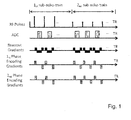
- In each said repetition time TR, a turbo spin echo train is applied first, followed by a gradient echo train. In said TR it thus comprises two sub-echo-trains. The two sub-echo-trains are applied in chronological order (referred to as the first sub-echo-train and the second sub-echo-train respectively).
- The said first sub-echo-train is a turbo spin echo train, characterized by the following features:
- A single excitation RF pulse is followed by a series of refocusing RF pulses
- The time interval between the excitation RF pulse and the first refocusing RF pulse is half of the time interval of two adjacent refocusing RF pulses.
- One k-space readout is acquired in between two refocusing RF pulses.
- Phase encoding gradients in between two refocusing RF pulses are varied to acquire different phase encoding steps.
- The said second sub-echo-train is a gradient echo train, characterized by the following features:
- One excitation RF pulse is followed by a single or multiple k-space readouts.
- The echo in the center of readout is formalized by nulling the gradient moments applied after each excitation pulse in frequency encoding direction.
- The gradient echo train consists of a series of repetitions of the said excitation pulse and the k-space readouts with varying spatial phase encoding steps.
- Phase encoding is applied in each echo before signal readout, a phase encoding rewinder is applied after each echo such that the spin system reaches an identical dephasing state before the next pulse with respect to all three gradients.
- For a trueFISP implementation the gradient moment of all gradients is nulled between successive pulses.
- The time interval between two adjacent refocusing RF pulses in said first sub-echo-train and the time interval between two excitation RF pulses in said second sub-echo-train is referred to as echo spacing.
- The acquired data in said first sub-echo-train is filled to the first k-space data set to reconstruct one image.
- The acquired data in said second sub-echo-train is filled to the second k-space data set to reconstruct another image.
- The methods of filling k-space in said first sub-echo-train and said second sub-echo-train are independent of each other. For example, rectilinear view ordering in ky-kz plane can be applied in said first sub-echo-train, and pseudo radial view ordering in ky-kz plane can be applied in said second sub-echo-train simultaneously (see Reference [4]).
- This interleaved acquisition method is preferred to be applied in 3D MRI, but not limited to 3D MRI.
- Thus, the present invention suggests a method for accelerating magnetic resonance imaging, comprising: In 3D MRI, it comprises two sub-echo-trains in each repetition time for the simultaneous acquisition of two contrasts. The first sub-echo-train is turbo spin echo train. The second sub-echo-train is gradient echo train. The invented method acquires two different contrasts simultaneously in a single acquisition, for example one water image plus one fat image, or one turbo spin echo image plus one susceptibility weighted image.
- While only certain features of the invention have been illustrated and described herein, many modifications and changes will occur to those skilled in the art. It is, therefore, to be understood that the appended claims are intended to cover all such modifications and changes as all within the true spirit of the invention.
- In a first implementation, the TSE-readout of the first sub-echo-train is accompanied by a low flip angle FLASH sequence with flip angles typically below 20°. As an example, the first sub-echo-train can be implemented such, that a T2-weighted data set is created, the images created by the second sub-echo-train will be proton density weighted, such that images with two different contrast are generated. With proper choice of slice selection-, readout -, and phase encoding gradient images will have identical geometric parameters allowing a direct pixel-by-pixel comparison.
- In a further embodiment of the invention, the second sub-echo-train comprises a gradient echo sequence, in which the total gradient moment of the phase encoding gradient between successive pulses is zero, which is achieved by applying a phase encoding rewinding gradient after the readout of the echo.
- The advantage of applying a phase encoding rewinding gradient is that: the influence of the changing phase encoding gradients between successive pulses on the signal evolution is cancelled. The imaging method is more robust to artifacts, caused by system imperfection.
- In an alternative embodiment of the invention, the second sub-echo-train comprises a gradient echo sequence called "true FISP sequence", in which the total gradient moment of all gradients between successive pulses is zero, which is achieved by applying rewinding gradients in all three directions thereby effecting slice selection, readout and phase encoding.
- The application of rewinding gradients in all three directions results in high signal-to-noise ratio (SNR) and shorter acquisition time.
- In a further and preferred implementation data in said second sub-echo-train is acquired with relative long echo spacing (for example > 10 ms) to obtain susceptibility weighted images (see Reference [5]).
- In a further and preferred implementation different chemically selective excitations are applied in two sub-echo-trains, for example water signal is excited in said first sub-echo-train, and fat signal excited in said second sub-echo-train, or vice versa.
- In a further and preferred implementation fat signal in said first sub-echo-train is suppressed by extra procedure applied before the excitation pulse, for example SPAIR fat suppression (see Reference [6]). Fat signal in said second sub-echo-train is excited.
- In a further and preferred implementation: In said second sub-echo-train, the data acquired at the beginning is filled into peripheral part of k-space, and the data acquired at the end is filled into inner part of k-space.
- In a further and preferred implementation: pseudo radial view ordering in ky-kz plane is applied in said second sub-echo-train (see Reference [4]).
- Furthermore it should be noted, that the acquisition scheme is not limited to Fourier encoding using readout- and phase encoding respectively for two- or three-dimensional encoding, but can be applied equally well to other encoding schemes, where one or both of the sub-echo-trains are encoded using radial encoding or spiral encoding or other encoding schemes know from literature (see References [7-9]).
- Also the first sub-echo-train can be implemented such, that multiple gradient echoes are created according to the principles of the GRASE-technique (see References [10, 11]).
- These, as well as other objects and advantages of this invention can be better understood and appreciated through careful study of the following detailed description of presently preferred exemplary embodiments of this invention in conjunction with the accompanying drawing.
- In order to make the aforesaid and other features and advantages of the present invention more apparent to those skilled in the art, preferred embodiments of the present invention will be described in detail below by referring to the accompanying drawings, wherein identical numerals represent the same parts.
-
Fig. 1 shows a sequence timing diagram of each TR with two sub echo trains for Cartesian k-space acquisition according to the present invention; -
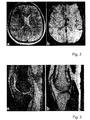
Fig. 2 shows simultaneous acquisition of two contrasts:- a) T2 weighted image reconstructed using the data acquired in the first sub-echo-train;
- b) susceptibility weighted image reconstructed using the data acquired in the second sub-echo-train; and
-
Fig. 3 shows simultaneous acquisition of two contrasts:- a) fat suppressed image reconstructed using the data acquired in the first sub-echo-train;
- b) fat excited image reconstructed using the data acquired in the second sub-echo-train.
-
- [1] Hennig, J., Nauerth, A. and Friedburg, H. (1986), RARE imaging: A fast imaging method for clinical MR. Magn Reson Med, 3: 823-833
- [2] Mugler JP. Optimized three-dimensional fast-spin-echo MRI. J Magn Reson Imaging. 2014 Apr;39(4):745-67
- [3] Klaus Scheffier and Jürgen Hennig Magn. Reson. Med 45:720-723 (2001)
- [4] Busse, R. F., Brau, A. C., Beatty P. J., Bayram, E., Michelich, C. R., Kijowski, R., and Rowley, H. A. (2008), Flexible and Efficient View Ordering for 3D Sequences with Periodic Signal Modulation. In: Proc 16th Annual Meeting ISMRM, Toronto, p837
- [5] Haacke, E. M., Xu, Y., Cheng, Y.-C. N. and Reichenbach, J. R. (2004), Susceptibility weighted imaging (SWI). Magn Reson Med, 52: 612-618
- [6] Udayasankar, U. K. J. Magn. Reson. Imaging, 28: 1133-1140
- [7]Scheffler, K. and Hennig, J. (1998), Reduced circular field-of-view imaging Magn Reson Med, 40: 474-480. doi: 10.1002/mrm.1910400319
- [8] Mugler JP et al. Proc ISMRM 21 (2013); 2368
- [9]Lai, S. and Glover, G. H. (1998), Three-dimensional spiral fMRI technique: A comparison with 2D spiral acquisition. Magn Reson Med, 39: 68-78. doi: 10.1002/mrm.1910390112
- [10] Oshio K1, Feinberg DA. GRASE (Gradient- and spin-echo) imaging: a novel fast MRI technique. Magn Reson Med. 1991 Aug;20(2):344-9
- [11] Kim H, Kim DH, Park J. Variable-flip-angle single-slab 3D GRASE imaging with phase-independent image reconstruction. Magn Reson Med. 2014 Mar 17. doi: 10.1002/mrm.25223. [Epub ahead of print]
Claims (9)
- A magnetic resonance imaging method for the acquisition of two 3-dimensional datasets, where spatial encoding by three mutually orthogonal magnetic field gradients is performed such that signal is readout under a readout-gradient in one spatial direction k1, and spatial encoding in the other two spatial directions k2, k3 is performed by applying phase encoding gradients in the other two spatial directions prior to signal acquisition, and data acquisition is performed in a sequential manner such that at each acquisition step signal is acquired under said readout-gradient, but with different combinations of the two phase encoding gradients, the method comprising:a turbo spin echo train being used to acquire one of the 3-dimensional datasets, whereby- a single excitation RF pulse is being followed by multiple refocusing RF pulses,- the time interval between an excitation RF pulse and a first refocusing RF pulse is half of the time interval of two adjacent refocusing RF pulses,- one k-space readout is acquired in between two refocusing RF pulses,- phase encoding gradients between each two consecutive refocusing RF pulses are varied to acquire different phase encoding steps,- a minimum of two echo trains with a waiting time between successive echo trains is being used for the encoding of the 3-dimensional dataset,characterized in- that during the waiting time an additional gradient echo train is used to acquire one of the 3-dimensional datasets, comprising• one excitation RF pulse being followed by a single or multiple k-space readouts,• the echo in the center of readout being formed by nulling the gradient moments applied after each excitation pulse in frequency encoding direction,• the gradient echo train comprising a series of repetitions of said excitation RF pulse and the k-space readouts with varying spatial phase encoding steps;- and that the simultaneous acquisition of two 3-dimensional datasets using both turbo spin echo train and gradient echo train is achieved by repeating the said timing of a series of RF pulses and gradients comprising two sub-echo-trains which are applied in chronological order in each repetition; until all data necessary to reconstruct a 3-dimensional dataset have been acquired in each of the sub-echo trains.
- The method according to claim 1, wherein the second sub-echo-train comprises a gradient echo sequence, in which the total gradient moment of the phase encoding gradient between successive pulses is zero, which is achieved by applying a phase encoding rewinding gradient after the readout of the echo.
- The method according to claim 1, wherein the second sub-echo-train comprises a gradient echo sequence called "true FISP sequence", in which the total gradient moment of all gradients between successive pulses is zero, which is achieved by applying rewinding gradients in all three directions thereby effecting slice selection, readout and phase encoding.
- The method according to any one of the preceding claims, wherein different chemically selective excitations are applied in two sub-echo-trains, for example water signal excited in said first sub-echo-train, and fat signal excited in said second sub-echo-train, or vice versa.
- The method according to any one of the preceding claims, wherein fat signal in said first sub-echo-train is suppressed by spectrally fat suppression techniques and fat signal in said second sub-echo-train is excited.
- The method according to any one of the preceding claims, wherein long echo spacing in said second sub-echo-train is applied to obtain susceptibility weighted images.
- The method according to any one of the preceding claims, wherein spatial encoding for the signal of at least one of the sub-echo-trains is performed using radial encoding.
- The method according to any one of the preceding claims, wherein spatial encoding for the signal of at least one of the sub-echo-trains is performed using spiral encoding.
- The method according to any one of the preceding claims, wherein on the first sub-echo-train multiple gradient echoes are readout between successive refocusing pulses according to a GRASE-sequence.
Priority Applications (3)
| Application Number | Priority Date | Filing Date | Title |
|---|---|---|---|
| EP14165064.8A EP2933651B1 (en) | 2014-04-17 | 2014-04-17 | MRI Method of Hybrid Acquisition in 3D TSE |
| US14/675,782 US10288703B2 (en) | 2014-04-17 | 2015-04-01 | MRI method of hybrid acquisition in 3D TSE |
| CN201510185185.2A CN105005011B (en) | 2014-04-17 | 2015-04-17 | The MR imaging method of mixing acquisition in 3-dimensional fast spin echo |
Applications Claiming Priority (1)
| Application Number | Priority Date | Filing Date | Title |
|---|---|---|---|
| EP14165064.8A EP2933651B1 (en) | 2014-04-17 | 2014-04-17 | MRI Method of Hybrid Acquisition in 3D TSE |
Publications (2)
| Publication Number | Publication Date |
|---|---|
| EP2933651A1 true EP2933651A1 (en) | 2015-10-21 |
| EP2933651B1 EP2933651B1 (en) | 2020-03-18 |
Family
ID=50679842
Family Applications (1)
| Application Number | Title | Priority Date | Filing Date |
|---|---|---|---|
| EP14165064.8A Active EP2933651B1 (en) | 2014-04-17 | 2014-04-17 | MRI Method of Hybrid Acquisition in 3D TSE |
Country Status (3)
| Country | Link |
|---|---|
| US (1) | US10288703B2 (en) |
| EP (1) | EP2933651B1 (en) |
| CN (1) | CN105005011B (en) |
Cited By (1)
| Publication number | Priority date | Publication date | Assignee | Title |
|---|---|---|---|---|
| US11474177B2 (en) * | 2020-01-14 | 2022-10-18 | Siemens Healtchare GmbH | Method for magnetic resonance imaging and magnetic resonance device |
Families Citing this family (16)
| Publication number | Priority date | Publication date | Assignee | Title |
|---|---|---|---|---|
| EP3324844A4 (en) | 2015-07-23 | 2018-08-22 | Shanghai United Imaging Healthcare Co., Ltd. | System and method for magnetic resonance imaging |
| CN106646302B (en) * | 2015-10-29 | 2019-11-19 | 上海联影医疗科技有限公司 | A kind of MR imaging method |
| CN105548928B (en) * | 2015-12-04 | 2018-04-24 | 厦门大学 | A kind of supper-fast MR imaging method of multilayer based on segmentation excitation space-time code |
| US10310040B2 (en) * | 2016-07-28 | 2019-06-04 | Siemens Healthcare Gmbh | Method and magnetic resonance apparatus for simultaneous multi-contrast turbo spin echo imaging |
| KR101837689B1 (en) * | 2016-10-12 | 2018-03-12 | 삼성전자주식회사 | magnetic resonance imaging apparatus and image processing method thereof |
| WO2018187338A1 (en) * | 2017-04-03 | 2018-10-11 | Board Of Regents, The University Of Texas System | System and method for robust mr imaging with prepared contrast using cartesian acquisition with spiral reordering (caspr) |
| CN107167751B (en) * | 2017-06-30 | 2019-08-02 | 上海联影医疗科技有限公司 | A kind of magnetic resonance radio frequency launching site measurement method and magnetic resonance system |
| CA3047661C (en) * | 2018-06-20 | 2022-10-04 | Peter Bendel | System and method for imaging tissue |
| CN109085522B (en) * | 2018-07-02 | 2021-07-09 | 上海东软医疗科技有限公司 | Method and device for acquiring magnetic resonance diffusion weighted imaging and spectrum signals |
| US10996300B2 (en) * | 2018-09-05 | 2021-05-04 | Siemens Healthcare Gmbh | Cartesian-radial hybrid k-space trajectory for volumetric imaging |
| CN109596659B (en) * | 2018-12-06 | 2021-07-30 | 上海交通大学 | Two-dimensional and three-dimensional fast spin echo imaging methods |
| EP3680680A1 (en) * | 2019-01-11 | 2020-07-15 | Siemens Healthcare GmbH | Method for obtaining an optimised operating parameter, storage medium and magnetic resonance apparatus |
| CN109917315B (en) | 2019-04-30 | 2021-09-28 | 上海联影医疗科技股份有限公司 | Magnetic resonance imaging scanning method, magnetic resonance imaging scanning device, computer equipment and storage medium |
| CN110992435B (en) * | 2019-11-06 | 2023-10-20 | 上海东软医疗科技有限公司 | Image reconstruction method and equipment, imaging data processing method and device |
| JP7179889B2 (en) | 2021-03-05 | 2022-11-29 | ジーイー・プレシジョン・ヘルスケア・エルエルシー | Magnetic resonance imaging device and program |
| CN114041778B (en) * | 2022-01-13 | 2022-06-24 | 康达洲际医疗器械有限公司 | Fusion imaging method and system applied to bone joint magnetic resonance imaging |
Citations (1)
| Publication number | Priority date | Publication date | Assignee | Title |
|---|---|---|---|---|
| US6400151B1 (en) * | 1999-01-14 | 2002-06-04 | Axel Haase | Method and apparatus for the acquisition of data for magnetic resonance imaging |
Family Cites Families (7)
| Publication number | Priority date | Publication date | Assignee | Title |
|---|---|---|---|---|
| DE102007041826B4 (en) * | 2007-09-03 | 2018-02-01 | Siemens Healthcare Gmbh | Method for optimizing angiographic MR images |
| US20090143666A1 (en) * | 2007-11-29 | 2009-06-04 | Edelman Robert R | System And Method For Non-Contrast Agent MR Angiography |
| US8334691B2 (en) * | 2009-11-19 | 2012-12-18 | Siemens Medical Solutions Usa, Inc. | Ultra fast magnetic resonance imaging method and apparatus for non-contrast agent MR angiography using electrocardiograph or pulse triggered half fourier turbo spin echo-based acquisition with variable flip angle evolution and high resolution |
| CN102236083B (en) * | 2010-04-30 | 2013-10-02 | 西门子(深圳)磁共振有限公司 | Three-dimensional fast spin echo imaging method |
| EP2648014A1 (en) * | 2012-04-03 | 2013-10-09 | Koninklijke Philips N.V. | MR imaging using APT contrast enhancement and sampling at multiple echo times |
| DE102013205208B4 (en) * | 2013-03-25 | 2015-02-12 | Siemens Aktiengesellschaft | Multi-echo magnetic resonance measurement sequence with increased resolution |
| US10274566B2 (en) * | 2013-04-03 | 2019-04-30 | Koninklijke Philips N.V. | Dixon-type water/fat separation MRI using high-SNR in-phase image and lower-SNR at least partially out-of-phase image |
-
2014
- 2014-04-17 EP EP14165064.8A patent/EP2933651B1/en active Active
-
2015
- 2015-04-01 US US14/675,782 patent/US10288703B2/en active Active
- 2015-04-17 CN CN201510185185.2A patent/CN105005011B/en active Active
Patent Citations (1)
| Publication number | Priority date | Publication date | Assignee | Title |
|---|---|---|---|---|
| US6400151B1 (en) * | 1999-01-14 | 2002-06-04 | Axel Haase | Method and apparatus for the acquisition of data for magnetic resonance imaging |
Non-Patent Citations (16)
| Title |
|---|
| BUSSE, R. F.; BRAU, A. C.; BEATTY P. J.; BAYRAM, E.; MICHELICH, C. R.; KIJOWSKI, R.; ROWLEY, H. A.: "Flexible and Efficient View Ordering for 3D Sequences with Periodic Signal Modulation", PROC 16TH ANNUAL MEETING ISMRM, 2008, pages 837 |
| HAACKE, E. M.; XU, Y.; CHENG, Y.-C. N.; REICHENBACH, J. R.: "Susceptibility weighted imaging (SWI", MAGN RESON MED, vol. 52, 2004, pages 612 - 618 |
| HENNIG, J.; NAUERTH, A.; FRIEDBURG, H.: "RARE imaging: A fast imaging method for clinical MR", MAGN RESON MED, vol. 3, 1986, pages 823 - 833, XP000885375, DOI: doi:10.1002/mrm.1910030602 |
| HOONJAE LEE ET AL: "Rapid hybrid encoding for high-resolution whole-brain fluid-attenuated imaging", NMR IN BIOMEDICINE, vol. 26, no. 12, 3 September 2013 (2013-09-03), pages 1751 - 1761, XP055140156, ISSN: 0952-3480, DOI: 10.1002/nbm.3013 * |
| KIM H; KIM DH; PARK J.: "Variable-flip-angle single-slab 3D GRASE imaging with phase-independent image reconstruction", MAGN RESON MED., 17 March 2014 (2014-03-17) |
| KLAUS SCHEFFLER; JURGEN HENNIG, MAGN. RESON. MED, vol. 45, 2001, pages 720 - 723 |
| LAI, S.; GLOVER, G. H.: "Three-dimensional spiral fMRI technique: A comparison with 2D spiral acquisition", MAGN RESON MED, vol. 39, 1998, pages 68 - 78, XP008063284 |
| MUGLER JP ET AL., PROC ISMRM, vol. 21, 2013, pages 2368 |
| MUGLER JP: "Optimized three-dimensional fast-spin-echo MRI", J MAGN RESON IMAGING, vol. 39, no. 4, April 2014 (2014-04-01), pages 745 - 67 |
| OSHIO K1; FEINBERG DA: "GRASE (Gradient- and spin-echo) imaging: a novel fast MRI technique", MAGN RESON MED., vol. 20, no. 2, August 1991 (1991-08-01), pages 344 - 9, XP000226831 |
| P.C. LAUTERBUR: "Image Formation by Induced Local Interactions: Examples of Employing Nuclear Magnetic Resonance", NATURE, vol. 242, 1973, pages 190491 |
| RICHARD WINKELMANN ET AL: "Dual-contrast single breath-hold 3D abdominal MR imaging", MAGNETIC RESONANCE MATERIALS IN PHYSICS, BIOLOGY AND MEDICINE, CHAPMAN AND HALL, LONDON, GB, vol. 19, no. 6, 24 November 2006 (2006-11-24), pages 297 - 304, XP019463153, ISSN: 1352-8661 * |
| SCHEFFLER K ET AL: "T1 Quantification With Inversion Recovery TrueFISP", MAGNETIC RESONANCE IN MEDICINE, ACADEMIC PRESS, DULUTH, MN, US, vol. 45, 1 January 2001 (2001-01-01), pages 720 - 723, XP002664821, ISSN: 0740-3194 * |
| SCHEFFLER, K.; HENNIG, J.: "Reduced circular field-of-view imaging", MAGN RESON MED, vol. 40, 1998, pages 474 - 480, XP002097032 |
| U BLUME ET AL: "Interleaved T1- and T2-weighted imaging", PROC.INTL.SOC.MAG.RESON.MED. 15, 1 January 2007 (2007-01-01), pages 582, XP055140157 * |
| UDAYASANKAR, U. K., J. MAGN. RESON. IMAGING, vol. 28, pages 1133 - 1140 |
Cited By (1)
| Publication number | Priority date | Publication date | Assignee | Title |
|---|---|---|---|---|
| US11474177B2 (en) * | 2020-01-14 | 2022-10-18 | Siemens Healtchare GmbH | Method for magnetic resonance imaging and magnetic resonance device |
Also Published As
| Publication number | Publication date |
|---|---|
| EP2933651B1 (en) | 2020-03-18 |
| CN105005011B (en) | 2019-03-01 |
| US10288703B2 (en) | 2019-05-14 |
| CN105005011A (en) | 2015-10-28 |
| US20150301136A1 (en) | 2015-10-22 |
Similar Documents
| Publication | Publication Date | Title |
|---|---|---|
| EP2933651B1 (en) | MRI Method of Hybrid Acquisition in 3D TSE | |
| EP2414861B1 (en) | Magnetic resonance imaging with improved imaging contrast | |
| US8760163B2 (en) | Diffusion-weighted magnetic resonance imaging using 3D mosaic segmentation and 3D navigator phase correction | |
| US9778336B2 (en) | System and method for rapid, multi-shot segmented magnetic resonance imaging | |
| JP6188597B2 (en) | Method and controller for operating magnetic resonance system | |
| US8934691B2 (en) | System for motion compensated MR parallel imaging | |
| CN103576114B (en) | Obtain the method for MR data, magnetic resonance equipment | |
| US20130249548A1 (en) | Method and control device to operate a magnetic resonance system | |
| US10247798B2 (en) | Simultaneous multi-slice MRI measurement | |
| Dai et al. | Simultaneous multislice accelerated interleaved EPI DWI using generalized blipped‐CAIPI acquisition and 3D K‐space reconstruction | |
| US9645211B2 (en) | Magnetic resonance imaging using steering-propeller | |
| US20140070805A1 (en) | Mr imaging with b1 mapping | |
| US6946839B2 (en) | Magnetic resonance imaging method and apparatus with spatial coding using readout segmentation | |
| EP3044604B1 (en) | Metal resistant mr imaging | |
| US10712417B2 (en) | Method and apparatus for executing an accelerated magnetic resonance scan | |
| US10775468B2 (en) | Magnetic resonance method and apparatus | |
| US11016162B2 (en) | Method and magnetic resonance apparatus for generating a combination image dataset | |
| EP2988145B1 (en) | Method and apparatus for acquiring magnetic resonance data | |
| WO2012140543A1 (en) | Mri of chemical species having different resonance frequencies using an ultra-short echo time sequence | |
| US11762048B2 (en) | Echo-specific k-space sampling with multi-echo sequences | |
| Polak et al. | Ultrafast multi-contrast high-resolution 3D brain MRI: a technical description of Wave-CAIPI | |
| US11333733B2 (en) | Method and apparatus for recording a magnetic resonance data record | |
| Zhang et al. | Hybrid-space reconstruction with add-on distortion correction for simultaneous multi-slab diffusion MRI | |
| US20250110194A1 (en) | Recording Magnetic Resonance Data of an Object Under Examination Comprising Spins of at Least Two Different Spin Species | |
| US11619692B2 (en) | Method for acquiring and processing MR data, MRI system and method, and storage medium |
Legal Events
| Date | Code | Title | Description |
|---|---|---|---|
| PUAI | Public reference made under article 153(3) epc to a published international application that has entered the european phase |
Free format text: ORIGINAL CODE: 0009012 |
|
| AK | Designated contracting states |
Kind code of ref document: A1 Designated state(s): AL AT BE BG CH CY CZ DE DK EE ES FI FR GB GR HR HU IE IS IT LI LT LU LV MC MK MT NL NO PL PT RO RS SE SI SK SM TR |
|
| AX | Request for extension of the european patent |
Extension state: BA ME |
|
| 17P | Request for examination filed |
Effective date: 20160415 |
|
| RBV | Designated contracting states (corrected) |
Designated state(s): AL AT BE BG CH CY CZ DE DK EE ES FI FR GB GR HR HU IE IS IT LI LT LU LV MC MK MT NL NO PL PT RO RS SE SI SK SM TR |
|
| RIN1 | Information on inventor provided before grant (corrected) |
Inventor name: ZAITSEV, MAXIM Inventor name: HENNIG, JUERGEN Inventor name: LI, GUOBIN |
|
| GRAP | Despatch of communication of intention to grant a patent |
Free format text: ORIGINAL CODE: EPIDOSNIGR1 |
|
| STAA | Information on the status of an ep patent application or granted ep patent |
Free format text: STATUS: GRANT OF PATENT IS INTENDED |
|
| INTG | Intention to grant announced |
Effective date: 20191022 |
|
| GRAS | Grant fee paid |
Free format text: ORIGINAL CODE: EPIDOSNIGR3 |
|
| GRAA | (expected) grant |
Free format text: ORIGINAL CODE: 0009210 |
|
| STAA | Information on the status of an ep patent application or granted ep patent |
Free format text: STATUS: THE PATENT HAS BEEN GRANTED |
|
| AK | Designated contracting states |
Kind code of ref document: B1 Designated state(s): AL AT BE BG CH CY CZ DE DK EE ES FI FR GB GR HR HU IE IS IT LI LT LU LV MC MK MT NL NO PL PT RO RS SE SI SK SM TR |
|
| REG | Reference to a national code |
Ref country code: GB Ref legal event code: FG4D |
|
| REG | Reference to a national code |
Ref country code: DE Ref legal event code: R096 Ref document number: 602014062431 Country of ref document: DE |
|
| REG | Reference to a national code |
Ref country code: AT Ref legal event code: REF Ref document number: 1246539 Country of ref document: AT Kind code of ref document: T Effective date: 20200415 Ref country code: IE Ref legal event code: FG4D |
|
| REG | Reference to a national code |
Ref country code: NL Ref legal event code: FP |
|
| PG25 | Lapsed in a contracting state [announced via postgrant information from national office to epo] |
Ref country code: FI Free format text: LAPSE BECAUSE OF FAILURE TO SUBMIT A TRANSLATION OF THE DESCRIPTION OR TO PAY THE FEE WITHIN THE PRESCRIBED TIME-LIMIT Effective date: 20200318 Ref country code: NO Free format text: LAPSE BECAUSE OF FAILURE TO SUBMIT A TRANSLATION OF THE DESCRIPTION OR TO PAY THE FEE WITHIN THE PRESCRIBED TIME-LIMIT Effective date: 20200618 Ref country code: RS Free format text: LAPSE BECAUSE OF FAILURE TO SUBMIT A TRANSLATION OF THE DESCRIPTION OR TO PAY THE FEE WITHIN THE PRESCRIBED TIME-LIMIT Effective date: 20200318 |
|
| PG25 | Lapsed in a contracting state [announced via postgrant information from national office to epo] |
Ref country code: HR Free format text: LAPSE BECAUSE OF FAILURE TO SUBMIT A TRANSLATION OF THE DESCRIPTION OR TO PAY THE FEE WITHIN THE PRESCRIBED TIME-LIMIT Effective date: 20200318 Ref country code: BG Free format text: LAPSE BECAUSE OF FAILURE TO SUBMIT A TRANSLATION OF THE DESCRIPTION OR TO PAY THE FEE WITHIN THE PRESCRIBED TIME-LIMIT Effective date: 20200618 Ref country code: GR Free format text: LAPSE BECAUSE OF FAILURE TO SUBMIT A TRANSLATION OF THE DESCRIPTION OR TO PAY THE FEE WITHIN THE PRESCRIBED TIME-LIMIT Effective date: 20200619 Ref country code: SE Free format text: LAPSE BECAUSE OF FAILURE TO SUBMIT A TRANSLATION OF THE DESCRIPTION OR TO PAY THE FEE WITHIN THE PRESCRIBED TIME-LIMIT Effective date: 20200318 Ref country code: LV Free format text: LAPSE BECAUSE OF FAILURE TO SUBMIT A TRANSLATION OF THE DESCRIPTION OR TO PAY THE FEE WITHIN THE PRESCRIBED TIME-LIMIT Effective date: 20200318 |
|
| REG | Reference to a national code |
Ref country code: LT Ref legal event code: MG4D |
|
| PG25 | Lapsed in a contracting state [announced via postgrant information from national office to epo] |
Ref country code: SM Free format text: LAPSE BECAUSE OF FAILURE TO SUBMIT A TRANSLATION OF THE DESCRIPTION OR TO PAY THE FEE WITHIN THE PRESCRIBED TIME-LIMIT Effective date: 20200318 Ref country code: PT Free format text: LAPSE BECAUSE OF FAILURE TO SUBMIT A TRANSLATION OF THE DESCRIPTION OR TO PAY THE FEE WITHIN THE PRESCRIBED TIME-LIMIT Effective date: 20200812 Ref country code: RO Free format text: LAPSE BECAUSE OF FAILURE TO SUBMIT A TRANSLATION OF THE DESCRIPTION OR TO PAY THE FEE WITHIN THE PRESCRIBED TIME-LIMIT Effective date: 20200318 Ref country code: IS Free format text: LAPSE BECAUSE OF FAILURE TO SUBMIT A TRANSLATION OF THE DESCRIPTION OR TO PAY THE FEE WITHIN THE PRESCRIBED TIME-LIMIT Effective date: 20200718 Ref country code: CZ Free format text: LAPSE BECAUSE OF FAILURE TO SUBMIT A TRANSLATION OF THE DESCRIPTION OR TO PAY THE FEE WITHIN THE PRESCRIBED TIME-LIMIT Effective date: 20200318 Ref country code: SK Free format text: LAPSE BECAUSE OF FAILURE TO SUBMIT A TRANSLATION OF THE DESCRIPTION OR TO PAY THE FEE WITHIN THE PRESCRIBED TIME-LIMIT Effective date: 20200318 Ref country code: LT Free format text: LAPSE BECAUSE OF FAILURE TO SUBMIT A TRANSLATION OF THE DESCRIPTION OR TO PAY THE FEE WITHIN THE PRESCRIBED TIME-LIMIT Effective date: 20200318 Ref country code: EE Free format text: LAPSE BECAUSE OF FAILURE TO SUBMIT A TRANSLATION OF THE DESCRIPTION OR TO PAY THE FEE WITHIN THE PRESCRIBED TIME-LIMIT Effective date: 20200318 |
|
| REG | Reference to a national code |
Ref country code: AT Ref legal event code: MK05 Ref document number: 1246539 Country of ref document: AT Kind code of ref document: T Effective date: 20200318 |
|
| REG | Reference to a national code |
Ref country code: DE Ref legal event code: R097 Ref document number: 602014062431 Country of ref document: DE |
|
| PG25 | Lapsed in a contracting state [announced via postgrant information from national office to epo] |
Ref country code: MC Free format text: LAPSE BECAUSE OF FAILURE TO SUBMIT A TRANSLATION OF THE DESCRIPTION OR TO PAY THE FEE WITHIN THE PRESCRIBED TIME-LIMIT Effective date: 20200318 |
|
| PLBE | No opposition filed within time limit |
Free format text: ORIGINAL CODE: 0009261 |
|
| STAA | Information on the status of an ep patent application or granted ep patent |
Free format text: STATUS: NO OPPOSITION FILED WITHIN TIME LIMIT |
|
| PG25 | Lapsed in a contracting state [announced via postgrant information from national office to epo] |
Ref country code: AT Free format text: LAPSE BECAUSE OF FAILURE TO SUBMIT A TRANSLATION OF THE DESCRIPTION OR TO PAY THE FEE WITHIN THE PRESCRIBED TIME-LIMIT Effective date: 20200318 Ref country code: DK Free format text: LAPSE BECAUSE OF FAILURE TO SUBMIT A TRANSLATION OF THE DESCRIPTION OR TO PAY THE FEE WITHIN THE PRESCRIBED TIME-LIMIT Effective date: 20200318 Ref country code: IT Free format text: LAPSE BECAUSE OF FAILURE TO SUBMIT A TRANSLATION OF THE DESCRIPTION OR TO PAY THE FEE WITHIN THE PRESCRIBED TIME-LIMIT Effective date: 20200318 Ref country code: LU Free format text: LAPSE BECAUSE OF NON-PAYMENT OF DUE FEES Effective date: 20200417 Ref country code: ES Free format text: LAPSE BECAUSE OF FAILURE TO SUBMIT A TRANSLATION OF THE DESCRIPTION OR TO PAY THE FEE WITHIN THE PRESCRIBED TIME-LIMIT Effective date: 20200318 |
|
| REG | Reference to a national code |
Ref country code: BE Ref legal event code: MM Effective date: 20200430 |
|
| 26N | No opposition filed |
Effective date: 20201221 |
|
| PG25 | Lapsed in a contracting state [announced via postgrant information from national office to epo] |
Ref country code: PL Free format text: LAPSE BECAUSE OF FAILURE TO SUBMIT A TRANSLATION OF THE DESCRIPTION OR TO PAY THE FEE WITHIN THE PRESCRIBED TIME-LIMIT Effective date: 20200318 Ref country code: BE Free format text: LAPSE BECAUSE OF NON-PAYMENT OF DUE FEES Effective date: 20200430 |
|
| PG25 | Lapsed in a contracting state [announced via postgrant information from national office to epo] |
Ref country code: IE Free format text: LAPSE BECAUSE OF NON-PAYMENT OF DUE FEES Effective date: 20200417 |
|
| PG25 | Lapsed in a contracting state [announced via postgrant information from national office to epo] |
Ref country code: SI Free format text: LAPSE BECAUSE OF FAILURE TO SUBMIT A TRANSLATION OF THE DESCRIPTION OR TO PAY THE FEE WITHIN THE PRESCRIBED TIME-LIMIT Effective date: 20200318 |
|
| PG25 | Lapsed in a contracting state [announced via postgrant information from national office to epo] |
Ref country code: TR Free format text: LAPSE BECAUSE OF FAILURE TO SUBMIT A TRANSLATION OF THE DESCRIPTION OR TO PAY THE FEE WITHIN THE PRESCRIBED TIME-LIMIT Effective date: 20200318 Ref country code: MT Free format text: LAPSE BECAUSE OF FAILURE TO SUBMIT A TRANSLATION OF THE DESCRIPTION OR TO PAY THE FEE WITHIN THE PRESCRIBED TIME-LIMIT Effective date: 20200318 Ref country code: CY Free format text: LAPSE BECAUSE OF FAILURE TO SUBMIT A TRANSLATION OF THE DESCRIPTION OR TO PAY THE FEE WITHIN THE PRESCRIBED TIME-LIMIT Effective date: 20200318 |
|
| PG25 | Lapsed in a contracting state [announced via postgrant information from national office to epo] |
Ref country code: MK Free format text: LAPSE BECAUSE OF FAILURE TO SUBMIT A TRANSLATION OF THE DESCRIPTION OR TO PAY THE FEE WITHIN THE PRESCRIBED TIME-LIMIT Effective date: 20200318 Ref country code: AL Free format text: LAPSE BECAUSE OF FAILURE TO SUBMIT A TRANSLATION OF THE DESCRIPTION OR TO PAY THE FEE WITHIN THE PRESCRIBED TIME-LIMIT Effective date: 20200318 |
|
| PGFP | Annual fee paid to national office [announced via postgrant information from national office to epo] |
Ref country code: NL Payment date: 20250422 Year of fee payment: 12 |
|
| PGFP | Annual fee paid to national office [announced via postgrant information from national office to epo] |
Ref country code: DE Payment date: 20250417 Year of fee payment: 12 |
|
| PGFP | Annual fee paid to national office [announced via postgrant information from national office to epo] |
Ref country code: FR Payment date: 20250422 Year of fee payment: 12 |
|
| PGFP | Annual fee paid to national office [announced via postgrant information from national office to epo] |
Ref country code: CH Payment date: 20250501 Year of fee payment: 12 |
|
| PGFP | Annual fee paid to national office [announced via postgrant information from national office to epo] |
Ref country code: GB Payment date: 20260324 Year of fee payment: 13 |
|
| REG | Reference to a national code |
Ref country code: CH Ref legal event code: U11 Free format text: ST27 STATUS EVENT CODE: U-0-0-U10-U11 (AS PROVIDED BY THE NATIONAL OFFICE) Effective date: 20260501 |