EP2931969B1 - Method for catalytic oxidation of cellulose and method for making a cellulose product - Google Patents
Method for catalytic oxidation of cellulose and method for making a cellulose product Download PDFInfo
- Publication number
- EP2931969B1 EP2931969B1 EP13812003.5A EP13812003A EP2931969B1 EP 2931969 B1 EP2931969 B1 EP 2931969B1 EP 13812003 A EP13812003 A EP 13812003A EP 2931969 B1 EP2931969 B1 EP 2931969B1
- Authority
- EP
- European Patent Office
- Prior art keywords
- cellulose
- oxidation
- pulp
- reaction
- oxidized
- Prior art date
- Legal status (The legal status is an assumption and is not a legal conclusion. Google has not performed a legal analysis and makes no representation as to the accuracy of the status listed.)
- Active
Links
- 238000007254 oxidation reaction Methods 0.000 title claims description 119
- 230000003647 oxidation Effects 0.000 title claims description 113
- 229920002678 cellulose Polymers 0.000 title claims description 83
- 239000001913 cellulose Substances 0.000 title claims description 82
- 238000000034 method Methods 0.000 title claims description 61
- 230000003197 catalytic effect Effects 0.000 title claims description 19
- WQYVRQLZKVEZGA-UHFFFAOYSA-N hypochlorite Chemical compound Cl[O-] WQYVRQLZKVEZGA-UHFFFAOYSA-N 0.000 claims description 46
- 239000012429 reaction media Substances 0.000 claims description 44
- 230000001590 oxidative effect Effects 0.000 claims description 40
- OSVXSBDYLRYLIG-UHFFFAOYSA-N dioxidochlorine(.) Chemical compound O=Cl=O OSVXSBDYLRYLIG-UHFFFAOYSA-N 0.000 claims description 37
- 239000007800 oxidant agent Substances 0.000 claims description 35
- 238000002156 mixing Methods 0.000 claims description 20
- 239000003054 catalyst Substances 0.000 claims description 17
- 239000000126 substance Substances 0.000 claims description 17
- 239000004155 Chlorine dioxide Substances 0.000 claims description 16
- 235000019398 chlorine dioxide Nutrition 0.000 claims description 16
- 239000000835 fiber Substances 0.000 claims description 16
- YLFIGGHWWPSIEG-UHFFFAOYSA-N aminoxyl Chemical compound [O]N YLFIGGHWWPSIEG-UHFFFAOYSA-N 0.000 claims description 15
- 125000000623 heterocyclic group Chemical group 0.000 claims description 14
- 239000012190 activator Substances 0.000 claims description 13
- QBWCMBCROVPCKQ-UHFFFAOYSA-N chlorous acid Chemical compound OCl=O QBWCMBCROVPCKQ-UHFFFAOYSA-N 0.000 claims description 11
- 239000002994 raw material Substances 0.000 claims description 11
- XLYOFNOQVPJJNP-UHFFFAOYSA-N water Substances O XLYOFNOQVPJJNP-UHFFFAOYSA-N 0.000 claims description 9
- 229920002201 Oxidized cellulose Polymers 0.000 claims description 8
- 150000007942 carboxylates Chemical class 0.000 claims description 8
- 229940107304 oxidized cellulose Drugs 0.000 claims description 7
- QVGXLLKOCUKJST-UHFFFAOYSA-N atomic oxygen Chemical compound [O] QVGXLLKOCUKJST-UHFFFAOYSA-N 0.000 claims description 6
- 229910001919 chlorite Inorganic materials 0.000 claims description 6
- 229910052619 chlorite group Inorganic materials 0.000 claims description 6
- 239000001301 oxygen Substances 0.000 claims description 6
- 229910052760 oxygen Inorganic materials 0.000 claims description 6
- 239000007858 starting material Substances 0.000 claims description 6
- 239000000463 material Substances 0.000 claims description 5
- 239000003795 chemical substances by application Substances 0.000 claims description 4
- 239000002657 fibrous material Substances 0.000 claims description 4
- 150000003512 tertiary amines Chemical class 0.000 claims description 4
- 125000000896 monocarboxylic acid group Chemical group 0.000 claims 4
- 235000010980 cellulose Nutrition 0.000 description 73
- 238000006243 chemical reaction Methods 0.000 description 72
- GDOPTJXRTPNYNR-UHFFFAOYSA-N methyl-cyclopentane Natural products CC1CCCC1 GDOPTJXRTPNYNR-UHFFFAOYSA-N 0.000 description 33
- 125000003178 carboxy group Chemical group [H]OC(*)=O 0.000 description 29
- 239000002609 medium Substances 0.000 description 24
- SUKJFIGYRHOWBL-UHFFFAOYSA-N sodium hypochlorite Chemical compound [Na+].Cl[O-] SUKJFIGYRHOWBL-UHFFFAOYSA-N 0.000 description 24
- 125000002887 hydroxy group Chemical group [H]O* 0.000 description 19
- 230000008569 process Effects 0.000 description 19
- 239000012071 phase Substances 0.000 description 16
- JHJLBTNAGRQEKS-UHFFFAOYSA-M sodium bromide Chemical compound [Na+].[Br-] JHJLBTNAGRQEKS-UHFFFAOYSA-M 0.000 description 14
- 125000002485 formyl group Chemical class [H]C(*)=O 0.000 description 11
- 238000007086 side reaction Methods 0.000 description 11
- -1 Heterocyclic nitroxyl compounds Chemical class 0.000 description 10
- 239000000047 product Substances 0.000 description 10
- 238000002474 experimental method Methods 0.000 description 7
- 210000001724 microfibril Anatomy 0.000 description 7
- CPELXLSAUQHCOX-UHFFFAOYSA-M Bromide Chemical compound [Br-] CPELXLSAUQHCOX-UHFFFAOYSA-M 0.000 description 6
- WKBOTKDWSSQWDR-UHFFFAOYSA-N Bromine atom Chemical class [Br] WKBOTKDWSSQWDR-UHFFFAOYSA-N 0.000 description 6
- RCJVRSBWZCNNQT-UHFFFAOYSA-N dichloridooxygen Chemical compound ClOCl RCJVRSBWZCNNQT-UHFFFAOYSA-N 0.000 description 6
- 239000007788 liquid Substances 0.000 description 6
- 238000005259 measurement Methods 0.000 description 6
- 230000001404 mediated effect Effects 0.000 description 6
- ODUCDPQEXGNKDN-UHFFFAOYSA-N nitroxyl Chemical class O=N ODUCDPQEXGNKDN-UHFFFAOYSA-N 0.000 description 6
- 239000002253 acid Substances 0.000 description 5
- 125000003172 aldehyde group Chemical group 0.000 description 5
- 230000015572 biosynthetic process Effects 0.000 description 5
- 229910052799 carbon Inorganic materials 0.000 description 5
- 238000001816 cooling Methods 0.000 description 5
- 230000007423 decrease Effects 0.000 description 5
- 229920003043 Cellulose fiber Polymers 0.000 description 4
- XTEGARKTQYYJKE-UHFFFAOYSA-M Chlorate Chemical compound [O-]Cl(=O)=O XTEGARKTQYYJKE-UHFFFAOYSA-M 0.000 description 4
- IAZDPXIOMUYVGZ-UHFFFAOYSA-N Dimethylsulphoxide Chemical compound CS(C)=O IAZDPXIOMUYVGZ-UHFFFAOYSA-N 0.000 description 4
- 239000005708 Sodium hypochlorite Substances 0.000 description 4
- 150000001412 amines Chemical class 0.000 description 4
- 150000001735 carboxylic acids Chemical class 0.000 description 4
- 239000000203 mixture Substances 0.000 description 4
- 239000000523 sample Substances 0.000 description 4
- HEMHJVSKTPXQMS-UHFFFAOYSA-M Sodium hydroxide Chemical compound [OH-].[Na+] HEMHJVSKTPXQMS-UHFFFAOYSA-M 0.000 description 3
- 230000002378 acidificating effect Effects 0.000 description 3
- 230000004913 activation Effects 0.000 description 3
- 238000013019 agitation Methods 0.000 description 3
- 230000008859 change Effects 0.000 description 3
- 239000003153 chemical reaction reagent Substances 0.000 description 3
- 239000000470 constituent Substances 0.000 description 3
- 238000004519 manufacturing process Methods 0.000 description 3
- UKLNMMHNWFDKNT-UHFFFAOYSA-M sodium chlorite Chemical compound [Na+].[O-]Cl=O UKLNMMHNWFDKNT-UHFFFAOYSA-M 0.000 description 3
- UXBLSWOMIHTQPH-UHFFFAOYSA-N 4-acetamido-TEMPO Chemical compound CC(=O)NC1CC(C)(C)N([O])C(C)(C)C1 UXBLSWOMIHTQPH-UHFFFAOYSA-N 0.000 description 2
- SFXHWRCRQNGVLJ-UHFFFAOYSA-N 4-methoxy-TEMPO Chemical compound COC1CC(C)(C)N([O])C(C)(C)C1 SFXHWRCRQNGVLJ-UHFFFAOYSA-N 0.000 description 2
- OKTJSMMVPCPJKN-UHFFFAOYSA-N Carbon Chemical compound [C] OKTJSMMVPCPJKN-UHFFFAOYSA-N 0.000 description 2
- 229910001508 alkali metal halide Inorganic materials 0.000 description 2
- 150000008045 alkali metal halides Chemical class 0.000 description 2
- 239000012736 aqueous medium Substances 0.000 description 2
- WQZGKKKJIJFFOK-VFUOTHLCSA-N beta-D-glucose Chemical group OC[C@H]1O[C@@H](O)[C@H](O)[C@@H](O)[C@@H]1O WQZGKKKJIJFFOK-VFUOTHLCSA-N 0.000 description 2
- GDTBXPJZTBHREO-UHFFFAOYSA-N bromine Substances BrBr GDTBXPJZTBHREO-UHFFFAOYSA-N 0.000 description 2
- 229910052794 bromium Inorganic materials 0.000 description 2
- 230000015556 catabolic process Effects 0.000 description 2
- 230000003247 decreasing effect Effects 0.000 description 2
- 238000006731 degradation reaction Methods 0.000 description 2
- 230000001419 dependent effect Effects 0.000 description 2
- 238000001212 derivatisation Methods 0.000 description 2
- 239000006185 dispersion Substances 0.000 description 2
- 230000000694 effects Effects 0.000 description 2
- VKYKSIONXSXAKP-UHFFFAOYSA-N hexamethylenetetramine Chemical compound C1N(C2)CN3CN1CN2C3 VKYKSIONXSXAKP-UHFFFAOYSA-N 0.000 description 2
- JGJLWPGRMCADHB-UHFFFAOYSA-N hypobromite Chemical compound Br[O-] JGJLWPGRMCADHB-UHFFFAOYSA-N 0.000 description 2
- QWPPOHNGKGFGJK-UHFFFAOYSA-N hypochlorous acid Chemical compound ClO QWPPOHNGKGFGJK-UHFFFAOYSA-N 0.000 description 2
- 230000007935 neutral effect Effects 0.000 description 2
- 229920000642 polymer Polymers 0.000 description 2
- 238000006116 polymerization reaction Methods 0.000 description 2
- 150000003254 radicals Chemical class 0.000 description 2
- 239000000376 reactant Substances 0.000 description 2
- 239000011541 reaction mixture Substances 0.000 description 2
- 230000035484 reaction time Effects 0.000 description 2
- 230000029219 regulation of pH Effects 0.000 description 2
- 150000003839 salts Chemical class 0.000 description 2
- IMNIMPAHZVJRPE-UHFFFAOYSA-N triethylenediamine Chemical compound C1CN2CCN1CC2 IMNIMPAHZVJRPE-UHFFFAOYSA-N 0.000 description 2
- 239000002023 wood Substances 0.000 description 2
- BZSXEZOLBIJVQK-UHFFFAOYSA-N 2-methylsulfonylbenzoic acid Chemical compound CS(=O)(=O)C1=CC=CC=C1C(O)=O BZSXEZOLBIJVQK-UHFFFAOYSA-N 0.000 description 1
- 235000018185 Betula X alpestris Nutrition 0.000 description 1
- 235000018212 Betula X uliginosa Nutrition 0.000 description 1
- 102000004190 Enzymes Human genes 0.000 description 1
- 108090000790 Enzymes Proteins 0.000 description 1
- 229920002488 Hemicellulose Polymers 0.000 description 1
- CPELXLSAUQHCOX-UHFFFAOYSA-N Hydrogen bromide Chemical group Br CPELXLSAUQHCOX-UHFFFAOYSA-N 0.000 description 1
- 229920001046 Nanocellulose Polymers 0.000 description 1
- KEJOCWOXCDWNID-UHFFFAOYSA-N Nitrilooxonium Chemical compound [O+]#N KEJOCWOXCDWNID-UHFFFAOYSA-N 0.000 description 1
- 230000003213 activating effect Effects 0.000 description 1
- 150000001298 alcohols Chemical class 0.000 description 1
- MXWJVTOOROXGIU-UHFFFAOYSA-N atrazine Chemical compound CCNC1=NC(Cl)=NC(NC(C)C)=N1 MXWJVTOOROXGIU-UHFFFAOYSA-N 0.000 description 1
- 238000007068 beta-elimination reaction Methods 0.000 description 1
- SXDBWCPKPHAZSM-UHFFFAOYSA-M bromate Inorganic materials [O-]Br(=O)=O SXDBWCPKPHAZSM-UHFFFAOYSA-M 0.000 description 1
- SXDBWCPKPHAZSM-UHFFFAOYSA-N bromic acid Chemical compound OBr(=O)=O SXDBWCPKPHAZSM-UHFFFAOYSA-N 0.000 description 1
- 229940006460 bromide ion Drugs 0.000 description 1
- 150000001720 carbohydrates Chemical class 0.000 description 1
- 125000002843 carboxylic acid group Chemical group 0.000 description 1
- 239000007795 chemical reaction product Substances 0.000 description 1
- 229910001902 chlorine oxide Inorganic materials 0.000 description 1
- MAYPHUUCLRDEAZ-UHFFFAOYSA-N chlorine peroxide Chemical compound ClOOCl MAYPHUUCLRDEAZ-UHFFFAOYSA-N 0.000 description 1
- 239000008139 complexing agent Substances 0.000 description 1
- 150000001875 compounds Chemical class 0.000 description 1
- 238000010276 construction Methods 0.000 description 1
- 229910052802 copper Inorganic materials 0.000 description 1
- 238000005260 corrosion Methods 0.000 description 1
- 230000007797 corrosion Effects 0.000 description 1
- 238000000354 decomposition reaction Methods 0.000 description 1
- 239000008367 deionised water Substances 0.000 description 1
- 239000012973 diazabicyclooctane Substances 0.000 description 1
- 239000012470 diluted sample Substances 0.000 description 1
- 230000007613 environmental effect Effects 0.000 description 1
- 239000012634 fragment Substances 0.000 description 1
- 125000002791 glucosyl group Chemical group C1([C@H](O)[C@@H](O)[C@H](O)[C@H](O1)CO)* 0.000 description 1
- 239000011121 hardwood Substances 0.000 description 1
- 231100001261 hazardous Toxicity 0.000 description 1
- 230000036541 health Effects 0.000 description 1
- 238000010438 heat treatment Methods 0.000 description 1
- 235000010299 hexamethylene tetramine Nutrition 0.000 description 1
- 239000004312 hexamethylene tetramine Substances 0.000 description 1
- 229910052742 iron Inorganic materials 0.000 description 1
- 230000000670 limiting effect Effects 0.000 description 1
- 239000007791 liquid phase Substances 0.000 description 1
- 238000011068 loading method Methods 0.000 description 1
- 229910052748 manganese Inorganic materials 0.000 description 1
- 238000010297 mechanical methods and process Methods 0.000 description 1
- 239000002121 nanofiber Substances 0.000 description 1
- 229920005615 natural polymer Polymers 0.000 description 1
- 238000004848 nephelometry Methods 0.000 description 1
- 238000005580 one pot reaction Methods 0.000 description 1
- 230000003287 optical effect Effects 0.000 description 1
- 229920000768 polyamine Polymers 0.000 description 1
- 150000003138 primary alcohols Chemical class 0.000 description 1
- 230000001681 protective effect Effects 0.000 description 1
- 238000005086 pumping Methods 0.000 description 1
- SBYHFKPVCBCYGV-UHFFFAOYSA-N quinuclidine Chemical compound C1CC2CCN1CC2 SBYHFKPVCBCYGV-UHFFFAOYSA-N 0.000 description 1
- 238000011084 recovery Methods 0.000 description 1
- 230000009467 reduction Effects 0.000 description 1
- 230000002829 reductive effect Effects 0.000 description 1
- 230000008929 regeneration Effects 0.000 description 1
- 238000011069 regeneration method Methods 0.000 description 1
- 230000000717 retained effect Effects 0.000 description 1
- 238000000926 separation method Methods 0.000 description 1
- 229960002218 sodium chlorite Drugs 0.000 description 1
- 239000011122 softwood Substances 0.000 description 1
- 230000003068 static effect Effects 0.000 description 1
- 231100000606 suspected carcinogen Toxicity 0.000 description 1
- 229910052723 transition metal Inorganic materials 0.000 description 1
- 150000003624 transition metals Chemical class 0.000 description 1
- 238000002604 ultrasonography Methods 0.000 description 1
- 239000003039 volatile agent Substances 0.000 description 1
- 238000005406 washing Methods 0.000 description 1
- 239000003643 water by type Substances 0.000 description 1
Images


Classifications
-
- D—TEXTILES; PAPER
- D21—PAPER-MAKING; PRODUCTION OF CELLULOSE
- D21C—PRODUCTION OF CELLULOSE BY REMOVING NON-CELLULOSE SUBSTANCES FROM CELLULOSE-CONTAINING MATERIALS; REGENERATION OF PULPING LIQUORS; APPARATUS THEREFOR
- D21C9/00—After-treatment of cellulose pulp, e.g. of wood pulp, or cotton linters ; Treatment of dilute or dewatered pulp or process improvement taking place after obtaining the raw cellulosic material and not provided for elsewhere
-
- C—CHEMISTRY; METALLURGY
- C08—ORGANIC MACROMOLECULAR COMPOUNDS; THEIR PREPARATION OR CHEMICAL WORKING-UP; COMPOSITIONS BASED THEREON
- C08B—POLYSACCHARIDES; DERIVATIVES THEREOF
- C08B15/00—Preparation of other cellulose derivatives or modified cellulose, e.g. complexes
- C08B15/02—Oxycellulose; Hydrocellulose; Cellulosehydrate, e.g. microcrystalline cellulose
- C08B15/04—Carboxycellulose, e.g. prepared by oxidation with nitrogen dioxide
-
- C—CHEMISTRY; METALLURGY
- C08—ORGANIC MACROMOLECULAR COMPOUNDS; THEIR PREPARATION OR CHEMICAL WORKING-UP; COMPOSITIONS BASED THEREON
- C08L—COMPOSITIONS OF MACROMOLECULAR COMPOUNDS
- C08L1/00—Compositions of cellulose, modified cellulose or cellulose derivatives
- C08L1/02—Cellulose; Modified cellulose
-
- D—TEXTILES; PAPER
- D21—PAPER-MAKING; PRODUCTION OF CELLULOSE
- D21C—PRODUCTION OF CELLULOSE BY REMOVING NON-CELLULOSE SUBSTANCES FROM CELLULOSE-CONTAINING MATERIALS; REGENERATION OF PULPING LIQUORS; APPARATUS THEREFOR
- D21C3/00—Pulping cellulose-containing materials
-
- D—TEXTILES; PAPER
- D21—PAPER-MAKING; PRODUCTION OF CELLULOSE
- D21C—PRODUCTION OF CELLULOSE BY REMOVING NON-CELLULOSE SUBSTANCES FROM CELLULOSE-CONTAINING MATERIALS; REGENERATION OF PULPING LIQUORS; APPARATUS THEREFOR
- D21C9/00—After-treatment of cellulose pulp, e.g. of wood pulp, or cotton linters ; Treatment of dilute or dewatered pulp or process improvement taking place after obtaining the raw cellulosic material and not provided for elsewhere
- D21C9/001—Modification of pulp properties
-
- D—TEXTILES; PAPER
- D21—PAPER-MAKING; PRODUCTION OF CELLULOSE
- D21H—PULP COMPOSITIONS; PREPARATION THEREOF NOT COVERED BY SUBCLASSES D21C OR D21D; IMPREGNATING OR COATING OF PAPER; TREATMENT OF FINISHED PAPER NOT COVERED BY CLASS B31 OR SUBCLASS D21G; PAPER NOT OTHERWISE PROVIDED FOR
- D21H11/00—Pulp or paper, comprising cellulose or lignocellulose fibres of natural origin only
- D21H11/16—Pulp or paper, comprising cellulose or lignocellulose fibres of natural origin only modified by a particular after-treatment
- D21H11/18—Highly hydrated, swollen or fibrillatable fibres
-
- Y—GENERAL TAGGING OF NEW TECHNOLOGICAL DEVELOPMENTS; GENERAL TAGGING OF CROSS-SECTIONAL TECHNOLOGIES SPANNING OVER SEVERAL SECTIONS OF THE IPC; TECHNICAL SUBJECTS COVERED BY FORMER USPC CROSS-REFERENCE ART COLLECTIONS [XRACs] AND DIGESTS
- Y10—TECHNICAL SUBJECTS COVERED BY FORMER USPC
- Y10T—TECHNICAL SUBJECTS COVERED BY FORMER US CLASSIFICATION
- Y10T428/00—Stock material or miscellaneous articles
- Y10T428/29—Coated or structually defined flake, particle, cell, strand, strand portion, rod, filament, macroscopic fiber or mass thereof
- Y10T428/2913—Rod, strand, filament or fiber
- Y10T428/298—Physical dimension
Definitions
- the invention relates to a method for catalytic oxidation of cellulose using a heterocyclic nitroxyl radical as catalyst.
- Cellulose is a renewable natural polymer that can be converted to many chemical derivatives.
- the derivatization takes place mostly by chemical reactions of the hydroxyl groups in the ⁇ -D-glucopyranose units of the polymer.
- chemical derivatization the properties of the cellulose can be altered in comparison to the original chemical form while retaining the polymeric structure. Reaction selectivity is important so that a derivative of desired chemical structure could be obtained.
- Heterocyclic nitroxyl compounds are known as catalysts that participate in the selective oxidation of C-6 hydroxyl groups of cellulose molecules to aldehydes and carboxylic acids, the corresponding oxoammonium salt being known as the active direct oxidant in the reaction series.
- One of these chemical oxidation catalysts known for a long time is "TEMPO", i.e. 2,2,6,6-tetramethylpiperidinyl-1-oxy free radical.
- the oxidized forms of the nitroxyl radicals, N-oxoammoniumions act as direct oxidants in the oxidation of the target cellulose molecule, whereas a main oxidant is used to bring oxygen to the reaction series and convert the nitroxyl compound back to the oxidized form.
- the fibers of oxidized cellulose so obtained are disintegrated in water, they give stable transparent dispersion of individualized cellulose fibrils of 3-5 nm in width, that is, nanofibrillated cellulose (NFC) or "nanocellulose”.
- NFC nanofibrillated cellulose
- EP1264845 discloses a method of making a carboxylated carbohydrate. The method involves the use of a catalytic amount of a hindered cyclic oxammonium compound as a primary oxidant and chlorine dioxide as a secondary oxidant in an aqueous environment.
- WO01/29309 discloses a method of making carboxylated cellulose fibers whose fiber strength and degree of polymerization is not significantly sacrificed. The method involves the use of cyclic nitroxide free radical compounds as a primary oxidant and a hypohalite salt as a secondary oxidant in an aqueous environment.
- US6716976 discloses a process for oxidizing cellulose in which a nitroxyl compound such as TEMPO is oxidized using an oxidizing agent in the presence of a complex of a transition metal such as Mn, Fe, Cu, and a complexing agent such as polyamine, or an oxidative enzyme, and the resulting nitrosonium ion is used to selectively oxidize cellulose 6-hydroxymethylene groups to carbaldehyde groups and carboxylic acid groups.
- a nitroxyl compound such as TEMPO
- an oxidizing agent in the presence of a complex of a transition metal such as Mn, Fe, Cu, and a complexing agent such as polyamine, or an oxidative enzyme
- Selectivity of the oxidation is important so that chemicals used are not consumed to unwanted side reactions.
- Selectivity can be defined as ratio of carboxylic groups formed to the main oxidant consumed.
- WO01/29309 recommends to use 3 parts by weight NaBr to 4 parts of NaOCI.
- the bromide ion acts as oxygen mediator between the main oxidant and the nitroxyl radical by oxidation to hypobromite and reduction back to bromide.
- bromine compounds in the oxidation reaction is problematic because of environmental concerns. Sodium bromide is usually used in the reaction mixture in relatively large amounts and it is difficult to remove bromide residues from the final cellulose product. Bromine compounds also accumulate in process waters. Further, the use of bromine in industrial scale is undesirable. Use of large amounts of sodium bromide cause corrosion problems in the equipment. Bromine compounds are generally recognized as hazardous to health, for example bromate which is formed as a result of side reactions is a suspected carcinogen.
- One embodiment provides a method for catalytic oxidation of cellulose using a heterocyclic nitroxyl radical as catalyst, main oxidant acting as oxygen source, and an activator of the heterocyclic nitroxyl radical, wherein the oxidation is performed in a reaction medium which is at medium consistency of cellulosic pulp, which is above 6%, more preferably equal to or higher than 8%, and most preferably in the range of 8-12%, by mixing the reaction medium in a reactor through circulation of the reaction medium through a circulation loop back to the reactor
- One embodiment provides a method for making a cellulose product, comprising
- the present application discloses a cellulose product, which is nanofibrillar cellulose (NFC) where the cellulose is in oxidized form as a result of catalytic oxidation of cellulose by said method for catalytic oxidation of cellulose using a heterocyclic nitroxyl radical as catalyst.
- NFC nanofibrillar cellulose
- Selectivity can be increased by performing the oxidation at medium consistency, that is, at an initial consistency of the cellulosic raw material that is higher than normally used.
- the consistency of the pulp is above 6%, more preferably equal to or higher than 8%, and most preferably in the range of 8 - 12% by weight. Within the last-mentioned range, the optimum consistency seems to be in the range of 9-11%.
- the medium-consistency pulp behaves, contrary to what might be expected, like low-consistency pulp, and the mixing can be performed in a simpler way without compromising the efficiency of the reaction.
- the mixing at medium consistency is performed by circulating the reaction medium (mixture of the catalyst, cellulosic raw material, oxidant and other substances in liquid carrier). Circulating the reaction medium for example by a pump allows to mix the reaction medium with lower energy input, and excess heating due to intensive agitating is avoided.
- the temperature of the reaction can thus more easily be maintained in a range which does not exceed 40°C.
- the temperature is preferably kept at the optimal level of 25 - 35°C.
- the cooling can be improved as a result of the circulation loop, where the reaction medium flows outside its main volume.
- the cooling can take place by the effect of surrounding ambient temperature or additional cooling during the flow of the reaction medium in the circulation loop.
- the circulation of the reaction medium can be utilized also in dosing the various reactants to the reaction medium, because they can be at least partly dosed into the circulation flow of the reaction medium.
- the nitroxyl radical can be activated to the oxidized state without the use of bromide.
- the heterocyclic nitroxyl radical is preferably activated by chlorine dioxide.
- the heterocyclic nitroxyl radical can be activated by a tertiary amine.
- the main oxidant in the reaction is hypochlorite.
- Chlorine dioxide is used as the activator and hypochlorite, for example sodium hypochlorite (NaClO), as the main oxidant at a neutral or basic pH.
- the oxidation reaction is preferably performed to the desired conversion degree in this one step by circulating the reaction medium simultaneosusly through the circulation loop.
- the one-step reaction is sufficient to retain the advantageous properties of the fibrous end product, and the change of the reaction conditions and reactants can be avoided when using the method.
- the cellulose After the cellulose is subjected to oxidation at the medium consistency, it can be processed to a final cellulose product.
- the starting material is pulp derived from plants, especially wood, the cellulose exists in fiber form.
- the fibers that contain the cellulose in oxidized form are easy to disintegrate by mechanical methods to small-scaled fragments, nanofibrillar cellulose (NFC).
- the method for forming the cellulose product comprises the first process of catalytic oxidation of the fibrous starting material and the second process of disintegration the oxidized starting material to nanofibrillar cellulose.
- the primary hydroxyl groups of cellulose are oxidized catalytically by a heterocyclic nitroxyl compound, for example 2,2,6,6-tetramethylpiperidinyl-1-oxy free radical, "TEMPO".
- a heterocyclic nitroxyl compound for example 2,2,6,6-tetramethylpiperidinyl-1-oxy free radical, "TEMPO”.
- Other heterocyclic nitroxyl compounds known to have selectivity in the oxidation of the hydroxyl groups of C-6 carbon of the glucose units of the cellulose can also be used, and these compounds are widely cited in the literature.
- the oxidation of cellulose refers to the oxidation of these hydroxyl groups to aldehydes and/or carboxyl groups. It is preferred that the hydroxyl groups are oxidized to carboxyl groups, that is, the oxidation is complete.
- catalytic oxidation refers to nitroxyl-mediated (such as "TEMPO"-mediated) oxidation of hydroxyl groups.
- the catalytic oxidation of fibers or fibrous material in turn refers to material which contains cellulose that is oxidized by nitroxyl-mediated (such as "TEMPO"-mediated) oxidation of hydroxyl groups of the cellulose.
- the selectivity of the cellulose oxidation can be improved, because the desired reactions take place in the fiber, whereas the unwanted side reactions take place in the solution phase.
- the cellulose can be oxidized to the oxidation levels of 0.5 - 1.4 mmol COOH/g pulp, preferably 0.6 - 1.1 and most preferably 0.7 - 0.9 with high selectivity. Further, any other oxidation levels mentioned in this disclosure can be obtained at these higher starting pulp consistencies.
- the oxidation level (conversion degree) of 0.5 - 1.0 mmol COOH/g pulp preferably 0.6 - 0.95 and most preferably 0.7 - 0.9 is already sufficient that the cellulose fibers can be easily disintegrated to fibrils by mechanical energy.
- conversion degree conversion degree
- Fig. 1 shows a reaction apparatus according to a first example.
- the apparatus comprises a substantially closed tank reactor 1 and a circulation loop 2, through which the reaction medium is taken from the tank reactor 1 and returned back to the tank reactor.
- the flow of the medium through the loop 2, which can be a pipe of suitable diameter, is caused by a circulation pump 3.
- the movement of the reaction medium through the loop will cause enough mixing inside the tank reactor.
- Internal moving agitators are not needed in the tank reactor or their mixing power can be lowered due to the sufficient mixing effect already caused by the circulation.
- Feeding channel 4 through which the tank reactor 1 is initially filled with the reaction medium, can be also used for dosing the chemicals initially needed to start the oxidation reaction of cellulose.
- Feed pump is the feeding channel is denoted with 5.
- the product is taken out through a product line 6 connected to the circulation loop 2. Valves necessary to control the direction of flows are not shown.
- the chemicals that can be initially dosed to the reaction medium in the feeding channel 4 are the activated heterocyclic nitroxyl compound (arrow A) and the initial dose of the main oxidant, preferably hypochlorite, which is the oxygen source (arrow B).
- the main oxidant preferably hypochlorite, which is the oxygen source
- main oxidant can be added to the circulation loop 2 (arrow C) and the pH control by alkaline agent addition can also accomplished through the circulation loop 2 (arrow D) to keep the pH of the reaction medium at the desired range.
- the circulation loop will also cool the reaction medium as it flows along the pipe in close proximity to the ambient temperature (room temperature) outside the pipe. Additional cooling can be provided in the circulation loop 2 by a heat exchanger 7.
- the tank reactor 1 itself needs not be a tank equipped with a cooling jacket, but it can be of simpler wall construction.
- reaction medium is at medium consistency of above 6%, more preferably equal to or higher than 8%, and most preferably in the range of 8 - 12% when the oxidation process starts.
- the reaction medium is taken out from the reactor through the product line 6.
- the fibres containing the oxidized cellulose are separated from the reaction medium, and the reaction medium is possibly reused. Regeneration measures making it possible to reuse at least some of the constituents of the reaction medium are not described herein in closer detail.
- the fibres are washed to remove the remnants of the chemicals and processed further, especially to NFC.
- Fig. 2 shows another example of the reaction apparatus.
- the reactor 1 is a plug-flow type reactor, which can be provided with static mixers inside the reactor.
- the circulation loop 2 can be used for feeding the initial constituents of the reaction medium and the chemicals needed (main oxidant and alkaline agent) as the oxidation proceeds.
- the final steps are the same as in the example of Fig. 1 .
- the mixing concepts of the reaction apparatuses of fig. 1 and 2 is based on the unexpected observation that the mixture of the chemicals in the reaction medium and the properties of the modified pulp make mixing in medium consistency easier than with normal pulp. Therefore reactors that do not apply so much energy (and increase the pulp temperature) are not needed.
- the chemical reactions change the pulp viscosity to such an extent that in the reactor LC (low consistency) mixing can be used. Probably also the high salt concentration in the medium consistency range facilitates mixing.
- the fibres are at higher consistencies, their separation of the liquid phase of the reaction medium is easier, and the washing is also simpler and easier. If the modified (oxidized) cellulose fibers are disintegrated into fibrils to make nanofibrillar cellulose, this can be done at higher consistency. Because the ratio of fibers to liquid is higher, reuse of the liquid reaction medium is easier because of smaller volumes of liquid to be handled. The recovery of the catalyst form the liquid medium for reuse purposes is also easier because of smaller volumes.
- auxiliary mixing in the form of agitation inside the reaction tank can be used, it can be said that the main proportion of the mixing energy input to the reaction medium is due to the circulation.
- the circulation pump output is higher than the agitator motor output, if auxiliary agitation is used.
- reaction procedures are given as examples.
- the method is not limited to given reaction schemes, but can be used in all reactions where cellulose existing in fibres is catalytically oxidized using the nitroxyl-mediated oxidation of hydroxyl groups of cellulose and which can be used in reaction apparatuses of Figs. 1 and 2 at medium consistencies of the pulp.
- chlorine dioxide is used as the activator of the heterocyclic N-nitroxyl compound.
- the main oxidant is hypochlorite. After the desired conversion degree has been reached by using these reagents, the reaction medium can be removed from the reactor, the fibers can be separated and treated further.
- the oxidation process can also be a two-step process where in the first step the nitroxyl catalyst is activated with chlorine dioxide and hypochlorite is used as the main oxidant. The reaction proceeds rapidly and produces partly aldehyde groups.
- the pH in the first phase is preferably between 7.5 and 8.5, these values included, but a wider range, from 6 to 10, may also be used. Compared with other activating methods, the activation with ClO 2 improves the oxidation selectivity outstandingly.
- the first step is stopped.
- the partly oxidized cellulose can be washed and the second step is performed in a reaction medium where the pH is clearly on acidic side, about 1.5 - 4, preferably 2 - 3.
- the second step is performed at a pH below 3.
- the stop point of the first step can be chosen according to the consumption of the main oxidant or any other way.
- the pH of the reaction medium of the first step can be lowered directly to the pH range of the second step at the stop point.
- chlorite for example NaClO 2
- chlorite for example NaClO 2
- DMSO Dimethyl sulfoxide
- the first step is stopped when the carboxylate content of 0.6 - 1.0 mmol/g pulp is reached.
- the second step increases the carboxylate content by completing the oxidation.
- the reaction medium is taken from the tank reactor 1 as described above, and the new reaction medium which contains the cellulose partly oxidized in the first step is fed to the tank reactor.
- the second oxidation step can take place in a similar manner as the first step.
- first and second steps By the combination of first and second steps the overall reaction from hydroxyl groups until carboxyl groups is fast with good selectivity.
- the activation of the nitroxyl radical (for example "TEMPO" radical) to oxidized form by ClO 2 and further oxidation of C6 hydroxyl groups of pulp by hypochlorite as the main oxidant is a selective and fast reaction if all available hydroxyl groups are not oxidized.
- the residual aldehydes can be converted to carboxylates by the further acid phase (the second step).
- the acid phase in the end is preferable also in the sense that the oxidized pulp is easier to wash at acidic conditions.
- Chlorine dioxide is needed only for the conversion of the catalyst from the radical form to the active, oxidized form.
- the temperature in the first step can be between 20 and 50°C and in the second step between 20 and 80°C, preferably 40 and 80°C.
- the optimum temperature of the second step is about 50°C.
- the optimum temperature of the first step is not higher than 40°C, preferably between 25-35°C, which is a good compromise of the high reaction rate and low consumption of hypochlorite and can be easily accomplished by reaction arrangements of Figs. 1 and 2 at medium consistencies of the starting pulp.
- the cellulose is oxidized at the medium consistency catalytically by using hypochlorite as main oxidant and tertiary amine as cocatalyst.
- hypochlorite as main oxidant
- tertiary amine as cocatalyst.
- the presumed route is shown in the following scheme 3 (the heterocyclic nitroxyl catalyst is represented by R'2NOH in its reduced form and R'2N+O in its oxidized form). Bromide is not needed in this process either.
- the method is a one-step process where all reagents for achieving the oxidation are in the same reaction medium.
- the selectivity of the oxidation is higher when the main oxidant, NaClO is added in portions.
- the amine cocatalyst can also be added in portions during the reaction time, which increases the selectivity of the oxidation reaction.
- the pH used is slightly basic, 8 to 9.5. However, any pH value between 7 and 10, these values included, can also be used.
- the reaction using the amine as cocatalyst can be performed at room temperature or slightly elevated temperature, in the range of 20 - 50°C, preferably 25 - 35°C, in the absence of added bromide.
- Suitable tertiary amines are hexamethylenetetramine, 1,4-diazabicyclo[2,2,2]-octane (DABCO) and quinuclidine.
- DABCO 1,4-diazabicyclo[2,2,2]-octane
- quinuclidine quinuclidine.
- the invention is not limited to the use of these amines as cocatalysts.
- Other stable amines, especially stable cyclic amines can be used.
- the reaction medium in all methods described above is preferably water where the reagents and raw materials can be dissolved or dispersed.
- the cellulose oxidized at the medium consistency of the pulp can be oxidized selectively to a desired conversion degree which is not full conversion but a conversion where it can be mechanically processed as described later, without loss of material.
- the reached conversion in the end of the process is 0.5 - 1.4 mmol COOH/ g pulp, preferably 0.6 - 1.1 mmol COOH/g pulp, most preferably 0.7 - 0.9 mmol COOH/g pulp.
- the dosage of hypochlorite to cellulose, to reach the above-mentioned conversions, can be 1.7 to 5 mmol/ g pulp, preferably 2.2 - 2.7 mmol / g pulp.
- the catalytic oxidation can be performed without the use of bromide.
- Sodium bromide which is conventionally used as activator and cocatalyst because of the faster reaction rate and high degree of oxidation, can be avoided in the catalytic oxidation process.
- the optimum pH when sodium bromide is used is 10.
- side reactions occur at this pH which cannot be avoided even at the relatively fast reaction rate.
- the DP value degree of polymerization
- the catalytic non-bromine oxidation with the heterocyclic nitroxyl radical as catalyst at the medium consistency of the pulp can be performed by using carefully defined conditions with regard to pH and temperature.
- the reaction is performed in neutral or slightly alkaline pH, in the range of 7-9, and at room temperature or slightly elevated temperature, in the range of 20 - 50°C, preferably 25 - 35°C, in the absence of added alkali metal halide.
- the selectivity (less C2 and C3 reactions) is improved, and bromine compounds are avoided.
- the slower oxidation reaction rate due to the lower pH is compensated by the temperature, which does not increase the side reactions as much as the higher pH.
- Chlorine oxide or any other activator can be used instead of alkali metal halide in the first step of catalytic oxidation with the hypochlorite as main oxidant using the above pH and temperature conditions.
- the second step of completing the oxidation is not necessarily needed, but if the residual aldehyde groups are to be oxidized to carboxyl groups, it is preferably performed by using chlorite as oxidant and protective substances for preventing unwanted side reactions in the second step, as explained above.
- the oxidation level (conversion degree) of 0.5 -1.0 mmol COOH/g pulp preferably 0.6 - 0.95 and most preferably 0.7 - 0.9 is already sufficient that the cellulose fibers can be easily disintegrated to fibrils by mechanical energy.
- the one step oxidation process (only the first step of catalytic oxidation, irrespective of the activator of the catalyst) is usually sufficient.
- it is also possible to complete the oxidation in the second step by oxidizing the residual aldehydes to carboxyl groups to obtain cellulose with the above-mentioned oxidation levels indicated as COOH/g pulp.
- the selectivity of the cellulose oxidation can be further improved, because the desired reactions take place in the fiber, whereas the unwanted side reactions take place in the solution phase.
- the cellulose can be oxidized to the above-mentioned oxidation levels of 0.5 - 1.0 mmol COOH/g pulp, preferably 0.6 - 0.95 and most preferably 0.7 - 0.9, either in the one step oxidation process or using the second step to complete the oxidation.
- any other oxidation levels mentioned in this disclosure can be obtained at these higher than usual starting pulp consistencies (medium consistencies), either in the one-step oxidation process or using the second step after the first step in the reaction arrangements of Figs. 1 and 2 .
- the fibrous starting material which can be pulp of plant origin, especially wood (softwood or hardwood pulp, for example bleached birch pulp) and where the cellulose molecules are oxidized in one of the above-described methods, is easy to disintegrate to nanofibrillar size, nanofibrillar cellulose or NFC.
- nanofibrillar cellulose refers to a collection of isolated cellulose microfibrils or microfibril bundles derived from cellulose raw material. Microfibrils have typically high aspect ratio: the length might exceed one micrometer while the number-average diameter is typically below 200 nm. The diameter of microfibril bundles can also be larger but generally less than 1 ⁇ m. The smallest microfibrils are similar to so called elementary fibrils, which are typically 2-12 nm in diameter. The dimensions of the fibrils or fibril bundles are dependent on raw material and disintegration method. The nanofibrillar cellulose may also contain some hemicelluloses; the amount is dependent on the plant source.
- Mechanical disintegration of the oxidized cellulose raw material is carried out with suitable equipment such as a refiner, grinder, homogenizer, colloider, friction grinder, ultrasound sonicator, fluidizer such as microfluidizer, macrofluidizer or fluidizer-type homogenizer.
- suitable equipment such as a refiner, grinder, homogenizer, colloider, friction grinder, ultrasound sonicator, fluidizer such as microfluidizer, macrofluidizer or fluidizer-type homogenizer.
- the NFC prepared from cellulose raw material oxidized with the methods above has excellent gelling ability, which means that it forms a gel at a low consistency in aqueous medium.
- a clear gel consisting of microfibrils in water is obtained.
- the carboxylate content of 0.9 - 1.2 mmol COOH/ g starting pulp (on dry matter), preferably 1.0 - 1.1 mmol COOH/ g pulp is desirable so that the gel formation as a result of mechanical disintegration would be easy.
- the carboxylate contents below 1.0 mmol are already sufficient to make NFC and they are preferrred if gel strength is preferred.
- the pH of the medium is adjusted to 7 - 10, preferably 7 - 9, and most preferably to 7 - 8.5, which lowers the energy needed.
- the obtained NFC gel is characterized by shear thinning behaviour.
- the mean diameter of the microfibrils is 2-20 nm, preferably 2-6 nm, and the mean length is in the range of 0.3 - 5.0 ⁇ m, preferably 0.5 to 2 ⁇ m.
- the turbidity is below 70, preferably 20 to 60 NTU (0.1% concentration, nephelometric measurement).
- the gel has zero shear viscosity of 10000-50000 Pa ⁇ s, preferably 20000 - 50000 Pa ⁇ s if gel strength properties of the NFC are preferred, and yield stress of 8-40 Pa, preferably 10-30 Pa.
- Table 2 shows oxidation results at a consistency of 10% (MC mixer).
- MC mixer does not provide mixing corresponding to mixing with a Buchi reactor (consistency 1 to 4%).
- the dosage of NaClO and the pH regulation are less accurate. Oxidation is good also at a consistency of 10%, and even better results can be obtained by using an apparatus with more accurate chemical dosage and pH regulation. Consequently, the results at medium consistency are promising.
- Table 3 shows oxidations carried out with a Buchi reactor at a consistency of 4%. Also included are two TEMPO derivatives: 4-methoxy-TEMPO and 4-acetamido-TEMPO.
- chlorine dioxide can be used to activate not only TEMPO but also TEMPO derivatives.
- the dosage of TEMPO can also be decreased (pulp 149 to 150) so that the selectivity of the oxidation is maintained. What is essential in optimizing the dosage of the catalyst to a lower level is to optimize the feeding of NaClO/NaOH simultaneously during the oxidation. It is clear that the TEMPO-derivatives and other conditions in table 3 can also be used at medium consistencies.
- Table 2 TEMPO oxidations activated with chlorine dioxide with a MC mixer at a consistency of 10%.
- TEMPO oxidations activated with chlorine dioxide with a Buchi reactor at a consistency of 4%.
- the reaction conditions can be further improved by using the arrangements shown in Figs. 1 and 2 , by using the circulation of the reaction medium through the loop as the main energy source of the mixing.
- the selectivity of the oxidation can be improved by pumping NaClO at a low rate into the reactor during the oxidation. It has been found that the reaction rate does not depend on the concentration of HOCI in the reaction mixture but is constant when a sufficient quantity of hypochlorite is present in the reaction.
- the phenomenon behind the improved selectivity is the tendency of NaClO to decompose when the pH decreases. The decomposition of NaClO is stronger if the HOCI content in the solution is high during the oxidation.
- all the hypochlorite is added at a time. HOCI is decomposed into dichlorinemonoxide (Cl 2 O) which is a volatile compound. Dichlorinemonoxide is decomposed further into chlorate ( - ClO 3 ) in a reaction with hypochlorite.
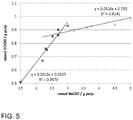
- FIG. 5 shows the acid value (mmol COOH per g of pulp) of TEMPO oxidations activated with chlorine dioxide as a function of hypochlorite dosage in a one-step process. The figure shows that up to the oxidation level of 0.9 mmol/g pulp the 1-step method is efficient as to the consumption of the main oxidant, hypochlorite.
- the graph of Fig. 5 shows that cellulose can be easily oxidized to the acid value range of 0.8 to 0.9 mmol of COOH per g of pulp. After this, the reaction rate becomes lower and the consumption of NaClO increases and the viscosity decreases as a result of degradation of polymers.
- the acid value range 0.8 to 0.9 can be kept as an optimum target for selective oxidation.
- the content of remaining aldehydes in the product after step 1 is typically ⁇ 0.2 mmol per g of pulp, which is clearly lower than in a typical reaction in which the level is between 0.2 and 0.35 mmol per g of pulp. This is probably due to the lower reaction rate, wherein there is also more time for oxidation reactions of aldehydes to carboxylates to take place.
- the oxidized pulp (0.82 mmol COOH / g pulp) sample was fibrillated using "Atrex" dispergator, which is a device which subjects the pulp to impacts from opposite directions at a high frequency, consisting of concentric cylindrical rotors with through flow passages formed by spaced impact blades.
- the achived properties were: Zero shear viscosity 18 000 Pa s, yield stress 22 Pa and turbidity 24 NTU.
- Turbidity may be measured quantitatively using optical turbidity measuring instruments.
- turbidometers There are several commercial turbidometers available for measuring quantitatively turbidity. In the present case, the method based on nephelometry is used.
- the units of turbidity from a calibrated nephelometer are called Nephelometric Turbidity Units (NTU).
- NTU Nephelometric Turbidity Units
- a nanofibrillar cellulose sample is diluted within a liquid, preferably in water, to a concentration below the gel point of said nanofibrillar cellulose, and turbidity of the diluted sample is measured.
- Said concentration where the turbidity of the nanofibrillar cellulose samples is measured is 0.1%.
- the mean value and standard deviation are calculated from the obtained results, and the final result is given as NTU units.
- HACH P2100 Turbidometer, with a 50 ml measuring vessel was used for turbidity measurements.
- the NFC was diluted with deionised water to a concentration of 0.5 and 200 g of the mixture was homogenised with a Büchi-mixer (B-400, max 2100 W, Büchi Labortechnik AG, Switzerland) for 3 x 10s.
Landscapes
- Chemical & Material Sciences (AREA)
- Life Sciences & Earth Sciences (AREA)
- Engineering & Computer Science (AREA)
- Organic Chemistry (AREA)
- Health & Medical Sciences (AREA)
- Chemical Kinetics & Catalysis (AREA)
- Medicinal Chemistry (AREA)
- Polymers & Plastics (AREA)
- Materials Engineering (AREA)
- Biochemistry (AREA)
- Wood Science & Technology (AREA)
- Polysaccharides And Polysaccharide Derivatives (AREA)
- Paper (AREA)
- Catalysts (AREA)
Description
- The invention relates to a method for catalytic oxidation of cellulose using a heterocyclic nitroxyl radical as catalyst.
- Cellulose is a renewable natural polymer that can be converted to many chemical derivatives. The derivatization takes place mostly by chemical reactions of the hydroxyl groups in the β-D-glucopyranose units of the polymer. By chemical derivatization the properties of the cellulose can be altered in comparison to the original chemical form while retaining the polymeric structure. Reaction selectivity is important so that a derivative of desired chemical structure could be obtained.
- Heterocyclic nitroxyl compounds are known as catalysts that participate in the selective oxidation of C-6 hydroxyl groups of cellulose molecules to aldehydes and carboxylic acids, the corresponding oxoammonium salt being known as the active direct oxidant in the reaction series. One of these chemical oxidation catalysts known for a long time is "TEMPO", i.e. 2,2,6,6-tetramethylpiperidinyl-1-oxy free radical. Thus, the oxidized forms of the nitroxyl radicals, N-oxoammoniumions, act as direct oxidants in the oxidation of the target cellulose molecule, whereas a main oxidant is used to bring oxygen to the reaction series and convert the nitroxyl compound back to the oxidized form.
- It is known to oxidize primary alcohols to aldehydes and carboxylic acids through "TEMPO" by using sodium hypochlorite as the main oxidant (for example Anelli, P. L.; Biffi, C.; Montanari, F.; Quici, S.; J. Org. Chem. 1987, 52, 2559). To improve the yield in the oxidation of the alcohols to carboxylic acids, a mixture of sodium hypochlorite and sodium chlorate was also used (Zhao, M. M.; Li, J.; Mano, E.; Song, Z. J.; Tschaen, D. M.; Org. Synth. 2005, 81, 195).
- It is also known procedure to catalytically oxidize cellulose in native cellulose fibers through "TEMPO" by using sodium hypochlorite as main oxidant (oxygen source) and sodium bromide as activator (Saito, T. et al.; Cellulose Nanofibers Prepared by TEMPO-Mediated Oxidation of Native Cellulose, Biomacromolecules 2007, 8, 2485-2491). The primary hydroxyl groups (C6-hydroxyl groups) of the cellulosic β-D-glucopyranose units are selectively oxidized to carboxylic groups. Some aldehyde groups are also formed from the primary hydroxyl groups. When the fibers of oxidized cellulose so obtained are disintegrated in water, they give stable transparent dispersion of individualized cellulose fibrils of 3-5 nm in width, that is, nanofibrillated cellulose (NFC) or "nanocellulose".
-
EP1264845 discloses a method of making a carboxylated carbohydrate. The method involves the use of a catalytic amount of a hindered cyclic oxammonium compound as a primary oxidant and chlorine dioxide as a secondary oxidant in an aqueous environment. -
WO01/29309 -
US6716976 discloses a process for oxidizing cellulose in which a nitroxyl compound such as TEMPO is oxidized using an oxidizing agent in the presence of a complex of a transition metal such as Mn, Fe, Cu, and a complexing agent such as polyamine, or an oxidative enzyme, and the resulting nitrosonium ion is used to selectively oxidize cellulose 6-hydroxymethylene groups to carbaldehyde groups and carboxylic acid groups. - Selectivity of the oxidation is important so that chemicals used are not consumed to unwanted side reactions. Selectivity can be defined as ratio of carboxylic groups formed to the main oxidant consumed.
- Normally the catalytic oxidation is done in LC (low consistency 1-4 %) to have good mixing. Especially in the beginning of the reaction efficient mixing is important, because the reaction initially proceeds fast after the addition of NaClO is started. However, at this consistency range, the production costs are really higher because more chemicals are needed because of side reactions, and water consumption is high. The required size of the apparatus will also be higher because of large water volumes handled. Raising the consistency has not been considered a feasible alternative because the energy demand would rise too high to ensure efficient mixing by agitation. Intensive mixing also tends to rise the temperature of the reaction medium above the optimum range.
- The use of sodium bromide as activator is preferred because it accelerates the reaction. For example
WO01/29309 - The use of bromine compounds in the oxidation reaction is problematic because of environmental concerns. Sodium bromide is usually used in the reaction mixture in relatively large amounts and it is difficult to remove bromide residues from the final cellulose product. Bromine compounds also accumulate in process waters. Further, the use of bromine in industrial scale is undesirable. Use of large amounts of sodium bromide cause corrosion problems in the equipment. Bromine compounds are generally recognized as hazardous to health, for example bromate which is formed as a result of side reactions is a suspected carcinogen.
- It is a purpose of the invention to provide a method for effectively and selectively oxidizing the C-6 hydroxyl groups of cellulose.
- One embodiment provides a method for catalytic oxidation of cellulose using a heterocyclic nitroxyl radical as catalyst, main oxidant acting as oxygen source, and an activator of the heterocyclic nitroxyl radical, wherein the oxidation is performed in a reaction medium which is at medium consistency of cellulosic pulp, which is above 6%, more preferably equal to or higher than 8%, and most preferably in the range of 8-12%, by mixing the reaction medium in a reactor through circulation of the reaction medium through a circulation loop back to the reactor
- One embodiment provides a method for making a cellulose product, comprising
- subjecting fibrous starting material, especially fibers obtained from plant material, to oxidation by said method for catalytic oxidation of cellulose using a heterocyclic nitroxyl radical as catalyst to obtain oxidized fibrous material, and
- disintegrating the oxidized fibrous raw material.
- It is a further object to provide a method for making nanofibrillar cellulose.
- The present application discloses a cellulose product, which is nanofibrillar cellulose (NFC) where the cellulose is in oxidized form as a result of catalytic oxidation of cellulose by said method for catalytic oxidation of cellulose using a heterocyclic nitroxyl radical as catalyst.
- Selectivity can be increased by performing the oxidation at medium consistency, that is, at an initial consistency of the cellulosic raw material that is higher than normally used. The consistency of the pulp is above 6%, more preferably equal to or higher than 8%, and most preferably in the range of 8 - 12% by weight. Within the last-mentioned range, the optimum consistency seems to be in the range of 9-11%. In the reaction conditions, the medium-consistency pulp behaves, contrary to what might be expected, like low-consistency pulp, and the mixing can be performed in a simpler way without compromising the efficiency of the reaction.
- The mixing at medium consistency is performed by circulating the reaction medium (mixture of the catalyst, cellulosic raw material, oxidant and other substances in liquid carrier). Circulating the reaction medium for example by a pump allows to mix the reaction medium with lower energy input, and excess heating due to intensive agitating is avoided. The temperature of the reaction can thus more easily be maintained in a range which does not exceed 40°C. The temperature is preferably kept at the optimal level of 25 - 35°C.
- The cooling can be improved as a result of the circulation loop, where the reaction medium flows outside its main volume. The cooling can take place by the effect of surrounding ambient temperature or additional cooling during the flow of the reaction medium in the circulation loop.
- The circulation of the reaction medium can be utilized also in dosing the various reactants to the reaction medium, because they can be at least partly dosed into the circulation flow of the reaction medium.
- Further, by a proper choice of the activator the nitroxyl radical can be activated to the oxidized state without the use of bromide. In the medium-consistency oxidation process, the heterocyclic nitroxyl radical is preferably activated by chlorine dioxide. According to another alternative, the heterocyclic nitroxyl radical can be activated by a tertiary amine.
- The main oxidant in the reaction is hypochlorite. Chlorine dioxide is used as the activator and hypochlorite, for example sodium hypochlorite (NaClO), as the main oxidant at a neutral or basic pH. The oxidation reaction is preferably performed to the desired conversion degree in this one step by circulating the reaction medium simultaneosusly through the circulation loop.
- it is also possible to perform the conversion in a two-step process, where in a second step, the pH is made acidic and the remaining aldehyde groups of cellulose are oxidized to carboxylic groups by chlorite, for example sodium chlorite (NaClO2). By using the two step method in the ClO2 activation, the selectivity can be further improved and the total oxidation time from hydroxyl to carboxylate can be made shorter. However, when the reaction is performed at a higher consistency than usually, the side reactions harmful to the fibrous material are decreased, breakage of cellulose is avoided, and the DP value is better retained. Therefore, the one-step reaction is sufficient to retain the advantageous properties of the fibrous end product, and the change of the reaction conditions and reactants can be avoided when using the method. After the cellulose is subjected to oxidation at the medium consistency, it can be processed to a final cellulose product. When the starting material is pulp derived from plants, especially wood, the cellulose exists in fiber form. The fibers that contain the cellulose in oxidized form are easy to disintegrate by mechanical methods to small-scaled fragments, nanofibrillar cellulose (NFC). The method for forming the cellulose product comprises the first process of catalytic oxidation of the fibrous starting material and the second process of disintegration the oxidized starting material to nanofibrillar cellulose.
- In the following, the invention will be described with reference to the appended drawings, where
-
Fig. 1 shows the general principle of the method in form of a reaction apparatus -
Fig. 2 shows a reaction apparatus according to another example, and -
Fig. 3-5 show results of some oxidation experiments. - In the following disclosure, all percent values are by weight, if not indicated otherwise. Further, all numerical ranges given include the upper and lower values of the ranges, if not indicated otherwise.
- The primary hydroxyl groups of cellulose are oxidized catalytically by a heterocyclic nitroxyl compound, for example 2,2,6,6-tetramethylpiperidinyl-1-oxy free radical, "TEMPO". Other heterocyclic nitroxyl compounds known to have selectivity in the oxidation of the hydroxyl groups of C-6 carbon of the glucose units of the cellulose can also be used, and these compounds are widely cited in the literature. Hereinafter, the oxidation of cellulose refers to the oxidation of these hydroxyl groups to aldehydes and/or carboxyl groups. It is preferred that the hydroxyl groups are oxidized to carboxyl groups, that is, the oxidation is complete.
- Whenever the catalyst "TEMPO" is mentioned in this disclosure, it is evident that all measures and operations where "TEMPO" is involved apply equally and analogously to any derivative of TEMPO or any heterocyclic nitroxyl radical capable of catalyzing selectively the oxidation of the hydroxyl groups of C-6 carbon in cellulose.
- In the following description, catalytic oxidation refers to nitroxyl-mediated (such as "TEMPO"-mediated) oxidation of hydroxyl groups. The catalytic oxidation of fibers or fibrous material in turn refers to material which contains cellulose that is oxidized by nitroxyl-mediated (such as "TEMPO"-mediated) oxidation of hydroxyl groups of the cellulose.
- When medium consistency of the pulp is used, the selectivity of the cellulose oxidation can be improved, because the desired reactions take place in the fiber, whereas the unwanted side reactions take place in the solution phase. At the starting pulp consistencies higher than 6%, the cellulose can be oxidized to the oxidation levels of 0.5 - 1.4 mmol COOH/g pulp, preferably 0.6 - 1.1 and most preferably 0.7 - 0.9 with high selectivity. Further, any other oxidation levels mentioned in this disclosure can be obtained at these higher starting pulp consistencies.
- For the purpose of making nanofibrillar cellulose (NFC), it has been found that the oxidation level (conversion degree) of 0.5 - 1.0 mmol COOH/g pulp, preferably 0.6 - 0.95 and most preferably 0.7 - 0.9 is already sufficient that the cellulose fibers can be easily disintegrated to fibrils by mechanical energy. Conventionally, it has been the aim to reach conversion degrees above 1.0 mmol/g pulp for making NFC.
-
Fig. 1 shows a reaction apparatus according to a first example. The apparatus comprises a substantially closedtank reactor 1 and acirculation loop 2, through which the reaction medium is taken from thetank reactor 1 and returned back to the tank reactor. The flow of the medium through theloop 2, which can be a pipe of suitable diameter, is caused by acirculation pump 3. The movement of the reaction medium through the loop will cause enough mixing inside the tank reactor. Internal moving agitators are not needed in the tank reactor or their mixing power can be lowered due to the sufficient mixing effect already caused by the circulation. -
Feeding channel 4, through which thetank reactor 1 is initially filled with the reaction medium, can be also used for dosing the chemicals initially needed to start the oxidation reaction of cellulose. Feed pump is the feeding channel is denoted with 5. After the reaction is complete, the product is taken out through aproduct line 6 connected to thecirculation loop 2. Valves necessary to control the direction of flows are not shown. - The chemicals that can be initially dosed to the reaction medium in the
feeding channel 4 are the activated heterocyclic nitroxyl compound (arrow A) and the initial dose of the main oxidant, preferably hypochlorite, which is the oxygen source (arrow B). As the reaction proceeds, more main oxidant can be added to the circulation loop 2 (arrow C) and the pH control by alkaline agent addition can also accomplished through the circulation loop 2 (arrow D) to keep the pH of the reaction medium at the desired range. - The circulation loop will also cool the reaction medium as it flows along the pipe in close proximity to the ambient temperature (room temperature) outside the pipe. Additional cooling can be provided in the
circulation loop 2 by a heat exchanger 7. Thetank reactor 1 itself needs not be a tank equipped with a cooling jacket, but it can be of simpler wall construction. - All constituents are supplied to the tank reactor so that the reaction medium is at medium consistency of above 6%, more preferably equal to or higher than 8%, and most preferably in the range of 8 - 12% when the oxidation process starts.
- It is advantageous to add the main oxidant, such as hypochlorite, continuously as the oxidation of cellulose proceeds to avoid excess concentrations which may cause unwanted side reactions.
- After the desired conversion degree has been attained, the reaction medium is taken out from the reactor through the
product line 6. The fibres containing the oxidized cellulose are separated from the reaction medium, and the reaction medium is possibly reused. Regeneration measures making it possible to reuse at least some of the constituents of the reaction medium are not described herein in closer detail. The fibres are washed to remove the remnants of the chemicals and processed further, especially to NFC. -
Fig. 2 shows another example of the reaction apparatus. As the reaction medium was taken to thecirculation loop 2 at the bottom of thetank reactor 1 and returned to the top of the reactor in the example ofFig. 1 , the flow of the medium is now inverse (exit to theloop 2 through the top and return from theloop 2 through the bottom). Reference numerals indicate parts with similar function as inFig. 1 . Thereactor 1 is a plug-flow type reactor, which can be provided with static mixers inside the reactor. There is no separate feeding channel, but thecirculation loop 2 can be used for feeding the initial constituents of the reaction medium and the chemicals needed (main oxidant and alkaline agent) as the oxidation proceeds. After the reaction is complete, the final steps are the same as in the example ofFig. 1 . - The mixing concepts of the reaction apparatuses of
fig. 1 and 2 is based on the unexpected observation that the mixture of the chemicals in the reaction medium and the properties of the modified pulp make mixing in medium consistency easier than with normal pulp. Therefore reactors that do not apply so much energy (and increase the pulp temperature) are not needed. The chemical reactions change the pulp viscosity to such an extent that in the reactor LC (low consistency) mixing can be used. Probably also the high salt concentration in the medium consistency range facilitates mixing. - When the fibres are at higher consistencies, their separation of the liquid phase of the reaction medium is easier, and the washing is also simpler and easier. If the modified (oxidized) cellulose fibers are disintegrated into fibrils to make nanofibrillar cellulose, this can be done at higher consistency. Because the ratio of fibers to liquid is higher, reuse of the liquid reaction medium is easier because of smaller volumes of liquid to be handled. The recovery of the catalyst form the liquid medium for reuse purposes is also easier because of smaller volumes.
- Although auxiliary mixing in the form of agitation inside the reaction tank can be used, it can be said that the main proportion of the mixing energy input to the reaction medium is due to the circulation. In the practice, the circulation pump output is higher than the agitator motor output, if auxiliary agitation is used.
- In the following, some reaction procedures are given as examples. However, the method is not limited to given reaction schemes, but can be used in all reactions where cellulose existing in fibres is catalytically oxidized using the nitroxyl-mediated oxidation of hydroxyl groups of cellulose and which can be used in reaction apparatuses of
Figs. 1 and 2 at medium consistencies of the pulp. - According to preferred embodiment, chlorine dioxide is used as the activator of the heterocyclic N-nitroxyl compound. The main oxidant is hypochlorite. After the desired conversion degree has been reached by using these reagents, the reaction medium can be removed from the reactor, the fibers can be separated and treated further. The oxidation process can also be a two-step process where in the first step the nitroxyl catalyst is activated with chlorine dioxide and hypochlorite is used as the main oxidant. The reaction proceeds rapidly and produces partly aldehyde groups. The pH in the first phase is preferably between 7.5 and 8.5, these values included, but a wider range, from 6 to 10, may also be used. Compared with other activating methods, the activation with ClO2 improves the oxidation selectivity outstandingly.
- When the first step has proceeded to so that a desired conversion degree is reached, the first step is stopped. The partly oxidized cellulose can be washed and the second step is performed in a reaction medium where the pH is clearly on acidic side, about 1.5 - 4, preferably 2 - 3. Preferably the second step is performed at a pH below 3. The stop point of the first step can be chosen according to the consumption of the main oxidant or any other way. Alternatively, the pH of the reaction medium of the first step can be lowered directly to the pH range of the second step at the stop point.
- When the pH is lowered, chlorite, for example NaClO2, is added to the reaction medium. In this second step, the remaining aldehyde groups are rapidly oxidized to carboxyl groups with chlorite as the main oxidant. Dimethyl sulfoxide (DMSO) can be used in the reaction medium in the second step to eliminate the formation of hypochlorite from chlorite.
- Usually the first step is stopped when the carboxylate content of 0.6 - 1.0 mmol/g pulp is reached. The second step increases the carboxylate content by completing the oxidation.
- If the partly oxidized cellulose is washed between the steps, the reaction medium is taken from the
tank reactor 1 as described above, and the new reaction medium which contains the cellulose partly oxidized in the first step is fed to the tank reactor. The second oxidation step can take place in a similar manner as the first step. - By the combination of first and second steps the overall reaction from hydroxyl groups until carboxyl groups is fast with good selectivity. The activation of the nitroxyl radical (for example "TEMPO" radical) to oxidized form by ClO2 and further oxidation of C6 hydroxyl groups of pulp by hypochlorite as the main oxidant is a selective and fast reaction if all available hydroxyl groups are not oxidized. The residual aldehydes can be converted to carboxylates by the further acid phase (the second step). The acid phase in the end is preferable also in the sense that the oxidized pulp is easier to wash at acidic conditions.
- The reaction scheme of the first step is given below in
scheme 1. Chlorine dioxide is needed only for the conversion of the catalyst from the radical form to the active, oxidized form.
- The conversion of residual aldehydes to carboxyl groups by oxidation in the second step stabilizes the oxidized cellulose. The reaction scheme is shown below.

- The temperature in the first step can be between 20 and 50°C and in the second step between 20 and 80°C, preferably 40 and 80°C. The optimum temperature of the second step is about 50°C. However, due to the tendency of the hypochlorite to decompose, the optimum temperature of the first step is not higher than 40°C, preferably between 25-35°C, which is a good compromise of the high reaction rate and low consumption of hypochlorite and can be easily accomplished by reaction arrangements of
Figs. 1 and 2 at medium consistencies of the starting pulp. - According to another embodiment, the cellulose is oxidized at the medium consistency catalytically by using hypochlorite as main oxidant and tertiary amine as cocatalyst. The presumed route is shown in the following scheme 3 (the heterocyclic nitroxyl catalyst is represented by R'2NOH in its reduced form and R'2N+O in its oxidized form). Bromide is not needed in this process either.

- The method is a one-step process where all reagents for achieving the oxidation are in the same reaction medium. However, the selectivity of the oxidation is higher when the main oxidant, NaClO is added in portions. The amine cocatalyst can also be added in portions during the reaction time, which increases the selectivity of the oxidation reaction. The pH used is slightly basic, 8 to 9.5. However, any pH value between 7 and 10, these values included, can also be used.
- The reaction using the amine as cocatalyst can be performed at room temperature or slightly elevated temperature, in the range of 20 - 50°C, preferably 25 - 35°C, in the absence of added bromide.
- Suitable tertiary amines are hexamethylenetetramine, 1,4-diazabicyclo[2,2,2]-octane (DABCO) and quinuclidine. However, the invention is not limited to the use of these amines as cocatalysts. Other stable amines, especially stable cyclic amines can be used.
- The method of oxidizing cellulose catalytically in the medium consistency using the reaction arrangements exemplified by
Figs. 1 and 2 is not, however, limited to oxidizing chemicals and activators expressly mentioned above. - The reaction medium in all methods described above is preferably water where the reagents and raw materials can be dissolved or dispersed.
- In the present application all results shown and calculations made, whenever they are related to the amount of pulp, are made on the basis of dried pulp.
- In general, the cellulose oxidized at the medium consistency of the pulp can be oxidized selectively to a desired conversion degree which is not full conversion but a conversion where it can be mechanically processed as described later, without loss of material. The reached conversion in the end of the process (in one-step or two-step) is 0.5 - 1.4 mmol COOH/ g pulp, preferably 0.6 - 1.1 mmol COOH/g pulp, most preferably 0.7 - 0.9 mmol COOH/g pulp.
- The dosage of hypochlorite to cellulose, to reach the above-mentioned conversions, can be 1.7 to 5 mmol/ g pulp, preferably 2.2 - 2.7 mmol / g pulp.
- In all above-described embodiments the catalytic oxidation can be performed without the use of bromide. Sodium bromide, which is conventionally used as activator and cocatalyst because of the faster reaction rate and high degree of oxidation, can be avoided in the catalytic oxidation process. Conventionally, the optimum pH when sodium bromide is used is 10. However, side reactions occur at this pH which cannot be avoided even at the relatively fast reaction rate. The DP value (degree of polymerization) will decrease considerably, which decreases the strength characteristics and gel forming ability of the NFC.
- Thus, the catalytic non-bromine oxidation with the heterocyclic nitroxyl radical as catalyst at the medium consistency of the pulp can be performed by using carefully defined conditions with regard to pH and temperature. The reaction is performed in neutral or slightly alkaline pH, in the range of 7-9, and at room temperature or slightly elevated temperature, in the range of 20 - 50°C, preferably 25 - 35°C, in the absence of added alkali metal halide. The selectivity (less C2 and C3 reactions) is improved, and bromine compounds are avoided. The slower oxidation reaction rate due to the lower pH is compensated by the temperature, which does not increase the side reactions as much as the higher pH. Chlorine oxide or any other activator can be used instead of alkali metal halide in the first step of catalytic oxidation with the hypochlorite as main oxidant using the above pH and temperature conditions. The second step of completing the oxidation is not necessarily needed, but if the residual aldehyde groups are to be oxidized to carboxyl groups, it is preferably performed by using chlorite as oxidant and protective substances for preventing unwanted side reactions in the second step, as explained above.
- Thus, for the purpose of making NFC, it has been found that the oxidation level (conversion degree) of 0.5 -1.0 mmol COOH/g pulp, preferably 0.6 - 0.95 and most preferably 0.7 - 0.9 is already sufficient that the cellulose fibers can be easily disintegrated to fibrils by mechanical energy. To reach this level, the one step oxidation process (only the first step of catalytic oxidation, irrespective of the activator of the catalyst) is usually sufficient. However it is also possible to complete the oxidation in the second step by oxidizing the residual aldehydes to carboxyl groups to obtain cellulose with the above-mentioned oxidation levels indicated as COOH/g pulp.
- When the higher consistency than conventionally is used (above 6%, more preferably equal to or higher than 8%, and most preferably in the range of 8-12%), the selectivity of the cellulose oxidation can be further improved, because the desired reactions take place in the fiber, whereas the unwanted side reactions take place in the solution phase. At these starting pulp consistencies, the cellulose can be oxidized to the above-mentioned oxidation levels of 0.5 - 1.0 mmol COOH/g pulp, preferably 0.6 - 0.95 and most preferably 0.7 - 0.9, either in the one step oxidation process or using the second step to complete the oxidation. Further, any other oxidation levels mentioned in this disclosure can be obtained at these higher than usual starting pulp consistencies (medium consistencies), either in the one-step oxidation process or using the second step after the first step in the reaction arrangements of
Figs. 1 and 2 . - At the above relatively low oxidation levels of 0.5 - 1.0 mmol COOH/g pulp, preferably 0.6 - 0.95 and most preferably 0.7 - 0.9, it is possible to obtain a stronger gel, when the fibers are disintegrated to fibrils, because there is less β-elimination. Thus, a lower degree of oxidation lowers the expenses on chemicals and helps to make a product of improved strength.
- The fibrous starting material, which can be pulp of plant origin, especially wood (softwood or hardwood pulp, for example bleached birch pulp) and where the cellulose molecules are oxidized in one of the above-described methods, is easy to disintegrate to nanofibrillar size, nanofibrillar cellulose or NFC.
- The term "nanofibrillar cellulose" refers to a collection of isolated cellulose microfibrils or microfibril bundles derived from cellulose raw material. Microfibrils have typically high aspect ratio: the length might exceed one micrometer while the number-average diameter is typically below 200 nm. The diameter of microfibril bundles can also be larger but generally less than 1 µm. The smallest microfibrils are similar to so called elementary fibrils, which are typically 2-12 nm in diameter. The dimensions of the fibrils or fibril bundles are dependent on raw material and disintegration method. The nanofibrillar cellulose may also contain some hemicelluloses; the amount is dependent on the plant source. Mechanical disintegration of the oxidized cellulose raw material is carried out with suitable equipment such as a refiner, grinder, homogenizer, colloider, friction grinder, ultrasound sonicator, fluidizer such as microfluidizer, macrofluidizer or fluidizer-type homogenizer.
- The NFC prepared from cellulose raw material oxidized with the methods above has excellent gelling ability, which means that it forms a gel at a low consistency in aqueous medium. When the oxidized pulp is ground at a consistency of about 1 to 4% in aqueous medium, a clear gel consisting of microfibrils in water (NFC gel) is obtained.
- In any of the preceding oxidation processes, the carboxylate content of 0.9 - 1.2 mmol COOH/ g starting pulp (on dry matter), preferably 1.0 - 1.1 mmol COOH/ g pulp is desirable so that the gel formation as a result of mechanical disintegration would be easy. However, as stated above, the carboxylate contents below 1.0 mmol are already sufficient to make NFC and they are preferrred if gel strength is preferred.
- Before the oxidized pulp is disintegrated to make the NFC, the pH of the medium is adjusted to 7 - 10, preferably 7 - 9, and most preferably to 7 - 8.5, which lowers the energy needed.
- The obtained NFC gel is characterized by shear thinning behaviour. The mean diameter of the microfibrils is 2-20 nm, preferably 2-6 nm, and the mean length is in the range of 0.3 - 5.0 µm, preferably 0.5 to 2 µm. The turbidity is below 70, preferably 20 to 60 NTU (0.1% concentration, nephelometric measurement). Measured at a 0.5% concentration in water, the gel has zero shear viscosity of 10000-50000 Pa·s, preferably 20000 - 50000 Pa·s if gel strength properties of the NFC are preferred, and yield stress of 8-40 Pa, preferably 10-30 Pa.
- In the following some experiments are described which shall not be regarded as limiting.
- Some oxidations were carried out with MC mixer at the consistency of 10% and some with MC pulper at the consistency up to 11%. The oxidation at a high consistency is, in theory, more selective, because the desired reactions take place in the fibre and the undesired side reactions take place in the solution phase. In practice, it has been possible to reduce the amount of the TEMPO catalyst and the chlorine dioxide in relation to the fibre quantity dosed by increasing the consistency. In our tests, we did not find problems in carrying out oxidations with TEMPO at increased consistencies up to medium consistencies. Typical reactions given in the prior art are carried out at a consistency of 1%, and not higher than 4%.
Fig. 3 shows that the selectivity of the oxidation (formed carboxylic acids per consumed hypochlorite) is improved when the consistency is increased in a low consistency range, 1 to 4%. - Table 2 shows oxidation results at a consistency of 10% (MC mixer). During oxidation, a MC mixer does not provide mixing corresponding to mixing with a Buchi reactor (
consistency 1 to 4%). Also the dosage of NaClO and the pH regulation are less accurate. Oxidation is good also at a consistency of 10%, and even better results can be obtained by using an apparatus with more accurate chemical dosage and pH regulation. Consequently, the results at medium consistency are promising. Table 3 shows oxidations carried out with a Buchi reactor at a consistency of 4%. Also included are two TEMPO derivatives: 4-methoxy-TEMPO and 4-acetamido-TEMPO. On the basis of the tests, it can be said that chlorine dioxide can be used to activate not only TEMPO but also TEMPO derivatives. The dosage of TEMPO can also be decreased (pulp 149 to 150) so that the selectivity of the oxidation is maintained. What is essential in optimizing the dosage of the catalyst to a lower level is to optimize the feeding of NaClO/NaOH simultaneously during the oxidation. It is clear that the TEMPO-derivatives and other conditions in table 3 can also be used at medium consistencies.Table 2. TEMPO oxidations activated with chlorine dioxide with a MC mixer at a consistency of 10%. Experiment pulp 112 pulp 113 pulp 114 pulp 115 pulp 116 pulp 117 pulp 118 pulp 120 HOCl addition (mmol NaClO / g pulp) 3.8 1.8 1.8 1.8 2.0 4.4 4.5 4.5 TEMPO addition (mmol/g pulp) 0.03 0.03 0.03 0.015 0.03 0.03 0.03 0.03 Molar ratio ClO2/TEMPO 2.2 1.8 1.7 2.7 2.7 2.9 3.8 5.7 mmol/g pulp (1 phase oxidation) 0.82 0.55 0.55 0.48 0.55 1.11 1.07 0.95 mmol / g pulp (2 phase oxidation) 0.72 0.63 0.80 1.14 1.17 1.13 Viscosity (ml/g) (1 phase oxidation) 137 164 196 179 159 135 129 153 Viscosity (ml/g) (2 phase oxidation) 382 213 298 145 205 225 Selectivity after 2 phase (mmol COOH /mmol NaClO) 0.31 0.34 0.25 0.25 0.23 Temperature (°C) 25 25 25 25 25 25 25 25 Table 3. TEMPO oxidations activated with chlorine dioxide with a Buchi reactor at a consistency of 4%. Experiment pulp 132 pulp 139 pulp 140 pulp 141 pulp 142 pulp 143 pulp 144 pulp 149 pulp 150 TEMPO derivative A B B C C C C C C Reaction time (min) 150 240 100 255 150 220 210 360 360 HOCl addition (mmol NaClO / g pulp) 2.3 2.3 2.3 2.3 2.3 2.3 2.3 2.3 2.3 TEMPO addition (mmol / g pulp) 0.05 0.05 0.05 0.05 0.075 0.05 0.05 0.04 0.025 Molar ratio TEMPO / ClO2 1.9 1.9 1.9 1.4 1.2 1.2 1.27 1.33 1.27 mmol / g pulp (1 phase oxidation) 0.76 0.78 0.75 0.68 0.59 0.65 0.68 0.78 0.70 mmol / g pulp (2 phase oxidation) 0.91 0.94 0.84 0.79 0.74 0.78 0.79 0.91 0.82 Viscosity (ml/g) (1 phase oxidation) 197 165 161 159 160 166 163 Viscosity (ml/g) (2 phase oxidation) 465 304 298 246 284 269 344 Selectivity after 2 phase (mmol COOH / mmol NaClO) 0.36 0.37 0.35 0.32 0.29 0.31 0.31 0.37 0.33 Temperature (°C) 25 25 35 25 25 35 35 25 25 TEMPO A 4-methoxy-TEMPO B 4-acetamido-TEMPO C - In still one test series, chlorine dioxide activated TEMPO oxidations were executed in MC pulper at pulp consistencies of 6-11%. Temperature (25-35°C), pH (7-8) and NaClO addition were adjusted manually during oxidation. Most of the experiments were executed by 2.3 mmol NaClO / g pulp addition. The results are shown in the following table 4.
Table 4. MC pulper oxidations at high consistencies. Selectivity means the molar ratio COOH / hypochlorite. Part of the hypochlorite oxidizes OH-groups to aldehydes, but only ratio COOH-groups/consumed NaClO is shown. Experimnet 1 2 3 4 5 6 7 8 9 Pulp consistency at start (%) 11 10,1 10,7 6 6 7,8 7,8 6 10 mmol TEMPO / g pulp 0,03 0,02 0,04 0,03 0,04 0,04 0,025 0,04 0,04 mmol NaClO/ g pulp dosage 2,3 2,3 2,3 2,3 2,3 2,3 2,3 2,7 2,7 mmol COOH/g pulp 0,79 0,69 0,8 0,71 0,72 0,77 0,71 0,82 0,85 selectivity NaClO / COOH 0,34 0,30 0,35 0,31 0,31 0,33 0,31 0,30 0,32 - The selectivity of chlorine dioxide activated TEMPO oxidation as a function of TEMPO dosage and pulp consistency (6-10 %) of the above experiments is shown also in
Figure 4 , with consistency values rounded. The maximum selectivity value (formation of COOH groups/ added NaClO) is 0.5 due the stoichiometry of reaction. 2 mol NaClO is consumed to formation of 1 mol COOH in cellulose because formation of COOH group from hydroxyl group goes via aldehyde intermediate. - According to these results is it obvious that higher pulp consistency increases the selectivity of chlorine dioxide activated TEMPO oxidation. The roughness of these experiments (manual pH and temperature control) does not interfere that phenomenon. The optimal conditions of oxidation according to these result is 10 - 11% pulp consistency and 0.03 - 0.04 mmol TEMPO / g pulp.
- The reaction conditions can be further improved by using the arrangements shown in
Figs. 1 and 2 , by using the circulation of the reaction medium through the loop as the main energy source of the mixing. - Some factors affecting the efficiency of the oxidation, especially selectivity, and applicable also to the oxidation of the cellulose at the medium consistencies of the pulp using the reaction arrangements described herein, are briefly discussed below.
- The selectivity of the oxidation can be improved by pumping NaClO at a low rate into the reactor during the oxidation. It has been found that the reaction rate does not depend on the concentration of HOCI in the reaction mixture but is constant when a sufficient quantity of hypochlorite is present in the reaction. The phenomenon behind the improved selectivity is the tendency of NaClO to decompose when the pH decreases. The decomposition of NaClO is stronger if the HOCI content in the solution is high during the oxidation. In a standard reaction, all the hypochlorite is added at a time. HOCI is decomposed into dichlorinemonoxide (Cl2O) which is a volatile compound. Dichlorinemonoxide is decomposed further into chlorate (-ClO3) in a reaction with hypochlorite.
- The oxidation of C6 hydroxyl groups of cellulose is fastest at the beginning of the process when there are a lot of free reactive groups left. As the number of reactive groups decreases, the oxidation rate becomes lower and a significant change takes place when the number of free reactive groups (amorphous cellulose and part of crystalline cellulose) is very small and the oxidation is directed to the crystalline cellulose. Thus, the oxidation proceeds primarily via degradation of the crystalline cellulose.
Figure 5 shows the acid value (mmol COOH per g of pulp) of TEMPO oxidations activated with chlorine dioxide as a function of hypochlorite dosage in a one-step process. The figure shows that up to the oxidation level of 0.9 mmol/g pulp the 1-step method is efficient as to the consumption of the main oxidant, hypochlorite. - Of the amorphous C6 OH groups, 83 to 98% are easily accessed; the corresponding figure in crystalline ranges is 10 to 15%. The graph of
Fig. 5 shows that cellulose can be easily oxidized to the acid value range of 0.8 to 0.9 mmol of COOH per g of pulp. After this, the reaction rate becomes lower and the consumption of NaClO increases and the viscosity decreases as a result of degradation of polymers. The acid value range 0.8 to 0.9 can be kept as an optimum target for selective oxidation. When a lower reaction rate and a higher temperature are applied, the content of remaining aldehydes in the product afterstep 1 is typically <0.2 mmol per g of pulp, which is clearly lower than in a typical reaction in which the level is between 0.2 and 0.35 mmol per g of pulp. This is probably due to the lower reaction rate, wherein there is also more time for oxidation reactions of aldehydes to carboxylates to take place. - The oxidized pulp (0.82 mmol COOH / g pulp) sample was fibrillated using "Atrex" dispergator, which is a device which subjects the pulp to impacts from opposite directions at a high frequency, consisting of concentric cylindrical rotors with through flow passages formed by spaced impact blades.
- Four passes through the device were used. Gel properties of nanofibrillar celluloses were measured using rheometer and turbidity with turbidometer.
- The achived properties were: Zero shear viscosity 18 000 Pa s, yield stress 22 Pa and turbidity 24 NTU.
- Turbidity may be measured quantitatively using optical turbidity measuring instruments. There are several commercial turbidometers available for measuring quantitatively turbidity. In the present case, the method based on nephelometry is used. The units of turbidity from a calibrated nephelometer are called Nephelometric Turbidity Units (NTU). The measuring apparatus (turbidometer) is calibrated and controlled with standard calibration samples, followed by measuring of the turbidity of the diluted NFC sample.
- In the method, a nanofibrillar cellulose sample is diluted within a liquid, preferably in water, to a concentration below the gel point of said nanofibrillar cellulose, and turbidity of the diluted sample is measured. Said concentration where the turbidity of the nanofibrillar cellulose samples is measured is 0.1%. The mean value and standard deviation are calculated from the obtained results, and the final result is given as NTU units. HACH P2100 Turbidometer, with a 50 ml measuring vessel was used for turbidity measurements.
- The NFC was diluted with deionised water to a concentration of 0.5 and 200 g of the mixture was homogenised with a Büchi-mixer (B-400, max 2100 W, Büchi Labortechnik AG, Switzerland) for 3 x 10s.
- The viscosity of the NFC dispersions was measured at 22°C with a stress controlled rotational rheometer (AR-G2, TA Instruments, UK) equipped with a narrow gap vane geometry (diameter 28 mm, length 42 mm) in a cylindrical sample cup having a diameter of 30 mm. After loading the samples to the rheometer they were allowed to rest for 5 min before the measurement was started. The steady state viscosity was measured with a gradually increasing shear stress (proportional to applied torque) and the shear rate (proportional to angular velocity) was measured. The reported viscosity (=shear stress/shear rate) at a certain shear stress was recorded after reaching a constant shear rate or after a maximum time of 2 min. The measurement was stopped when a shear rate of 1000 s-1 was exceeded.
Claims (13)
- A method for catalytic oxidation of cellulose using a heterocyclic nitroxyl radical as catalyst, main oxidant acting as oxygen source, and an activator of the heterocyclic nitroxyl radical, characterized in that the oxidation is performed in a reaction medium which is at medium consistency of cellulosic pulp, which is above 6%, more preferably equal to or higher than 8%, and most preferably in the range of 8-12%, by mixing the reaction medium in a reactor through circulation of the reaction medium through a circulation loop back to the reactor.
- The method according to claim 1, characterized in that at least part of the chemicals, such as the main oxidant and/or pH control agent, are added to the circulation of the reaction medium.
- The method according to claim 1 or 2, characterized in that chlorine dioxide or tertiary amine is used as the activator of the heterocyclic nitroxyl radical.
- The method according to any of claims 1 to 3, characterized in that hypochlorite is used as the main oxidant.
- The method according to any of the preceding claims, characterized in that the cellulose is oxidized to the desired level in one step or in two steps, and in oxidizing in two steps, the chlorine dioxide is used as the activator and hypochlorite as the main oxidant in a first catalytic step, and chlorite is used as oxidant completing the oxidation in a second step where the pH is lower compared with the first step, and
that during the first step pH is 6 to 10, preferably 7.5 to 8.5 and during the second step pH is 1.5 to 4, preferably 2 to 3. - The method according to claim 4, characterized in that the catalytic oxidation is performed at pH 7-9 and at temperature of 20-50°C, preferably 25-35°C.
- The method according to any of the preceding claims, characterized in that the oxidation is performed to a level of, 0.5 - 1.4 mmol COOH/g pulp, preferably 0.6 - 1.1 and most preferably 0.7 - 0.9.
- The method according to any of the above claims, characterized in that the cellulose subjected to oxidation is the cellulose in fibrous raw material, especially fibers obtained from plant material.
- A method for making a cellulose product, comprising- subjecting fibrous starting material, especially fibers obtained from plant material, to oxidation by any of the methods 1 to 7 to obtain oxidized fibrous material, and- disintegrating the oxidized fibrous raw material.
- The method according to claim 9, characterized in that the oxidized fibrous raw material is disintegrated to nanofibrillar cellulose (NFC).
- The method according to claim 10, characterized in that the nanofibrillar cellulose has the turbidity below 70, preferably between 20 to 60 NTU (nephelometric turbidity units) as measured at 0.1 % concentration in water.
- The method according to claim 10, characterized in that the nanofibrillar cellulose has the zero shear viscosity of 10000 to 50000 Pa·s, preferably 20000 to 50000, and yield stress of 8 - 40 Pa, preferably 10 - 30 Pa as measured at 0.5% concentration in water.
- The method according to any of claims 10 to 12, characterized in that the carboxylate content of the oxidized cellulose is at least 0.6 mmol COOH/ g pulp, preferably 0.7 - 1.4 mmol COOH/g pulp, most preferably 0.7 - 0.9 mmol COOH/g pulp.
Applications Claiming Priority (2)
| Application Number | Priority Date | Filing Date | Title |
|---|---|---|---|
| FI20126306A FI126847B (en) | 2012-12-13 | 2012-12-13 | Process for catalytic oxidation of cellulose and process for producing a cellulose product |
| PCT/FI2013/051166 WO2014091086A1 (en) | 2012-12-13 | 2013-12-13 | Method for catalytic oxidation of cellulose and method for making a cellulose product |
Publications (2)
| Publication Number | Publication Date |
|---|---|
| EP2931969A1 EP2931969A1 (en) | 2015-10-21 |
| EP2931969B1 true EP2931969B1 (en) | 2019-02-20 |
Family
ID=49880815
Family Applications (1)
| Application Number | Title | Priority Date | Filing Date |
|---|---|---|---|
| EP13812003.5A Active EP2931969B1 (en) | 2012-12-13 | 2013-12-13 | Method for catalytic oxidation of cellulose and method for making a cellulose product |
Country Status (9)
| Country | Link |
|---|---|
| US (1) | US10604589B2 (en) |
| EP (1) | EP2931969B1 (en) |
| JP (1) | JP6293780B2 (en) |
| CN (1) | CN104854275B (en) |
| BR (1) | BR112015013465B1 (en) |
| CA (1) | CA2893057C (en) |
| FI (1) | FI126847B (en) |
| UY (1) | UY35193A (en) |
| WO (1) | WO2014091086A1 (en) |
Families Citing this family (14)
| Publication number | Priority date | Publication date | Assignee | Title |
|---|---|---|---|---|
| FI127526B (en) * | 2012-11-03 | 2018-08-15 | Upm Kymmene Corp | Process for manufacturing nanofibrillar cellulose |
| FI20135773A7 (en) * | 2013-07-16 | 2015-01-17 | Stora Enso Oyj | A method of producing oxidized or microfibrillated cellulose |
| FI127002B (en) | 2013-07-29 | 2017-09-15 | Upm Kymmene Corp | Process for catalytic oxidation of cellulose and process for manufacturing cellulose product |
| FI125715B (en) * | 2013-12-11 | 2016-01-29 | Upm Kymmene Corp | Process for recovery of a catalytic converter |
| EP3161087B1 (en) | 2014-06-26 | 2023-12-27 | UPM Specialty Papers Oy | A substrate layer for a release liner comprising nanofibrillar cellulose |
| FI20146116A (en) * | 2014-12-18 | 2016-06-19 | Upm Kymmene Corp | Method and apparatus for controlling cellulosic catalytic oxidation |
| FI126398B (en) | 2014-12-18 | 2016-11-15 | Upm Kymmene Corp | Procedure for testing chemicals |
| FI125883B (en) | 2014-12-22 | 2016-03-31 | Upm Kymmene Corp | Treatment of a catalytically oxidized hydrogel of nanofibrillar cellulose |
| FI125884B2 (en) | 2014-12-22 | 2019-03-29 | Upm Kymmene Corp | Treatment of a high temperature nanofibrillar cellulose hydrogel |
| JP6619576B2 (en) * | 2015-07-24 | 2019-12-11 | 大王製紙株式会社 | Method for producing cellulose nanofiber |
| AT518624B1 (en) * | 2016-04-25 | 2018-10-15 | Applied Chemicals Handels Gmbh | Process for the preparation of a dry strength agent, in particular of glyoxylated polyacrylamide |
| CN106589141B (en) * | 2016-12-27 | 2019-06-21 | 杭州协合医疗用品有限公司 | A kind of new preparation method of oxidized cellulose |
| JP7283874B2 (en) * | 2018-09-04 | 2023-05-30 | 日本製紙株式会社 | Oxidized cellulose nanofibers and oxidized cellulose nanofiber dispersions |
| FR3105224B1 (en) | 2019-12-23 | 2023-06-02 | Inst Polytechnique Grenoble | Cellulose Pulp Catalytic Oxidation Process |
Family Cites Families (52)
| Publication number | Priority date | Publication date | Assignee | Title |
|---|---|---|---|---|
| JPS463901Y1 (en) | 1967-12-21 | 1971-02-10 | ||
| CA1261896A (en) * | 1985-12-09 | 1989-09-26 | Grace M. Donnelly | Computer assisted laboratory notebook kit |
| JP4074680B2 (en) | 1997-03-12 | 2008-04-09 | ダイセル化学工業株式会社 | Cellulose derivative and method for producing the same |
| US6770168B1 (en) * | 1999-02-15 | 2004-08-03 | Kiram Ab | Process for oxygen pulping of lignocellulosic material and recorvery of pulping chemicals |
| TR200102472T2 (en) * | 1999-02-24 | 2002-03-21 | Sca Hygiene Products Gmbh | Fiber materials with oxidized flood loz content and products made of them. |
| BR0008475A (en) | 1999-02-24 | 2002-02-05 | Sca Hygiene Prod Zeist Bv | Process for oxidizing cellulose, oxidized cellulose, and cellulose derivative |
| US6379494B1 (en) | 1999-03-19 | 2002-04-30 | Weyerhaeuser Company | Method of making carboxylated cellulose fibers and products of the method |
| DE19945757A1 (en) | 1999-09-24 | 2001-03-29 | Philips Corp Intellectual Pty | X-ray detector |
| DE19953591A1 (en) * | 1999-11-08 | 2001-05-17 | Sca Hygiene Prod Gmbh | Metal-crosslinkable oxidized cellulose-containing fibrous materials and products made from them |
| EP1149846B1 (en) | 2000-04-25 | 2003-09-10 | SCA Hygiene Products Zeist B.V. | Oxidation of polysaccharides with nitroxyls |
| US6540876B1 (en) | 2000-05-19 | 2003-04-01 | National Starch And Chemical Ivnestment Holding Corporation | Use of amide or imide co-catalysts for nitroxide mediated oxidation |
| US6821383B2 (en) | 2001-03-28 | 2004-11-23 | National Starch And Chemical Investment Holding Corporation | Preparation of modified fluff pulp, fluff pulp products and use thereof |
| US6919447B2 (en) * | 2001-06-06 | 2005-07-19 | Weyerhaeuser Company | Hypochlorite free method for preparation of stable carboxylated carbohydrate products |
| US20030051834A1 (en) * | 2001-06-06 | 2003-03-20 | Weerawarna S. Ananda | Method for preparation of stabilized carboxylated cellulose |
| US7001483B2 (en) * | 2003-08-05 | 2006-02-21 | Weyerhaeuser Company | Apparatus for making carboxylated pulp fibers |
| US20050028953A1 (en) | 2003-08-05 | 2005-02-10 | Severeid David E. | Methods for making carboxylated pulp fibers |
| US20050121159A1 (en) | 2003-12-08 | 2005-06-09 | Sca Hygiene Products Ab | Process for the oxidation of hydroxy compounds by means of nitroxy compounds |
| US20050121160A1 (en) | 2003-12-08 | 2005-06-09 | Sca Hygiene Products Ab | Process for the separation of organic nitrosonium and/or hydroxylamine compounds by means of cation exchange resins and recovery and oxidation processes based thereon |
| EP1541590A1 (en) | 2003-12-08 | 2005-06-15 | SCA Hygiene Products AB | Process for the oxidation of hydroxy compounds by means of nitroxy compounds |
| SE0403222L (en) * | 2004-12-30 | 2005-11-08 | Kvaerner Pulping Tech | Method for oxygen delignification of cellulose pulp at high pressure in several steps |
| AT501929B1 (en) | 2005-05-17 | 2007-04-15 | Dsm Fine Chem Austria Gmbh | Selective oxidation of primary alcohols comprises reacting copper with a ligand e.g. pyridine; adding 2,2,6,6-tetramethylpiperidin-1-oxyl and sodium hydroxide; introducing oxygen or air and adding the primary alcohol |
| EP2022802B1 (en) | 2007-08-10 | 2017-03-22 | Dow Global Technologies LLC | Nanoparticles from slightly oxidised cellulose |
| WO2009069641A1 (en) * | 2007-11-26 | 2009-06-04 | The University Of Tokyo | Cellulose nanofiber and process for production thereof, and cellulose nanofiber dispersion |
| WO2009084556A1 (en) * | 2007-12-28 | 2009-07-09 | Suncorporation | Image display device |
| AU2008344471B2 (en) * | 2007-12-28 | 2012-12-20 | Nippon Paper Industries Co., Ltd. | Processes for producing cellulose nanofibers, cellulose oxidation catalysts and methods for oxidizing cellulose |
| JP5351417B2 (en) | 2007-12-28 | 2013-11-27 | 日本製紙株式会社 | Cellulose oxidation method, cellulose oxidation catalyst, and cellulose nanofiber production method |
| JP2009209218A (en) | 2008-02-29 | 2009-09-17 | Univ Of Tokyo | Method for producing functional cellulose bead, and the functional cellulose bead |
| WO2009111915A1 (en) | 2008-03-12 | 2009-09-17 | Chongqing Shengkai Science & Technology Co., Ltd. | Bromide-free tempo-mediated oxidation of the primary alcohol in carbohydrate under two-phase conditions |
| JP2009068014A (en) | 2008-09-19 | 2009-04-02 | Toppan Printing Co Ltd | Water-soluble oxidized chitin and method for producing the same |
| CN102482842A (en) * | 2009-08-25 | 2012-05-30 | 国立大学法人东京大学 | Method for the hydrophilic processing of cellulose fibre and production method for hydrophilic cellulose fibre |
| CN102652154B (en) | 2009-12-11 | 2016-08-24 | 花王株式会社 | Composite |
| JP2011184475A (en) | 2010-03-04 | 2011-09-22 | Toppan Printing Co Ltd | Manufacturing method for oxidized cellulose, manufacturing method for oxidized cellulose dispersion liquid, and oxidized cellulose dispersion liquid |
| JP5617289B2 (en) | 2010-03-18 | 2014-11-05 | 凸版印刷株式会社 | Cellulose membrane and laminate material using the same |
| JP2011219551A (en) * | 2010-04-06 | 2011-11-04 | Asahi Kasei Fibers Corp | Method for oxidizing cellulose-structured material |
| US9388529B2 (en) * | 2011-02-24 | 2016-07-12 | Innventia Ab | Single-step method for production of nano pulp by acceleration and disintegration of raw material |
| JP2012188472A (en) * | 2011-03-08 | 2012-10-04 | Kao Corp | Method for producing polyuronic acid salt |
| JP5179616B2 (en) | 2011-03-30 | 2013-04-10 | 日本製紙株式会社 | Method for producing cellulose nanofiber |
| ES2553703T3 (en) | 2011-05-02 | 2015-12-11 | Kao Corporation | Method to produce alkaline cellulose |
| WO2012161708A1 (en) | 2011-05-25 | 2012-11-29 | Empire Technology Development Llc | Treating lignocellulosic materials |
| FI125707B (en) | 2011-06-09 | 2016-01-15 | Upm Kymmene Corp | A process for the catalytic oxidation of cellulose and a process for preparing a cellulose product |
| WO2013039070A1 (en) | 2011-09-12 | 2013-03-21 | グンゼ株式会社 | Method for producing hydrophilic cellulose fiber |
| WO2013047218A1 (en) | 2011-09-30 | 2013-04-04 | 日本製紙株式会社 | Method for producing cellulose nanofibers |
| US8641863B2 (en) | 2011-09-30 | 2014-02-04 | Weyerhaeuser Nr Company | Catalytic carboxylation of cellulose fibers in a continuous process with multiple additions of catalyst, secondary oxidant and base to a moving slurry of cellulose fibers |
| JP5846860B2 (en) | 2011-11-04 | 2016-01-20 | グンゼ株式会社 | Method for producing hydrophilic cellulose fiber |
| EP2826792B1 (en) | 2012-03-14 | 2022-01-05 | Nippon Paper Industries Co., Ltd. | Method for producing anion-modified cellulose nanofiber dispersion |
| CN102675475B (en) | 2012-05-24 | 2014-08-13 | 东华大学 | Method for preparing fibrilia carboxylation cellulose nanowhiskers |
| CN102776594A (en) | 2012-07-10 | 2012-11-14 | 东华大学 | Cellulose fiber-supported nano silver antibacterial material and preparation method thereof |
| CN102787444A (en) | 2012-08-18 | 2012-11-21 | 东华大学 | Preparation method of porous network structure fiber membrane of nano cellulose/silicon dioxide |
| JP6015232B2 (en) | 2012-08-23 | 2016-10-26 | 日本製紙株式会社 | Method for producing oxidized cellulose and cellulose nanofiber |
| US9328459B2 (en) | 2013-03-29 | 2016-05-03 | Weyerhaeuser Nr Company | Multi-stage catalytic carboxylation of mercerized cellulose fibers |
| FI127002B (en) | 2013-07-29 | 2017-09-15 | Upm Kymmene Corp | Process for catalytic oxidation of cellulose and process for manufacturing cellulose product |
| FI127246B (en) | 2013-09-02 | 2018-02-15 | Upm Kymmene Corp | A process for the catalytic oxidation of cellulose and a process for preparing a cellulose product |
-
2012
- 2012-12-13 FI FI20126306A patent/FI126847B/en active IP Right Grant
-
2013
- 2013-12-13 JP JP2015547104A patent/JP6293780B2/en active Active
- 2013-12-13 CA CA2893057A patent/CA2893057C/en active Active
- 2013-12-13 EP EP13812003.5A patent/EP2931969B1/en active Active
- 2013-12-13 WO PCT/FI2013/051166 patent/WO2014091086A1/en not_active Ceased
- 2013-12-13 US US14/650,666 patent/US10604589B2/en active Active
- 2013-12-13 UY UY0001035193A patent/UY35193A/en active IP Right Grant
- 2013-12-13 BR BR112015013465-3A patent/BR112015013465B1/en active IP Right Grant
- 2013-12-13 CN CN201380065108.2A patent/CN104854275B/en active Active
Non-Patent Citations (1)
| Title |
|---|
| None * |
Also Published As
| Publication number | Publication date |
|---|---|
| US10604589B2 (en) | 2020-03-31 |
| JP6293780B2 (en) | 2018-03-14 |
| BR112015013465A2 (en) | 2017-07-11 |
| JP2016504445A (en) | 2016-02-12 |
| BR112015013465B1 (en) | 2021-07-27 |
| EP2931969A1 (en) | 2015-10-21 |
| FI20126306L (en) | 2014-06-14 |
| WO2014091086A1 (en) | 2014-06-19 |
| CA2893057A1 (en) | 2014-06-19 |
| CA2893057C (en) | 2021-05-11 |
| CN104854275A (en) | 2015-08-19 |
| UY35193A (en) | 2014-07-31 |
| CN104854275B (en) | 2017-09-19 |
| US20150322171A1 (en) | 2015-11-12 |
| FI126847B (en) | 2017-06-15 |
Similar Documents
| Publication | Publication Date | Title |
|---|---|---|
| US10604589B2 (en) | Method for catalytic oxidation of cellulose and method for making a cellulose product | |
| EP3027658B1 (en) | Method for catalytic oxidation of cellulose and method for making a cellulose product | |
| EP2718329B1 (en) | Method for catalytic oxidation of cellulose and method for making a cellulose product | |
| US9969816B2 (en) | Method for catalytic oxidation of cellulose and method for making a cellulose product | |
| FI126386B (en) | Method for catalytic oxidation of cellulose | |
| WO2019161125A1 (en) | Batch processes for catalytic carboxylation of cellulose fibers | |
| EP3233925B1 (en) | Method and apparatus for controlling the catalytic oxidation of cellulose | |
| JP2020037650A (en) | Oxidized cellulose nanofiber and oxidized cellulose nanofiber dispersion liquid |
Legal Events
| Date | Code | Title | Description |
|---|---|---|---|
| PUAI | Public reference made under article 153(3) epc to a published international application that has entered the european phase |
Free format text: ORIGINAL CODE: 0009012 |
|
| 17P | Request for examination filed |
Effective date: 20150706 |
|
| AK | Designated contracting states |
Kind code of ref document: A1 Designated state(s): AL AT BE BG CH CY CZ DE DK EE ES FI FR GB GR HR HU IE IS IT LI LT LU LV MC MK MT NL NO PL PT RO RS SE SI SK SM TR |
|
| AX | Request for extension of the european patent |
Extension state: BA ME |
|
| DAX | Request for extension of the european patent (deleted) | ||
| 17Q | First examination report despatched |
Effective date: 20160407 |
|
| STAA | Information on the status of an ep patent application or granted ep patent |
Free format text: STATUS: EXAMINATION IS IN PROGRESS |
|
| GRAP | Despatch of communication of intention to grant a patent |
Free format text: ORIGINAL CODE: EPIDOSNIGR1 |
|
| STAA | Information on the status of an ep patent application or granted ep patent |
Free format text: STATUS: GRANT OF PATENT IS INTENDED |
|
| INTG | Intention to grant announced |
Effective date: 20180925 |
|
| GRAS | Grant fee paid |
Free format text: ORIGINAL CODE: EPIDOSNIGR3 |
|
| GRAA | (expected) grant |
Free format text: ORIGINAL CODE: 0009210 |
|
| STAA | Information on the status of an ep patent application or granted ep patent |
Free format text: STATUS: THE PATENT HAS BEEN GRANTED |
|
| AK | Designated contracting states |
Kind code of ref document: B1 Designated state(s): AL AT BE BG CH CY CZ DE DK EE ES FI FR GB GR HR HU IE IS IT LI LT LU LV MC MK MT NL NO PL PT RO RS SE SI SK SM TR |
|
| REG | Reference to a national code |
Ref country code: GB Ref legal event code: FG4D |
|
| REG | Reference to a national code |
Ref country code: CH Ref legal event code: EP |
|
| REG | Reference to a national code |
Ref country code: DE Ref legal event code: R096 Ref document number: 602013051082 Country of ref document: DE |
|
| REG | Reference to a national code |
Ref country code: AT Ref legal event code: REF Ref document number: 1098333 Country of ref document: AT Kind code of ref document: T Effective date: 20190315 |
|
| REG | Reference to a national code |
Ref country code: IE Ref legal event code: FG4D |
|
| REG | Reference to a national code |
Ref country code: SE Ref legal event code: TRGR |
|
| REG | Reference to a national code |
Ref country code: NO Ref legal event code: T2 Effective date: 20190220 |
|
| REG | Reference to a national code |
Ref country code: NL Ref legal event code: MP Effective date: 20190220 |
|
| REG | Reference to a national code |
Ref country code: LT Ref legal event code: MG4D |
|
| PG25 | Lapsed in a contracting state [announced via postgrant information from national office to epo] |
Ref country code: PT Free format text: LAPSE BECAUSE OF FAILURE TO SUBMIT A TRANSLATION OF THE DESCRIPTION OR TO PAY THE FEE WITHIN THE PRESCRIBED TIME-LIMIT Effective date: 20190620 Ref country code: FI Free format text: LAPSE BECAUSE OF FAILURE TO SUBMIT A TRANSLATION OF THE DESCRIPTION OR TO PAY THE FEE WITHIN THE PRESCRIBED TIME-LIMIT Effective date: 20190220 Ref country code: LT Free format text: LAPSE BECAUSE OF FAILURE TO SUBMIT A TRANSLATION OF THE DESCRIPTION OR TO PAY THE FEE WITHIN THE PRESCRIBED TIME-LIMIT Effective date: 20190220 Ref country code: NL Free format text: LAPSE BECAUSE OF FAILURE TO SUBMIT A TRANSLATION OF THE DESCRIPTION OR TO PAY THE FEE WITHIN THE PRESCRIBED TIME-LIMIT Effective date: 20190220 |
|
| PG25 | Lapsed in a contracting state [announced via postgrant information from national office to epo] |
Ref country code: BG Free format text: LAPSE BECAUSE OF FAILURE TO SUBMIT A TRANSLATION OF THE DESCRIPTION OR TO PAY THE FEE WITHIN THE PRESCRIBED TIME-LIMIT Effective date: 20190520 Ref country code: IS Free format text: LAPSE BECAUSE OF FAILURE TO SUBMIT A TRANSLATION OF THE DESCRIPTION OR TO PAY THE FEE WITHIN THE PRESCRIBED TIME-LIMIT Effective date: 20190620 Ref country code: GR Free format text: LAPSE BECAUSE OF FAILURE TO SUBMIT A TRANSLATION OF THE DESCRIPTION OR TO PAY THE FEE WITHIN THE PRESCRIBED TIME-LIMIT Effective date: 20190521 Ref country code: LV Free format text: LAPSE BECAUSE OF FAILURE TO SUBMIT A TRANSLATION OF THE DESCRIPTION OR TO PAY THE FEE WITHIN THE PRESCRIBED TIME-LIMIT Effective date: 20190220 Ref country code: HR Free format text: LAPSE BECAUSE OF FAILURE TO SUBMIT A TRANSLATION OF THE DESCRIPTION OR TO PAY THE FEE WITHIN THE PRESCRIBED TIME-LIMIT Effective date: 20190220 Ref country code: RS Free format text: LAPSE BECAUSE OF FAILURE TO SUBMIT A TRANSLATION OF THE DESCRIPTION OR TO PAY THE FEE WITHIN THE PRESCRIBED TIME-LIMIT Effective date: 20190220 |
|
| REG | Reference to a national code |
Ref country code: SK Ref legal event code: T3 Ref document number: E 31142 Country of ref document: SK |
|
| REG | Reference to a national code |
Ref country code: AT Ref legal event code: MK05 Ref document number: 1098333 Country of ref document: AT Kind code of ref document: T Effective date: 20190220 |
|
| PG25 | Lapsed in a contracting state [announced via postgrant information from national office to epo] |
Ref country code: CZ Free format text: LAPSE BECAUSE OF FAILURE TO SUBMIT A TRANSLATION OF THE DESCRIPTION OR TO PAY THE FEE WITHIN THE PRESCRIBED TIME-LIMIT Effective date: 20190220 Ref country code: IT Free format text: LAPSE BECAUSE OF FAILURE TO SUBMIT A TRANSLATION OF THE DESCRIPTION OR TO PAY THE FEE WITHIN THE PRESCRIBED TIME-LIMIT Effective date: 20190220 Ref country code: RO Free format text: LAPSE BECAUSE OF FAILURE TO SUBMIT A TRANSLATION OF THE DESCRIPTION OR TO PAY THE FEE WITHIN THE PRESCRIBED TIME-LIMIT Effective date: 20190220 Ref country code: EE Free format text: LAPSE BECAUSE OF FAILURE TO SUBMIT A TRANSLATION OF THE DESCRIPTION OR TO PAY THE FEE WITHIN THE PRESCRIBED TIME-LIMIT Effective date: 20190220 Ref country code: DK Free format text: LAPSE BECAUSE OF FAILURE TO SUBMIT A TRANSLATION OF THE DESCRIPTION OR TO PAY THE FEE WITHIN THE PRESCRIBED TIME-LIMIT Effective date: 20190220 Ref country code: ES Free format text: LAPSE BECAUSE OF FAILURE TO SUBMIT A TRANSLATION OF THE DESCRIPTION OR TO PAY THE FEE WITHIN THE PRESCRIBED TIME-LIMIT Effective date: 20190220 Ref country code: AL Free format text: LAPSE BECAUSE OF FAILURE TO SUBMIT A TRANSLATION OF THE DESCRIPTION OR TO PAY THE FEE WITHIN THE PRESCRIBED TIME-LIMIT Effective date: 20190220 |
|
| REG | Reference to a national code |
Ref country code: DE Ref legal event code: R097 Ref document number: 602013051082 Country of ref document: DE |
|
| PG25 | Lapsed in a contracting state [announced via postgrant information from national office to epo] |
Ref country code: PL Free format text: LAPSE BECAUSE OF FAILURE TO SUBMIT A TRANSLATION OF THE DESCRIPTION OR TO PAY THE FEE WITHIN THE PRESCRIBED TIME-LIMIT Effective date: 20190220 Ref country code: SM Free format text: LAPSE BECAUSE OF FAILURE TO SUBMIT A TRANSLATION OF THE DESCRIPTION OR TO PAY THE FEE WITHIN THE PRESCRIBED TIME-LIMIT Effective date: 20190220 |
|
| PLBE | No opposition filed within time limit |
Free format text: ORIGINAL CODE: 0009261 |
|
| STAA | Information on the status of an ep patent application or granted ep patent |
Free format text: STATUS: NO OPPOSITION FILED WITHIN TIME LIMIT |
|
| PG25 | Lapsed in a contracting state [announced via postgrant information from national office to epo] |
Ref country code: AT Free format text: LAPSE BECAUSE OF FAILURE TO SUBMIT A TRANSLATION OF THE DESCRIPTION OR TO PAY THE FEE WITHIN THE PRESCRIBED TIME-LIMIT Effective date: 20190220 |
|
| 26N | No opposition filed |
Effective date: 20191121 |
|
| PG25 | Lapsed in a contracting state [announced via postgrant information from national office to epo] |
Ref country code: SI Free format text: LAPSE BECAUSE OF FAILURE TO SUBMIT A TRANSLATION OF THE DESCRIPTION OR TO PAY THE FEE WITHIN THE PRESCRIBED TIME-LIMIT Effective date: 20190220 |
|
| PG25 | Lapsed in a contracting state [announced via postgrant information from national office to epo] |
Ref country code: TR Free format text: LAPSE BECAUSE OF FAILURE TO SUBMIT A TRANSLATION OF THE DESCRIPTION OR TO PAY THE FEE WITHIN THE PRESCRIBED TIME-LIMIT Effective date: 20190220 |
|
| REG | Reference to a national code |
Ref country code: CH Ref legal event code: PL |
|
| REG | Reference to a national code |
Ref country code: BE Ref legal event code: MM Effective date: 20191231 |
|
| PG25 | Lapsed in a contracting state [announced via postgrant information from national office to epo] |
Ref country code: MC Free format text: LAPSE BECAUSE OF FAILURE TO SUBMIT A TRANSLATION OF THE DESCRIPTION OR TO PAY THE FEE WITHIN THE PRESCRIBED TIME-LIMIT Effective date: 20190220 |
|
| PG25 | Lapsed in a contracting state [announced via postgrant information from national office to epo] |
Ref country code: IE Free format text: LAPSE BECAUSE OF NON-PAYMENT OF DUE FEES Effective date: 20191213 Ref country code: LU Free format text: LAPSE BECAUSE OF NON-PAYMENT OF DUE FEES Effective date: 20191213 |
|
| PG25 | Lapsed in a contracting state [announced via postgrant information from national office to epo] |
Ref country code: BE Free format text: LAPSE BECAUSE OF NON-PAYMENT OF DUE FEES Effective date: 20191231 Ref country code: LI Free format text: LAPSE BECAUSE OF NON-PAYMENT OF DUE FEES Effective date: 20191231 Ref country code: CH Free format text: LAPSE BECAUSE OF NON-PAYMENT OF DUE FEES Effective date: 20191231 |
|
| PG25 | Lapsed in a contracting state [announced via postgrant information from national office to epo] |
Ref country code: CY Free format text: LAPSE BECAUSE OF FAILURE TO SUBMIT A TRANSLATION OF THE DESCRIPTION OR TO PAY THE FEE WITHIN THE PRESCRIBED TIME-LIMIT Effective date: 20190220 |
|
| PG25 | Lapsed in a contracting state [announced via postgrant information from national office to epo] |
Ref country code: MT Free format text: LAPSE BECAUSE OF FAILURE TO SUBMIT A TRANSLATION OF THE DESCRIPTION OR TO PAY THE FEE WITHIN THE PRESCRIBED TIME-LIMIT Effective date: 20190220 Ref country code: HU Free format text: LAPSE BECAUSE OF FAILURE TO SUBMIT A TRANSLATION OF THE DESCRIPTION OR TO PAY THE FEE WITHIN THE PRESCRIBED TIME-LIMIT; INVALID AB INITIO Effective date: 20131213 |
|
| PG25 | Lapsed in a contracting state [announced via postgrant information from national office to epo] |
Ref country code: MK Free format text: LAPSE BECAUSE OF FAILURE TO SUBMIT A TRANSLATION OF THE DESCRIPTION OR TO PAY THE FEE WITHIN THE PRESCRIBED TIME-LIMIT Effective date: 20190220 |
|
| PGFP | Annual fee paid to national office [announced via postgrant information from national office to epo] |
Ref country code: GB Payment date: 20241227 Year of fee payment: 12 |
|
| PGFP | Annual fee paid to national office [announced via postgrant information from national office to epo] |
Ref country code: FR Payment date: 20241226 Year of fee payment: 12 |
|
| PGFP | Annual fee paid to national office [announced via postgrant information from national office to epo] |
Ref country code: SK Payment date: 20241119 Year of fee payment: 12 |
|
| PGFP | Annual fee paid to national office [announced via postgrant information from national office to epo] |
Ref country code: SE Payment date: 20241227 Year of fee payment: 12 |
|
| PGFP | Annual fee paid to national office [announced via postgrant information from national office to epo] |
Ref country code: DE Payment date: 20241227 Year of fee payment: 12 |
|
| PGFP | Annual fee paid to national office [announced via postgrant information from national office to epo] |
Ref country code: NO Payment date: 20241230 Year of fee payment: 12 |