EP2930612A2 - Rotating register file with bit expansion support - Google Patents
Rotating register file with bit expansion support Download PDFInfo
- Publication number
- EP2930612A2 EP2930612A2 EP15152752.0A EP15152752A EP2930612A2 EP 2930612 A2 EP2930612 A2 EP 2930612A2 EP 15152752 A EP15152752 A EP 15152752A EP 2930612 A2 EP2930612 A2 EP 2930612A2
- Authority
- EP
- European Patent Office
- Prior art keywords
- register
- regions
- processor
- pointers
- register file
- Prior art date
- Legal status (The legal status is an assumption and is not a legal conclusion. Google has not performed a legal analysis and makes no representation as to the accuracy of the status listed.)
- Withdrawn
Links
Images


Classifications
-
- G—PHYSICS
- G06—COMPUTING OR CALCULATING; COUNTING
- G06F—ELECTRIC DIGITAL DATA PROCESSING
- G06F9/00—Arrangements for program control, e.g. control units
- G06F9/06—Arrangements for program control, e.g. control units using stored programs, i.e. using an internal store of processing equipment to receive or retain programs
- G06F9/30—Arrangements for executing machine instructions, e.g. instruction decode
- G06F9/30098—Register arrangements
- G06F9/3012—Organisation of register space, e.g. banked or distributed register file
- G06F9/30134—Register stacks; shift registers
-
- G—PHYSICS
- G06—COMPUTING OR CALCULATING; COUNTING
- G06F—ELECTRIC DIGITAL DATA PROCESSING
- G06F9/00—Arrangements for program control, e.g. control units
- G06F9/06—Arrangements for program control, e.g. control units using stored programs, i.e. using an internal store of processing equipment to receive or retain programs
- G06F9/30—Arrangements for executing machine instructions, e.g. instruction decode
- G06F9/30098—Register arrangements
- G06F9/3012—Organisation of register space, e.g. banked or distributed register file
- G06F9/3013—Organisation of register space, e.g. banked or distributed register file according to data content, e.g. floating-point registers, address registers
-
- G—PHYSICS
- G06—COMPUTING OR CALCULATING; COUNTING
- G06F—ELECTRIC DIGITAL DATA PROCESSING
- G06F9/00—Arrangements for program control, e.g. control units
- G06F9/06—Arrangements for program control, e.g. control units using stored programs, i.e. using an internal store of processing equipment to receive or retain programs
- G06F9/30—Arrangements for executing machine instructions, e.g. instruction decode
- G06F9/30003—Arrangements for executing specific machine instructions
- G06F9/30007—Arrangements for executing specific machine instructions to perform operations on data operands
- G06F9/30032—Movement instructions, e.g. MOVE, SHIFT, ROTATE, SHUFFLE
-
- G—PHYSICS
- G06—COMPUTING OR CALCULATING; COUNTING
- G06F—ELECTRIC DIGITAL DATA PROCESSING
- G06F9/00—Arrangements for program control, e.g. control units
- G06F9/06—Arrangements for program control, e.g. control units using stored programs, i.e. using an internal store of processing equipment to receive or retain programs
- G06F9/30—Arrangements for executing machine instructions, e.g. instruction decode
- G06F9/30098—Register arrangements
- G06F9/3012—Organisation of register space, e.g. banked or distributed register file
- G06F9/30123—Organisation of register space, e.g. banked or distributed register file according to context, e.g. thread buffers
-
- G—PHYSICS
- G06—COMPUTING OR CALCULATING; COUNTING
- G06F—ELECTRIC DIGITAL DATA PROCESSING
- G06F9/00—Arrangements for program control, e.g. control units
- G06F9/06—Arrangements for program control, e.g. control units using stored programs, i.e. using an internal store of processing equipment to receive or retain programs
- G06F9/30—Arrangements for executing machine instructions, e.g. instruction decode
- G06F9/34—Addressing or accessing the instruction operand or the result ; Formation of operand address; Addressing modes
- G06F9/355—Indexed addressing
-
- G—PHYSICS
- G06—COMPUTING OR CALCULATING; COUNTING
- G06F—ELECTRIC DIGITAL DATA PROCESSING
- G06F9/00—Arrangements for program control, e.g. control units
- G06F9/06—Arrangements for program control, e.g. control units using stored programs, i.e. using an internal store of processing equipment to receive or retain programs
- G06F9/30—Arrangements for executing machine instructions, e.g. instruction decode
- G06F9/38—Concurrent instruction execution, e.g. pipeline or look ahead
- G06F9/3836—Instruction issuing, e.g. dynamic instruction scheduling or out of order instruction execution
- G06F9/3838—Dependency mechanisms, e.g. register scoreboarding
- G06F9/384—Register renaming
Definitions
- the present disclosure relates to rotating register files and, specifically, to rotating register files with bit expansion support.
- VLIW very long instruction word
- rotating register files are used to facilitate writing loop unrolling code by providing hardware support using a register pointer for physical index conversion. As the register pointer is incremented, the physical register mapping is incremented by a fixed amount for loop increments.
- conventional rotating register files may not be well suited when data expansion occurs within a loop, such as multiplication of two 16-bit data values resulting in a 32-bit data value, which may involve different update increment values for the register pointer.
- One known solution has been to use two separate register files with respective separate register pointers, for example, one for 16-bit data and another for 32-bit data.
- such a scheme using different register files may not be economical in terms of hardware resource efficiency. Accordingly, there is a need in the art for a flexible rotating register file that is not limited to a fixed register pointer increment.
- a disclosed method for accessing a rotating register file with bit expansion support in a processor includes dividing a register file into a plurality of regions, assigning a plurality of register pointers respectively to each of the regions, and assigning a plurality of increment values respectively to each of the register pointers.
- the method may include incrementing the register pointers respectively according to the increment values.
- a disclosed method of using a rotating register file with bit expansion support in a processor includes setting a plurality of increment values respectively for each of a plurality of register pointers.
- the plurality of increment values may include at least two different values.
- the method may include setting a plurality of regions of a register file respectively for each of the register pointers. Responsive to incrementing an instruction pointer for a next instruction, the method may include determining which of the register pointers corresponds to a virtual register number for the next instruction, calculating a physical register number in the register file, and rotating the register pointers through each of the regions respectively according to the increment values.
- Additional disclosed aspects for implementing a rotating register file with bit expansion support include non-transitory computer-readable memory media storing instructions executable in a processor, and a memory accessible to the processor storing executable instructions, and a processor implementing a rotating register file with bit expansion support.
- widget 12-1 refers to an instance of a widget class, which may be referred to collectively as widgets 12 and any one of which may be referred to generically as a widget 12.
- a physical index to a register file in a processor may be calculated using a virtual register index and a register pointer.
- the register pointer may be incremented by 1 at each process execution, causing the physical indices to rotate through the register file.
- Such functionality may be useful for software optimizations, such as loop unrolling and/or software pipelining.
- rotating register files may be limited to a fixed register pointer increment, which may be disadvantageous for certain kinds of looped operations, such as when data expansion occurs within a loop.
- the rotating register file with bit expansion support described herein may enable dividing a rotating register file into arbitrary regions and may assign different register pointer to each divided region.
- Each of the register pointers may have different update increments, such as 0, 1, or 2, depending on a desired data bit width and a corresponding program attribute. In this manner, registers may be flexibly assigned using desired regions according to individual program requirements.
- a single rotating register file may be used to handle 2, 4, 8, etc. sets of registers or may remain undivided with a single set using all the registers.
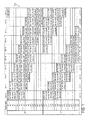
- FIG. 1 is a block diagram showing selected elements of an embodiment of register file 100, which is a rotating register file with bit expansion support, as described herein.
- register file 100 is implemented in a VLIW processor architecture.
- register file 100 includes 32 register entries, represented by virtual indices w0 through w31. It will be understood that register file 100 is shown in a given configuration for descriptive purposes and that, in different embodiments, register file 100 may be dimensioned with different numbers of entries. Register file 100 is further shown divided into two regions, each corresponding to a respective register pointer. Specifically, in FIG. 1 , register pointer rp0 represents a pointer for a first region of virtual indices w0 through w15 and is incremented by 1 to accommodate 16-bit data values. Although in the exemplary embodiment of register file 100 shown in FIG.
- register file 100 is divided into two regions, it is noted that in different embodiments, different number of regions, each region having a different size, and corresponding register pointers may be implemented.
- Register pointer rp1 represents a pointer for a second region of virtual indices w16 through w32 and is incremented by 2 to accommodate 32-bit data values.
- register file 100 is implemented with bit expansion support to handle both 16-bit data values and 32-bit data values in a single register file.
- a code example with loop unrolling including a 16-bit multiply operation, a 32-bit add operation, and a 16-bit bit shift operation is implemented.
- the code example may correspond to operations typically performed in a Fast Fourier Transform (FFT) operation.
- Program 1 below shows code in C-language syntax that may correspond to the code example implemented in register file 100, while Program 2 below shows assembly code corresponding to the same code example.
- Program 2 Assembly-code with loop unrolling L1: loop 0 to N-1 load.iu r5, addr0, 8; load.iu r7, addr1, 8; load.iu r9, addr2, 8; mult_hp r18, r19, r5, r7; mult_hp r22, r23, r5, r9; add_hp_c r11, r18, r19, r22, r23; store.iu r11, addr3, 8; goto L1;
- Program 2 load.iu is a load data with immediate address update command
- mult_hp is a multiply high precision command
- add_hp_c is an add high precision and cut command
- store. iu is a store data with immediate address update command.
- Program 2 may be implemented in an 8-way VLIW architecture using register file 100.
- An example of an 8-way VLIW pipeline is shown in Table 1, which may include 4 load/store words, 2 multiply words, 1 arithmetic logic word, and 1 register pointer update word.
- Table 1 8-way Very Long Instruction Word Pipeline LD/ST LD/ST LD/ST MULT MULT ALU LD/ST rp_update load/store load/store load/store multiply multiply arithmetic logic load/store register pointer update
- Program 3 shows how an implementation of the loop body of Program 2, comprising 7 operations, is assigned to an 8-way VLIW where 1 of the 8 ways is reserved for the register pointer update.
- Program 3 8-way VLIW assembly-code for register file 100 ⁇ load.iu w1, addr0, 8; load.iu w3, addr1, 8; load.iu w5, addr2, 8; mult_hp w18, w19, w2, w0; mult_hp w22, w23, w2, w0; add_hp_c w7, w16, w17, w20, w21; store.iu w6, addr3, 8; rp_update ⁇
- the loop body of Program 2 may be executed in parallel, since register file 100 has been divided to support both 16-bit and 32-bit data values.
- register file 100 shows how the register values are rotated as the loop unrolls with each iteration.
- rp0 is incremented by 1 with corresponding register file entries rotating by one 16-bit value
- rp1 is incremented by 2 with corresponding register file entries rotating by two 16-bit values or a 32-bit value, within register file 100.
- Equation 1 '%' represents the modulo operator.
- Register Entry Offset + VirtualRegisterNumber - Offset + AssignedRegisterNumber % NumberofAssignedRegisters Equation 1:
- Method 200 may be performed by a processor (see FIG. 4 ), for example, a processor having a VLIW architecture.
- instructions to perform method 200 are stored as firmware in a processor and accessed by an execution unit for execution to configure the processor. It is noted that certain operations depicted in method 200 may be rearranged or omitted, as desired.
- Method 200 may begin by dividing (operation 202) a register file in a processor into a plurality of regions.
- a plurality of register pointers may be respectively assigned (operation 204) to each of the regions.
- a plurality of increment values may be respectively assigned (operation 206) to each of the register pointers.
- the increment values may include at least two different increment values.
- the increment values may include a zero increment value.
- Each register pointer may be incremented (operation 208) according to the respective increment value, while register entries are rotated through each of the regions independently according to the increment values.
- a physical register number corresponding to a register pointer may be output (operation 210) and the register file may be accessed (operation 210) according to the physical register number.
- Method 300 may be performed by a processor (see FIG. 4 ), for example, a processor having a VLIW architecture.
- instructions to perform method 300 are stored as firmware in a processor and accessed by an execution unit for execution to configure the processor. It is noted that certain operations depicted in method 300 may be rearranged or omitted, as desired.
- Method 300 may begin by setting (operation 302) a plurality of increment values respectively for each of a plurality of register pointers. Then, a plurality of regions of a register file may be set (operation 304) respectively for each of the register pointers. An instruction pointer may be increment (operation 306) for a next instruction. Method 300 may then determine (operation 308) which of the register pointers corresponds to a virtual register number for the next instruction. A physical register number may be calculated (operation 310) from an offset, a virtual register number, a number of assigned registers, and an assigned register pointer value. The physical register number corresponding to a register pointer may be output (operation 312) and the register file may be accessed (operation 312) according to the physical register number.
- processor 400 may have a VLIW architecture and may implement software pipelining. As depicted in FIG. 4 , processor 400 includes execution 401 and memory media 410, which may communicate using processor bus 402.
- memory media 410 may represent volatile, non-volatile, fixed, and/or removable media, and may be implemented using magnetic and/or semiconductor memory.
- Memory media 410 is capable of storing instructions and/or data.
- memory media 410 stores instructions (i.e., code executable by execution unit 401) including firmware 414, which may implement the methods described herein to configure processor 400, for example for using and/or access rotating register files with bit expansion support.
- Register files 412 may represent memory elements used to implement processor registers and register files.
- a method and system for implementing rotating register files with bit expansion support may enable a plurality of register pointers, each with a respective increment value, to be implemented in a register file of a processor.
- the register pointers may correspond to different regions of the register file. Each region of the register file may have a different size.
Landscapes
- Engineering & Computer Science (AREA)
- Software Systems (AREA)
- Theoretical Computer Science (AREA)
- Physics & Mathematics (AREA)
- General Engineering & Computer Science (AREA)
- General Physics & Mathematics (AREA)
- Executing Machine-Instructions (AREA)
- Advance Control (AREA)
Abstract
Description
- The present disclosure relates to rotating register files and, specifically, to rotating register files with bit expansion support.
- In processor architectures designed to employ parallelism, very long instruction word (VLIW) architectures are known for having relatively simple hardware complexity and enabling various functionality through compiler software, such as software pipelining, where the program includes the decisions that determine how instructions are executed in parallel. With software pipelining, scheduling decisions may be made in a VLIW architecture at compile time.
- In some VLIW processor designs, rotating register files are used to facilitate writing loop unrolling code by providing hardware support using a register pointer for physical index conversion. As the register pointer is incremented, the physical register mapping is incremented by a fixed amount for loop increments. However, such conventional rotating register files may not be well suited when data expansion occurs within a loop, such as multiplication of two 16-bit data values resulting in a 32-bit data value, which may involve different update increment values for the register pointer. One known solution has been to use two separate register files with respective separate register pointers, for example, one for 16-bit data and another for 32-bit data. However, such a scheme using different register files may not be economical in terms of hardware resource efficiency. Accordingly, there is a need in the art for a flexible rotating register file that is not limited to a fixed register pointer increment.
- In an embodiment of one aspect, a disclosed method for accessing a rotating register file with bit expansion support in a processor includes dividing a register file into a plurality of regions, assigning a plurality of register pointers respectively to each of the regions, and assigning a plurality of increment values respectively to each of the register pointers. During execution of processor instructions, the method may include incrementing the register pointers respectively according to the increment values.
- In an embodiment of another aspect, a disclosed method of using a rotating register file with bit expansion support in a processor includes setting a plurality of increment values respectively for each of a plurality of register pointers. The plurality of increment values may include at least two different values. The method may include setting a plurality of regions of a register file respectively for each of the register pointers. Responsive to incrementing an instruction pointer for a next instruction, the method may include determining which of the register pointers corresponds to a virtual register number for the next instruction, calculating a physical register number in the register file, and rotating the register pointers through each of the regions respectively according to the increment values.
- Additional disclosed aspects for implementing a rotating register file with bit expansion support include non-transitory computer-readable memory media storing instructions executable in a processor, and a memory accessible to the processor storing executable instructions, and a processor implementing a rotating register file with bit expansion support.
- The invention is described, by way of example only, with reference to the following drawings, in which:
-
FIG. 1 is a block diagram of selected elements of an embodiment of a rotating register file with bit expansion support; -
FIG. 2 is a flowchart depicting selected elements of an embodiment of a method for accessing a rotating register file with bit expansion support; -
FIG. 3 is a flowchart depicting selected elements of an embodiment of a method for using a rotating register file with bit expansion support; and -
FIG. 4 is a block diagram of selected elements of a processor implementing a rotating register file with bit expansion support. - In the following description, details are set forth by way of example to facilitate discussion of the disclosed subject matter. It should be apparent to a person of ordinary skill in the field, however, that the disclosed embodiments are exemplary and not exhaustive of all possible embodiments.
- Throughout this disclosure, a hyphenated form of a reference numeral refers to a specific instance of an element and the un-hyphenated form of the reference numeral refers to the element generically or collectively. Thus, for example, widget 12-1 refers to an instance of a widget class, which may be referred to collectively as widgets 12 and any one of which may be referred to generically as a widget 12.
- In a conventional rotating register file, a physical index to a register file in a processor may be calculated using a virtual register index and a register pointer. The register pointer may be incremented by 1 at each process execution, causing the physical indices to rotate through the register file. Such functionality may be useful for software optimizations, such as loop unrolling and/or software pipelining.
- Thus, conventional rotating register files may be limited to a fixed register pointer increment, which may be disadvantageous for certain kinds of looped operations, such as when data expansion occurs within a loop. As will be described herein, the inventors of the present disclosure have discovered a rotating register file with bit expansion support. The rotating register file with bit expansion support described herein may enable dividing a rotating register file into arbitrary regions and may assign different register pointer to each divided region. Each of the register pointers may have different update increments, such as 0, 1, or 2, depending on a desired data bit width and a corresponding program attribute. In this manner, registers may be flexibly assigned using desired regions according to individual program requirements. Using the rotating register file with bit expansion support described herein, a single rotating register file may be used to handle 2, 4, 8, etc. sets of registers or may remain undivided with a single set using all the registers.
- Turning now to the drawings,
FIG. 1 is a block diagram showing selected elements of an embodiment ofregister file 100, which is a rotating register file with bit expansion support, as described herein. In one embodiment,register file 100 is implemented in a VLIW processor architecture. - As shown in
FIG. 1 ,register file 100 includes 32 register entries, represented by virtual indices w0 through w31. It will be understood thatregister file 100 is shown in a given configuration for descriptive purposes and that, in different embodiments,register file 100 may be dimensioned with different numbers of entries. Registerfile 100 is further shown divided into two regions, each corresponding to a respective register pointer. Specifically, inFIG. 1 , register pointer rp0 represents a pointer for a first region of virtual indices w0 through w15 and is incremented by 1 to accommodate 16-bit data values. Although in the exemplary embodiment ofregister file 100 shown inFIG. 1 , the register file is divided into two regions, it is noted that in different embodiments, different number of regions, each region having a different size, and corresponding register pointers may be implemented. Register pointer rp1 represents a pointer for a second region of virtual indices w16 through w32 and is incremented by 2 to accommodate 32-bit data values. Thus,register file 100 is implemented with bit expansion support to handle both 16-bit data values and 32-bit data values in a single register file. - In the example embodiment of
register file 100 shown inFIG. 1 , a code example with loop unrolling including a 16-bit multiply operation, a 32-bit add operation, and a 16-bit bit shift operation is implemented. The code example may correspond to operations typically performed in a Fast Fourier Transform (FFT) operation.Program 1 below shows code in C-language syntax that may correspond to the code example implemented inregister file 100, whileProgram 2 below shows assembly code corresponding to the same code example.Program 1: C-code with loop unrolling for (i=0; i < N; i++) { r0 = b[i] * c[i] ; r1 = b[i] * d[i] ; a[i] = (r0 + r1) >> 16; } Program 2: Assembly-code with loop unrolling L1: loop 0 to N-1load.iu r5, addr0, 8; load.iu r7, addr1, 8; load.iu r9, addr2, 8; mult_hp r18, r19, r5, r7; mult_hp r22, r23, r5, r9; add_hp_c r11, r18, r19, r22, r23; store.iu r11, addr3, 8; goto L1; - In
Program 2, load.iu is a load data with immediate address update command, mult_hp is a multiply high precision command, add_hp_c is an add high precision and cut command, and store. iu is a store data with immediate address update command. In certain instances,Program 2 may be implemented in an 8-way VLIW architecture usingregister file 100. An example of an 8-way VLIW pipeline is shown in Table 1, which may include 4 load/store words, 2 multiply words, 1 arithmetic logic word, and 1 register pointer update word.Table 1: 8-way Very Long Instruction Word Pipeline LD/ST LD/ST LD/ST MULT MULT ALU LD/ST rp_update load/store load/store load/store multiply multiply arithmetic logic load/store register pointer update -
Program 3 shows how an implementation of the loop body ofProgram 2, comprising 7 operations, is assigned to an 8-way VLIW where 1 of the 8 ways is reserved for the register pointer update.Program 3: 8-way VLIW assembly-code for register file 100 {load.iu w1, addr0, 8; load.iu w3, addr1, 8; load.iu w5, addr2, 8; mult_hp w18, w19, w2, w0; mult_hp w22, w23, w2, w0; add_hp_c w7, w16, w17, w20, w21; store.iu w6, addr3, 8; rp_update} Program 3, usingregister file 100, the loop body ofProgram 2 may be executed in parallel, sinceregister file 100 has been divided to support both 16-bit and 32-bit data values. InFIG. 1 , registerfile 100 shows how the register values are rotated as the loop unrolls with each iteration. In particular, rp0 is incremented by 1 with corresponding register file entries rotating by one 16-bit value, while rp1 is incremented by 2 with corresponding register file entries rotating by two 16-bit values or a 32-bit value, withinregister file 100. - As shown in
FIG. 1 , calculation of a physical register entry inregister file 100 may be performed according toEquation 1, in which '%' represents the modulo operator.
For example, usingEquation 1 for register index w7 at rp0=9, the following values may result in a register entry = 0: - Offset=0;
- VirtualRegisterNumber=7;
- AssignedRegisterPointer=9; and
- NumberofAssignedRegisters=16.
- Offset=16;
- VirtualRegisterNumber= 18;
- AssignedRegisterPointer=18; and
- NumberofAssignedRegisters=16.
- Referring now to
FIG. 2 , a block diagram of selected elements of an embodiment ofmethod 200 for accessing a rotating register file with bit expansion support.Method 200 may be performed by a processor (seeFIG. 4 ), for example, a processor having a VLIW architecture. In certain embodiments, instructions to performmethod 200 are stored as firmware in a processor and accessed by an execution unit for execution to configure the processor. It is noted that certain operations depicted inmethod 200 may be rearranged or omitted, as desired. -
Method 200 may begin by dividing (operation 202) a register file in a processor into a plurality of regions. A plurality of register pointers may be respectively assigned (operation 204) to each of the regions. A plurality of increment values may be respectively assigned (operation 206) to each of the register pointers. The increment values may include at least two different increment values. The increment values may include a zero increment value. Each register pointer may be incremented (operation 208) according to the respective increment value, while register entries are rotated through each of the regions independently according to the increment values. A physical register number corresponding to a register pointer may be output (operation 210) and the register file may be accessed (operation 210) according to the physical register number. - Turning now to
FIG. 3 , a block diagram of selected elements of an embodiment ofmethod 300 for accessing a rotating register file with bit expansion support.Method 300 may be performed by a processor (seeFIG. 4 ), for example, a processor having a VLIW architecture. In certain embodiments, instructions to performmethod 300 are stored as firmware in a processor and accessed by an execution unit for execution to configure the processor. It is noted that certain operations depicted inmethod 300 may be rearranged or omitted, as desired. -
Method 300 may begin by setting (operation 302) a plurality of increment values respectively for each of a plurality of register pointers. Then, a plurality of regions of a register file may be set (operation 304) respectively for each of the register pointers. An instruction pointer may be increment (operation 306) for a next instruction.Method 300 may then determine (operation 308) which of the register pointers corresponds to a virtual register number for the next instruction. A physical register number may be calculated (operation 310) from an offset, a virtual register number, a number of assigned registers, and an assigned register pointer value. The physical register number corresponding to a register pointer may be output (operation 312) and the register file may be accessed (operation 312) according to the physical register number. - Referring now to
FIG. 4 , a block diagram showing selected elements of an embodiment ofprocessor 400 for implementing a rotating register file with bit expansion support is illustrated. In various embodiments,processor 400 may have a VLIW architecture and may implement software pipelining. As depicted inFIG. 4 ,processor 400 includesexecution 401 andmemory media 410, which may communicate usingprocessor bus 402. - As shown in
FIG.4 ,memory media 410 may represent volatile, non-volatile, fixed, and/or removable media, and may be implemented using magnetic and/or semiconductor memory.Memory media 410 is capable of storing instructions and/or data. As shown,memory media 410 stores instructions (i.e., code executable by execution unit 401) includingfirmware 414, which may implement the methods described herein to configureprocessor 400, for example for using and/or access rotating register files with bit expansion support. Register files 412 may represent memory elements used to implement processor registers and register files. - As disclosed herein, a method and system for implementing rotating register files with bit expansion support may enable a plurality of register pointers, each with a respective increment value, to be implemented in a register file of a processor. The register pointers may correspond to different regions of the register file. Each region of the register file may have a different size.
- The above disclosed subject matter is to be considered illustrative, and not restrictive, and the appended claims are intended to cover all such modifications, enhancements, and other embodiments which fall within the true spirit and scope of the present disclosure. Thus, to the maximum extent allowed by law, the scope of the present disclosure is to be determined by the broadest permissible interpretation of the following claims and their equivalents, and shall not be restricted or limited by the foregoing detailed description.
Claims (15)
- A method for accessing a rotating register file with bit expansion support in a processor, comprising:dividing a register file into a plurality of regions;assigning a plurality of register pointers respectively to each of the regions;assigning a plurality of increment values respectively to each of the register pointers; andduring execution of processor instructions, incrementing the register pointers respectively according to the increment values.
- The method of claim 1, wherein the processor includes a very long instruction word (VLIW) architecture, and wherein incrementing the register pointers includes:rotating the register entries through each of the regions respectively according to the increment values.
- The method of any preceding claim, wherein the plurality of increment values includes at least two different values, and wherein the plurality of regions includes at least two regions having different sizes.
- A method of using a rotating register file with bit expansion support in a processor, comprising:setting a plurality of increment values respectively for each of a plurality of register pointers wherein the plurality of increment values includes at least two different values;setting a plurality of regions of a register file respectively for each of the register pointers;responsive to incrementing an instruction pointer for a next instruction:determining which of the register pointers corresponds to a virtual register number for the next instruction;calculating a physical register number in the register file; androtating the register pointers through each of the regions respectively according to the increment values.
- The method of claim 4, wherein calculating the physical register number includes:calculating the physical register number using an offset, a virtual register number, a number of assigned pointers, a number of assigned registers, and an assigned register pointer value.
- The method of claim 4 or claim 5, wherein the plurality of regions includes at least two regions having different sizes.
- The method of any preceding claim, further comprising:outputting a physical register number corresponding to a register pointer; andaccessing the register file according to the physical register number.
- The method of any preceding claim, wherein the plurality of increment values includes at least one zero value.
- A program which, when executed on a computer, causes the computer to carry out the method according to any preceding claim.
- Non-transitory computer-readable media for accessing a rotating register file with bit expansion support in a processor, the computer-readable media storing instructions executable by the processor for causing the processor to:divide a register file into a plurality of regions;assign a plurality of register pointers respectively to each of the regions;assign a plurality of increment values respectively to each of the register pointers; andincrementing the register pointers respectively according to the increment values.
- The computer-readable media of claim 10, wherein the processor includes a very long instruction word (VLIW) architecture, and wherein the instructions to increment the register pointers include instructions to:rotate the register entries through each of the regions respectively according to the increment values.
- The computer-readable media of claim 10 or claim 11, wherein the plurality of increment values includes at least two different values, and wherein the plurality of regions includes at least two regions having different sizes.
- Non-transitory computer-readable media for using a rotating register file with bit expansion support in a processor, the computer-readable media storing instructions executable by the processor for causing the processor to carry out the method according to any of claims 4 - 6.
- The computer-readable media of any of claims 10 - 13, wherein the plurality of increment values includes at least one zero value.
- The computer-readable media of any of claims 10 - 14, further comprising instructions to:output a physical register number corresponding to a register pointer; andaccess the register file according to the physical register number.
Applications Claiming Priority (1)
| Application Number | Priority Date | Filing Date | Title |
|---|---|---|---|
| US14/251,117 US20150293767A1 (en) | 2014-04-11 | 2014-04-11 | Rotating register file with bit expansion support |
Publications (2)
| Publication Number | Publication Date |
|---|---|
| EP2930612A2 true EP2930612A2 (en) | 2015-10-14 |
| EP2930612A3 EP2930612A3 (en) | 2015-11-25 |
Family
ID=52434589
Family Applications (1)
| Application Number | Title | Priority Date | Filing Date |
|---|---|---|---|
| EP15152752.0A Withdrawn EP2930612A3 (en) | 2014-04-11 | 2015-01-27 | Rotating register file with bit expansion support |
Country Status (3)
| Country | Link |
|---|---|
| US (1) | US20150293767A1 (en) |
| EP (1) | EP2930612A3 (en) |
| JP (1) | JP6468039B2 (en) |
Families Citing this family (1)
| Publication number | Priority date | Publication date | Assignee | Title |
|---|---|---|---|---|
| CN108701025B (en) | 2016-02-27 | 2023-08-22 | 金辛格自动化有限责任公司 | Secure Memory Addressing Method |
Family Cites Families (8)
| Publication number | Priority date | Publication date | Assignee | Title |
|---|---|---|---|---|
| JPH03189728A (en) * | 1989-12-19 | 1991-08-19 | Fujitsu Ltd | Register designating system for double word access instruction |
| TW343318B (en) * | 1996-09-23 | 1998-10-21 | Advanced Risc Mach Ltd | Register addressing in a data processing apparatus |
| GB2317464A (en) * | 1996-09-23 | 1998-03-25 | Advanced Risc Mach Ltd | Register addressing in a data processing apparatus |
| US6282634B1 (en) * | 1998-05-27 | 2001-08-28 | Arm Limited | Apparatus and method for processing data having a mixed vector/scalar register file |
| GB2359641B (en) * | 2000-02-25 | 2002-02-13 | Siroyan Ltd | Mapping circuitry and method |
| JP2006004042A (en) * | 2004-06-16 | 2006-01-05 | Renesas Technology Corp | Data processor |
| JP2011090592A (en) * | 2009-10-26 | 2011-05-06 | Sony Corp | Information processing apparatus and instruction decoder for the same |
| US8914619B2 (en) * | 2010-06-22 | 2014-12-16 | International Business Machines Corporation | High-word facility for extending the number of general purpose registers available to instructions |
-
2014
- 2014-04-11 US US14/251,117 patent/US20150293767A1/en not_active Abandoned
-
2015
- 2015-01-27 EP EP15152752.0A patent/EP2930612A3/en not_active Withdrawn
- 2015-04-09 JP JP2015079930A patent/JP6468039B2/en active Active
Non-Patent Citations (1)
| Title |
|---|
| None |
Also Published As
| Publication number | Publication date |
|---|---|
| EP2930612A3 (en) | 2015-11-25 |
| JP2015204113A (en) | 2015-11-16 |
| US20150293767A1 (en) | 2015-10-15 |
| JP6468039B2 (en) | 2019-02-13 |
Similar Documents
| Publication | Publication Date | Title |
|---|---|---|
| US20250086445A1 (en) | Inner product convolutional neural network accelerator | |
| US11188330B2 (en) | Vector multiply-add instruction | |
| US8935468B2 (en) | Audio digital signal processor | |
| US10678540B2 (en) | Arithmetic operation with shift | |
| US20090077154A1 (en) | Microprocessor | |
| CN111381880A (en) | Load-store instruction | |
| US10664237B2 (en) | Apparatus and method for processing reciprocal square root operations | |
| US9898286B2 (en) | Packed finite impulse response (FIR) filter processors, methods, systems, and instructions | |
| JP2021507348A (en) | Addition instruction with vector carry | |
| WO2017064455A1 (en) | Vector data transfer instruction | |
| US20130185345A1 (en) | Algebraic processor | |
| US10768896B2 (en) | Apparatus and method for processing fractional reciprocal operations | |
| JP2020507844A (en) | Apparatus and method for processing input operand values | |
| US11010166B2 (en) | Arithmetic logic unit with normal and accelerated performance modes using differing numbers of computational circuits | |
| US20180225093A1 (en) | Implementing logarithmic and antilogarithmic operations based on piecewise linear approximation | |
| US20140244987A1 (en) | Precision Exception Signaling for Multiple Data Architecture | |
| US9588765B2 (en) | Instruction and logic for multiplier selectors for merging math functions | |
| EP2930612A2 (en) | Rotating register file with bit expansion support | |
| CN111752605A (en) | fuzzy-J bit position using floating-point multiply-accumulate results | |
| US20160170767A1 (en) | Temporary transfer of a multithreaded ip core to single or reduced thread configuration during thread offload to co-processor | |
| IL256403A (en) | Vector length querying instruction | |
| Wittmann et al. | Short note on costs of floating point operations on current x86-64 architectures: Denormals, overflow, underflow, and division by zero | |
| US11307860B1 (en) | Iterating group sum of multiple accumulate operations | |
| US10996960B1 (en) | Iterating single instruction, multiple-data (SIMD) instructions | |
| Rump et al. | Interval arithmetic with fixed rounding mode |
Legal Events
| Date | Code | Title | Description |
|---|---|---|---|
| PUAI | Public reference made under article 153(3) epc to a published international application that has entered the european phase |
Free format text: ORIGINAL CODE: 0009012 |
|
| AK | Designated contracting states |
Kind code of ref document: A2 Designated state(s): AL AT BE BG CH CY CZ DE DK EE ES FI FR GB GR HR HU IE IS IT LI LT LU LV MC MK MT NL NO PL PT RO RS SE SI SK SM TR |
|
| AX | Request for extension of the european patent |
Extension state: BA ME |
|
| PUAL | Search report despatched |
Free format text: ORIGINAL CODE: 0009013 |
|
| AK | Designated contracting states |
Kind code of ref document: A3 Designated state(s): AL AT BE BG CH CY CZ DE DK EE ES FI FR GB GR HR HU IE IS IT LI LT LU LV MC MK MT NL NO PL PT RO RS SE SI SK SM TR |
|
| AX | Request for extension of the european patent |
Extension state: BA ME |
|
| RIC1 | Information provided on ipc code assigned before grant |
Ipc: G06F 9/345 20060101AFI20151019BHEP Ipc: G06F 9/30 20060101ALI20151019BHEP Ipc: G06F 9/38 20060101ALI20151019BHEP |
|
| 17P | Request for examination filed |
Effective date: 20160317 |
|
| RBV | Designated contracting states (corrected) |
Designated state(s): AL AT BE BG CH CY CZ DE DK EE ES FI FR GB GR HR HU IE IS IT LI LT LU LV MC MK MT NL NO PL PT RO RS SE SI SK SM TR |
|
| STAA | Information on the status of an ep patent application or granted ep patent |
Free format text: STATUS: EXAMINATION IS IN PROGRESS |
|
| 17Q | First examination report despatched |
Effective date: 20170306 |
|
| STAA | Information on the status of an ep patent application or granted ep patent |
Free format text: STATUS: THE APPLICATION IS DEEMED TO BE WITHDRAWN |
|
| 18D | Application deemed to be withdrawn |
Effective date: 20200227 |