EP2929532B1 - Neuanordnung und bandbreitenzuteilung zum komprimieren von mehrkanalaudio - Google Patents
Neuanordnung und bandbreitenzuteilung zum komprimieren von mehrkanalaudio Download PDFInfo
- Publication number
- EP2929532B1 EP2929532B1 EP14704235.2A EP14704235A EP2929532B1 EP 2929532 B1 EP2929532 B1 EP 2929532B1 EP 14704235 A EP14704235 A EP 14704235A EP 2929532 B1 EP2929532 B1 EP 2929532B1
- Authority
- EP
- European Patent Office
- Prior art keywords
- signal
- audio signal
- signals
- rearrangement
- multichannel audio
- Prior art date
- Legal status (The legal status is an assumption and is not a legal conclusion. Google has not performed a legal analysis and makes no representation as to the accuracy of the status listed.)
- Active
Links
Images


Classifications
-
- G—PHYSICS
- G10—MUSICAL INSTRUMENTS; ACOUSTICS
- G10L—SPEECH ANALYSIS TECHNIQUES OR SPEECH SYNTHESIS; SPEECH RECOGNITION; SPEECH OR VOICE PROCESSING TECHNIQUES; SPEECH OR AUDIO CODING OR DECODING
- G10L21/00—Speech or voice signal processing techniques to produce another audible or non-audible signal, e.g. visual or tactile, in order to modify its quality or its intelligibility
-
- G—PHYSICS
- G10—MUSICAL INSTRUMENTS; ACOUSTICS
- G10L—SPEECH ANALYSIS TECHNIQUES OR SPEECH SYNTHESIS; SPEECH RECOGNITION; SPEECH OR VOICE PROCESSING TECHNIQUES; SPEECH OR AUDIO CODING OR DECODING
- G10L19/00—Speech or audio signals analysis-synthesis techniques for redundancy reduction, e.g. in vocoders; Coding or decoding of speech or audio signals, using source filter models or psychoacoustic analysis
- G10L19/008—Multichannel audio signal coding or decoding using interchannel correlation to reduce redundancy, e.g. joint-stereo, intensity-coding or matrixing
Definitions
- the present disclosure generally relates to a method for compressing a multichannel audio signal. More specifically, aspects of the present disclosure relate to multichannel audio compression using optimal signal rearrangement and rate allocation.
- US patent application publication no. US 2004/044527 describes an audio encoder and decoder which use architectures and techniques that improve the efficiency of quantization weighting) and inverse quantization inverse weighting) in audio coding and decoding.
- the described strategies include various techniques and tools, which can be used in combination or independently. For example, an audio encoder quantizes audio data in multiple channels, applying multiple channel-specific quantizer step modifiers, which give the encoder more control over balancing reconstruction quality between channels.
- the encoder also applies multiple quantization matrices and varies the resolution of the quantization matrices, which allows the encoder to use more resolution if overall quality is good and use less resolution if overall quality is poor. Finally, the encoder compresses one or more quantization matrices using temporal prediction to reduce the bitrate associated with the quantization matrices.
- An audio decoder performs corresponding inverse processing and decoding
- Embodiments of the present disclosure relate to methods and systems for rearranging a multichannel audio signal into sub-signals and allocating bit rates among them, such that compressing the sub-signals with a set of audio codecs at the allocated bit rates yields an optimal fidelity with respect to the original multichannel audio signal.
- rearranging the multichannel audio signal into sub-signals and assigning each sub-signal a bit rate is optimized according to a criterion.
- existing audio codecs may be used to quantize the sub-signals at the assigned bit rates and the compressed sub-signals may be combined into the original format according to the manner in which the original multichannel audio signal is rearranged.
- the present disclosure provides a solution that is much easier to implement.
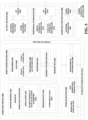
- Figure 1 illustrates an example system for multichannel audio compression using optimized signal rearrangement and rate allocation according to one or more embodiments described herein.
- a multichannel audio signal 105 may be input into a compression optimization engine 110, which may include a signal rearrangement unit 115 and a bit allocation unit 120.
- the compression optimization engine 110 outputs sub-signals 125A, 125B, through 125M (where "M" is an arbitrary number) along with corresponding bit rates 130A, 130B, through 130M that have been assigned according to at least one perceptual criterion.
- Audio codecs 140A, 140B, through 140N (where "N" is an arbitrary number) then quantize the sub-signals 125A, 125B, through 125M at the assigned bit rates 130A, 130B, through 130M.
- the example system illustrated in FIG. 1 includes the signal rearrangement and rate allocation algorithm being implemented by the compression optimization engine 110 (e.g., via the signal rearrangement unit 115 and the bit allocation unit 120), which is a separate component from the audio codecs 140A, 140B, through 140N.
- the signal rearrangement and rate allocation algorithm may also be integrated into one or more of the audio codecs 140A, 140B, through 140N in addition to or instead of being implemented by a separate component of the system.
- the compressed sub-signals may be combined back into the original format by a combination component 150.
- the combination component 150 may recombine the compressed sub-signals according to the manner in which the original multichannel audio signal 105 is rearranged.
- Figure 2 is a high-level illustration of an example process for multichannel audio compression using optimized signal rearrangement and rate allocation according to one or more embodiments described herein.
- a multichannel audio signal is rearranged into sub-signals (e.g., multichannel audio signal 105 is rearranged into sub-signals 125A, 125B, through 125M as shown in the example system of FIG. 1 ).
- each of the sub-signals is assigned a bit rate (e.g., bit rates 130A, 130B, through 130M as shown in FIG. 1 ).
- bit rates 130A, 130B, through 130M as shown in FIG. 1 .
- the signal rearrangement and rate allocation is be optimized according to a criterion (e.g., overall rate-distortion performance).
- the sub-signals may be quantized at the assigned bit rates using existing audio codecs.
- the process then moves to block 215, where the compressed sub-signals may be combined into the original format according to the way in which the original multichannel signal is rearranged. Additional details about the process illustrated in FIG. 2 will be provided herein.
- the original multichannel audio signal is denoted as s, consisting of L channels s 1 , s 2 , . . . , s L (where "L" is an arbitrary number).
- An existing audio codec is applied to compress a sub-signal at a certain bit rate, yielding a bit stream that can be used to reconstruct the sub-signal.
- ⁇ k q k ( g k , r k ) denote the reconstruction of g k by applying codec q k at bit rate r k .
- Compression of audio signals is generally lossy, meaning that ⁇ k does not equal g k .
- the problem of rearranging a multichannel audio signal for optimal compression is to find g k (or equivalently I k ) together with r k , which minimize the global distortion, subject to a total budget of bit rate.
- the problem as expressed in equation set (2) conjugates to the expression in equation set (1), and may be solved using similar techniques.
- the present disclosure focuses on the problem as expressed in equation set (1).
- a first assumption is that the global distortion is additive.
- MSE weighted mean squared errors
- the minimum distortion of compressing a multichannel audio signal at an arbitrary bit rate may be derived from the information theoretical viewpoint.
- a multidimensional Gaussian process may be used to model a multichannel audio signal, which can represent any sub-signal in the earlier context. Such an assumption may be valid for audio segments of, for example, some tens of milliseconds. Accordingly, the methods and systems described herein may be applied to real audio signals frame-by-frame.
- the diagonal elements are the self power-spectral-densities (PSDs) of the individual channels in the multidimensional Gaussian process
- Equation (6) may be further simplified by assuming that ⁇ k ( S ( ⁇ )) ⁇ ⁇ , ⁇ ⁇ , k .
- the following describes additional details of the method for determining the optimal rearrangement and rate allocation for a multichannel audio signal according to one or more embodiments of the present disclosure.
- at least one embodiment of the method addresses the following: (1) given a signal rearrangement, determine the optimal rate allocation, and (2) determine the optimal signal rearrangement.
- FIG. 3 illustrates an example process for determining optimal signal rearrangement and rate allocation, with consideration given to a perceptually-weighted distortion measure, according to at least one embodiment of the disclosure.
- the original multichannel audio signal (e.g., multichannel audio signal 105 as shown in FIG. 1 ) is modified according to one or more perceptual criterion.
- the process estimates, for a segment of the signal, self-PSDs and cross-PSDs of the modified signal from block 300.
- entropy rates are calculated for candidate sub-signals.
- a bit rate is allocated to each of the candidate signal rearrangements, where the allocation of the bit rates is optimized according to a criterion.
- the process may move from block 325 to block 305 where, for the next segment of the signal, estimates may be obtained for self-PSDs and cross-PSDs of the modified signal, as described above. If it is determined at block 325 that the signal does not include any more segments to be considered, the process may move to block 330 where a selection may be made of the candidate signal rearrangement that leads to the minimum average distortion.
- the original audio signal may be output according to the signal rearrangement selected at block 330 (e.g., the signal rearrangement that leads to the minimum average distortion), and at block 340 the average-rate allocation on the selected rearrangement may be output.
- the signal rearrangement selected at block 330 e.g., the signal rearrangement that leads to the minimum average distortion
- the average-rate allocation on the selected rearrangement may be output.
- the optimal rearrangement and bit allocation can then be obtained as further described below with reference to FIG. 4 .
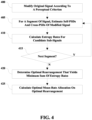
- FIG. 4 illustrates another example process for determining optimal signal rearrangement and rate allocation according to one or more embodiments described herein. While certain blocks comprising the process illustrated in FIG. 4 may be similar to one or more blocks comprising the process illustrated in FIG. 3 (described above), other blocks may include different features between the two example processes illustrated, as described in further detail below.
- the original multichannel audio signal (e.g., multichannel audio signal 105 as shown in FIG. 1 ) is modified according to one or more perceptual criterion.
- the process estimates, for a segment of the signal, self-PSDs and cross-PSDs of the modified signal from block 400.
- entropy rates are calculated for the candidate sub-signals using, for example, equation (8) presented above.
- the process moves to block 420 where the signal rearrangement that yields the minimum sum of entropy rates for the candidate sub-signals is selected as the optimal signal rearrangement.
- the optimal rate allocation is calculated on the optimal signal rearrangement selected in block 420.
- a stereo audio codec may be used to compress an L- channel multichannel audio signal (where "L" is an arbitrary number).
- L is an even number
- the source channels may be rearranged into L /2 pairs of channels.
- L ( L - 1)/2 candidate pairs of channels there will be L ( L - 1)/2 candidate pairs of channels.
- the candidate sub-signals may include all pairs and all original channels. Since the number of sub-signals and the sizes of sub-signals are fixed in any given rearrangement, the algorithm illustrated in FIG. 4 and described above may be used to determine the optimal signal rearrangement and bit allocation. Additional implementation details for such a scenario are provided below.
- the optimal rearrangement is determined by the perfect matching of channels that yields the minimum sum of entropy rates. In at least one implementation, the optimal rearrangement is determined using the blossom algorithm. In an implementation where a suboptimal solution is acceptable, less computationally complex methods, not forming part of the invention, may be utilized in block 420 (e.g., greedy search).
- the following example further illustrates the method for determining optimal signal rearrangement and rate allocation of a multichannel audio signal according to at least one embodiment of the present disclosure.
- the scenario presented below is entirely illustrative in nature, and is not intended to limit the scope of the present disclosure in any manner.
- the aim is to compress a 5-channel 48 kHz sampled audio signal at 130 kbps, using a codec that only handles stereo and mono signals.
- the original signal may be rearranged into three sub-signals, two of which are stereo and the third of which is mono (e.g., two pairs of channels plus one individual channel). Rates may be allocated to the three sub-signals using a process similar to that described above and illustrated in FIG. 4 .
- the original signal may be divided into segments of 40 milliseconds, where segments are overlapped by 20 milliseconds.
- a simple perceptual criterion e.g., overall rate-distortion performance
- the criterion is based on an auto-regressive model for each channel in each segment.
- a standard method such as the Levinson-Durbin recursion can be used to obtain such a model.
- Every channel may then undergo a filtering with a filter with transfer function A ( z / ⁇ 1 )/ A ( z / ⁇ 2 ), where A ( z ) represents the auto-regressive model of the particular channel, and the two parameters, ⁇ 1 and ⁇ 2 , can take, for example, the values 0.9 and 0.6, respectively.
- This perceptual criterion is known as the ⁇ 1 - ⁇ 2 model.
- all of the channels in each segment may be normalized against the total power of that segment, after the filtering. This operation takes the changes of signal power over time into the distortion measure.
- the power weighting and the perceptual weighting may be undone by renormalization and by filtering with the corresponding inverse filter.
- perceptual criterion described above ( ⁇ 1 - ⁇ 2 model) is only one example of a perceptual criterion that is utilized in accordance with the methods and systems of the present disclosure.
- one or more other perceptual criteria may also be utilized in addition to or instead of the example criterion described above.
- self-PSDs and cross-PSDs may be extracted from the channels using any of a variety of methods known to those skilled in the art.
- the periodogram method may be used to extract the self-PSDs and cross-PSDs.
- the entropy rates of candidate sub-signals may then be calculated.
- the entropy rate for a given candidate sub-signal may be calculated using equation (16) or (17), depending on whether the sub-signal is a mono or stereo sub-signal.
- the entropy rates for ten seconds of audio may be collected and averaged. Then the optimal rearrangement and rate allocation may be obtained for the audio in the time span, as further described below.
- the blossom algorithm may be used to determine the optimal signal rearrangement.
- a graph is constructed with six nodes, five of which correspond to a channel of the audio signal.
- the sixth node is designated as a dummy node.
- the averaged entropy rate may be assigned to the edge connecting the corresponding nodes.
- the averaged entropy rate for the channel may be assigned to the edge between the dummy node and the node of the channel.
- the blossom algorithm may then yield the optimal signal rearrangement.
- the blossom algorithm selects non-intersecting edges with the minimum sum of entropy rates.
- the two nodes on each chosen edge form a sub-signal.
- Equation (13) may then be used to determine the optimal rate allocation.
- the original signal within this ten second time span may be rearranged and quantized by the chosen codec at the calculated rates.
- coding gain in which the rate is reduced by optimal coding of all channels together as opposed to coding the channels independently.
- perceptual effects can be captured by means other than modifying the audio signal upfront.
- perceptual effects may be captured using "perceptual entropy” and “perceptual distortion” instead of "entropy rate” and “distortion.”
- FIG. 5 is a block diagram illustrating an example computing device 500 that is arranged for determining optimal signal rearrangement and rate allocation of a multichannel audio signal in accordance with one or more embodiments of the present disclosure.
- computing device 500 may be configured to rearrange a multichannel audio signal into sub-signals and allocate bit rates among them, such that compressing the sub-signals with a set of audio codecs at the allocated bit rates will yield an optimal fidelity with respect to the original multichannel audio signal, as described above.
- the computing device 500 may further be configured to use existing audio codecs to quantize the sub-signals at the assigned bit rates and then combine the compressed sub-signals into the original format according to the manner in which the original multichannel audio signal is rearranged.
- computing device 500 typically includes one or more processors 510 and system memory 520.
- a memory bus 530 may be used for communicating between the processor 510 and the system memory 520.
- processor 510 can be of any type including but not limited to a microprocessor ( ⁇ P), a microcontroller ( ⁇ C), a digital signal processor (DSP), or any combination thereof.
- Processor 510 may include one or more levels of caching, such as a level one cache 511 and a level two cache 512, a processor core 513, and registers 514.
- the processor core 513 may include an arithmetic logic unit (ALU), a floating point unit (FPU), a digital signal processing core (DSP Core), or any combination thereof.
- a memory controller 515 can also be used with the processor 510, or in some embodiments the memory controller 515 can be an internal part of the processor 510.
- system memory 520 can be of any type including but not limited to volatile memory (e.g., RAM), non-volatile memory (e.g., ROM, flash memory, etc.) or any combination thereof.
- System memory 520 typically includes an operating system 521, one or more applications 522, and program data 524.
- application 522 may include a rearrangement and rate allocation algorithm 523 that is configured to determine optimal signal rearrangement and rate allocation of a multichannel audio signal.
- the rearrangement and rate allocation algorithm 523 may be configured to rearrange an original multichannel audio signal (e.g., multichannel audio signal 105 as shown in FIG.
- the rearrangement and rate allocation algorithm 523 may be further configured to quantize the sub-signals at the assigned bit rates using existing audio codecs, and then combine the compressed sub-signals back into the format of the original signal according to the manner in which the original signal is rearranged.
- Program Data 524 may include audio signal data 525 that is useful for determining the optimal signal rearrangement and rate allocation of a multichannel audio signal.
- application 522 can be arranged to operate with program data 524 on an operating system 521 such that the rearrangement and rate allocation algorithm 523 uses the audio signal data 525 to modify the original signal according to a perceptual criterion and then extract self-PSDs and cross-PSDs for each segment of the modified signal.
- Computing device 500 can have additional features and/or functionality, and additional interfaces to facilitate communications between the basic configuration 501 and any required devices and interfaces.
- a bus/interface controller 540 can be used to facilitate communications between the basic configuration 501 and one or more data storage devices 550 via a storage interface bus 541.
- the data storage devices 550 can be removable storage devices 551, non-removable storage devices 552, or any combination thereof.
- removable storage and non-removable storage devices include magnetic disk devices such as flexible disk drives and hard-disk drives (HDD), optical disk drives such as compact disk (CD) drives or digital versatile disk (DVD) drives, solid state drives (SSD), tape drives and the like.
- Example computer storage media can include volatile and nonvolatile, removable and non-removable media implemented in any method or technology for storage of information, such as computer readable instructions, data structures, program modules, and/or other data.
- Computer storage media includes, but is not limited to, RAM, ROM, EEPROM, flash memory or other memory technology, CD-ROM, digital versatile disks (DVD) or other optical storage, magnetic cassettes, magnetic tape, magnetic disk storage or other magnetic storage devices, or any other medium which can be used to store the desired information and which can be accessed by computing device 500. Any such computer storage media can be part of computing device 500.
- Computing device 500 can also include an interface bus 542 for facilitating communication from various interface devices (e.g., output interfaces, peripheral interfaces, communication interfaces, etc.) to the basic configuration 501 via the bus/interface controller 540.
- Example output devices 560 include a graphics processing unit 561 and an audio processing unit 562, either or both of which can be configured to communicate to various external devices such as a display or speakers via one or more A/V ports 563.
- Example peripheral interfaces 570 include a serial interface controller 571 or a parallel interface controller 572, which can be configured to communicate with external devices such as input devices (e.g., keyboard, mouse, pen, voice input device, touch input device, etc.) or other peripheral devices (e.g., printer, scanner, etc.) via one or more I/O ports 573.
- input devices e.g., keyboard, mouse, pen, voice input device, touch input device, etc.
- other peripheral devices e.g., printer, scanner, etc.
- An example communication device 580 includes a network controller 581, which can be arranged to facilitate communications with one or more other computing devices 590 over a network communication (not shown) via one or more communication ports 582.
- the communication connection is one example of a communication media.
- Communication media may typically be embodied by computer readable instructions, data structures, program modules, or other data in a modulated data signal, such as a carrier wave or other transport mechanism, and includes any information delivery media.
- a "modulated data signal" can be a signal that has one or more of its characteristics set or changed in such a manner as to encode information in the signal.
- communication media can include wired media such as a wired network or direct-wired connection, and wireless media such as acoustic, radio frequency (RF), infrared (IR) and other wireless media.
- RF radio frequency
- IR infrared
- computer readable media can include both storage media and communication media.
- Computing device 500 can be implemented as a portion of a small-form factor portable (or mobile) electronic device such as a cell phone, a personal data assistant (PDA), a personal media player device, a wireless web-watch device, a personal headset device, an application specific device, or a hybrid device that include any of the above functions.
- a small-form factor portable (or mobile) electronic device such as a cell phone, a personal data assistant (PDA), a personal media player device, a wireless web-watch device, a personal headset device, an application specific device, or a hybrid device that include any of the above functions.
- PDA personal data assistant
- Computing device 500 can also be implemented as a personal computer including both laptop computer and non-laptop computer configurations.
- ASICs Application Specific Integrated Circuits
- FPGAs Field Programmable Gate Arrays
- DSPs digital signal processors
- ASICs Application Specific Integrated Circuits
- FPGAs Field Programmable Gate Arrays
- DSPs digital signal processors
- some aspects of the embodiments described herein, in whole or in part, can be equivalently implemented in integrated circuits, as one or more computer programs running on one or more computers (e.g., as one or more programs running on one or more computer systems), as one or more programs running on one or more processors (e.g., as one or more programs running on one or more microprocessors), as firmware, or as virtually any combination thereof.
- processors e.g., as one or more programs running on one or more microprocessors
- firmware e.g., as one or more programs running on one or more microprocessors
- designing the circuitry and/or writing the code for the software and/or firmware would be well within the skill of one of skilled in the art in light of the present disclosure.
- Examples of a signal-bearing medium include, but are not limited to, the following: a recordable-type medium such as a floppy disk, a hard disk drive, a Compact Disc (CD), a Digital Video Disk (DVD), a digital tape, a computer memory, etc.; and a transmission-type medium such as a digital and/or an analog communication medium (e.g., a fiber optic cable, a waveguide, a wired communications link, a wireless communication link, etc.).
- a recordable-type medium such as a floppy disk, a hard disk drive, a Compact Disc (CD), a Digital Video Disk (DVD), a digital tape, a computer memory, etc.
- a transmission-type medium such as a digital and/or an analog communication medium (e.g., a fiber optic cable, a waveguide, a wired communications link, a wireless communication link, etc.).
- a typical data processing system generally includes one or more of a system unit housing, a video display device, a memory such as volatile and non-volatile memory, processors such as microprocessors and digital signal processors, computational entities such as operating systems, drivers, graphical user interfaces, and applications programs, one or more interaction devices, such as a touch pad or screen, and/or control systems including feedback loops and control motors (e.g., feedback for sensing position and/or velocity; control motors for moving and/or adjusting components and/or quantities).
- a typical data processing system may be implemented utilizing any suitable commercially available components, such as those typically found in data computing/communication and/or network computing/communication systems.
Landscapes
- Engineering & Computer Science (AREA)
- Physics & Mathematics (AREA)
- Computational Linguistics (AREA)
- Signal Processing (AREA)
- Health & Medical Sciences (AREA)
- Audiology, Speech & Language Pathology (AREA)
- Human Computer Interaction (AREA)
- Acoustics & Sound (AREA)
- Multimedia (AREA)
- Mathematical Physics (AREA)
- Quality & Reliability (AREA)
- Compression, Expansion, Code Conversion, And Decoders (AREA)
Claims (4)
- Verfahren zum Komprimieren eines mehrkanaligen Audiosignals, wobei das Verfahren Folgendes umfasst:Unterteilen des mehrkanaligen Audiosignals in überlappende Segmente, wobei das mehrkanalige Audiosignal eine Vielzahl von Kanälen umfasst;Modifizieren des mehrkanaligen Audiosignals unter Verwendung eines Wahrnehmungskriteriums;für jedes Segment des mehrkanaligen Audiosignals:Extrahieren von Spektraldichten aus den Kanälen des modifizierten Signals; undBerechnen von Entropieraten von Kandidatenteilsignalen auf der Grundlage der extrahierten Spektraldichten, wobei jedes der Kandidatenteilsignale eine Teilmenge der Vielzahl von Kanälen umfasst und jeder der Vielzahl von Kanälen in einem einzelnen Kandidatenteilsignal vorkommt;Erlangen eines Durchschnitts der Entropieraten für einen Teil des Audiosignals, wobei der Teil des Audiosignals eine Vielzahl von den Segmenten umfasst;Auswählen, auf der Grundlage des erlangten Durchschnitts der Entropieraten für den Teil des Audiosignals, einer Signalumordnung aus einer Vielzahl von Kandidatensignalumordnungen für den Teil des Audiosignals, der zu einer minimalen Summe von Entropieraten führt, wobei jede der Kandidatensignalumordnungen eine Teilmenge der Kandidatenteilsignale umfasst, und wobei ein Blossom-Algorithmus von Edmonds verwendet wird, um die Entsprechung von Kanälen zu finden, welche die minimale Summe von Entropieraten ergibt;Zuordnen von Bitraten zu den Kandidatenteilsignalen der ausgewählten Signalumordnung, wobei die Zuordnung der Bitraten nach einem Kriterium optimiert ist; undKomprimieren der Kandidatenteilsignale der ausgewählten Signalumordnung mit mindestens einem Audiocodec mit den zugeordneten Bitraten.
- Verfahren nach Anspruch 1, wobei das Modifizieren des mehrkanaligen Audiosignals unter Verwendung eines Wahrnehmungskriteriums auf einem autoregressiven Modell für jeden Kanal in jedem Segment des Signals basiert.
- Verfahren nach Anspruch 2, das ferner Folgendes umfasst:Filtern von jedem Kanal in jedem Segment des mehrkanaligen Audiosignals unter Verwendung des autoregressiven Modells dieses Kanals und mindestens eines Parameters; undNormalisieren aller Kanäle in jedem Segment im Verhältnis zu der Gesamtleistung des jeweiligen Segments.
- Verfahren nach einem vorhergehenden Anspruch, wobei der mindestens eine Audiocodec für Stereosignale konfiguriert ist.
Applications Claiming Priority (2)
| Application Number | Priority Date | Filing Date | Title |
|---|---|---|---|
| US13/749,399 US9336791B2 (en) | 2013-01-24 | 2013-01-24 | Rearrangement and rate allocation for compressing multichannel audio |
| PCT/US2014/012735 WO2014116817A2 (en) | 2013-01-24 | 2014-01-23 | Rearrangement and rate allocation for compressing multichannel audio |
Publications (2)
| Publication Number | Publication Date |
|---|---|
| EP2929532A2 EP2929532A2 (de) | 2015-10-14 |
| EP2929532B1 true EP2929532B1 (de) | 2023-04-19 |
Family
ID=50097862
Family Applications (1)
| Application Number | Title | Priority Date | Filing Date |
|---|---|---|---|
| EP14704235.2A Active EP2929532B1 (de) | 2013-01-24 | 2014-01-23 | Neuanordnung und bandbreitenzuteilung zum komprimieren von mehrkanalaudio |
Country Status (6)
| Country | Link |
|---|---|
| US (1) | US9336791B2 (de) |
| EP (1) | EP2929532B1 (de) |
| JP (1) | JP6182619B2 (de) |
| KR (2) | KR102084937B1 (de) |
| CN (1) | CN104937661B (de) |
| WO (1) | WO2014116817A2 (de) |
Families Citing this family (6)
| Publication number | Priority date | Publication date | Assignee | Title |
|---|---|---|---|---|
| US9336791B2 (en) * | 2013-01-24 | 2016-05-10 | Google Inc. | Rearrangement and rate allocation for compressing multichannel audio |
| US20150025894A1 (en) * | 2013-07-16 | 2015-01-22 | Electronics And Telecommunications Research Institute | Method for encoding and decoding of multi channel audio signal, encoder and decoder |
| KR102208477B1 (ko) | 2014-06-30 | 2021-01-27 | 삼성전자주식회사 | 마이크 운용 방법 및 이를 지원하는 전자 장치 |
| CN114781643B (zh) | 2015-12-16 | 2023-04-14 | 谷歌有限责任公司 | 利用共面波导通量量子比特的可编程通用量子退火 |
| CN109074518B (zh) * | 2015-12-30 | 2022-09-20 | 谷歌有限责任公司 | 多个本征值的量子相位估计 |
| CN116186495B (zh) * | 2022-09-07 | 2025-06-17 | 南京航空航天大学 | 基于完备模态分解和随机森林响应面拟合的结构参数求解方法 |
Family Cites Families (40)
| Publication number | Priority date | Publication date | Assignee | Title |
|---|---|---|---|---|
| US5185800A (en) * | 1989-10-13 | 1993-02-09 | Centre National D'etudes Des Telecommunications | Bit allocation device for transformed digital audio broadcasting signals with adaptive quantization based on psychoauditive criterion |
| JP3188013B2 (ja) * | 1993-02-19 | 2001-07-16 | 松下電器産業株式会社 | 変換符号化装置のビット配分方法 |
| JP3186412B2 (ja) * | 1994-04-01 | 2001-07-11 | ソニー株式会社 | 情報符号化方法、情報復号化方法、及び情報伝送方法 |
| JP3250376B2 (ja) * | 1994-06-13 | 2002-01-28 | ソニー株式会社 | 情報符号化方法及び装置並びに情報復号化方法及び装置 |
| US6405338B1 (en) * | 1998-02-11 | 2002-06-11 | Lucent Technologies Inc. | Unequal error protection for perceptual audio coders |
| US20030007516A1 (en) * | 2001-07-06 | 2003-01-09 | Yuri Abramov | System and method for the application of a statistical multiplexing algorithm for video encoding |
| US7110941B2 (en) * | 2002-03-28 | 2006-09-19 | Microsoft Corporation | System and method for embedded audio coding with implicit auditory masking |
| US7286571B2 (en) * | 2002-07-19 | 2007-10-23 | Lucent Technologies Inc. | Systems and methods for providing on-demand datacasting |
| JP4676140B2 (ja) | 2002-09-04 | 2011-04-27 | マイクロソフト コーポレーション | オーディオの量子化および逆量子化 |
| US7299190B2 (en) | 2002-09-04 | 2007-11-20 | Microsoft Corporation | Quantization and inverse quantization for audio |
| JP2004309921A (ja) * | 2003-04-09 | 2004-11-04 | Sony Corp | 符号化装置、符号化方法及びプログラム |
| US7392195B2 (en) * | 2004-03-25 | 2008-06-24 | Dts, Inc. | Lossless multi-channel audio codec |
| EP1580914A1 (de) * | 2004-03-26 | 2005-09-28 | STMicroelectronics S.r.l. | Verfahren und System zum Kontrollieren des Betriebs eines Netzwerkes |
| KR100663729B1 (ko) * | 2004-07-09 | 2007-01-02 | 한국전자통신연구원 | 가상 음원 위치 정보를 이용한 멀티채널 오디오 신호부호화 및 복호화 방법 및 장치 |
| US8284955B2 (en) * | 2006-02-07 | 2012-10-09 | Bongiovi Acoustics Llc | System and method for digital signal processing |
| US8565449B2 (en) * | 2006-02-07 | 2013-10-22 | Bongiovi Acoustics Llc. | System and method for digital signal processing |
| US7254243B2 (en) * | 2004-08-10 | 2007-08-07 | Anthony Bongiovi | Processing of an audio signal for presentation in a high noise environment |
| EP1792483B1 (de) * | 2004-09-03 | 2015-08-19 | Telecom Italia S.p.A. | Verfahren und system zum videotelefonierkommunikationsaufbau, dazugehörige ausstattung und computerprogrammprodukt |
| US7672743B2 (en) * | 2005-04-25 | 2010-03-02 | Microsoft Corporation | Digital audio processing |
| US7778718B2 (en) * | 2005-05-24 | 2010-08-17 | Rockford Corporation | Frequency normalization of audio signals |
| US8229136B2 (en) * | 2006-02-07 | 2012-07-24 | Anthony Bongiovi | System and method for digital signal processing |
| US8705765B2 (en) * | 2006-02-07 | 2014-04-22 | Bongiovi Acoustics Llc. | Ringtone enhancement systems and methods |
| US9195433B2 (en) * | 2006-02-07 | 2015-11-24 | Bongiovi Acoustics Llc | In-line signal processor |
| EP2095365A4 (de) * | 2006-11-24 | 2009-11-18 | Lg Electronics Inc | Verfahren zum codieren und decodieren eines audiosignals auf objektbasis und vorrichtung dafür |
| US7782993B2 (en) * | 2007-01-04 | 2010-08-24 | Nero Ag | Apparatus for supplying an encoded data signal and method for encoding a data signal |
| ATE518224T1 (de) * | 2008-01-04 | 2011-08-15 | Dolby Int Ab | Audiokodierer und -dekodierer |
| KR101449434B1 (ko) * | 2008-03-04 | 2014-10-13 | 삼성전자주식회사 | 복수의 가변장 부호 테이블을 이용한 멀티 채널 오디오를부호화/복호화하는 방법 및 장치 |
| KR20090110242A (ko) * | 2008-04-17 | 2009-10-21 | 삼성전자주식회사 | 오디오 신호를 처리하는 방법 및 장치 |
| EP2345027B1 (de) * | 2008-10-10 | 2018-04-18 | Telefonaktiebolaget LM Ericsson (publ) | Energie-bewahrende mehrkanal-audiokodierung und -dekodierung |
| JP5135205B2 (ja) * | 2008-12-26 | 2013-02-06 | 日本放送協会 | 多チャンネル音響信号の音響圧縮符号化装置及び復号装置 |
| JP5446258B2 (ja) * | 2008-12-26 | 2014-03-19 | 富士通株式会社 | オーディオ符号化装置 |
| US8793282B2 (en) * | 2009-04-14 | 2014-07-29 | Disney Enterprises, Inc. | Real-time media presentation using metadata clips |
| KR101615262B1 (ko) * | 2009-08-12 | 2016-04-26 | 삼성전자주식회사 | 시멘틱 정보를 이용한 멀티 채널 오디오 인코딩 및 디코딩 방법 및 장치 |
| KR20110018107A (ko) * | 2009-08-17 | 2011-02-23 | 삼성전자주식회사 | 레지듀얼 신호 인코딩 및 디코딩 방법 및 장치 |
| KR101600354B1 (ko) * | 2009-08-18 | 2016-03-07 | 삼성전자주식회사 | 사운드에서 오브젝트 분리 방법 및 장치 |
| KR101613975B1 (ko) * | 2009-08-18 | 2016-05-02 | 삼성전자주식회사 | 멀티 채널 오디오 신호의 부호화 방법 및 장치, 그 복호화 방법 및 장치 |
| KR101599884B1 (ko) * | 2009-08-18 | 2016-03-04 | 삼성전자주식회사 | 멀티 채널 오디오 디코딩 방법 및 장치 |
| US9392295B2 (en) * | 2011-07-20 | 2016-07-12 | Broadcom Corporation | Adaptable media processing architectures |
| MX390026B (es) * | 2011-11-18 | 2025-03-20 | Sirius Xm Radio Inc | Sistemas y metodos que implementan la transicion gradual, los intersticiales y otros efectos corriente abajo. |
| US9336791B2 (en) * | 2013-01-24 | 2016-05-10 | Google Inc. | Rearrangement and rate allocation for compressing multichannel audio |
-
2013
- 2013-01-24 US US13/749,399 patent/US9336791B2/en active Active
-
2014
- 2014-01-23 KR KR1020157022819A patent/KR102084937B1/ko active Active
- 2014-01-23 KR KR1020177022838A patent/KR20170097239A/ko not_active Ceased
- 2014-01-23 JP JP2015555270A patent/JP6182619B2/ja active Active
- 2014-01-23 WO PCT/US2014/012735 patent/WO2014116817A2/en not_active Ceased
- 2014-01-23 CN CN201480005872.5A patent/CN104937661B/zh not_active Expired - Fee Related
- 2014-01-23 EP EP14704235.2A patent/EP2929532B1/de active Active
Also Published As
| Publication number | Publication date |
|---|---|
| EP2929532A2 (de) | 2015-10-14 |
| WO2014116817A3 (en) | 2014-10-09 |
| KR20170097239A (ko) | 2017-08-25 |
| WO2014116817A2 (en) | 2014-07-31 |
| JP2016509697A (ja) | 2016-03-31 |
| US20140207473A1 (en) | 2014-07-24 |
| CN104937661A (zh) | 2015-09-23 |
| CN104937661B (zh) | 2018-04-06 |
| US9336791B2 (en) | 2016-05-10 |
| KR20150109467A (ko) | 2015-10-01 |
| JP6182619B2 (ja) | 2017-08-16 |
| KR102084937B1 (ko) | 2020-03-05 |
Similar Documents
| Publication | Publication Date | Title |
|---|---|---|
| EP2929532B1 (de) | Neuanordnung und bandbreitenzuteilung zum komprimieren von mehrkanalaudio | |
| US20250349302A1 (en) | Encoding and decoding methods, and encoding and decoding apparatuses for stereo signal | |
| US12159634B2 (en) | Adaptive gain-shape rate sharing | |
| EP3664089B1 (de) | Verfahren und vorrichtung zur codierung von stereosignalen | |
| US12148436B2 (en) | Stereo signal encoding method and apparatus, and stereo signal decoding method and apparatus | |
| US11922958B2 (en) | Method and apparatus for determining weighting factor during stereo signal encoding | |
| EP3664083B1 (de) | Signalrekonstruktionsverfahren und -vorrichtung in der stereosignalcodierung | |
| US12112761B2 (en) | Audio signal encoding method and apparatus | |
| EP2618330B1 (de) | Parameterauswahl für die Kanalprädiktion in der Mehrkanal-Audiokodierung |
Legal Events
| Date | Code | Title | Description |
|---|---|---|---|
| PUAI | Public reference made under article 153(3) epc to a published international application that has entered the european phase |
Free format text: ORIGINAL CODE: 0009012 |
|
| 17P | Request for examination filed |
Effective date: 20150709 |
|
| AK | Designated contracting states |
Kind code of ref document: A2 Designated state(s): AL AT BE BG CH CY CZ DE DK EE ES FI FR GB GR HR HU IE IS IT LI LT LU LV MC MK MT NL NO PL PT RO RS SE SI SK SM TR |
|
| AX | Request for extension of the european patent |
Extension state: BA ME |
|
| DAX | Request for extension of the european patent (deleted) | ||
| RAP1 | Party data changed (applicant data changed or rights of an application transferred) |
Owner name: GOOGLE LLC |
|
| STAA | Information on the status of an ep patent application or granted ep patent |
Free format text: STATUS: EXAMINATION IS IN PROGRESS |
|
| 17Q | First examination report despatched |
Effective date: 20190529 |
|
| GRAP | Despatch of communication of intention to grant a patent |
Free format text: ORIGINAL CODE: EPIDOSNIGR1 |
|
| STAA | Information on the status of an ep patent application or granted ep patent |
Free format text: STATUS: GRANT OF PATENT IS INTENDED |
|
| INTG | Intention to grant announced |
Effective date: 20221027 |
|
| GRAS | Grant fee paid |
Free format text: ORIGINAL CODE: EPIDOSNIGR3 |
|
| GRAA | (expected) grant |
Free format text: ORIGINAL CODE: 0009210 |
|
| STAA | Information on the status of an ep patent application or granted ep patent |
Free format text: STATUS: THE PATENT HAS BEEN GRANTED |
|
| AK | Designated contracting states |
Kind code of ref document: B1 Designated state(s): AL AT BE BG CH CY CZ DE DK EE ES FI FR GB GR HR HU IE IS IT LI LT LU LV MC MK MT NL NO PL PT RO RS SE SI SK SM TR |
|
| REG | Reference to a national code |
Ref country code: GB Ref legal event code: FG4D |
|
| REG | Reference to a national code |
Ref country code: DE Ref legal event code: R096 Ref document number: 602014086713 Country of ref document: DE |
|
| REG | Reference to a national code |
Ref country code: CH Ref legal event code: EP |
|
| REG | Reference to a national code |
Ref country code: IE Ref legal event code: FG4D |
|
| REG | Reference to a national code |
Ref country code: AT Ref legal event code: REF Ref document number: 1561795 Country of ref document: AT Kind code of ref document: T Effective date: 20230515 |
|
| P01 | Opt-out of the competence of the unified patent court (upc) registered |
Effective date: 20230518 |
|
| REG | Reference to a national code |
Ref country code: LT Ref legal event code: MG9D |
|
| REG | Reference to a national code |
Ref country code: NL Ref legal event code: MP Effective date: 20230419 |
|
| REG | Reference to a national code |
Ref country code: AT Ref legal event code: MK05 Ref document number: 1561795 Country of ref document: AT Kind code of ref document: T Effective date: 20230419 |
|
| PG25 | Lapsed in a contracting state [announced via postgrant information from national office to epo] |
Ref country code: NL Free format text: LAPSE BECAUSE OF FAILURE TO SUBMIT A TRANSLATION OF THE DESCRIPTION OR TO PAY THE FEE WITHIN THE PRESCRIBED TIME-LIMIT Effective date: 20230419 |
|
| PG25 | Lapsed in a contracting state [announced via postgrant information from national office to epo] |
Ref country code: SE Free format text: LAPSE BECAUSE OF FAILURE TO SUBMIT A TRANSLATION OF THE DESCRIPTION OR TO PAY THE FEE WITHIN THE PRESCRIBED TIME-LIMIT Effective date: 20230419 Ref country code: PT Free format text: LAPSE BECAUSE OF FAILURE TO SUBMIT A TRANSLATION OF THE DESCRIPTION OR TO PAY THE FEE WITHIN THE PRESCRIBED TIME-LIMIT Effective date: 20230821 Ref country code: NO Free format text: LAPSE BECAUSE OF FAILURE TO SUBMIT A TRANSLATION OF THE DESCRIPTION OR TO PAY THE FEE WITHIN THE PRESCRIBED TIME-LIMIT Effective date: 20230719 Ref country code: ES Free format text: LAPSE BECAUSE OF FAILURE TO SUBMIT A TRANSLATION OF THE DESCRIPTION OR TO PAY THE FEE WITHIN THE PRESCRIBED TIME-LIMIT Effective date: 20230419 Ref country code: AT Free format text: LAPSE BECAUSE OF FAILURE TO SUBMIT A TRANSLATION OF THE DESCRIPTION OR TO PAY THE FEE WITHIN THE PRESCRIBED TIME-LIMIT Effective date: 20230419 |
|
| PG25 | Lapsed in a contracting state [announced via postgrant information from national office to epo] |
Ref country code: RS Free format text: LAPSE BECAUSE OF FAILURE TO SUBMIT A TRANSLATION OF THE DESCRIPTION OR TO PAY THE FEE WITHIN THE PRESCRIBED TIME-LIMIT Effective date: 20230419 Ref country code: PL Free format text: LAPSE BECAUSE OF FAILURE TO SUBMIT A TRANSLATION OF THE DESCRIPTION OR TO PAY THE FEE WITHIN THE PRESCRIBED TIME-LIMIT Effective date: 20230419 Ref country code: LV Free format text: LAPSE BECAUSE OF FAILURE TO SUBMIT A TRANSLATION OF THE DESCRIPTION OR TO PAY THE FEE WITHIN THE PRESCRIBED TIME-LIMIT Effective date: 20230419 Ref country code: LT Free format text: LAPSE BECAUSE OF FAILURE TO SUBMIT A TRANSLATION OF THE DESCRIPTION OR TO PAY THE FEE WITHIN THE PRESCRIBED TIME-LIMIT Effective date: 20230419 Ref country code: IS Free format text: LAPSE BECAUSE OF FAILURE TO SUBMIT A TRANSLATION OF THE DESCRIPTION OR TO PAY THE FEE WITHIN THE PRESCRIBED TIME-LIMIT Effective date: 20230819 Ref country code: HR Free format text: LAPSE BECAUSE OF FAILURE TO SUBMIT A TRANSLATION OF THE DESCRIPTION OR TO PAY THE FEE WITHIN THE PRESCRIBED TIME-LIMIT Effective date: 20230419 Ref country code: GR Free format text: LAPSE BECAUSE OF FAILURE TO SUBMIT A TRANSLATION OF THE DESCRIPTION OR TO PAY THE FEE WITHIN THE PRESCRIBED TIME-LIMIT Effective date: 20230720 Ref country code: AL Free format text: LAPSE BECAUSE OF FAILURE TO SUBMIT A TRANSLATION OF THE DESCRIPTION OR TO PAY THE FEE WITHIN THE PRESCRIBED TIME-LIMIT Effective date: 20230419 |
|
| PG25 | Lapsed in a contracting state [announced via postgrant information from national office to epo] |
Ref country code: FI Free format text: LAPSE BECAUSE OF FAILURE TO SUBMIT A TRANSLATION OF THE DESCRIPTION OR TO PAY THE FEE WITHIN THE PRESCRIBED TIME-LIMIT Effective date: 20230419 |
|
| PG25 | Lapsed in a contracting state [announced via postgrant information from national office to epo] |
Ref country code: SK Free format text: LAPSE BECAUSE OF FAILURE TO SUBMIT A TRANSLATION OF THE DESCRIPTION OR TO PAY THE FEE WITHIN THE PRESCRIBED TIME-LIMIT Effective date: 20230419 |
|
| REG | Reference to a national code |
Ref country code: DE Ref legal event code: R097 Ref document number: 602014086713 Country of ref document: DE |
|
| PG25 | Lapsed in a contracting state [announced via postgrant information from national office to epo] |
Ref country code: SM Free format text: LAPSE BECAUSE OF FAILURE TO SUBMIT A TRANSLATION OF THE DESCRIPTION OR TO PAY THE FEE WITHIN THE PRESCRIBED TIME-LIMIT Effective date: 20230419 Ref country code: SK Free format text: LAPSE BECAUSE OF FAILURE TO SUBMIT A TRANSLATION OF THE DESCRIPTION OR TO PAY THE FEE WITHIN THE PRESCRIBED TIME-LIMIT Effective date: 20230419 Ref country code: RO Free format text: LAPSE BECAUSE OF FAILURE TO SUBMIT A TRANSLATION OF THE DESCRIPTION OR TO PAY THE FEE WITHIN THE PRESCRIBED TIME-LIMIT Effective date: 20230419 Ref country code: EE Free format text: LAPSE BECAUSE OF FAILURE TO SUBMIT A TRANSLATION OF THE DESCRIPTION OR TO PAY THE FEE WITHIN THE PRESCRIBED TIME-LIMIT Effective date: 20230419 Ref country code: DK Free format text: LAPSE BECAUSE OF FAILURE TO SUBMIT A TRANSLATION OF THE DESCRIPTION OR TO PAY THE FEE WITHIN THE PRESCRIBED TIME-LIMIT Effective date: 20230419 Ref country code: CZ Free format text: LAPSE BECAUSE OF FAILURE TO SUBMIT A TRANSLATION OF THE DESCRIPTION OR TO PAY THE FEE WITHIN THE PRESCRIBED TIME-LIMIT Effective date: 20230419 |
|
| PLBE | No opposition filed within time limit |
Free format text: ORIGINAL CODE: 0009261 |
|
| STAA | Information on the status of an ep patent application or granted ep patent |
Free format text: STATUS: NO OPPOSITION FILED WITHIN TIME LIMIT |
|
| 26N | No opposition filed |
Effective date: 20240122 |
|
| PG25 | Lapsed in a contracting state [announced via postgrant information from national office to epo] |
Ref country code: SI Free format text: LAPSE BECAUSE OF FAILURE TO SUBMIT A TRANSLATION OF THE DESCRIPTION OR TO PAY THE FEE WITHIN THE PRESCRIBED TIME-LIMIT Effective date: 20230419 |
|
| PG25 | Lapsed in a contracting state [announced via postgrant information from national office to epo] |
Ref country code: SI Free format text: LAPSE BECAUSE OF FAILURE TO SUBMIT A TRANSLATION OF THE DESCRIPTION OR TO PAY THE FEE WITHIN THE PRESCRIBED TIME-LIMIT Effective date: 20230419 Ref country code: IT Free format text: LAPSE BECAUSE OF FAILURE TO SUBMIT A TRANSLATION OF THE DESCRIPTION OR TO PAY THE FEE WITHIN THE PRESCRIBED TIME-LIMIT Effective date: 20230419 |
|
| PG25 | Lapsed in a contracting state [announced via postgrant information from national office to epo] |
Ref country code: MC Free format text: LAPSE BECAUSE OF FAILURE TO SUBMIT A TRANSLATION OF THE DESCRIPTION OR TO PAY THE FEE WITHIN THE PRESCRIBED TIME-LIMIT Effective date: 20230419 |
|
| PG25 | Lapsed in a contracting state [announced via postgrant information from national office to epo] |
Ref country code: MC Free format text: LAPSE BECAUSE OF FAILURE TO SUBMIT A TRANSLATION OF THE DESCRIPTION OR TO PAY THE FEE WITHIN THE PRESCRIBED TIME-LIMIT Effective date: 20230419 |
|
| REG | Reference to a national code |
Ref country code: CH Ref legal event code: PL |
|
| PG25 | Lapsed in a contracting state [announced via postgrant information from national office to epo] |
Ref country code: LU Free format text: LAPSE BECAUSE OF NON-PAYMENT OF DUE FEES Effective date: 20240123 |
|
| PG25 | Lapsed in a contracting state [announced via postgrant information from national office to epo] |
Ref country code: LU Free format text: LAPSE BECAUSE OF NON-PAYMENT OF DUE FEES Effective date: 20240123 |
|
| PG25 | Lapsed in a contracting state [announced via postgrant information from national office to epo] |
Ref country code: BE Free format text: LAPSE BECAUSE OF NON-PAYMENT OF DUE FEES Effective date: 20240131 |
|
| PG25 | Lapsed in a contracting state [announced via postgrant information from national office to epo] |
Ref country code: FR Free format text: LAPSE BECAUSE OF NON-PAYMENT OF DUE FEES Effective date: 20240131 |
|
| PG25 | Lapsed in a contracting state [announced via postgrant information from national office to epo] |
Ref country code: CH Free format text: LAPSE BECAUSE OF NON-PAYMENT OF DUE FEES Effective date: 20240131 |
|
| PG25 | Lapsed in a contracting state [announced via postgrant information from national office to epo] |
Ref country code: FR Free format text: LAPSE BECAUSE OF NON-PAYMENT OF DUE FEES Effective date: 20240131 Ref country code: CH Free format text: LAPSE BECAUSE OF NON-PAYMENT OF DUE FEES Effective date: 20240131 Ref country code: BE Free format text: LAPSE BECAUSE OF NON-PAYMENT OF DUE FEES Effective date: 20240131 |
|
| REG | Reference to a national code |
Ref country code: BE Ref legal event code: MM Effective date: 20240131 |
|
| PG25 | Lapsed in a contracting state [announced via postgrant information from national office to epo] |
Ref country code: BG Free format text: LAPSE BECAUSE OF FAILURE TO SUBMIT A TRANSLATION OF THE DESCRIPTION OR TO PAY THE FEE WITHIN THE PRESCRIBED TIME-LIMIT Effective date: 20230419 |
|
| PG25 | Lapsed in a contracting state [announced via postgrant information from national office to epo] |
Ref country code: BG Free format text: LAPSE BECAUSE OF FAILURE TO SUBMIT A TRANSLATION OF THE DESCRIPTION OR TO PAY THE FEE WITHIN THE PRESCRIBED TIME-LIMIT Effective date: 20230419 |
|
| PG25 | Lapsed in a contracting state [announced via postgrant information from national office to epo] |
Ref country code: IE Free format text: LAPSE BECAUSE OF NON-PAYMENT OF DUE FEES Effective date: 20240123 |
|
| PG25 | Lapsed in a contracting state [announced via postgrant information from national office to epo] |
Ref country code: IE Free format text: LAPSE BECAUSE OF NON-PAYMENT OF DUE FEES Effective date: 20240123 |
|
| PG25 | Lapsed in a contracting state [announced via postgrant information from national office to epo] |
Ref country code: CY Free format text: LAPSE BECAUSE OF FAILURE TO SUBMIT A TRANSLATION OF THE DESCRIPTION OR TO PAY THE FEE WITHIN THE PRESCRIBED TIME-LIMIT; INVALID AB INITIO Effective date: 20140123 |
|
| PG25 | Lapsed in a contracting state [announced via postgrant information from national office to epo] |
Ref country code: HU Free format text: LAPSE BECAUSE OF FAILURE TO SUBMIT A TRANSLATION OF THE DESCRIPTION OR TO PAY THE FEE WITHIN THE PRESCRIBED TIME-LIMIT; INVALID AB INITIO Effective date: 20140123 |
|
| PG25 | Lapsed in a contracting state [announced via postgrant information from national office to epo] |
Ref country code: TR Free format text: LAPSE BECAUSE OF FAILURE TO SUBMIT A TRANSLATION OF THE DESCRIPTION OR TO PAY THE FEE WITHIN THE PRESCRIBED TIME-LIMIT Effective date: 20230419 |
|
| PGFP | Annual fee paid to national office [announced via postgrant information from national office to epo] |
Ref country code: GB Payment date: 20260127 Year of fee payment: 13 |
|
| PGFP | Annual fee paid to national office [announced via postgrant information from national office to epo] |
Ref country code: DE Payment date: 20260128 Year of fee payment: 13 |