EP2927288A2 - Ink jet ink composition, recording method, and recording apparatus - Google Patents
Ink jet ink composition, recording method, and recording apparatus Download PDFInfo
- Publication number
- EP2927288A2 EP2927288A2 EP15162048.1A EP15162048A EP2927288A2 EP 2927288 A2 EP2927288 A2 EP 2927288A2 EP 15162048 A EP15162048 A EP 15162048A EP 2927288 A2 EP2927288 A2 EP 2927288A2
- Authority
- EP
- European Patent Office
- Prior art keywords
- polymer
- ink composition
- recording medium
- ink jet
- temperature
- Prior art date
- Legal status (The legal status is an assumption and is not a legal conclusion. Google has not performed a legal analysis and makes no representation as to the accuracy of the status listed.)
- Withdrawn
Links
- 239000000203 mixture Substances 0.000 title claims abstract description 198
- 238000000034 method Methods 0.000 title claims abstract description 53
- 229920000642 polymer Polymers 0.000 claims abstract description 326
- 239000002245 particle Substances 0.000 claims abstract description 127
- 230000009477 glass transition Effects 0.000 claims abstract description 78
- 238000001035 drying Methods 0.000 claims abstract description 67
- XLYOFNOQVPJJNP-UHFFFAOYSA-N water Substances O XLYOFNOQVPJJNP-UHFFFAOYSA-N 0.000 claims abstract description 35
- 239000000178 monomer Substances 0.000 claims description 57
- NIXOWILDQLNWCW-UHFFFAOYSA-M acrylate group Chemical group C(C=C)(=O)[O-] NIXOWILDQLNWCW-UHFFFAOYSA-M 0.000 claims description 52
- -1 alkyl diol Chemical class 0.000 claims description 39
- 238000010438 heat treatment Methods 0.000 claims description 31
- 239000004094 surface-active agent Substances 0.000 claims description 25
- 125000004432 carbon atom Chemical group C* 0.000 claims description 10
- 150000001732 carboxylic acid derivatives Chemical class 0.000 claims description 8
- 229920001296 polysiloxane Polymers 0.000 claims description 7
- YCKRFDGAMUMZLT-UHFFFAOYSA-N Fluorine atom Chemical compound [F] YCKRFDGAMUMZLT-UHFFFAOYSA-N 0.000 claims description 6
- 239000011737 fluorine Substances 0.000 claims description 6
- 229910052731 fluorine Inorganic materials 0.000 claims description 6
- MTHSVFCYNBDYFN-UHFFFAOYSA-N diethylene glycol Chemical compound OCCOCCO MTHSVFCYNBDYFN-UHFFFAOYSA-N 0.000 claims description 2
- 239000002609 medium Substances 0.000 description 129
- 229920001519 homopolymer Polymers 0.000 description 67
- 239000000049 pigment Substances 0.000 description 23
- 239000000123 paper Substances 0.000 description 20
- WYURNTSHIVDZCO-UHFFFAOYSA-N Tetrahydrofuran Chemical compound C1CCOC1 WYURNTSHIVDZCO-UHFFFAOYSA-N 0.000 description 18
- 239000011258 core-shell material Substances 0.000 description 18
- 239000003995 emulsifying agent Substances 0.000 description 17
- 230000002209 hydrophobic effect Effects 0.000 description 16
- 238000006116 polymerization reaction Methods 0.000 description 14
- 239000000306 component Substances 0.000 description 10
- 238000002360 preparation method Methods 0.000 description 10
- HEMHJVSKTPXQMS-UHFFFAOYSA-M Sodium hydroxide Chemical compound [OH-].[Na+] HEMHJVSKTPXQMS-UHFFFAOYSA-M 0.000 description 9
- 238000001816 cooling Methods 0.000 description 9
- YLQBMQCUIZJEEH-UHFFFAOYSA-N tetrahydrofuran Natural products C=1C=COC=1 YLQBMQCUIZJEEH-UHFFFAOYSA-N 0.000 description 9
- PPBRXRYQALVLMV-UHFFFAOYSA-N Styrene Chemical compound C=CC1=CC=CC=C1 PPBRXRYQALVLMV-UHFFFAOYSA-N 0.000 description 8
- 230000002776 aggregation Effects 0.000 description 8
- 238000004220 aggregation Methods 0.000 description 8
- SOGAXMICEFXMKE-UHFFFAOYSA-N Butylmethacrylate Chemical compound CCCCOC(=O)C(C)=C SOGAXMICEFXMKE-UHFFFAOYSA-N 0.000 description 7
- DNIAPMSPPWPWGF-UHFFFAOYSA-N Propylene glycol Chemical compound CC(O)CO DNIAPMSPPWPWGF-UHFFFAOYSA-N 0.000 description 7
- 125000000217 alkyl group Chemical group 0.000 description 7
- 239000007771 core particle Substances 0.000 description 7
- 239000006185 dispersion Substances 0.000 description 7
- 238000011156 evaluation Methods 0.000 description 7
- 239000003505 polymerization initiator Substances 0.000 description 7
- 238000007639 printing Methods 0.000 description 7
- VVQNEPGJFQJSBK-UHFFFAOYSA-N Methyl methacrylate Chemical compound COC(=O)C(C)=C VVQNEPGJFQJSBK-UHFFFAOYSA-N 0.000 description 6
- 230000000740 bleeding effect Effects 0.000 description 6
- 230000008021 deposition Effects 0.000 description 6
- 238000010556 emulsion polymerization method Methods 0.000 description 6
- LYCAIKOWRPUZTN-UHFFFAOYSA-N ethylene glycol Natural products OCCO LYCAIKOWRPUZTN-UHFFFAOYSA-N 0.000 description 6
- WGCNASOHLSPBMP-UHFFFAOYSA-N hydroxyacetaldehyde Natural products OCC=O WGCNASOHLSPBMP-UHFFFAOYSA-N 0.000 description 6
- 239000007788 liquid Substances 0.000 description 6
- 239000000463 material Substances 0.000 description 6
- 229920001485 poly(butyl acrylate) polymer Polymers 0.000 description 6
- 229920001223 polyethylene glycol Polymers 0.000 description 6
- 239000007787 solid Substances 0.000 description 6
- 238000003860 storage Methods 0.000 description 6
- 229920002554 vinyl polymer Polymers 0.000 description 6
- OKTJSMMVPCPJKN-UHFFFAOYSA-N Carbon Chemical compound [C] OKTJSMMVPCPJKN-UHFFFAOYSA-N 0.000 description 5
- 239000012736 aqueous medium Substances 0.000 description 5
- 150000001875 compounds Chemical class 0.000 description 5
- 229920001577 copolymer Polymers 0.000 description 5
- 229920001490 poly(butyl methacrylate) polymer Polymers 0.000 description 5
- 229960004063 propylene glycol Drugs 0.000 description 5
- 235000013772 propylene glycol Nutrition 0.000 description 5
- HNJBEVLQSNELDL-UHFFFAOYSA-N pyrrolidin-2-one Chemical compound O=C1CCCN1 HNJBEVLQSNELDL-UHFFFAOYSA-N 0.000 description 5
- 229920005989 resin Polymers 0.000 description 5
- 239000011347 resin Substances 0.000 description 5
- DNIAPMSPPWPWGF-GSVOUGTGSA-N (R)-(-)-Propylene glycol Chemical compound C[C@@H](O)CO DNIAPMSPPWPWGF-GSVOUGTGSA-N 0.000 description 4
- 229940015975 1,2-hexanediol Drugs 0.000 description 4
- SMZOUWXMTYCWNB-UHFFFAOYSA-N 2-(2-methoxy-5-methylphenyl)ethanamine Chemical compound COC1=CC=C(C)C=C1CCN SMZOUWXMTYCWNB-UHFFFAOYSA-N 0.000 description 4
- NIXOWILDQLNWCW-UHFFFAOYSA-N 2-Propenoic acid Natural products OC(=O)C=C NIXOWILDQLNWCW-UHFFFAOYSA-N 0.000 description 4
- HRPVXLWXLXDGHG-UHFFFAOYSA-N Acrylamide Chemical group NC(=O)C=C HRPVXLWXLXDGHG-UHFFFAOYSA-N 0.000 description 4
- CERQOIWHTDAKMF-UHFFFAOYSA-N Methacrylic acid Chemical compound CC(=C)C(O)=O CERQOIWHTDAKMF-UHFFFAOYSA-N 0.000 description 4
- HSFWRNGVRCDJHI-UHFFFAOYSA-N alpha-acetylene Natural products C#C HSFWRNGVRCDJHI-UHFFFAOYSA-N 0.000 description 4
- ROOXNKNUYICQNP-UHFFFAOYSA-N ammonium persulfate Chemical compound [NH4+].[NH4+].[O-]S(=O)(=O)OOS([O-])(=O)=O ROOXNKNUYICQNP-UHFFFAOYSA-N 0.000 description 4
- 125000004122 cyclic group Chemical group 0.000 description 4
- 239000000839 emulsion Substances 0.000 description 4
- 238000007720 emulsion polymerization reaction Methods 0.000 description 4
- FHKSXSQHXQEMOK-UHFFFAOYSA-N hexane-1,2-diol Chemical compound CCCCC(O)CO FHKSXSQHXQEMOK-UHFFFAOYSA-N 0.000 description 4
- 238000005342 ion exchange Methods 0.000 description 4
- 230000009467 reduction Effects 0.000 description 4
- 230000002194 synthesizing effect Effects 0.000 description 4
- 239000002202 Polyethylene glycol Substances 0.000 description 3
- KWYUFKZDYYNOTN-UHFFFAOYSA-M Potassium hydroxide Chemical compound [OH-].[K+] KWYUFKZDYYNOTN-UHFFFAOYSA-M 0.000 description 3
- BZHJMEDXRYGGRV-UHFFFAOYSA-N Vinyl chloride Chemical compound ClC=C BZHJMEDXRYGGRV-UHFFFAOYSA-N 0.000 description 3
- CQEYYJKEWSMYFG-UHFFFAOYSA-N butyl acrylate Chemical compound CCCCOC(=O)C=C CQEYYJKEWSMYFG-UHFFFAOYSA-N 0.000 description 3
- 125000003178 carboxy group Chemical group [H]OC(*)=O 0.000 description 3
- XCJYREBRNVKWGJ-UHFFFAOYSA-N copper(II) phthalocyanine Chemical compound [Cu+2].C12=CC=CC=C2C(N=C2[N-]C(C3=CC=CC=C32)=N2)=NC1=NC([C]1C=CC=CC1=1)=NC=1N=C1[C]3C=CC=CC3=C2[N-]1 XCJYREBRNVKWGJ-UHFFFAOYSA-N 0.000 description 3
- 238000009826 distribution Methods 0.000 description 3
- GMSCBRSQMRDRCD-UHFFFAOYSA-N dodecyl 2-methylprop-2-enoate Chemical compound CCCCCCCCCCCCOC(=O)C(C)=C GMSCBRSQMRDRCD-UHFFFAOYSA-N 0.000 description 3
- 238000012423 maintenance Methods 0.000 description 3
- 238000004519 manufacturing process Methods 0.000 description 3
- 229910052751 metal Inorganic materials 0.000 description 3
- 239000002184 metal Substances 0.000 description 3
- 230000003020 moisturizing effect Effects 0.000 description 3
- USHAGKDGDHPEEY-UHFFFAOYSA-L potassium persulfate Chemical compound [K+].[K+].[O-]S(=O)(=O)OOS([O-])(=O)=O USHAGKDGDHPEEY-UHFFFAOYSA-L 0.000 description 3
- 150000003254 radicals Chemical class 0.000 description 3
- 239000000243 solution Substances 0.000 description 3
- 238000003756 stirring Methods 0.000 description 3
- 238000010998 test method Methods 0.000 description 3
- VZCYOOQTPOCHFL-UHFFFAOYSA-N trans-butenedioic acid Natural products OC(=O)C=CC(O)=O VZCYOOQTPOCHFL-UHFFFAOYSA-N 0.000 description 3
- MYRTYDVEIRVNKP-UHFFFAOYSA-N 1,2-Divinylbenzene Chemical compound C=CC1=CC=CC=C1C=C MYRTYDVEIRVNKP-UHFFFAOYSA-N 0.000 description 2
- PMBXCGGQNSVESQ-UHFFFAOYSA-N 1-Hexanethiol Chemical compound CCCCCCS PMBXCGGQNSVESQ-UHFFFAOYSA-N 0.000 description 2
- RWNUSVWFHDHRCJ-UHFFFAOYSA-N 1-butoxypropan-2-ol Chemical compound CCCCOCC(C)O RWNUSVWFHDHRCJ-UHFFFAOYSA-N 0.000 description 2
- YAJYJWXEWKRTPO-UHFFFAOYSA-N 2,3,3,4,4,5-hexamethylhexane-2-thiol Chemical compound CC(C)C(C)(C)C(C)(C)C(C)(C)S YAJYJWXEWKRTPO-UHFFFAOYSA-N 0.000 description 2
- LXOFYPKXCSULTL-UHFFFAOYSA-N 2,4,7,9-tetramethyldec-5-yne-4,7-diol Chemical compound CC(C)CC(C)(O)C#CC(C)(O)CC(C)C LXOFYPKXCSULTL-UHFFFAOYSA-N 0.000 description 2
- JBIGSTYFMNGJGK-UHFFFAOYSA-N 2,4-dimethyldec-5-yn-4-ol Chemical compound CCCCC#CC(C)(O)CC(C)C JBIGSTYFMNGJGK-UHFFFAOYSA-N 0.000 description 2
- OZAIFHULBGXAKX-UHFFFAOYSA-N 2-(2-cyanopropan-2-yldiazenyl)-2-methylpropanenitrile Chemical compound N#CC(C)(C)N=NC(C)(C)C#N OZAIFHULBGXAKX-UHFFFAOYSA-N 0.000 description 2
- JAHNSTQSQJOJLO-UHFFFAOYSA-N 2-(3-fluorophenyl)-1h-imidazole Chemical compound FC1=CC=CC(C=2NC=CN=2)=C1 JAHNSTQSQJOJLO-UHFFFAOYSA-N 0.000 description 2
- HFCUBKYHMMPGBY-UHFFFAOYSA-N 2-methoxyethyl prop-2-enoate Chemical compound COCCOC(=O)C=C HFCUBKYHMMPGBY-UHFFFAOYSA-N 0.000 description 2
- RUMACXVDVNRZJZ-UHFFFAOYSA-N 2-methylpropyl 2-methylprop-2-enoate Chemical compound CC(C)COC(=O)C(C)=C RUMACXVDVNRZJZ-UHFFFAOYSA-N 0.000 description 2
- CFVWNXQPGQOHRJ-UHFFFAOYSA-N 2-methylpropyl prop-2-enoate Chemical compound CC(C)COC(=O)C=C CFVWNXQPGQOHRJ-UHFFFAOYSA-N 0.000 description 2
- NECRQCBKTGZNMH-UHFFFAOYSA-N 3,5-dimethylhex-1-yn-3-ol Chemical compound CC(C)CC(C)(O)C#C NECRQCBKTGZNMH-UHFFFAOYSA-N 0.000 description 2
- HGINCPLSRVDWNT-UHFFFAOYSA-N Acrolein Chemical compound C=CC=O HGINCPLSRVDWNT-UHFFFAOYSA-N 0.000 description 2
- QGZKDVFQNNGYKY-UHFFFAOYSA-N Ammonia Chemical compound N QGZKDVFQNNGYKY-UHFFFAOYSA-N 0.000 description 2
- HEDRZPFGACZZDS-UHFFFAOYSA-N Chloroform Chemical compound ClC(Cl)Cl HEDRZPFGACZZDS-UHFFFAOYSA-N 0.000 description 2
- VZCYOOQTPOCHFL-OWOJBTEDSA-N Fumaric acid Chemical compound OC(=O)\C=C\C(O)=O VZCYOOQTPOCHFL-OWOJBTEDSA-N 0.000 description 2
- XEEYBQQBJWHFJM-UHFFFAOYSA-N Iron Chemical compound [Fe] XEEYBQQBJWHFJM-UHFFFAOYSA-N 0.000 description 2
- SECXISVLQFMRJM-UHFFFAOYSA-N N-Methylpyrrolidone Chemical compound CN1CCCC1=O SECXISVLQFMRJM-UHFFFAOYSA-N 0.000 description 2
- 239000004372 Polyvinyl alcohol Substances 0.000 description 2
- OFOBLEOULBTSOW-UHFFFAOYSA-N Propanedioic acid Natural products OC(=O)CC(O)=O OFOBLEOULBTSOW-UHFFFAOYSA-N 0.000 description 2
- MOYAFQVGZZPNRA-UHFFFAOYSA-N Terpinolene Chemical compound CC(C)=C1CCC(C)=CC1 MOYAFQVGZZPNRA-UHFFFAOYSA-N 0.000 description 2
- GLLRIXZGBQOFLM-UHFFFAOYSA-N Xanthorin Natural products C1=C(C)C=C2C(=O)C3=C(O)C(OC)=CC(O)=C3C(=O)C2=C1O GLLRIXZGBQOFLM-UHFFFAOYSA-N 0.000 description 2
- 238000010521 absorption reaction Methods 0.000 description 2
- 239000000654 additive Substances 0.000 description 2
- 150000005215 alkyl ethers Chemical class 0.000 description 2
- 125000002947 alkylene group Chemical group 0.000 description 2
- XXROGKLTLUQVRX-UHFFFAOYSA-N allyl alcohol Chemical compound OCC=C XXROGKLTLUQVRX-UHFFFAOYSA-N 0.000 description 2
- 229910001870 ammonium persulfate Inorganic materials 0.000 description 2
- WERYXYBDKMZEQL-UHFFFAOYSA-N butane-1,4-diol Chemical compound OCCCCO WERYXYBDKMZEQL-UHFFFAOYSA-N 0.000 description 2
- 239000003795 chemical substances by application Substances 0.000 description 2
- 230000000052 comparative effect Effects 0.000 description 2
- 230000006866 deterioration Effects 0.000 description 2
- AUZONCFQVSMFAP-UHFFFAOYSA-N disulfiram Chemical compound CCN(CC)C(=S)SSC(=S)N(CC)CC AUZONCFQVSMFAP-UHFFFAOYSA-N 0.000 description 2
- 125000003438 dodecyl group Chemical group [H]C([H])([H])C([H])([H])C([H])([H])C([H])([H])C([H])([H])C([H])([H])C([H])([H])C([H])([H])C([H])([H])C([H])([H])C([H])([H])C([H])([H])* 0.000 description 2
- 125000001495 ethyl group Chemical group [H]C([H])([H])C([H])([H])* 0.000 description 2
- XLLIQLLCWZCATF-UHFFFAOYSA-N ethylene glycol monomethyl ether acetate Natural products COCCOC(C)=O XLLIQLLCWZCATF-UHFFFAOYSA-N 0.000 description 2
- 125000001165 hydrophobic group Chemical group 0.000 description 2
- 239000010410 layer Substances 0.000 description 2
- XMGQYMWWDOXHJM-UHFFFAOYSA-N limonene Chemical compound CC(=C)C1CCC(C)=CC1 XMGQYMWWDOXHJM-UHFFFAOYSA-N 0.000 description 2
- VZCYOOQTPOCHFL-UPHRSURJSA-N maleic acid Chemical compound OC(=O)\C=C/C(O)=O VZCYOOQTPOCHFL-UPHRSURJSA-N 0.000 description 2
- 239000011976 maleic acid Substances 0.000 description 2
- 238000005259 measurement Methods 0.000 description 2
- 150000002739 metals Chemical class 0.000 description 2
- 125000002496 methyl group Chemical group [H]C([H])([H])* 0.000 description 2
- LVHBHZANLOWSRM-UHFFFAOYSA-N methylenebutanedioic acid Natural products OC(=O)CC(=C)C(O)=O LVHBHZANLOWSRM-UHFFFAOYSA-N 0.000 description 2
- 239000012299 nitrogen atmosphere Substances 0.000 description 2
- 239000003960 organic solvent Substances 0.000 description 2
- 230000035699 permeability Effects 0.000 description 2
- 229920002401 polyacrylamide Polymers 0.000 description 2
- 229920000139 polyethylene terephthalate Polymers 0.000 description 2
- 239000005020 polyethylene terephthalate Substances 0.000 description 2
- 229920002451 polyvinyl alcohol Polymers 0.000 description 2
- 229920000036 polyvinylpyrrolidone Polymers 0.000 description 2
- 239000001267 polyvinylpyrrolidone Substances 0.000 description 2
- 235000013855 polyvinylpyrrolidone Nutrition 0.000 description 2
- 238000001454 recorded image Methods 0.000 description 2
- 238000010992 reflux Methods 0.000 description 2
- 239000000758 substrate Substances 0.000 description 2
- SJMYWORNLPSJQO-UHFFFAOYSA-N tert-butyl 2-methylprop-2-enoate Chemical compound CC(=C)C(=O)OC(C)(C)C SJMYWORNLPSJQO-UHFFFAOYSA-N 0.000 description 2
- 238000012360 testing method Methods 0.000 description 2
- HJUGFYREWKUQJT-UHFFFAOYSA-N tetrabromomethane Chemical compound BrC(Br)(Br)Br HJUGFYREWKUQJT-UHFFFAOYSA-N 0.000 description 2
- VZGDMQKNWNREIO-UHFFFAOYSA-N tetrachloromethane Chemical compound ClC(Cl)(Cl)Cl VZGDMQKNWNREIO-UHFFFAOYSA-N 0.000 description 2
- CWERGRDVMFNCDR-UHFFFAOYSA-N thioglycolic acid Chemical compound OC(=O)CS CWERGRDVMFNCDR-UHFFFAOYSA-N 0.000 description 2
- 229960002447 thiram Drugs 0.000 description 2
- 238000009423 ventilation Methods 0.000 description 2
- DTGKSKDOIYIVQL-WEDXCCLWSA-N (+)-borneol Chemical group C1C[C@@]2(C)[C@@H](O)C[C@@H]1C2(C)C DTGKSKDOIYIVQL-WEDXCCLWSA-N 0.000 description 1
- DNIAPMSPPWPWGF-VKHMYHEASA-N (+)-propylene glycol Chemical compound C[C@H](O)CO DNIAPMSPPWPWGF-VKHMYHEASA-N 0.000 description 1
- PSGCQDPCAWOCSH-UHFFFAOYSA-N (4,7,7-trimethyl-3-bicyclo[2.2.1]heptanyl) prop-2-enoate Chemical compound C1CC2(C)C(OC(=O)C=C)CC1C2(C)C PSGCQDPCAWOCSH-UHFFFAOYSA-N 0.000 description 1
- ZUDLIFVTNPYZJH-UHFFFAOYSA-N 1,1,2,2-tetraphenylethylbenzene Chemical compound C1=CC=CC=C1C(C(C=1C=CC=CC=1)(C=1C=CC=CC=1)C=1C=CC=CC=1)C1=CC=CC=C1 ZUDLIFVTNPYZJH-UHFFFAOYSA-N 0.000 description 1
- PAAZPARNPHGIKF-UHFFFAOYSA-N 1,2-dibromoethane Chemical compound BrCCBr PAAZPARNPHGIKF-UHFFFAOYSA-N 0.000 description 1
- YPFDHNVEDLHUCE-UHFFFAOYSA-N 1,3-propanediol Substances OCCCO YPFDHNVEDLHUCE-UHFFFAOYSA-N 0.000 description 1
- 229940035437 1,3-propanediol Drugs 0.000 description 1
- CUVLMZNMSPJDON-UHFFFAOYSA-N 1-(1-butoxypropan-2-yloxy)propan-2-ol Chemical compound CCCCOCC(C)OCC(C)O CUVLMZNMSPJDON-UHFFFAOYSA-N 0.000 description 1
- QWOZZTWBWQMEPD-UHFFFAOYSA-N 1-(2-ethoxypropoxy)propan-2-ol Chemical compound CCOC(C)COCC(C)O QWOZZTWBWQMEPD-UHFFFAOYSA-N 0.000 description 1
- ZFPGARUNNKGOBB-UHFFFAOYSA-N 1-Ethyl-2-pyrrolidinone Chemical compound CCN1CCCC1=O ZFPGARUNNKGOBB-UHFFFAOYSA-N 0.000 description 1
- OBNIRVVPHSLTEP-UHFFFAOYSA-N 1-ethoxy-2-(2-hydroxyethoxy)ethanol;prop-2-enoic acid Chemical compound OC(=O)C=C.CCOC(O)COCCO OBNIRVVPHSLTEP-UHFFFAOYSA-N 0.000 description 1
- JOLQKTGDSGKSKJ-UHFFFAOYSA-N 1-ethoxypropan-2-ol Chemical compound CCOCC(C)O JOLQKTGDSGKSKJ-UHFFFAOYSA-N 0.000 description 1
- ARXJGSRGQADJSQ-UHFFFAOYSA-N 1-methoxypropan-2-ol Chemical compound COCC(C)O ARXJGSRGQADJSQ-UHFFFAOYSA-N 0.000 description 1
- ZMYIIHDQURVDRB-UHFFFAOYSA-N 1-phenylethenylbenzene Chemical group C=1C=CC=CC=1C(=C)C1=CC=CC=C1 ZMYIIHDQURVDRB-UHFFFAOYSA-N 0.000 description 1
- FTALTLPZDVFJSS-UHFFFAOYSA-N 2-(2-ethoxyethoxy)ethyl prop-2-enoate Chemical compound CCOCCOCCOC(=O)C=C FTALTLPZDVFJSS-UHFFFAOYSA-N 0.000 description 1
- SBASXUCJHJRPEV-UHFFFAOYSA-N 2-(2-methoxyethoxy)ethanol Chemical compound COCCOCCO SBASXUCJHJRPEV-UHFFFAOYSA-N 0.000 description 1
- DJCYDDALXPHSHR-UHFFFAOYSA-N 2-(2-propoxyethoxy)ethanol Chemical compound CCCOCCOCCO DJCYDDALXPHSHR-UHFFFAOYSA-N 0.000 description 1
- XYVAYAJYLWYJJN-UHFFFAOYSA-N 2-(2-propoxypropoxy)propan-1-ol Chemical compound CCCOC(C)COC(C)CO XYVAYAJYLWYJJN-UHFFFAOYSA-N 0.000 description 1
- SJIXRGNQPBQWMK-UHFFFAOYSA-N 2-(diethylamino)ethyl 2-methylprop-2-enoate Chemical compound CCN(CC)CCOC(=O)C(C)=C SJIXRGNQPBQWMK-UHFFFAOYSA-N 0.000 description 1
- JKNCOURZONDCGV-UHFFFAOYSA-N 2-(dimethylamino)ethyl 2-methylprop-2-enoate Chemical compound CN(C)CCOC(=O)C(C)=C JKNCOURZONDCGV-UHFFFAOYSA-N 0.000 description 1
- DPBJAVGHACCNRL-UHFFFAOYSA-N 2-(dimethylamino)ethyl prop-2-enoate Chemical compound CN(C)CCOC(=O)C=C DPBJAVGHACCNRL-UHFFFAOYSA-N 0.000 description 1
- RWLALWYNXFYRGW-UHFFFAOYSA-N 2-Ethyl-1,3-hexanediol Chemical compound CCCC(O)C(CC)CO RWLALWYNXFYRGW-UHFFFAOYSA-N 0.000 description 1
- GOXQRTZXKQZDDN-UHFFFAOYSA-N 2-Ethylhexyl acrylate Chemical compound CCCCC(CC)COC(=O)C=C GOXQRTZXKQZDDN-UHFFFAOYSA-N 0.000 description 1
- XNWFRZJHXBZDAG-UHFFFAOYSA-N 2-METHOXYETHANOL Chemical compound COCCO XNWFRZJHXBZDAG-UHFFFAOYSA-N 0.000 description 1
- COBPKKZHLDDMTB-UHFFFAOYSA-N 2-[2-(2-butoxyethoxy)ethoxy]ethanol Chemical compound CCCCOCCOCCOCCO COBPKKZHLDDMTB-UHFFFAOYSA-N 0.000 description 1
- GICQWELXXKHZIN-UHFFFAOYSA-N 2-[2-[(2-methylpropan-2-yl)oxy]ethoxy]ethanol Chemical compound CC(C)(C)OCCOCCO GICQWELXXKHZIN-UHFFFAOYSA-N 0.000 description 1
- DFWPREUTILPHQS-UHFFFAOYSA-N 2-amino-2-cyanopropanamide Chemical compound N#CC(N)(C)C(N)=O DFWPREUTILPHQS-UHFFFAOYSA-N 0.000 description 1
- POAOYUHQDCAZBD-UHFFFAOYSA-N 2-butoxyethanol Chemical compound CCCCOCCO POAOYUHQDCAZBD-UHFFFAOYSA-N 0.000 description 1
- SBYMUDUGTIKLCR-UHFFFAOYSA-N 2-chloroethenylbenzene Chemical compound ClC=CC1=CC=CC=C1 SBYMUDUGTIKLCR-UHFFFAOYSA-N 0.000 description 1
- ZNQVEEAIQZEUHB-UHFFFAOYSA-N 2-ethoxyethanol Chemical compound CCOCCO ZNQVEEAIQZEUHB-UHFFFAOYSA-N 0.000 description 1
- SFPNZPQIIAJXGL-UHFFFAOYSA-N 2-ethoxyethyl 2-methylprop-2-enoate Chemical compound CCOCCOC(=O)C(C)=C SFPNZPQIIAJXGL-UHFFFAOYSA-N 0.000 description 1
- FWWXYLGCHHIKNY-UHFFFAOYSA-N 2-ethoxyethyl prop-2-enoate Chemical compound CCOCCOC(=O)C=C FWWXYLGCHHIKNY-UHFFFAOYSA-N 0.000 description 1
- WDQMWEYDKDCEHT-UHFFFAOYSA-N 2-ethylhexyl 2-methylprop-2-enoate Chemical compound CCCCC(CC)COC(=O)C(C)=C WDQMWEYDKDCEHT-UHFFFAOYSA-N 0.000 description 1
- OWHSTLLOZWTNTQ-UHFFFAOYSA-N 2-ethylhexyl 2-sulfanylacetate Chemical compound CCCCC(CC)COC(=O)CS OWHSTLLOZWTNTQ-UHFFFAOYSA-N 0.000 description 1
- IEVADDDOVGMCSI-UHFFFAOYSA-N 2-hydroxybutyl 2-methylprop-2-enoate Chemical compound CCC(O)COC(=O)C(C)=C IEVADDDOVGMCSI-UHFFFAOYSA-N 0.000 description 1
- NJRHMGPRPPEGQL-UHFFFAOYSA-N 2-hydroxybutyl prop-2-enoate Chemical compound CCC(O)COC(=O)C=C NJRHMGPRPPEGQL-UHFFFAOYSA-N 0.000 description 1
- 125000000954 2-hydroxyethyl group Chemical group [H]C([*])([H])C([H])([H])O[H] 0.000 description 1
- OMIGHNLMNHATMP-UHFFFAOYSA-N 2-hydroxyethyl prop-2-enoate Chemical compound OCCOC(=O)C=C OMIGHNLMNHATMP-UHFFFAOYSA-N 0.000 description 1
- GMWUGZRYXRJLCX-UHFFFAOYSA-N 2-methoxypentan-2-ol Chemical compound CCCC(C)(O)OC GMWUGZRYXRJLCX-UHFFFAOYSA-N 0.000 description 1
- CEXQWAAGPPNOQF-UHFFFAOYSA-N 2-phenoxyethyl 2-methylprop-2-enoate Chemical compound CC(=C)C(=O)OCCOC1=CC=CC=C1 CEXQWAAGPPNOQF-UHFFFAOYSA-N 0.000 description 1
- RZVINYQDSSQUKO-UHFFFAOYSA-N 2-phenoxyethyl prop-2-enoate Chemical compound C=CC(=O)OCCOC1=CC=CC=C1 RZVINYQDSSQUKO-UHFFFAOYSA-N 0.000 description 1
- YEYKMVJDLWJFOA-UHFFFAOYSA-N 2-propoxyethanol Chemical compound CCCOCCO YEYKMVJDLWJFOA-UHFFFAOYSA-N 0.000 description 1
- QCAHUFWKIQLBNB-UHFFFAOYSA-N 3-(3-methoxypropoxy)propan-1-ol Chemical compound COCCCOCCCO QCAHUFWKIQLBNB-UHFFFAOYSA-N 0.000 description 1
- SKKHNUKNMQLBTJ-UHFFFAOYSA-N 3-bicyclo[2.2.1]heptanyl 2-methylprop-2-enoate Chemical compound C1CC2C(OC(=O)C(=C)C)CC1C2 SKKHNUKNMQLBTJ-UHFFFAOYSA-N 0.000 description 1
- ZVYGIPWYVVJFRW-UHFFFAOYSA-N 3-methylbutyl prop-2-enoate Chemical compound CC(C)CCOC(=O)C=C ZVYGIPWYVVJFRW-UHFFFAOYSA-N 0.000 description 1
- SXFJDZNJHVPHPH-UHFFFAOYSA-N 3-methylpentane-1,5-diol Chemical compound OCCC(C)CCO SXFJDZNJHVPHPH-UHFFFAOYSA-N 0.000 description 1
- CYUZOYPRAQASLN-UHFFFAOYSA-N 3-prop-2-enoyloxypropanoic acid Chemical compound OC(=O)CCOC(=O)C=C CYUZOYPRAQASLN-UHFFFAOYSA-N 0.000 description 1
- LDMRLRNXHLPZJN-UHFFFAOYSA-N 3-propoxypropan-1-ol Chemical compound CCCOCCCO LDMRLRNXHLPZJN-UHFFFAOYSA-N 0.000 description 1
- JLBJTVDPSNHSKJ-UHFFFAOYSA-N 4-Methylstyrene Chemical compound CC1=CC=C(C=C)C=C1 JLBJTVDPSNHSKJ-UHFFFAOYSA-N 0.000 description 1
- NDWUBGAGUCISDV-UHFFFAOYSA-N 4-hydroxybutyl prop-2-enoate Chemical compound OCCCCOC(=O)C=C NDWUBGAGUCISDV-UHFFFAOYSA-N 0.000 description 1
- KSLLMGLKCVSKFF-UHFFFAOYSA-N 5,12-dihydroquinolino[2,3-b]acridine-6,7,13,14-tetrone Chemical compound N1C2=CC=CC=C2C(=O)C2=C1C(=O)C(C(=O)C1=CC=CC=C1N1)=C1C2=O KSLLMGLKCVSKFF-UHFFFAOYSA-N 0.000 description 1
- JTHZUSWLNCPZLX-UHFFFAOYSA-N 6-fluoro-3-methyl-2h-indazole Chemical compound FC1=CC=C2C(C)=NNC2=C1 JTHZUSWLNCPZLX-UHFFFAOYSA-N 0.000 description 1
- NQSLZEHVGKWKAY-UHFFFAOYSA-N 6-methylheptyl 2-methylprop-2-enoate Chemical compound CC(C)CCCCCOC(=O)C(C)=C NQSLZEHVGKWKAY-UHFFFAOYSA-N 0.000 description 1
- DXPPIEDUBFUSEZ-UHFFFAOYSA-N 6-methylheptyl prop-2-enoate Chemical compound CC(C)CCCCCOC(=O)C=C DXPPIEDUBFUSEZ-UHFFFAOYSA-N 0.000 description 1
- 239000004342 Benzoyl peroxide Substances 0.000 description 1
- OMPJBNCRMGITSC-UHFFFAOYSA-N Benzoylperoxide Chemical compound C=1C=CC=CC=1C(=O)OOC(=O)C1=CC=CC=C1 OMPJBNCRMGITSC-UHFFFAOYSA-N 0.000 description 1
- KWIUHFFTVRNATP-UHFFFAOYSA-N Betaine Natural products C[N+](C)(C)CC([O-])=O KWIUHFFTVRNATP-UHFFFAOYSA-N 0.000 description 1
- 229910001369 Brass Inorganic materials 0.000 description 1
- RYGMFSIKBFXOCR-UHFFFAOYSA-N Copper Chemical compound [Cu] RYGMFSIKBFXOCR-UHFFFAOYSA-N 0.000 description 1
- RWSOTUBLDIXVET-UHFFFAOYSA-N Dihydrogen sulfide Chemical class S RWSOTUBLDIXVET-UHFFFAOYSA-N 0.000 description 1
- JIGUQPWFLRLWPJ-UHFFFAOYSA-N Ethyl acrylate Chemical compound CCOC(=O)C=C JIGUQPWFLRLWPJ-UHFFFAOYSA-N 0.000 description 1
- WOBHKFSMXKNTIM-UHFFFAOYSA-N Hydroxyethyl methacrylate Chemical compound CC(=C)C(=O)OCCO WOBHKFSMXKNTIM-UHFFFAOYSA-N 0.000 description 1
- YIVJZNGAASQVEM-UHFFFAOYSA-N Lauroyl peroxide Chemical compound CCCCCCCCCCCC(=O)OOC(=O)CCCCCCCCCCC YIVJZNGAASQVEM-UHFFFAOYSA-N 0.000 description 1
- STNJBCKSHOAVAJ-UHFFFAOYSA-N Methacrolein Chemical compound CC(=C)C=O STNJBCKSHOAVAJ-UHFFFAOYSA-N 0.000 description 1
- CERQOIWHTDAKMF-UHFFFAOYSA-M Methacrylate Chemical compound CC(=C)C([O-])=O CERQOIWHTDAKMF-UHFFFAOYSA-M 0.000 description 1
- ALQSHHUCVQOPAS-UHFFFAOYSA-N Pentane-1,5-diol Chemical compound OCCCCCO ALQSHHUCVQOPAS-UHFFFAOYSA-N 0.000 description 1
- 229920002319 Poly(methyl acrylate) Polymers 0.000 description 1
- 239000004698 Polyethylene Substances 0.000 description 1
- 239000004743 Polypropylene Substances 0.000 description 1
- 229920001131 Pulp (paper) Polymers 0.000 description 1
- NRCMAYZCPIVABH-UHFFFAOYSA-N Quinacridone Chemical compound N1C2=CC=CC=C2C(=O)C2=C1C=C1C(=O)C3=CC=CC=C3NC1=C2 NRCMAYZCPIVABH-UHFFFAOYSA-N 0.000 description 1
- VYPSYNLAJGMNEJ-UHFFFAOYSA-N Silicium dioxide Chemical compound O=[Si]=O VYPSYNLAJGMNEJ-UHFFFAOYSA-N 0.000 description 1
- BQCADISMDOOEFD-UHFFFAOYSA-N Silver Chemical compound [Ag] BQCADISMDOOEFD-UHFFFAOYSA-N 0.000 description 1
- DWAQJAXMDSEUJJ-UHFFFAOYSA-M Sodium bisulfite Chemical compound [Na+].OS([O-])=O DWAQJAXMDSEUJJ-UHFFFAOYSA-M 0.000 description 1
- 239000004809 Teflon Substances 0.000 description 1
- 229920006362 Teflon® Polymers 0.000 description 1
- LCXXNKZQVOXMEH-UHFFFAOYSA-N Tetrahydrofurfuryl methacrylate Chemical compound CC(=C)C(=O)OCC1CCCO1 LCXXNKZQVOXMEH-UHFFFAOYSA-N 0.000 description 1
- VEPKQEUBKLEPRA-UHFFFAOYSA-N VX-745 Chemical compound FC1=CC(F)=CC=C1SC1=NN2C=NC(=O)C(C=3C(=CC=CC=3Cl)Cl)=C2C=C1 VEPKQEUBKLEPRA-UHFFFAOYSA-N 0.000 description 1
- XTXRWKRVRITETP-UHFFFAOYSA-N Vinyl acetate Chemical compound CC(=O)OC=C XTXRWKRVRITETP-UHFFFAOYSA-N 0.000 description 1
- IAXXETNIOYFMLW-COPLHBTASA-N [(1s,3s,4s)-4,7,7-trimethyl-3-bicyclo[2.2.1]heptanyl] 2-methylprop-2-enoate Chemical compound C1C[C@]2(C)[C@@H](OC(=O)C(=C)C)C[C@H]1C2(C)C IAXXETNIOYFMLW-COPLHBTASA-N 0.000 description 1
- 238000005299 abrasion Methods 0.000 description 1
- 239000006230 acetylene black Substances 0.000 description 1
- 239000002253 acid Substances 0.000 description 1
- 150000003926 acrylamides Chemical class 0.000 description 1
- 150000001252 acrylic acid derivatives Chemical class 0.000 description 1
- 125000005073 adamantyl group Chemical group C12(CC3CC(CC(C1)C3)C2)* 0.000 description 1
- 125000002723 alicyclic group Chemical group 0.000 description 1
- 150000004996 alkyl benzenes Chemical class 0.000 description 1
- 125000005907 alkyl ester group Chemical group 0.000 description 1
- 125000005037 alkyl phenyl group Chemical group 0.000 description 1
- 125000005103 alkyl silyl group Chemical group 0.000 description 1
- 229910045601 alloy Inorganic materials 0.000 description 1
- 239000000956 alloy Substances 0.000 description 1
- XYLMUPLGERFSHI-UHFFFAOYSA-N alpha-Methylstyrene Chemical compound CC(=C)C1=CC=CC=C1 XYLMUPLGERFSHI-UHFFFAOYSA-N 0.000 description 1
- 229910052782 aluminium Inorganic materials 0.000 description 1
- XAGFODPZIPBFFR-UHFFFAOYSA-N aluminium Chemical compound [Al] XAGFODPZIPBFFR-UHFFFAOYSA-N 0.000 description 1
- PNEYBMLMFCGWSK-UHFFFAOYSA-N aluminium oxide Inorganic materials [O-2].[O-2].[O-2].[Al+3].[Al+3] PNEYBMLMFCGWSK-UHFFFAOYSA-N 0.000 description 1
- 150000001408 amides Chemical class 0.000 description 1
- 125000003277 amino group Chemical group 0.000 description 1
- 229910021529 ammonia Inorganic materials 0.000 description 1
- 239000003945 anionic surfactant Substances 0.000 description 1
- PGEHNUUBUQTUJB-UHFFFAOYSA-N anthanthrone Chemical compound C1=CC=C2C(=O)C3=CC=C4C=CC=C5C(=O)C6=CC=C1C2=C6C3=C54 PGEHNUUBUQTUJB-UHFFFAOYSA-N 0.000 description 1
- PYKYMHQGRFAEBM-UHFFFAOYSA-N anthraquinone Natural products CCC(=O)c1c(O)c2C(=O)C3C(C=CC=C3O)C(=O)c2cc1CC(=O)OC PYKYMHQGRFAEBM-UHFFFAOYSA-N 0.000 description 1
- 150000004056 anthraquinones Chemical class 0.000 description 1
- 239000003963 antioxidant agent Substances 0.000 description 1
- 230000003078 antioxidant effect Effects 0.000 description 1
- 239000003125 aqueous solvent Substances 0.000 description 1
- 125000003118 aryl group Chemical group 0.000 description 1
- 239000012298 atmosphere Substances 0.000 description 1
- 125000002511 behenyl group Chemical group [H]C([*])([H])C([H])([H])C([H])([H])C([H])([H])C([H])([H])C([H])([H])C([H])([H])C([H])([H])C([H])([H])C([H])([H])C([H])([H])C([H])([H])C([H])([H])C([H])([H])C([H])([H])C([H])([H])C([H])([H])C([H])([H])C([H])([H])C([H])([H])C([H])([H])C([H])([H])[H] 0.000 description 1
- 230000008901 benefit Effects 0.000 description 1
- 229940077388 benzenesulfonate Drugs 0.000 description 1
- MYONAGGJKCJOBT-UHFFFAOYSA-N benzimidazol-2-one Chemical compound C1=CC=CC2=NC(=O)N=C21 MYONAGGJKCJOBT-UHFFFAOYSA-N 0.000 description 1
- 235000019400 benzoyl peroxide Nutrition 0.000 description 1
- AOJOEFVRHOZDFN-UHFFFAOYSA-N benzyl 2-methylprop-2-enoate Chemical compound CC(=C)C(=O)OCC1=CC=CC=C1 AOJOEFVRHOZDFN-UHFFFAOYSA-N 0.000 description 1
- GCTPMLUUWLLESL-UHFFFAOYSA-N benzyl prop-2-enoate Chemical compound C=CC(=O)OCC1=CC=CC=C1 GCTPMLUUWLLESL-UHFFFAOYSA-N 0.000 description 1
- 229960003237 betaine Drugs 0.000 description 1
- 230000015572 biosynthetic process Effects 0.000 description 1
- 239000010951 brass Substances 0.000 description 1
- 239000006229 carbon black Substances 0.000 description 1
- 235000019241 carbon black Nutrition 0.000 description 1
- 239000006231 channel black Substances 0.000 description 1
- 239000002738 chelating agent Substances 0.000 description 1
- 239000012295 chemical reaction liquid Substances 0.000 description 1
- 239000003638 chemical reducing agent Substances 0.000 description 1
- 239000011247 coating layer Substances 0.000 description 1
- 229910052802 copper Inorganic materials 0.000 description 1
- 239000010949 copper Substances 0.000 description 1
- 239000008358 core component Substances 0.000 description 1
- 230000007797 corrosion Effects 0.000 description 1
- 238000005260 corrosion Methods 0.000 description 1
- LDHQCZJRKDOVOX-NSCUHMNNSA-N crotonic acid Chemical compound C\C=C\C(O)=O LDHQCZJRKDOVOX-NSCUHMNNSA-N 0.000 description 1
- OIWOHHBRDFKZNC-UHFFFAOYSA-N cyclohexyl 2-methylprop-2-enoate Chemical compound CC(=C)C(=O)OC1CCCCC1 OIWOHHBRDFKZNC-UHFFFAOYSA-N 0.000 description 1
- 125000000113 cyclohexyl group Chemical group [H]C1([H])C([H])([H])C([H])([H])C([H])(*)C([H])([H])C1([H])[H] 0.000 description 1
- KBLWLMPSVYBVDK-UHFFFAOYSA-N cyclohexyl prop-2-enoate Chemical compound C=CC(=O)OC1CCCCC1 KBLWLMPSVYBVDK-UHFFFAOYSA-N 0.000 description 1
- 125000002704 decyl group Chemical group [H]C([H])([H])C([H])([H])C([H])([H])C([H])([H])C([H])([H])C([H])([H])C([H])([H])C([H])([H])C([H])([H])C([H])([H])* 0.000 description 1
- 230000003111 delayed effect Effects 0.000 description 1
- PGAXJQVAHDTGBB-UHFFFAOYSA-N dibutylcarbamothioylsulfanyl n,n-dibutylcarbamodithioate Chemical compound CCCCN(CCCC)C(=S)SSC(=S)N(CCCC)CCCC PGAXJQVAHDTGBB-UHFFFAOYSA-N 0.000 description 1
- 229940028356 diethylene glycol monobutyl ether Drugs 0.000 description 1
- XXJWXESWEXIICW-UHFFFAOYSA-N diethylene glycol monoethyl ether Chemical compound CCOCCOCCO XXJWXESWEXIICW-UHFFFAOYSA-N 0.000 description 1
- 229940075557 diethylene glycol monoethyl ether Drugs 0.000 description 1
- PPSZHCXTGRHULJ-UHFFFAOYSA-N dioxazine Chemical compound O1ON=CC=C1 PPSZHCXTGRHULJ-UHFFFAOYSA-N 0.000 description 1
- 238000004090 dissolution Methods 0.000 description 1
- 239000012153 distilled water Substances 0.000 description 1
- 150000002019 disulfides Chemical class 0.000 description 1
- 229960002377 dixanthogen Drugs 0.000 description 1
- WNAHIZMDSQCWRP-UHFFFAOYSA-N dodecane-1-thiol Chemical compound CCCCCCCCCCCCS WNAHIZMDSQCWRP-UHFFFAOYSA-N 0.000 description 1
- 239000000975 dye Substances 0.000 description 1
- 238000002296 dynamic light scattering Methods 0.000 description 1
- 238000004945 emulsification Methods 0.000 description 1
- 125000001301 ethoxy group Chemical group [H]C([H])([H])C([H])([H])O* 0.000 description 1
- SUPCQIBBMFXVTL-UHFFFAOYSA-N ethyl 2-methylprop-2-enoate Chemical compound CCOC(=O)C(C)=C SUPCQIBBMFXVTL-UHFFFAOYSA-N 0.000 description 1
- 238000001704 evaporation Methods 0.000 description 1
- 230000008020 evaporation Effects 0.000 description 1
- 239000011790 ferrous sulphate Substances 0.000 description 1
- 235000003891 ferrous sulphate Nutrition 0.000 description 1
- 239000006260 foam Substances 0.000 description 1
- 238000005187 foaming Methods 0.000 description 1
- 239000001530 fumaric acid Substances 0.000 description 1
- 230000000855 fungicidal effect Effects 0.000 description 1
- 239000000417 fungicide Substances 0.000 description 1
- 239000006232 furnace black Substances 0.000 description 1
- JEGUKCSWCFPDGT-UHFFFAOYSA-N h2o hydrate Chemical compound O.O JEGUKCSWCFPDGT-UHFFFAOYSA-N 0.000 description 1
- 150000008282 halocarbons Chemical class 0.000 description 1
- SXCBDZAEHILGLM-UHFFFAOYSA-N heptane-1,7-diol Chemical compound OCCCCCCCO SXCBDZAEHILGLM-UHFFFAOYSA-N 0.000 description 1
- ORTRWBYBJVGVQC-UHFFFAOYSA-N hexadecane-1-thiol Chemical compound CCCCCCCCCCCCCCCCS ORTRWBYBJVGVQC-UHFFFAOYSA-N 0.000 description 1
- ZNAOFAIBVOMLPV-UHFFFAOYSA-N hexadecyl 2-methylprop-2-enoate Chemical compound CCCCCCCCCCCCCCCCOC(=O)C(C)=C ZNAOFAIBVOMLPV-UHFFFAOYSA-N 0.000 description 1
- XXMIOPMDWAUFGU-UHFFFAOYSA-N hexane-1,6-diol Chemical compound OCCCCCCO XXMIOPMDWAUFGU-UHFFFAOYSA-N 0.000 description 1
- LNCPIMCVTKXXOY-UHFFFAOYSA-N hexyl 2-methylprop-2-enoate Chemical compound CCCCCCOC(=O)C(C)=C LNCPIMCVTKXXOY-UHFFFAOYSA-N 0.000 description 1
- 125000004051 hexyl group Chemical group [H]C([H])([H])C([H])([H])C([H])([H])C([H])([H])C([H])([H])C([H])([H])* 0.000 description 1
- LNMQRPPRQDGUDR-UHFFFAOYSA-N hexyl prop-2-enoate Chemical compound CCCCCCOC(=O)C=C LNMQRPPRQDGUDR-UHFFFAOYSA-N 0.000 description 1
- 229930195733 hydrocarbon Natural products 0.000 description 1
- 150000002430 hydrocarbons Chemical class 0.000 description 1
- 229920001477 hydrophilic polymer Polymers 0.000 description 1
- 125000002887 hydroxy group Chemical group [H]O* 0.000 description 1
- 235000019239 indanthrene blue RS Nutrition 0.000 description 1
- UHOKSCJSTAHBSO-UHFFFAOYSA-N indanthrone blue Chemical compound C1=CC=C2C(=O)C3=CC=C4NC5=C6C(=O)C7=CC=CC=C7C(=O)C6=CC=C5NC4=C3C(=O)C2=C1 UHOKSCJSTAHBSO-UHFFFAOYSA-N 0.000 description 1
- 239000003112 inhibitor Substances 0.000 description 1
- 238000002347 injection Methods 0.000 description 1
- 239000007924 injection Substances 0.000 description 1
- 239000001023 inorganic pigment Substances 0.000 description 1
- 229910052742 iron Inorganic materials 0.000 description 1
- UQSXHKLRYXJYBZ-UHFFFAOYSA-N iron oxide Inorganic materials [Fe]=O UQSXHKLRYXJYBZ-UHFFFAOYSA-N 0.000 description 1
- 235000013980 iron oxide Nutrition 0.000 description 1
- BAUYGSIQEAFULO-UHFFFAOYSA-L iron(2+) sulfate (anhydrous) Chemical compound [Fe+2].[O-]S([O-])(=O)=O BAUYGSIQEAFULO-UHFFFAOYSA-L 0.000 description 1
- VBMVTYDPPZVILR-UHFFFAOYSA-N iron(2+);oxygen(2-) Chemical class [O-2].[Fe+2] VBMVTYDPPZVILR-UHFFFAOYSA-N 0.000 description 1
- 229910000359 iron(II) sulfate Inorganic materials 0.000 description 1
- 229940119545 isobornyl methacrylate Drugs 0.000 description 1
- 125000000959 isobutyl group Chemical group [H]C([H])([H])C([H])(C([H])([H])[H])C([H])([H])* 0.000 description 1
- PXZQEOJJUGGUIB-UHFFFAOYSA-N isoindolin-1-one Chemical compound C1=CC=C2C(=O)NCC2=C1 PXZQEOJJUGGUIB-UHFFFAOYSA-N 0.000 description 1
- 125000001972 isopentyl group Chemical group [H]C([H])([H])C([H])(C([H])([H])[H])C([H])([H])C([H])([H])* 0.000 description 1
- 125000001449 isopropyl group Chemical group [H]C([H])([H])C([H])(*)C([H])([H])[H] 0.000 description 1
- 239000006233 lamp black Substances 0.000 description 1
- PBOSTUDLECTMNL-UHFFFAOYSA-N lauryl acrylate Chemical compound CCCCCCCCCCCCOC(=O)C=C PBOSTUDLECTMNL-UHFFFAOYSA-N 0.000 description 1
- 230000007774 longterm Effects 0.000 description 1
- 230000007246 mechanism Effects 0.000 description 1
- 229910021645 metal ion Inorganic materials 0.000 description 1
- 125000005641 methacryl group Chemical group 0.000 description 1
- 125000000956 methoxy group Chemical group [H]C([H])([H])O* 0.000 description 1
- ZQMHJBXHRFJKOT-UHFFFAOYSA-N methyl 2-[(1-methoxy-2-methyl-1-oxopropan-2-yl)diazenyl]-2-methylpropanoate Chemical compound COC(=O)C(C)(C)N=NC(C)(C)C(=O)OC ZQMHJBXHRFJKOT-UHFFFAOYSA-N 0.000 description 1
- DIDDVZFHORVZMG-UHFFFAOYSA-N methyl 2-methylprop-2-eneperoxoate Chemical compound COOC(=O)C(C)=C DIDDVZFHORVZMG-UHFFFAOYSA-N 0.000 description 1
- 239000011259 mixed solution Substances 0.000 description 1
- 238000002156 mixing Methods 0.000 description 1
- 238000012986 modification Methods 0.000 description 1
- 230000004048 modification Effects 0.000 description 1
- 239000003607 modifier Substances 0.000 description 1
- DFENKTCEEGOWLB-UHFFFAOYSA-N n,n-bis(methylamino)-2-methylidenepentanamide Chemical compound CCCC(=C)C(=O)N(NC)NC DFENKTCEEGOWLB-UHFFFAOYSA-N 0.000 description 1
- OMNKZBIFPJNNIO-UHFFFAOYSA-N n-(2-methyl-4-oxopentan-2-yl)prop-2-enamide Chemical compound CC(=O)CC(C)(C)NC(=O)C=C OMNKZBIFPJNNIO-UHFFFAOYSA-N 0.000 description 1
- 125000004108 n-butyl group Chemical group [H]C([H])([H])C([H])([H])C([H])([H])C([H])([H])* 0.000 description 1
- 125000004123 n-propyl group Chemical group [H]C([H])([H])C([H])([H])C([H])([H])* 0.000 description 1
- OBJNZHVOCNPSCS-UHFFFAOYSA-N naphtho[2,3-f]quinazoline Chemical compound C1=NC=C2C3=CC4=CC=CC=C4C=C3C=CC2=N1 OBJNZHVOCNPSCS-UHFFFAOYSA-N 0.000 description 1
- 125000001971 neopentyl group Chemical group [H]C([*])([H])C(C([H])([H])[H])(C([H])([H])[H])C([H])([H])[H] 0.000 description 1
- 125000000449 nitro group Chemical group [O-][N+](*)=O 0.000 description 1
- 239000002736 nonionic surfactant Substances 0.000 description 1
- 125000001400 nonyl group Chemical group [H]C([*])([H])C([H])([H])C([H])([H])C([H])([H])C([H])([H])C([H])([H])C([H])([H])C([H])([H])C([H])([H])[H] 0.000 description 1
- MDYPDLBFDATSCF-UHFFFAOYSA-N nonyl prop-2-enoate Chemical compound CCCCCCCCCOC(=O)C=C MDYPDLBFDATSCF-UHFFFAOYSA-N 0.000 description 1
- ZWWQICJTBOCQLA-UHFFFAOYSA-N o-propan-2-yl (propan-2-yloxycarbothioyldisulfanyl)methanethioate Chemical compound CC(C)OC(=S)SSC(=S)OC(C)C ZWWQICJTBOCQLA-UHFFFAOYSA-N 0.000 description 1
- NWAHZAIDMVNENC-UHFFFAOYSA-N octahydro-1h-4,7-methanoinden-5-yl methacrylate Chemical compound C12CCCC2C2CC(OC(=O)C(=C)C)C1C2 NWAHZAIDMVNENC-UHFFFAOYSA-N 0.000 description 1
- OEIJHBUUFURJLI-UHFFFAOYSA-N octane-1,8-diol Chemical compound OCCCCCCCCO OEIJHBUUFURJLI-UHFFFAOYSA-N 0.000 description 1
- KZCOBXFFBQJQHH-UHFFFAOYSA-N octane-1-thiol Chemical compound CCCCCCCCS KZCOBXFFBQJQHH-UHFFFAOYSA-N 0.000 description 1
- 229940065472 octyl acrylate Drugs 0.000 description 1
- ANISOHQJBAQUQP-UHFFFAOYSA-N octyl prop-2-enoate Chemical compound CCCCCCCCOC(=O)C=C ANISOHQJBAQUQP-UHFFFAOYSA-N 0.000 description 1
- 238000007645 offset printing Methods 0.000 description 1
- 150000001451 organic peroxides Chemical class 0.000 description 1
- 239000012860 organic pigment Substances 0.000 description 1
- 125000005375 organosiloxane group Polymers 0.000 description 1
- JCGNDDUYTRNOFT-UHFFFAOYSA-N oxolane-2,4-dione Chemical compound O=C1COC(=O)C1 JCGNDDUYTRNOFT-UHFFFAOYSA-N 0.000 description 1
- SOQBVABWOPYFQZ-UHFFFAOYSA-N oxygen(2-);titanium(4+) Chemical class [O-2].[O-2].[Ti+4] SOQBVABWOPYFQZ-UHFFFAOYSA-N 0.000 description 1
- 239000003002 pH adjusting agent Substances 0.000 description 1
- 125000000913 palmityl group Chemical group [H]C([*])([H])C([H])([H])C([H])([H])C([H])([H])C([H])([H])C([H])([H])C([H])([H])C([H])([H])C([H])([H])C([H])([H])C([H])([H])C([H])([H])C([H])([H])C([H])([H])C([H])([H])C([H])([H])[H] 0.000 description 1
- 239000011087 paperboard Substances 0.000 description 1
- 230000035515 penetration Effects 0.000 description 1
- WCVRQHFDJLLWFE-UHFFFAOYSA-N pentane-1,2-diol Chemical compound CCCC(O)CO WCVRQHFDJLLWFE-UHFFFAOYSA-N 0.000 description 1
- GYDSPAVLTMAXHT-UHFFFAOYSA-N pentyl 2-methylprop-2-enoate Chemical compound CCCCCOC(=O)C(C)=C GYDSPAVLTMAXHT-UHFFFAOYSA-N 0.000 description 1
- ULDDEWDFUNBUCM-UHFFFAOYSA-N pentyl prop-2-enoate Chemical compound CCCCCOC(=O)C=C ULDDEWDFUNBUCM-UHFFFAOYSA-N 0.000 description 1
- PNJWIWWMYCMZRO-UHFFFAOYSA-N pent‐4‐en‐2‐one Natural products CC(=O)CC=C PNJWIWWMYCMZRO-UHFFFAOYSA-N 0.000 description 1
- 125000005010 perfluoroalkyl group Chemical group 0.000 description 1
- DGBWPZSGHAXYGK-UHFFFAOYSA-N perinone Chemical compound C12=NC3=CC=CC=C3N2C(=O)C2=CC=C3C4=C2C1=CC=C4C(=O)N1C2=CC=CC=C2N=C13 DGBWPZSGHAXYGK-UHFFFAOYSA-N 0.000 description 1
- 125000002081 peroxide group Chemical group 0.000 description 1
- JRKICGRDRMAZLK-UHFFFAOYSA-L persulfate group Chemical group S(=O)(=O)([O-])OOS(=O)(=O)[O-] JRKICGRDRMAZLK-UHFFFAOYSA-L 0.000 description 1
- 125000002080 perylenyl group Chemical group C1(=CC=C2C=CC=C3C4=CC=CC5=CC=CC(C1=C23)=C45)* 0.000 description 1
- CSHWQDPOILHKBI-UHFFFAOYSA-N peryrene Natural products C1=CC(C2=CC=CC=3C2=C2C=CC=3)=C3C2=CC=CC3=C1 CSHWQDPOILHKBI-UHFFFAOYSA-N 0.000 description 1
- IEQIEDJGQAUEQZ-UHFFFAOYSA-N phthalocyanine Chemical compound N1C(N=C2C3=CC=CC=C3C(N=C3C4=CC=CC=C4C(=N4)N3)=N2)=C(C=CC=C2)C2=C1N=C1C2=CC=CC=C2C4=N1 IEQIEDJGQAUEQZ-UHFFFAOYSA-N 0.000 description 1
- 229920003023 plastic Polymers 0.000 description 1
- 239000004033 plastic Substances 0.000 description 1
- 229920000196 poly(lauryl methacrylate) Polymers 0.000 description 1
- 229920002239 polyacrylonitrile Polymers 0.000 description 1
- 229920000728 polyester Polymers 0.000 description 1
- 229920000573 polyethylene Polymers 0.000 description 1
- 229920001155 polypropylene Polymers 0.000 description 1
- 229920000166 polytrimethylene carbonate Polymers 0.000 description 1
- 229920000915 polyvinyl chloride Polymers 0.000 description 1
- 239000004800 polyvinyl chloride Substances 0.000 description 1
- ONQDVAFWWYYXHM-UHFFFAOYSA-M potassium lauryl sulfate Chemical compound [K+].CCCCCCCCCCCCOS([O-])(=O)=O ONQDVAFWWYYXHM-UHFFFAOYSA-M 0.000 description 1
- 229940116985 potassium lauryl sulfate Drugs 0.000 description 1
- 238000001556 precipitation Methods 0.000 description 1
- 239000003755 preservative agent Substances 0.000 description 1
- 230000002335 preservative effect Effects 0.000 description 1
- 230000008569 process Effects 0.000 description 1
- FZYCEURIEDTWNS-UHFFFAOYSA-N prop-1-en-2-ylbenzene Chemical compound CC(=C)C1=CC=CC=C1.CC(=C)C1=CC=CC=C1 FZYCEURIEDTWNS-UHFFFAOYSA-N 0.000 description 1
- HJWLCRVIBGQPNF-UHFFFAOYSA-N prop-2-enylbenzene Chemical compound C=CCC1=CC=CC=C1 HJWLCRVIBGQPNF-UHFFFAOYSA-N 0.000 description 1
- BOQSSGDQNWEFSX-UHFFFAOYSA-N propan-2-yl 2-methylprop-2-enoate Chemical compound CC(C)OC(=O)C(C)=C BOQSSGDQNWEFSX-UHFFFAOYSA-N 0.000 description 1
- LYBIZMNPXTXVMV-UHFFFAOYSA-N propan-2-yl prop-2-enoate Chemical compound CC(C)OC(=O)C=C LYBIZMNPXTXVMV-UHFFFAOYSA-N 0.000 description 1
- BWJUFXUULUEGMA-UHFFFAOYSA-N propan-2-yl propan-2-yloxycarbonyloxy carbonate Chemical compound CC(C)OC(=O)OOC(=O)OC(C)C BWJUFXUULUEGMA-UHFFFAOYSA-N 0.000 description 1
- NHARPDSAXCBDDR-UHFFFAOYSA-N propyl 2-methylprop-2-enoate Chemical compound CCCOC(=O)C(C)=C NHARPDSAXCBDDR-UHFFFAOYSA-N 0.000 description 1
- PNXMTCDJUBJHQJ-UHFFFAOYSA-N propyl prop-2-enoate Chemical compound CCCOC(=O)C=C PNXMTCDJUBJHQJ-UHFFFAOYSA-N 0.000 description 1
- FYNROBRQIVCIQF-UHFFFAOYSA-N pyrrolo[3,2-b]pyrrole-5,6-dione Chemical compound C1=CN=C2C(=O)C(=O)N=C21 FYNROBRQIVCIQF-UHFFFAOYSA-N 0.000 description 1
- IZMJMCDDWKSTTK-UHFFFAOYSA-N quinoline yellow Chemical compound C1=CC=CC2=NC(C3C(C4=CC=CC=C4C3=O)=O)=CC=C21 IZMJMCDDWKSTTK-UHFFFAOYSA-N 0.000 description 1
- 230000005855 radiation Effects 0.000 description 1
- 239000002994 raw material Substances 0.000 description 1
- 238000001223 reverse osmosis Methods 0.000 description 1
- 238000000790 scattering method Methods 0.000 description 1
- 229910052709 silver Inorganic materials 0.000 description 1
- 239000004332 silver Substances 0.000 description 1
- 229940079827 sodium hydrogen sulfite Drugs 0.000 description 1
- 235000010267 sodium hydrogen sulphite Nutrition 0.000 description 1
- 239000002904 solvent Substances 0.000 description 1
- 239000010935 stainless steel Substances 0.000 description 1
- 229910001220 stainless steel Inorganic materials 0.000 description 1
- 125000004079 stearyl group Chemical group [H]C([*])([H])C([H])([H])C([H])([H])C([H])([H])C([H])([H])C([H])([H])C([H])([H])C([H])([H])C([H])([H])C([H])([H])C([H])([H])C([H])([H])C([H])([H])C([H])([H])C([H])([H])C([H])([H])C([H])([H])C([H])([H])[H] 0.000 description 1
- 239000000126 substance Substances 0.000 description 1
- 150000005846 sugar alcohols Polymers 0.000 description 1
- 125000001273 sulfonato group Chemical group [O-]S(*)(=O)=O 0.000 description 1
- 238000001308 synthesis method Methods 0.000 description 1
- 238000003786 synthesis reaction Methods 0.000 description 1
- MUTNCGKQJGXKEM-UHFFFAOYSA-N tamibarotene Chemical compound C=1C=C2C(C)(C)CCC(C)(C)C2=CC=1NC(=O)C1=CC=C(C(O)=O)C=C1 MUTNCGKQJGXKEM-UHFFFAOYSA-N 0.000 description 1
- WYKYCHHWIJXDAO-UHFFFAOYSA-N tert-butyl 2-ethylhexaneperoxoate Chemical compound CCCCC(CC)C(=O)OOC(C)(C)C WYKYCHHWIJXDAO-UHFFFAOYSA-N 0.000 description 1
- ISXSCDLOGDJUNJ-UHFFFAOYSA-N tert-butyl prop-2-enoate Chemical compound CC(C)(C)OC(=O)C=C ISXSCDLOGDJUNJ-UHFFFAOYSA-N 0.000 description 1
- GEKDEMKPCKTKEC-UHFFFAOYSA-N tetradecane-1-thiol Chemical compound CCCCCCCCCCCCCCS GEKDEMKPCKTKEC-UHFFFAOYSA-N 0.000 description 1
- ATZHWSYYKQKSSY-UHFFFAOYSA-N tetradecyl 2-methylprop-2-enoate Chemical compound CCCCCCCCCCCCCCOC(=O)C(C)=C ATZHWSYYKQKSSY-UHFFFAOYSA-N 0.000 description 1
- XZHNPVKXBNDGJD-UHFFFAOYSA-N tetradecyl prop-2-enoate Chemical compound CCCCCCCCCCCCCCOC(=O)C=C XZHNPVKXBNDGJD-UHFFFAOYSA-N 0.000 description 1
- 230000008719 thickening Effects 0.000 description 1
- JOUDBUYBGJYFFP-FOCLMDBBSA-N thioindigo Chemical compound S\1C2=CC=CC=C2C(=O)C/1=C1/C(=O)C2=CC=CC=C2S1 JOUDBUYBGJYFFP-FOCLMDBBSA-N 0.000 description 1
- KUAZQDVKQLNFPE-UHFFFAOYSA-N thiram Chemical compound CN(C)C(=S)SSC(=S)N(C)C KUAZQDVKQLNFPE-UHFFFAOYSA-N 0.000 description 1
- OGIDPMRJRNCKJF-UHFFFAOYSA-N titanium oxide Inorganic materials [Ti]=O OGIDPMRJRNCKJF-UHFFFAOYSA-N 0.000 description 1
- LDHQCZJRKDOVOX-UHFFFAOYSA-N trans-crotonic acid Natural products CC=CC(O)=O LDHQCZJRKDOVOX-UHFFFAOYSA-N 0.000 description 1
- 229910021642 ultra pure water Inorganic materials 0.000 description 1
- 239000012498 ultrapure water Substances 0.000 description 1
- 125000000391 vinyl group Chemical group [H]C([*])=C([H])[H] 0.000 description 1
- 239000004034 viscosity adjusting agent Substances 0.000 description 1
- 238000010792 warming Methods 0.000 description 1
Images

Classifications
-
- C—CHEMISTRY; METALLURGY
- C09—DYES; PAINTS; POLISHES; NATURAL RESINS; ADHESIVES; COMPOSITIONS NOT OTHERWISE PROVIDED FOR; APPLICATIONS OF MATERIALS NOT OTHERWISE PROVIDED FOR
- C09D—COATING COMPOSITIONS, e.g. PAINTS, VARNISHES OR LACQUERS; FILLING PASTES; CHEMICAL PAINT OR INK REMOVERS; INKS; CORRECTING FLUIDS; WOODSTAINS; PASTES OR SOLIDS FOR COLOURING OR PRINTING; USE OF MATERIALS THEREFOR
- C09D11/00—Inks
- C09D11/02—Printing inks
- C09D11/10—Printing inks based on artificial resins
- C09D11/106—Printing inks based on artificial resins containing macromolecular compounds obtained by reactions only involving carbon-to-carbon unsaturated bonds
- C09D11/107—Printing inks based on artificial resins containing macromolecular compounds obtained by reactions only involving carbon-to-carbon unsaturated bonds from unsaturated acids or derivatives thereof
-
- C—CHEMISTRY; METALLURGY
- C09—DYES; PAINTS; POLISHES; NATURAL RESINS; ADHESIVES; COMPOSITIONS NOT OTHERWISE PROVIDED FOR; APPLICATIONS OF MATERIALS NOT OTHERWISE PROVIDED FOR
- C09D—COATING COMPOSITIONS, e.g. PAINTS, VARNISHES OR LACQUERS; FILLING PASTES; CHEMICAL PAINT OR INK REMOVERS; INKS; CORRECTING FLUIDS; WOODSTAINS; PASTES OR SOLIDS FOR COLOURING OR PRINTING; USE OF MATERIALS THEREFOR
- C09D11/00—Inks
- C09D11/02—Printing inks
- C09D11/10—Printing inks based on artificial resins
-
- C—CHEMISTRY; METALLURGY
- C09—DYES; PAINTS; POLISHES; NATURAL RESINS; ADHESIVES; COMPOSITIONS NOT OTHERWISE PROVIDED FOR; APPLICATIONS OF MATERIALS NOT OTHERWISE PROVIDED FOR
- C09D—COATING COMPOSITIONS, e.g. PAINTS, VARNISHES OR LACQUERS; FILLING PASTES; CHEMICAL PAINT OR INK REMOVERS; INKS; CORRECTING FLUIDS; WOODSTAINS; PASTES OR SOLIDS FOR COLOURING OR PRINTING; USE OF MATERIALS THEREFOR
- C09D11/00—Inks
- C09D11/30—Inkjet printing inks
Definitions
- the present invention relates to an ink jet ink composition, a recording method, and a recording apparatus.
- JP-A-2008-260300 there is described an ink jet ink composition which is excellent in ejection stability, which has improved feathering resistance to plain paper, and which can obtain an image or a print having high abrasion resistance even to a recording medium that is difficult to absorb an ink composition.
- JP-A-2008-260300 discloses ink jet ink containing at least a pigment, water, an aqueous solvent, and a polymer particle, in which the polymer particle has a core-shell structure composed of a core polymer and a shell polymer, and the shell polymer contains a predetermined monomer.
- the polymer particle used in JP-A-2008-260300 is not designed in consideration of temperature of a recording head, temperature of a recording medium, and drying temperature at the time of ink ejection during a printing process.
- a polymer adheres in a recording head.
- improving the glass transition temperature (hereinafter, referred to as "Tg") of the polymer constituting the polymer particle is considered.
- Tg glass transition temperature
- An advantage of some aspects of the invention is to provide an ink jet ink composition having excellent ejection stability and adhesiveness, a recording method using the ink jet ink composition, and a recording apparatus using the ink jet ink composition.
- the present inventors have conducted intensive studies in order to solve the above problems. As a result, they have found that the above problems can be solved by using predetermined polymer particles, thus completing the invention.
- the invention is as follows.
- an ink jet ink composition which is used in a recording method including ejecting the ink jet ink composition from a recording head of head temperature C (unit: °C) onto a recording medium to adhere the ink jet ink composition thereonto and drying the recording medium, on which the ink jet ink composition is adhered, at drying temperature D (unit: °C), including water; and a polymer particle, in which the polymer particle has a core polymer containing a polymer of glass transition temperature A (unit: °C) and a shell polymer containing a polymer of glass transition temperature B (unit: °C) and covering at least a part of the core polymer, and in which the glass transition temperature A and the glass transition temperature B satisfy Formula (1) below, and the glass transition temperature A and the glass transition temperature B satisfy Formula (2) below in the relation with the head temperature C and the drying temperature D.
- the shell polymer may contain a polymer having a (meth)acrylate unit and a carboxylic acid monomer unit.
- the glass transition temperature A may be -10°C to 60°C.
- the ink jet ink composition in the ejecting of the ink jet ink composition, may be used in the recording method in which the recording medium is heated from a side of the recording head.
- the ink jet ink composition may further include at least one of a fluorine-based surfactant and a silicone-based surfactant; and at least one of a glycol ether and an alkyl diol of 3 to 8 carbon atoms.
- the ink jet ink composition may be used in the recording method in which the drying temperature D is 45°C to 130°C.
- the ink jet ink composition in the ejecting of the ink jet ink composition, may be used in the recording method in which the surface temperature E (unit: °C) of the recording medium is 30°C to 70°C.
- the glass transition temperature B and the surface temperature E may satisfy Formula (3) below.
- a recording method including ejecting an ink jet ink composition from a recording head of head temperature C (unit: °C) onto a recording medium to adhere the ink jet ink composition thereonto; and drying the recording medium, on which the ink jet ink composition is adhered, at drying temperature D (unit: °C), in which the ink jet ink composition contains water and a polymer particle, in which the polymer particle has a core polymer containing a polymer of glass transition temperature A (unit: °C) and a shell polymer containing a polymer of glass transition temperature B (unit: °C) and formed on the surface of the core polymer, and in which the glass transition temperature A, the glass transition temperature B, the head temperature C, and the drying temperature D satisfy Formulae (1) and (2) below.
- the glass transition temperature B and the surface temperature E may satisfy Formula (3) below.
- recording apparatus including a recording head ejecting the ink jet ink composition according to any one of the above [1] to [8] onto a recording medium; a head heating unit heating the recording head to head temperature C (unit: °C); and a drying unit drying the recording medium, on which the ink jet ink composition is adhered, at drying temperature D (unit: °C).
- (meth)acryl means “acryl", and “methacryl” corresponding thereto
- (meth)acrylate” means “acrylate", and “methacrylate” corresponding thereto.
- a description that a polymer particle has "a core polymer” and "a shell polymer” may not mean a structure or a state of having the core polymer and the shell polymer, in the strict meaning.
- a polymer constituting a core polymer and a polymer constituting a shell polymer may be separated from each other, and a polymer constituting a core polymer may also be covered with a polymer constituting a shell polymer to some degree.
- the ink jet ink composition (hereinafter, briefly referred to as "ink composition”) according to the present embodiment, which is used in a recording method including a first step of ejecting the ink jet ink composition from a recording head of head temperature C (unit: °C) onto a recording medium to adhere the ink jet ink composition thereonto and a second step of drying the recording medium, on which the ink jet ink composition is adhered, at drying temperature D (unit: °C), includes water; and a polymer particle, in which the polymer particle has a core polymer containing a polymer of glass transition temperature A (unit: °C) and a shell polymer containing a polymer of glass transition temperature B (unit: °C) and covering at least a part of the core polymer, and in which the glass transition temperature A and the glass transition temperature B satisfy Formula (1) below, and the glass transition temperature A and the glass transition temperature B satisfy Formula (2) below in the relation with the head temperature C and the drying temperature D.
- the ink composition according to the present embodiment is used in a recording method which includes a first step of ejecting the ink composition from a recording head of head temperature C onto a recording medium to adhere the ink composition thereonto and a second step of drying the recording medium, on which the ink composition is adhered, at drying temperature D.
- the glass transition temperature A of a polymer contained in the core polymer of the polymer particle and the glass transition temperature B of a polymer contained in the shell polymer of the polymer particle satisfy Formulae (1) and (2) above in the relation with the head temperature C and the drying temperature D, and thus it is possible to achieve both excellent ejection stability and excellent adhesiveness.
- the glass transition temperature B by allowing the glass transition temperature B to be higher than the glass transition temperature A by higher than 10°C, it is difficult for the ink composition to be deposited in the recording head, and thus ejection stability is improved.
- the glass transition temperature B by allowing the glass transition temperature B to be higher than the glass transition temperature A by higher than 10°C, the friction resistance of an image recorded on the recording medium is improved.
- the glass transition temperature A by allowing the glass transition temperature A to be lower than the glass transition temperature B by higher than 10°C, the shell polymer is softened by heating after ejecting, and then the core polymer having lower Tg is discharged, and thus the adhesiveness of the ink composition to the recording medium is further improved.
- the difference (B-C) between the glass transition temperature B and the head temperature C is preferably 5°C or higher, and more preferably 10°C or higher.
- B-C is preferably 60°C or lower, and more preferably 50°C or lower. That is, B-C is preferably 5°C to 60°C, and more preferably 10°C to 50°C.
- the drying temperature D refers to the surface temperature of the recording medium (during) in the second step.
- the drying temperature D can be measured by a radiation thermometer.
- the difference (D-B) between the drying temperature D and the glass transition temperature B is preferably 5°C or higher, and more preferably 10°C or higher.
- the difference (D-B) is preferably 50°C or lower, and more preferably 40°C or lower. That is, the difference (D-B) is preferably 5°C to 50°C, and more preferably 10°C to 40°C.
- the ink composition according to the present embodiment is used in the recording method in which the recording medium is heated from the side of the recording head.
- the temperature of the recording head at the time of heating the recording medium is increased, and thus there is a problem in that the polymer in the recording head is easily softened.
- the ink composition of the present embodiment since the Tg of the shell polymer is higher than the temperature of the recording head, the deposition of a polymer tends to be suppressed.
- the recording medium when the recording medium is heated from the side of the recording head, the recording medium can be efficiently heated immediately after the adherence of the ink composition even when the recording medium is thick.
- the ink composition according to the present embodiment is used in the recording method in which the drying temperature D is 45°C to 130°C.
- the drying temperature D is more preferably 55°C to 120°C, and still more preferably 70°C to 110°C.
- the drying temperature D is higher than the surface temperature E at the time of deposition. In other words, the surface of the recording medium is heated further after the ink is deposited.
- the drying temperature D is within the above range, in the ink composition adhered to the recording medium, the shell polymer of the polymer particle is sufficiently softened, and thus the adhesiveness of the ink composition to the recording medium is further improved, and it is possible to perform high-speed printing having good drying properties.
- drying temperature D when the drying temperature D is within the above range and Formulae (1) and (2) above are satisfied, it is possible to suppress the softening of the shell polymer at the time of ejecting ink composition, and thus it is possible to maintain the ejection stability of the ink composition.
- the drying temperature D is 45°C to 130°C, high-speed printing of an image having high adhesiveness can be performed while preventing the thermal deformation of the recording medium.
- the ink composition according to the present embodiment is used in the recording method in which the surface temperature E (unit: °C) of the recording medium is 30°C to 70°C.
- the surface temperature E of the recording medium is preferably 30°C to 70°C, more preferably 30°C to 60°C, and still more preferably 40°C to 60°C.
- the surface temperature E of the recording medium is within the above range and Formulae (1) and (2) above are satisfied, volatile components, such as moisture, contained in the ink composition can be removed while preventing the shell polymer from being softened immediately after the landing of ink to the recording medium, and thus the bleeding resistance and high-speed printability of the ink composition tend to be further improved while maintaining the ejection stability of the ink composition.
- the surface temperature E of the recording medium is 30°C to 60°C, there is a problem in that the ink in the ink jet head is dried.
- the above problem tends to be suppressed by using a core-shell polymer having high hydrophilicity.
- the surface temperature E may be obtained by measuring the temperature of the ejection surface (nozzle plate) formed of a nozzle group of the ink jet head.
- the glass transition temperature B satisfies Formula (3) below in the relation with the surface temperature E of the recording medium.
- Formula (3) Formulae (1) and (2) above are satisfied, volatile components, such as moisture, contained in the ink composition can be removed while suppressing the discharge of the core polymer due to the softening of the shell polymer immediately after the landing of ink to the recording medium, and thus the bleeding resistance and high-speed printability of the ink composition tend to be further improved while maintaining the ejection stability of the ink composition.
- the timing of filming the shell polymer is delayed, and thus volatile components, such as moisture, are previously removed, thereby preventing liquid components from staying in an image after the filming.
- the difference (B-E) between the glass transition temperature B and the surface temperature E of the recording medium is preferably 10°C or higher, and more preferably 15°C or higher.
- the difference (B-E) is preferably 50°C or lower, and more preferably 40°C or lower. That is, the difference (B-E) is preferably 10°C to 50°C, and more preferably 15°C to 40°C. E ⁇ B
- the ink composition according to the present embodiment includes water.
- water examples include, but are not limited to, pure water, such as ion exchange water, ultrafiltered water, reverse osmosis water, and distilled water; and ultrapure water. Since this ink composition contains water, it is possible to reduce an organic solvent, and thus it is possible to make an environmentally friendly ink composition.
- the content of water is preferably 45 mass% to 75 mass%, more preferably 50 mass% to 70 mass%, and still more preferably 55 mass% to 65 mass%, based on the total mass (100 mass%) of the ink composition.
- content of water is within the above range, ejection stability and adhesiveness tend to be further improved.
- the ink composition according to the present embodiment contains a polymer particle.
- the polymer particle is a core-shell polymer particle having a core polymer containing a polymer of glass transition temperature A and a shell polymer containing a polymer of glass transition temperature B and formed on the surface of the core polymer.
- the difference between the glass transition temperature A and the glass transition temperature B is 10°C or higher.
- the Tg (A) of the polymer contained in the core polymer is preferably -10°C to 60°C.
- the shell polymer is softened, and then the core polymer is easily discharged, and thus the adhesiveness of the ink composition is excellent.
- the glass transition temperature of the core polymer is -10°C or higher, the storage stability of the ink composition is excellent.
- the glass transition temperature of the core polymer is preferably 25°C to lower than 60°C, and more preferably 30°C to 55°C.
- the polymer contained in the core polymer and the shell polymer to be described later may be a homopolymer or a copolymer.
- Tg of the homopolymer Tg described in various literatures (for example, Polymer Handbook) can be used.
- the Tg of the copolymer can be calculated by the following FOX Equation based on Tg n (unit: K) of various hompolymers and mass fraction (W n ) of monomer.
- 1 Tg W 1 Tg 1 + W 2 Tg 2 + ⁇ ⁇ ⁇ + W n Tg n
- Equation W n : mass fraction of each monomer
- Tg n Tg of homopolymer of each monomer (unit: K)
- Tg Tg of copolymer (unit: K)
- homopolymer examples include, but are not particularly limited to, 2-ethylhexyl acrylate homopolymer (Tg: -70°C), 2-ethylhexyl methacrylate homopolymer (Tg: - 10°C), 2-hydroxyethyl acrylate homopolymer (Tg: -15°C), 2-hydroxyethyl methacrylate homopolymer (Tg: 55°C), 2-hydroxybutyl acrylate homopolymer (Tg: -7°C), 2-hydroxybutyl methacrylate homopolymer (Tg: 26°C), 2-methoxyethyl acrylate homopolymer (Tg: -50°C), 4-hydroxybutyl acrylate homopolymer (Tg: -80°C), iso-octyl methacrylate homopolymer (Tg: -45°C), iso-butyl acrylate homopolymer (Tg: 43°C), iso-butyl me
- the Tg (A) of the polymer contained in the core polymer can be controlled by selecting its homopolymer. Further, when the polymer is a copolymer, the Tg (A) thereof can be controlled by considering the Tg of the above homopolymer and the above FOX Equation.
- the polymer contained in the core polymer is not particularly limited to, but is preferably a polymer having at least one of a hydrophilic (meth)acrylate monomer unit, a hydrophobic (meth)acrylate monomer unit having an alkyl group of 3 or more carbon atoms, a hydrophobic (meth)acrylate monomer unit having a cyclic structure, a (meth)acrylamide monomer unit or N-substituted derivative thereof, an aromatic vinyl compound monomer unit, and a carboxylic acid monomer unit.
- a polymer having a hydrophobic (meth)acrylate having an alkyl group of 3 or more carbon atoms or a polymer having an aromatic vinyl compound is preferable.
- hydrophilic (meth)acrylate monomer examples include, but are not limited to, methyl (meth)acrylate, ethyl (meth)acrylate, ⁇ -hydroxymethyl (meth)acrylate, 2-hydroxyethyl (meth)acrylate, (poly)ethyleneglycol (meth)acrylate, methoxy(poly)ethylene glycol (meth)acrylate, ethoxy(poly)ethyleneglycol (meth)acrylate, and (poly)propyleneglycol (meth)acrylate.
- methyl (meth)acrylate and ethyl (meth)acrylate are preferable.
- the "hydrophilicity” means that the solubility in 100 mL of water (20°C) is 0.3 g or more.
- hydrophobic (meth)acrylate monomer having an alkyl group of 3 or more carbon atoms include, but are not limited to, (meth)acrylates having an alkyl group of 3 or more carbon atoms, such as n-propyl (meth)acrylate, isopropyl (meth)acrylate, n-butyl (meth)acrylate, isobutyl (meth)acrylate, n-amyl (meth)acrylate, isoamyl (meth)acrylate, hexyl (meth)acrylate, 2-ethylhexyl (meth)acrylate, n-octyl (meth)acrylate, nonyl (meth)acrylate, decyl (meth)acrylate, lauryl (meth)acrylate, stearyl (meth)acrylate, cetyl (meth)acrylate, neopentyl (meth)acrylate, behenyl (meth) acrylate,
- hydrophobic (meth)acrylate monomer having a cyclic structure examples include, but are not limited to, cyclohexyl (meth)acrylate, dicyclopentanyl (meth)acrylate, dicyclopentenyl (meth)acrylate, dicyclopentenyloxyethyl (meth)acrylate, isobornyl (meth)acrylate, norbornyl (meth)acrylate, adamantyl (meth)acrylate, and tetrahydrofurfuryl (meth)acrylate.
- Examples of the (meth)acrylamide monomer or the N-substituted derivative thereof include, but are not limited to, (meth)acrylamides or N-substituted derivatives thereof, such as (meth)acrylamide, N-hydroxymethyl (meth)acrylamide, diacetone acrylamide, N,N-dimethyl acryl(meth)amide, and the like.
- aromatic vinyl compound monomer examples include, but are not limited to, styrene, ⁇ -methyl styrene, p-methyl styrene, vinyl toluene, chlorostyrene, and divinyl benzene.
- carboxylic acid monomer examples include, but are not limited to, (meth)acrylic acid, crotonic acid, maleic acid, fumaric acid, and itaconic acid. Among these, (meth)acrylic acid is preferable.
- the "carboxylic acid monomer unit” refers to a polymerizable monomer unit having a carboxyl group and a polymerizable unsaturated group.
- the above monomers may be used alone or in a combination of two or more thereof.
- the core polymer is designed to be a polymer having high hydrophobicity. Therefore, it is preferable that the core polymer does not have an acid value. In addition, it is preferable that the core polymer contains at least an aromatic vinyl compound monomer as a constitutional unit. Therefore, the core polymer becomes hydrophobic, and thus a hydrophobic film can be formed. As a result, it is possible to improve water friction resistance that is one type of the friction resistance of a recorded image.
- the content of the repeating unit derived from the hydrophobic monomer is preferably 80 mass% or more, and more preferably 90 mass% or more.
- the content of the repeating unit derived from the hydrophobic monomer is within the above range, a hydrophobic film is formed on the surface of an image recorded on a recording medium by performing heat treatment or the like, and thus the friction resistance of the image tends to be further improved.
- the polymers contained in the core polymer may be used alone or in a combination of two or more thereof.
- the glass transition temperature of the polymer having the highest glass transition temperature is set to glass transition temperature A.
- the Tg (B) of the polymer contained in the shell polymer is preferably 50°C or higher, and more preferably 60°C or higher.
- the Tg (B) of the polymer contained in the shell polymer is preferably 120°C or lower, and more preferably 90°C or lower.
- the ink composition is preheated at the time of ejecting the ink composition
- the Tg (B) of the polymer contained in the shell polymer is 50°C or higher
- the polymer particles can be ejected from a recording head without collapsing a core-shell structure, and the deposition of the polymer particles in the printing nozzles can be more suppressed, and thus the ejection stability of the ink composition tends to be more excellent.
- the polymer contained in the shell polymer is a polymer having a (meth)acrylate monomer unit and a carboxylic acid monomer unit.
- a polymer having a (meth)acrylate monomer unit and a carboxylic acid monomer unit it is possible to allow a carboxyl group to be present on the surface of the shell polymer. Therefore, the dispersion stability of the polymer particles is further improved, and the viscosity of the ink composition becomes relatively low, and thus the ejection stability of the ink composition tends to be further improved.
- the (meth)acrylate monomer unit is not particularly limited, but examples thereof include a hydrophilic (meth)acrylate monomer unit (for example, a monomer unit having an alkyl group of 1 or 2 carbon atoms), a hydrophobic (meth)acrylate monomer unit having an alkyl group of 3 or more carbon atoms, and a hydrophobic (meth)acrylate monomer unit having a cyclic structure.
- a hydrophilic (meth)acrylate monomer unit for example, a monomer unit having an alkyl group of 1 or 2 carbon atoms
- a hydrophobic (meth)acrylate monomer unit having an alkyl group of 3 or more carbon atoms a hydrophobic (meth)acrylate monomer unit having a cyclic structure.
- Specific examples of the (meth)acrylate monomer unit and the carboxylic acid monomer unit are the same as those of the above-mentioned monomer units constituting the polymer contained in the core polymer. These monomers
- the content of the repeating units derived from the (meth)acrylic acid ester and the unsaturated carboxylic acid is preferably 20 mass% or more, more preferably 30 mass% or more, and still more preferably 35 mass% or more.
- the content of the repeating unit derived from the hydrophilic monomer is preferably 20 mass% or more, more preferably 30 mass% or more, and still more preferably 35 mass% or more.
- the content of the repeating unit derived from the hydrophilic monomer is within the above range, the affinity of the shell polymer for water is improved, and thus the dispersion stability of the polymer particles in the ink composition tends to be improved.
- the ejection stability of the ink composition from the nozzles of a recording head tends to be better.
- the content of the repeating unit derived from the hydrophobic monomer is preferably 10 mass% or more, more preferably 20 mass% or more, and still more preferably 30 mass% or more.
- the content of the repeating unit derived from the hydrophobic monomer is preferably within the above range, even when the occupancy rate of an organic solvent is increased due to the drying of water in the recording head and on the recording medium, the dispersion of the polymer particles is stable, and the aggregation of the polymer particles tends to be able to be suppressed.
- the hydrophobic monomer an aromatic vinyl monomer is preferable.
- the polymers contained in the shell polymer may be used alone or in a combination of two or more thereof.
- the glass transition temperature of the polymer having the lowest glass transition temperature is set to glass transition temperature B.
- the average particle diameter of the polymer particles is preferably 10 nm to 100 nm, and more preferably 10 nm to 80 nm.
- the average particle diameter of the polymer particles is relatively small, the gloss of the recorded image easily appears, and excellent film forming properties are exhibited.
- the average particle diameter of the polymer particles is relatively small, a large lump is hardly formed even when the polymer particles are aggregated, and thus it is possible to suppress the clogging of nozzles.
- the average particle diameter of the polymer particles when the average particle diameter of the polymer particles is small, the viscosity of the ink composition can be increased relatively high, and thus it is possible to prevent the viscosity of the ink composition from being lowered to such a degree that ink ejection properties become unstable, even when the temperature of the ink composition rises in the recording head.
- the average particle diameter is based on volume unless otherwise specified.
- the average particle diameter can be measured by a particle size distribution analyzer using a laser diffraction scattering method as a measurement principle.
- An example of the particle size distribution analyzer includes a particle size distribution meter (for example, Microtrac UPA, manufactured by Nikkiso Co., Ltd.) using a dynamic light scattering method as a measurement principle.
- the ratio (c/s) of the mass (c) of the core polymer to the mass (s) of the shell polymer in the polymer particle is preferably 0.4 to 4.0, more preferably 0.5 to 2.5, and particularly preferably 0.6 to 2.0.
- the polymer particle satisfies the relation of (c/s)/ ⁇ ⁇ 0.01, where ⁇ represents the particle diameter of the polymer particle in nm, the balance between the mass of the core polymer and the mass of the shell polymer becomes good regardless of the size of the polymer particles, and thus the ejection stability of the ink composition and the friction resistance of an image recorded on a recording medium tend to be improved together.
- the polymers constituting the core polymer or shell polymer of the above-described polymer particle are non-crosslinked.
- the degree of crosslinkage of the polymers can be quantified by measuring the gel fraction of the polymers using tetrahydrofuran (THF) (hereinafter, referred to as "THF gel fraction").
- THF gel fraction of the polymer particles is preferably 10% or less, and more preferably 5% or less.
- the content (solid basis) of the polymer particles in the ink composition is preferably 0.5 mass% to 20 mass%, more preferably 0.6 mass% to 15 mass%, and still more preferably 0.7 mass% to 10 mass%, based on the total mass (100 mass%) of the ink composition.
- the content of the polymer particles is 0.5 mass% or more, friction resistance and adhesiveness tend to be more excellent.
- the content of the polymer particles is 20 mass% or less, ejection stability tends to be more excellent.
- a polymer forming a core polymer may be localized in the core polymer and a polymer forming a shell polymer may be localized in the shell polymer, or the core-shell polymer particle may be a polymer particle in which a boundary between a core polymer and a shell polymer is not exactly clear.
- a method of synthesizing a polymer particle is not particularly limited, but a polymer particle can be easily synthesized by known emulsion polymerization methods or appropriate combinations thereof. Specific examples thereof include a batch mixing polymerization method, a monomer dropping method, a pre-emulsion method, a seed emulsion polymerization method, a multi-stage emulsion polymerization method (two-stage emulsion polymerization method, or the like), a phase-inversion emulsion polymerization method, and the like. From the viewpoint of the average particle diameter of the polymer particles being able to be made very small, an emulsifier-free polymerization method is preferable.
- a polymerization method of previously synthesizing a core polymer is described.
- a core particle is synthesized by a general emulsion polymerization method using an aqueous medium.
- the conditions of emulsion polymerization may be determined according to a known method. For example, when the total amount of monomers used is set to 100 parts, the polymerization can be generally performed using 100 parts to 500 parts of water (aqueous medium).
- Polymerization temperature is preferably -10°C to 100°C, more preferably -5°C to 100°C, and still more preferably 0°C to 90°C.
- Polymerization time is preferably 0.1 hours to 30 hours, and more preferably 2 hours to 25 hours.
- a batch method of collectively preparing monomers a method of separately or continuously supplying monomers, a method of separately or continuously adding pre-emulsion of monomers, or a method in which these methods are combined in a stepwise manner can be employed.
- a polymerization initiator, a molecular weight adjuster, an emulsifier, or the like which is used in general emulsion polymerization, can be used alone or in a combination of two or more thereof.
- the polymerization initiator is not particularly limited, but examples thereof include persulfates, such as potassium persulfate and ammonium persulfate; organic peroxides, such as diisopropylperoxy dicarbonate, benzoyl peroxide, lauroyl peroxide, and tert-butylperoxy-2-ethylhexanoate; azo compounds, such as azobisisobutyronitrile, dimethyl-2,2'-azobisisobutyrate, and 2-carbamoylazaisobutyronitrile; and redox-based compounds that are obtained by combining reductants, such as a radical emulsifier containing a radical emulsifiable compound having a peroxide group, sodium hydrogen sulfite, and ferrous sulfate. These polymerization initiators may be used alone or in a combination of two or more thereof.
- persulfates such as potassium persulfate and ammonium persul
- the molecular weight adjuster is not particularly limited, but examples thereof include mercaptans, such as n-hexyl mercaptan, n-octyl mercaptan, n-dodecyl mercaptan, t-dodecyl mercaptan, n-hexadecyl mercaptan, n-tetradecyl mercaptan, t-tetradecyl mercaptan, and thioglycolic acid; xanthogen disulfides, such as dimethyl xanthogen disulfide, diethyl xanthogen disulfide, and diisopropyl xanthogen disulfide; thiuram disulfides, such as tetramethyl thiuram disulfide, tetraethyl thiuram disulfide, and tetrabutylthiuram disulfide; halogenated
- the emulsifier is not particularly limited, but examples thereof include anionic surfactants, such as alkyl sulfate ester salt and alkyl benzene sulfonate; nonionic surfactants, such as alkyl esters of polyethylene glycol, alkyl ethers of polyethylene glycol, and alkyl phenyl ethers of polyethylene glycol; reactive emulsifiers having a hydrophilic group, a hydrophobic group, and a radical reactive group; and polymer emulsifiers in which a hydrophilic group is introduced into a polymer such as vinyl-based polymer or a polyester-based polymer. These emulsifiers may be used alone or in a combination of two or more thereof.
- the hydrophilic group refers to an atomic group having high affinity for water, and examples thereof include a nitro group, a hydroxyl group, an amino group, a carboxyl group, and a sulfonate group.
- the hydrophobic group refers to an atomic group having lower affinity for water than that of the hydrophilic group, and examples thereof include a linear or branched alkyl group, an alicyclic group, an aromatic ring group, an alkyl silyl group, and a perfluoroalkyl group.
- monomers for a shell polymer are polymerized.
- the monomers for a shell polymer are seed-polymerized while using the obtained core particles as seed particles, thereby forming core-shell polymer particles.
- the monomers for a shell polymer or pre-emulsion thereof may be collectively, separately or continuously dropped into an aqueous medium in which core particles are dispersed.
- the amount of the core particles used is preferably 25 parts by mass to 250 parts by mass based on 100 parts by mass of the monomers for a shell polymer.
- the same additives as those used in the manufacturing the core particles can be used.
- the polymerization conditions, such as polymerization time may also be the same as those used in or described above as suitable for the manufacturing of the core particles.
- a polymerization method of previously synthesizing a shell polymer is described.
- a shell polymer is synthesized. Specifically, a pre-emulsion solution containing the above-described hydrophilic monomers is prepared using a reactive emulsifier, and this pre-emulsion solution is dropped into an aqueous medium together with a polymerization initiator to cause a polymerization reaction, thereby synthesizing a shell polymer.
- the core polymer is polymerized in a state in which the obtained shell polymer is set as a polymerization field to synthesize the polymer particle according to the present embodiment.
- a monomer mixture containing the above-described hydrophobic monomers is dropped into an aqueous medium containing the shell polymer to polymerize the core polymer to obtain a polymer particle.
- the shell polymer is used as a polymerization field, since the monomer mixture is not required to contain an emulsifier, the monomer mixture can be dropped in the form of a monomer oil droplet.
- a shell polymer can be synthesized using a reactive emulsifier, and a core polymer can be synthesized without using an emulsifier, and thus the content of an emulsifier in the ink composition can be easily set to be 0.01 mass% or less.
- the content of an emulsifier contained in the ink composition is 0.01 mass% or less, the aggregation of ink components in the ink interface (gas-liquid interface in ink-atmosphere, or solid-liquid interface in ink-ink contact member such as ink container) can be suppressed, and storage stability is excellent, and thus which is preferable.
- an ink container having an ink fillable inlet refers to an ink container having an attachable and detachable or openable and closable inlet.
- This ink container is configured such that a user can easily inject the ink composition, so foam otherwise easily occurs at the time of injection.
- the opening area of the inlet is 20 mm or more, the ink composition is easily charged into the ink container, and thus which is preferable.
- Such an ink container is disclosed, for example, in JP-A-2005-219483 and JP-A-2012-51309 .
- the content of an emulsifier contained in the ink composition may be set to be 0.01 mass% or less.
- the resultant is neutralized with a base such as sodium hydroxide, potassium hydroxide, or ammonia to adjust pH, and, if necessary, filtered, thereby obtaining a core-shell polymer particle dispersion.
- a base such as sodium hydroxide, potassium hydroxide, or ammonia to adjust pH, and, if necessary, filtered, thereby obtaining a core-shell polymer particle dispersion.
- the ink composition contains a color material.
- the color material is not particularly limited, but examples thereof include pigments and dyes.
- Inorganic pigments are not particularly limited, but examples thereof include carbon blacks (C.I. Pigment Black 7) such as furnace black, lamp black, acetylene black, and channel black; iron oxides; and titanium oxides.
- carbon blacks C.I. Pigment Black 7
- furnace black lamp black
- acetylene black acetylene black
- channel black iron oxides
- titanium oxides titanium oxides
- Organic pigments are not particularly limited, but examples thereof include quinacridone-based pigments, quinacridonequinone-based pigments, dioxazine-based pigments, phthalocyanine-based pigments, anthrapyrimidine-based pigments, anthanthrone-based pigments, indanthrone-based pigments, flavanthrone-based pigments, perylene-based pigments, diketopyrrolopyrrole-based pigments, perinone-based pigments, quinophthalone-based pigments, anthraquinone-based pigments, thioindigo-based pigments, benzimidazolone-based pigments, isoindolinone-based pigments, azomethine-based pigments, and azo-based pigments.
- the pigments may be used alone or in a combination of two or more thereof.
- the content of the pigment is preferably 0.5 mass% to 15 mass%, more preferably 1 mass% to 10 mass%, and still more preferably 1 mass% to 5 mass%.
- the ink composition contains a surfactant.
- the surfactant is not particularly limited, but examples thereof include an acetylene glycol-based surfactant, a fluorine-based surfactant, and a silicone-based surfactant. When the ink composition contains these surfactants, the wettability of the ink composition adhered to the recording medium tends to be further improved.
- the acetylene glycol-based surfactant is not particularly limited, but, for example, is preferably one or more selected from alkylene oxide adducts of 2,4,7,9-tetramethyl-5-decyne-4,7-diol and 2,4,7,9-tetramethyl-5-decyne-4,7-diol; and alkylene oxide adducts of 2,4-dimethyl-5-decyne-4-ol and 2,4-dimethyl-5-decyne-4-ol.
- acetylene glycol-based surfactant Commercially available products of the acetylene glycol-based surfactant are not particularly limited, but examples thereof include E series such as Olfine 104 series and Olfine E1010 (all are trade names, manufactured by Air Products Japan, Inc.), and Surfynol 465, and Surfynol 61 (all are trade names, manufactured by Nissin Chemical Industry Co., Ltd.). These acetylene glycol-based surfactants may be used alone or in a combination of two or more thereof.
- the fluorine-based surfactant is not particularly limited, but examples thereof include perfluoroalkyl sulfonates, perfluoroalkyl carboxylates, perfluoroalkyl phosphate esters, perfluoroalkyl ethylene oxide adducts, perfluoroalkyl betaine, and perfluoroalkyl amine oxide compounds.
- fluorine-based surfactant examples thereof include S-144 and S-145 (manufactured by Asahi Glass Co., Ltd.); FC-170C, FC-430, and Fluorad-FC4430 (manufactured by Sumitomo 3M Limited.); FSO, FSO-100, FSN, FSN-100, and FS-300 (manufactured by Dupont, Ltd.); and FT-250 and FT-251 (manufactured by Neos Co., Ltd.). These fluorine-based surfactants may be used alone or in a combination of two or more thereof.
- silicone-based surfactant examples include polysiloxane-based compounds, polyether-modified organosiloxane, and the like.
- Commercially available products of the silicone-based surfactant are not particularly limited, but specific examples thereof include BYK-306, BYK-307, BYK-333, BYK-341, BYK-345, BYK-346, BYK-347, BYK-348, and BYK-349 (all are trade names, manufactured by BYK Japan KK); and KF- 351A, KF-352A, KF-353, KF-354L, KF-355A, KF-615A, KF-945, KF-640, KF-642, KF-643, KF-6020, X-22-4515, KF-6011, KF-6012, KF-6015, and KF-6017 (all are trade names, manufactured by Shin-Etsu chemical Co., Ltd.).
- the content of the surfactant in the ink composition is preferably 0.1 mass% to 5 mass%, and more preferably 0.1 mass% to 3 mass%, based on the total mass (100 mass%) of the ink composition.
- the content of the surfactant is within the above range, the wettability of the ink composition adhered to the recording medium tends to be further improved.
- the ink composition further contains a penetrant.
- a penetrant When the ink composition quickly penetrates (or wetted and spread) into a recording medium, it is possible to obtain recorded matter having high bleeding resistance and low unevenness.
- the penetrant is not particularly limited, but preferable examples thereof include alkyl ethers of polyhydric alcohols (glycol ethers) and alkyl diols having 3 to 8 carbon atoms.
- the glycol ethers are not particularly limited, but examples thereof include ethylene glycol monomethyl ether, ethylene glycol monoethyl ether, ethylene glycol mono propyl ether, ethylene glycol monobutyl ether, ethylene glycol monomethyl ether acetate, diethylene glycol monomethyl ether, diethylene glycol monoethyl ether, diethylene glycol monopropyl ether, diethylene glycol monobutyl ether, diethylene glycol mono-t-butyl ether, triethylene glycol monobutyl ether, 1-methyl-1-methoxy butanol, propylene glycol monomethyl ether, propylene glycol monoethyl ether, propylene glycol monopropyl ether, propylene glycol monobutyl ether, dipropy
- the alkyl diols having 3 to 8 carbon atoms are not particularly limited, but examples thereof include 1,2-pentanediol, 1,2-hexanediol, 1,2-propanediol, 1,3-propanediol, 1,4-butanediol, 1,5-pentanediol, 1,6-hexanediol, 1,7-heptanediol, 1,8-octanediol, 3-methyl-1,5-pentanediol, and 2-ethyl-1,3-hexanediol.
- penetrants may be used alone or in a combination of two or more thereof.
- the content of the penetrant in the ink composition is preferably 0.1 mass% to 20 mass%, and more preferably 0.5 mass% to 10 mass%, based on the total mass (100 mass%) of the ink composition.
- the content of the penetrant is 0.1 mass% or more, it is possible to increase the degree of penetration of the ink composition into the recording medium. Meanwhile, when the content of the penetrant is 20 mass% or less, the occurrence of image bleeding and unevenness can be prevented, and the increase in viscosity of the ink composition tends to be further suppressed.
- the ink composition further contains a cyclic amide compound.
- the stability of polymer particles can be improved, and the precipitation of foreign matter in the ink composition can be effectively prevented, and thus storage stability, particularly, storage stability at high temperature tends to be more excellent.
- the cyclic amide compound also has moisturizing performance, it is possible to prevent polymer particles and other components from being aggregated and solidified by the evaporation of moisture at the time of storing the ink composition. In this case, the clogging around the nozzles of a head can be prevented at the time of ink jet recording, and thus the ejection stability of the ink composition tends to be more excellent.
- the cyclic amide compound is not particularly limited, but examples thereof include 2-pyrrolidone, N-methyl-2-pyrrolidone, and N-ethyl-2-pyrrolidone. Among these, 2-pyrrolidone is preferable. These cyclic amide compounds may be used alone or in a combination of two or more thereof.
- the content of the cyclic amide compound in the ink composition is preferably 0.5 mass% to 5 mass%, and more preferably 1 mass% to 3 mass%, based on the total mass (100 mass%) of the ink composition.
- the content of the cyclic amide compound is within the above range, the long-term storage stability and ejection stability of the ink composition and the friction resistance of recorded matter due to the excellent adhesiveness of the ink composition tend to be more excellent.
- the ink composition can appropriately have added various additives, such as a solvent, a moisturizing agent, a dissolution aid, a viscosity modifier, a pH adjuster, an antioxidant, a preservative, a fungicide, a corrosion inhibitor, and a chelating agent for capturing metal ions influencing dispersion, in order to well maintain the storage stability of the ink composition and the ejection stability of the ink composition from a head, to improve clogging, or to prevent the deterioration of the ink composition.
- additives such as a solvent, a moisturizing agent, a dissolution aid, a viscosity modifier, a pH adjuster, an antioxidant, a preservative, a fungicide, a corrosion inhibitor, and a chelating agent for capturing metal ions influencing dispersion
- the surface tension of the ink composition at 25°C is preferably 20 mPa ⁇ s to 50 mPa ⁇ s, and more preferably 20 mPa ⁇ s to 40 mPa ⁇ s. When the surface tension thereof is within the above range, ejection stability tends to be better.
- the surface tension thereof can be measured using a surface tensiometer of Wilhelmy method.
- the viscosity of the ink composition at 25°C is preferably 20 mPa ⁇ s or less, and more preferably 10 mPa ⁇ s or less. When the viscosity thereof is within the above range, ejection stability tends to be better. The viscosity thereof can be measured using a viscometer.
- the recording medium is not particularly limited, but preferable examples thereof include an absorptive recording medium, a low-absorptive recording medium, and a non-absorptive recording medium.
- the absorptive recording medium is not particularly limited, but examples thereof include plain paper such as electrophotographic paper having high ink composition permeability, ink jet paper, art paper having relatively low ink composition permeability and used in general offset printing, coat paper, and cast paper.
- the ink jet paper is not particularly limited, but a specific example thereof includes paper including an ink absorbing layer composed of silica particles and alumina particles or an ink absorbing layer composed of a hydrophilic polymer such as polyvinyl alcohol (PVA) or polyvinyl pyrrolidone (PVP).
- PVA polyvinyl alcohol
- PVP polyvinyl pyrrolidone
- the low-absorptive recording medium is not particularly limited, but an example thereof includes coated paper in which a coating layer for receiving an oil-based ink composition is provided on the surface.
- coated paper is not particularly limited, but examples thereof include printing papers such as art paper, coat paper, and matte paper.
- the non-absorptive recording medium is not particularly limited, but examples thereof include a film or plate made of plastics such as polyvinyl chloride, polyethylene, polypropylene, and polyethylene terephthalate (PET); a plate made of metals such as iron, silver, copper, and aluminum; a metal plate or a plastic-made film fabricated by the deposition of these various metals; a plate made of an alloy of stainless steel or brass; and the like.
- plastics such as polyvinyl chloride, polyethylene, polypropylene, and polyethylene terephthalate (PET)
- PET polyethylene terephthalate
- metals such as iron, silver, copper, and aluminum
- metal plate or a plastic-made film fabricated by the deposition of these various metals a plate made of an alloy of stainless steel or brass; and the like.
- each of the "low-absorptive recording medium” and “non-absorptive recording medium” may be a recording medium having an amount of water absorption of 10 mL/m 2 or less during the period of time from the start of contact to 30 msec in Bristow's method.
- This Bristow's method is the most common method as a method of measuring the amount of liquid absorption in a short period of time and is also employed in Japan Technical Association of the Pulp and Paper Industry (JAPAN TAPPI). The details of the test method are described in Standard No. 51, "Paper and Paperboard - Liquid Absorbency Test Method - Bristow's method" of "JAPAN TAPPI Paper Pulp Test Methods, 2000 versi on”.
- the non-absorptive recording medium or the low-absorptive recording medium can also be classified in accordance with wettability of water on a recording surface.
- the recording medium can be characterized by dropping 0.5 ⁇ L of a water droplet onto the recording surface of the recording medium to measure the reduction rate of a contact angle (comparing a contact angle at 0.5 msec after landing to a contact angle at 5 sec after the landing). More specifically, as characteristics of the recording medium, the non-absorbency of the "non-absorptive recording medium" indicates that the above-described reduction rate is lower than 1% and the low-absorbency of the "low-absorptive recording medium” indicates that the above-described reduction rate is 1% or higher and lower than 5%. In addition, the absorbency indicates that the above-described reduction rate is 5% or higher. It is possible to measure the contact angle using Portable Contact Angle Meter PCA-1 (manufactured by Kyowa Interface Science Co., Ltd.) or the like.
- the recording apparatus includes a recording head for ejecting the ink composition onto a recording medium; a head heating unit for heating the recording head to head temperature C; and a drying unit for drying the recording medium, on which the ink jet ink composition is adhered, at drying temperature D.
- This recording apparatus may further have the above-mentioned ink jet ink composition.
- Fig. 1 is a schematic cross-sectional view of a recording apparatus according to the present embodiment.
- the recording apparatus 1 includes a recording head 2, an IR heater 3, a platen heater 4, a curing heater 5, a cooling fan 6, a preheater 7, and a ventilation fan 8.
- the recording head 2 ejects the ink composition onto the recording medium.
- a recording head known in the related art can be used. Examples thereof include a recording head for ejecting liquid droplets using the vibration of a piezoelectric element, that is, a recording head for forming ink droplets by mechanical deformation of an electrostrictive element.
- the head heating unit serves to heat the recording head 2 to head temperature C.
- the head heating unit is not particularly limited, but examples thereof include a unit for directly heating the recording head 2 by hot air or the IR heater 3 and a unit for heating the recording head 2 through the recording medium heated by the platen heater 4.
- the viscosity of the ink composition in the recording head 2 is lowered, and thus the ink composition can be easily ejected.
- glass transition temperature B and head temperature C satisfy Formula (2) above, the shell polymer of the polymer particle in the recording head 2 is hardly softened, and thus the deposition of polymer particles in the recording head 2 can be suppressed.
- the recording medium when the IR heater 3 is used, the recording medium can be heated from the side of the recording head 2. Therefore, the recording head 2 is also heated simultaneously, but the temperature of the recording medium can be increased without being affected by the thickness of the recording medium, compared to when the recording medium is heated from the back side thereof by the platen heater 4 or the like. Further, when the platen heater 4 is used, the recording medium can be heated from the side opposite to the side of the recording head 2. Thus, the recording head 2 becomes relatively difficult to heat.
- the recording apparatus 1 further includes a recording medium heating unit for heating a recording medium such that the surface temperature E of the recording medium is 30°C to 60°C.
- the recording medium heating unit is not particularly limited, but examples thereof include the IR heater 3 and a platen heater 4.
- the recording apparatus 1 includes the recording medium heating unit, the ink composition adhered to the recording medium can be more rapidly dried, and bleeding can be further suppressed.
- the drying unit serves to heat and dry the recording medium, to which the ink jet ink composition is adhered, to drying temperature D.
- the drying unit is not particularly limited, but examples thereof include the curing heater 5, a hot air mechanism (not shown), a thermostatic bath (not shown), and the like.
- the drying unit heats the recording medium on which an image is recorded, moisture or the like contained in the ink composition is more rapidly evaporated and scattered, and thus a film is formed by the polymer particles contained in the ink composition. In this way, the dried ink composition is strongly fixed (adhered) on the recording medium, and thus a high-quality image having excellent friction resistance can be obtained in a short time.
- heating the recording medium refers to raising the temperature of the recording medium to a desired temperature, and is not limited to directly heating the recording medium.
- the recording apparatus 1 may have the cooling fan 6.
- a film having excellent adhesiveness tends to be able to be formed on the recording medium.
- the recording apparatus 1 may include the preheater 7 for previously heating (preheating) the recording medium before the ejection of the ink composition onto the recording medium.
- the recording medium is preheated before the ejection of the ink composition, bleeding hardly occurs on the recording medium, particularly a non-absorptive or low-absorptive recording medium, and thus it is possible to form a high-quality image.
- Preheating temperature is preferably 80°C to 120°C.
- the recording apparatus 1 may include the ventilation fan 8 for more efficiently drying the ink composition adhered to the recording medium.
- the recording method includes a first step of ejecting an ink composition from a recording head of head temperature C onto a recording medium to adhere the ink composition thereonto; and a second step of drying the recording medium, on which the ink composition is adhered, at drying temperature D.
- the ink composition contains water and a polymer particle
- the polymer particle has a core polymer containing a polymer of glass transition temperature A and a shell polymer containing a polymer of glass transition temperature B and formed on the surface of the core polymer, and the glass transition temperature A, the glass transition temperature B, the head temperature C, and the drying temperature D satisfy Formulae (1) and (2) above.
- FIG. 2 shows a flowchart of a recording method according to the present embodiment.
- the recording method according to the present embodiment includes a first step and a second step.
- the first step is a step of ejecting the above-described ink composition from a recording head 2 of head temperature C onto a recording medium to adhere the ink composition thereonto.
- the viscosity of the ink composition in the recording head 2 is lowered, and thus the ink composition can be easily ejected.
- glass transition temperature B and head temperature C satisfy Formula (2) above, the deposition of polymer particles in the recording head 2 can be suppressed without softening the shell polymer of the polymer particle in the ink composition in the recording head 2, thereby improving ejection stability.
- Head temperature C is set to be lower than glass transition temperature B, and the difference (B-C) between glass transition temperature B and head temperature C is preferably 5°C or higher, and more preferably 10°C or higher.
- B-C is preferably 60°C or lower, and more preferably 50°C or lower. That is, B-C is preferably 5°C to 60°C, and more preferably 10°C to 50°C.
- the ink composition the above-described ink composition can be used.
- the recording medium is heated from the side of the recording head 2.
- the recording medium is thick, when the recording medium is heated from the side of the recording head 2 using the IR heater 3, the ink composition is easily and more rapidly dried, compared to when the recording medium is heated from a side opposite to the ink-adhered side of the recording medium using the platen heater 4.
- the surface temperature E of the recording medium is preferably 30°C to 60°C, and more preferably 40°C to 60°C.
- the surface temperature E of the recording medium can be controlled using at least one of the IR heater 3 and the platen heater 4.
- the surface temperature E of the recording medium is lower than the glass transition temperature B.
- the difference (B-E) between the glass transition temperature B and the surface temperature E of the recording medium is preferably 10°C or higher, and more preferably 15°C or higher.
- B-E is preferably 50°C or lower, and more preferably 40°C or lower. That is, B-E is preferably 10°C to 50°C, and more preferably 15°C to 40°C.
- only the volatile components of the ink composition on the recording medium can be more selectively volatilized without softening the shell polymer of the polymer particle in the ink composition adhered to the recording medium.
- the second step is a step of drying the recording medium, on which the ink composition is adhered, at drying temperature D.
- the drying temperature D is higher than the glass transition temperature B.
- the difference (D-B) between the drying temperature D and the glass transition temperature B is preferably 5°C or higher, and more preferably 10°C or higher. Meanwhile, the difference (D-B) is preferably 50°C or lower, and more preferably 40°C or lower. That is, the difference (D-B) is preferably 5°C to 50°C, and more preferably 10°C to 40°C.
- the drying temperature D is higher than the glass transition temperature B, with satisfying Formula (1) above, the shell polymer of the polymer particle in the ink composition adhered to the recording medium is softened, and simultaneously the core polymer is discharged, and thus these polymers are closely adhered to the recording medium.
- the ink composition on the recording medium is cooled by the cooling fan 6, and thus a film having high adhesiveness tends to be able to be formed on the recording medium.
- drying temperature D is used in a recording method at 45°C to 130°C.
- the drying temperature D is preferably 55°C to 120°C, and more preferably 70°C to 110°C.
- the drying temperature D is within the above range, the deformation of a substrate can be suppressed, and drying speed tends to be fast.
- Preparation Example 1 polymer particles 1 to 4, 6, and 7
- ion exchange water 100 parts was put into a reactor equipped with a dropping device, a thermometer, a water-cooling reflux condenser, and a stirrer, and 0.2 parts of ammonium persulfate as a polymerization initiator was added under a nitrogen atmosphere of 70°C with stirring, and then a monomer solution containing 42.5 parts of methyl methacrylate, 22.5 parts of butyl methacrylate, 19.2 parts of lauryl methacrylate, and 7.7 parts of acrylic acid was dropped into the reactor to prepare a shell polymer by a polymerization reaction.
- polymer particles 1 to 4, 6, and 7 were prepared in the same manner as polymer particle 1, except for changing the ratio of components constituting the shell and the core.
- the glass transition temperature Tg (°C) of each of the polymer constituting the core polymer and the polymer constituting the shell polymer was calculated using the above-described FOX Equation.
- the glass transition temperature thereof was calculated in the same manner.
- a part of the printer Stylus Pro 9900 (manufactured by Seiko Epson Corporation) was modified to obtain a printer which can adjust the heating of a recording medium at the time of ink jet recording.
- Each of the ink compositions was ejected from nozzles of a recording head using this printer, and a solid pattern was formed on vinyl chloride coat paper JT5829R (manufactured by Mactac Co., Ltd.) as a recording medium.
- the ejected ink composition was dried by a curing unit, and was then cooled by a cooling fan. After continuous printing was performed for 10 hours, ejection stability was evaluated as follows. Here, maintenance was performed after every two hours of recording. Recording conditions (mode) are shown in Table 2.
- the printer Stylus Pro 9900 (manufactured by Seiko Epson Corporation) has a platen heater and an IR heater as a recording medium heating unit, has a nozzle plate, an ink chamber, and a heater capable of controlling the warming of a path as a heat heating unit, has a platen heater and an IR heater as a curing unit, and has a platen heater as a preheater.
- Each of the ink compositions was ejected from nozzles of a recording head using printer Stylus Pro 9900 (manufactured by Seiko Epson Corporation), and a solid pattern was formed on vinyl chloride coat paper JT5829R (manufactured by Mactac Co., Ltd.) as a recording medium.
- the ejected ink composition was dried by a curing heater, and was then cooled by a cooling fan. JIS standard crosscut test on the obtained recorded matter was performed, and the adhesiveness of the ink composition was evaluated as follows.
- Each of the ink compositions was ejected from nozzles of a recording head using printer Stylus Pro 9900 (manufactured by Seiko Epson Corporation), and a solid pattern was formed on vinyl chloride coat paper JT5829R (manufactured by Mactac Co., Ltd.) as a recording medium.
- the ejected ink composition was dried by a curing heater, and was then cooled by a cooling fan. Recording resolution was set to 720 x 720 dpi, and mass (ink mass) per ink droplet was set to 21 ng.
- Theapplication amount was changed by 7.5 mg to 11 mg per square inch, and a solid pattern having a portion with a duty ratio of 70% to 100% was formed. Aggregation unevenness on the portion with duty ratio of 70% to 100% of the obtained recorded matter was visually observed, and was evaluated as follows.
Landscapes
- Chemical & Material Sciences (AREA)
- Life Sciences & Earth Sciences (AREA)
- Engineering & Computer Science (AREA)
- Materials Engineering (AREA)
- Wood Science & Technology (AREA)
- Organic Chemistry (AREA)
- Chemical Kinetics & Catalysis (AREA)
- Ink Jet Recording Methods And Recording Media Thereof (AREA)
- Inks, Pencil-Leads, Or Crayons (AREA)
- Ink Jet (AREA)
Abstract
Description
- The present invention relates to an ink jet ink composition, a recording method, and a recording apparatus.
- Ink jet recording methods have been rapidly developed in many areas because high-definition images can be recorded by a relatively simple apparatus. Among these methods, various studies have been made about ejection stability and the like. For example, in
JP-A-2008-260300 JP-A-2008-260300 - The polymer particle used in
JP-A-2008-260300 - An advantage of some aspects of the invention is to provide an ink jet ink composition having excellent ejection stability and adhesiveness, a recording method using the ink jet ink composition, and a recording apparatus using the ink jet ink composition.
- The present inventors have conducted intensive studies in order to solve the above problems. As a result, they have found that the above problems can be solved by using predetermined polymer particles, thus completing the invention.
- That is, the invention is as follows.
- [1] According to an aspect of the invention, there is provided an ink jet ink composition, which is used in a recording method including ejecting the ink jet ink composition from a recording head of head temperature C (unit: °C) onto a recording medium to adhere the ink jet ink composition thereonto and drying the recording medium, on which the ink jet ink composition is adhered, at drying temperature D (unit: °C), including water; and a polymer particle, in which the polymer particle has a core polymer containing a polymer of glass transition temperature A (unit: °C) and a shell polymer containing a polymer of glass transition temperature B (unit: °C) and covering at least a part of the core polymer, and in which the glass transition temperature A and the glass transition temperature B satisfy Formula (1) below, and the glass transition temperature A and the glass transition temperature B satisfy Formula (2) below in the relation with the head temperature C and the drying temperature D.


- [2] In the ink jet ink composition according to the above [1], the shell polymer may contain a polymer having a (meth)acrylate unit and a carboxylic acid monomer unit.
- [3] In the ink jet ink composition according to the above [1] or [2], the glass transition temperature A may be -10°C to 60°C.
- [4] In the ink jet ink composition according to any one of the above [1] to [3], in the ejecting of the ink jet ink composition, the ink jet ink composition may be used in the recording method in which the recording medium is heated from a side of the recording head.
- [5] In the ink jet ink composition according to any one of the above [1] to [4], the ink jet ink composition may further include at least one of a fluorine-based surfactant and a silicone-based surfactant; and at least one of a glycol ether and an alkyl diol of 3 to 8 carbon atoms.
- [6] In the ink jet ink composition according to any one of the above [1] to [5], the ink jet ink composition may be used in the recording method in which the drying temperature D is 45°C to 130°C.
- [7] In the ink jet ink composition according to any one of the above [1] to [6], in the ejecting of the ink jet ink composition, the ink jet ink composition may be used in the recording method in which the surface temperature E (unit: °C) of the recording medium is 30°C to 70°C.
- [8] In the ink jet ink composition according to the above [7], the glass transition temperature B and the surface temperature E may satisfy Formula (3) below.

- [9] According to another aspect of the invention, there is provided a recording method, including ejecting an ink jet ink composition from a recording head of head temperature C (unit: °C) onto a recording medium to adhere the ink jet ink composition thereonto; and drying the recording medium, on which the ink jet ink composition is adhered, at drying temperature D (unit: °C), in which the ink jet ink composition contains water and a polymer particle, in which the polymer particle has a core polymer containing a polymer of glass transition temperature A (unit: °C) and a shell polymer containing a polymer of glass transition temperature B (unit: °C) and formed on the surface of the core polymer, and in which the glass transition temperature A, the glass transition temperature B, the head temperature C, and the drying temperature D satisfy Formulae (1) and (2) below.


- [10] In the recording method according to the above [9], the glass transition temperature B and the surface temperature E may satisfy Formula (3) below.

- [11] According to still another aspect of the invention, there is provided recording apparatus, including a recording head ejecting the ink jet ink composition according to any one of the above [1] to [8] onto a recording medium; a head heating unit heating the recording head to head temperature C (unit: °C); and a drying unit drying the recording medium, on which the ink jet ink composition is adhered, at drying temperature D (unit: °C).
- Embodiments of the invention will now be described by way of example only with reference to the accompanying drawing, wherein like numbers reference like elements.
-
Fig. 1 is a schematic cross-sectional view showing the configuration of a recording apparatus according to the present embodiment. -
Fig. 2 is a flowchart of a recording method according to the present embodiment. - Hereinafter, an embodiment of the invention (hereinafter, referred to as "present embodiment") will be described in detail with reference to the drawings as necessary, but the invention is not limited thereto. Various modifications can be made within the scope of the invention as defined by the claims. In the drawings, the same elements are given the same reference numerals, and the same description will not be repeated. In addition, the positional relations such as top, bottom, left, and right is based on the positional relations shown in the drawings unless otherwise specified. Further, the ratio of the dimensions is not limited to the ratio shown in the drawings. Moreover, in the present specification, "(meth)acryl" means "acryl", and "methacryl" corresponding thereto, and "(meth)acrylate" means "acrylate", and "methacrylate" corresponding thereto. Furthermore, a description that a polymer particle has "a core polymer" and "a shell polymer" may not mean a structure or a state of having the core polymer and the shell polymer, in the strict meaning. A polymer constituting a core polymer and a polymer constituting a shell polymer may be separated from each other, and a polymer constituting a core polymer may also be covered with a polymer constituting a shell polymer to some degree.
- The ink jet ink composition (hereinafter, briefly referred to as "ink composition") according to the present embodiment, which is used in a recording method including a first step of ejecting the ink jet ink composition from a recording head of head temperature C (unit: °C) onto a recording medium to adhere the ink jet ink composition thereonto and a second step of drying the recording medium, on which the ink jet ink composition is adhered, at drying temperature D (unit: °C), includes water; and a polymer particle, in which the polymer particle has a core polymer containing a polymer of glass transition temperature A (unit: °C) and a shell polymer containing a polymer of glass transition temperature B (unit: °C) and covering at least a part of the core polymer, and in which the glass transition temperature A and the glass transition temperature B satisfy Formula (1) below, and the glass transition temperature A and the glass transition temperature B satisfy Formula (2) below in the relation with the head temperature C and the drying temperature D.


- The ink composition according to the present embodiment is used in a recording method which includes a first step of ejecting the ink composition from a recording head of head temperature C onto a recording medium to adhere the ink composition thereonto and a second step of drying the recording medium, on which the ink composition is adhered, at drying temperature D. In this recording method, the glass transition temperature A of a polymer contained in the core polymer of the polymer particle and the glass transition temperature B of a polymer contained in the shell polymer of the polymer particle satisfy Formulae (1) and (2) above in the relation with the head temperature C and the drying temperature D, and thus it is possible to achieve both excellent ejection stability and excellent adhesiveness.
- That is, by allowing the glass transition temperature B to be higher than the glass transition temperature A by higher than 10°C, it is difficult for the ink composition to be deposited in the recording head, and thus ejection stability is improved. In addition, by allowing the glass transition temperature B to be higher than the glass transition temperature A by higher than 10°C, the friction resistance of an image recorded on the recording medium is improved. Further, by allowing the glass transition temperature A to be lower than the glass transition temperature B by higher than 10°C, the shell polymer is softened by heating after ejecting, and then the core polymer having lower Tg is discharged, and thus the adhesiveness of the ink composition to the recording medium is further improved.
- Further, by allowing the glass transition temperature B to be higher than the head temperature C, it is difficult for the shell polymer to be softened by the temperature at the time of ink ejection, and thus it is possible to eject the polymer particles from the recording head without collapsing a core-shell structure. From this point of view, the difference (B-C) between the glass transition temperature B and the head temperature C is preferably 5°C or higher, and more preferably 10°C or higher. Meanwhile, B-C is preferably 60°C or lower, and more preferably 50°C or lower. That is, B-C is preferably 5°C to 60°C, and more preferably 10°C to 50°C.
- Further, by allowing the drying temperature D to be higher than the glass transition temperature B, at the time of drying the ink composition adhered on the recording medium, the shell polymer is easily softened. Accordingly, with satisfying Formula (1) above, the core polymer is discharged, and thus the polymers contained in the core polymer and the shell polymer are closely adhered to the recording medium. Thus, a film more strongly adhered to the recording medium is formed. Here, the drying temperature D refers to the surface temperature of the recording medium (during) in the second step. The drying temperature D can be measured by a radiation thermometer. From this point of view, the difference (D-B) between the drying temperature D and the glass transition temperature B is preferably 5°C or higher, and more preferably 10°C or higher. Meanwhile, the difference (D-B) is preferably 50°C or lower, and more preferably 40°C or lower. That is, the difference (D-B) is preferably 5°C to 50°C, and more preferably 10°C to 40°C.
- Further, it is preferable that, in the first step, the ink composition according to the present embodiment is used in the recording method in which the recording medium is heated from the side of the recording head. When the recording medium is heated from the side of the recording head, the temperature of the recording head at the time of heating the recording medium is increased, and thus there is a problem in that the polymer in the recording head is easily softened. However, according to the ink composition of the present embodiment, since the Tg of the shell polymer is higher than the temperature of the recording head, the deposition of a polymer tends to be suppressed. In addition, when the recording medium is heated from the side of the recording head, the recording medium can be efficiently heated immediately after the adherence of the ink composition even when the recording medium is thick.
- Further, it is preferable that, in the second step, the ink composition according to the present embodiment is used in the recording method in which the drying temperature D is 45°C to 130°C. The drying temperature D is more preferably 55°C to 120°C, and still more preferably 70°C to 110°C. Meanwhile, it is still more preferable that the drying temperature D is higher than the surface temperature E at the time of deposition. In other words, the surface of the recording medium is heated further after the ink is deposited. When the drying temperature D is within the above range, in the ink composition adhered to the recording medium, the shell polymer of the polymer particle is sufficiently softened, and thus the adhesiveness of the ink composition to the recording medium is further improved, and it is possible to perform high-speed printing having good drying properties. In addition, when the drying temperature D is within the above range and Formulae (1) and (2) above are satisfied, it is possible to suppress the softening of the shell polymer at the time of ejecting ink composition, and thus it is possible to maintain the ejection stability of the ink composition. When the drying temperature D is 45°C to 130°C, high-speed printing of an image having high adhesiveness can be performed while preventing the thermal deformation of the recording medium.
- Further, it is preferable that, in the first step, the ink composition according to the present embodiment is used in the recording method in which the surface temperature E (unit: °C) of the recording medium is 30°C to 70°C. The surface temperature E of the recording medium is preferably 30°C to 70°C, more preferably 30°C to 60°C, and still more preferably 40°C to 60°C. When the surface temperature E of the recording medium is within the above range and Formulae (1) and (2) above are satisfied, volatile components, such as moisture, contained in the ink composition can be removed while preventing the shell polymer from being softened immediately after the landing of ink to the recording medium, and thus the bleeding resistance and high-speed printability of the ink composition tend to be further improved while maintaining the ejection stability of the ink composition. When the surface temperature E of the recording medium is 30°C to 60°C, there is a problem in that the ink in the ink jet head is dried. However, according to the ink composition of the present embodiment, the above problem tends to be suppressed by using a core-shell polymer having high hydrophilicity. Meanwhile, the surface temperature E may be obtained by measuring the temperature of the ejection surface (nozzle plate) formed of a nozzle group of the ink jet head.
- It is preferable that the glass transition temperature B satisfies Formula (3) below in the relation with the surface temperature E of the recording medium. When the glass transition temperature B satisfies Formula (3) below and Formulae (1) and (2) above are satisfied, volatile components, such as moisture, contained in the ink composition can be removed while suppressing the discharge of the core polymer due to the softening of the shell polymer immediately after the landing of ink to the recording medium, and thus the bleeding resistance and high-speed printability of the ink composition tend to be further improved while maintaining the ejection stability of the ink composition. In addition, the timing of filming the shell polymer is delayed, and thus volatile components, such as moisture, are previously removed, thereby preventing liquid components from staying in an image after the filming. Therefore, it is possible to prevent the deterioration of adhesiveness and friction resistance. From the same viewpoint as above, the difference (B-E) between the glass transition temperature B and the surface temperature E of the recording medium is preferably 10°C or higher, and more preferably 15°C or higher. Meanwhile, the difference (B-E) is preferably 50°C or lower, and more preferably 40°C or lower. That is, the difference (B-E) is preferably 10°C to 50°C, and more preferably 15°C to 40°C.

- The ink composition according to the present embodiment includes water. Examples of water include, but are not limited to, pure water, such as ion exchange water, ultrafiltered water, reverse osmosis water, and distilled water; and ultrapure water. Since this ink composition contains water, it is possible to reduce an organic solvent, and thus it is possible to make an environmentally friendly ink composition.
- The content of water is preferably 45 mass% to 75 mass%, more preferably 50 mass% to 70 mass%, and still more preferably 55 mass% to 65 mass%, based on the total mass (100 mass%) of the ink composition. When the content of water is within the above range, ejection stability and adhesiveness tend to be further improved.
- The ink composition according to the present embodiment contains a polymer particle. The polymer particle is a core-shell polymer particle having a core polymer containing a polymer of glass transition temperature A and a shell polymer containing a polymer of glass transition temperature B and formed on the surface of the core polymer. Here, as shown in Formula (1) above, the difference between the glass transition temperature A and the glass transition temperature B is 10°C or higher. When this polymer particle is used, before ejecting, it is possible to suppress the softening of the shell polymer in printing nozzles, and thus the ejection stability of the ink composition is excellent. Further, after ejecting, the shell polymer is softened by heating, and then the core polymer is discharged, and thus the adhesiveness of the ink composition to the recording medium and the friction resistance of the film tend to be further improved.
- The Tg (A) of the polymer contained in the core polymer is preferably -10°C to 60°C. When the glass transition temperature of the core polymer is 60°C or lower, the shell polymer is softened, and then the core polymer is easily discharged, and thus the adhesiveness of the ink composition is excellent. Further, when the glass transition temperature of the core polymer is -10°C or higher, the storage stability of the ink composition is excellent. The glass transition temperature of the core polymer is preferably 25°C to lower than 60°C, and more preferably 30°C to 55°C.
- The polymer contained in the core polymer and the shell polymer to be described later may be a homopolymer or a copolymer. When the polymer contained in the core polymer and the shell polymer to be described later is a homopolymer, as the Tg of the homopolymer, Tg described in various literatures (for example, Polymer Handbook) can be used. Further, when the polymer contained in the core polymer and the shell polymer to be described later is a copolymer, the Tg of the copolymer can be calculated by the following FOX Equation based on Tgn (unit: K) of various hompolymers and mass fraction (Wn) of monomer.
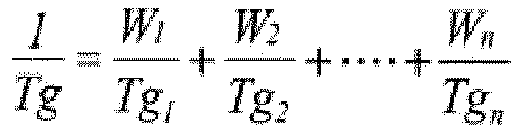
- Here, the symbols shown in the Equation are represented as follows.
Wn: mass fraction of each monomer
Tgn: Tg of homopolymer of each monomer (unit: K)
Tg: Tg of copolymer (unit: K) - Examples of the homopolymer include, but are not particularly limited to, 2-ethylhexyl acrylate homopolymer (Tg: -70°C), 2-ethylhexyl methacrylate homopolymer (Tg: - 10°C), 2-hydroxyethyl acrylate homopolymer (Tg: -15°C), 2-hydroxyethyl methacrylate homopolymer (Tg: 55°C), 2-hydroxybutyl acrylate homopolymer (Tg: -7°C), 2-hydroxybutyl methacrylate homopolymer (Tg: 26°C), 2-methoxyethyl acrylate homopolymer (Tg: -50°C), 4-hydroxybutyl acrylate homopolymer (Tg: -80°C), iso-octyl methacrylate homopolymer (Tg: -45°C), iso-butyl acrylate homopolymer (Tg: 43°C), iso-butyl methacrylate homopolymer (Tg: 53°C), iso-propyl acrylate homopolymer (Tg: -3°C), iso-propyl methacrylate homopolymer (Tg: 81°C), N,N-diethylaminoethyl methacrylate homopolymer (Tg: 20°C), N,N-dimethyl amino ethyl acrylate homopolymer (Tg: 18°C), N,N-dimethylaminoethyl methacrylate homopolymer (Tg: 18°C), N,N-dimethylaminopropyl acrylamide homopolymer (Tg: 134°C), n-butyl acrylate homopolymer (Tg: -54°C), tert-butyl acrylate homopolymer (Tg: 43°C), tert-butyl methacrylate homopolymer (Tg: 20°C), acrylamide homopolymer (Tg: 179°C), acrylic acid homopolymer (Tg: 106°C), acrylonitrile homopolymer (Tg: 125°C), isoamyl acrylate homopolymer (Tg: -45°C), iso-butyl acrylate homopolymer (Tg: -26°C), iso-butyl methacrylate homopolymer (Tg: 48°C), isobornyl acrylate homopolymer (Tg: 94°C), isobornyl methacrylate homopolymer (Tg: 155°C to 180°C), itaconic acid homopolymer (Tg: 100°C), ethyl acrylate homopolymer (Tg: - 22°C to -24°C), ethyl carbitol acrylate homopolymer (Tg: - 67°C), ethyl methacrylate homopolymer (Tg: 65°C), ethoxy ethyl acrylate homopolymer (Tg: -50°C), ethoxy ethyl methacrylate homopolymer (Tg: 15°C), ethoxy diethylene glycol acrylate homopolymer (Tg: -70°C), octyl acrylate homopolymer (Tg: -65°C) iso-octyl acrylate homopolymer (Tg: -70°C), cyclohexyl acrylate homopolymer (Tg: 15°C to 19°C), cyclohexyl methacrylate homopolymer (Tg: 66°C to 83°C), dicyclopentanyl acrylate homopolymer (Tg: 120°C), dicyclopentanyl methacrylate homopolymer (Tg: 175°C), styrene homopolymer (Tg: 100°C), stearyl acrylate homopolymer (Tg: 35°C), tertiary butyl acrylate homopolymer (Tg: 41°C), tertiary butyl methacrylate homopolymer (Tg: 107°C), tetradecyl acrylate homopolymer (Tg: 24°C), tetradecyl methacrylate homopolymer (Tg: -72°C), tetrahydrofurfuryl acrylate homopolymer (Tg: -12°C), tetrahydrofurfuryl methacrylate homopolymer (Tg: 60°C), nonyl acrylate homopolymer (Tg: 58°C), phenoxy ethyl acrylate homopolymer (Tg: -22°C), phenoxy ethyl methacrylate homopolymer (Tg: 54°C), butyl acrylate homopolymer (Tg: - 56°C), butyl methacrylate homopolymer (Tg: 20°C), propyl acrylate homopolymer (Tg: 3°C), propyl methacrylate homopolymer (Tg: 35°C), hexadecyl acrylate homopolymer (Tg: 35°C), hexadecyl methacrylate homopolymer (Tg: 15°C), hexyl acrylate homopolymer (Tg: -57°C), hexyl methacrylate homo polymer (Tg: -5°C), benzyl acrylate homopolymer (Tg: 6°C), benzyl methacrylate homopolymer (Tg: 54°C), pentyl acrylate homopolymer (Tg: 22°C), pentyl methacrylate homopolymer (Tg: -5°C), maleic acid homopolymer (Tg: 130°C), methacrylic acid homopolymer (Tg: 185°C) carboxyethyl acrylate homopolymer (Tg: 37°C), methyl acrylate homopolymer (Tg: 8°C), methyl methacrylate homopolymer (Tg: 105°C), methoxy ethyl acrylate homopolymer (Tg: -50°C), methoxy methacrylate homopolymer (Tg: -16°C), lauryl acrylate homopolymer (Tg: -3°C to 15°C), lauryl methacrylate homopolymer (Tg: -65°C), and vinyl acetate homopolymer (Tg: 32°C). Here, Tg is not limited to above because it may be changed depending on the manufacturing method and stereoregularity of the homopolymer.
- When the polymer is a homopolymer, the Tg (A) of the polymer contained in the core polymer can be controlled by selecting its homopolymer. Further, when the polymer is a copolymer, the Tg (A) thereof can be controlled by considering the Tg of the above homopolymer and the above FOX Equation.
- The polymer contained in the core polymer is not particularly limited to, but is preferably a polymer having at least one of a hydrophilic (meth)acrylate monomer unit, a hydrophobic (meth)acrylate monomer unit having an alkyl group of 3 or more carbon atoms, a hydrophobic (meth)acrylate monomer unit having a cyclic structure, a (meth)acrylamide monomer unit or N-substituted derivative thereof, an aromatic vinyl compound monomer unit, and a carboxylic acid monomer unit. Among these, a polymer having a hydrophobic (meth)acrylate having an alkyl group of 3 or more carbon atoms or a polymer having an aromatic vinyl compound is preferable.
- Examples of the hydrophilic (meth)acrylate monomer include, but are not limited to, methyl (meth)acrylate, ethyl (meth)acrylate, α-hydroxymethyl (meth)acrylate, 2-hydroxyethyl (meth)acrylate, (poly)ethyleneglycol (meth)acrylate, methoxy(poly)ethylene glycol (meth)acrylate, ethoxy(poly)ethyleneglycol (meth)acrylate, and (poly)propyleneglycol (meth)acrylate. Among these, methyl (meth)acrylate and ethyl (meth)acrylate are preferable. Here, the "hydrophilicity" means that the solubility in 100 mL of water (20°C) is 0.3 g or more.
- Examples of the hydrophobic (meth)acrylate monomer having an alkyl group of 3 or more carbon atoms include, but are not limited to, (meth)acrylates having an alkyl group of 3 or more carbon atoms, such as n-propyl (meth)acrylate, isopropyl (meth)acrylate, n-butyl (meth)acrylate, isobutyl (meth)acrylate, n-amyl (meth)acrylate, isoamyl (meth)acrylate, hexyl (meth)acrylate, 2-ethylhexyl (meth)acrylate, n-octyl (meth)acrylate, nonyl (meth)acrylate, decyl (meth)acrylate, lauryl (meth)acrylate, stearyl (meth)acrylate, cetyl (meth)acrylate, neopentyl (meth)acrylate, behenyl (meth) acrylate, and the like. Among these, lauryl (meth)acrylate is preferable. Here, the "hydrophobicity" means that the solubility in 100 mL of water (20°C) is less than 0.3 g.
- Examples of the hydrophobic (meth)acrylate monomer having a cyclic structure include, but are not limited to, cyclohexyl (meth)acrylate, dicyclopentanyl (meth)acrylate, dicyclopentenyl (meth)acrylate, dicyclopentenyloxyethyl (meth)acrylate, isobornyl (meth)acrylate, norbornyl (meth)acrylate, adamantyl (meth)acrylate, and tetrahydrofurfuryl (meth)acrylate.
- Examples of the (meth)acrylamide monomer or the N-substituted derivative thereof include, but are not limited to, (meth)acrylamides or N-substituted derivatives thereof, such as (meth)acrylamide, N-hydroxymethyl (meth)acrylamide, diacetone acrylamide, N,N-dimethyl acryl(meth)amide, and the like.
- Examples of the aromatic vinyl compound monomer include, but are not limited to, styrene, α-methyl styrene, p-methyl styrene, vinyl toluene, chlorostyrene, and divinyl benzene.
- Examples of the carboxylic acid monomer include, but are not limited to, (meth)acrylic acid, crotonic acid, maleic acid, fumaric acid, and itaconic acid. Among these, (meth)acrylic acid is preferable. Here, the "carboxylic acid monomer unit" refers to a polymerizable monomer unit having a carboxyl group and a polymerizable unsaturated group.
- The above monomers may be used alone or in a combination of two or more thereof.
- It is preferable that the core polymer is designed to be a polymer having high hydrophobicity. Therefore, it is preferable that the core polymer does not have an acid value. In addition, it is preferable that the core polymer contains at least an aromatic vinyl compound monomer as a constitutional unit. Therefore, the core polymer becomes hydrophobic, and thus a hydrophobic film can be formed. As a result, it is possible to improve water friction resistance that is one type of the friction resistance of a recorded image.
- Among all the repeating units constituting the polymer contained in the core polymer, the content of the repeating unit derived from the hydrophobic monomer is preferably 80 mass% or more, and more preferably 90 mass% or more. When the content of the repeating unit derived from the hydrophobic monomer is within the above range, a hydrophobic film is formed on the surface of an image recorded on a recording medium by performing heat treatment or the like, and thus the friction resistance of the image tends to be further improved.
- The polymers contained in the core polymer may be used alone or in a combination of two or more thereof. When the polymers contained in the core polymer are two or more kinds of polymers, the glass transition temperature of the polymer having the highest glass transition temperature is set to glass transition temperature A.
- The Tg (B) of the polymer contained in the shell polymer is preferably 50°C or higher, and more preferably 60°C or higher. In addition, the Tg (B) of the polymer contained in the shell polymer is preferably 120°C or lower, and more preferably 90°C or lower. When the Tg (B) of the polymer contained in the shell polymer is 120°C or lower, the shell polymer is easily softened on the recording medium, and thus the adhesiveness of the ink composition tends to be more excellent. Further, in the case where the ink composition is preheated at the time of ejecting the ink composition, when the Tg (B) of the polymer contained in the shell polymer is 50°C or higher, the polymer particles can be ejected from a recording head without collapsing a core-shell structure, and the deposition of the polymer particles in the printing nozzles can be more suppressed, and thus the ejection stability of the ink composition tends to be more excellent.
- In addition, it is preferable that the polymer contained in the shell polymer is a polymer having a (meth)acrylate monomer unit and a carboxylic acid monomer unit. When such a polymer is used, it is possible to allow a carboxyl group to be present on the surface of the shell polymer. Therefore, the dispersion stability of the polymer particles is further improved, and the viscosity of the ink composition becomes relatively low, and thus the ejection stability of the ink composition tends to be further improved. The (meth)acrylate monomer unit is not particularly limited, but examples thereof include a hydrophilic (meth)acrylate monomer unit (for example, a monomer unit having an alkyl group of 1 or 2 carbon atoms), a hydrophobic (meth)acrylate monomer unit having an alkyl group of 3 or more carbon atoms, and a hydrophobic (meth)acrylate monomer unit having a cyclic structure. Specific examples of the (meth)acrylate monomer unit and the carboxylic acid monomer unit are the same as those of the above-mentioned monomer units constituting the polymer contained in the core polymer. These monomers may be used alone or in a combination of two or more thereof.
- Among all the repeating units constituting the polymer contained in the shell polymer, the content of the repeating units derived from the (meth)acrylic acid ester and the unsaturated carboxylic acid is preferably 20 mass% or more, more preferably 30 mass% or more, and still more preferably 35 mass% or more.
- Among all the repeating units constituting the polymer contained in the shell polymer, the content of the repeating unit derived from the hydrophilic monomer is preferably 20 mass% or more, more preferably 30 mass% or more, and still more preferably 35 mass% or more. When the content of the repeating unit derived from the hydrophilic monomer is within the above range, the affinity of the shell polymer for water is improved, and thus the dispersion stability of the polymer particles in the ink composition tends to be improved. In addition, since it is possible to more effectively suppress the adherence of the polymer particles to nozzles, the ejection stability of the ink composition from the nozzles of a recording head tends to be better.
- Among all the repeating units constituting the polymer contained in the shell polymer, the content of the repeating unit derived from the hydrophobic monomer is preferably 10 mass% or more, more preferably 20 mass% or more, and still more preferably 30 mass% or more. By setting the content of the repeating unit derived from the hydrophobic monomer to be within the above range, even when the occupancy rate of an organic solvent is increased due to the drying of water in the recording head and on the recording medium, the dispersion of the polymer particles is stable, and the aggregation of the polymer particles tends to be able to be suppressed. As the hydrophobic monomer, an aromatic vinyl monomer is preferable.
- The polymers contained in the shell polymer may be used alone or in a combination of two or more thereof. When the polymers contained in the shell polymer are two or more kinds of polymers, the glass transition temperature of the polymer having the lowest glass transition temperature is set to glass transition temperature B.
- The average particle diameter of the polymer particles is preferably 10 nm to 100 nm, and more preferably 10 nm to 80 nm. When the average particle diameter of the polymer particles is relatively small, the gloss of the recorded image easily appears, and excellent film forming properties are exhibited. In addition, when the average particle diameter of the polymer particles is relatively small, a large lump is hardly formed even when the polymer particles are aggregated, and thus it is possible to suppress the clogging of nozzles. Further, when the average particle diameter of the polymer particles is small, the viscosity of the ink composition can be increased relatively high, and thus it is possible to prevent the viscosity of the ink composition from being lowered to such a degree that ink ejection properties become unstable, even when the temperature of the ink composition rises in the recording head. The average particle diameter is based on volume unless otherwise specified. As a measuring method, for example, the average particle diameter can be measured by a particle size distribution analyzer using a laser diffraction scattering method as a measurement principle. An example of the particle size distribution analyzer includes a particle size distribution meter (for example, Microtrac UPA, manufactured by Nikkiso Co., Ltd.) using a dynamic light scattering method as a measurement principle.
- The ratio (c/s) of the mass (c) of the core polymer to the mass (s) of the shell polymer in the polymer particle is preferably 0.4 to 4.0, more preferably 0.5 to 2.5, and particularly preferably 0.6 to 2.0. When the polymer particle satisfies the relation of (c/s)/ϕ ≥ 0.01, where ϕ represents the particle diameter of the polymer particle in nm, the balance between the mass of the core polymer and the mass of the shell polymer becomes good regardless of the size of the polymer particles, and thus the ejection stability of the ink composition and the friction resistance of an image recorded on a recording medium tend to be improved together.
- It is particularly preferable that the polymers constituting the core polymer or shell polymer of the above-described polymer particle are non-crosslinked. When the polymers are non-crosslinked, the ejection stability of the ink composition tends to be further improved. The degree of crosslinkage of the polymers can be quantified by measuring the gel fraction of the polymers using tetrahydrofuran (THF) (hereinafter, referred to as "THF gel fraction"). The THF gel fraction of the polymer particles is preferably 10% or less, and more preferably 5% or less. When the THF gel fraction of the polymer particles is within the above range, the friction resistance of an image recorded on a recording medium tends to be more improved.
- For example, the THF gel fraction can be measured as follows. About 10 g of core-shell polymer particles are weighed and put on a Teflon (registered trademark) petri dish, and then dried at 120°C for 1 hour to form a film. The obtained film is dipped into THF at 20°C for 24 hours, filtered by a filter of 100 meshes, and then dried again at 20°C for 24 hours. THF gel fraction (%) can be obtained by Equation below:

- The content (solid basis) of the polymer particles in the ink composition is preferably 0.5 mass% to 20 mass%, more preferably 0.6 mass% to 15 mass%, and still more preferably 0.7 mass% to 10 mass%, based on the total mass (100 mass%) of the ink composition. When the content of the polymer particles is 0.5 mass% or more, friction resistance and adhesiveness tend to be more excellent. When the content of the polymer particles is 20 mass% or less, ejection stability tends to be more excellent.
- Here, in the core-shell polymer particle in the present specification, a polymer forming a core polymer may be localized in the core polymer and a polymer forming a shell polymer may be localized in the shell polymer, or the core-shell polymer particle may be a polymer particle in which a boundary between a core polymer and a shell polymer is not exactly clear.
- A method of synthesizing a polymer particle is not particularly limited, but a polymer particle can be easily synthesized by known emulsion polymerization methods or appropriate combinations thereof. Specific examples thereof include a batch mixing polymerization method, a monomer dropping method, a pre-emulsion method, a seed emulsion polymerization method, a multi-stage emulsion polymerization method (two-stage emulsion polymerization method, or the like), a phase-inversion emulsion polymerization method, and the like. From the viewpoint of the average particle diameter of the polymer particles being able to be made very small, an emulsifier-free polymerization method is preferable.
- A polymerization method of previously synthesizing a core polymer is described. First, a core particle is synthesized by a general emulsion polymerization method using an aqueous medium. The conditions of emulsion polymerization may be determined according to a known method. For example, when the total amount of monomers used is set to 100 parts, the polymerization can be generally performed using 100 parts to 500 parts of water (aqueous medium). Polymerization temperature is preferably -10°C to 100°C, more preferably -5°C to 100°C, and still more preferably 0°C to 90°C. Polymerization time is preferably 0.1 hours to 30 hours, and more preferably 2 hours to 25 hours. As the method of emulsion polymerization, a batch method of collectively preparing monomers, a method of separately or continuously supplying monomers, a method of separately or continuously adding pre-emulsion of monomers, or a method in which these methods are combined in a stepwise manner can be employed. If necessary, a polymerization initiator, a molecular weight adjuster, an emulsifier, or the like, which is used in general emulsion polymerization, can be used alone or in a combination of two or more thereof.
- The polymerization initiator is not particularly limited, but examples thereof include persulfates, such as potassium persulfate and ammonium persulfate; organic peroxides, such as diisopropylperoxy dicarbonate, benzoyl peroxide, lauroyl peroxide, and tert-butylperoxy-2-ethylhexanoate; azo compounds, such as azobisisobutyronitrile, dimethyl-2,2'-azobisisobutyrate, and 2-carbamoylazaisobutyronitrile; and redox-based compounds that are obtained by combining reductants, such as a radical emulsifier containing a radical emulsifiable compound having a peroxide group, sodium hydrogen sulfite, and ferrous sulfate. These polymerization initiators may be used alone or in a combination of two or more thereof.
- The molecular weight adjuster is not particularly limited, but examples thereof include mercaptans, such as n-hexyl mercaptan, n-octyl mercaptan, n-dodecyl mercaptan, t-dodecyl mercaptan, n-hexadecyl mercaptan, n-tetradecyl mercaptan, t-tetradecyl mercaptan, and thioglycolic acid; xanthogen disulfides, such as dimethyl xanthogen disulfide, diethyl xanthogen disulfide, and diisopropyl xanthogen disulfide; thiuram disulfides, such as tetramethyl thiuram disulfide, tetraethyl thiuram disulfide, and tetrabutylthiuram disulfide; halogenated hydrocarbons, such as chloroform, carbon tetrachloride, carbon tetrabromide, and ethylene bromide; hydrocarbons, such as pentaphenyl ethane and α-methyl styrene dimer; and acrolein, methacrolein, allyl alcohol, 2-ethylhexyl thioglycolate, terpinolene, α-terunepin, γ-terunepin, dipentene, and 1,1-diphenyl ethylene. These molecular weight adjusters may be used alone or in a combination of two or more thereof.
- The emulsifier is not particularly limited, but examples thereof include anionic surfactants, such as alkyl sulfate ester salt and alkyl benzene sulfonate; nonionic surfactants, such as alkyl esters of polyethylene glycol, alkyl ethers of polyethylene glycol, and alkyl phenyl ethers of polyethylene glycol; reactive emulsifiers having a hydrophilic group, a hydrophobic group, and a radical reactive group; and polymer emulsifiers in which a hydrophilic group is introduced into a polymer such as vinyl-based polymer or a polyester-based polymer. These emulsifiers may be used alone or in a combination of two or more thereof. Here, the hydrophilic group refers to an atomic group having high affinity for water, and examples thereof include a nitro group, a hydroxyl group, an amino group, a carboxyl group, and a sulfonate group. In addition, the hydrophobic group refers to an atomic group having lower affinity for water than that of the hydrophilic group, and examples thereof include a linear or branched alkyl group, an alicyclic group, an aromatic ring group, an alkyl silyl group, and a perfluoroalkyl group.
- Next, in the presence of the obtained core particles (core polymer), monomers for a shell polymer are polymerized. Specifically, the monomers for a shell polymer are seed-polymerized while using the obtained core particles as seed particles, thereby forming core-shell polymer particles. For example, the monomers for a shell polymer or pre-emulsion thereof may be collectively, separately or continuously dropped into an aqueous medium in which core particles are dispersed. In this case, the amount of the core particles used is preferably 25 parts by mass to 250 parts by mass based on 100 parts by mass of the monomers for a shell polymer. When a polymerization initiator, a molecular weight modifier, an emulsifier, or the like is used at the time of polymerization, the same additives as those used in the manufacturing the core particles can be used. Further, the polymerization conditions, such as polymerization time, may also be the same as those used in or described above as suitable for the manufacturing of the core particles.
- A polymerization method of previously synthesizing a shell polymer is described. First, a shell polymer is synthesized. Specifically, a pre-emulsion solution containing the above-described hydrophilic monomers is prepared using a reactive emulsifier, and this pre-emulsion solution is dropped into an aqueous medium together with a polymerization initiator to cause a polymerization reaction, thereby synthesizing a shell polymer.
- Next, the core polymer is polymerized in a state in which the obtained shell polymer is set as a polymerization field to synthesize the polymer particle according to the present embodiment. Specifically, a monomer mixture containing the above-described hydrophobic monomers is dropped into an aqueous medium containing the shell polymer to polymerize the core polymer to obtain a polymer particle. Here, when the shell polymer is used as a polymerization field, since the monomer mixture is not required to contain an emulsifier, the monomer mixture can be dropped in the form of a monomer oil droplet.
- According to such a multi-stage emulsion polymerization, a shell polymer can be synthesized using a reactive emulsifier, and a core polymer can be synthesized without using an emulsifier, and thus the content of an emulsifier in the ink composition can be easily set to be 0.01 mass% or less. When the content of an emulsifier contained in the ink composition is 0.01 mass% or less, the aggregation of ink components in the ink interface (gas-liquid interface in ink-atmosphere, or solid-liquid interface in ink-ink contact member such as ink container) can be suppressed, and storage stability is excellent, and thus which is preferable. In addition, when the content of an emulsifier contained in the ink composition is 0.01 mass% or less, foaming properties and defoaming properties are excellent, and thus an ink container having an ink fillable inlet can be preferably used. Here, the "ink container having an ink fillable inlet" refers to an ink container having an attachable and detachable or openable and closable inlet. This ink container is configured such that a user can easily inject the ink composition, so foam otherwise easily occurs at the time of injection. Here, when the opening area of the inlet is 20 mm or more, the ink composition is easily charged into the ink container, and thus which is preferable. Such an ink container is disclosed, for example, in
JP-A-2005-219483 JP-A-2012-51309 - Even when a polymer particle is synthesized using a large amount of an emulsifier, excess emulsifier is removed after the synthesis of the polymer particle, and thus the content of an emulsifier contained in the ink composition may be set to be 0.01 mass% or less.
- Finally, the resultant is neutralized with a base such as sodium hydroxide, potassium hydroxide, or ammonia to adjust pH, and, if necessary, filtered, thereby obtaining a core-shell polymer particle dispersion.
- It is preferable that the ink composition contains a color material. The color material is not particularly limited, but examples thereof include pigments and dyes.
- Inorganic pigments are not particularly limited, but examples thereof include carbon blacks (C.I. Pigment Black 7) such as furnace black, lamp black, acetylene black, and channel black; iron oxides; and titanium oxides.
- Organic pigments are not particularly limited, but examples thereof include quinacridone-based pigments, quinacridonequinone-based pigments, dioxazine-based pigments, phthalocyanine-based pigments, anthrapyrimidine-based pigments, anthanthrone-based pigments, indanthrone-based pigments, flavanthrone-based pigments, perylene-based pigments, diketopyrrolopyrrole-based pigments, perinone-based pigments, quinophthalone-based pigments, anthraquinone-based pigments, thioindigo-based pigments, benzimidazolone-based pigments, isoindolinone-based pigments, azomethine-based pigments, and azo-based pigments.
- The pigments may be used alone or in a combination of two or more thereof.
- The content of the pigment is preferably 0.5 mass% to 15 mass%, more preferably 1 mass% to 10 mass%, and still more preferably 1 mass% to 5 mass%.
- It is preferable that the ink composition contains a surfactant. The surfactant is not particularly limited, but examples thereof include an acetylene glycol-based surfactant, a fluorine-based surfactant, and a silicone-based surfactant. When the ink composition contains these surfactants, the wettability of the ink composition adhered to the recording medium tends to be further improved.
- The acetylene glycol-based surfactant is not particularly limited, but, for example, is preferably one or more selected from alkylene oxide adducts of 2,4,7,9-tetramethyl-5-decyne-4,7-diol and 2,4,7,9-tetramethyl-5-decyne-4,7-diol; and alkylene oxide adducts of 2,4-dimethyl-5-decyne-4-ol and 2,4-dimethyl-5-decyne-4-ol. Commercially available products of the acetylene glycol-based surfactant are not particularly limited, but examples thereof include E series such as Olfine 104 series and Olfine E1010 (all are trade names, manufactured by Air Products Japan, Inc.), and Surfynol 465, and Surfynol 61 (all are trade names, manufactured by Nissin Chemical Industry Co., Ltd.). These acetylene glycol-based surfactants may be used alone or in a combination of two or more thereof.
- The fluorine-based surfactant is not particularly limited, but examples thereof include perfluoroalkyl sulfonates, perfluoroalkyl carboxylates, perfluoroalkyl phosphate esters, perfluoroalkyl ethylene oxide adducts, perfluoroalkyl betaine, and perfluoroalkyl amine oxide compounds. Commercially available products of the fluorine-based surfactant are not particularly limited, but examples thereof include S-144 and S-145 (manufactured by Asahi Glass Co., Ltd.); FC-170C, FC-430, and Fluorad-FC4430 (manufactured by Sumitomo 3M Limited.); FSO, FSO-100, FSN, FSN-100, and FS-300 (manufactured by Dupont, Ltd.); and FT-250 and FT-251 (manufactured by Neos Co., Ltd.). These fluorine-based surfactants may be used alone or in a combination of two or more thereof.
- Examples of the silicone-based surfactant include polysiloxane-based compounds, polyether-modified organosiloxane, and the like. Commercially available products of the silicone-based surfactant are not particularly limited, but specific examples thereof include BYK-306, BYK-307, BYK-333, BYK-341, BYK-345, BYK-346, BYK-347, BYK-348, and BYK-349 (all are trade names, manufactured by BYK Japan KK); and KF- 351A, KF-352A, KF-353, KF-354L, KF-355A, KF-615A, KF-945, KF-640, KF-642, KF-643, KF-6020, X-22-4515, KF-6011, KF-6012, KF-6015, and KF-6017 (all are trade names, manufactured by Shin-Etsu chemical Co., Ltd.).
- The content of the surfactant in the ink composition is preferably 0.1 mass% to 5 mass%, and more preferably 0.1 mass% to 3 mass%, based on the total mass (100 mass%) of the ink composition. When the content of the surfactant is within the above range, the wettability of the ink composition adhered to the recording medium tends to be further improved.
- It is preferable that the ink composition further contains a penetrant. When the ink composition quickly penetrates (or wetted and spread) into a recording medium, it is possible to obtain recorded matter having high bleeding resistance and low unevenness.
- The penetrant is not particularly limited, but preferable examples thereof include alkyl ethers of polyhydric alcohols (glycol ethers) and alkyl diols having 3 to 8 carbon atoms. The glycol ethers are not particularly limited, but examples thereof include ethylene glycol monomethyl ether, ethylene glycol monoethyl ether, ethylene glycol mono propyl ether, ethylene glycol monobutyl ether, ethylene glycol monomethyl ether acetate, diethylene glycol monomethyl ether, diethylene glycol monoethyl ether, diethylene glycol monopropyl ether, diethylene glycol monobutyl ether, diethylene glycol mono-t-butyl ether, triethylene glycol monobutyl ether, 1-methyl-1-methoxy butanol, propylene glycol monomethyl ether, propylene glycol monoethyl ether, propylene glycol monopropyl ether, propylene glycol monobutyl ether, dipropylene glycol monomethyl ether, dipropylene glycol monoethyl ether, dipropylene glycol monopropyl ether, propylene glycol monobutyl ether, and dipropylene glycol monobutyl ether.
- The alkyl diols having 3 to 8 carbon atoms are not particularly limited, but examples thereof include 1,2-pentanediol, 1,2-hexanediol, 1,2-propanediol, 1,3-propanediol, 1,4-butanediol, 1,5-pentanediol, 1,6-hexanediol, 1,7-heptanediol, 1,8-octanediol, 3-methyl-1,5-pentanediol, and 2-ethyl-1,3-hexanediol.
- These penetrants may be used alone or in a combination of two or more thereof.
- The content of the penetrant in the ink composition is preferably 0.1 mass% to 20 mass%, and more preferably 0.5 mass% to 10 mass%, based on the total mass (100 mass%) of the ink composition. When the content of the penetrant is 0.1 mass% or more, it is possible to increase the degree of penetration of the ink composition into the recording medium. Meanwhile, when the content of the penetrant is 20 mass% or less, the occurrence of image bleeding and unevenness can be prevented, and the increase in viscosity of the ink composition tends to be further suppressed.
- It is preferable that the ink composition further contains a cyclic amide compound. When the ink composition contains a cyclic amide compound, the stability of polymer particles can be improved, and the precipitation of foreign matter in the ink composition can be effectively prevented, and thus storage stability, particularly, storage stability at high temperature tends to be more excellent.
- In addition, since the cyclic amide compound also has moisturizing performance, it is possible to prevent polymer particles and other components from being aggregated and solidified by the evaporation of moisture at the time of storing the ink composition. In this case, the clogging around the nozzles of a head can be prevented at the time of ink jet recording, and thus the ejection stability of the ink composition tends to be more excellent.
- The cyclic amide compound is not particularly limited, but examples thereof include 2-pyrrolidone, N-methyl-2-pyrrolidone, and N-ethyl-2-pyrrolidone. Among these, 2-pyrrolidone is preferable. These cyclic amide compounds may be used alone or in a combination of two or more thereof.
- The content of the cyclic amide compound in the ink composition is preferably 0.5 mass% to 5 mass%, and more preferably 1 mass% to 3 mass%, based on the total mass (100 mass%) of the ink composition. When the content of the cyclic amide compound is within the above range, the long-term storage stability and ejection stability of the ink composition and the friction resistance of recorded matter due to the excellent adhesiveness of the ink composition tend to be more excellent.
- The ink composition can appropriately have added various additives, such as a solvent, a moisturizing agent, a dissolution aid, a viscosity modifier, a pH adjuster, an antioxidant, a preservative, a fungicide, a corrosion inhibitor, and a chelating agent for capturing metal ions influencing dispersion, in order to well maintain the storage stability of the ink composition and the ejection stability of the ink composition from a head, to improve clogging, or to prevent the deterioration of the ink composition.
- The surface tension of the ink composition at 25°C is preferably 20 mPa·s to 50 mPa·s, and more preferably 20 mPa·s to 40 mPa·s. When the surface tension thereof is within the above range, ejection stability tends to be better. The surface tension thereof can be measured using a surface tensiometer of Wilhelmy method.
- The viscosity of the ink composition at 25°C is preferably 20 mPa·s or less, and more preferably 10 mPa·s or less. When the viscosity thereof is within the above range, ejection stability tends to be better. The viscosity thereof can be measured using a viscometer.
- The recording medium is not particularly limited, but preferable examples thereof include an absorptive recording medium, a low-absorptive recording medium, and a non-absorptive recording medium.
- The absorptive recording medium is not particularly limited, but examples thereof include plain paper such as electrophotographic paper having high ink composition permeability, ink jet paper, art paper having relatively low ink composition permeability and used in general offset printing, coat paper, and cast paper. The ink jet paper is not particularly limited, but a specific example thereof includes paper including an ink absorbing layer composed of silica particles and alumina particles or an ink absorbing layer composed of a hydrophilic polymer such as polyvinyl alcohol (PVA) or polyvinyl pyrrolidone (PVP).
- The low-absorptive recording medium is not particularly limited, but an example thereof includes coated paper in which a coating layer for receiving an oil-based ink composition is provided on the surface. The coated paper is not particularly limited, but examples thereof include printing papers such as art paper, coat paper, and matte paper.
- The non-absorptive recording medium is not particularly limited, but examples thereof include a film or plate made of plastics such as polyvinyl chloride, polyethylene, polypropylene, and polyethylene terephthalate (PET); a plate made of metals such as iron, silver, copper, and aluminum; a metal plate or a plastic-made film fabricated by the deposition of these various metals; a plate made of an alloy of stainless steel or brass; and the like.
- Here, each of the "low-absorptive recording medium" and "non-absorptive recording medium" may be a recording medium having an amount of water absorption of 10 mL/m2 or less during the period of time from the start of contact to 30 msec in Bristow's method. This Bristow's method is the most common method as a method of measuring the amount of liquid absorption in a short period of time and is also employed in Japan Technical Association of the Pulp and Paper Industry (JAPAN TAPPI). The details of the test method are described in Standard No. 51, "Paper and Paperboard - Liquid Absorbency Test Method - Bristow's method" of "JAPAN TAPPI Paper Pulp Test Methods, 2000 version".
- In addition, the non-absorptive recording medium or the low-absorptive recording medium can also be classified in accordance with wettability of water on a recording surface. For example, the recording medium can be characterized by dropping 0.5 µL of a water droplet onto the recording surface of the recording medium to measure the reduction rate of a contact angle (comparing a contact angle at 0.5 msec after landing to a contact angle at 5 sec after the landing). More specifically, as characteristics of the recording medium, the non-absorbency of the "non-absorptive recording medium" indicates that the above-described reduction rate is lower than 1% and the low-absorbency of the "low-absorptive recording medium" indicates that the above-described reduction rate is 1% or higher and lower than 5%. In addition, the absorbency indicates that the above-described reduction rate is 5% or higher. It is possible to measure the contact angle using Portable Contact Angle Meter PCA-1 (manufactured by Kyowa Interface Science Co., Ltd.) or the like.
- The recording apparatus according to the present embodiment includes a recording head for ejecting the ink composition onto a recording medium; a head heating unit for heating the recording head to head temperature C; and a drying unit for drying the recording medium, on which the ink jet ink composition is adhered, at drying temperature D. This recording apparatus may further have the above-mentioned ink jet ink composition.
-
Fig. 1 is a schematic cross-sectional view of a recording apparatus according to the present embodiment. As shown inFig. 1 , therecording apparatus 1 includes arecording head 2, anIR heater 3, aplaten heater 4, a curingheater 5, a coolingfan 6, apreheater 7, and a ventilation fan 8. - The
recording head 2 ejects the ink composition onto the recording medium. As therecording head 2, a recording head known in the related art can be used. Examples thereof include a recording head for ejecting liquid droplets using the vibration of a piezoelectric element, that is, a recording head for forming ink droplets by mechanical deformation of an electrostrictive element. - The head heating unit serves to heat the
recording head 2 to head temperature C. The head heating unit is not particularly limited, but examples thereof include a unit for directly heating therecording head 2 by hot air or theIR heater 3 and a unit for heating therecording head 2 through the recording medium heated by theplaten heater 4. When therecording head 2 is heated, the viscosity of the ink composition in therecording head 2 is lowered, and thus the ink composition can be easily ejected. Further, since glass transition temperature B and head temperature C satisfy Formula (2) above, the shell polymer of the polymer particle in therecording head 2 is hardly softened, and thus the deposition of polymer particles in therecording head 2 can be suppressed. - In addition, when the
IR heater 3 is used, the recording medium can be heated from the side of therecording head 2. Therefore, therecording head 2 is also heated simultaneously, but the temperature of the recording medium can be increased without being affected by the thickness of the recording medium, compared to when the recording medium is heated from the back side thereof by theplaten heater 4 or the like. Further, when theplaten heater 4 is used, the recording medium can be heated from the side opposite to the side of therecording head 2. Thus, therecording head 2 becomes relatively difficult to heat. - Preferably, at the time of ejecting the ink composition onto the recording medium, the
recording apparatus 1 further includes a recording medium heating unit for heating a recording medium such that the surface temperature E of the recording medium is 30°C to 60°C. The recording medium heating unit is not particularly limited, but examples thereof include theIR heater 3 and aplaten heater 4. When therecording apparatus 1 includes the recording medium heating unit, the ink composition adhered to the recording medium can be more rapidly dried, and bleeding can be further suppressed. - The drying unit serves to heat and dry the recording medium, to which the ink jet ink composition is adhered, to drying temperature D. The drying unit is not particularly limited, but examples thereof include the curing
heater 5, a hot air mechanism (not shown), a thermostatic bath (not shown), and the like. When the drying unit heats the recording medium on which an image is recorded, moisture or the like contained in the ink composition is more rapidly evaporated and scattered, and thus a film is formed by the polymer particles contained in the ink composition. In this way, the dried ink composition is strongly fixed (adhered) on the recording medium, and thus a high-quality image having excellent friction resistance can be obtained in a short time. - Here, the above described "heating the recording medium" refers to raising the temperature of the recording medium to a desired temperature, and is not limited to directly heating the recording medium.
- The
recording apparatus 1 may have the coolingfan 6. When the ink composition on the recording medium is cooled by the coolingfan 6 after the drying, a film having excellent adhesiveness tends to be able to be formed on the recording medium. - In addition, the
recording apparatus 1 may include thepreheater 7 for previously heating (preheating) the recording medium before the ejection of the ink composition onto the recording medium. When the recording medium is preheated before the ejection of the ink composition, bleeding hardly occurs on the recording medium, particularly a non-absorptive or low-absorptive recording medium, and thus it is possible to form a high-quality image. Preheating temperature is preferably 80°C to 120°C. - Further, the
recording apparatus 1 may include the ventilation fan 8 for more efficiently drying the ink composition adhered to the recording medium. - The recording method according to the present embodiment includes a first step of ejecting an ink composition from a recording head of head temperature C onto a recording medium to adhere the ink composition thereonto; and a second step of drying the recording medium, on which the ink composition is adhered, at drying temperature D. Here, the ink composition contains water and a polymer particle, the polymer particle has a core polymer containing a polymer of glass transition temperature A and a shell polymer containing a polymer of glass transition temperature B and formed on the surface of the core polymer, and the glass transition temperature A, the glass transition temperature B, the head temperature C, and the drying temperature D satisfy Formulae (1) and (2) above.
- Hereinafter, the recording method using the above-described
recording apparatus 1 according to the present embodiment will be described. -
FIG. 2 shows a flowchart of a recording method according to the present embodiment. As shown inFIG. 2 , the recording method according to the present embodiment includes a first step and a second step. The first step is a step of ejecting the above-described ink composition from arecording head 2 of head temperature C onto a recording medium to adhere the ink composition thereonto. In this case, the viscosity of the ink composition in therecording head 2 is lowered, and thus the ink composition can be easily ejected. In addition, since glass transition temperature B and head temperature C satisfy Formula (2) above, the deposition of polymer particles in therecording head 2 can be suppressed without softening the shell polymer of the polymer particle in the ink composition in therecording head 2, thereby improving ejection stability. Head temperature C is set to be lower than glass transition temperature B, and the difference (B-C) between glass transition temperature B and head temperature C is preferably 5°C or higher, and more preferably 10°C or higher. Meanwhile, B-C is preferably 60°C or lower, and more preferably 50°C or lower. That is, B-C is preferably 5°C to 60°C, and more preferably 10°C to 50°C. - Here, as the ink composition, the above-described ink composition can be used.
- In the first step, it is preferable that the recording medium is heated from the side of the
recording head 2. In the case where the recording medium is thick, when the recording medium is heated from the side of therecording head 2 using theIR heater 3, the ink composition is easily and more rapidly dried, compared to when the recording medium is heated from a side opposite to the ink-adhered side of the recording medium using theplaten heater 4. - In the first step, the surface temperature E of the recording medium is preferably 30°C to 60°C, and more preferably 40°C to 60°C. When the surface temperature E of the recording medium is within the above range, the thickening of ink is suppressed, and thus ejection stability tends to be more excellent. The surface temperature E of the recording medium can be controlled using at least one of the
IR heater 3 and theplaten heater 4. - The surface temperature E of the recording medium is lower than the glass transition temperature B. The difference (B-E) between the glass transition temperature B and the surface temperature E of the recording medium is preferably 10°C or higher, and more preferably 15°C or higher. Meanwhile, B-E is preferably 50°C or lower, and more preferably 40°C or lower. That is, B-E is preferably 10°C to 50°C, and more preferably 15°C to 40°C. In this case, only the volatile components of the ink composition on the recording medium can be more selectively volatilized without softening the shell polymer of the polymer particle in the ink composition adhered to the recording medium.
- The second step is a step of drying the recording medium, on which the ink composition is adhered, at drying temperature D. The drying temperature D is higher than the glass transition temperature B. The difference (D-B) between the drying temperature D and the glass transition temperature B is preferably 5°C or higher, and more preferably 10°C or higher. Meanwhile, the difference (D-B) is preferably 50°C or lower, and more preferably 40°C or lower. That is, the difference (D-B) is preferably 5°C to 50°C, and more preferably 10°C to 40°C. When the drying temperature D is higher than the glass transition temperature B, with satisfying Formula (1) above, the shell polymer of the polymer particle in the ink composition adhered to the recording medium is softened, and simultaneously the core polymer is discharged, and thus these polymers are closely adhered to the recording medium.
- After the second step, the ink composition on the recording medium is cooled by the cooling
fan 6, and thus a film having high adhesiveness tends to be able to be formed on the recording medium. - In the second step, it is preferable that drying temperature D is used in a recording method at 45°C to 130°C. the drying temperature D is preferably 55°C to 120°C, and more preferably 70°C to 110°C. When the drying temperature D is within the above range, the deformation of a substrate can be suppressed, and drying speed tends to be fast.
- Hereinafter, the invention will be described in more detail using Examples and Comparative Examples. The invention is not limited to the following Examples.
- The main materials for the ink composition used in the following Examples and Comparative Examples are as follows.
- Color material
C.I. Pigment Blue 15:3 - Penetrant
1,2-hexanediol - Moisturizing agent
1,2-propanediol - Cyclic amid compound
2-pyrrolidone - Surfactant
BYK348 (silicone-based surfactant, manufactured by BYK Japan KK) - Polymer particles
Polymer particle 1 (prepared by Preparation Example 1)
Polymer particle 2 (prepared by Preparation Example 1)
Polymer particle 3 (prepared by Preparation Example 1)
Polymer particle 4 (prepared by Preparation Example 1)
Polymer particle 5 (prepared by Preparation Example 2)
Polymer particle 6 (prepared by Preparation Example 1)
Polymer particle 7 (prepared by Preparation Example 1) - 100 parts of ion exchange water was put into a reactor equipped with a dropping device, a thermometer, a water-cooling reflux condenser, and a stirrer, and 0.2 parts of ammonium persulfate as a polymerization initiator was added under a nitrogen atmosphere of 70°C with stirring, and then a monomer solution containing 42.5 parts of methyl methacrylate, 22.5 parts of butyl methacrylate, 19.2 parts of lauryl methacrylate, and 7.7 parts of acrylic acid was dropped into the reactor to prepare a shell polymer by a polymerization reaction. Thereafter, a mixed solution of 0.2 parts of potassium persulfate, 9.2 parts of styrene, and 13.8 parts of n-butyl acrylate was dropped, and the resultant was polymerized with stirring at 70°C, and then the resultant product was neutralized with sodium hydroxide to adjust pH to 8 to 8.5, and filtered by a filter of 0.3 µm to obtain a core-shell polymer particle dispersion (polymer particle 1).
- As shown in Tables 2 and 3,
polymer particles 1 to 4, 6, and 7 were prepared in the same manner aspolymer particle 1, except for changing the ratio of components constituting the shell and the core. - 100 parts of ion exchange water and 0.2 parts of potassium persulfate as a polymerization initiator were put into a reactor equipped with a dropping device, a thermometer, a water-cooling reflux condenser, and a stirrer, and a reaction liquid containing 40 parts of ion exchange water, 0.2 parts of potassium lauryl sulfate, 104 parts of methyl methacrylate, 13 parts of lauryl methacrylate, 13 parts of acrylic acid, and 0.5 parts of t-dodecyl mercaptan was added and polymerized under a nitrogen atmosphere of 70°C with stirring, and then the resultant product was neutralized with sodium hydroxide to adjust pH to 8 to 8.5, and filtered by a filter of 0.3 µm to obtain a polymer particle aqueous dispersion.
- Next, the glass transition temperature Tg (°C) of each of the polymer constituting the core polymer and the polymer constituting the shell polymer was calculated using the above-described FOX Equation. In
polymer particle 5, the glass transition temperature thereof was calculated in the same manner.Table 1 Polymer particle 1Polymer particle 2Polymer particle 3Polymer particle 4Polymer particle 5Polymer particle 6Polymer particle 7Core portion Tg Tg:(A)°C -10 -10 38 4 - 20 38 Shell portion Tg Tg:(B)°C 24.7 41 76 76 76 32 32 Constitutional monomer Core-shell type Core-shell type Core-shell type Core-shell type Non-core-shell type Core-shell type Core-shell type Shell component MMA 32.7 42.5 50.0 65 59.3 80 46.5 80 80 104 26.0 44.8 33.2 44.8 BMA 17.3 22.5 0.0 0 0.0 0 0.0 0 0 0 0.0 0 0.0 0 STA 0.0 0 0.0 0 0.0 0 0.0 0 0 0 14.5 25 18.5 25 2EHA 0.0 0 0.0 0 0.0 0 0.0 0 0 0 13.1 22.5 16.7 22.5 LMA 19.2 25 19.2 25 7.4 10 5.8 10 10 13 0.0 0 0.0 0 AA 7.7 10 7.7 10 7.4 10 5.8 10 10 13 4.5 7.7 5.7 7.7 Core component BA 13.8 18 13.8 18 7.4 10 23.3 40 0 0 0.0 0 7.4 10 St 9.2 12 9.2 12 18.5 25 18.6 32 0 0 0.0 0 18.5 25 BMA 0 0 0 0 0 0 0.0 0 0 0 41.9 72 0.0 0 Total amount of monomer 100 130 100 130 100.0 135 100 172 100 130 100.0 172 100.0 135 MMA: methyl methacrylate
BMA: butyl methacrylate
LMA: lauryl methacrylate
AA: acrylic acid
BA: butyl acrylate
St: styrene - Raw materials were respectively mixed in the composition ratios (mass%) shown in Tables 3 and 4 below, and sufficiently stirred to obtain ink compositions. Here, pigment and polymer particle are represented by solid content. The results of the following evaluation tests are summarized in Tables 3 and 4.
- A part of the printer Stylus Pro 9900 (manufactured by Seiko Epson Corporation) was modified to obtain a printer which can adjust the heating of a recording medium at the time of ink jet recording. Each of the ink compositions was ejected from nozzles of a recording head using this printer, and a solid pattern was formed on vinyl chloride coat paper JT5829R (manufactured by Mactac Co., Ltd.) as a recording medium. The ejected ink composition was dried by a curing unit, and was then cooled by a cooling fan. After continuous printing was performed for 10 hours, ejection stability was evaluated as follows. Here, maintenance was performed after every two hours of recording. Recording conditions (mode) are shown in Table 2.
- Here, the printer Stylus Pro 9900 (manufactured by Seiko Epson Corporation) has a platen heater and an IR heater as a recording medium heating unit, has a nozzle plate, an ink chamber, and a heater capable of controlling the warming of a path as a heat heating unit, has a platen heater and an IR heater as a curing unit, and has a platen heater as a preheater.
-
- A: although non-ejection or ejection disturbance somewhat occurs during ejection, it returns to ejecting mode, and thus there is no problem.
- B: although non-ejection or ejection disturbance somewhat occurs during ejection and does not return to ejection mode, a current state returns to a normal state by maintenance.
- C: non-ejection or ejection disturbance somewhat occurs during ejection, and does not return to ejection mode, and a current state does not return to a normal state by maintenance.
- Each of the ink compositions was ejected from nozzles of a recording head using printer Stylus Pro 9900 (manufactured by Seiko Epson Corporation), and a solid pattern was formed on vinyl chloride coat paper JT5829R (manufactured by Mactac Co., Ltd.) as a recording medium. The ejected ink composition was dried by a curing heater, and was then cooled by a cooling fan. JIS standard crosscut test on the obtained recorded matter was performed, and the adhesiveness of the ink composition was evaluated as follows.
-
- A: peeling is not seen in all 25 grids.
- B: peeling is seen in 3 grids or less among 25 grids.
- C: peeling is seen in 3 grids or more among 25 grids.
- Each of the ink compositions was ejected from nozzles of a recording head using printer Stylus Pro 9900 (manufactured by Seiko Epson Corporation), and a solid pattern was formed on vinyl chloride coat paper JT5829R (manufactured by Mactac Co., Ltd.) as a recording medium. The ejected ink composition was dried by a curing heater, and was then cooled by a cooling fan. Recording resolution was set to 720 x 720 dpi, and mass (ink mass) per ink droplet was set to 21 ng. Theapplication amount was changed by 7.5 mg to 11 mg per square inch, and a solid pattern having a portion with a duty ratio of 70% to 100% was formed. Aggregation unevenness on the portion with duty ratio of 70% to 100% of the obtained recorded matter was visually observed, and was evaluated as follows.
-
- A: Aggregation unevenness cannot be visually observed.
- B: Aggregation unevenness was visually observed in some ink mass
- C: Aggregation unevenness was observed regardless of ink mass
| |
|
|
|
|
|
|
Mode 8 | Mode 9 | Mode 10 | |
| Recording medium heating unit | Platen | Platen | Platen | Platen | IR | IR | IR | IR | - | IR |
| *1 | 45 | 50 | 55 | 60 | 170 | 200 | 230 | 255 | - | 200 |
| Preset temperature of recording medium heating unit | ||||||||||
| Head temperature (C)°C | 35 | 40 | 45 | 50 | 50 | 55 | 60 | 65 | 20 | 55 |
| Drying temperature (D)°C | 100 | 100 | 100 | 100 | 100 | 100 | 100 | 100 | 100 | 60 |
| Surface temperature of recording medium (E)°C | 40 | 45 | 50 | 55 | 40 | 45 | 50 | 55 | 20 | 45 |
| *1: temperature of heating unit after driving a drying heater for 1 hour |
| Resin selection | |||||||||||||||||||
| Ink composition ratio | Comp. Ex. 1 | Ex. 1 | Comp. Ex. 2 | Ex. 2 | Ex. 3 | Ex. 4 | Ex. 5 | Comp. Ex. 3 | Ex. 6 | Comp. Ex. 4 | |||||||||
| Pigment | C.I. Pigment Blue 15:3 | 2 | 2 | 2 | 2 | 2 | 2 | 2 | 2 | 2 | 2 | ||||||||
| Penetrant | 1,2-hexanediol | 6 | 6 | 6 | 6 | 6 | 6 | 6 | 6 | 6 | 6 | ||||||||
| 1,2-propanediol | 10 | 10 | 10 | 10 | 10 | 10 | 10 | 10 | 10 | 10 | |||||||||
| Cyclic amide compound | 2-pyrrolidone | 10 | 10 | 10 | 10 | 10 | 10 | 10 | 10 | 10 | 10 | ||||||||
| Surfactant | BYK348 | 1 | 1 | 1 | 1 | 1 | 1 | 1 | 1 | 1 | 1 | ||||||||
| Polymer particle | Polymer particle 1 | 7 | 7 | ||||||||||||||||
| Polymer particle 2 | 7 | ||||||||||||||||||
| Polymer particle 3 | 3 | 7 | 15 | ||||||||||||||||
| Polymer particle 4 | 7 | ||||||||||||||||||
| Polymer particle 5 | 7 | ||||||||||||||||||
| Polymer particle 6 | 7 | ||||||||||||||||||
| Polymer particle 7 | 7 | ||||||||||||||||||
| Pure water | 64 | 64 | 64 | 64 | 64 | 64 | 64 | 64 | 64 | 64 | |||||||||
| Total amount | 100 | 100 | 100 | 100 | 100 | 100 | 100 | 100 | 100 | 100 | |||||||||
| Print mode | Mode 6 | Mode 9 | Mode 6 | Mode 6 | Mode 6 | Mode 6 | Mode 6 | Mode 6 | Mode 6 | Mode 6 | |||||||||
| Resin core portion Tg | (A)°C | -10 | -10 | -10 | 38 | 38 | 38 | 4 | 76 | 20 | 38 | ||||||||
| Resin shell portion Tg | (B)°C | 24.7 | 24.7 | 41 | 76 | 76 | 76 | 76 | 76 | 32 | 32 | ||||||||
| Print head temperature | (C)°C | 55 | 20 | 55 | 55 | 55 | 55 | 55 | 55 | 55 | 55 | ||||||||
| Heating drying temperature | (D)°C | 100 | 100 | 100 | 100 | 100 | 100 | 100 | 100 | 100 | 100 | ||||||||
| Recording medium surface | (E)°C | 45 | 20 | 45 | 45 | 45 | 45 | 45 | 45 | 45 | 45 | ||||||||
| Evaluation items | Ejection stability | C | A | C | A | A | B | A | A | B | C | ||||||||
| Adhesiveness | A | B | A | A | A | A | A | C | B | C | |||||||||
| High-speed printability (aggregation unevenness) | A | B | A | A | A | A | A | A | B | B | |||||||||
| Print mode, substrate selection | |||||||||
| Ink composition ratio | Ex. 7 | Ex. 8 | Ex. 9 | Ex. 10 | Ex. 11 | Ex. 12 | Ex. 13 | Comp. Ex. 5 | |
| Pigment | C.I. Pigment Blue 15:3 | 2 | 2 | 2 | 2 | 2 | 2 | 2 | 2 |
| Penetrant | 1,2-hexanediol | 6 | 6 | 6 | 6 | 6 | 6 | 6 | 6 |
| 1,2-propanediol | 10 | 10 | 10 | 10 | 10 | 10 | 10 | 10 | |
| Cyclic amide compound | 2-pyrrolidone | 10 | 10 | 10 | 10 | 10 | 10 | 10 | 10 |
| Surfactant | BYK348 | 1 | 1 | 1 | 1 | 1 | 1 | 1 | 1 |
| Polymer particle | Polymer particle 1 | - | - | - | - | - | - | - | - |
| Polymer particle 2 | - | - | - | - | - | - | - | - | |
| Polymer particle 3 | 7 | 7 | 7 | 7 | 7 | 7 | 7 | 7 | |
| Polymer particle 4 | - | - | - | - | - | - | - | - | |
| Polymer particle 5 | - | - | - | - | - | - | - | - | |
| Polymer particle 6 | - | - | - | - | - | - | - | - | |
| Polymer particle 7 | - | - | - | - | - | - | - | - | |
| Pure water | 64 | 64 | 64 | 64 | 64 | 64 | 64 | 64 | |
| Total amount | 100 | 100 | 100 | 100 | 100 | 100 | 100 | 100 | |
| Print mode | Mode 1 | Mode 2 | Mode 3 | Mode 4 | Mode 5 | Mode 7 | Mode 8 | Mode 10 | |
| Resin core portion Tg | (A)°C | 38 | 38 | 38 | 38 | 38 | 38 | 38 | 38 |
| Resin shell portion Tg | (B)°C | 76 | 76 | 76 | 76 | 76 | 76 | 76 | 76 |
| Print head temperature | (C)°C | 35 | 40 | 45 | 40 | 50 | 60 | 65 | 40 |
| Heating drying temperature | (D)°C | 100 | 100 | 100 | 100 | 100 | 100 | 100 | 60 |
| Recording medium surface | (E)°C | 40 | 45 | 50 | 55 | 40 | 50 | 55 | 45 |
| Evaluation items | Ejection stability | A | A | B | B | A | B | B | A |
| Adhesiveness | A | A | A | A | A | A | A | C | |
| High-speed printability (aggregation unevenness) | B | A | A | A | B | A | A | C | |
Claims (11)
- An ink jet ink composition, which is used in a recording method including ejecting the ink jet ink composition from a recording head (2) of head temperature C (unit: °C) onto a recording medium to adhere the ink jet ink composition thereonto and drying the recording medium, on which the ink jet ink composition is adhered, at drying temperature D (unit: °C), comprising:water; anda polymer particle,wherein the polymer particle has a core polymer containing a polymer of glass transition temperature A (unit: °C) and a shell polymer containing a polymer of glass transition temperature B (unit: °C) and covering at least a part of the core polymer, andwherein the glass transition temperature A and the glass transition temperature B satisfy Formula (1) below, and the glass transition temperature A and the glass transition temperature B satisfy Formula (2) below in the relation to the head temperature C and the drying temperature D.


- The ink jet ink composition according to claim 1, wherein the shell polymer contains a polymer having a (meth)acrylate unit and a carboxylic acid monomer unit.
- The ink jet ink composition according to claim 1 or claim 2,
wherein the glass transition temperature A is -10°C to 60°C. - The ink jet ink composition according to any one of the preceding claims,
wherein, in the ejecting of the ink jet ink composition, the ink jet ink composition is used in the recording method in which the recording medium is heated from a side of the recording head. - The ink jet ink composition according to any one of the preceding claims, further comprising:at least one of a fluorine-based surfactant and a silicone-based surfactant; andat least one of a glycol ether and an alkyl diol of 3 to 8 carbon atoms.
- The ink jet ink composition according to any one of the preceding claims,
wherein the ink jet ink composition is used in the recording method in which the drying temperature D is 45°C to 130°C. - The ink jet ink composition according to any one of the preceding claims,
wherein, in the ejecting of the ink jet ink composition, the ink jet ink composition is used in the recording method in which the surface temperature E (unit: °C) of the recording medium is 30°C to 70°C. - The ink jet ink composition according to any one of the preceding claims,
wherein the glass transition temperature B and the surface temperature E satisfy Formula (3) below.
- A recording method, comprising:ejecting an ink jet ink composition from a recording head (2) of head temperature C (unit: °C) onto a recording medium to adhere the ink jet ink composition thereonto; anddrying the recording medium, on which the ink jet ink composition is adhered, at drying temperature D (unit: °C),wherein the ink jet ink composition contains water and a polymer particle,wherein the polymer particle has a core polymer containing a polymer of glass transition temperature A (unit: °C) and a shell polymer containing a polymer of glass transition temperature B (unit: °C) and formed on the surface of the core polymer, andwherein the glass transition temperature A, the glass transition temperature B, the head temperature C, and the drying temperature D satisfy Formulae (1) and (2) below.


- The recording method according to claim 9,
wherein the glass transition temperature B and the surface temperature E satisfy Formula (3) below.
- A recording apparatus, comprising:a recording head configured to eject the ink jet ink composition according to any one of claims 1 to 8 onto a recording medium;a head heating unit (3) configured to heat the recording head to head temperature C (unit: °C); anda drying unit (S) configured to dry the recording medium, on which the ink jet ink composition is adhered, at drying temperature D (unit: °C).
Applications Claiming Priority (1)
| Application Number | Priority Date | Filing Date | Title |
|---|---|---|---|
| JP2014071243A JP6299339B2 (en) | 2014-03-31 | 2014-03-31 | Inkjet ink composition, recording method, and recording apparatus |
Publications (2)
| Publication Number | Publication Date |
|---|---|
| EP2927288A2 true EP2927288A2 (en) | 2015-10-07 |
| EP2927288A3 EP2927288A3 (en) | 2015-11-18 |
Family
ID=52780477
Family Applications (1)
| Application Number | Title | Priority Date | Filing Date |
|---|---|---|---|
| EP15162048.1A Withdrawn EP2927288A3 (en) | 2014-03-31 | 2015-03-31 | Ink jet ink composition, recording method, and recording apparatus |
Country Status (3)
| Country | Link |
|---|---|
| US (1) | US9512326B2 (en) |
| EP (1) | EP2927288A3 (en) |
| JP (1) | JP6299339B2 (en) |
Cited By (1)
| Publication number | Priority date | Publication date | Assignee | Title |
|---|---|---|---|---|
| EP2924081B1 (en) * | 2014-03-27 | 2018-10-17 | Seiko Epson Corporation | Ink composition and recording method |
Families Citing this family (5)
| Publication number | Priority date | Publication date | Assignee | Title |
|---|---|---|---|---|
| JP5994424B2 (en) * | 2012-06-25 | 2016-09-21 | Dic株式会社 | UV-curable adhesive resin composition and adhesive |
| JP6977248B2 (en) * | 2015-12-10 | 2021-12-08 | セイコーエプソン株式会社 | Recording method and recording device |
| JP2017170851A (en) * | 2016-03-25 | 2017-09-28 | 富士ゼロックス株式会社 | Recording device and recording method |
| JP6840553B2 (en) * | 2016-03-28 | 2021-03-10 | 三菱ケミカル株式会社 | Resin composition, molded product and method for producing the molded product |
| JP2017186442A (en) * | 2016-04-05 | 2017-10-12 | セイコーエプソン株式会社 | Aqueous ink composition and inkjet recording method |
Citations (3)
| Publication number | Priority date | Publication date | Assignee | Title |
|---|---|---|---|---|
| JP2005219483A (en) | 2004-02-06 | 2005-08-18 | Print-Rite Unicorn Image Products Co Ltd Of Zhuhai | Device for continuously feeding ink under constant pressure |
| JP2008260300A (en) | 2001-12-04 | 2008-10-30 | Eastman Kodak Co | Inkjet printing method |
| JP2012051309A (en) | 2010-09-03 | 2012-03-15 | Seiko Epson Corp | Liquid container and liquid jet system |
Family Cites Families (13)
| Publication number | Priority date | Publication date | Assignee | Title |
|---|---|---|---|---|
| JP4003239B2 (en) | 1995-10-06 | 2007-11-07 | セイコーエプソン株式会社 | Ink composition for inkjet recording and inkjet recording method |
| JP3257391B2 (en) | 1996-03-18 | 2002-02-18 | 東洋インキ製造株式会社 | Inkjet recording liquid |
| US20020107303A1 (en) | 2000-10-12 | 2002-08-08 | Seiko Epson Corporation | Method of preparation of polymer emulsion and ink composition comprising the polymer emulsion |
| US6777041B2 (en) | 2001-12-04 | 2004-08-17 | Eastman Kodak Company | Ink jet recording element |
| JP4797343B2 (en) | 2004-08-03 | 2011-10-19 | Jsr株式会社 | Emulsion for water-based ink-jet ink and water-based ink-jet ink composition using the same |
| KR100644664B1 (en) | 2004-12-15 | 2006-11-10 | 삼성전자주식회사 | Inkjet printer |
| US20100328411A1 (en) | 2009-06-30 | 2010-12-30 | Sivapackia Ganapathiappan | Printing on vinyl print media |
| JP5882628B2 (en) | 2010-08-31 | 2016-03-09 | キヤノン株式会社 | Ink, ink cartridge, and ink jet recording method |
| JP5773185B2 (en) | 2011-03-24 | 2015-09-02 | セイコーエプソン株式会社 | Ink jet recording ink, ink set, method for producing recorded matter, deinking method |
| JP5811338B2 (en) * | 2011-09-15 | 2015-11-11 | 株式会社リコー | Ink jet ink and ink jet recording method using the same |
| JP6142995B2 (en) * | 2012-11-26 | 2017-06-07 | セイコーエプソン株式会社 | Ink composition for ink jet recording and ink jet recording method |
| JP6202472B2 (en) * | 2013-11-13 | 2017-09-27 | セイコーエプソン株式会社 | Inkjet ink composition, recording method, and recording apparatus |
| JP6281689B2 (en) | 2014-02-28 | 2018-02-21 | セイコーエプソン株式会社 | Ink composition and recording apparatus |
-
2014
- 2014-03-31 JP JP2014071243A patent/JP6299339B2/en active Active
-
2015
- 2015-03-30 US US14/672,607 patent/US9512326B2/en active Active
- 2015-03-31 EP EP15162048.1A patent/EP2927288A3/en not_active Withdrawn
Patent Citations (3)
| Publication number | Priority date | Publication date | Assignee | Title |
|---|---|---|---|---|
| JP2008260300A (en) | 2001-12-04 | 2008-10-30 | Eastman Kodak Co | Inkjet printing method |
| JP2005219483A (en) | 2004-02-06 | 2005-08-18 | Print-Rite Unicorn Image Products Co Ltd Of Zhuhai | Device for continuously feeding ink under constant pressure |
| JP2012051309A (en) | 2010-09-03 | 2012-03-15 | Seiko Epson Corp | Liquid container and liquid jet system |
Cited By (1)
| Publication number | Priority date | Publication date | Assignee | Title |
|---|---|---|---|---|
| EP2924081B1 (en) * | 2014-03-27 | 2018-10-17 | Seiko Epson Corporation | Ink composition and recording method |
Also Published As
| Publication number | Publication date |
|---|---|
| US20150274999A1 (en) | 2015-10-01 |
| JP6299339B2 (en) | 2018-03-28 |
| JP2015193693A (en) | 2015-11-05 |
| US9512326B2 (en) | 2016-12-06 |
| EP2927288A3 (en) | 2015-11-18 |
Similar Documents
| Publication | Publication Date | Title |
|---|---|---|
| EP2924081B1 (en) | Ink composition and recording method | |
| CN104946017B (en) | Printing ink composition, print cartridge and recording method | |
| JP6202472B2 (en) | Inkjet ink composition, recording method, and recording apparatus | |
| US8697774B2 (en) | Ink for ink jet recording and ink set for ink jet recording | |
| US9512326B2 (en) | Ink jet ink composition, recording method, and recording apparatus | |
| US10370551B2 (en) | Ink composition and recording method | |
| JP7054346B2 (en) | Water-based inkjet ink composition | |
| JP6586731B2 (en) | Solvent-based inkjet ink composition | |
| EP2913371A1 (en) | Ink composition and recording apparatus | |
| US20150166808A1 (en) | Ink set and recording method using the same | |
| JP2015101690A (en) | Ink composition and recording method | |
| JP6492818B2 (en) | Liquid composition, recording method, recording apparatus | |
| JP2018184696A (en) | Inkjet recording method and recording apparatus | |
| US9376583B2 (en) | Ink composition, recording apparatus, and recording method | |
| JP2015151463A (en) | ink composition | |
| JP6702458B2 (en) | Inkjet recording method | |
| JP2015110793A (en) | Ink for inkjet recording and ink set for inkjet recording | |
| JP6268983B2 (en) | Recording method | |
| US20240327663A1 (en) | Inkjet Ink Composition And Recording Method | |
| JP2015189858A (en) | Ink set |
Legal Events
| Date | Code | Title | Description |
|---|---|---|---|
| PUAI | Public reference made under article 153(3) epc to a published international application that has entered the european phase |
Free format text: ORIGINAL CODE: 0009012 |
|
| AK | Designated contracting states |
Kind code of ref document: A2 Designated state(s): AL AT BE BG CH CY CZ DE DK EE ES FI FR GB GR HR HU IE IS IT LI LT LU LV MC MK MT NL NO PL PT RO RS SE SI SK SM TR |
|
| AX | Request for extension of the european patent |
Extension state: BA ME |
|
| PUAL | Search report despatched |
Free format text: ORIGINAL CODE: 0009013 |
|
| AK | Designated contracting states |
Kind code of ref document: A3 Designated state(s): AL AT BE BG CH CY CZ DE DK EE ES FI FR GB GR HR HU IE IS IT LI LT LU LV MC MK MT NL NO PL PT RO RS SE SI SK SM TR |
|
| AX | Request for extension of the european patent |
Extension state: BA ME |
|
| RIC1 | Information provided on ipc code assigned before grant |
Ipc: B41M 5/00 20060101ALI20151014BHEP Ipc: B41J 2/01 20060101ALI20151014BHEP Ipc: C09D 11/10 20140101ALI20151014BHEP Ipc: C09D 11/30 20140101AFI20151014BHEP |
|
| 17P | Request for examination filed |
Effective date: 20160517 |
|
| RBV | Designated contracting states (corrected) |
Designated state(s): AL AT BE BG CH CY CZ DE DK EE ES FI FR GB GR HR HU IE IS IT LI LT LU LV MC MK MT NL NO PL PT RO RS SE SI SK SM TR |
|
| R17P | Request for examination filed (corrected) |
Effective date: 20160517 |
|
| 17Q | First examination report despatched |
Effective date: 20170329 |
|
| STAA | Information on the status of an ep patent application or granted ep patent |
Free format text: STATUS: THE APPLICATION IS DEEMED TO BE WITHDRAWN |
|
| 18D | Application deemed to be withdrawn |
Effective date: 20170809 |