EP2927245B1 - Catalyst composition for preparing multimodal polyolefin resin with remarkable moldability and mechanical properties, and polymerization method using same - Google Patents
Catalyst composition for preparing multimodal polyolefin resin with remarkable moldability and mechanical properties, and polymerization method using same Download PDFInfo
- Publication number
- EP2927245B1 EP2927245B1 EP13859834.7A EP13859834A EP2927245B1 EP 2927245 B1 EP2927245 B1 EP 2927245B1 EP 13859834 A EP13859834 A EP 13859834A EP 2927245 B1 EP2927245 B1 EP 2927245B1
- Authority
- EP
- European Patent Office
- Prior art keywords
- formula
- group
- carbon atoms
- catalyst composition
- metallocene compound
- Prior art date
- Legal status (The legal status is an assumption and is not a legal conclusion. Google has not performed a legal analysis and makes no representation as to the accuracy of the status listed.)
- Active
Links
- DISQPVHXWNPPCS-UHFFFAOYSA-N CC(C)(C)c(cc1)cc2c1-c1ccc(C(C)(C)C)cc1C2C(C1=CC=C(C)C1)(c1ccccc1)c1ccccc1 Chemical compound CC(C)(C)c(cc1)cc2c1-c1ccc(C(C)(C)C)cc1C2C(C1=CC=C(C)C1)(c1ccccc1)c1ccccc1 DISQPVHXWNPPCS-UHFFFAOYSA-N 0.000 description 1
- UPDSFXXGPWJOMZ-UHFFFAOYSA-N CC(C)(C)c(cc1)cc2c1-c1ccc(C(C)(C)C)cc1C2C(C1=CC=CC1)(c1ccccc1)c1ccccc1 Chemical compound CC(C)(C)c(cc1)cc2c1-c1ccc(C(C)(C)C)cc1C2C(C1=CC=CC1)(c1ccccc1)c1ccccc1 UPDSFXXGPWJOMZ-UHFFFAOYSA-N 0.000 description 1
Images


Classifications
-
- C—CHEMISTRY; METALLURGY
- C08—ORGANIC MACROMOLECULAR COMPOUNDS; THEIR PREPARATION OR CHEMICAL WORKING-UP; COMPOSITIONS BASED THEREON
- C08F—MACROMOLECULAR COMPOUNDS OBTAINED BY REACTIONS ONLY INVOLVING CARBON-TO-CARBON UNSATURATED BONDS
- C08F4/00—Polymerisation catalysts
- C08F4/42—Metals; Metal hydrides; Metallo-organic compounds; Use thereof as catalyst precursors
- C08F4/44—Metals; Metal hydrides; Metallo-organic compounds; Use thereof as catalyst precursors selected from light metals, zinc, cadmium, mercury, copper, silver, gold, boron, gallium, indium, thallium, rare earths or actinides
- C08F4/60—Metals; Metal hydrides; Metallo-organic compounds; Use thereof as catalyst precursors selected from light metals, zinc, cadmium, mercury, copper, silver, gold, boron, gallium, indium, thallium, rare earths or actinides together with refractory metals, iron group metals, platinum group metals, manganese, rhenium technetium or compounds thereof
- C08F4/62—Refractory metals or compounds thereof
- C08F4/64—Titanium, zirconium, hafnium or compounds thereof
- C08F4/659—Component covered by group C08F4/64 containing a transition metal-carbon bond
- C08F4/6592—Component covered by group C08F4/64 containing a transition metal-carbon bond containing at least one cyclopentadienyl ring, condensed or not, e.g. an indenyl or a fluorenyl ring
-
- C—CHEMISTRY; METALLURGY
- C08—ORGANIC MACROMOLECULAR COMPOUNDS; THEIR PREPARATION OR CHEMICAL WORKING-UP; COMPOSITIONS BASED THEREON
- C08F—MACROMOLECULAR COMPOUNDS OBTAINED BY REACTIONS ONLY INVOLVING CARBON-TO-CARBON UNSATURATED BONDS
- C08F210/00—Copolymers of unsaturated aliphatic hydrocarbons having only one carbon-to-carbon double bond
- C08F210/16—Copolymers of ethene with alpha-alkenes, e.g. EP rubbers
-
- C—CHEMISTRY; METALLURGY
- C08—ORGANIC MACROMOLECULAR COMPOUNDS; THEIR PREPARATION OR CHEMICAL WORKING-UP; COMPOSITIONS BASED THEREON
- C08F—MACROMOLECULAR COMPOUNDS OBTAINED BY REACTIONS ONLY INVOLVING CARBON-TO-CARBON UNSATURATED BONDS
- C08F10/00—Homopolymers and copolymers of unsaturated aliphatic hydrocarbons having only one carbon-to-carbon double bond
-
- C—CHEMISTRY; METALLURGY
- C08—ORGANIC MACROMOLECULAR COMPOUNDS; THEIR PREPARATION OR CHEMICAL WORKING-UP; COMPOSITIONS BASED THEREON
- C08F—MACROMOLECULAR COMPOUNDS OBTAINED BY REACTIONS ONLY INVOLVING CARBON-TO-CARBON UNSATURATED BONDS
- C08F2/00—Processes of polymerisation
-
- C—CHEMISTRY; METALLURGY
- C08—ORGANIC MACROMOLECULAR COMPOUNDS; THEIR PREPARATION OR CHEMICAL WORKING-UP; COMPOSITIONS BASED THEREON
- C08F—MACROMOLECULAR COMPOUNDS OBTAINED BY REACTIONS ONLY INVOLVING CARBON-TO-CARBON UNSATURATED BONDS
- C08F4/00—Polymerisation catalysts
- C08F4/42—Metals; Metal hydrides; Metallo-organic compounds; Use thereof as catalyst precursors
- C08F4/44—Metals; Metal hydrides; Metallo-organic compounds; Use thereof as catalyst precursors selected from light metals, zinc, cadmium, mercury, copper, silver, gold, boron, gallium, indium, thallium, rare earths or actinides
- C08F4/60—Metals; Metal hydrides; Metallo-organic compounds; Use thereof as catalyst precursors selected from light metals, zinc, cadmium, mercury, copper, silver, gold, boron, gallium, indium, thallium, rare earths or actinides together with refractory metals, iron group metals, platinum group metals, manganese, rhenium technetium or compounds thereof
- C08F4/62—Refractory metals or compounds thereof
- C08F4/64—Titanium, zirconium, hafnium or compounds thereof
- C08F4/659—Component covered by group C08F4/64 containing a transition metal-carbon bond
- C08F4/65912—Component covered by group C08F4/64 containing a transition metal-carbon bond in combination with an organoaluminium compound
-
- C—CHEMISTRY; METALLURGY
- C08—ORGANIC MACROMOLECULAR COMPOUNDS; THEIR PREPARATION OR CHEMICAL WORKING-UP; COMPOSITIONS BASED THEREON
- C08F—MACROMOLECULAR COMPOUNDS OBTAINED BY REACTIONS ONLY INVOLVING CARBON-TO-CARBON UNSATURATED BONDS
- C08F4/00—Polymerisation catalysts
- C08F4/42—Metals; Metal hydrides; Metallo-organic compounds; Use thereof as catalyst precursors
- C08F4/44—Metals; Metal hydrides; Metallo-organic compounds; Use thereof as catalyst precursors selected from light metals, zinc, cadmium, mercury, copper, silver, gold, boron, gallium, indium, thallium, rare earths or actinides
- C08F4/60—Metals; Metal hydrides; Metallo-organic compounds; Use thereof as catalyst precursors selected from light metals, zinc, cadmium, mercury, copper, silver, gold, boron, gallium, indium, thallium, rare earths or actinides together with refractory metals, iron group metals, platinum group metals, manganese, rhenium technetium or compounds thereof
- C08F4/62—Refractory metals or compounds thereof
- C08F4/64—Titanium, zirconium, hafnium or compounds thereof
- C08F4/659—Component covered by group C08F4/64 containing a transition metal-carbon bond
- C08F4/65916—Component covered by group C08F4/64 containing a transition metal-carbon bond supported on a carrier, e.g. silica, MgCl2, polymer
-
- C—CHEMISTRY; METALLURGY
- C08—ORGANIC MACROMOLECULAR COMPOUNDS; THEIR PREPARATION OR CHEMICAL WORKING-UP; COMPOSITIONS BASED THEREON
- C08F—MACROMOLECULAR COMPOUNDS OBTAINED BY REACTIONS ONLY INVOLVING CARBON-TO-CARBON UNSATURATED BONDS
- C08F4/00—Polymerisation catalysts
- C08F4/42—Metals; Metal hydrides; Metallo-organic compounds; Use thereof as catalyst precursors
- C08F4/44—Metals; Metal hydrides; Metallo-organic compounds; Use thereof as catalyst precursors selected from light metals, zinc, cadmium, mercury, copper, silver, gold, boron, gallium, indium, thallium, rare earths or actinides
- C08F4/60—Metals; Metal hydrides; Metallo-organic compounds; Use thereof as catalyst precursors selected from light metals, zinc, cadmium, mercury, copper, silver, gold, boron, gallium, indium, thallium, rare earths or actinides together with refractory metals, iron group metals, platinum group metals, manganese, rhenium technetium or compounds thereof
- C08F4/62—Refractory metals or compounds thereof
- C08F4/64—Titanium, zirconium, hafnium or compounds thereof
- C08F4/659—Component covered by group C08F4/64 containing a transition metal-carbon bond
- C08F4/6592—Component covered by group C08F4/64 containing a transition metal-carbon bond containing at least one cyclopentadienyl ring, condensed or not, e.g. an indenyl or a fluorenyl ring
- C08F4/65922—Component covered by group C08F4/64 containing a transition metal-carbon bond containing at least one cyclopentadienyl ring, condensed or not, e.g. an indenyl or a fluorenyl ring containing at least two cyclopentadienyl rings, fused or not
- C08F4/65925—Component covered by group C08F4/64 containing a transition metal-carbon bond containing at least one cyclopentadienyl ring, condensed or not, e.g. an indenyl or a fluorenyl ring containing at least two cyclopentadienyl rings, fused or not two cyclopentadienyl rings being mutually non-bridged
-
- C—CHEMISTRY; METALLURGY
- C08—ORGANIC MACROMOLECULAR COMPOUNDS; THEIR PREPARATION OR CHEMICAL WORKING-UP; COMPOSITIONS BASED THEREON
- C08F—MACROMOLECULAR COMPOUNDS OBTAINED BY REACTIONS ONLY INVOLVING CARBON-TO-CARBON UNSATURATED BONDS
- C08F4/00—Polymerisation catalysts
- C08F4/42—Metals; Metal hydrides; Metallo-organic compounds; Use thereof as catalyst precursors
- C08F4/44—Metals; Metal hydrides; Metallo-organic compounds; Use thereof as catalyst precursors selected from light metals, zinc, cadmium, mercury, copper, silver, gold, boron, gallium, indium, thallium, rare earths or actinides
- C08F4/60—Metals; Metal hydrides; Metallo-organic compounds; Use thereof as catalyst precursors selected from light metals, zinc, cadmium, mercury, copper, silver, gold, boron, gallium, indium, thallium, rare earths or actinides together with refractory metals, iron group metals, platinum group metals, manganese, rhenium technetium or compounds thereof
- C08F4/62—Refractory metals or compounds thereof
- C08F4/64—Titanium, zirconium, hafnium or compounds thereof
- C08F4/659—Component covered by group C08F4/64 containing a transition metal-carbon bond
- C08F4/6592—Component covered by group C08F4/64 containing a transition metal-carbon bond containing at least one cyclopentadienyl ring, condensed or not, e.g. an indenyl or a fluorenyl ring
- C08F4/65922—Component covered by group C08F4/64 containing a transition metal-carbon bond containing at least one cyclopentadienyl ring, condensed or not, e.g. an indenyl or a fluorenyl ring containing at least two cyclopentadienyl rings, fused or not
- C08F4/65927—Component covered by group C08F4/64 containing a transition metal-carbon bond containing at least one cyclopentadienyl ring, condensed or not, e.g. an indenyl or a fluorenyl ring containing at least two cyclopentadienyl rings, fused or not two cyclopentadienyl rings being mutually bridged
Definitions
- This invention relates to a catalyst composition for preparing polyolefin resin and method of polymerization using the same, and more particularly, to a metallocene catalyst composition for preparing multimodal polyolefin having characteristics such as superior moldability, mechanical strength and appearance, and method of polymerization using the same.
- Polyolefin having multimodal molecular weight distribution has at least two components each having different molecular weight.
- polyolefin contains a high molecular weight component and a low molecular weight component in relatively proper proportions.
- Many studies have been conducted for the preparation of a polyolefin having broad molecular weight distribution or multimodal molecular weight distribution.
- One method among them is a post-reactor process or a melting blending process in which polyolefin having at least two different molecular weights are blended before or during the processing of the polyolefin.
- US Patent No. 4,461,873 discloses a blending method of physically blending two different kinds of polymers for preparing a bimodal polymer blend.
- Another method for preparing polyolefin having multimodal molecular weight distribution is to use a multistage reactor which includes two or more reactors.
- a first polymer component having one molecular weight distribution among two different molecular weight distribution of the bimodal polymer is prepared in a certain condition at a first reactor, the first polymer component prepared is transferred to a second reactor, and then a second polymer component having different molecular weight distribution from that of the first polymer component, is prepared in a different condition from that of the first reactor, at the second reactor.
- the above-mentioned method solves the problems relating to the gel component, but it uses the multistage reactor, so the production efficiency may be decreased or the production cost may be increased.
- the high molecular weight components are prepared in the first reactor, the low molecular weight components are not prepared in the second reactor and thus the finally manufactured polyolefin particles may be made only by the high molecular weight components.
- Still another method for preparing polyolefin having broad molecular weight distribution or multimodal molecular weight distribution is to polymerize the polyolefin by using a mixture of catalysts in a single reactor.
- the various attempts have been made for producing polyolefin having broad molecular weight distribution or multimodal molecular weight distribution, by using two or more different catalysts in a single reactor.
- the resin particles are uniformly mixed in a level of sub-particles, thus the resin components each having different molecular weight distribution exists in a single phase.
- 4,530,914 and 4,935,474 disclose a method for preparing polyolefin having broad molecular weight distribution by polymerizing ethylene or more higher alpha-olefins in the presence of a catalyst system comprising two or more metallocenes each having different propagation and termination rate constants and alumoxane.
- US Patent Nos. 6,841,631 and 6,894,128 disclose a method for preparing polyethylene having bimodal or multimodal molecular weight distribution by using a metallocene-type catalyst comprising at least two metal compounds and the usage of the polyethylene for manufacturing films, pipes, and hollow molded articles.
- Polyethylene produced in this way has a good processability, but the dispersed state of the polyethylene component in the molecular weight per unit particle is not uniform, so there are disadvantages of rough appearance and unstable physical properties even in relatively good processing conditions.
- US Patent No. 4,937,299 discloses a method for preparing polyolefin by using a catalyst system comprising at least two kinds of metallocenes each having different reactivity ratio with respect to monomer to be polymerized.
- US Patent No.4,808,561 discloses a method for preparing olefin polymerization supported catalyst by reacting metallocene with alumoxane in the presence of a carrier. The metallocene is supported in the carrier to form solid power catalyst.
- inorganic oxide materials such as silica, alumina, silica-alumina, magnesia, titania, zirconia and the mixture thereof, and resinous materials such as polyolefin (for example, finely divided polyethylene) can be employed, and the metallocenes and alumoxanes are deposited on the dehydrated carrier material.
- resinous materials such as polyolefin (for example, finely divided polyethylene)
- US Patent No. 5,539,076 discloses a mixture catalyst system of metallocene /non-metallocene for preparing a specific bimodal high-density copolymer.
- the catalyst system is supported by an inorganic carrier.
- the carrier such as silica, alumina, magnesium-chloride and the mixture catalyst of Ziegler-Natta and metallocene are disclosed in US Patent No. 5,183,867 , European publication No. 0676418A1 , European Patent No. 0717755B1 , US Patent No.5,747,405 , European publication No. 0705848A2 , US Patent No. 4,659,685 , US Patent No.
- the mixture catalyst of Zeigier-Natta and metallocene supported has relatively low activity than single uniform catalyst, so it is difficult to prepare polyolefin having properties suitable for a specific use.
- polyolefin since polyolefin is prepared in a single reactor, the gel which is generated in the blending method may be produced, it is difficult to insert comonomer to high molecular weight components part, the form of polymer produced may be poor and further two polymer components may not be uniformly mixed, so the quality control of the produced polyolefin may be difficult.
- Korean Patent No. 1132180 discloses a more than one metallocene mixture catalyst system for preparing a multimodal polyolefin copolymer.
- the catalyst system has a disadvantage that an amount of comonomer of low molecular weight portion of bimodal polymer is not low.
- the low molecular weight portion should be low the amount of the comonomer, and the high molecular weight portion should be high the amount of the comonomer.
- the amount of comonomer of the high molecular weight portion is high, but long-term water resistance characteristic may be reduced due to the comonomer included in the low molecular weight portion.
- melt flow index MIE, 2.16 kg / 10 mins
- US Patent No. 5,594,078 discloses a catalyst composition consisting of bridged fluorenyl-containing metallocene, non-bridged metallocene and co-catalyst, and method for producing olefin polymer by using the catalyst composition.
- the US Patent No. 5,594,078 only discloses simple information such as melt flow index, molecular weight distribution of the polymer obtained by batch-type polymerization, but physical properties of polyolefin such as a moldability, mechanical properties, an appearance of the molded form, which are required industrially, are not taken into account.
- US Patent No. 7,619,047 discloses at least two metallocene mixture catalyst system for preparing a multimodal copolymer.
- the first metallocene used in the mixture catalyst system of US Patent No. 7,619,047 includes a linear alkenyl group as a substituent in bridged cyclopentadienyl groups, which is different from the bridged fluorenyl-containing metallocene disclosed in US Patent No. 5,594,078 .
- the US Patent No. 7,619,047 only discloses a melt flow index and molecular weight of the prepared polyolefin, physical properties of polyolefin such as a moldability, mechanical properties, an appearance of the molded form which are required industrially are not taken into account.
- the present invention provides a catalyst composition for preparing a multimodal polyolefin resin, consisting of (i) at least one first metallocene compound represented by following Formula 1; (ii) at least one second metallocene compound represented by following Formula 2; and (iii) at least one co-catalyst selected from aluminoxane groups represented by following Formulas 3, 4 and 5.
- a catalyst composition for preparing a multimodal polyolefin resin consisting of (i) at least one first metallocene compound represented by following Formula 1; (ii) at least one second metallocene compound represented by following Formula 2; and (iii) at least one co-catalyst selected from aluminoxane groups represented by following Formulas 3, 4 and 5.
- M 1 is titanium(Ti), zirconium(Zr) or hafnium(Hf);
- L 1 ) and (L 2 ) are independently, a cyclopentadienyl group having an alkyl substituent group of 3 to 10 carbon atoms in which at least one tertiary and quaternary carbon is contained;
- (X 1 ) and (X 2 ) are independently F, Cl, Br, I or a hydrocarbonyl group of 1 to 10 carbon atoms.
- M 2 is Ti, Zr or Hf;
- (L 3 ) is a fluorenyl group having two alkyl substituent groups of 4 to 10 carbon atoms in which quaternary carbon is contained;
- (L 4 ) is a cyclopentadienyl group having at least one alkyl substituent group of 4 to 10 carbon atoms;
- (Q) is a crosslinking functional group represented by Formula Q 1 R 1 R 2 , Q 1 is carbon atom(C), silicon atom(Si) or germanium atom(Ge), R 1 and R 2 are independently hydrogen or hydrocarbonyl group of 1 to 10 carbon atoms;
- (X 1 ) and (X 2 ) are independently F, Cl, Br, I or hydrocarbonyl group of 1 to 10 carbon atoms.
- R' is a hydrocarbon group
- x is an integer of 1 to 70
- y is an integer of 3 to 50.
- the present invention provides a method for polymerizing polyolefin using the present catalyst composition, a polyolefin copolymer prepared by the present polymerizing method and a molded product containing the polyolefin copolymer.
- Molded product of polyolefin resin having good moldability, mechanical strength and external appearance can be produced from the multimodal polyolefin resin prepared by using the catalyst composition according to the present invention.
- the polyolefin resin may be called as simply polymer or polyolefin, or ethylene-based polymer, polymer, olefin polymer.
- the present catalyst for preparing the multimodal polyolefin is for polymerizing multimodal polyolefin used for molding films, and pipes, specifically polyolefin having wide molecular weight distribution or bimodal molecular weight distribution.
- the catalyst composition of the present invention consists of (i) at least one first metallocene compound represented by following Formula 1, for preparing polymer of relatively low molecular weight; (ii) at least one second metallocene compound represented by following Formula 2, for preparing polymer of relatively high molecular weight; and (iii) at least one co-catalyst selected from aluminoxane groups represented by following Formulas 3, 4 and 5.
- Formula 1 At least one first metallocene compound represented by following Formula 1, for preparing polymer of relatively low molecular weight
- second metallocene compound represented by following Formula 2 for preparing polymer of relatively high molecular weight
- co-catalyst selected from aluminoxane groups represented by following Formulas 3, 4 and 5.
- M 1 is titanium(Ti), zirconium(Zr) or hafnium(Hf);
- L 1 ) and (L 2 ) are independently, an alkyl group of 3 to 10 carbon atoms in which at least one tertiary and quaternary carbon is contained, preferably a cyclopentadienyl group having alkyl group of 3 to 7 carbon atoms;
- X 1 ) and (X 2 ) are independently F, Cl, Br, I or a hydrocarbonyl group of 1 to 10 carbon atoms, preferably 1 to 6 carbon atoms.
- (L 1 ) and (L 2 ) each is different to each other, and each of them is a cyclopentadienyl group having an alkyl group of 3 to 10 carbon atoms (preferably, alkyl group of 3 to 7 carbon atoms), which contains at least one tertiary and quaternary carbon, but does not contain aryl group.
- (L 1 ) and (L 2 ) are the same, and each of them is a cyclopentadienyl group having an alkyl group of 3 to 10 carbon atoms (preferably, alkyl group of 3 to 7 carbon atoms, which contains at least one tertiary and quaternary carbon, but does not contain aryl group.
- the tertiary and quaternary carbon contained in the hydrocarbonyl group is a part for showing steric hindrance.
- the cyclopentadienyl group may be substituted by 1 to 4 hydrocarbonyl groups (substituent) of 1 to 10 carbon atoms, besides a substituent group showing the steric hindrance.
- the adjoining substituent groups are connected to each other to form a ring structure.
- two hydrocarbonyl groups which are substituted in the cyclopentadienyl group are connected to each other to in whole form an indenyl group (See: following Formula 1h) or form a cyclohexane ring structure(See: following Formula 1i).
- M 2 is titanium(Ti), zirconium(Zr) or hafnium(Hf);
- (L 3 ) is a fluorenyl group having preferably two alkyl substituent groups of 4 to 10 carbon atoms containing the quaternary carbon (for example alkyl group of 4 to 7 carbon atoms);
- (L 4 ) is a cyclopentadienyl group having at least one alkyl group of 4 to 10 carbon atoms (for example, alkyl group of 4 to 7 carbon atoms), preferably a cyclopentadienyl group which does not contain aryl group and has at least one hydrocarbonyl substituent groups of 4 to 10 carbon atoms, more preferably a cyclopentadienyl group which does not contain aryl group and has one alkyl substituent of 4 to 7 carbon atoms (for example, alkyl group);
- (Q) is a crosslinking functional group represented by Formula Q 1 R 1 R 2 , Q 1 is
- the quaternary carbon contained in the hydrocarbonyl group is a part for showing the steric hindrance.
- examples of the hydrocarbonyl substituent group not containing aryl group include alkyl group, alkenyl group, alkynyl group, and cycloalkyl group.
- R' is a hydrocarbonyl group, preferably linear or branched alkyl group of 1 to 10 carbon atoms, and it is more preferably that most of R' is methyl group.
- x is an integer of 1 to 70, preferably 1 to 50, more preferably 10 to 40.
- y is an integer of 3 to 50, preferably 10 to 40.
- the first metallocene compound has a substituent containing the tertiary and quaternary carbon which show steric hindrance, and is a catalyst for forming low molecular weight polyolefin which is not branched
- the second metallocene compound has superior polymerization activity, contains cyclopentadienyl group having an alkyl group of 4 to 10 carbon atoms which is effective in reducing LCB(Long Chain Branch) and bridged fluorenyl group, and is a catalyst for forming high molecular weight polyolefin.
- the first metallocene compound represented by the formula 1 will be in detail explained.
- Polymerization of multimodal or bimodal polyolefin requires a catalyst for preparing polymer of relatively low molecular weight and thus for this, the first metallocene compound is employed as the catalyst.
- the density of polymer of relatively low molecular weight polymerized with the first metallocene compound is higher, that is, the amount of comonomer in the polymer is less, an extrusion load during the molding of the polymer is reduced and the extrusion amount of the polymer is increased. Accordingly the production yield is superior and when the polymer is molded into a pipe shape, the impact strength and long-term water pressure endurance of the pipe are improved.
- the first metallocene compound includes ligand (ligand showing steric hindrance effect) having a hydrocarbonyl substituent group in which at least one tertiary or quaternary carbon is contained.
- ligand ligand showing steric hindrance effect
- hydrocarbonyl substituent group in which at least one tertiary or quaternary carbon is contained.
- the coordination of the comonomer to the central metal is suppressed through a steric hindrance so that the density of polymer of relatively low molecular weight is increased.
- the preferable example of the first metallocene compound represented by Formula 1 include compounds represented by following Formula 1a to Formula 11.
- Ma 1 is Ti, Zr or Hf
- Ra 1 and Ra 2 are independently hydrogen atom or a hydrocarbonyl group of 1 to 10 carbon atoms
- Xa 1 and Xa 2 are independently F, Cl, Br, I or a hydrocarbonyl group of 1 to 10 carbon atoms
- na 1 and na 2 are independently an integer of 0 to 7.
- M b 1 is Ti, Zr or Hf
- Rb 1 and Rb 2 are independently hydrogen atom or a hydrocarbonyl group of 1 to 10 carbon atoms
- Xb 1 and Xb 2 are independently F, Cl, Br, I or a hydrocarbonyl group of 1 to 10 carbon atoms
- nb 1 and nb 2 are independently an integer of 0 to 6.
- M c 1 is Ti, Zr or Hf
- R c 1 and R c 2 are independently hydrogen atom or a hydrocarbonyl group of 1 to 10 carbon atoms
- X c 1 and X c 2 are independently F, Cl, Br, I or a hydrocarbonyl group of 1 to 10 carbon atoms
- n c 1 and n c 2 are independently an integer of 0 to 4.
- M d 1 is Ti, Zr or Hf
- R d 1 and R d 2 are dependently hydrogen atom or a hydrocarbonyl group of 1 to 10 carbon atoms
- X d 1 and X d 2 are independently F, Cl, Br, I or a hydrocarbonyl group of 1 to 10 carbon atoms
- n d 1 and n d 2 are independently an integer of 0 to 4.
- M e 1 is Ti, Zr or Hf
- R e 1 and R e 2 are independently hydrogen atom or a hydrocarbonyl group of 1 to 10 carbon atoms
- X e 1 and X e 2 are independently F, Cl, Br, I or a hydrocarbonyl group of 1 to 10 carbon atoms
- n e 1 and n e 2 are independently an integer of 0 to 7.
- M f 1 is Ti, Zr or Hf
- R f 1 and R f 2 are independently hydrogen atom or a hydrocarbonyl group of 1 to 10 carbon atoms
- X f 1 and X f 2 are independently F, Cl, Br, I or a hydrocarbonyl group of 1 to 10 carbon atoms
- n f 1 and n f 2 are independently an integer of 0 to 6.
- M g 1 is Ti, Zr or Hf
- R g 1 and R g 2 are independently hydrogen atom or a hydrocarbonyl group of 1 to 10 carbon atoms
- X g 1 and X g 2 are independently F, Cl, Br, I or a hydrocarbonyl group of 1 to 10 carbon atoms
- n g 1 and n g 2 are independently an integer of 0 to 4.
- M h 1 is Ti, Zr or Hf
- R h 1 and R h 2 are independently hydrogen atom or a hydrocarbonyl group of 1 to 10 carbon atoms
- X h 1 and X h 2 are independently F, Cl, Br, I or a hydrocarbonyl group of 1 to 10 carbon atoms
- n h 1 and n h 2 are independently an integer of 0 to 4.
- M i 1 is Ti, Zr or Hf
- R i 1 and R i 2 are independently hydrogen atom or a hydrocarbonyl group of 1 to 10 carbon atoms
- X i 1 and X i 2 independently hydrogen atom or a hydrocarbonyl group of 1 to 10 carbon atoms
- n i 1 and n i 2 are independently an integer of 0 to 7.
- M j 1 is Ti, Zr or Hf
- R j 1 and R j 2 are independently hydrogen atom or a hydrocarbonyl group of 1 to 10 carbon atoms
- X j 1 and X j 2 are independently F, Cl, Br, I or a hydrocarbonyl group of 1 to 10 carbon atoms
- n j 1 and n j 2 are independently an integer of 0 to 6.
- M k 1 is Ti, Zr or Hf
- R k 1 and R k 2 are independently hydrogen atom or a hydrocarbonyl group of 1 to 10 carbon atoms
- X k 1 and X k 2 are independently F, Cl, Br, I or a hydrocarbonyl group of 1 to 10 carbon atoms
- n k 1 and n k 2 are independently an integer of 0 to 4.
- M l 1 is Ti, Zr or Hf
- R l 1 and R l 2 are independently hydrogen atom or a hydrocarbonyl group of 1 to 10 carbon atoms
- X l 1 and X l 2 are independently F, Cl, Br, I or a hydrocarbonyl group of 1 to 10 carbon atoms
- n l 1 and n l 2 are independently an integer of 0 to 4.
- the more preferable examples of the first metallocene compound represented by Formula 1 include the compound represented by Formula 1m or Formula 1m.
- R 1 and R 2 are independently hydrogen atom or methyl group, n 1 and n 2 are independently an integer of 1 to 3.
- R 1 and R 2 are independently hydrogen atom or methyl group, n 1 and n 2 are independently an integer of 1 to 3.
- the second metallocene compound represented by the formula 2 will be detail explained. Polymerization of multimodal or bimodal polyolefin requires a catalyst for preparing polymer of relatively high molecular weight and for this, the second metallocene compound is employed as such a catalyst. When the density of polymer of relatively high molecular weight polymerized with the second metallocene compound is lowered, that is, the amount of comonomer in the polymer is higher, the impact strength and the long-term water pressure endurance of the molded product are improved, because of the entanglements of SCBs(Short Chain Branch).
- the second metallocene compound comprises (i) a fluorenyl group having at least two alkyl groups of 4 to 10 carbon atoms in which the quaternary carbon is contained, and (ii) a cyclopentadienyl group having at least one alkyl group of 4 to 10 carbon atoms, wherein two kinds of ligands are bridged so that in case of contacting with comonomer during the polyolefin polymerization, the coordination of LCB having large molecular chain to the central metal is suppressed through a steric hindrance. Accordingly, the introduction of LCB is suppressed in the high molecular weight region of the polymer and the amount of SCB is increased.
- control for the activity and molecular weight of the polymer may be made depending on the substituent groups bonded to cyclopentadienyl group of the second metallocene compound, and the compound having an alkyl group of at least 4 carbon atoms is combined effectively with the first metallocene compound (See: following Examples).
- the substituent groups bonded to cyclopentadienyl group of the second metallocene compound since ligands are bridged, even though the substituent group representing a steric hindrance effect is contained in fluorenyl group, the reaction space of monomer becomes wide and thus the LCB introduction is not completely blocked. Therefore, in order to further suppress the LCB introduction, the cyclopentadienyl group of the second metallocene compound includes an alkyl group of at least 4 carbon atoms.
- the second metallocene compound represented by Formula 2 contains ligands showing steric hindrance effect so that the LCB introduction in the polyolefin molecular chain is suppressed, but the introduction of a relatively small SCB is not suppressed.
- the second metallocene compound enables the preparation of the high molecular weight polymer having certain activity and molecular weight which are different from those of polymer made by the first metallocene compound.
- the preferable examples of the second metallocene compound represented by Formula 2 include compounds represented by following Formula 2a to Formula 2c.
- M is Ti, Zr or Hf;
- R 1 and R 2 are independently hydrogen atom or a hydrocarbonyl group of 1 to 10 carbon atoms;
- R 3 , R 4 and R 5 are independently hydrogen atom or a hydrocarbonyl group of 1 to 10 carbon atoms;
- Q is carbon atom, silicon atom or germanium atom;
- X 1 and X 2 are independently F, Cl, Br, I or a hydrocarbonyl group of 1 to 10 carbon atoms;
- n is an integer of 1 to 7.
- the more preferable example of the second metallocene compound represented by Formula 2 includes compound represented by following Formula 2d.
- R 1 , R 2 and R 3 are independently hydrogen atom or methyl group; n is an integer of 1 to 3.
- the use amount of the second metallocene compound represented by Formula 2 is 0.01 to 100 moles, preferably 0.1 to 20 moles, more preferably 1 to 10 moles, with respect to 1 mole of the first metallocene compound represented by Formula 1.
- the amount of the metallocene compound represented by Formula 1 is too little with respect to the amount of the second metallocene compound, it is worried that prepared polymer becomes mainly high molecular weight polymer, and when the amount of the metallocene compound represented by Formula 1 is too much with respect to the amount of the second metallocene compound, it is concerned that prepared polymer becomes mainly low molecular weight polymer.
- the aluminoxane is for activating catalyst component and scavenging impurities, and, for example, the aluminoxane represented by the following Formulas 3, 4 and 5 can be used.
- the aluminoxane may have a linear, cyclic or network structure, and, for example, a linear aluminoxane can be represented by the following Formula 4, and a cyclic aluminoxane can be represented by the following Formula 5.
- the aluminoxane an alkyl aluminoxane which is commercially available can be used as the aluminoxane.
- alkyl aluminoxane examples include methylaluminoxane, ethylaluminoxane, butylaluminoxane, isobutylaluminoxane, hexylaluminoxane, octylaluminoxane, and decylaluminoxane.
- the aluminoxane is commercially available in various forms of hydrocarbon solutions.
- Preferable aluminoxane is an aromatic hydrocarbon solution of aluminoxane, and more preferable aluminoxane is an aluminoxane dissolved in toluene.
- a single aluminoxane or mixtures of more than one aluminoxane can be used.
- the alkyl aluminoxane can be prepared by various conventional methods such as adding proper amount of water to trialkylaluminum, or reacting a hydrocarbonyl compound having water or an inorganic hydrated salt with trialkylaluminum. Conventionally, a mixture of linear aluminoxane and cyclic aluminoxane is obtained.
- the amount of aluminum of the aluminoxane is 1 to 100,000 mole, preferably, 1 to 5,000 mole, more preferably 1 to 2,500 mole, most preferably 1 to 1,000 mole with respect to 1 mole of sum of the first metallocene compound of Formula 1 and the second metallocene compound of Formula 2.
- a mixture of the first metallocene compound and the aluminoxane is prepared in which with respect to 1 mole of the first metallocene compound, the amount of aluminum is 1 to 100,000 mole, preferably 1 to 5,000 mole, and then another mixture including the aluminoxane is prepared in which with respect to 1 mole of the second metallocene compound, the amount of aluminum is 1 to 100,000 mole, preferably 1 to 5,000 mole. Then two mixtures are mixed to prepare the olefin polymerization catalyst composition according to the present invention.
- the mixture of the catalyst component composition can be made without specific limitations.
- the first and second metallocene compound and the aluminoxane can be mixed for 5 minutes to 24 hours, preferably 15 minutes to 16 hours simultaneously.
- the first metallocene compound and the aluminoxane are mixed first for 5 minutes to 10 hours, preferably for 15 minutes to 4 hours to form a first mixture.
- the second metallocene compound and the aluminoxane are mixed for 5 minutes to 10 hours, preferably for 15 minutes to 4 hours, to form a second mixture.
- the first mixture and the second mixture are mixed for 5 minutes to 24 hours, preferably for 15 minutes to 16 hours.
- the compounds should be mixed under an inert atmosphere of nitrogen or argon, without a solvent, or in the presence of an inert hydrocarbon solvent such as heptane, hexane, benzene, toluene, xylene or mixtures thereof.
- the temperature of the mixing process is 0 to 150°C, preferably 10 to 100°C.
- the catalyst solution in which the catalyst is uniformly dissolved in the hydrocarbon solvent can be used as it stands, or the catalyst in a solid powder state after the solvent has been removed can be used.
- the catalyst in a solid powder state can be prepared by carrying out a precipitation reaction of the catalyst solution, and solidifying the precipitate from the reaction.
- the first and second metallocene compound and the aluminoxane may be supported by an organic or inorganic carrier. Therefore, the catalyst composition of the present invention can exist in a form supported by an organic or inorganic carrier (for example silica, alumina, mixture of silica and alumina) or a form of an insoluble particle of the carrier, as well as a form of a solid powder or a homogeneous solution.
- an organic or inorganic carrier for example silica, alumina, mixture of silica and alumina
- a form of an insoluble particle of the carrier as well as a form of a solid powder or a homogeneous solution.
- a solution state catalyst is prepared by mixing the first and second metallocene compound and the aluminoxane and then the catalyst prepared is contacted with a porous carrier(for example, a silica carrier having pore sizes of 50 to 500 ⁇ and a pore volume of 0.1 to 5.0 cm 3 /g) to form a slurry.
- a porous carrier for example, a silica carrier having pore sizes of 50 to 500 ⁇ and a pore volume of 0.1 to 5.0 cm 3 /g
- the catalyst of the slurry state is treated with an acoustic wave or oscillating wave having the frequency of 1 to 10.000kHz, preferably 20 to 500 kHz at 0°C to 120°C, preferably 0°C to 80°C for 0.1 to 6 hours, preferably 0.5 to 3 hour, to uniformly infiltrate the catalyst components into the pores of the carrier.
- the catalyst slurry is dried under vacuum or nitrogen flow to form a catalyst of a solid powder state.
- the acoustic wave or oscillating wave is preferably ultrasonic waves.
- the step of supporting the catalyst on a carrier may also include the step of washing the supported catalyst with a hydrocarbon selected from the group consisting of pentane, hexane, heptane, isoparaffin, toluene, xylene and mixtures thereof.
- porous inorganic compounds porous inorganic compounds, inorganic salts, and organic compounds with micro pores and a large surface area can be used without restrictions.
- the shape of the inorganic carrier is not limited if the shape can be maintained during the preparation process of the supported catalysts, and may be in any shape such as powder, particle, flake, foil, and fiber. Regardless of the shape of the inorganic carrier, the maximum length of the inorganic carrier is generally from 5 to 200 ⁇ m, preferably from 10 to 100 ⁇ m, the preferable surface area of the inorganic carrier is 50 to 1,000 m 2 /g and the preferable pore volume is 0.05 to 5 cm 3 /g. Generally, the inorganic carrier should be treated to remove water or hydroxyl group therefrom before the use.
- the treatment can be carried out by calcining the carrier at 200°C to 900°C under an inert atmosphere such as air, nitrogen, or argon.
- the inorganic salt carrier or the inorganic carrier include silica, alumina, bauxite, zeolite, magnesium chloride(MgCl 2 ), calcium chloride(CaCl 2 ), magnesium oxide(MgO), zirconium dioxide(ZrO 2 ), titanium dioxide(TiO 2 ), boron trioxide(B 2 O 3 ), calcium oxide(CaO), zinc oxide(ZnO), barium oxide(BaO), thorium oxide(ThO 2 ) and mixtures thereof such as silica-magnesium oxide(SiO 2 -MgO), silica-alumina(SiO 2 -Al 2 O 3 ), silica-titanium dioxide(SiO 2 -TiO 2 ), silica-vanadium pentoxide(SiO 2 -
- Examples of the organic carrier include starch, cyclodextrin, or synthetic polymer.
- Examples of the solvent, which is used for bringing the catalyst of the present invention into contact with the carrier include an aliphatic hydrocarbon solvent such as pentane, hexane, heptane, octane, nonane, decane, undecane, and dodecane an aromatic hydrocarbon solvent such as benzene, monochlorobenzene, dichlorobenzene, trichlorobenzene, and toluene, a halogenated aliphatic hydrocarbon solvent such as dichloromethane, trichloromethane, dichloroethane, and trichloroethane.
- each components of the olefin polymerization catalyst composition is the same in the solution or solid state.
- the carrier amount of aluminum in the olefin polymerization catalyst composition is 5 to 30 weight part, preferably 7 to 20 weight part with respect to 100 weight part of the carrier, and the carrier amount of the transition metal compound in the olefin polymerization catalyst composition is 0.01 to 2 weight part, preferably 0.05 to 1.5 weight part with respect to 100 weight part of the carrier.
- the polymerization process includes a step of polymerizing olefin monomer, preferably ethylene and alpha-olefin of 3 to 20 carbon atoms under the catalyst composition of the present invention.
- the catalyst composition of the present invention can exist in a form supported by an inorganic or organic carrier or a form of an insoluble particle of the carrier, as well as a form of a homogeneous solution.
- the polyolefin of the present invention can be polymerized in a solution phase, a slurry phase, a bulk phase or a gas phase polymerization reaction.
- the conditions for the polymerization reactions can be varied according to the state of the catalyst (homogeneous or heterogeneous phase(supported phase)), the polymerization method(solution polymerization, slurry polymerization, gas phase polymerization), target polymer properties or the polymer shape.
- a solvent or olefin itself may work as a reaction medium.
- the solvent examples include propane, butane, pentane, hexane, octane, decane, dodecane, cyclopentane, methylcyclopentane, cyclohexane, benzene, toluene, xylene, dichloromethane, chloroethane, 1,2-dichloroethane, and chlorobenzene, and, if necessary, mixtures of the solvents can be used.
- the amount of the first and second metallocene compound is not limited especially. However, the concentration of the central metal of the first and second metallocene compound is preferably 10 -8 to 10 1 mol/l, and more preferably 10 -7 to 10 -2 mol/l in a polymerization reaction system.
- the polymerization temperature is generally 70 to 110°C, which is not especially limited because it can be varied according to reactants, and reaction conditions.
- the polymerization temperature is generally 0 to 250°C, and more preferably 10 to 200°C in a solution polymerization, and generally 0 to 120°C, and more preferably 20 to 110°C in a slurry or a gas phase polymerization.
- the polymerization pressure is generally atmospheric pressure to 500 kg/cm 2 , preferably atmospheric pressure to 60 kg/cm 2 , more preferably atmospheric pressure to 10 to 60 kg/cm 2 .
- the polymerization reaction can be carried out in a batch type, a semi-continuous type, or a continuous type reaction.
- the polymerization can be carried out by two or more steps of different reaction conditions.
- the molecular weight and molecular weight distribution of the resulting polymer can be controlled by changing the polymerization temperature, or by injecting hydrogen into a reactor.
- the polyolefin resin polymerization of the present invention can be carried out by using a conventional single loop reactor, gas phase reactor, ICFB(internally circulating fluidized-bed) reactor (Referring to Korean Patent Nos. 10-981612 , 10-999543 and 10-999551 ).
- the polyolefin can be polymerized through a main polymerization and a pre-polymerization.
- the olefin polymer or copolymer is produced in the amount of 0.05 to 500 g, preferably 0.1 to 300 g, and more preferably 0.2 to 100 g with respect to 1g of the olefin catalyst.
- the olefin suitable for the pre-polymerization include ⁇ -olefin of 2 to 20 carbon atoms, such as ethylene, propylene, 1-butene, 1-pentene, 4-methyl-1-pentene, 1-hexene, 1-octene, 1-decene, 1-dodecene, 1-tetradecene, 3-methyl-1-butene, and 3-methyl-1-pentene.
- olefin for the pre-polymerization is the same one for the main polymerization.
- linear aliphatic olefin of 2 to 12, preferably 2 to 10 carbon atoms, cyclic olefins of 3 to 24, preferably 3 to 18 carbon atoms, dienes, trienes, and styrenes can be used.
- Example of the linear aliphatic olefin includes ethylene, propylene, butene-1, pentene-1, 3-methylbutene-1, hexene-1, 4-methylpentene-1, 3-methylpentene-1, heptene-1, octene-1, decene-1, 4,4-dimethyl-1-pentene, 4,4-diethyl-1-hexene, or 3,4-dimethyl-1-hexene.
- Example of the cyclic olefins include cyclopentene, cyclobutene, cyclohexene, 3-methylcyclohexene, cyclooctene, tetracyclodecene, octacyclodecene, dicyclopentadiene, norbonene, 5-methyl-2-norbonene, 5-ethyl-2-norbonene, 5-isobutyl-2-norbonene, 5,6-dimethyl-2-norbonene, 5,5,6-trimethyl-2-norbonene, and ethylene norbornene.
- the preferable dienes and trienes include a polyene of 4 to 26 carbon atoms having two or three double bonds.
- dienes and the trienes include 1,3-butadiene, 1,4-pentadiene, 1,4-hexadiene, 1,5-hexadiene, 1,9-decadiene, and 2-methyl-1,3-butadiene.
- styrenes include styrene or substituted styrene substituted with an alkyl group of 1 to 10 carbon atoms, alkoxy group of 1 to 10 carbon atoms, a halogen group, an amine group, a silyl group, and halogenated alkyl group.
- the olefin monomers may be polymerized to form a homo-polymer, an alternating copolymer, a random copolymer or a block copolymer.
- the polyolefin resin of the present invention is a homo-polymer or copolymer selected from a group of ethylene, propylene, 1-butene, 1-pentene, 4-methyl-1-pentene, 1- hexene, 1- heptene, 1- octene, 1- decene, 1- undecene, 1-dodecene, 1-tetradecene, 1-hexadecene, 1-eitocene, norbornene, norbonadiene, ethylidene norbornene, phenyl norbornene, vinyl norbornene, dicyeclopentadiene, 1,4-butadiene, 1,5-butadiene, 1,5-pentadiene, 1,6-hexadiene, styrene, alpha-methylstyrene, divinylbenzene and 3-chloromethylstyrene.
- the polyolefin resin of the present invention includes a main component which is selected from a group of ethylene, propylene and mixture thereof and an auxiliary component. It is preferable to contain 0.01 to 3.0 weight% of structural unit derived from ⁇ -olefin of 4 to 10, for example 6 to 8 carbon atoms, as the auxiliary component.
- the present invention also provides a polyolefin copolymer prepared by the present polymerizing method and a molded product containing the polyolefin copolymer.
- the molded product include a blow molded product, an inflation molded product, a cast molded product, an extrusion lamination molded product, an extrusion molded product, a foam molded product, an injection molded product, sheets, films, fibers, monofilaments, non-woven fabric and pipes.
- the catalyst was produced with Schlenk method in which air and moisture were completely blocked, and specifically, process and operation of the air-sensitive reagents and substances were conducted in Schlenk tube (Schlenk line) or in a glove box filled nitrogen.
- Reagents were typically purchased from Sigma-Aldrich Chemical Company, and used without further purification, and used a purified and dried nitrogen as an inert gas.
- Zirconium (IV) chloride (99.5%) and normal butyl lithium were purchased from Boulder Scientific Company and Aldrich Chemical Company, and were used as it is.
- a first metallocene compound, the second metallocene compound prepared from the Manufacturing Examples and methylaluminoxane (MAO, Albemarle Co., Ltd, 10% toluene solution) were poured into 500 ml flask of nitrogen atmosphere, and the mixture was stirred at room temperature for 60 minutes.
- a calcined silica (SiO 2 ) was added to the stirred mixture at 250°C, and then ultrasonic wave was applied thereto for 1 hour to remove the supernatant. Washing with hexane was carried out twice to remove remaining solid particles, and drying in vacuum was carried out to prepare a free-flowing supported catalyst of solid powder type.
- Injection amount of the first metallocene compound was controlled as 20 to 80 mol% ratio in considering an activity of the each second metallocene compound.
- Amount of aluminum of the supported catalyst was 12.5 to 13.0 weight%, and an amount of the zirconium was 0.2 to 0.3 weight%.
- a mol ratio of the aluminum to zirconium was controlled as 80 to 230.
- Isobutane (900 mL) and triethylaluminum (TEAL, 0.02 mmol) of a impurity remover were added to the cleaned reactor and the mixture was stirred at 80°C.
- Isobutane (100 mL) and the supported catalyst (about 60 mg) prepared at the Examples 1 to 11 were injected to the reactor, and then 1-hexene (weight%, input of 1-hexene with respect to the ethylene injected) and hydrogen (mg/kgC2, input(mg) of hydrogen with respect to 1kg of the ethylene injected) were injected to the reactor according to the following Table 2 and 3, while injecting ethylene so as for partial pressure of ethylene to be of 160 psig. Then while keeping the total pressure of the reactor at each reaction temperature, the polymerization was carried out for 60 to 120 minutes. During the polymerization, the partial pressure of ethylene was being maintained constantly, 1-hexene and hydrogen were continuously introduced in linked with the ethylene.
- Example 12 Example 13
- Example 14 Example 15
- Example 16 Example 17 catalyst
- Example 1 Example 2
- Example 3 Example 4
- Example 5 Example 6 Ratio of Type I (mol%) 60 50 50 45 40 33 Molar ratio of Al / Zr 230 230 140 230 230 230 TEAL (mmol) 0.02 0.02 0.02 0.02 0.02 0.02 0.02 0.02
- Use time of polymerization (min.) 60 60 60 60 60 60 60 60 60 60 60 60 60 60 60 60 60 60 60 60 60 60 60 60 60 60 60 60 60 60 60 60 60 ethylene (psig) 160 160 160 160 160 160 160 1-hexene (wt%) 7 7 7 7 7 7 7 7 hydrogen (ppm) 100 100 100 100 100 100 100 100 100 100 100 100 100 100 100 100 100 100 100 100 100 100 100 100 100 100 100 100 100 100 100 100 100 100 activity 5032 5922 6776 5567 4325 4317 Molecular weight distribution bimodal bimodal bimodal bimodal bimodal bimodal
- Fig. 1 and Fig. 2 M is a molecular weight
- w is a weight ratio of the copolymer
- a blue solid line indicates a GPC curve showing a molecular weight distribution
- a red dot indicates a distribution of SCB (Short Chain Branch) in the molecule chain, namely, represents the number of comonomer contained per 1,000 carbon atoms in each molecular weight area which is expressed as a GPC curve.
- SCB Short Chain Branch
- the copolymers (Examples 14, 18, 20 and 22) were excellent in long-term physical properties (fracture time) compared to the copolymers (Comparative Example 7).
- the copolymers (Examples 14, 18, 20 and 22) were obtained by using a bis(isobutylcyclopentadienyl)zirconium dichloride compound having a substituent showing effect of steric hindrance, as the first metallocene compound, while the copolymers (Comparative Example 7) were obtained by using a bis(normalbutylcyclopentadienyl)zirconium dichloride compound having a substituent showing low steric hindrance effect, as the first metallocene compound.
- the steric hindrance of substituent of the first metallocene compound influences significantly on the long-term physical properties of the polymer. Namely, it can be seen that as the amount of comonomer in the low molecular weight portion is lowered through the steric hindrance of the first metallocene compound, the long-term physical properties of the copolymer were improved.
- copolymers (Examples 14, 18, 20 and 22) were substantially superior in the long-term physical (fracture time) properties, compared to the copolymers (Comparative Examples 10, 11 and 12).
- the copolymers (Examples 14, 18, 20 and 22) were obtained by using a 1-(normalbutylcyclopentadienyl)-1-(2,7-di-tert-butylfluorenyl)-1,1-diphenylmethylidene zirconium dichloride compound having a hydrocarbonyl substituent of 4 or more carbon number, as the second metallocene compound, in order to suppress the introduction of LCB, induce only comonomer and improve the polymerization activity, while the copolymers (Comparative Examples 10, 11 and 12) were obtained by using a compound having a hydrocarbonyl substituent of 3 or less carbon number as the second metallocene compound.
- the copolymers (Comparative Examples 6 and 12) were obtained by as the second metallocene compound, using both the hydrocarbonyl substituent of 4 or more carbon number, namely, a compound including a cyclopentadienyl group having a normal-butyl group (n-Bu) and the hydrocarbonyl substituent of 3 or less carbon number, namely, a compound including a cyclopentadienyl group having a methyl group (Me).
- the carbon number of the hydrocarbonyl substituent bonded to cyclopentadienyl group of L4 should be 4 to 10. If the metallocene in which carbon number of the hydrocarbonyl substituent is less 4, is contained, the introduction of LCB cannot be blocked to reduce the PENT physical properties, therefore which is not desirable.
- the metallocene compound having a substituent of 4 or more carbon number can suppress the introduction of LCB and induce only the introduction of the comonomer.
- the amount of the comonomer of the high molecular weight portion was relatively high compared to that of the low molecular weight portion.
- the relation of the molecular weight and intrinsic viscosity (IV) measured by GPC was shown in Fig. 6 .
- the horizontal axis represents the molecular weight
- the vertical axis represents the intrinsic viscosity.
- the intrinsic viscosity is increased linearly according to an increase of the molecular weight, it can be seen that there is no LCB in the high molecular weight portion.
- Fig. 7 is a result of GPC analysis (molecular weight distribution) of the copolymers obtained from Examples 14, 18, 20 and 22, and Fig. 8 is a result of GPC analysis (molecular weight distribution) of the copolymers obtained by from Comparative Examples 6, 9, 10 and 11.
- the all molecular weight distribution of the polymers obtained from Example and Comparative Example of the present invention represents a form of the bimodal, and the form of the bimodal can be changed by changing the ratio of the first metallocene compound.
Landscapes
- Chemical & Material Sciences (AREA)
- Health & Medical Sciences (AREA)
- Chemical Kinetics & Catalysis (AREA)
- Medicinal Chemistry (AREA)
- Polymers & Plastics (AREA)
- Organic Chemistry (AREA)
- Crystallography & Structural Chemistry (AREA)
- Engineering & Computer Science (AREA)
- Materials Engineering (AREA)
- Transition And Organic Metals Composition Catalysts For Addition Polymerization (AREA)
Description
- This invention relates to a catalyst composition for preparing polyolefin resin and method of polymerization using the same, and more particularly, to a metallocene catalyst composition for preparing multimodal polyolefin having characteristics such as superior moldability, mechanical strength and appearance, and method of polymerization using the same.
- Polyolefin having multimodal molecular weight distribution has at least two components each having different molecular weight. For example, polyolefin contains a high molecular weight component and a low molecular weight component in relatively proper proportions. Many studies have been conducted for the preparation of a polyolefin having broad molecular weight distribution or multimodal molecular weight distribution. One method among them is a post-reactor process or a melting blending process in which polyolefin having at least two different molecular weights are blended before or during the processing of the polyolefin. For example,
US Patent No. 4,461,873 discloses a blending method of physically blending two different kinds of polymers for preparing a bimodal polymer blend. When such a physical blending method is used, it is liable to produce a molded form having high gel component, a product appearance is deteriorated owing to the gel component, and thus the polyolefin cannot be used for the films. Further, the physical blending method requires a complete uniformity, so there is a disadvantage of the preparing cost being increased. - Another method for preparing polyolefin having multimodal molecular weight distribution, for example bimodal molecular weight distribution is to use a multistage reactor which includes two or more reactors. In the multistage reactor, a first polymer component having one molecular weight distribution among two different molecular weight distribution of the bimodal polymer, is prepared in a certain condition at a first reactor, the first polymer component prepared is transferred to a second reactor, and then a second polymer component having different molecular weight distribution from that of the first polymer component, is prepared in a different condition from that of the first reactor, at the second reactor. The above-mentioned method solves the problems relating to the gel component, but it uses the multistage reactor, so the production efficiency may be decreased or the production cost may be increased. Also, when the high molecular weight components are prepared in the first reactor, the low molecular weight components are not prepared in the second reactor and thus the finally manufactured polyolefin particles may be made only by the high molecular weight components.
- Still another method for preparing polyolefin having broad molecular weight distribution or multimodal molecular weight distribution is to polymerize the polyolefin by using a mixture of catalysts in a single reactor. Recently, in the pertinent art, the various attempts have been made for producing polyolefin having broad molecular weight distribution or multimodal molecular weight distribution, by using two or more different catalysts in a single reactor. In this method, the resin particles are uniformly mixed in a level of sub-particles, thus the resin components each having different molecular weight distribution exists in a single phase. For example,
US Patent Nos. 4,530,914 and4,935,474 disclose a method for preparing polyolefin having broad molecular weight distribution by polymerizing ethylene or more higher alpha-olefins in the presence of a catalyst system comprising two or more metallocenes each having different propagation and termination rate constants and alumoxane. Further,US Patent Nos. 6,841,631 and6,894,128 disclose a method for preparing polyethylene having bimodal or multimodal molecular weight distribution by using a metallocene-type catalyst comprising at least two metal compounds and the usage of the polyethylene for manufacturing films, pipes, and hollow molded articles. Polyethylene produced in this way has a good processability, but the dispersed state of the polyethylene component in the molecular weight per unit particle is not uniform, so there are disadvantages of rough appearance and unstable physical properties even in relatively good processing conditions. -
US Patent No. 4,937,299 discloses a method for preparing polyolefin by using a catalyst system comprising at least two kinds of metallocenes each having different reactivity ratio with respect to monomer to be polymerized.US Patent No.4,808,561 discloses a method for preparing olefin polymerization supported catalyst by reacting metallocene with alumoxane in the presence of a carrier. The metallocene is supported in the carrier to form solid power catalyst. As the carrier, inorganic oxide materials such as silica, alumina, silica-alumina, magnesia, titania, zirconia and the mixture thereof, and resinous materials such as polyolefin (for example, finely divided polyethylene) can be employed, and the metallocenes and alumoxanes are deposited on the dehydrated carrier material. -
US Patent No. 5,539,076 discloses a mixture catalyst system of metallocene /non-metallocene for preparing a specific bimodal high-density copolymer. The catalyst system is supported by an inorganic carrier. The carrier such as silica, alumina, magnesium-chloride and the mixture catalyst of Ziegler-Natta and metallocene are disclosed inUS Patent No. 5,183,867 , European publication No.0676418A1 , European Patent No.0717755B1 ,US Patent No.5,747,405 , European publication No.0705848A2 ,US Patent No. 4,659,685 ,US Patent No. 5,395,810 , European publication No0747402A1 ,US Patent No. 5,266,544 andWO 9613532A1 - Korean Patent No.
1132180 -
US Patent No. 5,594,078 discloses a catalyst composition consisting of bridged fluorenyl-containing metallocene, non-bridged metallocene and co-catalyst, and method for producing olefin polymer by using the catalyst composition. However, theUS Patent No. 5,594,078 only discloses simple information such as melt flow index, molecular weight distribution of the polymer obtained by batch-type polymerization, but physical properties of polyolefin such as a moldability, mechanical properties, an appearance of the molded form, which are required industrially, are not taken into account. Also,US Patent No. 7,619,047 discloses at least two metallocene mixture catalyst system for preparing a multimodal copolymer. The first metallocene used in the mixture catalyst system ofUS Patent No. 7,619,047 includes a linear alkenyl group as a substituent in bridged cyclopentadienyl groups, which is different from the bridged fluorenyl-containing metallocene disclosed inUS Patent No. 5,594,078 . However, theUS Patent No. 7,619,047 only discloses a melt flow index and molecular weight of the prepared polyolefin, physical properties of polyolefin such as a moldability, mechanical properties, an appearance of the molded form which are required industrially are not taken into account. - Therefore, it is an object of the present invention to provide a catalyst composition for preparing a multimodal polyolefin resin having molecular weights, molecular weight distribution and shear response (SR) which are suitable for the molding.
- It is another object of the present invention to provide a catalyst composition for preparing a polyolefin resin in which comonomer amount in a component of high molecular weight is high and comonomer amount in a component of low molecular weight is very low so that cross-linking of the polyolefin is little and the rigidity of the molded product is high.
- It is still another object of the present invention to provide a catalyst composition for preparing a polyolefin resin which is especially useful for molding a pipe with excellent pressure endurances.
- It is still another object of the present invention to provide a method for polymerizing a multimodal polyolefin resin in which extrusion load is relatively low and extrusion amount is relatively high in a molding process so that productivity of molded product is superior.
- It is still another object of the present invention to a method for polymerizing a multimodal polyolefin resin by which a molded product having excellent appearance and mechanical strength can be formed.
- In order to achieve these objects, the present invention provides a catalyst composition for preparing a multimodal polyolefin resin, consisting of (i) at least one first metallocene compound represented by following
Formula 1; (ii) at least one second metallocene compound represented by followingFormula 2; and (iii) at least one co-catalyst selected from aluminoxane groups represented by followingFormulas
[Formula 1] (L1)(L2)(X1)(X2)M1
- In
Formula 1, M1 is titanium(Ti), zirconium(Zr) or hafnium(Hf); (L1) and (L2) are independently, a cyclopentadienyl group having an alkyl substituent group of 3 to 10 carbon atoms in which at least one tertiary and quaternary carbon is contained; (X1) and (X2) are independently F, Cl, Br, I or a hydrocarbonyl group of 1 to 10 carbon atoms.
[Formula 2] (L3-Q-L4)(X1)(X2)M2
- In
Formula 2, M2 is Ti, Zr or Hf; (L3) is a fluorenyl group having two alkyl substituent groups of 4 to 10 carbon atoms in which quaternary carbon is contained; (L4) is a cyclopentadienyl group having at least one alkyl substituent group of 4 to 10 carbon atoms; (Q) is a crosslinking functional group represented by Formula Q1R1R2, Q1 is carbon atom(C), silicon atom(Si) or germanium atom(Ge), R1 and R2 are independently hydrogen or hydrocarbonyl group of 1 to 10 carbon atoms; (X1) and (X2) are independently F, Cl, Br, I or hydrocarbonyl group of 1 to 10 carbon atoms.


- In
Formulas - Further, the present invention provides a method for polymerizing polyolefin using the present catalyst composition, a polyolefin copolymer prepared by the present polymerizing method and a molded product containing the polyolefin copolymer.
- Molded product of polyolefin resin having good moldability, mechanical strength and external appearance can be produced from the multimodal polyolefin resin prepared by using the catalyst composition according to the present invention.
-
-
Fig. 1 andFig. 2 show graphs illustrating comonomer distributions of the copolymers obtained by the Comparative Examples 7 and 8, which are obtained by GPC-IR(Gel Permeation Chromatography Infrared)analysis. -
Figs. 3 to 5 show graphs illustrating comonomer distributions of the copolymers obtained by the Examples 13, 18 and 22, which are obtained by GPC-IR analysis. -
Fig. 6 shows a graph illustrating a relationship between molecular weight and intrinsic viscosity of the copolymer obtained by the Example 18, which is obtained by GPC(Gel Permeation Chromatography). -
Fig. 7 shows graphs illustrating molecular weight distribution of copolymers obtained by the Examples 14, 18, 20 and 22, which was obtained by GPC. -
Fig. 8 shows graphs illustrating molecular weight distribution of copolymers obtained by the Comparative Examples 6, 9, 10 and 11, which was obtained by GPC. - A more detailed description of the invention will be made by reference to the attached drawings. In the following description, if necessary, the polyolefin resin may be called as simply polymer or polyolefin, or ethylene-based polymer, polymer, olefin polymer. The present catalyst for preparing the multimodal polyolefin is for polymerizing multimodal polyolefin used for molding films, and pipes, specifically polyolefin having wide molecular weight distribution or bimodal molecular weight distribution. The catalyst composition of the present invention consists of (i) at least one first metallocene compound represented by following
Formula 1, for preparing polymer of relatively low molecular weight; (ii) at least one second metallocene compound represented by followingFormula 2, for preparing polymer of relatively high molecular weight; and (iii) at least one co-catalyst selected from aluminoxane groups represented by followingFormulas
[Formula 1] (L1)(L2)(X1)(X2)M1
- In
Formula 1, M1 is titanium(Ti), zirconium(Zr) or hafnium(Hf); (L1) and (L2) are independently, an alkyl group of 3 to 10 carbon atoms in which at least one tertiary and quaternary carbon is contained, preferably a cyclopentadienyl group having alkyl group of 3 to 7 carbon atoms; (X1) and (X2) are independently F, Cl, Br, I or a hydrocarbonyl group of 1 to 10 carbon atoms, preferably 1 to 6 carbon atoms. In an embodiment, (L1) and (L2) each is different to each other, and each of them is a cyclopentadienyl group having an alkyl group of 3 to 10 carbon atoms (preferably, alkyl group of 3 to 7 carbon atoms), which contains at least one tertiary and quaternary carbon, but does not contain aryl group. In another embodiment, (L1) and (L2) are the same, and each of them is a cyclopentadienyl group having an alkyl group of 3 to 10 carbon atoms (preferably, alkyl group of 3 to 7 carbon atoms, which contains at least one tertiary and quaternary carbon, but does not contain aryl group. The tertiary and quaternary carbon contained in the hydrocarbonyl group is a part for showing steric hindrance. As required, the cyclopentadienyl group may be substituted by 1 to 4 hydrocarbonyl groups (substituent) of 1 to 10 carbon atoms, besides a substituent group showing the steric hindrance. The adjoining substituent groups are connected to each other to form a ring structure. For example, two hydrocarbonyl groups which are substituted in the cyclopentadienyl group are connected to each other to in whole form an indenyl group (See: following Formula 1h) or form a cyclohexane ring structure(See: following Formula 1i).
[Formula 2] (L3-Q-L4)(X1)(X2)M2
- In Formula 2, M2 is titanium(Ti), zirconium(Zr) or hafnium(Hf); (L3) is a fluorenyl group having preferably two alkyl substituent groups of 4 to 10 carbon atoms containing the quaternary carbon (for example alkyl group of 4 to 7 carbon atoms); (L4) is a cyclopentadienyl group having at least one alkyl group of 4 to 10 carbon atoms (for example, alkyl group of 4 to 7 carbon atoms), preferably a cyclopentadienyl group which does not contain aryl group and has at least one hydrocarbonyl substituent groups of 4 to 10 carbon atoms, more preferably a cyclopentadienyl group which does not contain aryl group and has one alkyl substituent of 4 to 7 carbon atoms (for example, alkyl group); (Q) is a crosslinking functional group represented by Formula Q1R1R2, Q1 is carbon atom(C), silicon atom(Si) or germanium atom(Ge), R1 and R2 are independently hydrogen atom or hydrocarbonyl group of 1 to 10 carbon atoms, for example, alkyl group or aryl group of 1 to 7 carbon atoms, preferably R1 and R2 are the same to each other, and aryl group of 6 to 10 carbon atoms; (X1) and (X2) are independently F, Cl, Br, I or hydrocarbonyl group of 1 to 10 carbon atoms. Here, the quaternary carbon contained in the hydrocarbonyl group is a part for showing the steric hindrance. In the present specification, examples of the hydrocarbonyl substituent group not containing aryl group include alkyl group, alkenyl group, alkynyl group, and cycloalkyl group.


- In
Formulas - In the catalyst composition for polymerizing olefin according to the present invention, (i) the first metallocene compound has a substituent containing the tertiary and quaternary carbon which show steric hindrance, and is a catalyst for forming low molecular weight polyolefin which is not branched, and (ii) the second metallocene compound has superior polymerization activity, contains cyclopentadienyl group having an alkyl group of 4 to 10 carbon atoms which is effective in reducing LCB(Long Chain Branch) and bridged fluorenyl group, and is a catalyst for forming high molecular weight polyolefin.
- Hereinafter, the first metallocene compound represented by the
formula 1 will be in detail explained. Polymerization of multimodal or bimodal polyolefin requires a catalyst for preparing polymer of relatively low molecular weight and thus for this, the first metallocene compound is employed as the catalyst. When the density of polymer of relatively low molecular weight polymerized with the first metallocene compound is higher, that is, the amount of comonomer in the polymer is less, an extrusion load during the molding of the polymer is reduced and the extrusion amount of the polymer is increased. Accordingly the production yield is superior and when the polymer is molded into a pipe shape, the impact strength and long-term water pressure endurance of the pipe are improved. The first metallocene compound includes ligand (ligand showing steric hindrance effect) having a hydrocarbonyl substituent group in which at least one tertiary or quaternary carbon is contained. In case of contacting with comonomer, the coordination of the comonomer to the central metal is suppressed through a steric hindrance so that the density of polymer of relatively low molecular weight is increased. The preferable example of the first metallocene compound represented byFormula 1 include compounds represented by following Formula 1a toFormula 11.
- In Formula 1a, Ma1 is Ti, Zr or Hf, Ra1 and Ra2 are independently hydrogen atom or a hydrocarbonyl group of 1 to 10 carbon atoms, Xa1 and Xa2 are independently F, Cl, Br, I or a hydrocarbonyl group of 1 to 10 carbon atoms, na1 and na2 are independently an integer of 0 to 7.

- In Formula 1b, Mb 1 is Ti, Zr or Hf, Rb1 and Rb2 are independently hydrogen atom or a hydrocarbonyl group of 1 to 10 carbon atoms, Xb1 and Xb2 are independently F, Cl, Br, I or a hydrocarbonyl group of 1 to 10 carbon atoms and nb1 and nb2 are independently an integer of 0 to 6.
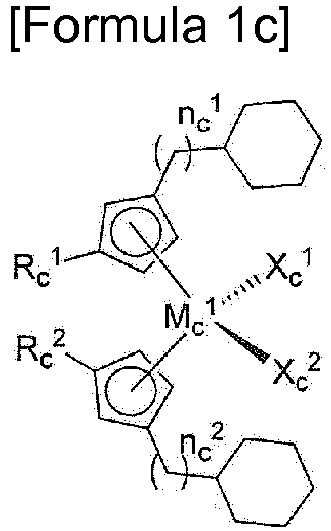
- In Formula 1c, Mc 1 is Ti, Zr or Hf, Rc 1 and Rc 2 are independently hydrogen atom or a hydrocarbonyl group of 1 to 10 carbon atoms, Xc 1 and Xc 2 are independently F, Cl, Br, I or a hydrocarbonyl group of 1 to 10 carbon atoms, nc 1 and nc 2 are independently an integer of 0 to 4.


- In Formula 1d, Md 1 is Ti, Zr or Hf, Rd 1 and Rd 2 are dependently hydrogen atom or a hydrocarbonyl group of 1 to 10 carbon atoms, Xd 1 and Xd 2 are independently F, Cl, Br, I or a hydrocarbonyl group of 1 to 10 carbon atoms, nd 1 and nd 2 are independently an integer of 0 to 4.

- In Formula 1e, Me 1 is Ti, Zr or Hf, Re 1 and Re 2 are independently hydrogen atom or a hydrocarbonyl group of 1 to 10 carbon atoms, Xe 1 and Xe 2 are independently F, Cl, Br, I or a hydrocarbonyl group of 1 to 10 carbon atoms, ne 1 and ne 2 are independently an integer of 0 to 7.


- In Formula 1e, Mf 1 is Ti, Zr or Hf, Rf 1 and Rf 2 are independently hydrogen atom or a hydrocarbonyl group of 1 to 10 carbon atoms, Xf 1 and Xf 2 are independently F, Cl, Br, I or a hydrocarbonyl group of 1 to 10 carbon atoms, nf 1 and nf 2 are independently an integer of 0 to 6.

- In Formula 1g, Mg 1 is Ti, Zr or Hf, Rg 1 and Rg 2 are independently hydrogen atom or a hydrocarbonyl group of 1 to 10 carbon atoms, Xg 1 and Xg 2 are independently F, Cl, Br, I or a hydrocarbonyl group of 1 to 10 carbon atoms, ng 1 and ng 2 are independently an integer of 0 to 4.


- In Formula 1h, Mh 1 is Ti, Zr or Hf, Rh 1 and Rh 2 are independently hydrogen atom or a hydrocarbonyl group of 1 to 10 carbon atoms, Xh 1 and Xh 2 are independently F, Cl, Br, I or a hydrocarbonyl group of 1 to 10 carbon atoms, nh 1 and nh 2 are independently an integer of 0 to 4.

- In Formula 1i, Mi 1 is Ti, Zr or Hf, Ri 1 and Ri 2 are independently hydrogen atom or a hydrocarbonyl group of 1 to 10 carbon atoms, Xi 1 and Xi 2 independently hydrogen atom or a hydrocarbonyl group of 1 to 10 carbon atoms, F, Cl, Br, I or a hydrocarbonyl group of 1 to 10 carbon atoms, ni 1 and ni 2 are independently an integer of 0 to 7.


- In Formula 1j, Mj 1 is Ti, Zr or Hf, Rj 1 and Rj 2 are independently hydrogen atom or a hydrocarbonyl group of 1 to 10 carbon atoms, Xj 1 and Xj 2 are independently F, Cl, Br, I or a hydrocarbonyl group of 1 to 10 carbon atoms, nj 1 and nj 2 are independently an integer of 0 to 6.

- In Formula 1k, Mk 1 is Ti, Zr or Hf, Rk 1 and Rk 2 are independently hydrogen atom or a hydrocarbonyl group of 1 to 10 carbon atoms, Xk 1 and Xk 2 are independently F, Cl, Br, I or a hydrocarbonyl group of 1 to 10 carbon atoms, nk 1 and nk 2 are independently an integer of 0 to 4.


- In Formula 1l, Ml 1 is Ti, Zr or Hf, Rl 1 and Rl 2 are independently hydrogen atom or a hydrocarbonyl group of 1 to 10 carbon atoms, Xl 1 and Xl 2 are independently F, Cl, Br, I or a hydrocarbonyl group of 1 to 10 carbon atoms, nl 1 and nl 2 are independently an integer of 0 to 4.
- The more preferable examples of the first metallocene compound represented by
Formula 1 include the compound represented by Formula 1m or Formula 1m.
- In Formula 1m, R1 and R2 are independently hydrogen atom or methyl group, n1 and n2 are independently an integer of 1 to 3.


- In Formula 1n, R1 and R2 are independently hydrogen atom or methyl group, n1 and n2 are independently an integer of 1 to 3.
- The second metallocene compound represented by the
formula 2 will be detail explained. Polymerization of multimodal or bimodal polyolefin requires a catalyst for preparing polymer of relatively high molecular weight and for this, the second metallocene compound is employed as such a catalyst. When the density of polymer of relatively high molecular weight polymerized with the second metallocene compound is lowered, that is, the amount of comonomer in the polymer is higher, the impact strength and the long-term water pressure endurance of the molded product are improved, because of the entanglements of SCBs(Short Chain Branch). On the other hand, when LCB (Long Chain Branch) degree in the molecular chains of the high molecular weight polymer (a region) is increased, flexible portion is irregularily generated at inside of chain, so that long-term water pressure endurance of the molded product is decreased. The second metallocene compound comprises (i) a fluorenyl group having at least two alkyl groups of 4 to 10 carbon atoms in which the quaternary carbon is contained, and (ii) a cyclopentadienyl group having at least one alkyl group of 4 to 10 carbon atoms, wherein two kinds of ligands are bridged so that in case of contacting with comonomer during the polyolefin polymerization, the coordination of LCB having large molecular chain to the central metal is suppressed through a steric hindrance. Accordingly, the introduction of LCB is suppressed in the high molecular weight region of the polymer and the amount of SCB is increased. In detail, control for the activity and molecular weight of the polymer may be made depending on the substituent groups bonded to cyclopentadienyl group of the second metallocene compound, and the compound having an alkyl group of at least 4 carbon atoms is combined effectively with the first metallocene compound (See: following Examples). In more detail, since ligands are bridged, even though the substituent group representing a steric hindrance effect is contained in fluorenyl group, the reaction space of monomer becomes wide and thus the LCB introduction is not completely blocked. Therefore, in order to further suppress the LCB introduction, the cyclopentadienyl group of the second metallocene compound includes an alkyl group of at least 4 carbon atoms. Since the second metallocene compound represented byFormula 2 contains ligands showing steric hindrance effect so that the LCB introduction in the polyolefin molecular chain is suppressed, but the introduction of a relatively small SCB is not suppressed. In addition, the second metallocene compound enables the preparation of the high molecular weight polymer having certain activity and molecular weight which are different from those of polymer made by the first metallocene compound. - The preferable examples of the second metallocene compound represented by
Formula 2 include compounds represented by following Formula 2a to Formula 2c.


- In Formula 2a to Formula 2c, M is Ti, Zr or Hf; R1 and R2 are independently hydrogen atom or a hydrocarbonyl group of 1 to 10 carbon atoms; R3, R4 and R5 are independently hydrogen atom or a hydrocarbonyl group of 1 to 10 carbon atoms; Q is carbon atom, silicon atom or germanium atom; X1 and X2 are independently F, Cl, Br, I or a hydrocarbonyl group of 1 to 10 carbon atoms; n is an integer of 1 to 7.
- The more preferable example of the second metallocene compound represented by
Formula 2 includes compound represented by following Formula 2d.
- In Formula 2d, R1, R2 and R3 are independently hydrogen atom or methyl group; n is an integer of 1 to 3.
- In the catalyst composition for olefin polymerization according to the present invention, the use amount of the second metallocene compound represented by
Formula 2 is 0.01 to 100 moles, preferably 0.1 to 20 moles, more preferably 1 to 10 moles, with respect to 1 mole of the first metallocene compound represented byFormula 1. When the amount of the metallocene compound represented byFormula 1 is too little with respect to the amount of the second metallocene compound, it is worried that prepared polymer becomes mainly high molecular weight polymer, and when the amount of the metallocene compound represented byFormula 1 is too much with respect to the amount of the second metallocene compound, it is worried that prepared polymer becomes mainly low molecular weight polymer. - The aluminoxane is for activating catalyst component and scavenging impurities, and, for example, the aluminoxane represented by the following
Formulas Formula 4, and a cyclic aluminoxane can be represented by the followingFormula 5. In the present invention, as the aluminoxane, an alkyl aluminoxane which is commercially available can be used. The examples of the alkyl aluminoxane include methylaluminoxane, ethylaluminoxane, butylaluminoxane, isobutylaluminoxane, hexylaluminoxane, octylaluminoxane, and decylaluminoxane. The aluminoxane is commercially available in various forms of hydrocarbon solutions. Preferable aluminoxane is an aromatic hydrocarbon solution of aluminoxane, and more preferable aluminoxane is an aluminoxane dissolved in toluene. In the present invention, a single aluminoxane or mixtures of more than one aluminoxane can be used. The alkyl aluminoxane can be prepared by various conventional methods such as adding proper amount of water to trialkylaluminum, or reacting a hydrocarbonyl compound having water or an inorganic hydrated salt with trialkylaluminum. Conventionally, a mixture of linear aluminoxane and cyclic aluminoxane is obtained. - The amount of aluminum of the aluminoxane is 1 to 100,000 mole, preferably, 1 to 5,000 mole, more preferably 1 to 2,500 mole, most preferably 1 to 1,000 mole with respect to 1 mole of sum of the first metallocene compound of
Formula 1 and the second metallocene compound ofFormula 2. For example, a mixture of the first metallocene compound and the aluminoxane is prepared in which with respect to 1 mole of the first metallocene compound, the amount of aluminum is 1 to 100,000 mole, preferably 1 to 5,000 mole, and then another mixture including the aluminoxane is prepared in which with respect to 1 mole of the second metallocene compound, the amount of aluminum is 1 to 100,000 mole, preferably 1 to 5,000 mole. Then two mixtures are mixed to prepare the olefin polymerization catalyst composition according to the present invention. - The mixture of the catalyst component composition can be made without specific limitations. For example, the first and second metallocene compound and the aluminoxane can be mixed for 5 minutes to 24 hours, preferably 15 minutes to 16 hours simultaneously. Alternatively, the first metallocene compound and the aluminoxane are mixed first for 5 minutes to 10 hours, preferably for 15 minutes to 4 hours to form a first mixture. Then, the second metallocene compound and the aluminoxane are mixed for 5 minutes to 10 hours, preferably for 15 minutes to 4 hours, to form a second mixture. Finally the first mixture and the second mixture are mixed for 5 minutes to 24 hours, preferably for 15 minutes to 16 hours. It is desirable that the compounds should be mixed under an inert atmosphere of nitrogen or argon, without a solvent, or in the presence of an inert hydrocarbon solvent such as heptane, hexane, benzene, toluene, xylene or mixtures thereof. The temperature of the mixing process is 0 to 150°C, preferably 10 to 100°C. The catalyst solution in which the catalyst is uniformly dissolved in the hydrocarbon solvent can be used as it stands, or the catalyst in a solid powder state after the solvent has been removed can be used. The catalyst in a solid powder state can be prepared by carrying out a precipitation reaction of the catalyst solution, and solidifying the precipitate from the reaction.
- In the composition according to the present invention, the first and second metallocene compound and the aluminoxane may be supported by an organic or inorganic carrier. Therefore, the catalyst composition of the present invention can exist in a form supported by an organic or inorganic carrier (for example silica, alumina, mixture of silica and alumina) or a form of an insoluble particle of the carrier, as well as a form of a solid powder or a homogeneous solution. The method for contacting the catalyst composition of the present invention with the carrier will be explained. At first, a solution state catalyst is prepared by mixing the first and second metallocene compound and the aluminoxane and then the catalyst prepared is contacted with a porous carrier(for example, a silica carrier having pore sizes of 50 to 500 Å and a pore volume of 0.1 to 5.0 cm3/g) to form a slurry. Next, the catalyst of the slurry state is treated with an acoustic wave or oscillating wave having the frequency of 1 to 10.000kHz, preferably 20 to 500 kHz at 0°C to 120°C, preferably 0°C to 80°C for 0.1 to 6 hours, preferably 0.5 to 3 hour, to uniformly infiltrate the catalyst components into the pores of the carrier. And then, the catalyst slurry is dried under vacuum or nitrogen flow to form a catalyst of a solid powder state. The acoustic wave or oscillating wave is preferably ultrasonic waves. After applying the acoustic wave or the oscillating wave to the catalyst, the step of supporting the catalyst on a carrier may also include the step of washing the supported catalyst with a hydrocarbon selected from the group consisting of pentane, hexane, heptane, isoparaffin, toluene, xylene and mixtures thereof.
- As the porous carrier, porous inorganic compounds, inorganic salts, and organic compounds with micro pores and a large surface area can be used without restrictions. The shape of the inorganic carrier is not limited if the shape can be maintained during the preparation process of the supported catalysts, and may be in any shape such as powder, particle, flake, foil, and fiber. Regardless of the shape of the inorganic carrier, the maximum length of the inorganic carrier is generally from 5 to 200 µm, preferably from 10 to 100 µm, the preferable surface area of the inorganic carrier is 50 to 1,000 m2/g and the preferable pore volume is 0.05 to 5 cm3/g. Generally, the inorganic carrier should be treated to remove water or hydroxyl group therefrom before the use. The treatment can be carried out by calcining the carrier at 200°C to 900°C under an inert atmosphere such as air, nitrogen, or argon. Examples of the inorganic salt carrier or the inorganic carrier include silica, alumina, bauxite, zeolite, magnesium chloride(MgCl2), calcium chloride(CaCl2), magnesium oxide(MgO), zirconium dioxide(ZrO2), titanium dioxide(TiO2), boron trioxide(B2O3), calcium oxide(CaO), zinc oxide(ZnO), barium oxide(BaO), thorium oxide(ThO2) and mixtures thereof such as silica-magnesium oxide(SiO2-MgO), silica-alumina(SiO2-Al2O3), silica-titanium dioxide(SiO2-TiO2), silica-vanadium pentoxide(SiO2-V2O5), silica-chromium trioxide(SiO2-CrO3), or silica-titanium dioxide-magnesium oxide (SiO2 -TiO2 -MgO). Small amount of carbonate, sulfate, or nitrate can be added to these compounds. Examples of the organic carrier include starch, cyclodextrin, or synthetic polymer. Examples of the solvent, which is used for bringing the catalyst of the present invention into contact with the carrier, include an aliphatic hydrocarbon solvent such as pentane, hexane, heptane, octane, nonane, decane, undecane, and dodecane an aromatic hydrocarbon solvent such as benzene, monochlorobenzene, dichlorobenzene, trichlorobenzene, and toluene, a halogenated aliphatic hydrocarbon solvent such as dichloromethane, trichloromethane, dichloroethane, and trichloroethane. When the olefin polymerization catalyst composition according to the present invention is supported in the carrier, each components of the olefin polymerization catalyst composition is the same in the solution or solid state. The carrier amount of aluminum in the olefin polymerization catalyst composition is 5 to 30 weight part, preferably 7 to 20 weight part with respect to 100 weight part of the carrier, and the carrier amount of the transition metal compound in the olefin polymerization catalyst composition is 0.01 to 2 weight part, preferably 0.05 to 1.5 weight part with respect to 100 weight part of the carrier.
- Next, the present polyolefin polymerization process will be described. The polymerization process includes a step of polymerizing olefin monomer, preferably ethylene and alpha-olefin of 3 to 20 carbon atoms under the catalyst composition of the present invention. The catalyst composition of the present invention can exist in a form supported by an inorganic or organic carrier or a form of an insoluble particle of the carrier, as well as a form of a homogeneous solution. Thus, the polyolefin of the present invention can be polymerized in a solution phase, a slurry phase, a bulk phase or a gas phase polymerization reaction. The conditions for the polymerization reactions can be varied according to the state of the catalyst (homogeneous or heterogeneous phase(supported phase)), the polymerization method(solution polymerization, slurry polymerization, gas phase polymerization), target polymer properties or the polymer shape. When the polymerization is carried out in a solution phase or a slurry phase, a solvent or olefin itself may work as a reaction medium. Examples of the solvent include propane, butane, pentane, hexane, octane, decane, dodecane, cyclopentane, methylcyclopentane, cyclohexane, benzene, toluene, xylene, dichloromethane, chloroethane, 1,2-dichloroethane, and chlorobenzene, and, if necessary, mixtures of the solvents can be used. In the polymerization or copolymerization of olefin according to the present invention, the amount of the first and second metallocene compound is not limited especially. However, the concentration of the central metal of the first and second metallocene compound is preferably 10-8 to 101 mol/l, and more preferably 10-7 to 10-2 mol/l in a polymerization reaction system.
- In the olefin polymerization or copolymerization of the present invention, the polymerization temperature is generally 70 to 110°C, which is not especially limited because it can be varied according to reactants, and reaction conditions. However, the polymerization temperature is generally 0 to 250°C, and more preferably 10 to 200°C in a solution polymerization, and generally 0 to 120°C, and more preferably 20 to 110°C in a slurry or a gas phase polymerization. The polymerization pressure is generally atmospheric pressure to 500 kg/cm2, preferably atmospheric pressure to 60 kg/cm2, more preferably atmospheric pressure to 10 to 60 kg/cm2. The polymerization reaction can be carried out in a batch type, a semi-continuous type, or a continuous type reaction. The polymerization can be carried out by two or more steps of different reaction conditions. The molecular weight and molecular weight distribution of the resulting polymer can be controlled by changing the polymerization temperature, or by injecting hydrogen into a reactor. The polyolefin resin polymerization of the present invention can be carried out by using a conventional single loop reactor, gas phase reactor, ICFB(internally circulating fluidized-bed) reactor (Referring to Korean Patent Nos.
10-981612 10-999543 10-999551 - As olefin monomer constituting the polyolefin according to the present invention, linear aliphatic olefin of 2 to 12, preferably 2 to 10 carbon atoms, cyclic olefins of 3 to 24, preferably 3 to 18 carbon atoms, dienes, trienes, and styrenes can be used. Example of the linear aliphatic olefin includes ethylene, propylene, butene-1, pentene-1, 3-methylbutene-1, hexene-1, 4-methylpentene-1, 3-methylpentene-1, heptene-1, octene-1, decene-1, 4,4-dimethyl-1-pentene, 4,4-diethyl-1-hexene, or 3,4-dimethyl-1-hexene. Example of the cyclic olefins include cyclopentene, cyclobutene, cyclohexene, 3-methylcyclohexene, cyclooctene, tetracyclodecene, octacyclodecene, dicyclopentadiene, norbonene, 5-methyl-2-norbonene, 5-ethyl-2-norbonene, 5-isobutyl-2-norbonene, 5,6-dimethyl-2-norbonene, 5,5,6-trimethyl-2-norbonene, and ethylene norbornene. The preferable dienes and trienes include a polyene of 4 to 26 carbon atoms having two or three double bonds. Specific examples of the dienes and the trienes include 1,3-butadiene, 1,4-pentadiene, 1,4-hexadiene, 1,5-hexadiene, 1,9-decadiene, and 2-methyl-1,3-butadiene. Preferable examples of the styrenes include styrene or substituted styrene substituted with an alkyl group of 1 to 10 carbon atoms, alkoxy group of 1 to 10 carbon atoms, a halogen group, an amine group, a silyl group, and halogenated alkyl group. The olefin monomers may be polymerized to form a homo-polymer, an alternating copolymer, a random copolymer or a block copolymer.
- Preferably, the polyolefin resin of the present invention is a homo-polymer or copolymer selected from a group of ethylene, propylene, 1-butene, 1-pentene, 4-methyl-1-pentene, 1- hexene, 1- heptene, 1- octene, 1- decene, 1- undecene, 1-dodecene, 1-tetradecene, 1-hexadecene, 1-eitocene, norbornene, norbonadiene, ethylidene norbornene, phenyl norbornene, vinyl norbornene, dicyeclopentadiene, 1,4-butadiene, 1,5-butadiene, 1,5-pentadiene, 1,6-hexadiene, styrene, alpha-methylstyrene, divinylbenzene and 3-chloromethylstyrene. Further, the polyolefin resin of the present invention includes a main component which is selected from a group of ethylene, propylene and mixture thereof and an auxiliary component. It is preferable to contain 0.01 to 3.0 weight% of structural unit derived from α-olefin of 4 to 10, for example 6 to 8 carbon atoms, as the auxiliary component.
- The present invention also provides a polyolefin copolymer prepared by the present polymerizing method and a molded product containing the polyolefin copolymer. The Examples of the molded product include a blow molded product, an inflation molded product, a cast molded product, an extrusion lamination molded product, an extrusion molded product, a foam molded product, an injection molded product, sheets, films, fibers, monofilaments, non-woven fabric and pipes.
- Hereinafter, the preferable examples are provided for better understanding of the present invention. In the following examples, the catalyst was produced with Schlenk method in which air and moisture were completely blocked, and specifically, process and operation of the air-sensitive reagents and substances were conducted in Schlenk tube (Schlenk line) or in a glove box filled nitrogen. Reagents were typically purchased from Sigma-Aldrich Chemical Company, and used without further purification, and used a purified and dried nitrogen as an inert gas. Zirconium (IV) chloride (99.5%) and normal butyl lithium were purchased from Boulder Scientific Company and Aldrich Chemical Company, and were used as it is. Bis [iso-butyl cyclopentadienyl] zirconium dichloride and bis [normal-butyl cyclopentadienyl] zirconium dichloride were purchased from commercially such as Chemtura. In addition, all of the solvent were dried with sodium metal and calcium hydride under inert nitrogen atmosphere. In the present specification and examples, the method for measuring respective physical property is as follows. In the specification and the Examples, various properties were measured as follows.
- (1) Density: Density was measured in accordance with ASTM 1505 and ASTM D 1928
- (2) Melt flow index (MIE, 2.16 kg/10 minutes): MIE was measured in accordance with ASTM D1238 at 190 °C.
- (3) High load MIE (MIF, 21.6 kg/10 minutes): MIF was measured in accordance with ASTM D1238 at 190 °C.
- (4) Shear response (SR): MIF/MIE
- (5) Molecular weight and molecular weight distribution(polydispersity): They were measured by using GPC (Polymer Laboratory Inc. 220 system) as follows. As separation columns, two Olexis and one Guard were used, and the column temperature was maintained at 160°C. As a calibration, a standard polystyrene set by Polymer Laboratory Inc was used, and as an eluant, trichlorobenzen containing 0.0125 weight% of BHT (antioxidant) was used. Samples were prepared in a ratio of 0.1 ∼ 1 mg/ml, injection amount was 0.2 ml, injection time was 30 minutes, pump flow rate was maintained at 1.0 ml/min, measurement time was for 30 to 60 minutes. After universal calibration was made by using polystyrene standard materials of Easical A and Easical B (Produced by Agilent technologies), conversion to polyethylene was carried out to measure number-average molecular weight(Mn), weight-average molecular weight(Mw), and z average molecular weight(Mz). As a detector, a RI (Refractive Index) detector was used. The molecular weight distribution (Mw/Mn) represents the ratio of weight average molecular weight to number average molecular weight.
- (6) PENT: PENT was measured in accordance with ASTM D1473. The test chip was prepared from a press sheet having 6 mm thickness by using a thermal hydraulic pressure set at 190°C(produced by Shindong Metal Industrial Co., Ltd.), with a pressure of 100 kg/cm3. Notches were formed at three sides of the test chip (the notch in wide side has 2.5mm depth, and the notch in shallow side has 1 mm depth). The test chips were placed in a chamber at 95°C in which the top part and the lower part of the test chip was fixed and a pressure of 3.7 MPa was applied to thereby measuring fail time of the test chip.
- After 2,7-di-tert-butylfluorene (39.21 mmol, 10.907 g) was dissolved in tetrahydrofuran (THF, 53 ml), it was cooled with ice water, and normalbutyllithium-hexane solution (2.5 M, 41.166 mmol, 16.47 ml) was dropped to the cooled solution by a syringe and then stirred at room temperature for 12 hours. After this solution was cooled with ice water again, solution in which 6,6-diphenylfulvene (39.21 mmol, 9.029 g) was dissolved in tetrahydrofuran (THF, 50 ml) was dropped to the cooled solution by a cannula and then stirred at room temperature for 24 hours. After completion of the reaction, an aqueous solution of ammonium chloride was added to a reaction product. The organic layer was extracted from the reaction product by using a separatory funnel, and dried to anhydrous magnesium sulfate. Subsequently, the solvent was removed in a vacuum from the reaction product, then purification was carried out with the chloroform and methanol to obtain a solid compound of the following Formula 6 (Yield: 65%).

- After the compound of Formula 6 (12.793 mmol, 6.508 g) was dissolved in tetrahydrofuran (THF, 150 ml), it was cooled to -78°C, normalbutyllithium-hexane solution (2.5 M, 12.793 mmol, 5.1 ml) was dropped to the cooled solution by a syringe and then stirred for 2 hours with maintaining the temperature at -78°C. With maintaining the temperature, 1-bromobutane (14.072 mmol, 1.928 g, 1.51 ml) was dropped to the stirred solution by a syringe and then the mixture was stirred for 2 hours, and again stirred at room temperature for 12 hours. After completion of the reaction, solvent was removed in a vacuum from the reaction product, and the product was dissolved in dichloromethane solvent and then filtration was carried out to remove the undissolved substances. Subsequently, a methanol was added to the filtered solution to obtain a solid compound of the following Formula 7 (Yield: 70%).

- After the compound of Formula 7 (4.217 mmol, 2.38 g) was dissolved in diethylether (25 ml), it was cooled with ice water, and normalbutyllithium-hexane solution (2.5 M, 10.121 mmol, 4.1 ml) was dropped to the cooled solution by a syringe and then was stirred at room temperature for 12 hours. The suspension which was prepared by adding zirconiumchloride (4.217 mmol, 0.968 g) to hexane (28 ml) was dropped to the reaction solution by a cannula and then the mixture was stirred at room temperature for 24 hours. After completion of the reaction, solvent was removed from the reaction product in a vacuum Then the product was dissolved in dichloromethane solvent and filtration was carried out to remove the undissolved substances. Subsequently, the solvent of the filtered solution was removed in a vacuum again, and washing process was carried out by using hexane solvent to obtain a solid compound of the following Formula 8 (Yield: 88%).

- Except for using methyliodide instead of 1-bromobutane, a solid compound of the following
Formula 9 was obtained in the same manner with step B of the Manufacturing Example 1.
- Except for using compound of the
Formula 9 instead of compound of theFormula 7, a compound of the followingFormula 10 was obtained in the same manner with step C of the Manufacturing Example 1.
- Except for using 1-bromopropane instead of 1-bromobutane, a solid compound of the following
Formula 11 was obtained in the same manner with step B of the Manufacturing Example 1.
- Except for using compound of the
Formula 11 instead of compound of theFormula 7, a compound of the followingFormula 12 was obtained in the same manner with step C of the Manufacturing Example 1.
- According to the Following Table 1, a first metallocene compound, the second metallocene compound prepared from the Manufacturing Examples and methylaluminoxane (MAO, Albemarle Co., Ltd, 10% toluene solution) were poured into 500 ml flask of nitrogen atmosphere, and the mixture was stirred at room temperature for 60 minutes. A calcined silica (SiO2) was added to the stirred mixture at 250°C, and then ultrasonic wave was applied thereto for 1 hour to remove the supernatant. Washing with hexane was carried out twice to remove remaining solid particles, and drying in vacuum was carried out to prepare a free-flowing supported catalyst of solid powder type. Injection amount of the first metallocene compound was controlled as 20 to 80 mol% ratio in considering an activity of the each second metallocene compound. Amount of aluminum of the supported catalyst was 12.5 to 13.0 weight%, and an amount of the zirconium was 0.2 to 0.3 weight%. A mol ratio of the aluminum to zirconium was controlled as 80 to 230.
[Table 1] First metallocene Second metallocene MAO (ml) Silica (g) Type (g) Type (g) Example 1 (i-BuCp)2ZrCl2 0.078 Ph2C(2,7-t-BuFlu)(n-BuCp)ZrCl2 0.093 50 10 Example 2 (i-BuCp)2ZrCl2 0.065 Ph2C(2,7-t-BuFlu)(n-BuCp)ZrCl2 0.116 50 10 Example 3 (i-BuCp)2ZrCl2 0.107 Ph2C(2,7-t-BuFlu)(n-BuCp)ZrCl2 0.187 50 10 Example 4 (i-BuCp)2ZrCl2 0.058 Ph2C(2,7-t-BuFlu)(n-BuCp)ZrCl2 0.128 50 10 Example 5 (i-BuCp)2ZrCl2 0.052 Ph2C(2,7-t-BuFlu)(n-BuCp)ZrCl2 0.139 50 10 Example 6 (i-BuCp)2ZrCl2 0.043 Ph2C(2,7-t-BuFlu)(n-BuCp)ZrCl2 0.155 50 10 Example 7 (i-BuCp)2ZrCl2 0.071 Ph2C(2,7-t-BuFlu)(n-BuCp)ZrCl2 0.255 50 10 Example 8 (i-BuCp)2ZrCl2 0.032 Ph2C(2,7-t-BuFlu)(n-BuCp)ZrCl2 0.174 50 10 Example 9 (i-BuCp)2ZrCl2 0.053 Ph2C(2,7-t-BuFlu)(n-BuCp)ZrCl2 0.286 50 10 Example 10 (i-BuCp)2ZrCl2 0.094 Ph2C(2,7-t-BuFlu)(n-BuCp)ZrCl2 0.501 50 10 Example 11 (i-BuCp)2ZrCl2 0.043 Ph2C(2,7-t-BuFlu)(n-BuCp)ZrCl2 0.305 50 10 Comparative Example 1 (n-BuCp)2ZrCl2 0.071 Ph2C(2,7-t-BuFlu)(n-BuCp)ZrCl2 0.255 50 10 Comparative Example 2 (n-BuInd)2ZrCl2 0.106 Ph2C(2,7-t-BuFlu)(n-BuCp)ZrCl2 0.038 25 5 Comparative Example 3 (Me4Cp)(n-BuCp)ZrCl2 0.069 Ph2C(2,7-t-BuFlu)(n-BuCp)ZrCl2 0.061 25 5 Comparative Example 4 (i-BuCp)2ZrCl2 0.071 Ph2C(2,7-t-BuFlu)(MeCp)ZrCl2 0.24 50 10 Comparative Example 5 (i-BuCp)2ZrCl2 0.107 Ph2C(2,7-t-BuFlu)(n-PrCp)ZrCl2 0.187 50 10 Comparative Example 6 (i-BuCp)2ZrCl2 0.106 Ph2C(2,7-t-BuFlu)(n-BuCp)ZrCl2 0.141 50 10 Ph2C(2,7-t-BuFlu)(MeCp)ZrCl2 0.047 - A isobutane and ethylene flowed to a 2L stainless autoclave reactor equipped with a jacket which can supply an external cooling water for controlling a polymerization temperature, once and five times respectively at about 110°C, thereby removing impurities, and the reactor was lowered to temperature of 80°C. Isobutane (900 mL) and triethylaluminum (TEAL, 0.02 mmol) of a impurity remover were added to the cleaned reactor and the mixture was stirred at 80°C. Isobutane (100 mL) and the supported catalyst (about 60 mg) prepared at the Examples 1 to 11 were injected to the reactor, and then 1-hexene (weight%, input of 1-hexene with respect to the ethylene injected) and hydrogen (mg/kgC2, input(mg) of hydrogen with respect to 1kg of the ethylene injected) were injected to the reactor according to the following Table 2 and 3, while injecting ethylene so as for partial pressure of ethylene to be of 160 psig. Then while keeping the total pressure of the reactor at each reaction temperature, the polymerization was carried out for 60 to 120 minutes. During the polymerization, the partial pressure of ethylene was being maintained constantly, 1-hexene and hydrogen were continuously introduced in linked with the ethylene. After the polymerization was completed, the unreacted 1-hexene and isobutene were drained out, and then the reactor was opened to collect a polymer (copolymer) having a free flowability. An activity of the catalyst (gPE/gCat-hr), and a molecular weight (Mw/1000: weight average molecular weight), polydispersity (MWD), melt index E (MIE, g/10 min), high load melt index F (MIF, g/10min), melt index ratio (SR (MIF/MIE)), density of the produced polymer, etc. were measured and the results were shown in Tables 2 and 3. In following Table 2, Type I ratio represents a ratio of the first metallocene compound in the total metallocene compound.
[Table 2] Example 12 Example 13 Example 14 Example 15 Example 16 Example 17 catalyst Example 1 Example 2 Example 3 Example 4 Example 5 Example 6 Ratio of Type I (mol%) 60 50 50 45 40 33 Molar ratio of Al / Zr 230 230 140 230 230 230 TEAL (mmol) 0.02 0.02 0.02 0.02 0.02 0.02 Temperature of polymerization (°C) 90 90 90 90 90 90 Use time of polymerization (min.) 60 60 60 60 60 60 ethylene (psig) 160 160 160 160 160 160 1-hexene (wt%) 7 7 7 7 7 7 hydrogen (ppm) 100 100 100 100 100 100 activity 5032 5922 6776 5567 4325 4317 Molecular weight distribution bimodal bimodal bimodal bimodal bimodal bimodal Mw/1,000 138 137 124 132 169 249 MWD 8.88 7.94 15.07 10.16 11.32 6.25 MIE 0.50 0.33 0.24 0.29 0.16 0.02 MIF 48.06 35.63 32.81 35.63 13.25 1.72 SR(F/E) 95.4 109.0 137.8 122.5 83.9 90.5 density 0.940 0.938 0.942 0.937 0.937 0.941 [Table 3] Example 18 Example 19 Example 20 Example 21 Example 22 catalyst Example 7 Example 8 Example 9 Example 10 Example 11 Ratio of Type I (mol%) 33 25 25 25 20 Molar ratio of Al / Zr 140 230 140 80 140 TEAL (mmol) 0.02 0.02 0.02 0.02 0.02 Temperature of polymerization (°C) 85 75 75 75 75 Use time of polymerization (min.) 60 120 120 120 120 ethylene (psig) 160 130 130 130 130 1-hexene (wt%) 7 15 7 15 7 hydrogen (ppm) 200 300 200 300 200 activity 5424 2433 2,053 3867 1852 Molecular weight distribution bimodal bimodal bimodal bimodal bimodal Mw/1,000 162 237 170 233 123 MWD 19.73 11.06 19.55 8.50 16.88 MIE 0.26 0.03 0.21 0.02 0.89 MIF 9.85 2.10 19.50 2.79 27.93 SR(F/E) 37.8 77.6 95.6 116.2 31.3 density 0.937 0.922 0.943 0.923 0.935 - Using the supported catalyst prepared in Comparative Examples 1 to 6, copolymer was prepared by using the same manner with Example 12, and the physical properties of the polymerized copolymer were tested and the results were shown in following Table 4.
[Table 4] Comparative Example 7 Comparative Example 8 Comparative Example 9 Comparative Example 10 Comparative Example 11 Comparative Example 12 catalyst Comparative Example 1 Comparative Example 2 Comparative Example 3 Comparative Example 4 Comparative Example 5 Comparative Example 6 Ratio of Type I (mol%) 33 80 67 40 50 50 Molar ratio of Al/Zr 140 140 140 140 140 140 TEAL (mmol) 0.02 0.02 0.02 0.02 0.02 0.02 Temperature of polymerization (°C) 75 85 85 85 85 85 Use time of polymerization (min.) 120 60 60 60 60 60 ethylene (psig) 130 160 160 160 160 160 1-hexene (wt%) 7 7 7 7 7 7 hydrogen (ppm) 200 400 200 200 100 100 activity 2067 1470 3175 887 2130 2975 Molecular weight distribution bimodal bimodal bimodal bimodal bimodal bimodal Mw/1,000 129 356 291 290 133 248 MWD 46.99 24.02 10.34 73.46 13.67 14.25 MIE 0.41 0.02 0.02 - 0.14 0.04 MIF 34.44 4.068 1.622 13.77 18.79 2.8 SR(F/E) 83.2 215.2 101.4 >1000 135.2 71.8 density 0.935 0.947 0.939 0.948 0.941 0.945 - Further, with respect to the copolymer obtained in Comparative Examples 7 and 8, the GPC-IR analysis was performed to ascertain the distribution of the comonomer, and the results were shown in
Fig. 1 andFig. 2 respectively. InFig. 1 andFig. 2 , M is a molecular weight, w is a weight ratio of the copolymer, a blue solid line indicates a GPC curve showing a molecular weight distribution, and a red dot indicates a distribution of SCB (Short Chain Branch) in the molecule chain, namely, represents the number of comonomer contained per 1,000 carbon atoms in each molecular weight area which is expressed as a GPC curve. As shown inFig. 1 andFig. 2 , it can be seen that in copolymer obtained from Comparative Examples 7 and 8, amount of comonomer is much in a low molecular weight portion and relatively small in a high molecular weight portion. Also, it can be seen fromFig. 2 that control of the molecular weight may not easy because bis-normalbutylindenyl zirconium dichloride compound used as the first metallocene compound in Comparative Example 8 has considerably low hydrogen reactivity. Further, with respect to the copolymer obtained from Examples 13, 18 and 22, the GPC-IR analysis was performed to ascertain the distribution of the comonomer, and the results were shown inFig. 3 to Fig. 5 respectively. FromFig. 3 to Fig. 5 , it can be seen that in the copolymer copolymerized according to the present invention, amount of comonomer is small in a low molecular weight portion and relatively much in a high molecular weight portion. Further, in the second metallocene compound, if the carbon number of the substituent bonded to the ligand is less (Comparative Example 10), the activity of the second metallocene compound is low compared to the first metallocene compound, and gap of the molecular weight between the first metallocene compound and second metallocene compound is too big. Hence, physical properties gets worse significantly of SR being 1000 or later, and an appearance status be very bad conditions, it is difficult to apply as a commercial product. - Further, in order to evaluate long-term physical properties of polymer obtained from Examples 14, 18, 20 and Comparative Examples 7, 10, 11, 12, PENT analysis was performed and the results were shown in following Table 5.
[Table 5] Example 14 Example 18 Example 20 Example 22 Example 7 Example 10 Example 11 Example 12 catalyst Example 3 Example 7 Example 9 Example 11 Example 1 Example 4 Example 5 Example 6 Mw/1000 124 162 170 123 129 290 133 248 MWD 15.07 19.73 19.55 16.88 46.99 73.46 13.67 14.25 MIE 0.24 0.26 0.21 0.89 0.41 - 0.14 0.04 SR(F/E) 137.8 37.8 95.6 31.3 83.2 >1000 135.2 71.8 density 0.942 0.937 0.943 0.935 0.935 0.948 0.941 0.945 sheet PENT (hrs): 3.6 MPa at 95□ More than 800 More than 800 More than 800 More than 800 Fracture at 75 Fracture at 50 Fracture at 174 Fracture at 182 - From the Table 5, the copolymers (Examples 14, 18, 20 and 22) were excellent in long-term physical properties (fracture time) compared to the copolymers (Comparative Example 7). The copolymers (Examples 14, 18, 20 and 22) were obtained by using a bis(isobutylcyclopentadienyl)zirconium dichloride compound having a substituent showing effect of steric hindrance, as the first metallocene compound, while the copolymers (Comparative Example 7) were obtained by using a bis(normalbutylcyclopentadienyl)zirconium dichloride compound having a substituent showing low steric hindrance effect, as the first metallocene compound. Therefore, even though the same second metallocene compound is used, it can be seen that the steric hindrance of substituent of the first metallocene compound influences significantly on the long-term physical properties of the polymer. Namely, it can be seen that as the amount of comonomer in the low molecular weight portion is lowered through the steric hindrance of the first metallocene compound, the long-term physical properties of the copolymer were improved.
- Further, the copolymers (Examples 14, 18, 20 and 22) were substantially superior in the long-term physical (fracture time) properties, compared to the copolymers (Comparative Examples 10, 11 and 12). The copolymers (Examples 14, 18, 20 and 22) were obtained by using a 1-(normalbutylcyclopentadienyl)-1-(2,7-di-tert-butylfluorenyl)-1,1-diphenylmethylidene zirconium dichloride compound having a hydrocarbonyl substituent of 4 or more carbon number, as the second metallocene compound, in order to suppress the introduction of LCB, induce only comonomer and improve the polymerization activity, while the copolymers (Comparative Examples 10, 11 and 12) were obtained by using a compound having a hydrocarbonyl substituent of 3 or less carbon number as the second metallocene compound. Also, the long-term physical properties of the copolymers (Comparative Examples 6 and 12) were remarkably reduced. The copolymers (Comparative Examples 6 and 12) were obtained by as the second metallocene compound, using both the hydrocarbonyl substituent of 4 or more carbon number, namely, a compound including a cyclopentadienyl group having a normal-butyl group (n-Bu) and the hydrocarbonyl substituent of 3 or less carbon number, namely, a compound including a cyclopentadienyl group having a methyl group (Me). That is, as shown in Comparative Examples 6 and 12, in case of using the metallocene including a cyclopentadienyl group having a hydrocarbonyl substituent of 3 or less carbon number, the PENT physical properties are lowered. Therefore, in the second metallocene of the present invention, the carbon number of the hydrocarbonyl substituent bonded to cyclopentadienyl group of L4 should be 4 to 10. If the metallocene in which carbon number of the hydrocarbonyl substituent is less 4, is contained, the introduction of LCB cannot be blocked to reduce the PENT physical properties, therefore which is not desirable. In detail, it can be seen that even though the same first metallocene compound are used, the carbon number of the substituent of the second metallocene compound influences on the long-term physical properties of the polymer considerably. Typically, it has been known that when the LCB is introduced to the high molecular weight portion, the long-term physical properties are lowered, and when the comonomer is introduced in the high molecular weight portion, the long-term physical properties are improved owing to SCB entanglement phenomenon, which explains long-term physical property difference between polymers of Examples 14, 18, 20 and 22 and polymers of Comparative Examples 10, 11 and 12. Therefore, it can be confirmed that the metallocene compound having a substituent of 4 or more carbon number can suppress the introduction of LCB and induce only the introduction of the comonomer. In addition, from
Fig. 3 ,Fig. 4 andFig. 5 , it can be confirmed that in the copolymerization prepared according to the present invention, the amount of the comonomer of the high molecular weight portion was relatively high compared to that of the low molecular weight portion. - Further, with respect to the copolymer obtained from Example 18, the relation of the molecular weight and intrinsic viscosity (IV) measured by GPC was shown in
Fig. 6 . InFig. 6 , the horizontal axis represents the molecular weight, and the vertical axis represents the intrinsic viscosity. As shown inFig. 6 , in the copolymer polymerized according to the present invention, since the intrinsic viscosity is increased linearly according to an increase of the molecular weight, it can be seen that there is no LCB in the high molecular weight portion. On the other hand, the intrinsic viscosity does not increased linearly but increase logarithmically according to an increase of the molecular weight, it can be judged that the LCB is in the high molecular weight portion.Fig. 7 is a result of GPC analysis (molecular weight distribution) of the copolymers obtained from Examples 14, 18, 20 and 22, andFig. 8 is a result of GPC analysis (molecular weight distribution) of the copolymers obtained by from Comparative Examples 6, 9, 10 and 11. As can be seen fromFig. 7 andFig. 8 , the all molecular weight distribution of the polymers obtained from Example and Comparative Example of the present invention represents a form of the bimodal, and the form of the bimodal can be changed by changing the ratio of the first metallocene compound.
Claims (15)
- A catalyst composition for preparing a multimodal polyolefin resin, consisting of:(i) at least one first metallocene compound represented by following Formula 1;(ii) at least one second metallocene compound represented by following Formula 2; and(iii) at least one co-catalyst selected from aluminoxane groups represented by following Formulas 3, 4 and 5,
[Formula 1] (L1)(L2)(X1)(X2)M1
in Formula 1, M1 is titanium(Ti), zirconium(Zr) or hafnium(Hf); (L1) and (L2) are independently, a cyclopentadienyl group having an alkyl group of 3 to 10 carbon atoms in which at least one tertiary or quaternary carbon is contained; (X1) and (X2) are independently F, Cl, Br, I or a hydrocarbonyl group of 1 to 10 carbon atoms,
[Formula 2] (L3-Q-L4)(X1)(X2)M2
in Formula 2, M2 is Ti, Zr or Hf; (L3) is a fluorenyl group having two alkyl groups of 4 to 10 carbon atoms in which quaternary carbon is contained; (L4) is a cyclopentadienyl group having at least one alkyl groups of 4 to 10 carbon atoms; (Q) is a crosslinking functional group represented by Formula Q1R1R2, Q1 is carbon atom(C), silicon atom(Si) or germanium atom(Ge), R1 and R2 are independently hydrogen or hydrocarbonyl group of 1 to 10 carbon atoms; (X1) and (X2) are independently F, Cl, Br, I or hydrocarbonyl group of 1 to 10 carbon atoms,


- The catalyst composition for preparing a multimodal polyolefin resin according to Claim 1, wherein (L1) and (L2) in Formula 1 each is different to each other, and is a cyclopentadienyl group having an alkyl group of 3 to 10 carbon atoms, which contains at least one tertiary or quaternary carbon, but does not contain aryl group.
- The catalyst composition for preparing a multimodal polyolefin resin according to Claim 1, wherein (L1) and (L2) in Formula 1 are the same, and is a cyclopentadienyl group having an alkyl group of 3 to 10 carbon atoms, which contains at least one tertiary or quaternary carbon, but does not contain aryl group.
- The catalyst composition for preparing a multimodal polyolefin resin according to any one of Claims 1 to 3, wherein (L4) in Formula 2 is a cyclopentadienyl group having an alkyl group of 4 to 10 carbon atoms which does not contains an aryl group.
- The catalyst composition for preparing a multimodal polyolefin resin according to Claim 4, wherein (L4) in Formula 2 is a cyclopentadienyl group having an alkylgroup of 4 to 7 carbon atoms which does not contains aryl group.
- The catalyst composition for preparing a multimodal polyolefin resin according to any one of Claims 1 to 5, wherein R1 and R2 in Formula 2 are the same to each other and are aryl group of 6 to 10 carbon atoms.
- The catalyst composition for preparing a multimodal polyolefin resin according to any one of Claims 1 to 6, wherein the first metallocene compound represented by the Formula 1 is a compound represented by following Formula 1m,

- The catalyst composition for preparing a multimodal polyolefin resin according to any one of Claims 1 to 6, wherein the first metallocene compound represented by the Formula 1 is a compound represented by following Formula 1n,

- The catalyst composition for preparing a multimodal polyolefin resin according to any one of Claims 1 to 8, wherein the second metallocene compound represented by the Formula 2 is a compound represented by following Formula 2d,

- The catalyst composition for preparing a multimodal polyolefin resin according to any one of Claims 1 to 9, wherein the amount of the second metallocene compound represented by Formula 2 is 0.01 to 100 moles with respect to 1 mole of the first metallocene compound represented by Formula 1, and the amount of aluminum of the aluminoxane is 1 to 100,000 moles with respect to 1 mole of sum of the first metallocene compound of Formula 1 and the second metallocene compound of Formula 2.
- The catalyst composition for preparing a multimodal polyolefin resin according to any one of Claims 1 to 10, wherein the first and second metallocene compound and the aluminoxane are supported by an organic or inorganic carrier.
- The catalyst composition for preparing a multimodal polyolefin resin according to Claim 11, wherein the amount of aluminum in the catalyst composition is 5 to 30 weight part with respect to 100 weight part of the carrier, and the amount of the transition metal compound in the catalyst composition is 0.01 to 2 weight part with respect to 100 weight part of the carrier.
- A method for polymerizing polyolefin comprising a step of polymerizing olefin monomer in the presence of a catalyst composition consisting of (i) at least one first metallocene compound represented by following Formula 1; (ii) at least one second metallocene compound represented by following Formula 2; and (iii) at least one co-catalyst selected from aluminoxane groups represented by following Formulas 3, 4 and 5,
[Formula 1] (L1)(L2)(X1)(X2)M1
in Formula 1, M1 is titanium(Ti), zirconium(Zr) or hafnium(Hf); (L1) and (L2) are independently, a cyclopentadienyl group having an alkyl group of 3 to 10 carbon atoms in which at least one tertiary or quaternary carbon is contained; (X1) and (X2) are independently F, Cl, Br, I or a hydrocarbonyl group of 1 to 10 carbon atoms,
[Formula 2] (L3-Q-L4)(X1)(X2)M2
in Formula 2, M2 is Ti, Zr or Hf; (L3) is a fluorenyl group having two alkyl groups of 4 to 10 carbon atoms in which quaternary carbon is contained; (L4) is a cyclopentadienyl group having at least one alkyl substituent group of 4 to 10 carbon atoms; (Q) is a crosslinking functional group represented by Formula Q1R1R2, Q1 is carbon atom(C), silicon atom(Si) or germanium atom(Ge), R1 and R2 are independently hydrogen or hydrocarbonyl group of 1 to 10 carbon atoms; (X1) and (X2) are independently F, Cl, Br, I or hydrocarbonyl group of 1 to 10 carbon atoms,


- A polyolefin copolymer prepared by the method according to Claim 13.
- A molded product containing polyolefin copolymer prepared by the method according to Claim 13.
Applications Claiming Priority (2)
| Application Number | Priority Date | Filing Date | Title |
|---|---|---|---|
| KR1020120139149A KR101437509B1 (en) | 2012-12-03 | 2012-12-03 | Catalyst composition for preparing multimodal polyolefin resin having superior moldability and mechanical properties and polymerization method using the same |
| PCT/KR2013/011096 WO2014088287A1 (en) | 2012-12-03 | 2013-12-03 | Catalyst composition for preparing multimodal polyolefin resin with remarkable moldability and mechanical properties, and polymerization method using same |
Publications (3)
| Publication Number | Publication Date |
|---|---|
| EP2927245A1 EP2927245A1 (en) | 2015-10-07 |
| EP2927245A4 EP2927245A4 (en) | 2016-08-17 |
| EP2927245B1 true EP2927245B1 (en) | 2018-04-25 |
Family
ID=50883660
Family Applications (1)
| Application Number | Title | Priority Date | Filing Date |
|---|---|---|---|
| EP13859834.7A Active EP2927245B1 (en) | 2012-12-03 | 2013-12-03 | Catalyst composition for preparing multimodal polyolefin resin with remarkable moldability and mechanical properties, and polymerization method using same |
Country Status (7)
| Country | Link |
|---|---|
| US (1) | US9487607B2 (en) |
| EP (1) | EP2927245B1 (en) |
| KR (1) | KR101437509B1 (en) |
| CN (1) | CN104822711B (en) |
| BR (1) | BR112015012901B1 (en) |
| ES (1) | ES2681036T3 (en) |
| WO (1) | WO2014088287A1 (en) |
Cited By (1)
| Publication number | Priority date | Publication date | Assignee | Title |
|---|---|---|---|---|
| EP3538571B1 (en) | 2016-11-08 | 2022-06-01 | Univation Technologies, LLC | Bimodal polyethylene |
Families Citing this family (39)
| Publication number | Priority date | Publication date | Assignee | Title |
|---|---|---|---|---|
| EP3056524B1 (en) | 2014-10-13 | 2021-09-22 | LG Chem, Ltd. | Ethylene/1-butene copolymer having excellent processibility and environmental stress cracking resistance |
| KR101653356B1 (en) | 2014-10-17 | 2016-09-01 | 주식회사 엘지화학 | Metallocene catalyst for preparing polyolefin with high molecular weight |
| KR101653357B1 (en) | 2014-11-06 | 2016-09-01 | 주식회사 엘지화학 | Metallocene catalyst for preparing polyolefin with high molecular weight |
| KR101795748B1 (en) | 2015-06-15 | 2017-12-01 | 주식회사 엘지화학 | Method for preparing polyolefin |
| WO2016204457A1 (en) * | 2015-06-15 | 2016-12-22 | 주식회사 엘지화학 | Method for preparing polyolefin |
| KR101711788B1 (en) | 2016-03-09 | 2017-03-14 | 한화케미칼 주식회사 | Hybride catalyst compositon, preparation method thereof, and manufactured polyolefin using the same |
| KR101800866B1 (en) | 2016-04-26 | 2017-12-21 | 대림산업 주식회사 | Multimodal polyolefin resin with high melt strength and article prepared with the same |
| KR101725004B1 (en) * | 2016-04-27 | 2017-04-18 | 한화케미칼 주식회사 | Supported hybrid metallocene catalyst and good processability polyolefin using the same |
| KR102060669B1 (en) * | 2016-10-20 | 2019-12-31 | 대림산업 주식회사 | Catalyst composition for preparing the multimodal polyolefin resin with the high melt strength |
| KR102072697B1 (en) | 2016-12-09 | 2020-02-03 | 주식회사 엘지화학 | Ethylene/1-hexene copolymer having excellent processibility and physical property |
| KR20180071592A (en) * | 2016-12-20 | 2018-06-28 | 한화케미칼 주식회사 | Polyolefin and preparing method thereof |
| CN110431160B (en) | 2017-02-20 | 2021-12-31 | 埃克森美孚化学专利公司 | Supported catalyst system and method of use |
| US10723819B2 (en) | 2017-02-20 | 2020-07-28 | Exxonmobil Chemical Patents, Inc. | Supported catalyst systems and processes for use thereof |
| WO2019027585A1 (en) | 2017-08-04 | 2019-02-07 | Exxonmobil Chemical Patents Inc. | Mixed catalysts with unbridged hafnocenes with -ch2-sime3 moieties |
| US10844150B2 (en) | 2017-08-04 | 2020-11-24 | Exxonmobil Chemical Patents Inc. | Mixed catalysts with 2,6-bis(imino)pyridyl iron complexes and bridged hafnocenes |
| US10703838B2 (en) | 2017-10-31 | 2020-07-07 | Exxonmobil Chemical Patents Inc. | Mixed catalyst systems with four metallocenes on a single support |
| US10926250B2 (en) | 2017-12-01 | 2021-02-23 | Exxonmobil Chemical Patents Inc. | Catalyst systems and polymerization processes for using the same |
| WO2019108977A1 (en) | 2017-12-01 | 2019-06-06 | Exxonmobil Chemical Patents Inc. | Catalyst systems and polymerization processes for using the same |
| KR102248557B1 (en) | 2017-12-20 | 2021-05-06 | 주식회사 엘지화학 | Catalyst composition and method for preparing olefin polymer using the same |
| KR20190081611A (en) * | 2017-12-29 | 2019-07-09 | 한화케미칼 주식회사 | Catalyst for polymerizing olefin and polyolefin polymerized by using the same |
| US10865258B2 (en) | 2018-01-31 | 2020-12-15 | Exxonmobil Chemical Patents Inc. | Mixed catalyst systems containing bridged metallocenes with a pendant group 13 element, processes for making a polymer product using same, and products made from same |
| US10851187B2 (en) | 2018-01-31 | 2020-12-01 | Exxonmobil Chemical Patents Inc. | Bridged metallocene catalysts with a pendant group 13 element, catalyst systems containing same, processes for making a polymer product using same, and products made from same |
| KR102193693B1 (en) | 2018-03-21 | 2020-12-21 | 한화솔루션 주식회사 | Transition metal compound used to prepare catalyst for polymerizing olefin, catalyst for polymerizing olefin comprising the same and polyolefin polymerized by using the same |
| KR102372974B1 (en) | 2019-04-05 | 2022-03-10 | 한화솔루션 주식회사 | Mixed Catalytic Composition, Catalyst Comprising the Same, and Processes for Preparing the Same |
| KR102203007B1 (en) * | 2019-06-05 | 2021-01-14 | 대림산업 주식회사 | Method for manufacturing multimodal polyolefins using multistage continuous polymerization process |
| KR102475975B1 (en) | 2019-10-17 | 2022-12-08 | 한화솔루션 주식회사 | Mixed Catalytic Composition, Catalyst Comprising the Same, and Processes for Preparing the Same |
| KR102619077B1 (en) | 2019-12-05 | 2023-12-29 | 한화솔루션 주식회사 | Process for Preparing a Polyolefin |
| KR102547238B1 (en) | 2020-02-26 | 2023-06-26 | 한화솔루션 주식회사 | Processes for Preparing Mixed Catalytic Composition and Catalyst Comprising the Same |
| KR102579801B1 (en) | 2020-04-16 | 2023-09-19 | 한화솔루션 주식회사 | Mixed Catalytic Composition, Catalyst Comprising the Same, and Processes for Preparing the Same |
| KR102668044B1 (en) | 2020-05-28 | 2024-05-23 | 한화솔루션 주식회사 | Mixed Catalytic Composition, Catalyst Comprising the Same, and Processes for Preparing the Same |
| KR102579813B1 (en) | 2020-08-20 | 2023-09-19 | 한화솔루션 주식회사 | Catalyst Comprising Mixed Transition Metal Compounds, Polyolefin Prepared Using the Same, and Processes for Preparing the Same |
| KR102778095B1 (en) | 2020-11-12 | 2025-03-10 | 한화솔루션 주식회사 | Mixed Catalytic Composition, Catalyst Comprising the Same, and Processes for Preparing the Same |
| KR102613125B1 (en) | 2020-12-23 | 2023-12-14 | 한화솔루션 주식회사 | Mixed Catalytic Composition, Catalyst Comprising the Composition, Process for Preparing a Polyolefin Using the Catalyst |
| KR102888043B1 (en) | 2021-08-26 | 2025-11-18 | 한화솔루션 주식회사 | Mixed Catalytic Composition, Catalyst Comprising the Same, and Processes for Preparing the Same |
| WO2023096297A1 (en) | 2021-11-23 | 2023-06-01 | 한화솔루션 주식회사 | Polyolefin having excellent processability and process for preparing same |
| EP4431535A4 (en) | 2021-12-07 | 2025-05-07 | Hanwha Solutions Corporation | CATALYST FOR OLEFIN POLYMERIZATION COMPRISING A HYBRID CATALYST COMPOSITION AND OLEFIN POLYMER PREPARED USING THE LATTER |
| US12351706B2 (en) * | 2022-09-15 | 2025-07-08 | Basell Polyolefine Gmbh | Polyethylene composition for blow molding having an improved swell behavior |
| US12415910B2 (en) | 2022-09-15 | 2025-09-16 | Basell Polyolefine Gmbh | Polyethylene composition for blow molding having an improved swell behavior |
| KR102869729B1 (en) | 2023-12-26 | 2025-10-14 | 디엘케미칼 주식회사 | Ethylene/alpha-olefin copolymer and method for preparing same |
Family Cites Families (31)
| Publication number | Priority date | Publication date | Assignee | Title |
|---|---|---|---|---|
| US4159685A (en) | 1978-07-28 | 1979-07-03 | The Singer Company | Formation of variable width cutting space buttonhole patterns in an electronically controlled sewing machine |
| US4461873A (en) | 1982-06-22 | 1984-07-24 | Phillips Petroleum Company | Ethylene polymer blends |
| US4530914A (en) | 1983-06-06 | 1985-07-23 | Exxon Research & Engineering Co. | Process and catalyst for producing polyethylene having a broad molecular weight distribution |
| US4937299A (en) | 1983-06-06 | 1990-06-26 | Exxon Research & Engineering Company | Process and catalyst for producing reactor blend polyolefins |
| US4935474A (en) | 1983-06-06 | 1990-06-19 | Exxon Research & Engineering Company | Process and catalyst for producing polyethylene having a broad molecular weight distribution |
| US4808561A (en) | 1985-06-21 | 1989-02-28 | Exxon Chemical Patents Inc. | Supported polymerization catalyst |
| US4659685A (en) | 1986-03-17 | 1987-04-21 | The Dow Chemical Company | Heterogeneous organometallic catalysts containing a supported titanium compound and at least one other supported organometallic compound |
| US5077255A (en) | 1986-09-09 | 1991-12-31 | Exxon Chemical Patents Inc. | New supported polymerization catalyst |
| US5266544A (en) | 1989-12-29 | 1993-11-30 | Mitsui Petrochemical Industries, Ltd. | Olefin polymerization catalyst and process for the polymerization of olefins |
| US5594078A (en) | 1991-07-23 | 1997-01-14 | Phillips Petroleum Company | Process for producing broad molecular weight polyolefin |
| CA2077744C (en) | 1991-09-30 | 2003-04-15 | Edwar Shoukri Shamshoum | Homogeneous-heterogeneous catalyst system for polyolefins |
| EP0586168B1 (en) | 1992-09-04 | 2000-07-05 | BP Chemicals Limited | Catalyst compositions and process for preparing polyolefins |
| JP3390446B2 (en) | 1993-10-21 | 2003-03-24 | モービル・オイル・コーポレーション | Resin composition containing high molecular weight component and low molecular weight component |
| ATE194993T1 (en) | 1994-04-07 | 2000-08-15 | Bp Chem Int Ltd | POLYMERIZATION PROCESS |
| IT1270070B (en) | 1994-07-08 | 1997-04-28 | Spherilene Srl | COMPONENTS AND CATALYSTS FOR THE POLYMERIZATION OF OLEFINE |
| US5622906A (en) | 1994-09-16 | 1997-04-22 | Phillips Petroleum Company | Compositions useful for olefin polymerization and processes therefor and therewith |
| CA2157958C (en) | 1994-10-11 | 2000-01-18 | Lee-Fang Wei | Trellis coded modulation employing lower dimensionality convolutional encoder |
| AU4146896A (en) | 1994-10-31 | 1996-05-23 | W.R. Grace & Co.-Conn. | In situ dehydroxylation of supports and preparation of supported metallocene polyolefin catalysts |
| US5767031A (en) | 1995-06-07 | 1998-06-16 | Fina Technology, Inc. | Ziegler-Natta catalysts modified with metallocenes |
| ES2195443T3 (en) * | 1997-12-23 | 2003-12-01 | Exxonmobil Chem Patents Inc | ETHYLENE POLYMERIZATION PROCEDURE IN A LIQUID REACTION MEDIA. |
| US6274684B1 (en) | 1999-10-22 | 2001-08-14 | Univation Technologies, Llc | Catalyst composition, method of polymerization, and polymer therefrom |
| US7312283B2 (en) * | 2005-08-22 | 2007-12-25 | Chevron Phillips Chemical Company Lp | Polymerization catalysts and process for producing bimodal polymers in a single reactor |
| US7619047B2 (en) * | 2006-02-22 | 2009-11-17 | Chevron Phillips Chemical Company, Lp | Dual metallocene catalysts for polymerization of bimodal polymers |
| WO2008077530A2 (en) | 2006-12-22 | 2008-07-03 | Basell Polyolefine Gmbh | Multimodal polyethylene composition, mixed catalyst and process for preparing the composition |
| US8119553B2 (en) * | 2007-09-28 | 2012-02-21 | Chevron Phillips Chemical Company Lp | Polymerization catalysts for producing polymers with low melt elasticity |
| KR101132180B1 (en) * | 2009-01-23 | 2012-04-05 | 대림산업 주식회사 | Catalyst for producing multimodal polyolefin and method of polymerizing olefin with the same |
| BR112012014799A2 (en) * | 2009-12-18 | 2016-08-16 | Total Petrochemicals Res Feluy | process for the preparation of a particulate bimodal polyethylene product |
| KR100999551B1 (en) | 2010-06-30 | 2010-12-08 | 대림산업 주식회사 | Gas phase polymerization method of alpha-olefin |
| KR100981612B1 (en) | 2010-04-30 | 2010-09-10 | 대림산업 주식회사 | Internal circulation type fludized bed polymerization reactor and polymerization method of polyolefin using thereof |
| KR100999543B1 (en) | 2010-06-30 | 2010-12-08 | 대림산업 주식회사 | Gas phase polymerization method of alpha-olefin |
| KR101331556B1 (en) * | 2012-03-30 | 2013-11-20 | 대림산업 주식회사 | Multimodal polyolefin resin and article prepared with the same |
-
2012
- 2012-12-03 KR KR1020120139149A patent/KR101437509B1/en active Active
-
2013
- 2013-12-03 EP EP13859834.7A patent/EP2927245B1/en active Active
- 2013-12-03 BR BR112015012901-3A patent/BR112015012901B1/en active IP Right Grant
- 2013-12-03 US US14/648,795 patent/US9487607B2/en active Active
- 2013-12-03 CN CN201380063321.XA patent/CN104822711B/en active Active
- 2013-12-03 WO PCT/KR2013/011096 patent/WO2014088287A1/en not_active Ceased
- 2013-12-03 ES ES13859834.7T patent/ES2681036T3/en active Active
Cited By (2)
| Publication number | Priority date | Publication date | Assignee | Title |
|---|---|---|---|---|
| EP3538571B1 (en) | 2016-11-08 | 2022-06-01 | Univation Technologies, LLC | Bimodal polyethylene |
| EP3538571B2 (en) † | 2016-11-08 | 2025-06-25 | Univation Technologies, LLC | Bimodal polyethylene |
Also Published As
| Publication number | Publication date |
|---|---|
| ES2681036T3 (en) | 2018-09-11 |
| CN104822711B (en) | 2017-09-05 |
| KR101437509B1 (en) | 2014-09-03 |
| BR112015012901B1 (en) | 2021-12-28 |
| CN104822711A (en) | 2015-08-05 |
| US9487607B2 (en) | 2016-11-08 |
| KR20140071142A (en) | 2014-06-11 |
| BR112015012901A2 (en) | 2020-06-23 |
| WO2014088287A1 (en) | 2014-06-12 |
| US20150299352A1 (en) | 2015-10-22 |
| EP2927245A1 (en) | 2015-10-07 |
| EP2927245A4 (en) | 2016-08-17 |
Similar Documents
| Publication | Publication Date | Title |
|---|---|---|
| US9487607B2 (en) | Catalyst composition for preparing multimodal polyolefin resin with remarkable moldability and mechanical properties, and polymerization method using same | |
| EP2832753B1 (en) | Multimodal polyolefin resin and molded product prepared therefrom | |
| US10604604B2 (en) | Multimodal polyolefin resin, and molded body manufactured therefrom | |
| JP7005165B2 (en) | Multimodal polyolefin resin with high melt strength and molded products manufactured from this | |
| JP2020117678A (en) | Polyolefin polymerization catalyst composition, method for producing polyolefin, and polyolefin resin | |
| KR101132180B1 (en) | Catalyst for producing multimodal polyolefin and method of polymerizing olefin with the same | |
| RU2754179C1 (en) | Production of multimodal polyolefine by multi-stage continuous polymerisation method | |
| EP1448633B2 (en) | Two-step polymerization process | |
| KR102060669B1 (en) | Catalyst composition for preparing the multimodal polyolefin resin with the high melt strength | |
| EP3865517A1 (en) | Supported hybrid catalyst and method for preparing polyolefin by using same | |
| EP4261236A1 (en) | Olefinic polymer, and method for preparing same | |
| KR102579813B1 (en) | Catalyst Comprising Mixed Transition Metal Compounds, Polyolefin Prepared Using the Same, and Processes for Preparing the Same | |
| KR102547238B1 (en) | Processes for Preparing Mixed Catalytic Composition and Catalyst Comprising the Same | |
| KR20180000706A (en) | Multimodal polyolefin resin and article prepared with the same | |
| EP4400521A1 (en) | Method for preparing olefin-based polymer and olefin-based polymer prepared using same | |
| KR101269202B1 (en) | Metallocene compound, catalyst composition including the same, and olefin polymerization process using the same | |
| KR102912053B1 (en) | Catalyst for polymerization of polyolefin comprising metallocene compounds | |
| KR20120075954A (en) | Olefin polymerization catalyst composition and olefin polymerization process using the same |
Legal Events
| Date | Code | Title | Description |
|---|---|---|---|
| PUAI | Public reference made under article 153(3) epc to a published international application that has entered the european phase |
Free format text: ORIGINAL CODE: 0009012 |
|
| 17P | Request for examination filed |
Effective date: 20150616 |
|
| AK | Designated contracting states |
Kind code of ref document: A1 Designated state(s): AL AT BE BG CH CY CZ DE DK EE ES FI FR GB GR HR HU IE IS IT LI LT LU LV MC MK MT NL NO PL PT RO RS SE SI SK SM TR |
|
| AX | Request for extension of the european patent |
Extension state: BA ME |
|
| DAX | Request for extension of the european patent (deleted) | ||
| RA4 | Supplementary search report drawn up and despatched (corrected) |
Effective date: 20160719 |
|
| RIC1 | Information provided on ipc code assigned before grant |
Ipc: C08F 4/6592 20060101AFI20160712BHEP Ipc: C08F 210/16 20060101ALI20160712BHEP |
|
| REG | Reference to a national code |
Ref country code: DE Ref legal event code: R079 Ref document number: 602013036682 Country of ref document: DE Free format text: PREVIOUS MAIN CLASS: C08F0004160000 Ipc: C08F0004659200 |
|
| RIC1 | Information provided on ipc code assigned before grant |
Ipc: C08F 210/16 20060101ALI20170926BHEP Ipc: C08F 4/6592 20060101AFI20170926BHEP |
|
| GRAP | Despatch of communication of intention to grant a patent |
Free format text: ORIGINAL CODE: EPIDOSNIGR1 |
|
| STAA | Information on the status of an ep patent application or granted ep patent |
Free format text: STATUS: GRANT OF PATENT IS INTENDED |
|
| INTG | Intention to grant announced |
Effective date: 20171130 |
|
| GRAA | (expected) grant |
Free format text: ORIGINAL CODE: 0009210 |
|
| GRAS | Grant fee paid |
Free format text: ORIGINAL CODE: EPIDOSNIGR3 |
|
| STAA | Information on the status of an ep patent application or granted ep patent |
Free format text: STATUS: THE PATENT HAS BEEN GRANTED |
|
| AK | Designated contracting states |
Kind code of ref document: B1 Designated state(s): AL AT BE BG CH CY CZ DE DK EE ES FI FR GB GR HR HU IE IS IT LI LT LU LV MC MK MT NL NO PL PT RO RS SE SI SK SM TR |
|
| REG | Reference to a national code |
Ref country code: GB Ref legal event code: FG4D |
|
| REG | Reference to a national code |
Ref country code: CH Ref legal event code: EP |
|
| REG | Reference to a national code |
Ref country code: AT Ref legal event code: REF Ref document number: 992803 Country of ref document: AT Kind code of ref document: T Effective date: 20180515 |
|
| REG | Reference to a national code |
Ref country code: IE Ref legal event code: FG4D |
|
| REG | Reference to a national code |
Ref country code: DE Ref legal event code: R096 Ref document number: 602013036682 Country of ref document: DE |
|
| REG | Reference to a national code |
Ref country code: NL Ref legal event code: FP |
|
| REG | Reference to a national code |
Ref country code: LT Ref legal event code: MG4D |
|
| REG | Reference to a national code |
Ref country code: ES Ref legal event code: FG2A Ref document number: 2681036 Country of ref document: ES Kind code of ref document: T3 Effective date: 20180911 |
|
| PG25 | Lapsed in a contracting state [announced via postgrant information from national office to epo] |
Ref country code: SE Free format text: LAPSE BECAUSE OF FAILURE TO SUBMIT A TRANSLATION OF THE DESCRIPTION OR TO PAY THE FEE WITHIN THE PRESCRIBED TIME-LIMIT Effective date: 20180425 Ref country code: FI Free format text: LAPSE BECAUSE OF FAILURE TO SUBMIT A TRANSLATION OF THE DESCRIPTION OR TO PAY THE FEE WITHIN THE PRESCRIBED TIME-LIMIT Effective date: 20180425 Ref country code: NO Free format text: LAPSE BECAUSE OF FAILURE TO SUBMIT A TRANSLATION OF THE DESCRIPTION OR TO PAY THE FEE WITHIN THE PRESCRIBED TIME-LIMIT Effective date: 20180725 Ref country code: BG Free format text: LAPSE BECAUSE OF FAILURE TO SUBMIT A TRANSLATION OF THE DESCRIPTION OR TO PAY THE FEE WITHIN THE PRESCRIBED TIME-LIMIT Effective date: 20180725 Ref country code: LT Free format text: LAPSE BECAUSE OF FAILURE TO SUBMIT A TRANSLATION OF THE DESCRIPTION OR TO PAY THE FEE WITHIN THE PRESCRIBED TIME-LIMIT Effective date: 20180425 Ref country code: PL Free format text: LAPSE BECAUSE OF FAILURE TO SUBMIT A TRANSLATION OF THE DESCRIPTION OR TO PAY THE FEE WITHIN THE PRESCRIBED TIME-LIMIT Effective date: 20180425 |
|
| PG25 | Lapsed in a contracting state [announced via postgrant information from national office to epo] |
Ref country code: LV Free format text: LAPSE BECAUSE OF FAILURE TO SUBMIT A TRANSLATION OF THE DESCRIPTION OR TO PAY THE FEE WITHIN THE PRESCRIBED TIME-LIMIT Effective date: 20180425 Ref country code: GR Free format text: LAPSE BECAUSE OF FAILURE TO SUBMIT A TRANSLATION OF THE DESCRIPTION OR TO PAY THE FEE WITHIN THE PRESCRIBED TIME-LIMIT Effective date: 20180726 Ref country code: HR Free format text: LAPSE BECAUSE OF FAILURE TO SUBMIT A TRANSLATION OF THE DESCRIPTION OR TO PAY THE FEE WITHIN THE PRESCRIBED TIME-LIMIT Effective date: 20180425 Ref country code: RS Free format text: LAPSE BECAUSE OF FAILURE TO SUBMIT A TRANSLATION OF THE DESCRIPTION OR TO PAY THE FEE WITHIN THE PRESCRIBED TIME-LIMIT Effective date: 20180425 |
|
| REG | Reference to a national code |
Ref country code: AT Ref legal event code: MK05 Ref document number: 992803 Country of ref document: AT Kind code of ref document: T Effective date: 20180425 |
|
| PG25 | Lapsed in a contracting state [announced via postgrant information from national office to epo] |
Ref country code: PT Free format text: LAPSE BECAUSE OF FAILURE TO SUBMIT A TRANSLATION OF THE DESCRIPTION OR TO PAY THE FEE WITHIN THE PRESCRIBED TIME-LIMIT Effective date: 20180827 |
|
| REG | Reference to a national code |
Ref country code: DE Ref legal event code: R097 Ref document number: 602013036682 Country of ref document: DE |
|
| PG25 | Lapsed in a contracting state [announced via postgrant information from national office to epo] |
Ref country code: CZ Free format text: LAPSE BECAUSE OF FAILURE TO SUBMIT A TRANSLATION OF THE DESCRIPTION OR TO PAY THE FEE WITHIN THE PRESCRIBED TIME-LIMIT Effective date: 20180425 Ref country code: RO Free format text: LAPSE BECAUSE OF FAILURE TO SUBMIT A TRANSLATION OF THE DESCRIPTION OR TO PAY THE FEE WITHIN THE PRESCRIBED TIME-LIMIT Effective date: 20180425 Ref country code: SK Free format text: LAPSE BECAUSE OF FAILURE TO SUBMIT A TRANSLATION OF THE DESCRIPTION OR TO PAY THE FEE WITHIN THE PRESCRIBED TIME-LIMIT Effective date: 20180425 Ref country code: AT Free format text: LAPSE BECAUSE OF FAILURE TO SUBMIT A TRANSLATION OF THE DESCRIPTION OR TO PAY THE FEE WITHIN THE PRESCRIBED TIME-LIMIT Effective date: 20180425 Ref country code: EE Free format text: LAPSE BECAUSE OF FAILURE TO SUBMIT A TRANSLATION OF THE DESCRIPTION OR TO PAY THE FEE WITHIN THE PRESCRIBED TIME-LIMIT Effective date: 20180425 Ref country code: DK Free format text: LAPSE BECAUSE OF FAILURE TO SUBMIT A TRANSLATION OF THE DESCRIPTION OR TO PAY THE FEE WITHIN THE PRESCRIBED TIME-LIMIT Effective date: 20180425 |
|
| PG25 | Lapsed in a contracting state [announced via postgrant information from national office to epo] |
Ref country code: SM Free format text: LAPSE BECAUSE OF FAILURE TO SUBMIT A TRANSLATION OF THE DESCRIPTION OR TO PAY THE FEE WITHIN THE PRESCRIBED TIME-LIMIT Effective date: 20180425 |
|
| PLBE | No opposition filed within time limit |
Free format text: ORIGINAL CODE: 0009261 |
|
| STAA | Information on the status of an ep patent application or granted ep patent |
Free format text: STATUS: NO OPPOSITION FILED WITHIN TIME LIMIT |
|
| 26N | No opposition filed |
Effective date: 20190128 |
|
| PG25 | Lapsed in a contracting state [announced via postgrant information from national office to epo] |
Ref country code: SI Free format text: LAPSE BECAUSE OF FAILURE TO SUBMIT A TRANSLATION OF THE DESCRIPTION OR TO PAY THE FEE WITHIN THE PRESCRIBED TIME-LIMIT Effective date: 20180425 |
|
| REG | Reference to a national code |
Ref country code: CH Ref legal event code: PL |
|
| GBPC | Gb: european patent ceased through non-payment of renewal fee |
Effective date: 20181203 |
|
| PG25 | Lapsed in a contracting state [announced via postgrant information from national office to epo] |
Ref country code: LU Free format text: LAPSE BECAUSE OF NON-PAYMENT OF DUE FEES Effective date: 20181203 Ref country code: MC Free format text: LAPSE BECAUSE OF FAILURE TO SUBMIT A TRANSLATION OF THE DESCRIPTION OR TO PAY THE FEE WITHIN THE PRESCRIBED TIME-LIMIT Effective date: 20180425 |
|
| REG | Reference to a national code |
Ref country code: IE Ref legal event code: MM4A |
|
| PG25 | Lapsed in a contracting state [announced via postgrant information from national office to epo] |
Ref country code: IE Free format text: LAPSE BECAUSE OF NON-PAYMENT OF DUE FEES Effective date: 20181203 Ref country code: FR Free format text: LAPSE BECAUSE OF NON-PAYMENT OF DUE FEES Effective date: 20181231 |
|
| PG25 | Lapsed in a contracting state [announced via postgrant information from national office to epo] |
Ref country code: AL Free format text: LAPSE BECAUSE OF FAILURE TO SUBMIT A TRANSLATION OF THE DESCRIPTION OR TO PAY THE FEE WITHIN THE PRESCRIBED TIME-LIMIT Effective date: 20180425 |
|
| PG25 | Lapsed in a contracting state [announced via postgrant information from national office to epo] |
Ref country code: LI Free format text: LAPSE BECAUSE OF NON-PAYMENT OF DUE FEES Effective date: 20181231 Ref country code: CH Free format text: LAPSE BECAUSE OF NON-PAYMENT OF DUE FEES Effective date: 20181231 Ref country code: GB Free format text: LAPSE BECAUSE OF NON-PAYMENT OF DUE FEES Effective date: 20181203 |
|
| PG25 | Lapsed in a contracting state [announced via postgrant information from national office to epo] |
Ref country code: MT Free format text: LAPSE BECAUSE OF NON-PAYMENT OF DUE FEES Effective date: 20181203 |
|
| PG25 | Lapsed in a contracting state [announced via postgrant information from national office to epo] |
Ref country code: HU Free format text: LAPSE BECAUSE OF FAILURE TO SUBMIT A TRANSLATION OF THE DESCRIPTION OR TO PAY THE FEE WITHIN THE PRESCRIBED TIME-LIMIT; INVALID AB INITIO Effective date: 20131203 Ref country code: CY Free format text: LAPSE BECAUSE OF FAILURE TO SUBMIT A TRANSLATION OF THE DESCRIPTION OR TO PAY THE FEE WITHIN THE PRESCRIBED TIME-LIMIT Effective date: 20180425 Ref country code: MK Free format text: LAPSE BECAUSE OF NON-PAYMENT OF DUE FEES Effective date: 20180425 |
|
| PG25 | Lapsed in a contracting state [announced via postgrant information from national office to epo] |
Ref country code: IS Free format text: LAPSE BECAUSE OF FAILURE TO SUBMIT A TRANSLATION OF THE DESCRIPTION OR TO PAY THE FEE WITHIN THE PRESCRIBED TIME-LIMIT Effective date: 20180825 |
|
| REG | Reference to a national code |
Ref country code: NL Ref legal event code: PD Owner name: DL CHEMICAL CO., LTD.; KO Free format text: DETAILS ASSIGNMENT: CHANGE OF OWNER(S), ASSIGNMENT; FORMER OWNER NAME: DAELIM INDUSTRIAL CO., LTD. Effective date: 20210824 |
|
| REG | Reference to a national code |
Ref country code: DE Ref legal event code: R081 Ref document number: 602013036682 Country of ref document: DE Owner name: DL CHEMICAL CO., LTD., KR Free format text: FORMER OWNER: DAELIM INDUSTRIAL CO., LTD., SEOUL/SOUL, KR Ref country code: DE Ref legal event code: R082 Ref document number: 602013036682 Country of ref document: DE Representative=s name: HENKEL & PARTNER MBB PATENTANWALTSKANZLEI, REC, DE Ref country code: DE Ref legal event code: R082 Ref document number: 602013036682 Country of ref document: DE Representative=s name: HENKEL & PARTNER MBB, DE |
|
| REG | Reference to a national code |
Ref country code: ES Ref legal event code: PC2A Owner name: DL CHEMICAL CO., LTD. Effective date: 20210917 |
|
| REG | Reference to a national code |
Ref country code: BE Ref legal event code: PD Owner name: DL CHEMICAL CO., LTD.; KR Free format text: DETAILS ASSIGNMENT: CHANGE OF OWNER(S), ASSIGNMENT; FORMER OWNER NAME: DAELIM INDUSTRIAL CO., LTD. Effective date: 20210808 |
|
| PGFP | Annual fee paid to national office [announced via postgrant information from national office to epo] |
Ref country code: TR Payment date: 20250925 Year of fee payment: 13 Ref country code: NL Payment date: 20250922 Year of fee payment: 13 Ref country code: IT Payment date: 20250924 Year of fee payment: 13 |
|
| PGFP | Annual fee paid to national office [announced via postgrant information from national office to epo] |
Ref country code: BE Payment date: 20250922 Year of fee payment: 13 |
|
| PGFP | Annual fee paid to national office [announced via postgrant information from national office to epo] |
Ref country code: DE Payment date: 20250922 Year of fee payment: 13 |
|
| PGFP | Annual fee paid to national office [announced via postgrant information from national office to epo] |
Ref country code: ES Payment date: 20260122 Year of fee payment: 13 |