EP2927225B1 - Novel compound and organic electronic element using same - Google Patents
Novel compound and organic electronic element using same Download PDFInfo
- Publication number
- EP2927225B1 EP2927225B1 EP13836249.6A EP13836249A EP2927225B1 EP 2927225 B1 EP2927225 B1 EP 2927225B1 EP 13836249 A EP13836249 A EP 13836249A EP 2927225 B1 EP2927225 B1 EP 2927225B1
- Authority
- EP
- European Patent Office
- Prior art keywords
- group
- chemical formula
- substituted
- unsubstituted
- compound
- Prior art date
- Legal status (The legal status is an assumption and is not a legal conclusion. Google has not performed a legal analysis and makes no representation as to the accuracy of the status listed.)
- Active
Links
- 0 C*(*)C(C(C)C(C*)C1)C(C)(C)*1=C Chemical compound C*(*)C(C(C)C(C*)C1)C(C)(C)*1=C 0.000 description 3
- SZBOFXRPRRUUEU-UHFFFAOYSA-N CC(C)(c1c2)c3c(-c4ccccc4)nc(-c4ccccc4)nc3-c1ccc2-c(cc1)ccc1-[n]1c2ccccc2c2c1cccc2 Chemical compound CC(C)(c1c2)c3c(-c4ccccc4)nc(-c4ccccc4)nc3-c1ccc2-c(cc1)ccc1-[n]1c2ccccc2c2c1cccc2 SZBOFXRPRRUUEU-UHFFFAOYSA-N 0.000 description 1
- XVEZOIHZLDWRBO-UHFFFAOYSA-N CC(C)(c1c2)c3c(-c4ccccc4)nc(-c4ccccc4)nc3-c1ccc2-c1c2[o]c3ccccc3c2ccc1 Chemical compound CC(C)(c1c2)c3c(-c4ccccc4)nc(-c4ccccc4)nc3-c1ccc2-c1c2[o]c3ccccc3c2ccc1 XVEZOIHZLDWRBO-UHFFFAOYSA-N 0.000 description 1
- SPXBEGPGBRWUPJ-UHFFFAOYSA-N CC(C)(c1c2)c3c(-c4ccccc4)nc(-c4ccccc4)nc3-c1ccc2-c1c2[s]c(cccc3)c3c2ccc1 Chemical compound CC(C)(c1c2)c3c(-c4ccccc4)nc(-c4ccccc4)nc3-c1ccc2-c1c2[s]c(cccc3)c3c2ccc1 SPXBEGPGBRWUPJ-UHFFFAOYSA-N 0.000 description 1
- KXLPCSCSLVQEIH-UHFFFAOYSA-N CC(C)(c1c2)c3c(-c4ccccc4)nc(-c4ccccc4)nc3-c1ccc2-c1ccc(c2ccccc2c2ccccc22)c2c1 Chemical compound CC(C)(c1c2)c3c(-c4ccccc4)nc(-c4ccccc4)nc3-c1ccc2-c1ccc(c2ccccc2c2ccccc22)c2c1 KXLPCSCSLVQEIH-UHFFFAOYSA-N 0.000 description 1
- CQQXFHLXHFLDQD-UHFFFAOYSA-N CC(C)(c1c2)c3c(-c4ccccc4)nc(-c4ccccc4)nc3-c1ccc2-c1ccc(cc2)c3c1ccc1c3c2ccc1 Chemical compound CC(C)(c1c2)c3c(-c4ccccc4)nc(-c4ccccc4)nc3-c1ccc2-c1ccc(cc2)c3c1ccc1c3c2ccc1 CQQXFHLXHFLDQD-UHFFFAOYSA-N 0.000 description 1
- HGPDQIFIQFGKJE-UHFFFAOYSA-N CC(C)(c1c2)c3c(-c4ccccc4)nc(-c4ccccc4)nc3-c1ccc2-c1ccc-2c3c1cccc3-c1ccccc-21 Chemical compound CC(C)(c1c2)c3c(-c4ccccc4)nc(-c4ccccc4)nc3-c1ccc2-c1ccc-2c3c1cccc3-c1ccccc-21 HGPDQIFIQFGKJE-UHFFFAOYSA-N 0.000 description 1
- QJIHXIMTVXCJNG-UHFFFAOYSA-N CC(C)(c1c2)c3c(-c4ccccn4)nc(-c4ccccc4)nc3-c1ccc2-c1cccc(-[n]2c(cccc3)c3c3c2cccc3)c1 Chemical compound CC(C)(c1c2)c3c(-c4ccccn4)nc(-c4ccccc4)nc3-c1ccc2-c1cccc(-[n]2c(cccc3)c3c3c2cccc3)c1 QJIHXIMTVXCJNG-UHFFFAOYSA-N 0.000 description 1
- WUTDWHYZTODIOQ-UHFFFAOYSA-N CC1(C)c2c(-c(cc3)ccc3-c3ccc-4c5c3cccc5-c3ccccc-43)nc(-c3ccccc3)nc2-c2c1cccc2 Chemical compound CC1(C)c2c(-c(cc3)ccc3-c3ccc-4c5c3cccc5-c3ccccc-43)nc(-c3ccccc3)nc2-c2c1cccc2 WUTDWHYZTODIOQ-UHFFFAOYSA-N 0.000 description 1
- FZAKDWGPEQFSEZ-UHFFFAOYSA-N CC1(C)c2c(-c3cccc(-c4cc(-[n]5c6ccccc6c6c5cccc6)ccc4)c3)nc(-c3ccccc3)nc2-c2c1cccc2 Chemical compound CC1(C)c2c(-c3cccc(-c4cc(-[n]5c6ccccc6c6c5cccc6)ccc4)c3)nc(-c3ccccc3)nc2-c2c1cccc2 FZAKDWGPEQFSEZ-UHFFFAOYSA-N 0.000 description 1
- OCULYTXLDUDVFJ-UHFFFAOYSA-N CC1(C)c2c(-c3ccccc3)nc(-c3ccccc3)nc2-c2c1ccc(-[n]1c(cccc3)c3c3c1cccc3)c2 Chemical compound CC1(C)c2c(-c3ccccc3)nc(-c3ccccc3)nc2-c2c1ccc(-[n]1c(cccc3)c3c3c1cccc3)c2 OCULYTXLDUDVFJ-UHFFFAOYSA-N 0.000 description 1
- FVTCBRYUPBLQMJ-UHFFFAOYSA-N CC1(C)c2c(-c3ccccc3)nc(-c3ccccc3)nc2-c2c1ccc(-c1cccc3c1[s]c1c3cccc1)c2 Chemical compound CC1(C)c2c(-c3ccccc3)nc(-c3ccccc3)nc2-c2c1ccc(-c1cccc3c1[s]c1c3cccc1)c2 FVTCBRYUPBLQMJ-UHFFFAOYSA-N 0.000 description 1
Images


Classifications
-
- C—CHEMISTRY; METALLURGY
- C07—ORGANIC CHEMISTRY
- C07D—HETEROCYCLIC COMPOUNDS
- C07D239/00—Heterocyclic compounds containing 1,3-diazine or hydrogenated 1,3-diazine rings
- C07D239/70—Heterocyclic compounds containing 1,3-diazine or hydrogenated 1,3-diazine rings condensed with carbocyclic rings or ring systems
-
- C—CHEMISTRY; METALLURGY
- C07—ORGANIC CHEMISTRY
- C07D—HETEROCYCLIC COMPOUNDS
- C07D401/00—Heterocyclic compounds containing two or more hetero rings, having nitrogen atoms as the only ring hetero atoms, at least one ring being a six-membered ring with only one nitrogen atom
- C07D401/14—Heterocyclic compounds containing two or more hetero rings, having nitrogen atoms as the only ring hetero atoms, at least one ring being a six-membered ring with only one nitrogen atom containing three or more hetero rings
-
- C—CHEMISTRY; METALLURGY
- C07—ORGANIC CHEMISTRY
- C07D—HETEROCYCLIC COMPOUNDS
- C07D403/00—Heterocyclic compounds containing two or more hetero rings, having nitrogen atoms as the only ring hetero atoms, not provided for by group C07D401/00
- C07D403/02—Heterocyclic compounds containing two or more hetero rings, having nitrogen atoms as the only ring hetero atoms, not provided for by group C07D401/00 containing two hetero rings
- C07D403/04—Heterocyclic compounds containing two or more hetero rings, having nitrogen atoms as the only ring hetero atoms, not provided for by group C07D401/00 containing two hetero rings directly linked by a ring-member-to-ring-member bond
-
- C—CHEMISTRY; METALLURGY
- C07—ORGANIC CHEMISTRY
- C07D—HETEROCYCLIC COMPOUNDS
- C07D403/00—Heterocyclic compounds containing two or more hetero rings, having nitrogen atoms as the only ring hetero atoms, not provided for by group C07D401/00
- C07D403/02—Heterocyclic compounds containing two or more hetero rings, having nitrogen atoms as the only ring hetero atoms, not provided for by group C07D401/00 containing two hetero rings
- C07D403/10—Heterocyclic compounds containing two or more hetero rings, having nitrogen atoms as the only ring hetero atoms, not provided for by group C07D401/00 containing two hetero rings linked by a carbon chain containing aromatic rings
-
- C—CHEMISTRY; METALLURGY
- C07—ORGANIC CHEMISTRY
- C07D—HETEROCYCLIC COMPOUNDS
- C07D405/00—Heterocyclic compounds containing both one or more hetero rings having oxygen atoms as the only ring hetero atoms, and one or more rings having nitrogen as the only ring hetero atom
- C07D405/02—Heterocyclic compounds containing both one or more hetero rings having oxygen atoms as the only ring hetero atoms, and one or more rings having nitrogen as the only ring hetero atom containing two hetero rings
- C07D405/04—Heterocyclic compounds containing both one or more hetero rings having oxygen atoms as the only ring hetero atoms, and one or more rings having nitrogen as the only ring hetero atom containing two hetero rings directly linked by a ring-member-to-ring-member bond
-
- C—CHEMISTRY; METALLURGY
- C07—ORGANIC CHEMISTRY
- C07D—HETEROCYCLIC COMPOUNDS
- C07D405/00—Heterocyclic compounds containing both one or more hetero rings having oxygen atoms as the only ring hetero atoms, and one or more rings having nitrogen as the only ring hetero atom
- C07D405/02—Heterocyclic compounds containing both one or more hetero rings having oxygen atoms as the only ring hetero atoms, and one or more rings having nitrogen as the only ring hetero atom containing two hetero rings
- C07D405/10—Heterocyclic compounds containing both one or more hetero rings having oxygen atoms as the only ring hetero atoms, and one or more rings having nitrogen as the only ring hetero atom containing two hetero rings linked by a carbon chain containing aromatic rings
-
- C—CHEMISTRY; METALLURGY
- C07—ORGANIC CHEMISTRY
- C07D—HETEROCYCLIC COMPOUNDS
- C07D405/00—Heterocyclic compounds containing both one or more hetero rings having oxygen atoms as the only ring hetero atoms, and one or more rings having nitrogen as the only ring hetero atom
- C07D405/14—Heterocyclic compounds containing both one or more hetero rings having oxygen atoms as the only ring hetero atoms, and one or more rings having nitrogen as the only ring hetero atom containing three or more hetero rings
-
- C—CHEMISTRY; METALLURGY
- C07—ORGANIC CHEMISTRY
- C07D—HETEROCYCLIC COMPOUNDS
- C07D409/00—Heterocyclic compounds containing two or more hetero rings, at least one ring having sulfur atoms as the only ring hetero atoms
- C07D409/02—Heterocyclic compounds containing two or more hetero rings, at least one ring having sulfur atoms as the only ring hetero atoms containing two hetero rings
- C07D409/04—Heterocyclic compounds containing two or more hetero rings, at least one ring having sulfur atoms as the only ring hetero atoms containing two hetero rings directly linked by a ring-member-to-ring-member bond
-
- C—CHEMISTRY; METALLURGY
- C07—ORGANIC CHEMISTRY
- C07D—HETEROCYCLIC COMPOUNDS
- C07D409/00—Heterocyclic compounds containing two or more hetero rings, at least one ring having sulfur atoms as the only ring hetero atoms
- C07D409/02—Heterocyclic compounds containing two or more hetero rings, at least one ring having sulfur atoms as the only ring hetero atoms containing two hetero rings
- C07D409/10—Heterocyclic compounds containing two or more hetero rings, at least one ring having sulfur atoms as the only ring hetero atoms containing two hetero rings linked by a carbon chain containing aromatic rings
-
- C—CHEMISTRY; METALLURGY
- C07—ORGANIC CHEMISTRY
- C07D—HETEROCYCLIC COMPOUNDS
- C07D409/00—Heterocyclic compounds containing two or more hetero rings, at least one ring having sulfur atoms as the only ring hetero atoms
- C07D409/14—Heterocyclic compounds containing two or more hetero rings, at least one ring having sulfur atoms as the only ring hetero atoms containing three or more hetero rings
-
- C—CHEMISTRY; METALLURGY
- C09—DYES; PAINTS; POLISHES; NATURAL RESINS; ADHESIVES; COMPOSITIONS NOT OTHERWISE PROVIDED FOR; APPLICATIONS OF MATERIALS NOT OTHERWISE PROVIDED FOR
- C09B—ORGANIC DYES OR CLOSELY-RELATED COMPOUNDS FOR PRODUCING DYES, e.g. PIGMENTS; MORDANTS; LAKES
- C09B1/00—Dyes with anthracene nucleus not condensed with any other ring
-
- C—CHEMISTRY; METALLURGY
- C09—DYES; PAINTS; POLISHES; NATURAL RESINS; ADHESIVES; COMPOSITIONS NOT OTHERWISE PROVIDED FOR; APPLICATIONS OF MATERIALS NOT OTHERWISE PROVIDED FOR
- C09B—ORGANIC DYES OR CLOSELY-RELATED COMPOUNDS FOR PRODUCING DYES, e.g. PIGMENTS; MORDANTS; LAKES
- C09B57/00—Other synthetic dyes of known constitution
-
- C—CHEMISTRY; METALLURGY
- C09—DYES; PAINTS; POLISHES; NATURAL RESINS; ADHESIVES; COMPOSITIONS NOT OTHERWISE PROVIDED FOR; APPLICATIONS OF MATERIALS NOT OTHERWISE PROVIDED FOR
- C09B—ORGANIC DYES OR CLOSELY-RELATED COMPOUNDS FOR PRODUCING DYES, e.g. PIGMENTS; MORDANTS; LAKES
- C09B57/00—Other synthetic dyes of known constitution
- C09B57/001—Pyrene dyes
-
- C—CHEMISTRY; METALLURGY
- C09—DYES; PAINTS; POLISHES; NATURAL RESINS; ADHESIVES; COMPOSITIONS NOT OTHERWISE PROVIDED FOR; APPLICATIONS OF MATERIALS NOT OTHERWISE PROVIDED FOR
- C09K—MATERIALS FOR MISCELLANEOUS APPLICATIONS, NOT PROVIDED FOR ELSEWHERE
- C09K11/00—Luminescent materials, e.g. electroluminescent or chemiluminescent
- C09K11/02—Use of particular materials as binders, particle coatings or suspension media therefor
- C09K11/025—Use of particular materials as binders, particle coatings or suspension media therefor non-luminescent particle coatings or suspension media
-
- C—CHEMISTRY; METALLURGY
- C09—DYES; PAINTS; POLISHES; NATURAL RESINS; ADHESIVES; COMPOSITIONS NOT OTHERWISE PROVIDED FOR; APPLICATIONS OF MATERIALS NOT OTHERWISE PROVIDED FOR
- C09K—MATERIALS FOR MISCELLANEOUS APPLICATIONS, NOT PROVIDED FOR ELSEWHERE
- C09K11/00—Luminescent materials, e.g. electroluminescent or chemiluminescent
- C09K11/06—Luminescent materials, e.g. electroluminescent or chemiluminescent containing organic luminescent materials
-
- H—ELECTRICITY
- H10—SEMICONDUCTOR DEVICES; ELECTRIC SOLID-STATE DEVICES NOT OTHERWISE PROVIDED FOR
- H10K—ORGANIC ELECTRIC SOLID-STATE DEVICES
- H10K85/00—Organic materials used in the body or electrodes of devices covered by this subclass
- H10K85/60—Organic compounds having low molecular weight
- H10K85/615—Polycyclic condensed aromatic hydrocarbons, e.g. anthracene
-
- H—ELECTRICITY
- H10—SEMICONDUCTOR DEVICES; ELECTRIC SOLID-STATE DEVICES NOT OTHERWISE PROVIDED FOR
- H10K—ORGANIC ELECTRIC SOLID-STATE DEVICES
- H10K85/00—Organic materials used in the body or electrodes of devices covered by this subclass
- H10K85/60—Organic compounds having low molecular weight
- H10K85/649—Aromatic compounds comprising a hetero atom
- H10K85/657—Polycyclic condensed heteroaromatic hydrocarbons
- H10K85/6572—Polycyclic condensed heteroaromatic hydrocarbons comprising only nitrogen in the heteroaromatic polycondensed ring system, e.g. phenanthroline or carbazole
-
- H—ELECTRICITY
- H10—SEMICONDUCTOR DEVICES; ELECTRIC SOLID-STATE DEVICES NOT OTHERWISE PROVIDED FOR
- H10K—ORGANIC ELECTRIC SOLID-STATE DEVICES
- H10K85/00—Organic materials used in the body or electrodes of devices covered by this subclass
- H10K85/60—Organic compounds having low molecular weight
- H10K85/649—Aromatic compounds comprising a hetero atom
- H10K85/657—Polycyclic condensed heteroaromatic hydrocarbons
- H10K85/6576—Polycyclic condensed heteroaromatic hydrocarbons comprising only sulfur in the heteroaromatic polycondensed ring system, e.g. benzothiophene
-
- C—CHEMISTRY; METALLURGY
- C09—DYES; PAINTS; POLISHES; NATURAL RESINS; ADHESIVES; COMPOSITIONS NOT OTHERWISE PROVIDED FOR; APPLICATIONS OF MATERIALS NOT OTHERWISE PROVIDED FOR
- C09K—MATERIALS FOR MISCELLANEOUS APPLICATIONS, NOT PROVIDED FOR ELSEWHERE
- C09K2211/00—Chemical nature of organic luminescent or tenebrescent compounds
- C09K2211/10—Non-macromolecular compounds
- C09K2211/1003—Carbocyclic compounds
- C09K2211/1007—Non-condensed systems
-
- C—CHEMISTRY; METALLURGY
- C09—DYES; PAINTS; POLISHES; NATURAL RESINS; ADHESIVES; COMPOSITIONS NOT OTHERWISE PROVIDED FOR; APPLICATIONS OF MATERIALS NOT OTHERWISE PROVIDED FOR
- C09K—MATERIALS FOR MISCELLANEOUS APPLICATIONS, NOT PROVIDED FOR ELSEWHERE
- C09K2211/00—Chemical nature of organic luminescent or tenebrescent compounds
- C09K2211/10—Non-macromolecular compounds
- C09K2211/1003—Carbocyclic compounds
- C09K2211/1011—Condensed systems
-
- C—CHEMISTRY; METALLURGY
- C09—DYES; PAINTS; POLISHES; NATURAL RESINS; ADHESIVES; COMPOSITIONS NOT OTHERWISE PROVIDED FOR; APPLICATIONS OF MATERIALS NOT OTHERWISE PROVIDED FOR
- C09K—MATERIALS FOR MISCELLANEOUS APPLICATIONS, NOT PROVIDED FOR ELSEWHERE
- C09K2211/00—Chemical nature of organic luminescent or tenebrescent compounds
- C09K2211/10—Non-macromolecular compounds
- C09K2211/1018—Heterocyclic compounds
- C09K2211/1025—Heterocyclic compounds characterised by ligands
- C09K2211/1029—Heterocyclic compounds characterised by ligands containing one nitrogen atom as the heteroatom
-
- C—CHEMISTRY; METALLURGY
- C09—DYES; PAINTS; POLISHES; NATURAL RESINS; ADHESIVES; COMPOSITIONS NOT OTHERWISE PROVIDED FOR; APPLICATIONS OF MATERIALS NOT OTHERWISE PROVIDED FOR
- C09K—MATERIALS FOR MISCELLANEOUS APPLICATIONS, NOT PROVIDED FOR ELSEWHERE
- C09K2211/00—Chemical nature of organic luminescent or tenebrescent compounds
- C09K2211/10—Non-macromolecular compounds
- C09K2211/1018—Heterocyclic compounds
- C09K2211/1025—Heterocyclic compounds characterised by ligands
- C09K2211/1044—Heterocyclic compounds characterised by ligands containing two nitrogen atoms as heteroatoms
-
- C—CHEMISTRY; METALLURGY
- C09—DYES; PAINTS; POLISHES; NATURAL RESINS; ADHESIVES; COMPOSITIONS NOT OTHERWISE PROVIDED FOR; APPLICATIONS OF MATERIALS NOT OTHERWISE PROVIDED FOR
- C09K—MATERIALS FOR MISCELLANEOUS APPLICATIONS, NOT PROVIDED FOR ELSEWHERE
- C09K2211/00—Chemical nature of organic luminescent or tenebrescent compounds
- C09K2211/10—Non-macromolecular compounds
- C09K2211/1018—Heterocyclic compounds
- C09K2211/1025—Heterocyclic compounds characterised by ligands
- C09K2211/1088—Heterocyclic compounds characterised by ligands containing oxygen as the only heteroatom
-
- C—CHEMISTRY; METALLURGY
- C09—DYES; PAINTS; POLISHES; NATURAL RESINS; ADHESIVES; COMPOSITIONS NOT OTHERWISE PROVIDED FOR; APPLICATIONS OF MATERIALS NOT OTHERWISE PROVIDED FOR
- C09K—MATERIALS FOR MISCELLANEOUS APPLICATIONS, NOT PROVIDED FOR ELSEWHERE
- C09K2211/00—Chemical nature of organic luminescent or tenebrescent compounds
- C09K2211/10—Non-macromolecular compounds
- C09K2211/1018—Heterocyclic compounds
- C09K2211/1025—Heterocyclic compounds characterised by ligands
- C09K2211/1092—Heterocyclic compounds characterised by ligands containing sulfur as the only heteroatom
-
- H—ELECTRICITY
- H10—SEMICONDUCTOR DEVICES; ELECTRIC SOLID-STATE DEVICES NOT OTHERWISE PROVIDED FOR
- H10K—ORGANIC ELECTRIC SOLID-STATE DEVICES
- H10K2101/00—Properties of the organic materials covered by group H10K85/00
- H10K2101/10—Triplet emission
-
- H—ELECTRICITY
- H10—SEMICONDUCTOR DEVICES; ELECTRIC SOLID-STATE DEVICES NOT OTHERWISE PROVIDED FOR
- H10K—ORGANIC ELECTRIC SOLID-STATE DEVICES
- H10K50/00—Organic light-emitting devices
- H10K50/10—OLEDs or polymer light-emitting diodes [PLED]
- H10K50/11—OLEDs or polymer light-emitting diodes [PLED] characterised by the electroluminescent [EL] layers
-
- H—ELECTRICITY
- H10—SEMICONDUCTOR DEVICES; ELECTRIC SOLID-STATE DEVICES NOT OTHERWISE PROVIDED FOR
- H10K—ORGANIC ELECTRIC SOLID-STATE DEVICES
- H10K50/00—Organic light-emitting devices
- H10K50/10—OLEDs or polymer light-emitting diodes [PLED]
- H10K50/14—Carrier transporting layers
- H10K50/16—Electron transporting layers
-
- H—ELECTRICITY
- H10—SEMICONDUCTOR DEVICES; ELECTRIC SOLID-STATE DEVICES NOT OTHERWISE PROVIDED FOR
- H10K—ORGANIC ELECTRIC SOLID-STATE DEVICES
- H10K50/00—Organic light-emitting devices
- H10K50/10—OLEDs or polymer light-emitting diodes [PLED]
- H10K50/17—Carrier injection layers
- H10K50/171—Electron injection layers
-
- H—ELECTRICITY
- H10—SEMICONDUCTOR DEVICES; ELECTRIC SOLID-STATE DEVICES NOT OTHERWISE PROVIDED FOR
- H10K—ORGANIC ELECTRIC SOLID-STATE DEVICES
- H10K50/00—Organic light-emitting devices
- H10K50/10—OLEDs or polymer light-emitting diodes [PLED]
- H10K50/18—Carrier blocking layers
-
- H—ELECTRICITY
- H10—SEMICONDUCTOR DEVICES; ELECTRIC SOLID-STATE DEVICES NOT OTHERWISE PROVIDED FOR
- H10K—ORGANIC ELECTRIC SOLID-STATE DEVICES
- H10K50/00—Organic light-emitting devices
- H10K50/80—Constructional details
- H10K50/805—Electrodes
- H10K50/81—Anodes
-
- H—ELECTRICITY
- H10—SEMICONDUCTOR DEVICES; ELECTRIC SOLID-STATE DEVICES NOT OTHERWISE PROVIDED FOR
- H10K—ORGANIC ELECTRIC SOLID-STATE DEVICES
- H10K50/00—Organic light-emitting devices
- H10K50/80—Constructional details
- H10K50/805—Electrodes
- H10K50/82—Cathodes
-
- H—ELECTRICITY
- H10—SEMICONDUCTOR DEVICES; ELECTRIC SOLID-STATE DEVICES NOT OTHERWISE PROVIDED FOR
- H10K—ORGANIC ELECTRIC SOLID-STATE DEVICES
- H10K85/00—Organic materials used in the body or electrodes of devices covered by this subclass
- H10K85/30—Coordination compounds
- H10K85/341—Transition metal complexes, e.g. Ru(II)polypyridine complexes
- H10K85/342—Transition metal complexes, e.g. Ru(II)polypyridine complexes comprising iridium
-
- H—ELECTRICITY
- H10—SEMICONDUCTOR DEVICES; ELECTRIC SOLID-STATE DEVICES NOT OTHERWISE PROVIDED FOR
- H10K—ORGANIC ELECTRIC SOLID-STATE DEVICES
- H10K85/00—Organic materials used in the body or electrodes of devices covered by this subclass
- H10K85/60—Organic compounds having low molecular weight
- H10K85/649—Aromatic compounds comprising a hetero atom
- H10K85/657—Polycyclic condensed heteroaromatic hydrocarbons
- H10K85/6574—Polycyclic condensed heteroaromatic hydrocarbons comprising only oxygen in the heteroaromatic polycondensed ring system, e.g. cumarine dyes
Definitions
- the present specification relates to an organic electronic device in which a novel compound that may improve a life-span, efficiency, a driving voltage drop, and stability of the organic electronic device is contained in an organic material layer.
- An organic electronic device means a device that requires exchanging of electric charges between an electrode using holes and/or electrons and an organic material.
- the organic electronic device may be largely divided into the following two categories according to an operation principle.
- the first device is an electric device in which an exciton is formed in an organic material layer by a photon flowing from an external light source to the device, the exciton is separated into electrons and holes, and the electrons and the holes are transferred to the different electrodes and used as current sources (voltage sources).
- the second device is an electronic device in which holes and/or electrons are injected into an organic material semiconductor forming an interface in respect to an electrode by applying a voltage or a current to two or more electrodes, and operation is performed by the injected electrons and holes.
- Examples of the organic electronic device include an organic electronic device, an organic solar cell, an organic photoconductor (OPC), an organic transistor, and the like, and all of the examples require a hole injection or transport material, an electron injection or transport material or a light emitting material in order to drive the device.
- OPC organic photoconductor
- an organic light emitting device will be mainly described in detail, but in the organic electronic devices, the hole injection or transport material, the electron injection or transport material, or the light emitting material are operated based on a similar principle.
- an organic light emitting phenomenon means a phenomenon that converts electric energy into light energy by using an organic material.
- the organic electronic device using the organic light emitting phenomenon has a structure which generally includes an anode, a cathode, and an organic material layer disposed therebetween.
- the most organic material layers have a multilayered structure constituted by different materials in order to increase efficiency and stability of the organic electronic device, and may be formed of, for example, a hole injection layer, a hole transport layer, a light emitting layer, an electron transport layer, an electron injection layer, and the like.
- this organic electronic device In the organic electronic device structure, if a voltage is applied between two electrodes, the holes are injected from the anode and the electrons are injected from the cathode to the organic material layer, and when the injected holes and electrons meet each other, an exciton is formed, and light is emitted when the exciton falls to a bottom state. It is known that this organic electronic device has characteristics such as self light emission, high brightness, high efficiency, a low driving voltage, a wide viewing angle, a high contrast, and a high speed response.
- the material used as the organic material layer may be classified into a light emitting material and an electric charge transport material, for example, a hole injection material, a hole transport material, an electron transport material, an electron injection material, and the like, according to a function thereof.
- the light emitting material may be classified into blue, green, and red light emitting materials and yellow and orange light emitting materials required in order to implement better natural colors according to an emission color.
- host/dopant systems may be used as the light emitting material in order to increase the color purity and increase light emitting efficiency through transferring of energy.
- a material constituting the organic material layer in the device for example, the hole injection material, the hole transport material, the light emitting material, the electron transport material, the electron injection material, and the like should be supported by stable and efficient materials, but the development of a stable and efficient organic material layer material for organic electronic devices has not yet been sufficiently made. Therefore, there is a continuous demand for developing a novel material, and the development of the material is similarly required for the aforementioned other organic electronic devices.
- 5-phenyl-5H-indeno[1,2-d]pyrimidines have been described previously, For instance, US 4 769 378 A describes certain 5-phenyl-5H-indeno[1,2-d]pyrimidines and their use in methods for inhibiting aromatase and treating or preventing estrogen-dependent diseases.
- Mosher and Brenner have described the synthesis of 2,4-diaryl-5H-indeno[1,2-d]pyrimidines (see J. Org. Chem. 1971, Vol. 36(22), pp. 3382-3385 )
- the present invention has been made in an effort to provide an organic electronic device including a compound that can satisfy conditions required in a material that may be used in the organic electronic device, for example, a life-span, efficiency, a driving voltage drop, stability, and the like, and has a chemical structure performing various roles required in the organic electronic device according to a substituent group.
- An exemplary embodiment of the present specification provides a compound represented by the following Chemical Formula 1.
- R1 to R6 are the same as or different from each other, and are each independently hydrogen; heavy hydrogen; a halogen group; a nitrile group; a nitro group; a hydroxy group; a substituted or unsubstituted alkyl group; a substituted or unsubstituted cycloalkyl group; a substituted or unsubstituted alkoxy group; a substituted or unsubstituted aryloxy group; a substituted or unsubstituted alkylthioxy group; a substituted or unsubstituted arylthioxy group; a substituted or unsubstituted alkylsulfoxy group; a substituted or unsubstituted arylsulfoxy group; a substituted or unsubstituted alkenyl group; a substituted or unsubstituted silyl group; a substituted or unsubstituted boron group; a substituted or unsubstitute
- Another exemplary embodiment of the present specification provides an organic electronic device including a first electrode, a second electrode, and one or more organic material layers disposed between the first electrode and the second electrode, in which one or more layers of the organic material layers include the aforementioned compound.
- An organic electronic device has a merit in that a life-span characteristic is improved.
- the organic electronic device has a merit in that light efficiency is improved.
- the organic electronic device has a merit in that the organic electronic device has a low driving voltage.
- the organic electronic device has a merit in that electrochemical stability and thermal stability are improved.
- the present specification provides a nitrogen-containing heterocyclic compound.
- the nitrogen-containing heterocyclic compound is represented by Chemical Formula 1.
- At least one of R1 to R6 may include any one of a substituted or unsubstituted carbazole group, a substituted or unsubstituted dibenzothiophene group, and a substituted or unsubstituted dibenzofuran group.
- L is a direct bond; an arylene group unsubstituted or substituted by one or more substituent groups selected from the group consisting of a halogen group, an alkyl group, an alkenyl group, an alkoxy group, an arylamine group, an aryl group, an arylalkyl group, an arylalkenyl group, a heteroaryl group, a carbazolyl group, a fluorenyl group, and a nitrile group; or a divalent biphenyl group unsubstituted or substituted by one or more substituent groups selected from the group consisting of a halogen group, an alkyl group, an alkenyl group, an alkoxy group, an arylamine group, an aryl group, an arylalkyl group, an arylalkenyl group, a heteroaryl group, a carbazolyl group, a fluorenyl group, and a nitrile group, and A is
- At least one of R1 to R6 may be a substituted or unsubstituted carbazole group; a substituted or unsubstituted dibenzothiophene group; or a substituted or unsubstituted dibenzofuran group.
- R7 and R8 may be each independently a substituted or unsubstituted alkyl group.
- R1 and R2 may be the same as or different from each other, and may be each independently a substituted or unsubstituted cycloalkyl group; a substituted or unsubstituted aryl group; a substituted or unsubstituted heterocyclic group including one or more of N, O, and S atoms; or a substituted or unsubstituted fluorenyl group.
- R1 and R2 may be the same as or different from each other, and may be each independently a substituted or unsubstituted heterocyclic group including one or more of N, O, and S atoms; or a substituted or unsubstituted aryl group.
- R1 and R2 may be the same as or different from each other, and may be each independently a substituted or unsubstituted pyridyl group; a substituted or unsubstituted pyrimidyl group; a substituted or unsubstituted pyrazinyl group; a substituted or unsubstituted phenyl group; a substituted or unsubstituted biphenyl group; a substituted or unsubstituted naphthyl group; or a substituted or unsubstituted tolyl group.
- At least one of R3 to R6 may include any one of a substituted or unsubstituted carbazole group; a substituted or unsubstituted dibenzothiophene group; and a substituted or unsubstituted dibenzofuran group.
- R3 to R6 may be -L-A, L is a direct bond; an arylene group unsubstituted or substituted by one or more substituent groups selected from the group consisting of a halogen group, an alkyl group, an alkenyl group, an alkoxy group, an arylamine group, an aryl group, an arylalkyl group, an arylalkenyl group, a heteroaryl group, a carbazolyl group, a fluorenyl group, and a nitrile group; or a divalent biphenyl group unsubstituted or substituted by one or more substituent groups selected from the group consisting of a halogen group, an alkyl group, an alkenyl group, an alkoxy group, an arylamine group, an aryl group, an arylalkyl group, an arylalkenyl group, a heteroaryl group, a carbazolyl group, a
- R1 and R2 may be the same as or different from each other, and may be each independently a substituted or unsubstituted cycloalkyl group; a substituted or unsubstituted aryl group; a substituted or unsubstituted heterocyclic group including one or more of N, O, and S atoms; or a substituted or unsubstituted fluorenyl group, at least one of R3 to R6 may be -L-A, L is a direct bond; an arylene group unsubstituted or substituted by one or more substituent groups selected from the group consisting of a halogen group, an alkyl group, an alkenyl group, an alkoxy group, an arylamine group, an aryl group, an arylalkyl group, an arylalkenyl group, a heteroaryl group, a carbazolyl group, a fluorenyl group, and a nitrile group; or a
- R7 and R8 may be each independently a substituted or unsubstituted alkyl group.
- R1 and R2 may be each independently a phenyl group, a biphenyl group, a tolyl group, a naphthyl group, a pyridyl group, a pyrimidyl group, a pyrazinyl group, or a fluorenyl group
- R3 to R6 may be each independently hydrogen; heavy hydrogen; a halogen group; a nitrile group; a nitro group; a hydroxy group; a substituted or unsubstituted alkyl group; or -L-A, L is a direct bond; an arylene group unsubstituted or substituted by one or more substituent groups selected from the group consisting of a halogen group, an alkyl group, an alkenyl group, an alkoxy group, an arylamine group, an aryl group, an arylalkyl group, an arylalkenyl group, a heteroaryl group, a carbazolyl
- any one of R1 and R2 may be - L-A, and the other may be a substituted or unsubstituted cycloalkyl group; a substituted or unsubstituted aryl group; a substituted or unsubstituted heterocyclic group including one or more of N, O, and S atoms; or a substituted or unsubstituted fluorenyl group.
- At least one of R1, R2, R4, and R5 may be -L-A.
- R1, R2, R4, and R5 may be -L-A, the others may be the same as or different from each other, and may be each independently a substituted or unsubstituted cycloalkyl group; a substituted or unsubstituted aryl group; a substituted or unsubstituted heterocyclic group including one or more of N, O, and S atoms; or a substituted or unsubstituted fluorenyl group.
- R1, R2, R4, and R5 may be -L-A, and the others may be the same as or different from each other, and may be each independently a substituted or unsubstituted cycloalkyl group; a substituted or unsubstituted aryl group; a substituted or unsubstituted heterocyclic group including one or more of N, O, and S atoms; or a substituted or unsubstituted fluorenyl group
- R3 and R6 may be hydrogen
- R7 and R8 may be each independently a substituted or unsubstituted alkyl group.
- any one of R2, R4, and R5 may be -L-A.
- the compound represented by Chemical Formula 1 may be represented by the following Chemical Formula 2.
- R1 to R6 are the same as or different from each other, and are each independently hydrogen; heavy hydrogen; a halogen group; a nitrile group; a nitro group; a hydroxy group; a substituted or unsubstituted alkyl group; a substituted or unsubstituted cycloalkyl group; a substituted or unsubstituted alkoxy group; a substituted or unsubstituted aryloxy group; a substituted or unsubstituted alkylthioxy group; a substituted or unsubstituted arylthioxy group; a substituted or unsubstituted alkylsulfoxy group; a substituted or unsubstituted arylsulfoxy group; a substituted or unsubstituted alkenyl group; a substituted or unsubstituted silyl group; a substituted or unsubstituted boron group; a substituted or unsubstitute
- Chemical Formula 1 the compound represented by Chemical Formula 1 may be represented by the following Chemical Formula 2.
- R1 and R2 are each independently a phenyl group, a biphenyl group, a tolyl group, a naphthyl group, a pyridyl group, a pyrimidyl group, a pyrazinyl group, or a fluorenyl group
- R3 to R6 are each independently hydrogen; heavy hydrogen; a halogen group; a nitrile group; a nitro group; a hydroxy group; a substituted or unsubstituted alkyl group; or -L-A, L is a direct bond; an arylene group unsubstituted or substituted by one or more substituent groups selected from the group consisting of a halogen group, an alkyl group, an alkenyl group, an alkoxy group, an arylamine group, an aryl group, an arylalkyl group, an arylalkenyl group, a heteroaryl group, a carbazolyl group,
- the aryl group of A may be a substituted or unsubstituted phenyl group; a substituted or unsubstituted biphenyl group; a substituted or unsubstituted terphenyl group; a substituted or unsubstituted naphthyl group; a substituted or unsubstituted anthracenyl group; a substituted or unsubstituted phenalenyl group; a substituted or unsubstituted naphthacenyl group; a substituted or unsubstituted pentacenyl group; a substituted or unsubstituted phenanthrenyl group; a substituted or unsubstituted pyrenyl group; a substituted or unsubstituted triphenylenyl group; a substituted or unsubstituted fluoranthenyl group; a substituted or unsubstituted perylenyl group
- examples of the halogen group may include fluorine, chlorine, bromine, iodine, and the like, but are not limited thereto.
- the alkyl group may be a straight or branched chain, and the number of carbon atoms thereof is not particularly limited but is preferably 1 to 12. Specific examples thereof include a methyl group, an ethyl group, a propyl group, an isopropyl group, a butyl group, a t-butyl group, a pentyl group, a hexyl group, a heptyl group, and the like, but are not limited thereto.
- the cycloalkyl group is not particularly limited, but the number of carbon atoms thereof is preferably 3 to 60, and specific examples thereof may include a cyclopentyl group, a cyclohexyl group, and the like.
- the alkenyl group may be a straight or branched chain, and the number of carbon atoms thereof is not particularly limited but is preferably 2 to 12. Specific examples thereof include an alkenyl group to which an aryl group, such as a butenyl group; a pentenyl group; a stylbenyl group, and a styrenyl group, is connected, but are not limited thereto.
- the alkoxy group have 1 to 12 carbon atoms, and more specific examples thereof may include methoxy, ethoxy, isopropyloxy, and the like, but are not limited thereto.
- the aryl group may be monocyclic or polycyclic, and the number of carbon atoms thereof is not particularly limited but is preferably 6 to 40.
- Examples of the monocyclic aryl group may include a phenyl group, a biphenyl group, a terphenyl group, stilben, and the like, and examples of the polycyclic aryl group may include a naphthyl group, an anthracenyl group, a phenalenyl group, a naphthacenyl group, a pentacenyl group, a phenanthrenyl group, a pyrenyl group, a triphenylenyl group, a fluoranthenyl group, a perylenyl group, a chrysenyl group, a fluorenyl group, and the like, but are not limited thereto.
- the fluorenyl group has a structure where two cyclic organic compounds are connected through one atom, and examples thereof include and the like.
- the fluorenyl group includes a structure of an opened fluorenyl group, the opened fluorenyl group has a structure where two cyclic compounds are connected through one atom and connection of one cyclic compound is broken, and examples thereof include and the like.
- the number of carbon atoms of the amine group is not particularly limited, but preferably 1 to 30.
- Specific examples of the amine group include a methylamine group, a dimethylamine group, an ethylamine group, a diethylamine group, a phenylamine group, a naphthylamine group, a biphenylamine group, an anthracenylamine group, a 9-methyl-anthracenylamine group, a diphenylamine group, a phenylnaphthylamine group, a ditolylamine group, a phenyltolylamine group, a triphenylamine group, and the like, but are not limited thereto.
- examples of the arylamine group mean a substituted or unsubstituted monocyclic diarylamine group, a substituted or unsubstituted polycyclic diarylamine group, or a substituted or unsubstituted monocyclic and polycyclic diarylamine group.
- the heterocyclic group is a heterocyclic group including one or more of N, O, and S atoms as a heteroatom, and the number of carbon atoms thereof is not particularly limited, but is preferably 2 to 60.
- the heterocyclic group include a thiophene group, a furan group, a pyrrole group, an imidazole group, a thiazole group, an oxazole group, an oxadiazole group, a triazole group, a pyridyl group, a bipyridyl group, a triazine group, an acridyl group, a pyridazine group, a quinolinyl group, an isoquinoline group, an indole group, a carbazole group, a benzoxazolee group, a benzimidazole group, a benzthiazol group, a benzcarbazole group, a benzthiophene group
- heterocyclic group is preferably compounds of the following Structural Formulas, but is not limited thereto.
- the aryl group of the aryloxy group, the arylthioxy group, the arylsulfoxy group, and the aralkylamine group is the same as the aforementioned examples of the aryl group.
- the alkyl group of the alkylthioxy group, the alkylsulfoxy group, the alkylamine group, and the aralkylamine group is the same as the aforementioned examples of the alkyl group.
- heteroaryl group of the heteroarylamine group may be selected from the aforementioned examples of the heterocyclic group.
- substituted or unsubstituted means that substitution is performed by one or more substituent groups selected from the group consisting of heavy hydrogen, a halogen group, an alkyl group, an alkenyl group, an alkoxy group, a silyl group, an arylalkenyl group, an aryl group, a heteroaryl group, a carbazole group, an arylamine group, a fluorenyl group, and a nitrile group, or there is no substituent group.
- substituent groups selected from the group consisting of heavy hydrogen, a halogen group, an alkyl group, an alkenyl group, an alkoxy group, a silyl group, an arylalkenyl group, an aryl group, a heteroaryl group, a carbazole group, an arylamine group, a fluorenyl group, and a nitrile group, or there is no substituent group.
- the compound represented by Chemical Formula 1 may be represented by any one of the following Chemical Formulas, but is not limited thereto.
- Chemical Formula 1-1 [Chemical Formula 1-2] [Chemical Formula 1-3] [Chemical Formula 1-4] [Chemical Formula 1-5] [Chemical Formula 1-6] [Chemical Formula 1-7] [Chemical Formula 1-8] [Chemical Formula 1-9] [Chemical Formula 1-10] [Chemical Formula 1-11] [Chemical Formula 1-12] [Chemical Formula 1-13] [Chemical Formula 1-14] [Chemical Formula 1-15] [Chemical Formula 1-16] [Chemical Formula 1-17] [Chemical Formula 1-18] [Chemical Formula 1-19] [Chemical Formula 1-20] [Chemical Formula 1-21] [Chemical Formula 1-22] [Chemical Formula 1-23] [Chemical Formula 1-24] [Chemical Formula 1-25] [Chemical Formula 1-26] [Chemical Formula 1-27] [Chemical Formula 1-1] [Chemical Formula
- the novel compound according to the present specification has a merit in that thermal stability is excellent.
- novel compound according to the present specification has a merit in that the novel compound has a deep HOMO level.
- the novel compound according to the present specification has a merit in that the novel compound has a high triplet state.
- novel compound according to the present specification has a merit in that the novel compound has hole stability.
- novel compound according to the present specification may be purely used or used while being mixed with an impurity in the organic electronic device including a light emitting device.
- the compound since the compound includes an amine structure in a core structure, the compound may have an appropriate energy level as hole injection and/or hole transport materials in the organic electronic device.
- a device having a low driving voltage and high light efficiency may be implemented by selecting the compound having the appropriate energy level according to the substituent group among the aforementioned compounds and using the selected compound in the organic electronic device.
- an energy band gap may be finely controlled, and a characteristic at an interface between organic materials may be improved, by introducing various substituent groups to the core structure, and thus the purpose of the material may be diversified.
- the compound represented by Chemical Formula 1 has a high glass transition temperature (Tg), and thus thermal stability is excellent. Such an increase in thermal stability becomes an important factor providing driving stability to the device.
- the organic electronic device according to the present specification has a merit in that light efficiency is improved and a life-span characteristic of the device is improved due to high thermal stability.
- the organic electronic device is an organic electronic device including a first electrode, a second electrode, and one or more organic material layers disposed between the first electrode and the second electrode, and one or more layers of the organic material layers include the compound represented by Chemical Formula 1.
- organic electronic device examples include an organic light emitting device, an organic solar cell, an organic photoconductor (OPC), an organic transistor, and the like, but are not limited thereto.
- OPC organic photoconductor
- the organic electronic device of the present specification may be manufactured by a general manufacturing method and a general material of the organic electronic device, except that one or more organic material layers are formed by using the compound represented by Chemical Formula 1.
- the compound represented by Chemical Formula 1 may be formed as the organic material layer by a solution coating method as well as a vacuum deposition method when the organic electronic device is manufactured.
- the solution coating method means spin coating, dip coating, inkjet printing, screen printing, a spray method, roll coating, or the like, but is not limited thereto.
- the organic material layer of the organic electronic device of the present specification may have a single layer structure, but may have a multilayered structure in which two or more organic material layers are laminated.
- the organic electronic device of the present specification may have a structure including a hole injection layer, a hole transport layer, a light emitting layer, an electron transport layer, an electron injection layer, and the like as the organic material layer.
- the structure of the organic electronic device is not limited thereto, but may include the smaller number of organic material layers.
- the organic material layer may include one or more layers of the hole injection layer, the hole transport layer, and a layer injecting and transporting holes simultaneously, and one or more layers of the layers may include the compound represented by Chemical Formula 1.
- the organic material layer may include the light emitting layer, and the light emitting layer may include the compound represented by Chemical Formula 1.
- the organic material layer may include one or more layers of an electron blocking layer, the electron transport layer, the electron injection layer, and a layer transporting and injecting electrons simultaneously, and one or more layers of the layers may include the compound represented by Chemical Formula 1.
- the compound of the present specification may be used as an organic material layer material, particularly a hole transport layer material, an electron blocking layer material, a material of a layer transporting the holes and blocking the electrons simultaneously, a phosphorescence light emitting layer material, or the like in the organic electronic device.
- the compound represented by Chemical Formula 1 may be included in the light emitting layer, the layer transporting the holes/blocking the electrons simultaneously, a layer injecting the holes/transporting the holes and emitting light simultaneously, a layer transporting the holes and emitting light simultaneously, or a layer transporting the electrons and emitting light simultaneously, and the like.
- the organic electronic device may be manufactured by depositing metal, metal oxides having conductivity, or an alloy thereof on a substrate by using a PVD (physical vapor deposition) method such as sputtering or e-beam evaporation to form an anode, forming the organic material layer including the hole injection layer, the hole transport layer, the light emitting layer, and the electron transport layer thereon, and then depositing a material, which may be used as a cathode, thereon.
- the organic electronic device may be manufactured by sequentially depositing a cathode material, the organic material layer, and an anode material on the substrate.
- the organic material layer may have the multilayered structure including the hole injection layer, the hole transport layer, the light emitting layer, the electron transport layer, and the like, but is not limited thereto and may have a single layer structure. Further, the organic material layer may be manufactured to have the smaller number of layers by using various polymer materials and by not the deposition method but the solvent process, for example, a method such as spin coating, dip coating, doctor blading, screen printing, inkjet printing, or a heat transferring method.
- the anode material be, in general, a material having a large work function so as to smoothly inject the holes into the organic material layer.
- the anode material include metal such as vanadium, chrome, copper, zinc, and gold, or an alloy thereof; metal oxides such as zinc oxides, indium oxides, indium tin oxides (ITO), and indium zinc oxides (IZO); a combination of metal and oxides, such as ZnO:Al or SnO 2 :Sb; conductive polymers such as poly(3-methyl compound), poly[3,4-(ethylene-1,2-dioxy)thiophene] (PEDT), polypyrrole, and polyaniline, and the like, but are not limited thereto.
- the cathode material be, in general, a material having a small work function so as to easily inject the electrons into the organic material layer.
- the cathode material include metal such as magnesium, calcium, sodium, potassium, titanium, indium, yttrium, lithium, gadolinium, aluminum, silver, tin, and lead, or an alloy thereof; a multilayered structure material such as LiF/Al or LiO 2 /Al, and the like, but are not limited thereto.
- the hole injection material is a material that may receive holes well from the anode at a low voltage, and it is preferable that a HOMO (highest occupied molecular orbital) of the hole injection material be a value between the work function of the anode material and the HOMO of the surrounding organic material layer.
- a HOMO highest occupied molecular orbital
- Specific examples of the hole injection material include metal porphyrine, oligothiophene, an arylamine-based organic material, a hexanitrilehexaazatriphenylene-based organic material, a quinacridone-based organic material, a perylene-based organic material, anthraquinone, polyaniline, a polycompound-based conductive polymer, and the like, but are not limited thereto.
- the hole transport material is a material that may receive the holes from the anode or the hole injection layer and transport the holes to the light emitting layer, and is preferably a material having large mobility to the holes.
- Specific examples thereof include an arylamine-based organic material, a conductive polymer, a block copolymer in which a conjugate portion and a non-conjugate portion are present together, and the like, but are not limited thereto.
- the light emitting material is a material that may receive the holes and the electrons from the hole transport layer and the electron transport layer, respectively, and bond the holes and the electrons to emit light in a visible ray region, and is preferably a material having good quantum efficiency to fluorescence or phosphorescence.
- an 8-hydroxy-quinoline aluminum complex Alq 3
- a carbazole-based compound a dimerized styryl compound; BAlq; a 10-hydroxybenzoquinoline-metal compound; benzoxazolee, benzthiazole and benzimidazole-based compounds; a poly(p-phenylenevinylene) (PPV)-based polymer; a spiro compound; polyfluorene; lubrene, and the like, but are not limited thereto.
- PSV poly(p-phenylenevinylene)
- the electron transport material is a material that may receive well the electrons from the cathode and transport the electrons to the light emitting layer, and is preferably a material having large mobility to the electrons. Specific examples thereof include an 8-hydroxyquinoline Al complex; a complex including Alq 3 ; an organic radical compound; a hydroxyflavone-metal complex, and the like, but are not limited thereto.
- the organic electronic device may be a top emission type, a bottom emission type, or a dual emission type according to the used material.
- the organic electronic device according to the present specification may be an organic light emitting device.
- the structure of the organic light emitting device of the present specification may have a structure shown in FIGS. 1 and 2 , but is not limited thereto.
- FIG. 1 illustrates a structure of an organic electronic device in which an anode 2, a light emitting layer 3, and a cathode 4 are sequentially laminated on a substrate 1.
- the compound may be included in the light emitting layer 3.
- FIG. 2 illustrates a structure of an organic light emitting device in which an anode 2, a hole injection layer 5, a hole transport layer 6, a light emitting layer 7, an electron transport layer 8, and a cathode 4 are sequentially laminated on a substrate 1.
- the compound may be included in the hole injection layer 5, the hole transport layer 6, the light emitting layer 7, or the electron transport layer 8.
- the compound according to the exemplary embodiment of the present application may be used in the organic material layer of the organic light emitting device, and more specifically, the electron transport layer or the light emitting layer.
- An organic solar cell may have a structure including a first electrode, a second electrode, and an organic material layer disposed therebetween, and may include a hole transport layer, a light active layer, and a electron transport layer as the organic material layer.
- the compound according to the exemplary embodiment of the present application may be used in the organic material layer of the organic solar cell, and more specifically, the electron transport layer.
- An organic photoconductor may include a conductive base material, an electric charge transport layer including an electron transport material, and an electric charge generation layer.
- the compound according to the exemplary embodiment of the present application may be used in the electric charge transport layer of the organic photoconductor.
- An organic transistor according to the present specification may include a first electrode, a second electrode, a hole injection layer, an organic thin film layer, an electron injection layer, an electron transport layer, and the like.
- the compound according to the exemplary embodiment of the present application may be used in the electron transport layer of the organic transistor.
- Structural Formula A (22.0 g, 50.5 mmol) obtained in the aforementioned reaction was dissolved in anhydrous tetrahydrofuran (200 mL), and cooling was performed to 0°C. 3.0M CH 3 MgBr (55 ml, 164.5 mmol) was added thereto for 30 minutes, and agitation was performed at normal temperature for 16 hours. After cooling to 0°C, the reaction was quenched by NH 4 Cl. The organic layer was separated and then concentrated to obtain Structural Formula B.
- the NMR graph of Structural Formula C is illustrated in FIG. 3 .
- the NMR graph of Chemical Formula 1-3 is illustrated in FIG. 4 .
- a glass substrate on which a thin film of ITO (indium tin oxide) was applied in a thickness of 500 ⁇ was put into distilled water having the detergent dissolved therein and washed by the ultrasonic wave.
- ITO indium tin oxide
- the product manufactured by Fisher Co. was used as the detergent
- distilled water which had been twice filtered by the filter manufactured by Millipore Co.
- the ITO was washed for 30 minutes, and then washing with ultrasonic waves was repeated twice for 10 minutes by distilled water. After washing with distilled water was finished, washing with ultrasonic waves was performed by solvents such as isopropyl alcohol, acetone, and methanol, and the resultant product was dried and transported to the plasma washing machine. Further, the substrate was washed by using oxygen plasma for 5 minutes, and then transported to the vacuum deposition machine.
- Hexanitrile hexaazatriphenylene (HAT) of the following Chemical Formula was thermally deposited under vacuum in a thicknesses of 500 ⁇ on the ITO transparent electrode thus prepared to form a hole injection layer.
- the compound of Chemical Formula 1-3 manufactured in Synthetic Example 1 and a dopant compound GD as illustrated below were deposited under vacuum at a weight ratio of 10:1 in a film thickness of 300 ⁇ on the hole transport layer to form a light emitting layer.
- the compound of Chemical Formula ET-A as the electron transport layer material and the aforementioned Chemical Formula LiQ were deposited under vacuum at a weight ratio of 1:1 on the light emitting layer to form an electron injection and transport layer in a thickness of 300 ⁇ .
- Lithium fluoride (LiF) in a thickness of 15 ⁇ and aluminum in a thickness of 1,000 ⁇ were sequentially deposited on the electron injection and transport layer to form a cathode.
- the deposition speed of the organic material was maintained at 0.4 to 0.7 ⁇ /sec
- the deposition speed of lithium fluoride of the cathode was maintained at 0.3 ⁇ /sec
- the deposition speed of aluminum was maintained at 2 ⁇ /sec
- the degree of vacuum during deposition was maintained at 2 ⁇ 10 -7 to 5 ⁇ 10 -8 torr to manufacture an organic light emitting device.
- An organic light emitting device was manufactured by the same method as Example 1, except that the compound of the following Chemical Formula 1-7 was used instead of the compound of Chemical Formula 1-3 in Example 1.
- An organic light emitting device was manufactured by the same method as Example 1, except that the compound of the following Chemical Formula 1-11 was used instead of the compound of Chemical Formula 1-3 in Example 1.
- An organic light emitting device was manufactured by the same method as Example 1, except that the compound of the following Chemical Formula 1-15 was used instead of the compound of Chemical Formula 1-3 in Example 1.
- An organic light emitting device was manufactured by the same method as Example 1, except that the compound of the following Chemical Formula 1-55 was used instead of the compound of Chemical Formula 1-3 in Example 1.
- An organic light emitting device was manufactured by the same method as Example 1, except that the compound of the following Chemical Formula GH-A was used instead of the compound of Chemical Formula 1-3 in Example 1.
- the novel compound according to the present specification may be used as the material of the light emitting layer of the organic electronic device including the organic light emitting device, and the organic electronic device including the organic light emitting device using the same has excellent characteristics in view of efficiency, driving voltage, stability and the like.
- the compound may reduce a driving voltage and introduce an increase in efficiency to improve power consumption.
Landscapes
- Chemical & Material Sciences (AREA)
- Organic Chemistry (AREA)
- Engineering & Computer Science (AREA)
- Materials Engineering (AREA)
- Physics & Mathematics (AREA)
- Spectroscopy & Molecular Physics (AREA)
- Electroluminescent Light Sources (AREA)
- Plural Heterocyclic Compounds (AREA)
Description
- The present specification relates to an organic electronic device in which a novel compound that may improve a life-span, efficiency, a driving voltage drop, and stability of the organic electronic device is contained in an organic material layer.
- An organic electronic device means a device that requires exchanging of electric charges between an electrode using holes and/or electrons and an organic material. The organic electronic device may be largely divided into the following two categories according to an operation principle. The first device is an electric device in which an exciton is formed in an organic material layer by a photon flowing from an external light source to the device, the exciton is separated into electrons and holes, and the electrons and the holes are transferred to the different electrodes and used as current sources (voltage sources). The second device is an electronic device in which holes and/or electrons are injected into an organic material semiconductor forming an interface in respect to an electrode by applying a voltage or a current to two or more electrodes, and operation is performed by the injected electrons and holes.
- Examples of the organic electronic device include an organic electronic device, an organic solar cell, an organic photoconductor (OPC), an organic transistor, and the like, and all of the examples require a hole injection or transport material, an electron injection or transport material or a light emitting material in order to drive the device. Hereinafter, an organic light emitting device will be mainly described in detail, but in the organic electronic devices, the hole injection or transport material, the electron injection or transport material, or the light emitting material are operated based on a similar principle.
- In general, an organic light emitting phenomenon means a phenomenon that converts electric energy into light energy by using an organic material. The organic electronic device using the organic light emitting phenomenon has a structure which generally includes an anode, a cathode, and an organic material layer disposed therebetween. Herein, the most organic material layers have a multilayered structure constituted by different materials in order to increase efficiency and stability of the organic electronic device, and may be formed of, for example, a hole injection layer, a hole transport layer, a light emitting layer, an electron transport layer, an electron injection layer, and the like. In the organic electronic device structure, if a voltage is applied between two electrodes, the holes are injected from the anode and the electrons are injected from the cathode to the organic material layer, and when the injected holes and electrons meet each other, an exciton is formed, and light is emitted when the exciton falls to a bottom state. It is known that this organic electronic device has characteristics such as self light emission, high brightness, high efficiency, a low driving voltage, a wide viewing angle, a high contrast, and a high speed response.
- In the organic electronic device, the material used as the organic material layer may be classified into a light emitting material and an electric charge transport material, for example, a hole injection material, a hole transport material, an electron transport material, an electron injection material, and the like, according to a function thereof. Further, the light emitting material may be classified into blue, green, and red light emitting materials and yellow and orange light emitting materials required in order to implement better natural colors according to an emission color. Meanwhile, in the case where only one material is used as the light emitting material, since there are problems in that a maximum light emitting wavelength moves to a long wavelength or color purity is lowered due to interaction between molecules, or efficiency of the device is reduced due to a reduced effect of light emission, host/dopant systems may be used as the light emitting material in order to increase the color purity and increase light emitting efficiency through transferring of energy.
- In order to allow the organic electronic device to sufficiently exhibit the aforementioned excellent characteristics, first, a material constituting the organic material layer in the device, for example, the hole injection material, the hole transport material, the light emitting material, the electron transport material, the electron injection material, and the like should be supported by stable and efficient materials, but the development of a stable and efficient organic material layer material for organic electronic devices has not yet been sufficiently made. Therefore, there is a continuous demand for developing a novel material, and the development of the material is similarly required for the aforementioned other organic electronic devices. 5-phenyl-5H-indeno[1,2-d]pyrimidines have been described previously, For instance,
US 4 769 378 A describes certain 5-phenyl-5H-indeno[1,2-d]pyrimidines and their use in methods for inhibiting aromatase and treating or preventing estrogen-dependent diseases. Mosher and Brenner have described the synthesis of 2,4-diaryl-5H-indeno[1,2-d]pyrimidines (see J. Org. Chem. 1971, Vol. 36(22), pp. 3382-3385) - The present invention has been made in an effort to provide an organic electronic device including a compound that can satisfy conditions required in a material that may be used in the organic electronic device, for example, a life-span, efficiency, a driving voltage drop, stability, and the like, and has a chemical structure performing various roles required in the organic electronic device according to a substituent group.
- An exemplary embodiment of the present specification provides a compound represented by the following Chemical Formula 1.

- In Chemical Formula 1,
R1 to R6 are the same as or different from each other, and are each independently hydrogen; heavy hydrogen; a halogen group; a nitrile group; a nitro group; a hydroxy group; a substituted or unsubstituted alkyl group; a substituted or unsubstituted cycloalkyl group; a substituted or unsubstituted alkoxy group; a substituted or unsubstituted aryloxy group; a substituted or unsubstituted alkylthioxy group; a substituted or unsubstituted arylthioxy group; a substituted or unsubstituted alkylsulfoxy group; a substituted or unsubstituted arylsulfoxy group; a substituted or unsubstituted alkenyl group; a substituted or unsubstituted silyl group; a substituted or unsubstituted boron group; a substituted or unsubstituted alkylamine group; a substituted or unsubstituted aralkylamine group; a substituted or unsubstituted arylamine group; a substituted or unsubstituted heteroarylamine group; a substituted or unsubstituted aryl group; a substituted or unsubstituted fluorenyl group; a substituted or unsubstituted heterocyclic group including one or more of N, O, and S atoms; or -L-A,
R7 and R8 are the same as or different from each other, and are each independently a halogen group; a nitrile group; a nitro group; a hydroxy group; or a substituted or unsubstituted alkyl group,
L is a direct bond; an arylene group unsubstituted or substituted by one or more substituent groups selected from the group consisting of a halogen group, an alkyl group, an alkenyl group, an alkoxy group, an arylamine group, an aryl group, an arylalkyl group, an arylalkenyl group, a heteroaryl group, a carbazolyl group, a fluorenyl group, and a nitrile group; or a divalent biphenyl group unsubstituted or substituted by one or more substituent groups selected from the group consisting of a halogen group, an alkyl group, an alkenyl group, an alkoxy group, an arylamine group, an aryl group, an arylalkyl group, an arylalkenyl group, a heteroaryl group, a carbazolyl group, a fluorenyl group, and a nitrile group,
A is a substituted or unsubstituted aryl group; a substituted or unsubstituted carbazole group; a substituted or unsubstituted dibenzothiophene group; or a substituted or unsubstituted dibenzofuran group,
at least one of R1 to R6 is -L-A. - Another exemplary embodiment of the present specification provides an organic electronic device including a first electrode, a second electrode, and one or more organic material layers disposed between the first electrode and the second electrode, in which one or more layers of the organic material layers include the aforementioned compound.
- An organic electronic device according to an exemplary embodiment of the present specification has a merit in that a life-span characteristic is improved.
- The organic electronic device according to the exemplary embodiment of the present specification has a merit in that light efficiency is improved.
- The organic electronic device according to the exemplary embodiment of the present specification has a merit in that the organic electronic device has a low driving voltage.
- The organic electronic device according to the exemplary embodiment of the present specification has a merit in that electrochemical stability and thermal stability are improved.
-
-
FIG. 1 illustrates an example of an organic electronic device including asubstrate 1, ananode 2, alight emitting layer 3, and acathode 4. -
FIG. 2 illustrates an example of an organic electronic device including asubstrate 1, ananode 2, ahole injection layer 5, ahole transport layer 6, alight emitting layer 7, an electron transport layer 8, and acathode 4. -
FIG. 3 is an NMR graph of Chemical Formula C of Synthetic Example 1 according to an exemplary embodiment of the present specification. -
FIG. 4 is an NMR graph of Chemical Formula 1-3 of Synthetic Example 1 according to the exemplary embodiment of the present specification. - Hereinafter, the present specification will be described in more detail.
- The present specification provides a nitrogen-containing heterocyclic compound.
- The nitrogen-containing heterocyclic compound is represented by Chemical Formula 1.
- In Chemical Formula 1, at least one of R1 to R6 may include any one of a substituted or unsubstituted carbazole group, a substituted or unsubstituted dibenzothiophene group, and a substituted or unsubstituted dibenzofuran group.
- L is a direct bond; an arylene group unsubstituted or substituted by one or more substituent groups selected from the group consisting of a halogen group, an alkyl group, an alkenyl group, an alkoxy group, an arylamine group, an aryl group, an arylalkyl group, an arylalkenyl group, a heteroaryl group, a carbazolyl group, a fluorenyl group, and a nitrile group; or a divalent biphenyl group unsubstituted or substituted by one or more substituent groups selected from the group consisting of a halogen group, an alkyl group, an alkenyl group, an alkoxy group, an arylamine group, an aryl group, an arylalkyl group, an arylalkenyl group, a heteroaryl group, a carbazolyl group, a fluorenyl group, and a nitrile group, and
A is a substituted or unsubstituted aryl group; a substituted or unsubstituted carbazole group; a substituted or unsubstituted dibenzothiophene group; or a substituted or unsubstituted dibenzofuran group. - In
Chemical Formula 1, at least one of R1 to R6 may be a substituted or unsubstituted carbazole group; a substituted or unsubstituted dibenzothiophene group; or a substituted or unsubstituted dibenzofuran group. - In
Chemical Formula 1, R7 and R8 may be each independently a substituted or unsubstituted alkyl group. - In
Chemical Formula 1, R1 and R2 may be the same as or different from each other, and may be each independently a substituted or unsubstituted cycloalkyl group; a substituted or unsubstituted aryl group; a substituted or unsubstituted heterocyclic group including one or more of N, O, and S atoms; or a substituted or unsubstituted fluorenyl group. - In
Chemical Formula 1, R1 and R2 may be the same as or different from each other, and may be each independently a substituted or unsubstituted heterocyclic group including one or more of N, O, and S atoms; or a substituted or unsubstituted aryl group. - In
Chemical Formula 1, R1 and R2 may be the same as or different from each other, and may be each independently a substituted or unsubstituted pyridyl group; a substituted or unsubstituted pyrimidyl group; a substituted or unsubstituted pyrazinyl group; a substituted or unsubstituted phenyl group; a substituted or unsubstituted biphenyl group; a substituted or unsubstituted naphthyl group; or a substituted or unsubstituted tolyl group. - In Chemical Formula 1, at least one of R3 to R6 may include any one of a substituted or unsubstituted carbazole group; a substituted or unsubstituted dibenzothiophene group; and a substituted or unsubstituted dibenzofuran group.
- In
Chemical Formula 1, at least one of R3 to R6 may be -L-A,
L is a direct bond; an arylene group unsubstituted or substituted by one or more substituent groups selected from the group consisting of a halogen group, an alkyl group, an alkenyl group, an alkoxy group, an arylamine group, an aryl group, an arylalkyl group, an arylalkenyl group, a heteroaryl group, a carbazolyl group, a fluorenyl group, and a nitrile group; or a divalent biphenyl group unsubstituted or substituted by one or more substituent groups selected from the group consisting of a halogen group, an alkyl group, an alkenyl group, an alkoxy group, an arylamine group, an aryl group, an arylalkyl group, an arylalkenyl group, a heteroaryl group, a carbazolyl group, a fluorenyl group, and a nitrile group, and
A is a substituted or unsubstituted aryl group; a substituted or unsubstituted carbazole group; a substituted or unsubstituted dibenzothiophene group; or a substituted or unsubstituted dibenzofuran group. InChemical Formula 1, R1 and R2 may be the same as or different from each other, and may be each independently a substituted or unsubstituted cycloalkyl group; a substituted or unsubstituted aryl group; a substituted or unsubstituted heterocyclic group including one or more of N, O, and S atoms; or a substituted or unsubstituted fluorenyl group,
at least one of R3 to R6 may be -L-A, L is a direct bond; an arylene group unsubstituted or substituted by one or more substituent groups selected from the group consisting of a halogen group, an alkyl group, an alkenyl group, an alkoxy group, an arylamine group, an aryl group, an arylalkyl group, an arylalkenyl group, a heteroaryl group, a carbazolyl group, a fluorenyl group, and a nitrile group; or a divalent biphenyl group unsubstituted or substituted by one or more substituent groups selected from the group consisting of a halogen group, an alkyl group, an alkenyl group, an alkoxy group, an arylamine group, an aryl group, an arylalkyl group, an arylalkenyl group, a heteroaryl group, a carbazolyl group, a fluorenyl group, and a nitrile group,
A is a substituted or unsubstituted aryl group; a substituted or unsubstituted carbazole group; a substituted or unsubstituted dibenzothiophene group; or a substituted or unsubstituted dibenzofuran group,
R7 and R8 may be the same as or different from each other, and are each independently a halogen group; a nitrile group; a nitro group; a hydroxy group; or a substituted or unsubstituted alkyl group. - In
Chemical Formula 1, R7 and R8 may be each independently a substituted or unsubstituted alkyl group. - In
Chemical Formula 1, R1 and R2 may be each independently a phenyl group, a biphenyl group, a tolyl group, a naphthyl group, a pyridyl group, a pyrimidyl group, a pyrazinyl group, or a fluorenyl group,
R3 to R6 may be each independently hydrogen; heavy hydrogen; a halogen group; a nitrile group; a nitro group; a hydroxy group; a substituted or unsubstituted alkyl group; or -L-A,
L is a direct bond; an arylene group unsubstituted or substituted by one or more substituent groups selected from the group consisting of a halogen group, an alkyl group, an alkenyl group, an alkoxy group, an arylamine group, an aryl group, an arylalkyl group, an arylalkenyl group, a heteroaryl group, a carbazolyl group, a fluorenyl group, and a nitrile group; or a divalent biphenyl group unsubstituted or substituted by one or more substituent groups selected from the group consisting of a halogen group, an alkyl group, an alkenyl group, an alkoxy group, an arylamine group, an aryl group, an arylalkyl group, an arylalkenyl group, a heteroaryl group, a carbazolyl group, a fluorenyl group, and a nitrile group,
A is a substituted or unsubstituted aryl group; a substituted or unsubstituted carbazole group; a substituted or unsubstituted dibenzothiophene group; or a substituted or unsubstituted dibenzofuran group,
at least one of R3 to R6 may be -L-A, and
R7 and R8 may be the same as or different from each other, and may be each independently a substituted or unsubstituted alkyl group. - In
Chemical Formula 1, any one of R1 and R2 may be - L-A, and the other may be a substituted or unsubstituted cycloalkyl group; a substituted or unsubstituted aryl group; a substituted or unsubstituted heterocyclic group including one or more of N, O, and S atoms; or a substituted or unsubstituted fluorenyl group. - In
Chemical Formula 1, at least one of R1, R2, R4, and R5 may be -L-A. - In
Chemical Formula 1, at least one of R1, R2, R4, and R5 may be -L-A,
the others may be the same as or different from each other, and may be each independently a substituted or unsubstituted cycloalkyl group; a substituted or unsubstituted aryl group; a substituted or unsubstituted heterocyclic group including one or more of N, O, and S atoms; or a substituted or unsubstituted fluorenyl group. - In
Chemical Formula 1, at least one of R1, R2, R4, and R5 may be -L-A, and the others may be the same as or different from each other, and may be each independently a substituted or unsubstituted cycloalkyl group; a substituted or unsubstituted aryl group; a substituted or unsubstituted heterocyclic group including one or more of N, O, and S atoms; or a substituted or unsubstituted fluorenyl group,
R3 and R6 may be hydrogen,
R7 and R8 may be each independently a substituted or unsubstituted alkyl group. - In
Chemical Formula 1, any one of R2, R4, and R5 may be -L-A. - In an exemplary embodiment of the present specification, the compound represented by
Chemical Formula 1 may be represented by the followingChemical Formula 2.

- In
Chemical Formula 2,
R1 to R6 are the same as or different from each other, and are each independently hydrogen; heavy hydrogen; a halogen group; a nitrile group; a nitro group; a hydroxy group; a substituted or unsubstituted alkyl group; a substituted or unsubstituted cycloalkyl group; a substituted or unsubstituted alkoxy group; a substituted or unsubstituted aryloxy group; a substituted or unsubstituted alkylthioxy group; a substituted or unsubstituted arylthioxy group; a substituted or unsubstituted alkylsulfoxy group; a substituted or unsubstituted arylsulfoxy group; a substituted or unsubstituted alkenyl group; a substituted or unsubstituted silyl group; a substituted or unsubstituted boron group; a substituted or unsubstituted alkylamine group; a substituted or unsubstituted aralkylamine group; a substituted or unsubstituted arylamine group; a substituted or unsubstituted heteroarylamine group; a substituted or unsubstituted aryl group; a substituted or unsubstituted fluorenyl group; a substituted or unsubstituted carbazole group; a substituted or unsubstituted dibenzothiophene group; a substituted or unsubstituted dibenzofuran group; a substituted or unsubstituted heterocyclic group including one or more of N, O, and S atoms; or -L-A,
L is a direct bond; an arylene group unsubstituted or substituted by one or more substituent groups selected from the group consisting of a halogen group, an alkyl group, an alkenyl group, an alkoxy group, an arylamine group, an aryl group, an arylalkyl group, an arylalkenyl group, a heteroaryl group, a carbazolyl group, a fluorenyl group, and a nitrile group; or a divalent biphenyl group unsubstituted or substituted by one or more substituent groups selected from the group consisting of a halogen group, an alkyl group, an alkenyl group, an alkoxy group, an arylamine group, an aryl group, an arylalkyl group, an arylalkenyl group, a heteroaryl group, a carbazolyl group, a fluorenyl group, and a nitrile group,
A is a substituted or unsubstituted aryl group; a substituted or unsubstituted carbazole group; a substituted or unsubstituted dibenzothiophene group; or a substituted or unsubstituted dibenzofuran group,
at least one of R1 to R6 is -L-A, and R1 to R6 may form an aliphatic or hetero condensed cycle together with adjacent groups. - In the exemplary embodiment of the present specification, the compound represented by
Chemical Formula 1 may be represented by the followingChemical Formula 2.
- In
Chemical Formula 2, R1 and R2 are each independently a phenyl group, a biphenyl group, a tolyl group, a naphthyl group, a pyridyl group, a pyrimidyl group, a pyrazinyl group, or a fluorenyl group,
R3 to R6 are each independently hydrogen; heavy hydrogen; a halogen group; a nitrile group; a nitro group; a hydroxy group; a substituted or unsubstituted alkyl group; or -L-A,
L is a direct bond; an arylene group unsubstituted or substituted by one or more substituent groups selected from the group consisting of a halogen group, an alkyl group, an alkenyl group, an alkoxy group, an arylamine group, an aryl group, an arylalkyl group, an arylalkenyl group, a heteroaryl group, a carbazolyl group, a fluorenyl group, and a nitrile group; or a divalent biphenyl group unsubstituted or substituted by one or more substituent groups selected from the group consisting of a halogen group, an alkyl group, an alkenyl group, an alkoxy group, an arylamine group, an aryl group, an arylalkyl group, an arylalkenyl group, a heteroaryl group, a carbazolyl group, a fluorenyl group, and a nitrile group,
A is a substituted or unsubstituted aryl group; a substituted or unsubstituted carbazole group; a substituted or unsubstituted dibenzothiophene group; or a substituted or unsubstituted dibenzofuran group, and
at least one of R3 to R6 is -L-A. - In
Chemical Formula - In the compound according to the present specification, substituent groups of
Chemical Formula 1 will be described in more detail below. - In the present specification, examples of the halogen group may include fluorine, chlorine, bromine, iodine, and the like, but are not limited thereto.
- In the present specification, the alkyl group may be a straight or branched chain, and the number of carbon atoms thereof is not particularly limited but is preferably 1 to 12. Specific examples thereof include a methyl group, an ethyl group, a propyl group, an isopropyl group, a butyl group, a t-butyl group, a pentyl group, a hexyl group, a heptyl group, and the like, but are not limited thereto.
- In the present specification, the cycloalkyl group is not particularly limited, but the number of carbon atoms thereof is preferably 3 to 60, and specific examples thereof may include a cyclopentyl group, a cyclohexyl group, and the like.
- In the present specification, the alkenyl group may be a straight or branched chain, and the number of carbon atoms thereof is not particularly limited but is preferably 2 to 12. Specific examples thereof include an alkenyl group to which an aryl group, such as a butenyl group; a pentenyl group; a stylbenyl group, and a styrenyl group, is connected, but are not limited thereto.
- In the present specification, it is preferable that the alkoxy group have 1 to 12 carbon atoms, and more specific examples thereof may include methoxy, ethoxy, isopropyloxy, and the like, but are not limited thereto.
- In the present specification, the aryl group may be monocyclic or polycyclic, and the number of carbon atoms thereof is not particularly limited but is preferably 6 to 40. Examples of the monocyclic aryl group may include a phenyl group, a biphenyl group, a terphenyl group, stilben, and the like, and examples of the polycyclic aryl group may include a naphthyl group, an anthracenyl group, a phenalenyl group, a naphthacenyl group, a pentacenyl group, a phenanthrenyl group, a pyrenyl group, a triphenylenyl group, a fluoranthenyl group, a perylenyl group, a chrysenyl group, a fluorenyl group, and the like, but are not limited thereto.
- In the present specification, the fluorenyl group has a structure where two cyclic organic compounds are connected through one atom, and examples thereof include
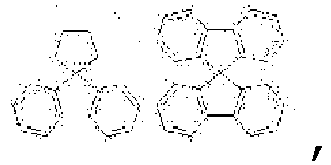
- In the present specification, the fluorenyl group includes a structure of an opened fluorenyl group, the opened fluorenyl group has a structure where two cyclic compounds are connected through one atom and connection of one cyclic compound is broken, and examples thereof include

- In the present specification, the number of carbon atoms of the amine group is not particularly limited, but preferably 1 to 30. Specific examples of the amine group include a methylamine group, a dimethylamine group, an ethylamine group, a diethylamine group, a phenylamine group, a naphthylamine group, a biphenylamine group, an anthracenylamine group, a 9-methyl-anthracenylamine group, a diphenylamine group, a phenylnaphthylamine group, a ditolylamine group, a phenyltolylamine group, a triphenylamine group, and the like, but are not limited thereto.
- In the present specification, examples of the arylamine group mean a substituted or unsubstituted monocyclic diarylamine group, a substituted or unsubstituted polycyclic diarylamine group, or a substituted or unsubstituted monocyclic and polycyclic diarylamine group.
- In the present specification, the heterocyclic group is a heterocyclic group including one or more of N, O, and S atoms as a heteroatom, and the number of carbon atoms thereof is not particularly limited, but is preferably 2 to 60. Examples of the heterocyclic group include a thiophene group, a furan group, a pyrrole group, an imidazole group, a thiazole group, an oxazole group, an oxadiazole group, a triazole group, a pyridyl group, a bipyridyl group, a triazine group, an acridyl group, a pyridazine group, a quinolinyl group, an isoquinoline group, an indole group, a carbazole group, a benzoxazolee group, a benzimidazole group, a benzthiazol group, a benzcarbazole group, a benzthiophene group, a dibenzothiophene group, a benzfuranyl group, a dibenzofuranyl group, and the like, but are not limited thereto.
- For example, the heterocyclic group is preferably compounds of the following Structural Formulas, but is not limited thereto.


- In the present specification, the aryl group of the aryloxy group, the arylthioxy group, the arylsulfoxy group, and the aralkylamine group is the same as the aforementioned examples of the aryl group.
- In the present specification, the alkyl group of the alkylthioxy group, the alkylsulfoxy group, the alkylamine group, and the aralkylamine group is the same as the aforementioned examples of the alkyl group.
- In the present specification, the heteroaryl group of the heteroarylamine group may be selected from the aforementioned examples of the heterocyclic group.
- Further, in the present specification, the term "substituted or unsubstituted" means that substitution is performed by one or more substituent groups selected from the group consisting of heavy hydrogen, a halogen group, an alkyl group, an alkenyl group, an alkoxy group, a silyl group, an arylalkenyl group, an aryl group, a heteroaryl group, a carbazole group, an arylamine group, a fluorenyl group, and a nitrile group, or there is no substituent group.
- In the exemplary embodiment of the present specification, the compound represented by
Chemical Formula 1 may be represented by any one of the following Chemical Formulas, but is not limited thereto.[Chemical Formula 1-1] [Chemical Formula 1-2] [Chemical Formula 1-3] [Chemical Formula 1-4] 
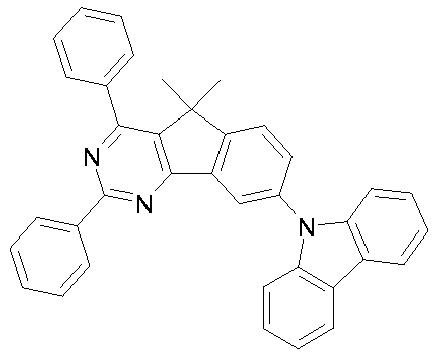


[Chemical Formula 1-5] [Chemical Formula 1-6] [Chemical Formula 1-7] [Chemical Formula 1-8] 


[Chemical Formula 1-9] [Chemical Formula 1-10] [Chemical Formula 1-11] [Chemical Formula 1-12] 


[Chemical Formula 1-13] [Chemical Formula 1-14] [Chemical Formula 1-15] [Chemical Formula 1-16] 


[Chemical Formula 1-17] [Chemical Formula 1-18] [Chemical Formula 1-19] [Chemical Formula 1-20] 


[Chemical Formula 1-21] [Chemical Formula 1-22] [Chemical Formula 1-23] [Chemical Formula 1-24] 


[Chemical Formula 1-25] [Chemical Formula 1-26] [Chemical Formula 1-27] [Chemical Formula 1-28] 


[Chemical Formula 1-29] [Chemical Formula 1-30] [Chemical Formula 1-31 [Chemical Formula 1-32] 


[Chemical Formula 1-33] [Chemical Formula 1-34] [Chemical Formula 1-35] [Chemical Formula 1-36] 


[Chemical Formula 1-37] [Chemical Formula 1-38] [Chemical Formula 1-39] [Chemical Formula 1-40] 
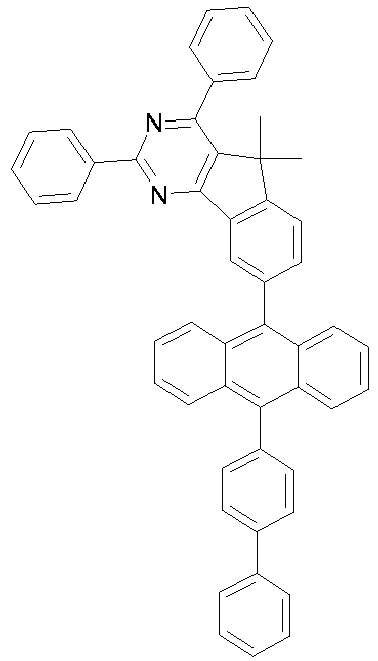


[Chemical Formula 1-41] [Chemical Formula 1-42] [Chemical Formula 1-43] [Chemical Formula 1-44] 


[Chemical Formula 1-45] [Chemical Formula 1-46] [Chemical Formula 1-47] [Chemical Formula 1-48] 


[Chemical Formula 1-49] [Chemical Formula 1-50] [Chemical Formula 1-51] [Chemical Formula 1-52] 
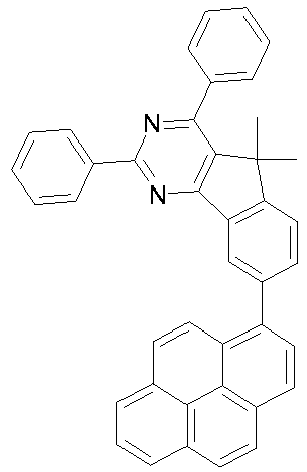


[Chemical Formula 1-53] [Chemical Formula 1-54] [Chemical Formula 1-55] [Chemical Formula 1-56] 


[Chemical Formula 1-57] [Chemical Formula 1-58] [Chemical Formula 1-59] [Chemical Formula 1-60] 


[Chemical Formula 1-61] [Chemical Formula 1-62] [Chemical Formula 1-63] [Chemical Formula 1-64] 


[Chemical Formula 1-65] [Chemical Formula 1-66] [Chemical Formula 1-67] [Chemical Formula 1-68] 


- The novel compound according to the present specification has a merit in that thermal stability is excellent.
- The novel compound according to the present specification has a merit in that the novel compound has a deep HOMO level.
- The novel compound according to the present specification has a merit in that the novel compound has a high triplet state.
- The novel compound according to the present specification has a merit in that the novel compound has hole stability.
- The novel compound according to the present specification may be purely used or used while being mixed with an impurity in the organic electronic device including a light emitting device.
- Since the compound includes an amine structure in a core structure, the compound may have an appropriate energy level as hole injection and/or hole transport materials in the organic electronic device. In the present specification, a device having a low driving voltage and high light efficiency may be implemented by selecting the compound having the appropriate energy level according to the substituent group among the aforementioned compounds and using the selected compound in the organic electronic device.
- Further, an energy band gap may be finely controlled, and a characteristic at an interface between organic materials may be improved, by introducing various substituent groups to the core structure, and thus the purpose of the material may be diversified.
- Meanwhile, the compound represented by
Chemical Formula 1 has a high glass transition temperature (Tg), and thus thermal stability is excellent. Such an increase in thermal stability becomes an important factor providing driving stability to the device. - The organic electronic device according to the present specification has a merit in that light efficiency is improved and a life-span characteristic of the device is improved due to high thermal stability.
- Further, the organic electronic device according to the present specification is an organic electronic device including a first electrode, a second electrode, and one or more organic material layers disposed between the first electrode and the second electrode, and one or more layers of the organic material layers include the compound represented by
Chemical Formula 1. - Examples of the organic electronic device include an organic light emitting device, an organic solar cell, an organic photoconductor (OPC), an organic transistor, and the like, but are not limited thereto.
- The organic electronic device of the present specification may be manufactured by a general manufacturing method and a general material of the organic electronic device, except that one or more organic material layers are formed by using the compound represented by
Chemical Formula 1. - The compound represented by
Chemical Formula 1 may be formed as the organic material layer by a solution coating method as well as a vacuum deposition method when the organic electronic device is manufactured. Herein, the solution coating method means spin coating, dip coating, inkjet printing, screen printing, a spray method, roll coating, or the like, but is not limited thereto. - The organic material layer of the organic electronic device of the present specification may have a single layer structure, but may have a multilayered structure in which two or more organic material layers are laminated. For example, the organic electronic device of the present specification may have a structure including a hole injection layer, a hole transport layer, a light emitting layer, an electron transport layer, an electron injection layer, and the like as the organic material layer. However, the structure of the organic electronic device is not limited thereto, but may include the smaller number of organic material layers.
- Accordingly, in the organic electronic device of the present specification, the organic material layer may include one or more layers of the hole injection layer, the hole transport layer, and a layer injecting and transporting holes simultaneously, and one or more layers of the layers may include the compound represented by
Chemical Formula 1. - Further, the organic material layer may include the light emitting layer, and the light emitting layer may include the compound represented by
Chemical Formula 1. - Further, the organic material layer may include one or more layers of an electron blocking layer, the electron transport layer, the electron injection layer, and a layer transporting and injecting electrons simultaneously, and one or more layers of the layers may include the compound represented by
Chemical Formula 1. - Further, the compound of the present specification may be used as an organic material layer material, particularly a hole transport layer material, an electron blocking layer material, a material of a layer transporting the holes and blocking the electrons simultaneously, a phosphorescence light emitting layer material, or the like in the organic electronic device.
- In the organic material layer having the multilayered structure, the compound represented by
Chemical Formula 1 may be included in the light emitting layer, the layer transporting the holes/blocking the electrons simultaneously, a layer injecting the holes/transporting the holes and emitting light simultaneously, a layer transporting the holes and emitting light simultaneously, or a layer transporting the electrons and emitting light simultaneously, and the like. - For example, the organic electronic device according to the present specification may be manufactured by depositing metal, metal oxides having conductivity, or an alloy thereof on a substrate by using a PVD (physical vapor deposition) method such as sputtering or e-beam evaporation to form an anode, forming the organic material layer including the hole injection layer, the hole transport layer, the light emitting layer, and the electron transport layer thereon, and then depositing a material, which may be used as a cathode, thereon. In addition to the aforementioned method, the organic electronic device may be manufactured by sequentially depositing a cathode material, the organic material layer, and an anode material on the substrate.
- The organic material layer may have the multilayered structure including the hole injection layer, the hole transport layer, the light emitting layer, the electron transport layer, and the like, but is not limited thereto and may have a single layer structure. Further, the organic material layer may be manufactured to have the smaller number of layers by using various polymer materials and by not the deposition method but the solvent process, for example, a method such as spin coating, dip coating, doctor blading, screen printing, inkjet printing, or a heat transferring method.
- It is preferable that the anode material be, in general, a material having a large work function so as to smoothly inject the holes into the organic material layer. Specific examples of the anode material that may be used in the present specification include metal such as vanadium, chrome, copper, zinc, and gold, or an alloy thereof; metal oxides such as zinc oxides, indium oxides, indium tin oxides (ITO), and indium zinc oxides (IZO); a combination of metal and oxides, such as ZnO:Al or SnO2:Sb; conductive polymers such as poly(3-methyl compound), poly[3,4-(ethylene-1,2-dioxy)thiophene] (PEDT), polypyrrole, and polyaniline, and the like, but are not limited thereto.
- It is preferable that the cathode material be, in general, a material having a small work function so as to easily inject the electrons into the organic material layer. Specific examples of the cathode material include metal such as magnesium, calcium, sodium, potassium, titanium, indium, yttrium, lithium, gadolinium, aluminum, silver, tin, and lead, or an alloy thereof; a multilayered structure material such as LiF/Al or LiO2/Al, and the like, but are not limited thereto.
- The hole injection material is a material that may receive holes well from the anode at a low voltage, and it is preferable that a HOMO (highest occupied molecular orbital) of the hole injection material be a value between the work function of the anode material and the HOMO of the surrounding organic material layer. Specific examples of the hole injection material include metal porphyrine, oligothiophene, an arylamine-based organic material, a hexanitrilehexaazatriphenylene-based organic material, a quinacridone-based organic material, a perylene-based organic material, anthraquinone, polyaniline, a polycompound-based conductive polymer, and the like, but are not limited thereto.
- The hole transport material is a material that may receive the holes from the anode or the hole injection layer and transport the holes to the light emitting layer, and is preferably a material having large mobility to the holes. Specific examples thereof include an arylamine-based organic material, a conductive polymer, a block copolymer in which a conjugate portion and a non-conjugate portion are present together, and the like, but are not limited thereto.
- The light emitting material is a material that may receive the holes and the electrons from the hole transport layer and the electron transport layer, respectively, and bond the holes and the electrons to emit light in a visible ray region, and is preferably a material having good quantum efficiency to fluorescence or phosphorescence. Specific examples thereof include an 8-hydroxy-quinoline aluminum complex (Alq3); a carbazole-based compound; a dimerized styryl compound; BAlq; a 10-hydroxybenzoquinoline-metal compound; benzoxazolee, benzthiazole and benzimidazole-based compounds; a poly(p-phenylenevinylene) (PPV)-based polymer; a spiro compound; polyfluorene; lubrene, and the like, but are not limited thereto.
- The electron transport material is a material that may receive well the electrons from the cathode and transport the electrons to the light emitting layer, and is preferably a material having large mobility to the electrons. Specific examples thereof include an 8-hydroxyquinoline Al complex; a complex including Alq3; an organic radical compound; a hydroxyflavone-metal complex, and the like, but are not limited thereto.
- The organic electronic device according to the present specification may be a top emission type, a bottom emission type, or a dual emission type according to the used material.
- The organic electronic device according to the present specification may be an organic light emitting device.
- For example, the structure of the organic light emitting device of the present specification may have a structure shown in
FIGS. 1 and 2 , but is not limited thereto. -
FIG. 1 illustrates a structure of an organic electronic device in which ananode 2, alight emitting layer 3, and acathode 4 are sequentially laminated on asubstrate 1. In the aforementioned structure, the compound may be included in thelight emitting layer 3. -
FIG. 2 illustrates a structure of an organic light emitting device in which ananode 2, ahole injection layer 5, ahole transport layer 6, alight emitting layer 7, an electron transport layer 8, and acathode 4 are sequentially laminated on asubstrate 1. In the aforementioned structure, the compound may be included in thehole injection layer 5, thehole transport layer 6, thelight emitting layer 7, or the electron transport layer 8. - The compound according to the exemplary embodiment of the present application may be used in the organic material layer of the organic light emitting device, and more specifically, the electron transport layer or the light emitting layer.
- An organic solar cell according to the present specification may have a structure including a first electrode, a second electrode, and an organic material layer disposed therebetween, and may include a hole transport layer, a light active layer, and a electron transport layer as the organic material layer. The compound according to the exemplary embodiment of the present application may be used in the organic material layer of the organic solar cell, and more specifically, the electron transport layer.
- An organic photoconductor according to the present specification may include a conductive base material, an electric charge transport layer including an electron transport material, and an electric charge generation layer. The compound according to the exemplary embodiment of the present application may be used in the electric charge transport layer of the organic photoconductor.
- An organic transistor according to the present specification may include a first electrode, a second electrode, a hole injection layer, an organic thin film layer, an electron injection layer, an electron transport layer, and the like. The compound according to the exemplary embodiment of the present application may be used in the electron transport layer of the organic transistor.
- The method of manufacturing the compound of
Chemical Formula 1 and the manufacturing of the organic electronic device using the same will be described in detail in the following Examples. However, the following Examples are set forth to illustrate the present specification, but the scope of the present specification is not limited thereto. -

- 4-chloro-2,6-diphenyl pyrimidine (30.4 g, 114 mmol), 2-(methoxy carbonyl)-4-chlorophenyl boronic acid (25.7 g, 120 mmol), and K2CO3 (45.6 g, 329 mmol) were refluxed for 12 hours after tetrahydrofuran (THF, 300 mL), H2O (100 ml), and Pd(PPh3)4 (3.95 g, 3.42 mmol) were added thereto. After cooling to normal temperature, the water layer was removed. After MgSO4 was added to the organic layer, filtration was performed. After concentration, purification was performed by the column chromatography to obtain Structural Formula A (24.2 g, yield 53%).
- Structural Formula A (22.0 g, 50.5 mmol) obtained in the aforementioned reaction was dissolved in anhydrous tetrahydrofuran (200 mL), and cooling was performed to 0°C. 3.0M CH3MgBr (55 ml, 164.5 mmol) was added thereto for 30 minutes, and agitation was performed at normal temperature for 16 hours. After cooling to 0°C, the reaction was quenched by NH4Cl. The organic layer was separated and then concentrated to obtain Structural Formula B.
- After Structural Formula B obtained in the aforementioned reaction was dissolved in acetic acid (200 mL), 1 g of concentrated H2SO4 was added thereto. After reflux for 96 hours, cooling to normal temperature was performed. H2O (500 ml) was added to generate a solid. After filtration, the solid was purified by the chromatography to obtain Structural Formula C (6.3 g, yield 30%) .
MS: [M+H]+ = 382 - The NMR graph of Structural Formula C is illustrated in
FIG. 3 . - Structural Formula C (5.0 g, 13.1 mmol), carbazole (2.3 g, 13.7 mmol), NaOtBu (1.65 g, 17.0 mmol), Pd(p-tBu3)2 (65 mg, 0.13 mmol), and xylene (50 mL) were mixed, refluxing was performed for 24 hours, and cooled to normal temperature. After filtration, the filtrate was distilled under reduced pressure. The generated solid was purified by the chromatography to obtain Chemical Formula 1-3 (4.96 g, yield 74%).
MS: [M+H]+ = 514 - The NMR graph of Chemical Formula 1-3 is illustrated in
FIG. 4 . -

- Structural Formula C (10.0 g, 26.1 mmol), Structural Formula D (8.2 g, 28.7 mmol), K3PO4·H2O (16.6 g, 78.3 mmol), Pd(p-tBu3)2 (0.13 g, 0.26 mmol), 1,4-dioxane (100 mL), and H2O (30 ml) were mixed, refluxing was performed for 24 hours, and cooled to normal temperature. After the water layer was removed, the organic layer was distilled under reduced pressure. The generated solid was purified by the chromatography to obtain Chemical Formula 1-7 (8.0 g, yield 52%) .
MS: [M+H]+ = 590 -

- Structural Formula C (10.0 g, 26.1 mmol), Structural Formula E (8.2 g, 28.7 mmol), K3PO4·H2O (16.6 g, 78.3 mmol), Pd(p-tBu3)2 (0.13 g, 0.26 mmol), 1,4-dioxane (100 mL), and H2O (30 ml) were mixed, refluxing was performed for 24 hours, and cooled to normal temperature. After the water layer was removed, the organic layer was distilled under reduced pressure. The generated solid was purified by the chromatography to obtain Chemical Formula 1-11 (5.4 g, yield 35%).
MS: [M+H]+ = 590 -


- Structural Formula C (15.0 g, 39.2 mmol), Structural Formula F (9.8 g, 43.1 mmol), K3PO4·H2O (24.9 g, 118 mmol), Pd(p-tBu3)2 (0.20 g, 0.39 mmol), 1,4-dioxane (100 mL), and H2O (30 ml) were mixed, refluxing was performed for 24 hours, and cooled to normal temperature. After the water layer was removed, the organic layer was distilled under reduced pressure. The generated solid was purified by the chromatography to obtain Chemical Formula 1-15 (7.9 g, yield 38%).
MS: [M+H]+ = 531 -


- Structural Formula C (12.0 g, 31.3 mmol), Structural Formula G (9.4 g, 34.4 mmol), K3PO4·H2O (20.0 g, 94.4 mmol), Pd(p-tBu3)2 (0.16 g, 0.31 mmol), 1,4-dioxane (100 mL), and H2O (30 ml) were mixed, refluxing was performed for 24 hours, and cooled to normal temperature. After the water layer was removed, the organic layer was distilled under reduced pressure. The generated solid was purified by the chromatography to obtain Chemical Formula 1-55 (4.5 g, yield 25%).
MS: [M+H]+ = 575 - A glass substrate on which a thin film of ITO (indium tin oxide) was applied in a thickness of 500 Å was put into distilled water having the detergent dissolved therein and washed by the ultrasonic wave. In this case, the product manufactured by Fisher Co. was used as the detergent, and distilled water, which had been twice filtered by the filter manufactured by Millipore Co., was used as the distilled water. The ITO was washed for 30 minutes, and then washing with ultrasonic waves was repeated twice for 10 minutes by distilled water. After washing with distilled water was finished, washing with ultrasonic waves was performed by solvents such as isopropyl alcohol, acetone, and methanol, and the resultant product was dried and transported to the plasma washing machine. Further, the substrate was washed by using oxygen plasma for 5 minutes, and then transported to the vacuum deposition machine.
- Hexanitrile hexaazatriphenylene (HAT) of the following Chemical Formula was thermally deposited under vacuum in a thicknesses of 500 Å on the ITO transparent electrode thus prepared to form a hole injection layer.
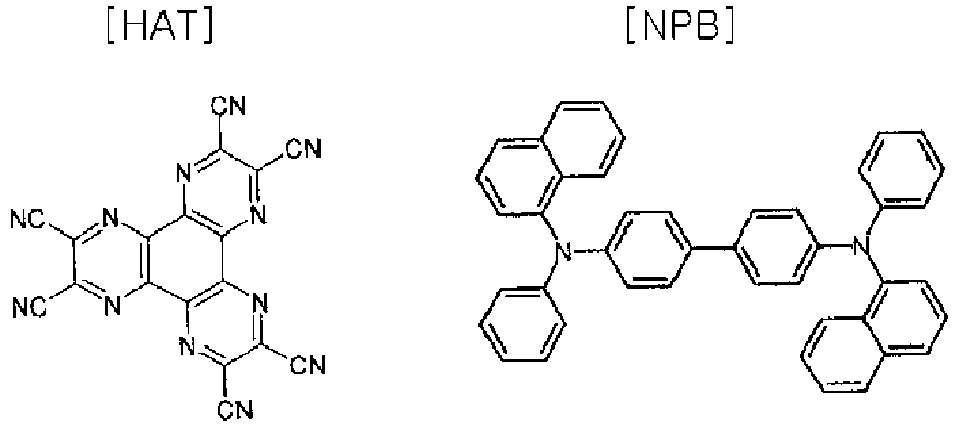
- 4,4'-bis[N-(1-naphthyl)-N-phenylamino]biphenyl (NPB) (250 Å), hexanitrile hexaazatriphenylene (HAT) (50 Å) and 4,4'-bis[N-(1-naphthyl)-N-phenylamino]biphenyl (NPB) (400 Å) of the aforementioned Chemical Formulas were sequentially deposited under vacuum on the hole injection layer to form a hole transport layer.
- Subsequently, the compound of Chemical Formula 1-3 manufactured in Synthetic Example 1 and a dopant compound GD as illustrated below were deposited under vacuum at a weight ratio of 10:1 in a film thickness of 300 Å on the hole transport layer to form a light emitting layer.

- The compound of Chemical Formula ET-A as the electron transport layer material and the aforementioned Chemical Formula LiQ (lithium quinalate) were deposited under vacuum at a weight ratio of 1:1 on the light emitting layer to form an electron injection and transport layer in a thickness of 300 Å.
- Lithium fluoride (LiF) in a thickness of 15 Å and aluminum in a thickness of 1,000 Å were sequentially deposited on the electron injection and transport layer to form a cathode.
- In the aforementioned process, the deposition speed of the organic material was maintained at 0.4 to 0.7 Å/sec, the deposition speed of lithium fluoride of the cathode was maintained at 0.3 Å/sec, the deposition speed of aluminum was maintained at 2 Å/sec, and the degree of vacuum during deposition was maintained at 2 × 10⁻⁷ to 5 × 10⁻⁸ torr to manufacture an organic light emitting device.
- An organic light emitting device was manufactured by the same method as Example 1, except that the compound of the following Chemical Formula 1-7 was used instead of the compound of Chemical Formula 1-3 in Example 1.
- An organic light emitting device was manufactured by the same method as Example 1, except that the compound of the following Chemical Formula 1-11 was used instead of the compound of Chemical Formula 1-3 in Example 1.
- An organic light emitting device was manufactured by the same method as Example 1, except that the compound of the following Chemical Formula 1-15 was used instead of the compound of Chemical Formula 1-3 in Example 1.
- An organic light emitting device was manufactured by the same method as Example 1, except that the compound of the following Chemical Formula 1-55 was used instead of the compound of Chemical Formula 1-3 in Example 1.
- An organic light emitting device was manufactured by the same method as Example 1, except that the compound of the following Chemical Formula GH-A was used instead of the compound of Chemical Formula 1-3 in Example 1.
-

- When the current (10 mA/cm2) was applied to the organic light emitting devices manufactured in Examples 1 to 5 and Comparative Example 1, the results of Table 1 were obtained.
[Table 1] Compound Voltage (V) Efficiency (cd/A) Experimental Example 1 Chemical Formula 1-3 3.50 67.10 Experimental Example 2 Chemical Formula 1-7 3.70 65.57 Experimental Example 3 Chemical Formula 1-11 3.93 62.32 Experimental Example 4 Chemical Formula 1-15 4.10 57.53 Experimental Example 5 Chemical Formula 1-55 4.37 61.38 Comparative Example 1 GH-A 6.12 15.26 - From the results of Table 1, it can be seen that the novel compound according to the present specification may be used as the material of the light emitting layer of the organic electronic device including the organic light emitting device, and the organic electronic device including the organic light emitting device using the same has excellent characteristics in view of efficiency, driving voltage, stability and the like. Particularly, the compound may reduce a driving voltage and introduce an increase in efficiency to improve power consumption.
Claims (14)
- A compound represented by the following Chemical Formula 1:
 R1 to R6 are the same as or different from each other, and are each independently hydrogen; heavy hydrogen; a halogen group; a nitrile group; a nitro group; a hydroxy group; a substituted or unsubstituted alkyl group; a substituted or unsubstituted cycloalkyl group; a substituted or unsubstituted alkoxy group; a substituted or unsubstituted aryloxy group; a substituted or unsubstituted alkylthioxy group; a substituted or unsubstituted arylthioxy group; a substituted or unsubstituted alkylsulfoxy group; a substituted or unsubstituted arylsulfoxy group; a substituted or unsubstituted alkenyl group; a substituted or unsubstituted silyl group; a substituted or unsubstituted boron group; a substituted or unsubstituted alkylamine group; a substituted or unsubstituted aralkylamine group; a substituted or unsubstituted arylamine group; a substituted or unsubstituted heteroarylamine group; a substituted or unsubstituted aryl group; a substituted or unsubstituted fluorenyl group; a substituted or unsubstituted heterocyclic group including one or more of N, O, and S atoms; or -L-A,L is a direct bond; an arylene group unsubstituted or substituted by one or more substituent groups selected from the group consisting of a halogen group, an alkyl group, an alkenyl group, an alkoxy group, an arylamine group, an aryl group, an arylalkyl group, an arylalkenyl group, a heteroaryl group, a carbazolyl group, a fluorenyl group, and a nitrile group; or a divalent biphenyl group unsubstituted or substituted by one or more substituent groups selected from the group consisting of a halogen group, an alkyl group, an alkenyl group, an alkoxy group, an arylamine group, an aryl group, an arylalkyl group, an arylalkenyl group, a heteroaryl group, a carbazolyl group, a fluorenyl group, and a nitrile group,A is a substituted or unsubstituted aryl group; a substituted or unsubstituted carbazole group; a substituted or unsubstituted dibenzothiophene group; or a substituted or unsubstituted dibenzofuran group, andat least one of R1 to R6 is -L-A,characterised in that R7 and R8 are the same as or different from each other, and are each independently a halogen group; a nitrile group; a nitro group; a hydroxy group; or a substituted or unsubstituted alkyl group.
 - The compound of claim 1, wherein at least one of R1 to R6 is a substituted or unsubstituted carbazole group; a substituted or unsubstituted dibenzothiophene group; or a substituted or unsubstituted dibenzofuran group.
- The compound of claim 1, wherein R1 and R2 are the same as or different from each other, and are each independently a substituted or unsubstituted cycloalkyl group; a substituted or unsubstituted aryl group; a substituted or unsubstituted heterocyclic group including one or more of N, O, and S atoms; or a substituted or unsubstituted fluorenyl group.
- The compound of claim 1, wherein at least one of R3 to R6 includes any one of a substituted or unsubstituted carbazole group; a substituted or unsubstituted dibenzothiophene group; and a substituted or unsubstituted dibenzofuran group.
- The compound of claim 1, wherein at least one of R3 to R6 is -L-A.
- The compound of claim 1, wherein R1 and R2 are the same as or different from each other, and are each independently a substituted or unsubstituted cycloalkyl group; a substituted or unsubstituted aryl group; a substituted or unsubstituted heterocyclic group including one or more of N, O, and S atoms; or a substituted or unsubstituted fluorenyl group, and
at least one of R3 to R6 is -L-A. - The compound of claim 1, wherein R7 and R8 are the same as or different from each other, and are each independently a substituted or unsubstituted alkyl group.
- The compound of claim 1, wherein R1 and R2 are each independently a phenyl group, a biphenyl group, a tolyl group, a naphthyl group, a pyridyl group, a pyrimidyl group, a pyrazinyl group, or a fluorenyl group,
R3 to R6 are each independently hydrogen; heavy hydrogen; a halogen group; a nitrile group; a nitro group; a hydroxy group; a substituted or unsubstituted alkyl group; or -L-A, and
at least one of R3 to R6 is -L-A. - The compound of claim 1, wherein any one of R1 and R2 is -L-A, and the other is a substituted or unsubstituted cycloalkyl group; a substituted or unsubstituted aryl group; a substituted or unsubstituted heterocyclic group including one or more of N, O, and S atoms; or a substituted or unsubstituted fluorenyl group.
- The compound of claim 1, wherein the aryl group of A is a substituted or unsubstituted phenyl group; a substituted or unsubstituted biphenyl group; a substituted or unsubstituted terphenyl group; a substituted or unsubstituted naphthyl group; a substituted or unsubstituted anthracenyl group; a substituted or unsubstituted phenalenyl group; a substituted or unsubstituted naphthacenyl group; a substituted or unsubstituted pentacenyl group; a substituted or unsubstituted phenanthrenyl group; a substituted or unsubstituted pyrenyl group; a substituted or unsubstituted triphenylenyl group; a substituted or unsubstituted fluoranthenyl group; a substituted or unsubstituted perylenyl group; or a substituted or unsubstituted chrysenyl group.
- The compound of claim 1, wherein the compound represented by Chemical Formula 1 is represented by any one of the following Chemical Formulas:
[Chemical Formula 1-1] [Chemical Formula 1-2] [Chemical Formula 1-3] [Chemical Formula 1-4] 


[Chemical Formula 1-5] [Chemical Formula 1-6] [Chemical Formula 1-7] [Chemical Formula 1-8] 

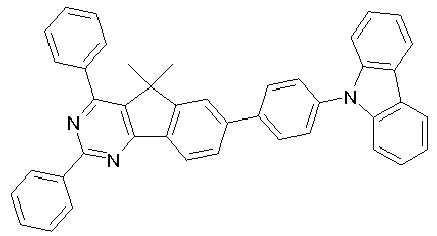

[Chemical Formula 1-9] [Chemical Formula 1-10] [Chemical Formula 1-11] [Chemical Formula 1-12] 


[Chemical Formula 1-13] [Chemical Formula 1-14] [Chemical Formula 1-15] [Chemical Formula 1-16] 


[Chemical Formula 1-17] [Chemical Formula 1-18] [Chemical Formula 1-19] [Chemical Formula 1-20] 


[Chemical Formula 1-21] [Chemical Formula 1-22] [Chemical Formula 1-23] [Chemical Formula 1-24] 


[Chemical Formula 1-25] [Chemical Formula 1-26] [Chemical Formula 1-27] [Chemical Formula 1-28] 


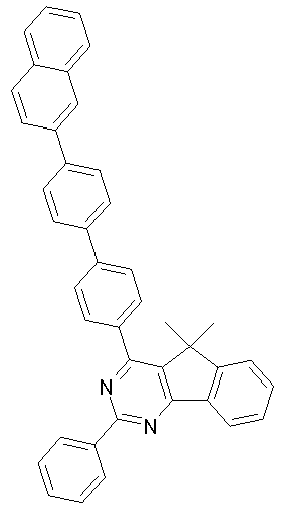
[Chemical Formula 1-29] [Chemical Formula 1-30] [Chemical Formula 1-31 [Chemical Formula 1-32] 


[Chemical Formula 1-33] [Chemical Formula 1-34] [Chemical Formula 1-35] [Chemical Formula 1-36] 


[Chemical Formula 1-37] [Chemical Formula 1-38] [Chemical Formula 1-39] [Chemical Formula 1-40] 


[Chemical Formula 1-41] [Chemical Formula 1-42] [Chemical Formula 1-43] [Chemical Formula 1-44] 


[Chemical Formula 1-45] [Chemical Formula 1-46] [Chemical Formula 1-47] [Chemical Formula 1-48] 


[Chemical Formula 1-49] [Chemical Formula 1-50] [Chemical Formula 1-51] [Chemical Formula 1-52] 


[Chemical Formula 1-53] [Chemical Formula 1-54] [Chemical Formula 1-55] [Chemical Formula 1-56] 


[Chemical Formula 1-57] [Chemical Formula 1-58] [Chemical Formula 1-59] [Chemical Formula 1-60] 


[Chemical Formula 1-61] [Chemical Formula 1-62] [Chemical Formula 1-63] [Chemical Formula 1-64] 


[Chemical Formula 1-65] [Chemical Formula 1-66] [Chemical Formula 1-67] [Chemical Formula 1-68] 


- An organic electronic device comprising:a first electrode (2);a second electrode (4); andone or more organic material layers (5, 6, 7, 8) disposed between the first electrode and the second electrode,wherein one or more layers of the organic material layers include the compound according to any one of claims 1 to 11.
- The organic electronic device of claim 12, wherein the organic material layers (5, 6, 7, 8) include at least one layer of an electron blocking layer, an electron injection layer, and an electron transport layer (8), and at least one layer of the electron blocking layer, the electron injection layer, and the electron transport layer includes the compound.
- The organic electronic device of claim 12, wherein the organic material layers include a light emitting layer (7), and the light emitting layer includes the compound.
Applications Claiming Priority (2)
| Application Number | Priority Date | Filing Date | Title |
|---|---|---|---|
| KR20120138180 | 2012-11-30 | ||
| PCT/KR2013/010873 WO2014084612A1 (en) | 2012-11-30 | 2013-11-27 | Novel compound and organic electronic element using same |
Publications (3)
| Publication Number | Publication Date |
|---|---|
| EP2927225A1 EP2927225A1 (en) | 2015-10-07 |
| EP2927225A4 EP2927225A4 (en) | 2016-07-27 |
| EP2927225B1 true EP2927225B1 (en) | 2018-10-03 |
Family
ID=50828169
Family Applications (1)
| Application Number | Title | Priority Date | Filing Date |
|---|---|---|---|
| EP13836249.6A Active EP2927225B1 (en) | 2012-11-30 | 2013-11-27 | Novel compound and organic electronic element using same |
Country Status (7)
| Country | Link |
|---|---|
| US (2) | US20150311450A1 (en) |
| EP (1) | EP2927225B1 (en) |
| JP (1) | JP6067873B2 (en) |
| KR (1) | KR101560061B1 (en) |
| CN (1) | CN104822673B (en) |
| TW (1) | TWI500605B (en) |
| WO (1) | WO2014084612A1 (en) |
Families Citing this family (10)
| Publication number | Priority date | Publication date | Assignee | Title |
|---|---|---|---|---|
| KR20150026114A (en) * | 2013-08-30 | 2015-03-11 | 삼성디스플레이 주식회사 | Indenopyridine-based compounds and organic light emitting diodes includiing the same |
| KR102153040B1 (en) * | 2013-11-28 | 2020-09-07 | 삼성전자주식회사 | Condensed cyclic compound and organic light emitting diode including the same |
| KR102413062B1 (en) * | 2014-08-28 | 2022-06-24 | 에스에프씨주식회사 | Novel heterocyclic compounds and organic light-emitting diode including the same |
| KR102424977B1 (en) | 2015-04-14 | 2022-07-26 | 삼성디스플레이 주식회사 | Condensed-cyclic compound and organic light emitting device comprising the same |
| EP3369731B1 (en) * | 2015-10-26 | 2020-02-19 | LG Chem, Ltd. | Heterocyclic compound and organic light emitting element comprising same |
| KR102630644B1 (en) | 2015-12-17 | 2024-01-30 | 삼성디스플레이 주식회사 | Organic light emitting device |
| KR102101559B1 (en) * | 2017-07-20 | 2020-04-17 | 주식회사 엘지화학 | Compound and organic light emitting device comprising the same |
| KR102916279B1 (en) * | 2018-05-31 | 2026-01-22 | 가부시키가이샤 한도오따이 에네루기 켄큐쇼 | Organic compounds, light-emitting elements, light-emitting devices, electronic devices, and lighting devices |
| KR102136791B1 (en) * | 2020-04-14 | 2020-07-23 | 삼성디스플레이 주식회사 | Indenopyridine-based compounds and organic light emitting diodes includiing the same |
| KR20220033849A (en) | 2020-09-10 | 2022-03-17 | 삼성전자주식회사 | Heterocyclic compound, organic light emitting device including the same and electronic apparatus including the organic light emitting device |
Family Cites Families (18)
| Publication number | Priority date | Publication date | Assignee | Title |
|---|---|---|---|---|
| US4769378A (en) * | 1986-03-31 | 1988-09-06 | Eli Lilly And Company | Indenopyrimidine aromatase inhibitors |
| WO1993008167A1 (en) * | 1991-10-24 | 1993-04-29 | Nippon Soda Co., Ltd. | Novel heterocyclic derivative and agrohorticultural bactericide containing same |
| US5594001A (en) | 1993-04-08 | 1997-01-14 | The Dupont Merck Pharmaceutical Company | Polycyclic systems, and derivatives thereof, as neurotransmitter release enhancers useful in the treatment of cognitive disorders |
| BR9405954A (en) * | 1993-04-08 | 1995-12-26 | Du Pont Merck Pharma | Polycyclic compounds and derivatives of the same pharmaceutical compositions and method of treating cognitive or neurological dysfunction |
| AR008395A1 (en) | 1996-07-09 | 2000-01-19 | Astra Pharma Prod | COMPOUND DERIVED FROM PIRIMIDINE, PHARMACEUTICAL COMPOSITION THAT UNDERSTANDS IT, PROCEDURE TO PREPARE IT, AND INTERMEDIATE COMPOUND USEFUL TO CARRY OUT SUCH PROCEDURE. |
| KR100430549B1 (en) | 1999-01-27 | 2004-05-10 | 주식회사 엘지화학 | New organomattalic complex molecule for the fabrication of organic light emitting diodes |
| JP2001139556A (en) * | 1999-03-18 | 2001-05-22 | Nippon Soda Co Ltd | Indenopyridine and indenopyrimidine compound and method for producing the same |
| US6573651B2 (en) * | 2000-12-18 | 2003-06-03 | The Trustees Of Princeton University | Highly efficient OLEDs using doped ambipolar conductive molecular organic thin films |
| US20040127510A1 (en) * | 2002-04-16 | 2004-07-01 | Heintzelman Geoffrey R. | Arylindenopyridines and arylindenopyrimidines and related therapeutic and prophylactic methods |
| US7982035B2 (en) * | 2007-08-27 | 2011-07-19 | Duquesne University Of The Holy Spirit | Tricyclic compounds having antimitotic and/or antitumor activity and methods of use thereof |
| CN102089282A (en) * | 2008-07-08 | 2011-06-08 | 株式会社半导体能源研究所 | Carbazole derivative, light-emitting element material, light-emitting element, and light-emitting device |
| DE102009023155A1 (en) | 2009-05-29 | 2010-12-02 | Merck Patent Gmbh | Materials for organic electroluminescent devices |
| US20110105541A1 (en) * | 2009-10-29 | 2011-05-05 | Jackson Paul F | ALKYL SUBSTITUTED ARYLINDENOPYRIMIDINES AND THEIR USE AS HIGHLY SELECTIVE ADENOSINE A2a RECEPTOR ANTAGONISTS |
| KR20120044523A (en) * | 2010-10-28 | 2012-05-08 | 롬엔드하스전자재료코리아유한회사 | Novel organic electroluminescent compounds and organic electroluminescent device using the same |
| JP6046884B2 (en) * | 2011-08-11 | 2016-12-21 | ユー・ディー・シー アイルランド リミテッド | ORGANIC ELECTROLUMINESCENT ELEMENT, ELEMENT MATERIAL, AND LIGHT EMITTING DEVICE, DISPLAY DEVICE AND LIGHTING DEVICE USING THE ELEMENT |
| WO2013084484A1 (en) * | 2011-12-07 | 2013-06-13 | 出光興産株式会社 | Material for organic electroluminescent element and organic electroluminescent element using same |
| WO2013180376A1 (en) | 2012-05-30 | 2013-12-05 | Alpha Chem Co., Ltd. | New electron transport material and organic electroluminescent device using the same |
| US9221820B2 (en) | 2013-02-07 | 2015-12-29 | Lg Chem, Ltd. | Heterocyclic compound and organic light emitting device using the same |
-
2013
- 2013-11-27 CN CN201380059251.0A patent/CN104822673B/en active Active
- 2013-11-27 WO PCT/KR2013/010873 patent/WO2014084612A1/en not_active Ceased
- 2013-11-27 JP JP2015542969A patent/JP6067873B2/en active Active
- 2013-11-27 EP EP13836249.6A patent/EP2927225B1/en active Active
- 2013-11-27 US US14/345,887 patent/US20150311450A1/en not_active Abandoned
- 2013-11-27 KR KR1020130145465A patent/KR101560061B1/en active Active
- 2013-11-28 TW TW102143412A patent/TWI500605B/en active
-
2017
- 2017-04-24 US US15/495,646 patent/US10790453B2/en active Active
Non-Patent Citations (1)
| Title |
|---|
| None * |
Also Published As
| Publication number | Publication date |
|---|---|
| KR101560061B1 (en) | 2015-10-15 |
| CN104822673A (en) | 2015-08-05 |
| TWI500605B (en) | 2015-09-21 |
| EP2927225A1 (en) | 2015-10-07 |
| CN104822673B (en) | 2018-01-05 |
| JP6067873B2 (en) | 2017-01-25 |
| US10790453B2 (en) | 2020-09-29 |
| US20150311450A1 (en) | 2015-10-29 |
| US20170229659A1 (en) | 2017-08-10 |
| JP2016502529A (en) | 2016-01-28 |
| TW201439070A (en) | 2014-10-16 |
| WO2014084612A1 (en) | 2014-06-05 |
| EP2927225A4 (en) | 2016-07-27 |
| KR20140070425A (en) | 2014-06-10 |
Similar Documents
| Publication | Publication Date | Title |
|---|---|---|
| EP3434670B1 (en) | Novel nitrogen-containing heterocyclic compound and organic electronic device using same | |
| KR100867526B1 (en) | New diamine derivatives, preparation method thereof and organic electronic device using the same | |
| KR101580357B1 (en) | Nitrogen-containing heterocyclic compounds and organic electronic device comprising the same | |
| US10790453B2 (en) | Compounds and organic electronic device using the same | |
| EP2937347B1 (en) | Novel compound and organic electronic element using same | |
| KR20110134201A (en) | Compound containing carbazole and aromatic amine derivative and organic electric device using same, terminal thereof | |
| KR20110068330A (en) | Spiro carbazole compounds and organic electric devices using same, terminals thereof | |
| KR20130100948A (en) | New anthracene derivatives and organic electronic device using the same | |
| KR100864154B1 (en) | Novel anthracene derivatives, preparation method thereof and organic electronic device using same | |
| JP5575806B2 (en) | Novel cycloalkene derivative and organic electronic device using the same | |
| KR101625284B1 (en) | Aromatic compounds and organic electronic device using the same | |
| KR101317531B1 (en) | New imidazole derivatives and organic electronic device using the same | |
| KR20130083887A (en) | New imidazole derivatives and organic electronic device using the same | |
| KR20080016007A (en) | Novel anthracene derivatives and organic electronic devices using the same | |
| KR101584855B1 (en) | Nitrogen-containing heterocyclic compounds and organic electronic device comprising the same | |
| KR20110131155A (en) | Novel Dithienopyrrole Derivatives and Organic Electrical Devices Using the Same | |
| KR101072814B1 (en) | Benzo isoquinoline compound and organic electric device using same, terminal thereof | |
| KR20100045311A (en) | New dithienopyrrole derivatives and organic electronic diode using the same | |
| KR101640307B1 (en) | Aromatic compounds and organic electronic device comprising the same | |
| KR101251655B1 (en) | New bianthracene derivatives and organic electronic device using the same |
Legal Events
| Date | Code | Title | Description |
|---|---|---|---|
| PUAI | Public reference made under article 153(3) epc to a published international application that has entered the european phase |
Free format text: ORIGINAL CODE: 0009012 |
|
| 17P | Request for examination filed |
Effective date: 20140320 |
|
| AK | Designated contracting states |
Kind code of ref document: A1 Designated state(s): AL AT BE BG CH CY CZ DE DK EE ES FI FR GB GR HR HU IE IS IT LI LT LU LV MC MK MT NL NO PL PT RO RS SE SI SK SM TR |
|
| AX | Request for extension of the european patent |
Extension state: BA ME |
|
| DAX | Request for extension of the european patent (deleted) | ||
| RA4 | Supplementary search report drawn up and despatched (corrected) |
Effective date: 20160628 |
|
| RIC1 | Information provided on ipc code assigned before grant |
Ipc: C07D 209/82 20060101ALI20160622BHEP Ipc: C07D 403/04 20060101AFI20160622BHEP Ipc: C09K 11/06 20060101ALI20160622BHEP Ipc: H01L 51/50 20060101ALI20160622BHEP |
|
| REG | Reference to a national code |
Ref country code: DE Ref legal event code: R079 Ref document number: 602013044620 Country of ref document: DE Free format text: PREVIOUS MAIN CLASS: C07D0403040000 Ipc: H01L0051540000 |
|
| GRAP | Despatch of communication of intention to grant a patent |
Free format text: ORIGINAL CODE: EPIDOSNIGR1 |
|
| RIC1 | Information provided on ipc code assigned before grant |
Ipc: C07D 403/04 20060101ALI20180514BHEP Ipc: C07D 209/82 20060101ALI20180514BHEP Ipc: H01L 51/54 20060101AFI20180514BHEP Ipc: C09K 11/06 20060101ALI20180514BHEP |
|
| INTG | Intention to grant announced |
Effective date: 20180608 |
|
| GRAS | Grant fee paid |
Free format text: ORIGINAL CODE: EPIDOSNIGR3 |
|
| GRAA | (expected) grant |
Free format text: ORIGINAL CODE: 0009210 |
|
| RAP1 | Party data changed (applicant data changed or rights of an application transferred) |
Owner name: LG CHEM, LTD. |
|
| AK | Designated contracting states |
Kind code of ref document: B1 Designated state(s): AL AT BE BG CH CY CZ DE DK EE ES FI FR GB GR HR HU IE IS IT LI LT LU LV MC MK MT NL NO PL PT RO RS SE SI SK SM TR |
|
| REG | Reference to a national code |
Ref country code: GB Ref legal event code: FG4D |
|
| REG | Reference to a national code |
Ref country code: CH Ref legal event code: EP Ref country code: AT Ref legal event code: REF Ref document number: 1049583 Country of ref document: AT Kind code of ref document: T Effective date: 20181015 |
|
| REG | Reference to a national code |
Ref country code: IE Ref legal event code: FG4D Ref country code: DE Ref legal event code: R096 Ref document number: 602013044620 Country of ref document: DE |
|
| REG | Reference to a national code |
Ref country code: NL Ref legal event code: MP Effective date: 20181003 |
|
| REG | Reference to a national code |
Ref country code: LT Ref legal event code: MG4D |
|
| REG | Reference to a national code |
Ref country code: AT Ref legal event code: MK05 Ref document number: 1049583 Country of ref document: AT Kind code of ref document: T Effective date: 20181003 |
|
| PG25 | Lapsed in a contracting state [announced via postgrant information from national office to epo] |
Ref country code: NL Free format text: LAPSE BECAUSE OF FAILURE TO SUBMIT A TRANSLATION OF THE DESCRIPTION OR TO PAY THE FEE WITHIN THE PRESCRIBED TIME-LIMIT Effective date: 20181003 |
|
| PG25 | Lapsed in a contracting state [announced via postgrant information from national office to epo] |
Ref country code: FI Free format text: LAPSE BECAUSE OF FAILURE TO SUBMIT A TRANSLATION OF THE DESCRIPTION OR TO PAY THE FEE WITHIN THE PRESCRIBED TIME-LIMIT Effective date: 20181003 Ref country code: BG Free format text: LAPSE BECAUSE OF FAILURE TO SUBMIT A TRANSLATION OF THE DESCRIPTION OR TO PAY THE FEE WITHIN THE PRESCRIBED TIME-LIMIT Effective date: 20190103 Ref country code: LT Free format text: LAPSE BECAUSE OF FAILURE TO SUBMIT A TRANSLATION OF THE DESCRIPTION OR TO PAY THE FEE WITHIN THE PRESCRIBED TIME-LIMIT Effective date: 20181003 Ref country code: CZ Free format text: LAPSE BECAUSE OF FAILURE TO SUBMIT A TRANSLATION OF THE DESCRIPTION OR TO PAY THE FEE WITHIN THE PRESCRIBED TIME-LIMIT Effective date: 20181003 Ref country code: IS Free format text: LAPSE BECAUSE OF FAILURE TO SUBMIT A TRANSLATION OF THE DESCRIPTION OR TO PAY THE FEE WITHIN THE PRESCRIBED TIME-LIMIT Effective date: 20190203 Ref country code: NO Free format text: LAPSE BECAUSE OF FAILURE TO SUBMIT A TRANSLATION OF THE DESCRIPTION OR TO PAY THE FEE WITHIN THE PRESCRIBED TIME-LIMIT Effective date: 20190103 Ref country code: ES Free format text: LAPSE BECAUSE OF FAILURE TO SUBMIT A TRANSLATION OF THE DESCRIPTION OR TO PAY THE FEE WITHIN THE PRESCRIBED TIME-LIMIT Effective date: 20181003 Ref country code: AT Free format text: LAPSE BECAUSE OF FAILURE TO SUBMIT A TRANSLATION OF THE DESCRIPTION OR TO PAY THE FEE WITHIN THE PRESCRIBED TIME-LIMIT Effective date: 20181003 Ref country code: PL Free format text: LAPSE BECAUSE OF FAILURE TO SUBMIT A TRANSLATION OF THE DESCRIPTION OR TO PAY THE FEE WITHIN THE PRESCRIBED TIME-LIMIT Effective date: 20181003 Ref country code: HR Free format text: LAPSE BECAUSE OF FAILURE TO SUBMIT A TRANSLATION OF THE DESCRIPTION OR TO PAY THE FEE WITHIN THE PRESCRIBED TIME-LIMIT Effective date: 20181003 Ref country code: LV Free format text: LAPSE BECAUSE OF FAILURE TO SUBMIT A TRANSLATION OF THE DESCRIPTION OR TO PAY THE FEE WITHIN THE PRESCRIBED TIME-LIMIT Effective date: 20181003 |
|
| PG25 | Lapsed in a contracting state [announced via postgrant information from national office to epo] |
Ref country code: AL Free format text: LAPSE BECAUSE OF FAILURE TO SUBMIT A TRANSLATION OF THE DESCRIPTION OR TO PAY THE FEE WITHIN THE PRESCRIBED TIME-LIMIT Effective date: 20181003 Ref country code: SE Free format text: LAPSE BECAUSE OF FAILURE TO SUBMIT A TRANSLATION OF THE DESCRIPTION OR TO PAY THE FEE WITHIN THE PRESCRIBED TIME-LIMIT Effective date: 20181003 Ref country code: GR Free format text: LAPSE BECAUSE OF FAILURE TO SUBMIT A TRANSLATION OF THE DESCRIPTION OR TO PAY THE FEE WITHIN THE PRESCRIBED TIME-LIMIT Effective date: 20190104 Ref country code: RS Free format text: LAPSE BECAUSE OF FAILURE TO SUBMIT A TRANSLATION OF THE DESCRIPTION OR TO PAY THE FEE WITHIN THE PRESCRIBED TIME-LIMIT Effective date: 20181003 Ref country code: PT Free format text: LAPSE BECAUSE OF FAILURE TO SUBMIT A TRANSLATION OF THE DESCRIPTION OR TO PAY THE FEE WITHIN THE PRESCRIBED TIME-LIMIT Effective date: 20190203 |
|
| REG | Reference to a national code |
Ref country code: CH Ref legal event code: PL |
|
| REG | Reference to a national code |
Ref country code: DE Ref legal event code: R097 Ref document number: 602013044620 Country of ref document: DE |
|
| PG25 | Lapsed in a contracting state [announced via postgrant information from national office to epo] |
Ref country code: IT Free format text: LAPSE BECAUSE OF FAILURE TO SUBMIT A TRANSLATION OF THE DESCRIPTION OR TO PAY THE FEE WITHIN THE PRESCRIBED TIME-LIMIT Effective date: 20181003 Ref country code: DK Free format text: LAPSE BECAUSE OF FAILURE TO SUBMIT A TRANSLATION OF THE DESCRIPTION OR TO PAY THE FEE WITHIN THE PRESCRIBED TIME-LIMIT Effective date: 20181003 Ref country code: LU Free format text: LAPSE BECAUSE OF NON-PAYMENT OF DUE FEES Effective date: 20181127 |
|
| PLBE | No opposition filed within time limit |
Free format text: ORIGINAL CODE: 0009261 |
|
| STAA | Information on the status of an ep patent application or granted ep patent |
Free format text: STATUS: NO OPPOSITION FILED WITHIN TIME LIMIT |
|
| REG | Reference to a national code |
Ref country code: BE Ref legal event code: MM Effective date: 20181130 |
|
| REG | Reference to a national code |
Ref country code: IE Ref legal event code: MM4A |
|
| PG25 | Lapsed in a contracting state [announced via postgrant information from national office to epo] |
Ref country code: EE Free format text: LAPSE BECAUSE OF FAILURE TO SUBMIT A TRANSLATION OF THE DESCRIPTION OR TO PAY THE FEE WITHIN THE PRESCRIBED TIME-LIMIT Effective date: 20181003 Ref country code: SM Free format text: LAPSE BECAUSE OF FAILURE TO SUBMIT A TRANSLATION OF THE DESCRIPTION OR TO PAY THE FEE WITHIN THE PRESCRIBED TIME-LIMIT Effective date: 20181003 Ref country code: CH Free format text: LAPSE BECAUSE OF NON-PAYMENT OF DUE FEES Effective date: 20181130 Ref country code: LI Free format text: LAPSE BECAUSE OF NON-PAYMENT OF DUE FEES Effective date: 20181130 Ref country code: RO Free format text: LAPSE BECAUSE OF FAILURE TO SUBMIT A TRANSLATION OF THE DESCRIPTION OR TO PAY THE FEE WITHIN THE PRESCRIBED TIME-LIMIT Effective date: 20181003 Ref country code: MC Free format text: LAPSE BECAUSE OF FAILURE TO SUBMIT A TRANSLATION OF THE DESCRIPTION OR TO PAY THE FEE WITHIN THE PRESCRIBED TIME-LIMIT Effective date: 20181003 Ref country code: SK Free format text: LAPSE BECAUSE OF FAILURE TO SUBMIT A TRANSLATION OF THE DESCRIPTION OR TO PAY THE FEE WITHIN THE PRESCRIBED TIME-LIMIT Effective date: 20181003 |
|
| 26N | No opposition filed |
Effective date: 20190704 |
|
| PG25 | Lapsed in a contracting state [announced via postgrant information from national office to epo] |
Ref country code: SI Free format text: LAPSE BECAUSE OF FAILURE TO SUBMIT A TRANSLATION OF THE DESCRIPTION OR TO PAY THE FEE WITHIN THE PRESCRIBED TIME-LIMIT Effective date: 20181003 Ref country code: IE Free format text: LAPSE BECAUSE OF NON-PAYMENT OF DUE FEES Effective date: 20181127 |
|
| PG25 | Lapsed in a contracting state [announced via postgrant information from national office to epo] |
Ref country code: BE Free format text: LAPSE BECAUSE OF NON-PAYMENT OF DUE FEES Effective date: 20181130 |
|
| PG25 | Lapsed in a contracting state [announced via postgrant information from national office to epo] |
Ref country code: MT Free format text: LAPSE BECAUSE OF NON-PAYMENT OF DUE FEES Effective date: 20181127 |
|
| PG25 | Lapsed in a contracting state [announced via postgrant information from national office to epo] |
Ref country code: TR Free format text: LAPSE BECAUSE OF FAILURE TO SUBMIT A TRANSLATION OF THE DESCRIPTION OR TO PAY THE FEE WITHIN THE PRESCRIBED TIME-LIMIT Effective date: 20181003 |
|
| PG25 | Lapsed in a contracting state [announced via postgrant information from national office to epo] |
Ref country code: MK Free format text: LAPSE BECAUSE OF NON-PAYMENT OF DUE FEES Effective date: 20181003 Ref country code: HU Free format text: LAPSE BECAUSE OF FAILURE TO SUBMIT A TRANSLATION OF THE DESCRIPTION OR TO PAY THE FEE WITHIN THE PRESCRIBED TIME-LIMIT; INVALID AB INITIO Effective date: 20131127 Ref country code: CY Free format text: LAPSE BECAUSE OF FAILURE TO SUBMIT A TRANSLATION OF THE DESCRIPTION OR TO PAY THE FEE WITHIN THE PRESCRIBED TIME-LIMIT Effective date: 20181003 |
|
| REG | Reference to a national code |
Ref country code: DE Ref legal event code: R079 Ref document number: 602013044620 Country of ref document: DE Free format text: PREVIOUS MAIN CLASS: H01L0051540000 Ipc: H10K0085000000 |
|
| PGFP | Annual fee paid to national office [announced via postgrant information from national office to epo] |
Ref country code: DE Payment date: 20251020 Year of fee payment: 13 |
|
| PGFP | Annual fee paid to national office [announced via postgrant information from national office to epo] |
Ref country code: GB Payment date: 20251023 Year of fee payment: 13 |
|
| PGFP | Annual fee paid to national office [announced via postgrant information from national office to epo] |
Ref country code: FR Payment date: 20251021 Year of fee payment: 13 |