EP2927211A1 - Novel pseudoceramide compound and production method for same - Google Patents
Novel pseudoceramide compound and production method for same Download PDFInfo
- Publication number
- EP2927211A1 EP2927211A1 EP13858294.5A EP13858294A EP2927211A1 EP 2927211 A1 EP2927211 A1 EP 2927211A1 EP 13858294 A EP13858294 A EP 13858294A EP 2927211 A1 EP2927211 A1 EP 2927211A1
- Authority
- EP
- European Patent Office
- Prior art keywords
- hydroxy
- hydroxymethyl
- acid
- propyl ester
- prodrug
- Prior art date
- Legal status (The legal status is an assumption and is not a legal conclusion. Google has not performed a legal analysis and makes no representation as to the accuracy of the status listed.)
- Withdrawn
Links
- 0 *C(NC(CO)(CO)COC(*)=O)=O Chemical compound *C(NC(CO)(CO)COC(*)=O)=O 0.000 description 3
Images

Classifications
-
- A—HUMAN NECESSITIES
- A61—MEDICAL OR VETERINARY SCIENCE; HYGIENE
- A61K—PREPARATIONS FOR MEDICAL, DENTAL OR TOILETRY PURPOSES
- A61K8/00—Cosmetics or similar toiletry preparations
- A61K8/18—Cosmetics or similar toiletry preparations characterised by the composition
- A61K8/30—Cosmetics or similar toiletry preparations characterised by the composition containing organic compounds
- A61K8/68—Sphingolipids, e.g. ceramides, cerebrosides, gangliosides
-
- A—HUMAN NECESSITIES
- A61—MEDICAL OR VETERINARY SCIENCE; HYGIENE
- A61K—PREPARATIONS FOR MEDICAL, DENTAL OR TOILETRY PURPOSES
- A61K8/00—Cosmetics or similar toiletry preparations
- A61K8/18—Cosmetics or similar toiletry preparations characterised by the composition
- A61K8/30—Cosmetics or similar toiletry preparations characterised by the composition containing organic compounds
- A61K8/40—Cosmetics or similar toiletry preparations characterised by the composition containing organic compounds containing nitrogen
- A61K8/42—Amides
-
- A—HUMAN NECESSITIES
- A61—MEDICAL OR VETERINARY SCIENCE; HYGIENE
- A61K—PREPARATIONS FOR MEDICAL, DENTAL OR TOILETRY PURPOSES
- A61K31/00—Medicinal preparations containing organic active ingredients
- A61K31/16—Amides, e.g. hydroxamic acids
- A61K31/164—Amides, e.g. hydroxamic acids of a carboxylic acid with an aminoalcohol, e.g. ceramides
-
- A—HUMAN NECESSITIES
- A61—MEDICAL OR VETERINARY SCIENCE; HYGIENE
- A61P—SPECIFIC THERAPEUTIC ACTIVITY OF CHEMICAL COMPOUNDS OR MEDICINAL PREPARATIONS
- A61P17/00—Drugs for dermatological disorders
- A61P17/16—Emollients or protectives, e.g. against radiation
-
- A—HUMAN NECESSITIES
- A61—MEDICAL OR VETERINARY SCIENCE; HYGIENE
- A61P—SPECIFIC THERAPEUTIC ACTIVITY OF CHEMICAL COMPOUNDS OR MEDICINAL PREPARATIONS
- A61P43/00—Drugs for specific purposes, not provided for in groups A61P1/00-A61P41/00
-
- A—HUMAN NECESSITIES
- A61—MEDICAL OR VETERINARY SCIENCE; HYGIENE
- A61Q—SPECIFIC USE OF COSMETICS OR SIMILAR TOILETRY PREPARATIONS
- A61Q19/00—Preparations for care of the skin
- A61Q19/007—Preparations for dry skin
-
- C—CHEMISTRY; METALLURGY
- C07—ORGANIC CHEMISTRY
- C07C—ACYCLIC OR CARBOCYCLIC COMPOUNDS
- C07C233/00—Carboxylic acid amides
- C07C233/01—Carboxylic acid amides having carbon atoms of carboxamide groups bound to hydrogen atoms or to acyclic carbon atoms
- C07C233/16—Carboxylic acid amides having carbon atoms of carboxamide groups bound to hydrogen atoms or to acyclic carbon atoms having the nitrogen atom of at least one of the carboxamide groups bound to a carbon atom of a hydrocarbon radical substituted by singly-bound oxygen atoms
- C07C233/17—Carboxylic acid amides having carbon atoms of carboxamide groups bound to hydrogen atoms or to acyclic carbon atoms having the nitrogen atom of at least one of the carboxamide groups bound to a carbon atom of a hydrocarbon radical substituted by singly-bound oxygen atoms with the substituted hydrocarbon radical bound to the nitrogen atom of the carboxamide group by an acyclic carbon atom
- C07C233/18—Carboxylic acid amides having carbon atoms of carboxamide groups bound to hydrogen atoms or to acyclic carbon atoms having the nitrogen atom of at least one of the carboxamide groups bound to a carbon atom of a hydrocarbon radical substituted by singly-bound oxygen atoms with the substituted hydrocarbon radical bound to the nitrogen atom of the carboxamide group by an acyclic carbon atom having the carbon atom of the carboxamide group bound to a hydrogen atom or to a carbon atom of an acyclic saturated carbon skeleton
-
- C—CHEMISTRY; METALLURGY
- C07—ORGANIC CHEMISTRY
- C07C—ACYCLIC OR CARBOCYCLIC COMPOUNDS
- C07C235/00—Carboxylic acid amides, the carbon skeleton of the acid part being further substituted by oxygen atoms
- C07C235/02—Carboxylic acid amides, the carbon skeleton of the acid part being further substituted by oxygen atoms having carbon atoms of carboxamide groups bound to acyclic carbon atoms and singly-bound oxygen atoms bound to the same carbon skeleton
- C07C235/04—Carboxylic acid amides, the carbon skeleton of the acid part being further substituted by oxygen atoms having carbon atoms of carboxamide groups bound to acyclic carbon atoms and singly-bound oxygen atoms bound to the same carbon skeleton the carbon skeleton being acyclic and saturated
- C07C235/08—Carboxylic acid amides, the carbon skeleton of the acid part being further substituted by oxygen atoms having carbon atoms of carboxamide groups bound to acyclic carbon atoms and singly-bound oxygen atoms bound to the same carbon skeleton the carbon skeleton being acyclic and saturated having the nitrogen atom of at least one of the carboxamide groups bound to an acyclic carbon atom of a hydrocarbon radical substituted by singly-bound oxygen atoms
-
- C—CHEMISTRY; METALLURGY
- C07—ORGANIC CHEMISTRY
- C07C—ACYCLIC OR CARBOCYCLIC COMPOUNDS
- C07C235/00—Carboxylic acid amides, the carbon skeleton of the acid part being further substituted by oxygen atoms
- C07C235/02—Carboxylic acid amides, the carbon skeleton of the acid part being further substituted by oxygen atoms having carbon atoms of carboxamide groups bound to acyclic carbon atoms and singly-bound oxygen atoms bound to the same carbon skeleton
- C07C235/28—Carboxylic acid amides, the carbon skeleton of the acid part being further substituted by oxygen atoms having carbon atoms of carboxamide groups bound to acyclic carbon atoms and singly-bound oxygen atoms bound to the same carbon skeleton the carbon skeleton being acyclic and unsaturated
-
- A—HUMAN NECESSITIES
- A61—MEDICAL OR VETERINARY SCIENCE; HYGIENE
- A61K—PREPARATIONS FOR MEDICAL, DENTAL OR TOILETRY PURPOSES
- A61K2800/00—Properties of cosmetic compositions or active ingredients thereof or formulation aids used therein and process related aspects
- A61K2800/40—Chemical, physico-chemical or functional or structural properties of particular ingredients
Definitions
- the present disclosure relates to a novel pseudo-ceramide compound and a method for preparing same. More particularly, the present disclosure relates to a novel pseudo-ceramide compound as a tris(hydroxymethyl)aminomethane derivative, an isomer thereof, a pharmaceutically acceptable salt thereof, a prodrug thereof, a hydrate thereof or a solvate thereof and a method for preparing same.
- Ceramides are one of the main components of the intercellular lipids which constitute the stratum corneum of the skin and serve to prevent excessive water loss due to evaporation and maintain the structure of the stratum corneum.
- the stratum corneum serves as a barrier to protect underlying tissue from harmful substances or microorganisms from the external environment.
- the intercellular lipids of the stratum corneum form a lamellar structure, thereby contributing to maintenance of the skin's basic function.
- the intercellular lipids consist of ceramide, cholesterol, free fatty acid, etc. and, among them, ceramide is known to play a key role in water retention and barrier function of the stratum corneum.
- a decreased ceramide content in the stratum corneum is known to result in increased evaporation of water and aggravation of various skin diseases. Also, it is known that the skin with decreased ceramide content in the stratum corneum caused by skin aging or external stimulation can be recovered to normal state by supplementing ceramide from outside. Accordingly, studies have been conducted on various natural animal and plant products containing ceramides. However, natural ceramide is difficult to be produced in large scale because of difficulty in extraction, etc. and is inappropriate for commercialization due to high cost. In addition, natural ceramide is limited in exhibiting efficacy since its content in cosmetic products is restricted because of low solubility in various solvents. Therefore, research and development of pseudo-ceramides mimicking naturally occurring ceramide and having improved physical properties, which can resolve the disadvantage of natural ceramide and can be commercialized, is necessary.
- the present disclosure is directed to providing a novel pseudo-ceramide compound having improved stability, solubility and skin moisturizing ability, wherein a fatty acid is introduced to tris(hydroxymethyl)aminomethane, and a method for preparing same.
- each of R 1 and R 2 may be independently a C 11 -C 17 saturated or unsaturated aliphatic chain unsubstituted or substituted with a hydroxyl group.
- each of R 1 and R 2 may be independently selected from a group consisting of C 11 H 23 , C 13 H 27 , C 15 H 31 , C 17 H 35 , C 17 H 31 and C 17 H 33 .
- the pseudo-ceramide compound, isomer thereof, pharmaceutically acceptable salt thereof, prodrug thereof, hydrate thereof or solvate thereof may be tris(hydroxymethyl)aminomethane substituted with a fatty acid.
- the pseudo-ceramide compound, isomer thereof, pharmaceutically acceptable salt thereof, prodrug thereof, hydrate thereof or solvate thereof may be selected from a group consisting of hexadecanoic acid 2-hexadecanoylamino-3-hydroxy-hydroxymethyl-propyl ester, dodecanoic acid 2-dodecanoylamino-3-hydroxy-2-hydroxymethyl-propyl ester, tetradecanoic acid 3-hydroxy-2-hydroxymethyl-2-tetradecanoylamino-propyl ester, octadecanoic acid 3-hydroxy-2-hydroxymethyl-2-octadecanoylamino-propyl ester, octadecanoic acid 2-dodecanoylamino-3-hydroxy-2-hydroxymethyl-propyl ester, octadecanoic acid 3-hydroxy-2-hydroxymethyl-2-tetradecanoylamino-propyl ester, tetradecan
- a method for preparing the novel pseudo-ceramide compound, isomer thereof, pharmaceutically acceptable salt thereof, prodrug thereof, hydrate thereof or solvate thereof including reacting tris(hydroxymethyl)aminomethane and a fatty acid compound under a basic condition to synthesize a pseudo-ceramide compound.
- the method may be represented by Scheme 1: wherein each of R 1 and R 2 is independently a C 9 -C 23 saturated or unsaturated aliphatic chain unsubstituted or substituted with a hydroxyl group.
- composition for moisturizing skin including the novel pseudo-ceramide compound, isomer thereof, pharmaceutically acceptable salt thereof, prodrug thereof, hydrate thereof or solvate thereof as an active ingredient.
- the active ingredient may be included in an amount of 0.01-20 wt% based on the total weight of the composition.
- the composition may be a composition for external application to skin.
- composition may be a cosmetic composition or a pharmaceutical composition.
- novel pseudo-ceramide compound of the present disclosure is superior in stability, solubility and skin moisturizing effect, it can be used as an active ingredient for protecting the skin from external stimulation and recovering or preventing damage to the skin without side effects. Accordingly, it can be used in a composition for external application to skin, a cosmetic composition or a pharmaceutical composition for moisturizing the skin.
- skin means the tissue covering the body surface of an animal and is used in the broadest sense, including not only the tissue covering the surface of face or body but also the scalp and hair.
- pharmaceutically acceptable means being devoid of substantial toxic effects when used in a usually employed medicinal dosage and thereby being approvable or approved by the government or an international organization comparable thereto for use in animals, and more particularly in humans, or being listed in the pharmacopeia.
- salts refers to a salt according to an aspect of the present disclosure that is pharmaceutically acceptable and possesses the desired pharmacological activity of the parent compound.
- Such salts include: (1) acid addition salts formed with inorganic acids such as hydrochloric acid, hydrobromic acid, sulfuric acid, nitric acid, phosphoric acid, etc.
- organic acids such as acetic acid, propionic acid, hexanoic acid, cyclopentylpropionic acid, glycolic acid, pyruvic acid, lactic acid, malonic acid, succinic acid, malic acid, maleic acid, fumaric acid, tartaric acid, citric acid, benzoic acid, 3-(4-hydroxybenzoyl) benzoic acid, cinnamic acid, mandelic acid, methanesulfonic acid, ethanesulfonic acid, 1,2-ethane-disulfonic acid, 2-hydroxyethanesulfonic acid, benzenesulfonic acid, 4-chlorobenzenesulfonic acid, 2-naphthalenesulfonic acid, 4-toluenesulfonic acid, camphorsulfonic acid, 4-methylbicyclo[2,2,2]-oct-2-ene-1-carboxylic acid, glucoheptonic acid, 3-phenylpropionic acid, 4-methyl
- prodrug refers to a drug whose physical and chemical properties have been changed chemically such that it does not exhibit a physiological activity as it is but is converted to an active drug through chemical or enzymatic processes after being administered.
- hydrate refers to a compound to which water is bound.
- the binding between water and the compound includes non-covalent binding.
- solvate refers to a complex formed by a solute molecule or ion and a solvent molecule or ion.
- isomers refers to compounds of the present disclosure or salts thereof with the same chemical formula or molecular formula but different optical or steric properties.
- the term "compound according to the present disclosure” or “compound represented by Chemical Formula 1” includes the compound itself, a pharmaceutically acceptable salt thereof, a hydrate thereof, a solvate thereof, an isomer thereof and a prodrug thereof.
- the present disclosure provides a novel pseudo-ceramide compound represented by Chemical Formula 1, an isomer thereof, a pharmaceutically acceptable salt thereof, a prodrug thereof, a hydrate thereof or a solvate thereof: wherein each of R 1 and R 2 is independently a C 9 -C 23 saturated or unsaturated aliphatic chain unsubstituted or substituted with a hydroxyl group.
- R 1 and R 2 is a C 9 -C 23 saturated or unsaturated aliphatic chain or a C 9 -C 23 saturated or unsaturated aliphatic chain having a hydroxyl group.
- R 1 and R 2 may be the same or different from each other.
- each of R 1 and R 2 may be independently a C 11 -C 17 saturated or unsaturated aliphatic chain. More specifically, each of R 1 and R 2 may be independently selected from a group consisting of a C 11 H 23 , C 13 H 27 , C 15 H 31 or C 17 H 35 saturated aliphatic chain and a C 17 H 31 or C 17 H 33 unsaturated aliphatic chain.
- the pseudo-ceramide compound according to the present disclosure has an amide moiety and an ester moiety in one molecule and has various fatty acid derivatives substituted therein. It may be tris(hydroxymethyl)aminomethane substituted with a saturated or unsaturated fatty acid.
- the pseudo-ceramide compound according to the present disclosure may be prepared by a method including reacting tris(hydroxymethyl)aminomethane and a fatty acid compound under a basic condition using triethylamine to synthesize a pseudo-ceramide compound.
- a method for preparing the pseudo-ceramide compound according to the present disclosure may be schematically represented by Scheme 1. That is to say, tris(hydroxymethyl)aminomethane may be reacted with 1 equivalent of a fatty acid compound having R 1 and 1 equivalent of a fatty acid compound having R 2 to synthesize the pseudo-ceramide compound represented by Chemical Formula 1.
- each of R 1 and R 2 is independently a C 9 -C 23 saturated or unsaturated aliphatic chain unsubstituted or substituted with a hydroxyl group.
- the pseudo-ceramide compound according to the present disclosure may be selected from a group consisting of hexadecanoic acid 2-hexadecanoylamino-3-hydroxy-hydroxymethyl-propyl ester, dodecanoic acid 2-dodecanoylamino-3-hydroxy-2-hydroxymethyl-propyl ester, tetradecanoic acid 3-hydroxy-2-hydroxymethyl-2-tetradecanoylamino-propyl ester, octadecanoic acid 3-hydroxy-2-hydroxymethyl-2-octadecanoylamino-propyl ester, octadecanoic acid 2-dodecanoylamino-3-hydroxy-2-hydroxymethyl-propyl ester, octadecanoic acid 3-hydroxy-2-hydroxymethyl-2-tetradecanoylamino-propyl ester, tetradecanoic acid 3-hydroxy-2-hydroxymethyl-2-octadecanoylamino-propyl ester,
- the pseudo-ceramide compound according to the present disclosure exhibits excellent skin moisturizing effect while having superior stability and solubility.
- the present disclosure provides a composition for moisturizing skin, including the pseudo-ceramide compound, an isomer thereof, a pharmaceutically acceptable salt thereof, a prodrug thereof, a hydrate thereof or a solvate thereof as an active ingredient.
- the active ingredient may be included in an amount of 0.01-20 wt%, specifically 0.1-10 wt%, more specifically 0.5-5 wt%, based on the total weight of the composition.
- the active ingredient is included in an amount in the above-described range, the effect desired by the present disclosure can be adequately achieved while ensuring both stability and solubility of the composition and providing good cost effectiveness.
- the content of the pseudo-ceramide compound, an isomer thereof, a pharmaceutically acceptable salt thereof, a prodrug thereof, a hydrate thereof or a solvate thereof is less than 0.01 wt%, a sufficient skin moisturizing effect may not be achieved. And, if it exceeds 20 wt%, cost effectiveness may be unsatisfactory.
- the present disclosure also provides a composition for external application to skin, including the pseudo-ceramide compound, an isomer thereof, a pharmaceutically acceptable salt thereof, a prodrug thereof, a hydrate thereof or a solvate thereof as an active ingredient.
- the present disclosure also provides a cosmetic composition, including the pseudo-ceramide compound, an isomer thereof, a pharmaceutically acceptable salt thereof, a prodrug thereof, a hydrate thereof or a solvate thereof as an active ingredient.
- the cosmetic composition according to the present disclosure may be provided in the form of any formulation suitable for topical application.
- it may be provided in the form of solution, oil-in-water emulsion, water-in-oil emulsion, suspension, solid, gel, powder, paste, foam or aerosol.
- solutions oil-in-water emulsion, water-in-oil emulsion, suspension, solid, gel, powder, paste, foam or aerosol.
- the cosmetic composition according to the present disclosure may further include other ingredients providing synergic effect without negatively affecting the desired effect.
- the cosmetic composition according to the present disclosure may further include arbutin and ascorbic acid derivatives which may provide skin whitening effect.
- the cosmetic composition according to the present disclosure may further include a moisturizing agent, an emollient agent, a surfactant, a UV absorbent, an antiseptic, a sterilizer, an antioxidant, a pH adjusting agent, an organic or inorganic pigment, a flavor, a cooling agent or an antiperspirant.
- the contents of those ingredients may be easily determined by those skilled in the art within the ranges not deteriorating the purpose and effect of the present disclosure. They may be included in an amount of 0.01-5 wt%, specifically 0.01-3 wt%, based on the total weight of the composition.
- the present disclosure also provides a pharmaceutical composition including the compound, an isomer thereof, a pharmaceutically acceptable salt thereof, a prodrug thereof, a hydrate thereof or a solvate thereof as an active ingredient.
- the pharmaceutical composition may exhibit excellent skin moisturizing effect.
- composition according to the present disclosure may be administered orally or parenterally, e.g., rectally, topically, transdermally, intravenously, intramuscularly, intraperitoneally, subcutaneously, etc.
- Formulations for oral administration may include tablet, pill, soft or hard capsule, granule, powder, fine granule, liquid, emulsion or pellet, although not being limited thereto.
- Formulations for parenteral administration may include solution, suspension, emulsion, gel, injectable solution, drip, suppository, patch or spray, although not being limited thereto.
- formulations may be prepared easily according to the methods commonly employed in the art and may include a surfactant, an excipient, a hydrating agent, an emulsifier, a suspending agent, a salt or buffer for adjusting osmotic pressure, a coloring agent, a flavor, a stabilizer, an antiseptic, a preservative or other commonly used adjuvants, if desired.
- a daily administration dose may be varied with the severity and stage of the condition to be treated, age and physical condition of a subject to be treated, presence of complication(s), or the like, the composition may be administered with a daily dose of 1 ⁇ g/kg to 200 mg/kg, specifically 50 ⁇ g/kg to 50 mg/kg, once to three times a day.
- the scope of the present disclosure is not limited by the above administration dose by any means.
- Tris(hydroxymethyl)aminomethane (10 g, 1 eq) was dissolved in dimethylformaldehyde (100 mL). After adding triethylamine (23 mL, 2 eq), palmitoyl chloride (22.6 g, 1 eq) was slowly added dropwise for 30 minutes while stirring at room temperature. After stirring for 2 hours at room temperature, palmitoyl chloride (22.6 g, 1 eq) was slowly added dropwise for 30 minutes and the mixture was further stirred for 6 hours. Upon completion of reaction, the mixture was diluted with ethyl acetate (200 mL) and washed with 1 N HCl solution (200 mL) and distilled water (200 mL).
- Tris(hydroxymethyl)aminomethane (10 g, 1 eq) was dissolved in dimethylformaldehyde (100 mL). After adding triethylamine (23 mL, 2 eq), lauroyl chloride (18.0 g, 1 eq) was slowly added dropwise for 30 minutes while stirring at room temperature. After stirring for 2 hours at room temperature, lauroyl chloride (18.0 g, 1 eq) was slowly added dropwise for 30 minutes and the mixture was further stirred for 6 hours. Upon completion of reaction, the mixture was diluted with ethyl acetate (200 mL) and washed with 1 N HCl solution (200 mL) and distilled water (200 mL).
- Tris(hydroxymethyl)aminomethane (10 g, 1 eq) was dissolved in dimethylformaldehyde (100 mL). After adding triethylamine (23 mL, 2 eq), myristoyl chloride (20.3 g, 1 eq) was slowly added dropwise for 30 minutes while stirring at room temperature. After stirring for 2 hours at room temperature, myristoyl chloride (20.3 g, 1 eq) was slowly added dropwise for 30 minutes and the mixture was further stirred for 6 hours. Upon completion of reaction, the mixture was diluted with ethyl acetate (200 mL) and washed with 1 N HCl solution (200 mL) and distilled water (200 mL).
- Tris(hydroxymethyl)aminomethane (10 g, 1 eq) was dissolved in dimethylformaldehyde (100 mL). After adding triethylamine (23 mL, 2 eq), stearoyl chloride (25 g, 1 eq) was slowly added dropwise for 30 minutes while stirring at room temperature. After stirring for 2 hours at room temperature, stearoyl chloride (25 g, 1 eq) was slowly added dropwise for 30 minutes and the mixture was further stirred for 6 hours. Upon completion of reaction, the mixture was diluted with ethyl acetate (200 mL) and washed with 1 N HCl solution (200 mL) and distilled water (200 mL).
- the obtained white solid was tetradecanoic acid 3-hydroxy-2-hydroxymethyl-2-tetradecanolyamino-propyl ester represented by Chemical Formula 3.
- 1 H NMR analysis result of the white solid is as follows.
- the obtained white solid was octadecanoic acid 2-dodecanoylamino-3-hydroxy-2-hydroxymethyl-propyl ester represented by Chemical Formula 6.
- 1 H NMR analysis result of the white solid is as follows.
- Tris(hydroxymethyl)aminomethane (10 g, 1 eq) was dissolved in dimethylformaldehyde (100 mL). After adding triethylamine (23 mL, 2 eq), myristoyl chloride (21 g, 1 eq) was slowly added dropwise for 30 minutes while stirring at room temperature. After stirring for 2 hours at room temperature, stearoyl chloride (25 g, 1 eq) was slowly added dropwise for 30 minutes and the mixture was further stirred for 6 hours. Upon completion of reaction, the mixture was diluted with ethyl acetate (200 mL) and washed with 1 N HCl solution (200 mL) and distilled water (200 mL).
- Tris(hydroxymethyl)aminomethane (10 g, 1 eq) was dissolved in dimethylformaldehyde (100 mL). After adding triethylamine (23 mL, 2 eq), stearoyl chloride (25 g, 1 eq) was slowly added dropwise for 30 minutes while stirring at room temperature. After stirring for 2 hours at room temperature, myristoyl chloride (21 g, 1 eq) was slowly added dropwise for 30 minutes and the mixture was further stirred for 6 hours. Upon completion of reaction, the mixture was diluted with ethyl acetate (200 mL) and washed with 1 N HCl solution (200 mL) and distilled water (200 mL).
- Tris(hydroxymethyl)aminomethane (10 g, 1 eq) was dissolved in dimethylformaldehyde (100 mL). After adding triethylamine (23 mL, 2 eq), stearoyl chloride (25 g, 1 eq) was slowly added dropwise for 30 minutes while stirring at room temperature. After stirring for 2 hours at room temperature, lauroyl chloride (18 g, 1 eq) was slowly added dropwise for 30 minutes and the mixture was further stirred for 6 hours. Upon completion of reaction, the mixture was diluted with ethyl acetate (200 mL) and washed with 1 N HCl solution (200 mL) and distilled water (200 mL).
- Tris(hydroxymethyl)aminomethane (10 g, 1 eq) was dissolved in dimethylformaldehyde (100 mL). After adding triethylamine (23 mL, 2 eq), oleyl chloride (25 g, 1 eq) was slowly added dropwise for 30 minutes while stirring at room temperature. After stirring for 2 hours at room temperature, oleyl chloride (25 g, 1 eq) was slowly added dropwise for 30 minutes and the mixture was further stirred for 6 hours. Upon completion of reaction, the mixture was diluted with ethyl acetate (200 mL) and washed with 1 N HCl solution (200 mL) and distilled water (200 mL).
- Tris(hydroxymethyl)aminomethane (10 g, 1 eq) was dissolved in dimethylformaldehyde (100 mL). After adding triethylamine (23 mL, 2 eq), linoleyl chloride (25 g, 1 eq) was slowly added dropwise for 30 minutes while stirring at room temperature. After stirring for 2 hours at room temperature, linoleyl chloride (25 g, 1 eq) was slowly added dropwise for 30 minutes and the mixture was further stirred for 6 hours. Upon completion of reaction, the mixture was diluted with ethyl acetate (200 mL) and washed with 1 N HCl solution (200 mL) and distilled water (200 mL).
- Tris(hydroxymethyl)aminomethane (10 g, 1 eq) was dissolved in dimethylformaldehyde (100 mL). After adding dicyclohexylcarbodiimide (34 g, 2 eq) and 4-dimethylaminopyridine (4.03 g, 0.2 eq), 10-hydroxy-2-decanoic acid (30.7 g, 2 eq) was slowly added dropwise for 30 minutes while stirring at room temperature. After stirring for 6 hours, upon completion of reaction, the mixture was diluted with ethyl acetate (200 mL) and washed with 1 N HCl solution (200 mL) and distilled water (200 mL).
- Tris(hydroxymethyl)aminomethane (10 g, 1 eq) was dissolved in dimethylformaldehyde (100 mL). After adding dicyclohexylcarbodiimide (34 g, 2 eq) and 4-dimethylaminopyridine (4.03 g, 0.2 eq), 10-hydroxystearic acid (49.5 g, 2 eq) was slowly added dropwise for 30 minutes while stirring at room temperature. After stirring for 6 hours, upon completion of reaction, the mixture was diluted with ethyl acetate (200 mL) and washed with 1 N HCl solution (200 mL) and distilled water (200 mL).
- Tris(hydroxymethyl)aminomethane (10 g, 1 eq) was dissolved in dimethylformaldehyde (100 mL). After adding dicyclohexylcarbodiimide (34 g, 2 eq) and 4-dimethylaminopyridine (4.03 g, 0.2 eq), 12-hydroxystearic acid (49.5 g, 2 eq) was slowly added dropwise for 30 minutes while stirring at room temperature. After stirring for 6 hours, upon completion of reaction, the mixture was diluted with ethyl acetate (200 mL) and washed with 1 N HCl solution (200 mL) and distilled water (200 mL).
- Tris(hydroxymethyl)aminomethane (10 g, 1 eq) was dissolved in dimethylformaldehyde (100 mL). After adding dicyclohexylcarbodiimide (34 g, 2 eq) and 4-dimethylaminopyridine (4.03 g, 0.2 eq), 16-hydroxydodecanoic acid (44.9 g, 2 eq) was slowly added dropwise for 30 minutes while stirring at room temperature. After stirring for 6 hours, upon completion of reaction, the mixture was diluted with ethyl acetate (200 mL) and washed with 1 N HCl solution (200 mL) and distilled water (200 mL).
- Transepithelial electrical resistance was measured in order to test recovery of damaged artificial skin by the compound of Example 1.
- Dodecanoic acid 2-dodecanoylamino-3-hydroxy-2-hydroxymethyl-propyl ester obtained from the Example 1 and phosphate buffered saline (PBS), octyl methoxycinnamate (OMC) and PC-104 were tested for comparison.
- PBS phosphate buffered saline
- OMC octyl methoxycinnamate
- PC-104 were tested for comparison.
- Transepithelial electrical resistance (TEER) of KeraskinTM purchased from MCTT was measured after 22 hours of pre-incubation. After placing the KeraskinTM on a 6-well plate, 400 ⁇ L of a medium was added in an insert and 5 mL of the medium was added outside the insert such that an even level was achieved inside and outside the insert. Then, measurement was made with the electrode tips of a resistance meter inside and outside the insert. TEER was measured for all the inserts, prior to the test, after treatment with the substances of Example 1 and Comparative Examples 1-3 and 24 hours after post-incubation. The TEER after the post-incubation was divided by the initial value to calculate the change in %. The result is shown in Table 1 and Fig. 1 .
- formulation examples including the pseudo-ceramide compound according to the present disclosure, an isomer thereof, a pharmaceutically acceptable salt thereof, a prodrug thereof, a hydrate thereof or a solvate thereof will be described in detail.
- the following formulation examples are for illustrative purposes only and it will be apparent to those of ordinary skill in the art that the scope of the present disclosure is not limited by the examples.
- Nourishing cream was prepared according to a commonly employed method with the composition described in Table 4.
- Ingredients Contents (wt%) Example 2 2.0 Polysorbate 60 1.5 Sorbitan sesquioleate 0.5 PEG 60 hydrogenated castor oil 2.0 Liquid paraffin 10.0 Squalane 5.0 Caprylic/capric triglyceride 5.0 Glycerin 5.0 Butylene glycol 3.0 Propylene glycol 3.0 Triethanolamine 0.2 Antiseptic, pigment and flavor adequate Purified water balance
- Ointment was prepared according to a commonly employed method with the composition described in Table 8.
- Ingredients Contents (wt%) Example 6 1.5 Glycerin 8.0 Butylene glycol 4.0 Liquid paraffin 15.0 ⁇ -Glucan 7.0 Carbomer 0.1 Caprylic/capric triglyceride 3.0 Squalane 1.0 Cetearyl glucoside 1.5 Sorbitan stearate 0.4 Cetearyl alcohol 1.0 Beeswax 4.0 Antiseptic, pigment and flavor adequate Purified water balance
Landscapes
- Chemical & Material Sciences (AREA)
- Organic Chemistry (AREA)
- Health & Medical Sciences (AREA)
- Life Sciences & Earth Sciences (AREA)
- Animal Behavior & Ethology (AREA)
- Veterinary Medicine (AREA)
- Public Health (AREA)
- General Health & Medical Sciences (AREA)
- Epidemiology (AREA)
- Birds (AREA)
- Dermatology (AREA)
- Medicinal Chemistry (AREA)
- Pharmacology & Pharmacy (AREA)
- Nuclear Medicine, Radiotherapy & Molecular Imaging (AREA)
- Engineering & Computer Science (AREA)
- General Chemical & Material Sciences (AREA)
- Chemical Kinetics & Catalysis (AREA)
- Bioinformatics & Cheminformatics (AREA)
- Biophysics (AREA)
- Molecular Biology (AREA)
- Toxicology (AREA)
- Organic Low-Molecular-Weight Compounds And Preparation Thereof (AREA)
- Cosmetics (AREA)
- Acyclic And Carbocyclic Compounds In Medicinal Compositions (AREA)
Abstract
Description
- The present disclosure relates to a novel pseudo-ceramide compound and a method for preparing same. More particularly, the present disclosure relates to a novel pseudo-ceramide compound as a tris(hydroxymethyl)aminomethane derivative, an isomer thereof, a pharmaceutically acceptable salt thereof, a prodrug thereof, a hydrate thereof or a solvate thereof and a method for preparing same.
- Ceramides are one of the main components of the intercellular lipids which constitute the stratum corneum of the skin and serve to prevent excessive water loss due to evaporation and maintain the structure of the stratum corneum. The stratum corneum serves as a barrier to protect underlying tissue from harmful substances or microorganisms from the external environment. When differentiated keratinocytes shed from the stratum corneum, the intercellular lipids of the stratum corneum form a lamellar structure, thereby contributing to maintenance of the skin's basic function. The intercellular lipids consist of ceramide, cholesterol, free fatty acid, etc. and, among them, ceramide is known to play a key role in water retention and barrier function of the stratum corneum. A decreased ceramide content in the stratum corneum is known to result in increased evaporation of water and aggravation of various skin diseases. Also, it is known that the skin with decreased ceramide content in the stratum corneum caused by skin aging or external stimulation can be recovered to normal state by supplementing ceramide from outside. Accordingly, studies have been conducted on various natural animal and plant products containing ceramides. However, natural ceramide is difficult to be produced in large scale because of difficulty in extraction, etc. and is inappropriate for commercialization due to high cost. In addition, natural ceramide is limited in exhibiting efficacy since its content in cosmetic products is restricted because of low solubility in various solvents. Therefore, research and development of pseudo-ceramides mimicking naturally occurring ceramide and having improved physical properties, which can resolve the disadvantage of natural ceramide and can be commercialized, is necessary.
- Korean Patent Publication No.
10-2010-0001374 - The present disclosure is directed to providing a novel pseudo-ceramide compound having improved stability, solubility and skin moisturizing ability, wherein a fatty acid is introduced to tris(hydroxymethyl)aminomethane, and a method for preparing same.
- In a general aspect, there is provided a novel pseudo-ceramide compound represented by Chemical Formula 1, an isomer thereof, a pharmaceutically acceptable salt thereof, a prodrug thereof, a hydrate thereof or a solvate thereof:

- In an exemplary embodiment of the present disclosure, each of R1 and R2 may be independently a C11-C17 saturated or unsaturated aliphatic chain unsubstituted or substituted with a hydroxyl group.
- In an exemplary embodiment of the present disclosure, each of R1 and R2 may be independently selected from a group consisting of C11H23, C13H27, C15H31, C17H35, C17H31 and C17H33.
- In an exemplary embodiment of the present disclosure, the pseudo-ceramide compound, isomer thereof, pharmaceutically acceptable salt thereof, prodrug thereof, hydrate thereof or solvate thereof may be tris(hydroxymethyl)aminomethane substituted with a fatty acid.
- In an exemplary embodiment of the present disclosure, the pseudo-ceramide compound, isomer thereof, pharmaceutically acceptable salt thereof, prodrug thereof, hydrate thereof or solvate thereof may be selected from a group consisting of hexadecanoic acid 2-hexadecanoylamino-3-hydroxy-hydroxymethyl-propyl ester, dodecanoic acid 2-dodecanoylamino-3-hydroxy-2-hydroxymethyl-propyl ester, tetradecanoic acid 3-hydroxy-2-hydroxymethyl-2-tetradecanoylamino-propyl ester, octadecanoic acid 3-hydroxy-2-hydroxymethyl-2-octadecanoylamino-propyl ester, octadecanoic acid 2-dodecanoylamino-3-hydroxy-2-hydroxymethyl-propyl ester, octadecanoic acid 3-hydroxy-2-hydroxymethyl-2-tetradecanoylamino-propyl ester, tetradecanoic acid 3-hydroxy-2-hydroxymethyl-2-octadecanoylamino-propyl ester, dodecanoic acid 3-hydroxy-2-hydroxymethyl-2-octadecanoylamino-propyl ester, octadec-9-enoic acid 3-hydroxy-2-hydroxymethyl-2-octadec-9-enoylamino-propyl ester, octadeca-9,12-dienoic acid 3-hydroxy-2-hydroxymethyl-2-octadeca-9,12-dienoylamino-propyl ester, 10-hydroxy-dec-2-enoic acid 3-hydroxy-2-(10-hydroxy-dec-2-enoylamino)-2-hydroxymethyl-propyl ester, 10-hydroxy-octadecanoic acid 3-hydroxy-2-hydroxymethyl-2-(10-hydroxy-octadecanoylamino)-propyl ester, 12-hydroxy-octadecanoic acid 3-hydroxy-2-hydroxymethyl-2-(12-hydroxy-octadecanoylamino)-propyl ester and 16-hydroxy-hexadecanoic acid 3-hydroxy-2-(16-hydroxy-hexadecanoylamino)-2-hydroxymethyl-propyl ester.
- In another general aspect, there is provided a method for preparing the novel pseudo-ceramide compound, isomer thereof, pharmaceutically acceptable salt thereof, prodrug thereof, hydrate thereof or solvate thereof, including reacting tris(hydroxymethyl)aminomethane and a fatty acid compound under a basic condition to synthesize a pseudo-ceramide compound.
- In an exemplary embodiment of the present disclosure, the method may be represented by Scheme 1:

- In another general aspect, there is provided a composition for moisturizing skin, including the novel pseudo-ceramide compound, isomer thereof, pharmaceutically acceptable salt thereof, prodrug thereof, hydrate thereof or solvate thereof as an active ingredient.
- In an exemplary embodiment of the present disclosure, the active ingredient may be included in an amount of 0.01-20 wt% based on the total weight of the composition.
- In an exemplary embodiment of the present disclosure, the composition may be a composition for external application to skin.
- In an exemplary embodiment of the present disclosure, composition may be a cosmetic composition or a pharmaceutical composition.
- Since the novel pseudo-ceramide compound of the present disclosure is superior in stability, solubility and skin moisturizing effect, it can be used as an active ingredient for protecting the skin from external stimulation and recovering or preventing damage to the skin without side effects. Accordingly, it can be used in a composition for external application to skin, a cosmetic composition or a pharmaceutical composition for moisturizing the skin.
-
-
Fig. 1 shows change in transepithelial electrical resistance upon treatment with a pseudo-ceramide compound according to an exemplary embodiment of the present disclosure. -
Fig. 2 shows a quantitative analysis result of ceramides in artificial skin upon treatment with a pseudo-ceramide compound according to an exemplary embodiment of the present disclosure. - Hereinafter, exemplary embodiments of the present disclosure will be described in detail so that those of ordinary skill in the art to which the present disclosure belongs can easily carry out the present disclosure.
- As used herein, "skin" means the tissue covering the body surface of an animal and is used in the broadest sense, including not only the tissue covering the surface of face or body but also the scalp and hair.
- As used herein, "pharmaceutically acceptable" means being devoid of substantial toxic effects when used in a usually employed medicinal dosage and thereby being approvable or approved by the government or an international organization comparable thereto for use in animals, and more particularly in humans, or being listed in the pharmacopeia.
- As used herein, "pharmaceutically acceptable salt" refers to a salt according to an aspect of the present disclosure that is pharmaceutically acceptable and possesses the desired pharmacological activity of the parent compound. Such salts include: (1) acid addition salts formed with inorganic acids such as hydrochloric acid, hydrobromic acid, sulfuric acid, nitric acid, phosphoric acid, etc. or formed with organic acids such as acetic acid, propionic acid, hexanoic acid, cyclopentylpropionic acid, glycolic acid, pyruvic acid, lactic acid, malonic acid, succinic acid, malic acid, maleic acid, fumaric acid, tartaric acid, citric acid, benzoic acid, 3-(4-hydroxybenzoyl) benzoic acid, cinnamic acid, mandelic acid, methanesulfonic acid, ethanesulfonic acid, 1,2-ethane-disulfonic acid, 2-hydroxyethanesulfonic acid, benzenesulfonic acid, 4-chlorobenzenesulfonic acid, 2-naphthalenesulfonic acid, 4-toluenesulfonic acid, camphorsulfonic acid, 4-methylbicyclo[2,2,2]-oct-2-ene-1-carboxylic acid, glucoheptonic acid, 3-phenylpropionic acid, trimethylacetic acid, tert-butylacetic acid, lauryl sulfuric acid, gluconic acid, glutamic acid, hydroxynaphthoic acid, salicylic acid, stearic acid and muconic acid; or (2) salts formed when an acidic proton present in the parent compound is replaced.
- As used herein, "prodrug" refers to a drug whose physical and chemical properties have been changed chemically such that it does not exhibit a physiological activity as it is but is converted to an active drug through chemical or enzymatic processes after being administered.
- As used herein, "hydrate" refers to a compound to which water is bound. The binding between water and the compound includes non-covalent binding.
- As used herein, "solvate" refers to a complex formed by a solute molecule or ion and a solvent molecule or ion.
- As used herein, "isomers" refers to compounds of the present disclosure or salts thereof with the same chemical formula or molecular formula but different optical or steric properties.
- Unless specified otherwise, the term "compound according to the present disclosure" or "compound represented by Chemical Formula 1" includes the compound itself, a pharmaceutically acceptable salt thereof, a hydrate thereof, a solvate thereof, an isomer thereof and a prodrug thereof.
- The present disclosure provides a novel pseudo-ceramide compound represented by Chemical Formula 1, an isomer thereof, a pharmaceutically acceptable salt thereof, a prodrug thereof, a hydrate thereof or a solvate thereof:

- Each of R1 and R2 is a C9-C23 saturated or unsaturated aliphatic chain or a C9-C23 saturated or unsaturated aliphatic chain having a hydroxyl group. R1 and R2 may be the same or different from each other.
- Specifically, each of R1 and R2 may be independently a C11-C17 saturated or unsaturated aliphatic chain. More specifically, each of R1 and R2 may be independently selected from a group consisting of a C11H23, C13H27, C15H31 or C17H35 saturated aliphatic chain and a C17H31 or C17H33 unsaturated aliphatic chain.
- The pseudo-ceramide compound according to the present disclosure has an amide moiety and an ester moiety in one molecule and has various fatty acid derivatives substituted therein. It may be tris(hydroxymethyl)aminomethane substituted with a saturated or unsaturated fatty acid.
- The pseudo-ceramide compound according to the present disclosure may be prepared by a method including reacting tris(hydroxymethyl)aminomethane and a fatty acid compound under a basic condition using triethylamine to synthesize a pseudo-ceramide compound.
- A method for preparing the pseudo-ceramide compound according to the present disclosure may be schematically represented by
Scheme 1. That is to say, tris(hydroxymethyl)aminomethane may be reacted with 1 equivalent of a fatty acid compound having R1 and 1 equivalent of a fatty acid compound having R2 to synthesize the pseudo-ceramide compound represented by Chemical Formula 1.
- In
Scheme 1, each of R1 and R2 is independently a C9-C23 saturated or unsaturated aliphatic chain unsubstituted or substituted with a hydroxyl group. - The pseudo-ceramide compound according to the present disclosure may be selected from a group consisting of hexadecanoic acid 2-hexadecanoylamino-3-hydroxy-hydroxymethyl-propyl ester, dodecanoic acid 2-dodecanoylamino-3-hydroxy-2-hydroxymethyl-propyl ester, tetradecanoic acid 3-hydroxy-2-hydroxymethyl-2-tetradecanoylamino-propyl ester, octadecanoic acid 3-hydroxy-2-hydroxymethyl-2-octadecanoylamino-propyl ester, octadecanoic acid 2-dodecanoylamino-3-hydroxy-2-hydroxymethyl-propyl ester, octadecanoic acid 3-hydroxy-2-hydroxymethyl-2-tetradecanoylamino-propyl ester, tetradecanoic acid 3-hydroxy-2-hydroxymethyl-2-octadecanoylamino-propyl ester, dodecanoic acid 3-hydroxy-2-hydroxymethyl-2-octadecanoylamino-propyl ester, octadec-9-enoic acid 3-hydroxy-2-hydroxymethyl-2-octadec-9-enoylamino-propyl ester, octadeca-9,12-dienoic acid 3-hydroxy-2-hydroxymethyl-2-octadeca-9,12-dienoylamino-propyl ester, 10-hydroxy-dec-2-enoic acid 3-hydroxy-2-(10-hydroxy-dec-2-enoylamino)-2-hydroxymethyl-propyl ester, 10-hydroxy-octadecanoic acid 3-hydroxy-2-hydroxymethyl-2-(10-hydroxy-octadecanoylamino)-propyl ester, 12-hydroxy-octadecanoic acid 3-hydroxy-2-hydroxymethyl-2-(12-hydroxy-octadecanoylamino)-propyl ester and 16-hydroxy-hexadecanoic acid 3-hydroxy-2-(16-hydroxy-hexadecanoylamino)-2-hydroxymethyl-propyl ester, although not particularly being limited thereto.
- The pseudo-ceramide compound according to the present disclosure exhibits excellent skin moisturizing effect while having superior stability and solubility.
- Accordingly, the present disclosure provides a composition for moisturizing skin, including the pseudo-ceramide compound, an isomer thereof, a pharmaceutically acceptable salt thereof, a prodrug thereof, a hydrate thereof or a solvate thereof as an active ingredient.
- In the composition of the present disclosure, the active ingredient may be included in an amount of 0.01-20 wt%, specifically 0.1-10 wt%, more specifically 0.5-5 wt%, based on the total weight of the composition. When the active ingredient is included in an amount in the above-described range, the effect desired by the present disclosure can be adequately achieved while ensuring both stability and solubility of the composition and providing good cost effectiveness. Specifically, if the content of the pseudo-ceramide compound, an isomer thereof, a pharmaceutically acceptable salt thereof, a prodrug thereof, a hydrate thereof or a solvate thereof is less than 0.01 wt%, a sufficient skin moisturizing effect may not be achieved. And, if it exceeds 20 wt%, cost effectiveness may be unsatisfactory.
- The present disclosure also provides a composition for external application to skin, including the pseudo-ceramide compound, an isomer thereof, a pharmaceutically acceptable salt thereof, a prodrug thereof, a hydrate thereof or a solvate thereof as an active ingredient.
- The present disclosure also provides a cosmetic composition, including the pseudo-ceramide compound, an isomer thereof, a pharmaceutically acceptable salt thereof, a prodrug thereof, a hydrate thereof or a solvate thereof as an active ingredient.
- The cosmetic composition according to the present disclosure may be provided in the form of any formulation suitable for topical application. For example, it may be provided in the form of solution, oil-in-water emulsion, water-in-oil emulsion, suspension, solid, gel, powder, paste, foam or aerosol. These formulations can be prepared according to the methods commonly employed in the art.
- The cosmetic composition according to the present disclosure may further include other ingredients providing synergic effect without negatively affecting the desired effect. Specifically, the cosmetic composition according to the present disclosure may further include arbutin and ascorbic acid derivatives which may provide skin whitening effect. In addition, the cosmetic composition according to the present disclosure may further include a moisturizing agent, an emollient agent, a surfactant, a UV absorbent, an antiseptic, a sterilizer, an antioxidant, a pH adjusting agent, an organic or inorganic pigment, a flavor, a cooling agent or an antiperspirant. The contents of those ingredients may be easily determined by those skilled in the art within the ranges not deteriorating the purpose and effect of the present disclosure. They may be included in an amount of 0.01-5 wt%, specifically 0.01-3 wt%, based on the total weight of the composition.
- The present disclosure also provides a pharmaceutical composition including the compound, an isomer thereof, a pharmaceutically acceptable salt thereof, a prodrug thereof, a hydrate thereof or a solvate thereof as an active ingredient. The pharmaceutical composition may exhibit excellent skin moisturizing effect.
- The pharmaceutical composition according to the present disclosure may be administered orally or parenterally, e.g., rectally, topically, transdermally, intravenously, intramuscularly, intraperitoneally, subcutaneously, etc. Formulations for oral administration may include tablet, pill, soft or hard capsule, granule, powder, fine granule, liquid, emulsion or pellet, although not being limited thereto. Formulations for parenteral administration may include solution, suspension, emulsion, gel, injectable solution, drip, suppository, patch or spray, although not being limited thereto. These formulations may be prepared easily according to the methods commonly employed in the art and may include a surfactant, an excipient, a hydrating agent, an emulsifier, a suspending agent, a salt or buffer for adjusting osmotic pressure, a coloring agent, a flavor, a stabilizer, an antiseptic, a preservative or other commonly used adjuvants, if desired.
- Determination of the administration dose of the active ingredient is within the level of those skilled in the art. Although a daily administration dose may be varied with the severity and stage of the condition to be treated, age and physical condition of a subject to be treated, presence of complication(s), or the like, the composition may be administered with a daily dose of 1 µg/kg to 200 mg/kg, specifically 50 µg/kg to 50 mg/kg, once to three times a day. However, the scope of the present disclosure is not limited by the above administration dose by any means.
- Hereinafter, the present disclosure will be described in detail through examples. However, the following examples are for illustrative purposes only and it will be apparent to those of ordinary skill in the art that the scope of the present disclosure is not limited by the examples.
-

- Tris(hydroxymethyl)aminomethane (10 g, 1 eq) was dissolved in dimethylformaldehyde (100 mL). After adding triethylamine (23 mL, 2 eq), palmitoyl chloride (22.6 g, 1 eq) was slowly added dropwise for 30 minutes while stirring at room temperature. After stirring for 2 hours at room temperature, palmitoyl chloride (22.6 g, 1 eq) was slowly added dropwise for 30 minutes and the mixture was further stirred for 6 hours. Upon completion of reaction, the mixture was diluted with ethyl acetate (200 mL) and washed with 1 N HCl solution (200 mL) and distilled water (200 mL). The organic layer was dried with anhydrous magnesium sulfate, filtered and concentrated under reduced pressure. Then, 30 g of white solid (60%) was obtained using a silica column. The obtained white solid was hexadecanoic acid 2-hexadecanoylamino-3-hydroxy-hydroxymethyl-propyl ester represented by Chemical Formula 2. 1H NMR analysis result of the white solid is as follows.
- 1H NMR (300 MHz, DMSO-d6) 6.23 (br, 1H), 4.29 (s, 2H), 4.22 (t, J = 6.6 Hz, 2H), 3.70-3.64 (m, 2H), 3.54-3.48 (m, 2H), 2.36 (t, J = 7.5 Hz, 2H), 2.22 (t, J = 7.5 Hz, 2H), 1.62-1.60 (m, 4H), 1.42-1.11 (m, 48H), 0.90-0.85 (m, 6H).
-


- Tris(hydroxymethyl)aminomethane (10 g, 1 eq) was dissolved in dimethylformaldehyde (100 mL). After adding triethylamine (23 mL, 2 eq), lauroyl chloride (18.0 g, 1 eq) was slowly added dropwise for 30 minutes while stirring at room temperature. After stirring for 2 hours at room temperature, lauroyl chloride (18.0 g, 1 eq) was slowly added dropwise for 30 minutes and the mixture was further stirred for 6 hours. Upon completion of reaction, the mixture was diluted with ethyl acetate (200 mL) and washed with 1 N HCl solution (200 mL) and distilled water (200 mL). The organic layer was dried with anhydrous magnesium sulfate, filtered and concentrated under reduced pressure. Then, 26 g of white solid (65%) was obtained using a silica column. The obtained white solid was dodecanoic acid 2-dodecanoylamino-3-hydroxy-2-hydroxymethyl-propyl ester represented by Chemical Formula 3. 1H NMR analysis result of the white solid is as follows.
- 1H NMR (300 MHz, DMSO-d6) 6.21 (s, 1H), 4.29 (s, 2H), 4.18-4.14 (m, 2H), 3.68-3.64 (m, 2H), 3.52-3.48 (m, 2H), 2.36 (t, J = 7.5 Hz, 2H), 2.22 (t, J = 7.5 Hz, 2H), 1.62-1.60 (m, 4H), 1.42-1.11 (m, 32H), 0.90-0.85 (m, 6H).
-


- Tris(hydroxymethyl)aminomethane (10 g, 1 eq) was dissolved in dimethylformaldehyde (100 mL). After adding triethylamine (23 mL, 2 eq), myristoyl chloride (20.3 g, 1 eq) was slowly added dropwise for 30 minutes while stirring at room temperature. After stirring for 2 hours at room temperature, myristoyl chloride (20.3 g, 1 eq) was slowly added dropwise for 30 minutes and the mixture was further stirred for 6 hours. Upon completion of reaction, the mixture was diluted with ethyl acetate (200 mL) and washed with 1 N HCl solution (200 mL) and distilled water (200 mL). The organic layer was dried with anhydrous magnesium sulfate, filtered and concentrated under reduced pressure. Then, 38 g of white solid (63%) was obtained using a silica column. The obtained white solid was tetradecanoic acid 3-hydroxy-2-hydroxymethyl-2-tetradecanoylamino-propyl ester represented by Chemical Formula 4. 1H NMR analysis result of the white solid is as follows.
- 1H NMR (300 MHz, CDCl3) 6.21 (s, 1H), 4.29 (s, 2H), 4.18-4.14 (m, 2H), 3.68-3.64 (m, 2H), 3.52-3.49 (m, 2H), 2.36 (t, J = 7.5 Hz, 2H), 2.22 (t, J = 7.5 Hz, 2H), 1.62-1.60 (m, 4H), 1.42-1.11 (m, 40H), 0.90-0.86 (m, 6H).
-


- Tris(hydroxymethyl)aminomethane (10 g, 1 eq) was dissolved in dimethylformaldehyde (100 mL). After adding triethylamine (23 mL, 2 eq), stearoyl chloride (25 g, 1 eq) was slowly added dropwise for 30 minutes while stirring at room temperature. After stirring for 2 hours at room temperature, stearoyl chloride (25 g, 1 eq) was slowly added dropwise for 30 minutes and the mixture was further stirred for 6 hours. Upon completion of reaction, the mixture was diluted with ethyl acetate (200 mL) and washed with 1 N HCl solution (200 mL) and distilled water (200 mL). The organic layer was dried with anhydrous magnesium sulfate, filtered and concentrated under reduced pressure. Then, 20 g of white solid (37%) was obtained using a silica column. The obtained white solid was tetradecanoic acid 3-hydroxy-2-hydroxymethyl-2-tetradecanolyamino-propyl ester represented by Chemical Formula 5. 1H NMR analysis result of the white solid is as follows.
- 1H NMR (300 MHz, CDCl3) 6.21 (s, 1H), 4.29 (s, 2H), 4.18-4.14 (m, 2H), 3.69-3.65 (m, 2H), 3.53-3.49 (m, 2H), 2.36 (t, J = 7.5 Hz, 2H), 2.22 (t, J = 7.5 Hz, 2H), 1.62-1.60 (m, 4H), 1.42-1.11 (m, 56H), 0.90-0.86 (m, 6H).
-


- The obtained white solid was tetradecanoic acid 3-hydroxy-2-hydroxymethyl-2-tetradecanolyamino-propyl ester represented by Chemical Formula 3. 1H NMR analysis result of the white solid is as follows.
- The obtained white solid was octadecanoic acid 2-dodecanoylamino-3-hydroxy-2-hydroxymethyl-propyl ester represented by Chemical Formula 6. 1H NMR analysis result of the white solid is as follows.
- 1H NMR (300 MHz, DMSO-d6) 6.21 (s, 1H), 4.29 (s, 2H), 4.18-4.14 (m, 2H), 3.69-3.65 (m, 2H), 3.53-3.50 (m, 2H), 2.36 (t, J = 7.5 Hz, 2H), 2.22 (t, J = 7.5 Hz, 2H), 1.62-1.60 (m, 4H), 1.42-1.11 (m, 44H), 0.90-0.86 (m, 6H).
-

- Tris(hydroxymethyl)aminomethane (10 g, 1 eq) was dissolved in dimethylformaldehyde (100 mL). After adding triethylamine (23 mL, 2 eq), myristoyl chloride (21 g, 1 eq) was slowly added dropwise for 30 minutes while stirring at room temperature. After stirring for 2 hours at room temperature, stearoyl chloride (25 g, 1 eq) was slowly added dropwise for 30 minutes and the mixture was further stirred for 6 hours. Upon completion of reaction, the mixture was diluted with ethyl acetate (200 mL) and washed with 1 N HCl solution (200 mL) and distilled water (200 mL). The organic layer was dried with anhydrous magnesium sulfate, filtered and concentrated under reduced pressure. Then, 20 g of white solid (40%) was obtained using a silica column. The obtained white solid was octadecanoic acid 3-hydroxy-2-hydroxymethyl-2-tetradecanoylamino-propyl ester represented by Chemical Formula 7. 1H NMR analysis result of the white solid is as follows.
- 1H NMR (300 MHz, CDCl3) 6.22 (s, 1H), 4.29 (s, 2H), 4.18-4.14 (m, 2H), 3.69-3.65 (m, 2H), 3.53-3.49 (m, 2H), 2.37 (t, J = 7.5 Hz, 2H), 2.22 (t, J = 7.5 Hz, 2H), 1.62-1.60 (m, 4H), 1.42-1.11 (m, 48H), 0.90-0.86 (m, 6H).
-

- Tris(hydroxymethyl)aminomethane (10 g, 1 eq) was dissolved in dimethylformaldehyde (100 mL). After adding triethylamine (23 mL, 2 eq), stearoyl chloride (25 g, 1 eq) was slowly added dropwise for 30 minutes while stirring at room temperature. After stirring for 2 hours at room temperature, myristoyl chloride (21 g, 1 eq) was slowly added dropwise for 30 minutes and the mixture was further stirred for 6 hours. Upon completion of reaction, the mixture was diluted with ethyl acetate (200 mL) and washed with 1 N HCl solution (200 mL) and distilled water (200 mL). The organic layer was dried with anhydrous magnesium sulfate, filtered and concentrated under reduced pressure. Then, 22 g of white solid (45%) was obtained using a silica column. The obtained white solid was tetradecanoic acid 3-hydroxy-2-hydroxymethyl-2-octadecanoylamino-propyl ester represented by Chemical Formula 8. 1H NMR analysis result of the white solid is as follows.
- 1H NMR (300 MHz, CDCl3) 6.21 (s, 1H), 4.29 (s, 2H), 4.18-4.14 (m, 2H), 3.69-3.65 (m, 2H), 3.53-3.49 (m, 2H), 2.37 (t, J = 7.5 Hz, 2H), 2.22 (t, J = 7.5 Hz, 2H), 1.62-1.60 (m, 4H), 1.42-1.11 (m, 48H), 0.90-0.86 (m, 6H).
-

- Tris(hydroxymethyl)aminomethane (10 g, 1 eq) was dissolved in dimethylformaldehyde (100 mL). After adding triethylamine (23 mL, 2 eq), stearoyl chloride (25 g, 1 eq) was slowly added dropwise for 30 minutes while stirring at room temperature. After stirring for 2 hours at room temperature, lauroyl chloride (18 g, 1 eq) was slowly added dropwise for 30 minutes and the mixture was further stirred for 6 hours. Upon completion of reaction, the mixture was diluted with ethyl acetate (200 mL) and washed with 1 N HCl solution (200 mL) and distilled water (200 mL). The organic layer was dried with anhydrous magnesium sulfate, filtered and concentrated under reduced pressure. Then, 24 g of white solid (51%) was obtained using a silica column. The obtained white solid was dodecanoic acid 3-hydroxy-2-hydroxymethyl-2-octadecanoylamino-propyl ester represented by Chemical Formula 9. 1H NMR analysis result of the white solid is as follows.
- 1H NMR (300 MHz, CDCl3) 6.21 (s, 1H), 4.29 (s, 2H), 4.18-4.14 (m, 2H), 3.69-3.65 (m, 2H), 3.53-3.49 (m, 2H), 2.37 (t, J = 7.5 Hz, 2H), 2.22 (t, J = 7.5 Hz, 2H), 1.62-1.60 (m, 4H), 1.42-1.11 (m, 44H), 0.90-0.86 (m, 6H).
-

- Tris(hydroxymethyl)aminomethane (10 g, 1 eq) was dissolved in dimethylformaldehyde (100 mL). After adding triethylamine (23 mL, 2 eq), oleyl chloride (25 g, 1 eq) was slowly added dropwise for 30 minutes while stirring at room temperature. After stirring for 2 hours at room temperature, oleyl chloride (25 g, 1 eq) was slowly added dropwise for 30 minutes and the mixture was further stirred for 6 hours. Upon completion of reaction, the mixture was diluted with ethyl acetate (200 mL) and washed with 1 N HCl solution (200 mL) and distilled water (200 mL). The organic layer was dried with anhydrous magnesium sulfate, filtered and concentrated under reduced pressure. Then, 21 g of white solid (39%) was obtained using a silica column. The obtained white solid was octadec-9-enoic acid 3-hydroxy-2-hydroxymethyl-2-octadec-9-enoylamino-propyl ester represented by Chemical Formula 10. 1H NMR analysis result of the white solid is as follows.
- 1H NMR (300 MHz, CDCl3) 6.21 (s, 1H), 5.42-5.34 (m, 4H), 4.29 (s, 2H), 4.18-4.14 (m, 2H), 3.69-3.65 (m, 2H), 3.53-3.49 (m, 2H), 2.40-1.90 (m, 12H), 1.62-1.60 (m, 4H), 1.42-1.11 (m, 38H), 0.90-0.86 (m, 6H).
-

- Tris(hydroxymethyl)aminomethane (10 g, 1 eq) was dissolved in dimethylformaldehyde (100 mL). After adding triethylamine (23 mL, 2 eq), linoleyl chloride (25 g, 1 eq) was slowly added dropwise for 30 minutes while stirring at room temperature. After stirring for 2 hours at room temperature, linoleyl chloride (25 g, 1 eq) was slowly added dropwise for 30 minutes and the mixture was further stirred for 6 hours. Upon completion of reaction, the mixture was diluted with ethyl acetate (200 mL) and washed with 1 N HCl solution (200 mL) and distilled water (200 mL). The organic layer was dried with anhydrous magnesium sulfate, filtered and concentrated under reduced pressure. Then, 18 g of white solid (33%) was obtained using a silica column. The obtained white solid was octadeca-9,12-dienoic acid 3-hydroxy-2-hydroxymethyl-2-octadeca-9,12-dienoylamino-propyl ester represented by Chemical Formula 11. 1H NMR analysis result of the white solid is as follows.
- 1H NMR (300 MHz, CDCl3) 6.21 (s, 1H), 5.50-5.20 (m, 8H), 4.29 (s, 2H), 4.18-4.14 (m, 2H), 3.69-3.65 (m, 2H), 3.53-3.49 (m, 2H),2.90-2.70 (m, 4H), 2.40-1.90 (m, 12H), 1.62-1.60 (m, 4H), 1.42-1.11 (m, 28H), 0.90-0.86 (m, 6H).
-

- Tris(hydroxymethyl)aminomethane (10 g, 1 eq) was dissolved in dimethylformaldehyde (100 mL). After adding dicyclohexylcarbodiimide (34 g, 2 eq) and 4-dimethylaminopyridine (4.03 g, 0.2 eq), 10-hydroxy-2-decanoic acid (30.7 g, 2 eq) was slowly added dropwise for 30 minutes while stirring at room temperature. After stirring for 6 hours, upon completion of reaction, the mixture was diluted with ethyl acetate (200 mL) and washed with 1 N HCl solution (200 mL) and distilled water (200 mL). The organic layer was dried with anhydrous magnesium sulfate, filtered and concentrated under reduced pressure. Then, 15 g of white solid (39%) was obtained using a silica column. The obtained white solid was 10-hydroxy-dec-2-enoic acid 3-hydroxy-2-(10-hydroxy-dec-2-enoylamino)-2-hydroxymethyl-propyl ester represented by Chemical Formula 12. 1H NMR analysis result of the white solid is as follows.
- 1H NMR (300 MHz, CDCl3) 6.83-6.50 (m, 2H), 6.21 (s, 1H), 5.70-5.50 (m, 2H), 4.29 (s, 2H), 4.18-4.14 (m, 2H), 3.69-3.65 (m, 2H), 3.53-3.49 (m, 6H), 2.4-1.80 (m, 26H).
-

- Tris(hydroxymethyl)aminomethane (10 g, 1 eq) was dissolved in dimethylformaldehyde (100 mL). After adding dicyclohexylcarbodiimide (34 g, 2 eq) and 4-dimethylaminopyridine (4.03 g, 0.2 eq), 10-hydroxystearic acid (49.5 g, 2 eq) was slowly added dropwise for 30 minutes while stirring at room temperature. After stirring for 6 hours, upon completion of reaction, the mixture was diluted with ethyl acetate (200 mL) and washed with 1 N HCl solution (200 mL) and distilled water (200 mL). The organic layer was dried with anhydrous magnesium sulfate, filtered and concentrated under reduced pressure. Then, 14 g of white solid (39%) was obtained using a silica column. The obtained white solid was 10-hydroxy-octadecanoic acid 3-hydroxy-2-hydroxymethyl-2-(10-hydroxy-octadecanoylamino)-propyl ester represented by Chemical Formula 13. 1H NMR analysis result of the white solid is as follows.
- 1H NMR (300 MHz, CDCl3) 6.21 (s, 1H), 4.29 (s, 2H), 4.18-4.14 (m, 2H), 3.69-3.65 (m, 2H), 3.60-3.53 (m, 2H), 3.53-3.49 (m, 2H), 2.37 (t, J = 7.5 Hz, 2H), 2.22 (t, J = 7.5 Hz, 2H), 1.62-1.11 (m, 54H), 0.90-0.86 (m, 6H).
-

- Tris(hydroxymethyl)aminomethane (10 g, 1 eq) was dissolved in dimethylformaldehyde (100 mL). After adding dicyclohexylcarbodiimide (34 g, 2 eq) and 4-dimethylaminopyridine (4.03 g, 0.2 eq), 12-hydroxystearic acid (49.5 g, 2 eq) was slowly added dropwise for 30 minutes while stirring at room temperature. After stirring for 6 hours, upon completion of reaction, the mixture was diluted with ethyl acetate (200 mL) and washed with 1 N HCl solution (200 mL) and distilled water (200 mL). The organic layer was dried with anhydrous magnesium sulfate, filtered and concentrated under reduced pressure. Then, 12 g of white solid (32%) was obtained using a silica column. The obtained white solid was 12-hydroxy-octadecanoic acid 3-hydroxy-2-hydroxymethyl-2-(12-hydroxy-octadecanoylamino)-propyl ester represented by Chemical Formula 14. 1H NMR analysis result of the white solid is as follows.
- 1H NMR (300 MHz, CDCl3) 6.21 (s, 1H), 4.29 (s, 2H), 4.18-4.14 (m, 2H), 3.69-3.65 (m, 2H), 3.60-3.52 (m, 2H), 3.53-3.48 (m, 2H), 2.37 (t, J = 7.5 Hz, 2H), 2.22 (t, J = 7.5 Hz, 2H), 1.62-1.11 (m, 54H), 0.90-0.86 (m, 6H).
-
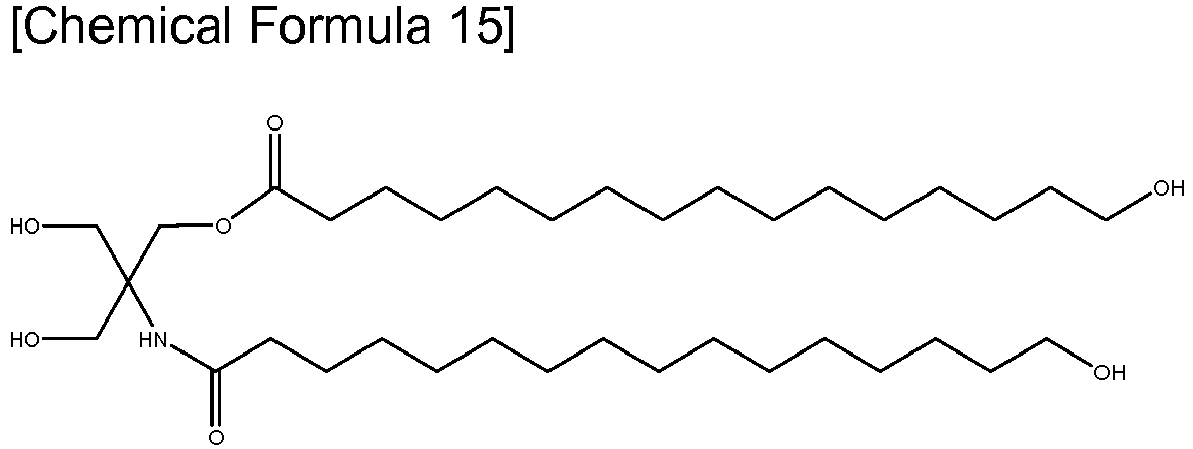
- Tris(hydroxymethyl)aminomethane (10 g, 1 eq) was dissolved in dimethylformaldehyde (100 mL). After adding dicyclohexylcarbodiimide (34 g, 2 eq) and 4-dimethylaminopyridine (4.03 g, 0.2 eq), 16-hydroxydodecanoic acid (44.9 g, 2 eq) was slowly added dropwise for 30 minutes while stirring at room temperature. After stirring for 6 hours, upon completion of reaction, the mixture was diluted with ethyl acetate (200 mL) and washed with 1 N HCl solution (200 mL) and distilled water (200 mL). The organic layer was dried with anhydrous magnesium sulfate, filtered and concentrated under reduced pressure. Then, 17 g of white solid (45%) was obtained using a silica column. The obtained white solid was 16-hydroxy-hexadecanoic acid 3-hydroxy-2-(16-hydroxy-hexadecanoylamino)-2-hydroxymethyl-propyl ester represented by Chemical Formula 15. 1H NMR analysis result of the white solid is as follows.
- 1H NMR (300 MHz, CDCl3) 6.21 (s, 1H), 4.29 (s, 2H), 4.18-4.14 (m, 2H), 3.69-3.64 (m, 6H), 3.60-3.52 (m, 2H), 3.53-3.48 (m, 2H), 2.37 (t, J = 7.5 Hz, 2H), 2.22 (t, J = 7.5 Hz, 2H), 1.60-1.54 (m, 12H), 1.30-1.20 (m, 40H).
- Transepithelial electrical resistance was measured in order to test recovery of damaged artificial skin by the compound of Example 1. Dodecanoic acid 2-dodecanoylamino-3-hydroxy-2-hydroxymethyl-propyl ester obtained from the Example 1 and phosphate buffered saline (PBS), octyl methoxycinnamate (OMC) and PC-104 were tested for comparison.
- Transepithelial electrical resistance (TEER) of Keraskin™ purchased from MCTT was measured after 22 hours of pre-incubation. After placing the Keraskin™ on a 6-well plate, 400 µL of a medium was added in an insert and 5 mL of the medium was added outside the insert such that an even level was achieved inside and outside the insert. Then, measurement was made with the electrode tips of a resistance meter inside and outside the insert. TEER was measured for all the inserts, prior to the test, after treatment with the substances of Example 1 and Comparative Examples 1-3 and 24 hours after post-incubation. The TEER after the post-incubation was divided by the initial value to calculate the change in %. The result is shown in Table 1 and
Fig. 1 .[Table 1] Test groups Change of TEER (%) Comparative Example 1 [phosphate buffered saline (PBS)] 125.4 Comparative Example 2 [octyl methoxycinnamate (OMC)] 30.9 Comparative Example 3 (PC-104) 35.7 Example 1 70.8 - As can be seen from Table 1, when transepithelial electrical resistance was measured after treatment with the compound of Example 1, the effect of recovering damaged artificial skin was higher than the conventionally used PC-104.
- Artificial skin was weighed and put in a 4-mL glass vial. After adding 2400 µL of CHCl3/MeOH (= 1/2) and 100 µL of IS STD, the artificial skin was cut into small pieces with scissors. After sonication for 30 minutes, solutions mixing sodium lauryl sulfate (SLS) to each of dodecanoic acid 2-dodecanoylamino-3-hydroxy-2-hydroxymethyl-propyl ester obtained from the Example 1, phosphate buffered saline (PBS), octyl methoxycinnamate (OMC) and PC-104, as described in Table 2, were filtered through a PTFE syringe filter, and 1250 µL of each filtrate was transferred to an EP tube.
- After completely removing the solvent using a speed vacuum dryer, the residue was redissolved by adding 100 µL of an analytical mobile phase. After centrifugation, only the supernatant was taken and analyzed after transferring to an LC vial. The concentration of ceramide was corrected for the weight of the artificial skin. The result is shown in Table 2 and
Fig. 2 .[Table 2] Test groups C18SM ng/mg skin PBS + OMC 1747.3 990.8 SLS + OMC 843.6 758.3 SLS + PC-104 1141.1 995.5 SLS + Example 1 1811.5 1152.4 - As can be seen from Table 2, when the artificial skin was treated with the compound of Example 1, the ceramide content in the artificial skin was higher than that for PC-104. Accordingly, it can be concluded that the compound of Example 1 exhibits better moisturizing effect than PC-104 by increasing ceramides.
- Hereinafter, formulation examples including the pseudo-ceramide compound according to the present disclosure, an isomer thereof, a pharmaceutically acceptable salt thereof, a prodrug thereof, a hydrate thereof or a solvate thereof will be described in detail. However, the following formulation examples are for illustrative purposes only and it will be apparent to those of ordinary skill in the art that the scope of the present disclosure is not limited by the examples.
- Lotion was prepared according to a commonly employed method with the composition described in Table 3.
[Table 3] Ingredients Contents (wt%) Example 1 0.1 Glycerin 3.0 Butylene glycol 2.0 Propylene glycol 2.0 Carboxyvinyl polymer 0.1 PEG 12 nonyl phenyl ether 0.2 Polysorbate 80 0.4 Ethanol 10.0 Triethanolamine 0.1 Antiseptic, pigment and flavor adequate Purified water balance - Nourishing cream was prepared according to a commonly employed method with the composition described in Table 4.
[Table 4] Ingredients Contents (wt%) Example 2 2.0 Polysorbate 60 1.5 Sorbitan sesquioleate 0.5 PEG 60 hydrogenated castor oil 2.0 Liquid paraffin 10.0 Squalane 5.0 Caprylic/capric triglyceride 5.0 Glycerin 5.0 Butylene glycol 3.0 Propylene glycol 3.0 Triethanolamine 0.2 Antiseptic, pigment and flavor adequate Purified water balance - Massage cream was prepared according to a commonly employed method with the composition described in Table 5.
[Table 5] Ingredients Contents (wt%) Example 3 1.0 Beeswax 10.0 Polysorbate 60 1.5 PEG 60 hydrogenated castor oil 2.0 Sorbitan sesquioleate 0.8 Liquid paraffin 40.0 Squalane 5.0 Caprylic/capric triglyceride 4.0 Glycerin 5.0 Butylene glycol 3.0 Propylene glycol 3.0 Triethanolamine 0.2 Antiseptic, pigment and flavor adequate Purified water balance - Pack was prepared according to a commonly employed method with the composition described in Table 6.
[Table 6] Ingredients Contents (wt%) Example 4 0.2 Polyvinyl alcohol 13.0 Sodium carboxymethylcellulose 0.2 Glycerin 5.0 Allantoin 0.1 Ethanol 6.0 PEG 12 nonyl phenyl ether 0.3 Polysorbate 60 0.3 Antiseptic, pigment and flavor adequate Purified water balance - Gel was prepared according to a commonly employed method with the composition described in Table 7.
[Table 7] Ingredients Contents (wt%) Example 5 0.5 Sodium ethylenediamineacetate 0.05 Glycerin 5.0 Carboxyvinyl polymer 0.3 Ethanol 5.0 PEG 60 hydrogenated castor oil 0.5 Triethanolamine 0.3 Antiseptic, pigment and flavor adequate Purified water balance - Ointment was prepared according to a commonly employed method with the composition described in Table 8.
[Table 8] Ingredients Contents (wt%) Example 6 1.5 Glycerin 8.0 Butylene glycol 4.0 Liquid paraffin 15.0 β-Glucan 7.0 Carbomer 0.1 Caprylic/capric triglyceride 3.0 Squalane 1.0 Cetearyl glucoside 1.5 Sorbitan stearate 0.4 Cetearyl alcohol 1.0 Beeswax 4.0 Antiseptic, pigment and flavor adequate Purified water balance
Claims (13)
- A novel pseudo-ceramide compound represented by Chemical Formula 1, an isomer thereof, a pharmaceutically acceptable salt thereof, a prodrug thereof, a hydrate thereof or a solvate thereof:

- The novel pseudo-ceramide compound, isomer thereof, pharmaceutically acceptable salt thereof, prodrug thereof, hydrate thereof or solvate thereof according to claim 1, wherein each of R1 and R2 is independently a C11-C17 saturated or unsaturated aliphatic chain unsubstituted or substituted with a hydroxyl group.
- The novel pseudo-ceramide compound, isomer thereof, pharmaceutically acceptable salt thereof, prodrug thereof, hydrate thereof or solvate thereof according to claim 1, wherein each of R1 and R2 is independently selected from a group consisting of C11H23, C13H27, C15H31, C17H35, C17H31 and C17H33.
- The novel pseudo-ceramide compound, isomer thereof, pharmaceutically acceptable salt thereof, prodrug thereof, hydrate thereof or solvate thereof according to claim 1, which is tris(hydroxymethyl)aminomethane substituted with a fatty acid.
- The novel pseudo-ceramide compound, isomer thereof, pharmaceutically acceptable salt thereof, prodrug thereof, hydrate thereof or solvate thereof according to claim 1, which is selected from a group consisting of hexadecanoic acid 2-hexadecanoylamino-3-hydroxy-hydroxymethyl-propyl ester, dodecanoic acid 2-dodecanoylamino-3-hydroxy-2-hydroxymethyl-propyl ester, tetradecanoic acid 3-hydroxy-2-hydroxymethyl-2-tetradecanoylamino-propyl ester, octadecanoic acid 3-hydroxy-2-hydroxymethyl-2-octadecanoylamino-propyl ester, octadecanoic acid 2-dodecanoylamino-3-hydroxy-2-hydroxymethyl-propyl ester, octadecanoic acid 3-hydroxy-2-hydroxymethyl-2-tetradecanoylamino-propyl ester, tetradecanoic acid 3-hydroxy-2-hydroxymethyl-2-octadecanoylamino-propyl ester, dodecanoic acid 3-hydroxy-2-hydroxymethyl-2-octadecanoylamino-propyl ester, octadec-9-enoic acid 3-hydroxy-2-hydroxymethyl-2-octadec-9-enoylamino-propyl ester, octadeca-9,12-dienoic acid 3-hydroxy-2-hydroxymethyl-2-octadeca-9,12-dienoylamino-propyl ester, 10-hydroxy-dec-2-enoic acid 3-hydroxy-2-(10-hydroxy-dec-2-enoylamino)-2-hydroxymethyl-propyl ester, 10-hydroxy-octadecanoic acid 3-hydroxy-2-hydroxymethyl-2-(10-hydroxy-octadecanoylamino)-propyl ester, 12-hydroxy-octadecanoic acid 3-hydroxy-2-hydroxymethyl-2-(12-hydroxy-octadecanoylamino)-propyl ester and 16-hydroxy-hexadecanoic acid 3-hydroxy-2-(16-hydroxy-hexadecanoylamino)-2-hydroxymethyl-propyl ester.
- A method for preparing the novel pseudo-ceramide compound, isomer thereof, pharmaceutically acceptable salt thereof, prodrug thereof, hydrate thereof or solvate thereof according to any one of claims 1 to 5, comprising reacting tris(hydroxymethyl)aminomethane and a fatty acid compound under a basic condition to synthesize a pseudo-ceramide compound.
- The method for preparing the novel pseudo-ceramide compound, isomer thereof, pharmaceutically acceptable salt thereof, prodrug thereof, hydrate thereof or solvate thereof according to claim 6, wherein the method is represented by Scheme 1:

- The method for preparing the novel pseudo-ceramide compound, isomer thereof, pharmaceutically acceptable salt thereof, prodrug thereof, hydrate thereof or solvate thereof according to claim 7, wherein each of R1 and R2 is independently a C11-C17 saturated or unsaturated aliphatic chain unsubstituted or substituted with a hydroxyl group.
- The method for preparing the novel pseudo-ceramide compound, isomer thereof, pharmaceutically acceptable salt thereof, prodrug thereof, hydrate thereof or solvate thereof according to claim 7, wherein each of R1 and R2 is independently selected from a group consisting of C11H23, C13H27, C15H31, C17H35, C17H31 and C17H33.
- A composition for moisturizing skin, comprising the novel pseudo-ceramide compound, isomer thereof, pharmaceutically acceptable salt thereof, prodrug thereof, hydrate thereof or solvate thereof according to any one of claims 1 to 5 as an active ingredient.
- The composition for moisturizing skin according to claim 10, wherein the active ingredient is included in an amount of 0.01-20 wt% based on the total weight of the composition.
- The composition for moisturizing skin according to claim 10, wherein the composition is a composition for external application to skin.
- The composition for moisturizing skin according to claim 10, wherein the composition is a cosmetic composition or a pharmaceutical composition.
Applications Claiming Priority (2)
| Application Number | Priority Date | Filing Date | Title |
|---|---|---|---|
| KR20120137853 | 2012-11-30 | ||
| PCT/KR2013/011026 WO2014084676A1 (en) | 2012-11-30 | 2013-11-29 | Novel pseudoceramide compound and production method for same |
Publications (2)
| Publication Number | Publication Date |
|---|---|
| EP2927211A1 true EP2927211A1 (en) | 2015-10-07 |
| EP2927211A4 EP2927211A4 (en) | 2016-07-20 |
Family
ID=51125293
Family Applications (1)
| Application Number | Title | Priority Date | Filing Date |
|---|---|---|---|
| EP13858294.5A Withdrawn EP2927211A4 (en) | 2012-11-30 | 2013-11-29 | PESUDOCERAMIDE TYPE UNDEED COMPOUND AND PROCESS FOR PRODUCING THE SAME |
Country Status (8)
| Country | Link |
|---|---|
| US (1) | US20150290099A1 (en) |
| EP (1) | EP2927211A4 (en) |
| JP (1) | JP2016504297A (en) |
| KR (1) | KR102088802B1 (en) |
| CN (1) | CN104854081A (en) |
| HK (1) | HK1212324A1 (en) |
| TW (1) | TW201431831A (en) |
| WO (1) | WO2014084676A1 (en) |
Cited By (1)
| Publication number | Priority date | Publication date | Assignee | Title |
|---|---|---|---|---|
| EP3395808A4 (en) * | 2015-12-24 | 2018-10-31 | Amorepacific Corporation | Pseudo-ceramide compound and preparation method therefor |
Families Citing this family (7)
| Publication number | Priority date | Publication date | Assignee | Title |
|---|---|---|---|---|
| EP3206659B1 (en) * | 2014-10-17 | 2019-12-25 | DSM IP Assets B.V. | Use of a cosmetic composition comprising 10-hydroxystearic acid |
| WO2017111387A1 (en) | 2015-12-24 | 2017-06-29 | (주)아모레퍼시픽 | Pseudo-ceramide compound and preparation method therefor |
| KR102703167B1 (en) * | 2016-09-27 | 2024-09-06 | (주)아모레퍼시픽 | Pseudoceramide compounds and preparation method thereof |
| KR101878491B1 (en) | 2017-11-27 | 2018-07-13 | 애경산업(주) | Novel Pseudoceramide Compound with improved stability and composition comprising it |
| KR20210026336A (en) | 2019-08-30 | 2021-03-10 | (주)아모레퍼시픽 | Method for preparing pseudoceramide compound |
| KR102502487B1 (en) * | 2020-07-14 | 2023-02-23 | 솔루스바이오텍 주식회사 | Novel sphingolipid and composition of skin external application comprising the same |
| KR20250134470A (en) * | 2024-03-04 | 2025-09-11 | 대봉엘에스 주식회사 | Phytosphingosine-analogous ceramide |
Family Cites Families (12)
| Publication number | Priority date | Publication date | Assignee | Title |
|---|---|---|---|---|
| FR2732680B1 (en) * | 1995-04-05 | 1997-05-09 | Oreal | CERAMID-LIKE COMPOUNDS, PROCESS FOR THEIR PREPARATION AND THEIR USE |
| FR2780727B1 (en) * | 1998-07-03 | 2000-09-08 | Atochem Elf Sa | COSMETIC COMPOSITIONS, NOVEL CERAMIDES ANALOGS WITH ANTI-ELASTASE ACTIVITY, PREPARATION METHOD AND USES |
| KR100457113B1 (en) * | 2001-12-27 | 2004-11-16 | 한국원자력연구소 | Radiosensitizer containing ceramides or derivatives thereof and dimethylsphingosine as the active ingredient |
| FR2855823B1 (en) * | 2003-06-03 | 2007-09-21 | Biochimie Appliquee Soc | NOVEL CERAMIDE COMPOUNDS, PROCESS FOR THEIR SYNTHESIS, AND COSMETIC AND / OR PHARMACEUTICAL COMPOSITIONS CONTAINING SAME |
| KR100570810B1 (en) * | 2003-09-23 | 2006-04-28 | 주식회사 바이오씨에스 | Novel ceramide derivatives, preparation method thereof and use thereof |
| CN1616424A (en) * | 2004-09-27 | 2005-05-18 | 沈阳药科大学 | Novel ceramide compound with apoptosis-inducing activity and preparation method thereof |
| JP2008520630A (en) * | 2004-11-22 | 2008-06-19 | シムライズ・ゲゼルシヤフト・ミツト・ベシユレンクテル・ハフツング・ウント・コンパニー・コマンジツト・ゲゼルシヤフト | Formulation containing ceramide and / or pseudo-ceramide effective for skin damage and (α-) bisabolol |
| KR100693292B1 (en) * | 2005-10-06 | 2007-03-13 | 주식회사 바이오랜드 | New pseudoceramides and compositions containing them |
| KR20100001374A (en) | 2008-06-27 | 2010-01-06 | (주)이미인 | Pseudo-ceramide compound having the characteristic property of natural ceramide |
| WO2010097371A1 (en) * | 2009-02-24 | 2010-09-02 | Novartis Ag | Ceramide-analogous metabolites |
| US10138276B2 (en) * | 2009-09-30 | 2018-11-27 | Signablok, Inc. | Inhibition of TCR signaling with peptide variants |
| CN103435510B (en) * | 2013-09-11 | 2015-04-01 | 苏州元素集化学工业有限公司 | Compound having ceramide-similar effect |
-
2013
- 2013-11-29 KR KR1020130147705A patent/KR102088802B1/en active Active
- 2013-11-29 EP EP13858294.5A patent/EP2927211A4/en not_active Withdrawn
- 2013-11-29 JP JP2015545370A patent/JP2016504297A/en active Pending
- 2013-11-29 US US14/648,687 patent/US20150290099A1/en not_active Abandoned
- 2013-11-29 WO PCT/KR2013/011026 patent/WO2014084676A1/en not_active Ceased
- 2013-11-29 HK HK16100356.0A patent/HK1212324A1/en unknown
- 2013-11-29 CN CN201380062898.9A patent/CN104854081A/en active Pending
- 2013-12-02 TW TW102144092A patent/TW201431831A/en unknown
Cited By (1)
| Publication number | Priority date | Publication date | Assignee | Title |
|---|---|---|---|---|
| EP3395808A4 (en) * | 2015-12-24 | 2018-10-31 | Amorepacific Corporation | Pseudo-ceramide compound and preparation method therefor |
Also Published As
| Publication number | Publication date |
|---|---|
| WO2014084676A1 (en) | 2014-06-05 |
| US20150290099A1 (en) | 2015-10-15 |
| KR102088802B1 (en) | 2020-03-16 |
| TW201431831A (en) | 2014-08-16 |
| EP2927211A4 (en) | 2016-07-20 |
| HK1212324A1 (en) | 2016-06-10 |
| CN104854081A (en) | 2015-08-19 |
| KR20140070474A (en) | 2014-06-10 |
| JP2016504297A (en) | 2016-02-12 |
Similar Documents
| Publication | Publication Date | Title |
|---|---|---|
| US20150290099A1 (en) | Novel pseudoceramide compound and production method for same | |
| EP3187485A1 (en) | Dimethylphenylammonium long-chain compound, preparation, self-assembled structure and use thereof | |
| KR101827469B1 (en) | Novel Pseudoceramides, cosmetic composition and pharmaceutical composition comprising same | |
| KR102014964B1 (en) | Novel pseudo-ceramide compound and method for preparing the same | |
| KR100539965B1 (en) | Cosmetic composition for the prevention and alleviation of atopic dermatitis comprising a novel pseudo ceramide | |
| KR101969814B1 (en) | Glycosyl ceramide compounds and preparation method thereof | |
| KR101433913B1 (en) | Glycosyl ceramide compound, and composition comprising the compound | |
| KR20140016556A (en) | Composition for ameliorating or treating skin barrier damage, or for improving or reinforcing skin barrier function comprising 16-hydroxyhexadecanoic phytosphingosine | |
| KR101061911B1 (en) | PEGylated betulin derivatives and cosmetic compositions comprising the same | |
| KR101451401B1 (en) | Conjugate of vitamin C with vitamin E and antioxidant comprising the same | |
| KR20100001374A (en) | Pseudo-ceramide compound having the characteristic property of natural ceramide | |
| US20200115323A1 (en) | Novel pseudoceramide compound and skin external composition comprising the same | |
| US9783489B2 (en) | Pseudo ceramide compound, and pharmaceutical composition and cosmetic composition comprising same | |
| KR101491728B1 (en) | Conjugate of vitamin C with vitamin B3 and antioxidant comprising the same | |
| KR101888999B1 (en) | Cosmetic composition containing ultrasonicating extract of mahkota dewa | |
| KR101936685B1 (en) | Pseudo glycosyl ceramide compounds, preparation method thereof, and cosmetic composition containing the same | |
| US12017974B2 (en) | Adamantanecarboxylic acid benzyl amide derivative compound and skin whitening composition comprising same | |
| JP4504656B2 (en) | Novel 1,4-benzenediol carboxylic acid ester derivative or salt thereof, method for producing the same, and skin external preparation containing the same | |
| WO2013176434A1 (en) | Anti-ageing composition containing trans-cuminic acid as active ingredient | |
| KR20140050872A (en) | Composition for wound healing comprising retinoids derivative as active ingredient | |
| KR102400114B1 (en) | Composition for enhancing skin elasticity comprising retinoids derivative as active ingredient | |
| KR100678862B1 (en) | Novel ceramides and cosmetic compositions comprising the same | |
| JP4456944B2 (en) | Topical skin preparation | |
| JP2026515866A (en) | Antioxidant cosmetic composition | |
| KR20250134470A (en) | Phytosphingosine-analogous ceramide |
Legal Events
| Date | Code | Title | Description |
|---|---|---|---|
| PUAI | Public reference made under article 153(3) epc to a published international application that has entered the european phase |
Free format text: ORIGINAL CODE: 0009012 |
|
| 17P | Request for examination filed |
Effective date: 20150529 |
|
| AK | Designated contracting states |
Kind code of ref document: A1 Designated state(s): AL AT BE BG CH CY CZ DE DK EE ES FI FR GB GR HR HU IE IS IT LI LT LU LV MC MK MT NL NO PL PT RO RS SE SI SK SM TR |
|
| AX | Request for extension of the european patent |
Extension state: BA ME |
|
| DAX | Request for extension of the european patent (deleted) | ||
| RA4 | Supplementary search report drawn up and despatched (corrected) |
Effective date: 20160617 |
|
| RIC1 | Information provided on ipc code assigned before grant |
Ipc: A61K 8/42 20060101ALI20160613BHEP Ipc: C07C 235/28 20060101ALI20160613BHEP Ipc: C07C 235/08 20060101ALI20160613BHEP Ipc: A61Q 19/00 20060101ALI20160613BHEP Ipc: C07C 233/18 20060101AFI20160613BHEP |
|
| STAA | Information on the status of an ep patent application or granted ep patent |
Free format text: STATUS: REQUEST FOR EXAMINATION WAS MADE |
|
| STAA | Information on the status of an ep patent application or granted ep patent |
Free format text: STATUS: THE APPLICATION IS DEEMED TO BE WITHDRAWN |
|
| 18D | Application deemed to be withdrawn |
Effective date: 20170117 |