EP2926537B1 - Umschaltung einer vorrichtung zwischen einem verriegelten zustand und einem unverriegelten zustand - Google Patents
Umschaltung einer vorrichtung zwischen einem verriegelten zustand und einem unverriegelten zustand Download PDFInfo
- Publication number
- EP2926537B1 EP2926537B1 EP12889211.4A EP12889211A EP2926537B1 EP 2926537 B1 EP2926537 B1 EP 2926537B1 EP 12889211 A EP12889211 A EP 12889211A EP 2926537 B1 EP2926537 B1 EP 2926537B1
- Authority
- EP
- European Patent Office
- Prior art keywords
- user input
- input process
- user
- unlocked state
- locked state
- Prior art date
- Legal status (The legal status is an assumption and is not a legal conclusion. Google has not performed a legal analysis and makes no representation as to the accuracy of the status listed.)
- Active
Links
Images



Classifications
-
- H—ELECTRICITY
- H04—ELECTRIC COMMUNICATION TECHNIQUE
- H04M—TELEPHONIC COMMUNICATION
- H04M1/00—Substation equipment, e.g. for use by subscribers
- H04M1/66—Substation equipment, e.g. for use by subscribers with means for preventing unauthorised or fraudulent calling
-
- H—ELECTRICITY
- H04—ELECTRIC COMMUNICATION TECHNIQUE
- H04M—TELEPHONIC COMMUNICATION
- H04M1/00—Substation equipment, e.g. for use by subscribers
- H04M1/66—Substation equipment, e.g. for use by subscribers with means for preventing unauthorised or fraudulent calling
- H04M1/667—Preventing unauthorised calls from a telephone set
- H04M1/67—Preventing unauthorised calls from a telephone set by electronic means
- H04M1/673—Preventing unauthorised calls from a telephone set by electronic means the user being required to key in a code
-
- H—ELECTRICITY
- H04—ELECTRIC COMMUNICATION TECHNIQUE
- H04W—WIRELESS COMMUNICATION NETWORKS
- H04W12/00—Security arrangements; Authentication; Protecting privacy or anonymity
- H04W12/08—Access security
Definitions
- Embodiments of the present invention relate to switching a device between a locked state and an unlocked state.
- they relate to switching a portable electronic device, such as a mobile telephone, between a locked state and an unlocked state.
- a portable electronic device may have a locked state and an unlocked state.
- the functionality of the device may be restricted.
- KR 2010-0098804 discloses a lockable mobile terminal. When a user touches a display of a locked mobile terminal, an icon is generated near the touched position. If a user then performs a dragging operation, the mobile terminal is unlocked.
- US 2012/0133484 discloses a device that is configured to transition from a locked state to an unlocked state if first and second inputs are provided in a manner in which they are considered by the device to be continuous.
- US 2009/0187676 discloses a portable electronic device that has a normal operating mode and a device lock mode. If a first device of the portable electronic device is actuated within a maximum delay of actuation of the second input device, the device enables the device lock mode.
- Embodiments of the invention relates to switching a device between a locked state and an unlocked state.
- the Figures illustrate an apparatus 10/20, comprising: at least one processor 12; and at least one memory 14 storing computer program code 18 configured, working with the at least one processor 12, to cause at least the following to be performed: responding to user input by switching a device 20 from an unlocked state to a locked state; and setting a user input process for switching the device 20 from the locked state to the unlocked state, in dependence upon the user input provided to switch the device 20 from the unlocked state to the locked state.
- Fig. 1 illustrates a first apparatus 10 comprising a processor 12 and a memory 14.
- the apparatus 10 may, for example, be a chip or a chipset.
- the processor 12 is configured to read from and write to the memory 14.
- the processor 12 may comprise an output interface via which data and/or commands are output by the processor 12 and an input interface via which data and/or commands are input to the processor 12.
- the processor 12 is illustrated as a single component in Fig. 1 , it may be implemented as one or more separate components.
- the memory 14 stores a computer program 17 comprising computer program instructions/code 18 that control the operation of the apparatus 10 when loaded into the processor 12.
- the computer program code 18 provides the logic and routines that enables the apparatus 10 to perform the methods illustrated in Fig. 5 .
- the processor 12, by reading the memory 14, is able to load and execute the computer program 17.
- memory 14 is illustrated as a single component it may be implemented as one or more separate components some or all of which may be integrated/removable and/or may provide permanent/semi-permanent/ dynamic/cached storage.
- the computer program 17 may arrive at the apparatus 10 via any suitable delivery mechanism 30.
- the delivery mechanism 30 may be, for example, a non-transitory computer-readable storage medium such as a compact disc read-only memory (CD-ROM) or digital versatile disc (DVD).
- the delivery mechanism 30 may be a signal configured to reliably transfer the computer program 17.
- the apparatus 10 may cause the propagation or transmission of the computer program 17 as a computer data signal.
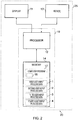
- Fig. 2 illustrates a second apparatus 20.
- the second apparatus 20 is an electronic device. It may, for example, be a hand portable electronic device such as a mobile telephone, a hand portable music player, a tablet computer or a dedicated hand held games console.
- the device 20 includes a display 11, at least one key 13, an external housing 25 and the apparatus 10 illustrated in Fig. 1 .
- the external housing 25 houses the display 11, the at least one key 13, the processor 12 and the memory 14.
- the display 11 may, for example, be a touch sensitive display.
- the touch sensitive display may be any type of touch sensitive display. It might function, for example, using capacitive, resistive, infrared, dispersive signal and/or acoustic pulse technology.
- the one or more keys 13 are separate from (and may be spaced from) the display 11.
- the one or more keys 13 might be any type of keys such as, for example, mechanical keys that displace when actuated or capacitive keys that do not displace when actuated.
- the memory 14 is illustrated in Fig. 2 as storing first user input process data 1, second user input process data 2, third user input process data 3 and fourth user input process data 4.
- the first, second, third and fourth user input process data 1-4 will be described in further detail later.
- the elements 11, 12, 13 and 14 are operationally coupled and any number or combination of intervening elements can exist between them (including no intervening elements).
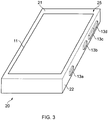
- Fig. 3 illustrates a perspective view of one example of the device 20 illustrated in Fig. 2 .
- the device comprises four keys 13a, 13b, 13c, 13d although it may comprise greater or fewer keys in other examples.
- Fig. 3 illustrates the display 11 on a front face 21 of the external housing 25 and the keys 13a-13d on a side face 22 of the external housing 25. While the display 11 and the keys 13a-13d are located on different faces 21, 22 of the device 20 in this example, in other examples they may be located on the same face.
- the device 20 has a locked state and an unlocked state. In the examples described below, these states are mutually exclusive: the device 20 cannot be in the locked state and the unlocked state at the same time.
- the processor 12 responds to user inputs received by the device 20 (at, for example, the touch sensitive display 11 and/or one or more of the keys 13a-13d) by causing functions to be performed associated with those inputs. This might, for example, involve launching a particular application or displaying a particular menu.
- the functionality of the device 20 is restricted. For example, when the device 20 is in the locked state, it does not perform at least some functions in response to user inputs that would otherwise cause those functions to be performed by the device 20.
- the device 20 is a telephone
- the calling functionality of the telephone might be restricted.
- the telephone may only be able to make calls to one or more emergency numbers, but not other numbers.
- the processor 12 may be configured to disable (or partially disable) the display 11 when the device 20 enters the locked state.
- the processor 12 might, for example, disable the display 11 by it switching off. If the display 11 is a touch sensitive display, when it is disabled (or partially disabled) it might become non-responsive to touch. For instance, in this regard, the touch functionality of the display 11 might be switched off or, alternatively, the processor 12 might be configured not to respond to signals provided to it by the display 11.
- Both the unlocked state and the locked state are powered states of the device 20. That is, the device 20 consumes power (for instance, from a battery) when it is in the unlocked state and when it is in the locked state. However, the power consumption of the device 20 when it is in the unlocked state may be greater than when it is in the locked state. When the device 20 is switched off, it is not in the unlocked state or the locked state, and it consumes no power.
- the device 20 may comprise one or more radio transceivers that are configured to connect the device 20 to one or more networks.
- the networks may, for example, include one or more cellular telephone networks and one or more networks that operate in accordance with one or more IEEE (Institute of Electrical and Electronic Engineers) 802.11 standards.
- the device 20 may be connected to the network(s) when it is in the unlocked and state and when it is in the locked state. For example, the device 20 may receive incoming calls and messages when it is connected to the network(s). When the device 20 is switched off, it is not connected to any networks.
- Fig. 4A illustrates the device 20 in an unlocked state.
- the display 11 is a touch sensitive display displaying a "home screen" 40 comprising a plurality of graphical items 41-46.
- each of the graphical items 41-46 relates to a different application stored in the memory 14 of the device 20.
- the processor 12 is configured to recognize a touch input at a graphical item 41-46 as a user selection of that item 41-46, and responds by launching an application associated with the selected graphical item 41-46.
- the touch input may, for example, be a static touch input in which an object (such as a digit or a stylus) is placed in contact with the touch sensitive display 11 at a graphical item 41-46, and the object is not moved across the display 11 while it is in contact with the display 11.
- the processor 12 is also configured to respond to a translation input made by a user.
- a translation input may, for example, be made by displacing an object (such as a digit or a stylus) from a start point to an end point.
- Fig. 4A illustrates an example as to how a translation input may be made from a start point 50 to an end point 52.
- an object such as a digit or a stylus
- the processor 12 may respond to the translation input by causing the home screen 40 to scroll downwards.
- the user provides user input, while the device 20 is in the unlocked state, which the processor 12 responds to by switching the device 20 from the unlocked state to the locked state.
- the user input that is provided to switch the device 20 from the unlocked state to a locked state may be one of plurality of user input processes.
- the user input process that is used to switch the device 20 from the unlocked state to the locked state determines the user input process that is later required to switch the device 20 back to the unlocked state.
- the user may actuate a lock key 13b on a single occasion, causing the processor 12 to switch the device 20 from the unlocked state to the locked state.
- the user may actuate the lock key 13b twice within a threshold period of time, causing the processor 12 to switch the device 20 from the unlocked state to the locked state.
- Data 1, 2 defining the first and second user input processes is stored in the memory 14.
- the lock key 13b also functions as a power key.
- the first user input process and/or the second user input process may involve the user actuating the lock key 13b for no longer than a set period of time, because the processor 12 responds to actuation of the lock key 13b for longer than that particular threshold period of time by switching the device 20 off rather than into the locked state.
- Fig. 4B illustrates the device 20 when it has been switched into the locked state and the display 11 has been switched off by the processor 12.
- the processor 12 sets a user input process for subsequently switching the device 20 from the locked state to the unlocked state, in dependence upon the user input provided to switch the device 20 from the unlocked state to the locked state.
- the user input process that is set may be selected from a plurality of possible user input processes.
- the processor 12 sets a third user input process as the process for unlocking the device 20.
- the processor 12 sets a fourth user input process as the process for unlocking the device 20.
- Data 3, 4 defining the third and fourth user input processes is stored in the memory 14.
- the third user input process comprises: i) actuating the lock key 13b, ii) providing a translation input, and iii) providing a password.
- the third user input process may be different. For example, it might not include ii) or iii).
- Figs 4C and 4D illustrate the device 20 while the third user input process is being completed by a user. Following the device's entry into the locked state as illustrated in Fig. 4B , when the user actuates the lock key 13b, the processor 12 responds by causing the touch sensitive display 11 to display a lock screen 50. At this point in time, the device 20 remains in the locked state.
- the display of the lock screen 50 is effectively a request for the user to provide a particular translation input in step/part ii) of the third user input process for unlocking the device 20.
- the particular translation input is an upwards translation input, as illustrated by arrow 51 illustrated in Fig. 4C between the start point 50 and the end point 52 of the translation input.
- the lock screen 50 moves (upwardly) with the object.
- the processor 12 responds to input of the requested translation input by requesting a password from the user, as shown in Fig. 4D .
- the device 20 remains in the locked state.
- the lock screen 50 remains partially visible when the request 52 for a password is made.
- the password may, for instance, include letters and numbers, solely letters or solely numbers.
- the processor 12 responds by switching the device 20 from the locked state to the unlocked state, because the third user input process is complete.
- the processor 12 when the device 20 enters the unlocked state the processor 12 causes the display 11 to display the same screen that was being displayed when the device 20 was locked. Therefore, if the home screen 40 was being displayed by the device 20 when it was switched from the unlocked state to the locked state, the processor 12 causes the display 11 to display the home screen 40.
- the processor 12 sets the fourth user input process (rather than the third user input process) as the process for switching the device 20 from the locked state to the unlocked state.
- the fourth user input process might comprise some but not all of the parts/steps of the third user input process.
- the fourth user input process may be the same as the third user input process but without one or more of the steps/parts.
- the fourth user input process comprises merely: i) actuating the lock key 13b.
- the processor 12 responds by switching the device 20 from the locked state to the unlocked state.
- the processor 12 causes the display 11 to display the same screen that was being displayed when the device 20 was locked.
- the process for unlocking the device comprises: i) actuating the lock key 13b, ii) providing a translation input, and iii) providing a password.
- the process for unlocking the device merely comprises: i) actuating the lock key 13b.
- Embodiments of the invention enable a user to select a process for unlocking a device 20 when the device 20 is locked. If the user is aware when he locks the device 20 that he is going to unlock the device 20 soon, he can advantageously select an unlocking process that is simple and quick and easy to execute. Locking the device 20 in the short term (rather than merely leaving the device 20 unlocked) may be beneficial because it converses battery power, for instance, if the display 11 is at least partially disabled.
- references to 'computer-readable storage medium', 'computer program product', 'tangibly embodied computer program' etc. or a 'controller', 'computer', 'processor' etc. should be understood to encompass not only computers having different architectures such as single /multi-processor architectures and sequential (Von Neumann)/parallel architectures but also specialized circuits such as field-programmable gate arrays (FPGA), application specific circuits (ASIC), signal processing devices and other processing circuitry.
- References to computer program, instructions, code etc. should be understood to encompass software for a programmable processor or firmware such as, for example, the programmable content of a hardware device whether instructions for a processor, or configuration settings for a fixed-function device, gate array or programmable logic device etc.
- circuitry refers to all of the following:
- circuitry would also cover an implementation of merely a processor (or multiple processors) or portion of a processor and its (or their) accompanying software and/or firmware.
- circuitry would also cover, for example and if applicable to the particular claim element, a baseband integrated circuit or applications processor integrated circuit for a mobile phone or a similar integrated circuit in server, a cellular network device, or other network device.
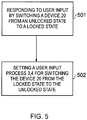
- the blocks illustrated in the Fig. 5 may represent steps in a method and/or sections of code in the computer program 17.
- the illustration of a particular order to the blocks does not necessarily imply that there is a required or preferred order for the blocks and the order and arrangement of the block may be varied. Furthermore, it may be possible for some blocks to be omitted.
- a translation input need not require the use of a touch sensitive display.
- the translation input may be carried out a distance from the display 11 and may be detected by a camera or a proximity sensor.
- first, second, third and fourth user input processes may be different from those described above.
- the third user input process may comprise steps/parts i)-iii) as described above and the fourth user input process may comprise steps i) and ii) rather than merely step i).
- the processor 12 might reset the user input process for switching the device 20 from the locked state to the unlocked state. For example, if the device is locked using the second user input process and is not unlocked using the fourth user input process within a threshold period of time, the processor 12 may reset the user input process for unlocking the device 20 such that the third user input process is required to unlock the device 20.
- a simple unlocking process such unlocking by merely actuating the lock key 13b
- the first, second, third and fourth user input processes for locking and unlocking the device 20 need not be the same as those described above.
- the second user input process could comprise or consist of actuating the lock key 13b followed by another key (such as the key labeled with the reference numeral 13c).
- the second user input process could, for instance, comprise or consist of actuating the lock key 13b three times in succession.
Landscapes
- Engineering & Computer Science (AREA)
- Computer Security & Cryptography (AREA)
- Signal Processing (AREA)
- Computer Networks & Wireless Communication (AREA)
- User Interface Of Digital Computer (AREA)
- Telephone Function (AREA)
Claims (15)
- Einrichtung, (10; 20), Folgendes umfassend:mindestens einen Prozessor (12); undmindestens einen Speicher (14), der gespeicherten Computerprogrammcode (18) aufweist, konfiguriert, wenn von dem mindestens einen Prozessor ausgeführt, das Durchführen von mindestens Folgendem zu veranlassen:Speichern von ersten Benutzereingabeprozessdaten (1), die angepasst sind, einen ersten Benutzereingabeprozess zu definieren, der durch einen Benutzer an einer Vorrichtung (20) durchführbar ist, um die Vorrichtung zu veranlassen, von einem entsperrten Zustand in einen gesperrten Zustand zu wechseln;Speichern von zweiten Benutzereingabeprozessdaten (2), die angepasst sind, einen zweiten Benutzereingabeprozess zu definieren, der durch einen Benutzer an der Vorrichtung durchführbar ist, um die Vorrichtung zu veranlassen, von dem entsperrten Zustand in den gesperrten Zustand zu wechseln, wobei der erste Benutzereingabeprozess von dem zweiten Benutzereingabeprozess verschieden ist;Bestimmen, während sich die Vorrichtung in dem entsperrten Zustand befindet, ob von einem Benutzer an der Vorrichtung eine Benutzereingabe durchgeführt wird, die dem ersten Benutzereingabeprozess oder dem zweiten Benutzereingabeprozess entspricht;wenn eine Benutzereingabe, die dem ersten Benutzereingabeprozess entspricht, von einem Benutzer an der Vorrichtung durchgeführt wird, während sich die Vorrichtung in dem entsperrten Zustand befindet, Reagieren auf die Durchführung des ersten Benutzereingabeprozesses durch Wechseln der Vorrichtung aus dem entsperrten Zustand in den gesperrten Zustand und durch Festlegen eines dritten Benutzereingabeprozesses, der von einem Benutzer an der Vorrichtung durchführbar ist und in dritten Benutzereingabeprozessdaten (3) definiert ist, der mehrere Benutzereingabeschritte beinhaltet, um die Vorrichtung zu veranlassen, von dem gesperrten Zustand in den entsperrten Zustand zu wechseln; undwenn eine Benutzereingabe, die dem zweiten Benutzereingabeprozess entspricht, von einem Benutzer an der Vorrichtung durchgeführt wird, während sich die Vorrichtung in dem entsperrten Zustand befindet, Reagieren auf die Durchführung des zweiten Benutzereingabeprozesses durch Wechseln der Vorrichtung aus dem entsperrten Zustand in den gesperrten Zustand und durch Festlegen eines vierten Benutzereingabeprozesses, der von einem Benutzer an der Vorrichtung durchführbar ist und in vierten Benutzereingabeprozessdaten (4) definiert ist, um die Vorrichtung zu veranlassen, von dem gesperrten Zustand in den entsperrten Zustand zu wechseln, wobei der vierte Benutzereingabeprozess mindestens einen Benutzereingabeschritt, aber nicht alle der Benutzereingabeschritte aus dem dritten Benutzereingabeprozess beinhaltet.
- Einrichtung nach Anspruch 1, wobei die Vorrichtung eine Anzeige (11) und eine von der Anzeige getrennte Taste (13b) umfasst und der dritte Benutzereingabeprozess Betätigen der Taste umfasst und der vierte Benutzereingabeprozess Betätigen der Taste umfasst.
- Einrichtung nach Anspruch 2, wobei der vierte Benutzereingabeprozess aus Betätigen der Taste besteht.
- Einrichtung nach Anspruch 3, wobei der dritte Benutzereingabeprozess ferner mindestens eins aus Folgendem umfasst: Bereitstellen eines Passworts und Bereitstellen einer Verschiebungseingabe durch Verschieben eines Objekts von einem Startpunkt hin zu einem Endpunkt.
- Einrichtung nach einem der vorhergehenden Ansprüche, wobei der vierte Benutzereingabeprozess weniger Benutzereingabeschritte als der dritte Benutzereingabeprozess umfasst.
- Einrichtung nach einem der vorhergehenden Ansprüche, wobei Wechseln der Vorrichtung aus dem entsperrten Zustand in den gesperrten Zustand mindestens teilweises Deaktivieren einer Anzeige (11) der Vorrichtung umfasst.
- Einrichtung nach Anspruch 6, wobei die Anzeige eine berührungsempfindliche Anzeige ist und die Berührungs(Touch)-Funktionalität der berührungsempfindlichen Anzeige deaktiviert wird, wenn die Vorrichtung aus dem entsperrten Zustand in den gesperrten Zustand gewechselt wird.
- Einrichtung nach einem der vorhergehenden Ansprüche, wobei es sich bei der Einrichtung um die Vorrichtung handelt oder die Vorrichtung die Einrichtung umfasst.
- Verfahren, Folgendes umfassend:Speichern von ersten Benutzereingabeprozessdaten (1), die einen ersten Benutzereingabeprozess definieren, der von einem Benutzer an einer Vorrichtung (20) durchführbar ist, um die Vorrichtung zu veranlassen, aus einem entsperrten Zustand in einen gesperrten Zustand zu wechseln;Speichern von zweiten Benutzereingabeprozessdaten (2), die einen zweiten Benutzereingabeprozess definieren, der von einem Benutzer an der Vorrichtung durchführbar ist, um die Vorrichtung zu veranlassen, aus dem entsperrten Zustand in den gesperrten Zustand zu wechseln, wobei der erste Benutzereingabeprozess von dem zweiten Benutzereingabeprozess verschieden ist;Bestimmen, während sich die Vorrichtung in dem entsperrten Zustand befindet, ob von einem Benutzer an der Vorrichtung eine Benutzereingabe durchgeführt wird, die dem ersten Benutzereingabeprozess oder dem zweiten Benutzereingabeprozess entspricht;wenn eine Benutzereingabe, die dem ersten Benutzereingabeprozess entspricht, von einem Benutzer an der Vorrichtung durchgeführt wird, während sich die Vorrichtung in dem entsperrten Zustand befindet, Reagieren auf die Durchführung des ersten Benutzereingabeprozesses durch Wechseln der Vorrichtung aus dem entsperrten Zustand in den gesperrten Zustand und durch Festlegen eines dritten Benutzereingabeprozesses, der von einem Benutzer an der Vorrichtung durchführbar ist und in dritten Benutzereingabeprozessdaten (3) definiert ist, der mehrere Benutzereingabeschritte beinhaltet, um die Vorrichtung zu veranlassen, von dem gesperrten Zustand in den entsperrten Zustand zu wechseln; undwenn eine Benutzereingabe, die dem zweiten Benutzereingabeprozess entspricht, von einem Benutzer an der Vorrichtung durchgeführt wird, während sich die Vorrichtung in dem entsperrten Zustand befindet, Reagieren auf die Durchführung des zweiten Benutzereingabeprozesses durch Wechseln der Vorrichtung aus dem entsperrten Zustand in den gesperrten Zustand und durch Festlegen eines vierten Benutzereingabeprozesses, der von einem Benutzer an der Vorrichtung durchführbar ist und in vierten Benutzereingabeprozessdaten (4) definiert ist, um die Vorrichtung zu veranlassen, von dem gesperrten Zustand in den entsperrten Zustand zu wechseln, wobei der vierte Benutzereingabeprozess mindestens einen Benutzereingabeschritt, aber nicht alle der Benutzereingabeschritte aus dem dritten Benutzereingabeprozess beinhaltet.
- Verfahren nach Anspruch 9, wobei die Vorrichtung eine Anzeige (11) und eine von der Anzeige separate Taste (13b) umfasst und der dritte Benutzereingabeprozess Betätigen der Taste umfasst und der vierte Benutzereingabeprozess Betätigen der Taste umfasst.
- Verfahren nach Anspruch 9 oder 10, wobei der vierte Benutzereingabeprozess aus Betätigen der Taste besteht.
- Verfahren nach Anspruch 9, 10 oder 11, wobei der vierte Benutzereingabeprozess weniger Benutzereingabeschritte als der dritte Benutzereingabeprozess umfasst.
- Verfahren nach einem der Ansprüche 9 bis 12, wobei Wechseln der Vorrichtung aus dem entsperrten Zustand in den gesperrten Zustand mindestens teilweises Deaktivieren einer Anzeige (11) der Vorrichtung umfasst.
- Verfahren nach Anspruch 13, wobei die Anzeige eine berührungsempfindliche Anzeige ist und die Berührungs(Touch)-Funktionalität der berührungsempfindlichen Anzeige deaktiviert wird, wenn die Vorrichtung aus dem entsperrten Zustand in den gesperrten Zustand gewechselt wird.
- Computerprogrammcode (18), der, wenn er von mindestens einem Prozessor (12) ausgeführt wird, veranlasst, dass das Verfahren nach einem der Ansprüche 9 bis 14 durchgeführt wird.
Applications Claiming Priority (1)
| Application Number | Priority Date | Filing Date | Title |
|---|---|---|---|
| PCT/CN2012/085428 WO2014082218A1 (en) | 2012-11-28 | 2012-11-28 | Switching a device between a locked state and an unlocked state |
Publications (3)
| Publication Number | Publication Date |
|---|---|
| EP2926537A1 EP2926537A1 (de) | 2015-10-07 |
| EP2926537A4 EP2926537A4 (de) | 2016-08-10 |
| EP2926537B1 true EP2926537B1 (de) | 2019-06-12 |
Family
ID=50827029
Family Applications (1)
| Application Number | Title | Priority Date | Filing Date |
|---|---|---|---|
| EP12889211.4A Active EP2926537B1 (de) | 2012-11-28 | 2012-11-28 | Umschaltung einer vorrichtung zwischen einem verriegelten zustand und einem unverriegelten zustand |
Country Status (3)
| Country | Link |
|---|---|
| US (1) | US9473612B2 (de) |
| EP (1) | EP2926537B1 (de) |
| WO (1) | WO2014082218A1 (de) |
Family Cites Families (9)
| Publication number | Priority date | Publication date | Assignee | Title |
|---|---|---|---|---|
| US7657849B2 (en) * | 2005-12-23 | 2010-02-02 | Apple Inc. | Unlocking a device by performing gestures on an unlock image |
| US8099526B2 (en) * | 2008-01-22 | 2012-01-17 | Research In Motion Limited | Method and apparatus for enabling and disabling a lock mode by squeezing or pinching the sides of a portable electronic device towards one another |
| CN101360301A (zh) * | 2008-09-19 | 2009-02-04 | 宇龙计算机通信科技(深圳)有限公司 | 一种移动终端及其锁定方法 |
| KR101582687B1 (ko) * | 2009-03-02 | 2016-01-05 | 엘지전자 주식회사 | 이동 통신 단말기에서의 록킹 해제 방법 및 이를 적용한 이동 통신 단말기 |
| KR101564222B1 (ko) * | 2009-05-26 | 2015-11-06 | 삼성전자주식회사 | 휴대단말의 잠금 모드 해제 방법 및 장치 |
| US8854318B2 (en) * | 2010-09-01 | 2014-10-07 | Nokia Corporation | Mode switching |
| US20120133484A1 (en) | 2010-11-29 | 2012-05-31 | Research In Motion Limited | Multiple-input device lock and unlock |
| KR20120084860A (ko) * | 2011-01-21 | 2012-07-31 | 삼성전자주식회사 | 정전식 터치스크린 단말기에서 입력 방법 및 장치 |
| CN102779012A (zh) | 2012-07-11 | 2012-11-14 | 广州市久邦数码科技有限公司 | 一种用于触摸屏设备的锁屏系统及其实现方法 |
-
2012
- 2012-11-28 EP EP12889211.4A patent/EP2926537B1/de active Active
- 2012-11-28 US US14/647,749 patent/US9473612B2/en active Active
- 2012-11-28 WO PCT/CN2012/085428 patent/WO2014082218A1/en not_active Ceased
Non-Patent Citations (1)
| Title |
|---|
| NOKIA: "BEDIENUNGSANLEITUNG FUER NOKIA 6101", INTERNET CITATION, 14 February 2005 (2005-02-14), XP007900821, Retrieved from the Internet <URL:http://nds1.nokia.com/phones/files/guides/Nokia_6101_UG_de.pdf> [retrieved on 20060710] * |
Also Published As
| Publication number | Publication date |
|---|---|
| EP2926537A4 (de) | 2016-08-10 |
| WO2014082218A1 (en) | 2014-06-05 |
| EP2926537A1 (de) | 2015-10-07 |
| US9473612B2 (en) | 2016-10-18 |
| US20150304474A1 (en) | 2015-10-22 |
Similar Documents
| Publication | Publication Date | Title |
|---|---|---|
| TWI573074B (zh) | 用以提供自鎖定螢幕對功能取用的方法與裝置以及相關電腦程式產品 | |
| EP2825944B1 (de) | Verarbeitung der gleiteingabe einer berührungsbildschirmvorrichtung | |
| US20110246951A1 (en) | Portable device and unlocking method thereof | |
| CN107643871A (zh) | 屏幕显示控制方法、装置、存储介质及移动终端 | |
| US9355266B2 (en) | Input by tracking gestures | |
| CN106855784A (zh) | 防止触摸按键误触发的方法、装置及终端 | |
| GB2486707A (en) | A touch screen handset with a combined application launcher and touch screen unlock mechanism. | |
| JP2018148286A (ja) | 電子機器及び制御方法 | |
| CN106648232A (zh) | 防止触摸按键误触发的方法、装置及终端 | |
| WO2016078276A1 (zh) | 一种应用控制方法、装置及终端 | |
| CN107450799A (zh) | 一种消息的显示方法及移动终端 | |
| CN105094679A (zh) | 一种基于锁屏界面的对象浏览方法及终端设备 | |
| KR20150001095A (ko) | 문자 입력 처리 방법 및 상기 방법이 적용되는 장치 | |
| CN104750315A (zh) | 一种触屏设备的控制方法、装置及触屏设备 | |
| CN106940770A (zh) | 一种屏幕锁定方法、装置和终端 | |
| CN106803031A (zh) | 一种信息保护方法和移动终端 | |
| EP3528103B1 (de) | Bildschirmverriegelungsverfahren, endgerät und bildschirmverriegelungsvorrichtung | |
| EP2926537B1 (de) | Umschaltung einer vorrichtung zwischen einem verriegelten zustand und einem unverriegelten zustand | |
| CN109600514B (zh) | 解锁控制方法、装置、移动终端及存储介质 | |
| CN105512525A (zh) | 解锁方法及装置 | |
| CN108021313B (zh) | 一种图片浏览方法及终端 | |
| CN112380520B (zh) | 屏幕解锁方法、装置、存储介质及移动终端 | |
| US12468423B2 (en) | Method for managing anti-accidental touch function and electronic device | |
| CN113835576B (zh) | 图标操作方法、装置 | |
| CN109639882A (zh) | 锁屏控制方法、锁屏控制装置及移动终端 |
Legal Events
| Date | Code | Title | Description |
|---|---|---|---|
| PUAI | Public reference made under article 153(3) epc to a published international application that has entered the european phase |
Free format text: ORIGINAL CODE: 0009012 |
|
| 17P | Request for examination filed |
Effective date: 20150522 |
|
| AK | Designated contracting states |
Kind code of ref document: A1 Designated state(s): AL AT BE BG CH CY CZ DE DK EE ES FI FR GB GR HR HU IE IS IT LI LT LU LV MC MK MT NL NO PL PT RO RS SE SI SK SM TR |
|
| AX | Request for extension of the european patent |
Extension state: BA ME |
|
| DAX | Request for extension of the european patent (deleted) | ||
| RA4 | Supplementary search report drawn up and despatched (corrected) |
Effective date: 20160712 |
|
| RIC1 | Information provided on ipc code assigned before grant |
Ipc: H04M 1/66 20060101ALI20160706BHEP Ipc: H04W 12/08 20090101ALI20160706BHEP Ipc: H04M 1/725 20060101AFI20160706BHEP Ipc: H04M 1/673 20060101ALI20160706BHEP |
|
| STAA | Information on the status of an ep patent application or granted ep patent |
Free format text: STATUS: EXAMINATION IS IN PROGRESS |
|
| 17Q | First examination report despatched |
Effective date: 20170410 |
|
| GRAP | Despatch of communication of intention to grant a patent |
Free format text: ORIGINAL CODE: EPIDOSNIGR1 |
|
| STAA | Information on the status of an ep patent application or granted ep patent |
Free format text: STATUS: GRANT OF PATENT IS INTENDED |
|
| INTG | Intention to grant announced |
Effective date: 20181126 |
|
| GRAJ | Information related to disapproval of communication of intention to grant by the applicant or resumption of examination proceedings by the epo deleted |
Free format text: ORIGINAL CODE: EPIDOSDIGR1 |
|
| STAA | Information on the status of an ep patent application or granted ep patent |
Free format text: STATUS: EXAMINATION IS IN PROGRESS |
|
| INTC | Intention to grant announced (deleted) | ||
| GRAR | Information related to intention to grant a patent recorded |
Free format text: ORIGINAL CODE: EPIDOSNIGR71 |
|
| GRAS | Grant fee paid |
Free format text: ORIGINAL CODE: EPIDOSNIGR3 |
|
| STAA | Information on the status of an ep patent application or granted ep patent |
Free format text: STATUS: GRANT OF PATENT IS INTENDED |
|
| GRAA | (expected) grant |
Free format text: ORIGINAL CODE: 0009210 |
|
| STAA | Information on the status of an ep patent application or granted ep patent |
Free format text: STATUS: THE PATENT HAS BEEN GRANTED |
|
| AK | Designated contracting states |
Kind code of ref document: B1 Designated state(s): AL AT BE BG CH CY CZ DE DK EE ES FI FR GB GR HR HU IE IS IT LI LT LU LV MC MK MT NL NO PL PT RO RS SE SI SK SM TR |
|
| INTG | Intention to grant announced |
Effective date: 20190507 |
|
| REG | Reference to a national code |
Ref country code: GB Ref legal event code: FG4D |
|
| REG | Reference to a national code |
Ref country code: CH Ref legal event code: EP |
|
| REG | Reference to a national code |
Ref country code: AT Ref legal event code: REF Ref document number: 1144081 Country of ref document: AT Kind code of ref document: T Effective date: 20190615 |
|
| REG | Reference to a national code |
Ref country code: DE Ref legal event code: R096 Ref document number: 602012061046 Country of ref document: DE |
|
| REG | Reference to a national code |
Ref country code: IE Ref legal event code: FG4D |
|
| RAP2 | Party data changed (patent owner data changed or rights of a patent transferred) |
Owner name: NOKIA TECHNOLOGIES OY |
|
| REG | Reference to a national code |
Ref country code: NL Ref legal event code: MP Effective date: 20190612 |
|
| REG | Reference to a national code |
Ref country code: LT Ref legal event code: MG4D |
|
| PG25 | Lapsed in a contracting state [announced via postgrant information from national office to epo] |
Ref country code: LT Free format text: LAPSE BECAUSE OF FAILURE TO SUBMIT A TRANSLATION OF THE DESCRIPTION OR TO PAY THE FEE WITHIN THE PRESCRIBED TIME-LIMIT Effective date: 20190612 Ref country code: HR Free format text: LAPSE BECAUSE OF FAILURE TO SUBMIT A TRANSLATION OF THE DESCRIPTION OR TO PAY THE FEE WITHIN THE PRESCRIBED TIME-LIMIT Effective date: 20190612 Ref country code: SE Free format text: LAPSE BECAUSE OF FAILURE TO SUBMIT A TRANSLATION OF THE DESCRIPTION OR TO PAY THE FEE WITHIN THE PRESCRIBED TIME-LIMIT Effective date: 20190612 Ref country code: FI Free format text: LAPSE BECAUSE OF FAILURE TO SUBMIT A TRANSLATION OF THE DESCRIPTION OR TO PAY THE FEE WITHIN THE PRESCRIBED TIME-LIMIT Effective date: 20190612 Ref country code: NO Free format text: LAPSE BECAUSE OF FAILURE TO SUBMIT A TRANSLATION OF THE DESCRIPTION OR TO PAY THE FEE WITHIN THE PRESCRIBED TIME-LIMIT Effective date: 20190912 Ref country code: AL Free format text: LAPSE BECAUSE OF FAILURE TO SUBMIT A TRANSLATION OF THE DESCRIPTION OR TO PAY THE FEE WITHIN THE PRESCRIBED TIME-LIMIT Effective date: 20190612 |
|
| PG25 | Lapsed in a contracting state [announced via postgrant information from national office to epo] |
Ref country code: BG Free format text: LAPSE BECAUSE OF FAILURE TO SUBMIT A TRANSLATION OF THE DESCRIPTION OR TO PAY THE FEE WITHIN THE PRESCRIBED TIME-LIMIT Effective date: 20190912 Ref country code: LV Free format text: LAPSE BECAUSE OF FAILURE TO SUBMIT A TRANSLATION OF THE DESCRIPTION OR TO PAY THE FEE WITHIN THE PRESCRIBED TIME-LIMIT Effective date: 20190612 Ref country code: RS Free format text: LAPSE BECAUSE OF FAILURE TO SUBMIT A TRANSLATION OF THE DESCRIPTION OR TO PAY THE FEE WITHIN THE PRESCRIBED TIME-LIMIT Effective date: 20190612 Ref country code: GR Free format text: LAPSE BECAUSE OF FAILURE TO SUBMIT A TRANSLATION OF THE DESCRIPTION OR TO PAY THE FEE WITHIN THE PRESCRIBED TIME-LIMIT Effective date: 20190913 |
|
| REG | Reference to a national code |
Ref country code: AT Ref legal event code: MK05 Ref document number: 1144081 Country of ref document: AT Kind code of ref document: T Effective date: 20190612 |
|
| PG25 | Lapsed in a contracting state [announced via postgrant information from national office to epo] |
Ref country code: EE Free format text: LAPSE BECAUSE OF FAILURE TO SUBMIT A TRANSLATION OF THE DESCRIPTION OR TO PAY THE FEE WITHIN THE PRESCRIBED TIME-LIMIT Effective date: 20190612 Ref country code: SK Free format text: LAPSE BECAUSE OF FAILURE TO SUBMIT A TRANSLATION OF THE DESCRIPTION OR TO PAY THE FEE WITHIN THE PRESCRIBED TIME-LIMIT Effective date: 20190612 Ref country code: AT Free format text: LAPSE BECAUSE OF FAILURE TO SUBMIT A TRANSLATION OF THE DESCRIPTION OR TO PAY THE FEE WITHIN THE PRESCRIBED TIME-LIMIT Effective date: 20190612 Ref country code: PT Free format text: LAPSE BECAUSE OF FAILURE TO SUBMIT A TRANSLATION OF THE DESCRIPTION OR TO PAY THE FEE WITHIN THE PRESCRIBED TIME-LIMIT Effective date: 20191014 Ref country code: CZ Free format text: LAPSE BECAUSE OF FAILURE TO SUBMIT A TRANSLATION OF THE DESCRIPTION OR TO PAY THE FEE WITHIN THE PRESCRIBED TIME-LIMIT Effective date: 20190612 Ref country code: RO Free format text: LAPSE BECAUSE OF FAILURE TO SUBMIT A TRANSLATION OF THE DESCRIPTION OR TO PAY THE FEE WITHIN THE PRESCRIBED TIME-LIMIT Effective date: 20190612 Ref country code: NL Free format text: LAPSE BECAUSE OF FAILURE TO SUBMIT A TRANSLATION OF THE DESCRIPTION OR TO PAY THE FEE WITHIN THE PRESCRIBED TIME-LIMIT Effective date: 20190612 |
|
| PG25 | Lapsed in a contracting state [announced via postgrant information from national office to epo] |
Ref country code: SM Free format text: LAPSE BECAUSE OF FAILURE TO SUBMIT A TRANSLATION OF THE DESCRIPTION OR TO PAY THE FEE WITHIN THE PRESCRIBED TIME-LIMIT Effective date: 20190612 Ref country code: IS Free format text: LAPSE BECAUSE OF FAILURE TO SUBMIT A TRANSLATION OF THE DESCRIPTION OR TO PAY THE FEE WITHIN THE PRESCRIBED TIME-LIMIT Effective date: 20191012 Ref country code: IT Free format text: LAPSE BECAUSE OF FAILURE TO SUBMIT A TRANSLATION OF THE DESCRIPTION OR TO PAY THE FEE WITHIN THE PRESCRIBED TIME-LIMIT Effective date: 20190612 Ref country code: ES Free format text: LAPSE BECAUSE OF FAILURE TO SUBMIT A TRANSLATION OF THE DESCRIPTION OR TO PAY THE FEE WITHIN THE PRESCRIBED TIME-LIMIT Effective date: 20190612 |
|
| REG | Reference to a national code |
Ref country code: DE Ref legal event code: R097 Ref document number: 602012061046 Country of ref document: DE |
|
| PG25 | Lapsed in a contracting state [announced via postgrant information from national office to epo] |
Ref country code: TR Free format text: LAPSE BECAUSE OF FAILURE TO SUBMIT A TRANSLATION OF THE DESCRIPTION OR TO PAY THE FEE WITHIN THE PRESCRIBED TIME-LIMIT Effective date: 20190612 |
|
| PLBE | No opposition filed within time limit |
Free format text: ORIGINAL CODE: 0009261 |
|
| STAA | Information on the status of an ep patent application or granted ep patent |
Free format text: STATUS: NO OPPOSITION FILED WITHIN TIME LIMIT |
|
| PG25 | Lapsed in a contracting state [announced via postgrant information from national office to epo] |
Ref country code: PL Free format text: LAPSE BECAUSE OF FAILURE TO SUBMIT A TRANSLATION OF THE DESCRIPTION OR TO PAY THE FEE WITHIN THE PRESCRIBED TIME-LIMIT Effective date: 20190612 Ref country code: DK Free format text: LAPSE BECAUSE OF FAILURE TO SUBMIT A TRANSLATION OF THE DESCRIPTION OR TO PAY THE FEE WITHIN THE PRESCRIBED TIME-LIMIT Effective date: 20190612 |
|
| 26N | No opposition filed |
Effective date: 20200313 |
|
| PG25 | Lapsed in a contracting state [announced via postgrant information from national office to epo] |
Ref country code: SI Free format text: LAPSE BECAUSE OF FAILURE TO SUBMIT A TRANSLATION OF THE DESCRIPTION OR TO PAY THE FEE WITHIN THE PRESCRIBED TIME-LIMIT Effective date: 20190612 Ref country code: IS Free format text: LAPSE BECAUSE OF FAILURE TO SUBMIT A TRANSLATION OF THE DESCRIPTION OR TO PAY THE FEE WITHIN THE PRESCRIBED TIME-LIMIT Effective date: 20200224 |
|
| REG | Reference to a national code |
Ref country code: CH Ref legal event code: PL |
|
| PG2D | Information on lapse in contracting state deleted |
Ref country code: IS |
|
| PG25 | Lapsed in a contracting state [announced via postgrant information from national office to epo] |
Ref country code: LI Free format text: LAPSE BECAUSE OF NON-PAYMENT OF DUE FEES Effective date: 20191130 Ref country code: MC Free format text: LAPSE BECAUSE OF FAILURE TO SUBMIT A TRANSLATION OF THE DESCRIPTION OR TO PAY THE FEE WITHIN THE PRESCRIBED TIME-LIMIT Effective date: 20190612 Ref country code: LU Free format text: LAPSE BECAUSE OF NON-PAYMENT OF DUE FEES Effective date: 20191128 Ref country code: CH Free format text: LAPSE BECAUSE OF NON-PAYMENT OF DUE FEES Effective date: 20191130 |
|
| REG | Reference to a national code |
Ref country code: BE Ref legal event code: MM Effective date: 20191130 |
|
| PG25 | Lapsed in a contracting state [announced via postgrant information from national office to epo] |
Ref country code: IE Free format text: LAPSE BECAUSE OF NON-PAYMENT OF DUE FEES Effective date: 20191128 Ref country code: FR Free format text: LAPSE BECAUSE OF NON-PAYMENT OF DUE FEES Effective date: 20191130 |
|
| PG25 | Lapsed in a contracting state [announced via postgrant information from national office to epo] |
Ref country code: BE Free format text: LAPSE BECAUSE OF NON-PAYMENT OF DUE FEES Effective date: 20191130 |
|
| PG25 | Lapsed in a contracting state [announced via postgrant information from national office to epo] |
Ref country code: CY Free format text: LAPSE BECAUSE OF FAILURE TO SUBMIT A TRANSLATION OF THE DESCRIPTION OR TO PAY THE FEE WITHIN THE PRESCRIBED TIME-LIMIT Effective date: 20190612 |
|
| PG25 | Lapsed in a contracting state [announced via postgrant information from national office to epo] |
Ref country code: MT Free format text: LAPSE BECAUSE OF FAILURE TO SUBMIT A TRANSLATION OF THE DESCRIPTION OR TO PAY THE FEE WITHIN THE PRESCRIBED TIME-LIMIT Effective date: 20190612 Ref country code: HU Free format text: LAPSE BECAUSE OF FAILURE TO SUBMIT A TRANSLATION OF THE DESCRIPTION OR TO PAY THE FEE WITHIN THE PRESCRIBED TIME-LIMIT; INVALID AB INITIO Effective date: 20121128 |
|
| PG25 | Lapsed in a contracting state [announced via postgrant information from national office to epo] |
Ref country code: MK Free format text: LAPSE BECAUSE OF FAILURE TO SUBMIT A TRANSLATION OF THE DESCRIPTION OR TO PAY THE FEE WITHIN THE PRESCRIBED TIME-LIMIT Effective date: 20190612 |
|
| PGFP | Annual fee paid to national office [announced via postgrant information from national office to epo] |
Ref country code: DE Payment date: 20250930 Year of fee payment: 14 |
|
| PGFP | Annual fee paid to national office [announced via postgrant information from national office to epo] |
Ref country code: GB Payment date: 20251001 Year of fee payment: 14 |