EP2924877A1 - Power amplifier for wireless power transmission - Google Patents
Power amplifier for wireless power transmission Download PDFInfo
- Publication number
- EP2924877A1 EP2924877A1 EP15000759.9A EP15000759A EP2924877A1 EP 2924877 A1 EP2924877 A1 EP 2924877A1 EP 15000759 A EP15000759 A EP 15000759A EP 2924877 A1 EP2924877 A1 EP 2924877A1
- Authority
- EP
- European Patent Office
- Prior art keywords
- signal
- power
- power signal
- path
- generate
- Prior art date
- Legal status (The legal status is an assumption and is not a legal conclusion. Google has not performed a legal analysis and makes no representation as to the accuracy of the status listed.)
- Withdrawn
Links
Images





Classifications
-
- H—ELECTRICITY
- H02—GENERATION; CONVERSION OR DISTRIBUTION OF ELECTRIC POWER
- H02J—ELECTRIC POWER NETWORKS; CIRCUIT ARRANGEMENTS OR SYSTEMS FOR SUPPLYING OR DISTRIBUTING ELECTRIC POWER; SYSTEMS FOR STORING ELECTRIC ENERGY
- H02J50/00—Circuit arrangements or systems for wireless supply or distribution of electric power
- H02J50/40—Circuit arrangements or systems for wireless supply or distribution of electric power using two or more transmitting or receiving devices
- H02J50/402—Circuit arrangements or systems for wireless supply or distribution of electric power using two or more transmitting or receiving devices the two or more transmitting or the two or more receiving devices being integrated in the same unit, e.g. power mats with several coils or antennas with several sub-antennas
-
- H—ELECTRICITY
- H02—GENERATION; CONVERSION OR DISTRIBUTION OF ELECTRIC POWER
- H02J—ELECTRIC POWER NETWORKS; CIRCUIT ARRANGEMENTS OR SYSTEMS FOR SUPPLYING OR DISTRIBUTING ELECTRIC POWER; SYSTEMS FOR STORING ELECTRIC ENERGY
- H02J50/00—Circuit arrangements or systems for wireless supply or distribution of electric power
- H02J50/10—Circuit arrangements or systems for wireless supply or distribution of electric power using inductive coupling
-
- H—ELECTRICITY
- H02—GENERATION; CONVERSION OR DISTRIBUTION OF ELECTRIC POWER
- H02J—ELECTRIC POWER NETWORKS; CIRCUIT ARRANGEMENTS OR SYSTEMS FOR SUPPLYING OR DISTRIBUTING ELECTRIC POWER; SYSTEMS FOR STORING ELECTRIC ENERGY
- H02J50/00—Circuit arrangements or systems for wireless supply or distribution of electric power
- H02J50/60—Circuit arrangements or systems for wireless supply or distribution of electric power responsive to the presence of foreign objects, e.g. detection of living beings
-
- H—ELECTRICITY
- H03—ELECTRONIC CIRCUITRY
- H03F—AMPLIFIERS
- H03F1/00—Details of amplifiers with only discharge tubes, only semiconductor devices or only unspecified devices as amplifying elements
- H03F1/02—Modifications of amplifiers to raise the efficiency, e.g. gliding Class A stages, use of an auxiliary oscillation
- H03F1/0205—Modifications of amplifiers to raise the efficiency, e.g. gliding Class A stages, use of an auxiliary oscillation in transistor amplifiers
- H03F1/0294—Modifications of amplifiers to raise the efficiency, e.g. gliding Class A stages, use of an auxiliary oscillation in transistor amplifiers using vector summing of two or more constant amplitude phase-modulated signals
-
- H—ELECTRICITY
- H03—ELECTRONIC CIRCUITRY
- H03F—AMPLIFIERS
- H03F3/00—Amplifiers with only discharge tubes or only semiconductor devices as amplifying elements
- H03F3/20—Power amplifiers, e.g. Class B amplifiers, Class C amplifiers
- H03F3/21—Power amplifiers, e.g. Class B amplifiers, Class C amplifiers with semiconductor devices only
- H03F3/217—Class D power amplifiers; Switching amplifiers
- H03F3/2171—Class D power amplifiers; Switching amplifiers with field-effect devices
-
- H—ELECTRICITY
- H03—ELECTRONIC CIRCUITRY
- H03F—AMPLIFIERS
- H03F3/00—Amplifiers with only discharge tubes or only semiconductor devices as amplifying elements
- H03F3/20—Power amplifiers, e.g. Class B amplifiers, Class C amplifiers
- H03F3/21—Power amplifiers, e.g. Class B amplifiers, Class C amplifiers with semiconductor devices only
- H03F3/217—Class D power amplifiers; Switching amplifiers
- H03F3/2173—Class D power amplifiers; Switching amplifiers of the bridge type
-
- H—ELECTRICITY
- H03—ELECTRONIC CIRCUITRY
- H03F—AMPLIFIERS
- H03F3/00—Amplifiers with only discharge tubes or only semiconductor devices as amplifying elements
- H03F3/20—Power amplifiers, e.g. Class B amplifiers, Class C amplifiers
- H03F3/24—Power amplifiers, e.g. Class B amplifiers, Class C amplifiers of transmitter output stages
- H03F3/245—Power amplifiers, e.g. Class B amplifiers, Class C amplifiers of transmitter output stages with semiconductor devices only
-
- H—ELECTRICITY
- H02—GENERATION; CONVERSION OR DISTRIBUTION OF ELECTRIC POWER
- H02J—ELECTRIC POWER NETWORKS; CIRCUIT ARRANGEMENTS OR SYSTEMS FOR SUPPLYING OR DISTRIBUTING ELECTRIC POWER; SYSTEMS FOR STORING ELECTRIC ENERGY
- H02J7/00—Circuit arrangements for charging or discharging batteries or for supplying loads from batteries
- H02J7/34—Parallel operation in networks using both storage and other DC sources, e.g. providing buffering
- H02J7/345—Parallel operation in networks using both storage and other DC sources, e.g. providing buffering using capacitors as storage or buffering devices
-
- H—ELECTRICITY
- H02—GENERATION; CONVERSION OR DISTRIBUTION OF ELECTRIC POWER
- H02J—ELECTRIC POWER NETWORKS; CIRCUIT ARRANGEMENTS OR SYSTEMS FOR SUPPLYING OR DISTRIBUTING ELECTRIC POWER; SYSTEMS FOR STORING ELECTRIC ENERGY
- H02J7/00—Circuit arrangements for charging or discharging batteries or for supplying loads from batteries
- H02J7/50—Circuit arrangements for charging or discharging batteries or for supplying loads from batteries acting upon multiple batteries simultaneously or sequentially
Definitions
- This disclosure relates wireless power transmission. This disclosure also relates to an antenna load independent current source for power signal generation.
- a device comprising:
- the wireless power signal is characterized by an amplitude that depends on the angle.
- the delay comprises an adjustable delay.
- the device further comprises adjustment logic configured to adjust the adjustable delay to change the angle and control the amplitude of the wireless power signal.
- the device further comprises a signal combiner configured to form the combination.
- the device further comprises a filter configured to adapt the combination.
- the filter is configured to remove harmonics from the combination.
- the filter comprises a tunable filter with an adjustable filter frequency.
- the filter comprises an inductor and a capacitor, the capacitor connected in shunt with the combiner.
- a method comprises:
- the method further comprises filtering the combined first and second oscillating power signals.
- filtering the combined first and second oscillating power signals comprises adjusting a filter frequency to attempt to match a clock frequency of the clock signal.
- the method further comprises sampling the first, second, or combined oscillating power signals or any combination of the oscillating power signals to provide feedback for the adjustment of the filter frequency.
- sampling the combined first and second oscillating power signals comprises determining a relative phase for the combined first and second oscillating power signals at a first point prior to a capacitor and a second point after the capacitor.
- providing the clock signal to the first path and the second path comprises:
- a device comprises:
- the effective propagation length comprises a tunable effective propagation length configured to allow adjustment of the angle to control the amplitude.
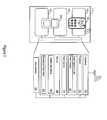
- FIG. 1 shows an example wireless power environment 100.
- the wireless power environment 100 includes a number of portable devices 102, 104 and a charging station (CS) 110 in this example, but the wireless power environment may include any device.
- CS charging station
- the techniques described below regarding wireless power may be implemented in virtually any wireless power scenario.
- the devices 102 receiving the wireless power may charge a battery, capacitor, or other energy storage subsystem.
- the devices 102, 104 may operate directly on the power received from the CS 110.
- the CS 110 may include power signal circuitry (PSC) 122 to supply a power signal to a transmit coil 132 able to transmit the power signals to the portable devices 102.
- the CS 110 may include a power source 124 to support generation of the transmitted power signal.
- the PSC 122 may convert a source signal from the power source 124 into a form that the antenna may transmit.
- the power source may provide a direct current (DC) or alternating current (AC) signal.
- the PSC 122 may include power circuitry 126 which may tune the basic signal from the power source to a particular frequency or signal level for transmission over the transmit coil 132 to the devices 102.
- the CS 110 may include a transceiver 152 to support RF communication, one or more processors 154 to support execution of instructions, e.g., in the form of applications, and carry out general operation of the device.
- the CS 110 may include memory 156 for execution support and storage of system instructions 168 and operation parameters 162.
- the transceiver elements may receive status and/or control signals from the portable devices 102.
- the control and/or status signals may be used by the CS 110 to adjust power signal parameters and/or other wireless power provisional strategies. For example, the signals may allow for detection of new devices within the power signal range, determination of when a device in range has completed charging, and/or other status or control determinations.
- a device 102 may in communication with the CS 110 over a wireless protocol, e.g. Bluetooth, Wi-Fi or other wireless protocol via transceiver 152.
- the CS may monitor internal parameters for status determination.
- the load of 132 may be monitored to determine the presence/absence of devices within power signal range.
- monitoring of internal parameters may be used to support charging of a device 104 which may not be in data communication with the CS 110.
- the communication device may include a user interface 136 to allow for user operation of the device.
- current may be supplied to a transmit coil.
- the current supplied to the transmit coil may depend on the load of the transmit coil.
- the current in a class D power transmission circuit may be expressed as: 2 ⁇ VDC ⁇ ⁇ 1 Zload
- Zload is the impedance of the transmit coil and VDC is a voltage supplied by a voltage source.
- the current level in the transmit coil may be controlled by varying VDC.
- the voltage source may be a buck-boost converter, with a constant DC power supply.
- the buck-boost converter may allow the adjustment of the current over a range. For example, this range may vary from 0-40V for class E power transmission circuits and vary from 0-80V for class D power transmission circuits.
- These example voltages may be supplied for systems operating at 1 A (root-mean-squared, rms) and for a load impedance of up to 36 ⁇ .
- the value of Zload may vary over time. For example, when receiving antennas or other objects move in to or out of proximity of the transmit coil, the load of the transmit coil will vary.
- the voltage supplied by the voltage source may be adjusted to keep the peak current flowing in the transmit coil constant.
- Figure 2 shows example circuitry 200 for wireless power transmission, including a power signal source 210.
- the power signal source 210 may provide a sinusoidal, other oscillating waveform, or other time varying waveform, current to a transmit coil 270.
- the power signal source may use the output of a voltage source 212 as a base signal.
- the voltage source 212 may supply a DC voltage.
- the power signal source 210 which may include two paths 211, 241 having high-side and low side modulators 222, 232, 252, 262.
- the high-side modulators 222, 252 are tied to the high-side output of the voltage source 212.
- the low-side modulators 232, 262 may be coupled to the low side of the voltage source and reference level 205, e.g. ground.
- the high-side and low side modulators 222, 232, 252, 262 may be positive metal-oxide semiconductor (pMOS) transistors or negative metal-oxide semiconductor (nMOS) transistors. Additionally or alternatively, bipolar junction transistors (BJT) may be implemented.
- pMOS positive metal-oxide semiconductor
- nMOS negative metal-oxide semiconductor
- BJT bipolar junction transistors
- the two paths 211, 241 may receive a clock signal from the clock source 204.
- the clock signal may be passed along the first path (FP) 211 to the FP control circuitry 214.
- the FP control circuitry 214 may control FP drivers 224 and 234.
- the FP control circuitry may control the amplification level of the drivers 224, 234 based on system conditions. In some cases, the amplification level may be set to achieve a determined on-off signal ratio for the FP modulators 222, 232.
- the FP control circuitry may supply operational voltages to the FP drivers to serve as a power source.
- the FP control circuitry 214 may pass the clock signal to the FP drivers 224, 234.
- the FP drivers 224, 234 may amplify the clock signal to drive the FP high-side 222 and low-side 232 modulators.
- the FP modulators 222, 232 may produce an oscillating power signal by modulating the output of the voltage source 212.
- the FP high-side 222 and low-side 232 modulators may cooperatively produce a 50% duty cycle square-wave signal through coordinated on-off switching.
- the clock source 204 may also pass the clock signal along the second path (SP) 241.
- the SP may include a phase delay 242.
- the phase delay may shift the phase of the clock signal on the SP by an angle, ⁇ , with respect to the clock signal on the FP.
- the delayed clock signal is output coupled from the phase delay 242 to the SP control circuitry 244.
- the SP control circuitry 244 may control SP drivers 254, 264.
- the SP drivers 254, 264 may amplify the clock signal to drive the SP high-side 252 and low-side 262 modulators.
- the SP modulators 252, 262 may produce an oscillating power signal by modulating the output of the voltage source 212.
- the SP high-side 252 and low-side 262 modulators may cooperatively produce a 50% duty cycle square-wave signal through coordinated on-off switching.
- the oscillating signal produced by the SP modulators 252, 262 may be shifted with respect that produced by the FP modulators by the angle ⁇ .
- the FP oscillating signal may be considered to have phase ⁇ /2 and the SP oscillating signal may be considered to have phase - ⁇ /2.
- the output of the FP 222, 232 and SP 252, 262 modulators may be passed through a filter 271 including inductive 272, 274 and parallel or series capacitive 276 elements.
- the filter 271 may act as a LC filter and establish a center frequency, ⁇ 0, for the example circuitry 200.
- the output of the filter may be passed to the antenna coil.
- the two input branches from the FP and the SP are passed through inductors 272 and 274, which may have inductance values 2*Linv.
- the halves of the signal are exposed to 2*Linv before being combined. This may have a similar effect to passing the combined current through an inductor of value Linv.
- the circuitry 200 may act as a current source and the peak amplitude current (iload) may not be dependent on the load of the transmit coil 270.
- combining the two signals from the FP and the SP may allow the iload to be controlled by adjusting the angle ⁇ . Adding two repeating signals where one signal constitutes a phase shift of the other results in a third signal of the same time with an amplitude that depends on the angle and a phase shift that depends on the angle.
- Figure 3 shows an example plot 300 of iload versus the angle ⁇ .
- the value of iload is normalized using the largest value of iload to produce a unitless quantity versus the angle ⁇ .
- the largest value of iload may be controlled by setting the parameters of the circuitry 200. For example, Vin and/or Cinv may be adjusted to increase or decrease the range on which iload can be varied.
- phase based modulation may allow for high-speed current level changes within the transmit coil. High-frequency changes in the current may be achieved.
- the voltage level used in the circuitry 200 may be defined by the application of the circuitry 200. For example, the transmit coil load may not contribute to selection of the implemented voltage level. In some cases, a reduced voltage level range may allow for the use of more compact integrated or discrete components.
- FIG 4 shows example circuitry 400 for wireless power transmission.
- a matching network 475 may be included in the filter 471 between the power signal source 410.
- the power signal source 410 may operate similarly to the power signal source 210 of Figure 2 , but may further include feedback control circuitry 490.
- the feedback control circuitry 490 may be used to determine the phase angle ⁇ to set between the FP 211 and the SP 241. Additionally or alternatively, the feedback control circuitry 490 may be used to control the matching network 475.
- the matching network may include variable elements, such as variable capacitors, that may be adjusted.
- the matching network may include variable parallel capacitors 473, 477, and series capacitor 479.
- the capacitors 473, 477, 479 may have capacitances C2, C3, and C1, respectively.
- the variable elements of the matching network 475 may be used to compensate of for the variation in components in the filter 471. Variations may include process, voltage, and temperature variations.
- the capacitor 485 may include a variable capacitance. The capacitor 485 may be used to compensate for the reactance of the antenna. The capacitor 485 may be a variable capacitor with capacitance Ccomp. In some implementations, the capacitor 485 may be controlled by the feedback control circuitry 490.
- the feedback control circuitry 490 may operate sensors 466, 468 to measure current and/or other parameters at multiple locations on the circuitry 400.
- the feedback control circuitry 490 may use the parameter measurement to adjust the angle ⁇ between the phases of the signals on the paths of the power signal source 410.
- the feedback control circuitry 490 may also control the matching network 475 based on the measured parameters.
- the capacitor 485 may be controlled by the feedback control circuitry based on one or more of the measured parameters.
- the sensors 466, 468 may measure the phase of the current before and after the matching network 475. As discussed below, the multiple point phase measurement may allow for a low loss or lossless current measurement.
- the transconductance of the system, Ysys, and the equivalent inverter capacitor, Cv, of the matching network may be expressed as two different functions of C1, C2, and C3.
- Ysys may be modified while Cv is held constant.
- Cv may be modified while Ysys is held constant.
- iload is the load current.
- Lcoil is the inductance of the transmit coil
- j is the square root of -1.
- the expression RL+j*XL represents the reflected impedance from the power receiving unit.
- Figure 5 shows example logic 500 for reactance compensation.
- the logic 500 may start by setting a determined angle, ⁇ 0, between the signal paths (502).
- the determined angle ⁇ 0 may be a default starting value.
- the angle may be selected based at least in part on safety concerns. For example, the angle may be selected to keep heating in the transmit coil below a certain level.
- the logic may set Ccomp such that the measured phase of the current before the matching network ⁇ inv and the phase of the current at the input of the coil ⁇ cl are 90 degrees apart (504).
- the logic 500 may vary Cinv while holding Ysys constant (506).
- the logic 500 may vary Ysys to locate the point where iload has the minimum derivative with respect to Ccomp.
- the logic 500 may vary Ysys while holding Cinv constant (508).
- the logic 500 may vary Ysys to set the load current iload at a determined value.
- the determined value of iload may be determined by the application. For example, iLd may be selected based on the charging parameters of a device.
- the logic 500 may monitor the reactance compensation of the system (510). For example, the logic 500 may implement the logic 600 below to monitor the reactance compensation of the system.
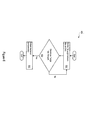
- Figure 6 shows example logic 600 for reactance compensation monitoring.
- the logic 600 may monitor the angle between ⁇ inv and ⁇ cl (602). For example, the logic 600 may determine if the angle between ⁇ inv and ⁇ cl has drifted from a value of 90 degrees. The logic may determine if the angle between ⁇ inv and ⁇ cl has changed such that a compensation process may be initiated (604). For example, the logic 600 may determine if the angle between ⁇ inv and ⁇ cl differs from 90 degrees more than a determined threshold. Based on the determination, the circuit may initiate compensation (606) or continue monitoring the angle between ⁇ inv and ⁇ cl (602). For example, the logic 600 may implement the logic 500 to perform reactance compensation. In some implementations, the logic 600 may implement the logic 500 using the current angle between the two paths as the determined angle ⁇ 0.
- a resistor may be placed in series with a transmit coil and a ground.
- the resistor may be used for a Rsensing current measurement.
- Rsensing current measurements may be associated with losses within transmit coil system.
- the measurement of current within the transmit coil of a wireless power system may be accomplished using the sensors or other detectors used in a phase measurement.
- the phase measurement sensor may also be used to calibrate a matching network coupled to the transmit coil.
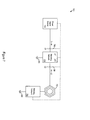
- Figure 7 shows example circuitry 700 supporting phase-based current measurement.
- a power signal source 710 supplies a current signal to the input of a matching network 775.
- the output of the matching network is coupled to the transmit coil 770.
- Two phase sensors 766, 768 are placed at the input and output of the matching network.
- the current, i1, at the input of the matching network is controlled by the signal supply 710.
- the current at the output of the matching network, i2 may be expressed in terms of i1, the phase angle between the measurement points, ⁇ 21, phase of the current at the input to the matching network, ⁇ 1.
- parameter angles between impedances y11 and y12 may be used.
- Ccomp the capacitance used to compensate for the reactance of the transmit coil 770, may be supplied by a second matching network 785.
- the impedances simplify into purely capacitive contributions.
- the angles between the parameters are then 90 degrees because they represent impedances that are purely imaginary.
- FIG. 8 shows example circuitry 800 for wireless power transmission.
- the circuitry 800 includes a class D power signal supply 810.
- Phase detectors 866, 868 may supply phase measurements of the current from the input to the matching network 875 and the output of the matching network 875.
- the phase detectors 866, 868 may provide the measurement of the phase to control circuitry 812.
- the control circuitry 812 may adjust the output the power signal supply 810 in response to the phase measurements.
- the matching network 875 may act as a component within a filter 871.
- the control circuitry 812 may adjust the buck-boost converter 814 to increase or decrease the power signal output of the circuitry 800.
- the control circuitry 812 may also adjust the voltage output of the converter 814 to compensate for changes in the transmit coil load.
- the control circuitry 812 may adjust the matching network 875 and the compensation matching network 885 to execute the phase based power measurement. Additionally or alternatively, the control circuitry 812 may adjust the matching network to compensate for the reactance of the transmit coil
- the example circuitry 400 may be used to implement the phase based current measurement using sensors 466 and 468.
- the phase-based current measurement may be implemented with virtually any wireless power transmission systems that use a matching network and a transmit coil.
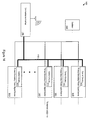
- Figure 9 shows example circuitry 900 for wireless power transmission.
- the example circuitry 900 comprises multiple power signal sources 910, such as power transmission units, and multiple transmit coils 970.
- the circuitry 900 may further include filters 971 and matching networks 975.
- the circuitry may also include compensation networks 985 to compensate for the reactances of the coils 970.
- the power signal sources 910 may drive the multiple coils synchronously.
- the power signal sources 910 may use a common oscillator signal and may drive their respective coils at varying phases using the common oscillator signal to maintain a synchronous relationship.
- the phases of the power signal sources may be selected based on the application of the circuitry 900. For example, the phase relationships may be selected to maximize power transmitted. In another example, the phase relationships may be selected to shape the field generated by the power signal sources.
- the receiving coil of a charging device may not be parallel to the transmit coils 970. The phases may be selected to attempt to align the field for optimal transmission to the receiving coil.
- one or more of the power signal source 910 may be deactivated while one or more other power signal sources 910 continue transmitting to control the shape and/or power output of the circuitry 900.
- the phase relationships of the power signal source 910 may be fixed based on fixed delays within the circuitry 900. In other implementations, the phase relationships between the power signal sources 910 may not be fixed. For example, the phase relationships may be dynamically adjusted using control circuitry.
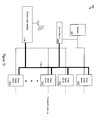
- Figure 10 shows example circuitry 1000 for wireless power transmission.
- the example circuitry 1000 comprises multiple power signal sources 1010, such as power transmission units, and a single coil 1070.
- the circuitry 1000 may further include filters 1071 and a matching network 1075.
- the circuitry may also include a compensation network 1085 to compensate for the reactance of the coil 1070.
- the power signal sources 1010 may drive the coil 1070 synchronously. Similar to the circuitry 900 above, the phase relationships of the power signal source 1010 in the circuitry 1000 may be determined based on the application of the circuitry 1000.
- the use of multiple coils and/or multiple power signal sources may allow for efficient increases in the power transmitted by the one or more coils. Additionally or alternatively, the power usage of individual power signal sources may be reduced for a given peak power. In some cases, reduced power consumption may increase safety, by reducing the heat dissipated, and may reduce the size and/or complexity of the power signal sources.
- the numbers of power signal source and transmit coils may be generalized to N power signal sources and M coils, where one or more power signal source is provided per coil.
- the N power signal sources may be drive synchronously.
- the N power signal sources may be able to deliver N times the power of a single power signal source for a given signal source design.
- different power signal source types may be used. For example class D, class E, parallel sources, such as those of circuitry 200, 400, and/or other power signal sources may be used.
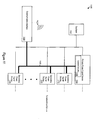
- Figure 11 shows example circuitry 1100 for synchronous control of multiple power signal sources.
- the example circuitry may include a bus 1105 between the secondary power signal sources 1110 and a primary power signal source 1109.
- An oscillator 1101 may provide a common clock signal to the power signal sources 1110, 1109.
- a control circuitry 1108 in the primary power signal source 1109 may receive phase information, current information, load information, and/or other information from the secondary signal sources 1110 over the bus 1105.
- the control circuitry 1108 may transmit control information over the bus 1105 to the secondary signal sources 1110 to adjust their phase relationships.
- the control circuitry 1108 may activate and deactivate the power signal sources 1110, 1109.
- power signal sources 1110, 1109 may be activated or deactivated depending on their respective loads.
- the power signal sources 1110, 1109 may include sensors to collect phase information.
- the power signal sources may include phase sensors to collect phase information.
- the secondary power signal source may collect phase information at the inputs of their respective coils.
- the power signals sources 1110, 1109 may collect phase information at the input to the matching network of the coil.
- phase information may be collected at the input of the match network of a coil and the input to the coil for the power signal sources 1110, 1109. Collection of phase information at both the input and output of one or more matching networks may allow for current measurements in addition phase measurements. Current and phase information may be sent to the control circuitry 1108.
- the circuitry 1100 may include a communication interface 1199 that may allow communication with a receiving device.
- the communication interface 1199 may communicate over Bluetooth or another wireless protocol with the receiving device.
- the communication interface 1199 may receive application information from the receiving device.
- Application information may include receiving coil size, orientation information (such as accelerometer measurements and/or other orientation information), power consumption information, current demands, requests for transmitted power level adjustments, indications of charging status, and/or other application information.
- the communication interface 1199 may transmit the application information to the control circuitry 1108.
- the control circuitry 1108 may implement foreign object detection based on load.
- one or more power signal sources 1110, 1109 may be switched on or off based on a change in the load of a transmit coil.
- the one or more power signal source associated with transmit coil may be switched of in response to a change in the load of the transmit coil when no information is received over the communication interface identifying the source of the change in the load. This may protect foreign objects from being exposed to transmitted power signals. Additionally or alternatively, some coils may remain active while others are switched off. The powering down of the coils may be localized to those with load changes reducing potential interruption to device charging and/or other transmit processes.
- Figure 12 shows example circuitry 1200 for synchronous control of multiple power signal sources.
- the oscillator 1201 may be combined with the primary power signal source 1209.
- the secondary power signal sources 1210 may receive their common clock signals from a sensor 1267 that recovers the clock signal from the output of the primary power signal source 1209.
- Figure 13 shows example circuitry 1300 for synchronous control of multiple power signal sources.
- the control circuitry 1308 may be separated from the power signal sources 1310.
- the control circuitry 1308 may receive information from the power signal sources over the bus 1105 and may transmit control information to the power signal sources 1310.
- the power signal sources 1310 need not include primary and/or secondary designations.
- Figure 14 shows example circuitry 1400 for synchronous control of multiple power signal sources.
- the primary/secondary power signal sources 1410 may include control circuitry 1412.
- the designation of primary power signal source may be changed during operation and/or design of the circuitry 1400.
- circuitry that includes an instruction processor, such as a Central Processing Unit (CPU), microcontroller, or a microprocessor; an Application Specific Integrated Circuit (ASIC), Programmable Logic Device (PLD), or Field Programmable Gate Array (FPGA); or circuitry that includes discrete logic or other circuit components, including analog circuit components, digital circuit components or both; or any combination thereof.
- the circuitry may include discrete interconnected hardware components and/or may be combined on a single integrated circuit die, distributed among multiple integrated circuit dies, or implemented in a Multiple Chip Module (MCM) of multiple integrated circuit dies in a common package, as examples.
- MCM Multiple Chip Module
- the circuitry may further include or access instructions for execution by the circuitry.
- the instructions may be stored in a tangible storage medium that is other than a transitory signal, such as a flash memory, a Random Access Memory (RAM), a Read Only Memory (ROM), an Erasable Programmable Read Only Memory (EPROM); or on a magnetic or optical disc, such as a Compact Disc Read Only Memory (CDROM), Hard Disk Drive (HDD), or other magnetic or optical disk; or in or on another machine-readable medium.
- a product such as a computer program product, may include a storage medium and instructions stored in or on the medium, and the instructions when executed by the circuitry in a device may cause the device to implement any of the processing described above or illustrated in the drawings.
- the implementations may be distributed as circuitry among multiple system components, such as among multiple processors and memories, optionally including multiple distributed processing systems.
- Parameters, databases, and other data structures may be separately stored and managed, may be incorporated into a single memory or database, may be logically and physically organized in many different ways, and may be implemented in many different ways, including as data structures such as linked lists, hash tables, arrays, records, objects, or implicit storage mechanisms.
- Programs may be parts (e.g., subroutines) of a single program, separate programs, distributed across several memories and processors, or implemented in many different ways, such as in a library, such as a shared library (e.g., a Dynamic Link Library (DLL)).
- the DLL may store instructions that perform any of the processing described above or illustrated in the drawings, when executed by the circuitry.
Landscapes
- Engineering & Computer Science (AREA)
- Power Engineering (AREA)
- Computer Networks & Wireless Communication (AREA)
- Charge And Discharge Circuits For Batteries Or The Like (AREA)
- Transmitters (AREA)
Abstract
Description
- This application claims priority to provisional application serial number
61/970,147, filed March 25, 2014 - This disclosure relates wireless power transmission. This disclosure also relates to an antenna load independent current source for power signal generation.
- Rapid advances in electronics and communication technologies, driven by immense customer demand, have resulted in the widespread adoption of mobile communication devices. Many of these devices, e.g., smartphones, have sophisticated processing capability and rely on clocks of different frequencies to perform different processing tasks, e.g., decoding and playback of encoded audio files. These devices may rely on portable power sources that are periodically charged. The ease and speed of the charging process may contribute to the commercial success of the device.
- According to an aspect, a device is provided, comprising:
- a power supply input configured to provide a power supply signal;
- the first path configured to receive a clock signal and the power supply signal, the first path comprising:
- a first output;
- a first driver configured to accept the clock signal and modulate the power supply signal to generate, on the first output, a first oscillating power signal
- based on the clock signal;
- the second path configured to receive the clock signal and the power supply signal,
- the second path comprising:
- a second output;
- a delay element configured to phase shift the clock signal by an angle to generate a shifted clock signal; and
- a second driver configured to accept the shifted clock signal and modulate the power supply signal to generate, on the second output, a second oscillating power signal phase shifted by the angle with respect to the first oscillating power signal; and
- a transmission circuit coupled to the first output and second output and configured to transmit a wireless power signal based on a combination of the first and second oscillating power signals.
- Advantageously, the wireless power signal is characterized by an amplitude that depends on the angle.
- Advantageously, the delay comprises an adjustable delay.
- Advantageously, the device further comprises adjustment logic configured to adjust the adjustable delay to change the angle and control the amplitude of the wireless power signal.
- Advantageously, the device further comprises a signal combiner configured to form the combination.
- Advantageously, the device further comprises a filter configured to adapt the combination.
- Advantageously, the filter is configured to remove harmonics from the combination.
- Advantageously, the filter comprises a tunable filter with an adjustable filter frequency.
- Advantageously, the filter comprises an inductor and a capacitor, the capacitor connected in shunt with the combiner.
- Advantageously:
- the transmission circuit comprises an antenna characterized by a load; and
- the inductor, the capacitor, or the inductor and the capacitor are selected such that the wireless power signal is independent of the load.
- Advantageously:
- the first driver is configured to drive a first modulator configured to modulate the power supply signal; and
- the second driver is configured to drive a second modulator configured to modulate the power supply signal.
- Advantageously:
- the first modulator comprises a first high-side switch and a first low-side switch; and
- the second modulator comprises a second high-side switch and a second low-side switch.
- According to an aspect, a method comprises:
- providing a clock signal to a first path and a second path;
- phase delaying the clock signal on the second path by an angle with respect to the first path;
- based on the clock signal, modulating a power supply signal on the first path to generate a first oscillating power signal;
- based on the delayed clock signal, modulating the power supply signal on the second path to generate a second oscillating power signal;
- combining the first and second oscillating power signals to generate a wireless power signal with an amplitude dependent on the angle.
- Advantageously, the method further comprises filtering the combined first and second oscillating power signals.
- Advantageously, filtering the combined first and second oscillating power signals comprises adjusting a filter frequency to attempt to match a clock frequency of the clock signal.
- Advantageously, the method further comprises sampling the first, second, or combined oscillating power signals or any combination of the oscillating power signals to provide feedback for the adjustment of the filter frequency.
- Advantageously, sampling the combined first and second oscillating power signals comprises determining a relative phase for the combined first and second oscillating power signals at a first point prior to a capacitor and a second point after the capacitor.
- Advantageously, providing the clock signal to the first path and the second path comprises:
- receiving a common clock signal for multiple power signal sources; and
- adjusting a phase delay of the common clock signal to synchronize with one or more of the multiple power signal sources.
- According to an aspect, a device comprises:
- a clock source configured to generate a clock signal characterized by a center frequency;
- a power source configured to generate a power signal;
- a first path coupled to the output of the clock source, the first path comprising:
- a first driver accepting the clock signal to generate a first driving signal; and
- a first pair of gates coupled to the output of the power signal, the first pair of gates accepting the first driving signal to modulate the power signal to generate a first oscillating power signal characterized by the center frequency;
- a second path coupled to the output of the clock source, the second path comprising:
- a delay accepting the clock signal, the delay comprising an effective propagation length so as to phase delay the clock signal by an angle to generate a delayed clock signal;
- a second driver coupled to the output of the delay so as to accept the delayed clock signal to generate a second driving signal; and
- a second pair of gates coupled to the output of the power signal, the second pair of gates accepting the second driving signal to modulate the power signal to generate a second oscillating power signal characterized by the center frequency and phased delayed by the angle with respect to the first oscillating power signal;
- a third path coupled to the output of the first and second paths so as to combine the first and second oscillating power signal to generate a wireless power signal characterized by the center frequency and with an amplitude dependent on the angle; and
- a transmission circuit accepting the wireless power signal so as to drive an antenna.
- Advantageously, the effective propagation length comprises a tunable effective propagation length configured to allow adjustment of the angle to control the amplitude.
-
-
Figure 1 shows an example wireless power environment. -
Figure 2 shows example circuitry for wireless power transmission. -
Figure 3 shows an example plot of iload versus the angle Φ. -
Figure 4 shows example circuitry for wireless power transmission. -
Figure 5 shows example circuitry for reactance compensation. -
Figure 6 shows example circuitry for reactance compensation monitoring. -
Figure 7 shows example circuitry supporting phase-based current measurement. -
Figure 8 shows example circuitry for wireless power transmission. -
Figure 9 shows example circuitry for wireless power transmission. -
Figure 10 shows example circuitry for wireless power transmission. -
Figure 11 shows example circuitry for synchronous control of multiple power signal sources. -
Figure 12 shows example circuitry for synchronous control of multiple power signal sources. -
Figure 13 shows example circuitry for synchronous control of multiple power signal sources. -
Figure 14 shows example circuitry for synchronous control of multiple power signal sources. -
Figure 1 shows an example wireless power environment 100. The wireless power environment 100 includes a number ofportable devices devices 102 receiving the wireless power may charge a battery, capacitor, or other energy storage subsystem. Additionally or alternatively, thedevices CS 110. - The
CS 110 may include power signal circuitry (PSC) 122 to supply a power signal to a transmitcoil 132 able to transmit the power signals to theportable devices 102. TheCS 110 may include apower source 124 to support generation of the transmitted power signal. ThePSC 122 may convert a source signal from thepower source 124 into a form that the antenna may transmit. For example, the power source may provide a direct current (DC) or alternating current (AC) signal. ThePSC 122 may includepower circuitry 126 which may tune the basic signal from the power source to a particular frequency or signal level for transmission over the transmitcoil 132 to thedevices 102. - In various implementations, the
CS 110 may include atransceiver 152 to support RF communication, one ormore processors 154 to support execution of instructions, e.g., in the form of applications, and carry out general operation of the device. TheCS 110 may includememory 156 for execution support and storage ofsystem instructions 168 andoperation parameters 162. In some implementations, the transceiver elements may receive status and/or control signals from theportable devices 102. In some implementations, the control and/or status signals may be used by theCS 110 to adjust power signal parameters and/or other wireless power provisional strategies. For example, the signals may allow for detection of new devices within the power signal range, determination of when a device in range has completed charging, and/or other status or control determinations. For example, adevice 102 may in communication with theCS 110 over a wireless protocol, e.g. Bluetooth, Wi-Fi or other wireless protocol viatransceiver 152. Additionally or alternatively, the CS may monitor internal parameters for status determination. For example, the load of 132 may be monitored to determine the presence/absence of devices within power signal range. For example, monitoring of internal parameters may be used to support charging of adevice 104 which may not be in data communication with theCS 110. The communication device may include auser interface 136 to allow for user operation of the device. - For wireless power transmission, current may be supplied to a transmit coil. In some cases, the current supplied to the transmit coil may depend on the load of the transmit coil. For example, the current in a class D power transmission circuit may be expressed as:

- Where Zload is the impedance of the transmit coil and VDC is a voltage supplied by a voltage source.
- In some cases, the current level in the transmit coil may be controlled by varying VDC. For example, the voltage source may be a buck-boost converter, with a constant DC power supply. The buck-boost converter may allow the adjustment of the current over a range. For example, this range may vary from 0-40V for class E power transmission circuits and vary from 0-80V for class D power transmission circuits. These example voltages may be supplied for systems operating at 1 A (root-mean-squared, rms) and for a load impedance of up to 36 Ω.
- In some implementations, the value of Zload may vary over time. For example, when receiving antennas or other objects move in to or out of proximity of the transmit coil, the load of the transmit coil will vary. In some implementations, the voltage supplied by the voltage source may be adjusted to keep the peak current flowing in the transmit coil constant.
-
Figure 2 showsexample circuitry 200 for wireless power transmission, including apower signal source 210. In some implementations, thepower signal source 210 may provide a sinusoidal, other oscillating waveform, or other time varying waveform, current to a transmit coil 270. The power signal source may use the output of avoltage source 212 as a base signal. In some implementations, thevoltage source 212 may supply a DC voltage. Thepower signal source 210, which may include twopaths low side modulators side modulators voltage source 212. The low-side modulators reference level 205, e.g. ground. In various implementations, the high-side andlow side modulators - The two
paths clock source 204. The clock signal may be passed along the first path (FP) 211 to theFP control circuitry 214. TheFP control circuitry 214 may controlFP drivers drivers FP modulators FP control circuitry 214 may pass the clock signal to theFP drivers FP drivers side 222 and low-side 232 modulators. - The FP modulators 222, 232 may produce an oscillating power signal by modulating the output of the
voltage source 212. For example, the FP high-side 222 and low-side 232 modulators may cooperatively produce a 50% duty cycle square-wave signal through coordinated on-off switching. - The
clock source 204 may also pass the clock signal along the second path (SP) 241. The SP may include aphase delay 242. The phase delay may shift the phase of the clock signal on the SP by an angle, Φ, with respect to the clock signal on the FP. The delayed clock signal is output coupled from thephase delay 242 to theSP control circuitry 244. TheSP control circuitry 244 may controlSP drivers SP drivers side 252 and low-side 262 modulators. - The SP modulators 252, 262 may produce an oscillating power signal by modulating the output of the
voltage source 212. For example, the SP high-side 252 and low-side 262 modulators may cooperatively produce a 50% duty cycle square-wave signal through coordinated on-off switching. The oscillating signal produced by theSP modulators - The output of the
FP SP filter 271 including inductive 272, 274 and parallel or series capacitive 276 elements. Thefilter 271 may act as a LC filter and establish a center frequency, ω0, for theexample circuitry 200. The output of the filter may be passed to the antenna coil. In some implementations ω0 may be expressed as:
Where Linv is the inductance associated with thefilter 271 and Cinv is the capacitance associated with thefilter 271. In thefilter 271, the two input branches from the FP and the SP are passed throughinductors inductance values 2*Linv. In theexample circuitry 200, the halves of the signal are exposed to 2*Linv before being combined. This may have a similar effect to passing the combined current through an inductor of value Linv. - In some implementations the
circuitry 200 may act as a current source and the peak amplitude current (iload) may not be dependent on the load of the transmit coil 270. In some cases, combining the two signals from the FP and the SP may allow the iload to be controlled by adjusting the angle Φ. Adding two repeating signals where one signal constitutes a phase shift of the other results in a third signal of the same time with an amplitude that depends on the angle and a phase shift that depends on the angle. For example, iload may be expressed as:
Where Vin is the voltage supplied by thevoltage source 212. -
Figure 3 shows anexample plot 300 of iload versus the angle Φ. In theexample plot 300, the value of iload is normalized using the largest value of iload to produce a unitless quantity versus the angle Φ. The largest value of iload may be controlled by setting the parameters of thecircuitry 200. For example, Vin and/or Cinv may be adjusted to increase or decrease the range on which iload can be varied. - In some cases, phase based modulation may allow for high-speed current level changes within the transmit coil. High-frequency changes in the current may be achieved. In some implementations, the voltage level used in the
circuitry 200 may be defined by the application of thecircuitry 200. For example, the transmit coil load may not contribute to selection of the implemented voltage level. In some cases, a reduced voltage level range may allow for the use of more compact integrated or discrete components. -
Figure 4 showsexample circuitry 400 for wireless power transmission. In some implementations, amatching network 475 may be included in thefilter 471 between thepower signal source 410. Thepower signal source 410 may operate similarly to thepower signal source 210 ofFigure 2 , but may further includefeedback control circuitry 490. Thefeedback control circuitry 490 may be used to determine the phase angle Φ to set between theFP 211 and theSP 241. Additionally or alternatively, thefeedback control circuitry 490 may be used to control thematching network 475. The matching network may include variable elements, such as variable capacitors, that may be adjusted. For example, the matching network may include variableparallel capacitors series capacitor 479. Thecapacitors matching network 475 may be used to compensate of for the variation in components in thefilter 471. Variations may include process, voltage, and temperature variations. Thecapacitor 485 may include a variable capacitance. Thecapacitor 485 may be used to compensate for the reactance of the antenna. Thecapacitor 485 may be a variable capacitor with capacitance Ccomp. In some implementations, thecapacitor 485 may be controlled by thefeedback control circuitry 490. - In an example implementation, the current ω0 and iload, the current being input into the coil, for the
circuitry 400 may be expressed as:

- In various implementations, the
feedback control circuitry 490 may operatesensors circuitry 400. Thefeedback control circuitry 490 may use the parameter measurement to adjust the angle Φ between the phases of the signals on the paths of thepower signal source 410. Thefeedback control circuitry 490 may also control thematching network 475 based on the measured parameters. Additionally or alternatively, thecapacitor 485 may be controlled by the feedback control circuitry based on one or more of the measured parameters. In various implementations, thesensors matching network 475. As discussed below, the multiple point phase measurement may allow for a low loss or lossless current measurement. - In various implementations, the transconductance of the system, Ysys, and the equivalent inverter capacitor, Cv, of the matching network may be expressed as two different functions of C1, C2, and C3. In some cases, by adjusting C2 and/or C3, Ysys may be modified while Cv is held constant. Additionally or alternatively, Cv may be modified while Ysys is held constant. In various implementations, Cv and Ysys may be expressed as:


Where iload is the load current. Further, linv the current input into the matching network may be expressed as:
Where Lcoil is the inductance of the transmit coil, and j is the square root of -1. The expression RL+j*XL represents the reflected impedance from the power receiving unit. -
Figure 5 showsexample logic 500 for reactance compensation. Thelogic 500 may start by setting a determined angle, Φ0, between the signal paths (502). The determined angle Φ0 may be a default starting value. In some cases, the angle may be selected based at least in part on safety concerns. For example, the angle may be selected to keep heating in the transmit coil below a certain level. The logic may set Ccomp such that the measured phase of the current before the matching network θinv and the phase of the current at the input of the coil θcl are 90 degrees apart (504). Thelogic 500 may vary Cinv while holding Ysys constant (506). Thelogic 500 may vary Ysys to locate the point where iload has the minimum derivative with respect to Ccomp. - The
logic 500 may vary Ysys while holding Cinv constant (508). Thelogic 500 may vary Ysys to set the load current iload at a determined value. The determined value of iload may be determined by the application. For example, iLd may be selected based on the charging parameters of a device. Thelogic 500 may monitor the reactance compensation of the system (510). For example, thelogic 500 may implement thelogic 600 below to monitor the reactance compensation of the system. -
Figure 6 showsexample logic 600 for reactance compensation monitoring. Thelogic 600 may monitor the angle between θinv and θcl (602). For example, thelogic 600 may determine if the angle between θinv and θcl has drifted from a value of 90 degrees. The logic may determine if the angle between θinv and θcl has changed such that a compensation process may be initiated (604). For example, thelogic 600 may determine if the angle between θinv and θcl differs from 90 degrees more than a determined threshold. Based on the determination, the circuit may initiate compensation (606) or continue monitoring the angle between θinv and θcl (602). For example, thelogic 600 may implement thelogic 500 to perform reactance compensation. In some implementations, thelogic 600 may implement thelogic 500 using the current angle between the two paths as the determined angle Φ0. - In some implementations, a resistor may be placed in series with a transmit coil and a ground. The resistor may be used for a Rsensing current measurement. In some cases, Rsensing current measurements may be associated with losses within transmit coil system.
- In some cases, the measurement of current within the transmit coil of a wireless power system may be accomplished using the sensors or other detectors used in a phase measurement. The phase measurement sensor may also be used to calibrate a matching network coupled to the transmit coil.
-
Figure 7 showsexample circuitry 700 supporting phase-based current measurement. Apower signal source 710 supplies a current signal to the input of amatching network 775. The output of the matching network is coupled to the transmitcoil 770. Twophase sensors signal supply 710. The current at the output of the matching network, i2 may be expressed in terms of i1, the phase angle between the measurement points, ϕ21, phase of the current at the input to the matching network, ϕ1. - To calculate the relationship between i1 and i2, parameter angles between impedances y11 and y12 may be used. In various implementations, the relationship between the parameter angles and the currents may be expressed as:

Ccomp, the capacitance used to compensate for the reactance of the transmitcoil 770, may be supplied by asecond matching network 785. When thecircuitry 700 is simplified such that Ccomp is brought into the matching network and resistive and Rsensing elements are removed, the impedances simplify into purely capacitive contributions. The angles between the parameters are then 90 degrees because they represent impedances that are purely imaginary. For theexample circuitry 700, the relationship between currents i1 and i2 may be expressed as:
-
Figure 8 showsexample circuitry 800 for wireless power transmission. Thecircuitry 800 includes a class Dpower signal supply 810.Phase detectors matching network 875 and the output of thematching network 875. Thephase detectors circuitry 812. Thecontrol circuitry 812, may adjust the output thepower signal supply 810 in response to the phase measurements. Thematching network 875 may act as a component within afilter 871. Thecontrol circuitry 812 may adjust the buck-boost converter 814 to increase or decrease the power signal output of thecircuitry 800. Thecontrol circuitry 812 may also adjust the voltage output of theconverter 814 to compensate for changes in the transmit coil load. Thecontrol circuitry 812 may adjust thematching network 875 and thecompensation matching network 885 to execute the phase based power measurement. Additionally or alternatively, thecontrol circuitry 812 may adjust the matching network to compensate for the reactance of the transmit coil 870. - In various implementations, the
example circuitry 400 may be used to implement the phase based currentmeasurement using sensors -
Figure 9 showsexample circuitry 900 for wireless power transmission. Theexample circuitry 900, comprises multiplepower signal sources 910, such as power transmission units, and multiple transmit coils 970. Thecircuitry 900 may further includefilters 971 and matchingnetworks 975. The circuitry may also includecompensation networks 985 to compensate for the reactances of thecoils 970. - In various implementations, the
power signal sources 910 may drive the multiple coils synchronously. Thepower signal sources 910 may use a common oscillator signal and may drive their respective coils at varying phases using the common oscillator signal to maintain a synchronous relationship. The phases of the power signal sources may be selected based on the application of thecircuitry 900. For example, the phase relationships may be selected to maximize power transmitted. In another example, the phase relationships may be selected to shape the field generated by the power signal sources. In some cases, the receiving coil of a charging device may not be parallel to the transmit coils 970. The phases may be selected to attempt to align the field for optimal transmission to the receiving coil. In another example, one or more of thepower signal source 910 may be deactivated while one or more otherpower signal sources 910 continue transmitting to control the shape and/or power output of thecircuitry 900. In some implementations, the phase relationships of thepower signal source 910 may be fixed based on fixed delays within thecircuitry 900. In other implementations, the phase relationships between thepower signal sources 910 may not be fixed. For example, the phase relationships may be dynamically adjusted using control circuitry. -
Figure 10 showsexample circuitry 1000 for wireless power transmission. Theexample circuitry 1000, comprises multiplepower signal sources 1010, such as power transmission units, and asingle coil 1070. Thecircuitry 1000 may further includefilters 1071 and amatching network 1075. The circuitry may also include acompensation network 1085 to compensate for the reactance of thecoil 1070. - In various implementations, the
power signal sources 1010 may drive thecoil 1070 synchronously. Similar to thecircuitry 900 above, the phase relationships of thepower signal source 1010 in thecircuitry 1000 may be determined based on the application of thecircuitry 1000. - The use of multiple coils and/or multiple power signal sources may allow for efficient increases in the power transmitted by the one or more coils. Additionally or alternatively, the power usage of individual power signal sources may be reduced for a given peak power. In some cases, reduced power consumption may increase safety, by reducing the heat dissipated, and may reduce the size and/or complexity of the power signal sources. In various implementations, the numbers of power signal source and transmit coils may be generalized to N power signal sources and M coils, where one or more power signal source is provided per coil. The N power signal sources may be drive synchronously. In some implementations, the N power signal sources may be able to deliver N times the power of a single power signal source for a given signal source design. In various implementations, different power signal source types may be used. For example class D, class E, parallel sources, such as those of
circuitry -
Figure 11 showsexample circuitry 1100 for synchronous control of multiple power signal sources. The example circuitry may include abus 1105 between the secondarypower signal sources 1110 and a primarypower signal source 1109. Anoscillator 1101 may provide a common clock signal to thepower signal sources control circuitry 1108 in the primarypower signal source 1109 may receive phase information, current information, load information, and/or other information from thesecondary signal sources 1110 over thebus 1105. Thecontrol circuitry 1108 may transmit control information over thebus 1105 to thesecondary signal sources 1110 to adjust their phase relationships. Additionally or alternatively, thecontrol circuitry 1108 may activate and deactivate thepower signal sources power signal sources power signal sources sources power signal sources control circuitry 1108. - In some implementations, the
circuitry 1100 may include acommunication interface 1199 that may allow communication with a receiving device. For example, thecommunication interface 1199 may communicate over Bluetooth or another wireless protocol with the receiving device. Thecommunication interface 1199 may receive application information from the receiving device. Application information may include receiving coil size, orientation information (such as accelerometer measurements and/or other orientation information), power consumption information, current demands, requests for transmitted power level adjustments, indications of charging status, and/or other application information. Thecommunication interface 1199 may transmit the application information to thecontrol circuitry 1108. - In some implementations, the
control circuitry 1108 may implement foreign object detection based on load. For example, one or morepower signal sources -
Figure 12 showsexample circuitry 1200 for synchronous control of multiple power signal sources. In theexample circuitry 1200, theoscillator 1201 may be combined with the primarypower signal source 1209. The secondarypower signal sources 1210 may receive their common clock signals from asensor 1267 that recovers the clock signal from the output of the primarypower signal source 1209. -
Figure 13 showsexample circuitry 1300 for synchronous control of multiple power signal sources. In theexample circuitry 1300, thecontrol circuitry 1308 may be separated from the power signal sources 1310. Thecontrol circuitry 1308 may receive information from the power signal sources over thebus 1105 and may transmit control information to the power signal sources 1310. Thepower signal sources 1310 need not include primary and/or secondary designations. -
Figure 14 showsexample circuitry 1400 for synchronous control of multiple power signal sources. In theexample circuitry 1400, the primary/secondarypower signal sources 1410 may includecontrol circuitry 1412. The designation of primary power signal source may be changed during operation and/or design of thecircuitry 1400. - The methods, devices, processing, and logic described above may be implemented in many different ways and in many different combinations of hardware and software. For example, all or parts of the implementations may be circuitry that includes an instruction processor, such as a Central Processing Unit (CPU), microcontroller, or a microprocessor; an Application Specific Integrated Circuit (ASIC), Programmable Logic Device (PLD), or Field Programmable Gate Array (FPGA); or circuitry that includes discrete logic or other circuit components, including analog circuit components, digital circuit components or both; or any combination thereof. The circuitry may include discrete interconnected hardware components and/or may be combined on a single integrated circuit die, distributed among multiple integrated circuit dies, or implemented in a Multiple Chip Module (MCM) of multiple integrated circuit dies in a common package, as examples.
- The circuitry may further include or access instructions for execution by the circuitry. The instructions may be stored in a tangible storage medium that is other than a transitory signal, such as a flash memory, a Random Access Memory (RAM), a Read Only Memory (ROM), an Erasable Programmable Read Only Memory (EPROM); or on a magnetic or optical disc, such as a Compact Disc Read Only Memory (CDROM), Hard Disk Drive (HDD), or other magnetic or optical disk; or in or on another machine-readable medium. A product, such as a computer program product, may include a storage medium and instructions stored in or on the medium, and the instructions when executed by the circuitry in a device may cause the device to implement any of the processing described above or illustrated in the drawings.
- The implementations may be distributed as circuitry among multiple system components, such as among multiple processors and memories, optionally including multiple distributed processing systems. Parameters, databases, and other data structures may be separately stored and managed, may be incorporated into a single memory or database, may be logically and physically organized in many different ways, and may be implemented in many different ways, including as data structures such as linked lists, hash tables, arrays, records, objects, or implicit storage mechanisms. Programs may be parts (e.g., subroutines) of a single program, separate programs, distributed across several memories and processors, or implemented in many different ways, such as in a library, such as a shared library (e.g., a Dynamic Link Library (DLL)). The DLL, for example, may store instructions that perform any of the processing described above or illustrated in the drawings, when executed by the circuitry.
- Various implementations have been specifically described. However, many other implementations are also possible.
Claims (15)
- A device, comprising:a power supply input configured to provide a power supply signal;the first path configured to receive a clock signal and the power supply signal, the first path comprising:a first output;a first driver configured to accept the clock signal and modulate the power supply signal to generate, on the first output, a first oscillating power signalbased on the clock signal;the second path configured to receive the clock signal and the power supply signal,the second path comprising:a second output;a delay element configured to phase shift the clock signal by an angle to generate a shifted clock signal; anda second driver configured to accept the shifted clock signal and modulate the power supply signal to generate, on the second output, a second oscillating power signal phase shifted by the angle with respect to the first oscillatingpower signal; anda transmission circuit coupled to the first output and second output and configured to transmit a wireless power signal based on a combination of the first and second oscillating power signals.
- The device of claim 1, wherein the wireless power signal is characterized by an amplitude that depends on the angle.
- The device of claim 1 or 2, wherein the delay comprises an adjustable delay.
- The device of claim 3, further comprising adjustment logic configured to adjust the adjustable delay to change the angle and control the amplitude of the wireless power signal.
- The device of any preceding claim, further comprising a signal combiner configured to form the combination.
- The device of claim 5, further comprising a filter configured to adapt the combination.
- The device of claim 6, wherein the filter is configured to remove harmonics from the combination.
- The device of claim 6 or 7, wherein the filter comprises a tunable filter with an adjustable filter frequency.
- The device of any of claims 6 to 8, wherein the filter comprises an inductor and a capacitor, the capacitor connected in shunt with the combiner.
- The device of claim 9, wherein:the transmission circuit comprises an antenna characterized by a load; andthe inductor, the capacitor, or the inductor and the capacitor are selected such that the wireless power signal is independent of the load.
- The device of any preceding claim, wherein:the first driver is configured to drive a first modulator configured to modulate the power supply signal; andthe second driver is configured to drive a second modulator configured to modulate the power supply signal.
- The device of claim 11, wherein:the first modulator comprises a first high-side switch and a first low-side switch; andthe second modulator comprises a second high-side switch and a second low-side switch.
- A method, comprising:providing a clock signal to a first path and a second path;phase delaying the clock signal on the second path by an angle with respect to the first path;based on the clock signal, modulating a power supply signal on the first path to generate a first oscillating power signal;based on the delayed clock signal, modulating the power supply signal on the second path to generate a second oscillating power signal;combining the first and second oscillating power signals to generate a wireless power signal with an amplitude dependent on the angle.
- The method of claim 13, further comprising filtering the combined first and second oscillating power signals.
- A device, comprising:a clock source configured to generate a clock signal characterized by a center frequency;a power source configured to generate a power signal;a first path coupled to the output of the clock source, the first path comprising:a first driver accepting the clock signal to generate a first driving signal; anda first pair of gates coupled to the output of the power signal, the first pair of gates accepting the first driving signal to modulate the power signal to generate a first oscillating power signal characterized by the center frequency;a second path coupled to the output of the clock source, the second path comprising:a delay accepting the clock signal, the delay comprising an effective propagation length so as to phase delay the clock signal by an angle to generate a delayed clock signal;a second driver coupled to the output of the delay so as to accept the delayed clock signal to generate a second driving signal; anda second pair of gates coupled to the output of the power signal, the second pair of gates accepting the second driving signal to modulate the power signal to generate a second oscillating power signal characterized by the center frequency and phased delayed by the angle with respect to the first oscillating power signal;a third path coupled to the output of the first and second paths so as to combine the first and second oscillating power signal to generate a wireless power signal characterized by the center frequency and with an amplitude dependent on the angle; anda transmission circuit accepting the wireless power signal so as to drive an antenna.
Applications Claiming Priority (2)
| Application Number | Priority Date | Filing Date | Title |
|---|---|---|---|
| US201461970147P | 2014-03-25 | 2014-03-25 | |
| US14/319,357 US9634494B2 (en) | 2014-03-25 | 2014-06-30 | Power amplifier for wireless power transmission |
Publications (1)
| Publication Number | Publication Date |
|---|---|
| EP2924877A1 true EP2924877A1 (en) | 2015-09-30 |
Family
ID=52686052
Family Applications (1)
| Application Number | Title | Priority Date | Filing Date |
|---|---|---|---|
| EP15000759.9A Withdrawn EP2924877A1 (en) | 2014-03-25 | 2015-03-13 | Power amplifier for wireless power transmission |
Country Status (4)
| Country | Link |
|---|---|
| US (1) | US9634494B2 (en) |
| EP (1) | EP2924877A1 (en) |
| CN (1) | CN104953718B (en) |
| HK (1) | HK1214417A1 (en) |
Families Citing this family (9)
| Publication number | Priority date | Publication date | Assignee | Title |
|---|---|---|---|---|
| CN107026924A (en) * | 2016-03-16 | 2017-08-08 | 安徽胜方信息科技服务有限公司 | A kind of mobile phone charging bracket |
| US11165284B2 (en) * | 2016-06-29 | 2021-11-02 | Intel Corporation | Wireless charger topology systems and methods |
| US10721604B2 (en) | 2016-12-19 | 2020-07-21 | Nxp B.V. | Method and system for operating a communications device that communicates via inductive coupling |
| US10390200B2 (en) | 2016-12-19 | 2019-08-20 | Nxp B.V. | Method and system for operating a communications device that communicates via inductive coupling |
| JP6370484B1 (en) * | 2017-03-10 | 2018-08-08 | 三菱電機エンジニアリング株式会社 | Resonant power transmission device and resonant power transmission system |
| US10720967B2 (en) * | 2017-09-25 | 2020-07-21 | Nxp B.V. | Method and system for operating a communications device that communicates via inductive coupling |
| US10382098B2 (en) | 2017-09-25 | 2019-08-13 | Nxp B.V. | Method and system for operating a communications device that communicates via inductive coupling |
| DE102018211033A1 (en) * | 2018-07-04 | 2020-01-09 | Laird Dabendorf Gmbh | Method for operating a circuit for generating an electromagnetic field and circuit |
| JP7767074B2 (en) * | 2021-09-17 | 2025-11-11 | キヤノン株式会社 | Power transmitting device and power receiving device |
Citations (7)
| Publication number | Priority date | Publication date | Assignee | Title |
|---|---|---|---|---|
| US20100244949A1 (en) * | 2007-11-19 | 2010-09-30 | Telefonaktiebolaget Lm Ericsson (Publ) | Composite Amplifier, a Radio Terminal and a Method for Improving the Efficiency of the Composite Amplifier |
| US20110199046A1 (en) * | 2010-02-12 | 2011-08-18 | Fu Da Tong Technology Co., Ltd. | Frequency modulation type wirelss power supply and charger system |
| US20110273236A1 (en) * | 2010-05-04 | 2011-11-10 | Nxp B.V. | Power control of reconfigurable outphasing chireix amplifiers and methods |
| WO2013019819A2 (en) * | 2011-07-31 | 2013-02-07 | The Regents Of The University Of California | Zero-voltage-switching contour based outphasing power amplifier |
| US20130082536A1 (en) * | 2011-03-22 | 2013-04-04 | Access Business Group International Llc | System and method for improved control in wireless power supply systems |
| US20130207482A1 (en) * | 2010-06-30 | 2013-08-15 | Auckland Uniservices Limited | Inductive power transfer system |
| WO2014035260A1 (en) * | 2012-08-28 | 2014-03-06 | Auckland Uniservices Limited | A polyphase inductive power transfer system with individual control of phases |
Family Cites Families (13)
| Publication number | Priority date | Publication date | Assignee | Title |
|---|---|---|---|---|
| JP3355894B2 (en) * | 1995-09-27 | 2002-12-09 | 安藤電気株式会社 | Variable delay circuit |
| US6963624B1 (en) * | 2000-08-29 | 2005-11-08 | Guoyu He | Method and apparatus for receiving radio frequency signals |
| US20060262013A1 (en) * | 2005-05-18 | 2006-11-23 | Shiroma Grant S | Full-duplex dual-frequency self-steering array using phase detection & phase shifting |
| US7881401B2 (en) * | 2006-11-17 | 2011-02-01 | Infineon Technologies Ag | Transmitter arrangement and signal processing method |
| US9136914B2 (en) * | 2009-01-22 | 2015-09-15 | Qualcomm Incorporated | Impedance change detection in wireless power transmission |
| TWI577103B (en) * | 2010-02-08 | 2017-04-01 | 通路實業集團國際公司 | Implanted parasitic metal detection and related methods |
| US9077405B2 (en) * | 2010-04-20 | 2015-07-07 | Rf Micro Devices, Inc. | High efficiency path based power amplifier circuitry |
| US9048787B2 (en) * | 2010-04-20 | 2015-06-02 | Rf Micro Devices, Inc. | Combined RF detector and RF attenuator with concurrent outputs |
| FR2974962B1 (en) * | 2011-05-02 | 2013-10-18 | Ask Sa | METHOD AND DEVICE FOR AMPLITUDE MODULATION OF AN ELECTROMAGNETIC SIGNAL ISSUED BY A NON-CONTACT TRANSMITTING / RECEIVING SYSTEM |
| US8854100B2 (en) * | 2012-08-31 | 2014-10-07 | Advanced Micro Devices, Inc. | Clock driver for frequency-scalable systems |
| CN203088638U (en) * | 2012-12-20 | 2013-07-31 | 广州视源电子科技股份有限公司 | Wireless power transmission carpet |
| US9325284B2 (en) * | 2013-02-02 | 2016-04-26 | Avago Technologies General Ip (Singapore) Pte. Ltd. | Radio frequency composite Class-S power amplifier having discrete power control |
| US9312767B2 (en) * | 2013-12-06 | 2016-04-12 | Infineon Technologies Austria Ag | Reconfigurable multiphase power stage for switched mode chargers |
-
2014
- 2014-06-30 US US14/319,357 patent/US9634494B2/en active Active
-
2015
- 2015-03-13 EP EP15000759.9A patent/EP2924877A1/en not_active Withdrawn
- 2015-03-23 CN CN201510128704.1A patent/CN104953718B/en active Active
-
2016
- 2016-02-25 HK HK16102127.4A patent/HK1214417A1/en unknown
Patent Citations (7)
| Publication number | Priority date | Publication date | Assignee | Title |
|---|---|---|---|---|
| US20100244949A1 (en) * | 2007-11-19 | 2010-09-30 | Telefonaktiebolaget Lm Ericsson (Publ) | Composite Amplifier, a Radio Terminal and a Method for Improving the Efficiency of the Composite Amplifier |
| US20110199046A1 (en) * | 2010-02-12 | 2011-08-18 | Fu Da Tong Technology Co., Ltd. | Frequency modulation type wirelss power supply and charger system |
| US20110273236A1 (en) * | 2010-05-04 | 2011-11-10 | Nxp B.V. | Power control of reconfigurable outphasing chireix amplifiers and methods |
| US20130207482A1 (en) * | 2010-06-30 | 2013-08-15 | Auckland Uniservices Limited | Inductive power transfer system |
| US20130082536A1 (en) * | 2011-03-22 | 2013-04-04 | Access Business Group International Llc | System and method for improved control in wireless power supply systems |
| WO2013019819A2 (en) * | 2011-07-31 | 2013-02-07 | The Regents Of The University Of California | Zero-voltage-switching contour based outphasing power amplifier |
| WO2014035260A1 (en) * | 2012-08-28 | 2014-03-06 | Auckland Uniservices Limited | A polyphase inductive power transfer system with individual control of phases |
Non-Patent Citations (6)
| Title |
|---|
| ASHOKE RAVI ET AL: "A 2.4-GHz 20 40-MHz Channel WLAN Digital Outphasing Transmitter Utilizing a Delay-Based Wideband Phase Modulator in 32-nm CMOS", IEEE JOURNAL OF SOLID-STATE CIRCUITS, IEEE SERVICE CENTER, PISCATAWAY, NJ, USA, vol. 47, no. 12, 1 December 2012 (2012-12-01), pages 3184 - 3196, XP011485416, ISSN: 0018-9200, DOI: 10.1109/JSSC.2012.2216671 * |
| HONGTAO XU ET AL: "A Flip-Chip-Packaged 25.3 dBm Class-D Outphasing Power Amplifier in 32 nm CMOS for WLAN Application", IEEE JOURNAL OF SOLID-STATE CIRCUITS, IEEE SERVICE CENTER, PISCATAWAY, NJ, USA, vol. 46, no. 7, 1 July 2011 (2011-07-01), pages 1596 - 1605, XP011356589, ISSN: 0018-9200, DOI: 10.1109/JSSC.2011.2143930 * |
| MOLOUDI S ET AL: "An Outphasing Power Amplifier for a Software-Defined Radio Transmitter", SOLID-STATE CIRCUITS CONFERENCE, 2008. ISSCC 2008. DIGEST OF TECHNICAL PAPERS. IEEE INTERNATIONAL, IEEE, PISCATAWAY, NJ, USA, 3 February 2008 (2008-02-03), pages 568 - 636, XP031391110, ISBN: 978-1-4244-2010-0 * |
| PING-YUAN TSAI ET AL: "A QPSK/16-QAM OFDM-based 29.1Mbps LINC transmitter for Body Channel Communication", SOLID STATE CIRCUITS CONFERENCE (A-SSCC), 2012 IEEE ASIAN, IEEE, 12 November 2012 (2012-11-12), pages 345 - 348, XP032419793, DOI: 10.1109/IPEC.2012.6522696 * |
| TSAN-WEN CHEN ET AL: "A low power all-digital signal component separator for uneven multi-level LINC systems", ESSCIRC (ESSCIRC), 2011 PROCEEDINGS OF THE, IEEE, 12 September 2011 (2011-09-12), pages 403 - 406, XP031976431, ISBN: 978-1-4577-0703-2, DOI: 10.1109/ESSCIRC.2011.6044992 * |
| TSAN-WEN CHEN ET AL: "A Sub-mW All-Digital Signal Component Separator With Branch Mismatch Compensation for OFDM LINC Transmitters", IEEE JOURNAL OF SOLID-STATE CIRCUITS, IEEE SERVICE CENTER, PISCATAWAY, NJ, USA, vol. 46, no. 11, 1 November 2011 (2011-11-01), pages 2514 - 2523, XP011358210, ISSN: 0018-9200, DOI: 10.1109/JSSC.2011.2164133 * |
Also Published As
| Publication number | Publication date |
|---|---|
| US9634494B2 (en) | 2017-04-25 |
| HK1214417A1 (en) | 2016-07-22 |
| US20150280443A1 (en) | 2015-10-01 |
| CN104953718B (en) | 2017-12-15 |
| CN104953718A (en) | 2015-09-30 |
Similar Documents
| Publication | Publication Date | Title |
|---|---|---|
| US9634494B2 (en) | Power amplifier for wireless power transmission | |
| US10651688B2 (en) | Dynamic tuning in wireless energy transfer systems | |
| US9077192B2 (en) | Transmitter and receiver tuning in a wireless charging system | |
| USRE49564E1 (en) | Method and apparatus for wireless power transmission with harmonic noise cancellation | |
| KR102612384B1 (en) | PWM capacitor control | |
| US20170324351A1 (en) | Methods and apparatus for voltage regulation | |
| KR102014126B1 (en) | Wireless power receiver system | |
| US10439425B2 (en) | Power transmitting unit and power receiving unit with control data communication and methods for use therewith | |
| US10250079B2 (en) | Method and apparatus for wirelessly transmitting power and power transmission information | |
| KR102123829B1 (en) | Wireless power transmission apparatus and wireless power transmission method | |
| US20170217325A1 (en) | Controlling wireless power transfer systems | |
| KR102098647B1 (en) | Method of controlling impedance matching in wireless power transfer system for multi targets and the wireless power transfer system thereof | |
| US10170996B2 (en) | Diode conduction sensor | |
| US11811384B2 (en) | Impedance adjustment device and impedance adjustment method | |
| KR20170096125A (en) | Tunable matching network with phase-switched elements | |
| US9906045B2 (en) | Method and apparatus for synchronization control in wireless power transmission system | |
| US20120267961A1 (en) | Wireless power supply apparatus | |
| JP5718997B2 (en) | Data and / or command signal transmission device with antenna equipment | |
| US10637298B2 (en) | Wireless power transfer system | |
| JP6147434B1 (en) | Resonant power supply device and resonant power transmission system | |
| US20180097394A1 (en) | Wireless charging system and method | |
| EP2709275B1 (en) | An amplifier circuit | |
| JP2015136274A (en) | Non-contact power transmission device |
Legal Events
| Date | Code | Title | Description |
|---|---|---|---|
| PUAI | Public reference made under article 153(3) epc to a published international application that has entered the european phase |
Free format text: ORIGINAL CODE: 0009012 |
|
| 17P | Request for examination filed |
Effective date: 20150313 |
|
| AK | Designated contracting states |
Kind code of ref document: A1 Designated state(s): AL AT BE BG CH CY CZ DE DK EE ES FI FR GB GR HR HU IE IS IT LI LT LU LV MC MK MT NL NO PL PT RO RS SE SI SK SM TR |
|
| AX | Request for extension of the european patent |
Extension state: BA ME |
|
| RBV | Designated contracting states (corrected) |
Designated state(s): AL AT BE BG CH CY CZ DE DK EE ES FI FR GB GR HR HU IE IS IT LI LT LU LV MC MK MT NL NO PL PT RO RS SE SI SK SM TR |
|
| STAA | Information on the status of an ep patent application or granted ep patent |
Free format text: STATUS: EXAMINATION IS IN PROGRESS |
|
| RAP1 | Party data changed (applicant data changed or rights of an application transferred) |
Owner name: AVAGO TECHNOLOGIES GENERAL IP (SINGAPORE) PTE. LTD |
|
| RAP1 | Party data changed (applicant data changed or rights of an application transferred) |
Owner name: AVAGO TECHNOLOGIES INTERNATIONAL SALES PTE. LIMITE |
|
| STAA | Information on the status of an ep patent application or granted ep patent |
Free format text: STATUS: THE APPLICATION IS DEEMED TO BE WITHDRAWN |
|
| 18D | Application deemed to be withdrawn |
Effective date: 20210922 |