EP2924821B1 - A tuning system for a tuneable diode laser spectroscopy device comprising a thermo electric cooler and a stirling cooler - Google Patents
A tuning system for a tuneable diode laser spectroscopy device comprising a thermo electric cooler and a stirling cooler Download PDFInfo
- Publication number
- EP2924821B1 EP2924821B1 EP15160665.4A EP15160665A EP2924821B1 EP 2924821 B1 EP2924821 B1 EP 2924821B1 EP 15160665 A EP15160665 A EP 15160665A EP 2924821 B1 EP2924821 B1 EP 2924821B1
- Authority
- EP
- European Patent Office
- Prior art keywords
- laser
- cooler
- tuning system
- laser diode
- thermal
- Prior art date
- Legal status (The legal status is an assumption and is not a legal conclusion. Google has not performed a legal analysis and makes no representation as to the accuracy of the status listed.)
- Not-in-force
Links
Images


Classifications
-
- G—PHYSICS
- G01—MEASURING; TESTING
- G01J—MEASUREMENT OF INTENSITY, VELOCITY, SPECTRAL CONTENT, POLARISATION, PHASE OR PULSE CHARACTERISTICS OF INFRARED, VISIBLE OR ULTRAVIOLET LIGHT; COLORIMETRY; RADIATION PYROMETRY
- G01J3/00—Spectrometry; Spectrophotometry; Monochromators; Measuring colours
- G01J3/28—Investigating the spectrum
- G01J3/42—Absorption spectrometry; Double beam spectrometry; Flicker spectrometry; Reflection spectrometry
-
- H—ELECTRICITY
- H01—ELECTRIC ELEMENTS
- H01S—DEVICES USING THE PROCESS OF LIGHT AMPLIFICATION BY STIMULATED EMISSION OF RADIATION [LASER] TO AMPLIFY OR GENERATE LIGHT; DEVICES USING STIMULATED EMISSION OF ELECTROMAGNETIC RADIATION IN WAVE RANGES OTHER THAN OPTICAL
- H01S5/00—Semiconductor lasers
- H01S5/06—Arrangements for controlling the laser output parameters, e.g. by operating on the active medium
- H01S5/0607—Arrangements for controlling the laser output parameters, e.g. by operating on the active medium by varying physical parameters other than the potential of the electrodes, e.g. by an electric or magnetic field, mechanical deformation, pressure, light, temperature
- H01S5/0612—Arrangements for controlling the laser output parameters, e.g. by operating on the active medium by varying physical parameters other than the potential of the electrodes, e.g. by an electric or magnetic field, mechanical deformation, pressure, light, temperature controlled by temperature
-
- G—PHYSICS
- G01—MEASURING; TESTING
- G01N—INVESTIGATING OR ANALYSING MATERIALS BY DETERMINING THEIR CHEMICAL OR PHYSICAL PROPERTIES
- G01N21/00—Investigating or analysing materials by the use of optical means, i.e. using sub-millimetre waves, infrared, visible or ultraviolet light
- G01N21/17—Systems in which incident light is modified in accordance with the properties of the material investigated
- G01N21/25—Colour; Spectral properties, i.e. comparison of effect of material on the light at two or more different wavelengths or wavelength bands
- G01N21/31—Investigating relative effect of material at wavelengths characteristic of specific elements or molecules, e.g. atomic absorption spectrometry
- G01N21/39—Investigating relative effect of material at wavelengths characteristic of specific elements or molecules, e.g. atomic absorption spectrometry using tunable lasers
-
- H—ELECTRICITY
- H01—ELECTRIC ELEMENTS
- H01S—DEVICES USING THE PROCESS OF LIGHT AMPLIFICATION BY STIMULATED EMISSION OF RADIATION [LASER] TO AMPLIFY OR GENERATE LIGHT; DEVICES USING STIMULATED EMISSION OF ELECTROMAGNETIC RADIATION IN WAVE RANGES OTHER THAN OPTICAL
- H01S5/00—Semiconductor lasers
- H01S5/02—Structural details or components not essential to laser action
- H01S5/024—Arrangements for thermal management
- H01S5/02407—Active cooling, e.g. the laser temperature is controlled by a thermo-electric cooler or water cooling
-
- H—ELECTRICITY
- H01—ELECTRIC ELEMENTS
- H01S—DEVICES USING THE PROCESS OF LIGHT AMPLIFICATION BY STIMULATED EMISSION OF RADIATION [LASER] TO AMPLIFY OR GENERATE LIGHT; DEVICES USING STIMULATED EMISSION OF ELECTROMAGNETIC RADIATION IN WAVE RANGES OTHER THAN OPTICAL
- H01S5/00—Semiconductor lasers
- H01S5/02—Structural details or components not essential to laser action
- H01S5/024—Arrangements for thermal management
- H01S5/02407—Active cooling, e.g. the laser temperature is controlled by a thermo-electric cooler or water cooling
- H01S5/02415—Active cooling, e.g. the laser temperature is controlled by a thermo-electric cooler or water cooling by using a thermo-electric cooler [TEC], e.g. Peltier element
-
- G—PHYSICS
- G01—MEASURING; TESTING
- G01N—INVESTIGATING OR ANALYSING MATERIALS BY DETERMINING THEIR CHEMICAL OR PHYSICAL PROPERTIES
- G01N21/00—Investigating or analysing materials by the use of optical means, i.e. using sub-millimetre waves, infrared, visible or ultraviolet light
- G01N21/17—Systems in which incident light is modified in accordance with the properties of the material investigated
- G01N21/25—Colour; Spectral properties, i.e. comparison of effect of material on the light at two or more different wavelengths or wavelength bands
- G01N21/31—Investigating relative effect of material at wavelengths characteristic of specific elements or molecules, e.g. atomic absorption spectrometry
- G01N21/39—Investigating relative effect of material at wavelengths characteristic of specific elements or molecules, e.g. atomic absorption spectrometry using tunable lasers
- G01N2021/396—Type of laser source
- G01N2021/399—Diode laser
-
- G—PHYSICS
- G01—MEASURING; TESTING
- G01N—INVESTIGATING OR ANALYSING MATERIALS BY DETERMINING THEIR CHEMICAL OR PHYSICAL PROPERTIES
- G01N2201/00—Features of devices classified in G01N21/00
- G01N2201/06—Illumination; Optics
- G01N2201/061—Sources
- G01N2201/06113—Coherent sources; lasers
- G01N2201/0612—Laser diodes
Definitions
- the present invention relates to laser spectroscopy, and more particularly, to a Laser Thermal Tuning System (LTTS) and a resulting multi-species spectroscopic analyser comprising the LTTS, wherein the output wavelength of the LTTS may be accurately controlled and the range of accessible wavelengths increased for the tuneable element of the LTTS.
- LTTS Laser Thermal Tuning System
- Laser spectroscopy is a well-known and established measurement technique which uses the fundamental absorption of light by gases and liquids which is known to occur at characteristic wavelengths in order to accurately determine the concentration of the various components present in said gas or liquid mixture.
- DAS direct absorption spectroscopy
- WMS wavelength modulated spectroscopy
- FMS frequency modulated spectroscopy
- CEAS cavity enhanced absorption spectroscopy
- PAS photo acoustic spectroscopy
- spectroscopic detection systems may be broadly divided into two categories: broadband, low resolution systems; and narrow band, high resolution systems.
- FTIR Fourier Transform Infrared Spectrometry
- TDLAS has an intrinsic high resolution in the region of several MHz due to the narrow line width of the laser. This allows finer details of the molecular spectra to be resolved but only over a narrow wavelength tuning range that, depending on the specific current tuning characteristic of the laser used, can be approximately 1 nm in the near-infrared.
- TDLAS analysers are therefore usually applied to single molecular species detection.
- real samples to be analysed are complex, typically containing several molecular species that have overlapping spectral features and therefore detection and discrimination of, and between, these compositional elements of the sample is convoluted.
- the resolution of the FTIR may not be sufficient to separate the interlaced spectral features whereas the narrow tuning range of TDLAS may be insufficient to capture all of the necessary spectroscopic detail over a suitably wide spectral range.
- Laser diodes in TDLAS are typically tuned by varying their temperature, either by self-heating by controlling the driving current through the device or by varying the local environmental temperature of the laser. Usually, both methods are used in combination.
- the local temperature of the laser may be set to centre the tuning window on the spectroscopic region of interest and the current-induced self-heating is then used to provide a rapid tuning sweep. Varying the local temperature over a wider range will increase the tuning window of the laser.
- the operating temperature is set to range between 20°C either side of room temperature, extending the tuning range to several nm. It should be noted that in the prior art, increasing the operating temperature significantly above ambient room temperature is not an ideal approach for increasing the tuning range as this leads to a significant decrease in device efficiency.
- thermoelectric coolers have been suggested to use cascaded cooling elements or heat pumps to enhance the efficiency of the system and hence attain low temperatures.
- cascaded thermoelectric coolers alone is that the efficiency of thermoelectric coolers is well known to diminish in direct relationship to their operating temperature. This is a particularly limiting factor at temperatures approaching cryogenic levels because if it is to be used to control the laser temperature the thermoelectric cooler must cool against both the ambient heat load as well as the self-heating of the laser. It will be clear to anyone versed in the art that the lower the temperature of the system that is required, the less cooling power there is available to overcome the self-heating of the laser.
- Stirling coolers may also be cascaded with thermoelectric coolers to achieve low temperatures.
- TDLAS typically requires precise temperature control down to as much as a thousandth of a degree Celsius.
- the Stirling cooler is excellent for rapid cooling, but not as good when used for control.
- the use of a thermoelectric cooler, or other means, cascaded with the Stirling cooler can rectify this deficiency to a certain extent.
- the necessary level of precise temperature stability is hard to achieve. Additional heat loading due to the power dissipation in the laser diode package further exacerbates this problem.
- JP 2011 119342 A discloses laser device which includes a plurality of laser diodes supported by a support base, and a laser diode cooling mechanism which cools the plurality of laser diodes.
- the laser diode cooling mechanism is provided with an installation member as a heat sink, a Peltier element provided between the installation member and the respective laser diodes, and a Stirling cooler which cools the installation member.
- a laser thermal tuning system for a tuneable diode laser spectroscopy device, the system comprising: a thermoelectric cooler; a Stirling cooler method via open loop or closed loop; a laser diode arranged between the thermoelectric cooler and the Stirling cooler and coupled to each of the thermoelectric cooler and the Stirling cooler; and control means for controlling each of the thermoelectric cooler and the Stirling cooler, wherein the control means is configured to control the temperature of the laser diode and thereby vary the output wavelength of the laser diode.
- the present invention optimises the accuracy of control of the temperature of the device to be cooled, in particular, at low temperatures where the self-heating of the device makes it difficult to control temperatures accurately.
- An advantage of the arrangement of the present invention is that broad spectroscopic tuning may be achieved by allowing temperature control from cryogenic to ambient temperatures.
- Another advantage is that fine control of the temperature may be achieved through optimal operation of the thermoelectric cooler.
- the LTTS may further comprise a thermal mount.
- the thermal mount may be arranged to provide an interface from the laser diode to the Stirling cooler. Further, the thermal mount is arranged to provide an interface from the laser diode to the external environment via the thermoelectric cooler. This interface may be further enhanced by the addition of a suitable heat transfer means, such as a heat sink.
- control means may be configured to control the output of the laser diode to scan over a continuous range of wavelength.
- control means may be configured to control the output of the laser diode to provide scanning at discrete wavelength steps.
- separate control means may be utilised to provide the functions of controlling the output of the laser diode to scan over a continuous range of wavelengths and/or controlling the output of the laser diode to provide scanning at discrete wavelength steps.
- a spectroscopic analyser comprising a laser thermal tuning system according to any preceding claim, and further comprising: an analytical measurement chamber for receiving, in use, a sample to be analysed; and a light receiving component for receiving light from the system that has passed though the sample chamber to determine the nature of the sample.
- the analyser of the present invention may be configured to analyse any multi-species composition of interest, examples of which include (but are not limited to): Natural gas; Combustion gases and by-products of combustion processes; Environmental gases including, but not limited to, typical greenhouse gases; Other gases, gas mixtures or liquids where the ability to determine multi-species data would be advantageous.
- Natural gas Natural gas
- Combustion gases and by-products of combustion processes Environmental gases including, but not limited to, typical greenhouse gases
- Other gases, gas mixtures or liquids where the ability to determine multi-species data would be advantageous.
- the present invention provides advantages over existing analysers in terms of its capability to analyse all or most of the constituent species present in the gas or liquid as well as providing reduced drift and other associated reliability improvements.
- a spectroscopic analyser comprising multiple laser thermal tuning systems and multiple control means, one associated with each laser thermal tuning system, such that the resulting increased analytical spectrum that can be provided by the analyser, enables the detection of even more species.
- thermoelectric cooler 3 a thermoelectric cooler 3 which is mounted on a thermoelectric cooler 3. This thermoelectric cooler is in turn mounted on a Stirling cooler 4.
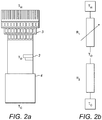
- FIG. 2a A schematic diagram of the system of the present invention is shown in Figures 2a and 2b , wherein the laser thermal tuning system 20 is analogous to a thermal potential divider 30.
- FIG. 2B a thermal analogy 30 of an electrical potential divider circuit is shown. A thermal potential is applied across two resistances, R1 and R2. The potential difference is equivalent to the difference in temperature between T H and T C .
- T D T H ⁇ T C R 1 R 1 + R 2
- T D T H ⁇ T C R 1 R 1 + R 2
- T D the temperature of the device
- TH the external temperature of the ambient air
- T C the temperature of the cold head of the Stirling cooler
- R1 the thermal resistance of the upper arm of the thermal potential divider
- R2 the thermal resistance of the lower arm of the thermal potential divider.
- R1 may be a variable thermal resistance that allows the laser diode temperature, T D to be controlled accurately using a thermoelectric cooler 3.
Landscapes
- Physics & Mathematics (AREA)
- General Physics & Mathematics (AREA)
- Optics & Photonics (AREA)
- Spectroscopy & Molecular Physics (AREA)
- Condensed Matter Physics & Semiconductors (AREA)
- Electromagnetism (AREA)
- Chemical & Material Sciences (AREA)
- Life Sciences & Earth Sciences (AREA)
- Health & Medical Sciences (AREA)
- Analytical Chemistry (AREA)
- Biochemistry (AREA)
- General Health & Medical Sciences (AREA)
- Immunology (AREA)
- Pathology (AREA)
- Investigating Or Analysing Materials By Optical Means (AREA)
- Spectrometry And Color Measurement (AREA)
Description
- The present invention relates to laser spectroscopy, and more particularly, to a Laser Thermal Tuning System (LTTS) and a resulting multi-species spectroscopic analyser comprising the LTTS, wherein the output wavelength of the LTTS may be accurately controlled and the range of accessible wavelengths increased for the tuneable element of the LTTS.
- Laser spectroscopy is a well-known and established measurement technique which uses the fundamental absorption of light by gases and liquids which is known to occur at characteristic wavelengths in order to accurately determine the concentration of the various components present in said gas or liquid mixture.
- There are many well-known spectroscopy techniques. Examples include direct absorption spectroscopy (DAS), wavelength modulated spectroscopy (WMS), frequency modulated spectroscopy (FMS), cavity enhanced absorption spectroscopy (CEAS), and photo acoustic spectroscopy (PAS), amongst others. Most are generically referred to as tuneable diode laser absorption spectroscopy (TDLAS) techniques.
- A fundamental limitation of such TDLAS techniques is that the lasers, from whatever laser technology they are sourced, are manufactured to produce light of a specific wavelength and therefore only work over a limited spectral range. Accordingly, spectroscopic detection systems may be broadly divided into two categories: broadband, low resolution systems; and narrow band, high resolution systems.
- The following examples are given to illustrate the problem: Fourier Transform Infrared Spectrometry (FTIR) employs a black body source to generate a wide spectrum of wavelengths covering the infrared portion of the electromagnetic spectrum. This allows many absorption bands of different molecules to be detected. However, high resolution measurements with an FTIR are challenging, and fine spectral detail is lost. Conversely, TDLAS has an intrinsic high resolution in the region of several MHz due to the narrow line width of the laser. This allows finer details of the molecular spectra to be resolved but only over a narrow wavelength tuning range that, depending on the specific current tuning characteristic of the laser used, can be approximately 1 nm in the near-infrared. Therefore, although the technique is inherently capable of discriminating the detail needed, the limited spectral range of the lasers used in TDLAS can be seen to be a primary limiting factor preventing such an analyser from being able to detect more than one or perhaps two species of interest for any given laser device. TDLAS analysers are therefore usually applied to single molecular species detection.
- Furthermore, real samples to be analysed are complex, typically containing several molecular species that have overlapping spectral features and therefore detection and discrimination of, and between, these compositional elements of the sample is convoluted. In summary, the resolution of the FTIR may not be sufficient to separate the interlaced spectral features whereas the narrow tuning range of TDLAS may be insufficient to capture all of the necessary spectroscopic detail over a suitably wide spectral range.
- It follows that under the prior art, a TDLAS-based analyser which can detect multiple species therefore usually requires multiple lasers and thus is expensive. However, it is clear that many laboratory and industrial processes require determination of several species simultaneously, so it follows that these applications would benefit from a system that can provide multi-species detection without the use of multiple lasers.
- Laser diodes in TDLAS are typically tuned by varying their temperature, either by self-heating by controlling the driving current through the device or by varying the local environmental temperature of the laser. Usually, both methods are used in combination. The local temperature of the laser may be set to centre the tuning window on the spectroscopic region of interest and the current-induced self-heating is then used to provide a rapid tuning sweep. Varying the local temperature over a wider range will increase the tuning window of the laser. Typically, the operating temperature is set to range between 20°C either side of room temperature, extending the tuning range to several nm. It should be noted that in the prior art, increasing the operating temperature significantly above ambient room temperature is not an ideal approach for increasing the tuning range as this leads to a significant decrease in device efficiency.
- In some applications of the prior art, lasers have been super-cooled in order to provide significant shifts in their working wavelengths. However, such super-cooling usually requires cryogenic techniques which are expensive, and whilst this may be acceptable in a controlled laboratory environment, it is usually an unacceptable, or unsuitable, technique for continuous operation or for industrial applications where there is an expectation that an analyser will be able to work for periods of many years with minimal user intervention.
- Attempts have been made to use cooling techniques in order to increase the spectral range of laser diodes. For example, it has been suggested to use cascaded cooling elements or heat pumps to enhance the efficiency of the system and hence attain low temperatures. However, one problem with using cascaded thermoelectric coolers alone is that the efficiency of thermoelectric coolers is well known to diminish in direct relationship to their operating temperature. This is a particularly limiting factor at temperatures approaching cryogenic levels because if it is to be used to control the laser temperature the thermoelectric cooler must cool against both the ambient heat load as well as the self-heating of the laser. It will be clear to anyone versed in the art that the lower the temperature of the system that is required, the less cooling power there is available to overcome the self-heating of the laser.
- Stirling coolers may also be cascaded with thermoelectric coolers to achieve low temperatures. However, a problem with this approach is that fine control of the temperature of the Stirling cooler is difficult to achieve as these are mechanical devices with moving parts. TDLAS typically requires precise temperature control down to as much as a thousandth of a degree Celsius. The Stirling cooler is excellent for rapid cooling, but not as good when used for control. The use of a thermoelectric cooler, or other means, cascaded with the Stirling cooler can rectify this deficiency to a certain extent. However, as the thermoelectric cooler efficiency is diminished at low temperatures, the necessary level of precise temperature stability is hard to achieve. Additional heat loading due to the power dissipation in the laser diode package further exacerbates this problem.
-
JP 2011 119342 A - Accordingly, there is a need for a low cost TDLAS analyser which has a wide tuning range and which is therefore able to analyse the potentially large number of species that may be present in a sample, or process, without the provision of multiple lasers or a costly and unreliable cooling system, and whilst maintaining a high resolution.
- According to the present invention, there is provided a laser thermal tuning system for a tuneable diode laser spectroscopy device, the system comprising: a thermoelectric cooler; a Stirling cooler method via open loop or closed loop; a laser diode arranged between the thermoelectric cooler and the Stirling cooler and coupled to each of the thermoelectric cooler and the Stirling cooler; and control means for controlling each of the thermoelectric cooler and the Stirling cooler, wherein the control means is configured to control the temperature of the laser diode and thereby vary the output wavelength of the laser diode.
- With the configuration of the present invention in combination with any suitable spectroscopic technique including, but not limited to, those listed in the preceding sections, it is clearly possible to provide a TDLAS analyser with an analytical wavelength range which is sufficient to analyse a large number of species yet which is low cost and has a long operating life. This may be done at much lower cost than the prior art configurations, given that there is no need to provide cryogenic cooling.
- The present invention optimises the accuracy of control of the temperature of the device to be cooled, in particular, at low temperatures where the self-heating of the device makes it difficult to control temperatures accurately. An advantage of the arrangement of the present invention is that broad spectroscopic tuning may be achieved by allowing temperature control from cryogenic to ambient temperatures. Another advantage is that fine control of the temperature may be achieved through optimal operation of the thermoelectric cooler.
- Preferably, the LTTS may further comprise a thermal mount. The thermal mount may be arranged to provide an interface from the laser diode to the Stirling cooler. Further, the thermal mount is arranged to provide an interface from the laser diode to the external environment via the thermoelectric cooler. This interface may be further enhanced by the addition of a suitable heat transfer means, such as a heat sink.
- In one example, the control means may be configured to control the output of the laser diode to scan over a continuous range of wavelength. In another example, the control means may be configured to control the output of the laser diode to provide scanning at discrete wavelength steps. In yet another example, separate control means may be utilised to provide the functions of controlling the output of the laser diode to scan over a continuous range of wavelengths and/or controlling the output of the laser diode to provide scanning at discrete wavelength steps.
- According to the present invention, there is also provided a spectroscopic analyser comprising a laser thermal tuning system according to any preceding claim, and further comprising: an analytical measurement chamber for receiving, in use, a sample to be analysed; and a light receiving component for receiving light from the system that has passed though the sample chamber to determine the nature of the sample.
- The analyser of the present invention may be configured to analyse any multi-species composition of interest, examples of which include (but are not limited to): Natural gas; Combustion gases and by-products of combustion processes; Environmental gases including, but not limited to, typical greenhouse gases; Other gases, gas mixtures or liquids where the ability to determine multi-species data would be advantageous. For illustration, in the case of natural gases, the present invention provides advantages over existing analysers in terms of its capability to analyse all or most of the constituent species present in the gas or liquid as well as providing reduced drift and other associated reliability improvements.
- According to the present invention, it is also possible to provide a spectroscopic analyser comprising multiple laser thermal tuning systems and multiple control means, one associated with each laser thermal tuning system, such that the resulting increased analytical spectrum that can be provided by the analyser, enables the detection of even more species.
- Certain preferred embodiments of the present invention will now be described by way of example only with reference to the accompanying drawings, in which:
-
Figure 1 is a schematic diagram showing a prior art analyser; -
Figures 2a and 2b are a schematic diagrams showing a Laser Thermal Tuning System (LTTS) according to the present invention; and -
Figure 3 is a schematic diagram showing an analyser according to the present invention. - Referring to
Figure 1 , asystem 10 for use in a spectroscopic analyser according to the prior art is shown having alaser diode 2 which is mounted on athermoelectric cooler 3. This thermoelectric cooler is in turn mounted on a Stirlingcooler 4. - A schematic diagram of the system of the present invention is shown in
Figures 2a and 2b , wherein the laser thermal tuning system 20 is analogous to a thermal potential divider 30. Referring toFigure 2B , a thermal analogy 30 of an electrical potential divider circuit is shown. A thermal potential is applied across two resistances, R1 and R2. The potential difference is equivalent to the difference in temperature between TH and TC. The thermal potential at the junction between the two resistances, TD, is controlled by varying the values of the two thermal resistances according to the following equation:
- R1 may be a variable thermal resistance that allows the laser diode temperature, TD to be controlled accurately using a
thermoelectric cooler 3.
Claims (7)
- A laser thermal tuning system (10) for a tuneable diode laser spectroscopy device, the system comprising:a thermoelectric cooler (3);a Stirling cooler (4) controlled via open loop or closed loop control;a laser diode (2) arranged between the thermoelectric cooler and the Stirling cooler and coupled to each of the thermoelectric cooler and the Stirling cooler; andcontrol means for controlling each of the thermoelectric cooler and the Stirling cooler, wherein the control means is configured to control the temperature of the laser diode and thereby vary the output wavelength of the laser diode.
- A laser thermal tuning system (10) according to claim 1, wherein the system further comprises a thermal mount.
- A laser thermal tuning system (10) according to claim 2, wherein the thermal mount is arranged to provide an interface from the laser diode (2) to the Stirling cooler (4).
- A laser thermal tuning system (10) according to claim 2 or 3, wherein the thermal mount is arranged to provide an interface from the laser diode (2) to the external environment via the thermoelectric cooler (3).
- A laser thermal tuning system (10) according to any preceding claim, wherein the control means is configured to control the output of the laser diode (2) to scan over a continuous range of wavelengths.
- A laser thermal tuning system (10) according to any preceding claim, wherein the control means is configured to control the output of the laser diode (2) to provide scanning at discrete wavelength steps.
- A spectroscopic analyser comprising a laser thermal tuning system (10) according to any preceding claim, and further comprising:an analytical measurement chamber for receiving, in use, a sample to be analysed; anda light receiving component for receiving light from the system that has passed though the sample chamber to determine the nature of the sample.
Applications Claiming Priority (1)
| Application Number | Priority Date | Filing Date | Title |
|---|---|---|---|
| GB1405436.5A GB2524545B (en) | 2014-03-26 | 2014-03-26 | A tuning system for a tuneable diode laser spectroscopy device comprising a thermo electric cooler and a further cooler |
Publications (2)
| Publication Number | Publication Date |
|---|---|
| EP2924821A1 EP2924821A1 (en) | 2015-09-30 |
| EP2924821B1 true EP2924821B1 (en) | 2018-04-25 |
Family
ID=50686966
Family Applications (1)
| Application Number | Title | Priority Date | Filing Date |
|---|---|---|---|
| EP15160665.4A Not-in-force EP2924821B1 (en) | 2014-03-26 | 2015-03-24 | A tuning system for a tuneable diode laser spectroscopy device comprising a thermo electric cooler and a stirling cooler |
Country Status (3)
| Country | Link |
|---|---|
| US (1) | US20150280399A1 (en) |
| EP (1) | EP2924821B1 (en) |
| GB (1) | GB2524545B (en) |
Families Citing this family (1)
| Publication number | Priority date | Publication date | Assignee | Title |
|---|---|---|---|---|
| EP3142201A1 (en) * | 2015-09-11 | 2017-03-15 | Michell Instruments Ltd. | A tuning system for a tuneable diode laser spectroscopy device comprising a termo electric cooler and a further cooler |
Family Cites Families (15)
| Publication number | Priority date | Publication date | Assignee | Title |
|---|---|---|---|---|
| US4017807A (en) * | 1976-02-23 | 1977-04-12 | The United States Of America As Represented By The Secretary Of The Navy | Electronically controlled digital laser |
| JP2796648B2 (en) * | 1991-07-01 | 1998-09-10 | 東京瓦斯株式会社 | Gas detector |
| US5615052A (en) * | 1993-04-16 | 1997-03-25 | Bruce W. McCaul | Laser diode/lens assembly |
| US5500768A (en) * | 1993-04-16 | 1996-03-19 | Bruce McCaul | Laser diode/lens assembly |
| JP2002353551A (en) * | 2001-05-25 | 2002-12-06 | Fuji Photo Film Co Ltd | Semiconductor laser device |
| JP4016655B2 (en) * | 2001-12-26 | 2007-12-05 | 日本電気株式会社 | Optical amplifier gain measuring apparatus and optical amplifier gain measuring method |
| US20070121689A1 (en) * | 2003-09-22 | 2007-05-31 | Snake Creek Lasers Llc | Methods for Producing Diode-Pumped Micro Lasers |
| JP2006277417A (en) * | 2005-03-29 | 2006-10-12 | Fujitsu Ltd | COOLING CONTROL DEVICE AND COOLING CONTROL METHOD |
| JP2007088266A (en) * | 2005-09-22 | 2007-04-05 | Sony Corp | Laser light source device and optical device |
| US20080089369A1 (en) * | 2006-10-16 | 2008-04-17 | Pavilion Integration Corporation | Injection seeding employing continuous wavelength sweeping for master-slave resonance |
| US20090059971A1 (en) * | 2007-08-27 | 2009-03-05 | Axsun Technologies, Inc. | Linearized Swept Laser Source for Optical Coherence Analysis System |
| WO2009116132A1 (en) * | 2008-03-18 | 2009-09-24 | 三菱電機株式会社 | Semiconductor module |
| JP2011119342A (en) * | 2009-12-01 | 2011-06-16 | Miyachi Technos Corp | Laser diode cooling mechanism and laser device equipped with the same |
| WO2011083462A2 (en) * | 2010-01-06 | 2011-07-14 | Novatrans Group Sa | Thermo-electric cooling system and method for cooling electronic devices |
| US20130322472A1 (en) * | 2012-05-29 | 2013-12-05 | Mars Technology | Wavelength selective and tunable laser device |
-
2014
- 2014-03-26 GB GB1405436.5A patent/GB2524545B/en active Active
-
2015
- 2015-03-24 US US14/666,912 patent/US20150280399A1/en not_active Abandoned
- 2015-03-24 EP EP15160665.4A patent/EP2924821B1/en not_active Not-in-force
Non-Patent Citations (1)
| Title |
|---|
| None * |
Also Published As
| Publication number | Publication date |
|---|---|
| US20150280399A1 (en) | 2015-10-01 |
| GB2524545A (en) | 2015-09-30 |
| GB2524545B (en) | 2016-06-08 |
| EP2924821A1 (en) | 2015-09-30 |
| GB201405436D0 (en) | 2014-05-07 |
Similar Documents
| Publication | Publication Date | Title |
|---|---|---|
| McManus et al. | Pulsed quantum cascade laser instrument with compact design for rapid, high sensitivity measurements of trace gases in air | |
| McCulloch et al. | Highly sensitive detection of trace gases using the time-resolved frequency downchirp from pulsed quantum-cascade lasers | |
| US9755399B2 (en) | Packaged laser thermal control system | |
| US20060121602A1 (en) | Optical scanning configurations, systems, and methods | |
| US9097583B2 (en) | Long-path infrared spectrometer | |
| Li et al. | Real-time measurements of atmospheric CO using a continuous-wave room temperature quantum cascade laser based spectrometer | |
| EP1890182A2 (en) | Thermally compensated optical scanning systems and methods | |
| KR101968808B1 (en) | Device and method for determining the concentration of at least one gas in a sample gas flow by means of infrared absorption spectroscopy | |
| Malinen et al. | LED-based NIR spectrometer module for hand-held and process analyser applications | |
| Ye et al. | Design and performances of a mid-infrared CH4 detection device with novel three-channel-based LS-FTF self-adaptive denoising structure | |
| Kröll et al. | An evaluation of precision and systematic errors in vibrational CARS thermometry | |
| CN107250740A (en) | optical measuring system | |
| CN101122566A (en) | Semiconductor laser absorption spectrum gas analysis method and system | |
| EP2924821A1 (en) | A tuning system for a tuneable diode laser spectroscopy device comprising a thermo electric cooler and a further cooler | |
| EP3142201A1 (en) | A tuning system for a tuneable diode laser spectroscopy device comprising a termo electric cooler and a further cooler | |
| Gu et al. | Pressure dependence of vibrational Raman scattering of narrow-band, 248-nm, laser light by H2, N2, O2, CO2, CH4, C2H6, and C3H8 as high as 97 bar | |
| Kozlowska et al. | Deep level emission from high-power diode laser bars detected by multispectral infrared imaging | |
| Braune et al. | Design and Realization of a Miniaturized DFB Diode Laser-based SHG Light Source with a 2-nm Tunable Emission at 488 nm | |
| Furstenberg et al. | Characterization and control of tunable quantum cascade laser beam parameters for stand-off spectroscopy | |
| CN100543457C (en) | A semiconductor laser absorption spectrum gas analysis method | |
| Kempfert et al. | Detectors for Fourier transform spectroscopy | |
| Sharma et al. | Diode laser-based trace detection of hydrogen-sulfide at 2646.3 nm and hydrocarbon spectral interference effects | |
| Finton et al. | Advances in real time spectroscopy using a grating spectrometer and broadband IR laser source | |
| Grafen et al. | Characterization of a multi-module tunable EC-QCL system for mid-infrared biofluid spectroscopy for hospital use and personalized diabetes technology | |
| Gerlach | Non‐dispersive infrared sensors |
Legal Events
| Date | Code | Title | Description |
|---|---|---|---|
| PUAI | Public reference made under article 153(3) epc to a published international application that has entered the european phase |
Free format text: ORIGINAL CODE: 0009012 |
|
| AK | Designated contracting states |
Kind code of ref document: A1 Designated state(s): AL AT BE BG CH CY CZ DE DK EE ES FI FR GB GR HR HU IE IS IT LI LT LU LV MC MK MT NL NO PL PT RO RS SE SI SK SM TR |
|
| AX | Request for extension of the european patent |
Extension state: BA ME |
|
| 17P | Request for examination filed |
Effective date: 20160330 |
|
| RBV | Designated contracting states (corrected) |
Designated state(s): AL AT BE BG CH CY CZ DE DK EE ES FI FR GB GR HR HU IE IS IT LI LT LU LV MC MK MT NL NO PL PT RO RS SE SI SK SM TR |
|
| GRAP | Despatch of communication of intention to grant a patent |
Free format text: ORIGINAL CODE: EPIDOSNIGR1 |
|
| STAA | Information on the status of an ep patent application or granted ep patent |
Free format text: STATUS: GRANT OF PATENT IS INTENDED |
|
| INTG | Intention to grant announced |
Effective date: 20171121 |
|
| GRAA | (expected) grant |
Free format text: ORIGINAL CODE: 0009210 |
|
| GRAS | Grant fee paid |
Free format text: ORIGINAL CODE: EPIDOSNIGR3 |
|
| STAA | Information on the status of an ep patent application or granted ep patent |
Free format text: STATUS: THE PATENT HAS BEEN GRANTED |
|
| AK | Designated contracting states |
Kind code of ref document: B1 Designated state(s): AL AT BE BG CH CY CZ DE DK EE ES FI FR GB GR HR HU IE IS IT LI LT LU LV MC MK MT NL NO PL PT RO RS SE SI SK SM TR |
|
| REG | Reference to a national code |
Ref country code: GB Ref legal event code: FG4D |
|
| REG | Reference to a national code |
Ref country code: CH Ref legal event code: EP |
|
| REG | Reference to a national code |
Ref country code: AT Ref legal event code: REF Ref document number: 993841 Country of ref document: AT Kind code of ref document: T Effective date: 20180515 |
|
| REG | Reference to a national code |
Ref country code: IE Ref legal event code: FG4D |
|
| REG | Reference to a national code |
Ref country code: DE Ref legal event code: R096 Ref document number: 602015010296 Country of ref document: DE |
|
| REG | Reference to a national code |
Ref country code: NL Ref legal event code: MP Effective date: 20180425 |
|
| REG | Reference to a national code |
Ref country code: LT Ref legal event code: MG4D |
|
| PG25 | Lapsed in a contracting state [announced via postgrant information from national office to epo] |
Ref country code: NL Free format text: LAPSE BECAUSE OF FAILURE TO SUBMIT A TRANSLATION OF THE DESCRIPTION OR TO PAY THE FEE WITHIN THE PRESCRIBED TIME-LIMIT Effective date: 20180425 |
|
| PG25 | Lapsed in a contracting state [announced via postgrant information from national office to epo] |
Ref country code: SE Free format text: LAPSE BECAUSE OF FAILURE TO SUBMIT A TRANSLATION OF THE DESCRIPTION OR TO PAY THE FEE WITHIN THE PRESCRIBED TIME-LIMIT Effective date: 20180425 Ref country code: LT Free format text: LAPSE BECAUSE OF FAILURE TO SUBMIT A TRANSLATION OF THE DESCRIPTION OR TO PAY THE FEE WITHIN THE PRESCRIBED TIME-LIMIT Effective date: 20180425 Ref country code: ES Free format text: LAPSE BECAUSE OF FAILURE TO SUBMIT A TRANSLATION OF THE DESCRIPTION OR TO PAY THE FEE WITHIN THE PRESCRIBED TIME-LIMIT Effective date: 20180425 Ref country code: BG Free format text: LAPSE BECAUSE OF FAILURE TO SUBMIT A TRANSLATION OF THE DESCRIPTION OR TO PAY THE FEE WITHIN THE PRESCRIBED TIME-LIMIT Effective date: 20180725 Ref country code: FI Free format text: LAPSE BECAUSE OF FAILURE TO SUBMIT A TRANSLATION OF THE DESCRIPTION OR TO PAY THE FEE WITHIN THE PRESCRIBED TIME-LIMIT Effective date: 20180425 Ref country code: NO Free format text: LAPSE BECAUSE OF FAILURE TO SUBMIT A TRANSLATION OF THE DESCRIPTION OR TO PAY THE FEE WITHIN THE PRESCRIBED TIME-LIMIT Effective date: 20180725 Ref country code: PL Free format text: LAPSE BECAUSE OF FAILURE TO SUBMIT A TRANSLATION OF THE DESCRIPTION OR TO PAY THE FEE WITHIN THE PRESCRIBED TIME-LIMIT Effective date: 20180425 |
|
| PG25 | Lapsed in a contracting state [announced via postgrant information from national office to epo] |
Ref country code: LV Free format text: LAPSE BECAUSE OF FAILURE TO SUBMIT A TRANSLATION OF THE DESCRIPTION OR TO PAY THE FEE WITHIN THE PRESCRIBED TIME-LIMIT Effective date: 20180425 Ref country code: GR Free format text: LAPSE BECAUSE OF FAILURE TO SUBMIT A TRANSLATION OF THE DESCRIPTION OR TO PAY THE FEE WITHIN THE PRESCRIBED TIME-LIMIT Effective date: 20180726 Ref country code: HR Free format text: LAPSE BECAUSE OF FAILURE TO SUBMIT A TRANSLATION OF THE DESCRIPTION OR TO PAY THE FEE WITHIN THE PRESCRIBED TIME-LIMIT Effective date: 20180425 Ref country code: RS Free format text: LAPSE BECAUSE OF FAILURE TO SUBMIT A TRANSLATION OF THE DESCRIPTION OR TO PAY THE FEE WITHIN THE PRESCRIBED TIME-LIMIT Effective date: 20180425 |
|
| REG | Reference to a national code |
Ref country code: AT Ref legal event code: MK05 Ref document number: 993841 Country of ref document: AT Kind code of ref document: T Effective date: 20180425 |
|
| PG25 | Lapsed in a contracting state [announced via postgrant information from national office to epo] |
Ref country code: PT Free format text: LAPSE BECAUSE OF FAILURE TO SUBMIT A TRANSLATION OF THE DESCRIPTION OR TO PAY THE FEE WITHIN THE PRESCRIBED TIME-LIMIT Effective date: 20180827 |
|
| REG | Reference to a national code |
Ref country code: DE Ref legal event code: R097 Ref document number: 602015010296 Country of ref document: DE |
|
| PG25 | Lapsed in a contracting state [announced via postgrant information from national office to epo] |
Ref country code: CZ Free format text: LAPSE BECAUSE OF FAILURE TO SUBMIT A TRANSLATION OF THE DESCRIPTION OR TO PAY THE FEE WITHIN THE PRESCRIBED TIME-LIMIT Effective date: 20180425 Ref country code: RO Free format text: LAPSE BECAUSE OF FAILURE TO SUBMIT A TRANSLATION OF THE DESCRIPTION OR TO PAY THE FEE WITHIN THE PRESCRIBED TIME-LIMIT Effective date: 20180425 Ref country code: EE Free format text: LAPSE BECAUSE OF FAILURE TO SUBMIT A TRANSLATION OF THE DESCRIPTION OR TO PAY THE FEE WITHIN THE PRESCRIBED TIME-LIMIT Effective date: 20180425 Ref country code: SK Free format text: LAPSE BECAUSE OF FAILURE TO SUBMIT A TRANSLATION OF THE DESCRIPTION OR TO PAY THE FEE WITHIN THE PRESCRIBED TIME-LIMIT Effective date: 20180425 Ref country code: DK Free format text: LAPSE BECAUSE OF FAILURE TO SUBMIT A TRANSLATION OF THE DESCRIPTION OR TO PAY THE FEE WITHIN THE PRESCRIBED TIME-LIMIT Effective date: 20180425 Ref country code: AT Free format text: LAPSE BECAUSE OF FAILURE TO SUBMIT A TRANSLATION OF THE DESCRIPTION OR TO PAY THE FEE WITHIN THE PRESCRIBED TIME-LIMIT Effective date: 20180425 |
|
| PG25 | Lapsed in a contracting state [announced via postgrant information from national office to epo] |
Ref country code: SM Free format text: LAPSE BECAUSE OF FAILURE TO SUBMIT A TRANSLATION OF THE DESCRIPTION OR TO PAY THE FEE WITHIN THE PRESCRIBED TIME-LIMIT Effective date: 20180425 Ref country code: IT Free format text: LAPSE BECAUSE OF FAILURE TO SUBMIT A TRANSLATION OF THE DESCRIPTION OR TO PAY THE FEE WITHIN THE PRESCRIBED TIME-LIMIT Effective date: 20180425 |
|
| PLBE | No opposition filed within time limit |
Free format text: ORIGINAL CODE: 0009261 |
|
| STAA | Information on the status of an ep patent application or granted ep patent |
Free format text: STATUS: NO OPPOSITION FILED WITHIN TIME LIMIT |
|
| 26N | No opposition filed |
Effective date: 20190128 |
|
| PG25 | Lapsed in a contracting state [announced via postgrant information from national office to epo] |
Ref country code: SI Free format text: LAPSE BECAUSE OF FAILURE TO SUBMIT A TRANSLATION OF THE DESCRIPTION OR TO PAY THE FEE WITHIN THE PRESCRIBED TIME-LIMIT Effective date: 20180425 |
|
| PG25 | Lapsed in a contracting state [announced via postgrant information from national office to epo] |
Ref country code: MC Free format text: LAPSE BECAUSE OF FAILURE TO SUBMIT A TRANSLATION OF THE DESCRIPTION OR TO PAY THE FEE WITHIN THE PRESCRIBED TIME-LIMIT Effective date: 20180425 |
|
| PG25 | Lapsed in a contracting state [announced via postgrant information from national office to epo] |
Ref country code: LU Free format text: LAPSE BECAUSE OF NON-PAYMENT OF DUE FEES Effective date: 20190324 Ref country code: AL Free format text: LAPSE BECAUSE OF FAILURE TO SUBMIT A TRANSLATION OF THE DESCRIPTION OR TO PAY THE FEE WITHIN THE PRESCRIBED TIME-LIMIT Effective date: 20180425 |
|
| REG | Reference to a national code |
Ref country code: BE Ref legal event code: MM Effective date: 20190331 |
|
| PG25 | Lapsed in a contracting state [announced via postgrant information from national office to epo] |
Ref country code: IE Free format text: LAPSE BECAUSE OF NON-PAYMENT OF DUE FEES Effective date: 20190324 |
|
| PG25 | Lapsed in a contracting state [announced via postgrant information from national office to epo] |
Ref country code: BE Free format text: LAPSE BECAUSE OF NON-PAYMENT OF DUE FEES Effective date: 20190331 |
|
| PG25 | Lapsed in a contracting state [announced via postgrant information from national office to epo] |
Ref country code: TR Free format text: LAPSE BECAUSE OF FAILURE TO SUBMIT A TRANSLATION OF THE DESCRIPTION OR TO PAY THE FEE WITHIN THE PRESCRIBED TIME-LIMIT Effective date: 20180425 |
|
| PG25 | Lapsed in a contracting state [announced via postgrant information from national office to epo] |
Ref country code: MT Free format text: LAPSE BECAUSE OF NON-PAYMENT OF DUE FEES Effective date: 20190324 |
|
| PG25 | Lapsed in a contracting state [announced via postgrant information from national office to epo] |
Ref country code: CY Free format text: LAPSE BECAUSE OF FAILURE TO SUBMIT A TRANSLATION OF THE DESCRIPTION OR TO PAY THE FEE WITHIN THE PRESCRIBED TIME-LIMIT Effective date: 20180425 |
|
| PG25 | Lapsed in a contracting state [announced via postgrant information from national office to epo] |
Ref country code: IS Free format text: LAPSE BECAUSE OF FAILURE TO SUBMIT A TRANSLATION OF THE DESCRIPTION OR TO PAY THE FEE WITHIN THE PRESCRIBED TIME-LIMIT Effective date: 20180825 |
|
| PG25 | Lapsed in a contracting state [announced via postgrant information from national office to epo] |
Ref country code: HU Free format text: LAPSE BECAUSE OF FAILURE TO SUBMIT A TRANSLATION OF THE DESCRIPTION OR TO PAY THE FEE WITHIN THE PRESCRIBED TIME-LIMIT; INVALID AB INITIO Effective date: 20150324 |
|
| PGFP | Annual fee paid to national office [announced via postgrant information from national office to epo] |
Ref country code: GB Payment date: 20220203 Year of fee payment: 8 Ref country code: DE Payment date: 20220126 Year of fee payment: 8 Ref country code: CH Payment date: 20220114 Year of fee payment: 8 |
|
| PGFP | Annual fee paid to national office [announced via postgrant information from national office to epo] |
Ref country code: FR Payment date: 20220210 Year of fee payment: 8 |
|
| PG25 | Lapsed in a contracting state [announced via postgrant information from national office to epo] |
Ref country code: MK Free format text: LAPSE BECAUSE OF FAILURE TO SUBMIT A TRANSLATION OF THE DESCRIPTION OR TO PAY THE FEE WITHIN THE PRESCRIBED TIME-LIMIT Effective date: 20180425 |
|
| REG | Reference to a national code |
Ref country code: DE Ref legal event code: R119 Ref document number: 602015010296 Country of ref document: DE |
|
| REG | Reference to a national code |
Ref country code: CH Ref legal event code: PL |
|
| GBPC | Gb: european patent ceased through non-payment of renewal fee |
Effective date: 20230324 |
|
| PG25 | Lapsed in a contracting state [announced via postgrant information from national office to epo] |
Ref country code: GB Free format text: LAPSE BECAUSE OF NON-PAYMENT OF DUE FEES Effective date: 20230324 |
|
| PG25 | Lapsed in a contracting state [announced via postgrant information from national office to epo] |
Ref country code: LI Free format text: LAPSE BECAUSE OF NON-PAYMENT OF DUE FEES Effective date: 20230331 Ref country code: GB Free format text: LAPSE BECAUSE OF NON-PAYMENT OF DUE FEES Effective date: 20230324 Ref country code: FR Free format text: LAPSE BECAUSE OF NON-PAYMENT OF DUE FEES Effective date: 20230331 Ref country code: DE Free format text: LAPSE BECAUSE OF NON-PAYMENT OF DUE FEES Effective date: 20231003 Ref country code: CH Free format text: LAPSE BECAUSE OF NON-PAYMENT OF DUE FEES Effective date: 20230331 |