EP2924009A1 - Complex oxide particles and catalyst for purifying exhaust gas using same - Google Patents
Complex oxide particles and catalyst for purifying exhaust gas using same Download PDFInfo
- Publication number
- EP2924009A1 EP2924009A1 EP13856611.2A EP13856611A EP2924009A1 EP 2924009 A1 EP2924009 A1 EP 2924009A1 EP 13856611 A EP13856611 A EP 13856611A EP 2924009 A1 EP2924009 A1 EP 2924009A1
- Authority
- EP
- European Patent Office
- Prior art keywords
- complex oxide
- ceria
- catalyst
- oxide particles
- zirconia
- Prior art date
- Legal status (The legal status is an assumption and is not a legal conclusion. Google has not performed a legal analysis and makes no representation as to the accuracy of the status listed.)
- Withdrawn
Links
Images





Classifications
-
- B—PERFORMING OPERATIONS; TRANSPORTING
- B01—PHYSICAL OR CHEMICAL PROCESSES OR APPARATUS IN GENERAL
- B01J—CHEMICAL OR PHYSICAL PROCESSES, e.g. CATALYSIS OR COLLOID CHEMISTRY; THEIR RELEVANT APPARATUS
- B01J23/00—Catalysts comprising metals or metal oxides or hydroxides, not provided for in group B01J21/00
- B01J23/38—Catalysts comprising metals or metal oxides or hydroxides, not provided for in group B01J21/00 of noble metals
- B01J23/54—Catalysts comprising metals or metal oxides or hydroxides, not provided for in group B01J21/00 of noble metals combined with metals, oxides or hydroxides provided for in groups B01J23/02 - B01J23/36
- B01J23/56—Platinum group metals
- B01J23/63—Platinum group metals with rare earths or actinides
-
- B—PERFORMING OPERATIONS; TRANSPORTING
- B01—PHYSICAL OR CHEMICAL PROCESSES OR APPARATUS IN GENERAL
- B01D—SEPARATION
- B01D53/00—Separation of gases or vapours; Recovering vapours of volatile solvents from gases; Chemical or biological purification of waste gases, e.g. engine exhaust gases, smoke, fumes, flue gases, aerosols
- B01D53/34—Chemical or biological purification of waste gases
- B01D53/92—Chemical or biological purification of waste gases of engine exhaust gases
- B01D53/94—Chemical or biological purification of waste gases of engine exhaust gases by catalytic processes
- B01D53/9404—Removing only nitrogen compounds
- B01D53/9409—Nitrogen oxides
- B01D53/9413—Processes characterised by a specific catalyst
-
- B—PERFORMING OPERATIONS; TRANSPORTING
- B01—PHYSICAL OR CHEMICAL PROCESSES OR APPARATUS IN GENERAL
- B01D—SEPARATION
- B01D53/00—Separation of gases or vapours; Recovering vapours of volatile solvents from gases; Chemical or biological purification of waste gases, e.g. engine exhaust gases, smoke, fumes, flue gases, aerosols
- B01D53/34—Chemical or biological purification of waste gases
- B01D53/92—Chemical or biological purification of waste gases of engine exhaust gases
- B01D53/94—Chemical or biological purification of waste gases of engine exhaust gases by catalytic processes
- B01D53/9445—Simultaneously removing carbon monoxide, hydrocarbons or nitrogen oxides making use of three-way catalysts [TWC] or four-way-catalysts [FWC]
- B01D53/945—Simultaneously removing carbon monoxide, hydrocarbons or nitrogen oxides making use of three-way catalysts [TWC] or four-way-catalysts [FWC] characterised by a specific catalyst
-
- B—PERFORMING OPERATIONS; TRANSPORTING
- B01—PHYSICAL OR CHEMICAL PROCESSES OR APPARATUS IN GENERAL
- B01J—CHEMICAL OR PHYSICAL PROCESSES, e.g. CATALYSIS OR COLLOID CHEMISTRY; THEIR RELEVANT APPARATUS
- B01J23/00—Catalysts comprising metals or metal oxides or hydroxides, not provided for in group B01J21/00
- B01J23/002—Mixed oxides other than spinels, e.g. perovskite
-
- B—PERFORMING OPERATIONS; TRANSPORTING
- B01—PHYSICAL OR CHEMICAL PROCESSES OR APPARATUS IN GENERAL
- B01J—CHEMICAL OR PHYSICAL PROCESSES, e.g. CATALYSIS OR COLLOID CHEMISTRY; THEIR RELEVANT APPARATUS
- B01J23/00—Catalysts comprising metals or metal oxides or hydroxides, not provided for in group B01J21/00
- B01J23/10—Catalysts comprising metals or metal oxides or hydroxides, not provided for in group B01J21/00 of rare earths
-
- B—PERFORMING OPERATIONS; TRANSPORTING
- B01—PHYSICAL OR CHEMICAL PROCESSES OR APPARATUS IN GENERAL
- B01J—CHEMICAL OR PHYSICAL PROCESSES, e.g. CATALYSIS OR COLLOID CHEMISTRY; THEIR RELEVANT APPARATUS
- B01J37/00—Processes, in general, for preparing catalysts; Processes, in general, for activation of catalysts
- B01J37/02—Impregnation, coating or precipitation
- B01J37/024—Multiple impregnation or coating
- B01J37/0244—Coatings comprising several layers
-
- B—PERFORMING OPERATIONS; TRANSPORTING
- B01—PHYSICAL OR CHEMICAL PROCESSES OR APPARATUS IN GENERAL
- B01J—CHEMICAL OR PHYSICAL PROCESSES, e.g. CATALYSIS OR COLLOID CHEMISTRY; THEIR RELEVANT APPARATUS
- B01J37/00—Processes, in general, for preparing catalysts; Processes, in general, for activation of catalysts
- B01J37/02—Impregnation, coating or precipitation
- B01J37/024—Multiple impregnation or coating
- B01J37/0248—Coatings comprising impregnated particles
-
- B—PERFORMING OPERATIONS; TRANSPORTING
- B01—PHYSICAL OR CHEMICAL PROCESSES OR APPARATUS IN GENERAL
- B01J—CHEMICAL OR PHYSICAL PROCESSES, e.g. CATALYSIS OR COLLOID CHEMISTRY; THEIR RELEVANT APPARATUS
- B01J37/00—Processes, in general, for preparing catalysts; Processes, in general, for activation of catalysts
- B01J37/02—Impregnation, coating or precipitation
- B01J37/03—Precipitation; Co-precipitation
-
- C—CHEMISTRY; METALLURGY
- C01—INORGANIC CHEMISTRY
- C01F—COMPOUNDS OF THE METALS BERYLLIUM, MAGNESIUM, ALUMINIUM, CALCIUM, STRONTIUM, BARIUM, RADIUM, THORIUM, OR OF THE RARE-EARTH METALS
- C01F7/00—Compounds of aluminium
- C01F7/78—Compounds containing aluminium, with or without oxygen or hydrogen, and containing two or more other elements
-
- C—CHEMISTRY; METALLURGY
- C01—INORGANIC CHEMISTRY
- C01G—COMPOUNDS CONTAINING METALS NOT COVERED BY SUBCLASSES C01D OR C01F
- C01G25/00—Compounds of zirconium
- C01G25/006—Compounds containing zirconium, with or without oxygen or hydrogen, and containing two or more other elements
-
- C—CHEMISTRY; METALLURGY
- C01—INORGANIC CHEMISTRY
- C01G—COMPOUNDS CONTAINING METALS NOT COVERED BY SUBCLASSES C01D OR C01F
- C01G25/00—Compounds of zirconium
- C01G25/02—Oxides
-
- B—PERFORMING OPERATIONS; TRANSPORTING
- B01—PHYSICAL OR CHEMICAL PROCESSES OR APPARATUS IN GENERAL
- B01D—SEPARATION
- B01D2255/00—Catalysts
- B01D2255/10—Noble metals or compounds thereof
- B01D2255/102—Platinum group metals
- B01D2255/1023—Palladium
-
- B—PERFORMING OPERATIONS; TRANSPORTING
- B01—PHYSICAL OR CHEMICAL PROCESSES OR APPARATUS IN GENERAL
- B01D—SEPARATION
- B01D2255/00—Catalysts
- B01D2255/10—Noble metals or compounds thereof
- B01D2255/102—Platinum group metals
- B01D2255/1025—Rhodium
-
- B—PERFORMING OPERATIONS; TRANSPORTING
- B01—PHYSICAL OR CHEMICAL PROCESSES OR APPARATUS IN GENERAL
- B01D—SEPARATION
- B01D2255/00—Catalysts
- B01D2255/20—Metals or compounds thereof
- B01D2255/206—Rare earth metals
- B01D2255/2061—Yttrium
-
- B—PERFORMING OPERATIONS; TRANSPORTING
- B01—PHYSICAL OR CHEMICAL PROCESSES OR APPARATUS IN GENERAL
- B01D—SEPARATION
- B01D2255/00—Catalysts
- B01D2255/20—Metals or compounds thereof
- B01D2255/206—Rare earth metals
- B01D2255/2063—Lanthanum
-
- B—PERFORMING OPERATIONS; TRANSPORTING
- B01—PHYSICAL OR CHEMICAL PROCESSES OR APPARATUS IN GENERAL
- B01D—SEPARATION
- B01D2255/00—Catalysts
- B01D2255/20—Metals or compounds thereof
- B01D2255/209—Other metals
- B01D2255/2092—Aluminium
-
- B—PERFORMING OPERATIONS; TRANSPORTING
- B01—PHYSICAL OR CHEMICAL PROCESSES OR APPARATUS IN GENERAL
- B01D—SEPARATION
- B01D2255/00—Catalysts
- B01D2255/40—Mixed oxides
- B01D2255/407—Zr-Ce mixed oxides
-
- B—PERFORMING OPERATIONS; TRANSPORTING
- B01—PHYSICAL OR CHEMICAL PROCESSES OR APPARATUS IN GENERAL
- B01D—SEPARATION
- B01D2255/00—Catalysts
- B01D2255/90—Physical characteristics of catalysts
- B01D2255/902—Multilayered catalyst
- B01D2255/9022—Two layers
-
- B—PERFORMING OPERATIONS; TRANSPORTING
- B01—PHYSICAL OR CHEMICAL PROCESSES OR APPARATUS IN GENERAL
- B01D—SEPARATION
- B01D2255/00—Catalysts
- B01D2255/90—Physical characteristics of catalysts
- B01D2255/908—O2-storage component incorporated in the catalyst
-
- B—PERFORMING OPERATIONS; TRANSPORTING
- B01—PHYSICAL OR CHEMICAL PROCESSES OR APPARATUS IN GENERAL
- B01D—SEPARATION
- B01D2255/00—Catalysts
- B01D2255/90—Physical characteristics of catalysts
- B01D2255/92—Dimensions
- B01D2255/9202—Linear dimensions
-
- B—PERFORMING OPERATIONS; TRANSPORTING
- B01—PHYSICAL OR CHEMICAL PROCESSES OR APPARATUS IN GENERAL
- B01J—CHEMICAL OR PHYSICAL PROCESSES, e.g. CATALYSIS OR COLLOID CHEMISTRY; THEIR RELEVANT APPARATUS
- B01J2523/00—Constitutive chemical elements of heterogeneous catalysts
-
- B—PERFORMING OPERATIONS; TRANSPORTING
- B01—PHYSICAL OR CHEMICAL PROCESSES OR APPARATUS IN GENERAL
- B01J—CHEMICAL OR PHYSICAL PROCESSES, e.g. CATALYSIS OR COLLOID CHEMISTRY; THEIR RELEVANT APPARATUS
- B01J35/00—Catalysts, in general, characterised by their form or physical properties
- B01J35/40—Catalysts, in general, characterised by their form or physical properties characterised by dimensions, e.g. grain size
- B01J35/45—Nanoparticles
-
- C—CHEMISTRY; METALLURGY
- C01—INORGANIC CHEMISTRY
- C01P—INDEXING SCHEME RELATING TO STRUCTURAL AND PHYSICAL ASPECTS OF SOLID INORGANIC COMPOUNDS
- C01P2004/00—Particle morphology
- C01P2004/60—Particles characterised by their size
- C01P2004/64—Nanometer sized, i.e. from 1-100 nanometer
-
- C—CHEMISTRY; METALLURGY
- C01—INORGANIC CHEMISTRY
- C01P—INDEXING SCHEME RELATING TO STRUCTURAL AND PHYSICAL ASPECTS OF SOLID INORGANIC COMPOUNDS
- C01P2006/00—Physical properties of inorganic compounds
- C01P2006/12—Surface area
-
- C—CHEMISTRY; METALLURGY
- C01—INORGANIC CHEMISTRY
- C01P—INDEXING SCHEME RELATING TO STRUCTURAL AND PHYSICAL ASPECTS OF SOLID INORGANIC COMPOUNDS
- C01P2006/00—Physical properties of inorganic compounds
- C01P2006/80—Compositional purity
-
- F—MECHANICAL ENGINEERING; LIGHTING; HEATING; WEAPONS; BLASTING
- F01—MACHINES OR ENGINES IN GENERAL; ENGINE PLANTS IN GENERAL; STEAM ENGINES
- F01N—GAS-FLOW SILENCERS OR EXHAUST APPARATUS FOR MACHINES OR ENGINES IN GENERAL; GAS-FLOW SILENCERS OR EXHAUST APPARATUS FOR INTERNAL-COMBUSTION ENGINES
- F01N3/00—Exhaust or silencing apparatus having means for purifying, rendering innocuous, or otherwise treating exhaust
- F01N3/08—Exhaust or silencing apparatus having means for purifying, rendering innocuous, or otherwise treating exhaust for rendering innocuous
- F01N3/10—Exhaust or silencing apparatus having means for purifying, rendering innocuous, or otherwise treating exhaust for rendering innocuous by thermal or catalytic conversion of noxious components of exhaust
- F01N3/101—Three-way catalysts
-
- Y—GENERAL TAGGING OF NEW TECHNOLOGICAL DEVELOPMENTS; GENERAL TAGGING OF CROSS-SECTIONAL TECHNOLOGIES SPANNING OVER SEVERAL SECTIONS OF THE IPC; TECHNICAL SUBJECTS COVERED BY FORMER USPC CROSS-REFERENCE ART COLLECTIONS [XRACs] AND DIGESTS
- Y02—TECHNOLOGIES OR APPLICATIONS FOR MITIGATION OR ADAPTATION AGAINST CLIMATE CHANGE
- Y02A—TECHNOLOGIES FOR ADAPTATION TO CLIMATE CHANGE
- Y02A50/00—TECHNOLOGIES FOR ADAPTATION TO CLIMATE CHANGE in human health protection, e.g. against extreme weather
- Y02A50/20—Air quality improvement or preservation, e.g. vehicle emission control or emission reduction by using catalytic converters
-
- Y—GENERAL TAGGING OF NEW TECHNOLOGICAL DEVELOPMENTS; GENERAL TAGGING OF CROSS-SECTIONAL TECHNOLOGIES SPANNING OVER SEVERAL SECTIONS OF THE IPC; TECHNICAL SUBJECTS COVERED BY FORMER USPC CROSS-REFERENCE ART COLLECTIONS [XRACs] AND DIGESTS
- Y02—TECHNOLOGIES OR APPLICATIONS FOR MITIGATION OR ADAPTATION AGAINST CLIMATE CHANGE
- Y02T—CLIMATE CHANGE MITIGATION TECHNOLOGIES RELATED TO TRANSPORTATION
- Y02T10/00—Road transport of goods or passengers
- Y02T10/10—Internal combustion engine [ICE] based vehicles
- Y02T10/12—Improving ICE efficiencies
Definitions
- the present invention relates to complex oxide particles as carriers that are capable of imparting high heat tolerance and oxygen storage capacity to a catalyst and an exhaust gas purifying catalyst using the same. More particularly, the present invention relates to an exhaust gas purifying catalyst for automobiles.
- Exhaust gas emitted from internal-combustion engines of vehicles or the like contains harmful gases such as carbon monoxide (CO), nitrogen oxide (NOx), and unburned hydrocarbon (HC).
- an exhaust gas purifying catalyst (so-called three-way catalyst) for decomposing such harmful gases, a ceria-zirconia complex oxide having oxygen storage capacity (OSC) is used, for example.
- a substance having oxygen storage capacity can control the air-fuel ratio (A/F) in a microscopic space by absorbing and releasing oxygen and can suppress a decrease in a purification rate that results from variations in exhaust gas composition.
- it is preferable for an exhaust gas purifying catalyst to have high oxygen storage capacity so as to suppress NOx emissions, since NOx generated in a lean atmosphere is reduced with difficulty.
- JP H10-182155 A discloses complex oxide carriers comprising at least one of ceria, zirconia, and a ceria-zirconia complex oxide and alumina, wherein at least one of the ceria, the zirconia, and the ceria-zirconia complex oxide contained in the complex oxide carriers maintains its crystallite diameter at 10 nm or less after the complex oxide carriers are heated in the air at 1,000°C for 5 hours.
- JP H10-182155 A also describes, as elements constituting carriers, at least one element selected from among alkaline earth metal elements, including alkali metal and barium, in addition to cerium, zirconium, and aluminum, transition metal elements, including iron, and rare earth metal elements, including lanthanum and yttrium. JP H10-182155 A ( 1998 ), however, does not specifically describe preferable contents of the elements other than cerium, zirconium, and aluminum.
- the crystallite diameters of the ceria-zirconia complex oxides of most carriers that were actually produced in JP H10-182155 A ( 1998 ) are less than 5 nm. In such cases, phase separation of the ceria-zirconia complex oxide advances at high temperatures (1,000°C or higher), causing fluctuations of the atmosphere in which an exhaust gas purifying catalyst for automobiles is actually used, ceria particles cannot be prevented from growing (i.e., crystals are increased), and the oxygen storage capacity may deteriorate.
- JP 2003-277059 A describes a ceria-zirconia-based complex oxide comprising CeO 2 , ZrO 2 , and an oxide of at least one additional element selected from among rare earth elements, alkaline earth elements, and transition elements, which has a regular phase in which cerium ions and zirconium ions are regularly aligned.
- This publication does not describe the inclusion of alumina in such a ceria-zirconia-based complex oxide.
- WO 2007/052821 describes catalyst carrier particles comprising ceria and alumina.
- JP 2010-149112 A discloses an exhaust gas purifying catalyst characterized in that a complex of a noble metal and cerium oxide is coated with lanthanum-containing alumina. If alumina in an active component support layer of the catalyst is substituted with an oxygen storage material, durability may be lowered, and the NOx reduction capacity may be lowered.
- the present invention provides complex oxide particles as carriers that are capable of imparting high heat tolerance and oxygen storage capacity to catalysts and an exhaust gas purifying catalyst for automobiles using the same.
- catalysts could be provided with high heat tolerance and oxygen storage capacity by incorporating 70% to 89% of alumina by mass relative to complex oxide particles, 0.01% to 0.22% of yttria by mole relative to ceria-zirconia complex oxide, and at least one oxide of an element selected from among rare earth elements other than cerium and yttrium and alkaline earth metals into the complex oxide particles comprising ceria-zirconia complex oxide.
- the present invention includes the following.
- the present invention can provide complex oxide particles as carriers that are capable of imparting high heat tolerance and oxygen storage capacity to catalysts and an exhaust gas purifying catalyst for automobiles using the same.
- the complex oxide particles of the present invention comprise ceria-zirconia complex oxide, alumina, yttria, and at least one oxide of an element selected from among rare earth elements other than cerium and yttrium and alkaline earth metals in which the alumina content is 70% to 89% by mass relative to the complex oxide particles and the yttria content is 0.01% to 0.22% by mole relative to the ceria-zirconia complex oxide.
- alumina as a diffusion barrier
- aggregation between ceria-zirconia complex oxides at high temperatures e.g., 1,100°C
- particle diameter can be reduced
- oxygen storage capacity can be improved.
- phase separation of ceria-zirconia complex oxide can be suppressed, and heat tolerance can be improved.
- the content of ceria-zirconia complex oxide used for the complex oxide particles of the present invention is preferably 11% to 30% and more preferably 15% to 25% by mass relative to the complex oxide particles, so as to allow ceria-zirconia complex oxides to have adequate contact with each other.
- the ratio of ceria to zirconia in the ceria-zirconia complex oxide is preferably 1:99 to 99:1, and particularly preferably 10:90 to 50:50 by mass.
- the particle diameter of the ceria-zirconia complex oxide subjected to the durability test at 1,100°C for 5 hours is preferably 5 to 15 nm, and particularly preferably 7 to 12 nm.
- the term "the particle diameter of the ceria-zirconia complex oxide" used herein refers to a length between alumina particles or aluminum atoms which are present among ceria and zirconia crystals or particles.
- the term may refer to a length between ceria-zirconia crystals, particles, or atoms which are dispersed in alumina particles or alumina crystals.
- the particle diameter of the ceria-zirconia complex oxide may vary as a result of a durability test carried out at high temperatures (e.g., 1,100°C).
- the complex oxide particles of the present invention comprise alumina in an amount of 70% to 89% and preferably 75% to 85% by mass relative to the complex oxide particles.
- the complex oxide particles of the present invention comprise yttria in an amount of 0.01% to 0.22%, and preferably 0.02% to 0.15% by mole relative to ceria-zirconia complex oxide.
- yttria content within the above range, phase separation of ceria-zirconia complex oxide at high temperatures (e.g., 1,100°C) can be suppressed, and durability or heat tolerance of the complex oxide particles can be improved.
- the yttria content to 0.22% or less by mole relative to ceria-zirconia complex oxide, decrease of the oxygen storage capacity caused by the stabilized ceria-zirconia structure can be prevented.
- the complex oxide particles of the present invention comprise at least one oxide of an element selected from among rare earth elements other than cerium and yttrium and alkaline earth metal elements.
- rare earth elements other than cerium and yttrium include scandium (Sc), lanthanum (La), praseodymium (Pr), neodymium (Nd), samarium (Sm), gadolinium (Gd), terbium (Tb), dysprosium (Dy), ytterbium (Yb), and lutetium (Lu).
- La is preferable from the viewpoint of retention of heat tolerance of complex oxide particles.
- the content of an oxide of a rare earth element other than cerium or yttrium is preferably 0.1% to 10%, and particularly preferably 1% to 6% by mass relative to the complex oxide particles.
- the complex oxide particles of the present invention serve as carriers and comprise noble metals supported thereon.
- the complex oxide particles can be used for an exhaust gas purifying catalyst for automobiles.
- the present invention also relates to an exhaust gas purifying catalyst comprising the complex oxide particles and noble metals supported thereon.
- the exhaust gas purifying catalyst of the present invention further contains a platinum group noble metal as a main catalyst.
- platinum group noble metal include ruthenium (Ru), rhodium (Rh), palladium (Pd), osmium (Os), iridium (Ir), and platinum (Pt), and the use of Rh, Pt, and Pd is particularly preferable.
- the amount thereof to be supported may be the same as with the cases of conventional exhaust gas purifying catalysts, and it is preferably 0.01% to 5% by mass relative to the exhaust gas purifying catalyst.
- Noble metals may be supported on the complex oxide particles via a conventional technique such as adsorption or water absorption.
- the exhaust gas purifying catalyst of the present invention can be used for an exhaust gas purifying filter. Specifically, it can be used for a coat provided on the substrate surface of an exhaust gas purifying filter. When a plurality of coats are provided on the substrate surface, the exhaust gas purifying catalyst of the present invention may be used for any layer. In order to effectively elicit oxygen storage capacity, it is preferably used for the outermost layer. From the viewpoint of retention of catalytic activity and improvement in oxygen storage capacity, the particle diameter of the ceria-zirconia complex oxide of the exhaust gas purifying catalyst of the present invention is preferably on the single-nanometer scale.
- Aluminum nitrate nonahydrate, zirconium oxynitrate dihydrate, cerium nitrate hexahydrate, lanthanum nitrate hexahydrate, and yttrium nitrate hexahydrate were added to and mixed with ion exchange water in the amounts shown in Table 1.
- a hydrogen peroxide solution was added in an amount 1.2 times the amount of cerium in cerium nitrate in molar terms, and the mixture was agitated to obtain a starting solution.
- the solution was added to an aqueous NH 3 solution (in an amount 1.2 or more times the neutralization equivalent with respect to metal cations) while thoroughly agitating the solution, and components were allowed to coprecipitate to obtain a complex oxide precursor.
- the obtained complex oxide precursor was centrifuged, thoroughly washed, dried in the air at 150°C for 7 hours, and then precalcined at 330°C for 5 hours.
- the formed product was ground using a grinder and then calcined in the air at 700°C for 5 hours. Thus, complex oxide particles were obtained.
- the resulting complex oxide particles were added to an aqueous rhodium nitrate solution as carriers, and the mixture was agitated. Thereafter, the solution was heated with agitation to evaporate the water, the remaining solid was dehydrated in the air at 120°C for 6 hours, the resultant was subjected to calcination in the air at 500°C for 2 hours, and 0.2% of rhodium by mass was supported on the carriers to obtain the exhaust gas purifying catalyst.
- Complex oxide particles and exhaust gas purifying catalysts were prepared in the same manner as in Example 1, except that aluminum nitrate nonahydrate, zirconium oxynitrate dihydrate, cerium nitrate hexahydrate, lanthanum nitrate hexahydrate, and yttrium nitrate were used in the amounts shown in Table 1.
- Durability tests were carried out by weighing 5 mg of the catalyst powders of Examples 1 to 6 and Comparative Examples 1 to 5 and, while heating the catalyst powders to 1,000°C or 1,100°C, alternately applying 1% by volume of carbon monoxide (CO) gas (the balance gas: nitrogen) and 5% by volume of oxygen (O 2 ) gas (the balance gas: nitrogen) for 5 minutes, and this procedure was repeated over the period of 5 hours.
- CO carbon monoxide
- O 2 oxygen
- the particle diameter of the ceria-zirconia complex oxide was measured via X-ray diffraction.
- Catalyst powder (2 mg) was weighed and mounted on a flow reactor, gas containing 1% by volume of oxygen (O 2 ) (the balance gas: nitrogen) was allowed to flow for 2 minutes during heating at 600°C, and gas containing 2% by volume of carbon monoxide (CO) (the balance gas: nitrogen) was pulse-introduced for 2 minutes during heating at 600°C. This procedure was repeated 5 times. Carbon dioxide (CO 2 ) generated thereupon was detected with the use of an IR analyzer, and the average amount of CO 2 detected during a period of 5 seconds after the introduction of CO 2 was designated the OSC equivalent.
- O 2 oxygen
- CO carbon monoxide
- Table 2 shows the particle diameters of the ceria-zirconia complex oxides in the catalysts of Examples 1 to 6 and Comparative Examples 1 to 5 after the RL durability tests carried out at 1,000°C and at 1,100°C.
- Table 2 RL Durability test at 1,000°C (nm) RL Durability test at 1,100°C (nm) Ex. 1 4.0 5.0 Ex. 2 9.0 9.9 Ex. 3 10 10.5 Ex. 4 9 10 Ex. 5 10 12 Ex. 6 12 14 Comp. Ex. 1 3.6 Phase separation Comp. Ex. 2 18 19 Comp. Ex. 3 19 22 Comp. Ex. 4 20 23 Comp. Ex. 5 9 Phase separation
- Figs. 2 to 5 show the results. Performance was evaluated to be improved at 0.1 mol - O 2 /mol - CeO 2 or higher.
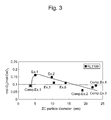
- Fig. 3 which relates to the RL test carried out at 1,100°C, the results for the catalyst of Comparative Example 1 are shown in terms of the ZC particle diameter after the RL test carried out at 1,000°C because it underwent phase separation.
- Fig. 2 demonstrates that OSC activity improves in accordance with the particle diameter of the ceria-zirconia complex oxide (i.e., the ZC particle diameter) after an RL test carried out at 1,000°C.
- Fig. 3 demonstrates that OSC activity deteriorates as a result of an RL test carried out at 1,100°C on the basis of phase separation occurring when the ZC particle diameter is less than 5 nm. As is apparent from Fig. 2 and Fig. 3 . OSC activity improves when the ZC particle diameter is from 5 nm to 15 nm.
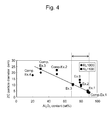
- Fig. 4 demonstrates that a ZC particle diameter preferable in terms of OSC activity is attained when alumina content is 70% to 89% by mass relative to the complex oxide particles.
- the starting solution was added to an aqueous NH 3 solution (in an amount 1.2 or more times the neutralization equivalent with respect to metal cations) with thorough agitation, and components were allowed to coprecipitate to obtain a complex oxide precursor.
- the obtained complex oxide precursor was centrifuged, thoroughly washed, dried in the air at 150°C for 7 hours, and then precalcined at 330°C for 5 hours.
- the formed product was ground using a grinder and then calcined in the air at 700°C for 5 hours.
- complex oxide particles were obtained (Material A).
- a ceramic honeycomb substrate having a large number of wall-partitioned cells ( ⁇ 103 mm; L 105 mm; volume 875 cc) was used.
- CZ ceria-zirconia complex oxide powder
- the Pd-supporting CZ powder was added to 75 g/substrate-L of La-supplemented Al 2 O 3 (Al 2 O 3 : 96 wt%; La 2 O 3 : 4 wt%) and 3 g/substrate-L of Al 2 O 3 binder. water was further added to mix these components, and a coating slurry was prepared. The resulting slurry was applied to the ceramic honeycomb substrate via wash coating, and an underlying catalyst layer was then formed on the cell surface of the honeycomb substrate through dehydration and calcination (at 500°C for 2 hours).
- Rh (0.1 g/substrate-L) was supported by impregnation on 50 g/substrate-L of CZ powder (ZrO 2 : 78 wt%; CeO 2 : 20 wt%; Y 2 O 3 : 2 wt%) with the use of a rhodium nitrate solution. Subsequently, the Rh-supporting CZ powder was added to 50 g/substrate-L of Material A and 3 g/substrate-L of Al 2 O 3 binder, water was further added to mix these components, and a coating slurry was prepared. The resulting slurry was applied to the ceramic honeycomb substrate provided with the under layer coating, and the catalyst was then obtained through dehydration and calcination (at 500°C for 2 hours).
- a catalyst was obtained in the same manner as in Example 7, except that 50 g/substrate-L of La-supplemented Al 2 O 3 (Al 2 O 3 : 96 wt%; La 2 O 3 : 4 wt%) (hereafter, abbreviated as "Al 2 O 3 ”) was used instead of Material A for the upper layer coating of Example 7.
- Al 2 O 3 La-supplemented Al 2 O 3
- a catalyst was obtained in the same manner as in Example 7, except that 40.8 g/substrate-L of CZ powder (ZrO 2 : 73.5 wt%; CeO 2 : 24.5 wt%; Y 2 O 3 : 2 wt%) was used instead of 50 g/substrate-L of CZ powder (ZrO 2 : 78 wt%; CeO 2 : 20 wt%; Y 2 O 3 : 2 wt%), to bring the amount of Ce to the same level as that in Example 7, and 50 g/substrate-L of Al 2 O 3 was used instead of Material A for the upper layer coating.
- the starting solution was added to an aqueous NH 3 solution (in an amount 1.2 or more times the neutralization equivalent with respect to metal cations) with thorough agitation, and components were allowed to coprecipitate to obtain a complex oxide precursor.
- the obtained complex oxide precursor was centrifuged, thoroughly washed, dried in the air at 150°C for 7 hours, and then precalcined at 330°C for 5 hours.
- the formed product was ground using a grinder and then calcined in the air at 700°C for 5 hours.
- complex oxide particles were obtained (Material B).
- a catalyst was obtained by forming an under layer coat and an upper layer coat in the same manner as in Example 7, except that 16 g/substrate-L of Material B was used, to bring the amount of Ce to the level same as that in Example 7, and 34 g/substrate-L of Al 2 O 3 was used instead of Material A.
- a catalyst was obtained in the same manner as in Example 7, except that 50 g/substrate-L of CZ powder (ZrO 2 : 78 wt%; CeO 2 : 20 wt%; Y 2 O 3 : 2 wt%) was used instead of Material A for the upper layer coating.
- Table 3 shows the compositions of Material A and Material B and particle diameters thereof (RL test carried out at 1,100°C for 5 hours, measured in the manner described in "1. Durability test”).
- Table 3 ZrO 2 CeO 2 La 2 O 3 Y 2 O 3 Al 2 O 3 CZ particle diameter (nm) (RL 1,100°C ⁇ 5 hr) Mass % Material A 10 4.5 5 0.5 80 9.9 Material B 31 14 3 2 50 22
- Table 4 shows the compositions of upper layer coats of the catalysts of Example 7 and Comparative Examples 6 to 9.
- Example 7 The catalysts of Example 7 and Comparative Examples 6 to 9 were subjected to durability tests, activity evaluation, and measurement of oxygen absorption/release in the manner described below.
- Example 7 and Comparative Examples 6 to 9 were subjected to durability tests with the use of the engines for practical use. Specifically, the catalysts were mounted on the exhaust system of a V8 engine, and rich, stoichiometric, and lean exhaust gases were repeatedly applied thereto for a given period of time at a catalyst bed temperature of 1,000°C over a period of 50 hours.
- the capacities of the catalysts of Example 7 and Comparative Examples 6 to 9 for oxygen absorption/release were evaluated.
- the catalysts were mounted immediately below in-line four-cylinder engines, the air-fuel (A/F) ratio of the exhaust gas introduced into the catalyst was periodically switched between a rich atmosphere and a lean atmosphere at a catalyst-containing gas temperature of 600°C, and the amount of oxygen absorption/release of each catalyst was calculated based on a delay in the behavior of the O 2 sensor provided on the catalyst outlet side.
- A/F air-fuel
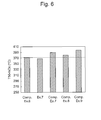
- Figs. 6 and 7 demonstrate that the catalyst of Example 7 maintains activity of the catalyst of Comparative Example 6 having a general catalyst structure ( Fig. 6 ) and that it has oxygen storage capacity superior to that of the catalyst of Comparative Example 6 ( Fig. 7 ).
- Material A was found to be the most effective in terms of maintenance of activity and improvement in oxygen storage capacity.
- Fig. 8 shows the specific surface area (SSA) after the materials used for catalyst production were subjected to RL durability tests at 1,000°C. Because of the heat tolerance of Al 2 O 3 is higher than that of CZ particles, Rh sintering (aggregation) is suppressed. As a result, the catalyst of Comparative Example 6 comprising Al 2 O 3 is considered to have activity and capacity for oxygen absorption/release superior to those of the catalyst of Comparative Example 9 comprising CZ particles instead of Al 2 O 3 . As shown in Fig. 8 , also, Material A has heat tolerance equivalent to that of Al 2 O 3 . Thus, the catalyst of Example 7 comprising Material A instead of Al 2 O 3 is considered to retain activity of the catalyst of Comparative Example 6.
- SSA specific surface area
- the catalyst of Comparative Example 8 having a larger CZ particle diameter cannot yield the effects described above in relation to the catalyst of Example 7. If the CZ particle diameter is on the single nanometer-scale as with the case of the catalyst of Example 7, the oxygen storage capacity can improve even if a noble metal is not directly supported on a CZ particle. Similar effects may be attained with the use of Material A for the under layer coating (a Pd layer).
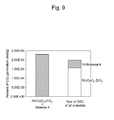
- Fig. 9 shows the results of measurement of oxygen storage capacity after RL durability tests at 1,100°C of a sample prepared by physical mixing of the Rh-supporting CZ powder of Example 1 with Material A with the use of a model gas and Material A comprising Rh-supporting CZ powder and Rh supported thereon via impregnation (pellets supporting 0.2% by mass of Rh).
- RL durability tests at 1,100°C and measurement of oxygen storage capacity were carried out in accordance with the procedures described in [1. Durability Test] and [3. OSC Measurement] above.
- oxygen storage capacity can be remarkably improved with the use of CZ powders in combination with Material A compared with the oxygen storage capacity attained when CZ powders or Material A is used separately from each other.
- the complex oxide particles of the present invention can be preferably used for an exhaust gas purifying catalyst, and particularly for an exhaust gas purifying catalyst for automobiles.
Landscapes
- Chemical & Material Sciences (AREA)
- Engineering & Computer Science (AREA)
- Organic Chemistry (AREA)
- Chemical Kinetics & Catalysis (AREA)
- Materials Engineering (AREA)
- Inorganic Chemistry (AREA)
- Combustion & Propulsion (AREA)
- Health & Medical Sciences (AREA)
- Biomedical Technology (AREA)
- Environmental & Geological Engineering (AREA)
- Analytical Chemistry (AREA)
- General Chemical & Material Sciences (AREA)
- Oil, Petroleum & Natural Gas (AREA)
- Geology (AREA)
- Life Sciences & Earth Sciences (AREA)
- Exhaust Gas Treatment By Means Of Catalyst (AREA)
- Catalysts (AREA)
- Exhaust Gas After Treatment (AREA)
- Inorganic Compounds Of Heavy Metals (AREA)
Abstract
Description
- The present invention relates to complex oxide particles as carriers that are capable of imparting high heat tolerance and oxygen storage capacity to a catalyst and an exhaust gas purifying catalyst using the same. More particularly, the present invention relates to an exhaust gas purifying catalyst for automobiles.
- Exhaust gas emitted from internal-combustion engines of vehicles or the like contains harmful gases such as carbon monoxide (CO), nitrogen oxide (NOx), and unburned hydrocarbon (HC). As an exhaust gas purifying catalyst (so-called three-way catalyst) for decomposing such harmful gases, a ceria-zirconia complex oxide having oxygen storage capacity (OSC) is used, for example. A substance having oxygen storage capacity (an oxygen storage material) can control the air-fuel ratio (A/F) in a microscopic space by absorbing and releasing oxygen and can suppress a decrease in a purification rate that results from variations in exhaust gas composition. In particular, it is preferable for an exhaust gas purifying catalyst to have high oxygen storage capacity so as to suppress NOx emissions, since NOx generated in a lean atmosphere is reduced with difficulty.
-
JP H10-182155 A 1998 JP H10-182155 A 1998 JP H10-182155 A 1998 - The crystallite diameters of the ceria-zirconia complex oxides of most carriers that were actually produced in
JP H10-182155 A 1998 -
JP 2003-277059 A - Also,
WO 2007/052821 describes catalyst carrier particles comprising ceria and alumina. - To date, a method of increasing the amounts of oxygen storage materials has been employed as a means for improving the oxygen storage capacity. However, there has been a limit on such method because increased amounts of oxygen storage materials would lead to an increase in the pressure drop of catalysts, and lowered engine performance would become an issue of concern. While alumina, which is the main component constituting an active component support layer, may be substituted with an oxygen storage material, alumina has high heat tolerance, anti-stripping properties, and other properties. Accordingly, simple substitution thereof may cause noble metal sintering, and thus it is not preferable. For example,
JP 2010-149112 A - Accordingly, conventional oxygen storage materials are insufficient in terms of heat tolerance and the oxygen storage capacity, and oxygen storage materials capable of absorption/release of oxygen with higher efficiency have been desired.
- The present invention provides complex oxide particles as carriers that are capable of imparting high heat tolerance and oxygen storage capacity to catalysts and an exhaust gas purifying catalyst for automobiles using the same.
- The present inventors discovered that catalysts could be provided with high heat tolerance and oxygen storage capacity by incorporating 70% to 89% of alumina by mass relative to complex oxide particles, 0.01% to 0.22% of yttria by mole relative to ceria-zirconia complex oxide, and at least one oxide of an element selected from among rare earth elements other than cerium and yttrium and alkaline earth metals into the complex oxide particles comprising ceria-zirconia complex oxide.
- Specifically, the present invention includes the following.
- (1) Complex oxide particles comprising ceria-zirconia complex oxide, alumina, yttria, at least one oxide of an element selected from among rare earth elements other than cerium and yttrium, and alkaline earth metals,
wherein the alumina content is 70% to 89% by mass relative to the complex oxide particles and the yttria content is 0.01% to 0.22% by mole relative to ceria-zirconia complex oxide. - (2) The complex oxide particles according to (1), wherein the particle diameter of the ceria-zirconia complex oxide subjected to a durability test at 1,100°C for 5 hours is 5 to 15 nm.
- (3) An exhaust gas purifying catalyst comprising noble metals supported on the complex oxide particles according to (1) or (2).
- This description includes part or all of the content as disclosed in the description and/or drawings of Japanese Patent Application Nos.
2012-256633 2013-060128 - The present invention can provide complex oxide particles as carriers that are capable of imparting high heat tolerance and oxygen storage capacity to catalysts and an exhaust gas purifying catalyst for automobiles using the same.
-
-
Fig. 1 shows an image demonstrating positions of ceria-zirconia complex oxide and alumina in the complex oxide particle carriers of the present invention and in conventional carriers. -
Fig. 2 shows the correlation between the ceria-zirconia complex oxide particle diameter (hereafter, it may be referred to as the "ZC particle diameter") after an RL durability test at 1,000°C and the oxygen storage capacity per mole of the cerium element. -
Fig. 3 shows the correlation between the ZC particle diameter after an RL durability test at 1,100°C and the oxygen storage capacity per mole of the cerium element. -
Fig. 4 shows the correlation between alumina content and ZC particle diameter. -
Fig. 5 shows the correlation between yttria content in ceria-zirconia complex oxide and the oxygen storage capacity per mole of the cerium element. -
Fig. 6 shows temperature at which the catalysts of Example 7 and Comparative Examples 6 to 9 purify 50% of NOx (T50). -
Fig. 7 shows the results of measurement of the capacity of the catalysts of Example 7 and Comparative Examples 6 to 9 for oxygen absorption/release. -
Fig. 8 shows specific surface area (SSA) of the materials used for catalyst production after an RL durability test at 1,000°C. -
Fig. 9 shows the results of OSC measurement of the materials used for catalyst production. - The complex oxide particles of the present invention comprise ceria-zirconia complex oxide, alumina, yttria, and at least one oxide of an element selected from among rare earth elements other than cerium and yttrium and alkaline earth metals in which the alumina content is 70% to 89% by mass relative to the complex oxide particles and the yttria content is 0.01% to 0.22% by mole relative to the ceria-zirconia complex oxide. By increasing the amount of alumina as a diffusion barrier, aggregation between ceria-zirconia complex oxides at high temperatures (e.g., 1,100°C) can be suppressed, particle diameter can be reduced, and oxygen storage capacity can be improved. By adding a particular amount of yttria, also, phase separation of ceria-zirconia complex oxide can be suppressed, and heat tolerance can be improved.
- The content of ceria-zirconia complex oxide used for the complex oxide particles of the present invention is preferably 11% to 30% and more preferably 15% to 25% by mass relative to the complex oxide particles, so as to allow ceria-zirconia complex oxides to have adequate contact with each other. The ratio of ceria to zirconia in the ceria-zirconia complex oxide is preferably 1:99 to 99:1, and particularly preferably 10:90 to 50:50 by mass.
- From the viewpoint of improvement in the oxygen storage capacity and prevention of decrease of oxygen storage capacity as a result of phase separation of ceria-zirconia complex oxide at high temperatures (e.g., 1,100°C), the particle diameter of the ceria-zirconia complex oxide subjected to the durability test at 1,100°C for 5 hours is preferably 5 to 15 nm, and particularly preferably 7 to 12 nm. The term "the particle diameter of the ceria-zirconia complex oxide" used herein refers to a length between alumina particles or aluminum atoms which are present among ceria and zirconia crystals or particles. Alternatively, the term may refer to a length between ceria-zirconia crystals, particles, or atoms which are dispersed in alumina particles or alumina crystals. The particle diameter of the ceria-zirconia complex oxide may vary as a result of a durability test carried out at high temperatures (e.g., 1,100°C).
- The complex oxide particles of the present invention comprise alumina in an amount of 70% to 89% and preferably 75% to 85% by mass relative to the complex oxide particles. By adjusting the alumina content within the above range, aggregation of ceria-zirconia complex oxide particles at high temperatures (e.g., 1,100°C) can be suppressed, and, as a consequence, the particle diameter of the ceria-zirconia complex oxide can be adjusted within a preferable range (see
Fig. 1 ). - The complex oxide particles of the present invention comprise yttria in an amount of 0.01% to 0.22%, and preferably 0.02% to 0.15% by mole relative to ceria-zirconia complex oxide. By adjusting the yttria content within the above range, phase separation of ceria-zirconia complex oxide at high temperatures (e.g., 1,100°C) can be suppressed, and durability or heat tolerance of the complex oxide particles can be improved. By adjusting the yttria content to 0.22% or less by mole relative to ceria-zirconia complex oxide, decrease of the oxygen storage capacity caused by the stabilized ceria-zirconia structure can be prevented.
- The complex oxide particles of the present invention comprise at least one oxide of an element selected from among rare earth elements other than cerium and yttrium and alkaline earth metal elements. Examples of rare earth elements other than cerium and yttrium include scandium (Sc), lanthanum (La), praseodymium (Pr), neodymium (Nd), samarium (Sm), gadolinium (Gd), terbium (Tb), dysprosium (Dy), ytterbium (Yb), and lutetium (Lu). Among them, La is preferable from the viewpoint of retention of heat tolerance of complex oxide particles. From the viewpoint of retention of oxygen storage capacity, the content of an oxide of a rare earth element other than cerium or yttrium is preferably 0.1% to 10%, and particularly preferably 1% to 6% by mass relative to the complex oxide particles.
- The complex oxide particles of the present invention serve as carriers and comprise noble metals supported thereon. Thus, the complex oxide particles can be used for an exhaust gas purifying catalyst for automobiles. Accordingly, the present invention also relates to an exhaust gas purifying catalyst comprising the complex oxide particles and noble metals supported thereon. Preferably, the exhaust gas purifying catalyst of the present invention further contains a platinum group noble metal as a main catalyst. Examples of such platinum group noble metal include ruthenium (Ru), rhodium (Rh), palladium (Pd), osmium (Os), iridium (Ir), and platinum (Pt), and the use of Rh, Pt, and Pd is particularly preferable. The amount thereof to be supported may be the same as with the cases of conventional exhaust gas purifying catalysts, and it is preferably 0.01% to 5% by mass relative to the exhaust gas purifying catalyst. Noble metals may be supported on the complex oxide particles via a conventional technique such as adsorption or water absorption.
- The exhaust gas purifying catalyst of the present invention can be used for an exhaust gas purifying filter. Specifically, it can be used for a coat provided on the substrate surface of an exhaust gas purifying filter. When a plurality of coats are provided on the substrate surface, the exhaust gas purifying catalyst of the present invention may be used for any layer. In order to effectively elicit oxygen storage capacity, it is preferably used for the outermost layer. From the viewpoint of retention of catalytic activity and improvement in oxygen storage capacity, the particle diameter of the ceria-zirconia complex oxide of the exhaust gas purifying catalyst of the present invention is preferably on the single-nanometer scale.
- Hereafter, the present invention is described with reference to the examples, although the technical scope of the present invention is not limited to such examples.
- Aluminum nitrate nonahydrate, zirconium oxynitrate dihydrate, cerium nitrate hexahydrate, lanthanum nitrate hexahydrate, and yttrium nitrate hexahydrate were added to and mixed with ion exchange water in the amounts shown in Table 1. A hydrogen peroxide solution was added in an amount 1.2 times the amount of cerium in cerium nitrate in molar terms, and the mixture was agitated to obtain a starting solution. While the pH level of the starting solution was maintained at 9 or higher, the solution was added to an aqueous NH3 solution (in an amount 1.2 or more times the neutralization equivalent with respect to metal cations) while thoroughly agitating the solution, and components were allowed to coprecipitate to obtain a complex oxide precursor. The obtained complex oxide precursor was centrifuged, thoroughly washed, dried in the air at 150°C for 7 hours, and then precalcined at 330°C for 5 hours. The formed product was ground using a grinder and then calcined in the air at 700°C for 5 hours. Thus, complex oxide particles were obtained.
- The resulting complex oxide particles were added to an aqueous rhodium nitrate solution as carriers, and the mixture was agitated. Thereafter, the solution was heated with agitation to evaporate the water, the remaining solid was dehydrated in the air at 120°C for 6 hours, the resultant was subjected to calcination in the air at 500°C for 2 hours, and 0.2% of rhodium by mass was supported on the carriers to obtain the exhaust gas purifying catalyst.
- Complex oxide particles and exhaust gas purifying catalysts were prepared in the same manner as in Example 1, except that aluminum nitrate nonahydrate, zirconium oxynitrate dihydrate, cerium nitrate hexahydrate, lanthanum nitrate hexahydrate, and yttrium nitrate were used in the amounts shown in Table 1.
- Complex oxide particles and exhaust gas purifying catalysts were prepared in the same manner as in Example 1, except that aluminum nitrate nonahydrate, zirconium oxynitrate dihydrate, cerium nitrate hexahydrate, lanthanum nitrate hexahydrate, and yttrium nitrate were used in the amounts shown in Table 1.
Table 1 ZrO2 CeO2 La2O3 Y2O3 Al2O3 Y/ZC Zr/Ce Mass % mol/mol mol/mol Ex. 1 4.5 2 5 0.2 88.3 0.047 3.14 Ex. 2 10 4.5 5 0.5 80 0.052 3.10 Ex. 3 16.5 7.5 5 1 70 0.063 3.07 Ex. 4 10 4.5 5 1 79.5 0.105 3.10 Ex. 5 10 4.5 5 2 78.5 0.210 3.10 Ex. 6 16 7 5 2 70 0.132 3.19 Comp. Ex. 1 3.4 1.45 5 0.15 90 0.047 3.28 Comp. Ex. 2 31 14 3 2 50 0.068 3.09 Comp. Ex. 3 46 20 2 2 30 0.046 3.21 Comp. Ex. 4 53 23 1.5 2.5 20 0.050 3.22 Comp. Ex. 5 10 4.5 5 0 80.5 0.000 3.10 - Durability tests were carried out by weighing 5 mg of the catalyst powders of Examples 1 to 6 and Comparative Examples 1 to 5 and, while heating the catalyst powders to 1,000°C or 1,100°C, alternately applying 1% by volume of carbon monoxide (CO) gas (the balance gas: nitrogen) and 5% by volume of oxygen (O2) gas (the balance gas: nitrogen) for 5 minutes, and this procedure was repeated over the period of 5 hours.
RL 1,000°C × 5 hr (1% - CO/N2 + 10% - H2O ⇔ 5% - O2/N2 + 10% - H2O)
RL 1,100°C × 5 hr (1% - CO/N2 + 10% - H2O ⇔ 5%- O2/N2 + 10% - H2O)
- The particle diameter of the ceria-zirconia complex oxide was measured via X-ray diffraction.
- Catalyst powder (2 mg) was weighed and mounted on a flow reactor, gas containing 1% by volume of oxygen (O2) (the balance gas: nitrogen) was allowed to flow for 2 minutes during heating at 600°C, and gas containing 2% by volume of carbon monoxide (CO) (the balance gas: nitrogen) was pulse-introduced for 2 minutes during heating at 600°C. This procedure was repeated 5 times. Carbon dioxide (CO2) generated thereupon was detected with the use of an IR analyzer, and the average amount of CO2 detected during a period of 5 seconds after the introduction of CO2 was designated the OSC equivalent.
- Table 2 shows the particle diameters of the ceria-zirconia complex oxides in the catalysts of Examples 1 to 6 and Comparative Examples 1 to 5 after the RL durability tests carried out at 1,000°C and at 1,100°C.
Table 2 RL Durability test at 1,000°C (nm) RL Durability test at 1,100°C (nm) Ex. 1 4.0 5.0 Ex. 2 9.0 9.9 Ex. 3 10 10.5 Ex. 4 9 10 Ex. 5 10 12 Ex. 6 12 14 Comp. Ex. 1 3.6 Phase separation Comp. Ex. 2 18 19 Comp. Ex. 3 19 22 Comp. Ex. 4 20 23 Comp. Ex. 5 9 Phase separation -
Figs. 2 to 5 show the results. Performance was evaluated to be improved at 0.1 mol - O2/mol - CeO2 or higher. InFig. 3 , which relates to the RL test carried out at 1,100°C, the results for the catalyst of Comparative Example 1 are shown in terms of the ZC particle diameter after the RL test carried out at 1,000°C because it underwent phase separation. -
Fig. 2 demonstrates that OSC activity improves in accordance with the particle diameter of the ceria-zirconia complex oxide (i.e., the ZC particle diameter) after an RL test carried out at 1,000°C. Also,Fig. 3 demonstrates that OSC activity deteriorates as a result of an RL test carried out at 1,100°C on the basis of phase separation occurring when the ZC particle diameter is less than 5 nm. As is apparent fromFig. 2 andFig. 3 . OSC activity improves when the ZC particle diameter is from 5 nm to 15 nm. -
Fig. 4 demonstrates that a ZC particle diameter preferable in terms of OSC activity is attained when alumina content is 70% to 89% by mass relative to the complex oxide particles. - As shown in
Fig. 5 , only the catalyst of Comparative Example 5 containing no yttrium underwent phase separation when subjected to the RL test at 1,100°C. This indicates that the addition of yttrium results in suppression of Z-C phase separation and improved durability (i.e., heat tolerance) of microparticles. Activity deteriorated when yttria content exceeded 0.22 relative to ceria-zirconia complex oxide. - After aluminum nitrate nonahydrate was dissolved in ion exchange water, zirconium oxynitrate dihydrate, cerium nitrate hexahydrate, lanthanum nitrate hexahydrate, and yttrium nitrate hexahydrate were added thereto in the amounts shown in Table 3. The hydrogen peroxide solution was added in an amount 1.2 times the amount of cerium in cerium nitrate in molar terms, and the mixture was agitated to obtain a starting solution. While maintaining the pH level at 9 or higher, the starting solution was added to an aqueous NH3 solution (in an amount 1.2 or more times the neutralization equivalent with respect to metal cations) with thorough agitation, and components were allowed to coprecipitate to obtain a complex oxide precursor. The obtained complex oxide precursor was centrifuged, thoroughly washed, dried in the air at 150°C for 7 hours, and then precalcined at 330°C for 5 hours. The formed product was ground using a grinder and then calcined in the air at 700°C for 5 hours. Thus, complex oxide particles were obtained (Material A).
- A ceramic honeycomb substrate having a large number of wall-partitioned cells (ϕ 103 mm; L 105 mm; volume 875 cc) was used.
- Pd (1.0 g/substrate-L (per liter of a substrate)) was supported by impregnation on 75 g/substrate-L of ceria-zirconia complex oxide powder (hereafter, abbreviated as "CZ") (ZrO2: 68 wt%; CeO2: 30 wt%; Y2O3: 2 wt%) with the use of a palladium nitrate solution. Subsequently, the Pd-supporting CZ powder was added to 75 g/substrate-L of La-supplemented Al2O3 (Al2O3: 96 wt%; La2O3: 4 wt%) and 3 g/substrate-L of Al2O3 binder. water was further added to mix these components, and a coating slurry was prepared. The resulting slurry was applied to the ceramic honeycomb substrate via wash coating, and an underlying catalyst layer was then formed on the cell surface of the honeycomb substrate through dehydration and calcination (at 500°C for 2 hours).
- Rh (0.1 g/substrate-L) was supported by impregnation on 50 g/substrate-L of CZ powder (ZrO2: 78 wt%; CeO2: 20 wt%; Y2O3: 2 wt%) with the use of a rhodium nitrate solution. Subsequently, the Rh-supporting CZ powder was added to 50 g/substrate-L of Material A and 3 g/substrate-L of Al2O3 binder, water was further added to mix these components, and a coating slurry was prepared. The resulting slurry was applied to the ceramic honeycomb substrate provided with the under layer coating, and the catalyst was then obtained through dehydration and calcination (at 500°C for 2 hours).
- A catalyst was obtained in the same manner as in Example 7, except that 50 g/substrate-L of La-supplemented Al2O3 (Al2O3: 96 wt%; La2O3: 4 wt%) (hereafter, abbreviated as "Al2O3") was used instead of Material A for the upper layer coating of Example 7.
- A catalyst was obtained in the same manner as in Example 7, except that 40.8 g/substrate-L of CZ powder (ZrO2: 73.5 wt%; CeO2: 24.5 wt%; Y2O3: 2 wt%) was used instead of 50 g/substrate-L of CZ powder (ZrO2: 78 wt%; CeO2: 20 wt%; Y2O3: 2 wt%), to bring the amount of Ce to the same level as that in Example 7, and 50 g/substrate-L of Al2O3 was used instead of Material A for the upper layer coating.
- After aluminum nitrate nonahydrate was dissolved in ion exchange water, zirconium oxynitrate dihydrate, cerium nitrate hexahydrate, lanthanum nitrate hexahydrate, and yttrium nitrate hexahydrate were added thereto in the amounts shown in Table 3. The hydrogen peroxide solution was added in an amount 1.2 times the amount of cerium in cerium nitrate in molar terms, and the mixture was agitated to obtain a starting solution. While maintaining the pH level at 9 or higher, the starting solution was added to an aqueous NH3 solution (in an amount 1.2 or more times the neutralization equivalent with respect to metal cations) with thorough agitation, and components were allowed to coprecipitate to obtain a complex oxide precursor. The obtained complex oxide precursor was centrifuged, thoroughly washed, dried in the air at 150°C for 7 hours, and then precalcined at 330°C for 5 hours. The formed product was ground using a grinder and then calcined in the air at 700°C for 5 hours. Thus, complex oxide particles were obtained (Material B).
- A catalyst was obtained by forming an under layer coat and an upper layer coat in the same manner as in Example 7, except that 16 g/substrate-L of Material B was used, to bring the amount of Ce to the level same as that in Example 7, and 34 g/substrate-L of Al2O3 was used instead of Material A.
- A catalyst was obtained in the same manner as in Example 7, except that 50 g/substrate-L of CZ powder (ZrO2: 78 wt%; CeO2: 20 wt%; Y2O3: 2 wt%) was used instead of Material A for the upper layer coating.
- Table 3 shows the compositions of Material A and Material B and particle diameters thereof (RL test carried out at 1,100°C for 5 hours, measured in the manner described in "1. Durability test").
Table 3 ZrO2 CeO2 La2O3 Y2O3 Al2O3 CZ particle diameter (nm) (RL 1,100°C × 5 hr) Mass % Material A 10 4.5 5 0.5 80 9.9 Material B 31 14 3 2 50 22 - Table 4 shows the compositions of upper layer coats of the catalysts of Example 7 and Comparative Examples 6 to 9.
Table 4 Rh layer (upper layer) constitution Total amount of CeO2 in upper layer (g/l) Note Comp Ex. 6 Rh/CeO2 - ZrO2 (CeO2 = 20 wt%) + Al2O3 10 Conventional material Ex. 7 Rh/CeO2 - ZrO2 (CeO2 = 20 wt%) + Material A 12.3 Material A (CZ particle diameter: 9.9 nm) Comp. Ex. 7 Rh/CeO2 - ZrO2 (CeO2 = 24.5 wt%) + Al2O3 12.3 Increased amount of CeO2 relative to Comp. Ex. 6 Comp. Ex. 8 Rh/CeO2 - ZrO2 (CeO2 = 20 wt%) + Material B + Al2O3 12.3 Material B (CZ particle diameter: 22 nm) Comp. Ex. 9 Rh/CeO2 - ZrO2 (CeO2 =20 wt%) + CeO2 - ZrO2 (CeO2 = 20 wt%) 20 Replacement of Al2O3 of Comp. Ex. 6 with OSC material (CeO2-ZrO2) - The catalysts of Example 7 and Comparative Examples 6 to 9 were subjected to durability tests, activity evaluation, and measurement of oxygen absorption/release in the manner described below.
- The catalysts of Example 7 and Comparative Examples 6 to 9 were subjected to durability tests with the use of the engines for practical use. Specifically, the catalysts were mounted on the exhaust system of a V8 engine, and rich, stoichiometric, and lean exhaust gases were repeatedly applied thereto for a given period of time at a catalyst bed temperature of 1,000°C over a period of 50 hours.
- Activities of the catalysts of Example 7 and Comparative Examples 6 to 9 subjected to the durability tests were further evaluated. Stoichiometric (air-fuel (A/F) ratio: 14.6) exhaust gas was supplied to the catalysts, temperature was raised to 500°C, and the temperature at which the purification rate would reach 50% (T50) was calculated.
- The capacities of the catalysts of Example 7 and Comparative Examples 6 to 9 for oxygen absorption/release were evaluated. The catalysts were mounted immediately below in-line four-cylinder engines, the air-fuel (A/F) ratio of the exhaust gas introduced into the catalyst was periodically switched between a rich atmosphere and a lean atmosphere at a catalyst-containing gas temperature of 600°C, and the amount of oxygen absorption/release of each catalyst was calculated based on a delay in the behavior of the O2 sensor provided on the catalyst outlet side.
- The results are shown in
Figs. 6 to 9 . -
Figs. 6 and7 demonstrate that the catalyst of Example 7 maintains activity of the catalyst of Comparative Example 6 having a general catalyst structure (Fig. 6 ) and that it has oxygen storage capacity superior to that of the catalyst of Comparative Example 6 (Fig. 7 ). In comparison with the catalysts of Comparative Examples 7 to 9 having equivalent or larger amounts of Ce, Material A was found to be the most effective in terms of maintenance of activity and improvement in oxygen storage capacity. -
Fig. 8 shows the specific surface area (SSA) after the materials used for catalyst production were subjected to RL durability tests at 1,000°C. Because of the heat tolerance of Al2O3 is higher than that of CZ particles, Rh sintering (aggregation) is suppressed. As a result, the catalyst of Comparative Example 6 comprising Al2O3 is considered to have activity and capacity for oxygen absorption/release superior to those of the catalyst of Comparative Example 9 comprising CZ particles instead of Al2O3. As shown inFig. 8 , also, Material A has heat tolerance equivalent to that of Al2O3. Thus, the catalyst of Example 7 comprising Material A instead of Al2O3 is considered to retain activity of the catalyst of Comparative Example 6. - As is apparent from
Figs. 6 and7 , further, the catalyst of Comparative Example 8 having a larger CZ particle diameter cannot yield the effects described above in relation to the catalyst of Example 7. If the CZ particle diameter is on the single nanometer-scale as with the case of the catalyst of Example 7, the oxygen storage capacity can improve even if a noble metal is not directly supported on a CZ particle. Similar effects may be attained with the use of Material A for the under layer coating (a Pd layer). -
Fig. 9 shows the results of measurement of oxygen storage capacity after RL durability tests at 1,100°C of a sample prepared by physical mixing of the Rh-supporting CZ powder of Example 1 with Material A with the use of a model gas and Material A comprising Rh-supporting CZ powder and Rh supported thereon via impregnation (pellets supporting 0.2% by mass of Rh). RL durability tests at 1,100°C and measurement of oxygen storage capacity were carried out in accordance with the procedures described in [1. Durability Test] and [3. OSC Measurement] above. As is apparent fromFig. 9 , oxygen storage capacity can be remarkably improved with the use of CZ powders in combination with Material A compared with the oxygen storage capacity attained when CZ powders or Material A is used separately from each other. - The complex oxide particles of the present invention can be preferably used for an exhaust gas purifying catalyst, and particularly for an exhaust gas purifying catalyst for automobiles.
- All publications, patents, and patent applications cited herein are incorporated herein by reference in their entirety.
Claims (3)
- Complex oxide particles comprising ceria-zirconia complex oxide, alumina, yttria, at least one oxide of an element selected from among rare earth elements other than cerium and yttrium, and alkaline earth metals,
wherein the alumina content is 70% to 89% by mass relative to the complex oxide particles and the yttria content is 0.01% to 0.22% by mole relative to ceria-zirconia complex oxide. - The complex oxide particles according to claim 1, wherein the particle diameter of the ceria-zirconia complex oxide subjected to a durability test at 1,100°C for 5 hours is 5 to 15 nm.
- An exhaust gas purifying catalyst comprising noble metals supported on the complex oxide particles according to claim 1 or 2.
Applications Claiming Priority (3)
| Application Number | Priority Date | Filing Date | Title |
|---|---|---|---|
| JP2012256633 | 2012-11-22 | ||
| JP2013060128A JP5900395B2 (en) | 2012-11-22 | 2013-03-22 | Composite oxide particles and exhaust gas purification catalyst using the same |
| PCT/JP2013/076661 WO2014080695A1 (en) | 2012-11-22 | 2013-10-01 | Complex oxide particles and catalyst for purifying exhaust gas using same |
Publications (2)
| Publication Number | Publication Date |
|---|---|
| EP2924009A1 true EP2924009A1 (en) | 2015-09-30 |
| EP2924009A4 EP2924009A4 (en) | 2015-11-04 |
Family
ID=50775885
Family Applications (1)
| Application Number | Title | Priority Date | Filing Date |
|---|---|---|---|
| EP13856611.2A Withdrawn EP2924009A4 (en) | 2012-11-22 | 2013-10-01 | COMPLEX OXIDE PARTICLES AND CATALYST FOR THE PURIFICATION OF EXHAUST GAS USING THE SAME |
Country Status (5)
| Country | Link |
|---|---|
| US (1) | US20150298099A1 (en) |
| EP (1) | EP2924009A4 (en) |
| JP (1) | JP5900395B2 (en) |
| CN (1) | CN104822629A (en) |
| WO (1) | WO2014080695A1 (en) |
Cited By (2)
| Publication number | Priority date | Publication date | Assignee | Title |
|---|---|---|---|---|
| EP3181224A1 (en) * | 2015-11-27 | 2017-06-21 | Toyota Jidosha Kabushiki Kaisha | Production method of oxygen storage material, and oxygen storage material |
| WO2020159641A1 (en) * | 2019-01-29 | 2020-08-06 | Pacific Industrial Development Corporation | Nanocrystal-sized cerium-zirconium-aluminum oxide material and method of making the same |
Families Citing this family (7)
| Publication number | Priority date | Publication date | Assignee | Title |
|---|---|---|---|---|
| JP5883425B2 (en) | 2013-10-04 | 2016-03-15 | 株式会社豊田中央研究所 | Ceria-zirconia composite oxide, production method thereof, and exhaust gas purification catalyst using the ceria-zirconia composite oxide |
| JP6348352B2 (en) * | 2014-06-26 | 2018-06-27 | トヨタ自動車株式会社 | Method for producing oxygen storage material |
| WO2017173018A1 (en) * | 2016-04-01 | 2017-10-05 | Pacific Industrial Development Corporation | Method of making mesoporous zirconium-based mixed oxides |
| JP2019086345A (en) * | 2017-11-03 | 2019-06-06 | 株式会社デンソー | Solid electrolyte for solid electrolyte and gas sensor |
| US20210213426A1 (en) * | 2018-02-15 | 2021-07-15 | Sumitomo Chemical Company, Limited | Inorganic oxide |
| US11666889B2 (en) * | 2018-02-15 | 2023-06-06 | Sumitomo Chemical Company, Limited | Inorganic oxide |
| EP4157797A1 (en) * | 2020-05-28 | 2023-04-05 | Rhodia Operations | Aluminium and zirconium-based mixed oxide |
Family Cites Families (16)
| Publication number | Priority date | Publication date | Assignee | Title |
|---|---|---|---|---|
| JP3262044B2 (en) | 1996-10-07 | 2002-03-04 | 株式会社豊田中央研究所 | Composite oxide carrier and composite oxide-containing catalyst |
| JP3265534B2 (en) * | 1999-01-18 | 2002-03-11 | 株式会社豊田中央研究所 | Exhaust gas purification catalyst |
| JP3855266B2 (en) * | 2001-11-01 | 2006-12-06 | 日産自動車株式会社 | Exhaust gas purification catalyst |
| JP2003277059A (en) | 2002-03-22 | 2003-10-02 | Toyota Central Res & Dev Lab Inc | Ceria-zirconia composite oxide |
| JP4507717B2 (en) * | 2004-01-16 | 2010-07-21 | マツダ株式会社 | Exhaust gas purification catalyst |
| GB0428555D0 (en) * | 2004-12-30 | 2005-02-09 | Magnesium Elektron Ltd | Composite material for automotive catalyst applications and method of manufacturing |
| JP4999331B2 (en) * | 2005-03-24 | 2012-08-15 | 東京濾器株式会社 | Exhaust gas purification catalyst |
| US20060217263A1 (en) * | 2005-03-24 | 2006-09-28 | Tokyo Roki Co., Ltd | Exhaust gas purification catalyst |
| JP4835028B2 (en) * | 2005-04-19 | 2011-12-14 | マツダ株式会社 | Exhaust gas purification catalyst |
| JP4835595B2 (en) | 2005-11-04 | 2011-12-14 | トヨタ自動車株式会社 | Catalyst carrier particles, exhaust gas purification catalyst, and production method thereof |
| JP4726714B2 (en) * | 2006-06-16 | 2011-07-20 | 株式会社豊田中央研究所 | Inorganic oxide and exhaust gas purifying catalyst using the same |
| EP1985354B1 (en) * | 2007-04-27 | 2012-07-11 | Mazda Motor Corporation | Exhaust gas purification catalyst and manufacturing method thereof |
| JP2009195771A (en) * | 2008-02-19 | 2009-09-03 | Mazda Motor Corp | Exhaust gas cleaning catalyst |
| JP5298278B2 (en) | 2008-11-28 | 2013-09-25 | ユミコア日本触媒株式会社 | Exhaust gas purification catalyst and exhaust gas purification method using the same |
| JP5416497B2 (en) * | 2009-07-13 | 2014-02-12 | 川崎重工業株式会社 | Exhaust gas purification catalyst and method for producing the same |
| CN101940921A (en) * | 2010-05-27 | 2011-01-12 | 山东梁山凯特新材料有限公司 | Bilayer structured oxygen storage material and preparation method thereof |
-
2013
- 2013-03-22 JP JP2013060128A patent/JP5900395B2/en not_active Expired - Fee Related
- 2013-10-01 EP EP13856611.2A patent/EP2924009A4/en not_active Withdrawn
- 2013-10-01 US US14/646,498 patent/US20150298099A1/en not_active Abandoned
- 2013-10-01 CN CN201380060929.7A patent/CN104822629A/en active Pending
- 2013-10-01 WO PCT/JP2013/076661 patent/WO2014080695A1/en not_active Ceased
Cited By (4)
| Publication number | Priority date | Publication date | Assignee | Title |
|---|---|---|---|---|
| EP3181224A1 (en) * | 2015-11-27 | 2017-06-21 | Toyota Jidosha Kabushiki Kaisha | Production method of oxygen storage material, and oxygen storage material |
| US10046308B2 (en) | 2015-11-27 | 2018-08-14 | Toyota Jidosha Kabushiki Kaisha | Production method of oxygen storage material |
| WO2020159641A1 (en) * | 2019-01-29 | 2020-08-06 | Pacific Industrial Development Corporation | Nanocrystal-sized cerium-zirconium-aluminum oxide material and method of making the same |
| US12227428B2 (en) | 2019-01-29 | 2025-02-18 | Pacific Industrial Development Corporation | Nanocrystal-sized cerium-zirconium-aluminum oxide material and method of making the same |
Also Published As
| Publication number | Publication date |
|---|---|
| CN104822629A (en) | 2015-08-05 |
| EP2924009A4 (en) | 2015-11-04 |
| JP2014122149A (en) | 2014-07-03 |
| US20150298099A1 (en) | 2015-10-22 |
| JP5900395B2 (en) | 2016-04-06 |
| WO2014080695A1 (en) | 2014-05-30 |
Similar Documents
| Publication | Publication Date | Title |
|---|---|---|
| EP2924009A1 (en) | Complex oxide particles and catalyst for purifying exhaust gas using same | |
| EP3260189B1 (en) | Exhaust gas purifying catalyst | |
| RU2549402C1 (en) | Catalytic exhaust gas neutraliser | |
| EP2861533B1 (en) | Composites of mixed metal oxides for oxygen storage | |
| US8853120B2 (en) | Double layered exhaust gas purification catalyst | |
| EP1955765B1 (en) | Process for producing a catalyst for exhaust-gas purification | |
| EP2452750B1 (en) | Exhaust gas purifying catalyst and method for producing same | |
| US20130143732A1 (en) | Exhaust gas purifying catalyst | |
| EP1740307B1 (en) | Metal oxide particle, production process thereof and exhaust gas purifying catalyst | |
| US9339793B2 (en) | Catalyst composition for exhaust gas cleaning and catalyst for automobile exhaust gas cleaning | |
| US9012350B2 (en) | Catalyst for exhaust gas purification, and method for manufacturing same | |
| EP1742738B1 (en) | Process for producing metal oxide particle and exhaust gas purifying catalyst | |
| CN113042045B (en) | Catalyst for exhaust gas purification | |
| US20210197175A1 (en) | Exhaust gas control catalyst | |
| US20070197373A1 (en) | Zirconia core particles coated with ceria particles, production process thereof and exhaust gas purifying catalyst | |
| CN111565837B (en) | Ternary catalyst for purifying exhaust gas, method for producing same, and integrated exhaust gas purifying catalyst | |
| EP4295941A1 (en) | Exhaust gas purification catalyst | |
| EP3260199A1 (en) | Catalyst for purification of exhaust gas and method for producing the catalyst | |
| EP3078416B1 (en) | Exhaust gas purification catalyst and exhaust gas purification catalyst structure | |
| JP6532825B2 (en) | Exhaust gas purification catalyst | |
| JP2011136257A (en) | Catalyst carrier for purifying exhaust gas and catalyst for purifying exhaust gas using the catalyst carrier | |
| CN105121010B (en) | Exhaust gas purifying catalyst composition and exhaust gas purifying catalyst | |
| JP5692595B2 (en) | Exhaust gas purification catalyst | |
| JP2009112961A (en) | Exhaust gas purification catalyst and exhaust gas purification method using the same | |
| JP2000093799A (en) | Exhaust gas purification catalyst and method for producing the same |
Legal Events
| Date | Code | Title | Description |
|---|---|---|---|
| PUAI | Public reference made under article 153(3) epc to a published international application that has entered the european phase |
Free format text: ORIGINAL CODE: 0009012 |
|
| 17P | Request for examination filed |
Effective date: 20150518 |
|
| AK | Designated contracting states |
Kind code of ref document: A1 Designated state(s): AL AT BE BG CH CY CZ DE DK EE ES FI FR GB GR HR HU IE IS IT LI LT LU LV MC MK MT NL NO PL PT RO RS SE SI SK SM TR |
|
| AX | Request for extension of the european patent |
Extension state: BA ME |
|
| RA4 | Supplementary search report drawn up and despatched (corrected) |
Effective date: 20151007 |
|
| RIC1 | Information provided on ipc code assigned before grant |
Ipc: B01D 53/86 20060101ALI20151001BHEP Ipc: B01D 53/94 20060101ALI20151001BHEP Ipc: F01N 3/10 20060101ALI20151001BHEP Ipc: C01G 25/00 20060101AFI20151001BHEP Ipc: B01J 23/63 20060101ALI20151001BHEP |
|
| DAX | Request for extension of the european patent (deleted) | ||
| STAA | Information on the status of an ep patent application or granted ep patent |
Free format text: STATUS: EXAMINATION IS IN PROGRESS |
|
| 17Q | First examination report despatched |
Effective date: 20171116 |
|
| STAA | Information on the status of an ep patent application or granted ep patent |
Free format text: STATUS: THE APPLICATION HAS BEEN WITHDRAWN |
|
| 18W | Application withdrawn |
Effective date: 20200318 |