EP2922075A1 - Protector with sensor - Google Patents
Protector with sensor Download PDFInfo
- Publication number
- EP2922075A1 EP2922075A1 EP15157085.0A EP15157085A EP2922075A1 EP 2922075 A1 EP2922075 A1 EP 2922075A1 EP 15157085 A EP15157085 A EP 15157085A EP 2922075 A1 EP2922075 A1 EP 2922075A1
- Authority
- EP
- European Patent Office
- Prior art keywords
- hollow part
- base member
- section
- installation base
- sensor
- Prior art date
- Legal status (The legal status is an assumption and is not a legal conclusion. Google has not performed a legal analysis and makes no representation as to the accuracy of the status listed.)
- Granted
Links
Images


Classifications
-
- E—FIXED CONSTRUCTIONS
- E05—LOCKS; KEYS; WINDOW OR DOOR FITTINGS; SAFES
- E05F—DEVICES FOR MOVING WINGS INTO OPEN OR CLOSED POSITION; CHECKS FOR WINGS; WING FITTINGS NOT OTHERWISE PROVIDED FOR, CONCERNED WITH THE FUNCTIONING OF THE WING
- E05F15/00—Power-operated mechanisms for wings
- E05F15/40—Safety devices, e.g. detection of obstructions or end positions
- E05F15/42—Detection using safety edges
-
- B—PERFORMING OPERATIONS; TRANSPORTING
- B60—VEHICLES IN GENERAL
- B60J—WINDOWS, WINDSCREENS, NON-FIXED ROOFS, DOORS, OR SIMILAR DEVICES FOR VEHICLES; REMOVABLE EXTERNAL PROTECTIVE COVERINGS SPECIALLY ADAPTED FOR VEHICLES
- B60J5/00—Doors
- B60J5/04—Doors arranged at the vehicle sides
- B60J5/047—Doors arranged at the vehicle sides characterised by the opening or closing movement
-
- B—PERFORMING OPERATIONS; TRANSPORTING
- B60—VEHICLES IN GENERAL
- B60J—WINDOWS, WINDSCREENS, NON-FIXED ROOFS, DOORS, OR SIMILAR DEVICES FOR VEHICLES; REMOVABLE EXTERNAL PROTECTIVE COVERINGS SPECIALLY ADAPTED FOR VEHICLES
- B60J5/00—Doors
- B60J5/04—Doors arranged at the vehicle sides
- B60J5/06—Doors arranged at the vehicle sides slidable; foldable
-
- H—ELECTRICITY
- H01—ELECTRIC ELEMENTS
- H01H—ELECTRIC SWITCHES; RELAYS; SELECTORS; EMERGENCY PROTECTIVE DEVICES
- H01H3/00—Mechanisms for operating contacts
- H01H3/02—Operating parts, i.e. for operating driving mechanism by a mechanical force external to the switch
- H01H3/14—Operating parts, i.e. for operating driving mechanism by a mechanical force external to the switch adapted for operation by a part of the human body other than the hand, e.g. by foot
- H01H3/141—Cushion or mat switches
- H01H3/142—Cushion or mat switches of the elongated strip type
-
- E—FIXED CONSTRUCTIONS
- E05—LOCKS; KEYS; WINDOW OR DOOR FITTINGS; SAFES
- E05F—DEVICES FOR MOVING WINGS INTO OPEN OR CLOSED POSITION; CHECKS FOR WINGS; WING FITTINGS NOT OTHERWISE PROVIDED FOR, CONCERNED WITH THE FUNCTIONING OF THE WING
- E05F15/00—Power-operated mechanisms for wings
- E05F15/40—Safety devices, e.g. detection of obstructions or end positions
- E05F15/42—Detection using safety edges
- E05F15/44—Detection using safety edges responsive to changes in electrical conductivity
-
- E—FIXED CONSTRUCTIONS
- E05—LOCKS; KEYS; WINDOW OR DOOR FITTINGS; SAFES
- E05F—DEVICES FOR MOVING WINGS INTO OPEN OR CLOSED POSITION; CHECKS FOR WINGS; WING FITTINGS NOT OTHERWISE PROVIDED FOR, CONCERNED WITH THE FUNCTIONING OF THE WING
- E05F15/00—Power-operated mechanisms for wings
- E05F15/40—Safety devices, e.g. detection of obstructions or end positions
- E05F15/42—Detection using safety edges
- E05F15/44—Detection using safety edges responsive to changes in electrical conductivity
- E05F15/443—Detection using safety edges responsive to changes in electrical conductivity specially adapted for vehicle windows or roofs
-
- E—FIXED CONSTRUCTIONS
- E05—LOCKS; KEYS; WINDOW OR DOOR FITTINGS; SAFES
- E05Y—INDEXING SCHEME ASSOCIATED WITH SUBCLASSES E05D AND E05F, RELATING TO CONSTRUCTION ELEMENTS, ELECTRIC CONTROL, POWER SUPPLY, POWER SIGNAL OR TRANSMISSION, USER INTERFACES, MOUNTING OR COUPLING, DETAILS, ACCESSORIES, AUXILIARY OPERATIONS NOT OTHERWISE PROVIDED FOR, APPLICATION THEREOF
- E05Y2600/00—Mounting or coupling arrangements for elements provided for in this subclass
- E05Y2600/40—Mounting location; Visibility of the elements
-
- E—FIXED CONSTRUCTIONS
- E05—LOCKS; KEYS; WINDOW OR DOOR FITTINGS; SAFES
- E05Y—INDEXING SCHEME ASSOCIATED WITH SUBCLASSES E05D AND E05F, RELATING TO CONSTRUCTION ELEMENTS, ELECTRIC CONTROL, POWER SUPPLY, POWER SIGNAL OR TRANSMISSION, USER INTERFACES, MOUNTING OR COUPLING, DETAILS, ACCESSORIES, AUXILIARY OPERATIONS NOT OTHERWISE PROVIDED FOR, APPLICATION THEREOF
- E05Y2800/00—Details, accessories and auxiliary operations not otherwise provided for
- E05Y2800/45—Manufacturing
Definitions
- the present invention relates to protectors with sensors.
- the sensors of the protectors When objects including fingers are disposed between openings of automobiles and opening/closing panels which move between at least two positions to open and close the openings of automobiles, the sensors of the protectors output corresponding signals for detecting the objects.
- the opening/closing panels include: doors such as sliding doors on wagons, station wagons or the like sliding frontward and rearward of the automobile bodies and back doors; and sun roofs.
- a protector 10, 20 with a sensor is installed on an automobile including a wagon shown in Fig. 5 of which a sliding door 1 (or a back door) moves between at least two positions to open and close an opening of an automobile body or on an automobile shown in Fig. 6 of which sun roof 2 opens or closes the opening of the automobile body.
- the protector 10 with the sensor extending in an upper and lower direction as shown in Fig. 7 , is installed on a front end surface of the sliding door 1.
- the protector 10 with the sensor extends frontward of the automobile body from the front end surface of the sliding door 1.
- the protector 10 with the sensor, installed on the front end surface of the sliding door 1 comprises: an installation base member 11 having a substantially U-shaped cross section including an inner-cabin side wall 11a, an outer-cabin side wall 11b and a connecting wall 11c; and a hollow part 12 integrally molded with the installation base member 11.
- the hollow part 12 comprises a sensor (pressure sensitive sensor) 80 which outputs a corresponding electric signal upon detecting the object such as a part of human bodies (fingers, hands or legs) between the sliding door 1 and a body side opening (may also be front door or side door) (see, for example, Japanese examined Patent Publication No. 3334477 ).
- a channel part 13 having a substantially C-shaped cross section is integrally molded with the inner-cabin side wall 11a side of the installation base member 11 for holding wire harness 90 joined with the pressure sensitive sensor 80.
- the installation base member 11 has a plurality of holding lips 14 formed inside and a core 15 having a substantially U-shaped cross section embedded therein for increasing rigidity.
- a decorative lip 16 is provided on the outer-cabin side wall 11b of the installation base member 11.
- the sensor (pressure sensitive sensor) 80 has two core wires (electrode wires) 31, 32 extending in an upper and lower direction (longitudinal direction) embedded in rubber like elastic bodies (conductive parts) 34, 35 having conductivity with a space 33 therebetween, which are fixed in the hollow part 12.
- the object As the object is disposed between the sliding door 1 and the body side opening when the sliding door 1 is moved towards a closed position, the object makes contact with a part of the hollow part 12, and then the rubber like elastic bodies 34, 35 contact with each other and the two core wires 31, 32 short.
- Resultant change in electric signal is transmitted to a control unit 40 joined with leads 36, 36 which are connected with the two core wires 31, 32 in a lower side terminal part of the protector 10 with the sensor, and as a result, the objects are detected.
- the leads 36, 36 covered with insulator are tied by the wire harness 90. Top ends of the leads 36, 36, bared from covered parts 37, 37 are naked wires.
- the leads 36 are piled on the two core wires 31, 32 drawn out in a longitudinal direction (left direction in Figs. 10(a) to 10(c) relative to a sheet), the leads 36 and the two core wires 31, 32 are connected by means of resistance welding or soft soldering ( Fig. 10(b) ) and an insert 25 fills up the space 33 which is exposed in an end part ( Fig. 10(c) ).
- wire connection parts 70, 70, the insert 25 and a part of the wire harness 90 are embedded in a die molded part by die molding and are not exposed. Also, as shown in Fig.
- legs 39a, 39a of a resistor 39 are piled on the two core wires 31, 32 drawn out in the longitudinal direction (right direction in Fig. 12 relative to the sheet), the legs and the two core wires 31, 32 are connected by means of resistance welding or soft soldering and an insert 26 fills up the space 33. Then, the wire connection parts 70, the insert 26 and the resistor 39 are embedded in a die molded part by means of the die molding and are not exposed.
- dotted lines show the die molded parts.
- the space 33 between the two rubber like elastic bodies (conductive parts) 34, 35 having conductivity substantially has an oblong shaped (rectangular shaped) cross section. Accordingly, a movable range 500 as a part which bends for detecting the objects is not wide enough.
- the conductive parts 34, 35 do not bend. Specifically, the objects are detected within a range of about 60° comprising about 30° toward an inner-cabin side (upper direction in Fig. 8 ) and about 30° toward an outer-cabin side (lower direction in Fig. 8 ), respectively. When an angle is larger than 60°, the two conductive parts 34, 35 do not always come into contact with each other and the objects are not always detected even in case the objects exist.
- Japanese examined Patent Publication No. 3334477 discloses that the space (opening) between the two conductive parts is long from side to side in cross section, which is substantially rectangular. Accordingly, the objects are detected only within a small angle, and the movable range of the part which bends is narrow.
- an object of the present invention is to provide the protectors with sensors excellent in capability of detecting the objects.
- a protector with a sensor comprising: an installation base member (11) operatively coupled on a peripheral edge of an opening/closing panel which moves between at least two positions to open and close an opening of an automobile body or on a peripheral edge of said opening of the automobile body, the opening/closing panel including a door (1) and a sun roof (2) of an automobile; and a hollow part (52) unified with the installation base member (11), the hollow part (52) having a shape of a tube, the hollow part (52) having core wires (31, 32), two conductive parts (54, 55) and a space (53) provided therein, the two conductive parts (54, 55) having the core wires (31, 32) embedded therein respectively, the space (53) being positioned between the two conductive parts (54, 55); in which:
- the "change in electric signal” includes a change by short between the two core wires, and a change in capacitance.
- lower parts (54a) of said conductive part (54) on the upper part of the hollow part are closer to said installation base member (11) than a tip (55a) of the conductive part (55) on the lower part of the hollow part.
- said two conductive parts (54, 55) are shaped and positioned in a manner that the both ends (53a, 53b) of the V-shaped cross section of said space (53) are continuously provided on inner surfaces of both ends (52b, 52c) of said outer coat (52a).
- said two conductive parts (54, 55) are shaped and positioned in a manner that at least a part of one end (53b) of the both ends (53a, 53b) of said V-shaped cross section of said space (53) is continuously provided directly on said installation base member (11).
- the both ends (52b, 52c) of said outer coat (52a) broaden a thickness toward said installation base member (11), the both ends (52b, 52c) being connected with said installation base member (11).
- said two conductive parts (54, 55) and said space (53) in said hollow part (52) as well as said hollow part (52) substantially have a bilateral-symmetrically shaped cross section and said core wires (31, 32) are on an axis (400) of symmetry.
- said installation base member (11), said hollow part (52), said conductive parts (54, 55) and said core wires (31, 32) are integrally molded.
- the outer peripheral surface of the hollow part is the outer coat substantially having the horseshoe shaped cross section
- the conductive part having the concave shape on the upper part of the hollow part and the conductive part having the convex shape on the lower part of the hollow part are provided in the hollow part in the manner that the space between the two conductive parts substantially has the V-shaped cross section, the space substantially has the uniform width in cross section, the opening of the V-shaped cross section faces the side of the installation base member, and the both ends of the V-shaped cross section are continuously provided on the inner surface of the outer coat.
- the lower parts of the conductive part on the upper part of the hollow part are closer to the installation base member than the tip of the conductive part on the lower part of the hollow part. Accordingly, even slight bending easily touches the conductive parts to each other, thereby providing a protector with a sensor excellent in detecting capability.
- both ends of the V-shaped cross section of the space are continuously provided on inner surfaces of both ends of the outer coat.
- the structure enables miniaturization and lightening of the hollow part in the cross section. Also, the structure increases bending amount of the ends of the outer coat, thereby improving the detecting capability.
- the structure further increases the bending amount of the ends of the outer coat, thereby improving the detecting capability.
- both ends of the outer coat broaden the thickness toward the installation base member with which the both ends are connected.
- the structure prevents cracks by convex substances, automobile keys for example, in case they are caught on the both ends of the outer coat.
- the two conductive parts and the space in the hollow part as well as the hollow part substantially have the bilateral-symmetrically shaped cross section and the core wires are on the axis of symmetry. Accordingly, in both terminal parts of the protector with sensor, shapes of inserts inserted in the space are simplified for mass production.
- the installation base member, the hollow part, the conductive parts and the core wires are integrally molded.
- the structure enables to stably produce the protector with the sensor in a reduced time for operation.
- the installation base members, the hollow parts, the conductive parts and the core wires of ordinary protectors with the sensors have not been integrally molded.
- a protector 10 with a sensor of the embodiment of the present invention which extends toward a front side of an automobile body is installed on a front end surface of a sliding door 1 of an automobile shown in Fig. 5 of which the sliding door 1 moves between at least two positions to open and close an opening of the automobile body.
- a sensor (pressure sensitive sensor) 80 installed on the protector 10 with the sensor outputs corresponding electric signal upon detecting an object such as a part of human body (finger, hand or leg) between the sliding door 1 and a body side opening (may also be front door or side door).
- Both the present invention and the prior art comprise the structures of Fig. 7 , Fig. 10(a), Fig. 10(b), Fig. 10(c) , Fig. 11 and Fig. 12 .
- Fig. 1 of the present invention which is an I-I line enlarged cross section of a part of Fig. 7 with a sensor (pressure sensitive sensor) 80, is different from the prior art shown in Fig. 8 .
- sensor 80 pressure sensitive sensor
- the protector 10 with the sensor comprises: an installation base member 11 having a substantially U-shaped cross section including an inner-cabin side wall 11a, an outer-cabin side wall 11b and a connecting wall 11c, which is operatively coupled on a flange (not shown) formed on a sliding door 1 directly; a hollow part 52 which is integrally molded with the installation base member 11, which has a shape of a tube and which makes elastic contact with the object when the object including a finger is disposed between a front end surface of the sliding door 1 and a body side opening which faces the front end surface when the door 1 is moved towards a closed position; and the sensor (pressure sensitive sensor) 80 which is incorporated in the hollow part 52 and which outputs a corresponding electric signal upon detecting the object.
- the sensor (pressure sensitive sensor) 80 has two core wires (electrode wires) 31, 32 extending in an upper and lower direction (longitudinal direction) embedded in rubber like elastic bodies 54, 55 having conductivity with a space 53 therebetween, which are fixed in the hollow part 52.
- the rubber like elastic bodies 54, 55 having conductivity are made of conductive rubber mainly comprising synthetic rubber including EPDM.
- the sensor 80 is integrally molded with the hollow part 52.
- the installation base member 11 has a plurality of holding lips 14, 14 formed inside and a core 15 having a substantially U-shaped cross section embedded therein for increasing rigidity.
- a decorative lip 16 is provided on the outer-cabin side wall 11b of the installation base member 11.
- the hollow part 52 is integrally molded with the connecting wall 11c of the installation base member 11. A top end of the hollow part 52 protrudes toward a front side of an automobile.
- An outer peripheral surface of the hollow part 52 is an outer coat 52a substantially having a horseshoe shaped cross section. Both ends 52b, 52c of the outer coat 52a are connected with a right side and a left side (right side and left side of Fig. 1 relative to a sheet) of the installation base member 11 at a distance from each other.
- an inner-cabin side end 52b of the outer coat 52a is connected with a corner on which the connecting wall 11c and the inner-cabin side wall 11a of the installation base member 11 are continuously provided.
- an outer-cabin side end 52c of the outer coat 52a is connected with a position at a distance toward (close to) an inner-cabin side from a corner on which the connecting wall 11c and the outer-cabin side wall 11b are continuously provided.
- the both ends 52b, 52c of the outer coat 52a broaden a thickness toward the connecting wall 11c of the installation base member 11.
- the structure prevents cracks by convex substances, automobile keys for example, in case they are caught on the both ends 52b, 52c of the outer coat 52a.
- the rubber like elastic bodies 54, 55 having conductivity are conductive parts.
- the conductive parts comprise: a conductive part 55 having a convex shape on a lower part of the hollow part 52, which is a side of the installation base member 11 of the hollow part 52; and a conductive part 54 having a concave shape on an upper part of the hollow part 52, which is a side of a top end of the hollow part 52.
- the conductive part 54 having the concave shape on the upper part of the hollow part 52 has a core wire 31 embedded at a center thereof and the conductive part 55 having the convex shape on the lower part of the hollow part 52 has a core wire 32 embedded at a center thereof.
- the conductive part 55 on the lower part of the hollow part substantially has a ridge-shaped cross section, a base of which comes into contact with the connecting wall 11c of the installation base member 11.
- the conductive part 54 on the upper part of the hollow part substantially has a crescent-shaped cross section, both ends of which fall from the top end of the hollow part 52 in a manner to approach the connecting wall 11c of the installation base member 11.
- the space 53 substantially has a V-shaped cross section and substantially has a uniform width (1.4 mm, in the present embodiment) in cross section, an opening of the V-shaped cross section faces the side of the installation base member 11, and both ends 53a, 53b of the V-shaped cross section are continuously provided on an inner surface of the outer coat 52a.
- the both ends 53a, 53b of the V-shaped cross section are continuously provided on inner surfaces of both ends 52b, 52c of the outer coat 52a (an inner-cabin side end 53a of the V-shaped cross section is continuously provided on the inner surface of an inner-cabin side end 52b of the outer coat 52a and an outer-cabin side end 53b of the V-shaped cross section is continuously provided on the inner surface of an outer-cabin side end 52c of the outer coat 52a).
- the conductive part 55 on the lower part of the hollow part is positioned inside the hollow part 52 and shaped in a manner that a part 53bP of the outer-cabin side end 53b of the V-shaped cross section is continuously provided directly on the connecting wall 11c of the installation base member 11.
- the lower parts 54a of the conductive part 54 on the upper part of the hollow part are closer to the installation base member 11 than a tip 55a of the conductive part 55 on the lower part of the hollow part. Accordingly, even slight bending easily touches the two conductive parts 54, 55 to each other, and the two conductive parts 54, 55 do not pass each other on a point of contact.
- an axis 400 of symmetry bilaterally divides the two conductive parts 54, 55 and the space 53 in the hollow part 52 as well as the hollow part 52 into two equal halves in a direction of an inner-cabin side and in a direction of an outer-cabin side.
- the core wires 31, 32 are on the axis 400 of symmetry.
- an insert 25 fills up the space 53 of the hollow part 52 which is open in an end side terminal part.
- an insert 26 fills up the space 53 of the hollow part 52 which is open in an end side terminal part.
- the insert 25, 26 is made of polypropylene, polyethylene, polyethylene terephthalate, nylon, 6 nylon, 6-6 nylon or thermoplastic elastomer (TPE). Examples of the material of the insert 25, 26 also include flexible and non-conductive material such as olefin TPO or stylene TPS of TPE.
- the insert 25 comprises an insertion part 25a, 26a on a side of one end and a protrusion part 25b, 26b on a side of another end.
- the insertion part 25a, 26a has a V-shaped cross section which is substantially the same as or a little larger than the space 53 for being inserted in the space 53 of the hollow part 52 and tightly filling up the space 53, thereby preventing decline in sensor function caused by die molding material flowing in the space 53 during die molding.
- the installation base member 11 and the hollow part 52 of the protector 10 with the sensor form an extrusion molded part made of a rubber like elastic body including: synthetic rubber such as EPDM; and thermoplastic elastomer such as TPO, TPS.
- the upper and lower side terminal parts of the protector 10 with the sensor are die molded for arranging an external shape thereof.
- a body of a resistor 39 (electrical component) is stably positioned on an end part of the protrusion part 26b of the insert 26 which is used in the upper side terminal part of the protector 10 with the sensor.
- the two legs (leads) 39a, 39a of the resistor 39 are piled on the two core wires 31, 32 and the two legs (leads) 39a, 39a and the two core wires 31, 32 are connected by means of resistance welding or soft soldering.
- the core wires 31, 32 are drawn out toward an upside in the longitudinal direction from the hollow part 52.
- the insertion part 26a of the insert 26 fills up the space 53.
- the protrusion part 26b of the insert 26, the wire connection parts 70, 70, and the body and the legs 39a, 39a of the resistor 39 are embedded in a die molded part by die molding the upper end of the protector 10 with the sensor, and are not exposed.
- the two leads 36, 36 are piled on the two core wires 31, 32 and the two leads 36, 36 and the two core wires 31, 32 are connected by means of resistance welding or soft soldering.
- the two leads 36, 36 as top ends are naked wires bared from covered parts 37.
- the two core wires 31, 32 are drawn out toward a downside in the longitudinal direction from the hollow part 52.
- the insertion part 25a of the insert 25 fills up the space 53.
- the protrusion part 25b of the insert 25 and the wire connection parts 70, 70 are embedded in a die molded part by die molding a lower end of the protector 10 with the sensor and are not exposed.
- the two leads 36, 36 which are covered with insulator respectively are tied by the wire harness 90 and an outer circumferential surface of the two leads 36, 36 thus tied is coated by skin of the wire harness 90.
- the two leads 36, 36 are drawn out from the covered parts 37, 37 which are drawn out from the end part of the wire harness 90, and are bared from the covered parts 37, 37.
- the wire harness 90 is joined with a control unit 40 in which the object is detected.
- the outer peripheral surface of the hollow part 52 is the outer coat 52a substantially having the horseshoe shaped cross section
- the conductive part 54 having the concave shape on the upper part of the hollow part and the conductive part 55 having the convex shape on the lower part of the hollow part are provided in the manner that the space 53 between the two conductive parts 54, 55 substantially has the V-shaped cross section, the space 53 substantially has the uniform width in cross section, the opening of the V-shaped cross section faces the side of the installation base member 11, and the both ends 53a, 53b of the V-shaped cross section are continuously provided on the inner surface of the outer coat 52a. Accordingly, as compared with a prior art ( Fig.
- the movable range 300 is a distance, from a point of intersection between the axis 400 of symmetry and a position on a surface of the outer coat 52a of the hollow part 52, to a point of intersection between the axis 400 of symmetry and a position on a perpendicular line from a connection point of the outer-cabin side end 52c of the outer coat 52a and the installation base member 11 toward the axis 400 of symmetry (the movable range 300 > the movable range 500 of the prior art).
- the structure enables detection of the objects over a wider range of about 120° comprising about 60° on the inner-cabin side (right direction in Fig. 1 relative to a sheet) and about 60° on the outer-cabin side (left direction in Fig. 1 relative to a sheet), respectively.
- the axis 400 of symmetry bilaterally divides the two conductive parts 54, 55 and the space 53 as well as the hollow part 52 into two equal halves in the direction of the inner-cabin side and in the direction of the outer-cabin side. Also, the core wires 31, 32 are on the axis 400 of symmetry. Accordingly, in both terminal parts of the protector with sensor, the shapes of the inserts 25, 26 inserted in the space are simplified for mass production.
- the part 53bP of the outer-cabin side end 53b of the V-shaped cross section is continuously provided directly on the connecting wall 11c of the installation base member 11 for enlarging bending amount of the outer-cabin side end 52c of the outer coat 52a, thereby improving the detecting capability.
- the outer-cabin side end 53b as a whole may be continuously provided on the inner surface of the outer-cabin side end 52c of the outer coat 52a so that even a part of the outer-cabin side end 53b is not continuously provided directly on the connecting wall 11c of the installation base member 11.
- the both ends 52b, 52c of the outer coat 52a forming the hollow part 52 broaden a thickness toward the connecting wall 11c of the installation base member 11. But, as shown in Fig. 3 , the thickness may be substantially uniform for improving sensing capability.
- the both ends 53a, 53b of the V-shaped cross section of the space 53 are continuously provided on the inner surfaces of the both ends 52b, 52c of the outer coat 52a forming the hollow part 52.
- the both ends 53a, 53b may be continuously provided on the inner surfaces of parts of the outer coat 52a at distances from the both ends 52b, 52c of the outer coat 52a.
- Fig. 1 As compared with Fig. 4 , the structure of Fig. 1 is improved in miniaturization and lightening of the hollow part 52 in the cross section.
- the installation base member 11, the hollow part 52 and the sensor 80 are integrally molded
- the installation base member 11, the hollow part 52 and the sensor 80 may be separately molded so that the installation base member 11 and the hollow part 52 are fixed by adhesive or adhesive tape, and the sensor 80 is inserted in the hollow part 52 for unification.
- any two of the installation base member 11, the hollow part 52 and the sensor 80 may be integrally molded and a remaining member is separately molded.
- the installation base member 11 has a plurality of holding lips 14 formed inside and a core 15 having a substantially U-shaped cross section embedded therein. But the installation base member 11 may have only one holding lip 14, 14 or may be without the core 15 embedded therein. Also, the installation base member 11 may have any shape as long as the installation base member 11 has a part thereof for fixing the hollow part 52 and the sensor 80 thereon, of which examples include the U-shaped cross section of the present embodiment. Methods of fixing the hollow part 52 and the sensor 80 on the sliding door 1 vary, including use of adhesive tape as well as gripping and fitting the hollow part 52 and the sensor 80.
- the present embodiment specifies an example that the protector 10 with the sensor is installed on the sliding door 1 side of the automobile, which slides frontward and rearward. But the protector 10 with the sensor may be installed on the body side opening for detecting the object between the sliding door and the body side opening.
- the protector 10 with the sensor is applicable to a back door or a sun roof 2 ( Fig. 6 ).
Landscapes
- Engineering & Computer Science (AREA)
- Mechanical Engineering (AREA)
- Push-Button Switches (AREA)
- Seal Device For Vehicle (AREA)
Abstract
Description
- The present invention relates to protectors with sensors. When objects including fingers are disposed between openings of automobiles and opening/closing panels which move between at least two positions to open and close the openings of automobiles, the sensors of the protectors output corresponding signals for detecting the objects. The opening/closing panels include: doors such as sliding doors on wagons, station wagons or the like sliding frontward and rearward of the automobile bodies and back doors; and sun roofs.
- A
protector Fig. 5 of which a sliding door 1 (or a back door) moves between at least two positions to open and close an opening of an automobile body or on an automobile shown inFig. 6 of whichsun roof 2 opens or closes the opening of the automobile body. - For example, the
protector 10 with the sensor, extending in an upper and lower direction as shown inFig. 7 , is installed on a front end surface of the sliding door 1. Theprotector 10 with the sensor extends frontward of the automobile body from the front end surface of the sliding door 1. - As shown in
Fig. 8 and Fig. 9 , theprotector 10 with the sensor, installed on the front end surface of the sliding door 1 comprises: aninstallation base member 11 having a substantially U-shaped cross section including an inner-cabin side wall 11a, an outer-cabin side wall 11b and a connectingwall 11c; and ahollow part 12 integrally molded with theinstallation base member 11. Thehollow part 12 comprises a sensor (pressure sensitive sensor) 80 which outputs a corresponding electric signal upon detecting the object such as a part of human bodies (fingers, hands or legs) between the sliding door 1 and a body side opening (may also be front door or side door) (see, for example, Japanese examined Patent Publication No.3334477 - In a lower part of the
protector 10 with the sensor, achannel part 13 having a substantially C-shaped cross section is integrally molded with the inner-cabin side wall 11a side of theinstallation base member 11 forholding wire harness 90 joined with the pressuresensitive sensor 80. Theinstallation base member 11 has a plurality ofholding lips 14 formed inside and acore 15 having a substantially U-shaped cross section embedded therein for increasing rigidity. In addition, adecorative lip 16 is provided on the outer-cabin side wall 11b of theinstallation base member 11. - The sensor (pressure sensitive sensor) 80 has two core wires (electrode wires) 31, 32 extending in an upper and lower direction (longitudinal direction) embedded in rubber like elastic bodies (conductive parts) 34, 35 having conductivity with a
space 33 therebetween, which are fixed in thehollow part 12. As the object is disposed between the sliding door 1 and the body side opening when the sliding door 1 is moved towards a closed position, the object makes contact with a part of thehollow part 12, and then the rubber likeelastic bodies core wires control unit 40 joined withleads core wires protector 10 with the sensor, and as a result, the objects are detected. Theleads wire harness 90. Top ends of theleads parts - As shown in
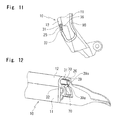
Figs. 10(a) to 10(c) , in the lower side terminal part of theprotector 10 with the sensor, theleads 36 are piled on the twocore wires Figs. 10(a) to 10(c) relative to a sheet), theleads 36 and the twocore wires Fig. 10(b) ) and aninsert 25 fills up thespace 33 which is exposed in an end part (Fig. 10(c) ). Then, as shown inFig. 11 ,wire connection parts insert 25 and a part of thewire harness 90 are embedded in a die molded part by die molding and are not exposed. Also, as shown inFig. 12 , in an upper side terminal part of theprotector 10 with the sensor,legs resistor 39 are piled on the twocore wires Fig. 12 relative to the sheet), the legs and the twocore wires insert 26 fills up thespace 33. Then, thewire connection parts 70, theinsert 26 and theresistor 39 are embedded in a die molded part by means of the die molding and are not exposed. - In
Figs. 11 and 12 , dotted lines show the die molded parts. - Unfortunately, however, as shown in
Fig. 8 , thespace 33 between the two rubber like elastic bodies (conductive parts) 34, 35 having conductivity substantially has an oblong shaped (rectangular shaped) cross section. Accordingly, amovable range 500 as a part which bends for detecting the objects is not wide enough. Theconductive parts Fig. 8 ) and about 30° toward an outer-cabin side (lower direction inFig. 8 ), respectively. When an angle is larger than 60°, the twoconductive parts - Japanese examined Patent Publication No.
3334477 - Therefore, an object of the present invention is to provide the protectors with sensors excellent in capability of detecting the objects.
- In order to achieve the above-mentioned object, according to one aspect of the invention, a protector with a sensor is provided, the protector with the sensor comprising: an installation base member (11) operatively coupled on a peripheral edge of an opening/closing panel which moves between at least two positions to open and close an opening of an automobile body or on a peripheral edge of said opening of the automobile body, the opening/closing panel including a door (1) and a sun roof (2) of an automobile; and a hollow part (52) unified with the installation base member (11), the hollow part (52) having a shape of a tube, the hollow part (52) having core wires (31, 32), two conductive parts (54, 55) and a space (53) provided therein, the two conductive parts (54, 55) having the core wires (31, 32) embedded therein respectively, the space (53) being positioned between the two conductive parts (54, 55); in which:
- when an object is disposed between said opening/closing panel and said opening and makes contact with said hollow part (12) when said opening/closing panel is moved towards a closed position, a corresponding change in electric signal detects said object; and
- in a terminal part, said core wires (31, 32) drawn out in a longitudinal direction are connected with two leads (36, 36), said two leads (36, 36) being joined with a control unit (40), wherein:
- an outer peripheral surface of the hollow part (52) is an outer coat (52a) substantially having a horseshoe shaped cross section; both ends (52b, 52c) of the outer coat (52a) are connected with a right side and a left side of said installation base member (11) at a distance from each other; said two conductive parts (54, 55) comprise a conductive part (55) having a convex shape on a lower part of the hollow part and a conductive part (54) having a concave shape on an upper part of the hollow part, the lower part of the hollow part being a side of said installation base member (11), the upper part of the hollow part being a side of a top end of the hollow part; and said two conductive parts (54, 55) are shaped and positioned in a manner that said space (53) substantially has a V-shaped cross section, said space (53) substantially has a uniform width in cross section, an opening of the V-shaped cross section faces the side of said installation base member (11), and both ends (53a, 53b) of the V-shaped cross section are continuously provided on an inner surface of said outer coat (52a).
- It is to be noted that the "change in electric signal" includes a change by short between the two core wires, and a change in capacitance.
- In addition, according to an aspect of the present invention, lower parts (54a) of said conductive part (54) on the upper part of the hollow part are closer to said installation base member (11) than a tip (55a) of the conductive part (55) on the lower part of the hollow part.
- In addition, according to an aspect of the present invention, said two conductive parts (54, 55) are shaped and positioned in a manner that the both ends (53a, 53b) of the V-shaped cross section of said space (53) are continuously provided on inner surfaces of both ends (52b, 52c) of said outer coat (52a).
- In addition, according to an aspect of the present invention, said two conductive parts (54, 55) are shaped and positioned in a manner that at least a part of one end (53b) of the both ends (53a, 53b) of said V-shaped cross section of said space (53) is continuously provided directly on said installation base member (11).
- In addition, according to an aspect of the present invention, the both ends (52b, 52c) of said outer coat (52a) broaden a thickness toward said installation base member (11), the both ends (52b, 52c) being connected with said installation base member (11).
- In addition, according to an aspect of the present invention, said two conductive parts (54, 55) and said space (53) in said hollow part (52) as well as said hollow part (52) substantially have a bilateral-symmetrically shaped cross section and said core wires (31, 32) are on an axis (400) of symmetry.
- In addition, according to an aspect of the present invention, said installation base member (11), said hollow part (52), said conductive parts (54, 55) and said core wires (31, 32) are integrally molded.
- Symbols in parentheses show constituents or items corresponding to the drawings.
- According to the present invention, the outer peripheral surface of the hollow part is the outer coat substantially having the horseshoe shaped cross section, and the conductive part having the concave shape on the upper part of the hollow part and the conductive part having the convex shape on the lower part of the hollow part are provided in the hollow part in the manner that the space between the two conductive parts substantially has the V-shaped cross section, the space substantially has the uniform width in cross section, the opening of the V-shaped cross section faces the side of the installation base member, and the both ends of the V-shaped cross section are continuously provided on the inner surface of the outer coat. Accordingly, as compared with a prior art (
Fig. 8 ) which includes a space substantially having an oblong shaped (rectangular shaped) cross section, a movable range of the outer coat of the hollow part which bends for detecting objects is wider. The structure enables detection of the objects over wider ranges on the inner-cabin side and the outer-cabin side. - In addition, the lower parts of the conductive part on the upper part of the hollow part are closer to the installation base member than the tip of the conductive part on the lower part of the hollow part. Accordingly, even slight bending easily touches the conductive parts to each other, thereby providing a protector with a sensor excellent in detecting capability.
- In addition, the both ends of the V-shaped cross section of the space are continuously provided on inner surfaces of both ends of the outer coat. The structure enables miniaturization and lightening of the hollow part in the cross section. Also, the structure increases bending amount of the ends of the outer coat, thereby improving the detecting capability.
- In addition, at least a part of one of the both ends of the space having the V-shaped cross section is continuously provided directly on the installation base member. The structure further increases the bending amount of the ends of the outer coat, thereby improving the detecting capability.
- In addition, the both ends of the outer coat broaden the thickness toward the installation base member with which the both ends are connected. The structure prevents cracks by convex substances, automobile keys for example, in case they are caught on the both ends of the outer coat.
- In addition, the two conductive parts and the space in the hollow part as well as the hollow part substantially have the bilateral-symmetrically shaped cross section and the core wires are on the axis of symmetry. Accordingly, in both terminal parts of the protector with sensor, shapes of inserts inserted in the space are simplified for mass production.
- In addition, the installation base member, the hollow part, the conductive parts and the core wires are integrally molded. The structure enables to stably produce the protector with the sensor in a reduced time for operation.
- The installation base members, the hollow parts, the conductive parts and the core wires of ordinary protectors with the sensors have not been integrally molded.
-
-
Fig. 1 is an I-I line enlarged cross section ofFig. 7 , showing a protector with a sensor according to an embodiment of the present invention; -
Fig. 2 is an I-I line enlarged cross section ofFig. 7 , showing another protector with a sensor according to an embodiment of the present invention; -
Fig. 3 is an I-I line enlarged cross section ofFig. 7 , showing still another protector with a sensor according to an embodiment of the present invention; -
Fig. 4 is an I-I line enlarged cross section ofFig. 7 , showing still another protector with a sensor according to an embodiment of the present invention; -
Fig. 5 is a side view of an automobile which opens or closes by a sliding door; -
Fig. 6 is a perspective view of an automobile with a sun roof; -
Fig. 7 is a side view of the protector with the sensor ofFig. 5 ; -
Fig. 8 is an I-I line enlarged cross section ofFig. 7 , showing a protector with a sensor according to a prior art; -
Fig. 9 is an II-II line enlarged cross section ofFig. 7 , showing a protector with a sensor according to a prior art; -
Fig. 10(a), Fig. 10(b) and Fig. 10(c) are perspective views of processes before die molding a lower side terminal part of a protector with a sensor; -
Fig. 11 is a perspective view of a structural gist of the lower side terminal part of the protector with the sensor after die molding; and -
Fig. 12 is a perspective view of a structural gist of an upper side terminal part of the protector with the sensor after die molding. - Referring to the Drawings, a protector with a sensor according to an embodiment of the present invention will be described.
- A
protector 10 with a sensor of the embodiment of the present invention, which extends toward a front side of an automobile body is installed on a front end surface of a sliding door 1 of an automobile shown inFig. 5 of which the sliding door 1 moves between at least two positions to open and close an opening of the automobile body. A sensor (pressure sensitive sensor) 80 installed on theprotector 10 with the sensor outputs corresponding electric signal upon detecting an object such as a part of human body (finger, hand or leg) between the sliding door 1 and a body side opening (may also be front door or side door). Both the present invention and the prior art comprise the structures ofFig. 7 ,Fig. 10(a), Fig. 10(b), Fig. 10(c) ,Fig. 11 and Fig. 12 . ButFig. 1 of the present invention, which is an I-I line enlarged cross section of a part ofFig. 7 with a sensor (pressure sensitive sensor) 80, is different from the prior art shown inFig. 8 . When constituents or items correspond to those in prior arts, the same symbols are used. - As shown in
Fig. 1 , theprotector 10 with the sensor comprises: aninstallation base member 11 having a substantially U-shaped cross section including an inner-cabin side wall 11a, an outer-cabin side wall 11b and a connectingwall 11c, which is operatively coupled on a flange (not shown) formed on a sliding door 1 directly; ahollow part 52 which is integrally molded with theinstallation base member 11, which has a shape of a tube and which makes elastic contact with the object when the object including a finger is disposed between a front end surface of the sliding door 1 and a body side opening which faces the front end surface when the door 1 is moved towards a closed position; and the sensor (pressure sensitive sensor) 80 which is incorporated in thehollow part 52 and which outputs a corresponding electric signal upon detecting the object. The sensor (pressure sensitive sensor) 80 has two core wires (electrode wires) 31, 32 extending in an upper and lower direction (longitudinal direction) embedded in rubber likeelastic bodies space 53 therebetween, which are fixed in thehollow part 52. The rubber likeelastic bodies sensor 80 is integrally molded with thehollow part 52. - The
installation base member 11 has a plurality of holdinglips decorative lip 16 is provided on the outer-cabin side wall 11b of theinstallation base member 11. - The
hollow part 52 is integrally molded with the connectingwall 11c of theinstallation base member 11. A top end of thehollow part 52 protrudes toward a front side of an automobile. - An outer peripheral surface of the
hollow part 52 is anouter coat 52a substantially having a horseshoe shaped cross section. Both ends 52b, 52c of theouter coat 52a are connected with a right side and a left side (right side and left side ofFig. 1 relative to a sheet) of theinstallation base member 11 at a distance from each other. In the present embodiment, an inner-cabin side end 52b of theouter coat 52a is connected with a corner on which the connectingwall 11c and the inner-cabin side wall 11a of theinstallation base member 11 are continuously provided. Also, an outer-cabin side end 52c of theouter coat 52a is connected with a position at a distance toward (close to) an inner-cabin side from a corner on which the connectingwall 11c and the outer-cabin side wall 11b are continuously provided. - The both ends 52b, 52c of the
outer coat 52a broaden a thickness toward the connectingwall 11c of theinstallation base member 11. The structure prevents cracks by convex substances, automobile keys for example, in case they are caught on the both ends 52b, 52c of theouter coat 52a. - The rubber like
elastic bodies conductive part 55 having a convex shape on a lower part of thehollow part 52, which is a side of theinstallation base member 11 of thehollow part 52; and aconductive part 54 having a concave shape on an upper part of thehollow part 52, which is a side of a top end of thehollow part 52. Theconductive part 54 having the concave shape on the upper part of thehollow part 52 has acore wire 31 embedded at a center thereof and theconductive part 55 having the convex shape on the lower part of thehollow part 52 has acore wire 32 embedded at a center thereof. - Positions in the
hollow part 52 as well as shapes of theconductive part 54 on the upper part of the hollow part and theconductive part 55 on the lower part determine a shape of thespace 53 in cross section between the twoconductive parts conductive part 55 on the lower part of the hollow part substantially has a ridge-shaped cross section, a base of which comes into contact with the connectingwall 11c of theinstallation base member 11. Theconductive part 54 on the upper part of the hollow part substantially has a crescent-shaped cross section, both ends of which fall from the top end of thehollow part 52 in a manner to approach the connectingwall 11c of theinstallation base member 11. - As a result, the
space 53 substantially has a V-shaped cross section and substantially has a uniform width (1.4 mm, in the present embodiment) in cross section, an opening of the V-shaped cross section faces the side of theinstallation base member 11, and bothends outer coat 52a. In the present embodiment, the both ends 53a, 53b of the V-shaped cross section are continuously provided on inner surfaces of both ends 52b, 52c of theouter coat 52a (an inner-cabin side end 53a of the V-shaped cross section is continuously provided on the inner surface of an inner-cabin side end 52b of theouter coat 52a and an outer-cabin side end 53b of the V-shaped cross section is continuously provided on the inner surface of an outer-cabin side end 52c of theouter coat 52a). Theconductive part 55 on the lower part of the hollow part is positioned inside thehollow part 52 and shaped in a manner that a part 53bP of the outer-cabin side end 53b of the V-shaped cross section is continuously provided directly on the connectingwall 11c of theinstallation base member 11. - In addition, the
lower parts 54a of theconductive part 54 on the upper part of the hollow part are closer to theinstallation base member 11 than atip 55a of theconductive part 55 on the lower part of the hollow part. Accordingly, even slight bending easily touches the twoconductive parts conductive parts - In addition, an
axis 400 of symmetry bilaterally divides the twoconductive parts space 53 in thehollow part 52 as well as thehollow part 52 into two equal halves in a direction of an inner-cabin side and in a direction of an outer-cabin side. Also, thecore wires axis 400 of symmetry. - In the same manner as
Fig. 11 , in a lower side terminal part of theprotector 10 with the sensor, aninsert 25 fills up thespace 53 of thehollow part 52 which is open in an end side terminal part. Also, in the same manner asFig. 12 , in an upper side terminal part of theprotector 10 with the sensor, aninsert 26 fills up thespace 53 of thehollow part 52 which is open in an end side terminal part. - The
insert insert insert 25 comprises aninsertion part 25a, 26a on a side of one end and aprotrusion part 25b, 26b on a side of another end. - The
insertion part 25a, 26a has a V-shaped cross section which is substantially the same as or a little larger than thespace 53 for being inserted in thespace 53 of thehollow part 52 and tightly filling up thespace 53, thereby preventing decline in sensor function caused by die molding material flowing in thespace 53 during die molding. - The
installation base member 11 and thehollow part 52 of theprotector 10 with the sensor form an extrusion molded part made of a rubber like elastic body including: synthetic rubber such as EPDM; and thermoplastic elastomer such as TPO, TPS. The upper and lower side terminal parts of theprotector 10 with the sensor are die molded for arranging an external shape thereof. - A body of a resistor 39 (electrical component) is stably positioned on an end part of the protrusion part 26b of the
insert 26 which is used in the upper side terminal part of theprotector 10 with the sensor. The two legs (leads) 39a, 39a of theresistor 39 are piled on the twocore wires core wires core wires hollow part 52. The insertion part 26a of theinsert 26 fills up thespace 53. Then, the protrusion part 26b of theinsert 26, thewire connection parts legs resistor 39 are embedded in a die molded part by die molding the upper end of theprotector 10 with the sensor, and are not exposed. - On both side surfaces of the
protrusion part 25b of theinsert 25 which is used in the lower side terminal part of theprotector 10 with the sensor, the two leads 36, 36 are piled on the twocore wires core wires parts 37. The twocore wires hollow part 52. Theinsertion part 25a of theinsert 25 fills up thespace 53. Then, theprotrusion part 25b of theinsert 25 and thewire connection parts protector 10 with the sensor and are not exposed. The two leads 36, 36 which are covered with insulator respectively are tied by thewire harness 90 and an outer circumferential surface of the two leads 36, 36 thus tied is coated by skin of thewire harness 90. On an end part of thewire harness 90, the two leads 36, 36 are drawn out from the coveredparts wire harness 90, and are bared from the coveredparts wire harness 90 is joined with acontrol unit 40 in which the object is detected. - According to the
protector 10 with the sensor, the outer peripheral surface of thehollow part 52 is theouter coat 52a substantially having the horseshoe shaped cross section, and theconductive part 54 having the concave shape on the upper part of the hollow part and theconductive part 55 having the convex shape on the lower part of the hollow part are provided in the manner that thespace 53 between the twoconductive parts space 53 substantially has the uniform width in cross section, the opening of the V-shaped cross section faces the side of theinstallation base member 11, and the both ends 53a, 53b of the V-shaped cross section are continuously provided on the inner surface of theouter coat 52a. Accordingly, as compared with a prior art (Fig. 8 ) which includes aspace 33 substantially having an oblong shaped (rectangular shaped) cross section, amovable range 300 of theouter coat 52a of thehollow part 52 which bends for detecting the objects can be wider. In the present embodiment, themovable range 300 is a distance, from a point of intersection between theaxis 400 of symmetry and a position on a surface of theouter coat 52a of thehollow part 52, to a point of intersection between theaxis 400 of symmetry and a position on a perpendicular line from a connection point of the outer-cabin side end 52c of theouter coat 52a and theinstallation base member 11 toward theaxis 400 of symmetry (themovable range 300 > themovable range 500 of the prior art). - The structure enables detection of the objects over a wider range of about 120° comprising about 60° on the inner-cabin side (right direction in
Fig. 1 relative to a sheet) and about 60° on the outer-cabin side (left direction inFig. 1 relative to a sheet), respectively. - The
axis 400 of symmetry bilaterally divides the twoconductive parts space 53 as well as thehollow part 52 into two equal halves in the direction of the inner-cabin side and in the direction of the outer-cabin side. Also, thecore wires axis 400 of symmetry. Accordingly, in both terminal parts of the protector with sensor, the shapes of theinserts - In the present embodiment, the part 53bP of the outer-
cabin side end 53b of the V-shaped cross section is continuously provided directly on the connectingwall 11c of theinstallation base member 11 for enlarging bending amount of the outer-cabin side end 52c of theouter coat 52a, thereby improving the detecting capability. But, as shown inFig. 2 , the outer-cabin side end 53b as a whole may be continuously provided on the inner surface of the outer-cabin side end 52c of theouter coat 52a so that even a part of the outer-cabin side end 53b is not continuously provided directly on the connectingwall 11c of theinstallation base member 11. - Also, in the present embodiment, the both ends 52b, 52c of the
outer coat 52a forming thehollow part 52 broaden a thickness toward the connectingwall 11c of theinstallation base member 11. But, as shown inFig. 3 , the thickness may be substantially uniform for improving sensing capability. - In the present embodiment, the both ends 53a, 53b of the V-shaped cross section of the
space 53 are continuously provided on the inner surfaces of the both ends 52b, 52c of theouter coat 52a forming thehollow part 52. But, as shown inFig. 4 , the both ends 53a, 53b may be continuously provided on the inner surfaces of parts of theouter coat 52a at distances from the both ends 52b, 52c of theouter coat 52a. - As compared with
Fig. 4 , the structure ofFig. 1 is improved in miniaturization and lightening of thehollow part 52 in the cross section. - While the present embodiment specifies an example that the
installation base member 11, thehollow part 52 and thesensor 80 are integrally molded, theinstallation base member 11, thehollow part 52 and thesensor 80 may be separately molded so that theinstallation base member 11 and thehollow part 52 are fixed by adhesive or adhesive tape, and thesensor 80 is inserted in thehollow part 52 for unification. Alternatively, any two of theinstallation base member 11, thehollow part 52 and thesensor 80 may be integrally molded and a remaining member is separately molded. - In the present embodiment, the
installation base member 11 has a plurality of holdinglips 14 formed inside and a core 15 having a substantially U-shaped cross section embedded therein. But theinstallation base member 11 may have only one holdinglip installation base member 11 may have any shape as long as theinstallation base member 11 has a part thereof for fixing thehollow part 52 and thesensor 80 thereon, of which examples include the U-shaped cross section of the present embodiment. Methods of fixing thehollow part 52 and thesensor 80 on the sliding door 1 vary, including use of adhesive tape as well as gripping and fitting thehollow part 52 and thesensor 80. - The present embodiment specifies an example that the
protector 10 with the sensor is installed on the sliding door 1 side of the automobile, which slides frontward and rearward. But theprotector 10 with the sensor may be installed on the body side opening for detecting the object between the sliding door and the body side opening. - Also, the
protector 10 with the sensor is applicable to a back door or a sun roof 2 (Fig. 6 ).
Claims (7)
- A protector with a sensor comprising: an installation base member operatively coupled on a peripheral edge of an opening/closing panel which moves between at least two positions to open and close an opening of an automobile body or on a peripheral edge of said opening of the automobile body, the opening/closing panel including a door and a sun roof of an automobile; and a hollow part unified with the installation base member, the hollow part having a shape of a tube, the hollow part having core wires, two conductive parts and a space provided therein, the two conductive parts having the core wires embedded therein respectively, the space being positioned between the two conductive parts; in which:when an object is disposed between said opening/closing panel and said opening and makes contact with said hollow part when said opening/closing panel is moved towards a closed position, a corresponding change in electric signal detects said object; andin a terminal part, said core wires drawn out in a longitudinal direction are connected with two leads, said two leads being joined with a control unit, wherein:an outer peripheral surface of the hollow part is an outer coat substantially having a horseshoe shaped cross section; both ends of the outer coat are connected with a right side and a left side of said installation base member at a distance from each other; said two conductive parts comprise a conductive part having a convex shape on a lower part of the hollow part and a conductive part having a concave shape on an upper part of the hollow part, the lower part of the hollow part being a side of said installation base member, the upper part of the hollow part being a side of a top end of the hollow part; and said two conductive parts are shaped and positioned in a manner that said space substantially has a V-shaped cross section, said space substantially has a uniform width in cross section, an opening of the V-shaped cross section faces the side of said installation base member, and both ends of the V-shaped cross section are continuously provided on an inner surface of said outer coat.
- The protector with the sensor as claimed in Claim 1, wherein: lower parts of said conductive part on the upper part of the hollow part are closer to said installation base member than a tip of the conductive part on the lower part of the hollow part.
- The protector with the sensor as claimed in Claim 1 or Claim 2, wherein: said two conductive parts are shaped and positioned in a manner that the both ends of the V-shaped cross section of said space are continuously provided on inner surfaces of both ends of said outer coat.
- The protector with the sensor as claimed in Claim 3, wherein: said two conductive parts are shaped and positioned in a manner that at least a part of one end of the both ends of said V-shaped cross section of said space is continuously provided directly on said installation base member.
- The protector with the sensor as claimed in any one of Claim 1 to Claim 4, wherein: the both ends of said outer coat broaden a thickness toward said installation base member, the both ends being connected with said installation base member.
- The protector with the sensor as claimed in any one of Claim 1 to Claim 5, wherein: said two conductive parts and said space in said hollow part as well as said hollow part substantially have a bilateral-symmetrically shaped cross section and said core wires are on an axis of symmetry.
- The protector with the sensor as claimed in any one of Claim 1 to Claim 6, wherein: said installation base member, said hollow part, said conductive parts and said core wires are integrally molded.
Applications Claiming Priority (1)
| Application Number | Priority Date | Filing Date | Title |
|---|---|---|---|
| JP2014054908A JP6317144B2 (en) | 2014-03-18 | 2014-03-18 | Protector with sensor |
Publications (2)
| Publication Number | Publication Date |
|---|---|
| EP2922075A1 true EP2922075A1 (en) | 2015-09-23 |
| EP2922075B1 EP2922075B1 (en) | 2017-07-19 |
Family
ID=52726934
Family Applications (1)
| Application Number | Title | Priority Date | Filing Date |
|---|---|---|---|
| EP15157085.0A Active EP2922075B1 (en) | 2014-03-18 | 2015-03-02 | Protector with sensor |
Country Status (4)
| Country | Link |
|---|---|
| US (1) | US9441408B2 (en) |
| EP (1) | EP2922075B1 (en) |
| JP (1) | JP6317144B2 (en) |
| CN (1) | CN104929471B (en) |
Cited By (1)
| Publication number | Priority date | Publication date | Assignee | Title |
|---|---|---|---|---|
| CN112096212A (en) * | 2020-08-21 | 2020-12-18 | 宁波信泰机械有限公司 | A contact type anti-pinch device |
Families Citing this family (36)
| Publication number | Priority date | Publication date | Assignee | Title |
|---|---|---|---|---|
| US9705494B2 (en) * | 2009-08-21 | 2017-07-11 | Uusi, Llc | Vehicle assemblies having fascia panels with capacitance sensors operative for detecting proximal objects |
| US11634937B2 (en) | 2009-08-21 | 2023-04-25 | Uusi, Llc | Vehicle assembly having a capacitive sensor |
| US12320180B2 (en) | 2009-08-21 | 2025-06-03 | Uusi, Llc | Vehicle assembly having a capacitive sensor |
| US10954709B2 (en) | 2009-08-21 | 2021-03-23 | Uusi, Llc | Vehicle assembly having a capacitive sensor |
| US9575481B2 (en) | 2009-08-21 | 2017-02-21 | Uusi, Llc | Fascia panel assembly having capacitance sensor operative for detecting objects |
| US9845629B2 (en) | 2009-08-21 | 2017-12-19 | Uusi, Llc | Vehicle keyless entry assembly having capacitance sensor operative for detecting objects |
| US9051769B2 (en) | 2009-08-21 | 2015-06-09 | Uusi, Llc | Vehicle assembly having a capacitive sensor |
| US10017977B2 (en) | 2009-08-21 | 2018-07-10 | Uusi, Llc | Keyless entry assembly having capacitance sensor operative for detecting objects |
| JP6258735B2 (en) * | 2014-03-18 | 2018-01-10 | 西川ゴム工業株式会社 | Protector with sensor and end molding method for protector with sensor |
| JP6520340B2 (en) * | 2015-04-16 | 2019-05-29 | アイシン精機株式会社 | Pinch detection device |
| US10060172B2 (en) | 2015-08-21 | 2018-08-28 | Magna Closures Inc. | Variable resistance conductive rubber sensor and method of detecting an object/human touch therewith |
| DE102017005514A1 (en) * | 2017-06-12 | 2018-12-13 | Aso Gmbh Antriebs- Und Steuerungstechnik | Safety edge |
| JP2019008879A (en) * | 2017-06-20 | 2019-01-17 | アイシン精機株式会社 | Foreign matter detection sensor |
| JP2019006260A (en) * | 2017-06-26 | 2019-01-17 | アイシン精機株式会社 | Protector with touch sensor |
| CN107631816A (en) * | 2017-09-05 | 2018-01-26 | 上海恩井汽车科技有限公司 | A kind of power inductive sensory appts |
| CN107542355B (en) * | 2017-09-19 | 2023-04-07 | 上海恩井汽车科技有限公司 | Sensing device with support |
| CN107939207A (en) * | 2017-11-02 | 2018-04-20 | 上海恩井汽车科技有限公司 | A kind of sensing device on door flange |
| JP6341346B1 (en) * | 2018-02-15 | 2018-06-13 | 日立金属株式会社 | Pinch detection switch |
| CN109339618A (en) * | 2018-08-06 | 2019-02-15 | 上海荣南科技有限公司 | It is a kind of trigger it is sensitive, be easily installed, car anti-clamping device at low cost |
| CN109057604A (en) * | 2018-08-06 | 2018-12-21 | 上海荣南科技有限公司 | A kind of high sensitivity is easily installed, car anti-clamping item at low cost |
| US10815716B2 (en) | 2018-10-04 | 2020-10-27 | AISIN Technical Center of America, Inc. | Touch sensor apparatus for use with vehicles |
| DE102018219584B4 (en) * | 2018-11-15 | 2020-07-23 | Mayser Gmbh & Co. Kg | Hollow profile for an electrical safety edge and vehicle with a hollow profile |
| JP7159853B2 (en) * | 2018-12-26 | 2022-10-25 | 株式会社アイシン | touch sensor device |
| DE112020002950T5 (en) * | 2019-06-19 | 2022-03-17 | Magna Closures Inc. | ANTI-PINCH SENSOR WITH QUICK CONNECT OPTION AND METHOD FOR CONNECTING TO A WIRE HARNESS |
| JP7365189B2 (en) * | 2019-10-10 | 2023-10-19 | 西川ゴム工業株式会社 | protector with sensor |
| JP7349313B2 (en) * | 2019-10-10 | 2023-09-22 | 西川ゴム工業株式会社 | protector with sensor |
| KR20210112081A (en) * | 2020-03-04 | 2021-09-14 | 황성공업 주식회사 | Method and apparatus for detecting obejct |
| US11180006B2 (en) * | 2020-03-27 | 2021-11-23 | Honda Motor Co., Ltd. | Vehicle door apparatus |
| JP7355702B2 (en) * | 2020-04-21 | 2023-10-03 | 西川ゴム工業株式会社 | protector with sensor |
| CN113108104B (en) * | 2020-06-30 | 2025-07-25 | 浙江三花智能控制股份有限公司 | Sensor device and valve assembly |
| CN111963037B (en) * | 2020-08-21 | 2025-01-28 | 宁波信泰机械有限公司 | A contact type anti-pinch strip |
| JP7585834B2 (en) | 2021-02-03 | 2024-11-19 | 株式会社アイシン | Touch Sensor Unit |
| JP7655766B2 (en) | 2021-04-07 | 2025-04-02 | 西川ゴム工業株式会社 | Protector with sensor |
| US11679655B2 (en) * | 2021-08-05 | 2023-06-20 | Honda Motor Co., Ltd. | Outer pinch sensor |
| US11850922B2 (en) * | 2022-04-05 | 2023-12-26 | Honda Motor Co., Ltd. | Door seal and sensor assembly for motor vehicle |
| USD1073985S1 (en) | 2022-10-18 | 2025-05-06 | Uusi, Llc | Sensor weather seal |
Citations (4)
| Publication number | Priority date | Publication date | Assignee | Title |
|---|---|---|---|---|
| GB2301622A (en) * | 1995-06-02 | 1996-12-11 | Standard Prod Ltd | Anti-trap sealing device with sensor |
| DE19602744A1 (en) * | 1996-01-19 | 1997-07-24 | Mayser Gmbh & Co | Safety switching strip |
| JP3334477B2 (en) | 1996-02-07 | 2002-10-15 | アスモ株式会社 | Powered window opener |
| EP2620577A1 (en) * | 2012-01-27 | 2013-07-31 | Mayser GmbH & Co. KG | method to join an anti-pinch profile with a support, anti-pinch profile and system |
Family Cites Families (14)
| Publication number | Priority date | Publication date | Assignee | Title |
|---|---|---|---|---|
| DE9422030U1 (en) * | 1993-11-22 | 1997-11-27 | Beckhausen, Karlheinz, 50931 Köln | Safety contact rail with protective layer |
| JPH09102239A (en) * | 1995-10-05 | 1997-04-15 | Bridgestone Corp | Cord switch |
| JPH09158611A (en) * | 1995-12-08 | 1997-06-17 | Toyoda Gosei Co Ltd | Opening-closing condition detecting device of opening-closing member for automobile |
| JP3250469B2 (en) * | 1996-09-30 | 2002-01-28 | 豊田合成株式会社 | Door window glass seal structure used for automobiles |
| DE19720713C1 (en) * | 1997-05-16 | 1998-05-28 | Metzeler Automotive Profiles | Moulded sealing profile for sealing force-actuated closure device esp automobile sun-roof |
| DE19913105C2 (en) * | 1999-03-23 | 2002-10-24 | Metzeler Automotive Profiles | Sealing profile for sealing a power-operated locking device |
| JP3473530B2 (en) * | 1999-12-21 | 2003-12-08 | 住友電装株式会社 | Pressure sensor |
| DE20013512U1 (en) * | 2000-01-24 | 2001-03-22 | Niewöhner, Bruno, 33335 Gütersloh | Sectional or folding gate |
| CN201297086Y (en) * | 2008-10-31 | 2009-08-26 | 宁波信泰机械有限公司 | Clamping-proof induction strip |
| JP2011022038A (en) * | 2009-07-16 | 2011-02-03 | Asmo Co Ltd | Pressure sensitive sensor and method of manufacturing the same |
| US9234979B2 (en) * | 2009-12-08 | 2016-01-12 | Magna Closures Inc. | Wide activation angle pinch sensor section |
| CN201605937U (en) * | 2009-12-24 | 2010-10-13 | 宁波敏实汽车零部件技术研发有限公司 | Mounting structure of automobile sliding door anti-clamping sensing strips |
| DE102011077014A1 (en) * | 2011-06-06 | 2012-12-06 | Mayser Gmbh & Co. Kg | Hollow profile for an electrical safety edge and method for detecting obstacles with an electrical safety edge |
| JP2013218784A (en) * | 2012-04-04 | 2013-10-24 | Kokoku Intech Co Ltd | Touch switch and manufacturing method thereof |
-
2014
- 2014-03-18 JP JP2014054908A patent/JP6317144B2/en active Active
-
2015
- 2015-03-02 EP EP15157085.0A patent/EP2922075B1/en active Active
- 2015-03-05 US US14/639,752 patent/US9441408B2/en active Active
- 2015-03-06 CN CN201510098592.XA patent/CN104929471B/en active Active
Patent Citations (4)
| Publication number | Priority date | Publication date | Assignee | Title |
|---|---|---|---|---|
| GB2301622A (en) * | 1995-06-02 | 1996-12-11 | Standard Prod Ltd | Anti-trap sealing device with sensor |
| DE19602744A1 (en) * | 1996-01-19 | 1997-07-24 | Mayser Gmbh & Co | Safety switching strip |
| JP3334477B2 (en) | 1996-02-07 | 2002-10-15 | アスモ株式会社 | Powered window opener |
| EP2620577A1 (en) * | 2012-01-27 | 2013-07-31 | Mayser GmbH & Co. KG | method to join an anti-pinch profile with a support, anti-pinch profile and system |
Cited By (2)
| Publication number | Priority date | Publication date | Assignee | Title |
|---|---|---|---|---|
| CN112096212A (en) * | 2020-08-21 | 2020-12-18 | 宁波信泰机械有限公司 | A contact type anti-pinch device |
| CN112096212B (en) * | 2020-08-21 | 2024-12-06 | 宁波信泰机械有限公司 | Contact type anti-pinch device |
Also Published As
| Publication number | Publication date |
|---|---|
| CN104929471B (en) | 2018-06-08 |
| US20150267453A1 (en) | 2015-09-24 |
| JP6317144B2 (en) | 2018-04-25 |
| US9441408B2 (en) | 2016-09-13 |
| EP2922075B1 (en) | 2017-07-19 |
| JP2015174633A (en) | 2015-10-05 |
| CN104929471A (en) | 2015-09-23 |
Similar Documents
| Publication | Publication Date | Title |
|---|---|---|
| EP2922075B1 (en) | Protector with sensor | |
| US9114691B2 (en) | Protector with sensor and method of molding end part of the same | |
| EP3023279B1 (en) | Protector with sensor | |
| EP2921330A2 (en) | Protector with sensor and method of molding end part of the same | |
| JP6424074B2 (en) | Protector with sensor | |
| US11433746B2 (en) | Protector with sensor | |
| EP2835486B1 (en) | Protector with sensor and method of molding end part of the same | |
| US11325544B2 (en) | Protector with sensor | |
| JP2021054130A (en) | Protector with sensor | |
| EP2922076B1 (en) | Protector with sensor and method of molding end part of the same | |
| US12110723B2 (en) | Protector with sensor | |
| JP6418913B2 (en) | Protector with sensor and end molding method for protector with sensor | |
| JP6110728B2 (en) | Protector with sensor | |
| JP6231318B2 (en) | Protector with sensor | |
| JP6118636B2 (en) | Protector with sensor | |
| US12276149B2 (en) | Protector with sensor and method of manufacturing the same | |
| JP2025020075A (en) | Protector with sensor | |
| CN116176246A (en) | Sealing strip and manufacturing method thereof |
Legal Events
| Date | Code | Title | Description |
|---|---|---|---|
| PUAI | Public reference made under article 153(3) epc to a published international application that has entered the european phase |
Free format text: ORIGINAL CODE: 0009012 |
|
| AK | Designated contracting states |
Kind code of ref document: A1 Designated state(s): AL AT BE BG CH CY CZ DE DK EE ES FI FR GB GR HR HU IE IS IT LI LT LU LV MC MK MT NL NO PL PT RO RS SE SI SK SM TR |
|
| AX | Request for extension of the european patent |
Extension state: BA ME |
|
| RIN1 | Information on inventor provided before grant (corrected) |
Inventor name: MATSUMOTO, MICHIHIKO Inventor name: BABA, EIICHI |
|
| RAP1 | Party data changed (applicant data changed or rights of an application transferred) |
Owner name: NISHIKAWA RUBBER CO., LTD. |
|
| 17P | Request for examination filed |
Effective date: 20160302 |
|
| RBV | Designated contracting states (corrected) |
Designated state(s): AL AT BE BG CH CY CZ DE DK EE ES FI FR GB GR HR HU IE IS IT LI LT LU LV MC MK MT NL NO PL PT RO RS SE SI SK SM TR |
|
| 17Q | First examination report despatched |
Effective date: 20160727 |
|
| GRAP | Despatch of communication of intention to grant a patent |
Free format text: ORIGINAL CODE: EPIDOSNIGR1 |
|
| RIC1 | Information provided on ipc code assigned before grant |
Ipc: B60J 10/00 20160101ALN20170412BHEP Ipc: H01H 3/14 20060101AFI20170412BHEP Ipc: G01L 1/20 20060101ALI20170412BHEP |
|
| INTG | Intention to grant announced |
Effective date: 20170511 |
|
| GRAS | Grant fee paid |
Free format text: ORIGINAL CODE: EPIDOSNIGR3 |
|
| GRAA | (expected) grant |
Free format text: ORIGINAL CODE: 0009210 |
|
| AK | Designated contracting states |
Kind code of ref document: B1 Designated state(s): AL AT BE BG CH CY CZ DE DK EE ES FI FR GB GR HR HU IE IS IT LI LT LU LV MC MK MT NL NO PL PT RO RS SE SI SK SM TR |
|
| REG | Reference to a national code |
Ref country code: GB Ref legal event code: FG4D |
|
| REG | Reference to a national code |
Ref country code: CH Ref legal event code: EP |
|
| REG | Reference to a national code |
Ref country code: IE Ref legal event code: FG4D |
|
| REG | Reference to a national code |
Ref country code: AT Ref legal event code: REF Ref document number: 911112 Country of ref document: AT Kind code of ref document: T Effective date: 20170815 |
|
| REG | Reference to a national code |
Ref country code: DE Ref legal event code: R096 Ref document number: 602015003592 Country of ref document: DE |
|
| REG | Reference to a national code |
Ref country code: NL Ref legal event code: MP Effective date: 20170719 |
|
| REG | Reference to a national code |
Ref country code: LT Ref legal event code: MG4D |
|
| REG | Reference to a national code |
Ref country code: AT Ref legal event code: MK05 Ref document number: 911112 Country of ref document: AT Kind code of ref document: T Effective date: 20170719 |
|
| PG25 | Lapsed in a contracting state [announced via postgrant information from national office to epo] |
Ref country code: HR Free format text: LAPSE BECAUSE OF FAILURE TO SUBMIT A TRANSLATION OF THE DESCRIPTION OR TO PAY THE FEE WITHIN THE PRESCRIBED TIME-LIMIT Effective date: 20170719 Ref country code: FI Free format text: LAPSE BECAUSE OF FAILURE TO SUBMIT A TRANSLATION OF THE DESCRIPTION OR TO PAY THE FEE WITHIN THE PRESCRIBED TIME-LIMIT Effective date: 20170719 Ref country code: AT Free format text: LAPSE BECAUSE OF FAILURE TO SUBMIT A TRANSLATION OF THE DESCRIPTION OR TO PAY THE FEE WITHIN THE PRESCRIBED TIME-LIMIT Effective date: 20170719 Ref country code: LT Free format text: LAPSE BECAUSE OF FAILURE TO SUBMIT A TRANSLATION OF THE DESCRIPTION OR TO PAY THE FEE WITHIN THE PRESCRIBED TIME-LIMIT Effective date: 20170719 Ref country code: NO Free format text: LAPSE BECAUSE OF FAILURE TO SUBMIT A TRANSLATION OF THE DESCRIPTION OR TO PAY THE FEE WITHIN THE PRESCRIBED TIME-LIMIT Effective date: 20171019 Ref country code: SE Free format text: LAPSE BECAUSE OF FAILURE TO SUBMIT A TRANSLATION OF THE DESCRIPTION OR TO PAY THE FEE WITHIN THE PRESCRIBED TIME-LIMIT Effective date: 20170719 Ref country code: NL Free format text: LAPSE BECAUSE OF FAILURE TO SUBMIT A TRANSLATION OF THE DESCRIPTION OR TO PAY THE FEE WITHIN THE PRESCRIBED TIME-LIMIT Effective date: 20170719 |
|
| PG25 | Lapsed in a contracting state [announced via postgrant information from national office to epo] |
Ref country code: PL Free format text: LAPSE BECAUSE OF FAILURE TO SUBMIT A TRANSLATION OF THE DESCRIPTION OR TO PAY THE FEE WITHIN THE PRESCRIBED TIME-LIMIT Effective date: 20170719 Ref country code: LV Free format text: LAPSE BECAUSE OF FAILURE TO SUBMIT A TRANSLATION OF THE DESCRIPTION OR TO PAY THE FEE WITHIN THE PRESCRIBED TIME-LIMIT Effective date: 20170719 Ref country code: GR Free format text: LAPSE BECAUSE OF FAILURE TO SUBMIT A TRANSLATION OF THE DESCRIPTION OR TO PAY THE FEE WITHIN THE PRESCRIBED TIME-LIMIT Effective date: 20171020 Ref country code: IS Free format text: LAPSE BECAUSE OF FAILURE TO SUBMIT A TRANSLATION OF THE DESCRIPTION OR TO PAY THE FEE WITHIN THE PRESCRIBED TIME-LIMIT Effective date: 20171119 Ref country code: ES Free format text: LAPSE BECAUSE OF FAILURE TO SUBMIT A TRANSLATION OF THE DESCRIPTION OR TO PAY THE FEE WITHIN THE PRESCRIBED TIME-LIMIT Effective date: 20170719 Ref country code: RS Free format text: LAPSE BECAUSE OF FAILURE TO SUBMIT A TRANSLATION OF THE DESCRIPTION OR TO PAY THE FEE WITHIN THE PRESCRIBED TIME-LIMIT Effective date: 20170719 Ref country code: BG Free format text: LAPSE BECAUSE OF FAILURE TO SUBMIT A TRANSLATION OF THE DESCRIPTION OR TO PAY THE FEE WITHIN THE PRESCRIBED TIME-LIMIT Effective date: 20171019 |
|
| REG | Reference to a national code |
Ref country code: DE Ref legal event code: R097 Ref document number: 602015003592 Country of ref document: DE |
|
| PG25 | Lapsed in a contracting state [announced via postgrant information from national office to epo] |
Ref country code: DK Free format text: LAPSE BECAUSE OF FAILURE TO SUBMIT A TRANSLATION OF THE DESCRIPTION OR TO PAY THE FEE WITHIN THE PRESCRIBED TIME-LIMIT Effective date: 20170719 Ref country code: CZ Free format text: LAPSE BECAUSE OF FAILURE TO SUBMIT A TRANSLATION OF THE DESCRIPTION OR TO PAY THE FEE WITHIN THE PRESCRIBED TIME-LIMIT Effective date: 20170719 Ref country code: RO Free format text: LAPSE BECAUSE OF FAILURE TO SUBMIT A TRANSLATION OF THE DESCRIPTION OR TO PAY THE FEE WITHIN THE PRESCRIBED TIME-LIMIT Effective date: 20170719 |
|
| PLBE | No opposition filed within time limit |
Free format text: ORIGINAL CODE: 0009261 |
|
| STAA | Information on the status of an ep patent application or granted ep patent |
Free format text: STATUS: NO OPPOSITION FILED WITHIN TIME LIMIT |
|
| PG25 | Lapsed in a contracting state [announced via postgrant information from national office to epo] |
Ref country code: SK Free format text: LAPSE BECAUSE OF FAILURE TO SUBMIT A TRANSLATION OF THE DESCRIPTION OR TO PAY THE FEE WITHIN THE PRESCRIBED TIME-LIMIT Effective date: 20170719 Ref country code: EE Free format text: LAPSE BECAUSE OF FAILURE TO SUBMIT A TRANSLATION OF THE DESCRIPTION OR TO PAY THE FEE WITHIN THE PRESCRIBED TIME-LIMIT Effective date: 20170719 Ref country code: IT Free format text: LAPSE BECAUSE OF FAILURE TO SUBMIT A TRANSLATION OF THE DESCRIPTION OR TO PAY THE FEE WITHIN THE PRESCRIBED TIME-LIMIT Effective date: 20170719 Ref country code: SM Free format text: LAPSE BECAUSE OF FAILURE TO SUBMIT A TRANSLATION OF THE DESCRIPTION OR TO PAY THE FEE WITHIN THE PRESCRIBED TIME-LIMIT Effective date: 20170719 |
|
| 26N | No opposition filed |
Effective date: 20180420 |
|
| PG25 | Lapsed in a contracting state [announced via postgrant information from national office to epo] |
Ref country code: SI Free format text: LAPSE BECAUSE OF FAILURE TO SUBMIT A TRANSLATION OF THE DESCRIPTION OR TO PAY THE FEE WITHIN THE PRESCRIBED TIME-LIMIT Effective date: 20170719 |
|
| REG | Reference to a national code |
Ref country code: CH Ref legal event code: PL |
|
| PG25 | Lapsed in a contracting state [announced via postgrant information from national office to epo] |
Ref country code: MC Free format text: LAPSE BECAUSE OF FAILURE TO SUBMIT A TRANSLATION OF THE DESCRIPTION OR TO PAY THE FEE WITHIN THE PRESCRIBED TIME-LIMIT Effective date: 20170719 |
|
| REG | Reference to a national code |
Ref country code: BE Ref legal event code: MM Effective date: 20180331 |
|
| REG | Reference to a national code |
Ref country code: IE Ref legal event code: MM4A |
|
| PG25 | Lapsed in a contracting state [announced via postgrant information from national office to epo] |
Ref country code: LU Free format text: LAPSE BECAUSE OF NON-PAYMENT OF DUE FEES Effective date: 20180302 |
|
| PG25 | Lapsed in a contracting state [announced via postgrant information from national office to epo] |
Ref country code: IE Free format text: LAPSE BECAUSE OF NON-PAYMENT OF DUE FEES Effective date: 20180302 |
|
| PG25 | Lapsed in a contracting state [announced via postgrant information from national office to epo] |
Ref country code: LI Free format text: LAPSE BECAUSE OF NON-PAYMENT OF DUE FEES Effective date: 20180331 Ref country code: CH Free format text: LAPSE BECAUSE OF NON-PAYMENT OF DUE FEES Effective date: 20180331 Ref country code: BE Free format text: LAPSE BECAUSE OF NON-PAYMENT OF DUE FEES Effective date: 20180331 |
|
| PG25 | Lapsed in a contracting state [announced via postgrant information from national office to epo] |
Ref country code: FR Free format text: LAPSE BECAUSE OF NON-PAYMENT OF DUE FEES Effective date: 20180331 |
|
| GBPC | Gb: european patent ceased through non-payment of renewal fee |
Effective date: 20190302 |
|
| PG25 | Lapsed in a contracting state [announced via postgrant information from national office to epo] |
Ref country code: MT Free format text: LAPSE BECAUSE OF NON-PAYMENT OF DUE FEES Effective date: 20180302 Ref country code: GB Free format text: LAPSE BECAUSE OF NON-PAYMENT OF DUE FEES Effective date: 20190302 |
|
| PG25 | Lapsed in a contracting state [announced via postgrant information from national office to epo] |
Ref country code: TR Free format text: LAPSE BECAUSE OF FAILURE TO SUBMIT A TRANSLATION OF THE DESCRIPTION OR TO PAY THE FEE WITHIN THE PRESCRIBED TIME-LIMIT Effective date: 20170719 |
|
| PG25 | Lapsed in a contracting state [announced via postgrant information from national office to epo] |
Ref country code: PT Free format text: LAPSE BECAUSE OF FAILURE TO SUBMIT A TRANSLATION OF THE DESCRIPTION OR TO PAY THE FEE WITHIN THE PRESCRIBED TIME-LIMIT Effective date: 20170719 |
|
| PG25 | Lapsed in a contracting state [announced via postgrant information from national office to epo] |
Ref country code: MK Free format text: LAPSE BECAUSE OF NON-PAYMENT OF DUE FEES Effective date: 20170719 Ref country code: CY Free format text: LAPSE BECAUSE OF FAILURE TO SUBMIT A TRANSLATION OF THE DESCRIPTION OR TO PAY THE FEE WITHIN THE PRESCRIBED TIME-LIMIT Effective date: 20170719 Ref country code: HU Free format text: LAPSE BECAUSE OF FAILURE TO SUBMIT A TRANSLATION OF THE DESCRIPTION OR TO PAY THE FEE WITHIN THE PRESCRIBED TIME-LIMIT; INVALID AB INITIO Effective date: 20150302 |
|
| PG25 | Lapsed in a contracting state [announced via postgrant information from national office to epo] |
Ref country code: AL Free format text: LAPSE BECAUSE OF FAILURE TO SUBMIT A TRANSLATION OF THE DESCRIPTION OR TO PAY THE FEE WITHIN THE PRESCRIBED TIME-LIMIT Effective date: 20170719 |
|
| PGFP | Annual fee paid to national office [announced via postgrant information from national office to epo] |
Ref country code: DE Payment date: 20260128 Year of fee payment: 12 |