EP2920183B1 - Thieno[3,2-c]pyridin-4(5h)-ones as bet inhibitors - Google Patents
Thieno[3,2-c]pyridin-4(5h)-ones as bet inhibitors Download PDFInfo
- Publication number
- EP2920183B1 EP2920183B1 EP13798807.7A EP13798807A EP2920183B1 EP 2920183 B1 EP2920183 B1 EP 2920183B1 EP 13798807 A EP13798807 A EP 13798807A EP 2920183 B1 EP2920183 B1 EP 2920183B1
- Authority
- EP
- European Patent Office
- Prior art keywords
- methyl
- pyridin
- thieno
- piperazin
- methylsulphonyl
- Prior art date
- Legal status (The legal status is an assumption and is not a legal conclusion. Google has not performed a legal analysis and makes no representation as to the accuracy of the status listed.)
- Active
Links
- DUPNPBCUJHMSFZ-UHFFFAOYSA-N 5h-thieno[3,2-c]pyridin-4-one Chemical class O=C1NC=CC2=C1C=CS2 DUPNPBCUJHMSFZ-UHFFFAOYSA-N 0.000 title claims description 11
- 239000003112 inhibitor Substances 0.000 title description 13
- 150000001875 compounds Chemical class 0.000 claims description 255
- RAHZWNYVWXNFOC-UHFFFAOYSA-N sulfur dioxide Inorganic materials O=S=O RAHZWNYVWXNFOC-UHFFFAOYSA-N 0.000 claims description 108
- IJGRMHOSHXDMSA-UHFFFAOYSA-N nitrogen Substances N#N IJGRMHOSHXDMSA-UHFFFAOYSA-N 0.000 claims description 104
- -1 phenyl Chemical group 0.000 claims description 99
- 150000003839 salts Chemical class 0.000 claims description 92
- 229910052757 nitrogen Inorganic materials 0.000 claims description 78
- 125000004178 (C1-C4) alkyl group Chemical group 0.000 claims description 72
- 125000002496 methyl group Chemical group [H]C([H])([H])* 0.000 claims description 69
- 238000011282 treatment Methods 0.000 claims description 51
- 125000002023 trifluoromethyl group Chemical group FC(F)(F)* 0.000 claims description 34
- 125000001997 phenyl group Chemical group [H]C1=C([H])C([H])=C(*)C([H])=C1[H] 0.000 claims description 32
- 229920006395 saturated elastomer Polymers 0.000 claims description 29
- 125000000956 methoxy group Chemical group [H]C([H])([H])O* 0.000 claims description 28
- 239000008194 pharmaceutical composition Substances 0.000 claims description 28
- 206010028980 Neoplasm Diseases 0.000 claims description 24
- 125000001495 ethyl group Chemical group [H]C([H])([H])C([H])([H])* 0.000 claims description 24
- 125000005843 halogen group Chemical group 0.000 claims description 23
- 208000037265 diseases, disorders, signs and symptoms Diseases 0.000 claims description 22
- 201000011510 cancer Diseases 0.000 claims description 21
- 201000010099 disease Diseases 0.000 claims description 20
- 125000000623 heterocyclic group Chemical group 0.000 claims description 19
- 230000001154 acute effect Effects 0.000 claims description 16
- 125000004200 2-methoxyethyl group Chemical group [H]C([H])([H])OC([H])([H])C([H])([H])* 0.000 claims description 14
- 229910052760 oxygen Inorganic materials 0.000 claims description 14
- 229910052739 hydrogen Inorganic materials 0.000 claims description 13
- PLPLZWNWGCTUSK-UHFFFAOYSA-N 2-[(4-benzoylpiperazin-1-yl)methyl]-7-(3,4-dimethoxyphenyl)-5-methylthieno[3,2-c]pyridin-4-one Chemical compound C1=C(OC)C(OC)=CC=C1C1=CN(C)C(=O)C2=C1SC(CN1CCN(CC1)C(=O)C=1C=CC=CC=1)=C2 PLPLZWNWGCTUSK-UHFFFAOYSA-N 0.000 claims description 12
- 125000001153 fluoro group Chemical group F* 0.000 claims description 11
- 239000001257 hydrogen Substances 0.000 claims description 10
- 125000000876 trifluoromethoxy group Chemical group FC(F)(F)O* 0.000 claims description 10
- 125000004435 hydrogen atom Chemical group [H]* 0.000 claims description 9
- 125000004076 pyridyl group Chemical group 0.000 claims description 9
- 230000001363 autoimmune Effects 0.000 claims description 8
- 229910052799 carbon Inorganic materials 0.000 claims description 8
- 125000001309 chloro group Chemical group Cl* 0.000 claims description 8
- 230000001684 chronic effect Effects 0.000 claims description 8
- 230000004968 inflammatory condition Effects 0.000 claims description 8
- 239000000546 pharmaceutical excipient Substances 0.000 claims description 8
- 208000036142 Viral infection Diseases 0.000 claims description 7
- 125000001559 cyclopropyl group Chemical group [H]C1([H])C([H])([H])C1([H])* 0.000 claims description 7
- 239000003085 diluting agent Substances 0.000 claims description 7
- 125000005842 heteroatom Chemical group 0.000 claims description 7
- 208000015181 infectious disease Diseases 0.000 claims description 7
- 230000009385 viral infection Effects 0.000 claims description 7
- 125000006272 (C3-C7) cycloalkyl group Chemical group 0.000 claims description 6
- 125000000217 alkyl group Chemical group 0.000 claims description 6
- 239000003937 drug carrier Substances 0.000 claims description 5
- 230000028709 inflammatory response Effects 0.000 claims description 5
- JOHPYVAPRBCWOW-UHFFFAOYSA-N 2-[(4-benzylsulfonylpiperazin-1-yl)methyl]-7-(3,4-dimethoxyphenyl)-5-methylthieno[3,2-c]pyridin-4-one Chemical compound C1=C(OC)C(OC)=CC=C1C1=CN(C)C(=O)C2=C1SC(CN1CCN(CC1)S(=O)(=O)CC=1C=CC=CC=1)=C2 JOHPYVAPRBCWOW-UHFFFAOYSA-N 0.000 claims description 4
- 125000000339 4-pyridyl group Chemical group N1=C([H])C([H])=C([*])C([H])=C1[H] 0.000 claims description 4
- ORECLUOLZASJNB-UHFFFAOYSA-N 5-methyl-2-[(4-methylsulfonylpiperazin-1-yl)methyl]-7-[5-(1-pyridin-2-ylethoxy)pyridin-3-yl]thieno[3,2-c]pyridin-4-one Chemical compound C=1C=CC=NC=1C(C)OC(C=1)=CN=CC=1C(C=1S2)=CN(C)C(=O)C=1C=C2CN1CCN(S(C)(=O)=O)CC1 ORECLUOLZASJNB-UHFFFAOYSA-N 0.000 claims description 4
- 241000894006 Bacteria Species 0.000 claims description 4
- 241000233866 Fungi Species 0.000 claims description 4
- PAGXAYAPBYIRHL-UHFFFAOYSA-N N-[2-[[5-methyl-4-oxo-7-(3-phenylmethoxyphenyl)thieno[3,2-c]pyridin-2-yl]methylamino]ethyl]methanesulfonamide Chemical compound C(C1=CC=CC=C1)OC=1C=C(C=CC=1)C=1C2=C(C(N(C=1)C)=O)C=C(S2)CNCCNS(=O)(=O)C PAGXAYAPBYIRHL-UHFFFAOYSA-N 0.000 claims description 4
- NINIDFKCEFEMDL-UHFFFAOYSA-N Sulfur Chemical group [S] NINIDFKCEFEMDL-UHFFFAOYSA-N 0.000 claims description 4
- 241000700605 Viruses Species 0.000 claims description 4
- QVGXLLKOCUKJST-UHFFFAOYSA-N atomic oxygen Chemical group [O] QVGXLLKOCUKJST-UHFFFAOYSA-N 0.000 claims description 4
- SMVHNEADENMQJL-UHFFFAOYSA-N n-[2-[[7-(3,4-dimethoxyphenyl)-5-methyl-4-oxothieno[3,2-c]pyridin-2-yl]methylamino]ethyl]methanesulfonamide Chemical compound C1=C(OC)C(OC)=CC=C1C1=CN(C)C(=O)C2=C1SC(CNCCNS(C)(=O)=O)=C2 SMVHNEADENMQJL-UHFFFAOYSA-N 0.000 claims description 4
- QJGQUHMNIGDVPM-UHFFFAOYSA-N nitrogen group Chemical group [N] QJGQUHMNIGDVPM-UHFFFAOYSA-N 0.000 claims description 4
- 239000001301 oxygen Chemical group 0.000 claims description 4
- 244000045947 parasite Species 0.000 claims description 4
- 238000002560 therapeutic procedure Methods 0.000 claims description 4
- 239000003053 toxin Substances 0.000 claims description 4
- 231100000765 toxin Toxicity 0.000 claims description 4
- 108700012359 toxins Proteins 0.000 claims description 4
- LWSXMNZMMHTRFK-QGZVFWFLSA-N (2r)-1-[[7-(3,4-dimethoxyphenyl)-5-methyl-4-oxothieno[3,2-c]pyridin-2-yl]methyl]piperazine-2-carboxamide Chemical compound C1=C(OC)C(OC)=CC=C1C1=CN(C)C(=O)C2=C1SC(CN1[C@H](CNCC1)C(N)=O)=C2 LWSXMNZMMHTRFK-QGZVFWFLSA-N 0.000 claims description 3
- OIYXHCFMQQGLMU-UHFFFAOYSA-N 2-(1,4-diazepan-1-ylmethyl)-7-(3,4-dimethoxyphenyl)-5-methylthieno[3,2-c]pyridin-4-one Chemical compound C1=C(OC)C(OC)=CC=C1C1=CN(C)C(=O)C2=C1SC(CN1CCNCCC1)=C2 OIYXHCFMQQGLMU-UHFFFAOYSA-N 0.000 claims description 3
- YLRDMAXSFQZXSK-UHFFFAOYSA-N 2-[(2-aminoethylamino)methyl]-5-methyl-7-(3-phenylmethoxyphenyl)thieno[3,2-c]pyridin-4-one Chemical compound C1=2SC(CNCCN)=CC=2C(=O)N(C)C=C1C(C=1)=CC=CC=1OCC1=CC=CC=C1 YLRDMAXSFQZXSK-UHFFFAOYSA-N 0.000 claims description 3
- KEPPSGSHCACVHM-UHFFFAOYSA-N 2-[(2-aminoethylamino)methyl]-7-(3,4-dimethoxyphenyl)-5-methylthieno[3,2-c]pyridin-4-one Chemical compound C1=C(OC)C(OC)=CC=C1C1=CN(C)C(=O)C2=C1SC(CNCCN)=C2 KEPPSGSHCACVHM-UHFFFAOYSA-N 0.000 claims description 3
- CUDFYLAWQCAKQE-UHFFFAOYSA-N 2-[(3-aminopropylamino)methyl]-5-methyl-7-(3-phenylmethoxyphenyl)thieno[3,2-c]pyridin-4-one Chemical compound C1=2SC(CNCCCN)=CC=2C(=O)N(C)C=C1C(C=1)=CC=CC=1OCC1=CC=CC=C1 CUDFYLAWQCAKQE-UHFFFAOYSA-N 0.000 claims description 3
- QWZNZVJHYCVAHW-UHFFFAOYSA-N 2-[(3-aminopropylamino)methyl]-7-(3,4-dimethoxyphenyl)-5-methylthieno[3,2-c]pyridin-4-one Chemical compound C1=C(OC)C(OC)=CC=C1C1=CN(C)C(=O)C2=C1SC(CNCCCN)=C2 QWZNZVJHYCVAHW-UHFFFAOYSA-N 0.000 claims description 3
- AKARJUASWKJPIV-UHFFFAOYSA-N 2-[(3-aminopyrrolidin-1-yl)methyl]-7-(3,4-dimethoxyphenyl)-5-methylthieno[3,2-c]pyridin-4-one Chemical compound NC1CN(CC1)CC1=CC=2C(N(C=C(C=2S1)C1=CC(=C(C=C1)OC)OC)C)=O AKARJUASWKJPIV-UHFFFAOYSA-N 0.000 claims description 3
- JPRFRJVXFRRVNI-UHFFFAOYSA-N 2-[(4-acetylpiperazin-1-yl)methyl]-5-ethyl-7-phenylthieno[3,2-c]pyridin-4-one Chemical compound C1=2SC(CN3CCN(CC3)C(C)=O)=CC=2C(=O)N(CC)C=C1C1=CC=CC=C1 JPRFRJVXFRRVNI-UHFFFAOYSA-N 0.000 claims description 3
- MRKVGPZBCMCJST-UHFFFAOYSA-N 2-[(4-acetylpiperazin-1-yl)methyl]-5-methyl-7-phenylthieno[3,2-c]pyridin-4-one Chemical compound C1CN(C(=O)C)CCN1CC1=CC(C(N(C)C=C2C=3C=CC=CC=3)=O)=C2S1 MRKVGPZBCMCJST-UHFFFAOYSA-N 0.000 claims description 3
- KLFBXAYDKXKUHZ-UHFFFAOYSA-N 2-[(4-acetylpiperazin-1-yl)methyl]-7-(3,4-dimethoxyphenyl)-5-ethylthieno[3,2-c]pyridin-4-one Chemical compound C1=2SC(CN3CCN(CC3)C(C)=O)=CC=2C(=O)N(CC)C=C1C1=CC=C(OC)C(OC)=C1 KLFBXAYDKXKUHZ-UHFFFAOYSA-N 0.000 claims description 3
- MXQVZVUGULMQGY-UHFFFAOYSA-N 2-[(4-acetylpiperazin-1-yl)methyl]-7-(3,4-dimethoxyphenyl)-5-methylthieno[3,2-c]pyridin-4-one Chemical compound C1=C(OC)C(OC)=CC=C1C1=CN(C)C(=O)C2=C1SC(CN1CCN(CC1)C(C)=O)=C2 MXQVZVUGULMQGY-UHFFFAOYSA-N 0.000 claims description 3
- QHAXCSDVKXISFB-UHFFFAOYSA-N 2-[(4-aminopiperidin-1-yl)methyl]-7-(3,4-dimethoxyphenyl)-5-methylthieno[3,2-c]pyridin-4-one Chemical compound NC1CCN(CC1)CC1=CC=2C(N(C=C(C=2S1)C1=CC(=C(C=C1)OC)OC)C)=O QHAXCSDVKXISFB-UHFFFAOYSA-N 0.000 claims description 3
- JRYJUCPJLQLBSI-UHFFFAOYSA-N 2-[(4-ethylpiperazin-1-yl)methyl]-5-methyl-7-(3-phenylmethoxyphenyl)thieno[3,2-c]pyridin-4-one Chemical compound C1CN(CC)CCN1CC1=CC(C(N(C)C=C2C=3C=C(OCC=4C=CC=CC=4)C=CC=3)=O)=C2S1 JRYJUCPJLQLBSI-UHFFFAOYSA-N 0.000 claims description 3
- OAPHCHPGFKOEDD-GOSISDBHSA-N 2-[[(3R)-3-butylpiperazin-1-yl]methyl]-7-(3,4-dimethoxyphenyl)-5-methylthieno[3,2-c]pyridin-4-one Chemical compound C(CCC)[C@@H]1CN(CCN1)CC1=CC=2C(N(C=C(C=2S1)C1=CC(=C(C=C1)OC)OC)C)=O OAPHCHPGFKOEDD-GOSISDBHSA-N 0.000 claims description 3
- JCHUEVUPRPUUJY-LJQANCHMSA-N 2-[[(3r)-3-butyl-4-methylsulfonylpiperazin-1-yl]methyl]-7-(3,4-dimethoxyphenyl)-5-methylthieno[3,2-c]pyridin-4-one Chemical compound C1CN(S(C)(=O)=O)[C@H](CCCC)CN1CC1=CC(C(N(C)C=C2C=3C=C(OC)C(OC)=CC=3)=O)=C2S1 JCHUEVUPRPUUJY-LJQANCHMSA-N 0.000 claims description 3
- KGLYUHMXSFALIS-UHFFFAOYSA-N 2-[[2-aminoethyl(methyl)amino]methyl]-7-(3,4-dimethoxyphenyl)-5-methylthieno[3,2-c]pyridin-4-one Chemical compound C1=C(OC)C(OC)=CC=C1C1=CN(C)C(=O)C2=C1SC(CN(C)CCN)=C2 KGLYUHMXSFALIS-UHFFFAOYSA-N 0.000 claims description 3
- GSRILXKMZHLOQV-UHFFFAOYSA-N 2-[[4-(benzenesulfonyl)piperazin-1-yl]methyl]-7-(3,4-dimethoxyphenyl)-5-methylthieno[3,2-c]pyridin-4-one Chemical compound C1=C(OC)C(OC)=CC=C1C1=CN(C)C(=O)C2=C1SC(CN1CCN(CC1)S(=O)(=O)C=1C=CC=CC=1)=C2 GSRILXKMZHLOQV-UHFFFAOYSA-N 0.000 claims description 3
- HQCMJMQERPEGNR-UHFFFAOYSA-N 4-[5-methyl-2-[(4-methylsulfonylpiperazin-1-yl)methyl]-4-oxothieno[3,2-c]pyridin-7-yl]benzonitrile Chemical compound C1=2SC(CN3CCN(CC3)S(C)(=O)=O)=CC=2C(=O)N(C)C=C1C1=CC=C(C#N)C=C1 HQCMJMQERPEGNR-UHFFFAOYSA-N 0.000 claims description 3
- CBKCCGNDCGCHIB-UHFFFAOYSA-N 4-[[7-(3,4-dimethoxyphenyl)-5-methyl-4-oxothieno[3,2-c]pyridin-2-yl]methyl]-n,n-dimethylpiperazine-1-sulfonamide Chemical compound C1=C(OC)C(OC)=CC=C1C1=CN(C)C(=O)C2=C1SC(CN1CCN(CC1)S(=O)(=O)N(C)C)=C2 CBKCCGNDCGCHIB-UHFFFAOYSA-N 0.000 claims description 3
- WXGQBIFFLCPZDP-UHFFFAOYSA-N 5-ethyl-2-[(4-methylsulfonylpiperazin-1-yl)methyl]-7-phenylthieno[3,2-c]pyridin-4-one Chemical compound C1=2SC(CN3CCN(CC3)S(C)(=O)=O)=CC=2C(=O)N(CC)C=C1C1=CC=CC=C1 WXGQBIFFLCPZDP-UHFFFAOYSA-N 0.000 claims description 3
- PFJGXMFDMZSHSZ-UHFFFAOYSA-N 5-methyl-2-[(4-methyl-1,4-diazepan-1-yl)methyl]-7-(3-phenylmethoxyphenyl)thieno[3,2-c]pyridin-4-one Chemical compound C1CN(C)CCCN1CC1=CC(C(N(C)C=C2C=3C=C(OCC=4C=CC=CC=4)C=CC=3)=O)=C2S1 PFJGXMFDMZSHSZ-UHFFFAOYSA-N 0.000 claims description 3
- ATVYENJAGXRBME-UHFFFAOYSA-N 5-methyl-2-[(4-methylsulfonylpiperazin-1-yl)methyl]-7-(2-phenylmethoxyphenyl)thieno[3,2-c]pyridin-4-one Chemical compound C1=2SC(CN3CCN(CC3)S(C)(=O)=O)=CC=2C(=O)N(C)C=C1C1=CC=CC=C1OCC1=CC=CC=C1 ATVYENJAGXRBME-UHFFFAOYSA-N 0.000 claims description 3
- YWTSJNGCJJMIKR-UHFFFAOYSA-N 5-methyl-2-[(4-methylsulfonylpiperazin-1-yl)methyl]-7-(3-propan-2-yloxyphenyl)thieno[3,2-c]pyridin-4-one Chemical compound CC(C)OC1=CC=CC(C=2C=3SC(CN4CCN(CC4)S(C)(=O)=O)=CC=3C(=O)N(C)C=2)=C1 YWTSJNGCJJMIKR-UHFFFAOYSA-N 0.000 claims description 3
- XBVIMIBFRODKOF-UHFFFAOYSA-N 5-methyl-2-[(4-methylsulfonylpiperazin-1-yl)methyl]-7-(5-phenylmethoxypyridin-3-yl)thieno[3,2-c]pyridin-4-one Chemical compound C1=2SC(CN3CCN(CC3)S(C)(=O)=O)=CC=2C(=O)N(C)C=C1C(C=1)=CN=CC=1OCC1=CC=CC=C1 XBVIMIBFRODKOF-UHFFFAOYSA-N 0.000 claims description 3
- CVPZHFKBAONDJW-UHFFFAOYSA-N 5-methyl-2-[(4-methylsulfonylpiperazin-1-yl)methyl]-7-[2-(1-pyridin-2-ylethoxy)pyridin-4-yl]thieno[3,2-c]pyridin-4-one Chemical compound C=1C=CC=NC=1C(C)OC(N=CC=1)=CC=1C(C=1S2)=CN(C)C(=O)C=1C=C2CN1CCN(S(C)(=O)=O)CC1 CVPZHFKBAONDJW-UHFFFAOYSA-N 0.000 claims description 3
- FLGQCWZVUAVQNW-UHFFFAOYSA-N 5-methyl-2-[(4-methylsulfonylpiperazin-1-yl)methyl]-7-[2-(oxan-4-ylmethoxy)pyridin-4-yl]thieno[3,2-c]pyridin-4-one Chemical compound C1=2SC(CN3CCN(CC3)S(C)(=O)=O)=CC=2C(=O)N(C)C=C1C(C=1)=CC=NC=1OCC1CCOCC1 FLGQCWZVUAVQNW-UHFFFAOYSA-N 0.000 claims description 3
- YVLBRBIBXFTUKO-UHFFFAOYSA-N 5-methyl-2-[(4-methylsulfonylpiperazin-1-yl)methyl]-7-[2-(oxolan-2-ylmethylamino)pyridin-4-yl]thieno[3,2-c]pyridin-4-one Chemical compound C1=2SC(CN3CCN(CC3)S(C)(=O)=O)=CC=2C(=O)N(C)C=C1C(C=1)=CC=NC=1NCC1CCCO1 YVLBRBIBXFTUKO-UHFFFAOYSA-N 0.000 claims description 3
- VZUFIMFWWNVVAX-UHFFFAOYSA-N 5-methyl-2-[(4-methylsulfonylpiperazin-1-yl)methyl]-7-[3-(1-phenylethoxy)phenyl]thieno[3,2-c]pyridin-4-one Chemical compound C=1C=CC=CC=1C(C)OC(C=1)=CC=CC=1C(C=1S2)=CN(C)C(=O)C=1C=C2CN1CCN(S(C)(=O)=O)CC1 VZUFIMFWWNVVAX-UHFFFAOYSA-N 0.000 claims description 3
- FVRRJXXYAMVFDD-UHFFFAOYSA-N 5-methyl-2-[(4-methylsulfonylpiperazin-1-yl)methyl]-7-[3-(1-phenylethylamino)phenyl]thieno[3,2-c]pyridin-4-one Chemical compound C=1C=CC=CC=1C(C)NC(C=1)=CC=CC=1C(C=1S2)=CN(C)C(=O)C=1C=C2CN1CCN(S(C)(=O)=O)CC1 FVRRJXXYAMVFDD-UHFFFAOYSA-N 0.000 claims description 3
- UYWUJDAYYCMDFF-UHFFFAOYSA-N 5-methyl-2-[(4-methylsulfonylpiperazin-1-yl)methyl]-7-[3-(1-pyridin-2-ylethoxy)phenyl]thieno[3,2-c]pyridin-4-one Chemical compound C=1C=CC=NC=1C(C)OC(C=1)=CC=CC=1C(C=1S2)=CN(C)C(=O)C=1C=C2CN1CCN(S(C)(=O)=O)CC1 UYWUJDAYYCMDFF-UHFFFAOYSA-N 0.000 claims description 3
- VVLXAZUUFFWGNI-UHFFFAOYSA-N 5-methyl-2-[(4-methylsulfonylpiperazin-1-yl)methyl]-7-[3-(oxan-4-ylmethoxy)phenyl]thieno[3,2-c]pyridin-4-one Chemical compound C1=2SC(CN3CCN(CC3)S(C)(=O)=O)=CC=2C(=O)N(C)C=C1C(C=1)=CC=CC=1OCC1CCOCC1 VVLXAZUUFFWGNI-UHFFFAOYSA-N 0.000 claims description 3
- HENZTSOWHJCEEI-UHFFFAOYSA-N 5-methyl-2-[(4-methylsulfonylpiperazin-1-yl)methyl]-7-[3-(trifluoromethyl)phenyl]thieno[3,2-c]pyridin-4-one Chemical compound C1=2SC(CN3CCN(CC3)S(C)(=O)=O)=CC=2C(=O)N(C)C=C1C1=CC=CC(C(F)(F)F)=C1 HENZTSOWHJCEEI-UHFFFAOYSA-N 0.000 claims description 3
- DLPZLYLSJRBWDL-UHFFFAOYSA-N 5-methyl-2-[(4-methylsulfonylpiperazin-1-yl)methyl]-7-[4-(trifluoromethyl)phenyl]thieno[3,2-c]pyridin-4-one Chemical compound C1=2SC(CN3CCN(CC3)S(C)(=O)=O)=CC=2C(=O)N(C)C=C1C1=CC=C(C(F)(F)F)C=C1 DLPZLYLSJRBWDL-UHFFFAOYSA-N 0.000 claims description 3
- NBSDAVTZDWNREO-UHFFFAOYSA-N 5-methyl-2-[(4-methylsulfonylpiperazin-1-yl)methyl]-7-[5-(1-phenylethoxy)pyridin-3-yl]thieno[3,2-c]pyridin-4-one Chemical compound C=1C=CC=CC=1C(C)OC(C=1)=CN=CC=1C(C=1S2)=CN(C)C(=O)C=1C=C2CN1CCN(S(C)(=O)=O)CC1 NBSDAVTZDWNREO-UHFFFAOYSA-N 0.000 claims description 3
- XIYJPIWHDMMQGO-UHFFFAOYSA-N 5-methyl-2-[(4-methylsulfonylpiperazin-1-yl)methyl]-7-[5-(oxan-4-ylmethoxy)pyridin-3-yl]thieno[3,2-c]pyridin-4-one Chemical compound C1=2SC(CN3CCN(CC3)S(C)(=O)=O)=CC=2C(=O)N(C)C=C1C(C=1)=CN=CC=1OCC1CCOCC1 XIYJPIWHDMMQGO-UHFFFAOYSA-N 0.000 claims description 3
- HKGSJHDUYNKOKE-UHFFFAOYSA-N 5-methyl-2-[(4-methylsulfonylpiperazin-1-yl)methyl]-7-phenylthieno[3,2-c]pyridin-4-one Chemical compound C1=2SC(CN3CCN(CC3)S(C)(=O)=O)=CC=2C(=O)N(C)C=C1C1=CC=CC=C1 HKGSJHDUYNKOKE-UHFFFAOYSA-N 0.000 claims description 3
- VPQXKQYNAKDCMK-UHFFFAOYSA-N 5-methyl-2-[(4-methylsulfonylpiperazin-1-yl)methyl]-7-pyridin-2-ylthieno[3,2-c]pyridin-4-one Chemical compound C1=2SC(CN3CCN(CC3)S(C)(=O)=O)=CC=2C(=O)N(C)C=C1C1=CC=CC=N1 VPQXKQYNAKDCMK-UHFFFAOYSA-N 0.000 claims description 3
- XMMOGTCRMNQGRL-UHFFFAOYSA-N 5-methyl-2-[(4-methylsulfonylpiperazin-1-yl)methyl]-7-pyridin-3-ylthieno[3,2-c]pyridin-4-one Chemical compound C1=2SC(CN3CCN(CC3)S(C)(=O)=O)=CC=2C(=O)N(C)C=C1C1=CC=CN=C1 XMMOGTCRMNQGRL-UHFFFAOYSA-N 0.000 claims description 3
- AOLURKVJVOZJRC-UHFFFAOYSA-N 5-methyl-2-[(4-methylsulfonylpiperazin-1-yl)methyl]-7-pyridin-4-ylthieno[3,2-c]pyridin-4-one Chemical compound C1=2SC(CN3CCN(CC3)S(C)(=O)=O)=CC=2C(=O)N(C)C=C1C1=CC=NC=C1 AOLURKVJVOZJRC-UHFFFAOYSA-N 0.000 claims description 3
- NAUPDFCIUISFCS-GFCCVEGCSA-N 5-methyl-2-[[(2r)-2-methyl-4-methylsulfonylpiperazin-1-yl]methyl]-7-(4-oxo-1h-pyrimidin-6-yl)thieno[3,2-c]pyridin-4-one Chemical compound C[C@@H]1CN(S(C)(=O)=O)CCN1CC1=CC(C(N(C)C=C2C=3NC=NC(=O)C=3)=O)=C2S1 NAUPDFCIUISFCS-GFCCVEGCSA-N 0.000 claims description 3
- DRGLIDNTRNGOJV-MRTLOADZSA-N 5-methyl-2-[[(2r)-2-methyl-4-methylsulfonylpiperazin-1-yl]methyl]-7-[5-(1-pyridin-2-ylethoxy)pyridin-3-yl]thieno[3,2-c]pyridin-4-one Chemical compound C=1C=CC=NC=1C(C)OC(C=1)=CN=CC=1C(C=1S2)=CN(C)C(=O)C=1C=C2CN1CCN(S(C)(=O)=O)C[C@H]1C DRGLIDNTRNGOJV-MRTLOADZSA-N 0.000 claims description 3
- HHEYNMHKQYAYOO-OAHLLOKOSA-N 5-methyl-2-[[(2r)-2-methyl-4-methylsulfonylpiperazin-1-yl]methyl]-7-phenylthieno[3,2-c]pyridin-4-one Chemical compound C[C@@H]1CN(S(C)(=O)=O)CCN1CC1=CC(C(N(C)C=C2C=3C=CC=CC=3)=O)=C2S1 HHEYNMHKQYAYOO-OAHLLOKOSA-N 0.000 claims description 3
- ISDZXGVLGZKJQF-CQSZACIVSA-N 5-methyl-2-[[(2r)-2-methyl-4-methylsulfonylpiperazin-1-yl]methyl]-7-pyridin-2-ylthieno[3,2-c]pyridin-4-one Chemical compound C[C@@H]1CN(S(C)(=O)=O)CCN1CC1=CC(C(N(C)C=C2C=3N=CC=CC=3)=O)=C2S1 ISDZXGVLGZKJQF-CQSZACIVSA-N 0.000 claims description 3
- AXGDRNRKCVXPMR-AWEZNQCLSA-N 5-methyl-2-[[(2s)-2-methyl-4-methylsulfonylpiperazin-1-yl]methyl]-7-pyridin-3-ylthieno[3,2-c]pyridin-4-one Chemical compound C[C@H]1CN(S(C)(=O)=O)CCN1CC1=CC(C(N(C)C=C2C=3C=NC=CC=3)=O)=C2S1 AXGDRNRKCVXPMR-AWEZNQCLSA-N 0.000 claims description 3
- GVKHIIJCGKKFQS-AWEZNQCLSA-N 5-methyl-2-[[(2s)-2-methyl-4-methylsulfonylpiperazin-1-yl]methyl]-7-pyridin-4-ylthieno[3,2-c]pyridin-4-one Chemical compound C[C@H]1CN(S(C)(=O)=O)CCN1CC1=CC(C(N(C)C=C2C=3C=CN=CC=3)=O)=C2S1 GVKHIIJCGKKFQS-AWEZNQCLSA-N 0.000 claims description 3
- YVRBUDBEUSUUBF-IBGZPJMESA-N 5-methyl-2-[[(3s)-3-methylmorpholin-4-yl]methyl]-7-(3-phenylmethoxyphenyl)thieno[3,2-c]pyridin-4-one Chemical compound C[C@H]1COCCN1CC1=CC(C(N(C)C=C2C=3C=C(OCC=4C=CC=CC=4)C=CC=3)=O)=C2S1 YVRBUDBEUSUUBF-IBGZPJMESA-N 0.000 claims description 3
- ZRGIAKJOOLZJSI-UHFFFAOYSA-N 5-methyl-7-(2-methylphenyl)-2-[(4-methylsulfonylpiperazin-1-yl)methyl]thieno[3,2-c]pyridin-4-one Chemical compound CC1=CC=CC=C1C1=CN(C)C(=O)C2=C1SC(CN1CCN(CC1)S(C)(=O)=O)=C2 ZRGIAKJOOLZJSI-UHFFFAOYSA-N 0.000 claims description 3
- FDRGPHYCLLKCPX-UHFFFAOYSA-N 5-methyl-7-(3-methylphenyl)-2-[(4-methylsulfonylpiperazin-1-yl)methyl]thieno[3,2-c]pyridin-4-one Chemical compound CC1=CC=CC(C=2C=3SC(CN4CCN(CC4)S(C)(=O)=O)=CC=3C(=O)N(C)C=2)=C1 FDRGPHYCLLKCPX-UHFFFAOYSA-N 0.000 claims description 3
- BPUWTHDISOODQU-UHFFFAOYSA-N 5-methyl-7-(3-phenylmethoxyphenyl)-2-[(4-propan-2-ylpiperazin-1-yl)methyl]thieno[3,2-c]pyridin-4-one Chemical compound C1CN(C(C)C)CCN1CC1=CC(C(N(C)C=C2C=3C=C(OCC=4C=CC=CC=4)C=CC=3)=O)=C2S1 BPUWTHDISOODQU-UHFFFAOYSA-N 0.000 claims description 3
- FWWLTBUJOXTWDQ-UHFFFAOYSA-N 5-methyl-7-(4-methylphenyl)-2-[(4-methylsulfonylpiperazin-1-yl)methyl]thieno[3,2-c]pyridin-4-one Chemical compound C1=CC(C)=CC=C1C1=CN(C)C(=O)C2=C1SC(CN1CCN(CC1)S(C)(=O)=O)=C2 FWWLTBUJOXTWDQ-UHFFFAOYSA-N 0.000 claims description 3
- MYEZPVPWOMIUNZ-UHFFFAOYSA-N 5-methyl-7-(4-methylsulfonylphenyl)-2-[(4-methylsulfonylpiperazin-1-yl)methyl]thieno[3,2-c]pyridin-4-one Chemical compound C1=2SC(CN3CCN(CC3)S(C)(=O)=O)=CC=2C(=O)N(C)C=C1C1=CC=C(S(C)(=O)=O)C=C1 MYEZPVPWOMIUNZ-UHFFFAOYSA-N 0.000 claims description 3
- TXDKVIWTCMIMCH-UHFFFAOYSA-N 7-(2,4-difluorophenyl)-5-methyl-2-[(4-methylsulfonylpiperazin-1-yl)methyl]thieno[3,2-c]pyridin-4-one Chemical compound C1=2SC(CN3CCN(CC3)S(C)(=O)=O)=CC=2C(=O)N(C)C=C1C1=CC=C(F)C=C1F TXDKVIWTCMIMCH-UHFFFAOYSA-N 0.000 claims description 3
- VHKSXTGQEUMSAF-UHFFFAOYSA-N 7-(2-aminopyridin-4-yl)-5-methyl-2-[(3-methylmorpholin-4-yl)methyl]thieno[3,2-c]pyridin-4-one Chemical compound CC1COCCN1CC1=CC(C(N(C)C=C2C=3C=C(N)N=CC=3)=O)=C2S1 VHKSXTGQEUMSAF-UHFFFAOYSA-N 0.000 claims description 3
- ILQZLUGTMZBVAE-UHFFFAOYSA-N 7-(2-chloropyridin-4-yl)-5-methyl-2-(1,4-oxazepan-4-ylmethyl)thieno[3,2-c]pyridin-4-one Chemical compound C1=2SC(CN3CCOCCC3)=CC=2C(=O)N(C)C=C1C1=CC=NC(Cl)=C1 ILQZLUGTMZBVAE-UHFFFAOYSA-N 0.000 claims description 3
- NWROJBYMSFOMNL-UHFFFAOYSA-N 7-(2-ethylphenyl)-5-methyl-2-[(4-methylsulfonylpiperazin-1-yl)methyl]thieno[3,2-c]pyridin-4-one Chemical compound CCC1=CC=CC=C1C1=CN(C)C(=O)C2=C1SC(CN1CCN(CC1)S(C)(=O)=O)=C2 NWROJBYMSFOMNL-UHFFFAOYSA-N 0.000 claims description 3
- OCSBLLJGTQVBBU-CQSZACIVSA-N 7-(2-methoxypyridin-4-yl)-5-methyl-2-[[(2r)-2-methyl-4-methylsulfonylpiperazin-1-yl]methyl]thieno[3,2-c]pyridin-4-one Chemical compound C1=NC(OC)=CC(C=2C=3SC(CN4[C@@H](CN(CC4)S(C)(=O)=O)C)=CC=3C(=O)N(C)C=2)=C1 OCSBLLJGTQVBBU-CQSZACIVSA-N 0.000 claims description 3
- KAWIQQUGGSTKTC-UHFFFAOYSA-N 7-(3,4-dichlorophenyl)-5-methyl-2-[(4-methylsulfonylpiperazin-1-yl)methyl]thieno[3,2-c]pyridin-4-one Chemical compound C1=2SC(CN3CCN(CC3)S(C)(=O)=O)=CC=2C(=O)N(C)C=C1C1=CC=C(Cl)C(Cl)=C1 KAWIQQUGGSTKTC-UHFFFAOYSA-N 0.000 claims description 3
- FXPBMTFXJSIWQK-UHFFFAOYSA-N 7-(3,4-dimethoxyphenyl)-2-[(1,1-dioxo-1,4-thiazinan-4-yl)methyl]-5-methylthieno[3,2-c]pyridin-4-one Chemical compound C1=C(OC)C(OC)=CC=C1C1=CN(C)C(=O)C2=C1SC(CN1CCS(=O)(=O)CC1)=C2 FXPBMTFXJSIWQK-UHFFFAOYSA-N 0.000 claims description 3
- DJCSDSOCFPHBEH-UHFFFAOYSA-N 7-(3,4-dimethoxyphenyl)-2-[(3,5-dimethylpiperazin-1-yl)methyl]-5-methylthieno[3,2-c]pyridin-4-one Chemical compound C1=C(OC)C(OC)=CC=C1C1=CN(C)C(=O)C2=C1SC(CN1CC(C)NC(C)C1)=C2 DJCSDSOCFPHBEH-UHFFFAOYSA-N 0.000 claims description 3
- SHZUYURLDNIXIO-UHFFFAOYSA-N 7-(3,4-dimethoxyphenyl)-2-[(4-ethylsulfonylpiperazin-1-yl)methyl]-5-methylthieno[3,2-c]pyridin-4-one Chemical compound C1CN(S(=O)(=O)CC)CCN1CC1=CC(C(N(C)C=C2C=3C=C(OC)C(OC)=CC=3)=O)=C2S1 SHZUYURLDNIXIO-UHFFFAOYSA-N 0.000 claims description 3
- DBTGACLQCNYEEN-UHFFFAOYSA-N 7-(3,4-dimethoxyphenyl)-2-[(4-hydroxypiperidin-1-yl)methyl]-5-methylthieno[3,2-c]pyridin-4-one Chemical compound C1=C(OC)C(OC)=CC=C1C1=CN(C)C(=O)C2=C1SC(CN1CCC(O)CC1)=C2 DBTGACLQCNYEEN-UHFFFAOYSA-N 0.000 claims description 3
- BQOCCARHPNWCIR-GASCZTMLSA-N 7-(3,4-dimethoxyphenyl)-2-[[(2r,6s)-2,6-dimethylpiperazin-1-yl]methyl]-5-methylthieno[3,2-c]pyridin-4-one Chemical compound C1=C(OC)C(OC)=CC=C1C1=CN(C)C(=O)C2=C1SC(CN1[C@@H](CNC[C@@H]1C)C)=C2 BQOCCARHPNWCIR-GASCZTMLSA-N 0.000 claims description 3
- ZFPCYHRCPYIMPT-INIZCTEOSA-N 7-(3,4-dimethoxyphenyl)-2-[[(3S)-3-ethylpiperazin-1-yl]methyl]-5-methylthieno[3,2-c]pyridin-4-one Chemical compound COC=1C=C(C=CC=1OC)C=1C2=C(C(N(C=1)C)=O)C=C(S2)CN1C[C@@H](NCC1)CC ZFPCYHRCPYIMPT-INIZCTEOSA-N 0.000 claims description 3
- MXGOXZMZEFVEFC-KRWDZBQOSA-N 7-(3,4-dimethoxyphenyl)-2-[[(3s)-3-ethyl-4-methylsulfonylpiperazin-1-yl]methyl]-5-methylthieno[3,2-c]pyridin-4-one Chemical compound C1CN(S(C)(=O)=O)[C@@H](CC)CN1CC1=CC(C(N(C)C=C2C=3C=C(OC)C(OC)=CC=3)=O)=C2S1 MXGOXZMZEFVEFC-KRWDZBQOSA-N 0.000 claims description 3
- HUBCLCFJRKIIEH-UHFFFAOYSA-N 7-(3,4-dimethoxyphenyl)-5-ethyl-2-[(4-methylsulfonylpiperazin-1-yl)methyl]thieno[3,2-c]pyridin-4-one Chemical compound C1=2SC(CN3CCN(CC3)S(C)(=O)=O)=CC=2C(=O)N(CC)C=C1C1=CC=C(OC)C(OC)=C1 HUBCLCFJRKIIEH-UHFFFAOYSA-N 0.000 claims description 3
- AYHJYYVVPXJKDI-UHFFFAOYSA-N 7-(3,4-dimethoxyphenyl)-5-methyl-2-(piperazin-1-ylmethyl)thieno[3,2-c]pyridin-4-one Chemical compound C1=C(OC)C(OC)=CC=C1C1=CN(C)C(=O)C2=C1SC(CN1CCNCC1)=C2 AYHJYYVVPXJKDI-UHFFFAOYSA-N 0.000 claims description 3
- MONYBNJYHKKVQS-UHFFFAOYSA-N 7-(3,4-dimethoxyphenyl)-5-methyl-2-(piperidin-1-ylmethyl)thieno[3,2-c]pyridin-4-one Chemical compound C1=C(OC)C(OC)=CC=C1C1=CN(C)C(=O)C2=C1SC(CN1CCCCC1)=C2 MONYBNJYHKKVQS-UHFFFAOYSA-N 0.000 claims description 3
- DQFOXPJDSIMVFL-UHFFFAOYSA-N 7-(3,4-dimethoxyphenyl)-5-methyl-2-(pyrrolidin-1-ylmethyl)thieno[3,2-c]pyridin-4-one Chemical compound COc1ccc(cc1OC)-c1cn(C)c(=O)c2cc(CN3CCCC3)sc12 DQFOXPJDSIMVFL-UHFFFAOYSA-N 0.000 claims description 3
- QMEWMFQZTKKRQT-UHFFFAOYSA-N 7-(3,4-dimethoxyphenyl)-5-methyl-2-[(1-methylsulfonylpiperidin-4-yl)methyl]thieno[3,2-c]pyridin-4-one Chemical compound C1=C(OC)C(OC)=CC=C1C1=CN(C)C(=O)C2=C1SC(CC1CCN(CC1)S(C)(=O)=O)=C2 QMEWMFQZTKKRQT-UHFFFAOYSA-N 0.000 claims description 3
- JUAHXBPOOQKUTN-UHFFFAOYSA-N 7-(3,4-dimethoxyphenyl)-5-methyl-2-[(3-methyl-4-methylsulfonylpiperazin-1-yl)methyl]thieno[3,2-c]pyridin-4-one Chemical compound C1=C(OC)C(OC)=CC=C1C1=CN(C)C(=O)C2=C1SC(CN1CC(C)N(CC1)S(C)(=O)=O)=C2 JUAHXBPOOQKUTN-UHFFFAOYSA-N 0.000 claims description 3
- WDUSUXTVYJBTBU-UHFFFAOYSA-N 7-(3,4-dimethoxyphenyl)-5-methyl-2-[(3-methylmorpholin-4-yl)methyl]thieno[3,2-c]pyridin-4-one Chemical compound C1=C(OC)C(OC)=CC=C1C1=CN(C)C(=O)C2=C1SC(CN1C(COCC1)C)=C2 WDUSUXTVYJBTBU-UHFFFAOYSA-N 0.000 claims description 3
- TYSLRQMSQRLDQA-UHFFFAOYSA-N 7-(3,4-dimethoxyphenyl)-5-methyl-2-[(3-methylpiperazin-1-yl)methyl]thieno[3,2-c]pyridin-4-one Chemical compound C1=C(OC)C(OC)=CC=C1C1=CN(C)C(=O)C2=C1SC(CN1CC(C)NCC1)=C2 TYSLRQMSQRLDQA-UHFFFAOYSA-N 0.000 claims description 3
- MQHHYOOUCJYAMQ-UHFFFAOYSA-N 7-(3,4-dimethoxyphenyl)-5-methyl-2-[(4-methylpiperazin-1-yl)methyl]thieno[3,2-c]pyridin-4-one Chemical compound C1=C(OC)C(OC)=CC=C1C1=CN(C)C(=O)C2=C1SC(CN1CCN(C)CC1)=C2 MQHHYOOUCJYAMQ-UHFFFAOYSA-N 0.000 claims description 3
- LQFWQUDSOQRDMR-UHFFFAOYSA-N 7-(3,4-dimethoxyphenyl)-5-methyl-2-[(4-methylsulfonyl-1,4-diazepan-1-yl)methyl]thieno[3,2-c]pyridin-4-one Chemical compound C1=C(OC)C(OC)=CC=C1C1=CN(C)C(=O)C2=C1SC(CN1CCN(CCC1)S(C)(=O)=O)=C2 LQFWQUDSOQRDMR-UHFFFAOYSA-N 0.000 claims description 3
- XYUDACQNZIYJAX-UHFFFAOYSA-N 7-(3,4-dimethoxyphenyl)-5-methyl-2-[(4-methylsulfonylpiperazin-1-yl)methyl]thieno[3,2-c]pyridin-4-one Chemical compound C1=C(OC)C(OC)=CC=C1C1=CN(C)C(=O)C2=C1SC(CN1CCN(CC1)S(C)(=O)=O)=C2 XYUDACQNZIYJAX-UHFFFAOYSA-N 0.000 claims description 3
- GAMNTUXFHQREBM-UHFFFAOYSA-N 7-(3,4-dimethoxyphenyl)-5-methyl-2-[(4-propan-2-ylsulfonylpiperazin-1-yl)methyl]thieno[3,2-c]pyridin-4-one Chemical compound C1=C(OC)C(OC)=CC=C1C1=CN(C)C(=O)C2=C1SC(CN1CCN(CC1)S(=O)(=O)C(C)C)=C2 GAMNTUXFHQREBM-UHFFFAOYSA-N 0.000 claims description 3
- YAJKJSWEIFBDOO-UHFFFAOYSA-N 7-(3,4-dimethoxyphenyl)-5-methyl-2-[(piperidin-4-ylamino)methyl]thieno[3,2-c]pyridin-4-one Chemical compound COC=1C=C(C=CC=1OC)C=1C2=C(C(N(C=1)C)=O)C=C(S2)CNC1CCNCC1 YAJKJSWEIFBDOO-UHFFFAOYSA-N 0.000 claims description 3
- BRZWSGZZJOCCFV-CQSZACIVSA-N 7-(3,4-dimethoxyphenyl)-5-methyl-2-[[(2R)-2-methylpiperazin-1-yl]methyl]thieno[3,2-c]pyridin-4-one Chemical compound COC=1C=C(C=CC=1OC)C=1C2=C(C(N(C=1)C)=O)C=C(S2)CN1[C@@H](CNCC1)C BRZWSGZZJOCCFV-CQSZACIVSA-N 0.000 claims description 3
- BRZWSGZZJOCCFV-AWEZNQCLSA-N 7-(3,4-dimethoxyphenyl)-5-methyl-2-[[(2S)-2-methylpiperazin-1-yl]methyl]thieno[3,2-c]pyridin-4-one Chemical compound COC=1C=C(C=CC=1OC)C=1C2=C(C(N(C=1)C)=O)C=C(S2)CN1[C@H](CNCC1)C BRZWSGZZJOCCFV-AWEZNQCLSA-N 0.000 claims description 3
- FYLISXOJCIVJMJ-OAHLLOKOSA-N 7-(3,4-dimethoxyphenyl)-5-methyl-2-[[(2r)-2-methyl-4-methylsulfonylpiperazin-1-yl]methyl]thieno[3,2-c]pyridin-4-one Chemical compound C1=C(OC)C(OC)=CC=C1C1=CN(C)C(=O)C2=C1SC(CN1[C@@H](CN(CC1)S(C)(=O)=O)C)=C2 FYLISXOJCIVJMJ-OAHLLOKOSA-N 0.000 claims description 3
- FYLISXOJCIVJMJ-HNNXBMFYSA-N 7-(3,4-dimethoxyphenyl)-5-methyl-2-[[(2s)-2-methyl-4-methylsulfonylpiperazin-1-yl]methyl]thieno[3,2-c]pyridin-4-one Chemical compound C1=C(OC)C(OC)=CC=C1C1=CN(C)C(=O)C2=C1SC(CN1[C@H](CN(CC1)S(C)(=O)=O)C)=C2 FYLISXOJCIVJMJ-HNNXBMFYSA-N 0.000 claims description 3
- TYSLRQMSQRLDQA-AWEZNQCLSA-N 7-(3,4-dimethoxyphenyl)-5-methyl-2-[[(3S)-3-methylpiperazin-1-yl]methyl]thieno[3,2-c]pyridin-4-one Chemical compound COC=1C=C(C=CC=1OC)C=1C2=C(C(N(C=1)C)=O)C=C(S2)CN1C[C@@H](NCC1)C TYSLRQMSQRLDQA-AWEZNQCLSA-N 0.000 claims description 3
- WDUSUXTVYJBTBU-CQSZACIVSA-N 7-(3,4-dimethoxyphenyl)-5-methyl-2-[[(3r)-3-methylmorpholin-4-yl]methyl]thieno[3,2-c]pyridin-4-one Chemical compound C1=C(OC)C(OC)=CC=C1C1=CN(C)C(=O)C2=C1SC(CN1[C@@H](COCC1)C)=C2 WDUSUXTVYJBTBU-CQSZACIVSA-N 0.000 claims description 3
- JUAHXBPOOQKUTN-HNNXBMFYSA-N 7-(3,4-dimethoxyphenyl)-5-methyl-2-[[(3s)-3-methyl-4-methylsulfonylpiperazin-1-yl]methyl]thieno[3,2-c]pyridin-4-one Chemical compound C1=C(OC)C(OC)=CC=C1C1=CN(C)C(=O)C2=C1SC(CN1C[C@H](C)N(CC1)S(C)(=O)=O)=C2 JUAHXBPOOQKUTN-HNNXBMFYSA-N 0.000 claims description 3
- WDUSUXTVYJBTBU-AWEZNQCLSA-N 7-(3,4-dimethoxyphenyl)-5-methyl-2-[[(3s)-3-methylmorpholin-4-yl]methyl]thieno[3,2-c]pyridin-4-one Chemical compound C1=C(OC)C(OC)=CC=C1C1=CN(C)C(=O)C2=C1SC(CN1[C@H](COCC1)C)=C2 WDUSUXTVYJBTBU-AWEZNQCLSA-N 0.000 claims description 3
- XBCKXTPKSBXXCF-UHFFFAOYSA-N 7-(3-aminophenyl)-5-methyl-2-[(4-methylsulfonylpiperazin-1-yl)methyl]thieno[3,2-c]pyridin-4-one Chemical compound C1=2SC(CN3CCN(CC3)S(C)(=O)=O)=CC=2C(=O)N(C)C=C1C1=CC=CC(N)=C1 XBCKXTPKSBXXCF-UHFFFAOYSA-N 0.000 claims description 3
- WLTQPOSLBIZPGD-UHFFFAOYSA-N 7-(3-hydroxyphenyl)-5-methyl-2-[(4-methylsulfonylpiperazin-1-yl)methyl]thieno[3,2-c]pyridin-4-one Chemical compound C1=2SC(CN3CCN(CC3)S(C)(=O)=O)=CC=2C(=O)N(C)C=C1C1=CC=CC(O)=C1 WLTQPOSLBIZPGD-UHFFFAOYSA-N 0.000 claims description 3
- KERWRSNZLRXINB-ZDUSSCGKSA-N 7-(3-hydroxyphenyl)-5-methyl-2-[[(3s)-3-methylmorpholin-4-yl]methyl]thieno[3,2-c]pyridin-4-one Chemical compound C[C@H]1COCCN1CC1=CC(C(N(C)C=C2C=3C=C(O)C=CC=3)=O)=C2S1 KERWRSNZLRXINB-ZDUSSCGKSA-N 0.000 claims description 3
- OWKHXEFKMJQDQC-UHFFFAOYSA-N 7-(3-methoxy-2-methylphenyl)-5-methyl-2-[(4-methylsulfonylpiperazin-1-yl)methyl]thieno[3,2-c]pyridin-4-one Chemical compound COC1=CC=CC(C=2C=3SC(CN4CCN(CC4)S(C)(=O)=O)=CC=3C(=O)N(C)C=2)=C1C OWKHXEFKMJQDQC-UHFFFAOYSA-N 0.000 claims description 3
- VCFGKWAXTVMRBW-UHFFFAOYSA-N 7-(3-methoxyphenyl)-5-methyl-2-[(4-methylsulfonylpiperazin-1-yl)methyl]thieno[3,2-c]pyridin-4-one Chemical compound COC1=CC=CC(C=2C=3SC(CN4CCN(CC4)S(C)(=O)=O)=CC=3C(=O)N(C)C=2)=C1 VCFGKWAXTVMRBW-UHFFFAOYSA-N 0.000 claims description 3
- RMPZOLMGHGCOIE-OAHLLOKOSA-N 7-(3-methoxyphenyl)-5-methyl-2-[[(2r)-2-methyl-4-methylsulfonylpiperazin-1-yl]methyl]thieno[3,2-c]pyridin-4-one Chemical compound COC1=CC=CC(C=2C=3SC(CN4[C@@H](CN(CC4)S(C)(=O)=O)C)=CC=3C(=O)N(C)C=2)=C1 RMPZOLMGHGCOIE-OAHLLOKOSA-N 0.000 claims description 3
- XIWOSHGFZWZTKC-UHFFFAOYSA-N 7-(4-methoxy-2-methylphenyl)-5-methyl-2-[(4-methylsulfonylpiperazin-1-yl)methyl]thieno[3,2-c]pyridin-4-one Chemical compound CC1=CC(OC)=CC=C1C1=CN(C)C(=O)C2=C1SC(CN1CCN(CC1)S(C)(=O)=O)=C2 XIWOSHGFZWZTKC-UHFFFAOYSA-N 0.000 claims description 3
- FLDOHJDMAGGUGO-INIZCTEOSA-N 7-(4-methoxy-2-methylphenyl)-5-methyl-2-[[(2s)-2-methyl-4-methylsulfonylpiperazin-1-yl]methyl]thieno[3,2-c]pyridin-4-one Chemical compound CC1=CC(OC)=CC=C1C1=CN(C)C(=O)C2=C1SC(CN1[C@H](CN(CC1)S(C)(=O)=O)C)=C2 FLDOHJDMAGGUGO-INIZCTEOSA-N 0.000 claims description 3
- KVQCRDKPHHFIAZ-UHFFFAOYSA-N 7-(4-methoxy-3-phenylmethoxyphenyl)-5-methyl-2-[(4-methylsulfonylpiperazin-1-yl)methyl]thieno[3,2-c]pyridin-4-one Chemical compound COC1=CC=C(C=2C=3SC(CN4CCN(CC4)S(C)(=O)=O)=CC=3C(=O)N(C)C=2)C=C1OCC1=CC=CC=C1 KVQCRDKPHHFIAZ-UHFFFAOYSA-N 0.000 claims description 3
- MWUZHKIBKQHPBU-IBGZPJMESA-N 7-(4-methoxy-3-phenylmethoxyphenyl)-5-methyl-2-[[(2s)-2-methylpiperazin-1-yl]methyl]thieno[3,2-c]pyridin-4-one Chemical compound COC1=CC=C(C=2C=3SC(CN4[C@H](CNCC4)C)=CC=3C(=O)N(C)C=2)C=C1OCC1=CC=CC=C1 MWUZHKIBKQHPBU-IBGZPJMESA-N 0.000 claims description 3
- WTDFMWDDFOTDPW-UHFFFAOYSA-N 7-(4-methoxyphenyl)-5-methyl-2-[(4-methylsulfonylpiperazin-1-yl)methyl]thieno[3,2-c]pyridin-4-one Chemical compound C1=CC(OC)=CC=C1C1=CN(C)C(=O)C2=C1SC(CN1CCN(CC1)S(C)(=O)=O)=C2 WTDFMWDDFOTDPW-UHFFFAOYSA-N 0.000 claims description 3
- AVRQZMIZPWUAQM-OAHLLOKOSA-N 7-(4-methoxyphenyl)-5-methyl-2-[[(2r)-2-methyl-4-methylsulfonylpiperazin-1-yl]methyl]thieno[3,2-c]pyridin-4-one Chemical compound C1=CC(OC)=CC=C1C1=CN(C)C(=O)C2=C1SC(CN1[C@@H](CN(CC1)S(C)(=O)=O)C)=C2 AVRQZMIZPWUAQM-OAHLLOKOSA-N 0.000 claims description 3
- UASLGMKXQSBDGT-UHFFFAOYSA-N 7-(5-hydroxypyridin-3-yl)-5-methyl-2-[(4-methylsulfonylpiperazin-1-yl)methyl]thieno[3,2-c]pyridin-4-one Chemical compound C1=2SC(CN3CCN(CC3)S(C)(=O)=O)=CC=2C(=O)N(C)C=C1C1=CN=CC(O)=C1 UASLGMKXQSBDGT-UHFFFAOYSA-N 0.000 claims description 3
- FGJXGAITNOFRKV-UHFFFAOYSA-N 7-(5-methoxy-2-methylphenyl)-5-methyl-2-[(4-methylsulfonylpiperazin-1-yl)methyl]thieno[3,2-c]pyridin-4-one Chemical compound COC1=CC=C(C)C(C=2C=3SC(CN4CCN(CC4)S(C)(=O)=O)=CC=3C(=O)N(C)C=2)=C1 FGJXGAITNOFRKV-UHFFFAOYSA-N 0.000 claims description 3
- BNNZRTJVKISGCV-CQSZACIVSA-N 7-(5-methoxypyridin-3-yl)-5-methyl-2-[[(2r)-2-methyl-4-methylsulfonylpiperazin-1-yl]methyl]thieno[3,2-c]pyridin-4-one Chemical compound COC1=CN=CC(C=2C=3SC(CN4[C@@H](CN(CC4)S(C)(=O)=O)C)=CC=3C(=O)N(C)C=2)=C1 BNNZRTJVKISGCV-CQSZACIVSA-N 0.000 claims description 3
- BNNZRTJVKISGCV-AWEZNQCLSA-N 7-(5-methoxypyridin-3-yl)-5-methyl-2-[[(2s)-2-methyl-4-methylsulfonylpiperazin-1-yl]methyl]thieno[3,2-c]pyridin-4-one Chemical compound COC1=CN=CC(C=2C=3SC(CN4[C@H](CN(CC4)S(C)(=O)=O)C)=CC=3C(=O)N(C)C=2)=C1 BNNZRTJVKISGCV-AWEZNQCLSA-N 0.000 claims description 3
- VOMSBYHVCQMALX-CQSZACIVSA-N 7-(6-methoxypyridin-3-yl)-5-methyl-2-[[(2r)-2-methyl-4-methylsulfonylpiperazin-1-yl]methyl]thieno[3,2-c]pyridin-4-one Chemical compound C1=NC(OC)=CC=C1C1=CN(C)C(=O)C2=C1SC(CN1[C@@H](CN(CC1)S(C)(=O)=O)C)=C2 VOMSBYHVCQMALX-CQSZACIVSA-N 0.000 claims description 3
- VOMSBYHVCQMALX-AWEZNQCLSA-N 7-(6-methoxypyridin-3-yl)-5-methyl-2-[[(2s)-2-methyl-4-methylsulfonylpiperazin-1-yl]methyl]thieno[3,2-c]pyridin-4-one Chemical compound C1=NC(OC)=CC=C1C1=CN(C)C(=O)C2=C1SC(CN1[C@H](CN(CC1)S(C)(=O)=O)C)=C2 VOMSBYHVCQMALX-AWEZNQCLSA-N 0.000 claims description 3
- XTGPSXXYQHYMIU-UHFFFAOYSA-N 7-[2-(1-methoxypropan-2-ylamino)pyridin-4-yl]-5-methyl-2-[(4-methylsulfonylpiperazin-1-yl)methyl]thieno[3,2-c]pyridin-4-one Chemical compound C1=NC(NC(C)COC)=CC(C=2C=3SC(CN4CCN(CC4)S(C)(=O)=O)=CC=3C(=O)N(C)C=2)=C1 XTGPSXXYQHYMIU-UHFFFAOYSA-N 0.000 claims description 3
- IWKHURKYGGQDDT-UHFFFAOYSA-N 7-[2-(cyclopropylmethylamino)pyridin-4-yl]-5-methyl-2-[(4-methylsulfonylpiperazin-1-yl)methyl]thieno[3,2-c]pyridin-4-one Chemical compound C1=2SC(CN3CCN(CC3)S(C)(=O)=O)=CC=2C(=O)N(C)C=C1C(C=1)=CC=NC=1NCC1CC1 IWKHURKYGGQDDT-UHFFFAOYSA-N 0.000 claims description 3
- PPKONRGPUXJYCZ-UHFFFAOYSA-N 7-[2-[2-methoxyethyl(methyl)amino]pyridin-4-yl]-5-methyl-2-(1,4-oxazepan-4-ylmethyl)thieno[3,2-c]pyridin-4-one Chemical compound C1=NC(N(C)CCOC)=CC(C=2C=3SC(CN4CCOCCC4)=CC=3C(=O)N(C)C=2)=C1 PPKONRGPUXJYCZ-UHFFFAOYSA-N 0.000 claims description 3
- FFLLVOKFNZBYEY-UHFFFAOYSA-N 7-[2-[2-methoxyethyl(methyl)amino]pyridin-4-yl]-5-methyl-2-[(4-methylsulfonylpiperazin-1-yl)methyl]thieno[3,2-c]pyridin-4-one Chemical compound C1=NC(N(C)CCOC)=CC(C=2C=3SC(CN4CCN(CC4)S(C)(=O)=O)=CC=3C(=O)N(C)C=2)=C1 FFLLVOKFNZBYEY-UHFFFAOYSA-N 0.000 claims description 3
- DRQLUVVFLQPTTQ-UHFFFAOYSA-N 7-[2-[2-methoxyethyl(methyl)amino]pyridin-4-yl]-5-methyl-2-[(4-methylsulfonylpiperidin-1-yl)methyl]thieno[3,2-c]pyridin-4-one Chemical compound C1=NC(N(C)CCOC)=CC(C=2C=3SC(CN4CCC(CC4)S(C)(=O)=O)=CC=3C(=O)N(C)C=2)=C1 DRQLUVVFLQPTTQ-UHFFFAOYSA-N 0.000 claims description 3
- UJSJCAXCWXSJLV-UHFFFAOYSA-N 7-[3-(2-methoxyethoxy)phenyl]-5-methyl-2-[(4-methylsulfonylpiperazin-1-yl)methyl]thieno[3,2-c]pyridin-4-one Chemical compound COCCOC1=CC=CC(C=2C=3SC(CN4CCN(CC4)S(C)(=O)=O)=CC=3C(=O)N(C)C=2)=C1 UJSJCAXCWXSJLV-UHFFFAOYSA-N 0.000 claims description 3
- WGUPBOOJZAUYEB-UHFFFAOYSA-N 7-[3-(3-hydroxypropoxy)phenyl]-5-methyl-2-[(4-methylsulfonylpiperazin-1-yl)methyl]thieno[3,2-c]pyridin-4-one Chemical compound C1=2SC(CN3CCN(CC3)S(C)(=O)=O)=CC=2C(=O)N(C)C=C1C1=CC=CC(OCCCO)=C1 WGUPBOOJZAUYEB-UHFFFAOYSA-N 0.000 claims description 3
- JRAKCBWNCIRJBV-UHFFFAOYSA-N 7-[3-(benzylamino)phenyl]-5-methyl-2-[(4-methylsulfonylpiperazin-1-yl)methyl]thieno[3,2-c]pyridin-4-one Chemical compound C1=2SC(CN3CCN(CC3)S(C)(=O)=O)=CC=2C(=O)N(C)C=C1C(C=1)=CC=CC=1NCC1=CC=CC=C1 JRAKCBWNCIRJBV-UHFFFAOYSA-N 0.000 claims description 3
- MQHNEAHVPNYJAS-UHFFFAOYSA-N 7-[4-(aminomethyl)phenyl]-5-methyl-2-[(4-methylsulfonylpiperazin-1-yl)methyl]thieno[3,2-c]pyridin-4-one Chemical compound C1=2SC(CN3CCN(CC3)S(C)(=O)=O)=CC=2C(=O)N(C)C=C1C1=CC=C(CN)C=C1 MQHNEAHVPNYJAS-UHFFFAOYSA-N 0.000 claims description 3
- WDKHVWIISLNBMV-UHFFFAOYSA-N 7-[4-[2-methoxyethyl(methyl)amino]pyridin-2-yl]-5-methyl-2-[(4-methylsulfonylpiperazin-1-yl)methyl]thieno[3,2-c]pyridin-4-one Chemical compound COCCN(C)C1=CC=NC(C=2C=3SC(CN4CCN(CC4)S(C)(=O)=O)=CC=3C(=O)N(C)C=2)=C1 WDKHVWIISLNBMV-UHFFFAOYSA-N 0.000 claims description 3
- WMQZKKRPICUKBY-UHFFFAOYSA-N 7-[5-(1-methoxypropan-2-yloxy)pyridin-3-yl]-5-methyl-2-[(4-methylsulfonylpiperazin-1-yl)methyl]thieno[3,2-c]pyridin-4-one Chemical compound COCC(C)OC1=CN=CC(C=2C=3SC(CN4CCN(CC4)S(C)(=O)=O)=CC=3C(=O)N(C)C=2)=C1 WMQZKKRPICUKBY-UHFFFAOYSA-N 0.000 claims description 3
- XPNXANAJISZWKX-UHFFFAOYSA-N COC=1C=C(C=CC1OC)C=1C2=C(C(N(C1)C)=O)C=C(S2)CN2CC(CC2)NS(=O)(=O)C Chemical compound COC=1C=C(C=CC1OC)C=1C2=C(C(N(C1)C)=O)C=C(S2)CN2CC(CC2)NS(=O)(=O)C XPNXANAJISZWKX-UHFFFAOYSA-N 0.000 claims description 3
- LKDGMOXDVRRFMF-UHFFFAOYSA-N N-[3-[5-methyl-2-[(4-methylsulfonylpiperazin-1-yl)methyl]-4-oxothieno[3,2-c]pyridin-7-yl]phenyl]acetamide Chemical compound CN1C(C2=C(C(=C1)C=1C=C(C=CC=1)NC(C)=O)SC(=C2)CN1CCN(CC1)S(=O)(=O)C)=O LKDGMOXDVRRFMF-UHFFFAOYSA-N 0.000 claims description 3
- UQZXHTIFRBMMBD-UHFFFAOYSA-N N-[[7-(3,4-dimethoxyphenyl)-5-methyl-4-oxothieno[3,2-c]pyridin-2-yl]methyl]-N-methylmethanesulfonamide Chemical compound COC=1C=C(C=CC=1OC)C=1C2=C(C(N(C=1)C)=O)C=C(S2)CN(S(=O)(=O)C)C UQZXHTIFRBMMBD-UHFFFAOYSA-N 0.000 claims description 3
- 125000002777 acetyl group Chemical group [H]C([H])([H])C(*)=O 0.000 claims description 3
- OWIDSAGGWICMLF-UHFFFAOYSA-N methyl 1-[[7-(3,4-dimethoxyphenyl)-5-methyl-4-oxothieno[3,2-c]pyridin-2-yl]methyl]-4-methylsulfonylpiperazine-2-carboxylate Chemical compound COC(=O)C1CN(S(C)(=O)=O)CCN1CC1=CC(C(N(C)C=C2C=3C=C(OC)C(OC)=CC=3)=O)=C2S1 OWIDSAGGWICMLF-UHFFFAOYSA-N 0.000 claims description 3
- DQBLIHVDWQGZIR-UHFFFAOYSA-N methyl 1-[[7-(3,4-dimethoxyphenyl)-5-methyl-4-oxothieno[3,2-c]pyridin-2-yl]methyl]piperazine-2-carboxylate Chemical compound COC(=O)C1CNCCN1CC1=CC(C(N(C)C=C2C=3C=C(OC)C(OC)=CC=3)=O)=C2S1 DQBLIHVDWQGZIR-UHFFFAOYSA-N 0.000 claims description 3
- IARHFBKZXDIRNM-UHFFFAOYSA-N n-[3-[5-methyl-2-[(1-methylsulfonylpiperidin-4-yl)methyl]-4-oxothieno[3,2-c]pyridin-7-yl]phenyl]acetamide Chemical compound CC(=O)NC1=CC=CC(C=2C=3SC(CC4CCN(CC4)S(C)(=O)=O)=CC=3C(=O)N(C)C=2)=C1 IARHFBKZXDIRNM-UHFFFAOYSA-N 0.000 claims description 3
- SUSKELLZUPMAFK-UHFFFAOYSA-N n-[3-[5-methyl-2-[(3-methylmorpholin-4-yl)methyl]-4-oxothieno[3,2-c]pyridin-7-yl]phenyl]acetamide Chemical compound CC1COCCN1CC1=CC(C(N(C)C=C2C=3C=C(NC(C)=O)C=CC=3)=O)=C2S1 SUSKELLZUPMAFK-UHFFFAOYSA-N 0.000 claims description 3
- QPYMABAVNAVSLU-UHFFFAOYSA-N n-[3-[5-methyl-2-[(4-methyl-1,4-diazepan-1-yl)methyl]-4-oxothieno[3,2-c]pyridin-7-yl]phenyl]acetamide Chemical compound C1CN(C)CCCN1CC1=CC(C(N(C)C=C2C=3C=C(NC(C)=O)C=CC=3)=O)=C2S1 QPYMABAVNAVSLU-UHFFFAOYSA-N 0.000 claims description 3
- KQBBOVXWWHSCDB-UHFFFAOYSA-N n-[3-[5-methyl-2-[(4-methylpiperazin-1-yl)methyl]-4-oxothieno[3,2-c]pyridin-7-yl]phenyl]acetamide Chemical compound C1CN(C)CCN1CC1=CC(C(N(C)C=C2C=3C=C(NC(C)=O)C=CC=3)=O)=C2S1 KQBBOVXWWHSCDB-UHFFFAOYSA-N 0.000 claims description 3
- XSEDJTOUUHDPLN-UHFFFAOYSA-N n-[3-[5-methyl-2-[(4-methylsulfonylpiperazin-1-yl)methyl]-4-oxothieno[3,2-c]pyridin-7-yl]phenyl]formamide Chemical compound C1=2SC(CN3CCN(CC3)S(C)(=O)=O)=CC=2C(=O)N(C)C=C1C1=CC=CC(NC=O)=C1 XSEDJTOUUHDPLN-UHFFFAOYSA-N 0.000 claims description 3
- ZZDNYBHIXYJMKD-OAHLLOKOSA-N n-[3-[5-methyl-2-[[(2r)-2-methyl-4-methylsulfonylpiperazin-1-yl]methyl]-4-oxothieno[3,2-c]pyridin-7-yl]phenyl]acetamide Chemical compound C[C@@H]1CN(S(C)(=O)=O)CCN1CC1=CC(C(N(C)C=C2C=3C=C(NC(C)=O)C=CC=3)=O)=C2S1 ZZDNYBHIXYJMKD-OAHLLOKOSA-N 0.000 claims description 3
- NOAABMDVHXCTAM-UHFFFAOYSA-N n-[3-[5-methyl-2-[[methyl(methylsulfonyl)amino]methyl]-4-oxothieno[3,2-c]pyridin-7-yl]phenyl]acetamide Chemical compound S1C(CN(C)S(C)(=O)=O)=CC(C(N(C)C=2)=O)=C1C=2C1=CC=CC(NC(C)=O)=C1 NOAABMDVHXCTAM-UHFFFAOYSA-N 0.000 claims description 3
- NBULHGSWXIZOGA-UHFFFAOYSA-N n-[4-[5-methyl-2-[(1-methylsulfonylpiperidin-4-yl)methyl]-4-oxothieno[3,2-c]pyridin-7-yl]pyridin-2-yl]acetamide Chemical compound C1=NC(NC(=O)C)=CC(C=2C=3SC(CC4CCN(CC4)S(C)(=O)=O)=CC=3C(=O)N(C)C=2)=C1 NBULHGSWXIZOGA-UHFFFAOYSA-N 0.000 claims description 3
- RCVCVUAMNIHAAS-UHFFFAOYSA-N n-[4-[5-methyl-2-[(3-methylmorpholin-4-yl)methyl]-4-oxothieno[3,2-c]pyridin-7-yl]pyridin-2-yl]acetamide Chemical compound CC1COCCN1CC1=CC(C(N(C)C=C2C=3C=C(NC(C)=O)N=CC=3)=O)=C2S1 RCVCVUAMNIHAAS-UHFFFAOYSA-N 0.000 claims description 3
- QHDVFGFWWVINPN-CQSZACIVSA-N n-[4-[5-methyl-2-[[(2r)-2-methyl-4-methylsulfonylpiperazin-1-yl]methyl]-4-oxothieno[3,2-c]pyridin-7-yl]pyridin-2-yl]acetamide Chemical compound C[C@@H]1CN(S(C)(=O)=O)CCN1CC1=CC(C(N(C)C=C2C=3C=C(NC(C)=O)N=CC=3)=O)=C2S1 QHDVFGFWWVINPN-CQSZACIVSA-N 0.000 claims description 3
- ICRMTPWMJZYZIR-UHFFFAOYSA-N n-benzyl-3-[5-methyl-2-[(4-methylsulfonylpiperazin-1-yl)methyl]-4-oxothieno[3,2-c]pyridin-7-yl]benzamide Chemical compound C1=2SC(CN3CCN(CC3)S(C)(=O)=O)=CC=2C(=O)N(C)C=C1C(C=1)=CC=CC=1C(=O)NCC1=CC=CC=C1 ICRMTPWMJZYZIR-UHFFFAOYSA-N 0.000 claims description 3
- 125000002924 primary amino group Chemical group [H]N([H])* 0.000 claims description 3
- 239000011593 sulfur Chemical group 0.000 claims description 3
- 125000003718 tetrahydrofuranyl group Chemical group 0.000 claims description 3
- 125000001412 tetrahydropyranyl group Chemical group 0.000 claims description 3
- MWJOGAHHZGIWBQ-UHFFFAOYSA-N 1-[[7-(2-acetamidopyridin-4-yl)-5-methyl-4-oxothieno[3,2-c]pyridin-2-yl]methyl]piperidine-2-carboxamide Chemical compound C1=NC(NC(=O)C)=CC(C=2C=3SC(CN4C(CCCC4)C(N)=O)=CC=3C(=O)N(C)C=2)=C1 MWJOGAHHZGIWBQ-UHFFFAOYSA-N 0.000 claims description 2
- OYROJDIOGLANHS-UHFFFAOYSA-N 1-[[7-(3,4-dimethoxyphenyl)-5-methyl-4-oxothieno[3,2-c]pyridin-2-yl]methyl]-N,3-dimethylpiperidine-3-carboxamide Chemical compound COC=1C=C(C=CC=1OC)C=1C2=C(C(N(C=1)C)=O)C=C(S2)CN1CC(CCC1)(C(=O)NC)C OYROJDIOGLANHS-UHFFFAOYSA-N 0.000 claims description 2
- DELDNNPXXZQBFT-UHFFFAOYSA-N 1-[[7-(3,4-dimethoxyphenyl)-5-methyl-4-oxothieno[3,2-c]pyridin-2-yl]methyl]-N,N,3-trimethylpiperidine-3-carboxamide Chemical compound COC=1C=C(C=CC=1OC)C=1C2=C(C(N(C=1)C)=O)C=C(S2)CN1CC(CCC1)(C(=O)N(C)C)C DELDNNPXXZQBFT-UHFFFAOYSA-N 0.000 claims description 2
- SFGHEMHOVWMITK-UHFFFAOYSA-N 2-(1,4-diazepan-1-ylmethyl)-5-methyl-7-(2-phenylmethoxypyridin-4-yl)thieno[3,2-c]pyridin-4-one Chemical compound C1=2SC(CN3CCNCCC3)=CC=2C(=O)N(C)C=C1C(C=1)=CC=NC=1OCC1=CC=CC=C1 SFGHEMHOVWMITK-UHFFFAOYSA-N 0.000 claims description 2
- PCPZLKSONUBZQM-UHFFFAOYSA-N 2-(1,4-diazepan-1-ylmethyl)-5-methyl-7-[2-(oxan-4-ylmethoxy)pyridin-4-yl]thieno[3,2-c]pyridin-4-one Chemical compound C1=2SC(CN3CCNCCC3)=CC=2C(=O)N(C)C=C1C(C=1)=CC=NC=1OCC1CCOCC1 PCPZLKSONUBZQM-UHFFFAOYSA-N 0.000 claims description 2
- YWCOOZSWNMLUHW-UHFFFAOYSA-N 2-(1,4-diazepan-1-ylmethyl)-5-methyl-7-[2-(pyridin-2-ylmethoxy)pyridin-4-yl]thieno[3,2-c]pyridin-4-one Chemical compound C1=2SC(CN3CCNCCC3)=CC=2C(=O)N(C)C=C1C(C=1)=CC=NC=1OCC1=CC=CC=N1 YWCOOZSWNMLUHW-UHFFFAOYSA-N 0.000 claims description 2
- ROJHBYCXFOXMOV-UHFFFAOYSA-N 2-(1,4-diazepan-1-ylmethyl)-5-methyl-7-[2-(pyridin-2-ylmethylamino)pyridin-4-yl]thieno[3,2-c]pyridin-4-one Chemical compound N1(CCNCCC1)CC1=CC=2C(N(C=C(C=2S1)C1=CC(=NC=C1)NCC1=NC=CC=C1)C)=O ROJHBYCXFOXMOV-UHFFFAOYSA-N 0.000 claims description 2
- ZESYOVNEKHOTNC-UHFFFAOYSA-N 2-(1,4-diazepan-1-ylmethyl)-5-methyl-7-[3-(pyridin-2-ylmethoxy)phenyl]thieno[3,2-c]pyridin-4-one Chemical compound N1(CCNCCC1)CC1=CC=2C(N(C=C(C=2S1)C1=CC(=CC=C1)OCC1=NC=CC=C1)C)=O ZESYOVNEKHOTNC-UHFFFAOYSA-N 0.000 claims description 2
- XSEFSILJONHVSQ-UHFFFAOYSA-N 2-[(3-hydroxypiperidin-1-yl)methyl]-7-(2-methoxypyridin-4-yl)-5-methylthieno[3,2-c]pyridin-4-one Chemical compound OC1CN(CCC1)CC1=CC=2C(N(C=C(C=2S1)C1=CC(=NC=C1)OC)C)=O XSEFSILJONHVSQ-UHFFFAOYSA-N 0.000 claims description 2
- VBPPJDXUWRSXNT-UHFFFAOYSA-N 2-[[3-(cyclopropylmethoxymethyl)-3-methylpiperidin-1-yl]methyl]-7-(3,4-dimethoxyphenyl)-5-methylthieno[3,2-c]pyridin-4-one Chemical compound C1(CC1)COCC1(CN(CCC1)CC1=CC=2C(N(C=C(C=2S1)C1=CC(=C(C=C1)OC)OC)C)=O)C VBPPJDXUWRSXNT-UHFFFAOYSA-N 0.000 claims description 2
- CMZLTYXRJRDUDA-MRXNPFEDSA-N 2-cyclopropyl-N-[4-[5-methyl-2-[[(2R)-2-methyl-4-methylsulfonylpiperazin-1-yl]methyl]-4-oxothieno[3,2-c]pyridin-7-yl]pyridin-2-yl]acetamide Chemical compound C1(CC1)CC(=O)NC1=NC=CC(=C1)C=1C2=C(C(N(C=1)C)=O)C=C(S2)CN1[C@@H](CN(CC1)S(=O)(=O)C)C CMZLTYXRJRDUDA-MRXNPFEDSA-N 0.000 claims description 2
- 125000003349 3-pyridyl group Chemical group N1=C([H])C([*])=C([H])C([H])=C1[H] 0.000 claims description 2
- OOCVIJKNJARFJB-UHFFFAOYSA-N 5-methyl-2-(morpholin-4-ylmethyl)-7-[2-(oxan-4-ylmethoxy)pyridin-4-yl]thieno[3,2-c]pyridin-4-one Chemical compound CN1C(C2=C(C(=C1)C1=CC(=NC=C1)OCC1CCOCC1)SC(=C2)CN1CCOCC1)=O OOCVIJKNJARFJB-UHFFFAOYSA-N 0.000 claims description 2
- JLZSEMCYCFQPGV-UHFFFAOYSA-N 5-methyl-2-[(4-methyl-1,4-diazepan-1-yl)methyl]-7-[2-(oxan-4-ylmethoxy)pyridin-4-yl]thieno[3,2-c]pyridin-4-one Chemical compound C1CN(C)CCCN1CC1=CC(C(N(C)C=C2C=3C=C(OCC4CCOCC4)N=CC=3)=O)=C2S1 JLZSEMCYCFQPGV-UHFFFAOYSA-N 0.000 claims description 2
- ORECLUOLZASJNB-GOSISDBHSA-N 5-methyl-2-[(4-methylsulfonylpiperazin-1-yl)methyl]-7-[5-[(1r)-1-pyridin-2-ylethoxy]pyridin-3-yl]thieno[3,2-c]pyridin-4-one Chemical compound O([C@H](C)C=1N=CC=CC=1)C(C=1)=CN=CC=1C(C=1S2)=CN(C)C(=O)C=1C=C2CN1CCN(S(C)(=O)=O)CC1 ORECLUOLZASJNB-GOSISDBHSA-N 0.000 claims description 2
- ORECLUOLZASJNB-SFHVURJKSA-N 5-methyl-2-[(4-methylsulfonylpiperazin-1-yl)methyl]-7-[5-[(1s)-1-pyridin-2-ylethoxy]pyridin-3-yl]thieno[3,2-c]pyridin-4-one Chemical compound O([C@@H](C)C=1N=CC=CC=1)C(C=1)=CN=CC=1C(C=1S2)=CN(C)C(=O)C=1C=C2CN1CCN(S(C)(=O)=O)CC1 ORECLUOLZASJNB-SFHVURJKSA-N 0.000 claims description 2
- FPOPHBNRZNTSMH-GOSISDBHSA-N 5-methyl-2-[[(2R)-2-methyl-4-methylsulfonylpiperazin-1-yl]methyl]-7-[2-[2-(2-oxopyrrolidin-1-yl)ethoxy]pyridin-4-yl]thieno[3,2-c]pyridin-4-one Chemical compound CN1C(C2=C(C(=C1)C1=CC(=NC=C1)OCCN1C(CCC1)=O)SC(=C2)CN1[C@@H](CN(CC1)S(=O)(=O)C)C)=O FPOPHBNRZNTSMH-GOSISDBHSA-N 0.000 claims description 2
- ZBIYSJRCWONNBN-LJQANCHMSA-N 5-methyl-2-[[(2r)-2-methyl-4-methylsulfonylpiperazin-1-yl]methyl]-7-[2-(2-pyrrolidin-1-ylethoxy)pyridin-4-yl]thieno[3,2-c]pyridin-4-one Chemical compound C[C@@H]1CN(S(C)(=O)=O)CCN1CC1=CC(C(N(C)C=C2C=3C=C(OCCN4CCCC4)N=CC=3)=O)=C2S1 ZBIYSJRCWONNBN-LJQANCHMSA-N 0.000 claims description 2
- JNYDHUNDZGKUOR-UHFFFAOYSA-N 5-methyl-7-[5-(oxan-4-ylmethoxy)pyridin-3-yl]-2-[(2,2,4-trimethylpiperazin-1-yl)methyl]thieno[3,2-c]pyridin-4-one Chemical compound CN1C(C2=C(C(=C1)C=1C=NC=C(C=1)OCC1CCOCC1)SC(=C2)CN1C(CN(CC1)C)(C)C)=O JNYDHUNDZGKUOR-UHFFFAOYSA-N 0.000 claims description 2
- VRJWYOYVROFYDT-UHFFFAOYSA-N 7-(2,6-dimethylphenyl)-5-methyl-2-[(4-methylsulfonylpiperazin-1-yl)methyl]thieno[3,2-c]pyridin-4-one Chemical compound CC1=C(C(=CC=C1)C)C=1C2=C(C(N(C=1)C)=O)C=C(S2)CN1CCN(CC1)S(=O)(=O)C VRJWYOYVROFYDT-UHFFFAOYSA-N 0.000 claims description 2
- WSVICFSAODWRQL-UHFFFAOYSA-N 7-(2-ethoxypyridin-4-yl)-2-[(3-hydroxypiperidin-1-yl)methyl]-5-methylthieno[3,2-c]pyridin-4-one Chemical compound C(C)OC1=NC=CC(=C1)C=1C2=C(C(N(C=1)C)=O)C=C(S2)CN1CC(CCC1)O WSVICFSAODWRQL-UHFFFAOYSA-N 0.000 claims description 2
- IHMAYCQYBBPWID-OAHLLOKOSA-N 7-(2-ethoxypyridin-4-yl)-5-methyl-2-[[(2R)-2-methyl-4-methylsulfonylpiperazin-1-yl]methyl]thieno[3,2-c]pyridin-4-one Chemical compound C(C)OC1=NC=CC(=C1)C=1C2=C(C(N(C=1)C)=O)C=C(S2)CN1[C@@H](CN(CC1)S(=O)(=O)C)C IHMAYCQYBBPWID-OAHLLOKOSA-N 0.000 claims description 2
- POOOEAGEQMYWDJ-UHFFFAOYSA-N 7-(3,4-dimethoxyphenyl)-2-[[(1,1-dioxothian-4-yl)amino]methyl]-5-methylthieno[3,2-c]pyridin-4-one Chemical compound COC=1C=C(C=CC=1OC)C=1C2=C(C(N(C=1)C)=O)C=C(S2)CNC1CCS(CC1)(=O)=O POOOEAGEQMYWDJ-UHFFFAOYSA-N 0.000 claims description 2
- AXZBJIDKEJSFGX-UHFFFAOYSA-N 7-(3,4-dimethoxyphenyl)-2-[[(1,1-dioxothiolan-3-yl)amino]methyl]-5-methylthieno[3,2-c]pyridin-4-one Chemical compound COC1=C(OC)C=C(C=C1)C1=CN(C)C(=O)C2=C1SC(CNC1CCS(=O)(=O)C1)=C2 AXZBJIDKEJSFGX-UHFFFAOYSA-N 0.000 claims description 2
- CPNQUWZDBDMWBJ-UHFFFAOYSA-N 7-(3,4-dimethoxyphenyl)-2-[[3-(hydroxymethyl)-3-methylpiperidin-1-yl]methyl]-5-methylthieno[3,2-c]pyridin-4-one Chemical compound C1=C(OC)C(OC)=CC=C1C1=CN(C)C(=O)C2=C1SC(CN1CC(C)(CO)CCC1)=C2 CPNQUWZDBDMWBJ-UHFFFAOYSA-N 0.000 claims description 2
- HAXQPFNCTJHYAZ-UHFFFAOYSA-N 7-(3,4-dimethoxyphenyl)-2-[[3-(methoxymethyl)-3-methylpiperidin-1-yl]methyl]-5-methylthieno[3,2-c]pyridin-4-one Chemical compound C1C(COC)(C)CCCN1CC1=CC(C(N(C)C=C2C=3C=C(OC)C(OC)=CC=3)=O)=C2S1 HAXQPFNCTJHYAZ-UHFFFAOYSA-N 0.000 claims description 2
- IECWLUJUBALAND-UHFFFAOYSA-N 7-(3,4-dimethoxyphenyl)-5-methyl-2-(methylaminomethyl)thieno[3,2-c]pyridin-4-one Chemical compound COC=1C=C(C=CC=1OC)C=1C2=C(C(N(C=1)C)=O)C=C(S2)CNC IECWLUJUBALAND-UHFFFAOYSA-N 0.000 claims description 2
- RWBDMTDJOOOFNX-CQSZACIVSA-N 7-(3-methoxypyridin-4-yl)-5-methyl-2-[[(2r)-2-methyl-4-methylsulfonylpiperazin-1-yl]methyl]thieno[3,2-c]pyridin-4-one Chemical compound COC1=CN=CC=C1C1=CN(C)C(=O)C2=C1SC(CN1[C@@H](CN(CC1)S(C)(=O)=O)C)=C2 RWBDMTDJOOOFNX-CQSZACIVSA-N 0.000 claims description 2
- GABDBPCLYPKQAS-MRXNPFEDSA-N 7-[2-(2-methoxyethoxy)pyridin-4-yl]-5-methyl-2-[[(2r)-2-methyl-4-methylsulfonylpiperazin-1-yl]methyl]thieno[3,2-c]pyridin-4-one Chemical compound C1=NC(OCCOC)=CC(C=2C=3SC(CN4[C@@H](CN(CC4)S(C)(=O)=O)C)=CC=3C(=O)N(C)C=2)=C1 GABDBPCLYPKQAS-MRXNPFEDSA-N 0.000 claims description 2
- JTMHGVQCPNWRJE-MRXNPFEDSA-N 7-[2-(cyclopropylmethoxy)pyridin-4-yl]-5-methyl-2-[[(2r)-2-methyl-4-methylsulfonylpiperazin-1-yl]methyl]thieno[3,2-c]pyridin-4-one Chemical compound C[C@@H]1CN(S(C)(=O)=O)CCN1CC1=CC(C(N(C)C=C2C=3C=C(OCC4CC4)N=CC=3)=O)=C2S1 JTMHGVQCPNWRJE-MRXNPFEDSA-N 0.000 claims description 2
- OIJPTZJGWMIDLW-MRXNPFEDSA-N 7-[3-(cyclopropylmethoxy)pyridin-4-yl]-5-methyl-2-[[(2r)-2-methyl-4-methylsulfonylpiperazin-1-yl]methyl]thieno[3,2-c]pyridin-4-one Chemical compound C[C@@H]1CN(S(C)(=O)=O)CCN1CC1=CC(C(N(C)C=C2C=3C(=CN=CC=3)OCC3CC3)=O)=C2S1 OIJPTZJGWMIDLW-MRXNPFEDSA-N 0.000 claims description 2
- JLTMYQMLSPBZCJ-MRXNPFEDSA-N 7-[5-(cyclopropylmethoxy)pyridin-3-yl]-5-methyl-2-[[(2r)-2-methyl-4-methylsulfonylpiperazin-1-yl]methyl]thieno[3,2-c]pyridin-4-one Chemical compound C[C@@H]1CN(S(C)(=O)=O)CCN1CC1=CC(C(N(C)C=C2C=3C=C(OCC4CC4)C=NC=3)=O)=C2S1 JLTMYQMLSPBZCJ-MRXNPFEDSA-N 0.000 claims description 2
- WFTSRUQBYWOTRH-UHFFFAOYSA-N CN1C(C2=C(C(=C1)C1=CC(=NC=C1)NC(C)=O)SC(=C2)CN1CCCCC1)=O Chemical compound CN1C(C2=C(C(=C1)C1=CC(=NC=C1)NC(C)=O)SC(=C2)CN1CCCCC1)=O WFTSRUQBYWOTRH-UHFFFAOYSA-N 0.000 claims description 2
- GTURLBGLZXQUCI-UHFFFAOYSA-N CN1C(C2=C(C(=C1)C=1C=C(C=CC=1)NC(C)=O)SC(=C2)CN1C(CCC1)C)=O Chemical compound CN1C(C2=C(C(=C1)C=1C=C(C=CC=1)NC(C)=O)SC(=C2)CN1C(CCC1)C)=O GTURLBGLZXQUCI-UHFFFAOYSA-N 0.000 claims description 2
- MKFWVPCZUYXLND-UHFFFAOYSA-N N-[2-[[5-methyl-4-oxo-7-(3-phenylmethoxyphenyl)thieno[3,2-c]pyridin-2-yl]methyl-methylsulfonylamino]ethyl]methanesulfonamide Chemical compound C(C1=CC=CC=C1)OC=1C=C(C=CC=1)C=1C2=C(C(N(C=1)C)=O)C=C(S2)CN(S(=O)(=O)C)CCNS(=O)(=O)C MKFWVPCZUYXLND-UHFFFAOYSA-N 0.000 claims description 2
- ZAHVQSZRXLDGRW-UHFFFAOYSA-N N-[4-[2-[(2,3-dimethylpiperidin-1-yl)methyl]-5-methyl-4-oxothieno[3,2-c]pyridin-7-yl]pyridin-2-yl]acetamide Chemical compound CC1N(CCCC1C)CC1=CC=2C(N(C=C(C=2S1)C1=CC(=NC=C1)NC(C)=O)C)=O ZAHVQSZRXLDGRW-UHFFFAOYSA-N 0.000 claims description 2
- KJQYMKUPWNFNPF-UHFFFAOYSA-N N-[4-[2-[(2,5-dimethylmorpholin-4-yl)methyl]-5-methyl-4-oxothieno[3,2-c]pyridin-7-yl]pyridin-2-yl]acetamide Chemical compound CC1OCC(N(C1)CC1=CC=2C(N(C=C(C=2S1)C1=CC(=NC=C1)NC(C)=O)C)=O)C KJQYMKUPWNFNPF-UHFFFAOYSA-N 0.000 claims description 2
- AZSAJFNVPWKTKC-UHFFFAOYSA-N N-[4-[2-[(3,3-difluoropiperidin-1-yl)methyl]-5-methyl-4-oxothieno[3,2-c]pyridin-7-yl]pyridin-2-yl]acetamide Chemical compound FC1(CN(CCC1)CC1=CC=2C(N(C=C(C=2S1)C1=CC(=NC=C1)NC(C)=O)C)=O)F AZSAJFNVPWKTKC-UHFFFAOYSA-N 0.000 claims description 2
- YKKVNKPVZLHHTG-UHFFFAOYSA-N N-[4-[2-[(3-hydroxyazetidin-1-yl)methyl]-5-methyl-4-oxothieno[3,2-c]pyridin-7-yl]pyridin-2-yl]acetamide Chemical compound OC1CN(C1)CC1=CC=2C(N(C=C(C=2S1)C1=CC(=NC=C1)NC(C)=O)C)=O YKKVNKPVZLHHTG-UHFFFAOYSA-N 0.000 claims description 2
- YDAXQFQAXGLVNZ-UHFFFAOYSA-N N-[4-[2-[(3-methoxypiperidin-1-yl)methyl]-5-methyl-4-oxothieno[3,2-c]pyridin-7-yl]pyridin-2-yl]acetamide Chemical compound COC1CCCN(Cc2cc3c(s2)c(cn(C)c3=O)-c2ccnc(NC(C)=O)c2)C1 YDAXQFQAXGLVNZ-UHFFFAOYSA-N 0.000 claims description 2
- ROSMDZUUDUCURM-OAHLLOKOSA-N N-[4-[2-[[(2R)-4-ethylsulfonyl-2-methylpiperazin-1-yl]methyl]-5-methyl-4-oxothieno[3,2-c]pyridin-7-yl]pyridin-2-yl]acetamide Chemical compound C(C)S(=O)(=O)N1C[C@H](N(CC1)CC1=CC=2C(N(C=C(C=2S1)C1=CC(=NC=C1)NC(C)=O)C)=O)C ROSMDZUUDUCURM-OAHLLOKOSA-N 0.000 claims description 2
- AAMMPKNBPZNTEO-OKILXGFUSA-N N-[4-[2-[[(2S,6R)-2,6-dimethylmorpholin-4-yl]methyl]-5-methyl-4-oxothieno[3,2-c]pyridin-7-yl]pyridin-2-yl]acetamide Chemical compound C[C@@H]1O[C@@H](CN(C1)CC1=CC=2C(N(C=C(C=2S1)C1=CC(=NC=C1)NC(C)=O)C)=O)C AAMMPKNBPZNTEO-OKILXGFUSA-N 0.000 claims description 2
- UEZGLDBVNACIQA-OAHLLOKOSA-N N-[4-[2-[[(3R)-3-hydroxypiperidin-1-yl]methyl]-5-methyl-4-oxothieno[3,2-c]pyridin-7-yl]pyridin-2-yl]acetamide Chemical compound O[C@H]1CN(CCC1)CC1=CC=2C(N(C=C(C=2S1)C1=CC(=NC=C1)NC(C)=O)C)=O UEZGLDBVNACIQA-OAHLLOKOSA-N 0.000 claims description 2
- ZBLOOFGNXHPNRG-AWEZNQCLSA-N N-[4-[2-[[(3S)-3-fluoropyrrolidin-1-yl]methyl]-5-methyl-4-oxothieno[3,2-c]pyridin-7-yl]pyridin-2-yl]acetamide Chemical compound F[C@@H]1CN(CC1)CC1=CC=2C(N(C=C(C=2S1)C1=CC(=NC=C1)NC(C)=O)C)=O ZBLOOFGNXHPNRG-AWEZNQCLSA-N 0.000 claims description 2
- QIQGWKFLZQKKPL-UHFFFAOYSA-N N-[4-[5-methyl-4-oxo-2-[(3-propan-2-ylmorpholin-4-yl)methyl]thieno[3,2-c]pyridin-7-yl]pyridin-2-yl]acetamide Chemical compound C(C)(C)C1COCCN1CC1=CC=2C(N(C=C(C=2S1)C1=CC(=NC=C1)NC(C)=O)C)=O QIQGWKFLZQKKPL-UHFFFAOYSA-N 0.000 claims description 2
- CLTNCWZVIKKBIN-UHFFFAOYSA-N N-[4-[5-methyl-4-oxo-2-[[2-(trifluoromethyl)pyrrolidin-1-yl]methyl]thieno[3,2-c]pyridin-7-yl]pyridin-2-yl]acetamide Chemical compound CN1C(C2=C(C(=C1)C1=CC(=NC=C1)NC(C)=O)SC(=C2)CN1C(CCC1)C(F)(F)F)=O CLTNCWZVIKKBIN-UHFFFAOYSA-N 0.000 claims description 2
- IHOLQYHLNQHSQS-MRXNPFEDSA-N N-[6-(cyclopropylmethoxy)-4-[5-methyl-2-[[(2R)-2-methyl-4-methylsulfonylpiperazin-1-yl]methyl]-4-oxothieno[3,2-c]pyridin-7-yl]pyridin-2-yl]acetamide Chemical compound C1(CC1)COC1=CC(=CC(=N1)NC(C)=O)C=1C2=C(C(N(C=1)C)=O)C=C(S2)CN1[C@@H](CN(CC1)S(=O)(=O)C)C IHOLQYHLNQHSQS-MRXNPFEDSA-N 0.000 claims description 2
- JCOUDCJHAGYTDI-OAHLLOKOSA-N N-methyl-N-[4-[5-methyl-2-[[(2R)-2-methyl-4-methylsulfonylpiperazin-1-yl]methyl]-4-oxothieno[3,2-c]pyridin-7-yl]pyridin-2-yl]acetamide Chemical compound CN(C(C)=O)C1=NC=CC(=C1)C=1C2=C(C(N(C=1)C)=O)C=C(S2)CN1[C@@H](CN(CC1)S(=O)(=O)C)C JCOUDCJHAGYTDI-OAHLLOKOSA-N 0.000 claims description 2
- 125000002147 dimethylamino group Chemical group [H]C([H])([H])N(*)C([H])([H])[H] 0.000 claims description 2
- TXKMVPPZCYKFAC-UHFFFAOYSA-N disulfur monoxide Inorganic materials O=S=S TXKMVPPZCYKFAC-UHFFFAOYSA-N 0.000 claims description 2
- IPEYAAHJBJCVCP-UHFFFAOYSA-N n-[2-[[7-(3,4-dimethoxyphenyl)-5-methyl-4-oxothieno[3,2-c]pyridin-2-yl]methyl-methylsulfonylamino]ethyl]methanesulfonamide Chemical compound C1=C(OC)C(OC)=CC=C1C1=CN(C)C(=O)C2=C1SC(CN(CCNS(C)(=O)=O)S(C)(=O)=O)=C2 IPEYAAHJBJCVCP-UHFFFAOYSA-N 0.000 claims description 2
- AAMMPKNBPZNTEO-UHFFFAOYSA-N n-[4-[2-[(2,6-dimethylmorpholin-4-yl)methyl]-5-methyl-4-oxothieno[3,2-c]pyridin-7-yl]pyridin-2-yl]acetamide Chemical compound C1C(C)OC(C)CN1CC1=CC(C(N(C)C=C2C=3C=C(NC(C)=O)N=CC=3)=O)=C2S1 AAMMPKNBPZNTEO-UHFFFAOYSA-N 0.000 claims description 2
- ZIIQIBGTBMOAKU-UHFFFAOYSA-N n-[4-[2-[(3,5-dimethylmorpholin-4-yl)methyl]-5-methyl-4-oxothieno[3,2-c]pyridin-7-yl]pyridin-2-yl]acetamide Chemical compound CC1COCC(C)N1CC1=CC(C(N(C)C=C2C=3C=C(NC(C)=O)N=CC=3)=O)=C2S1 ZIIQIBGTBMOAKU-UHFFFAOYSA-N 0.000 claims description 2
- DKFHRSXIXWSPGW-UHFFFAOYSA-N n-[4-[2-[(3-fluoropiperidin-1-yl)methyl]-5-methyl-4-oxothieno[3,2-c]pyridin-7-yl]pyridin-2-yl]acetamide Chemical compound C1=NC(NC(=O)C)=CC(C=2C=3SC(CN4CC(F)CCC4)=CC=3C(=O)N(C)C=2)=C1 DKFHRSXIXWSPGW-UHFFFAOYSA-N 0.000 claims description 2
- ZBLOOFGNXHPNRG-UHFFFAOYSA-N n-[4-[2-[(3-fluoropyrrolidin-1-yl)methyl]-5-methyl-4-oxothieno[3,2-c]pyridin-7-yl]pyridin-2-yl]acetamide Chemical compound C1=NC(NC(=O)C)=CC(C=2C=3SC(CN4CC(F)CC4)=CC=3C(=O)N(C)C=2)=C1 ZBLOOFGNXHPNRG-UHFFFAOYSA-N 0.000 claims description 2
- DNPIEIQQQUSDRC-ZIAGYGMSSA-N n-[4-[2-[[(2r,3r)-2,3-dimethylmorpholin-4-yl]methyl]-5-methyl-4-oxothieno[3,2-c]pyridin-7-yl]pyridin-2-yl]acetamide Chemical compound C[C@@H]1[C@@H](C)OCCN1CC1=CC(C(N(C)C=C2C=3C=C(NC(C)=O)N=CC=3)=O)=C2S1 DNPIEIQQQUSDRC-ZIAGYGMSSA-N 0.000 claims description 2
- DKFHRSXIXWSPGW-OAHLLOKOSA-N n-[4-[2-[[(3r)-3-fluoropiperidin-1-yl]methyl]-5-methyl-4-oxothieno[3,2-c]pyridin-7-yl]pyridin-2-yl]acetamide Chemical compound C1=NC(NC(=O)C)=CC(C=2C=3SC(CN4C[C@H](F)CCC4)=CC=3C(=O)N(C)C=2)=C1 DKFHRSXIXWSPGW-OAHLLOKOSA-N 0.000 claims description 2
- ZBLOOFGNXHPNRG-CQSZACIVSA-N n-[4-[2-[[(3r)-3-fluoropyrrolidin-1-yl]methyl]-5-methyl-4-oxothieno[3,2-c]pyridin-7-yl]pyridin-2-yl]acetamide Chemical compound C1=NC(NC(=O)C)=CC(C=2C=3SC(CN4C[C@H](F)CC4)=CC=3C(=O)N(C)C=2)=C1 ZBLOOFGNXHPNRG-CQSZACIVSA-N 0.000 claims description 2
- DDTZJRZJJWMDHE-CQSZACIVSA-N n-[4-[2-[[(3r)-3-hydroxypyrrolidin-1-yl]methyl]-5-methyl-4-oxothieno[3,2-c]pyridin-7-yl]pyridin-2-yl]acetamide Chemical compound C1=NC(NC(=O)C)=CC(C=2C=3SC(CN4C[C@H](O)CC4)=CC=3C(=O)N(C)C=2)=C1 DDTZJRZJJWMDHE-CQSZACIVSA-N 0.000 claims description 2
- ZIIQIBGTBMOAKU-OKILXGFUSA-N n-[4-[2-[[(3r,5s)-3,5-dimethylmorpholin-4-yl]methyl]-5-methyl-4-oxothieno[3,2-c]pyridin-7-yl]pyridin-2-yl]acetamide Chemical compound C[C@H]1COC[C@@H](C)N1CC1=CC(C(N(C)C=C2C=3C=C(NC(C)=O)N=CC=3)=O)=C2S1 ZIIQIBGTBMOAKU-OKILXGFUSA-N 0.000 claims description 2
- DKFHRSXIXWSPGW-HNNXBMFYSA-N n-[4-[2-[[(3s)-3-fluoropiperidin-1-yl]methyl]-5-methyl-4-oxothieno[3,2-c]pyridin-7-yl]pyridin-2-yl]acetamide Chemical compound C1=NC(NC(=O)C)=CC(C=2C=3SC(CN4C[C@@H](F)CCC4)=CC=3C(=O)N(C)C=2)=C1 DKFHRSXIXWSPGW-HNNXBMFYSA-N 0.000 claims description 2
- UEZGLDBVNACIQA-HNNXBMFYSA-N n-[4-[2-[[(3s)-3-hydroxypiperidin-1-yl]methyl]-5-methyl-4-oxothieno[3,2-c]pyridin-7-yl]pyridin-2-yl]acetamide Chemical compound C1=NC(NC(=O)C)=CC(C=2C=3SC(CN4C[C@@H](O)CCC4)=CC=3C(=O)N(C)C=2)=C1 UEZGLDBVNACIQA-HNNXBMFYSA-N 0.000 claims description 2
- DDTZJRZJJWMDHE-AWEZNQCLSA-N n-[4-[2-[[(3s)-3-hydroxypyrrolidin-1-yl]methyl]-5-methyl-4-oxothieno[3,2-c]pyridin-7-yl]pyridin-2-yl]acetamide Chemical compound C1=NC(NC(=O)C)=CC(C=2C=3SC(CN4C[C@@H](O)CC4)=CC=3C(=O)N(C)C=2)=C1 DDTZJRZJJWMDHE-AWEZNQCLSA-N 0.000 claims description 2
- GSACDCRKHRONDS-UHFFFAOYSA-N n-[4-[5-methyl-2-[(2-methylmorpholin-4-yl)methyl]-4-oxothieno[3,2-c]pyridin-7-yl]pyridin-2-yl]acetamide Chemical compound C1COC(C)CN1CC1=CC(C(N(C)C=C2C=3C=C(NC(C)=O)N=CC=3)=O)=C2S1 GSACDCRKHRONDS-UHFFFAOYSA-N 0.000 claims description 2
- BOSONROBKJCDHR-OAHLLOKOSA-N n-[4-[5-methyl-2-[[(2r)-2-methyl-4-methylsulfonylpiperazin-1-yl]methyl]-4-oxothieno[3,2-c]pyridin-7-yl]pyridin-2-yl]propanamide Chemical compound C1=NC(NC(=O)CC)=CC(C=2C=3SC(CN4[C@@H](CN(CC4)S(C)(=O)=O)C)=CC=3C(=O)N(C)C=2)=C1 BOSONROBKJCDHR-OAHLLOKOSA-N 0.000 claims description 2
- WWNQGJSQZHRZRH-UHFFFAOYSA-N n-[4-[5-methyl-4-oxo-2-[[3-(trifluoromethyl)pyrrolidin-1-yl]methyl]thieno[3,2-c]pyridin-7-yl]pyridin-2-yl]acetamide Chemical compound C1=NC(NC(=O)C)=CC(C=2C=3SC(CN4CC(CC4)C(F)(F)F)=CC=3C(=O)N(C)C=2)=C1 WWNQGJSQZHRZRH-UHFFFAOYSA-N 0.000 claims description 2
- TVQMWDQKFMFCSN-UHFFFAOYSA-N 2-(1,4-diazepan-1-ylmethyl)-5-methyl-7-[3-(pyridin-2-ylmethylamino)phenyl]thieno[3,2-c]pyridin-4-one Chemical compound C1=2SC(CN3CCNCCC3)=CC=2C(=O)N(C)C=C1C(C=1)=CC=CC=1NCC1=CC=CC=N1 TVQMWDQKFMFCSN-UHFFFAOYSA-N 0.000 claims 1
- GKMHGULIQARGJJ-UHFFFAOYSA-N 2-[(4-acetyl-2-methylpiperazin-1-yl)methyl]-5-methyl-7-[2-(oxan-4-ylmethoxy)pyridin-4-yl]thieno[3,2-c]pyridin-4-one Chemical compound CC1CN(C(C)=O)CCN1CC1=CC(C(N(C)C=C2C=3C=C(OCC4CCOCC4)N=CC=3)=O)=C2S1 GKMHGULIQARGJJ-UHFFFAOYSA-N 0.000 claims 1
- DGDAVLKWYUNXEE-UHFFFAOYSA-N 2-[[3-(cyclopropylmethoxymethyl)-3-methylpyrrolidin-1-yl]methyl]-7-(3,4-dimethoxyphenyl)-5-methylthieno[3,2-c]pyridin-4-one Chemical compound C1(CC1)COCC1(CN(CC1)CC1=CC=2C(N(C=C(C=2S1)C1=CC(=C(C=C1)OC)OC)C)=O)C DGDAVLKWYUNXEE-UHFFFAOYSA-N 0.000 claims 1
- XXUNVSWSMZNMCX-UHFFFAOYSA-N 4-[2-[[2-hydroxyethyl(methyl)amino]methyl]-5-methyl-4-oxothieno[3,2-c]pyridin-7-yl]-2-(trifluoromethyl)benzonitrile Chemical compound S1C(CN(CCO)C)=CC(C(N(C)C=2)=O)=C1C=2C1=CC=C(C#N)C(C(F)(F)F)=C1 XXUNVSWSMZNMCX-UHFFFAOYSA-N 0.000 claims 1
- AQGDSGWIKRZTLT-UHFFFAOYSA-N 5-methyl-2-[(4-methyl-1,4-diazepan-1-yl)methyl]-7-[3-(pyridin-2-ylmethylamino)phenyl]thieno[3,2-c]pyridin-4-one Chemical compound C1CN(C)CCCN1CC1=CC(C(N(C)C=C2C=3C=C(NCC=4N=CC=CC=4)C=CC=3)=O)=C2S1 AQGDSGWIKRZTLT-UHFFFAOYSA-N 0.000 claims 1
- LZGTXOXLORRPEZ-UHFFFAOYSA-N 5-methyl-2-[(4-methyl-2-oxopiperazin-1-yl)methyl]-7-[2-(oxan-4-ylmethoxy)pyridin-4-yl]thieno[3,2-c]pyridin-4-one Chemical compound O=C1CN(C)CCN1CC1=CC(C(N(C)C=C2C=3C=C(OCC4CCOCC4)N=CC=3)=O)=C2S1 LZGTXOXLORRPEZ-UHFFFAOYSA-N 0.000 claims 1
- AVVLVGHZAJUKJW-UHFFFAOYSA-N 5-methyl-7-[2-(oxan-4-ylmethoxy)pyridin-4-yl]-2-[(2-oxopiperazin-1-yl)methyl]thieno[3,2-c]pyridin-4-one Chemical compound C1=2SC(CN3C(CNCC3)=O)=CC=2C(=O)N(C)C=C1C(C=1)=CC=NC=1OCC1CCOCC1 AVVLVGHZAJUKJW-UHFFFAOYSA-N 0.000 claims 1
- VQPZWDUUIIARAT-UHFFFAOYSA-N 7-(3,4-dichlorophenyl)-2-[[2-hydroxyethyl(methyl)amino]methyl]-5-methylthieno[3,2-c]pyridin-4-one Chemical compound S1C(CN(CCO)C)=CC(C(N(C)C=2)=O)=C1C=2C1=CC=C(Cl)C(Cl)=C1 VQPZWDUUIIARAT-UHFFFAOYSA-N 0.000 claims 1
- GWKHQUJKXZXJTF-UHFFFAOYSA-N 7-[3-(dimethylamino)phenyl]-2-[[2-hydroxyethyl(methyl)amino]methyl]-5-methylthieno[3,2-c]pyridin-4-one Chemical compound S1C(CN(CCO)C)=CC(C(N(C)C=2)=O)=C1C=2C1=CC=CC(N(C)C)=C1 GWKHQUJKXZXJTF-UHFFFAOYSA-N 0.000 claims 1
- NWEOALFOPFHPMM-UHFFFAOYSA-N N-[3-[2-(1,4-diazepan-1-ylmethyl)-5-methyl-4-oxothieno[3,2-c]pyridin-7-yl]phenyl]pyridine-2-carboxamide Chemical compound N1(CCNCCC1)CC1=CC=2C(N(C=C(C=2S1)C=1C=C(C=CC=1)NC(C1=NC=CC=C1)=O)C)=O NWEOALFOPFHPMM-UHFFFAOYSA-N 0.000 claims 1
- 239000005864 Sulphur Chemical group 0.000 claims 1
- YMWUJEATGCHHMB-UHFFFAOYSA-N Dichloromethane Chemical compound ClCCl YMWUJEATGCHHMB-UHFFFAOYSA-N 0.000 description 364
- OKKJLVBELUTLKV-UHFFFAOYSA-N Methanol Chemical compound OC OKKJLVBELUTLKV-UHFFFAOYSA-N 0.000 description 255
- 239000000543 intermediate Substances 0.000 description 205
- BDAGIHXWWSANSR-UHFFFAOYSA-N methanoic acid Natural products OC=O BDAGIHXWWSANSR-UHFFFAOYSA-N 0.000 description 188
- XEKOWRVHYACXOJ-UHFFFAOYSA-N Ethyl acetate Chemical compound CCOC(C)=O XEKOWRVHYACXOJ-UHFFFAOYSA-N 0.000 description 176
- 238000004895 liquid chromatography mass spectrometry Methods 0.000 description 115
- 239000000203 mixture Substances 0.000 description 115
- 239000011541 reaction mixture Substances 0.000 description 112
- QTBSBXVTEAMEQO-UHFFFAOYSA-N Acetic acid Chemical compound CC(O)=O QTBSBXVTEAMEQO-UHFFFAOYSA-N 0.000 description 106
- WYURNTSHIVDZCO-UHFFFAOYSA-N Tetrahydrofuran Chemical compound C1CCOC1 WYURNTSHIVDZCO-UHFFFAOYSA-N 0.000 description 104
- 238000006243 chemical reaction Methods 0.000 description 99
- 239000000243 solution Substances 0.000 description 98
- OSWFIVFLDKOXQC-UHFFFAOYSA-N 4-(3-methoxyphenyl)aniline Chemical compound COC1=CC=CC(C=2C=CC(N)=CC=2)=C1 OSWFIVFLDKOXQC-UHFFFAOYSA-N 0.000 description 94
- 235000019253 formic acid Nutrition 0.000 description 94
- RTZKZFJDLAIYFH-UHFFFAOYSA-N Diethyl ether Chemical compound CCOCC RTZKZFJDLAIYFH-UHFFFAOYSA-N 0.000 description 93
- 239000002904 solvent Substances 0.000 description 89
- 239000007787 solid Substances 0.000 description 83
- 235000002639 sodium chloride Nutrition 0.000 description 80
- VYPSYNLAJGMNEJ-UHFFFAOYSA-N Silicium dioxide Chemical compound O=[Si]=O VYPSYNLAJGMNEJ-UHFFFAOYSA-N 0.000 description 79
- CSNNHWWHGAXBCP-UHFFFAOYSA-L Magnesium sulfate Chemical compound [Mg+2].[O-][S+2]([O-])([O-])[O-] CSNNHWWHGAXBCP-UHFFFAOYSA-L 0.000 description 78
- YXFVVABEGXRONW-UHFFFAOYSA-N Toluene Chemical compound CC1=CC=CC=C1 YXFVVABEGXRONW-UHFFFAOYSA-N 0.000 description 78
- BWHMMNNQKKPAPP-UHFFFAOYSA-L potassium carbonate Chemical compound [K+].[K+].[O-]C([O-])=O BWHMMNNQKKPAPP-UHFFFAOYSA-L 0.000 description 78
- 235000019439 ethyl acetate Nutrition 0.000 description 68
- 238000002360 preparation method Methods 0.000 description 68
- XLYOFNOQVPJJNP-UHFFFAOYSA-N water Substances O XLYOFNOQVPJJNP-UHFFFAOYSA-N 0.000 description 63
- ZMXDDKWLCZADIW-UHFFFAOYSA-N N,N-Dimethylformamide Chemical compound CN(C)C=O ZMXDDKWLCZADIW-UHFFFAOYSA-N 0.000 description 62
- 239000003921 oil Substances 0.000 description 60
- 235000019198 oils Nutrition 0.000 description 58
- 239000000047 product Substances 0.000 description 58
- UIIMBOGNXHQVGW-UHFFFAOYSA-M Sodium bicarbonate Chemical compound [Na+].OC([O-])=O UIIMBOGNXHQVGW-UHFFFAOYSA-M 0.000 description 53
- 239000000741 silica gel Substances 0.000 description 52
- 229910002027 silica gel Inorganic materials 0.000 description 52
- RYHBNJHYFVUHQT-UHFFFAOYSA-N 1,4-Dioxane Chemical compound C1COCCO1 RYHBNJHYFVUHQT-UHFFFAOYSA-N 0.000 description 48
- LFQSCWFLJHTTHZ-UHFFFAOYSA-N Ethanol Chemical compound CCO LFQSCWFLJHTTHZ-UHFFFAOYSA-N 0.000 description 48
- VEXZGXHMUGYJMC-UHFFFAOYSA-N Hydrochloric acid Chemical compound Cl VEXZGXHMUGYJMC-UHFFFAOYSA-N 0.000 description 47
- KDLHZDBZIXYQEI-UHFFFAOYSA-N Palladium Chemical compound [Pd] KDLHZDBZIXYQEI-UHFFFAOYSA-N 0.000 description 46
- JUJWROOIHBZHMG-UHFFFAOYSA-N Pyridine Chemical compound C1=CC=NC=C1 JUJWROOIHBZHMG-UHFFFAOYSA-N 0.000 description 40
- 239000000725 suspension Substances 0.000 description 40
- 229910052943 magnesium sulfate Inorganic materials 0.000 description 39
- 239000012044 organic layer Substances 0.000 description 39
- 229910000027 potassium carbonate Inorganic materials 0.000 description 39
- 230000002829 reductive effect Effects 0.000 description 39
- KFZMGEQAYNKOFK-UHFFFAOYSA-N Isopropanol Chemical compound CC(C)O KFZMGEQAYNKOFK-UHFFFAOYSA-N 0.000 description 38
- 238000004519 manufacturing process Methods 0.000 description 38
- 229960000583 acetic acid Drugs 0.000 description 37
- 239000002585 base Substances 0.000 description 37
- XTHFKEDIFFGKHM-UHFFFAOYSA-N Dimethoxyethane Chemical compound COCCOC XTHFKEDIFFGKHM-UHFFFAOYSA-N 0.000 description 36
- FJDQFPXHSGXQBY-UHFFFAOYSA-L caesium carbonate Chemical compound [Cs+].[Cs+].[O-]C([O-])=O FJDQFPXHSGXQBY-UHFFFAOYSA-L 0.000 description 36
- 235000019341 magnesium sulphate Nutrition 0.000 description 35
- 238000004587 chromatography analysis Methods 0.000 description 34
- 239000012267 brine Substances 0.000 description 33
- HPALAKNZSZLMCH-UHFFFAOYSA-M sodium;chloride;hydrate Chemical compound O.[Na+].[Cl-] HPALAKNZSZLMCH-UHFFFAOYSA-M 0.000 description 33
- CDBYLPFSWZWCQE-UHFFFAOYSA-L Sodium Carbonate Chemical compound [Na+].[Na+].[O-]C([O-])=O CDBYLPFSWZWCQE-UHFFFAOYSA-L 0.000 description 32
- IZBVANAGPHTSJY-UHFFFAOYSA-N 7-bromo-5-methyl-4-oxothieno[3,2-c]pyridine-2-carbaldehyde Chemical compound O=C1N(C)C=C(Br)C2=C1C=C(C=O)S2 IZBVANAGPHTSJY-UHFFFAOYSA-N 0.000 description 31
- 235000011054 acetic acid Nutrition 0.000 description 31
- 239000008346 aqueous phase Substances 0.000 description 31
- 239000012321 sodium triacetoxyborohydride Substances 0.000 description 30
- SCVFZCLFOSHCOH-UHFFFAOYSA-M potassium acetate Chemical compound [K+].CC([O-])=O SCVFZCLFOSHCOH-UHFFFAOYSA-M 0.000 description 29
- 239000003795 chemical substances by application Substances 0.000 description 28
- DTQVDTLACAAQTR-UHFFFAOYSA-N Trifluoroacetic acid Chemical class OC(=O)C(F)(F)F DTQVDTLACAAQTR-UHFFFAOYSA-N 0.000 description 26
- 239000007864 aqueous solution Substances 0.000 description 26
- 235000011181 potassium carbonates Nutrition 0.000 description 26
- 239000002253 acid Substances 0.000 description 25
- 239000010410 layer Substances 0.000 description 24
- 239000003054 catalyst Substances 0.000 description 23
- 239000013058 crude material Substances 0.000 description 22
- 229910000030 sodium bicarbonate Inorganic materials 0.000 description 22
- 102000001805 Bromodomains Human genes 0.000 description 21
- 238000000034 method Methods 0.000 description 21
- 108050009021 Bromodomains Proteins 0.000 description 20
- XDTMQSROBMDMFD-UHFFFAOYSA-N Cyclohexane Chemical compound C1CCCCC1 XDTMQSROBMDMFD-UHFFFAOYSA-N 0.000 description 20
- 239000012074 organic phase Substances 0.000 description 20
- UMJSCPRVCHMLSP-UHFFFAOYSA-N pyridine Natural products COC1=CC=CN=C1 UMJSCPRVCHMLSP-UHFFFAOYSA-N 0.000 description 20
- NLXLAEXVIDQMFP-UHFFFAOYSA-N Ammonia chloride Chemical compound [NH4+].[Cl-] NLXLAEXVIDQMFP-UHFFFAOYSA-N 0.000 description 19
- YNHIGQDRGKUECZ-UHFFFAOYSA-L PdCl2(PPh3)2 Substances [Cl-].[Cl-].[Pd+2].C1=CC=CC=C1P(C=1C=CC=CC=1)C1=CC=CC=C1.C1=CC=CC=C1P(C=1C=CC=CC=1)C1=CC=CC=C1 YNHIGQDRGKUECZ-UHFFFAOYSA-L 0.000 description 19
- 229910000024 caesium carbonate Inorganic materials 0.000 description 18
- 239000003814 drug Substances 0.000 description 17
- 239000000463 material Substances 0.000 description 17
- 238000000746 purification Methods 0.000 description 17
- WEVYAHXRMPXWCK-UHFFFAOYSA-N Acetonitrile Chemical compound CC#N WEVYAHXRMPXWCK-UHFFFAOYSA-N 0.000 description 16
- NFHFRUOZVGFOOS-UHFFFAOYSA-N Pd(PPh3)4 Substances [Pd].C1=CC=CC=C1P(C=1C=CC=CC=1)C1=CC=CC=C1.C1=CC=CC=C1P(C=1C=CC=CC=1)C1=CC=CC=C1.C1=CC=CC=C1P(C=1C=CC=CC=1)C1=CC=CC=C1.C1=CC=CC=C1P(C=1C=CC=CC=1)C1=CC=CC=C1 NFHFRUOZVGFOOS-UHFFFAOYSA-N 0.000 description 16
- 239000003638 chemical reducing agent Substances 0.000 description 16
- 239000000706 filtrate Substances 0.000 description 16
- 235000011167 hydrochloric acid Nutrition 0.000 description 16
- 229910000029 sodium carbonate Inorganic materials 0.000 description 16
- 238000010511 deprotection reaction Methods 0.000 description 15
- 239000000843 powder Substances 0.000 description 15
- 235000017557 sodium bicarbonate Nutrition 0.000 description 15
- QGZKDVFQNNGYKY-UHFFFAOYSA-N Ammonia Chemical compound N QGZKDVFQNNGYKY-UHFFFAOYSA-N 0.000 description 14
- IPWKHHSGDUIRAH-UHFFFAOYSA-N bis(pinacolato)diboron Chemical compound O1C(C)(C)C(C)(C)OB1B1OC(C)(C)C(C)(C)O1 IPWKHHSGDUIRAH-UHFFFAOYSA-N 0.000 description 14
- 235000011056 potassium acetate Nutrition 0.000 description 14
- 125000006239 protecting group Chemical group 0.000 description 14
- 239000012530 fluid Substances 0.000 description 13
- 238000003756 stirring Methods 0.000 description 13
- WSLDOOZREJYCGB-UHFFFAOYSA-N 1,2-Dichloroethane Chemical compound ClCCCl WSLDOOZREJYCGB-UHFFFAOYSA-N 0.000 description 12
- PMZURENOXWZQFD-UHFFFAOYSA-L Sodium Sulfate Chemical compound [Na+].[Na+].[O-]S([O-])(=O)=O PMZURENOXWZQFD-UHFFFAOYSA-L 0.000 description 12
- QARBMVPHQWIHKH-UHFFFAOYSA-N methanesulfonyl chloride Chemical compound CS(Cl)(=O)=O QARBMVPHQWIHKH-UHFFFAOYSA-N 0.000 description 12
- 229910000104 sodium hydride Inorganic materials 0.000 description 12
- KEAYESYHFKHZAL-UHFFFAOYSA-N Sodium Chemical compound [Na] KEAYESYHFKHZAL-UHFFFAOYSA-N 0.000 description 11
- HEMHJVSKTPXQMS-UHFFFAOYSA-M Sodium hydroxide Chemical compound [OH-].[Na+] HEMHJVSKTPXQMS-UHFFFAOYSA-M 0.000 description 11
- 229940125763 bromodomain inhibitor Drugs 0.000 description 11
- 229910002092 carbon dioxide Inorganic materials 0.000 description 11
- NXQGGXCHGDYOHB-UHFFFAOYSA-L cyclopenta-1,4-dien-1-yl(diphenyl)phosphane;dichloropalladium;iron(2+) Chemical compound [Fe+2].Cl[Pd]Cl.[CH-]1C=CC(P(C=2C=CC=CC=2)C=2C=CC=CC=2)=C1.[CH-]1C=CC(P(C=2C=CC=CC=2)C=2C=CC=CC=2)=C1 NXQGGXCHGDYOHB-UHFFFAOYSA-L 0.000 description 11
- VLKZOEOYAKHREP-UHFFFAOYSA-N n-Hexane Chemical class CCCCCC VLKZOEOYAKHREP-UHFFFAOYSA-N 0.000 description 11
- 229910052763 palladium Inorganic materials 0.000 description 11
- QHXLIQMGIGEHJP-UHFFFAOYSA-N picoline - borane complex Substances [B].CC1=CC=CC=N1 QHXLIQMGIGEHJP-UHFFFAOYSA-N 0.000 description 11
- HEDRZPFGACZZDS-UHFFFAOYSA-N Chloroform Chemical compound ClC(Cl)Cl HEDRZPFGACZZDS-UHFFFAOYSA-N 0.000 description 10
- MZRVEZGGRBJDDB-UHFFFAOYSA-N N-Butyllithium Chemical compound [Li]CCCC MZRVEZGGRBJDDB-UHFFFAOYSA-N 0.000 description 10
- 125000001626 borono group Chemical group [H]OB([*])O[H] 0.000 description 10
- SNRCKKQHDUIRIY-UHFFFAOYSA-L cyclopenta-1,4-dien-1-yl(diphenyl)phosphane;dichloromethane;dichloropalladium;iron(2+) Chemical compound [Fe+2].ClCCl.Cl[Pd]Cl.C1=C[CH-]C(P(C=2C=CC=CC=2)C=2C=CC=CC=2)=C1.C1=C[CH-]C(P(C=2C=CC=CC=2)C=2C=CC=CC=2)=C1 SNRCKKQHDUIRIY-UHFFFAOYSA-L 0.000 description 10
- IXCSERBJSXMMFS-UHFFFAOYSA-N hydrogen chloride Substances Cl.Cl IXCSERBJSXMMFS-UHFFFAOYSA-N 0.000 description 10
- 229910000041 hydrogen chloride Inorganic materials 0.000 description 10
- 230000002209 hydrophobic effect Effects 0.000 description 10
- 125000001449 isopropyl group Chemical group [H]C([H])([H])C([H])(*)C([H])([H])[H] 0.000 description 10
- 239000012312 sodium hydride Substances 0.000 description 10
- 239000003826 tablet Substances 0.000 description 10
- VNYBIBSZZDAEOK-UHFFFAOYSA-N 5-bromopyridin-3-ol Chemical compound OC1=CN=CC(Br)=C1 VNYBIBSZZDAEOK-UHFFFAOYSA-N 0.000 description 9
- HEDRZPFGACZZDS-MICDWDOJSA-N Trichloro(2H)methane Chemical compound [2H]C(Cl)(Cl)Cl HEDRZPFGACZZDS-MICDWDOJSA-N 0.000 description 9
- 239000000654 additive Substances 0.000 description 9
- 235000019270 ammonium chloride Nutrition 0.000 description 9
- 239000012298 atmosphere Substances 0.000 description 9
- 239000012043 crude product Substances 0.000 description 9
- 238000009472 formulation Methods 0.000 description 9
- YJVFFLUZDVXJQI-UHFFFAOYSA-L palladium(ii) acetate Chemical compound [Pd+2].CC([O-])=O.CC([O-])=O YJVFFLUZDVXJQI-UHFFFAOYSA-L 0.000 description 9
- IPNPIHIZVLFAFP-UHFFFAOYSA-N phosphorus tribromide Chemical compound BrP(Br)Br IPNPIHIZVLFAFP-UHFFFAOYSA-N 0.000 description 9
- LPNYRYFBWFDTMA-UHFFFAOYSA-N potassium tert-butoxide Chemical compound [K+].CC(C)(C)[O-] LPNYRYFBWFDTMA-UHFFFAOYSA-N 0.000 description 9
- 238000010898 silica gel chromatography Methods 0.000 description 9
- MFRIHAYPQRLWNB-UHFFFAOYSA-N sodium tert-butoxide Chemical compound [Na+].CC(C)(C)[O-] MFRIHAYPQRLWNB-UHFFFAOYSA-N 0.000 description 9
- KZPNXYHFOWDUPH-UHFFFAOYSA-N 7-(3,4-dimethoxyphenyl)-5-methyl-4-oxothieno[3,2-c]pyridine-2-carbaldehyde Chemical compound C1=C(OC)C(OC)=CC=C1C1=CN(C)C(=O)C2=C1SC(C=O)=C2 KZPNXYHFOWDUPH-UHFFFAOYSA-N 0.000 description 8
- PCLIMKBDDGJMGD-UHFFFAOYSA-N N-bromosuccinimide Chemical compound BrN1C(=O)CCC1=O PCLIMKBDDGJMGD-UHFFFAOYSA-N 0.000 description 8
- 238000005481 NMR spectroscopy Methods 0.000 description 8
- 206010051379 Systemic Inflammatory Response Syndrome Diseases 0.000 description 8
- UXRDAJMOOGEIAQ-CKOZHMEPSA-N [(8r,9s,10r,13s,14s,17r)-17-acetyl-10,13-dimethyl-16-methylidene-3-oxo-1,2,8,9,11,12,14,15-octahydrocyclopenta[a]phenanthren-17-yl] acetate Chemical compound C1=CC2=CC(=O)CC[C@]2(C)[C@@H]2[C@@H]1[C@@H]1CC(=C)[C@](OC(=O)C)(C(C)=O)[C@@]1(C)CC2 UXRDAJMOOGEIAQ-CKOZHMEPSA-N 0.000 description 8
- 239000004480 active ingredient Substances 0.000 description 8
- 230000000996 additive effect Effects 0.000 description 8
- ZADPBFCGQRWHPN-UHFFFAOYSA-N boronic acid Chemical compound OBO ZADPBFCGQRWHPN-UHFFFAOYSA-N 0.000 description 8
- 230000007062 hydrolysis Effects 0.000 description 8
- 238000006460 hydrolysis reaction Methods 0.000 description 8
- 208000032839 leukemia Diseases 0.000 description 8
- 239000007788 liquid Substances 0.000 description 8
- 238000006268 reductive amination reaction Methods 0.000 description 8
- 229940124597 therapeutic agent Drugs 0.000 description 8
- LWIHDJKSTIGBAC-UHFFFAOYSA-K tripotassium phosphate Chemical compound [K+].[K+].[K+].[O-]P([O-])([O-])=O LWIHDJKSTIGBAC-UHFFFAOYSA-K 0.000 description 8
- 229910000404 tripotassium phosphate Inorganic materials 0.000 description 8
- KZPYGQFFRCFCPP-UHFFFAOYSA-N 1,1'-bis(diphenylphosphino)ferrocene Chemical compound [Fe+2].C1=CC=C[C-]1P(C=1C=CC=CC=1)C1=CC=CC=C1.C1=CC=C[C-]1P(C=1C=CC=CC=1)C1=CC=CC=C1 KZPYGQFFRCFCPP-UHFFFAOYSA-N 0.000 description 7
- 238000005160 1H NMR spectroscopy Methods 0.000 description 7
- IAZDPXIOMUYVGZ-WFGJKAKNSA-N Dimethyl sulfoxide Chemical compound [2H]C([2H])([2H])S(=O)C([2H])([2H])[2H] IAZDPXIOMUYVGZ-WFGJKAKNSA-N 0.000 description 7
- 108010033040 Histones Proteins 0.000 description 7
- 229910002666 PdCl2 Inorganic materials 0.000 description 7
- 239000013543 active substance Substances 0.000 description 7
- 238000004440 column chromatography Methods 0.000 description 7
- 238000003818 flash chromatography Methods 0.000 description 7
- 239000012362 glacial acetic acid Substances 0.000 description 7
- PIBWKRNGBLPSSY-UHFFFAOYSA-L palladium(II) chloride Chemical compound Cl[Pd]Cl PIBWKRNGBLPSSY-UHFFFAOYSA-L 0.000 description 7
- 108090000623 proteins and genes Proteins 0.000 description 7
- 239000000377 silicon dioxide Substances 0.000 description 7
- 235000017550 sodium carbonate Nutrition 0.000 description 7
- BEOOHQFXGBMRKU-UHFFFAOYSA-N sodium cyanoborohydride Chemical compound [Na+].[B-]C#N BEOOHQFXGBMRKU-UHFFFAOYSA-N 0.000 description 7
- 239000012453 solvate Substances 0.000 description 7
- AOBVPPMSZKKPCR-UHFFFAOYSA-N 3-bromo-5-(1-pyridin-2-ylethoxy)pyridine Chemical compound C=1C=CC=NC=1C(C)OC1=CN=CC(Br)=C1 AOBVPPMSZKKPCR-UHFFFAOYSA-N 0.000 description 6
- 239000012359 Methanesulfonyl chloride Substances 0.000 description 6
- JGFZNNIVVJXRND-UHFFFAOYSA-N N,N-Diisopropylethylamine (DIPEA) Chemical compound CCN(C(C)C)C(C)C JGFZNNIVVJXRND-UHFFFAOYSA-N 0.000 description 6
- 206010040047 Sepsis Diseases 0.000 description 6
- ZMANZCXQSJIPKH-UHFFFAOYSA-N Triethylamine Chemical compound CCN(CC)CC ZMANZCXQSJIPKH-UHFFFAOYSA-N 0.000 description 6
- 239000000443 aerosol Substances 0.000 description 6
- 229910021529 ammonia Inorganic materials 0.000 description 6
- VZTDIZULWFCMLS-UHFFFAOYSA-N ammonium formate Chemical compound [NH4+].[O-]C=O VZTDIZULWFCMLS-UHFFFAOYSA-N 0.000 description 6
- UAOMVDZJSHZZME-UHFFFAOYSA-N diisopropylamine Chemical compound CC(C)NC(C)C UAOMVDZJSHZZME-UHFFFAOYSA-N 0.000 description 6
- 229940079593 drug Drugs 0.000 description 6
- 239000000284 extract Substances 0.000 description 6
- 239000000499 gel Substances 0.000 description 6
- 239000012535 impurity Substances 0.000 description 6
- HXITXNWTGFUOAU-UHFFFAOYSA-N phenylboronic acid Chemical compound OB(O)C1=CC=CC=C1 HXITXNWTGFUOAU-UHFFFAOYSA-N 0.000 description 6
- 229920000642 polymer Polymers 0.000 description 6
- 229910052938 sodium sulfate Inorganic materials 0.000 description 6
- 235000011152 sodium sulphate Nutrition 0.000 description 6
- YLQBMQCUIZJEEH-UHFFFAOYSA-N tetrahydrofuran Natural products C=1C=COC=1 YLQBMQCUIZJEEH-UHFFFAOYSA-N 0.000 description 6
- RCVDPBFUMYUKPB-UHFFFAOYSA-N (3,4-dimethoxyphenyl)boronic acid Chemical compound COC1=CC=C(B(O)O)C=C1OC RCVDPBFUMYUKPB-UHFFFAOYSA-N 0.000 description 5
- 125000004105 2-pyridyl group Chemical group N1=C([*])C([H])=C([H])C([H])=C1[H] 0.000 description 5
- ONHMWUXYIFULDO-UHFFFAOYSA-N 4-bromo-2-chloropyridine Chemical compound ClC1=CC(Br)=CC=N1 ONHMWUXYIFULDO-UHFFFAOYSA-N 0.000 description 5
- 108010077544 Chromatin Proteins 0.000 description 5
- WMFOQBRAJBCJND-UHFFFAOYSA-M Lithium hydroxide Chemical compound [Li+].[OH-] WMFOQBRAJBCJND-UHFFFAOYSA-M 0.000 description 5
- 229920002472 Starch Polymers 0.000 description 5
- 150000001412 amines Chemical class 0.000 description 5
- 239000002775 capsule Substances 0.000 description 5
- 210000004027 cell Anatomy 0.000 description 5
- 210000003483 chromatin Anatomy 0.000 description 5
- 238000000576 coating method Methods 0.000 description 5
- 239000006071 cream Substances 0.000 description 5
- 239000002552 dosage form Substances 0.000 description 5
- 239000012458 free base Substances 0.000 description 5
- HQKMJHAJHXVSDF-UHFFFAOYSA-L magnesium stearate Chemical compound [Mg+2].CCCCCCCCCCCCCCCCCC([O-])=O.CCCCCCCCCCCCCCCCCC([O-])=O HQKMJHAJHXVSDF-UHFFFAOYSA-L 0.000 description 5
- VITIXMFLFJCPTP-UHFFFAOYSA-N n-[3-(2-formyl-5-methyl-4-oxothieno[3,2-c]pyridin-7-yl)phenyl]acetamide Chemical compound CC(=O)NC1=CC=CC(C=2C=3SC(C=O)=CC=3C(=O)N(C)C=2)=C1 VITIXMFLFJCPTP-UHFFFAOYSA-N 0.000 description 5
- 230000008569 process Effects 0.000 description 5
- 239000012279 sodium borohydride Substances 0.000 description 5
- 229910000033 sodium borohydride Inorganic materials 0.000 description 5
- 239000008107 starch Substances 0.000 description 5
- 235000019698 starch Nutrition 0.000 description 5
- 239000007858 starting material Substances 0.000 description 5
- 238000012799 strong cation exchange Methods 0.000 description 5
- 238000004704 ultra performance liquid chromatography Methods 0.000 description 5
- VHYFNPMBLIVWCW-UHFFFAOYSA-N 4-Dimethylaminopyridine Chemical compound CN(C)C1=CC=NC=C1 VHYFNPMBLIVWCW-UHFFFAOYSA-N 0.000 description 4
- OHIJJBRSIGDPBM-UHFFFAOYSA-N 4-bromo-2-(oxan-4-ylmethoxy)pyridine Chemical compound BrC1=CC=NC(OCC2CCOCC2)=C1 OHIJJBRSIGDPBM-UHFFFAOYSA-N 0.000 description 4
- WQDGVKZLNGVSPR-UHFFFAOYSA-N 7-bromo-2-(hydroxymethyl)-5-methylthieno[3,2-c]pyridin-4-one Chemical compound O=C1N(C)C=C(Br)C2=C1C=C(CO)S2 WQDGVKZLNGVSPR-UHFFFAOYSA-N 0.000 description 4
- ZUZHHDMDPZXGIC-UHFFFAOYSA-N 7-bromo-4-oxo-5h-thieno[3,2-c]pyridine-2-carbaldehyde Chemical compound BrC1=CNC(=O)C2=C1SC(C=O)=C2 ZUZHHDMDPZXGIC-UHFFFAOYSA-N 0.000 description 4
- TZFVSZPVNLOKFP-UHFFFAOYSA-N 7-bromo-5-ethyl-4-oxothieno[3,2-c]pyridine-2-carbaldehyde Chemical compound O=C1N(CC)C=C(Br)C2=C1C=C(C=O)S2 TZFVSZPVNLOKFP-UHFFFAOYSA-N 0.000 description 4
- WAPWUHHDJSIZLX-UHFFFAOYSA-N 7-bromo-5-methyl-2-[(1-methylsulfonylpiperidin-4-ylidene)methyl]thieno[3,2-c]pyridin-4-one Chemical compound C=1C=2C(=O)N(C)C=C(Br)C=2SC=1C=C1CCN(S(C)(=O)=O)CC1 WAPWUHHDJSIZLX-UHFFFAOYSA-N 0.000 description 4
- SYHSNHLPRGQBFD-UHFFFAOYSA-N 7-bromo-5-methyl-2-[(4-methylsulfonylpiperazin-1-yl)methyl]thieno[3,2-c]pyridin-4-one Chemical compound C=1C=2C(=O)N(C)C=C(Br)C=2SC=1CN1CCN(S(C)(=O)=O)CC1 SYHSNHLPRGQBFD-UHFFFAOYSA-N 0.000 description 4
- 125000006847 BOC protecting group Chemical group 0.000 description 4
- 102100026662 Delta and Notch-like epidermal growth factor-related receptor Human genes 0.000 description 4
- 241000400611 Eucalyptus deanei Species 0.000 description 4
- 102000006947 Histones Human genes 0.000 description 4
- 208000001344 Macular Edema Diseases 0.000 description 4
- YNAVUWVOSKDBBP-UHFFFAOYSA-N Morpholine Chemical compound C1COCCN1 YNAVUWVOSKDBBP-UHFFFAOYSA-N 0.000 description 4
- SECXISVLQFMRJM-UHFFFAOYSA-N N-Methylpyrrolidone Chemical compound CN1CCCC1=O SECXISVLQFMRJM-UHFFFAOYSA-N 0.000 description 4
- 206010033645 Pancreatitis Diseases 0.000 description 4
- NQRYJNQNLNOLGT-UHFFFAOYSA-N Piperidine Chemical compound C1CCNCC1 NQRYJNQNLNOLGT-UHFFFAOYSA-N 0.000 description 4
- FAPWRFPIFSIZLT-UHFFFAOYSA-M Sodium chloride Chemical compound [Na+].[Cl-] FAPWRFPIFSIZLT-UHFFFAOYSA-M 0.000 description 4
- 206010046851 Uveitis Diseases 0.000 description 4
- 206010047115 Vasculitis Diseases 0.000 description 4
- 150000001263 acyl chlorides Chemical class 0.000 description 4
- 150000001347 alkyl bromides Chemical class 0.000 description 4
- 239000002168 alkylating agent Substances 0.000 description 4
- 229940100198 alkylating agent Drugs 0.000 description 4
- MUALRAIOVNYAIW-UHFFFAOYSA-N binap Chemical compound C1=CC=CC=C1P(C=1C(=C2C=CC=CC2=CC=1)C=1C2=CC=CC=C2C=CC=1P(C=1C=CC=CC=1)C=1C=CC=CC=1)C1=CC=CC=C1 MUALRAIOVNYAIW-UHFFFAOYSA-N 0.000 description 4
- 239000011230 binding agent Substances 0.000 description 4
- 229910052796 boron Inorganic materials 0.000 description 4
- 125000000484 butyl group Chemical group [H]C([*])([H])C([H])([H])C([H])([H])C([H])([H])[H] 0.000 description 4
- 230000001973 epigenetic effect Effects 0.000 description 4
- 239000008187 granular material Substances 0.000 description 4
- 239000004615 ingredient Substances 0.000 description 4
- 239000003999 initiator Substances 0.000 description 4
- ZCSHNCUQKCANBX-UHFFFAOYSA-N lithium diisopropylamide Chemical compound [Li+].CC(C)[N-]C(C)C ZCSHNCUQKCANBX-UHFFFAOYSA-N 0.000 description 4
- 239000000314 lubricant Substances 0.000 description 4
- 210000000056 organ Anatomy 0.000 description 4
- 239000003380 propellant Substances 0.000 description 4
- 102000004169 proteins and genes Human genes 0.000 description 4
- 235000011121 sodium hydroxide Nutrition 0.000 description 4
- 238000001228 spectrum Methods 0.000 description 4
- 239000000126 substance Substances 0.000 description 4
- YBBRCQOCSYXUOC-UHFFFAOYSA-N sulfuryl dichloride Chemical compound ClS(Cl)(=O)=O YBBRCQOCSYXUOC-UHFFFAOYSA-N 0.000 description 4
- RYTXWCJVWQRMQE-UHFFFAOYSA-N tert-butyl 4-[(7-bromo-5-methyl-4-oxothieno[3,2-c]pyridin-2-yl)methylidene]piperidine-1-carboxylate Chemical compound BrC=1C2=C(C(N(C=1)C)=O)C=C(S2)C=C1CCN(CC1)C(=O)OC(C)(C)C RYTXWCJVWQRMQE-UHFFFAOYSA-N 0.000 description 4
- LTJJEIDKKAAFNA-UHFFFAOYSA-N tert-butyl N-[2-[(7-bromo-5-methyl-4-oxothieno[3,2-c]pyridin-2-yl)methylamino]ethyl]carbamate Chemical compound Cn1cc(Br)c2sc(CNCCNC(=O)OC(C)(C)C)cc2c1=O LTJJEIDKKAAFNA-UHFFFAOYSA-N 0.000 description 4
- RMSVHBUDCNPAIU-UHFFFAOYSA-N tert-butyl N-[3-[(7-bromo-5-methyl-4-oxothieno[3,2-c]pyridin-2-yl)methylamino]propyl]carbamate Chemical compound Cn1cc(Br)c2sc(CNCCCNC(=O)OC(C)(C)C)cc2c1=O RMSVHBUDCNPAIU-UHFFFAOYSA-N 0.000 description 4
- 230000001225 therapeutic effect Effects 0.000 description 4
- 210000001519 tissue Anatomy 0.000 description 4
- 238000011200 topical administration Methods 0.000 description 4
- CXNIUSPIQKWYAI-UHFFFAOYSA-N xantphos Chemical compound C=12OC3=C(P(C=4C=CC=CC=4)C=4C=CC=CC=4)C=CC=C3C(C)(C)C2=CC=CC=1P(C=1C=CC=CC=1)C1=CC=CC=C1 CXNIUSPIQKWYAI-UHFFFAOYSA-N 0.000 description 4
- IBTSWKLSEOGJGJ-UHFFFAOYSA-N (3-acetamidophenyl)boronic acid Chemical compound CC(=O)NC1=CC=CC(B(O)O)=C1 IBTSWKLSEOGJGJ-UHFFFAOYSA-N 0.000 description 3
- LCTDLCJWTXMNKR-RGMNGODLSA-N (3s)-3-methyl-1-methylsulfonylpiperazine;hydrochloride Chemical compound Cl.C[C@H]1CN(S(C)(=O)=O)CCN1 LCTDLCJWTXMNKR-RGMNGODLSA-N 0.000 description 3
- BHKKSKOHRFHHIN-MRVPVSSYSA-N 1-[[2-[(1R)-1-aminoethyl]-4-chlorophenyl]methyl]-2-sulfanylidene-5H-pyrrolo[3,2-d]pyrimidin-4-one Chemical compound N[C@H](C)C1=C(CN2C(NC(C3=C2C=CN3)=O)=S)C=CC(=C1)Cl BHKKSKOHRFHHIN-MRVPVSSYSA-N 0.000 description 3
- LYKMZSDWZIEGKK-UHFFFAOYSA-N 3-bromo-5-(1-methoxypropan-2-yloxy)pyridine Chemical compound COCC(C)OC1=CN=CC(Br)=C1 LYKMZSDWZIEGKK-UHFFFAOYSA-N 0.000 description 3
- XFIFOEBIEIEPTG-UHFFFAOYSA-N 3-bromo-5-(1-phenylethoxy)pyridine Chemical compound C=1C=CC=CC=1C(C)OC1=CN=CC(Br)=C1 XFIFOEBIEIEPTG-UHFFFAOYSA-N 0.000 description 3
- FVQNWCWTTTVVGG-UHFFFAOYSA-N 3-bromo-5-(oxan-4-ylmethoxy)pyridine Chemical compound BrC1=CN=CC(OCC2CCOCC2)=C1 FVQNWCWTTTVVGG-UHFFFAOYSA-N 0.000 description 3
- YSHKYZAWTWKQKK-UHFFFAOYSA-N 3-bromo-5-phenylmethoxypyridine Chemical compound BrC1=CN=CC(OCC=2C=CC=CC=2)=C1 YSHKYZAWTWKQKK-UHFFFAOYSA-N 0.000 description 3
- JPWZBKFCJWLRPI-UHFFFAOYSA-N 4-bromo-2-(1-pyridin-2-ylethoxy)pyridine Chemical compound C=1C=CC=NC=1C(C)OC1=CC(Br)=CC=N1 JPWZBKFCJWLRPI-UHFFFAOYSA-N 0.000 description 3
- BAQKUNMKVAPWGU-UHFFFAOYSA-N 4-bromopyridin-2-amine Chemical compound NC1=CC(Br)=CC=N1 BAQKUNMKVAPWGU-UHFFFAOYSA-N 0.000 description 3
- YHOBIGFDTAVNPJ-UHFFFAOYSA-N 4-oxo-5h-thieno[3,2-c]pyridine-2-carbaldehyde Chemical compound S1C(C=O)=CC2=C1C=CNC2=O YHOBIGFDTAVNPJ-UHFFFAOYSA-N 0.000 description 3
- AGJYYSPWDJHVCL-UHFFFAOYSA-N 7-bromo-2-(diethoxyphosphorylmethyl)-5-methylthieno[3,2-c]pyridin-4-one Chemical compound CCOP(=O)(Cc1cc2c(s1)c(Br)cn(C)c2=O)OCC AGJYYSPWDJHVCL-UHFFFAOYSA-N 0.000 description 3
- BAALCUBYXCYXLJ-UHFFFAOYSA-N 7-bromo-5-methyl-2-(methylaminomethyl)thieno[3,2-c]pyridin-4-one Chemical compound BrC1=CN(C)C(=O)C2=C1SC(CNC)=C2 BAALCUBYXCYXLJ-UHFFFAOYSA-N 0.000 description 3
- XHKUMOGZRIFEAH-UHFFFAOYSA-N 7-bromo-5-methyl-2-(piperidin-4-ylidenemethyl)thieno[3,2-c]pyridin-4-one Chemical compound C=1C=2C(=O)N(C)C=C(Br)C=2SC=1C=C1CCNCC1 XHKUMOGZRIFEAH-UHFFFAOYSA-N 0.000 description 3
- YYQZTVWSTWONES-SNVBAGLBSA-N 7-bromo-5-methyl-2-[[(2r)-2-methyl-4-methylsulfonylpiperazin-1-yl]methyl]thieno[3,2-c]pyridin-4-one Chemical compound C[C@@H]1CN(S(C)(=O)=O)CCN1CC1=CC(C(N(C)C=C2Br)=O)=C2S1 YYQZTVWSTWONES-SNVBAGLBSA-N 0.000 description 3
- ZPMDIEUTLHKOTH-KLQYNRQASA-N 7-bromo-5-methyl-2-[[(2r)-2-methylpiperazin-1-yl]methyl]thieno[3,2-c]pyridin-4-one;dihydrochloride Chemical compound Cl.Cl.C[C@@H]1CNCCN1CC1=CC(C(N(C)C=C2Br)=O)=C2S1 ZPMDIEUTLHKOTH-KLQYNRQASA-N 0.000 description 3
- WFDIJRYMOXRFFG-UHFFFAOYSA-N Acetic anhydride Chemical compound CC(=O)OC(C)=O WFDIJRYMOXRFFG-UHFFFAOYSA-N 0.000 description 3
- 206010001052 Acute respiratory distress syndrome Diseases 0.000 description 3
- BVKZGUZCCUSVTD-UHFFFAOYSA-M Bicarbonate Chemical compound OC([O-])=O BVKZGUZCCUSVTD-UHFFFAOYSA-M 0.000 description 3
- 208000026310 Breast neoplasm Diseases 0.000 description 3
- KRKNYBCHXYNGOX-UHFFFAOYSA-K Citrate Chemical compound [O-]C(=O)CC(O)(CC([O-])=O)C([O-])=O KRKNYBCHXYNGOX-UHFFFAOYSA-K 0.000 description 3
- 206010009944 Colon cancer Diseases 0.000 description 3
- 108010010803 Gelatin Proteins 0.000 description 3
- WQZGKKKJIJFFOK-GASJEMHNSA-N Glucose Natural products OC[C@H]1OC(O)[C@H](O)[C@@H](O)[C@@H]1O WQZGKKKJIJFFOK-GASJEMHNSA-N 0.000 description 3
- PEDCQBHIVMGVHV-UHFFFAOYSA-N Glycerine Chemical compound OCC(O)CO PEDCQBHIVMGVHV-UHFFFAOYSA-N 0.000 description 3
- IVDFJHOHABJVEH-UHFFFAOYSA-N HOCMe2CMe2OH Natural products CC(C)(O)C(C)(C)O IVDFJHOHABJVEH-UHFFFAOYSA-N 0.000 description 3
- 208000007514 Herpes zoster Diseases 0.000 description 3
- 241000282414 Homo sapiens Species 0.000 description 3
- 206010058467 Lung neoplasm malignant Diseases 0.000 description 3
- 206010025415 Macular oedema Diseases 0.000 description 3
- 208000008770 Multiple Hamartoma Syndrome Diseases 0.000 description 3
- 208000034578 Multiple myelomas Diseases 0.000 description 3
- 108010047956 Nucleosomes Proteins 0.000 description 3
- 235000019502 Orange oil Nutrition 0.000 description 3
- 229910020667 PBr3 Inorganic materials 0.000 description 3
- 206010035226 Plasma cell myeloma Diseases 0.000 description 3
- RWRDLPDLKQPQOW-UHFFFAOYSA-N Pyrrolidine Chemical compound C1CCNC1 RWRDLPDLKQPQOW-UHFFFAOYSA-N 0.000 description 3
- 208000013616 Respiratory Distress Syndrome Diseases 0.000 description 3
- 206010040070 Septic Shock Diseases 0.000 description 3
- VMHLLURERBWHNL-UHFFFAOYSA-M Sodium acetate Chemical compound [Na+].CC([O-])=O VMHLLURERBWHNL-UHFFFAOYSA-M 0.000 description 3
- OKJPEAGHQZHRQV-UHFFFAOYSA-N Triiodomethane Natural products IC(I)I OKJPEAGHQZHRQV-UHFFFAOYSA-N 0.000 description 3
- DQVWNJNDXVCKDH-UHFFFAOYSA-N [5-(1-pyridin-2-ylethoxy)pyridin-3-yl]boronic acid Chemical compound C=1C=CC=NC=1C(C)OC1=CN=CC(B(O)O)=C1 DQVWNJNDXVCKDH-UHFFFAOYSA-N 0.000 description 3
- 208000011341 adult acute respiratory distress syndrome Diseases 0.000 description 3
- 201000000028 adult respiratory distress syndrome Diseases 0.000 description 3
- 150000001299 aldehydes Chemical class 0.000 description 3
- 238000004458 analytical method Methods 0.000 description 3
- 125000004429 atom Chemical group 0.000 description 3
- WQZGKKKJIJFFOK-VFUOTHLCSA-N beta-D-glucose Chemical compound OC[C@H]1O[C@@H](O)[C@H](O)[C@@H](O)[C@@H]1O WQZGKKKJIJFFOK-VFUOTHLCSA-N 0.000 description 3
- 239000000872 buffer Substances 0.000 description 3
- 125000004432 carbon atom Chemical group C* 0.000 description 3
- 239000011248 coating agent Substances 0.000 description 3
- USVZFSNDGFNNJT-UHFFFAOYSA-N cyclopenta-1,4-dien-1-yl(diphenyl)phosphane (2,3-dichlorocyclopenta-1,4-dien-1-yl)-diphenylphosphane iron(2+) Chemical compound [Fe++].c1cc[c-](c1)P(c1ccccc1)c1ccccc1.Clc1c(cc[c-]1Cl)P(c1ccccc1)c1ccccc1 USVZFSNDGFNNJT-UHFFFAOYSA-N 0.000 description 3
- 239000000839 emulsion Substances 0.000 description 3
- 238000001914 filtration Methods 0.000 description 3
- 239000006260 foam Substances 0.000 description 3
- 239000008273 gelatin Substances 0.000 description 3
- 229920000159 gelatin Polymers 0.000 description 3
- 235000019322 gelatine Nutrition 0.000 description 3
- 235000011852 gelatine desserts Nutrition 0.000 description 3
- 239000003349 gelling agent Substances 0.000 description 3
- 239000011521 glass Substances 0.000 description 3
- 230000002440 hepatic effect Effects 0.000 description 3
- 238000004128 high performance liquid chromatography Methods 0.000 description 3
- 238000001990 intravenous administration Methods 0.000 description 3
- INQOMBQAUSQDDS-UHFFFAOYSA-N iodomethane Chemical compound IC INQOMBQAUSQDDS-UHFFFAOYSA-N 0.000 description 3
- 208000028867 ischemia Diseases 0.000 description 3
- JMMWKPVZQRWMSS-UHFFFAOYSA-N isopropyl acetate Chemical compound CC(C)OC(C)=O JMMWKPVZQRWMSS-UHFFFAOYSA-N 0.000 description 3
- 239000003446 ligand Substances 0.000 description 3
- 125000003588 lysine group Chemical group [H]N([H])C([H])([H])C([H])([H])C([H])([H])C([H])([H])C([H])(N([H])[H])C(*)=O 0.000 description 3
- 201000010230 macular retinal edema Diseases 0.000 description 3
- 235000019359 magnesium stearate Nutrition 0.000 description 3
- 229920000609 methyl cellulose Polymers 0.000 description 3
- 235000010981 methylcellulose Nutrition 0.000 description 3
- 239000001923 methylcellulose Substances 0.000 description 3
- 201000006417 multiple sclerosis Diseases 0.000 description 3
- 231100000252 nontoxic Toxicity 0.000 description 3
- 230000003000 nontoxic effect Effects 0.000 description 3
- 210000001623 nucleosome Anatomy 0.000 description 3
- QIQXTHQIDYTFRH-UHFFFAOYSA-N octadecanoic acid Chemical compound CCCCCCCCCCCCCCCCCC(O)=O QIQXTHQIDYTFRH-UHFFFAOYSA-N 0.000 description 3
- 239000010502 orange oil Substances 0.000 description 3
- 238000007911 parenteral administration Methods 0.000 description 3
- 239000006072 paste Substances 0.000 description 3
- 239000003755 preservative agent Substances 0.000 description 3
- 230000002265 prevention Effects 0.000 description 3
- 238000010992 reflux Methods 0.000 description 3
- 239000001632 sodium acetate Substances 0.000 description 3
- 235000017281 sodium acetate Nutrition 0.000 description 3
- 239000007921 spray Substances 0.000 description 3
- 208000011580 syndromic disease Diseases 0.000 description 3
- 239000006188 syrup Substances 0.000 description 3
- 235000020357 syrup Nutrition 0.000 description 3
- PDUIUTUSDACPKZ-GFCCVEGCSA-N tert-butyl (3R)-4-[(7-bromo-5-methyl-4-oxothieno[3,2-c]pyridin-2-yl)methyl]-3-methylpiperazine-1-carboxylate Chemical compound C[C@@H]1CN(CCN1Cc1cc2c(s1)c(Br)cn(C)c2=O)C(=O)OC(C)(C)C PDUIUTUSDACPKZ-GFCCVEGCSA-N 0.000 description 3
- PDUIUTUSDACPKZ-LBPRGKRZSA-N tert-butyl (3S)-4-[(7-bromo-5-methyl-4-oxothieno[3,2-c]pyridin-2-yl)methyl]-3-methylpiperazine-1-carboxylate Chemical compound C[C@H]1CN(CCN1Cc1cc2c(s1)c(Br)cn(C)c2=O)C(=O)OC(C)(C)C PDUIUTUSDACPKZ-LBPRGKRZSA-N 0.000 description 3
- ZUKNJEADPAJQFA-UHFFFAOYSA-N tert-butyl 4-[[7-(3,4-dimethoxyphenyl)-5-methyl-4-oxothieno[3,2-c]pyridin-2-yl]methyl]-1,4-diazepane-1-carboxylate Chemical compound COc1ccc(cc1OC)-c1cn(C)c(=O)c2cc(CN3CCCN(CC3)C(=O)OC(C)(C)C)sc12 ZUKNJEADPAJQFA-UHFFFAOYSA-N 0.000 description 3
- JNJKNBLXYQOIQU-UHFFFAOYSA-N tert-butyl 4-[[7-(3,4-dimethoxyphenyl)-5-methyl-4-oxothieno[3,2-c]pyridin-2-yl]methyl]piperazine-1-carboxylate Chemical compound COc1ccc(cc1OC)-c1cn(C)c(=O)c2cc(CN3CCN(CC3)C(=O)OC(C)(C)C)sc12 JNJKNBLXYQOIQU-UHFFFAOYSA-N 0.000 description 3
- UZRKUDIKFKHDTA-UHFFFAOYSA-N tert-butyl 4-[[7-(3,4-dimethoxyphenyl)-5-methyl-4-oxothieno[3,2-c]pyridin-2-yl]methyl]piperidine-1-carboxylate Chemical compound COc1ccc(cc1OC)-c1cn(C)c(=O)c2cc(CC3CCN(CC3)C(=O)OC(C)(C)C)sc12 UZRKUDIKFKHDTA-UHFFFAOYSA-N 0.000 description 3
- CCWIPDMZEGKOFR-UHFFFAOYSA-N tert-butyl 4-[[7-(3,4-dimethoxyphenyl)-5-methyl-4-oxothieno[3,2-c]pyridin-2-yl]methylidene]piperidine-1-carboxylate Chemical compound COC=1C=C(C=CC=1OC)C=1C2=C(C(N(C=1)C)=O)C=C(S2)C=C1CCN(CC1)C(=O)OC(C)(C)C CCWIPDMZEGKOFR-UHFFFAOYSA-N 0.000 description 3
- 238000013518 transcription Methods 0.000 description 3
- 230000035897 transcription Effects 0.000 description 3
- 239000001993 wax Substances 0.000 description 3
- WIJNYNBSPQMJGO-UHFFFAOYSA-N (3-phenylmethoxyphenyl)boronic acid Chemical compound OB(O)C1=CC=CC(OCC=2C=CC=CC=2)=C1 WIJNYNBSPQMJGO-UHFFFAOYSA-N 0.000 description 2
- LTMHYXIOUFANLF-SSDOTTSWSA-N (3r)-1-ethylsulfonyl-3-methylpiperazine Chemical compound CCS(=O)(=O)N1CCN[C@H](C)C1 LTMHYXIOUFANLF-SSDOTTSWSA-N 0.000 description 2
- IGKYPUBWQHKLLC-UHFFFAOYSA-N (5-phenylmethoxypyridin-3-yl)boronic acid Chemical compound OB(O)C1=CN=CC(OCC=2C=CC=CC=2)=C1 IGKYPUBWQHKLLC-UHFFFAOYSA-N 0.000 description 2
- ITSKOWMZFLVMLI-UHFFFAOYSA-N 1-[2-(4-bromopyridin-2-yl)oxyethyl]pyrrolidin-2-one Chemical compound BrC1=CC=NC(OCCN2C(CCC2)=O)=C1 ITSKOWMZFLVMLI-UHFFFAOYSA-N 0.000 description 2
- XSWHZNPSTJEYRU-UHFFFAOYSA-N 2-(1-bromoethyl)pyridine;hydrobromide Chemical compound Br.CC(Br)C1=CC=CC=N1 XSWHZNPSTJEYRU-UHFFFAOYSA-N 0.000 description 2
- WDBSGVNOEIZLIN-UHFFFAOYSA-N 2-(oxan-4-ylmethoxy)-4-(4,4,5,5-tetramethyl-1,3,2-dioxaborolan-2-yl)pyridine Chemical compound O1C(C)(C)C(C)(C)OB1C1=CC=NC(OCC2CCOCC2)=C1 WDBSGVNOEIZLIN-UHFFFAOYSA-N 0.000 description 2
- WPMZWCQOELFKJS-UHFFFAOYSA-N 2-(oxan-4-ylmethoxy)-4-(4,4,5,5-tetramethyl-1,3,2-dioxaborolan-2-yl)pyridine;hydrochloride Chemical compound Cl.O1C(C)(C)C(C)(C)OB1C1=CC=NC(OCC2CCOCC2)=C1 WPMZWCQOELFKJS-UHFFFAOYSA-N 0.000 description 2
- OZMLUMPWPFZWTP-UHFFFAOYSA-N 2-(tributyl-$l^{5}-phosphanylidene)acetonitrile Chemical compound CCCCP(CCCC)(CCCC)=CC#N OZMLUMPWPFZWTP-UHFFFAOYSA-N 0.000 description 2
- XNWFRZJHXBZDAG-UHFFFAOYSA-N 2-METHOXYETHANOL Chemical compound COCCO XNWFRZJHXBZDAG-UHFFFAOYSA-N 0.000 description 2
- HYZSTPNRUWNBFI-UHFFFAOYSA-N 2-chloro-6-(cyclopropylmethoxy)-4-(4,4,5,5-tetramethyl-1,3,2-dioxaborolan-2-yl)pyridine Chemical compound O1C(C)(C)C(C)(C)OB1C1=CC(Cl)=NC(OCC2CC2)=C1 HYZSTPNRUWNBFI-UHFFFAOYSA-N 0.000 description 2
- BMTSVGDLIFYWII-UHFFFAOYSA-N 2-chloro-6-(cyclopropylmethoxy)-4-iodopyridine Chemical compound ClC1=CC(I)=CC(OCC2CC2)=N1 BMTSVGDLIFYWII-UHFFFAOYSA-N 0.000 description 2
- YMPVKPBZDBXJFN-UHFFFAOYSA-N 2-chloro-n-(2-methoxyethyl)-n-methylpyridin-4-amine Chemical compound COCCN(C)C1=CC=NC(Cl)=C1 YMPVKPBZDBXJFN-UHFFFAOYSA-N 0.000 description 2
- MHKMTBYQYDDNFN-UHFFFAOYSA-N 3-bromo-5-(cyclopropylmethoxy)pyridine Chemical compound BrC1=CN=CC(OCC2CC2)=C1 MHKMTBYQYDDNFN-UHFFFAOYSA-N 0.000 description 2
- AOBVPPMSZKKPCR-VIFPVBQESA-N 3-bromo-5-[(1s)-1-pyridin-2-ylethoxy]pyridine Chemical compound O([C@@H](C)C=1N=CC=CC=1)C1=CN=CC(Br)=C1 AOBVPPMSZKKPCR-VIFPVBQESA-N 0.000 description 2
- LMOOYAKLEOGKJR-UHFFFAOYSA-N 4-(bromomethyl)oxane Chemical compound BrCC1CCOCC1 LMOOYAKLEOGKJR-UHFFFAOYSA-N 0.000 description 2
- XFYMCOOUDPBFHN-UHFFFAOYSA-N 4-bromo-1-(1-pyridin-2-ylethyl)pyridin-2-one Chemical compound C1=CC(Br)=CC(=O)N1C(C)C1=CC=CC=N1 XFYMCOOUDPBFHN-UHFFFAOYSA-N 0.000 description 2
- SSLMGOKTIUIZLY-UHFFFAOYSA-N 4-bromo-1h-pyridin-2-one Chemical compound OC1=CC(Br)=CC=N1 SSLMGOKTIUIZLY-UHFFFAOYSA-N 0.000 description 2
- 229960000549 4-dimethylaminophenol Drugs 0.000 description 2
- OURSXVQNTLNJRI-UHFFFAOYSA-N 4-oxo-7-phenyl-5h-thieno[3,2-c]pyridine-2-carbaldehyde Chemical compound S1C(C=O)=CC(C(NC=2)=O)=C1C=2C1=CC=CC=C1 OURSXVQNTLNJRI-UHFFFAOYSA-N 0.000 description 2
- PBMXJULVSQSJBF-UHFFFAOYSA-N 5-ethyl-4-oxo-7-phenylthieno[3,2-c]pyridine-2-carbaldehyde Chemical compound C1=2SC(C=O)=CC=2C(=O)N(CC)C=C1C1=CC=CC=C1 PBMXJULVSQSJBF-UHFFFAOYSA-N 0.000 description 2
- PINGFTRAAPTEAO-UHFFFAOYSA-N 5-methyl-4-oxo-7-phenylthieno[3,2-c]pyridine-2-carbaldehyde Chemical compound C1=2SC(C=O)=CC=2C(=O)N(C)C=C1C1=CC=CC=C1 PINGFTRAAPTEAO-UHFFFAOYSA-N 0.000 description 2
- ZPEPRPJGELBSCX-UHFFFAOYSA-N 7-(2-chloropyridin-4-yl)-5-methyl-2-[(4-methylsulfonylpiperazin-1-yl)methyl]thieno[3,2-c]pyridin-4-one Chemical compound C1=2SC(CN3CCN(CC3)S(C)(=O)=O)=CC=2C(=O)N(C)C=C1C1=CC=NC(Cl)=C1 ZPEPRPJGELBSCX-UHFFFAOYSA-N 0.000 description 2
- ZNMDOXMMMMCCQO-UHFFFAOYSA-N 7-(3,4-dimethoxyphenyl)-5-ethyl-4-oxothieno[3,2-c]pyridine-2-carbaldehyde Chemical compound C1=2SC(C=O)=CC=2C(=O)N(CC)C=C1C1=CC=C(OC)C(OC)=C1 ZNMDOXMMMMCCQO-UHFFFAOYSA-N 0.000 description 2
- GXGHILYLMLRMLK-UHFFFAOYSA-N 7-(3,4-dimethoxyphenyl)-5-methyl-2-(piperidin-4-ylmethyl)thieno[3,2-c]pyridin-4-one Chemical compound C1=C(OC)C(OC)=CC=C1C1=CN(C)C(=O)C2=C1SC(CC1CCNCC1)=C2 GXGHILYLMLRMLK-UHFFFAOYSA-N 0.000 description 2
- TXJGQUKZJKQGLL-UHFFFAOYSA-N 7-bromo-2-(bromomethyl)-5-methylthieno[3,2-c]pyridin-4-one Chemical compound O=C1N(C)C=C(Br)C2=C1C=C(CBr)S2 TXJGQUKZJKQGLL-UHFFFAOYSA-N 0.000 description 2
- UGKXCOTXFVMOAH-UHFFFAOYSA-N 7-bromo-2-[(2,4-dimethylpiperazin-1-yl)methyl]-5-methylthieno[3,2-c]pyridin-4-one Chemical compound CC1CN(C)CCN1CC1=CC(C(N(C)C=C2Br)=O)=C2S1 UGKXCOTXFVMOAH-UHFFFAOYSA-N 0.000 description 2
- IRJZCSRPWYQQNJ-UHFFFAOYSA-N 7-bromo-2-[(3-hydroxypiperidin-1-yl)methyl]-5-methylthieno[3,2-c]pyridin-4-one Chemical compound C=1C=2C(=O)N(C)C=C(Br)C=2SC=1CN1CCCC(O)C1 IRJZCSRPWYQQNJ-UHFFFAOYSA-N 0.000 description 2
- KKNMXJHEQUGQFT-UHFFFAOYSA-N 7-bromo-2-[(4-ethylpiperazin-1-yl)methyl]-5-methylthieno[3,2-c]pyridin-4-one Chemical compound C1CN(CC)CCN1CC1=CC(C(N(C)C=C2Br)=O)=C2S1 KKNMXJHEQUGQFT-UHFFFAOYSA-N 0.000 description 2
- AJPMELHCTMDZRJ-UHFFFAOYSA-N 7-bromo-2-[(4-hydroxypiperidin-1-yl)methyl]-5-methylthieno[3,2-c]pyridin-4-one Chemical compound C=1C=2C(=O)N(C)C=C(Br)C=2SC=1CN1CCC(O)CC1 AJPMELHCTMDZRJ-UHFFFAOYSA-N 0.000 description 2
- IYUYGSGNRCUPLG-UHFFFAOYSA-N 7-bromo-5-methyl-2-(1,4-oxazepan-4-ylmethyl)thieno[3,2-c]pyridin-4-one Chemical compound C=1C=2C(=O)N(C)C=C(Br)C=2SC=1CN1CCCOCC1 IYUYGSGNRCUPLG-UHFFFAOYSA-N 0.000 description 2
- YSBFNNQHZVGURK-UHFFFAOYSA-N 7-bromo-5-methyl-2-(piperidin-1-ylmethyl)thieno[3,2-c]pyridin-4-one Chemical compound C=1C=2C(=O)N(C)C=C(Br)C=2SC=1CN1CCCCC1 YSBFNNQHZVGURK-UHFFFAOYSA-N 0.000 description 2
- QNOGNVPETNXBMO-UHFFFAOYSA-N 7-bromo-5-methyl-2-(pyrrolidin-1-ylmethyl)thieno[3,2-c]pyridin-4-one Chemical compound C=1C=2C(=O)N(C)C=C(Br)C=2SC=1CN1CCCC1 QNOGNVPETNXBMO-UHFFFAOYSA-N 0.000 description 2
- FZCXAIPQZICHGV-UHFFFAOYSA-N 7-bromo-5-methyl-2-[(3-methylmorpholin-4-yl)methyl]thieno[3,2-c]pyridin-4-one Chemical compound CC1COCCN1CC1=CC(C(N(C)C=C2Br)=O)=C2S1 FZCXAIPQZICHGV-UHFFFAOYSA-N 0.000 description 2
- VKDYNCWNGLYLSH-UHFFFAOYSA-N 7-bromo-5-methyl-2-[(4-methyl-1,4-diazepan-1-yl)methyl]thieno[3,2-c]pyridin-4-one Chemical compound C1CN(C)CCCN1CC1=CC(C(N(C)C=C2Br)=O)=C2S1 VKDYNCWNGLYLSH-UHFFFAOYSA-N 0.000 description 2
- DJOZGJDEKWNRPE-UHFFFAOYSA-N 7-bromo-5-methyl-2-[(4-methylsulfonylpiperidin-1-yl)methyl]thieno[3,2-c]pyridin-4-one Chemical compound C=1C=2C(=O)N(C)C=C(Br)C=2SC=1CN1CCC(S(C)(=O)=O)CC1 DJOZGJDEKWNRPE-UHFFFAOYSA-N 0.000 description 2
- ADMWDBKFGCPIHS-UHFFFAOYSA-N 7-bromo-5-methyl-2-[(4-propan-2-ylpiperazin-1-yl)methyl]thieno[3,2-c]pyridin-4-one Chemical compound C1CN(C(C)C)CCN1CC1=CC(C(N(C)C=C2Br)=O)=C2S1 ADMWDBKFGCPIHS-UHFFFAOYSA-N 0.000 description 2
- YYQZTVWSTWONES-JTQLQIEISA-N 7-bromo-5-methyl-2-[[(2s)-2-methyl-4-methylsulfonylpiperazin-1-yl]methyl]thieno[3,2-c]pyridin-4-one Chemical compound C[C@H]1CN(S(C)(=O)=O)CCN1CC1=CC(C(N(C)C=C2Br)=O)=C2S1 YYQZTVWSTWONES-JTQLQIEISA-N 0.000 description 2
- FZCXAIPQZICHGV-SECBINFHSA-N 7-bromo-5-methyl-2-[[(3r)-3-methylmorpholin-4-yl]methyl]thieno[3,2-c]pyridin-4-one Chemical compound C[C@@H]1COCCN1CC1=CC(C(N(C)C=C2Br)=O)=C2S1 FZCXAIPQZICHGV-SECBINFHSA-N 0.000 description 2
- FZCXAIPQZICHGV-VIFPVBQESA-N 7-bromo-5-methyl-2-[[(3s)-3-methylmorpholin-4-yl]methyl]thieno[3,2-c]pyridin-4-one Chemical compound C[C@H]1COCCN1CC1=CC(C(N(C)C=C2Br)=O)=C2S1 FZCXAIPQZICHGV-VIFPVBQESA-N 0.000 description 2
- KDCGOANMDULRCW-UHFFFAOYSA-N 7H-purine Chemical compound N1=CNC2=NC=NC2=C1 KDCGOANMDULRCW-UHFFFAOYSA-N 0.000 description 2
- 208000031261 Acute myeloid leukaemia Diseases 0.000 description 2
- 229920001817 Agar Polymers 0.000 description 2
- GUBGYTABKSRVRQ-XLOQQCSPSA-N Alpha-Lactose Chemical compound O[C@@H]1[C@@H](O)[C@@H](O)[C@@H](CO)O[C@H]1O[C@@H]1[C@@H](CO)O[C@H](O)[C@H](O)[C@H]1O GUBGYTABKSRVRQ-XLOQQCSPSA-N 0.000 description 2
- 208000024827 Alzheimer disease Diseases 0.000 description 2
- ATRRKUHOCOJYRX-UHFFFAOYSA-N Ammonium bicarbonate Chemical compound [NH4+].OC([O-])=O ATRRKUHOCOJYRX-UHFFFAOYSA-N 0.000 description 2
- VHUUQVKOLVNVRT-UHFFFAOYSA-N Ammonium hydroxide Chemical compound [NH4+].[OH-] VHUUQVKOLVNVRT-UHFFFAOYSA-N 0.000 description 2
- CIWBSHSKHKDKBQ-JLAZNSOCSA-N Ascorbic acid Chemical compound OC[C@H](O)[C@H]1OC(=O)C(O)=C1O CIWBSHSKHKDKBQ-JLAZNSOCSA-N 0.000 description 2
- 201000001320 Atherosclerosis Diseases 0.000 description 2
- 208000010839 B-cell chronic lymphocytic leukemia Diseases 0.000 description 2
- 208000032791 BCR-ABL1 positive chronic myelogenous leukemia Diseases 0.000 description 2
- ZOXJGFHDIHLPTG-UHFFFAOYSA-N Boron Chemical compound [B] ZOXJGFHDIHLPTG-UHFFFAOYSA-N 0.000 description 2
- 206010006187 Breast cancer Diseases 0.000 description 2
- 208000011691 Burkitt lymphomas Diseases 0.000 description 2
- VTYYLEPIZMXCLO-UHFFFAOYSA-L Calcium carbonate Chemical compound [Ca+2].[O-]C([O-])=O VTYYLEPIZMXCLO-UHFFFAOYSA-L 0.000 description 2
- CURLTUGMZLYLDI-UHFFFAOYSA-N Carbon dioxide Chemical compound O=C=O CURLTUGMZLYLDI-UHFFFAOYSA-N 0.000 description 2
- 229920002134 Carboxymethyl cellulose Polymers 0.000 description 2
- 206010008342 Cervix carcinoma Diseases 0.000 description 2
- 208000006545 Chronic Obstructive Pulmonary Disease Diseases 0.000 description 2
- 208000010833 Chronic myeloid leukaemia Diseases 0.000 description 2
- 206010009900 Colitis ulcerative Diseases 0.000 description 2
- 201000002847 Cowden syndrome Diseases 0.000 description 2
- 208000011231 Crohn disease Diseases 0.000 description 2
- FBPFZTCFMRRESA-KVTDHHQDSA-N D-Mannitol Chemical compound OC[C@@H](O)[C@@H](O)[C@H](O)[C@H](O)CO FBPFZTCFMRRESA-KVTDHHQDSA-N 0.000 description 2
- 108020004414 DNA Proteins 0.000 description 2
- 201000004624 Dermatitis Diseases 0.000 description 2
- ZAFNJMIOTHYJRJ-UHFFFAOYSA-N Diisopropyl ether Chemical compound CC(C)OC(C)C ZAFNJMIOTHYJRJ-UHFFFAOYSA-N 0.000 description 2
- 208000003556 Dry Eye Syndromes Diseases 0.000 description 2
- 206010013774 Dry eye Diseases 0.000 description 2
- 208000037487 Endotoxemia Diseases 0.000 description 2
- 208000000461 Esophageal Neoplasms Diseases 0.000 description 2
- 206010051066 Gastrointestinal stromal tumour Diseases 0.000 description 2
- 208000007465 Giant cell arteritis Diseases 0.000 description 2
- 201000005569 Gout Diseases 0.000 description 2
- 208000032843 Hemorrhage Diseases 0.000 description 2
- 208000009889 Herpes Simplex Diseases 0.000 description 2
- 102100039869 Histone H2B type F-S Human genes 0.000 description 2
- 101001035372 Homo sapiens Histone H2B type F-S Proteins 0.000 description 2
- 241000725303 Human immunodeficiency virus Species 0.000 description 2
- 241000701806 Human papillomavirus Species 0.000 description 2
- 208000035150 Hypercholesterolemia Diseases 0.000 description 2
- 208000022559 Inflammatory bowel disease Diseases 0.000 description 2
- 208000008839 Kidney Neoplasms Diseases 0.000 description 2
- ROHFNLRQFUQHCH-YFKPBYRVSA-N L-leucine Chemical compound CC(C)C[C@H](N)C(O)=O ROHFNLRQFUQHCH-YFKPBYRVSA-N 0.000 description 2
- GUBGYTABKSRVRQ-QKKXKWKRSA-N Lactose Natural products OC[C@H]1O[C@@H](O[C@H]2[C@H](O)[C@@H](O)C(O)O[C@@H]2CO)[C@H](O)[C@@H](O)[C@H]1O GUBGYTABKSRVRQ-QKKXKWKRSA-N 0.000 description 2
- 208000031422 Lymphocytic Chronic B-Cell Leukemia Diseases 0.000 description 2
- 206010025323 Lymphomas Diseases 0.000 description 2
- 229930195725 Mannitol Natural products 0.000 description 2
- BZLVMXJERCGZMT-UHFFFAOYSA-N Methyl tert-butyl ether Chemical compound COC(C)(C)C BZLVMXJERCGZMT-UHFFFAOYSA-N 0.000 description 2
- 208000010718 Multiple Organ Failure Diseases 0.000 description 2
- 208000033761 Myelogenous Chronic BCR-ABL Positive Leukemia Diseases 0.000 description 2
- 208000033776 Myeloid Acute Leukemia Diseases 0.000 description 2
- NSQPCPRXSHJVCN-UHFFFAOYSA-N N-[(7-bromo-5-methyl-4-oxothieno[3,2-c]pyridin-2-yl)methyl]-N-methylmethanesulfonamide Chemical compound BrC=1C2=C(C(N(C=1)C)=O)C=C(S2)CN(S(=O)(=O)C)C NSQPCPRXSHJVCN-UHFFFAOYSA-N 0.000 description 2
- GASDFBFADFCWLJ-UHFFFAOYSA-N N-[4-[2-(hydroxymethyl)-5-methyl-4-oxothieno[3,2-c]pyridin-7-yl]pyridin-2-yl]acetamide Chemical compound OCC1=CC=2C(N(C=C(C=2S1)C1=CC(=NC=C1)NC(C)=O)C)=O GASDFBFADFCWLJ-UHFFFAOYSA-N 0.000 description 2
- SCMSTYVWMHMQFJ-UHFFFAOYSA-N N-[4-[5-methyl-2-[(1-methylsulfonylpiperidin-4-ylidene)methyl]-4-oxothieno[3,2-c]pyridin-7-yl]pyridin-2-yl]acetamide Chemical compound CN1C(C2=C(C(=C1)C1=CC(=NC=C1)NC(C)=O)SC(=C2)C=C1CCN(CC1)S(=O)(=O)C)=O SCMSTYVWMHMQFJ-UHFFFAOYSA-N 0.000 description 2
- 201000004253 NUT midline carcinoma Diseases 0.000 description 2
- 206010029260 Neuroblastoma Diseases 0.000 description 2
- 206010030155 Oesophageal carcinoma Diseases 0.000 description 2
- 206010033128 Ovarian cancer Diseases 0.000 description 2
- 206010061535 Ovarian neoplasm Diseases 0.000 description 2
- 229910019142 PO4 Inorganic materials 0.000 description 2
- 206010033647 Pancreatitis acute Diseases 0.000 description 2
- GLUUGHFHXGJENI-UHFFFAOYSA-N Piperazine Chemical compound C1CNCCN1 GLUUGHFHXGJENI-UHFFFAOYSA-N 0.000 description 2
- 239000002202 Polyethylene glycol Substances 0.000 description 2
- 201000004681 Psoriasis Diseases 0.000 description 2
- 206010038389 Renal cancer Diseases 0.000 description 2
- 206010063837 Reperfusion injury Diseases 0.000 description 2
- 206010038910 Retinitis Diseases 0.000 description 2
- 206010053879 Sepsis syndrome Diseases 0.000 description 2
- 206010041067 Small cell lung cancer Diseases 0.000 description 2
- 235000021355 Stearic acid Nutrition 0.000 description 2
- QAOWNCQODCNURD-UHFFFAOYSA-L Sulfate Chemical compound [O-]S([O-])(=O)=O QAOWNCQODCNURD-UHFFFAOYSA-L 0.000 description 2
- 206010067584 Type 1 diabetes mellitus Diseases 0.000 description 2
- 201000006704 Ulcerative Colitis Diseases 0.000 description 2
- 208000006105 Uterine Cervical Neoplasms Diseases 0.000 description 2
- LDJSHHFKDXGSTP-UHFFFAOYSA-N [2-(1-pyridin-2-ylethoxy)pyridin-4-yl]boronic acid Chemical compound C=1C=CC=NC=1C(C)OC1=CC(B(O)O)=CC=N1 LDJSHHFKDXGSTP-UHFFFAOYSA-N 0.000 description 2
- JCQOVLXVOPVQAO-UHFFFAOYSA-N [5-(1-methoxypropan-2-yloxy)pyridin-3-yl]boronic acid Chemical compound COCC(C)OC1=CN=CC(B(O)O)=C1 JCQOVLXVOPVQAO-UHFFFAOYSA-N 0.000 description 2
- LWYXOXFSSWGYKG-UHFFFAOYSA-N [5-(1-phenylethoxy)pyridin-3-yl]boronic acid Chemical compound C=1C=CC=CC=1C(C)OC1=CN=CC(B(O)O)=C1 LWYXOXFSSWGYKG-UHFFFAOYSA-N 0.000 description 2
- XUFZRZPIQGUXPB-UHFFFAOYSA-N [5-(oxan-4-ylmethoxy)pyridin-3-yl]boronic acid Chemical compound OB(O)C1=CN=CC(OCC2CCOCC2)=C1 XUFZRZPIQGUXPB-UHFFFAOYSA-N 0.000 description 2
- 150000007513 acids Chemical class 0.000 description 2
- 230000004913 activation Effects 0.000 description 2
- 206010069351 acute lung injury Diseases 0.000 description 2
- 201000003229 acute pancreatitis Diseases 0.000 description 2
- 239000004479 aerosol dispenser Substances 0.000 description 2
- 235000010419 agar Nutrition 0.000 description 2
- 125000006242 amine protecting group Chemical group 0.000 description 2
- 229940024606 amino acid Drugs 0.000 description 2
- 150000001413 amino acids Chemical class 0.000 description 2
- 239000001099 ammonium carbonate Substances 0.000 description 2
- 235000011114 ammonium hydroxide Nutrition 0.000 description 2
- 239000003125 aqueous solvent Substances 0.000 description 2
- 208000006673 asthma Diseases 0.000 description 2
- 235000012216 bentonite Nutrition 0.000 description 2
- 239000000440 bentonite Substances 0.000 description 2
- 229910000278 bentonite Inorganic materials 0.000 description 2
- SVPXDRXYRYOSEX-UHFFFAOYSA-N bentoquatam Chemical compound O.O=[Si]=O.O=[Al]O[Al]=O SVPXDRXYRYOSEX-UHFFFAOYSA-N 0.000 description 2
- WPYMKLBDIGXBTP-UHFFFAOYSA-N benzoic acid group Chemical group C(C1=CC=CC=C1)(=O)O WPYMKLBDIGXBTP-UHFFFAOYSA-N 0.000 description 2
- 125000001797 benzyl group Chemical group [H]C1=C([H])C([H])=C(C([H])=C1[H])C([H])([H])* 0.000 description 2
- 125000001584 benzyloxycarbonyl group Chemical group C(=O)(OCC1=CC=CC=C1)* 0.000 description 2
- 230000033228 biological regulation Effects 0.000 description 2
- 230000015572 biosynthetic process Effects 0.000 description 2
- AEILLAXRDHDKDY-UHFFFAOYSA-N bromomethylcyclopropane Chemical compound BrCC1CC1 AEILLAXRDHDKDY-UHFFFAOYSA-N 0.000 description 2
- CJZGTCYPCWQAJB-UHFFFAOYSA-L calcium stearate Chemical compound [Ca+2].CCCCCCCCCCCCCCCCCC([O-])=O.CCCCCCCCCCCCCCCCCC([O-])=O CJZGTCYPCWQAJB-UHFFFAOYSA-L 0.000 description 2
- 235000013539 calcium stearate Nutrition 0.000 description 2
- 239000008116 calcium stearate Substances 0.000 description 2
- 239000001768 carboxy methyl cellulose Substances 0.000 description 2
- 235000010948 carboxy methyl cellulose Nutrition 0.000 description 2
- 239000008112 carboxymethyl-cellulose Substances 0.000 description 2
- 230000022131 cell cycle Effects 0.000 description 2
- 201000010881 cervical cancer Diseases 0.000 description 2
- 230000008859 change Effects 0.000 description 2
- HVYWMOMLDIMFJA-DPAQBDIFSA-N cholesterol Chemical compound C1C=C2C[C@@H](O)CC[C@]2(C)[C@@H]2[C@@H]1[C@@H]1CC[C@H]([C@H](C)CCCC(C)C)[C@@]1(C)CC2 HVYWMOMLDIMFJA-DPAQBDIFSA-N 0.000 description 2
- 208000032852 chronic lymphocytic leukemia Diseases 0.000 description 2
- 239000003086 colorant Substances 0.000 description 2
- 238000002648 combination therapy Methods 0.000 description 2
- 238000013270 controlled release Methods 0.000 description 2
- ZOOSILUVXHVRJE-UHFFFAOYSA-N cyclopropanecarbonyl chloride Chemical compound ClC(=O)C1CC1 ZOOSILUVXHVRJE-UHFFFAOYSA-N 0.000 description 2
- GUDMZGLFZNLYEY-UHFFFAOYSA-N cyclopropylmethanol Chemical compound OCC1CC1 GUDMZGLFZNLYEY-UHFFFAOYSA-N 0.000 description 2
- BSHICDXRSZQYBP-UHFFFAOYSA-N dichloromethane;palladium(2+) Chemical compound [Pd+2].ClCCl BSHICDXRSZQYBP-UHFFFAOYSA-N 0.000 description 2
- 229940043279 diisopropylamine Drugs 0.000 description 2
- 208000035475 disorder Diseases 0.000 description 2
- 230000004064 dysfunction Effects 0.000 description 2
- 230000000694 effects Effects 0.000 description 2
- 201000004101 esophageal cancer Diseases 0.000 description 2
- 238000001704 evaporation Methods 0.000 description 2
- 230000008020 evaporation Effects 0.000 description 2
- 238000011049 filling Methods 0.000 description 2
- 239000000796 flavoring agent Substances 0.000 description 2
- 235000003599 food sweetener Nutrition 0.000 description 2
- 230000006870 function Effects 0.000 description 2
- 239000007789 gas Substances 0.000 description 2
- 201000011243 gastrointestinal stromal tumor Diseases 0.000 description 2
- 239000008103 glucose Substances 0.000 description 2
- 238000005984 hydrogenation reaction Methods 0.000 description 2
- 239000001866 hydroxypropyl methyl cellulose Substances 0.000 description 2
- 235000010979 hydroxypropyl methyl cellulose Nutrition 0.000 description 2
- 229920003088 hydroxypropyl methyl cellulose Polymers 0.000 description 2
- UFVKGYZPFZQRLF-UHFFFAOYSA-N hydroxypropyl methyl cellulose Chemical compound OC1C(O)C(OC)OC(CO)C1OC1C(O)C(O)C(OC2C(C(O)C(OC3C(C(O)C(O)C(CO)O3)O)C(CO)O2)O)C(CO)O1 UFVKGYZPFZQRLF-UHFFFAOYSA-N 0.000 description 2
- 238000011065 in-situ storage Methods 0.000 description 2
- 239000007924 injection Substances 0.000 description 2
- 238000002347 injection Methods 0.000 description 2
- 230000003993 interaction Effects 0.000 description 2
- HVTICUPFWKNHNG-UHFFFAOYSA-N iodoethane Chemical compound CCI HVTICUPFWKNHNG-UHFFFAOYSA-N 0.000 description 2
- 201000010982 kidney cancer Diseases 0.000 description 2
- 239000008101 lactose Substances 0.000 description 2
- 229960001375 lactose Drugs 0.000 description 2
- 239000002502 liposome Substances 0.000 description 2
- 208000014018 liver neoplasm Diseases 0.000 description 2
- 201000005202 lung cancer Diseases 0.000 description 2
- 208000020816 lung neoplasm Diseases 0.000 description 2
- 208000002780 macular degeneration Diseases 0.000 description 2
- 239000000594 mannitol Substances 0.000 description 2
- 235000010355 mannitol Nutrition 0.000 description 2
- 238000004949 mass spectrometry Methods 0.000 description 2
- 239000002480 mineral oil Substances 0.000 description 2
- 235000010446 mineral oil Nutrition 0.000 description 2
- 238000002156 mixing Methods 0.000 description 2
- 230000004048 modification Effects 0.000 description 2
- 238000012986 modification Methods 0.000 description 2
- 208000029744 multiple organ dysfunction syndrome Diseases 0.000 description 2
- LFMGMKPLBDZJLP-UHFFFAOYSA-N n-(4-bromopyridin-2-yl)acetamide Chemical compound CC(=O)NC1=CC(Br)=CC=N1 LFMGMKPLBDZJLP-UHFFFAOYSA-N 0.000 description 2
- LXSZMGQQXZXQKX-UHFFFAOYSA-N n-[4-(4,4,5,5-tetramethyl-1,3,2-dioxaborolan-2-yl)pyridin-2-yl]acetamide Chemical compound C1=NC(NC(=O)C)=CC(B2OC(C)(C)C(C)(C)O2)=C1 LXSZMGQQXZXQKX-UHFFFAOYSA-N 0.000 description 2
- FUZZWVXGSFPDMH-UHFFFAOYSA-N n-hexanoic acid Natural products CCCCCC(O)=O FUZZWVXGSFPDMH-UHFFFAOYSA-N 0.000 description 2
- KVBGVZZKJNLNJU-UHFFFAOYSA-N naphthalene-2-sulfonic acid Chemical compound C1=CC=CC2=CC(S(=O)(=O)O)=CC=C21 KVBGVZZKJNLNJU-UHFFFAOYSA-N 0.000 description 2
- 201000008383 nephritis Diseases 0.000 description 2
- 229910000069 nitrogen hydride Inorganic materials 0.000 description 2
- OQCDKBAXFALNLD-UHFFFAOYSA-N octadecanoic acid Natural products CCCCCCCC(C)CCCCCCCCC(O)=O OQCDKBAXFALNLD-UHFFFAOYSA-N 0.000 description 2
- 239000002674 ointment Substances 0.000 description 2
- 201000008482 osteoarthritis Diseases 0.000 description 2
- 238000012856 packing Methods 0.000 description 2
- 239000003208 petroleum Substances 0.000 description 2
- 239000012071 phase Substances 0.000 description 2
- NBIIXXVUZAFLBC-UHFFFAOYSA-K phosphate Chemical compound [O-]P([O-])([O-])=O NBIIXXVUZAFLBC-UHFFFAOYSA-K 0.000 description 2
- 239000010452 phosphate Substances 0.000 description 2
- BASFCYQUMIYNBI-UHFFFAOYSA-N platinum Chemical compound [Pt] BASFCYQUMIYNBI-UHFFFAOYSA-N 0.000 description 2
- 229920001200 poly(ethylene-vinyl acetate) Polymers 0.000 description 2
- 229920001223 polyethylene glycol Polymers 0.000 description 2
- 238000000634 powder X-ray diffraction Methods 0.000 description 2
- 239000002244 precipitate Substances 0.000 description 2
- VVWRJUBEIPHGQF-MDZDMXLPSA-N propan-2-yl (ne)-n-propan-2-yloxycarbonyliminocarbamate Chemical compound CC(C)OC(=O)\N=N\C(=O)OC(C)C VVWRJUBEIPHGQF-MDZDMXLPSA-N 0.000 description 2
- HNJBEVLQSNELDL-UHFFFAOYSA-N pyrrolidin-2-one Chemical group O=C1CCCN1 HNJBEVLQSNELDL-UHFFFAOYSA-N 0.000 description 2
- 230000007420 reactivation Effects 0.000 description 2
- 208000023504 respiratory system disease Diseases 0.000 description 2
- 208000004644 retinal vein occlusion Diseases 0.000 description 2
- 206010039073 rheumatoid arthritis Diseases 0.000 description 2
- 230000036303 septic shock Effects 0.000 description 2
- 238000009491 slugging Methods 0.000 description 2
- 208000000587 small cell lung carcinoma Diseases 0.000 description 2
- 239000011780 sodium chloride Substances 0.000 description 2
- 239000008117 stearic acid Substances 0.000 description 2
- 235000000346 sugar Nutrition 0.000 description 2
- 239000004094 surface-active agent Substances 0.000 description 2
- 239000003765 sweetening agent Substances 0.000 description 2
- 238000003786 synthesis reaction Methods 0.000 description 2
- 230000009885 systemic effect Effects 0.000 description 2
- 201000000596 systemic lupus erythematosus Diseases 0.000 description 2
- 239000000454 talc Substances 0.000 description 2
- 229910052623 talc Inorganic materials 0.000 description 2
- 235000012222 talc Nutrition 0.000 description 2
- 206010043207 temporal arteritis Diseases 0.000 description 2
- DYHSDKLCOJIUFX-UHFFFAOYSA-N tert-butoxycarbonyl anhydride Chemical compound CC(C)(C)OC(=O)OC(=O)OC(C)(C)C DYHSDKLCOJIUFX-UHFFFAOYSA-N 0.000 description 2
- YHTBMNWRKVUOCW-QFIPXVFZSA-N tert-butyl (3S)-4-[[7-(4-methoxy-3-phenylmethoxyphenyl)-5-methyl-4-oxothieno[3,2-c]pyridin-2-yl]methyl]-3-methylpiperazine-1-carboxylate Chemical compound COc1ccc(cc1OCc1ccccc1)-c1cn(C)c(=O)c2cc(CN3CCN(C[C@@H]3C)C(=O)OC(C)(C)C)sc12 YHTBMNWRKVUOCW-QFIPXVFZSA-N 0.000 description 2
- WDPWEXWMQDRXAL-UHFFFAOYSA-N tert-butyl 1,4-diazepane-1-carboxylate Chemical compound CC(C)(C)OC(=O)N1CCCNCC1 WDPWEXWMQDRXAL-UHFFFAOYSA-N 0.000 description 2
- WQWIDHCGVXHHMH-UHFFFAOYSA-N tert-butyl 4-[(7-bromo-5-methyl-4-oxothieno[3,2-c]pyridin-2-yl)methyl]-1,4-diazepane-1-carboxylate Chemical compound Cn1cc(Br)c2sc(CN3CCCN(CC3)C(=O)OC(C)(C)C)cc2c1=O WQWIDHCGVXHHMH-UHFFFAOYSA-N 0.000 description 2
- UXFSBOOYUSEEOA-UHFFFAOYSA-N tert-butyl 4-[[7-(3,4-dimethoxyphenyl)-5-methyl-4-oxothieno[3,2-c]pyridin-2-yl]methyl]-2,6-dimethylpiperazine-1-carboxylate Chemical compound COc1ccc(cc1OC)-c1cn(C)c(=O)c2cc(CN3CC(C)N(C(C)C3)C(=O)OC(C)(C)C)sc12 UXFSBOOYUSEEOA-UHFFFAOYSA-N 0.000 description 2
- BAKIJABBYVBXRH-UHFFFAOYSA-N tert-butyl 4-[[7-(3,4-dimethoxyphenyl)-5-methyl-4-oxothieno[3,2-c]pyridin-2-yl]methyl]-2-methylpiperazine-1-carboxylate Chemical compound COc1ccc(cc1OC)-c1cn(C)c(=O)c2cc(CN3CCN(C(C)C3)C(=O)OC(C)(C)C)sc12 BAKIJABBYVBXRH-UHFFFAOYSA-N 0.000 description 2
- ROUYFJUVMYHXFJ-UHFFFAOYSA-N tert-butyl 4-oxopiperidine-1-carboxylate Chemical compound CC(C)(C)OC(=O)N1CCC(=O)CC1 ROUYFJUVMYHXFJ-UHFFFAOYSA-N 0.000 description 2
- HTGXXQICQIPZLU-UHFFFAOYSA-N tert-butyl N-[2-[[5-methyl-4-oxo-7-(3-phenylmethoxyphenyl)thieno[3,2-c]pyridin-2-yl]methylamino]ethyl]carbamate Chemical compound Cn1cc(-c2cccc(OCc3ccccc3)c2)c2sc(CNCCNC(=O)OC(C)(C)C)cc2c1=O HTGXXQICQIPZLU-UHFFFAOYSA-N 0.000 description 2
- FZMSKHPASRCYAV-UHFFFAOYSA-N tert-butyl N-[2-[[7-(3,4-dimethoxyphenyl)-5-methyl-4-oxothieno[3,2-c]pyridin-2-yl]methylamino]ethyl]carbamate Chemical compound COc1ccc(cc1OC)-c1cn(C)c(=O)c2cc(CNCCNC(=O)OC(C)(C)C)sc12 FZMSKHPASRCYAV-UHFFFAOYSA-N 0.000 description 2
- WZOLMLQHWRIDTG-UHFFFAOYSA-N tert-butyl N-[3-[[5-methyl-4-oxo-7-(3-phenylmethoxyphenyl)thieno[3,2-c]pyridin-2-yl]methylamino]propyl]carbamate Chemical compound Cn1cc(-c2cccc(OCc3ccccc3)c2)c2sc(CNCCCNC(=O)OC(C)(C)C)cc2c1=O WZOLMLQHWRIDTG-UHFFFAOYSA-N 0.000 description 2
- QTQAJNLOLIAZTR-UHFFFAOYSA-N tert-butyl N-[3-[[7-(3,4-dimethoxyphenyl)-5-methyl-4-oxothieno[3,2-c]pyridin-2-yl]methylamino]propyl]carbamate Chemical compound COC=1C=C(C=CC=1OC)C=1C2=C(C(N(C=1)C)=O)C=C(S2)CNCCCNC(OC(C)(C)C)=O QTQAJNLOLIAZTR-UHFFFAOYSA-N 0.000 description 2
- JTTMITWFBKVMNL-UHFFFAOYSA-N tert-butyl N-[[4-[5-methyl-2-[(4-methylsulfonylpiperazin-1-yl)methyl]-4-oxothieno[3,2-c]pyridin-7-yl]phenyl]methyl]carbamate Chemical compound CN1C(C2=C(C(=C1)C1=CC=C(CNC(OC(C)(C)C)=O)C=C1)SC(=C2)CN1CCN(CC1)S(=O)(=O)C)=O JTTMITWFBKVMNL-UHFFFAOYSA-N 0.000 description 2
- 125000000999 tert-butyl group Chemical group [H]C([H])([H])C(*)(C([H])([H])[H])C([H])([H])[H] 0.000 description 2
- CWXPZXBSDSIRCS-UHFFFAOYSA-N tert-butyl piperazine-1-carboxylate Chemical compound CC(C)(C)OC(=O)N1CCNCC1 CWXPZXBSDSIRCS-UHFFFAOYSA-N 0.000 description 2
- 238000002411 thermogravimetry Methods 0.000 description 2
- VXUYXOFXAQZZMF-UHFFFAOYSA-N titanium(IV) isopropoxide Chemical compound CC(C)O[Ti](OC(C)C)(OC(C)C)OC(C)C VXUYXOFXAQZZMF-UHFFFAOYSA-N 0.000 description 2
- 230000000699 topical effect Effects 0.000 description 2
- VZCYOOQTPOCHFL-UHFFFAOYSA-N trans-butenedioic acid Natural products OC(=O)C=CC(O)=O VZCYOOQTPOCHFL-UHFFFAOYSA-N 0.000 description 2
- BDZBKCUKTQZUTL-UHFFFAOYSA-N triethyl phosphite Chemical compound CCOP(OCC)OCC BDZBKCUKTQZUTL-UHFFFAOYSA-N 0.000 description 2
- RIOQSEWOXXDEQQ-UHFFFAOYSA-N triphenylphosphine Chemical compound C1=CC=CC=C1P(C=1C=CC=CC=1)C1=CC=CC=C1 RIOQSEWOXXDEQQ-UHFFFAOYSA-N 0.000 description 2
- 238000001665 trituration Methods 0.000 description 2
- 238000000825 ultraviolet detection Methods 0.000 description 2
- 239000002691 unilamellar liposome Substances 0.000 description 2
- 239000003981 vehicle Substances 0.000 description 2
- 239000003643 water by type Substances 0.000 description 2
- HDTRYLNUVZCQOY-UHFFFAOYSA-N α-D-glucopyranosyl-α-D-glucopyranoside Natural products OC1C(O)C(O)C(CO)OC1OC1C(O)C(O)C(O)C(CO)O1 HDTRYLNUVZCQOY-UHFFFAOYSA-N 0.000 description 1
- XFQNWPYGEGCIMF-HCUGAJCMSA-N (1e,4e)-1,5-diphenylpenta-1,4-dien-3-one;palladium Chemical compound [Pd].[Pd].[Pd].[Pd].C=1C=CC=CC=1\C=C\C(=O)\C=C\C1=CC=CC=C1.C=1C=CC=CC=1\C=C\C(=O)\C=C\C1=CC=CC=C1.C=1C=CC=CC=1\C=C\C(=O)\C=C\C1=CC=CC=C1.C=1C=CC=CC=1\C=C\C(=O)\C=C\C1=CC=CC=C1.C=1C=CC=CC=1\C=C\C(=O)\C=C\C1=CC=CC=C1.C=1C=CC=CC=1\C=C\C(=O)\C=C\C1=CC=CC=C1 XFQNWPYGEGCIMF-HCUGAJCMSA-N 0.000 description 1
- PPHIIIRFJKDTLG-ZCFIWIBFSA-N (1r)-1-pyridin-2-ylethanol Chemical compound C[C@@H](O)C1=CC=CC=N1 PPHIIIRFJKDTLG-ZCFIWIBFSA-N 0.000 description 1
- WJYRVVDXJMJLTN-UHFFFAOYSA-N (2-chloropyridin-4-yl)boronic acid Chemical compound OB(O)C1=CC=NC(Cl)=C1 WJYRVVDXJMJLTN-UHFFFAOYSA-N 0.000 description 1
- JOMNTHCQHJPVAZ-RXMQYKEDSA-N (2r)-2-methylpiperazine Chemical compound C[C@@H]1CNCCN1 JOMNTHCQHJPVAZ-RXMQYKEDSA-N 0.000 description 1
- SFWWGMKXCYLZEG-RXMQYKEDSA-N (3r)-3-methylmorpholine Chemical compound C[C@@H]1COCCN1 SFWWGMKXCYLZEG-RXMQYKEDSA-N 0.000 description 1
- SFWWGMKXCYLZEG-YFKPBYRVSA-N (3s)-3-methylmorpholine Chemical compound C[C@H]1COCCN1 SFWWGMKXCYLZEG-YFKPBYRVSA-N 0.000 description 1
- GKHSIZCQILKQCU-UHFFFAOYSA-N (4-methoxy-3-phenylmethoxyphenyl)boronic acid Chemical compound COC1=CC=C(B(O)O)C=C1OCC1=CC=CC=C1 GKHSIZCQILKQCU-UHFFFAOYSA-N 0.000 description 1
- KZEDPVFJLQLDIZ-UHFFFAOYSA-N (5-diphenylphosphanyl-9,9-dimethylxanthen-4-yl)-diphenylphosphane Chemical compound C=12OC3=C(P(C=4C=CC=CC=4)C=4C=CC=CC=4)C=CC=C3C(C)(C)C2=CC=CC=1P(C=1C=CC=CC=1)C1=CC=CC=C1.C=12OC3=C(P(C=4C=CC=CC=4)C=4C=CC=CC=4)C=CC=C3C(C)(C)C2=CC=CC=1P(C=1C=CC=CC=1)C1=CC=CC=C1 KZEDPVFJLQLDIZ-UHFFFAOYSA-N 0.000 description 1
- 125000005913 (C3-C6) cycloalkyl group Chemical group 0.000 description 1
- YFMFNYKEUDLDTL-UHFFFAOYSA-N 1,1,1,2,3,3,3-heptafluoropropane Chemical compound FC(F)(F)C(F)C(F)(F)F YFMFNYKEUDLDTL-UHFFFAOYSA-N 0.000 description 1
- LVGUZGTVOIAKKC-UHFFFAOYSA-N 1,1,1,2-tetrafluoroethane Chemical compound FCC(F)(F)F LVGUZGTVOIAKKC-UHFFFAOYSA-N 0.000 description 1
- HRCJTKQMNPUUQE-UHFFFAOYSA-N 1,2-dibromopropylbenzene Chemical compound CC(Br)C(Br)C1=CC=CC=C1 HRCJTKQMNPUUQE-UHFFFAOYSA-N 0.000 description 1
- ADCWAVJWPWKDRK-UHFFFAOYSA-N 1,3-dimethylpiperazine;dihydrochloride Chemical compound Cl.Cl.CC1CN(C)CCN1 ADCWAVJWPWKDRK-UHFFFAOYSA-N 0.000 description 1
- JBYHSSAVUBIJMK-UHFFFAOYSA-N 1,4-oxathiane Chemical compound C1CSCCO1 JBYHSSAVUBIJMK-UHFFFAOYSA-N 0.000 description 1
- ZNGWEEUXTBNKFR-UHFFFAOYSA-N 1,4-oxazepane Chemical compound C1CNCCOC1 ZNGWEEUXTBNKFR-UHFFFAOYSA-N 0.000 description 1
- WDQFELCEOPFLCZ-UHFFFAOYSA-N 1-(2-hydroxyethyl)pyrrolidin-2-one Chemical compound OCCN1CCCC1=O WDQFELCEOPFLCZ-UHFFFAOYSA-N 0.000 description 1
- UPLDLWJCYQRYPB-UHFFFAOYSA-N 1-[2-[4-(4,4,5,5-tetramethyl-1,3,2-dioxaborolan-2-yl)pyridin-2-yl]oxyethyl]pyrrolidin-2-one Chemical compound O1C(C)(C)C(C)(C)OB1C1=CC=NC(OCCN2C(CCC2)=O)=C1 UPLDLWJCYQRYPB-UHFFFAOYSA-N 0.000 description 1
- MICMHFIQSAMEJG-UHFFFAOYSA-N 1-bromopyrrolidine-2,5-dione Chemical compound BrN1C(=O)CCC1=O.BrN1C(=O)CCC1=O MICMHFIQSAMEJG-UHFFFAOYSA-N 0.000 description 1
- WGCYRFWNGRMRJA-UHFFFAOYSA-N 1-ethylpiperazine Chemical compound CCN1CCNCC1 WGCYRFWNGRMRJA-UHFFFAOYSA-N 0.000 description 1
- FXHRAKUEZPSMLJ-UHFFFAOYSA-N 1-methyl-1,4-diazepane Chemical compound CN1CCCNCC1 FXHRAKUEZPSMLJ-UHFFFAOYSA-N 0.000 description 1
- IXPNQXFRVYWDDI-UHFFFAOYSA-N 1-methyl-2,4-dioxo-1,3-diazinane-5-carboximidamide Chemical compound CN1CC(C(N)=N)C(=O)NC1=O IXPNQXFRVYWDDI-UHFFFAOYSA-N 0.000 description 1
- ZZAKLGGGMWORRT-UHFFFAOYSA-N 1-methylsulfonylpiperazine Chemical compound CS(=O)(=O)N1CCNCC1 ZZAKLGGGMWORRT-UHFFFAOYSA-N 0.000 description 1
- WHKWMTXTYKVFLK-UHFFFAOYSA-N 1-propan-2-ylpiperazine Chemical compound CC(C)N1CCNCC1 WHKWMTXTYKVFLK-UHFFFAOYSA-N 0.000 description 1
- PPHIIIRFJKDTLG-UHFFFAOYSA-N 1-pyridin-2-ylethanol Chemical compound CC(O)C1=CC=CC=N1 PPHIIIRFJKDTLG-UHFFFAOYSA-N 0.000 description 1
- UPORNSUEXPGLFD-UHFFFAOYSA-N 1-tert-butyl-2,6-dimethylpiperazine Chemical compound CC1CNCC(C)N1C(C)(C)C UPORNSUEXPGLFD-UHFFFAOYSA-N 0.000 description 1
- NGSKFMPSBUAUNE-UHFFFAOYSA-N 2,6-dichloro-4-iodopyridine Chemical compound ClC1=CC(I)=CC(Cl)=N1 NGSKFMPSBUAUNE-UHFFFAOYSA-N 0.000 description 1
- QOGQWWGYQHSZLS-UHFFFAOYSA-N 2-[(2,4-dimethylpiperazin-1-yl)methyl]-5-methyl-7-[5-(oxan-4-ylmethoxy)pyridin-3-yl]thieno[3,2-c]pyridin-4-one Chemical compound CC1CN(C)CCN1CC1=CC(C(N(C)C=C2C=3C=C(OCC4CCOCC4)C=NC=3)=O)=C2S1 QOGQWWGYQHSZLS-UHFFFAOYSA-N 0.000 description 1
- PBHYCZIZMTYKAS-UHFFFAOYSA-N 2-bromo-1-methoxypropane Chemical compound COCC(C)Br PBHYCZIZMTYKAS-UHFFFAOYSA-N 0.000 description 1
- ZDUWCUXIWRAXLF-UHFFFAOYSA-N 2-bromo-5h-thieno[3,2-c]pyridin-4-one Chemical compound S1C(Br)=CC2=C1C=CNC2=O ZDUWCUXIWRAXLF-UHFFFAOYSA-N 0.000 description 1
- KENDLRLNVAAMHD-UHFFFAOYSA-N 2-ethoxy-4-(4,4,5,5-tetramethyl-1,3,2-dioxaborolan-2-yl)pyridine Chemical compound C1=NC(OCC)=CC(B2OC(C)(C)C(C)(C)O2)=C1 KENDLRLNVAAMHD-UHFFFAOYSA-N 0.000 description 1
- KOHBEDRJXKOYHL-UHFFFAOYSA-N 2-methoxy-n-methylethanamine Chemical compound CNCCOC KOHBEDRJXKOYHL-UHFFFAOYSA-N 0.000 description 1
- ZZVDXRCAGGQFAK-UHFFFAOYSA-N 2h-oxazaphosphinine Chemical class N1OC=CC=P1 ZZVDXRCAGGQFAK-UHFFFAOYSA-N 0.000 description 1
- LEHHIPIDKQVNEV-UHFFFAOYSA-N 3,3-difluoropiperidine;hydrochloride Chemical compound Cl.FC1(F)CCCNC1 LEHHIPIDKQVNEV-UHFFFAOYSA-N 0.000 description 1
- LXCFJDKJEXFYMT-UHFFFAOYSA-N 3-(cyclopropylmethoxy)-5-(4,4,5,5-tetramethyl-1,3,2-dioxaborolan-2-yl)pyridine Chemical compound O1C(C)(C)C(C)(C)OB1C1=CN=CC(OCC2CC2)=C1 LXCFJDKJEXFYMT-UHFFFAOYSA-N 0.000 description 1
- SFWWGMKXCYLZEG-UHFFFAOYSA-N 3-methylmorpholine Chemical compound CC1COCCN1 SFWWGMKXCYLZEG-UHFFFAOYSA-N 0.000 description 1
- CYDQOEWLBCCFJZ-UHFFFAOYSA-N 4-(4-fluorophenyl)oxane-4-carboxylic acid Chemical compound C=1C=C(F)C=CC=1C1(C(=O)O)CCOCC1 CYDQOEWLBCCFJZ-UHFFFAOYSA-N 0.000 description 1
- VDYQLUMBDMESTQ-UHFFFAOYSA-N 4-bromo-2-(2-methoxyethoxy)pyridine Chemical compound COCCOC1=CC(Br)=CC=N1 VDYQLUMBDMESTQ-UHFFFAOYSA-N 0.000 description 1
- AKFBLMBLNZHOIV-UHFFFAOYSA-N 4-bromo-2-(2-pyrrolidin-1-ylethoxy)pyridine Chemical compound BrC1=CC=NC(OCCN2CCCC2)=C1 AKFBLMBLNZHOIV-UHFFFAOYSA-N 0.000 description 1
- XRQOGAJFCVMZSK-UHFFFAOYSA-N 4-bromo-2-(cyclopropylmethoxy)pyridine Chemical compound BrC1=CC=NC(OCC2CC2)=C1 XRQOGAJFCVMZSK-UHFFFAOYSA-N 0.000 description 1
- XHPRAYURZWKYAV-UHFFFAOYSA-N 4-bromo-2-ethoxypyridine Chemical compound CCOC1=CC(Br)=CC=N1 XHPRAYURZWKYAV-UHFFFAOYSA-N 0.000 description 1
- HJUQXYXNUGDDRN-UHFFFAOYSA-N 4-bromo-3-(cyclopropylmethoxy)pyridine Chemical compound BrC1=CC=NC=C1OCC1CC1 HJUQXYXNUGDDRN-UHFFFAOYSA-N 0.000 description 1
- YCVSFCXUHPVAFH-UHFFFAOYSA-N 4-bromopyridin-3-ol Chemical compound OC1=CN=CC=C1Br YCVSFCXUHPVAFH-UHFFFAOYSA-N 0.000 description 1
- XKWZLZLVNFUCBL-UHFFFAOYSA-N 4-methylsulfonylpiperidine Chemical compound CS(=O)(=O)C1CCNCC1 XKWZLZLVNFUCBL-UHFFFAOYSA-N 0.000 description 1
- IPOLOZWMOFBHFK-UHFFFAOYSA-N 5-methyl-2-(methylaminomethyl)-7-[2-(oxan-4-ylmethoxy)pyridin-4-yl]thieno[3,2-c]pyridin-4-one Chemical compound S1C(CNC)=CC(C(N(C)C=2)=O)=C1C=2C(C=1)=CC=NC=1OCC1CCOCC1 IPOLOZWMOFBHFK-UHFFFAOYSA-N 0.000 description 1
- JNXAHCAITAURMW-UHFFFAOYSA-N 5-methyl-2-[(4-methylsulfonylpiperazin-1-yl)methyl]-7-[3-(oxan-4-ylmethylamino)phenyl]thieno[3,2-c]pyridin-4-one Chemical compound C1=2SC(CN3CCN(CC3)S(C)(=O)=O)=CC=2C(=O)N(C)C=C1C(C=1)=CC=CC=1NCC1CCOCC1 JNXAHCAITAURMW-UHFFFAOYSA-N 0.000 description 1
- KOHFRYJLKOZNQT-SFHVURJKSA-N 5-methyl-2-[[(3s)-3-methylmorpholin-4-yl]methyl]-7-[3-(oxan-4-ylmethoxy)phenyl]thieno[3,2-c]pyridin-4-one Chemical compound C[C@H]1COCCN1CC1=CC(C(N(C)C=C2C=3C=C(OCC4CCOCC4)C=CC=3)=O)=C2S1 KOHFRYJLKOZNQT-SFHVURJKSA-N 0.000 description 1
- RBEOTEIVGABKFF-OAHLLOKOSA-N 7-[2-chloro-6-(cyclopropylmethoxy)pyridin-4-yl]-5-methyl-2-[[(2r)-2-methyl-4-methylsulfonylpiperazin-1-yl]methyl]thieno[3,2-c]pyridin-4-one Chemical compound C[C@@H]1CN(S(C)(=O)=O)CCN1CC1=CC(C(N(C)C=C2C=3C=C(OCC4CC4)N=C(Cl)C=3)=O)=C2S1 RBEOTEIVGABKFF-OAHLLOKOSA-N 0.000 description 1
- HIFJDYHBFYEINO-UHFFFAOYSA-N 7-bromo-2-[(3,3-difluoropiperidin-1-yl)methyl]-5-methylthieno[3,2-c]pyridin-4-one Chemical compound BrC=1C2=C(C(N(C=1)C)=O)C=C(S2)CN1CC(CCC1)(F)F HIFJDYHBFYEINO-UHFFFAOYSA-N 0.000 description 1
- MDENCUFCMHVHQP-LLVKDONJSA-N 7-bromo-2-[[(2r)-4-ethylsulfonyl-2-methylpiperazin-1-yl]methyl]-5-methylthieno[3,2-c]pyridin-4-one Chemical compound C[C@@H]1CN(S(=O)(=O)CC)CCN1CC1=CC(C(N(C)C=C2Br)=O)=C2S1 MDENCUFCMHVHQP-LLVKDONJSA-N 0.000 description 1
- KASUMZHPFOKJPI-UHFFFAOYSA-N 7-bromo-5-methyl-2-(morpholin-4-ylmethyl)thieno[3,2-c]pyridin-4-one Chemical compound C=1C=2C(=O)N(C)C=C(Br)C=2SC=1CN1CCOCC1 KASUMZHPFOKJPI-UHFFFAOYSA-N 0.000 description 1
- HBAQYPYDRFILMT-UHFFFAOYSA-N 8-[3-(1-cyclopropylpyrazol-4-yl)-1H-pyrazolo[4,3-d]pyrimidin-5-yl]-3-methyl-3,8-diazabicyclo[3.2.1]octan-2-one Chemical class C1(CC1)N1N=CC(=C1)C1=NNC2=C1N=C(N=C2)N1C2C(N(CC1CC2)C)=O HBAQYPYDRFILMT-UHFFFAOYSA-N 0.000 description 1
- QTBSBXVTEAMEQO-UHFFFAOYSA-M Acetate Chemical compound CC([O-])=O QTBSBXVTEAMEQO-UHFFFAOYSA-M 0.000 description 1
- 208000004476 Acute Coronary Syndrome Diseases 0.000 description 1
- 208000009304 Acute Kidney Injury Diseases 0.000 description 1
- 208000024893 Acute lymphoblastic leukemia Diseases 0.000 description 1
- 208000014697 Acute lymphocytic leukaemia Diseases 0.000 description 1
- 206010000871 Acute monocytic leukaemia Diseases 0.000 description 1
- 208000036762 Acute promyelocytic leukaemia Diseases 0.000 description 1
- 208000026872 Addison Disease Diseases 0.000 description 1
- 208000010370 Adenoviridae Infections Diseases 0.000 description 1
- 241000701386 African swine fever virus Species 0.000 description 1
- 201000004384 Alopecia Diseases 0.000 description 1
- WSVLPVUVIUVCRA-KPKNDVKVSA-N Alpha-lactose monohydrate Chemical compound O.O[C@@H]1[C@@H](O)[C@@H](O)[C@@H](CO)O[C@H]1O[C@@H]1[C@@H](CO)O[C@H](O)[C@H](O)[C@H]1O WSVLPVUVIUVCRA-KPKNDVKVSA-N 0.000 description 1
- 239000005995 Aluminium silicate Substances 0.000 description 1
- 229910000013 Ammonium bicarbonate Inorganic materials 0.000 description 1
- 241000416162 Astragalus gummifer Species 0.000 description 1
- 108091005625 BRD4 Proteins 0.000 description 1
- 201000007815 Bannayan-Riley-Ruvalcaba syndrome Diseases 0.000 description 1
- 208000009137 Behcet syndrome Diseases 0.000 description 1
- GUBGYTABKSRVRQ-DCSYEGIMSA-N Beta-Lactose Chemical compound OC[C@H]1O[C@@H](O[C@H]2[C@H](O)[C@@H](O)[C@H](O)O[C@@H]2CO)[C@H](O)[C@@H](O)[C@H]1O GUBGYTABKSRVRQ-DCSYEGIMSA-N 0.000 description 1
- 208000008439 Biliary Liver Cirrhosis Diseases 0.000 description 1
- 208000033222 Biliary cirrhosis primary Diseases 0.000 description 1
- 206010005003 Bladder cancer Diseases 0.000 description 1
- 108010006654 Bleomycin Proteins 0.000 description 1
- BTBUEUYNUDRHOZ-UHFFFAOYSA-N Borate Chemical compound [O-]B([O-])[O-] BTBUEUYNUDRHOZ-UHFFFAOYSA-N 0.000 description 1
- VZHUFZBFELKUFZ-UHFFFAOYSA-N BrC=1C2=C(C(NC1)=O)C=C(S2)C=O.[N] Chemical compound BrC=1C2=C(C(NC1)=O)C=C(S2)C=O.[N] VZHUFZBFELKUFZ-UHFFFAOYSA-N 0.000 description 1
- 208000003174 Brain Neoplasms Diseases 0.000 description 1
- 244000056139 Brassica cretica Species 0.000 description 1
- 235000003351 Brassica cretica Nutrition 0.000 description 1
- 235000003343 Brassica rupestris Nutrition 0.000 description 1
- 102100029894 Bromodomain testis-specific protein Human genes 0.000 description 1
- 102100033641 Bromodomain-containing protein 2 Human genes 0.000 description 1
- 102100033642 Bromodomain-containing protein 3 Human genes 0.000 description 1
- 102100029895 Bromodomain-containing protein 4 Human genes 0.000 description 1
- 108091005575 Bromodomain-containing proteins Proteins 0.000 description 1
- WWZKQHOCKIZLMA-UHFFFAOYSA-N Caprylic acid Natural products CCCCCCCC(O)=O WWZKQHOCKIZLMA-UHFFFAOYSA-N 0.000 description 1
- KXDHJXZQYSOELW-UHFFFAOYSA-M Carbamate Chemical compound NC([O-])=O KXDHJXZQYSOELW-UHFFFAOYSA-M 0.000 description 1
- OKTJSMMVPCPJKN-UHFFFAOYSA-N Carbon Chemical compound [C] OKTJSMMVPCPJKN-UHFFFAOYSA-N 0.000 description 1
- 201000009030 Carcinoma Diseases 0.000 description 1
- 208000002177 Cataract Diseases 0.000 description 1
- 201000006082 Chickenpox Diseases 0.000 description 1
- VEXZGXHMUGYJMC-UHFFFAOYSA-M Chloride anion Chemical compound [Cl-] VEXZGXHMUGYJMC-UHFFFAOYSA-M 0.000 description 1
- 206010008609 Cholangitis sclerosing Diseases 0.000 description 1
- 208000002691 Choroiditis Diseases 0.000 description 1
- 208000000668 Chronic Pancreatitis Diseases 0.000 description 1
- 208000001333 Colorectal Neoplasms Diseases 0.000 description 1
- 241000711573 Coronaviridae Species 0.000 description 1
- 208000012609 Cowden disease Diseases 0.000 description 1
- 206010058202 Cystoid macular oedema Diseases 0.000 description 1
- FBPFZTCFMRRESA-FSIIMWSLSA-N D-Glucitol Natural products OC[C@H](O)[C@H](O)[C@@H](O)[C@H](O)CO FBPFZTCFMRRESA-FSIIMWSLSA-N 0.000 description 1
- 229940123780 DNA topoisomerase I inhibitor Drugs 0.000 description 1
- 229940124087 DNA topoisomerase II inhibitor Drugs 0.000 description 1
- 206010012438 Dermatitis atopic Diseases 0.000 description 1
- 206010012689 Diabetic retinopathy Diseases 0.000 description 1
- 235000019739 Dicalciumphosphate Nutrition 0.000 description 1
- ROSDSFDQCJNGOL-UHFFFAOYSA-N Dimethylamine Chemical compound CNC ROSDSFDQCJNGOL-UHFFFAOYSA-N 0.000 description 1
- 208000035762 Disorder of lipid metabolism Diseases 0.000 description 1
- 208000005189 Embolism Diseases 0.000 description 1
- 206010014733 Endometrial cancer Diseases 0.000 description 1
- 206010014759 Endometrial neoplasm Diseases 0.000 description 1
- 102000004190 Enzymes Human genes 0.000 description 1
- 108090000790 Enzymes Proteins 0.000 description 1
- 206010014967 Ependymoma Diseases 0.000 description 1
- 208000001351 Epiretinal Membrane Diseases 0.000 description 1
- 208000031637 Erythroblastic Acute Leukemia Diseases 0.000 description 1
- 208000036566 Erythroleukaemia Diseases 0.000 description 1
- 208000006168 Ewing Sarcoma Diseases 0.000 description 1
- 206010016654 Fibrosis Diseases 0.000 description 1
- 206010061172 Gastrointestinal injury Diseases 0.000 description 1
- 241000237858 Gastropoda Species 0.000 description 1
- 241000206672 Gelidium Species 0.000 description 1
- 208000002966 Giant Cell Tumor of Bone Diseases 0.000 description 1
- 206010018338 Glioma Diseases 0.000 description 1
- 206010018364 Glomerulonephritis Diseases 0.000 description 1
- 206010072579 Granulomatosis with polyangiitis Diseases 0.000 description 1
- 239000007821 HATU Substances 0.000 description 1
- 208000031886 HIV Infections Diseases 0.000 description 1
- 208000037357 HIV infectious disease Diseases 0.000 description 1
- 208000013875 Heart injury Diseases 0.000 description 1
- 208000004898 Herpes Labialis Diseases 0.000 description 1
- 208000017604 Hodgkin disease Diseases 0.000 description 1
- 208000021519 Hodgkin lymphoma Diseases 0.000 description 1
- 208000010747 Hodgkins lymphoma Diseases 0.000 description 1
- 101000794028 Homo sapiens Bromodomain testis-specific protein Proteins 0.000 description 1
- 101000871850 Homo sapiens Bromodomain-containing protein 2 Proteins 0.000 description 1
- 101000871851 Homo sapiens Bromodomain-containing protein 3 Proteins 0.000 description 1
- CPELXLSAUQHCOX-UHFFFAOYSA-N Hydrogen bromide Chemical compound Br CPELXLSAUQHCOX-UHFFFAOYSA-N 0.000 description 1
- 206010062767 Hypophysitis Diseases 0.000 description 1
- 206010021143 Hypoxia Diseases 0.000 description 1
- 201000009794 Idiopathic Pulmonary Fibrosis Diseases 0.000 description 1
- DGAQECJNVWCQMB-PUAWFVPOSA-M Ilexoside XXIX Chemical compound C[C@@H]1CC[C@@]2(CC[C@@]3(C(=CC[C@H]4[C@]3(CC[C@@H]5[C@@]4(CC[C@@H](C5(C)C)OS(=O)(=O)[O-])C)C)[C@@H]2[C@]1(C)O)C)C(=O)O[C@H]6[C@@H]([C@H]([C@@H]([C@H](O6)CO)O)O)O.[Na+] DGAQECJNVWCQMB-PUAWFVPOSA-M 0.000 description 1
- 206010061218 Inflammation Diseases 0.000 description 1
- 208000005726 Inflammatory Breast Neoplasms Diseases 0.000 description 1
- 206010021980 Inflammatory carcinoma of the breast Diseases 0.000 description 1
- 206010022941 Iridocyclitis Diseases 0.000 description 1
- 206010023125 Jarisch-Herxheimer reaction Diseases 0.000 description 1
- 208000011200 Kawasaki disease Diseases 0.000 description 1
- 206010023330 Keloid scar Diseases 0.000 description 1
- 208000009319 Keratoconjunctivitis Sicca Diseases 0.000 description 1
- CKLJMWTZIZZHCS-REOHCLBHSA-N L-aspartic acid Chemical compound OC(=O)[C@@H](N)CC(O)=O CKLJMWTZIZZHCS-REOHCLBHSA-N 0.000 description 1
- WHUUTDBJXJRKMK-VKHMYHEASA-N L-glutamic acid Chemical compound OC(=O)[C@@H](N)CCC(O)=O WHUUTDBJXJRKMK-VKHMYHEASA-N 0.000 description 1
- 239000004395 L-leucine Substances 0.000 description 1
- 235000019454 L-leucine Nutrition 0.000 description 1
- FEWJPZIEWOKRBE-JCYAYHJZSA-L L-tartrate(2-) Chemical compound [O-]C(=O)[C@H](O)[C@@H](O)C([O-])=O FEWJPZIEWOKRBE-JCYAYHJZSA-L 0.000 description 1
- JVTAAEKCZFNVCJ-UHFFFAOYSA-M Lactate Chemical compound CC(O)C([O-])=O JVTAAEKCZFNVCJ-UHFFFAOYSA-M 0.000 description 1
- 235000010643 Leucaena leucocephala Nutrition 0.000 description 1
- 240000007472 Leucaena leucocephala Species 0.000 description 1
- 208000022010 Lhermitte-Duclos disease Diseases 0.000 description 1
- 208000000185 Localized scleroderma Diseases 0.000 description 1
- 208000005777 Lupus Nephritis Diseases 0.000 description 1
- KDXKERNSBIXSRK-UHFFFAOYSA-N Lysine Natural products NCCCCC(N)C(O)=O KDXKERNSBIXSRK-UHFFFAOYSA-N 0.000 description 1
- 239000004472 Lysine Substances 0.000 description 1
- 241001082241 Lythrum hyssopifolia Species 0.000 description 1
- 208000031471 Macular fibrosis Diseases 0.000 description 1
- 206010025421 Macule Diseases 0.000 description 1
- 208000035719 Maculopathy Diseases 0.000 description 1
- FYYHWMGAXLPEAU-UHFFFAOYSA-N Magnesium Chemical compound [Mg] FYYHWMGAXLPEAU-UHFFFAOYSA-N 0.000 description 1
- 241000124008 Mammalia Species 0.000 description 1
- 208000001940 Massive Hepatic Necrosis Diseases 0.000 description 1
- 208000000172 Medulloblastoma Diseases 0.000 description 1
- 208000035490 Megakaryoblastic Acute Leukemia Diseases 0.000 description 1
- 201000009906 Meningitis Diseases 0.000 description 1
- 206010027406 Mesothelioma Diseases 0.000 description 1
- 241001465754 Metazoa Species 0.000 description 1
- AFVFQIVMOAPDHO-UHFFFAOYSA-M Methanesulfonate Chemical compound CS([O-])(=O)=O AFVFQIVMOAPDHO-UHFFFAOYSA-M 0.000 description 1
- 208000035489 Monocytic Acute Leukemia Diseases 0.000 description 1
- 206010027982 Morphoea Diseases 0.000 description 1
- 208000003445 Mouth Neoplasms Diseases 0.000 description 1
- 229920000715 Mucilage Polymers 0.000 description 1
- 229940121948 Muscarinic receptor antagonist Drugs 0.000 description 1
- 208000003926 Myelitis Diseases 0.000 description 1
- 208000009525 Myocarditis Diseases 0.000 description 1
- 201000002481 Myositis Diseases 0.000 description 1
- YQIKREFKQXPDRM-UHFFFAOYSA-N N-(4-bromopyridin-2-yl)-N-methylacetamide Chemical compound BrC1=CC(=NC=C1)N(C(C)=O)C YQIKREFKQXPDRM-UHFFFAOYSA-N 0.000 description 1
- RBBSPXDJIDHADO-UHFFFAOYSA-N N-[3-[5-methyl-2-[(1-methylsulfonylpiperidin-4-ylidene)methyl]-4-oxothieno[3,2-c]pyridin-7-yl]phenyl]acetamide Chemical compound CN1C(C2=C(C(=C1)C=1C=C(C=CC=1)NC(C)=O)SC(=C2)C=C1CCN(CC1)S(=O)(=O)C)=O RBBSPXDJIDHADO-UHFFFAOYSA-N 0.000 description 1
- FJLXHVMZHGDIGH-UHFFFAOYSA-N N-[4-[2-(bromomethyl)-5-methyl-4-oxothieno[3,2-c]pyridin-7-yl]pyridin-2-yl]acetamide Chemical compound BrCC1=CC=2C(N(C=C(C=2S1)C1=CC(=NC=C1)NC(C)=O)C)=O FJLXHVMZHGDIGH-UHFFFAOYSA-N 0.000 description 1
- 229910002651 NO3 Inorganic materials 0.000 description 1
- 208000033755 Neutrophilic Chronic Leukemia Diseases 0.000 description 1
- NHNBFGGVMKEFGY-UHFFFAOYSA-N Nitrate Chemical compound [O-][N+]([O-])=O NHNBFGGVMKEFGY-UHFFFAOYSA-N 0.000 description 1
- 208000015914 Non-Hodgkin lymphomas Diseases 0.000 description 1
- CTQNGGLPUBDAKN-UHFFFAOYSA-N O-Xylene Chemical compound CC1=CC=CC=C1C CTQNGGLPUBDAKN-UHFFFAOYSA-N 0.000 description 1
- REYJJPSVUYRZGE-UHFFFAOYSA-N Octadecylamine Chemical compound CCCCCCCCCCCCCCCCCCN REYJJPSVUYRZGE-UHFFFAOYSA-N 0.000 description 1
- 206010030113 Oedema Diseases 0.000 description 1
- 208000003435 Optic Neuritis Diseases 0.000 description 1
- 206010067152 Oral herpes Diseases 0.000 description 1
- 206010061902 Pancreatic neoplasm Diseases 0.000 description 1
- 206010033649 Pancreatitis chronic Diseases 0.000 description 1
- 208000009608 Papillomavirus Infections Diseases 0.000 description 1
- 208000004788 Pars Planitis Diseases 0.000 description 1
- 208000031481 Pathologic Constriction Diseases 0.000 description 1
- 208000007452 Plasmacytoma Diseases 0.000 description 1
- 206010035664 Pneumonia Diseases 0.000 description 1
- 206010035742 Pneumonitis Diseases 0.000 description 1
- 229920003171 Poly (ethylene oxide) Polymers 0.000 description 1
- 229920002732 Polyanhydride Polymers 0.000 description 1
- 208000003971 Posterior uveitis Diseases 0.000 description 1
- ZLMJMSJWJFRBEC-UHFFFAOYSA-N Potassium Chemical compound [K] ZLMJMSJWJFRBEC-UHFFFAOYSA-N 0.000 description 1
- 208000005585 Poxviridae Infections Diseases 0.000 description 1
- 208000006664 Precursor Cell Lymphoblastic Leukemia-Lymphoma Diseases 0.000 description 1
- 208000012654 Primary biliary cholangitis Diseases 0.000 description 1
- XBDQKXXYIPTUBI-UHFFFAOYSA-M Propionate Chemical compound CCC([O-])=O XBDQKXXYIPTUBI-UHFFFAOYSA-M 0.000 description 1
- 206010060862 Prostate cancer Diseases 0.000 description 1
- 208000000236 Prostatic Neoplasms Diseases 0.000 description 1
- 238000001237 Raman spectrum Methods 0.000 description 1
- 208000033626 Renal failure acute Diseases 0.000 description 1
- 206010038848 Retinal detachment Diseases 0.000 description 1
- 208000007014 Retinitis pigmentosa Diseases 0.000 description 1
- 208000004337 Salivary Gland Neoplasms Diseases 0.000 description 1
- 206010061934 Salivary gland cancer Diseases 0.000 description 1
- 206010039491 Sarcoma Diseases 0.000 description 1
- 229920002536 Scavenger resin Polymers 0.000 description 1
- 206010039705 Scleritis Diseases 0.000 description 1
- 206010039710 Scleroderma Diseases 0.000 description 1
- 229920001800 Shellac Polymers 0.000 description 1
- 206010040628 Sialoadenitis Diseases 0.000 description 1
- 241000700584 Simplexvirus Species 0.000 description 1
- 208000021386 Sjogren Syndrome Diseases 0.000 description 1
- BCKXLBQYZLBQEK-KVVVOXFISA-M Sodium oleate Chemical compound [Na+].CCCCCCCC\C=C/CCCCCCCC([O-])=O BCKXLBQYZLBQEK-KVVVOXFISA-M 0.000 description 1
- 208000005718 Stomach Neoplasms Diseases 0.000 description 1
- 208000000389 T-cell leukemia Diseases 0.000 description 1
- 208000028530 T-cell lymphoblastic leukemia/lymphoma Diseases 0.000 description 1
- 206010042971 T-cell lymphoma Diseases 0.000 description 1
- 208000027585 T-cell non-Hodgkin lymphoma Diseases 0.000 description 1
- 208000001106 Takayasu Arteritis Diseases 0.000 description 1
- 208000024313 Testicular Neoplasms Diseases 0.000 description 1
- 206010057644 Testis cancer Diseases 0.000 description 1
- DHXVGJBLRPWPCS-UHFFFAOYSA-N Tetrahydropyran Chemical compound C1CCOCC1 DHXVGJBLRPWPCS-UHFFFAOYSA-N 0.000 description 1
- 208000024770 Thyroid neoplasm Diseases 0.000 description 1
- 239000000365 Topoisomerase I Inhibitor Substances 0.000 description 1
- 239000000317 Topoisomerase II Inhibitor Substances 0.000 description 1
- 206010044248 Toxic shock syndrome Diseases 0.000 description 1
- 231100000650 Toxic shock syndrome Toxicity 0.000 description 1
- 229920001615 Tragacanth Polymers 0.000 description 1
- HDTRYLNUVZCQOY-WSWWMNSNSA-N Trehalose Natural products O[C@@H]1[C@@H](O)[C@@H](O)[C@@H](CO)O[C@@H]1O[C@@H]1[C@H](O)[C@@H](O)[C@@H](O)[C@@H](CO)O1 HDTRYLNUVZCQOY-WSWWMNSNSA-N 0.000 description 1
- RHQDFWAXVIIEBN-UHFFFAOYSA-N Trifluoroethanol Chemical compound OCC(F)(F)F RHQDFWAXVIIEBN-UHFFFAOYSA-N 0.000 description 1
- 208000007097 Urinary Bladder Neoplasms Diseases 0.000 description 1
- 206010046980 Varicella Diseases 0.000 description 1
- 241000700647 Variola virus Species 0.000 description 1
- 229940122803 Vinca alkaloid Drugs 0.000 description 1
- 206010047642 Vitiligo Diseases 0.000 description 1
- 208000035307 Vitreous adhesions Diseases 0.000 description 1
- 206010047741 Vulval cancer Diseases 0.000 description 1
- 208000008383 Wilms tumor Diseases 0.000 description 1
- 240000008042 Zea mays Species 0.000 description 1
- 235000005824 Zea mays ssp. parviglumis Nutrition 0.000 description 1
- 235000002017 Zea mays subsp mays Nutrition 0.000 description 1
- HCHKCACWOHOZIP-UHFFFAOYSA-N Zinc Chemical compound [Zn] HCHKCACWOHOZIP-UHFFFAOYSA-N 0.000 description 1
- MUBGEKQUCSEECZ-UHFFFAOYSA-N [4-[[(2-methylpropan-2-yl)oxycarbonylamino]methyl]phenyl]boronic acid Chemical compound CC(C)(C)OC(=O)NCC1=CC=C(B(O)O)C=C1 MUBGEKQUCSEECZ-UHFFFAOYSA-N 0.000 description 1
- DQVWNJNDXVCKDH-VIFPVBQESA-N [5-[(1s)-1-pyridin-2-ylethoxy]pyridin-3-yl]boronic acid Chemical compound O([C@@H](C)C=1N=CC=CC=1)C1=CN=CC(B(O)O)=C1 DQVWNJNDXVCKDH-VIFPVBQESA-N 0.000 description 1
- SORGEQQSQGNZFI-UHFFFAOYSA-N [azido(phenoxy)phosphoryl]oxybenzene Chemical compound C=1C=CC=CC=1OP(=O)(N=[N+]=[N-])OC1=CC=CC=C1 SORGEQQSQGNZFI-UHFFFAOYSA-N 0.000 description 1
- 238000010521 absorption reaction Methods 0.000 description 1
- WETWJCDKMRHUPV-UHFFFAOYSA-N acetyl chloride Chemical compound CC(Cl)=O WETWJCDKMRHUPV-UHFFFAOYSA-N 0.000 description 1
- 239000012346 acetyl chloride Substances 0.000 description 1
- 108091005646 acetylated proteins Proteins 0.000 description 1
- 230000021736 acetylation Effects 0.000 description 1
- 238000006640 acetylation reaction Methods 0.000 description 1
- 230000002378 acidificating effect Effects 0.000 description 1
- YBCVMFKXIKNREZ-UHFFFAOYSA-N acoh acetic acid Chemical compound CC(O)=O.CC(O)=O YBCVMFKXIKNREZ-UHFFFAOYSA-N 0.000 description 1
- 229930183665 actinomycin Natural products 0.000 description 1
- 208000021841 acute erythroid leukemia Diseases 0.000 description 1
- 201000011040 acute kidney failure Diseases 0.000 description 1
- 208000037833 acute lymphoblastic T-cell leukemia Diseases 0.000 description 1
- 208000013593 acute megakaryoblastic leukemia Diseases 0.000 description 1
- 208000020700 acute megakaryocytic leukemia Diseases 0.000 description 1
- 208000012998 acute renal failure Diseases 0.000 description 1
- 125000002252 acyl group Chemical group 0.000 description 1
- 230000010933 acylation Effects 0.000 description 1
- 238000005917 acylation reaction Methods 0.000 description 1
- 239000000853 adhesive Substances 0.000 description 1
- 239000008272 agar Substances 0.000 description 1
- 230000002776 aggregation Effects 0.000 description 1
- 238000004220 aggregation Methods 0.000 description 1
- 230000001476 alcoholic effect Effects 0.000 description 1
- 229910052783 alkali metal Inorganic materials 0.000 description 1
- 150000001340 alkali metals Chemical class 0.000 description 1
- 125000005907 alkyl ester group Chemical group 0.000 description 1
- 238000005804 alkylation reaction Methods 0.000 description 1
- 208000002205 allergic conjunctivitis Diseases 0.000 description 1
- 231100000360 alopecia Toxicity 0.000 description 1
- HDTRYLNUVZCQOY-LIZSDCNHSA-N alpha,alpha-trehalose Chemical compound O[C@@H]1[C@@H](O)[C@H](O)[C@@H](CO)O[C@@H]1O[C@@H]1[C@H](O)[C@@H](O)[C@H](O)[C@@H](CO)O1 HDTRYLNUVZCQOY-LIZSDCNHSA-N 0.000 description 1
- 235000012211 aluminium silicate Nutrition 0.000 description 1
- XKMRRTOUMJRJIA-UHFFFAOYSA-N ammonia nh3 Chemical compound N.N XKMRRTOUMJRJIA-UHFFFAOYSA-N 0.000 description 1
- 235000012538 ammonium bicarbonate Nutrition 0.000 description 1
- 235000012501 ammonium carbonate Nutrition 0.000 description 1
- 239000004037 angiogenesis inhibitor Substances 0.000 description 1
- 229940121369 angiogenesis inhibitor Drugs 0.000 description 1
- 201000004612 anterior uveitis Diseases 0.000 description 1
- 239000003242 anti bacterial agent Substances 0.000 description 1
- 230000003432 anti-folate effect Effects 0.000 description 1
- 230000000340 anti-metabolite Effects 0.000 description 1
- 229940044684 anti-microtubule agent Drugs 0.000 description 1
- 229940088710 antibiotic agent Drugs 0.000 description 1
- 229940127074 antifolate Drugs 0.000 description 1
- 229940100197 antimetabolite Drugs 0.000 description 1
- 239000002256 antimetabolite Substances 0.000 description 1
- 229940045686 antimetabolites antineoplastic purine analogs Drugs 0.000 description 1
- 229940045719 antineoplastic alkylating agent nitrosoureas Drugs 0.000 description 1
- 229940045688 antineoplastic antimetabolites pyrimidine analogues Drugs 0.000 description 1
- 239000003963 antioxidant agent Substances 0.000 description 1
- 235000006708 antioxidants Nutrition 0.000 description 1
- 239000003443 antiviral agent Substances 0.000 description 1
- 229940121357 antivirals Drugs 0.000 description 1
- 239000008122 artificial sweetener Substances 0.000 description 1
- 235000021311 artificial sweeteners Nutrition 0.000 description 1
- 125000003710 aryl alkyl group Chemical group 0.000 description 1
- 229940072107 ascorbate Drugs 0.000 description 1
- 235000010323 ascorbic acid Nutrition 0.000 description 1
- 239000011668 ascorbic acid Substances 0.000 description 1
- 229940009098 aspartate Drugs 0.000 description 1
- 201000008937 atopic dermatitis Diseases 0.000 description 1
- 208000010668 atopic eczema Diseases 0.000 description 1
- 206010069664 atopic keratoconjunctivitis Diseases 0.000 description 1
- 230000008901 benefit Effects 0.000 description 1
- SRSXLGNVWSONIS-UHFFFAOYSA-M benzenesulfonate Chemical compound [O-]S(=O)(=O)C1=CC=CC=C1 SRSXLGNVWSONIS-UHFFFAOYSA-M 0.000 description 1
- 229940050390 benzoate Drugs 0.000 description 1
- PASDCCFISLVPSO-UHFFFAOYSA-N benzoyl chloride Chemical compound ClC(=O)C1=CC=CC=C1 PASDCCFISLVPSO-UHFFFAOYSA-N 0.000 description 1
- AGEZXYOZHKGVCM-UHFFFAOYSA-N benzyl bromide Chemical compound BrCC1=CC=CC=C1 AGEZXYOZHKGVCM-UHFFFAOYSA-N 0.000 description 1
- GONOPSZTUGRENK-UHFFFAOYSA-N benzyl(trichloro)silane Chemical compound Cl[Si](Cl)(Cl)CC1=CC=CC=C1 GONOPSZTUGRENK-UHFFFAOYSA-N 0.000 description 1
- 229940124748 beta 2 agonist Drugs 0.000 description 1
- 230000003115 biocidal effect Effects 0.000 description 1
- 206010072959 birdshot chorioretinopathy Diseases 0.000 description 1
- QKSKPIVNLNLAAV-UHFFFAOYSA-N bis(2-chloroethyl) sulfide Chemical compound ClCCSCCCl QKSKPIVNLNLAAV-UHFFFAOYSA-N 0.000 description 1
- OYVAGSVQBOHSSS-UAPAGMARSA-O bleomycin A2 Chemical class N([C@H](C(=O)N[C@H](C)[C@@H](O)[C@H](C)C(=O)N[C@@H]([C@H](O)C)C(=O)NCCC=1SC=C(N=1)C=1SC=C(N=1)C(=O)NCCC[S+](C)C)[C@@H](O[C@H]1[C@H]([C@@H](O)[C@H](O)[C@H](CO)O1)O[C@@H]1[C@H]([C@@H](OC(N)=O)[C@H](O)[C@@H](CO)O1)O)C=1N=CNC=1)C(=O)C1=NC([C@H](CC(N)=O)NC[C@H](N)C(N)=O)=NC(N)=C1C OYVAGSVQBOHSSS-UAPAGMARSA-O 0.000 description 1
- 210000004369 blood Anatomy 0.000 description 1
- 239000008280 blood Substances 0.000 description 1
- 238000009835 boiling Methods 0.000 description 1
- 201000011143 bone giant cell tumor Diseases 0.000 description 1
- 229910021538 borax Inorganic materials 0.000 description 1
- 235000010338 boric acid Nutrition 0.000 description 1
- 210000000481 breast Anatomy 0.000 description 1
- 125000001246 bromo group Chemical group Br* 0.000 description 1
- 239000006172 buffering agent Substances 0.000 description 1
- 208000019748 bullous skin disease Diseases 0.000 description 1
- 239000006227 byproduct Substances 0.000 description 1
- 229910000019 calcium carbonate Inorganic materials 0.000 description 1
- 235000010216 calcium carbonate Nutrition 0.000 description 1
- 239000001506 calcium phosphate Substances 0.000 description 1
- 150000001720 carbohydrates Chemical class 0.000 description 1
- 235000014633 carbohydrates Nutrition 0.000 description 1
- 239000001569 carbon dioxide Substances 0.000 description 1
- 229940105329 carboxymethylcellulose Drugs 0.000 description 1
- 230000000747 cardiac effect Effects 0.000 description 1
- 230000009787 cardiac fibrosis Effects 0.000 description 1
- 230000002612 cardiopulmonary effect Effects 0.000 description 1
- 239000000969 carrier Substances 0.000 description 1
- 230000032823 cell division Effects 0.000 description 1
- 230000001413 cellular effect Effects 0.000 description 1
- 201000005667 central retinal vein occlusion Diseases 0.000 description 1
- ARQRPTNYUOLOGH-UHFFFAOYSA-N chcl3 chloroform Chemical compound ClC(Cl)Cl.ClC(Cl)Cl ARQRPTNYUOLOGH-UHFFFAOYSA-N 0.000 description 1
- 238000004296 chiral HPLC Methods 0.000 description 1
- 235000012000 cholesterol Nutrition 0.000 description 1
- 201000010903 chronic neutrophilic leukemia Diseases 0.000 description 1
- 208000025302 chronic primary adrenal insufficiency Diseases 0.000 description 1
- 229940001468 citrate Drugs 0.000 description 1
- 235000015165 citric acid Nutrition 0.000 description 1
- 239000008119 colloidal silica Substances 0.000 description 1
- 208000029742 colonic neoplasm Diseases 0.000 description 1
- 238000009833 condensation Methods 0.000 description 1
- 230000005494 condensation Effects 0.000 description 1
- 238000007796 conventional method Methods 0.000 description 1
- 238000001816 cooling Methods 0.000 description 1
- 229920001577 copolymer Polymers 0.000 description 1
- 235000005822 corn Nutrition 0.000 description 1
- 210000004351 coronary vessel Anatomy 0.000 description 1
- 201000003740 cowpox Diseases 0.000 description 1
- 239000013078 crystal Substances 0.000 description 1
- 238000002425 crystallisation Methods 0.000 description 1
- 125000001995 cyclobutyl group Chemical group [H]C1([H])C([H])([H])C([H])(*)C1([H])[H] 0.000 description 1
- 125000000582 cycloheptyl group Chemical group [H]C1([H])C([H])([H])C([H])([H])C([H])([H])C([H])(*)C([H])([H])C1([H])[H] 0.000 description 1
- 125000000113 cyclohexyl group Chemical group [H]C1([H])C([H])([H])C([H])([H])C([H])(*)C([H])([H])C1([H])[H] 0.000 description 1
- 125000001511 cyclopentyl group Chemical group [H]C1([H])C([H])([H])C([H])([H])C([H])(*)C1([H])[H] 0.000 description 1
- DEZRYPDIMOWBDS-UHFFFAOYSA-N dcm dichloromethane Chemical compound ClCCl.ClCCl DEZRYPDIMOWBDS-UHFFFAOYSA-N 0.000 description 1
- 230000002939 deleterious effect Effects 0.000 description 1
- 238000013461 design Methods 0.000 description 1
- 239000008121 dextrose Substances 0.000 description 1
- 206010012601 diabetes mellitus Diseases 0.000 description 1
- 238000003745 diagnosis Methods 0.000 description 1
- NEFBYIFKOOEVPA-UHFFFAOYSA-K dicalcium phosphate Chemical compound [Ca+2].[Ca+2].[O-]P([O-])([O-])=O NEFBYIFKOOEVPA-UHFFFAOYSA-K 0.000 description 1
- 229940038472 dicalcium phosphate Drugs 0.000 description 1
- 229910000390 dicalcium phosphate Inorganic materials 0.000 description 1
- 239000002027 dichloromethane extract Substances 0.000 description 1
- 238000000113 differential scanning calorimetry Methods 0.000 description 1
- 238000009792 diffusion process Methods 0.000 description 1
- UXGNZZKBCMGWAZ-UHFFFAOYSA-N dimethylformamide dmf Chemical compound CN(C)C=O.CN(C)C=O UXGNZZKBCMGWAZ-UHFFFAOYSA-N 0.000 description 1
- MKRTXPORKIRPDG-UHFFFAOYSA-N diphenylphosphoryl azide Chemical compound C=1C=CC=CC=1P(=O)(N=[N+]=[N-])C1=CC=CC=C1 MKRTXPORKIRPDG-UHFFFAOYSA-N 0.000 description 1
- 239000007884 disintegrant Substances 0.000 description 1
- 239000002270 dispersing agent Substances 0.000 description 1
- 239000006185 dispersion Substances 0.000 description 1
- 238000004090 dissolution Methods 0.000 description 1
- 150000004141 diterpene derivatives Chemical class 0.000 description 1
- CETRZFQIITUQQL-UHFFFAOYSA-N dmso dimethylsulfoxide Chemical compound CS(C)=O.CS(C)=O CETRZFQIITUQQL-UHFFFAOYSA-N 0.000 description 1
- 239000006196 drop Substances 0.000 description 1
- 238000012377 drug delivery Methods 0.000 description 1
- 238000010828 elution Methods 0.000 description 1
- 239000003974 emollient agent Substances 0.000 description 1
- 239000003995 emulsifying agent Substances 0.000 description 1
- 206010014599 encephalitis Diseases 0.000 description 1
- 238000005516 engineering process Methods 0.000 description 1
- XBRDBODLCHKXHI-UHFFFAOYSA-N epolamine Chemical compound OCCN1CCCC1 XBRDBODLCHKXHI-UHFFFAOYSA-N 0.000 description 1
- 230000003628 erosive effect Effects 0.000 description 1
- 150000002148 esters Chemical class 0.000 description 1
- LHWWETDBWVTKJO-UHFFFAOYSA-N et3n triethylamine Chemical compound CCN(CC)CC.CCN(CC)CC LHWWETDBWVTKJO-UHFFFAOYSA-N 0.000 description 1
- CCIVGXIOQKPBKL-UHFFFAOYSA-M ethanesulfonate Chemical compound CCS([O-])(=O)=O CCIVGXIOQKPBKL-UHFFFAOYSA-M 0.000 description 1
- FRYHCSODNHYDPU-UHFFFAOYSA-N ethanesulfonyl chloride Chemical compound CCS(Cl)(=O)=O FRYHCSODNHYDPU-UHFFFAOYSA-N 0.000 description 1
- OCLXJTCGWSSVOE-UHFFFAOYSA-N ethanol etoh Chemical compound CCO.CCO OCLXJTCGWSSVOE-UHFFFAOYSA-N 0.000 description 1
- OJCSPXHYDFONPU-UHFFFAOYSA-N etoac etoac Chemical compound CCOC(C)=O.CCOC(C)=O OJCSPXHYDFONPU-UHFFFAOYSA-N 0.000 description 1
- 239000003889 eye drop Substances 0.000 description 1
- 229940012356 eye drops Drugs 0.000 description 1
- 230000004761 fibrosis Effects 0.000 description 1
- 230000003176 fibrotic effect Effects 0.000 description 1
- 235000019634 flavors Nutrition 0.000 description 1
- 238000011010 flushing procedure Methods 0.000 description 1
- 239000004052 folic acid antagonist Substances 0.000 description 1
- 201000003444 follicular lymphoma Diseases 0.000 description 1
- 235000013355 food flavoring agent Nutrition 0.000 description 1
- 150000004675 formic acid derivatives Chemical class 0.000 description 1
- 238000001640 fractional crystallisation Methods 0.000 description 1
- 229940050411 fumarate Drugs 0.000 description 1
- VZCYOOQTPOCHFL-OWOJBTEDSA-L fumarate(2-) Chemical compound [O-]C(=O)\C=C\C([O-])=O VZCYOOQTPOCHFL-OWOJBTEDSA-L 0.000 description 1
- 125000000524 functional group Chemical group 0.000 description 1
- 206010017758 gastric cancer Diseases 0.000 description 1
- 230000002496 gastric effect Effects 0.000 description 1
- 208000005017 glioblastoma Diseases 0.000 description 1
- 229930195712 glutamate Natural products 0.000 description 1
- 229940049906 glutamate Drugs 0.000 description 1
- 230000005484 gravity Effects 0.000 description 1
- 201000009277 hairy cell leukemia Diseases 0.000 description 1
- 201000010536 head and neck cancer Diseases 0.000 description 1
- 208000014829 head and neck neoplasm Diseases 0.000 description 1
- 230000035876 healing Effects 0.000 description 1
- 238000010438 heat treatment Methods 0.000 description 1
- 230000002489 hematologic effect Effects 0.000 description 1
- 208000006454 hepatitis Diseases 0.000 description 1
- 231100000283 hepatitis Toxicity 0.000 description 1
- 206010073071 hepatocellular carcinoma Diseases 0.000 description 1
- 230000006195 histone acetylation Effects 0.000 description 1
- 229940121372 histone deacetylase inhibitor Drugs 0.000 description 1
- 239000003276 histone deacetylase inhibitor Substances 0.000 description 1
- 230000003054 hormonal effect Effects 0.000 description 1
- 229940088597 hormone Drugs 0.000 description 1
- 239000005556 hormone Substances 0.000 description 1
- 208000033519 human immunodeficiency virus infectious disease Diseases 0.000 description 1
- 150000004677 hydrates Chemical class 0.000 description 1
- 238000007327 hydrogenolysis reaction Methods 0.000 description 1
- VLECDMDGMKPUSK-UHFFFAOYSA-N hydron;piperidin-3-ol;chloride Chemical compound Cl.OC1CCCNC1 VLECDMDGMKPUSK-UHFFFAOYSA-N 0.000 description 1
- 239000008309 hydrophilic cream Substances 0.000 description 1
- 229920013821 hydroxy alkyl cellulose Polymers 0.000 description 1
- 230000007954 hypoxia Effects 0.000 description 1
- 239000005457 ice water Substances 0.000 description 1
- 239000002955 immunomodulating agent Substances 0.000 description 1
- 238000010348 incorporation Methods 0.000 description 1
- 201000004653 inflammatory breast carcinoma Diseases 0.000 description 1
- 208000027866 inflammatory disease Diseases 0.000 description 1
- 230000004054 inflammatory process Effects 0.000 description 1
- 206010022000 influenza Diseases 0.000 description 1
- 230000002401 inhibitory effect Effects 0.000 description 1
- 230000000977 initiatory effect Effects 0.000 description 1
- 208000014674 injury Diseases 0.000 description 1
- 238000003780 insertion Methods 0.000 description 1
- 230000037431 insertion Effects 0.000 description 1
- UEXQBEVWFZKHNB-UHFFFAOYSA-N intermediate 29 Natural products C1=CC(N)=CC=C1NC1=NC=CC=N1 UEXQBEVWFZKHNB-UHFFFAOYSA-N 0.000 description 1
- 208000036971 interstitial lung disease 2 Diseases 0.000 description 1
- 238000007918 intramuscular administration Methods 0.000 description 1
- 125000002346 iodo group Chemical group I* 0.000 description 1
- 150000002500 ions Chemical class 0.000 description 1
- 230000007794 irritation Effects 0.000 description 1
- 125000000959 isobutyl group Chemical group [H]C([H])([H])C([H])(C([H])([H])[H])C([H])([H])* 0.000 description 1
- 239000012948 isocyanate Substances 0.000 description 1
- 150000002513 isocyanates Chemical class 0.000 description 1
- 238000002955 isolation Methods 0.000 description 1
- 229940011051 isopropyl acetate Drugs 0.000 description 1
- GWYFCOCPABKNJV-UHFFFAOYSA-M isovalerate Chemical compound CC(C)CC([O-])=O GWYFCOCPABKNJV-UHFFFAOYSA-M 0.000 description 1
- NLYAJNPCOHFWQQ-UHFFFAOYSA-N kaolin Chemical compound O.O.O=[Al]O[Si](=O)O[Si](=O)O[Al]=O NLYAJNPCOHFWQQ-UHFFFAOYSA-N 0.000 description 1
- 150000002576 ketones Chemical class 0.000 description 1
- 229940001447 lactate Drugs 0.000 description 1
- 235000014655 lactic acid Nutrition 0.000 description 1
- 229960001021 lactose monohydrate Drugs 0.000 description 1
- 229960003136 leucine Drugs 0.000 description 1
- 230000000670 limiting effect Effects 0.000 description 1
- 230000037356 lipid metabolism Effects 0.000 description 1
- 201000007270 liver cancer Diseases 0.000 description 1
- 239000006210 lotion Substances 0.000 description 1
- 210000004072 lung Anatomy 0.000 description 1
- 201000005296 lung carcinoma Diseases 0.000 description 1
- 229910052749 magnesium Inorganic materials 0.000 description 1
- 230000014759 maintenance of location Effects 0.000 description 1
- 201000004792 malaria Diseases 0.000 description 1
- VZCYOOQTPOCHFL-UPHRSURJSA-N maleic acid Chemical compound OC(=O)\C=C/C(O)=O VZCYOOQTPOCHFL-UPHRSURJSA-N 0.000 description 1
- 208000015486 malignant pancreatic neoplasm Diseases 0.000 description 1
- 230000007246 mechanism Effects 0.000 description 1
- BCVXHSPFUWZLGQ-UHFFFAOYSA-N mecn acetonitrile Chemical compound CC#N.CC#N BCVXHSPFUWZLGQ-UHFFFAOYSA-N 0.000 description 1
- 201000001441 melanoma Diseases 0.000 description 1
- 239000001525 mentha piperita l. herb oil Substances 0.000 description 1
- COTNUBDHGSIOTA-UHFFFAOYSA-N meoh methanol Chemical compound OC.OC COTNUBDHGSIOTA-UHFFFAOYSA-N 0.000 description 1
- 229910052751 metal Chemical class 0.000 description 1
- 239000002184 metal Chemical class 0.000 description 1
- 229940071648 metered dose inhaler Drugs 0.000 description 1
- HAMGRBXTJNITHG-UHFFFAOYSA-N methyl isocyanate Chemical compound CN=C=O HAMGRBXTJNITHG-UHFFFAOYSA-N 0.000 description 1
- NQMRYBIKMRVZLB-UHFFFAOYSA-N methylamine hydrochloride Chemical compound [Cl-].[NH3+]C NQMRYBIKMRVZLB-UHFFFAOYSA-N 0.000 description 1
- 230000011987 methylation Effects 0.000 description 1
- 238000007069 methylation reaction Methods 0.000 description 1
- 125000001570 methylene group Chemical group [H]C([H])([*:1])[*:2] 0.000 description 1
- 238000004452 microanalysis Methods 0.000 description 1
- 150000007522 mineralic acids Chemical class 0.000 description 1
- 239000003607 modifier Substances 0.000 description 1
- 208000001725 mucocutaneous lymph node syndrome Diseases 0.000 description 1
- 239000003149 muscarinic antagonist Substances 0.000 description 1
- 235000010460 mustard Nutrition 0.000 description 1
- 208000010125 myocardial infarction Diseases 0.000 description 1
- PEECTLLHENGOKU-UHFFFAOYSA-N n,n-dimethylpyridin-4-amine Chemical compound CN(C)C1=CC=NC=C1.CN(C)C1=CC=NC=C1 PEECTLLHENGOKU-UHFFFAOYSA-N 0.000 description 1
- KBXDYISZXRQXMW-UHFFFAOYSA-N n-(4-bromopyridin-2-yl)cyclopropanecarboxamide Chemical compound BrC1=CC=NC(NC(=O)C2CC2)=C1 KBXDYISZXRQXMW-UHFFFAOYSA-N 0.000 description 1
- LSDZPKRYASYGBG-UHFFFAOYSA-N n-(4-bromopyridin-2-yl)propanamide Chemical compound CCC(=O)NC1=CC(Br)=CC=N1 LSDZPKRYASYGBG-UHFFFAOYSA-N 0.000 description 1
- SYSQUGFVNFXIIT-UHFFFAOYSA-N n-[4-(1,3-benzoxazol-2-yl)phenyl]-4-nitrobenzenesulfonamide Chemical class C1=CC([N+](=O)[O-])=CC=C1S(=O)(=O)NC1=CC=C(C=2OC3=CC=CC=C3N=2)C=C1 SYSQUGFVNFXIIT-UHFFFAOYSA-N 0.000 description 1
- 125000004108 n-butyl group Chemical group [H]C([H])([H])C([H])([H])C([H])([H])C([H])([H])* 0.000 description 1
- 125000004123 n-propyl group Chemical group [H]C([H])([H])C([H])([H])C([H])([H])* 0.000 description 1
- PSZYNBSKGUBXEH-UHFFFAOYSA-N naphthalene-1-sulfonic acid Chemical compound C1=CC=C2C(S(=O)(=O)O)=CC=CC2=C1 PSZYNBSKGUBXEH-UHFFFAOYSA-N 0.000 description 1
- 210000003928 nasal cavity Anatomy 0.000 description 1
- 235000021096 natural sweeteners Nutrition 0.000 description 1
- 230000009826 neoplastic cell growth Effects 0.000 description 1
- 230000000926 neurological effect Effects 0.000 description 1
- 201000002165 neuroretinitis Diseases 0.000 description 1
- 125000004433 nitrogen atom Chemical group N* 0.000 description 1
- VWBWQOUWDOULQN-UHFFFAOYSA-N nmp n-methylpyrrolidone Chemical compound CN1CCCC1=O.CN1CCCC1=O VWBWQOUWDOULQN-UHFFFAOYSA-N 0.000 description 1
- 102000037979 non-receptor tyrosine kinases Human genes 0.000 description 1
- 108091008046 non-receptor tyrosine kinases Proteins 0.000 description 1
- 238000002414 normal-phase solid-phase extraction Methods 0.000 description 1
- 239000012038 nucleophile Substances 0.000 description 1
- 210000004940 nucleus Anatomy 0.000 description 1
- 239000003883 ointment base Substances 0.000 description 1
- 230000003287 optical effect Effects 0.000 description 1
- 150000007524 organic acids Chemical class 0.000 description 1
- 150000002894 organic compounds Chemical class 0.000 description 1
- 239000003960 organic solvent Substances 0.000 description 1
- 125000002524 organometallic group Chemical group 0.000 description 1
- 201000008968 osteosarcoma Diseases 0.000 description 1
- 150000003891 oxalate salts Chemical class 0.000 description 1
- YSNVSVCWTBLLRW-UHFFFAOYSA-N oxan-4-ylmethanol Chemical compound OCC1CCOCC1 YSNVSVCWTBLLRW-UHFFFAOYSA-N 0.000 description 1
- 239000003002 pH adjusting agent Substances 0.000 description 1
- MUJIDPITZJWBSW-UHFFFAOYSA-N palladium(2+) Chemical compound [Pd+2] MUJIDPITZJWBSW-UHFFFAOYSA-N 0.000 description 1
- 201000002528 pancreatic cancer Diseases 0.000 description 1
- 208000008443 pancreatic carcinoma Diseases 0.000 description 1
- 201000007407 panuveitis Diseases 0.000 description 1
- 239000012188 paraffin wax Substances 0.000 description 1
- 239000002245 particle Substances 0.000 description 1
- 239000011236 particulate material Substances 0.000 description 1
- 230000035515 penetration Effects 0.000 description 1
- 235000019477 peppermint oil Nutrition 0.000 description 1
- 208000008494 pericarditis Diseases 0.000 description 1
- 230000002093 peripheral effect Effects 0.000 description 1
- 230000035699 permeability Effects 0.000 description 1
- 239000008177 pharmaceutical agent Substances 0.000 description 1
- UYWQUFXKFGHYNT-UHFFFAOYSA-N phenylmethyl ester of formic acid Natural products O=COCC1=CC=CC=C1 UYWQUFXKFGHYNT-UHFFFAOYSA-N 0.000 description 1
- 150000008105 phosphatidylcholines Chemical class 0.000 description 1
- 150000003904 phospholipids Chemical class 0.000 description 1
- 235000011007 phosphoric acid Nutrition 0.000 description 1
- OJMIONKXNSYLSR-UHFFFAOYSA-N phosphorous acid Chemical compound OP(O)O OJMIONKXNSYLSR-UHFFFAOYSA-N 0.000 description 1
- 230000026731 phosphorylation Effects 0.000 description 1
- 238000006366 phosphorylation reaction Methods 0.000 description 1
- 230000035790 physiological processes and functions Effects 0.000 description 1
- HDOWRFHMPULYOA-UHFFFAOYSA-N piperidin-4-ol Chemical compound OC1CCNCC1 HDOWRFHMPULYOA-UHFFFAOYSA-N 0.000 description 1
- DNUTZBZXLPWRJG-UHFFFAOYSA-M piperidine-1-carboxylate Chemical compound [O-]C(=O)N1CCCCC1 DNUTZBZXLPWRJG-UHFFFAOYSA-M 0.000 description 1
- 229910052697 platinum Inorganic materials 0.000 description 1
- 201000006292 polyarteritis nodosa Diseases 0.000 description 1
- 229920001610 polycaprolactone Polymers 0.000 description 1
- 239000004632 polycaprolactone Substances 0.000 description 1
- 239000001267 polyvinylpyrrolidone Substances 0.000 description 1
- 235000013855 polyvinylpyrrolidone Nutrition 0.000 description 1
- 229920000036 polyvinylpyrrolidone Polymers 0.000 description 1
- 230000004481 post-translational protein modification Effects 0.000 description 1
- 230000002980 postoperative effect Effects 0.000 description 1
- 229910052700 potassium Inorganic materials 0.000 description 1
- 239000011591 potassium Substances 0.000 description 1
- 235000015320 potassium carbonate Nutrition 0.000 description 1
- 239000012041 precatalyst Substances 0.000 description 1
- 238000001556 precipitation Methods 0.000 description 1
- 230000002335 preservative effect Effects 0.000 description 1
- 238000003825 pressing Methods 0.000 description 1
- 230000000861 pro-apoptotic effect Effects 0.000 description 1
- 238000012545 processing Methods 0.000 description 1
- 239000000651 prodrug Substances 0.000 description 1
- 229940002612 prodrug Drugs 0.000 description 1
- 230000035755 proliferation Effects 0.000 description 1
- RZWZRACFZGVKFM-UHFFFAOYSA-N propanoyl chloride Chemical compound CCC(Cl)=O RZWZRACFZGVKFM-UHFFFAOYSA-N 0.000 description 1
- 238000011321 prophylaxis Methods 0.000 description 1
- 239000011253 protective coating Substances 0.000 description 1
- 230000002685 pulmonary effect Effects 0.000 description 1
- 208000009954 pyoderma gangrenosum Diseases 0.000 description 1
- 150000003230 pyrimidines Chemical class 0.000 description 1
- 125000000719 pyrrolidinyl group Chemical group 0.000 description 1
- 238000010791 quenching Methods 0.000 description 1
- 108091006082 receptor inhibitors Proteins 0.000 description 1
- 238000011084 recovery Methods 0.000 description 1
- 230000001105 regulatory effect Effects 0.000 description 1
- 201000002793 renal fibrosis Diseases 0.000 description 1
- 239000013557 residual solvent Substances 0.000 description 1
- 230000004044 response Effects 0.000 description 1
- 230000004264 retinal detachment Effects 0.000 description 1
- 238000012552 review Methods 0.000 description 1
- 201000009410 rhabdomyosarcoma Diseases 0.000 description 1
- 235000019204 saccharin Nutrition 0.000 description 1
- CVHZOJJKTDOEJC-UHFFFAOYSA-N saccharin Chemical compound C1=CC=C2C(=O)NS(=O)(=O)C2=C1 CVHZOJJKTDOEJC-UHFFFAOYSA-N 0.000 description 1
- 229940081974 saccharin Drugs 0.000 description 1
- 239000000901 saccharin and its Na,K and Ca salt Substances 0.000 description 1
- YGSDEFSMJLZEOE-UHFFFAOYSA-M salicylate Chemical compound OC1=CC=CC=C1C([O-])=O YGSDEFSMJLZEOE-UHFFFAOYSA-M 0.000 description 1
- 229960001860 salicylate Drugs 0.000 description 1
- 201000000306 sarcoidosis Diseases 0.000 description 1
- 230000036573 scar formation Effects 0.000 description 1
- 208000010157 sclerosing cholangitis Diseases 0.000 description 1
- 238000007789 sealing Methods 0.000 description 1
- 238000000926 separation method Methods 0.000 description 1
- 239000004208 shellac Substances 0.000 description 1
- 229940113147 shellac Drugs 0.000 description 1
- ZLGIYFNHBLSMPS-ATJNOEHPSA-N shellac Chemical compound OCCCCCC(O)C(O)CCCCCCCC(O)=O.C1C23[C@H](C(O)=O)CCC2[C@](C)(CO)[C@@H]1C(C(O)=O)=C[C@@H]3O ZLGIYFNHBLSMPS-ATJNOEHPSA-N 0.000 description 1
- 235000013874 shellac Nutrition 0.000 description 1
- 230000035939 shock Effects 0.000 description 1
- 208000001050 sialadenitis Diseases 0.000 description 1
- 230000019491 signal transduction Effects 0.000 description 1
- 230000011664 signaling Effects 0.000 description 1
- 239000011734 sodium Substances 0.000 description 1
- 229910052708 sodium Inorganic materials 0.000 description 1
- 235000015424 sodium Nutrition 0.000 description 1
- 235000010413 sodium alginate Nutrition 0.000 description 1
- 239000000661 sodium alginate Substances 0.000 description 1
- 229940005550 sodium alginate Drugs 0.000 description 1
- WXMKPNITSTVMEF-UHFFFAOYSA-M sodium benzoate Chemical compound [Na+].[O-]C(=O)C1=CC=CC=C1 WXMKPNITSTVMEF-UHFFFAOYSA-M 0.000 description 1
- 235000010234 sodium benzoate Nutrition 0.000 description 1
- 239000004299 sodium benzoate Substances 0.000 description 1
- 239000001509 sodium citrate Substances 0.000 description 1
- NLJMYIDDQXHKNR-UHFFFAOYSA-K sodium citrate Chemical compound O.O.[Na+].[Na+].[Na+].[O-]C(=O)CC(O)(CC([O-])=O)C([O-])=O NLJMYIDDQXHKNR-UHFFFAOYSA-K 0.000 description 1
- 235000011083 sodium citrates Nutrition 0.000 description 1
- 239000001540 sodium lactate Substances 0.000 description 1
- 235000011088 sodium lactate Nutrition 0.000 description 1
- 229940005581 sodium lactate Drugs 0.000 description 1
- RYYKJJJTJZKILX-UHFFFAOYSA-M sodium octadecanoate Chemical compound [Na+].CCCCCCCCCCCCCCCCCC([O-])=O RYYKJJJTJZKILX-UHFFFAOYSA-M 0.000 description 1
- 239000001488 sodium phosphate Substances 0.000 description 1
- 229910000162 sodium phosphate Inorganic materials 0.000 description 1
- 235000011008 sodium phosphates Nutrition 0.000 description 1
- 235000010339 sodium tetraborate Nutrition 0.000 description 1
- WGRULTCAYDOGQK-UHFFFAOYSA-M sodium;sodium;hydroxide Chemical compound [OH-].[Na].[Na+] WGRULTCAYDOGQK-UHFFFAOYSA-M 0.000 description 1
- 239000000600 sorbitol Substances 0.000 description 1
- 206010041823 squamous cell carcinoma Diseases 0.000 description 1
- 230000006641 stabilisation Effects 0.000 description 1
- 238000011105 stabilization Methods 0.000 description 1
- 201000011549 stomach cancer Diseases 0.000 description 1
- 238000007920 subcutaneous administration Methods 0.000 description 1
- 125000001424 substituent group Chemical group 0.000 description 1
- KDYFGRWQOYBRFD-UHFFFAOYSA-L succinate(2-) Chemical compound [O-]C(=O)CCC([O-])=O KDYFGRWQOYBRFD-UHFFFAOYSA-L 0.000 description 1
- 150000008163 sugars Chemical class 0.000 description 1
- 229910052717 sulfur Chemical group 0.000 description 1
- 230000010741 sumoylation Effects 0.000 description 1
- 239000000375 suspending agent Substances 0.000 description 1
- 230000002459 sustained effect Effects 0.000 description 1
- 238000010189 synthetic method Methods 0.000 description 1
- 229940095064 tartrate Drugs 0.000 description 1
- DATRVIMZZZVHMP-QMMMGPOBSA-N tert-butyl (2s)-2-methylpiperazine-1-carboxylate Chemical compound C[C@H]1CNCCN1C(=O)OC(C)(C)C DATRVIMZZZVHMP-QMMMGPOBSA-N 0.000 description 1
- FMLPQHJYUZTHQS-MRVPVSSYSA-N tert-butyl (3r)-3-methylpiperazine-1-carboxylate Chemical compound C[C@@H]1CN(C(=O)OC(C)(C)C)CCN1 FMLPQHJYUZTHQS-MRVPVSSYSA-N 0.000 description 1
- PSTWDDDYMLWRNK-HDICACEKSA-N tert-butyl (3r,5s)-4-[[7-(3,4-dimethoxyphenyl)-5-methyl-4-oxothieno[3,2-c]pyridin-2-yl]methyl]-3,5-dimethylpiperazine-1-carboxylate Chemical compound C1=C(OC)C(OC)=CC=C1C1=CN(C)C(=O)C2=C1SC(CN1[C@@H](CN(C[C@@H]1C)C(=O)OC(C)(C)C)C)=C2 PSTWDDDYMLWRNK-HDICACEKSA-N 0.000 description 1
- FMLPQHJYUZTHQS-QMMMGPOBSA-N tert-butyl (3s)-3-methylpiperazine-1-carboxylate Chemical compound C[C@H]1CN(C(=O)OC(C)(C)C)CCN1 FMLPQHJYUZTHQS-QMMMGPOBSA-N 0.000 description 1
- NUZXPHIQZUYMOR-DTORHVGOSA-N tert-butyl (3s,5r)-3,5-dimethylpiperazine-1-carboxylate Chemical compound C[C@H]1CN(C(=O)OC(C)(C)C)C[C@@H](C)N1 NUZXPHIQZUYMOR-DTORHVGOSA-N 0.000 description 1
- DATRVIMZZZVHMP-UHFFFAOYSA-N tert-butyl 2-methylpiperazine-1-carboxylate Chemical compound CC1CNCCN1C(=O)OC(C)(C)C DATRVIMZZZVHMP-UHFFFAOYSA-N 0.000 description 1
- MNXCOZINKWTUJM-UHFFFAOYSA-N tert-butyl 4-[[5-methyl-7-[2-(oxan-4-ylmethoxy)pyridin-4-yl]-4-oxothieno[3,2-c]pyridin-2-yl]methyl]-1,4-diazepane-1-carboxylate Chemical compound C1=2SC(CN3CCN(CCC3)C(=O)OC(C)(C)C)=CC=2C(=O)N(C)C=C1C(C=1)=CC=NC=1OCC1CCOCC1 MNXCOZINKWTUJM-UHFFFAOYSA-N 0.000 description 1
- LZRDHSFPLUWYAX-UHFFFAOYSA-N tert-butyl 4-aminopiperidine-1-carboxylate Chemical compound CC(C)(C)OC(=O)N1CCC(N)CC1 LZRDHSFPLUWYAX-UHFFFAOYSA-N 0.000 description 1
- AOCSUUGBCMTKJH-UHFFFAOYSA-N tert-butyl n-(2-aminoethyl)carbamate Chemical compound CC(C)(C)OC(=O)NCCN AOCSUUGBCMTKJH-UHFFFAOYSA-N 0.000 description 1
- POHWAQLZBIMPRN-UHFFFAOYSA-N tert-butyl n-(3-aminopropyl)carbamate Chemical compound CC(C)(C)OC(=O)NCCCN POHWAQLZBIMPRN-UHFFFAOYSA-N 0.000 description 1
- 125000005931 tert-butyloxycarbonyl group Chemical group [H]C([H])([H])C(OC(*)=O)(C([H])([H])[H])C([H])([H])[H] 0.000 description 1
- 201000003120 testicular cancer Diseases 0.000 description 1
- WHRNULOCNSKMGB-UHFFFAOYSA-N tetrahydrofuran thf Chemical compound C1CCOC1.C1CCOC1 WHRNULOCNSKMGB-UHFFFAOYSA-N 0.000 description 1
- 125000004192 tetrahydrofuran-2-yl group Chemical group [H]C1([H])OC([H])(*)C([H])([H])C1([H])[H] 0.000 description 1
- 125000003507 tetrahydrothiofenyl group Chemical group 0.000 description 1
- RAOIDOHSFRTOEL-UHFFFAOYSA-N tetrahydrothiophene Chemical compound C1CCSC1 RAOIDOHSFRTOEL-UHFFFAOYSA-N 0.000 description 1
- 125000000383 tetramethylene group Chemical group [H]C([H])([*:1])C([H])([H])C([H])([H])C([H])([H])[*:2] 0.000 description 1
- PHCBRBWANGJMHS-UHFFFAOYSA-J tetrasodium;disulfate Chemical compound [Na+].[Na+].[Na+].[Na+].[O-]S([O-])(=O)=O.[O-]S([O-])(=O)=O PHCBRBWANGJMHS-UHFFFAOYSA-J 0.000 description 1
- WROMPOXWARCANT-UHFFFAOYSA-N tfa trifluoroacetic acid Chemical compound OC(=O)C(F)(F)F.OC(=O)C(F)(F)F WROMPOXWARCANT-UHFFFAOYSA-N 0.000 description 1
- 229920001187 thermosetting polymer Polymers 0.000 description 1
- 239000004634 thermosetting polymer Substances 0.000 description 1
- 239000002562 thickening agent Substances 0.000 description 1
- BRNULMACUQOKMR-UHFFFAOYSA-N thiomorpholine Chemical compound C1CSCCN1 BRNULMACUQOKMR-UHFFFAOYSA-N 0.000 description 1
- DHCDFWKWKRSZHF-UHFFFAOYSA-L thiosulfate(2-) Chemical compound [O-]S([S-])(=O)=O DHCDFWKWKRSZHF-UHFFFAOYSA-L 0.000 description 1
- 230000009974 thixotropic effect Effects 0.000 description 1
- 201000002510 thyroid cancer Diseases 0.000 description 1
- 206010043778 thyroiditis Diseases 0.000 description 1
- 230000000451 tissue damage Effects 0.000 description 1
- 231100000827 tissue damage Toxicity 0.000 description 1
- JOXIMZWYDAKGHI-UHFFFAOYSA-M toluene-4-sulfonate Chemical compound CC1=CC=C(S([O-])(=O)=O)C=C1 JOXIMZWYDAKGHI-UHFFFAOYSA-M 0.000 description 1
- 229940100611 topical cream Drugs 0.000 description 1
- 229940042130 topical foam Drugs 0.000 description 1
- 229940042129 topical gel Drugs 0.000 description 1
- 229940100615 topical ointment Drugs 0.000 description 1
- 229940041677 topical spray Drugs 0.000 description 1
- 231100000419 toxicity Toxicity 0.000 description 1
- 230000001988 toxicity Effects 0.000 description 1
- 235000010487 tragacanth Nutrition 0.000 description 1
- 239000000196 tragacanth Substances 0.000 description 1
- 229940116362 tragacanth Drugs 0.000 description 1
- 230000002103 transcriptional effect Effects 0.000 description 1
- 238000000844 transformation Methods 0.000 description 1
- 230000009466 transformation Effects 0.000 description 1
- 206010044412 transitional cell carcinoma Diseases 0.000 description 1
- 238000002054 transplantation Methods 0.000 description 1
- 230000008733 trauma Effects 0.000 description 1
- 150000004654 triazenes Chemical class 0.000 description 1
- 125000004044 trifluoroacetyl group Chemical group FC(C(=O)*)(F)F 0.000 description 1
- BSVBQGMMJUBVOD-UHFFFAOYSA-N trisodium borate Chemical compound [Na+].[Na+].[Na+].[O-]B([O-])[O-] BSVBQGMMJUBVOD-UHFFFAOYSA-N 0.000 description 1
- RYFMWSXOAZQYPI-UHFFFAOYSA-K trisodium phosphate Chemical compound [Na+].[Na+].[Na+].[O-]P([O-])([O-])=O RYFMWSXOAZQYPI-UHFFFAOYSA-K 0.000 description 1
- 238000010798 ubiquitination Methods 0.000 description 1
- 201000005112 urinary bladder cancer Diseases 0.000 description 1
- 208000018464 vernal keratoconjunctivitis Diseases 0.000 description 1
- QYSXJUFSXHHAJI-YRZJJWOYSA-N vitamin D3 Chemical class C1(/[C@@H]2CC[C@@H]([C@]2(CCC1)C)[C@H](C)CCCC(C)C)=C\C=C1\C[C@@H](O)CCC1=C QYSXJUFSXHHAJI-YRZJJWOYSA-N 0.000 description 1
- 201000005102 vulva cancer Diseases 0.000 description 1
- 238000010792 warming Methods 0.000 description 1
- 239000008215 water for injection Substances 0.000 description 1
- 238000009736 wetting Methods 0.000 description 1
- 239000000230 xanthan gum Substances 0.000 description 1
- 235000010493 xanthan gum Nutrition 0.000 description 1
- 229920001285 xanthan gum Polymers 0.000 description 1
- 229940082509 xanthan gum Drugs 0.000 description 1
- 239000008096 xylene Substances 0.000 description 1
- 229910052725 zinc Inorganic materials 0.000 description 1
- 239000011701 zinc Substances 0.000 description 1
- 229930195724 β-lactose Natural products 0.000 description 1
Classifications
-
- C—CHEMISTRY; METALLURGY
- C07—ORGANIC CHEMISTRY
- C07D—HETEROCYCLIC COMPOUNDS
- C07D495/00—Heterocyclic compounds containing in the condensed system at least one hetero ring having sulfur atoms as the only ring hetero atoms
- C07D495/02—Heterocyclic compounds containing in the condensed system at least one hetero ring having sulfur atoms as the only ring hetero atoms in which the condensed system contains two hetero rings
- C07D495/04—Ortho-condensed systems
-
- A—HUMAN NECESSITIES
- A61—MEDICAL OR VETERINARY SCIENCE; HYGIENE
- A61K—PREPARATIONS FOR MEDICAL, DENTAL OR TOILETRY PURPOSES
- A61K31/00—Medicinal preparations containing organic active ingredients
- A61K31/33—Heterocyclic compounds
- A61K31/395—Heterocyclic compounds having nitrogen as a ring hetero atom, e.g. guanethidine or rifamycins
- A61K31/435—Heterocyclic compounds having nitrogen as a ring hetero atom, e.g. guanethidine or rifamycins having six-membered rings with one nitrogen as the only ring hetero atom
- A61K31/4353—Heterocyclic compounds having nitrogen as a ring hetero atom, e.g. guanethidine or rifamycins having six-membered rings with one nitrogen as the only ring hetero atom ortho- or peri-condensed with heterocyclic ring systems
- A61K31/4365—Heterocyclic compounds having nitrogen as a ring hetero atom, e.g. guanethidine or rifamycins having six-membered rings with one nitrogen as the only ring hetero atom ortho- or peri-condensed with heterocyclic ring systems the heterocyclic ring system having sulfur as a ring hetero atom, e.g. ticlopidine
-
- A—HUMAN NECESSITIES
- A61—MEDICAL OR VETERINARY SCIENCE; HYGIENE
- A61K—PREPARATIONS FOR MEDICAL, DENTAL OR TOILETRY PURPOSES
- A61K31/00—Medicinal preparations containing organic active ingredients
- A61K31/33—Heterocyclic compounds
- A61K31/395—Heterocyclic compounds having nitrogen as a ring hetero atom, e.g. guanethidine or rifamycins
- A61K31/435—Heterocyclic compounds having nitrogen as a ring hetero atom, e.g. guanethidine or rifamycins having six-membered rings with one nitrogen as the only ring hetero atom
- A61K31/44—Non condensed pyridines; Hydrogenated derivatives thereof
- A61K31/4427—Non condensed pyridines; Hydrogenated derivatives thereof containing further heterocyclic ring systems
-
- A—HUMAN NECESSITIES
- A61—MEDICAL OR VETERINARY SCIENCE; HYGIENE
- A61K—PREPARATIONS FOR MEDICAL, DENTAL OR TOILETRY PURPOSES
- A61K31/00—Medicinal preparations containing organic active ingredients
- A61K31/33—Heterocyclic compounds
- A61K31/395—Heterocyclic compounds having nitrogen as a ring hetero atom, e.g. guanethidine or rifamycins
- A61K31/435—Heterocyclic compounds having nitrogen as a ring hetero atom, e.g. guanethidine or rifamycins having six-membered rings with one nitrogen as the only ring hetero atom
- A61K31/44—Non condensed pyridines; Hydrogenated derivatives thereof
- A61K31/4427—Non condensed pyridines; Hydrogenated derivatives thereof containing further heterocyclic ring systems
- A61K31/4439—Non condensed pyridines; Hydrogenated derivatives thereof containing further heterocyclic ring systems containing a five-membered ring with nitrogen as a ring hetero atom, e.g. omeprazole
-
- A—HUMAN NECESSITIES
- A61—MEDICAL OR VETERINARY SCIENCE; HYGIENE
- A61K—PREPARATIONS FOR MEDICAL, DENTAL OR TOILETRY PURPOSES
- A61K31/00—Medicinal preparations containing organic active ingredients
- A61K31/33—Heterocyclic compounds
- A61K31/395—Heterocyclic compounds having nitrogen as a ring hetero atom, e.g. guanethidine or rifamycins
- A61K31/435—Heterocyclic compounds having nitrogen as a ring hetero atom, e.g. guanethidine or rifamycins having six-membered rings with one nitrogen as the only ring hetero atom
- A61K31/44—Non condensed pyridines; Hydrogenated derivatives thereof
- A61K31/445—Non condensed piperidines, e.g. piperocaine
- A61K31/4523—Non condensed piperidines, e.g. piperocaine containing further heterocyclic ring systems
- A61K31/4545—Non condensed piperidines, e.g. piperocaine containing further heterocyclic ring systems containing a six-membered ring with nitrogen as a ring hetero atom, e.g. pipamperone, anabasine
-
- A—HUMAN NECESSITIES
- A61—MEDICAL OR VETERINARY SCIENCE; HYGIENE
- A61K—PREPARATIONS FOR MEDICAL, DENTAL OR TOILETRY PURPOSES
- A61K31/00—Medicinal preparations containing organic active ingredients
- A61K31/33—Heterocyclic compounds
- A61K31/395—Heterocyclic compounds having nitrogen as a ring hetero atom, e.g. guanethidine or rifamycins
- A61K31/495—Heterocyclic compounds having nitrogen as a ring hetero atom, e.g. guanethidine or rifamycins having six-membered rings with two or more nitrogen atoms as the only ring heteroatoms, e.g. piperazine or tetrazines
- A61K31/496—Non-condensed piperazines containing further heterocyclic rings, e.g. rifampin, thiothixene or sparfloxacin
-
- A—HUMAN NECESSITIES
- A61—MEDICAL OR VETERINARY SCIENCE; HYGIENE
- A61K—PREPARATIONS FOR MEDICAL, DENTAL OR TOILETRY PURPOSES
- A61K31/00—Medicinal preparations containing organic active ingredients
- A61K31/33—Heterocyclic compounds
- A61K31/395—Heterocyclic compounds having nitrogen as a ring hetero atom, e.g. guanethidine or rifamycins
- A61K31/535—Heterocyclic compounds having nitrogen as a ring hetero atom, e.g. guanethidine or rifamycins having six-membered rings with at least one nitrogen and one oxygen as the ring hetero atoms, e.g. 1,2-oxazines
- A61K31/5375—1,4-Oxazines, e.g. morpholine
- A61K31/5377—1,4-Oxazines, e.g. morpholine not condensed and containing further heterocyclic rings, e.g. timolol
-
- A—HUMAN NECESSITIES
- A61—MEDICAL OR VETERINARY SCIENCE; HYGIENE
- A61K—PREPARATIONS FOR MEDICAL, DENTAL OR TOILETRY PURPOSES
- A61K31/00—Medicinal preparations containing organic active ingredients
- A61K31/33—Heterocyclic compounds
- A61K31/395—Heterocyclic compounds having nitrogen as a ring hetero atom, e.g. guanethidine or rifamycins
- A61K31/55—Heterocyclic compounds having nitrogen as a ring hetero atom, e.g. guanethidine or rifamycins having seven-membered rings, e.g. azelastine, pentylenetetrazole
- A61K31/551—Heterocyclic compounds having nitrogen as a ring hetero atom, e.g. guanethidine or rifamycins having seven-membered rings, e.g. azelastine, pentylenetetrazole having two nitrogen atoms, e.g. dilazep
-
- A—HUMAN NECESSITIES
- A61—MEDICAL OR VETERINARY SCIENCE; HYGIENE
- A61K—PREPARATIONS FOR MEDICAL, DENTAL OR TOILETRY PURPOSES
- A61K31/00—Medicinal preparations containing organic active ingredients
- A61K31/33—Heterocyclic compounds
- A61K31/395—Heterocyclic compounds having nitrogen as a ring hetero atom, e.g. guanethidine or rifamycins
- A61K31/55—Heterocyclic compounds having nitrogen as a ring hetero atom, e.g. guanethidine or rifamycins having seven-membered rings, e.g. azelastine, pentylenetetrazole
- A61K31/553—Heterocyclic compounds having nitrogen as a ring hetero atom, e.g. guanethidine or rifamycins having seven-membered rings, e.g. azelastine, pentylenetetrazole having at least one nitrogen and one oxygen as ring hetero atoms, e.g. loxapine, staurosporine
-
- A—HUMAN NECESSITIES
- A61—MEDICAL OR VETERINARY SCIENCE; HYGIENE
- A61K—PREPARATIONS FOR MEDICAL, DENTAL OR TOILETRY PURPOSES
- A61K45/00—Medicinal preparations containing active ingredients not provided for in groups A61K31/00 - A61K41/00
- A61K45/06—Mixtures of active ingredients without chemical characterisation, e.g. antiphlogistics and cardiaca
Definitions
- the present invention relates to novel compounds, pharmaceutical compositions containing such compounds and to their use in therapy.
- the genomes of eukaryotic organisms are highly organised within the nucleus of the cell.
- the long strands of duplex DNA are wrapped around an octomer of histone proteins (most usually comprising two copies of histones H2A, H2B, H3 and H4) to form a nucleosome.
- This basic unit is then further compressed by the aggregation and folding of nucleosomes to form a highly condensed chromatin structure.
- a range of different states of condensation are possible, and the tightness of this structure varies during the cell cycle, being most compact during the process of cell division.
- Chromatin structure plays a critical role in regulating gene transcription, which cannot occur efficiently from highly condensed chromatin.
- the chromatin structure is controlled by a series of post translational modifications to histone proteins, notably histones H3 and H4, and most commonly within the histone tails which extend beyond the core nucleosome structure. These modifications include acetylation, methylation, phosphorylation, ubiquitinylation, SUMOylation. These epigenetic marks are written and erased by specific enzymes, which place the tags on specific residues within the histone tail, thereby forming an epigenetic code, which is then interpreted by the cell to allow gene specific regulation of chromatin structure and thereby transcription.
- Histone acetylation is most usually associated with the activation of gene transcription, as the modification loosens the interaction of the DNA and the histone octomer by changing the electrostatics.
- specific proteins recognise and bind to acetylated lysine residues within histones to read the epigenetic code.
- Bromodomains are small ( ⁇ 110 amino acid) distinct domains within proteins that bind to acetylated lysine resides commonly but not exclusively in the context of histones. There is a family of around 50 proteins known to contain bromodomains, and they have a range of functions within the cell.
- the BET family of bromodomain containing proteins comprises 4 proteins (BRD2, BRD3, BRD4 and BRDT) which contain tandem bromodomains capable of binding to two acetylated lysine residues in close proximity, increasing the specificity of the interaction. Numbering from the N-terminal end of each BET protein the tandem bromodomains are typically labelled Binding Domain 1 (BD1) and Binding Domain 2 (BD2) ( Chung et al, J Med. Chem. 2011, 54, 3827-3838 ).
- BD1 Binding Domain 1
- BD2 Binding Domain 2
- a novel class of compounds have been found which inhibit the binding of bromodomains with its cognate acetylated proteins, more particularly a class of compounds that inhibit the binding of BET family bromodomains to aceylated lysine residues, even more particularly a class of compounds that selectively inhibit the binding and function of BET family bromodomains via Binding Domain 1 (BD1).
- BD1 Binding Domain 1
- Such compounds will hereafter be referred to as "bromodomain inhibitors”.
- a compound of formula (I) or a salt thereof more particularly a compound of formula (I) or a pharmaceutically acceptable salt thereof.
- a pharmaceutical composition comprising a compound of formula (I) or a pharmaceutically acceptable salt thereof and one or more pharmaceutically acceptable carriers, diluents or excipients.
- a compound of formula (I), or a pharmaceutically acceptable salt thereof for use in therapy, in particular in the treatment of diseases or conditions for which a bromodomain inhibitor is indicated.
- the present invention relates to a compound of formula (I) wherein:
- W is C-R 8 . In another embodiment W is N. In one embodiment R 8 is hydrogen, methyl, ethyl, -OCH 3 , fluoro, -OCH 2 cyclopropyl or-OCH 2 phenyl.ln another embodiment R 8 is hydrogen, methyl or ethyl. In another embodiment R 8 is hydrogen. In a further embodiment R 8 is hydrogen or -OCH 2 cyclopropyl.
- X is CH. In another embodiment X is C(CH 3 ). In further embodiment X is N.
- Z is C-R 14 . In another embodiment Z is N. In one embodiment R 14 is H.
- Y is C-R 5 . In another embodiment Y is N.
- R 5 is hydrogen, -OCH 3 , fluoro, chloro, -CF 3 , CN, methyl, -SO 2 CH 3 or-CH 2 NH 2 .
- R 5 is H, -CF 3 , CN, -OCH 3 , -CH 2 NH 2 or -SO 2 CH 3 .
- R 5 is H or -OCH 3 .
- R 5 is H.
- R 5 is-OCH 3 .
- R 1 is methyl or ethyl. In another embodiment R 1 is methyl.
- R 2 is H, OH, methyl, -N(CH 3 ) 2 , fluoro, chloro, -CF 3 , -NH 2 , -OCH 3 ,-OCH(CH 3 ) 2 , -NHC(O)H, -NHC(O)Me, -N(CH 3 )CH 2 CH 2 OCH 3 , -OCH 2 CH 2 OCH 3 , -OCH 2 CH 2 CH 2 OH or -OCH(CH 3 )CH 2 OCH 3 .
- R 2 is H, OH, methyl, fluoro, chloro, -CF 3 , -NH 2 , -OCH 3 ,-OCH(CH 3 ) 2 , -NHC(O)H, -NHC(O)Me, -N(CH 3 )CH 2 CH 2 OCH 3 , -OCH 2 CH 2 OCH 3 , -OCH 2 CH 2 CH 2 OH or -OCH(CH 3 )CH 2 OCH 3 .
- R 2 is H, -OCH 3 , -OCH(CH 3 ) 2 , -NHC(O)Me or - N(CH 3 )CH 2 CH 2 OCH 3 .
- R 2 is H, OH, methyl, chloro, -CF 3 , -NH 2 , -OCH 3 ,-OCH 2 CH 3 , -OCH(CH 3 ) 2 , -NHC(O)H, -NHC(O)CH 3 , -NHC(O)CH 2 CH 3 , -NHCH(CH 3 )CH 2 OCH 3 ,-N(CH 3 )CH 2 CH 2 OCH 3 , -N(CH 3 )C(O)CH 3 , -OCH 2 CH 2 OCH 3 , -OCH 2 CH 2 CH 2 OH or - OCH(CH 3 )CH 2 OCH 3 .
- R 2 is H, -OCH 3 , -NHC(O)CH 3 , -NHC(O)CH 2 CH 3 or-N(CH 3 )CH 2 CH 2 OCH 3 .
- R 2 is a group -G-CH(R 3 )(R 4 ).
- G is NH, N(CH 3 ) or O. In another embodiment G is NH, O or C(O)NH. In a further embodiment G is NH or O.
- R 3 is phenyl, pyridinyl, cyclopropyl, tetrahydropyranyl or tetrahydrofuranyl. In another embodiment R 3 is phenyl, pyridin-2-yl, cyclopropyl, tetrahydropyran-4-yl or tetrahydrofuran-3-yl. In another embodiment R 3 is phenyl, pyridin-2-yl, cyclopropyl, tetrahydropyran-4-yl or tetrahydrofuran-2-yl. In a further embodiment R 3 is phenyl or pyridin-2-yl.
- R 4 is H or methyl.
- R 2 is a group -G-CH 2 CH(R 3 )(R 4 ).
- G is NH, N(CH 3 ) or O. In another embodiment G is NH, O or C(O)NH. In a further embodiment G is NH or O.
- R 3 is pyrrolidinyl or pyrrolidin-2-one.
- R 4 is H or methyl.
- R 6 is -NR 11 R 12 .
- R 11 is H, methyl or -SO 2 CH 3 . In another embodiment R 11 is H or methyl.
- R 12 is -CH 2 CH 2 CH 2 NH 2 , -CH 2 CH 2 NH 2 , -CH 2 CH 2 OH-CH 2 CH 2 NHSO 2 CH 3 , -SO 2 CH 3 , -CH 3 or In another embodiment R 12 is -CH 2 CH 2 CH 2 NH 2 ,-CH 2 CH 2 NH 2 , -CH 2 CH 2 NHSO 2 CH 3 , -SO 2 CH 3 , -CH 3 or
- R 6 is a group
- D is CH. In another embodiment D is N.
- E is N. In another embodiment E is O. In another embodiment E is CH. In a further embodiment E is SO 2 .
- R 7 is H, methyl, ethyl, iso-propyl, -NH 2 , -SO 2 CH 3 , -SO 2 CH 2 CH 3 ,-SO 2 CH(CH 3 ) 2 , -SO 2 CH 2 phenyl, -SO 2 phenyl, -SO 2 N(CH 3 ) 2 , - C(O)CH 3 or C(O)phenyl.
- R 7 is H, methyl, ethyl, iso-propyl, -SO 2 CH 3 , -SO 2 CH 2 CH 3 or -C(O)phenyl.
- R 7 is -SO 2 CH 3 .
- E is N and R 7 is H, methyl, ethyl, iso-propyl, -NH 2 , -SO 2 CH 3 ,-SO 2 CH 2 CH 3 , -SO 2 CH(CH 3 ) 2 , -SO 2 CH 2 phenyl, -SO 2 phenyl, -SO 2 N(CH 3 ) 2 , - C(O)CH 3 or C(O)phenyl.
- E is N and R 7 is H, methyl, ethyl, iso-propyl, -SO 2 CH 3 , -SO 2 CH 2 CH 3 or-C(O)phenyl.
- E is N and R 7 is -SO 2 CH 3 .
- E and D are both N and R 7 is H, methyl, ethyl, iso-propyl, -SO 2 CH 3 ,-SO 2 CH 2 CH 3 or -C(O)phenyl.
- E and D are both N and R 7 is H, methyl, ethyl, iso-propyl, -NH 2 , -SO 2 CH 3 , -SO 2 CH 2 CH 3 , -SO 2 CH(CH 3 ) 2 , -SO 2 CH 2 phenyl, -SO 2 phenyl, -SO 2 N(CH 3 ) 2 , -C(O)CH 3 or C(O)phenyl.
- E and D are both N and R 7 is -SO 2 CH 3 .
- R 9 is H, methyl, ethyl, butyl, -CONH 2 , -CO 2 CH 3 , -CF 3 , fluoro, OH, -OCH 3 or oxo. In one embodiment R 9 is H, methyl, ethyl, butyl, -CONH 2 , -CO 2 CH 3 , -CF 3 , fluoro, OH or-OCH 3 . In another embodiment R 9 is H, methyl, ethyl, butyl, -C(O)NH 2 or -CO 2 CH 3 . In another embodiment R 9 is H or methyl. In another embodiment R 9 is H. In a further embodiment R 9 is methyl.
- R 10 is H or methyl. In another embodiment R 10 is H. In a further embodiment R 10 is methyl.
- R 9 and R 10 are attached to the same atom. In another embodiment R 9 and R 10 are attached to different atoms.
- n is 1 or 2. In another embodiment n is 0. In another embodiment n is 1. In a further embodiment n is 2.
- n is 1 or 2. In another embodiment m is 0. In another embodiment m is 1. In a further embodiment m is 2.
- both n and m are 1. In another embodiment n is 1 and m is 2.
- R 6 is selected from:
- R 6 is selected from:
- R 6 is selected from:
- R 6 is:
- the compound of formula (I) is a compound of formula (IA) wherein:
- the compound of formula (I) is a compound of formula (IB) wherein:
- W is C-R 8 . In another embodiment W is N.
- R 8 is hydrogen, methyl or ethyl. In another embodiment R 8 is hydrogen.
- X is CH. In another embodiment X is C(CH 3 ). In further embodiment X is N.
- Z is CH. In another embodiment Z is N.
- Y is C-R 5 . In another embodiment Y is N.
- R 5 is H, -CF 3 , CN, -OCH 3 , -CH 2 NH 2 or -SO 2 CH 3 . In another embodiment R 5 is H or -OCH 3 .
- R 1 is methyl or ethyl. In another embodiment R 1 is methyl.
- R 2 is H, OH, methyl, fluoro, chloro, -CF 3 , -NH 2 , -OCH 3 , -OCH(CH 3 ) 2 , -NHC(O)H, -NHC(O)Me, , -N(CH 3 )CH 2 CH 2 OCH 3 , -OCH 2 CH 2 OCH 3 , -OCH 2 CH 2 CH 2 OH or -OCH(CH 3 )CH 2 OCH 3.
- R 2 is H, -OCH 3 , -OCH(CH 3 ) 2 , -NHC(O)Me, or -N(CH 3 )CH 2 CH 2 OCH 3 .
- R 2 is a group -G-CH(R 3 )(R 4 ).
- G is NH, N(CH 3 ) or O. In another embodiment G is NH or O.
- R 3 is phenyl, pyridinyl, cyclopropyl, tetrahydropyranyl or tetrahydrofuranyl. In another embodiment R 3 is phenyl, pyridin-2-yl, cyclopropyl, tetrahydropyran-4-yl or tetrahydrofuran-3-yl. In a further embodiment R 3 is phenyl or pyridin-2-yl.
- R 4 is H or methyl.
- R 6 is -NR 11 R 12 .
- R 11 is H or methyl.
- R 12 is -CH 2 CH 2 CH 2 NH 2 , -CH 2 CH 2 NH 2 , -CH 2 CH 2 NHSO 2 CH 3 , -SO 2 CH 3 , -CH 3 or
- R 6 is a group
- D is CH. In another embodiment D is N.
- E is N. In another embodiment E is O. In another embodiment E is CH. In a further embodiment E is SO 2 .
- R 7 is H, methyl, ethyl, iso-propyl, -SO 2 CH 3 , -SO 2 CH 2 CH 3 or -C(O)phenyl. In another embodiment R 7 is -SO 2 CH 3 .
- E is N and R 7 is H, methyl, ethyl, iso-propyl, -SO 2 CH 3 , -SO 2 CH 2 CH 3 or-C(O)phenyl.
- E and D are both N and R 7 is H, methyl, ethyl, iso-propyl, -SO 2 CH 3 , -SO 2 CH 2 CH 3 or -C(O)phenyl.
- R 9 is H, methyl, ethyl, butyl, -CONH 2 , -CO 2 CH 3 , -CF 3 , fluoro, OH or -OCH 3 . In another embodiment R 9 is H or methyl.
- R 10 is H or methyl.
- n is 0. In another embodiment n is 1. In a further embodiment n is 2.
- the compound of formula (I) is a compound of formula (IC) wherein:
- the compound of formula (I) is a compound of formula (ID) wherein:
- Compounds of the invention include the compounds of Examples 1 to 207 and salts thereof. In another embodiment compounds of the invention include the compounds of Examples 1 to 197 and salts thereof. In a further embodiment compounds of the invention include the compounds of Examples 1 to 139 and salts thereof.
- C 1-4 alkyl means a straight or branched alkyl containing at least one, and at most four, carbon atoms.
- Examples of "C 1- C 4 alkyl” as used herein include, but are not limited to, methyl, ethyl, n -propyl, n -butyl, isobutyl, isopropyl and t -butyl.
- C 1-4 alkylene means a straight or branched alkyl chain containing at least one, and at most four, carbon atoms.
- Examples of “C 1- C 4 alkylene” as used herein include, but are not limited to, methylene, ethylene, propylene and butylene.
- C 3-7 cycloalkyl is used to describe a non-aromatic carbocyclic ring containing at least three and at most seven carbon atoms.
- Examples of C 3-7 cycloalkyl groups include cyclopropyl, cyclobutyl, cyclopentyl, cyclohexyl and cycloheptyl.
- heterocycle refers to a 5 or 6 membered saturated ring that includes one or more (e.g. 2) ring heteroatoms selected from nitrogen, oxygen and sulfur.
- saturated heterocycle groups include, but are not limited to, tetrahydropyran, tetrahydrofuran, tetrahydrothiophene, piperidine, piperazine, morpholine, 1,4-dioxane, thiomorpholine, 1,4-oxathiane and 1,4-dithane.
- the point of attachment to the rest of the molecule may be by any suitable carbon or nitrogen atom.
- heterocycle comprising SO 2 as one of the ring heteroatoms refers to a 5 or 6 membered saturated ring that includes one or more (e.g. 2) ring heteroatoms selected from nitrogen, oxygen, sulfur and sulfur dioxide wherein at least one of the heteroatoms is sulfur dioxide.
- heterocycle groups comprising SO 2 include, but are not limited to, tetrahydrothiophenyl 1,2-dioxide and tetrahydro-2 H -thiopyranyl 1,1-dioxide.
- halo refers to fluoro, chloro, bromo or iodo.
- pharmaceutically acceptable refers to those compounds, materials, compositions, and dosage forms which are, within the scope of sound medical judgment, suitable for use in contact with the tissues of human beings and animals without excessive toxicity, irritation, or other problem or complication, commensurate with a reasonable benefit/risk ratio.
- the compounds of formula (I) may contain a chiral atom such that optical isomers, e.g. enantiomers may be formed. Accordingly, the present invention encompasses all isomers of the compounds of formula (I) whether as individual isomers isolated such as to be substantially free of the other isomer (i.e. pure) or as mixtures (i.e. racemates and racemic mixtures). An individual isomer isolated such as to be substantially free of the other isomer (i.e. pure) may be isolated such that less than 10%, particularly less than about 1%, for example less than about 0.1 % of the other isomer is present.
- Separation of isomers may be achieved by conventional techniques known to those skilled in the art, e.g. by fractional crystallisation, chromatography or HPLC.
- the present invention covers compounds of formula (I) as the free base and as salts thereof, for example as a pharmaceutically acceptable salt thereof.
- the invention relates to compounds of formula (I) in the form of a free base.
- the invention relates to compounds of formula (I) or a pharmaceutically acceptable salt thereof.
- salts of the compounds of formula (I) are desirably pharmaceutically acceptable.
- suitable pharmaceutically acceptable salts can include acid addition salts.
- a pharmaceutically acceptable salt may be readily prepared by using a desired acid or base as appropriate. The resultant salt may precipitate from solution and be collected by filtration or may be recovered by evaporation of the solvent.
- a pharmaceutically acceptable acid addition salt can be formed by reaction of a compound of formula (I) with a suitable inorganic or organic acid (such as hydrobromic, hydrochloric, sulphuric, nitric, phosphoric, succinic, maleic, acetic, propionic, fumaric, citric, tartaric, lactic, benzoic, salicylic, glutamaic, aspartic, p -toluenesulphonic, benzenesulphonic, methanesulphonic, ethanesulphonic, naphthalenesulphonic such as 2-naphthalenesulphonic, or hexanoic acid), optionally in a suitable solvent such as an organic solvent, to give the salt which is usually isolated for example by crystallisation and filtration or by evaporation followed by trituration.
- a suitable inorganic or organic acid such as hydrobromic, hydrochloric, sulphuric, nitric, phosphoric, succinic, male
- a pharmaceutically acceptable acid addition salt of a compound of formula (I) can comprise or be for example a hydrobromide, hydrochloride, sulfate, nitrate, phosphate, succinate, maleate, acetate, propionate, fumarate, citrate, tartrate, lactate, benzoate, salicylate, glutamate, aspartate, p -toluenesulphonate, benzenesulphonate, methanesulphonate, ethanesulphonate, naphthalenesulphonate (e.g. 2-naphthalenesulphonate) or hexanoate salt.
- a hydrobromide hydrochloride, sulfate, nitrate, phosphate, succinate, maleate, acetate, propionate, fumarate, citrate, tartrate, lactate, benzoate, salicylate, glutamate, aspartate, p -toluenesulphonate, benz
- the invention includes within its scope all possible stoichiometric and non-stoichiometric forms of the salts of the compounds of formula (I).
- the invention includes within its scope all possible stoichiometric and non-stoichiometric forms of the solvates of the compounds of formula (I).
- the compounds of formula (I) may be in crystalline or amorphous form. Furthermore, some of the crystalline forms of the compounds of formula (I) may exist as polymorphs, which are included within the scope of the present invention. Polymorphic forms of compounds of formula (I) may be characterized and differentiated using a number of conventional analytical techniques, including, but not limited to, X-ray powder diffraction (XRPD) patterns, infrared (IR) spectra, Raman spectra, differential scanning calorimetry (DSC), thermogravimetric analysis (TGA) and solid state nuclear magnetic resonance (SSNMR).
- XRPD X-ray powder diffraction
- IR infrared
- Raman spectra Raman spectra
- DSC differential scanning calorimetry
- TGA thermogravimetric analysis
- SSNMR solid state nuclear magnetic resonance
- the compounds of formula (I) or salts thereof may be made by a variety of methods, including standard chemistry. Illustrative general synthetic methods are set out below and then specific compounds of formula (I) and pharmaceutically acceptable salts thereof, are prepared in the Examples.
- Step 1 may be carried out by treating with a suitable strong base, such as nBuLi, followed by a suitable formylating agent, such as N , N -dimethylformamide, in a suitable solvent, such as THF, at a suitable temperature, such as -78 °C and for suitable time period, such as 3 hours.
- a suitable strong base such as nBuLi
- a suitable formylating agent such as N , N -dimethylformamide
- Step 2 may be carried out by treating with a suitable brominating agent, such as n- bromosuccinimide or Br 2 , in a suitable solvent, such as THF, AcOH or CH 3 CN, at a suitable temperature and time period, such as room temperature when using NBS for, for example 6 hours or under reflux if using Br 2 , for, for example 30 min.
- a suitable brominating agent such as n- bromosuccinimide or Br 2
- a suitable solvent such as THF, AcOH or CH 3 CN
- Step 3 may be carried out by treatment with a suitable alkylating agent, such as iodomethane or iodoethane, in the presence of a suitable base, for example Cs 2 CO 3 , K 2 CO 3 or NaH, in a suitable solvent, such as THF or DMF, at a suitable temperature, such as room temperature for a period of, for example overnight.
- a suitable alkylating agent such as iodomethane or iodoethane
- Step 4 may be carried out with a suitable reducing agent, such as sodium triacetoxyborohydride, 2-picoline borane complex or sodium cyanoborohydride, in the presence of a suitable acid, such as acetic acid, in the presence of a suitable solvent, such as methanol, DCM, 1,2-DCE, chloroform, THF or diethyl ether, at a suitable temperature, such as room temperature, 40 °C or 50 °C for a total reaction period of 1-72 hr which includes a period of 0-4 hr before addition of the reducing agent.
- a suitable reducing agent such as sodium triacetoxyborohydride, 2-picoline borane complex or sodium cyanoborohydride
- a suitable acid such as acetic acid
- a suitable solvent such as methanol, DCM, 1,2-DCE, chloroform, THF or diethyl ether
- Step 5 may be carried out with a suitable palladium catalyst, such as PdCl 2 (PPh 3 ) 2 , Pd 2 (dba) 3 , PdCl 2 (dppf).DCM, Pd(OAc) 2 , Pd(PPh 3 ) 4 or PEPPSI, a suitable additive if required, such as Cul, a suitable base, such as NaO t Bu, KO t Bu, Na 2 CO 3 , Cs 2 CO 3 , K 3 PO 4 or K 2 CO 3 , in a suitable solvent, such as 1,2-DME, aqueous 1,2-DME, ethanol in toluene, toluene, THF, aqueous THF, aqueous isopropanol, DMF or aqueous 1,4-dioxane, at a suitable temperature, such as 80-150°C, optionally in a microwave reactor, for a suitable period, such as 20 min to 20 hr.
- Step 6 may be carried out in the presence of a suitable acid, such as trifluoroacetic acid or hydrochloric acid, in a suitable solvent, such as DCM or 1,4-dioxane, at a suitable temperature, such as room temperature and for a suitable time period, such as 1 to 24 hr.
- a suitable acid such as trifluoroacetic acid or hydrochloric acid
- a suitable solvent such as DCM or 1,4-dioxane
- Step 7 may be carried out by treatment with a suitable sulfonylating or acylating agent, such as a sulfonyl chloride, an acyl chloride, or an acyl anhydride, in the presence of a suitable base, such as pyridine, pyridine/DMAP, or triethylamine, in a suitable solvent, such as DCM, acetonitrile or 1,2-DCE, at a suitable temperature, such as room temperature or 40 °C and for a suitable time period, such as 1 hr to overnight.
- a suitable sulfonylating or acylating agent such as a sulfonyl chloride, an acyl chloride, or an acyl anhydride
- a suitable base such as pyridine, pyridine/DMAP, or triethylamine
- a suitable solvent such as DCM, acetonitrile or 1,2-DCE
- Step 7 may be carried out using conditions suitable for a reductive amination reaction.
- a suitable reducing agent such as sodium triacetoxyborohydride, 2-picoline borane complex or sodium cyanoborohydride
- a suitable acid such as acetic acid
- a suitable solvent such as methanol, DCM, 1,2-DCE, chloroform, THF or diethyl ether
- a suitable temperature such as room temperature, 40 °C or 50 °C for a total reaction period of 1-72 hr which includes a period of 0-4 hr before addition of the reducing agent.
- R is selected from -B(OH) 2 , -BF 3 K,
- Step 1 may be carried out with a suitable reducing agent, such as sodium triacetoxyborohydride, 2-picoline borane complex or sodium cyanoborohydride, in the presence of a suitable acid, such as acetic acid, in the presence of a suitable solvent, such as methanol, DCM, 1,2-DCE, chloroform, THF or diethyl ether, at a suitable temperature, such as room temperature, 40 °C or 50 °C for a total reaction period of 1-72 hr which includes a period of 0-4 hr before addition of the reducing agent.
- a suitable reducing agent such as sodium triacetoxyborohydride, 2-picoline borane complex or sodium cyanoborohydride
- a suitable acid such as acetic acid
- a suitable solvent such as methanol, DCM, 1,2-DCE, chloroform, THF or diethyl ether
- Step 2 may be carried out in the presence of a suitable acid, such as trifluoroacetic acid or hydrochloric acid, in a suitable solvent, such as DCM or 1,4-dioxane, at a suitable temperature, such as room temperature and for a suitable time period, such as 1 to 24 hr.
- a suitable acid such as trifluoroacetic acid or hydrochloric acid
- a suitable solvent such as DCM or 1,4-dioxane
- Step 3 may be carried out by treatment with a suitable sulfonylating agent, such as a sulfonyl chloride, in the presence of suitable base, such as pyridine, in a suitable solvent, such as DCM, at a suitable temperature, such as room temperature and for a suitable time period, for example 4 hr to overnight.
- a suitable sulfonylating agent such as a sulfonyl chloride
- suitable base such as pyridine
- suitable solvent such as DCM
- Step 4 may be carried out with a suitable palladium catalyst, such as PdCl 2 (PPh 3 ) 2 , Pd 2 (dba) 3 , PdCl 2 (dppf).DCM, Pd(OAc) 2 , Pd(PPh 3 ) 4 or PEPPSI, a suitable additive if required, such as Cul, a suitable base, such as NaO t Bu, KO t Bu, Na 2 CO 3 , Cs 2 CO 3 , K 3 PO 4 or K 2 CO 3 , in a suitable solvent, such as 1,2-DME, aqueous 1,2-DME, ethanol in toluene, toluene, THF, aqueous THF, aqueous isopropanol, DMF or aqueous 1,4-dioxane, at a suitable temperature, such as 80-150°C, optionally in a microwave reactor, for a suitable period, such as 20 min to 20 hr.
- Step 5 may be carried out in the presence of a suitable acid, such as trifluoroacetic acid or hydrochloric acid, in a suitable solvent, such as DCM or 1,4-dioxane, at a suitable temperature, such as room temperature and for a suitable time period, such as 1 to 24 hr.
- a suitable acid such as trifluoroacetic acid or hydrochloric acid
- a suitable solvent such as DCM or 1,4-dioxane
- Step 1 may be carried out with a suitable palladium catalyst, such as PdCl 2 (PPh 3 ) 2 , Pd 2 (dba) 3 , PdCl 2 (dppf).DCM, Pd(OAc) 2 , Pd(PPh 3 ) 4 or PEPPSI, a suitable additive if required, such as Cul, a suitable base, such as NaO t Bu, KO t Bu, Na 2 CO 3 , Cs 2 CO 3 , K 3 PO 4 or K 2 CO 3 , in a suitable solvent, such as 1,2-DME, aqueous 1,2-DME, ethanol in toluene, toluene, THF, aqueous THF, aqueous isopropanol, DMF or aqueous 1,4-dioxane, at a suitable temperature, such as 80-150°C, optionally in a microwave reactor, for a suitable period, such as 20 min to 20 hr.
- Step 2 may be carried out with a suitable reducing agent, such as sodium triacetoxyborohydride, 2-picoline borane complex or sodium cyanoborohydride, in the presence of a suitable acid, such as acetic acid, in the presence of a suitable solvent, such as methanol, DCM, 1,2-DCE, chloroform, THF or diethyl ether, at a suitable temperature, such as room temperature, 40 °C or 50 °C for a total reaction period of 1-72 hr which includes a period of 0-4 hr before addition of the reducing agent.
- a suitable reducing agent such as sodium triacetoxyborohydride, 2-picoline borane complex or sodium cyanoborohydride
- a suitable acid such as acetic acid
- a suitable solvent such as methanol, DCM, 1,2-DCE, chloroform, THF or diethyl ether
- R 1 , R 2 , R 6 , W, X, Y and Z are as defined for a compound of formula (I); and R is selected from -B(OH) 2 , -BF 3 K, H-R 6 is a compound of formula (V) or a compound of formula (VI)
- Step 1 may be carried out by treatment with a suitable reducing agent, such as sodium borohydride, in a suitable solvent, such as ethanol, at a suitable temperature, such as room temperature and for a suitable time period, for example 1 hr.
- a suitable reducing agent such as sodium borohydride
- a suitable solvent such as ethanol
- Step 2 may be carried out with a suitable palladium catalyst, such as PdCl 2 (PPh 3 ) 2 , Pd 2 (dba) 3 , PdCl 2 (dppf).DCM, Pd(OAc) 2 , Pd(PPh 3 ) 4 or PEPPSI, a suitable additive if required, such as Cul, a suitable base, such as NaO t Bu, KO t Bu, Na 2 CO 3 , Cs 2 CO 3 , K 3 PO 4 or K 2 CO 3 , in a suitable solvent, such as 1,2-DME, aqueous 1,2-DME, ethanol in toluene, toluene, THF, aqueous THF, aqueous isopropanol, DMF or aqueous 1,4-dioxane, at a suitable temperature, such as 80-150°C, optionally in a microwave reactor, for a suitable period, such as 20 min to 20 hr.
- Step 3 may be carried out by treatment with a suitable brominating agent, such as PBr 3 , in a suitable solvent, such as 1,4-dioxane, at a suitable temperature, such as 40-60 °C and for a suitable time period, for example 2 hr to overnight.
- a suitable brominating agent such as PBr 3
- a suitable solvent such as 1,4-dioxane
- Step 4 may be carried out in the presence of a suitable base, such as K 2 CO 3 or DIPEA, in a suitable solvent, such as DMSO or DMF, at a suitable temperature, such as 110 °C in a microwave reactor and for a suitable time period, for example 30 min.
- a suitable base such as K 2 CO 3 or DIPEA
- a suitable solvent such as DMSO or DMF
- Step 5 may be carried out in the presence of a suitable acid, such as trifluoroacetic acid or hydrochloric acid, in a suitable solvent, such as DCM or 1,4-dioxane, at a suitable temperature, such as room temperature and for a suitable time period, such as 1 to 24 hr.
- a suitable acid such as trifluoroacetic acid or hydrochloric acid
- a suitable solvent such as DCM or 1,4-dioxane
- Step 1 may be carried out with a suitable palladium catalyst, such as PdCl 2 (PPh 3 ) 2 , Pd 2 (dba) 3 , PdCl 2 (dppf).DCM, Pd(OAc) 2 , Pd(PPh 3 ) 4 or PEPPSI, a suitable additive if required, such as Cul, a suitable base, such as NaO t Bu, KO t Bu, Na 2 CO 3 , Cs 2 CO 3 , K 3 PO 4 or K 2 CO 3 , in a suitable solvent, such as 1,2-DME, aqueous 1,2-DME, ethanol in toluene, toluene, THF, aqueous THF, aqueous isopropanol, DMF or aqueous 1,4-dioxane, at a suitable temperature, such as 80-150°C, optionally in a microwave reactor, for a suitable period, such as 20 min to 20 hr.
- Step 2 may be carried out by treatment with a suitable amine, in a suitable solvent, such as NMP and at a suitable temperature, such as 250 °C in a microwave reactor and for a suitable time period, such as 30 min.
- reaction may be carried out by treatment with a suitable amine, in the presence of a suitable catalyst and ligand system, such as Pd 2 (dba) 3 /BINAP, in a suitable solvent, such as THF and at a suitable temperature, such as 80 °C and for a suitable time period, for example 4 hr.
- a suitable catalyst and ligand system such as Pd 2 (dba) 3 /BINAP
- Step 2 may be carried out , in the presence of a suitable catalyst and ligand system, such as Pd 2 (dba) 3 /Xantphos, in the presence of a suitable base, such as Cs 2 CO 3 , in a suitable solvent, such as 1,4-dioxane and at a suitable temperature, such as 100-160 °C, optionally in a microwave reactor and for a suitable time period, for example 2 hr to 2 days.
- a suitable catalyst and ligand system such as Pd 2 (dba) 3 /Xantphos
- a suitable base such as Cs 2 CO 3
- a suitable solvent such as 1,4-dioxane
- a suitable temperature such as 100-160 °C
- Step 3 may be carried out in the presence of a suitable acid, such as trifluoroacetic acid or hydrochloric acid, in a suitable solvent, such as DCM or 1,4-dioxane, at a suitable temperature, such as room temperature and for a suitable time period, such as 1 to 24 hr.
- a suitable acid such as trifluoroacetic acid or hydrochloric acid
- a suitable solvent such as DCM or 1,4-dioxane
- Step 1 may be carried out with a suitable palladium catalyst, such as PdCl 2 (PPh 3 ) 2 , Pd 2 (dba) 3 , PdCl 2 (dppf).DCM, Pd(OAc) 2 , Pd(PPh 3 ) 4 or PEPPSI, a suitable additive if required, such as Cul, a suitable base, such as NaO t Bu, KO t Bu, Na 2 CO 3 , Cs 2 CO 3 , K 3 PO 4 or K 2 CO 3 , in a suitable solvent, such as 1,2-DME, aqueous 1,2-DME, ethanol in toluene, toluene, THF, aqueous THF, aqueous isopropanol, DMF or aqueous 1,4-dioxane, at a suitable temperature, such as 80-150°C, optionally in a microwave reactor, for a suitable period, such as 20 min to 20 hr.
- Step 2 may be carried out by treatment with a suitable alkylating agent, such as an alkyl bromide, in the presence of a suitable base, such as K 2 CO 3 , in a suitable solvent, such as DMF and at a suitable temperature, such as 100 °C and for a suitable time period, for example 3-24 hr.
- a suitable alkylating agent such as an alkyl bromide
- Step 3 may be carried out using conditions suitable for a reductive amination: For example by treatment with a suitable aldehyde, in the presence of a suitable reducing agent, such as sodium borohydride or titanium (IV) isopropoxide, in a suitable solvent, such as 2,2,2-trifluoroethanol, optionally in the presence of a suitable acid, such as acetic acid, at a suitable temperature, such as 40 °C to reflux, for a total reaction period of 1-3 days which includes a period of 80-180 min before addition of the reducing agent.
- a suitable aldehyde in the presence of a suitable reducing agent, such as sodium borohydride or titanium (IV) isopropoxide
- a suitable solvent such as 2,2,2-trifluoroethanol
- a suitable acid such as acetic acid
- Step 3 may be carried out using conditions suitable for an acylation: For example by treatment with a suitable acyl anhydride or acyl chloride, in the presence of a suitable base, such as pyridine or DIPEA, in a suitable solvent, such as DCM or 1,2-DCE at a suitable temperature, such as room temperature, for a time period, for example 4 hr.
- a suitable acyl anhydride or acyl chloride in the presence of a suitable base, such as pyridine or DIPEA, in a suitable solvent, such as DCM or 1,2-DCE at a suitable temperature, such as room temperature, for a time period, for example 4 hr.
- Step 4 may be carried out in the presence of a suitable acid, such as trifluoroacetic acid or hydrochloric acid, in a suitable solvent, such as DCM or 1,4-dioxane, at a suitable temperature, such as room temperature and for a suitable time period, such as 1 to 24 hr.
- a suitable acid such as trifluoroacetic acid or hydrochloric acid
- a suitable solvent such as DCM or 1,4-dioxane
- Step 1 may be carried out by treatment with bis (pinacolato)diboron in the presence of a suitable catalyst, for example PdCl 2 (dppf), in the presence of a suitable base, for example KOAc, in suitable solvent, such as 1,4-dioxane, at a suitable temperature, such as 110 °C in a microwave reactor, for a suitable period, such as 30 min.
- a suitable catalyst for example PdCl 2 (dppf)
- a suitable base for example KOAc
- suitable solvent such as 1,4-dioxane
- Step 2 may be carried out with a suitable palladium catalyst, such as PdCl 2 (PPh 3 ) 2 , Pd 2 (dba) 3 , PdCl 2 (dppf).DCM, Pd(OAc) 2 , Pd(PPh 3 ) 4 or PEPPSI, a suitable base, such as NaO t Bu, KO t Bu, Na 2 CO 3 , Cs 2 CO 3 or K 2 CO 3 , in a suitable solvent, such as 1,2-DME, aqueous 1,2-DME, ethanol in toluene, toluene, THF, aqueous THF, aqueous isopropanol, DMF or aqueous 1,4-dioxane, at a suitable temperature, such as 80-150 °C, optionally in a microwave reactor, for a suitable period, such as 20 min to 20 hr.
- a suitable palladium catalyst such as PdCl 2 (PPh 3 ) 2
- Step 3 may be carried out in the presence of a suitable acid, such as trifluoroacetic acid or hydrochloric acid, in a suitable solvent, such as DCM or 1,4-dioxane, at a suitable temperature, such as room temperature and for a suitable time period, such as 1 to 24 hr.
- a suitable acid such as trifluoroacetic acid or hydrochloric acid
- a suitable solvent such as DCM or 1,4-dioxane
- Step 1 may be carried out by treatment with a suitable brominating agent, such as PBr 3 , in a suitable solvent, such as 1,4-dioxane, at a suitable temperature, such as 40-60 °C and for a suitable time period, for example 2 hr to overnight.
- a suitable brominating agent such as PBr 3
- a suitable solvent such as 1,4-dioxane
- Step 2 may be carried out by treatment with a suitable trialkyl phosphite, such as P(OEt) 3 , in a suitable solvent, such as toluene, at a suitable temperature, such as 120 °C and for a suitable time period, for example overnight.
- a suitable trialkyl phosphite such as P(OEt) 3
- a suitable solvent such as toluene
- Step 3 may be carried out by treatment with a suitable base, such as LDA, in a suitable solvent, such as THF, under suitable reaction conditions, for example for 45 min at -78 °C under an inert atmosphere prior to addition of the ketone, then warming to room temperature overnight.
- a suitable base such as LDA
- a suitable solvent such as THF
- Step 4 may be carried out with a suitable palladium catalyst, such as PdCl 2 (PPh 3 ) 2 , Pd 2 (dba) 3 , PdCl 2 (dppf).DCM, Pd(OAc) 2 , Pd(PPh 3 ) 4 or PEPPSI, a suitable additive if required, such as Cul, a suitable base, such as NaO t Bu, KO t Bu, Na 2 CO 3 , Cs 2 CO 3 , K 3 PO 4 or K 2 CO 3 , in a suitable solvent, such as 1,2-DME, aqueous 1,2-DME, ethanol in toluene, toluene, THF, aqueous THF, aqueous isopropanol, DMF or aqueous 1,4-dioxane, at a suitable temperature, such as 80-150°C, optionally in a microwave reactor, for a suitable period, such as 20 min to 20 hr.
- Step 5 may be carried out by treatment with ammonium formate in the presence of a suitable catalyst, such as 10% Pd/C, in a suitable solvent, such as ethanol, under suitable conditions, for example heating at reflux for 2 hr.
- a suitable catalyst such as 10% Pd/C
- a suitable solvent such as ethanol
- Step 6 may be carried out in the presence of a suitable acid, such as trifluoroacetic acid or hydrochloric acid, in a suitable solvent, such as DCM or 1,4-dioxane, at a suitable temperature, such as room temperature and for a suitable time period, such as 1 to 24 hr.
- a suitable acid such as trifluoroacetic acid or hydrochloric acid
- a suitable solvent such as DCM or 1,4-dioxane
- Step 7 may be carried out by treatment with a suitable sulfonylating agent, such as a sulfonyl chloride, in the presence of suitable base, such as pyridine, in a suitable solvent, such as DCM, at a suitable temperature, such as room temperature and for a suitable period of, for example 1 hr to overnight.
- a suitable sulfonylating agent such as a sulfonyl chloride
- suitable base such as pyridine
- a suitable solvent such as DCM
- Step 1 may be carried out by treatment with a suitable brominating agent, such as PBr 3 , in a suitable solvent, such as 1,4-dioxane, at a suitable temperature, such as 40-60 °C and for a suitable time period, for example 2 hr to overnight.
- a suitable brominating agent such as PBr 3
- a suitable solvent such as 1,4-dioxane
- Step 2 may be carried out in the presence of a suitable base such as potassium carbonate or sodium hydride in a suitable solvent, such as THF or DMF, at a suitable temperature, such as room temperature.
- a suitable base such as potassium carbonate or sodium hydride
- a suitable solvent such as THF or DMF
- Step 3 may be carried out in the presence of a suitable acid, such as trifluoroacetic acid or hydrochloric acid, in a suitable solvent, such as DCM or 1,4-dioxane, at a suitable temperature, such as room temperature and for a suitable time period, such as 1 to 24 hr.
- a suitable acid such as trifluoroacetic acid or hydrochloric acid
- a suitable solvent such as DCM or 1,4-dioxane
- Step 4 may be carried out by treatment with a suitable sulfonylating or acylating agent, such as a sulfonyl chloride, an acyl chloride, or an acyl anhydride, in the presence of a suitable base, such as pyridine, pyridine/DMAP, or triethylamine, in a suitable solvent, such as DCM, acetonitrile or 1,2-DCE, at a suitable temperature, such as room temperature or 40 °C and for a suitable time period, such as 1 hr to overnight.
- a suitable sulfonylating or acylating agent such as a sulfonyl chloride, an acyl chloride, or an acyl anhydride
- a suitable base such as pyridine, pyridine/DMAP, or triethylamine
- a suitable solvent such as DCM, acetonitrile or 1,2-DCE
- Step 4 may be carried out using conditions suitable for a reductive amination reaction.
- a suitable reducing agent such as sodium triacetoxyborohydride, 2-picoline borane complex or sodium cyanoborohydride
- a suitable acid such as acetic acid
- a suitable solvent such as methanol, DCM, 1,2-DCE, chloroform, THF or diethyl ether
- a suitable temperature such as room temperature, 40 °C or 50 °C for a total reaction period of 1-72 hr which includes a period of 0-4 hr before addition of the reducing agent.
- Step 5 may be carried out with a suitable palladium catalyst, such as PdCl 2 (PPh 3 ) 2 , Pd 2 (dba) 3 , PdCl 2 (dppf).DCM, Pd(OAc) 2 , Pd(PPh 3 ) 4 or PEPPSI, a suitable additive if required, such as Cul, a suitable base, such as NaO t Bu, KO t Bu, Na 2 CO 3 , Cs 2 CO 3 , K 3 PO 4 or K 2 CO 3 , in a suitable solvent, such as 1,2-DME, aqueous 1,2-DME, ethanol in toluene, toluene, THF, aqueous THF, aqueous isopropanol, DMF or aqueous 1,4-dioxane, at a suitable temperature, such as 80-150°C, optionally in a microwave reactor, for a suitable period, such as 20 min to 20 hr.
- the invention provides a process for preparing a compound of formula (I) comprising reacting a compound of formula (II) wherein R 1 and R 6 are as defined above, with a compound of formula (III) wherein R 2 , W, X, Y and Z are as defined above, and R is selected from B(OH) 2 , BF 3 K, optionally followed by a deprotection step if required.
- the invention provides a process for preparing a compound of formula (II) comprising reacting a compound of formula (IV) wherein R 1 is as defined above, with an amine of formula (V) or formula (VI) wherein m, n, R 7 , R 9 , R 10 , R 11 , R 12 , and E are as defined above, and if R 12 is C 1-4 alkyleneNHR 13 then R 12 is protected by a suitable protecting group, such as BOC.
- the invention provides a process for preparing a compound of formula (IV) comprising reacting a compound of formula (VII) with R 1 l wherein R 1 is as defined above.
- the invention provides a process for preparing a compound of formula (VII) comprising reacting a compound of formula (VIII) with a brominating agent, for example n -bromosuccinimide.
- a brominating agent for example n -bromosuccinimide.
- the invention provides a process for preparing a compound of formula (VIII) comprising reacting a compound of formula (IX) with an organometallic, for example n -butyllithium followed by addition of N , N -dimethylformamide.
- organometallic for example n -butyllithium followed by addition of N , N -dimethylformamide.
- the invention provides a process for preparing a compound of formula (Ia) comprising reacting a compound of formula (I) wherein R 1 , R 2 , W, X, Y and Z are as defined above, and R 6 is wherein m, n, R 9 and R 10 are as defined above, with a suitable sulfonylating agent, for example methanesulfonyl chloride, a suitable acylating agent, for example benzoyl chloride, or under conditions suitable for a reductive amination, for example with an aldehyde in the presence of suitable reducing agent such as sodium cyanoborohydride.
- a suitable sulfonylating agent for example methanesulfonyl chloride
- a suitable acylating agent for example benzoyl chloride
- suitable reducing agent such as sodium cyanoborohydride
- the invention provides a process for preparing a compound of formula (Ib) comprising reacting a compound of formula (I) wherein R 1 , R 2 , W, X, Y and Z are as defined above, and R 6 is with a suitable sulfonylating agent, for example methanesulfonyl chloride.
- the invention provides a process for preparing a compound of formula (Ia) comprising reacting a compound of formula (IIb) wherein m, n, R 1 , R 7 , R 9 and R 10 are as defined above, with a compound of formula (III) wherein R 2 , W, X, Y and Z are as defined above, and R is selected from B(OH) 2 , BF 3 K, optionally followed by a deprotection step if required.
- the invention provides a process for preparing a compound of formula (IIb) comprising reacting a compound of formula (IIa) wherein m, n, R 1 , R 9 and R 10 are as defined above, with a suitable sulfonylating agent or acylating agent, for example methanesulfonyl chloride or acetic anhydride.
- a suitable sulfonylating agent or acylating agent for example methanesulfonyl chloride or acetic anhydride.
- the invention provides a process for preparing a compound of formula (IIa) comprising reacting a compound of formula (IV) wherein R 1 is as defined above, with a compound of formula (Va) wherein m, n, R 9 and R 10 are as defined above, under conditions suitable for a reductive amination reaction, followed by removal of the BOC protecting group.
- the invention provides a process for preparing a compound of formula (Ic) comprising reacting a compound of formula (IId) wherein R 1 , R 11 and R 12 are as defined above, with a compound of formula (III) wherein R 2 , W, X, Y and Z are as defined above, and R is selected from B(OH) 2 , BF 3 K, optionally followed by a deprotection step if required.
- the invention provides a process for preparing a compound of formula (IId) comprising reacting a compound of formula (IIc) wherein R 1 and R 12 is as defined above, with with a suitable sulfonylating agent, for example methanesulfonyl chloride.
- a suitable sulfonylating agent for example methanesulfonyl chloride.
- the invention provides a process for preparing a compound of formula (IIc) comprising reacting a compound of formula (IV) wherein R 1 is as defined above, with a compound of formula (Via) wherein R 12 is C 1-4 alkyl or C 1-4 alkyleneNHR 13 , under conditions suitable for a reductive amination reaction, followed by removal of any protecting group as required.
- the invention provides a process for preparing a compound of formula (I) comprising reacting a compound of formula (X) wherein R 1 , R 2 , W, X, Y and Z are as defined above, with an amine of formula (V) or formula (VI) wherein m, n, R 7 , R 9 , R 10 , R 11 , R 12 and E are as defined above, and if R 12 is C 1-4 alkyleneNHR 13 then R 12 is protected by a suitable protecting group, such as BOC. Should a protecting group be required the reaction is followed by a deprotection step.
- the invention provides a process for preparing a compound of formula (X) comprising reacting a compound of formula (IV) wherein R 1 is as defined above, with a compound of formula (III) wherein R 2 , W, X, Y and Z are as defined above, and R is selected from B(OH) 2 , BF 3 K,
- the invention provides a process for preparing a compound of formula (I) comprising reacting a compound of formula (XIII) wherein R 1 , R 2 , W, X, Y and Z are as defined above, with a compound of formula (V) or formula (VI) wherein m, n, R 7 , R 9 , R 10 , R 11 , R 12 and E are as defined above, and if R 12 is C 1-4 alkyleneNHR 13 then R 12 is protected by a suitable protecting group, such as BOC. Should a protecting group be required the reaction is followed by a deprotection step.
- the invention provides a process for preparing a compound of formula (XIII) comprising reacting a compound of formula (XII) wherein R 1 , R 2 , W, X, Y and Z are as defined above, with a suitable brominating agent such as tribromophosphine.
- the invention provides a process for preparing a compound of formula (XII) comprising reacting a compound of formula (XI) wherein R 1 is as defined above, with a with a compound of formula (III) wherein R 2 , W, X, Y and Z are as defined above, and R is selected from B(OH) 2 , BF 3 K ,
- the invention provides a process for preparing a compound of formula (XI) comprising reacting a compound of formula (IV) wherein R 1 is as defined above, with a with a suitable reducing agent such as sodium borohydride.
- the invention provides a process for preparing a compound of formula (Ie) comprising reacting a compound of formula (Id) wherein R 1 , R 6 , W, X and Z are as defined above, with a suitable nucleophile, optionally in the presence of a suitable ctatlyst/ligand system, for example Pd 2 (dba) 3 /BINAP or Pd 2 (dba) 3 /Xantphos and optionally in the presence of a suitable base, for example, caesium carbonate, optionally followed by a deprotection step if required.
- a suitable nucleophile optionally in the presence of a suitable ctatlyst/ligand system, for example Pd 2 (dba) 3 /BINAP or Pd 2 (dba) 3 /Xantphos
- a suitable base for example, caesium carbonate
- the invention provides a process for preparing a compound of formula (Id) comprising reacting a compound of formula (II) wherein R 1 is as defined above, with a with a compound of formula (IIIa) wherein W, X and Z are as defined above, and R is selected from B(OH) 2 , BF 3 K, optionally followed by a deprotection step if required.
- the invention provides a process for preparing a compound of formula (Ig) comprising reacting a compound of formula (If) wherein R 1 , R 6 , W, X and Z are as defined above, with a suitable alkylating agent, for example and alkyl bromide, in the presence of a suitable base, for example potassium carbonate, optionally followed by a deprotection step if required.
- a suitable alkylating agent for example and alkyl bromide
- the invention provides a process for preparing a compound of formula (If) comprising reacting a compound of formula (II) wherein R 1 is as defined above, with a with a compound of formula (IIIb) wherein W, X and Z are as defined above, and R is selected from B(OH) 2 , BF 3 K , optionally followed by a deprotection step if required.
- the invention provides a process for preparing a compound of formula (I) comprising reacting a compound of formula (Ih) wherein R 1 , R 6 , W, X, Y and Z are as defined above, with a suitable acylating agent such a an acyl chloride or and acyl anhydride in the presence of a suitable base, for example pyridine, optionally followed by a deprotection step if required.
- a suitable acylating agent such as an acyl chloride or and acyl anhydride in the presence of a suitable base, for example pyridine, optionally followed by a deprotection step if required.
- the invention provides a process for preparing a compound of formula (I) comprising reacting a compound of formula (Ih) wherein R 1 , R 6 , W, X, Y and Z are as defined above, using conditions suitable for a reductive amination, for example reacting with an aldehyde in the presence of a suitable reducing agent such as sodium triacetoxyborohydride or a combination of sodium borohydride and titanium (IV) isopropoxide, optionally followed by a deprotection step if required.
- a suitable reducing agent such as sodium triacetoxyborohydride or a combination of sodium borohydride and titanium (IV) isopropoxide
- the invention provides a process for preparing a compound of formula (Ih) comprising reacting a compound of formula (II) wherein R 1 and R 6 are as defined above, with a with a compound of formula (IIIc) wherein W, X, Y and Z are as defined above, and R is selected from B(OH) 2 , BF 3 K, optionally followed by a deprotection step if required.
- the invention provides a process for preparing a compound of formula (I) comprising reacting a compound of formula (II) wherein R 1 and R 6 are as defined above, with bis (pinacolato)boron in the presence of a suitable palladium catalyst and base, to give the pinacol boronate ester, which is then reacted with a compound of formula (IIId) wherein W, X, Y and Z are as defined above, optionally followed by a deprotection step if required.
- the invention provides a process for preparing a compound of formula (Ii) comprising reacting a compound of formula (XVII) wherein m, n, R 1 , R 2 , R 9 , R 10 , W, X, Y and Z are as defined above, under conditions suitable for removal of a BOC protecting group, for example treatment with hydrochloric acid or trifluoroacetic acid, followed by treatment with a suitable sulfonylating agent such as methanesulfonyl chloride in the presence of a suitable base, for example pyridine, optionally followed by a deprotection step if required.
- a suitable sulfonylating agent such as methanesulfonyl chloride
- the invention provides a process for preparing a compound of formula (XVII) comprising reacting a compound of formula (XVI) wherein m, n, R 1 , R 2 , R 9 , R 10 , W, X, Y and Z are as defined above, under conditions suitable for a hydrogenation, for example treatment with ammonium formate in the presence of a suitable catalyst such as 10% palladium on carbon.
- the invention provides a process for preparing a compound of formula (XVI) comprising reacting a compound of formula (XV) wherein m, n, R 1 , R 2 , R 9 and R 10 are as defined above, with a compound of formula (III) wherein R 2 , W, X, Y and Z are as defined above, and R is selected from B(OH) 2 , BF 3 K ,
- the invention provides a process for preparing a compound of formula (XV) comprising reacting a compound of formula (XIV) wherein R 1 is as defined above, with a compound of formula (XX) wherein, m, n, R 9 and R 10 are as defined above, in the presence of a suitable base such as lithium diisopropylamide.
- the invention provides a process for preparing a compound of formula (XIV) comprising reacting a compound of formula (XI) wherein R 1 is as defined above, with a suitable brominating agent such as tribromophosphine to give the corresponding alkyl bromide which is then followed by treatment with triethylphosphite.
- a suitable brominating agent such as tribromophosphine
- the invention provides a process for preparing a compound of formula (Ii) comprising reacting a compound of formula (XIX) wherein m, n, R 1 , R 2 , R 9 , R 10 , W, X, Y and Z are as defined above, under conditions suitable for a hydrogenation, for example treatment with ammonium formate in the presence of a suitable catalyst such as 10% palladium on carbon, optionally followed by a deprotection step if required.
- a suitable catalyst such as 10% palladium on carbon
- the invention provides a process for preparing a compound of formula (XIX) comprising reacting a compound of formula (XVIII) wherein m, n, R 1 , R 2 , R 7 , R 9 and R 10 are as defined above, with a compound of formula (III) wherein R 2 , W, X, Y and Z are as defined above, and R is selected from B(OH) 2 , BF 3 K ,
- the invention provides a process for preparing a compound of formula (XVIII) comprising reacting a compound of formula (XV) wherein m, n, R 1 , R 2 , R 9 and R 10 are as defined above, under conditions suitable for removal of a BOC protecting group, for example treatment with hydrochloric acid or trifluoroacetic acid, followed by treatment with a suitable sulfonylating agent such as methanesulfonyl chloride in the presence of a suitable base, for example pyridine.
- a suitable sulfonylating agent such as methanesulfonyl chloride
- the invention provides a process for preparing a compound of formula (IIa) wherein m, n, R 1 , R 9 and R 10 are as defined above, comprising reacting a compound of formula (XXI) wherein R 1 is as defined above, with a compound of formula (Va) wherein m, n, R 9 and R 10 are as defined above, under conditions suitable for an alkylation reaction, followed by removal of the BOC protecting group.
- the invention provides a process for preparing a compound of formula (XXI) comprising reacting a compound of formula (XI) wherein R 1 is as defined above, with a suitable brominating agent such as tribromophosphine.
- Suitable amine protecting groups include acyl (e.g. acetyl, carbamate (e.g. 2',2',2'-trichloroethoxycarbonyl, benzyloxycarbonyl or t-butoxycarbonyl) and arylalkyl (e.g. benzyl), which may be removed by hydrolysis (e.g.
- an acid such as hydrochloric acid in 1,4-dioxane or trifluoroacetic acid in dichloromethane
- reductively e.g. hydrogenolysis of a benzyl or benzyloxycarbonyl group or reductive removal of a 2',2',2'-trichloroethoxycarbonyl group using zinc in acetic acid
- Other suitable amine protecting groups include trifluoroacetyl (-COCF 3 ) which may be removed by base catalysed hydrolysis.
- the compounds of formula (I) and salts thereof are bromodomain inhibitors, and thus are believed to have potential utility in the treatment of diseases or conditions for which a bromodomain inhibitor is indicated.
- the present invention thus provides a compound of formula (I) or a pharmaceutically acceptable salt thereof for use in the treatment of any diseases or conditions for which a bromodomain inhibitor is indicated.
- a compound of formula (I) or a pharmaceutically acceptable salt thereof for use in the treatment of acute or chronic autoimmune and/or inflammatory conditions.
- a compound of formula (I) or a pharmaceutically acceptable salt thereof for use in the treatment of diseases or conditions which involve inflammatory responses to infections with bacteria, viruses, fungi, parasites or their toxins.
- a compound of formula (I) or a pharmaceutically acceptable salt thereof for use in the treatment of viral infections In a further embodiment there is provided a compound of formula (I) or a pharmaceutically acceptable salt thereof for use in the treatment of cancer.
- a compound of formula (I) or a pharmaceutically acceptable salt thereof in the manufacture of a medicament for the treatment of diseases or conditions for which a bromodomain inhibitor is indicated.
- the subject in need thereof is a mammal, particularly a human.
- the term "effective amount” means that amount of a drug or pharmaceutical agent that will elicit the biological or medical response of a tissue, system, or subject (e.g. a human) that is being sought, for instance, by a researcher or clinician.
- therapeutically effective amount means any amount which, as compared to a corresponding subject who has not received such amount, results in improved treatment, healing, prevention, or amelioration of a disease, disorder, or side effect, or a decrease in the rate of advancement of a disease or disorder.
- the term also includes within its scope amounts effective to enhance normal physiological function.
- Bromodomain inhibitors are believed to be useful in the treatment of a variety of diseases or conditions related to systemic or tissue inflammation, inflammatory responses to infection or hypoxia, cellular activation and proliferation, lipid metabolism, fibrosis and in the prevention and treatment of viral infections.
- Bromodomain inhibitors may be useful in the treatment of a wide variety of acute or chronic autoimmune and/or inflammatory conditions such as rheumatoid arthritis, osteoarthritis, acute gout, psoriasis, systemic lupus erythematosus, multiple sclerosis, inflammatory bowel disease (Crohn's disease and Ulcerative colitis), asthma, chronic obstructive airways disease, pneumonitis, myocarditis, pericarditis, myositis, eczema, dermatitis (including atopic dermatitis), alopecia, vitiligo, bullous skin diseases, nephritis, vasculitis, hypercholesterolemia, atherosclerosis, Alzheimer's disease, depression, Sjögren's syndrome, sialoadenitis, central retinal vein occlusion, branched retinal vein occlusion, Irvine-Gass syndrome (post cataract and post-surgical), retinit
- the acute or chronic autoimmune and/or inflammatory condition is a disorder of lipid metabolism via the regulation of APO-A1 such as hypercholesterolemia, atherosclerosis and Alzheimer's disease.
- the acute or chronic autoimmune and/or inflammatory condition is a respiratory disorder such as asthma or chronic obstructive airways disease.
- the acute or chronic autoimmune and/or inflammatory condition is a systemic inflammatory disorder such as rheumatoid arthritis, osteoarthritis, acute gout, psoriasis, systemic lupus erythematosus, multiple sclerosis or inflammatory bowel disease (Crohn's disease and Ulcerative colitis).
- a systemic inflammatory disorder such as rheumatoid arthritis, osteoarthritis, acute gout, psoriasis, systemic lupus erythematosus, multiple sclerosis or inflammatory bowel disease (Crohn's disease and Ulcerative colitis).
- the acute or chronic autoimmune and/or inflammatory condition is multiple sclerosis.
- the acute or chronic autoimmune and/or inflammatory condition is Type I diabetes.
- Bromodomain inhibitors may be useful in the treatment of diseases or conditions which involve inflammatory responses to infections with bacteria, viruses, fungi, parasites or their toxins, such as sepsis, acute sepsis, sepsis syndrome, septic shock, endotoxaemia, systemic inflammatory response syndrome (SIRS), multi-organ dysfunction syndrome, toxic shock syndrome, acute lung injury, ARDS (adult respiratory distress syndrome), acute renal failure, fulminant hepatitis, burns, acute pancreatitis, post-surgical syndromes, sarcoidosis, Herxheimer reactions, encephalitis, myelitis, meningitis, malaria and SIRS associated with viral infections such as influenza, herpes zoster, herpes simplex and coronavirus.
- the disease or condition which involves an inflammatory response to an infection with bacteria, a virus, fungi, a parasite or their toxins is acute sepsis.
- Bromodomain inhibitors may be useful in the treatment of conditions associated with ischaemia-reperfusion injury such as myocardial infarction, cerebro-vascular ischaemia (stroke), acute coronary syndromes, renal reperfusion injury, organ transplantation, coronary artery bypass grafting, cardio-pulmonary bypass procedures, pulmonary, renal, hepatic, gastro-intestinal or peripheral limb embolism.
- ischaemia-reperfusion injury such as myocardial infarction, cerebro-vascular ischaemia (stroke), acute coronary syndromes, renal reperfusion injury, organ transplantation, coronary artery bypass grafting, cardio-pulmonary bypass procedures, pulmonary, renal, hepatic, gastro-intestinal or peripheral limb embolism.
- Bromodomain inhibitors may be useful in the treatment of fibrotic conditions such as idiopathic pulmonary fibrosis, renal fibrosis, post-operative stricture, keloid scar formation, scleroderma (including morphea) and cardiac fibrosis.
- Bromodomain inhibitors may be useful in the treatment of viral infections such as herpes simplex infections and reactivations, cold sores, herpes zoster infections and reactivations, chickenpox, shingles, human papilloma virus (HPV), human immunodeficiency virus (HIV), cervical neoplasia, adenovirus infections, including acute respiratory disease, poxvirus infections such as cowpox and smallpox and African swine fever virus.
- the viral infection is a HPV infection of skin or cervical epithelia.
- the viral infection is a latent HIV infection.
- Bromodomain inhibitors may be useful in the treatment of cancer, including hematological (such as leukaemia, lymphoma and multiple myeloma), epithelial including lung, breast and colon carcinomas, midline carcinomas, mesenchymal, hepatic, renal and neurological tumours.
- hematological such as leukaemia, lymphoma and multiple myeloma
- epithelial including lung, breast and colon carcinomas, midline carcinomas, mesenchymal, hepatic, renal and neurological tumours.
- Bromodomain inhibitors may be useful in the treatment of one or more cancers selected from brain cancer (gliomas), glioblastomas, Bannayan-Zonana syndrome, Cowden disease, Lhermitte-Duclos disease, breast cancer, inflammatory breast cancer, colorectal cancer, Wilm's tumor, Ewing's sarcoma, rhabdomyosarcoma, ependymoma, medulloblastoma, colon cancer, head and neck cancer, kidney cancer, lung cancer, liver cancer, melanoma, squamous cell carcinoma, ovarian cancer, pancreatic cancer, prostate cancer, sarcoma cancer, osteosarcoma, giant cell tumor of bone, thyroid cancer, lymphoblastic T-cell leukemia, chronic myelogenous leukemia, chronic lymphocytic leukemia, hairy-cell leukemia, acute lymphoblastic leukemia, acute myelogenous leukemia, chronic neutrophilic leukemia, acute lymph
- the cancer is a leukaemia, for example a leukaemia selected from acute monocytic leukemia, acute myelogenous leukemia, chronic myelogenous leukemia, chronic lymphocytic leukemia and mixed lineage leukaemia (MLL).
- the cancer is NUT-midline carcinoma.
- the cancer is multiple myeloma.
- the cancer is a lung cancer such as small cell lung cancer (SCLC).
- SCLC small cell lung cancer
- the cancer is a neuroblastoma.
- the cancer is Burkitt's lymphoma.
- the cancer is cervical cancer.
- the cancer is esophageal cancer.
- the cancer is ovarian cancer.
- the cancer is breast cancer.
- the cancer is colarectal cancer.
- the disease or condition for which a bromodomain inhibitor is indicated is selected from diseases associated with systemic inflammatory response syndrome, such as sepsis, burns, pancreatitis, major trauma, haemorrhage and ischaemia.
- the bromodomain inhibitor would be administered at the point of diagnosis to reduce the incidence of: SIRS, the onset of shock, multi-organ dysfunction syndrome, which includes the onset of acute lung injury, ARDS, acute renal, hepatic, cardiac or gastro-intestinal injury and mortality.
- the bromodomain inhibitor would be administered prior to surgical or other procedures associated with a high risk of sepsis, haemorrhage, extensive tissue damage, SIRS or MODS (multiple organ dysfunction syndrome).
- the disease or condition for which a bromodomain inhibitor is indicated is sepsis, sepsis syndrome, septic shock and endotoxaemia.
- the bromodomain inhibitor is indicated for the treatment of acute or chronic pancreatitis.
- the bromodomain is indicated for the treatment of burns.
- the reference to the "treatment" of a particular disease or condition includes the prevention or prophylaxis of such a disease or condition.
- the invention further provides for a method for inhibiting a bromodomain which comprises contacting the bromodomain with a compound of formula (I) or a pharmaceutically acceptable salt thereof.
- a compound of formula (I) as well as pharmaceutically acceptable salts thereof may be administered as the raw chemical, it is common to present the active ingredient as a pharmaceutical composition.
- the present invention therefore provides in a further aspect a pharmaceutical composition
- a pharmaceutical composition comprising a compound of formula (I) or a pharmaceutically acceptable salt and one or more pharmaceutically acceptable carriers, diluents or excipients.
- the compounds of formula (I) and pharmaceutically acceptable salts are as described above.
- the carrier(s), diluent(s) or excipient(s) must be acceptable in the sense of being compatible with the other ingredients of the composition and not deleterious to the recipient thereof.
- a process for the preparation of a pharmaceutical composition including admixing a compound of formula (I), or a pharmaceutically acceptable salt thereof, with one or more pharmaceutically acceptable carriers, diluents or excipients.
- the pharmaceutical composition can be used in the treatment of any of the conditions described herein.
- the compounds of formula (I) are intended for use in pharmaceutical compositions it will be readily understood that they are each preferably provided in substantially pure form, for example at least 85% pure, especially at least 98% pure (% in a weight for weight basis).
- compositions may be presented in unit dose forms containing a predetermined amount of active ingredient per unit dose.
- Preferred unit dosage compositions are those containing a daily dose or sub-dose, or an appropriate fraction thereof, of an active ingredient. Such unit doses may therefore be administered more than once a day.
- Preferred unit dosage compositions are those containing a daily dose or sub-dose (for administration more than once a day), as herein above recited, or an appropriate fraction thereof, of an active ingredient.
- compositions may be adapted for administration by any appropriate route, for example by the oral (including buccal or sublingual), rectal, inhaled, intranasal, topical (including buccal, sublingual or transdermal), ocular (including topical, intraocular, subconjunctival, episcleral, sub-Tenon), vaginal or parenteral (including subcutaneous, intramuscular, intravenous or intradermal) route.
- oral including buccal or sublingual
- rectal inhaled, intranasal
- topical including buccal, sublingual or transdermal
- ocular including topical, intraocular, subconjunctival, episcleral, sub-Tenon
- vaginal or parenteral including subcutaneous, intramuscular, intravenous or intradermal
- Such compositions may be prepared by any method known in the art of pharmacy, for example by bringing into association the active ingredient with the carrier(s) or excipient(s).
- the pharmaceutical composition is adapted for parenteral administration, particularly intravenous administration.
- the pharmaceutical composition is adapted for oral administration.
- the pharmaceutical composition is adapted for topical administration.
- compositions adapted for parenteral administration include aqueous and non-aqueous sterile injection solutions which may contain anti-oxidants, buffers, bacteriostats and solutes which render the composition isotonic with the blood of the intended recipient; and aqueous and non-aqueous sterile suspensions which may include suspending agents and thickening agents.
- the compositions may be presented in unit-dose or multi-dose containers, for example sealed ampoules and vials, and may be stored in a freeze-dried (lyophilized) condition requiring only the addition of the sterile liquid carrier, for example water for injections, immediately prior to use.
- Extemporaneous injection solutions and suspensions may be prepared from sterile powders, granules and tablets.
- compositions adapted for oral administration may be presented as discrete units such as capsules or tablets; powders or granules; solutions or suspensions in aqueous or non-aqueous liquids; edible foams or whips; or oil-in-water liquid emulsions or water-in-oil liquid emulsions.
- the active drug component can be combined with an oral, non-toxic pharmaceutically acceptable inert carrier such as ethanol, glycerol, water and the like.
- an oral, non-toxic pharmaceutically acceptable inert carrier such as ethanol, glycerol, water and the like.
- Powders suitable for incorporating into tablets or capsules may be prepared by reducing the compound to a suitable fine size (e.g. by micronisation) and mixing with a similarly prepared pharmaceutical carrier such as an edible carbohydrate, for example starch or mannitol. Flavoring, preservative, dispersing and coloring agent can also be present.
- Capsules may be made by preparing a powder mixture, as described above, and filling formed gelatin sheaths.
- Glidants and lubricants such as colloidal silica, talc, magnesium stearate, calcium stearate or solid polyethylene glycol can be added to the powder mixture before the filling operation.
- a disintegrating or solubilizing agent such as agar-agar, calcium carbonate or sodium carbonate can also be added to improve the availability of the medicament when the capsule is ingested.
- suitable binders include starch, gelatin, natural sugars such as glucose or beta-lactose, corn sweeteners, natural and synthetic gums such as acacia, tragacanth or sodium alginate, carboxymethylcellulose, polyethylene glycol, waxes and the like.
- Lubricants used in these dosage forms include sodium oleate, sodium stearate, magnesium stearate, sodium benzoate, sodium acetate, sodium chloride and the like.
- Disintegrators include starch, methyl cellulose, agar, bentonite, xanthan gum and the like.
- Tablets are formulated, for example by preparing a powder mixture, granulating or slugging, adding a lubricant and disintegrant and pressing into tablets.
- a powder mixture is prepared by mixing the compound, suitably comminuted, with a diluent or base as described above, and optionally, with a binder such as carboxymethylcellulose, an aliginate, gelatin, or polyvinyl pyrrolidone, a solution retardant such as paraffin, a resorption accelerator such as a quaternary salt and/or an absorption agent such as bentonite, kaolin or dicalcium phosphate.
- a binder such as carboxymethylcellulose, an aliginate, gelatin, or polyvinyl pyrrolidone
- a solution retardant such as paraffin
- a resorption accelerator such as a quaternary salt
- an absorption agent such as bentonite, kaolin or dicalcium phosphate.
- the powder mixture can be granulated by wetting with a binder such as syrup, starch paste, acadia mucilage or solutions of cellulosic or polymeric materials and forcing through a screen.
- a binder such as syrup, starch paste, acadia mucilage or solutions of cellulosic or polymeric materials and forcing through a screen.
- the powder mixture can be run through the tablet machine and the result is imperfectly formed slugs broken into granules.
- the granules can be lubricated to prevent sticking to the tablet forming dies by means of the addition of stearic acid, a stearate salt, talc or mineral oil. The lubricated mixture is then compressed into tablets.
- the compounds of formula (I) and pharmaceutically acceptable salts thereof can also be combined with a free flowing inert carrier and compressed into tablets directly without going through the granulating or slugging steps.
- a clear or opaque protective coating consisting of a sealing coat of shellac, a coating of sugar or polymeric material and a polish coating of wax can be provided. Dyestuffs can be added to these coatings to distinguish different unit dosages.
- Oral fluids such as solution, syrups and elixirs can be prepared in dosage unit form so that a given quantity contains a predetermined amount of the compound.
- Syrups can be prepared by dissolving the compound in a suitably flavored aqueous solution, while elixirs are prepared through the use of a non-toxic alcoholic vehicle.
- Suspensions can be formulated by dispersing the compound in a non-toxic vehicle.
- Solubilizers and emulsifiers such as ethoxylated isostearyl alcohols and polyoxy ethylene sorbitol ethers, preservatives, flavor additive such as peppermint oil or natural sweeteners or saccharin or other artificial sweeteners, and the like can also be added.
- compositions for oral administration may be designed to provide a modified release profile so as to sustain or otherwise control the release of the therapeutically active agent.
- dosage unit compositions for oral administration can be microencapsulated.
- the composition may be prepared to prolong or sustain the release as for example by coating or embedding particulate material in polymers, wax or the like.
- the compounds of formula (I) and pharmaceutically acceptable salts thereof can also be administered in the form of liposome delivery systems, such as small unilamellar vesicles, large unilamellar vesicles and multilamellar vesicles.
- liposomes can be formed from a variety of phospholipids, such as cholesterol, stearylamine or phosphatidylcholines.
- compositions adapted for topical administration may be formulated as ointments, creams, suspensions, emulsions, lotions, powders, solutions, pastes, gels, foams, sprays, aerosols or oils.
- Such pharmaceutical compositions may include conventional additives which include, but are not limited to, preservatives, solvents to assist drug penetration, co-solvents, emollients, propellants, viscosity modifying agents (gelling agents), surfactants and carriers.
- a pharmaceutical composition adapted for topical administration which comprises between 0.01 - 10%, or between 0.01 - 1% of the compound of formula (I), or a pharmaceutically acceptable salt thereof, by weight of the composition.
- compositions are preferably applied as a topical ointment, cream, gel, spray or foam.
- the active ingredient may be employed with either a paraffinic or a water-miscible ointment base.
- the active ingredient may be formulated in a cream with an oil-in-water cream base or a water-in-oil base.
- compositions adapted for topical administrations to the eye include eye drops wherein the active ingredient is dissolved or suspended in a suitable carrier, especially an aqueous solvent.
- Compositions to be administered to the eye will have ophthalmically compatible pH and osmolality.
- One or more ophthalmically acceptable pH adjusting agents and/or buffering agents can be included in a composition of the invention, including acids such as acetic, boric, citric, lactic, phosphoric and hydrochloric acids; bases such as sodium hydroxide, sodium phosphate, sodium borate, sodium citrate, sodium acetate, and sodium lactate; and buffers such as citrate/dextrose, sodium bicarbonate and ammonium chloride.
- Such acids, bases, and buffers can be included in an amount required to maintain pH of the composition in an ophthalmically acceptable range.
- One or more ophthalmically acceptable salts can be included in the composition in an amount sufficient to bring osmolality of the composition into an ophthalmically acceptable range.
- Such salts include those having sodium, potassium or ammonium cations and chloride, citrate, ascorbate, borate, phosphate, bicarbonate, sulfate, thiosulfate or bisulfite anions.
- the ocular delivery device may be designed for the controlled release of one or more therapeutic agents with multiple defined release rates and sustained dose kinetics and permeability. Controlled release may be obtained through the design of polymeric matrices incorporating different choices and properties of biodegradable/bioerodable polymers (e.g.
- EVA ethylene vinyl) acetate
- HPC hydroxyalkyl cellulose
- MC methylcellulose
- HPMC hydroxypropyl methyl cellulose
- polycaprolactone poly(glycolic) acid
- poly(lactic) acid, polyanhydride of polymer molecular weights, polymer crystallinity, copolymer ratios, processing conditions, surface finish, geometry, excipient addition and polymeric coatings that will enhance drug diffusion, erosion, dissolution and
- compositions for ocular delivery also include in situ gellable aqueous composition.
- a composition comprises a gelling agent in a concentration effective to promote gelling upon contact with the eye or with lacrimal fluid.
- Suitable gelling agents include but are not limited to thermosetting polymers.
- the term "in situ gellable" as used herein is includes not only liquids of low viscosity that form gels upon contact with the eye or with lacrimal fluid, but also includes more viscous liquids such as semi-fluid and thixotropic gels that exhibit substantially increased viscosity or gel stiffness upon administration to the eye. See, for example Ludwig (2005) Adv. Drug Deliv. Rev. 3;57:1595-639 , for examples of polymers for use in ocular drug delivery.
- Dosage forms for nasal or inhaled administration may conveniently be formulated as aerosols, solutions, suspensions, gels or dry powders.
- the compound of formula (I) or a pharmaceutically acceptable salt thereof is in a particle-size-reduced form e.g. obtained by micronisation.
- the preferable particle size of the size-reduced (e.g. micronised) compound or salt is defined by a D50 value of about 0.5 to about 10 microns (for example as measured using laser diffraction).
- Aerosol formulations can comprise a solution or fine suspension of the active substance in a pharmaceutically acceptable aqueous or non-aqueous solvent. Aerosol formulations can be presented in single or multidose quantities in sterile form in a sealed container, which can take the form of a cartridge or refill for use with an atomising device or inhaler. Alternatively the sealed container may be a unitary dispensing device such as a single dose nasal inhaler or an aerosol dispenser fitted with a metering valve (metered dose inhaler) which is intended for disposal once the contents of the container have been exhausted.
- a metering valve metered dose inhaler
- the dosage form comprises an aerosol dispenser
- it preferably contains a suitable propellant under pressure such as compressed air, carbon dioxide or an organic propellant such as a hydrofluorocarbon (HFC).
- suitable HFC propellants include 1,1,1,2,3,3,3-heptafluoropropane and 1,1,1,2-tetrafluoroethane.
- the aerosol dosage forms can also take the form of a pump-atomiser.
- the pressurised aerosol may contain a solution or a suspension of the active compound. This may require the incorporation of additional excipients e.g. co-solvents and/or surfactants to improve the dispersion characteristics and homogeneity of suspension formulations. Solution formulations may also require the addition of co-solvents such as ethanol.
- the pharmaceutical composition may be a dry powder inhalable composition.
- a dry powder inhalable composition can comprise a powder base such as lactose, glucose, trehalose, mannitol or starch, the compound of formula (I) or a pharmaceutically acceptable salt thereof (preferably in particle-size-reduced form, e.g. in micronised form), and optionally a performance modifier such as L-leucine or another amino acid and/or metal salt of stearic acid such as magnesium or calcium stearate.
- the dry powder inhalable composition comprises a dry powder blend of lactose e.g. lactose monohydrate and the compound of formula (I) or salt thereof.
- Such compositions can be administered to the patient using a suitable device such as the DISKUS® device, marketed by GlaxoSmithKline which is for example described in GB 2242134 A .
- the compounds of formula (I) and pharmaceutically acceptable salts thereof may be formulated as a fluid formulation for delivery from a fluid dispenser, for example a fluid dispenser having a dispensing nozzle or dispensing orifice through which a metered dose of the fluid formulation is dispensed upon the application of a user-applied force to a pump mechanism of the fluid dispenser.
- a fluid dispenser for example a fluid dispenser having a dispensing nozzle or dispensing orifice through which a metered dose of the fluid formulation is dispensed upon the application of a user-applied force to a pump mechanism of the fluid dispenser.
- Such fluid dispensers are generally provided with a reservoir of multiple metered doses of the fluid formulation, the doses being dispensable upon sequential pump actuations.
- the dispensing nozzle or orifice may be configured for insertion into the nostrils of the user for spray dispensing of the fluid formulation into the nasal cavity.
- a fluid dispenser of the aforementioned type is described and illustrated in WO-A-2005/04
- each dosage unit for oral or parenteral administration preferably contains from 0.01 to 3000 mg, more preferably 0.5 to 1000 mg, of a compound of formula (I) or a pharmaceutically acceptable salt thereof, calculated as the free base.
- Each dosage unit for nasal or inhaled administration preferably contains from 0.001 to 50 mg, more preferably 0.01 to 5 mg, of a compound of the formula (I) or a pharmaceutically acceptable salt thereof, calculated as the free base.
- the pharmaceutically acceptable compounds of formula (I) and pharmaceutically acceptable salts thereof can be administered in a daily dose (for an adult patient) of, for example an oral or parenteral dose of 0.01 mg to 3000 mg per day, 0.5 to 1000 mg per day or 100 mg to 2500mg per day, or a nasal or inhaled dose of 0.001 to 50 mg per day or 0.01 to 5 mg per day, of the compound of the formula (I) or a pharmaceutically acceptable salt thereof, calculated as the free base.
- This amount may be given in a single dose per day or more usually in a number (such as two, three, four, five or six) of sub-doses per day such that the total daily dose is the same.
- An effective amount of a salt thereof may be determined as a proportion of the effective amount of the compound of formula (I) per se.
- Combination therapies according to the present invention thus comprise the administration of at least one compound of formula (I) or a pharmaceutically acceptable salt thereof, and the use of at least one other theraputically active agent.
- combination therapies according to the present invention comprise the administration of at least one compound of formula (I) or a pharmaceutically acceptable salt thereof, and at least one other therapeutically active agent.
- the compound(s) of formula (I) and pharmaceutically acceptable salts thereof, and the other therapeutically active agent(s) may be administered together in a single pharmaceutical composition or separately and, when administered separately this may occur simultaneously or sequentially in any order.
- the compound of formula (I) or a pharmaceutically acceptable salt thereof, and pharmaceutical compositions comprising a compound of formula (I) or a pharmaceutically acceptable salt thereof, according to the invention may be used in combination with or include one or more other therapeutic agents, for example selected from antibiotics, antivirals, glucocorticosteroids, muscarinic antagonists beta-2 agonists and Vitamin D3 analogues.
- a compound of formula (I) or a pharmaceutically acceptable salt thereof may be used in combination with a further therapeutic agent which is suitable for the treatment of cancer. Examples of such further therapeutic agents are desfibed in Cancer Principles and Practice of Oncology by V.T. Devita and S.
- therapeutic agents to be used in combination with the compound of formula (I) or a pharmaceutically acceptable salt thereof include, but are not limited to, anti-microtubule agents (such as diterpenoids and vinca alkaloids); platinum coordination complexes; alkylating agents (such as nitrogen mustards, oxazaphosphorines, alkylsulphonates, nitrosoureas, and triazenes); antibiotic agents (such as anthracyclins, actinomycins and bleomycins); topoisomerase II inhibitors (such as epipodophyllotoxins); antimetabolites (such as purine and pyrimidine analogues and anti-folate compounds); topoisomerase I inhibitors (such as camptothecins; hormones and hormonal ana
- the compound of formula (I) or a pharmaceutically acceptable salt thereof when administered in combination with other therapeutic agents normally administered by the inhaled, intravenous, oral or intranasal route, that the resultant pharmaceutical composition may be administered by the same routes. Alternatively the individual components of the composition may be administered by different routes.
- One embodiment of the invention encompasses combinations comprising one or two other therapeutic agents.
- the other therapeutic ingredient(s) may be used in the form of salts, for example as alkali metal or amine salts or as acid addition salts, or prodrugs, or as esters, for example lower alkyl esters, or as solvates, for example hydrates, to optimise the activity and/or stability and/or physical characteristics, such as solubility, of the therapeutic ingredient. It will be clear also that, where appropriate, the therapeutic ingredients may be used in optically pure form.
- compositions comprising a combination as defined above together with a pharmaceutically acceptable diluent or carrier represent a further aspect of the invention.
- the compounds of formula (I) and pharmaceutically acceptable salts thereof may be prepared by the methods described below or by similar methods.
- the following Intermediates and Examples serve to illustrate the preparation of the compounds of formula (I) and pharmaceutically acceptable salts thereof, and are not to be considered as limiting the scope of the invention in any way.
- the UPLC analysis was conducted on an Acquity UPLC BEH C18 column (50mm x 2.1mm, i.d. 1.7 ⁇ m packing diameter) at 40°C.
- the gradient employed was: Time (min) Flow rate (mL/min) %A %B 0 1 97 3 1.5 1 0 100 1.9 1 0 100 2.0 1 97 3
- the UV detection was a summed signal from wavelength of 210nm to 350nm.
- MS conditions MS : Waters ZQ Ionisation mode : Alternate-scan positive and negative electrospray Scan range : 100 to 1000 AMU Scan time : 0.27sec Inter scan delay : 0.10sec
- the UPLC analysis was conducted on an Acquity UPLC BEH C18 column (50mm x 2.1mm, i.d. 1.7 ⁇ m packing diameter) at 40°C.
- the gradient employed was: Time (min) Flow rate (mL/min) %A %B 0 1 99 1 1.5 1 3 97 1.9 1 3 97 2.0 1 0 100
- the UV detection was a summed signal from wavelength of 210nm to 350nm.
- MS conditions MS : Waters ZQ Ionisation mode : Alternate-scan positive and negative electrospray Scan range : 100 to 1000 AMU Scan time : 0.27sec Inter scan delay : 0.10sec
- Spectra were run on a 400 MHz NMR machine at either 302 K or for VT spectra at 392-393 K.
- N -Bromosuccinimide (12.9 g, 72.3 mmol) was added portionwise to a stirred suspension of 4-oxo-4,5-dihydrothieno[3,2-c]pyridine-2-carbaldehyde (for a preparation see Intermediate 1, 10.8 g, 60.3 mmol) in THF (200 mL) over 5 minutes.
- the reaction mixture was stirred at room temperature for 24 hours.
- the reaction mixture was filtered.
- the solid was washed with a small amount of tetrahydrofuran, then diethyl ether.
- N -Dimethylformamide (DMF) 5 mL was added potassium carbonate (777 mg, 5.62 mmol) followed by ( ⁇ )-2-(1-bromoethyl)pyridine hydrobromide (500 mg, 1.873 mmol).
- the reaction was stirred at room temperature under nitrogen for 6 hours.
- the reaction was quenched with water (30 mL).
- the product was extracted from the aqueous phase with ethyl acetate (3 x 25 mL). The organic fractions were combined and washed with brine (30 mL).
- the aqueous phase was extracted with ethyl acetate (3 x 25 mL). The organic fractions were combined and washed with brine (30 mL). The organic phase was collected, dried over magnesium sulphate, and concentrated under reduced pressure to give a pale yellow oil.
- the crude material was purified by chromatography on silica gel eluting with 0-50% ethyl acetate in cyclohexane to give two products.
- the filtrate was transferred to a large microwave reaction vial and treated with potassium acetate (148 mg, 1.505 mmol), bis (pinacolato)diboron (478 mg, 1.881 mmol), and [1,1'- bis (diphenylphosphino)ferrocene]dichloropalladium(II) (27.5 mg, 0.038 mmol).
- the reaction vessel was sealed and heated to 110 °C for 30 minutes in a microwave.
- the reaction mixture was diluted with ethyl acetate (20 mL) and dried over magnesium sulphate.
- Methanesulphonyl chloride (834 mg, 567 ⁇ L, 7.28 mmol) was added to a stirred solution of (R)-7-bromo-5-methyl-2-((2-methylpiperazin-1-yl)methyl)thieno[3,2- c ]pyridin-4(5 H )-one dihydrochloride (for a preparation see Intermediate 20, 2.5 g, 5.82 mmol) in dichloromethane (20 mL) and pyridine (10 mL). The reaction mixture was stirred at room temperature for 2 hours. A further portion of methanesulphonyl chloride (834 mg, 567 ⁇ L, 7.28 mmol) was added and the reaction mixture stirred at room temperature for 2 hours. The solvent was evaporated.
- the reaction mixture was refluxed for 2 hours, whereupon it was allowed to cool to room temperature.
- the reaction mixture was concentrated in vacuo , and the residue was partitioned between ethyl acetate and water.
- the aqueous phase was extracted three times with ethyl acetate and the combined organic layers were washed with brine, dried over magnesium sulphate, filtered and concentrated in vacuo.
- the crude residue was purified by chromatography on silica gel eluting with 2 - 10% methanol in dichloromethane.
- the reaction was transferred to a separating funnel and the organic layer was collected.
- the aqueous phase was extracted with DCM (3 x 20 mL).
- the organic fractions were combined and washed with brine (approx. 25 mL).
- the organic layer was collected, dried over magnesium sulphate, and concentrated under reduced pressure to give a yellow oil.
- the reaction was transferred to a separating funnel and the organic layer was collected.
- the aqueous phase was extracted with DCM (3 x 20 mL).
- the organic fractions were combined and washed with brine (approx. 25 mL).
- the organic layer was collected, dried over magnesium sulphate, and concentrated under reduced pressure to give a yellow oil.
- reaction mixture was hydrolyzed by using a saturated aqueous solution of sodium bicarbonate (approx. 20 mL) and the layers were separated.
- the aqueous phase was extracted with DCM (3 x 10 mL) and the combined organic layers were washed with brine (approx. 20 mL), dried over magnesium sulphate, filtered and concentrated in vacuo to give a light brown oil.
- the reaction was cooled to room temperature and was diluted with saturated sodium bicarbonate solution (20 mL) and stirred for 10 minutes.
- the reaction mixture was transferred to a 100 mL separating funnel and the organic layer was collected.
- the aqueous layer was extracted with DCM (3 x 15 mL).
- the organic layers were combined and washed with brine (approx. 30 mL).
- the organic layer was collected and dried over magnesium sulphate and concentrated under reduced pressure to give a brown oil.
- the reaction was quenched with 20 mL ammonium chloride solution and transferred to a 100 mL separating funnel and the aqueous layer was extracted with DCM (3 x 10 mL). The organic layers were combined and dried over magnesium sulphate, filtered, and evaporated to give an orange solid. The residue was washed with MeOH (3 x 5 mL) and dried to give a red solid. The filtrate appeared to contain more product so was combined again with the solid and concentrated.
- reaction was quenched with ammonium chloride solution (25 mL) and transferred to a separating funnel.
- the product was extracted with DCM (3 x 15 mL). The organic layers were combined, dried over magnesium sulphate, filtered, and the solvent was evaporated under reduced pressure to yield an orange solid.
- the reaction was diluted with ammonium chloride solution (25 mL) and transferred to a separating funnel.
- the product was extracted with DCM (3 x 15 mL).
- the organic layers were combined and dried over magnesium sulphate.
- the magnesium sulphate was filtered off and the filtrate was collected and the solvent was removed under reduced pressure to yield an orange solid.
- Methanesulphonyl chloride (132mg, 90 ⁇ L, 1.15 mmol) was added to a stirred solution of 7-bromo-5-methyl-2-((methylamino)methyl)thieno[3,2- c ]pyridin-4(5 H )-one (for a preparation see Intermediate 34, 110 mg, 0.38 mmol) in dichloromethane (3 mL) and pyridine (1 mL). The reaction mixture was stirred at room temperature for 2 hours.
- the reaction mixture was stirred at room temperature under nitrogen for 15 minutes and was then treated with sodium triacetoxyborohydride (1.56 g, 7.35 mmol).
- the reaction mixture was stirred for 72 hours, whereupon it was hydrolyzed by adding a saturated aqueous solution of sodium bicarbonate (30 mL).
- the resulting mixture was stirred for 20 minutes and the layers were separated.
- the aqueous layer was extracted with DCM (3 x 30 mL) and the combined organic layers were dried over magnesium sulphate, filtered and concentrated under reduced pressure to give the crude residue.
- reaction mixture was hydrolyzed by adding a saturated aqueous solution of sodium bicarbonate (50 mL) and stirred under nitrogen for 10 minutes. The layers were separated and the aqueous phase was extracted with DCM (3 x 25 mL). The organic layers were combined, dried over magnesium sulphate, filtered and concentrated under reduced pressure to give the crude product as a light orange solid. The latter was purified by chromatography on silica gel eluting with 0-5% MeOH in DCM.
- the reaction mixture was stirred at room temperature under nitrogen for 30 minutes and was then treated with sodium triacetoxyborohydride (935 mg, 4.41 mmol).
- the reaction mixture was stirred for 5 hours, whereupon it was hydrolyzed by adding a saturated aqueous solution of sodium bicarbonate.
- the mixture was stirred for 20 minutes and the layers were separated.
- the aqueous phase was extracted with DCM (3 x 30 mL) and the combined organic layers were dried over magnesium sulphate, filtered and concentrated under reduced pressure to give a yellow oil.
- the reaction mixture was allowed to cool to room temperature and was then hydrolyzed with a saturated aqueous solution of sodium bicarbonate (20 mL). The layers were separated and the aqueous phase was extracted with DCM (3 x 10 mL). The combined organic layers were washed with a saturated aqueous solution of sodium chloride solution (approx. 20 mL), dried over magnesium sulphate, filtered and concentrated under vacuum to give a light brown residue. The residue was purified by chromatography on silica gel eluting with 0 to 5% MeOH in DCM. The appropriate fractions were combined to give an impure light brown residue. The product was therefore loaded onto a 2g SCX column and was flushed with MeOH (3 column volumes).
- the reaction mixture was allowed to cool to room temperature and was hydrolyzed by using a saturated aqueous solution of sodium bicarbonate (20 mL). The layers were separated and the aqueous phase was extracted with DCM (3 x 10 mL). The combined organic layers were washed with a brine (approx. 20 mL), dried over magnesium sulphate, filtered and concentrated under reduced pressure to give a pale brown solid.
- the reaction mixture was heated to 130 °C for 30 minutes in the microwave.
- the reaction was hydrolyzed using a saturated aqueous solution of ammonium chloride (30 mL).
- the layers were separated and the aqueous phase was extracted with DCM (3 x 30 mL).
- the combined organic fractions were dried over magnesium sulphate, filtered and concentrated in vacuo to give a dark brown oil.
- the crude material was purified by chromatography on silica gel eluting with 0 to 5% methanol in dichloromethane.
- the desired product co-eluted with various impurities.
- the appropriate fractions were concentrated, redissolved in 1:1 DMSO/MeOH, and filtered through a bond elute cartridge to remove insoluble impurities.
- the reaction was quenched with a saturated aqueous solution of ammonium chloride (15 mL) and the aqueous phase was extracted with DCM (3 x 15 mL). The combined organic fractions were dried over magnesium sulphate, filtered and concentrated under reduced pressure to give a dark green oil.
- the crude material was purified by chromatography on silica gel eluting with 0 to 50% ethyl acetate in cyclohexane then 5% MeOH in DCM to give the product as a yellow oil.
- reaction mixture was heated to 130 °C in the microwave for 30 minutes.
- the reaction mixture was hydrolyzed with a saturated aqueous solution of ammonium chloride (25 mL).
- the aqueous phase was extracted with DCM (3 x 15 mL) and the combined organic layers were dried over magnesium sulphate, filtered and concentrated under reduced pressure to give a light yellow solid.
- the reaction was treated with sodium triacetoxyborohydride (467 mg, 2.205 mmol) and stirred under nitrogen at 40 °C for one hour whereupon the reaction mixture was cooled to room temperature, quenched with a saturated aqueous solution of bicarbonate (25 mL) and stirred under nitrogen for 15 minutes. The reaction mixture was transferred to a separating funnel and the organic layer was collected. The aqueous phase was extracted with DCM (3 x 25 mL) and the combined organic fractions were washed with brine dried over magnesium sulphate, filtered and concentrated under reduced pressure to give yellow oil.
- the reaction mixture was heated in a microwave reactor at 110 °C for 20 min and was then concentrated in vacuo and the residue partitioned between ethyl acetate and water.
- the aqueous phase was extracted three times with ethyl acetate and the combined organic layers were washed with brine, dried over magnesium sulphate, filtered and concentrated in vacuo.
- the residue was diluted in a 1:1 MeOH/DMSO mixture (1 mL) and purified via MDAP.
- the appropriate fractions were combined and concentrated in vacuo to give a residue which was diluted in a 1:1 MeOH/DMSO mixture (1 mL) and further purified via MDAP.
- the reaction was stirred under nitrogen at room temperature for 90 minutes at which point LCMS analysis showed some of the desired product had formed, however a significant amount of the starting material had been reduced to the alcohol by-product and some starting material still remained.
- the reaction was left under the same conditions overnight.
- the reaction was quenched with a saturated aqueous solution of bicarbonate (25 mL) and stirred under nitrogen for 20 minutes.
- the reaction was transferred to a separating funnel and the product was extracted with DCM (3 x 30 mL). The organic phase was washed with brine (25 mL) and then dried over magnesium sulphate. The filtrate was concentrated under reduced pressure to give a yellow solid.
- the reaction was left under the conditions described overnight (16 hours). The reaction was treated with a further portion of 2-picoline-borane complex (50.1 mg, 0.469 mmol) and stirred under the conditions described for a further 2.5 hr. The reaction was cooled to room temperature and concentrated under reduced pressure to give a light orange oil. The oil was taken up in DCM (20 mL) and washed with saturated sodium bicarbonate solution (25 mL). The organic phase was collected and the aqueous phase was back extracted with DCM (2 x 20 mL). The organic portions were combined, dried over magnesium sulfate, and concentrated under reduced pressure to give an orange oil.
- the reaction was warmed to 60 °C and stirred under nitrogen overnight.
- the reaction mixture was treated with a fresh portion of the PEPPSI (0.248 g, 0.365 mmol) catalyst and heated to 100 °C for 4.5 hours.
- the reaction was cooled to room temperature, diluted with EtOAc (50 mL), and filtered through a 10g Celite frit to remove inorganic impurities. The filtrated was concentrated under reduced pressure to give a yellow solid.
- the material was triturated with diethyl ether to give a yellow solid which was suspended in MeOH and heated to 100 °C.
- the mixture was refluxed for 20 minutes and allowed to cool to room temperature overnight.
- the solids were collected in a glass filter funnel and washed with cold MeOH (approx.
- reaction was slowly treated with a 1 M solution of tribromophosphine (20.95 mL, 20.95 mmol) in DCM.
- the reaction mixture was stirred under an atmosphere of nitrogen at 60 °C overnight (18 hr).
- the reaction was cooled to room temperature and concentrated under reduced pressure to give a bright yellow solid.
- the material was taken up in diethyl ether to quench and remove residual tribromophosphine.
- the solids were collected in a glass filter funnel and washed with fresh ether and dried under vacuum to give the title compound (1.644 g, 4.19 mmol, 100 % yield) as a yellow solid.
- the material was analysed by 1 H NMR which confirmed formation of the alkyl bromide by the change in chemical shift in the adjacent CH 2 in the spectrum of the starting material ( ⁇ 4.71ppm) to the product ( ⁇ 5.1 ppm). The material was used in subsequent steps without further purification.
- 3,3-Difluoropiperidine hydrochloride (319 mg, 2.02 mmol) was added to a stirred solution of 7-bromo-5-methyl-4-oxo-4,5-dihydrothieno[3,2- c ]pyridine-2-carbaldehyde (Intermediate 3) (500 mg, 1.84 mmol) in MeOH (9 mL) and glacial acetic acid (1 mL). The mixture was stirred at room temperature for 15 minutes then 2-picolineborane complex (216 mg, 2.02 mmol) was added. The reaction mixture was stirred at room temperature for 2 hours. The solvent was evaporated.
- N -(4-Bromopyridin-2-yl)acetamide (Intermediate 103) (406 mg, 1.888 mmol) was dissolved in DMF and cooled to 0°C.
- Sodium hydride (60% w/w) (91 mg, 2.266 mmol) was added and the mixture was stirred for 15 minutes.
- Iodomethane (142 ⁇ l, 2.266 mmol) was added at rt and the reaction was stirred for 2 hr. Water was added and the product was extracted with diethyl ether (x4). The combined organics were evaporated off to leave a residue which was purified by silica gel column chromatography [50-100% EtOAc/cyclohexane].
- Piperidin-3-ol hydrochloride (0.759 g, 5.51 mmol) was added to a suspension 7-bromo-5-methyl-4-oxo-4,5-dihydrothieno[3,2- c ]pyridine-2-carbaldehyde (Intermediate 3) (1 g, 3.67 mmol) in MeOH (18 mL) and acetic acid (2 mL) and the mixture was stirred for 30 min at rt.
- 2-Picoline-borane complex (0.590 g, 5.51 mmol) was added and the reaction was stirred o/n. The reaction was heated to 50°C and stirred for 4 hr. The solvent was evaporated and sodium bicarbonate was added (30 mL).
- the title compound was prepared from tert -butyl 3-((hydroxymethoxy)methyl)-3-methylpyrrolidine-1-carboxylate and (bromomethyl)cyclopropane using a method similar to that described for Intermediate 142 with heating at 60°C.
- the crude product was purified by silica gel column chromatography eluting with hexane/EtOAc (5/1) to give the title compound (185 mg, 0.687 mmol, 73.9 % yield) as a white solid.
- LCMS: M/Z 214 [(M-56)H + ], consistent with loss of tert -butyl group.
- the cooled reaction mixture was diluted with ethyl acetate (50 mL). The solution was dried over sodium sulphate and evaporated. The residue was purified by chromatography on silica gel eluting with 0-5% methanol in dichloromethane. The product was dissolved in ethyl acetate (1 mL) and the solution treated with 1M hydrogen chloride in diethyl ether (0.5 mL). The resulting suspension was diluted with diethyl ether ( ⁇ 10 mL).
- the vial was sealed and heated with stirring at 110 °C for 30 min in a microwave reactor.
- the reaction mixture was diluted with saturated aqueous sodium bicarbonate solution (80 mL) and extracted with dichloromethane (3 x 50 mL).
- the combined organic layers were back-washed with water (50 mL), filtered through a cartridge fitted with a hydrophobic frit and evaporated in vacuo.
- the residue was purified by chromatography on silica gel eluting 0-20% methanol in dichloromethane. The required fractions were combined and evaporated in vacuo to give a residue which was still impure.
- Example 3A ( R )-5-methyl-2-((4-(methylsulfonyl)piperazin-1-yl)methyl)-7-(5-(1-(pyridin-2-yl)ethoxy)pyridin-3-yl)thieno[3,2- c ]pyridin-4(5 H )-one
- Example 3B ( S )-5-methyl-2-((4-(methylsulfonyl)piperazin-1-yl)methyl)-7-(5-(1-(pyridin-2-yl)ethoxy)pyridin-3-yl)thieno[3,2- c ]pyridin-4(5 H )-one
- Example 3B ( S )-5-methyl-2-((4-(methylsulfonyl)piperazin-1-yl)methyl)-7-(5-(1-(pyridin-2-yl)ethoxy)pyridin-3-yl)thieno[3,2- c ]pyridin-4(5 H )-one
- the vial was sealed and heated with stirring at 110 °C for 30 min in a microwave reactor.
- the reaction mixture was diluted with saturated aqueous sodium bicarbonate solution (30 mL) and extracted with DCM (3 x 20 mL).
- the combined organic phases were filtered through a cartridge fitted with a hydrophobic frit and evaporated in vacuo.
- the residue was loaded in DCM ( ⁇ 10 mL) onto a 25 g SNAP silica cartridge and was purified by Biotage SP4 flash column chromatography eluting with a gradient of 0-70% (20% MeOH in DCM solution) in EtOAc. The required fractions were combined and evaporated in vacuo to give the desired product but still with a significant impurity.
- the resulting mixture was heated at 110 °C in the microwave for 30 minutes, whereupon the reaction mixture was allowed to cool down to room temperature and was concentrated in vacuo.
- the crude residue was partitioned between ethyl acetate and a saturated aqueous solution of sodium bicarbonate. The phases were separated, the aqueous phase was extracted 3 times with ethyl acetate and the combined organic layers were washed with brine, dried over magnesium sulphate, filtered and concentrated in vacuo.
- the residue was purified by chromatography on silica gel eluting with 10 - 60% methanol in dichloromethane.
- Example 8 7-(3-(2-methoxyethoxy)phenyl)-5-methyl-2-((4-(methylsulphonyl)piperazin-1-yl)methyl)thieno[3,2- c ]pyridin-4(5 H )-one
- the aqueous phase was extracted with ethyl acetate (15 mL). The combined organics were dried and evaporated. The residue was purified by chromatography on silica gel eluting with 0-5% methanol in dichloromethane. The product was repurified by MDAP. The product was dissolved in ethyl acetate (0.5 mL) and treated with 1M hydrogen chloride in diethyl ether (0.25 mL).
- the reaction vessel was sealed and heated to 130 °C for 30 minutes in a microwave.
- the reaction was diluted with dichloromethane (30 mL) and washed with saturated ammonium chloride solution.
- the organic layer was collected and the aqueous phase was extracted with dichloromethane (2 x 25 mL).
- the organic fractions were combined, dried over magnesium sulphate, and concentrated under reduced pressure.
- the crude material was purified by chromatography on silica gel eluting with 0-5% methanol in dichloromethane to give impure product.
- the cooled reaction mixture was diluted with ethyl acetate and an aqueous saturated solution of sodium bicarbonate was added.
- the phases were separated and the aqueous phase was extracted three times with ethyl acetate.
- the combined organic layers were washed with brine, dried over magnesium sulphate, filtered and concentrated in vacuo.
- the crude residue was purified via MDAP.
- Example 13 5-methyl-2-((4-(methylsulphonyl)piperazin-1-yl)methyl)-7-(2-(1-(pyridin-2-yl)ethoxy)pyridin-4-yl)thieno[3,2- c ]pyridin-4(5 H )-one
- the reaction vessel was sealed and heated to 130 °C for 30 minutes in a microwave.
- the reaction was diluted with saturated ammonium chloride solution (30 mL) and the aqueous phase was extracted with dichloromethane (3 x 30 mL). The organic fractions were combined, dried over magnesium sulphate, and concentrated under reduced pressure to give a dark brown oil. This was purified by chromatography on silica gel eluting with 0-10% methanol in dichloromethane to give a product which was repurified by MDAP.
- Example 14 7-(5-((1-methoxypropan-2-yl)oxy)pyridin-3-yl)-5-methyl-2-((4-(methylsulphonyl)piperazin-1-yl)methyl)thieno[3,2- c ]pyridin-4(5 H )-one
- the reaction vessel was sealed and heated in a microwave to 130 °C for 30 minutes. After cooling the reaction was quenched with saturated ammonium chloride solution (15 mL) and dichloromethane (15 mL) and filtered through Celite. The organic layer was collected. The aqueous later was extracted with dichloromethane (3 x 15 mL). The organic layers were combined and dried over magnesium sulphate. The solvent was removed under reduced pressure.
- Example 17 5-methyl-2-((4-(methylsulphonyl)piperazin-1-yl)methyl)-7-(3-((1-phenylethyl)amino)phenyl)thieno[3,2- c ]pyridin-4(5 H )-one
- reaction mixture was refluxed overnight. A further portion of sodium borohydride (71 mg, 1.88 mmol) was added and reflux continued for 4 hours. The reaction mixture was cooled and the solvent evaporated. The residue was dissolved in dichloromethane (20 mL). The solution was washed with saturated sodium bicarbonate solution then water. The organic phase was dried and evaporated.
- the reaction was stirred at 40 °C for 2 hours and then treated with sodium borohydride (10.50 mg, 0.277 mmol). The reaction was left under nitrogen at 40 °C over the weekend. The reaction was cooled to room temperature and then concentrated under reduced pressure to give a pink solid. The material was dissolved in dichloromethane (25 mL) and washed with saturated sodium bicarbonate solution (25 mL). The organic layer was collected and the product was extracted from the aqueous layer with dichloromethane (3 x 20 mL). The organic fractions were combined, dried over magnesium sulphate, and concentrated under reduced pressure.
- Example 21 7-(2-((2-methoxyethyl)(methyl)amino)pyridin-4-yl)-5-methyl-2-((4-(methylsulphonyl)piperazin-1-yl)methyl)thieno[3,2- c ]pyridin-4(5 H )-one, 2 formic acid salt
- Example 22 7-(2-((1-methoxypropan-2-yl)amino)pyridin-4-yl)-5-methyl-2-((4-(methylsulphonyl)piperazin-1-yl)methyl)thieno[3,2- c ]pyridin-4(5 H )-one 3 formic acid salt.
- the resulting mixture was stirred at 80 °C for 4 hours.
- the reaction mixture was allowed to cool down to room temperature and was hydrolyzed by adding water.
- the mixture was diluted with ethyl acetate and the phases were separated.
- the aqueous phase was extracted 3 times with ethyl acetate and the combined organic layers were washed with brine, dried over magnesium sulphate, filtered and concentrated in vacuo .
- Example 25 7-(3-aminophenyl)-5-methyl-2-((4-(methylsulphonyl)piperazin-1-yl)methyl)thieno[3,2-c]pyridin-4(5 H )-one
- the reaction was treated with a further portion of sodium borohydride (10.50 mg, 0.277 mmol) and left to stir at 40 °C over the weekend. The reaction was allowed to cool to room temperature. The reaction was filtered and the solid was washed with 2,2,2-trifluoroethanol (5 mL). The filtrate was concentrated under reduced pressure to give a light brown oil. A precipitate formed with the addition of dichloromethane. The mixture was washed with water (15 mL). The aqueous phase was extracted with dichloromethane (3 x 10 mL). The organic layers were combined, dried over magnesium sulphate, and concentrated under reduced pressure to give a light brown oil.
- Example 28 7-(3-(benzyloxy)phenyl)-2-((4-ethylpiperazin-1-yl)methyl)-5-methylthieno[3,2- c ]pyridin-4(5 H )-one
- reaction was transferred to a separating funnel and diluted with saturated ammonium chloride solution (approx. 30 mL).
- saturated ammonium chloride solution approximately 10 mL
- the aqueous phase was extracted with DCM (3 x 20 mL).
- the organic fractions were combined, dried over magnesium sulphate, and concentrated under reduced pressure to give a dark brown oil.
- reaction was transferred to a separating funnel and diluted with saturated ammonium chloride solution (30 mL).
- saturated ammonium chloride solution (30 mL).
- the aqueous phase was extracted with DCM (3 x 25 mL).
- the organic fractions were combined, dried over magnesium sulphate, and concentrated under reduced pressure to give dark brown residue.
Landscapes
- Health & Medical Sciences (AREA)
- Chemical & Material Sciences (AREA)
- Medicinal Chemistry (AREA)
- Pharmacology & Pharmacy (AREA)
- Epidemiology (AREA)
- Life Sciences & Earth Sciences (AREA)
- Animal Behavior & Ethology (AREA)
- General Health & Medical Sciences (AREA)
- Public Health (AREA)
- Veterinary Medicine (AREA)
- Organic Chemistry (AREA)
- Heterocyclic Carbon Compounds Containing A Hetero Ring Having Oxygen Or Sulfur (AREA)
Description
- The present invention relates to novel compounds, pharmaceutical compositions containing such compounds and to their use in therapy.
- The genomes of eukaryotic organisms are highly organised within the nucleus of the cell. The long strands of duplex DNA are wrapped around an octomer of histone proteins (most usually comprising two copies of histones H2A, H2B, H3 and H4) to form a nucleosome. This basic unit is then further compressed by the aggregation and folding of nucleosomes to form a highly condensed chromatin structure. A range of different states of condensation are possible, and the tightness of this structure varies during the cell cycle, being most compact during the process of cell division. Chromatin structure plays a critical role in regulating gene transcription, which cannot occur efficiently from highly condensed chromatin. The chromatin structure is controlled by a series of post translational modifications to histone proteins, notably histones H3 and H4, and most commonly within the histone tails which extend beyond the core nucleosome structure. These modifications include acetylation, methylation, phosphorylation, ubiquitinylation, SUMOylation. These epigenetic marks are written and erased by specific enzymes, which place the tags on specific residues within the histone tail, thereby forming an epigenetic code, which is then interpreted by the cell to allow gene specific regulation of chromatin structure and thereby transcription.
- Histone acetylation is most usually associated with the activation of gene transcription, as the modification loosens the interaction of the DNA and the histone octomer by changing the electrostatics. In addition to this physical change, specific proteins recognise and bind to acetylated lysine residues within histones to read the epigenetic code. Bromodomains are small (∼110 amino acid) distinct domains within proteins that bind to acetylated lysine resides commonly but not exclusively in the context of histones. There is a family of around 50 proteins known to contain bromodomains, and they have a range of functions within the cell.
- The BET family of bromodomain containing proteins comprises 4 proteins (BRD2, BRD3, BRD4 and BRDT) which contain tandem bromodomains capable of binding to two acetylated lysine residues in close proximity, increasing the specificity of the interaction. Numbering from the N-terminal end of each BET protein the tandem bromodomains are typically labelled Binding Domain 1 (BD1) and Binding Domain 2 (BD2) (Chung et al, J Med. Chem. 2011, 54, 3827-3838).
- A novel class of compounds have been found which inhibit the binding of bromodomains with its cognate acetylated proteins, more particularly a class of compounds that inhibit the binding of BET family bromodomains to aceylated lysine residues, even more particularly a class of compounds that selectively inhibit the binding and function of BET family bromodomains via Binding Domain 1 (BD1). Such compounds will hereafter be referred to as "bromodomain inhibitors".
- In a first aspect of the present invention, there is provided a compound of formula (I)

- In a second aspect of the present invention, there is provided a pharmaceutical composition comprising a compound of formula (I) or a pharmaceutically acceptable salt thereof and one or more pharmaceutically acceptable carriers, diluents or excipients.
- In a third aspect of the present invention, there is provided a compound of formula (I), or a pharmaceutically acceptable salt thereof for use in therapy, in particular in the treatment of diseases or conditions for which a bromodomain inhibitor is indicated.
- The present invention relates to a compound of formula (I)

- W is N or C-R8;
- X is N, CH or C(CH3);
- Z is N or C-R14;
- Y is N or C-R5 (subject to proviso that no more than 2 of W, X, Y and Z are N);
- R1 is C1-4alkyl;
- R2 is H, OH, C1-4alkyl, -N(CH3)2, -NH(CH3), halo, -CF3, -NH2, -OC1-4alkyl, -NHC(O)H, -NHC(O)C1-4alkyl, -N(CH3)C(O)C1-4alkyl, -NHCH(CH3)CH2OCH3, -N(CH3)CH2CH2OCH3, -OCH2CH2OCH3, - OCH2CH2CH2OH, -OCH(CH3)CH2OCH3, or
- R2 is a group selected from -G-CH2CH(R3)(R4), -G-CH(R3)(R4) and -G-R3 in which
- G is NH, N(CH3), O, C(O)NH or NHC(O);
- R3 is phenyl, pyridinyl, C3-7cycloalkyl or a heterocycle optionally substituted by =O; and
- R4 is H or C1-4 alkyl;
- R5 is H, C1-4alkyl, halo, -CF3, CN, OH, -OC1-4alkyl, -CH2NH2, -OCF3 or -SO2CH3;
- R6 is -NR11R12 or a group

- D is CH or N;
- E is N, O, CH or SO2;
- R7, when present, is H, OH, C1-4alkyl, -NH2, -SO2C1-4alkyl, -SO2phenyl, -SO2benzyl, -SO2N(CH3)2,-NHSO2CH3, -C(O)C1-4alkyl or-C(O)phenyl;
- R8 is H, C1-4alkyl, halo, -CF3, CN, OH, -OC1-4alkyl, -OCF3, -OCH2phenyl or -OCH2C3-7cycloalkyl;
- R9 is H, C1-4alkyl, -C(O)NH2, -CO2CH3, -CF3, halo, OH, -OC1-4alkyl, -CH2OH, -C(O)NHCH3,-C(O)N(CH3)2, -CH2OC1-4alkyl, -CH2OCH2C3-7cycloalkyl or oxo;
- R10 is H, C1-4alkyl, -C(O)NH2, -CO2CH3, -CF3, halo, OH or -OC1-4alkyl;
- R11 is H, C1-4alkyl or SO2CH3;
- R12 is H, C1-4alkyl, C1-4alkyleneNHR13, C1-4alkyleneOH, SO2CH3, a heterocycle or a heterocycle comprising SO2;
- R13 is H or SO2CH3;
- R14 is H, C1-4alkyl or NHC(O)C1-4alkyl; and
- n and m are each an integer independently selected from 0, 1 and 2; or a salt thereof.
- In one embodiment, W is C-R8. In another embodiment W is N. In one embodiment R8 is hydrogen, methyl, ethyl, -OCH3, fluoro, -OCH2cyclopropyl or-OCH2phenyl.ln another embodiment R8 is hydrogen, methyl or ethyl. In another embodiment R8 is hydrogen. In a further embodiment R8 is hydrogen or -OCH2cyclopropyl.
- In one embodiment X is CH. In another embodiment X is C(CH3). In further embodiment X is N.
- In one embodiment Z is C-R14. In another embodiment Z is N. In one embodiment R14 is H.
- In one embodiment Y is C-R5. In another embodiment Y is N.
- In one embodiment R5 is hydrogen, -OCH3, fluoro, chloro, -CF3, CN, methyl, -SO2CH3 or-CH2NH2. In another embodiment R5 is H, -CF3, CN, -OCH3, -CH2NH2 or -SO2CH3. In another embodiment R5 is H or -OCH3.. In another embodiment R5 is H. In a further embodiment R5 is-OCH3.
- In one embodiment R1 is methyl or ethyl. In another embodiment R1 is methyl.
- In one embodiment R2 is H, OH, methyl, -N(CH3)2, fluoro, chloro, -CF3, -NH2, -OCH3,-OCH(CH3)2, -NHC(O)H, -NHC(O)Me, -N(CH3)CH2CH2OCH3, -OCH2CH2OCH3, -OCH2CH2CH2OH or -OCH(CH3)CH2OCH3. In one embodiment R2 is H, OH, methyl, fluoro, chloro, -CF3, -NH2, -OCH3,-OCH(CH3)2, -NHC(O)H, -NHC(O)Me, -N(CH3)CH2CH2OCH3, -OCH2CH2OCH3, -OCH2CH2CH2OH or -OCH(CH3)CH2OCH3. In another embodiment R2 is H, -OCH3, -OCH(CH3)2, -NHC(O)Me or - N(CH3)CH2CH2OCH3. In another embodiment R2 is H, OH, methyl, chloro, -CF3, -NH2, -OCH3,-OCH2CH3, -OCH(CH3)2, -NHC(O)H, -NHC(O)CH3, -NHC(O)CH2CH3, -NHCH(CH3)CH2OCH3,-N(CH3)CH2CH2OCH3, -N(CH3)C(O)CH3, -OCH2CH2OCH3, -OCH2CH2CH2OH or - OCH(CH3)CH2OCH3. In a further embodiment R2 is H, -OCH3, -NHC(O)CH3, -NHC(O)CH2CH3 or-N(CH3)CH2CH2OCH3.
- In one embodiment R2 is a group -G-CH(R3)(R4).
- In one embodiment G is NH, N(CH3) or O. In another embodiment G is NH, O or C(O)NH. In a further embodiment G is NH or O.
- In one embodiment R3 is phenyl, pyridinyl, cyclopropyl, tetrahydropyranyl or tetrahydrofuranyl. In another embodiment R3 is phenyl, pyridin-2-yl, cyclopropyl, tetrahydropyran-4-yl or tetrahydrofuran-3-yl. In another embodiment R3 is phenyl, pyridin-2-yl, cyclopropyl, tetrahydropyran-4-yl or tetrahydrofuran-2-yl. In a further embodiment R3 is phenyl or pyridin-2-yl.
- In one embodiment R4 is H or methyl.
- In one embodiment R2 is a group -G-CH2CH(R3)(R4).
- In one embodiment G is NH, N(CH3) or O. In another embodiment G is NH, O or C(O)NH. In a further embodiment G is NH or O.
- In one embodiment R3 is pyrrolidinyl or pyrrolidin-2-one.
- In one embodiment R4 is H or methyl.
- In one embodiment R6 is -NR11R12.
- In one embodiment R11 is H, methyl or -SO2CH3. In another embodiment R11 is H or methyl.
- In one embodiment R12 is -CH2CH2CH2NH2, -CH2CH2NH2, -CH2CH2OH-CH2CH2NHSO2CH3, -SO2CH3, -CH3 or


- In one embodiment R6 is a group

- In one embodiment D is CH. In another embodiment D is N.
- In one embodiment E is N. In another embodiment E is O. In another embodiment E is CH. In a further embodiment E is SO2.
- In one embodiment R7 is H, methyl, ethyl, iso-propyl, -NH2, -SO2CH3, -SO2CH2CH3,-SO2CH(CH3)2, -SO2CH2phenyl, -SO2phenyl, -SO2N(CH3)2, - C(O)CH3 or C(O)phenyl. In another embodiment R7 is H, methyl, ethyl, iso-propyl, -SO2CH3, -SO2CH2CH3 or -C(O)phenyl. In a further embodiment R7 is -SO2CH3.
- In one embodiment E is N and R7 is H, methyl, ethyl, iso-propyl, -NH2, -SO2CH3,-SO2CH2CH3, -SO2CH(CH3)2, -SO2CH2phenyl, -SO2phenyl, -SO2N(CH3)2, - C(O)CH3 or C(O)phenyl. In another embodiment E is N and R7 is H, methyl, ethyl, iso-propyl, -SO2CH3, -SO2CH2CH3 or-C(O)phenyl. In a further embodiment E is N and R7 is -SO2CH3.
- In one embodiment E and D are both N and R7 is H, methyl, ethyl, iso-propyl, -SO2CH3,-SO2CH2CH3 or -C(O)phenyl. In another embodiment E and D are both N and R7 is H, methyl, ethyl, iso-propyl, -NH2, -SO2CH3, -SO2CH2CH3, -SO2CH(CH3)2, -SO2CH2phenyl, -SO2phenyl, -SO2N(CH3)2, -C(O)CH3 or C(O)phenyl. In a further embodiment E and D are both N and R7 is -SO2CH3.
- In one embodiment R9 is H, methyl, ethyl, butyl, -CONH2, -CO2CH3, -CF3, fluoro, OH, -OCH3 or oxo. In one embodiment R9 is H, methyl, ethyl, butyl, -CONH2, -CO2CH3, -CF3, fluoro, OH or-OCH3. In another embodiment R9 is H, methyl, ethyl, butyl, -C(O)NH2 or -CO2CH3. In another embodiment R9 is H or methyl. In another embodiment R9 is H. In a further embodiment R9 is methyl.
- In one embodiment R10 is H or methyl. In another embodiment R10 is H. In a further embodiment R10 is methyl.
- In one embodiment R9 and R10 are attached to the same atom. In another embodiment R9 and R10 are attached to different atoms.
- In one embodiment n is 1 or 2. In another embodiment n is 0. In another embodiment n is 1. In a further embodiment n is 2.
- In one embodiment m is 1 or 2. In another embodiment m is 0. In another embodiment m is 1. In a further embodiment m is 2.
- In one embodiment both n and m are 1. In another embodiment n is 1 and m is 2.
- In one embodiment R6 is selected from:


- In another embodiment R6 is selected from:


- In another embodiment R6 is selected from:

- In a further embodiment R6 is:

- In one embodiment the compound of formula (I) is a compound of formula (IA)
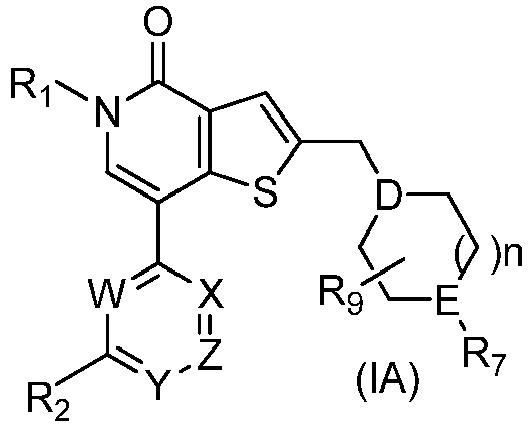
- W is N, CH or C(OCH2cyclopropyl)
- X and Z are each independently N or CH;
- Y is N or C-R5 (subject to proviso that no more than 2 of W, X, Y and Z are N);
- R1 is C1-4alkyl;
- R2 is H, OH, -OC1-4alkyl, -NHC(O)H, -NHC(O)CH3, -NHC(O)CH2CH3, -N(CH3)CH2CH2OCH3 or
- R2 is a group -G-CH(R3)(R4) or -G-CH2CH(R3)(R4) in which
- G is NH, N(CH3) or O;
- R3 is phenyl, pyridinyl or a heterocycle optionally substituted by =O; and
- R4 is H or C1-4 alkyl;
- R5 is H, C1-4alkyl, halo, -CF3, CN, OH, -OC1-4 alkyl, -CH2NH2, -OCF3 or -SO2CH3;
- D is CH or N;
- E is N, O or CH;
- R7, when present, is H, C1-4alkyl, SO2C1-4alkyl or -C(O)phenyl;
- R9 is H, C1-4alkyl or -CONH2; and
- n is 1 or 2; or a salt thereof.
- In one embodiment the compound of formula (I) is a compound of formula (IB)

- W is N or C-R8;
- X and Z are independently N, CH or C(CH3);
- Y is N or C-R5 (subject to proviso that no more than 2 of W, X, Y and Z are N);
- R1 is C1-4alkyl;
- R2 is H, OH, C1-4alkyl, halo, -CF3, -NH2, -OC1-4alkyl, -NHC(O)H, -NHC(O)Me,-NHCH(CH3)CH2OCH3, -N(CH3)CH2CH2OCH3, -OCH2CH2OCH3, -OCH2CH2CH2OH,-OCH(CH3)CH2OCH3, or
- R2 is a group -G-CH(R3)(R4) in which
- G is NH, N(CH3), O or C(O)NH;
- R3 is phenyl, pyridinyl, C3-7cycloalkyl or a heterocycle; and
- R4 is H or C1-4 alkyl;
- R5 is H, C1-4alkyl, halo, -CF3, CN, OH, -OC1-4alkyl, -CH2NH2, -OCF3 or -SO2CH3;
- R6 is -NR11R12 or a group

- D is CH or N;
- E is N, O, CH or SO2;
- R7, when present, is H, OH, C1-4alkyl, -NH2, -SO2C1-4alkyl, -SO2phenyl, -SO2benzyl, -SO2N(CH3)2,-NHSO2CH3, -C(O)C1-4alkyl or -C(O)phenyl;
- R8 is H, C1-4alkyl, halo, -CF3, CN, OH, -OC1-4alkyl, -OCF3 or-OCH2phenyl;
- R9 is H, C1-4alkyl, -CONH2, -CO2CH3, -CF3, halo, OH or -OC1-4alkyl;
- R10 is H, C1-4alkyl, -CONH2, -CO2CH3, -CF3, halo, OH or -OC1-4alkyl;
- R11 is H or C1-4alkyl;
- R12 is H, C1-4alkyl, C1-4alkyleneNHR13, SO2CH3 or a heterocycle;
- R13 is H or SO2CH3; and
- n is 0, 1 or 2; or a salt thereof.
- In one embodiment, W is C-R8. In another embodiment W is N.
- In one embodiment R8 is hydrogen, methyl or ethyl. In another embodiment R8 is hydrogen.
- In one embodiment X is CH. In another embodiment X is C(CH3). In further embodiment X is N.
- In one embodiment Z is CH. In another embodiment Z is N.
- In one embodiment Y is C-R5. In another embodiment Y is N.
- In one embodiment R5 is H, -CF3, CN, -OCH3, -CH2NH2 or -SO2CH3. In another embodiment R5 is H or -OCH3.
- In one embodiment R1 is methyl or ethyl. In another embodiment R1 is methyl.
- In one embodiment R2 is H, OH, methyl, fluoro, chloro, -CF3, -NH2, -OCH3, -OCH(CH3)2, -NHC(O)H, -NHC(O)Me,, -N(CH3)CH2CH2OCH3, -OCH2CH2OCH3, -OCH2CH2CH2OH or -OCH(CH3)CH2OCH3. In another embodiment R2 is H, -OCH3, -OCH(CH3)2, -NHC(O)Me, or -N(CH3)CH2CH2OCH3. In a further embodiment R2 is a group -G-CH(R3)(R4).
- In one embodiment G is NH, N(CH3) or O. In another embodiment G is NH or O.
- In one embodiment R3 is phenyl, pyridinyl, cyclopropyl, tetrahydropyranyl or tetrahydrofuranyl. In another embodiment R3 is phenyl, pyridin-2-yl, cyclopropyl, tetrahydropyran-4-yl or tetrahydrofuran-3-yl. In a further embodiment R3 is phenyl or pyridin-2-yl.
- In one embodiment R4 is H or methyl.
- In one embodiment R6 is -NR11R12.
- In one embodiment R11 is H or methyl.
- In one embodiment R12 is -CH2CH2CH2NH2, -CH2CH2NH2, -CH2CH2NHSO2CH3, -SO2CH3, -CH3 or

- In one embodiment R6 is a group

- In one embodiment D is CH. In another embodiment D is N.
- In one embodiment E is N. In another embodiment E is O. In another embodiment E is CH. In a further embodiment E is SO2.
- In one embodiment R7 is H, methyl, ethyl, iso-propyl, -SO2CH3, -SO2CH2CH3 or -C(O)phenyl. In another embodiment R7 is -SO2CH3.
- In one embodiment E is N and R7 is H, methyl, ethyl, iso-propyl, -SO2CH3, -SO2CH2CH3 or-C(O)phenyl.
- In one embodiment E and D are both N and R7 is H, methyl, ethyl, iso-propyl, -SO2CH3, -SO2CH2CH3 or -C(O)phenyl.
- In one embodiment R9 is H, methyl, ethyl, butyl, -CONH2, -CO2CH3, -CF3, fluoro, OH or -OCH3. In another embodiment R9 is H or methyl.
- In one embodiment R10 is H or methyl.
- In one embodiment n is 0. In another embodiment n is 1. In a further embodiment n is 2.
- In one embodiment the compound of formula (I) is a compound of formula (IC)

- W, X and Z are independently N or CH;
- Y is N or C-R5 (subject to proviso that no more than 2 of W, X, Y and Z are N);
- R1 is C1-4alkyl;
- R2 is H, OH, -OC1-4alkyl, -NHC(O)H, -NHC(O)Me or
- R2 is a group -G-CH(R3)(R4) in which
- G is NH, N(CH3) or O;
- R3 is phenyl, pyridinyl or a heterocycle; and
- R4 is H or C1-4 alkyl;
- R5 is H, C1-4alkyl, halo, -CF3, CN, OH, -OC1-4 alkyl, -CH2NH2 or -OCF3;
- D is CH or N;
- E is N, O or CH;
- R7, when present, is H, C1-4alkyl or -SO2C1-4alkyl;
- R9 is H, C1-4alkyl or -CONH2; and
- n is 0, 1 or 2; or a salt thereof.
- In one embodiment the compound of formula (I) is a compound of formula (ID)

- W is N or C-R8;
- X is N, CH or C(CH3);
- Z is N or C-R14;
- Y is N or C-R5 (subject to proviso that no more than 2 of W, X, Y and Z are N);
- R1 is C1-4alkyl;
- R2 is H, OH, C1-4alkyl, halo, -CF3, -NH2, -OC1-4alkyl, -NHC(O)H, -NHC(O)C1-4alkyl, -N(CH3)C(O)1-4alkyl, -NHCH(CH3)CH2OCH3, -N(CH3)CH2CH2OCH3, -OCH2CH2OCH3, -OCH2CH2CH2OH,-OCH(CH3)CH2OCH3, or
- R2 is a group selected from -G-CH2CH(R3)(R4), -G-CH(R3)(R4) and -G-R3 in which
- G is NH, N(CH3), O, C(O)NH or NHC(O);
- R3 is phenyl, pyridinyl, C3-7cycloalkyl or a heterocycle optionally substituted by =O; and
- R4 is H or C1-4 alkyl;
- R5 is H, C1-4alkyl, halo, -CF3, CN, OH, -OC1-4 alkyl, -CH2NH2, -OCF3 or -SO2CH3;
- R6 is -NR11R12 or a group

- D is CH or N;
- E is N, O, CH or SO2;
- R7, when present, is H, OH, C1-4alkyl, -NH2, -SO2C1-4alkyl, -SO2phenyl, -SO2benzyl, -SO2N(CH3)2,-NHSO2CH3, -C(O)C1-4alkyl, -C(O)phenyl,
- R8 is H, C1-4alkyl, halo, -CF3, CN, OH, -OC1-4alkyl, -OCF3, -OCH2phenyl or -OCH2C3-7cycloalkyl;
- R9 is H, C1-4 alkyl, -C(O)NH2, -CO2CH3, -CF3, halo, OH, -OC1-4alkyl, -CH2OH, -C(O)NHCH3 or-C(O)NH(CH3)2;-CH2OC1-4alkyl or -CH2OCH2C3-7cycloalkyl;
- R10 is H, C1-4alkyl, -C(O)NH2, -CO2CH3, -CF3, halo, OH or -OC1-4alkyl;
- R11 is H, C1-4alkyl or SO2CH3;
- R12 is H, C1-4alkyl, C1-4alkyleneNHR13, SO2CH3, a heterocycle or a heterocycle comprising SO2;
- R13 is H or SO2CH3;
- R14 is H, C1-4alkyl or NHC(O)C1-4alkyl; and
- n and m are each an integer independently selected from 0, 1 and 2; or a salt thereof.
- It is to be understood that the present invention covers all combinations of substituent groups described hereinabove.
- Compounds of the invention include the compounds of Examples 1 to 207 and salts thereof. In another embodiment compounds of the invention include the compounds of Examples 1 to 197 and salts thereof. In a further embodiment compounds of the invention include the compounds of Examples 1 to 139 and salts thereof.
- In another embodiment, the compound of formula (I) is
- 5-methyl-2-((4-(methylsulphonyl)piperazin-1-yl)methyl)-7-(5-(1-phenylethoxy)pyridin-3-yl)thieno[3,2-c]pyridin-4(5H)-one;
- 5-methyl-2-((4-(methylsulphonyl)piperazin-1-yl)methyl)-7-(3-(1-(pyridin-2-yl)ethoxy)phenyl)thieno[3,2-c]pyridin-4(5H)-one;
- 5-methyl-2-((4-(methylsulphonyl)piperazin-1-yl)methyl)-7-(5-(1-(pyridin-2-yl)ethoxy)pyridin-3-yl)thieno[3,2-c]pyridin-4(5H)-one;
- (R)-5-methyl-2-((4-(methylsulfonyl)piperazin-1-yl)methyl)-7-(5-(1-(pyridin-2-yl)ethoxy)pyridin-3-yl)thieno[3,2-c]pyridin-4(5H)-one;
- (S)-5-methyl-2-((4-(methylsulfonyl)piperazin-1-yl)methyl)-7-(5-(1-(pyridin-2-yl)ethoxy)pyridin-3-yl)thieno[3,2-c]pyridin-4(5H)-one;
- 7-(5-(benzyloxy)pyridin-3-yl)-5-methyl-2-((4-(methylsulphonyl)piperazin-1-yl)methyl)thieno[3,2-c]pyridin-4(5H)-one;
- 5-methyl-2-((4-(methylsulphonyl)piperazin-1-yl)methyl)-7-(3-((tetrahydro-2H-pyran-4-yl)methoxy)phenyl)thieno[3,2-c]pyridin-4(5H)-one;
- 7-(3-isopropoxyphenyl)-5-methyl-2-((4-(methylsulphonyl)piperazin-1-yl)methyl)thieno[3,2-c]pyridin-4(5H)-one;
- 5-methyl-2-((4-(methylsulphonyl)piperazin-1-yl)methyl)-7-(2-((tetrahydro-2H-pyran-4-yl)methoxy)pyridin-4-yl)thieno[3,2-c]pyridin-4(5H)-one;
- 7-(3-(2-methoxyethoxy)phenyl)-5-methyl-2-((4-(methylsulphonyl)piperazin-1-yl)methyl)thieno[3,2-c]pyridin-4(5H)-one;
- 7-(3-(3-hydroxypropoxy)phenyl)-5-methyl-2-((4-(methylsulphonyl)piperazin-1-yl)methyl)thieno[3,2-c]pyridin-4(5H)-one;
- 7-(3-hydroxyphenyl)-5-methyl-2-((4-(methylsulphonyl)piperazin-1-yl)methyl)thieno[3,2-c]pyridin-4(5H)-one;
- 5-methyl-2-((4-(methylsulphonyl)piperazin-1-yl)methyl)-7-(5-((tetrahydro-2H-pyran-4-yl)methoxy)pyridin-3-yl)thieno[3,2-c]pyridin-4(5H)-one;
- 7-(5-hydroxypyridin-3-yl)-5-methyl-2-((4-(methylsulphonyl)piperazin-1-yl)methyl)thieno[3,2-c]pyridin-4(5H)-one;
- 5-methyl-2-((4-(methylsulphonyl)piperazin-1-yl)methyl)-7-(2-(1-(pyridin-2-yl)ethoxy)pyridin-4-yl)thieno[3,2-c]pyridin-4(5H)-one;
- 7-(5-((1-methoxypropan-2-yl)oxy)pyridin-3-yl)-5-methyl-2-((4-(methylsulphonyl)piperazin-1-yl)methyl)thieno[3,2-c]pyridin-4(5H)-one;
- 7-(3-methoxyphenyl)-5-methyl-2-((4-(methylsulphonyl)piperazin-1-yl)methyl)thieno[3,2-c]pyridin-4(5H)-one;
- 5-methyl-2-((4-(methylsulphonyl)piperazin-1-yl)methyl)-7-(3-(1-phenylethoxy)phenyl)thieno[3,2-c]pyridin-4(5H)-one;
- 5-methyl-2-((4-(methylsulphonyl)piperazin-1-yl)methyl)-7-(3-((1-phenylethyl)amino)phenyl)thieno[3,2-c]pyridin-4(5H)-one;
- (R)-N-(3-(5-methyl-2-((2-methyl-4-(methylsulphonyl)piperazin-1-yl)methyl)-4-oxo-4,5-dihydrothieno[3,2-c]pyridin-7-yl)phenyl)acetamide;
- 5-methyl-2-((4-(methylsulphonyl)piperazin-1-yl)methyl)-7-(3-(((tetrahydro-2H-2H-pyran-4-yl)methyl)amino)phenyl)thieno[3,2-c]pyridin-4(5H)-one;
- N-(3-(5-methyl-2-((4-(methylsulphonyl)piperazin-1-yl)methyl)-4-oxo-4,5-dihydrothieno[3,2-c]pyridin-7-yl)phenyl)acetamide;
- 7-(2-((2-methoxyethyl)(methyl)amino)pyridin-4-yl)-5-methyl-2-((4-(methylsulphonyl)piperazin-1-yl)methyl)thieno[3,2-c]pyridin-4(5H)-one;
- 7-(2-((1-methoxypropan-2-yl)amino)pyridin-4-yl)-5-methyl-2-((4-(methylsulphonyl)piperazin-1-yl)methyl)thieno[3,2-c]pyridin-4(5H)-one;
- 7-(2-((cyclopropylmethyl)amino)pyridin-4-yl)-5-methyl-2-((4-(methylsulphonyl)piperazin-1-yl)methyl)thieno[3,2-c]pyridin-4(5H)-one;
- N-(3-(5-methyl-2-((4-(methylsulphonyl)piperazin-1-yl)methyl)-4-oxo-4,5-dihydrothieno[3,2-c]pyridin-7-yl)phenyl)formamide;
- 7-(3-aminophenyl)-5-methyl-2-((4-(methylsulphonyl)piperazin-1-yl)methyl)thieno[3,2-c]pyridin-4(5H)-one;
- 7-(3-(benzylamino)phenyl)-5-methyl-2-((4-(methylsulphonyl)piperazin-1-yl)methyl)thieno[3,2-c]pyridin-4(5H)-one;
- 5-methyl-2-((4-(methylsulphonyl)piperazin-1-yl)methyl)-7-(2-(((tetrahydrofuran-2-yl)methyl)amino)pyridin-4-yl)thieno[3,2-c]pyridin-4(5H)-one;
- 7-(3-(benzyloxy)phenyl)-2-((4-ethylpiperazin-1-yl)methyl)-5-methylthieno[3,2-c]pyridin-4(5H)-one;
- 7-(3-(benzyloxy)phenyl)-2-((4-isopropylpiperazin-1-yl)methyl)-5-methylthieno[3,2-c]pyridin-4(5H)-one;
- 2-((4-benzoylpiperazin-1-yl)methyl)-7-(3,4-dimethoxyphenyl)-5-methylthieno[3,2-c]pyridin-4(5H)-one;
- 7-(3,4-dimethoxyphenyl)-2-((4-(ethylsulphonyl)piperazin-1-yl)methyl)-5-methylthieno[3,2-c]pyridin-4(5H)-one;
- N-(3-(5-methyl-2-((4-methylpiperazin-1-yl)methyl)-4-oxo-4,5-dihydrothieno[3,2-c]pyridin-7-yl)phenyl)acetamide;
- 2-((4-(benzylsulphonyl)piperazin-1-yl)methyl)-7-(3,4-dimethoxyphenyl)-5-methylthieno[3,2-c]pyridin-4(5H)-one;
- 7-(3,4-dimethoxyphenyl)-5-methyl-2-((4-(phenylsulphonyl)piperazin-1-yl)methyl)thieno[3,2-c]pyridin-4(5H)-one;
- 2-((4-acetylpiperazin-1-yl)methyl)-5-methyl-7-phenylthieno[3,2-c]pyridin-4(5H)-one;
- 7-(3,4-dimethoxyphenyl)-2-((4-(isopropylsulphonyl)piperazin-1-yl)methyl)-5-methylthieno[3,2-c]pyridin-4(5H)-one;
- 7-(3,4-dimethoxyphenyl)-5-methyl-2-((4-methylpiperazin-1-yl)methyl)thieno[3,2-c]pyridin-4(5H)-one;
- 4-((7-(3,4-dimethoxyphenyl)-5-methyl-4-oxo-4,5-dihydrothieno[3,2-c]pyridin-2-yl)methyl)-N,N-dimethylpiperazine-1-sulphonamide;
- 2-((4-acetylpiperazin-1-yl)methyl)-7-(3,4-dimethoxyphenyl)-5-methylthieno[3,2-c]pyridin-4(5H)-one;
- 7-(3-(benzyloxy)phenyl)-5-methyl-2-((4-methyl-1,4-diazepan-1-yl)methyl)thieno[3,2-c]pyridin-4(5H)-one;
- N-(3-(5-methyl-2-((1-(methylsulphonyl)piperidin-4-yl)methyl)-4-oxo-4,5-dihydrothieno[3,2-c]pyridin-7-yl)phenyl)acetamide;
- 7-(2,4-difluorophenyl)-5-methyl-2-((4-(methylsulphonyl)piperazin-1-yl)methyl)thieno[3,2-c]pyridin-4(5H)-one;
- 5-methyl-2-((4-(methylsulphonyl)piperazin-1-yl)methyl)-7-(pyridin-2-yl)thieno[3,2-c]pyridin-4(5H)-one;
- 5-methyl-2-((4-(methylsulphonyl)piperazin-1-yl)methyl)-7-phenylthieno[3,2-c]pyridin-4(5H)-one;
- 2-((2,4-dimethylpiperazin-1-yl)methyl)-5-methyl-7-(5-((tetrahydro-2H-2H-pyran-4-yl)methoxy)pyridin-3-yl)thieno[3,2-c]pyridin-4(5H)-one;
- 2-((1,4-diazepan-1-yl)methyl)-7-(3,4-dimethoxyphenyl)-5-methylthieno[3,2-c]pyridin-4(5H)-one;
- 2-(((3-aminopropyl)amino)methyl)-7-(3-(benzyloxy)phenyl)-5-methylthieno[3,2-c]pyridin-4(5H)-one;
- N-(2-(((7-(3-(benzyloxy)phenyl)-5-methyl-4-oxo-4,5-dihydrothieno[3,2-c]pyridin-2-yl)methyl)amino)ethyl)methanesulphonamide;
- N-((7-(3-(benzyloxy)phenyl)-5-methyl-4-oxo-4,5-dihydrothieno[3,2-c]pyridin-2-yl)methyl)-N-(2-(methylsulfonamido)ethyl)methanesulfonamide;
- N-(4-(5-methyl-2-((1-(methylsulphonyl)piperidin-4-yl)methyl)-4-oxo-4,5-dihydrothieno[3,2-c]pyridin-7-yl)pyridin-2-yl)acetamide;
- N-(3-(5-methyl-2-((4-methyl-1,4-diazepan-1-yl)methyl)-4-oxo-4,5-dihydrothieno[3,2-c]pyridin-7-yl)phenyl)acetamide;
- 7-(3,4-dimethoxyphenyl)-5-methyl-2-((1-(methylsulphonyl)piperidin-4-yl)methyl)thieno[3,2-c]pyridin-4(5H)-one;
- 2-(((3-aminopropyl)amino)methyl)-7-(3,4-dimethoxyphenyl)-5-methylthieno[3,2-c]pyridin-4(5H)-one;
- 2-(((2-aminoethyl)amino)methyl)-7-(3-(benzyloxy)phenyl)-5-methylthieno[3,2-c]pyridin-4(5H)-one;
- 5-methyl-2-((4-(methylsulphonyl)piperazin-1-yl)methyl)-7-(pyridin-4-yl)thieno[3,2-c]pyridin-4(5H)-one;
- 7-(3,4-dimethoxyphenyl)-5-methyl-2-((4-(methylsulphonyl)-1,4-diazepan-1-yl)methyl)thieno[3,2-c]pyridin-4(5H)-one;
- 7-(3,4-dimethoxyphenyl)-5-methyl-2-((3-methyl-4-(methylsulphonyl)piperazin-1-yl)methyl)thieno[3,2-c]pyridin-4(5H)-one;
- 7-(3,4-dimethoxyphenyl)-5-methyl-2-((4-(methylsulphonyl)piperazin-1-yl)methyl)thieno[3,2-c]pyridin-4(5H)-one;
- 7-(5-methoxy-2-methylphenyl)-5-methyl-2-((4-(methylsulphonyl)piperazin-1-yl)methyl)thieno[3,2-c]pyridin-4(5H)-one;
- 7-(3-methoxy-2-methylphenyl)-5-methyl-2-((4-(methylsulphonyl)piperazin-1-yl)methyl)thieno[3,2-c]pyridin-4(5H)-one;
- 7-(2-ethylphenyl)-5-methyl-2-((4-(methylsulphonyl)piperazin-1-yl)methyl)thieno[3,2-c]pyridin-4(5H)-one
- N-(3-(5-methyl-2-((N-methylmethylsulphonamido)methyl)-4-oxo-4,5-dihydrothieno[3,2-c]pyridin-7-yl)phenyl)acetamide;
- 7-(4-methoxyphenyl)-5-methyl-2-((4-(methylsulphonyl)piperazin-1-yl)methyl)thieno[3,2-c]pyridin-4(5H)-one;
- 5-methyl-7-(4-(methylsulphonyl)phenyl)-2-((4-(methylsulphonyl)piperazin-1-yl)methyl)thieno[3,2-c]pyridin-4(5H)-one;
- 7-(3,4-dimethoxyphenyl)-5-methyl-2-(piperazin-1-ylmethyl)thieno[3,2-c]pyridin-4(5H)-one;
- 2-(((2-aminoethyl)amino)methyl)-7-(3,4-dimethoxyphenyl)-5-methylthieno[3,2-c]pyridin-4(5H)-one;
- 7-(3,4-dimethoxyphenyl)-5-methyl-2-((3-methylpiperazin-1-yl)methyl)thieno[3,2-c]pyridin-4(5H)-one;
- N-(2-(((7-(3,4-dimethoxyphenyl)-5-methyl-4-oxo-4,5-dihydrothieno[3,2-c]pyridin-2-yl)methyl)amino)ethyl)methanesulphonamide;
- N-((7-(3,4-dimethoxyphenyl)-5-methyl-4-oxo-4,5-dihydrothieno[3,2-c]pyridin-2-yl)methyl)-N-(2-(methylsulfonamido)ethyl)methanesulfonamide;
- 5-methyl-2-((4-(methylsulphonyl)piperazin-1-yl)methyl)-7-(m-tolyl)thieno[3,2-c]pyridin-4(5H)-one;
- 7-(3,4-dimethoxyphenyl)-2-((1,1-dioxidothiomorpholino)methyl)-5-methylthieno[3,2-c]pyridin-4(5H)-one;
- (R)-7-(3,4-dimethoxyphenyl)-5-methyl-2-((3-methylmorpholino)methyl)thieno[3,2-c]pyridin-4(5H)-one;
- 7-(2-(benzyloxy)phenyl)-5-methyl-2-((4-(methylsulphonyl)piperazin-1-yl)methyl)thieno[3,2-c]pyridin-4(5H)-one;
- 5-methyl-2-((4-(methylsulphonyl)piperazin-1-yl)methyl)-7-(4-(trifluoromethyl)phenyl)thieno[3,2-c]pyridin-4(5H)-one;
- 2-((1,4-oxazepan-4-yl)methyl)-7-(2-((2-methoxyethyl)(methyl)amino)pyridin-4-yl)-5-methylthieno[3,2-c]pyridin-4(5H)-one;
- 7-(3,4-dimethoxyphenyl)-2-((4-hydroxypiperidin-1-yl)methyl)-5-methylthieno[3,2-c]pyridin-4(5H)-one;
- 7-(4-methoxy-2-methylphenyl)-5-methyl-2-((4-(methylsulphonyl)piperazin-1-yl)methyl)thieno[3,2-c]pyridin-4(5H)-one;
- 4-(5-methyl-2-((4-(methylsulphonyl)piperazin-1-yl)methyl)-4-oxo-4,5-dihydrothieno[3,2-c]pyridin-7-yl)benzonitrile;
- N-(4-(5-methyl-2-((3-methylmorpholino)methyl)-4-oxo-4,5-dihydrothieno[3,2-c]pyridin-7-yl)pyridin-2-yl)acetamide;
- (S)-7-(3-(benzyloxy)phenyl)-5-methyl-2-((3-methylmorpholino)methyl)thieno[3,2-c]pyridin-4(5H)-one;
- N-(3-(5-methyl-2-((3-methylmorpholino)methyl)-4-oxo-4,5-dihydrothieno[3,2-c]pyridin-7-yl)phenyl)acetamide;
- 7-(2-((2-methoxyethyl)(methyl)amino)pyridin-4-yl)-5-methyl-2-((4-(methylsulphonyl)piperidin-1-yl)methyl)thieno[3,2-c]pyridin-4(5H)-one;
- (S)-7-(3-hydroxyphenyl)-5-methyl-2-((3-methylmorpholino)methyl)thieno[3,2-c]pyridin-4(5H)-one;
- (S)-7-(3,4-dimethoxyphenyl)-5-methyl-2-((3-methylmorpholino)methyl)thieno[3,2-c]pyridin-4(5H)-one;
- 7-(3,4-dimethoxyphenyl)-5-methyl-2-((3-methylmorpholino)methyl)thieno[3,2-c]pyridin-4(5H)-one;
- 7-(3,4-dimethoxyphenyl)-5-methyl-2-(piperidin-1-ylmethyl)thieno[3,2-c]pyridin-4(5H)-one;
- 2-((1,4-oxazepan-4-yl)methyl)-7-(2-chloropyridin-4-yl)-5-methylthieno[3,2-c]pyridin-4(5H)-one;
- 7-(2-aminopyridin-4-yl)-5-methyl-2-((3-methylmorpholino)methyl)thieno[3,2-c]pyridin-4(5H)-one;
- 5-methyl-2-((methylamino)methyl)-7-(2-((tetrahydro-2H-2H-pyran-4-yl)methoxy)pyridin-4-yl)thieno[3,2-c]pyridin-4(5H)-one;
- 7-(3,4-dimethoxyphenyl)-5-methyl-2-(pyrrolidin-1-ylmethyl)thieno[3,2-c]pyridin-4(5H)-one;
- N-((7-(3,4-dimethoxyphenyl)-5-methyl-4-oxo-4,5-dihydrothieno[3,2-c]pyridin-2-yl)methyl)-N-methylmethanesulphonamide;
- 7-(3,4-dimethoxyphenyl)-2-((3,5-dimethylpiperazin-1-yl)methyl)-5-methylthieno[3,2-c]pyridin-4(5H)-one;
- (S)-5-methyl-2-((3-methylmorpholino)methyl)-7-(3-((tetrahydro-2H-2H-pyran-4-yl)methoxy)phenyl)thieno[3,2-c]pyridin-4(5H)-one;
- (R)-7-(3,4-dimethoxyphenyl)-5-methyl-2-((2-methylpiperazin-1-yl)methyl)thieno[3,2-c]pyridin-4(5H)-one;
- (R)-1-((7-(3,4-dimethoxyphenyl)-5-methyl-4-oxo-4,5-dihydrothieno[3,2-c]pyridin-2-yl)methyl)piperazine-2-carboxamide;
- (S)-7-(3,4-dimethoxyphenyl)-5-methyl-2-((3-methylpiperazin-1-yl)methyl)thieno[3,2-c]pyridin-4(5H)-one;
- methyl 1-((7-(3,4-dimethoxyphenyl)-5-methyl-4-oxo-4,5-dihydrothieno[3,2-c]pyridin-2-yl)methyl)piperazine-2-carboxylate;
- 7-(3,4-dimethoxyphenyl)-2-((cis-2,6-dimethylpiperazin-1-yl)methyl)-5-methylthieno[3,2-c]pyridin-4(5H)-one;
- (R)-2-((3-butylpiperazin-1-yl)methyl)-7-(3,4-dimethoxyphenyl)-5-methylthieno[3,2-c]pyridin-4(5H)-one;
- (S)-7-(3,4-dimethoxyphenyl)-2-((3-ethylpiperazin-1-yl)methyl)-5-methylthieno[3,2-c]pyridin-4(5H)-one;
- 7-(3,4-dimethoxyphenyl)-5-methyl-2-((piperidin-4-ylamino)methyl)thieno[3,2-c]pyridin-4(5H)-one;
- (S)-7-(3,4-dimethoxyphenyl)-5-methyl-2-((2-methylpiperazin-1-yl)methyl)thieno[3,2-c]pyridin-4(5H)-one;
- 2-((3-aminopyrrolidin-1-yl)methyl)-7-(3,4-dimethoxyphenyl)-5-methylthieno[3,2-c]pyridin-4(5H)-one;
- 2-((4-aminopiperidin-1-yl)methyl)-7-(3,4-dimethoxyphenyl)-5-methylthieno[3,2-c]pyridin-4(5H)-one;
- 2-(((2-aminoethyl)(methyl)amino)methyl)-7-(3,4-dimethoxyphenyl)-5-methylthieno[3,2-c]pyridin-4(5H)-one;
- (R)-7-(3,4-dimethoxyphenyl)-5-methyl-2-((2-methyl-4-(methylsulphonyl)piperazin-1-yl)methyl)thieno[3,2-c]pyridin-4(5H)-one;
- (S)-7-(3,4-dimethoxyphenyl)-5-methyl-2-((3-methyl-4-(methylsulphonyl)piperazin-1-yl)methyl)thieno[3,2-c]pyridin-4(5H)-one;
- methyl 1-((7-(3,4-dimethoxyphenyl)-5-methyl-4-oxo-4,5-dihydrothieno[3,2-c]pyridin-2-yl)methyl)-4-(methylsulphonyl)piperazine-2-carboxylate;
- (R)-2-((3-butyl-4-(methylsulphonyl)piperazin-1-yl)methyl)-7-(3,4-dimethoxyphenyl)-5-methylthieno[3,2-c]pyridin-4(5H)-one;
- (S)-7-(3,4-dimethoxyphenyl)-2-((3-ethyl-4-(methylsulphonyl)piperazin-1-yl)methyl)-5-methylthieno[3,2-c]pyridin-4(5H)-one;
- (S)-7-(3,4-dimethoxyphenyl)-5-methyl-2-((2-methyl-4-(methylsulphonyl)piperazin-1-yl)methyl)thieno[3,2-c]pyridin-4(5H)-one;
- N-(1-((7-(3,4-dimethoxyphenyl)-5-methyl-4-oxo-4,5-dihydrothieno[3,2-c]pyridin-2-yl)methyl)pyrrolidin-3-yl)methanesulphonamide;
- 7-(4-((2-methoxyethyl)(methyl)amino)pyridin-2-yl)-5-methyl-2-((4-(methylsulphonyl)piperazin-1-yl)methyl)thieno[3,2-c]pyridin-4(5H)-one;
- 5-methyl-2-((4-(methylsulphonyl)piperazin-1-yl)methyl)-7-(pyridin-3-yl)thieno[3,2-c]pyridin-4(5H)-one;
- 7-(3,4-dichlorophenyl)-5-methyl-2-((4-(methylsulphonyl)piperazin-1-yl)methyl)thieno[3,2-c]pyridin-4(5H)-one;
- 7-(4-(aminomethyl)phenyl)-5-methyl-2-((4-(methylsulphonyl)piperazin-1-yl)methyl)thieno[3,2-c]pyridin-4(5H)-one;
- 7-(3-(benzyloxy)-4-methoxyphenyl)-5-methyl-2-((4-(methylsulphonyl)piperazin-1-yl)methyl)thieno[3,2-c]pyridin-4(5H)-one;
- (R)-7-(4-methoxyphenyl)-5-methyl-2-((2-methyl-4-(methylsulphonyl)piperazin-1-yl)methyl)thieno[3,2-c]pyridin-4(5H)-one;
- 5-methyl-2-(((R)-2-methyl-4-(methylsulphonyl)piperazin-1-yl)methyl)-7-(5-(1-(pyridin-2-yl)ethoxy)pyridin-3-yl)thieno[3,2-c]pyridin-4(5H)-one;
- (R)-7-(3-methoxyphenyl)-5-methyl-2-((2-methyl-4-(methylsulphonyl)piperazin-1-yl)methyl)thieno[3,2-c]pyridin-4(5H)-one;
- (R)-N-(4-(5-methyl-2-((2-methyl-4-(methylsulphonyl)piperazin-1-yl)methyl)-4-oxo-4,5-dihydrothieno[3,2-c]pyridin-7-yl)pyridin-2-yl)acetamide;
- (R)-5-methyl-2-((2-methyl-4-(methylsulphonyl)piperazin-1-yl)methyl)-7-phenylthieno[3,2-c]pyridin-4(5H)-one;
- 5-methyl-2-((4-(methylsulphonyl)piperazin-1-yl)methyl)-7-(p-tolyl)thieno[3,2-c]pyridin-4(5H)-one;
- (R)-7-(2-methoxypyridin-4-yl)-5-methyl-2-((2-methyl-4-(methylsulphonyl)piperazin-1-yl)methyl)thieno[3,2-c]pyridin-4(5H)-one
- (R)-7-(5-methoxypyridin-3-yl)-5-methyl-2-((2-methyl-4-(methylsulphonyl)piperazin-1-yl)methyl)thieno[3,2-c]pyridin-4(5H)-one;
- (R)-7-(6-methoxypyridin-3-yl)-5-methyl-2-((2-methyl-4-(methylsulphonyl)piperazin-1-yl)methyl)thieno[3,2-c]pyridin-4(5H)-one;
- (R)-5-methyl-2-((2-methyl-4-(methylsulphonyl)piperazin-1-yl)methyl)-7-(pyridin-2-yl)thieno[3,2-c]pyridin-4(5H)-one;
- 5-methyl-2-((4-(methylsulphonyl)piperazin-1-yl)methyl)-7-(3-(trifluoromethyl)phenyl)thieno[3,2-c]pyridin-4(5H)-one;
- N-benzyl-3-(5-methyl-2-((4-(methylsulphonyl)piperazin-1-yl)methyl)-4-oxo-4,5-dihydrothieno[3,2-c]pyridin-7-yl)benzamide;
- (R)-7-(6-hydroxypyrimidin-4-yl)-5-methyl-2-((2-methyl-4-(methylsulphonyl)piperazin-1-yl)methyl)thieno[3,2-c]pyridin-4(5H)-one;
- 5-methyl-2-((4-(methylsulphonyl)piperazin-1-yl)methyl)-7-(o-tolyl)thieno[3,2-c]pyridin-4(5H)-one;
- (S)-7-(6-methoxypyridin-3-yl)-5-methyl-2-((2-methyl-4-(methylsulphonyl)piperazin-1-yl)methyl)thieno[3,2-c]pyridin-4(5H)-one;
- (S)-5-methyl-2-((2-methyl-4-(methylsulphonyl)piperazin-1-yl)methyl)-7-(pyridin-4-yl)thieno[3,2-c]pyridin-4(5H)-one;
- (S)-5-methyl-2-((2-methyl-4-(methylsulphonyl)piperazin-1-yl)methyl)-7-(pyridin-3-yl)thieno[3,2-c]pyridin-4(5H)-one;
- (S)-7-(5-methoxypyridin-3-yl)-5-methyl-2-((2-methyl-4-(methylsulphonyl)piperazin-1-yl)methyl)thieno[3,2-c]pyridin-4(5H)-one;
- (S)-7-(4-methoxy-2-methylphenyl)-5-methyl-2-((2-methyl-4-(methylsulphonyl)piperazin-1-yl)methyl)thieno[3,2-c]pyridin-4(5H)-one;
- (S)-7-(3-(benzyloxy)-4-methoxyphenyl)-5-methyl-2-((2-methylpiperazin-1-yl)methyl)thieno[3,2-c]pyridin-4(5H)-one;
- 5-ethyl-2-((4-(methylsulphonyl)piperazin-1-yl)methyl)-7-phenylthieno[3,2-c]pyridin-4(5H)-one;
- 7-(3,4-dimethoxyphenyl)-5-ethyl-2-((4-(methylsulphonyl)piperazin-1-yl)methyl)thieno[3,2-c]pyridin-4(5H)-one;
- 2-((4-acetylpiperazin-1-yl)methyl)-5-ethyl-7-phenylthieno[3,2-c]pyridin-4(5H)-one;
- 2-((4-acetylpiperazin-1-yl)methyl)-7-(3,4-dimethoxyphenyl)-5-ethylthieno[3,2-c]pyridin-4(5H)-one;
- (R)-N-(4-(2-((4-(ethylsulfonyl)-2-methylpiperazin-1-yl)methyl)-5-methyl-4-oxo-4,5-dihydrothieno[3,2-c]pyridin-7-yl)pyridin-2-yl)acetamide;
- N-(4-(2-((3-isopropylmorpholino)methyl)-5-methyl-4-oxo-4,5-dihydrothieno[3,2-c]pyridin-7-yl)pyridin-2-yl)acetamide;
- (R)-N-(4-(2-((3-fluoropyrrolidin-1-yl)methyl)-5-methyl-4-oxo-4,5-dihydrothieno[3,2-c]pyridin-7-yl)pyridin-2-yl)acetamide;
- (R)-N-(4-(2-((3-hydroxypyrrolidin-1-yl)methyl)-5-methyl-4-oxo-4,5-dihydrothieno[3,2-c]pyridin-7-yl)pyridin-2-yl)acetamide;
- N-(4-(2-((3-fluoropiperidin-1-yl)methyl)-5-methyl-4-oxo-4,5-dihydrothieno[3,2-c]pyridin-7-yl)pyridin-2-yl)acetamide;
- (R)-N-(4-(2-((3-fluoropiperidin-1-yl)methyl)-5-methyl-4-oxo-4,5-dihydrothieno[3,2-c]pyridin-7-yl)pyridin-2-yl)acetamide;
- (S)-N-(4-(2-((3-fluoropiperidin-1-yl)methyl)-5-methyl-4-oxo-4,5-dihydrothieno[3,2-c]pyridin-7-yl)pyridin-2-yl)acetamide;
- N-(4-(5-methyl-4-oxo-2-((3-(trifluoromethyl)pyrrolidin-1-yl)methyl)-4,5-dihydrothieno[3,2-c]pyridin-7-yl)pyridin-2-yl)acetamide;
- 1-((7-(2-acetamidopyridin-4-yl)-5-methyl-4-oxo-4,5-dihydrothieno[3,2-c]pyridin-2-yl)methyl)piperidine-2-carboxamide;
- N-(4-(5-methyl-2-((2-methylmorpholino)methyl)-4-oxo-4,5-dihydrothieno[3,2-c]pyridin-7-yl)pyridin-2-yl)acetamide;
- N-(4-(2-((2,6-dimethylmorpholino)methyl)-5-methyl-4-oxo-4,5-dihydrothieno[3,2-c]pyridin-7-yl)pyridin-2-yl)acetamide;
- N-(4-(2-((3,5-dimethylmorpholino)methyl)-5-methyl-4-oxo-4,5-dihydrothieno[3,2-c]pyridin-7-yl)pyridin-2-yl)acetamide;
- N-(4-(2-(((3R,5S)-3,5-dimethylmorpholino)methyl)-5-methyl-4-oxo-4,5-dihydrothieno[3,2-c]pyridin-7-yl)pyridin-2-yl)acetamide;
- N-(4-(2-(((2R,3R)-2,3-dimethylmorpholino)methyl)-5-methyl-4-oxo-4,5-dihydrothieno[3,2-c]pyridin-7-yl)pyridin-2-yl)acetamide;
- N-(4-(2-((3-fluoropyrrolidin-1-yl)methyl)-5-methyl-4-oxo-4,5-dihydrothieno[3,2-c]pyridin-7-yl)pyridin-2-yl)acetamide;
- N-(4-(2-(((2S,6R)-2,6-dimethylmorpholino)methyl)-5-methyl-4-oxo-4,5-dihydrothieno[3,2-c]pyridin-7-yl)pyridin-2-yl)acetamide;
- N-(4-(5-methyl-4-oxo-2-((2-(trifluoromethyl)pyrrolidin-1-yl)methyl)-4,5-dihydrothieno[3,2-c]pyridin-7-yl)pyridin-2-yl)acetamide;
- N-(4-(2-((2,5-dimethylmorpholino)methyl)-5-methyl-4-oxo-4,5-dihydrothieno[3,2-c]pyridin-7-yl)pyridin-2-yl)acetamide;
- (S)-N-(4-(2-((3-hydroxypiperidin-1-yl)methyl)-5-methyl-4-oxo-4,5-dihydrothieno[3,2-c]pyridin-7-yl)pyridin-2-yl)acetamide;
- (S)-N-(4-(2-((3-hydroxypyrrolidin-1-yl)methyl)-5-methyl-4-oxo-4,5-dihydrothieno[3,2-c]pyridin-7-yl)pyridin-2-yl)acetamide;
- (R)-N-(4-(2-((3-hydroxypiperidin-1-yl)methyl)-5-methyl-4-oxo-4,5-dihydrothieno[3,2-c]pyridin-7-yl)pyridin-2-yl)acetamide;
- (S)-N-(4-(2-((3-fluoropyrrolidin-1-yl)methyl)-5-methyl-4-oxo-4,5-dihydrothieno[3,2-c]pyridin-7-yl)pyridin-2-yl)acetamide;
- N-(4-(2-((3-methoxypiperidin-1-yl)methyl)-5-methyl-4-oxo-4,5-dihydrothieno[3,2-c]pyridin-7-yl)pyridin-2-yl)acetamide;
- N-(4-(2-((3-hydroxyazetidin-1-yl)methyl)-5-methyl-4-oxo-4,5-dihydrothieno[3,2-c]pyridin-7-yl)pyridin-2-yl)acetamide;
- N-(4-(2-((3,3-difluoropiperidin-1-yl)methyl)-5-methyl-4-oxo-4,5-dihydrothieno[3,2-c]pyridin-7-yl)pyridin-2-yl)acetamide;
- (R)-7-(2-ethoxypyridin-4-yl)-5-methyl-2-((2-methyl-4-(methylsulfonyl)piperazin-1-yl)methyl)thieno[3,2-c]pyridin-4(5H)-one;
- (R)-7-(2-(cyclopropylmethoxy)pyridin-4-yl)-5-methyl-2-((2-methyl-4-(methylsulfonyl)piperazin-1-yl)methyl)thieno[3,2-c]pyridin-4(5H)-one;
- (R)-5-methyl-2-((2-methyl-4-(methylsulfonyl)piperazin-1-yl)methyl)-7-(2-(2-(pyrrolidin-1-yl)ethoxy)pyridin-4-yl)thieno[3,2-c]pyridin-4(5H)-one;
- (R)-7-(2-(2-methoxyethoxy)pyridin-4-yl)-5-methyl-2-((2-methyl-4-(methylsulfonyl)piperazin-1-yl)methyl)thieno[3,2-c]pyridin-4(5H)-one;
- (R)-7-(3-methoxypyridin-4-yl)-5-methyl-2-((2-methyl-4-(methylsulfonyl)piperazin-1-yl)methyl)thieno[3,2-c]pyridin-4(5H)-one;
- (R)-7-(3-(cyclopropylmethoxy)pyridin-4-yl)-5-methyl-2-((2-methyl-4-(methylsulfonyl)piperazin-1-yl)methyl)thieno[3,2-c]pyridin-4(5H)-one;
- (R)-5-methyl-2-((2-methyl-4-(methylsulfonyl)piperazin-1-yl)methyl)-7-(2-(2-(2-oxopyrrolidin-1-yl)ethoxy)pyridin-4-yl)thieno[3,2-c]pyridin-4(5H)-one;
- (R)-7-(5-(cyclopropylmethoxy)pyridin-3-yl)-5-methyl-2-((2-methyl-4-(methylsulfonyl)piperazin-1-yl)methyl)thieno[3,2-c]pyridin-4(5H)-one;
- 2-((3-hydroxypiperidin-1-yl)methyl)-7-(2-methoxypyridin-4-yl)-5-methylthieno[3,2-c]pyridin-4(5H)-one;
- 7-(2-ethoxypyridin-4-yl)-2-((3-hydroxypiperidin-1-yl)methyl)-5-methylthieno[3,2-c]pyridin-4(5H)-one;
- (R)-N-(4-(5-methyl-2-((2-methyl-4-(methylsulfonyl)piperazin-1-yl)methyl)-4-oxo-4,5-dihydrothieno[3,2-c]pyridin-7-yl)pyridin-2-yl)propionamide;
- (R)-2-cyclopropyl-N-(4-(5-methyl-2-((2-methyl-4-(methylsulfonyl)piperazin-1-yl)methyl)-4-oxo-4,5-dihydrothieno[3,2-c]pyridin-7-yl)pyridin-2-yl)acetamide;
- (R)-N-methyl-N-(4-(5-methyl-2-((2-methyl-4-(methylsulfonyl)piperazin-1-yl)methyl)-4-oxo-4,5-dihydrothieno[3,2-c]pyridin-7-yl)pyridin-2-yl)acetamide;
- (R)-N-(6-(cyclopropylmethoxy)-4-(5-methyl-2-((2-methyl-4-(methylsulfonyl)piperazin-1-yl)methyl)-4-oxo-4,5-dihydrothieno[3,2-c]pyridin-7-yl)pyridin-2-yl)acetamide;
- 2-((1,4-oxazepan-4-yl)methyl)-5-methyl-7-(2-((tetrahydro-2H-2H-pyran-4-yl)methoxy)pyridin-4-yl)thieno[3,2-c]pyridin-4(5H)-one;
- 5-methyl-2-(morpholinomethyl)-7-(2-((tetrahydro-2H-pyran-4-yl)methoxy)pyridin-4-yl)thieno[3,2-c]pyridin-4(5H)-one;
- 2-((1,4-diazepan-1-yl)methyl)-5-methyl-7-(2-((tetrahydro-2H-pyran-4-yl)methoxy)pyridin-4-yl)thieno[3,2-c]pyridin-4(5H)-one;
- 5-methyl-2-((4-methyl-1,4-diazepan-1-yl)methyl)-7-(2-((tetrahydro-2H-pyran-4-yl)methoxy)pyridin-4-yl)thieno[3,2-c]pyridin-4(5H)-one;
- 2-((1,4-diazepan-1-yl)methyl)-5-methyl-7-(2-((pyridin-2-ylmethyl)amino)pyridin-4-yl)thieno[3,2-c]pyridin-4(5H)-one;
- 2-((1,4-diazepan-1-yl)methyl)-5-methyl-7-(3-(pyridin-2-ylmethoxy)phenyl)thieno[3,2-c]pyridin-4(5H)-one;
- 2-((1,4-diazepan-1-yl)methyl)-5-methyl-7-(2-(pyridin-2-ylmethoxy)pyridin-4-yl)thieno[3,2-c]pyridin-4(5H)-one;
- 2-((1,4-diazepan-1-yl)methyl)-7-(2-(benzyloxy)pyridin-4-yl)-5-methylthieno[3,2-c]pyridin-4(5H)-one;
- 1-((7-(3,4-dimethoxyphenyl)-5-methyl-4-oxo-4,5-dihydrothieno[3,2-c]pyridin-2-yl)methyl)-N,3-dimethylpiperidine-3-carboxamide;
- 7-(3,4-dimethoxyphenyl)-2-((3-(hydroxymethyl)-3-methylpiperidin-1-yl)methyl)-5-methylthieno[3,2-c]pyridin-4(5H)-one;
- 7-(3,4-dimethoxyphenyl)-2-(((1,1-dioxidotetrahydrothiophen-3-yl)amino)methyl)-5-methylthieno[3,2-c]pyridin-4(5H)-one;
- 7-(3,4-dimethoxyphenyl)-2-(((1,1-dioxidotetrahydro-2H-thiopyran-4-yl)amino)methyl)-5-methylthieno[3,2-c]pyridin-4(5H)-one;
- 7-(3,4-dimethoxyphenyl)-5-methyl-2-((methylamino)methyl)thieno[3,2-c]pyridin-4(5H)-one;
- 7-(3,4-dimethoxyphenyl)-2-((3-(methoxymethyl)-3-methylpiperidin-1-yl)methyl)-5-methylthieno[3,2-c]pyridin-4(5H)-one;
- 2-((3-((cyclopropylmethoxy)methyl)-3-methylpiperidin-1-yl)methyl)-7-(3,4-dimethoxyphenyl)-5-methylthieno[3,2-c]pyridin-4(5H)-one;
- 7-(2,6-dimethylphenyl)-5-methyl-2-((4-(methylsulfonyl)piperazin-1-yl)methyl)thieno[3,2-c]pyridin-4(5H)-one;
- 5-methyl-7-(5-((tetrahydro-2H-pyran-4-yl)methoxy)pyridin-3-yl)-2-((2,2,4-trimethylpiperazin-1-yl)methyl)thieno[3,2-c]pyridin-4(5H)-one;
- N-(3-(5-methyl-2-((2-methylpyrrolidin-1-yl)methyl)-4-oxo-4,5-dihydrothieno[3,2-c]pyridin-7-yl)phenyl)acetamide;
- N-(4-(2-((2,3-dimethylpiperidin-1-yl)methyl)-5-methyl-4-oxo-4,5-dihydrothieno[3,2-c]pyridin-7-yl)pyridin-2-yl)acetamide;
- N-(4-(5-methyl-4-oxo-2-(piperidin-1-ylmethyl)-4,5-dihydrothieno[3,2-c]pyridin-7-yl)pyridin-2-yl)acetamide;
- 1-((7-(3,4-dimethoxyphenyl)-5-methyl-4-oxo-4,5-dihydrothieno[3,2-c]pyridin-2-yl)methyl)-N,N,3-trimethylpiperidine-3-carboxamide;
- In another embodiment, the compound of formula (I) is
- 5-methyl-2-((4-(methylsulphonyl)piperazin-1-yl)methyl)-7-(5-(1-phenylethoxy)pyridin-3-yl)thieno[3,2-c]pyridin-4(5H)-one;
- 5-methyl-2-((4-(methylsulphonyl)piperazin-1-yl)methyl)-7-(3-(1-(pyridin-2-yl)ethoxy)phenyl)thieno[3,2-c]pyridin-4(5H)-one;
- 5-methyl-2-((4-(methylsulphonyl)piperazin-1-yl)methyl)-7-(5-(1-(pyridin-2-yl)ethoxy)pyridin-3-yl)thieno[3,2-c]pyridin-4(5H)-one;
- 7-(5-(benzyloxy)pyridin-3-yl)-5-methyl-2-((4-(methylsulphonyl)piperazin-1-yl)methyl)thieno[3,2-c]pyridin-4(5H)-one;
- 5-methyl-2-((4-(methylsulphonyl)piperazin-1-yl)methyl)-7-(3-((tetrahydro-2H-pyran-4-yl)methoxy)phenyl)thieno[3,2-c]pyridin-4(5H)-one;
- 7-(3-isopropoxyphenyl)-5-methyl-2-((4-(methylsulphonyl)piperazin-1-yl)methyl)thieno[3,2-c]pyridin-4(5H)-one;
- 5-methyl-2-((4-(methylsulphonyl)piperazin-1-yl)methyl)-7-(2-((tetrahydro-2H-pyran-4-yl)methoxy)pyridin-4-yl)thieno[3,2-c]pyridin-4(5H)-one;
- 7-(3-(2-methoxyethoxy)phenyl)-5-methyl-2-((4-(methylsulphonyl)piperazin-1-yl)methyl)thieno[3,2-c]pyridin-4(5H)-one;
- 7-(3-(3-hydroxypropoxy)phenyl)-5-methyl-2-((4-(methylsulphonyl)piperazin-1-yl)methyl)thieno[3,2-c]pyridin-4(5H)-one;
- 7-(3-hydroxyphenyl)-5-methyl-2-((4-(methylsulphonyl)piperazin-1-yl)methyl)thieno[3,2-c]pyridin-4(5H)-one;
- 5-methyl-2-((4-(methylsulphonyl)piperazin-1-yl)methyl)-7-(5-((tetrahydro-2H-pyran-4-yl)methoxy)pyridin-3-yl)thieno[3,2-c]pyridin-4(5H)-one;
- 7-(5-hydroxypyridin-3-yl)-5-methyl-2-((4-(methylsulphonyl)piperazin-1-yl)methyl)thieno[3,2-c]pyridin-4(5H)-one;
- 5-methyl-2-((4-(methylsulphonyl)piperazin-1-yl)methyl)-7-(2-(1-(pyridin-2-yl)ethoxy)pyridin-4-yl)thieno[3,2-c]pyridin-4(5H)-one;
- 7-(5-((1-methoxypropan-2-yl)oxy)pyridin-3-yl)-5-methyl-2-((4-(methylsulphonyl)piperazin-1-yl)methyl)thieno[3,2-c]pyridin-4(5H)-one;
- 7-(3-methoxyphenyl)-5-methyl-2-((4-(methylsulphonyl)piperazin-1-yl)methyl)thieno[3,2-c]pyridin-4(5H)-one;
- 5-methyl-2-((4-(methylsulphonyl)piperazin-1-yl)methyl)-7-(3-(1-phenylethoxy)phenyl)thieno[3,2-c]pyridin-4(5H)-one;
- 5-methyl-2-((4-(methylsulphonyl)piperazin-1-yl)methyl)-7-(3-((1-phenylethyl)amino)phenyl)thieno[3,2-c]pyridin-4(5H)-one;
- (R)-N-(3-(5-methyl-2-((2-methyl-4-(methylsulphonyl)piperazin-1-yl)methyl)-4-oxo-4,5-dihydrothieno[3,2-c]pyridin-7-yl)phenyl)acetamide;
- 5-methyl-2-((4-(methylsulphonyl)piperazin-1-yl)methyl)-7-(3-(((tetrahydro-2H-pyran-4-yl)methyl)amino)phenyl)thieno[3,2-c]pyridin-4(5H)-one;
- N-(3-(5-methyl-2-((4-(methylsulphonyl)piperazin-1-yl)methyl)-4-oxo-4,5-dihydrothieno[3,2-c]pyridin-7-yl)phenyl)acetamide;
- 7-(2-((2-methoxyethyl)(methyl)amino)pyridin-4-yl)-5-methyl-2-((4-(methylsulphonyl)piperazin-1-yl)methyl)thieno[3,2-c]pyridin-4(5H)-one;
- 7-(2-((1-methoxypropan-2-yl)amino)pyridin-4-yl)-5-methyl-2-((4-(methylsulphonyl)piperazin-1-yl)methyl)thieno[3,2-c]pyridin-4(5H)-one;
- 7-(2-((cyclopropylmethyl)amino)pyridin-4-yl)-5-methyl-2-((4-(methylsulphonyl)piperazin-1-yl)methyl)thieno[3,2-c]pyridin-4(5H)-one;
- N-(3-(5-methyl-2-((4-(methylsulphonyl)piperazin-1-yl)methyl)-4-oxo-4,5-dihydrothieno[3,2-c]pyridin-7-yl)phenyl)formamide;
- 7-(3-aminophenyl)-5-methyl-2-((4-(methylsulphonyl)piperazin-1-yl)methyl)thieno[3,2-c]pyridin-4(5H)-one;
- 7-(3-(benzylamino)phenyl)-5-methyl-2-((4-(methylsulphonyl)piperazin-1-yl)methyl)thieno[3,2-c]pyridin-4(5H)-one;
- 5-methyl-2-((4-(methylsulphonyl)piperazin-1-yl)methyl)-7-(2-(((tetrahydrofuran-2-yl)methyl)amino)pyridin-4-yl)thieno[3,2-c]pyridin-4(5H)-one;
- 7-(3-(benzyloxy)phenyl)-2-((4-ethylpiperazin-1-yl)methyl)-5-methylthieno[3,2-c]pyridin-4(5H)-one;
- 7-(3-(benzyloxy)phenyl)-2-((4-isopropylpiperazin-1-yl)methyl)-5-methylthieno[3,2-c]pyridin-4(5H)-one;
- 2-((4-benzoylpiperazin-1-yl)methyl)-7-(3,4-dimethoxyphenyl)-5-methylthieno[3,2-c]pyridin-4(5H)-one;
- 7-(3,4-dimethoxyphenyl)-2-((4-(ethylsulphonyl)piperazin-1-yl)methyl)-5-methylthieno[3,2-c]pyridin-4(5H)-one;
- N-(3-(5-methyl-2-((4-methylpiperazin-1-yl)methyl)-4-oxo-4,5-dihydrothieno[3,2-c]pyridin-7-yl)phenyl)acetamide;
- 2-((4-(benzylsulphonyl)piperazin-1-yl)methyl)-7-(3,4-dimethoxyphenyl)-5-methylthieno[3,2-c]pyridin-4(5H)-one;
- 7-(3,4-dimethoxyphenyl)-5-methyl-2-((4-(phenylsulphonyl)piperazin-1-yl)methyl)thieno[3,2-c]pyridin-4(5H)-one;
- 2-((4-acetylpiperazin-1-yl)methyl)-5-methyl-7-phenylthieno[3,2-c]pyridin-4(5H)-one;
- 7-(3,4-dimethoxyphenyl)-2-((4-(isopropylsulphonyl)piperazin-1-yl)methyl)-5-methylthieno[3,2-c]pyridin-4(5H)-one;
- 7-(3,4-dimethoxyphenyl)-5-methyl-2-((4-methylpiperazin-1-yl)methyl)thieno[3,2-c]pyridin-4(5H)-one;
- 4-((7-(3,4-dimethoxyphenyl)-5-methyl-4-oxo-4,5-dihydrothieno[3,2-c]pyridin-2-yl)methyl)-N,N-dimethylpiperazine-1-sulphonamide;
- 2-((4-acetylpiperazin-1-yl)methyl)-7-(3,4-dimethoxyphenyl)-5-methylthieno[3,2-c]pyridin-4(5H)-one;
- 7-(3-(benzyloxy)phenyl)-5-methyl-2-((4-methyl-1,4-diazepan-1-yl)methyl)thieno[3,2-c]pyridin-4(5H)-one;
- N-(3-(5-methyl-2-((1-(methylsulphonyl)piperidin-4-yl)methyl)-4-oxo-4,5-dihydrothieno[3,2-c]pyridin-7-yl)phenyl)acetamide;
- 7-(2,4-difluorophenyl)-5-methyl-2-((4-(methylsulphonyl)piperazin-1-yl)methyl)thieno[3,2-c]pyridin-4(5H)-one;
- 5-methyl-2-((4-(methylsulphonyl)piperazin-1-yl)methyl)-7-(pyridin-2-yl)thieno[3,2-c]pyridin-4(5H)-one;
- 5-methyl-2-((4-(methylsulphonyl)piperazin-1-yl)methyl)-7-phenylthieno[3,2-c]pyridin-4(5H)-one;
- 2-((2,4-dimethylpiperazin-1-yl)methyl)-5-methyl-7-(5-((tetrahydro-2H-pyran-4-yl)methoxy)pyridin-3-yl)thieno[3,2-c]pyridin-4(5H)-one;
- 2-((1,4-diazepan-1-yl)methyl)-7-(3,4-dimethoxyphenyl)-5-methylthieno[3,2-c]pyridin-4(5H)-one;
- 2-(((3-aminopropyl)amino)methyl)-7-(3-(benzyloxy)phenyl)-5-methylthieno[3,2-c]pyridin-4(5H)-one;
- N-(2-(((7-(3-(benzyloxy)phenyl)-5-methyl-4-oxo-4,5-dihydrothieno[3,2-c]pyridin-2-yl)methyl)amino)ethyl)methanesulphonamide;
- N-(4-(5-methyl-2-((1-(methylsulphonyl)piperidin-4-yl)methyl)-4-oxo-4,5-dihydrothieno[3,2-c]pyridin-7-yl)pyridin-2-yl)acetamide;
- N-(3-(5-methyl-2-((4-methyl-1,4-diazepan-1-yl)methyl)-4-oxo-4,5-dihydrothieno[3,2-c]pyridin-7-yl)phenyl)acetamide;
- 7-(3,4-dimethoxyphenyl)-5-methyl-2-((1-(methylsulphonyl)piperidin-4-yl)methyl)thieno[3,2-c]pyridin-4(5H)-one;
- 2-(((3-aminopropyl)amino)methyl)-7-(3,4-dimethoxyphenyl)-5-methylthieno[3,2-c]pyridin-4(5H)-one;
- 2-(((2-aminoethyl)amino)methyl)-7-(3-(benzyloxy)phenyl)-5-methylthieno[3,2-c]pyridin-4(5H)-one;
- 5-methyl-2-((4-(methylsulphonyl)piperazin-1-yl)methyl)-7-(pyridin-4-yl)thieno[3,2-c]pyridin-4(5H)-one;
- 7-(3,4-dimethoxyphenyl)-5-methyl-2-((4-(methylsulphonyl)-1,4-diazepan-1-yl)methyl)thieno[3,2-c]pyridin-4(5H)-one;
- 7-(3,4-dimethoxyphenyl)-5-methyl-2-((3-methyl-4-(methylsulphonyl)piperazin-1-yl)methyl)thieno[3,2-c]pyridin-4(5H)-one;
- 7-(3,4-dimethoxyphenyl)-5-methyl-2-((4-(methylsulphonyl)piperazin-1-yl)methyl)thieno[3,2-c]pyridin-4(5H)-one;
- 7-(5-methoxy-2-methylphenyl)-5-methyl-2-((4-(methylsulphonyl)piperazin-1-yl)methyl)thieno[3,2-c]pyridin-4(5H)-one;
- 7-(3-methoxy-2-methylphenyl)-5-methyl-2-((4-(methylsulphonyl)piperazin-1-yl)methyl)thieno[3,2-c]pyridin-4(5H)-one;
- 7-(2-ethylphenyl)-5-methyl-2-((4-(methylsulphonyl)piperazin-1-yl)methyl)thieno[3,2-c]pyridin-4(5H)-one
- N-(3-(5-methyl-2-((N-methylmethylsulphonamido)methyl)-4-oxo-4,5-dihydrothieno[3,2-c]pyridin-7-yl)phenyl)acetamide;
- 7-(4-methoxyphenyl)-5-methyl-2-((4-(methylsulphonyl)piperazin-1-yl)methyl)thieno[3,2-c]pyridin-4(5H)-one;
- 5-methyl-7-(4-(methylsulphonyl)phenyl)-2-((4-(methylsulphonyl)piperazin-1-yl)methyl)thieno[3,2-c]pyridin-4(5H)-one;
- 7-(3,4-dimethoxyphenyl)-5-methyl-2-(piperazin-1-ylmethyl)thieno[3,2-c]pyridin-4(5H)-one;
- 2-(((2-aminoethyl)amino)methyl)-7-(3,4-dimethoxyphenyl)-5-methylthieno[3,2-c]pyridin-4(5H)-one;
- 7-(3,4-dimethoxyphenyl)-5-methyl-2-((3-methylpiperazin-1-yl)methyl)thieno[3,2-c]pyridin-4(5H)-one;
- N-(2-(((7-(3,4-dimethoxyphenyl)-5-methyl-4-oxo-4,5-dihydrothieno[3,2-c]pyridin-2-yl)methyl)amino)ethyl)methanesulphonamide;
- 5-methyl-2-((4-(methylsulphonyl)piperazin-1-yl)methyl)-7-(m-tolyl)thieno[3,2-c]pyridin-4(5H)-one;
- 7-(3,4-dimethoxyphenyl)-2-((1,1-dioxidothiomorpholino)methyl)-5-methylthieno[3,2-c]pyridin-4(5H)-one;
- (R)-7-(3,4-dimethoxyphenyl)-5-methyl-2-((3-methylmorpholino)methyl)thieno[3,2-c]pyridin-4(5H)-one;
- 7-(2-(benzyloxy)phenyl)-5-methyl-2-((4-(methylsulphonyl)piperazin-1-yl)methyl)thieno[3,2-c]pyridin-4(5H)-one;
- 5-methyl-2-((4-(methylsulphonyl)piperazin-1-yl)methyl)-7-(4-(trifluoromethyl)phenyl)thieno[3,2-c]pyridin-4(5H)-one;
- 2-((1,4-oxazepan-4-yl)methyl)-7-(2-((2-methoxyethyl)(methyl)amino)pyridin-4-yl)-5-methylthieno[3,2-c]pyridin-4(5H)-one;
- 7-(3,4-dimethoxyphenyl)-2-((4-hydroxypiperidin-1-yl)methyl)-5-methylthieno[3,2-c]pyridin-4(5H)-one;
- 7-(4-methoxy-2-methylphenyl)-5-methyl-2-((4-(methylsulphonyl)piperazin-1-yl)methyl)thieno[3,2-c]pyridin-4(5H)-one;
- 4-(5-methyl-2-((4-(methylsulphonyl)piperazin-1-yl)methyl)-4-oxo-4,5-dihydrothieno[3,2-c]pyridin-7-yl)benzonitrile;
- N-(4-(5-methyl-2-((3-methylmorpholino)methyl)-4-oxo-4,5-dihydrothieno[3,2-c]pyridin-7-yl)pyridin-2-yl)acetamide;
- (S)-7-(3-(benzyloxy)phenyl)-5-methyl-2-((3-methylmorpholino)methyl)thieno[3,2-c]pyridin-4(5H)-one;
- N-(3-(5-methyl-2-((3-methylmorpholino)methyl)-4-oxo-4,5-dihydrothieno[3,2-c]pyridin-7-yl)phenyl)acetamide;
- 7-(2-((2-methoxyethyl)(methyl)amino)pyridin-4-yl)-5-methyl-2-((4-(methylsulphonyl)piperidin-1-yl)methyl)thieno[3,2-c]pyridin-4(5H)-one;
- (S)-7-(3-hydroxyphenyl)-5-methyl-2-((3-methylmorpholino)methyl)thieno[3,2-c]pyridin-4(5H)-one;
- (S)-7-(3,4-dimethoxyphenyl)-5-methyl-2-((3-methylmorpholino)methyl)thieno[3,2-c]pyridin-4(5H)-one;
- 7-(3,4-dimethoxyphenyl)-5-methyl-2-((3-methylmorpholino)methyl)thieno[3,2-c]pyridin-4(5H)-one;
- 7-(3,4-dimethoxyphenyl)-5-methyl-2-(piperidin-1-ylmethyl)thieno[3,2-c]pyridin-4(5H)-one;
- 2-((1,4-oxazepan-4-yl)methyl)-7-(2-chloropyridin-4-yl)-5-methylthieno[3,2-c]pyridin-4(5H)-one;
- 7-(2-aminopyridin-4-yl)-5-methyl-2-((3-methylmorpholino)methyl)thieno[3,2-c]pyridin-4(5H)-one;
- 5-methyl-2-((methylamino)methyl)-7-(2-((tetrahydro-2H-pyran-4-yl)methoxy)pyridin-4-yl)thieno[3,2-c]pyridin-4(5H)-one;
- 7-(3,4-dimethoxyphenyl)-5-methyl-2-(pyrrolidin-1-ylmethyl)thieno[3,2-c]pyridin-4(5H)-one;
- N-((7-(3,4-dimethoxyphenyl)-5-methyl-4-oxo-4,5-dihydrothieno[3,2-c]pyridin-2-yl)methyl)-N-methylmethanesulphonamide;
- 7-(3,4-dimethoxyphenyl)-2-((3,5-dimethylpiperazin-1-yl)methyl)-5-methylthieno[3,2-c]pyridin-4(5H)-one;
- (S)-5-methyl-2-((3-methylmorpholino)methyl)-7-(3-((tetrahydro-2H-pyran-4-yl)methoxy)phenyl)thieno[3,2-c]pyridin-4(5H)-one;
- (R)-7-(3,4-dimethoxyphenyl)-5-methyl-2-((2-methylpiperazin-1-yl)methyl)thieno[3,2-c]pyridin-4(5H)-one;
- (R)-1-((7-(3,4-dimethoxyphenyl)-5-methyl-4-oxo-4,5-dihydrothieno[3,2-c]pyridin-2-yl)methyl)piperazine-2-carboxamide;
- (S)-7-(3,4-dimethoxyphenyl)-5-methyl-2-((3-methylpiperazin-1-yl)methyl)thieno[3,2-c]pyridin-4(5H)-one;
- methyl 1-((7-(3,4-dimethoxyphenyl)-5-methyl-4-oxo-4,5-dihydrothieno[3,2-c]pyridin-2-yl)methyl)piperazine-2-carboxylate;
- 7-(3,4-dimethoxyphenyl)-2-((cis-2,6-dimethylpiperazin-1-yl)methyl)-5-methylthieno[3,2-c]pyridin-4(5H)-one;
- (R)-2-((3-butylpiperazin-1-yl)methyl)-7-(3,4-dimethoxyphenyl)-5-methylthieno[3,2-c]pyridin-4(5H)-one;
- (S)-7-(3,4-dimethoxyphenyl)-2-((3-ethylpiperazin-1-yl)methyl)-5-methylthieno[3,2-c]pyridin-4(5H)-one;
- 7-(3,4-dimethoxyphenyl)-5-methyl-2-((piperidin-4-ylamino)methyl)thieno[3,2-c]pyridin-4(5H)-one;
- (S)-7-(3,4-dimethoxyphenyl)-5-methyl-2-((2-methylpiperazin-1-yl)methyl)thieno[3,2-c]pyridin-4(5H)-one;
- 2-((3-aminopyrrolidin-1-yl)methyl)-7-(3,4-dimethoxyphenyl)-5-methylthieno[3,2-c]pyridin-4(5H)-one;
- 2-((4-aminopiperidin-1-yl)methyl)-7-(3,4-dimethoxyphenyl)-5-methylthieno[3,2-c]pyridin-4(5H)-one;
- 2-(((2-aminoethyl)(methyl)amino)methyl)-7-(3,4-dimethoxyphenyl)-5-methylthieno[3,2-c]pyridin-4(5H)-one;
- (R)-7-(3,4-dimethoxyphenyl)-5-methyl-2-((2-methyl-4-(methylsulphonyl)piperazin-1-yl)methyl)thieno[3,2-c]pyridin-4(5H)-one;
- (S)-7-(3,4-dimethoxyphenyl)-5-methyl-2-((3-methyl-4-(methylsulphonyl)piperazin-1-yl)methyl)thieno[3,2-c]pyridin-4(5H)-one;
- methyl 1-((7-(3,4-dimethoxyphenyl)-5-methyl-4-oxo-4,5-dihydrothieno[3,2-c]pyridin-2-yl)methyl)-4-(methylsulphonyl)piperazine-2-carboxylate;
- (R)-2-((3-butyl-4-(methylsulphonyl)piperazin-1-yl)methyl)-7-(3,4-dimethoxyphenyl)-5-methylthieno[3,2-c]pyridin-4(5H)-one;
- (S)-7-(3,4-dimethoxyphenyl)-2-((3-ethyl-4-(methylsulphonyl)piperazin-1-yl)methyl)-5-methylthieno[3,2-c]pyridin-4(5H)-one;
- (S)-7-(3,4-dimethoxyphenyl)-5-methyl-2-((2-methyl-4-(methylsulphonyl)piperazin-1-yl)methyl)thieno[3,2-c]pyridin-4(5H)-one;
- N-(1-((7-(3,4-dimethoxyphenyl)-5-methyl-4-oxo-4,5-dihydrothieno[3,2-c]pyridin-2-yl)methyl)pyrrolidin-3-yl)methanesulphonamide;
- 7-(4-((2-methoxyethyl)(methyl)amino)pyridin-2-yl)-5-methyl-2-((4-(methylsulphonyl)piperazin-1-yl)methyl)thieno[3,2-c]pyridin-4(5H)-one;
- 5-methyl-2-((4-(methylsulphonyl)piperazin-1-yl)methyl)-7-(pyridin-3-yl)thieno[3,2-c]pyridin-4(5H)-one;
- 7-(3,4-dichlorophenyl)-5-methyl-2-((4-(methylsulphonyl)piperazin-1-yl)methyl)thieno[3,2-c]pyridin-4(5H)-one;
- 7-(4-(aminomethyl)phenyl)-5-methyl-2-((4-(methylsulphonyl)piperazin-1-yl)methyl)thieno[3,2-c]pyridin-4(5H)-one;
- 7-(3-(benzyloxy)-4-methoxyphenyl)-5-methyl-2-((4-(methylsulphonyl)piperazin-1-yl)methyl)thieno[3,2-c]pyridin-4(5H)-one;
- (R)-7-(4-methoxyphenyl)-5-methyl-2-((2-methyl-4-(methylsulphonyl)piperazin-1-yl)methyl)thieno[3,2-c]pyridin-4(5H)-one;
- 5-methyl-2-(((R)-2-methyl-4-(methylsulphonyl)piperazin-1-yl)methyl)-7-(5-(1-(pyridin-2-yl)ethoxy)pyridin-3-yl)thieno[3,2-c]pyridin-4(5H)-one;
- (R)-7-(3-methoxyphenyl)-5-methyl-2-((2-methyl-4-(methylsulphonyl)piperazin-1-yl)methyl)thieno[3,2-c]pyridin-4(5H)-one;
- (R)-N-(4-(5-methyl-2-((2-methyl-4-(methylsulphonyl)piperazin-1-yl)methyl)-4-oxo-4,5-dihydrothieno[3,2-c]pyridin-7-yl)pyridin-2-yl)acetamide;
- (R)-5-methyl-2-((2-methyl-4-(methylsulphonyl)piperazin-1-yl)methyl)-7-phenylthieno[3,2-c]pyridin-4(5H)-one;
- 5-methyl-2-((4-(methylsulphonyl)piperazin-1-yl)methyl)-7-(p-tolyl)thieno[3,2-c]pyridin-4(5H)-one;
- (R)-7-(2-methoxypyridin-4-yl)-5-methyl-2-((2-methyl-4-(methylsulphonyl)piperazin-1-yl)methyl)thieno[3,2-c]pyridin-4(5H)-one
- (R)-7-(5-methoxypyridin-3-yl)-5-methyl-2-((2-methyl-4-(methylsulphonyl)piperazin-1-yl)methyl)thieno[3,2-c]pyridin-4(5H)-one;
- (R)-7-(6-methoxypyridin-3-yl)-5-methyl-2-((2-methyl-4-(methylsulphonyl)piperazin-1-yl)methyl)thieno[3,2-c]pyridin-4(5H)-one;
- (R)-5-methyl-2-((2-methyl-4-(methylsulphonyl)piperazin-1-yl)methyl)-7-(pyridin-2-yl)thieno[3,2-c]pyridin-4(5H)-one;
- 5-methyl-2-((4-(methylsulphonyl)piperazin-1-yl)methyl)-7-(3-(trifluoromethyl)phenyl)thieno[3,2-c]pyridin-4(5H)-one;
- N-benzyl-3-(5-methyl-2-((4-(methylsulphonyl)piperazin-1-yl)methyl)-4-oxo-4,5-dihydrothieno[3,2-c]pyridin-7-yl)benzamide;
- (R)-7-(6-hydroxypyrimidin-4-yl)-5-methyl-2-((2-methyl-4-(methylsulphonyl)piperazin-1-yl)methyl)thieno[3,2-c]pyridin-4(5H)-one;
- 5-methyl-2-((4-(methylsulphonyl)piperazin-1-yl)methyl)-7-(o-tolyl)thieno[3,2-c]pyridin-4(5H)-one;
- (S)-7-(6-methoxypyridin-3-yl)-5-methyl-2-((2-methyl-4-(methylsulphonyl)piperazin-1-yl)methyl)thieno[3,2-c]pyridin-4(5H)-one;
- (S)-5-methyl-2-((2-methyl-4-(methylsulphonyl)piperazin-1-yl)methyl)-7-(pyridin-4-yl)thieno[3,2-c]pyridin-4(5H)-one;
- (S)-5-methyl-2-((2-methyl-4-(methylsulphonyl)piperazin-1-yl)methyl)-7-(pyridin-3-yl)thieno[3,2-c]pyridin-4(5H)-one;
- (S)-7-(5-methoxypyridin-3-yl)-5-methyl-2-((2-methyl-4-(methylsulphonyl)piperazin-1-yl)methyl)thieno[3,2-c]pyridin-4(5H)-one;
- (S)-7-(4-methoxy-2-methylphenyl)-5-methyl-2-((2-methyl-4-(methylsulphonyl)piperazin-1-yl)methyl)thieno[3,2-c]pyridin-4(5H)-one;
- (S)-7-(3-(benzyloxy)-4-methoxyphenyl)-5-methyl-2-((2-methylpiperazin-1-yl)methyl)thieno[3,2-c]pyridin-4(5H)-one;
- 5-ethyl-2-((4-(methylsulphonyl)piperazin-1-yl)methyl)-7-phenylthieno[3,2-c]pyridin-4(5H)-one;
- 7-(3,4-dimethoxyphenyl)-5-ethyl-2-((4-(methylsulphonyl)piperazin-1-yl)methyl)thieno[3,2-c]pyridin-4(5H)-one;
- 2-((4-acetylpiperazin-1-yl)methyl)-5-ethyl-7-phenylthieno[3,2-c]pyridin-4(5H)-one;
- 2-((4-acetylpiperazin-1-yl)methyl)-7-(3,4-dimethoxyphenyl)-5-ethylthieno[3,2-c]pyridin-4(5H)-one;
- The term "C1-4alkyl" means a straight or branched alkyl containing at least one, and at most four, carbon atoms. Examples of "C1-C4alkyl" as used herein include, but are not limited to, methyl, ethyl, n-propyl, n-butyl, isobutyl, isopropyl and t-butyl.
- The term "C1-4alkylene" means a straight or branched alkyl chain containing at least one, and at most four, carbon atoms. Examples of "C1-C4alkylene" as used herein include, but are not limited to, methylene, ethylene, propylene and butylene.
- The term "C3-7cycloalkyl" is used to describe a non-aromatic carbocyclic ring containing at least three and at most seven carbon atoms. Examples of C3-7cycloalkyl groups include cyclopropyl, cyclobutyl, cyclopentyl, cyclohexyl and cycloheptyl.
- The term "heterocycle" refers to a 5 or 6 membered saturated ring that includes one or more (e.g. 2) ring heteroatoms selected from nitrogen, oxygen and sulfur. Examples of saturated heterocycle groups include, but are not limited to, tetrahydropyran, tetrahydrofuran, tetrahydrothiophene, piperidine, piperazine, morpholine, 1,4-dioxane, thiomorpholine, 1,4-oxathiane and 1,4-dithane. The point of attachment to the rest of the molecule may be by any suitable carbon or nitrogen atom.
- The term "heterocycle comprising SO2 as one of the ring heteroatoms" refers to a 5 or 6 membered saturated ring that includes one or more (e.g. 2) ring heteroatoms selected from nitrogen, oxygen, sulfur and sulfur dioxide wherein at least one of the heteroatoms is sulfur dioxide. Examples of heterocycle groups comprising SO2 include, but are not limited to, tetrahydrothiophenyl 1,2-dioxide and tetrahydro-2H-thiopyranyl 1,1-dioxide.
- The term "halo" as used herein refers to fluoro, chloro, bromo or iodo.
- The term "pharmaceutically acceptable" refers to those compounds, materials, compositions, and dosage forms which are, within the scope of sound medical judgment, suitable for use in contact with the tissues of human beings and animals without excessive toxicity, irritation, or other problem or complication, commensurate with a reasonable benefit/risk ratio.
- As used herein the symbols and conventions used in these processes, schemes and examples are consistent with those used in the contemporary scientific literature, for example the Journal of the American Chemical Society or the Journal of Biological Chemistry. Unless otherwise noted, all starting materials were obtained from commercial suppliers and used without further purification.
- The compounds of formula (I) may contain a chiral atom such that optical isomers, e.g. enantiomers may be formed. Accordingly, the present invention encompasses all isomers of the compounds of formula (I) whether as individual isomers isolated such as to be substantially free of the other isomer (i.e. pure) or as mixtures (i.e. racemates and racemic mixtures). An individual isomer isolated such as to be substantially free of the other isomer (i.e. pure) may be isolated such that less than 10%, particularly less than about 1%, for example less than about 0.1 % of the other isomer is present.
- Separation of isomers may be achieved by conventional techniques known to those skilled in the art, e.g. by fractional crystallisation, chromatography or HPLC.
- It will be appreciated that the present invention covers compounds of formula (I) as the free base and as salts thereof, for example as a pharmaceutically acceptable salt thereof. In one embodiment the invention relates to compounds of formula (I) in the form of a free base. In one embodiment the invention relates to compounds of formula (I) or a pharmaceutically acceptable salt thereof.
- Because of their potential use in medicine, salts of the compounds of formula (I) are desirably pharmaceutically acceptable. Suitable pharmaceutically acceptable salts can include acid addition salts. For a review of suitable pharmaceutically acceptable salts see Berge et al., J. Pharm. Sci., 66:1-19, (1977). Typically, a pharmaceutically acceptable salt may be readily prepared by using a desired acid or base as appropriate. The resultant salt may precipitate from solution and be collected by filtration or may be recovered by evaporation of the solvent.
- A pharmaceutically acceptable acid addition salt can be formed by reaction of a compound of formula (I) with a suitable inorganic or organic acid (such as hydrobromic, hydrochloric, sulphuric, nitric, phosphoric, succinic, maleic, acetic, propionic, fumaric, citric, tartaric, lactic, benzoic, salicylic, glutamaic, aspartic, p-toluenesulphonic, benzenesulphonic, methanesulphonic, ethanesulphonic, naphthalenesulphonic such as 2-naphthalenesulphonic, or hexanoic acid), optionally in a suitable solvent such as an organic solvent, to give the salt which is usually isolated for example by crystallisation and filtration or by evaporation followed by trituration. A pharmaceutically acceptable acid addition salt of a compound of formula (I) can comprise or be for example a hydrobromide, hydrochloride, sulfate, nitrate, phosphate, succinate, maleate, acetate, propionate, fumarate, citrate, tartrate, lactate, benzoate, salicylate, glutamate, aspartate, p-toluenesulphonate, benzenesulphonate, methanesulphonate, ethanesulphonate, naphthalenesulphonate (e.g. 2-naphthalenesulphonate) or hexanoate salt.
- Other non-pharmaceutically acceptable salts, e.g. formates, oxalates or trifluoroacetates, may be used, for example in the isolation of the compounds of formula (I), and are included within the scope of this invention
- The invention includes within its scope all possible stoichiometric and non-stoichiometric forms of the salts of the compounds of formula (I).
- It will be appreciated that many organic compounds can form complexes with solvents in which they are reacted or from which they are precipitated or crystallised. These complexes are known as "solvates". For example, a complex with water is known as a "hydrate". Solvents with high boiling points and/or capable of forming hydrogen bonds such as water, xylene, N-methyl pyrrolidinone, methanol and ethanol may be used to form solvates. Methods for identification of solvates include, but are not limited to, NMR and microanalysis. Solvates of the compounds of formula (I) are within the scope of the invention.
- The invention includes within its scope all possible stoichiometric and non-stoichiometric forms of the solvates of the compounds of formula (I).
- The compounds of formula (I) may be in crystalline or amorphous form. Furthermore, some of the crystalline forms of the compounds of formula (I) may exist as polymorphs, which are included within the scope of the present invention. Polymorphic forms of compounds of formula (I) may be characterized and differentiated using a number of conventional analytical techniques, including, but not limited to, X-ray powder diffraction (XRPD) patterns, infrared (IR) spectra, Raman spectra, differential scanning calorimetry (DSC), thermogravimetric analysis (TGA) and solid state nuclear magnetic resonance (SSNMR).
- It will be appreciated from the foregoing that included within the scope of the invention are solvates, isomers and polymorphic forms of the compounds of formula (I) and salts thereof.
- The compounds of formula (I) or salts thereof may be made by a variety of methods, including standard chemistry. Illustrative general synthetic methods are set out below and then specific compounds of formula (I) and pharmaceutically acceptable salts thereof, are prepared in the Examples.
- Compounds of formula (I) may be prepared as described in Schemes 1 to 9 below:

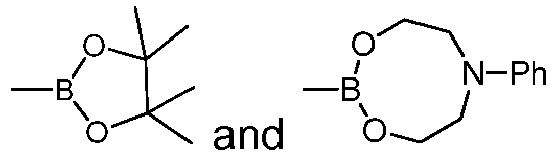

- In respect of steps shown in Scheme 1 the following reactions conditions may be utilised.
- Step 1 may be carried out by treating with a suitable strong base, such as nBuLi, followed by a suitable formylating agent, such as N,N-dimethylformamide, in a suitable solvent, such as THF, at a suitable temperature, such as -78 °C and for suitable time period, such as 3 hours.
- Step 2 may be carried out by treating with a suitable brominating agent, such as n-bromosuccinimide or Br2, in a suitable solvent, such as THF, AcOH or CH3CN, at a suitable temperature and time period, such as room temperature when using NBS for, for example 6 hours or under reflux if using Br2, for, for example 30 min.
- Step 3 may be carried out by treatment with a suitable alkylating agent, such as iodomethane or iodoethane, in the presence of a suitable base, for example Cs2CO3, K2CO3 or NaH, in a suitable solvent, such as THF or DMF, at a suitable temperature, such as room temperature for a period of, for example overnight.
- Step 4 may be carried out with a suitable reducing agent, such as sodium triacetoxyborohydride, 2-picoline borane complex or sodium cyanoborohydride, in the presence of a suitable acid, such as acetic acid, in the presence of a suitable solvent, such as methanol, DCM, 1,2-DCE, chloroform, THF or diethyl ether, at a suitable temperature, such as room temperature, 40 °C or 50 °C for a total reaction period of 1-72 hr which includes a period of 0-4 hr before addition of the reducing agent.
- Step 5 may be carried out with a suitable palladium catalyst, such as PdCl2(PPh3)2, Pd2(dba)3, PdCl2(dppf).DCM, Pd(OAc)2, Pd(PPh3)4 or PEPPSI, a suitable additive if required, such as Cul, a suitable base, such as NaOtBu, KOtBu, Na2CO3, Cs2CO3, K3PO4 or K2CO3, in a suitable solvent, such as 1,2-DME, aqueous 1,2-DME, ethanol in toluene, toluene, THF, aqueous THF, aqueous isopropanol, DMF or aqueous 1,4-dioxane, at a suitable temperature, such as 80-150°C, optionally in a microwave reactor, for a suitable period, such as 20 min to 20 hr.
- When the protecting group is BOC, Step 6 may be carried out in the presence of a suitable acid, such as trifluoroacetic acid or hydrochloric acid, in a suitable solvent, such as DCM or 1,4-dioxane, at a suitable temperature, such as room temperature and for a suitable time period, such as 1 to 24 hr.
- Step 7 may be carried out by treatment with a suitable sulfonylating or acylating agent, such as a sulfonyl chloride, an acyl chloride, or an acyl anhydride, in the presence of a suitable base, such as pyridine, pyridine/DMAP, or triethylamine, in a suitable solvent, such as DCM, acetonitrile or 1,2-DCE, at a suitable temperature, such as room temperature or 40 °C and for a suitable time period, such as 1 hr to overnight.
- Alternatively, when R7 is C1-4alkyl, Step 7 may be carried out using conditions suitable for a reductive amination reaction. For example, in the presence of a suitable reducing agent, such as sodium triacetoxyborohydride, 2-picoline borane complex or sodium cyanoborohydride, in the presence of a suitable acid, such as acetic acid, in the presence of a suitable solvent, such as methanol, DCM, 1,2-DCE, chloroform, THF or diethyl ether, at a suitable temperature, such as room temperature, 40 °C or 50 °C for a total reaction period of 1-72 hr which includes a period of 0-4 hr before addition of the reducing agent.


- In respect of steps shown in Scheme 2 the following reactions conditions may be utilised.
- Step 1 may be carried out with a suitable reducing agent, such as sodium triacetoxyborohydride, 2-picoline borane complex or sodium cyanoborohydride, in the presence of a suitable acid, such as acetic acid, in the presence of a suitable solvent, such as methanol, DCM, 1,2-DCE, chloroform, THF or diethyl ether, at a suitable temperature, such as room temperature, 40 °C or 50 °C for a total reaction period of 1-72 hr which includes a period of 0-4 hr before addition of the reducing agent.
- Step 2 may be carried out in the presence of a suitable acid, such as trifluoroacetic acid or hydrochloric acid, in a suitable solvent, such as DCM or 1,4-dioxane, at a suitable temperature, such as room temperature and for a suitable time period, such as 1 to 24 hr.
- When R7 is -SO2C1-4alkyl, Step 3 may be carried out by treatment with a suitable sulfonylating agent, such as a sulfonyl chloride, in the presence of suitable base, such as pyridine, in a suitable solvent, such as DCM, at a suitable temperature, such as room temperature and for a suitable time period, for example 4 hr to overnight.
- Step 4 may be carried out with a suitable palladium catalyst, such as PdCl2(PPh3)2, Pd2(dba)3, PdCl2(dppf).DCM, Pd(OAc)2, Pd(PPh3)4 or PEPPSI, a suitable additive if required, such as Cul, a suitable base, such as NaOtBu, KOtBu, Na2CO3, Cs2CO3, K3PO4 or K2CO3, in a suitable solvent, such as 1,2-DME, aqueous 1,2-DME, ethanol in toluene, toluene, THF, aqueous THF, aqueous isopropanol, DMF or aqueous 1,4-dioxane, at a suitable temperature, such as 80-150°C, optionally in a microwave reactor, for a suitable period, such as 20 min to 20 hr.
- When the protecting group is BOC, Step 5 may be carried out in the presence of a suitable acid, such as trifluoroacetic acid or hydrochloric acid, in a suitable solvent, such as DCM or 1,4-dioxane, at a suitable temperature, such as room temperature and for a suitable time period, such as 1 to 24 hr.


- In respect of steps shown in Scheme 3 the following reactions conditions may be utilised.
- Step 1 may be carried out with a suitable palladium catalyst, such as PdCl2(PPh3)2, Pd2(dba)3, PdCl2(dppf).DCM, Pd(OAc)2, Pd(PPh3)4 or PEPPSI, a suitable additive if required, such as Cul, a suitable base, such as NaOtBu, KOtBu, Na2CO3, Cs2CO3, K3PO4 or K2CO3, in a suitable solvent, such as 1,2-DME, aqueous 1,2-DME, ethanol in toluene, toluene, THF, aqueous THF, aqueous isopropanol, DMF or aqueous 1,4-dioxane, at a suitable temperature, such as 80-150°C, optionally in a microwave reactor, for a suitable period, such as 20 min to 20 hr.
- Step 2 may be carried out with a suitable reducing agent, such as sodium triacetoxyborohydride, 2-picoline borane complex or sodium cyanoborohydride, in the presence of a suitable acid, such as acetic acid, in the presence of a suitable solvent, such as methanol, DCM, 1,2-DCE, chloroform, THF or diethyl ether, at a suitable temperature, such as room temperature, 40 °C or 50 °C for a total reaction period of 1-72 hr which includes a period of 0-4 hr before addition of the reducing agent.


- In respect of steps shown in Scheme 4 the following reactions conditions may be utilised.
- Step 1 may be carried out by treatment with a suitable reducing agent, such as sodium borohydride, in a suitable solvent, such as ethanol, at a suitable temperature, such as room temperature and for a suitable time period, for example 1 hr.
- Step 2 may be carried out with a suitable palladium catalyst, such as PdCl2(PPh3)2, Pd2(dba)3, PdCl2(dppf).DCM, Pd(OAc)2, Pd(PPh3)4 or PEPPSI, a suitable additive if required, such as Cul, a suitable base, such as NaOtBu, KOtBu, Na2CO3, Cs2CO3, K3PO4 or K2CO3, in a suitable solvent, such as 1,2-DME, aqueous 1,2-DME, ethanol in toluene, toluene, THF, aqueous THF, aqueous isopropanol, DMF or aqueous 1,4-dioxane, at a suitable temperature, such as 80-150°C, optionally in a microwave reactor, for a suitable period, such as 20 min to 20 hr.
- Step 3 may be carried out by treatment with a suitable brominating agent, such as PBr3, in a suitable solvent, such as 1,4-dioxane, at a suitable temperature, such as 40-60 °C and for a suitable time period, for example 2 hr to overnight.
- Step 4 may be carried out in the presence of a suitable base, such as K2CO3 or DIPEA, in a suitable solvent, such as DMSO or DMF, at a suitable temperature, such as 110 °C in a microwave reactor and for a suitable time period, for example 30 min.
- When the protecting group is BOC, Step 5 may be carried out in the presence of a suitable acid, such as trifluoroacetic acid or hydrochloric acid, in a suitable solvent, such as DCM or 1,4-dioxane, at a suitable temperature, such as room temperature and for a suitable time period, such as 1 to 24 hr.
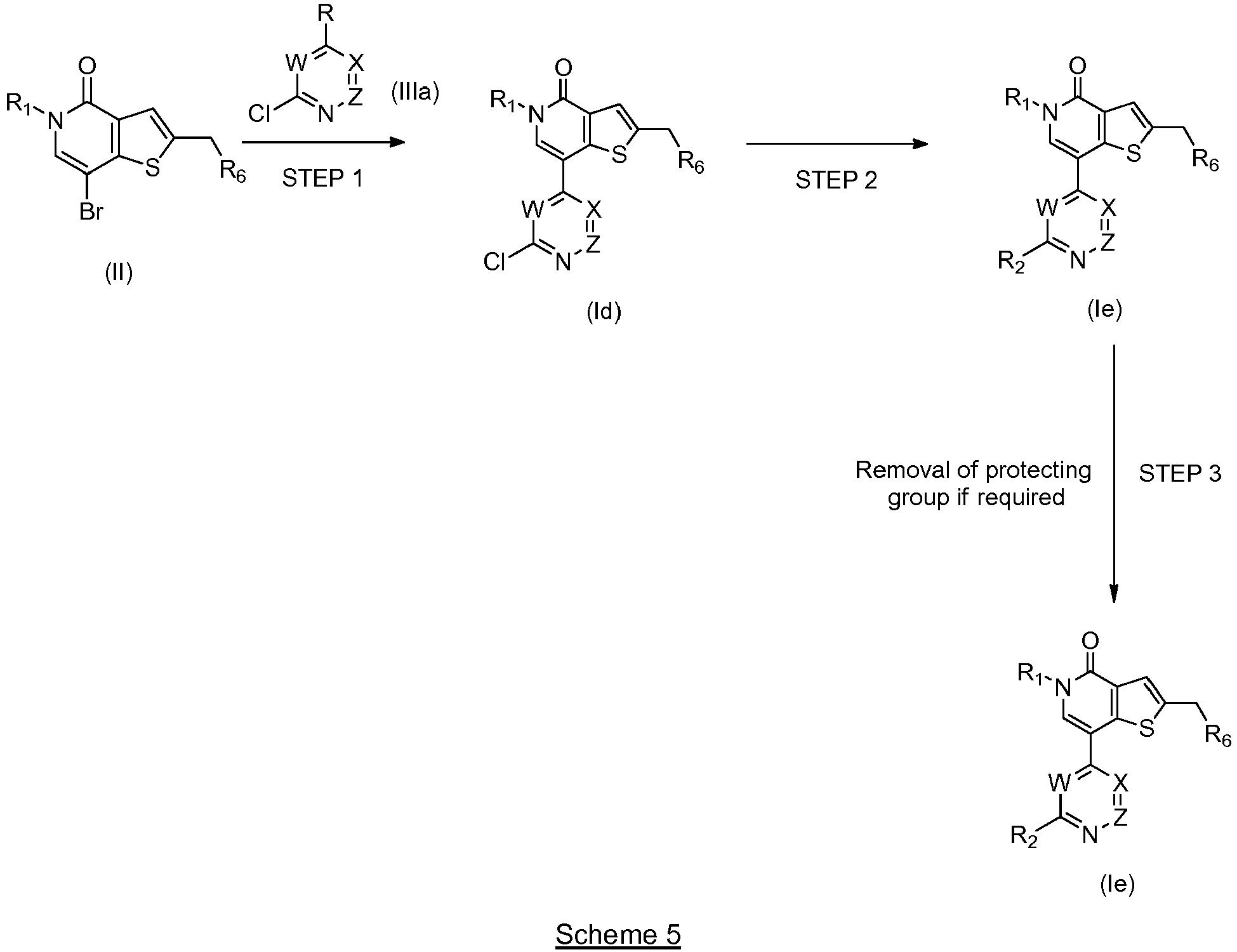

- In respect of steps shown in Scheme 5 the following reactions conditions may be utilised.
- Step 1 may be carried out with a suitable palladium catalyst, such as PdCl2(PPh3)2, Pd2(dba)3, PdCl2(dppf).DCM, Pd(OAc)2, Pd(PPh3)4 or PEPPSI, a suitable additive if required, such as Cul, a suitable base, such as NaOtBu, KOtBu, Na2CO3, Cs2CO3, K3PO4 or K2CO3, in a suitable solvent, such as 1,2-DME, aqueous 1,2-DME, ethanol in toluene, toluene, THF, aqueous THF, aqueous isopropanol, DMF or aqueous 1,4-dioxane, at a suitable temperature, such as 80-150°C, optionally in a microwave reactor, for a suitable period, such as 20 min to 20 hr.
- When R2 is -NHCH(CH3)CH2OCH3, -N(CH3)CH2CH2OCH3 or -G-CH(R3)(R4), wherein G is NH or N(CH3) and R3 and R4 are as defined for a compound of formula (I), Step 2 may be carried out by treatment with a suitable amine, in a suitable solvent, such as NMP and at a suitable temperature, such as 250 °C in a microwave reactor and for a suitable time period, such as 30 min. Alternatively the reaction may be carried out by treatment with a suitable amine, in the presence of a suitable catalyst and ligand system, such as Pd2(dba)3/BINAP, in a suitable solvent, such as THF and at a suitable temperature, such as 80 °C and for a suitable time period, for example 4 hr.
- Alternatively when R2 is -NHC(O)C1-4alkyl or -NHC(O)C3-6cycloalkyl, Step 2 may be carried out , in the presence of a suitable catalyst and ligand system, such as Pd2(dba)3/Xantphos, in the presence of a suitable base, such as Cs2CO3, in a suitable solvent, such as 1,4-dioxane and at a suitable temperature, such as 100-160 °C, optionally in a microwave reactor and for a suitable time period, for example 2 hr to 2 days.
- When the protecting group is BOC, Step 3 may be carried out in the presence of a suitable acid, such as trifluoroacetic acid or hydrochloric acid, in a suitable solvent, such as DCM or 1,4-dioxane, at a suitable temperature, such as room temperature and for a suitable time period, such as 1 to 24 hr.
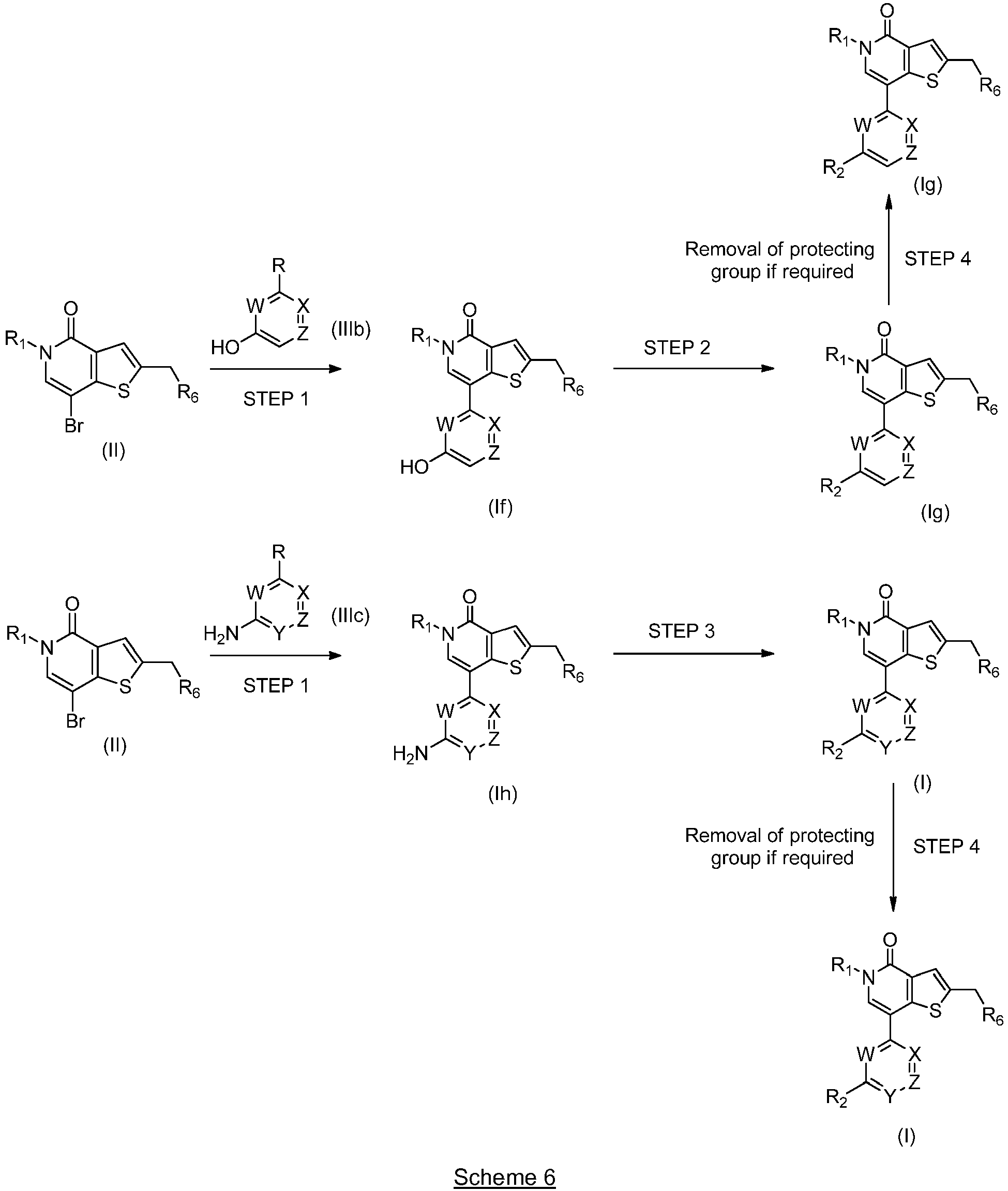

- In respect of steps shown in Scheme 6 the following reactions conditions may be utilised.
- Step 1 may be carried out with a suitable palladium catalyst, such as PdCl2(PPh3)2, Pd2(dba)3, PdCl2(dppf).DCM, Pd(OAc)2, Pd(PPh3)4 or PEPPSI, a suitable additive if required, such as Cul, a suitable base, such as NaOtBu, KOtBu, Na2CO3, Cs2CO3, K3PO4 or K2CO3, in a suitable solvent, such as 1,2-DME, aqueous 1,2-DME, ethanol in toluene, toluene, THF, aqueous THF, aqueous isopropanol, DMF or aqueous 1,4-dioxane, at a suitable temperature, such as 80-150°C, optionally in a microwave reactor, for a suitable period, such as 20 min to 20 hr.
- When R2 is -OCH2CH2OCH3, -OCH2CH2CH2OH, or -G-CH(R3)(R4), wherein G is O and R3 and R4 are as defined for a compound of formula (I), Step 2 may be carried out by treatment with a suitable alkylating agent, such as an alkyl bromide, in the presence of a suitable base, such as K2CO3, in a suitable solvent, such as DMF and at a suitable temperature, such as 100 °C and for a suitable time period, for example 3-24 hr.
- When Y is CH and R2 is -G-CH(R3)(R4), wherein G is NH and R3 and R4 are as defined for a compound of formula (I), Step 3 may be carried out using conditions suitable for a reductive amination: For example by treatment with a suitable aldehyde, in the presence of a suitable reducing agent, such as sodium borohydride or titanium (IV) isopropoxide, in a suitable solvent, such as 2,2,2-trifluoroethanol, optionally in the presence of a suitable acid, such as acetic acid, at a suitable temperature, such as 40 °C to reflux, for a total reaction period of 1-3 days which includes a period of 80-180 min before addition of the reducing agent.
- Alternatively when Y is N and R2 is -NHC(O)C1-4alkyl, Step 3 may be carried out using conditions suitable for an acylation: For example by treatment with a suitable acyl anhydride or acyl chloride, in the presence of a suitable base, such as pyridine or DIPEA, in a suitable solvent, such as DCM or 1,2-DCE at a suitable temperature, such as room temperature, for a time period, for example 4 hr.
- When the protecting group is BOC, Step 4 may be carried out in the presence of a suitable acid, such as trifluoroacetic acid or hydrochloric acid, in a suitable solvent, such as DCM or 1,4-dioxane, at a suitable temperature, such as room temperature and for a suitable time period, such as 1 to 24 hr.

- In respect of steps shown in Scheme 7 the following reactions conditions may be utilised.
- Step 1 may be carried out by treatment with bis(pinacolato)diboron in the presence of a suitable catalyst, for example PdCl2(dppf), in the presence of a suitable base, for example KOAc, in suitable solvent, such as 1,4-dioxane, at a suitable temperature, such as 110 °C in a microwave reactor, for a suitable period, such as 30 min.
- Step 2 may be carried out with a suitable palladium catalyst, such as PdCl2(PPh3)2, Pd2(dba)3, PdCl2(dppf).DCM, Pd(OAc)2, Pd(PPh3)4 or PEPPSI, a suitable base, such as NaOtBu, KOtBu, Na2CO3, Cs2CO3 or K2CO3, in a suitable solvent, such as 1,2-DME, aqueous 1,2-DME, ethanol in toluene, toluene, THF, aqueous THF, aqueous isopropanol, DMF or aqueous 1,4-dioxane, at a suitable temperature, such as 80-150 °C, optionally in a microwave reactor, for a suitable period, such as 20 min to 20 hr.
- When the protecting group is BOC, Step 3 may be carried out in the presence of a suitable acid, such as trifluoroacetic acid or hydrochloric acid, in a suitable solvent, such as DCM or 1,4-dioxane, at a suitable temperature, such as room temperature and for a suitable time period, such as 1 to 24 hr.
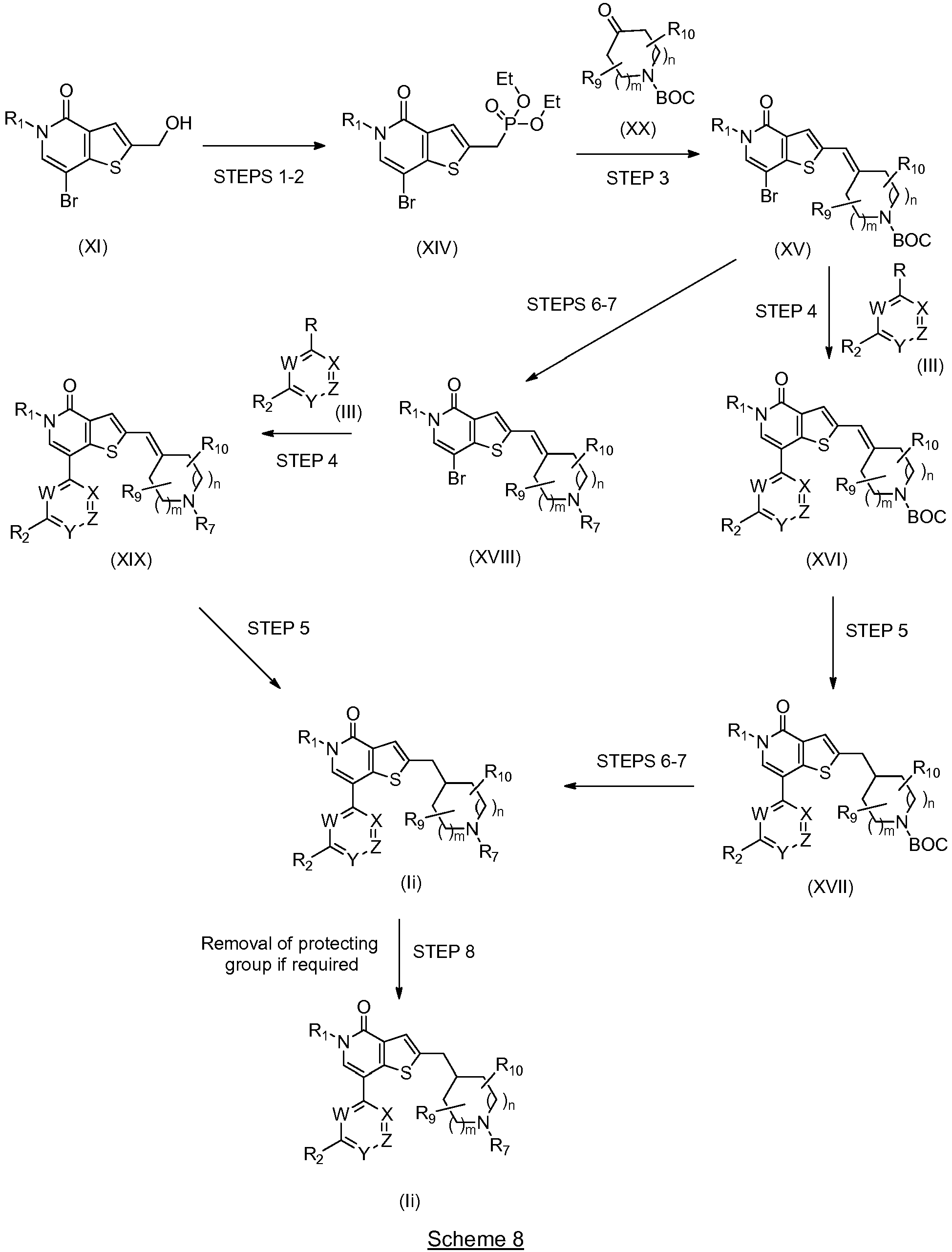

- In respect of steps shown in Scheme 8 the following reactions conditions may be utilised.
- Step 1 may be carried out by treatment with a suitable brominating agent, such as PBr3, in a suitable solvent, such as 1,4-dioxane, at a suitable temperature, such as 40-60 °C and for a suitable time period, for example 2 hr to overnight.
- Step 2 may be carried out by treatment with a suitable trialkyl phosphite, such as P(OEt)3, in a suitable solvent, such as toluene, at a suitable temperature, such as 120 °C and for a suitable time period, for example overnight.
- Step 3 may be carried out by treatment with a suitable base, such as LDA, in a suitable solvent, such as THF, under suitable reaction conditions, for example for 45 min at -78 °C under an inert atmosphere prior to addition of the ketone, then warming to room temperature overnight.
- Step 4 may be carried out with a suitable palladium catalyst, such as PdCl2(PPh3)2, Pd2(dba)3, PdCl2(dppf).DCM, Pd(OAc)2, Pd(PPh3)4 or PEPPSI, a suitable additive if required, such as Cul, a suitable base, such as NaOtBu, KOtBu, Na2CO3, Cs2CO3, K3PO4 or K2CO3, in a suitable solvent, such as 1,2-DME, aqueous 1,2-DME, ethanol in toluene, toluene, THF, aqueous THF, aqueous isopropanol, DMF or aqueous 1,4-dioxane, at a suitable temperature, such as 80-150°C, optionally in a microwave reactor, for a suitable period, such as 20 min to 20 hr.
- Step 5 may be carried out by treatment with ammonium formate in the presence of a suitable catalyst, such as 10% Pd/C, in a suitable solvent, such as ethanol, under suitable conditions, for example heating at reflux for 2 hr.
- Step 6 may be carried out in the presence of a suitable acid, such as trifluoroacetic acid or hydrochloric acid, in a suitable solvent, such as DCM or 1,4-dioxane, at a suitable temperature, such as room temperature and for a suitable time period, such as 1 to 24 hr.
- When R7 is -SO2C1-4alkyl, Step 7 may be carried out by treatment with a suitable sulfonylating agent, such as a sulfonyl chloride, in the presence of suitable base, such as pyridine, in a suitable solvent, such as DCM, at a suitable temperature, such as room temperature and for a suitable period of, for example 1 hr to overnight.


- In respect of steps shown in Scheme 9 the following reactions conditions may be utilised.
- Step 1 may be carried out by treatment with a suitable brominating agent, such as PBr3, in a suitable solvent, such as 1,4-dioxane, at a suitable temperature, such as 40-60 °C and for a suitable time period, for example 2 hr to overnight.
- Step 2 may be carried out in the presence of a suitable base such as potassium carbonate or sodium hydride in a suitable solvent, such as THF or DMF, at a suitable temperature, such as room temperature.
- Step 3 may be carried out in the presence of a suitable acid, such as trifluoroacetic acid or hydrochloric acid, in a suitable solvent, such as DCM or 1,4-dioxane, at a suitable temperature, such as room temperature and for a suitable time period, such as 1 to 24 hr.
- Step 4 may be carried out by treatment with a suitable sulfonylating or acylating agent, such as a sulfonyl chloride, an acyl chloride, or an acyl anhydride, in the presence of a suitable base, such as pyridine, pyridine/DMAP, or triethylamine, in a suitable solvent, such as DCM, acetonitrile or 1,2-DCE, at a suitable temperature, such as room temperature or 40 °C and for a suitable time period, such as 1 hr to overnight.
- Alternatively, when R7 is C1-4alkyl, Step 4 may be carried out using conditions suitable for a reductive amination reaction. For example, in the presence of a suitable reducing agent, such as sodium triacetoxyborohydride, 2-picoline borane complex or sodium cyanoborohydride, in the presence of a suitable acid, such as acetic acid, in the presence of a suitable solvent, such as methanol, DCM, 1,2-DCE, chloroform, THF or diethyl ether, at a suitable temperature, such as room temperature, 40 °C or 50 °C for a total reaction period of 1-72 hr which includes a period of 0-4 hr before addition of the reducing agent.
- Step 5 may be carried out with a suitable palladium catalyst, such as PdCl2(PPh3)2, Pd2(dba)3, PdCl2(dppf).DCM, Pd(OAc)2, Pd(PPh3)4 or PEPPSI, a suitable additive if required, such as Cul, a suitable base, such as NaOtBu, KOtBu, Na2CO3, Cs2CO3, K3PO4 or K2CO3, in a suitable solvent, such as 1,2-DME, aqueous 1,2-DME, ethanol in toluene, toluene, THF, aqueous THF, aqueous isopropanol, DMF or aqueous 1,4-dioxane, at a suitable temperature, such as 80-150°C, optionally in a microwave reactor, for a suitable period, such as 20 min to 20 hr.
- Thus, in one embodiment the invention provides a process for preparing a compound of formula (I) comprising reacting a compound of formula (II)

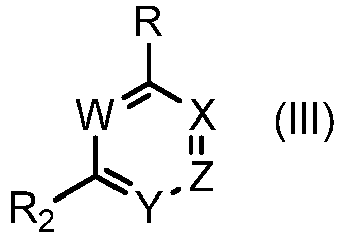

- In another embodiment the invention provides a process for preparing a compound of formula (II) comprising reacting a compound of formula (IV)
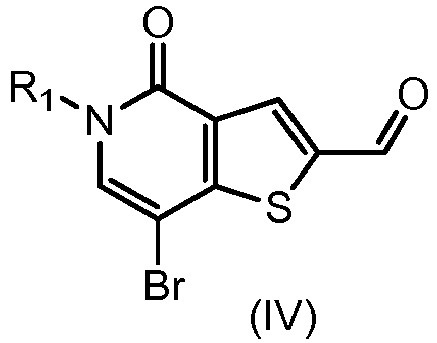

- In another embodiment the invention provides a process for preparing a compound of formula (IV) comprising reacting a compound of formula (VII)

- In another embodiment the invention provides a process for preparing a compound of formula (VII) comprising reacting a compound of formula (VIII)

- In another embodiment the invention provides a process for preparing a compound of formula (VIII) comprising reacting a compound of formula (IX)

- In a further embodiment the invention provides a process for preparing a compound of formula (Ia) comprising reacting a compound of formula (I) wherein R1, R2, W, X, Y and Z are as defined above, and R6 is

- In another embodiment the invention provides a process for preparing a compound of formula (Ib) comprising reacting a compound of formula (I) wherein R1, R2, W, X, Y and Z are as defined above, and R6 is

- In a further embodiment the invention provides a process for preparing a compound of formula (Ia) comprising reacting a compound of formula (IIb)


- In another embodiment the invention provides a process for preparing a compound of formula (IIb) comprising reacting a compound of formula (IIa)
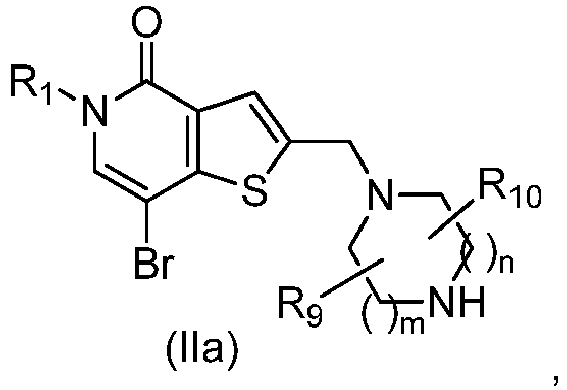
- In another embodiment the invention provides a process for preparing a compound of formula (IIa) comprising reacting a compound of formula (IV)


- In a further embodiment the invention provides a process for preparing a compound of formula (Ic) comprising reacting a compound of formula (IId)


- In another embodiment the invention provides a process for preparing a compound of formula (IId) comprising reacting a compound of formula (IIc)

- In another embodiment the invention provides a process for preparing a compound of formula (IIc) comprising reacting a compound of formula (IV)


- In another embodiment the invention provides a process for preparing a compound of formula (I) comprising reacting a compound of formula (X)


- In a further embodiment the invention provides a process for preparing a compound of formula (X) comprising reacting a compound of formula (IV)
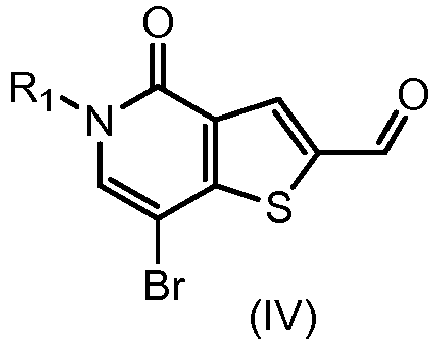


- In a further embodiment the invention provides a process for preparing a compound of formula (I) comprising reacting a compound of formula (XIII)


- In a further embodiment the invention provides a process for preparing a compound of formula (XIII) comprising reacting a compound of formula (XII)

- In a further embodiment the invention provides a process for preparing a compound of formula (XII) comprising reacting a compound of formula (XI)

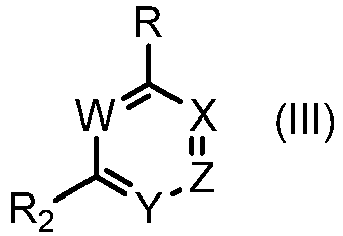

- In a further embodiment the invention provides a process for preparing a compound of formula (XI) comprising reacting a compound of formula (IV)

- In a further embodiment the invention provides a process for preparing a compound of formula (Ie) comprising reacting a compound of formula (Id)

- In another embodiment the invention provides a process for preparing a compound of formula (Id) comprising reacting a compound of formula (II)


- In a further embodiment the invention provides a process for preparing a compound of formula (Ig) comprising reacting a compound of formula (If)

- In another embodiment the invention provides a process for preparing a compound of formula (If) comprising reacting a compound of formula (II)


- In another embodiment the invention provides a process for preparing a compound of formula (I) comprising reacting a compound of formula (Ih)

- In a further embodiment the invention provides a process for preparing a compound of formula (I) comprising reacting a compound of formula (Ih)

- In another embodiment the invention provides a process for preparing a compound of formula (Ih) comprising reacting a compound of formula (II)


- In another embodiment the invention provides a process for preparing a compound of formula (I) comprising reacting a compound of formula (II)


- In another embodiment the invention provides a process for preparing a compound of formula (Ii) comprising reacting a compound of formula (XVII)
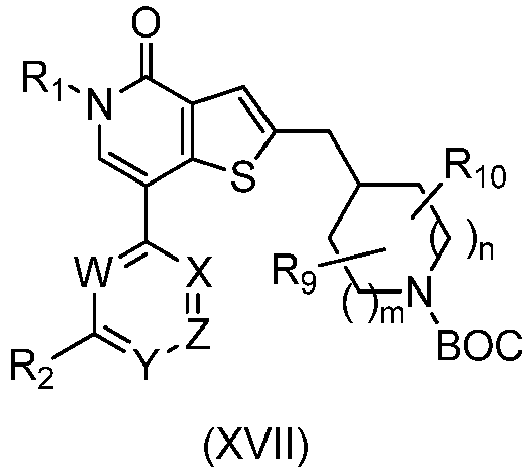
- In a further embodiment the invention provides a process for preparing a compound of formula (XVII) comprising reacting a compound of formula (XVI)

- In a further embodiment the invention provides a process for preparing a compound of formula (XVI) comprising reacting a compound of formula (XV)


- In a further embodiment the invention provides a process for preparing a compound of formula (XV) comprising reacting a compound of formula (XIV)


- In a further embodiment the invention provides a process for preparing a compound of formula (XIV) comprising reacting a compound of formula (XI)

- In another embodiment the invention provides a process for preparing a compound of formula (Ii) comprising reacting a compound of formula (XIX)

- In a further embodiment the invention provides a process for preparing a compound of formula (XIX) comprising reacting a compound of formula (XVIII)


- In a further embodiment the invention provides a process for preparing a compound of formula (XVIII) comprising reacting a compound of formula (XV)

- In a further embodiment the invention provides a process for preparing a compound of formula (IIa)


- In another embodiment the invention provides a process for preparing a compound of formula (XXI) comprising reacting a compound of formula (XI)

- Compounds of formulae (IX), (V), (VI), (XX) and (III) are commercially available or can be readily synthesised by known methods, for example as reported by Suzuki in Chem.Rev., 1995, vol. 95, p2457-2483.
- It will be appreciated by those skilled in the art that it may be advantageous to protect one or more functional groups of the compounds described above. Examples of protecting groups and the means for their removal can be found in T. W. Greene 'Protective Groups in Organic Synthesis' (4th edition, J. Wiley and Sons, 2006). Suitable amine protecting groups include acyl (e.g. acetyl, carbamate (e.g. 2',2',2'-trichloroethoxycarbonyl, benzyloxycarbonyl or t-butoxycarbonyl) and arylalkyl (e.g. benzyl), which may be removed by hydrolysis (e.g. using an acid such as hydrochloric acid in 1,4-dioxane or trifluoroacetic acid in dichloromethane) or reductively (e.g. hydrogenolysis of a benzyl or benzyloxycarbonyl group or reductive removal of a 2',2',2'-trichloroethoxycarbonyl group using zinc in acetic acid) as appropriate. Other suitable amine protecting groups include trifluoroacetyl (-COCF3) which may be removed by base catalysed hydrolysis.
- It will be appreciated that in any of the routes described above, the precise order of the synthetic steps by which the various groups and moieties are introduced into the molecule may be varied. It will be within the skill of the practitioner in the art to ensure that groups or moieties introduced at one stage of the process will not be affected by subsequent transformations and reactions, and to select the order of synthetic steps accordingly.
- Certain intermediate compounds described above form a yet further aspect of the invention.
- The compounds of formula (I) and salts thereof are bromodomain inhibitors, and thus are believed to have potential utility in the treatment of diseases or conditions for which a bromodomain inhibitor is indicated.
- The present invention thus provides a compound of formula (I) or a pharmaceutically acceptable salt thereof for use in the treatment of any diseases or conditions for which a bromodomain inhibitor is indicated. In one embodiment there is provided a compound of formula (I) or a pharmaceutically acceptable salt thereof for use in the treatment of acute or chronic autoimmune and/or inflammatory conditions. In another embodiment there is provided a compound of formula (I) or a pharmaceutically acceptable salt thereof for use in the treatment of diseases or conditions which involve inflammatory responses to infections with bacteria, viruses, fungi, parasites or their toxins. In another embodiment there is provided a compound of formula (I) or a pharmaceutically acceptable salt thereof for use in the treatment of viral infections. In a further embodiment there is provided a compound of formula (I) or a pharmaceutically acceptable salt thereof for use in the treatment of cancer.
- Also disclosed is the use of a compound of formula (I) or a pharmaceutically acceptable salt thereof in the manufacture of a medicament for the treatment of diseases or conditions for which a bromodomain inhibitor is indicated.
- Also disclosed is a method of treating diseases or conditions for which a bromodomain inhibitor is indicated in a subject in need thereof which comprises administering a therapeutically effective amount of compound of formula (I) or a pharmaceutically acceptable salt thereof.
- Suitably the subject in need thereof is a mammal, particularly a human.
- As used herein, the term "effective amount" means that amount of a drug or pharmaceutical agent that will elicit the biological or medical response of a tissue, system, or subject (e.g. a human) that is being sought, for instance, by a researcher or clinician. Furthermore, the term "therapeutically effective amount" means any amount which, as compared to a corresponding subject who has not received such amount, results in improved treatment, healing, prevention, or amelioration of a disease, disorder, or side effect, or a decrease in the rate of advancement of a disease or disorder. The term also includes within its scope amounts effective to enhance normal physiological function.
- Bromodomain inhibitors are believed to be useful in the treatment of a variety of diseases or conditions related to systemic or tissue inflammation, inflammatory responses to infection or hypoxia, cellular activation and proliferation, lipid metabolism, fibrosis and in the prevention and treatment of viral infections.
- Bromodomain inhibitors may be useful in the treatment of a wide variety of acute or chronic autoimmune and/or inflammatory conditions such as rheumatoid arthritis, osteoarthritis, acute gout, psoriasis, systemic lupus erythematosus, multiple sclerosis, inflammatory bowel disease (Crohn's disease and Ulcerative colitis), asthma, chronic obstructive airways disease, pneumonitis, myocarditis, pericarditis, myositis, eczema, dermatitis (including atopic dermatitis), alopecia, vitiligo, bullous skin diseases, nephritis, vasculitis, hypercholesterolemia, atherosclerosis, Alzheimer's disease, depression, Sjögren's syndrome, sialoadenitis, central retinal vein occlusion, branched retinal vein occlusion, Irvine-Gass syndrome (post cataract and post-surgical), retinitis pigmentosa, pars planitis, birdshot retinochoroidopathy, epiretinal membrane, cystic macular edema, parafoveal telengiectasis, tractional maculopathies, vitreomacular traction syndromes, retinal detachment, neuroretinitis, idiopathic macular edema, retinitis, dry eye (keratoconjunctivitis Sicca), vernal keratoconjunctivitis, atopic keratoconjunctivitis, uveitis (such as anterior uveitis, pan uveitis, posterior uveitis, uveitis-associated macular edema), scleritis, diabetic retinopathy, diabetic macula edema, age-related macular dystrophy, hepatitis, pancreatitis, primary biliary cirrhosis, sclerosing cholangitis, Addison's disease, hypophysitis, thyroiditis, type I diabetes, giant cell arteritis, nephritis including lupus nephritis, vasculitis with organ involvement such as glomerulonephritis, vasculitis including giant cell arteritis, Wegener's granulomatosis, Polyarteritis nodosa, Behcet's disease, Kawasaki disease, Takayasu's Arteritis, pyoderma gangrenosum, vasculitis with organ involvement and acute rejection of transplanted organs.
- In one embodiment the acute or chronic autoimmune and/or inflammatory condition is a disorder of lipid metabolism via the regulation of APO-A1 such as hypercholesterolemia, atherosclerosis and Alzheimer's disease.
- In another embodiment the acute or chronic autoimmune and/or inflammatory condition is a respiratory disorder such as asthma or chronic obstructive airways disease.
- In another embodiment the acute or chronic autoimmune and/or inflammatory condition is a systemic inflammatory disorder such as rheumatoid arthritis, osteoarthritis, acute gout, psoriasis, systemic lupus erythematosus, multiple sclerosis or inflammatory bowel disease (Crohn's disease and Ulcerative colitis).
- In another embodiment the acute or chronic autoimmune and/or inflammatory condition is multiple sclerosis.
- In a further embodiment the acute or chronic autoimmune and/or inflammatory condition is Type I diabetes.
- Bromodomain inhibitors may be useful in the treatment of diseases or conditions which involve inflammatory responses to infections with bacteria, viruses, fungi, parasites or their toxins, such as sepsis, acute sepsis, sepsis syndrome, septic shock, endotoxaemia, systemic inflammatory response syndrome (SIRS), multi-organ dysfunction syndrome, toxic shock syndrome, acute lung injury, ARDS (adult respiratory distress syndrome), acute renal failure, fulminant hepatitis, burns, acute pancreatitis, post-surgical syndromes, sarcoidosis, Herxheimer reactions, encephalitis, myelitis, meningitis, malaria and SIRS associated with viral infections such as influenza, herpes zoster, herpes simplex and coronavirus. In one embodiment the disease or condition which involves an inflammatory response to an infection with bacteria, a virus, fungi, a parasite or their toxins is acute sepsis.
- Bromodomain inhibitors may be useful in the treatment of conditions associated with ischaemia-reperfusion injury such as myocardial infarction, cerebro-vascular ischaemia (stroke), acute coronary syndromes, renal reperfusion injury, organ transplantation, coronary artery bypass grafting, cardio-pulmonary bypass procedures, pulmonary, renal, hepatic, gastro-intestinal or peripheral limb embolism.
- Bromodomain inhibitors may be useful in the treatment of fibrotic conditions such as idiopathic pulmonary fibrosis, renal fibrosis, post-operative stricture, keloid scar formation, scleroderma (including morphea) and cardiac fibrosis.
- Bromodomain inhibitors may be useful in the treatment of viral infections such as herpes simplex infections and reactivations, cold sores, herpes zoster infections and reactivations, chickenpox, shingles, human papilloma virus (HPV), human immunodeficiency virus (HIV), cervical neoplasia, adenovirus infections, including acute respiratory disease, poxvirus infections such as cowpox and smallpox and African swine fever virus. In one embodiment the viral infection is a HPV infection of skin or cervical epithelia. In another embodiment the viral infection is a latent HIV infection.
- Bromodomain inhibitors may be useful in the treatment of cancer, including hematological (such as leukaemia, lymphoma and multiple myeloma), epithelial including lung, breast and colon carcinomas, midline carcinomas, mesenchymal, hepatic, renal and neurological tumours.
- Bromodomain inhibitors may be useful in the treatment of one or more cancers selected from brain cancer (gliomas), glioblastomas, Bannayan-Zonana syndrome, Cowden disease, Lhermitte-Duclos disease, breast cancer, inflammatory breast cancer, colorectal cancer, Wilm's tumor, Ewing's sarcoma, rhabdomyosarcoma, ependymoma, medulloblastoma, colon cancer, head and neck cancer, kidney cancer, lung cancer, liver cancer, melanoma, squamous cell carcinoma, ovarian cancer, pancreatic cancer, prostate cancer, sarcoma cancer, osteosarcoma, giant cell tumor of bone, thyroid cancer, lymphoblastic T-cell leukemia, chronic myelogenous leukemia, chronic lymphocytic leukemia, hairy-cell leukemia, acute lymphoblastic leukemia, acute myelogenous leukemia, chronic neutrophilic leukemia, acute lymphoblastic T-cell leukemia, plasmacytoma, immunoblastic large cell leukemia, mantle cell leukemia, multiple myeloma, megakaryoblastic leukemia, acute megakaryocytic leukemia, promyelocytic leukemia, mixed lineage leukaemia, erythroleukemia, malignant lymphoma, Hodgkins lymphoma, non-Hodgkins lymphoma, lymphoblastic T-cell lymphoma, Burkitt's lymphoma, follicular lymphoma, neuroblastoma, bladder cancer, urothelial cancer, vulval cancer, cervical cancer, endometrial cancer, renal cancer, mesothelioma, esophageal cancer, salivary gland cancer, hepatocellular cancer, gastric cancer, nasopharangeal cancer, buccal cancer, cancer of the mouth, GIST (gastrointestinal stromal tumor), NUT-midline carcinoma and testicular cancer.
- In one embodiment the cancer is a leukaemia, for example a leukaemia selected from acute monocytic leukemia, acute myelogenous leukemia, chronic myelogenous leukemia, chronic lymphocytic leukemia and mixed lineage leukaemia (MLL). In another embodiment the cancer is NUT-midline carcinoma. In another embodiment the cancer is multiple myeloma. In another embodiment the cancer is a lung cancer such as small cell lung cancer (SCLC). In another embodiment the cancer is a neuroblastoma. In another embodiment the cancer is Burkitt's lymphoma. In another embodiment the cancer is cervical cancer. In another embodiment the cancer is esophageal cancer. In another embodiment the cancer is ovarian cancer. In another embodiment the cancer is breast cancer. In another embodiment the cancer is colarectal cancer.
- In one embodiment the disease or condition for which a bromodomain inhibitor is indicated is selected from diseases associated with systemic inflammatory response syndrome, such as sepsis, burns, pancreatitis, major trauma, haemorrhage and ischaemia. In this embodiment the bromodomain inhibitor would be administered at the point of diagnosis to reduce the incidence of: SIRS, the onset of shock, multi-organ dysfunction syndrome, which includes the onset of acute lung injury, ARDS, acute renal, hepatic, cardiac or gastro-intestinal injury and mortality. In another embodiment the bromodomain inhibitor would be administered prior to surgical or other procedures associated with a high risk of sepsis, haemorrhage, extensive tissue damage, SIRS or MODS (multiple organ dysfunction syndrome). In a particular embodiment the disease or condition for which a bromodomain inhibitor is indicated is sepsis, sepsis syndrome, septic shock and endotoxaemia. In another embodiment, the bromodomain inhibitor is indicated for the treatment of acute or chronic pancreatitis. In another embodiment the bromodomain is indicated for the treatment of burns.
- As used herein the reference to the "treatment" of a particular disease or condition includes the prevention or prophylaxis of such a disease or condition.
- The term "diseases or conditions for which a bromodomain inhibitor is indicated", is intended to include each of or all of the above diseases or conditions.
- The invention further provides for a method for inhibiting a bromodomain which comprises contacting the bromodomain with a compound of formula (I) or a pharmaceutically acceptable salt thereof.
- While it is possible that for use in therapy, a compound of formula (I) as well as pharmaceutically acceptable salts thereof may be administered as the raw chemical, it is common to present the active ingredient as a pharmaceutical composition.
- The present invention therefore provides in a further aspect a pharmaceutical composition comprising a compound of formula (I) or a pharmaceutically acceptable salt and one or more pharmaceutically acceptable carriers, diluents or excipients. The compounds of formula (I) and pharmaceutically acceptable salts are as described above. The carrier(s), diluent(s) or excipient(s) must be acceptable in the sense of being compatible with the other ingredients of the composition and not deleterious to the recipient thereof. In accordance with another aspect of the invention there is also provided a process for the preparation of a pharmaceutical composition including admixing a compound of formula (I), or a pharmaceutically acceptable salt thereof, with one or more pharmaceutically acceptable carriers, diluents or excipients. The pharmaceutical composition can be used in the treatment of any of the conditions described herein.
- Since the compounds of formula (I) are intended for use in pharmaceutical compositions it will be readily understood that they are each preferably provided in substantially pure form, for example at least 85% pure, especially at least 98% pure (% in a weight for weight basis).
- Pharmaceutical compositions may be presented in unit dose forms containing a predetermined amount of active ingredient per unit dose. Preferred unit dosage compositions are those containing a daily dose or sub-dose, or an appropriate fraction thereof, of an active ingredient. Such unit doses may therefore be administered more than once a day. Preferred unit dosage compositions are those containing a daily dose or sub-dose (for administration more than once a day), as herein above recited, or an appropriate fraction thereof, of an active ingredient.
- Pharmaceutical compositions may be adapted for administration by any appropriate route, for example by the oral (including buccal or sublingual), rectal, inhaled, intranasal, topical (including buccal, sublingual or transdermal), ocular (including topical, intraocular, subconjunctival, episcleral, sub-Tenon), vaginal or parenteral (including subcutaneous, intramuscular, intravenous or intradermal) route. Such compositions may be prepared by any method known in the art of pharmacy, for example by bringing into association the active ingredient with the carrier(s) or excipient(s).
- In one embodiment the pharmaceutical composition is adapted for parenteral administration, particularly intravenous administration.
- In one embodiment the pharmaceutical composition is adapted for oral administration.
- In one embodiment the pharmaceutical composition is adapted for topical administration.
- Pharmaceutical compositions adapted for parenteral administration include aqueous and non-aqueous sterile injection solutions which may contain anti-oxidants, buffers, bacteriostats and solutes which render the composition isotonic with the blood of the intended recipient; and aqueous and non-aqueous sterile suspensions which may include suspending agents and thickening agents. The compositions may be presented in unit-dose or multi-dose containers, for example sealed ampoules and vials, and may be stored in a freeze-dried (lyophilized) condition requiring only the addition of the sterile liquid carrier, for example water for injections, immediately prior to use. Extemporaneous injection solutions and suspensions may be prepared from sterile powders, granules and tablets.
- Pharmaceutical compositions adapted for oral administration may be presented as discrete units such as capsules or tablets; powders or granules; solutions or suspensions in aqueous or non-aqueous liquids; edible foams or whips; or oil-in-water liquid emulsions or water-in-oil liquid emulsions.
- For instance, for oral administration in the form of a tablet or capsule, the active drug component can be combined with an oral, non-toxic pharmaceutically acceptable inert carrier such as ethanol, glycerol, water and the like. Powders suitable for incorporating into tablets or capsules may be prepared by reducing the compound to a suitable fine size (e.g. by micronisation) and mixing with a similarly prepared pharmaceutical carrier such as an edible carbohydrate, for example starch or mannitol. Flavoring, preservative, dispersing and coloring agent can also be present.
- Capsules may be made by preparing a powder mixture, as described above, and filling formed gelatin sheaths. Glidants and lubricants such as colloidal silica, talc, magnesium stearate, calcium stearate or solid polyethylene glycol can be added to the powder mixture before the filling operation. A disintegrating or solubilizing agent such as agar-agar, calcium carbonate or sodium carbonate can also be added to improve the availability of the medicament when the capsule is ingested.
- Moreover, when desired or necessary, suitable binders, glidants, lubricants, sweetening agents, flavours, disintegrating agents and coloring agents can also be incorporated into the mixture. Suitable binders include starch, gelatin, natural sugars such as glucose or beta-lactose, corn sweeteners, natural and synthetic gums such as acacia, tragacanth or sodium alginate, carboxymethylcellulose, polyethylene glycol, waxes and the like. Lubricants used in these dosage forms include sodium oleate, sodium stearate, magnesium stearate, sodium benzoate, sodium acetate, sodium chloride and the like. Disintegrators include starch, methyl cellulose, agar, bentonite, xanthan gum and the like. Tablets are formulated, for example by preparing a powder mixture, granulating or slugging, adding a lubricant and disintegrant and pressing into tablets. A powder mixture is prepared by mixing the compound, suitably comminuted, with a diluent or base as described above, and optionally, with a binder such as carboxymethylcellulose, an aliginate, gelatin, or polyvinyl pyrrolidone, a solution retardant such as paraffin, a resorption accelerator such as a quaternary salt and/or an absorption agent such as bentonite, kaolin or dicalcium phosphate. The powder mixture can be granulated by wetting with a binder such as syrup, starch paste, acadia mucilage or solutions of cellulosic or polymeric materials and forcing through a screen. As an alternative to granulating, the powder mixture can be run through the tablet machine and the result is imperfectly formed slugs broken into granules. The granules can be lubricated to prevent sticking to the tablet forming dies by means of the addition of stearic acid, a stearate salt, talc or mineral oil. The lubricated mixture is then compressed into tablets. The compounds of formula (I) and pharmaceutically acceptable salts thereof can also be combined with a free flowing inert carrier and compressed into tablets directly without going through the granulating or slugging steps. A clear or opaque protective coating consisting of a sealing coat of shellac, a coating of sugar or polymeric material and a polish coating of wax can be provided. Dyestuffs can be added to these coatings to distinguish different unit dosages.
- Oral fluids such as solution, syrups and elixirs can be prepared in dosage unit form so that a given quantity contains a predetermined amount of the compound. Syrups can be prepared by dissolving the compound in a suitably flavored aqueous solution, while elixirs are prepared through the use of a non-toxic alcoholic vehicle. Suspensions can be formulated by dispersing the compound in a non-toxic vehicle. Solubilizers and emulsifiers such as ethoxylated isostearyl alcohols and polyoxy ethylene sorbitol ethers, preservatives, flavor additive such as peppermint oil or natural sweeteners or saccharin or other artificial sweeteners, and the like can also be added.
- Compositions for oral administration may be designed to provide a modified release profile so as to sustain or otherwise control the release of the therapeutically active agent.
- Where appropriate, dosage unit compositions for oral administration can be microencapsulated. The composition may be prepared to prolong or sustain the release as for example by coating or embedding particulate material in polymers, wax or the like.
- The compounds of formula (I) and pharmaceutically acceptable salts thereof, can also be administered in the form of liposome delivery systems, such as small unilamellar vesicles, large unilamellar vesicles and multilamellar vesicles. Liposomes can be formed from a variety of phospholipids, such as cholesterol, stearylamine or phosphatidylcholines.
- Pharmaceutical compositions adapted for topical administration may be formulated as ointments, creams, suspensions, emulsions, lotions, powders, solutions, pastes, gels, foams, sprays, aerosols or oils. Such pharmaceutical compositions may include conventional additives which include, but are not limited to, preservatives, solvents to assist drug penetration, co-solvents, emollients, propellants, viscosity modifying agents (gelling agents), surfactants and carriers. In one embodiment there is provided a pharmaceutical composition adapted for topical administration which comprises between 0.01 - 10%, or between 0.01 - 1% of the compound of formula (I), or a pharmaceutically acceptable salt thereof, by weight of the composition.
- For treatments of the eye or other external tissues, for example mouth and skin, the compositions are preferably applied as a topical ointment, cream, gel, spray or foam. When formulated in an ointment, the active ingredient may be employed with either a paraffinic or a water-miscible ointment base. Alternatively, the active ingredient may be formulated in a cream with an oil-in-water cream base or a water-in-oil base.
- Pharmaceutical compositions adapted for topical administrations to the eye include eye drops wherein the active ingredient is dissolved or suspended in a suitable carrier, especially an aqueous solvent. Compositions to be administered to the eye will have ophthalmically compatible pH and osmolality. One or more ophthalmically acceptable pH adjusting agents and/or buffering agents can be included in a composition of the invention, including acids such as acetic, boric, citric, lactic, phosphoric and hydrochloric acids; bases such as sodium hydroxide, sodium phosphate, sodium borate, sodium citrate, sodium acetate, and sodium lactate; and buffers such as citrate/dextrose, sodium bicarbonate and ammonium chloride. Such acids, bases, and buffers can be included in an amount required to maintain pH of the composition in an ophthalmically acceptable range. One or more ophthalmically acceptable salts can be included in the composition in an amount sufficient to bring osmolality of the composition into an ophthalmically acceptable range. Such salts include those having sodium, potassium or ammonium cations and chloride, citrate, ascorbate, borate, phosphate, bicarbonate, sulfate, thiosulfate or bisulfite anions.
- The ocular delivery device may be designed for the controlled release of one or more therapeutic agents with multiple defined release rates and sustained dose kinetics and permeability. Controlled release may be obtained through the design of polymeric matrices incorporating different choices and properties of biodegradable/bioerodable polymers (e.g. poly(ethylene vinyl) acetate (EVA), superhydrolyzed PVA), hydroxyalkyl cellulose (HPC), methylcellulose (MC), hydroxypropyl methyl cellulose (HPMC), polycaprolactone, poly(glycolic) acid, poly(lactic) acid, polyanhydride, of polymer molecular weights, polymer crystallinity, copolymer ratios, processing conditions, surface finish, geometry, excipient addition and polymeric coatings that will enhance drug diffusion, erosion, dissolution and osmosis.
- Pharmaceutical compositions for ocular delivery also include in situ gellable aqueous composition. Such a composition comprises a gelling agent in a concentration effective to promote gelling upon contact with the eye or with lacrimal fluid. Suitable gelling agents include but are not limited to thermosetting polymers. The term "in situ gellable" as used herein is includes not only liquids of low viscosity that form gels upon contact with the eye or with lacrimal fluid, but also includes more viscous liquids such as semi-fluid and thixotropic gels that exhibit substantially increased viscosity or gel stiffness upon administration to the eye. See, for example Ludwig (2005) Adv. Drug Deliv. Rev. 3;57:1595-639, for examples of polymers for use in ocular drug delivery.
- Dosage forms for nasal or inhaled administration may conveniently be formulated as aerosols, solutions, suspensions, gels or dry powders.
- For compositions suitable and/or adapted for inhaled administration, it is preferred that the compound of formula (I) or a pharmaceutically acceptable salt thereof, is in a particle-size-reduced form e.g. obtained by micronisation. The preferable particle size of the size-reduced (e.g. micronised) compound or salt is defined by a D50 value of about 0.5 to about 10 microns (for example as measured using laser diffraction).
- Aerosol formulations, e.g. for inhaled administration, can comprise a solution or fine suspension of the active substance in a pharmaceutically acceptable aqueous or non-aqueous solvent. Aerosol formulations can be presented in single or multidose quantities in sterile form in a sealed container, which can take the form of a cartridge or refill for use with an atomising device or inhaler. Alternatively the sealed container may be a unitary dispensing device such as a single dose nasal inhaler or an aerosol dispenser fitted with a metering valve (metered dose inhaler) which is intended for disposal once the contents of the container have been exhausted.
- Where the dosage form comprises an aerosol dispenser, it preferably contains a suitable propellant under pressure such as compressed air, carbon dioxide or an organic propellant such as a hydrofluorocarbon (HFC). Suitable HFC propellants include 1,1,1,2,3,3,3-heptafluoropropane and 1,1,1,2-tetrafluoroethane. The aerosol dosage forms can also take the form of a pump-atomiser. The pressurised aerosol may contain a solution or a suspension of the active compound. This may require the incorporation of additional excipients e.g. co-solvents and/or surfactants to improve the dispersion characteristics and homogeneity of suspension formulations. Solution formulations may also require the addition of co-solvents such as ethanol.
- For pharmaceutical compositions suitable and/or adapted for inhaled administration, the pharmaceutical composition may be a dry powder inhalable composition. Such a composition can comprise a powder base such as lactose, glucose, trehalose, mannitol or starch, the compound of formula (I) or a pharmaceutically acceptable salt thereof (preferably in particle-size-reduced form, e.g. in micronised form), and optionally a performance modifier such as L-leucine or another amino acid and/or metal salt of stearic acid such as magnesium or calcium stearate. Preferably, the dry powder inhalable composition comprises a dry powder blend of lactose e.g. lactose monohydrate and the compound of formula (I) or salt thereof. Such compositions can be administered to the patient using a suitable device such as the DISKUS® device, marketed by GlaxoSmithKline which is for example described in
GB 2242134 A - The compounds of formula (I) and pharmaceutically acceptable salts thereof may be formulated as a fluid formulation for delivery from a fluid dispenser, for example a fluid dispenser having a dispensing nozzle or dispensing orifice through which a metered dose of the fluid formulation is dispensed upon the application of a user-applied force to a pump mechanism of the fluid dispenser. Such fluid dispensers are generally provided with a reservoir of multiple metered doses of the fluid formulation, the doses being dispensable upon sequential pump actuations. The dispensing nozzle or orifice may be configured for insertion into the nostrils of the user for spray dispensing of the fluid formulation into the nasal cavity. A fluid dispenser of the aforementioned type is described and illustrated in
WO-A-2005/044354 . - A therapeutically effective amount of a compound of formula (I) or a pharmaceutically acceptable salt thereof, will depend upon a number of factors including, for example the age and weight of the subject, the precise condition requiring treatment and its severity, the nature of the formulation, and the route of administration, and will ultimately be at the discretion of the attendant physician or veterinarian. In the pharmaceutical composition, each dosage unit for oral or parenteral administration preferably contains from 0.01 to 3000 mg, more preferably 0.5 to 1000 mg, of a compound of formula (I) or a pharmaceutically acceptable salt thereof, calculated as the free base. Each dosage unit for nasal or inhaled administration preferably contains from 0.001 to 50 mg, more preferably 0.01 to 5 mg, of a compound of the formula (I) or a pharmaceutically acceptable salt thereof, calculated as the free base.
- The pharmaceutically acceptable compounds of formula (I) and pharmaceutically acceptable salts thereof, can be administered in a daily dose (for an adult patient) of, for example an oral or parenteral dose of 0.01 mg to 3000 mg per day, 0.5 to 1000 mg per day or 100 mg to 2500mg per day, or a nasal or inhaled dose of 0.001 to 50 mg per day or 0.01 to 5 mg per day, of the compound of the formula (I) or a pharmaceutically acceptable salt thereof, calculated as the free base. This amount may be given in a single dose per day or more usually in a number (such as two, three, four, five or six) of sub-doses per day such that the total daily dose is the same. An effective amount of a salt thereof, may be determined as a proportion of the effective amount of the compound of formula (I) per se.
- The compounds of formula (I) and pharmaceutically acceptable salts thereof may be employed alone or in combination with other therapeutic agents. Combination therapies according to the present invention thus comprise the administration of at least one compound of formula (I) or a pharmaceutically acceptable salt thereof, and the use of at least one other theraputically active agent. Preferably, combination therapies according to the present invention comprise the administration of at least one compound of formula (I) or a pharmaceutically acceptable salt thereof, and at least one other therapeutically active agent. The compound(s) of formula (I) and pharmaceutically acceptable salts thereof, and the other therapeutically active agent(s) may be administered together in a single pharmaceutical composition or separately and, when administered separately this may occur simultaneously or sequentially in any order. The amounts of the compound(s) of formula (I) and pharmaceutically acceptable salts thereof, and the other therapeutically active agent(s) and the relative timings of administration will be selected in order to achieve the desired combined therapeutic effect. Thus in a further aspect, there is provided a combination comprising a compound of formula (I) or a pharmaceutically acceptable salt thereof, together with one or more other therapeutically active agents.
- Thus in one aspect, the compound of formula (I) or a pharmaceutically acceptable salt thereof, and pharmaceutical compositions comprising a compound of formula (I) or a pharmaceutically acceptable salt thereof, according to the invention may be used in combination with or include one or more other therapeutic agents, for example selected from antibiotics, antivirals, glucocorticosteroids, muscarinic antagonists beta-2 agonists and Vitamin D3 analogues. In a further embodiment a compound of formula (I) or a pharmaceutically acceptable salt thereof may be used in combination with a further therapeutic agent which is suitable for the treatment of cancer. Examples of such further therapeutic agents are desfibed in Cancer Principles and Practice of Oncology by V.T. Devita and S. Hellman (editors), 6th edition (2001), Lippincott Williams & Wilkins Publishers. A person of ordinary skill in the art would be able to discern which combinations of agents would be useful based on the particular characteristics of the drugs and the cancer involved. Further therapeutic agents to be used in combination with the compound of formula (I) or a pharmaceutically acceptable salt thereof include, but are not limited to, anti-microtubule agents (such as diterpenoids and vinca alkaloids); platinum coordination complexes; alkylating agents (such as nitrogen mustards, oxazaphosphorines, alkylsulphonates, nitrosoureas, and triazenes); antibiotic agents (such as anthracyclins, actinomycins and bleomycins); topoisomerase II inhibitors (such as epipodophyllotoxins); antimetabolites (such as purine and pyrimidine analogues and anti-folate compounds); topoisomerase I inhibitors (such as camptothecins; hormones and hormonal analogues); signal transduction pathway inhibitors (such as tyropsine receptor inhibitors); non-receptor tyrosine kinase angiogenesis inhibitors; immunotherapeutic agents; proapoptotic agents; epigenetic or transcriptional modulators (such as histone deacetylase inhibitors) and cell cycle signaling inhibitors.
- It will be appreciated that when the compound of formula (I) or a pharmaceutically acceptable salt thereof, is administered in combination with other therapeutic agents normally administered by the inhaled, intravenous, oral or intranasal route, that the resultant pharmaceutical composition may be administered by the same routes. Alternatively the individual components of the composition may be administered by different routes.
- One embodiment of the invention encompasses combinations comprising one or two other therapeutic agents.
- It will be clear to a person skilled in the art that, where appropriate, the other therapeutic ingredient(s) may be used in the form of salts, for example as alkali metal or amine salts or as acid addition salts, or prodrugs, or as esters, for example lower alkyl esters, or as solvates, for example hydrates, to optimise the activity and/or stability and/or physical characteristics, such as solubility, of the therapeutic ingredient. It will be clear also that, where appropriate, the therapeutic ingredients may be used in optically pure form.
- The combinations referred to above may conveniently be presented for use in the form of a pharmaceutical composition and thus pharmaceutical compositions comprising a combination as defined above together with a pharmaceutically acceptable diluent or carrier represent a further aspect of the invention.
- The compounds of formula (I) and pharmaceutically acceptable salts thereof, may be prepared by the methods described below or by similar methods. Thus the following Intermediates and Examples serve to illustrate the preparation of the compounds of formula (I) and pharmaceutically acceptable salts thereof, and are not to be considered as limiting the scope of the invention in any way.
- All temperatures referred to are in °C.
- The names of the following compounds have been obtained using the compound naming programme "ACD Name Pro 6.02" or ChemDraw Ultra 12.0.
-
- 1,2-DCE
- 1,2-dichloroethane
- AcOH
- acetic acid
- BINAP
- 2,2'-bis(diphenylphosphino)-1,1'-binaphthyl
- BOC
- tert-butyloxycarbonyl
- (Boc)2O
- di-tert-butyl dicarbonate
- nBuLi
- n-butyllithium
- CDCl3
- deuterochloroform
- CHCl3
- chloroform
- Cs2CO3
- caesium carbonate
- DMSO-d6
- deuterated dimethylsulfoxide
- 1,2-DCE
- 1,2-dichloroethane
- DCM
- dichloromethane
- DIAD
- diisopropyl azodicarboxylate
- DIPEA
- diisopropylamine
- DMAP
- 4-dimethylaminopyridine
- 1,2-DME
- 1,2-dimethoxyethane
- DMF
- N,N-dimethylformamide
- DMSO
- dimethylsulfoxide
- DPPA
- diphenylphosphoryl azide
- e.e.
- enantiomeric excess
- Et3N
- triethylamine
- EtOAc
- ethyl acetate
- EtOH
- ethanol
- hr
- hour(s)
- HATU
- O-(7-azabenzotriazol-1-yl)-N,N,N;N'-tetramethyluronium hexafluorophosphate
- HCl
- hydrochloric acid/hydrogen chloride
- HPLC
- high performance liquid chromatography
- i-PrOAc
- isopropylacetate
- i-Pr2O
- diisopropyl ether
- K2CO3
- potassium carbonate
- LCMS
- liquid chromatography-mass spectrometry
- LiOH
- lithium hydroxide
- M
- molar (concentration)
- M
- mass (mass spectrometry)
- MDAP
- mass-directed autopreparative chromatography/mass directed autoprep
- MeCN
- acetonitrile
- MeOH
- methanol
- MgSO4
- magnesium sulfate
- min
- minute(s)
- MP-NCO
- polymer bound isocyanate scavenger resin
- M/Z
- mass/charge ratio (mass spectrometry)
- N
- normal (concentration)
- NaCNBH3
- sodium cyanoborohydride
- Na2CO3
- sodium carbonate
- NaH
- sodium hydride
- NaHCO3
- sodium hydrogen carbonate
- NaOH
- sodium hydroxide
- Na2SO4
- sodium sulfate
- NBS
- N-bromosuccinimide
- NH2-SPE
- aminopropyl solid phase extraction
- NH3
- ammonia
- NH4Cl
- ammonium chloride
- NMP
- N-methyl-2-pyrrolidinone
- NMR
- nuclear magnetic resonance
- PEPPSI/PEPPSI-IPr
- pyridine-enhanced precatalyst preparation stabilization and initiation
- Pd/C
- palladium on carbon
- PdCl2(dppf)
- dichloro[1,1'-bis(diphenylphosphino)ferrocene]palladium (II)
- PdCl2(PPh3)2
- bis(triphenylphosphine)palladium(II) dichloride
- Pd2(dba)3
- tris(dibenzylideneacetone)dipalladium(0)
- Pd(PPh3)4
- tetrakis(triphenylphosphine) palladium (0)
- Rt
- retention time
- rt
- room temperature
- SCX
- strong cation exchange
- TBME
- tert-butyl methyl ether
- Temp
- temperature
- TFA
- trifluoroacetic acid
- THF
- tetrahydrofuran
- UPLC
- ultra performance liquid chromatograpy
- Xantphos
- 4,5-bis(diphenylphosphino)-9,9-dimethylxanthene
- The UPLC analysis was conducted on an Acquity UPLC BEH C18 column (50mm x 2.1mm, i.d. 1.7µm packing diameter) at 40°C.
- The solvents employed were:
- A = 0.1 % v/v solution of formic acid in water
- B = 0.1 % v/v solution of formic acid in acetonitrile
- The gradient employed was:
Time (min) Flow rate (mL/min) %A %B 0 1 97 3 1.5 1 0 100 1.9 1 0 100 2.0 1 97 3 - The UV detection was a summed signal from wavelength of 210nm to 350nm.
MS conditions MS : Waters ZQ Ionisation mode : Alternate-scan positive and negative electrospray Scan range : 100 to 1000 AMU Scan time : 0.27sec Inter scan delay : 0.10sec - The UPLC analysis was conducted on an Acquity UPLC BEH C18 column (50mm x 2.1mm, i.d. 1.7µm packing diameter) at 40°C.
- The solvents employed were:
- A = 10mM ammonium hydrogen carbonate in water adjusted to pH10 with ammonia solution
- B = acetonitrile
- The gradient employed was:
Time (min) Flow rate (mL/min) %A %B 0 1 99 1 1.5 1 3 97 1.9 1 3 97 2.0 1 0 100 - The UV detection was a summed signal from wavelength of 210nm to 350nm.
MS conditions MS : Waters ZQ Ionisation mode : Alternate-scan positive and negative electrospray Scan range : 100 to 1000 AMU Scan time : 0.27sec Inter scan delay : 0.10sec - Spectra were run on a 400 MHz NMR machine at either 302 K or for VT spectra at 392-393 K.
-

- A suspension of 2-bromothieno[3,2-c]pyridin-4(5H)-one (16.7 g, 72.7 mmol) in dry THF (250 mL) was cooled to -78 °C, with stirring under nitrogen. n-Butyllithium, 1.6 M in hexanes, (100 mL, 160 mmol) was added dropwise over 30 minutes (internal temp < -60 °C). After complete addition the mixture was stirred at < -60 °C (internal) for 2 hours. A solution of dry N,N-dimethylformamide (10.49 g, 11.11 mL, 143 mmol) in dry THF (20 mL) was added dropwise at < -60 °C. The reaction mixture was allowed to stand at room temperature for 1 hour. Water (250 mL) was added carefully. The tetrahydrofuran was evaporated. The residue was diluted with water (100 mL). The solution was acidified (pH∼4) with 2M hydrochloric acid. The precipitated solid was filtered off and dried to give the product, 4-oxo-4,5-dihydrothieno[3,2-c]pyridine-2-carbaldehyde (10.9 g, 60.8 mmol, 84% yield) as a light brown solid.
LCMS (2 min, Formic Acid): Rt = 0.50 min, MH+ = 180. -

- N-Bromosuccinimide (12.9 g, 72.3 mmol) was added portionwise to a stirred suspension of 4-oxo-4,5-dihydrothieno[3,2-c]pyridine-2-carbaldehyde (for a preparation see Intermediate 1, 10.8 g, 60.3 mmol) in THF (200 mL) over 5 minutes. The reaction mixture was stirred at room temperature for 24 hours. The reaction mixture was filtered. The solid was washed with a small amount of tetrahydrofuran, then diethyl ether. This was dried to give the product, 7-bromo-4-oxo-4,5-dihydrothieno[3,2-c]pyridine-2-carbaldehyde (10.3 g, 39.9 mmol, 66% yield) as a light brown solid.
LCMS (2 min, Formic Acid): Rt = 0.69 min, (M-H+) = 256/258. -

- Caesium carbonate (37.9 g, 116 mmol) was added portionwise to a stirred suspension of 7-bromo-4-oxo-4,5-dihydrothieno[3,2-c]pyridine-2-carbaldehyde (for a preparation see Intermediate 2, 10.0 g, 38.7 mmol) in dry THF (250 mL). The reaction mixture was stirred for 20 minutes at room temperature then treated with iodomethane (11.0 g, 4.85 mL, 77 mmol). The reaction mixture was stirred at room temperature overnight. The solvent was evaporated. Water (250 mL) was added to the residue and the mixture stirred for 30 minutes. The suspension was filtered the solid was washed with water and dried to give the product, 7-bromo-5-methyl-4-oxo-4,5-dihydrothieno[3,2-c]pyridine-2-carbaldehyde (9.92 g, 36.5 mmol, 94% yield), as a light brown solid.
LCMS (2 min, High pH): Rt = 0.80 min, MH+ = 272/274. -

- Potassium carbonate (1.59 g, 11.5 mmol) was added to a stirred solution of 5-bromopyridin-3-ol (1.0 g, 5.75 mmol) in DMF (10 mL). The reaction mixture was stirred at 60 °C for 30 minutes, then (1-bromoethyl)benzyl bromide (1.12 g, 824 µL, 6.05 mmol) was added. The reaction mixture was stirred at 60 °C for 2 hours. The reaction mixture was cooled to room temperature and partitioned between ethyl acetate (50 mL) and water (25 mL). The organic phase was separated, washed with water and brine, dried and evaporated. The residue was purified by chromatography on silica gel eluting with dichloromethane to give 3-bromo-5-(1-phenylethoxy)pyridine (890 mg, 3.20 mmol, 55.7% yield) as a yellow oil.
LCMS (2 min, Formic Acid): Rt = 1.18 min, MH+ = 278/280. -

- A mixture of 3-bromo-5-(1-phenylethoxy)pyridine (for a preparation see Intermediate 4, 100 mg, 0.38 mmol), potassium acetate (149 mg, 1.51 mmol), bis(pinacolato)diboron (481 mg, 1.89 mmol) and 1,1'-bis(diphenylphosphino)ferrocene-palladium(II) dichloride (28 mg, 10 mol%) in 1,4-dioxane (4 mL) was heated in a microwave at 110 °C for 30 minutes. The cooled reaction mixture was diluted with ethyl acetate (15 mL). The suspension was dried over sodium sulphate and the solvent was evaporated. The residue was used in the next step without further purification. (5-(1-phenylethoxy)pyridin-3-yl)boronic acid (91 mg, 0.374 mmol, 100% yield) Quantitative yield assumed.
LCMS (2 min, Formic Acid): Rt = 0.63 min, MH+ = 244. -

- A mixture of (±)-1-(pyridin-2-yl)ethanol (100.5 mg, 0.816 mmol), 5-bromopyridin-3-ol (283.2 mg, 1.628 mmol) and 2-(tributylphosphoranylidene)acetonitrile (595.0 mg, 2.465 mmol) in toluene (3 mL) were heated with stirring in a sealed vial in a microwave reactor at 120 °C for 60 min. The mixture was concentrated under a stream of nitrogen and the residue was purified by column chromatography on silica gel eluting with a gradient of 0-50% ethyl acetate in cyclohexane. The required fractions were combined and evaporated in vacuo to give the desired product but contaminated with some of the starting 5-bromopyridin-3-ol. This residue was repurified by chromatography on silica gel eluting with a gradient of 0-8% (2M ammonia in methanol solution) in dichloromethane. The required fractions were combined and the solvent evaporated under a stream of nitrogen to give the desired product (±)-3-bromo-5-(1-(pyridin-2-yl)ethoxy)pyridine (118.9 mg, 0.426 mmol, 52.2% yield) as a brown oil.
LCMS (2 min, Formic Acid): Rt = 0.83 min, MH+ = 279/281. - To a stirred solution of 5-bromopyridin-3-ol (293 mg, 1.686 mmol) in N,N-Dimethylformamide (DMF) (5 mL) was added potassium carbonate (777 mg, 5.62 mmol) followed by (±)-2-(1-bromoethyl)pyridine hydrobromide (500 mg, 1.873 mmol). The reaction was stirred at room temperature under nitrogen for 6 hours. The reaction was quenched with water (30 mL). The product was extracted from the aqueous phase with ethyl acetate (3 x 25 mL). The organic fractions were combined and washed with brine (30 mL). The organic phase was dried over magnesium sulphate and concentrated under reduced pressure to give a yellow oil. The crude material was loaded on to a 12 g silica gel column and was eluted in 0-50% ethyl acetate in cyclohexane to give (±)-3-bromo-5-(1-(pyridin-2-yl)ethoxy)pyridine as a clear, nearly colourless oil, (415 mg, 1.487 mmol, 79% yield).
LCMS (2 min, Formic Acid): Rt = 0.83 min, MH+ = 279/281 -

- To a microwave vial was added (±)-3-bromo-5-(1-(pyridin-2-yl)ethoxy)pyridine (for a preparation see Intermediate 6, 514.9 mg, 1.845 mmol), potassium acetate (736 mg, 7.50 mmol), bis(pinacolato)diboron (2373 mg, 9.34 mmol), dichloro[1,1'-bis(diphenylphosphino)ferrocene]palladium (II) dichloromethane adduct (138.2 mg, 0.189 mmol) and 1,4-dioxane (15 mL). The vial was sealed and heated with stirring at 110 °C for 30 minutes in a microwave reactor. The mixture was diluted with ethyl acetate (80 mL), dried over magnesium sulphate and filtered through a 10g Celite cartridge. The filtrate was evaporated in vacuo to give the required product, (±)-(5-(1-(pyridin-2-yl)ethoxy)pyridin-3-yl)boronic acid as a brown solid, (theoretical yield = 450mg assumed). The material was used crude in the next stage without further purification.
LCMS (2 min, Formic Acid): Rt = 0.40 min, MH+ = 245. - To a microwave vial was added (±)-3-bromo-5-(1-(pyridin-2-yl)ethoxy)pyridine (for a preparation see Intermediate 6, 272.7 mg, 0.977 mmol), potassium acetate (383.9 mg, 3.91 mmol), bis(pinacolato)boron (1.2435 g, 4.90 mmol) and 1,4-dioxane (10 mL) followed by PdCl2(dppf) (74.3 mg, 0.102 mmol). The vial was sealed and heated at 110 °C for 30 minutes in a microwave reactor. The mixture was diluted with ethyl acetate (50 mL), dried over magnesium sulphate and filtered. The filtrate was evaporated in vacuo to give a brown residue which was used in the subsequent reaction without further purification.
LCMS (2 min, Formic Acid): Rt = 0.41 min, MH+ = 245 -

- Caesium carbonate (6.52 g, 20.0 mmol) was added to a stirred solution of 5-bromopyridin-3-ol (1.74 g, 10 mmol) in DMF (25 mL). The reaction mixture was stirred at 60 °C for 30 minutes, then benzyl bromide (2.05 g, 1.43 mL, 12 mmol) was added. The reaction mixture was stirred at 60 °C for 2 hours. The reaction mixture was cooled to room temperature and partitioned between diethyl ether (100 mL) and water (50 mL). The organic phase was separated, dried and evaporated. The residue was purified by chromatography on silica gel eluting with dichloromethane to give 3-(benzyloxy)-5-bromopyridine (1.17 g, 4.43 mmol, 44.3% yield) as an orange solid.
LCMS (2 min, Formic Acid): Rt = 1.15 min, MH+ = 264/266 -

- A mixture of 3-(benzyloxy)-5-bromopyridine (for a preparation see Intermediate 8, 400 mg, 1.51 mmol), potassium acetate (595 mg, 6.06 mmol), bis(pinacolato)diboron (1.92 g, 7.57 mmol) and 1,1'-bis(diphenylphosphino)ferrocene-palladium(II) dichloride (111 mg, 10 mol%) in 1,4-dioxane (4 mL) was heated in a microwave at 110 °C for 30 minutes. The cooled reaction mixture was diluted with ethyl acetate (20 mL). The solution was filtered through Celite. The filtrate was dried and evaporated. The residue was used without further purification. (5-(benzyloxy)pyridin-3-yl)boronic acid (347 mg, 1.514 mmol, 100% yield) quantitative yield assumed.
LCMS (2 min, Formic Acid): Rt = 0.56 min, MH+ = 230. -

- Sodium hydride, 60% suspension in mineral oil, (1.613 g, 40.3 mmol) was added portionwise over 5 minutes to a stirred solution of (tetrahydro-2H-pyran-4-yl)methanol (3.75 g, 3.74 mL, 32.3 mmol) in dry tetrahydrofuran (100 mL), under nitrogen. After complete addition the mixture was stirred at room temperature for 20 minutes. A solution of 4-bromo-2-chloropyridine (4.14 g, 2.39 mL, 21.5 mmol) in dry tetrahydrofuran (10 mL) was added slowly. After complete addition the reaction mixture was stirred at 40 °C for 2 hours. The reaction mixture was cooled to room temperature. The reaction mixture was concentrated to -1/4 volume and diluted with diethyl ether (50 mL). The solution was washed with water (25 mL) and brine (25 mL). The organic phase was dried and evaporated. The residue was dissolved in hexanes and purified by column chromatography on silica gel eluting with 0-20% ethyl acetate in hexanes to give 4-bromo-2-((tetrahydro-2H-pyran-4-yl)methoxy)pyridine (3.7 g, 13.60 mmol, 63.2% yield) as a colourless oil.
LCMS (2 min, High pH): Rt = 1.13 min, MH+ = 272/274. -

- A mixture of 4-bromo-2-((tetrahydro-2H-pyran-4-yl)methoxy)pyridine (for a preparation see Intermediate 10, 400 mg, 1.47 mmol), potassium acetate (577 mg, 5.88 mmol), bis(pinacolato)diboron (1.87 g, 7.36 mmol) and 1,1'-bis(diphenylphosphino)ferrocene-palladium(II) dichloride (108 mg, 10 mol%) in 1,4-dioxane (10 mL) was heated in a microwave at 110 °C for 30 minutes. The cooled reaction mixture was diluted with ethyl acetate (50 mL). The suspension was dried over sodium sulphate, and evaporated. The residue was dissolved in diethyl ether (25 mL) and filtered. The filtrate was treated with 1.0M hydrogen chloride in diethyl ether (1.5 mL, slight excess). The mixture was allowed to stand at room temperature for 1 hour then the solid was filtered off, washed with ether and dried to give 2-((tetrahydro-2H-pyran-4-yl)methoxy)-4-(4,4,5,5-tetramethyl-1,3,2-dioxaborolan-2-yl)pyridine hydrochloride (386 mg, 1.085 mmol, 73.8% yield) as light brown solid.
LCMS (2 min, Formic Acid): Rt = 0.52 min, MH+ = 238 (observed mass ion corresponds to the boronic acid)
NMR is consistent with title compound. -
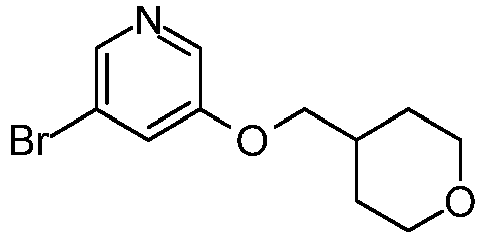
- Potassium carbonate (794 mg, 5.75 mmol) was added to a stirred solution of 5-bromopyridin-3-ol (500 mg, 2.87 mmol) in DMF (5 mL). The reaction mixture was stirred at 60 °C for 30 minutes, then 4-(bromomethyl)tetrahydro-2H-pyran (566 mg, 416 µL, 3.16 mmol) was added. The reaction mixture was stirred at 60 °C for 2 hours, then allowed to stand at room temperature overnight. A further portion of 4-(bromomethyl)tetrahydro-2H-pyran (566 mg, 416 µL, 3.16 mmol) was added. and the reaction mixture was stirred at 60 °C for 2 hours. The reaction mixture was cooled to room temperature then partitioned between ethyl acetate (50 mL) and water (25 mL). The organic phase was separated, washed with water and brine, dried and evaporated to give a colourless solid 3-bromo-5-((tetrahydro-2H-pyran-4-yl)methoxy)pyridine (326 mg, 1.198 mmol, 41.7% yield).
LCMS (2 min, Formic Acid): Rt = 0.93 min, MH+ = 272/274. -

- To a microwave reaction vial was added 3-bromo-5-((tetrahydro-2H-pyran-4-yl)methoxy)pyridine (for a preparation see Intermediate 12, 0.102 g, 0.375 mmol) followed by potassium acetate (0.147 g, 1.500 mmol), bis(pinacolato)diboron (0.476 g, 1.875 mmol) and [1,1'-bis(diphenylphosphino)ferrocene]dichloropalladium(II) (0.027 g, 0.038 mmol) in a solution of 1,4-dioxane (4 mL). The reaction vessel was sealed and heated to 110 °C for 30 minutes in a microwave. The reaction was diluted with ethyl acetate (30 mL), and dried over magnesium sulphate. The filtrate was collected and concentrated to give a dark brown residue, (5-((tetrahydro-2H-pyran-4-yl)methoxy)pyridin-3-yl)boronic acid (89 mg, 0.375 mmol, 100%). The crude material was used in subsequent steps without further purification. The yield was assumed to be 100%.
LCMS (2 min, Formic Acid): Rt = 0.41 min, MH+ = 238. -

- To a stirred solution of 4-bromopyridin-2-ol (326 mg, 1.873 mmol) in N,N-dimethylformamide (5 mL) was added potassium carbonate (777 mg, 5.62 mmol) followed by 2-(1-bromoethyl)pyridine hydrobromide (500 mg, 1.873 mmol). The reaction was stirred at room temperature under nitrogen for 6 hours. The reaction was quenched with water (30 mL) and transfered to a separating funnel.
- The aqueous phase was extracted with ethyl acetate (3 x 25 mL). The organic fractions were combined and washed with brine (30 mL). The organic phase was collected, dried over magnesium sulphate, and concentrated under reduced pressure to give a pale yellow oil. The crude material was purified by chromatography on silica gel eluting with 0-50% ethyl acetate in cyclohexane to give two products.
- Intermediate 14: 4-bromo-2-(1-(pyridin-2-yl)ethoxy)pyridine (352 mg, 1.261 mmol, 67.3% yield) a colourless oil.
LCMS (2 min, Formic Acid): Rt = 0.72 min, MH+ = 279/281. - Intermediate 15: 4-bromo-1-(1-(pyridin-2-yl)ethyl)pyridin-2(1H)-one (86 mg, 0.308 mmol, 16.45% yield) a colourless oil.
LCMS (2 min, Formic Acid): Rt = 0.90 min, MH+ = 279/281. -

- To a microwave reaction vial was added 4-bromo-2-(1-(pyridin-2-yl)ethoxy)pyridine (for a preparation see Intermediate 14, 105 mg, 0.376 mmol) followed by potassium acetate (148 mg, 1.505 mmol), bis(pinacolato)diboron (478 mg, 1.881 mmol), and [1,1'-bis(diphenylphosphino)ferrocene]dichloropalladium(II) (27.5 mg, 0.038 mmol) catalyst in a solution of 1,4-dioxane (4 mL). The reaction vessel was sealed and heated to 110 °C for 30 minutes in a microwave. The reaction mixture was filtered through a Celite frit. The filtrate was transferred to a large microwave reaction vial and treated with potassium acetate (148 mg, 1.505 mmol), bis(pinacolato)diboron (478 mg, 1.881 mmol), and [1,1'-bis(diphenylphosphino)ferrocene]dichloropalladium(II) (27.5 mg, 0.038 mmol). The reaction vessel was sealed and heated to 110 °C for 30 minutes in a microwave. The reaction mixture was diluted with ethyl acetate (20 mL) and dried over magnesium sulphate. The filtrate was concentrated in vacuo to give a brown residue, (2-(1-(pyridin-2-yl)ethoxy)pyridin-4-yl)boronic acid (92 mg, 0.376 mmol, 100%). The material was used in subsequent steps without further purification. 100% yield assumed.
LCMS (2 min, Formic Acid): Rt = 0.42 min, MH+ = 245. -
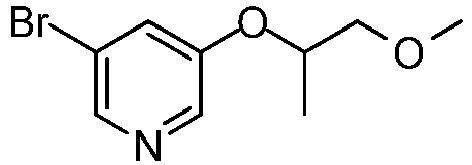
- Caesium carbonate (1873 mg, 5.75 mmol) was added to a stirred solution of 5-bromopyridin-3-ol (500 mg, 2.87 mmol) in N,N-dimethylformamide (25 mL). The reaction mixture was stirred at 60 °C for 30 minutes, then 2-bromo-1-methoxypropane (0.367 mL, 3.45 mmol) was added. The reaction mixture was stirred at 60 °C for a further 2 hours, was then cooled to room temperature and partitioned between diethyl ether and water. The organic phase was separated, dried over magnesium sulphate and concentrated in vacuo. Purification of the residue by chromatography on silica gel eluting with 0-5% methanol in dichloromethane gave 3-bromo-5-((1-methoxypropan-2-yl)oxy)pyridine (499 mg, 2.028 mmol, 71%) as a brown oil.
LCMS (2 min, Formic Acid): Rt = 0.87 min, MH+ = 246/248 (weak). -
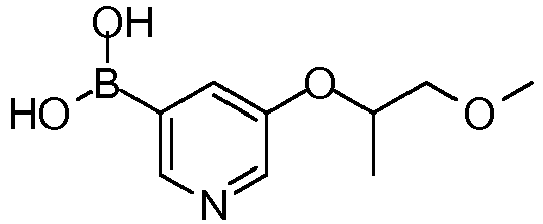
- A mixture of 3-bromo-5-((1-methoxypropan-2-yl)oxy)pyridine (for a preparation see Intermediate 17, 77 mg, 0.313 mmol), potassium acetate (123 mg, 1.252 mmol), bis(pinacolato)diboron (397 mg, 1.564 mmol) and [1,1'-bis(diphenylphosphino)ferrocene]dichloropalladium(II) (22.89 mg, 0.031 mmol) in 1,4-dioxane (3 mL) was heated in a microwave at 110 °C for 30 minutes. The cooled reaction mixture was diluted with ethyl acetate (20 mL) and the solution was filtered through Celite.
- The filtrate was then evaporated in vacuo to give a sticky black oil, (5-((1-methoxypropan-2-yl)oxy)pyridin-3-yl)boronic acid (66 mg, 0.313 mmol, 100%) a quantitative yield was assumed and the crude product was used in the next step without further purification.
LCMS (2 min, Formic Acid): Rt = 0.36 min, MH+ = 212 (weak). -

- (R)-Tert-butyl 3-methylpiperazine-1-carboxylate (1.77 g, 8.82 mmol) and glacial acetic acid (530 mg, 505 µL, 8.82 mmol) were added to a stirred solution of 7-bromo-5-methyl-4-oxo-4,5-dihydrothieno[3,2-c]pyridine-2-carbaldehyde (for a preparation see Intermediate 3, 2.0 g, 7.35 mmol) in dichloromethane (50 mL). The reaction mixture was stirred at room temperature for 30 minutes then treated with sodium triacetoxyborohydride (7.79 g, 36.7 mmol). The reaction mixture was stirred at room temperature for 8 hours then allowed to stand overnight. Saturated sodium bicarbonate solution (75 mL) was added and the mixture stirred for 10 minutes. The organic phase was separated and the aqueous phase extracted with dichloromethane (2 x 50 mL). The combined organics were dried and evaporated. The residue was purified by chromatography on silica gel eluting with 3% methanol in dichloromethane, followed by trituration with diethyl ether gave (R)-tert-butyl 4-((7-bromo-5-methyl-4-oxo-4,5-dihydrothieno[3,2-c]pyridin-2-yl)methyl)-3-methylpiperazine-1-carboxylate (3.1 g, 6.79 mmol, 92% yield) as a yellow solid.
LCMS (2 min, Formic Acid): Rt = 0.77 min, MH+ = 456/458. -

- 4M Hydrogen chloride in 1,4-dioxane (10 mL, 40 mmol) was added to a stirred solution of (R)-tert-butyl 4-((7-bromo-5-methyl-4-oxo-4,5-dihydrothieno[3,2-c]pyridin-2-yl)methyl)-3-methylpiperazine-1-carboxylate (for a preparation see Intermediate 19, 3.1 g, 6.79 mmol) in 1,4-dioxane (10 mL). The reaction mixture was stirred at room temperature for 24 hours. The solid was filtered off, washed with a small amount of dioxan, then diethyl ether and dried to give (R)-7-bromo-5-methyl-2-((2-methylpiperazin-1-yl)methyl)thieno[3,2-c]pyridin-4(5H)-one dihydrochloride (2.5 g, 5.82 mmol, 86% yield) as a pale yellow solid.
LCMS (2 min, Formic Acid): Rt = 0.57 min, MH+ = 356/358. -

- Methanesulphonyl chloride (834 mg, 567µL, 7.28 mmol) was added to a stirred solution of (R)-7-bromo-5-methyl-2-((2-methylpiperazin-1-yl)methyl)thieno[3,2-c]pyridin-4(5H)-one dihydrochloride (for a preparation see Intermediate 20, 2.5 g, 5.82 mmol) in dichloromethane (20 mL) and pyridine (10 mL). The reaction mixture was stirred at room temperature for 2 hours. A further portion of methanesulphonyl chloride (834 mg, 567µL, 7.28 mmol) was added and the reaction mixture stirred at room temperature for 2 hours. The solvent was evaporated. The residue was dissolved in ethyl acetate (50 mL) and washed with saturated sodium bicarbonate solution, water (x2) and brine. The organic phase was dried and evaporated. The residue was purified by chromatography on silica gel eluting with 3% methanol in dichloromethane to give the product (R)-7-bromo-5-methyl-2-((2-methyl-4-(methylsulphonyl)piperazin-1-yl)methyl)thieno[3,2-c]pyridin-4(5H)-one (1.9 g, 4.37 mmol, 75% yield) as a light brown solid.
LCMS (2 min, Formic Acid): Rt = 0.62 min, MH+ = 434/436. -

- To a solution of 7-bromo-5-methyl-2-((4-(methylsulphonyl)piperazin-1-yl)methyl)thieno[3,2-c]pyridin-4(5H)-one (for a preparation see Intermediate 69, 371 mg, 0.883 mmol) and (2-chloropyridin-4-yl)boronic acid (208 mg, 1.324 mmol) in tetrahydrofuran (30 mL) were successively added sodium carbonate (2M in water) (1.545 mL, 3.09 mmol) and 1,1'-bis(diphenylphosphino)ferrocene-palladium(II) dichloride-dichloromethane complex (72.1 mg, 0.088 mmol). The reaction mixture was refluxed for 2 hours, whereupon it was allowed to cool to room temperature. The reaction mixture was concentrated in vacuo, and the residue was partitioned between ethyl acetate and water. The aqueous phase was extracted three times with ethyl acetate and the combined organic layers were washed with brine, dried over magnesium sulphate, filtered and concentrated in vacuo. The crude residue was purified by chromatography on silica gel eluting with 2 - 10% methanol in dichloromethane. The appropriate fractions were combined and concentrated in vacuo to give 7-(2-chloropyridin-4-yl)-5-methyl-2-((4-(methylsulphonyl)piperazin-1-yl)methyl)thieno[3,2-c]pyridin-4(5H)-one (265 mg, 0.585 mmol, 66%) as a dark brown solid.
LCMS (2 min, Formic Acid): Rt = 0.77 min, MH+ = 453/455 -

- To a stirred solution of 7-bromo-5-methyl-4-oxo-4,5-dihydrothieno[3,2-c]pyridine-2-carbaldehyde (for a preparation see Intermediate 3, 200 mg, 0.735 mmol) in DCM (10 mL) was added 1-ethylpiperazine (0.112 mL, 0.882 mmol) followed by acetic acid (0.042 mL, 0.735 mmol). The reaction was heated to 40 °C and stirred under nitrogen for 15 minutes and was then treated with sodium triacetoxyborohydride (467 mg, 2.205 mmol). The reaction was stirred for 90 minutes and then cooled to room temperature, quenched with saturated sodium bicarbonate solution (25 mL) and stirred under nitrogen for 30 minutes.
- The reaction was transferred to a separating funnel and the organic layer was collected. The aqueous phase was extracted with DCM (3 x 20 mL). The organic fractions were combined and washed with brine (approx. 25 mL). The organic layer was collected, dried over magnesium sulphate, and concentrated under reduced pressure to give a yellow oil.
- The crude material was loaded on to a 12 g silica gel column and was eluted in 0-10% MeOH in DCM over 25 column volumes to give 7-bromo-2-((4-ethylpiperazin-1-yl)methyl)-5-methylthieno[3,2-c]pyridin-4(5H)-one as a yellow oil (180 mg, 0.486 mmol, 66.1% yield).
LCMS (2 min, Formic Acid): Rt = 0.53 min, MH+ = 370/372. -

- To a stirred solution of 7-bromo-5-methyl-4-oxo-4,5-dihydrothieno[3,2-c]pyridine-2-carbaldehyde (for a preparation see Intermediate 3, 200 mg, 0.735 mmol) in DCM (10 mL) was added 1-isopropylpiperazine (0.126 mL, 0.882 mmol) followed by acetic acid (0.042 mL, 0.735 mmol). The reaction was heated to 40 °C and stirred under nitrogen for 15 minutes and then treated with sodium triacetoxyborohydride (467 mg, 2.205 mmol). The reaction was stirred for 90 minutes at which point the reaction was cooled to room temperature, quenched with saturated sodium bicarbonate solution (25 mL) and stirred under nitrogen for 15 minutes.
- The reaction was transferred to a separating funnel and the organic layer was collected. The aqueous phase was extracted with DCM (3 x 20 mL). The organic fractions were combined and washed with brine (approx. 25 mL). The organic layer was collected, dried over magnesium sulphate, and concentrated under reduced pressure to give a yellow oil.
- The crude material was loaded on to a 12 g silica gel column and was eluted in 0-10% MeOH in DCM over 25 column volumes to give a yellow oil which was the desired product 7-bromo-2-((4-isopropylpiperazin-1-yl)methyl)-5-methylthieno[3,2-c]pyridin-4(5H)-one (152 mg, 0.395 mmol, 53.8% yield).
LCMS (2 min, Formic Acid): Rt = 0.59 min, MH+ = 384/386. -

- A mixture of 7-bromo-5-methyl-4-oxo-4,5-dihydrothieno[3,2-c]pyridine-2-carbaldehyde (for a preparation see Intermediate 3, 800 mg, 2.94 mmol), (3,4-dimethoxyphenyl)boronic acid (428 mg, 2.35 mmol), potassium carbonate (1.22 g, 8.82 mmol) and bis(triphenylphosphine)palladium(II) chloride (103 mg, 5 mol%) in 1,2-dimethoxyethane (9 mL) and water (3 mL) was heated in a microwave at 120 °C for 30 minutes. The reaction mixture was cooled and diluted with ethyl acetate (50 mL). The mixture was washed with water (2 x 15 mL) and the organic phase was dried and evaporated. The residue was purified by chromatography on silica gel eluting with 0-2% methanol in DCM to give 7-(3,4-dimethoxyphenyl)-5-methyl-4-oxo-4,5-dihydrothieno[3,2-c]pyridine-2-carbaldehyde (240 mg, 25% yield) as a yellow solid.
LCMS (2 min, Formic Acid): Rt = 0.85 min, MH+ = 330 -

- To 7-(3,4-dimethoxyphenyl)-5-methyl-4-oxo-4,5-dihydrothieno[3,2-c]pyridine-2-carbaldehyde (for a preparation see Intermediate 25, 180 mg, 0.546 mmol) in DCM (7 mL) was added tert-butyl piperazine-1-carboxylate (153 mg, 0.820 mmol) and acetic acid (0.047 mL, 0.820 mmol). The reaction mixture was stirred at room temperature for approximately 30 minutes, whereupon sodium triacetoxyborohydride (579 mg, 2.73 mmol) was added and the reaction was refluxed under nitrogen overnight.
- The reaction mixture was hydrolyzed by using a saturated aqueous solution of sodium bicarbonate (approx. 20 mL) and the layers were separated. The aqueous phase was extracted with DCM (3 x 10 mL) and the combined organic layers were washed with brine (approx. 20 mL), dried over magnesium sulphate, filtered and concentrated in vacuo to give a light brown oil.
- The residue was dissolved in a small volume of MeOH with a drop of DCM and transferred to a 1g SCX column. The product was allowed to elute with gravity. The column was then flushed with MeOH (3 column volumes) to remove impurities. The product was collected by flushing the column with 2.0M ammonia in MeOH (3 column volumes). The material was then purified by chromatography on silica gel eluting with 0 to 10% MeOH in DCM. The appropriate fractions were collected and concentrated in vacuo to give tert-butyl 4-((7-(3,4-dimethoxyphenyl)-5-methyl-4-oxo-4,5-dihydrothieno[3,2-c]pyridin-2-yl)methyl)piperazine-1-carboxylate (88.9 mg, 33% yield) as a yellow oil.
LCMS (2 min, Formic Acid): Rt = 0.81 min, MH+ = 500 - To a stirred solution of 7-(3,4-dimethoxyphenyl)-5-methyl-4-oxo-4,5-dihydrothieno[3,2-c]pyridine-2-carbaldehyde (for a preparation see Intermediate 25, 400 mg, 1.214 mmol) in DCM (15 mL) was added tert-butyl piperazine-1-carboxylate (339 mg, 1.822 mmol) and acetic acid (0.104 mL, 1.822 mmol). The reaction was stirred for 10 minutes and then to the reaction was added sodium triacetoxyborohydride (1030 mg, 4.86 mmol). The reaction was heated at 40 °C for one hour.
- The reaction was cooled to room temperature and was diluted with saturated sodium bicarbonate solution (20 mL) and stirred for 10 minutes. The reaction mixture was transferred to a 100 mL separating funnel and the organic layer was collected. The aqueous layer was extracted with DCM (3 x 15 mL). The organic layers were combined and washed with brine (approx. 30 mL). The organic layer was collected and dried over magnesium sulphate and concentrated under reduced pressure to give a brown oil.
- The crude material was loaded onto a 40 g silica gel column and eluted in 0-5% MeOH in DCM to give the desired product, a yellow crystalline solid, tert-butyl 4-((7-(3,4-dimethoxyphenyl)-5-methyl-4-oxo-4,5-dihydrothieno[3,2-c]pyridin-2-yl)methyl)piperazine-1-carboxylate (375 mg, 0.751 mmol, 61.8% yield).
LCMS (2 min, Formic Acid): Rt = 0.80 min, MH+ = 500. -

- A mixture of 7-bromo-5-methyl-4-oxo-4,5-dihydrothieno[3,2-c]pyridine-2-carbaldehyde (for a preparation see Intermediate 3, 272 mg, 1.0 mmol), (3-acetamidophenyl)boronic acid (215 mg, 1.2 mmol), potassium carbonate (414 mg, 3.0 mmol) and bis(triphenylphosphine)palladium(II) chloride (35 mg, 5 mol%) in 1,2-dimethoxyethane (3 mL) and water (0.5 mL) was heated at 120 °C in a microwave for 20 minutes.
- The cooled reaction mixture was diluted with ethyl acetate (25 mL). The mixture was filtered through Celite and the filtrate was dried and evaporated to give a green solid N-(3-(2-formyl-5-methyl-4-oxo-4,5-dihydrothieno[3,2-c]pyridin-7-yl)phenyl)acetamide (320 mg, 0.980 mmol, 98% yield).
- A 120 mg portion of the material was purified by column chromatography [5-10% methanol/dichloromethane] to give the title compound (100 mg).
LCMS (2 min, Formic Acid): Rt = 0.54 min, MH+ = 411. -

- To a 5 mL microwave vessel was added 7-bromo-5-methyl-4-oxo-4,5-dihydrothieno[3,2-c]pyridine-2-carbaldehyde (for a preparation see Intermediate 3, 272 mg, 1 mmol), phenylboronic acid (146 mg, 1.20 mmol), potassium carbonate (332 mg, 2.40 mmol), and PEPPSI (34.0 mg, 0.050 mmol) in a solution of isopropanol (3 mL) and water (1.00 mL). The reaction mixture was heated at 130 °C for 30 minutes.
- The reaction was quenched with 20 mL ammonium chloride solution and transferred to a 100 mL separating funnel and the aqueous layer was extracted with DCM (3 x 10 mL). The organic layers were combined and dried over magnesium sulphate, filtered, and evaporated to give an orange solid. The residue was washed with MeOH (3 x 5 mL) and dried to give a red solid. The filtrate appeared to contain more product so was combined again with the solid and concentrated.
- The residue was purified by column chromatography (40-80% ethyl acetate in cyclohexane) to give a bright yellow solid, 5-methyl-4-oxo-7-phenyl-4,5-dihydrothieno[3,2-c]pyridine-2-carbaldehyde (50.3 mg, 0.187 mmol, 18.68% yield). The column was flushed with 0-10% MeOH in DCM to give further title compound as an orange solid (134.2 mg) which was slightly less pure.
LCMS (2 min, Formic Acid): Rt = 0.94 min, MH+ = 270. -

- In a 100 mL round bottom flask under nitrogen 7-bromo-4-oxo-4,5-dihydrothieno[3,2-c]pyridine-2-carbaldehyde (for a preparation see Intermediate 2, 1g, 3.87 mmol) was dissolved in THF (30 mL) to produce a light brown suspension. To the reaction mixture was added caesium carbonate (3.79 g, 11.62 mmol) and the reaction was stirred for approx. 30 minutes, becoming a mustard yellow suspension. The reaction was left stirring under nitrogen at room temperature over the weekend.
- Another portion of iodoethane (0.626 mL, 7.75 mmol) was added to the reaction and it was heated at 60 °C overnight.
- The reaction was quenched with ethyl acetate (approx. 40 mL) and transferred to a separating funnel and washed with water. The aqueous layer was extracted with ethyl acetate (2 x 10 mL). The organic layers were combined and concentrated under reduced pressure to give a brown solid. The residue was purified by column chromatography (20-60% ethyl acetate in cyclohexane) to give a yellow solid 7-bromo-5-ethyl-4-oxo-4,5-dihydrothieno[3,2-c]pyridine-2-carbaldehyde (556.7 mg, 1.946 mmol, 50.2% yield).
LCMS (2 min, Formic Acid): Rt = 0.87 min, MH+ = 286/288. -

- To a microwave vessel was added 7-bromo-5-ethyl-4-oxo-4,5-dihydrothieno[3,2-c]pyridine-2-carbaldehyde (for a preparation see Intermediate 30, 278 mg, 0.972 mmol), phenylboronic acid (142 mg, 1.166 mmol), potassium carbonate (322 mg, 2.332 mmol), and PEPPSI (34.0 mg, 0.05 mmol) in a solution of isopropanol (3 mL) and water (1 mL). The reaction vessel was sealed and heated in Biotage Initiator microwave reactor to 130 °C for 30 minutes.
- The reaction was quenched with ammonium chloride solution (25 mL) and transferred to a separating funnel. The product was extracted with DCM (3 x 15 mL). The organic layers were combined, dried over magnesium sulphate, filtered, and the solvent was evaporated under reduced pressure to yield an orange solid.
- The crude product was added to a 12 g silica gel column and was eluted with 20-50% ethyl acetate in cyclohexane to give a yellow solid, 5-ethyl-4-oxo-7-phenyl-4,5-dihydrothieno[3,2-c]pyridine-2-carbaldehyde (190 mg, 0.671 mmol, 69.0% yield).
LCMS (2 min, Formic Acid): Rt = 1.02 min, MH+ = 284. -

- To a microwave reaction vessel was added 7-bromo-5-ethyl-4-oxo-4,5-dihydrothieno[3,2-c]pyridine-2-carbaldehyde (for a preparation see Intermediate 30, 260 mg, 0.909 mmol), (3,4-dimethoxyphenyl)boronic acid (198 mg, 1.09 mmol), potassium carbonate (301 mg, 2.181 mmol), and PEPPSI (34.0 mg, 0.05 mmol) (last) in a solution of isopropanol (3 mL) and water (1 mL). The reaction vessel was sealed and heated in Biotage Initiator microwave reactor to 130 °C for 30 minutes.
- The reaction was diluted with ammonium chloride solution (25 mL) and transferred to a separating funnel. The product was extracted with DCM (3 x 15 mL). The organic layers were combined and dried over magnesium sulphate. The magnesium sulphate was filtered off and the filtrate was collected and the solvent was removed under reduced pressure to yield an orange solid.
- The crude material was purified by column chromatography using a 25 g silica gel column and was eluted with 20-100% ethyl acetate in cyclohexane to yield a yellow solid 7-(3,4-dimethoxyphenyl)-5-ethyl-4-oxo-4,5-dihydrothieno[3,2-c]pyridine-2-carbaldehyde (172.4 mg, 0.502 mmol, 55.3% yield).
LCMS (2 min, Formic Acid): Rt = 0.93 min, MH+ = 344. -

- To a solution of 7-(3,4-dimethoxyphenyl)-5-methyl-4-oxo-4,5-dihydrothieno[3,2-c]pyridine-2-carbaldehyde (for a preparation see Intermediate 25, 50 mg, 0.152 mmol) and tert-butyl 2,6-dimethylpiperazine (65.1 mg, 0.304 mmol) in dichloromethane (5 mL) were successively added sodium triacetoxyborohydride (129 mg, 0.607 mmol) and acetic acid (0.013 mL, 0.228 mmol). The reaction mixture was stirred at 40 °C for 3 hours, whereupon a saturated aqueous solution of NaHCO3 was added. The layers were separated and the aqueous layer was extracted three times with DCM. The combined organic layers were washed with brine, dried over MgSO4, filtered and concentrated in vacuo. The crude residue was purified via flash chromatography on silica gel, eluting with 2-10% MeOH in DCM to give tert-butyl 4-((7-(3,4-dimethoxyphenyl)-5-methyl-4-oxo-4,5-dihydrothieno[3,2-c]pyridin-2-yl)methyl)-2,6-dimethylpiperazine-1-carboxylate (35 mg, 44% yield) as viscous yellow oil
LCMS (2 min, Formic Acid): Rt = 1.10 min, MH+ = 528 -

- A mixture of 7-bromo-5-methyl-4-oxo-4,5-dihydrothieno[3,2-c]pyridine-2-carbaldehyde (for a preparation see Intermediate 3, 300 mg, 1.10 mmol), and methylamine hydrochloride (744 mg, 11.02 mmol) in dichloromethane (10 mL) was stirred at room temperature for 30 minutes. Sodium triacetoxyborohydride (701 mg, 3.31 mmol) was added and stirring at room temperature continued for 2 hours. A saturated aqueous solution of NaHCO3 (20 mL) was added and the mixture was stirred for 20 minutes. The layers were separated and the aqueous phase was extracted with dichloromethane (2 x 10 mL). The combined organic layers were dried and evaporated in vacuo.
- The residue was purified by chromatography on silica gel eluting with 0-10% methanol in dichloromethane to give 7-bromo-5-methyl-2-((methylamino)methyl)thieno[3,2-c]pyridin-4(5H)-one (116 mg, 37% yield) as a white solid.
LCMS (2 min, Formic Acid): Rt = 0.45 min, MH+ = 287/289 -

- Methanesulphonyl chloride (132mg, 90 µL, 1.15 mmol) was added to a stirred solution of 7-bromo-5-methyl-2-((methylamino)methyl)thieno[3,2-c]pyridin-4(5H)-one (for a preparation see Intermediate 34, 110 mg, 0.38 mmol) in dichloromethane (3 mL) and pyridine (1 mL). The reaction mixture was stirred at room temperature for 2 hours. The solvent was evaporated and the residue purified by chromatography on silica gel eluting with 0-5% methanol in dichloromethane to give N-((7-bromo-5-methyl-4-oxo-4,5-dihydrothieno[3,2-c]pyridin-2-yl)methyl)-N-methylmethanesulphonamide (130 mg, 93% yield) as a colourless solid.
LCMS (2 min, Formic Acid): Rt = 0.77 min, MH+ = 365/367 -

- A mixture of 7-bromo-5-methyl-4-oxo-4,5-dihydrothieno[3,2-c]pyridine-2-carbaldehyde (400 mg, 1.47 mmol), pyrrolidine (for a preparation see Intermediate 3, 209 mg, 245 µL, 2.94 mmol) and acetic acid (177 mg, 168 µL, 2.94 mmol) in dichloromethane (10 mL) was stirred at room temperature for 1 hour. Sodium triacetoxyborohydride (1.56 g, 7.36 mmol) was added portionwise and the reaction mixture stirred at room temperature overnight. A saturated aqueous solution of NaHCO3 (15 mL) was added and the reaction mixture was stirred for 20 minutes. The organic phase was separated and the aqueous phase extracted with dichloromethane (2x10 mL). The combined organic layers were dried and evaporated in vacuo. The residue was purified by chromatography on silica gel eluting with 0-5% methanol in dichloromethane to give 7-bromo-5-methyl-2-(pyrrolidin-1-ylmethyl)thieno[3,2-c]pyridin-4(5H)-one (320 mg, 67% yield) as a pink solid.
LCMS (2 min, Formic Acid): Rt = 0.48 min, MH+ = 327/329 -

- A mixture of 7-bromo-5-methyl-4-oxo-4,5-dihydrothieno[3,2-c]pyridine-2-carbaldehyde (for a preparation see Intermediate 3, 400 mg, 1.47 mmol), piperidine (250 mg, 290 µL, 2.94 mmol) and acetic acid (177 mg, 168 µL, 2.94 mmol) in dichloromethane (10 mL) was stirred at room temperature for 1 hour. Sodium triacetoxyborohydride (1.56 g, 7.36 mmol) was added portionwise and the reaction mixture stirred at room temperature overnight. A saturated aqueous solution of NaHCO3 (15 mL) was added and the reaction mixture stirred for 20 minutes. The organic phase was separated and the aqueous phase extracted with dichloromethane (2 x 10 mL). The combined organic layers were dried and evaporated in vacuo. The residue was purified via chromatography on silica gel 0-5% methanol in dichloromethane to give 7-bromo-5-methyl-2-(piperidin-1-ylmethyl)thieno[3,2-c]pyridin-4(5H)-one (340 mg, 68% yield) as an off-white solid.
LCMS (2 min, Formic Acid): Rt = 0.51 min, MH+ = 341/343 -

- A stirred suspension of 7-bromo-5-methyl-4-oxo-4,5-dihydrothieno[3,2-c]pyridine-2-carbaldehyde (for a preparation see Intermediate 3, 500 mg, 1.837 mmol) in dichloromethane (20 mL) was treated with acetic acid (0.126 mL, 2.205 mmol) followed by 3-methylmorpholine (0.313 mL, 2.76 mmol).
- The reaction mixture was stirred at room temperature under nitrogen for 15 minutes and was then treated with sodium triacetoxyborohydride (1.56 g, 7.35 mmol). The reaction mixture was stirred for 72 hours, whereupon it was hydrolyzed by adding a saturated aqueous solution of sodium bicarbonate (30 mL). The resulting mixture was stirred for 20 minutes and the layers were separated. The aqueous layer was extracted with DCM (3 x 30 mL) and the combined organic layers were dried over magnesium sulphate, filtered and concentrated under reduced pressure to give the crude residue. The latter was purified by chromatography on silica gel eluting with 0-5% MeOH in DCM to give 7-bromo-5-methyl-2-((3-methylmorpholino)methyl)thieno[3,2-c]pyridin-4(5H)-one (411 mg, 63% yield) as a thick yellow oil.
LCMS (2 min, Formic Acid): Rt = 0.49 min, MH+ = 357/359 -

- To a stirred solution of 7-bromo-5-methyl-4-oxo-4,5-dihydrothieno[3,2-c]pyridine-2-carbaldehyde (for a preparation see Intermediate 3, 500 mg, 1.837 mmol) in dichloromethane (20 mL) was added (S)-3-methylmorpholine (0.313 mL, 2.76 mmol) followed by acetic acid (0.158 mL, 2.76 mmol). The reaction mixture was heated to 40 °C and stirred for 30 minutes. The reaction mixture was then treated with sodium triacetoxyborohydride (1.56 g, 7.35 mmol) and stirred at 40 °C for two hours.
- The reaction mixture was hydrolyzed by adding a saturated aqueous solution of sodium bicarbonate (50 mL) and stirred under nitrogen for 10 minutes. The layers were separated and the aqueous phase was extracted with DCM (3 x 25 mL). The organic layers were combined, dried over magnesium sulphate, filtered and concentrated under reduced pressure to give the crude product as a light orange solid. The latter was purified by chromatography on silica gel eluting with 0-5% MeOH in DCM. The appropriate fractions were combined and concentrated in vacuo to give (S)-7-bromo-5-methyl-2-((3-methylmorpholino)methyl)thieno[3,2-c]pyridin-4(5H)-one (511 mg, 78% yield) as a yellow oil.
LCMS (2 min, Formic Acid): Rt = 0.51 min, MH+ = 357/359 -

- A mixture of 7-bromo-5-methyl-4-oxo-4,5-dihydrothieno[3,2-c]pyridine-2-carbaldehyde (for a preparation see Intermediate 3, 400 mg, 1.47 mmol), 4-hydroxypiperidine (297 mg, 2.94 mmol) and acetic acid (177 mg, 168 µL, 2.94 mmol) in dichloromethane (10 mL) was stirred at room temperature for 1 hour. Sodium triacetoxyborohydride (1.56 g, 7.36 mmol) was added portionwise and the reaction mixture was stirred at room temperature overnight. A saturated aqueous solution of NaHCO3 (15 mL) was added and the reaction mixture stirred for 20 minutes. The layers were separated and the aqueous phase extracted with dichloromethane (2 x 10 mL). The combined organic layers were dried and evaporated in vacuo. The residue was purified by chromatography on silica gel eluting with 0-10% methanol in dichloromethane. The appropriate fractions were concentrated and combined to give 7-bromo-2-((4-hydroxypiperidin-1-yl)methyl)-5-methylthieno[3,2-c]pyridin-4(5H)-one (363 mg, 69% yield) as an off-white solid.
LCMS (2 min, Formic Acid): Rt = 0.46 min, MH+ = 357/359 -

- To a stirred suspension of 7-bromo-5-methyl-4-oxo-4,5-dihydrothieno[3,2-c]pyridine-2-carbaldehyde (for a preparation see Intermediate 3, 300 mg, 1.102 mmol) in dichloromethane (15 mL) was added acetic acid (0.095 mL, 1.654 mmol) followed by (R)-3-methylmorpholine (0.188 mL, 1.654 mmol).
- The reaction mixture was stirred at room temperature under nitrogen for 30 minutes and was then treated with sodium triacetoxyborohydride (935 mg, 4.41 mmol). The reaction mixture was stirred for 5 hours, whereupon it was hydrolyzed by adding a saturated aqueous solution of sodium bicarbonate. The mixture was stirred for 20 minutes and the layers were separated. The aqueous phase was extracted with DCM (3 x 30 mL) and the combined organic layers were dried over magnesium sulphate, filtered and concentrated under reduced pressure to give a yellow oil. The crude material was purified via chromatography on silica gel eluting with 0-5% MeOH in DCM to give (R)-7-bromo-5-methyl-2-((3-methylmorpholino)methyl)thieno[3,2-c]pyridin-4(5H)-one (256 mg, 65% yield) as a thick yellow oil.
LCMS (2 min, Formic Acid): Rt = 0.51 min, MH+ = 357/359 -

- To a solution of 7-bromo-5-methyl-4-oxo-4,5-dihydrothieno[3,2-c]pyridine-2-carbaldehyde (for a preparation see Intermediate 3, 200 mg, 0.735 mmol) and 1,4-oxazepane (149 mg, 1.470 mmol) in DCM (10 mL) were successively added sodium triacetoxyborohydride (623 mg, 2.94 mmol) and acetic acid (8.41 µL, 0.147 mmol). The reaction mixture was stirred at 40 °C for 1 hour, whereupon the reaction mixture was hydrolyzed by adding a saturated aqueous solution of sodium carbonate.
- The aqueous phase was extracted 3 times with DCM and the combined organic layers were washed with brine, dried over MgSO4, filtered and concentrated in vacuo. The residue was purified by flash chromatography on silica gel eluting with 5 to 60% EtOAc in cyclohexane. The appropriate fractions were combined and concentrated in vacuo to give 2-((1,4-oxazepan-4-yl)methyl)-7-bromo-5-methylthieno[3,2-c]pyridin-4(5H)-one (22 mg, 85%) as a viscous yellow oil.
LCMS (2 min, Formic Acid): Rt = 0.46 min, MH+ = 357/359 -

- A stirred solution of 7-bromo-5-methyl-4-oxo-4,5-dihydrothieno[3,2-c]pyridine-2-carbaldehyde (for a preparation see Intermediate 3, 1 g, 3.67 mmol) in EtOH (25 mL) was treated with sodium borohydride (0.556 g, 14.70 mmol). The resulting mixture was stirred under nitrogen at room temperature for one hour, whereupon the reaction mixture was treated with acetic acid (5 mL) and stirred for 20 minutes under nitrogen. The mixture was filtered to give a cream coloured solid. The isolated material was suspected to contain sodium acetate due to an initial yield of 128%. The product was stirred in water for 30 minutes and filtered through a glass filter funnel then washed with copious amounts of water. The product was oven dried overnight to give 7-bromo-2-(hydroxymethyl)-5-methylthieno[3,2-c]pyridin-4(5H)-one (724 mg, 2.64 mmol, 71.9% yield).
LCMS (2 min, Formic Acid): Rt = 0.65 min, MH+ = 274/276 -

- Tert-butyl (2-aminoethyl)carbamate (265 mg, 262 µL, 1.65 mmol) and glacial acetic acid (99 mg, 95 µL, 1.65 mmol) were added to a stirred solution of 7-bromo-5-methyl-4-oxo-4,5-dihydrothieno[3,2-c]pyridine-2-carbaldehyde (for a preparation see Intermediate 3, 300 mg, 1.1 mmol) in dichloromethane (5 mL). The reaction mixture was stirred at room temperature for 30 minutes then treated with sodium triacetoxyborohydride (701 mg, 3.31 mmol). The reaction mixture was stirred at room temperature for 24 hours. A saturated aqueous solution of sodium bicarbonate (10 mL) was added and the mixture stirred for 10 minutes. The organic phase was separated and the aqueous phase extracted with dichloromethane (2 x 50 mL). The combined organics were dried and evaporated. The residue was purified by chromatography on silica gel eluting with 0 to 4% methanol in dichloromethane to give tert-butyl (2-(((7-bromo-5-methyl-4-oxo-4,5-dihydrothieno[3,2-c]pyridin-2-yl)methyl)amino)ethyl)carbamate (360 mg, 78% yield) as a colourless oil.
LCMS (2 min, Formic Acid): Rt = 0.65 min, MH+ = 416/418 -

- A mixture of tert-butyl (2-(((7-bromo-5-methyl-4-oxo-4,5-dihydrothieno[3,2-c]pyridin-2-yl)methyl)amino)ethyl)carbamate (for a preparation see Intermediate 44, 180 mg, 0.43 mmol), 3,4-dimethoxyphenylboronic acid (118 mg, 0.65 mmol), potassium carbonate (179 mg, 1.29 mmol) and bis(triphenylphosphine)palladium(II) chloride (30 mg, 10 mol%) in 1,2-dimethoxyethane (3 mL) and water (0.5 mL) was heated in a microwave at 120 °C for 20 minutes. The cooled reaction mixture was diluted with ethyl acetate (50 mL). The solution was dried over sodium sulphate and evaporated. The residue was purified by chromatography on silica gel eluting with 0 to 5% methanol in dichloromethane to give tert-butyl (2-(((7-(3,4-dimethoxyphenyl)-5-methyl-4-oxo-4,5-dihydrothieno[3,2-c]pyridin-2-yl)methyl)amino)ethyl)carbamate (155 mg, 76% yield) as a brown gum.
LCMS (2 min, Formic Acid): Rt = 0.70 min, MH+ = 474 -

- Tert-butyl (3-aminopropyl)carbamate (288 mg, 289 µL, 1.65 mmol) and glacial acetic acid (99 mg, 95 µL, 1.65 mmol) were added to a stirred solution of 7-bromo-5-methyl-4-oxo-4,5-dihydrothieno[3,2-c]pyridine-2-carbaldehyde (for a preparation see Intermediate 3, 300 mg, 1.1 mmol) in dichloromethane (10 mL). The reaction mixture was stirred at room temperature for 30 minutes then treated with sodium triacetoxyborohydride (701 mg, 3.31 mmol). The reaction mixture was stirred at room temperature for 24 hours. A saturated aqueous solution of sodium bicarbonate (10 mL) was added and the mixture stirred for 10 minutes. The organic phase was separated and the aqueous phase extracted with dichloromethane (2 x 50 mL). The combined organics were dried and evaporated and the residue was purified via chromatography on silica gel eluting with 0 to 4% methanol in dichloromethane to give tert-butyl (3-(((7-bromo-5-methyl-4-oxo-4,5-dihydrothieno[3,2-c]pyridin-2-yl)methyl)amino)propyl)carbamate (303 mg, 64% yield) as a colourless oil.
LCMS (2 min, Formic Acid): Rt = 0.67min, MH+ = 430/432 -

- A mixture of tert-butyl (3-(((7-bromo-5-methyl-4-oxo-4,5-dihydrothieno[3,2-c]pyridin-2-yl)methyl)amino)propyl)carbamate (for a preparation see Intermediate 46, 150 mg, 0.35 mmol), 3-benzyloxyphenylboronic acid (119 mg, 0.52 mmol), potassium carbonate (145 mg, 1.05 mmol) and bis(triphenylphosphine)palladium(II) chloride (25 mg, 10 mol%) in 1,2-dimethoxyethane (3 mL) and water (0.5 mL) was heated in a microwave at 120 °C for 20 minutes. The cooled reaction mixture was diluted with ethyl acetate (50 mL). The solution was dried over sodium sulphate and evaporated. The residue was purified via flash chromatography on silica gel eluting with 0 to 5% methanol in dichloromethane to give tert-butyl (3-(((7-(3-(benzyloxy)phenyl)-5-methyl-4-oxo-4,5-dihydrothieno[3,2-c]pyridin-2-yl)methyl)amino)propyl)carbamate (100 mg, 54% yield) as a brown gum.
LCMS (2 min, Formic Acid): Rt = 0.92 min, MH+ = 534 -

- To a solution of 7-bromo-5-methyl-4-oxo-4,5-dihydrothieno[3,2-c]pyridine-2-carbaldehyde (for a preparation see Intermediate 3, 25 mg, 0.092 mmol) and 4-(methylsulphonyl)piperidine, trifluoroacetic acid salt (50 mg, 0.180 mmol) in DCM (10 mL) were successively added sodium triacetoxyborohydride (78 mg, 0.367 mmol) and acetic acid (7.89 µL, 0.138 mmol). The reaction mixture was stirred at 40 °C for 1 hour, whereupon the reaction mixture was hydrolyzed by adding a saturated aqueous solution of sodium carbonate. The aqueous phase was extracted 3 times with DCM and the combined organic layers were washed with brine, dried over MgSO4, filtered and concentrated in vacuo. The residue was purified by chromatography on silica gel eluting with 0 to 60% EtOAc in cyclohexane to give 7-bromo-5-methyl-2-((4-(methylsulphonyl)piperidin-1-yl)methyl)thieno[3,2-c]pyridin-4(5H)-one (16 mg, 42%) as a viscous yellow oil.
LCMS (2 min, Formic Acid): Rt = 0.48 min, MH+ = 419/421 -
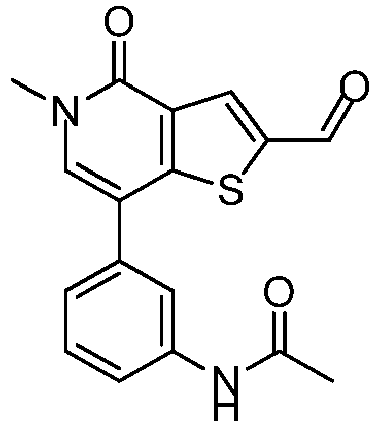
- A mixture of 7-bromo-5-methyl-4-oxo-4,5-dihydrothieno[3,2-c]pyridine-2-carbaldehyde (for a preparation see Intermediate 3, 272 mg, 1.0 mmol), (3-acetamidophenyl)boronic acid (215 mg, 1.2 mmol), potassium carbonate (414 mg, 3.0 mmol) and bis(triphenylphosphine)palladium(II) chloride (35 mg, 5 mol%) in 1,2-dimethoxyethane (3 mL) and water (0.5 mL) was heated at 120 °C in a microwave for 20 minutes. The cooled reaction mixture was diluted with ethyl acetate (25 mL). The mixture was filtered through Celite and the filtrate was dried and evaporated to give a green solid N-(3-(2-formyl-5-methyl-4-oxo-4,5-dihydrothieno[3,2-c]pyridin-7-yl)phenyl)acetamide (320 mg, 98% yield). A 120 mg portion of the latter was purified by chromatpgraphy on silica gel eluting with 5 to 10% methanol in dichloromethane to give N-(3-(2-formyl-5-methyl-4-oxo-4,5-dihydrothieno[3,2-c]pyridin-7-yl)phenyl)acetamide (100 mg, 31%) as a green solid.
LCMS (2 min, Formic Acid): Rt = 0.72 min, MH+ = 327 -

- A mixture of tert-butyl (2-(((7-bromo-5-methyl-4-oxo-4,5-dihydrothieno[3,2-c]pyridin-2-yl)methyl)amino)ethyl)carbamate (for a preparation see Intermediate 44, 180 mg, 0.43 mmol),3-benzyloxyphenylboronic acid (148 mg, 0.65 mmol), potassium carbonate (179 mg, 1.29 mmol) and bis(triphenylphosphine)palladium(II) chloride (30 mg, 10 mol%) in 1,2-dimethoxyethane (3 mL) and water (0.5 mL) was heated in a microwave at 120 °C for 20 minutes. The cooled reaction mixture was diluted with ethyl acetate (50 mL). The solution was dried over sodium sulphate and evaporated. The residue was purified by chromatography on silica gel eluting with 0 to 5% methanol in dichloromethane to give tert-butyl (2-(((7-(3-(benzyloxy)phenyl)-5-methyl-4-oxo-4,5-dihydrothieno[3,2-c]pyridin-2-yl)methyl)amino)ethyl)carbamate (107 mg, 48% yield) as a brown gum.
LCMS (2 min, Formic Acid): Rt = 0.97 min, MH+ = 520 -
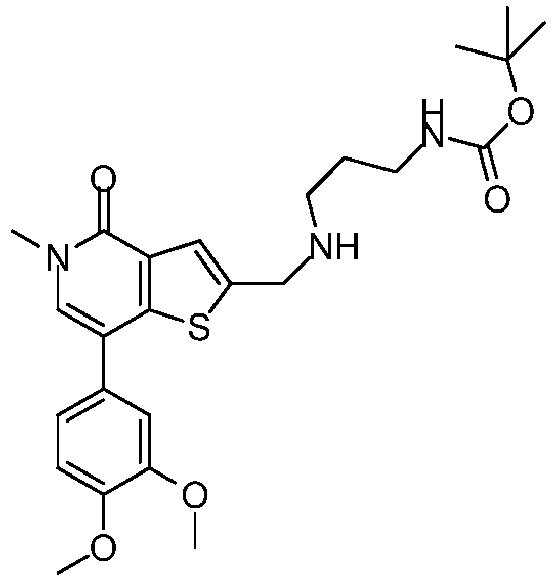
- A mixture of tert-butyl (3-(((7-bromo-5-methyl-4-oxo-4,5-dihydrothieno[3,2-c]pyridin-2-yl)methyl)amino)propyl)carbamate (for a preparation see Intermediate 46, 150 mg, 0.35 mmol), 3,4-dimethoxyphenylboronic acid (95 mg, 0.52 mmol), potassium carbonate (145 mg, 1.05 mmol) and bis(triphenylphosphine)palladium(II) chloride (25 mg, 10 mol%) in 1,2-dimethoxyethane (3 mL) and water (0.5 mL) was heated in a microwave at 120 °C for 20 minutes. The cooled reaction mixture was diluted with ethyl acetate (50 mL). The solution was dried over sodium sulphate and evaporated. The residue was purified by chromatography on silica gel eluting with 0 to 5% methanol in dichloromethane to give tert-butyl (3-(((7-(3,4-dimethoxyphenyl)-5-methyl-4-oxo-4,5-dihydrothieno[3,2-c]pyridin-2-yl)methyl)amino)propyl)carbamate (143 mg, 84% yield) as a brown gum.
LCMS (2 min, Formic Acid): Rt = 0.72 min, MH+ = 488 -

- A stirred solution of 7-bromo-2-(hydroxymethyl)-5-methylthieno[3,2-c]pyridin-4(5H)-one (for a preparation see Intermediate 43, 50 mg, 0.182 mmol) in 1,4-dioxane (7 mL) under nitrogen was warmed to 40 °C and then treated with tribromophosphine (0.912 mL, 0.912 mmol). The reaction was stirred under these conditions for 2 hours, whereupon the reaction was cooled to room temperature and concentrated under reduced pressure.
- The crude material was not purified and deemed of sufficient quality to use in subsequent reactions. The yield was assumed to be 100%.
1H NMR (400MHz, CDCl3) δ-ppm 3.99 (s, 3H), 4.79 (s, 2H), 7.71 (s, 1 H), 8.92 (s, 1 H) -

- To a solution of 7-(3,4-dimethoxyphenyl)-5-methyl-4-oxo-4,5-dihydrothieno[3,2-c]pyridine-2-carbaldehyde (for a preparation see Intermediate 25, 100 mg, 0.304 mmol) in DCM (5 mL) was added acetic acid (0.026 mL, 0.455 mmol) and tert-butyl 2-methylpiperazine-1-carboxylate (0.073 mL, 0.364 mmol) and the reaction mixture was stirred under nitrogen at room temperature for one hour. Sodium triacetoxyborohydride (322 mg, 1.518 mmol) was then added and the reaction was refluxed under nitrogen overnight. The reaction mixture was allowed to cool to room temperature and was then hydrolyzed with a saturated aqueous solution of sodium bicarbonate (20 mL). The layers were separated and the aqueous phase was extracted with DCM (3 x 10 mL). The combined organic layers were washed with a saturated aqueous solution of sodium chloride solution (approx. 20 mL), dried over magnesium sulphate, filtered and concentrated under vacuum to give a light brown residue. The residue was purified by chromatography on silica gel eluting with 0 to 5% MeOH in DCM. The appropriate fractions were combined to give an impure light brown residue. The product was therefore loaded onto a 2g SCX column and was flushed with MeOH (3 column volumes). The product was eluted in 2.0M ammonia in MeOH (3 column volumes) and concentrated to give tert-butyl 4-((7-(3,4-dimethoxyphenyl)-5-methyl-4-oxo-4,5-dihydrothieno[3,2-c]pyridin-2-yl)methyl)-2-methylpiperazine-1-carboxylate (110 mg, 71% yield) as a yellow oil.
LCMS (2 min, Formic Acid): Rt = 0.90 min, MH+ = 514 -

- To a solution of 7-(3,4-dimethoxyphenyl)-5-methyl-4-oxo-4,5-dihydrothieno[3,2-c]pyridine-2-carbaldehyde (for a preparation see Intermediate 25, 100 mg, 0.304 mmol) in DCM (5 mL) was added acetic acid (0.026 mL, 0.455 mmol) and tert-butyl 1,4-diazepane-1-carboxylate (0.072 mL, 0.364 mmol) and the reaction was stirred under nitrogen at room temperature for one hour. Sodium triacetoxyborohydride (322 mg, 1.518 mmol) was then added and the reaction mixture was refluxed overnight.
- The reaction mixture was allowed to cool to room temperature and was hydrolyzed by using a saturated aqueous solution of sodium bicarbonate (20 mL). The layers were separated and the aqueous phase was extracted with DCM (3 x 10 mL). The combined organic layers were washed with a brine (approx. 20 mL), dried over magnesium sulphate, filtered and concentrated under reduced pressure to give a pale brown solid.
- The residue was purified by chromatography on silica gel eluting with 0 to 5% MeOH in DCM. The purest fractions were combined, concentrated, and dried overnight in a vacuum oven to give tert-butyl 4-((7-(3,4-dimethoxyphenyl)-5-methyl-4-oxo-4,5-dihydrothieno[3,2-c]pyridin-2-yl)methyl)-1,4-diazepane-1-carboxylate (6 mg, 3.9% yield) as a yellow oil. The remaining impure fractions were combined and concentrated. The residue was loaded on a 2g SCX column and it was flushed with MeOH (3 column volumes). The product was eluted with 2.0M ammonia in MeOH (3 column volumes) and concentrated under reduced pressure to give tert-butyl 4-((7-(3,4-dimethoxyphenyl)-5-methyl-4-oxo-4,5-dihydrothieno[3,2-c]pyridin-2-yl)methyl)-1,4-diazepane-1-carboxylate (79.3 mg, 51 % yield) as a yellow oil.
LCMS (2 min, Formic Acid): Rt = 0.77 min, MH+ = 514 -

- A suspension of 7-bromo-2-(bromomethyl)-5-methylthieno[3,2-c]pyridin-4(5H)-one (for a preparation see Intermediate 53, 2.460 g, 7.3 mmol) in toluene (50 mL) and triethylphospite (70 mL) was heated to 120 °C and refluxed overnight under an atmosphere of nitrogen. The reaction mixture was cooled to room temperature and the solvent was removed under reduced pressure to give a thick orange suspension. The reaction mixture was dissolved in DCM (100 mL) and washed with 2.0 M HCl (75 mL). The organic layer was collected and the aqueous phase was extracted with DCM (2 x 50 mL).
- The organic fractions were combined and washed with water (100 mL) and brine (100 mL). The organic phase contained a suspension and was filtered through Celite. The organic phase was again washed with water, then collected, dried over magnesium sulphate, and concentrated under reduced pressure to give a yellow oil. The crude material was purified by chromatography on silica gel eluting with 0 to 5% MeOH in DCM. The appropriate fractions were combined and concentrated in vacuo to give diethyl ((7-bromo-5-methyl-4-oxo-4,5-dihydrothieno[3,2-c]pyridin-2-yl)methyl)phosphonate (1.635 g, 57% yield), as a yellow oil. Upon cooling, the product began to precipitate to a yellow solid and cyclohexane was added to the oil to encourage precipitation. The excess solvent was decanted and the product was dried under vacuum to give a pale yellow solid.
LCMS (2 min, Formic Acid): Rt = 0.82 min, MH+ = 394/396 -

- Dry diisopropylamine (0.723 mL, 5.07 mmol) under an atmosphere of nitrogen was cooled to - 78 °C and treated with a 1.6 M solution of n-butyllithium (3.17 mL, 5.07 mmol) in hexanes. The mixture was stirred for 5 minutes and then diluted with THF (5 mL). The reaction mixture was then treated dropwise with a solution of diethyl ((7-bromo-5-methyl-4-oxo-4,5-dihydrothieno[3,2-c]pyridin-2-yl)methyl)phosphonate (for a preparation see Intermediate 58, 1 g, 2.54 mmol) in THF (12 mL). The resulting mixture was stirred for 45 minutes and was then treated dropwise with a solution of tert-butyl 4-oxopiperidine-1-carboxylate (0.758 g, 3.80 mmol) in THF (12 mL). The reaction was warmed to room temperature and stirred under an atmosphere of nitrogen overnight. The reaction was quenched with water (50 mL) and the aqueous phase was extracted with ethyl acetate (3 x 30 mL).
- The combined organic fractions were washed with brine (50 mL). The organic fraction was collected and the brine was back extracted with a further portion of ethyl acetate (20 mL). The combined organic layers were dried over magnesium sulphate, filtered and concentrated under reduced pressure to give tert-butyl 4-((7-bromo-5-methyl-4-oxo-4,5-dihydrothieno[3,2-c]pyridin-2-yl)methylene)piperidine-1-carboxylate as a brown solid. The product contained unreacted tert-butyl 4-oxopiperidine-1-carboxylate which was visible by 1H NMR but was deemed of sufficient quality to be used in subsequent reactions (1.316g, 118% yield)
LCMS (2 min, Formic Acid): Rt = 1.26 min, MH+ = 439/441 -

- A solution of tert-butyl 4-((7-bromo-5-methyl-4-oxo-4,5-dihydrothieno[3,2-c]pyridin-2-yl)methylene)piperidine-1-carboxylate (for a preparation see Intermediate 59, 1.316 g, 3.00 mmol) in 1,4-dioxane (5 mL) was treated with a 4.0 M solution of hydrogen chloride (10 mL, 40.0 mmol) in 1,4-dioxane. The reaction mixture was stirred at room temperature under an atmosphere of nitrogen overnight. Diethyl ether (20 mL) was added and the reaction mixture was stirred for 5 minutes. The reaction was allowed to settle and the excess solvent was decanted. This process was repeated again and then any residual solvent was removed under reduced pressure to give an orange solid.
- The product was oven dried for three hours to give 7-bromo-5-methyl-2-(piperidin-4-ylidenemethyl)thieno[3,2-c]pyridin-4(5H)-one, hydrochloride (1.116 g, 99% yield) as an orange solid.
LCMS (2 min, Formic Acid): Rt = 0.61 min, MH+ = 339, 341 -

- To a suspension of 7-bromo-5-methyl-2-(piperidin-4-ylidenemethyl)thieno[3,2-c]pyridin-4(5H)-one, hydrochloride (for a preparation see Intermediate 60, 1.127 g, 3 mmol) in DCM (20 mL) and pyridine (10 mL) was added methanesulphonyl chloride (468 µL, 6.01 mmol). The reaction mixture was stirred at room temperature under an atmosphere of nitrogen for 1 hour. The reaction was treated with a further 2 equivalents of methanesulphonyl chloride (468 µL, 6.01 mmol) and the reaction was stirred under the conditions described for 16 hours.
- The reaction was concentrated under reduced pressure to give a dark brown residue. The crude product was dissolved in a small volume of DCM (15 mL) and toluene (30 mL) and the reaction was reconcentrated to remove residual pyridine (x2). The crude product was purified by chromatography on silica gel elution 0 to 5% MeOH in DCM give 7-bromo-5-methyl-2-((1-(methylsulphonyl)piperidin-4-ylidene)methyl)thieno[3,2-c]pyridin-4(5H)-one (1.13 g, 90%) as a yellow solid.
LCMS (2 min, Formic Acid): Rt = 0.94 min, MH+ = 417/419 -

- To a suspension of 7-bromo-5-methyl-2-((1-(methylsulphonyl)piperidin-4-ylidene)methyl)thieno[3,2-c]pyridin-4(5H)-one (for a preparation see Intermediate 61, 200 mg, 0.479 mmol) followed by N-(4-(4,4,5,5-tetramethyl-1,3,2-dioxaborolan-2-yl)pyridin-2-yl)acetamide (251 mg, 0.958 mmol) and potassium carbonate (265 mg, 1.917 mmol) in isopropanol (4 mL) and water (3 mL) was added PEPPSI (32.6 mg, 0.048 mmol) catalyst. The reaction mixture was heated to 130 °C for 30 minutes in the microwave. The reaction was hydrolyzed using a saturated aqueous solution of ammonium chloride (30 mL). The layers were separated and the aqueous phase was extracted with DCM (3 x 30 mL). The combined organic fractions were dried over magnesium sulphate, filtered and concentrated in vacuo to give a dark brown oil.
- The crude material was purified by chromatography on silica gel eluting with 0 to 5% methanol in dichloromethane. The desired product co-eluted with various impurities. The appropriate fractions were concentrated, redissolved in 1:1 DMSO/MeOH, and filtered through a bond elute cartridge to remove insoluble impurities. The material was then repurified by MDAP in three portions to give N-(4-(5-methyl-2-((1-(methylsulphonyl)piperidin-4-ylidene)methyl)-4-oxo-4,5-dihydrothieno[3,2-c]pyridin-7-yl)pyridin-2-yl)acetamide (10 mg, 4.4% yield) as a white solid.
LCMS (2 min, Formic Acid): Rt = 0.74 min, MH+ = 473 -

- To a suspension of tert-butyl 4-((7-bromo-5-methyl-4-oxo-4,5-dihydrothieno[3,2-c]pyridin-2-yl)methylene)piperidine-1-carboxylate (for a preparation see Intermediate 59, 27 mg, 0.061 mmol), (3,4-dimethoxyphenyl)boronic acid (16.77 mg, 0.092 mmol) and potassium carbonate (25.5 mg, 0.184 mmol) in isopropanol (2 mL) and water (1 mL) was added PEPPSI (4.18 mg, 6.15 µmol) catalyst. The reaction mixture was heated to 130 °C in the microwave for 30 minutes. The reaction was quenched with a saturated aqueous solution of ammonium chloride (15 mL) and the aqueous phase was extracted with DCM (3 x 15 mL). The combined organic fractions were dried over magnesium sulphate, filtered and concentrated under reduced pressure to give a dark green oil. The crude material was purified by chromatography on silica gel eluting with 0 to 50% ethyl acetate in cyclohexane then 5% MeOH in DCM to give the product as a yellow oil. The material was redissolved in diethyl ether and re-concentrated to give tert-butyl 4-((7-(3,4-dimethoxyphenyl)-5-methyl-4-oxo-4,5-dihydrothieno[3,2-c]pyridin-2-yl)methylene)piperidine-1-carboxylate (24 mg, 0.048 mmol, 79% yield) as a light yellow solid.
LCMS (2 min, Formic Acid): Rt = 1.22 min, MH+ = 497 -

- A stirred solution of tert-butyl 4-((7-(3,4-dimethoxyphenyl)-5-methyl-4-oxo-4,5-dihydrothieno[3,2-c]pyridin-2-yl)methylene)piperidine-1-carboxylate (for a preparation see Intermediate 63, 22 mg, 0.044 mmol) in ethanol (2 mL) was treated with ammonium formate (13.97 mg, 0.221 mmol) followed by 10% palladium on carbon (50% water paste, 3.6 mg, 20% wt). The resulting suspension was heated to 90 °C and refluxed under an atmosphere of nitrogen for two hours. The reaction was cooled to room temperature and passed through a 2.5 g Celite frit to remove the palladium catalyst.
- The filtrate was concentrated under reduced pressure to give a white residue. The material was redissolved in toluene and re-concentrated (x 2) to remove residual ammonium formate impurities, to give tert-butyl 4-((7-(3,4-dimethoxyphenyl)-5-methyl-4-oxo-4,5-dihydrothieno[3,2-c]pyridin-2-yl)methyl)piperidine-1-carboxylate (22.09 mg, 100% yield) a white solid containing traces of ammonium formate.
LCMS (2 min, Formic Acid): Rt = 1.21 min, MH+ = 499 -

- A stirred solution of tert-butyl 4-((7-(3,4-dimethoxyphenyl)-5-methyl-4-oxo-4,5-dihydrothieno[3,2-c]pyridin-2-yl)methyl)piperidine-1-carboxylate (for a preparation see Intermediate 64, 22 mg, 0.044 mmol) in 1,4-dioxane (2 mL) under an atmosphere of nitrogen was treated with 4.0 M HCl in 1,4-dioxane (500 µL). The reaction mixture was stirred for 2 hours. The reaction mixture was treated with a further portion of 4.0 M HCl in 1,4-dioxane (1 mL) and stirred described for another 3 hours.
- Diethyl ether (3 mL) was added and the reaction mixture stirred for 5 minutes. The solvent was decanted and a fresh portion of diethyl ether (2 mL) was added to the product. The solvent was again decanted and the product was concentrated under reduced pressure to give 7-(3,4-dimethoxyphenyl)-5-methyl-2-(piperidin-4-ylmethyl)thieno[3,2-c]pyridin-4(5H)-one, hydrochloride (18 mg, 94% yield) as a white solid.
LCMS (2 min, Formic Acid): Rt = 0.67 min, MH+ = 477 -

- To a suspension of 7-bromo-5-methyl-2-((1-(methylsulphonyl)piperidin-4-ylidene)methyl)thieno[3,2-c]pyridin-4(5H)-one (for a preparation see Intermediate 61, 100 mg, 0.240 mmol), (3-acetamidophenyl)boronic acid (64.3 mg, 0.359 mmol) and potassium carbonate (99 mg, 0.719 mmol) in isopropanol (2 mL) and water (2 mL) was added PEPPSI (16.28 mg, 0.024 mmol) catalyst.
- The reaction mixture was heated to 130 °C in the microwave for 30 minutes. The reaction mixture was hydrolyzed with a saturated aqueous solution of ammonium chloride (25 mL). The aqueous phase was extracted with DCM (3 x 15 mL) and the combined organic layers were dried over magnesium sulphate, filtered and concentrated under reduced pressure to give a light yellow solid.
- The crude material failed to dissolve in a small volume of DCM and it was therefore not possible to load onto a silica gel column. The mixture was reconcentrated and the crude product was then triturated with diethyl ether to give the product as a yellow solid (85% pure by LCMS). An attempt was made to dissolve the product in THF for column purification but again it was insoluble. The product (120 mg, 1065 yield) was deemed of sufficient quality to be reduced in the subsequent reaction.
LCMS (2 min, Formic Acid): Rt = 0.83 min, MH+ = 472 -

- To a stirred solution of 7-bromo-5-methyl-4-oxo-4,5-dihydrothieno[3,2-c]pyridine-2-carbaldehyde (for a preparation see Intermediate 3, 200 mg, 0.735 mmol) in dichloromethane (10 mL) was added 1-methyl-1,4-diazepane (0.110 mL, 0.882 mmol) followed by acetic acid (0.042 mL, 0.735 mmol). The reaction mixture was heated to 40 °C and stirred for 15 minutes. The reaction was treated with sodium triacetoxyborohydride (467 mg, 2.205 mmol) and stirred under nitrogen at 40 °C for one hour whereupon the reaction mixture was cooled to room temperature, quenched with a saturated aqueous solution of bicarbonate (25 mL) and stirred under nitrogen for 15 minutes. The reaction mixture was transferred to a separating funnel and the organic layer was collected. The aqueous phase was extracted with DCM (3 x 25 mL) and the combined organic fractions were washed with brine dried over magnesium sulphate, filtered and concentrated under reduced pressure to give yellow oil. The crude material was purified by chromatography on silica gel eluting with 0 to 10% [ammonia in MeOH] in DCM to give 7-bromo-5-methyl-2-((4-methyl-1,4-diazepan-1-yl)methyl)thieno[3,2-c]pyridin-4(5H)-one (204 mg, 75% yield) as a yellow oil.
LCMS (2 min, Formic Acid): Rt = 0.49 min, MH+ = 370/372 -

- To a solution of (S)-tert-butyl 4-((7-bromo-5-methyl-4-oxo-4,5-dihydrothieno[3,2-c]pyridin-2-yl)methyl)-3-methylpiperazine-1-carboxylate (for a preparation see Intermediate 84, 22 mg, 0.048 mmol) and (3-(benzyloxy)-4-methoxyphenyl)boronic acid (18.66 mg, 0.072 mmol) in isopropanol (2 mL) were successively added potassium carbonate (0.121 mL, 0.241 mmol) and PEPPSI (3.28 mg, 4.82 µmol). The reaction mixture was heated in a microwave reactor at 110 °C for 20 min and was then concentrated in vacuo and the residue partitioned between ethyl acetate and water. The aqueous phase was extracted three times with ethyl acetate and the combined organic layers were washed with brine, dried over magnesium sulphate, filtered and concentrated in vacuo. The residue was diluted in a 1:1 MeOH/DMSO mixture (1 mL) and purified via MDAP. The appropriate fractions were combined and concentrated in vacuo to give a residue which was diluted in a 1:1 MeOH/DMSO mixture (1 mL) and further purified via MDAP. The appropriate fractions were collected and concentrated in vacuo to give (S)-tert-butyl-4-((7-(3-(benzyloxy)-4-methoxyphenyl)-5-methyl-4-oxo-4,5-dihydrothieno[3,2-c]pyridin-2-yl)methyl)-3-methylpiperazine-1-carboxylate (3.2 mg) as a viscous yellow oil.
LCMS (2 min, High pH): Rt = 1.40 min, MH+ = 590 -

- A solution of 7-bromo-5-methyl-4-oxo-4,5-dihydrothieno[3,2-c]pyridine-2-carbaldehyde (for a preparation see Intermediate 3, 15.0 g, 55.1 mmol) in methanol (340 mL) and glacial acetic acid (40 mL) was treated with 1-(methylsulphonyl)piperazine (13.6 g, 83 mmol) and stirred at room temperature for 15 minutes. 2-Picoline borane complex (6.49 g, 60.6 mmol) was added portionwise over 5 minutes. After complete addition, the reaction mixture was stirred at 50 °C for 1 hour. The reaction mixture was then cooled to room temperature and the solvent evaporated. A saturated aqueous solution of NaHCO3 (50 mL) was added to the residue (gas evolved) and the mixture made basic by the careful addition of solid sodium bicarbonate (more gas evolved). The mixture was extracted with dichloromethane (3 x 200 mL) and the combined extracts were dried and evaporated in vacuo.
- The residue was purified by flash chromatography on silica gel eluting with 0-5% methanol in dichloromethane. The product was triturated with diethyl ether, filtered off and dried to give 7-bromo-5-methyl-2-((4-(methylsulphonyl)piperazin-1-yl)methyl)thieno[3,2-c]pyridin-4(5H)-one (15.58 g, 37.1 mmol, 67.2% yield) as an off-white solid.
LCMS (2 min, Formic Acid): Rt = 0.58 min, MH+ = 420, 422 -

- To a suspension of 1,3-dimethylpiperazine dihydrochloride (870 mg, 4.65 mmol) in DCM (10 mL) was added 7-bromo-5-methyl-4-oxo-4,5-dihydrothieno[3,2-c]pyridine-2-carbaldehyde (for a preparation see Intermediate 3, 250 mg, 0.919 mmol) followed by acetic acid (0.063 mL, 1.102 mmol). The resulting mixture was stirred under nitrogen at room temperature for 30 minutes and was then treated with sodium triacetoxyborohydride (974 mg, 4.59 mmol). The reaction was stirred under nitrogen at room temperature for 90 minutes at which point LCMS analysis showed some of the desired product had formed, however a significant amount of the starting material had been reduced to the alcohol by-product and some starting material still remained. The reaction was left under the same conditions overnight. The reaction was quenched with a saturated aqueous solution of bicarbonate (25 mL) and stirred under nitrogen for 20 minutes. The reaction was transferred to a separating funnel and the product was extracted with DCM (3 x 30 mL). The organic phase was washed with brine (25 mL) and then dried over magnesium sulphate. The filtrate was concentrated under reduced pressure to give a yellow solid. The crude material was purified by MDAP in four portions to give 7-bromo-2-((2,4-dimethylpiperazin-1-yl)methyl)-5-methylthieno[3,2-c]pyridin-4(5H)-one (34 mg, 10% yield) an orange solid.
LCMS (2 min, Formic Acid): Rt = 0.58 min, MH+ = 370/372 -

- A solution of 7-(3,4-dimethoxyphenyl)-5-methyl-4-oxo-4,5-dihydrothieno[3,2-c]pyridine-2-carbaldehyde (for a preparation see Intermediate 25, 1.36 g, 4.13 mmol) in DCM (32 mL) was dispensed evenly (2 mL) to 16 x amines (0.514-0.518 mmol, ∼2 eq). The mixtures were treated with acetic acid (0.02 mL, 0.349 mmol), stirred for 5 min then sodium triacetoxyborohydride (4 eq, 1.04 mmol, 220 mg) added. The reaction mixtures were stirred vigorously at rt under nitrogen for 16 hr.
- The reactions were quenched by the addition of sat. NaHCO3 (aq) (2 mL) and stirred for 10 min. The organic layers were dried through hydrophobic frits and the solvent removed under a stream of nitrogen. The residues were purified by MDAP on Xbridge C18 column using a gradient of solvents 10mM ammonium carbonate in water adjusted to pH10 with ammonia solution and acetonitrile. The appropriate fractions were combined and the solvent evaporated in a vacuum centrifuge to give the reductive amination products (Intermediates 71-82) which were all used in the next stage.
Intermediate NHR'R" mmoles of NHR'R" Supplier of NHR'R" 71 (R)-tert-butyl 4-((7-(3,4-dimethoxyphenyl)-5-methyl-4-oxo-4,5-dihydrothieno[3,2-c]pyridin-2-yl)methyl)-3-methylpiperazine-1-carboxylate (R)-tert-butyl 3-methylpiperazine-1-carboxylate 0.514 Aldrich 

72 (R)-tert-butyl 3-carbamoyl-4-((7-(3,4-dimethoxyphenyl)-5-methyl-4-oxo-4,5-dihydrothieno[3,2-c]pyridin-2-yl)methyl)piperazine-1-carboxylate (R)-tert-butyl 3-carbamoylpiperazine-1-carboxylate 0.515 Ennona Med Chem Group 

73 (S)-tert-butyl 4-((7-(3,4-dimethoxyphenyl)-5-methyl-4-oxo-4,5-dihydrothieno[3,2-c]pyridin-2-yl)methyl)-2-methylpiperazine-1-carboxylate (S)-tert-butyl 2-methylpiperazine-1-carboxylate 0.514 Insight Chem 

74 1-tert-butyl 3-methyl 4-((7-(3,4-dimethoxyphenyl)-5-methyl-4-oxo-4,5-dihydrothieno[3,2-c]pyridin-2-yl)methyl)piperazine-1,3-dicarboxylate 1-tert-butyl 3-methyl piperazine-1,3-dicarboxylate 0.516 AstaTech 

75 (3R,5S)-tert-butyl 4-((7-(3,4-dimethoxyphenyl)-5-methyl-4-oxo-4,5-dihydrothieno[3,2-c]pyridin-2-yl)methyl)-3,5-dimethylpiperazine-1-carboxylate cis-tert-butyl 3,5-dimethylpiperazine-1-carboxylate 0.518 Manchester Organic 

76 (R)-tert-butyl 2-butyl-4-((7-(3,4-dimethoxyphenyl)-5-methyl-4-oxo-4,5-dihydrothieno[3,2-c]pyridin-2-yl)methyl)piperazine-1-carboxylate (R)-tert-butyl 2-butylpiperazine-1-carboxylate 0.516 Activate 

77 (S)-tert-butyl 4-((7-(3,4-dimethoxyphenyl)-5-methyl-4-oxo-4,5-dihydrothieno[3,2-c]pyridin-2-yl)methyl)-2-ethylpiperazine-1-carboxylate (S)-tert-butyl 2-ethylpiperazine-1-carboxylate 0.518 Atlantic 

78 tert-butyl 4-(((7-(3,4-dimethoxyphenyl)-5-methyl-4-oxo-4,5-dihydrothieno[3,2-c]pyridin-2-yl)methyl)amino)piperid ine-1-carboxylate tert-butyl 4-aminopiperidine-1-carboxylate 0.514 Aldrich 

79 (S)-tert-butyl 4-((7-(3,4-dimethoxyphenyl)-5-methyl-4-oxo-4,5-dihydrothieno[3,2-c]pyridin-2-yl)methyl)-3-methylpiperazine-1-carboxylate (S)-tert-butyl 3-methylpiperazine-1-carboxylate 0.514 CNH Technologies 

80 tert-butyl (1-((7-(3,4-dimethoxyphenyl)-5-methyl-4-oxo-4,5-dihydrothieno[3,2-c]pyridin-2-yl)methyl)pyrrolidin-3-yl)carbamate tert-butyl pyrrolidin-3-ylcarbamate 0.515 Tokyo Chemical Industry Co. Ltd 
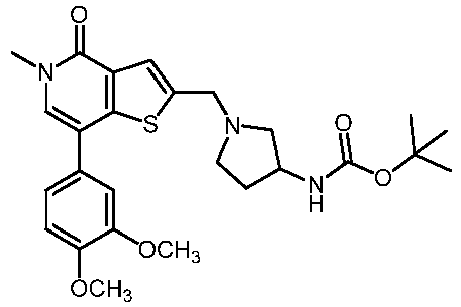
81 tert-butyl (1-((7-(3,4-dimethoxyphenyl)-5-methyl-4-oxo-4,5-dihydrothieno[3,2-c]pyridin-2-yl)methyl)piperidin-4-yl)carbamate tert-butyl piperidin-4-ylcarbamate 0.514 Aldrich 

82 tert-butyl (2-(((7-(3,4-dimethoxyphenyl)-5-methyl-4-oxo-4,5-dihydrothieno[3,2-c]pyridin-2-yl)methyl)(methyl)amin o)ethyl)carbamate tert-butyl (2-(methylamino)ethyl)carbamate 0.517 KaironKem 

-

- To a suspension of 7-bromo-4-oxo-4,5-dihydrothieno[3,2-c]pyridine-2-carbaldehyde (for a preparation see Intermediate 2, 191 mg, 0.740 mmol) and phenylboronic acid (135 mg, 1.110 mmol) in isopropanol (3.5 mL) in a microwave vial were successively added potassium carbonate (1.850 mL, 3.70 mmol) and PEPPSI (50.3 mg, 0.074 mmol). The reaction mixture was heated at 110 °C in the microwave for 30 min, whereupon the solvents were evaporated. The residue was partitioned between EtOAc and a saturated aqueous solution of sodium bicarbonate. The phases were separated and the aqueous phase was extracted three times with EtOAc. The combined organic layers were washed with brine, dried over MgSO4, filtered and concentrated in vacuo. The crude residue was taken up in MeOH and the precipitate was filtered to give 4-oxo-7-phenyl-4,5-dihydrothieno[3,2-c]pyridine-2-carbaldehyde (160 mg, 85%) as a brown solid.
LCMS (2 min, Formic Acid): Rt = 0.84 min, MH+ = 256 -

- To a solution of 7-bromo-5-methyl-4-oxo-4,5-dihydrothieno[3,2-c]pyridine-2-carbaldehyde (for a preparation see Intermediate 3, 136 mg, 0.500 mmol) and (S)-tert-butyl 3-methylpiperazine-1-carboxylate (200 mg, 1.000 mmol) in DCM (5 mL) were successively added sodium triacetoxyborohydride (424 mg, 1.999 mmol) and acetic acid (5.72 µL, 0.100 mmol). The reaction mixture was stirred at 40 °C for 1 hour, whereupon the reaction mixture was hydrolyzed by adding a saturated aqueous solution of sodium carbonate. The aqueous phase was extracted three times with dichloromethane and the combined organic layers were washed with brine, dried over magnesium sulphate, filtered and concentrated in vacuo. The residue was purified by MDAP and the appropriate fractions were combined and concentrated in vacuo to give (S)-tert-butyl-4-((7-bromo-5-methyl-4-oxo-4,5-dihydrothieno[3,2-c]pyridin-2-yl)methyl)-3-methylpiperazine-1-carboxylate (47 mg) as a viscous yellow oil.
LCMS (2 min, Formic Acid): Rt = 0.77 min, MH+ = 456/458 -

- To a solution of 7-bromo-5-methyl-2-((4-(methylsulphonyl)piperazin-1-yl)methyl)thieno[3,2-c]pyridin-4(5H)-one (for a preparation see Intermediate 69, 106 mg, 0.252 mmol) and (4-(((tert-butoxycarbonyl)amino)methyl)phenyl)boronic acid (95 mg, 0.378 mmol) in isopropanol (5 mL) were successively added potassium carbonate (0.630 mL, 1.261 mmol) and PEPPSI (17.13 mg, 0.025 mmol). The resulting mixture was heated at 110 °C in the microwave for 1 hour. The reaction mixture was concentrated in vacuo and the crude residue was partitioned between EtOAc and a saturated aqueous solution of sodium bicarbonate. The phases were separated, the aqueous phase was extracted 3 times with EtOAc and the combined organic layers were washed with brine, dried over MgSO4 filtered and concentrated in vacuo. The residue purified via flash chromatography on silica gel using a Biotage SP4 apparatus (25G column), eluting with 10 to 60% MeOH in DCM. The appropriate fractions were combined and concentrated in vacuo to give tert-butyl 4-(5-methyl-2-((4-(methylsulphonyl)piperazin-1-yl)methyl)-4-oxo-4,5-dihydrothieno[3,2-c]pyridin-7-yl)benzylcarbamate (124 mg, 90%) as a viscous yellow oil.
LCMS (2 min, Formic Acid): Rt = 0.83 min, MH+ = 547 -

- A mixture of 4-bromo-2-chloropyridine (4.35 g, 2.5 mL, 22.6 mmol) and 2-methoxy-N-methylethanamine (6.09 g, 7.5 mL, 68.3 mmol) was heated in a microwave at 150 °C for 1 hour. The reaction mixture was cooled to room temperature. The solution was diluted with toluene (20 mL), the solvent evaporated and then re-evaporated from toluene (x2). The residue was chromatographed [20-50% ethyl acetate/hexane] to give:
- 2-chloro-N-(2-methoxyethyl)-N-methylpyridin-4-amine (3.25 g, 72% yield) as a colourless oil.
-
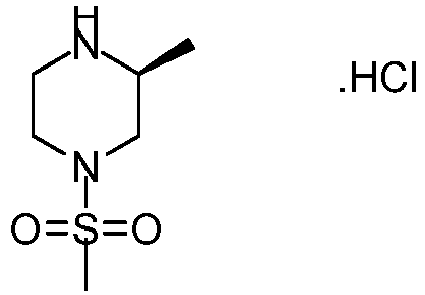
- Methanesulphonyl chloride (467µL, 5.99 mmol) was added to a stirred solution of (S)-tert-butyl 2-methylpiperazine-1-carboxylate (1.0 g, 4.99 mmol) in dichloromethane (20 mL) and pyridine (2 mL).
- The reaction mixture was stirred at room temperature overnight. The solvent was evaporated. The residue was dissolved in diethyl ether (50 mL) and washed with 1M hydrochloric acid (25 mL) followed by water (25 mL) and brine (25 mL). The organic phase was dried and evaporated. The product was dissolved in diethyl ether (20 mL) and treated with 4M hydrogen chloride in 1,4-dioxane (4 mL) and allowed to stand at room temperature overnight. The solvent was evaporated. The residue was triturated with diethyl ether, was filtered off, washed with diethyl ether and dried to give (S)-3-methyl-1-(methylsulphonyl)piperazine hydrochloride (457 mg, 2.128 mmol, 42.6% yield) as a colourless solid.
1H NMR (400MHz, CDCl3) δ-ppm 3.78-3.60 (m, 2H); 3.08 (dt, J = 12 Hz and J = 4 Hz, 1 H); 2.95 (J = 12 Hz and J = 4 Hz, 1 H); 2.95-2.86 (m, 2H); 2.77 (s, 3H); 2.70 (td, J = 8 Hz and J = 4Hz, 1 H); 2.31 (dd, J = 12 Hz and J = 12 Hz, 1 H); 1.09 (d, J = 8 Hz, 3H). -

- (S)-3-methyl-1-(methylsulphonyl)piperazine hydrochloride (for a preparation see Intermediate 87, 1.1 g, 5.12 mmol) and glacial acetic acid (292 µL, 5.11 mmol) were added to a stirred solution of 7-bromo-5-methyl-4-oxo-4,5-dihydrothieno[3,2-c]pyridine-2-carbaldehyde (for a preparation see Intermediate 3, 1.39 g, 5.11 mmol) in dichloromethane (50 mL). The reaction mixture was stirred at room temperature for 30 minutes then treated with sodium triacetoxyborohydride (5.41 g, 25.5 mmol). The reaction mixture was refluxed for 4 hours then cooled to room temperature. Saturated sodium bicarbonate (50 mL) was added and the mixture stirred for 10 minutes. The organic phase was separated and the aqueous phase extracted with dichloromethane (2x50 mL). The combined organics were dried and evaporated. Chromatography [2% methanol/dichloromethane] of the residue gave (S)-7-bromo-5-methyl-2-((2-methyl-4-(methylsulphonyl)piperazin-1-yl)methyl)thieno[3,2-c]pyridin-4(5H)-one as a pale orange solid (1.47 g, 3.38 mmol, 66.3% yield).
LCMS (2 min, Formic Acid): Rt = 0.62 min, MH+ = 434/436 -

- A mixture of (R)-1-(pyridin-2-yl)ethanol (107.3 mg, 0.871 mmol), 5-bromopyridin-3-ol (120.9 mg, 0.695 mmol) and 2-(tributylphosphoranylidene)acetonitrile (501.2 mg, 2.077 mmol) in toluene (3 mL) was heated with stirring in a sealed vial in a microwave reactor at 120 °C for 40 min. The mixture was concentrated under a stream of nitrogen and the residue was re-dissolved in DCM (∼3 mL) and was purified by Biotage SP4 flash column chromatography (10g silica SNAP cartridge) eluting with a gradient of 0-8% (2M ammonia in MeOH solution) in DCM. The required fractions were combined and the solvent evaporated under a stream of nitrogen to give the crude desired product which was further purified by Biotage SP4 flash column chromatography (10g silica SNAP cartridge) eluting with a gradient of 0-50% EtOAc in cyclohexane. The required fractions were combined and the solvent evaporated in vacuo to give the title compound as an orange oil (154.6 mg, 0.554 mmol, 80 % yield)
LCMS (2 min, Formic Acid): Rt = 0.83 min, MH+ = 279/281
Enantiomeric purity by chiral HPLC = >86% e.e. -

- To a microwave vial was added (S)-3-bromo-5-(1-(pyridin-2-yl)ethoxy)pyridine (Intermediate 89) (149.3 mg, 0.535 mmol), potassium acetate (211.8 mg, 2.158 mmol), bis(pinacolato)diboron (679.8 mg, 2.68 mmol), dichloro[1,1'-bis(diphenylphosphino)ferrocene]palladium (II) dichloromethane complex (40.7 mg, 0.056 mmol) and 1,4-dioxane (5 mL). The vial was sealed and heated with stirring at 110 °C for 30 min in a microwave reactor. The mixture was diluted with EtOAc (20 mL), dried over magnesium sulphate and filtered through a 2.5g Celite cartridge. The filtrate was evaporated in vacuo to give the crude title compound as a brown solid, yield = 662.4mg (theoretical yield = 131 mg). LCMS and mass recovery together indicated that the product was c.a. 20% pure, and the material was used crude in the next stage without further purification.
LCMS (2 min, Formic Acid): Rt = 0.41 min, MH+ = 245. -

- (2R)-2-Methylpiperazine (401 mg, 4 mmol) was dissolved in THF (15 mL). The stirred solution was cooled in an ice-water bath, and treated with 2M aqueous sodium hydroxide (6.0 mL, 12.00 mmol).
- A solution of ethanesulfonyl chloride (0.4 mL, 4.22 mmol) in THF (2 mL) was added dropwise using further THF (3 mL) to wash in. The reaction mixture was stirred cold, being allowed to warm up slowly. After 2 hr the reaction mixture was partitioned between water (50 mL) and DCM (50 mL).
- The layers were separated and the aqueous was extracted with further DCM (2 x 25 mL). The combined organic extracts were concentrated in vacuo. The residue was re-dissolved in DCM (50 mL) and the product extracted into 1M HCl (50 mL). The layers were separated and the aqueous was washed with further DCM (2 x 25 mL). The aqueous was then treated with 2N aqueous NaOH (27 mL) to give pH∼13. This was extracted with DCM (50 mL, 2 x 25 mL). The combined DCM extracts were concentrated in vacuo to give the title compound (599 mg, 3.12 mmol, 78 % yield) as a colourless oil.
LCMS (2 min, High pH): Rt = 0.49 min, MH+ = 193 -

- A suspension of 7-bromo-5-methyl-4-oxo-4,5-dihydrothieno[3,2-c]pyridine-2-carbaldehyde (Intermediate 3) (116 mg, 0.426 mmol) in MeOH (4 mL) and acetic acid (500 µL) was treated with (R)-1-(ethylsulfonyl)-3-methylpiperazine (Intermediate 91) (98.5 mg, 0.512 mmol). The reaction mixture was stirred at rt under nitrogen for 15 min and was then treated with 2-picoline-borane complex (50.1 mg, 0.469 mmol). The reaction mixture was heated to 50 °C and stirred under nitrogen for 1 hr. The reaction was left under the conditions described overnight (16 hours). The reaction was treated with a further portion of 2-picoline-borane complex (50.1 mg, 0.469 mmol) and stirred under the conditions described for a further 2.5 hr. The reaction was cooled to room temperature and concentrated under reduced pressure to give a light orange oil. The oil was taken up in DCM (20 mL) and washed with saturated sodium bicarbonate solution (25 mL). The organic phase was collected and the aqueous phase was back extracted with DCM (2 x 20 mL). The organic portions were combined, dried over magnesium sulfate, and concentrated under reduced pressure to give an orange oil. The crude material was loaded on to a 12 g silica gel column and was eluted with 0-80% ethyl acetate in cyclohexane over 20 column volumes then with 0-5% MeOH in DCM to give the title compound (102 mg, 0.227 mmol, 53.4 % yield), as a pale yellow solid.
LCMS (2 min, Formic Acid): Rt = 0.66 min, MH+ = 448/450. -
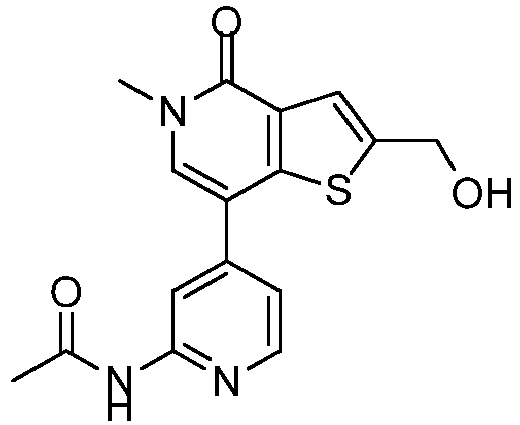
- A suspension of 7-bromo-2-(hydroxymethyl)-5-methylthieno[3,2-c]pyridin-4(5H)-one (Intermediate 43) (1 g, 3.65 mmol) in isopropanol (25 mL) and water (25 mL) was treated with N-(4-(4,4,5,5-tetramethyl-1,3,2-dioxaborolan-2-yl)pyridin-2-yl)acetamide (1.912 g, 7.30 mmol) followed by potassium carbonate (2.017 g, 14.59 mmol), and lastly the PEPPSI catalyst (0.248 g, 0.365 mmol).
- The reaction was warmed to 60 °C and stirred under nitrogen overnight. The reaction mixture was treated with a fresh portion of the PEPPSI (0.248 g, 0.365 mmol) catalyst and heated to 100 °C for 4.5 hours. The reaction was cooled to room temperature, diluted with EtOAc (50 mL), and filtered through a 10g Celite frit to remove inorganic impurities. The filtrated was concentrated under reduced pressure to give a yellow solid. The material was triturated with diethyl ether to give a yellow solid which was suspended in MeOH and heated to 100 °C. The mixture was refluxed for 20 minutes and allowed to cool to room temperature overnight. The solids were collected in a glass filter funnel and washed with cold MeOH (approx. 25 mL). The product was dried under vacuum for 20 minutes and transferred to a vacuum oven to dry for several hours to give the title compound (1.38 g, 4.19 mmol, 115 % yield), as a cream coloured solid.
1H NMR (400MHz, DMSO-d6) δ-ppm 10.6 (1H, s), 8.58 (1H, s), 8.50 (1H, s), 8.40 (1H, d), 7.94 (1H, s), 7.40 (1H, s), 7.33 (1H, d), 4.71 (2H, s), 3.60 (3H, s), 2.12 (3H, s). -

- N-(4-(2-(Hydroxymethyl)-5-methyl-4-oxo-4,5-dihydrothieno[3,2-c]pyridin-7-yl)pyridin-2-yl)acetamide (Intermediate 93) (1.38 g, 4.19 mmol) was suspended in 1,4-dioxane (40 mL) and heated to 60 °C.
- The reaction was slowly treated with a 1 M solution of tribromophosphine (20.95 mL, 20.95 mmol) in DCM. The reaction mixture was stirred under an atmosphere of nitrogen at 60 °C overnight (18 hr).
- The reaction was cooled to room temperature and concentrated under reduced pressure to give a bright yellow solid. The material was taken up in diethyl ether to quench and remove residual tribromophosphine. The solids were collected in a glass filter funnel and washed with fresh ether and dried under vacuum to give the title compound (1.644 g, 4.19 mmol, 100 % yield) as a yellow solid.
- The material was analysed by 1H NMR which confirmed formation of the alkyl bromide by the change in chemical shift in the adjacent CH2 in the spectrum of the starting material (δ 4.71ppm) to the product (δ 5.1 ppm). The material was used in subsequent steps without further purification.
-

- 3,3-Difluoropiperidine hydrochloride (319 mg, 2.02 mmol) was added to a stirred solution of 7-bromo-5-methyl-4-oxo-4,5-dihydrothieno[3,2-c]pyridine-2-carbaldehyde (Intermediate 3) (500 mg, 1.84 mmol) in MeOH (9 mL) and glacial acetic acid (1 mL). The mixture was stirred at room temperature for 15 minutes then 2-picolineborane complex (216 mg, 2.02 mmol) was added. The reaction mixture was stirred at room temperature for 2 hours. The solvent was evaporated.
- Saturated sodium bicarbonate solution (15 mL) was added. The mixture was extracted with DCM (3x15 mL). The combined extracts were dried and evaporated. The residue was purified by column chromatography on silica gel (2-4% MeOH/DCM) to give the title compound (442 mg, 1.172 mmol, 63.8 % yield) as a yellow solid.
LCMS (2 min, Formic Acid): Rt = 0.85 min, MH+ = 377/379 -

- The title compound was prepared using a method similar to that described for Intermediate 95. Yellow solid (346 mg, 0.963 mmol, 52.4 % yield).
LCMS (2 min, Formic Acid): Rt = 0.49 min, MH+ = 359/361. -

- Cyclopropylmethanol (0.247 mL, 3.12 mmol) was dissolved in dry THF (10 mL) and sodium hydride (60% w/w) (125 mg, 3.12 mmol) was added portion-wise, under nitrogen, at rt. After -30 min, 4-bromo-2-chloropyridine (0.173 mL, 1.559 mmol) was added slowly and the reaction was stirred at rt for 5 days. The reaction was diluted with Et2O (30 mL) and washed with water (20 mL). The organic layer was washed with brine, dried using a hydrophobic frit and evaporated to give a yellow oil (0.432g). The residue was loaded in DCM and purified on the Biotage SP4 silica (Si) SNAP 25g column using a 0-20% EtOAc/cyclohexane gradient. Appropriate fractions were combined and evaporated to give a colourless oil (295 mg) This was loaded in cyclohexane and purified by Biotage SP4 SNAP 25g silica using a gradient of 0-10% EtOAc/cyclohexane gradient. Fractions containing product were combined and evaporated under vacuum to give a colourless oil which was dissolved in 1:1 MeOH:DMSO 1 mL (x3) and purified by MDAP. The solvent was evaporated under vacuum to give a the title compound as a colourless oil (97 mg).
LCMS (2 min, Formic Acid): Rt = 1.21 min, MH+ = 228/230. -

- 2-(Pyrrolidin-1-yl)ethanol (1.240 mL, 10.39 mmol) was dissolved in THF (30 mL) and sodium hydride (60% w/w) (0.416 g, 10.39 mmol) was added portion-wise under nitrogen. This was left to stir for 15 min at rt before 4-bromo-2-chloropyridine (0.577 mL, 5.20 mmol) was added and left to stir at rt for 3 days. Water was added (40 mL) and the organic product was extracted with EtOAc and washed with brine and separated and dried through a hydrophobic frit and concentrated in vacuo. The residue was purified by silica gel column chromatography [0-5% MeOH/NH3 in DCM] and fractions containing product were combined and concentrated in vacuo to give the title compound..
LCMS (2 min, Formic Acid): Rt = 0.54 min, MH+ = 271/273. -

- 2-Methoxyethanol (0.820 mL, 10.39 mmol) was dissolved in THF (30 mL) and sodium hydride (60% w/w) (0.416 g, 10.39 mmol) was added under nitrogen and left to stir at rt for 15 min. 4-bromo-2-chloropyridine (0.577 mL, 5.20 mmol) was added and the reaction was left stirring at rt overnight.
- More 2-methoxyethanol (0.410 mL, 5.19 mmol) was dissolved in 1,2-DME (10 mL) and sodium hydride (60% w/w) (0.208 mg, 5.19 mmol) was added. The mixture was stirred under nitrogen at rt for 15 min then added to the reaction which was stirred at rt for 3 days. Water was added (40 mL) and the organic product was extracted with EtOAc and washed with brine, dried through a hydrophobic frit and concentrated in vacuo. The residue was purified by silica gel column chromatography [0-20% EtOAc in cyclohexane] and fractions containing product were concentrated in vacuo to give the title compound as a colourless liquid (314 mg, 1.353 mmol, 26.0 % yield).
LCMS (2 min, Formic Acid): Rt = 0.93 min, MH+ = 232/234. -

- Sodium hydride (60% w/w) (110 mg, 2.76 mmol) was added to 4-bromopyridin-3-ol (400 mg, 2.299 mmol) in DMF (15 mL) at 0°C and left stirring for 30 minutes. (Bromomethyl)cyclopropane (0.268 mL, 2.76 mmol) was added and the reaction was warmed to rt and stirred overnight. Water was added (40 mL) and the organic product was extracted with EtOAc and washed with brine, dried through a hydrophobic frit and concentrated in vacuo. The residue was purified by silica gel column chromatography [0-5% MeOH/NH3 in DCM] and fractions containing product were combined and concentrated in vacuo to give the title compound as a brown oil (234 mg, 1.026 mmol, 44.6 % yield).
LCMS (2 min, Formic Acid): Rt = 0.87 min, MH+ = 228/230. -

- Pyridine (0.374 mL, 4.62 mmol) was added to a solution of 4-bromopyridin-2-amine (400 mg, 2.312 mmol) in DCM (10 mL) and stirred at rt for 20 min. Propionyl chloride (0.232 mL, 2.66 mmol) was added and the solution was stirred at rt overnight. Water was added and the product was extracted with DCM. The organic layer was washed with brine, filtered through a hydrophobic frit, and concentrated in vacuo. The residue was dissolved in MeOH and passed through a 10 g aminopropyl column, eluting with MeOH. The solvent was evaporated of to give the title compound as a white solid (464 mg, 2.026 mmol, 88 % yield).
LCMS (2 min, High pH): Rt = 0.84 min, MH+ = 229/231. -

- Pyridine (0.467 mL, 5.78 mmol) was added to a solution of 4-bromopyridin-2-amine (500 mg, 2.89 mmol) in DCM (10 mL) and stirred at rt for 20 min. Cyclopropanecarbonyl chloride (0.302 mL, 3.32 mmol) was added and the solution was stirred for 4 hr. More cyclopropanecarbonyl chloride (0.302 mL, 3.32 mmol) and pyridine (0.234 mL, 2.89 mmol) were added and the reaction was stirred for 5 hr. Water was added and the product was extracted with DCM. The organic layer was washed with brine, filtered through a hydrophobic frit, and concentrated in vacuo. The residue was dissolved in MeOH and passed through a 10 g aminopropyl column, eluting with MeOH. The solvent was evaporated off to give the title compound as a white solid (610 mg, 2.53 mmol, 88 % yield).
LCMS (2 min, Formic Acid): Rt = 0.84 min, MH+ = 241/243. -

- Pyridine (0.374 mL, 4.62 mmol) was added to a solution of 4-bromopyridin-2-amine (400 mg, 2.312 mmol) in DCM (10 mL) and stirred at rt for 20 min. Acetyl chloride (0.190 mL, 2.66 mmol) was added and the solution was stirred at rt overnight. Water was added and the product was extracted with DCM. The organic layer was washed with brine, filtered through a hydrophobic frit, and concentrated in vacuo. The residue was dissolved in MeOH and passed through a 10 g aminopropyl column, eluting with MeOH. The solvent was evaporated give the title compound as a white solid (404 mg, 1.879 mmol, 81 % yield).
LCMS (2 min, High pH): Rt = 0.65 min, MH+ = 215/217. -

- N-(4-Bromopyridin-2-yl)acetamide (Intermediate 103) (406 mg, 1.888 mmol) was dissolved in DMF and cooled to 0°C. Sodium hydride (60% w/w) (91 mg, 2.266 mmol) was added and the mixture was stirred for 15 minutes. Iodomethane (142 µl, 2.266 mmol) was added at rt and the reaction was stirred for 2 hr. Water was added and the product was extracted with diethyl ether (x4). The combined organics were evaporated off to leave a residue which was purified by silica gel column chromatography [50-100% EtOAc/cyclohexane]. Fractions containing product were combined and concentrated in vacuo to give the title compound as a colourless oil (252 mg, 1.100 mmol, 58.3 % yield).
LCMS (2 min, High pH): Rt = 0.69 min, MH+ = 229/231. -

- A stirred suspension of 1-(2-hydroxyethyl)pyrrolidin-2-one (0.324 mL, 2.87 mmol), triphenylphosphine (904 mg, 3.45 mmol) and 4-bromopyridin-2-ol (500 mg, 2.87 mmol) in THF (10 mL) was flushed with nitrogen and cooled in an ice bath for 15 min before the addition of DIAD (0.670 mL, 3.45 mmol) portion-wise. The mixture was left to stir for 1 hr. The mixture was diluted with EtOAc (20 mL) and water (20 mL). Two layers separated and the aqueous layer was further extracted with EtOAc (2 x 20 mL). The organic extracts were evaporated to dryness and the remaining yellow solid was dissolved in DCM, loaded onto a SNAP silica cartridge (100g) and eluted with a gradient of 5% MeOH in EtOAc. Appropriate fractions were combined and reduced in vacuo to give the title compound as a clear oil (490 mg, 59.8%).
LCMS (2 min, Formic Acid): Rt = 0.82 min, MH+ = 285/287. -

- To a stirred suspension of 5-bromopyridin-3-ol (300 mg, 1.724 mmol) in DMF (8 mL) was added, sodium hydride (60% w/w) (83 mg, 2.069 mmol). The mixture was stirred for 30 min and (bromomethyl)cyclopropane (0.201 mL, 2.069 mmol) was added. The mixture was stirred overnight. then heated to 40 °C for 2 hr. The mixture was diluted with water (30 mL), and diethyl ether (30 mL).
- The layers were separated and the aqueous layer was re-extracted with diethyl ether (3 x 30 mL).
- The organics were dried using a hydrophobic frit and concentrated in vacuo to give a yellow oil. This was dissolved in DCM and loaded onto a SNAP silica column (25g) and eluted with a gradient of 0-30% EtOAc in cyclohexane.
- Appropriate fractions were combined and concentrated in vacuo to give the title compound as a clear oil (239 mg,60.8%).
LCMS (2 min, Formic Acid): Rt = 1.03 min, MH+ = 228/230. -

- A mixture of 4-bromo-2-ethoxypyridine (150 mg, 0.742 mmol), bis(pinacolato)diboron (754 mg, 2.97 mmol), PdCl2(dppf) (54.3 mg, 0.074 mmol) and potassium acetate (291 mg, 2.97 mmol) in 1,4-dioxane (3 mL) was heated in a microwave at 110 °C for 2 x 30 min. The reaction was diluted with EtOAc and filtered through a Celite column. The filtrate was evaporated to give a brown residue.
- This crude material was used in subsequent steps without further purification and the yield was assumed to be 100% (0.742 mmol, 185 mg).
LCMS (2 min, Formic Acid): Rt = 0.43 min, MH+ = 168 consistent with hydrolysis to boronic acid under LCMS conditions - The boronate ester intermediates in the following table were prepared in a manner similar to that described for Intermediate 107 and used crude in subsequent steps assuming 100% conversion to the boronate ester product. LCMS using formic acid method shows boronic acid formed under acidic conditions in all cases.

Intermediate Starting Material R Temp °C Time min LCMS Rt min MH+ 108 Intermediate 97 
110 30 0.61 194 109 Intermediate 98 
100 30 0.34 237 110 Intermediate 99 
100 30 0.44 198 111 Intermediate 100 
100 30 0.35 194 112 commercial 
110 30 0.35 154 113 Intermediate 101 
100 30 0.34 195 114 Intermediate 103 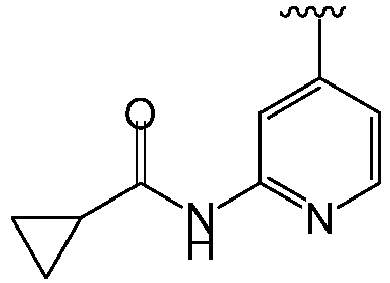
100 30 0.37 207 115 Intermediate 104 
100 30 0.37 195 -

- To a stirred suspension of 1-(2-((4-bromopyridin-2-yl)oxy)ethyl)pyrrolidin-2-one (Intermediate 105) (490 mg, 1.718 mmol), 4,4,4',4',5,5,5',5'-octamethyl-2,2'-bi(1,3,2-dioxaborolane) (873 mg, 3.44 mmol) and potassium acetate (506 mg, 5.16 mmol) was added PdCl2(dppf) (126 mg, 0.172 mmol).
- The mixture was placed in a microwave vial and heated in a Biotage Initiator microwave reactor microwave at 100 °C for 1 hr. The mixture was diluted in ethyl acetate and filtered through a Celite cartridge (10g). The solvent was evaporated to give a brown oil (1.35 g, 4.06 mmol, 236%). This crude material was used in the next step without further purification: 100% conversion assumed therefore maximum purity of crude material is 42%.
LCMS (2 min, Formic Acid): Rt = 0.46 min, MH+ = 251 consistent with hydrolysis to boronic acid under LCMS conditions
1H NMR (400MHz, CDCl3) δ-ppm 8.15 (1H, d), 7.19 (1H, d), 7.12 (1H, s), 4.42 (2H, t), 3.67 (2H, t), 3.53 (2H, t), 2.38 (2H, t), 2.00 (2H, m), 1.34 (12H, s). -

- The title compound was prepared in crude form from 3-bromo-5-(cyclopropylmethoxy)pyridine (Intermediate 106) using the method described for Intermediate 116.
LCMS (2 min, Formic Acid): Rt = 0.43 min, MH+ = 194 consistent with hydrolysis to boronic acid under LCMS conditions. -

- Piperidin-3-ol hydrochloride (0.759 g, 5.51 mmol) was added to a suspension 7-bromo-5-methyl-4-oxo-4,5-dihydrothieno[3,2-c]pyridine-2-carbaldehyde (Intermediate 3) (1 g, 3.67 mmol) in MeOH (18 mL) and acetic acid (2 mL) and the mixture was stirred for 30 min at rt. 2-Picoline-borane complex (0.590 g, 5.51 mmol) was added and the reaction was stirred o/n. The reaction was heated to 50°C and stirred for 4 hr. The solvent was evaporated and sodium bicarbonate was added (30 mL). The residue was extracted with DCM (3 x 20 mL). The extracts were dried by filtration through a hydrophobic frit and then concentrated in vacuo to give the crude product which was purified by silica gel column chromatography [0-5% MeOH in DCM]. Fractions containing pure product were concentrated in vacuo. Fractions containing a mixture of compounds were combined and concentrated in vacuo then purified by silica gel column chromatography [5% MeOH in DCM]. All pure product containing fractions were combined to give the title compound as a yellow solid 7-bromo-2-((3-hydroxypiperidin-1-yl)methyl)-5-methylthieno[3,2-c]pyridin-4(5H)-one (603 mg, 1.688 mmol, 45.9 % yield).
LCMS (2 min, Formic Acid): Rt = 0.49 min, MH+ = 357/359. -

- To a stirred suspension of cyclopropylmethanol (0.577 mL, 7.30 mmol) in THF (50 mL) was added sodium hydride (60% w/w) (0.292 g, 7.30 mmol) portion-wise under nitrogen. The mixture was stirred for 30 min then 2,6-dichloro-4-iodopyridine (2g, 7.30 mmol) was added. The mixture was stirred for 1 hr then evaporated to dryness under reduced pressure. The residue was dissolved in MeOH and silica gel was added. The solvent was removed in vacuo and the material was loaded on to a SNAP 340g silica gel column as a dry solid and eluted with a gradient of 0-10% DCM in cyclohexane. Appropriate fractions were combined and concentrated in vacuo to give the title compound as a white solid (860 mg, 38%).
LCMS (2 min, Formic Acid): Rt = 1.42 min, MH+ = 310/312 -

- To a stirred suspension of 2-chloro-6-(cyclopropylmethoxy)-4-iodopyridine (Intermediate 119) (100 mg, 0.323 mmol) in 1,4-dioxane (8 mL), was added 4,4,4',4',5,5,5',5'-octamethyl-2,2'-bi(1,3,2-dioxaborolane) (164 mg, 0.646 mmol), potassium acetate (95 mg, 0.969 mmol) and PdCl2(dppf) (23.64 mg, 0.032 mmol). This was sealed in a microwave vial, heated to 100 °C in a Biotage microwave for 1 hr then at 120 °C for 2 hr. The mixture was diluted with EtOAc (20 mL) and water (20 mL). Two layers separated and the aqueous layer was further extracted with EtOAc (2 x 20 mL).
- The combined organic layers were reduced to give the title compound as a brown oil (160 mg, 0.517 mmol, 160%). This crude material was used in the next step without further purification: 100% conversion assumed therefore maximum purity of crude material is 62.5%.
LCMS (2 min, Formic Acid): Rt = 0.95 min, MH+ = 228/230 consistent with hydrolysis to boronic acid under LCMS conditions. -
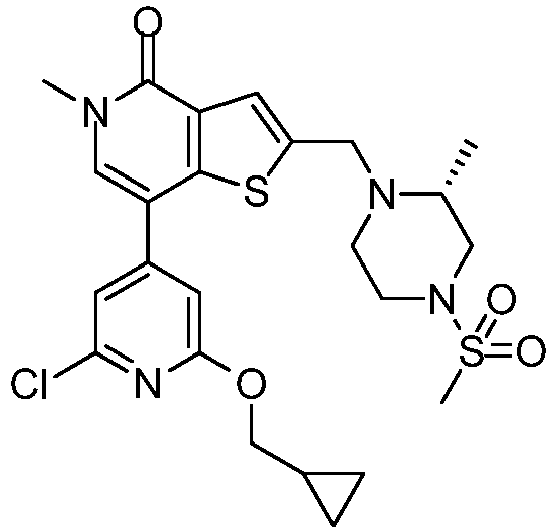
- To a stirred suspension of crude 2-chloro-6-(cyclopropylmethoxy)-4-(4,4,5,5-tetramethyl-1,3,2-dioxaborolan-2-yl)pyridine (Intermediate 120) (157 mg, 62.5% w/w, 0.317 mmol) in 1,2-DME (4 mL), was added potassium carbonate (95 mg, 0.691 mmol), (R)-7-bromo-5-methyl-2-((2-methyl-4-(methylsulfonyl)piperazin-1-yl)methyl)thieno[3,2-c]pyridin-4(5H)-one (Intermediate 21) (100 mg, 0.230 mmol) and tetrakis(triphenylphosphine) palladium (0) (11 mg, 9.52 µmol). The contents were sealed in a microwave vial and placed in a Biotage Initiator microwave reactor microwave for 2 hr and heated to 120 °C. The mixture was dissolved in EtOAc (20 mL) and water (20 mL). The aqueous layer was further extracted with EtOAc (3 x 20 mL). The organics were concentrated in vacuo to give a brown oil. This was dissolved in DCM and loaded onto a SNAP silica cartridge (10g) and eluted with a gradient of 2.5% MeOH in EtOAc. Appropriate fractions were combined and reduced in vacuo to give a brown oil (30 mg, 24.3%).
LCMS (2 min, Formic Acid): Rt = 1.02 min, MH+ = 537/539. -

- A mixture of 7-bromo-5-methyl-4-oxo-4,5-dihydrothieno[3,2-c]pyridine-2-carbaldehyde (Intermediate 3) (1.0 g, 3.67 mmol) and morpholine (480 mg, 475 µL, 5.51 mmol) in MeOH (19 mL) and glacial acetic acid (1 mL) was stirred at rt for 15 min. The reaction mixture was treated with 2-picoline-borane complex (1.18 g, 11. 03 mmol). The reaction mixture was stirred at rt for 24 hours. The solvent was evaporated. Saturated sodium bicarbonate solution (50 mL) was added to the residue.
- The mixture was extracted with DCM (3x25 mL). The combined extracts were washed with brine, dried and evaporated. The residue was by silica gel column chromatography [0-5% MeOH/DCM] to give the title compound (708 mg, 2.063 mmol, 56.1 % yield) as a pale yellow solid.
LCMS (2 min, Formic Acid): Rt = 0.48 min, MH+ = 343/345. -

- To a solution of 7-bromo-5-methyl-4-oxo-4,5-dihydrothieno[3,2-c]pyridine-2-carbaldehyde (Intermediate 3) (2g, 7.35 mmol) in MeOH (250 mL) was added acetic acid (1 mL) and tert-butyl 1,4-diazepane-1-carboxylate (2 g, 9.99 mmol). The solution was stirred at rt for 1.5 hr then NaCNBH3 (2.3 g, 36.6 mmol) was added. The solution was stirred at rt overnight then the MeOH (250 mL) was removed in vacuo. The residue was dissolved in DCM (200 mL) and washed with water (3 x 100 mL). The crude product was purified by silica gel column chromatography eluting with DCM/MeOH (50/1) to give the title compound (1.409 g, 3.09 mmol, 42 % yield) as yellow solid.
LCMS: MH+ = 456/458 -

- To a suspension of 4-bromo-2-((tetrahydro-2H-pyran-4-yl)methoxy)pyridine (Intermediate 10) (11.1 g, 40.8 mmol), 4,4,4',4',5,5,5',5'-octamethyl-2,2'-bi(1,3,2-dioxaborolane) (51.8 g, 204 mmol) and potassium acetate (16.01 g, 163 mmol) in 1,4-dioxane (200 mL) stirred under nitrogen at rt was added solid PdCl2(dppf) (1.492 g, 2.039 mmol) in one charge. The reaction mixture was stirred at 100 °C for 16 hr. The reaction mixture was concentrated and the residue was purified via silica gel column eluting with petroleum ether/EtOAc (5:1) to give the crude title compound (8.7 g, 27.3 mmol, 66.8 % yield) as a yellow oil.
LCMS MH+ = 238 consistent with hydrolysis to boronic acid under LCMS conditions. 1 H NMR consistent with desired product but shows significant pinacol related impurities. - The crude material from the step above was loaded onto a silica gel column (200-300 Mesh Size) and was eluted with petroleum ether/EtOAc (15:1 to 5:1). The appropriate fractions were combined and evaporated in vacuo to give the title compound (5.2 g, 15.96 mmol, 85 % yield) as white crystals.
LCMS MH+ = 238 consistent with hydrolysis to boronic acid under LCMS conditions.
1H NMR (400MHz, DMSO-d6) δ-ppm 8.21 (1 H, d), 7.14 (1 H, d), 6.98 (1 H, s), 4.14 (2H, d), 3.86 (2H, m), 3.29 (2H, m), 2.00 (1H, m), 1.61 (2H, m), 1.27 (12H, s & 2H m). -

- To a solution of tert-butyl 4-((7-bromo-5-methyl-4-oxo-4,5-dihydrothieno[3,2-c]pyridin-2-yl)methyl)-1,4-diazepane-1-carboxylate (Intermediate 123) (500 mg, 1.096 mmol) in DMF (5 mL) was added 2-((tetrahydro-2H-pyran-4-yl)methoxy)-4-(4,4,5,5-tetramethyl 1,3,2-dioxaborolan-2-yl)pyridine (Intermediate 124) (350 mg, 1.096 mmol), potassium carbonate (303 mg,2.191 mmol) and tetrakis(triphenylphosphine) palladium (0) (127 mg, 0.110 mmol). The reaction vessel was sealed and heated in microwave to 120 °C for 30 min under nitrogen. The DMF was removed and the crude product was purified by silica gel column chromatography eluting with DCM/MeOH (20-1) to give the title compound (488 mg, 0.858 mmol, 78 % yield) as a light yellow solid.
LCMS: MH+= 569, purity 85%. -

- To a solution of 4-bromo-2-fluoropyridine (3.58 g, 20.34 mmol) in NMP (17 mL) was added pyridin-2-ylmethanamine (2 g, 18.49 mmol). The reaction mixture was stirred at 100°C for 1 hr. then cooled to rt and partitioned between DCM (100 mL) and water (100 mL). The organic phase was washed with saturated brine (50 mL), dried over sodium sulphate and concentrated in vacuo to give the title compound (6 g, 3.25 mmol, 17.56 % yield) as a yellow oil (containing NMP) that was used without further purification on the next step
LCMS: MH+ =264. -

- To a suspension of crude 4-bromo-N-(pyridin-2-ylmethyl)pyridin-2-amine (Intermediate 126) (5.8 g, 3.07 mmol), 4,4',4',5,5,5',5'-octamethyl-2,2'-bi(1,3,2-dioxaborolane) (3.90 g, 15.37 mmol) and potassium acetate (0.905 g, 9.22 mmol) in 1,4-dioxane (30 mL) stirred under nitrogen at rt, was added 1,1'-bis(diphenylphosphino)ferrocene-palladium(II) dichloride-DCM complex (0.251 g, 0.307 mmol). The reaction mixture was stirred at 100°C for 2 hr. The reaction mixture was cooled to rt and filtered. The filtrate was concentrated and the residue was purified by combi-flash chromatography on silica gel (40 g) eluting with EtOAc/petroleum (0∼100% over 40 min, 100% over 40 min) to give a crude product as a brown solid. The solid was further purified by re-crystallization with ether/hexane (1:30, 1 mL/30 mL) to give the title compound (700 mg, 2.249 mmol, 73.2 % yield) as a brown solid.
LCMS: M/Z 230 indicates hydrolysis of boronate ester under LCMS conditions.
1H NMR (400MHz, CDCl3) δ-ppm 8.56 (1H, d), 8.14 (1H, d), 7.61 (1H, t), 7.31 (1H, d), 7.17 (1H, t), 6.89 (2H, m), 6.67 (1 H, br.s), 4.69 (2H, d), 1.31 (12H, s). -

- To a suspension of tert-butyl 4-((7-bromo-5-methyl-4-oxo-4,5-dihydrothieno[3,2-c]pyridin-2-yl)methyl)-1,4-diazepane-1-carboxylate (Intermediate 123) (250 mg, 0.548 mmol), N-(pyridin-2-ylmethyl)-4-(4,4,5,5-tetramethyl-1,3,2-dioxaborolan-2-yl)pyridin-2-amine (Intermediate 127) (256 mg, 0.822 mmol) and Cs2CO3 (535 mg, 1.643 mmol) in 1,4-dioxane (20 mL) and water (5 mL) stirred at rt, was added tetrakis(triphenylphosphine)palladium (0) (63.3 mg, 0.055 mmol). The reaction mixture was warmed to 100°C and stirred for 20 hr under nitrogen. The reaction mixture was cooled to rt and concentrated. DCM (50 mL) was added to the residue which was then filtered. The filtrate was concentrated and the residue was purified by combi-flash chromatography on silica gel (4 g) eluting with MeOH/ DCM (0∼10% over 20 min, 10% over 10 min) to give the title compound (280 mg, 0.499 mmol, 91 % yield) as a brown glass.
LCMS: MH+ = 561 -

- To a solution of pyridin-2-ylmethanol (5 g, 45.8 mmol) and Et3N (19.16 mL, 137 mmol) in dry DCM (50 mL) stirred under nitrogen at -78°C was added dropwise, methanesulfonyl chloride (10.50 g, 92 mmol) and then the reaction mixture was stirred at -50°C for 30 min. The reaction mixture was quenched with water (30 mL) then partitioned between DCM (100 mL) and water (25 mL). The organic phase was washed with saturated brine (50 mL), dried over sodium sulphate and evaporated in vacuo to give pyridin-2-ylmethyl methanesulfonate (8.57 g, theoretical yield: 100%) as an orange oil which was used crude in the next reaction. To a suspension of 3-bromophenol (7.93 g, 45.8 mmol) and K2CO3 (19.00 g, 137 mmol) in MeCN (200 mL) stirred under nitrogen was added dropwise, a solution of pyridin-2-ylmethylmethanesulfonate (8.57 g , 45.8 mmol) in MeCN (30 mL).
- The reaction mixture was stirred at reflux overnight. The reaction mixture was quenched with water (100 mL) then partitioned between DCM (500 mL) and water (100 mL).The organic phase was washed with saturated brine (3 x 50 mL), dried over sodium sulphate and evaporated in vacuo. The crude product which was purified by a silica gel column chromatography eluting with EtOAc/petroleum ether (1:2) to give the title compound (9 g, 32.4 mmol, 70.7 % yield) as a yellow oil.
LCMS: MH+ = 264/266 -

- To a suspension of 2-((3-bromophenoxy)methyl)pyridine (Intermediate 129) (4.0 g, 15.14 mmol), 4,4,4',4',5,5,5',5'-octamethyl-2,2'-bi(1,3,2-dioxaborolane) (19.23 g, 76 mmol) and potassium acetate (4.46 g, 45.4 mmol) in 1,4-dioxane (30 mL) stirred under nitrogen at rt was added 1,1'-bis(diphenylphosphino)ferrocene-palladium(II) dichloride-DCM complex (1.237 g, 1.514 mmol). The reaction mixture was stirred at 100 °C for 2 hr. The reaction mixture was cooled to rt and filtered.
- The filtrate was concentrated and the residue was purified by combi-flash chromatography on silica gel (40 g) eluting with EtOAc/petroleum (0∼20% over 20 min, 20% over 20 min) to give the title compound (5.2 g, 13.37 mmol, 88 % yield, purity: 80% (NMR)) as a yellow oil.
LCMS MH+ =312.
1H NMR (400MHz, CDCl3) δ-ppm 8.60 (1H, d), 7.75 (1H, m), 7.58 (1 H, dt), 7.50 (1 H, d), 7.45 (1H, d), 7.28 (2H, m), 7.09 (1 H, d), 5.25 (2H, s), 1.33 (12H, s). -

- The title compound was prepared from Intermediates 123 and 130 using a method similar to that described for intermediate 128. Brown glass (280 mg, 0.499 mmol, 91 % yield).
LCMS: MH+ = 561. -

- Sodium hydride, 60% suspension in mineral oil, (1.76 g, 44 mmol) was added portion-wise over 5 min to a stirred solution of pyridin-2-ylmethanol (4.37 g, 40.0 mmol) in dry THF (50 mL) under nitrogen. After complete addition the mixture was stirred at rt for 30 min. A solution of 4-bromo-2-chloropyridine (3.85 g, 20 mmol) in dry THF (20 mL) was added slowly. After complete addition the reaction mixture was stirred at rt for 20 hours. The reaction mixture was quenched with aqueous NH4Cl solution (50 mL) and diluted with EtOAc (100 mL). The solution was washed with water (50 mL) and brine (50 mL). The organic phase was dried and evaporated. The residue was purified by combi-flash chromatography on silica gel (40 g) eluting with EtOAc/petroleum (0∼50% over 30 min, 50% over 10 min) to give the title compound (1.70 g, 6.41 mmol, 32.1 % yield) as a pale yellow oil.
LCMS: MH+ = 265/267 -

- The title compound was prepared from Intermediate 132 using a method similar to that described for intermediate 130. Brown oil (2.5 g, 5.61 mmol, 87 % yield, purity∼70% by 1H NMR).
LCMS: M/Z 231 indicates hydrolysis of boronate ester under LCMS conditions.
1H NMR (400MHz, CDCl3) δ-ppm 8.61 (1 H, d), 8.17 (1 H, d), 7.69 (1 H, m), 7.46 (1 H, d), 7.25 (3H, m), 5.54 (2H, s), 1.36 (12H, s). -

- The title compound was prepared from Intermediates 123 and 133 using a method similar to that described for intermediate 128. Brown glass (360 mg, 0.449 mmol, 68% yield, ∼70% pure by NMR).
LCMS: MH+ = 562. -

- To a solution of phenylmethanol (2.248 g, 20.79 mmol) in THF (100 mL), was added NaH (60% w/w) (0.914 g, 22.86 mmol) at 0°C. The reaction mixture was stirred at 0°C for 4 hr. 4-bromo-2-chloropyridine (2 g, 10.39 mmol) in THF (50 mL) was added dropwise into the reaction mixture at 0 °C. The reaction mixture was stirred at 25°C for overnight. The reaction mixture was partitioned between EtOAc (100 mL) and water (100 mL). The organic phase was washed with saturated brine (100 mL), dried over sodium sulphate and evaporated in vacuo to give the crude product. The crude product was purified by Combi-Flash chromatography on a silica column (24g) and eluted with EtOAc/petroleum (0∼100% over 10 min, 100% over 5 min). Appropriate fractions were evaporated to give the title compound (1.272 g, 4.82 mmol, 46.3 % yield) as a white oil.
LCMS: MH+ =264/266 -

- The title compound was prepared from Intermediate 135 using a method similar to that described for intermediate 130. Light oil (850 mg, 2.73 mmol, 65.6 % yield).
LCMS: M/Z 230 indicates hydrolysis of boronate ester under LCMS conditions.
1H NMR (400MHz, CDCl3) δ-ppm 8.19 (1 H, d), 7.45 (2H, d), 7.38 (2H, m), 7.30 (1 H, d), 7.20 (2H, m), 5.39 (2H, s), 1.36 (12H, s). -

- The title compound was prepared from Intermediates 123 and 136 using a method similar to that described for intermediate 128. Brown glass (340 mg, 0.606 mmol, 92% yield).
LCMS: MH+ = 561. -
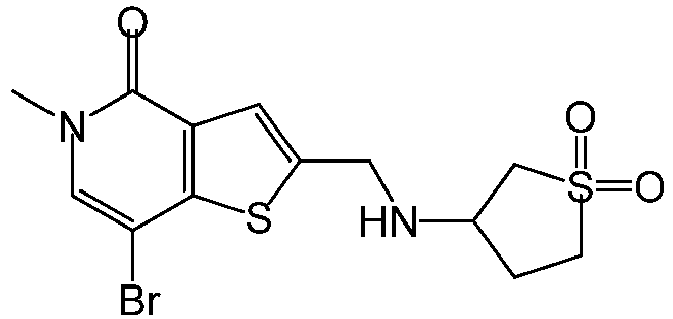
- A mixture of 7-bromo-5-methyl-4-oxo-4,5-dihydrothieno[3,2-c]pyridine-2-carbaldehyde (Intermediate 3) (250 mg, 0.919 mmol), 3-aminotetrahydrothiophene 1,1-dioxide (199 mg, 1.470 mmol) in MeOH (3.5 mL) and acetic acid (0.35 mL) was left to stir for 3 hr at 50 °C. The 2-picoline-borane complex (108 mg, 1.011 mmol) was added and the reaction mixture was left to stir for a further 4 hr. The solution was allowed to cool to rt and concentrated in vacuo. The residue was diluted with sat. aq. NaHCO3 (40 mL) and extracted with DCM (3 x 40 mL). The combined organic layers were passed through a hydrophobic frit and concentrated in vacuo. The resulting residue was purified by silica gel column chromatography eluting with 0-4% MeOH in DCM. The appropriate fractions were combined and evaporated in vacuo to give the title compound (340 mg, 0.87 mmol, 95%) as a pale yellow solid.
LCMS (2 min, Formic Acid): Rt = 0.50 min, MH+ = 391/393. -

- A mixture of 7-bromo-5-methyl-4-oxo-4,5-dihydrothieno[3,2-c]pyridine-2-carbaldehyde (Intermediate 3) (250 mg, 0.919 mmol) and 4-aminotetrahydro-2H-thiopyran 1,1-dioxide (200 mg, 1.340 mmol) in MeOH (3.5 mL) and acetic acid (0.35 mL) was left to stir at 50 °C for 4 hr. After this time the 2-picoline-borane complex (108 mg, 1.011 mmol) was added and the reaction mixture was left to stir for a further 20 hr. The volatile components were removed in vacuo and the resulting residue was diluted with sat. aq. NaHCO3 (40 mL). The aqueous layer was extracted with DCM (3 x 40 mL). The combined organic layers were filtered through a hydrophobic frit and concentrated in vacuo. The resulting residue was purified by silica gel column chromatography eluting with 0-4% MeOH in DCM.
- The appropriate fractions were combined and evaporated in vacuo to give the title compound (210 mg, 0.52 mmol, 56%) as a pale yellow solid.
LCMS (2 min, Formic Acid): Rt = 0.47 min, MH+ = 405/407. -

- To a solution of 3-methylpiperidine-3-carboxylic acid (600 mg, 4.19 mmol) in THF (30 mL) stirred under nitrogen at 0°C was added lithium aluminium hydride (318 mg,8.38 mmol) in THF (30 mL).
- The reaction mixture was stirred at 60 °C overnight then combined with a separate reaction mixture (carried out on 100 mg scale). The combined mixtures were filtered through a cake of Celite and the filtrate was concentrated to give the title compound (300 mg, 2.090 mmol, 49.9 % yield) as a yellow solid.
LCMS: MH+ = 130. -

- A solution of (3-methylpiperidin-3-yl)methanol (Intermediate 140) (300 mg, 2.322 mmol), (Boc)2O (0.647 mL, 2.79 mmol) and triethylamine (0.971 mL, 6.97 mmol) in DCM (20 mL) was stirred under nitrogen at rt overnight. The reaction mixture was quenched with 1M HCl (5 mL).The water phase was extracted by DCM (3 x 10 mL). The organic layer was evaporated in vacuo to give the crude title compound (300 mg, 1.047 mmol, 45.1 % yield) as yellow solid which was used in the next step without further purification.
LCMS: m/z = 174 [(M-55)H+], consistent with loss of tert-butyl group -
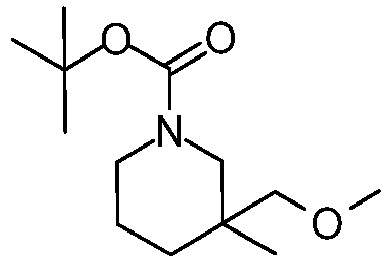
- To a solution of tert-butyl 3-(hydroxymethyl)-3-methylpiperidine-1-carboxylate (Intermediate 141) (300 mg,1.308 mmol) and NaH (60% w/w) (105 mg, 2.62 mmol) in DMF (5 mL) stirred in the sealed tube at rt for 1 hr, was added methyl iodide (0.818 mL, 13.08mmol) in DMF (5 mL). The reaction mixture was stirred at rt overnight. The solvent was evaporated in vacuo to give the crude product.
- The crude
product was partitioned between EtOAc (10 mL) and water (2 mL). The organic layer was evaporated to give the crude title compound (300 mg, 0.986 mmol, 75 % yield) as a yellow solid which was used in the next step without further purification.
LCMS: m/z = 188 [(M-55)H+], consistent with loss of tert-butyl group. -
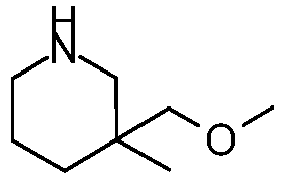
- A solution of tert-butyl 3-(methoxymethyl)-3-methylpiperidine-1-carboxylate (Intermediate 142) (300 mg,1.233 mmol) and TFA (2 mL, 26.0 mmol) in DCM (10 mL) stirred under nitrogen at rt for 1 hr.
- The solvent was evaporated in vacuo to give the crude title compound (200mg, 1.117 mmol, 91 % yield) as a yellow solid which was used in the next step without further purification.
LCMS: MH+ = 144. -
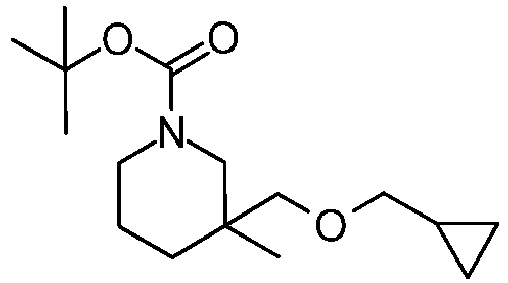
- The title compound was prepared from Intermediate 141 and (bromomethyl)cyclopropane using a method similar to that described for Intermediate 142. The crude product was purified by silica gel column chromatography eluting with hexane/EtOAc (5/1) to give the title compound (320 mg, 0.903 mmol, 71.4 % yield) as a yellow solid.
LCMS: M/Z = 228 [(M-55)H+], consistent with loss of tert-butyl group. -

- The title compound was prepared from Intermediate 144 using a method similar to that described for Intermediate 143. Crude yellow solid (150 mg, 0.655 mmol, 58 % yield).
LCMS: MH+ = 184. -

- A mixture of 4-bromo-2-chloropyridine (4.35 g, 2.5 ml, 22.6 mmol) and 2-methoxy-N-methylethanamine (6.09 g, 7.5 ml, 68.3 mmol) was heated in a microwave at 150 °C for 1 hr. The reaction mixture was cooled to room temperature. The solution was diluted with toluene (20 mL) and the solvent was evaporated, then re-evaporated from toluene (x2). The residue was chromatographed [20-50% ethyl acetate/hexane] to give the title compound, 4-bromo-N-(2-methoxyethyl)-N-methylpyridin-2-amine (500 mg, 2.040 mmol, 9.02 % yield) as a colourless oil.
1H NMR (400MHz, CDCl3) δ-ppm 7.93 (1 H, d), 6.64 (2H, m), 3.70 (2H, t), 3.53 (2H, t), 3.32 (3H, s), 3.07 (3H, s). - Also obtained was 2-chloro-N-(2-methoxyethyl)-N-methylpyridin-4-amine (3.25 g, 16.20 mmol, 71.7 % yield) as a colourless oil.
1H NMR (400MHz, CDCl3) δ-ppm 7.95(1 H, d), 6.52 (1 H, d), 6.42 (1 H, dd), 3.51 (4H, m), 3.32 (3H, s), 3.02 (3H, s). -

- A mixture of 4-bromo-N-(2-methoxyethyl)-N-methylpyridin-2-amine (Intermediate 146) (209 mg, 0.853 mmol), potassium acetate (335 mg, 3.41 mmol), bis(pinacolato)diboron (1083 mg, 4.26 mmol) and PdCl2(dppf) (62.4 mg, 0.085 mmol) in 1,4-dioxane (4 mL) was heated in the microwave at 110 °C for 30 min. The cooled reaction mixture was diluted with ethyl acetate and the solution was filtered through Celite. The filtrate was dried and evaporated in vacuo to give the title compound as a crude black oil. No further purification was attempted and this material was used crude in the following step (quantitative yield assumed).
LCMS (2 min, Formic Acid): Rt = 0.34 min, MH+ = 211. -
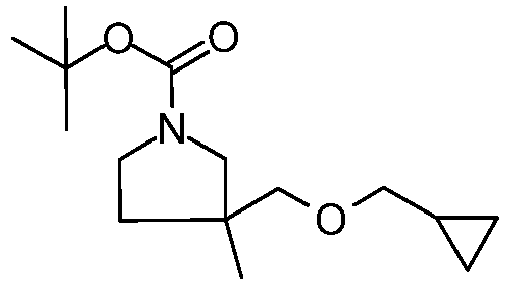
- The title compound was prepared from tert-butyl 3-((hydroxymethoxy)methyl)-3-methylpyrrolidine-1-carboxylate and (bromomethyl)cyclopropane using a method similar to that described for Intermediate 142 with heating at 60°C. The crude product was purified by silica gel column chromatography eluting with hexane/EtOAc (5/1) to give the title compound (185 mg, 0.687 mmol, 73.9 % yield) as a white solid.
LCMS: M/Z = 214 [(M-56)H+], consistent with loss of tert-butyl group. -

- To a solution of tert-butyl 3-((cyclopropylmethoxy)methyl)-3-methylpyrrolidine-1-carboxylate (Intermediate 148) (180 mg, 0.668 mmol) in DCM (10 mL) stirred in air at room temperature was added 2,2,2-trifluoroacetic acid (762 mg, 6.68 mmol) in one charge during 1 min. The reaction mixture was stirred at room temperature for 3 h.The reaction mixture was evaporated and to the residue was partitioned between NaHCO3 (20 mL) and DCM (2 x 30 mL). The organic phase was dried over sodium sulphate and evaporated in vacuo. The crude product was purified by silica gel column chromatography eluting with DCM/MeOH (20:1) to give the title compound (105 mg, 0.620 mmol, 93 % yield) as a light yellow oil.
LCMS: MH+ = 170. -
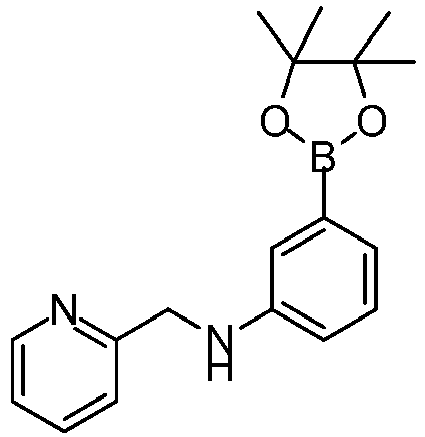
- To 3-(4,4,5,5-tetramethyl-1,3,2-dioxaborolan-2-yl)aniline (3 g,13.69 mmol) and picolinaldehyde (1.540 g, 14.38 mmol) in MeOH (50 mL) was added AcOH (1 drop) and the mixture was stirred for 20 min. NaCNBH3 (4.30 g, 68.5 mmol) was added and the mixture was stirred at rt overnight. The solvent was removed and the residue was extracted with EtOAc (500 mL) and water (500 mL).The aqueous was re-extracted with EtOAc (300 mL). The combined organics were washed with brine (200 mL) then dried with Na2SO4, filtered and concentrated to yield a crude solid. The crude product was loaded onto a silica gel column and was eluted with Hexane/EtOAc(1/1). Appropriate fractions were combined and concentrated to give the title compound (2.6 g, 7.21 mmol, 52.6 % yield) as a colourless oil.
LCMS: MH+ = 311 -

- A mixture of N-(pyridin-2-ylmethyl)-3-(4,4,5,5-tetramethyl-1,3,2-dioxaborolan-2-yl)aniline (Intermediate 150) (255 mg, 0.822 mmol), tert-butyl 4-((7-bromo-5-methyl-4-oxo-4,5-dihydrothieno[3,2-c]pyridin-2-yl)methyl)-1,4-diazepane-1-carboxylate (Intermediate 123) (250 mg, 0.548 mmol), and potassium carbonate (151 mg, 1.096 mmol) in a solution of 1,4-dioxane (50 mL) and water (12.50 mL) was degassed with N2 and tetrakis(triphenylphosphine)palladium (0) (63.3 mg, 0.055 mmol) was added. The reaction was heated to reflux for 3 hr, then concentrated. The residues were partioned between DCM (200 mL) and water (200 mL). The aqueous was re-extracted with DCM (200 mL). The combined organics were washed with brine (200 mL) then dried with Na2SO4, filtered and concentrated to yield a crude solid. The crude product was loaded onto a silica gel column and was eluted with DCM/MeOH (10/1). Appropriate fractions were combined and concentrated to give the title compound (320 mg, 0.412 mmol, 75 % yield) as a orange solid.
LCMS: MH+ = 560. -

- A mixture of 3-(4,4,5,5-tetramethyl-1,3,2-dioxaborolan-2-yl)aniline (2 g, 9.13 mmol), picolinic acid (1.349 g, 10.95 mmol), DIPEA (4.78 mL, 27.4 mmol) and HATU (4.51 g, 11.87 mmol) in DMF (20 mL) was stirred overnight at rt. The mixture was extracted with EtOAc (2 x 200 mL), the combined organics were washed with brine (200 mL), dried with Na2SO4, filtered and concentrated to yield a crude solid. The crude product was loaded onto a silica gel column and was eluted with Hexane/EtOAc(10/1). Appropriate fractions were combined and concentrated to give the title compound (2.0 g, 6.17 mmol, 67.6 % yield) as a white solid. LCMS: MH+ = 325.
-

- The title compound was prepared from tert-butyl 4-((7-bromo-5-methyl-4-oxo-4,5-dihydrothieno[3,2-c]pyridin-2-yl)methyl)-1,4-diazepane-1-carboxylate (Intermediate 123) and N-(3-(4,4,5,5-tetramethyl-1,3,2-dioxaborolan-2-yl)phenyl)picolinamide (Intermediate 152) using a method similar to that described for Intermediate 151. Orange solid (120mg, 0.149 mmol, 27.1 % yield). LCMS: MH+ = 574.
-

- A mixture of crude 7-bromo-2-(bromomethyl)-5-methylthieno[3,2-c]pyridin-4(5H)-one (for an example preparation see Intermedate 53) (300 mg, 50% w/w, 0.445 mmol), tert-butyl 3-methylpiperazine-1-carboxylate (178 mg, 0.890 mmol) and potassium carbonate (123 mg, 0.890 mmol) in DMF (10 mL) was stirred for 4 h at rt. The solvent was removed and the crude product was purified by silica gel column chrmoatography eluting with with DCM/MeOH to give the crude title compound (400 mg) as a colourless solid which was used in the next step without further purification. LCMS: MH+ = 456/458.
-

- A mixture of crude tert-butyl 4-((7-bromo-5-methyl-4-oxo-4,5-dihydrothieno[3,2-c]pyridin-2-yl)methyl)-3-methylpiperazine-1-carboxylate (Intermediate 154) (400 mg) and TFA (1.5 mL) in DCM was stirred for 16 h. The solvent was removed to give the trifluoroacetic acid salt of the title compound (260 mg, 82% w/w) as an orange oil, which used in the next step without further purification. LCMS: MH+ = 356/358.
-

- To crude 7-bromo-5-methyl-2-((2-methylpiperazin-1-yl)methyl)thieno[3,2-c]pyridin-4(5H)-one (Intermediate 155) (260 mg, 82% w/w, 0.598 mmol) and triethylamine (0.250 mL, 1.795 mmol) in acetonitrile (50 mL) was added acetic anhydride (122 mg, 1.197 mmol) and the mixture was stirred for 4 h. The solvent was removed and the crude product was purified by silica gel column chromatography eluting with DCM/MeOH (20:1) to give the title compound (310 mg, 46% w/w) as a colourless oil, which was used crude in the next step. LCMS: MH+ = 398/400.
-

- To a solution of tert-butyl 3-oxopiperazine-1-carboxylate (521 mg, 2.60 mmol) in THF (50 mL) was added sodium hydride (167 mg, 6.94 mmol), the mixture was stirred for 1 h at rt, then crude 7-bromo-2-(bromomethyl)-5-methylthieno[3,2-c]pyridin-4(5H)-one (for an example preparation see Intermedate 53) (900 mg, 65% w/w, 1.736 mmol) was added and the mixture were stirred overnight at rt. The mixture was concentrated and was purified by silica gel column chromatography eluting with DCM/MeOH (50/1) to give the title compound (417 mg, 0.786 mmol, 45.3 % yield).
LCMS: M/Z = 400/402 [(M-56)H+], consistent with loss of tert-butyl group. -

- To a solution of tert-butyl 4-((7-bromo-5-methyl-4-oxo-4,5-dihydrothieno[3,2-c]pyridin-2-yl)methyl)-3-oxopiperazine-1-carboxylate (Intermediate 157) (600 mg, 1.315 mmol) in 1,4-dioxane (42 mL) was added 2-((tetrahydro-2H-pyran-4-yl)methoxy)-4-(4,4,5,5-tetramethyl-1,3,2-dioxaborolan-2-yl)pyridine (Intermediate 124) (630 mg, 1.972 mmol) and tetrakis(triphenylphosphine)palladium (0) (76 mg, 0.066 mmol). The reaction was evacuated and purged with nitrogen, followed by addition of cesium carbonate (857mg, 2.63 mmol) and water (10.50 mL). The mixture was heated to 100 °C overnight.
- Then the reaction mixture was cooled to rt. The organic layer was removed and the aqueous layer was extracted with EtOAc (3 x 100 mL), the combined organic extracts were washed with brine (120 mL) and concentrated in vacuo. The crude product was purified by silica gel column chromatography eluting with DCM/MeOH (10:1) to give the title compound (750 mg, 0.791 mmol, 60.2 % yield) as a white solid.
LCMS: MH+ = 569. -

- A suspension of 7-bromo-5-methyl-4-oxo-4,5-dihydrothieno[3,2-c]pyridine-2-carbaldehyde (Intermediate 3) (1 g, 3.67 mmol) and 2-(methylamino)ethanol (0.590 mL, 7.35 mmol) was heated to 50 °C for 4 h. Picoline borane complex (0.444 g, 4.04 mmol) was added and the reaction mixture was heated for a further 18 h (solvation achieved). The volatile components were removed in vacuo and sat. aq. NaHCO3 (40 mL) was added to the residue (gas evolved). The aqueous layer was extracted with DCM (3 x 50 mL) and the combined organic layers were passed through a hydrophobic frit and concentrated in vacuo. The resulting residue was purified by silica gel chromatography eluting with 0-4% MeOH/DCM. The appropriate fractions were combined and the solvent was evaporated in vacuo to give the title compound (550 mg, 1.66 mmol, 45%) as a yellow solid. LCMS (2 min, Formic Acid): Rt = 0.45 min, MH+ = 331/333.
-

- A mixture of 7-bromo-5-methyl-2-((4-(methylsulphonyl)piperazin-1-yl)methyl)thieno[3,2-c]pyridin-4(5H)-one (for a preparation see Intermediate 69, 105 mg, 0.25 mmol), (5-(1-phenylethoxy)pyridin-3-yl)boronic acid (for a preparation see Intermediate 5, 91 mg, 0.375 mmol), potassium carbonate (104 mg, 0.75 mmol) and bis(triphenylphosphine)palladium(II) chloride (18 mg, 10 mol%) in 1,2-dimethoxyethane (3 mL) and water (0.5 mL) was heated in a microwave at 120 °C for 20 minutes.
- The cooled reaction mixture was diluted with ethyl acetate (50 mL). The solution was dried over sodium sulphate and evaporated. The residue was purified by chromatography on silica gel eluting with 0-5% methanol in dichloromethane. The product was dissolved in ethyl acetate (1 mL) and the solution treated with 1M hydrogen chloride in diethyl ether (0.5 mL). The resulting suspension was diluted with diethyl ether (∼10 mL). The solid was filtered off, washed with diethyl ether and dried to give the product 5-methyl-2-((4-(methylsulphonyl)piperazin-1-yl)methyl)-7-(5-(1-phenylethoxy)pyridin-3-yl)thieno[3,2-c]pyridin-4(5H)-one hydrochloride (31 mg, 0.054 mmol, 21.56% yield) as a colourless solid.
LCMS (2 min, Formic Acid): Rt = 0.82 min, MH+ = 539. -

- To a stirred solution of 7-(3-hydroxyphenyl)-5-methyl-2-((4-(methylsulphonyl)piperazin-1-yl)methyl)thieno[3,2-c]pyridin-4(5H)-one (for a preparation see Example 10, 100 mg, 0.231 mmol) in N,N-dimethylformamide (5 mL) was added potassium carbonate (96 mg, 0.692 mmol) followed by 2-(1-bromoethyl)pyridine hydrobromide (73.9 mg, 0.277 mmol). The reaction was heated to 100 °C for 17 hours. The reaction was cooled to room temperature and quenched with water (30 mL). The aqueous layer was extracted with ethyl acetate (3 x 30 mL). The organic fractions were combined and washed with saturated sodium chloride solution (25 mL). The organic layer was collected, dried over magnesium sulphate and concentrated in vacuo to give a yellow oil. The crude material was purified by chromatography on silica gel eluting with 0-5% methanol in dichloromethane to give a pale yellow oil which was triturated with diethyl ether to give a light yellow solid which was repurified by MDAP to give a clear colourless oil which was triturated with diethyl ether to give an off white solid, 5-methyl-2-((4-(methylsulphonyl)piperazin-1-yl)methyl)-7-(3-(1-(pyridin-2-yl)ethoxy)phenyl)thieno[3,2-c]pyridin-4(5H)-one (24 mg, 0.045 mmol, 19.32% yield).
LCMS (2 min, Formic Acid): Rt = 0.75 min, MH+ = 539 -

- To a microwave vial was added 7-bromo-5-methyl-2-((4-(methylsulphonyl)piperazin-1-yl)methyl)thieno[3,2-c]pyridin-4(5H)-one (for a preparation see Intermediate 69, 500.0 mg, 1.189 mmol), potassium carbonate (492.7 mg, 3.56 mmol), and PEPPSI-IPr (84.3 mg, 0.124 mmol) followed by (±)-(5-(1-(pyridin-2-yl)ethoxy)pyridin-3-yl)boronic acid (for a preparation see Intermediate 6, 405 mg, 1.659 mmol) in isopropanol (10 mL) and water (4 mL). The vial was sealed and heated with stirring at 110 °C for 30 min in a microwave reactor. The reaction mixture was diluted with saturated aqueous sodium bicarbonate solution (80 mL) and extracted with dichloromethane (3 x 50 mL). The combined organic layers were back-washed with water (50 mL), filtered through a cartridge fitted with a hydrophobic frit and evaporated in vacuo. The residue was purified by chromatography on silica gel eluting 0-20% methanol in dichloromethane. The required fractions were combined and evaporated in vacuo to give a residue which was still impure. The residue was repurified by chromatography on silica gel eluting with a gradient of 0-70% (20% methanol in dichloromethane solution) in ethyl acetate. The required fractions were combined and evaporated in vacuo to give the desired product (±)-5-methyl-2-((4-(methylsulphonyl)piperazin-1-yl)methyl)-7-(5-(1-(pyridin-2-yl)ethoxy)pyridin-3-yl)thieno[3,2-c]pyridin-4(5H)-one (193.1 mg, 0.358 mmol, 30.1% yield) as a pale yellow foam.
LCMS (2 min, Formic Acid): Rt = 0.62 min, MH+ = 540. -

-

- A sample of 5-methyl-2-((4-(methylsulfonyl)piperazin-1-yl)methyl)-7-(5-(1-(pyridin-2-yl)ethoxy)pyridin-3-yl)thieno[3,2-c]pyridin-4(5H)-one (Example 3) was separated into its enantiomeric components by chiral preparative HPLC to give the title compounds as follows:
- 190 mg of racemate was dissolved at a rate of 5mg per 0.5 mL EtOH and 0.5 mL portions were injected onto a 2 cm x 25 cm Chiralpak IB column. The column was eluted with 30% EtOH(+0.2% isopropylamine)/Heptane, flow rate=20 mL/min, wavelength 260 nm. Appropriate fractions were combined, concentrated, re-dissolved in DCM and re-concentrated to give the title compounds as white solids.
- Example 3A: 72 mg. LCMS (2 min, Formic Acid): Rt = 0.64 min, MH+ = 540. Enantiomeric purity by chiral HPLC = >99% e.e.
- Example 3B: 73mg. LCMS (2 min, Formic Acid): Rt = 0.63 min, MH+ = 540. Enantiomeric purity by chiral HPLC = 97% e.e.
-

- To a microwave vial was added 7-bromo-5-methyl-2-((4-(methylsulfonyl)piperazin-1-yl)methyl)thieno[3,2-c]pyridin-4(5H)-one (Intermediate 69) (161.5 mg, 0.384 mmol), potassium carbonate (161.2 mg, 1.166 mmol), [1,3-bis(2,6-diisopropylphenyl)-imidazol-2-ylidene](3-chloropyridyl)palladium(II) dichloride (PEPPSI-IPr) (28.4 mg, 0.042 mmol) followed by (S)-(5-(1-(pyridin-2-yl)ethoxy)pyridin-3-yl)boronic acid (Intermediate 90) (131 mg, 0.537 mmol) (662mg of the crude material theoretically containing a maximum of 131 mg, 0.537 mmol of the required boronic acid) in isopropanol (2.5 mL) and water (1 mL). The vial was sealed and heated with stirring at 110 °C for 30 min in a microwave reactor. The reaction mixture was diluted with saturated aqueous sodium bicarbonate solution (30 mL) and extracted with DCM (3 x 20 mL). The combined organic phases were filtered through a cartridge fitted with a hydrophobic frit and evaporated in vacuo. The residue was loaded in DCM (∼10 mL) onto a 25 g SNAP silica cartridge and was purified by Biotage SP4 flash column chromatography eluting with a gradient of 0-70% (20% MeOH in DCM solution) in EtOAc. The required fractions were combined and evaporated in vacuo to give the desired product but still with a significant impurity. The residue was re-dissolved in dichloromethane (∼5 mL), loaded onto a 25g SNAP silica cartridge and was purified by Biotage SP4 flash column chromatography eluting with a gradient of 0-10% MeOH in DCM. The required fractions were combined and evaporated in vacuo to give the desired product as a yellow gum but still with an impurity present.
- The residue was dissolved in MeCN (ca. 2 mL) and a solid crystallised out from the solution. The mother liquor was pipetted away from the solid and the solid washed with MeCN (3 x 0.5 mL). The combined mother liquors were evaporated under a stream of nitrogen to give the title compound (83.4 mg, 0.155 mmol, 40.2 % yield)
LCMS (2 min, Formic Acid): Rt = 0.63 min, MH+ = 540
Purity = >95%
Enantiomeric purity by chiral HPLC = >88% e.e. -

- A mixture of 7-bromo-5-methyl-2-((4-(methylsulphonyl)piperazin-1-yl)methyl)thieno[3,2-c]pyridin-4(5H)-one (for a preparation see Intermediate 69, 100 mg, 0.24 mmol), (5-(benzyloxy)pyridin-3-yl)boronic acid (for a preparation see Intermediate 9, 109 mg, 0.48 mmol), potassium carbonate (164 mg, 1.19 mmol) and bis(triphenylphosphine)palladium(II) chloride (17 mg, 6 mol%) in 1,2-dimethoxyethane (3 mL) and water (0.5 mL) was heated in a microwave at 120 °C for 20 minutes.
- The cooled reaction mixture was diluted with ethyl acetate (50 mL). The solution was dried and evaporated. The residue was purified by chromatography on silica gel eluting with 2-6% methanol in dichloromethane to give 7-(5-(benzyloxy)pyridin-3-yl)-5-methyl-2-((4-(methylsulphonyl)piperazin-1-yl)methyl)thieno[3,2-c]pyridin-4(5H)-one (36 mg, 0.069 mmol, 28.8% yield) as a light brown solid.
LCMS (2 min, Formic Acid): Rt = 0.81 min, MH+ = 525. -

- To a solution of 7-(3-hydroxyphenyl)-5-methyl-2-((4-(methylsulphonyl)piperazin-1-yl)methyl)thieno[3,2-c]pyridin-4(5H)-one (for a preparation see Example 10, 17 mg, 0.039 mmol) and 4-(bromomethyl)tetrahydro-2H-pyran (21.06 mg, 0.118 mmol) in N,N-dimethylformamide (2 mL) was added potassium carbonate (16.26 mg, 0.118 mmol). The resulting mixture was stirred at 100 °C for 3 hours, whereupon it was allowed to cool to room temperature. The reaction mixture was partitioned between ethyl acetate and water. The aqueous phase was extracted 3 times with ethyl acetate and the combined organic layers were washed with brine, dried over magnesium sulphate, filtered and concentrated in vacuo. The residue was purified by chromatography on silica gel eluting with 2-10% methanol in dichloromethane. The appropriate fractions were combined and concentrated in vacuo to give 5-methyl-2-((4-(methylsulphonyl)piperazin-1-yl)methyl)-7-(3-((tetrahydro-2H-pyran-4-yl)methoxy)phenyl)thieno[3,2-c]pyridin-4(5H)-one (13 mg, 0.025 mmol, 65%).
LCMS (2 min, Formic Acid): Rt = 0.80 min, MH+ = 532 -

- To a solution of 7-bromo-5-methyl-2-((4-(methylsulphonyl)piperazin-1-yl)methyl)thieno[3,2-c]pyridin-4(5H)-one (for a preparation see Intermediate 69, 100 mg, 0.238 mmol) and (3-isopropoxyphenyl)boronic acid (64.2 mg, 0.357 mmol) in isopropanol (5 mL) were successively added 2M aqueous potassium carbonate solution (0.595 mL, 1.189 mmol) and PEPPSI-IPr (16.16 mg, 0.024 mmol). The resulting mixture was heated at 110 °C in the microwave for 30 minutes, whereupon the reaction mixture was allowed to cool down to room temperature and was concentrated in vacuo. The crude residue was partitioned between ethyl acetate and a saturated aqueous solution of sodium bicarbonate. The phases were separated, the aqueous phase was extracted 3 times with ethyl acetate and the combined organic layers were washed with brine, dried over magnesium sulphate, filtered and concentrated in vacuo. The residue was purified by chromatography on silica gel eluting with 10 - 60% methanol in dichloromethane. The appropriate fractions were combined and concentrated in vacuo to give 7-(3-isopropoxyphenyl)-5-methyl-2-((4-(methylsulphonyl)piperazin-1-yl)methyl)thieno[3,2-c]pyridin-4(5H)-one (57 mg, 0.12 mmol, 50%) as a colourless oil.
LCMS (2 min, High pH): Rt = 1.12 min, MH+ = 476 -

- A mixture of 7-bromo-5-methyl-2-((4-(methylsulphonyl)piperazin-1-yl)methyl)thieno[3,2-c]pyridin-4(5H)-one (for a preparation see Intermediate 69, 424 mg, 1 mmol), 2-((tetrahydro-2H-pyran-4-yl)methoxy)-4-(4,4,5,5-tetramethyl-1,3,2-dioxaborolan-2-yl)pyridine hydrochloride (for a preparation see Intermediate 11, 359 mg, 1 mmol), and potassium carbonate (697 mg, 5.04 mmol) in toluene (10 mL) and ethanol (10 mL) was degassed and the vessel refilled with nitrogen. Bis(triphenylphosphine)palladium(II) chloride (14 mg, 2 mol%) was added and the mixture stirred at 80 °C, under nitrogen, for 2 hours. The reaction mixture was cooled to room temperature and diluted with ethyl acetate (20 mL). The mixture was filtered through Celite.The solvent was evaporated from the filtrate and the residue purified by chromatography on silica gel eluting with 2% methanol in dichloromethane to give impure product which was repurified by MDAP to give 5-methyl-2-((4-(methylsulphonyl)piperazin-1-yl)methyl)-7-(2-((tetrahydro-2H-pyran-4-yl)methoxy)pyridin-4-yl)thieno[3,2-c]pyridin-4(5H)-one (140 mg, 0.263 mmol, 26.1% yield) as a colourless solid.
LCMS (2 min, Formic Acid): Rt = 0.71 min, MH+ = 533 -
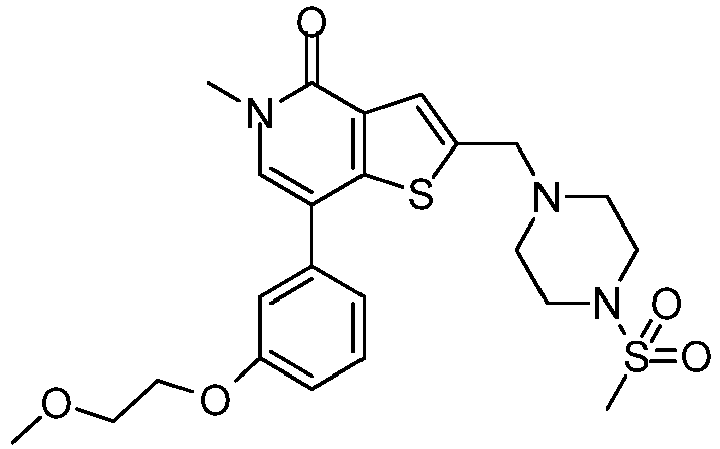
- To a solution of 7-(3-hydroxyphenyl)-5-methyl-2-((4-(methylsulphonyl)piperazin-1-yl)methyl)thieno[3,2-c]pyridin-4(5H)-one (for a preparation see Example 10, 24 mg, 0.055 mmol) and 1-bromo-2-methoxyethane (23.08 mg, 0.166 mmol) in N,N-dimethylformamide (2 mL) was added potassium carbonate (22.95 mg, 0.166 mmol). The resulting mixture was stirred at 100 °C for 12 hours, whereupon it was allowed to cool to room temperature. The residue was partitioned between ethyl acetate and water. The phases were separated and the aqueous phase was extracted with ethyl acetate (5x). The combined organic layers were washed with brine, dried over magnesium sulphate, filtered and concentrated in vacuo. The crude residue was purified via MDAP. The appropriate fractions were collected and concentrated in vacuo to give 7-(3-(2-methoxyethoxy)phenyl)-5-methyl-2-((4-(methylsulphonyl)piperazin-1-yl)methyl)thieno[3,2-c]pyridin-4(5H)-one (22 mg, 0.045 mmol, 81%) as a colourless oil.
LCMS (2 min, Formic Acid): Rt = 0.70 min, MH+ = 492. -

- A mixture of 7-(3-hydroxyphenyl)-5-methyl-2-((4-(methylsulphonyl)piperazin-1-yl)methyl)thieno[3,2-c]pyridin-4(5H)-one (for a preparation see Example 10, 60 mg, 0.14 mmol), potassium carbonate (57 mg, 0.41 mmol) and 3-bromopropan-1-ol) (20 mg, 13 µL, 0.14 mmol) in dry DMF (3 mL) was stirred at 60 °C for 24 hours. The reaction mixture was cooled to room temperature then partitioned between water (10 mL) and ethyl acetate (15 mL). The aqueous phase was extracted with ethyl acetate (15 mL). The combined organics were dried and evaporated. The residue was purified by chromatography on silica gel eluting with 0-5% methanol in dichloromethane. The product was repurified by MDAP. The product was dissolved in ethyl acetate (0.5 mL) and treated with 1M hydrogen chloride in diethyl ether (0.25 mL). Diethyl ether (5 mL) was added, the precipitate was filtered off, washed with diethyl ether and dried to give 7-(3-(3-hydroxypropoxy)phenyl)-5-methyl-2-((4-(methylsulphonyl)piperazin-1-yl)methyl)thieno[3,2-c]pyridin-4(5H)-one hydrochloride (11 mg, 0.021 mmol, 15.05% yield) as a colourless solid.
LCMS (2 min, Formic Acid): Rt = 0.65 min, MH+ = 492. -

- A mixture of 7-bromo-5-methyl-2-((4-(methylsulphonyl)piperazin-1-yl)methyl)thieno[3,2-c]pyridin-4(5H)-one (for a preparation see Intermediate 69, 400 mg, 1.0 mmol), (3-hydroxyphenyl)boronic acid (166 mg, 1.2 mmol), potassium carbonate (415 mg, 3.0 mmol) and bis(triphenylphosphine)palladium(II) chloride (35 mg, 5 mol%) in 1,2-dimethoxyethane (10 mL) and water (1 mL) was heated in a microwave at 120 °C for 30 minutes. The cooled reaction mixture was diluted with ethyl acetate (50 mL). The solution was dried and evaporated. The residue was purified by chromatography on silica gel eluting with 2-5% methanol in dichloromethane and the product triturated with diethyl ether to give 7-(3-hydroxyphenyl)-5-methyl-2-((4-(methylsulphonyl)piperazin-1-yl)methyl)thieno[3,2-c]pyridin-4(5H)-one (400 mg, 0.923 mmol, 92% yield) as a yellow solid.
LCMS (2 min, Formic Acid): Rt = 0.61 min, MH+ = 434. -

- To a microwave reaction vial was added 7-bromo-5-methyl-2-((4-(methylsulphonyl)piperazin-1-yl)methyl)thieno[3,2-c]pyridin-4(5H)-one (for a preparation see Intermediate 69, 105 mg, 0.25 mmol) followed by potassium carbonate (104 mg, 0.750 mmol), PEPPSI-IPr (16.99 mg, 0.025 mmol), and (5-((tetrahydro-2H-pyran-4-yl)methoxy)pyridin-3-yl)boronic acid (89 mg, 0.375 mmol) in a solution of isopropanol (3 mL) and water (1 mL). The reaction vessel was sealed and heated to 130 °C for 30 minutes in a microwave. The reaction was diluted with dichloromethane (30 mL) and washed with saturated ammonium chloride solution. The organic layer was collected and the aqueous phase was extracted with dichloromethane (2 x 25 mL). The organic fractions were combined, dried over magnesium sulphate, and concentrated under reduced pressure. The crude material was purified by chromatography on silica gel eluting with 0-5% methanol in dichloromethane to give impure product. The material was repurified my MDAP to give 5-methyl-2-((4-(methylsulphonyl)piperazin-1-yl)methyl)-7-(5-((tetrahydro-2H-pyran-4-yl)methoxy)pyridin-3-yl)thieno[3,2-c]pyridin-4(5H)-one (30.3 mg, 0.057 mmol, 22.75% yield) as an off-white solid.
LCMS (2 min, Formic Acid): Rt = 0.61 min, MH+ = 533. -

- A mixture of 7-bromo-5-methyl-2-((4-(methylsulphonyl)piperazin-1-yl)methyl)thieno[3,2-c]pyridin-4(5H)-one (for a preparation see Intermediate 69, 170 mg, 0.404 mmol), (5-hydroxypyridin-3-yl)boronic acid (399 mg, 2.87 mmol), potassium carbonate (279 mg, 2.022 mmol) and bis(triphenylphosphine)palladium(II) chloride (17 mg, 0.024 mmol) in 1,2-dimethoxyethane (6 mL) and water (1 mL) was heated in the microwave at 120 °C for 30 minutes. The cooled reaction mixture was diluted with ethyl acetate and an aqueous saturated solution of sodium bicarbonate was added. The phases were separated and the aqueous phase was extracted three times with ethyl acetate. The combined organic layers were washed with brine, dried over magnesium sulphate, filtered and concentrated in vacuo. The crude residue was purified via MDAP. The appropriate fractions were combined and concentrated in vacuo to give 7-(5-hydroxypyridin-3-yl)-5-methyl-2-((4-(methylsulphonyl)piperazin-1-yl)methyl)thieno[3,2-c]pyridin-4(5H)-one (14 mg, 0.032 mmol, 8%) as a white solid.
LCMS (2 min, Formic Acid): Rt = 0.42 min, MH+ = 435. -

- To a microwave reaction vial was added 7-bromo-5-methyl-2-((4-(methylsulphonyl)piperazin-1-yl)methyl)thieno[3,2-c]pyridin-4(5H)-one (105 mg, 0.25 mmol) (for a preparation see Intermediate 69, 105 mg, 0.25 mmol), potassium carbonate (104 mg, 0.750 mmol), (2-(1-(pyridin-2-yl)ethoxy)pyridin-4-yl)boronic acid (for a preparation see Intermediate 16, 92 mg, 0.377 mmol), and PEPPSI-IPr (16.99 mg, 0.025 mmol) in a solution of isopropanol (3 mL) and water (1 mL). The reaction vessel was sealed and heated to 130 °C for 30 minutes in a microwave. The reaction was diluted with saturated ammonium chloride solution (30 mL) and the aqueous phase was extracted with dichloromethane (3 x 30 mL). The organic fractions were combined, dried over magnesium sulphate, and concentrated under reduced pressure to give a dark brown oil. This was purified by chromatography on silica gel eluting with 0-10% methanol in dichloromethane to give a product which was repurified by MDAP. The product was triturated with diethyl ether to give 5-methyl-2-((4-(methylsulphonyl)piperazin-1-yl)methyl)-7-(2-(1-(pyridin-2-yl)ethoxy)pyridin-4-yl)thieno[3,2-c]pyridin-4(5H)-one (15 mg, 0.028 mmol, 11.12% yield) as a white solid.
LCMS (2 min, Formic Acid): Rt = 0.57 min, MH+ = 540. -

- A mixture of 7-bromo-5-methyl-2-((4-(methylsulphonyl)piperazin-1-yl)methyl)thieno[3,2-c]pyridin-4(5H)-one (for a preparation see Intermediate 69, 118 mg, 0.282 mmol), (5-((1-methoxypropan-2-yl)oxy)pyridin-3-yl)boronic acid (for a preparation see Intermediate 18, 66.1 mg, 0.313 mmol), potassium carbonate (130 mg, 0.939 mmol) and bis(triphenylphosphine)palladium(II) chloride (21.97 mg, 0.031 mmol) in 1,2-dimethoxyethane (3 mL) and water (0.5 mL) was heated in a microwave at 120 °C for 20 minutes. The cooled reaction mixture was diluted with ethyl acetate (50 mL) and the solution was dried over magnesium sulphate and evaporated in vacuo. The residue was purified by chromatography on silica gel, eluting with 2-10% methanol in dichloromethane to give 7-(5-((1-methoxypropan-2-yl)oxy)pyridin-3-yl)-5-methyl-2-((4-(methylsulphonyl)piperazin-1-yl)methyl)thieno[3,2-c]pyridin-4(5H)-one (33 mg, 0.065 mmol, 21 %) as a light brown solid.
LCMS (2 min, Formic Acid): Rt = 0.61 min, MH+ = 507. -

- To a microwave reaction vial was added 7-bromo-5-methyl-2-((4-(methylsulphonyl)piperazin-1-yl)methyl)thieno[3,2-c]pyridin-4(5H)-one (for a preparation see Intermediate 69, 70 mg, 0.167 mmol), (3-methoxyphenyl)boronic acid (30.4 mg, 0.200 mmol), potassium carbonate (55.2 mg, 0.400 mmol), isopropanol (2 mL), and water (1 mL). PEPPSI-IPr (34 mg, 0.050 mmol) was added to the reaction.
- The reaction vessel was sealed and heated in a microwave to 130 °C for 30 minutes. After cooling the reaction was quenched with saturated ammonium chloride solution (15 mL) and dichloromethane (15 mL) and filtered through Celite. The organic layer was collected. The aqueous later was extracted with dichloromethane (3 x 15 mL). The organic layers were combined and dried over magnesium sulphate. The solvent was removed under reduced pressure. The residue was purified by chromatography on silica gel eluting with 0-10% methanol in dichloromethane to give an orange solid which was repurified by MDAP to give 7-(3-methoxyphenyl)-5-methyl-2-((4-(methylsulphonyl)piperazin-1-yl)methyl)thieno[3,2-c]pyridin-4(5H)-one (5 mg, 0.01 mmol, 6%) as a colourless oil.
LCMS (2 min, Formic Acid): Rt = 0.74 min, MH+ = 448. -

- To a solution of 7-(3-hydroxyphenyl)-5-methyl-2-((4-(methylsulphonyl)piperazin-1-yl)methyl)thieno[3,2-c]pyridin-4(5H)-one (for a preparation see Example 10, 22 mg, 0.051 mmol) and (1-bromoethyl)benzene (28.2 mg, 0.152 mmol) in N,N-dimethylformamide (2 mL) was added potassium carbonate (21.04 mg, 0.152 mmol). The resulting mixture was stirred at 100 °C for 24 hours, whereupon it was allowed to cool to room temperature. The residue was partitioned between ethyl acetate and water. The phases were separated and the aqueous phase was extracted with ethyl acetate (5x). The combined organic layers were washed with brine, dried over magnesium sulphate, filtered and concentrated in vacuo. The crude residue was dissolved in a 1:1 DMSO/MeOH mixture (1 mL) and was purified via MDAP . The appropriate fractions were collected and concentrated in vacuo to give, 5-methyl-2-((4-(methylsulphonyl)piperazin-1-yl)methyl)-7-(3-(1-phenylethoxy)phenyl)thieno[3,2-c]pyridin-4(5H)-one (3.1 mg, 5.8 µmol, 11 %) as a yellow oil.
LCMS (2 min, Formic Acid): Rt = 0.99 min, MH+ = 538. -
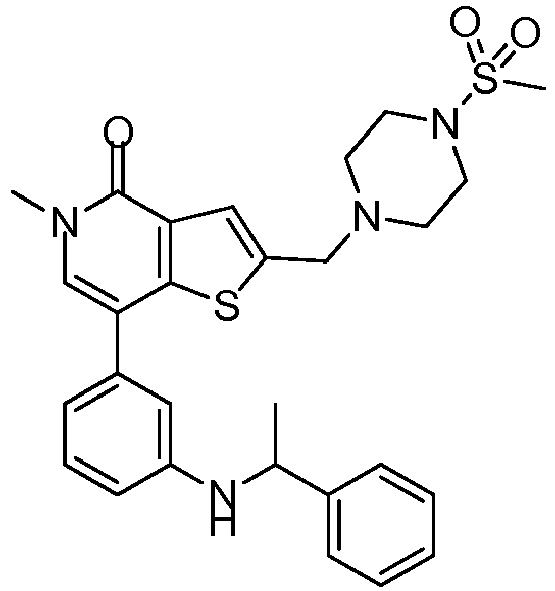
- 7-(3-Aminophenyl)-5-methyl-2-((4-(methylsulphonyl)piperazin-1-yl)methyl)thieno[3,2-c]pyridin-4(5H)-one (for a preparation see Example 25, 270 mg, 0.624 mmol) and titanium(IV) isopropoxide (266 mg, 277 µL, 0.94 mmol) were added to a stirred solution of acetophenone (112 mg, 109 µL, 0.94 mmol) in 2,2,2-trifluoroethanol (10 mL) at 70 °C. The reaction mixture was refluxed for 3 hours, then treated with sodium borohydride (71 mg, 1.88 mmol). The reaction mixture was refluxed overnight. A further portion of sodium borohydride (71 mg, 1.88 mmol) was added and reflux continued for 4 hours. The reaction mixture was cooled and the solvent evaporated. The residue was dissolved in dichloromethane (20 mL). The solution was washed with saturated sodium bicarbonate solution then water. The organic phase was dried and evaporated. The residue was purified by chromatography on silica gel eluting with 2% methanol in dichloromethane to give 5-methyl-2-((4-(methylsulphonyl)piperazin-1-yl)methyl)-7-(3-((1-phenylethyl)amino)phenyl)thieno[3,2-c]pyridin-4(5H)-one (78 mg, 0.145 mmol, 23.28% yield) as an off-white solid.
LCMS (2 min, Formic Acid): Rt = 0.94 min, MH+ = 537 -
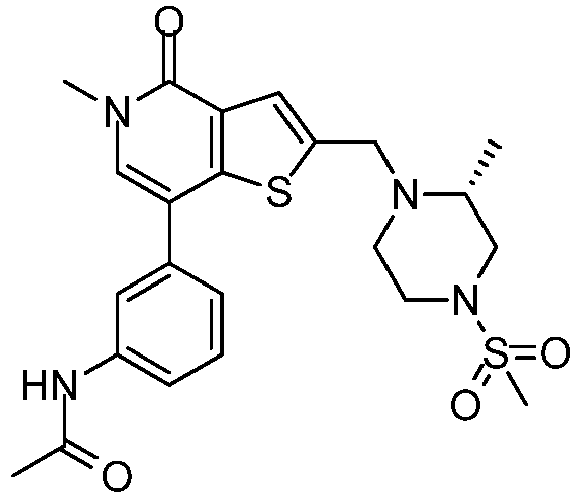
- A mixture of (R)-7-bromo-5-methyl-2-((2-methyl-4-(methylsulphonyl)piperazin-1-yl)methyl)thieno[3,2-c]pyridin-4(5H)-one (for a preparation see Intermediate 21, 100 mg, 0.23 mmol), (3-acetamidophenyl)boronic acid (62 mg, 0.35 mmol), potassium carbonate (95 mg, 0.69 mmol) and bis(triphenylphosphine)palladium(II) chloride (16 mg, 10 mol%) in 1,2-dimethoxyethane (3 mL) and water (0.5 mL) was heated in a microwave at 120 °C for 20 minutes. The cooled reaction mixture was diluted with ethyl acetate (25 mL). The solution was dried over sodium sulphate, filtered and the solvent evaporated. The residue was purified by chromatography on silica gel eluting with 2-5% methanol in dichloromethane to give (R)-N-(3-(5-methyl-2-((2-methyl-4-(methylsulphonyl)piperazin-1-yl)methyl)-4-oxo-4,5-dihydrothieno[3,2-c]pyridin-7-yl)phenyl)acetamide (59 mg, 0.121 mmol, 52.4% yield) as a colourless solid.
LCMS (2 min, Formic Acid): Rt = 0.60 min, MH+ = 489 -

- A stirred solution of tetrahydro-2H-pyran-4-carbaldehyde (39.6 mg, 0.347 mmol) in 2,2,2-trifluoroethanol (3 mL) was heated to 40 °C and treated with 7-(3-aminophenyl)-5-methyl-2-((4-(methylsulphonyl)piperazin-1-yl)methyl)thieno[3,2-c]pyridin-4(5H)-one (for a preparation see Example 25, 100 mg, 0.231 mmol) and acetic acid (0.013 mL, 0.231 mmol). The reaction was stirred at 40 °C for 2 hours and then treated with sodium borohydride (10.50 mg, 0.277 mmol). The reaction was left under nitrogen at 40 °C over the weekend. The reaction was cooled to room temperature and then concentrated under reduced pressure to give a pink solid. The material was dissolved in dichloromethane (25 mL) and washed with saturated sodium bicarbonate solution (25 mL). The organic layer was collected and the product was extracted from the aqueous layer with dichloromethane (3 x 20 mL). The organic fractions were combined, dried over magnesium sulphate, and concentrated under reduced pressure. The crude material was purified by chromatography on silica gel eluting with 0-5% methanol in dichloromethane to give a solid which was repurified by MDAP to give 5-methyl-2-((4-(methylsulphonyl)piperazin-1-yl)methyl)-7-(3-(((tetrahydro-2H-pyran-4-yl)methyl)amino)phenyl)thieno[3,2-c]pyridin-4(5H)-one (11 mg, 0.021 mmol, 9% yield) as a colourless solid.
LCMS (2 min, Formic Acid): Rt = 0.77 min, MH+ = 531 -

- A mixture of 7-bromo-5-methyl-2-((4-(methylsulphonyl)piperazin-1-yl)methyl)thieno[3,2-c]pyridin-4(5H)-one (for a preparation see Intermediate 69, 210 mg, 0.5 mmol), N-(3-(4,4,5,5-tetramethyl-1,3,2-dioxaborolan-2-yl)phenyl)acetamide (261 mg, 1.0 mmol), potassium carbonate (346 mg, 2.5 mmol) and bis(triphenylphosphine)palladium(II) chloride (35 mg, 10 mol%) in 1,2-dimethoxyethane (3 mL) and water (0.5 mL) was heated in a microwave at 120 °C for 20 minutes. The cooled reaction mixture was diluted with ethyl acetate (25 mL). The solution was dried over sodium sulphate and evaporated. The residue was purified by chromatography on silica gel eluting with 0-5% methanol in dichloromethane (twice) and the product triturated with diethyl ether to give N-(3-(5-methyl-2-((4-(methylsulphonyl)piperazin-1-yl)methyl)-4-oxo-4,5-dihydrothieno[3,2-c]pyridin-7-yl)phenyl)acetamide (71 mg, 0.150 mmol, 30% yield) as a yellow solid.
LCMS (2 min, Formic Acid): Rt = 0.57 min, MH+ = 475. -

- To a solution of 7-(2-chloropyridin-4-yl)-5-methyl-2-((4-(methylsulphonyl)piperazin-1-yl)methyl)thieno[3,2-c]pyridin-4(5H)-one (for a preparation see Intermediate 22, 17 mg, 0.038 mmol) in N-methyl-2-pyrrolidone (1 mL) was added 2-methoxy-N-methylethanamine (1004 mg, 11.26 mmol). The reaction mixture was stirred in the microwave for 30 min at 250 °C, whereupon it was allowed to cool to room temperature. The excess 2-methoxy-N-methylethanamine was removed in vacuo and the residue was purified by MDAP. The appropriate fractions were combined and concentrated in vacuo to give 7-(2-((2-methoxyethyl)(methyl)amino)pyridin-4-yl)-5-methyl-2-((4-(methylsulphonyl)piperazin-1-yl)methyl)thieno[3,2-c]pyridin-4(5H)-one, 2 formic acid salt. (11 mg, 0.018 mmol, 49%) as a brown oil.
LCMS (2 min, Formic Acid): Rt = 0.77 min, MH+ = 506 -

- To a solution of 7-(2-chloropyridin-4-yl)-5-methyl-2-((4-(methylsulphonyl)piperazin-1-yl)methyl)thieno[3,2-c]pyridin-4(5H)-one (for a preparation see Intermediate 22, 47 mg, 0.104 mmol) in N-methyl-2-pyrrolidone (1 mL) was added 1-methoxypropan-2-amine (925 mg, 10.38 mmol). The reaction mixture was stirred in the microwave for 30 min at 250 °C, whereupon it was allowed to cool to room temperature. The excess 1-methoxypropan-2-amine (925 mg, 10.38 mmol) was removed in vacuo and the residue was purified via MDAP. The appropriate fractions were combined and concentrated in vacuo to give, 7-(2-((1-methoxypropan-2-yl)amino)pyridin-4-yl)-5-methyl-2-((4-(methylsulphonyl)piperazin-1-yl)methyl)thieno[3,2-c]pyridin-4(5H)-one, 3 Formic acid salt (10.9 mg, 0.017 mmol, 16%) as a yellow oil.
LCMS (2 min, Formic Acid): Rt = 0.50 min, MH+ = 506 -

- To a mixture of 7-(2-chloropyridin-4-yl)-5-methyl-2-((4-(methylsulphonyl)piperazin-1-yl)methyl)thieno[3,2-c]pyridin-4(5H)-one (for a preparation see Intermediate 22, 64 mg, 0.141 mmol) and cyclopropylmethanamine (20.10 mg, 0.283 mmol) in tetrahydrofuran (5 mL) were successively added sodium tert-butoxide (67.9 mg, 0.706 mmol), BINAP (17.60 mg, 0.028 mmol) and tris(dibenzylideneacetone)dipalladium(0) (12.94 mg, 0.014 mmol). The resulting mixture was stirred at 80 °C for 4 hours. The reaction mixture was allowed to cool down to room temperature and was hydrolyzed by adding water. The mixture was diluted with ethyl acetate and the phases were separated. The aqueous phase was extracted 3 times with ethyl acetate and the combined organic layers were washed with brine, dried over magnesium sulphate, filtered and concentrated in vacuo.
- The residue was purified via MDAP. The appropriate fractions were collected and concentrated in vacuo to give, 7-(2-((cyclopropylmethyl)amino)pyridin-4-yl)-5-methyl-2-((4-(methylsulphonyl)piperazin-1-yl)methyl)thieno[3,2-c]pyridin-4(5H)-one, 3 Formic acid salt (18 mg, 0.029 mmol, 20%) as a colourless oil.
LCMS (2 min, Formic Acid): Rt = 0.49 min, MH+ = 488 -

- A mixture of 7-bromo-5-methyl-2-((4-(methylsulphonyl)piperazin-1-yl)methyl)thieno[3,2-c]pyridin-4(5H)-one (for a preparation see Intermediate 69, 100 mg, 0.238 mmol), N-(3-(4,4,5,5-tetramethyl-1,3,2-dioxaborolan-2-yl)phenyl)formamide (88 mg, 0.357 mmol), potassium carbonate (164 mg, 1.189 mmol) and bis(triphenylphosphine)palladium(II) chloride (8.35 mg, 0.012 mmol) in ethanol (2 mL) and toluene (2 mL) was heated in a microwave for 20 minutes at 120 °C. The reaction mixture was diluted with ethyl acetate (15 mL) the mixture was also dried over magnesium sulphate. The mixture was filtered and the solvent evaporated from the filtrate. The residue was purified by chromatography on silica gel eluting 0-5% methanol in dichloromethane. The product was repurified by MDAP to give N-(3-(5-methyl-2-((4-(methylsulphonyl)piperazin-1-yl)methyl)-4-oxo-4,5-dihydrothieno[3,2-c]pyridin-7-yl)phenyl)formamide (12 mg, 0.026 mmol, 10.95 % yield) as a white solid.
LCMS (2 min, Formic Acid): Rt = 0.58 min, MH+ = 461. -

- To a microwave reaction vial was added 7-bromo-5-methyl-2-((4-(methylsulphonyl)piperazin-1-yl)methyl)thieno[3,2-c]pyridin-4(5H)-one (for a preparation see Intermediate 69, 60 mg, 0.143 mmol) followed by (3-aminophenyl)boronic acid (23.46 mg, 0.171 mmol), potassium carbonate (47.3 mg, 0.343 mmol), and PEPPSI-IPr (34.0 mg, 0.05 mmol) in a solution of isopropanol (2 mL) and water (1 mL) . The reaction vessel was sealed and heated in microwave at 130 °C for 30 minutes. The reaction was diluted with saturated ammonium chloride solution (15 mL) and mixed with dichloromethane (10 mL). The solution was filtered through Celite. The organic layer was collected.
- The aqueous phase was extracted with dichloromethane (3 x 15 mL). The organic fractions were combined and dried over magnesium sulphate. The filtrate was concentrated to give a light brown oil. Which was purified by chromatography on silica gel eluting with 0-5% methanol in dichloromethane to give an oil. The oil was triturated with diethyl ether to give 7-(3-aminophenyl)-5-methyl-2-((4-(methylsulphonyl)piperazin-1-yl)methyl)thieno[3,2-c]pyridin-4(5H)-one (36 mg, 0.083 mmol, 58.3% yield) as an off-white solid.
LCMS (2 min, Formic Acid): Rt = 0.52 min, MH+ = 433 -

- To 2,2,2-trifluoroethanol (3 mL) under nitrogen, was added benzaldehyde (0.023 mL, 0.231 mmol) and the solution was heating to 38 °C. The reaction was treated with 7-(3-aminophenyl)-5-methyl-2-((4-(methylsulphonyl)piperazin-1-yl)methyl)thieno[3,2-c]pyridin-4(5H)-one (for a preparation see Example 25, 100 mg, 0.231 mmol) and stirred vigorously for 5 minutes. The reaction was then treated with sodium borohydride (10.50 mg, 0.277 mmol) and stirred at 38 °C for 80 minutes. The reaction was treated with a further portion of sodium borohydride (10.50 mg, 0.277 mmol) and left to stir at 40 °C over the weekend. The reaction was allowed to cool to room temperature. The reaction was filtered and the solid was washed with 2,2,2-trifluoroethanol (5 mL). The filtrate was concentrated under reduced pressure to give a light brown oil. A precipitate formed with the addition of dichloromethane. The mixture was washed with water (15 mL). The aqueous phase was extracted with dichloromethane (3 x 10 mL). The organic layers were combined, dried over magnesium sulphate, and concentrated under reduced pressure to give a light brown oil. This was purified by chromatography on silica gel eluting with 0-5% methanol in dichloromethane. The product was triturated with diethyl ether to give an off white solid which was re-purified by MDAP to give an oil.
- The oil was dissolved in ethyl acetate (1 mL) and treated with 1.0M HCl in diethyl ether (1 mL) to form the hydrochloride salt. The precipitate was triturated with diethyl ether to give 7-(3-(benzylamino)phenyl)-5-methyl-2-((4-(methylsulphonyl)piperazin-1-yl)methyl)thieno[3,2-c]pyridin-4(5H)-one hydrochloride (75.4 mg, 0.135 mmol, 58.3% yield) as an off-white solid.
LCMS (2 min, Formic Acid): Rt = 0.90 min, MH+ = 523 -

- To a solution of 7-(2-chloropyridin-4-yl)-5-methyl-2-((4-(methylsulphonyl)piperazin-1-yl)methyl)thieno[3,2-c]pyridin-4(5H)-one (for a preparation see Intermediate 22, 50 mg, 0.110 mmol) in N-methyl-2-pyrrolidone (1 mL) was added (tetrahydrofuran-2-yl)methanamine (1116 mg, 11.04 mmol). The reaction mixture was stirred in the microwave for 30 min at 250 °C, whereupon it was allowed to cool to room temperature. The excess (tetrahydrofuran-2-yl)methanamine (1116 mg, 11.04 mmol) was removed in vacuo and the residue was purified via MDAP. The appropriate fractions were combined and concentrated in vacuo to give 5-methyl-2-((4-(methylsulphonyl)piperazin-1-yl)methyl)-7-(2-(((tetrahydrofuran-2-yl)methyl)amino)pyridin-4-yl)thieno[3,2-c]pyridin-4(5H)-one, 3 formic acid salt (11 mg, 0.017 mmol, 15%) as a yellow oil.
LCMS (2 min, Formic Acid): Rt = 0.49 min, MH+ = 518 -

- To a microwave reaction vial was added 7-bromo-2-((4-ethylpiperazin-1-yl)methyl)-5-methylthieno[3,2-c]pyridin-4(5H)-one (for a preparation see Intermediate 23, 180 mg, 0.486 mmol) in a solution of isopropanol (2 mL) and water (1 mL). To the reaction was added (3-(benzyloxy)phenyl)boronic acid (166 mg, 0.729 mmol) followed by potassium carbonate (202 mg, 1.458 mmol) and lastly PEPPSI (33.0 mg, 0.049 mmol). The reaction vessel was sealed and heated to 130 °C for 30 minutes in the Biotage Initiator microwave reactor with 10 seconds of pre-stirring.
- The reaction was transferred to a separating funnel and diluted with saturated ammonium chloride solution (approx. 30 mL). The aqueous phase was extracted with DCM (3 x 20 mL). The organic fractions were combined, dried over magnesium sulphate, and concentrated under reduced pressure to give a dark brown oil.
- The crude material was loaded on to a 12 g silica gel column and was eluted with 2.0M ammonia in MeOH / DCM (0-10%) over 26 column volumes to give semi-pure product. All fractions containing product were combined, concentrated, and re-purified by MDAP and the collected fractions were evaporated to give a pale yellow oil. This was dissolved in ethyl acetate (1 mL) and treated with 1.0M HCl in diethyl ether (250 µL) to give an off-white solid. The solid was filtered, washed with diethyl ether (x3) and oven dried over night to give 7-(3-(benzyloxy)phenyl)-2-((4-ethylpiperazin-1-yl)methyl)-5-methylthieno[3,2-c]pyridin-4(5H)-one, hydrochloride (127 mg, 0.249 mmol, 51.2% yield).
LCMS (2 min, Formic Acid): Rt = 0.92 min, MH+ = 474 -
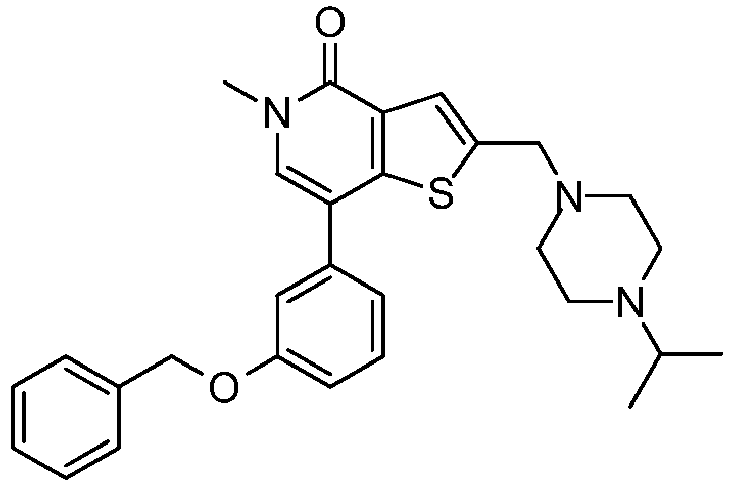
- To a microwave reaction vial was added 7-bromo-2-((4-isopropylpiperazin-1-yl)methyl)-5-methylthieno[3,2-c]pyridin-4(5H)-one (for a preparation see Intermediate 24, 150 mg, 0.390 mmol) in a solution of isopropanol (3 mL) and water (1.5 mL) followed by (3-(benzyloxy)phenyl)boronic acid (134 mg, 0.585 mmol), potassium carbonate (162 mg, 1.171 mmol), and lastly PEPPSI (26.5 mg, 0.039 mmol). The reaction vessel was sealed and heated to 130 °C for 30 minutes in a Biotage Initiator microwave reactor with 10 seconds of pre-stirring.
- The reaction was transferred to a separating funnel and diluted with saturated ammonium chloride solution (30 mL). The aqueous phase was extracted with DCM (3 x 25 mL). The organic fractions were combined, dried over magnesium sulphate, and concentrated under reduced pressure to give dark brown residue.
- The crude material was loaded on to a 12 g silica gel column and was eluted in 0-10% MeOH in DCM over 25 column volumes to an orange solid, the desired product 7-(3-(benzyloxy)phenyl)-2-((4-isopropylpiperazin-1-yl)methyl)-5-methylthieno[3,2-c]pyridin-4(5H)-one (92 mg, 0.189 mmol, 48.3% yield).
LCMS (2 min, Formic Acid): Rt = 0.90 min, MH+ = 488. -

- To a stirred solution of 7-(3,4-dimethoxyphenyl)-5-methyl-2-(piperazin-1-ylmethyl)thieno[3,2-c]pyridin-4(5H)-one, 2 hydrochloride (for a preparation see Example 64, 60 mg, 0.127 mmol) in DCM (2 mL) and pyridine (3 mL) was added a catalytic quantity of DMAP (1 mg, 8.19 µmol) followed by phenylmethanesulphonyl chloride (86 mg, 0.451 mmol). The reaction was stirred at room temperature for one hour. To the reaction was added a further portion of DMAP (1 mg, 8.19 µmol) followed by another portion of phenylmethanesulphonyl chloride (86 mg, 0.451 mmol) and the reaction was heated to 40 °C for 18 hours. To the reaction was added 1,2-DCE (1 mL) followed by another portion of DMAP (1 mg, 8.19 µmol) and benzoyl chloride (86 mg, 0.612 mmol). The reaction was heated at 60 °C for 4 hours.
- The reaction was cooled to room temperature. The solvent was removed under reduced pressure.
- The crude material was re-dissolved in toluene (7 mL) and then the solvent was removed under reduced pressure.
- The crude material was dissolved in DCM (15 mL) and transferred to a 50 mL separating funnel and washed with saturated bicarbonate solution (10 mL). The organic layer was collected. The aqueous layer was extracted with DCM (3 x 10 mL). The organic layers were combined and dried over magnesium sulphate. The filtrate was concentrated under reduced pressure to give a dark green oil.
- The crude material was loaded onto a 12 g silica gel column and the product was eluted in 0-5% MeOH in DCM over 28 column volumes to give a yellow solid, 2-((4-(benzylsulphonyl)piperazin-1-yl)methyl)-7-(3,4-dimethoxyphenyl)-5-methylthieno[3,2-c]pyridin-4(5H)-one (Example 33) (25 mg, 0.045 mmol, 35.6% yield).
- LCMS (2 min, Formic Acid): Rt = 0.85 min, MH+ = 554.A brown oil was also obtained from the column chromatography that was further purified by MDAP (Formic Acid method) to give a light yellow oily residue, 2-((4-benzoylpiperazin-1-yl)methyl)-7-(3,4-dimethoxyphenyl)-5-methylthieno[3,2-c]pyridin-4(5H)-one (Example 30) (8 mg, 0.016 mmol, 12.5 % yield).
LCMS (2 min, Formic Acid): Rt = 0.74 min, MH+ = 504. -

- To a stirred solution of 7-(3,4-dimethoxyphenyl)-5-methyl-2-(piperazin-1-ylmethyl)thieno[3,2-c]pyridin4(5H)-one, hydrochloride (for a preparation see Example 64, 45 mg, 0.103 mmol) in DCM (2 mL) and pyridine (1.0 mL) was added ethanesulphonyl chloride (0.02 mL, 0.206 mmol) and the reaction was stirred under nitrogen for two hours. To the reaction was added a further portion of ethanesulphonyl chloride (0.02 mL, 0.206 mmol) and it was stirred overnight. To the reaction was added DMAP (1 mg, 8.19 µmol) and it was stirred for 5 hours.
- To the reaction was added a small volume of toluene and the solvent was removed under reduced pressure to give an orange solid.
- The residue was loaded onto a 4 g silica gel column and the product was eluted in 0-5% MeOH in DCM. The solvent was removed from the product under reduced pressure and the residue was oven dried overnight to give a light green solid, 7-(3,4-dimethoxyphenyl)-2-((4-(ethylsulphonyl)piperazin-1-yl)methyl)-5-methylthieno[3,2-c]pyridin-4(5H)-one (21.6 mg, 0.044 mmol, 42.6% yield).
LCMS (2 min, Formic Acid): Rt = 0.70 min, MH+ = 492. -

- A mixture of N-(3-(2-formyl-5-methyl-4-oxo-4,5-dihydrothieno[3,2-c]pyridin-7-yl)phenyl)acetamide (for a preparation see Intermediate 28, 100 mg, 0.31 mmol), 1-methylpiperazine (46 mg, 0.46 mmol), and acetic acid (28 mg, 27 µL, 0.62 mmol) in dichloromethane (10 mL) was stirred at room temperature for 15 minutes. The reaction mixture was treated with sodium triacetoxyborohydride (260 mg, 1.23 mmol) and stirred at 40 °C for 1 hour.
- The cooled reaction mixture was diluted with methanol (10 mL) and the dichloromethane was evaporated. The methanolic solution was loaded onto a 5 g SCX column. The product was eluted with 2M ammonia in methanol. The solvent was evaporated and the residue triturated with diethyl ether to give N-(3-(5-methyl-2-((4-methylpiperazin-1-yl)methyl)-4-oxo-4,5-dihydrothieno[3,2-c]pyridin-7-yl)phenyl)acetamide (88 mg, 0.214 mmol, 70.0% yield) as a light yellow solid.
LCMS (2 min, Formic Acid): Rt = 0.54 min, MH+ = 411. -

- To a stirred solution of 7-(3,4-dimethoxyphenyl)-5-methyl-2-(piperazin-1-ylmethyl)thieno[3,2-c]pyridin-4(5H)-one, 2 hydrochloride (for a preparation see Example 64, 60 mg, 0.127 mmol) in DCM (2 mL) and pyridine (3 mL) was added a catalytic quantity of DMAP (1 mg, 8.19 µmol), followed by benzenesulphonyl chloride (0.057 mL, 0.447 mmol). The reaction was stirred at room temperature for one hour.
- The reaction was concentrated under reduced pressure. The crude material was dissolved in DCM (2 mL) and toluene (10 mL) and again concentrated under reduced pressure to give an orange oil which was oven dried for 4 hours.
- The crude material was loaded onto a 12 g silica gel column and eluted in 0-5% MeOH in DCM over 28 column volumes to give a yellow oil. The oil was triturated with diethyl ether to give a bright yellow solid, 7-(3,4-dimethoxyphenyl)-5-methyl-2-((4-(phenylsulphonyl)piperazin-1-yl)methyl)thieno[3,2-c]pyridin-4(5H)-one (11 mg, 0.02 mmol, 16.05% yield).
LCMS (2 min, Formic Acid): Rt = 0.87 min, MH+ = 540. -

- To a 25 mL round bottom flask was added 5-methyl-4-oxo-7-phenyl-4,5-dihydrothieno[3,2-c]pyridine-2-carbaldehyde (for a preparation see Intermediate 29, 92.2 mg, 0.342 mmol) dissolved in DCM (5 mL). To the solution was added 1-(piperazin-1-yl)ethanone (65.8 mg, 0.514 mmol) and acetic acid (0.029 mL, 0.514 mmol) and the reaction was stirred at room temperature under nitrogen for approx. 1 hour. Then to the reaction solution was added sodium triacetoxyborohydride (363 mg, 1.712 mmol) and the reaction was heated under reflux under nitrogen for one hour.
- The reaction was allowed to cool to room temperature and allowed to stand under nitrogen for ∼ 3 days. The reaction was then diluted with saturated sodium bicarbonate solution and transferred to a separating funnel. The product was extracted with DCM (3 x 10 mL). The organic layers were combined and washed with brine and then dried over magnesium sulphate. The filtrate was collected in a 150 mL round bottom flask using vacuum filtration and the solvent was removed under reduced pressure to give an orange solid.
- The crude material was dissolved in a small volume of MeOH and transferred to a 1 g SCX column.
- The column was eluted with MeOH (3 column volumes) to remove impurities. The column was then eluted with 2.0M ammonia in MeOH (3 column volumes) and the solvent was removed under reduced pressure to give an orange oil. To the oily residue was added a small volume of diethyl ether and it was triturated resulting in the formation of a solid. The flask was left for approx. 45 minutes and the ether was removed with a pipette. The residue was dried under reduced pressure to yield an orange solid 2-((4-acetylpiperazin-1-yl)methyl)-5-methyl-7-phenylthieno[3,2-c]pyridin-4(5H)-one (119 mg, 0.312 mmol, 91% yield).
LCMS (2 min, Formic Acid): Rt = 0.64 min, MH+ = 382. -

- To a stirred solution of 7-(3,4-dimethoxyphenyl)-5-methyl-2-(piperazin-1-ylmethyl)thieno[3,2-c]pyridin-4(5H)-one, 2 hydrochloride (for a preparation see Example 64, 60 mg, 0.127 mmol) in DCM (2 mL) was added pyridine (3 mL), propane-2-sulphonyl chloride (0.043 mL, 0.381 mmol) and a catalytic quantity of DMAP (1 mg, 8.19 µmol). The reaction was stirred under nitrogen overnight. To the reaction was added a further portion of propane-2-sulphonyl chloride (0.043 mL, 0.381 mmol) and it was heated at 40 °C for 2 hours. A further portion of propane-2-sulphonyl chloride (0.043 mL, 0.381 mmol) was added and heating was continued for 5 hours.
- The reaction was cooled to room temperature and left under nitrogen overnight. The solvent was removed under reduced pressure to yield a brown oil. The oil was re-dissolved in DCM (approx. 3 mL) and mixed with toluene (approx. 10 mL) and the crude material was concentrated under reduced pressure and dried in a vacuum oven for 4 hours. To remove the excess propane-2-sulphonyl chloride the crude material was dissolved in DCM (5 mL) and washed with saturated sodium bicarbonate solution (10 mL). The organic layer was collected and the aqueous layer was extracted with DCM (3 x 5 mL). The organic layers were combined and dried over magnesium sulphate. The filtrate was collected and concentrated under reduced pressure. The product was purified by MDAP to give a yellow oil. The oil was triturated with diethyl ether to give a yellow oil, 7-(3,4-dimethoxyphenyl)-2-((4-(isopropylsulphonyl)piperazin-1-yl)methyl)-5-methylthieno[3,2-c]pyridin-4(5H)-one (16 mg, 0.032 mmol, 24.9% yield).
LCMS (2 min, Formic Acid): Rt = 0.75 min, MH+ = 506. -
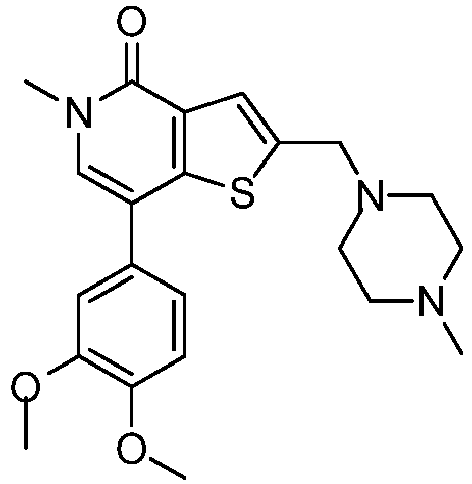
- To a suspension of 7-(3,4-dimethoxyphenyl)-5-methyl-4-oxo-4,5-dihydrothieno[3,2-c]pyridine-2-carbaldehyde (for a preparation see Intermediate 25, 16.5 mg, 0.05 mmol) in tetrahydrofuran (2 mL) was added 1-methylpiperazine (22 uL, 0.2 mmol, 4 eq) followed by sodium triacetoxyborohydride (42 mg, 0.2 mmol, 4 eq). The mixture was stirred at room temperature for 2 days.
- The material was passed through a 5 g NH2-SPE cartridge eluting with 5:1 dichloromethane/methanol. The solvent was evaporated and the residue was loaded onto a 5 g SCX cartridge, washed with methanol and then eluted with NH3 in methanol. The solvent was removed and the residue was further purified on a 10 g NH2-SPE column eluting with 99:1 - 90:10 dichloromethane/methanol. Combination and evaporation of the desired fractions gave the product 7-(3,4-dimethoxyphenyl)-5-methyl-2-((4-methylpiperazin-1-yl)methyl)thieno[3,2-c]pyridin-4(5H)-one.
LCMS (2 min, Formic Acid): Rt = 0.76 min, MH+ = 414. -

- To a suspension of 7-(3,4-dimethoxyphenyl)-5-methyl-4-oxo-4,5-dihydrothieno[3,2-c]pyridine-2-carbaldehyde (for a preparation see Intermediate 25, 16.5 mg, 0.05 mmol) in tetrahydrofuran (2 mL) was added N,N-dimethylpiperazine-1-sulphonamide (39 mg, 0.2 mmol) followed by sodium triacetoxyborohydride (42 mg, 0.2 mmol). The mixture was stirred at room temperature overnight.
- The material was loaded onto a 5 g SCX cartridge, washed with methanol and then eluted with NH3 in methanol. The eluted material was concentrated and then purified on a 10 g NH2-SPE column eluting with 99:1-90:10 dichloromethane/methanol. The eluted material was again concentrated and then purified on a 20 g silica column eluting with 95:5 - 5:1 dichloromethane/methanol. The concentrated product was dissolved in dichloromethane and MP-NCO was added and the reaction was stirred at room temperature for 2 hr. The material was again purified on a 12 g silica column using a graduating solvent system of 98:2 - 9:1 dichloromethane/methanol. Evaporation of the solvent gave the product 4-((7-(3,4-dimethoxyphenyl)-5-methyl-4-oxo-4,5-dihydrothieno[3,2-c]pyridin-2-yl)methyl)-N,N-dimethylpiperazine-1-sulphonamide (9.7 mg).
LCMS (2 min, Formic Acid): Rt = 0.89 min, MH+ = 507. -

- 1-Acetylpiperazine (78 mg, 0.61 mmol) and glacial acetic acid (22 mg, 21 µL, 0.37 mmol) were added to a stirred solution of 7-(3,4-dimethoxyphenyl)-5-methyl-4-oxo-4,5-dihydrothieno[3,2-c]pyridine-2-carbaldehyde (for a preparation see Intermediate 25, 100 mg, 0.30 mmol) in dichloromethane (10 mL). The reaction mixture was stirred at room temperature for 30 minutes then treated with sodium triacetoxyborohydride (193 mg, 0.91 mmol). The reaction mixture was heated under reflux for 4 hours then cooled to room temperature.
- Saturated sodium bicarbonate (10 mL) was added and the mixture stirred for 10 minutes. The organic phase was separated and the aqueous phase extracted with dichloromethane (2 x 10 mL).
- The combined organics were dried and evaporated. Chromatography [2% methanol/dichloromethane] of the residue followed by trituration with diethyl ether gave a yellow gum. The compound was dissolved in the minimum amount of ethyl acetate. 1.0M hydrogen chloride in diethyl ether (0.5 mL) and diethyl ether (10 mL) was added. The solid was filtered off, washed with diethyl ether and dried to give 2-((4-acetylpiperazin-1-yl)methyl)-7-(3,4-dimethoxyphenyl)-5-methylthieno[3,2-c]pyridin-4(5H)-one, hydrochloride (60 mg, 0.126 mmol, 41.3% yield) as a colourless solid.
LCMS (2 min, Formic Acid): Rt = 0.58 min, MH+ = 442. -

- To a suspension of 7-bromo-5-methyl-2-((4-methyl-1,4-diazepan-1-yl)methyl)thieno[3,2-c]pyridin-4(5H)-one (for a preparation see Intermediate 67, 200 mg, 0.540 mmol), 3-(benzyloxy)phenyl)boronic acid (165 mg, 0.724 mmol) and potassium carbonate (202 mg, 1.458 mmol) in isopropanol (3 mL) and water (1.5 mL) was added PEPPSI (36.7 mg, 0.054 mmol) catalyst.
- The reaction mixture was heated to 130 °C in the microwave for 30 minutes. The reaction mixture was transferred to a separating funnel and diluted with a saturated aqueous solution of ammonium chloride (approx. 30 mL). The aqueous phase was extracted with DCM (4 x 20 mL) and the combined organic fractions were dried over magnesium sulphate, filtered and concentrated under reduced pressure to give brown oil. The crude material purified by chromatography on silica gel eluting with 0 to 10% [2.0M ammonia in MeOH] in DCM to give an impure pale yellow oil. The latter was repurifed by MDAP to give the product as a pale yellow oil. This material was dissolved in ethyl acetate (1 mL) and treated with 1.0M HCl in diethyl ether (250 µL) to give 7-(3-(benzyloxy)phenyl)-5-methyl-2-((4-methyl-1,4-diazepan-1-yl)methyl)thieno[3,2-c]pyridin-4(5H)-one, hydrochloride (109 mg, 40% yield) as an off white solid,
LCMS (2 min, Formic Acid): Rt = 0.89 min, MH+ = 474 -

- N-(3-(5-methyl-2-((1-(methylsulphonyl)piperidin-4-ylidene)methyl)-4-oxo-4,5-dihydrothieno[3,2-c]pyridin-7-yl)phenyl)acetamide (for a preparation see Intermediate 66, 120 mg, 0.254 mmol) in a solution of ethanol (25 mL) was treated with ammonium formate (80 mg, 1.272 mmol) followed by 10% palladium in carbon, (50% water paste, 24 mg). The reaction mixture was heated refluxed under an atmosphere of nitrogen. The reaction was treated with a further 5 equivalents of ammonium formate (80 mg, 1.272 mmol) and another portion of 10% palladium in carbon (50% water paste, 24 mg). The resulting suspension was refluxed for a further three hours, whereupon the reaction mixture was cooled to room temperature and filtered through a 2.5 g Celite frit. The filtrate was concentrated under reduced pressure to give an off white solid. The crude material was triturated with diethyl ether to give a cream coloured solid (66 mg) which was only 77% pure my LCMS. The product was therefore re-purified by MDAP to give N-(3-(5-methyl-2-((1-(methylsulphonyl)piperidin-4-yl)methyl)-4-oxo-4,5-dihydrothieno[3,2-c]pyridin-7-yl)phenyl)acetamide (13 mg, 11 % yield) as a white solid,
LCMS (2 min, Formic Acid): Rt = 0.82 min, MH+ = 474 -

- To a 2 - 5 mL microwave reaction vial was added 7-bromo-5-methyl-2-((4-(methylsulphonyl)piperazin-1-yl)methyl)thieno[3,2-c]pyridin-4(5H)-one (for a preparation see Intermediate 69, 70 mg, 0.167 mmol), (2,4-difluorophenyl)boronic acid (31.6 mg, 0.200 mmol), and potassium carbonate (55.2 mg, 0.400 mmol) in a solution of isopropanol (2 mL) and water (1.000 mL). To the reaction was then added the PEPPSI (34.0 mg, 0.05 mmol). The reaction vessel was sealed and heated in the Biotage Initiator microwave reactor to 130 °C for 30 minutes with 10 seconds of pre-stirring. After cooling, the reaction was diluted with saturated ammonium chloride solution (15 mL) and DCM (10 mL), shaken and filtered through Celite. The filtrate was transferred to a separating funnel and the organic layer was collected. The aqueous layer was extracted with DCM (3 x 10 mL). The organic layers were combined and dried over MgSO4. The filtrate was collected and concentrated to give a dark yellow solid. The residue was loaded onto a 12 g silica gel column and eluted in 0-5% MeOH in DCM to give a yellow oil. The oil was triturated with diethyl ether and dried under reduced pressure to give 7-(2,4-difluorophenyl)-5-methyl-2-((4-(methylsulphonyl)piperazin-1-yl)methyl)thieno[3,2-c]pyridin-4(5H)-one (58.2 mg, 77% yield) as a pale yellow solid.
LCMS (2 min, Formic Acid): Rt = 0.75 min, MH+ = 454 -

- A mixture of 7-bromo-5-methyl-2-((4-(methylsulphonyl)piperazin-1-yl)methyl)thieno[3,2-c]pyridin-4(5H)-one (for a preparation see Intermediate 69, 200 mg, 0.48 mmol), 6-phenyl-2-(pyridin-2-yl)-1,3,6,2-dioxazaborocane (638 mg, 2.38 mmol), potassium orthophosphate (303 mg, 1.43 mmol), copper(I) iodide (45 mg, 0.24 mmol) and bis(triphenylphosphine)palladium(II) chloride (33 mg, 10mol%) in dry, degassed DMF (8 mL) was heated in the microwave at 150 °C for 45 minutes. The cooled reaction mixture was diluted with ethyl acetate (20 mL) and washed with water (x2) and brine. The organic phase was dried and evaporated. The residue was chromatographed [0-5% methanol/dichloromethane]. The product was triturated with diethyl ether to give impure product, which was repurified by MDAP to give 5-methyl-2-((4-(methylsulphonyl)piperazin-1-yl)methyl)-7-(pyridin-2-yl)thieno[3,2-c]pyridin-4(5H)-one (18 mg, 9%) as a colourless solid.
LCMS (2 min, Formic Acid): Rt = 0.59 min, MH+ = 419. -

- To a solution of 5-methyl-4-oxo-7-phenyl-4,5-dihydrothieno[3,2-c]pyridine-2-carbaldehyde (for a preparation see Intermediate 29, 75 mg, 0.278 mmol) and 1-(methylsulphonyl)piperazine (91 mg, 0.557 mmol) in DCM (5 mL) were successively added sodium triacetoxyborohydride (236 mg, 1.114 mmol) and acetic acid (0.024 mL, 0.418 mmol). The reaction mixture was stirred at 40 °C for 1 hour, whereupon a saturated aqueous solution of NaHCO3 was added. The layers were separated and the aqueous phase was extracted 3 times with DCM. The combined organic layers were washed with brine, dried over MgSO4, filtered and concentrated in vacuo to give 5-methyl-2-((4-(methylsulphonyl)piperazin-1-yl)methyl)-7-phenylthieno[3,2-c]pyridin-4(5H)-one (59 mg, 51% yield) as a white solid.
LCMS (2 min, Formic Acid): Rt = 0.72 min, MH+ = 418 -

- To a suspension of 7-bromo-2-((2,4-dimethylpiperazin-1-yl)methyl)-5-methylthieno[3,2-c]pyridin-4(5H)-one (for a preparation see Intermediate 70, 34 mg, 0.092 mmol), (5-((tetrahydro-2H-pyran-4-yl)methoxy)pyridin-3-yl)boronic acid (for a preparation see Intermediate 13, 32.6 mg, 0.138 mmol) and potassium carbonate (38.1 mg, 0.275 mmol) in isopropanol (3 mL) and water (1 mL) was added PEPPSI (6.24 mg, 9.18 µmol) catalyst. The reaction mixture was heated at 110 °C in the microwave for 30 minutes, whereupon the reaction mixture was hydrolyzed by adding a saturated aqueous solution of ammonium chloride (20 mL). The aqueous phase was extracted with DCM (4 x 25 mL) and the combined organic fractions were dried over magnesium sulphate, filtered and concentrated under reduced pressure to give a dark brown oil. The crude material was purified by chromatography on silica gel eluting with 0 to 15% MeOH in DCM to give a brown oil which was only 75% pure by LCMS. The product was re-purified by MDAP to give 2-((2,4-dimethylpiperazin-1-yl)methyl)-5-methyl-7-(5-((tetrahydro-2H-pyran-4-yl)methoxy)pyridin-3-yl)thieno[3,2-c]pyridin-4(5H)-one, Formic acid salt (6.5 mg, 13%) as an off white solid.
LCMS (2 min, Formic Acid): Rt = 0.61 min, MH+ = 483 -

- Tert-butyl 4-((7-(3,4-dimethoxyphenyl)-5-methyl-4-oxo-4,5-dihydrothieno[3,2-c]pyridin-2-yl)methyl)-1,4-diazepane-1-carboxylate (for a preparation see Intermediate 57, 116 mg, 0.226 mmol) was dissolved in 1,4-dioxane (0.5 mL) and 4M HCl in 1,4-dioxane (0.5 mL) was added to the reaction mixture. The reaction mixture was stirred at room temperature for 3 hr. Diethyl ether (5 mL) was added and the mixture triturated. The supernatent was decanted off. Another portion of diethyl ether (5 mL) was added and the trituration repeated. The solvent was decanted and the residue dried in vacuo to give 2-((1,4-diazepan-1-yl)methyl)-7-(3,4-dimethoxyphenyl)-5-methylthieno[3,2-c]pyridin-4(5H)-one dihydrochloride (71 mg, 0.146 mmol, 64.6 % yield) as a white powder.
LCMS (2 min, High pH): Rt = 0.84 min, MH+ = 414 -

- 4M Hydrogen chloride in 1,4-dioxane (0.5 mL, 2 mmol) was added to a stirred solution of tert-butyl (3-(((7-(3-(benzyloxy)phenyl)-5-methyl-4-oxo-4,5-dihydrothieno[3,2-c]pyridin-2-yl)methyl)amino)propyl)carbamate (for a preparation see Intermediate 47, 100 mg, 0.29 mmol) in 1,4-dioxane (0.5 mL). The reaction mixture was stirred at room temperature for 4 hours. The reaction mixture was diluted with diethyl ether (5 mL) and stirred at room temperature for 1 hour then allowed to stand overnight. The solid was filtered off, washed with diethyl ether and dried to give 2-(((3-aminopropyl)amino)methyl)-7-(3-(benzyloxy)phenyl)-5-methylthieno[3,2-c]pyridin-4(5H)-one, 2 Hydrochloride (86 mg, 91% yield) as an off-white solid.
LCMS (2 min, Formic Acid): Rt = 0.64 min, MH+ = 434 -

- Methanesulphonyl chloride (22 mg, 15 µL, 0.2 mmol) was added to a stirred mixture of 2-(((2-aminoethyl)amino)methyl)-7-(3-(benzyloxy)phenyl)-5-methylthieno[3,2-c]pyridin-4(5H)-one, 2 Hydrochloride (for a preparation see Example 53, 80 mg, 0.16 mmol), pyridine (1 mL) and dichloromethane (2 mL). The reaction mixture was stirred at room temperature for 4 hours. Methanesulphonyl chloride (34 mg, 23 µL, 0.3 mmol) was added and the mixture stirred at room temperature overnight. The mixture was diluted with dichloromethane (10 mL) and then was washed with a saturated aqueous solution of NaHCO3 (10 mL) and water (10 mL). The organic phase was dried and evaporated. The residue was purified by chromatography on silica gel eluting with 0 to 10% methanol in dichloromethane to give N-(2-(((7-(3-(benzyloxy)phenyl)-5-methyl-4-oxo-4,5-dihydrothieno[3,2-c]pyridin-2-yl)methyl)amino)ethyl)methanesulphonamide (Example 48) (14 mg, 17.3% yield) as a colourless oil.
LCMS (2 min, Formic Acid): Rt = 0.85 min, MH+ = 498
and
N-((7-(3-(benzyloxy)phenyl)-5-methyl-4-oxo-4,5-dihydrothieno[3,2-c]pyridin-2-yl)methyl)-N-(2-(methylsulfonamido)ethyl)methanesulfonamide (Example 48A) (10 mg, 10.7% yield) as a colourless oil.
LCMS (2 min, Formic Acid): Rt = 1.05 min, MH+ = 576 -

- A stirred suspension of N-(4-(5-methyl-2-((1-(methylsulphonyl)piperidin-4-ylidene)methyl)-4-oxo-4,5-dihydrothieno[3,2-c]pyridin-7-yl)pyridin-2-yl)acetamide (for a preparation see Intermediate 62, 10 mg, 0.021 mmol) in ethanol (2 mL) was treated with ammonium formate (6.67 mg, 0.106 mmol) followed by 10% palladium on carbon (50% water paste, 4mg, 40% wt). The reaction mixture was heated to 90 °C and refluxed under an atmosphere of nitrogen for two hours. The reaction was cooled to room temperature and filtered through a 2.5 g Celite frit. The residue was washed with ethanol (2x 5 mL). The filtrated was collected and concentrated under reduced pressure to give N-(4-(5-methyl-2-((1-(methylsulphonyl)piperidin-4-yl)methyl)-4-oxo-4,5-dihydrothieno[3,2-c]pyridin-7-yl)pyridin-2-yl)acetamide (3 mg, 30%) as a white solid.
LCMS (2 min, Formic Acid): Rt = 0.72 min, MH+ = 475 -

- A mixture of N-(3-(2-formyl-5-methyl-4-oxo-4,5-dihydrothieno[3,2-c]pyridin-7-yl)phenyl)acetamide (for a preparation see Intermediate 49, 100 mg, 0.31 mmol), 1-methylhomopiperazine (70 mg, 0.61 mmol), and acetic acid (37 mg, 35 µL, 0.62 mmol) in dichloromethane (10 mL) was stirred at room temperature for 15 minutes. The reaction mixture was treated with sodium triacetoxyborohydride (260 mg, 1.23 mmol) and stirred at room temperature overnight. A saturated aqueous solution of sodium bicarbonate (10 mL) was added and the mixture stirred for 15 minutes. The organic phase was separated and the aqueous phase extracted with dichloromethane (2x10 mL). The combined organics were dried and evaporated. The residue was purified by chromatography on silica gel eluting 10 to 20% methanol in dichloromethane to give N-(3-(5-methyl-2-((4-methyl-1,4-diazepan-1-yl)methyl)-4-oxo-4,5-dihydrothieno[3,2-c]pyridin-7-yl)phenyl)acetamide (13 mg, 10% yield) as a pale yellow solid.
LCMS (2 min, Formic Acid): Rt = 0.51 min, MH+ = 425 -

- A stirred solution of 7-(3,4-dimethoxyphenyl)-5-methyl-2-(piperidin-4-ylmethyl)thieno[3,2-c]pyridin-4(5H)-one, hydrochloride (for a preparation see Intermediate 65, 18 mg, 0.041 mmol) in DCM (1 mL) and pyridine (500 µL) was treated with methanesulphonyl chloride (10 µL, 0.128 mmol). The resulting solution was stirred at room temperature under an atmosphere of nitrogen for 2 hours. The reaction was treated with a further 6 equivalents of methane sulphonyl chloride (20 µL, 6.2 mmol) and the reaction was stirred for an additional hour. A small portion of the starting material remained unreacted. The reaction was treated with a further 6 equivalents of methane sulphonyl chloride (20 µL, 6.2 mmol) and was left under the conditions described for 16 hours. The reaction mixture was then diluted with toluene (10 mL) and concentrated under reduced pressure. The reaction mixture was redissolved in toluene and reconcentrated to remove residual pyridine. The crude product was dissolved in DCM and since there were insoluble inorganic impurities, the product was passed through a 2.5 g Celite frit. The filtrate was collected and concentrated under reduced pressure to give a yellow solid. The crude material was purified by chromatography on silica gel eluting with 0 to 5% MeOH in DCM to give 7-(3,4-dimethoxyphenyl)-5-methyl-2-((1-(methylsulphonyl)piperidin-4-yl)methyl)thieno[3,2-c]pyridin-4(5H)-one (14 mg, 71% yield) as an orange oil.
LCMS (2 min, Formic Acid): Rt = 0.93 min, MH+ = 477 -

- 4M Hydrogen chloride in 1,4-dioxane (0.5 mL, 2 mmol) was added to a stirred solution of tert-butyl (3-(((7-(3,4-dimethoxyphenyl)-5-methyl-4-oxo-4,5-dihydrothieno[3,2-c]pyridin-2-yl)methyl)amino)propyl)carbamate (for a preparation see Intermediate 52, 143 mg, 0.29 mmol) in 1,4-dioxane (0.5 mL). The reaction mixture was stirred at room temperature for 4 hours. The reaction mixture was diluted with diethyl ether (5 mL) and stirred at room temperature for 1 hour then allowed to stand overnight. The solid was filtered off, washed with diethyl ether and dried to give 2-(((3-aminopropyl)amino)methyl)-7-(3,4-dimethoxyphenyl)-5-methylthieno[3,2-c]pyridin-4(5H)-one, 2 hydrochloride (122 mg, 90% yield) as an off-white solid.
LCMS (2 min, Formic Acid): Rt = 0.47 min, MH+ = 388 -

- 4M Hydrogen chloride in 1,4-dioxane (0.5 mL, 2 mmol) was added to a stirred solution of tert-butyl (2-(((7-(3-(benzyloxy)phenyl)-5-methyl-4-oxo-4,5-dihydrothieno[3,2-c]pyridin-2-yl)methyl)amino)ethyl)carbamate (for a preparation see Intermediate 50, 107 mg, 0.21 mmol) in 1,4-dioxane (0.5 mL). The reaction mixture was stirred at room temperature for 4 hours. The reaction mixture was diluted with diethyl ether (5 mL) and stirred at room temperature for 1 hour then allowed to stand overnight. The solid was filtered off, washed with diethyl ether and dried to give 2-(((2-aminoethyl)amino)methyl)-7-(3-(benzyloxy)phenyl)-5-methylthieno[3,2-c]pyridin-4(5H)-one, 2 hydrochloride (87 mg, 86% yield) as an off-white solid.
LCMS (2 min, Formic Acid): Rt = 0.67 min, MH+ = 420 -

- To a solution of 7-bromo-5-methyl-2-((4-(methylsulphonyl)piperazin-1-yl)methyl)thieno[3,2-c]pyridin-4(5H)-one (for a preparation see Intermediate 69, 105 mg, 0.250 mmol) and pyridin-4-ylboronic acid (46.1 mg, 0.375 mmol) in isopropanol (1.5 mL) in a microwave vial were successively added potassium carbonate (0.624 mL, 1.249 mmol) and PEPPSI (16.97 mg, 0.025 mmol). The reaction mixture was stirred at 110 °C in the microwave for 30 minutes. The reaction mixture was concentrated in vacuo and partitioned between water and EtOAc. The phases were separated and the aqueous phase was extracted with EtOAc, The combined organic layers were washed with brine, dried over MgSO4, filtered and concentrated in vacuo. The crude residue was dissolved in a 1:1 MeOH/DMSO mixture and was purified via MDAP using an ammonium bicarbonate modifier.
- The collected fractions were combined and concentrated in vacuo to give 5-methyl-2-((4-(methylsulphonyl)piperazin-1-yl)methyl)-7-(pyridin-4-yl)thieno[3,2-c]pyridin-4(5H)-one (19 mg, 18% yield) as a yellow solid.
LCMS (2 min, High pH): Rt = 0.75 min, MH+ = 419. -

- To a stirred solution of 2-((1,4-diazepan-1-yl)methyl)-7-(3,4-dimethoxyphenyl)-5-methylthieno[3,2-c]pyridin-4(5H)-one, hydrochloride (for a preparation see Example 46, 67 mg, 0.149 mmol) in dichloromethane (3 mL) and pyridine (1 mL) was added methanesulphonyl chloride (12 µl, 0.154 mmol). The reaction was stirred at room temperature under nitrogen for two hours. A further portion of methanesulphonyl chloride (12 µl, 0.154 mmol) was added and the reaction mixture was stirred for half an hour and then left to sit under nitrogen over the weekend. Two more equivalents of methanesulphonyl chloride were added and it was stirred under nitrogen for another 3 hours. To the reaction was added a small volume of toluene and the solvent was removed under reduced pressure to give a yellow/brown solid. The residue was purified via chromatography on silica gel eluting with 0 to 10% MeOH in DCM to give 7-(3,4-dimethoxyphenyl)-5-methyl-2-((4-(methylsulphonyl)-1,4-diazepan-1-yl)methyl)thieno[3,2-c]pyridin-4(5H)-one (35 mg, 0.071 mmol, 47.8% yield) as a brown crystalline solid.
LCMS (2 min, Formic Acid): Rt = 0.64 min, MH+ = 492 -

- To a stirred solution of 7-(3,4-dimethoxyphenyl)-5-methyl-2-((3-methylpiperazin-1-yl)methyl)thieno[3,2-c]pyridin-4(5H)-one hydrochloride (for a preparation see Example 66, 88 mg, 0.196 mmol) in dichloromethane (2 mL) and pyridine (1 mL) was added methanesulphonyl chloride (0.018 mL, 0.235 mmol). The reaction was stirred under nitrogen at room temperature for several hours and then left sat under nitrogen for the weekend. Another equivalent of methanesulphonyl chloride (0.018 mL, 0.235 mmol) was added and the reaction was stirred under nitrogen for three hours. A small volume of toluene was then added and the solvent was removed under reduced pressure to give a red solid.
- The residue purified by chromatography on silica gel eluting with 0 to 5% MeOH in DCM. The appropriate fractions were combined and concentrated under reduced pressure to give 7-(3,4-dimethoxyphenyl)-5-methyl-2-((3-methyl-4-(methylsulphonyl)piperazin-1-yl)methyl)thieno[3,2-c]pyridin-4(5H)-one (75 mg, 78% yield) as a red crystalline solid
LCMS (2 min, Formic Acid): Rt = 0.76 min, MH+ = 492 -

- To a microwave reaction vial was added 7-bromo-5-methyl-2-((4-(methylsulphonyl)piperazin-1-yl)methyl)thieno[3,2-c]pyridin-4(5H)-one (for a preparation see Intermediate 69, 200 mg, 0.476 mmol) followed by (3,4-dimethoxyphenyl)boronic acid (130 mg, 0.714 mmol), potassium carbonate (197 mg, 1.427 mmol), and lastly the PEPPSI (32.3 mg, 0.048 mmol) catalyst in a solution of isopropanol (2 mL) and water (2.000 mL). The reaction vessel was sealed and heated to 130 °C for 30 minutes in a microwave with 10 seconds of pre-stirring. The reaction was quenched with saturated ammonium chloride solution (30 mL) and the product was extracted from the aqueous phase with DCM (3 x 30 mL). The organic fractions were combined, dried over magnesium sulphate, and concentrated under reduced pressure to give a dark brown oil. The crude material was loaded on to a 12 g silica gel column and was eluted in 0-5% MeOH in DCM over 20 column volumes to give 7-(3,4-dimethoxyphenyl)-5-methyl-2-((4-(methylsulphonyl)piperazin-1-yl)methyl)thieno[3,2-c]pyridin-4(5H)-one (154 mg, 68% yield) as a yellow oil. The product was triturated with diethyl ether to give a light yellow solid.
LCMS (2 min, Formic Acid): Rt = 0.65 min, MH+ = 478 -

- To a 2 - 5 mL microwave reaction vial was added 7-bromo-5-methyl-2-((4-(methylsulphonyl)piperazin-1-yl)methyl)thieno[3,2-c]pyridin-4(5H)-one (for a preparation see Intermediate 69, 60 mg, 0.143 mmol), (5-methoxy-2-methylphenyl)boronic acid (35.5 mg, 0.214 mmol), potassium carbonate (59.2 mg, 0.428 mmol), and lastly the PEPPSI™-IPr (34.0 mg, 0.05 mmol) in a solution of isopropanol (2 mL) and water (1 mL). The reaction vessel was sealed and heated to 130 °C in the Biotage Initiator microwave reactor for 30 minutes with 10 seconds of pre-stirring. The reaction was quenched with saturated ammonium chloride solution (15 mL) and mixed with DCM (5 mL). The solution was then filtered through Celite to remove the palladium. The filtrate was transferred to a separating funnel and the organic layer was collected. The aqueous layer was extracted with DCM (3 x 7 mL). The organic layers were combined and dried over magnesium sulphate. The filtrated was collected and concentrated under reduced pressure to give a brown oil.
- The crude material was loaded onto a 12 g silica gel column and was eluted in 0-5% MeOH in DCM to give a pale yellow oil. The oil was triturated with diethyl ether to give 7-(5-methoxy-2-methylphenyl)-5-methyl-2-((4-(methylsulphonyl)piperazin-1-yl)methyl)thieno[3,2-c]pyridin-4(5H)-one (34.7 mg, 53% yield) as an off white solid.
LCMS (2 min, Formic Acid): Rt = 0.76 min, MH+ = 462 -

- To a microwave reaction vial was added 7-bromo-5-methyl-2-((4-(methylsulphonyl)piperazin-1-yl)methyl)thieno[3,2-c]pyridin-4(5H)-one (for a preparation see Intermediate 69, 100 mg, 0.238 mmol) followed by 2-(3-methoxy-2-methylphenyl)-4,4,5,5-tetramethyl-1,3,2-dioxaborolane (248 mg, 0.999 mmol), potassium carbonate (164 mg, 1.189 mmol) and lastly PEPPSI (34.0 mg, 0.05 mmol) in a solution of isopropanol (2 mL) and water (1 mL). The reaction vessel was sealed and heated to 130 °C in the Biotage Initiator microwave reactor for 30 minutes with 20 seconds of pre-stirring. The reaction was diluted with DCM (20 mL) and passed through Celite. The filtrate was transferred to a separating funnel and washed with saturated ammonium chloride solution (50 mL). The organic layer was collected and the aqueous phase was extracted with DCM (2 x 30 mL). The organic fractions were combined, dried over MgSO4 and concentrated under reduced pressure to give a brown oil. The crude material was loaded on to a 25 g silica gel column and was eluted in 0-5% MeOH in DCM over 20 column volumes to give crude product. This was re-purified by MDAP to give a clear oil which was triturated with diethyl ether to give 7-(3-methoxy-2-methylphenyl)-5-methyl-2-((4-(methylsulphonyl)piperazin-1-yl)methyl)thieno[3,2-c]pyridin-4(5H)-one (6 mg, 5% yield) as a white solid.
LCMS (2 min, Formic Acid): Rt = 0.77 min, MH+ = 462. -

- To a 2 - 5 mL microwave reaction vial was added 7-bromo-5-methyl-2-((4-(methylsulphonyl)piperazin-1-yl)methyl)thieno[3,2-c]pyridin-4(5H)-one (for a preparation see Intermediate 69, 60 mg, 0.143 mmol), (2-ethylphenyl)boronic acid (25.7 mg, 0.171 mmol), potassium carbonate (47.3 mg, 0.343 mmol), and lastly PEPPSI (34.0 mg, 0.05 mmol) in a solution of isopropanol (2 mL) and water (1 mL). The reaction vessel was sealed and heated in the Biotage Initiator microwave reactor to 130 °C for 30 minutes with 10 seconds of pre-stirring. The reaction was quenched with saturated ammonium chloride solution (15 mL) and mixed with DCM (approx. 5 mL). The solution was passed through Celite to remove the palladium. The filtrate was transferred to a separating funnel and the organic layer was collected. The aqueous layer was extracted with DCM (3 x 10 mL). The organic layers were combined and dried over MgSO4. The filtrate was collected and concentrated under reduced pressure to give a light brown oil. The crude product was loaded onto a 12 g silica gel column and eluted in 0-5% MeOH in DCM over 25 column volumes to give a yellow oil. The oil was triturated with diethyl ether to give 7-(2-ethylphenyl)-5-methyl-2-((4-(methylsulphonyl)piperazin-1-yl)methyl)thieno[3,2-c]pyridin-4(5H)-one (54.5 mg, 0.122 mmol, 86% yield) an off white solid.
LCMS (2 min, Formic Acid): Rt = 0.83 min, MH+ = 446 -

- A mixture of N-((7-bromo-5-methyl-4-oxo-4,5-dihydrothieno[3,2-c]pyridin-2-yl)methyl)-N-methylmethanesulphonamide (for a preparation see Intermediate 35, 40 mg, 0.11 mmol), (3-acetamidophenyl)boronic acid (25 mg, 0.14 mmol), potassium carbonate (46 mg, 0.33 mmol) and bis(triphenylphosphine)palladium(II) chloride (8 mg, 10 mol%) in 1,2-DME (3 mL) and water (0.5 mL) was heated in a microwave at 120 °C for 20 minutes. The cooled reaction mixture was diluted with ethyl acetate (20 mL), dried over sodium sulphate, filtered and evaporated in vacuo. The residue was purified by chromatography on silica gel 0 to 4% methanol in dichloromethane. The product was repurified by MDAP to give N-(3-(5-methyl-2-((N-methylmethylsulphonamido)methyl)-4-oxo-4,5-dihydrothieno[3,2-c]pyridin-7-yl)phenyl)acetamide (6 mg, 13% yield) as a colourless solid.
LCMS (2 min, Formic Acid): Rt = 0.72 min, MH+ = 420 -

- To a 5 mL microwave reaction vial was added 7-bromo-5-methyl-2-((4-(methylsulphonyl)piperazin-1-yl)methyl)thieno[3,2-c]pyridin-4(5H)-one (for a preparation see Intermediate 69, 70 mg, 0.167 mmol), (4-methoxyphenyl)boronic acid (30.4 mg, 0.200 mmol), potassium carbonate (55.2 mg, 0.400 mmol) in a solution of isopropanol (2 mL) and water (1 mL). Lastly to the reaction was added PEPPSI (34 mg, 0.050 mmol). The reaction vessel was sealed and heated in Biotage Initiator microwave reactor to 130 °C for 30 minutes with 10 seconds of pre-stirring. After cooling, to the reaction was added ammonium chloride solution (15 mL) and DCM (15 mL). The mixture was then passed through Celite to remove excess palladium. The filtrate was transferred to a separating funnel and the organic layer collected. The aqueous phase was extracted with DCM (2 x 15 mL). The organic layers were combined and dried over MgSO4 then filtered and concentrated under reduced pressure to give a light brown oil. The residue was loaded onto a 12g silica gel column and eluted in 0-5% MeOH in DCM. The purest fractions were combined and the solvent was removed under reduced pressure and the residue was oven dried overnight to give 7-(4-methoxyphenyl)-5-methyl-2-((4-(methylsulphonyl)piperazin-1-yl)methyl)thieno[3,2-c]pyridin-4(5H)-one (42 mg, 56% yield) as a green-brown solid.
LCMS (2 min, Formic Acid): Rt = 0.73 min, MH+ = 448. - A second crop of product was obtained which contained impurities and concentrated under reduced pressure and oven dried overnight to give 7-(4-methoxyphenyl)-5-methyl-2-((4-(methylsulphonyl)piperazin-1-yl)methyl)thieno[3,2-c]pyridin-4(5H)-one (32 mg, 0.071 mmol, 43% yield) as a pale green solid,
LCMS (2 min, Formic Acid): Rt = 0.73 min, MH+ = 448. -

- To a 5 mL microwave reaction vial was added 7-bromo-5-methyl-2-((4-(methylsulphonyl)piperazin-1-yl)methyl)thieno[3,2-c]pyridin-4(5H)-one (for a preparation see Intermediate 69, 60mg, 0.143 mmol), (4-(methylsulphonyl)phenyl)boronic acid (34.3 mg, 0.171 mmol), potassium carbonate (47.3 mg, 0.343 mmol), and lastly PEPPSI (34.0 mg, 0.05 mmol) in a solution of isopropanol (2 mL) and water (1 mL). The reaction vessel was sealed and heated in the Biotage Initiator microwave reactor to 130 °C for 30 minutes with 10 seconds of pre-stirring. After cooling, the reaction was quenched with saturated ammonium chloride solution (15 mL) and DCM (5 mL) and mixed. The filtrate was passed through Celite to remove the palladium. The filtrate was transferred to a separating funnel and the organic layer was collected. The aqueous layer was extracted with DCM (3 x10 mL). The organic layers were combined and dried over MgSO4. The filtrate was collected and concentrated under reduced pressure to give a yellow oil. The crude material was loaded onto a 12 g silica gel column and eluted in 0-5% MeOH in DCM to give a yellow solid, which contained impurities. The solid was triturated with diethyl ether to give a lighter yellow solid, 5-methyl-7-(4-(methylsulphonyl)phenyl)-2-((4-(methylsulphonyl)piperazin-1-yl)methyl)thieno[3,2-c]pyridin-4(5H)-one (53.6 mg, 76% yield).
LCMS (2 min, Formic Acid): Rt = 0.57 min, MH+ = 496 -

- To a 25 mL round bottom flask under nitrogen was added tert-butyl 4-((7-(3,4-dimethoxyphenyl)-5-methyl-4-oxo-4,5-dihydrothieno[3,2-c]pyridin-2-yl)methyl)piperazine-1-carboxylate (for a preparation see Intermediate 26, 73.9 mg, 0.148 mmol) followed by 1,4-dioxane (1 mL). 4.0M HCl in 1,4-dioxane (1 mL) was added and the reaction mixture was stirred at room temperature for several hours until LCMS showed the reaction had gone to completion. Diethyl ether (approx. 20 mL) was added and the reaction mixture was stirred for 5 minutes. The reaction was allowed to settle and the diethyl ether was decanted. A fresh portion of diethyl ether was added to the precipitate and it was again stirred under nitrogen for 5 minutes, left to settle, and the excess ether was decanted. The remaining solvent was removed under reduced pressure and the product dried in a vacuum over overnight to give the HCl salt of 7-(3,4-dimethoxyphenyl)-5-methyl-2-(piperazin-1-ylmethyl)thieno[3,2-c]pyridin-4(5H)-one (57.4 mg) as an off white solid
LCMS (2 min, Formic Acid): Rt = 0.61 min, MH+ = 400 - To a stirred solution of tert-butyl 4-((7-(3,4-dimethoxyphenyl)-5-methyl-4-oxo-4,5-dihydrothieno[3,2-c]pyridin-2-yl)methyl)piperazine-1-carboxylate (for a preparation see Intermediate 26, 375 mg, 0.751 mmol) in 1,4-dioxane (2 mL) was added 4.0M HCl in 1,4-dioxane (5 mL). The reaction was stirred at room temperature under nitrogen for two hours.
- The reaction was diluted with diethyl ether (approx. 20 mL) and stirred for 5 minutes. The reaction mixture was left to settle and the excess diethyl ether was decanted off. This process was repeated an additional two times. Remaining solvent was removed under reduced pressure and the product was oven dried to give the 2HCl salt of 7-(3,4-dimethoxyphenyl)-5-methyl-2-(piperazin-1-ylmethyl)thieno[3,2-c]pyridin-4(5H)-one, 2 hydrochloride (332 mg) as a yellow solid
LCMS (2 min, Formic Acid): Rt = 0.63 min, MH+ = 400. -
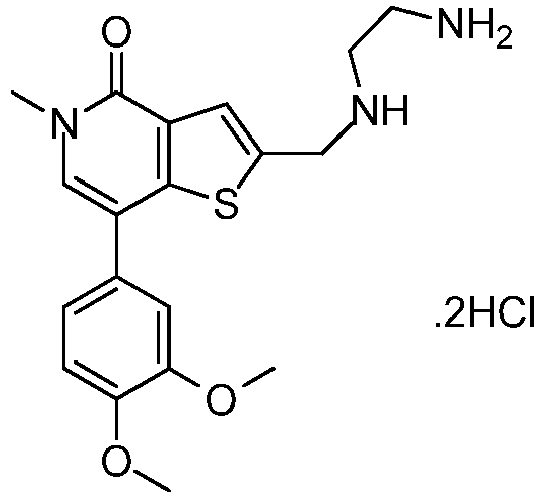
- 4M Hydrogen chloride in 1,4-dioxane (0.5 mL, 2 mmol) was added to a stirred solution of tert-butyl (2-(((7-(3,4-dimethoxyphenyl)-5-methyl-4-oxo-4,5-dihydrothieno[3,2-c]pyridin-2-yl)methyl)amino)ethyl)carbamate (for a preparation see Intermediate 45, 155 mg, 0.33 mmol) in 1,4-dioxane (0.5 mL). The reaction mixture was stirred at room temperature for 4 hours. The reaction mixture was diluted with diethyl ether (5 mL) and stirred at room temperature for 1 hour, then allowed to stand overnight. The solid was filtered off, washed with diethyl ether and dried to give 2-(((2-aminoethyl)amino)methyl)-7-(3,4-dimethoxyphenyl)-5-methylthieno[3,2-c]pyridin-4(5H)-one, 2 Hydrochloride (132 mg, 90% yield) as an off-white solid.
LCMS (2 min, Formic Acid): Rt = 0.47 min, MH+ = 374 -

- To a solution of tert-butyl 4-((7-(3,4-dimethoxyphenyl)-5-methyl-4-oxo-4,5-dihydrothieno[3,2-c]pyridin-2-yl)methyl)-2-methylpiperazine-1-carboxylate (for a preparation see Intermediate 56, 110 mg, 0.214 mmol) in 1,4-dioxane (1 mL) was added 4.0M HCl in 1,4-dioxane (1 mL) and the reaction was stirred under nitrogen for several hours.
- Diethyl ether (20 mL) was added and the reaction mixture was stirred under nitrogen for 5 minutes.
- The reaction was allowed to settle and was left to stand overnight. The diethyl ether was decanted and a fresh portion of diethyl ether was added. The mixture was stirred for 5 minutes, allowed to settle, and the diethyl ether was decanted. The product was dried under reduced pressure to give 7-(3,4-dimethoxyphenyl)-5-methyl-2-((3-methylpiperazin-1-yl)methyl)thieno[3,2-c]pyridin-4(5H)-one, hydrochloride (112 mg, 116% yield) as an off-white solid contaminated by some remaining diethyl ether.
LCMS (2 min, Formic Acid): Rt = 0.85 min, MH+ = 414 -

- Methanesulphonyl chloride (34 mg, 23 µL, 0.3 mmol) was added to a stirred mixture of 2-(((2-aminoethyl)amino)methyl)-7-(3,4-dimethoxyphenyl)-5-methylthieno[3,2-c]pyridin-4(5H)-one, 2 Hydrochloride (for a preparation see Example 65, 110 mg, 0.25 mmol), pyridine (1 mL) and dichloromethane (2 mL). The reaction mixture was stirred at room temperature for 4 hours.
- Methanesulphonyl chloride (34 mg, 23 µL, 0.3 mmol) was added and the mixture stirred at room temperature overnight. The mixture was diluted with dichloromethane (10 mL). The reaction mixture was washed with a saturated aqueous solution of NaHCO3 (10 mL) and water (10 mL). The organic phase was dried and evaporated in vacuo. The residue was purified by chromatography on silica gel eluting with 0 to 10% methanol in dichloromethane. The residue was repurifed by MDAP to give N-(2-(((7-(3,4-dimethoxyphenyl)-5-methyl-4-oxo-4,5-dihydrothieno[3,2-c]pyridin-2-yl)methyl)amino)ethyl)methanesulphonamide (Example 67) (9 mg, 0.020 mmol, 8.09% yield) as a colourless oil.
LCMS (2 min, Formic Acid): Rt = 0.58 min, MH+ = 452
and
N-((7-(3,4-dimethoxyphenyl)-5-methyl-4-oxo-4,5-dihydrothieno[3,2-c]pyridin-2-yl)methyl)-N-(2-(methylsulfonamido)ethyl)methanesulfonamide (Example 67A) (8 mg, 0.015 mmol, 6.1% yield) as a colourless oil.
LCMS (2 min, Formic Acid): Rt = 0.76 min, MH+ = 530 -

- To a 2 - 5 mL microwave reaction vial was added 7-bromo-5-methyl-2-((4-(methylsulphonyl)piperazin-1-yl)methyl)thieno[3,2-c]pyridin-4(5H)-one (for a preparation see Intermediate 69, 70 mg, 0.167 mmol), m-tolylboronic acid (27.2 mg, 0.200 mmol), and potassium carbonate (55.2 mg, 0.400 mmol) in a solution of isopropanol (2 mL) and water (1.000 mL). Lastly to the reaction mixture was added the PEPPSI (34.0 mg, 0.05 mmol). The reaction vessel was sealed and heated in Biotage Initiator microwave reactor to 130 °C for 30 minutes with 10 seconds of pre-stirring. After cooling, the reaction was quenched with saturated ammonium chloride solution (15 mL) and DCM (15 mL) and passed through Celite to remove palladium. The filtrate was transferred to a separating funnel and the organic layer was collected. The aqueous layer was extracted with DCM (2 x 10 mL). The organic fractions were combined and dried over MgSO4. The filtrate was collected and concentrated under reduced pressure to give a light brown crystalline solid. The residue was loaded onto a 12 g silica gel column and eluted in 0-5% MeOH in DCM. The purest fractions were concentrated under reduced pressure to give a yellow oil. The oil was triturated with diethyl ether to give 5-methyl-2-((4-(methylsulphonyl)piperazin-1-yl)methyl)-7-(m-tolyl)thieno[3,2-c]pyridin-4(5H)-one (59.5 mg, 83% yield) as an off-white solid.
LCMS (2 min, Formic Acid): Rt = 0.77 min, MH+ = 432. -

- Example 69 was prepared in the array described for Intermediates 71-82, wherein the amine reagent (NHR'R") was thiomorpholine 1,1-dioxide, obtained from Tokyo Chemical Industry Co., Ltd (TCI), to give a yield of 28mg, 0.062mmol, 23%yield.
LCMS pH(2 min, High pH): Rt 0.82min, MH+ = 449. -

- To a suspension of (R)-7-bromo-5-methyl-2-((3-methylmorpholino)methyl)thieno[3,2-c]pyridin-4(5H)-one (for a preparation see Intermediate 41, 256 mg, 0.717 mmol), potassium carbonate (495 mg, 3.58 mmol) and (3,4-dimethoxyphenyl)boronic acid (326 mg, 1.791 mmol) in isopropanol (4 mL) and water (4 mL) was added PEPPSI (48.7 mg, 0.072 mmol). The reaction mixture was heated in the microwave at 130 °C for 30 minutes. The cooled reaction mixture was hydrolyzed with a saturated aqueous solution of ammonium chloride (30 mL) and the layers were separated. The aqueous phase was extracted with DCM (3 x 30 mL) and the combined organic layers were dried over magnesium sulphate, filtered and concentrated under reduced pressure to give a dark green oil. The crude material purified by chromatography on silica gel eluting with 0-80% ethyl acetate in cyclohexane followed by 0-5% MeOH in DCM. The appropriate fractions were combined and concentrated in vacuo to give (R)-7-(3,4-dimethoxyphenyl)-5-methyl-2-((3-methylmorpholino)methyl)thieno[3,2-c]pyridin-4(5H)-one (288 mg, 97% yield) as a light pink oil.
LCMS (2 min, Formic Acid): Rt = 0.60 min, MH+ = 415 -

- To a solution of 7-bromo-5-methyl-2-((4-(methylsulphonyl)piperazin-1-yl)methyl)thieno[3,2-c]pyridin-4(5H)-one (for a preparation see Intermediate 69, 150 mg, 0.357 mmol) and 2-(2-(benzyloxy)phenyl)-4,4,5,5-tetramethyl-1,3,2-dioxaborolane (166 mg, 0.535 mmol) in isopropanol (5 mL) were successively added potassium carbonate (0.892 mL, 1.784 mmol) and PEPPSI (24.25 mg, 0.036 mmol). The resulting mixture was heated at 110 °C in the microwave for 30 min, whereupon the reaction mixture was allowed to cool down to rt and was concentrated in vacuo. The crude residue was partitioned between EtOAc and a saturated aqueous solution of sodium bicarbonate.
- The phases were separated, the aqueous phase was extracted 3 times with EtOAc and the combined organic layers were washed with brine, dried over MgSO4, filtered and concentrated in vacuo. The residue was purified via MDAP. The appropriate fractions were combined and concentrated in vacuo to give 7-(2-(benzyloxy)phenyl)-5-methyl-2-((4-(methylsulphonyl)piperazin-1-yl)methyl)thieno[3,2-c]pyridin-4(5H)-one (85 mg, 46% yield) as a white solid.
LCMS (2 min, Formic Acid): Rt = 0.89 min, MH+ = 524. -

- To a 5 mL microwave reaction vial was added 7-bromo-5-methyl-2-((4-(methylsulphonyl)piperazin-1-yl)methyl)thieno[3,2-c]pyridin-4(5H)-one (for a preparation see Intermediate 69, 60 mg, 0.143 mmol), (4-(trifluoromethyl)phenyl)boronic acid (32.5 mg, 0.171 mmol), and potassium carbonate (47.3 mg, 0.343 mmol) in a solution of isopropanol (2 mL) and water (1 mL). To the reaction was then added PEPPSI (34.0 mg, 0.05 mmol). The reaction vessel was sealed and heated in a Biotage Initiator microwave reactor to 130 °C for 30 minutes with 10 seconds of pre-stirring. After cooling the reaction was quenched with saturated ammonium chloride solution (15 mL) and mixed with DCM (10 mL).
- The solution was passed through Celite to remove the palladium. The filtrate was transferred to a separating funnel and the organic layer was collected. The aqueous layer was extracted with DCM (2 x 10 mL). The organic layers were combined and dried over MgSO4 and the filtrate was collected using vacuum filtration. The product was concentrated under reduced pressure to give a brown oil.
- The residue was loaded onto a 12g silica gel column and chromatographed in 0-5% MeOH in DCM over 22 column volumes. The purest fractions were combined and concentrated to give a yellow oil.
- The oil was triturated with diethyl ether and oven dried overnight to give 5-methyl-2-((4-(methylsulphonyl)piperazin-1-yl)methyl)-7-(4-(trifluoromethyl)phenyl)thieno[3,2-c]pyridin-4(5H)-one (59 mg, 85% yield) as a yellow solid.
LCMS (2 min, Formic Acid): Rt = 0.87 min, MH+ = 486 -

- To a solution of 2-((1,4-oxazepan-4-yl)methyl)-7-(2-chloropyridin-4-yl)-5-methylthieno[3,2-c]pyridin-4(5H)-one (for a preparation see Example 85, 102 mg, 0.262 mmol) in NMP (1 mL) was added 2-methoxy-N-methylethanamine (6996 mg, 78 mmol). The reaction mixture was stirred in the microwave for 30 min at 250 °C, whereupon it was allowed to cool to rt. The excess 2-methoxy-N-methylethanamine (6996 mg, 78 mmol) was removed in vacuo and the residue (dissolved in NMP) was purified via MDAP. The appropriate fractions were combined and concentrated in vacuo to give 2-((1,4-oxazepan-4-yl)methyl)-7-(2-((2-methoxyethyl)(methyl)amino)pyridin-4-yl)-5-methylthieno[3,2-c]pyridin-4(5H)-one, Formic acid salt (92 mg, 72%) as a viscous yellow oil.
LCMS (2 min, Formic Acid): Rt = 0.48 min, MH+ = 443 -

- A mixture of 7-bromo-2-((4-hydroxypiperidin-1-yl)methyl)-5-methylthieno[3,2-c]pyridin-4(5H)-one (for a preparation see Intermediate 40, 50 mg, 0.14 mmol), (3,4-dimethoxyphenyl)boronic acid (38 mg, 0.21 mmol), potassium carbonate (58 mg, 0.42 mmol) and bis(triphenylphosphine)palladium(II) chloride (10 mg, 10 mol%) in 1,2-dimethoxyethane (3 mL) and water (0.5 mL) was heated in a microwave at 120 °C for 20 minutes. The cooled reaction mixture was diluted with ethyl acetate (25 mL). The solution was dried over sodium sulphate and evaporated in vacuo. The residue was purified via chromatography on silica gel eluting with 0-10% methanol in dichloromethane. The resulting product was dissolved in ethyl acetate (0.5 mL) and treated with 1.0M hydrogen chloride in diethyl ether (0.5 mL). Diethyl ether (10 mL) was added and the solid was filtered off and dried to give 7-(3,4-dimethoxyphenyl)-2-((4-hydroxypiperidin-1-yl)methyl)-5-methylthieno[3,2-c]pyridin-4(5H)-one, Hydrochloride (50 mg, 79% yield) as a colourless solid.
LCMS (2 min, Formic Acid): Rt = 0.58 min, MH+ = 415 -

- To a 2 - 5 mL microwave reaction vial was added 7-bromo-5-methyl-2-((4-(methylsulphonyl)piperazin-1-yl)methyl)thieno[3,2-c]pyridin-4(5H)-one (for a preparation see Intermediate 69, 100 mg, 0.238 mmol) followed by (4-methoxy-2-methylphenyl)boronic acid (47.4 mg, 0.285 mmol), potassium carbonate (79 mg, 0.571 mmol) and lastly PEPPSI (34.0 mg, 0.05 mmol) in a solution of isopropanol (2 mL) and water (1 mL). The reaction vessel was sealed and heated in the Biotage Initiator microwave reactor to 130 °C for 30 minutes with 10 seconds of pre-stirring. The reaction was diluted with saturated sodium bicarbonate solution (20 mL) and shaken with DCM (20 mL). The solution was passed through Celite to remove the palladium. The filtrate was transferred to a separating funnel and the organic layer was collected. The aqueous layer was extracted with DCM (3 x 20 mL). The organic layers were combined, dried over MgSO4 and concentrated under reduced pressure to give a light brown oil. The crude material was loaded onto a 12 g silica gel column and the product was eluted in 0-5% MeOH in DCM over 25 column volumes to give a yellow oil. The oil was triturated with diethyl ether and oven dried overnight to give 7-(4-methoxy-2-methylphenyl)-5-methyl-2-((4-(methylsulphonyl)piperazin-1-yl)methyl)thieno[3,2-c]pyridin-4(5H)-one (51 mg, 46% yield) as a light orange solid,
LCMS (2 min, Formic Acid): Rt = 0.75 min, MH+ = 462. -

- To a 5 mL microwave reaction vial was added 7-bromo-5-methyl-2-((4-(methylsulphonyl)piperazin-1-yl)methyl)thieno[3,2-c]pyridin-4(5H)-one (for a preparation see Intermediate 69, 60 mg, 0.143 mmol), (4-cyanophenyl)boronic acid (25.2 mg, 0.171 mmol), potassium carbonate (47.3 mg, 0.343 mmol), and lastly PEPPSI (34.0 mg, 0.05 mmol) in a solution of isopropanol (2 mL) and water (1 mL). The reaction vessel was sealed and heated in the Biotage Initiator microwave reactor to 130 °C for 30 minutes with 10 seconds of pre-stirring. After cooling, the reaction was quenched with saturated ammonium chloride solution (15 mL) and mixed with DCM (10 mL). The solution was passed through Celite to remove the palladium catalyst. The filtrate was transferred to a separating funnel and the organic layer was collected. The aqueous layer was extracted with DCM (3 x 10 mL). The organic layers were combined and dried over MgSO4. The filtrate was collected and concentrated under reduced pressure to give a brown solid. The crude product was loaded onto a 12 g silica gel column and was eluted in 0 - 5% MeOH in DCM over 25 column volumes to give a yellow oil. The oil was triturated with diethyl ether to give 4-(5-methyl-2-((4-(methylsulphonyl)piperazin-1-yl)methyl)-4-oxo-4,5-dihydrothieno[3,2-c]pyridin-7-yl)benzonitrile (47.4 mg, 75% yield) as a yellow solid,
LCMS (2 min, Formic Acid): Rt = 0.66 min, MH+ = 443 -

- A stirred suspension of 7-(2-aminopyridin-4-yl)-5-methyl-2-((3-methylmorpholino)methyl)thieno[3,2-c]pyridin-4(5H)-one (for a preparation see Example 86, 100 mg, 0.270 mmol) in DCM (4 mL) and pyridine (4 mL) was treated with acetic anhydride (51 µL, 0.541 mmol). The reaction mixture was stirred at room temperature under an atmosphere of nitrogen for two hours. The reaction was treated with another portion of acetic anhydride (51 µL, 0.541 mmol) and stirred under the conditions described for a further 2 hours.
- The reaction mixture was then concentrated under reduced pressure, and the residue was azeotroped with toluene to remove residual pyridine. The material was triturated with diethyl ether to give the desired product as an orange solid. LC/MS showed that there was still some starting material remaining. The product was therefore dissolved in DCM (3 mL) and pyridine (2 mL) and treated with acetic anhydride (102 µL, 1.082 mmol) and the reaction mixture was stirred at room temperature under nitrogen over the weekend.
- The reaction was concentrated under reduced pressure. The material was dissolved in DCM (2 mL), treated with toluene (15 mL) and the reaction mixture was concentrated in vacuo to remove residual pyridine. The product was triturated with diethyl ether to give a brown solid which was only 72% pure by LCMS. The residue was purified via MDAP. The appropriate fractions were combined and concentrated in vacuo to give N-(4-(5-methyl-2-((3-methylmorpholino)methyl)-4-oxo-4,5-dihydrothieno[3,2-c]pyridin-7-yl)pyridin-2-yl)acetamide (48 mg, 43% yield) as a yellow solid.
LCMS (2 min, Formic Acid): Rt = 0.46 min, MH+ = 413 -

- To a stirred solution of (S)-7-(3-hydroxyphenyl)-5-methyl-2-((3-methylmorpholino)methyl)thieno[3,2-c]pyridin-4(5H)-one (for a preparation see Example 81, 90 mg, 0.243 mmol) in DMF (5 mL) was added potassium carbonate (40.3 mg, 0.292 mmol) followed by (bromomethyl)benzene (0.087 mL, 0.729 mmol). The reaction mixture was heated to 100 °C and stirred under nitrogen for 3.5 hours.
- Another portion of potassium carbonate (40.3 mg, 0.292 mmol) was added and the reaction was stirred for a further 90 minutes. The reaction was cooled to room temperature and left sitting under nitrogen for 48 hours.
- The reaction mixture was then diluted with water (30 mL) and transferred to a separating funnel. The layers were separated and the aqueous phase was extracted with ethyl acetate (3 x 25 mL). The combined organic fractions were washed with brine (30 mL), dried over magnesium sulphate, and concentrated under reduced pressure to give a yellow oil. The crude material was purified via chromatography on silica gel eluting with 0 to 5% MeOH in DCM. The appropriate fractions were combined and concentrated in vacuo to give S)-7-(3-(benzyloxy)phenyl)-5-methyl-2-((3-methylmorpholino)methyl)thieno[3,2-c]pyridin-4(5H)-one (83 mg, 74% yield) as a white solid.
LCMS (2 min, Formic Acid): Rt = 0.89 min, MH+ = 461 -
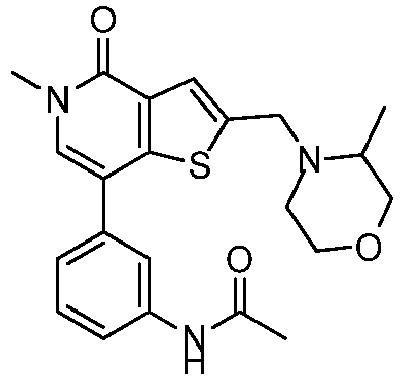
- To a suspension of 7-bromo-5-methyl-2-((3-methylmorpholino)methyl)thieno[3,2-c]pyridin-4(5H)-one (for a preparation see Intermediate 38, 70 mg, 0.196 mmol), (3-acetamidophenyl)boronic acid (105 mg, 0.588 mmol) and potassium carbonate (162 mg, 1.176 mmol) in isopropanol (2 mL) and water (2 mL) was added PEPPSI (13.31 mg, 0.020 mmol) catalyst. The reaction mixture was heated at 130 °C for 30 minutes in the microwave, whereupon the reaction was hydrolyzed using an aqueous saturated ammonium chloride solution (25 mL). The aqueous phase was extracted with DCM (3 x 25 mL) and the combined organic layers were dried over magnesium sulphate, filtered and concentrated under reduced pressure to give a brown solid.
- The crude material purified by chromatography on silica gel eluting with 0 to 5% MeOH in DCM to give N-(3-(5-methyl-2-((3-methylmorpholino)methyl)-4-oxo-4,5-dihydrothieno[3,2-c]pyridin-7-yl)phenyl)acetamide (69 mg, 86% yield) as a yellow solid.
LCMS (2 min, Formic Acid): Rt = 0.54 min, MH+ = 412 -

- A mixture of 7-bromo-5-methyl-2-((4-(methylsulphonyl)piperidin-1-yl)methyl)thieno[3,2-c]pyridin-4(5H)-one (for a preparation see Intermediate 48, 11 mg, 0.026 mmol), (2-((2-methoxyethyl)(methyl)amino)pyridin-4-yl)boronic acid (Intermediate 147) (8.26 mg, 0.039 mmol), potassium carbonate (10.88 mg, 0.079 mmol) and bis(triphenylphosphine)palladium(II) chloride (1.841 mg, 2.62 pmol) in water (0.5 mL) and 1,2-DME (1.5 mL) was heated in a microwave at 120 °C for 20 minutes. The cooled reaction mixture was diluted with ethyl acetate and the solution dried over MgSO4 and evaporated. The residue was diluted in a 1:1 MeOH/DMSO mixture and purified via MDAP to give 7-(2-((2-methoxyethyl)(methyl)amino)pyridin-4-yl)-5-methyl-2-((4-(methylsulphonyl)piperidin-1-yl)methyl)thieno[3,2-c]pyridin-4(5H)-one (5.1 mg, 39%) as a viscous light yellow oil.
LCMS (2 min, Formic Acid): Rt = 0.42 min, MH+ = 505 -

- To a suspension of (S)-7-bromo-5-methyl-2-((3-methylmorpholino)methyl)thieno[3,2-c]pyridin-4(5H)-one (for a preparation see Intermediate 39, 250 mg, 0.700 mmol), (3-hydroxyphenyl)boronic acid (193 mg, 1.400 mmol) and potassium carbonate (484 mg, 3.50 mmol) in isopropanol (2.5 mL) and water (1.5 mL) was added PEPPSI (47.5 mg, 0.070 mmol) catalyst. The reaction mixture was heated at 130 °C in the microwave for 30 minutes. The reaction mixture was then diluted with DCM (30 mL) and transferred to a separating funnel. A saturated ammonium chloride solution (50 mL) was added and the layers were separated. The aqueous phase was extracted with DCM (2 x 30 mL) and the combined organic fractions were dried over magnesium sulphate and concentrated under reduced pressure to give a light brown oil. The crude material was purified by chromatography on silica gel eluting with 0 to 7% MeOH in DCM. The appropriate fractions were combined and evaporated in vacuo to give (S)-7-(3-hydroxyphenyl)-5-methyl-2-((3-methylmorpholino)methyl)thieno[3,2-c]pyridin-4(5H)-one (192 mg, 74% yield) as a yellow solid.
LCMS (2 min, Formic Acid): Rt = 0.55 min, MH+ = 371 -

- To a suspension of (S)-7-bromo-5-methyl-2-((3-methylmorpholino)methyl)thieno[3,2-c]pyridin-4(5H)-one (for a preparation see Intermediate 39, 40 mg, 0.112 mmol), (3,4-dimethoxyphenyl)boronic acid (30.6 mg, 0.168 mmol) and potassium carbonate (77 mg, 0.560 mmol) in isopropanol (2 mL) and water (1 mL) was added PEPPSI (34 mg, 0.05 mmol) catalyst. The reaction mixture was heated to 130 °C for 30 minutes in a Biotage Initiator microwave reactor. The cooled reaction mixture was diluted with DCM (5 mL) and water (5 mL), and the mixture was passed through Celite. The filtrate was washed with a saturated aqueous solution of ammonium chloride (25 mL) and the aqueous phase was extracted with DCM (3 x 20 mL). The organic layers were combined, dried over magnesium sulphate, filtered and concentrated in vacuo to give the crude product as a dark brown oil. The latter was purified by chromatography on silica gel eluting with 0-5% MeOH in DCM to give (S)-7-(3,4-dimethoxyphenyl)-5-methyl-2-((3-methylmorpholino)methyl)thieno[3,2-c]pyridin-4(5H)-one (34.7 mg, 0.084 mmol, 75% yield) as a green oil.
LCMS (2 min, Formic Acid): Rt = 0.62 min, MH+ = 415 -

- To a suspension of 7-bromo-5-methyl-2-((3-methylmorpholino)methyl)thieno[3,2-c]pyridin-4(5H)-one (for a preparation see Intermediate 38, 70 mg, 0.196 mmol), (3,4-dimethoxyphenyl)boronic acid (107 mg, 0.588 mmol) and potassium carbonate (162 mg, 1.176 mmol) in isopropanol (2 mL) and water (2 mL) was added PEPPSI (13 mg, 0.020 mmol) catalyst. The reaction mixture was heated to 130 °C in the microwave for 30 minutes. The cooled reaction mixture was hydrolyzed with a saturated aqueous solution of ammonium chloride (25 mL) and the aqueous phase was extracted with DCM (3 x 20 mL). The organic layers were combined, dried over magnesium sulphate, filtered and concentrated under reduced pressure to give a dark green oil. The crude material was purified by chromatography on silica gel eluting with 0-5% MeOH in DCM. The resulting residue was triturated with diethyl ether to give 7-(3,4-dimethoxyphenyl)-5-methyl-2-((3-methylmorpholino)methyl)thieno[3,2-c]pyridin-4(5H)-one (56 mg, 69% yield) as an orange solid.
LCMS (2 min, Formic Acid): Rt = 0.61 min, MH+ = 415 -

- A mixture of 7-bromo-5-methyl-2-(piperidin-1-ylmethyl)thieno[3,2-c]pyridin-4(5H)-one (for a preparation see Intermediate 37, 50 mg, 0.15 mmol), (3,4-dimethoxyphenyl)boronic acid (40 mg, 0.22 mmol), potassium carbonate (61 mg, 0.44 mmol) and bis(triphenylphosphine)palladium(II) chloride (11 mg, 10 mol%) in 1,2-dimethoxyethane (3 mL) and water (0.5 mL) was heated in a microwave at 120 °C for 20 minutes. The cooled reaction mixture was diluted with ethyl acetate (25 mL) and the solution was dried over sodium sulphate then evaporated. The residue was purified by chromatography on silica gel 0-5% methanol in dichloromethane and the resulting product was subsequently dissolved in ethyl acetate (0.5 mL) and treated with 1.0M hydrogen chloride in diethyl ether (0.5 mL). Diethyl ether (10 mL) was added, and the solid was filtered off and dried to give 7-(3,4-dimethoxyphenyl)-5-methyl-2-(piperidin-1-ylmethyl)thieno[3,2-c]pyridin-4(5H)-one, hydrochloride (53 mg, 83% yield) as a white solid.
LCMS (2 min, Formic Acid): Rt = 0.64 min, MH+ = 399 -

- To a solution of 2-((1,4-oxazepan-4-yl)methyl)-7-bromo-5-methylthieno[3,2-c]pyridin-4(5H)-one (for a preparation see Intermediate 42, 220 mg, 0.616 mmol) and (2-chloropyridin-4-yl)boronic acid (145 mg, 0.924 mmol) in THF (20 mL) were successively added sodium carbonate (2M in water) (0.924 mL, 1.847 mmol) and PdCl2(dppf)-DCM adduct (50.3 mg, 0.062 mmol). The reaction mixture was refluxed for 2 hours, whereupon it was allowed to cool to rt. The reaction mixture was concentrated in vacuo, and the residue was partitioned between EtOAc and water. The aqueous phase was extracted three times with EtOAc and the combined organic layers were washed with brine, dried over MgSO4, filtered and concentrated in vacuo. The crude residue was purified via flash chromatography on silica gel eluting with 2 to 10% MeOH in DCM. The appropriate fractions were combined and concentrated in vacuo to give 2-((1,4-oxazepan-4-yl)methyl)-7-(2-chloropyridin-4-yl)-5-methylthieno[3,2-c]pyridin-4(5H)-one (158 mg, 66%) as a light yellow solid.
LCMS (2 min, Formic Acid): Rt = 0.54 min, MH+ = 390 -

- To a suspension of 7-bromo-5-methyl-2-((3-methylmorpholino)methyl)thieno[3,2-c]pyridin-4(5H)-one (for a preparation see Intermediate 38, 270 mg, 0.756 mmol), 4-(4,4,5,5-tetramethyl-1,3,2-dioxaborolan-2-yl)pyridin-2-amine, Hydrochloride (434 mg, 1.692 mmol) and potassium carbonate (522 mg, 3.78 mmol), in isopropanol (4 mL) and water (4 mL) was added PEPPSI (51.3 mg, 0.076 mmol) catalyst The reaction mixture was heated to 130 °C for 30 minutes in a Biotage Initiator microwave reactor whereupon the reaction was quenched with an aqueous saturated ammonium chloride solution (35 mL). The aqueous phase was extracted with DCM (3 x 30 mL) and the combined organic layers were dried over magnesium sulphate, filtered and concentrated under reduced pressure to give a light brown oil. The material was loaded onto a 5 g SCX column which was flushed with methanol (2 x 10 mL) to remove impurities. The product was eluted from the column with 2.0 M ammonia in MeOH (3 x 10 mL). The solvent was removed under reduced pressure to give the desired product as a light brown residue. The latter was subsequently dissolved in a small volume of THF (approx. 10 mL) and treated with 1.0 M HCl in diethyl ether (2 mL). The material was diluted with diethyl ether (20 mL) and the product was collected by filtration and washed with fresh ether (2 x 5 mL). The product was oven dried to give 7-(2-aminopyridin-4-yl)-5-methyl-2-((3-methylmorpholino)methyl)thieno[3,2-c]pyridin-4(5H)-one, hydrochloride (316 mg, 94% yield) as a yellow solid.
LCMS (2 min, Formic Acid): Rt = 0.34 min, MH+ = 371 -

- To a suspension of 7-bromo-5-methyl-2-((methylamino)methyl)thieno[3,2-c]pyridin-4(5H)-one (for a preparation see Intermediate 34, 94.5 mg, 0.329 mmol), potassium carbonate (136 mg, 0.987 mmol) and (2-((tetrahydro-2H-pyran-4-yl)methoxy)pyridin-4-yl)boronic acid (117 mg, 0.494 mmol) in isopropanol (3 mL) and water (1 mL) was added PEPPSI (22.36 mg, 0.033 mmol) catalyst. The reaction mixture was heated at 130 °C for 30 minutes in a Biotage Initiator microwave reactor, whereupon it was hydrolyzed using a saturated aqueous solution of ammonium chloride (30 mL).
- The aqueous phase was extracted with DCM (4 x 30 mL) and the combined organic layers dried over magnesium sulphate, filtered and concentrated under reduced pressure to give a dark brown oil. The crude material was purified via chromatography on silica gel eluting with 0 to 10% MeOH in DCM and then 20% MeOH in DCM. The appropriate fractions were combined and concentrated in vacuo to give to give 5-methyl-2-((methylamino)methyl)-7-(2-((tetrahydro-2H-pyran-4-yl)methoxy)pyridin-4-yl)thieno[3,2-c]pyridin-4(5H)-one (40 mg, 30% yield) as a brown oil.
LCMS (2 min, Formic Acid): Rt = 0.61 min, MH+ = 400 -

- A mixture of 7-bromo-5-methyl-2-(pyrrolidin-1-ylmethyl)thieno[3,2-c]pyridin-4(5H)-one (for a preparation see Intermediate 36, 50 mg, 0.15 mmol), (3,4-dimethoxyphenyl)boronic acid (42 mg, 0.23 mmol), potassium carbonate (63 mg, 0.46 mmol) and bis(triphenylphosphine)palladium(II) chloride (11 mg, 10 mol%) in 1,2-dimethoxyethane (3 mL) and water (0.5 mL) was heated in a microwave at 120 °C for 20 minutes. The cooled reaction mixture was diluted with ethyl acetate (25 mL) and the solution was dried over sodium sulphate then evaporated in vacuo. The residue was purified by chromatography on silica gel eluting with 0-5% methanol in dichloromethane. The product was subsequently dissolved in ethyl acetate (0.5 mL) and treated with 1.0M hydrogen chloride in diethyl ether (0.5 mL) and diethyl ether (10 mL) was added. The solid was filtered off and dried to give 7-(3,4-dimethoxyphenyl)-5-methyl-2-(pyrrolidin-1-ylmethyl)thieno[3,2-c]pyridin-4(5H)-one, hydrochloride (51 mg, 79% yield) as a white solid.
LCMS (2 min, Formic Acid): Rt = 0.61 min, MH+ = 385 -

- A mixture of N-((7-bromo-5-methyl-4-oxo-4,5-dihydrothieno[3,2-c]pyridin-2-yl)methyl)-N-methylmethanesulphonamide (for a preparation see Intermediate 35, 40 mg, 0.11 mmol), (3,4-dimethoxyphenyl)boronic acid (25 mg, 0.14 mmol), potassium carbonate (46 mg, 0.33 mmol) and bis(triphenylphosphine)palladium(II) chloride (8 mg, 10mol%) in 1,2-DME (3 mL) and water (0.5 mL) was heated in a microwave at 120 °C for 20 minutes. The cooled reaction mixture was diluted with ethyl acetate (20 mL), dried over sodium sulphate and filtered. The filtrated was evaporated in vacuo and the residue purified by chromatography on silica gel eluting with 0-4% methanol in dichloromethane. The resulting impure product was repurified by MDAP to give N-((7-(3,4-dimethoxyphenyl)-5-methyl-4-oxo-4,5-dihydrothieno[3,2-c]pyridin-2-yl)methyl)-N-methylmethanesulphonamide (41 mg, 89% yield) as a colourless glass.
LCMS (2 min, Formic Acid): Rt = 0.82 min, MH+ = 423 -

- To a solution of tert-butyl 4-((7-(3,4-dimethoxyphenyl)-5-methyl-4-oxo-4,5-dihydrothieno[3,2-c]pyridin-2-yl)methyl)-2,6-dimethylpiperazine-1-carboxylate (for a preparation see Intermediate 33, 26 mg, 0.049 mmol) in 1,4-dioxane (1 mL) was added 2M HCl in 1,4-dioxane (1 mL). The resulting mixture was stirred at rt for 2 hours whereupon it was concentrated in vacuo. The resulting residue was triturated in Et2O, filtered and dried in vacuo to give 7-(3,4-dimethoxyphenyl)-2-((3,5-dimethylpiperazin-1-yl)methyl)-5-methylthieno[3,2-c]pyridin-4(5H)-one hydrochloride (23 mg, 100% yield) as a yellow viscous oil.
LCMS (2 min, Formic Acid): Rt = 0.65 min, MH+ = 428 -

- To a stirred solution of (S)-7-(3-hydroxyphenyl)-5-methyl-2-((3-methylmorpholino)methyl)thieno[3,2-c]pyridin-4(5H)-one (for a preparation see Example 81, 90 mg, 0.243 mmol) in N,N-dimethylformamide ((5 mL) was added potassium carbonate (40.3 mg, 0.292 mmol) followed by 4-(bromomethyl)tetrahydro-2H-pyran (0.096 mL, 0.729 mmol). The reaction mixture was heated to 100 °C and stirred under nitrogen for 3.5 hours. Another portion of potassium carbonate (40.3 mg, 0.292 mmol) was added and the reaction was stirred for a further 90 minutes. The reaction was cooled to room temperature and left under nitrogen for 48 hours. The reaction was re-heated to 100 °C and stirred for 90 minutes.
- The reaction mixture was then allowed to cool to room temperature, diluted with water (30 mL) and transferred to a separating funnel. The aqueous phase was extracted with ethyl acetate (3 x 25 mL) and the combined organic layers were washed with brine (30 mL), dried over magnesium sulphate, and concentrated under reduced pressure to give a yellow oil. The crude material was purified via chromatography on silica gel eluting with 0 to 7% MeOH in DCM. The appropriate fractions were combined and concentrated in vacuo to give (S)-5-methyl-2-((3-methylmorpholino)methyl)-7-(3-((tetrahydro-2H-pyran-4-yl)methoxy)phenyl)thieno[3,2-c]pyridin-4(5H)-one as a yellow oil. The product was subsequently dissolved in ethyl acetate (1 mL) and 1.0M HCl in diethyl ether (250 µL) was added to give (S)-5-methyl-2-((3-methylmorpholino)methyl)-7-(3-((tetrahydro-2H-pyran-4-yl)methoxy)phenyl)thieno[3,2-c]pyridin-4(5H)-one, hydrochloride (67 mg, 55% yield) as an off white solid.
LCMS (2 min, Formic Acid): Rt = 0.75 min, MH+ = 469 - Intermediates 71 - 82 were dissolved in DCM (0.5 mL) and treated with TFA (0.5 mL). The solutions were allowed to stand, covered, at rt for 2.5 hr. The reaction mixtures were evaporated under a stream of nitrogen overnight and the residues dissolved in MeOH (0.25 mL). The solutions were applied to MeOH preconditioned 1 g SCX-2 cartridges and left for 5 min. The cartridges were washed with MeOH (5 mL) followed by 2 M ammonia in MeOH solution (5 mL). The basic washes were evaporated under a stream of nitrogen to give Examples 92 - 103 listed in the table below:
Ex No. Name Structure Mass (mg) % Yield MH+ RT (min) 92 (R)-7-(3,4-dimethoxyphenyl)-5-methyl-2-((2-methylpiperazin-1-yl)methyl)thieno[3,2-c]pyridin-4(5H)-one 
28 30 414 0.78 93 (R)-1-((7-(3,4-dimethoxyphenyl)-5-methyl-4-oxo-4,5-dihydrothieno[3,2-c]pyridin-2-yl)methyl)piperazine-2-carboxamide 
29 29 443 0.69 94 (S)-7-(3,4-dimethoxyphenyl)-5-methyl-2-((3-methylpiperazin-1-yl)methyl)thieno[3,2-c]pyridin-4(5H)-one 
37 38 414 0.78 95 methyl 1-((7-(3,4-dimethoxyphenyl)-5-methyl-4-oxo-4,5-dihydrothieno[3,2-c]pyridin-2-yl)methyl)piperazine-2-carboxylate 
24 24 458 0.81 96 7-(3,4-dimethoxyphenyl)-2-((cis-2,6-dimethylpiperazin-1-yl)methyl)-5-methylthieno[3,2-c]pyridin-4(5H)-one 
11 14 428 0.80 97* (R)-2-((3-butylpiperazin-1-yl)methyl)-7-(3,4-dimethoxyphenyl)-5-methylthieno[3,2-c]pyridin-4(5H)-one 
32 29 456 0.99 98 (S)-7-(3,4-dimethoxyphenyl)-2-((3-ethylpiperazin-1-yl)methyl)-5-methylthieno[3,2-c]pyridin-4(5H)-one 
38 38 428 0.84 99 7-(3,4-dimethoxyphenyl)-5-methyl-2-((piperidin-4-ylamino)methyl)thieno[3,2-c]pyridin-4(5H)-one 
18 19 414 0.72 100 (S)-7-(3,4-dimethoxyphenyl)-5-methyl-2-((2-methylpiperazin-1-yl)methyl)thieno[3,2-c]pyridin-4(5H)-one 
30 32 414 0.78 101 2-((3-aminopyrrolidin-1-yl)methyl)-7-(3,4-dimethoxyphenyl)-5-methylthieno[3,2-c]pyridin-4(5H)-one 
37 40 400 0.75 102 2-((4-aminopiperidin-1-yl)methyl)-7-(3,4-dimethoxyphenyl)-5-methylthieno[3,2-c]pyridin-4(5H)-one 
33 35 414 0.75 103* 2-(((2-aminoethyl)(methyl)amino) methyl)-7-(3,4-dimethoxyphenyl)-5-methylthieno[3,2-c]pyridin-4(5H)-one 
16 17 388 0.75 All LCMS were conducted using the High pH method.
*Note Example 97 and Example 103 were subjected to additional purification by MDAP on Xbridge C18 column using a gradient of solvents 10mM ammonium carbonate in water adjusted to pH10 with ammonia solution and acetonitrile. - The residues for Examples 92, 94, 95, 97, 98, 100 and 101 (see table below for weights) were dissolved in DCM (0.2 mL) and pyridine (0.2 mL). The solutions were treated with methanesulfonyl chloride (see table below for volumes) and the reaction mixtures left to stand at rt in stoppered vessels for 5 hr. The reaction mixtures were evaporated in a vacuum centrifuge and partitioned between DCM (2 mL) and water (2 mL). The organic layers were dried through hydrophobic frits and the solvent evaporated under a stream of nitrogen. The residues were purified by MDAP on Xbridge C18 column using a gradient of solvents 10mM ammonium carbonate in water adjusted to pH10 with ammonia solution and acetonitrile to give the sulfonamide products.
Ex. No Amine Ex No. Amine Mass (mg) CH3SO2 Cl volume (µL) Name & Structure Mass (mg) % Yield MH+ RT (min) 104 92 16 31 (R)-7-(3,4-dimethoxyphenyl)-5-methyl-2-((2-methyl-4-(methylsulphonyl)piperaz in-1-yl)methyl)thieno[3,2-c]pyridin-4(5H)-one 6.6 35 492 0.95 
105 94 26 51 (S)-7-(3,4-dimethoxyphenyl)-5-methyl-2-((3-methyl-4-(methylsulphonyl)piperaz in-1-yl)methyl)thieno[3,2-c]pyridin-4(5H)-one 6.2 20 492 0.98 
106 95 11 20 methyl 1-((7-(3,4-dimethoxyphenyl)-5-methyl-4-oxo-4,5-dihydrothieno[3,2-c]pyridin-2-yl)methyl)-4-(methylsulphonyl)piperaz ine-2-carboxylate 4.1 31 536 0.96 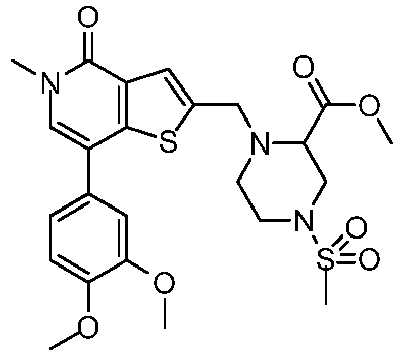
107 97 23 41 (R)-2-((3-butyl-4-(methylsulphonyl)piperaz in-1-yl)methyl)-7-(3,4-dimethoxyphenyl)-5-methylthieno[3,2-c]pyridin-4(5H)-one 7.0 26 534 1.13 
108 98 27 51 (S)-7-(3,4-dimethoxyphenyl)-2-((3-ethyl-4-(methylsulphonyl)piperaz in-1-yl)methyl)-5-methylthieno[3,2-c]pyridin-4(5H)-one 7.0 22 506 1.03 
109 100 19 38 (S)-7-(3,4-dimethoxyphenyl)-5-methyl-2-((2-methyl-4-(methylsulphonyl)piperaz in-1-yl)methyl)thieno[3,2-c]pyridin-4(5H)-one 10.1 44 492 0.95 
110 101 27 55 N-(1-((7-(3,4-dimethoxyphenyl)-5-methyl-4-oxo-4,5-dihydrothieno[3,2-c]pyridin-2-yl)methyl)pyrrolidin-3-yl)methanesulphonamide 4.5 14 478 0.85 
-

- Stage (i). A mixture of 7-bromo-5-methyl-2-((4-(methylsulphonyl)piperazin-1-yl)methyl)thieno[3,2-c]pyridin-4(5H)-one (for a preparation see Intermediate 69, 100 mg, 0.24 mmol), bis(pinacolato)boron (302 mg, 1.19 mmol), potassium acetate (93 mg, 0.95 mmol) and PdCl2(dppf) (17 mg, 10 mol%) in 1,4-dioxane (4 mL) was heated in a microwave at 110 °C for 30 minutes. The cooled reaction mixture was diluted with ethyl acetate (25 mL) and filtered through Celite. The filtrate was dried over sodium sulphate, and evaporated to leave a black oily residue.
- Stage (ii). A mixture of the stage (i) product, 2-chloro-N-(2-methoxyethyl)-N-methylpyridin-4-amine (for a preparation see Intermediate 86, 48 mg, 0.24 mmol), potassium carbonate (99 mg, 0.71 mmol), and bis(triphenylphosphine)palladium(II) chloride (17 mg, 10 mol%) in 1,2-dimethoxyethane (3 mL) and water (0.5 mL) was heated in a microwave at 120 °C for 20 minutes. The cooled reaction mixture was diluted with ethyl acetate (20 mL). The mixture was dried over sodium sulphate and the solvent evaporated. The residue was chromatographed [5% methanol/dichloromethane] then re-purified by MDAP to give 7-(4-((2-methoxyethyl)(methyl)amino)pyridin-2-yl)-5-methyl-2-((4-(methylsulphonyl)piperazin-1-yl)methyl)thieno[3,2-c]pyridin-4(5H)-one (9 mg, 7% yield) as a colourless glass.
LCMS (2 min, Formic Acid): Rt = 0.45 min, MH+ = 506. -

- To a solution of 7-bromo-5-methyl-2-((4-(methylsulphonyl)piperazin-1-yl)methyl)thieno[3,2-c]pyridin-4(5H)-one (for a preparation see Intermediate 69, 148 mg, 0.352 mmol) and pyridin-3-ylboronic acid (64.9 mg, 0.528 mmol), in isopropanol (1.5 mL) in a microwave vial were successively added potassium carbonate (0.880 mL, 1.760 mmol) and PEPPSI (23.92 mg, 0.035 mmol). The reaction mixture was stirred at 110 °C in the microwave for 30 minutes. The reaction mixture was concentrated in vacuo and partitioned between water and EtOAc. The phases were separated and the aqueous phase was extracted with EtOAc, The combined organic layers were washed with brine, dried over MgSO4, filtered and concentrated in vacuo. The crude residue was dissolved in a 1:1 MeOH/DMSO mixture and was purified via MDAP. The collected fractions were combined and concentrated in vacuo to give 5-methyl-2-((4-(methylsulphonyl)piperazin-1-yl)methyl)-7-(pyridin-3-yl)thieno[3,2-c]pyridin-4(5H)-one (29 mg, 20% yield) as a yellow solid.
LCMS (2 min, Formic Acid): Rt = 0.43 min, MH+ = 419 -

- To a mixture of 7-bromo-5-methyl-2-((4-(methylsulphonyl)piperazin-1-yl)methyl)thieno[3,2-c]pyridin-4(5H)-one (for a preparation see Intermediate 69, 70 mg, 0.167 mmol), (3,4-dichlorophenyl)boronic acid (38.1 mg, 0.200 mmol) and potassium carbonate (55.2 mg, 0.400 mmol) in isopropanol (2 mL) and water (1 mL) was added PEPPSI catalyst (34.0 mg, 0.05 mmol). The reaction mixture was heated in the microwave at 130 °C for 30 minutes, whereupon it was diluted with a saturated aqueous solution of ammonium sulphate (approx. 15 mL) and DCM (approx. 10 mL). The mixture was filtered through Celite and the filtrate transfered to a separatory funnel. The layers were separated and the aqueous phase was then extracted with DCM (4 x 10 mL). The combined organic layers were dried over magnesium sulphate, filtered and concentrated under reduced pressure to give a brown-green solid. The crude residue was purifed by chromatography on silica gel eluting with 0-5% MeOH in DCM to give an impure yellow oil. The latter was re-purified by MDAP to give 7-(3,4-dichlorophenyl)-5-methyl-2-((4-(methylsulphonyl)piperazin-1-yl)methyl)thieno[3,2-c]pyridin-4(5H)-one (9 mg, 11 % yield) as a light yellow solid.
1H NMR (400MHz, CDCl3) δ-ppm 2.61-2.66 (m, 4H), 2.77 (s, 3H), 3.23-3.27 (m, 4H), 3.67 (s, 3H), 3.80 (s, 2H), 7.16 (s, 1H), 7.40-7.43 (m, 1H), 7.55 (s,1H), 7.65 (m, 1H), 7.99 (s,1H). -

- To a solution of tert-butyl 4-(5-methyl-2-((4-(methylsulphonyl)piperazin-1-yl)methyl)-4-oxo-4,5-dihydrothieno[3,2-c]pyridin-7-yl)benzylcarbamate (for a preparation see Intermediate 85, 118 mg, 0.216 mmol) in 1,4-dioxane (3.00 mL) was added 4N HCl in 1,4-dioxane (3 mL). The resulting mixture was stirred at room temperature for 3 hours. The reaction mixture was concentrated in vacuo, the residue was triturated in Et2O, filtered and dried to give 7-(4-(aminomethyl)phenyl)-5-methyl-2-((4-(methylsulphonyl)piperazin-1-yl)methyl)thieno[3,2-c]pyridin-4(5H)-one dihydrochloride (112 mg, 100% yield) as a white solid.
LCMS (2 min, Formic Acid): Rt = 0.40 min, MH+ = 447 -

- To a solution of 7-bromo-5-methyl-2-((4-(methylsulphonyl)piperazin-1-yl)methyl)thieno[3,2-c]pyridin-4(5H)-one (for a preparation see Intermediate 69, 60 mg, 0.143 mmol) and (3-(benzyloxy)-4-methoxyphenyl)boronic acid (55.3 mg, 0.214 mmol) in isopropanol (3 mL) were successively added potassium carbonate (0.357 mL, 0.714 mmol) and PEPPSI (9.70 mg, 0.014 mmol). The reaction mixture was heated in the microwave at 110 °C, whereupon it was allowed to cool to rt. The reaction mixture was concentrated in vacuo, and the residue was partitioned between EtOAc and water. The aqueous phase was extracted three times with EtOAc and the combined organic layers were washed with brine, dried over MgSO4, filtered and concentrated in vacuo. The crude residue was purified via MDAP using a formic acid modifier and the appropriate fractions were combined and concentrated in vacuo to give 7-(3-(benzyloxy)-4-methoxyphenyl)-5-methyl-2-((4-(methylsulphonyl)piperazin-1-yl)methyl)thieno[3,2-c]pyridin-4(5H)-one formic acid salt (19 mg, 22% yield) as a white solid.
LCMS (2 min, Formic Acid): Rt = 0.90 min, MH+ = 554 -

- A mixture of (R)-7-bromo-5-methyl-2-((2-methyl-4-(methylsulphonyl)piperazin-1-yl)methyl)thieno[3,2-c]pyridin-4(5H)-one (for a preparation see Intermediate 21, 100 mg, 0.23 mmol), (4-methoxyphenyl)boronic acid (53 mg, 0.35 mmol), potassium carbonate (95 mg, 0.69 mmol) and bis(triphenylphosphine)palladium(II) chloride (16 mg, 10 mol%) in 1,2-dimethoxyethane (3 mL) and water (0.5 mL) was heated in a microwave at 120 °C for 20 minutes. The cooled reaction mixture was diluted with ethyl acetate (25 mL). The solution was dried over sodium sulphate and evaporated. The residue was chromatographed [0-5% methanol/dichloromethane] and the product triturated with diethyl ether to give (R)-7-(4-methoxyphenyl)-5-methyl-2-((2-methyl-4-(methylsulphonyl)piperazin-1-yl)methyl)thieno[3,2-c]pyridin-4(5H)-one (40 mg, 0.087 mmol, 37.6% yield) as an off white solid.
LCMS (2 min, Formic Acid): Rt = 0.73 min, MH+ = 462 -

- A mixture of (R)-7-bromo-5-methyl-2-((2-methyl-4-(methylsulphonyl)piperazin-1-yl)methyl)thieno[3,2-c]pyridin-4(5H)-one (for a preparation see Intermediate 21, 340 mg, 0.783 mmol), potassium carbonate (325 mg, 2.348 mmol), PEPPSI (53.2 mg, 0.078 mmol) and (±)-(5-(1-(pyridin-2-yl)ethoxy)pyridin-3-yl)boronic acid (for a preparation see Intermediate 7, 319 mg, 1.307 mmol) in isopropanol (6 mL) and water (2 mL) was heated in a sealed vial at 130 °C for 30 minutes in a microwave reactor. The mixture was diluted with saturated sodium bicarbonate (50 mL) and the aqueous layer extracted with DCM (3 x 50 mL). The organic layers were combined, filtered through a cartridge fitted with a hydrophobic frit and evaporated in vacuo. The residue was loaded onto a 50g silica cartridge and purified using a gradient of 0-10% methanol:DCM. Followed by a further gradient of 10-20% methanol:DCM. The required fractions were combined and evaporated in vacuo.
- The product was dissolved in a mixture of 50:50 methanol:DMSO (3 mL) and further purified by MDAP. The required fractions were combined and evaporated in vacuo to give 5-methyl-2-(((R)-2-methyl-4-(methylsulphonyl)piperazin-1-yl)methyl)-7-(5-(1-(pyridin-2-yl)ethoxy)pyridin-3-yl)thieno[3,2-c]pyridin-4(5H)-one (149.6 mg, 0.270 mmol, 34.5% yield) as a yellow gum.
LCMS (2 min, Formic Acid): Rt = 0.64 min, MH+ = 554 -

- A mixture of (R)-7-bromo-5-methyl-2-((2-methyl-4-(methylsulphonyl)piperazin-1-yl)methyl)thieno[3,2-c]pyridin-4(5H)-one (for a preparation see Intermediate 21, 100 mg, 0.23 mmol), (3-methoxyphenyl)boronic acid (53 mg, 0.35 mmol), potassium carbonate (95 mg, 0.69 mmol) and bis(triphenylphosphine)palladium(II) chloride (16 mg, 10 mol%) in 1,2-dimethoxyethane (3 mL) and water (0.5 mL) was heated in a microwave at 120 °C for 20 minutes. The cooled reaction mixture was diluted with ethyl acetate (25 mL). The solution was dried over sodium sulphate and evaporated. The residue was chromatographed [0-5% methanol/dichloromethane] and the product triturated with diethyl ether to give (R)-7-(3-methoxyphenyl)-5-methyl-2-((2-methyl-4-(methylsulphonyl)piperazin-1-yl)methyl)thieno[3,2-c]pyridin-4(5H)-one (65 mg, 0.141 mmol, 61.2% yield) as an off white solid.
LCMS (2 min, Formic Acid): Rt = 0.74 min, MH+ = 462 -

- To a stirred solution of (R)-7-bromo-5-methyl-2-((2-methyl-4-(methylsulphonyl)piperazin-1-yl)methyl)thieno[3,2-c]pyridin-4(5H)-one (for a preparation see Intermediate 21, 100 mg, 0.230 mmol) in Isopropanol (2 mL) and water (2 mL) was added N-(4-(4,4,5,5-tetramethyl-1,3,2-dioxaborolan-2-yl)pyridin-2-yl)acetamide (121 mg, 0.460 mmol) [PCT Int. Appl
WO2012021615(A1) - Further N-(4-(4,4,5,5-tetramethyl-1,3,2-dioxaborolan-2-yl)pyridin-2-yl)acetamide (61 mg, 0.115 mmol) was added and the mixture heated at 80 °C overnight. The mixture was diluted with chloroform (30 mL) and saturated ammonium chloride solution (30 mL) before being passed through a 2.5 g Celite cartridge. The filtrate phases were separated and the aqueous phase was back extracted with chloroform (30 mL). The organic phases were combined, dried over magnesium sulphate, and concentrated under reduced pressure. The crude material was triturated with diethyl ether to give a solid which was suspended in MeOH (2 mL) and refluxed at 70 °C for 30 minutes.
- The suspension was allowed to cool to room temperature and left to stand overnight. The solid was filtered through a small glass filter funnel and washed with methanol. The product was again suspended in MeOH (1 mL) and refluxed for 30 minutes. The suspension was allowed to cool to room temperature and left to stand overnight. The product was filtered and washed with methanol (3 x 10 mL) to give (R)-N-(4-(5-methyl-2-((2-methyl-4-(methylsulphonyl)piperazin-1-yl)methyl)-4-oxo-4,5-dihydrothieno[3,2-c]pyridin-7-yl)pyridin-2-yl)acetamide (45 mg, 0.092 mmol, 39.9% yield) as a pale yellow solid.
LCMS (2 min, Formic Acid): Rt = 0.51 min, MH+ = 490 -

- A mixture of (R)-7-bromo-5-methyl-2-((2-methyl-4-(methylsulphonyl)piperazin-1-yl)methyl)thieno[3,2-c]pyridin-4(5H)-one (for a preparation see Intermediate 21, 100 mg, 0.23 mmol), phenylboronic acid (42 mg, 0.34 mmol), potassium carbonate (95 mg, 0.69 mmol) and bis(triphenylphosphine)palladium(II) chloride (16 mg, 10 mol%) in 1,2-dimethoxyethane (3 mL) and water (0.5 mL) was heated in a microwave at 120 °C for 20 minutes. The cooled reaction mixture was diluted with ethyl acetate (25 mL). The solution was dried over sodium sulphate and evaporated. The residue was chromatographed [0-5% methanol/dichloromethane] and the product triturated with diethyl ether to give (R)-5-methyl-2-((2-methyl-4-(methylsulphonyl)piperazin-1-yl)methyl)-7-phenylthieno[3,2-c]pyridin-4(5H)-one (65 mg, 0.151 mmol, 65.4% yield) as an off white solid.
LCMS (2 min, Formic Acid): Rt = 0.73 min, MH+ = 432 -

- To a 2 - 5 mL microwave reaction was added 7-bromo-5-methyl-2-((4-(methylsulphonyl)piperazin-1-yl)methyl)thieno[3,2-c]pyridin-4(5H)-one (for a preparation see Intermediate 69, 70 mg, 0.167 mmol), p-tolylboronic acid (27.2 mg, 0.200 mmol), and potassium carbonate (55.2 mg, 0.400 mmol) in a solution of isopropanol (2 mL) and water (1 mL). Lastly to the reaction was added PEPPSI (34.0 mg, 0.05 mmol). The reaction vessel was sealed and heated in Biotage Initiator microwave reactor to 130 °C for 30 minutes with 10 seconds of pre-stirring. After cooling, the reaction was quenched with saturated ammonium chloride solution (15 mL) and DCM (15 mL) and passed through Celite to remove the palladium catalyst. The filtrate was transferred to a separating funnel. The organic layer was collected and the aqueous layer was extracted with DCM (2 x 10 mL). The organic fractions were combined and dried over MgSO4. The filtrate was collected by vacuum filtration and concentrated under reduced pressure to give a brown oil. The residue was loaded onto a 12 g silica gel column and eluted in 0 - 5% MeOH in DCM over 20 column volumes. The purest fractions were combined and concentrated under reduced pressure to give a yellow oil. The oil was triturated with diethyl ether and oven dried overnight to give 5-methyl-2-((4-(methylsulphonyl)piperazin-1-yl)methyl)-7-(p-tolyl)thieno[3,2-c]pyridin-4(5H)-one (42.3 mg, 59% yield) a yellow solid,
LCMS (2 min, Formic Acid): Rt = 0.77 min, MH+ = 432 -

- A mixture of (R)-7-bromo-5-methyl-2-((2-methyl-4-(methylsulphonyl)piperazin-1-yl)methyl)thieno[3,2-c]pyridin-4(5H)-one (for a preparation see Intermediate 21, 100 mg, 0.23 mmol), (2-methoxypyridin-4-yl)boronic acid (52 mg, 0.34 mmol), potassium carbonate (95 mg, 0.69 mmol) and bis(triphenylphosphine)palladium(II) chloride (16 mg, 10 mol%) in 1,2-dimethoxyethane (3 mL) and water (0.5 mL) was heated in a microwave at 120 °C for 20 minutes. The cooled reaction mixture was diluted with ethyl acetate (25 mL). The solution was dried over sodium sulphate and evaporated. The residue was chromatographed [0-5% methanol/dichloromethane] and the product triturated with diethyl ether to give (R)-7-(2-methoxypyridin-4-yl)-5-methyl-2-((2-methyl-4-(methylsulphonyl)piperazin-1-yl)methyl)thieno[3,2-c]pyridin-4(5H)-one (71 mg, 0.153 mmol, 66.7% yield) as a colourless solid.
LCMS (2 min, Formic Acid): Rt = 0.64 min, MH+ = 463 -

- A mixture of (R)-7-bromo-5-methyl-2-((2-methyl-4-(methylsulphonyl)piperazin-1-yl)methyl)thieno[3,2-c]pyridin-4(5H)-one (Intermediate 21, 100 mg, 0.23 mmol), (5-methoxypyridin-3-yl)boronic acid (52 mg, 0.34 mmol), potassium carbonate (95 mg, 0.69 mmol) and bis(triphenylphosphine)palladium(II) chloride (16 mg, 10 mol%) in 1,2-dimethoxyethane (3 mL) and water (0.5 mL) was heated in a microwave at 120 °C for 20 minutes. The cooled reaction mixture was diluted with ethyl acetate (25 mL). The solution was dried over sodium sulphate and evaporated. The residue was chromatographed [0-5% methanol/dichloromethane] and the product triturated with diethyl ether to give (R)-7-(5-methoxypyridin-3-yl)-5-methyl-2-((2-methyl-4-(methylsulphonyl)piperazin-1-yl)methyl)thieno[3,2-c]pyridin-4(5H)-one (58 mg, 0.125 mmol, 54.5% yield) as a colourless solid.
LCMS (2 min, Formic Acid): Rt = 0.56 min, MH+ = 463 -

- A mixture of (R)-7-bromo-5-methyl-2-((2-methyl-4-(methylsulphonyl)piperazin-1-yl)methyl)thieno[3,2-c]pyridin-4(5H)-one (Intermediate 21, 100 mg, 0.23 mmol), (6-methoxypyridin-3-yl)boronic acid (52 mg, 0.34 mmol), potassium carbonate (95 mg, 0.69 mmol) and bis(triphenylphosphine)palladium(II) chloride (16 mg, 10 mol%) in 1,2-dimethoxyethane (3 mL) and water (0.5 mL) was heated in a microwave at 120 °C for 20 minutes. The cooled reaction mixture was diluted with ethyl acetate (25 mL). The solution was dried over sodium sulphate and evaporated. The residue was chromatographed [0-5% methanol/dichloromethane]. The product was further purified by MDAP.
- The product was dissolved in ethyl acetate (0.5 mL) and treated with 1.0M hydrogen chloride in diethyl ether (0.5 mL). The solid was filtered off, washed with ether and dried to give (R)-7-(6-methoxypyridin-3-yl)-5-methyl-2-((2-methyl-4-(methylsulphonyl)piperazin-1-yl)methyl)thieno[3,2-c]pyridin-4(5H)-one hydrochloride (50 mg, 0.100 mmol, 43.5% yield) as a colourless solid.
LCMS (2 min, Formic Acid): Rt = 0.65 min, MH+ = 463 -

- A mixture of (R)-7-bromo-5-methyl-2-((2-methyl-4-(methylsulphonyl)piperazin-1-yl)methyl)thieno[3,2-c]pyridin-4(5H)-one (Intermediate 21, 100 mg, 0.23 mmol), 6-phenyl-2-(pyridin-2-yl)-1,3,6,2-dioxazaborocane (309 mg, 1.15 mmol), potassium orthophosphate (147 mg, 0.69 mmol), copper(I) iodide (22 mg, 0.12 mmol) and bis(triphenylphosphine)palladium(II) chloride (16 mg, 10mol%) in dry, degassed DMF (4 mL) was heated in the microwave at 150 °C for 45 minutes. The cooled reaction mixture was diluted with ethyl acetate (20 mL) and washed with water (x2) and brine. The organic phase was dried and evaporated. The residue was chromatographed [0-5% methanol/dichloromethane]. The product was triturated with diethyl ether to give (R)-5-methyl-2-((2-methyl-4-(methylsulphonyl)piperazin-1-yl)methyl)-7-(pyridin-2-yl)thieno[3,2-c]pyridin-4(5H)-one (17 mg, 0.039 mmol, 17.07% yield) as a colourless solid.
LCMS (2 min, Formic Acid): Rt = 0.61 min, MH+ = 433 -

- To a 5 mL microwave reaction vial was added 7-bromo-5-methyl-2-((4-(methylsulphonyl)piperazin-1-yl)methyl)thieno[3,2-c]pyridin-4(5H)-one (for a preparation see Intermediate 69, 63 mg, 0.150 mmol), (3-(trifluoromethyl)phenyl)boronic acid (34.2 mg, 0.180 mmol), and potassium carbonate (49.7 mg, 0.360 mmol) in a solution of isopropanol (2 mL) and water (1 mL). To the reaction was then added PEPPSI (34.0 mg, 0.05 mmol). The reaction vessel was sealed and heated in the Biotage Initiator microwave reactor to 130 °C for 30 minutes with 10 seconds of pre-stirring. After cooling, the reaction was quenched with saturated ammonium chloride solution (15 mL) and mixed with DCM (10 mL). The solution was passed through Celite to remove the palladium. The filtrate was transferred to a separating funnel and the organic layer was collected. The aqueous layer was extracted with DCM (2 x 10 mL). The organic layers were combined and dried over MgSO4. The filtrate was collected using vacuum filtration and the solvent was removed under reduced pressure to give a yellow oil.
- The oil was triturated with diethyl ether and oven dried overnight to give 5-methyl-2-((4-(methylsulphonyl)piperazin-1-yl)methyl)-7-(3-(trifluoromethyl)phenyl)thieno[3,2-c]pyridin-4(5H)-one (44.1 mg, 61% yield) as a pale pink solid,
LCMS (2 min, Formic Acid): Rt = 0.86 min, MH+ = 486 -

- To a 2 - 5 mL microwave reaction vial was added 7-bromo-5-methyl-2-((4-(methylsulphonyl)piperazin-1-yl)methyl)thieno[3,2-c]pyridin-4(5H)-one (for a preparation see Intermediate 69, 100 mg, 0.238 mmol) followed by (3-(benzylcarbamoyl)phenyl)boronic acid (Combi-Blocks Inc., 72.8 mg, 0.285 mmol), potassium carbonate (79 mg, 0.571 mmol) and lastly PEPPSI (34.0 mg, 0.05 mmol) in a solution of isopropanol (2 mL) and water (1 mL). The reaction vessel was sealed and heated in the Biotage Initiator microwave reactor to 130 °C for 30 minutes with 10 seconds of pre-stirring. The reaction was diluted with saturated sodium bicarbonate solution (20 mL) and shaken with DCM (20 mL). The solution was passed through Celite to remove the palladium.
- The filtrate was transferred to a separating funnel and the organic layer was collected. The aqueous phase was extracted with DCM (3 x 20 mL). The organic fractions were combined, dried over MgSO4 and concentrated under reduced pressure to give a light brown foam. The crude material was loaded onto a 25 g silica gel column and the product was eluted in 0 - 5% MeOH in DCM over 25 column volumes to give a pale yellow oil. The oil was triturated with diethyl ether to give N-benzyl-3-(5-methyl-2-((4-(methylsulphonyl)piperazin-1-yl)methyl)-4-oxo-4,5-dihydrothieno[3,2-c]pyridin-7-yl)benzamide (93 mg, 0.169 mmol, 71.0% yield) as an off-white solid,
LCMS (2 min, Formic Acid): Rt = 0.75 min, MH+ = 551. -

- To a microwave reaction vial was added (R)-7-bromo-5-methyl-2-((2-methyl-4-(methylsulphonyl)piperazin-1-yl)methyl)thieno[3,2-c]pyridin-4(5H)-one (for a preparation see Intermediate 21, 100 mg, 0.230 mmol) followed by bis(pinacolato)boron (292 mg, 1.151 mmol), potassium acetate (90 mg, 0.921 mmol), and PdCl2(dppf) (16.85 mg, 0.023 mmol) catalyst in a solution of 1,4-dioxane (4 mL). The vial was sealed and heated to 130 °C for 30 minutes in a microwave reactor. The reaction mixture was filtered through a 2.5 g Celite cartridge and the filtrate concentrated under reduced pressure. The residue was added to a microwave reaction vial containing 6-bromopyrimidin-4-ol (40.3 mg, 0.230 mmol), potassium carbonate (95 mg, 0.691 mmol). PdCl2(dppf) (16.85 mg, 0.023 mmol) catalyst was added along with 1,2-dimethoxyethane (3 mL) and water (0.5 mL). The reaction vessel was sealed and heated to 120 °C for 20 minutes in a microwave reactor. The reaction was quenched with saturated ammonium chloride solution (25 mL) and the product was extracted from the aqueous phase with DCM (3 x 25 mL). The organic phases were combined, dried over magnesium sulphate, and concentrated under reduced pressure. The crude material was loaded on to a 12 g silica gel column and was eluted in 0-10% MeOH in DCM to give (R)-7-(6-hydroxypyrimidin-4-yl)-5-methyl-2-((2-methyl-4-(methylsulphonyl)piperazin-1-yl)methyl)thieno[3,2-c]pyridin-4(5H)-one (10 mg, 0.022 mmol, 9.66% yield), as a light brown solid.
LCMS (2 min, Formic Acid): Rt = 0.44 min, MH+ = 450 -

- To a 5 mL microwave reaction vial was added 7-bromo-5-methyl-2-((4-(methylsulphonyl)piperazin-1-yl)methyl)thieno[3,2-c]pyridin-4(5H)-one (for a preparation see Intermediate 69, 70 mg, 0.167 mmol), o-tolylboronic acid (27.2 mg, 0.200 mmol), potassium carbonate (55.2 mg, 0.400 mmol), isopropanol (2 mL), and water (1 mL). Lastly was added PEPPSI (34.0 mg, 0.05 mmol) catalyst. The reaction vessel was sealed and heated in Biotage Initiator microwave reactor with 10 seconds of pre-stirring to 130 °C for 30 minutes. After cooling, the reaction was diluted with ammonium chloride solution (15 mL) and DCM (15 mL) and vacuum filtered through Celite. The filtrate was transferred to a separating funnel. The organic layer was collected and the aqueous layer was extracted with DCM (2 x 15 mL). The organic layers were combined and dried over MgSO4. The filtrate was collected using vacuum filtration and the solvent was removed under reduced pressure to give a pale brown oil. The residue was loaded on to a 12g silica gel column and eluted in 0-10% MeOH in DCM to give 5-methyl-2-((4-(methylsulphonyl)piperazin-1-yl)methyl)-7-(o-tolyl)thieno[3,2-c]pyridin-4(5H)-one (66 mg, 92% yield) as a light brown solid.
LCMS (2 min, Formic Acid): Rt = 0.77 min, MH+ = 432 -

- A mixture of (S)-7-bromo-5-methyl-2-((2-methyl-4-(methylsulphonyl)piperazin-1-yl)methyl)thieno[3,2-c]pyridin-4(5H)-one (for a preparation see Intermediate 88, 150 mg, 0.34 mmol), (6-methoxypyridin-3-yl)boronic acid (66 mg, 0.43 mmol), potassium carbonate (143 mg, 1.04 mmol) and bis(triphenylphosphine)palladium(II) chloride (25 mg, 10 mol%) in 1,2-dimethoxyethane (3 mL) and water (0.5 mL) was heated in a microwave at 120 °C for 20 minutes. The cooled reaction mixture was diluted with ethyl acetate (25 mL). The solution was dried over sodium sulphate and evaporated. The residue was chromatographed [0-4% methanol/dichloromethane] and the product triturated with diethyl ether to give (S)-7-(6-methoxypyridin-3-yl)-5-methyl-2-((2-methyl-4-(methylsulphonyl)piperazin-1-yl)methyl)thieno[3,2-c]pyridin-4(5H)-one (83 mg, 0.179 mmol, 52.0% yield) as an off white solid.
LCMS (2 min, Formic Acid): Rt = 0.66 min, MH+ = 463 -

- A mixture of (S)-7-bromo-5-methyl-2-((2-methyl-4-(methylsulphonyl)piperazin-1-yl)methyl)thieno[3,2-c]pyridin-4(5H)-one (for a preparation see Intermediate 88, 150 mg, 0.34 mmol), pyridin-4-ylboronic acid (53 mg, 0.43 mmol), potassium carbonate (143 mg, 1.04 mmol) and bis(triphenylphosphine)palladium(II) chloride (25 mg, 10 mol%) in 1,2-dimethoxyethane (3 mL) and water (0.5 mL) was heated in a microwave at 120 °C for 20 minutes. The cooled reaction mixture was diluted with ethyl acetate (25 mL). The solution was dried over sodium sulphate and evaporated. The residue was chromatographed [0-5% methanol/dichloromethane] and the product triturated with diethyl ether to give (S)-5-methyl-2-((2-methyl-4-(methylsulphonyl)piperazin-1-yl)methyl)-7-(pyridin-4-yl)thieno[3,2-c]pyridin-4(5H)-one (83 mg, 0.192 mmol, 55.6% yield) as an off white solid.
LCMS (2 min, Formic Acid): Rt = 0.41 min, MH+ = 433 -

- A mixture of (S)-7-bromo-5-methyl-2-((2-methyl-4-(methylsulphonyl)piperazin-1-yl)methyl)thieno[3,2-c]pyridin-4(5H)-one (for a preparation see Intermediate 88, 150 mg, 0.34 mmol), pyridin-3-ylboronic acid (53 mg, 0.43 mmol), potassium carbonate (143 mg, 1.04 mmol) and bis(triphenylphosphine)palladium(II) chloride (25 mg, 10 mol%) in 1,2-dimethoxyethane (3 mL) and water (0.5 mL) was heated in a microwave at 120 °C for 20 minutes. The cooled reaction mixture was diluted with ethyl acetate (25 mL). The solution was dried over sodium sulphate and evaporated. The residue was chromatographed [0-5% methanol/dichloromethane] and the product triturated with diethyl ether to give (S)-5-methyl-2-((2-methyl-4-(methylsulphonyl)piperazin-1-yl)methyl)-7-(pyridin-3-yl)thieno[3,2-c]pyridin-4(5H)-one (54 mg, 0.125 mmol, 36.2% yield) as an off white solid.
LCMS (2 min, Formic Acid): Rt = 0.45 min, MH+ = 433 -

- A mixture of (S)-7-bromo-5-methyl-2-((2-methyl-4-(methylsulphonyl)piperazin-1-yl)methyl)thieno[3,2-c]pyridin-4(5H)-one (for a preparation see Intermediate 88, 100 mg, 0.23 mmol), (5-methoxypyridin-3-yl)boronic acid (55 mg, 0.36 mmol), potassium carbonate (95 mg, 0.69 mmol) and bis(triphenylphosphine)palladium(II) chloride (16 mg, 10 mol%) in 1,2-dimethoxyethane (3 mL) and water (0.5 mL) was heated in a microwave at 120 °C for 20 minutes. The cooled reaction mixture was diluted with ethyl acetate (25 mL). The solution was dried over sodium sulphate and evaporated. The residue was chromatographed [0-4% methanol/dichloromethane] and the product triturated with diethyl ether to give (S)-7-(5-methoxypyridin-3-yl)-5-methyl-2-((2-methyl-4-(methylsulphonyl)piperazin-1-yl)methyl)thieno[3,2-c]pyridin-4(5H)-one (52 mg, 0.112 mmol, 48.8% yield) as a grey solid.
LCMS (2 min, Formic Acid): Rt = 0.56 min, MH+ = 463 -

- A mixture of (S)-7-bromo-5-methyl-2-((2-methyl-4-(methylsulphonyl)piperazin-1-yl)methyl)thieno[3,2-c]pyridin-4(5H)-one (for a preparation see Intermediate 88, 150 mg, 0.34 mmol), (4-methoxy-2-methylphenyl)boronic acid (73 mg, 0.44 mmol), potassium carbonate (143 mg, 1.04 mmol) and bis(triphenylphosphine)palladium(II) chloride (24 mg, 10 mol%) in 1,2-dimethoxyethane (3 mL) and water (0.5 mL) was heated in a microwave at 120 °C for 20 minutes. The cooled reaction mixture was diluted with ethyl acetate (25 mL). The solution was dried over sodium sulphate and evaporated. The residue was chromatographed [0-5% methanol/dichloromethane] and the product triturated with diethyl ether to give (S)-7-(4-methoxy-2-methylphenyl)-5-methyl-2-((2-methyl-4-(methylsulphonyl)piperazin-1-yl)methyl)thieno[3,2-c]pyridin-4(5H)-one (49 mg, 0.103 mmol, 29.8% yield) as a colourless solid.
LCMS (2 min, Formic Acid): Rt = 0.78 min, MH+ = 476 -

- To a solution of (S)-tert-butyl 4-((7-(3-(benzyloxy)-4-methoxyphenyl)-5-methyl-4-oxo-4,5-dihydrothieno[3,2-c]pyridin-2-yl)methyl)-3-methylpiperazine-1-carboxylate (Intermediate 68, 1.9 mg, 3.22 µmol) in 1,4-dioxane (1.0 mL) was added 4M HCl in 1,4-dioxane (1 mL). The reaction mixture was stirred at room temperature for 2 hours, whereupon it was concentrated in vacuo. The resulting residue was triturated in ether, filtered and dried in vacuo to give (S)-7-(3-(benzyloxy)-4-methoxyphenyl)-5-methyl-2-((2-methylpiperazin-1-yl)methyl)thieno[3,2-c]pyridin-4(5H)-one hydrochloride (1.6 mg) as a beige solid.
LCMS (2 min, Formic Acid): Rt = 0.83 min, MH+ = 490 -

- To a 25 mL round bottom flask under nitrogen and fitted with a reflux condenser and stirrer bar was added 5-ethyl-4-oxo-7-phenyl-4,5-dihydrothieno[3,2-c]pyridine-2-carbaldehyde (Intermediate 31, 95 mg, 0.335 mmol) in DCM (5 mL). To the reaction was then added 1-(methylsulphonyl)piperazine (83 mg, 0.503 mmol) and acetic acid (0.029 mL, 0.503 mmol) and the mixture was stirred at room temperature under nitrogen for 1 hour. The reaction mixture quickly became a yellow suspension. To the reaction mixture was then added sodium triacetoxyborohydride (355 mg, 1.676 mmol) and the temperature was increased to 40 °C. After 1 hour the reaction was allowed to cool to room temperature.
- The reaction was diluted with saturated sodium bicarbonate solution (20 mL) and transferred to a separating funnel. The product was extracted with DCM (3 x 10 mL). The organic layers were combined and washed with brine (approx. 10 mL). The organic layer was collected and dried over magnesium sulphate. The filtrate was collected in a 150 mL round bottom flask using a filter cup and the solvent was removed under reduced pressure to give an yellow oily-solid.
- The residue was insoluble in a small volume of MeOH so a small volume of DCM was added. The solution was transferred to a 1 g SCX column and allowed to filter through by gravity. The column was then flushed with MeOH (3 column volumes) to remove impurities. The product was then collected by flushing the column with 2.0M ammonia in MeOH (3 column volumes) and the solvent was removed under reduced pressure to give a pale yellow oil. This was placed in the vacuum oven overnight to give a yellow solid, 5-ethyl-2-((4-(methylsulphonyl)piperazin-1-yl)methyl)-7-phenylthieno[3,2-c]pyridin-4(5H)-one (102.4 mg, 0.237 mmol, 70.8% yield).
LCMS (2 min, Formic Acid): Rt = 0.83 min, MH+ = 432. -

- To a 25 mL round bottom flask was added 7-(3,4-dimethoxyphenyl)-5-ethyl-4-oxo-4,5-dihydrothieno[3,2-c]pyridine-2-carbaldehyde (Intermediate 32, 95 mg, 0.277 mmol) dissolved in dichloromethane (5 mL). To the solution was then added 1-(methylsulphonyl)piperazine (68.1 mg, 0.415 mmol) and acetic acid (0.024 mL, 0.415 mmol). The reaction was stirred under nitrogen at room temperature for 1 hour. To the reaction was then added sodium triacetoxyborohydride (293 mg, 1.383 mmol) and it was heated to 40 °C for several hours and then allowed to cool to room temperature.
- The reaction was diluted with saturated sodium bicarbonate solution (20 mL) and transferred to a separating funnel. The product was extracted with DCM (3 x 10 mL). The organic layers were combined and washed once with brine. The organic layer was collected and dried over magnesium sulphate and the filtrate was collected using vacuum filtration. The solvent was removed under reduced pressure to yield a yellow oil.
- The crude material was dissolved in a small volume of DCM and MeOH and transferred to a 1 g SCX column. The product was allowed to elute through the column by gravity. The column was flushed with MeOH (3 column volumes) to remove impurities. The product was eluted in 2.0M ammonia in MeOH (3 column volumes) and the solvent was removed under reduced pressure to give a while solid with oily residue. The product was dried in a vacuum oven to give a pale yellow solid, 7-(3,4-dimethoxyphenyl)-5-ethyl-2-((4-(methylsulphonyl)piperazin-1-yl)methyl)thieno[3,2-c]pyridin-4(5H)-one (108.1 mg, 0.220 mmol, 79% yield).
LCMS (2 min, Formic Acid): Rt = 0.74 min, MH+ = 492. -

- To a 25 mL round bottom flask under nitrogen and equipped with a stirrer bar and reflux condenser was added 5-ethyl-4-oxo-7-phenyl-4,5-dihydrothieno[3,2-c]pyridine-2-carbaldehyde (Intermediate 31, 95 mg, 0.335 mmol) in dichloromethane (5 mL). To the reaction was then added 1-(piperazin-1-yl)ethanone (64.5 mg, 0.503 mmol) and acetic acid (0.029 mL, 0.503 mmol). The reaction was left to stir at room temperature under nitrogen for 1 hour. Finally, sodium triacetoxyborohydride (355 mg, 1.676 mmol) was added to the reaction mixture and it was heated at 40 °C for an hour.
- The product was diluted with saturated sodium bicarbonate solution (20 mL) and transferred to a separating funnel. The product was extracted with DCM (3 x 10 mL). The organic layers were combined and washed with brine. The organic layer was collected and dried over magnesium sulphate and filtered. The filtrate was evaporated under reduced pressure to give a yellow oil. The crude material was dissolved in a small volume of MeOH and DCM and transferred to a 1 g SCX column. The product was allowed to elute with gravity. The column was then flushed with MeOH (3 column volumes) to remove impurities. The product was then eluted with 2.0M ammonia in MeOH (3 column volumes) and the solvent was removed under reduced pressure to give a yellow oil. The product was placed in the vacuum oven overnight to give a yellow solid, 2-((4-acetylpiperazin-1-yl)methyl)-5-ethyl-7-phenylthieno[3,2-c]pyridin-4(5H)-one (96.5 mg, 0.244 mmol, 72.8% yield).
LCMS (2 min, Formic Acid): Rt = 0.70 min, MH+ = 396. -

- To a 25 mL round bottom flask was added 7-(3,4-dimethoxyphenyl)-5-ethyl-4-oxo-4,5-dihydrothieno[3,2-c]pyridine-2-carbaldehyde (Intermediate 32, 95 mg, 0.277 mmol) dissolved in DCM (5 mL). To the solution was added 1-(piperazin-1-yl)ethanone (53.2 mg, 0.415 mmol) and acetic acid (0.024 mL, 0.415 mmol). The reaction was stirred under nitrogen at room temperature for 1 hour. To the reaction was then added sodium triacetoxyborohydride (293 mg, 1.383 mmol) and it was heated at 40 °C for 2 hours and then allowed to cool to room temperature.
- The reaction was diluted with saturated sodium bicarbonate solution (20 mL) and transferred to a separating funnel. The product was extracted with DCM (3 x 10 mL). The organic layers were combined and washed with brine. The organic layer was collected and dried over magnesium sulphate. The filtrate was collected using vacuum filtration and the solvent was removed under reduced pressure to give a yellow oil.
- The crude material was dissolved in a small volume of MeOH and DCM (approx. 2 mL) and transferred to a 1 g SCX column. The product was allowed to elute by gravity. The column was then flushed with MeOH (3 column volumes) to remove impurities. The product was eluted in 2.0M ammonia in MeOH (3 column volumes) to give a yellow oil. To the product was added a few drops of diethyl ether and it was scratched gently with a metal spatula which promoted precipitation of a yellow solid. The diethyl ether was then blown off under nitrogen at 40 °C and the product was dried in the oven overnight to give a pale yellow solid 2-((4-acetylpiperazin-1-yl)methyl)-7-(3,4-dimethoxyphenyl)-5-ethylthieno[3,2-c]pyridin-4(5H)-one (83.5 mg, 0.183 mmol, 66.3% yield).
LCMS (2 min, Formic Acid): Rt = 0.70 min, MH+ = 456. -

- To a microwave reaction vial was added (R)-7-bromo-2-((4-(ethylsulfonyl)-2-methylpiperazin-1-yl)methyl)-5-methylthieno[3,2-c]pyridin-4(5H)-one (Intermediate 92) (102 mg, 0.227 mmol) followed by N-(4-(4,4,5,5-tetramethyl-1,3,2-dioxaborolan-2-yl)pyridin-2-yl)acetamide (119 mg, 0.455 mmol), potassium carbonate (126 mg, 0.910 mmol) and bis(triphenylphosphine)palladium(II) chloride (15.97 mg, 0.023 mmol) in a solution of 1,2-DME (3 mL) and water (0.5 mL). The reaction vessel was sealed and heated to 120 °C for 20 min in the Biotage Initiator microwave reactor with 10 seconds of pre-stirring. After cooling, the reaction was diluted with saturated ammonium chloride solution (20 mL) and the product was extracted in DCM (3 x 20 mL). The organic fractions were combined, dried over magnesium sulfate, and concentrated under reduced pressure to give a yellow solid. The crude material was loaded on to a 12 g silica gel column and was eluted in 0-5% MeOH in DCM to give a yellow oil. The material was triturated with diethyl ether to give the title compound (105 mg, 0.208 mmol, 92 % yield), as a pale yellow solid
LCMS (2 min, Formic Acid): Rt = 0.55 min, MH+ = 504. - The following examples (141-155) were prepared as part of an array using the method exemplified below.
- An aliquot (0.4 mL, 0.1 mmol) of stock solution of N-(4-(2-(bromomethyl)-5-methyl-4-oxo-4,5-dihydrothieno[3,2-c]pyridin-7-yl)pyridin-2-yl)acetamide (Intermediate 94) in DMSO (706 mg, 1.8 mmol in 7.2 mL) was dispensed to each of a set of appropriate pre-weighed amines (0.120 mmol) in microwave vials. Finally potassium carbonate (0.041 g, 0.300 mmol) was added to each vial and the reactions were sealed and heated in a microwave reactor at 110 °C for 30 min. After cooling the reactions, the samples were purified by MDAP on an Xbridge column using MeCN/water with an ammonium carbonate modifier. The solvent was removed under a stream of nitrogen to give the required product. LCMS (2 min, High pH).

Example Name R Rt min MH+ 141 N-(4-(2-((3-isopropylmorpholino)methyl)-5-methyl-4-oxo-4,5-dihydrothieno[3,2-c]pyridin-7-yl)pyridin-2-yl)acetamide 
0.52 441 142 (R)-N-(4-(2-((3-fluoropyrrolidin-1-yl)methyl)-5-methyl-4-oxo-4,5-dihydrothieno[3,2-c]pyridin-7-yl)pyridin-2-yl)acetamide 
0.43 401 143 (R)-N-(4-(2-((3-hydroxypyrrolidin-1-yl)methyl)-5-methyl-4-oxo-4,5-dihydrothieno[3,2-c]pyridin-7-yl)pyridin-2-yl)acetamide 
0.41 399 144 N-(4-(2-((3-fluoropiperidin-1-yl)methyl)-5-methyl-4-oxo-4,5-dihydrothieno[3,2-c]pyridin-7-yl)pyridin-2-yl)acetamide 
0.44 415 145 N-(4-(5-methyl-4-oxo-2-((3-(trifluoromethyl)pyrrolidin-1-yl)methyl)-4,5-dihydrothieno[3,2-c]pyridin-7-yl)pyridin-2-yl)acetamide 
0.52 451 146 1-((7-(2-acetamidopyridin-4-yl)-5-methyl-4-oxo-4,5-dihydrothieno[3,2-c]pyridin-2-yl)methyl)piperidine-2-carboxamide 
0.43 440 147 N-(4-(5-methyl-2-((2-methylmorpholino)methyl)-4-oxo-4,5-dihydrothieno[3,2-c]pyridin-7-yl)pyridin-2-yl)acetamide 
0.46 413 148 N-(4-(2-((2,6-dimethylmorpholino)methyl)-5-methyl-4-oxo-4,5-dihydrothieno[3,2-c]pyridin-7-yl)pyridin-2-yl)acetamide 
0.49 427 149 N-(4-(2-((3,5-dimethylmorpholino)methyl)-5-methyl-4-oxo-4,5-dihydrothieno[3,2-c]pyridin-7-yl)pyridin-2-yl)acetamide 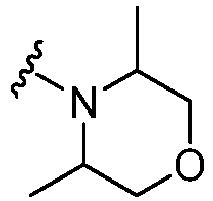
0.47 427 150 N-(4-(2-(((3R,5S)-3,5-dimethylmorpholino)methyl)-5-methyl-4-oxo-4,5-dihydrothieno[3,2-c]pyridin-7-yl)pyridin-2-yl)acetamide 
0.46 427 151 N-(4-(2-(((2R,3R)-2,3-dimethylmorpholino)methyl)-5-methyl-4-oxo-4,5-dihydrothieno[3,2-c]pyridin-7-yl)pyridin-2-yl)acetamide 
0.47 427 152 N-(4-(2-((3-fluoropyrrolidin-1-yl)methyl)-5-methyl-4-oxo-4,5-dihydrothieno[3,2-c]pyridin-7-yl)pyridin-2-yl)acetamide 
0.43 401 153 N-(4-(2-(((2S,6R)-2,6-dimethylmorpholino)methyl)-5-methyl-4-oxo-4,5-dihydrothieno[3,2-c]pyridin-7-yl)pyridin-2-yl)acetamide 
0.49 427 154 N-(4-(5-methyl-4-oxo-2-((2-(trifluoromethyl)pyrrolidin-1-yl)methyl)-4,5-dihydrothieno[3,2-c]pyridin-7-yl)pyridin-2-yl)acetamide 
0.90 451 155 N-(4-(2-((2,5-dimethylmorpholino)methyl)-5-methyl-4-oxo-4,5-dihydrothieno[3,2-c]pyridin-7-yl)pyridin-2-yl)acetamide 
0.48 427 -

- A mixture of 7-bromo-2-((3-fluoropiperidin-1-yl)methyl)-5-methylthieno[3,2-c]pyridin-4(5H)-one (Intermediate 96) (200 mg, 0.56 mmol), N-(4-(4,4,5,5-tetramethyl-1,3,2-dioxaborolan-2-yl)pyridin-2-yl)acetamide (219 mg, 0.84 mmol), potassium carbonate (385 mg, 2.78 mmol) and bis(triphenylphosphine)palladium(II) chloride (20 mg, 5 mol%) in toluene (2 mL) and ethanol (2 mL) was heated in a microwave at 120 °C for 20 minutes. The cooled reaction mixture was diluted with EtOAc (20 mL). The mixture was dried over sodium sulfate then filtered. The solvent was evaporated from the filtrate and the residue was purified by column chromatography on silica gel [0-5% MeOH/DCM] to give the title compound (127 mg, 0.306 mmol, 55.0 % yield) as a pale yellow solid.
LCMS (2 min, Formic Acid): Rt = 0.48 minutes, MH+ = 415. - This material was separated into its two component enantiomers by preparative chiral HPLC. 150 mg of racemate was dissolved at a rate of 30 mg per 2 mL of EtOH and 2 mL portions were injected onto a 2 cm x 25 cm Chiralpak IC column. The column was eluted with 30% EtOH/Hexane, flow rate=15 mL/min, wavelength 230nm. Appropriate fractions were combined, concentrated, re-dissolved in DCM and re-concentrated to give the two enantiomers:
- Example 144A: 37 mg. LCMS (2 min, Formic Acid): Rt = 0.48 min, MH+ = 415. Enantiomeric purity by chiral HPLC = >99% e.e.
- Example 144B: 38mg. LCMS (2 min, Formic Acid): Rt = 0.48 min, MH+ = 415. Enantiomeric purity by chiral HPLC = 95% e.e.
- Absolute stereochemistry was not assigned.
- The following examples (156-161) were prepared as part of an array using the method exemplified by that outlined below.
- An aliquot (0.4 mL, 0.1 mmol) of stock solution of N-(4-(2-(bromomethyl)-5-methyl-4-oxo-4,5-dihydrothieno[3,2-c]pyridin-7-yl)pyridin-2-yl)acetamide (Intermediate 94) in DMF (235 mg, 0.6 mmol in 2.4 mL) was dispensed to each of a set of appropriate pre-weighed amines (0.120 mmol) in microwave vials. Finally DIPEA (50 uL, 0.286 mmol) was added to each vial and the reactions were sealed and heated in a microwave reactor at 110 °C for 30 min. After cooling the reactions, the samples were purified by MDAP on an Xbridge column using MeCN/water with an ammonium carbonate modifier. The solvent was removed under a stream of nitrogen to give the required product. LCMS (2 min, High pH). * DMSO was used as solvent for Example 161

Example Name Product Rt min MH+ 156 (S)-N-(4-(2-((3-hydroxypiperidin-1-yl)methyl)-5-methyl-4-oxo-4,5-dihydrothieno[3,2-c]pyridin-7-yl)pyridin-2-yl)acetamide 
0.43 413 157 (S)-N-(4-(2-((3-hydroxypyrrolidin-1-yl)methyl)-5-methyl-4-oxo-4,5-dihydrothieno[3,2-c]pyridin-7-yl)pyridin-2-yl)acetamide 
0.42 399 158 (R)-N-(4-(2-((3-hydroxypiperidin-1-yl)methyl)-5-methyl-4-oxo-4,5-dihydrothieno[3,2-c]pyridin-7-yl)pyridin-2-yl)acetamide 
0.43 413 159 (S)-N-(4-(2-((3-fluoropyrrolidin-1-yl)methyl)-5-methyl-4-oxo-4,5-dihydrothieno[3,2-c]pyridin-7-yl)pyridin-2-yl)acetamide 
0.44 401 160 N-(4-(2-((3-methoxypiperidin-1-yl)methyl)-5-methyl-4-oxo-4,5-dihydrothieno[3,2-c]pyridin-7-yl)pyridin-2-yl)acetamide 
0.48 427 161* N-(4-(2-((3-hydroxyazetidin-1-yl)methyl)-5-methyl-4-oxo-4,5-dihydrothieno[3,2-c]pyridin-7-yl)pyridin-2-yl)acetamide 
0.42 385 -

- 7-Bromo-2-((3,3-difluoropiperidin-1-yl)methyl)-5-methylthieno[3,2-c]pyridin-4(5H)-one (Intermediate 95) (100 mg, 0.265 mmol), N-(4-(4,4,5,5-tetramethyl-1,3,2-dioxaborolan-2-yl)pyridin-2-yl)acetamide (104 mg, 0.398 mmol), potassium carbonate (183 mg, 1.325 mmol) and bis(triphenylphosphine)palladium(II) chloride (9.30 mg, 0.013 mmol), were dissolved in ethanol (2 mL) and toluene (2 mL) and heated in a microwave reactor for 20 min at 120 °C. EtOAc (20 mL) was added, the mixture was dried over MgSO4, filtered and the solvent evaporated. The crude product was dissolved in a small amount of DCM and purified by silica gel column chromatography using 0-5% MeOH / DCM. The appropriate fractions were combined and evaporated under vacuum to give a yellow oil. This was triturated with diethyl ether to give the title compound (59 mg, 0.136 mmol, 51.5 % yield) as a yellow solid.
LCMS (2 min, High pH): Rt = 0.89 min, MH+ = 433. -

- Tetrakis(triphenylphosphine) palladium(0) (19.07 mg, 0.017 mmol), (R)-7-bromo-5-methyl-2-((2-methyl-4-(methylsulfonyl)piperazin-1-yl)methyl)thieno[3,2-c]pyridin-4(5H)-one (Intermediate 21) (143 mg, 0.33 mmol), sodium carbonate (280 mg, 2.64 mmol), and 2-ethoxy-4-(4,4,5,5-tetramethyl-1,3,2-dioxaborolan-2-yl)pyridine (Intermediate 107) (93 mg, 0.371 mmol) in 1,2-DME (4 mL) were mixed and heated in the microwave for 2 hr at 120 °C. Further tetrakis(triphenylphosphine) palladium(0) (19.07 mg, 0.017 mmol) was added and the reaction was heated in the microwave to 120 °C for 3 hr. Further tetrakis(triphenylphosphine) palladium(0) (19.07 mg, 0.017 mmol) was added the reaction was heated in the microwave to 120 °C for 4 hr. The reaction was diluted with EtOAc and water, filtered and the organic layer was separated and concentrated in vacuo. The crude product was purified by chromatography [0-5% MeOH in DCM] and fractions containing product were concentrated then further purified by MDAP. The fractions containing product were concentrated in vacuo and once more purified by MDAP. The product containing fractions were concentrated in vacuo then dissolved in MeOH and passed through a 1g aminopropyl column, eluting with MeOH.
- The solvent was removed in vacuo to give the title compound as a white solid (13 mg, 0.027 mmol, 8.3 % yield).
LCMS (2 min, Formic Acid): Rt = 0.72 min, MH+ = 477 -

- Tetrakis(triphenylphosphine) palladium(0) (18.62 mg, 0.016 mmol), (R)-7-bromo-5-methyl-2-((2-methyl-4-(methylsulfonyl)piperazin-1-yl)methyl)thieno[3,2-c]pyridin-4(5H)-one (Intermediate 21) (140 mg, 0.322 mmol), aqueous sodium carbonate (1.289 mL, 2.58 mmol), and 2-(cyclopropylmethoxy)-4-(4,4,5,5-tetramethyl-1,3,2-dioxaborolan-2-yl)pyridine (Intermediate 108) (111 mg, 0.403 mmol) in 1,2-DME (3 mL) were mixed and heated in the microwave for 2 hr at 120 °C.The reaction was diluted with EtOAc and water, filtered and the organic layer was separated and concentrated in vacuo. The crude product was purified by chromatography [0-5% MeOH in DCM] and fractions containing product were combined and concentrated further purified by MDAP to give the title compound as a white solid (16 mg, 0.032 mmol, 9.9 % yield).
LCMS (2 min, High pH): Rt = 1.10 min, MH+ = 503. -

- The title compound was prepared from Intermediates 21 and 109 using a method similar to that described for Example 164 (39 mg, 0.071 mmol, 21.7 % yield).
LCMS (2 min, High pH): Rt = 0.96 min, MH+ = 546. -

- The title compound was prepared from Intermediates 21 and 110 using a method similar to that described for Example 164 (28 mg, 0.055 mmol, 18.5 % yield).
LCMS (2 min, High pH): Rt = 0.91 min, MH+ = 507. -

- (3-Methoxypyridin-4-yl)boronic acid (Combi-Blocks) (100 mg, 0.654 mmol), (R)-7-bromo-5-methyl-2-((2-methyl-4-(methylsulfonyl)piperazin-1-yl)methyl)thieno[3,2-c]pyridin-4(5H)-one (Intermediate 21) (250 mg, 0.576 mmol), tetrakis(triphenylphosphine) palladium(0) (33.3 mg, 0.029 mmol) and aqueous sodium carbonate (2.302 mL, 4.60 mmol) were mixed in 1,2-DME (3 mL) and heated in the microwave for 2 hr at 120 °C. Further (3-methoxypyridin-4-yl)boronic acid (40 mg, 0.262 mmol) and tetrakis(triphenylphosphine) palladium(0) (33.3 mg, 0.029 mmol) were added and the reaction heated again to 120 °C for 2 hr in the microwave. The reaction was diluted with EtOAc and water, filtered and the organic layer was separated and concentrated in vacuo. The residue was dissolved in ethanol and passed through a 10 g SCX column, eluting with MeOH, then ammonia (2 M in MeOH). The solvent was evaporated off to give the crude product which was purified by silica gel column chromatography [5-40% EtOH in EtOAc] and fractions containing product were combined and concentrated in vacuo to give the title compound as a white solid (36 mg, 0.078 mmol, 13.5 % yield).
LCMS (2 min, High pH): Rt = 0.76 min, MH+ = 463. -

- 3-(Cyclopropylmethoxy)-4-(4,4,5,5-tetramethyl-1,3,2-dioxaborolan-2-yl)pyridine (Intermediate 111) (73.7 mg, 0.268 mmol), (R)-7-bromo-5-methyl-2-((2-methyl-4-(methylsulfonyl)piperazin-1-yl)methyl)thieno[3,2-c]pyridin-4(5H)-one (Intermediate 21) (100 mg, 0.230 mmol), tetrakis(triphenylphosphine) palladium(0) (13.30 mg, 0.012 mmol) and aqueous sodium carbonate (0.921 mL, 1.842 mmol) were mixed in 1,2-DME (3 mL) and heated in the microwave for 2 hr at 120 °C. The reaction was diluted with EtOAc and water and filtered. The organic layer was separated and concentrated in vacuo and the crude product was purified by MDAP. Fractions containing product were concentrated in vacuo and further purified by MDAP. Fractions containing product were concentrated in vacuo, dissolved in MeOH and eluted with MeOH through a 10 g aminopropyl cartridge. The solvent was evaporated to give the title compound as a beige solid (58 mg, 0.115 mmol, 50.1 % yield).
LCMS (2 min, Formic): Rt = 0.59 min, MH+ = 503. -

- To a suspension of (R)-7-bromo-5-methyl-2-((2-methyl-4-(methylsulfonyl)piperazin-1-yl)methyl)thieno[3,2-c]pyridin-4(5H)-one (Intermediate 21) (100 mg, 0.230 mmol), crude 1-(2-((4-(4,4,5,5-tetramethyl-1,3,2-dioxaborolan-2-yl)pyridin-2-yl)oxy)ethyl)pyrrolidin-2-one (Intermediate 116) (361 mg, 42% w/w, 0.456 mmol) and potassium carbonate (95 mg, 0.691 mmol) in 1,2-DME (3 mL) in a microwave vial, was added tetrakis(triphenylphosphine) palladium(0) (13.30 mg, 0.012 mmol). The vial was sealed and placed in a Biotage Initiator microwave for 2 hr to 120 °C. The mixture was diluted with EtOAc (20 mL) and water (20 mL). Two layers separated and the aqueous phase was extracted by EtOAc (3 x 20 mL). The combined organics were dried using a hydrophobic frit and concentrated in vacuo to give a brown oil. The residue was dissolved in DMSO (3 mL) and purified by MDAP. Appropriate fractions were combined and concentrated in vacuo. The residue was dissolved in DMSO (1 mL) and again purified by MDAP. Appropriate fractions were combined and reduced in vacuo to give the title compound as a clear oil (14 mg, 10.9% yield).
LCMS (2 min, High pH): Rt = 0.82 min, MH+ = 560. -

- To a stirred suspension of crude (3-(cyclopropylmethoxy)-5-(4,4,5,5-tetramethyl-1,3,2-dioxaborolan-2-yl)pyridine (Intermediate 117) (619 mg, 23% w/w, 0.517 mmol) in 1,2-DME (4 mL), was added potassium carbonate (293 mg, 2.118 mmol), (R)-7-bromo-5-methyl-2-((2-methyl-4-(methylsulfonyl)piperazin-1-yl)methyl)thieno[3,2-c]pyridin-4(5H)-one (Intermediate 21) (130 mg, 0.3 mmol) and tetrakis(triphenylphosphine) palladium (0) (0.015 g, 0.013 mmol). This was sealed in a microwave vial and heated in a Biotage microwave for 120 °C for 2 hr. Further (R)-7-bromo-5-methyl-2-((2-methyl-4-(methylsulfonyl)piperazin-1-yl)methyl)thieno[3,2-c]pyridin-4(5H)-one (50 mg) was then added together with tetrakis(triphenylphosphine) palladium (0) (5 mg). The reaction was heated in the microwave at 120 °C for a further 1 hr. The reaction was diluted with EtOAc (30 mL) and water (30 mL). Two layers separated and the aqueous layer was re-extracted with EtOAc (3x30 mL). The solvent was evaporated to dryness under reduced pressure. The residue was dissolved in DMSO (5 mL) and purified by MDAP. Appropriate fractions were combined and concentrated in vacuo. The residue was dissolved in MeOH and loaded on an SCX cartridge (1g). The product was eluted with 2M ammonia in MeOH. Appropriate fractions were combined and concentrated in vacuo to give the title compound as a brown oil (26.4 mg, 17.5%).
LCMS (2 min, High pH): Rt = 0.97 min, MH+ = 503. -

- 7-Bromo-2-((3-hydroxypiperidin-1-yl)methyl)-5-methylthieno[3,2-c]pyridin-4(5H)-one (Intermediate 118) (125 mg, 0.35 mmol), 2-methoxy-4-(4,4,5,5-tetramethyl-1,3,2-dioxaborolan-2-yl)pyridine (Intermediate 112) (94 mg, 0.4 mmol), bis(triphenylphosphine)palladium(II) chloride (12.28 mg, 0.018 mmol) and potassium carbonate (145 mg, 1.050 mmol) in 1,2-DME (3 mL) and water (0.5 mL) were mixed together and heated in the microwave for 1 hr to 120 °C. Further bis(triphenylphosphine)palladium(II) chloride (12.28 mg, 0.018 mmol) was added and the reaction was heated in the microwave to 120 °C for 3 hr. The solution was extracted with EtOAc and washed with water. The aqueous and organic layers were filtered together and then separated. The organic layer was filtered through a hydrophobic frit and concentrated in vacuo and purified by MDAP.
- Fractions containing product were combined and concentrated in vacuo then dissolved in MeOH and loaded onto a 2 g aminopropyl column which was eluted with MeOH. The eluent was concentrated then re-dissolved in MeOH then loaded onto 500 mg SCX cartridge. Elution with 2M ammonia in MeOH then concentration in vacuo gave the title compound as a colourless solid (10 mg, 0.026 mmol, 7.4 % yield).
LCMS (2 min, Formic Acid): Rt = 0.55 min, MH+ = 386. -

- 7-Bromo-2-((3-hydroxypiperidin-1-yl)methyl)-5-methylthieno[3,2-c]pyridin-4(5H)-one (Intermediate 118) (118 mg, 0.33 mmol), tetrakis(triphenylphosphine) palladium (0) (19.07 mg, 0.017 mmol), sodium carbonate (280 mg, 2.64 mmol) and 2-ethoxy-4-(4,4,5,5-tetramethyl-1,3,2-dioxaborolan-2-yl)pyridine (Intermediate 107) (92 mg, 0.371 mmol) in 1,2-DME (4 mL) were mixed and heated in the microwave for 2 hr at 120 °C. PEPPSI (11.24 mg, 0.017 mmol) was added and the reaction was heated to 120 °C for 1.5 hr. The reaction was diluted with EtOAc and water and filtered then the organic layer was separated and concentrated in vacuo to give the crude product which was purified by silica gel column chromatography [0-5% MeOH in DCM]. Fractions containing product were concentrated in vacuo then further purified by MDAP. Fractions containing product were concentrated in vacuo then dissolved in MeOH, loaded onto a 2 g aminopropyl column. Elution with MeOH then concentration in vacuo gave the title compound as a white solid (10 mg, 0.025 mmol, 7.6 % yield).
LCMS (2 min, Formic Acid): Rt = 0.61 min, MH+ = 400. -

- N-(4-(4,4,5,5-Tetramethyl-1,3,2-dioxaborolan-2-yl)pyridin-2-yl)propionamide (Intermediate 113) (80 mg, 0.291 mmol), (R)-7-bromo-5-methyl-2-((2-methyl-4-(methylsulfonyl)piperazin-1-yl)methyl)thieno[3,2-c]pyridin-4(5H)-one (Intermediate 21) (115 mg, 0.265 mmol), tetrakis(triphenylphosphine) palladium (0) (15.30 mg, 0.013 mmol) and aqueous sodium carbonate (1.059 mL, 2.118 mmol) were mixed and heated in the microwave for 2 hr at 120 °C. The reaction was diluted with EtOAc and water and filtered then the organic layer was separated and concentrated in vacuo to give the crude product which was purified by MDAP. Fractions containing product were concentrated in vacuo then further purified by MDAP twice. Fractions containing product were combined, concentrated in vacuo, dissolved in MeOH and eluted through a 1 g aminopropyl cartridge with MeOH. The solvent was removed in vacuo to give the title compound (23 mg, 0.046 mmol, 17.25 % yield).
LCMS (2 min, Formic Acid): Rt = 0.58 min, MH+ = 504. -

- N-(4-(4,4,5,5-Tetramethyl-1,3,2-dioxaborolan-2-yl)pyridin-2-yl)cyclopropanecarboxamide (Intermediate 114) (93 mg, 0.322 mmol), (R)-7-bromo-5-methyl-2-((2-methyl-4-(methylsulfonyl)piperazin-1-yl)methyl)thieno[3,2-c]pyridin-4(5H)-one (Intermediate 21) (120 mg, 0.276 mmol), tetrakis(triphenylphosphine) palladium (0) (15.96 mg, 0.014 mmol) and aqueous sodium carbonate (1.105 mL, 2.210 mmol) were mixed in 1,2-DME (3 mL), and heated in the microwave for 2 hr at 120 °C. The reaction was diluted with EtOAc and water then filtered. The organic layer was separated and concentrated in vacuo to give the crude product which was purified by MDAP. Fractions containing product were concentrated in vacuo to give the title compound as a white solid (25 mg, 0.048 mmol, 17.6 % yield).
LCMS (2 min, High pH): Rt = 0.84 min, MH+ = 516. -
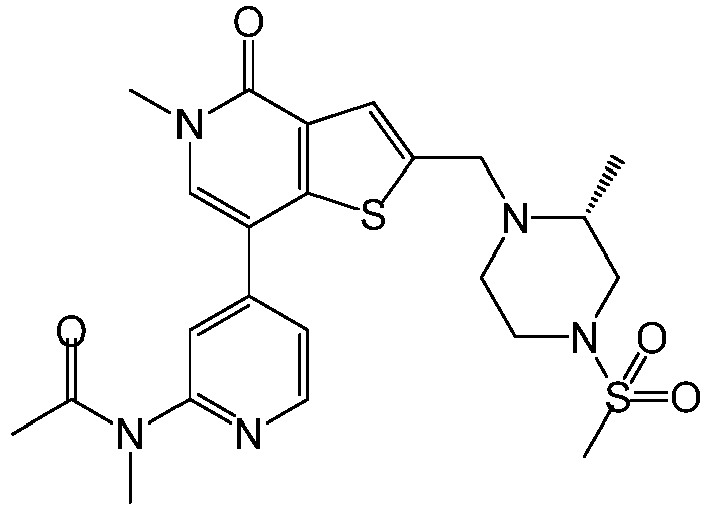
- (N-Methyl-N-(4-(4,4,5,5-tetramethyl-1,3,2-dioxaborolan-2-yl)pyridin-2-yl)acetamide (Intermediate 115) (85 mg, 0.309 mmol), (R)-7-bromo-5-methyl-2-((2-methyl-4-(methylsulfonyl)piperazin-1-yl)methyl)thieno[3,2-c]pyridin-4(5H)-one (Intermediate 21) (115 mg, 0.265 mmol), tetrakis(triphenylphosphine) palladium (0) (15.30 mg, 0.013 mmol) and aqueous sodium carbonate (1.059 mL, 2.118 mmol) were mixed in 1,2-DME (3 mL), and heated in the microwave for 2 hr at 120 °C. The reaction was diluted with EtOAc and water then filtered. The organic layer was separated and concentrated in vacuo to give the crude product which was purified by MDAP. Fractions containing product were concentrated in vacuo, dissolved in MeOH and passed down a 5g aminopropyl column eluting with MeOH. The solvent was evaporated and the resulting solid was purified by MDAP to give the title compound as a colourless solid (12 mg, 0.024 mmol, 9.0 % yield).
LCMS (2 min, High pH): Rt = 0.75 min, MH+ = 504. -

- To a stirred suspension of (R)-7-(2-chloro-6-(cyclopropylmethoxy)pyridin-4-yl)-5-methyl-2-((2-methyl-4-(methylsulfonyl)piperazin-1-yl)methyl)thieno[3,2-c]pyridin-4(5H)-one (Intermediate 121) (30 mg, 0.056 mmol), cesium carbonate (24 mg), acetamide (4 mg) and Xantphos (3 mg) in 1-4-dioxane (1 mL), was added Pd2(dba)3 (2 mg). The reaction was left to reflux for 24 hr. Further cesium carbonate (24 mg), acetamide (4 mg), Xantphos (3 mg) and Pd2(dba)3 (2 mg) were added and the reaction was refluxed for an additional 18 hr. The mixture was then placed into a microwave vial and heated to 120 °C for 2 hr in a microwave reactor.
- Further cesium carbonate (24 mg), acetamide (4 mg) and Xantphos (3 mg) and Pd2(dba)3 (2 mg) were added and the reaction was heated in the microwave at 160 °C for 2 hr. The mixture was dissolved in water (20 mL) and DCM (20 mL) and the two layers were separated. The aqueous phase was re-extracted with DCM (3x20 mL). All phases were re-combined combined and concentrated in vacuo. The residue was dissolved in DMSO (1 mL) and purified by MDAP. Appropriate fractions were combined and concentrated in vacuo. The residue was dissolved in DMSO (1 mL) and again purified by MDAP. Appropriate fractions were combined and reduced in vacuo to give the title compound as a yellow oil (8 mg, 34.6%).
LCMS (2 min, High pH): Rt = 1.01 min, MH+ = 560. -

- A mixture of 2-((1,4-oxazepan-4-yl)methyl)-7-bromo-5-methylthieno[3,2-c]pyridin-4(5H)-one (Intermediate 42) (150 mg, 0.42 mmol), 2-((tetrahydro-2H-pyran-4-yl)methoxy)-4-(4,4,5,5-tetramethyl-1,3,2-dioxaborolan-2-yl)pyridine hydrochloride (ex. BoroPharm Inc.) (224 mg, 0.63 mmol), potassium carbonate (290 mg, 2.10 mmol) and bis(triphenylphosphine)palladium(II) chloride (30 mg, 10 mol%) in ethanol (2 mL) and toluene (2 mL) was heated in a microwave at 130°C for 45 minutes. The reaction mixture was cooled and another portion of bis(triphenylphosphine)palladium(II) chloride (31 mg, 10 mol%) was added. The reaction mixture was heated in a microwave at 130°C for 45 minutes. The cooled reaction mixture was filtered through Celite. The filtrate was treated with potassium carbonate (290 mg, 2.10 mmol) and bis(triphenylphosphine)palladium(II) chloride (30 mg, 10 mol%) and the mixture heated in the microwave at 130°C for 45 minutes. The cooled reaction mixture was diluted with EtOAc (20 mL).
- The mixture was dried over sodium sulphate, filtered and the solvent was evaporated from the filtrate. The residue was purified by silica gel column chromatography [0-2% MeOH/EtOAc]. The product was triturated with diethyl ether to give the title compound as a white solid (157 mg, 0.334 mmol, 80 % yield).
LCMS (2 min, Formic Acid): Rt = 0.65 min, MH+ = 470. -

- A mixture of 7-bromo-5-methyl-2-(morpholinomethyl)thieno[3,2-c]pyridin-4(5H)-one (Intermediate 122) (150 mg, 0.44 mmol), 2-((tetrahydro-2H-pyran-4-yl)methoxy)-4-(4,4,5,5-tetramethyl-1,3,2-dioxaborolan-2-yl)pyridine hydrochloride (233 mg, 0.66 mmol), potassium carbonate (302 mg, 2.18 mmol) and bis(triphenylphosphine)palladium(II) chloride (31 mg, 10 mol%) in ethanol (2 mL) and toluene (2 mL) was heated in a microwave at 130°C for 45 minutes. The reaction mixture was cooled and another portion of bis(triphenylphosphine)palladium(II) chloride (31 mg, 10 mol%) was added. The reaction mixture was heated in a microwave at 130°C for 45 minutes. The cooled reaction mixture was diluted with EtOAc (20 mL). The mixture was dried over sodium sulphate, filtered and the solvent was evaporated from the filtrate. The residue was purified by silica gel column chromatography [0-2% MeOH/EtOAc]. The product was triturated with diethyl ether to give the title compound as an off-white solid (35 mg, 0.077 mmol, 17.6 % yield).
LCMS (2 min, Formic Acid): Rt = 0.64 min, MH+ = 456. -

- To a solution of tert-butyl 4-((5-methyl-4-oxo-7-(2-((tetrahydro-2H-pyran-4-yl)methoxy)pyridin-4-yl)-4,5-dihydrothieno[3,2-c]pyridin-2-yl)methyl)-1,4-diazepane-1-carboxylate (Intermediate 125) (400 mg, 0.703 mmol) in MeOH (30 mL) was added a solution of hydrogen chloride in 1,4-dioxane (2mol/L,10.0 mL) and the solution was stirred at rt for 2 hr. The solvent was evaporated. The residue was dissolved in DCM (50 mL). The organic phase was washed with saturated sodium carbonate (3 x 50 mL) and dried over sodium sulphate to give the crude product as a yellow oil. The crude product was purified by silica gel column chromatography eluting with DCM/MeOH (20/1) to give the title compound (231 mg, 0.493 mmol, 70.1 % yield) as yellow solid.
LCMS: MH+ = 469 -

- To a solution of 2-((1,4-diazepan-1-yl)methyl)-5-methyl-7-(2-((tetrahydro-2H-pyran-4-yl)methoxy)pyridin-4-yl)thieno[3,2-c]pyridin-4(5H)-one (Example 179) (115 mg, 0.245 mmol) in MeOH (20 mL) was added formaldehyde (36.8 mg, 1.227 mmol) and acetic acid (0.2 mL). The solution was stirred for 1.5 hr, then NaCNBH3 (154 mg, 2.454 mmol) was added and the solution was stirred for 2 hr. The reaction mixture was combined with that from an additional experiment (using 100 mg starting material Example 179) and concentrated. The crude product was purified by silica gel column chromatography eluting with DCM/MeOH (20/1) to give the title compound (101 mg, 0.209 mmol, 85 % yield) as a light yellow solid.
LCMS: MH+ = 483 -

- To a solution of tert-butyl 4-((5-methyl-4-oxo-7-(2-((pyridin-2-ylmethyl)amino)pyridin-4-yl)-4,5-dihydrothieno[3,2-c]pyridin-2-yl)methyl)-1,4-diazepane-1-carboxylate (Intermediate 128) (280 mg, 0.499 mmol) in EtOAc (10 mL) stirred under nitrogen at rt was added a solution of hydrogen chloride (1460 mg, 40 mmol) in 1,4-dioxane (10 mL). The reaction mixture was stirred at rt for 20 hr. Some solid precipitated. The mixture was filtered and the filtered cake was washed with EtOAc (10 mL) and dried in vacuo to obtain a crude product. The crude product was purified by Pre-HPLC using water and MeCN as solvents with a formic acid modifier. This did not give clean purification, so the residue from this was purified by Pre-HPLC using water and MeCN as solvents with a TFA modifier [on a Waters Gemini C18 (150 x 21.2mm, 5um), eluting with 0.1% v/v solution of TFA in water (Solvent A) and MeCN (Solvent B), using the following elution gradient of 0-30% Solvent B over 15 min at a flow rate of 20 mL/min. The UV detection wavelength: 214 nm]. The product containing fraction was treated with 0.5 mL conc. HCl, and then concentrated to afford the 2HCl salt of the title compound (170 mg, 0.319 mmol, 63.8 % yield) as an off-white solid.
LCMS: MH+ = 461 -

- The 2HCl salt of the title compound was prepared from Intermediate 131 as a pale yellow solid using a method similar to that described for Example 181 (180 mg, 0.337 mmol, 67.6 % yield).
LCMS: MH+ = 461 -

- To a solution of tert-butyl 4-((5-methyl-4-oxo-7-(2-(pyridin-2-ylmethoxy)pyridin-4-yl)-4,5-dihydrothieno[3,2-c]pyridin-2-yl)methyl)-1,4-diazepane-1-carboxylate (Intermediate 134) (340 mg, 0.424 mmol) in DCM (10 mL) stirred under nitrogen at rt was added trifluoroacetic acid (5 mL, 64.9 mmol). The reaction mixture was stirred at rt for 2 hr. The reaction mixture was concentrated and to the residue was added DCM (100 mL). The organic phase was washed with saturated sodium bicarbonate solution 50 mL, saturated brine 50 mL, dried over sodium sulphate and evaporated in vacuo to give the crude product which was purified by Pre-HPLC on a Waters Gemini C18 (150 x 21.2mm, 5um) eluting with 0.05% v/v solution of NH3 in Water (Solvent A) and MeCN (Solvent B), using the following elution gradient of 20-70% Solvent B over 15 min at a flow rate of 20 mL/min.
- The UV detection wavelength: 214nm . The appropriate fractions were combined and evaporated in vacuo to give the title compound (121 mg, 0.262 mmol, 61.9% yield) as a yellow glass.
LCMS: MH+ = 462. -

- To a solution of tert-butyl 4-((7-(2-(benzyloxy)pyridin-4-yl)-5-methyl-4-oxo-4,5-dihydrothieno[3,2-c]pyridin-2-yl)methyl)-1,4-diazepane-1-carboxylate (Intermediate 137) (340 mg, 0.606 mmol) in DCM (10 mL) stirred under nitrogen at rt was added trifluoroacetic acid (5 mL, 64.9 mmol). The reaction mixture was stirred at rt for 2 hr. The reaction mixture was concentrated and to the residue was added DCM (100 mL). The organic phase was washed with saturated sodium bicarbonate solution (50 mL) and saturated brine (50 mL), then dried over sodium sulphate and evaporated in vacuo. The crude product was purified by Pre-HPLC on a chiralpak-IA (250 x 20 mm, 5um) column eluting with 0.2% v/v solution of diethylamine in EtOH (Solvent A) and Hexane (Solvent B), using the following elution gradient of 50-50% Solvent B over 30 min at a flow rate of 14 mL/min. The UV detection wavelength: 214nm. The appropriate fractions were combined and evaporated in vacuo to give the title compound (171 mg, 0.371 mmol, 61.2% yield) as a yellow glass.
LCMS: MH+ = 461. -

- A solution of 7-(3,4-dimethoxyphenyl)-5-methyl-4-oxo-4,5-dihydrothieno[3,2-c]pyridine-2-carbaldehyde (Intermediate 25) (100 mg, 0.304 mmol), N,3-dimethylpiperidine-3-carboxamide (95 mg, 0.607 mmol) and sodium triacetoxyborohydride (193 mg, 0.911 mmol) in 1,2-DCE (20 mL) was stirred under nitrogen at rt for 17 hr. The mixture was washed with NaHCO3 solution (5 mL) and the organic layer was dried over Na2SO4. The solvent was evaporated in vacuo to give the crude product. The crude product was purified by silica gel column chromatography eluting with DCM/MeOH (20:1) to give the title compound (60 mg, 0.126 mmol, 41.7 % yield) as a white solid.
LCMS: MH+ = 470. -

- A solution of 7-(3,4-dimethoxyphenyl)-5-methyl-4-oxo-4,5-dihydrothieno[3,2-c]pyridine-2-carbaldehyde (Intermediate 25) (200 mg, 0.607 mmol), (3-methylpiperidin-3-yl)methanol (Intermediate 140) (78 mg, 0.607 mmol) and sodium triacetoxyhydroborate (386 mg, 1.822 mmol) in 1,2-DCE (30 mL) was stirred under nitrogen at rt for 17 hr. The mixture was washed with NaHCO3 solution (5 mL) and the organic layer was dried with Na2SO4, concentrated in vacuo and purified by MDAP. 0.1 mL HCl (2M) was added to the appropriate fractions which were combined and the solvent was removed by rotary evaporation to give the title compound as a hydrochloride salt (20 mg, 0.045 mmol, 7.4 % yield).
LCMS: MH+ = 443. -
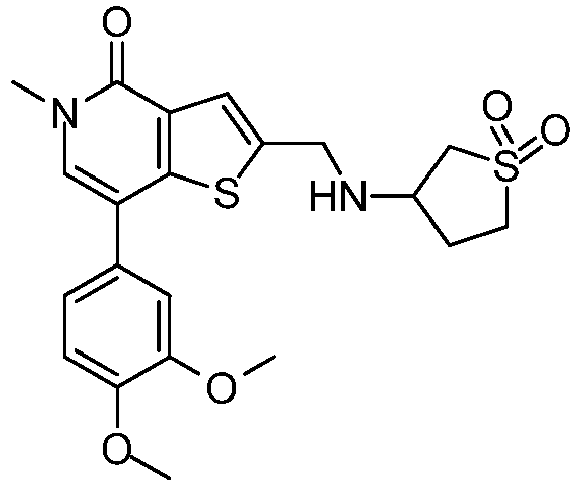
- A solution of 7-bromo-2-(((1,1-dioxidotetrahydrothiophen-3-yl)amino)methyl)-5-methylthieno[3,2-c]pyridin-4(5H)-one (Intermediate 138) (233 mg, 0.595 mmol), (3,4-dimethoxyphenyl)boronic acid (130 mg, 0.715 mmol), potassium carbonate (181 mg, 1.310 mmol) and PEPPSI (37 mg, 0.054 mmol) in water (2 mL) and isopropanol (6 mL) was stirred for 30 min at 120 °C in the microwave.
- The reaction mixture was allowed to cool to rt, diluted with EtOAc (50 mL), filtered through Celite, passed through a hydrophobic frit and concentrated in vacuo. The resulting residue was diluted in DMSO (4.0 mL) and purified by MDAP. The appropriate fractions were combined and concentrated in vacuo to give the title compound (156 mg, 0.35 mmol, 58%) as a pale orange solid.
LCMS (2 min, Formic Acid): Rt = 0.78 min, MH+ = 449. -

- A solution of 7-bromo-2-(((1,1-dioxidotetrahydro-2H-thiopyran-4-yl)amino)methyl)-5-methylthieno[3,2-c]pyridin-4(5H)-one (Intermediate 139) (204 mg, 0.503 mmol), (3,4-dimethoxyphenyl)boronic acid (110 mg, 0.604 mmol), PEPPSI (31 mg, 0.046 mmol) and potassium carbonate (153 mg, 1.107 mmol) in isopropanol (6 mL) and water (2 mL) was heated to 120 °C in a microwave reactor for 30 minutes. The solution was allowed to cool to rt, diluted with EtOAc (50 mL), filtered through Celite, passed through a hydrophobic frit and concentrated in vacuo. The resulting residue was dissolved in DMSO (3 x 1.0 mL) and purified by MDAP. The appropriate fractions were combined and concentrated in vacuo to give the title compound (118 mg, 0.26 mmol, 51%) as an off white solid.
LCMS (2 min, Formic Acid): Rt = 0.60 min, MH+ = 463. -

- A solution of 7-bromo-5-methyl-2-((methylamino)methyl)thieno[3,2-c]pyridin-4(5H)-one (Intermediate 34) (126 mg, 0.439 mmol), (3,4-dimethoxyphenyl)boronic acid (96 mg, 0.527 mmol), PEPPSI (27 mg, 0.040 mmol) and potassium carbonate (133 mg, 0.965 mmol) in water (1 mL) and isopropanol (3 mL) was left to stir at 120 °C for 30 min in a microwave reactor. The reaction mixture was allowed to cool to rt, diluted with EtOAc (30 mL), filtered through Celite, passed through a hydrophobic frit and concentrated in vacuo. The resultant residue was dissolved in MeOH (3 mL) and passed through an Isolute NH2 column. The appropriate fractions were collected and concentrated in vacuo.
- The resultant residue was dissolved in DMSO (3 x 1.0 mL) and purified by MDAP. The appropriate fractions were combined and concentrated in vacuo to give the title compound (66 mg, 0.19 mmol, 44%) as a pale yellow oil.
LCMS (2 min, Formic Acid): Rt = 0.58 min, MH+ = 345. -

- To a solution of 7-(3,4-dimethoxyphenyl)-5-methyl-4-oxo-4,5-dihydrothieno[3,2-c]pyridine-2-carbaldehyde (Intermediate 25) (460 mg, 1.396 mmol) and 3-(methoxymethyl)-3-methylpiperidine (Intermediate 143) (200 mg,1.396 mmol) in 1,2-DCE (30 mL) stirred under nitrogen at rt, was added sodium triacetoxyborohydride (888 mg, 4.19 mmol) in 1,2-DCE (30 mL). The reaction mixture was stirred at 85 °C for 24 hr. The suspension was concentrated in vacuo and purified by MDAP. 0.1 mL HCl (2 M) was added to the fractions and the appropriate fractions were combined and the solvent was removed by rotary evaporation to give the hydrocholoride salt of the title compound (100 mg, 0.194 mmol, 13.9 % yield) as an orange solid.
LCMS: MH+ = 457. -

- The title compound was prepared as the hydrochloride salt from Intermediates 25 and 145 using a method similar to that described for Example 190. White solid (95.6 mg, 0.175 mmol, 21.39 % yield). LCMS: MH+ = 497.
- The following compounds of Formula (I) were also prepared:
Example No. Structure Name 192 
7-(2,6-dimethylphenyl)-5-methyl-2-((4-(methylsulfonyl)piperazin-1-yl)methyl)thieno[3,2-c]pyridin-4(5H)-one 193 
5-methyl-7-(5-((tetrahydro-2H-pyran-4-yl)methoxy)pyridin-3-yl)-2-((2,2,4-trimethylpiperazin-1-yl)methyl)thieno[3,2-c]pyridin-4(5H)-one 194 
N-(3-(5-methyl-2-((2-methylpyrrolidin-1-yl)methyl)-4-oxo-4,5-dihydrothieno[3,2-c]pyridin-7-yl)phenyl)acetamide 195 
N-(4-(2-((2,3-dimethylpiperidin-1-yl)methyl)-5-methyl-4-oxo-4,5-dihydrothieno[3,2-c]pyridin-7-yl)pyridin-2-yl)acetamide 196 
N-(4-(5-methyl-4-oxo-2-(piperidin-1-ylmethyl)-4,5-dihydrothieno[3,2-c]pyridin-7-yl)pyridin-2-yl)acetamide 197 
1-((7-(3,4-dimethoxyphenyl)-5-methyl-4-oxo-4,5-dihydrothieno[3,2-c]pyridin-2-yl)methyl)-N,N,3-trimethylpiperidine-3-carboxamide hydrochloride 207 
4-(2-(((2-hydroxyethyl)(methyl)amino)methyl)-5-methyl-4-oxo-4,5-dihydrothieno[3,2-c]pyridin-7-yl)-2-(trifluoromethyl)benzonitrile -

- To a solution of 3-((cyclopropylmethoxy)methyl)-3-methylpyrrolidine (Intermediate 149) (100 mg, 0.591 mmol) and 7-(3,4-dimethoxyphenyl)-5-methyl-4-oxo-4,5-dihydrothieno[3,2-c]pyridine-2-carbaldehyde (Intermediate 25) (214 mg, 0.650 mmol) in 1,2-DCE (5 mL) stirred under nitrogen at room temperature was added AcOH (0.1 mL) dropwise during 1 min. The reaction mixture was stirred at rt for 30 min, sodium triacetoxyborohydride (188 mg, 0.886 mmol) was added portionwise during 1 min and stirred at room temperature overnight. The reaction mixture was quenched with water and partitioned with DCM (2 x 50 mL). The organic phase was dried over sodium sulphate and evaporated in vacuo.The crude product was loaded onto a silica gel column that was eluted with DCM/MeOH (15:1) to give the title compound (90 mg, 0.186 mmol, 31.6 % yield) as a yellow oil.
LCMS: MH+ = 483. -

- To tert-butyl 4-((5-methyl-4-oxo-7-(3-((pyridin-2-ylmethyl)amino)phenyl)-4,5-dihydrothieno[3,2-c]pyridin-2-yl)methyl)-1,4-diazepane-1-carboxylate (Intermediate 151) (320 mg, 0.400 mmol) in DCM (50 mL) was added TFA (0.154 mL, 2.001 mmol) and the mixture was stirred overnight at rt.The solvent was removed and the residue was purified by Pre-HPLC on a Waters Gemini C18 (150 x 21.2 mm , 5um) eluting with 0.1% v/v solution of formic acid in water (Solvent A) and acetonitrile(Solvent B), using the following elution gradient of 2-30%B over 20min at a flow rate of 50ml/min. The UV detection wavelength was 214nm. The product containing fraction was treated with 0.5 mL conc. HCl, and then concentrated to afford the the title compound (190 mg, 0.379 mmol, 95 % yield) as a light orange solid.
LCMS: MH+ = 460 -

- A mixture of 2-((1,4-diazepan-1-yl)methyl)-5-methyl-7-(3-((pyridin-2-ylmethyl)amino)phenyl) thieno[3,2-c]pyridin-4(5H)-one (Example 199) (75 mg, 0.163 mmol), formaldehyde (4.50 µL, 0.163 mmol) and AcOH (0.934 µL, 0.016 mmol) in MeOH (30 mL) was stirred at 25°C for 2 h. NaCNBH3 (103 mg, 1.632 mmol) was added and the mixture was stirred overnight.The mixture was concentrated in vacuo. The crude product was purified by MDAP and 0.5 mL HCl (1 M) was added to the product containing fractions which were combined and the solvent was removed by rotary evaporation to give the title compound (6 mg, 0.013 mmol, 7.76 % yield) as a yellow solid.
LCMS: MH+ = 474. -

- To a solution of tert-butyl 4-((5-methyl-4-oxo-7-(3-(picolinamido)phenyl)-4,5-dihydrothieno[3,2-c]pyridin-2-yl)methyl)-1,4-diazepane-1-carboxylate (Intermediate 153) (90 mg, 0.157 mmol) in DCM (10 mL) was added TFA (0.121 mL, 1.569 mmol). The mixture was stirred at 25 °C for 2 h. The mixture was concentrated in vacuo. The crude product was purified by MDAP and 0.5 mL HCl (1 M) was added to the product containing fractions which were combined and the solvent was removed by rotary evaporation to give the title compound (12 mg, 0.025 mmol, 16.15 % yield) as a yellow solid.
LCMS: MH+ = 474. -

- A mixture of crude 2-((4-acetyl-2-methylpiperazin-1-yl)methyl)-7-bromo-5-methylthieno[3,2-c]pyridin-4(5H)-one (Intermediate 156) (300 mg, 46% w/w, 0.346 mmol), 2-((tetrahydro-2H-pyran-4-yl)methoxy)-4-(4,4,5,5-tetramethyl-1,3,2-dioxaborolan-2-yl)pyridine (Intermediate 124) (111 mg, 0.346 mmol), tetrakis(triphenylphosphine) palladium (0) (40.0 mg, 0.035 mmol) and potassium carbonate (96 mg, 0.693 mmol) in 1,4-dioxane (50 mL) and water (10.00 mL) was stirred for 4 h at 100°C. The organic phase was extracted with DCM (200 mL), washed with saturated brine (100 mL) and water (50 mL), dried over magnesium sulphate and evaporated in vacuo to give the crude product as a orange oil. The residue was purified by Pre-HPLC on a Waters Gemini C18 (150 x 21.2 mm, 5um) eluting with 0.1 % v/v solution of formic acid in water (Solvent A) and acetonitrile (Solvent B), using the following elution gradient of 2-30%B over 20 min at a flow rate of 50 mL/min. The UV detection wavelength was 214nm. The appropriate fraction was treated with 0.5 mL conc. HCl, and then concentrated to afford the title compound (118 mg, 0.214 mmol, 61.6 % yield) as a yellow solid.
LCMS: MH+ = 511. -

- To the solution of tert-butyl 4-((5-methyl-4-oxo-7-(2-((tetrahydro-2H-pyran-4-yl)methoxy)pyridin-4-yl)-4,5-dihydrothieno[3,2-c]pyridin-2-yl)methyl)-3-oxopiperazine-1-carboxylate (Intermediate 158) (750 mg, 1.319 mmol) in DCM (30 mL) was added TFA (1.016 mL, 13.19 mmol). The mixture was stirred at 25 °C for 2 h. The mixture was concentrated in vacuo, then combined with the crude products from two further experiments (carried out on 50 mg and 280 mg scale), and purified by MDAP. 0.5 mL HCl (1 M) was added to the product containing fractions which were combined and the solvent was removed by rotary evaporation to give the title compound (220 mg) as a yellow solid.
LCMS: MH+ = 469. -
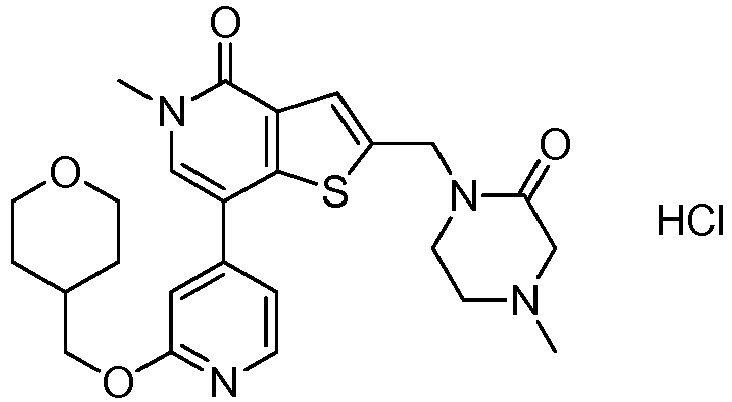
- A mixture of 5-methyl-2-((2-oxopiperazin-1-yl)methyl)-7-(2-((tetrahydro-2H-pyran-4-yl)methoxy)pyridin-4-yl)thieno[3,2-c]pyridin-4(5H)-one (Example 203) (100 mg, 0.213 mmol), formaldehyde (0.029 mL, 1.067 mmol) and AcOH (1.2 µL, 0.021 mmol) in MeOH (20 mL) was stirred at 25 °C for 2 h. NaCNBH3 (134 mg, 2.134 mmol) was added and stirring was continued overnight.
- The mixture was concentrated in vacuo then combined with the crude products from a further experiment (carried out on a 10 mg scale), and purified by MDAP. 0.5 mL HCl (1 M) was added to the product containing fractions which were combined and the solvent was removed by rotary evaporation to give the title compound (70 mg, 0.145 mmol, 68.0 % yield) as a yellow solid.
LCMS: MH+= 483. -

- A mixture of 7-bromo-2-(((2-hydroxyethyl)(methyl)amino)methyl)-5-methylthieno[3,2-c]pyridin-4(5H)-one (Intermediate 159) (50 mg, 0.15 mmol), (3-(dimethylamino)phenyl)boronic acid (30 mg, 0.180 mmol), potassium carbonate (50 mg, 0.360 mmol) and PEPPSI-iPr (9.17 mg, 0.014 mmol) in water (0.3 mL) and isopropanol (0.9 mL) was heated to 120 °C in a microwave reactor for 30 min. The solution was allowed to cool to room temperature, diluted with EtOAc (3 mL), passed through a C18 1 g SPE-pre-conditioned column, rinsed with further EtOAc (3 mL) and MeOH (2 mL). The filtrate was collected and blown down under nitrogen at 40 °C and the crude product was purified by MDAP to give the title compound (5 mg, 0.013 mmol, 9 % yield).
LCMS (2 min, High pH): Rt = 0.93 min, MH+ = 372. -

- The title compound was prepared from Intermediate 159 and (3,4-dichlorophenyl)boronic acid using a method similar to that described for Example 205 (11 mg, 0.028 mmol, 18 % yield).
LCMS (2 min, High pH): Rt = 1.07 min, MH+ = 397/399/401. - The compounds of formula (I) may be tested in one or more of the following assays:
- Binding was assessed using a time resolved fluorescent resonance energy transfer binding assay.
- This utilises a 6 His purification tag at the N-terminal of the proteins as an epitope for an anti-6 His antibody labeled with Europium chelate (PerkinElmer AD0111) allowing binding of the Europium to the proteins which acts as the donor fluorophore. A small molecule, high affinity binder of the bromodomains BRD2, BRD3, BRD4 and BRDT has been labeled with Alexa Fluor647 (Reference Compound X) and this acts as the acceptor in the FRET pair.
-
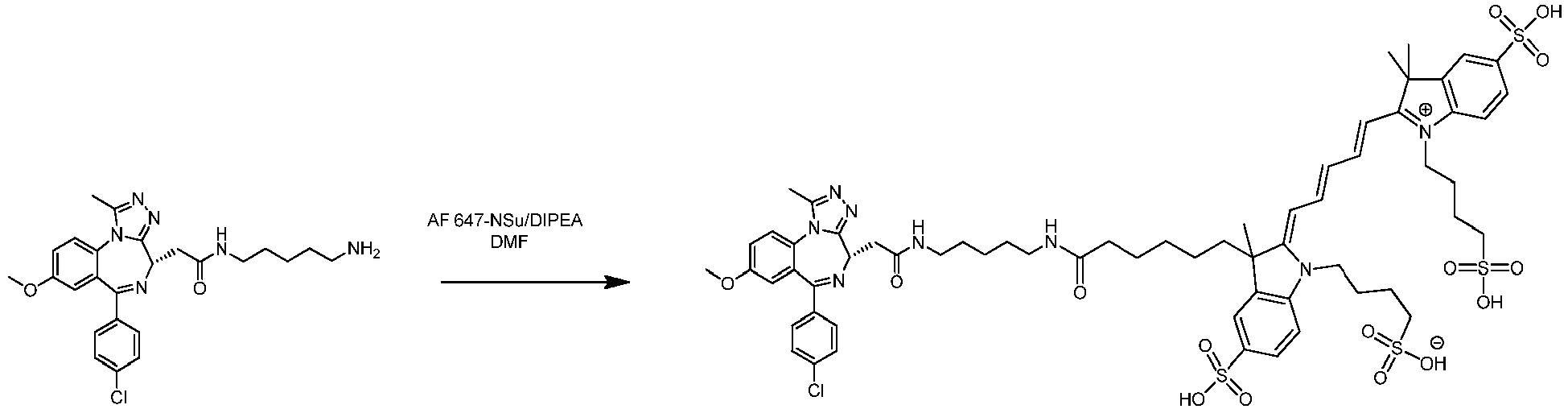
- To a solution of N-(5-aminopentyl)-2-((4S)-6-(4-chlorophenyl)-8-methoxy-1-methyl-4H-benzo[f][1,2,4]triazolo[4,3-a][1,4]diazepin-4-yl)acetamide (for a preparation see Reference Compound J,
WO2011/054848A1 1.7 mg, 3.53 µmol) in DMF (40µl) was added a solution of AlexaFluor647-ONSu (2.16 mg, 1.966 µmol) also in DMF (100µl). The mixture was basified with DIPEA (1 µl, 5.73 µmol) and agitated overnight on a vortex mixer. - The reaction mixture was evaporated to dryness. The solid was dissolved in acetonitrile/water/acetic acid (5/4/1, <1 mL) filtered and was applied to a Phenomenex Jupiter C18 preparative column and eluted with the following gradient (A = 0.1% trifluoroacetic acid in water, B= 0.1% TFA/90% acetonitrile/10% water): Flow rate = 10 mL/min., AU = 20/10 (214nm):
- 5-35%, t=0min: B = 5%; t=10min: B = 5%; t=100min: B = 35%; t=115min: B = 100% (Sep. grad: 0.33%/min)
- The major component was eluted over the range 26-28%B but appeared to be composed of two peaks. The middle fraction (F1.26) which should contain "both" components was analysed by analytical HPLC (Spherisorb ODS2, 1 to 35% over 60min): single component eluting at 28%B. Fractions F1.25/26&27 were combined and evaporated to dryness. Transfered with DMF, evaporated to dryness, triturated with dry ether and the blue solid dried overnight at<0.2mbar: 1.54mg.
- Analytical HPLC (Sphersisorb ODS2, 1 to 35%B over 60min): MSM10520-1: [M+H]+ (obs): 661.8/- corresponding with M-29. This equates to [(M+2H)/2]+ for a calculated mass of 1320.984 which is M-29. This is a standard occurence with the Alexa Fluor 647 dye and represents a theoretical loss of two methylene groups under the conditions of the mass spectrometer.
- Assay Principle: In the absence of a competing compound, excitation of the Europium causes the donor to emit at λ618nm which excites the Alexa labelled bromodomain binding compound leading to an increased energy transfer that is measurable at λ647nM. In the presence of a sufficient concentration of a compound that can bind these proteins, the interaction is disrupted leading to a quantifiable drop in fluorescent resonance energy transfer.
- The binding of the compounds of formula (I) to Bromodomains BRD2, BRD3, BRD4 and BRDT was assessed using mutated proteins to detect differential binding to either Binding Domain 1 (BD1) or Binding Domain 2 (BD2) on the bromodomain. These single residue mutations in the acetyl lysine binding pocket greatly lower the affinity of the fluoroligand (Reference Compound X) for the mutated domain (>1000 fold selective for the non-mutated domain). Therefore in the final assay conditions, binding of the fluoroligand to the mutated domain cannot be detected and subsequently the assay is suitable to determine the binding of compounds to the single non-mutated bromodomain.
- Protein production: Recombinant Human Bromodomains [(BRD2 (1-473) (Y113A) and (Y386A), BRD3 (1-435) (Y73A) and (Y348A) BRD4 (1-477) (Y97A) and (Y390A) and BRDT (1-397) (Y66A) and (Y309A)] were expressed in E. coli cells (in pET15b vector for BRD2/3/4 and in pET28a vector for BRDT) with a 6-His tag at the N-terminal. The His-tagged Bromodomain pellet was resuspended in 50mM HEPES (pH7.5), 300mM NaCl, 10mM imidazole & 1µl/mL protease inhibitor cocktail and extracted from the E. coli cells using sonication and purified using a nickel sepharose high performance column, the proteins were washed and then eluted with a linear gradient of 0-500mM imidazole with buffer 50mM HEPES (pH7.5), 150mM NaCl, 500mM imidazole, over 20 column volumes. Final purification was completed by Superdex 200 prep grade size exclusion column. Purified protein was stored at -80°C in 20mM HEPES pH 7.5 and 100mM NaCl. Protein identity was confirmed by peptide mass fingerprinting and predicted molecular weight confirmed by mass spectrometry.
- Protocol for Bromodomain BRD2, 3, 4 and T, BD1 + BD2 mutant assays: All assay components were dissolved in buffer composition of 50 mM HEPES pH7.4, 50mM NaCl, 5% Glycerol, 1 mM DTT and 1 mM CHAPS. The final concentration of bromodomain proteins were 10nM and the Alexa Fluor647 ligand was at Kd. These components were premixed and 5µl of this reaction mixture was added to all wells containing 50nl of various concentrations of test compound or DMSO vehicle (0.5% DMSO final) in Greiner 384 well black low volume microtitre plates and incubated in dark for 30 minutes at room temperature. 5µl of detection mixture containing 1.5nM final concentration anti-6His Europium chelate was added to all wells and a further dark incubation of at least 30 minutes was performed. Plates were then read on the Envision platereader, (λex = 317nm, donor λem = 615nm; acceptor λem = 665nm; Dichroic LANCE dual). Time resolved fluorescent intensity measurements were made at both emission wavelengths and the ratio of acceptor/donor was calculated and used for data analysis. All data was normalized to the mean of 16 high (inhibitor control - Example 11 of
WO 2011/054846A1 ) and 16 low (DMSO) control wells on each plate. A four parameter curve fit of the following form was then applied:
- Where 'a' is the minimum, 'b' is the Hill slope, 'c' is the plC50 and 'd' is the maximum.
- Binding was assessed using a fluorescence polarisation binding assay. This utilises a 6 His purification tag at the N-terminal of the proteins as an epitope for an anti-6 His antibody labeled with Europium chelate (PerkinElmer AD0111) allowing binding of the Europium to the proteins which acts as the donor fluorophore. A small molecule, high affinity binder of the bromodomains BRD2, BRD3, BRD4 and BRDT has been labeled with Alexa Fluor647 (Reference Compound X) and this acts as the acceptor in the FRET pair.
- Assay Principle: The Bromodomain protein, fluorescent ligand (Reference compound X) and a variable concentration of test compound are incubated together to reach thermodynamic equilibrium under conditions such that in the absence of test compound the fluorescent ligand is significantly (>50%) bound and in the presence of a sufficient concentration of a potent inhibitor the fluorescence polarization of the unbound fluorescent ligand is measurably different from the bound value.
- The binding of the compounds of formula (I) to Bromodomain BRD4 was assessed using mutated proteins to detect differential binding to either Binding Domain 1 (BD1) or Binding Domain 2 (BD2) on the bromodomain. These single residue mutations in the acetyl lysine binding pocket greatly lower the affinity of the fluoroligand (Reference Compound X) for the mutated domain (>1000 fold selective for the non-mutated domain). Therefore in the final assay conditions, binding of the fluoroligand to the mutated domain cannot be detected and subsequently the assay is suitable to determine the binding of compounds to the single non-mutated bromodomain.
- Protein production: Recombinant Human Bromodomains [BRD4 (1-477) (Y97A) and (Y390A)] were expressed in E. coli cells (in pET15b vector) with a 6-His tag at the N-terminal. The His-tagged Bromodomain pellet was resuspended in 50mM HEPES (pH7.5), 300mM NaCl, 10mM imidazole & 1µl/mL protease inhibitor cocktail and extracted from the E. coli cells using sonication and purified using a nickel sepharose high performance column, the proteins were washed and then eluted with a linear gradient of 0-500mM imidazole with buffer 50mM HEPES (pH7.5), 150mM NaCl, 500mM imidazole, over 20 column volumes. Final purification was completed by Superdex 200 prep grade size exclusion column. Purified protein was stored at -80°C in 20mM HEPES pH 7.5 and 100mM NaCl. Protein identity was confirmed by peptide mass fingerprinting and predicted molecular weight confirmed by mass spectrometry.
- Protocol for Bromodomain BRD4 BD1 and BD2 mutant FP assays: All assay components were dissolved in buffer composition of 50 mM HEPES pH7.4, 150mM NaCl, and 1mM CHAPS. The final concentration of the Bromodomain proteins were 2 x Kd and the Alexa Fluor647 ligand was 5nM. These components were premixed and 10µl of this reaction mixture was added to all wells containing 50nl of various concentrations of test compound or DMSO vehicle in Greiner 384 well black low volume microtitre plates and incubated in the dark for 45 minutes at room temperature. Plates were then read on the Envision platereader, (λex = 620nm, λem = 688nm). The parallel and perpendicular fluorescence intensity were measured, converted to polarization values and used for data analysis. All data was normalized to the mean of 16 high (inhibitor control) and 16 low (DMSO) control wells on each plate. A four parameter curve fit of the following form was then applied:

- Where 'a' is the minimum, 'b' is the Hill slope, 'c' is the plC50 and 'd' is the maximum.
- Examples 1-207 were each tested in at least one of the TR-FRET or FP BRD2, BRD3, BRD4 or BRDT, BD1 or BD2 assays described above and were found to have a plC50 ≥ 4.5 in at least one assay.
- Examples 1-34, 36-59, 61-69, 71-73, 75, 76, 78, 80, 92-113, 115-128, 135, 137, 140-146, 156, 157, 159, 161-176, 179-184, 186-188, 191, 193, 198, 199 and 201 were found to have a plC50 ≥ 6.0 in the TR-FRET or FP BRD4 BD1 assay.
- Examples 1, 2, 4, 16-18, 21, 26, 28-30, 40, 47, 48, 48A, 53, 71, 97, 104-106, 115-119, 135, 164, 168, 173, 176, 181, 182, 184 and 199 were found to have a plC50 ≥ 7.0 in the TR-FRET or FP BRD4 BD1 assay.
- Selectivity for BRD4 BD1 over BRD4 BD2 was calculated as follows:

- Examples 1-83, 90-130, 135-137, 140-191 and 198-206 were found to have selectivity for BRD4 BD1 over BRD4 BD2 of ≥ 1 log unit in at least one of the FP or TR-FRET assays described above, hence are at least 10 fold selective for BRD4 BD1 over BRD4 BD2.
- Activation of monocytic cells by agonists of toll-like receptors such as bacterial lipopolysaccharide (LPS) leads to the activation of intracellular signaling pathways resulting in the production of key pro-inflammatory mediators including IL-6. Such pathways are widely considered to be central to the pathophysiology of a range of auto-immune and inflammatory disorders.
- The impact of bromodomain inhibitors on IL-6 release was assessed in an LPS-stimulated human whole blood assay. Briefly, serial dilutions of test compounds were prepared in DMSO and 1µL of the diluted compounds or vehicle (DMSO) was added to each well in a 96-well cell culture plate. Fresh blood was collected in heparinized tubes by venipuncture from volunteers with consent, and 130uL/well was added in the culture plate already containing the compounds. The plates were then incubated for 30min at 37 °C and 5% CO2 before the addition of 10µl of 2.8µg/mL LPS diluted in 1% BSA (LPS from Salmonella typhosa; Sigma L 6386 at a final concentration of 200ng/mL). After further incubation for 24 hours at 37 °C and 5% CO2, 140µl of PBS were added to each well. The plates were then sealed, shaken for 10 minutes and then centrifuged for 10 minutes at 2000rpm. 100µl of the supernatant were removed and IL-6 levels quantified using an MSD ELISA (MesoScale Discovery technology). Concentration response curves for each compound were generated and an IC50 values were calculated.
- Examples 1, 3, 7, 40, 97, 119 and 168 were tested in this assay and were found to have a plC50 ≥ 5.0. These data demonstrate that bromodomain inhibitors tested in the above whole blood assay inhibited the production of the key inflammatory mediator IL-6.
Claims (15)
- A compound of formula (I):
 W is N or C-R8;X is N, CH or C(CH3);Z is N or C-R14;Y is N or C-R5 (subject to proviso that no more than 2 of W, X, Y and Z are N);R1 is C1-4alkyl;R2 is H, OH, C1-4alkyl, -N(CH3)2, -NH(CH3), halo, -CF3, -NH2, -OC1-4alkyl, -NHC(O)H, -NHC(O)C1-4alkyl, -N(CH3)C(O)C1-4alkyl, -NHCH(CH3)CH2OCH3, -N(CH3)CH2CH2OCH3, -OCH2CH2OCH3,-OCH2CH2CH2OH, -OCH(CH3)CH2OCH3, orR2 is a group selected from -G-CH2CH(R3)(R4), -G-CH(R3)(R4) and -G-R3 in whichG is NH, N(CH3), O, C(O)NH or NHC(O);R3 is phenyl, pyridinyl, C3-7cycloalkyl or a heterocycle optionally substituted by =O; andR4 is H or C1-4alkyl;R5 is H, C1-4alkyl, halo, -CF3, CN, OH, -OC1-4alkyl, -CH2NH2, -OCF3 or-SO2CH3;R6 is -NR11R12 or a group
 D is CH or N;E is N, O, CH or SO2;R7, when present, is H, OH, C1-4alkyl, -NH2, -SO2C1-4alkyl, -SO2phenyl, -SO2benzyl, -SO2N(CH3)2,-NHSO2CH3, -C(O)C1-4alkyl or-C(O)phenyl;R8 is H, C1-4alkyl, halo, -CF3, CN, OH, -OC1-4 alkyl, -OCF3, -OCH2phenyl or -OCH2C3-7cycloalkyl;R9 is H, C1-4alkyl, -C(O)NH2, -CO2CH3, -CF3, halo, OH, -OC1-4alkyl, -CH2OH, -C(O)NHCH3,-C(O)N(CH3)2, -CH2OC1-4alkyl, -CH2OCH2C3-7cycloalkyl or oxo;R10 is H, C1-4alkyl, -C(O)NH2, -CO2CH3, -CF3, halo, OH or -OC1-4alkyl;R11 is H, C1-4alkyl or SO2CH3;R12 is H, C1-4alkyl, C1-4alkyleneNHR13, C1-4alkyleneOH, SO2CH3, a heterocycle or a heterocycle comprising SO2;R13 is H or SO2CH3;R14 is H, C1-4alkyl or NHC(O)C1-4alkyl;n and m are each an integer independently selected from 0, 1 and 2; and wherein at each occurrence the term "heterocycle" refers to a 5 or 6 membered saturated ring that includes one or two ring heteroatoms selected from nitrogen, oxygen and sulphur and the term "heterocycle comprising SO2" refers to a 5 or 6 membered saturated ring that includes one or two ring heteroatoms selected from nitrogen, oxygen, sulfur and sulfur dioxide wherein at least one of the heteroatoms is sulfur dioxide or a salt thereof.
 - A compound or a salt thereof according to claim 1 wherein R8 is hydrogen, methyl, ethyl, -OCH3, fluoro, -OCH2cyclopropyl or -OCH2phenyl.
- A compound or a salt thereof according to claim 1 or claim 2 wherein X is CH.
- A compound or a salt thereof according to any one of claims 1 - 3 wherein Y is C-R5.
- A compound or a salt thereof according to claim 4 wherein R5 is hydrogen, -OCH3, fluoro, chloro, -CF3, CN, methyl, -SO2CH3 or -CH2NH2.
- A compound or a salt thereof according to any one of claims 1-5 wherein R1 is methyl.
- A compound or a salt thereof according to any one of claims 1-6 wherein R2 is H, OH, methyl, chloro, -CF3, -NH2, -OCH3, -OCH2CH3, -OCH(CH3)2, -NHC(O)H, -NHC(O)CH3, -NHC(O)CH2CH3,-NHCH(CH3)CH2OCH3, -N(CH3)CH2CH2OCH3, -N(CH3)C(O)CH3, -OCH2CH2OCH3, -OCH2CH2CH2OH or-OCH(CH3)CH2OCH3.
- A compound or a salt thereof according to any one of claims 1-6 wherein G is NH, O or C(O)NH.
- A compound or a salt thereof according to claim 8 wherein R3 is phenyl, pyridinyl, cyclopropyl, tetrahydropyranyl or tetrahydrofuranyl.
- A compound or a salt thereof according to any one of claims 1-6 wherein R2 is a group -G-CH2CH(R3)(R4).
- A compound according to claim 1 which is5-methyl-2-((4-(methylsulphonyl)piperazin-1-yl)methyl)-7-(5-(1-phenylethoxy)pyridin-3-yl)thieno[3,2-c]pyridin-4(5H)-one;5-methyl-2-((4-(methylsulphonyl)piperazin-1-yl)methyl)-7-(3-(1-(pyridin-2-yl)ethoxy)phenyl)thieno[3,2-c]pyridin-4(5H)-one;5-methyl-2-((4-(methylsulphonyl)piperazin-1-yl)methyl)-7-(5-(1-(pyridin-2-yl)ethoxy)pyridin-3-yl)thieno[3,2-c]pyridin-4(5H)-one;(R)-5-methyl-2-((4-(methylsulfonyl)piperazin-1-yl)methyl)-7-(5-(1-(pyridin-2-yl)ethoxy)pyridin-3-yl)thieno[3,2-c]pyridin-4(5H)-one;(S)-5-methyl-2-((4-(methylsulfonyl)piperazin-1-yl)methyl)-7-(5-(1-(pyridin-2-yl)ethoxy)pyridin-3-yl)thieno[3,2-c]pyridin-4(5H)-one;7-(5-(benzyloxy)pyridin-3-yl)-5-methyl-2-((4-(methylsulphonyl)piperazin-1-yl)methyl)thieno[3,2-c]pyridin-4(5H)-one;5-methyl-2-((4-(methylsulphonyl)piperazin-1-yl)methyl)-7-(3-((tetrahydro-2H-pyran-4-yl)methoxy)phenyl)thieno[3,2-c]pyridin-4(5H)-one;7-(3-isopropoxyphenyl)-5-methyl-2-((4-(methylsulphonyl)piperazin-1-yl)methyl)thieno[3,2-c]pyridin-4(5H)-one;5-methyl-2-((4-(methylsulphonyl)piperazin-1-yl)methyl)-7-(2-((tetrahydro-2H-pyran-4-yl)methoxy)pyridin-4-yl)thieno[3,2-c]pyridin-4(5H)-one;7-(3-(2-methoxyethoxy)phenyl)-5-methyl-2-((4-(methylsulphonyl)piperazin-1-yl)methyl)thieno[3,2-c]pyridin-4(5H)-one;7-(3-(3-hydroxypropoxy)phenyl)-5-methyl-2-((4-(methylsulphonyl)piperazin-1-yl)methyl)thieno[3,2-c]pyridin-4(5H)-one;7-(3-hydroxyphenyl)-5-methyl-2-((4-(methylsulphonyl)piperazin-1-yl)methyl)thieno[3,2-c]pyridin-4(5H)-one;5-methyl-2-((4-(methylsulphonyl)piperazin-1-yl)methyl)-7-(5-((tetrahydro-2H-pyran-4-yl)methoxy)pyridin-3-yl)thieno[3,2-c]pyridin-4(5H)-one;7-(5-hydroxypyridin-3-yl)-5-methyl-2-((4-(methylsulphonyl)piperazin-1-yl)methyl)thieno[3,2-c]pyridin-4(5H)-one;5-methyl-2-((4-(methylsulphonyl)piperazin-1-yl)methyl)-7-(2-(1-(pyridin-2-yl)ethoxy)pyridin-4-yl)thieno[3,2-c]pyridin-4(5H)-one;7-(5-((1-methoxypropan-2-yl)oxy)pyridin-3-yl)-5-methyl-2-((4-(methylsulphonyl)piperazin-1-yl)methyl)thieno[3,2-c]pyridin-4(5H)-one;7-(3-methoxyphenyl)-5-methyl-2-((4-(methylsulphonyl)piperazin-1-yl)methyl)thieno[3,2-c]pyridin-4(5H)-one;5-methyl-2-((4-(methylsulphonyl)piperazin-1-yl)methyl)-7-(3-(1-phenylethoxy)phenyl)thieno[3,2-c]pyridin-4(5H)-one;5-methyl-2-((4-(methylsulphonyl)piperazin-1-yl)methyl)-7-(3-((1-phenylethyl)amino)phenyl)thieno[3,2-c]pyridin-4(5H)-one;(R)-N-(3-(5-methyl-2-((2-methyl-4-(methylsulphonyl)piperazin-1-yl)methyl)-4-oxo-4,5-dihydrothieno[3,2-c]pyridin-7-yl)phenyl)acetamide;5-methyl-2-((4-(methylsulphonyl)piperazin-1-yl)methyl)-7-(3-(((tetrahydro-2H-2H-pyran-4-yl)methyl)amino)phenyl)thieno[3,2-c]pyridin-4(5H)-one;N-(3-(5-methyl-2-((4-(methylsulphonyl)piperazin-1-yl)methyl)-4-oxo-4,5-dihydrothieno[3,2-c]pyridin-7-yl)phenyl)acetamide;7-(2-((2-methoxyethyl)(methyl)amino)pyridin-4-yl)-5-methyl-2-((4-(methylsulphonyl)piperazin-1-yl)methyl)thieno[3,2-c]pyridin-4(5H)-one;7-(2-((1-methoxypropan-2-yl)amino)pyridin-4-yl)-5-methyl-2-((4-(methylsulphonyl)piperazin-1-yl)methyl)thieno[3,2-c]pyridin-4(5H)-one;7-(2-((cyclopropylmethyl)amino)pyridin-4-yl)-5-methyl-2-((4-(methylsulphonyl)piperazin-1-yl)methyl)thieno[3,2-c]pyridin-4(5H)-one;N-(3-(5-methyl-2-((4-(methylsulphonyl)piperazin-1-yl)methyl)-4-oxo-4,5-dihydrothieno[3,2-c]pyridin-7-yl)phenyl)formamide;7-(3-aminophenyl)-5-methyl-2-((4-(methylsulphonyl)piperazin-1-yl)methyl)thieno[3,2-c]pyridin-4(5H)-one;7-(3-(benzylamino)phenyl)-5-methyl-2-((4-(methylsulphonyl)piperazin-1-yl)methyl)thieno[3,2-c]pyridin-4(5H)-one;5-methyl-2-((4-(methylsulphonyl)piperazin-1-yl)methyl)-7-(2-(((tetrahydrofuran-2-yl)methyl)amino)pyridin-4-yl)thieno[3,2-c]pyridin-4(5H)-one;7-(3-(benzyloxy)phenyl)-2-((4-ethylpiperazin-1-yl)methyl)-5-methylthieno[3,2-c]pyridin-4(5H)-one;7-(3-(benzyloxy)phenyl)-2-((4-isopropylpiperazin-1-yl)methyl)-5-methylthieno[3,2-c]pyridin-4(5H)-one;2-((4-benzoylpiperazin-1-yl)methyl)-7-(3,4-dimethoxyphenyl)-5-methylthieno[3,2-c]pyridin-4(5H)-one;7-(3,4-dimethoxyphenyl)-2-((4-(ethylsulphonyl)piperazin-1-yl)methyl)-5-methylthieno[3,2-c]pyridin-4(5H)-one;N-(3-(5-methyl-2-((4-methylpiperazin-1-yl)methyl)-4-oxo-4,5-dihydrothieno[3,2-c]pyridin-7-yl)phenyl)acetamide;2-((4-(benzylsulphonyl)piperazin-1-yl)methyl)-7-(3,4-dimethoxyphenyl)-5-methylthieno[3,2-c]pyridin-4(5H)-one;7-(3,4-dimethoxyphenyl)-5-methyl-2-((4-(phenylsulphonyl)piperazin-1-yl)methyl)thieno[3,2-c]pyridin-4(5H)-one;2-((4-acetylpiperazin-1-yl)methyl)-5-methyl-7-phenylthieno[3,2-c]pyridin-4(5H)-one;7-(3,4-dimethoxyphenyl)-2-((4-(isopropylsulphonyl)piperazin-1-yl)methyl)-5-methylthieno[3,2-c]pyridin-4(5H)-one;7-(3,4-dimethoxyphenyl)-5-methyl-2-((4-methylpiperazin-1-yl)methyl)thieno[3,2-c]pyridin-4(5H)-one;4-((7-(3,4-dimethoxyphenyl)-5-methyl-4-oxo-4,5-dihydrothieno[3,2-c]pyridin-2-yl)methyl)-N,N-dimethylpiperazine-1-sulphonamide;2-((4-acetylpiperazin-1-yl)methyl)-7-(3,4-dimethoxyphenyl)-5-methylthieno[3,2-c]pyridin-4(5H)-one;7-(3-(benzyloxy)phenyl)-5-methyl-2-((4-methyl-1,4-diazepan-1-yl)methyl)thieno[3,2-c]pyridin-4(5H)-one;N-(3-(5-methyl-2-((1-(methylsulphonyl)piperidin-4-yl)methyl)-4-oxo-4,5-dihydrothieno[3,2-c]pyridin-7-yl)phenyl)acetamide;7-(2,4-difluorophenyl)-5-methyl-2-((4-(methylsulphonyl)piperazin-1-yl)methyl)thieno[3,2-c]pyridin-4(5H)-one;5-methyl-2-((4-(methylsulphonyl)piperazin-1-yl)methyl)-7-(pyridin-2-yl)thieno[3,2-c]pyridin-4(5H)-one;5-methyl-2-((4-(methylsulphonyl)piperazin-1-yl)methyl)-7-phenylthieno[3,2-c]pyridin-4(5H)-one;2-((2,4-dimethylpiperazin-1-yl)methyl)-5-methyl-7-(5-((tetrahydro-2H-2H-pyran-4-yl)methoxy)pyridin-3-yl)thieno[3,2-c]pyridin-4(5H)-one;2-((1,4-diazepan-1-yl)methyl)-7-(3,4-dimethoxyphenyl)-5-methylthieno[3,2-c]pyridin-4(5H)-one;2-(((3-aminopropyl)amino)methyl)-7-(3-(benzyloxy)phenyl)-5-methylthieno[3,2-c]pyridin-4(5H)-one;N-(2-(((7-(3-(benzyloxy)phenyl)-5-methyl-4-oxo-4,5-dihydrothieno[3,2-c]pyridin-2-yl)methyl)amino)ethyl)methanesulphonamide;N-((7-(3-(benzyloxy)phenyl)-5-methyl-4-oxo-4,5-dihydrothieno[3,2-c]pyridin-2-yl)methyl)-N-(2-(methylsulfonamido)ethyl)methanesulfonamide;N-(4-(5-methyl-2-((1-(methylsulphonyl)piperidin-4-yl)methyl)-4-oxo-4,5-dihydrothieno[3,2-c]pyridin-7-yl)pyridin-2-yl)acetamide;N-(3-(5-methyl-2-((4-methyl-1,4-diazepan-1-yl)methyl)-4-oxo-4,5-dihydrothieno[3,2-c]pyridin-7-yl)phenyl)acetamide;7-(3,4-dimethoxyphenyl)-5-methyl-2-((1-(methylsulphonyl)piperidin-4-yl)methyl)thieno[3,2-c]pyridin-4(5H)-one;2-(((3-aminopropyl)amino)methyl)-7-(3,4-dimethoxyphenyl)-5-methylthieno[3,2-c]pyridin-4(5H)-one;2-(((2-aminoethyl)amino)methyl)-7-(3-(benzyloxy)phenyl)-5-methylthieno[3,2-c]pyridin-4(5H)-one;5-methyl-2-((4-(methylsulphonyl)piperazin-1-yl)methyl)-7-(pyridin-4-yl)thieno[3,2-c]pyridin-4(5H)-one;7-(3,4-dimethoxyphenyl)-5-methyl-2-((4-(methylsulphonyl)-1,4-diazepan-1-yl)methyl)thieno[3,2-c]pyridin-4(5H)-one;7-(3,4-dimethoxyphenyl)-5-methyl-2-((3-methyl-4-(methylsulphonyl)piperazin-1-yl)methyl)thieno[3,2-c]pyridin-4(5H)-one;7-(3,4-dimethoxyphenyl)-5-methyl-2-((4-(methylsulphonyl)piperazin-1-yl)methyl)thieno[3,2-c]pyridin-4(5H)-one;7-(5-methoxy-2-methylphenyl)-5-methyl-2-((4-(methylsulphonyl)piperazin-1-yl)methyl)thieno[3,2-c]pyridin-4(5H)-one;7-(3-methoxy-2-methylphenyl)-5-methyl-2-((4-(methylsulphonyl)piperazin-1-yl)methyl)thieno[3,2-c]pyridin-4(5H)-one;7-(2-ethylphenyl)-5-methyl-2-((4-(methylsulphonyl)piperazin-1-yl)methyl)thieno[3,2-c]pyridin-4(5H)-one;N-(3-(5-methyl-2-((N-methylmethylsulphonamido)methyl)-4-oxo-4,5-dihydrothieno[3,2-c]pyridin-7-yl)phenyl)acetamide;7-(4-methoxyphenyl)-5-methyl-2-((4-(methylsulphonyl)piperazin-1-yl)methyl)thieno[3,2-c]pyridin-4(5H)-one;5-methyl-7-(4-(methylsulphonyl)phenyl)-2-((4-(methylsulphonyl)piperazin-1-yl)methyl)thieno[3,2-c]pyridin-4(5H)-one;7-(3,4-dimethoxyphenyl)-5-methyl-2-(piperazin-1-ylmethyl)thieno[3,2-c]pyridin-4(5H)-one;2-(((2-aminoethyl)amino)methyl)-7-(3,4-dimethoxyphenyl)-5-methylthieno[3,2-c]pyridin-4(5H)-one;7-(3,4-dimethoxyphenyl)-5-methyl-2-((3-methylpiperazin-1-yl)methyl)thieno[3,2-c]pyridin-4(5H)-one;N-(2-(((7-(3,4-dimethoxyphenyl)-5-methyl-4-oxo-4,5-dihydrothieno[3,2-c]pyridin-2-yl)methyl)amino)ethyl)methanesulphonamide;N-((7-(3,4-dimethoxyphenyl)-5-methyl-4-oxo-4,5-dihydrothieno[3,2-c]pyridin-2-yl)methyl)-N-(2-(methylsulfonamido)ethyl)methanesulfonamide;5-methyl-2-((4-(methylsulphonyl)piperazin-1-yl)methyl)-7-(m-tolyl)thieno[3,2-c]pyridin-4(5H)-one;7-(3,4-dimethoxyphenyl)-2-((1,1-dioxidothiomorpholino)methyl)-5-methylthieno[3,2-c]pyridin-4(5H)-one;(R)-7-(3,4-dimethoxyphenyl)-5-methyl-2-((3-methylmorpholino)methyl)thieno[3,2-c]pyridin-4(5H)-one;7-(2-(benzyloxy)phenyl)-5-methyl-2-((4-(methylsulphonyl)piperazin-1-yl)methyl)thieno[3,2-c]pyridin-4(5H)-one;5-methyl-2-((4-(methylsulphonyl)piperazin-1-yl)methyl)-7-(4-(trifluoromethyl)phenyl)thieno[3,2-c]pyridin-4(5H)-one;2-((1,4-oxazepan-4-yl)methyl)-7-(2-((2-methoxyethyl)(methyl)amino)pyridin-4-yl)-5-methylthieno[3,2-c]pyridin-4(5H)-one;7-(3,4-dimethoxyphenyl)-2-((4-hydroxypiperidin-1-yl)methyl)-5-methylthieno[3,2-c]pyridin-4(5H)-one;7-(4-methoxy-2-methylphenyl)-5-methyl-2-((4-(methylsulphonyl)piperazin-1-yl)methyl)thieno[3,2-c]pyridin-4(5H)-one;4-(5-methyl-2-((4-(methylsulphonyl)piperazin-1-yl)methyl)-4-oxo-4,5-dihydrothieno[3,2-c]pyridin-7-yl)benzonitrile;N-(4-(5-methyl-2-((3-methylmorpholino)methyl)-4-oxo-4,5-dihydrothieno[3,2-c]pyridin-7-yl)pyridin-2-yl)acetamide;(S)-7-(3-(benzyloxy)phenyl)-5-methyl-2-((3-methylmorpholino)methyl)thieno[3,2-c]pyridin-4(5H)-one;N-(3-(5-methyl-2-((3-methylmorpholino)methyl)-4-oxo-4,5-dihydrothieno[3,2-c]pyridin-7-yl)phenyl)acetamide;7-(2-((2-methoxyethyl)(methyl)amino)pyridin-4-yl)-5-methyl-2-((4-(methylsulphonyl)piperidin-1-yl)methyl)thieno[3,2-c]pyridin-4(5H)-one;(S)-7-(3-hydroxyphenyl)-5-methyl-2-((3-methylmorpholino)methyl)thieno[3,2-c]pyridin-4(5H)-one;(S)-7-(3,4-dimethoxyphenyl)-5-methyl-2-((3-methylmorpholino)methyl)thieno[3,2-c]pyridin-4(5H)-one;7-(3,4-dimethoxyphenyl)-5-methyl-2-((3-methylmorpholino)methyl)thieno[3,2-c]pyridin-4(5H)-one;7-(3,4-dimethoxyphenyl)-5-methyl-2-(piperidin-1-ylmethyl)thieno[3,2-c]pyridin-4(5H)-one;2-((1,4-oxazepan-4-yl)methyl)-7-(2-chloropyridin-4-yl)-5-methylthieno[3,2-c]pyridin-4(5H)-one;7-(2-aminopyridin-4-yl)-5-methyl-2-((3-methylmorpholino)methyl)thieno[3,2-c]pyridin-4(5H)-one;5-methyl-2-((methylamino)methyl)-7-(2-((tetrahydro-2H-2H-pyran-4-yl)methoxy)pyridin-4-yl)thieno[3,2-c]pyridin-4(5H)-one;7-(3,4-dimethoxyphenyl)-5-methyl-2-(pyrrolidin-1-ylmethyl)thieno[3,2-c]pyridin-4(5H)-one;N-((7-(3,4-dimethoxyphenyl)-5-methyl-4-oxo-4,5-dihydrothieno[3,2-c]pyridin-2-yl)methyl)-N-methylmethanesulphonamide;7-(3,4-dimethoxyphenyl)-2-((3,5-dimethylpiperazin-1-yl)methyl)-5-methylthieno[3,2-c]pyridin-4(5H)-one;(S)-5-methyl-2-((3-methylmorpholino)methyl)-7-(3-((tetrahydro-2H-2H-pyran-4-yl)methoxy)phenyl)thieno[3,2-c]pyridin-4(5H)-one;(R)-7-(3,4-dimethoxyphenyl)-5-methyl-2-((2-methylpiperazin-1-yl)methyl)thieno[3,2-c]pyridin-4(5H)-one;(R)-1-((7-(3,4-dimethoxyphenyl)-5-methyl-4-oxo-4,5-dihydrothieno[3,2-c]pyridin-2-yl)methyl)piperazine-2-carboxamide;(S)-7-(3,4-dimethoxyphenyl)-5-methyl-2-((3-methylpiperazin-1-yl)methyl)thieno[3,2-c]pyridin-4(5H)-one;methyl 1-((7-(3,4-dimethoxyphenyl)-5-methyl-4-oxo-4,5-dihydrothieno[3,2-c]pyridin-2-yl)methyl)piperazine-2-carboxylate;7-(3,4-dimethoxyphenyl)-2-((cis-2,6-dimethylpiperazin-1-yl)methyl)-5-methylthieno[3,2-c]pyridin-4(5H)-one;(R)-2-((3-butylpiperazin-1-yl)methyl)-7-(3,4-dimethoxyphenyl)-5-methylthieno[3,2-c]pyridin-4(5H)-one;(S)-7-(3,4-dimethoxyphenyl)-2-((3-ethylpiperazin-1-yl)methyl)-5-methylthieno[3,2-c]pyridin-4(5H)-one;7-(3,4-dimethoxyphenyl)-5-methyl-2-((piperidin-4-ylamino)methyl)thieno[3,2-c]pyridin-4(5H)-one;(S)-7-(3,4-dimethoxyphenyl)-5-methyl-2-((2-methylpiperazin-1-yl)methyl)thieno[3,2-c]pyridin-4(5H)-one;2-((3-aminopyrrolidin-1-yl)methyl)-7-(3,4-dimethoxyphenyl)-5-methylthieno[3,2-c]pyridin-4(5H)-one;2-((4-aminopiperidin-1-yl)methyl)-7-(3,4-dimethoxyphenyl)-5-methylthieno[3,2-c]pyridin-4(5H)-one;2-(((2-aminoethyl)(methyl)amino)methyl)-7-(3,4-dimethoxyphenyl)-5-methylthieno[3,2-c]pyridin-4(5H)-one;(R)-7-(3,4-dimethoxyphenyl)-5-methyl-2-((2-methyl-4-(methylsulphonyl)piperazin-1-yl)methyl)thieno[3,2-c]pyridin-4(5H)-one;(S)-7-(3,4-dimethoxyphenyl)-5-methyl-2-((3-methyl-4-(methylsulphonyl)piperazin-1-yl)methyl)thieno[3,2-c]pyridin-4(5H)-one;methyl 1-((7-(3,4-dimethoxyphenyl)-5-methyl-4-oxo-4,5-dihydrothieno[3,2-c]pyridin-2-yl)methyl)-4-(methylsulphonyl)piperazine-2-carboxylate;(R)-2-((3-butyl-4-(methylsulphonyl)piperazin-1-yl)methyl)-7-(3,4-dimethoxyphenyl)-5-methylthieno[3,2-c]pyridin-4(5H)-one;(S)-7-(3,4-dimethoxyphenyl)-2-((3-ethyl-4-(methylsulphonyl)piperazin-1-yl)methyl)-5-methylthieno[3,2-c]pyridin-4(5H)-one;(S)-7-(3,4-dimethoxyphenyl)-5-methyl-2-((2-methyl-4-(methylsulphonyl)piperazin-1-yl)methyl)thieno[3,2-c]pyridin-4(5H)-one;N-(1-((7-(3,4-dimethoxyphenyl)-5-methyl-4-oxo-4,5-dihydrothieno[3,2-c]pyridin-2-yl)methyl)pyrrolidin-3-yl)methanesulphonamide;7-(4-((2-methoxyethyl)(methyl)amino)pyridin-2-yl)-5-methyl-2-((4-(methylsulphonyl)piperazin-1-yl)methyl)thieno[3,2-c]pyridin-4(5H)-one;5-methyl-2-((4-(methylsulphonyl)piperazin-1-yl)methyl)-7-(pyridin-3-yl)thieno[3,2-c]pyridin-4(5H)-one;7-(3,4-dichlorophenyl)-5-methyl-2-((4-(methylsulphonyl)piperazin-1-yl)methyl)thieno[3,2-c]pyridin-4(5H)-one;7-(4-(aminomethyl)phenyl)-5-methyl-2-((4-(methylsulphonyl)piperazin-1-yl)methyl)thieno[3,2-c]pyridin-4(5H)-one;7-(3-(benzyloxy)-4-methoxyphenyl)-5-methyl-2-((4-(methylsulphonyl)piperazin-1-yl)methyl)thieno[3,2-c]pyridin-4(5H)-one;(R)-7-(4-methoxyphenyl)-5-methyl-2-((2-methyl-4-(methylsulphonyl)piperazin-1-yl)methyl)thieno[3,2-c]pyridin-4(5H)-one;5-methyl-2-(((R)-2-methyl-4-(methylsulphonyl)piperazin-1-yl)methyl)-7-(5-(1-(pyridin-2-yl)ethoxy)pyridin-3-yl)thieno[3,2-c]pyridin-4(5H)-one;(R)-7-(3-methoxyphenyl)-5-methyl-2-((2-methyl-4-(methylsulphonyl)piperazin-1-yl)methyl)thieno[3,2-c]pyridin-4(5H)-one;(R)-N-(4-(5-methyl-2-((2-methyl-4-(methylsulphonyl)piperazin-1-yl)methyl)-4-oxo-4,5-dihydrothieno[3,2-c]pyridin-7-yl)pyridin-2-yl)acetamide;(R)-5-methyl-2-((2-methyl-4-(methylsulphonyl)piperazin-1-yl)methyl)-7-phenylthieno[3,2-c]pyridin-4(5H)-one;5-methyl-2-((4-(methylsulphonyl)piperazin-1-yl)methyl)-7-(p-tolyl)thieno[3,2-c]pyridin-4(5H)-one;(R)-7-(2-methoxypyridin-4-yl)-5-methyl-2-((2-methyl-4-(methylsulphonyl)piperazin-1-yl)methyl)thieno[3,2-c]pyridin-4(5H)-one;(R)-7-(5-methoxypyridin-3-yl)-5-methyl-2-((2-methyl-4-(methylsulphonyl)piperazin-1-yl)methyl)thieno[3,2-c]pyridin-4(5H)-one;(R)-7-(6-methoxypyridin-3-yl)-5-methyl-2-((2-methyl-4-(methylsulphonyl)piperazin-1-yl)methyl)thieno[3,2-c]pyridin-4(5H)-one;(R)-5-methyl-2-((2-methyl-4-(methylsulphonyl)piperazin-1-yl)methyl)-7-(pyridin-2-yl)thieno[3,2-c]pyridin-4(5H)-one;5-methyl-2-((4-(methylsulphonyl)piperazin-1-yl)methyl)-7-(3-(trifluoromethyl)phenyl)thieno[3,2-c]pyridin-4(5H)-one;N-benzyl-3-(5-methyl-2-((4-(methylsulphonyl)piperazin-1-yl)methyl)-4-oxo-4,5-dihydrothieno[3,2-c]pyridin-7-yl)benzamide;(R)-7-(6-hydroxypyrimidin-4-yl)-5-methyl-2-((2-methyl-4-(methylsulphonyl)piperazin-1-yl)methyl)thieno[3,2-c]pyridin-4(5H)-one;5-methyl-2-((4-(methylsulphonyl)piperazin-1-yl)methyl)-7-(o-tolyl)thieno[3,2-c]pyridin-4(5H)-one;(S)-7-(6-methoxypyridin-3-yl)-5-methyl-2-((2-methyl-4-(methylsulphonyl)piperazin-1-yl)methyl)thieno[3,2-c]pyridin-4(5H)-one;(S)-5-methyl-2-((2-methyl-4-(methylsulphonyl)piperazin-1-yl)methyl)-7-(pyridin-4-yl)thieno[3,2-c]pyridin-4(5H)-one;(S)-5-methyl-2-((2-methyl-4-(methylsulphonyl)piperazin-1-yl)methyl)-7-(pyridin-3-yl)thieno[3,2-c]pyridin-4(5H)-one;(S)-7-(5-methoxypyridin-3-yl)-5-methyl-2-((2-methyl-4-(methylsulphonyl)piperazin-1-yl)methyl)thieno[3,2-c]pyridin-4(5H)-one;(S)-7-(4-methoxy-2-methylphenyl)-5-methyl-2-((2-methyl-4-(methylsulphonyl)piperazin-1-yl)methyl)thieno[3,2-c]pyridin-4(5H)-one;(S)-7-(3-(benzyloxy)-4-methoxyphenyl)-5-methyl-2-((2-methylpiperazin-1-yl)methyl)thieno[3,2-c]pyridin-4(5H)-one;5-ethyl-2-((4-(methylsulphonyl)piperazin-1-yl)methyl)-7-phenylthieno[3,2-c]pyridin-4(5H)-one;7-(3,4-dimethoxyphenyl)-5-ethyl-2-((4-(methylsulphonyl)piperazin-1-yl)methyl)thieno[3,2-c]pyridin-4(5H)-one;2-((4-acetylpiperazin-1-yl)methyl)-5-ethyl-7-phenylthieno[3,2-c]pyridin-4(5H)-one;2-((4-acetylpiperazin-1-yl)methyl)-7-(3,4-dimethoxyphenyl)-5-ethylthieno[3,2-c]pyridin-4(5H)-one;(R)-N-(4-(2-((4-(ethylsulfonyl)-2-methylpiperazin-1-yl)methyl)-5-methyl-4-oxo-4,5-dihydrothieno[3,2-c]pyridin-7-yl)pyridin-2-yl)acetamide;N-(4-(2-((3-isopropylmorpholino)methyl)-5-methyl-4-oxo-4,5-dihydrothieno[3,2-c]pyridin-7-yl)pyridin-2-yl)acetamide;(R)-N-(4-(2-((3-fluoropyrrolidin-1-yl)methyl)-5-methyl-4-oxo-4,5-dihydrothieno[3,2-c]pyridin-7-yl)pyridin-2-yl)acetamide;(R)-N-(4-(2-((3-hydroxypyrrolidin-1-yl)methyl)-5-methyl-4-oxo-4,5-dihydrothieno[3,2-c]pyridin-7-yl)pyridin-2-yl)acetamide;N-(4-(2-((3-fluoropiperidin-1-yl)methyl)-5-methyl-4-oxo-4,5-dihydrothieno[3,2-c]pyridin-7-yl)pyridin-2-yl)acetamide;(R)-N-(4-(2-((3-fluoropiperidin-1-yl)methyl)-5-methyl-4-oxo-4,5-dihydrothieno[3,2-c]pyridin-7-yl)pyridin-2-yl)acetamide;(S)-N-(4-(2-((3-fluoropiperidin-1-yl)methyl)-5-methyl-4-oxo-4,5-dihydrothieno[3,2-c]pyridin-7-yl)pyridin-2-yl)acetamide;N-(4-(5-methyl-4-oxo-2-((3-(trifluoromethyl)pyrrolidin-1-yl)methyl)-4,5-dihydrothieno[3,2-c]pyridin-7-yl)pyridin-2-yl)acetamide;1-((7-(2-acetamidopyridin-4-yl)-5-methyl-4-oxo-4,5-dihydrothieno[3,2-c]pyridin-2-yl)methyl)piperidine-2-carboxamide;N-(4-(5-methyl-2-((2-methylmorpholino)methyl)-4-oxo-4,5-dihydrothieno[3,2-c]pyridin-7-yl)pyridin-2-yl)acetamide;N-(4-(2-((2,6-dimethylmorpholino)methyl)-5-methyl-4-oxo-4,5-dihydrothieno[3,2-c]pyridin-7-yl)pyridin-2-yl)acetamide;N-(4-(2-((3,5-dimethylmorpholino)methyl)-5-methyl-4-oxo-4,5-dihydrothieno[3,2-c]pyridin-7-yl)pyridin-2-yl)acetamide;N-(4-(2-(((3R,5S)-3,5-dimethylmorpholino)methyl)-5-methyl-4-oxo-4,5-dihydrothieno[3,2-c]pyridin-7-yl)pyridin-2-yl)acetamide;N-(4-(2-(((2R,3R)-2,3-dimethylmorpholino)methyl)-5-methyl-4-oxo-4,5-dihydrothieno[3,2-c]pyridin-7-yl)pyridin-2-yl)acetamide;N-(4-(2-((3-fluoropyrrolidin-1-yl)methyl)-5-methyl-4-oxo-4,5-dihydrothieno[3,2-c]pyridin-7-yl)pyridin-2-yl)acetamide;N-(4-(2-(((2S,6R)-2,6-dimethylmorpholino)methyl)-5-methyl-4-oxo-4,5-dihydrothieno[3,2-c]pyridin-7-yl)pyridin-2-yl)acetamide;N-(4-(5-methyl-4-oxo-2-((2-(trifluoromethyl)pyrrolidin-1-yl)methyl)-4,5-dihydrothieno[3,2-c]pyridin-7-yl)pyridin-2-yl)acetamide;N-(4-(2-((2,5-dimethylmorpholino)methyl)-5-methyl-4-oxo-4,5-dihydrothieno[3,2-c]pyridin-7-yl)pyridin-2-yl)acetamide;(S)-N-(4-(2-((3-hydroxypiperidin-1-yl)methyl)-5-methyl-4-oxo-4,5-dihydrothieno[3,2-c]pyridin-7-yl)pyridin-2-yl)acetamide;(S)-N-(4-(2-((3-hydroxypyrrolidin-1-yl)methyl)-5-methyl-4-oxo-4,5-dihydrothieno[3,2-c]pyridin-7-yl)pyridin-2-yl)acetamide;(R)-N-(4-(2-((3-hydroxypiperidin-1-yl)methyl)-5-methyl-4-oxo-4,5-dihydrothieno[3,2-c]pyridin-7-yl)pyridin-2-yl)acetamide;(S)-N-(4-(2-((3-fluoropyrrolidin-1-yl)methyl)-5-methyl-4-oxo-4,5-dihydrothieno[3,2-c]pyridin-7-yl)pyridin-2-yl)acetamide;N-(4-(2-((3-methoxypiperidin-1-yl)methyl)-5-methyl-4-oxo-4,5-dihydrothieno[3,2-c]pyridin-7-yl)pyridin-2-yl)acetamide;N-(4-(2-((3-hydroxyazetidin-1-yl)methyl)-5-methyl-4-oxo-4,5-dihydrothieno[3,2-c]pyridin-7-yl)pyridin-2-yl)acetamide;N-(4-(2-((3,3-difluoropiperidin-1-yl)methyl)-5-methyl-4-oxo-4,5-dihydrothieno[3,2-c]pyridin-7-yl)pyridin-2-yl)acetamide;(R)-7-(2-ethoxypyridin-4-yl)-5-methyl-2-((2-methyl-4-(methylsulfonyl)piperazin-1-yl)methyl)thieno[3,2-c]pyridin-4(5H)-one;(R)-7-(2-(cyclopropylmethoxy)pyridin-4-yl)-5-methyl-2-((2-methyl-4-(methylsulfonyl)piperazin-1-yl)methyl)thieno[3,2-c]pyridin-4(5H)-one;(R)-5-methyl-2-((2-methyl-4-(methylsulfonyl)piperazin-1-yl)methyl)-7-(2-(2-(pyrrolidin-1-yl)ethoxy)pyridin-4-yl)thieno[3,2-c]pyridin-4(5H)-one;(R)-7-(2-(2-methoxyethoxy)pyridin-4-yl)-5-methyl-2-((2-methyl-4-(methylsulfonyl)piperazin-1-yl)methyl)thieno[3,2-c]pyridin-4(5H)-one;(R)-7-(3-methoxypyridin-4-yl)-5-methyl-2-((2-methyl-4-(methylsulfonyl)piperazin-1-yl)methyl)thieno[3,2-c]pyridin-4(5H)-one;(R)-7-(3-(cyclopropylmethoxy)pyridin-4-yl)-5-methyl-2-((2-methyl-4-(methylsulfonyl)piperazin-1-yl)methyl)thieno[3,2-c]pyridin-4(5H)-one;(R)-5-methyl-2-((2-methyl-4-(methylsulfonyl)piperazin-1-yl)methyl)-7-(2-(2-(2-oxopyrrolidin-1-yl)ethoxy)pyridin-4-yl)thieno[3,2-c]pyridin-4(5H)-one;(R)-7-(5-(cyclopropylmethoxy)pyridin-3-yl)-5-methyl-2-((2-methyl-4-(methylsulfonyl)piperazin-1-yl)methyl)thieno[3,2-c]pyridin-4(5H)-one;2-((3-hydroxypiperidin-1-yl)methyl)-7-(2-methoxypyridin-4-yl)-5-methylthieno[3,2-c]pyridin-4(5H)-one;7-(2-ethoxypyridin-4-yl)-2-((3-hydroxypiperidin-1-yl)methyl)-5-methylthieno[3,2-c]pyridin-4(5H)-one;(R)-N-(4-(5-methyl-2-((2-methyl-4-(methylsulfonyl)piperazin-1-yl)methyl)-4-oxo-4,5-dihydrothieno[3,2-c]pyridin-7-yl)pyridin-2-yl)propionamide;(R)-2-cyclopropyl-N-(4-(5-methyl-2-((2-methyl-4-(methylsulfonyl)piperazin-1-yl)methyl)-4-oxo-4,5-dihydrothieno[3,2-c]pyridin-7-yl)pyridin-2-yl)acetamide;(R)-N-methyl-N-(4-(5-methyl-2-((2-methyl-4-(methylsulfonyl)piperazin-1-yl)methyl)-4-oxo-4,5-dihydrothieno[3,2-c]pyridin-7-yl)pyridin-2-yl)acetamide;(R)-N-(6-(cyclopropylmethoxy)-4-(5-methyl-2-((2-methyl-4-(methylsulfonyl)piperazin-1-yl)methyl)-4-oxo-4,5-dihydrothieno[3,2-c]pyridin-7-yl)pyridin-2-yl)acetamide;2-((1,4-oxazepan-4-yl)methyl)-5-methyl-7-(2-((tetrahydro-2H-2H-pyran-4-yl)methoxy)pyridin-4-yl)thieno[3,2-c]pyridin-4(5H)-one;5-methyl-2-(morpholinomethyl)-7-(2-((tetrahydro-2H-pyran-4-yl)methoxy)pyridin-4-yl)thieno[3,2-c]pyridin-4(5H)-one;2-((1,4-diazepan-1-yl)methyl)-5-methyl-7-(2-((tetrahydro-2H-pyran-4-yl)methoxy)pyridin-4-yl)thieno[3,2-c]pyridin-4(5H)-one;5-methyl-2-((4-methyl-1,4-diazepan-1-yl)methyl)-7-(2-((tetrahydro-2H-pyran-4-yl)methoxy)pyridin-4-yl)thieno[3,2-c]pyridin-4(5H)-one;2-((1,4-diazepan-1-yl)methyl)-5-methyl-7-(2-((pyridin-2-ylmethyl)amino)pyridin-4-yl)thieno[3,2-c]pyridin-4(5H)-one;2-((1,4-diazepan-1-yl)methyl)-5-methyl-7-(3-(pyridin-2-ylmethoxy)phenyl)thieno[3,2-c]pyridin-4(5H)-one;2-((1,4-diazepan-1-yl)methyl)-5-methyl-7-(2-(pyridin-2-ylmethoxy)pyridin-4-yl)thieno[3,2-c]pyridin-4(5H)-one;2-((1,4-diazepan-1-yl)methyl)-7-(2-(benzyloxy)pyridin-4-yl)-5-methylthieno[3,2-c]pyridin-4(5H)-one;1-((7-(3,4-dimethoxyphenyl)-5-methyl-4-oxo-4,5-dihydrothieno[3,2-c]pyridin-2-yl)methyl)-N,3-dimethylpiperidine-3-carboxamide;7-(3,4-dimethoxyphenyl)-2-((3-(hydroxymethyl)-3-methylpiperidin-1-yl)methyl)-5-methylthieno[3,2-c]pyridin-4(5H)-one;7-(3,4-dimethoxyphenyl)-2-(((1,1-dioxidotetrahydrothiophen-3-yl)amino)methyl)-5-methylthieno[3,2-c]pyridin-4(5H)-one;7-(3,4-dimethoxyphenyl)-2-(((1,1-dioxidotetrahydro-2H-thiopyran-4-yl)amino)methyl)-5-methylthieno[3,2-c]pyridin-4(5H)-one;7-(3,4-dimethoxyphenyl)-5-methyl-2-((methylamino)methyl)thieno[3,2-c]pyridin-4(5H)-one;7-(3,4-dimethoxyphenyl)-2-((3-(methoxymethyl)-3-methylpiperidin-1-yl)methyl)-5-methylthieno[3,2-c]pyridin-4(5H)-one;2-((3-((cyclopropylmethoxy)methyl)-3-methylpiperidin-1-yl)methyl)-7-(3,4-dimethoxyphenyl)-5-methylthieno[3,2-c]pyridin-4(5H)-one;7-(2,6-dimethylphenyl)-5-methyl-2-((4-(methylsulfonyl)piperazin-1-yl)methyl)thieno[3,2-c]pyridin-4(5H)-one;5-methyl-7-(5-((tetrahydro-2H-pyran-4-yl)methoxy)pyridin-3-yl)-2-((2,2,4-trimethylpiperazin-1-yl)methyl)thieno[3,2-c]pyridin-4(5H)-one;N-(3-(5-methyl-2-((2-methylpyrrolidin-1-yl)methyl)-4-oxo-4,5-dihydrothieno[3,2-c]pyridin-7-yl)phenyl)acetamide;N-(4-(2-((2,3-dimethylpiperidin-1-yl)methyl)-5-methyl-4-oxo-4,5-dihydrothieno[3,2-c]pyridin-7-yl)pyridin-2-yl)acetamide;N-(4-(5-methyl-4-oxo-2-(piperidin-1-ylmethyl)-4,5-dihydrothieno[3,2-c]pyridin-7-yl)pyridin-2-yl)acetamide;1-((7-(3,4-dimethoxyphenyl)-5-methyl-4-oxo-4,5-dihydrothieno[3,2-c]pyridin-2-yl)methyl)-N,N,3-trimethylpiperidine-3-carboxamide;2-((3-((cyclopropylmethoxy)methyl)-3-methylpyrrolidin-1-yl)methyl)-7-(3,4-dimethoxyphenyl)-5-methylthieno[3,2-c]pyridin-4(5H)-one;2-((1,4-diazepan-1-yl)methyl)-5-methyl-7-(3-((pyridin-2-ylmethyl)amino)phenyl)thieno[3,2-c]pyridin-4(5H)-one;5-methyl-2-((4-methyl-1,4-diazepan-1-yl)methyl)-7-(3-((pyridin-2-ylmethyl)amino) phenyl)thieno[3,2-c]pyridin-4(5H)-one;N-(3-(2-((1,4-diazepan-1-yl)methyl)-5-methyl-4-oxo-4,5-dihydrothieno[3,2-c]pyridin-7-yl)phenyl)picolinamide;2-((4-acetyl-2-methylpiperazin-1-yl)methyl)-5-methyl-7-(2-((tetrahydro-2H-pyran-4-yl)methoxy)pyridin-4-yl)thieno[3,2-c]pyridin-4(5H)-one;5-methyl-2-((2-oxopiperazin-1-yl)methyl)-7-(2-((tetrahydro-2H-pyran-4-yl)methoxy)pyridin-4-yl)thieno[3,2-c]pyridin-4(5H)-one;5-methyl-2-((4-methyl-2-oxopiperazin-1-yl)methyl)-7-(2-((tetrahydro-2H-pyran-4-yl)methoxy)pyridin-4-yl)thieno[3,2-c]pyridin-4(5H)-one;7-(3-(dimethylamino)phenyl)-2-(((2-hydroxyethyl)(methyl)amino)methyl)-5-methylthieno[3,2-c]pyridin-4(5H)-one;7-(3,4-dichlorophenyl)-2-(((2-hydroxyethyl)(methyl)amino)methyl)-5-methylthieno[3,2-c]pyridin-4(5H)-one;4-(2-(((2-hydroxyethyl)(methyl)amino)methyl)-5-methyl-4-oxo-4,5-dihydrothieno[3,2-c]pyridin-7-yl)-2-(trifluoromethyl)benzonitrile;or a salt thereof.
- A compound according to any one of claims 1 - 11, or a pharmaceutically acceptable salt thereof.
- A pharmaceutical composition which comprises a compound of formula (I) or a pharmaceutically acceptable salt thereof as defined in claim 12 and one or more pharmaceutically acceptable carriers, diluents or excipients.
- A compound of formula (I) or a pharmaceutically acceptable salt thereof as defined in claim 12, for use in therapy.
- A compound of formula (I) or a pharmaceutically acceptable salt thereof as defined in claim 12, for use in the treatment of diseases or conditions selected from viral infections, cancer, acute or chronic auto-immune and/or inflammatory conditions and diseases or conditions which involve inflammatory responses to infections with bacteria, viruses, fungi, parasites or their toxins.
Applications Claiming Priority (3)
| Application Number | Priority Date | Filing Date | Title |
|---|---|---|---|
| US201261726184P | 2012-11-14 | 2012-11-14 | |
| US201361781742P | 2013-03-14 | 2013-03-14 | |
| PCT/US2013/069541 WO2014078257A1 (en) | 2012-11-14 | 2013-11-12 | Thieno[3,2-c]pyridin-4(5h)-ones as bet inhibitors |
Publications (2)
| Publication Number | Publication Date |
|---|---|
| EP2920183A1 EP2920183A1 (en) | 2015-09-23 |
| EP2920183B1 true EP2920183B1 (en) | 2017-03-08 |
Family
ID=49681148
Family Applications (1)
| Application Number | Title | Priority Date | Filing Date |
|---|---|---|---|
| EP13798807.7A Active EP2920183B1 (en) | 2012-11-14 | 2013-11-12 | Thieno[3,2-c]pyridin-4(5h)-ones as bet inhibitors |
Country Status (4)
| Country | Link |
|---|---|
| US (1) | US9663533B2 (en) |
| EP (1) | EP2920183B1 (en) |
| ES (1) | ES2625945T3 (en) |
| WO (1) | WO2014078257A1 (en) |
Families Citing this family (25)
| Publication number | Priority date | Publication date | Assignee | Title |
|---|---|---|---|---|
| US9073878B2 (en) | 2012-11-21 | 2015-07-07 | Zenith Epigenetics Corp. | Cyclic amines as bromodomain inhibitors |
| WO2014080291A2 (en) | 2012-11-21 | 2014-05-30 | Rvx Therapeutics Inc. | Biaryl derivatives as bromodomain inhibitors |
| US9271978B2 (en) | 2012-12-21 | 2016-03-01 | Zenith Epigenetics Corp. | Heterocyclic compounds as bromodomain inhibitors |
| US9227985B2 (en) | 2013-03-15 | 2016-01-05 | Incyte Corporation | Tricyclic heterocycles as bet protein inhibitors |
| SG11201510409QA (en) | 2013-06-21 | 2016-01-28 | Zenith Epigenetics Corp | Novel bicyclic bromodomain inhibitors |
| WO2015004533A2 (en) | 2013-06-21 | 2015-01-15 | Zenith Epigenetics Corp. | Novel substituted bicyclic compounds as bromodomain inhibitors |
| EP3019502B1 (en) | 2013-07-08 | 2017-05-17 | Incyte Holdings Corporation | Tricyclic heterocycles as bet protein inhibitors |
| AU2014298051B2 (en) | 2013-07-31 | 2018-11-15 | Zenith Epigenetics Ltd. | Novel quinazolinones as bromodomain inhibitors |
| WO2015081189A1 (en) | 2013-11-26 | 2015-06-04 | Incyte Corporation | Bicyclic heterocycles as bet protein inhibitors |
| US9399640B2 (en) | 2013-11-26 | 2016-07-26 | Incyte Corporation | Substituted pyrrolo[2,3-c]pyridines and pyrazolo[3,4-c]pyridines as BET protein inhibitors |
| US9309246B2 (en) | 2013-12-19 | 2016-04-12 | Incyte Corporation | Tricyclic heterocycles as BET protein inhibitors |
| MY180775A (en) | 2014-04-23 | 2020-12-09 | Incyte Corp | 1h-pyrrolo[2,3-c]pyridin-7(6h)-ones and pyrazolo[3,4-c]pyridin-7(6h)-ones as inhibitors of bet proteins |
| US9527864B2 (en) | 2014-09-15 | 2016-12-27 | Incyte Corporation | Tricyclic heterocycles as BET protein inhibitors |
| WO2016087936A1 (en) | 2014-12-01 | 2016-06-09 | Zenith Epigenetics Corp. | Substituted pyridinones as bromodomain inhibitors |
| WO2016087942A1 (en) | 2014-12-01 | 2016-06-09 | Zenith Epigenetics Corp. | Substituted pyridines as bromodomain inhibitors |
| CN107207474B (en) | 2014-12-11 | 2021-05-07 | 恒翼生物医药科技(上海)有限公司 | Substituted heterocycles as bromodomain inhibitors |
| CA2966450A1 (en) | 2014-12-17 | 2016-06-23 | Olesya KHARENKO | Inhibitors of bromodomains |
| GB201504694D0 (en) | 2015-03-19 | 2015-05-06 | Glaxosmithkline Ip Dev Ltd | Covalent conjugates |
| WO2017075377A1 (en) | 2015-10-29 | 2017-05-04 | Incyte Corporation | Amorphous solid form of a bet protein inhibitor |
| KR102643344B1 (en) | 2016-06-20 | 2024-03-07 | 인사이트 코포레이션 | Crystalline solid forms of a bet inhibitor |
| CA3025806C (en) | 2016-06-23 | 2023-04-04 | Dana-Farber Cancer Institute, Inc. | Degradation of bromodomain-containing protein 9 (brd9) by conjugation of brd9 inhibitors with e3 ligase ligand and methods of use |
| AU2019372121A1 (en) | 2018-10-30 | 2021-05-27 | Nuvation Bio Inc. | Heterocyclic compounds as BET inhibitors |
| AU2020299592A1 (en) | 2019-07-02 | 2022-02-17 | Nuvation Bio Inc. | Heterocyclic compounds as BET inhibitors |
| CN112625036A (en) * | 2019-10-08 | 2021-04-09 | 上海海和药物研究开发股份有限公司 | Compound with BRD4 inhibitory activity, preparation method and application thereof |
| US11833155B2 (en) | 2020-06-03 | 2023-12-05 | Incyte Corporation | Combination therapy for treatment of myeloproliferative neoplasms |
Family Cites Families (8)
| Publication number | Priority date | Publication date | Assignee | Title |
|---|---|---|---|---|
| US3845065A (en) * | 1972-02-18 | 1974-10-29 | Merck & Co Inc | 4-oxo-4,5-dihydrothieno(3,2-c)pyridines |
| TW263498B (en) * | 1993-11-10 | 1995-11-21 | Takeda Pharm Industry Co Ltd | |
| JPH08337583A (en) | 1995-04-13 | 1996-12-24 | Takeda Chem Ind Ltd | Heterocyclic compound and its production |
| RU2317988C2 (en) | 2000-08-14 | 2008-02-27 | Орто-Макнейл Фармасьютикал, Инк. | Substituted pyrazoles, pharmaceutical composition based on thereof, using pharmaceutical composition and method for inhibition of cathepsin s activity |
| US20050101587A9 (en) | 2000-08-14 | 2005-05-12 | Butler Christopher R. | Method for treating allergies using substituted pyrazoles |
| DE60136546D1 (en) | 2000-09-06 | 2008-12-24 | Ortho Mcneil Pharm Inc | METHOD FOR COMBATING ALLERGIES THROUGH THE USE OF SUBSTITUTED PYRAZOLES |
| CN1642973A (en) | 2000-09-06 | 2005-07-20 | 奥索-麦克尼尔药品公司 | A method for treating allergies |
| WO2013097052A1 (en) | 2011-12-30 | 2013-07-04 | Abbott Laboratories | Bromodomain inhibitors |
-
2013
- 2013-11-12 ES ES13798807.7T patent/ES2625945T3/en active Active
- 2013-11-12 EP EP13798807.7A patent/EP2920183B1/en active Active
- 2013-11-12 WO PCT/US2013/069541 patent/WO2014078257A1/en not_active Ceased
- 2013-11-12 US US14/442,122 patent/US9663533B2/en not_active Expired - Fee Related
Non-Patent Citations (1)
| Title |
|---|
| None * |
Also Published As
| Publication number | Publication date |
|---|---|
| ES2625945T3 (en) | 2017-07-21 |
| WO2014078257A1 (en) | 2014-05-22 |
| EP2920183A1 (en) | 2015-09-23 |
| US9663533B2 (en) | 2017-05-30 |
| US20160297832A1 (en) | 2016-10-13 |
Similar Documents
| Publication | Publication Date | Title |
|---|---|---|
| US9663533B2 (en) | Thieno[3,2-C]pyridin-4(5H)-ones as BET inhibitors | |
| EP2970323B1 (en) | Furopyridines as bromodomain inhibitors. | |
| EP2970127B1 (en) | 2,3-disubstituted 1-acyl-4-amino-1,2,3,4-tetrahydroquinoline derivatives and their use as bromodomain inhibitors | |
| CN106573915B (en) | Compounds active against bromodomains | |
| CN108137541B (en) | Pyridone dicarboxamides for use as bromodomain inhibitors | |
| CN108137542B (en) | Pyridone dicarboxamides as bromodomain inhibitors | |
| JP6832923B2 (en) | 2-Oxo-1,2-dihydropyridine-3,5-dicarboxamide compound as a bromodomain inhibitor | |
| JP2017526718A (en) | Tetrahydroquinoline derivatives as bromodomain inhibitors | |
| WO2022160931A1 (en) | Pyridopyrimidine derivative, preparation method therefor and use thereof | |
| JP2018531993A (en) | ALK and SRPK inhibitors and methods of use | |
| CN102421779B (en) | Dihydropteridinone derivatives, preparation method and pharmaceutical use thereof | |
| EP3589615B1 (en) | Pyridyl derivatives as bromodomain inhibitors | |
| HK1219954B (en) | 2,3-disubstituted 1 -acyl-4-amino-1,2,3,4-tetrahydroquinoline derivatives and their use as bromodomain inhibitors |
Legal Events
| Date | Code | Title | Description |
|---|---|---|---|
| PUAI | Public reference made under article 153(3) epc to a published international application that has entered the european phase |
Free format text: ORIGINAL CODE: 0009012 |
|
| 17P | Request for examination filed |
Effective date: 20150520 |
|
| AK | Designated contracting states |
Kind code of ref document: A1 Designated state(s): AL AT BE BG CH CY CZ DE DK EE ES FI FR GB GR HR HU IE IS IT LI LT LU LV MC MK MT NL NO PL PT RO RS SE SI SK SM TR |
|
| AX | Request for extension of the european patent |
Extension state: BA ME |
|
| 17Q | First examination report despatched |
Effective date: 20160426 |
|
| GRAP | Despatch of communication of intention to grant a patent |
Free format text: ORIGINAL CODE: EPIDOSNIGR1 |
|
| INTG | Intention to grant announced |
Effective date: 20161006 |
|
| GRAS | Grant fee paid |
Free format text: ORIGINAL CODE: EPIDOSNIGR3 |
|
| GRAA | (expected) grant |
Free format text: ORIGINAL CODE: 0009210 |
|
| AK | Designated contracting states |
Kind code of ref document: B1 Designated state(s): AL AT BE BG CH CY CZ DE DK EE ES FI FR GB GR HR HU IE IS IT LI LT LU LV MC MK MT NL NO PL PT RO RS SE SI SK SM TR |
|
| AX | Request for extension of the european patent |
Extension state: BA ME |
|
| REG | Reference to a national code |
Ref country code: GB Ref legal event code: FG4D |
|
| REG | Reference to a national code |
Ref country code: CH Ref legal event code: EP Ref country code: AT Ref legal event code: REF Ref document number: 873408 Country of ref document: AT Kind code of ref document: T Effective date: 20170315 |
|
| REG | Reference to a national code |
Ref country code: IE Ref legal event code: FG4D |
|
| REG | Reference to a national code |
Ref country code: DE Ref legal event code: R096 Ref document number: 602013018368 Country of ref document: DE |
|
| REG | Reference to a national code |
Ref country code: LT Ref legal event code: MG4D |
|
| REG | Reference to a national code |
Ref country code: NL Ref legal event code: MP Effective date: 20170308 |
|
| REG | Reference to a national code |
Ref country code: ES Ref legal event code: FG2A Ref document number: 2625945 Country of ref document: ES Kind code of ref document: T3 Effective date: 20170721 |
|
| PG25 | Lapsed in a contracting state [announced via postgrant information from national office to epo] |
Ref country code: NO Free format text: LAPSE BECAUSE OF FAILURE TO SUBMIT A TRANSLATION OF THE DESCRIPTION OR TO PAY THE FEE WITHIN THE PRESCRIBED TIME-LIMIT Effective date: 20170608 Ref country code: FI Free format text: LAPSE BECAUSE OF FAILURE TO SUBMIT A TRANSLATION OF THE DESCRIPTION OR TO PAY THE FEE WITHIN THE PRESCRIBED TIME-LIMIT Effective date: 20170308 Ref country code: GR Free format text: LAPSE BECAUSE OF FAILURE TO SUBMIT A TRANSLATION OF THE DESCRIPTION OR TO PAY THE FEE WITHIN THE PRESCRIBED TIME-LIMIT Effective date: 20170609 Ref country code: LT Free format text: LAPSE BECAUSE OF FAILURE TO SUBMIT A TRANSLATION OF THE DESCRIPTION OR TO PAY THE FEE WITHIN THE PRESCRIBED TIME-LIMIT Effective date: 20170308 Ref country code: HR Free format text: LAPSE BECAUSE OF FAILURE TO SUBMIT A TRANSLATION OF THE DESCRIPTION OR TO PAY THE FEE WITHIN THE PRESCRIBED TIME-LIMIT Effective date: 20170308 |
|
| REG | Reference to a national code |
Ref country code: AT Ref legal event code: MK05 Ref document number: 873408 Country of ref document: AT Kind code of ref document: T Effective date: 20170308 |
|
| PG25 | Lapsed in a contracting state [announced via postgrant information from national office to epo] |
Ref country code: SE Free format text: LAPSE BECAUSE OF FAILURE TO SUBMIT A TRANSLATION OF THE DESCRIPTION OR TO PAY THE FEE WITHIN THE PRESCRIBED TIME-LIMIT Effective date: 20170308 Ref country code: RS Free format text: LAPSE BECAUSE OF FAILURE TO SUBMIT A TRANSLATION OF THE DESCRIPTION OR TO PAY THE FEE WITHIN THE PRESCRIBED TIME-LIMIT Effective date: 20170308 Ref country code: BG Free format text: LAPSE BECAUSE OF FAILURE TO SUBMIT A TRANSLATION OF THE DESCRIPTION OR TO PAY THE FEE WITHIN THE PRESCRIBED TIME-LIMIT Effective date: 20170608 Ref country code: LV Free format text: LAPSE BECAUSE OF FAILURE TO SUBMIT A TRANSLATION OF THE DESCRIPTION OR TO PAY THE FEE WITHIN THE PRESCRIBED TIME-LIMIT Effective date: 20170308 |
|
| PG25 | Lapsed in a contracting state [announced via postgrant information from national office to epo] |
Ref country code: NL Free format text: LAPSE BECAUSE OF FAILURE TO SUBMIT A TRANSLATION OF THE DESCRIPTION OR TO PAY THE FEE WITHIN THE PRESCRIBED TIME-LIMIT Effective date: 20170308 |
|
| RAP2 | Party data changed (patent owner data changed or rights of a patent transferred) |
Owner name: GLAXOSMITHKLINE LLC |
|
| REG | Reference to a national code |
Ref country code: FR Ref legal event code: PLFP Year of fee payment: 5 |
|
| PG25 | Lapsed in a contracting state [announced via postgrant information from national office to epo] |
Ref country code: AT Free format text: LAPSE BECAUSE OF FAILURE TO SUBMIT A TRANSLATION OF THE DESCRIPTION OR TO PAY THE FEE WITHIN THE PRESCRIBED TIME-LIMIT Effective date: 20170308 Ref country code: SK Free format text: LAPSE BECAUSE OF FAILURE TO SUBMIT A TRANSLATION OF THE DESCRIPTION OR TO PAY THE FEE WITHIN THE PRESCRIBED TIME-LIMIT Effective date: 20170308 Ref country code: EE Free format text: LAPSE BECAUSE OF FAILURE TO SUBMIT A TRANSLATION OF THE DESCRIPTION OR TO PAY THE FEE WITHIN THE PRESCRIBED TIME-LIMIT Effective date: 20170308 Ref country code: CZ Free format text: LAPSE BECAUSE OF FAILURE TO SUBMIT A TRANSLATION OF THE DESCRIPTION OR TO PAY THE FEE WITHIN THE PRESCRIBED TIME-LIMIT Effective date: 20170308 Ref country code: RO Free format text: LAPSE BECAUSE OF FAILURE TO SUBMIT A TRANSLATION OF THE DESCRIPTION OR TO PAY THE FEE WITHIN THE PRESCRIBED TIME-LIMIT Effective date: 20170308 |
|
| PG25 | Lapsed in a contracting state [announced via postgrant information from national office to epo] |
Ref country code: PT Free format text: LAPSE BECAUSE OF FAILURE TO SUBMIT A TRANSLATION OF THE DESCRIPTION OR TO PAY THE FEE WITHIN THE PRESCRIBED TIME-LIMIT Effective date: 20170710 Ref country code: PL Free format text: LAPSE BECAUSE OF FAILURE TO SUBMIT A TRANSLATION OF THE DESCRIPTION OR TO PAY THE FEE WITHIN THE PRESCRIBED TIME-LIMIT Effective date: 20170308 Ref country code: IS Free format text: LAPSE BECAUSE OF FAILURE TO SUBMIT A TRANSLATION OF THE DESCRIPTION OR TO PAY THE FEE WITHIN THE PRESCRIBED TIME-LIMIT Effective date: 20170708 Ref country code: SM Free format text: LAPSE BECAUSE OF FAILURE TO SUBMIT A TRANSLATION OF THE DESCRIPTION OR TO PAY THE FEE WITHIN THE PRESCRIBED TIME-LIMIT Effective date: 20170308 |
|
| REG | Reference to a national code |
Ref country code: DE Ref legal event code: R097 Ref document number: 602013018368 Country of ref document: DE |
|
| REG | Reference to a national code |
Ref country code: DE Ref legal event code: R082 Ref document number: 602013018368 Country of ref document: DE Representative=s name: HOFFMANN - EITLE PATENT- UND RECHTSANWAELTE PA, DE Ref country code: DE Ref legal event code: R081 Ref document number: 602013018368 Country of ref document: DE Owner name: GLAXOSMITHKLINE LLC, WILMINGTON, US Free format text: FORMER OWNER: GLAXOSMITHKLINE LLC, WILMINGTON, DEL., US |
|
| PLBE | No opposition filed within time limit |
Free format text: ORIGINAL CODE: 0009261 |
|
| STAA | Information on the status of an ep patent application or granted ep patent |
Free format text: STATUS: NO OPPOSITION FILED WITHIN TIME LIMIT |
|
| PG25 | Lapsed in a contracting state [announced via postgrant information from national office to epo] |
Ref country code: DK Free format text: LAPSE BECAUSE OF FAILURE TO SUBMIT A TRANSLATION OF THE DESCRIPTION OR TO PAY THE FEE WITHIN THE PRESCRIBED TIME-LIMIT Effective date: 20170308 |
|
| 26N | No opposition filed |
Effective date: 20171211 |
|
| PG25 | Lapsed in a contracting state [announced via postgrant information from national office to epo] |
Ref country code: SI Free format text: LAPSE BECAUSE OF FAILURE TO SUBMIT A TRANSLATION OF THE DESCRIPTION OR TO PAY THE FEE WITHIN THE PRESCRIBED TIME-LIMIT Effective date: 20170308 |
|
| PG25 | Lapsed in a contracting state [announced via postgrant information from national office to epo] |
Ref country code: MC Free format text: LAPSE BECAUSE OF FAILURE TO SUBMIT A TRANSLATION OF THE DESCRIPTION OR TO PAY THE FEE WITHIN THE PRESCRIBED TIME-LIMIT Effective date: 20170308 |
|
| PG25 | Lapsed in a contracting state [announced via postgrant information from national office to epo] |
Ref country code: CH Free format text: LAPSE BECAUSE OF NON-PAYMENT OF DUE FEES Effective date: 20171130 Ref country code: LI Free format text: LAPSE BECAUSE OF NON-PAYMENT OF DUE FEES Effective date: 20171130 |
|
| PG25 | Lapsed in a contracting state [announced via postgrant information from national office to epo] |
Ref country code: LU Free format text: LAPSE BECAUSE OF NON-PAYMENT OF DUE FEES Effective date: 20171112 |
|
| REG | Reference to a national code |
Ref country code: BE Ref legal event code: MM Effective date: 20171130 |
|
| REG | Reference to a national code |
Ref country code: IE Ref legal event code: MM4A |
|
| PG25 | Lapsed in a contracting state [announced via postgrant information from national office to epo] |
Ref country code: MT Free format text: LAPSE BECAUSE OF NON-PAYMENT OF DUE FEES Effective date: 20171112 |
|
| REG | Reference to a national code |
Ref country code: FR Ref legal event code: PLFP Year of fee payment: 6 |
|
| PG25 | Lapsed in a contracting state [announced via postgrant information from national office to epo] |
Ref country code: IE Free format text: LAPSE BECAUSE OF NON-PAYMENT OF DUE FEES Effective date: 20171112 |
|
| PG25 | Lapsed in a contracting state [announced via postgrant information from national office to epo] |
Ref country code: BE Free format text: LAPSE BECAUSE OF NON-PAYMENT OF DUE FEES Effective date: 20171130 |
|
| PG25 | Lapsed in a contracting state [announced via postgrant information from national office to epo] |
Ref country code: HU Free format text: LAPSE BECAUSE OF FAILURE TO SUBMIT A TRANSLATION OF THE DESCRIPTION OR TO PAY THE FEE WITHIN THE PRESCRIBED TIME-LIMIT; INVALID AB INITIO Effective date: 20131112 |
|
| PG25 | Lapsed in a contracting state [announced via postgrant information from national office to epo] |
Ref country code: CY Free format text: LAPSE BECAUSE OF FAILURE TO SUBMIT A TRANSLATION OF THE DESCRIPTION OR TO PAY THE FEE WITHIN THE PRESCRIBED TIME-LIMIT Effective date: 20170308 |
|
| PG25 | Lapsed in a contracting state [announced via postgrant information from national office to epo] |
Ref country code: MK Free format text: LAPSE BECAUSE OF FAILURE TO SUBMIT A TRANSLATION OF THE DESCRIPTION OR TO PAY THE FEE WITHIN THE PRESCRIBED TIME-LIMIT Effective date: 20170308 |
|
| PG25 | Lapsed in a contracting state [announced via postgrant information from national office to epo] |
Ref country code: TR Free format text: LAPSE BECAUSE OF FAILURE TO SUBMIT A TRANSLATION OF THE DESCRIPTION OR TO PAY THE FEE WITHIN THE PRESCRIBED TIME-LIMIT Effective date: 20170308 |
|
| PG25 | Lapsed in a contracting state [announced via postgrant information from national office to epo] |
Ref country code: AL Free format text: LAPSE BECAUSE OF FAILURE TO SUBMIT A TRANSLATION OF THE DESCRIPTION OR TO PAY THE FEE WITHIN THE PRESCRIBED TIME-LIMIT Effective date: 20170308 |
|
| PGFP | Annual fee paid to national office [announced via postgrant information from national office to epo] |
Ref country code: DE Payment date: 20201013 Year of fee payment: 8 Ref country code: IT Payment date: 20201118 Year of fee payment: 8 Ref country code: GB Payment date: 20201029 Year of fee payment: 8 Ref country code: FR Payment date: 20201023 Year of fee payment: 8 Ref country code: ES Payment date: 20201202 Year of fee payment: 8 |
|
| REG | Reference to a national code |
Ref country code: DE Ref legal event code: R119 Ref document number: 602013018368 Country of ref document: DE |
|
| GBPC | Gb: european patent ceased through non-payment of renewal fee |
Effective date: 20211112 |
|
| PG25 | Lapsed in a contracting state [announced via postgrant information from national office to epo] |
Ref country code: GB Free format text: LAPSE BECAUSE OF NON-PAYMENT OF DUE FEES Effective date: 20211112 Ref country code: DE Free format text: LAPSE BECAUSE OF NON-PAYMENT OF DUE FEES Effective date: 20220601 |
|
| PG25 | Lapsed in a contracting state [announced via postgrant information from national office to epo] |
Ref country code: FR Free format text: LAPSE BECAUSE OF NON-PAYMENT OF DUE FEES Effective date: 20211130 |
|
| PG25 | Lapsed in a contracting state [announced via postgrant information from national office to epo] |
Ref country code: IT Free format text: LAPSE BECAUSE OF NON-PAYMENT OF DUE FEES Effective date: 20211112 |
|
| REG | Reference to a national code |
Ref country code: ES Ref legal event code: FD2A Effective date: 20230223 |
|
| PG25 | Lapsed in a contracting state [announced via postgrant information from national office to epo] |
Ref country code: ES Free format text: LAPSE BECAUSE OF NON-PAYMENT OF DUE FEES Effective date: 20211113 |