EP2915090B1 - System und verfahren zur sicherung von virtualisierten netzwerken - Google Patents
System und verfahren zur sicherung von virtualisierten netzwerken Download PDFInfo
- Publication number
- EP2915090B1 EP2915090B1 EP13850972.4A EP13850972A EP2915090B1 EP 2915090 B1 EP2915090 B1 EP 2915090B1 EP 13850972 A EP13850972 A EP 13850972A EP 2915090 B1 EP2915090 B1 EP 2915090B1
- Authority
- EP
- European Patent Office
- Prior art keywords
- network
- policy
- network access
- dynamic virtualized
- access devices
- Prior art date
- Legal status (The legal status is an assumption and is not a legal conclusion. Google has not performed a legal analysis and makes no representation as to the accuracy of the status listed.)
- Active
Links
Images





Classifications
-
- H—ELECTRICITY
- H04—ELECTRIC COMMUNICATION TECHNIQUE
- H04L—TRANSMISSION OF DIGITAL INFORMATION, e.g. TELEGRAPHIC COMMUNICATION
- H04L63/00—Network architectures or network communication protocols for network security
- H04L63/02—Network architectures or network communication protocols for network security for separating internal from external traffic, e.g. firewalls
- H04L63/0227—Filtering policies
- H04L63/0263—Rule management
-
- H—ELECTRICITY
- H04—ELECTRIC COMMUNICATION TECHNIQUE
- H04L—TRANSMISSION OF DIGITAL INFORMATION, e.g. TELEGRAPHIC COMMUNICATION
- H04L63/00—Network architectures or network communication protocols for network security
- H04L63/20—Network architectures or network communication protocols for network security for managing network security; network security policies in general
-
- H—ELECTRICITY
- H04—ELECTRIC COMMUNICATION TECHNIQUE
- H04L—TRANSMISSION OF DIGITAL INFORMATION, e.g. TELEGRAPHIC COMMUNICATION
- H04L12/00—Data switching networks
- H04L12/02—Details
- H04L12/16—Arrangements for providing special services to substations
- H04L12/18—Arrangements for providing special services to substations for broadcast or conference, e.g. multicast
-
- H—ELECTRICITY
- H04—ELECTRIC COMMUNICATION TECHNIQUE
- H04L—TRANSMISSION OF DIGITAL INFORMATION, e.g. TELEGRAPHIC COMMUNICATION
- H04L12/00—Data switching networks
- H04L12/28—Data switching networks characterised by path configuration, e.g. LAN [Local Area Networks] or WAN [Wide Area Networks]
- H04L12/46—Interconnection of networks
- H04L12/4641—Virtual LANs, VLANs, e.g. virtual private networks [VPN]
-
- H—ELECTRICITY
- H04—ELECTRIC COMMUNICATION TECHNIQUE
- H04L—TRANSMISSION OF DIGITAL INFORMATION, e.g. TELEGRAPHIC COMMUNICATION
- H04L41/00—Arrangements for maintenance, administration or management of data switching networks, e.g. of packet switching networks
- H04L41/20—Network management software packages
-
- H—ELECTRICITY
- H04—ELECTRIC COMMUNICATION TECHNIQUE
- H04L—TRANSMISSION OF DIGITAL INFORMATION, e.g. TELEGRAPHIC COMMUNICATION
- H04L43/00—Arrangements for monitoring or testing data switching networks
- H04L43/50—Testing arrangements
-
- H—ELECTRICITY
- H04—ELECTRIC COMMUNICATION TECHNIQUE
- H04L—TRANSMISSION OF DIGITAL INFORMATION, e.g. TELEGRAPHIC COMMUNICATION
- H04L63/00—Network architectures or network communication protocols for network security
- H04L63/10—Network architectures or network communication protocols for network security for controlling access to devices or network resources
-
- H—ELECTRICITY
- H04—ELECTRIC COMMUNICATION TECHNIQUE
- H04L—TRANSMISSION OF DIGITAL INFORMATION, e.g. TELEGRAPHIC COMMUNICATION
- H04L63/00—Network architectures or network communication protocols for network security
- H04L63/10—Network architectures or network communication protocols for network security for controlling access to devices or network resources
- H04L63/101—Access control lists [ACL]
-
- H—ELECTRICITY
- H04—ELECTRIC COMMUNICATION TECHNIQUE
- H04L—TRANSMISSION OF DIGITAL INFORMATION, e.g. TELEGRAPHIC COMMUNICATION
- H04L67/00—Network arrangements or protocols for supporting network services or applications
- H04L67/14—Session management
- H04L67/143—Termination or inactivation of sessions, e.g. event-controlled end of session
-
- H—ELECTRICITY
- H04—ELECTRIC COMMUNICATION TECHNIQUE
- H04L—TRANSMISSION OF DIGITAL INFORMATION, e.g. TELEGRAPHIC COMMUNICATION
- H04L67/00—Network arrangements or protocols for supporting network services or applications
- H04L67/14—Session management
- H04L67/146—Markers for unambiguous identification of a particular session, e.g. session cookie or URL-encoding
Definitions
- This invention relates generally to data networking and more particularly to securing access to a dynamic virtualized network that is overlaid on a physical network.
- a virtualized network is a data network that is overlaid on the top of another network, such as a physical network.
- Network elements in the overlaid network are connected by virtual or logical links, each of which corresponds to a path, perhaps through many physical links, in the underlying network.
- a virtualized network is a combination of hardware and software network resources that is a single administrative entity.
- VXLAN Virtual eXtensible Local Area Network
- VNI VXLAN Network Identifier
- Virtual machines with the same VNI are allowed to communicate with each other over the corresponding VXLAN segment.
- VXLAN segment virtual machines are uniquely identified by the combination of Media Access Control (MAC) addresses and the VNI of that segment.
- MAC Media Access Control
- VTEP Virtual Tunnel Endpoint encapsulates data entering the VXLAN segment with the VNI and de-encaspulates the data traffic leaving the VXLAN segment.
- VXLAN uses multicast to transport virtual machine originated traffic such as unknown destination MAC packets, broadcasts, multicast or non-Internet Protocol (IP) traffic.
- Multicast is also used for endpoint discovery by the VTEPs.
- Physical switches further use multicast snooping to build a map of the physical ports to multicast addresses in use by the end clients.
- VXLAN overlay network virtualization uses tunneling and encapsulation.
- NVGRE Network Virtualization using Generic Routing Encapsulation
- STT Stateless Transport Tunneling
- OTV Overlay Transport Virtualization
- these models use IP Multicast for learning new network addresses in each virtual segment. This is called conversational learning as this attempts to mimic the behavior of a traditional Ethernet network so that the instantiation of a virtualized network does not require any changes to the host stacks.
- NIC Ethernet Network Interface Controller
- TCP Transport Control Protocol
- IP stacks etc.
- the invention relates to securing a dynamic virtualized network according to method claim 1 and corresponding machine-readable medium claiml4 and system claim 15; it also relates to testing the dynamic virtualized network according to method claim 11. Further details are defined in the dependent claims.
- Coupled is used to indicate that two or more elements, which may or may not be in direct physical or electrical contact with each other, cooperate or interact with each other.
- Connected is used to indicate the establishment of communication between two or more elements that are coupled with each other.
- processing logic that comprises hardware (e.g., circuitry, dedicated logic, etc.), software (such as is run on a general-purpose computer system or a dedicated machine), or a combination of both.
- processing logic comprises hardware (e.g., circuitry, dedicated logic, etc.), software (such as is run on a general-purpose computer system or a dedicated machine), or a combination of both.
- server client
- device refer generally to data processing systems rather than specifically to a particular form factor for the server, client, and/or device.
- the device learns a VXLAN network policy from a software defined network controller and/or by snooping multicast join/leaves messages. Using this learned network policy, the device determines which network access devices of the dynamic virtualized networks are affected by the VXLAN network policy. For each affected network access device, the device determines a network security policy to help secures the dynamic virtualized network.
- the device can construct multicast join filters to allow multicast groups to learn the VNIs for authorized VTEP ports and drop other multicast joins, create access control lists (ACL) on ports that have VTEPs to pass authorized VNI-tagged traffic and drop other type of traffic, and/or create ingress ACLs drop VXLAN encapsulated traffic on ports that do not have an attached VTEP.
- the device applies the network security policy for each of the affected network access devices.
- the device tests the dynamic virtualized network by injecting test traffic at one of the network access devices associate with the dynamic virtualized network.
- the device determines which network access device to inject the test traffic and further predicts the result of the test traffic injection.
- the device injects the test traffic and monitors the dynamic virtualized network for the appearance and non-appearance of the injected test traffic. If the results of the injected test traffic are inline with the predicted results, the device reports the test was a success. Otherwise, the device reports an error.
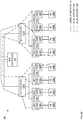
- Figure 1 is a block diagram of one embodiment of a system 100 that includes dynamic virtualized networks overlaid on an underlay physical network.
- two virtualized networks VXLAN 114A-B, are overlaid on top of an underlying physical network 112.
- a virtualized network can be overlaid on top of another virtualized network.
- this physical network 112 is a network that includes network access devices 104A-B that interconnects other network access devices 106A-D.
- network access devices 106A-B is coupled to network access device 104A.
- Network access device 104A is further coupled to network access device 104B, which is in turn coupled to network access device 106A-B.
- a network access device is a device that provides network access to a network (e.g., physical network, virtualized network, etc.).
- a network access device can be a switch, router, hub, bridge, gateway, etc., or any type of device that can allow access to a network.
- the interconnection between the different network access devices is a wired connection (e.g., copper, fiber, etc., and/or a combination thereof), in alternate embodiments, a different type of interconnection is used (e.g., wireless, a combination of wireless and wired, etc.).
- the physical network 112 is layer 3 network, in which the network access devices 104A-B and 106A-D are communicating data using a layer 3 protocol (e.g., Internet Protocol (IP), Asynchronous Transfer Mode (ATM), etc.) or a combination of layer 3 protocol and another layer protocol (e.g., Ethernet switching, Infiniband, Ethernet routing, multiprotocol layer switching (MPLS), Synchronous Optical Networking (SONET), Satellite networking protocols, etc.).
- IP Internet Protocol
- ATM Asynchronous Transfer Mode
- the physical network 112 is a layer 3 IP network interconnected by copper and/or fiber Ethernet connections.
- network access devices 104A-B are connected by a local area network (LAN), in alternate embodiments the coupling between the network access devices 104A-B is different (e.g. coupled by multiple links that have the same or different physical media and protocols, coupled a wide area network, etc.).
- LAN local area network
- VXLAN Network Identifier VNI
- Virtual machines with the same VNI are allowed to communicate with each other over the corresponding VXLAN segment.
- Virtual machines that are coupled to the VXLAN segment are identified uniquely by the combination of their MAC addresses and VNI.
- a Virtual Tunnel Endpoint VTEP encapsulates data entering the VXLAN segment and de-encaspulates the data traffic leaving the VXLAN segment.
- each VTEP enforces a network security policy to the network data being communicated through that VTEP.
- a network automation engine generates and applies a network security policy for each VTEP as described in Figure 3 below.
- the network access device 106A-D includes the VTEPs 108A-H that are used encapsulate/de-encapsulate network data communicated with virtual machines (VM) 110A-H.
- a virtual machine is a software implementation of a machine (e.g. a computer, switch, etc.) that executes programs like a physical machine.
- the virtual machine can be a system virtual machine that provides a virtualized operating system platform to run one or more applications (e.g., hardware virtualization).
- the virtual machine represents a plurality of virtual machines that are coupled to the same VXLAN segment via the same VTEP.
- the virtual machine represents one or more physical and/or virtual devices that communicate network data through the corresponding VTEP (e.g., the VM could represent a physical device, a switch or other network access device, a firewall, etc. and/or a combination thereof).
- the VM could represent a physical device, a switch or other network access device, a firewall, etc. and/or a combination thereof.
- the Software Defined Network (SDN) controller 102 is a device that has the VTEP configurations for each VXLAN segment.
- the VTEP configuration includes which VTEP are authorized for each VXLAN segment and where the VTEP are located (e.g., the port and network access device where that VTEP is located).
- VXLAN segments 114A-B use multicast to transport virtual machine originated traffic such as unknown destination MAC packets, broadcasts, multicast or non-IP traffic.
- multicast is used for endpoint discovery by the VTEPs.
- Physical switches further use multicast snooping to build a map of the physical ports to multicast addresses in use by the end clients.
- VXLAN segment 114A couples VMs 110A, 110B, 110F, and 110G so that these VMs can communicate using a layer 2 protocol.
- VMs 110A-B couple to network access device 106A via VTEP 108A-B, respectively.
- VM 110F couples to network access device 106C via VTEP 108F
- VM 110G couples to network access device 106D via VTEP 108G.
- the VMs 110A, 110B, 110F, and 110G dynamically couple to the VXLAN segment 114A using a corresponding VTEPs 108A, 108B, 108F, and 108G.
- that VM couples to the corresponding VTEP.
- That VTEP discovers the newly provisioned VM and allows the provisioned VM to communicate on that VXLAN segment.
- the network data communicated using VXLAN segment 114A is encapsulated with a header that includes the VNI associated with VXLAN segment 114A.
- the VXLAN segment 114A is dynamic because the VMs coupled to the VXLAN segment can join or leave the VXLAN segment using a multicast join or leave message.
- VM 110A joins the VXLAN segment 114A by sending an IGMP join message to the SDN controller 102.
- network access devices 106A and 104A, and SDN controller 102 save information in the respective tables that VM 110A is part of VXLAN segment 114A.
- VXLAN segment 114B couples VMs 110C, 110D, 110E, and 110H so that these VMs can communicate using a layer 2 protocol.
- VMs 110C-D couple to network access device 106B via VTEP 108C-D, respectively.
- VM 110E couples to network access device 106C via VTEP 108E and VM 110H couples to network access device 106D via VTEP 108H.
- VMs 110C, 110D, 110E, and 110H dynamically couple to the VXLAN segment 114B.
- the network data communicated using VXLAN segment 114B is encapsulated with a header that includes the VNI associated with VXLAN segment 114B.
- the VXLAN segment 114B is a dynamic virtualized network because the VMs coupled to this VXLAN segment 114B can join or leave this VXLAN segment using a multicast join or leave message.
- VM 110C joins the VXLAN segment 114B by sending an IGMP join message to the SDN controller 102.
- network access devices 106A and 104B and SDN controller 102 save information in the respective tables that VM 110A is part of VXLAN segment 114A.
- network access devices 104A-B and 106 A-D participate in one or both of the VXLAN segments.
- network access device 106A and 106B participate in one VXLAN segment (VXLAN segments 114A and 114B, respectively).
- network access devices 104A-B and 106C-D participate in both VXLAN segments 114A-B.
- network access device 104A-D include VTEPs 108A-H to encapsulate/de-encapsulate network data being communicated with the respective VMs 108A-H.
- the network access devices 106A-B communicate VXLAN encapsulated traffic for both VXLAN segments 114A-B, but neither of these network access devices includes a VTEP used to couple to a VM.
- network access devices 106A-B are used to transit VXLAN segment network data between the corresponding VMs 108A-H and is not used to terminate a VXLAN segment.
- VXLAN segments 114A-B can communicate network data between the VMs that are part of the corresponding VXLAN
- the security of the VXLAN segments 114A-B is only as good as the security of each device that participates in the VXLAN segment. For example and in one embodiment, if there is a compromise at any of the network elements (e.g., network access device and/or SDN Controller), then one, some, or all of the VXLAN segments can be compromised. In addition, if one VXLAN segment is compromised, because some of the network access devices may participate in more than one VXLAN segment and/or the SDN controller, other VXLAN segment can be compromised as well. While the system 100 in Figure 1 is described in reference a VXLAN network, the invention described herein can be used for other virtualized networks (e.g., NVGRE, STT, and OTV).
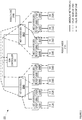
- Figure 2 is a block diagram of one embodiment of a system 200 that includes dynamic virtualized networks 214A-B overlaid on an underlying physical network 212, where the dynamic virtualized networks include rogue nodes 202A-B that can compromise the some or all of the VXLAN segments 214A-B.
- the underlying network 212 and VXLAN segments 214A-B are similar physical network 112 and VXLAN segments 114A-B as described in Figure 1 above.
- the underlying network includes network access device 204A that is coupled to network access devices 204B and network access devices 206A-B.
- network access device 204B is coupled to network access devices 206C-D.
- underlying network 212 can be a layer 3 network or a mixture of layer 2 and 3 networks.
- VXLAN segment 214A couples VMs 210A, 210B, 210F, and 210G so that these VMs can communicate using a layer 2 protocol.
- VMs 210A-B couple to network access device 206A via VTEP 208A-B, respectively.
- VM 210F couples to network access device 206C via VTEP 208F
- VM 210G couples to network access device 206D via VTEP 208G.
- VXLAN segment 214A By coupling VMs 210A, 210B, 210F, and 210G using VXLAN segment 214A, these VMs can communicate using a layer 2 protocol over a local or wide area network.
- the network data communicated using VXLAN segment 214A is encapsulated with a header that includes the VNI associated with VXLAN segment 214A.
- VXLAN segment 214B couples VMs 210C, 210D, 210E, and 210H so that these VMs can communicate using a layer 2 protocol.
- VMs 120C-D couple to network access device 206B via VTEP 208C-D, respectively.
- VM 120E couples to network access device 206C via VTEP 208E and VM 120H couples to network access device 206D via VTEP 208H.
- system 200 includes a SDN controller 202 that is a device that includes the VTEP configurations for each VXLAN segment.
- the network 200 includes two rogue nodes 202A-B that may compromise VXLAN segments 214A-B.
- the rogue node can be a virtual machine that couples to one on the network access devices.
- the rogue node can be a physical node that couples to the network access device.
- a rogue node can result from a software exploit, an attack by a hacker, error in cabling, configuration error, operator error, etc., and/or a combination thereof.
- the appearance of a rogue node can cause a compliance violation even though the rogue node does not appear maliciously.
- a rogue node could arise because a server that can host one or more virtual machines is exploited and a new, unauthorized virtual machine is created and provisioned.
- rogue device 216A is coupled to network access device 206C, where the rogue node 216A couples to a network access device 206C that include one or more VTEPs (e.g. VTEPs 208E-F).
- rogue device 216B is coupled to network access device 204B, where the rogue node 216B couples to a network access device 204B that does not include a VTEP and is used to transit VXLAN encapsulated network data.
- a rogue node e.g., 216A or 216B
- the rogue node is an unauthorized virtual machine that can have access to the either or both VXLAN segments 216A-B.
- the rogue node can mirror network data to another port, monitor the network data to steal/copy, compromise other nodes in that VXLAN segment, inject undesired network data into that VXLAN segment (e.g., injecting network data to deny services, etc.), etc., and/or a combination thereof.
- FIG. 3 is a block diagram of one embodiment of a system 300 that includes a network automation engine 318 that is used to secure the dynamic virtualized networks.
- the underlying network 312 and VXLAN segments 314A-B are similar as described in Figure 1 above.
- the underlying network 312 includes network access device 304A that is coupled to network access devices 304B and network access devices 306A-B.
- network access device 304B is coupled to network access devices 306C-D.
- underlying network 312 can be a layer 3 network or a mixture of layer 2 and 3 networks.
- VXLAN segment 314A couples VMs 310A, 310B, 310F, and 310G so that these VMs can communicate using a layer 2 protocol.
- VMs 310A-B couple to network access device 306A via VTEP 308A-B, respectively.
- VM 310F couples to network access device 306C via VTEP 308F
- VM 310G couples to VTEP 308G on network access device 306D.
- VXLAN segment 314A By coupling VMs 310A, 310B, 310F, and 310G using VXLAN segment 314A, these VMs can communicate using a layer 2 protocol over a local or wide area network.
- the network data communicated using VXLAN segment 314A is encapsulated with a header that includes the VNI associated with VXLAN segment 314A.
- VXLAN segment 314B couples VMs 310C, 310D, 310E, and 310H so that these VMs can communicate using a layer 2 protocol.
- VMs 310C-D couple to network access device 306B via VTEP 308C-D, respectively.
- VM 310E couples to network access device 306C via VTEP 308E and VM 310H couples to VTEP 308H on network access device 306D.
- VXLAN segment 314B couples VMs 310C, 310D, 310E, and 310H so that these VMs can communicate using a layer 2 protocol.
- system 300 includes a SDN controller 302 that is a device that includes the VTEP configurations for each VXLAN segment.
- system 300 include two rogue nodes 316A-B that are unauthorized nodes attempting to compromise either one or both of the VXLAN segments 314A-B.
- the rogue nodes 316A-B are similar to rogue nodes 216A-B as described in Figure 2 above.
- system 300 includes a network automation engine (NAE) 318 that learns the current network policy of the VXLAN segments 314A-B and determines a network security policy that can help further secure these VXLAN segments.
- NAE network automation engine
- NAE 318 constructs multicast join filters to allow multicast groups to learn the VNIs for authorized VTEP ports and drop other multicast joins, create access control lists (ACL) on ports that have VTEPs to pass authorized VNI-tagged traffic and drop other type of traffic, and/or create ingress ACLs drop VXLAN encapsulated traffic on ports that do not have an attached VTEP.
- NAE 318 applies this network security policy for each network access devices that is affected by the network security policy.
- the current and security network policies includes a different set of network policy elements and the set of network policy elements for the network security policy does not include a network policy element that is include in the current network policy set of network policy elements.
- the current network policy includes VTEP configurations that identify the authorized VTEPs and port location.
- a network policy element is an instruction that determines how a port of network access device processes a certain type of network data.
- a multicast join filter for a port of one of the network access devices 304A-B and/or 306A-D allows the network access device 304A-B and/or 306A-D to drop multicast join requests that are on ports that do not have an associated VTEP.
- This type of network policy can deny a rogue node from joining a VXLAN segment on a network attached device port that does not have an authorized VTEP.
- a multicast filter can be used to pass a multicast join with a VNI that matches the authorized VTEP VNI and drop a multicast join that has a mismatching VNI.
- network access device 306C has a policy on the port coupled to the rogue node 316A to filter an IGMP join on that port because that port does not have an authorized VTEP, the rogue node could not join either VXLAN segment 314A-B.
- network access device 306A can have a network policy for the port associated with VTEP 308A to pass a multicast join with a VNI that matches the VNI of the VTEP 308A and drop a multicast join with a VNI that does not match the VNI of that VTEP 308A.
- the multicast join filter prevents a rogue node from joining on a port that is not authorized to have a VTEP or a multicast join with a mismatching VNI.
- the ACL allows a network access device to block network data that does not have this VNI. This, in effect, restricts this port to communicate the network data of the associated VXLAN segment.
- this type of ACL prevents an authorized member of one VXLAN segment transmitting network data for this VXLAN segment into another VXLAN segment.
- this type of ACL further prevents a VM that is not authorized for a VXLAN segment from receiving network data via a VTEP that terminates that VXLAN segment.
- VXLAN segment data traffic by having an ingress ACL on ports that do not have an authorized VTEP to drop VXLAN encapsulated traffic prevents an unauthorized VM from injecting network data into the VXLAN segment data traffic.
- this type of ACL can prevent source address spoofing.
- this type of ACL can prevent an unauthorized VM from injecting traffic into the VXLAN control plane (e.g. transmission of unauthorized IGMP join/leave messages).
- an unauthorized VM injecting unauthorized IGMP join/leave messages can affect any and all VXLAN segments.
- the NAE 318 applies this network security policy to the affected network access device via a system management network 322.
- the system management network is an out-of-band network that is used by the NAE 318 to manage the network access devices 304A-B and/or network access devices 306A-D.
- the NAE 318 sends commands to these network access devices 304A-B and/or 306A-D via the system management network 322 and can receive information from these devices over the same network 322. Securing the VXLAN segments is further described in Figures 4-5 below.
- the NAE 318 can test the VXLAN segments to determine if there is a problem with the configuration and/or topology of one, some, or all of the VXLAN segments.
- the NAE 318 injects test traffic at one of the network access devices and monitors the network access devices on the system 300 for the appearance and/or the lack of appearance of the test traffic.
- NAE 318 learns the VXLAN network policy, determines which network access device to inject test traffic, and predicts the results of test traffic injection. NAE 318 further injects the test traffic and monitors the network access devices for the appearance of the test traffic. If the test shows any errors, the NAE 318 reports the errors.
- the test traffic injected by the NAE 318 is VXLAN encapsulated test traffic with a particular VNI.
- the injected test traffic should appear at network access devices that are part of the VXLAN segment that has the same VNI as the VXLAN encapsulated test traffic.
- this VXLAN encapsulated test traffic should not appear at network access device that do not participate in that VXLAN segment.
- the NAE 318 injects VXLAN encapsulated test traffic with the VNI of VXLAN segment 314A at network access device 304A, the VXLAN encapsulated test traffic should appear at network access devices 304A-B, 306A, 306C, and 306D, but should not appear at network access device 306B.
- NAE 318 can take corrective action to try to the error shown in the test.
- the NAE 318 takes corrective action by determining and applying a network security policy as described above. Testing the VXLAN segments is further described in Figure 6 below.
- the NAE 318 is part of the SDN Controller 302.
- the NAE 318 can communicate with the network access devices 304A-B and 306A-D via the system management network 322 and/or via the underlying network 312.
- the NAE 318 includes network policy monitoring and enforcement module 320 to secure and test the VXLAN segments. While the system 300 in Figure 1 is described in reference a VXLAN network, the invention described herein can be used for other virtualized networks (e.g., NVGRE, STT, and OTV).
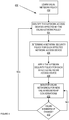
- Figure 4 is a flow diagram of one embodiment of a process 400 to secure a dynamic virtualized network by learning a current network policy of the virtualized networks and generating a network security policy for these virtualized networks.
- the network automation engine performs process 400 to secure a virtualized network, such as NAE 318 of Figure 3 above.
- process 400 begins by learning a current VXLAN network policy at block 402.
- the current VXLAN network policy identifies authorized VTEPs and which port of which network access devices has an authorized VTEP.
- process 400 learns the current network policy from a SDN controller, such as SDN controller 302 as described in Figure 3 above.
- the current network policy includes a plurality of network policy elements, where each network policy elements for the current network policy identify an authorized VTEP and location of that VTEP (e.g., which port of which network access device has that VTEP).
- process 400 learns of the VXLAN network policy by snooping on multicast conversations. For example and in one embodiment, process 400 determines the authorized VTEPs and port location by snooping on which IGMP joins/leaves are being transmitted in the VXLAN segments. In one embodiment, process 400 can build a running tally of which VMs are on each VXLAN segment. In addition, process 400 can compare this running tally with the configured set of VTEPs and ports. In one embodiment, process 400 can initially learn the VXLAN current network policy, learn this network policy at periodic intervals, in response to an event, etc.
- process 400 identifies the network access devices that are affected by the current network policy.
- the affected network access devices are the network access devices that participate in one or more VXLAN segments.
- network access devices 304A-B and 306A-D as illustrated in Figure 3 are the network access devices affected by the current network access policy.
- Process 400 determines a network security policy for each of the affected network access device(s) at block 406.
- the network security policy is a set of network policy elements that are used to secure ports of the affected network access devices.
- a network policy element for the network security policy can be a multicast join filter to allow multicast groups to learn the VNIs for an authorized port and drop other multicast joins, create access control lists (ACL) on a port that has an VTEP to pass authorized VNI-tagged traffic and drop other types of traffic, and/or create ingress ACLs to drop VXLAN encapsulated traffic on a port that does not have an attached VTEP.
- ACL access control lists
- there is a network security policy for each affected network device and this network security policy may be the same and/or different for different network access devices. Determining a network security policy is further described in Figure 5 below.
- process 400 applies the network security policy for each affected network access device.
- process 400 applies the network security policy by sending a set of commands to implement the network security policy.
- the commands can be applied to the target network access device using a network management protocol (e.g., Simple Network Management Protocol (SNMP), Simple Object Access Protocol (SOAP), Representational State Transfer type Application Programming Interface (RESTful API), Hypertext Transfer Protocol (HTTP), HTTP over Secure Sockets layer (HTTPs), Network Configuration Protocol (NetConf), Secure Shell (SSH), command line interface, etc.).
- SNMP Simple Network Management Protocol
- SOAP Simple Object Access Protocol
- RESTful API Representational State Transfer type Application Programming Interface
- HTTP Hypertext Transfer Protocol
- HTTPs HTTP over Secure Sockets layer
- NetConf Network Configuration Protocol
- SSH Secure Shell
- Process 400 monitors the VXLAN segments for new VXLAN memberships conversations at block 410.
- process 400 monitors the VXLAN segments for a change in the VXLAN membership. For example and in one embodiment, process 400 snoops for IGMP join/leave messages that indicate whether a VM has joined or left a VXLAN segment.
- process 400 determines if there is a change in the VXLAN membership. If there is, process 400 adds the change in membership to the current network policy and execution proceeds to block 404 above. If not, execution proceeds to block 410 above.
- process 400 determines a network security policy for the affected network access devices.
- Figure 5 is a flow diagram of one embodiment of a process 500 to determine a network security policy for each affected network access device of a plurality of network access devices.
- process 400 performs process 500 to determine a network security policy for the affected network access devices at block 406 in Figure 4 above.
- process 500 begins by performing a processing loop (blocks 502-516) to determine a network security policy for each affected network access device.
- process 500 determines if a multicast join filter should be created for the one or more ports of that network access device.
- the multicast join filter drops the multicast join on a port that does not have an authorized VTEP, drops the multicast join on a port that does have an authorized VTEP and the multicast join does not have a VNI of that authorized VTEP, and/or passes the multicast join on a port that has an authorized VTEP and the multicast join has the VNI of that authorized VTEP.
- the multicast join filter is created for ports of network access device that participate in one or more VXLAN segments.
- the multicast join filter filters IGMP join packets. If the multicast join filter is to be created, at block 506, process 500 creates the multicast join filter for one, some, or all of the ports of that network access device.
- the multicast join filter is applied to each port of the network access device, in alternate embodiments, the multicast join filter is applied to some of the ports of the network access device (e.g., applied to ports that are up, ports that are not devoted solely to a system management network, etc.) Execution proceeds to block 508. If the multicast join filter is not to be created, execution proceeds to block 508.
- process 500 determines if a VNI ACL is to be created for that network access device.
- a VNI ACL passes VXLAN-encapsulated traffic on a port that has a VTEP to pass authorized VNI-tagged traffic and drop other types of traffic.
- this ACL is created for ports on the network access device that is used to restrict ports to specific VXLAN-encapsulated network data.
- the port on network access device 306A that couples to network access device 304A could have the network data to be communicated be restricted to VXLAN-encapsulated with the same VNI as the VNI for VXLAN segment 314A.
- process 500 creates the VNI ACLs for the appropriate ports of that network access device. While in one embodiment, the VNI ACL is applied to each port of the network access device, in alternate embodiments, the VNI ACL is applied to some of the ports of the network access device (e.g., applied to ports associated with a VTEP, etc.) Execution proceeds to block 512. If the VNI ACL is not to be created, execution proceeds to block 512.
- process 500 determines if an ingress ACL to drop VXLAN encapsulated traffic on a port that does not have an attached VTEP is to be created. In one embodiment, this type of ACL is used to deny VXLAN-encapsulated traffic from entering a VXLAN segment on a port without an authorized VTEP associated with that port. For example and in one embodiment, process 500 creates this ingress ACL on ports of the network access device that do not have an associated VTEP. If the ingress ACL is to be created for one or more ports of the network access device, at block 514, process 500 creates the ingress ACLs for the appropriate ports of that network access device.
- the ingress ACLs is applied to each port of the network access device, in alternate embodiments, the ingress ACLs is applied to some of the ports of the network access device (e.g., applied to ports that are up, ports that are not devoted to a system management network, etc.) Execution proceeds to block 516. If the ingress ACL is not to be created, execution proceeds to block 516. The processing loop ends at block 516.
- FIG. 6 is a flow diagram of one embodiment of a process 600 to test a security of a network policy of the dynamic virtualized network.
- the network automation engine to secure a virtualized network such as NAE 318 of Figure 3 above, performs process 600.
- process 600 begins by learning the VXLAN network policy at block 602.
- the current VXLAN network policy identifies authorized VTEPs and which port of which network access devices have an authorized VTEP.
- process 600 learns the current network policy from a SDN controller, such as SDN controller 302 as described in Figure 3 above.
- the current network policy includes a plurality of network policy elements, where each network policy elements for the current network policy identify an authorized VTEP and location of that VTEP (e.g., which port of which network access device has that VTEP).
- process 600 learns of the VXLAN network policy by snooping on multicast conversations. For example and in one embodiment, process 400 determines the authorized VTEPs and port location by snooping on which IGMP joins/leaves are being transmitted in the VXLAN segments.
- process 400 can build a running tally of which VMs are on each VXLAN segment. In addition, process 400 can compare this running tally with the configured set of VTEPs and ports.
- process 600 can initially learn the VXLAN current network policy, learn this network policy at periodic intervals, in response to an event, etc.
- process 600 determines which network access device to inject test traffic into the one or more VXLAN segments. In one embodiment, process 600 determines which network access device to inject test traffic based on the network policy of network access devices and/or the topology of the physical and/or virtualized networks. In one embodiment, process 600 determines to inject the test traffic in a network access device that participates in a single VXLAN segment. In another embodiment, process 600 determines to inject the test traffic in a network access device that participates in multiple or no VXLAN segments.
- Process 600 predicts the result of the test traffic injection at block 606.
- the test traffic injected by process 600 is VXLAN encapsulated test traffic with a particular VNI.
- the injected test traffic should appear at network access devices that are part of the VXLAN segment that has the same VNI as the VXLAN encapsulated test traffic.
- this VXLAN encapsulated test traffic should not appear at network access device that does not participate in that VXLAN segment.
- process 600 injects VXLAN encapsulated test traffic with the VNI of VXLAN segment 314A at network access device 304A
- the VXLAN encapsulated test traffic should appear at network access devices 304A-B, 306A, 306C, and 306D, but should not appear at network access device 306B.
- process 600 injects the test traffic at the network access device determined at block 604 above.
- process 600 injects VXLAN-encapsulated test traffic at a particular network access device.
- process 600 injects VXLAN-encapsulated test traffic that has VNI A into a VXLAN segment identified with VNI B.
- the test traffic includes a packet with specially marked payload that indicates that the packet is test traffic.
- Process 600 monitors the network access devices for the appearance and non-appearance of the test traffic at block 610.
- process 600 monitors the test traffic by monitoring the network access devices for a reported error. For example and in one embodiment, process 600 injects VXLAN-encapsulated test traffic that has VNI A into a VXLAN segment identified with VNI B. In this example, process 600 monitors the network access devices associated with VXLAN segment with the VNI B for an error (e.g., an alert, a log entry, bump in a statistic that tracks if illegal VXLAN traffic was dropped, etc.).
- an error e.g., an alert, a log entry, bump in a statistic that tracks if illegal VXLAN traffic was dropped, etc.
- process 600 determines if the test shows any errors. In one embodiment, if the test traffic appearance and/or non-appearance is the same as the prediction of the test traffic injection determined at block 606, the test is successful with no errors. In another embodiment, if the test traffic does not appear as predicted and/or the traffic does not appear as predicted, the test shows an error. If there are no errors, process 600 reports a successful test at block 614. If there are errors in the test, process 600 reports the test errors at block 616. At block 618, process 600 determines if to take corrective action based on the reported errors.
- corrective action that can be taken is terminating the VXLAN segment, disconnecting one or more specific ports of one or more network access devices, adding a source specific ACL that block certain hosts and/or ports, etc. and/or a combination thereof. If a corrective action is taken, at block 620, process 600 performs the corrective action. In one embodiment, process 600 determines and applies a network security policy as described in Figure 4 above. If no corrective action is to be taken, process 600 does not perform any corrective action at block 622.
- FIG 7 is a block diagram of network policy monitoring and enforcement module 320 that secures and tests a dynamic virtualized network.
- network policy monitoring and enforcement module 320 includes network policy enforcement module 702 and network policy testing module 704.
- the network policy enforcement module 702 secures the overlaid virtualized network as described in Figure 4 above.
- the network policy testing module 704 test the overlaid virtualized network as described in Figure 6 above.
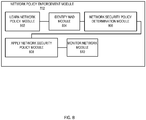
- Figure 8 is a block diagram of a network policy enforcement module 702 that secures a dynamic virtualized network.
- the network policy enforcement module 702 includes a learn network policy module 802, identify network access device module 804, security determination module 806, apply network security policy module 808, and monitor network module 810.
- the learn network policy module 802 learns the current network policy as described in Figure 8 , block 802 above.
- the identify network access device module 804 identifies the affected network access devices as described in Figure 8 , block 804 above.
- the network security policy determination module 806 determines a network security policy as described in Figure 8 , block 806 above.
- the apply network security policy module 808 applies the network security policy as described in Figure 8 , block 808 above.
- the monitor network module 810 monitors the network as described in Figure 8 , block 810 above.
- Figure 9 is a block diagram of a network security policy determination module 806 that determines a network security policy for each affected network access device of a plurality of network access devices.
- the network security policy determination module 806 includes multicast join filter determination module 902, create multicast join filter module 904, ID ACL determination module 906, create ID ACL module 908, ingress ACL determination module 910, and create ingress ACL module 912.
- the multicast join filter determination module 902 determines if a multicast join filter is to be created as described in Figure 5 , block 504 above.
- the create multicast join filter module 904 creates the multicast join filter as described in Figure 5 , block 506 above.
- the ID ACL determination module 906 determines if a VNI ACL is to be created as described in Figure 5 , block 508 above.
- the create ID ACL module 908 creates the VNI ACL as described in Figure 5 , block 510 above.
- the ingress ACL determination module 910 determines if an ingress ACL should be created as described in Figure 5 , block 512 above.
- the create ingress ACL module 912 creates the ingress ACL as described in Figure 5 , block 514 above.
- FIG 10 is a block diagram of a network policy testing module 704 that tests a dynamic virtualized network.
- network policy testing module 704 include learn network policy module 1002, network access device test determination module 1004, predict test result module 1006, inject test traffic module 1008, monitor test results module 1010, test results error determination module 1012, report successful test module 1014, report test error module 1014, corrective action determination module 1016, and corrective action module 1018.
- the learn network policy module 1002 learns the network policy as described in Figure 6 , block 602 above.
- the network access device test determination module 1004 determines the affected network access devices as described in Figure 6 , block 604 above.
- the predict test result module 1006 predicts the test results as described in Figure 6 , block 606 above.
- the inject test traffic module 1008 injects the test traffic as described in Figure 6 , block 608 above.
- the monitor test results module 1010 monitors the network for test results as described in Figure 6 , block 610 above.
- the test results error determination module 1012 determines if there are any test errors as described in Figure 6 , block 612 above.
- the report successful test module 1014 reports a successful test as described in Figure 6 , block 614 above.
- the report test error module 1016 reports the test error as described in Figure 6 , block 616 above.
- the corrective action determination module 1018 determines if corrective action is to be taken as described in Figure 6 , block 618 above.
- the corrective action module 1020 takes the corrective action as described in Figure 6 , block 620 above.
- Figure 11 shows one example of a data processing system 1100, which may be used with one embodiment of the present invention.
- the system 1100 may be implemented including a NAE 318 as shown in Figure 3 .
- Figure 11 illustrates various components of a computer system, it is not intended to represent any particular architecture or manner of interconnecting the components as such details are not germane to the present invention. It will also be appreciated that network computers and other data processing systems or other consumer electronic devices, which have fewer components or perhaps more components, may also be used with the present invention.
- the computer system 1100 which is a form of a data processing system, includes a bus 1103 which is coupled to a microprocessor(s) 1105 and a ROM (Read Only Memory) 1107 and volatile RAM 1109 and a non-volatile memory 1111.
- the microprocessor 1105 may retrieve the instructions from the memories 1107, 1109, 1111 and execute the instructions to perform operations described above.
- the bus 1103 interconnects these various components together and also interconnects these components 1105, 1107, 1109, and 1111 to a display controller and display device 1115 and to peripheral devices such as input/output (I/O) devices which may be mice, keyboards, modems, network interfaces, printers and other devices which are well known in the art.
- I/O input/output
- the input/output devices 1115 are coupled to the system through input/output controllers 1117.
- the volatile RAM (Random Access Memory) 1109 is typically implemented as dynamic RAM (DRAM), which requires power continually in order to refresh or maintain the data in the memory.
- DRAM dynamic RAM
- the mass storage 1111 is typically a magnetic hard drive or a magnetic optical drive or an optical drive or a DVD RAM or a flash memory or other types of memory systems, which maintain data (e.g. large amounts of data) even after power is removed from the system.
- the mass storage 1111 will also be a random access memory although this is not required. While Figure 11 shows that the mass storage 1111 is a local device coupled directly to the rest of the components in the data processing system, it will be appreciated that the present invention may utilize a non-volatile memory which is remote from the system, such as a network storage device which is coupled to the data processing system through a network interface such as a modem, an Ethernet interface or a wireless network.
- the bus 1103 may include one or more buses connected to each other through various bridges, controllers and/or adapters as is well known in the art.
- Portions of what was described above may be implemented with logic circuitry such as a dedicated logic circuit or with a microcontroller or other form of processing core that executes program code instructions.
- logic circuitry such as a dedicated logic circuit or with a microcontroller or other form of processing core that executes program code instructions.
- program code such as machine-executable instructions that cause a machine that executes these instructions to perform certain functions.
- a “machine” may be a machine that converts intermediate form (or “abstract") instructions into processor specific instructions (e.g., an abstract execution environment such as a "process virtual machine” (e.g., a Java Virtual Machine), an interpreter, a Common Language Runtime, a high-level language virtual machine, etc.), and/or, electronic circuitry disposed on a semiconductor chip (e.g., "logic circuitry” implemented with transistors) designed to execute instructions such as a general-purpose processor and/or a special-purpose processor. Processes taught by the discussion above may also be performed by (in the alternative to a machine or in combination with a machine) electronic circuitry designed to perform the processes (or a portion thereof) without the execution of program code.
- processor specific instructions e.g., an abstract execution environment such as a "process virtual machine” (e.g., a Java Virtual Machine), an interpreter, a Common Language Runtime, a high-level language virtual machine, etc.)
- the present invention also relates to an apparatus for performing the operations described herein.
- This apparatus may be specially constructed for the required purpose, or it may comprise a general-purpose computer selectively activated or reconfigured by a computer program stored in the computer.
- a computer program may be stored in a computer readable storage medium, such as, but is not limited to, any type of disk including floppy disks, optical disks, CD-ROMs, and magnetic-optical disks, read-only memories (ROMs), RAMs, EPROMs, EEPROMs, magnetic or optical cards, or any type of media suitable for storing electronic instructions, and each coupled to a computer system bus.
- a machine readable medium includes any mechanism for storing or transmitting information in a form readable by a machine (e.g., a computer).
- a machine readable medium includes read only memory ("ROM”); random access memory (“RAM”); magnetic disk storage media; optical storage media; flash memory devices; etc.
- An article of manufacture may be used to store program code.
- An article of manufacture that stores program code may be embodied as, but is not limited to, one or more memories (e.g., one or more flash memories, random access memories (static, dynamic or other)), optical disks, CD-ROMs, DVD ROMs, EPROMs, EEPROMs, magnetic or optical cards or other type of machine-readable media suitable for storing electronic instructions.
- Program code may also be downloaded from a remote computer (e.g., a server) to a requesting computer (e.g., a client) by way of data signals embodied in a propagation medium (e.g., via a communication link (e.g., a network connection)).
Landscapes
- Engineering & Computer Science (AREA)
- Computer Networks & Wireless Communication (AREA)
- Signal Processing (AREA)
- Computer Security & Cryptography (AREA)
- Computer Hardware Design (AREA)
- Computing Systems (AREA)
- General Engineering & Computer Science (AREA)
- Business, Economics & Management (AREA)
- General Business, Economics & Management (AREA)
- Data Exchanges In Wide-Area Networks (AREA)
Claims (15)
- Verfahren zur Sicherung eines dynamischen virtualisierten Netzwerks, wobei das Verfahren umfasst:das Lernen einer aktuellen Netzwerkrichtlinie des dynamischen virtualisierten Netzwerks durch ein mit dem dynamischen virtualisierten Netzwerk assoziiertes Netzwerkautomatisierungsgerät, indem dieses Multicast-Beitrittsnachrichten und Multicast-Austrittsnachrichten belauscht, die an das dynamische virtualisierte Netzwerk übermittelt werden, wobei das dynamische virtualisierte Netzwerk ein virtualisiertes Layer-2-Netzwerk ist, das einem Layer-3-Netzwerk überlagert ist, wobei das Layer-3-Netzwerk eine Vielzahl von Netzzugangsgeräten umfasst, wobei die aktuelle Netzwerkrichtlinie eine erste Vielzahl von Netzwerkrichtlinienelementen enthält, wobei jedes der ersten Vielzahl von Netzwerkrichtlinienelementen einen autorisierten Endpunkt identifiziert und identifiziert, welcher Port von welchen Netzzugangsgeräten einen autorisierten Endpunkt in dem dynamischen virtualisierten Netzwerk hat;das Identifizieren derjenigen Netzzugangsgeräte der Vielzahl von Netzzugangsgeräten, die von der aktuellen Richtlinie betroffen sind;das Bestimmen einer Netzwerksicherheitsrichtlinie für jedes der betroffenen Netzzugangsgeräte, wobei die Netzwerksicherheitsrichtlinie ein oder mehrere zweite Netzwerkrichtlinienelemente enthält, das/die ein anderes Netzwerkrichtlinienelement ist/sind als eines der Vielzahl von ersten Netzwerkrichtlinienelementen der aktuellen Netzwerkrichtlinie, indem für jedes des einen oder der mehreren zweiten Netzwerkrichtlinien-Netzwerkelemente eine zusätzliche Richtlinie hinzugefügt wird, in Bezug darauf, wie der Netzwerkverkehr in dem dynamischen virtualisierten Netzwerk von einem Port eines der betroffenen Netzzugangsgeräte verarbeitet wird;das Anwenden der Netzwerksicherheitsrichtlinie bei den identifizierten Netzzugangsgeräten; unddas Fortsetzen der Überwachung des dynamischen virtualisierten Netzwerks auf Änderungen der Mitgliedschaft in dem dynamischen virtualisierten Netzwerk.
- Verfahren nach Anspruch 1, wobei das dynamische virtualisierte Netzwerk ein Virtual eXtensible Local Area Network ist.
- Verfahren nach Anspruch 1, wobei die Netzwerksicherheitsrichtlinie ferner bestimmt wird von einer Topologie des dynamischen virtualisierten Netzwerks.
- Verfahren nach Anspruch 1, wobei die zusätzliche Richtlinie ein Multicast-Beitrittsfilter ist, der eine Multicast-Beitrittsanfrage an einen Port eines Netzzugangsgeräts weiterleitet, das einen diesem Port zugeordneten Autorisierungsendpunkt hat.
- Verfahren nach Anspruch 1, wobei die zusätzliche Richtlinie ein Multicast-Beitrittsfilter ist, der eine Multicast-Beitrittsanfrage an einen Port eines Netzzugangsgeräts löscht, das keinen diesem Port zugeordneten autorisierten Endpunkt hat.
- Verfahren nach Anspruch 1, wobei die zusätzliche Richtlinie eine Zugriffskontrollliste an einen Port eines Netzzugangsgeräts ist, das einen diesem Port zugeordneten autorisierten Endpunkt hat, wobei die Zugangskontrollliste Netzwerkverkehr durchlässt, der eine dem autorisierten Endpunkt zugeordnete Kennung enthält.
- Verfahren nach Anspruch 6, wobei die Kennung eine Virtual eXtensible Local Area Network Netzwerkkennung ist.
- Verfahren nach Anspruch 1, wobei die zusätzliche Richtlinie eine Zugriffskontrollliste an einen Port eines Netzzugangsgeräts ist, das einen diesem Port zugeordneten autorisierten Endpunkt hat, wobei die Zugangskontrollliste Netzwerkverkehr löscht, der keine dem autorisierten Endpunkt zugeordnete Kennung enthält.
- Verfahren nach Anspruch 1, wobei die zusätzliche Netzwerkrichtlinie eine Zugriffskontrollliste an einen Port eines Netzzugangsgeräts ist, das keinen autorisierten Endpunkt mit diesem Port hat, wobei die Zugriffskontrollliste Netzwerkverkehr löscht, der für das dynamische virtualisierte Netzwerk gekapselt ist.
- Verfahren nach Anspruch 1, wobei das Netzzugangsgerät ausgewählt wird aus der Gruppe, die aus einem Schalter und einem Router besteht.
- Maschinenlesbares Medium mit ausführbaren Befehlen, um eine oder mehrere Verarbeitungseinheiten zur Durchführung eines Verfahrens zum Testen einer Netzwerkrichtlinie eines dynamischen virtualisierten Netzwerks zu veranlassen, wobei das Verfahren umfasst:das Lernen einer aktuellen Netzwerkrichtlinie des dynamischen virtualisierten Netzwerks durch das Belauschen von Multicast-Beitrittsnachrichten und Multicast-Austrittsnachrichten, die an das dynamische virtualisierte Netzwerk übermittelt werden, wobei das dynamische virtualisierte Netzwerk ein virtualisiertes Layer-2-Netzwerk ist, das einem Layer-3-Netzwerk überlagert ist, wobei das Layer-3-Netzwerk eine Vielzahl von Netzzugangsgeräten umfasst, wobei die aktuelle Netzwerkrichtlinie eine erste Vielzahl von Netzwerkrichtlinienelementen enthält, wobei jedes der ersten Vielzahl von Netzwerkrichtlinienelementen einen autorisierten Endpunkt identifiziert und identifiziert, welcher Port von welchen Netzzugangsgeräten einen autorisierten Endpunkt in dem dynamischen virtualisierten Netzwerk hat;das Injizieren von Testverkehr an einem der Vielzahl von Netzzugangsgeräten, wobei der Testverkehr konfiguriert ist für das Testen einer Sicherheit des dynamischen virtualisierten Netzwerks durch Kommunikation in dem dynamischen virtualisierten Netzwerk;das Detektieren eines Auftretens des Testverkehrs an einem anderen der Vielzahl von Netzzugangsgeräten; unddas Bestimmen, ob das Auftreten des Testverkehrs an dem anderen der Vielzahl von Netzzugangsgeräten ein Verstoß gegen die Netzwerkrichtlinie ist.
- Maschinenlesbares Medium nach Anspruch 11, wobei das dynamische virtualisierte Netzwerk ein Virtual eXtensible Local Area Network (VLAN) ist.
- Maschinenlesbares Medium nach Anspruch 12, wobei der Testverkehr ein gekapselter VLAN-Verkehr ist.
- Maschinenlesbares Medium mit ausführbaren Befehlen, die eine oder mehrere Verarbeitungseinheiten zur Durchführung eines Verfahrens zur Sicherung eines dynamischen virtualisierten Netzwerks gemäß Anspruch 1 veranlassen.
- System zur Sicherung eines dynamischen virtualisierten Netzwerks, wobei das System umfasst:eine Vielzahl von Netzzugangsgeräten;ein Layer-3-Netzwerk, das die Vielzahl von Netzzugangsgeräten miteinander verbindet;ein dynamisches virtualisiertes Netzwerk, wobei das dynamische virtualisierte Netzwerk ein virtualisiertes Layer-2-Netzwerk ist, das dem Layer-3-Netzwerk überlagert ist, wobei das dynamische virtualisierte Netzwerk eine aktuelle Netzwerkrichtlinie enthält, die ferner eine erste Vielzahl von Netzwerkrichtlinienelementen enthält, wobei jedes der ersten Vielzahl von Netzwerkrichtlinienelementen einen autorisierten Endpunkt identifiziert und identifiziert, welcher Port von welchem Netzzugangsgerät einen autorisierten Endpunkt in dem dynamischen virtualisierten Netzwerk hat; undein Netzwerkautomatisierungselement, das (i) die aktuelle Netzwerkrichtlinie lernt, indem es Multicast-Beitrittsmeldungen und Multicast-Austrittsmeldungen belauscht, die an das dynamische virtualisierte Netzwerk übermittelt werden, das (ii) die Netzzugangsgeräte der Vielzahl von Netzzugangsgeräten identifiziert, die von der aktuellen Netzwerkrichtlinie betroffen sind, und das (iii) eine Netzwerksicherheitsrichtlinie für jedes der betroffenen Netzzugangsgeräte für das dynamische virtualisierte Netzwerk aus der aktuellen Netzwerkrichtlinie bestimmt, wobei die Netzwerksicherheitsrichtlinie ein oder mehrere zweite Netzwerkrichtlinienelemente enthält, das/die ein anderes Netzwerkrichtlinienelement ist/sind als eines der Vielzahl von ersten Netzwerkrichtlinienelementen der aktuellen Netzwerkrichtlinie, indem für jedes des einen oder der mehreren zweiten Netzwerkrichtlinien-Netzwerkelemente eine zusätzliche Richtlinie hinzugefügt wird, mit Bezug darauf, wie der Netzwerkverkehr in dem dynamischen virtuellen Netzwerk von einem Port eines der betroffenen Netzzugangsgeräte verarbeitet wird, und das (iv) die Netzwerksicherheitsrichtlinie bei dem identifizierten Netzzugangsgerät anwendet und (v) die Überwachung des dynamischen virtualisierten Netzwerks auf Änderungen der Mitgliedschaft in dem dynamischen virtualisierten Netzwerk fortsetzt.
Applications Claiming Priority (3)
| Application Number | Priority Date | Filing Date | Title |
|---|---|---|---|
| US201261720343P | 2012-10-30 | 2012-10-30 | |
| US13/842,695 US8931046B2 (en) | 2012-10-30 | 2013-03-15 | System and method for securing virtualized networks |
| PCT/US2013/067312 WO2014070773A1 (en) | 2012-10-30 | 2013-10-29 | System and method for securing virtualized networks |
Publications (3)
| Publication Number | Publication Date |
|---|---|
| EP2915090A1 EP2915090A1 (de) | 2015-09-09 |
| EP2915090A4 EP2915090A4 (de) | 2016-07-06 |
| EP2915090B1 true EP2915090B1 (de) | 2020-12-16 |
Family
ID=50548757
Family Applications (1)
| Application Number | Title | Priority Date | Filing Date |
|---|---|---|---|
| EP13850972.4A Active EP2915090B1 (de) | 2012-10-30 | 2013-10-29 | System und verfahren zur sicherung von virtualisierten netzwerken |
Country Status (3)
| Country | Link |
|---|---|
| US (5) | US8931046B2 (de) |
| EP (1) | EP2915090B1 (de) |
| WO (1) | WO2014070773A1 (de) |
Families Citing this family (91)
| Publication number | Priority date | Publication date | Assignee | Title |
|---|---|---|---|---|
| US8931046B2 (en) | 2012-10-30 | 2015-01-06 | Stateless Networks, Inc. | System and method for securing virtualized networks |
| CN103973578B (zh) * | 2013-01-31 | 2018-06-19 | 新华三技术有限公司 | 一种虚拟机流量重定向的方法及装置 |
| CN104158916A (zh) * | 2013-05-13 | 2014-11-19 | 中兴通讯股份有限公司 | 设备接入网络的方法和装置 |
| US9559896B2 (en) * | 2013-07-08 | 2017-01-31 | Cisco Technology, Inc. | Network-assisted configuration and programming of gateways in a network environment |
| US20150055662A1 (en) * | 2013-08-20 | 2015-02-26 | International Business Machines Corporation | Internet group management protocol (igmp) leave message processing synchronization |
| US20150067789A1 (en) * | 2013-08-27 | 2015-03-05 | Connectloud, Inc. | Method and apparatus to provide a network software defined cloud with capacity to prevent tenant access to network control plane through software defined networks |
| US9575782B2 (en) | 2013-10-13 | 2017-02-21 | Nicira, Inc. | ARP for logical router |
| US9819551B2 (en) * | 2013-11-20 | 2017-11-14 | Big Switch Networks, Inc. | Systems and methods for testing networks with a controller |
| US10374918B2 (en) | 2013-12-04 | 2019-08-06 | Radware, Ltd. | Method and system for configuring behavioral network intelligence system using network monitoring programming language |
| US9350608B2 (en) * | 2014-01-10 | 2016-05-24 | Arista Networks, Inc. | Method and system for using virtual tunnel end-point registration and virtual network identifiers to manage virtual extensible local area network access |
| US9893988B2 (en) | 2014-03-27 | 2018-02-13 | Nicira, Inc. | Address resolution using multiple designated instances of a logical router |
| US9825913B2 (en) | 2014-06-04 | 2017-11-21 | Nicira, Inc. | Use of stateless marking to speed up stateful firewall rule processing |
| WO2015196361A1 (zh) * | 2014-06-24 | 2015-12-30 | 华为技术有限公司 | 一种软件定义网络的多播方法、装置及系统 |
| US9692698B2 (en) * | 2014-06-30 | 2017-06-27 | Nicira, Inc. | Methods and systems to offload overlay network packet encapsulation to hardware |
| US9503277B2 (en) | 2014-07-24 | 2016-11-22 | Cisco Technology, Inc. | Dynamic instantiation of remote virtual extensible local area network tunnel end points acquired through a control protocol |
| CN105376131B (zh) | 2014-07-30 | 2019-01-25 | 新华三技术有限公司 | 一种组播迁移方法和网络设备 |
| US9436443B2 (en) | 2014-08-28 | 2016-09-06 | At&T Intellectual Property I, L.P. | Software defined network controller |
| WO2016053232A1 (en) * | 2014-09-29 | 2016-04-07 | Hewlett Packard Enterprise Development Lp | Security control |
| US9900263B2 (en) * | 2014-09-29 | 2018-02-20 | Alcatel-Lucent Usa Inc. | Non-overlay resource access in datacenters using overlay networks |
| US10511458B2 (en) | 2014-09-30 | 2019-12-17 | Nicira, Inc. | Virtual distributed bridging |
| US10250443B2 (en) | 2014-09-30 | 2019-04-02 | Nicira, Inc. | Using physical location to modify behavior of a distributed virtual network element |
| US9769173B1 (en) * | 2014-10-27 | 2017-09-19 | Amdocs Software Systems Limited | System, method, and computer program for allowing users access to information from a plurality of external systems utilizing a user interface |
| US9900238B2 (en) * | 2014-11-25 | 2018-02-20 | Electronics And Telecommunications Research Institute | Overlay network-based original packet flow mapping apparatus and method therefor |
| US10050868B2 (en) | 2015-01-16 | 2018-08-14 | Sri International | Multimodal help agent for network administrator |
| US10250641B2 (en) | 2015-01-27 | 2019-04-02 | Sri International | Natural language dialog-based security help agent for network administrator |
| US10205637B2 (en) * | 2015-01-27 | 2019-02-12 | Sri International | Impact analyzer for a computer network |
| US20160359720A1 (en) * | 2015-06-02 | 2016-12-08 | Futurewei Technologies, Inc. | Distribution of Internal Routes For Virtual Networking |
| US10009229B2 (en) | 2015-06-11 | 2018-06-26 | Cisco Technology, Inc. | Policy verification in a network |
| CN106330649B (zh) * | 2015-06-18 | 2019-08-02 | 新华三技术有限公司 | 一种跨软件定义网络的数据报文转发方法和装置 |
| CN104954186B (zh) * | 2015-06-19 | 2018-01-30 | 云南电网有限责任公司信息中心 | 一种面向应用的sdn网络策略控制方法 |
| US10361952B2 (en) | 2015-06-30 | 2019-07-23 | Nicira, Inc. | Intermediate logical interfaces in a virtual distributed router environment |
| CN106341333B (zh) * | 2015-07-10 | 2019-07-19 | 新华三技术有限公司 | 应用于vxlan中的丢包定位方法和装置 |
| CN105591834B (zh) * | 2015-07-10 | 2018-12-11 | 新华三技术有限公司 | Vxlan中的流量监控方法和装置 |
| CN106572021B (zh) * | 2015-10-09 | 2021-07-06 | 中兴通讯股份有限公司 | 一种实现网络虚拟化叠加的方法与网络虚拟化边缘节点 |
| US10129125B2 (en) * | 2015-12-18 | 2018-11-13 | Mcafee, Llc | Identifying a source device in a software-defined network |
| US10097457B1 (en) * | 2015-12-28 | 2018-10-09 | Juniper Networks, Inc. | Resolving a mismatch among control plane parameter values received from multiple routing control devices |
| US11038845B2 (en) | 2016-02-23 | 2021-06-15 | Nicira, Inc. | Firewall in a virtualized computing environment using physical network interface controller (PNIC) level firewall rules |
| US12245117B1 (en) | 2016-02-26 | 2025-03-04 | Cable Television Laboratories, Inc. | Systems and method for extendable micronets |
| US10440043B2 (en) | 2016-02-26 | 2019-10-08 | Cable Television Laboratories, Inc. | System and method for dynamic security protections of network connected devices |
| US11343226B2 (en) | 2016-02-26 | 2022-05-24 | Cable Television Laboratories, Inc. | Systems and methods for micro network segmentation |
| US11277746B2 (en) | 2016-02-26 | 2022-03-15 | Cable Television Laboratories, Inc. | Systems and method for micro network segmentation |
| US11316935B2 (en) | 2016-02-26 | 2022-04-26 | Cable Television Laboratories, Inc. | Systems and method for micro network segmentation |
| US12568364B1 (en) | 2016-02-26 | 2026-03-03 | Cable Television Laboratories, Inc. | Systems and method for extendable micronets |
| US10609016B2 (en) | 2016-02-26 | 2020-03-31 | Cable Television Laboratories, Inc | Systems and method for micro network segmentation |
| US10594731B2 (en) * | 2016-03-24 | 2020-03-17 | Snowflake Inc. | Systems, methods, and devices for securely managing network connections |
| CN107332772B (zh) * | 2016-04-29 | 2020-02-14 | 华为技术有限公司 | 转发表项建立方法和装置 |
| CN107404470A (zh) * | 2016-05-20 | 2017-11-28 | 新华三技术有限公司 | 接入控制方法及装置 |
| US10277514B2 (en) | 2016-07-21 | 2019-04-30 | Viasat, Inc. | Methods and systems for dynamic policy based traffic steering over multiple access networks |
| US10264040B2 (en) * | 2016-08-03 | 2019-04-16 | Big Switch Networks, Inc. | Systems and methods to manage multicast traffic |
| CN107800602B (zh) * | 2016-08-29 | 2021-01-15 | 华为技术有限公司 | 一种报文处理方法、设备及系统 |
| US10581744B2 (en) * | 2016-12-02 | 2020-03-03 | Cisco Technology, Inc. | Group-based pruning in a software defined networking environment |
| US10511548B2 (en) * | 2017-06-22 | 2019-12-17 | Nicira, Inc. | Multicast packet handling based on control information in software-defined networking (SDN) environment |
| US10454896B2 (en) * | 2017-07-04 | 2019-10-22 | Is5 Communications Inc | Critical infrastructure security framework |
| CN109309632B (zh) * | 2017-07-27 | 2021-06-18 | 中国电信股份有限公司 | 异构环境下的虚拟数据中心组网方法和系统 |
| CN109412922B (zh) * | 2017-08-15 | 2021-07-20 | 华为技术有限公司 | 一种传输报文的方法、转发设备、控制器及系统 |
| KR102519418B1 (ko) | 2017-08-23 | 2023-04-07 | 삼성전자주식회사 | 통신 시스템에서 멀티캐스트를 위한 방법 및 장치 |
| US10877960B2 (en) * | 2017-10-16 | 2020-12-29 | Citrix Systems, Inc. | Normalizing user identification across disparate systems |
| US10425325B2 (en) * | 2017-10-30 | 2019-09-24 | Dell Products Lp | Optimizing traffic paths to orphaned hosts in VXLAN networks using virtual link trunking-based multi-homing |
| US10511459B2 (en) | 2017-11-14 | 2019-12-17 | Nicira, Inc. | Selection of managed forwarding element for bridge spanning multiple datacenters |
| US10374827B2 (en) | 2017-11-14 | 2019-08-06 | Nicira, Inc. | Identifier that maps to different networks at different datacenters |
| CN109818869B (zh) * | 2017-11-22 | 2021-06-04 | 北京华为数字技术有限公司 | 组播流量转发端口的生成方法及相关设备 |
| US10897471B2 (en) | 2018-01-30 | 2021-01-19 | Hewlett Packard Enterprise Development Lp | Indicating malicious entities based on multicast communication patterns |
| CN108306807B (zh) * | 2018-02-28 | 2021-04-27 | 新华三技术有限公司 | 开户管理方法及装置 |
| CN108616463B (zh) * | 2018-04-25 | 2021-04-30 | 新华三技术有限公司 | 一种报文处理方法及交换机 |
| US11706099B2 (en) | 2018-06-29 | 2023-07-18 | Juniper Networks, Inc. | Monitoring and policy control of distributed data and control planes for virtual nodes |
| US11252192B1 (en) * | 2018-09-28 | 2022-02-15 | Palo Alto Networks, Inc. | Dynamic security scaling |
| CN110855796B (zh) * | 2019-11-22 | 2022-11-04 | 北京浪潮数据技术有限公司 | 一种云平台web防护方法、系统、设备及计算机介质 |
| KR102713059B1 (ko) * | 2019-12-18 | 2024-10-02 | 후아웨이 테크놀러지 컴퍼니 리미티드 | 네트워크 구성을 위한 보안 협상 실행 |
| US11962518B2 (en) | 2020-06-02 | 2024-04-16 | VMware LLC | Hardware acceleration techniques using flow selection |
| US12021759B2 (en) | 2020-09-28 | 2024-06-25 | VMware LLC | Packet processing with hardware offload units |
| US11593278B2 (en) | 2020-09-28 | 2023-02-28 | Vmware, Inc. | Using machine executing on a NIC to access a third party storage not supported by a NIC or host |
| US11636053B2 (en) | 2020-09-28 | 2023-04-25 | Vmware, Inc. | Emulating a local storage by accessing an external storage through a shared port of a NIC |
| US11875172B2 (en) | 2020-09-28 | 2024-01-16 | VMware LLC | Bare metal computer for booting copies of VM images on multiple computing devices using a smart NIC |
| US11716383B2 (en) | 2020-09-28 | 2023-08-01 | Vmware, Inc. | Accessing multiple external storages to present an emulated local storage through a NIC |
| US11792134B2 (en) | 2020-09-28 | 2023-10-17 | Vmware, Inc. | Configuring PNIC to perform flow processing offload using virtual port identifiers |
| US12563615B1 (en) | 2020-10-29 | 2026-02-24 | Cable Television Laboratories, Inc. | Systems and method for network connectivity management |
| US12238517B1 (en) | 2021-02-03 | 2025-02-25 | Cable Television Laboratories, Inc. | Systems and methods for managing network connectivity with netreach |
| US12443697B1 (en) | 2021-04-23 | 2025-10-14 | Cable Television Laboratories, Inc. | Systems and methods for supporting a plurality of passwords in a communication network |
| CN115378618B (zh) * | 2021-05-17 | 2026-04-14 | 中国移动通信有限公司研究院 | 一种网络安全防护架构、通信方法及装置、通信设备 |
| US11711240B1 (en) * | 2021-09-30 | 2023-07-25 | Cisco Technology, Inc. | Method to provide broadcast/multicast support in public cloud |
| US11863376B2 (en) | 2021-12-22 | 2024-01-02 | Vmware, Inc. | Smart NIC leader election |
| US11995024B2 (en) | 2021-12-22 | 2024-05-28 | VMware LLC | State sharing between smart NICs |
| US12229578B2 (en) | 2021-12-22 | 2025-02-18 | VMware LLC | Teaming of smart NICs |
| US12177031B2 (en) | 2022-03-21 | 2024-12-24 | International Business Machines Corporation | Enhanced endpoint multicast emulation |
| US12373237B2 (en) | 2022-05-27 | 2025-07-29 | VMware LLC | Logical memory addressing by smart NIC across multiple devices |
| US11928062B2 (en) | 2022-06-21 | 2024-03-12 | VMware LLC | Accelerating data message classification with smart NICs |
| US12481444B2 (en) | 2022-06-21 | 2025-11-25 | VMware LLC | Smart NIC responding to requests from client device |
| US11899594B2 (en) | 2022-06-21 | 2024-02-13 | VMware LLC | Maintenance of data message classification cache on smart NIC |
| US11928367B2 (en) | 2022-06-21 | 2024-03-12 | VMware LLC | Logical memory addressing for network devices |
| CN115632988B (zh) * | 2022-10-21 | 2025-08-01 | 杭州安恒信息技术股份有限公司 | 一种waf与负载均衡服务器的通信方法、系统及装置 |
| US20250168127A1 (en) * | 2023-11-20 | 2025-05-22 | Aetna Inc. | Systems and methods for identifying traffic direction in network traffic logs |
Family Cites Families (29)
| Publication number | Priority date | Publication date | Assignee | Title |
|---|---|---|---|---|
| US7546629B2 (en) | 2002-03-06 | 2009-06-09 | Check Point Software Technologies, Inc. | System and methodology for security policy arbitration |
| IL149583A0 (en) | 2002-05-09 | 2003-07-06 | Kavado Israel Ltd | Method for automatic setting and updating of a security policy |
| US7516476B1 (en) | 2003-03-24 | 2009-04-07 | Cisco Technology, Inc. | Methods and apparatus for automated creation of security policy |
| US7746799B2 (en) * | 2003-06-20 | 2010-06-29 | Juniper Networks, Inc. | Controlling data link layer elements with network layer elements |
| US7735114B2 (en) | 2003-09-04 | 2010-06-08 | Foundry Networks, Inc. | Multiple tiered network security system, method and apparatus using dynamic user policy assignment |
| US7523484B2 (en) | 2003-09-24 | 2009-04-21 | Infoexpress, Inc. | Systems and methods of controlling network access |
| US7451483B2 (en) * | 2003-10-09 | 2008-11-11 | International Business Machines Corporation | VLAN router with firewall supporting multiple security layers |
| US8775571B2 (en) | 2005-06-07 | 2014-07-08 | Extreme Networks, Inc. | Methods, systems, and computer program products for dynamic network access device port and user device configuration for implementing device-based and user-based policies |
| US8898734B2 (en) | 2005-08-20 | 2014-11-25 | Riverbed Technology, Inc. | Analyzing security compliance within a network |
| US20070150947A1 (en) | 2005-12-22 | 2007-06-28 | Nortel Networks Limited | Method and apparatus for enhancing security on an enterprise network |
| US8533822B2 (en) | 2006-08-23 | 2013-09-10 | Threatstop, Inc. | Method and system for propagating network policy |
| US7840514B2 (en) | 2006-09-22 | 2010-11-23 | Maxsp Corporation | Secure virtual private network utilizing a diagnostics policy and diagnostics engine to establish a secure network connection |
| CN101051923A (zh) * | 2007-04-05 | 2007-10-10 | 中兴通讯股份有限公司 | 以太无源光网络中的组播控制方法 |
| EP2597816B1 (de) | 2007-09-26 | 2019-09-11 | Nicira Inc. | Netzbetriebenes System zur Verwaltung und Sicherung von Netzwerken |
| US8775790B2 (en) * | 2007-10-30 | 2014-07-08 | Honeywell International Inc. | System and method for providing secure network communications |
| US9369299B2 (en) | 2008-06-10 | 2016-06-14 | Bradford Networks, Inc. | Network access control system and method for devices connecting to network using remote access control methods |
| US8214193B2 (en) | 2008-10-01 | 2012-07-03 | At&T Intellectual Property I, Lp | Virtualized policy tester |
| US8130641B2 (en) | 2009-03-13 | 2012-03-06 | Hewlett-Packard Development Company, L.P. | Methods and systems for managing network traffic within a virtual network system |
| US8539155B1 (en) | 2009-09-21 | 2013-09-17 | Tilera Corporation | Managing home cache assignment |
| US20110126194A1 (en) * | 2009-11-24 | 2011-05-26 | International Business Machines Corporation | Shared security device |
| US8248958B1 (en) | 2009-12-09 | 2012-08-21 | Juniper Networks, Inc. | Remote validation of network device configuration using a device management protocol for remote packet injection |
| US8688994B2 (en) | 2010-06-25 | 2014-04-01 | Microsoft Corporation | Federation among services for supporting virtual-network overlays |
| US8775152B2 (en) | 2010-07-30 | 2014-07-08 | Ciena Corporation | Multi-core, multi-blade, and multi-node network environment simulation |
| US8401006B2 (en) * | 2010-08-19 | 2013-03-19 | Unwired Planet, Inc. | Method and system for enforcing traffic policies at a policy enforcement point in a wireless communications network |
| US8867403B2 (en) * | 2011-08-18 | 2014-10-21 | International Business Machines Corporation | Virtual network overlays |
| US8923149B2 (en) * | 2012-04-09 | 2014-12-30 | Futurewei Technologies, Inc. | L3 gateway for VXLAN |
| US9258275B2 (en) | 2012-04-11 | 2016-02-09 | Varmour Networks, Inc. | System and method for dynamic security insertion in network virtualization |
| US8931046B2 (en) | 2012-10-30 | 2015-01-06 | Stateless Networks, Inc. | System and method for securing virtualized networks |
| US9954736B2 (en) | 2014-12-01 | 2018-04-24 | Fortinet, Inc. | System and method of discovering paths in a network |
-
2013
- 2013-03-15 US US13/842,695 patent/US8931046B2/en active Active
- 2013-06-06 US US13/911,925 patent/US8931047B2/en active Active
- 2013-10-29 EP EP13850972.4A patent/EP2915090B1/de active Active
- 2013-10-29 WO PCT/US2013/067312 patent/WO2014070773A1/en not_active Ceased
-
2014
- 2014-11-26 US US14/555,441 patent/US9609021B2/en active Active
-
2017
- 2017-03-07 US US15/452,436 patent/US9948607B2/en active Active
- 2017-03-21 US US15/465,577 patent/US9887901B2/en active Active
Non-Patent Citations (1)
| Title |
|---|
| None * |
Also Published As
| Publication number | Publication date |
|---|---|
| US20170195207A1 (en) | 2017-07-06 |
| EP2915090A1 (de) | 2015-09-09 |
| US20150089583A1 (en) | 2015-03-26 |
| US9948607B2 (en) | 2018-04-17 |
| US9609021B2 (en) | 2017-03-28 |
| WO2014070773A1 (en) | 2014-05-08 |
| US8931047B2 (en) | 2015-01-06 |
| US20170180323A1 (en) | 2017-06-22 |
| US8931046B2 (en) | 2015-01-06 |
| US20140123211A1 (en) | 2014-05-01 |
| EP2915090A4 (de) | 2016-07-06 |
| US9887901B2 (en) | 2018-02-06 |
| US20140123212A1 (en) | 2014-05-01 |
Similar Documents
| Publication | Publication Date | Title |
|---|---|---|
| EP2915090B1 (de) | System und verfahren zur sicherung von virtualisierten netzwerken | |
| US10728288B2 (en) | Policy-driven workload launching based on software defined networking encryption policies | |
| US10798063B2 (en) | Enterprise grade security for integrating multiple domains with a public cloud | |
| EP3485610B1 (de) | Ausweitung eines netzwerksteuerungssystems zu einer öffentlichen cloud | |
| US8650618B2 (en) | Integrating service insertion architecture and virtual private network | |
| JP6104309B2 (ja) | ネットワークを管理する及び安全にするためのネットワークオペレーティングシステム | |
| CN111614605A (zh) | 基于sdn虚拟防火墙的安全组信息的边界防火墙的自动配置 | |
| US20170118173A1 (en) | Distributed firewalls and virtual network services using network packets with security tags | |
| Ashraf et al. | Analyzing challenging aspects of IPv6 over IPv4 | |
| US20140337497A1 (en) | System and method of subnetting a virtual network identifier | |
| US20120185853A1 (en) | Virtual Input-Output Connections for Machine Virtualization | |
| US8442041B2 (en) | Virtual service domains | |
| CN110301125B (zh) | 虚拟机的逻辑端口认证 | |
| US10785152B2 (en) | Network switch device for routing network traffic through an inline tool | |
| US20170141996A1 (en) | Routing network traffic packets through a shared inline tool | |
| Zhang et al. | A Novel Software Defined Networking Framework for Cloud Environments | |
| Rehman et al. | Spanning tree protocol for preventing loops and saving energy in software defined networks along with its vulnerability and threat analyses | |
| US20220078620A1 (en) | System for detecting short duration attacks on connected vehicles | |
| Mireles et al. | Securing an InfiniBand network and its effect on performance | |
| CN108683496B (zh) | 一种与路由解耦的统一威胁管理系统 | |
| US10574596B2 (en) | Software defined networking FCoE initialization protocol snooping bridge system | |
| CN120811765A (zh) | 配置系统与测试网络分离的网络测试床及其隔离通信方法 | |
| Tsugawa | On the design, performance, and management of virtual networks for grid computing | |
| Press | Cisco ASA |
Legal Events
| Date | Code | Title | Description |
|---|---|---|---|
| PUAI | Public reference made under article 153(3) epc to a published international application that has entered the european phase |
Free format text: ORIGINAL CODE: 0009012 |
|
| 17P | Request for examination filed |
Effective date: 20150529 |
|
| AK | Designated contracting states |
Kind code of ref document: A1 Designated state(s): AL AT BE BG CH CY CZ DE DK EE ES FI FR GB GR HR HU IE IS IT LI LT LU LV MC MK MT NL NO PL PT RO RS SE SI SK SM TR |
|
| AX | Request for extension of the european patent |
Extension state: BA ME |
|
| RIN1 | Information on inventor provided before grant (corrected) |
Inventor name: ANTONOPOULOS, ANDREAS, MARKOS Inventor name: WANSER, KELLY |
|
| DAX | Request for extension of the european patent (deleted) | ||
| RA4 | Supplementary search report drawn up and despatched (corrected) |
Effective date: 20160608 |
|
| RAP1 | Party data changed (applicant data changed or rights of an application transferred) |
Owner name: LUMINUS NETWORKS INC. |
|
| RIC1 | Information provided on ipc code assigned before grant |
Ipc: H04L 9/00 20060101ALI20160601BHEP Ipc: G06F 11/30 20060101ALI20160601BHEP Ipc: G06F 21/50 20130101AFI20160601BHEP |
|
| STAA | Information on the status of an ep patent application or granted ep patent |
Free format text: STATUS: EXAMINATION IS IN PROGRESS |
|
| 17Q | First examination report despatched |
Effective date: 20180711 |
|
| GRAP | Despatch of communication of intention to grant a patent |
Free format text: ORIGINAL CODE: EPIDOSNIGR1 |
|
| STAA | Information on the status of an ep patent application or granted ep patent |
Free format text: STATUS: GRANT OF PATENT IS INTENDED |
|
| INTG | Intention to grant announced |
Effective date: 20200624 |
|
| GRAS | Grant fee paid |
Free format text: ORIGINAL CODE: EPIDOSNIGR3 |
|
| GRAA | (expected) grant |
Free format text: ORIGINAL CODE: 0009210 |
|
| STAA | Information on the status of an ep patent application or granted ep patent |
Free format text: STATUS: THE PATENT HAS BEEN GRANTED |
|
| AK | Designated contracting states |
Kind code of ref document: B1 Designated state(s): AL AT BE BG CH CY CZ DE DK EE ES FI FR GB GR HR HU IE IS IT LI LT LU LV MC MK MT NL NO PL PT RO RS SE SI SK SM TR |
|
| REG | Reference to a national code |
Ref country code: GB Ref legal event code: FG4D |
|
| REG | Reference to a national code |
Ref country code: IE Ref legal event code: FG4D |
|
| REG | Reference to a national code |
Ref country code: DE Ref legal event code: R096 Ref document number: 602013074796 Country of ref document: DE |
|
| REG | Reference to a national code |
Ref country code: AT Ref legal event code: REF Ref document number: 1346238 Country of ref document: AT Kind code of ref document: T Effective date: 20210115 |
|
| PG25 | Lapsed in a contracting state [announced via postgrant information from national office to epo] |
Ref country code: GR Free format text: LAPSE BECAUSE OF FAILURE TO SUBMIT A TRANSLATION OF THE DESCRIPTION OR TO PAY THE FEE WITHIN THE PRESCRIBED TIME-LIMIT Effective date: 20210317 Ref country code: NO Free format text: LAPSE BECAUSE OF FAILURE TO SUBMIT A TRANSLATION OF THE DESCRIPTION OR TO PAY THE FEE WITHIN THE PRESCRIBED TIME-LIMIT Effective date: 20210316 Ref country code: FI Free format text: LAPSE BECAUSE OF FAILURE TO SUBMIT A TRANSLATION OF THE DESCRIPTION OR TO PAY THE FEE WITHIN THE PRESCRIBED TIME-LIMIT Effective date: 20201216 Ref country code: RS Free format text: LAPSE BECAUSE OF FAILURE TO SUBMIT A TRANSLATION OF THE DESCRIPTION OR TO PAY THE FEE WITHIN THE PRESCRIBED TIME-LIMIT Effective date: 20201216 |
|
| REG | Reference to a national code |
Ref country code: AT Ref legal event code: MK05 Ref document number: 1346238 Country of ref document: AT Kind code of ref document: T Effective date: 20201216 |
|
| REG | Reference to a national code |
Ref country code: NL Ref legal event code: MP Effective date: 20201216 |
|
| PG25 | Lapsed in a contracting state [announced via postgrant information from national office to epo] |
Ref country code: LV Free format text: LAPSE BECAUSE OF FAILURE TO SUBMIT A TRANSLATION OF THE DESCRIPTION OR TO PAY THE FEE WITHIN THE PRESCRIBED TIME-LIMIT Effective date: 20201216 Ref country code: SE Free format text: LAPSE BECAUSE OF FAILURE TO SUBMIT A TRANSLATION OF THE DESCRIPTION OR TO PAY THE FEE WITHIN THE PRESCRIBED TIME-LIMIT Effective date: 20201216 Ref country code: BG Free format text: LAPSE BECAUSE OF FAILURE TO SUBMIT A TRANSLATION OF THE DESCRIPTION OR TO PAY THE FEE WITHIN THE PRESCRIBED TIME-LIMIT Effective date: 20210316 |
|
| PG25 | Lapsed in a contracting state [announced via postgrant information from national office to epo] |
Ref country code: HR Free format text: LAPSE BECAUSE OF FAILURE TO SUBMIT A TRANSLATION OF THE DESCRIPTION OR TO PAY THE FEE WITHIN THE PRESCRIBED TIME-LIMIT Effective date: 20201216 Ref country code: NL Free format text: LAPSE BECAUSE OF FAILURE TO SUBMIT A TRANSLATION OF THE DESCRIPTION OR TO PAY THE FEE WITHIN THE PRESCRIBED TIME-LIMIT Effective date: 20201216 |
|
| REG | Reference to a national code |
Ref country code: LT Ref legal event code: MG9D |
|
| PG25 | Lapsed in a contracting state [announced via postgrant information from national office to epo] |
Ref country code: LT Free format text: LAPSE BECAUSE OF FAILURE TO SUBMIT A TRANSLATION OF THE DESCRIPTION OR TO PAY THE FEE WITHIN THE PRESCRIBED TIME-LIMIT Effective date: 20201216 Ref country code: RO Free format text: LAPSE BECAUSE OF FAILURE TO SUBMIT A TRANSLATION OF THE DESCRIPTION OR TO PAY THE FEE WITHIN THE PRESCRIBED TIME-LIMIT Effective date: 20201216 Ref country code: PT Free format text: LAPSE BECAUSE OF FAILURE TO SUBMIT A TRANSLATION OF THE DESCRIPTION OR TO PAY THE FEE WITHIN THE PRESCRIBED TIME-LIMIT Effective date: 20210416 Ref country code: SK Free format text: LAPSE BECAUSE OF FAILURE TO SUBMIT A TRANSLATION OF THE DESCRIPTION OR TO PAY THE FEE WITHIN THE PRESCRIBED TIME-LIMIT Effective date: 20201216 Ref country code: SM Free format text: LAPSE BECAUSE OF FAILURE TO SUBMIT A TRANSLATION OF THE DESCRIPTION OR TO PAY THE FEE WITHIN THE PRESCRIBED TIME-LIMIT Effective date: 20201216 Ref country code: EE Free format text: LAPSE BECAUSE OF FAILURE TO SUBMIT A TRANSLATION OF THE DESCRIPTION OR TO PAY THE FEE WITHIN THE PRESCRIBED TIME-LIMIT Effective date: 20201216 Ref country code: CZ Free format text: LAPSE BECAUSE OF FAILURE TO SUBMIT A TRANSLATION OF THE DESCRIPTION OR TO PAY THE FEE WITHIN THE PRESCRIBED TIME-LIMIT Effective date: 20201216 |
|
| PG25 | Lapsed in a contracting state [announced via postgrant information from national office to epo] |
Ref country code: PL Free format text: LAPSE BECAUSE OF FAILURE TO SUBMIT A TRANSLATION OF THE DESCRIPTION OR TO PAY THE FEE WITHIN THE PRESCRIBED TIME-LIMIT Effective date: 20201216 Ref country code: AT Free format text: LAPSE BECAUSE OF FAILURE TO SUBMIT A TRANSLATION OF THE DESCRIPTION OR TO PAY THE FEE WITHIN THE PRESCRIBED TIME-LIMIT Effective date: 20201216 |
|
| REG | Reference to a national code |
Ref country code: DE Ref legal event code: R081 Ref document number: 602013074796 Country of ref document: DE Owner name: FORTINET, INC. (N.D.GES.D. STAATES DELAWARE), , US Free format text: FORMER OWNER: LUMINUS NETWORKS INC., SAN FRANCISCO, CA, US Ref country code: GB Ref legal event code: 732E Free format text: REGISTERED BETWEEN 20210819 AND 20210825 |
|
| REG | Reference to a national code |
Ref country code: DE Ref legal event code: R097 Ref document number: 602013074796 Country of ref document: DE |
|
| PG25 | Lapsed in a contracting state [announced via postgrant information from national office to epo] |
Ref country code: IS Free format text: LAPSE BECAUSE OF FAILURE TO SUBMIT A TRANSLATION OF THE DESCRIPTION OR TO PAY THE FEE WITHIN THE PRESCRIBED TIME-LIMIT Effective date: 20210416 |
|
| PLBE | No opposition filed within time limit |
Free format text: ORIGINAL CODE: 0009261 |
|
| STAA | Information on the status of an ep patent application or granted ep patent |
Free format text: STATUS: NO OPPOSITION FILED WITHIN TIME LIMIT |
|
| PG25 | Lapsed in a contracting state [announced via postgrant information from national office to epo] |
Ref country code: IT Free format text: LAPSE BECAUSE OF FAILURE TO SUBMIT A TRANSLATION OF THE DESCRIPTION OR TO PAY THE FEE WITHIN THE PRESCRIBED TIME-LIMIT Effective date: 20201216 Ref country code: AL Free format text: LAPSE BECAUSE OF FAILURE TO SUBMIT A TRANSLATION OF THE DESCRIPTION OR TO PAY THE FEE WITHIN THE PRESCRIBED TIME-LIMIT Effective date: 20201216 |
|
| 26N | No opposition filed |
Effective date: 20210917 |
|
| PG25 | Lapsed in a contracting state [announced via postgrant information from national office to epo] |
Ref country code: ES Free format text: LAPSE BECAUSE OF FAILURE TO SUBMIT A TRANSLATION OF THE DESCRIPTION OR TO PAY THE FEE WITHIN THE PRESCRIBED TIME-LIMIT Effective date: 20201216 Ref country code: DK Free format text: LAPSE BECAUSE OF FAILURE TO SUBMIT A TRANSLATION OF THE DESCRIPTION OR TO PAY THE FEE WITHIN THE PRESCRIBED TIME-LIMIT Effective date: 20201216 |
|
| PG25 | Lapsed in a contracting state [announced via postgrant information from national office to epo] |
Ref country code: SI Free format text: LAPSE BECAUSE OF FAILURE TO SUBMIT A TRANSLATION OF THE DESCRIPTION OR TO PAY THE FEE WITHIN THE PRESCRIBED TIME-LIMIT Effective date: 20201216 |
|
| REG | Reference to a national code |
Ref country code: CH Ref legal event code: PL |
|
| PG25 | Lapsed in a contracting state [announced via postgrant information from national office to epo] |
Ref country code: IS Free format text: LAPSE BECAUSE OF FAILURE TO SUBMIT A TRANSLATION OF THE DESCRIPTION OR TO PAY THE FEE WITHIN THE PRESCRIBED TIME-LIMIT Effective date: 20210416 |
|
| REG | Reference to a national code |
Ref country code: BE Ref legal event code: MM Effective date: 20211031 |
|
| PG25 | Lapsed in a contracting state [announced via postgrant information from national office to epo] |
Ref country code: MC Free format text: LAPSE BECAUSE OF FAILURE TO SUBMIT A TRANSLATION OF THE DESCRIPTION OR TO PAY THE FEE WITHIN THE PRESCRIBED TIME-LIMIT Effective date: 20201216 |
|
| PG25 | Lapsed in a contracting state [announced via postgrant information from national office to epo] |
Ref country code: LU Free format text: LAPSE BECAUSE OF NON-PAYMENT OF DUE FEES Effective date: 20211029 Ref country code: BE Free format text: LAPSE BECAUSE OF NON-PAYMENT OF DUE FEES Effective date: 20211031 |
|
| PG25 | Lapsed in a contracting state [announced via postgrant information from national office to epo] |
Ref country code: LI Free format text: LAPSE BECAUSE OF NON-PAYMENT OF DUE FEES Effective date: 20211031 Ref country code: CH Free format text: LAPSE BECAUSE OF NON-PAYMENT OF DUE FEES Effective date: 20211031 |
|
| PG25 | Lapsed in a contracting state [announced via postgrant information from national office to epo] |
Ref country code: IE Free format text: LAPSE BECAUSE OF NON-PAYMENT OF DUE FEES Effective date: 20211029 |
|
| PG25 | Lapsed in a contracting state [announced via postgrant information from national office to epo] |
Ref country code: HU Free format text: LAPSE BECAUSE OF FAILURE TO SUBMIT A TRANSLATION OF THE DESCRIPTION OR TO PAY THE FEE WITHIN THE PRESCRIBED TIME-LIMIT; INVALID AB INITIO Effective date: 20131029 |
|
| PG25 | Lapsed in a contracting state [announced via postgrant information from national office to epo] |
Ref country code: CY Free format text: LAPSE BECAUSE OF FAILURE TO SUBMIT A TRANSLATION OF THE DESCRIPTION OR TO PAY THE FEE WITHIN THE PRESCRIBED TIME-LIMIT Effective date: 20201216 |
|
| PG25 | Lapsed in a contracting state [announced via postgrant information from national office to epo] |
Ref country code: MK Free format text: LAPSE BECAUSE OF FAILURE TO SUBMIT A TRANSLATION OF THE DESCRIPTION OR TO PAY THE FEE WITHIN THE PRESCRIBED TIME-LIMIT Effective date: 20201216 |
|
| PG25 | Lapsed in a contracting state [announced via postgrant information from national office to epo] |
Ref country code: MT Free format text: LAPSE BECAUSE OF FAILURE TO SUBMIT A TRANSLATION OF THE DESCRIPTION OR TO PAY THE FEE WITHIN THE PRESCRIBED TIME-LIMIT Effective date: 20201216 |
|
| PG25 | Lapsed in a contracting state [announced via postgrant information from national office to epo] |
Ref country code: TR Free format text: LAPSE BECAUSE OF FAILURE TO SUBMIT A TRANSLATION OF THE DESCRIPTION OR TO PAY THE FEE WITHIN THE PRESCRIBED TIME-LIMIT Effective date: 20201216 |
|
| PGFP | Annual fee paid to national office [announced via postgrant information from national office to epo] |
Ref country code: DE Payment date: 20251029 Year of fee payment: 13 |
|
| PGFP | Annual fee paid to national office [announced via postgrant information from national office to epo] |
Ref country code: GB Payment date: 20251027 Year of fee payment: 13 |
|
| PGFP | Annual fee paid to national office [announced via postgrant information from national office to epo] |
Ref country code: FR Payment date: 20251027 Year of fee payment: 13 |