EP2913758B1 - Schleifenabstraktion für Modellprüfung - Google Patents
Schleifenabstraktion für Modellprüfung Download PDFInfo
- Publication number
- EP2913758B1 EP2913758B1 EP15157026.4A EP15157026A EP2913758B1 EP 2913758 B1 EP2913758 B1 EP 2913758B1 EP 15157026 A EP15157026 A EP 15157026A EP 2913758 B1 EP2913758 B1 EP 2913758B1
- Authority
- EP
- European Patent Office
- Prior art keywords
- loop
- source code
- original
- original loop
- output variables
- Prior art date
- Legal status (The legal status is an assumption and is not a legal conclusion. Google has not performed a legal analysis and makes no representation as to the accuracy of the status listed.)
- Active
Links
Images

Classifications
-
- G—PHYSICS
- G06—COMPUTING OR CALCULATING; COUNTING
- G06F—ELECTRIC DIGITAL DATA PROCESSING
- G06F8/00—Arrangements for software engineering
- G06F8/30—Creation or generation of source code
-
- G—PHYSICS
- G06—COMPUTING OR CALCULATING; COUNTING
- G06F—ELECTRIC DIGITAL DATA PROCESSING
- G06F11/00—Error detection; Error correction; Monitoring
- G06F11/36—Prevention of errors by analysis, debugging or testing of software
- G06F11/3604—Analysis of software for verifying properties of programs
- G06F11/3608—Analysis of software for verifying properties of programs using formal methods, e.g. model checking, abstract interpretation
Definitions
- the present subject matter relates to data abstraction for model checking and, particularly but not exclusively, to loop abstraction in a computer program for model checking.
- ALASTAIR F DONALDSON ET AL "Software Verification Using k -Induction", Static analysis, SAS 2011, SPRINGER BERLIN HEIDELBERG, BERLIN, PAGE 351 - 368, ISBN 978-3-642-23701-0 , relates to acombined case k-induction technique for verifying software programs.
- a computer program is a sequence of codes written in a programming language to perform a specified task in a computing device, such as a computer and a laptop.
- the computer program also referred to as a program, usually includes one or more execution statements that are executed for performing the specified task.
- the statements are generally provided in a sequential form with the program execution beginning from execution of a first statement and ending with execution of a last statement.
- the statements may be provided in the form of loops such that a particular set of statements is executed in a given sequence repeatedly until a loop termination condition is reached. On execution of the last sequential statement in such cases, it is first determined whether the termination condition has been achieved or not.
- a loop may be configured to run for a specified loop bound.
- the loop bounds may be understood as the maximum number of times a loop has to be executed.
- the program is initially checked for errors, for example, by a program analyzer or a model checker of the computer device.
- the model checker is configured to analyze the program and check for various errors that may occur on execution of the program.
- the model checker ascertains a small upper bound and unrolls the loops in accordance with the upper bound. Further, ascertaining the upper bound may be a time consuming and difficult task for the model checker as the model checker may lack sufficient intelligence for ascertaining such a bound.
- Another conventional technique of loop abstraction involves unrolling a given loop twice. Initially, the given loop is unrolled n number of times followed by resetting all variables updated in the loop body during the unrolling. The loop is subsequently unrolled m number of times.
- using the present technique may not be useful for verifying certain loops having complex conditions as all the variables updated during loop unrolling are not reset in each iteration of the loop unrolling, thus affecting subsequent unrolling.
- the value of m is a configurable parameter and is not evaluated for efficiency. The model checker may thus either run out of memory or cause loop unwinding assertion failures.
- predicate abstraction for verification.
- the predicate abstraction typically involves mapping concrete data types to abstract data types through predicates over the concrete data.
- using predicate abstraction for large programs may be infeasible due to the computational costs associated with the technique.
- the source code may be understood as a computer program written in a programming language.
- the systems and methods can be implemented in a variety of computing devices.
- the computing devices include, but are not limited to, desktop computers, hand-held devices, laptops or other portable computers, and the like.
- the systems and methods implementing loop abstraction may be provided for loop abstraction and subsequent model checking in programs written using programming languages including, but not limited to, C, C++, VC++, C#, and the like.
- the source code received for abstraction may be analyzed to determine an original loop having a loop body and a control statement. Further, output variables and number of blocks associated with the original loop are also identified. Furthermore, an abstract loop corresponding to the original loop may be generated. For this, a modified expression for accelerated assignment of each output variable in a first subset of the output variables is added before the loop body. Additionally, the loop control statement may be replaced with a bounded control statement which includes the loop control statement. Further, a count of a second subset output variable may also be considered for bounded control statement. The method further replaces the original loop with the abstract loop to generate an abstract source code for model checking.
- the first subset of the output variable corresponds to input-output variables (IO) and the second subset of the output variable corresponds to pure output variables.
- the control statement in the original loop may be understood as the termination condition for the original loop.
- the original loop can include a plurality of variables that may be read, used, or modified during loop execution.
- the loop variables may be further classified as input variables, pure output variables, and input-output (IO) variables.
- the input variables are the variables that are read only, i.e., just provide input to the original loop, and are thus not modified during loop execution.
- the pure output variables on the other hand are the ones that are only modified during the loop execution and also used outside the loop.
- the IO variables are the ones that are used for providing input and are modified during the loop execution.
- a loop in a computer program such as C Program
- each property to be verified referred to as 'a'
- the computer program is sliced with respect to the property 'a' and the reduced sliced computer program is used for verification of the property 'a'.
- an iterative context expansion module verifies the property 'a' of the computer program.
- a function 'f' in which assertion 'a' lies is selected as the starting context for analysis of the computer program.
- loops with large and unknown bounds from the function 'f' are abstracted and the abstracted computer program is analyzed using a model checker.
- model checker reports the property 'a' of the computer program as safe then it can safely conclude that the property 'a' is safe in the computer program. If the model checker reports the property 'a' of the computer program as unsafe then the context is widened to the functions that call 'f'. The model checker reporting process is repeated until either the property 'a' of the computer program is proved to be safe or the model checker does not scale up or the property 'a' of the computer program is proved to be unsafe at the top level function.
- the present loop abstraction process uses loop replacement to transform loops with large or unknown bounds when the assertion is outside the loop body of the computer program and uses induction when the assertion is within the loop body of the computer program. Also, nested loops of the computer program are abstracted starting from the innermost loop body and proceeding to the outermost loop body of the computer program. According to an implementation, flags can be used to determine if the assertion is present inside the loop body or outside it.
- each IO variable is abstracted by assigning a non-deterministic value to it at the start of the abstract loop.
- An IO variable is a variable that is first read and then modified along some path of the loop body.
- the non-deterministic assignment to it is the closed form acceleration for a non-deterministic number of iterations of its assignment.
- Mutual recurrences are also handled similarly, when more than one recurrent variable have mutual dependency.
- the systems and methods of the present subject matter thus facilitate in implementing loop abstraction process in a program.
- the original loop is replaced by another loop which has a small known bound which ensures that the loop is executed only a fixed number of times thus reducing the costs associated with memory resource, processing resource, and time consumption and errors, such as memory overflow or loop unwinding assertion failures caused due to execution of loops having indefinite or large loop bounds.
- the computer program may be abstracted into another computer program which allows all runs of the original computer program along with additional runs. Such an abstracted computer program may be called as an over-approximation of the original computer program. Therefore, if a property of the computer program is valid in the abstracted computer program, then it will also hold in the original computer program.
- the model checker returns the assertion to be safe then the original computer program is safe with respect to that assertion.
- Fig. 1 illustrates exemplary components of a loop abstraction system 102 implementing loop abstraction in a program written in a programming language, in accordance with an implementation of the present subject matter.
- the loop abstraction system 102 may be implemented in a computing device 128.
- Examples of the computing device 128 include, but are not limited to, mainframe computers, workstations, personal computers, desktop computers, minicomputers, servers, multiprocessor systems, laptops, a cellular communicating device, such as a personal digital assistant, a smart phone, and a mobile phone; and the like.
- the loop abstraction system 102, implemented using the computing device 128, includes one or more processor(s) 104, IO interface(s) 106, and a memory 108 coupled to the processor 104.
- the processor 104 can be a single processing unit or a number of units.
- the processor 104 may be implemented as one or more microprocessors, microcomputers, microcontrollers, digital signal processors, central processing units, state machines, logic circuitries, and/or any devices that manipulate signals based on operational instructions.
- the processor 104 is configured to fetch and execute computer-readable instructions and data stored in the memory 108.
- processors may be provided through the use of dedicated hardware as well as hardware capable of executing software in association with appropriate software.
- the functions may be provided by a single dedicated processor, by a single shared processor, or by a plurality of individual processors, some of which may be shared.
- explicit use of the term "processor” should not be construed to refer exclusively to hardware capable of executing software, and may implicitly include, without limitation, digital signal processor (DSP) hardware, network processor, application specific integrated circuit (ASIC), field programmable gate array (FPGA), read only memory (ROM) for storing software, random access memory (RAM), and non volatile storage.
- DSP digital signal processor
- ASIC application specific integrated circuit
- FPGA field programmable gate array
- ROM read only memory
- RAM random access memory
- non volatile storage Other hardware, conventional and/or customized, may also be included.
- the IO interfaces 106 may include a variety of software and hardware interfaces, for example, interface for peripheral device(s), such as a keyboard, a mouse, an external memory, and a printer. Further, the IO interfaces 106 may enable the computing device to communicate with other computing devices, such as a personal computer, a laptop, and like.
- the memory 108 may include any computer-readable medium known in the art including, for example, volatile memory, such as static random access memory (SRAM) and dynamic random access memory (DRAM), and/or non-volatile memory, such as read only memory (ROM), erasable programmable ROM, flash memories, hard disks, optical disks, and magnetic tapes.
- volatile memory such as static random access memory (SRAM) and dynamic random access memory (DRAM)
- non-volatile memory such as read only memory (ROM), erasable programmable ROM, flash memories, hard disks, optical disks, and magnetic tapes.
- ROM read only memory
- erasable programmable ROM erasable programmable ROM
- the module(s) 110 include routines, programs, objects, components, data structures, etc., which perform particular tasks or implement particular abstract data types.
- the module(s) 110 further include a context expansion module 112, a loop abstraction module 114, a model checker module 116 and other module(s) 118.
- the other module(s) 118 may include programs or coded instructions that supplement applications and functions of the computing device.
- the data 120 serves as a repository for storing data processed, received, and generated by one or more of the module(s) 110.
- the data 120 includes, for example, original loop data 122, abstraction data 124, and other data 126.
- the other data 126 includes data generated as a result of the execution of one or more modules in the other module(s) 118.
- the computing device is configured to abstract loops included in a source code also referred to as a program.
- the program is initially received by the context expansion module 112.
- the context expansion module 112 may receive the program from a compilation module (not shown) internal to the computing device.
- the context expansion module 112 may receive the program from a compilation module (not shown) external to the computing device.
- the context expansion module 112 saves the program in the original loop data 122 and analyzes syntax of the program to identify an original loop for which the loop abstraction may be performed.
- the original loop may include an original loop body and an original loop statement.
- the original loop statement may be defined as the statement in the program that is provided to initiate a loop.
- the original loop statement is also referred to as control statement.
- the original loop body may be defined as a set of one or more statements involving loop variables that are executed during the loop execution.
- the context expansion module 112 may select the function call context for which the abstraction is to be carried out and can pass it to the loop abstraction module 114, which can abstract the original loop and pass the abstracted loop to the model checker 116. Further, the context expansion module 112 may also be responsible for the expansion of the context if the assertion cannot be verified using that context as discussed later.
- the loop abstraction module 114 is configured to replace the original loop with the abstracted loop to generate an abstracted source code.
- the loop abstraction module 114 may generate an abstract computer program by abstracting the loops present in the given context.
- the loop abstraction module 114 may take as input the function for analysis, and may obtain the function call context and output variables present in the original loop from the context expansion module 112.
- the loop abstraction module 114 can add a modified expression for accelerated assignment of each output variable in a subset of the output variables.
- the modified expression can be added before the loop body.
- the loop abstraction module 114 can further replace the control statement in the original loop with a bounded control statement.
- the bounded control statement can include a small known upper bound computed based on the number of blocks or the number of pure output variables.
- the loop abstraction module 114 can replace the original loop with the abstract loop to generate an abstract source code for the model checking.
- the accelerated assignment indicates replacing the output variable with an abstracted output variable that has a value corresponding to a an iteration greater than the iteration being tested. Further, based on the variable being non-recurrent, self recurrent and the like, the accelerated assignment may vary, as discussed later. In other implementations, methods known in the art may also be used for accelerated assignment.
- an original loop is provided below which is transformed into an abstracted loop which is an over-approximation of the original loop.
- Exp. 1.1 contains the original input loop
- Exp. 1.2 contains the corresponding abstraction of the loop when the assertion of the input property is present in the loop body.
- Exp. 1.3 contains original input loop body and Exp. 1.4 contains the abstraction when the assertion is not present in the loop body. Therefore, loop abstraction, abstract recurrences and induction are applied to prove a property when the assertion is present inside the loop body and when the assertion is not present in the loop body then only loop abstraction and abstract recurrences are applied to abstract the loop. Further, the loop abstraction module may generate the assertion and then determine if the assertion is present inside or outside the loop body. Here, if the assertion is present inside the loop body the flag is set for induction.
- the computer program with the abstracted loop thus obtained may be saved by the loop abstraction module 114 in the abstraction data 124. Further, the program with the abstracted loop may be provided to the model checker module 116 for being analyzed for errors. Providing the program with the abstracted loop to the model checker module 116 helps in facilitating the abstract program with abstract loops and the input function for analysis and checks if the input assertion or property of the computer program is safe or not. If it is safe, then the process is stopped otherwise it produces a trace.
- loop abstraction may be used for loop abstraction in programs written using other programming languages, albeit with few modifications.
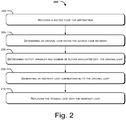
- Fig. 2 illustrates an example method 200 of abstraction of loops for model checking of the computer program.
- a source code or computer program may be received by the context expansion module 112, for abstraction.
- an original loop with control statement and a loop body for the original loop may be determined by the context expansion module 112.
- output variables and the number of block associated with the original loop may be determined by the context expansion module 112.
- the output variables include pure output variable and input-output variable both.
- an abstract loop corresponding to the original loop may be generated by the loop abstraction module 114.
- the abstract loop generated may at least be based on adding a modified expression for accelerated assignment for each output variable in a subset of the output variables.
- the modified expression would be added before the loop body.
- replacing the control statement with a bounded control statement.
- the bounded control statement includes an upper bound based on the number of blocks.
- the original loop in the source code may be replaced by the abstract loop generated at block 208, by the loop abstraction module 114.
- the method 200 is further described in detail below with the help of examples.
- loop replacement replaces each loop, may be called as 'L', having a large or unknown bound and not containing the assertion, by another loop L0, with a small finite number of iterations determined by the number of blocks in the loop's body or the number of pure output variables.
- An auxiliary variable is introduced corresponding to each block representing the number of iterations of that block. All output variables in the loop L are abstracted or accelerated in the replaced loop L0.
- Induction is used for loops where assertion is within the loop body.
- the loop is replaced by three copies of its body - one for the base case, second corresponding to the k th iteration and third for the (k+1) th iteration for induction.
- ⁇ may indicate constants or input variables.
- c 1 and c 2 are constants or inputs (variables that are never modified in the loop) for a given loop.
- o 0 is the initial value of o and k 1 , k 2 are the number of times the corresponding expressions were executed before the reset and after the last reset.
- c 1 is constant and io is an IO variable.
- o 0 is the initial value of o and k 0 is either 0 or 1 depending on whether o k is reset or not during the actual execution of the loop.
- c i are constants which are used in definition of o k and e is number of such expressions.
- dv is the number of variables on which the value of o k depends transitively but is not mutually recurrent with it.
- io i _0 are the initial values of those variables.
- db is the number of constants or inputs on which the value of o depends transitively and io j _0 are those corresponding variables.
- k i , q i and p i are non-deterministically assigned values.
- io 1 and io 2 depend on each other, hence, it is mutual recurrence relationship.
- d is the number of variables on which io 1 has transitive dependency (including itself).
- e is number of constants or input variables on which io 1 has a transitive dependency.
- the constants, k i , p i are non-deterministically assigned values.
- io d _0 represents the initial value of the IO variable io d .
- c 1 , c 2 , ...., c e are constants or inputs on which io 1 has a transitive dependency.
- Accelerated Assignment example 6 In an implementation when arrays are modified inside a given loop body, the system generates non-deterministic values for all the array elements, for all the implementations of those array elements outside the loop body.
- Accelerated Assignment example 7 In an implementation when pointers are modified inside the loop body, the system determines all the memory locations pointed by the pointers and generates the abstraction of the memory locations, in a manner similar to abstraction for the variables. However, if the memory location to the information for any of the pointer in the loop body cannot be resolved, non-deterministic assignments for all the output variables may be generated.
- abstraction starts from inner most loop.
- the abstraction of inner loop is enclosed in abstraction of the outer loop.
- Inner loop stmts assume(c && r_outer && a_outer);
- Outerloop stmts; ⁇ ⁇ for(i 0; i ⁇ min(b_inner && po_inner & ic ;i++) ⁇ abstractinner(IO); assume(ic && r_inner && a_inner); inner loop stmts; ⁇ Example 6 - Original loop assume(!ic) ⁇ assume(!c);
- the below examples are provided to showcase the exemplary process.
- the property verification of the computer program is provided below.
- One part of verification involved model checking of properties.
- the model checker tool was not able to verify properties due to complex loops with unknown or large bounds of loop.
- Example B An abstract loop (iloop_absbody)
- the property of interest lies within the outer loop and hence induction is applied to the outer loop.
- Lines 3-20 of the code in Example C check whether the assert holds at the end of the base case for induction.
- the inductive step is encoded by lines 20-54, where it is assumed the loop has executed k times.
- k2, k3, k4 and k5 are the number of times the bodies of the 'else if' construct at line 42, 'else' at line 47, 'if' at line 51 and 'if' at line 38 are executed at the end of k iterations.
- j0 and p0 are the initial values of j and p respectively.
- Line 53 encodes the assumption that the property holds at the end of k iterations.
- Lines 55 - 72 encode the (k + 1)th iteration including the assert.
- the abstracted code is successfully verified by a model checker, for example the model checker may be a bounded model checker in this case.
- the state space of the variables j and p is a super set of that in the concrete code making it a sound over-approximation.
- the loop abstraction process uses all three transformations - abstraction, acceleration and induction, to verify this code. In comparison, none of the commercially available tools (available model checkers, commercially available static analysis tools) were able to verify the original code.
Landscapes
- Engineering & Computer Science (AREA)
- Theoretical Computer Science (AREA)
- Software Systems (AREA)
- General Engineering & Computer Science (AREA)
- Physics & Mathematics (AREA)
- General Physics & Mathematics (AREA)
- Computer Hardware Design (AREA)
- Quality & Reliability (AREA)
- Stored Programmes (AREA)
- Debugging And Monitoring (AREA)
Claims (15)
- System zur Schleifenabstraktion (102) in einem Quellcode zum Modellprüfen des Quellcodes, wobei das System einen Prozessor (104) aufweist, der mit einem Speicher (108) verbunden ist und der Prozessor eine Mehrzahl von in dem Speicher 108 gespeicherten Modulen aufweist, wobei die Mehrzahl von Modulen aufweisen:Ein Kontextexpansionsmodul (112), das mit dem Prozessor 104 verbunden ist, zumEmpfangen des Quellcodes zur Abstraktion;Ermitteln einer ursprünglichen Schleife innerhalb des Quellcodes, wobei die ursprüngliche Schleife eine Steueranweisung und einen Schleifenkörper aufweist, wobei die ursprüngliche Schleife den Schleifenkörper dazu veranlasst, basierend auf der Steueranweisung wiederholt ausgeführt zu werden; undIdentifizieren von Ausgabevariablen in der ursprünglichen Schleife und einer Anzahl von Blöcken, die mit der ursprünglichen Schleife assoziiert sind, wobei die Ausgabevariablen ein oder mehrere Eingabe-Ausgabe-Variablen und ein oder mehrere reine Ausgabevariablen aufweisen, wobei die ein oder mehreren Eingabe-Ausgabe-Variablen die Ausgabevariablen, die in der ursprünglichen Schleife gelesen und modifiziert werden, angeben, und die ein oder mehreren reinen Ausgabevariablen die Ausgabevariablen, die in der ursprünglichen Schleife ohne gelesen zu werden modifiziert werden, angeben, und wobei der Block eine unbedingte ausgeführte Menge von Anweisungen, die mit der ursprünglichen Schleife innerhalb des Quellcodes assoziiert sind, ist, und die Anzahl von Blocks die Blöcke angibt, wo eine einzige Menge von Ausgabevariablen modifiziert wird; undein Schleifenabstraktionsmodul (114), das mit dem Prozessor (104) verbunden ist, zum Erzeugen einer abstrakten Schleife, die der ursprünglichen Schleife entspricht, wenn eine Eigenschaft oder eine Bedingung, die mit dem Quellcode assoziiert ist und die während der Modellprüfung des Quellcodes zu verifizieren ist, außerhalb der ursprünglichen Schleife platziert ist, wobei zum Erzeugen der abstrakten Schleife das Schleifenabstraktionsmodul ferner eingerichtet ist zum:Hinzufügen eines modifizierten Ausdrucks zur beschleunigten Zuweisung von jeder Eingabe-Ausgabe-Variable in der ursprünglichen Schleife, wobei der modifizierte Ausdruck vor dem Schleifenkörper hinzugefügt wird; undErsetzen der Steueranweisung durch eine beschränkte Steueranweisung, um die ursprüngliche Schleife in die abstrakte Schleife zu transformieren, wobei die beschränkte Steueranweisung eine obere Schranke basierend auf der Anzahl von Blöcken und einer Anzahl der reinen Ausgabevariablen in der ursprünglichen Schleife enthält; undErsetzen der ursprünglichen Schleife durch die abstrakte Schleife in dem Quellcode zum Erzeugen eines abstrakten Quellcodes zum Modellprüfen des Quellcodes;undein Modellprüfmodul (116), das mit dem Prozessor (104) verbunden ist, zum Durchführen des Modellprüfens des abstrakten Quellcodes zum Verifizieren der Eigenschaft oder Bedingung des Quellcodes.
- Das System von Anspruch 1, wobei das Schleifenabstraktionsmodul (114) eingerichtet ist zum Verifizieren, ob die Eigenschaft oder die Bedingung, die mit dem Quellcode assoziiert ist und die während der Modellprüfung des Quellcodes zu verifizieren ist, in der ursprünglichen Schleife platziert ist; und eine Induktion zum Erzeugen der abstrakten Schleife anzuwenden, wobei die Anwendung der Induktion das Ersetzen der ursprünglichen Schleife mit drei Kopien des Schleifenkörpers aufweist, inklusive einer für eine erste Iteration der ursprünglichen Schleife, einer zweiten entsprechend der k-ten Iteration der ursprünglichen Schleife und einer dritten für die (k+1)-te Iteration der ursprünglichen Schleife für die Induktion,
wobei 'k' eine Anzahl von Iterationen der ursprünglichen Schleife repräsentiert, wobei die erste Iteration eine Kopie des Schleifenkörpers, der die Eigenschaft oder die Bedingung aufweist, beinhaltet, wobei zu Beginn der k-ten Iteration alle der Ausgabevariablen in der ursprünglichen Schleife abstrahiert oder beschleunigt werden und die Steueranweisung durch die beschränkte Steueranweisung ersetzt wird, wobei am Ende der k-ten Iteration der ursprünglichen Schleife als Induktionshypothese angenommen wird, dass die Eigenschaft oder die Bedingung, die zu verifizieren ist, eingehalten wird, und wobei die (k+1)-te Iteration eine Kopie des Schleifenkörpers, bei dem innere Schleifen ersetzt sind, und die Eigenschaft oder die Bedingung aufweist. - Das System von Anspruch 1, wobei der modifizierte Ausdruck für beschleunigte Zuweisung das Ersetzen der Eingabe-Ausgabe-Variable durch eine abstrahierte Eingabe-Ausgabe-Variable anzeigt und wobei der modifizierte Ausdruck für die beschleunigte Zuweisung für eine Mehrzahl von Typen der Eingabe-Ausgabe-Variablen, aufweisend nicht-rekurrente Eingabe-Ausgabe-Variablen und selbst-rekurrente Eingabe-Ausgabe-Variablen, hinzugefügt wird.
- Das System von Anspruch 1, wobei, wenn das Modellprüfmodul (116) die Eigenschaft, die in der Funktion 'f' des Quellcodes vorhanden ist als unsicher verifiziert, das Kontextexpansionsmodul (112), das mit dem Prozessor (104) verbunden ist, einen Kontext der Funktion 'f' auf die Funktionen, die 'f' aufrufen, erweitert.
- Das System von Anspruch 3, wobei das Schleifenabstraktionsmodul (114) ferner eingerichtet ist zum Erzeugen der beschleunigten Zuweisung der nicht-rekurrenten Eingabe-Ausgabe-Variablen aufweisend:Formulieren eines Werts der nicht-rekurrenten Ausgabevariable (ik) als eine Funktion von 1) einem Startwert der nicht-rekurrenten Eingabe-Ausgabe-Variable (i0) und 2) einer Anzahl von Rücksetz-Ausdrücken (r) für die nicht-rekurrente Eingabe-Ausgabe-Variable basierend auf ik = i 0||γ1||γ2......||γ r , wobei γ eine Konstante oder eine Eingabevariable ist und γi , 1 ≤ i ≤ r dem Rücksetzausdruck der nicht-rekurrenten Eingabe-Ausgabe-Variable i entspricht.
- Verfahren, implementiert durch einen Computer, der einen Prozessor aufweist, zur Abstraktion einer Schleife in einem Quellcode zum Modellprüfen des Quellcodes, wobei das Verfahren aufweist:Empfangen, durch den Prozessor, des Quellcodes zur Abstraktion;Ermitteln, durch den Prozessor, einer ursprünglichen Schleife innerhalb des Quellcodes, wobei die ursprüngliche Schleife eine Steueranweisung und einen Schleifenkörper aufweist, wobei die ursprüngliche Schleife den Schleifenkörper dazu veranlasst, basierend auf der Steueranweisung wiederholt ausgeführt zu werden;Identifizieren, durch den Prozessor, von Ausgabevariablen in der ursprünglichen Schleife und einer Anzahl von Blöcken, die mit der ursprünglichen Schleife assoziiert sind, wobei die Ausgabevariablen ein oder mehrere Eingabe-Ausgabe-Variablen und ein oder mehrere reine Ausgabevariablen aufweisen, und wobei die ein oder mehreren Eingabe-Ausgabe-Variablen die Ausgabevariablen, die in der ursprünglichen Schleife gelesen und modifiziert werden, angeben, und die ein oder mehreren reinen Ausgabevariablen die Ausgabevariablen, die in der ursprünglichen Schleife ohne gelesen zu werden modifiziert werden, angeben, undwobei der Block eine unbedingte ausgeführte Menge von Anweisungen, die mit der ursprünglichen Schleife innerhalb des Quellcodes assoziiert sind, ist, und die Anzahl von Blocks die Blöcke angibt, wo eine einzige Menge von Ausgabevariablen modifiziert wird;Erzeugen, durch den Prozessor, einer abstrakten Schleife, die der ursprünglichen Schleife entspricht, wenn eine Eigenschaft oder eine Bedingung, die mit dem Quellcode assoziiert ist und die während der Modellprüfung des Quellcodes zu verifizieren ist, außerhalb der ursprünglichen Schleife platziert ist,wobei das Erzeugen der abstrakten Schleife aufweist:Hinzufügen, durch den Prozessor, eines modifizierten Ausdrucks zur beschleunigten Zuweisung von jeder Eingabe-Ausgabe-Variable in der ursprünglichen Schleife, wobei der modifizierte Ausdruck vor dem Schleifenkörper hinzugefügt wird; undErsetzen, durch den Prozessor, der Steueranweisung durch eine beschränkte Steueranweisung, um die ursprüngliche Schleife in die abstrakte Schleife zu transformieren, wobei die beschränkte Steueranweisung eine obere Schranke basierend auf der Anzahl von Blöcken und einer Anzahl der reinen Ausgabevariablen in der ursprünglichen Schleife enthält;Ersetzen, durch den Prozessor, der ursprünglichen Schleife durch die abstrakte Schleife in dem Quellcode zum Erzeugen eines abstrakten Quellcodes zum Modellprüfen des Quellcodes; undDurchführen des Modellprüfens des abstrakten Quellcodes unter Verwendung eines Modellprüfers zum Verifizieren der Eigenschaft oder Bedingung des Quellcodes.
- Das Verfahren gemäß Anspruch 6, ferner aufweisend Verifizieren, ob die Eigenschaft oder die Bedingung, die mit dem Quellcode assoziiert ist und die während der Modellprüfung des Quellcodes zu verifizieren ist, in der ursprünglichen Schleife platziert ist; und Anwenden einer Induktion zum Erzeugen der abstrakten Schleife, wobei die Anwendung der Induktion das Ersetzen der ursprünglichen Schleife mit drei Kopien des Schleifenkörpers aufweist, inklusive einer für eine erste Iteration der ursprünglichen Schleife, einer zweiten entsprechend der k-ten Iteration der ursprünglichen Schleife und einer dritten für die (k+1)-te Iteration der ursprünglichen Schleife für die Induktion,
wobei 'k' eine Anzahl von Iterationen der ursprünglichen Schleife repräsentiert, wobei die erste Iteration eine Kopie des Schleifenkörpers, der die Eigenschaft oder die Bedingung aufweist, beinhaltet, und wobei zu Beginn der k-ten Iteration 1) alle der Ausgabevariablen in der ursprünglichen Schleife abstrahiert oder beschleunigt werden und 2) die Steueranweisung durch die beschränkte Steueranweisung ersetzt wird und wobei am Ende der k-ten Iteration der ursprünglichen Schleife als Induktionshypothese angenommen wird, dass die Eigenschaft oder die Bedingung, die zu verifizieren ist, eingehalten wird, und wobei die (k+1)-te Iteration eine Kopie des Schleifenkörpers, bei dem innere Schleifen ersetzt sind, und die Eigenschaft oder die Bedingung aufweist. - Das Verfahren gemäß Anspruch 6, wobei der modifizierte Ausdruck für beschleunigte Zuweisung das Ersetzen der Eingabe-Ausgabe-Variable durch eine abstrahierte Eingabe-Ausgabe-Variable anzeigt und wobei der modifizierte Ausdruck für die beschleunigte Zuweisung für eine Mehrzahl von Typen der Eingabe-Ausgabe-Variablen, aufweisend nicht-rekurrente Eingabe-Ausgabe-Variablen und selbst-rekurrente Eingabe-Ausgabe-Variablen, hinzugefügt wird.
- Das Verfahren gemäß Anspruch 8, wobei die beschleunigte Zuweisung der selbst-rekurrenten Eingabe-Ausgabe-Variablen das Formulieren eines Werts der selbst-rekurrenten Eingabe-Ausgabe-Variablen (ik) als eine Funktion eines Anfangswerts der selbst-rekurrenten Eingabe-Ausgabe-Variablen (i0), eines Werts (βi), der die selbst-rekurrente Eingabe-Ausgabe-Variable in jeder Iteration modifiziert, und einer Abstraktion der Anzahl von Ausführungen der jeweiligen Ausdrücke in der ursprünglichen Schleife (ki) aufweist, sodass

- Das Verfahren gemäß Anspruch 6, wobei, wenn die Eigenschaft, die in der Funktion 'f' des Quellcodes vorhanden ist durch den Modellprüfer als unsicher verifiziert wird, ein Kontext der Funktion 'f' auf die Funktionen, die 'f' aufrufen, erweitert wird.
- Das Verfahren gemäß Anspruch 6, wobei das Erzeugen der abstrakten Schleife das Erzeugen der abstrakten Schleife für jede verschachtelte Schleife in der ursprünglichen Schleife beginnend von einer innersten verschachtelten Schleife aufweist.
- Das Verfahren gemäß Anspruch 8, wobei das Erzeugen der beschleunigten Zuweisung der nicht-rekurrenten Eingabe-Ausgabe-Variablen aufweist das Formulieren eines Werts der nicht-rekurrenten Eingabe-Ausgabe-Variable (ik) als eine Funktion von einem Startwert der nicht-rekurrenten Eingabe-Ausgabe-Variable (i0) und einer Anzahl von Rücksetz-Ausdrücken (r) für die nicht-rekurrente Eingabe-Ausgabe-Variable basierend auf ik = i 0||γ 1||γ 2......||γr , wobei γ eine Konstante oder eine Eingabevariable ist und γi, 1 ≤ i ≤ r dem Rücksetzausdruck der nicht-rekurrenten Eingabe-Ausgabe-Variable i entspricht.
- Nichtflüchtiges Computer-lesbares Medium, auf dem ein Computerprogramm verkörpert ist zur Abstraktion einer Schleife in einem Quellcode zum Modellprüfen des Quellcodes, wobei das Verfahren aufweist:Empfangen, durch einen Prozessor, des Quellcodes zur Abstraktion;Ermitteln, durch den Prozessor, einer ursprünglichen Schleife innerhalb des Quellcodes, wobei die ursprüngliche Schleife eine Steueranweisung und einen Schleifenkörper aufweist, wobei die ursprüngliche Schleife den Schleifenkörper dazu veranlasst, basierend auf der Steueranweisung wiederholt ausgeführt zu werden; Identifizieren, durch den Prozessor, von Ausgabevariablen in der ursprünglichen Schleife und einer Anzahl von Blöcken, die mit der ursprünglichen Schleife assoziiert sind, wobei die Ausgabevariablen ein oder mehrere Eingabe-Ausgabe-Variablen und ein oder mehrere reine Ausgabevariablen aufweisen, und wobei die ein oder mehreren Eingabe-Ausgabe-Variablen die Ausgabevariablen, die in der ursprünglichen Schleife gelesen und modifiziert werden, angeben, und die ein oder mehreren reinen Ausgabevariablen die Ausgabevariablen, die in der ursprünglichen Schleife ohne gelesen zu werden modifiziert werden, angeben, undwobei der Block eine unbedingte ausgeführte Menge von Anweisungen, die mit der ursprünglichen Schleife innerhalb des Quellcodes assoziiert sind, ist, und die Anzahl von Blocks die Blöcke angibt, wo eine einzige Menge von Ausgabevariablen modifiziert wird;Erzeugen, durch den Prozessor, einer abstrakten Schleife, die der ursprünglichen Schleife entspricht, wenn eine Eigenschaft oder eine Bedingung, die mit dem Quellcode assoziiert ist und die während der Modellprüfung des Quellcodes zu verifizieren ist, außerhalb der ursprünglichen Schleife platziert ist, wobei das Erzeugen der abstrakten Schleife aufweist:Hinzufügen, durch den Prozessor, eines modifizierten Ausdrucks zur beschleunigten Zuweisung von jeder Eingabe-Ausgabe-Variable in der ursprünglichen Schleife, wobei der modifizierte Ausdruck vor dem Schleifenkörper hinzugefügt wird; undErsetzen, durch den Prozessor, der Steueranweisung durch eine beschränkte Steueranweisung, um die ursprüngliche Schleife in die abstrakte Schleife zu transformieren, wobei die beschränkte Steueranweisung eine obere Schranke basierend auf der Anzahl von Blöcken und einer Anzahl der reinen Ausgabevariablen in der ursprünglichen Schleife enthält; undErsetzen, durch den Prozessor, der ursprünglichen Schleife durch die abstrakte Schleife in dem Quellcode zum Erzeugen eines abstrakten Quellcodes zum Modellprüfen des Quellcodes;Durchführen des Modellprüfens des abstrakten Quellcodes unter Verwendung eines Modellprüfers zum Verifizieren der Eigenschaft oder Bedingung des Quellcodes.
- Das nichtflüchtige Computer-lesbare Medium gemäß Anspruch 13, wobei
Verifizieren, ob die Eigenschaft oder die Bedingung, die mit dem Quellcode assoziiert ist und die während der Modellprüfung des Quellcodes zu verifizieren ist, in der ursprünglichen Schleife platziert ist; und Anwenden einer Induktion zum Erzeugen der abstrakten Schleife, wobei die Anwendung der Induktion das Ersetzen der ursprünglichen Schleife mit drei Kopien des Schleifenkörpers aufweist, inklusive einer für eine erste Iteration der ursprünglichen Schleife, einer zweiten entsprechend der k-ten Iteration der ursprünglichen Schleife und einer dritten für die (k+1)-te Iteration der ursprünglichen Schleife für die Induktion,
wobei 'k' eine Anzahl von Iterationen der ursprünglichen Schleife repräsentiert, wobei die erste Iteration eine Kopie des Schleifenkörpers, der die Eigenschaft oder die Bedingung aufweist, beinhaltet und wobei zu Beginn der k-ten Iteration alle der Ausgabevariablen in der ursprünglichen Schleife abstrahiert oder beschleunigt werden und die Steueranweisung durch die beschränkte Steueranweisung ersetzt wird und wobei am Ende der k-ten Iteration der ursprünglichen Schleife als Induktionshypothese angenommen wird, dass die Eigenschaft oder die Bedingung, die zu verifizieren ist, eingehalten wird, und wobei die (k+1)-te Iteration eine Kopie des Schleifenkörpers, bei dem innere Schleifen ersetzt sind, und die Eigenschaft oder die Bedingung aufweist. - Das nichtflüchtige Computer-lesbare Medium gemäß Anspruch 13, wobei, wenn der Modellprüfer die mindestens eine Eigenschaft, die in der Funktion 'f' des Quellcodes vorhanden ist, als unsicher verifiziert, ein Kontext der Funktion 'f' auf die Funktionen, die 'f' aufrufen, erweitert wird.
Applications Claiming Priority (1)
| Application Number | Priority Date | Filing Date | Title |
|---|---|---|---|
| IN704MU2014 | 2014-02-27 |
Publications (2)
| Publication Number | Publication Date |
|---|---|
| EP2913758A1 EP2913758A1 (de) | 2015-09-02 |
| EP2913758B1 true EP2913758B1 (de) | 2018-02-07 |
Family
ID=52648827
Family Applications (1)
| Application Number | Title | Priority Date | Filing Date |
|---|---|---|---|
| EP15157026.4A Active EP2913758B1 (de) | 2014-02-27 | 2015-02-27 | Schleifenabstraktion für Modellprüfung |
Country Status (3)
| Country | Link |
|---|---|
| US (1) | US9158506B2 (de) |
| EP (1) | EP2913758B1 (de) |
| JP (1) | JP5923636B2 (de) |
Families Citing this family (8)
| Publication number | Priority date | Publication date | Assignee | Title |
|---|---|---|---|---|
| US10001978B2 (en) * | 2015-11-11 | 2018-06-19 | Oracle International Corporation | Type inference optimization |
| EP3217284B1 (de) * | 2016-03-09 | 2022-06-08 | Tata Consultancy Services Limited | Datenstrukturabstraktionen zur modellprüfung |
| JP2018136704A (ja) * | 2017-02-21 | 2018-08-30 | 富士通株式会社 | テスト支援プログラム、テスト支援装置およびテスト支援方法 |
| EP3859532B1 (de) | 2020-01-31 | 2022-10-12 | Tata Consultancy Services Limited | Verfahren und system zur verfeinerung der gegenbeispielgeführten schleifenabstraktion |
| CN115098162B (zh) * | 2022-06-10 | 2025-07-22 | 南京大学 | 基于高精度静态程序分析的循环上界计算方法 |
| CN115237809A (zh) * | 2022-08-15 | 2022-10-25 | 中国工商银行股份有限公司 | 代码校验方法和装置 |
| CN116467220B (zh) * | 2023-06-13 | 2023-09-08 | 北京航空航天大学 | 一种面向软件静态分析的循环代码处理方法和装置 |
| CN119201564B (zh) * | 2024-09-02 | 2026-01-06 | 支付宝(杭州)数字服务技术有限公司 | 循环单元的有界模型检测方法及装置 |
Family Cites Families (9)
| Publication number | Priority date | Publication date | Assignee | Title |
|---|---|---|---|---|
| US8549501B2 (en) * | 2004-06-07 | 2013-10-01 | International Business Machines Corporation | Framework for generating mixed-mode operations in loop-level simdization |
| US7926037B2 (en) * | 2006-01-19 | 2011-04-12 | Microsoft Corporation | Hiding irrelevant facts in verification conditions |
| US7853906B2 (en) | 2006-03-22 | 2010-12-14 | Nec Laboratories America, Inc. | Accelerating high-level bounded model checking |
| US7921411B2 (en) | 2006-10-20 | 2011-04-05 | International Business Machines Corporation | Model checking of non-terminating software programs |
| US8087010B2 (en) * | 2007-09-26 | 2011-12-27 | International Business Machines Corporation | Selective code generation optimization for an advanced dual-representation polyhedral loop transformation framework |
| US8522226B2 (en) * | 2009-02-09 | 2013-08-27 | Nec Laboratories America, Inc. | Control structure refinement of loops using static analysis |
| US8752029B2 (en) * | 2009-09-29 | 2014-06-10 | Microsoft Corporation | Computing a symbolic bound for a procedure |
| US8719793B2 (en) | 2010-12-08 | 2014-05-06 | Nec Laboratories America, Inc. | Scope bounding with automated specification inference for scalable software model checking |
| JP2013065258A (ja) * | 2011-09-20 | 2013-04-11 | Nec Corp | 情報処理装置、情報処理方法及び情報処理プログラム |
-
2015
- 2015-02-27 US US14/633,228 patent/US9158506B2/en active Active
- 2015-02-27 JP JP2015039201A patent/JP5923636B2/ja active Active
- 2015-02-27 EP EP15157026.4A patent/EP2913758B1/de active Active
Non-Patent Citations (1)
| Title |
|---|
| None * |
Also Published As
| Publication number | Publication date |
|---|---|
| JP5923636B2 (ja) | 2016-05-24 |
| EP2913758A1 (de) | 2015-09-02 |
| US9158506B2 (en) | 2015-10-13 |
| JP2015212929A (ja) | 2015-11-26 |
| US20150242188A1 (en) | 2015-08-27 |
Similar Documents
| Publication | Publication Date | Title |
|---|---|---|
| US9158506B2 (en) | Loop abstraction for model checking | |
| US9280442B1 (en) | System and method for generating coverage reports for software unit tests | |
| US8732669B2 (en) | Efficient model checking technique for finding software defects | |
| US9043759B1 (en) | System and method for generating software unit tests simultaneously with API documentation | |
| US8997065B2 (en) | Automatic modularization of source code | |
| TWI468936B (zh) | 用於產生驗證程式之系統及方法 | |
| US9229697B2 (en) | Speculative object shapes | |
| KR102827638B1 (ko) | 유니터리 값 세트의 락 프리 판독 | |
| Falke et al. | The bounded model checker LLBMC | |
| US10534689B2 (en) | Data structure abstraction for model checking | |
| CN114830099B (zh) | 集成引用和次对象的标记 | |
| US11474795B2 (en) | Static enforcement of provable assertions at compile | |
| JP2016018557A (ja) | イベント駆動型ソフトウェアのテスト | |
| Nobre et al. | Aspect-driven mixed-precision tuning targeting gpus | |
| US20160147559A1 (en) | Modification of context saving functions | |
| US8661424B2 (en) | Auto-generation of concurrent code for multi-core applications | |
| Straznickas | Towards a verified first-stage bootloader in Coq | |
| CN117785645A (zh) | 一种risc-v指令集的验证方法、装置和电子设备 | |
| Yu et al. | Techniques for reducing the overhead of run-time parallelization | |
| CN117454835B (zh) | 保存和读取波形数据的方法、电子设备以及存储介质 | |
| Drechsler et al. | Automated and quality-driven requirements engineering | |
| CN115658242A (zh) | 逻辑系统设计的任务处理方法及电子设备 | |
| CN120011209A (zh) | 程序调试方法、装置、电子设备和存储介质 | |
| CN118839350A (zh) | 代码的修复方法、装置、设备及介质 | |
| Bodzay et al. | AspectMatlab++: annotations, types, and aspects for scientists |
Legal Events
| Date | Code | Title | Description |
|---|---|---|---|
| PUAI | Public reference made under article 153(3) epc to a published international application that has entered the european phase |
Free format text: ORIGINAL CODE: 0009012 |
|
| AK | Designated contracting states |
Kind code of ref document: A1 Designated state(s): AL AT BE BG CH CY CZ DE DK EE ES FI FR GB GR HR HU IE IS IT LI LT LU LV MC MK MT NL NO PL PT RO RS SE SI SK SM TR |
|
| AX | Request for extension of the european patent |
Extension state: BA ME |
|
| 17P | Request for examination filed |
Effective date: 20160301 |
|
| RBV | Designated contracting states (corrected) |
Designated state(s): AL AT BE BG CH CY CZ DE DK EE ES FI FR GB GR HR HU IE IS IT LI LT LU LV MC MK MT NL NO PL PT RO RS SE SI SK SM TR |
|
| 17Q | First examination report despatched |
Effective date: 20160704 |
|
| REG | Reference to a national code |
Ref country code: DE Ref legal event code: R079 Ref document number: 602015007896 Country of ref document: DE Free format text: PREVIOUS MAIN CLASS: G06F0011360000 Ipc: G06F0009440000 |
|
| GRAP | Despatch of communication of intention to grant a patent |
Free format text: ORIGINAL CODE: EPIDOSNIGR1 |
|
| RIC1 | Information provided on ipc code assigned before grant |
Ipc: G06F 9/44 20060101AFI20170531BHEP Ipc: G06F 11/36 20060101ALI20170531BHEP |
|
| INTG | Intention to grant announced |
Effective date: 20170621 |
|
| GRAJ | Information related to disapproval of communication of intention to grant by the applicant or resumption of examination proceedings by the epo deleted |
Free format text: ORIGINAL CODE: EPIDOSDIGR1 |
|
| GRAP | Despatch of communication of intention to grant a patent |
Free format text: ORIGINAL CODE: EPIDOSNIGR1 |
|
| INTC | Intention to grant announced (deleted) | ||
| INTG | Intention to grant announced |
Effective date: 20170908 |
|
| GRAS | Grant fee paid |
Free format text: ORIGINAL CODE: EPIDOSNIGR3 |
|
| GRAA | (expected) grant |
Free format text: ORIGINAL CODE: 0009210 |
|
| REG | Reference to a national code |
Ref country code: FR Ref legal event code: PLFP Year of fee payment: 4 |
|
| AK | Designated contracting states |
Kind code of ref document: B1 Designated state(s): AL AT BE BG CH CY CZ DE DK EE ES FI FR GB GR HR HU IE IS IT LI LT LU LV MC MK MT NL NO PL PT RO RS SE SI SK SM TR |
|
| REG | Reference to a national code |
Ref country code: GB Ref legal event code: FG4D |
|
| REG | Reference to a national code |
Ref country code: AT Ref legal event code: REF Ref document number: 969044 Country of ref document: AT Kind code of ref document: T Effective date: 20180215 Ref country code: CH Ref legal event code: EP |
|
| REG | Reference to a national code |
Ref country code: IE Ref legal event code: FG4D |
|
| REG | Reference to a national code |
Ref country code: DE Ref legal event code: R096 Ref document number: 602015007896 Country of ref document: DE |
|
| REG | Reference to a national code |
Ref country code: NL Ref legal event code: MP Effective date: 20180207 |
|
| REG | Reference to a national code |
Ref country code: CH Ref legal event code: NV Representative=s name: MICHELI AND CIE SA, CH |
|
| REG | Reference to a national code |
Ref country code: AT Ref legal event code: MK05 Ref document number: 969044 Country of ref document: AT Kind code of ref document: T Effective date: 20180207 |
|
| PG25 | Lapsed in a contracting state [announced via postgrant information from national office to epo] |
Ref country code: FI Free format text: LAPSE BECAUSE OF FAILURE TO SUBMIT A TRANSLATION OF THE DESCRIPTION OR TO PAY THE FEE WITHIN THE PRESCRIBED TIME-LIMIT Effective date: 20180207 Ref country code: CY Free format text: LAPSE BECAUSE OF FAILURE TO SUBMIT A TRANSLATION OF THE DESCRIPTION OR TO PAY THE FEE WITHIN THE PRESCRIBED TIME-LIMIT Effective date: 20180207 Ref country code: LT Free format text: LAPSE BECAUSE OF FAILURE TO SUBMIT A TRANSLATION OF THE DESCRIPTION OR TO PAY THE FEE WITHIN THE PRESCRIBED TIME-LIMIT Effective date: 20180207 Ref country code: NL Free format text: LAPSE BECAUSE OF FAILURE TO SUBMIT A TRANSLATION OF THE DESCRIPTION OR TO PAY THE FEE WITHIN THE PRESCRIBED TIME-LIMIT Effective date: 20180207 Ref country code: ES Free format text: LAPSE BECAUSE OF FAILURE TO SUBMIT A TRANSLATION OF THE DESCRIPTION OR TO PAY THE FEE WITHIN THE PRESCRIBED TIME-LIMIT Effective date: 20180207 Ref country code: HR Free format text: LAPSE BECAUSE OF FAILURE TO SUBMIT A TRANSLATION OF THE DESCRIPTION OR TO PAY THE FEE WITHIN THE PRESCRIBED TIME-LIMIT Effective date: 20180207 Ref country code: NO Free format text: LAPSE BECAUSE OF FAILURE TO SUBMIT A TRANSLATION OF THE DESCRIPTION OR TO PAY THE FEE WITHIN THE PRESCRIBED TIME-LIMIT Effective date: 20180507 |
|
| PG25 | Lapsed in a contracting state [announced via postgrant information from national office to epo] |
Ref country code: GR Free format text: LAPSE BECAUSE OF FAILURE TO SUBMIT A TRANSLATION OF THE DESCRIPTION OR TO PAY THE FEE WITHIN THE PRESCRIBED TIME-LIMIT Effective date: 20180508 Ref country code: BG Free format text: LAPSE BECAUSE OF FAILURE TO SUBMIT A TRANSLATION OF THE DESCRIPTION OR TO PAY THE FEE WITHIN THE PRESCRIBED TIME-LIMIT Effective date: 20180507 Ref country code: PL Free format text: LAPSE BECAUSE OF FAILURE TO SUBMIT A TRANSLATION OF THE DESCRIPTION OR TO PAY THE FEE WITHIN THE PRESCRIBED TIME-LIMIT Effective date: 20180207 Ref country code: AT Free format text: LAPSE BECAUSE OF FAILURE TO SUBMIT A TRANSLATION OF THE DESCRIPTION OR TO PAY THE FEE WITHIN THE PRESCRIBED TIME-LIMIT Effective date: 20180207 Ref country code: RS Free format text: LAPSE BECAUSE OF FAILURE TO SUBMIT A TRANSLATION OF THE DESCRIPTION OR TO PAY THE FEE WITHIN THE PRESCRIBED TIME-LIMIT Effective date: 20180207 Ref country code: SE Free format text: LAPSE BECAUSE OF FAILURE TO SUBMIT A TRANSLATION OF THE DESCRIPTION OR TO PAY THE FEE WITHIN THE PRESCRIBED TIME-LIMIT Effective date: 20180207 Ref country code: LV Free format text: LAPSE BECAUSE OF FAILURE TO SUBMIT A TRANSLATION OF THE DESCRIPTION OR TO PAY THE FEE WITHIN THE PRESCRIBED TIME-LIMIT Effective date: 20180207 Ref country code: IS Free format text: LAPSE BECAUSE OF FAILURE TO SUBMIT A TRANSLATION OF THE DESCRIPTION OR TO PAY THE FEE WITHIN THE PRESCRIBED TIME-LIMIT Effective date: 20180607 |
|
| PG25 | Lapsed in a contracting state [announced via postgrant information from national office to epo] |
Ref country code: RO Free format text: LAPSE BECAUSE OF FAILURE TO SUBMIT A TRANSLATION OF THE DESCRIPTION OR TO PAY THE FEE WITHIN THE PRESCRIBED TIME-LIMIT Effective date: 20180207 Ref country code: AL Free format text: LAPSE BECAUSE OF FAILURE TO SUBMIT A TRANSLATION OF THE DESCRIPTION OR TO PAY THE FEE WITHIN THE PRESCRIBED TIME-LIMIT Effective date: 20180207 Ref country code: EE Free format text: LAPSE BECAUSE OF FAILURE TO SUBMIT A TRANSLATION OF THE DESCRIPTION OR TO PAY THE FEE WITHIN THE PRESCRIBED TIME-LIMIT Effective date: 20180207 Ref country code: IT Free format text: LAPSE BECAUSE OF FAILURE TO SUBMIT A TRANSLATION OF THE DESCRIPTION OR TO PAY THE FEE WITHIN THE PRESCRIBED TIME-LIMIT Effective date: 20180207 |
|
| REG | Reference to a national code |
Ref country code: DE Ref legal event code: R097 Ref document number: 602015007896 Country of ref document: DE |
|
| REG | Reference to a national code |
Ref country code: IE Ref legal event code: MM4A |
|
| REG | Reference to a national code |
Ref country code: BE Ref legal event code: MM Effective date: 20180228 |
|
| PG25 | Lapsed in a contracting state [announced via postgrant information from national office to epo] |
Ref country code: CZ Free format text: LAPSE BECAUSE OF FAILURE TO SUBMIT A TRANSLATION OF THE DESCRIPTION OR TO PAY THE FEE WITHIN THE PRESCRIBED TIME-LIMIT Effective date: 20180207 Ref country code: LU Free format text: LAPSE BECAUSE OF NON-PAYMENT OF DUE FEES Effective date: 20180227 Ref country code: DK Free format text: LAPSE BECAUSE OF FAILURE TO SUBMIT A TRANSLATION OF THE DESCRIPTION OR TO PAY THE FEE WITHIN THE PRESCRIBED TIME-LIMIT Effective date: 20180207 Ref country code: SM Free format text: LAPSE BECAUSE OF FAILURE TO SUBMIT A TRANSLATION OF THE DESCRIPTION OR TO PAY THE FEE WITHIN THE PRESCRIBED TIME-LIMIT Effective date: 20180207 Ref country code: SK Free format text: LAPSE BECAUSE OF FAILURE TO SUBMIT A TRANSLATION OF THE DESCRIPTION OR TO PAY THE FEE WITHIN THE PRESCRIBED TIME-LIMIT Effective date: 20180207 Ref country code: MC Free format text: LAPSE BECAUSE OF FAILURE TO SUBMIT A TRANSLATION OF THE DESCRIPTION OR TO PAY THE FEE WITHIN THE PRESCRIBED TIME-LIMIT Effective date: 20180207 |
|
| PLBE | No opposition filed within time limit |
Free format text: ORIGINAL CODE: 0009261 |
|
| STAA | Information on the status of an ep patent application or granted ep patent |
Free format text: STATUS: NO OPPOSITION FILED WITHIN TIME LIMIT |
|
| 26N | No opposition filed |
Effective date: 20181108 |
|
| PG25 | Lapsed in a contracting state [announced via postgrant information from national office to epo] |
Ref country code: IE Free format text: LAPSE BECAUSE OF NON-PAYMENT OF DUE FEES Effective date: 20180227 |
|
| PG25 | Lapsed in a contracting state [announced via postgrant information from national office to epo] |
Ref country code: SI Free format text: LAPSE BECAUSE OF FAILURE TO SUBMIT A TRANSLATION OF THE DESCRIPTION OR TO PAY THE FEE WITHIN THE PRESCRIBED TIME-LIMIT Effective date: 20180207 Ref country code: BE Free format text: LAPSE BECAUSE OF NON-PAYMENT OF DUE FEES Effective date: 20180228 |
|
| PG25 | Lapsed in a contracting state [announced via postgrant information from national office to epo] |
Ref country code: MT Free format text: LAPSE BECAUSE OF NON-PAYMENT OF DUE FEES Effective date: 20180227 |
|
| PG25 | Lapsed in a contracting state [announced via postgrant information from national office to epo] |
Ref country code: TR Free format text: LAPSE BECAUSE OF FAILURE TO SUBMIT A TRANSLATION OF THE DESCRIPTION OR TO PAY THE FEE WITHIN THE PRESCRIBED TIME-LIMIT Effective date: 20180207 |
|
| PG25 | Lapsed in a contracting state [announced via postgrant information from national office to epo] |
Ref country code: PT Free format text: LAPSE BECAUSE OF FAILURE TO SUBMIT A TRANSLATION OF THE DESCRIPTION OR TO PAY THE FEE WITHIN THE PRESCRIBED TIME-LIMIT Effective date: 20180207 |
|
| PG25 | Lapsed in a contracting state [announced via postgrant information from national office to epo] |
Ref country code: HU Free format text: LAPSE BECAUSE OF FAILURE TO SUBMIT A TRANSLATION OF THE DESCRIPTION OR TO PAY THE FEE WITHIN THE PRESCRIBED TIME-LIMIT; INVALID AB INITIO Effective date: 20150227 Ref country code: MK Free format text: LAPSE BECAUSE OF NON-PAYMENT OF DUE FEES Effective date: 20180207 |
|
| P01 | Opt-out of the competence of the unified patent court (upc) registered |
Effective date: 20230526 |
|
| REG | Reference to a national code |
Ref country code: CH Ref legal event code: U11 Free format text: ST27 STATUS EVENT CODE: U-0-0-U10-U11 (AS PROVIDED BY THE NATIONAL OFFICE) Effective date: 20260301 |
|
| PGFP | Annual fee paid to national office [announced via postgrant information from national office to epo] |
Ref country code: GB Payment date: 20260114 Year of fee payment: 12 |
|
| PGFP | Annual fee paid to national office [announced via postgrant information from national office to epo] |
Ref country code: DE Payment date: 20260114 Year of fee payment: 12 |
|
| PGFP | Annual fee paid to national office [announced via postgrant information from national office to epo] |
Ref country code: FR Payment date: 20260114 Year of fee payment: 12 |
|
| PGFP | Annual fee paid to national office [announced via postgrant information from national office to epo] |
Ref country code: CH Payment date: 20260301 Year of fee payment: 12 |