EP2911750B1 - Processes for inactivating pathogens in bio-wastes - Google Patents
Processes for inactivating pathogens in bio-wastes Download PDFInfo
- Publication number
- EP2911750B1 EP2911750B1 EP13849300.2A EP13849300A EP2911750B1 EP 2911750 B1 EP2911750 B1 EP 2911750B1 EP 13849300 A EP13849300 A EP 13849300A EP 2911750 B1 EP2911750 B1 EP 2911750B1
- Authority
- EP
- European Patent Office
- Prior art keywords
- residual
- mixture
- source
- peracid
- processes
- Prior art date
- Legal status (The legal status is an assumption and is not a legal conclusion. Google has not performed a legal analysis and makes no representation as to the accuracy of the status listed.)
- Active
Links
Images




Classifications
-
- C—CHEMISTRY; METALLURGY
- C02—TREATMENT OF WATER, WASTE WATER, SEWAGE, OR SLUDGE
- C02F—TREATMENT OF WATER, WASTE WATER, SEWAGE, OR SLUDGE
- C02F11/00—Treatment of sludge; Devices therefor
- C02F11/006—Electrochemical treatment, e.g. electro-oxidation or electro-osmosis
-
- B—PERFORMING OPERATIONS; TRANSPORTING
- B09—DISPOSAL OF SOLID WASTE; RECLAMATION OF CONTAMINATED SOIL
- B09C—RECLAMATION OF CONTAMINATED SOIL
- B09C1/00—Reclamation of contaminated soil
- B09C1/08—Reclamation of contaminated soil chemically
-
- B—PERFORMING OPERATIONS; TRANSPORTING
- B09—DISPOSAL OF SOLID WASTE; RECLAMATION OF CONTAMINATED SOIL
- B09C—RECLAMATION OF CONTAMINATED SOIL
- B09C1/00—Reclamation of contaminated soil
- B09C1/08—Reclamation of contaminated soil chemically
- B09C1/085—Reclamation of contaminated soil chemically electrochemically, e.g. by electrokinetics
-
- C—CHEMISTRY; METALLURGY
- C02—TREATMENT OF WATER, WASTE WATER, SEWAGE, OR SLUDGE
- C02F—TREATMENT OF WATER, WASTE WATER, SEWAGE, OR SLUDGE
- C02F1/00—Treatment of water, waste water, or sewage
- C02F1/46—Treatment of water, waste water, or sewage by electrochemical methods
- C02F1/461—Treatment of water, waste water, or sewage by electrochemical methods by electrolysis
- C02F1/467—Treatment of water, waste water, or sewage by electrochemical methods by electrolysis by electrochemical disinfection; by electrooxydation or by electroreduction
- C02F1/4672—Treatment of water, waste water, or sewage by electrochemical methods by electrolysis by electrochemical disinfection; by electrooxydation or by electroreduction by electrooxydation
-
- C—CHEMISTRY; METALLURGY
- C02—TREATMENT OF WATER, WASTE WATER, SEWAGE, OR SLUDGE
- C02F—TREATMENT OF WATER, WASTE WATER, SEWAGE, OR SLUDGE
- C02F11/00—Treatment of sludge; Devices therefor
- C02F11/12—Treatment of sludge; Devices therefor by de-watering, drying or thickening
- C02F11/15—Treatment of sludge; Devices therefor by de-watering, drying or thickening by treatment with electric, magnetic or electromagnetic fields; by treatment with ultrasonic waves
-
- C—CHEMISTRY; METALLURGY
- C02—TREATMENT OF WATER, WASTE WATER, SEWAGE, OR SLUDGE
- C02F—TREATMENT OF WATER, WASTE WATER, SEWAGE, OR SLUDGE
- C02F1/00—Treatment of water, waste water, or sewage
- C02F1/72—Treatment of water, waste water, or sewage by oxidation
- C02F1/722—Oxidation by peroxides
-
- C—CHEMISTRY; METALLURGY
- C02—TREATMENT OF WATER, WASTE WATER, SEWAGE, OR SLUDGE
- C02F—TREATMENT OF WATER, WASTE WATER, SEWAGE, OR SLUDGE
- C02F1/00—Treatment of water, waste water, or sewage
- C02F1/46—Treatment of water, waste water, or sewage by electrochemical methods
- C02F1/461—Treatment of water, waste water, or sewage by electrochemical methods by electrolysis
- C02F1/46104—Devices therefor; Their operating or servicing
- C02F1/46109—Electrodes
- C02F2001/46133—Electrodes characterised by the material
- C02F2001/46138—Electrodes comprising a substrate and a coating
-
- C—CHEMISTRY; METALLURGY
- C02—TREATMENT OF WATER, WASTE WATER, SEWAGE, OR SLUDGE
- C02F—TREATMENT OF WATER, WASTE WATER, SEWAGE, OR SLUDGE
- C02F1/00—Treatment of water, waste water, or sewage
- C02F1/46—Treatment of water, waste water, or sewage by electrochemical methods
- C02F1/461—Treatment of water, waste water, or sewage by electrochemical methods by electrolysis
- C02F1/46104—Devices therefor; Their operating or servicing
- C02F1/46109—Electrodes
- C02F2001/46152—Electrodes characterised by the shape or form
- C02F2001/46157—Perforated or foraminous electrodes
- C02F2001/46161—Porous electrodes
-
- C—CHEMISTRY; METALLURGY
- C02—TREATMENT OF WATER, WASTE WATER, SEWAGE, OR SLUDGE
- C02F—TREATMENT OF WATER, WASTE WATER, SEWAGE, OR SLUDGE
- C02F1/00—Treatment of water, waste water, or sewage
- C02F1/46—Treatment of water, waste water, or sewage by electrochemical methods
- C02F1/461—Treatment of water, waste water, or sewage by electrochemical methods by electrolysis
- C02F1/46104—Devices therefor; Their operating or servicing
- C02F1/46109—Electrodes
- C02F2001/46152—Electrodes characterised by the shape or form
- C02F2001/46171—Cylindrical or tubular shaped
-
- C—CHEMISTRY; METALLURGY
- C02—TREATMENT OF WATER, WASTE WATER, SEWAGE, OR SLUDGE
- C02F—TREATMENT OF WATER, WASTE WATER, SEWAGE, OR SLUDGE
- C02F2201/00—Apparatus for treatment of water, waste water or sewage
- C02F2201/46—Apparatus for electrochemical processes
- C02F2201/461—Electrolysis apparatus
- C02F2201/46105—Details relating to the electrolytic devices
- C02F2201/4612—Controlling or monitoring
- C02F2201/46125—Electrical variables
- C02F2201/46135—Voltage
-
- C—CHEMISTRY; METALLURGY
- C02—TREATMENT OF WATER, WASTE WATER, SEWAGE, OR SLUDGE
- C02F—TREATMENT OF WATER, WASTE WATER, SEWAGE, OR SLUDGE
- C02F2201/00—Apparatus for treatment of water, waste water or sewage
- C02F2201/46—Apparatus for electrochemical processes
- C02F2201/461—Electrolysis apparatus
- C02F2201/46105—Details relating to the electrolytic devices
- C02F2201/46155—Heating or cooling
-
- C—CHEMISTRY; METALLURGY
- C02—TREATMENT OF WATER, WASTE WATER, SEWAGE, OR SLUDGE
- C02F—TREATMENT OF WATER, WASTE WATER, SEWAGE, OR SLUDGE
- C02F2201/00—Apparatus for treatment of water, waste water or sewage
- C02F2201/46—Apparatus for electrochemical processes
- C02F2201/461—Electrolysis apparatus
- C02F2201/46105—Details relating to the electrolytic devices
- C02F2201/4616—Power supply
- C02F2201/4617—DC only
-
- C—CHEMISTRY; METALLURGY
- C02—TREATMENT OF WATER, WASTE WATER, SEWAGE, OR SLUDGE
- C02F—TREATMENT OF WATER, WASTE WATER, SEWAGE, OR SLUDGE
- C02F2201/00—Apparatus for treatment of water, waste water or sewage
- C02F2201/46—Apparatus for electrochemical processes
- C02F2201/461—Electrolysis apparatus
- C02F2201/46105—Details relating to the electrolytic devices
- C02F2201/4618—Supplying or removing reactants or electrolyte
-
- C—CHEMISTRY; METALLURGY
- C02—TREATMENT OF WATER, WASTE WATER, SEWAGE, OR SLUDGE
- C02F—TREATMENT OF WATER, WASTE WATER, SEWAGE, OR SLUDGE
- C02F2303/00—Specific treatment goals
- C02F2303/04—Disinfection
-
- C—CHEMISTRY; METALLURGY
- C02—TREATMENT OF WATER, WASTE WATER, SEWAGE, OR SLUDGE
- C02F—TREATMENT OF WATER, WASTE WATER, SEWAGE, OR SLUDGE
- C02F2303/00—Specific treatment goals
- C02F2303/06—Sludge reduction, e.g. by lysis
-
- C—CHEMISTRY; METALLURGY
- C02—TREATMENT OF WATER, WASTE WATER, SEWAGE, OR SLUDGE
- C02F—TREATMENT OF WATER, WASTE WATER, SEWAGE, OR SLUDGE
- C02F2305/00—Use of specific compounds during water treatment
- C02F2305/02—Specific form of oxidant
- C02F2305/023—Reactive oxygen species, singlet oxygen, OH radical
Definitions
- the present disclosure generally relates to improvements in the field of residuals (for example, biosolids, sludge and sediments) treatment.
- residuals for example, biosolids, sludge and sediments
- it relates to processes for the treatment of a residual that allow for inactivation of at least one type of pathogen in the residual so as to obtain a treated residual.
- the treated residual can be suitable for an agricultural purpose.
- Wastewater treatment plants in Canada produce about 860,000 dry tons per year of sewage residuals (TS); Montreal, Quebec generates approx. 270 t TS/day.
- TS sewage residuals
- Montreal, Quebec generates approx. 270 t TS/day.
- the UK generates 1,640,000 t dry TS/year where 70% is used for land application while in Germany, 20% of its almost 2 billion tons per year of dry solids was applied to land in 2010 (Oleszkiewicz, 2012).
- Landfilling, incineration and land application are three main options for residuals disposal. As landfilling and incineration each have their own environmental disadvantages, regulators favor agricultural land application of residuals. For example, Section 5.6.8 of the Quebec Residual Materials Management Policy 1998-2008 (Quebec, 2000) states: "The ultimate goal is to ensure that no sludge is landfilled until it has been demonstrated that recovery is not an economically viable option.”
- residuals may contain pathogens from a fecal source which may threaten human health if the residuals are not used safely in accordance with good practice. Therefore, complex regulatory systems, e.g., the Bureau de normalisation du Quebec (BNQ) standards, have been developed for reusing residuals with the intention of protecting human, animal and plant health, ground and surface water quality, enduring soil quality and soil biodiversity. These regulations encourage municipal wastewater treatment facilities to treat residuals to a higher quality level and minimize constraints on use; and require relatively expensive management practices, further assuring clean and safe beneficial uses for residuals.
- BNQ Bureau de normalisation du Quebec
- Such treatment should be designed to improve the characteristics of the residuals for a disposal practice, increase the economic feasibility of using a particular practice and reduce the potential for public health, environmental and nuisance problems.
- Conventional technologies such as time-temperature regimes, high pH-high temperature processes, alkaline treatment by adding lime, beta ray irradiation, gamma ray irradiation and use of a mesophilic anaerobic digester are usually not effective enough, and are usually time-consuming and expensive.
- other issues and trends including the push for lower greenhouse gas production, reducing dioxins/furans and polychlorinated biphenyls (PCBs), decreasing time and energy requirements, availability of land and acceptability of present practices will affect the selection of a process for residuals treatment.
- Electrokinetic treatment is based on the application of, for example, direct current (DC) within a contaminated matrix to remove, for example, pollutants through several electrokinetic phenomena. While it has been used in soil remediation for many years, electrokinetic treatment of residuals is a novel application of such technology in environmental practice.
- DC direct current
- the Canadian patent application CA 2 511 091 A1 relates to an electrochemical stabilization and preconditioning process for municipal and industrial sludge.
- treating a mixture comprising a residual, a peracid or a source thereof and an ammonium salt, for example, ammonium nitrate with, for example, a low voltage gradient in a direct current electric field can simultaneously dewater and inactivate and/or destroy at least one type of pathogen from the residual, producing treated a dewatered residual and separated water.
- the processes of the present disclosure raise the temperature of the mixture, and can change the chemical properties of the residual, change the physiological properties of Clostridium perfringens spores present in the residual, for example, cause the spores to germinate, destroying most pathogens and creating an environment that will not support future pathogen regrowth.
- the processes of the present disclosure cause an exothermic reaction.
- the processes of the present disclosure for example, enhance the ionic strength and increase the biocidal stressors/constituents present in the system.
- the processes of the present disclosure can, for example, provide disinfection, or pasteurization, or sterilization of the residual.
- the treated residual can, for example, be suitable for agricultural purposes because, for example, the ammonium salt may not create byproducts which can be harmful to human health in such a way that human exposure to them needs to be restricted.
- the processes of the present disclosure have been shown, for example, to be effective in destroying one of the most resistant forms of a microorganism, Clostridium perfringens spores, from anaerobically digested residuals within a fast time of less than two hours. It should be noted that under anaerobic conditions, C.
- perfringens spores are, for example, the most resistant microbe and a three log reduction indicates Class A disinfection with respect to viruses, bacteria and helminth eggs (Blanker et al., 1992).
- a high standard for example, P1 or Class A biosolids
- the processes of the present disclosure are expected to be inexpensive both in initial capital expenditure and ongoing operation and maintenance costs.
- an embodiment including “a residual” should be understood to present certain aspects with one type of residual, or two or more additional types of residuals.
- an embodiment including a “pathogen” should be understood to present certain aspects with one type of pathogen, or two or more additional types of pathogens.
- an embodiment including "a biosolid” should be understood to present certain aspects with one type of biosolid, or two or more additional types of biosolids.
- the second component as used herein is different from the other components or first component.
- a “third” component is different from the other, first, and second components, and further enumerated or “additional” components are similarly different.
- the term “comprising” and its derivatives, as used herein, are intended to be open ended terms that specify the presence of the stated features, elements, components, groups, integers, and/or steps, but do not exclude the presence of other unstated features, elements, components, groups, integers and/or steps.
- the foregoing also applies to words having similar meanings such as the terms, “including”, “having” and their derivatives.
- the term “consisting” and its derivatives, as used herein, are intended to be closed terms that specify the presence of the stated features, elements, components, groups, integers, and/or steps, but exclude the presence of other unstated features, elements, components, groups, integers and/or steps.
- the term "residual" as used herein refers, for example, to a solid matter comprising at least one type of organic matter or at least one type of colloid.
- the residual can be a sludge comprising at least one organic compound or at least one organic matter.
- the residual can be a biosolid, sewage sludge, an industrial sludge, pulp and paper or mining residuals, a sediment, a deposition, an agricultural sludge, a waste solid or a slurry.
- the residual can be a medical science residual, a food residual, an agricultural residual, an industrial residual, a mining residual, a mining sludge or slurry.
- the residual can be human sewage.
- the residual can be a sediment.
- low voltage gradient refers to, for example, an electric field having an intensity gradient of less than about 8 V/cm.
- the current can be DC or AC current.
- AN as used herein refers to ammonium salts.
- BS Bioxy S.
- LIDEF low intensity direct electric field
- DPA dipicolinic acid
- the expression "source of peracid” in respect to the expression “peracid or source thereof” and the like as used herein refers, for example, to a composition effective for generating a peracid in situ.
- the source of peracid can be a solid composition, for example, a composition in powder form.
- the source of peracid can be a composition comprising a peroxygen source and an acylating agent.
- the composition can further comprise at least one of an acid, a sequestering agent, a surfactant and a corrosion inhibitor.
- the choice of a source of peracid is within the capability of one skilled in the art.
- the composition Bioxy STM disclosed in Canadian Patent Application No. 2,569,025 can be used as a source of peracid.
- peroxygen source refers, for example, to a compound or composition effective for generating active oxygen species, for example, hydrogen peroxide, in situ.
- the peroxygen source can be chosen from a percarbonate, a perborate and a persulfate.
- the peroxygen source can be a percarbonate.
- the percarbonate can be sodium carbonate peroxyhydrate. The choice of a peroxygen source is within the capability of one skilled in the art.
- acylating agent refers, for example, to a compound which acts as a source of the corresponding peracylate anion and/or a source of the corresponding peracid upon reaction in situ with the peroxygen source.
- the acylating agent can be an acetylating agent.
- the acetylating agent can be tetraacetyl ethylene diamine (TAED), which can act as a source of peracetate anion and/or peracetic acid upon reaction in situ with a peroxygen source, for example, sodium carbonate peroxyhydrate.
- TAED tetraacetyl ethylene diamine
- the choice of an acylating agent is within the capability of one skilled in the art.
- inactivation of at least one type of pathogen in the residual refers, for example, to an inactivation and/or destruction of the pathogen in the residual, for example, an anaerobically digested sewage sludge to at least about a Class A disinfection level.
- the expression “inactivation of at least one type of pathogen in the residual” as used herein refers, for example, to an inactivation and/or destruction, in the residual of at least about a 3 log reduction of Clostridium perfringens spores. It should be noted that under anaerobic digestion, the C.
- perfringens spore is a considerably resistant microbe, and a three log reduction indicates Class A disinfection with respect to viruses, bacteria and helminth eggs (Blanker et al., 1992). An about a three log reduction means about a 99.9% reduction.
- disinfect or "disinfecting” and the expression “to disinfect” as used herein refers, for example, to the inactivation of at least 3 log of the at least one type of pathogen.
- pasteurization refers, for example, to inactivation by about 4 to about 5 log of the at least one type of pathogen exposed, for example, for a period of at least 30 min to the processes of the present disclosure.
- high level of disinfection or the expression “to disinfect” as used herein refers, for example, to destroy pathogens by at least 5 log, for example where a majority of the members of the at least one type of pathogen are killed.
- sterilization or the expression “to sterilize” as used herein means, for example, to inactivate or destroy the at least one type of pathogen at more than about 8 log, where, for example, almost all of the members of the at least one type of pathogen are killed.
- near sterilizing or “near sterilization” as used herein means, for example, to inactivate or destroy the at least one type of pathogen at about 7 to about 8 log, where, for example, almost all of the members of the at least one type of pathogen are killed.
- inactivating or “inactivation” or the expression “to inactivate” as used herein refers, for example, to render the at least one type of pathogen unable to grow/replicate.
- electrokinetic zone refers to, for example, a zone disposed between electrodes, wherein electrokinetic phenomena have been generated by applying an electrical current between a plurality of electrodes, for example, four electrodes, so that at least one electrode functions as an anode and at least one electrode functions as a cathode.
- the expression "adequate inactivation conditions in the reactor are maintained” as used herein refers to, for example, maintaining the conditions in the reactor so that they will allow for inactivation and/or destruction of at least one type of pathogen in the residual.
- parameters such as the time, pH, temperature, initial concentration of solids, and initial concentration of pathogens may be varied.
- the choice of conditions so that they will allow for inactivation and/or destruction of at least one type of pathogen in the residual for example, so that pasteurization is reached) or inactivation and/or destruction of a majority of viable pathogens, ova and spores (for example, so that sterilization is reached) is within the capability of a person skilled in the art, particularly with reference to the present disclosure.
- the processes of the present disclosure can further comprise simultaneous dewatering of the residual so as to obtain a treated dewatered residual and separated water.
- the mixture comprising the residual, the peracid or source thereof and the ammonium salt can be prepared outside of the reactor, then dispersed into the reactor prior to commencing treating the mixture.
- the ratio of the peracid or source thereof to the ammonium salt can be about 0.5 g/g to about 5 g/g.
- the ratio of the peracid or source thereof to the ammonium salt can be about 1 g/g to about 5 g/g.
- the ratio of the peracid or source thereof to the ammonium salt can be about 2 g/g to about 5 g/g.
- the ratio of the peracid or source thereof and the ammonium salt to the residual can be from about 7 g/L to about 26 g/L.
- the mixture can be treated for a time of 0.5 hours to 3 hours.
- the mixture can be treated at a temperature of about 70 °C to about 95 °C.
- the mixture can be treated at a temperature of above about 95 °C.
- the mixture can be treated until it reaches a temperature of about 99 °C.
- the mixture can be treated until it reaches a temperature of about 97 °C.
- the mixture can be treated at a pH above about 10.
- the reactor can have two electrodes.
- the reactor can have four electrodes.
- the reactor can have more than four electrodes.
- the electrodes can be cylindrical.
- the electrodes can be flat.
- the at least one anode and at least one cathode can comprise a conductive material.
- the conductive material can comprise stainless steel or iron.
- the conductive material can be stainless steel.
- the stainless steel can be perforated stainless steel.
- the perforated stainless steel can be stainless steel 316L.
- the conductive material can be coated with a coating chosen from stainless steel mesh, carbon mesh or a textile.
- the coating can be stainless steel mesh.
- the stainless steel mesh can have a mesh size of about 200 ⁇ m.
- the at least one anode and at least one cathode can be cylindrical.
- the at least one anode and at least one cathode can be flat.
- the at least one type of pathogen can be Salmonella, Ascaris eggs, C . perfringens, E. coli, or mixtures thereof.
- the at least one type of pathogen can be Clostridium perfringens.
- the Clostridium perfringens can be in the form of spores.
- the processes of the present disclosure can carry out disinfection, for example, the processes can inactivate and/or destroy the vegetative pathogens, for example, a reduction of FC by 3 log out of a total of 10 6 or a reduction of fecal streptococci by 90% can be achieved.
- the processes of the present application can achieve less than 1 PFU Enterovirus per 4 g of dry solids, and less than 100 MPN fecal streptococci in 1 g of dry solids.
- less than 3 helminthes ova per 10 g of dry solids and a log 4 reduction of C . perfringens spore can also be achieved.
- a log 5 reduction of Clostridium perfringens spores can be achieved, and less than 1 viable helminth ova in 1 kg of dry solids can be observed, as well as both Salmonella and fecal coliform can be substantially absent in 25 g of dry solids.
- the processes of the present disclosure can be effective for destroying the cell structure of spores.
- the processes of the present disclosure can be effective for destroying viruses (e.g. up to a log 11 reduction).
- the processes of the present disclosure can be effective for destroying E . coli (e.g. up to a 10 6 reduction).
- the processes of the present disclosure can be effective for destroying Salmonella (e.g. up to a 10 4 reduction).
- the reactor can have one or more outlets for removal of the separated water.
- the reactor can have a vessel installed underneath each of the at least one anode and at least one cathode for collecting electroosmotic flow.
- the vessel can comprise a bottle, a pipe or a reservoir.
- the peracid or source thereof can be a source of peracid.
- the source of peracid can be a composition comprising a peroxygen source and an acylating agent.
- the peroxygen source can be chosen from a percarbonate, a perborate and a persulfate.
- the peroxygen source can be a percarbonate.
- the percarbonate can be sodium carbonate peroxyhydrate.
- the acylating agent can be an acetylating agent.
- the acetylating agent can be tetraacetyl ethylene diamine.
- the composition comprising a peroxygen source and an acylating agent can further comprise an acid.
- the acid can be chosen from an organic acid, sulfamic acid, phosphoric acid, sulfuric acid and hydrochloric acid.
- the organic acid can be chosen from acetic acid, citric acid and formic acid.
- the organic acid can be citric acid.
- the composition comprising a peroxygen source and an acylating agent can further comprise a sequestering agent.
- the sequestering agent can be chosen from ethylenediaminetetraacetic acid, nitriloacetic acid or a phosphonic acid based sequestering agent.
- composition comprising a peroxygen source and an acylating agent can further comprise a surfactant.
- composition comprising a peroxygen source and an acylating agent can further comprise a corrosion inhibitor.
- the composition comprising a peroxygen source and an acylating agent can be a solid composition.
- the composition comprising a peroxygen source and an acylating agent can be in a powder form.
- the peracid or source thereof can be a peracid.
- the peracid can be peracetic acid.
- the ammonium salt can be chosen from ammonium acetate, ammonium bromide, ammonium carbamate, ammonium carbonate, ammonium chloride, ammonium fluoride, ammonium formate, ammonium hydrogenoxalate, ammonium hydrogensulfate, ammonium iodide, ammonium nitrate, ammonium oxalate, ammonium sulfate and mixtures thereof.
- the ammonium salt can be ammonium nitrate.
- the processes of the present disclosure can be effective for disinfecting the residual.
- the processes of the present disclosure can be effective for pasteurizing the residual.
- the processes of the present disclosure can be effective for sterilizing the residual.
- the processes of the present disclosure can be effective for inactivating at least 4 log of the at least one type of pathogen.
- the processes of the present disclosure can be effective for inactivating at least 5 log of the at least one type of pathogen.
- the processes of the present disclosure can be effective for inactivating at least 6 log of the at least one type of pathogen.
- the processes of the present disclosure can be effective for inactivating at least 7 log of the at least one type of pathogen.
- the processes of the present application can be effective for inactivating the at least one type of pathogen by at least 8 log.
- the processes of the present disclosure can be effective for carrying out a destruction of at least 4 log of the at least one type of pathogen.
- the processes of the present disclosure can be effective for carrying out a destruction of at least 5 log of the at least one type of pathogen.
- the processes of the present disclosure can be effective for carrying out a destruction of at least 6 log of the at least one type of pathogen.
- the processes of the present disclosure can be effective for carrying out a destruction of at least 7 log of the at least one type of pathogen.
- the processes of the present application can be effective for carrying out a destruction of the at least one type of pathogen by at least 8 log.
- the treated residual can be suitable for use in an agricultural purpose.
- the residual can be a treated or untreated sewage sludge, a treated or untreated industrial sludge or a treated or untreated agricultural sludge.
- the residual can be a sewage sludge.
- the processes of the present disclosure are, for example a pasteurization or disinfection or sterilization technology which has shown promising results for upgrading residuals to high quality standards.
- the electrochemical processes which can generate temperature with time (up to about 70 °C, from about 70 °C to about 95 °C and above about 95 °C) leading to a log reduction of pathogens of about 3, about 5 and about 9 respectively. It is expected to provide, for example, an inexpensive and reliable means of producing a readily usable and valuable high standard P1 (Class A) product and by EU regulations, an acceptable residual material.
- the most eminent characteristics of the processes of the present disclosure can be described as follows:
- a low voltage gradient electric field (less than 8 V/cm) enhanced with a peracid or a source thereof, for example, Bioxy S (BS) and an ammonium salt (AN) provides the benefit of low energy consumption.
- the applied enhancement agents for example, BS and AN do not create disinfection byproducts (DBPs) which would be harmful to human health in such a way that human exposure to them needs to be restricted.
- BS is a biocide and strong oxidant which is rapidly converted to carbonic acid and sodium carbonate. It is used for disinfection of equipment in the food industry.
- Ammonium components can be found in fertilizers and have very little effect on pH level in the soil. In the residual matrix, the ammonium salt, increases the electrical conductivity of the residual, increasing the efficiency of the treatment system.
- the ammonium salt can also liberate ammonia, which acts as a biocide.
- the processes of the present disclosure have the ability, for example to eradicate one of the most resistant forms of microorganism, Clostridium perfringens spores, in anaerobically digested residuals (for example, biosolids) within two hours.
- the processes of the present disclosure can be effective on resistant microorganisms, and are a fast treatment technology to achieve safe residuals which can be widely used and handled without restriction.
- Conventional methods such as composting, thermal drying, digestion technologies and lime stabilization either are not effective on spores or need a minimum treatment time of at least 72 hours.
- the processes of the present disclosure can, for example raise the temperature of the material to above about 97 °C, effectively killing most pathogens and creating an environment that will not support future pathogen regrowth.
- Simultaneous dewatering of the residual is another advantage of the processes of the present disclosure.
- the treated residual may not, for example require a further dewatering process.
- the separated water can, for example be reused directly in irrigation.
- the processes of the present disclosure are expected to be inexpensive in both initial capital expenditure and ongoing operation and maintenance costs.
- the equipment can be fully automated and requires very little operator time.
- the BioElectroTM processes of the present disclosure are an innovative application of low voltage gradient in, for example, direct electric field technology to treat a residual. It is a technology that combines at least two functions in one: dewatering and pathogen destruction as per BNQ-P1 regulatory compliance (USEPA requirements for class A) as well as regulations in all European Union countries and quality improvement which permits more unrestricted, beneficial uses of residuals. It requires a low energy source in the form of, for example, direct current (DC), and offers a suitable technology for a low-tech solution to sludge management applicable to all regions around the world.
- DC direct current
- the processes of the present disclosure can be based on the application of a low voltage gradient in, for example, a direct electric field with two enhancing agents (EAs): Bioxy S (BS) and an ammonium salt, for example, ammonium nitrate (AN).
- EAs enhancing agents
- BS Bioxy S
- AN ammonium salt
- the concentration of BS and AN used increases the conductivity of the sewage sludge. Further, the disinfection role of BS and AN, at the applied concentrations, without application of the electrical field would be negligible.
- the process was conducted in laboratory size prototype BioElectroTM equipment consisting of a regulated power supply and a 3,100 mL rectangular BioElectroTM reactor ( Fig. 1 ) with internal dimensions of 214 mm length x 214 mm width x 74.1 mm height.
- the reactor 10 comprises four electrodes 12 and a rectangular housing 14 that is effective for receiving the residual 16.
- the electrodes 12 can comprise 2 cathodes and 2 anodes.
- the electrodes can be flat, circular, perforated or not and they can have various configurations.
- the electrodes can also be concentric.
- the power supply transforms alternating current (AC) from a utility line (120-V, 60 Hz) into high voltage AC, then rectifies to DC signals.
- the BioElectroTM reactor can be equipped with four perforated stainless steel (316L) electrodes (cylinders 10 mm in diameter, 102 mm long) coated with mesh (200 ⁇ m), for example, stainless steel mesh, located at a distance of 172 mm from each other in proximity of outlet (see Figs. 2A and 2B ). Underneath each electrode, a 200 mL bottle was installed to collect electroosmotic flow (EOF) during the experiment.
- EEF electroosmotic flow
- C . perfringens is a spore-forming thermophilic bacterium and its spore has been suggested as an indicator for inactivation mechanisms other than temperature as it is resistant to temperature. This organism is found in densities of about 10 6 colony forming units (CFUs) per gram of solids in raw biosolids (Reimers (2002)).
- the process starts by adding BS and AN to the sewage sludge (the ratio of BS to AN can be about 0.5 to about 2 g/g or can be about 0.1 to about 2 g/g).
- the prepared suspension is then dispersed into BioElectroTM reactors with a working volume of 2,800 mL.
- Electrokinetic (EK) phenomena are generated by applying an electrical current between the electrodes such that at least one of the electrodes functions as an anode and at least one of the electrodes functions as a cathode.
- a flow of water is induced from the sludge towards the outlets due to the applied electric field. Accordingly, the sludge is dewatered.
- the dewatering process eliminates water, raises the concentration of solids and reduces sludge volume, thus reducing the costs of further treatment and handling. Simultaneously, the destruction of Clostridium perfringens spores is achieved after two hours treatment of the sewage sludge.
- the effective near sterilization conditions (>8 log reduction of spores) are obtained at constant voltage gradients of less than about 5 V/cm in the presence of BS and AN.
- the mechanism of disinfection suggests that different factors which attack numerous spore constituents, including spore coats, proteins, unsaturated lipids, respiratory enzymes and peptidoglycans are involved in the inactivation and/or destruction of C . perfringens spores in the processes of the present disclosure.
- reactions taking place due to the EK phenomena help to create effective oxidative zones, which neutralize protective systems inside and outside of C . perfringens spores.
- the generated oxygen-based free radicals diffuse to targets within the spore protoplast, possibly in the core membrane, and impair the spores.
- the mechanism of spore inactivation and/or destruction under the influence of an electric field may include: (1) significant alteration in spore shape and surface properties such as hydrophobicity and net surface charge; and (2) change in the configuration of membrane components such as lipids. All of these impacts can potentially lead to irreversible permeabilization of the membrane, resulting in leakage of crucial cytoplasmic components.
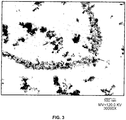
- the breakdown of spore membranes and creation of nicks under the studied conditions was observed in treated spores ( Fig. 3 ).
- electrochemical redox reactions which occur simultaneously on the electrode surfaces, facilitate the production of toxic hydrogen peroxide and chlorine or subsequent hypochlorous acid, both of which may infiltrate into the inner part of the spores and hasten the inactivation and/or destruction process.
- Induced electrochemical reactions also bring about large pH changes in the localized vicinity of the electrodes. Therefore, the pH of the sewage sludge increased significantly, to a level that ruptures disulfide bonds in the spore coats and leads to hydrolysis of cortex.
- AN has a higher spore inactivation and/or destruction power. This is attributed to the generation of ammonia in the molecular form (NH 3 ) rather than the ionized form (NH 4 + ).
- the direct current also helps germination of spores and lowers their resistance to harsh conditions due to: (1) sub-lethal heat (above about 62 °C for example at about 62 to about 95 °C) generated during the treatment which begets alterations in the permeability of the spore coats and opening of a chemical bond between dipicolinic acid (DPA) and spore enzymes; and (2) an electrokinetically deployed reduction state at the cathodic side of the BioElectroTM reactor ruptures disulfide bonds in the spore coats and brings about hydrolysis of cortex.
- sub-lethal heat above about 62 °C for example at about 62 to about 95 °C
- DPA dipicolinic acid
- spore enzymes an electrokinetically deployed reduction state at the cathodic side of the BioElectroTM reactor ruptures disulfide bonds in the spore coats and brings about hydrolysis of cortex.
- Fig. 5 shows the lethal pathways in the processes of the present disclosure.
- Fig. 6 is an exemplary plot showing the log reduction of Clostridium perfringens spores over time in an anaerobically digested residual treated with a process of the present disclosure.
Landscapes
- Chemical & Material Sciences (AREA)
- Life Sciences & Earth Sciences (AREA)
- Engineering & Computer Science (AREA)
- Environmental & Geological Engineering (AREA)
- Hydrology & Water Resources (AREA)
- Chemical Kinetics & Catalysis (AREA)
- Water Supply & Treatment (AREA)
- Organic Chemistry (AREA)
- Electrochemistry (AREA)
- General Chemical & Material Sciences (AREA)
- Soil Sciences (AREA)
- Physics & Mathematics (AREA)
- Electromagnetism (AREA)
- Treatment Of Sludge (AREA)
- Apparatus For Disinfection Or Sterilisation (AREA)
- Water Treatment By Electricity Or Magnetism (AREA)
Description
- The present application claims priority on
US 61/718,386 filed on October 25, 2012 - The present disclosure generally relates to improvements in the field of residuals (for example, biosolids, sludge and sediments) treatment. For example, it relates to processes for the treatment of a residual that allow for inactivation of at least one type of pathogen in the residual so as to obtain a treated residual. For example, the treated residual can be suitable for an agricultural purpose.
- Wastewater treatment plants in Canada produce about 860,000 dry tons per year of sewage residuals (TS); Montreal, Quebec generates approx. 270 t TS/day. In Europe, the UK generates 1,640,000 t dry TS/year where 70% is used for land application while in Germany, 20% of its almost 2 billion tons per year of dry solids was applied to land in 2010 (Oleszkiewicz, 2012). Landfilling, incineration and land application are three main options for residuals disposal. As landfilling and incineration each have their own environmental disadvantages, regulators favor agricultural land application of residuals. For example, Section 5.6.8 of the Quebec Residual Materials Management Policy 1998-2008 (Quebec, 2000) states: "The ultimate goal is to ensure that no sludge is landfilled until it has been demonstrated that recovery is not an economically viable option."
- It is estimated that land application of residuals contributes more than $55M a year to the economy. However, residuals, for example, may contain pathogens from a fecal source which may threaten human health if the residuals are not used safely in accordance with good practice. Therefore, complex regulatory systems, e.g., the Bureau de normalisation du Quebec (BNQ) standards, have been developed for reusing residuals with the intention of protecting human, animal and plant health, ground and surface water quality, enduring soil quality and soil biodiversity. These regulations encourage municipal wastewater treatment facilities to treat residuals to a higher quality level and minimize constraints on use; and require relatively expensive management practices, further assuring clean and safe beneficial uses for residuals.
- Such treatment should be designed to improve the characteristics of the residuals for a disposal practice, increase the economic feasibility of using a particular practice and reduce the potential for public health, environmental and nuisance problems. Conventional technologies such as time-temperature regimes, high pH-high temperature processes, alkaline treatment by adding lime, beta ray irradiation, gamma ray irradiation and use of a mesophilic anaerobic digester are usually not effective enough, and are usually time-consuming and expensive. Further, other issues and trends including the push for lower greenhouse gas production, reducing dioxins/furans and polychlorinated biphenyls (PCBs), decreasing time and energy requirements, availability of land and acceptability of present practices will affect the selection of a process for residuals treatment.
- Electrokinetic treatment is based on the application of, for example, direct current (DC) within a contaminated matrix to remove, for example, pollutants through several electrokinetic phenomena. While it has been used in soil remediation for many years, electrokinetic treatment of residuals is a novel application of such technology in environmental practice.
- According to one aspect, there is provided a process for treating a residual, said process as specified in claim 1.
- The Canadian patent application
CA 2 511 091 A1 relates to an electrochemical stabilization and preconditioning process for municipal and industrial sludge. - It has been shown in the present disclosure that treating a mixture comprising a residual, a peracid or a source thereof and an ammonium salt, for example, ammonium nitrate with, for example, a low voltage gradient in a direct current electric field can simultaneously dewater and inactivate and/or destroy at least one type of pathogen from the residual, producing treated a dewatered residual and separated water. The processes of the present disclosure raise the temperature of the mixture, and can change the chemical properties of the residual, change the physiological properties of Clostridium perfringens spores present in the residual, for example, cause the spores to germinate, destroying most pathogens and creating an environment that will not support future pathogen regrowth. The processes of the present disclosure cause an exothermic reaction. The processes of the present disclosure, for example, enhance the ionic strength and increase the biocidal stressors/constituents present in the system. The processes of the present disclosure can, for example, provide disinfection, or pasteurization, or sterilization of the residual.
- Unlike some prior art processes, the treated residual can, for example, be suitable for agricultural purposes because, for example, the ammonium salt may not create byproducts which can be harmful to human health in such a way that human exposure to them needs to be restricted. The processes of the present disclosure have been shown, for example, to be effective in destroying one of the most resistant forms of a microorganism, Clostridium perfringens spores, from anaerobically digested residuals within a fast time of less than two hours. It should be noted that under anaerobic conditions, C. perfringens spores are, for example, the most resistant microbe and a three log reduction indicates Class A disinfection with respect to viruses, bacteria and helminth eggs (Blanker et al., 1992). Compared to other methods for producing residuals of a high standard (for example, P1 or Class A biosolids) the processes of the present disclosure are expected to be inexpensive both in initial capital expenditure and ongoing operation and maintenance costs.
- Other features and advantages of the present disclosure will become apparent from the following detailed description. It should be understood, however, that the detailed description and the specific examples while indicating embodiments of the present disclosure are given by way of illustration only, since various changes and modifications within the scope of the present disclosure will become apparent to those skilled in the art from this detailed description.
- The following drawings represent examples that are presented in a non-limitative manner:
-
Fig. 1 is a schematic representation of a reactor for treating residuals in accordance with an example of the present disclosure; -
Fig. 2A is a front view of an electrode for use in a reactor for treating residuals in accordance with an example of the present disclosure, whileFig. 2B is is a top view of the same electrode; -
Fig. 3 is an exemplary transmission electron microscope (TEM) micrograph showing the creation of nicks in Clostridium perfringens spore membranes (black arrow) after treatment by a process of the present disclosure; -
Fig. 4 is a schematic representation of the treatment reactions according to a process of the present disclosure; -
Fig. 5 is a schematic representation of the lethal pathways in a C. perfringens spore according to a process of the present disclosure; and -
Fig. 6 is an exemplary plot showing the log reduction of Clostridium perfringens spores over time in anaerobically digested residuals treated with a process of the present disclosure. - Unless otherwise indicated, the definitions and embodiments described in this and other sections are intended to be applicable to all embodiments and aspects of the application herein described for which they are suitable as would be understood by a person skilled in the art.
- As used in this application, the singular forms "a", "an" and "the" include plural references unless the content clearly dictates otherwise. For example, an embodiment including "a residual" should be understood to present certain aspects with one type of residual, or two or more additional types of residuals. For example, an embodiment including a "pathogen" should be understood to present certain aspects with one type of pathogen, or two or more additional types of pathogens. For example, an embodiment including "a biosolid" should be understood to present certain aspects with one type of biosolid, or two or more additional types of biosolids.
- In embodiments comprising an "additional" or "second" component, such as an additional or second type of residual, or an additional or second type of pathogen, the second component as used herein is different from the other components or first component. A "third" component is different from the other, first, and second components, and further enumerated or "additional" components are similarly different.
- In understanding the scope of the present disclosure, the term "comprising" and its derivatives, as used herein, are intended to be open ended terms that specify the presence of the stated features, elements, components, groups, integers, and/or steps, but do not exclude the presence of other unstated features, elements, components, groups, integers and/or steps. The foregoing also applies to words having similar meanings such as the terms, "including", "having" and their derivatives. The term "consisting" and its derivatives, as used herein, are intended to be closed terms that specify the presence of the stated features, elements, components, groups, integers, and/or steps, but exclude the presence of other unstated features, elements, components, groups, integers and/or steps. The term "consisting essentially of", as used herein, is intended to specify the presence of the stated features, elements, components, groups, integers, and/or steps as well as those that do not materially affect the basic and novel characteristic(s) of features, elements, components, groups, integers, and/or steps.
- The term "residual" as used herein refers, for example, to a solid matter comprising at least one type of organic matter or at least one type of colloid. For example, the residual can be a sludge comprising at least one organic compound or at least one organic matter. For example, the residual can be a biosolid, sewage sludge, an industrial sludge, pulp and paper or mining residuals, a sediment, a deposition, an agricultural sludge, a waste solid or a slurry. For example, the residual can be a medical science residual, a food residual, an agricultural residual, an industrial residual, a mining residual, a mining sludge or slurry. For example, the residual can be human sewage. For example, the residual can be a sediment.
- Terms of degree such as "about" and "approximately" as used herein mean a reasonable amount of deviation of the modified term such that the end result is not significantly changed. These terms of degree should be construed as including a deviation of at least ±5% or at least ±10% of the modified term if this deviation would not negate the meaning of the word it modifies.
- The expression "low voltage gradient" as used herein refers to, for example, an electric field having an intensity gradient of less than about 8 V/cm. The current can be DC or AC current.
- The term "AN" as used herein refers to ammonium salts.
- The term "BS" as used herein refers to Bioxy S.
- The term "LIDEF" as used herein refers to low intensity direct electric field.
- The term "DPA" as used herein refers to dipicolinic acid .
- The expression "source of peracid" in respect to the expression "peracid or source thereof" and the like as used herein refers, for example, to a composition effective for generating a peracid in situ. The source of peracid can be a solid composition, for example, a composition in powder form. For example, the source of peracid can be a composition comprising a peroxygen source and an acylating agent. The composition can further comprise at least one of an acid, a sequestering agent, a surfactant and a corrosion inhibitor. The choice of a source of peracid is within the capability of one skilled in the art. For example, the composition Bioxy S™ disclosed in Canadian Patent Application No.
2,569,025 can be used as a source of peracid. - The term "peroxygen source" as used herein refers, for example, to a compound or composition effective for generating active oxygen species, for example, hydrogen peroxide, in situ. For example, the peroxygen source can be chosen from a percarbonate, a perborate and a persulfate. For example, the peroxygen source can be a percarbonate. For example, the percarbonate can be sodium carbonate peroxyhydrate. The choice of a peroxygen source is within the capability of one skilled in the art.
- The term "acylating agent" as used herein refers, for example, to a compound which acts as a source of the corresponding peracylate anion and/or a source of the corresponding peracid upon reaction in situ with the peroxygen source. For example, the acylating agent can be an acetylating agent. For example, the acetylating agent can be tetraacetyl ethylene diamine (TAED), which can act as a source of peracetate anion and/or peracetic acid upon reaction in situ with a peroxygen source, for example, sodium carbonate peroxyhydrate. The choice of an acylating agent is within the capability of one skilled in the art.
- The expression "inactivation of at least one type of pathogen in the residual" as used herein refers, for example, to an inactivation and/or destruction of the pathogen in the residual, for example, an anaerobically digested sewage sludge to at least about a Class A disinfection level. For example, in the case of Clostridium perfringens spores, the expression "inactivation of at least one type of pathogen in the residual" as used herein refers, for example, to an inactivation and/or destruction, in the residual of at least about a 3 log reduction of Clostridium perfringens spores. It should be noted that under anaerobic digestion, the C. perfringens spore is a considerably resistant microbe, and a three log reduction indicates Class A disinfection with respect to viruses, bacteria and helminth eggs (Blanker et al., 1992). An about a three log reduction means about a 99.9% reduction.
- The term "disinfection" or "disinfecting" and the expression "to disinfect" as used herein refers, for example, to the inactivation of at least 3 log of the at least one type of pathogen.
- The term "pasteurization" as used herein refers, for example, to inactivation by about 4 to about 5 log of the at least one type of pathogen exposed, for example, for a period of at least 30 min to the processes of the present disclosure.
- The expression "high level of disinfection" or the expression "to disinfect" as used herein refers, for example, to destroy pathogens by at least 5 log, for example where a majority of the members of the at least one type of pathogen are killed.
- The term "sterilization" or the expression "to sterilize" as used herein means, for example, to inactivate or destroy the at least one type of pathogen at more than about 8 log, where, for example, almost all of the members of the at least one type of pathogen are killed.
- The expression "near sterilizing" or "near sterilization" as used herein means, for example, to inactivate or destroy the at least one type of pathogen at about 7 to about 8 log, where, for example, almost all of the members of the at least one type of pathogen are killed.
- The term "inactivating" or "inactivation" or the expression "to inactivate" as used herein refers, for example, to render the at least one type of pathogen unable to grow/replicate.
- The term "destroy" or "destruction" as used herein refers, for example, to kill the at least one type of pathogen.
- The expression "electrokinetic zone" as used herein refers to, for example, a zone disposed between electrodes, wherein electrokinetic phenomena have been generated by applying an electrical current between a plurality of electrodes, for example, four electrodes, so that at least one electrode functions as an anode and at least one electrode functions as a cathode.
- The expression "adequate inactivation conditions in the reactor are maintained" as used herein refers to, for example, maintaining the conditions in the reactor so that they will allow for inactivation and/or destruction of at least one type of pathogen in the residual. For example, parameters such as the time, pH, temperature, initial concentration of solids, and initial concentration of pathogens may be varied. The choice of conditions so that they will allow for inactivation and/or destruction of at least one type of pathogen in the residual (for example, so that pasteurization is reached) or inactivation and/or destruction of a majority of viable pathogens, ova and spores (for example, so that sterilization is reached) is within the capability of a person skilled in the art, particularly with reference to the present disclosure.
- For example, the processes of the present disclosure can further comprise simultaneous dewatering of the residual so as to obtain a treated dewatered residual and separated water.
- For example, the mixture comprising the residual, the peracid or source thereof and the ammonium salt can be prepared outside of the reactor, then dispersed into the reactor prior to commencing treating the mixture.
- For example, the ratio of the peracid or source thereof to the ammonium salt can be about 0.5 g/g to about 5 g/g. For example, the ratio of the peracid or source thereof to the ammonium salt can be about 1 g/g to about 5 g/g. For example, the ratio of the peracid or source thereof to the ammonium salt can be about 2 g/g to about 5 g/g.
- For example, the ratio of the peracid or source thereof and the ammonium salt to the residual can be from about 7 g/L to about 26 g/L.
- For example, in the processes of the present disclosure, adequate inactivation conditions in the reactor can be maintained.
- For example, the mixture can be treated for a time of 0.5 hours to 3 hours.
- For example, the mixture can be treated at a temperature of about 70 °C to about 95 °C. For example, the mixture can be treated at a temperature of above about 95 °C. For example, the mixture can be treated until it reaches a temperature of about 99 °C. For example, the mixture can be treated until it reaches a temperature of about 97 °C.
- For example, the mixture can be treated at a pH above about 10.
- For example, the reactor can have two electrodes. For example, the reactor can have four electrodes. For example, the reactor can have more than four electrodes.
- For example, the electrodes can be cylindrical. For example, the electrodes can be flat.
- For example, the at least one anode and at least one cathode can comprise a conductive material. For example, the conductive material can comprise stainless steel or iron. For example, the conductive material can be stainless steel. For example, the stainless steel can be perforated stainless steel. For example, the perforated stainless steel can be stainless steel 316L. For example, the conductive material can be coated with a coating chosen from stainless steel mesh, carbon mesh or a textile. For example, the coating can be stainless steel mesh. For example, the stainless steel mesh can have a mesh size of about 200 µm.
- For example, the at least one anode and at least one cathode can be cylindrical. For example, the at least one anode and at least one cathode can be flat.
- For example, the at least one type of pathogen can be Salmonella, Ascaris eggs, C. perfringens, E. coli, or mixtures thereof.
- For example, the at least one type of pathogen can be Clostridium perfringens. For example, the Clostridium perfringens can be in the form of spores.
- For example, the processes of the present disclosure can carry out disinfection, for example, the processes can inactivate and/or destroy the vegetative pathogens, for example, a reduction of FC by 3 log out of a total of 106 or a reduction of fecal streptococci by 90% can be achieved.
- For example, the processes of the present application can achieve less than 1 PFU Enterovirus per 4 g of dry solids, and less than 100 MPN fecal streptococci in 1 g of dry solids. For example, in the processes of the present disclosure, less than 3 helminthes ova per 10 g of dry solids and a log 4 reduction of C. perfringens spore can also be achieved.
- For example, in the processes of the present disclosure, a log 5 reduction of Clostridium perfringens spores can be achieved, and less than 1 viable helminth ova in 1 kg of dry solids can be observed, as well as both Salmonella and fecal coliform can be substantially absent in 25 g of dry solids.
- For example, in the processes of the present disclosure, a log 8 reduction of Clostridium perfringens spores can be reached.
- For example, the processes of the present disclosure can be effective for destroying the cell structure of spores.
- For example, the processes of the present disclosure can be effective for destroying viruses (e.g. up to a log 11 reduction).
- For example, the processes of the present disclosure can be effective for destroying E. coli (e.g. up to a 106 reduction).
- For example, the processes of the present disclosure can be effective for destroying Salmonella (e.g. up to a 104 reduction).
- For example, the reactor can have one or more outlets for removal of the separated water.
- For example, the reactor can have a vessel installed underneath each of the at least one anode and at least one cathode for collecting electroosmotic flow. For example, the vessel can comprise a bottle, a pipe or a reservoir.
- For example, the peracid or source thereof can be a source of peracid. For example, the source of peracid can be a composition comprising a peroxygen source and an acylating agent. For example, the peroxygen source can be chosen from a percarbonate, a perborate and a persulfate. For example, the peroxygen source can be a percarbonate. For example, the percarbonate can be sodium carbonate peroxyhydrate. For example, the acylating agent can be an acetylating agent. For example, the acetylating agent can be tetraacetyl ethylene diamine.
- For example, the composition comprising a peroxygen source and an acylating agent can further comprise an acid. For example, the acid can be chosen from an organic acid, sulfamic acid, phosphoric acid, sulfuric acid and hydrochloric acid. For example, the organic acid can be chosen from acetic acid, citric acid and formic acid. For example, the organic acid can be citric acid.
- For example, the composition comprising a peroxygen source and an acylating agent can further comprise a sequestering agent. For example, the sequestering agent can be chosen from ethylenediaminetetraacetic acid, nitriloacetic acid or a phosphonic acid based sequestering agent.
- For example, the composition comprising a peroxygen source and an acylating agent can further comprise a surfactant. For example, the composition comprising a peroxygen source and an acylating agent can further comprise a corrosion inhibitor.
- For example, the composition comprising a peroxygen source and an acylating agent can be a solid composition. For example, the composition comprising a peroxygen source and an acylating agent can be in a powder form.
- For example, the peracid or source thereof can be a peracid. For example, the peracid can be peracetic acid.
- For example, the ammonium salt can be chosen from ammonium acetate, ammonium bromide, ammonium carbamate, ammonium carbonate, ammonium chloride, ammonium fluoride, ammonium formate, ammonium hydrogenoxalate, ammonium hydrogensulfate, ammonium iodide, ammonium nitrate, ammonium oxalate, ammonium sulfate and mixtures thereof. For example, the ammonium salt can be ammonium nitrate.
- For example, the processes of the present disclosure can be effective for disinfecting the residual. For example, the processes of the present disclosure can be effective for pasteurizing the residual. For example, the processes of the present disclosure can be effective for sterilizing the residual.
- For example, the processes of the present disclosure can be effective for inactivating at least 4 log of the at least one type of pathogen. For example, the processes of the present disclosure can be effective for inactivating at least 5 log of the at least one type of pathogen. For example, the processes of the present disclosure can be effective for inactivating at least 6 log of the at least one type of pathogen. For example, the processes of the present disclosure can be effective for inactivating at least 7 log of the at least one type of pathogen. For example, the processes of the present application can be effective for inactivating the at least one type of pathogen by at least 8 log.
- For example, the processes of the present disclosure can be effective for carrying out a destruction of at least 4 log of the at least one type of pathogen. For example, the processes of the present disclosure can be effective for carrying out a destruction of at least 5 log of the at least one type of pathogen. For example, the processes of the present disclosure can be effective for carrying out a destruction of at least 6 log of the at least one type of pathogen. For example, the processes of the present disclosure can be effective for carrying out a destruction of at least 7 log of the at least one type of pathogen. For example, the processes of the present application can be effective for carrying out a destruction of the at least one type of pathogen by at least 8 log.
- For example, the treated residual can be suitable for use in an agricultural purpose.
- For example, the residual can be a treated or untreated sewage sludge, a treated or untreated industrial sludge or a treated or untreated agricultural sludge. For example, the residual can be a sewage sludge.
- The processes of the present disclosure are, for example a pasteurization or disinfection or sterilization technology which has shown promising results for upgrading residuals to high quality standards. By controlling, for example, the electrochemical processes, which can generate temperature with time (up to about 70 °C, from about 70 °C to about 95 °C and above about 95 °C) leading to a log reduction of pathogens of about 3, about 5 and about 9 respectively. It is expected to provide, for example, an inexpensive and reliable means of producing a readily usable and valuable high standard P1 (Class A) product and by EU regulations, an acceptable residual material. The most eminent characteristics of the processes of the present disclosure can be described as follows:
- First, the application of a low voltage gradient electric field (less than 8 V/cm) enhanced with a peracid or a source thereof, for example, Bioxy S (BS) and an ammonium salt (AN) provides the benefit of low energy consumption. Furthermore, the applied enhancement agents (EAs), for example, BS and AN do not create disinfection byproducts (DBPs) which would be harmful to human health in such a way that human exposure to them needs to be restricted. BS is a biocide and strong oxidant which is rapidly converted to carbonic acid and sodium carbonate. It is used for disinfection of equipment in the food industry. Ammonium components can be found in fertilizers and have very little effect on pH level in the soil. In the residual matrix, the ammonium salt, increases the electrical conductivity of the residual, increasing the efficiency of the treatment system. The ammonium salt can also liberate ammonia, which acts as a biocide.
- Second, it has been shown that the processes of the present disclosure have the ability, for example to eradicate one of the most resistant forms of microorganism, Clostridium perfringens spores, in anaerobically digested residuals (for example, biosolids) within two hours. Hence, the processes of the present disclosure can be effective on resistant microorganisms, and are a fast treatment technology to achieve safe residuals which can be widely used and handled without restriction. Conventional methods such as composting, thermal drying, digestion technologies and lime stabilization either are not effective on spores or need a minimum treatment time of at least 72 hours.
- Further, the processes of the present disclosure can, for example raise the temperature of the material to above about 97 °C, effectively killing most pathogens and creating an environment that will not support future pathogen regrowth.
- Simultaneous dewatering of the residual is another advantage of the processes of the present disclosure. The treated residual may not, for example require a further dewatering process. The separated water can, for example be reused directly in irrigation.
- Compared to other methods of producing Class A biosolids and residuals acceptable by EU regulations, the processes of the present disclosure are expected to be inexpensive in both initial capital expenditure and ongoing operation and maintenance costs. The equipment can be fully automated and requires very little operator time.
- The following non-limiting example is illustrative of the present application:
- The BioElectro™ processes of the present disclosure are an innovative application of low voltage gradient in, for example, direct electric field technology to treat a residual. It is a technology that combines at least two functions in one: dewatering and pathogen destruction as per BNQ-P1 regulatory compliance (USEPA requirements for class A) as well as regulations in all European Union countries and quality improvement which permits more unrestricted, beneficial uses of residuals. It requires a low energy source in the form of, for example, direct current (DC), and offers a suitable technology for a low-tech solution to sludge management applicable to all regions around the world.
- The processes of the present disclosure can be based on the application of a low voltage gradient in, for example, a direct electric field with two enhancing agents (EAs): Bioxy S (BS) and an ammonium salt, for example, ammonium nitrate (AN). The concentration of BS and AN used increases the conductivity of the sewage sludge. Further, the disinfection role of BS and AN, at the applied concentrations, without application of the electrical field would be negligible. The process was conducted in laboratory size prototype BioElectro™ equipment consisting of a regulated power supply and a 3,100 mL rectangular BioElectro™ reactor (
Fig. 1 ) with internal dimensions of 214 mm length x 214 mm width x 74.1 mm height. Thereactor 10 comprises fourelectrodes 12 and arectangular housing 14 that is effective for receiving the residual 16. Theelectrodes 12 can comprise 2 cathodes and 2 anodes. The electrodes can be flat, circular, perforated or not and they can have various configurations. The electrodes can also be concentric. The power supply transforms alternating current (AC) from a utility line (120-V, 60 Hz) into high voltage AC, then rectifies to DC signals. The BioElectro™ reactor can be equipped with four perforated stainless steel (316L) electrodes (cylinders 10 mm in diameter, 102 mm long) coated with mesh (200 µm), for example, stainless steel mesh, located at a distance of 172 mm from each other in proximity of outlet (seeFigs. 2A and 2B ). Underneath each electrode, a 200 mL bottle was installed to collect electroosmotic flow (EOF) during the experiment. - A considerable effort has been made to identify indicator microorganisms whose presence would suggest that human pathogens might be present in the residual. C. perfringens is a spore-forming thermophilic bacterium and its spore has been suggested as an indicator for inactivation mechanisms other than temperature as it is resistant to temperature. This organism is found in densities of about 106 colony forming units (CFUs) per gram of solids in raw biosolids (Reimers (2002)).
- The process starts by adding BS and AN to the sewage sludge (the ratio of BS to AN can be about 0.5 to about 2 g/g or can be about 0.1 to about 2 g/g). The prepared suspension is then dispersed into BioElectro™ reactors with a working volume of 2,800 mL. Electrokinetic (EK) phenomena are generated by applying an electrical current between the electrodes such that at least one of the electrodes functions as an anode and at least one of the electrodes functions as a cathode. A flow of water is induced from the sludge towards the outlets due to the applied electric field. Accordingly, the sludge is dewatered. The dewatering process eliminates water, raises the concentration of solids and reduces sludge volume, thus reducing the costs of further treatment and handling. Simultaneously, the destruction of Clostridium perfringens spores is achieved after two hours treatment of the sewage sludge. The effective near sterilization conditions (>8 log reduction of spores) are obtained at constant voltage gradients of less than about 5 V/cm in the presence of BS and AN.
- The studies of the present disclosure showed that voltage gradient, BS and AN are not sufficiently effective when used alone. In other words, spore inactivation and/or destruction could be obtained only through the interactive disinfection of voltage gradient and the enhancement agents BS and AN.
- Without wishing to be bound to such a theory, the mechanism of disinfection suggests that different factors which attack numerous spore constituents, including spore coats, proteins, unsaturated lipids, respiratory enzymes and peptidoglycans are involved in the inactivation and/or destruction of C. perfringens spores in the processes of the present disclosure. For example, reactions taking place due to the EK phenomena help to create effective oxidative zones, which neutralize protective systems inside and outside of C. perfringens spores. The generated oxygen-based free radicals diffuse to targets within the spore protoplast, possibly in the core membrane, and impair the spores. Without wishing to be bound to such a theory, the mechanism of spore inactivation and/or destruction under the influence of an electric field may include: (1) significant alteration in spore shape and surface properties such as hydrophobicity and net surface charge; and (2) change in the configuration of membrane components such as lipids. All of these impacts can potentially lead to irreversible permeabilization of the membrane, resulting in leakage of crucial cytoplasmic components. The breakdown of spore membranes and creation of nicks under the studied conditions was observed in treated spores (
Fig. 3 ). - Along with the action of the electric field on the spores, electrochemical redox reactions (
Fig. 4 ) which occur simultaneously on the electrode surfaces, facilitate the production of toxic hydrogen peroxide and chlorine or subsequent hypochlorous acid, both of which may infiltrate into the inner part of the spores and hasten the inactivation and/or destruction process. Induced electrochemical reactions also bring about large pH changes in the localized vicinity of the electrodes. Therefore, the pH of the sewage sludge increased significantly, to a level that ruptures disulfide bonds in the spore coats and leads to hydrolysis of cortex. Moreover, at the elevated pH (> 10.7), AN has a higher spore inactivation and/or destruction power. This is attributed to the generation of ammonia in the molecular form (NH3) rather than the ionized form (NH4 +). - Without wishing to be bound to such a theory, the direct current also helps germination of spores and lowers their resistance to harsh conditions due to: (1) sub-lethal heat (above about 62 °C for example at about 62 to about 95 °C) generated during the treatment which begets alterations in the permeability of the spore coats and opening of a chemical bond between dipicolinic acid (DPA) and spore enzymes; and (2) an electrokinetically deployed reduction state at the cathodic side of the BioElectro™ reactor ruptures disulfide bonds in the spore coats and brings about hydrolysis of cortex. Moreover, ohmic heating produced during the process brings about degradation of the spore cortex, and makes the membrane dysfunctionally permeabilized, causing cell death.
Fig. 5 shows the lethal pathways in the processes of the present disclosure.Fig. 6 is an exemplary plot showing the log reduction of Clostridium perfringens spores over time in an anaerobically digested residual treated with a process of the present disclosure. - The person skilled in the art would understand that the various properties or features presented in a given embodiment can be added and/or used, when applicable, to any other embodiment covered by the general scope of the present disclosure.
- The present disclosure has been described with regard to specific examples. The description was intended to help the understanding of the disclosure, rather than to limit its scope. It will be apparent to one skilled in the art that various modifications can be made to the disclosure without departing from the scope of the disclosure as described herein, and such modifications are intended to be covered by the present document.
-
- Blanker, E.M., Little, M.D., Reimers, R.S., and Akers, T.G., "Evaluating the Use of Clostridium Perfringens Spores as Indicator of the Presence of Viable Ascaris eggs in Chemically Treated Municipal Sludges," Proceedings of Municipal Sludge (Biosolids) Management - Where We Are and Where We're Going (Volume I), Water Environmental Specialty Conference Series, Alexandria, VA, pp. 187-201 (July, 1992).
- Elektorowicz, M.; Safaei, E.; Oleszkiewicz, J. and Reimers, R. Electrokinetic remediation of biosolids through inactivation of Clostridium perfringens spores. 6th Symposium on Electrokinetic Remediation (EREM), 2007. Oleszkiewicz J.A. (2012) Sludge management in the European Union: directives and practice, CSCE/PZITS, 10th Int. Conference on Water Supply and Quality, Stare Jablonki, Poland.
- Reimers, R.S.; Oleszkiewicz, J.A.; Bowman, D.D and Faulmann, E.L. (2002) PEC application for the national classification of the J--Vap process to the category of PFRP, Report for Paradigm International, Inc. Louisiana, USA. Safaei Takhtehfouladi, E., Inactivation of Clostridium perfringens spore in anaerobically digested biosolids during BioElectro™ process, PhD thesis, Concordia University, Montreal, QC, Canada, 2007.
- Safaei Takhtehfouladi, E. Enhanced electrokinetic (EK) technology: A comparative study for inactivation of Clostridium perfringens spores and reovirus in anaerobically digested biosolids. Master's thesis, Concordia University, Montreal, QC, Canada, 2007.
- Safaei, E. and Elektorowicz M. Bench-scale trial of electrokinetic treatment on anaerobically digested biosolids: Microbial inactivation, 8th World Congress of Chemical Engineering; Canada, 2009.
Claims (11)
- A process for treating a residual, said process comprising:preparing a mixture by adding: a peracid or source thereof; and an ammonium salt to the residual, the ratio of the peracid or source thereof to the ammonium salt being 0.1 g/g to 5 g/g and the peracid or source thereof and ammonium salt being added to the residual at less than 40 g peracid or source thereof and ammonium salt per liter of the residual, said mixture having a pH above 9;treating the mixture in a reactor with an electric field, wherein the electric field is a direct current electric field and the voltage gradient of the direct current electric field is less than 8 V/cm, by means of at least one anode and at least one cathode that define therebetween an electrokinetic zone for treating the mixture so as to cause an exothermic reaction, wherein the mixture is treated at a temperature of 70 °C to 99 °C for a time of 0.5 hours to 4 hours;thereby allowing for inactivation of at least one type of pathogen selected from a virus, a bacteria, a spore, an ova or a mixture thereof in the residual, so as to obtain a treated residual.
- The process of claim 1, further comprising simultaneous dewatering of the residual so as to obtain a treated dewatered residual and separated water.
- The process of claim 1 or 2, wherein the at least one anode and at least one cathode comprise a conductive material and the conductive material is coated with a coating chosen from stainless steel mesh, carbon or a textile.
- The process of any one of claims 1 to 3, wherein the at least one anode and at least one cathode are cylindrical and perforated.
- The process of any one of claims 1 to 4, wherein the at least one type of pathogen includes Clostridium perfringens and the Clostridium perfringens is in the form of spores.
- The process of any one of claims 1 to 5, wherein the reactor has a vessel associated with at least one of the at least one anode and at least one cathode for collecting electroosmotic flow.
- The process of any one of claims 1 to 6, wherein the peracid or source thereof is a peracetic acid.
- The process of any one of claims 1 to 7, wherein the mixture further comprises a surfactant.
- The process of any one of claims 1 to 8, wherein the ammonium salt is ammonium nitrate.
- The process of any one of claims 1 to 9, wherein the process is effective for inactivating or carrying out a destruction of at least 7 log of the at least one type of pathogen.
- The process according to any one of claims 1 to 10 including treating the mixture so as to allow for spore germination and/or permeabilization of spore membranes.
Applications Claiming Priority (2)
| Application Number | Priority Date | Filing Date | Title |
|---|---|---|---|
| US201261718386P | 2012-10-25 | 2012-10-25 | |
| PCT/CA2013/000924 WO2014063241A1 (en) | 2012-10-25 | 2013-10-25 | Processes for inactivating pathogens in bio-wastes |
Publications (3)
| Publication Number | Publication Date |
|---|---|
| EP2911750A1 EP2911750A1 (en) | 2015-09-02 |
| EP2911750A4 EP2911750A4 (en) | 2016-06-15 |
| EP2911750B1 true EP2911750B1 (en) | 2019-05-22 |
Family
ID=50543814
Family Applications (1)
| Application Number | Title | Priority Date | Filing Date |
|---|---|---|---|
| EP13849300.2A Active EP2911750B1 (en) | 2012-10-25 | 2013-10-25 | Processes for inactivating pathogens in bio-wastes |
Country Status (4)
| Country | Link |
|---|---|
| US (3) | US20150291464A1 (en) |
| EP (1) | EP2911750B1 (en) |
| CA (1) | CA2928497C (en) |
| WO (1) | WO2014063241A1 (en) |
Families Citing this family (2)
| Publication number | Priority date | Publication date | Assignee | Title |
|---|---|---|---|---|
| WO2018194514A1 (en) * | 2017-04-17 | 2018-10-25 | Lovearth Ecolife Pte. Ltd. | Water disinfection system and method |
| CN107746162A (en) * | 2017-09-28 | 2018-03-02 | 天津大学 | A kind of bio-electrochemical process for removing antibiotic in fluviolacustrine deposit thing |
Family Cites Families (7)
| Publication number | Priority date | Publication date | Assignee | Title |
|---|---|---|---|---|
| US5048404A (en) * | 1985-05-31 | 1991-09-17 | Foodco Corporation | High pulsed voltage systems for extending the shelf life of pumpable food products |
| US5695650A (en) * | 1995-11-02 | 1997-12-09 | Held; Jeffery S. | Method for dewatering previously-dewatered municipal waste-water sludges using high electrical voltage |
| US6395176B1 (en) * | 1995-11-02 | 2002-05-28 | D-H2O L.L.C. | Method for treating waste-activated sludge using electroporation |
| US6949178B2 (en) * | 2002-07-09 | 2005-09-27 | Lynntech, Inc. | Electrochemical method for preparing peroxy acids |
| CA2511091C (en) | 2004-06-29 | 2014-09-02 | Institut National De La Recherche Scientifique | Electrochemical stabilization and preconditioning process for municipal and industrial sludge |
| CA2569025C (en) * | 2006-12-01 | 2013-01-22 | Fadi Dagher | Powdered composition for the generation of peracetic acid and use thereof to sanitize surfaces |
| US8329042B2 (en) * | 2008-10-01 | 2012-12-11 | Maria Elektorowicz | Method of treating sludge material using electrokinetics |
-
2013
- 2013-10-25 CA CA2928497A patent/CA2928497C/en active Active
- 2013-10-25 WO PCT/CA2013/000924 patent/WO2014063241A1/en not_active Ceased
- 2013-10-25 US US14/438,123 patent/US20150291464A1/en not_active Abandoned
- 2013-10-25 EP EP13849300.2A patent/EP2911750B1/en active Active
-
2019
- 2019-02-15 US US16/277,701 patent/US20190177197A1/en not_active Abandoned
-
2022
- 2022-05-16 US US17/744,894 patent/US20230002266A1/en active Pending
Non-Patent Citations (1)
| Title |
|---|
| None * |
Also Published As
| Publication number | Publication date |
|---|---|
| US20190177197A1 (en) | 2019-06-13 |
| US20230002266A1 (en) | 2023-01-05 |
| WO2014063241A1 (en) | 2014-05-01 |
| EP2911750A1 (en) | 2015-09-02 |
| EP2911750A4 (en) | 2016-06-15 |
| CA2928497C (en) | 2022-11-22 |
| CA2928497A1 (en) | 2014-05-01 |
| US20150291464A1 (en) | 2015-10-15 |
Similar Documents
| Publication | Publication Date | Title |
|---|---|---|
| Hu et al. | The application of microwaves in sulfate radical-based advanced oxidation processes for environmental remediation: A review | |
| Ibáñez et al. | Photocatalytic bactericidal effect of TiO2 on Enterobacter cloacae: Comparative study with other Gram (−) bacteria | |
| US7160472B2 (en) | Treatment of a waste stream through production and utilization of oxyhydrogen gas | |
| Singh et al. | Rapid removal of carbofuran from aqueous solution by pulsed corona discharge treatment: kinetic study, oxidative, reductive degradation pathway, and toxicity assay | |
| Haaken et al. | Disinfection of biologically treated wastewater and prevention of biofouling by UV/electrolysis hybrid technology: influence factors and limits for domestic wastewater reuse | |
| Ince et al. | Aqueous phase disinfection with power ultrasound: process kinetics and effect of solid catalysts | |
| US20230002266A1 (en) | Processes for treatment of residuals | |
| US20100078389A1 (en) | Method of Treating Sludge Material Using Electrokinetics | |
| CA2671186A1 (en) | Removal of contaminants from a waste stream through production and utilization of oxyhydrogen gas | |
| CN103298751A (en) | Treatment of a waste stream through production and utilization of oxyhydrogen gas | |
| Chen et al. | Influence of pH on inactivation of aquatic microorganism with a gas–liquid pulsed electrical discharge | |
| Topac et al. | Comparison of solar/H2O2 and solar photo-fenton processes for the disinfection of domestic wastewaters | |
| KR101323258B1 (en) | plasma sterilization method | |
| Drosou et al. | Peracetic acid‐enhanced photocatalytic and sonophotocatalytic inactivation of E. coli in aqueous suspensions | |
| Quintana-Terriza et al. | Dual action of plasma discharge: E. faecalis inactivation and tetracycline degradation with eco-safe effluents | |
| KR20110080287A (en) | Livestock Wastewater Treatment System Using Electrochemical Oxidation and Its Method | |
| US20230093562A1 (en) | Method for treating sludge using solar thermal concentrators | |
| KR20130132352A (en) | Water sterilization device with variable plasma device | |
| JP2004188288A (en) | Water treatment method and water treatment apparatus | |
| Safaei et al. | Bench-scale trial of electrokinetic treatment on anaerobically digested biosolids; microbial inactivation | |
| Luo | Innovative sludge disinfection approach to generate Class A biosolids for land applications | |
| Islam et al. | Advanced Oxidation Processes for Industrial Wastewater Treatment | |
| US20060151400A1 (en) | Biosolids stabilization process | |
| Jog et al. | Electrocoagulation process used to treat hospital wastewater | |
| ELEKTOROWICZ et al. | New sludge management for safe land application |
Legal Events
| Date | Code | Title | Description |
|---|---|---|---|
| PUAI | Public reference made under article 153(3) epc to a published international application that has entered the european phase |
Free format text: ORIGINAL CODE: 0009012 |
|
| 17P | Request for examination filed |
Effective date: 20150520 |
|
| AK | Designated contracting states |
Kind code of ref document: A1 Designated state(s): AL AT BE BG CH CY CZ DE DK EE ES FI FR GB GR HR HU IE IS IT LI LT LU LV MC MK MT NL NO PL PT RO RS SE SI SK SM TR |
|
| AX | Request for extension of the european patent |
Extension state: BA ME |
|
| DAX | Request for extension of the european patent (deleted) | ||
| RAP1 | Party data changed (applicant data changed or rights of an application transferred) |
Owner name: VALORBEC S.E.C. |
|
| RA4 | Supplementary search report drawn up and despatched (corrected) |
Effective date: 20160519 |
|
| RIC1 | Information provided on ipc code assigned before grant |
Ipc: C02F 11/00 20060101ALI20160512BHEP Ipc: C02F 1/48 20060101ALI20160512BHEP Ipc: C02F 1/467 20060101ALI20160512BHEP Ipc: B09C 1/08 20060101ALI20160512BHEP Ipc: C02F 1/72 20060101ALI20160512BHEP Ipc: C02F 11/12 20060101ALI20160512BHEP Ipc: C02F 1/461 20060101ALN20160512BHEP Ipc: A62D 3/10 20070101AFI20160512BHEP |
|
| STAA | Information on the status of an ep patent application or granted ep patent |
Free format text: STATUS: EXAMINATION IS IN PROGRESS |
|
| 17Q | First examination report despatched |
Effective date: 20170502 |
|
| GRAP | Despatch of communication of intention to grant a patent |
Free format text: ORIGINAL CODE: EPIDOSNIGR1 |
|
| STAA | Information on the status of an ep patent application or granted ep patent |
Free format text: STATUS: GRANT OF PATENT IS INTENDED |
|
| RIC1 | Information provided on ipc code assigned before grant |
Ipc: C02F 1/48 20060101ALI20181116BHEP Ipc: B09C 1/08 20060101ALI20181116BHEP Ipc: C02F 1/467 20060101ALI20181116BHEP Ipc: C02F 11/00 20060101ALI20181116BHEP Ipc: C02F 1/72 20060101ALI20181116BHEP Ipc: C02F 1/461 20060101ALN20181116BHEP Ipc: C02F 11/12 20060101ALI20181116BHEP Ipc: A62D 3/10 20070101AFI20181116BHEP |
|
| INTG | Intention to grant announced |
Effective date: 20181211 |
|
| GRAS | Grant fee paid |
Free format text: ORIGINAL CODE: EPIDOSNIGR3 |
|
| GRAA | (expected) grant |
Free format text: ORIGINAL CODE: 0009210 |
|
| STAA | Information on the status of an ep patent application or granted ep patent |
Free format text: STATUS: THE PATENT HAS BEEN GRANTED |
|
| AK | Designated contracting states |
Kind code of ref document: B1 Designated state(s): AL AT BE BG CH CY CZ DE DK EE ES FI FR GB GR HR HU IE IS IT LI LT LU LV MC MK MT NL NO PL PT RO RS SE SI SK SM TR |
|
| RAP1 | Party data changed (applicant data changed or rights of an application transferred) |
Owner name: VALORBEC S.E.C. |
|
| REG | Reference to a national code |
Ref country code: GB Ref legal event code: FG4D |
|
| REG | Reference to a national code |
Ref country code: CH Ref legal event code: EP |
|
| REG | Reference to a national code |
Ref country code: IE Ref legal event code: FG4D |
|
| REG | Reference to a national code |
Ref country code: AT Ref legal event code: REF Ref document number: 1135383 Country of ref document: AT Kind code of ref document: T Effective date: 20190615 |
|
| REG | Reference to a national code |
Ref country code: DE Ref legal event code: R096 Ref document number: 602013055884 Country of ref document: DE |
|
| REG | Reference to a national code |
Ref country code: NL Ref legal event code: MP Effective date: 20190522 |
|
| REG | Reference to a national code |
Ref country code: LT Ref legal event code: MG4D |
|
| PG25 | Lapsed in a contracting state [announced via postgrant information from national office to epo] |
Ref country code: PT Free format text: LAPSE BECAUSE OF FAILURE TO SUBMIT A TRANSLATION OF THE DESCRIPTION OR TO PAY THE FEE WITHIN THE PRESCRIBED TIME-LIMIT Effective date: 20190922 Ref country code: FI Free format text: LAPSE BECAUSE OF FAILURE TO SUBMIT A TRANSLATION OF THE DESCRIPTION OR TO PAY THE FEE WITHIN THE PRESCRIBED TIME-LIMIT Effective date: 20190522 Ref country code: AL Free format text: LAPSE BECAUSE OF FAILURE TO SUBMIT A TRANSLATION OF THE DESCRIPTION OR TO PAY THE FEE WITHIN THE PRESCRIBED TIME-LIMIT Effective date: 20190522 Ref country code: SE Free format text: LAPSE BECAUSE OF FAILURE TO SUBMIT A TRANSLATION OF THE DESCRIPTION OR TO PAY THE FEE WITHIN THE PRESCRIBED TIME-LIMIT Effective date: 20190522 Ref country code: NO Free format text: LAPSE BECAUSE OF FAILURE TO SUBMIT A TRANSLATION OF THE DESCRIPTION OR TO PAY THE FEE WITHIN THE PRESCRIBED TIME-LIMIT Effective date: 20190822 Ref country code: HR Free format text: LAPSE BECAUSE OF FAILURE TO SUBMIT A TRANSLATION OF THE DESCRIPTION OR TO PAY THE FEE WITHIN THE PRESCRIBED TIME-LIMIT Effective date: 20190522 Ref country code: NL Free format text: LAPSE BECAUSE OF FAILURE TO SUBMIT A TRANSLATION OF THE DESCRIPTION OR TO PAY THE FEE WITHIN THE PRESCRIBED TIME-LIMIT Effective date: 20190522 Ref country code: LT Free format text: LAPSE BECAUSE OF FAILURE TO SUBMIT A TRANSLATION OF THE DESCRIPTION OR TO PAY THE FEE WITHIN THE PRESCRIBED TIME-LIMIT Effective date: 20190522 Ref country code: ES Free format text: LAPSE BECAUSE OF FAILURE TO SUBMIT A TRANSLATION OF THE DESCRIPTION OR TO PAY THE FEE WITHIN THE PRESCRIBED TIME-LIMIT Effective date: 20190522 |
|
| PG25 | Lapsed in a contracting state [announced via postgrant information from national office to epo] |
Ref country code: LV Free format text: LAPSE BECAUSE OF FAILURE TO SUBMIT A TRANSLATION OF THE DESCRIPTION OR TO PAY THE FEE WITHIN THE PRESCRIBED TIME-LIMIT Effective date: 20190522 Ref country code: RS Free format text: LAPSE BECAUSE OF FAILURE TO SUBMIT A TRANSLATION OF THE DESCRIPTION OR TO PAY THE FEE WITHIN THE PRESCRIBED TIME-LIMIT Effective date: 20190522 Ref country code: BG Free format text: LAPSE BECAUSE OF FAILURE TO SUBMIT A TRANSLATION OF THE DESCRIPTION OR TO PAY THE FEE WITHIN THE PRESCRIBED TIME-LIMIT Effective date: 20190822 Ref country code: GR Free format text: LAPSE BECAUSE OF FAILURE TO SUBMIT A TRANSLATION OF THE DESCRIPTION OR TO PAY THE FEE WITHIN THE PRESCRIBED TIME-LIMIT Effective date: 20190823 |
|
| REG | Reference to a national code |
Ref country code: AT Ref legal event code: MK05 Ref document number: 1135383 Country of ref document: AT Kind code of ref document: T Effective date: 20190522 |
|
| PG25 | Lapsed in a contracting state [announced via postgrant information from national office to epo] |
Ref country code: SK Free format text: LAPSE BECAUSE OF FAILURE TO SUBMIT A TRANSLATION OF THE DESCRIPTION OR TO PAY THE FEE WITHIN THE PRESCRIBED TIME-LIMIT Effective date: 20190522 Ref country code: DK Free format text: LAPSE BECAUSE OF FAILURE TO SUBMIT A TRANSLATION OF THE DESCRIPTION OR TO PAY THE FEE WITHIN THE PRESCRIBED TIME-LIMIT Effective date: 20190522 Ref country code: EE Free format text: LAPSE BECAUSE OF FAILURE TO SUBMIT A TRANSLATION OF THE DESCRIPTION OR TO PAY THE FEE WITHIN THE PRESCRIBED TIME-LIMIT Effective date: 20190522 Ref country code: AT Free format text: LAPSE BECAUSE OF FAILURE TO SUBMIT A TRANSLATION OF THE DESCRIPTION OR TO PAY THE FEE WITHIN THE PRESCRIBED TIME-LIMIT Effective date: 20190522 Ref country code: RO Free format text: LAPSE BECAUSE OF FAILURE TO SUBMIT A TRANSLATION OF THE DESCRIPTION OR TO PAY THE FEE WITHIN THE PRESCRIBED TIME-LIMIT Effective date: 20190522 Ref country code: CZ Free format text: LAPSE BECAUSE OF FAILURE TO SUBMIT A TRANSLATION OF THE DESCRIPTION OR TO PAY THE FEE WITHIN THE PRESCRIBED TIME-LIMIT Effective date: 20190522 |
|
| REG | Reference to a national code |
Ref country code: DE Ref legal event code: R097 Ref document number: 602013055884 Country of ref document: DE |
|
| PG25 | Lapsed in a contracting state [announced via postgrant information from national office to epo] |
Ref country code: SM Free format text: LAPSE BECAUSE OF FAILURE TO SUBMIT A TRANSLATION OF THE DESCRIPTION OR TO PAY THE FEE WITHIN THE PRESCRIBED TIME-LIMIT Effective date: 20190522 Ref country code: IT Free format text: LAPSE BECAUSE OF FAILURE TO SUBMIT A TRANSLATION OF THE DESCRIPTION OR TO PAY THE FEE WITHIN THE PRESCRIBED TIME-LIMIT Effective date: 20190522 |
|
| PLBE | No opposition filed within time limit |
Free format text: ORIGINAL CODE: 0009261 |
|
| STAA | Information on the status of an ep patent application or granted ep patent |
Free format text: STATUS: NO OPPOSITION FILED WITHIN TIME LIMIT |
|
| PG25 | Lapsed in a contracting state [announced via postgrant information from national office to epo] |
Ref country code: TR Free format text: LAPSE BECAUSE OF FAILURE TO SUBMIT A TRANSLATION OF THE DESCRIPTION OR TO PAY THE FEE WITHIN THE PRESCRIBED TIME-LIMIT Effective date: 20190522 |
|
| 26N | No opposition filed |
Effective date: 20200225 |
|
| PG25 | Lapsed in a contracting state [announced via postgrant information from national office to epo] |
Ref country code: PL Free format text: LAPSE BECAUSE OF FAILURE TO SUBMIT A TRANSLATION OF THE DESCRIPTION OR TO PAY THE FEE WITHIN THE PRESCRIBED TIME-LIMIT Effective date: 20190522 |
|
| PG25 | Lapsed in a contracting state [announced via postgrant information from national office to epo] |
Ref country code: SI Free format text: LAPSE BECAUSE OF FAILURE TO SUBMIT A TRANSLATION OF THE DESCRIPTION OR TO PAY THE FEE WITHIN THE PRESCRIBED TIME-LIMIT Effective date: 20190522 Ref country code: MC Free format text: LAPSE BECAUSE OF FAILURE TO SUBMIT A TRANSLATION OF THE DESCRIPTION OR TO PAY THE FEE WITHIN THE PRESCRIBED TIME-LIMIT Effective date: 20190522 |
|
| REG | Reference to a national code |
Ref country code: CH Ref legal event code: PL |
|
| PG25 | Lapsed in a contracting state [announced via postgrant information from national office to epo] |
Ref country code: CH Free format text: LAPSE BECAUSE OF NON-PAYMENT OF DUE FEES Effective date: 20191031 Ref country code: LI Free format text: LAPSE BECAUSE OF NON-PAYMENT OF DUE FEES Effective date: 20191031 Ref country code: LU Free format text: LAPSE BECAUSE OF NON-PAYMENT OF DUE FEES Effective date: 20191025 |
|
| REG | Reference to a national code |
Ref country code: BE Ref legal event code: MM Effective date: 20191031 |
|
| PG25 | Lapsed in a contracting state [announced via postgrant information from national office to epo] |
Ref country code: BE Free format text: LAPSE BECAUSE OF NON-PAYMENT OF DUE FEES Effective date: 20191031 |
|
| PG25 | Lapsed in a contracting state [announced via postgrant information from national office to epo] |
Ref country code: IE Free format text: LAPSE BECAUSE OF NON-PAYMENT OF DUE FEES Effective date: 20191025 |
|
| PG25 | Lapsed in a contracting state [announced via postgrant information from national office to epo] |
Ref country code: CY Free format text: LAPSE BECAUSE OF FAILURE TO SUBMIT A TRANSLATION OF THE DESCRIPTION OR TO PAY THE FEE WITHIN THE PRESCRIBED TIME-LIMIT Effective date: 20190522 |
|
| PG25 | Lapsed in a contracting state [announced via postgrant information from national office to epo] |
Ref country code: IS Free format text: LAPSE BECAUSE OF FAILURE TO SUBMIT A TRANSLATION OF THE DESCRIPTION OR TO PAY THE FEE WITHIN THE PRESCRIBED TIME-LIMIT Effective date: 20190922 |
|
| PG25 | Lapsed in a contracting state [announced via postgrant information from national office to epo] |
Ref country code: HU Free format text: LAPSE BECAUSE OF FAILURE TO SUBMIT A TRANSLATION OF THE DESCRIPTION OR TO PAY THE FEE WITHIN THE PRESCRIBED TIME-LIMIT; INVALID AB INITIO Effective date: 20131025 Ref country code: MT Free format text: LAPSE BECAUSE OF FAILURE TO SUBMIT A TRANSLATION OF THE DESCRIPTION OR TO PAY THE FEE WITHIN THE PRESCRIBED TIME-LIMIT Effective date: 20190522 |
|
| PG25 | Lapsed in a contracting state [announced via postgrant information from national office to epo] |
Ref country code: MK Free format text: LAPSE BECAUSE OF FAILURE TO SUBMIT A TRANSLATION OF THE DESCRIPTION OR TO PAY THE FEE WITHIN THE PRESCRIBED TIME-LIMIT Effective date: 20190522 |
|
| P01 | Opt-out of the competence of the unified patent court (upc) registered |
Effective date: 20230531 |
|
| PGFP | Annual fee paid to national office [announced via postgrant information from national office to epo] |
Ref country code: GB Payment date: 20250923 Year of fee payment: 13 |
|
| PGFP | Annual fee paid to national office [announced via postgrant information from national office to epo] |
Ref country code: FR Payment date: 20250924 Year of fee payment: 13 |
|
| PGFP | Annual fee paid to national office [announced via postgrant information from national office to epo] |
Ref country code: DE Payment date: 20250923 Year of fee payment: 13 |