EP2910567B1 - Asparaginic acid kinase iii mutant and host cells and use thereof - Google Patents
Asparaginic acid kinase iii mutant and host cells and use thereof Download PDFInfo
- Publication number
- EP2910567B1 EP2910567B1 EP13846350.0A EP13846350A EP2910567B1 EP 2910567 B1 EP2910567 B1 EP 2910567B1 EP 13846350 A EP13846350 A EP 13846350A EP 2910567 B1 EP2910567 B1 EP 2910567B1
- Authority
- EP
- European Patent Office
- Prior art keywords
- amino acid
- aspartokinase
- lysine
- gene encoding
- acid sequence
- Prior art date
- Legal status (The legal status is an assumption and is not a legal conclusion. Google has not performed a legal analysis and makes no representation as to the accuracy of the status listed.)
- Active
Links
Images

Classifications
-
- C—CHEMISTRY; METALLURGY
- C12—BIOCHEMISTRY; BEER; SPIRITS; WINE; VINEGAR; MICROBIOLOGY; ENZYMOLOGY; MUTATION OR GENETIC ENGINEERING
- C12N—MICROORGANISMS OR ENZYMES; COMPOSITIONS THEREOF; PROPAGATING, PRESERVING, OR MAINTAINING MICROORGANISMS; MUTATION OR GENETIC ENGINEERING; CULTURE MEDIA
- C12N9/00—Enzymes; Proenzymes; Compositions thereof; Processes for preparing, activating, inhibiting, separating or purifying enzymes
- C12N9/10—Transferases (2.)
- C12N9/12—Transferases (2.) transferring phosphorus containing groups, e.g. kinases (2.7)
- C12N9/1217—Phosphotransferases with a carboxyl group as acceptor (2.7.2)
-
- C—CHEMISTRY; METALLURGY
- C12—BIOCHEMISTRY; BEER; SPIRITS; WINE; VINEGAR; MICROBIOLOGY; ENZYMOLOGY; MUTATION OR GENETIC ENGINEERING
- C12P—FERMENTATION OR ENZYME-USING PROCESSES TO SYNTHESISE A DESIRED CHEMICAL COMPOUND OR COMPOSITION OR TO SEPARATE OPTICAL ISOMERS FROM A RACEMIC MIXTURE
- C12P13/00—Preparation of nitrogen-containing organic compounds
- C12P13/04—Alpha- or beta- amino acids
- C12P13/08—Lysine; Diaminopimelic acid; Threonine; Valine
-
- C—CHEMISTRY; METALLURGY
- C12—BIOCHEMISTRY; BEER; SPIRITS; WINE; VINEGAR; MICROBIOLOGY; ENZYMOLOGY; MUTATION OR GENETIC ENGINEERING
- C12P—FERMENTATION OR ENZYME-USING PROCESSES TO SYNTHESISE A DESIRED CHEMICAL COMPOUND OR COMPOSITION OR TO SEPARATE OPTICAL ISOMERS FROM A RACEMIC MIXTURE
- C12P13/00—Preparation of nitrogen-containing organic compounds
- C12P13/04—Alpha- or beta- amino acids
- C12P13/06—Alanine; Leucine; Isoleucine; Serine; Homoserine
-
- C—CHEMISTRY; METALLURGY
- C12—BIOCHEMISTRY; BEER; SPIRITS; WINE; VINEGAR; MICROBIOLOGY; ENZYMOLOGY; MUTATION OR GENETIC ENGINEERING
- C12P—FERMENTATION OR ENZYME-USING PROCESSES TO SYNTHESISE A DESIRED CHEMICAL COMPOUND OR COMPOSITION OR TO SEPARATE OPTICAL ISOMERS FROM A RACEMIC MIXTURE
- C12P13/00—Preparation of nitrogen-containing organic compounds
- C12P13/04—Alpha- or beta- amino acids
- C12P13/12—Methionine; Cysteine; Cystine
-
- C—CHEMISTRY; METALLURGY
- C12—BIOCHEMISTRY; BEER; SPIRITS; WINE; VINEGAR; MICROBIOLOGY; ENZYMOLOGY; MUTATION OR GENETIC ENGINEERING
- C12Y—ENZYMES
- C12Y207/00—Transferases transferring phosphorus-containing groups (2.7)
- C12Y207/02—Phosphotransferases with a carboxy group as acceptor (2.7.2)
- C12Y207/02004—Aspartate kinase (2.7.2.4)
Definitions
- the present invention relates to the field of biotechnology. More specifically, the present invention relates to aspartokinase III (abbreviated as AK III, also known as LysC) mutant and uses thereof.
- AK III aspartokinase III
- L-lysine is the most important essential amino acid as nutrients for human and animal, and plays a very important role in the food industry, breeding industry and feed industry. In recent years, the market demand for L-lysine has steadily increased, and the volume of sales of L-lysine on the world market is more than one million tons. Currently, lysine is mainly produced by microorganism fermentation.
- L-lysine is synthesized by using aspartic acid as the precursor, including two steps in common with some amino acids, such as methionine and threonine.
- the biosynthesis pathway for L-lysine includes a nine-step enzymatic process (indicated by the following scheme), wherein the first-step reaction of lysine biosynthesis catalyzed by aspartokinase is the rate-limiting step of lysine production, and the activity of aspartokinase determines the ratio of metabolic flux to L-lysine synthetic pathway.
- AK I aspartokinase I
- AK II aspartokinase II
- AK III aspartokinase III
- SEQ ID NO: 1 the amino acid sequence thereof is represented by SEQ ID NO: 2
- AK I and AK II are both bifunctional enzymes which further possess homoserine dehydrogenase activity.
- AK I is inhibited by threonine and lysine feedback on the enzyme activity level
- AK III is inhibited by lysine (the final product) feedback on the enzyme activity level
- Bearer CF Neet KE; Stadtman, ER, Cohen, GN, LeBras, G., Robichon-Szulmajster, H. (1961).
- AK II is not inhibited by the feedback of amino acids in the aspartate family on the enzyme activity level, but it is strictly regulated on the transcription level ( X Dong, PJ Quinn, X Wang. (2011). "Metabolic engineering of Escherichia coli and Corynebacterium glutamicum for the production of L-threonine. "Biotechnology advances ).
- E. coli has been modified by many enterprises for the industrial production of L-lysine. Since the activity of aspartokinase is strictly regulated by L-lysine, releaseing the feedback inhibition of L-lysine on aspartokinase is an inevitable approach for developing high-yield strains of L-lysine.
- Two AK III mutants which have released feedback inhibition of L-lysine are obtained by DuPont through random mutation screen, and in said mutants, 352 threonine is replaced by isoleucine (T352I) and 318 methionine is replaced by isoleucine (M318I), respectively ( EP1394257 ).
- Ajinomoto Company (Japan) also obtained AK III mutants which have partially released feedback inhibition with L-lysine ( US005661012 , US2010190216 , US2010173368 ).
- aspartokinase is a enzyme shared by the synthetic pathways for L-lysine, L-threonine and L-methionine
- Chinese patent CN 1071378C disclosed an aspartokinase with released feedback inhibition of L-lysine and methods for producing L-lysine by using this kinase and host cells comprising the same. If an aspartokinase, which has high specific-activity and effectively released feedback inhibition of L-lysine, could be obtained, it will be of great significance for producing L-lysine, L-threonine and L-methionine, and even for other metabolites using L-threonine as precursor, including L-isoleucine.
- the object of the present invention is to provide AK III mutants which have high enzyme activity and released feedback inhibition with L-lysine, and uses of such mutants as well as methods for using such mutants.
- the present invention provides an aspartokinase, wherein the amino acid sequence of said aspartokinase has 80% or higher sequence identity with the amino acid sequence of SEQ ID NO: 2 and has an amino acid residue which is not aspartic acid at the position corresponding to position 340 in the amino acid sequence of SEQ ID NO: 2, and wherein the lysine feedback inhibition of said aspartokinase is relieved.
- the aspartokinase is derived from Escherichia bacteria, preferably derived from Escherichia coli.
- the amino acid sequence of said aspartokinase has an amino acid residue at the position corresponding to position 340 in the amino acid sequence of SEQ ID NO: 2 which is at least one selected from the following amino acids: Pro, Ala, Arg, Lys, Gln, Asn, Val, Ile, Leu, Met and Phe.
- the amino acid sequence of said aspartokinase has an amino acid residue at the position corresponding to position 340 in the amino acid sequence of SEQ ID NO: 2 which is selected from Pro, Arg or Val.
- amino acid sequence of aspartokinase is shown in SEQ ID NO: 4, 6 or 8.
- the L-lysine feedback inhibition of said aspartokinase is relieved.
- said aspartokinase in the presence of L-lysine at the concentration of 10 mM, retains at least 20% of the activity; preferably, at least 30% - 40% of the activity; more preferably, at least 50% - 60% of the activity; more preferably, at least 70% - 80% of the activity; and most preferably, at least 90% of the activity.
- said aspartokinase in the presence of L-lysine at the concentration of 20 mM, retains at least 20% of the activity; preferably, at least 30% - 40% of the activity; more preferably, at least 50% - 60% of the activity; more preferably, at least 70% of the activity; and most preferably, at least 80% of the activity.
- said aspartokinase in the presence of L-lysine at the concentration of 100 mM, retains at least 20% of the activity; preferably, at least 30% - 40% of the activity; more preferably, at least 50% - 60% of the activity; more preferably, at least 70% of the activity; and most preferably, at least 80% of the activity.
- the present invention provides a gene encoding the aspartokinase according to the first aspect of the present invention.
- nucleotide sequence of said gene is shown in SEQ ID NO: 3, 5 or 7.
- the present invention provides a vector comprising the encoding gene according to the second aspect of the present invention.
- the present invention provides a host cell comprising the encoding gene according to the second aspect of the present invention.
- said host cell is from the genus Escherichia, Corynebacterium, Brevibacterium sp., Bacillus, Serratia, or Vibrio.
- said host cell is Escherichia coli (E. Coli) or Corynebacterium glutamicum.
- said host cell has the encoding gene according to the second aspect of the invention integrated into its chromosome, or said host cell comprises the vector according to the third aspect of the present invention.
- said host cell expresses the aspartokinase according to the present invention.
- one or more genes selected from the following group are attenuated or the expression thereof is reduced in said host cell:
- one or more genes selected from the following group are enhanced or overexpressed in said host cell:
- the present invention provides a method for the production of L-amino acid, said method comprising the following steps:
- the method is performed at 30-45°C, preferably at 37°C.
- the present invention provides a method for producing L-lysine, L-threonine, L-methionine, or L-isoleucine, said method comprising the following steps:
- aspartokinase III derived from E. coli can be genetically engineered at position 340, and the obtained aspartokinase III mutant not only has excellent enzyme activity, but also has its L-lysine feedback inhibition effectively relieved; the mutant, therefore, can be used for high-efficient producing L-lysine.
- the present invention was thus completed based on the above discovery.
- aspartokinase according to the present invention and “polypeptide according to the present invention” can be used interchangeably, and will have the meaning as commonly understood by a skilled person in the art.
- the aspartokinase according to the present invention has the activity for transferring phosphate group to aspartic acid.
- the amino acid sequence of the aspartokinase according to the present invention has an amino acid residue at the position corresponding to position 340 in the amino acid sequence of SEQ ID NO: 2 which is at least one selected from the following amino acids: Pro, Ala, Arg, Lys, Gln, Asn, Val, Ile, Leu, Met, and Phe.
- the amino acid sequence of the aspartokinase according to the present invention has an amino acid residue at the position corresponding to position 340 in the amino acid sequence of SEQ ID NO: 2 which is selected from Pro, Arg, or Val.
- the aspartokinase according to the present invention is:
- the aspartokinase according to the present invention in the presence of L-lysine at a concentration of higher than 10 mM, preferably higher than 20 mM, most preferably higher than 100 mM, the aspartokinase according to the present invention can effectively relieve the feedback inhibition by L-lysine.
- the polypeptide of the present invention can be further mutated in addition to its non-aspartic acid at the position corresponding to position 340 in the amino acid sequence of SEQ ID NO: 2, while still having the function and activity of the aspartokinase according to the present invention.
- the aspartokinase according to the present invention (a). has the amino acid sequence of SEQ ID NO: 4, 6 or 8; or b).
- the aspartokinase comprises an amino acid sequence modified through substitution, deletion or addition of amino acid residues from the sequence defined in a), the aspartokinase has a kinase activity on aspartate, and the amino acid sequence of the aspartokinsase has at least one amino acid selected from the group consisting of Pro, Arg, and Val at the position corresponding to the position 340 in the amino acid sequence of SEQ ID NO: 2.
- the aspartokinase according to the present invention includes those mutants which, compared with the aspartokinase with the amino acid sequence of SEQ ID NO: 4, 6 or 8, are formed by replacing at most 20, preferably at most 10, more preferably at most 3, more preferably at most 2, most preferably at most 1 amino acid with an amino acid having similar properties.
- mutants with conservative variations may be generated through amino acid replacements as shown in, for example the following table.
- the present invention also provides a polynucleotide encoding the polypeptide of the present invention.
- polynucleotide encoding a polypeptide may include a polynucleotide encoding such polypeptide, and may further include a polynucleotide with additional coding and / or non-coding sequences.
- amino acid residues in the amino acid sequence of a protein can be mutated in many ways, for example substituted, added or deleted, and the resulting mutants whereas can still have the function or activity of the original protein. Therefore, the amino acid sequences specifically disclosed in the present invention can be changed by a person skilled in the art, and the mutants obtained may still have the desired activity. In this situation, the position in the mutant which corresponds to position 340 in the amino acid sequence of SEQ ID NO: 2 may not be position 340, but the mutants thus obtained still fall within the scope of the present invention.
- corresponds has the meaning as commonly understood by a skilled person in the art. Specifically, “correspond to” indicates that, upon sequence homology or sequence identity alignment between two sequences, a position in one sequence corresponds to a specified position in the other sequence.
- the amino acid residue at the position corresponding to position 340 in the amino acid sequence of SEQ ID NO: 2 if a 6-His tag is added at one end of the amino acid sequence of SEQ ID NO: 2, the position in the resulting mutant corresponding to position 340 in the amino acid sequence of SEQ ID NO: 2 may be position 346; and if a few amino acid residues are deleted from the amino acid sequence of SEQ ID NO: 2, the position in the resulting mutant corresponding to position 340 in the amino acid sequence of SEQ ID NO: 2 may be position 338; and the like.
- a sequence having 400 amino acid residues possesses high homology or sequence identity with positions 20-420 in the amino acid sequence of SEQ ID NO: 2
- the position in the resulting mutant corresponding to position 340 in the amino acid sequence of SEQ ID NO: 2 may be position 320.
- the homology or sequence identity is 80% or higher, more preferably 90% or higher, more preferably 95%-98%, most preferably 99% or higher.
- Methods for determining sequence homology or identity include, but not limited to: Computational Molecular Biology, Lesk, AM, eds., Oxford University Press, New York, 1988 ; Biocomputing: Informatics and Genome Projects, Smith, DW, eds., Academic Press, New York, 1993 ; Computer Analysis of Sequence Data, 1st part, Griffin, AM, and Griffin, HG. eds., Humana Press, New Jersey, 1994 ; Sequence Analysis in Molecular Biology, von Heinje, G, Academic Press, 1987 , and Sequence Analysis Primer, Gribskov, M and Devereux., J.
- a preferred method for determining identity should obtain the maximum match between tested sequences.
- the methods for determining identity are compiled in publicly available computer programs.
- Preferred computer program methods for determining identity between two sequences include, but are not limited to: GCG package (Devereux, J, et al., 1984), BLASTP, BLASTN and FASTA (Altschul, S, F et al., 1990).
- the BLASTX program ( BLAST Manual, Altschul, S, et al., NCBI NLM NIH Bethesda, Md. 20894 ; Altschul, S et al., 1990.) is publicly available from NCBI and other sources.
- the well-known Smith Waterman algorithm can also be used to determine identity.
- the term "host cell” has the same meaning as commonly understood by a person skilled in the art, i.e., a host cell which is capable of generating the aspartokinase according to the present invention.
- any host cell can be used in the present invention, as long as the aspartokinase according to the present invention can be expressed in the host cell.
- a host cell comprising an exogenous gene encoding the aspartokinase according to the present invention, preferably an AK-deficient E. coli strain, is used in the present invention.
- the present invention is not limited to the host cell comprising an exogenous encoding gene.
- the aspartokinase-encoding gene contained in the host cell of the present invention can not only be a recombinant vector or plasmid, it can also be integrated into genome, that is, the enzyme-encoding gene integrated into genome can be obtained through homologous recombination of a transferred plasmid, or can be obtained through site-directed mutation of relevant sites on genome.
- the host cell of the present invention can produce L-amino acids with high efficiency, and resist L-lysine feedback inhibition.
- the host cell of the present invention is capable of producing L-lysine, L-threonine, L-methionine, or L-isoleucine.
- the amino acid sequence of said aspartokinase has an amino acid residue at the position corresponding to position 340 in the amino acid sequence of SEQ ID NO: 2 which is at least one selected from the following amino acids: Pro, Ala, Arg, Lys, Gln, Asn, Val, Ile, Leu, Met, and Phe.
- the amino acid sequence of said aspartokinase has an amino acid residue at the position corresponding to position 340 in the amino acid sequence of SEQ ID NO: 2 which is selected from Pro, Arg, or Val.
- nucleotide sequence of said gene is shown in SEQ ID NO: 3, 5 or 7.
- said host cell is from the genus Escherichia, Corynebacterium, Brevibacterium sp., Bacillus, Serratia, or Vibrio.
- said host cell is Escherichia coli (E. Coli) or Corynebacterium glutamicum.
- one or more genes selected from the following group are attenuated or the expression thereof is reduced:
- a mutant strain with inactivated aspartokinase is used for testing the enzyme activity and ability to release lysine feedback inhibition of the aspartokinase mutant according to the present invention.
- a natural strain without its aspartokinase being inactivated can also be used for testing the enzyme activity and ability to release lysine feedback inhibition of the aspartokinase mutant according to the present invention, as long as a control is set for the experiment.
- polypeptide of the present invention can be used as an aspartokinase to catalyze the following reaction during the process of producing L-lysine from L-aspartic acid, thereby obtaining L-lysine:
- aspartokinase is the enzyme used in the common biosynthetic pathway for L-lysine, L-threonine, and L-methionine and for synthesizing L-isoleucine and L-valine from L-threonine. Accordingly, a person skilled in the art will readily understand that the polypeptide or host cell of the present invention can be used not only to produce L-lysine, but also to produce L-threonine, L-methionine, L-isoleucine in view of the teachings of the present invention in combination with the prior art.
- L-aspartyl-4-phosphate which is the intermediate produced at a high level by the aspartokinase of the present invention, can also be isolated for producing various downstream products, such as L-threonine, L-methionine, and L-isoleucine.
- L-lysine can be produced by the host cell of the present invention at 30-45°C, preferably 37°C.
- the term "relieving lysine feedback inhibition” means that an enzyme originally subject to L-lysine feedback inhibition is modified to reduce the degree of lysine feedback inhibition. Such reduction is obtained by comparing the degree of inhibition between two enzymes under the same lysine concentration.
- "Relieving lysine feedback inhibition” includes partially or totally relieving feedback inhibition.
- the degree of inhibition means the ratio of activity loss (i.e., being inhibited) for aspartokinase in the presence of a certain concentration of lysine when compared with that in the absence of lysine. Under such condition, the ratio of the retained aspartokinase activity is named as ratio of residual enzyme activity or ratio of retained enzyme activity or relative enzyme activity.
- ratio of enzyme activity loss + ratio of residual enzyme activity 100%
- degree of inhibition is usually represented by the ratio of residual enzyme activity.
- ratio of residual enzyme activity the higher the ratio of residual enzyme activity, the lower the degree of inhibition. Accordingly, "relieving lysine feedback inhibition” is generally depicted by the comparison between the two ratios of residual enzyme activity before and after the modification.
- aspartokinase of the present invention retains at least 20% of the activity, thus having the lysine feedback inhibition released in comparison with the wild-type aspartokinase; preferably, retains at least 30-40% of the activity; more preferably, at least 50%-60% of the activity; more preferably, at least 70%-80% of the activity; more preferably, at least 90% of the activity.
- aspartokinase of the present invention retains at least 20% of the activity, thus having the lysine feedback inhibition released in comparison with the wild-type aspartokinase; preferably, retains at least 30-40% of the activity; more preferably, retains at least 50%-60% of the activity; more preferably, retains at least 70% of the activity; more preferably, retains at least 80% of the activity.
- aspartokinase of the present invention retains at least 20% of the activity, thus having the lysine feedback inhibition released in comparison with the wild-type aspartokinase; preferably, retains at least 30-40% of the activity; more preferably, retains at least 50%-60% of the activity; more preferably, retains at least 70% of the activity; more preferably, retains at least 80% of the activity.
- the term “enhancement” or “enhance” refers to the increase of intracellular activity of one or more enzymes encoded by DNA in a microorganism, including but not limited to, by increasing the copy number of the encoding genes, enhancing the strength of transcription or translation, or using a gene or allele encoding an enzyme with increased activity, and optionally combinations thereof.
- the term "attenuation” or “attenuate” refers to the decrease or release of intracellular activity of one or more enzymes encoded by DNA in a microorganism, including but not limited to, by deleting part or all of the encoding genes, frameshift mutation of gene reading frame, weakening the strength of transcription or translation, or using a gene or allele encoding an enzyme or protein with lower activity, and optionally combinations thereof.
- immobilized enzyme has the meaning commonly understood by a person skilled in the art.
- the term means that a water-soluble enzyme, upon treatment by physical or chemical means, binds to a water-insoluble macromolecular carrier conjugate or is entrapped therein, so that the enzyme is present in a water insoluble gel or microcapsules of semipermeable membrane, thereby reducing the mobility of the enzyme.
- An immobilized enzyme still has enzyme activity, and can act in solid phase on substrates in a catalytic reaction.
- an enzyme Upon immobilization, an enzyme generally has increased stability, is easily separated from the reaction system, easily to be controlled, can be used repeatedly, easily to be transported and stored, and conducive to automatic production.
- immobilized enzyme was developed in the past decade, and has attractive prospects in industrial production, chemical analysis and medicine.
- the aspartokinase of the present invention can be readily made into immobilized enzyme by a person skilled in the art, which, in turn, can be used to catalyze the reaction from aspartic acid to L-lysine, thereby efficiently producing L-lysine and effectively releasing lysine feedback inhibition.
- E.coli MG1655 obtained from ATCC 700926, see Blattner FR, et al., The complete genome sequence of Escherichia coli K-12 Science 277:. 1453-62 (1997 ) was cultured in LB medium (tryptone 10 g/L, yeast extract 5 g/L, sodium chloride 10 g/L, pH 7.0) for 12-16 h, at 37°C and 200 rpm. Cells were collected, and genomic DNAs were extracted by using Biomiga genome extraction kit. Wild-type lysC gene, in front of which a constitutive promoter and suitable SD sequence were added, was obtained through 3 rounds of PCR using E. coli genome as template, appropriate restriction sites were added at both ends of the fragment.
- LB medium tryptone 10 g/L, yeast extract 5 g/L, sodium chloride 10 g/L, pH 7.0
- the first round of PCR CTAGCACTAGTGAAAGAGGAGAAATACTAGATGTCTGAAATTGTTGTCTCC AAAT (SEQ ID NO: 9) and TTACTCAAACAAATTACTATGCAGTTTTTG (SEQ ID NO: 10) were used as primers, lysC gene (the encoding gene of wild type lysC, the amino acid sequence thereof is SEQ ID NO: 2, the nucleotide sequence thereof is SEQ ID NO: 1) was amplified from E.coli MG1655 genomic DNA; then the second round of PCR was performed by using PCR products from the first cycle of PCR as template and TTGACGGCTAGCTCAGTCCTAGGTACAGTGCTAGCACTAGTGAAAGAGGAG AAATACTAG (SEQ ID NO: 11) and TTACTCAAACAAATTACTATGCAGTTTTTG (SEQ ID NO: 10) as primers; and then the third round of PCR was performed by using PCR products from the second round of PCR as template and GCGT
- Mutation sites were introduced into the plasmid pWSK29-lysC through PCR by using Stratagene QuikChange®XL- II site-directed mutagenesis kit and primers D340P-F / D340P-R (see Table 1).
- the resulting plasmids were recovered from the PCR products by removing enzymes in the PCR system and salt ions in the buffer and then being digested with Dpnl for 1 h to remove methylated template plasmid DNAs.
- the plasmids thus treated were transferred into competent cells Tran10 (purchased from Transgen Biotech., Beijing).
- the obtained plasmid with the correct mutations was named as pSLL1.
- the nucleotide sequence of the lysC mutant carried by this plasmid is shown in SEQ ID NO: 3, and the translated amino acid sequence is shown in SEQ ID NO: 4.
- mutation sites were introduced into the plasmid pWSK29-lysC through PCR by using primers D340V-F/D340V-R (see Table 1).
- the resulting plasmids were recovered from the PCR products by removing enzymes in the PCR system and salt ions in the buffer and then being digested with Dpnl for 1 h to remove methylated template plasmid DNAs.
- the plasmids thus treated were transferred into competent cells Tran10.
- the obtained plasmid with the correct mutations was named as pSLL2.
- the nucleotide sequence of the lysC mutant carried by this plasmid is shown in SEQ ID NO: 5, and the translated amino acid sequence is shown in SEQ ID NO: 6.
- mutation sites were introduced into the plasmid pWSK29-lysC through PCR by using primers D340R-F/D340R-R (see Table 1).
- the resulting plasmids were recovered from the PCR products by removing enzymes in the PCR system and salt ions in the buffer and then being digested with Dpnl for 1 h to remove methylated template plasmid DNAs.
- the plasmids thus treated were transferred into competent cells Tran10.
- the obtained plasmid with the correct mutations was named as pSLL3.
- the nucleotide sequence of the lysC mutant carried by this plasmid is shown in SEQ ID NO: 7, and the translated amino acid sequence is shown in SEQ ID NO: 8. Table 1.
- the above constructed wild-type plasmid pWSK29-lysC and mutant plasmids pSLL1, pSLL2 and pSLL3 were electrically transformed into E.coli GT3 strain respectively (see Theze, J., Margarita, D., Cohen, GN, Borne, F., and Patte, JC, Mapping of the structural genes of the three aspartokinases and of the two homoserine dehydrogenases of Escherichia coli K-12 J.
- E.coliGT3 Bacteriol, 117, 133-143 (1974 ); also see US005661012A ), and the obtained strains were named respectively as E.coliGT3 (pWSK29-lysC), E.coliGT3 (pSLL1), E.coliGT3 (pSLL2) and E.coliGT3 (pSLL3), for achieving constitutive expression thereof.
- E.coliGT3 (pWSK29-lysC), E.coliGT3 (pSLL1), E.coliGT3 (pSLL2) and E.coliGT3 (pSLL3) strains were cultured, respectively, in LB medium at 37°C overnight, and then each inoculated at a ratio of 2% into 50 ml LB medium in 500 ml flasks supplemented with 50 mg/L of ampicillin, and cultured at 37°C, 200 rpm to OD600 of about 0.6.
- Cultured cells were collected, washed with 20 mM of Tris-HCl (pH 7.5) buffer for 1 time, resuspended in 3 ml of buffer containing 20 mM of Tris-HCl (pH 7.5), sonicated at 200 W for 10 mins (paused for 3 seconds per 1 second sonication), and then centrifuged at 13000 rpm for 30 mins. The supernatant was taken for used as a crude enzyme solution.
- reaction liquid contained 200 mM Tris-HCl (pH 7.5), 10 mM MgSO 4 •6H 2 O, 10 mM L-aspartic acid, 10 mM ATP, 160 mM hydroxylamine hydrochloride, an appropriate amount of the crude enzyme solution and L-lysine at desired concentrations. Reaction was performed at 37°C for 20 mins. 1 ml of 5% (w/v) FeCl 3 was added to terminate enzyme activity. 200 ul was taken to measure OD540 on a microplate reader (Black and Wright, 1954).
- E.coliMG1655 was used as original strain, and the encoding sequences for 10 genes, adhE, ackA, pta, ldhA, focA, pflB, poxB, thrA, thrB and lcdC were sequentially knockout by red recombination, thereby obtaining mutants), and the obtained strains were named as SCEcL3 (pWSK29-lysC), SCEcL3 (pSLL1), SCEcL3 (pSLL2) and SCEcL3 (pSLL3), for producing lysine through fermentation.
- the fermentation medium was as follows: Glucose 40 g / L, ammonium sulfate 10 g / L, phosphoric acid 0.6 mL / L, KCl 0.8 g / L, betaine 0.4 g / L, magnesium sulfate 1.2 g / L, manganese sulfate 0.03 g / L, ferrous sulfate 0.03 g / L, corn steep liquor organic nitrogen 0.4 g / L, 5% antifoaming agent 0.5 mL / L, threonine 0.2 g / L.
- High-throughput shaker with controlled pH (Huihetang Bioengineering equipment (shanghai) CO.Ltd.) was used for fermentation.
- 100 mL of fermentation medium supplemented with 50 ug / mL ampicillin was added, 2 mL LB broth cultured overnight was inoculated and fermented at 37°C, 200 rpm for 20 hrs, pH 6.8 controlled by diluted ammonia.
- Lysine productions from SCEcL3 strains in which wild-type AK III and mutants were overexpressed were shown in Table 2.
- the growth and sugar consumption were almost identical among strains overexpressing wild-type AK III and mutants.
- the strain overexpressing mutant AK III produced 0.28-0.54g / L of lysine, while the strain overexpressing wild type AK III hardly produced any lysine, indicating that lysine production in the mutant was significantly improved as compared with that in the wild type.
- Table 2 Lysine productions from SCEcL3 strains in which wild-type AK III and mutants were overexpressed.
- Lysine production in strains overexpressing wild type and mutant AK III Strain Lysine production (g/L) SCEcL3(pWSK29-lysC) 0.06 SCEcL3(pSLL1) 0.54 SCEcL3(pSLL2) 0.37 SCEcL3(pSLL3) 0.28
- the wild type lysC gene, lysC gene with D340R point mutation and lysC gene with I418T point mutation were cloned into plasmid pET21a+ (available from NOVAGEN Corporation) through Nde1 and Xho1 restriction enzyme sites.
- the resulting plasmids were electrically transformed into E.coli BL21 (DE3), thus achieving LysC protein expression with 6-His tag at the C-terminal.
- the protein was purified using His SpinTrap columns (purchased from GE Corporation, Cat No. 28-4013-53) according to the method in manufacturer's specification.
- the enzyme activity of the purified protein was measured by using the method shown in Example 2, and the results are shown in Figure 2 . In this example, the enzyme activity was measured by using a purified enzyme; therefore, there was some difference from the previous examples in which the crude enzyme solution was measured. However, the reflected effects are the same.
- Wild type AK III was further mutated at 413, 401, 418 and 420 positions by the inventors by using the method of the above examples and the following primers (Table 4). The relative enzyme activity of the resulting mutants were detected, and it was found that the lysine feedback inhibition can not be relieved for the mutants with mutations at 413 or 410 position in wild type AK III, and the abilities of the mutants with mutations at 418 or 420 position in wild type AK III to relieve L-lysine feedback inhibition were lower than that of the mutant with mutation at position 340 in wild type AK III ( Fig. 2 ). Table 4.
- AK III mutants with double mutations such as F413A or G401K, exhibited similar anti-lysine feedback inhibition as the aspartokinase of the invention.
- position 340 is essential for the ability of aspartokinase to release L-lysine feedback inhibition, and furthermore, the further mutated polypeptides on the basis of the aspartokinases of the present invention can also have the same or similar function and activity as the aspartokinase of the present invention.
Landscapes
- Chemical & Material Sciences (AREA)
- Organic Chemistry (AREA)
- Life Sciences & Earth Sciences (AREA)
- Engineering & Computer Science (AREA)
- Zoology (AREA)
- Wood Science & Technology (AREA)
- Health & Medical Sciences (AREA)
- Genetics & Genomics (AREA)
- Bioinformatics & Cheminformatics (AREA)
- General Health & Medical Sciences (AREA)
- Biochemistry (AREA)
- General Engineering & Computer Science (AREA)
- Microbiology (AREA)
- Biotechnology (AREA)
- Chemical Kinetics & Catalysis (AREA)
- General Chemical & Material Sciences (AREA)
- Medicinal Chemistry (AREA)
- Molecular Biology (AREA)
- Biomedical Technology (AREA)
- Micro-Organisms Or Cultivation Processes Thereof (AREA)
- Preparation Of Compounds By Using Micro-Organisms (AREA)
- Enzymes And Modification Thereof (AREA)
Description
- The present invention relates to the field of biotechnology. More specifically, the present invention relates to aspartokinase III (abbreviated as AK III, also known as LysC) mutant and uses thereof.
- L-lysine is the most important essential amino acid as nutrients for human and animal, and plays a very important role in the food industry, breeding industry and feed industry. In recent years, the market demand for L-lysine has steadily increased, and the volume of sales of L-lysine on the world market is more than one million tons. Currently, lysine is mainly produced by microorganism fermentation.
- In many microorganisms, L-lysine is synthesized by using aspartic acid as the precursor, including two steps in common with some amino acids, such as methionine and threonine. In E. coli, the biosynthesis pathway for L-lysine includes a nine-step enzymatic process (indicated by the following scheme), wherein the first-step reaction of lysine biosynthesis catalyzed by aspartokinase is the rate-limiting step of lysine production, and the activity of aspartokinase determines the ratio of metabolic flux to L-lysine synthetic pathway. In E. coli, there are 3 aspartokinases, named as aspartokinase I (AK I, encoded by the thrA gene), aspartokinase II (AK II, encoded by the metL gene), aspartokinase III (AK III, encoded by the lysC gene, and the nucleotide sequence of the encoding gene is represented by SEQ ID NO: 1, and the amino acid sequence thereof is represented by SEQ ID NO: 2), respectively. AK I and AK II are both bifunctional enzymes which further possess homoserine dehydrogenase activity. AK I is inhibited by threonine and lysine feedback on the enzyme activity level, and AK III is inhibited by lysine (the final product) feedback on the enzyme activity level (Bearer CF, Neet KE; Stadtman, ER, Cohen, GN, LeBras, G., Robichon-Szulmajster, H. (1961). "Feed-back Inhibition and Repression of Aspartokinase Activity in Escherichia coli and Saccharomyces cerevisiae." J. Biol. Chem.). AK II is not inhibited by the feedback of amino acids in the aspartate family on the enzyme activity level, but it is strictly regulated on the transcription level (X Dong, PJ Quinn, X Wang. (2011). "Metabolic engineering of Escherichia coli and Corynebacterium glutamicum for the production of L-threonine. "Biotechnology advances).

- At present, E. coli has been modified by many enterprises for the industrial production of L-lysine. Since the activity of aspartokinase is strictly regulated by L-lysine, releaseing the feedback inhibition of L-lysine on aspartokinase is an inevitable approach for developing high-yield strains of L-lysine. Two AK III mutants which have released feedback inhibition of L-lysine are obtained by DuPont through random mutation screen, and in said mutants, 352 threonine is replaced by isoleucine (T352I) and 318 methionine is replaced by isoleucine (M318I), respectively (
EP1394257 ). Ajinomoto Company (Japan) also obtained AK III mutants which have partially released feedback inhibition with L-lysine (US005661012 ,US2010190216 ,US2010173368 ). - Additionally, since aspartokinase is a enzyme shared by the synthetic pathways for L-lysine, L-threonine and L-methionine, for example, Chinese patent
CN 1071378C disclosed an aspartokinase with released feedback inhibition of L-lysine and methods for producing L-lysine by using this kinase and host cells comprising the same. If an aspartokinase, which has high specific-activity and effectively released feedback inhibition of L-lysine, could be obtained, it will be of great significance for producing L-lysine, L-threonine and L-methionine, and even for other metabolites using L-threonine as precursor, including L-isoleucine. - Summing up, there is an urgent need in the art for aspartokinase mutants which have high enzymatic activity and effectively relieved feedback inhibition of L-lysine.
- The object of the present invention is to provide AK III mutants which have high enzyme activity and released feedback inhibition with L-lysine, and uses of such mutants as well as methods for using such mutants.
- In the first aspect, the present invention provides an aspartokinase, wherein the amino acid sequence of said aspartokinase has 80% or higher sequence identity with the amino acid sequence of SEQ ID NO: 2 and has an amino acid residue which is not aspartic acid at the position corresponding to position 340 in the amino acid sequence of SEQ ID NO: 2, and wherein the lysine feedback inhibition of said aspartokinase is relieved.
- In a preferred embodiment, the aspartokinase is derived from Escherichia bacteria, preferably derived from Escherichia coli.
- In a preferred embodiment, the amino acid sequence of said aspartokinase has an amino acid residue at the position corresponding to position 340 in the amino acid sequence of SEQ ID NO: 2 which is at least one selected from the following amino acids: Pro, Ala, Arg, Lys, Gln, Asn, Val, Ile, Leu, Met and Phe.
- In a further preferred embodiment, the amino acid sequence of said aspartokinase has an amino acid residue at the position corresponding to position 340 in the amino acid sequence of SEQ ID NO: 2 which is selected from Pro, Arg or Val.
- In a preferred embodiment, the aspartokinase:
- a). has the amino acid sequence of SEQ ID NO: 4, 6 or 8; or
- b). is derived from a), wherein the aspartokinase comprises an amino acid sequence modified through substitution, deletion or addition of amino acid residues from the sequence defined in a), the aspartokinase has a kinase activity on aspartate, and the amino acid sequence of the aspartokinsase has at least one amino acid selected from the group consisting of Pro, Arg, and Val at the position corresponding to the position 340 in the amino acid sequence of SEQ ID NO: 2.
- In a further preferred embodiment, the amino acid sequence of aspartokinase is shown in SEQ ID NO: 4, 6 or 8.
- In a preferred embodiment, the L-lysine feedback inhibition of said aspartokinase is relieved.
- In another preferred embodiment, in the presence of L-lysine at the concentration of 10 mM, said aspartokinase retains at least 20% of the activity; preferably, at least 30% - 40% of the activity; more preferably, at least 50% - 60% of the activity; more preferably, at least 70% - 80% of the activity; and most preferably, at least 90% of the activity.
- In a further preferred embodiment, in the presence of L-lysine at the concentration of 20 mM, said aspartokinase retains at least 20% of the activity; preferably, at least 30% - 40% of the activity; more preferably, at least 50% - 60% of the activity; more preferably, at least 70% of the activity; and most preferably, at least 80% of the activity.
- In a further preferred embodiment, in the presence of L-lysine at the concentration of 100 mM, said aspartokinase retains at least 20% of the activity; preferably, at least 30% - 40% of the activity; more preferably, at least 50% - 60% of the activity; more preferably, at least 70% of the activity; and most preferably, at least 80% of the activity.
- In the second aspect, the present invention provides a gene encoding the aspartokinase according to the first aspect of the present invention.
- In a preferred embodiment, the nucleotide sequence of said gene is shown in SEQ ID NO: 3, 5 or 7.
- In the third aspect, the present invention provides a vector comprising the encoding gene according to the second aspect of the present invention.
- In the fourth aspect, the present invention provides a host cell comprising the encoding gene according to the second aspect of the present invention.
- In a preferred embodiment, said host cell is from the genus Escherichia, Corynebacterium, Brevibacterium sp., Bacillus, Serratia, or Vibrio.
- In a further preferred embodiment, said host cell is Escherichia coli (E. Coli) or Corynebacterium glutamicum.
- In a preferred embodiment, said host cell has the encoding gene according to the second aspect of the invention integrated into its chromosome, or said host cell comprises the vector according to the third aspect of the present invention.
- In a preferred embodiment, said host cell expresses the aspartokinase according to the present invention.
- In another preferred embodiment, one or more genes selected from the following group are attenuated or the expression thereof is reduced in said host cell:
- a. adhE gene encoding alcohol dehydrogenase;
- b. ackA gene encoding acetate kinase;
- c. pta gene encoding phosphate acetyltransferase;
- d. ldhA gene encoding lactate dehydrogenase;
- e. focA gene encoding formate transporter;
- f. pflB gene encoding pyruvate formate lyase;
- g. poxB gene encoding pyruvate oxidase;
- h. thrA gene encoding aspartokinase I / homoserine dehydrogenase I bifunctional enzyme;
- i. thrB gene encoding homoserine kinase;
- j. ldcC gene encoding lysine decarboxylase; and
- h. cadA gene encoding lysine decarboxylase.
- In another preferred embodiment, one or more genes selected from the following group are enhanced or overexpressed in said host cell:
- a. dapA gene encoding dihydrodipicolinate synthase for releasing lysine feedback inhibition;
- b. dapB gene encoding dihydrodipicolinate reductase;
- c. ddh gene encoding diaminopimelate dehydrogenase;
- d. dapD encoding tetrahydrodipicolinate succinylase and dapE encoding succinyl diaminopimelate deacylase;
- e. asd gene encoding aspartate - semialdehyde dehydrogenase;
- f. ppc gene encoding phosphoenolpyruvate carboxylase; or
- g. pntAB gene encoding nicotinamide adenine dinucleotide transhydrogenase.
- In the fifth aspect, the present invention provides a method for the production of L-amino acid, said method comprising the following steps:
- a). culturing the host cell of the fourth aspect of the invention to produce L-amino acid; and
- b). separating L-amino acid from the culture;
- In a preferred embodiment, the method is performed at 30-45°C, preferably at 37°C.
- In the sixth aspect, the present invention provides a method for producing L-lysine, L-threonine, L-methionine, or L-isoleucine, said method comprising the following steps:
- a). using the aspartokinase (EC 2.7.2.4) according to the first aspect of the present invention to catalyze the following reaction during the process of producing L-lysine, L-threonine, L-methionine , or L-isoleucine, from L-aspartic acid, so as to obtain L-lysine, L-threonine, L-methionine , or L-isoleucine,

- b). isolating L-lysine, L-threonine, L-methionine, or L-isoleucine, from the above reaction system.
-
-
Figure 1 shows the comparison of the relative enzyme activity between the crude enzyme solution containing AK III mutant according to the present invention and that containing wild-type AK III. -
Figure 2 shows the relative enzyme activity of pure enzymes of the aspartokinase(D340R) containing 6-His Tag according to the present invention, and mutants I418T, F413A, G401K and Y420A, as well as the wild type AK III. - After extensive and intensive studies, the inventors have unexpectedly discovered that aspartokinase III derived from E. coli can be genetically engineered at position 340, and the obtained aspartokinase III mutant not only has excellent enzyme activity, but also has its L-lysine feedback inhibition effectively relieved; the mutant, therefore, can be used for high-efficient producing L-lysine. The present invention was thus completed based on the above discovery.
- As used herein, the term "aspartokinase according to the present invention" and "polypeptide according to the present invention" can be used interchangeably, and will have the meaning as commonly understood by a skilled person in the art. The aspartokinase according to the present invention has the activity for transferring phosphate group to aspartic acid.
- In a specific embodiment, the amino acid sequence of the aspartokinase according to the present invention has an amino acid residue at the position corresponding to position 340 in the amino acid sequence of SEQ ID NO: 2 which is at least one selected from the following amino acids: Pro, Ala, Arg, Lys, Gln, Asn, Val, Ile, Leu, Met, and Phe.
- In a preferred embodiment, the amino acid sequence of the aspartokinase according to the present invention has an amino acid residue at the position corresponding to position 340 in the amino acid sequence of SEQ ID NO: 2 which is selected from Pro, Arg, or Val.
- In a preferred embodiment, the aspartokinase according to the present invention:
- (a). has the amino acid sequence of SEQ ID NO: 4, 6 or 8; or
- b). is derived from a), wherein the aspartokinase comprises an amino acid sequence modified through substitution, deletion or addition of amino acid residues from the sequence defined in a), the aspartokinase has a kinase activity on aspartate, and the amino acid sequence of the aspartokinsase has at least one amino acid selected from the group consisting of Pro, Arg, and Val at the position corresponding to the position 340 in the amino acid sequence of SEQ ID NO: 2.
- In a specific embodiment, in the presence of L-lysine at a concentration of higher than 10 mM, preferably higher than 20 mM, most preferably higher than 100 mM, the aspartokinase according to the present invention can effectively relieve the feedback inhibition by L-lysine.
- It will be readily known to a person skilled in the art that, a few amino acid residues in certain regions, e.g., non-important region, of a polypeptide can be changed without substantially altering biological activities. For example, appropriately replacing some amino acid residues in a sequence won't affect its activity (See Watson et al., Molecular Biology of The Gene, Fourth Edition, 1987, The Benjamin / Cummings Pub. Co. P224). Accordingly, a person skilled in the art can perform such replacement and ensure that the resulting molecule still has the desired biological activity.
- Therefore, the polypeptide of the present invention can be further mutated in addition to its non-aspartic acid at the position corresponding to position 340 in the amino acid sequence of SEQ ID NO: 2, while still having the function and activity of the aspartokinase according to the present invention. For example, the aspartokinase according to the present invention (a). has the amino acid sequence of SEQ ID NO: 4, 6 or 8; or b). is derived from a), wherein the aspartokinase comprises an amino acid sequence modified through substitution, deletion or addition of amino acid residues from the sequence defined in a), the aspartokinase has a kinase activity on aspartate, and the amino acid sequence of the aspartokinsase has at least one amino acid selected from the group consisting of Pro, Arg, and Val at the position corresponding to the position 340 in the amino acid sequence of SEQ ID NO: 2.
- In the present invention, the aspartokinase according to the present invention includes those mutants which, compared with the aspartokinase with the amino acid sequence of SEQ ID NO: 4, 6 or 8, are formed by replacing at most 20, preferably at most 10, more preferably at most 3, more preferably at most 2, most preferably at most 1 amino acid with an amino acid having similar properties. These mutants with conservative variations may be generated through amino acid replacements as shown in, for example the following table.
Initial residue Representative residues for replacement Preferred residues for replacement Ala (A) Val; Leu; Ile Val Arg (R) Lys; Gln; Asn Lys Asn (N) Gln; His; Lys; Arg Gln Asp (D) Glu Glu Cys (C) Ser Ser Gln (Q) Asn Asn Glu (E) Asp Asp Gly (G) Pro; Ala Ala His (H) Asn; Gln; Lys; Arg Arg Ile (I) Leu; Val; Met; Ala; Phe Leu Leu (L) Ile; Val; Met; Ala; Phe Ile Lys (K) Arg; Gln; Asn Arg Met (M) Leu; Phe; Ile Leu Phe (F) Leu; Val; Ile; Ala; Tyr Leu Pro (P) Ala Ala Ser (S) Thr Thr Thr (T) Ser Ser Trp (W) Tyr; Phe Tyr Tyr (Y) Trp; Phe; Thr; Ser Phe Val (V) Ile; Leu; Met; Phe; Ala Leu - The present invention also provides a polynucleotide encoding the polypeptide of the present invention. The term "polynucleotide encoding a polypeptide" may include a polynucleotide encoding such polypeptide, and may further include a polynucleotide with additional coding and / or non-coding sequences.
- Thus, as used herein, "comprise", "have" or "include" includes "comprise", "mainly consisting of ......", "essentially consisting of ......" and "consisting of ......"; and "mainly mainly consisting of ......", "essentially consisting of ......" and "consisting of ......" are lower-level concepts of "comprise", "have" or "include".
- A person skilled in the art will know that some amino acid residues in the amino acid sequence of a protein can be mutated in many ways, for example substituted, added or deleted, and the resulting mutants whereas can still have the function or activity of the original protein. Therefore, the amino acid sequences specifically disclosed in the present invention can be changed by a person skilled in the art, and the mutants obtained may still have the desired activity. In this situation, the position in the mutant which corresponds to position 340 in the amino acid sequence of SEQ ID NO: 2 may not be position 340, but the mutants thus obtained still fall within the scope of the present invention.
- As used herein, the term "correspond to" has the meaning as commonly understood by a skilled person in the art. Specifically, "correspond to" indicates that, upon sequence homology or sequence identity alignment between two sequences, a position in one sequence corresponds to a specified position in the other sequence. Therefore, in respect of "the amino acid residue at the position corresponding to position 340 in the amino acid sequence of SEQ ID NO: 2", if a 6-His tag is added at one end of the amino acid sequence of SEQ ID NO: 2, the position in the resulting mutant corresponding to position 340 in the amino acid sequence of SEQ ID NO: 2 may be position 346; and if a few amino acid residues are deleted from the amino acid sequence of SEQ ID NO: 2, the position in the resulting mutant corresponding to position 340 in the amino acid sequence of SEQ ID NO: 2 may be position 338; and the like. For another example, if a sequence having 400 amino acid residues possesses high homology or sequence identity with positions 20-420 in the amino acid sequence of SEQ ID NO: 2, the position in the resulting mutant corresponding to position 340 in the amino acid sequence of SEQ ID NO: 2 may be position 320. The homology or sequence identity is 80% or higher, more preferably 90% or higher, more preferably 95%-98%, most preferably 99% or higher.
- Methods for determining sequence homology or identity as commonly known to a person skilled in the art include, but not limited to: Computational Molecular Biology, Lesk, AM, eds., Oxford University Press, New York, 1988; Biocomputing: Informatics and Genome Projects, Smith, DW, eds., Academic Press, New York, 1993; Computer Analysis of Sequence Data, 1st part, Griffin, AM, and Griffin, HG. eds., Humana Press, New Jersey, 1994; Sequence Analysis in Molecular Biology, von Heinje, G, Academic Press, 1987, and Sequence Analysis Primer, Gribskov, M and Devereux., J. eds., M Stockton Press, New York, 1991, and Carillo, H and Lipman, D., SIAM J. Applied Math, 48: 1073 (1988). A preferred method for determining identity should obtain the maximum match between tested sequences. The methods for determining identity are compiled in publicly available computer programs. Preferred computer program methods for determining identity between two sequences include, but are not limited to: GCG package (Devereux, J, et al., 1984), BLASTP, BLASTN and FASTA (Altschul, S, F et al., 1990). The BLASTX program (BLAST Manual, Altschul, S, et al., NCBI NLM NIH Bethesda, Md. 20894; Altschul, S et al., 1990.) is publicly available from NCBI and other sources. The well-known Smith Waterman algorithm can also be used to determine identity.
- As used herein, the term "host cell" has the same meaning as commonly understood by a person skilled in the art, i.e., a host cell which is capable of generating the aspartokinase according to the present invention. In other words, any host cell can be used in the present invention, as long as the aspartokinase according to the present invention can be expressed in the host cell.
- For example, in a specific example, a host cell comprising an exogenous gene encoding the aspartokinase according to the present invention, preferably an AK-deficient E. coli strain, is used in the present invention. However, a person skilled in the art will understood that the present invention is not limited to the host cell comprising an exogenous encoding gene. For example, the aspartokinase-encoding gene contained in the host cell of the present invention can not only be a recombinant vector or plasmid, it can also be integrated into genome, that is, the enzyme-encoding gene integrated into genome can be obtained through homologous recombination of a transferred plasmid, or can be obtained through site-directed mutation of relevant sites on genome.
- For example, the host cell of the present invention can produce L-amino acids with high efficiency, and resist L-lysine feedback inhibition.
- In a specific embodiment, the host cell of the present invention is capable of producing L-lysine, L-threonine, L-methionine, or L-isoleucine.
- In a specific embodiment, the amino acid sequence of said aspartokinase has an amino acid residue at the position corresponding to position 340 in the amino acid sequence of SEQ ID NO: 2 which is at least one selected from the following amino acids: Pro, Ala, Arg, Lys, Gln, Asn, Val, Ile, Leu, Met, and Phe.
- In a preferred embodiment, the amino acid sequence of said aspartokinase has an amino acid residue at the position corresponding to position 340 in the amino acid sequence of SEQ ID NO: 2 which is selected from Pro, Arg, or Val.
- In a preferred embodiment, said aspartokinase:
- (a). has the amino acid sequence of SEQ ID NO: 4, 6 or 8; or
- b). is derived from a), wherein the aspartokinase comprises an amino acid sequence modified through substitution, deletion or addition of amino acid residues from the sequence defined in a), the aspartokinase has a kinase activity on aspartate, and the amino acid sequence of the aspartokinsase has at least one amino acid selected from the group consisting of Pro, Arg, and Val at the position corresponding to the position 340 in the amino acid sequence of SEQ ID NO: 2.
- In a preferred embodiment, the nucleotide sequence of said gene is shown in SEQ ID NO: 3, 5 or 7.
- In a preferred embodiment, said host cell is from the genus Escherichia, Corynebacterium, Brevibacterium sp., Bacillus, Serratia, or Vibrio.
- In a preferred embodiment, said host cell is Escherichia coli (E. Coli) or Corynebacterium glutamicum.
- In a preferred embodiment, in said host cell, one or more genes selected from the following group are attenuated or the expression thereof is reduced:
- a. adhE gene encoding alcohol dehydrogenase;
- b. ackA gene encoding acetate kinase;
- c. pta gene encoding phosphate acetyltransferase;
- d. ldhA gene encoding lactate dehydrogenase;
- e. focA gene encoding formate transporter;
- f. pflB gene encoding pyruvate formate lyase;
- g. poxB gene encoding pyruvate oxidase;
- h. thrA gene encoding aspartokinase I / homoserine dehydrogenase I bifunctional enzyme;
- i. thrB gene encoding homoserine kinase;
- j. ldcC gene encoding lysine decarboxylase; and
- h. cadA gene encoding lysine decarboxylase.
- Furthermore, a person skilled in the art will understand that, for the production of L-lysine, enhancement or overexpression of one or more enzymes in particular biosynthetic pathways, glycolysis, anaplerotic metabolism in a cell will be beneficial. Therefore, in some embodiments, besides the genes described in the present invention, other relevant genes can be enhanced or overexpressed. For example, one or more genes selected from the following group are enhanced or overexpressed:
- a. dapA gene encoding dihydrodipicolinate synthase for relieving lysine feedback inhibition (
EP1477564 ); - b. dapB gene encoding dihydrodipicolinate reductase (
EP1253195 ); - c. ddh gene encoding diaminopimelate dehydrogenase (
EP1253195 ); - d. dapD encoding tetrahydrodipicolinate succinylase and dapE encoding succinyl diaminopimelate deacylase (
EP1253195 ); - e. asd gene encoding aspartate - semialdehyde dehydrogenase (
EP1253195 ); - f. ppc gene encoding phosphoenolpyruvate carboxylase (
EP1253195 ); or - g. pntAB gene encoding nicotinamide adenine dinucleotide transhydrogenase (
EP1253195 ). - Furthermore, for the convenience of experimentation, a mutant strain with inactivated aspartokinase is used for testing the enzyme activity and ability to release lysine feedback inhibition of the aspartokinase mutant according to the present invention. However, a person skilled in the art should understand that a natural strain without its aspartokinase being inactivated can also be used for testing the enzyme activity and ability to release lysine feedback inhibition of the aspartokinase mutant according to the present invention, as long as a control is set for the experiment.
- The polypeptide of the present invention can be used as an aspartokinase to catalyze the following reaction during the process of producing L-lysine from L-aspartic acid, thereby obtaining L-lysine:

- Furthermore, a person skilled in the art has already known that aspartokinase is the enzyme used in the common biosynthetic pathway for L-lysine, L-threonine, and L-methionine and for synthesizing L-isoleucine and L-valine from L-threonine. Accordingly, a person skilled in the art will readily understand that the polypeptide or host cell of the present invention can be used not only to produce L-lysine, but also to produce L-threonine, L-methionine, L-isoleucine in view of the teachings of the present invention in combination with the prior art.
- Furthermore, a person skilled in the art will readily understand that L-aspartyl-4-phosphate, which is the intermediate produced at a high level by the aspartokinase of the present invention, can also be isolated for producing various downstream products, such as L-threonine, L-methionine, and L-isoleucine.
- In a specific embodiment, L-lysine can be produced by the host cell of the present invention at 30-45°C, preferably 37°C.
- A person skilled in the art will understand that, as used herein, the term "relieving lysine feedback inhibition" means that an enzyme originally subject to L-lysine feedback inhibition is modified to reduce the degree of lysine feedback inhibition. Such reduction is obtained by comparing the degree of inhibition between two enzymes under the same lysine concentration. "Relieving lysine feedback inhibition" includes partially or totally relieving feedback inhibition. The degree of inhibition means the ratio of activity loss (i.e., being inhibited) for aspartokinase in the presence of a certain concentration of lysine when compared with that in the absence of lysine. Under such condition, the ratio of the retained aspartokinase activity is named as ratio of residual enzyme activity or ratio of retained enzyme activity or relative enzyme activity.
- Since ratio of enzyme activity loss + ratio of residual enzyme activity = 100%, the degree of inhibition is usually represented by the ratio of residual enzyme activity. The higher the ratio of residual enzyme activity, the lower the degree of inhibition. Accordingly, "relieving lysine feedback inhibition" is generally depicted by the comparison between the two ratios of residual enzyme activity before and after the modification.
- In a particular embodiment, in the presence of 10 mM L-lysine, aspartokinase of the present invention retains at least 20% of the activity, thus having the lysine feedback inhibition released in comparison with the wild-type aspartokinase; preferably, retains at least 30-40% of the activity; more preferably, at least 50%-60% of the activity; more preferably, at least 70%-80% of the activity; more preferably, at least 90% of the activity.
- In a preferred embodiment, in the presence of 20 mM L-lysine, aspartokinase of the present invention retains at least 20% of the activity, thus having the lysine feedback inhibition released in comparison with the wild-type aspartokinase; preferably, retains at least 30-40% of the activity; more preferably, retains at least 50%-60% of the activity; more preferably, retains at least 70% of the activity; more preferably, retains at least 80% of the activity.
- In a preferred embodiment, in the presence of 100 mM L-lysine, aspartokinase of the present invention retains at least 20% of the activity, thus having the lysine feedback inhibition released in comparison with the wild-type aspartokinase; preferably, retains at least 30-40% of the activity; more preferably, retains at least 50%-60% of the activity; more preferably, retains at least 70% of the activity; more preferably, retains at least 80% of the activity.
- As used herein, the term "enhancement" or "enhance" refers to the increase of intracellular activity of one or more enzymes encoded by DNA in a microorganism, including but not limited to, by increasing the copy number of the encoding genes, enhancing the strength of transcription or translation, or using a gene or allele encoding an enzyme with increased activity, and optionally combinations thereof.
- As used herein, the term "attenuation" or "attenuate" refers to the decrease or release of intracellular activity of one or more enzymes encoded by DNA in a microorganism, including but not limited to, by deleting part or all of the encoding genes, frameshift mutation of gene reading frame, weakening the strength of transcription or translation, or using a gene or allele encoding an enzyme or protein with lower activity, and optionally combinations thereof.
- As used herein, the term "immobilized enzyme" has the meaning commonly understood by a person skilled in the art. In particular, the term means that a water-soluble enzyme, upon treatment by physical or chemical means, binds to a water-insoluble macromolecular carrier conjugate or is entrapped therein, so that the enzyme is present in a water insoluble gel or microcapsules of semipermeable membrane, thereby reducing the mobility of the enzyme.
- An immobilized enzyme still has enzyme activity, and can act in solid phase on substrates in a catalytic reaction. Upon immobilization, an enzyme generally has increased stability, is easily separated from the reaction system, easily to be controlled, can be used repeatedly, easily to be transported and stored, and conducive to automatic production. As an enzyme application technology, immobilized enzyme was developed in the past decade, and has attractive prospects in industrial production, chemical analysis and medicine.
- Based on the teachings herein, the aspartokinase of the present invention can be readily made into immobilized enzyme by a person skilled in the art, which, in turn, can be used to catalyze the reaction from aspartic acid to L-lysine, thereby efficiently producing L-lysine and effectively releasing lysine feedback inhibition.
-
- 1. Various aspartokinases, encoding genes thereof and host cells comprising the encoding genes provided in the invention can be used in industry to produce L-lysine and other amino acids;
- 2. Various aspartokinases provided in the invention are aspartokinases which have high specific activity and can effectively relieve L-lysine feedback inhibition. Accordingly, various aspartokinases, the encoding genes thereof and host cells comprising the encoding genes according to the invention can not only efficiently produce L-lysine, but also can effectively relieve lysine feedback inhibition, thereby possessing broad application prospects in industry;
- 3. Various aspartokinases and the encoding genes thereof provided in the invention are helpful to clarify and understand L-lysine biosynthesis pathway and the underlying mechanism of feedback inhibition, thereby further providing theoretical foundation and materials for genetic engineering related proteins or host cells.
- The invention will be further illustrated with reference to the following specific examples. For the experimental methods in the following examples without particular conditions, they are performed under routine conditions, such as conditions described in Sambrook et al., Molecular Cloning: A Laboratory Manual, New York: Cold Spring Harbor Laboratory Press, 1989, or as instructed by the manufacturer.
- E.coli MG1655 (obtained from ATCC 700926, see Blattner FR, et al., The complete genome sequence of Escherichia coli K-12 Science 277:. 1453-62 (1997)) was cultured in LB medium (tryptone 10 g/L, yeast extract 5 g/L, sodium chloride 10 g/L, pH 7.0) for 12-16 h, at 37°C and 200 rpm. Cells were collected, and genomic DNAs were extracted by using Biomiga genome extraction kit. Wild-type lysC gene, in front of which a constitutive promoter and suitable SD sequence were added, was obtained through 3 rounds of PCR using E. coli genome as template, appropriate restriction sites were added at both ends of the fragment.
- In particular:
The first round of PCR: CTAGCACTAGTGAAAGAGGAGAAATACTAGATGTCTGAAATTGTTGTCTCC AAAT (SEQ ID NO: 9) and TTACTCAAACAAATTACTATGCAGTTTTTG (SEQ ID NO: 10) were used as primers, lysC gene (the encoding gene of wild type lysC, the amino acid sequence thereof is SEQ ID NO: 2, the nucleotide sequence thereof is SEQ ID NO: 1) was amplified from E.coli MG1655 genomic DNA; then the second round of PCR was performed by using PCR products from the first cycle of PCR as template and TTGACGGCTAGCTCAGTCCTAGGTACAGTGCTAGCACTAGTGAAAGAGGAG AAATACTAG (SEQ ID NO: 11) and TTACTCAAACAAATTACTATGCAGTTTTTG (SEQ ID NO: 10) as primers; and then the third round of PCR was performed by using PCR products from the second round of PCR as template and GCGTCTAGATTGACGGCTAGCTCAGTCCTAG (SEQ ID NO: 12) and GGCGAGCTCTTACTCAAACAAATTACTATGCAGTTTTTG (SEQ ID NO: 13)as primers; and finally, DNA fragments with Xbal and SacI restriction sites were obtained. The finally obtained DNA fragments were cloned into pWSK29 plasmid by using Xbal and SacI, and the resulting plasmid was named as pWSK29-lysC. - Mutation sites were introduced into the plasmid pWSK29-lysC through PCR by using Stratagene QuikChange®XL- II site-directed mutagenesis kit and primers D340P-F / D340P-R (see Table 1). The resulting plasmids were recovered from the PCR products by removing enzymes in the PCR system and salt ions in the buffer and then being digested with Dpnl for 1 h to remove methylated template plasmid DNAs. The plasmids thus treated were transferred into competent cells Tran10 (purchased from Transgen Biotech., Beijing). The obtained plasmid with the correct mutations was named as pSLL1. The nucleotide sequence of the lysC mutant carried by this plasmid is shown in SEQ ID NO: 3, and the translated amino acid sequence is shown in SEQ ID NO: 4.
- Then mutation sites were introduced into the plasmid pWSK29-lysC through PCR by using primers D340V-F/D340V-R (see Table 1). The resulting plasmids were recovered from the PCR products by removing enzymes in the PCR system and salt ions in the buffer and then being digested with Dpnl for 1 h to remove methylated template plasmid DNAs. The plasmids thus treated were transferred into competent cells Tran10. The obtained plasmid with the correct mutations was named as pSLL2. The nucleotide sequence of the lysC mutant carried by this plasmid is shown in SEQ ID NO: 5, and the translated amino acid sequence is shown in SEQ ID NO: 6.
- Finally, mutation sites were introduced into the plasmid pWSK29-lysC through PCR by using primers D340R-F/D340R-R (see Table 1). The resulting plasmids were recovered from the PCR products by removing enzymes in the PCR system and salt ions in the buffer and then being digested with Dpnl for 1 h to remove methylated template plasmid DNAs. The plasmids thus treated were transferred into competent cells Tran10. The obtained plasmid with the correct mutations was named as pSLL3. The nucleotide sequence of the lysC mutant carried by this plasmid is shown in SEQ ID NO: 7, and the translated amino acid sequence is shown in SEQ ID NO: 8.
Table 1. List of primers used for point mutation SEQ ID NO:14 D340P-F CCTCGCGCGGCATAATATTTCGGTACCGTTAATCACCACG SEQ ID NO:15 D340P-R CGTGGTGATTAACGGTACCGAAATATTATGCCGCGCGAGG SEQ ID NO:16 D340V-F CGCGGCATAATATTTCGGTAGTCTTAATCACCACG SEQ ID NO:17 D340V-F CGTGGTGATTAAGACTACCGAAATATTATGCCGCG SEQ ID NO:18 D340R-F CGCGCGGCATAATATTTCGGTACGCTTAATCACCACG SEQ ID NO:19 D340R-R CGTGGTGATTAAGCGTACCGAAATATTATGCCGCGCG - The above constructed wild-type plasmid pWSK29-lysC and mutant plasmids pSLL1, pSLL2 and pSLL3 were electrically transformed into E.coli GT3 strain respectively (see Theze, J., Margarita, D., Cohen, GN, Borne, F., and Patte, JC, Mapping of the structural genes of the three aspartokinases and of the two homoserine dehydrogenases of Escherichia coli K-12 J. Bacteriol, 117, 133-143 (1974); also see
US005661012A ), and the obtained strains were named respectively as E.coliGT3 (pWSK29-lysC), E.coliGT3 (pSLL1), E.coliGT3 (pSLL2) and E.coliGT3 (pSLL3), for achieving constitutive expression thereof. - E.coliGT3 (pWSK29-lysC), E.coliGT3 (pSLL1), E.coliGT3 (pSLL2) and E.coliGT3 (pSLL3) strains were cultured, respectively, in LB medium at 37°C overnight, and then each inoculated at a ratio of 2% into 50 ml LB medium in 500 ml flasks supplemented with 50 mg/L of ampicillin, and cultured at 37°C, 200 rpm to OD600 of about 0.6. Cultured cells were collected, washed with 20 mM of Tris-HCl (pH 7.5) buffer for 1 time, resuspended in 3 ml of buffer containing 20 mM of Tris-HCl (pH 7.5), sonicated at 200 W for 10 mins (paused for 3 seconds per 1 second sonication), and then centrifuged at 13000 rpm for 30 mins. The supernatant was taken for used as a crude enzyme solution.
- Determination of enzyme activity: 1 ml reaction liquid contained 200 mM Tris-HCl (pH 7.5), 10 mM MgSO4•6H2O, 10 mM L-aspartic acid, 10 mM ATP, 160 mM hydroxylamine hydrochloride, an appropriate amount of the crude enzyme solution and L-lysine at desired concentrations. Reaction was performed at 37°C for 20 mins. 1 ml of 5% (w/v) FeCl3 was added to terminate enzyme activity. 200 ul was taken to measure OD540 on a microplate reader (Black and Wright, 1954).
- The results are shown in
Figure 1 , in the presence of 1 mM L-lysine, the wild type AK III retained only about 80% of the activity; and in the presence of 10 mM L-lysine, retained about 40% of the activity, indicating that enzyme activity was inhibited by L-lysine feedback; while in the presence of 100 mM L-lysine, residual enzyme activity for the three mutants was 100%, indicating that amino acid mutations at position 340 can effectively relieve lysine feedback inhibition. - Each of the above constructed wild-type plasmid pWSK29-lysC and mutant plasmids pSLL1, pSLL2 and pSLL3 was electrically transformed into the SCEcL3 strain (an E coli mutant strain constructed in laboratory, E.Coli MG1655ΔadhEΔackAΔptaΔldhAΔfocAΔpflBΔpoxBΔthrABΔlcdC) (see Kaemwich Jantama, Xueli Zhang, JC Moore, KT Shanmugam, SA Svoronos, LO Ingram Eliminating side products and increasing succinate yields in engineered strains of Escherichia coli C. Biotechnology and Bioengineering, Vol. 101, No. 5, December 1, 2008, E.coliMG1655 was used as original strain, and the encoding sequences for 10 genes, adhE, ackA, pta, ldhA, focA, pflB, poxB, thrA, thrB and lcdC were sequentially knockout by red recombination, thereby obtaining mutants), and the obtained strains were named as SCEcL3 (pWSK29-lysC), SCEcL3 (pSLL1), SCEcL3 (pSLL2) and SCEcL3 (pSLL3), for producing lysine through fermentation.
- The fermentation medium was as follows: Glucose 40 g / L, ammonium sulfate 10 g / L, phosphoric acid 0.6 mL / L, KCl 0.8 g / L, betaine 0.4 g / L, magnesium sulfate 1.2 g / L, manganese sulfate 0.03 g / L, ferrous sulfate 0.03 g / L, corn steep liquor organic nitrogen 0.4 g / L, 5% antifoaming agent 0.5 mL / L, threonine 0.2 g / L. High-throughput shaker with controlled pH (Huihetang Bioengineering equipment (shanghai) CO.Ltd.) was used for fermentation. Into a 500 ml flask, 100 mL of fermentation medium supplemented with 50 ug / mL ampicillin was added, 2 mL LB broth cultured overnight was inoculated and fermented at 37°C, 200 rpm for 20 hrs, pH 6.8 controlled by diluted ammonia.
- Lysine productions from SCEcL3 strains in which wild-type AK III and mutants were overexpressed were shown in Table 2. The growth and sugar consumption were almost identical among strains overexpressing wild-type AK III and mutants. However, at 20 hrs when the sugar was almost exhausted, the strain overexpressing mutant AK III produced 0.28-0.54g / L of lysine, while the strain overexpressing wild type AK III hardly produced any lysine, indicating that lysine production in the mutant was significantly improved as compared with that in the wild type.
Table 2. Lysine production in strains overexpressing wild type and mutant AK III Strain Lysine production (g/L) SCEcL3(pWSK29-lysC) 0.06 SCEcL3(pSLL1) 0.54 SCEcL3(pSLL2) 0.37 SCEcL3(pSLL3) 0.28 - According to the experimental method in Example 2, total protein in crude enzyme solution was quantified by using BCA Protein Quantification Kit (purchased from Bio-Rad, Cat: 23227), and results of specific enzyme activity of wild-type and mutant AK III in the absence of L-lysine are shown in Table 3.
Table 3. Specific enzyme activity of wild-type and mutant AK III in the absence of lysine No. Specific enzyme activity in the absence of lysine (U /mg) Wild-type 258 340P 264 340V 145 340R 122 - The results showed that: the absolute enzyme activity of the resulting mutant AK III (340P) with aspartic acid at position 340 mutated to proline was not decreased, but slightly increased; whereas, the absolute enzyme activity of the resulting mutant AK III (340V) with aspartic acid at position 340 mutated to valine or the resulting mutant AK III (340R) with aspartic acid at position 340 mutated to arginine slightly decreased as compared with that of the wild type AK III. Nevertheless, combining the results from Examples 2 and 3, the inventors have unexpectedly found that, 340V, 340R and 340P have excellent ability to release lysine feedback inhibition. In the presence of the product (L-lysine), the relative enzyme activity of 340V or 340R was similar to that of 340P.
- The wild type lysC gene, lysC gene with D340R point mutation and lysC gene with I418T point mutation were cloned into plasmid pET21a+ (available from NOVAGEN Corporation) through Nde1 and Xho1 restriction enzyme sites. The resulting plasmids were electrically transformed into E.coli BL21 (DE3), thus achieving LysC protein expression with 6-His tag at the C-terminal. The protein was purified using His SpinTrap columns (purchased from GE Corporation, Cat No. 28-4013-53) according to the method in manufacturer's specification. The enzyme activity of the purified protein was measured by using the method shown in Example 2, and the results are shown in
Figure 2 . In this example, the enzyme activity was measured by using a purified enzyme; therefore, there was some difference from the previous examples in which the crude enzyme solution was measured. However, the reflected effects are the same. - The experimental results of this example demonstrated that the further mutated polypeptide obtained by adding a few amino acid residues at either end of the polypeptide of the invention can still have the same or similar function and activity as the polypeptide of the invention.
- Wild type AK III was further mutated at 413, 401, 418 and 420 positions by the inventors by using the method of the above examples and the following primers (Table 4). The relative enzyme activity of the resulting mutants were detected, and it was found that the lysine feedback inhibition can not be relieved for the mutants with mutations at 413 or 410 position in wild type AK III, and the abilities of the mutants with mutations at 418 or 420 position in wild type AK III to relieve L-lysine feedback inhibition were lower than that of the mutant with mutation at position 340 in wild type AK III (
Fig. 2 ).Table 4. List of primers used for point mutations SEQ ID NO: 20 Y420A-F CGCATGATTTGTGCTGGCGCATCCAGCCATAACC SEQ ID NO: 21 Y420A-R GGTTATGGCTGGATGCGCCAGCACAAATCATGCG SEQ ID NO: 22 I418T-F CATTCGCATGACTTGTTATGGCGCATCCAGCC SEQ ID NO: 23 I418T-R GGCTGGATGCGCCATAACAAGTCATGCGAATG SEQ ID NO: 24 F413A-F GTATTCGGCGTACTGGAACCGGCCAACATTCGC SEQ ID NO: 25 F413A-R GCGAATGTTGGCCGGTTCCAGTACGCCGAATAC SEQ ID NO: 26 G401K-F CCTGTCAAAAGCCTGCAAGGTTGGCAAAGAGGTATTCGGC SEQ ID NO: 27 G401K-R GCCGAATACCTCTTTGCCAACCTTGCAGGCTTTTGACAGG - Based on the mutation at position 340 of AK III, the inventors further mutated AK III at position 413 or 401, tested the relative enzyme activities of the resulting mutants, and found that AK III mutants with double mutations, such as F413A or G401K, exhibited similar anti-lysine feedback inhibition as the aspartokinase of the invention.
- Summing up, the experimental results of this example demonstrated that position 340 is essential for the ability of aspartokinase to release L-lysine feedback inhibition, and furthermore, the further mutated polypeptides on the basis of the aspartokinases of the present invention can also have the same or similar function and activity as the aspartokinase of the present invention.
-
- <110> COFCO BIOCHEMICAL (ANHUI) CO., LTD TIANJIN INSTITUTE OF INDUSTRIAL BIOTECHNOLOGY,CHINESE ACADEMY OF SCIENCES
- <120> Asparaginic acid kinase III mutant and host cells and use thereof
- <130> BET 15M1367
- <140>
PCT/CN2013/075751
<141> 2013-05-16 - <160> 27
- <170> PatentIn version 3.5
- <210> 1
<211> 1350
<212> DNA
<213> Escherichia coli - <400> 1


- <210> 2
<211> 449
<212> PRT
<213> Escherichia coli - <400> 2


- <210> 3
<211> 1350
<212> DNA
<213> Artificial Sequence - <220>
<223> Oligonucleotide - <400> 3

- <210> 4
<211> 449
<212> PRT
<213> Artificial Sequence - <220>
<223> Polypeptide - <400> 4


- <210> 5
<211> 1350
<212> DNA
<213> Artificial Sequence - <220>
<223> Polynucleotide - <400> 5

- <210> 6
<211> 449
<212> PRT
<213> Artificial Sequence - <220>
<223> Polypeptide - <400> 6


- <210> 7
<211> 1350
<212> DNA
<213> Artificial Sequence - <220>
<223> Polynucleotide - <400> 7


- <210> 8
<211> 449
<212> PRT
<213> Artificial Sequence - <220>
<223> Polypeptide - <400> 8


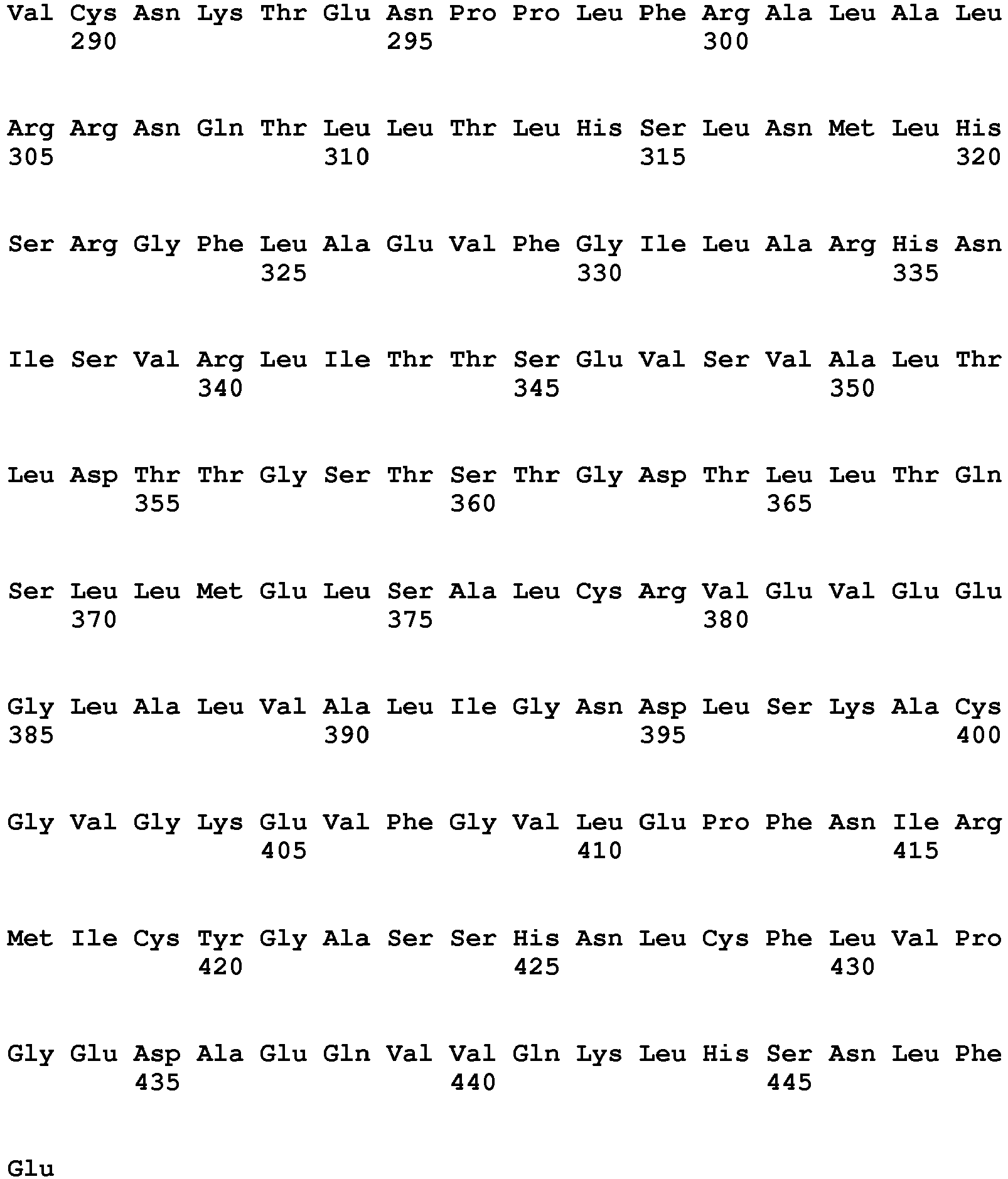
- <210> 9
<211> 55
<212> DNA
<213> Artificial Sequence - <220>
<223> primer - <400> 9
ctagcactag tgaaagagga gaaatactag atgtctgaaa ttgttgtctc caaat 55 - <210> 10
<211> 30
<212> DNA
<213> Artificial Sequence - <220>
<223> primer - <400> 10
ttactcaaac aaattactat gcagtttttg 30 - <210> 11
<211> 60
<212> DNA
<213> Artificial Sequence - <220>
<223> primer - <400> 11
ttgacggcta gctcagtcct aggtacagtg ctagcactag tgaaagagga gaaatactag 60 - <210> 12
<211> 31
<212> DNA
<213> Artificial Sequence - <220>
<223> primer - <400> 12
gcgtctagat tgacggctag ctcagtccta g 31 - <210> 13
<211> 39
<212> DNA
<213> Artificial Sequence - <220>
<223> primer - <400> 13
ggcgagctct tactcaaaca aattactatg cagtttttg 39 - <210> 14
<211> 40
<212> DNA
<213> Artificial Sequence - <220>
<223> primer - <400> 14
cctcgcgcgg cataatattt cggtaccgtt aatcaccacg 40 - <210> 15
<211> 40
<212> DNA
<213> Artificial Sequence - <220>
<223> primer - <400> 15
cgtggtgatt aacggtaccg aaatattatg ccgcgcgagg 40 - <210> 16
<211> 35
<212> DNA
<213> Artificial Sequence - <220>
<223> primer - <400> 16
cgcggcataa tatttcggta gtcttaatca ccacg 35 - <210> 17
<211> 35
<212> DNA
<213> Artificial Sequence - <220>
<223> primer - <400> 17
cgtggtgatt aagactaccg aaatattatg ccgcg 35 - <210> 18
<211> 37
<212> DNA
<213> Artificial Sequence - <220>
<223> primer - <400> 18
cgcgcggcat aatatttcgg tacgcttaat caccacg 37 - <210> 19
<211> 37
<212> DNA
<213> Artificial Sequence - <220>
<223> primer - <400> 19
cgtggtgatt aagcgtaccg aaatattatg ccgcgcg 37 - <210> 20
<211> 34
<212> DNA
<213> Artificial Sequence - <220>
<223> primer - <400> 20
cgcatgattt gtgctggcgc atccagccat aacc 34 - <210> 21
<211> 34
<212> DNA
<213> Artificial Sequence - <220>
<223> primer - <400> 21
ggttatggct ggatgcgcca gcacaaatca tgcg 34 - <210> 22
<211> 32
<212> DNA
<213> Artificial Sequence - <220>
<223> primer - <400> 22
cattcgcatg acttgttatg gcgcatccag cc 32 - <210> 23
<211> 32
<212> DNA
<213> Artificial Sequence - <220>
<223> primer - <400> 23
ggctggatgc gccataacaa gtcatgcgaa tg 32 - <210> 24
<211> 33
<212> DNA
<213> Artificial Sequence - <220>
<223> primer - <400> 24
gtattcggcg tactggaacc ggccaacatt cgc 33 - <210> 25
<211> 33
<212> DNA
<213> Artificial Sequence - <220>
<223> primer - <400> 25
gcgaatgttg gccggttcca gtacgccgaa tac 33 - <210> 26
<211> 40
<212> DNA
<213> Artificial Sequence - <220>
<223> primer - <400> 26
cctgtcaaaa gcctgcaagg ttggcaaaga ggtattcggc 40 - <210> 27
<211> 40
<212> DNA
<213> Artificial Sequence - <220>
<223> primer - <400> 27
gccgaatacc tctttgccaa ccttgcaggc ttttgacagg 40
Claims (15)
- An aspartokinase, wherein the amino acid sequence of said aspartokinase has 80% or higher sequence identity with the amino acid sequence of SEQ ID NO: 2 and has an amino acid residue which is not aspartic acid at the position corresponding to position 340 in the amino acid sequence of SEQ ID NO: 2, and wherein the lysine feedback inhibition of said aspartokinase is relieved.
- The aspartokinase according to claim 1, wherein the amino acid sequence of said aspartokinase has an amino acid residue at the position corresponding to position 340 in the amino acid sequence of SEQ ID NO: 2 which is at least one selected from the following amino acids: Pro, Ala, Arg, Lys, Gln, Asn, Val, Ile, Leu, Met and Phe.
- The aspartokinase according to claim 2, wherein the amino acid sequence of said aspartokinase has an amino acid residue at the position corresponding to position 340 in the amino acid sequence of SEQ ID NO: 2 which is at least one selected from the following amino acids: Pro, Arg or Val.
- The aspartokinase according to claim 3, wherein the aspartokinase:a) has the amino acid sequence of SEQ ID NO: 4, 6 or 8; orb) is derived from a), wherein the aspartokinase comprises an amino acid sequence modified through substitution, deletion or addition of amino acid residues from the sequence defined in a), the aspartokinase has a kinase activity on aspartate, and the amino acid sequence of the aspartokinsase has at least one amino acid selected from the group consisting of Pro, Arg, and Val at the position corresponding to the position 340 in the amino acid sequence of SEQ ID NO: 2.
- The aspartokinase according to claim 4, wherein the amino acid sequence of said aspartokinase is shown in SEQ ID NO: 4, 6 or 8.
- An encoding gene for the aspartokinase according to any one of claims 1-5.
- A vector comprising the encoding gene according to claim 6.
- A host cell comprising the encoding gene according to claim 6.
- The host cell according to claim 8, wherein said host cell is from the genus Escherichia, Corynebacterium, Brevibacterium sp., Bacillus, Serratia or Vibrio.
- The host cell according to claim 9, wherein said host cell is from the genus Escherichia coli or Corynebacterium glutamicum.
- The host cell according to claim 8, wherein the encoding gene according to claim 6 is integrated into the chromosome of said host cell, or said host cell comprises the vector according to claim 7.
- The host cell according to claim 8, wherein one or more genes selected from the following group are attenuated or the expression thereof is reduced:a. adhE gene encoding alcohol dehydrogenase;b. ackA gene encoding acetate kinase;c. pta gene encoding phosphate acetyltransferase;d. ldhA gene encoding lactate dehydrogenase;e. focA gene encoding formate transporter;f. pflB gene encoding pyruvate formate lyase;g. poxB gene encoding pyruvate oxidase;h. thrA gene encoding aspartokinase I / homoserine dehydrogenase I bifunctional enzyme;i. thrB gene encoding homoserine kinase;j. ldcC gene encoding lysine decarboxylase; andk. cadA gene encoding lysine decarboxylase.
- The host cell according to claim 8, wherein one or more genes selected from the following group are enhanced in said host cell:a. dapA gene encoding dihydrodipicolinate synthase for releasing lysine feedback inhibition;b. dapB gene encoding dihydrodipicolinate reductase;c. ddh gene encoding diaminopimelate dehydrogenase;d. dapD encoding tetrahydrodipicolinate succinylase and dapE encoding succinyl diaminopimelate deacylase;e. asd gene encoding aspartate - semialdehyde dehydrogenase;f. ppc gene encoding phosphoenolpyruvate carboxylase; org. pntAB gene encoding nicotinamide adenine dinucleotide transhydrogenase.
- A method for the production of L-amino acid, wherein said method comprises the following steps:a) culturing the host cell according to any one of claims 8-13 to produce L-amino acid; andb) separating L-amino acid from the culture;wherein said L-amino acid is L-lysine, L-threonine, L-methionine, or L-isoleucine.
- A method for the production of L-lysine, L-threonine, L-methionine, or L-isoleucine, wherein said method comprises the following steps:a) using the aspartokinase according to claim 1 to catalyze the following reaction during the process of producing L-lysine, L-threonine, L-methionine, or L-isoleucine from L-aspartic acid, so as to obtain L-lysine, L-threonine, L-methionine, or L-isoleucine,
 b) isolating L-lysine, L-threonine, L-methionine, or L-isoleucine from the above reaction system.
Applications Claiming Priority (2)
| Application Number | Priority Date | Filing Date | Title |
|---|---|---|---|
| CN201210398902.6A CN103773745B (en) | 2012-10-18 | 2012-10-18 | Aspartokinase III mutant and its host cell and application |
| PCT/CN2013/075751 WO2014059789A1 (en) | 2012-10-18 | 2013-05-16 | Asparaginic acid kinase iii mutant and host cells and use thereof |
Publications (3)
| Publication Number | Publication Date |
|---|---|
| EP2910567A1 EP2910567A1 (en) | 2015-08-26 |
| EP2910567A4 EP2910567A4 (en) | 2016-09-14 |
| EP2910567B1 true EP2910567B1 (en) | 2020-12-16 |
Family
ID=50487520
Family Applications (1)
| Application Number | Title | Priority Date | Filing Date |
|---|---|---|---|
| EP13846350.0A Active EP2910567B1 (en) | 2012-10-18 | 2013-05-16 | Asparaginic acid kinase iii mutant and host cells and use thereof |
Country Status (7)
| Country | Link |
|---|---|
| US (1) | US9896734B2 (en) |
| EP (1) | EP2910567B1 (en) |
| JP (1) | JP6091629B2 (en) |
| CN (2) | CN103773745B (en) |
| CA (1) | CA2888606C (en) |
| PT (1) | PT2910567T (en) |
| WO (1) | WO2014059789A1 (en) |
Families Citing this family (10)
| Publication number | Priority date | Publication date | Assignee | Title |
|---|---|---|---|---|
| CN105505894A (en) * | 2014-09-24 | 2016-04-20 | 中国科学院天津工业生物技术研究所 | Aspartokinase/homoserine dehydrogenase mutant and application thereof |
| CN109385417A (en) * | 2017-08-03 | 2019-02-26 | 华东理工大学 | Internal DNA seamless integration method |
| CN107475281B (en) * | 2017-09-06 | 2020-10-13 | 福建农林大学 | Bioconversion methanol metabolic pathway |
| CN109295028B (en) * | 2018-11-05 | 2021-12-17 | 吉林农业大学 | High-enzyme-activity aspartokinase mutant, engineering bacterium and preparation method of mutant |
| CN112877269B (en) * | 2020-01-15 | 2021-12-24 | 中国科学院天津工业生物技术研究所 | Microorganism producing lysine and method for producing lysine |
| CN114457122B (en) * | 2020-05-13 | 2023-06-20 | 安徽华恒生物科技股份有限公司 | Recombinant microorganism producing L-valine and its construction method and application |
| CN111944781A (en) * | 2020-09-03 | 2020-11-17 | 廊坊梅花生物技术开发有限公司 | A mutated homoserine kinase and its application |
| CN113201514B (en) * | 2020-10-16 | 2022-09-06 | 中国科学院天津工业生物技术研究所 | Polypeptides having aspartokinase activity and their use for producing amino acids |
| CN112695036B (en) * | 2021-03-23 | 2021-07-06 | 中国科学院天津工业生物技术研究所 | An aspartate kinase gene expression control sequence and its application |
| CN117327677B (en) * | 2023-09-26 | 2024-09-20 | 江南大学 | Aspartokinase mutant and application thereof |
Family Cites Families (10)
| Publication number | Priority date | Publication date | Assignee | Title |
|---|---|---|---|---|
| DK1394257T3 (en) | 1992-03-19 | 2007-12-10 | Du Pont | Nucleic acid fragments and methods for increasing the lysine and threonine content of the seeds of plants |
| RU2113484C1 (en) | 1992-11-10 | 1998-06-20 | Адзиномото Ко., Инк. | Dna fragment encoding aspartokinase-iii, a method of l-threonine preparing |
| CN1117860C (en) | 1995-06-13 | 2003-08-13 | 味之素株式会社 | Method for producing L-lysine by fermentation |
| JP4088982B2 (en) * | 1996-10-15 | 2008-05-21 | 味の素株式会社 | Method for producing L-amino acid by fermentation |
| EP1477564A2 (en) | 1999-07-22 | 2004-11-17 | Incyte Genomics, Inc. | Human synthetases |
| BRPI0016995B1 (en) * | 2000-01-21 | 2016-03-08 | Ajinomoto Kk | genetically modified escherichia coli bacteria, and method for producing l-lysine |
| JP2009089603A (en) | 2006-02-02 | 2009-04-30 | Ajinomoto Co Inc | Method for producing l-lysine using methanol-assimilating bacterium |
| BRPI0914933B1 (en) * | 2008-06-30 | 2018-09-25 | Monsanto Technology Llc | Polypeptide displaying aspartase kinase (AK) activity that is not subject to inhibition by end-product, polynucleotide encoding the same, recombinant DNA construct, transformed micro-organism, feed-like, or feed-in-the-plant, trans-feed, PRODUCTION OF A TRANSFORMED PLANT AND INCREASING THE TOTAL FREE AMINO ACID CONTENT OF A PLANT. |
| KR101990014B1 (en) * | 2010-10-28 | 2019-06-17 | 아디쎄오 프랑스 에스에이에스 | A method of production of 2,4-dihydroxybutyric acid |
| JP2014036576A (en) * | 2010-12-10 | 2014-02-27 | Ajinomoto Co Inc | Method for producing l-amino acids |
-
2012
- 2012-10-18 CN CN201210398902.6A patent/CN103773745B/en active Active
- 2012-10-18 CN CN201810150556.7A patent/CN108486082A/en active Pending
-
2013
- 2013-05-16 US US14/437,115 patent/US9896734B2/en not_active Expired - Fee Related
- 2013-05-16 JP JP2015537111A patent/JP6091629B2/en active Active
- 2013-05-16 CA CA2888606A patent/CA2888606C/en active Active
- 2013-05-16 WO PCT/CN2013/075751 patent/WO2014059789A1/en not_active Ceased
- 2013-05-16 EP EP13846350.0A patent/EP2910567B1/en active Active
- 2013-05-16 PT PT138463500T patent/PT2910567T/en unknown
Non-Patent Citations (1)
| Title |
|---|
| None * |
Also Published As
| Publication number | Publication date |
|---|---|
| JP2015532111A (en) | 2015-11-09 |
| US20150337346A1 (en) | 2015-11-26 |
| EP2910567A1 (en) | 2015-08-26 |
| CN103773745A (en) | 2014-05-07 |
| CA2888606C (en) | 2019-01-22 |
| EP2910567A4 (en) | 2016-09-14 |
| CA2888606A1 (en) | 2014-04-24 |
| PT2910567T (en) | 2021-02-05 |
| CN108486082A (en) | 2018-09-04 |
| CN103773745B (en) | 2018-03-23 |
| US9896734B2 (en) | 2018-02-20 |
| JP6091629B2 (en) | 2017-03-08 |
| WO2014059789A1 (en) | 2014-04-24 |
Similar Documents
| Publication | Publication Date | Title |
|---|---|---|
| US9896734B2 (en) | Asparaginic acid kinase III mutant and host cells and use thereof | |
| JP6219481B2 (en) | Method for producing L-lysine using a microorganism having L-lysine producing ability | |
| KR101996769B1 (en) | A homoserine dehydrogenase variant and a method for producing homoserine or L-amino acid derived from homoserine using the same | |
| CN107075496B (en) | Feedback-resistant acetohydroxy acid synthase variants and methods for producing L-valine using the same | |
| EP3272860B1 (en) | Pyruvate dehydrogenase mutant, microorganism comprising mutant, and method for producing l-amino acid by using microorganism | |
| RU2699516C2 (en) | Novel lysine decarboxylase and method of producing cadaverine using thereof | |
| JP7378621B2 (en) | Novel branched chain amino acid aminotransferase mutant and leucine production method using the same | |
| CN110218710A (en) | The phosphoketolase and the application in production metabolin that activity improves | |
| CN107849094B (en) | Gluconate repressor variants, L-lysine-producing microorganism comprising same, and method for producing L-lysine | |
| JP6860565B2 (en) | Corynebacterium microorganisms capable of producing L-lysine and L-lysine production methods using them | |
| CN110139934A (en) | Hydroxypropanone- and its application are converted by methyl-glyoxal using new enzyme | |
| CN105505894A (en) | Aspartokinase/homoserine dehydrogenase mutant and application thereof | |
| KR102233376B1 (en) | A modified polypeptide of meso-diaminopimelate dehydrogenase and a method for producing L- threonine using the same | |
| CN106978405B (en) | Aspartokinase/homoserine dehydrogenase mutants and their applications | |
| KR102605543B1 (en) | Methionine-producing yeast | |
| EP1831350B1 (en) | Microorganism of escherichia sp, or corynebacterium sp. comprising foreign nadp dependent glyceraldehyde-3-phosphate dehydrogenase gene and method for producing l-lysine using the same | |
| Xu et al. | Expression of the Escherichia Coli TdcB gene encoding threonine dehydratase in L-isoleucine-overproducing Corynebacterium Glutamicum Yilw | |
| CN110129294A (en) | Homoserine acetyltransferase mutant and its host cell and application | |
| Khankal et al. | Journal of Biological Engineering |
Legal Events
| Date | Code | Title | Description |
|---|---|---|---|
| PUAI | Public reference made under article 153(3) epc to a published international application that has entered the european phase |
Free format text: ORIGINAL CODE: 0009012 |
|
| 17P | Request for examination filed |
Effective date: 20150518 |
|
| AK | Designated contracting states |
Kind code of ref document: A1 Designated state(s): AL AT BE BG CH CY CZ DE DK EE ES FI FR GB GR HR HU IE IS IT LI LT LU LV MC MK MT NL NO PL PT RO RS SE SI SK SM TR |
|
| AX | Request for extension of the european patent |
Extension state: BA ME |
|
| DAX | Request for extension of the european patent (deleted) | ||
| RIC1 | Information provided on ipc code assigned before grant |
Ipc: C12P 13/08 20060101ALI20160420BHEP Ipc: C12N 9/12 20060101ALI20160420BHEP Ipc: C12P 13/12 20060101ALI20160420BHEP Ipc: C12N 15/54 20060101AFI20160420BHEP Ipc: C12P 13/06 20060101ALI20160420BHEP |
|
| REG | Reference to a national code |
Ref country code: DE Ref legal event code: R079 Ref document number: 602013074791 Country of ref document: DE Free format text: PREVIOUS MAIN CLASS: C07K0014245000 Ipc: C12N0015540000 |
|
| RA4 | Supplementary search report drawn up and despatched (corrected) |
Effective date: 20160811 |
|
| RIC1 | Information provided on ipc code assigned before grant |
Ipc: C12P 13/08 20060101ALI20160805BHEP Ipc: C12N 15/54 20060101AFI20160805BHEP Ipc: C12P 13/12 20060101ALI20160805BHEP Ipc: C12P 13/06 20060101ALI20160805BHEP Ipc: C12N 9/12 20060101ALI20160805BHEP |
|
| STAA | Information on the status of an ep patent application or granted ep patent |
Free format text: STATUS: EXAMINATION IS IN PROGRESS |
|
| 17Q | First examination report despatched |
Effective date: 20190603 |
|
| GRAP | Despatch of communication of intention to grant a patent |
Free format text: ORIGINAL CODE: EPIDOSNIGR1 |
|
| STAA | Information on the status of an ep patent application or granted ep patent |
Free format text: STATUS: GRANT OF PATENT IS INTENDED |
|
| INTG | Intention to grant announced |
Effective date: 20191206 |
|
| GRAJ | Information related to disapproval of communication of intention to grant by the applicant or resumption of examination proceedings by the epo deleted |
Free format text: ORIGINAL CODE: EPIDOSDIGR1 |
|
| STAA | Information on the status of an ep patent application or granted ep patent |
Free format text: STATUS: EXAMINATION IS IN PROGRESS |
|
| INTC | Intention to grant announced (deleted) | ||
| GRAP | Despatch of communication of intention to grant a patent |
Free format text: ORIGINAL CODE: EPIDOSNIGR1 |
|
| STAA | Information on the status of an ep patent application or granted ep patent |
Free format text: STATUS: GRANT OF PATENT IS INTENDED |
|
| INTG | Intention to grant announced |
Effective date: 20200625 |
|
| GRAS | Grant fee paid |
Free format text: ORIGINAL CODE: EPIDOSNIGR3 |
|
| GRAA | (expected) grant |
Free format text: ORIGINAL CODE: 0009210 |
|
| STAA | Information on the status of an ep patent application or granted ep patent |
Free format text: STATUS: THE PATENT HAS BEEN GRANTED |
|
| AK | Designated contracting states |
Kind code of ref document: B1 Designated state(s): AL AT BE BG CH CY CZ DE DK EE ES FI FR GB GR HR HU IE IS IT LI LT LU LV MC MK MT NL NO PL PT RO RS SE SI SK SM TR |
|
| REG | Reference to a national code |
Ref country code: GB Ref legal event code: FG4D |
|
| REG | Reference to a national code |
Ref country code: DE Ref legal event code: R096 Ref document number: 602013074791 Country of ref document: DE |
|
| REG | Reference to a national code |
Ref country code: IE Ref legal event code: FG4D |
|
| REG | Reference to a national code |
Ref country code: AT Ref legal event code: REF Ref document number: 1345623 Country of ref document: AT Kind code of ref document: T Effective date: 20210115 |
|
| REG | Reference to a national code |
Ref country code: PT Ref legal event code: SC4A Ref document number: 2910567 Country of ref document: PT Date of ref document: 20210205 Kind code of ref document: T Free format text: AVAILABILITY OF NATIONAL TRANSLATION Effective date: 20210201 |
|
| REG | Reference to a national code |
Ref country code: NL Ref legal event code: FP |
|
| PG25 | Lapsed in a contracting state [announced via postgrant information from national office to epo] |
Ref country code: FI Free format text: LAPSE BECAUSE OF FAILURE TO SUBMIT A TRANSLATION OF THE DESCRIPTION OR TO PAY THE FEE WITHIN THE PRESCRIBED TIME-LIMIT Effective date: 20201216 Ref country code: RS Free format text: LAPSE BECAUSE OF FAILURE TO SUBMIT A TRANSLATION OF THE DESCRIPTION OR TO PAY THE FEE WITHIN THE PRESCRIBED TIME-LIMIT Effective date: 20201216 Ref country code: NO Free format text: LAPSE BECAUSE OF FAILURE TO SUBMIT A TRANSLATION OF THE DESCRIPTION OR TO PAY THE FEE WITHIN THE PRESCRIBED TIME-LIMIT Effective date: 20210316 Ref country code: GR Free format text: LAPSE BECAUSE OF FAILURE TO SUBMIT A TRANSLATION OF THE DESCRIPTION OR TO PAY THE FEE WITHIN THE PRESCRIBED TIME-LIMIT Effective date: 20210317 |
|
| REG | Reference to a national code |
Ref country code: AT Ref legal event code: MK05 Ref document number: 1345623 Country of ref document: AT Kind code of ref document: T Effective date: 20201216 |
|
| PG25 | Lapsed in a contracting state [announced via postgrant information from national office to epo] |
Ref country code: SE Free format text: LAPSE BECAUSE OF FAILURE TO SUBMIT A TRANSLATION OF THE DESCRIPTION OR TO PAY THE FEE WITHIN THE PRESCRIBED TIME-LIMIT Effective date: 20201216 Ref country code: LV Free format text: LAPSE BECAUSE OF FAILURE TO SUBMIT A TRANSLATION OF THE DESCRIPTION OR TO PAY THE FEE WITHIN THE PRESCRIBED TIME-LIMIT Effective date: 20201216 Ref country code: BG Free format text: LAPSE BECAUSE OF FAILURE TO SUBMIT A TRANSLATION OF THE DESCRIPTION OR TO PAY THE FEE WITHIN THE PRESCRIBED TIME-LIMIT Effective date: 20210316 |
|
| PG25 | Lapsed in a contracting state [announced via postgrant information from national office to epo] |
Ref country code: HR Free format text: LAPSE BECAUSE OF FAILURE TO SUBMIT A TRANSLATION OF THE DESCRIPTION OR TO PAY THE FEE WITHIN THE PRESCRIBED TIME-LIMIT Effective date: 20201216 |
|
| REG | Reference to a national code |
Ref country code: LT Ref legal event code: MG9D |
|
| PG25 | Lapsed in a contracting state [announced via postgrant information from national office to epo] |
Ref country code: RO Free format text: LAPSE BECAUSE OF FAILURE TO SUBMIT A TRANSLATION OF THE DESCRIPTION OR TO PAY THE FEE WITHIN THE PRESCRIBED TIME-LIMIT Effective date: 20201216 Ref country code: SK Free format text: LAPSE BECAUSE OF FAILURE TO SUBMIT A TRANSLATION OF THE DESCRIPTION OR TO PAY THE FEE WITHIN THE PRESCRIBED TIME-LIMIT Effective date: 20201216 Ref country code: LT Free format text: LAPSE BECAUSE OF FAILURE TO SUBMIT A TRANSLATION OF THE DESCRIPTION OR TO PAY THE FEE WITHIN THE PRESCRIBED TIME-LIMIT Effective date: 20201216 Ref country code: SM Free format text: LAPSE BECAUSE OF FAILURE TO SUBMIT A TRANSLATION OF THE DESCRIPTION OR TO PAY THE FEE WITHIN THE PRESCRIBED TIME-LIMIT Effective date: 20201216 Ref country code: CZ Free format text: LAPSE BECAUSE OF FAILURE TO SUBMIT A TRANSLATION OF THE DESCRIPTION OR TO PAY THE FEE WITHIN THE PRESCRIBED TIME-LIMIT Effective date: 20201216 Ref country code: EE Free format text: LAPSE BECAUSE OF FAILURE TO SUBMIT A TRANSLATION OF THE DESCRIPTION OR TO PAY THE FEE WITHIN THE PRESCRIBED TIME-LIMIT Effective date: 20201216 |
|
| PG25 | Lapsed in a contracting state [announced via postgrant information from national office to epo] |
Ref country code: PL Free format text: LAPSE BECAUSE OF FAILURE TO SUBMIT A TRANSLATION OF THE DESCRIPTION OR TO PAY THE FEE WITHIN THE PRESCRIBED TIME-LIMIT Effective date: 20201216 Ref country code: AT Free format text: LAPSE BECAUSE OF FAILURE TO SUBMIT A TRANSLATION OF THE DESCRIPTION OR TO PAY THE FEE WITHIN THE PRESCRIBED TIME-LIMIT Effective date: 20201216 |
|
| REG | Reference to a national code |
Ref country code: DE Ref legal event code: R097 Ref document number: 602013074791 Country of ref document: DE |
|
| PG25 | Lapsed in a contracting state [announced via postgrant information from national office to epo] |
Ref country code: IS Free format text: LAPSE BECAUSE OF FAILURE TO SUBMIT A TRANSLATION OF THE DESCRIPTION OR TO PAY THE FEE WITHIN THE PRESCRIBED TIME-LIMIT Effective date: 20210416 |
|
| PLBE | No opposition filed within time limit |
Free format text: ORIGINAL CODE: 0009261 |
|
| STAA | Information on the status of an ep patent application or granted ep patent |
Free format text: STATUS: NO OPPOSITION FILED WITHIN TIME LIMIT |
|
| PG25 | Lapsed in a contracting state [announced via postgrant information from national office to epo] |
Ref country code: IT Free format text: LAPSE BECAUSE OF FAILURE TO SUBMIT A TRANSLATION OF THE DESCRIPTION OR TO PAY THE FEE WITHIN THE PRESCRIBED TIME-LIMIT Effective date: 20201216 Ref country code: AL Free format text: LAPSE BECAUSE OF FAILURE TO SUBMIT A TRANSLATION OF THE DESCRIPTION OR TO PAY THE FEE WITHIN THE PRESCRIBED TIME-LIMIT Effective date: 20201216 |
|
| 26N | No opposition filed |
Effective date: 20210917 |
|
| PG25 | Lapsed in a contracting state [announced via postgrant information from national office to epo] |
Ref country code: DK Free format text: LAPSE BECAUSE OF FAILURE TO SUBMIT A TRANSLATION OF THE DESCRIPTION OR TO PAY THE FEE WITHIN THE PRESCRIBED TIME-LIMIT Effective date: 20201216 Ref country code: ES Free format text: LAPSE BECAUSE OF FAILURE TO SUBMIT A TRANSLATION OF THE DESCRIPTION OR TO PAY THE FEE WITHIN THE PRESCRIBED TIME-LIMIT Effective date: 20201216 |
|
| REG | Reference to a national code |
Ref country code: CH Ref legal event code: PL |
|
| GBPC | Gb: european patent ceased through non-payment of renewal fee |
Effective date: 20210516 |
|
| PG25 | Lapsed in a contracting state [announced via postgrant information from national office to epo] |
Ref country code: LU Free format text: LAPSE BECAUSE OF NON-PAYMENT OF DUE FEES Effective date: 20210516 Ref country code: LI Free format text: LAPSE BECAUSE OF NON-PAYMENT OF DUE FEES Effective date: 20210531 Ref country code: MC Free format text: LAPSE BECAUSE OF FAILURE TO SUBMIT A TRANSLATION OF THE DESCRIPTION OR TO PAY THE FEE WITHIN THE PRESCRIBED TIME-LIMIT Effective date: 20201216 Ref country code: CH Free format text: LAPSE BECAUSE OF NON-PAYMENT OF DUE FEES Effective date: 20210531 |
|
| REG | Reference to a national code |
Ref country code: BE Ref legal event code: MM Effective date: 20210531 |
|
| PG25 | Lapsed in a contracting state [announced via postgrant information from national office to epo] |
Ref country code: SI Free format text: LAPSE BECAUSE OF FAILURE TO SUBMIT A TRANSLATION OF THE DESCRIPTION OR TO PAY THE FEE WITHIN THE PRESCRIBED TIME-LIMIT Effective date: 20201216 |
|
| PG25 | Lapsed in a contracting state [announced via postgrant information from national office to epo] |
Ref country code: IE Free format text: LAPSE BECAUSE OF NON-PAYMENT OF DUE FEES Effective date: 20210516 Ref country code: GB Free format text: LAPSE BECAUSE OF NON-PAYMENT OF DUE FEES Effective date: 20210516 |
|
| PG25 | Lapsed in a contracting state [announced via postgrant information from national office to epo] |
Ref country code: IS Free format text: LAPSE BECAUSE OF FAILURE TO SUBMIT A TRANSLATION OF THE DESCRIPTION OR TO PAY THE FEE WITHIN THE PRESCRIBED TIME-LIMIT Effective date: 20210416 Ref country code: FR Free format text: LAPSE BECAUSE OF NON-PAYMENT OF DUE FEES Effective date: 20210531 |
|
| PG25 | Lapsed in a contracting state [announced via postgrant information from national office to epo] |
Ref country code: BE Free format text: LAPSE BECAUSE OF NON-PAYMENT OF DUE FEES Effective date: 20210531 |
|
| PG25 | Lapsed in a contracting state [announced via postgrant information from national office to epo] |
Ref country code: HU Free format text: LAPSE BECAUSE OF FAILURE TO SUBMIT A TRANSLATION OF THE DESCRIPTION OR TO PAY THE FEE WITHIN THE PRESCRIBED TIME-LIMIT; INVALID AB INITIO Effective date: 20130516 |
|
| P01 | Opt-out of the competence of the unified patent court (upc) registered |
Effective date: 20230517 |
|
| PG25 | Lapsed in a contracting state [announced via postgrant information from national office to epo] |
Ref country code: CY Free format text: LAPSE BECAUSE OF FAILURE TO SUBMIT A TRANSLATION OF THE DESCRIPTION OR TO PAY THE FEE WITHIN THE PRESCRIBED TIME-LIMIT Effective date: 20201216 |
|
| PG25 | Lapsed in a contracting state [announced via postgrant information from national office to epo] |
Ref country code: MK Free format text: LAPSE BECAUSE OF FAILURE TO SUBMIT A TRANSLATION OF THE DESCRIPTION OR TO PAY THE FEE WITHIN THE PRESCRIBED TIME-LIMIT Effective date: 20201216 |
|
| PG25 | Lapsed in a contracting state [announced via postgrant information from national office to epo] |
Ref country code: MT Free format text: LAPSE BECAUSE OF FAILURE TO SUBMIT A TRANSLATION OF THE DESCRIPTION OR TO PAY THE FEE WITHIN THE PRESCRIBED TIME-LIMIT Effective date: 20201216 |
|
| PGFP | Annual fee paid to national office [announced via postgrant information from national office to epo] |
Ref country code: NL Payment date: 20250521 Year of fee payment: 13 |
|
| PGFP | Annual fee paid to national office [announced via postgrant information from national office to epo] |
Ref country code: DE Payment date: 20250521 Year of fee payment: 13 |
|
| PGFP | Annual fee paid to national office [announced via postgrant information from national office to epo] |
Ref country code: PT Payment date: 20250508 Year of fee payment: 13 |
|
| PG25 | Lapsed in a contracting state [announced via postgrant information from national office to epo] |
Ref country code: TR Free format text: LAPSE BECAUSE OF FAILURE TO SUBMIT A TRANSLATION OF THE DESCRIPTION OR TO PAY THE FEE WITHIN THE PRESCRIBED TIME-LIMIT Effective date: 20201216 |