EP2908654B1 - Non-oleic triglyceride based, low viscosity, high flash point dielectric fluids - Google Patents
Non-oleic triglyceride based, low viscosity, high flash point dielectric fluids Download PDFInfo
- Publication number
- EP2908654B1 EP2908654B1 EP13773924.9A EP13773924A EP2908654B1 EP 2908654 B1 EP2908654 B1 EP 2908654B1 EP 13773924 A EP13773924 A EP 13773924A EP 2908654 B1 EP2908654 B1 EP 2908654B1
- Authority
- EP
- European Patent Office
- Prior art keywords
- fatty acids
- triglyceride
- fatty acid
- acid
- triglycerides
- Prior art date
- Legal status (The legal status is an assumption and is not a legal conclusion. Google has not performed a legal analysis and makes no representation as to the accuracy of the status listed.)
- Active
Links
Classifications
-
- H—ELECTRICITY
- H01—ELECTRIC ELEMENTS
- H01B—CABLES; CONDUCTORS; INSULATORS; SELECTION OF MATERIALS FOR THEIR CONDUCTIVE, INSULATING OR DIELECTRIC PROPERTIES
- H01B3/00—Insulators or insulating bodies characterised by the insulating materials; Selection of materials for their insulating or dielectric properties
- H01B3/18—Insulators or insulating bodies characterised by the insulating materials; Selection of materials for their insulating or dielectric properties mainly consisting of organic substances
- H01B3/20—Insulators or insulating bodies characterised by the insulating materials; Selection of materials for their insulating or dielectric properties mainly consisting of organic substances liquids, e.g. oils
-
- A—HUMAN NECESSITIES
- A23—FOODS OR FOODSTUFFS; TREATMENT THEREOF, NOT COVERED BY OTHER CLASSES
- A23D—EDIBLE OILS OR FATS, e.g. MARGARINES, SHORTENINGS OR COOKING OILS
- A23D9/00—Other edible oils or fats, e.g. shortenings or cooking oils
-
- C—CHEMISTRY; METALLURGY
- C07—ORGANIC CHEMISTRY
- C07C—ACYCLIC OR CARBOCYCLIC COMPOUNDS
- C07C69/00—Esters of carboxylic acids; Esters of carbonic or haloformic acids
- C07C69/52—Esters of acyclic unsaturated carboxylic acids having the esterified carboxyl group bound to an acyclic carbon atom
- C07C69/533—Monocarboxylic acid esters having only one carbon-to-carbon double bond
-
- A—HUMAN NECESSITIES
- A23—FOODS OR FOODSTUFFS; TREATMENT THEREOF, NOT COVERED BY OTHER CLASSES
- A23V—INDEXING SCHEME RELATING TO FOODS, FOODSTUFFS OR NON-ALCOHOLIC BEVERAGES AND LACTIC OR PROPIONIC ACID BACTERIA USED IN FOODSTUFFS OR FOOD PREPARATION
- A23V2002/00—Food compositions, function of food ingredients or processes for food or foodstuffs
-
- A—HUMAN NECESSITIES
- A23—FOODS OR FOODSTUFFS; TREATMENT THEREOF, NOT COVERED BY OTHER CLASSES
- A23V—INDEXING SCHEME RELATING TO FOODS, FOODSTUFFS OR NON-ALCOHOLIC BEVERAGES AND LACTIC OR PROPIONIC ACID BACTERIA USED IN FOODSTUFFS OR FOOD PREPARATION
- A23V2250/00—Food ingredients
-
- A—HUMAN NECESSITIES
- A23—FOODS OR FOODSTUFFS; TREATMENT THEREOF, NOT COVERED BY OTHER CLASSES
- A23V—INDEXING SCHEME RELATING TO FOODS, FOODSTUFFS OR NON-ALCOHOLIC BEVERAGES AND LACTIC OR PROPIONIC ACID BACTERIA USED IN FOODSTUFFS OR FOOD PREPARATION
- A23V2250/00—Food ingredients
- A23V2250/18—Lipids
- A23V2250/186—Fatty acids
- A23V2250/188—Oleic acid
Definitions
- This invention relates to dielectric fluids.
- the invention relates to dielectric fluids comprising triglycerides of C14:1 and/or C16:1 fatty acids while in another aspect, the invention relates to dielectric fluids comprising triglycerides of C14:1 and/or C16:1 fatty acids in combination with one or more of polyunsaturated or saturated triglycerides and/or triglycerides of a C18:1 fatty acids.
- Vegetable oil (VO) based dielectric fluids e.g., transformer fluids
- MO mineral oil
- the VO-based dielectric fluids have significantly higher viscosity than the MO-based dielectric fluids, which results in a poorer heat transfer operation using a VO-based dielectric fluid. Therefore, a market need exists for a reduced viscosity VO-based dielectric fluid to improve the heat transfer efficiency in the transformer, while retaining the benefits of a high flash point combined with low melting point and low amounts of polyunsaturated fatty acids in the triglycerides.
- dielectric fluid that possesses a desired balance of properties, specifically a combination of low viscosity ( ⁇ 33 cP at 40°C, ⁇ 120 cP at 10°C), high flash point ( ⁇ 260°C, preferably ⁇ 270°C), and low melting point (-15°C or less).
- compositions of this invention are useful as dielectric fluids, and exhibit a (i) viscosity of less than or equal to ( ⁇ ) 33 cP at 40°C and ⁇ 120 cP at 10°C, (ii) flash point of greater than or equal to ⁇ 260°C, preferably ⁇ 270°C, and (iii) melting point of -15°C or less.
- the numerical ranges in this disclosure are approximate, and thus may include values outside of the range unless otherwise indicated. Numerical ranges include all values from and including the lower and the upper values, in increments of one unit, provided that there is a separation of at least two units between any lower value and any higher value. As an example, if a compositional, physical or other property, such as, for example, temperature, is from 100 to 1,000, then all individual values, such as 100, 101, 102, etc., and sub ranges, such as 100 to 144, 155 to 170, 197 to 200, etc., are expressly enumerated.
- compositions, process, etc. is not limited to the components, steps, etc. disclosed, but rather can include other, undisclosed components, steps, etc.
- the term “consisting essentially of” excludes from the scope of any composition, process, etc. any other component, step etc. excepting those that are not essential to the performance, operability or the like of the composition, process, etc.
- the term “consisting of” excludes from a composition, process, etc., any component, step, etc. not specifically disclosed.
- Dielectric fluid and like terms mean a fluid, typically a liquid, that does not conduct, or conducts at a very low level, an electric current under normal circumstances. Vegetable oils inherently possess good dielectric properties ( US 2006/0030499 ). For many vegetable oils the dielectric constant is less than 4.5.
- Viscosity and like terms mean the resistance of a fluid which is being deformed by either sheer stress or tensile stress. For purposes of this specification, viscosity is measured at 40°C and 10°C using a Brookfield viscometer as measured by ASTM D-445.
- Flash point and like terms mean the lowest temperature at which a volatile liquid can vaporize to form an ignitable mixture in air but will not continue to burn (compare to fire point). For purposes of this specification, flash point is measured by the method of ASTM D-3278.
- Fire point and like terms mean the lowest temperature at which a volatile liquid can vaporize to form an ignitable mixture in air and will continue to burn after ignition.
- One accepted method for measuring the fire point of a liquid is ASTM D-92-12.
- the fire point of a liquid is typically 25-30°C greater than the flash point.
- Pour point and like terms mean the lowest temperature at which a liquid becomes semi-solid and loses its flow characteristics, or in other words, the minimum temperature at which a liquid will flow. For purposes of this specification, pour point is measured by ASTM D-97.
- Melting point and like terms mean the temperature at which a material changes state from solid to liquid. For purposes of this specification, melting point is measured using a differential scanning calorimeter (DSC) and the following protocol:
- Triglyceride and like terms mean an ester derived from glycerol and three fatty acids.
- the notation used in this specification to describe a triglyceride is the same as that used below to describe a fatty acid.
- the triglyceride can comprise glycerol with any combination of the following fatty acids: C18:1, C14:1, C16:1, polyunsaturated and saturated.
- the fatty acids can attach to the glycerol molecule in any order, e.g., any fatty acid can react with any of the hydroxyl groups of the glycerol molecule to form an ester linkage.
- Triglyceride of C18:1 fatty acid simply means that the fatty acid components of the triglyceride are derived from or based upon a C18:1 fatty acid. That is, a C18:1 triglyceride is an ester of glycerol and three fatty acids of 18 carbon atoms each with each fatty acid having one double bond. Similarly, a C14:1 triglyceride is an ester of glycerol and three fatty acids of 14 carbon atoms each with each fatty acid having one double bond. Likewise, a C16:1 triglyceride is an ester of glycerol and three fatty acids of 16 carbon atoms each with each fatty acid having one double bond.
- Triglycerides of C18:1 fatty acids in combination with C14:1 and/or C16:1 means that (a) a C18:1 triglyceride is mixed with a C14:1 triglyceride or a C16:1 triglyceride or both, or (b) at least one of the fatty acid components of the triglyceride is derived from or based upon a C18:1 fatty acid, while the other two are derived from or based upon C14:1 fatty acid and/or C16:1 fatty acid.
- “Fatty acid” and like terms mean a carboxylic acid with a long aliphatic tail that is either saturated or unsaturated. Unsaturated fatty acids have one or more double bonds between carbon atoms. Saturated fatty acids do not contain any double bonds.
- the notation used in this specification for describing a fatty acid includes the capital letter "C” for carbon atom, followed by a number describing the number of carbon atoms in the fatty acid, followed by a colon and another number for the number of double bonds in the fatty acid.
- C16:1 denotes a fatty acid of 16 carbon atoms with one double bond, e.g., palmitoleic acid.
- the number after the colon in this notation neither designates the placement of the double bond(s) in the fatty acid nor whether the hydrogen atoms bonded to the carbon atoms of the double bond are cis to one another.
- Other examples of this notation include C18:0 (stearic acid), C18:1 (oleic acid), C18:2 (linoleic acid), C18:3 ( ⁇ -linolenic acid) and C20:4 (arachidonic acid).
- the first fatty acid component of the triglyceride compositions of this invention is at least one of a C14:1 or a C16:1.
- a C14:1 triglyceride is an ester of glycerol and three fatty acids of 14 carbon atoms each with each fatty acid having one double bond.
- Representative of the C14:1 fatty acids is myristoleic acid, physeteric acid and tsuzuic acid.
- a C14:1 triglyceride can comprise glycerol with any combination of three C14:1 fatty acids, and the C14:1 fatty acids can attach to the glycerol molecule in any order, e.g., any C14:1 fatty acid can react with any of the hydroxyl groups of the glycerol molecule to form an ester linkage.
- the C14:1 fatty acid is myristoleic acid.
- a C16:1 triglyceride is an ester of glycerol and three fatty acids of 16 carbon atoms each with each fatty acid having one double bond.
- Representative of the C16:1 fatty acids is palmitoleic acid.
- a C16:1 triglyceride can comprise glycerol with any combination of three C16:1 fatty acids, and the C16:1 fatty acids can attach to the glycerol molecule in any order.
- the C16:1 fatty acid is palmitoleic acid.
- the first fatty acid component of the triglyceride compositions of this invention can comprise 100% of either a C14:1 fatty acid or a C16:1 fatty acid or any combination of the two, e.g., 1-99 wt% of C14:1 fatty acid and 1-99 wt% of a C16:1 fatty acid., more typically the C14:1 fatty acid comprises 50 wt% of the combination..
- the second fatty acid component of the triglyceride compositions of this invention is optional but if present, it is a C18:1, i.e., it contains 18 carbon atoms and has one double bond.
- Representative C18:1 fatty acids include oleic acid and vaccenic acid, with oleic acid preferred.
- a C18:1 triglyceride can comprise glycerol with any combination of three C18:1 fatty acids, e.g., three oleic acids, or two oleic acids and one vaccenic acid, or one oleic acid and two vaccenic acid.
- the three C18:1 fatty acids can attach to the glycerol molecule in any order.
- the three C18:1 fatty acids are oleic acid.
- the triglyceride compositions of this invention are free or void of any C18:1 fatty acids.
- the triglyceride compositions of this invention contain no more than 10 wt%, typically no more than 8 wt% and more typically no more than 5 wt%, of C18:1 fatty acids.
- the third fatty acid component of the triglyceride compositions of this invention is optional but if present, it is polyunsaturated, i.e., a fatty acid of any carbon atom length, typically each of a length of at least 12 carbon atoms, and each fatty acid having more than one double bond.
- a polyunsaturated triglyceride can comprise glycerol with any combination of three polyunsaturated fatty acids, and the polyunsaturated fatty acids can attach to the glycerol molecule in any order.
- Representative polyunsaturated fatty acids from which the polyunsaturated triglyceride is made include, but are not limited to, linoleic acid (C18:2), ⁇ -linolenic acid (C18:3), ⁇ -linolenic acid (C18:3), eicosadienoic acid (C20:2), dihomo- ⁇ -linolenic acid (C20:3), arachidonic acid (C22:4), docosapentaenoic acid (C22:5), hexadecatrienoic acid (C16:3), heneicosapentaenoic acid (C21:5), rumenic acid (C18:2), ⁇ -calendic acid (C18:3), ⁇ -calendic acid (C18:3), ⁇ -parinaric acid (C18:4), ⁇ -parinaric acid, pinolenic acid (C18:3), podocarpic acid (C20:3),
- the triglyceride compositions of this invention are free or void of any polyunsaturated fatty acids.
- the third fatty acid component typically does not exceed 12 wt%, more typically it does not exceed 11 wt% and even more typically it does not exceed 10 wt%, of the composition.
- the fourth fatty acid component of the triglyceride compositions of this invention is optional but if present, it is saturated triglyceride, i.e., an ester of glycerol and three fatty acids of any carbon atom length, typically each of a length of at least 8 carbon atoms, and each fatty acid free of any double bonds.
- saturated triglycerides can comprise glycerol with any combination of three saturated fatty acids, and the saturated fatty acids can attach to the glycerol molecule in any order.
- saturated fatty acids from which the saturated triglyceride is made include, but are not limited to, lauric acid (C12:0), myristic acid (C14:0), palmitic acid (C16:0) and stearic acid (C18:0).
- the triglyceride compositions of this invention are free or void of any saturated fatty acids.
- the triglyceride compositions of this invention contain no more than 7 wt%, typically no more than 5 wt% and more typically no more than 3 wt%, of saturated fatty acids.
- compositions of this invention can comprise one or more additives such as one or more antioxidants, metal deactivators, pour point depressants, UV-stabilizers, water scavengers, pigments, dyes, and the like.
- additives for dielectric fluids are well known in the art, and these additives, if used at all, are used in known ways and in known amounts.
- the additives in the aggregate do not exceed 3 wt%, more typically do not exceed 2 wt% and even more typically do not exceed 1 wt% of the composition.
- the invention is an electrical device comprising a dielectric fluid in which the dielectric fluid is a composition of triglycerides consisting essentially of, in weight percent based upon the weight of the composition:
- the dielectric fluid consists essentially of triglycerides of C14:1 fatty acids. In one embodiment the dielectric fluid consists essentially of triglycerides of C16:1 fatty acids. In one embodiment the dielectric fluid consists essentially of triglycerides of C14:1 and C16:1 fatty acids. In one embodiment the dielectric fluid consists essentially of triglycerides of C14:1 and/or C16:1 fatty acids in combination with at least one of not more than 10 wt% of C18:1 fatty acids, not more than 12 wt% of one or more polyunsaturated fatty acids, and not more than 7 wt% of one or more saturated fatty acids.
- the dielectric fluid consists essentially of triglycerides of C14:1 and/or C16:1 fatty acids in combination with at least two or all three of not more than 10 wt% of C18:1 fatty acids, not more than 12 wt% of one or more polyunsaturated fatty acids, and not more than 7 wt% of one or more saturated fatty acids.
- These "consisting essentially of" embodiments may contain one or more additives, e.g., antioxidant, pour point depressant, pigment, etc., but it specifically excludes any triglyceride with fatty acids other than those identified or those present in inconsequential amounts, e.g., less than 10 wt% based on the weight of the composition.
- fatty acids are typically by-products or contaminants remaining after the desired fatty acid, e.g., a C14:1 or C16:1 fatty acid, is extracted from a natural source oil, e.g., corn oil, soy oil or the like. In other cases, the "other" fatty acids might be naturally present in the source oil.
- the triglycerides of the present invention may be obtained from vegetable and non-vegetable sources.
- the triglycerides used in the practice of this invention are typically derived from natural source oils, e.g., vegetable oil, algae oil, microbial oil, etc., with vegetable oils and algae oils being preferred natural source oils.
- natural oils include, but are not limited to, those described in WO 2011/090685 and PCT/US2012/043973 .
- These oils are typically rich in one or more particular triglycerides, the particular triglyceride dependent upon the particular vegetable oil or algae oil.
- corn and soy oils are typically rich in triglycerides in which the fatty acid component is derived from oleic acid.
- the triglycerides used in the practice of this invention may be extracted from the vegetable or other natural source oil by any one of a number of known methods, e.g., solvent extraction, mechanical extraction, etc.
- the source oil e.g., algae oil
- the source oil might in its entirety comprise the compositions of triglycerides of this invention, without a need for further isolation or extraction.
- compositions of this invention are particularly useful as dielectric fluids in various electrical equipment, e.g., as an insulating oil in transformers.
- the compositions of this invention are environmentally friendly, e.g., biodegradable, and possess a unique balance of properties, specifically a unique balance of viscosity, flash point and melting point.
- compositions of this invention are particularly useful as dielectric fluids in various electrical equipment, e.g., as an insulating oil in transformers.
- the compositions of this invention are environmentally friendly, e.g., biodegradable, and possess a unique balance of properties, specifically a unique balance of viscosity, flash point and melting point.
- the dynamic viscosity of pure triglyceride may also be obtained using a mathematical model based on the following factors:
- the melting point of pure triglyceride may also be obtained using a mathematical model based on the following factors:
- Flash Point K 45.004 ⁇ ⁇ H vap 0.50197
- compositions reported in Table 1 are based on models built to predict the following properties of triglycerides and mixtures of triglycerides: viscosity, flash point and melting point. All examples exhibit the desired balance of viscosity ⁇ 33 cP at 40°C and ⁇ 120 cP at 10°C, flash point ⁇ 260°C, and melting point of -15°C or less.
- the predicted melting point range provides the upper and the lower limit of the melting point of the mixture. This is based on the highest and lowest predicted melting points of the individual components of the composition.
- the melting points of the mixtures are determined by the methods mentioned above. Mixtures of triglycerides are highly interacting; hence the weight average is an approximate value of the melting point of the composition.
- Example 5 The data on Example 5 show that the predicted melting points are identical to that determined experimentally by DSC. Similarly, there is very good agreement between the predicted and measured viscosities at 40°C of Example 5.
- Table 1 Examples 1 to 10 Example # C18:1 (wt%) C18:2 (wt%) C18:3 (wt%) C16:1 (wt%) C14:1 (wt%) C18:0 (wt %) Pred Visc (cP) (40 deg C) Pred Vise (cP) (10 deg C) Pred Flash Point (°C) MP (DSC) (°C) Pred MP Range (°C) Pred MP (wt avg) (°C) Pred MP (Epsilon model) (°C) 1 100 17.1 54.75 275 -29 -29 -29 2 25 75 19.1 65.93 297 -29 ⁇ T ⁇ -24 -24.5 -28.3 3 50 50 21.15 77.1 289 -29 ⁇ T ⁇ -24 -22.8 -2
- Comparative Sample (CS) 1 to CS 10 are known triglyceride compositions.
- CS 2 and CS 3 reports compositions containing high amount of saturates, > 7 %, and do not provide the desired balance of properties, especially the melting point.
- CS 4 to CS10 report properties of triglycerides of various fatty acids which do not yield the desired balance of properties with ⁇ 2 wt% of polyunsaturated fatty acids.
- CS 7 and CS 8 provides balance of properties, but has polyunsaturated content > 12 % or are essentially triglycerides of polyunsaturated fatty acids.
- Comparative Sample (CS) 11 to CS 18 are triglyceride compositions comprising varying amounts of diluents added to HOCO (High Oleic Canola oil).
- the composition of HOCO is:
- SE 1185D is soy fatty acid methyl ester (FAME), NYCOBASE SEH is dioctyl sebacate, and PAO 2.5 is polyalphaolefin.
- the comparative samples with fatty acid compositions did not yield the desired combination of properties.
- CS 12 HOCO: triglyceride with C18:1 > 70 %, triglyceride with C18:2 > 14 %, triglyceride with C18:3 ⁇ 3 %) has a viscosity at 40°C > 33 cP (with flash point > 300 deg C).
- CS13 to CS18 reports compositions of HOCO with various diluents which do not yield the desired combination of properties.
- Table 3 reports the properties of various natural oils, none of which exhibit the desired balance.
- corn oil, cottonseed oil, linseed oil, canola oil, safflower oil, sunflower oil, and soy oil have high content of triglycerides of polyunsaturated fats (> 15%) while castor, crambie, lesquerella, and olive have high viscosity (> 33cP), and coconut oil and palm oil have high melting points.
Landscapes
- Chemical & Material Sciences (AREA)
- Oil, Petroleum & Natural Gas (AREA)
- Organic Chemistry (AREA)
- Engineering & Computer Science (AREA)
- Food Science & Technology (AREA)
- Polymers & Plastics (AREA)
- Life Sciences & Earth Sciences (AREA)
- Spectroscopy & Molecular Physics (AREA)
- Physics & Mathematics (AREA)
- Fats And Perfumes (AREA)
- Organic Insulating Materials (AREA)
- Power Engineering (AREA)
- Lubricants (AREA)
Description
- This invention relates to dielectric fluids. In one aspect the invention relates to dielectric fluids comprising triglycerides of C14:1 and/or C16:1 fatty acids while in another aspect, the invention relates to dielectric fluids comprising triglycerides of C14:1 and/or C16:1 fatty acids in combination with one or more of polyunsaturated or saturated triglycerides and/or triglycerides of a C18:1 fatty acids.
- Vegetable oil (VO) based dielectric fluids, e.g., transformer fluids, have been increasingly used in the power generation industry to replace mineral oil (MO) based dielectric fluids because of their environmental friendliness and high flash point to improve safety of transformer operation. However, the VO-based dielectric fluids have significantly higher viscosity than the MO-based dielectric fluids, which results in a poorer heat transfer operation using a VO-based dielectric fluid. Therefore, a market need exists for a reduced viscosity VO-based dielectric fluid to improve the heat transfer efficiency in the transformer, while retaining the benefits of a high flash point combined with low melting point and low amounts of polyunsaturated fatty acids in the triglycerides.
- Some of the conventional approaches to address this problem, and their associated disadvantages, include
- 1. Lowering the viscosity of VO-based dielectric fluid by blending it with lower viscosity fluids such as polyalphaolefins, synthetic polyol esters and polyglycerol fatty acid ester. However these approaches can lead to lowering of the flash point or to substituting with a non-natural based source;
- 2. Mixing the VO-based dielectric fluid with a diluent such as fatty acid alkyl ester, but this requires a diluent in excess of 10 weight percent (wt%) to reduce the viscosity of a canola oil to less than 33 centipoise (cP). However, this also results in lowering of the flash point;
- 3. Increasing the amount of unsaturation in the VO-based dielectric fluid lowers the viscosity of the fluid, but it also lowers the oxidation stability of the fluid (see
USP 6,117,827 ); and - 4. Increasing the amount of saturated C12-C16 triglycerides in the VO-based dielectric, but this also increases the melting point of the fluid.
- Of continuing interest is a dielectric fluid that possesses a desired balance of properties, specifically a combination of low viscosity (≤33 cP at 40°C, ≤120 cP at 10°C), high flash point (≥260°C, preferably ≥270°C), and low melting point (-15°C or less).
- In one embodiment the invention is a composition of triglycerides comprising in weight percent based on the weight of the composition:
- A. Greater than 0 to 100% of at least one of C14:1 or C16:1 fatty acids; and at least one of:
- B. No more than (≤) 10% of C18:1 fatty acids;
- C. No more than (≤) 12% of one or more polyunsaturated fatty acids; and
- D. No more than (≤) 7% of one or more saturated fatty acids.
- The compositions of this invention are useful as dielectric fluids, and exhibit a (i) viscosity of less than or equal to (≤) 33 cP at 40°C and ≤120 cP at 10°C, (ii) flash point of greater than or equal to ≥260°C, preferably ≥270°C, and (iii) melting point of -15°C or less.
- In one embodiment the invention is an electrical device comprising a dielectric fluid in which the dielectric fluid is a composition of triglycerides comprising in weight percent based upon the weight of the composition:
- A. Greater than 0 to 100% of at least one of C14:1 or C16:1 fatty acids; and at least one of:
- B. No more than (≤) 10% of C18:1 fatty acids;
- C. No more than (≤) 12% of one or more polyunsaturated fatty acids; and
- D. No more than (≤) 7% of one or more saturated fatty acids.
- Unless stated to the contrary, implicit from the context, or customary in the art, all parts and percents are based on weight and all test methods are current as of the filing date of this disclosure. For purposes of United States patent practice, the contents of any referenced patent, patent application or publication are incorporated by reference in their entirety (or its equivalent US version is so incorporated by reference) especially with respect to the disclosure of definitions (to the extent not inconsistent with any definitions specifically provided in this disclosure) and general knowledge in the art.
- The numerical ranges in this disclosure are approximate, and thus may include values outside of the range unless otherwise indicated. Numerical ranges include all values from and including the lower and the upper values, in increments of one unit, provided that there is a separation of at least two units between any lower value and any higher value. As an example, if a compositional, physical or other property, such as, for example, temperature, is from 100 to 1,000, then all individual values, such as 100, 101, 102, etc., and sub ranges, such as 100 to 144, 155 to 170, 197 to 200, etc., are expressly enumerated. For ranges containing values which are less than one or containing fractional numbers greater than one (e.g., 1.1, 1.5, etc.), one unit is considered to be 0.0001, 0.001, 0.01 or 0.1, as appropriate. For ranges containing single digit numbers less than ten (e.g., 1 to 5), one unit is typically considered to be 0.1. These are only examples of what is specifically intended, and all possible combinations of numerical values between the lowest value and the highest value enumerated, are to be considered to be expressly stated in this disclosure. Numerical ranges are provided within this disclosure for, among other things, viscosity, temperature and the relative amounts of the individual components in the composition.
- "Comprising", "including", "having" and like terms mean that the composition, process, etc. is not limited to the components, steps, etc. disclosed, but rather can include other, undisclosed components, steps, etc. In contrast, the term "consisting essentially of" excludes from the scope of any composition, process, etc. any other component, step etc. excepting those that are not essential to the performance, operability or the like of the composition, process, etc. The term "consisting of" excludes from a composition, process, etc., any component, step, etc. not specifically disclosed. The term "or", unless stated otherwise, refers to the disclosed members individually as well as in any combination.
- "Dielectric fluid" and like terms mean a fluid, typically a liquid, that does not conduct, or conducts at a very low level, an electric current under normal circumstances. Vegetable oils inherently possess good dielectric properties (
US 2006/0030499 ). For many vegetable oils the dielectric constant is less than 4.5. - "Viscosity" and like terms mean the resistance of a fluid which is being deformed by either sheer stress or tensile stress. For purposes of this specification, viscosity is measured at 40°C and 10°C using a Brookfield viscometer as measured by ASTM D-445.
- "Flash point" and like terms mean the lowest temperature at which a volatile liquid can vaporize to form an ignitable mixture in air but will not continue to burn (compare to fire point). For purposes of this specification, flash point is measured by the method of ASTM D-3278.
- "Fire point" and like terms mean the lowest temperature at which a volatile liquid can vaporize to form an ignitable mixture in air and will continue to burn after ignition. One accepted method for measuring the fire point of a liquid is ASTM D-92-12. The fire point of a liquid is typically 25-30°C greater than the flash point.
- "Pour point" and like terms mean the lowest temperature at which a liquid becomes semi-solid and loses its flow characteristics, or in other words, the minimum temperature at which a liquid will flow. For purposes of this specification, pour point is measured by ASTM D-97.
- "Melting point" and like terms mean the temperature at which a material changes state from solid to liquid. For purposes of this specification, melting point is measured using a differential scanning calorimeter (DSC) and the following protocol:
- 1. Equilibrate at 90.00°C,
- 2. Isothermal for 10 min,
- 3. Ramp 2.00°C/min to -90.00°C,
- 4. End of cycle 1,
- 5. Ramp 2.00°C/min to 90.00°C,
- 6. End of cycle 2,
- 7. Ramp 2.00°C/min to -90.00°C,
- 8. End of cycle 3, and
- 9. End of method.
- "Triglyceride" and like terms mean an ester derived from glycerol and three fatty acids. The notation used in this specification to describe a triglyceride is the same as that used below to describe a fatty acid. The triglyceride can comprise glycerol with any combination of the following fatty acids: C18:1, C14:1, C16:1, polyunsaturated and saturated. The fatty acids can attach to the glycerol molecule in any order, e.g., any fatty acid can react with any of the hydroxyl groups of the glycerol molecule to form an ester linkage. Triglyceride of C18:1 fatty acid simply means that the fatty acid components of the triglyceride are derived from or based upon a C18:1 fatty acid. That is, a C18:1 triglyceride is an ester of glycerol and three fatty acids of 18 carbon atoms each with each fatty acid having one double bond. Similarly, a C14:1 triglyceride is an ester of glycerol and three fatty acids of 14 carbon atoms each with each fatty acid having one double bond. Likewise, a C16:1 triglyceride is an ester of glycerol and three fatty acids of 16 carbon atoms each with each fatty acid having one double bond. Triglycerides of C18:1 fatty acids in combination with C14:1 and/or C16:1 means that (a) a C18:1 triglyceride is mixed with a C14:1 triglyceride or a C16:1 triglyceride or both, or (b) at least one of the fatty acid components of the triglyceride is derived from or based upon a C18:1 fatty acid, while the other two are derived from or based upon C14:1 fatty acid and/or C16:1 fatty acid.
- "Fatty acid" and like terms mean a carboxylic acid with a long aliphatic tail that is either saturated or unsaturated. Unsaturated fatty acids have one or more double bonds between carbon atoms. Saturated fatty acids do not contain any double bonds. The notation used in this specification for describing a fatty acid includes the capital letter "C" for carbon atom, followed by a number describing the number of carbon atoms in the fatty acid, followed by a colon and another number for the number of double bonds in the fatty acid. For example, C16:1 denotes a fatty acid of 16 carbon atoms with one double bond, e.g., palmitoleic acid. The number after the colon in this notation neither designates the placement of the double bond(s) in the fatty acid nor whether the hydrogen atoms bonded to the carbon atoms of the double bond are cis to one another. Other examples of this notation include C18:0 (stearic acid), C18:1 (oleic acid), C18:2 (linoleic acid), C18:3 (α-linolenic acid) and C20:4 (arachidonic acid).
- The first fatty acid component of the triglyceride compositions of this invention is at least one of a C14:1 or a C16:1. A C14:1 triglyceride is an ester of glycerol and three fatty acids of 14 carbon atoms each with each fatty acid having one double bond. Representative of the C14:1 fatty acids is myristoleic acid, physeteric acid and tsuzuic acid. A C14:1 triglyceride can comprise glycerol with any combination of three C14:1 fatty acids, and the C14:1 fatty acids can attach to the glycerol molecule in any order, e.g., any C14:1 fatty acid can react with any of the hydroxyl groups of the glycerol molecule to form an ester linkage. Typically, the C14:1 fatty acid is myristoleic acid.
- A C16:1 triglyceride is an ester of glycerol and three fatty acids of 16 carbon atoms each with each fatty acid having one double bond. Representative of the C16:1 fatty acids is palmitoleic acid. Like the C14:1 triglyceride, a C16:1 triglyceride can comprise glycerol with any combination of three C16:1 fatty acids, and the C16:1 fatty acids can attach to the glycerol molecule in any order. Typically, the C16:1 fatty acid is palmitoleic acid.
- The first fatty acid component of the triglyceride compositions of this invention can comprise 100% of either a C14:1 fatty acid or a C16:1 fatty acid or any combination of the two, e.g., 1-99 wt% of C14:1 fatty acid and 1-99 wt% of a C16:1 fatty acid., more typically the C14:1 fatty acid comprises 50 wt% of the combination..
- The second fatty acid component of the triglyceride compositions of this invention is optional but if present, it is a C18:1, i.e., it contains 18 carbon atoms and has one double bond. Representative C18:1 fatty acids include oleic acid and vaccenic acid, with oleic acid preferred. A C18:1 triglyceride can comprise glycerol with any combination of three C18:1 fatty acids, e.g., three oleic acids, or two oleic acids and one vaccenic acid, or one oleic acid and two vaccenic acid. The three C18:1 fatty acids can attach to the glycerol molecule in any order. Typically, the three C18:1 fatty acids are oleic acid. In one embodiment the triglyceride compositions of this invention are free or void of any C18:1 fatty acids. In one embodiment the triglyceride compositions of this invention contain no more than 10 wt%, typically no more than 8 wt% and more typically no more than 5 wt%, of C18:1 fatty acids.
- The third fatty acid component of the triglyceride compositions of this invention is optional but if present, it is polyunsaturated, i.e., a fatty acid of any carbon atom length, typically each of a length of at least 12 carbon atoms, and each fatty acid having more than one double bond. Like the C18:1 triglyceride, a polyunsaturated triglyceride can comprise glycerol with any combination of three polyunsaturated fatty acids, and the polyunsaturated fatty acids can attach to the glycerol molecule in any order. Representative polyunsaturated fatty acids from which the polyunsaturated triglyceride is made include, but are not limited to, linoleic acid (C18:2), α-linolenic acid (C18:3), γ-linolenic acid (C18:3), eicosadienoic acid (C20:2), dihomo-γ-linolenic acid (C20:3), arachidonic acid (C22:4), docosapentaenoic acid (C22:5), hexadecatrienoic acid (C16:3), heneicosapentaenoic acid (C21:5), rumenic acid (C18:2), α-calendic acid (C18:3), β-calendic acid (C18:3), α-parinaric acid (C18:4), β-parinaric acid, pinolenic acid (C18:3), podocarpic acid (C20:3), and the like. In one embodiment, the triglyceride compositions of this invention are free or void of any polyunsaturated fatty acids. In one embodiment, the third fatty acid component typically does not exceed 12 wt%, more typically it does not exceed 11 wt% and even more typically it does not exceed 10 wt%, of the composition.
- The fourth fatty acid component of the triglyceride compositions of this invention is optional but if present, it is saturated triglyceride, i.e., an ester of glycerol and three fatty acids of any carbon atom length, typically each of a length of at least 8 carbon atoms, and each fatty acid free of any double bonds. Like the C18:1 triglyceride, saturated triglycerides can comprise glycerol with any combination of three saturated fatty acids, and the saturated fatty acids can attach to the glycerol molecule in any order. Representative saturated fatty acids from which the saturated triglyceride is made include, but are not limited to, lauric acid (C12:0), myristic acid (C14:0), palmitic acid (C16:0) and stearic acid (C18:0). In one embodiment the triglyceride compositions of this invention are free or void of any saturated fatty acids. In one embodiment the triglyceride compositions of this invention contain no more than 7 wt%, typically no more than 5 wt% and more typically no more than 3 wt%, of saturated fatty acids.
- In one embodiment the compositions of this invention can comprise one or more additives such as one or more antioxidants, metal deactivators, pour point depressants, UV-stabilizers, water scavengers, pigments, dyes, and the like. Useful additives for dielectric fluids are well known in the art, and these additives, if used at all, are used in known ways and in known amounts. Typically the additives in the aggregate do not exceed 3 wt%, more typically do not exceed 2 wt% and even more typically do not exceed 1 wt% of the composition.
- In one embodiment the invention is a composition of triglycerides consisting essentially of a in weight percent based on the weight of the composition:
- A. Greater than 0 to 100% of at least one of C14:1 or C16:1 fatty acids; and at least one of:
- B. No more than (≤) 10% of C18:1 fatty acids;
- C. No more than (≤) 12% of one or more polyunsaturated fatty acids; and
- D. No more than (≤) 7% of one or more saturated fatty acids.
- In one embodiment the invention is an electrical device comprising a dielectric fluid in which the dielectric fluid is a composition of triglycerides consisting essentially of, in weight percent based upon the weight of the composition:
- A. Greater than 0 to 100% of at least one of C14:1 or C16:1 fatty acids; and at least one of:
- B. No more than (≤) 10% of C18:1 fatty acids;
- C. No more than (≤) 12% of one or more polyunsaturated fatty acids; and
- D. No more than (≤) 7% of one or more saturated fatty acids.
- In one embodiment the dielectric fluid consists essentially of triglycerides of C14:1 fatty acids. In one embodiment the dielectric fluid consists essentially of triglycerides of C16:1 fatty acids. In one embodiment the dielectric fluid consists essentially of triglycerides of C14:1 and C16:1 fatty acids. In one embodiment the dielectric fluid consists essentially of triglycerides of C14:1 and/or C16:1 fatty acids in combination with at least one of not more than 10 wt% of C18:1 fatty acids, not more than 12 wt% of one or more polyunsaturated fatty acids, and not more than 7 wt% of one or more saturated fatty acids. In one embodiment the dielectric fluid consists essentially of triglycerides of C14:1 and/or C16:1 fatty acids in combination with at least two or all three of not more than 10 wt% of C18:1 fatty acids, not more than 12 wt% of one or more polyunsaturated fatty acids, and not more than 7 wt% of one or more saturated fatty acids. These "consisting essentially of" embodiments may contain one or more additives, e.g., antioxidant, pour point depressant, pigment, etc., but it specifically excludes any triglyceride with fatty acids other than those identified or those present in inconsequential amounts, e.g., less than 10 wt% based on the weight of the composition. These "other" fatty acids, if present, are typically by-products or contaminants remaining after the desired fatty acid, e.g., a C14:1 or C16:1 fatty acid, is extracted from a natural source oil, e.g., corn oil, soy oil or the like. In other cases, the "other" fatty acids might be naturally present in the source oil.
- The triglycerides of the present invention may be obtained from vegetable and non-vegetable sources. The triglycerides used in the practice of this invention are typically derived from natural source oils, e.g., vegetable oil, algae oil, microbial oil, etc., with vegetable oils and algae oils being preferred natural source oils. These natural oils include, but are not limited to, those described in
WO 2011/090685 andPCT/US2012/043973 . These oils are typically rich in one or more particular triglycerides, the particular triglyceride dependent upon the particular vegetable oil or algae oil. For example, corn and soy oils are typically rich in triglycerides in which the fatty acid component is derived from oleic acid. The triglycerides used in the practice of this invention may be extracted from the vegetable or other natural source oil by any one of a number of known methods, e.g., solvent extraction, mechanical extraction, etc. In other cases, the source oil (e.g., algae oil) might in its entirety comprise the compositions of triglycerides of this invention, without a need for further isolation or extraction. - The compositions of this invention are particularly useful as dielectric fluids in various electrical equipment, e.g., as an insulating oil in transformers. The compositions of this invention are environmentally friendly, e.g., biodegradable, and possess a unique balance of properties, specifically a unique balance of viscosity, flash point and melting point.
- The compositions of this invention are particularly useful as dielectric fluids in various electrical equipment, e.g., as an insulating oil in transformers. The compositions of this invention are environmentally friendly, e.g., biodegradable, and possess a unique balance of properties, specifically a unique balance of viscosity, flash point and melting point.
- The dynamic viscosity of pure triglyceride may also be obtained using a mathematical model based on the following factors:
- 1. Dynamic viscosity of methyl ester of fatty acid (FAME) which constitutes the triglyceride molecule.
- 2. Number of carbon atoms in the fatty acid chain of FAME.

- ηTAG = viscosity of triglyceride in cP
- ηFAME1 = viscosity of FAME present in the triglyceride at terminal position 1 in cP
- ηFAME2 = viscosity of FAME present in the triglyceride at central position 2 in cP
- ηFAME3 = viscosity of FAME present in the triglyceride at terminal position 3 in cP
- nCF1 = number of carbon atoms in the fatty acid chain of FAME at terminal position 1
- nCF2 = number of carbon atoms in the fatty acid chain of FAME at central position 2
- nCF3 = number of carbon atoms in the fatty acid chain of FAME at terminal position 3
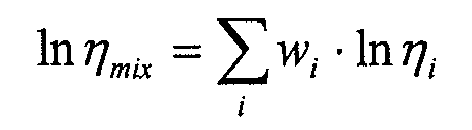
- ηmix = viscosity of triglyceride mixture in cP.
- wi = weight fraction of triglyceride 'i' in the triglyceride mixture.
- ηi = viscosity of triglyceride i in the mixture in cP.
- The melting point of pure triglyceride may also be obtained using a mathematical model based on the following factors:
- 1. Melting points of FAME which constitute the triglyceride molecule
- 2. Number of carbon atoms in fatty acid chain of FAME.
- 3. A descriptor to account for the similarity between terminal fatty acid chains (Terminal Equal).

- MPFAME1 = melting point of FAME present in the triglyceride at terminal position 1 in K
- MPFAME2 = melting point of FAME present in the triglyceride at central position 2 in K
- MPFAME3 = melting point of FAME present in the triglyceride at terminal position 3 in K
- nCF1 = number of carbon atoms in fatty acid chain of FAME at terminal position 1
- nCF2 = number of carbon atoms in fatty acid chain of FAME at central position 2
- nCF3 = number of carbon atoms in fatty acid chain of FAME at terminal position 3.
- Terminal Equal = 1 when the two terminal fatty acids fragments are the same or 0 when they are different.
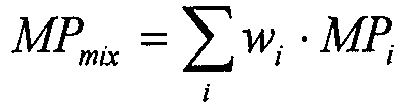
- MPmix= melting point of triglyceride mixture in K.
- wi = weight fraction of triglyceride 'i' in the triglyceride mixture.
- MPi = melting point of triglyceride 'i' in triglyceride mixture in K.
- The flash point of triglyceride or triglyceride mixtures may also be obtained using a mathematical model based on the heat of vaporization of pure triglyceride or triglyceride mixtures respectively.

- Flash point = Flash point of triglyceride in K
- ΔHVAP = heat of vaporization of pure triglycerides or triglyceride mixtures in kJ/mol.
- ΔHvap mix = heat of vaporization of the triglyceride mixture in kJ/mol
- Ni = mole fraction of triglyceride i in the triglyceride mixture.
- ΔHvap ,i = heat of vaporization of the triglyceride 'i' in kJ/mol
- The compositions reported in Table 1 are based on models built to predict the following properties of triglycerides and mixtures of triglycerides: viscosity, flash point and melting point. All examples exhibit the desired balance of viscosity ≤33 cP at 40°C and ≤120 cP at 10°C, flash point ≥260°C, and melting point of -15°C or less. The predicted melting point range provides the upper and the lower limit of the melting point of the mixture. This is based on the highest and lowest predicted melting points of the individual components of the composition. The melting points of the mixtures are determined by the methods mentioned above. Mixtures of triglycerides are highly interacting; hence the weight average is an approximate value of the melting point of the composition. The data on Example 5 show that the predicted melting points are identical to that determined experimentally by DSC. Similarly, there is very good agreement between the predicted and measured viscosities at 40°C of Example 5.
Table 1 Examples 1 to 10 Example # C18:1 (wt%) C18:2 (wt%) C18:3 (wt%) C16:1 (wt%) C14:1 (wt%) C18:0 (wt %) Pred Visc (cP) (40 deg C) Pred Vise (cP) (10 deg C) Pred Flash Point (°C) MP (DSC) (°C) Pred MP Range (°C) Pred MP (wt avg) (°C) Pred MP (Epsilon model) (°C) 1 100 17.1 54.75 275 -29 -29 -29 2 25 75 19.1 65.93 297 -29<T<-24 -24.5 -28.3 3 50 50 21.15 77.1 289 -29<T<-24 -22.8 -26.6 4 75 25 23.2 88.27 281.9 -29< T< -24 -24 -27.8 5 100 25.1/25 (expt) 99.44 305 -22.3 T<-22 -22.3 -22.3 6 5 95 25.7 100.24 306.6 -24<T<0.5 -21.2 -24.5 7 10 90 26.2 101.04 306.2 -24<T<0.5 -20 -23.3 Saturates 8 8.5 1.5 85 <5% 20.2 69 280.5 -29<T<-13 -22.5 -22.5 9 8.5 1.5 85 <5% 27.01 106.98 307 -29<T<-13 -16.8 -20.6 10 5 5 85 <5% 27.8 109.8 306.8 -24<T<0.5 -16 -23.7 - In Table 2 Comparative Sample (CS) 1 to CS 10 are known triglyceride compositions. CS 2 and CS 3 reports compositions containing high amount of saturates, > 7 %, and do not provide the desired balance of properties, especially the melting point. CS 4 to CS10 report properties of triglycerides of various fatty acids which do not yield the desired balance of properties with ≤ 2 wt% of polyunsaturated fatty acids. In particular, CS 7 and CS 8 provides balance of properties, but has polyunsaturated content > 12 % or are essentially triglycerides of polyunsaturated fatty acids.
- Comparative Sample (CS) 11 to CS 18 are triglyceride compositions comprising varying amounts of diluents added to HOCO (High Oleic Canola oil). The composition of HOCO is:
- 1. Triglyceride containing C 18 mono-unsaturated fatty acid = 74 %
- 2. Triglyceride containing C 18 di-unsaturated fatty acid = 14.5 %
- 3. Triglyceride containing C18 tri-unsaturated fatty acid = 4.5 %
- 4. Triglyceride containing C18 saturated fatty acid = 4 %
- 5. Triglyceride containing C16 saturated fatty acid = 3
- SE 1185D is soy fatty acid methyl ester (FAME), NYCOBASE SEH is dioctyl sebacate, and PAO 2.5 is polyalphaolefin. The comparative samples with fatty acid compositions (CS 11 to CS 18) did not yield the desired combination of properties. In particular, CS 12 (HOCO: triglyceride with C18:1 > 70 %, triglyceride with C18:2 > 14 %, triglyceride with C18:3 < 3 %) has a viscosity at 40°C > 33 cP (with flash point > 300 deg C). CS13 to CS18 reports compositions of HOCO with various diluents which do not yield the desired combination of properties.


Table 3 Comparison of Properties of Various Vegetable Oils Viscosity (cp) at 40 deg C Flash Point (deg C) Melting point (deg C) Polyunsaturated content (%) Castor > 33 > 300 Coconut 25 Corn > 300 >50% Cottonseed >50% Crambie > 33 Jojoba Non triglyceride containing components Lesquerella > 33 Linseed >50% Olive > 33 >- 15 Palm > -15 Rapeseed (Canola) > 300 >30% Safflower > 300 >50% Sunflower > 300 >50% Soya > 300 >30% Veronia Functionalized triglycerides (epoxidized fatty acids) - Table 3 reports the properties of various natural oils, none of which exhibit the desired balance. In particular corn oil, cottonseed oil, linseed oil, canola oil, safflower oil, sunflower oil, and soy oil have high content of triglycerides of polyunsaturated fats (> 15%) while castor, crambie, lesquerella, and olive have high viscosity (> 33cP), and coconut oil and palm oil have high melting points.
- Although the invention has been described with certain detail through the preceding description of the preferred embodiments, this detail is for the primary purpose of illustration.
A further correction to the average melting point model was made by including degree of isomorphism (ε). The degree of isomorphism accounts for structural dissimilarity present in triglyceride mixtures which may result in lowering of melting points. The procedure of calculating ε is described in Wesdorp, L. H. Liquid-multiple solid phase equilibria in fats. Ph. D. Thesis, University Delft, The Netherlands, 1990 . For cis-unsaturated fatty acid fragments, the overlapping volume was decided by the projected length of cis-unsaturated fragment on straight chain saturated fragment.
ε between different triglyceride pairs was calculated and the lowest of ε, min(ε), was used as a model descriptor. min(ε) is an indicator of maximum dissimilarity present in triglyceride mixtures. The epsilon model for melting point prediction is given as

The heat of vaporization of triglyceride mixtures can be determined using the following relationship

Claims (7)
- A composition of triglycerides comprising in weight percent based on the weight of the composition:A. Greater than 0 to 100% of at least one of C 14:1 or C16:1 fatty acids; and at least one of:B. No more than (≤) 10% of C18:1 fatty acids;C. No more than (≤) 12% of one or more polyunsaturated fatty acids; andD. No more than (≤) 7% of one or more saturated fatty acids.
- The composition of Claim 1 comprising at least two of the fatty acids of (B), (C) and (D).
- The composition of Claim 1 comprising all three of the fatty acids of (B), (C) and (D).
- A composition of triglycerides consisting of, in weight percent based on the weight of the composition:A. Greater than 0 to 100% of at least one of C 14:1 or C16:1 fatty acids; and at least one of:B. No more than (≤) 10% of C18:1 fatty acids;C. No more than (≤) 12% of one or more polyunsaturated fatty acids; andD. No more than (≤) 7% of one or more saturated fatty acids.
- An electrical device comprising a dielectric fluid in which the dielectric fluid is a composition of triglycerides comprising in weight percent based upon the weight of the composition:A. Greater than 0 to 100% of at least one of C14:1 or C16:1 fatty acids;B. No more than (≤) 10% of C18:1 fatty acids;C. No more than (≤) 12% of one or more polyunsaturated fatty acids; andD. No more than (≤) 7% of one or more saturated fatty acids.
- The electrical device of Claim 5 in which the dielectric fluid consists of a triglyceride of C14:1 and/or C16:1 fatty acid.
- The electrical device of Claim 5 in which the dielectric fluid consists of triglycerides of:A. Greater than 0 to 100% of at least one of C14:1 or C16:1 fatty acids;B. No more than (≤) 10% of C18:1 fatty acids;C. No more than (≤) 12% of one or more polyunsaturated fatty acids; andD. No more than (≤) 7% of one or more saturated fatty acids.
Applications Claiming Priority (2)
| Application Number | Priority Date | Filing Date | Title |
|---|---|---|---|
| PCT/IN2012/000692 WO2014054049A1 (en) | 2012-10-01 | 2012-10-18 | Non-oleic triglyceride based, low viscosity, high flash point dielectric fluids |
| PCT/US2013/060050 WO2014062328A1 (en) | 2012-10-18 | 2013-09-17 | Non-oleic triglyceride based, low viscosity, high flash point dielectric fluids |
Publications (2)
| Publication Number | Publication Date |
|---|---|
| EP2908654A1 EP2908654A1 (en) | 2015-08-26 |
| EP2908654B1 true EP2908654B1 (en) | 2016-08-17 |
Family
ID=49305108
Family Applications (1)
| Application Number | Title | Priority Date | Filing Date |
|---|---|---|---|
| EP13773924.9A Active EP2908654B1 (en) | 2012-10-18 | 2013-09-17 | Non-oleic triglyceride based, low viscosity, high flash point dielectric fluids |
Country Status (9)
| Country | Link |
|---|---|
| US (1) | US9607730B2 (en) |
| EP (1) | EP2908654B1 (en) |
| JP (1) | JP6193382B2 (en) |
| KR (1) | KR102133739B1 (en) |
| CN (2) | CN104703477B (en) |
| BR (1) | BR112015008433B1 (en) |
| CA (1) | CA2887042C (en) |
| MX (1) | MX358743B (en) |
| WO (1) | WO2014062328A1 (en) |
Families Citing this family (3)
| Publication number | Priority date | Publication date | Assignee | Title |
|---|---|---|---|---|
| US20150248947A1 (en) * | 2012-10-18 | 2015-09-03 | Dow Global Technologies Llc | Triglyceride Based, Low Viscosity, High Flash Point Dielectric Fluids |
| FR3077299B1 (en) * | 2018-02-01 | 2020-10-30 | Tropical Essence Sdn Bhd | ADDITIVE FOR OIL BASED ON TRIGLYCERIDES |
| US20230265349A1 (en) * | 2022-02-18 | 2023-08-24 | General Electric Technology Gmbh | Soluble water scavenger molecules for use with dielectric fluids |
Family Cites Families (24)
| Publication number | Priority date | Publication date | Assignee | Title |
|---|---|---|---|---|
| JPS63254989A (en) * | 1987-04-09 | 1988-10-21 | Kanegafuchi Chem Ind Co Ltd | Production of tripalmitoleyl glyceride |
| JPH01187089A (en) * | 1987-05-12 | 1989-07-26 | Shikishima Boseki Kk | Production of palmitoleic acid and glyceride thereof |
| JPH06245759A (en) * | 1993-02-19 | 1994-09-06 | Showa Sangyo Co Ltd | Method for producing microorganisms and fats having fat and oil production capacity |
| GB9404483D0 (en) * | 1994-03-08 | 1994-04-20 | Norsk Hydro As | Refining marine oil compositions |
| US5844029A (en) * | 1995-09-25 | 1998-12-01 | General Electric Company | Polymer compositions containing hydrocarbon amine oxide and hydrocarbon amine oxide stabilizer compositions |
| US6398986B1 (en) | 1995-12-21 | 2002-06-04 | Cooper Industries, Inc | Food grade vegetable oil based dielectric fluid and methods of using same |
| US6352655B1 (en) | 1995-12-21 | 2002-03-05 | Cooper Industries, Inc. | Vegetable oil based dielectric fluid |
| US5766517A (en) | 1995-12-21 | 1998-06-16 | Cooper Industries, Inc. | Dielectric fluid for use in power distribution equipment |
| EP0843000B1 (en) | 1996-06-04 | 2002-10-16 | Fuji Oil Company, Limited | Lube base oil and process for preparing the same |
| US5949017A (en) | 1996-06-18 | 1999-09-07 | Abb Power T&D Company Inc. | Electrical transformers containing electrical insulation fluids comprising high oleic acid oil compositions |
| US6340658B1 (en) | 1998-05-11 | 2002-01-22 | Wavely Light And Power | Vegetable-based transformer oil and transmission line fluid |
| US6159913A (en) | 1998-05-11 | 2000-12-12 | Waverly Light And Power | Soybean based transformer oil and transmission line fluid |
| JP4098927B2 (en) * | 1999-08-03 | 2008-06-11 | 花王株式会社 | Oil composition |
| DE60024401T2 (en) * | 1999-12-10 | 2006-08-03 | Loders Croklaan B.V. | Palmitoleic acid and its use in food |
| FR2855527B1 (en) | 2003-05-30 | 2006-07-28 | Electricite De France | DIELECTRIC LIQUID COMPOSITIONS, BASED ON MODIFIED OLEIC COLZA OIL, AND ELECTRICAL DEVICES CONTAINING THE SAME AS INSULATING LIQUIDS AND HEAT-DRIERS |
| JP2007070486A (en) * | 2005-09-07 | 2007-03-22 | Koyo Fine Chemical Kk | Glyceride and method for producing the same |
| CN101278362B (en) * | 2005-09-09 | 2012-06-06 | 狮王株式会社 | Base for electrical insulating oil |
| CA2625185A1 (en) * | 2005-10-11 | 2007-04-19 | Biolectric Pty Ltd | Low viscosity vegetable oil-based dielectric fluids |
| BRPI0823318A2 (en) * | 2008-12-19 | 2015-06-23 | Prolec Ge Internacional S De R L De C V | "antioxidant-free vegetable oil-based dielectric fluid composition". |
| EP2411481B1 (en) * | 2009-03-27 | 2016-08-03 | E. I. du Pont de Nemours and Company | Dielectric heat-transfer fluid |
| KR101792297B1 (en) | 2009-12-28 | 2017-10-31 | 다우 글로벌 테크놀로지스 엘엘씨 | Algae oil based dielectric fluid for electrical components |
| CN103119093B (en) * | 2010-09-17 | 2017-05-24 | 陶氏环球技术有限责任公司 | A thermally-stable dielectric fluid |
| IT1403878B1 (en) * | 2011-02-14 | 2013-11-08 | A & A Flii Parodi Srl | VEGETABLE DIELECTRIC FLUID FOR ELECTRIC TRANSFORMERS |
| US20150248947A1 (en) * | 2012-10-18 | 2015-09-03 | Dow Global Technologies Llc | Triglyceride Based, Low Viscosity, High Flash Point Dielectric Fluids |
-
2013
- 2013-09-17 BR BR112015008433-8A patent/BR112015008433B1/en active IP Right Grant
- 2013-09-17 JP JP2015537709A patent/JP6193382B2/en active Active
- 2013-09-17 EP EP13773924.9A patent/EP2908654B1/en active Active
- 2013-09-17 CN CN201380053374.3A patent/CN104703477B/en active Active
- 2013-09-17 US US14/432,929 patent/US9607730B2/en active Active
- 2013-09-17 CA CA2887042A patent/CA2887042C/en active Active
- 2013-09-17 CN CN202010166257.XA patent/CN111508638B/en active Active
- 2013-09-17 KR KR1020157009693A patent/KR102133739B1/en active Active
- 2013-09-17 WO PCT/US2013/060050 patent/WO2014062328A1/en not_active Ceased
- 2013-09-17 MX MX2015004941A patent/MX358743B/en active IP Right Grant
Also Published As
| Publication number | Publication date |
|---|---|
| CA2887042A1 (en) | 2014-04-24 |
| US9607730B2 (en) | 2017-03-28 |
| CN111508638B (en) | 2021-12-21 |
| KR20150073982A (en) | 2015-07-01 |
| JP6193382B2 (en) | 2017-09-06 |
| WO2014062328A1 (en) | 2014-04-24 |
| CA2887042C (en) | 2020-10-13 |
| JP2016504424A (en) | 2016-02-12 |
| CN111508638A (en) | 2020-08-07 |
| KR102133739B1 (en) | 2020-07-15 |
| US20150243406A1 (en) | 2015-08-27 |
| MX358743B (en) | 2018-09-03 |
| MX2015004941A (en) | 2015-08-05 |
| EP2908654A1 (en) | 2015-08-26 |
| CN104703477A (en) | 2015-06-10 |
| CN104703477B (en) | 2020-04-07 |
| BR112015008433B1 (en) | 2021-09-08 |
| BR112015008433A2 (en) | 2017-07-04 |
Similar Documents
| Publication | Publication Date | Title |
|---|---|---|
| EP2908655B1 (en) | Oleic and medium chain length triglyceride based, low viscosity, high flash point dielectric fluids | |
| Freire et al. | Evaluation of the oxidative stability and flow properties of quaternary mixtures of vegetable oils for biodiesel production | |
| EP2908653B1 (en) | Triglyceride based, low viscosity, high flash point dielectric fluids | |
| US9607730B2 (en) | Non-oleic triglyceride based, low viscosity, high flash point dielectric fluids | |
| Yu et al. | Renewable low-viscosity dielectrics based on vegetable oil methyl esters | |
| WO2014054048A1 (en) | Triglyceride based, low viscosity, high flash point dielectric fluids | |
| WO2014054049A1 (en) | Non-oleic triglyceride based, low viscosity, high flash point dielectric fluids | |
| Seemamahannop et al. | Assessment of oxidative stability and physical properties of high oleic natural esters | |
| WO2014054047A1 (en) | Oleic and medium chain length triglyceride based, low viscosity, high flash point dielectric fluids | |
| WO2025181954A1 (en) | Insulating oil composition and oil-filled electric device | |
| WO2026010495A2 (en) | Polyol ester composition for fire-resistant hydraulic fluids |
Legal Events
| Date | Code | Title | Description |
|---|---|---|---|
| PUAI | Public reference made under article 153(3) epc to a published international application that has entered the european phase |
Free format text: ORIGINAL CODE: 0009012 |
|
| 17P | Request for examination filed |
Effective date: 20150417 |
|
| AK | Designated contracting states |
Kind code of ref document: A1 Designated state(s): AL AT BE BG CH CY CZ DE DK EE ES FI FR GB GR HR HU IE IS IT LI LT LU LV MC MK MT NL NO PL PT RO RS SE SI SK SM TR |
|
| AX | Request for extension of the european patent |
Extension state: BA ME |
|
| DAX | Request for extension of the european patent (deleted) | ||
| REG | Reference to a national code |
Ref country code: DE Ref legal event code: R079 Ref document number: 602013010442 Country of ref document: DE Free format text: PREVIOUS MAIN CLASS: A23D0009000000 Ipc: C07C0069533000 |
|
| GRAP | Despatch of communication of intention to grant a patent |
Free format text: ORIGINAL CODE: EPIDOSNIGR1 |
|
| RIC1 | Information provided on ipc code assigned before grant |
Ipc: H01B 3/20 20060101ALI20160129BHEP Ipc: C07C 69/533 20060101AFI20160129BHEP |
|
| INTG | Intention to grant announced |
Effective date: 20160224 |
|
| GRAS | Grant fee paid |
Free format text: ORIGINAL CODE: EPIDOSNIGR3 |
|
| GRAA | (expected) grant |
Free format text: ORIGINAL CODE: 0009210 |
|
| AK | Designated contracting states |
Kind code of ref document: B1 Designated state(s): AL AT BE BG CH CY CZ DE DK EE ES FI FR GB GR HR HU IE IS IT LI LT LU LV MC MK MT NL NO PL PT RO RS SE SI SK SM TR |
|
| REG | Reference to a national code |
Ref country code: GB Ref legal event code: FG4D |
|
| REG | Reference to a national code |
Ref country code: FR Ref legal event code: PLFP Year of fee payment: 4 |
|
| REG | Reference to a national code |
Ref country code: CH Ref legal event code: EP |
|
| REG | Reference to a national code |
Ref country code: IE Ref legal event code: FG4D |
|
| REG | Reference to a national code |
Ref country code: AT Ref legal event code: REF Ref document number: 820906 Country of ref document: AT Kind code of ref document: T Effective date: 20160915 |
|
| REG | Reference to a national code |
Ref country code: DE Ref legal event code: R096 Ref document number: 602013010442 Country of ref document: DE |
|
| REG | Reference to a national code |
Ref country code: NL Ref legal event code: MP Effective date: 20160817 |
|
| REG | Reference to a national code |
Ref country code: LT Ref legal event code: MG4D |
|
| REG | Reference to a national code |
Ref country code: AT Ref legal event code: MK05 Ref document number: 820906 Country of ref document: AT Kind code of ref document: T Effective date: 20160817 |
|
| PG25 | Lapsed in a contracting state [announced via postgrant information from national office to epo] |
Ref country code: FI Free format text: LAPSE BECAUSE OF FAILURE TO SUBMIT A TRANSLATION OF THE DESCRIPTION OR TO PAY THE FEE WITHIN THE PRESCRIBED TIME-LIMIT Effective date: 20160817 Ref country code: LT Free format text: LAPSE BECAUSE OF FAILURE TO SUBMIT A TRANSLATION OF THE DESCRIPTION OR TO PAY THE FEE WITHIN THE PRESCRIBED TIME-LIMIT Effective date: 20160817 Ref country code: NO Free format text: LAPSE BECAUSE OF FAILURE TO SUBMIT A TRANSLATION OF THE DESCRIPTION OR TO PAY THE FEE WITHIN THE PRESCRIBED TIME-LIMIT Effective date: 20161117 Ref country code: NL Free format text: LAPSE BECAUSE OF FAILURE TO SUBMIT A TRANSLATION OF THE DESCRIPTION OR TO PAY THE FEE WITHIN THE PRESCRIBED TIME-LIMIT Effective date: 20160817 Ref country code: HR Free format text: LAPSE BECAUSE OF FAILURE TO SUBMIT A TRANSLATION OF THE DESCRIPTION OR TO PAY THE FEE WITHIN THE PRESCRIBED TIME-LIMIT Effective date: 20160817 Ref country code: RS Free format text: LAPSE BECAUSE OF FAILURE TO SUBMIT A TRANSLATION OF THE DESCRIPTION OR TO PAY THE FEE WITHIN THE PRESCRIBED TIME-LIMIT Effective date: 20160817 |
|
| PG25 | Lapsed in a contracting state [announced via postgrant information from national office to epo] |
Ref country code: SE Free format text: LAPSE BECAUSE OF FAILURE TO SUBMIT A TRANSLATION OF THE DESCRIPTION OR TO PAY THE FEE WITHIN THE PRESCRIBED TIME-LIMIT Effective date: 20160817 Ref country code: BE Free format text: LAPSE BECAUSE OF NON-PAYMENT OF DUE FEES Effective date: 20160930 Ref country code: PT Free format text: LAPSE BECAUSE OF FAILURE TO SUBMIT A TRANSLATION OF THE DESCRIPTION OR TO PAY THE FEE WITHIN THE PRESCRIBED TIME-LIMIT Effective date: 20161219 Ref country code: GR Free format text: LAPSE BECAUSE OF FAILURE TO SUBMIT A TRANSLATION OF THE DESCRIPTION OR TO PAY THE FEE WITHIN THE PRESCRIBED TIME-LIMIT Effective date: 20161118 Ref country code: ES Free format text: LAPSE BECAUSE OF FAILURE TO SUBMIT A TRANSLATION OF THE DESCRIPTION OR TO PAY THE FEE WITHIN THE PRESCRIBED TIME-LIMIT Effective date: 20160817 Ref country code: AT Free format text: LAPSE BECAUSE OF FAILURE TO SUBMIT A TRANSLATION OF THE DESCRIPTION OR TO PAY THE FEE WITHIN THE PRESCRIBED TIME-LIMIT Effective date: 20160817 Ref country code: LV Free format text: LAPSE BECAUSE OF FAILURE TO SUBMIT A TRANSLATION OF THE DESCRIPTION OR TO PAY THE FEE WITHIN THE PRESCRIBED TIME-LIMIT Effective date: 20160817 Ref country code: PL Free format text: LAPSE BECAUSE OF FAILURE TO SUBMIT A TRANSLATION OF THE DESCRIPTION OR TO PAY THE FEE WITHIN THE PRESCRIBED TIME-LIMIT Effective date: 20160817 |
|
| PG25 | Lapsed in a contracting state [announced via postgrant information from national office to epo] |
Ref country code: EE Free format text: LAPSE BECAUSE OF FAILURE TO SUBMIT A TRANSLATION OF THE DESCRIPTION OR TO PAY THE FEE WITHIN THE PRESCRIBED TIME-LIMIT Effective date: 20160817 Ref country code: RO Free format text: LAPSE BECAUSE OF FAILURE TO SUBMIT A TRANSLATION OF THE DESCRIPTION OR TO PAY THE FEE WITHIN THE PRESCRIBED TIME-LIMIT Effective date: 20160817 |
|
| REG | Reference to a national code |
Ref country code: CH Ref legal event code: PL |
|
| REG | Reference to a national code |
Ref country code: DE Ref legal event code: R097 Ref document number: 602013010442 Country of ref document: DE |
|
| PG25 | Lapsed in a contracting state [announced via postgrant information from national office to epo] |
Ref country code: DK Free format text: LAPSE BECAUSE OF FAILURE TO SUBMIT A TRANSLATION OF THE DESCRIPTION OR TO PAY THE FEE WITHIN THE PRESCRIBED TIME-LIMIT Effective date: 20160817 Ref country code: SK Free format text: LAPSE BECAUSE OF FAILURE TO SUBMIT A TRANSLATION OF THE DESCRIPTION OR TO PAY THE FEE WITHIN THE PRESCRIBED TIME-LIMIT Effective date: 20160817 Ref country code: BG Free format text: LAPSE BECAUSE OF FAILURE TO SUBMIT A TRANSLATION OF THE DESCRIPTION OR TO PAY THE FEE WITHIN THE PRESCRIBED TIME-LIMIT Effective date: 20161117 Ref country code: CZ Free format text: LAPSE BECAUSE OF FAILURE TO SUBMIT A TRANSLATION OF THE DESCRIPTION OR TO PAY THE FEE WITHIN THE PRESCRIBED TIME-LIMIT Effective date: 20160817 Ref country code: SM Free format text: LAPSE BECAUSE OF FAILURE TO SUBMIT A TRANSLATION OF THE DESCRIPTION OR TO PAY THE FEE WITHIN THE PRESCRIBED TIME-LIMIT Effective date: 20160817 Ref country code: BE Free format text: LAPSE BECAUSE OF FAILURE TO SUBMIT A TRANSLATION OF THE DESCRIPTION OR TO PAY THE FEE WITHIN THE PRESCRIBED TIME-LIMIT Effective date: 20160817 |
|
| PLBE | No opposition filed within time limit |
Free format text: ORIGINAL CODE: 0009261 |
|
| STAA | Information on the status of an ep patent application or granted ep patent |
Free format text: STATUS: NO OPPOSITION FILED WITHIN TIME LIMIT |
|
| REG | Reference to a national code |
Ref country code: IE Ref legal event code: MM4A |
|
| PG25 | Lapsed in a contracting state [announced via postgrant information from national office to epo] |
Ref country code: MC Free format text: LAPSE BECAUSE OF FAILURE TO SUBMIT A TRANSLATION OF THE DESCRIPTION OR TO PAY THE FEE WITHIN THE PRESCRIBED TIME-LIMIT Effective date: 20160817 |
|
| 26N | No opposition filed |
Effective date: 20170518 |
|
| PG25 | Lapsed in a contracting state [announced via postgrant information from national office to epo] |
Ref country code: CH Free format text: LAPSE BECAUSE OF NON-PAYMENT OF DUE FEES Effective date: 20160930 Ref country code: IE Free format text: LAPSE BECAUSE OF NON-PAYMENT OF DUE FEES Effective date: 20160917 Ref country code: LI Free format text: LAPSE BECAUSE OF NON-PAYMENT OF DUE FEES Effective date: 20160930 |
|
| REG | Reference to a national code |
Ref country code: FR Ref legal event code: PLFP Year of fee payment: 5 |
|
| PG25 | Lapsed in a contracting state [announced via postgrant information from national office to epo] |
Ref country code: LU Free format text: LAPSE BECAUSE OF NON-PAYMENT OF DUE FEES Effective date: 20160917 Ref country code: SI Free format text: LAPSE BECAUSE OF FAILURE TO SUBMIT A TRANSLATION OF THE DESCRIPTION OR TO PAY THE FEE WITHIN THE PRESCRIBED TIME-LIMIT Effective date: 20160817 |
|
| GBPC | Gb: european patent ceased through non-payment of renewal fee |
Effective date: 20170917 |
|
| PG25 | Lapsed in a contracting state [announced via postgrant information from national office to epo] |
Ref country code: HU Free format text: LAPSE BECAUSE OF FAILURE TO SUBMIT A TRANSLATION OF THE DESCRIPTION OR TO PAY THE FEE WITHIN THE PRESCRIBED TIME-LIMIT; INVALID AB INITIO Effective date: 20130917 |
|
| PG25 | Lapsed in a contracting state [announced via postgrant information from national office to epo] |
Ref country code: CY Free format text: LAPSE BECAUSE OF FAILURE TO SUBMIT A TRANSLATION OF THE DESCRIPTION OR TO PAY THE FEE WITHIN THE PRESCRIBED TIME-LIMIT Effective date: 20160817 Ref country code: MK Free format text: LAPSE BECAUSE OF FAILURE TO SUBMIT A TRANSLATION OF THE DESCRIPTION OR TO PAY THE FEE WITHIN THE PRESCRIBED TIME-LIMIT Effective date: 20160817 Ref country code: IS Free format text: LAPSE BECAUSE OF FAILURE TO SUBMIT A TRANSLATION OF THE DESCRIPTION OR TO PAY THE FEE WITHIN THE PRESCRIBED TIME-LIMIT Effective date: 20160817 Ref country code: MT Free format text: LAPSE BECAUSE OF NON-PAYMENT OF DUE FEES Effective date: 20160930 |
|
| PG25 | Lapsed in a contracting state [announced via postgrant information from national office to epo] |
Ref country code: GB Free format text: LAPSE BECAUSE OF NON-PAYMENT OF DUE FEES Effective date: 20170917 |
|
| REG | Reference to a national code |
Ref country code: FR Ref legal event code: PLFP Year of fee payment: 6 |
|
| PG25 | Lapsed in a contracting state [announced via postgrant information from national office to epo] |
Ref country code: TR Free format text: LAPSE BECAUSE OF FAILURE TO SUBMIT A TRANSLATION OF THE DESCRIPTION OR TO PAY THE FEE WITHIN THE PRESCRIBED TIME-LIMIT Effective date: 20160817 Ref country code: AL Free format text: LAPSE BECAUSE OF FAILURE TO SUBMIT A TRANSLATION OF THE DESCRIPTION OR TO PAY THE FEE WITHIN THE PRESCRIBED TIME-LIMIT Effective date: 20160817 |
|
| P01 | Opt-out of the competence of the unified patent court (upc) registered |
Effective date: 20230526 |
|
| PGFP | Annual fee paid to national office [announced via postgrant information from national office to epo] |
Ref country code: DE Payment date: 20250702 Year of fee payment: 13 |
|
| PGFP | Annual fee paid to national office [announced via postgrant information from national office to epo] |
Ref country code: IT Payment date: 20250825 Year of fee payment: 13 |
|
| PGFP | Annual fee paid to national office [announced via postgrant information from national office to epo] |
Ref country code: FR Payment date: 20250708 Year of fee payment: 13 |