EP2908279A1 - Procédé et système de transaction électronique via un accessoire portable - Google Patents
Procédé et système de transaction électronique via un accessoire portable Download PDFInfo
- Publication number
- EP2908279A1 EP2908279A1 EP14305225.6A EP14305225A EP2908279A1 EP 2908279 A1 EP2908279 A1 EP 2908279A1 EP 14305225 A EP14305225 A EP 14305225A EP 2908279 A1 EP2908279 A1 EP 2908279A1
- Authority
- EP
- European Patent Office
- Prior art keywords
- transaction
- accessory
- terminal
- main apparatus
- main
- Prior art date
- Legal status (The legal status is an assumption and is not a legal conclusion. Google has not performed a legal analysis and makes no representation as to the accuracy of the status listed.)
- Withdrawn
Links
Images

Classifications
-
- G—PHYSICS
- G06—COMPUTING OR CALCULATING; COUNTING
- G06Q—INFORMATION AND COMMUNICATION TECHNOLOGY [ICT] SPECIALLY ADAPTED FOR ADMINISTRATIVE, COMMERCIAL, FINANCIAL, MANAGERIAL OR SUPERVISORY PURPOSES; SYSTEMS OR METHODS SPECIALLY ADAPTED FOR ADMINISTRATIVE, COMMERCIAL, FINANCIAL, MANAGERIAL OR SUPERVISORY PURPOSES, NOT OTHERWISE PROVIDED FOR
- G06Q20/00—Payment architectures, schemes or protocols
- G06Q20/30—Payment architectures, schemes or protocols characterised by the use of specific devices or networks
- G06Q20/32—Payment architectures, schemes or protocols characterised by the use of specific devices or networks using wireless devices
-
- G—PHYSICS
- G06—COMPUTING OR CALCULATING; COUNTING
- G06F—ELECTRIC DIGITAL DATA PROCESSING
- G06F8/00—Arrangements for software engineering
- G06F8/60—Software deployment
- G06F8/61—Installation
-
- G—PHYSICS
- G06—COMPUTING OR CALCULATING; COUNTING
- G06Q—INFORMATION AND COMMUNICATION TECHNOLOGY [ICT] SPECIALLY ADAPTED FOR ADMINISTRATIVE, COMMERCIAL, FINANCIAL, MANAGERIAL OR SUPERVISORY PURPOSES; SYSTEMS OR METHODS SPECIALLY ADAPTED FOR ADMINISTRATIVE, COMMERCIAL, FINANCIAL, MANAGERIAL OR SUPERVISORY PURPOSES, NOT OTHERWISE PROVIDED FOR
- G06Q20/00—Payment architectures, schemes or protocols
- G06Q20/08—Payment architectures
- G06Q20/10—Payment architectures specially adapted for electronic funds transfer [EFT] systems; specially adapted for home banking systems
- G06Q20/108—Remote banking, e.g. home banking
-
- G—PHYSICS
- G06—COMPUTING OR CALCULATING; COUNTING
- G06Q—INFORMATION AND COMMUNICATION TECHNOLOGY [ICT] SPECIALLY ADAPTED FOR ADMINISTRATIVE, COMMERCIAL, FINANCIAL, MANAGERIAL OR SUPERVISORY PURPOSES; SYSTEMS OR METHODS SPECIALLY ADAPTED FOR ADMINISTRATIVE, COMMERCIAL, FINANCIAL, MANAGERIAL OR SUPERVISORY PURPOSES, NOT OTHERWISE PROVIDED FOR
- G06Q20/00—Payment architectures, schemes or protocols
- G06Q20/30—Payment architectures, schemes or protocols characterised by the use of specific devices or networks
- G06Q20/32—Payment architectures, schemes or protocols characterised by the use of specific devices or networks using wireless devices
- G06Q20/321—Payment architectures, schemes or protocols characterised by the use of specific devices or networks using wireless devices using wearable devices
-
- G—PHYSICS
- G06—COMPUTING OR CALCULATING; COUNTING
- G06Q—INFORMATION AND COMMUNICATION TECHNOLOGY [ICT] SPECIALLY ADAPTED FOR ADMINISTRATIVE, COMMERCIAL, FINANCIAL, MANAGERIAL OR SUPERVISORY PURPOSES; SYSTEMS OR METHODS SPECIALLY ADAPTED FOR ADMINISTRATIVE, COMMERCIAL, FINANCIAL, MANAGERIAL OR SUPERVISORY PURPOSES, NOT OTHERWISE PROVIDED FOR
- G06Q20/00—Payment architectures, schemes or protocols
- G06Q20/30—Payment architectures, schemes or protocols characterised by the use of specific devices or networks
- G06Q20/32—Payment architectures, schemes or protocols characterised by the use of specific devices or networks using wireless devices
- G06Q20/322—Aspects of commerce using mobile devices [M-devices]
- G06Q20/3224—Transactions dependent on location of M-devices
-
- G—PHYSICS
- G06—COMPUTING OR CALCULATING; COUNTING
- G06Q—INFORMATION AND COMMUNICATION TECHNOLOGY [ICT] SPECIALLY ADAPTED FOR ADMINISTRATIVE, COMMERCIAL, FINANCIAL, MANAGERIAL OR SUPERVISORY PURPOSES; SYSTEMS OR METHODS SPECIALLY ADAPTED FOR ADMINISTRATIVE, COMMERCIAL, FINANCIAL, MANAGERIAL OR SUPERVISORY PURPOSES, NOT OTHERWISE PROVIDED FOR
- G06Q20/00—Payment architectures, schemes or protocols
- G06Q20/30—Payment architectures, schemes or protocols characterised by the use of specific devices or networks
- G06Q20/32—Payment architectures, schemes or protocols characterised by the use of specific devices or networks using wireless devices
- G06Q20/322—Aspects of commerce using mobile devices [M-devices]
- G06Q20/3226—Use of secure elements separate from M-devices
-
- G—PHYSICS
- G06—COMPUTING OR CALCULATING; COUNTING
- G06Q—INFORMATION AND COMMUNICATION TECHNOLOGY [ICT] SPECIALLY ADAPTED FOR ADMINISTRATIVE, COMMERCIAL, FINANCIAL, MANAGERIAL OR SUPERVISORY PURPOSES; SYSTEMS OR METHODS SPECIALLY ADAPTED FOR ADMINISTRATIVE, COMMERCIAL, FINANCIAL, MANAGERIAL OR SUPERVISORY PURPOSES, NOT OTHERWISE PROVIDED FOR
- G06Q20/00—Payment architectures, schemes or protocols
- G06Q20/30—Payment architectures, schemes or protocols characterised by the use of specific devices or networks
- G06Q20/32—Payment architectures, schemes or protocols characterised by the use of specific devices or networks using wireless devices
- G06Q20/326—Payment applications installed on the mobile devices
-
- G—PHYSICS
- G06—COMPUTING OR CALCULATING; COUNTING
- G06Q—INFORMATION AND COMMUNICATION TECHNOLOGY [ICT] SPECIALLY ADAPTED FOR ADMINISTRATIVE, COMMERCIAL, FINANCIAL, MANAGERIAL OR SUPERVISORY PURPOSES; SYSTEMS OR METHODS SPECIALLY ADAPTED FOR ADMINISTRATIVE, COMMERCIAL, FINANCIAL, MANAGERIAL OR SUPERVISORY PURPOSES, NOT OTHERWISE PROVIDED FOR
- G06Q20/00—Payment architectures, schemes or protocols
- G06Q20/30—Payment architectures, schemes or protocols characterised by the use of specific devices or networks
- G06Q20/32—Payment architectures, schemes or protocols characterised by the use of specific devices or networks using wireless devices
- G06Q20/327—Short range or proximity payments by means of M-devices
- G06Q20/3278—RFID or NFC payments by means of M-devices
-
- G—PHYSICS
- G06—COMPUTING OR CALCULATING; COUNTING
- G06Q—INFORMATION AND COMMUNICATION TECHNOLOGY [ICT] SPECIALLY ADAPTED FOR ADMINISTRATIVE, COMMERCIAL, FINANCIAL, MANAGERIAL OR SUPERVISORY PURPOSES; SYSTEMS OR METHODS SPECIALLY ADAPTED FOR ADMINISTRATIVE, COMMERCIAL, FINANCIAL, MANAGERIAL OR SUPERVISORY PURPOSES, NOT OTHERWISE PROVIDED FOR
- G06Q20/00—Payment architectures, schemes or protocols
- G06Q20/38—Payment protocols; Details thereof
- G06Q20/40—Authorisation, e.g. identification of payer or payee, verification of customer or shop credentials; Review and approval of payers, e.g. check credit lines or negative lists
- G06Q20/401—Transaction verification
- G06Q20/4012—Verifying personal identification numbers [PIN]
-
- G—PHYSICS
- G06—COMPUTING OR CALCULATING; COUNTING
- G06Q—INFORMATION AND COMMUNICATION TECHNOLOGY [ICT] SPECIALLY ADAPTED FOR ADMINISTRATIVE, COMMERCIAL, FINANCIAL, MANAGERIAL OR SUPERVISORY PURPOSES; SYSTEMS OR METHODS SPECIALLY ADAPTED FOR ADMINISTRATIVE, COMMERCIAL, FINANCIAL, MANAGERIAL OR SUPERVISORY PURPOSES, NOT OTHERWISE PROVIDED FOR
- G06Q20/00—Payment architectures, schemes or protocols
- G06Q20/38—Payment protocols; Details thereof
- G06Q20/40—Authorisation, e.g. identification of payer or payee, verification of customer or shop credentials; Review and approval of payers, e.g. check credit lines or negative lists
- G06Q20/401—Transaction verification
- G06Q20/4014—Identity check for transactions
- G06Q20/40145—Biometric identity checks
Definitions
- the invention generally relates to a method for performing an electronic transaction between a main communication apparatus or an accessory and a transaction terminal.
- Radiofrequency communication devices such as radiofrequency bank card, electronic tag (RFID), electronic badge, electronic passport, communicating accessory.
- RFID electronic tag
- electronic passport electronic passport
- NFC Near Field Communication
- the shows can be paired by NFC to a phone and then telephone communications received by the phone can be sent back by him via Bluetooth on the watch. It becomes unnecessary to take the phone out of the pocket since the telephone communication can be taken at the level of the watch.
- the NFC function of the watch is only used for pairing with the phone for the purpose of communicating via Bluetooth TM to each other to relay a current telephone call. This watch only performs communication exchanges of telephone data, voice, pictures, SMS with the phone.
- the invention therefore aims to remedy at least one of the disadvantages of the prior art.
- the invention aims primarily to provide a practical solution for performing a radio frequency electronic transaction without risk of theft of the radiofrequency device.
- the principle of the invention is based on the use of a radiofrequency accessory discreetly concealed in a current portable object such as a watch, a ring, a bracelet; This object is able to relay or represent the radiofrequency device at least for a transaction or a period of time or in a certain way.
- the accessory is preferably initialized by the portable primary device or device.
- this accessory can be initialized, customized or parameterized using the main device containing a transaction application.
- the invention avoids having to present the device to a transaction terminal and expose the main device to the eyes of third parties and the risk of theft.
- Transaction means any exchange (data, instructions, signals, messages ...) unilateral or bilateral between two objects of communication. These exchanges can be for various purposes such as banking transactions, identity, authentication, access, debit, credit ...
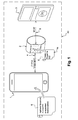
- a system 40 for carrying out a transaction is composed of a main apparatus 1, an accessory 2 and a terminal 3.
- the main apparatus 1 is here a smart mobile phone but can be any other object, intelligent device such a personal assistant (PDA) a laptop (LP), or other main portable communication device.
- the apparatus in the example notably has processing means ⁇ C, storage means (volatile and non-volatile), at least one communication interface with an associated accessory (described below) and at least one communication interface with the transaction terminal 3 which may be the same as the previous one.
- This communication interface can be of any technological type such as Bluetooth (BT, wifi, NFC, RF radio frequency, UHF, optical, infrared ...) to establish a communication 4 with the accessory.
- the communication 4 between the main communication device 1 and the relay accessory is of Bluetooth TM type (hereinafter also referred to as BT), while that between the relay accessory and the transaction apparatus is radio frequency type NFC, RF in particular according to the ISO 14443 standard.
- the main communication device 1 preferably comprises man-machine interface (HMI) means with a user such as keyboard 7, display 8.
- HMI man-machine interface
- the device 1 also comprises at least one transaction application 6 in an internal memory (SE) or an external mass memory such as a mass memory card (Mini SIM, SD, micro SD) or a USB key preferably secure.
- SE internal memory
- MSI SIM, SD, micro SD
- USB key preferably secure.
- the application is in a SIM card which is connected in known manner by an NFC controller provided with a radio frequency interface.
- the transaction software application (AB) 6 is of the banking, financial, or payment type.
- This transaction application makes it possible to carry out an electronic transaction with the transaction terminal 3 such as a banking terminal (ATM, POS), a base station, a consumer goods distributor, etc.
- the phone or device is a portable payment terminal radio proximity reader including contactless cards or mobile phone with an NFC function and / or cardless emulation card mode.
- the phone or device may also lack certain capabilities including radio frequency (NFC), which are included in a complementary manner in the accessories thus bringing additional interest to the accessory 2.
- NFC radio frequency
- the invention comprises a step of providing an intelligent portable accessory 2.
- the latter according to the mode illustrated in FIG. figure 1 , is able to relay the transaction or according to the mode illustrated in figure 2 to represent said main apparatus with respect to a transaction terminal.
- the accessory 2 may comprise communication and interface means adapted to transpose a Bluetooth communication in radio frequency communication.
- the accessory can extract data or instructions received from the main device in the form of radio frequency frames encapsulated in another communication protocol such as a Bluetooth protocol.
- the accessory and the device are configured to encapsulate and encapsulate radio frequency frames in Bluetooth type messages, especially when they communicate with each other.
- the data or instructions transmitted by the main apparatus 1 in the form of radio frequency frames are received by the accessory being encapsulated in particular by the Bluetooth protocol and vice versa for those transmitted by the accessory to the main device.
- the data or instructions received by the accessory can be decoded or encapsulated by the accessory before being returned by the accessory or alternately placed temporarily in a memory of the accessory to be read by the transaction terminal.
- the accessory can either retransmit itself the data and / or instructions actively as soon as they are available, or passively allow a reading by the transaction terminal acting as a reader.
- the data and / or instructions from the main apparatus are received and extracted in the accessory and then read or transmitted by a communication in the form of radio frequency frames to the transaction terminal 3.
- the method provides that the accessory has communication means configured to relay data and control instructions between the main device and the terminal.
- the accessory 2 in the example is an electronic watch comprising interface means on the one hand with the transaction terminal 3 and on the other hand with the main apparatus 1 as indicated above.
- the watch includes a bracelet for wear it on the wrist.
- the accessory may comprise buffer memory means for storing at least temporarily data and / or instructions to be exchanged between the transaction terminal and the main apparatus. Alternatively, data and instructions may not be stored but relayed as they arrive.
- the watch may comprise a watch case with a digital display or not, preferably sensitive to interact with the user as on the device 1.
- the communication between the main apparatus and the accessory may be of the electrical type through the body or on the surface of the skin.
- Capacitive means may be present in each of the apparatus and accessory for collecting the signal exchanges before extracting information (data, instructions) for processing.
- the exchanges between the accessory and the terminal can be capacitive.
- the accessory can be configured to simply relay a capacitive signal, electrical or other. If necessary, the accessory may include means for amplifying the received signal with or without an energy source, on-board battery.
- the method provides for implementing a step of installing a software application including banking in the main device.
- the accessory relay transactions transparently transaction between the main device containing the banking application (or any other transaction application including access control, payment ...) and the transaction terminal.
- a user can wear an accessory 2 discreetly in the form of a watch and have his main device 1 such as his phone in his pocket or bag.
- the user approaches his accessory near the transaction terminal reader.
- the reader transmits an interrogation / read signal to the main apparatus in the form of radio frequency frames; the accessory can be powered by the energy of the radiofrequency field of the retrieved reader.
- This energy can be used to perform data processing and instruction (eg read instruction of a right, or identifier, or order of settlement of rights, units of value, financial or other.
- the watch comprises a radiofrequency antenna which captures the radiofrequency field conveying the energy and the data and / or instructions of the radiofrequency reader. This energy is used to extract frames of data and / or radio frequency instructions and to perform encapsulation and transmission processing of these frames according to the Bluetooth protocol for the main unit 1.
- the main unit 1 receives the Bluetooth signals from the accessory then extracts the radio frequency frames for transmission and processing by means of NFC radio frequency interface (in particular in contactless card emulation mode).
- the radiofrequency interface means return information (data, instruction) requested by implementing the previously loaded transaction application. This information is in turn sent back as radio frequency frames encapsulated according to the Bluetooth protocol for the accessory.
- the accessory 2 receives the Bluetooth signal, extracts the radio frequency frames and the corresponding data or instructions and transmits them to the reader, notably by modulating the radio frequency reading field of the reader.
- the method preferably provides a step of initialization (or initiation) of the accessory using the main device or pairing the accessory to the device main.
- the apparatus comprises in the example an initialization and / or pairing application (A1).
- the advantage of the invention is to allow a realization of a transaction by presenting the accessory to the transaction terminal in place of the main device.
- the latter may be concealed or not exposed while being worn in a garment or bag, bag ...
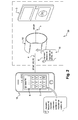
- a transaction system 30 comprising an accessory 12 and a transaction terminal 3 is described.
- the electronic transaction accessory 12 is able to represent a main apparatus. 10 communication with a transaction terminal 10.
- the accessory has been configured beforehand and it was proceeded in the phone to an installation of a specific application management accessory, pairing. ..; in this case, the phone can be used almost as a remote screen of the accessory.
- the same reference numbers represent the same or similar elements as in the previous figure.
- the elements 1, 2 may be identical or similar to the elements 10, 12 while having certain common functions.
- the accessory 12 can include as in the figure 1 , the same electronic hardware means including communication and / or interface with the main apparatus 10 and with the transaction terminal 3. It may include a man / machine interface (keyboard 7, screen 8). However, unlike the first embodiment, the second mode can be freed from the presence of the main device during a transaction with the transaction terminal.
- the accessory comprises at least one transaction application (for example A2) referred to in the first mode and contained in identical or similar storage means in particular in an internal memory (SE2) or an external mass memory such as a mass memory card (Mini SIM, SD, micro SD) or a USB key preferably secure.
- the accessory itself can perform the function of a USB key comprising one or more contactless communication interfaces.
- the transaction application in the accessory makes it possible to carry out directly (without presence or intervention of the main apparatus during the transaction) an electronic transaction with a transaction terminal 3 such as a banking terminal (ATM, POS), a terminal access, a distributor of consumer goods ...
- the method also preferably provides for a step of initialization (or initiation) of the accessory, in particular using the main or pairing apparatus of the second embodiment.
- the accessory especially to the main unit
- initiation can also include the concept of configuration, training, transfer of means, information, learning, training allowing the accessory to perform a transaction in place of the main device.
- the apparatus therefore also preferably comprises an initialization (initiation) and / or pairing (A1) application of an associated accessory (12).
- the accessory Seen from the transaction terminal, the accessory includes all the attributes of the apparatus required to perform the transaction as if it were the transaction device itself (rights, protocol, keys, procedures, identification, authentication or any other hardware or software ).
- the information relating to the transaction application may include, in particular, the electronic transaction software application itself as it is present in the transaction terminal (program, personal data, identifier, bank account, address, merchant reference , overdraft amount authorized, credit, debit ).
- the information may include the PIN or other authentication element (fingerprint, digitized biometric element) permanently or temporarily as described below.
- the accessory can be equipped with the information or data necessary to carry out at least one transaction. If the accessory has custom banking applications, the copy of the PIN in the accessory may be sufficient.
- This information can come from the main personal device or other personalization device including self-service (interactive terminal ...) able to transfer information, rights, subscription, personalization.
- a user can program the accessory the day before using the main unit so that the accessory represents the transaction device for access to the metro within the limit of a round trip and if necessary within certain time periods.
- the subway payment application or other means of transportation can be in the accessory, the PIN can be copied from the phone to the accessory, and cleared when the accessory is removed from the handle / hand or at the end of the day or another period of time through an internal clock.
- the user can, alternatively, program the accessory to allow a purchase of a predetermined maximum amount.
- the programming can make it possible to give the PIN code once and / or to authorize a transaction with a PIN code within a time slot or with certain transaction terminals previously identified (relating to an organization or located in one place).
- a GPS (Global Positioning System) or equivalent can be incorporated in the accessory to allow the location and allow or not a transaction depending on the areas authorized to perform a transaction.
- the user has a geographical control on the transactions in case of theft of his accessory.
- the user can thus free himself from exposing his main device like a mobile phone to prying eyes.
- the device can remain at home or in a pocket or bag while active or not.
- the invention thus prevents a theft of the main device when it is exposed during a transaction.
- the user can choose the need to have the device 1 and the accessory 2 close or not to carry out transactions.
- the method provides that at least one of the initialization / initiation or pairing steps above comprises a launching phase of a control application of the accessory by the main unit.
- This launch can be performed, for example, in particular by selecting the user in a menu displayed by the main device.
- Parameters can be proposed by the menu as authorized amount, number of transaction with authentication by PIN and / or with biometric authentication.
- the user may or may not wish, harden or lighten the level of security implemented in its operations including financial, banking depending on the issues involved or dangerousness of the place where the transaction takes place or doubt as to the third-party trust or terminal with which the electronic transaction takes place, or the time the user has during the transaction.
- the invention makes it possible to control the implementation of the transaction application (which may be standard and non-modifiable) transferred to the accessory, via another control software application which has been associated with it. and set in the accessory.
- the control may relate in particular to a geographical area, a time period or in the manner authorized by the user (maximum amount, security level, authentication, identification of authorized transaction terminals, type of transaction including for example access to transportation, a food or clothing purchase, a payment to the restaurant, hotel, taxi, ...) to complete the transaction.
- the control software application can implement a comparative test of location parameters provided in particular by internal GPS (received from outside).
- the test can compare time parameters provided in particular by an internal clock;
- the test can compare an authorized transaction amount limit (including internally programmed limit), an authorized terminal identification or predefined;
- the parameters can include or define the purpose of the transaction, a location or geographical area of the transaction, an identification of contractual third parties involved in the transaction.
- the invention makes it possible to deport or duplicate transaction rights in one or more accessories from a main device.
- a primary device holder having an electronic wallet application can delegate or transfer daily to two children each with an accessory a certain amount with assignments as to the use, for example to the a two euros for college beverage dispenser with an identifier, six euros for a meal in the canteen of the college to and the other 2 euros for identified transport line back and forth, 5 euros for other expenses in a limited geographical area to a city and around.
- a function of the invention for the distribution of payment unit including a parent to his children, but with greater security compared to theft and parental control especially of the use of these units.
- the accessory can keep a record of unauthorized transactions attempted by a holder of the accessory for information of the holder of the device during a collection of information or subsequent exchange between the main device and an accessory.
- control application control parameters for the implementation of the transaction application can be set or entered directly on the accessory.
- the accessory may include a human / machine interface (keyboard, touch screen or not, fingerprint sensor ...)
- the method provides that the above piloting application can pick up any man / machine interface (HMI) of the main apparatus ( keyboard, touch screen, speech recognition system ...) a PIN code or equivalent necessary for a future transaction and to transmit it to the accessory safely (including encryption or coding) to enable a future transaction or in progress.
- HMI man / machine interface
- the PIN code or equivalent may be stored in encrypted form or encoded in the accessory and before or at the time of the transaction be delivered in decoded or decrypted form.
- the terminal requests to enter the PIN code by the user during the transaction and transmits it to the accessory for comparison and return a validation to the banking terminal.
- the method preferably provides that the transaction is authorized by voluntary action of the user on a switch or biometric authentication by the accessory.
- the authentication can be entered on the transaction terminal which submits the data to the accessory for validation (for example as the PIN code for a bank card).
- the PIN can also be entered directly on the accessory, as described above.
- the invention may provide a security function remote at the accessory for example a voluntary action of biometric authentication (PIN code) at the accessory to allow the accessory to relay a response of the main device or other exchanges leading to a transaction with the transaction terminal. This avoids exiting the main unit to enter a PIN or otherwise authenticate.
- PIN code biometric authentication
- the apparatus 10 may be left at home while the accessory is used outside the home because functions have been deported to it.
- the accessory may have advanced communications functions such as cellular telephony. wifi as the main device.
- the accessory allows the use of just and necessary resources or rights taken from the main unit for a specified period or other specified criteria.
- the accessory being in principle less expensive and allows a personalized security with a degree of finesse optimized according to the wish of the user that may not be allowed by the main device.
- a carrier of the previously programmed accessory including the main device is facing the transaction terminal.
- An exchange takes place between the accessory and the transaction terminal if a test relating to one of the predetermined parameters is successful.
- the check can be done either before starting a transaction, for example, the NFC function is inhibited as long as the parameter is not satisfactory (eg location, transaction time out of an allowed range).
- the control can be done during the transaction: for example, a check is made after receiving a debit request for a certain amount, with a terminal identifier.
- the control program tests the required amount in relation to the amount authorized and programmed in the accessory and / or compares the identifier of the terminal to a series of authorized identifiers programmed into the accessory.
- the check can also be done at the end: for example, it is necessary to transmit a PIN code to validate the transaction.
- the test compares in the accessory the number of times of use of the code in particular in the day compared to an authorized number programmed in the accessory.
- the invention may have the advantage of adding a control software layer or control hardware means in the device for the use of an application without having to modify the application itself.
- the application can be modified directly, supplemented in particular by the main device if it is provided for this purpose.
- the accessory is respectively in the form of a watch 13, a bracelet (ring) 14 or a ring 15.
- the accessory comprises an electronic circuit SE and / or material means as in the accessories of the figures previous;
- the accessory may preferably comprise a means of detecting the presence of the user or the authentication of the latter (electrical circuit along the length of the parts 17 of the watch strap or 18 of the ring).
- the watch strap and the ring can close , lock by any closure / locking system F and a mechanism (not shown) possibly included in the component SE can detect the closing / locking and opening / unlocking the bracelet or ring.
- the mechanism can be a simple switch including capacitive, electrical, optical.
- the ring comprises a switch button which closes the circuit in the pressed position 19 when it is inserted on a finger and which releases and opens the circuit SE when it is removed from the finger.
- the accessory once programmed or initialized, can relay or represent the transaction device as soon as the accessory is in the presence of the user (accessory bracelet position or closed ring or pressed ring switch).
- the accessory in case of theft, is detached from the user, in particular by opening the bracelet or ring creating an opening of the safety circuit.
- This opening is detected by a detection circuit included in the accessory.
- the detection circuit causes a total or partial inhibition of the functions of the accessory (for example, the transaction function, communication ..).
- the accessory can be rendered unusable until the next initialization (initiation) or reactivation using an associated main device provided for this purpose.
- the invention may relate to a method for performing an electronic transaction between a main communication device (1, 10) and a transaction terminal (3) in which the accessory itself becomes a main device.
- the accessory in this case can be programmed directly by the user or with other equipment including a charging station or download applications data or information, any computer.
- the accessory can also delegate rights to other accessories or even the main device by reversing the roles including transferring a complete software application, restoring rights or unused units to a main device.
Landscapes
- Business, Economics & Management (AREA)
- Engineering & Computer Science (AREA)
- Accounting & Taxation (AREA)
- Theoretical Computer Science (AREA)
- General Physics & Mathematics (AREA)
- Physics & Mathematics (AREA)
- Strategic Management (AREA)
- General Business, Economics & Management (AREA)
- Computer Networks & Wireless Communication (AREA)
- Finance (AREA)
- Computer Security & Cryptography (AREA)
- Software Systems (AREA)
- General Engineering & Computer Science (AREA)
- Development Economics (AREA)
- Economics (AREA)
- Telephone Function (AREA)
- Financial Or Insurance-Related Operations Such As Payment And Settlement (AREA)
- Information Transfer Between Computers (AREA)
- Mobile Radio Communication Systems (AREA)
Abstract
L'invention porte sur un procédé pour réaliser une transaction électronique entre un appareil principal de communication (1, 10) et un terminal de transaction (3),
caractérisé en ce que :
- on fournit un accessoire portable (2, 12) intelligent apte à relayer la transaction ou à représenter ledit appareil principal vis à vis d'un terminal de transaction,
- on réalise la transaction en présentant ledit accessoire au terminal de transaction à la place de l'appareil principal. L'invention concerne également le système correspondant.
Description
- L'invention concerne en général un procédé pour réaliser une transaction électronique entre un appareil principal de communication ou un accessoire et un terminal de transaction.
- En particulier, elle concerne le domaine des procédés de communication avec un appareil de communication doté d'un moyen antivol.
- Des transactions électroniques au sens large peuvent s'effectuer par des dispositifs de communication radiofréquence tels que carte bancaire radiofréquence, étiquette électronique (RFID), badge électronique, passeport électronique, accessoire communiquant.
- Il existe aujourd'hui la possibilité d'effectuer une transaction électronique radiofréquence pour un paiement, identification, accès ou autre par le biais d'un téléphone portable, (désigné par la suite par appareil ou dispositif) équipé d'une fonction radiofréquence NFC (Near field communication selon la terminologie Anglo-Saxonne).
- Ces transactions requièrent d'exposer généralement l'appareil radiofréquence à l'extérieur et ce dernier risque d'être dérobé au cours de la transaction. En outre, il peut être contraignant d'avoir à sortir l'appareil de son logement, sac, portefeuille, vêtement.
- On connait l'association de montre dotée de fonction NFC (Near field communication) à des téléphones portables. Les montrent peuvent être appariées par NFC à un téléphone et ensuite des communications téléphoniques reçues par le téléphone peuvent être renvoyées par lui par Bluetooth sur la montre. Il devient inutile de sortir le téléphone de la poche puisque la communication téléphonique peut être prise au niveau de la montre. La fonction NFC de la montre sert uniquement à effectuer un appairage avec le téléphone dans le but ensuite de communiquer en Bluetooth™ entre eux pour relayer une communication téléphonique en cours. Cette montre réalise uniquement des échanges de communication de données téléphoniques, voix, images, SMS avec le téléphone.
- Les fonctionnalités de la montre sont relativement limitées et dépendantes du téléphone pour son fonctionnement.
- L'invention a donc pour but de remédier à au moins un des inconvénients de l'art antérieur. En particulier, l'invention vise principalement à proposer une solution pratique pour réaliser une transaction électronique radiofréquence sans risque de vol du dispositif radiofréquence.
- Par ailleurs, il peut y avoir un besoin pour contrôler ou limiter la mise en oeuvre des applications de transaction qui peuvent être mal adaptées ou surdimensionnées pour un utilisateur telles qu'une application bancaire d'adulte avec un montant autorisé par semaine élevée par rapport à une utilisation par un enfant avec un montant autorisé moins élevé. Par exemple, on peut vouloir augmenter la sécurité des transactions ou empêcher leur réalisation en cas de vol d'un appareil apte à réaliser des transactions électroniques.
- Le principe de l'invention repose sur l'utilisation d'un accessoire radiofréquence dissimulé discrètement dans un objet portable courant tel qu'une montre, une bague, un bracelet ; Cet objet est apte à relayer ou à représenter le dispositif radiofréquence au moins pour une transaction ou une période de temps ou d'une certaine manière. L'accessoire est de préférence initialisé par l'appareil ou dispositif principal de transaction portable.
- De préférence, cet accessoire peut être initialisé, personnaliser ou paramétrer à l'aide du dispositif principal contenant une application de transaction.
- A cet effet, l'invention a pour objet un procédé pour réaliser une transaction électronique entre un dispositif principal ou accessoire de communication et un terminal de transaction; Le procédé est caractérise en ce qu'il comprend les étapes suivantes:
- fourniture d'un accessoire portable intelligent apte à relayer la transaction ou à représenter ledit appareil principal vis à vis d'un terminal de transaction,
- et réalisation de la transaction en présentant ledit accessoire au terminal de transaction à la place de l'appareil principal.
- Ainsi, l'invention permet d'éviter d'avoir à présenter l'appareil à un terminal de transaction et d'exposer l'appareil principal à des regards de tiers et à des risques de vol.
- Selon d'autres caractéristiques / ou avantages :
- Le procédé comprend selon un mode de mise en oeuvre une étape d'installation d'une application bancaire (AB) dans l'appareil principal, l'accessoire relayant la transaction de manière transparente entre l'appareil principal et le terminal de transaction ;
- Le procédé comprend de préférence une étape d'initialisation (ou d'initiation) de l'accessoire à l'aide de l'appareil principal ou d'appairage de l'accessoire à l'appareil principal ;
- L'étape d'initialisation (ou d'initiation) peut comporter une phase de transfert / clonage d'informations choisies parmi :
- des informations (IP) d'une application de transaction électronique dans l'accessoire et/ou
- des informations comprenant un code PIN de l'appareil à l'accessoire ;
- L'étape d'initialisation / initiation peut comporter une phase de lancement d'une application de pilotage de l'accessoire par l'appareil principal ;
- L'étape d'initialisation / initiation peut prévoir de capter via l'appareil principal un code PIN ou équivalent nécessaire à une transaction future et de le transmettre à l'accessoire en toute sécurité pour permettre une transaction future ou en cours ;
- L'accessoire peut disposer de moyens de communication (FED) configurés pour relayer des données et instructions de commande entre l'appareil principal et le terminal ;
- La transaction peut être autorisée par action volontaire de l'utilisateur sur un interrupteur ou authentification biométrique par l'accessoire ; L'accessoire permettant ainsi d'améliorer la sécurité de la transaction.
- Le procédé comprend une application logicielle de contrôle (AC) de la mise en oeuvre d'une application logicielle de transaction (AB) notamment quant à une zone géographique, une période temporelle ou la manière de réaliser la transaction. Grâce à l'invention, il est aussi possible de contrôler ou compléter notamment au niveau de la sécurité, la mise en oeuvre de l'application de transaction qui peut être standard et non modifiable
- L'invention vise également à proposer un système pour réaliser une transaction électronique entre un appareil principal ou accessoire de communication et un terminal de transaction, caractérisé en ce qu'il comprend :
- un accessoire portable intelligent apte à relayer la transaction ou à représenter ledit appareil principal vis à vis d'un terminal de transaction,
- des moyens de communication et d'initialisation / initiation de l'appareil principal pour initialiser l'accessoire portable et des moyens de communication de l'accessoire avec un terminal e transaction pour réaliser la transaction électronique à la place de l'appareil principal.
- D'autres particularités et avantages de l'invention apparaitront à la lecture de la description suivante faite à titre d'exemple illustratif et non limitatif, en référence aux Figures annexées qui représentent :
- La
Figure 1 illustre un schéma de transaction électronique selon un premier mode de mise en oeuvre du procédé de l'invention entre un appareil principal et un terminal de transaction via un dispositif portable relais; - La
Figure 2 illustre un schéma de transaction électronique selon un second mode de mise en oeuvre du procédé de l'invention mettant en oeuvre un accessoire portable; - Les
Figures 3 et 4 illustrent un accessoire intelligent portable sous forme de montre respectivement en position ouverte et fermée ; - Les
Figure 5 et 6 illustrent un accessoire intelligent portable sous forme de bracelet respectivement en position ouverte et fermée ; - Les
Figures 7 et 8 illustrent un accessoire intelligent portable sous forme de bague respectivement en position déverrouillée et verrouillée ou déposée / portée; - A la
figure 1 , est illustré un premier mode de mise en oeuvre du procédé de l'invention pour réaliser une transaction électronique entre un appareil principal de communication 1 et un terminal de transaction 3. Par transaction, on entend tout échange (données, instructions, signaux, messages...) unilatéral ou bilatéral entre deux objets de communication. Ces échanges peuvent être à des fins diverses telles que transactions bancaires, identité, authentification, accès, débit, crédit... - Un système 40 pour réaliser une transaction est composé d'un appareil principal 1, d'un accessoire 2 et d'un terminal 3. L'appareil principal 1 est ici un téléphone portable intelligent mais peut être tout autre objet, dispositif intelligent tel un assistant personnel (PDA) un ordinateur portable (LP), ou autre appareil principal de communication portable. L'appareil dans l'exemple dispose notamment de moyen de traitement µC, de moyens de mémorisation (volatile et non volatile), au moins une interface de communication avec un accessoire associé (décrit ci-dessous) et au moins une interface de communication avec le terminal de transaction 3 qui peut être la même que la précédente. Cette interface de communication peut être de tout type technologique tel que Bluetooth (BT, wifi, NFC, Radiofréquence RF, UHF, optique, infrarouge...) pour établir une communication 4 avec l'accessoire.
- De préférence, la communication 4 entre l'appareil principal de communication 1 et l'accessoire relais est de type Bluetooth™ (désigné par la suite aussi BT), tandis que celle 5 entre l'accessoire relais et l'appareil de transaction est de type radiofréquence NFC, RF notamment selon la norme ISO 14443.
- L'appareil principal de communication 1 comprend de préférence des moyens d'interface homme / machine (IHM) avec un utilisateur tels que clavier 7, afficheur 8. Dans l'exemple, l'afficheur et clavier sont tactiles. L'appareil 1 comprend également au moins une application de transaction 6 dans une mémoire interne (SE) ou une mémoire de masse externe telle une carte à mémoire de masse (Mini SIM, SD, micro SD) ou une clé USB de préférence sécurisée. Dans l'exemple, l'application est dans une carte SIM qui est reliée de manière connue par à un contrôleur NFC munie d'une interface radiofréquence.
- En l'occurrence dans l'exemple, l'application logicielle (AB) de transaction 6 est de type bancaire, financière, ou de paiement. Cette application de transaction permet d'effectuer une transaction électronique avec le terminal 3 de transaction tel un terminal bancaire (ATM, POS), une borne d'accès, un distributeur de biens de consommation...
- Dans l'exemple, il s'agit d'un terminal de paiement portable lecteur radiofréquence de proximité notamment de cartes sans-contact ou de téléphone portable doté d'une fonction NFC et/ou d'un mode émulation carte sans-contact. Alternativement, le téléphone ou appareil peut-être aussi dépourvu de certaines capacités notamment radiofréquence (NFC), qui sont incluses de manière complémentaires dans l'accessoires apportant ainsi un intérêt supplémentaire à l'accessoire 2.
- Selon un mode de mise en oeuvre, l'invention comprend une étape de fourniture d'un accessoire portable intelligent 2. Ce dernier, selon le mode illustré à la
figure 1 , est apte à relayer la transaction ou selon le mode illustré à lafigure 2 , à représenter ledit appareil principal vis à vis d'un terminal de transaction. - A cet effet, l'accessoire 2 peut comprendre des moyens de communication et d'interface apte à transposer une communication Bluetooth en communication radiofréquence. Alternativement, l'accessoire peut extraire des données ou instructions reçues de l'appareil principal sous forme de trames radiofréquences encapsulées dans un autre protocole de communication tel un protocole Bluetooth. Dans l'exemple (
figure 1 ), l'accessoire et l'appareil sont configurés pour encapsuler et dé encapsuler des trames radiofréquences dans des messages de type Bluetooth notamment quand ils communiquent l'un avec l'autre. Ainsi, les données ou instructions émises par l'appareil principal 1 sous forme de trames radiofréquences sont reçues par l'accessoire en étant encapsulées notamment par le protocole Bluetooth et inversement pour celles émises par l'accessoire vers l'appareil principal. - Les données ou instructions reçues par l'accessoire peuvent être décodées ou dés encapsulées par l'accessoire avant d'être renvoyées par l'accessoire ou alternativement placé provisoirement dans une mémoire de l'accessoire pour être lus par le terminal de transaction. L'accessoire peut soit réémettre lui-même les données et/ou instructions de manière active dès qu'elles sont disponibles, soit permettre passivement une lecture par le terminal de transaction agissant comme lecteur.
- Les données et/ou instructions provenant de l'appareil principal sont reçu et extrait dans l'accessoire puis lu ou transmis par une communication 5 sous forme de trames radiofréquences au terminal de transaction 3.
- Ainsi, selon une autre caractéristique ou variante de mise en oeuvre, le procédé prévoit que l'accessoire dispose de moyens de communication configurés pour relayer des données et instructions de commande entre l'appareil principal et le terminal.
- Avantageusement, l'accessoire 2 dans l'exemple, est une montre électronique comprenant des moyens d'interface d'une part avec le terminal de transaction 3 et d'autre part avec l'appareil principal 1 comme indiqué précédemment. La montre comprend un bracelet pour la porter au poignet. L'accessoire peut comprendre des moyens de mémorisation tampon pour mémoriser au moins temporairement des données et/ou instructions à échanger entre le terminal de transaction et l'appareil principal. Alternativement, les données et instructions peuvent ne pas être stockées mais relayées au fur et à mesure qu'elles lui parviennent. La montre peut comprendre un boîtier de montre avec un afficheur digital ou non, de préférence sensitif pour interagir avec l'utilisateur comme sur l'appareil 1.
- Alternativement, la communication entre l'appareil principal et l'accessoire peut être du type électrique à travers le corps ou à la surface de la peau. Des moyens capacitifs peuvent être présents dans chacun des appareils et accessoire pour collecter les échanges de signaux avant d'extraire des informations (données, instructions) pour traitement. Alternativement aussi, les échanges entre l'accessoire et le terminal peuvent être capacitif. L'accessoire peut être configuré pour simplement relayer un signal capacitif, électrique ou autre. Le cas échéant, l'accessoire peut comprendre des moyens d'amplification du signal reçu avec ou sans source d'énergie, batterie embarquée.
- Selon une autre caractéristique ou variante de mise en oeuvre, le procédé prévoit de mettre oeuvre une étape d'installation d'une application logicielle notamment bancaire dans l'appareil principal. L'accessoire relaye des échanges de la transaction de manière transparente entre l'appareil principal contenant l'application bancaire (ou tout autre application de transaction notamment de contrôle d'accès, de paiement...) et le terminal de transaction.
- Ainsi, un utilisateur peut porter un accessoire 2 de manière discrète sous forme de montre et disposer son appareil principal 1 tel que son téléphone, dans sa poche ou son sac. Au cours d'une transaction, l'utilisateur approche son accessoire proche du lecteur terminal de transaction. Le lecteur émet un signal d'interrogation / lecture à destination de l'appareil principal sous forme de trames radiofréquences ; l'accessoire peut être alimenté par l'énergie du champ radiofréquence du lecteur récupérée. Cette énergie peut servir à effectuer un traitement des données et instruction (par exemple instruction de lecture d'un droit, ou identifiant, ou commande de décompte de droits, d'unités de valeur, financières ou autre.
- Dans l'exemple, la montre comprend une antenne radiofréquence qui capte le champ radiofréquence véhiculant l'énergie et les données et/ou instructions du lecteur radiofréquence. Cette énergie est utilisée pour extraire les trames de données et/ou instructions radiofréquences et pour effectuer un traitement d'encapsulation et d'émission de ces trames selon le protocole Bluetooth à destination de l'appareil principal 1.
- L'appareil principal 1 reçoit les signaux Bluetooth de l'accessoire puis en extrait les trames radiofréquences pour les transmettre et traitement par les moyens d'interface radiofréquence NFC (mis notamment en mode d'émulation carte sans contact). Les moyens d'interface radiofréquence renvoient une information (données, instruction) demandée en mettant en oeuvre l'application de transaction préalablement chargée. Cette information est à son tour renvoyée sous forme de trames radiofréquences encapsulées selon le protocole Bluetooth à destination de l'accessoire. L'accessoire 2 reçoit le signal Bluetooth, en extrait les trames radiofréquences et les données ou instructions correspondantes et les transmet au lecteur notamment en modulant le champ radiofréquence de lecture du lecteur.
- Selon une autre caractéristique ou variante de mise en oeuvre, le procédé prévoit de préférence une étape d'initialisation (ou initiation) de l'accessoire à l'aide de l'appareil principal ou d'appairage de l'accessoire à l'appareil principal. L'appareil comprend dans l'exemple une application d'initialisation et/ou d'appairage (A1).
- Dans l'exemple, au préalable, on crée un appairage notamment Bluetooth ou wifi entre l'appareil principal et l'accessoire. L'avantage est de ne permettre un relais de données entre deux appareils que s'ils sont à proximité l'un de l'autre et appariés ensemble. Ainsi en cas de vol de l'accessoire, il est impossible de s'en servir seul sans l'appareil principal.
- L'avantage de l'invention est de permettre une réalisation d'une transaction en présentant l'accessoire au terminal de transaction à la place de l'appareil principal. Ce dernier peut être dissimulé ou non exposé en étant porté dans un vêtement ou sacoche, sac...
- A la
figure 2 , on décrit selon un second mode de réalisation, un système de transaction 30 comprenant un accessoire 12 et un terminal de transaction 3. Selon un second mode correspondant de mise en oeuvre, l'accessoire de transaction électronique 12 est apte à représenter un appareil principal 10 de communication vis à vis d'un terminal de transaction 10. A cet effet, l'accessoire a été configuré au préalable et il a été procédé dans le téléphone à une installation d'une application spécifique de gestion d'accessoire, appairage...; dans ce cas, le téléphone peut quasiment servir que d'écran déporté de l'accessoire. Les mêmes numéros de références représentent les mêmes éléments ou similaires par rapport à la figure précédente. Par ailleurs les éléments 1, 2 peuvent être identiques ou similaire aux éléments 10, 12 en ayant certaines fonctions communes. - L'accessoire 12 peut comprendre comme à la
figure 1 , des mêmes moyens matériels électroniques notamment de communication et/ou d'interface avec l'appareil principal 10 et avec le terminal de transaction 3. Il peut comprendre une interface homme /machine (clavier 7, écran 8). Toutefois, à la différence du premier mode de réalisation, le second mode peut s'affranchir de la présence de l'appareil principal au cours d'une transaction avec le terminal de transaction. - Comme autre différence avec le premier mode, dans ce second mode, l'accessoire comprend au moins une application de transaction (par exemple A2) visée au premier mode et contenue dans des moyens de stockage identiques ou similaires notamment dans une mémoire interne (SE2) ou une mémoire de masse externe telle une carte à mémoire de masse (Mini SIM, SD, micro SD) ou une clé USB de préférence sécurisée. Alternativement, l'accessoire lui-même peut réaliser la fonction d'une clé USB comprenant une ou plusieurs interfaces de communication sans contact. L'application de transaction dans l'accessoire permet d'effectuer directement (sans présence ou intervention de l'appareil principal lors de la transaction) une transaction électronique avec un terminal 3 de transaction tel un terminal bancaire (ATM, POS), une borne d'accès, un distributeur de biens de consommation...
- Selon une autre caractéristique ou variante de mise en oeuvre du second mode, le procédé prévoit également de préférence une étape d'initialisation (ou d'initiation) de l'accessoire à l'aide notamment de l'appareil principal ou d'appairage de l'accessoire (notamment à l'appareil principal) de manière à ce que l'appareil principal puisse être représenté par l'accessoire. Le terme initiation peut aussi comprendre la notion de configuration, de formation, de transfert de moyens, d'informations, d'apprentissage, formation permettant à l'accessoire de réaliser une transaction à la place de l'appareil principal.
- L'appareil comprend donc également de préférence une application d'initialisation (initiation) et/ou d'appairage (A1) d'un accessoire associé (12). Vu du terminal de transaction, l'accessoire comprend touts les attributs de l'appareil requis pour réaliser la transaction comme si c'était l'appareil de transaction lui-même (droits, protocole, clés, procédures, identification, authentification ou tout autre élément matériel ou logiciel...)
- A cet effet, selon une caractéristique ou variante de mise en oeuvre de ce second mode, le procédé prévoit que l'étape d'initialisation ci-dessus comporte une phase de transfert ou de clonage d'informations (données, fonctions, programme...) choisies parmi :
- des informations d'une application de transaction électronique (par ex. A2) dans l'accessoire et/ou
- des informations (IP) comprenant un code PIN de l'appareil principal à l'accessoire et/ou des moyens de gestion de la saisie d'un code PIN par l'utilisateur notamment au moment de la transaction.
- Les informations relatives à l'application de transaction peuvent comprendre notamment, l'application logicielle de transaction électronique elle-même telle qu'elle est présente dans le terminal de transaction (programme, données personnelles, identifiant, compte bancaire, adresse, référence de commerçant, montant découvert autorisé, crédit, débit...). Les informations peuvent comprendre le code PIN ou autre élément d'authentification (empreinte, élément biométrique numérisé) de manière permanente ou provisoire comme décrit ci-dessous.
- Ainsi, grâce à l'invention, on peut doter l'accessoire des informations ou données nécessaires pour réaliser au moins une transaction. Si l'accessoire est doté des applications bancaires personnalisées, la copie du PIN dans l'accessoire peut être est suffisante. Ces informations peuvent provenir de l'appareil principal personnel ou autre appareil de personnalisation notamment en libre service (borne interactive...) apte à transférer des informations, droits, abonnement, personnalisation.
- Par exemple, un utilisateur peut programmer l'accessoire la veille à l'aide de l'appareil principal de manière à ce que l'accessoire représente l'appareil de transaction pour un accès au métro dans la limite d'un aller et retour et le cas échéant dans certaines plages horaires. (Par exemple, l'application de paiement de métro ou autre moyen transport peut être dans l'accessoire, le PIN peut être copié du téléphone vers l'accessoire, et effacé lorsque l'accessoire est ôté de la poignée/main ou à la fin de la journée ou autre période de temps grâce à une horloge interne.
- L'utilisateur peut, alternativement, programmer l'accessoire pour permettre un achat d'un montant maximal prédéterminé.
- Alternativement, la programmation peut permettre de donner le code PIN une seule fois et/ou d'autoriser une transaction avec code PIN dans une plage horaire ou avec certains terminaux de transaction préalablement identifiés (relatif à un organisme ou localisé à un endroit). Un GPS (global positioning system) ou équivalent peut être incorporé dans l'accessoire pour permettre la localisation et autoriser ou non une transaction en fonction des zones autorisées pour réaliser une transaction. Ainsi, l'utilisateur a un contrôle géographique sur les transactions en cas de vol de son accessoire.
- L'utilisateur peut ainsi s'affranchir d'exposer son appareil principal tel un téléphone portable à des regards indiscrets. L'appareil peut demeurer au domicile ou dans une poche ou sac en étant actif ou non. L'invention permet ainsi d'éviter un vol de l'appareil principal quand celui-ci est exposé au cours d'une transaction. L'utilisateur peut choisir la nécessité d'avoir l'appareil 1 et l'accessoire 2 proches ou non pour effectuer des transactions.
- Conformément à une autre caractéristique ou variante de mise en oeuvre, le procédé prévoit qu'au moins l'une des étapes d'initialisation / initiation ou d'appairage ci-dessus comporte une phase de lancement d'une application de pilotage de l'accessoire par l'appareil principal. Ce lancement peut être effectué, par exemple, notamment par sélection de l'utilisateur dans un menu affiché par l'appareil principal. Des paramètres peuvent être proposés par le menu comme montant autorisé, nombre de transaction avec authentification par PIN et/ou avec authentification biométrique.
- Ainsi, l'utilisateur peut ou non à souhait, durcir ou alléger le niveau de sécurité mise en oeuvre dans ses opérations notamment financières, bancaire selon les enjeux impliqués ou dangerosité de l'endroit où s'effectue la transaction ou le doute quant à la confiance du tiers ou terminal avec lequel s'effectue la transaction électronique, ou le temps dont dispose l'utilisateur pendant la transaction.
- Ainsi, l'invention permet de contrôler la mise en oeuvre de l'application de transaction (qui peut être standard et non modifiable) déportée dans l'accessoire, par l'intermédiaire d'une autre application logicielle de contrôle qui lui a été associée et paramétrée dans l'accessoire. Le contrôle peut être notamment relatif à une zone géographique, une période temporelle ou à la manière autorisée par l'utilisateur (montant maximum, niveau de sécurité, authentification, identification des terminaux de transaction autorisés, type de transaction incluant par exemple un accès à des transports, un achat alimentaire ou vestimentaire, un paiement au restaurant, à l'hôtel, à un taxi, ...) pour réaliser la transaction.
- L'application logicielle de contrôle peut mettre en oeuvre un test comparatif de paramètres de localisation fournis notamment par GPS interne (reçu de l'extérieur). Le test peut comparer des paramètres de temps fournis notamment par une horloge interne ; Le test peut comparer une limite de montant de transaction autorisé (notamment programmée en interne), une identification de terminal autorisé ou prédéfinis ; Les paramètres peuvent comprendre ou définir l'objet de la transaction, un lieu ou zone géographique de la transaction, une identification de tiers contractuel intervenant dans la transaction. L'invention permet de déporter ou dupliquer des droits de transaction dans un ou plusieurs accessoires à partir d'un appareil principal. Ainsi, par exemple, un détenteur d'appareil principal ayant une application de porte monnaie électronique, peut déléguer ou transférer quotidiennement à deux enfants dotés chacun d'un accessoire un certain montant avec des affectation quant à l'utilisation, par exemple à l'un deux euros pour distributeur de boisson du collège ayant un identifiant, six euros pour un repas à la cantine du collège à et à l'autre 2 euros pour ligne de transport identifié aller et retour, 5 euros pour autre dépenses dans une zone géographique limitée à une ville et environ. On retrouve ici une fonction de l'invention pour la distribution d'unité de paiement notamment d'un parent à ses enfants, mais avec plus de sécurité par rapport au vol et contrôle notamment parental de l'usage de ces unités.
- L'accessoire peut conserver une trace des transactions non autorisées et tentées par un porteur de l'accessoire pour information du détenteur de l'appareil lors d'une collecte d'information ou échange ultérieur entre l'appareil principal et un accessoire..
- Le cas échéant, des paramètres de contrôle de l'application de contrôle (AC ou 16) pour la mise en oeuvre de l'application de transaction peuvent être réglés ou saisie directement sur l'accessoire. A cet effet, l'accessoire peut comprendre une interface homme /machine (clavier, écran sensitif ou non, capteur d'empreinte...)
- Conformément à une autre caractéristique ou variante de mise en oeuvre applicable aux deux modes ci-dessus, le procédé prévoit que l'application de pilotage ci-dessus, peut capter via une interface (IHM) quelconque homme / machine de l'appareil principal (clavier, écran sensitif, système de reconnaissance vocale...) un code PIN ou équivalent nécessaire à une transaction future et de le transmettre à l'accessoire en toute sécurité (notamment chiffrer ou codé) pour permettre une transaction future ou en cours. Le code PIN ou équivalent peut être stocké sous formé chiffrée ou codé dans l'accessoire et avant ou au moment de la transaction être délivré sous forme décodée ou déchiffrée.
- Alternativement, le terminal demande d'introduire le code PIN par l'utilisateur au cours de la transaction et le transmet à l'accessoire pour comparaison et retourner une validation au terminal bancaire.
- Conformément à une autre caractéristique ou variante de mise en oeuvre applicable à tous les modes décrits, le procédé prévoit de préférence que la transaction est autorisée par action volontaire de l'utilisateur sur un interrupteur ou par authentification biométrique par l'accessoire. Comme précédemment, l'authentification peut être saisie sur le terminal de transaction qui soumet les données à l'accessoire pour validation (par exemple comme le code PIN pour une carte bancaire). Le PIN peut aussi être saisi directement sur l'accessoire, comme décrit plus haut.
- L'invention peut prévoir une fonction de sécurité déportée au niveau de l'accessoire par exemple une action volontaire d'authentification biométrique (code PIN) au niveau de l'accessoire pour permettre à l'accessoire de relayer une réponse de l'appareil principal ou autre échanges conduisant à conclure une transaction avec le terminal de transaction. Cela permet d'éviter de sortir l'appareil principal pour saisir un code PIN ou s'authentifier autrement.
- Une fois initialisé, programmé, personnalisé temporairement, l'appareil 10 peut être laissé à domicile pendant que l'accessoire est utilisé hors du domicile car des fonctionnalités lui ont été déportée L'accessoire peut avoir des fonctions de communications avancées comme de téléphonie cellulaire, wifi comme l'appareil principal. L'accessoire permet d'utiliser des ressources ou droits justes et nécessaires prélevés de l'appareil principal pour une période déterminée ou autres critères déterminés. L'accessoire étant en principe moins onéreux et permet une sécurité personnalisée avec un degré de finesse optimisée selon le souhait de l'utilisateur qui n'est peut être pas permise par l'appareil principal.
- En fonctionnement, au cours d'une transaction, un porteur de l'accessoire préalablement programmé notamment avec l'appareil principal, se présente face au terminal de transaction. Un échange s'opère entre l'accessoire et le terminal de transaction si un test relatif à un des paramètres prédéterminé est réussi. Le contrôle peut s'effectuer soit avant de commencer une transaction, par exemple, la fonction NFC est inhibée tant que le paramètre n'est pas satisfaisant (par exemple localisation, l'heure de transaction hors d'une plage autorisée).
- Le contrôle peut s'effectuer pendant la transaction : par exemple, un contrôle s'effectue après avoir reçu une demande de débit d'un certain montant, avec un identifiant du terminal. Le programme de contrôle teste le montant requis par rapport au montant autorisé et programmé dans l'accessoire et/ou compare l'identifiant du terminal à une série d'identifiants autorisés programmés dans l'accessoire.
- Le contrôle peut s'effectuer aussi à la fin : par exemple, il est nécessaire de transmettre un code PIN pour valider la transaction. Le test compare dans l'accessoire le nombre de fois d'utilisation du code notamment dans la journée par rapport à un nombre autorisé programmé dans l'accessoire.
- S'il est satisfait à l'un ou plusieurs des tests de contrôle ci-dessus, la transaction se poursuit.
- Ainsi, selon un aspect, l'invention peut avoir l'avantage de rajouter une couche logicielle de contrôle ou des moyens matériels de contrôle dans l'appareil pour l'utilisation d'une application sans avoir à modifier l'application elle-même.
- Le cas échéant, ans certains autres cas, l'application peut être modifiée directement, complétée notamment grâce à l'appareil principal si elle est prévue pour cela.
- Sur les
figures 3 à 8 , l'accessoire est respectivement sous la forme d'une montre 13, d'un bracelet (jonc) 14 ou d'une bague 15. L'accessoire comprend un circuit SE électronique et/ou des moyens matériels comme dans les accessoires des figures précédentes ; L'accessoire peut comprendre de préférence un moyen de détection de la présence de l'utilisateur ou de l'authentification de ce dernier (circuit électrique sur lelong des parties 17 du bracelet de montre ou 18 du jonc).Le bracelet de montre et la bague peuvent se fermer ,se verrouiller par tout système de fermeture / verrouillage F et un mécanisme (non représenté) éventuellement inclus dans le composant SE peut détecter la fermeture / verrouillage et ouverture / déverrouillage du bracelet ou bague. Le mécanisme peut être un simple interrupteur notamment capacitif, électrique, optique. - Sur les
figures 7, 8 , la bague comprend un bouton interrupteur qui ferme le circuit en position pressé 19 quand il est introduit sur un doigt et qui se relâche et ouvre 20 le circuit SE quand il est enlevé du doigt. - Ainsi, l'accessoire une fois programmé ou initialisé, peut relayer ou représenter l'appareil de transaction dès que l'accessoire est en présence de l'utilisateur (accessoire en position de bracelet ou jonc fermé ou interrupteur de bague pressé).
- Mais en cas de vol, l'accessoire est détaché de l'utilisateur, notamment par ouverture du bracelet ou anneau créant une ouverture du circuit de sécurité. Cette ouverture est détectée par un circuit de détection compris dans l'accessoire. Le circuit de détection provoque une inhibition totale ou partielle des fonctions de l'accessoire (par exemple, la fonction de transaction, de communication..). L'accessoire peut ainsi être rendu inutilisable jusqu'à la prochaine initialisation (initiation) ou réactivation à l'aide d'un appareil principal associé prévu à cet effet.
- L'invention selon un autre aspect peut concerner un procédé pour réaliser une transaction électronique entre un appareil principal de communication (1, 10) et un terminal de transaction (3) dans lequel l'accessoire devient lui-même un appareil principal. En effet, l'accessoire dans ce cas peut se programmer directement par l'utilisateur ou avec un autre équipement notamment une borne de rechargement ou téléchargement d'applications de données ou d'informations, un ordinateur quelconque. L'accessoire peut aussi déléguer des droits à d'autres accessoires voire à l'appareil principal par renversement des rôles notamment en transférant une application logicielle complète, en restituant des droits ou d'unités non utilisés à un appareil principal.
- Un autre système donnant lieu à des transactions peut être vu uniquement entre l'appareil principal 10 et un accessoire 12 dans lequel il peut se produire des transactions visées ci-dessus notamment de restitution, de droits, d'unité, de transfert d'application.
Claims (11)
- Procédé pour réaliser une transaction électronique entre un appareil principal ou accessoire de communication (1, 10) et un terminal de transaction (3),
caractérisé en ce que :- on fournit un accessoire portable (2, 12) intelligent apte à relayer la transaction ou à représenter ledit appareil principal vis à vis d'un terminal de transaction,- on réalise la transaction en présentant ledit accessoire au terminal de transaction à la place de l'appareil principal. - Procédé selon la revendication 1, caractérisé en ce qu'il comprend une étape d'installation d'une application bancaire (AB) dans l'appareil principal, l'accessoire relayant la transaction de manière transparente entre l'appareil principal et le terminal de transaction.
- Procédé selon la revendication 1, caractérisé en ce qu'il comprend une étape d'initialisation / d'initiation de l'accessoire à l'aide de l'appareil principal ou d'appairage de l'accessoire à l'appareil principal.
- Procédé selon la revendication 3, caractérisé en ce que l'étape d'initialisation / initiation comporte une phase de transfert / clonage d'informations contenues dans l'appareil à l'accessoire, lesdites informations étant choisies parmi :- des informations d'une application de transaction électronique dans l'accessoire et/ou- des informations (IP) comprenant un code PIN.
- Procédé selon la revendication 3, caractérisé en ce que l'étape d'initialisation comporte une phase de lancement d'une application de pilotage de l'accessoire par l'appareil principal.
- Procédé selon la revendication 5, caractérisé en ce que l'étape d'initialisation / initiation (A1) prévoit de capter via l'appareil principal un code PIN ou équivalent nécessaire à une transaction future et de le transmettre à l'accessoire en toute sécurité pour permettre une transaction future ou en cours.
- Procédé selon la revendication 6, caractérisé en ce que l'accessoire dispose de moyens de communication (FED) configurés pour relayer des données et instructions de commande entre l'appareil principal et le terminal.
- Procédé selon la revendication 6, caractérisé en ce que la transaction est autorisée par action volontaire de l'utilisateur sur un interrupteur ou authentification biométrique par l'accessoire.
- Procédé selon l'une quelconque des revendications précédentes, caractérisé en ce qu'il comprend une application logicielle de contrôle (AC) de la mise en oeuvre d'une application logicielle de transaction (AB) notamment quant à une zone géographique, une période temporelle ou la manière de réaliser la transaction.
- Procédé selon la revendication 9, caractérisé en ce que l'application logicielle de contrôle met en oeuvre un test comparatif de paramètres de localisation fournis notamment par GPS interne, paramètres de temps fournis notamment par une horloge interne, d'une limite de montant de transaction notamment programmé en interne, d'une identification de terminal autorisé ou prédéfinis, paramètres définissant l'objet de la transaction, lieu géographique de la transaction, paramètre d'identification de tiers contractuel intervenant dans la transaction.
- Système (1, 10, 2, 12) pour réaliser une transaction électronique entre un appareil principal ou accessoire de communication (1, 10) et un terminal de transaction (3),
caractérisé en ce qu'il comprend :- un accessoire portable (2, 12) intelligent apte à relayer la transaction ou à représenter ledit appareil principal vis à vis d'un terminal de transaction,- des moyens de communication et d'initialisation / initiation de l'appareil principal pour initialiser / initier l'accessoire portable et des moyens de communication de l'accessoire avec un terminal e transaction pour réaliser la transaction électronique à la place de l'appareil principal.
Priority Applications (12)
| Application Number | Priority Date | Filing Date | Title |
|---|---|---|---|
| EP14305225.6A EP2908279A1 (fr) | 2014-02-18 | 2014-02-18 | Procédé et système de transaction électronique via un accessoire portable |
| CA2939016A CA2939016A1 (fr) | 2014-02-18 | 2015-02-16 | Procede et systeme de transaction electronique via un accessoire portable |
| MX2016010672A MX2016010672A (es) | 2014-02-18 | 2015-02-16 | Metodo y sistema de transacciones electronicas mediante un accesorio portatil. |
| KR1020187012153A KR20180049202A (ko) | 2014-02-18 | 2015-02-16 | 휴대용 액세서리를 통한 전자 트랜잭션 방법 및 시스템 |
| JP2016552301A JP2017512336A (ja) | 2014-02-18 | 2015-02-16 | 携帯付属品を介した電子取引方法とシステム |
| KR1020167025091A KR20160119860A (ko) | 2014-02-18 | 2015-02-16 | 휴대용 액세서리를 통한 전자 트랜잭션 방법 및 시스템 |
| CN201580008950.1A CN106030635A (zh) | 2014-02-18 | 2015-02-16 | 经由便携式配件的电子交易方法和系统 |
| SG11201606548YA SG11201606548YA (en) | 2014-02-18 | 2015-02-16 | Electronic transaction method and system via a portable accessory |
| EP15705804.1A EP3108424A1 (fr) | 2014-02-18 | 2015-02-16 | Procede et systeme de transaction electronique via un accessoire portable |
| US15/119,668 US20170011381A1 (en) | 2014-02-18 | 2015-02-16 | Electronic transaction method and system via a portable accessory |
| PCT/EP2015/053232 WO2015124535A1 (fr) | 2014-02-18 | 2015-02-16 | Procede et systeme de transaction electronique via un accessoire portable |
| JP2019228152A JP2020064647A (ja) | 2014-02-18 | 2019-12-18 | 携帯付属品を介した電子取引方法とシステム |
Applications Claiming Priority (1)
| Application Number | Priority Date | Filing Date | Title |
|---|---|---|---|
| EP14305225.6A EP2908279A1 (fr) | 2014-02-18 | 2014-02-18 | Procédé et système de transaction électronique via un accessoire portable |
Publications (1)
| Publication Number | Publication Date |
|---|---|
| EP2908279A1 true EP2908279A1 (fr) | 2015-08-19 |
Family
ID=50193417
Family Applications (2)
| Application Number | Title | Priority Date | Filing Date |
|---|---|---|---|
| EP14305225.6A Withdrawn EP2908279A1 (fr) | 2014-02-18 | 2014-02-18 | Procédé et système de transaction électronique via un accessoire portable |
| EP15705804.1A Ceased EP3108424A1 (fr) | 2014-02-18 | 2015-02-16 | Procede et systeme de transaction electronique via un accessoire portable |
Family Applications After (1)
| Application Number | Title | Priority Date | Filing Date |
|---|---|---|---|
| EP15705804.1A Ceased EP3108424A1 (fr) | 2014-02-18 | 2015-02-16 | Procede et systeme de transaction electronique via un accessoire portable |
Country Status (9)
| Country | Link |
|---|---|
| US (1) | US20170011381A1 (fr) |
| EP (2) | EP2908279A1 (fr) |
| JP (2) | JP2017512336A (fr) |
| KR (2) | KR20180049202A (fr) |
| CN (1) | CN106030635A (fr) |
| CA (1) | CA2939016A1 (fr) |
| MX (1) | MX2016010672A (fr) |
| SG (1) | SG11201606548YA (fr) |
| WO (1) | WO2015124535A1 (fr) |
Cited By (2)
| Publication number | Priority date | Publication date | Assignee | Title |
|---|---|---|---|---|
| CN105761343A (zh) * | 2016-02-24 | 2016-07-13 | 张泽 | 用于酒店门卡的信息处理方法和装置 |
| CN108305414A (zh) * | 2018-01-19 | 2018-07-20 | 口碑(上海)信息技术有限公司 | 餐厅自动结算方法及系统、智能餐厅 |
Families Citing this family (4)
| Publication number | Priority date | Publication date | Assignee | Title |
|---|---|---|---|---|
| JP6283234B2 (ja) * | 2014-02-24 | 2018-02-21 | シャープ株式会社 | 通信システム、無線通信端末および通信装置 |
| SE543351C2 (en) * | 2017-06-20 | 2020-12-08 | Festina Lotus S A | Improved nfc arrangement |
| US11138486B1 (en) | 2019-09-20 | 2021-10-05 | Wells Fargo Bank N.A. | Cardholder sleeve with selectable wireless communication capabilities |
| US11176334B1 (en) | 2019-10-16 | 2021-11-16 | Wells Fargo Bank, N.A. | Cardholder sleeve and near-field communication proxy device for communication with integrated circuit chip cards |
Citations (3)
| Publication number | Priority date | Publication date | Assignee | Title |
|---|---|---|---|---|
| US20120084210A1 (en) * | 2010-09-30 | 2012-04-05 | Arvin Farahmand | Mobile device payment system |
| US20130134216A1 (en) * | 2010-03-02 | 2013-05-30 | Digital Life Technologies | Portable e-wallet and universal card |
| WO2013132426A1 (fr) * | 2012-03-06 | 2013-09-12 | Fundamo (Pty) Ltd | Dispositif adaptateur à double interface |
Family Cites Families (11)
| Publication number | Priority date | Publication date | Assignee | Title |
|---|---|---|---|---|
| WO2008086439A1 (fr) * | 2007-01-09 | 2008-07-17 | Visa U.S.A. Inc. | Transaction sans contact |
| US10304051B2 (en) * | 2010-04-09 | 2019-05-28 | Paypal, Inc. | NFC mobile wallet processing systems and methods |
| JP5718626B2 (ja) * | 2010-12-10 | 2015-05-13 | セイコーソリューションズ株式会社 | 小型端末 |
| US20130204793A1 (en) * | 2011-05-17 | 2013-08-08 | Kevin S. Kerridge | Smart communication device secured electronic payment system |
| US20140040139A1 (en) * | 2011-12-19 | 2014-02-06 | Sequent Software, Inc. | System and method for dynamic temporary payment authorization in a portable communication device |
| US9934713B2 (en) * | 2012-03-28 | 2018-04-03 | Qualcomm Incorporated | Multifunction wristband |
| US20130332353A1 (en) * | 2012-06-08 | 2013-12-12 | American Express Travel Related Services Company, Inc. | System and method for using flexible circuitry in payment accessories |
| US20160379205A1 (en) * | 2013-03-15 | 2016-12-29 | Apple Inc. | Facilitating transactions with a user account using a wireless device |
| GB2516861A (en) * | 2013-08-01 | 2015-02-11 | Mastercard International Inc | Paired Wearable payment device |
| US9558336B2 (en) * | 2013-10-04 | 2017-01-31 | Salutron Inc. | Persistent authentication using sensors of a user-wearable device |
| US20150118958A1 (en) * | 2013-10-25 | 2015-04-30 | Devicefidelity, Inc. | Switching between near-field communication systems |
-
2014
- 2014-02-18 EP EP14305225.6A patent/EP2908279A1/fr not_active Withdrawn
-
2015
- 2015-02-16 MX MX2016010672A patent/MX2016010672A/es unknown
- 2015-02-16 SG SG11201606548YA patent/SG11201606548YA/en unknown
- 2015-02-16 KR KR1020187012153A patent/KR20180049202A/ko not_active Ceased
- 2015-02-16 JP JP2016552301A patent/JP2017512336A/ja active Pending
- 2015-02-16 WO PCT/EP2015/053232 patent/WO2015124535A1/fr not_active Ceased
- 2015-02-16 EP EP15705804.1A patent/EP3108424A1/fr not_active Ceased
- 2015-02-16 US US15/119,668 patent/US20170011381A1/en not_active Abandoned
- 2015-02-16 CA CA2939016A patent/CA2939016A1/fr not_active Abandoned
- 2015-02-16 CN CN201580008950.1A patent/CN106030635A/zh active Pending
- 2015-02-16 KR KR1020167025091A patent/KR20160119860A/ko not_active Ceased
-
2019
- 2019-12-18 JP JP2019228152A patent/JP2020064647A/ja active Pending
Patent Citations (3)
| Publication number | Priority date | Publication date | Assignee | Title |
|---|---|---|---|---|
| US20130134216A1 (en) * | 2010-03-02 | 2013-05-30 | Digital Life Technologies | Portable e-wallet and universal card |
| US20120084210A1 (en) * | 2010-09-30 | 2012-04-05 | Arvin Farahmand | Mobile device payment system |
| WO2013132426A1 (fr) * | 2012-03-06 | 2013-09-12 | Fundamo (Pty) Ltd | Dispositif adaptateur à double interface |
Cited By (4)
| Publication number | Priority date | Publication date | Assignee | Title |
|---|---|---|---|---|
| CN105761343A (zh) * | 2016-02-24 | 2016-07-13 | 张泽 | 用于酒店门卡的信息处理方法和装置 |
| CN105761343B (zh) * | 2016-02-24 | 2018-03-20 | 托斯卡尼(上海)酒店管理有限公司 | 用于酒店门卡的信息处理方法和装置 |
| CN108305414A (zh) * | 2018-01-19 | 2018-07-20 | 口碑(上海)信息技术有限公司 | 餐厅自动结算方法及系统、智能餐厅 |
| CN108305414B (zh) * | 2018-01-19 | 2021-08-24 | 口碑(上海)信息技术有限公司 | 餐厅自动结算方法及系统、智能餐厅 |
Also Published As
| Publication number | Publication date |
|---|---|
| JP2020064647A (ja) | 2020-04-23 |
| SG11201606548YA (en) | 2016-09-29 |
| US20170011381A1 (en) | 2017-01-12 |
| CA2939016A1 (fr) | 2015-08-27 |
| CN106030635A (zh) | 2016-10-12 |
| MX2016010672A (es) | 2016-11-23 |
| WO2015124535A1 (fr) | 2015-08-27 |
| KR20160119860A (ko) | 2016-10-14 |
| EP3108424A1 (fr) | 2016-12-28 |
| JP2017512336A (ja) | 2017-05-18 |
| KR20180049202A (ko) | 2018-05-10 |
Similar Documents
| Publication | Publication Date | Title |
|---|---|---|
| WO2015124535A1 (fr) | Procede et systeme de transaction electronique via un accessoire portable | |
| CN101171604A (zh) | 包括智能卡模块和近场通信装置的方法和移动终端设备 | |
| FR2954546A1 (fr) | " carte a puce multi-applicatifs avec validation biometrique." | |
| US20190251303A1 (en) | Integrated multi-purpose scanner and reader. | |
| EP3552327B1 (fr) | Procédé de personnalisation d'une transaction sécurisée lors d'une communication radio | |
| US20200387765A1 (en) | Security Measures in Relation to Data Tags and Contactless Cards | |
| FR2923632A1 (fr) | Carte a microprocesseur, telephone comprenant une telle carte et procede de traitement dans une telle carte. | |
| EP3110190A1 (fr) | Procédé et dispositif de gestion d´applications sans contact | |
| EP2053553B1 (fr) | Procédé et dispositif pour l'échange de valeurs entre entités électroniques portables personnelles | |
| FR2944177A1 (fr) | Methode et systeme de transaction de proximite sans contact | |
| CN104156741B (zh) | 包括智能卡模块和近场通信装置的方法和移动终端设备 | |
| WO2010004353A2 (fr) | Procédé d'utilisation combinée de matériel et composants électroniques pour la sécurisation d'opérations financières, juridiques, administratives, commerciales et techniques | |
| FR2932296A1 (fr) | Procedes et dispositif pour entites electroniques pour l'echange et l'utilisation de droits | |
| FR2912855A1 (fr) | Procede et systeme d'echange de donnees reservees a un utilisateur | |
| EP4198791B1 (fr) | Transaction nfc | |
| EP2867837B1 (fr) | Système de transmission sécurisée de données numériques | |
| CA2315000A1 (fr) | Procede de realisation de transactions financieres, systeme a cet effet et porte-monnaie electronique | |
| EP4198792B1 (fr) | Transaction nfc | |
| EP4198790B1 (fr) | Transaction nfc | |
| US20180018654A1 (en) | Portable electronic payment security devices, systems and methods | |
| US20170142112A1 (en) | Universal Intelligent Communications Device | |
| FR3037697A1 (fr) | Procede de securisation de transaction sans contact et dispositif de transaction sans contact | |
| WO2023170186A1 (fr) | Dispositif portable et autonome de sécurisation de transfert de données et procédé correspondant | |
| FR3073062A1 (fr) | Procede de gestion, par un objet portable, d'une communication sans contact avec un lecteur externe | |
| FR3095111A1 (fr) | Dispositif électronique porte-cartes connecté et système de gestion de cartes |
Legal Events
| Date | Code | Title | Description |
|---|---|---|---|
| PUAI | Public reference made under article 153(3) epc to a published international application that has entered the european phase |
Free format text: ORIGINAL CODE: 0009012 |
|
| AK | Designated contracting states |
Kind code of ref document: A1 Designated state(s): AL AT BE BG CH CY CZ DE DK EE ES FI FR GB GR HR HU IE IS IT LI LT LU LV MC MK MT NL NO PL PT RO RS SE SI SK SM TR |
|
| AX | Request for extension of the european patent |
Extension state: BA ME |
|
| STAA | Information on the status of an ep patent application or granted ep patent |
Free format text: STATUS: THE APPLICATION IS DEEMED TO BE WITHDRAWN |
|
| 18D | Application deemed to be withdrawn |
Effective date: 20160220 |