EP2907806A1 - New compounds as selective PDE4D inhibitors - Google Patents
New compounds as selective PDE4D inhibitors Download PDFInfo
- Publication number
- EP2907806A1 EP2907806A1 EP14425015.6A EP14425015A EP2907806A1 EP 2907806 A1 EP2907806 A1 EP 2907806A1 EP 14425015 A EP14425015 A EP 14425015A EP 2907806 A1 EP2907806 A1 EP 2907806A1
- Authority
- EP
- European Patent Office
- Prior art keywords
- cyclopentyloxy
- methoxyphenyl
- compound
- dihydroisoxazol
- formula
- Prior art date
- Legal status (The legal status is an assumption and is not a legal conclusion. Google has not performed a legal analysis and makes no representation as to the accuracy of the status listed.)
- Withdrawn
Links
- 150000001875 compounds Chemical class 0.000 title claims abstract description 105
- 101000988419 Homo sapiens cAMP-specific 3',5'-cyclic phosphodiesterase 4D Proteins 0.000 title claims abstract description 14
- 102100029170 cAMP-specific 3',5'-cyclic phosphodiesterase 4D Human genes 0.000 title claims abstract description 14
- 239000003112 inhibitor Substances 0.000 title description 8
- 125000002496 methyl group Chemical group [H]C([H])([H])* 0.000 claims abstract description 46
- 208000024827 Alzheimer disease Diseases 0.000 claims abstract description 16
- 125000001511 cyclopentyl group Chemical group [H]C1([H])C([H])([H])C([H])([H])C([H])(*)C1([H])[H] 0.000 claims abstract description 14
- 239000003814 drug Substances 0.000 claims abstract description 11
- HBAQYPYDRFILMT-UHFFFAOYSA-N 8-[3-(1-cyclopropylpyrazol-4-yl)-1H-pyrazolo[4,3-d]pyrimidin-5-yl]-3-methyl-3,8-diazabicyclo[3.2.1]octan-2-one Chemical class C1(CC1)N1N=CC(=C1)C1=NNC2=C1N=C(N=C2)N1C2C(N(CC1CC2)C)=O HBAQYPYDRFILMT-UHFFFAOYSA-N 0.000 claims abstract description 10
- 150000003839 salts Chemical class 0.000 claims abstract description 10
- 206010012289 Dementia Diseases 0.000 claims abstract description 5
- 125000003710 aryl alkyl group Chemical group 0.000 claims abstract description 5
- 125000006273 (C1-C3) alkyl group Chemical group 0.000 claims abstract description 4
- 125000004209 (C1-C8) alkyl group Chemical group 0.000 claims abstract description 4
- JNCMHMUGTWEVOZ-UHFFFAOYSA-N F[CH]F Chemical group F[CH]F JNCMHMUGTWEVOZ-UHFFFAOYSA-N 0.000 claims abstract description 4
- 125000004186 cyclopropylmethyl group Chemical group [H]C([H])(*)C1([H])C([H])([H])C1([H])[H] 0.000 claims abstract description 3
- 230000002401 inhibitory effect Effects 0.000 claims abstract description 3
- 125000003107 substituted aryl group Chemical group 0.000 claims abstract description 3
- 238000000034 method Methods 0.000 claims description 40
- -1 4-({3-[3-(Cyclopentyloxy)-4-methoxyphenyl]-4,5-dihydroisoxazol-5-yl}carbonyl)morpholine 4-({3-[3-(Cyclopentyloxy)-4-methoxyphenyl]-4,5-dihydroisoxazol-5-yl}carbonyl)-2,6-dimethylmorpholine Chemical compound 0.000 claims description 23
- 238000006243 chemical reaction Methods 0.000 claims description 19
- 238000002360 preparation method Methods 0.000 claims description 11
- 230000008569 process Effects 0.000 claims description 11
- IBGBGRVKPALMCQ-UHFFFAOYSA-N 3,4-dihydroxybenzaldehyde Chemical compound OC1=CC=C(C=O)C=C1O IBGBGRVKPALMCQ-UHFFFAOYSA-N 0.000 claims description 10
- CJBNOCXHMZWCSI-UHFFFAOYSA-N 2-[3-(3-cyclopentyloxy-4-methoxyphenyl)-4,5-dihydro-1,2-oxazol-5-yl]-1-morpholin-4-ylethanone Chemical compound C1(CCCC1)OC=1C=C(C=CC=1OC)C1=NOC(C1)CC(=O)N1CCOCC1 CJBNOCXHMZWCSI-UHFFFAOYSA-N 0.000 claims description 7
- PCYGLFXKCBFGPC-UHFFFAOYSA-N 3,4-Dihydroxy hydroxymethyl benzene Natural products OCC1=CC=C(O)C(O)=C1 PCYGLFXKCBFGPC-UHFFFAOYSA-N 0.000 claims description 5
- 125000004178 (C1-C4) alkyl group Chemical group 0.000 claims description 4
- LSESPLAUSOROIA-UHFFFAOYSA-N 1-[3-(3-cyclopentyloxy-4-methoxyphenyl)pyrazol-1-yl]-3-(2,6-dimethylmorpholin-4-yl)propan-2-ol Chemical compound C1(CCCC1)OC=1C=C(C=CC=1OC)C1=NN(C=C1)CC(CN1CC(OC(C1)C)C)O LSESPLAUSOROIA-UHFFFAOYSA-N 0.000 claims description 3
- 150000002148 esters Chemical class 0.000 claims description 3
- OAWAZQITIZDJRB-UHFFFAOYSA-N 2-chloro-2,2-difluoroacetic acid Chemical compound OC(=O)C(F)(F)Cl OAWAZQITIZDJRB-UHFFFAOYSA-N 0.000 claims description 2
- ODDJXVFUVBEFIV-UHFFFAOYSA-N 4-(difluoromethoxy)-2-hydroxybenzaldehyde Chemical compound OC1=CC(OC(F)F)=CC=C1C=O ODDJXVFUVBEFIV-UHFFFAOYSA-N 0.000 claims description 2
- 239000003937 drug carrier Substances 0.000 claims description 2
- 239000008194 pharmaceutical composition Substances 0.000 claims description 2
- OAWAZQITIZDJRB-UHFFFAOYSA-M 2-chloro-2,2-difluoroacetate Chemical compound [O-]C(=O)C(F)(F)Cl OAWAZQITIZDJRB-UHFFFAOYSA-M 0.000 claims 1
- RTZKZFJDLAIYFH-UHFFFAOYSA-N Diethyl ether Chemical compound CCOCC RTZKZFJDLAIYFH-UHFFFAOYSA-N 0.000 description 109
- HEDRZPFGACZZDS-MICDWDOJSA-N Trichloro(2H)methane Chemical compound [2H]C(Cl)(Cl)Cl HEDRZPFGACZZDS-MICDWDOJSA-N 0.000 description 90
- LMKPHJYTFHAGHK-UHFFFAOYSA-N cyclodrine Chemical compound C1CCCC1(O)C(C(=O)OCCN(CC)CC)C1=CC=CC=C1 LMKPHJYTFHAGHK-UHFFFAOYSA-N 0.000 description 86
- 239000000203 mixture Substances 0.000 description 58
- ZMANZCXQSJIPKH-UHFFFAOYSA-N Triethylamine Chemical compound CCN(CC)CC ZMANZCXQSJIPKH-UHFFFAOYSA-N 0.000 description 51
- 238000005160 1H NMR spectroscopy Methods 0.000 description 45
- 229910052799 carbon Inorganic materials 0.000 description 43
- 229910052739 hydrogen Inorganic materials 0.000 description 43
- 239000000243 solution Substances 0.000 description 42
- 229910052757 nitrogen Inorganic materials 0.000 description 41
- 239000007787 solid Substances 0.000 description 40
- 125000000956 methoxy group Chemical group [H]C([H])([H])O* 0.000 description 38
- 229910001868 water Inorganic materials 0.000 description 36
- XLYOFNOQVPJJNP-UHFFFAOYSA-N water Substances O XLYOFNOQVPJJNP-UHFFFAOYSA-N 0.000 description 34
- YMWUJEATGCHHMB-UHFFFAOYSA-N Dichloromethane Chemical compound ClCCl YMWUJEATGCHHMB-UHFFFAOYSA-N 0.000 description 32
- OKKJLVBELUTLKV-UHFFFAOYSA-N Methanol Chemical compound OC OKKJLVBELUTLKV-UHFFFAOYSA-N 0.000 description 28
- 239000003921 oil Substances 0.000 description 24
- 230000015572 biosynthetic process Effects 0.000 description 23
- 238000003786 synthesis reaction Methods 0.000 description 23
- IVOMOUWHDPKRLL-KQYNXXCUSA-N Cyclic adenosine monophosphate Chemical compound C([C@H]1O2)OP(O)(=O)O[C@H]1[C@@H](O)[C@@H]2N1C(N=CN=C2N)=C2N=C1 IVOMOUWHDPKRLL-KQYNXXCUSA-N 0.000 description 22
- CCGKOQOJPYTBIH-UHFFFAOYSA-N ethenone Chemical compound C=C=O CCGKOQOJPYTBIH-UHFFFAOYSA-N 0.000 description 22
- 239000012074 organic phase Substances 0.000 description 22
- WEVYAHXRMPXWCK-UHFFFAOYSA-N Acetonitrile Chemical compound CC#N WEVYAHXRMPXWCK-UHFFFAOYSA-N 0.000 description 21
- 238000001816 cooling Methods 0.000 description 21
- FZFWPURYSWKIRT-UHFFFAOYSA-N 3-cyclopentyloxy-4-methoxybenzaldehyde Chemical compound COC1=CC=C(C=O)C=C1OC1CCCC1 FZFWPURYSWKIRT-UHFFFAOYSA-N 0.000 description 19
- 125000004005 formimidoyl group Chemical group [H]\N=C(/[H])* 0.000 description 19
- HEMHJVSKTPXQMS-UHFFFAOYSA-M Sodium hydroxide Chemical compound [OH-].[Na+] HEMHJVSKTPXQMS-UHFFFAOYSA-M 0.000 description 18
- YXFVVABEGXRONW-UHFFFAOYSA-N Toluene Chemical compound CC1=CC=CC=C1 YXFVVABEGXRONW-UHFFFAOYSA-N 0.000 description 18
- IAZDPXIOMUYVGZ-UHFFFAOYSA-N Dimethylsulphoxide Chemical compound CS(C)=O IAZDPXIOMUYVGZ-UHFFFAOYSA-N 0.000 description 16
- XEKOWRVHYACXOJ-UHFFFAOYSA-N Ethyl acetate Chemical compound CCOC(C)=O XEKOWRVHYACXOJ-UHFFFAOYSA-N 0.000 description 16
- XLYOFNOQVPJJNP-ZSJDYOACSA-N heavy water Substances [2H]O[2H] XLYOFNOQVPJJNP-ZSJDYOACSA-N 0.000 description 16
- 239000000047 product Substances 0.000 description 16
- 230000000694 effects Effects 0.000 description 15
- LFQSCWFLJHTTHZ-UHFFFAOYSA-N Ethanol Chemical compound CCO LFQSCWFLJHTTHZ-UHFFFAOYSA-N 0.000 description 14
- 0 Cc1n[o]c(**)c1 Chemical compound Cc1n[o]c(**)c1 0.000 description 13
- WFDIJRYMOXRFFG-UHFFFAOYSA-N Acetic anhydride Chemical compound CC(=O)OC(C)=O WFDIJRYMOXRFFG-UHFFFAOYSA-N 0.000 description 12
- OHCQJHSOBUTRHG-KGGHGJDLSA-N FORSKOLIN Chemical compound O=C([C@@]12O)C[C@](C)(C=C)O[C@]1(C)[C@@H](OC(=O)C)[C@@H](O)[C@@H]1[C@]2(C)[C@@H](O)CCC1(C)C OHCQJHSOBUTRHG-KGGHGJDLSA-N 0.000 description 12
- 238000004440 column chromatography Methods 0.000 description 12
- 239000003480 eluent Substances 0.000 description 12
- JISFNJHRGKPUEC-UHFFFAOYSA-N C1(CCCC1)OC=1C=C(C=CC1OC)C(=NO)Cl Chemical compound C1(CCCC1)OC=1C=C(C=CC1OC)C(=NO)Cl JISFNJHRGKPUEC-UHFFFAOYSA-N 0.000 description 11
- HEDRZPFGACZZDS-UHFFFAOYSA-N Chloroform Chemical compound ClC(Cl)Cl HEDRZPFGACZZDS-UHFFFAOYSA-N 0.000 description 10
- VYPSYNLAJGMNEJ-UHFFFAOYSA-N Silicium dioxide Chemical compound O=[Si]=O VYPSYNLAJGMNEJ-UHFFFAOYSA-N 0.000 description 10
- 150000001412 amines Chemical class 0.000 description 10
- 239000012267 brine Substances 0.000 description 10
- 230000027928 long-term synaptic potentiation Effects 0.000 description 10
- 239000000741 silica gel Substances 0.000 description 10
- 229910002027 silica gel Inorganic materials 0.000 description 10
- 229960001866 silicon dioxide Drugs 0.000 description 10
- HPALAKNZSZLMCH-UHFFFAOYSA-M sodium;chloride;hydrate Chemical compound O.[Na+].[Cl-] HPALAKNZSZLMCH-UHFFFAOYSA-M 0.000 description 10
- NQRYJNQNLNOLGT-UHFFFAOYSA-N tetrahydropyridine hydrochloride Natural products C1CCNCC1 NQRYJNQNLNOLGT-UHFFFAOYSA-N 0.000 description 10
- VEXZGXHMUGYJMC-UHFFFAOYSA-N Hydrochloric acid Chemical compound Cl VEXZGXHMUGYJMC-UHFFFAOYSA-N 0.000 description 9
- 238000002474 experimental method Methods 0.000 description 9
- 230000005764 inhibitory process Effects 0.000 description 9
- 102000001708 Protein Isoforms Human genes 0.000 description 8
- 108010029485 Protein Isoforms Proteins 0.000 description 8
- 108010037584 Type 4 Cyclic Nucleotide Phosphodiesterases Proteins 0.000 description 8
- 102000011017 Type 4 Cyclic Nucleotide Phosphodiesterases Human genes 0.000 description 8
- PVEOYINWKBTPIZ-UHFFFAOYSA-N but-3-enoic acid Chemical compound OC(=O)CC=C PVEOYINWKBTPIZ-UHFFFAOYSA-N 0.000 description 8
- 239000011541 reaction mixture Substances 0.000 description 8
- HNVIQLPOGUDBSU-UHFFFAOYSA-N 2,6-dimethylmorpholine Chemical compound CC1CNCC(C)O1 HNVIQLPOGUDBSU-UHFFFAOYSA-N 0.000 description 7
- MSYGAHOHLUJIKV-UHFFFAOYSA-N 3,5-dimethyl-1-(3-nitrophenyl)-1h-pyrazole-4-carboxylic acid ethyl ester Chemical compound CC1=C(C(=O)OCC)C(C)=NN1C1=CC=CC([N+]([O-])=O)=C1 MSYGAHOHLUJIKV-UHFFFAOYSA-N 0.000 description 7
- ZYHORWCWEHOKKO-UHFFFAOYSA-N 5-(3-cyclopentyloxy-4-methoxyphenyl)-1h-pyrazole Chemical compound COC1=CC=C(C2=NNC=C2)C=C1OC1CCCC1 ZYHORWCWEHOKKO-UHFFFAOYSA-N 0.000 description 7
- YNAVUWVOSKDBBP-UHFFFAOYSA-N Morpholine Chemical compound C1COCCN1 YNAVUWVOSKDBBP-UHFFFAOYSA-N 0.000 description 7
- 239000002904 solvent Substances 0.000 description 7
- SUZLHDUTVMZSEV-UHFFFAOYSA-N Deoxycoleonol Natural products C12C(=O)CC(C)(C=C)OC2(C)C(OC(=O)C)C(O)C2C1(C)C(O)CCC2(C)C SUZLHDUTVMZSEV-UHFFFAOYSA-N 0.000 description 6
- UIIMBOGNXHQVGW-UHFFFAOYSA-M Sodium bicarbonate Chemical compound [Na+].OC([O-])=O UIIMBOGNXHQVGW-UHFFFAOYSA-M 0.000 description 6
- OHCQJHSOBUTRHG-UHFFFAOYSA-N colforsin Natural products OC12C(=O)CC(C)(C=C)OC1(C)C(OC(=O)C)C(O)C1C2(C)C(O)CCC1(C)C OHCQJHSOBUTRHG-UHFFFAOYSA-N 0.000 description 6
- BRLQWZUYTZBJKN-UHFFFAOYSA-N Epichlorohydrin Chemical compound ClCC1CO1 BRLQWZUYTZBJKN-UHFFFAOYSA-N 0.000 description 5
- 241000699670 Mus sp. Species 0.000 description 5
- 125000003118 aryl group Chemical group 0.000 description 5
- 210000004027 cell Anatomy 0.000 description 5
- 229940093499 ethyl acetate Drugs 0.000 description 5
- 235000019439 ethyl acetate Nutrition 0.000 description 5
- HJORMJIFDVBMOB-UHFFFAOYSA-N rolipram Chemical compound COC1=CC=C(C2CC(=O)NC2)C=C1OC1CCCC1 HJORMJIFDVBMOB-UHFFFAOYSA-N 0.000 description 5
- 229950005741 rolipram Drugs 0.000 description 5
- OSSNTDFYBPYIEC-UHFFFAOYSA-N 1-ethenylimidazole Chemical compound C=CN1C=CN=C1 OSSNTDFYBPYIEC-UHFFFAOYSA-N 0.000 description 4
- RHPBOUGBOGWTDW-UHFFFAOYSA-N 3-chloro-1-morpholin-4-ylpropan-1-one Chemical compound ClCCC(=O)N1CCOCC1 RHPBOUGBOGWTDW-UHFFFAOYSA-N 0.000 description 4
- ICGLPKIVTVWCFT-UHFFFAOYSA-N 4-methylbenzenesulfonohydrazide Chemical compound CC1=CC=C(S(=O)(=O)NN)C=C1 ICGLPKIVTVWCFT-UHFFFAOYSA-N 0.000 description 4
- JRNVZBWKYDBUCA-UHFFFAOYSA-N N-chlorosuccinimide Chemical compound ClN1C(=O)CCC1=O JRNVZBWKYDBUCA-UHFFFAOYSA-N 0.000 description 4
- WTKZEGDFNFYCGP-UHFFFAOYSA-N Pyrazole Chemical compound C=1C=NNC=1 WTKZEGDFNFYCGP-UHFFFAOYSA-N 0.000 description 4
- 241000700159 Rattus Species 0.000 description 4
- 238000009835 boiling Methods 0.000 description 4
- FJDQFPXHSGXQBY-UHFFFAOYSA-L caesium carbonate Chemical compound [Cs+].[Cs+].[O-]C([O-])=O FJDQFPXHSGXQBY-UHFFFAOYSA-L 0.000 description 4
- 125000004432 carbon atom Chemical group C* 0.000 description 4
- 125000004786 difluoromethoxy group Chemical group [H]C(F)(F)O* 0.000 description 4
- VJJPUSNTGOMMGY-MRVIYFEKSA-N etoposide Chemical compound COC1=C(O)C(OC)=CC([C@@H]2C3=CC=4OCOC=4C=C3[C@@H](O[C@H]3[C@@H]([C@@H](O)[C@@H]4O[C@H](C)OC[C@H]4O3)O)[C@@H]3[C@@H]2C(OC3)=O)=C1 VJJPUSNTGOMMGY-MRVIYFEKSA-N 0.000 description 4
- 229960005420 etoposide Drugs 0.000 description 4
- 125000004499 isoxazol-5-yl group Chemical group O1N=CC=C1* 0.000 description 4
- 239000003208 petroleum Substances 0.000 description 4
- BWHMMNNQKKPAPP-UHFFFAOYSA-L potassium carbonate Chemical compound [K+].[K+].[O-]C([O-])=O BWHMMNNQKKPAPP-UHFFFAOYSA-L 0.000 description 4
- 150000003217 pyrazoles Chemical class 0.000 description 4
- 238000007363 ring formation reaction Methods 0.000 description 4
- 239000000725 suspension Substances 0.000 description 4
- 238000012360 testing method Methods 0.000 description 4
- RWRDLPDLKQPQOW-UHFFFAOYSA-N tetrahydropyrrole Natural products C1CCNC1 RWRDLPDLKQPQOW-UHFFFAOYSA-N 0.000 description 4
- SCYULBFZEHDVBN-UHFFFAOYSA-N 1,1-Dichloroethane Chemical compound CC(Cl)Cl SCYULBFZEHDVBN-UHFFFAOYSA-N 0.000 description 3
- JOSOLGKYIAQSEH-UHFFFAOYSA-N 1-[3-(3-cyclopentyloxy-4-methoxyphenyl)-1,2-oxazol-5-yl]ethanone Chemical compound COC1=C(OC2CCCC2)C=C(C=C1)C1=NOC(=C1)C(C)=O JOSOLGKYIAQSEH-UHFFFAOYSA-N 0.000 description 3
- LCRSUTYGKNCDER-UHFFFAOYSA-N 1-[3-(3-cyclopentyloxy-4-methoxyphenyl)pyrazol-1-yl]-3-morpholin-4-ylpropan-2-ol Chemical compound C1(CCCC1)OC=1C=C(C=CC=1OC)C1=NN(C=C1)CC(CN1CCOCC1)O LCRSUTYGKNCDER-UHFFFAOYSA-N 0.000 description 3
- OAKYIUBRIRUDHP-UHFFFAOYSA-N 2-[3-(3-cyclopentyloxy-4-methoxyphenyl)-4,5-dihydro-1,2-oxazol-5-yl]acetic acid Chemical compound COC1=CC=C(C=2CC(CC(O)=O)ON=2)C=C1OC1CCCC1 OAKYIUBRIRUDHP-UHFFFAOYSA-N 0.000 description 3
- YMQRPXBBBOXHNZ-UHFFFAOYSA-N 2-chloro-1-morpholin-4-ylethanone Chemical compound ClCC(=O)N1CCOCC1 YMQRPXBBBOXHNZ-UHFFFAOYSA-N 0.000 description 3
- UMXITCQCFZWMQR-UHFFFAOYSA-N 3-(3-cyclopentyloxy-4-methoxyphenyl)-1-(oxiran-2-ylmethyl)pyrazole Chemical compound C1(CCCC1)OC=1C=C(C=CC1OC)C1=NN(C=C1)CC1OC1 UMXITCQCFZWMQR-UHFFFAOYSA-N 0.000 description 3
- FQHDWLJLONFERM-UHFFFAOYSA-N 3-cyclopentyloxy-4-(difluoromethoxy)benzaldehyde Chemical compound FC(F)OC1=CC=C(C=O)C=C1OC1CCCC1 FQHDWLJLONFERM-UHFFFAOYSA-N 0.000 description 3
- ZLIKNROJGXXNJG-UHFFFAOYSA-N 4-(difluoromethoxy)-3-hydroxybenzaldehyde Chemical compound OC1=CC(C=O)=CC=C1OC(F)F ZLIKNROJGXXNJG-UHFFFAOYSA-N 0.000 description 3
- 102000004190 Enzymes Human genes 0.000 description 3
- 108090000790 Enzymes Proteins 0.000 description 3
- 239000004593 Epoxy Substances 0.000 description 3
- 241001465754 Metazoa Species 0.000 description 3
- 102000004861 Phosphoric Diester Hydrolases Human genes 0.000 description 3
- 108090001050 Phosphoric Diester Hydrolases Proteins 0.000 description 3
- WQDUMFSSJAZKTM-UHFFFAOYSA-N Sodium methoxide Chemical compound [Na+].[O-]C WQDUMFSSJAZKTM-UHFFFAOYSA-N 0.000 description 3
- 206010047700 Vomiting Diseases 0.000 description 3
- QTBSBXVTEAMEQO-UHFFFAOYSA-N acetic acid Substances CC(O)=O QTBSBXVTEAMEQO-UHFFFAOYSA-N 0.000 description 3
- 229910052794 bromium Inorganic materials 0.000 description 3
- 210000004748 cultured cell Anatomy 0.000 description 3
- 238000010586 diagram Methods 0.000 description 3
- 229940079593 drug Drugs 0.000 description 3
- 230000002708 enhancing effect Effects 0.000 description 3
- 229940088598 enzyme Drugs 0.000 description 3
- UVGGVFDGOCTHNO-UHFFFAOYSA-N ethyl 3-(3-cyclopentyloxy-4-methoxyphenyl)-4,5-dihydro-1,2-oxazole-5-carboxylate Chemical compound C1(CCCC1)OC=1C=C(C=CC1OC)C1=NOC(C1)C(=O)OCC UVGGVFDGOCTHNO-UHFFFAOYSA-N 0.000 description 3
- 238000011156 evaluation Methods 0.000 description 3
- 239000012467 final product Substances 0.000 description 3
- 230000000971 hippocampal effect Effects 0.000 description 3
- 210000001320 hippocampus Anatomy 0.000 description 3
- 150000003840 hydrochlorides Chemical class 0.000 description 3
- 230000001965 increasing effect Effects 0.000 description 3
- 230000003834 intracellular effect Effects 0.000 description 3
- 150000002611 lead compounds Chemical class 0.000 description 3
- PBFNZLJXFOHYHX-UHFFFAOYSA-N methyl 3-[3-(3-cyclopentyloxy-4-methoxyphenyl)pyrazol-1-yl]propanoate Chemical compound C1(CCCC1)OC=1C=C(C=CC1OC)C1=NN(C=C1)CCC(=O)OC PBFNZLJXFOHYHX-UHFFFAOYSA-N 0.000 description 3
- YQQKXLPORQRQOR-UHFFFAOYSA-N n-[(3-cyclopentyloxy-4-methoxyphenyl)methylidene]hydroxylamine Chemical compound COC1=CC=C(C=NO)C=C1OC1CCCC1 YQQKXLPORQRQOR-UHFFFAOYSA-N 0.000 description 3
- 230000001537 neural effect Effects 0.000 description 3
- 239000012299 nitrogen atmosphere Substances 0.000 description 3
- 230000000144 pharmacologic effect Effects 0.000 description 3
- 239000012071 phase Substances 0.000 description 3
- 230000004044 response Effects 0.000 description 3
- 239000012047 saturated solution Substances 0.000 description 3
- 229910000030 sodium bicarbonate Inorganic materials 0.000 description 3
- FKHIFSZMMVMEQY-UHFFFAOYSA-N talc Chemical compound [Mg+2].[O-][Si]([O-])=O FKHIFSZMMVMEQY-UHFFFAOYSA-N 0.000 description 3
- UTVAGDPZTOHTTO-UHFFFAOYSA-N 1-(2,6-dimethylmorpholin-4-yl)but-3-en-1-one Chemical compound CC1CN(CC(C)O1)C(=O)CC=C UTVAGDPZTOHTTO-UHFFFAOYSA-N 0.000 description 2
- YJYICDVINGENAE-UHFFFAOYSA-N 1-[3-(3-cyclopentyloxy-4-methoxyphenyl)-1,2-oxazol-5-yl]-2-(2,6-dimethylmorpholin-4-yl)ethanol Chemical compound COC1=C(OC2CCCC2)C=C(C=C1)C1=NOC(=C1)C(O)CN1CC(C)OC(C)C1 YJYICDVINGENAE-UHFFFAOYSA-N 0.000 description 2
- DEAWRZCNOPMNBL-UHFFFAOYSA-N 1-[3-(3-cyclopentyloxy-4-methoxyphenyl)-1,2-oxazol-5-yl]-2-(2,6-dimethylmorpholin-4-yl)ethanone hydrochloride Chemical compound Cl.COc1ccc(cc1OC1CCCC1)-c1cc(on1)C(=O)CN1CC(C)OC(C)C1 DEAWRZCNOPMNBL-UHFFFAOYSA-N 0.000 description 2
- HYPUYALPHXGTNM-UHFFFAOYSA-N 1-[3-(3-cyclopentyloxy-4-methoxyphenyl)-1,2-oxazol-5-yl]-2-morpholin-4-ylethanol Chemical compound C1(CCCC1)OC=1C=C(C=CC=1OC)C1=NOC(=C1)C(CN1CCOCC1)O HYPUYALPHXGTNM-UHFFFAOYSA-N 0.000 description 2
- MQHOTBWUUCTXBP-UHFFFAOYSA-N 1-[3-(3-cyclopentyloxy-4-methoxyphenyl)-1,2-oxazol-5-yl]-2-morpholin-4-ylethanone hydrochloride Chemical compound Cl.COc1ccc(cc1OC1CCCC1)-c1cc(on1)C(=O)CN1CCOCC1 MQHOTBWUUCTXBP-UHFFFAOYSA-N 0.000 description 2
- JOSOWUCOGGCEGQ-UHFFFAOYSA-N 1-morpholin-4-ylbut-3-en-1-one Chemical compound C=CCC(=O)N1CCOCC1 JOSOWUCOGGCEGQ-UHFFFAOYSA-N 0.000 description 2
- 238000001644 13C nuclear magnetic resonance spectroscopy Methods 0.000 description 2
- TXFYQTNQNINBAI-UHFFFAOYSA-N 2-[3-(3-cyclopentyloxy-4-methoxyphenyl)-4,5-dihydro-1,2-oxazol-5-yl]-1-(4-hydroxypiperidin-1-yl)ethanone Chemical compound C1(CCCC1)OC=1C=C(C=CC1OC)C1=NOC(C1)CC(=O)N1CCC(CC1)O TXFYQTNQNINBAI-UHFFFAOYSA-N 0.000 description 2
- JIDPSOSEKOXPKU-UHFFFAOYSA-N 2-[3-(3-cyclopentyloxy-4-methoxyphenyl)-4,5-dihydro-1,2-oxazol-5-yl]-1-piperazin-1-ylethanone Chemical compound C1(CCCC1)OC=1C=C(C=CC=1OC)C1=NOC(C1)CC(=O)N1CCNCC1 JIDPSOSEKOXPKU-UHFFFAOYSA-N 0.000 description 2
- QYHDDENOZMBXRY-UHFFFAOYSA-N 2-[3-(3-cyclopentyloxy-4-methoxyphenyl)-4,5-dihydro-1,2-oxazol-5-yl]-1-piperidin-1-ylethanone Chemical compound C1(CCCC1)OC=1C=C(C=CC=1OC)C1=NOC(C1)CC(=O)N1CCCCC1 QYHDDENOZMBXRY-UHFFFAOYSA-N 0.000 description 2
- QQDFHHBOOVKNHE-UHFFFAOYSA-N 2-[3-(3-cyclopentyloxy-4-methoxyphenyl)-4,5-dihydro-1,2-oxazol-5-yl]-1-pyrrolidin-1-ylethanone Chemical compound COC1=C(OC2CCCC2)C=C(C=C1)C1=NOC(CC(=O)N2CCCC2)C1 QQDFHHBOOVKNHE-UHFFFAOYSA-N 0.000 description 2
- VUQABPCUWUTWEU-UHFFFAOYSA-N 2-[3-(3-cyclopentyloxy-4-methoxyphenyl)-4,5-dihydro-1,2-oxazol-5-yl]-N,N-bis(2-hydroxyethyl)acetamide Chemical compound C1(CCCC1)OC=1C=C(C=CC1OC)C1=NOC(C1)CC(=O)N(CCO)CCO VUQABPCUWUTWEU-UHFFFAOYSA-N 0.000 description 2
- BGJDAAXAOCEFCW-UHFFFAOYSA-N 2-[3-(3-cyclopentyloxy-4-methoxyphenyl)pyrazol-1-yl]-1-(2,6-dimethylmorpholin-4-yl)ethanone Chemical compound C1(CCCC1)OC=1C=C(C=CC=1OC)C1=NN(C=C1)CC(=O)N1CC(OC(C1)C)C BGJDAAXAOCEFCW-UHFFFAOYSA-N 0.000 description 2
- JSXQXBQEIQUZFR-UHFFFAOYSA-N 2-[3-(3-cyclopentyloxy-4-methoxyphenyl)pyrazol-1-yl]-1-morpholin-4-ylethanone Chemical compound C1(CCCC1)OC=1C=C(C=CC=1OC)C1=NN(C=C1)CC(=O)N1CCOCC1 JSXQXBQEIQUZFR-UHFFFAOYSA-N 0.000 description 2
- FRUBUDPRDGRVEP-UHFFFAOYSA-N 2-bromo-1-[3-(3-cyclopentyloxy-4-methoxyphenyl)-1,2-oxazol-5-yl]ethanone Chemical compound BrCC(=O)C1=CC(=NO1)C1=CC(=C(C=C1)OC)OC1CCCC1 FRUBUDPRDGRVEP-UHFFFAOYSA-N 0.000 description 2
- SMTSEWHPTUIWBY-UHFFFAOYSA-N 2-chloro-1-(2,6-dimethylmorpholin-4-yl)ethanone Chemical compound CC1CN(C(=O)CCl)CC(C)O1 SMTSEWHPTUIWBY-UHFFFAOYSA-N 0.000 description 2
- GFPWIKRIKOOKOI-UHFFFAOYSA-N 2-chloro-1-(4-hydroxypiperidin-1-yl)ethanone Chemical compound OC1CCN(C(=O)CCl)CC1 GFPWIKRIKOOKOI-UHFFFAOYSA-N 0.000 description 2
- HNXYNHMFVXPTJP-UHFFFAOYSA-N 3-(3-cyclopentyloxy-4-methoxyphenyl)-N,N-bis(2-hydroxyethyl)-4,5-dihydro-1,2-oxazole-5-carboxamide Chemical compound COC1=C(OC2CCCC2)C=C(C=C1)C1=NOC(C1)C(=O)N(CCO)CCO HNXYNHMFVXPTJP-UHFFFAOYSA-N 0.000 description 2
- LHNCPVPBFABTSP-UHFFFAOYSA-N 3-[3-(3-cyclopentyloxy-4-methoxyphenyl)pyrazol-1-yl]-1-(2,6-dimethylmorpholin-4-yl)propan-1-one Chemical compound COC1=C(OC2CCCC2)C=C(C=C1)C1=NN(CCC(=O)N2CC(C)OC(C)C2)C=C1 LHNCPVPBFABTSP-UHFFFAOYSA-N 0.000 description 2
- GUBZFXXYCACUOC-UHFFFAOYSA-N 3-[3-(3-cyclopentyloxy-4-methoxyphenyl)pyrazol-1-yl]propanoic acid Chemical compound C1(CCCC1)OC=1C=C(C=CC=1OC)C1=NN(C=C1)CCC(=O)O GUBZFXXYCACUOC-UHFFFAOYSA-N 0.000 description 2
- CVSCBKQSODLHNC-UHFFFAOYSA-N 3-[3-cyclopentyloxy-4-(difluoromethoxy)phenyl]-1-(oxiran-2-ylmethyl)pyrazole Chemical compound C1(CCCC1)OC=1C=C(C=CC1OC(F)F)C1=NN(C=C1)CC1OC1 CVSCBKQSODLHNC-UHFFFAOYSA-N 0.000 description 2
- YBQWWSMRKQHSIL-UHFFFAOYSA-N 3-chloro-1-(2,6-dimethylmorpholin-4-yl)propan-1-one Chemical compound CC1CN(C(=O)CCCl)CC(C)O1 YBQWWSMRKQHSIL-UHFFFAOYSA-N 0.000 description 2
- CZSCXKYRFJWBRR-UHFFFAOYSA-N 5-[3-cyclopentyloxy-4-(difluoromethoxy)phenyl]-1H-pyrazole Chemical compound C1(CCCC1)OC=1C=C(C=CC1OC(F)F)C1=NNC=C1 CZSCXKYRFJWBRR-UHFFFAOYSA-N 0.000 description 2
- VGCXGMAHQTYDJK-UHFFFAOYSA-N Chloroacetyl chloride Chemical compound ClCC(Cl)=O VGCXGMAHQTYDJK-UHFFFAOYSA-N 0.000 description 2
- 102000005636 Cyclic AMP Response Element-Binding Protein Human genes 0.000 description 2
- 108010045171 Cyclic AMP Response Element-Binding Protein Proteins 0.000 description 2
- 102100034533 Histone H2AX Human genes 0.000 description 2
- 238000006736 Huisgen cycloaddition reaction Methods 0.000 description 2
- 102000003855 L-lactate dehydrogenase Human genes 0.000 description 2
- 108700023483 L-lactate dehydrogenases Proteins 0.000 description 2
- 208000026139 Memory disease Diseases 0.000 description 2
- 229910019142 PO4 Inorganic materials 0.000 description 2
- 229940123932 Phosphodiesterase 4 inhibitor Drugs 0.000 description 2
- CDBYLPFSWZWCQE-UHFFFAOYSA-L Sodium Carbonate Chemical compound [Na+].[Na+].[O-]C([O-])=O CDBYLPFSWZWCQE-UHFFFAOYSA-L 0.000 description 2
- HKOUYEWAWQVSOZ-UHFFFAOYSA-N [1-[3-(3-cyclopentyloxy-4-methoxyphenyl)pyrazol-1-yl]-3-morpholin-4-ylpropan-2-yl] acetate Chemical compound C(C)(=O)OC(CN1N=C(C=C1)C1=CC(=C(C=C1)OC)OC1CCCC1)CN1CCOCC1 HKOUYEWAWQVSOZ-UHFFFAOYSA-N 0.000 description 2
- HLWRSKIYOVIDQQ-UHFFFAOYSA-N [3-(3-cyclopentyloxy-4-methoxyphenyl)-1,2-oxazol-5-yl]-(2,6-dimethylmorpholin-4-yl)methanone Chemical compound C1(CCCC1)OC=1C=C(C=CC=1OC)C1=NOC(=C1)C(=O)N1CC(OC(C1)C)C HLWRSKIYOVIDQQ-UHFFFAOYSA-N 0.000 description 2
- ORJMNBKJTFXGNR-UHFFFAOYSA-N [3-(3-cyclopentyloxy-4-methoxyphenyl)-1,2-oxazol-5-yl]-morpholin-4-ylmethanone Chemical compound C1(CCCC1)OC=1C=C(C=CC=1OC)C1=NOC(=C1)C(=O)N1CCOCC1 ORJMNBKJTFXGNR-UHFFFAOYSA-N 0.000 description 2
- SXDVHNVTXNJXFE-UHFFFAOYSA-N [3-(3-cyclopentyloxy-4-methoxyphenyl)-4,5-dihydro-1,2-oxazol-5-yl]-(2,6-dimethylmorpholin-4-yl)methanone Chemical compound C1(CCCC1)OC=1C=C(C=CC1OC)C1=NOC(C1)C(=O)N1CC(OC(C1)C)C SXDVHNVTXNJXFE-UHFFFAOYSA-N 0.000 description 2
- FFUMVLBQXJOXRK-UHFFFAOYSA-N [3-(3-cyclopentyloxy-4-methoxyphenyl)-4,5-dihydro-1,2-oxazol-5-yl]-(4-hydroxypiperidin-1-yl)methanone Chemical compound C1(CCCC1)OC=1C=C(C=CC1OC)C1=NOC(C1)C(=O)N1CCC(CC1)O FFUMVLBQXJOXRK-UHFFFAOYSA-N 0.000 description 2
- AXIOTDCEPYRVTM-UHFFFAOYSA-N [3-(3-cyclopentyloxy-4-methoxyphenyl)-4,5-dihydro-1,2-oxazol-5-yl]-morpholin-4-ylmethanone Chemical compound C1(CCCC1)OC=1C=C(C=CC=1OC)C1=NOC(C1)C(=O)N1CCOCC1 AXIOTDCEPYRVTM-UHFFFAOYSA-N 0.000 description 2
- UJSGDPQOCDEHKE-UHFFFAOYSA-N [3-(3-cyclopentyloxy-4-methoxyphenyl)-4,5-dihydro-1,2-oxazol-5-yl]-piperidin-1-ylmethanone Chemical compound COC1=C(OC2CCCC2)C=C(C=C1)C1=NOC(C1)C(=O)N1CCCCC1 UJSGDPQOCDEHKE-UHFFFAOYSA-N 0.000 description 2
- BYGYVKKKRDOTKN-UHFFFAOYSA-N [3-(3-cyclopentyloxy-4-methoxyphenyl)-4,5-dihydro-1,2-oxazol-5-yl]-pyrrolidin-1-ylmethanone Chemical compound C1(CCCC1)OC=1C=C(C=CC=1OC)C1=NOC(C1)C(=O)N1CCCC1 BYGYVKKKRDOTKN-UHFFFAOYSA-N 0.000 description 2
- 230000035508 accumulation Effects 0.000 description 2
- 238000009825 accumulation Methods 0.000 description 2
- 229960000583 acetic acid Drugs 0.000 description 2
- 125000000217 alkyl group Chemical group 0.000 description 2
- VREFGVBLTWBCJP-UHFFFAOYSA-N alprazolam Chemical compound C12=CC(Cl)=CC=C2N2C(C)=NN=C2CN=C1C1=CC=CC=C1 VREFGVBLTWBCJP-UHFFFAOYSA-N 0.000 description 2
- 150000001414 amino alcohols Chemical class 0.000 description 2
- GKPOMITUDGXOSB-UHFFFAOYSA-N but-3-yn-2-ol Chemical compound CC(O)C#C GKPOMITUDGXOSB-UHFFFAOYSA-N 0.000 description 2
- 229910000024 caesium carbonate Inorganic materials 0.000 description 2
- VXIVSQZSERGHQP-UHFFFAOYSA-N chloroacetamide Chemical class NC(=O)CCl VXIVSQZSERGHQP-UHFFFAOYSA-N 0.000 description 2
- 230000007278 cognition impairment Effects 0.000 description 2
- 231100000433 cytotoxic Toxicity 0.000 description 2
- 230000001472 cytotoxic effect Effects 0.000 description 2
- 230000003013 cytotoxicity Effects 0.000 description 2
- ZUOUZKKEUPVFJK-UHFFFAOYSA-N diphenyl Chemical compound C1=CC=CC=C1C1=CC=CC=C1 ZUOUZKKEUPVFJK-UHFFFAOYSA-N 0.000 description 2
- MKRTXPORKIRPDG-UHFFFAOYSA-N diphenylphosphoryl azide Chemical compound C=1C=CC=CC=1P(=O)(N=[N+]=[N-])C1=CC=CC=C1 MKRTXPORKIRPDG-UHFFFAOYSA-N 0.000 description 2
- 238000002875 fluorescence polarization Methods 0.000 description 2
- 238000002290 gas chromatography-mass spectrometry Methods 0.000 description 2
- 230000001738 genotoxic effect Effects 0.000 description 2
- 239000005457 ice water Substances 0.000 description 2
- 238000003018 immunoassay Methods 0.000 description 2
- 230000001976 improved effect Effects 0.000 description 2
- 238000000338 in vitro Methods 0.000 description 2
- 238000001727 in vivo Methods 0.000 description 2
- 239000003701 inert diluent Substances 0.000 description 2
- 238000002347 injection Methods 0.000 description 2
- 239000007924 injection Substances 0.000 description 2
- JVTZFYYHCGSXJV-UHFFFAOYSA-N isovanillin Chemical compound COC1=CC=C(C=O)C=C1O JVTZFYYHCGSXJV-UHFFFAOYSA-N 0.000 description 2
- HQKMJHAJHXVSDF-UHFFFAOYSA-L magnesium stearate Chemical compound [Mg+2].CCCCCCCCCCCCCCCCCC([O-])=O.CCCCCCCCCCCCCCCCCC([O-])=O HQKMJHAJHXVSDF-UHFFFAOYSA-L 0.000 description 2
- 206010027175 memory impairment Diseases 0.000 description 2
- AWUPLMYXZJKHEG-UHFFFAOYSA-N methyl 2-chloro-2,2-difluoroacetate Chemical compound COC(=O)C(F)(F)Cl AWUPLMYXZJKHEG-UHFFFAOYSA-N 0.000 description 2
- DZDKFTCKGRBKGJ-UHFFFAOYSA-N methyl 3-(3-cyclopentyloxy-4-methoxyphenyl)-1,2-oxazole-5-carboxylate Chemical compound O1C(C(=O)OC)=CC(C=2C=C(OC3CCCC3)C(OC)=CC=2)=N1 DZDKFTCKGRBKGJ-UHFFFAOYSA-N 0.000 description 2
- KQEVIFKPZOGBMZ-UHFFFAOYSA-N methyl 3-bromopropanoate Chemical compound COC(=O)CCBr KQEVIFKPZOGBMZ-UHFFFAOYSA-N 0.000 description 2
- 125000001624 naphthyl group Chemical group 0.000 description 2
- 210000002569 neuron Anatomy 0.000 description 2
- 230000007935 neutral effect Effects 0.000 description 2
- 238000005580 one pot reaction Methods 0.000 description 2
- 230000037361 pathway Effects 0.000 description 2
- 125000001997 phenyl group Chemical group [H]C1=C([H])C([H])=C(*)C([H])=C1[H] 0.000 description 2
- 239000010452 phosphate Substances 0.000 description 2
- 125000002467 phosphate group Chemical group [H]OP(=O)(O[H])O[*] 0.000 description 2
- 239000002587 phosphodiesterase IV inhibitor Substances 0.000 description 2
- 239000013641 positive control Substances 0.000 description 2
- 229910000027 potassium carbonate Inorganic materials 0.000 description 2
- 238000010992 reflux Methods 0.000 description 2
- 230000002441 reversible effect Effects 0.000 description 2
- 238000010898 silica gel chromatography Methods 0.000 description 2
- 239000012279 sodium borohydride Substances 0.000 description 2
- 229910000033 sodium borohydride Inorganic materials 0.000 description 2
- 239000007909 solid dosage form Substances 0.000 description 2
- 230000000638 stimulation Effects 0.000 description 2
- 239000000758 substrate Substances 0.000 description 2
- 230000003977 synaptic function Effects 0.000 description 2
- FYSNRJHAOHDILO-UHFFFAOYSA-N thionyl chloride Chemical compound ClS(Cl)=O FYSNRJHAOHDILO-UHFFFAOYSA-N 0.000 description 2
- 238000005292 vacuum distillation Methods 0.000 description 2
- 239000003981 vehicle Substances 0.000 description 2
- 238000005406 washing Methods 0.000 description 2
- 238000001262 western blot Methods 0.000 description 2
- 125000004455 (C1-C3) alkylthio group Chemical group 0.000 description 1
- 125000006274 (C1-C3)alkoxy group Chemical group 0.000 description 1
- SLRARAVOVHEMFX-UHFFFAOYSA-N 1-[3-(3-cyclopentyloxy-4-methoxyphenyl)-1,2-oxazol-5-yl]ethanol Chemical compound COC1=C(OC2CCCC2)C=C(C=C1)C1=NOC(=C1)C(C)O SLRARAVOVHEMFX-UHFFFAOYSA-N 0.000 description 1
- ZOKGIJCWZRRABA-UHFFFAOYSA-N 1-[3-[3-(3-cyclopentyloxy-4-methoxyphenyl)pyrazol-1-yl]-2-hydroxypropyl]piperidin-4-ol Chemical compound C1(CCCC1)OC=1C=C(C=CC1OC)C1=NN(C=C1)CC(CN1CCC(CC1)O)O ZOKGIJCWZRRABA-UHFFFAOYSA-N 0.000 description 1
- FRVKKFLTBQINJK-UHFFFAOYSA-N 1-[3-[3-cyclopentyloxy-4-(difluoromethoxy)phenyl]pyrazol-1-yl]-3-morpholin-4-ylpropan-2-ol Chemical compound C1(CCCC1)OC=1C=C(C=CC=1OC(F)F)C1=NN(C=C1)CC(CN1CCOCC1)O FRVKKFLTBQINJK-UHFFFAOYSA-N 0.000 description 1
- KEQCVKMHHPQLBP-LBPRGKRZSA-N 2-[(2s)-4,7,8-trimethoxy-2,3-dihydrofuro[2,3-b]quinolin-2-yl]propan-2-ol Chemical compound COC1=C2C[C@@H](C(C)(C)O)OC2=NC2=C(OC)C(OC)=CC=C21 KEQCVKMHHPQLBP-LBPRGKRZSA-N 0.000 description 1
- LZJDBIMGCFIYOI-UHFFFAOYSA-N 3-[3-(3-cyclopentyloxy-4-methoxyphenyl)pyrazol-1-yl]-1-morpholin-4-ylpropan-1-one Chemical compound COC1=C(OC2CCCC2)C=C(C=C1)C1=NN(CCC(=O)N2CCOCC2)C=C1 LZJDBIMGCFIYOI-UHFFFAOYSA-N 0.000 description 1
- INUNLMUAPJVRME-UHFFFAOYSA-N 3-chloropropanoyl chloride Chemical compound ClCCC(Cl)=O INUNLMUAPJVRME-UHFFFAOYSA-N 0.000 description 1
- KWFFEQXPFFDJER-UHFFFAOYSA-N 4-[3-(4-aminophenoxy)propoxy]aniline Chemical compound C1=CC(N)=CC=C1OCCCOC1=CC=C(N)C=C1 KWFFEQXPFFDJER-UHFFFAOYSA-N 0.000 description 1
- PVFOHMXILQEIHX-UHFFFAOYSA-N 8-[(6-bromo-1,3-benzodioxol-5-yl)sulfanyl]-9-[2-(2-bromophenyl)ethyl]purin-6-amine Chemical compound C=1C=2OCOC=2C=C(Br)C=1SC1=NC=2C(N)=NC=NC=2N1CCC1=CC=CC=C1Br PVFOHMXILQEIHX-UHFFFAOYSA-N 0.000 description 1
- AEOBEOJCBAYXBA-UHFFFAOYSA-N A2P5P Natural products C1=NC=2C(N)=NC=NC=2N1C1OC(COP(O)(O)=O)C(O)C1OP(O)(O)=O AEOBEOJCBAYXBA-UHFFFAOYSA-N 0.000 description 1
- GUBGYTABKSRVRQ-XLOQQCSPSA-N Alpha-Lactose Chemical compound O[C@@H]1[C@@H](O)[C@@H](O)[C@@H](CO)O[C@H]1O[C@@H]1[C@@H](CO)O[C@H](O)[C@H](O)[C@H]1O GUBGYTABKSRVRQ-XLOQQCSPSA-N 0.000 description 1
- 208000000044 Amnesia Diseases 0.000 description 1
- 102000013455 Amyloid beta-Peptides Human genes 0.000 description 1
- 108010090849 Amyloid beta-Peptides Proteins 0.000 description 1
- 238000012935 Averaging Methods 0.000 description 1
- WKBOTKDWSSQWDR-UHFFFAOYSA-N Bromine atom Chemical compound [Br] WKBOTKDWSSQWDR-UHFFFAOYSA-N 0.000 description 1
- VAKVETJBWHKIQF-UHFFFAOYSA-N C1(CCCC1)OC=1C=C(C=NO)C=CC1OC(F)F Chemical compound C1(CCCC1)OC=1C=C(C=NO)C=CC1OC(F)F VAKVETJBWHKIQF-UHFFFAOYSA-N 0.000 description 1
- CBTLTHNUFAXDBE-UHFFFAOYSA-N C12=CC=3OCOC=3C=C2C23CCN(C)C3CCC3C2OC1O3 Chemical compound C12=CC=3OCOC=3C=C2C23CCN(C)C3CCC3C2OC1O3 CBTLTHNUFAXDBE-UHFFFAOYSA-N 0.000 description 1
- APOJIILNJVLCQE-UHFFFAOYSA-N CC1OC(C)CN(C)C1 Chemical compound CC1OC(C)CN(C)C1 APOJIILNJVLCQE-UHFFFAOYSA-N 0.000 description 1
- YGOGEAMSEDGRMH-UHFFFAOYSA-N CC1[O]=C(C)CN(C)C1 Chemical compound CC1[O]=C(C)CN(C)C1 YGOGEAMSEDGRMH-UHFFFAOYSA-N 0.000 description 1
- ZHWLIRWKBPDFLE-UHFFFAOYSA-N CCC(C)OC1CCCC1 Chemical compound CCC(C)OC1CCCC1 ZHWLIRWKBPDFLE-UHFFFAOYSA-N 0.000 description 1
- BTYJJZJDSMHJGD-UHFFFAOYSA-N CCCC(N1CCOCC1)=O Chemical compound CCCC(N1CCOCC1)=O BTYJJZJDSMHJGD-UHFFFAOYSA-N 0.000 description 1
- BAUWRHPMUVYFOD-UHFFFAOYSA-N CN(CC1)CCC1O Chemical compound CN(CC1)CCC1O BAUWRHPMUVYFOD-UHFFFAOYSA-N 0.000 description 1
- 108090000322 Cholinesterases Proteins 0.000 description 1
- 102000003914 Cholinesterases Human genes 0.000 description 1
- 108010077544 Chromatin Proteins 0.000 description 1
- 108020004414 DNA Proteins 0.000 description 1
- 230000005778 DNA damage Effects 0.000 description 1
- 231100000277 DNA damage Toxicity 0.000 description 1
- 229940124087 DNA topoisomerase II inhibitor Drugs 0.000 description 1
- 238000011891 EIA kit Methods 0.000 description 1
- JIGUQPWFLRLWPJ-UHFFFAOYSA-N Ethyl acrylate Chemical compound CCOC(=O)C=C JIGUQPWFLRLWPJ-UHFFFAOYSA-N 0.000 description 1
- 101710195517 Histone H2AX Proteins 0.000 description 1
- 101000823051 Homo sapiens Amyloid-beta precursor protein Proteins 0.000 description 1
- 101001067891 Homo sapiens Histone H2AX Proteins 0.000 description 1
- AVXURJPOCDRRFD-UHFFFAOYSA-N Hydroxylamine Chemical compound ON AVXURJPOCDRRFD-UHFFFAOYSA-N 0.000 description 1
- GUBGYTABKSRVRQ-QKKXKWKRSA-N Lactose Natural products OC[C@H]1O[C@@H](O[C@H]2[C@H](O)[C@@H](O)C(O)O[C@@H]2CO)[C@H](O)[C@@H](O)[C@H]1O GUBGYTABKSRVRQ-QKKXKWKRSA-N 0.000 description 1
- 241000699660 Mus musculus Species 0.000 description 1
- 239000007832 Na2SO4 Substances 0.000 description 1
- 208000009668 Neurobehavioral Manifestations Diseases 0.000 description 1
- 229910006124 SOCl2 Inorganic materials 0.000 description 1
- 229940124639 Selective inhibitor Drugs 0.000 description 1
- PMZURENOXWZQFD-UHFFFAOYSA-L Sodium Sulfate Chemical compound [Na+].[Na+].[O-]S([O-])(=O)=O PMZURENOXWZQFD-UHFFFAOYSA-L 0.000 description 1
- VMHLLURERBWHNL-UHFFFAOYSA-M Sodium acetate Chemical compound [Na+].CC([O-])=O VMHLLURERBWHNL-UHFFFAOYSA-M 0.000 description 1
- 229920002472 Starch Polymers 0.000 description 1
- 229930006000 Sucrose Natural products 0.000 description 1
- CZMRCDWAGMRECN-UGDNZRGBSA-N Sucrose Chemical compound O[C@H]1[C@H](O)[C@@H](CO)O[C@@]1(CO)O[C@@H]1[C@H](O)[C@@H](O)[C@H](O)[C@@H](CO)O1 CZMRCDWAGMRECN-UGDNZRGBSA-N 0.000 description 1
- 206010043376 Tetanus Diseases 0.000 description 1
- 239000000317 Topoisomerase II Inhibitor Substances 0.000 description 1
- SORGEQQSQGNZFI-UHFFFAOYSA-N [azido(phenoxy)phosphoryl]oxybenzene Chemical compound C=1C=CC=CC=1OP(=O)(N=[N+]=[N-])OC1=CC=CC=C1 SORGEQQSQGNZFI-UHFFFAOYSA-N 0.000 description 1
- 125000002777 acetyl group Chemical group [H]C([H])([H])C(*)=O 0.000 description 1
- 239000002253 acid Substances 0.000 description 1
- 150000001263 acyl chlorides Chemical class 0.000 description 1
- UDMBCSSLTHHNCD-KQYNXXCUSA-N adenosine 5'-monophosphate Chemical compound C1=NC=2C(N)=NC=NC=2N1[C@@H]1O[C@H](COP(O)(O)=O)[C@@H](O)[C@H]1O UDMBCSSLTHHNCD-KQYNXXCUSA-N 0.000 description 1
- 239000002671 adjuvant Substances 0.000 description 1
- 230000002776 aggregation Effects 0.000 description 1
- 238000004220 aggregation Methods 0.000 description 1
- 230000029936 alkylation Effects 0.000 description 1
- 238000005804 alkylation reaction Methods 0.000 description 1
- 230000004075 alteration Effects 0.000 description 1
- 239000007900 aqueous suspension Substances 0.000 description 1
- AXLOCHLTNQDFFS-BESJYZOMSA-N azastene Chemical compound C([C@H]1[C@@H]2CC[C@@]([C@]2(CC[C@@H]1[C@@]1(C)C2)C)(O)C)C=C1C(C)(C)C1=C2C=NO1 AXLOCHLTNQDFFS-BESJYZOMSA-N 0.000 description 1
- 230000006399 behavior Effects 0.000 description 1
- 230000008901 benefit Effects 0.000 description 1
- 125000001797 benzyl group Chemical group [H]C1=C([H])C([H])=C(C([H])=C1[H])C([H])([H])* 0.000 description 1
- 238000010170 biological method Methods 0.000 description 1
- 239000004305 biphenyl Substances 0.000 description 1
- 235000010290 biphenyl Nutrition 0.000 description 1
- 210000004556 brain Anatomy 0.000 description 1
- GDTBXPJZTBHREO-UHFFFAOYSA-N bromine Substances BrBr GDTBXPJZTBHREO-UHFFFAOYSA-N 0.000 description 1
- BRTFVKHPEHKBQF-UHFFFAOYSA-N bromocyclopentane Chemical compound BrC1CCCC1 BRTFVKHPEHKBQF-UHFFFAOYSA-N 0.000 description 1
- AOJDZKCUAATBGE-UHFFFAOYSA-N bromomethane Chemical compound Br[CH2] AOJDZKCUAATBGE-UHFFFAOYSA-N 0.000 description 1
- ABBZJHFBQXYTLU-UHFFFAOYSA-N but-3-enamide Chemical compound NC(=O)CC=C ABBZJHFBQXYTLU-UHFFFAOYSA-N 0.000 description 1
- 239000002775 capsule Substances 0.000 description 1
- 125000002837 carbocyclic group Chemical group 0.000 description 1
- 238000001460 carbon-13 nuclear magnetic resonance spectrum Methods 0.000 description 1
- 125000002915 carbonyl group Chemical group [*:2]C([*:1])=O 0.000 description 1
- 239000000969 carrier Substances 0.000 description 1
- 210000003169 central nervous system Anatomy 0.000 description 1
- 230000008859 change Effects 0.000 description 1
- 239000003153 chemical reaction reagent Substances 0.000 description 1
- 239000000544 cholinesterase inhibitor Substances 0.000 description 1
- 210000003483 chromatin Anatomy 0.000 description 1
- 230000019771 cognition Effects 0.000 description 1
- 230000003920 cognitive function Effects 0.000 description 1
- 238000005100 correlation spectroscopy Methods 0.000 description 1
- 239000010779 crude oil Substances 0.000 description 1
- 238000002425 crystallisation Methods 0.000 description 1
- 230000008025 crystallization Effects 0.000 description 1
- 230000001186 cumulative effect Effects 0.000 description 1
- 125000004122 cyclic group Chemical group 0.000 description 1
- 231100000050 cytotoxic potential Toxicity 0.000 description 1
- 231100000135 cytotoxicity Toxicity 0.000 description 1
- 238000002784 cytotoxicity assay Methods 0.000 description 1
- 231100000263 cytotoxicity test Toxicity 0.000 description 1
- 230000002354 daily effect Effects 0.000 description 1
- 230000006378 damage Effects 0.000 description 1
- 238000000354 decomposition reaction Methods 0.000 description 1
- 230000007547 defect Effects 0.000 description 1
- 230000006735 deficit Effects 0.000 description 1
- 238000001514 detection method Methods 0.000 description 1
- 238000000502 dialysis Methods 0.000 description 1
- 125000004177 diethyl group Chemical group [H]C([H])([H])C([H])([H])* 0.000 description 1
- 201000010099 disease Diseases 0.000 description 1
- 208000037265 diseases, disorders, signs and symptoms Diseases 0.000 description 1
- 239000002270 dispersing agent Substances 0.000 description 1
- 239000002552 dosage form Substances 0.000 description 1
- 231100000673 dose–response relationship Toxicity 0.000 description 1
- 230000005782 double-strand break Effects 0.000 description 1
- 230000004064 dysfunction Effects 0.000 description 1
- 230000008482 dysregulation Effects 0.000 description 1
- 238000010828 elution Methods 0.000 description 1
- 238000005516 engineering process Methods 0.000 description 1
- 230000002255 enzymatic effect Effects 0.000 description 1
- 238000001952 enzyme assay Methods 0.000 description 1
- 125000001495 ethyl group Chemical group [H]C([H])([H])C([H])([H])* 0.000 description 1
- 230000003203 everyday effect Effects 0.000 description 1
- 230000000763 evoking effect Effects 0.000 description 1
- 239000007850 fluorescent dye Substances 0.000 description 1
- 238000009472 formulation Methods 0.000 description 1
- 230000006870 function Effects 0.000 description 1
- 239000000499 gel Substances 0.000 description 1
- 230000002068 genetic effect Effects 0.000 description 1
- 231100000025 genetic toxicology Toxicity 0.000 description 1
- 231100000024 genotoxic Toxicity 0.000 description 1
- 231100000734 genotoxic potential Toxicity 0.000 description 1
- 231100000097 genotoxicity assay Toxicity 0.000 description 1
- 238000002746 genotoxicity assay Methods 0.000 description 1
- 239000012362 glacial acetic acid Substances 0.000 description 1
- 239000011521 glass Substances 0.000 description 1
- 239000008187 granular material Substances 0.000 description 1
- 229940093915 gynecological organic acid Drugs 0.000 description 1
- 125000001188 haloalkyl group Chemical group 0.000 description 1
- 229910052736 halogen Inorganic materials 0.000 description 1
- 150000002367 halogens Chemical class 0.000 description 1
- 238000003919 heteronuclear multiple bond coherence Methods 0.000 description 1
- 238000001052 heteronuclear multiple bond coherence spectrum Methods 0.000 description 1
- 238000005570 heteronuclear single quantum coherence Methods 0.000 description 1
- 102000046783 human APP Human genes 0.000 description 1
- 230000003301 hydrolyzing effect Effects 0.000 description 1
- 125000004356 hydroxy functional group Chemical group O* 0.000 description 1
- 238000011534 incubation Methods 0.000 description 1
- 230000001939 inductive effect Effects 0.000 description 1
- 238000001802 infusion Methods 0.000 description 1
- 239000003978 infusion fluid Substances 0.000 description 1
- 230000007154 intracellular accumulation Effects 0.000 description 1
- 238000007918 intramuscular administration Methods 0.000 description 1
- 238000001990 intravenous administration Methods 0.000 description 1
- 238000011835 investigation Methods 0.000 description 1
- 125000000959 isobutyl group Chemical group [H]C([H])([H])C([H])(C([H])([H])[H])C([H])([H])* 0.000 description 1
- 125000001449 isopropyl group Chemical group [H]C([H])([H])C([H])(*)C([H])([H])[H] 0.000 description 1
- CTAPFRYPJLPFDF-UHFFFAOYSA-N isoxazole Chemical compound C=1C=NOC=1 CTAPFRYPJLPFDF-UHFFFAOYSA-N 0.000 description 1
- 150000002576 ketones Chemical class 0.000 description 1
- 238000011813 knockout mouse model Methods 0.000 description 1
- 239000008101 lactose Substances 0.000 description 1
- 238000011068 loading method Methods 0.000 description 1
- 239000000314 lubricant Substances 0.000 description 1
- 235000019359 magnesium stearate Nutrition 0.000 description 1
- 238000004519 manufacturing process Methods 0.000 description 1
- 239000003550 marker Substances 0.000 description 1
- 230000005056 memory consolidation Effects 0.000 description 1
- 230000006984 memory degeneration Effects 0.000 description 1
- 230000006386 memory function Effects 0.000 description 1
- 208000023060 memory loss Diseases 0.000 description 1
- 229910052751 metal Inorganic materials 0.000 description 1
- 239000002184 metal Substances 0.000 description 1
- IMAKHNTVDGLIRY-UHFFFAOYSA-N methyl prop-2-ynoate Chemical compound COC(=O)C#C IMAKHNTVDGLIRY-UHFFFAOYSA-N 0.000 description 1
- 238000001690 micro-dialysis Methods 0.000 description 1
- 150000007522 mineralic acids Chemical class 0.000 description 1
- 125000000896 monocarboxylic acid group Chemical group 0.000 description 1
- 125000004573 morpholin-4-yl group Chemical group N1(CCOCC1)* 0.000 description 1
- 238000010172 mouse model Methods 0.000 description 1
- 230000035772 mutation Effects 0.000 description 1
- 239000003703 n methyl dextro aspartic acid receptor blocking agent Substances 0.000 description 1
- 125000004108 n-butyl group Chemical group [H]C([H])([H])C([H])([H])C([H])([H])C([H])([H])* 0.000 description 1
- LKPFBGKZCCBZDK-UHFFFAOYSA-N n-hydroxypiperidine Chemical compound ON1CCCCC1 LKPFBGKZCCBZDK-UHFFFAOYSA-N 0.000 description 1
- 125000004123 n-propyl group Chemical group [H]C([H])([H])C([H])([H])C([H])([H])* 0.000 description 1
- 239000002105 nanoparticle Substances 0.000 description 1
- 125000004998 naphthylethyl group Chemical group C1(=CC=CC2=CC=CC=C12)CC* 0.000 description 1
- 125000004923 naphthylmethyl group Chemical group C1(=CC=CC2=CC=CC=C12)C* 0.000 description 1
- 230000001722 neurochemical effect Effects 0.000 description 1
- 230000004770 neurodegeneration Effects 0.000 description 1
- 208000015122 neurodegenerative disease Diseases 0.000 description 1
- 125000000449 nitro group Chemical group [O-][N+](*)=O 0.000 description 1
- 231100000252 nontoxic Toxicity 0.000 description 1
- 230000003000 nontoxic effect Effects 0.000 description 1
- 239000002773 nucleotide Substances 0.000 description 1
- 150000007524 organic acids Chemical class 0.000 description 1
- 235000005985 organic acids Nutrition 0.000 description 1
- 230000008506 pathogenesis Effects 0.000 description 1
- 230000001575 pathological effect Effects 0.000 description 1
- PNJWIWWMYCMZRO-UHFFFAOYSA-N pent‐4‐en‐2‐one Natural products CC(=O)CC=C PNJWIWWMYCMZRO-UHFFFAOYSA-N 0.000 description 1
- 230000010412 perfusion Effects 0.000 description 1
- 239000000825 pharmaceutical preparation Substances 0.000 description 1
- 125000001792 phenanthrenyl group Chemical group C1(=CC=CC=2C3=CC=CC=C3C=CC12)* 0.000 description 1
- 125000000286 phenylethyl group Chemical group [H]C1=C([H])C([H])=C(C([H])=C1[H])C([H])([H])C([H])([H])* 0.000 description 1
- NBIIXXVUZAFLBC-UHFFFAOYSA-K phosphate Chemical compound [O-]P([O-])([O-])=O NBIIXXVUZAFLBC-UHFFFAOYSA-K 0.000 description 1
- 230000026731 phosphorylation Effects 0.000 description 1
- 238000006366 phosphorylation reaction Methods 0.000 description 1
- HDOWRFHMPULYOA-UHFFFAOYSA-N piperidin-4-ol Chemical compound OC1CCNCC1 HDOWRFHMPULYOA-UHFFFAOYSA-N 0.000 description 1
- 239000000843 powder Substances 0.000 description 1
- 239000002244 precipitate Substances 0.000 description 1
- 238000001556 precipitation Methods 0.000 description 1
- 238000012746 preparative thin layer chromatography Methods 0.000 description 1
- 208000037821 progressive disease Diseases 0.000 description 1
- 238000000425 proton nuclear magnetic resonance spectrum Methods 0.000 description 1
- 238000000746 purification Methods 0.000 description 1
- 238000011002 quantification Methods 0.000 description 1
- 230000035484 reaction time Effects 0.000 description 1
- 230000009467 reduction Effects 0.000 description 1
- 238000000611 regression analysis Methods 0.000 description 1
- 238000011160 research Methods 0.000 description 1
- 230000028617 response to DNA damage stimulus Effects 0.000 description 1
- 239000000523 sample Substances 0.000 description 1
- 238000007423 screening assay Methods 0.000 description 1
- 125000003198 secondary alcohol group Chemical group 0.000 description 1
- 238000000926 separation method Methods 0.000 description 1
- 239000001632 sodium acetate Substances 0.000 description 1
- 235000017281 sodium acetate Nutrition 0.000 description 1
- 229910000029 sodium carbonate Inorganic materials 0.000 description 1
- 229910052938 sodium sulfate Inorganic materials 0.000 description 1
- XSVKAYYNFNXTDA-BGCDDMGFSA-N solanapyrone f Chemical compound C1([C@H]2[C@@H]3CC[C@H](O)C[C@@H]3C=C[C@@H]2C)=CC(N)=C(C=O)C(=O)O1 XSVKAYYNFNXTDA-BGCDDMGFSA-N 0.000 description 1
- 230000003595 spectral effect Effects 0.000 description 1
- 239000008107 starch Substances 0.000 description 1
- 235000019698 starch Nutrition 0.000 description 1
- 239000007858 starting material Substances 0.000 description 1
- 230000004936 stimulating effect Effects 0.000 description 1
- 238000007920 subcutaneous administration Methods 0.000 description 1
- 239000000126 substance Substances 0.000 description 1
- 125000001424 substituent group Chemical group 0.000 description 1
- 125000000547 substituted alkyl group Chemical group 0.000 description 1
- 239000005720 sucrose Substances 0.000 description 1
- 230000008093 supporting effect Effects 0.000 description 1
- 239000000829 suppository Substances 0.000 description 1
- 239000000375 suspending agent Substances 0.000 description 1
- 230000005062 synaptic transmission Effects 0.000 description 1
- 208000011580 syndromic disease Diseases 0.000 description 1
- 239000003826 tablet Substances 0.000 description 1
- 230000001225 therapeutic effect Effects 0.000 description 1
- 210000001519 tissue Anatomy 0.000 description 1
- 230000000699 topical effect Effects 0.000 description 1
- 231100000331 toxic Toxicity 0.000 description 1
- 230000002588 toxic effect Effects 0.000 description 1
- 238000011830 transgenic mouse model Methods 0.000 description 1
- 238000007492 two-way ANOVA Methods 0.000 description 1
- 238000009736 wetting Methods 0.000 description 1
- 239000000080 wetting agent Substances 0.000 description 1
Images


Classifications
-
- C—CHEMISTRY; METALLURGY
- C07—ORGANIC CHEMISTRY
- C07D—HETEROCYCLIC COMPOUNDS
- C07D261/00—Heterocyclic compounds containing 1,2-oxazole or hydrogenated 1,2-oxazole rings
- C07D261/02—Heterocyclic compounds containing 1,2-oxazole or hydrogenated 1,2-oxazole rings not condensed with other rings
- C07D261/04—Heterocyclic compounds containing 1,2-oxazole or hydrogenated 1,2-oxazole rings not condensed with other rings having one double bond between ring members or between a ring member and a non-ring member
-
- A—HUMAN NECESSITIES
- A61—MEDICAL OR VETERINARY SCIENCE; HYGIENE
- A61P—SPECIFIC THERAPEUTIC ACTIVITY OF CHEMICAL COMPOUNDS OR MEDICINAL PREPARATIONS
- A61P25/00—Drugs for disorders of the nervous system
- A61P25/28—Drugs for disorders of the nervous system for treating neurodegenerative disorders of the central nervous system, e.g. nootropic agents, cognition enhancers, drugs for treating Alzheimer's disease or other forms of dementia
-
- C—CHEMISTRY; METALLURGY
- C07—ORGANIC CHEMISTRY
- C07D—HETEROCYCLIC COMPOUNDS
- C07D207/00—Heterocyclic compounds containing five-membered rings not condensed with other rings, with one nitrogen atom as the only ring hetero atom
- C07D207/02—Heterocyclic compounds containing five-membered rings not condensed with other rings, with one nitrogen atom as the only ring hetero atom with only hydrogen or carbon atoms directly attached to the ring nitrogen atom
- C07D207/30—Heterocyclic compounds containing five-membered rings not condensed with other rings, with one nitrogen atom as the only ring hetero atom with only hydrogen or carbon atoms directly attached to the ring nitrogen atom having two double bonds between ring members or between ring members and non-ring members
- C07D207/32—Heterocyclic compounds containing five-membered rings not condensed with other rings, with one nitrogen atom as the only ring hetero atom with only hydrogen or carbon atoms directly attached to the ring nitrogen atom having two double bonds between ring members or between ring members and non-ring members with only hydrogen atoms, hydrocarbon or substituted hydrocarbon radicals, directly attached to ring carbon atoms
- C07D207/33—Heterocyclic compounds containing five-membered rings not condensed with other rings, with one nitrogen atom as the only ring hetero atom with only hydrogen or carbon atoms directly attached to the ring nitrogen atom having two double bonds between ring members or between ring members and non-ring members with only hydrogen atoms, hydrocarbon or substituted hydrocarbon radicals, directly attached to ring carbon atoms with substituted hydrocarbon radicals, directly attached to ring carbon atoms
- C07D207/337—Radicals substituted by carbon atoms having three bonds to hetero atoms with at the most one bond to halogen, e.g. ester or nitrile radicals
-
- C—CHEMISTRY; METALLURGY
- C07—ORGANIC CHEMISTRY
- C07D—HETEROCYCLIC COMPOUNDS
- C07D207/00—Heterocyclic compounds containing five-membered rings not condensed with other rings, with one nitrogen atom as the only ring hetero atom
- C07D207/02—Heterocyclic compounds containing five-membered rings not condensed with other rings, with one nitrogen atom as the only ring hetero atom with only hydrogen or carbon atoms directly attached to the ring nitrogen atom
- C07D207/30—Heterocyclic compounds containing five-membered rings not condensed with other rings, with one nitrogen atom as the only ring hetero atom with only hydrogen or carbon atoms directly attached to the ring nitrogen atom having two double bonds between ring members or between ring members and non-ring members
- C07D207/34—Heterocyclic compounds containing five-membered rings not condensed with other rings, with one nitrogen atom as the only ring hetero atom with only hydrogen or carbon atoms directly attached to the ring nitrogen atom having two double bonds between ring members or between ring members and non-ring members with hetero atoms or with carbon atoms having three bonds to hetero atoms with at the most one bond to halogen, e.g. ester or nitrile radicals, directly attached to ring carbon atoms
-
- C—CHEMISTRY; METALLURGY
- C07—ORGANIC CHEMISTRY
- C07D—HETEROCYCLIC COMPOUNDS
- C07D231/00—Heterocyclic compounds containing 1,2-diazole or hydrogenated 1,2-diazole rings
- C07D231/02—Heterocyclic compounds containing 1,2-diazole or hydrogenated 1,2-diazole rings not condensed with other rings
- C07D231/10—Heterocyclic compounds containing 1,2-diazole or hydrogenated 1,2-diazole rings not condensed with other rings having two or three double bonds between ring members or between ring members and non-ring members
- C07D231/12—Heterocyclic compounds containing 1,2-diazole or hydrogenated 1,2-diazole rings not condensed with other rings having two or three double bonds between ring members or between ring members and non-ring members with only hydrogen atoms, hydrocarbon or substituted hydrocarbon radicals, directly attached to ring carbon atoms
-
- C—CHEMISTRY; METALLURGY
- C07—ORGANIC CHEMISTRY
- C07D—HETEROCYCLIC COMPOUNDS
- C07D261/00—Heterocyclic compounds containing 1,2-oxazole or hydrogenated 1,2-oxazole rings
- C07D261/02—Heterocyclic compounds containing 1,2-oxazole or hydrogenated 1,2-oxazole rings not condensed with other rings
- C07D261/06—Heterocyclic compounds containing 1,2-oxazole or hydrogenated 1,2-oxazole rings not condensed with other rings having two or more double bonds between ring members or between ring members and non-ring members
- C07D261/08—Heterocyclic compounds containing 1,2-oxazole or hydrogenated 1,2-oxazole rings not condensed with other rings having two or more double bonds between ring members or between ring members and non-ring members with only hydrogen atoms, hydrocarbon or substituted hydrocarbon radicals, directly attached to ring carbon atoms
-
- C—CHEMISTRY; METALLURGY
- C07—ORGANIC CHEMISTRY
- C07D—HETEROCYCLIC COMPOUNDS
- C07D261/00—Heterocyclic compounds containing 1,2-oxazole or hydrogenated 1,2-oxazole rings
- C07D261/02—Heterocyclic compounds containing 1,2-oxazole or hydrogenated 1,2-oxazole rings not condensed with other rings
- C07D261/06—Heterocyclic compounds containing 1,2-oxazole or hydrogenated 1,2-oxazole rings not condensed with other rings having two or more double bonds between ring members or between ring members and non-ring members
- C07D261/10—Heterocyclic compounds containing 1,2-oxazole or hydrogenated 1,2-oxazole rings not condensed with other rings having two or more double bonds between ring members or between ring members and non-ring members with hetero atoms or with carbon atoms having three bonds to hetero atoms with at the most one bond to halogen, e.g. ester or nitrile radicals, directly attached to ring carbon atoms
- C07D261/18—Carbon atoms having three bonds to hetero atoms, with at the most one bond to halogen
-
- C—CHEMISTRY; METALLURGY
- C07—ORGANIC CHEMISTRY
- C07D—HETEROCYCLIC COMPOUNDS
- C07D401/00—Heterocyclic compounds containing two or more hetero rings, having nitrogen atoms as the only ring hetero atoms, at least one ring being a six-membered ring with only one nitrogen atom
- C07D401/02—Heterocyclic compounds containing two or more hetero rings, having nitrogen atoms as the only ring hetero atoms, at least one ring being a six-membered ring with only one nitrogen atom containing two hetero rings
- C07D401/06—Heterocyclic compounds containing two or more hetero rings, having nitrogen atoms as the only ring hetero atoms, at least one ring being a six-membered ring with only one nitrogen atom containing two hetero rings linked by a carbon chain containing only aliphatic carbon atoms
-
- C—CHEMISTRY; METALLURGY
- C07—ORGANIC CHEMISTRY
- C07D—HETEROCYCLIC COMPOUNDS
- C07D403/00—Heterocyclic compounds containing two or more hetero rings, having nitrogen atoms as the only ring hetero atoms, not provided for by group C07D401/00
- C07D403/02—Heterocyclic compounds containing two or more hetero rings, having nitrogen atoms as the only ring hetero atoms, not provided for by group C07D401/00 containing two hetero rings
- C07D403/06—Heterocyclic compounds containing two or more hetero rings, having nitrogen atoms as the only ring hetero atoms, not provided for by group C07D401/00 containing two hetero rings linked by a carbon chain containing only aliphatic carbon atoms
-
- C—CHEMISTRY; METALLURGY
- C07—ORGANIC CHEMISTRY
- C07D—HETEROCYCLIC COMPOUNDS
- C07D413/00—Heterocyclic compounds containing two or more hetero rings, at least one ring having nitrogen and oxygen atoms as the only ring hetero atoms
- C07D413/02—Heterocyclic compounds containing two or more hetero rings, at least one ring having nitrogen and oxygen atoms as the only ring hetero atoms containing two hetero rings
- C07D413/06—Heterocyclic compounds containing two or more hetero rings, at least one ring having nitrogen and oxygen atoms as the only ring hetero atoms containing two hetero rings linked by a carbon chain containing only aliphatic carbon atoms
Definitions
- the present invention concerns the technical field of the pharmaceutical industry.
- the invention refers to new PDE4 inhibitors selective for type D isoform, which are able to improve cAMP release in hyppocampi and useful to restore memory impairments in neurodegenerative diseases, in particular Alzheimer Disease (AD), without side effects.
- AD Alzheimer Disease
- Dementia is a syndrome that can be caused by a number of progressive disorders and affects memory, thinking, behaviour and the ability to perform everyday activities.
- AD Alzheimer's disease
- Dementia is the most common type of dementia.
- AD etiology and pathogenesis remain unclear, but many factors have been found to be implicated in AD.
- the dysregulation of some enzymatic systems (cholinesterases, phosphodiesterases) plays a pivotal role in cognitive symptoms.
- Another important etio-pathological factor is the alteration in A ⁇ amyloid levels and fibrils aggregation that cause neurons dead.
- LTP long term potentiation
- Phosphodiesterase 4 specifically controls the intracellular cAMP levels by hydrolyzing it to 5'-AMP.
- Rolipram inhibits all PDE4 isoforms, the Applicants investigated whether a more selective pharmacological strategy could avoid or overcome the side effects, still functioning on memory.
- PDE4D and in particular PDE4D4-D5 splice variants, play a critical role in the mediation of memory.
- This study also shows that the reduced expression of PDE4D4 and PDE4D5 enhances memory without causing emesis ( Li YF et al., J. Neurosci. 2011, 5, 172 ), thus strongly supporting the above hypothesis.
- the problem at the basis of the present invention has been to provide new compounds which are selective PDE4D inhibitors. These compounds are intended to find utility in preventing memory loss, which is one of the most severe disability in Alzheimer Disease (AD).
- AD Alzheimer Disease
- the compounds provided by the present invention represent new pharmacological tools which could be of great relevance to increase the knowledge on the role of PDE4D isoforms in CNS functions, both under physiologic and pathologic conditions, particularly in AD.
- optionally substituted alkyl and aryl bear one or more substituents chosen from the group comprising C 1 -C 3 alkyl, halogen, C 1 -C 3 alkoxy, hydroxy, SH, C 1 -C 3 alkylthio, nitro and haloalkyl.
- C 1 -C 8 alkyl indicates monovalent alkyl groups that have from one to eight carbon atoms; by way of example groups such as methyl, ethyl, n-propyl, isopropyl, n-butyl, isobutyl, terbutyl and the like are mentioned.
- Aryl indicates aromatic carbocyclic groups having from 6 to 14 carbon atoms, with a single ring (e.g. phenyl) or with multiple condensed rings (e.g. naphthyl). Included among preferred aryls are phenyl, biphenyl, naphthyl, phenanthrenyl.
- Alkyl indicates an aryl as defined above bonded to an alkyl group having from 1 to 3 carbon atoms. Included among preferred aralkyls are benzyl, phenylethyl, naphthylmethyl, naphthylethyl.
- the relevant intermediate compound of formula (VIa) is prepared according to the following reaction scheme: wherein the first step of converting 3,4-dihydroxybenzaldehyde into 4-(difluoromethoxy)-hydroxybenzaldehyde involves the reaction of 3,4-dihydroxybenzaldehyde with an ester of chlorodifluoroacetic acid, preferably methyl chlorodifluoroacetate in the presence of Cs 2 CO 3 under irradiation with microwaves at a potency lower or equal to 300 W.
- chlorodifluoroacetic acid preferably methyl chlorodifluoroacetate
- the present invention further concerns the compounds of formula (I) as defined above and their enantiomers, diastereoisomers and pharmaceutically acceptable salts, for use as a medicament with PDE4D inhibiting activity.
- the invention further concerns such compounds of formula (I) for use as a medicament for the treatment of dementia, in particular Alzheimer disease.
- the invention further concerns such compounds of formula (I) for use as a medicament for enhancing memory.
- the present invention further refers to a pharmaceutical composition
- a pharmaceutical composition comprising a compound of formula (I) as defined above or an enantiomer or diastereoisomer or pharmaceutically acceptable salt thereof and a pharmaceutically acceptable carrier.
- Examples of pharmaceutically acceptable salts are those formed with organic acids such as oxalic, tartaric, maleic, succinic and citric and with inorganic acids such as nitric, hydrochloric, sulphuric and phosphoric.
- the compounds according to the invention that have one or more asymmetric carbon atoms may exist as pure enantiomers, as pure diastereoisomers, as racemic mixtures of enantiomers, racemates and mixtures of racemates.
- compositions according to the invention may be administered with any available and efficient delivery system, comprising, but not limited to, oral, buccal, parenteral, inhalatory routes, topical application, by injection, by transdermic or rectal route (for ex. by means of suppositories) in dosage unit formulations containing conventional, pharmaceutically acceptable and non-toxic carriers, adjuvants and vehicles.
- parenteral route comprises subcutaneous, intravenous, intramuscular, intrasternal injection or infusion techniques.
- the solid dosage forms for the administration by oral route comprise, for example, capsules, tablets, powders, granules and gels.
- the active compound may be mixed with at least one inert diluent such as, for example, sucrose, lactose or starch.
- These dosage forms normally also comprise additional substances different from the inert diluents, such as, for example, lubricating agents like magnesium stearate.
- injectable preparations for example aqueous or oily sterile injectable solutions or suspensions, may be formulated according to the known technique and by optionally using appropriate dispersing, wetting and/or suspending agents.
- the pharmaceutical preparations according to the present invention may be produced by using conventional pharmaceutical techniques, as described in the various pharmacopoeias or handbooks of the field such as, for example, " Remington's Pharmaceutical Sciences Handbook", Mack Publishing, New York, 18th Ed., 1990 .
- the average daily dosage of the compounds according to the present invention depends on many factors, such as, for example, the seriousness of the disease and the conditions of the patient (age, weight, sex):
- the dose may generally vary from 1 mg to 1500 mg per day of compound according to the invention, optionally divided into more administrations.
- the starting 3-(cyclopentyloxy)-4-methoxybenzaldehyde oxime was obtained by reaction of 3-(cyclopentyloxy)-4-methoxybenzaldehyde with hydroxylamine in ethanol and 3-(cyclopentyloxy)-4-methoxybenzaldehyde was in turn obtained from isovanilline by alkylation with bromocyclopentane following a literature methods [ M.J. Ashton, et al., J. Med. Chem. 1994, 37, 1696-1703 ].
- the isoxazole intermediate was obtained by a 1,3-dipolar addition of 3-(cyclopentyloxy)- N -hydroxy-4-methoxybenzenecarboximidoyl chloride with 3-butyn-2-ol. Then, the secondary alcohol group was oxidized to ketone with a mixture of acetic anhydride and dimethyl sulfoxide yielding the 1- ⁇ 3-[3-(cyclopentyloxy)-4-methoxyphenyl]isoxazol-5-yl ⁇ ethanone which was brominated in the alpha position to the carbonyl.
- the bromo derivative was treated with two equivalents of the suitable cycloamine obtaining the amminoketons XVa,b which are immediately converted into their corresponding hydrochlorides to avoid the decomposition.
- the aminoalcohols XVIa,b were obtained by reduction of the corresponding aminoketons XVa,b with sodium borohydride and sodium methoxide in anhydrous methanol.
- the pyrazole intermediate was treated with an excess of epichlorohydrin in the presence of TEA to afford the 1,3-disubstituted pyrazole as a single isomer.
- the structure of the epoxy derivative was identified by 13 C and 1 H NMR spectral data, as reported in detail below.
- the reaction between the epoxy derivative with an excess of the suitable cycloamine gave compounds XVIIIa-c in good yields.
- the acetyl derivative XIX was obtained from XVIIIa with acetic anhydride, as reported in the scheme 5:
- reaction mixture was poured into water (50 mL), extracted with DCM (3 x 10 mL), washed with a NaHCO 3 saturated solution (10 mL), 1N HCl solution (10 mL) and brine (2 x 10 mL), dried (MgSO 4 ) and evaporated under reduced pressure.
- the solid obtained was purified by crystallization from diethyl ether.
- the morpholino derivative XVIa was obtained as a yellow solid which was washed with hot diethylic ether.
- the dimethylmorpholino derivative XVIb was obtained as an oil which was purified by Florisil (100-200 mesh) column chromatography eluting with diethyl ether.
- the solids obtained were further purified by preparative TLC (Silicagel) using diethyl ether as the eluent, yielding the final pure products as white solids.
- the crude was purified by silicagel (100-200 mesh) column chromatography using as eluent firstly a mixture of diethyl ether/ methanol (9:1), then a mixture of dichloromethane/methanol (7:3) obtaining a pure product as a light yellow oil.
- the 4-(difluoromethoxy)-3-hydroxybenzaldehyde was prepared with improved yield by the following microwave assisted procedure.
- PDE4D3, PDE4A4, PDE4B2 and PDE4C2 enzyme assays were performed by Scottish Biomedical (Glasgow, Scotland, UK) using recombinant human PDE enzymes expressed in a baculoviral system.
- the preliminary screening assays were performed by the IMAP technology (Molecular Devices), which is based on the high affinity binding of phosphate by immobilized metal coordination complexes on nanoparticles.
- cAMP cyclic nucleotides
- IC 50 values for rolipram and tested compounds were determined by nonlinear regression analysis of its inhibition curve, using Hill equation curve fitting (Graph Pad Prism software). The IC 50 values obtained for the reference compounds are within accepted limits of historic averages obtained (0.5 log unit).
- IC 50 values are reported at ⁇ M concentration in table 1. Then, the most active compounds have been tested on PDE4A4, PDE4B2 and PDE4C2 (being the most representative among the numerous splicing variants of each PDE4 isoform) to obtain more information about their isoform selectivity. The results are reported (as percent of inhibition at 10 ⁇ M concentration) in Table 1.
- XVIIIa human neuronal cells
- ⁇ -H2AX chromatin-bound histone H2AX
- EIA enzyme immunoassay
- Compound XVIIIa was tested to determine whether PDE4D inhibition can revert the damage of synaptic function following A ⁇ elevation in Tg2576 mice.
- mice were 12 month old single transgenic mice expressing the human APP mutation (K670N,M671L) (a.k.a. Tg2576), as well as their WT littermates.
- Baseline was followed by a 20 minute perfusion with the compound prior to eliciting LTP using ⁇ -burst stimulation (4 pulses at 100 Hz, with the bursts repeated at 5 Hz, and each tetanus including 3 ten-burst trains separated by 15 seconds).
- FIG. 1 is a Western blot analysis of ⁇ -H2AX in HTLA cells treated for the indicated time periods with 100 ⁇ M etoposide, GEBR-7b, XVIIIa, or an equal volume of solvent (DMSO).
- the H2AX signals represent the internal loading control.
- the figure is representative of three independent experiments all showing essentially similar results.
- GEBR-7b and XVIIIa significantly increased (by - 110 and 230%, respectively) the accumulation of the forskolin (FSK)-induced cAMP, without affecting the basal cAMP levels as reported in Figure 2 , which represents a quantification of intracellular cAMP by specific enzyme immunoassay (EIA).
- EIA enzyme immunoassay
- Neuronal cultured cells were pre-treated for 10 min with XVIIIa (100 ⁇ M), GEBR-7b (100 ⁇ M) or an equal volume of DMSO. Then, 1 ⁇ M forskolin (FSK) was added, where indicated, for 20 min.
- intracellular cAMP was measured with a cAMP-specific EIA kit, according to the manufacturer's instructions. The histogram shows the mean ⁇ S.D. for three independent experiments.
- Figure 3 shows the effects of PDE4D inhibitors on extracellular cAMP in the hippocampus of freely moving rats.
- XVIIIa or GEBR-7b were administered through the probe after 3 consecutive control samples had been collected and were present in the infusion fluid for the time indicated by the horizontal empty bar.
- Data are expressed as percentages of the mean basal value (defined 100%) that was determined by averaging the cAMP content in the three fractions collected before drug treatment. Each point represents the mean ⁇ SEM for 3-6 different experiments.
Landscapes
- Organic Chemistry (AREA)
- Chemical & Material Sciences (AREA)
- Health & Medical Sciences (AREA)
- Neurosurgery (AREA)
- Engineering & Computer Science (AREA)
- Bioinformatics & Cheminformatics (AREA)
- Biomedical Technology (AREA)
- Neurology (AREA)
- Chemical Kinetics & Catalysis (AREA)
- Psychiatry (AREA)
- Hospice & Palliative Care (AREA)
- General Chemical & Material Sciences (AREA)
- Medicinal Chemistry (AREA)
- Nuclear Medicine, Radiotherapy & Molecular Imaging (AREA)
- Pharmacology & Pharmacy (AREA)
- Life Sciences & Earth Sciences (AREA)
- Animal Behavior & Ethology (AREA)
- General Health & Medical Sciences (AREA)
- Public Health (AREA)
- Veterinary Medicine (AREA)
- Pharmaceuticals Containing Other Organic And Inorganic Compounds (AREA)
Abstract
Compounds of formula (I),

wherein Z = cyclopentyl, cyclopropylmethyl, -CH3;
R' = -CH3, CHF2,
X= 
Y = -CO; -C=O(CH2), -CH(OH)-CH2, -CH2-C=O, -CH2-CH2-C=O; -CH2-CH(OH)-CH2, -CH2-CH(OCOR1)-CH2;
NR2 = -N(CH2-CH2OH)2, 
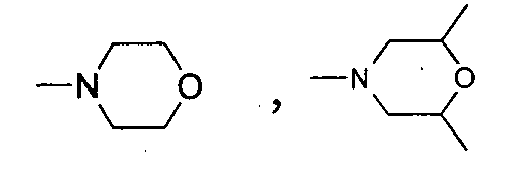
R1 = optionally substituted C1-C8 alkyl, optionally substituted aryl; optionally substituted aralkyl, preferably C1-C3 alkyl, more preferably CH3;
and enantiomers, diastereoisomers and pharmaceutically acceptable salts thereof.
R' = -CH3, CHF2,
X=
NR2 = -N(CH2-CH2OH)2,
and enantiomers, diastereoisomers and pharmaceutically acceptable salts thereof.
These compounds have a PDE4D inhibiting activity and can be used as a medicament for treating dementia, in particular Alzheimer disease, and for improving memory.
Description
- The present invention concerns the technical field of the pharmaceutical industry.
- In particular, the invention refers to new PDE4 inhibitors selective for type D isoform, which are able to improve cAMP release in hyppocampi and useful to restore memory impairments in neurodegenerative diseases, in particular Alzheimer Disease (AD), without side effects.
- Dementia is a syndrome that can be caused by a number of progressive disorders and affects memory, thinking, behaviour and the ability to perform everyday activities. Alzheimer's disease (AD) is the most common type of dementia.
- AD etiology and pathogenesis remain unclear, but many factors have been found to be implicated in AD. The dysregulation of some enzymatic systems (cholinesterases, phosphodiesterases) plays a pivotal role in cognitive symptoms. Another important etio-pathological factor is the alteration in Aβ amyloid levels and fibrils aggregation that cause neurons dead.
- At the moment there are only five drugs available to attenuate memory deficits in Alzheimer's disease. In addition, all drugs (four acetylcholinesterase inhibitors and one NMDA antagonist) have limited efficacy and have severe side effects. Based on animal research, PDE inhibitors have been suggested as a promising target for the treatment of a variety of cognitive deficits and in particular memory impairment.
- The cognitive process of memory consolidation strictly depends on cyclic adenosine monophosphate (cAMP) level in peculiar brain compartments. Indeed, a large body of evidence has shown that long term potentiation (LTP), the neurochemical substrate of learning and memory processes, requires the functioning of the cAMP/PKA/CREB pathway and its genetic or pharmacological manipulation can affect cognitive functions.
- During the last decade, a large body of evidence has shown that cAMP enhancing compounds may benefit patients with Alzheimer Disease (AD). Phosphodiesterase 4 (PDE4) specifically controls the intracellular cAMP levels by hydrolyzing it to 5'-AMP.
- In the last ten years several important studies demonstrated the pivotal role of phosphodiesterase type 4 (PDE4) in the synaptic function and memory, and evidenced that Rolipram (a well known unselective PDE4 inhibitor) is able to reverse the beta-amyloid induced dysfunction of the cAMP/PKA/CREB pathway, to restore hyppocampal LTP and to ameliorare cognitive deficits in a murine model of AD (Gong, Arancio O. et al, J Clin. Invest., 2004 ; Rutten K., Prickaerts J. et al., Neurobiol. of Learn and Mem. 2008).
- However, despite the potential clinical relevance, the therapeutic use of Rolipram is limited because of its major side effect of emesis. Since Rolipram inhibits all PDE4 isoforms, the Applicants wondered whether a more selective pharmacological strategy could avoid or overcome the side effects, still functioning on memory.
- A very recent study on PDE4 knock-out mice indicates that PDE4D, and in particular PDE4D4-D5 splice variants, play a critical role in the mediation of memory. This study also shows that the reduced expression of PDE4D4 and PDE4D5 enhances memory without causing emesis (Li YF et al., J. Neurosci. 2011, 5, 172), thus strongly supporting the above hypothesis.
- Finally, one of the Applicants recently published a study on a first PDE4D selective inhibitor (GEBR-7b), which increases memory function in mice and rats without emesis (Bruno et al, Br. J. Pharm., 2011, 164:2054).
- O. Bruno et al., Farmaco, 2004, 59(3), 223, disclose certain 3-cyclopentyloxy-4-methoxy-benzaldehyde and 3-cyclopentyloxy-4-methoxybenzoic acid derivatives as PDE4 inhibitors that can inhibit the neutrophil activation.
- O. Bruno et al., J. Med. Chem. 2009, 52, 6546-6557, disclose 3-cyclopentyloxy-4-methoxybenzaldehyde derivatives as selective PDE4D inhibitors.
- The problem at the basis of the present invention has been to provide new compounds which are selective PDE4D inhibitors. These compounds are intended to find utility in preventing memory loss, which is one of the most severe disability in Alzheimer Disease (AD). In addition, the compounds provided by the present invention represent new pharmacological tools which could be of great relevance to increase the knowledge on the role of PDE4D isoforms in CNS functions, both under physiologic and pathologic conditions, particularly in AD.
- The above-mentioned problem has been solved by compounds of the following formula (I),

- Z = cyclopentyl, cyclopropylmethyl, -CH3;
- R' = -CH3, CHF2,
- X =

- Y = -CO; -C=O(CH2), -CH(OH)-CH2, -CH2-C=O, -CH2-CH2-C=O; -CH2-CH(OH)-CH2, -CH2-CH(OCOR1)-CH2;
- NR2 = -N(CH2-CH2OH)2,


- R1 = optionally substituted C1-C8 alkyl, optionally substituted aryl; optionally substituted aralkyl, preferably C1-C3 alkyl, more preferably CH3;
- The above-mentioned optionally substituted alkyl and aryl bear one or more substituents chosen from the group comprising C1-C3 alkyl, halogen, C1-C3 alkoxy, hydroxy, SH, C1-C3 alkylthio, nitro and haloalkyl.
- C1-C8 alkyl indicates monovalent alkyl groups that have from one to eight carbon atoms; by way of example groups such as methyl, ethyl, n-propyl, isopropyl, n-butyl, isobutyl, terbutyl and the like are mentioned.
- "Aryl" indicates aromatic carbocyclic groups having from 6 to 14 carbon atoms, with a single ring (e.g. phenyl) or with multiple condensed rings (e.g. naphthyl). Included among preferred aryls are phenyl, biphenyl, naphthyl, phenanthrenyl.
- "Aralkyl" indicates an aryl as defined above bonded to an alkyl group having from 1 to 3 carbon atoms. Included among preferred aralkyls are benzyl, phenylethyl, naphthylmethyl, naphthylethyl.
- Preferred are the compounds of formula (I) wherein:
- Z = cyclopentyl
- NR2 =

- Particularly preferred are the compounds of formula (I) wherein:
- Z = cyclopentyl
- NR2 =


- The most preferred compounds according to the present invention are those listed here below:
- 4-({3-[3-(Cyclopentyloxy)-4-methoxyphenyl]-4,5-dihydroisoxazol-5-yl}carbonyl)morpholine
- 4-({3-[3-(Cyclopentyloxy)-4-methoxyphenyl]-4,5-dihydroisoxazol-5-yl}carbonyl)-2,6-dimethylmorpholine
- 1-({3-[3-(Cyclopentyloxy)-4-methoxyphenyl]-4,5-dihydroisoxazol-5-yl}carbonyl)piperidin-4-ol
- 3-[3-(Cyclopentyloxy)-4-methoxyphenyl]-5-(pyrrolidin-1-ylcarbonyl)-4,5-dihydroisoxazole
- 1-({3-[3-(Cyclopentyloxy)-4-methoxyphenyl]-4,5-dihydroisoxazol-5-yl}carbonyl)piperidine
- 3-[3-(Cyclopentyloxy)-4-methoxyphenyl]-N,N-bis(2-hydroxyethyl)-4,5-dihydroisoxazole-5-carboxamide
- 4-({3-[3-(Cyclopentyloxy)-4-methoxyphenyl]-4,5-dihydroisoxazol-5-yl}acetyl)morpholine
- 4-({3-[3-(Cyclopentiloxy)-4-methoxyphenyl]-4,5-dihydroisoxazol-5-yl}acetil) 2,6-dimethylmorpholine
- 1-({3-[3-(Cyclopentyloxy)-4-methoxyphenyl]-4,5-dihydroisoxazol-5-yl}acetyl)piperidin-4-ol
- 3-[3-(Cyclopentyloxy)-4-methoxyphenyl]-5-(2-oxo-2-pyrrolidin-1-ylethyl)-4,5-dihydroisoxazole
- 1-({3-[3-(Cyclopentyloxy)-4-methoxyphenyl]-4,5-dihydroisoxazol-5-yl}acetyl)piperidine
- 1-({3-[3-(Cyclopentyloxy)-4-methoxyphenyl]-4,5-dihydroisoxazol-5-yl}acetyl)piperazine
- 2-{3-[3-(Cyclopentyloxy)-4-methoxyphenyl]-4,5-dihydroisoxazol-5-yl}-N,N-bis(2-hydroxyethyl)acetamide
- 4-({3-[3-(Cyclopentyloxy)-4-methoxyphenyl]-4,5-dihydroisoxazol-5-yl}acetyl)morpholine
- 4-({3-[3-(Cyclopentyloxy)-4-methoxyphenil]-4,5-dihydroisoxazol-5-yl}acetil) 2,6-dimethylmorpholine
- 1-{3-[3-(Cyclopentyloxy)-4-methoxyphenyl]isoxazol-5-yl}-2-morpholin-4-ylethanone hydrochloride
- 1-{3-[3-(Cyclopentyloxy)-4-methoxyphenyl]isoxazol-5-yl}-2-(2,6-dimethylmorpholin-4-yl)ethanone hydrochloride
- 1-{3-[3-(Cyclopentyloxy)-4-methoxyphenyl]isoxazol-5-yl}-2-morpholin-4-ylethanol
- 1-{3-[3-(Cyclopentyloxy)-4-methoxyphenyl]isoxazol-5-yl}-2-(2,6-dimethylmorpholin-4-yl)ethanol
- 4-({3-[3-(Cyclopentyloxy)-4-methoxyphenyl]isoxazol-5-yl}carbonyl)morpholine
- 4-({3-[3-(Cyclopentyloxy)-4-methoxyphenyl]isoxazol-5-yl}carbonyl)-2,6-dimethylmorpholine
- 1-{3-[3-(Cyclopentyloxy)-4-methoxyphenyl]-1H-pyrazol-1-yl}-3-morpholin-4-ylpropan-2-ol dihydrocloride
- 1-{3-[3-(Cyclopentyloxy)-4-methoxyphenyl]-1H-pyrazol-1-yl}-3-(2,6-dimethylmorpholin-4-yl)propan-2-ol dihydrocloride
- 1-((3-{3-[3-(cyclopentyloxy)-4-methoxyphenyl]-1H-pyrazol-1-yl}-2-hydroxypropyl)piperidin-4-ol
- 2-{3-[3-(cyclopentyloxy)-4-methoxyphenyl]-1H-pyrazol-1-yl}-1-(morpholin-4-ylmethyl)ethyl acetate
- 4-({3-[3-(Cyclopentyloxy)-4-methoxyphenyl]-1H-pyrazol-1-yl}acetyl)morpholine
- 4-({3-[3-(Cyclopentyloxy)-4-methoxyphenyl]-1H-pyrazol-1-yl}acetyl)2,6-dimethylmorpholine
- 4-((3-{3-[3-(cyclopentyloxy)-4-methoxyphenyl]-1H-pyrazol-1-yl}propanoyl)morpholine
- 4-((3-{3-[3-(cyclopentyloxy)-4-methoxyphenyl]-1 H-pyrazol-1-yl}propanoyl)2,6-dimethylmorpholine
- 4-((3-{3-[3-(cyclopentyloxy)-4-(difluoromethoxy)phenyl]-1H-pyrazol-1-yl}propanoyl)morpholine
- The present invention also concerns a process for the production of the above-mentioned compounds of formula (I), in which Z = cyclopentyl, X=


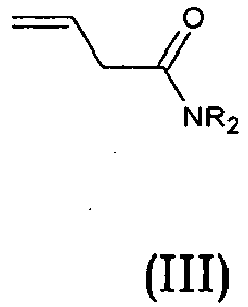

- The present invention also relates to a process for the preparation of the above-mentioned compounds of formula (I), in which Z = cyclopentyl,
X=
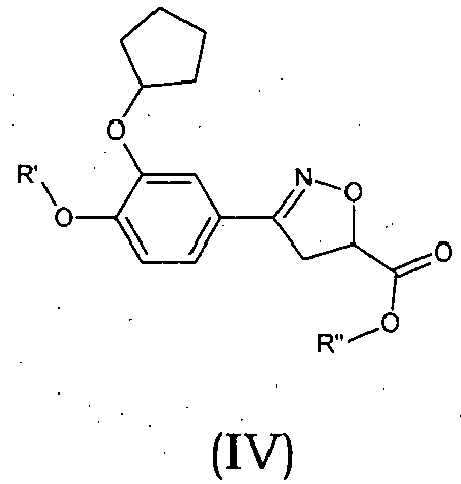
with R2NH, wherein NR2 is as defined above, to yield the following compound of formula (Ib)
- The present invention also concerns a process for the preparation of the above-mentioned compounds of formula (I), in which Z = cyclopentyl,
X=

with R2NH, wherein NR2 is as defined above, to yield the following compound of formula (Ic)
- The present invention further concerns a process for the preparation of the above-mentioned compounds of formula (I), in which Z = cyclopentyl, X=


claim 1, to yield the following compound of formula (Id)
- In the latter process, for the case in which R' is -CHF2, the relevant intermediate compound of formula (VIa) is prepared according to the following reaction scheme:

- The present invention further concerns the compounds of formula (I) as defined above and their enantiomers, diastereoisomers and pharmaceutically acceptable salts, for use as a medicament with PDE4D inhibiting activity.
- The invention further concerns such compounds of formula (I) for use as a medicament for the treatment of dementia, in particular Alzheimer disease.
- The invention further concerns such compounds of formula (I) for use as a medicament for enhancing memory.
- The present invention further refers to a pharmaceutical composition comprising a compound of formula (I) as defined above or an enantiomer or diastereoisomer or pharmaceutically acceptable salt thereof and a pharmaceutically acceptable carrier.
- Examples of pharmaceutically acceptable salts are those formed with organic acids such as oxalic, tartaric, maleic, succinic and citric and with inorganic acids such as nitric, hydrochloric, sulphuric and phosphoric.
- The compounds according to the invention that have one or more asymmetric carbon atoms may exist as pure enantiomers, as pure diastereoisomers, as racemic mixtures of enantiomers, racemates and mixtures of racemates.
- The compounds and compositions according to the invention may be administered with any available and efficient delivery system, comprising, but not limited to, oral, buccal, parenteral, inhalatory routes, topical application, by injection, by transdermic or rectal route (for ex. by means of suppositories) in dosage unit formulations containing conventional, pharmaceutically acceptable and non-toxic carriers, adjuvants and vehicles. The administration by parenteral route comprises subcutaneous, intravenous, intramuscular, intrasternal injection or infusion techniques.
- The solid dosage forms for the administration by oral route comprise, for example, capsules, tablets, powders, granules and gels. In such solid dosage forms, the active compound may be mixed with at least one inert diluent such as, for example, sucrose, lactose or starch. These dosage forms normally also comprise additional substances different from the inert diluents, such as, for example, lubricating agents like magnesium stearate.
- The injectable preparations, for example aqueous or oily sterile injectable solutions or suspensions, may be formulated according to the known technique and by optionally using appropriate dispersing, wetting and/or suspending agents.
- The pharmaceutical preparations according to the present invention may be produced by using conventional pharmaceutical techniques, as described in the various pharmacopoeias or handbooks of the field such as, for example, "Remington's Pharmaceutical Sciences Handbook", Mack Publishing, New York, 18th Ed., 1990.
- The average daily dosage of the compounds according to the present invention depends on many factors, such as, for example, the seriousness of the disease and the conditions of the patient (age, weight, sex): The dose may generally vary from 1 mg to 1500 mg per day of compound according to the invention, optionally divided into more administrations.
-
-
Figure 1 is a Western blot analysis of γ-H2AX in HTLA cells treated with 100 µM etoposide, compound XVIIIa according to the present invention, reference lead compound GEBR-7b, or an equal volume of solvent (DMSO). -
Figure 2 is a histogram showing the effect of compounds GEBR-7b and XVIIIa on the accumulation of the forskolin (FSK)-induced cAMP in neuronal cultured cells. -
Figure 3 is a diagram showing the effects of the PDE4D inhibitors XVIIIa and GEBR-7b on extracellular cAMP in the hippocampus of freely moving rats. -
Figures 4 and5 are diagrams representing the results of an electrophysiological study on Tg2576 mice. - The present invention will be further described by referring to some examples of preparation of compounds according to the invention and of evaluation of their activity.
- Among the compounds according to the present invention, those indicated in the following table are mentioned in particular.
R' X Y NR2 XIIIa CH3 
-C=O 
XIIIb CH3 
-C=O 
XIIIc CH3 
-C=O 
XIIId CH3 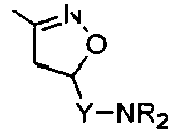
-C=O 
XIIIe CH3 
-C=O 
XIIIf CH3 
-C=O 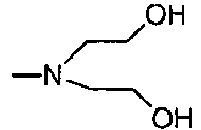
XIVa CH3 
CH2CO 
XIVb CH3 
CH2CO 
XIVc CH3 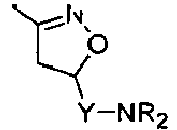
CH2CO 
XIVd CH3 
CH2CO 
XIVe CH3 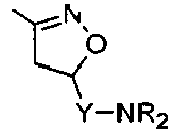
CH2CO 
XIVf CH3 
CH2CO 
XIVg CH3 
CH2CO 
XVa CH3 
-C=O(CH2) 
XVb CH3 
C=O(CH2) 
XVIa CH3 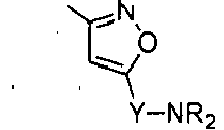
-CH(OH)CH2 
XVIb CH3 
-CH(OH)CH2 
XVIIa CH3 
-C=O 
XVIIb CH3 
-C=O 
XVIIIa CH3 
CH2CH(OH)CH2 
XVIIIb CH3 
CH2CH(OH)CH2 
XVIIIc CH3 
CH2CH(OH)CH2 
XIX CH3 
CH2CH(OCOCH3) CH2 
XXa CH3 
CH2CO 
XXb CH3 
CH2CO 
XXIa CH3 
CH2CH2CO 
XXIb CH3 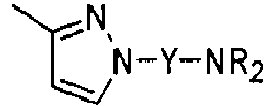
CH2CH2CO 
XXII CHF2 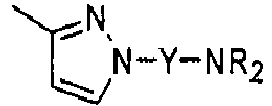
CH2CH(OH)CH2 
- The building blocks 4-(chloroacetyl)morpholine, 4-(chloroacetyl)-2,6-dimethylmorpholine, 4-(3-chloropropanoyl)morpholine and 1-(chloroacetyl)piperidin-4-ol have been already reported in the literature, while we prepared them by a new method not yet described, which was also used for the synthesis of the not yet reported 4-(3-chloropropanoyl)-2,6-dimethyl-morpholine, as described in the following scheme 1:

- Compounds XIII were prepared by cyclization of 3-(cyclopentyloxy)-N-hydroxy-4-methoxybenzenecarboximidoyl chloride, obtained in turn from 3-(cyclopentyloxy)-4-methoxybenzaldehyde oxime with N-chlorosuccinimide, with ethylacrilate obtaining the intermediate dihydroisoxazole-5-carboxylate ethylester, which was in turn treated with the proper amine, as reported in the following
scheme 2. - Compounds XIV were prepared by cyclization of 3-(cyclopentyloxy)-N-hydroxy-4-methoxybenzenecarboximidoyl chloride with 3-butenoic acid obtaining the intermediate dihydroisoxazol-5-acetic acid which was in turn treated with the proper amine in the presence of diphenylfosforylazide (DPPA), as reported in the following scheme 2 (method A):


- The starting 3-(cyclopentyloxy)-4-methoxybenzaldehyde oxime was obtained by reaction of 3-(cyclopentyloxy)-4-methoxybenzaldehyde with hydroxylamine in ethanol and 3-(cyclopentyloxy)-4-methoxybenzaldehyde was in turn obtained from isovanilline by alkylation with bromocyclopentane following a literature methods [M.J. Ashton, et al., J. Med. Chem. 1994, 37, 1696-1703].
- Compounds XIVa-b have been prepared also by an alternative convergent synthetic strategy which involves the cyclization of 3-(cyclopentyloxy)-N-hydroxy-4-methoxybenzenecarboximidoyl chloride with the suitable 4-amine-3-buten-1-one, which was in turn prepared by a simple, not yet reported, one-pot reaction, starting from 3-butenoic acid; the latter was firstly transformed in the corresponding acyl chloride which was subsequently condensed with the suitable cycloamine, as reported in the following scheme 3 (method B):


- The cyclization of 3-(cyclopentyloxy)-N-hydroxy-4-methoxybenzenecarboximidoyl chloride with methylpropargyl ester gave the intermediate isossazole ester, which was in turn treated with an excess of the suitable cycloamine to give compounds XVII.
- All the reaction are reported in the following scheme 4:


- For the synthesis of compounds XVIII-XXI we prepared firstly the starting compound 3-[3-(cyclopentyloxy)-4-methoxyphenyl]-1H-pyrazole by a 1,3-dipolar cycloaddition from the 3-(cyclopentyloxy)-4-methoxybenzaldehyde with p-toluenesulfonyl hydrazide, NaOH and 1-vinylimidazole in acetonitrile, as reported in the scheme 5 This technique was already reported in the literature for the one-pot preparation of pyrazoles [Aggarwal, V.K. et al., J. Org. Chem. 2003, 68, 5381-5383].
- The pyrazole intermediate was treated with an excess of epichlorohydrin in the presence of TEA to afford the 1,3-disubstituted pyrazole as a single isomer. The structure of the epoxy derivative was identified by 13C and 1H NMR spectral data, as reported in detail below. The reaction between the epoxy derivative with an excess of the suitable cycloamine gave compounds XVIIIa-c in good yields. The acetyl derivative XIX was obtained from XVIIIa with acetic anhydride, as reported in the scheme 5:

- The treatment of the above pyrazole derivative with 4-(chloroacetyl)morpholine or 4-(chloroacetyl)-2,6-dimethylmorpholine in the presence of TEA afforded to the 4-({3-[3-(cyclopentyloxy)-4-methoxyphenyl]-1H-pyrazol-1-yl}acetyl)amines XXa,b, as reported in the scheme 6.
- The same procedure was used to obtain the 4-(3-{3-[3-(cyclopentyloxy)-4-methoxypheny]-1H-pyrazol-1-yl}propanoyl)morpholine XXIa, starting from the above pyrazole derivative and 4-(3-chloropropanoyl)morpholine as reported in the scheme 6.

- To obtain the 4-(3-{3-[3-(cyclopentyloxy)-4-methoxyphenyl]-1H-pyrazol-1-yl}propanoyl)2,6-dimethylmorpholine XXIb, the pyrazole derivative was treated with an excess of methyl 3-bromopropanoate yielding the methyl 3-{3-[3-(cyclopentyloxy)-4-methoxyphenyl]-1H-pyrazol-1-yl}-propanoate which was then hydrolized to the corresponding acid; the latter was treated with 2,6-dimethylmorpholine, in the presence of TEA and diphenylphosphorylazide, to afford the desired product as reported in the scheme 7.

- To obtain compound XXII we prepared the starting product 4-(difluoromethoxy)-3-hydroxybenzaldehyde by using a new microwave assisted procedure with improved yield in respect to the numerous procedures reported in the literature. The 3-(cyclopentyloxy)-4-(difluoromethoxy)benzaldehyde was obtained by the literature method [
A. Thomas et al. PCT Int. Appl., 2004, WO 2004016596 ], as well the 3-(cyclopentyloxy)-4-(difluoromethoxy)benzaldehyde oxime [Palle, Venkata P.et al., PCT Int. Appl. (2005), WO 2005051931 ] as reported in the scheme 8.
- Then, we prepared the 3-[3-(cyclopentyloxy)-4-(difluoromethoxy)phenyl]-1H-pyrazole by a 1,3-dipolar cycloaddition from the 3-(cyclopentyloxy)-4-(difluoromethoxy)benzaldehyde with p-toluenesulfonyl hydrazide, NaOH and 1-vinylimidazole in acetonitrile.
- The pyrazole intermediate was treated with an excess of epichlorohydrin in the presence of TEA to afford the 1,3-disubstituted pyrazole as a single isomer. The reaction between the epoxy derivative with an excess of morpholine gave compound XXII as reported in the scheme 9.

- To a solution of the suitable cycloamine (23 mmol) in an. toluene (60 mL), an. K2CO3 (6.3 g, 45 mmol) and 2-chloroacetyl chloride or 3-chloropropanoyl chloride (23 mmol) were added; the mixture was heated at 60°C for 2 h. After cooling to room temperature, the solids (K2CO3 and KCl) were filtered off and the solution was concentrated under reduced pressure obtaining crude oils which were purified by high vacuum distillation to afford final pure compounds as light yellow oils.
-

- Yield: 72 % (lett.: 17-100%). Bp: 110-120 °C /0.6 mmHg.
-

- Yield: 82 % (lett.: 48%). Bp: 110-120 °C /0.6 mmHg.
-

- Yield: 70 (lett.: 85%). Bp: 110 °C /0.6 mmHg.
-

- Yield: 80%. Bp: 118 °C /0.6 mmHg.
-

- Piperidin-1-ol (1 g, 10 mmol) was solved in a mixture of satured Na2CO3 solution (75 mL) and ethyl acetate (150 mL) and chloroacetyl chloride (1.2 mL, 15 mmoli) was added. The reaction mixture was stirred at room temperature for 2 h. After separation in a glass funnel the organic phase was dried (MgSO4) and evaporated under reduced pressure to afford a pure light yellow oil which was used without further purification.
Yield: 1.18 g, 66% (lett. 84%). -

- To a solution of 3-(cyclopentyloxy)-4-methoxybenzaldehyde oxime (1.72 g, 7.31 mmol) in an. DMF (10 mL), N-chlorosuccinimide (1.02 g, 7.67 mmol) was added and the mixture was stirred at 40-45 °C for 1 h. After cooling to room temperature, water (65 mL) was added and the solution was put for 12 h in a refrigerator; afterward the water was settled and the oil residue was solved in AcOEt (20 mL), the organic phase was washed with water (3 x 20 mL), dried (MgSO4) and concentrated under reduced pressure yielding a light brown oil.
- Yield: 65%. 1H-NMR (CDCl3):™ 1.47-2.13 (m, 8H, 4CH2 cyclopent.), 3.87 (s, 3H, OCH3), 4.71-4.89 (m, 1H, OCH cyclopent.), 6.84 (d, J = 8.4 Hz, 1H, H-5 Ar), 7.35 (dd, J = 8.4, 2.0 Hz, 1H, H-6 Ar), 7.38 (d, J = 2.0 Hz, 1H, H-2 Ar). IR (film): cm-1 3000-3500 (OH). Anal. (C13H16ClNO3) C, H, N. (% calculated/found) C: 57.89/ 57.67; H: 5.98/ 5.92; N: 5.19/ 5.29.
-

- For the synthesis of ethyl 3-[3-(cyclopentyloxy)-4-methoxyphenyl]-4,5-dihydroisoxazole-5-carboxylate we applied the procedure already described in the literature (Bioorg. Med.Chem. 19, 2011, 7365-7373). To a solution of 3-(cyclopentyloxy)-N-hydroxy-4-methoxybenzenecarboximidoyl chloride (2.85 g, 10.57 mmol) in dichloroethane (DCE) (16 mL) cooled at 0 °C, under nitrogen atmosphere, ethyl acrylate (2.31 mL, 21.14 mmol) and triethylamine (TEA) (3.54 mL, 25.37 mmol) were added.
- The yellow solution was stirred at 60°C for 1 h and at r.t. for further 48 h. Water (20mL) was added and the mixture was extracted with DCM (3 x 10 mL). The organic phases were washed with brine (3 x 10 mL), dried (MgSO4) and concentrated under reduced pressure yielding an oil which was purified by silica gel (100-200 mesh) column chromatography using a mixture of diethyl ether/ petroleum ether (boiling point 40-60 °C) (1:1) as the eluent. The final product crystallised as a light yellow solid which was recrystallized by diethyl ether.
- Yield: 50% M.p.: 60 °C. 1H-NMR (CDCl3): ™ 1.36 (t, 3H, OCH2 CH 3 ), 1.50-2.10 (m, 8H, 4 CH2 cyclopent.), 3.60-3.65 (m, 2H, CH2 isoxaz.), 3.89 (s, 3H, OCH3), 4.28 (q, 2H, OCH 2 CH3), 4.78-4.90 (m, 1H, OCH cyclopent.), 5.16 (t, J = 8.6 Hz 1H, H-5 isoxaz.), 6.86 (d, J = 8.0 Hz, 1H, H-5 Ar), 7.05 (dd, J = 8.2, 2.0 Hz, 1H, H-6 Ar), 7.37 (d, J = 2.0 Hz, 1H, H-2 Ar). Anal. (C18H23NO5) C, H, N. (% calculated/found) C: 64.85/ 64.76; H: 6.95/ 7.24; N: 4.20/ 4.14.
- A mixture of ethyl 3-[3-(cyclopentyloxy)-4-methoxyphenyl]-4,5-dihydroisoxazole-5-carboxylate and the suitable amine was heated at 60°C overnight. If the amine was a solid the reaction was carried on in anhydrous DMF. After cooling to room temperature, the reaction mixture was poured into water (20 mL) yielding a crude solid which was filtered and recrystallized from diethyl ether. If no precipitate was formed, the water suspension was extracted with DCM (3 x 10 mL), washed with 1N HCl solution (10 mL) and brine (2 x 10 mL), dried (MgSO4) and evaporated under reduced pressure. The solid obtained was recrystallized from diethyl ether.
-
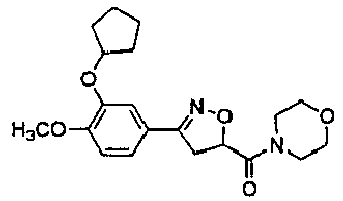
- White solid. Yield: 76%. M.p.: 115-116 °C. 1H-NMR (CDCl3):™ 1.55-2.10 (m, 8H, 4CH2 cyclopent.), 3.30-4.30 (m, 13 H, CH2 isoxazol. + 4CH2 morph. + OCH3), 4.78-4.90 (m, 1H, OCH cyclopent.), 5.30-5.40 (m, 1H, H-5 isoxaz.), 6.88 (d, J = 8.0 Hz, 1H, H-5 Ar), 7.13 (dd, J = 6.6, 2.0 Hz, 1H, H-6 Ar), 7.37 (d, J = 2.0 Hz, 1H, H-2 Ar). Anal. (C20H26N2O5) C, H, N. (% calculated/found) C: 64.16/ 64.27; H: 7.00/ 7.32; N: 7.48/ 7.31.
-

- Pale yellow solid. Yield: 65%. M.p.: 127-129 °C. 1H-NMR (CDCl3): ™ 1.10-1.20 (m, 6H, CH3), 1.60-2.10 (m, 8H, 4CH2 cyclopent.), 3.30-4.50 (m, 10H, CH2 isoxaz. + CH2N morph. + CH morph. + OCH3), 4.88-4.98 (m, 1H, OCH cyclopent.), 5.30-5.50 (m, 1H, H-5 isoxaz.), 6.90 (d, J = 8.0 Hz, 1H, H-5 Ar), 7.15 (dd, J = 6.6, 2.0 Hz, 1H, H-6 Ar), 7.20 (d, J = 2.0 Hz, 1H, H-2 Ar). Anal. (C22H30N2O5) C, H, N. (% calculated/found) C: 65.65/ 65.44; H: 7.51/ 7.70; N: 6.96/ 6.90.
-
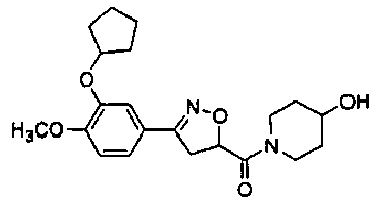
- White solid. Yield: 38 %. M.p.: 134 °C. 1H-NMR (CDCl3): ™ 1.45-2.20 (m, 12H, 4CH2 cyclopent. + 2CH2 pip.), 3.10-4.40 (m, 11H, OCH3 + 2CH2N pip. + CH2 isoxaz. + CH-OH + OH, 1H disappears with D2O), 4.80-4.90 (m, 1H, OCH cyclopent.), 5.30-5.50 (m, 1H, H-5 isoxaz.), 6.88 (d, J = 8.3 Hz, 1H, H-5 Ar), 7.18 (dd, J = 6, 1.6 Hz, 1H, H-6 Ar), 7.37 (d, J = 2.0 Hz, 1H, H-2 Ar). Anal. (C21H28N2O5) C, H, N. (% calculated/found) C: 64.93/ 64.67; H: 7.27/ 7.48; N: 7.21 / 7.11.
-

- White solid. Yield: 84%. M.p.: 126-127 °C. 1H-NMR (CDCl3): δ 1.50-2.20 (m, 12H, 4CH2 cyclopent. + 2CH2 pyrr.), 3.35-4.28 (m, 9H, CH2 isoxaz. + 2CH2N pyrr + OCH3), 4.80-4.95 (m, 1H, OCH cyclopent.), 5.20-5.40 (m, 1H, H-5 isoxaz.), 6.87 (d, J = 8.0 Hz, 1H, H-5 Ar), 7.15 (dd, J = 6.3, 1.6 Hz, 1H, H-6 Ar), 7.37 (d, J = 2.0 Hz, 1H, H-2 Ar). Anal. (C20H26N2O4) C, H, N. (% calculated/found) C: 67.02/ 67.24; H: 7.31/ 7.52; N: 7.82/ 7.80.
-

- White solid. Yield: 22%. M.p.: 130°C. 1H-NMR (CDCl3): δ 1.50-2.10 (m, 14H, 4CH2 cyclopent.+ 3CH2 pip.), 3.30-4.37 (m, 9H, CH2 isoxaz. + 2CH2N pip. + OCH3), 4.80-4.90 (m, 1H, OCH cyclopent.), 5.30-5.42 (m, 1H, H-5 isoxaz.), 6.90 (d, J = 8.0 Hz, 1H, H-5 Ar), 7.17 (dd, J = 6.6, 1.6 Hz, 1H, H-6 Ar), 7.38 (d, J = 2, 1H, H-2 Ar). Anal. (C21H28N2O4) C, H, N. (% calculated/found) C: 67.72/ 67.57; H: 7.58/ 7.63; N: 7.52/ 7.41.
-

- White solid. Yield: 70%. M.p.: 85 °C. 1H-NMR (CDCl3): δ 1.55-2.10 (m, 8H, 4CH2 cyclopent.), 3.30-4.20 (m, 15 H, CH2 isoxaz. + 2CH2N + 2CH 2 OH + OCH3 + 2OH, 2H disappear with D2O), 4.77-4.84 (m, 1H, OCH cyclopent.), 5.30-5.50 (m, 1H, H-5 isoxaz.), 6.88 (d, J = 8.3 Hz, 1H, H-5 Ar), 7.17 (dd, J = 6.6, 2.0 Hz, 1H, H-6 Ar), 7.36 (d, J = 2.0 Hz, 1H, H-2 Ar). Anal. (C20H28N2O6) C, H, N. (% calculated/found) C: 61.21 / 61.13; H: 7.19/ 6.93; N: 7.14/ 7.08.
-

- To a solution of 3-(cyclopentyloxy)-N-hydroxy-4-methoxybenzenecarboximidoyl chloride (7.9 g, 29.29 mmol) in DCE (46 mL) cooled at 0°C, under nitrogen atmosphere, 3-butenoic acid (5 mL, 58.58 mmol) and TEA (9.8 mL, 70 mmol) were added and the solution was stirred at 60°C for 1.5 h and at r.t. for further 48 h. Water was added (20 mL) and the mixture was extracted with DCM (3 x 10 mL). The organic phases were washed with a NaHCO3 saturated solution, then the acqueous phase was treated with 1N HCl solution until the precipitation of the final product as a white solid.
- Yield: 35%. Mp: 126-128 °C. 1H-NMR (CDCl3): δ 1.50-2.10 (m, 8H, 4CH2 cyclopent.), 2.65-3.05 (m, 2H, CH 2COOH), 3.05-3.65 (m, 2H, CH2 isoxaz.), 3.90 (s, 3H, OCH3), 4.78-4.95 (m, 1H, OCH cyclopent.), 5.05-5,20 (m, 1H, H-5 isoxaz.), 6.86 (d, J = 8.0 Hz, 1H, H-5 Ar), 7.06 (dd, J = 8.2, 2.0 Hz, 1H, H-6 Ar), 7.38 (d, J = 2.0 Hz, 1H, H-2 Ar), 8.05 (br s, 1H, COOH, disappears with D2O) Anal. (C17H21NO5) C, H, N. (% calculated/found) C: 63.94/ 63.86; H: 6.63/ 6.67; N: 4.39/ 4.20.
- To a solution of {3-[3-(cyclopentyloxy)-4-methoxyphenyl]-4,5-dihydroisoxazol-5-yl}acetic acid (0.48 g, 1.5 mmol) in anhydrous DMF (4 mL)( mancano i mL), cooled in an ice-water bath, triethylamine (,0.31 mL, 2.25 mmol), the suitable amine (3 mmol) and diphenylphosphorilazide (0.36 mL, 1.65 mmol) were added and the reaction mixture was heated at 80°C for 24 hr. After cooling to room temperature, the reaction mixture was poured into water (50 mL), extracted with DCM (3 x 10 mL), washed with a NaHCO3 saturated solution (10 mL), 1N HCl solution (10 mL) and brine (2 x 10 mL), dried (MgSO4) and evaporated under reduced pressure. The solid obtained was purified by crystallization from diethyl ether.
-

- White solid. Yield: 70%. Mp: 144-145 °C. 1H-NMR (CDCl3): δ 1.53-2.10 (m, 8H, 4CH2 cyclopent.), 2.55-3.05 (m, 2H, CH2CO), 3.08-3.21 and 3.42-3.80 (2m, 10H, CH2 isoxaz. + 4CH2 morph.), 3.90 (s, 3H, OCH3), 4,78-4.90 (m, 1H, OCH cyclopent.), 5.02-5.26 (m, 1H, H-5 isoxaz.), 6.87 (d, J = 8.0 Hz, 1H, H-5 Ar), 7.08 (dd, J = 8.2, 2.0 Hz, 1H, H-6 Ar), 7.37 (d, J = 2.0 Hz, 1H, H-2 Ar). Anal. (C21H28N2O5) C, H, N. (% calculated/found) C: : 64.93/ 65.19; H: 7.27/ 7.44; N: 7.21/ 7.13.
-

- White solid. Yield: 38%. Mp: 104-105 °C. 1H-NMR (CDCl3): δ 1.00-1.43 (m, 6H, 2CH3 morph.), 1.48-2.13 (m, 8H, 4CH2 cyclopent.), 2.20-4.20 (m, 10H, 2CHO morph. + 2CH2N morph. + CH2 isoxaz. + CH2CO), 3.90 (s, 3H, OCH3), 4.65-4.96 (m, 1H, OCH cyclopent.), 5.05-5.28 (m, 1H, H-5 isoxaz.), 6.87 (d, J = 8.0 Hz, 1H, H-5 Ar), 7.08 (dd, J = 8.0, 2.0 Hz, 1H, H-6 Ar), 7.37 (d, J = 1.6 Hz, 1H, H-2 Ar). Anal. (C23H32N2O5) C, H, N. (% calculated/found) C: 66.32/ 66.43; H: 7.74/ 7.94; N: 6.73/ 6.42.
-

- White solid. Yield: 21%. Mp: 134 °C. 1H-NMR (CDCl3): δ 1.40-2.20 (m, 12H, 4CH2 cyclopent. + 2CH2 pip.), 2.55-4.20 (m, 12H, OCH3 + CH2 isoxaz. + 2CH2N pip. + CH2CO + CH-OH + OH, 1H disappears with D2O), 4.80-4.90 (m, 1H, OCH cyclopent.), 5.05-5.25 (m, 1H, H-5 isoxaz.), 6.87 (d, J = 8.3 Hz, 1H, H-5 Ar), 7.14 (dd, J = 7.0, 1.6 Hz, 1H, H-6 Ar), 7.33 (d, J = 2.0 Hz, 1H, H-2 Ar). Anal. (C22H30N2O5) C, H, N. (% calculated/found) C: 65.65/ 65.83; H: 7.51/ 7.74; N: 6.96 / 6.94.
-
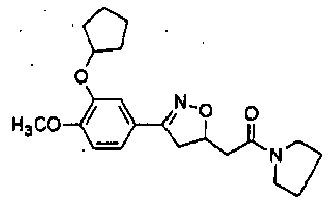
- White solid. Yield: 36 %. Mp: 148-149 °C. 1H-NMR (CDCl3): δ 1.58-2.10 (m, 12H, 4CH2 cyclopent.+ 2CH2 pyrr.), 2.60-3.30 (m, 4H, CH2CO + CH2isoxaz.), 3.40-3.60 (m, 4H, CH2N pyrr.), 3.91 (s, 3H, OCH3), 4.80-4.90 (m, 1H, OCH cyclopent.), 5.05-5.20 (m, 1H, H-5 isoxaz.), 6.93 (d, J = 8.0 Hz, 1H, H-5 Ar), 7.10 (dd, J = 8.0, 2.0 Hz, 1H, H-6 Ar), 7.38 (d, J = 2.0 Hz, 1H, H-2 Ar). Anal. (C21H28N2O4) C, H, N. (% calculated/found) C: 67.72/ 67.57; H: 7.58/ 7.80; N: 7.52/ 7.31.
-

- Light brown solid. Yield: 64%. Mp: 104-106 °C. 1H-NMR (CDCl3): δ 1.50-2.10 (m, 14H, 4CH2 cyclopent. + 3CH2 pip.), 2,57-3.20 (m, 4H, CH2 isoxaz. + CH2CO), 3.38-3.78 (m, 4H, 2CH2N pip.), 3.90 (s., 3H, OCH3), 4.80-4.90 (m, 1H, OCH cyclopent.), 5.07-5.25 (m, 1H, H-5 isoxaz.), 6.86 (d, J = 8.3, 1H, H-5 Ar), 7.09 (dd, J = 8.0, 1.6 Hz, 1H, H-6 Ar), 7.37 (d, J - 1.6, 1H, H-2 Ar). Anal. (C22H30N2O4) C, H, N. (% calculated/found) C: 68.37/ 68.33; H: 7.82/ 7.53; N: 7.25/ 7.19.
-

- Light brown solid. Yield: 43%. Mp: 108-111 °C. 1H-NMR (CDCl3): δ 1.50-2.10 (m, 8H, , 4CH2 cyclopent.), 2.78-3.30 (m, 4H, CH2CO + CH2isoxaz), 3.30-3.80 (m, 9H, 4CH2 piperaz. + NH, 1H disappears with D2O), 3.86 (s, 3H, OCHs), 4.70-4.90 (m, 1H, OCH cyclopent.), 5.05-5.20 (m, 1H, H-5 isoxaz.), 6.85 (d, J = 8.0 Hz, 1H, H-5 Ar), 7.08 (dd, J = 8.0, 2.0 Hz, 1H, H-6 Ar), 7.34 (d, J = 1.6 Hz, 1H, H-2 Ar). Anal. (C21H29N3O4) C, H, N. (% calculated/ found) C: 65.10/ 65.06; H: 7.54/ 7.58; N: 10.84/ 10.66.
-

- White solid. Yield: 41%. Mp: 136-138 °C. 1H-NMR (CDCl3): δ 1.55-2.10 (m, 8H, 4CH2 cyclopent.), 2.10-2.70 (br s, 2H, 2OH, disappear with D2O), 2.75-3.30 (m, 4H, CH2CO + CH2isoxaz.), 3.50-3.75 (m, 4H, 2CH2N), 3.75-3.89 (m, 4H, 2CH2O), 3.90 (s, 3H, OCH3), 4.75-4.90 (m, 1H, OCH cyclopent.), 5.05-5.20 (m, 1H, H-5 isoxaz.), 6.85 (d, J = 8.3 Hz, 1H, H-5 Ar), 7.07 (dd, J = 8.0, 2.0 Hz, 1H, H-6 Ar), 7.34 (d, J = 2.0 Hz, 1H, H-2 Ar). Anal. (C21H30N2O6) C, H, N. (% calculated/ found) C: 62.05/ 62.29; H: 7.44/ 7.53; N: 6.89/ 6.92.
- To the 3-butenoic acid (5 g, 58.08 mmol, 4.9 mL) cooled at 0 °C, SOCl2 (9.68 g, 81.31 mmol, 5.9 mL) was added dropwise. The mixture was refluxed for 30 minutes, then cooled at 0 °C. The suitable cycloamine (114 mmol) solved in an. THF (25 mL) was added and the mixture was stirred at room temperature for 2 h. The solid was filtered off, washed with an. THF and the collected organic phases were evaporated under reduced pressure. To the residue NaHCO3 satured solution (100 mL) was added and the mixture was extracted with DCM (3 x 20 mL), the organic phase was washed with water (20 mL), dried (MgSO4) and concentrated under reduced pressure. The crude was purified by high vacuum distillation (95 °C / 1 mmHg) to afford the pure products as a light yellow oil.
-

- Yield: 67%. 1H-NMR (CDCl3): δ 3.00-3.13 (m, 2H, CH2CO), 3.30-3.65 (m, 8H, 4CH2 morph.), 4.95-5.15 (m, 2H, CH 2=CH), 5.75-5.93 (m, 1H, CH2=CH). IR (CHCl3) cm-1: 1633 (C=O). GC-MS m/z: 155 (M+), 56, 70, 86, 114.
-
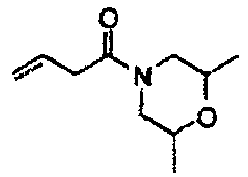
- Yield: 72%. 1H-NMR (CDCl3): δ 1.10-1.23 (d, J = 6.2 Hz, 6H, CH3 morph.), 2.13-2.37, 2.67-2.85, 3.35-3.64 and 4.30-4.51 (4m, 6H, 2CH morph. + 2CH2 morph.), 5.00-5.22 (m, 2H, CH 2=CH), 5.75-6.05 (m, 1H, CH2=CH). IR (CHCl3) cm-1: 1631 (C=O). GC-MS m/z: 183 (M+), 41, 56, 69, 138, 142.
- To a solution of 3-(cyclopentyloxy)-N-hydroxy-4-methoxybenzenecarboximidoyl chloride (2.97 g, 11 mmol) in an. DMF (20 mL) the suitable 1-amino-3-buten-1-one (22 mmol) solved in an. DMF (10 mL) was added; then, triethylamine (1.72 g, 17 mmol, 2.37 mL) was added dropwise at 0 °C, under nitrogen atmosphere. The mixture was stirred at room temperature for 72 h, cooled to room temperature and poured into water (100 mL). The mixture was extracted with diethyl ether (3 x 20 mL), the organic phase was washed with brine (3 x 20 mL), dried (MgSO4) and concentrated under reduced pressure. Compound XIVa was obtained as a yellow solid which was recrystallized by an. methanol. Compound XIVb was purified by silicagel (100-200 mesh) column chromatography using diethyl ethere as the eluent to afford a pure product as a white solid.
- Yield: 41%. Mp: 144 °C.
- Yield: 40%. Mp: 104-105 °C.
-

- To a solution of 3-(cyclopentyloxy)-N-hydroxy-4-methoxybenzenecarboximidoyl chloride (1.23 g, 4.56 mmol) in an. toluene (5 mL) at 0-5 °C, 3-butyn-2-ol (0.36 mL, 4.56 mmol) and, subsequently, triethylamine (0.95 mL, 6.84 mmol) were added dropwise; then the mixture was heated at 60° C for 18 h. After cooling to room temperature, the mixture was filtered and the solid obtained was washed with an. toluene (3 x 10 mL); the collected organic phases were washed with water (3 x 20 mL), dried (MgSO4) and concentrated under reduced pressure yielding a yellow oil which was purified by Florisil (100-200 mesh) column chromatography using diethyl ether as the eluent. The crude crystallized as a white solid by addition of a mixture of diethyl ether/ petroleum ether (boiling point 40-60 °C) (1:1).
- Yield: 60 %. Mp: 72-73 °C. 1H-NMR (CDCl3): δ 1.62 (d, J = 6.6 Hz, 3H, CH3), 1.75-2.10 (m, 8H, 4CH2 cyclopent.), 2.02 (s, 1H, OH, disappears with D2O), 3.87 (s, 3H, OCH3), 4.75-4.91 (m, 1H, OCH cyclopent.), 4.95-5.11 (m, 1H, CH-OH), 6.44 (s, 1H, CH isox.), 6.88 (d, J = 8.2 Hz, 1H, H-5 Ar), 7.24 (dd, J = 8.2, 2.0 Hz, 1H, H-6 Ar), 7.37 (d, J = 2.0 Hz, H-2 Ar). IR (KBr) cm-1: 3398 (OH). Anal. (C17H21NO4) C, H, N. (% calculated/found) C: 67.31/ 67.37; H: 6.98/ 7.35; N: 4.62/ 4.65.
-

- To 1-{3-[3-(cyclopentyloxy)-4-methoxyphenyl]isoxazol-5-yl}ethanol (4.18 g, 13.78 mmol) in dimethylsulfoxide (21 mL), acetic anhydride (13.78 mL) was added and the solution was stirred at room temperature for 24 h. Then water (230 mL) was added and the solid obtained was filtered and recrystallized by absolute ethanol yielding a white solid.
- Yield: 80 %. Mp: 121-122 °C. 1H-NMR (CDCl3): δ 1.42-2.10 (m, 8H, 4CH2 cyclopent.), 2.63 (s, 3H, CH3), 3.88 (s, 3H, OCH3), 4.75-4.94 (m, 1H, OCH cyclopent.), 6.91 (d, J = 8.2 Hz, 1H, H-5 Ar), 7.13 (s, 1H, CH isox.), 7.26 (dd, J = 8.2, 2.0 Hz 1H, H-6 Ar), 7.39 (d, J = 2.0 Hz, H-2 Ar). IR (KBr) cm-1: 1696 (C=O). Anal. (C17H19NO4) C, H, N. (% calculated/found) C: 67.76/ 67.95; H: 6.36/ 6.34; N: 4.65/ 5.00.
-

- To a solution of 1-{3-[3-(cyclopentyloxy)-4-methoxyphenyl]isoxazol-5-yl}ethanone (0.56 g, 1.86 mmol) in CH2Cl2 (3 mL), glacial acetic acid (0.05 mL) was added and the reaction mixture was heated at 50 °C. Afterward a solution of bromine (0.1 mL, 1.95 mmol) in CH2Cl2 (1 mL) was added dropwise and the mixture was heated at reflux for 1 h. After cooling to room temperature, the suspension was diluted with CH2Cl2 (20 mL), washed once with ice-water (20 mL), then with water (2 x 20 mL), dried (MgSO4) and concentrated under reduced pressure yielding a yellow solid which was recrystallized by absolute ethanol to give the final product as a white solid.
- Yield: 60 %. Mp: 120-122 °C. 1H-NMR (CDCl3): δ 1.57-2.14 (m, 8H, 4CH2 cyclopent.), 3.89 (s, 3H, OCH3), 4.47 (s, 2H, CH2Br), 4.78-4.93 (m, 1H, OCH cyclopent.), 6.93 (d, J = 8.2 Hz, 1H, H-5 Ar), 7.20-7.37 (m, 2H, H-6 Ar + H isox.), 7.41 (d, J = 1.8 Hz, H-2 Ar). IR (KBr) cm-1: 1698 (C=O). Anal. (C17H18BrNO4) C, H, N. (% calculated/found) C: 53.70/ 53.94; H: 4.77/ 5.10; N: 3.68/ 3.33.
- To a solution of 2-bromo-1-{3-[3-(cyclopentyloxy)-4-methoxyphenyl]isoxazol-5-yl}ethanone (0.54 g, 1.42 mmol) in CH2Cl2 (3 mL) cooled at -10 °C (for compound XVa) or at -30 °C (for compound XVb), the suitable cycloamine (2.91 mmol) was added. After a few minutes the reaction was completed and a saturated solution of anhydrous HCl in diethyl ether was immediately added to the reaction mixture yielding the hydrochloride salts of compounds XV as white solids.
-

- Yield: 72%. Mp: 175 °C (dec.). 1H-NMR (CDCl3): δ 1.60-2.20 (m, 8H, 4CH2 cyclopent.), 3.60-3.80 (m, 4H, 2CH2-N morph.), 4.07 (s, 3H, OCH3), 4.20-4.50 (m, 4H, 2CH2O morph.), 4.27 (s, 2H, CH2-N), 4.95-5.10 (m, 1H, OCH cyclopent.), 7.08 (d, J = 2.0 Hz, 1H, H-5 Ar), 7.35-7.52 (m, 3H, H-2 Ar + H isox. + NH+, 1H disappears with D2O), 7.55 (d, J = 2.0 Hz, 1H, H-6 Ar). IR (KBr) cm-1: 1710 (C=O). Anal. (C21H26N2O5HCl) C, H, N. (% calculated/found) C: 59.64/ 59.63; H: 6.44/ 6.56; N: 6.62/ 6.69.
-

- Yield: 25 %. Mp: 200 °C (dec.). 1H-NMR (CDCl3): δ 1.41 and 1.44 (2s, 6H, 2CH3), 1.60-2.25 (2m, 8H, 4CH2 cyclopent.), 3.05-3.22 and 3.65-3.87 (2m, 4H, 2CH2-N morph.), 4.06 (s, 3H, OCH3), 4.45-4.68 (m, 2H, 2CHO morph.), 4.88 (s, 2H, CH2-N), 4.95-5.10 (m, 1H, OCH cyclopent.), 7.08 (d, J = 2.0 Hz, 1H, H-5 Ar), 7.47 (d, J = 2.0 Hz, 1H, H-6 Ar), 7.55 (br s, 1H, H-2 Ar), 7.70 (s, 1H, H isox.). IR (KBr) cm-1: 1711 (C=O). Anal. (C23H30N2O5.HCl) C, H, N. (% calculated/found) C: 60.99 / 61.08; H: 7.34 / 7.50; N: 6.18 / 6.20.
- To a suspension of 1-{3-[3-(cyclopentyloxy)-4-methoxyphenyl]isoxazol-5-yl}-2-cycloaminoethanones hydrochloride XVa or XVb (1.1 mmol) in an. methanol, NaBH4 (1.1 mmol, 41 mg) was added portionwise at room temperature; afterward a solution of CH3ONa (60 mg, 1.1 mmol) in an. methanol (10 mL) was added dropwise and the mixture was stirred at room temperature for 3-4 h. Then, the methanol was removed under reduced pressure and the crude was solved in CH2Cl2 (20 mL), washed with water (3 x 20 mL), dried (MgSO4) and concentrated under reduced pressure.
- The morpholino derivative XVIa was obtained as a yellow solid which was washed with hot diethylic ether. The dimethylmorpholino derivative XVIb was obtained as an oil which was purified by Florisil (100-200 mesh) column chromatography eluting with diethyl ether. The solids obtained were further purified by preparative TLC (Silicagel) using diethyl ether as the eluent, yielding the final pure products as white solids.
-

- Yield 65 %. Mp: 136-137 °C. 1H-NMR (CDCl3): δ 1.70-2.30 (m, 8H, 4CH2 cyclopent.), 2.55-2.75 (m, 2H, CH2-N), 2.80-3.00 (m, 4H, 2CH2-N morph.), 3.85-4.10 (m, 5H, 2CH2-O morph. + OH, 1 H disappears with D2O), 4.05 (s, 3H, OCH3), 4.85-5.15 (2m, 2H, OCH cyclopent. + CH-OH), 6.71 (s, 1H, H isox.), 7.08 (d, J = 2.0 Hz, 1H, H-5 Ar), 7.24 (d, J = 2.0 Hz, 1H, H-6 Ar), 7.35 (s, 1H, H-2 Ar) IR (KBr) cm-1: 3125 (OH). Anal. (C21H28N2O5) C, H, N. (% calculated/found) C: 64.93/ 65.10; H: 7.27/ 7.50; N: 7.21 / 7.39.
-

- Yield 30 %. Mp: 92-94 °C. 1H-NMR (CDCl3) δ 1.30-1.42 (m, 6H, 2CH3 morph.), 1.68-2.40 (m, 8H, 4CH2 cyclopent.), 2.73-3.12 (m, 6H, 2CH2 morph. + CH2-N morph.), 3.65-4.00 (m, 2H, 2CH morph.), 4.05 (s, 3H, OCH3), 4.95-5.20 (2m, 2H, OCH cyclopent. + CH-OH), 7.05-7.13 (d, J = 1.6 Hz, 1H, H-5 Ar), 7.43 (s, 1H, CH isox.), 7.46 (dd, J = 1.6, 0.4Hz, 1H, H-6 Ar), 7.66 (d, J = 0.4 Hz, 1H, H-2 Ar). IR (KBr) cm-1: 3423 (OH). Anal. (C23H32N2O5) C, H, N. (% calculated/found) C: 66.32/ 66.16; H: 7.74/ 7.46; N: 6.73/ 6.74.
-

- To a sospension of 3-(cyclopentyloxy)-N-hydroxy-4-methoxybenzenecarboximidoyl chloride (2.33 g, 8.64 mmol) and methyl propiolate (0.73 g, 8.64 mmol, 0.71 mL) in an. toluene (10 mL), a solution of triethylamine (0.87 g, 8.64 mmol, 1.16 mL) in an. toluene (15 mL) was added dropwise (30 min) and the mixture was stirred at 60 °C for 12 h. After cooling to room temperature the solid residue was filtered off and washed with an. toluene. Then, the collected organic phases were dried (MgSO4), and concentrated under reduced pressure yielding a light brown oil which crystallized after addition of a mixture of diethyl ether/petroleum ether (boiling point 40-60 °C) (1:1) and standing overnight in a refrigerator.
- Yield: 33%. Mp: 126-127 °C. 1H-NMR (CDCl3): δ 1.55-2.15 (m, 8H, 4CH2 cyclopent.), 3.93 (s, 3H, OCH3 Ar), 4.02 (s, 3H, OCH3 ester), 4.82-4.96 (m, 1H, OCH cyclopent.), 6.96 (d, J = 8.2 Hz, 1H, H-5 Ar), 7.23 (s, 1H, H isox.), 7.30 (dd, J = 8.2, 2.2 Hz, 1H, H-6 Ar), 7.45 (d, J = 2.2 Hz, 1H, H-2 Ar). IR (KBr) cm-1: 1744 (C=O). Anal. (C17H19NO5) C, H, N. (% calculated/found) C: 64.34; / 64.18; H: 6.03/ 6.36; N: 4.41/ 4.56.
- A suspension of methyl 3-[3-(cyclopentyloxy)-4-methoxyphenyl]isoxazole-5-carboxylate (0.96 g, 2.90 mmol) and an excess of the proper cycloamine (41.6 mmol) was stirred for 12 h at 60°C. After cooling to room temperature, water (30 mL) was added and the product crystallized after standing overnight in a refrigerator. The white solid obtained was filtered and recrystallised by ethanol.
-

- Yield: 53 %. Mp: 100-101 °C. 1H-NMR (CDCl3): δ 1.55-2.21 (m, 8H, 4CH2 cyclopent.), 3.92 (s, 3H, OCH3), 3.65-3.97 (m, 8H, 4CH2 morph.), 4.80-4.92 (m, 1CH, OCH cyclopent.), 6.96 (d, J = 8 Hz, 1H, H-5 Ar), 7.09 (s, 1H, H isox.), 7.03-7.38 (dd, J = 8.0, 1.8 Hz, 1H, H-6 Ar), 7.42 (d, J = 1.8 Hz, 1H, H-2 Ar). IR (KBr) cm-1: 1636 (C=O). Anal. (C20H24N2O5) C, H, N. (% calculated/found) C: 64.50 / 65.25; H: 6.50 / 6.87; N: 7.52/ 7.86.
-

- Yield: 69 %. Mp: 152-153 °C. 1H-NMR (CDCl3): δ 1.13-1.35 (m, 6H, 2CH3 morph.), 1.55-2.12 (m, 8H, 4CH2 cyclopent.), 2.45-2.70,2.90-3.15,3.50-3.80, 4.00-4.28 and 4.40-4.60 (5m, 6H, 2CH morph. + 2CH2-N morph.) 3.93 (s, 3H, OCH3), 4.75-4.93 (m, 1 CH, OCH cyclopent.), 6.96 (d, J = 11.4 Hz, H-5 Ar), 7.09 (s, 1H, H isox.), 7.31 (dd, J = 11.4, 2.0 Hz, 1H, H-6 Ar), 7.44 (d, J = 2.0 Hz, 1H, H-2 Ar). IR (KBr) cm-1: 1633 (C=O). Anal. (C22H28N2O5) C, H, N. (% calculated/found) C: 65.98/ 65.96; H: 7.05/ 6.86; N: 7.00/ 7.34.
-

- This compound has been already reported [
Hopper, Allen et al. PCT Int. Appl., 2004094411, 04 Nov 2004 ]. We describe below our different method for its preparation. - To a solution of p-toluenesulfonyl hydrazide (3.3 g, 17.74 mmol) in an. acetonitrile (20 mL) 3-(cyclopentyloxy)-4-methoxybenzaldehyde (3.90 g, 17.74 mmol) solved in an. acetonitrile (10 mL) was added and the mixture was stirred at room temperature for 1 h. Then, 5N NaOH solution (3.55 mL, 17.75 mmol) was added and the mixture, which became coloured in red, was stirred at room temperature for 20 min. Afterward, 1-vinylimidazole (, 8.34 g, 88.77 mmol, 8.03 mL) was slowly added and the mixture was heated at 50 °C for 48 h. After cooling to room temperature, the solvent was removed under reduced pressure and the crude was solved in ethylacetate (20 mL); the organic phase was washed with brine (2 x 20 mL), 1N HCl solution (20 mL), water (3 x 20 mL), dried (MgSO4), and concentrated under reduced pressure to afford a light yellow oil which crystallized by addition of methanol. The pure product is obtained as a light yellow solid.
- Yield : 65%. Mp: 80-82 °C. 1H-NMR (CDCl3): δ 1.49-2.19 (m, 8H, 4CH2 cyclopent.), 3.87 (s, 3H, OCH3), 4.72-4.97 (m, 1H, OCH cyclopent.), 6.53 (d, J = 2.2 Hz, 1H, H-4 pyraz.), 6.84-7.38 (m, 3H, 3H Ar), 7.59 (d, J = 2.2 Hz, 1H, H-5 pyraz.). IR (KBr) cm-1: 3562 (NH). Anal. (C15H18N2O2) C, H, N. (% calculated/found) C: 69.74/ 69.74; H: 7.02/ 6.84; N: 10.84/ 10.73.
-

- A mixture of 3-[3-(cyclopentyloxy)-4-methoxyphenyl]-1H-pyrazole (0.77 g, 2.98 mmol) and epichlorohydrin (3 mL, 38.26 mmol) was cooled at 5°C; then, triethylamine (4.47 mmol, 0.62 mL,) was added dropwise and the reaction mixture was stirred until the temperature became 25 °C, then was heated at 70°C for 3 h. After cooling to room temperature, the mixture was poured into water (100 mL), the acqueous phase was extracted with CH2Cl2 (2 x 20 mL); the organic phase was washed with water (20 mL) until the pH of washing solution became neutral, dried (MgSO4) and concentrated under reduced pressure yielding an oil which was purified by silicagel (100-200 mesh) column chromatography using diethyl ether as the eluent. The desired compound crystallized standing in a refrigerator after addition of diethyl ether.
- The reaction between 3-[3-(cyclopentyloxy)-4-methoxyphenyl]-1H-pyrazole and epichlorohydrin could lead to 1-5 and/or 1-3 disubtituted isomers. From the 1H and 13C-NMR spectra resulted that the purified compound was a single isomer and C and H assignments were made on the basis of spin-spin decoupling, COSY, HSQC and HMBC experiments. Furthermore a clear long range correlation δC = 131.4 (C-5 pyrazole) / δH = 4.19 and 4.48 (N- CH2-) in the HMBC spectrum clearly showed a 1,3-disubstituted pyrazole structure for the synthesized compound.
- Yield: 73 %. Mp: 53-55 °C. 1H-NMR (CDCl3): δ 1.50-2.04 (m, 8H, 4CH2 cyclopent.), 2.53 (dd, J = 4.7, 2.6 Hz, 1H, HA of CH2 epox.), 2.85 (dd, J = 4.7, 4.3 Hz, 1H, HB of CH2 epox.), 3.34-3.40 (m, 1H, CHO epox.), 3.86 (s, 3H, OCH3), 4.19 (dd, J = 4.6, 5.6 Hz, 1H, HA of CH2), 4.48 (dd, J = 14.6, 3.1 Hz, 1H, HB of CH2), 4.84-4.94 (m, 1H, OCH cyclopent.), 6.49 (d, J = 2.4 Hz, 1H, H-4 pyraz.), 6.88 (d, J = 8.3 Hz, 1H, H-5 Ar), 7,29 (dd, J = 8.3, 2.0 Hz, 1H, H-6 Ar), 7.36 (d, J = 2.0 Hz, 1H, H-2 Ar), 7.46 (d, J = 2.4 Hz, 1H, H-5 pyraz.). 13C-NMR (CDCl3): 24.2 (2CH2 cyclopent.), 32.9 (2CH2 cyclopent.), 45.5 (2CH2 cyclopent. epox.), 50.8 (CH epox.), 53.8 (CH2N), 56.1 (OCH3), 80.5 (OCH cyclopent.), 103.0 (C-4 pyraz.), 112.0 (C-5 Ar), 112.7 (C-2 Ar), 118.3 (C-6 Ar), 126.5 (C-1 Ar), 131.4 (C-5 pyraz.), 147.8 (C-3 Ar), 150.0 (C-4 Ar), 151.8 (C-3 pyraz.). Anal. (C18H22N2O3) C, H, N. (% calculated/found) C: 68.77/ 68.58; H: 7.05/ 6.68; N: 8.91 / 8.84.
- To 3-[3-(cyclopentyloxy)-4-methoxyphenyl]-1-(oxiran-2-ylmethyl)-1H-pyrazole (1 g, 3.15 mmol) an excess of the suitable amine (2 mL) was added and the mixture was heated at 50-60°C for 18 h. After cooling to room temperature, the mixture was diluted with diethyl ether (20 mL), then the organic phase was washed with water (20 mL), dried (MgSO4) and concentrated under reduced pressure. The crude was purified by Florisil (100-200 mesh) column chromatography using diethyl ether as the eluent. The desired compounds were obtained as yellow oils which was then treated with a HCl saturated ethanol solution to afford the corresponding hydrochloride salts as white solids.
-

- Yield: 51%. Mp: 162-163 °C. 1H-NMR (CDCl3): δ 1.70-2.40 (m, 8H, 4CH2 cyclopent.), 3.20-3.60, 3.74-4.00, 4.10-4.25 and 4.25-4.50 (4m, 10H, 4CH2 morph. + CH2N), 4.05 (s, 3H, OCH3), 4.80-5.35 (m, 5H, OCH cyclopent. + CH-OH + CH2N pyraz. + OH, 1H disappears with D2O), 6.85 (br s, 1H, H-4 pyraz.), 7.09 (d, J = 8.2 Hz, 1H, H-5 Ar), 7.60 (d, J = 8.2 Hz, 1H, H-6 Ar), 7.75 (s, 1H, H-2 Ar), 8.24 (s, 1H, H-5 pyraz.), 11.70-11.95 (br s, 1H, NH+ disappears with D2O). Anal. (C22H31N3O4.2HCl.2H2O) C, H, N. (% calculated/found) C: 51.77/ 51.43; H: 7.31 / 6.86; N: 8.23/ 8.26.
-

- Yield: 61%. Mp: 188-189 °C. 1H-NMR (CDCl3): δ 1.17-1.40 (m, 6H, 2CH3), 1.55-2.20 (m, 8H, 4CH2 cyclopent.), 2.50-2.80 (m, 2H, CH2N morph.), 3.00-3.40 (m, 2H, CH2N), 3.45-3.80 (m, 3H, CH2N morph. + CHO morph.), 3.80-4.00 (m, 4H, OCH3 + CHO morph.), 4.20-4.55 (m, 2H, CH2N pyraz.), 4.80-5.20 (m, 3H, OCH cyclopent. +CH-OH + OH, 1H disappears with D2O), 6.72 (near d, 1H, H-4 pyraz.), 6.96 (d, J = 8.4 Hz, 1H, H-5 Ar), 7.48 (dd, J = 8.4, 2 Hz, 1H, H-6 Ar), 7.61 (d, J = 2 Hz, 1H, H-2 Ar), 8.18 (near d, 1H, H-5 pyraz.), 11.55 (br s, 2H, 2NH+, 2H disappear with D2O). Anal. (C24H35N3O4.2HCl.H2O) C, H, N. (% calculated/found) C: 55.38/ 55.67; H: 7.55/ 7.46; N: 8.07/ 8.16.
-
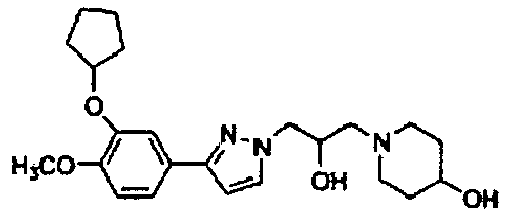
- To a solution of 3-[3-(cyclopentyloxy)-4-methoxyphenyl]-1-(oxiran-2-ylmethyl)-1H-pyrazole (0.38 g, 1.21 mmol) in an. DMF (2 mL), piperidin-4-ol (0.25 g, 2.5 mmol) was added. The mixture was stirred at 50-60 °C for 18 h. After cooling to room temperature, the solvent was removed under reduced pressure. The residue was dissolved in diethyl ether (20 mL) and the organic phase was washed with water (20 mL), dried (Na2SO4), and concentrated under reduced pressure. The crude was purified by silicagel (100-200 mesh) column chromatography using as eluent firstly a mixture of diethyl ether/ methanol (9:1), then a mixture of dichloromethane/methanol (7:3) obtaining a pure product as a light yellow oil.
- Yield: 40%. 1H-NMR (CDCl3): δ 1.30-2.03 (m, 12H, 4CH2 cyclopent. + 2CH2 pip.), 2.03-2.99 (m, 8H, 3CH2N + 2OH, 2H disappear with D2O), 3.60-3.80 (m, 1H, CH-OH pip.), 3.88 (s, 3H, OCH3), 4.04-4.28 (m, 3H, CH2N pyraz. + CH-OH), 4.78-4.98 (m, 1H, OCH cyclopent.), 6.49 (d, J = 2 Hz, 1H, H-4 pyraz.), 6.82-7.48 (2m, 3H, H-6 + H-5 + H-2 Ar), 7.52 (d, J = 2.0 Hz, 1H, H-5 pyraz.). IR (KBr) cm-1: 3413 (OH). Anal. (C23H33N3O4) C, H, N. (% calculated/found) C: 66.48/ 66.09; H: 8.00/ 8.29; N: 10.11 / 10.00.
-

- A mixture of 1-{3-[3-(cyclopentyloxy)-4-methoxyphenyl]-1H-pyrazol-1-yl}-3-morpholin-4-ylpropan-2-ol (0.60 g, 1.63 mmol) and sodium acetate (0.2 g, 2.4 mmol) in acetic anhydride (5 mL) was heated at 40-50 °C for 5 h. After cooling to room temperature, the mixture was poured into water (100 mL), extracted with diethyl ether (3 x 10 mL), the organic phase was washed with water (3 x 20 mL), brine (3 x 20 mL), dried (MgSO4) and concentrated under reduced pressure. The pure product was obtained as a yellow oil.
- Yield: 52 %. 1H-NMR (CDCl3): δ 1.56-2.06 (m, 8H, 4CH2 cyclopent.), 2.12 (s, 3H, CH3), 2.61-2.92 (m, 6H, 2CH2N morph. + CH2N), 3.70-4.00 (m, 7H, OCH3 + 2CH2O morph.), 4.32-4.58 (m, 2H, CH2N pyraz.), 4.81-4.99 (m, 1H, OCH cyclopent.), 5.40-5.57 (m, 1H, CHOAc), 6.50 (d, J = 1.6 Hz, 1H, H-4 pyraz.), 6.84-7.60 (m, 4H, H-6 + H-5 + H-2 Ar + H-5 pyraz.). Anal. (C24H33N3O5) C, H, N. (% calculated/found) C: 64.99/ 64.93; H: 7.50/ 7.79; N: 9.47/ 9.10.
- To a solution of 3-[3-(cyclopentyloxy)-4-methoxyphenyl]-1H-pyrazole (0.52 g, 2 mmol) in an. DMF (3 mL) the suitable chloroacetylamine (15 mmol) was added. Then, triethylamine (1 mL, 0.73 g, 7.19 mmol) was added dropwise and the mixture was heated at 100 °C for 18 h. After cooling to room temperature, the mixture was poured into water (100 mL) and extracted with diethyl ether (3 x 25 mL), the organic phase was dried (MgSO4) and concentrated under reduced pressure. The crude crystallized by addition of a mixture of diethyl ether/petroleum ether (boiling point 40-60 °C) (1:1) to afford the desired compounds as white solids, which were recrystallized by absolute ethanol (XXa) or diethyl ether (XXb).
-
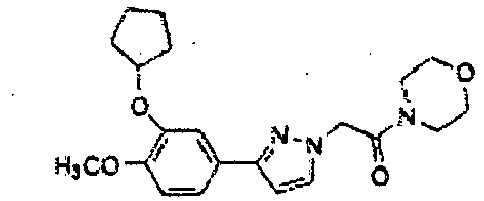
- Yield: 58%. Mp: 131-132 °C. 1H-NMR (CDCl3): δ 1.60-2.12 (m, 8H, 4CH2 cyclopent.), 3.60-4.00 (m, 11H, OCH3 + 4CH2 morph.), 4.83-5.10 (m, 3H, CH2CO + OCH cyclopent.), 6.76 (d, J = 2.8 Hz, 1H, H-4 pyraz.), 6.96 (d, J = 8.2 Hz, 1H, H-5 Ar), 7.47 (dd, J = 8.2, 1.6 Hz, 1H, H-6 Ar), 7.68 (d, J = 1.6 Hz, 1H, H-2 Ar), 7.84 (d, J = 2.8 Hz, 1H, H-5 pyraz.). IR (KBr) cm-1: 1663 (C=O). Anal. (C21H27N3O4) C, H, N. (% calculated/found) C: 65.44/ 65.60; H: 7.06/ 7.44; N: 10.90/ 10.81.
-

- Yield: 53%. Mp: 99-100 °C. 1H-NMR (CDCl3): δ 1.10-1.28 (m, 6H, 2CH3 morph.), 1.52-2.06 (m, 8H, 4CH2 cyclopent.), 2.18-2.52, 2.79-2.98 and 3.12-3.61 (3m, 4H, CH2 morph.), 3.65-3.80 (m, 1H, CHO morph.), 3.82-4.00 (m, 4H, OCH3 + CHO morph.), 4.91 (s, 2H, CH2CO), 5:00-5.19 (m, 1H, OCH cyclopent.), 6.55 (d, J=2.4 Hz, 1H, H-4 pyraz.), 6.90 (d, J=8.4 Hz, 1H, H-5 Ar), 7.25-7.42 (m, 2H, H-6 + H-2 Ar), 7.56 (d, J=2.4 Hz, 1H, H-5 pyraz.). IR (KBr) cm-1: 1665 (C=O). Anal. (C23H31N3O4) C, H, N. (% calculated/found) C: 66.81/ 66.81; H: 7.56/ 7.85; N: 10.16/ 10.21.
-

- To a solution of 3-[3-(cyclopentyloxy)-4-methoxyphenyl]-1H-pyrazole (0.77 g, 3 mmol) in an. DMF (5 mL) 4-(3-chloropropanoyl)morpholine (3.20 g, 18 mmol) solved in an. DMF (6 mL) was slowly added at 0 °C. Then, triethylamine (0.80 g, 7.91 mmol, 1.1 mL) was added dropwise and the mixture was heated at 120 °C for 48 h. After cooling to room temperature, the mixture was poured into water (100 mL) and extracted with diethyl ether (3 x 25 mL), the organic phase was dried (MgSO4) and concentrated under reduced pressure. The crude was purified by silicagel (100-200 mesh) column chromatography using a gradient elution from diethyl ether alone to diethyl ether/methanol (1:1). The pure product was obtained as a light yellow oil.
- Yield: 38%. 1H-NMR (CDCl3): δ 1.54-2.07 (m, 8H, 4CH2 cyclopent.), 2.91-3.00 (m, 2H, CH2CO), 3.32-3.67 (m, 8H, 4CH2 morph.), 3.89 (s, 3H, OCH3), 4.52 (t, J = 6.4 Hz, 2H, CH2N), 4.89-5.00 (m, 1H, OCH cyclopent.), 6.44 (d, J = 2.4 Hz, 1H, H-4 pyraz.), 6.92 (d, J = 8.2 Hz, 1H, H-5 Ar), 7.22-7.40 (m, 2H, H-6 + H-2 Ar), 7.49 (d, J=2.4 Hz, 1H, H-5 pyraz.). IR (film) cm-1: 1654 (C=O). Anal. (C22H29N3O4) C, H, N. (% calculated/found) C: 66.14/ 66.07; H: 7.32/ 7.04; N: 10.52/ 10.46.
-

- To a solution of 3-[3-(cyclopentyloxy)-4-methoxyphenyl]-1H-pyrazole (0.6 g, 2.25 mmol) in an. acetonitrile (15 mL) methyl-3-bromopropionate (1.91 g, 11.45 mmol) and triethylamine (1 mL, 0.73 g, 7.19 mmoli) were added dropwise at 0 °C; then, the mixture was heated at reflux for 48 h. After cooling to room temperature, the solvent was removed under reduced pressure and the crude was solved in diethyl ether (30 mL), the organic phase was washed with water (3 x 20 mL), 4N NaOH solution (2 x 20 mL), brine (2 x 20 mL), dried (MgSO4), and concentrated under reduced pressure. The obtained oil was purified by silicagel (100-200 mesh) column chromatography, using diethyl ether as the eluent to afford the pure product as a light yellow oil.
- Yield: 67%. 1H-NMR (CDCl3): δ 1.50-2.18 (m, 8H, 4CH2 cyclopent.), 3.00 (t, J = 6.0 Hz, 2H, CH2CO), 3.73 (s, 3H, OCH3), 3.90 (s, 3H, OCH3-Ar), 4.49 (t, J = 6.0 Hz, 2H, CH2N), 4.77-5.08 (m, 1H, OCH cyclopent.), 6.45 (d, J = 3.0 Hz, 1H, H-4 pyraz.), 6.95 (d, J = 6.8 Hz, 1H, H-5 Ar), 7.20-7.50 (m, 3H, H-6 + H-2 Ar + H-5 pyraz.). IR (CHCl3) cm-1: 1735 (C=O). Anal. (C19H24N2O4) C, H, N. (% calculated/found) C: 66.26/ 66.24; H: 7.02/ 7.33; N: 8.13/ 7.90.
-

- To a solution of methyl 3-{3-[3-(cyclopentyloxy)-4-methoxyphenyl]-1H-pyrazol-1-yl}-propanoate (1 g, 3 mmol) in 96 % ethanol (3 mL) NaOH (0.2 g, 5.0 mmol) was added and the mixture was heated at 60 °C for 4 h. Then, the solvent was removed under reduced pressure, the crude was solved in water (20 mL) and a 1N HCl solution was slowly added until pH became = 1. The light yellow solid obtained was filtered, washed with water and recrystallized by a mixture of diethyl ether/ dichlorometane (1:1).
- Yield: 74%. Mp: 131-133 °C. 1H-NMR (CDCl3): δ 1.52-2.11 (m, 8H, 4CH2 cyclopent.), 3.02-3.10 (m, 2H, CH2), 3.91 (s, 3H, OCH3), 4.42-4.54 (m, 2H, CH2N pyraz.), 4.86-5.02 (m, 1H, OCH cyclopent.), 6.54 (d, J = 2.3 Hz, 1H, H-4 pyraz.), 6.93 (d, J = 8.4 Hz, 1H, H-5 Ar), 7.21-7.41 (m, 2H, H-6 + H-2 Ar), 7.52 (d, J = 2.3 Hz, 1H, H-5 pyraz.). IR (CHCl3) cm-1: 1721 (C=O), 3515 (OH). Anal. (C18H22N2O4) C, H, N. (% calculated/found) C: 65.44/ 65.62; H: 6.71/ 6.45; N: 8.48/ 8.48.
-

- To a solution of 3-{3-[3-(cyclopentyloxy)-4-methoxyphenyl]-1H-pyrazol-1-yl}-propanoic acid (0.67 g, 2 mmol) in an. DMF (5 mL), triethylamine (0.30 g, 6 mmol, 0.4 mL), 2,6-dimethylmorpholine (0.50 mL, 4 mmol) and diphenylphosphorylazide (0.69 g, 2.5 mmol) were added at 0 °C. Then, the mixture was heated at 80 °C for 15 h. After cooling to room temperature, the mixture was poured into water (100 mL) and extracted with diethyl ether (3 x 25 mL), the organic phase was dried (MgSO4) and concentrated under reduced pressure. The crude was purified by silicagel (100-200 mesh) column chromatography using diethyl ether as the eluent to afford the pure product as a light yellow oil.
- Yield: 71%. 1H-NMR (CDCl3): δ 1.08 (d, J = 6.2 Hz, 3H, CH3 morph), 1.18 (d, J = 6.2 Hz, 3H, CH3 morph.), 1.60-2.06 (m, 8H, 4CH2 cyclopent.), 2.23-2.39, 2.62-2.7, 2.82-3.19 and 3.23-3.70 (4m, 8H, 2CH2 morph. + CH2CO + 2CH morph.), 3.89 (s, 3H, OCH3), 4.50-4.59 (m, 2H, CH2N pyraz.), 4.86-4.97 (m, 1H, CHO cyclopent.), 6.43 (d, J = 2.2 Hz, 1H, H-4 pyraz.), 6.93 (d, J = 8.4 Hz, 1H, H-5 Ar), 7.33-7.41 (m, 2H, H-6 + H-2 Ar), 7.48 (d, J = 2.2 Hz, 1H, H-5 pyraz.). IR (CHCl3) cm-1: 1671 (C=O). Anal. (C24H33N3O4) C, H, N. (% calculated/found) C: 67.42/ 67.15; H: 7.78/ 8.11; N: 9.83/ 9.84.
-

- The 4-(difluoromethoxy)-3-hydroxybenzaldehyde was prepared with improved yield by the following microwave assisted procedure.
- To a solution of 3,4-dihydroxybenzaldehyde (0.415 g, 3 mmol) in an. DMF (5 mL), Cs2CO3 (0.975 g, 3 mmol) and methyl chlorodifluoroacetate (0.520 g, 3.6 mmol) were added; then the mixture was irradiated with microwaves, under pressure, increasing the potency until 300 W in 2 minutes and cooling by compressed air to avoid the temperature increasing over 90 °C; the irradiation was carried on for further 3 minutes and then the mixture was cooled to room temperature, with compressed air, in 1 minute. The cycle was repeated five time for a total reaction time of 30 minutes. The mixture was poured into water (100 mL) and extracted with ethyl acetate (3 x 20 mL); the organic phase was washed with water (20 mL), brine (20 mL), dried (MgSO4) and concentrated under reduced pressure, yielding a brown oil which was purified by silicagel (100-200 mesh) column chromatography eluting with an ethylacetate / exane mixture (15:85). The pure product was obtained as a light grey solid.
- Yield: 57% (lit.: 15-30%). Mp: 86-88 °C. 1H-NMR (CDCl3): δ 6.05 (br s, 1H, OH, 1H disappears with D2O), 6.65 (t, J = 72.6 Hz, OCHF2), 7.26 (d, J = 8.2 Hz, 1H, H-5 Ar), 7.45 (dd, J = 8.2, 2.0 Hz, 1H, H-6 Ar), 7.12 (d, J = 2.0 Hz, H-2 Ar), 9.90 (s, 1H, CH=N). IR (KBr) (cm-1): 1687 (C=O), 3305 (OH). Anal. (C8H6F2O3) C, H. (% calculated/found) C: 51.07/ 50.96; H: 3.21/ 3.31.
-

- To a solution of p-toluenesulfonyl hydrazide (1.2 g, 6.45 mmol) in an. acetonitrile (7 mL) 3-(cyclopentyloxy)-4-(difluoromethoxy)benzaldehyde (1.65 g, 6.45 mmol) solved in an. acetonitrile (2 mL) was added and the mixture was stirred at room temperature for 1 h. Then, 5N NaOH solution (1.29 mL, 6.45 mmol) was added and the mixture, which became coloured in red, was stirred at room temperature for 20 min. Afterward, 1-vinylimidazole (3.04 g, 32.25 mmol, 2.92 mL) was slowly added and the mixture was heated at 50 °C for 48 h. After cooling to room temperature, the solvent was removed under reduced pressure and the crude was solved in ethylacetate (10 mL); the organic phase was washed with brine (2 x 10 mL), 1N HCl solution (10 mL), water (3 x 10 mL), dried (MgSO4), and concentrated under reduced pressure to afford a light yellow oil which was purified by flash Silicagel column chromatography using CH2Cl2 as eluent. The pure product is obtained as a light yellow oil.
- Yield: 45%. 1H-NMR (CDCl3): δ 1.52-1.94 (m, 8H, 4CH2 cyclopent.), 4.80-5.00 (m, 1H, OCH cyclopent.), 6.55-7.70 (m, 7H, 3H Ar + H-5 pyraz. + H-4 pyraz + OCHF2 + NH pyraz.). Anal. (C15H16N2O2F2) C, H, N. (% calculated/found) C: 61.22/ 61.32; H: 5.48/ 5.71; N: 9.52/ 9.59.
-
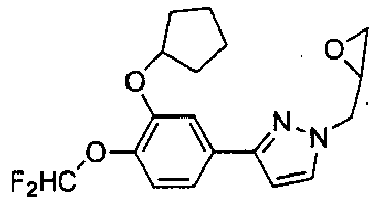
- A mixture of 3-[3-(cyclopentyloxy)-4-methoxyphenyl]-1H-pyrazole (1.3 g, 4.42 mmol) and epichlorohydrin (4.5 mL, 57.77 mmol) was cooled at 5 °C; then, triethylamine (6.63 mmol, 0.92 mL,) was added dropwise and the reaction mixture was stirred until the temperature became 25 °C, then was heated at 70 °C for 6 h. After cooling to room temperature, the mixture was poured into water (100 mL), the acqueous phase was extracted with CH2Cl2 (2 x 20 mL); the organic phase was washed with water (20 mL) until the pH of washing solution became neutral, then with brine (3 x 20 mL), dried (MgSO4) and concentrated under reduced pressure yielding an oil which was purified by silicagel (100-200 mesh) column chromatography using diethyl ether as the eluent.. The pure product is obtained as a light yellow oil.
- Yield: 58 %. 1HNMR (CDCl3): δ 1.58-2.04 (m, 8H, 4CH2 cyclopent.), 2.53-2.61 (m, 1H, HA of CH2 epox.), 2.83-2.94 (m, 1H, HB of CH2 epox.), 3.36-3.48 (m, 1H, CHO epox.), 4.13-4.28 and 4.52-4.65 (m, 2H, CH2N pyraz), 4.93-5.03 (m, 1H, OCH cyclopent.), 6.56(d, J=2.4 Hz, 1H, H-4 pyraz.), 6.58 (t, J = 75.6, 1H, OCHF2), 7.19 (d, J=8.0 Hz, 1H, H-5 Ar), 7.29 (dd, J=8.0, 2.0 Hz, 1H, H-6 Ar), 7.48 (d, J=2.0 Hz, 1H, H-2 Ar), 7.53 (d, J=2.4 Hz, 1H, H-5 pyraz.). Anal. (C18H20N2O3F2) C, H, N. (% calculated/found) C: 61.71/ 61.86; H: 5.75/5.99; N: 8.00/ 8.07.
-

- To 3-[3-(cyclopentyloxy)-4-(difluoromethoxy)phenyl]-1-(oxiran-2-ylmethyl)-1H-pyrazole (0.37 g, 1.06 mmol) an excess of morpholine (1 mL) was added and the mixture was heated at 50-60 °C for 18 h. After cooling to room temperature, the mixture was diluted with diethyl ether (20 mL), then the organic phase was washed with water (20 mL), dried (MgSO4) and concentrated under reduced pressure. The crude was purified by Silicagel column chromatography using as the eluent firstly diethyl ether, then a mixture of CH2Cl2/CH3OH 9:1 to afford a pure product as light yellow oil.
- Yield: 56%. 1H-NMR (CDCl3): δ 1.60-2.07 (m, 8H, 4CH2 cyclopent.), 2.44-2.84, 3.63-3.93(2m, 10H, 4CH2 morph. + CH2N), 4.13-4.40 (m, 3H,.CH2N pyraz.+ CH-OH), 4.82-4.92 (m, 1H, OCH cyclopent), 6.54 (d, J = 2.4, 1H, H-4 pyraz.), 6.58 (t, J = 75.6 Hz, 1H, OCHF2), 7.18 (d, J=8.0 Hz, 1H, H-5 Ar), 7.28 (d, J=8.0 Hz, 1H, H-6 Ar), 7.44 (s, 1H, H-2 Ar), 7.56 (d, J = 2.4, 1H, H-5 pyraz.). Anal. (C22H29N3O4F2) C, H, N. (% calculated/found) C: 60.40/ 60.40; H: 6.68/ 6.81; N: 9.61/ 9.24.
- The activity of the compounds according to the present invention towards was evaluated following methods described in the literature (O. Bruno et al. J. Med Chem, 2009; O. Bruno et al Br. J. Pharmacol, 2011).
- A summary of such methods is given hereinafter.
- Compound's evaluation on PDE4D3, PDE4A4, PDE4B2 and PDE4C2 enzyme assays were performed by Scottish Biomedical (Glasgow, Scotland, UK) using recombinant human PDE enzymes expressed in a baculoviral system. The preliminary screening assays were performed by the IMAP technology (Molecular Devices), which is based on the high affinity binding of phosphate by immobilized metal coordination complexes on nanoparticles. The binding reagent complexes with phosphate groups on nucleotide monophosphate generated from cyclic nucleotides (cAMP) through phosphodiesterases. With fluorescence polarization detection, binding causes a change in the rate of the molecular motion of the phosphate bearing molecule and results in an increase in the fluorescence polarization value observed for the fluorescent label attached to the substrate. In all the experiments, rolipram as reference compound was tested at nine concentrations in duplicate to obtain an inhibition curve in order to validate this experiment. All compounds were solved in DMSO at 10-2 M concentration and then diluted with water to the final suitable concentrations. All synthesized compounds were tested preliminary on PDE4D3 at 10-5 M concentration, in duplicate. Results are expressed as a percent inhibition of control activity (see table 1). Results showing an inhibition of the control higher than 50% are considered to represent significant effects of the test compounds. 50% is the most common cutoff value for further investigation (determination of IC50 value from concentration-response curves).
- Compounds showing inhibition control higher than 50% on PDE4D3 were further tested on the same isoform enzyme at five concentrations in the interval 10-8-10-4 M. IC50 values for rolipram and tested compounds were determined by nonlinear regression analysis of its inhibition curve, using Hill equation curve fitting (Graph Pad Prism software). The IC50 values obtained for the reference compounds are within accepted limits of historic averages obtained (0.5 log unit).
- IC50 values are reported at µM concentration in table 1. Then, the most active compounds have been tested on PDE4A4, PDE4B2 and PDE4C2 (being the most representative among the numerous splicing variants of each PDE4 isoform) to obtain more information about their isoform selectivity. The results are reported (as percent of inhibition at 10 µM concentration) in Table 1.
- To evaluate the preliminary toxic profile of the molecule XVIIIa, we performed cytotoxicity and genotoxicity assays on human neuronal cells (HTLA). For the cytotoxic potential, we analyzed the lactate-dehydrogenase release in cells exposed for 24 hours to high concentrations (100 µM) of XVIIIa or GEBR-7b (lead compound - Bruno et al, Br. J. Pharm., 2011, 164:2054).
- To evaluate the genotoxic potential of XVIIIa and GEBR-7b, we analyzed the phosphorylation of the chromatin-bound histone H2AX (γ-H2AX), which is a quantitative marker for the DNA damage response at the site of double-strand breaks. As a positive control, we used etoposide, a topoisomerase II inhibitor that induces DNA doublestranded breaks.
- To analyze the capability of GEBR-7b and XVIIIa of enhancing the intracellular accumulation of cAMP, we used a specific enzyme immunoassay (EIA) to quantify the levels of cAMP in neuronal cultured cells exposed to the PDE4D inhibitors.
- The in vivo effects of XVIIIa on extracellular cAMP levels in the hippocampus of freely moving rats were analyzed by means of intracerebral microdialysis.
- Compound XVIIIa was tested to determine whether PDE4D inhibition can revert the damage of synaptic function following Aβ elevation in Tg2576 mice.
- All experiments were performed with approval of the Columbia University IACUC Committe. The animals were 12 month old single transgenic mice expressing the human APP mutation (K670N,M671L) (a.k.a. Tg2576), as well as their WT littermates.
- Slice recordings were performed as described previously (Trinchese et al, Ann Neurol 2004). Briefly, 400-µm slices were cut with a tissue chopper and maintained in an interface chamber at 29 °C for 90 minutes prior to recording. CA1 fEPSPs were recorded by placing both the stimulating and the recording electrodes in CA1 stratum radiatum. Basal synaptic transmission was assayed either by plotting the stimulus voltages against slopes of fEPSP. For LTP experiments, a 10-minute baseline was recorded every minute at an intensity that evokes a response approximately 35% of the maximum evoked response. Baseline was followed by a 20 minute perfusion with the compound prior to eliciting LTP using θ-burst stimulation (4 pulses at 100 Hz, with the bursts repeated at 5 Hz, and each tetanus including 3 ten-burst trains separated by 15 seconds).
- The tests carried out on compounds according to the present invention provided the following results.
Table 1. Activity on different PDE4 isoforms expressed as % of inhibition at 10 µM concentration and IC50 values (µM) PDE4D1 % inib at 10µM PDE4D2 % inib at 10µM PDE4D3 %inib at 10µM (IC50 µM) PDE4A4 %inib at 10µM (IC50 µM) PDE4B2 %inib at 10µM (IC50 µM) PDE4C2 %inib at 10µM XIIIa nt nt 21 nt nt nt XIIIb nt nt 29 nt nt nt XIIIc nt nt 26 nt nt nt XIIId nt nt 15 nt nt nt XIIIe nt nt 8 nt nt nt XIIIf nt nt 33 nt nt nt XIVa nt nt 29 nt nt nt XlVb nt nt 51 (5.58) 45 27 23 XIVc nt nt 30 nt nt nt XIVd nt nt 57 (1.22) 66 59 47 XIVe nt nt 40 nt nt nt XIVf nt nt 23 nt nt nt XIVg nt nt 65 (1.11) 69 68 40 XVa nt nt 39 nt nt nt XVb nt nt 13 nt nt nt XVIa nt nt 38 nt nt nt XVIb 2 3 15 0 5 7 XVIIa nt nt 41 nt nt nt XVIIb nt nt 35 nt nt nt XVIIIa 34 28 68 (7.6) 22 18 11 XVIIIb 77 75 78 (6) 52 (0.12) 53.0 (0.46) 45 XVIIIc nt nt 2 nt nt nt XIX nt nt nt nt nt nt XXa 42 23 27 nt nt nt XXb 18 13 23 nt nt nt XXIa nt nt 42 nt nt 10 XXIb nt nt 53 (1.8) 28 28 42 XXII nt nt 64 nt nt nt - The results of the lactate-dehydrogenase test clearly indicate that, at least under the tested conditions, neither XVIIIa nor GEBR-7b (our lead used as reference compound) exerted cytotoxic effects as reported in the table 2.
Table 2. Tested compound % cytotoxicity Positive Control 100±8.0 XVIIIa 3.3±0.4 GEBR-7b 0.7±0.09 - As concerns the genotoxicity test, the etoposide treatment of HTLA cells led to a rapid and robust DNA damage, which was not observed by exposing the cells to XVIIIa or GEBR-7b, as shown in
Figure 1 , which is a Western blot analysis of γ-H2AX in HTLA cells treated for the indicated time periods with 100 µM etoposide, GEBR-7b, XVIIIa, or an equal volume of solvent (DMSO). The H2AX signals represent the internal loading control. The figure is representative of three independent experiments all showing essentially similar results. - In addition GEBR-7b and XVIIIa significantly increased (by - 110 and 230%, respectively) the accumulation of the forskolin (FSK)-induced cAMP, without affecting the basal cAMP levels as reported in
Figure 2 , which represents a quantification of intracellular cAMP by specific enzyme immunoassay (EIA). Neuronal cultured cells were pre-treated for 10 min with XVIIIa(100 µM), GEBR-7b (100 µM) or an equal volume of DMSO. Then, 1 µM forskolin (FSK) was added, where indicated, for 20 min. At the end of the incubation periods, intracellular cAMP was measured with a cAMP-specific EIA kit, according to the manufacturer's instructions. The histogram shows the mean ± S.D. for three independent experiments. - Local administration of 30 µM XVIIIa by reverse dialysis caused a slight, though not significant, increase of hippocampal extracellular cAMP. However, when the PDE4D inhibitor was infused at the concentration of 100 µM, a marked cAMP response could be observed (40-80% over basal values) as reported in
Figure 3 . The effects of XVIIIa were similar to those previously reported for the PDE4D inhibitor GEBR-7b (lead compound; data taken from Bruno et al., Br. J. Pharmacol. 2011, 164, 2054-2063). -
Figure 3 shows the effects of PDE4D inhibitors on extracellular cAMP in the hippocampus of freely moving rats. XVIIIaor GEBR-7b were administered through the probe after 3 consecutive control samples had been collected and were present in the infusion fluid for the time indicated by the horizontal empty bar. Data are expressed as percentages of the mean basal value (defined 100%) that was determined by averaging the cAMP content in the three fractions collected before drug treatment. Each point represents the mean ± SEM for 3-6 different experiments. - In the electrophysiological study on Tg2576 mice we confirmed that hippocampal slices from these animals show impairment of CA3-CA1 long term potentiation (LTP) at the age of 12 months when plaques are present (Trinchese F. et al, Ann. Neurol. 2004, 55, 801). Most importantly, we found that XVIIIa (2 µM, administered through the bath solution for 20 minutes before inducing LTP through theta burst stimulation) rescued the defect in LTP of hippocampal slices from 12 month-old Tg mice (two way ANOVA: p<0.05 comparing compound treated Tg slices vs. vehicle-treated Tg slices) without affecting LTP in WT littermates as reported in
Figures 4 and5 (Fig. 5 is a cumulative diagram wherein the four curves ofFig. 4 are reported together, while omitting, for the sake of clarity, the SD confidence intervals).
Claims (15)
- A compound of formula (I),
 Z = cyclopentyl, cyclopropylmethyl, -CH3;R' = -CH3, CHF2,X =
 Y = -CO; -C=O(CH2), -CH(OH)-CH2, -CH2-C=O, -CH2-CH2-C=O; -CH2-CH(OH)-CH2, -CH2-CH(OCOR1)-CH2;NR2 = -N(CH2-CH2OH)2,
 R1 = optionally substituted C1-C8 alkyl, optionally substituted aryl; optionally substituted aralkyl, preferably C1-C3 alkyl, more preferably CH3;and enantiomers, diastereoisomers and pharmaceutically acceptable salts thereof.
 - A compound according to claim 1; whereinZ = cyclopentylR1 = -C1-C3 alkyl, preferably -CH3.
- A compound according to claim 2, wherein NR2 =

- A compound according to claim 3, wherein X =
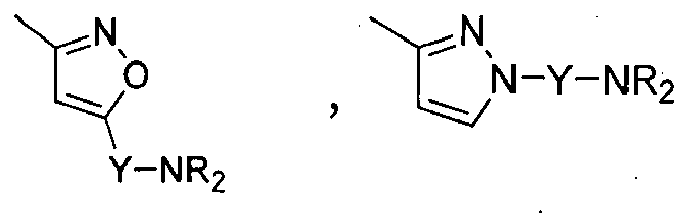
- A compound according to claim 3, having the following formula:4-({3-[3-(Cyclopentyloxy)-4-methoxyphenyl]-4,5-dihydroisoxazol-5-yl}carbonyl)morpholine4-({3-[3-(Cyclopentyloxy)-4-methoxyphenyl]-4,5-dihydroisoxazol-5-yl}carbonyl)-2,6-dimethylmorpholine1-({3-[3-(Cyclopentyloxy)-4-methoxyphenyl]-4,5-dihydroisoxazol-5-yl}carbonyl)piperidin-4-ol3-[3-(Cyclopentyloxy)-4-methoxyphenyl]-5-(pyrrolidin-1-ylcarbonyl)-4,5-dihydroisoxazole1-({3-[3-(Cyclopentyloxy)-4-methoxyphenyl]-4,5-dihydroisoxazol-5-yl}carbonyl)piperidine3-[3-(Cyclopentyloxy)-4-methoxyphenyl]-N,N-bis(2-hydroxyethyl)-4,5-dihydroisoxazole-5-carboxamide4-({3-[3-(Cyclopentyloxy)-4-methoxyphenyl]-4,5-dihydroisoxazol-5-yl}acetyl)morpholine4-({3-[3-(Cyclopentiloxy)-4-methoxyphenyl]-4,5-dihydroisoxazol-5-yl}acetil) 2,6-dimethylmorpholine1-({3-[3-(Cyclopentyloxy)-4-methoxyphenyl]-4,5-dihydroisoxazol-5-yl}acetyl)piperidin-4-ol3-[3-(Cyclopentyloxy)-4-methoxyphenyl]-5-(2-oxo-2-pyrrolidin-1-ylethyl)-4,5-dihydroisoxazole1-({3-[3-(Cyclopentyloxy)-4-methoxyphenyl]-4,5-dihydroisoxazol-5-yl}acetyl)piperidine1-({3-[3-(Cyclopentyloxy)-4-methoxyphenyl]-4,5-dihydroisoxazol-5-yl}acetyl)piperazine2-{3-[3-(Cyclopentyloxy)-4-methoxyphenyl]-4,5-dihydroisoxazol-5-yl}-N,N-bis(2-hydroxyethyl)acetamide4-({3-[3-(Cyclopentyloxy)-4-methoxyphenyl]-4,5-dihydroisoxazol-5-yl}acetyl)morpholine4-({3-[3-(Cyclopentiloxy)-4-methoxyphenil]-4, 5-dihydroisoxazol-5-yl}acetil) 2,6-dimethylmorpholine1-{3-[3-(Cyclopentyloxy)-4-methoxyphenyl]isoxazol-5-yl}-2-morpholin-4-ylethanone hydrochloride1-{3-[3-(Cyclopentyloxy)-4-methoxyphenyl]isoxazol-5-yl}-2-(2,6-dimethylmorpholin-4-yl)ethanone hydrochloride1-{3-[3-(Cyclopentyloxy)-4-methoxyphenyl]isoxazol-5-yl}-2-morpholin-4-ylethanol1-{3-[3-(Cyclopentyloxy)-4-methoxyphenyl]isoxazol-5-yl}-2-(2,6-dimethylmorpholin-4-yl)ethanol4-({3-[3-(Cyclopentyloxy)-4-methoxyphenyl]isoxazol-5-yl}carbonyl)morpholine4-({3-[3-(Cyclopentyloxy)-4-methoxyphenyl]isoxazol-5-yl}carbonyl)-2,6-dimethylmorpholine1-{3-[3-(Cyclopentyloxy)-4-methoxyphenyl]-1H-pyrazol-1-yl}-3-morpholin-4-ylpropan-2-ol dihydrocloride1-{3-[3-(Cyclopentyloxy)-4-methoxyphenyl]-1H-pyrazol-1-yl}-3-(2,6-dimethylmorpholin-4-yl)propan-2-ol dihydrocloride1-((3-{3-[3-(cyclopentyloxy)-4-methoxyphenyl]-1H-pyrazol-1-yl}-2-hydroxypropyl)piperidin-4-ol2-{3-[3-(cyclopentyloxy)-4-methoxyphenyl]-1H-pyrazol-1-yl}-1-(morpholin-4-ylmethyl)ethyl acetate4-({3-[3-(Cyclopentyloxy)-4-methoxyphenyl]-1H-pyrazol-1-yl}acetyl)morpholine4-({3-[3-(Cyclopentyloxy)-4-methoxyphenyl]-1H-pyrazol-1-yl}acetyl)2,6-dimethylmorpholine4-((3-{3-[3-(cyclopentyloxy)-4-methoxyphenyl]-1H-pyrazol-1-yl}propanoyl)morpholine4-((3-{3-[3-(cyclopentyloxy)-4-methoxyphenyl]-1H-pyrazol-1-yl}propanoyl)2,6-dimethylmorpholine4-((3-{3-[3-(cyclopentyloxy)-4-(difluoromethoxy)phenyl]-1H-pyrazol-1-yl}propanoyl)morpholine.
- A compound according to any one of claims 1 to 5 and enantiomers, diastereoisomers and pharmaceutically acceptable salts thereof, for use as a medicament.
- A compound according to any one of claims 1 to 5 and enantiomers, diastereoisomers and pharmaceutically acceptable salts thereof, for use as a medicament with PDE4D inhibiting activity.
- A compound according to any one of claims 1 to 5 and enantiomers, diastereoisomers and pharmaceutically acceptable salts thereof for use as a medicament for treating dementia, in particular Alzheimer disease.
- A compound according to any one of claims 1 to 5 and enantiomers, diastereoisomers and pharmaceutically acceptable salts thereof for use as a medicament for improving memory.
- A pharmaceutical composition comprising at least one compound according to any one of claims 1 to 5 and a pharmaceutically acceptable carrier.
- A process for the preparation of a compound according to any one of claims 1 to 5, in which Z = cyclopentyl, X =
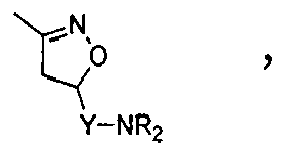


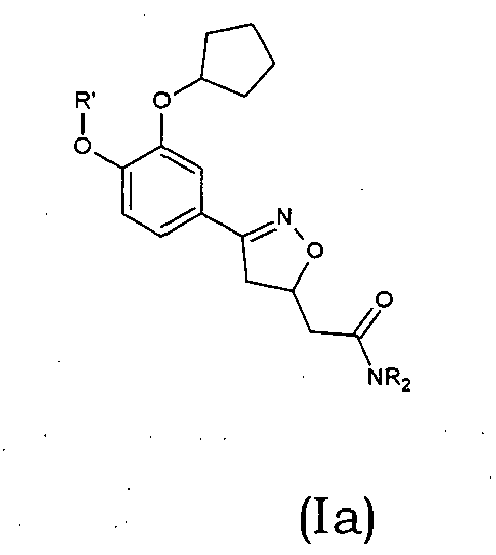
- A process for the preparation of a compound according to any one of claims 1 to 5, in which Z = cyclopentyl, X=


with R2NH, wherein NR2 is as defined in claim 1, to yield the following compound of formula (Ib)
- A process for the preparation of a compound according to any one of claims 1 to 5, in which Z = cyclopentyl, X =
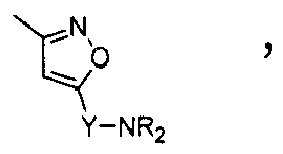

with R2NH, wherein NR2 is as defined in claim 1, to yield the following compound of formula (Ic)
- A process for the preparation of a compound according to any one of claims 1 to 5, in which Z = cyclopentyl, X =


- The process according to claim 14, in which R' is -CHF2 and the relevant intermediate compound of formula (VIa) is prepared according to the following reaction scheme:
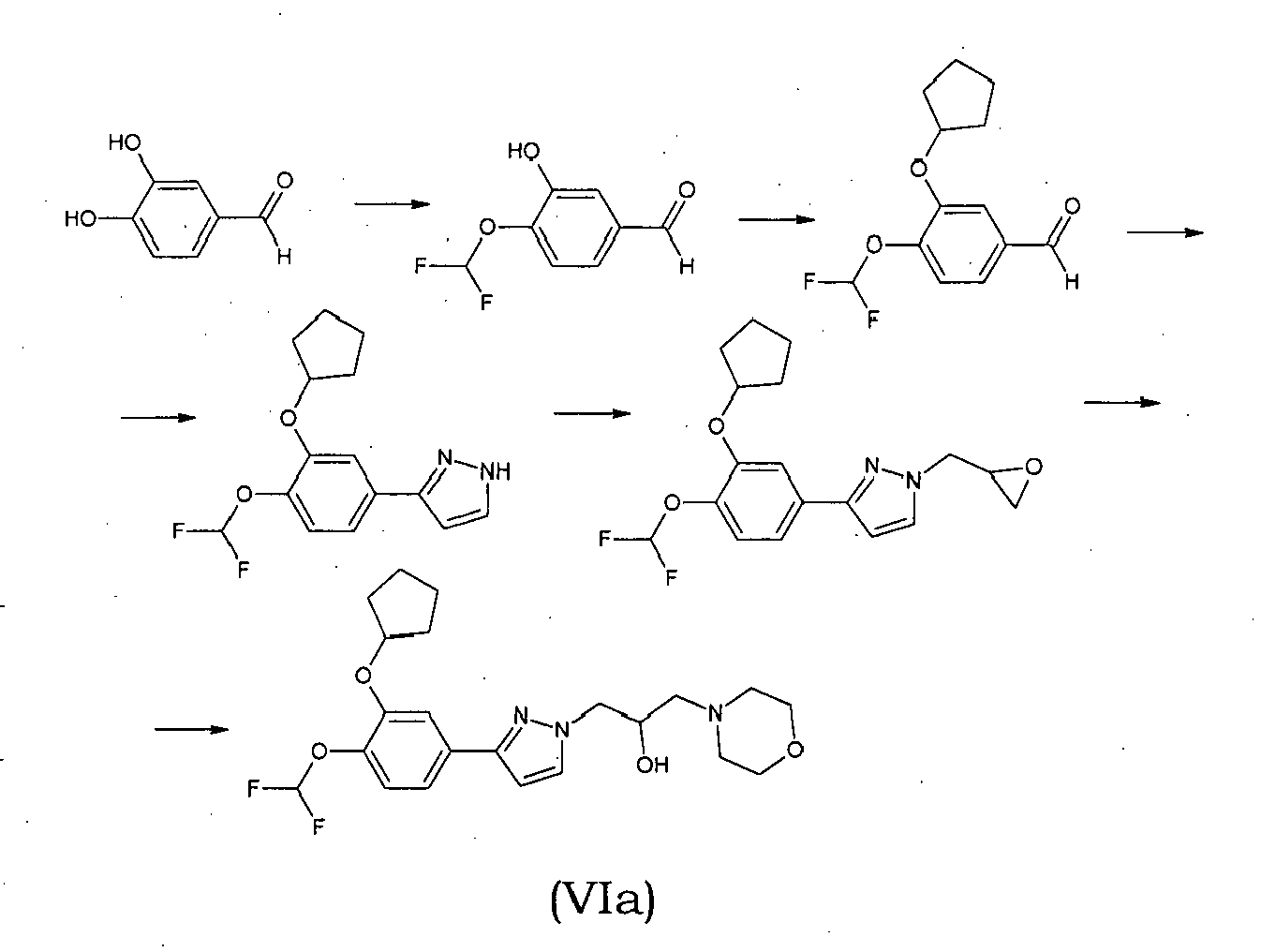
Priority Applications (5)
| Application Number | Priority Date | Filing Date | Title |
|---|---|---|---|
| EP14425015.6A EP2907806A1 (en) | 2014-02-14 | 2014-02-14 | New compounds as selective PDE4D inhibitors |
| ES15707888T ES2755962T3 (en) | 2014-02-14 | 2015-02-10 | Morpholine derivatives having selective PDE4D inhibition activity |
| EP15707888.2A EP3105206B1 (en) | 2014-02-14 | 2015-02-10 | Morpholine derivatives having a selective pde4d inhibiting activity |
| US15/119,034 US10017480B2 (en) | 2014-02-14 | 2015-02-10 | Compounds having a selective PDE4D inhibiting activity |
| PCT/EP2015/052683 WO2015121212A1 (en) | 2014-02-14 | 2015-02-10 | New compounds having a selective pde4d inhibiting activity |
Applications Claiming Priority (1)
| Application Number | Priority Date | Filing Date | Title |
|---|---|---|---|
| EP14425015.6A EP2907806A1 (en) | 2014-02-14 | 2014-02-14 | New compounds as selective PDE4D inhibitors |
Publications (1)
| Publication Number | Publication Date |
|---|---|
| EP2907806A1 true EP2907806A1 (en) | 2015-08-19 |
Family
ID=50336249
Family Applications (2)
| Application Number | Title | Priority Date | Filing Date |
|---|---|---|---|
| EP14425015.6A Withdrawn EP2907806A1 (en) | 2014-02-14 | 2014-02-14 | New compounds as selective PDE4D inhibitors |
| EP15707888.2A Active EP3105206B1 (en) | 2014-02-14 | 2015-02-10 | Morpholine derivatives having a selective pde4d inhibiting activity |
Family Applications After (1)
| Application Number | Title | Priority Date | Filing Date |
|---|---|---|---|
| EP15707888.2A Active EP3105206B1 (en) | 2014-02-14 | 2015-02-10 | Morpholine derivatives having a selective pde4d inhibiting activity |
Country Status (4)
| Country | Link |
|---|---|
| US (1) | US10017480B2 (en) |
| EP (2) | EP2907806A1 (en) |
| ES (1) | ES2755962T3 (en) |
| WO (1) | WO2015121212A1 (en) |
Cited By (2)
| Publication number | Priority date | Publication date | Assignee | Title |
|---|---|---|---|---|
| WO2019193091A1 (en) * | 2018-04-05 | 2019-10-10 | Universiteit Hasselt | Selective pde4d inhibitors against demyelinating diseases |
| WO2022253959A1 (en) * | 2021-06-02 | 2022-12-08 | Universiteit Hasselt | Compounds and pharmaceutical compositions for use in neurodegenerative disorders |
Families Citing this family (3)
| Publication number | Priority date | Publication date | Assignee | Title |
|---|---|---|---|---|
| CN105254559B (en) * | 2015-11-30 | 2017-07-11 | 山东罗欣药业集团股份有限公司 | A kind of preparation method of high-purity roflumilast |
| TWI879947B (en) * | 2020-04-29 | 2025-04-11 | 大陸商廣東東陽光藥業股份有限公司 | Substituted nitrogen-containing five-membered ring compounds and their applications in medicine |
| WO2022157381A1 (en) | 2021-01-25 | 2022-07-28 | Universiteit Hasselt | Phloretin for use in the treatment of neurodegenerative and demyelinating diseases |
Citations (5)
| Publication number | Priority date | Publication date | Assignee | Title |
|---|---|---|---|---|
| WO2004016596A1 (en) | 2002-08-19 | 2004-02-26 | Glenmark Pharmaceuticals Limited | Condensed heterocyclic compounds as pde-iv inhibitors for the treatment of inflammatory and allergic disorders |
| WO2004094411A1 (en) | 2003-04-18 | 2004-11-04 | Memory Pharmaceuticals Corporation | Pyrazole derivatives as phosphodiesterase 4 inhibitors |
| WO2005021515A2 (en) * | 2003-08-29 | 2005-03-10 | Ranbaxy Laboratories Limited | Inhibitors of phosphodiesterase type-iv |
| WO2005051931A2 (en) | 2003-11-26 | 2005-06-09 | Ranbaxy Laboratories Limited | Phosphodiesterase inhibitors |
| WO2008035315A2 (en) * | 2006-09-22 | 2008-03-27 | Ranbaxy Laboratories Limited | Inhibitors of phosphodiesterase type-iv |
Family Cites Families (5)
| Publication number | Priority date | Publication date | Assignee | Title |
|---|---|---|---|---|
| FR2538388B1 (en) * | 1982-12-24 | 1985-06-21 | Pharmuka Lab | NOVEL NAPHTHALENE- OR AZANAPHTHALENECARBOXAMIDE DERIVATIVES, PROCESSES FOR THEIR PREPARATION AND THEIR USE AS MEDICAMENTS |
| MXPA05001592A (en) * | 2002-08-09 | 2005-05-05 | Astrazeneca Ab | Oxadiazoles as modulators of metabotropic glutamate receptor-5. |
| EP1613590A2 (en) | 2003-04-16 | 2006-01-11 | Memory Pharmaceutical Corporation | 4-(3,4-disubstituted phenyl)-pyrrolidin-2-one compounds as phosphodiesterase 4 inhibitors |
| US8148367B2 (en) * | 2007-01-12 | 2012-04-03 | Takeda Pharmaceutical Company Limited | Renin inhibitors |
| JP5422569B2 (en) * | 2008-02-21 | 2014-02-19 | サノフイ | Chlorothiophene-isoxazoles as inhibitors of coagulation factor Xa and thrombin |
-
2014
- 2014-02-14 EP EP14425015.6A patent/EP2907806A1/en not_active Withdrawn
-
2015
- 2015-02-10 EP EP15707888.2A patent/EP3105206B1/en active Active
- 2015-02-10 WO PCT/EP2015/052683 patent/WO2015121212A1/en not_active Ceased
- 2015-02-10 ES ES15707888T patent/ES2755962T3/en active Active
- 2015-02-10 US US15/119,034 patent/US10017480B2/en active Active
Patent Citations (5)
| Publication number | Priority date | Publication date | Assignee | Title |
|---|---|---|---|---|
| WO2004016596A1 (en) | 2002-08-19 | 2004-02-26 | Glenmark Pharmaceuticals Limited | Condensed heterocyclic compounds as pde-iv inhibitors for the treatment of inflammatory and allergic disorders |
| WO2004094411A1 (en) | 2003-04-18 | 2004-11-04 | Memory Pharmaceuticals Corporation | Pyrazole derivatives as phosphodiesterase 4 inhibitors |
| WO2005021515A2 (en) * | 2003-08-29 | 2005-03-10 | Ranbaxy Laboratories Limited | Inhibitors of phosphodiesterase type-iv |
| WO2005051931A2 (en) | 2003-11-26 | 2005-06-09 | Ranbaxy Laboratories Limited | Phosphodiesterase inhibitors |
| WO2008035315A2 (en) * | 2006-09-22 | 2008-03-27 | Ranbaxy Laboratories Limited | Inhibitors of phosphodiesterase type-iv |
Non-Patent Citations (20)
| Title |
|---|
| "Remington's Pharmaceutical Sciences Handbook", 1990, MACK PUBLISHING |
| 0. BRUNO ET AL., BR. J. PHARMACOL, 2011 |
| 0. BRUNO ET AL., J. MED CHEM, 2009 |
| AGGARWAL, V.K. ET AL., J. ORG. CHEM., vol. 68, 2003, pages 5381 - 5383 |
| BIOORG. MED.CHEM., vol. 19, 2011, pages 7365 - 7373 |
| BRUNO ET AL., BR. J. PHARM., vol. 164, 2011, pages 2054 |
| BRUNO ET AL., BR. J. PHARMACOL., vol. 164, 2011, pages 2054 - 2063 |
| DATABASE REGISTRY [Online] CHEMICAL ABSTRACTS SERVICE, COLUMBUS, OHIO, US; 17 August 2006 (2006-08-17), XP002723416, Database accession no. 902289-52-5 * |
| DATABASE REGISTRY [Online] CHEMICAL ABSTRACTS SERVICE, COLUMBUS, OHIO, US; 17 August 2006 (2006-08-17), XP002723417, Database accession no. 902289-50-3 * |
| DATABASE REGISTRY [Online] CHEMICAL ABSTRACTS SERVICE, COLUMBUS, OHIO, US; 4 December 2011 (2011-12-04), XP002723415, Database accession no. 1348351-21-2 * |
| DATABASE REGISTRY [Online] CHEMICAL ABSTRACTS SERVICE, COLUMBUS, OHIO, US; 8 August 2006 (2006-08-08), XP002723418, Database accession no. 899532-24-2 * |
| GONG, ARANCIO O. ET AL., J CLIN. INVEST., 2004 |
| KANO H.; ADACHI I ET AL., J. MED. CHEM., vol. 10, 1967, pages 411 - 418 |
| LI YF ET AL., J. NEUROSCI., vol. 5, 2011, pages 172 |
| M.J. ASHTON ET AL., J. MED. CHEM., vol. 37, 1994, pages 1696 - 1703 |
| O. BRUNO ET AL., FARMACO, vol. 59, no. 3, 2004, pages 223 |
| O. BRUNO ET AL., J. MED. CHEM., vol. 52, 2009, pages 6546 - 6557 |
| OLGA BRUNO ET AL: "New Selective Phosphodiesterase 4D Inhibitors Differently Acting on Long, Short, and Supershort Isoforms", JOURNAL OF MEDICINAL CHEMISTRY, vol. 52, no. 21, 12 November 2009 (2009-11-12), pages 6546 - 6557, XP055092505, ISSN: 0022-2623, DOI: 10.1021/jm900977c * |
| RUTTEN K.; PRICKAERTS J. ET AL., NEUROBIOL. OF LEARN AND MEM., 2008 |
| TRINCHESE F. ET AL., ANN. NEUROL., vol. 55, 2004, pages 801 |
Cited By (2)
| Publication number | Priority date | Publication date | Assignee | Title |
|---|---|---|---|---|
| WO2019193091A1 (en) * | 2018-04-05 | 2019-10-10 | Universiteit Hasselt | Selective pde4d inhibitors against demyelinating diseases |
| WO2022253959A1 (en) * | 2021-06-02 | 2022-12-08 | Universiteit Hasselt | Compounds and pharmaceutical compositions for use in neurodegenerative disorders |
Also Published As
| Publication number | Publication date |
|---|---|
| WO2015121212A1 (en) | 2015-08-20 |
| US10017480B2 (en) | 2018-07-10 |
| EP3105206B1 (en) | 2019-08-07 |
| US20160355489A1 (en) | 2016-12-08 |
| EP3105206A1 (en) | 2016-12-21 |
| ES2755962T3 (en) | 2020-04-24 |
Similar Documents
| Publication | Publication Date | Title |
|---|---|---|
| EP1499589B1 (en) | Derivatives of n-phenyl(piperidin-2-yl)methyl benzamide, the preparation method thereof and application of same in therapeutics | |
| DE69422061T2 (en) | 3-PHENYL-2-ISOXAZOLINE DERIVATIVES AS AN INFLAMMATORY-RESISTANT AGENT | |
| DE69404044T2 (en) | ISOXAZOLINE COMPOUNDS AS AN ANTI-FLAMMING AGENT | |
| JP5444535B2 (en) | Novel disubstituted phenylpyrrolidines as modulators of cortical catecholaminergic neurotransmission | |
| US20020103205A1 (en) | Muscarinic antagonists | |
| JP2002509918A (en) | Compounds with activity on muscarinic receptors | |
| EP2907806A1 (en) | New compounds as selective PDE4D inhibitors | |
| AU2016217461B2 (en) | Amide compounds as 5-HT4 receptor agonists | |
| DE60127434T2 (en) | BENZOXAZINE DERIVATIVES, THEIR PREPARATION AND USE | |
| CA1246082A (en) | (-)-trans-4-(4-fluorophenyl)-3- ¬(4-methoxyphenoxy)-methyl|-piperidine or its salts | |
| EP0964863B1 (en) | Oxazolidines as 5-ht2a-antagonists | |
| JP2000086603A (en) | Cinnamamide derivatives and 3-phenylpropionamide derivatives | |
| WO1993010742A2 (en) | Chemical compounds, their preparation and use | |
| EP1760079A1 (en) | Compounds as cor5 antagonists | |
| EP0812318B1 (en) | 4-aminotetrahydrobenzisoxazole or -isothiazole compounds | |
| WO2009138338A1 (en) | Novel n-(2-amino-phenyl)-acrylamides | |
| CA2172162C (en) | Optically active imidazolidinone derivative and process for producing the same | |
| Trybulski et al. | The synthesis and biochemical pharmacology of enantiomerically pure methylated oxotremorine derivatives | |
| DE69422021T2 (en) | MORPHOLINE DERIVATIVES | |
| DE69405198T2 (en) | 1,3,4-Oxadiazol-2 (3H) -one derivatives, their preparation and their use as monoamine oxidase inhibitors | |
| EP0929550A1 (en) | $i(N)-(BENZOTHIAZOL-2-YL) PIPERIDINE-1-ETHANAMINE DERIVATIVES, THEIR PREPARATION AND APPLICATION IN THERAPEUTICS | |
| US5378714A (en) | Antipsychotic piperidine derivatives | |
| DE69613783T2 (en) | 4- (6-FLUOR-1,2-BENZISOXAZOLYL) -1-PIPERIDINYL-PROPOXY-CHROMEN-4-ON DERIVATIVES, THEIR PRODUCTION AND THEIR USE IN THE TREATMENT OF PSYCHOSIS, SCHIZOPHRENIA AND ANXIETY | |
| UA119581C2 (en) | Tosylate salt of n-[3-[(4ar,7as)-2-amino-6-(5-fluoropyrimidin-2-yl)-4,4a,5,7-tetrahydropyrrolo[3,4-d][1,3]thiazin-7a-yl]-4-fluoro-phenyl]-5-methoxy-pyrazine-2-carboxamide | |
| CN109232549B (en) | Compound for treating schizophrenia and application thereof |
Legal Events
| Date | Code | Title | Description |
|---|---|---|---|
| PUAI | Public reference made under article 153(3) epc to a published international application that has entered the european phase |
Free format text: ORIGINAL CODE: 0009012 |
|
| AK | Designated contracting states |
Kind code of ref document: A1 Designated state(s): AL AT BE BG CH CY CZ DE DK EE ES FI FR GB GR HR HU IE IS IT LI LT LU LV MC MK MT NL NO PL PT RO RS SE SI SK SM TR |
|
| AX | Request for extension of the european patent |
Extension state: BA ME |
|
| STAA | Information on the status of an ep patent application or granted ep patent |
Free format text: STATUS: THE APPLICATION IS DEEMED TO BE WITHDRAWN |
|
| 18D | Application deemed to be withdrawn |
Effective date: 20160220 |