EP2907291B1 - Virtuelle firewall-mobilität - Google Patents
Virtuelle firewall-mobilität Download PDFInfo
- Publication number
- EP2907291B1 EP2907291B1 EP13805530.6A EP13805530A EP2907291B1 EP 2907291 B1 EP2907291 B1 EP 2907291B1 EP 13805530 A EP13805530 A EP 13805530A EP 2907291 B1 EP2907291 B1 EP 2907291B1
- Authority
- EP
- European Patent Office
- Prior art keywords
- host
- virtual
- virtual machine
- session
- service
- Prior art date
- Legal status (The legal status is an assumption and is not a legal conclusion. Google has not performed a legal analysis and makes no representation as to the accuracy of the status listed.)
- Active
Links
Images

Classifications
-
- G—PHYSICS
- G06—COMPUTING OR CALCULATING; COUNTING
- G06F—ELECTRIC DIGITAL DATA PROCESSING
- G06F9/00—Arrangements for program control, e.g. control units
- G06F9/06—Arrangements for program control, e.g. control units using stored programs, i.e. using an internal store of processing equipment to receive or retain programs
- G06F9/44—Arrangements for executing specific programs
- G06F9/455—Emulation; Interpretation; Software simulation, e.g. virtualisation or emulation of application or operating system execution engines
-
- H—ELECTRICITY
- H04—ELECTRIC COMMUNICATION TECHNIQUE
- H04L—TRANSMISSION OF DIGITAL INFORMATION, e.g. TELEGRAPHIC COMMUNICATION
- H04L63/00—Network architectures or network communication protocols for network security
- H04L63/02—Network architectures or network communication protocols for network security for separating internal from external traffic, e.g. firewalls
- H04L63/0227—Filtering policies
-
- G—PHYSICS
- G06—COMPUTING OR CALCULATING; COUNTING
- G06F—ELECTRIC DIGITAL DATA PROCESSING
- G06F9/00—Arrangements for program control, e.g. control units
- G06F9/06—Arrangements for program control, e.g. control units using stored programs, i.e. using an internal store of processing equipment to receive or retain programs
- G06F9/44—Arrangements for executing specific programs
- G06F9/455—Emulation; Interpretation; Software simulation, e.g. virtualisation or emulation of application or operating system execution engines
- G06F9/45533—Hypervisors; Virtual machine monitors
- G06F9/45558—Hypervisor-specific management and integration aspects
-
- G—PHYSICS
- G06—COMPUTING OR CALCULATING; COUNTING
- G06F—ELECTRIC DIGITAL DATA PROCESSING
- G06F9/00—Arrangements for program control, e.g. control units
- G06F9/06—Arrangements for program control, e.g. control units using stored programs, i.e. using an internal store of processing equipment to receive or retain programs
- G06F9/44—Arrangements for executing specific programs
- G06F9/455—Emulation; Interpretation; Software simulation, e.g. virtualisation or emulation of application or operating system execution engines
- G06F9/45533—Hypervisors; Virtual machine monitors
- G06F9/45558—Hypervisor-specific management and integration aspects
- G06F2009/4557—Distribution of virtual machine instances; Migration and load balancing
-
- H—ELECTRICITY
- H04—ELECTRIC COMMUNICATION TECHNIQUE
- H04L—TRANSMISSION OF DIGITAL INFORMATION, e.g. TELEGRAPHIC COMMUNICATION
- H04L63/00—Network architectures or network communication protocols for network security
- H04L63/02—Network architectures or network communication protocols for network security for separating internal from external traffic, e.g. firewalls
- H04L63/0227—Filtering policies
- H04L63/0254—Stateful filtering
-
- H—ELECTRICITY
- H04—ELECTRIC COMMUNICATION TECHNIQUE
- H04L—TRANSMISSION OF DIGITAL INFORMATION, e.g. TELEGRAPHIC COMMUNICATION
- H04L63/00—Network architectures or network communication protocols for network security
- H04L63/02—Network architectures or network communication protocols for network security for separating internal from external traffic, e.g. firewalls
- H04L63/0272—Virtual private networks
Definitions
- This invention relates generally to cloud computing security.
- systems and methods for handling virtual services, such as firewall services, during virtual machine movement are provided.
- a virtual machine is a software implementation of a machine (i.e. a computer) that executes programs like a physical machine.
- the physical hardware on which virtual machines run is referred to as the host or host computer(s) and can reside in data center facilities.
- Data centers are facilities used to house computer systems and associated components, typically including routers and switches to transport traffic between the computer systems and external networks. Data centers generally include redundant power supplies and redundant data communications connections to provide a reliable infrastructure for operations and to minimize any chance of disruption. Information security is also a concern, and for this reason a data center must offer a secure environment to minimize any chance of a security breach.
- Virtualization has several advantages over conventional computing environments.
- the operating system and applications running on a virtual machine often require only a fraction of the full resources available on the underlying physical hardware on which the virtual machine is running.
- a host system can employ multiple physical computers, each of which runs multiple virtual machines. Virtual machines can be created and shut down as required, thus only using the resources of the physical computer(s) as needed.
- Another advantage of virtualization is the elasticity and flexibility provided by the ability to manipulate and move a virtual machine from one physical site to another, or to move a virtual machine between hosts within the same data center. Virtual machines can be moved in order to better utilize the host machines and to provide the flexibility to scale up or down in size.
- VF virtual firewall
- VF virtual firewall
- a virtual firewall service running entirely within a virtualized environment which can provide the same packet filtering and monitoring as is conventionally provided by a physical network firewall or firewall service appliance.
- VF virtual firewall
- the associated firewall service is implemented as a virtual firewall, further considerations are required prior to migrating the virtual machine.
- US 2009/249438 A1 discloses a method of maintaining multiple firewalls on multiple host nodes. Each host node runs one or more virtual machines. For at least a first host node, the method maintains multiple sets of policies for multiple virtual machines that run on the first host node. The method, upon detecting that a particular virtual machine has been moved from the first host node to a second host node, removes a set of policies associated with the particular virtual machine from the first host node and supplies the set of policies to the second host node.
- a method for managing migration of a virtual machine including the steps of determining that a virtual machine, instantiated in a first host and associated with a first virtual service in the first host, should be migrated to a second host and determining that functionality provided in the first host by the first virtual service is unavailable in the second host.
- a second virtual service is instantiated in the second host to provide functionality corresponding to that provided by the first virtual service and a copy of the virtual machine is instantiated in the second host.
- the method further comprises the step of shutting down the virtual machine in the first host.
- the first virtual service implements at least one of a firewall service, an Internet Protocol Security (IPSec) service, a Virtual Private Network (VPN) service, a load balancing service, an intrusion detection and prevention system (IDS/IPS), or a Unified Threat Management (UTM) service.
- IPSec Internet Protocol Security
- VPN Virtual Private Network
- IDS/IPS intrusion detection and prevention system
- UDM Unified Threat Management
- the first host is a first data center and the second host is a second data center.
- the method further comprises the step of synchronizing session data between the first virtual service and the second virtual service.
- Synchronizing session data can include capturing state information associated with a session being handled by the virtual machine and transferring the state information to the second virtual service.
- Session data can include policy information related to the session, an identifier of a user associated with the session, or an address associated with the session.
- the step of determining that functionality provided in the first host by the first virtual service is unavailable in the second host can include requesting service information from the second host.
- the step of instantiating the second virtual service can include sending instructions to launch a copy of the first virtual service in the second host.
- the step of instantiating the copy of the virtual machine in the second host can include sending instructions to the second host.
- a cloud management device comprising a memory for storing instructions and a processing engine configured to execute the instructions.
- the processing engine is configured for determining that a virtual machine, instantiated in a first host and associated with a first virtual service in the first host, should be migrated to a second host.
- the processing engine is configured for determining that functionality provided in the first host by the first virtual service is unavailable in the second host to provide functionality corresponding to that provided by the first virtual service.
- the processing engine instantiates a second virtual service in the second host and instantiates a copy of the virtual machine in the second host.
- the cloud management device further comprises a communication interface for communicating with the first and second hosts.
- the communication interface can be configured to receive state information associated with a session being handled by the virtual machine from the first host and to transfer the state information to the second virtual service.
- the communication interface can be configured to send instructions to the second host to launch a copy of the first virtual service.
- the communication interface can be configured to send instructions to the second host to launch a copy of the virtual machine.
- he processing engine is configured to synchronize session data between the first virtual service and the second virtual service.
- the session data can include policy information related to the session, an identifier of a user associated with the session, or an address associated with the session.
- processing engine is configured to shut down the virtual machine in the first host.
- the first virtual service implements at least one of a firewall service, an Internet Protocol Security (IPSec) service, a Virtual Private Network (VPN) service, a load balancing service, an intrusion detection and prevention system (IDS/IPS), or a Unified Threat Management (UTM) service.
- IPSec Internet Protocol Security
- VPN Virtual Private Network
- IDS/IPS intrusion detection and prevention system
- UDM Unified Threat Management
- the present invention is directed to a system and method for handling the migration of virtual machines and their associated stateful or stateless virtual services from one host to another.
- Virtualized services can be divided into two categories: stateless services and stateful services.
- a stateless virtual firewalling mechanism does not need to keep state information for its associated virtual machine. For example, when configured to filter all User Datagram Protocol (UDP) connections to a VM, there is no need for the virtual firewall to keep track of any previous or ongoing UDP connection to the VM. In this scenario, if the virtual machine migrates from one site to another and a virtual firewall is available at the destination that provides the required functionality, the stateless firewall mechanisms can apply without any loss of information.
- UDP User Datagram Protocol
- stateful virtual firewalling mechanisms need to keep the state of any connections and sessions to the virtual machine in order to be efficient.
- a virtual firewall can be configured to keep track of Transmission Control Protocol (TCP) handshakes to prevent attacks.
- TCP Transmission Control Protocol
- the information related to any persistent connections and/or sessions needs to be migrated along with the virtual machine to avoid the costs associated with restarting the same security mechanisms at the destination site.
- the general concept of stateful firewalling can be extended to any security mechanism which needs to keep track of already established connections, such as intrusion detection and prevention (IDS/IPS) and application firewalling mechanisms.
- IDS/IPS intrusion detection and prevention
- any stateful data can be synchronized between the hardware appliance services in those sites.
- it prior to moving a virtual machine associated with a virtual service, it must be determined if a corresponding virtual service exists and is available at the destination site. If a virtual service that provides the same features as required by the migrating virtual machine is not available at the destination, a new virtual service will need to be launched at the destination site. This newly launched virtual service can then receive any stateful data from the virtual service in the source site before it is ready for handling traffic associated with the migrated virtual machine.
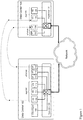
- Figure 1 illustrates an embodiment of a cloud computing environment in which virtual machine mobility can occur between data centers,
- a data center 102 at a first site and a data center 104 at a second site are connected via network 100.
- a cloud management entity 106 is provided at data center 102.
- the cloud management device 106 may physically reside outside of the data centers or be distributed between various data centers.
- the cloud management entity 106 resides in data center 102 but also manages data center 104.
- Three virtual machines 108, 100, 112 are allocated for running an application at data center 104.
- VF virtual firewall
- the virtual firewall can also provide security for the cloud management 106.
- a hypervisor 120 acts as the virtual machine manager, providing hardware visualization which allows for a virtual operating platform for managing multiple or different operating systems.
- the cloud management 106 can be implemented as a dedicated blade for provisioning configuration management over the data centers 102 and 104 and controlling the hypervisors 120 and 130 and the underlying physical hardware.
- the cloud management entity 106 allows administrators to manage hypervisors 120 and 130 as well as providing an interface to the cloud tenants who rent the virtual machines from the cloud provider.
- the data center 104 at the second site has a hypervisor 130, a VM 128 and a VF 122. It should be noted that while Figure 1 shows one hypervisor per data center for exemplary purposes, in practice, a data center can include thousands of servers running thousands of instances of hypervisors.
- the cloud management entity 106 decides that VM 108 is to be moved from data center 102 to data center 104. This VM 108 makes use of the virtual firewall service provided by VF 118.
- the cloud management 106 is responsible for coordinating the movement of the VM 108, and thus, must ensure that corresponding virtual firewalling service is available at data center 104 and any persistent data associated with VM 108 is also transferred to data center 104.
- the cloud management 106 can determine if the required firewall functionality is provided by the existing VF 122 at data center 104. If not, the cloud management 106 can initiate the launch of a new VF 124. If the virtual firewall service is stateful, persistent session-related data can be synchronized between VF 118 and VF 124.
- the cloud management 106 can then initiate the launch of a copy of VM 108 as new VM 126 in data center 104. Following the successful instantiation of VM 126 and VF 124, the cloud management 106 can determine that the migrated VM 126 is ready to handle traffic.
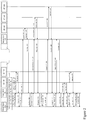
- FIG. 2 is a call flow diagram illustrating an example process for moving a virtual machine between data centers.
- the process begins in step 202 when the cloud management entity 106 determines that a virtual machine, VM 108, should move from a first data center 102 to a second data center 104.
- the cloud management 106 can decide that the VM 108 should move based on a number of reasons. Such pre-defined criteria can include balancing loads between data centers, handling a data center fault or recovery, optimizing the use of the underlying physical resources, or to provide the ability for the virtual machine to scale up or scale down.
- the cloud management 106 requests the hypervisor 120 to collect session information related to VM 108 (step 204).
- the hypervisor 120 requests this information from the associated VF 118 (step 206).
- VF 118 responds with the persistent session data related to VM 108 (step 208), and the hypervisor 102 returns the data to the cloud management 106 (step 210).
- the cloud management 106 instructs the virtualization framework at data center 104 to launch a copy of VM 108 by sending a message to hypervisor 120 (step 212), which relays the instruction to hypervisor 130 (step 214) via the network 100.
- the hypervisor 130 instantiates a copy of VM 108 as newly launched VM 124 at data center 104 (step 216).
- the successful instantiation of VM 124 is acknowledged to hypervisor 130 (step 218), hypervisor 120 (step 220), and cloud management 106 (step 222).
- a "snapshot" of the existing virtual firewalling services at data center 104 is requested by cloud management 106.
- Hypervisor 120 relays the request to hypervisor 130 (step 226) and hypervisor 130 requests the information from the existing virtual firewall VF 128 (step 228).
- hypervisor 130 can request each of them to return a list of services, capabilities and/or functionality offered.
- VF 128 returns the requested snapshot data to hypervisor 130 (step 230) and it is forwarded to hypervisor 120 (step 232) and cloud management 106 (step 234).
- the cloud management entity 106 can then determine if a new virtual firewall is required at data center 104, to offer corresponding services as VF 118 has been providing to VM 108, based on the response from the existing virtual firewall VF 128.
- step 236 it is determined that a new stateful virtual firewall is required at data center 104.
- Cloud management 106 initiates the launch of the new virtual firewall by sending instruction through hypervisor 120 (step 238) to hypervisor 130 (step 240).
- Hypervisor 130 instantiates a new virtual firewall, VF 126, with the required functionality (step 242).
- the persistent session data gathered from VF 118 can also be transferred to VF 126 with the launch instructions (step 242).
- a separate step of synchronizing the session data between VF 118 and VF 126 can be provided.
- the successful launch of VF 126 is acknowledged to hypervisor 130 (step 244), hypervisor 120 (step 246) and cloud management 106 (step 248).
- cloud management 106 can then instruct hypervisor 130, through hypervisor 120, to attach VM 124 to VF 126 (steps 250 and 252). By attaching, or associating. VM 124 with VF 126, all service related traffic directed towards VM 124 will go through VF 126. The successful attach is acknowledged to hypervisor 120 (step 254) and cloud management 106 (step 256).
- Cloud management 106 can instruct hypervisor 120 to delete the original VM 108 in data center 102 (step 258). Hypervisor 120 shuts down VM 108 (step 260) and the successful deletion is acknowledged (steps 262 and 264). Similarly, cloud management 106 can instruct hypervisor 120 to clean up VF 118 (step 266). VF 118 is instructed to remove any remaining session data associated with now deleted VM 108 (step 268). The step of cleaning up VF 118 can also include shutting down any security feature that is not used by any other virtual machines or applications in the first data center 102. VF 118 acknowledges the successful clean up (steps 270 and 272). Likewise, cloud management 106 can instruct hypervisor 120 to remove routing information related to VM 108 from its virtual switches (step 274) and hypervisor 120 acknowledges a successful clean up (step 276).
- session information was captured prior to the steps of launching a new virtual machine in the destination host, determining that a new virtual firewall is required at the destination and launching that new virtual firewall. It will be appreciated by those skilled in the art that the order of these steps can be altered without affecting the scope of the present invention.
- session information can be captured and synchronized with the new virtual firewall at any point in the process prior to allowing the new virtual firewall (VF 126) to service traffic destined for the migrated virtual machine (VM 124).
- Figure 2 is directed to an embodiment of the present invention involving the use of a stateful virtual firewall, it will be understood by those skilled in the art that the mechanisms illustrated for verifying the existence or absence of the corresponding firewalling services in the second host 104 can also apply to embodiments related to stateless virtual services.
- cloud management 106 may be enabled to exchange messages directly with hypervisor 130 as opposed to transmitting and receiving messages via hypervisor 120.
- the physical location of the cloud management 106 entity or device is not germane to the present invention.
- a single hypervisor can be used for controlling the virtual machines and virtual services.
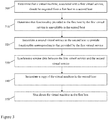
- Figure 3 is a flow chart illustrating an example method for moving a virtual machine, associated with a virtual service, from a first host to a second host.
- the example method of Figure 3 can be implemented by a cloud management entity 106 or a data center manager in conjunction with various devices in a data center(s).
- the example method begins with determining that a virtual machine should be migrated from a first host to a second host (block 300).
- the virtual machine is associated with a first virtual service in the first host
- the first and second hosts can be data centers.
- the determination to move a virtual machine can be based on pre-defined criteria.
- the determination to move the virtual machine can be made automatically or can be based on a manual input.
- the virtual machine to be moved can be associated with a first virtual service, such as a firewall service, in the first host.
- the virtual machine may utilize or require certain functionality provided by the first virtual service.
- a second virtual service is instantiated in the second host (block 320) to provide functionality corresponding to that provided by the first virtual service.
- Instantiating the second virtual service can include sending all information necessary to reproduce the function and state of the first virtual service in the second host.
- a hypervisor can control the instantiation of the second virtual service.
- the hypervisor can receive an instruction to launch a copy of the first virtual service in the second host.
- the instruction message can include an image of the first virtual service to allow the hypervisor to instantiate the second virtual service as a clone of the first virtual service.
- Session data related to the first virtual service is optionally transferred to the second virtual service to synchronize states between the virtual services in the first and second hosts (block 330).
- Synchronizing session data can be required when the virtual service is a stateful service, such as a stateful virtual firewall. Synchronization of state related to persistent session information allows the second virtual service to continue executing services related to the handling of session traffic where the first virtual session left off.
- State information can include policy information related to the session, an identifier of a user associated with the session, an address associated with the session, application data related to the session, or the session information at the protocol level.
- the virtual machine can be migrated and is instantiated in the second host (block 340).
- the step of instantiating the virtual machine in the second host can include sending instructions to a hypervisor in the second host to launch a copy of the virtual machine.
- the instructions can include an image of the virtual machine from the first host.
- the embodiment illustrated in Figure 3 optionally includes the step of shutting down the virtual machine in the first host (block 350).
- the virtual machine in the first host can be shut down, or deleted, responsive to instantiating the virtual machine in the second host.
- the virtual machine can be shut down in response to transmitting an instruction indicating that the virtual machine in the second host is ready to handle traffic.
- FIG. 4 is a block diagram illustrating functional details associated with an example cloud management device 400.
- the cloud management device 400 can include a processing engine 410, a memory 420 and a communication interface 430.
- the cloud management device 400 can be implemented using dedicated underlying hardware or alternatively can, itself, be implemented as a virtual machine in the data center.
- the cloud management device 400 can perform the various embodiments, as described herein, related to controlling virtual machine and virtual service migration between hosts.
- the cloud management device 400 can perform these operations in response to a processing engine 410 executing instructions stored in a data repository such as memory 420.
- the instructions can be software instructions and the data repository can be any logical or physical computer-readable medium.
- the cloud management device 400 though shown in Figure 4 as a single entity, can be implemented by a number of different devices that are geographically distributed, as previously discussed.
- the processing engine 410 is configured to determine that a virtual machine should be moved from a first host to a second host.
- the virtual machine can be determined to be associated with a first virtual service, such a virtual firewall in the first host.
- the processing engine 410 is configured to instantiate a second virtual service in the second host in response to determining that functionality corresponding to the first virtual service is not available in the second host.
- the processing engine 410 is further configured to instantiate a copy of the virtual machine in the second host.
- the processing engine 410 can be further configured to shut down the virtual machine in the first host.
- the cloud management device 400 can include a communication interface 430 for communicating with the first and second hosts.
- the first and second hosts can be data centers.
- the communication interface 430 can communicate with hypervisors or other management entities in the data centers.
- the communication interface 430 can be configured to send instructions to the second host to launch a copy of the first virtual service in the second host.
- the communication interface 430 can also be configured to send instructions to the second host to launch a copy of the virtual machine in the second host
- the processing engine 410 is optionally configured to synchronize session data between the first virtual service and the second virtual service. Synchronizing session data can include receiving state information at the communication interface 430 from the first host. The state information can be associated with a session being handled by the virtual machine. The processing engine 410 can transfer the state information to the second virtual service via the communication interface 430. Session data can include policy information related to the session, an identifier of a user associated with the session, or an address associated with the session.
- the functionality provided by the first virtual service can include a firewall service, an Internet Protocol Security (JPSec) service, a Virtual Private Network (VPN) service, a load balancing service, an intrusion detection and prevention system (IDS/IPS), or a Unified Threat Management (UTM) service.
- JPSec Internet Protocol Security
- VPN Virtual Private Network
- IDS/IPS intrusion detection and prevention system
- UDM Unified Threat Management
- Embodiments of the invention may be represented as a software product stored in a machine-readable medium (also referred to as a computer-readable medium, a processor-readable medium, or a computer usable medium having a computer-readable program code embodied therein).
- the machine-readable medium may be any suitable tangible medium including a magnetic, optical, or electrical storage medium including a diskette, compact disk read only memory (CD-ROM), digital versatile disc read only memory (DVD-ROM) memory device (volatile or non-volatile), or similar storage mechanism.
- the machine-readable medium may contain various sets of instructions, code sequences, configuration information, or other data, which, when executed, cause a processor to perform steps in a method according to an embodiment of the invention.
- Those of ordinary skill in the art will appreciate that other instructions and operations necessary to implement the described invention may also be stored on the machine-readable medium.
- Software running from the machine-readable medium may interface with circuitry to perform the described tasks.
Landscapes
- Engineering & Computer Science (AREA)
- Software Systems (AREA)
- Theoretical Computer Science (AREA)
- General Engineering & Computer Science (AREA)
- General Physics & Mathematics (AREA)
- Physics & Mathematics (AREA)
- Computing Systems (AREA)
- Signal Processing (AREA)
- Computer Networks & Wireless Communication (AREA)
- Computer Security & Cryptography (AREA)
- Computer Hardware Design (AREA)
- Data Exchanges In Wide-Area Networks (AREA)
- Computer And Data Communications (AREA)
- Stored Programmes (AREA)
- Hardware Redundancy (AREA)
Claims (11)
- Verfahren zur Verwaltung von Migration einer virtuellen Maschine, umfassend:Bestimmen (300), dass eine virtuelle Maschine (108), die in einem ersten Host (102) instanziiert und mit einem ersten virtuellen Firewall-Dienst (118) im ersten Host (102) assoziiert ist, zu einem zweiten Host (104) migriert werden sollte;Bestimmen (310), dass Funktionalität, die im ersten Host (102) durch den ersten Firewall-Dienst (118) bereitgestellt wird, im zweiten Host (104) nicht zur Verfügung steht, wobei diese Bestimmung durch Anfordern einer Liste von verfügbaren virtuellen Diensten vom zweiten Host (104) und Vergleichen derselben mit dem ersten virtuellen Firewall-Dienst (118) durchgeführt wird, der mit der zu migrierenden virtuellen Maschine (108) assoziiert ist;Instanziieren (320) in Reaktion auf das Bestimmen (310), dass die Funktionalität nicht zur Verfügung steht, eines zweiten virtuellen Firewall-Dienstes (124) im zweiten Host (104), um Funktionalität bereitzustellen, die derjenigen entspricht, die durch den ersten virtuellen Firewall-Dienst (118) bereitgestellt wird;Synchronisieren (330) von Sitzungsdaten zwischen dem ersten virtuellen Firewall-Dienst (118) und dem zweiten virtuellen Firewall-Dienst (124), wobei der Schritt des Synchronisierens (330) von Sitzungsdaten ein Erfassen von Zustandsinformationen, die mit einer Sitzung assoziiert sind, die von der virtuellen Maschine (108) bearbeitet wird, und Übertragen der Zustandsinformationen an den zweiten virtuellen Firewall-Dienst (124) umfasst, wobei die Sitzungsdaten eine Adresse umfassen, die mit der Sitzung assoziiert ist; undInstanziieren (340) einer Kopie (126) der virtuellen Maschine im zweiten Host (104).
- Verfahren nach Anspruch 1, ferner umfassend den Schritt des Herunterfahrens (350) der virtuellen Maschine (108) im ersten Host (102).
- Verfahren nach Anspruch 1, wobei der erste Host (102) ein erstes Rechenzentrum ist, und der zweite Host (104) ein zweites Rechenzentrum ist.
- Verfahren nach Anspruch 1, wobei die Sitzungsdaten Richtlinieninformationen in Bezug auf die Sitzung oder eine Kennung eines Benutzers umfassen, der mit der Sitzung assoziiert ist.
- Verfahren nach Anspruch 1, wobei der Schritt des Bestimmens (310), dass Funktionalität, die im ersten Host (102) durch den ersten virtuellen Firewall-Dienst (118) bereitgestellt wird, im zweiten Host (104) nicht zur Verfügung steht, ein Anfordern von Dienstinformationen vom zweiten Host (104) umfasst.
- Verfahren nach Anspruch 1, wobei der Schritt des Instanziierens (320) des zweiten virtuellen Firewall-Dienstes (124) ein Senden von Anweisungen zum Starten einer Kopie des ersten virtuellen Firewall-Dienstes (118) im zweiten Host (104) umfasst, und/oder wobei der Schritt des Instanziierens (340) der Kopie (126) der virtuellen Maschine im zweiten Host (104) ein Senden von Anweisungen an den zweiten Host (104) umfasst.
- Cloud-Verwaltungsvorrichtung (400), umfassend:einen Speicher (420) zum Speichern von Anweisungen;eine Verarbeitungs-Engine (410), die so konfiguriert ist, dass sie die Anweisungen ausführt zum:Bestimmen, dass eine virtuelle Maschine (108), die in einem ersten Host (102) instanziiert und mit einem ersten virtuellen Firewall-Dienst (118) im ersten Host (102) assoziiert ist, zu einem zweiten Host (104) migriert werden sollte;Bestimmen, dass Funktionalität, die im ersten Host (102) durch den ersten Firewall-Dienst (118) bereitgestellt wird, im zweiten Host (104) nicht zur Verfügung steht, wobei diese Bestimmung durch Anfordern einer Liste von verfügbaren virtuellen Diensten vom zweiten Host (104) und Vergleichen derselben mit dem ersten virtuellen Firewall-Dienst (118) durchgeführt wird, der mit der zu migrierenden virtuellen Maschine (108) assoziiert ist;Instanziieren in Reaktion auf das Bestimmen, dass die Funktionalität nicht zur Verfügung steht, eines zweiten virtuellen Firewall-Dienstes (124) im zweiten Host (104) um Funktionalität bereitzustellen, die derjenigen entspricht, die durch den ersten virtuellen Firewall-Dienst (118) bereitgestellt wird;Synchronisieren von Sitzungsdaten zwischen dem ersten virtuellen Firewall-Dienst (118) und dem zweiten virtuellen Firewall-Dienst (124); wobei das Synchronisieren von Sitzungsdaten ein Erfassen von Zustandsinformationen umfasst, die mit einer Sitzung assoziiert sind, die von der virtuellen Maschine (108) bearbeitet wird; undInstanziieren einer Kopie (126) der virtuellen Maschine im zweiten Host (104); undeine Kommunikationsschnittstelle (430) zum Kommunizieren mit dem ersten und dem zweiten Host (102, 104),wobei die Kommunikationsschnittstelle (430) so konfiguriert ist, dass sie die erfassten Zustandsinformationen, die mit der Sitzung assoziiert sind, die von der virtuellen Maschine (108) bearbeitet wird, vom ersten Host (102) empfängt und die Zustandsinformationen an den zweiten virtuellen Firewall-Dienst (124) überträgt, wobei die Sitzungsdaten eine Adresse umfassen, die mit der Sitzung assoziiert ist.
- Cloud-Verwaltungsvorrichtung nach Anspruch 7, wobei die Kommunikationsschnittstelle (430) so konfiguriert ist, dass sie Anweisungen zum Starten einer Kopie des ersten virtuellen Firewall-Dienstes (118) an den zweiten Host (104) sendet.
- Cloud-Verwaltungsvorrichtung (400) nach Anspruch 7, wobei die Kommunikationsschnittstelle (430) so konfiguriert ist, dass sie Anweisungen zum Starten einer Kopie (126) der virtuellen Maschine an den zweiten Host (104) sendet.
- Cloud-Verwaltungsvorrichtung (400) nach Anspruch 7, wobei die Sitzungsdaten Richtlinieninformationen in Bezug auf die Sitzung oder eine Kennung eines Benutzers umfassen, der mit der Sitzung assoziiert ist.
- Cloud-Verwaltungsvorrichtung (400) nach Anspruch 7, wobei die Verarbeitungs-Engine (410) zum Herunterfahren der virtuellen Maschine (108) im ersten Host (102) konfiguriert ist.
Applications Claiming Priority (2)
| Application Number | Priority Date | Filing Date | Title |
|---|---|---|---|
| US13/648,755 US20140101656A1 (en) | 2012-10-10 | 2012-10-10 | Virtual firewall mobility |
| PCT/IB2013/058857 WO2014057380A2 (en) | 2012-10-10 | 2013-09-25 | Virtual firewall mobility |
Publications (2)
| Publication Number | Publication Date |
|---|---|
| EP2907291A2 EP2907291A2 (de) | 2015-08-19 |
| EP2907291B1 true EP2907291B1 (de) | 2021-11-03 |
Family
ID=49765582
Family Applications (1)
| Application Number | Title | Priority Date | Filing Date |
|---|---|---|---|
| EP13805530.6A Active EP2907291B1 (de) | 2012-10-10 | 2013-09-25 | Virtuelle firewall-mobilität |
Country Status (3)
| Country | Link |
|---|---|
| US (1) | US20140101656A1 (de) |
| EP (1) | EP2907291B1 (de) |
| WO (1) | WO2014057380A2 (de) |
Families Citing this family (47)
| Publication number | Priority date | Publication date | Assignee | Title |
|---|---|---|---|---|
| US9571507B2 (en) * | 2012-10-21 | 2017-02-14 | Mcafee, Inc. | Providing a virtual security appliance architecture to a virtual cloud infrastructure |
| US9275004B2 (en) * | 2012-12-11 | 2016-03-01 | Telefonaktiebolaget Lm Ericsson (Publ) | Hybrid firewall for data center security |
| US9225638B2 (en) | 2013-05-09 | 2015-12-29 | Vmware, Inc. | Method and system for service switching using service tags |
| CN103607426B (zh) * | 2013-10-25 | 2019-04-09 | 中兴通讯股份有限公司 | 安全服务订制方法和装置 |
| US9860117B2 (en) * | 2014-02-03 | 2018-01-02 | Sprint Communications Company, L.P. | Automatically generated virtual network elements for virtualized packet networks |
| WO2015151441A1 (ja) * | 2014-03-31 | 2015-10-08 | 日本電気株式会社 | 移動通信システム、通信装置および通信制御方法 |
| US9569192B2 (en) * | 2014-03-31 | 2017-02-14 | Red Hat Israel, Ltd. | Configuring dependent services associated with a software package on a host system |
| EP2940581A1 (de) * | 2014-04-30 | 2015-11-04 | Alcatel Lucent | Verfahren zur Verwaltung von Benutzeranforderungen in einer verteilten Rechnerumgebung, verteilte Rechnerumgebung und Computerprogrammprodukt |
| US10348825B2 (en) * | 2014-05-07 | 2019-07-09 | Verizon Patent And Licensing Inc. | Network platform-as-a-service for creating and inserting virtual network functions into a service provider network |
| US9602308B2 (en) | 2014-06-23 | 2017-03-21 | International Business Machines Corporation | Servicing packets in a virtual network and a software-defined network (SDN) |
| US9894031B2 (en) * | 2014-08-27 | 2018-02-13 | Cisco Technology, Inc. | Source-aware technique for facilitating LISP host mobility |
| US10135737B2 (en) | 2014-09-30 | 2018-11-20 | Nicira, Inc. | Distributed load balancing systems |
| US9935827B2 (en) | 2014-09-30 | 2018-04-03 | Nicira, Inc. | Method and apparatus for distributing load among a plurality of service nodes |
| US11296930B2 (en) | 2014-09-30 | 2022-04-05 | Nicira, Inc. | Tunnel-enabled elastic service model |
| CN104301321B (zh) * | 2014-10-22 | 2018-04-27 | 北京启明星辰信息技术股份有限公司 | 一种实现分布式网络安全防护的方法及系统 |
| TW201624277A (zh) | 2014-12-31 | 2016-07-01 | 萬國商業機器公司 | 協助虛擬機器即時遷移的方法 |
| US9600320B2 (en) | 2015-02-11 | 2017-03-21 | International Business Machines Corporation | Mitigation of virtual machine security breaches |
| US10594743B2 (en) | 2015-04-03 | 2020-03-17 | Nicira, Inc. | Method, apparatus, and system for implementing a content switch |
| CN104951354B (zh) * | 2015-06-08 | 2017-12-08 | 北京大学 | 一种基于动态迁移的虚拟机调度算法安全性验证方法 |
| US9985869B2 (en) | 2015-06-09 | 2018-05-29 | International Business Machines Corporation | Support for high availability of service appliances in a software-defined network (SDN) service chaining infrastructure |
| CN105262768A (zh) * | 2015-11-04 | 2016-01-20 | 上海科技网络通信有限公司 | 一种云计算平台中基于混合模型的行为检测系统与方法 |
| CN107231221B (zh) | 2016-03-25 | 2020-10-23 | 阿里巴巴集团控股有限公司 | 数据中心间的业务流量控制方法、装置及系统 |
| US10452430B2 (en) * | 2016-08-29 | 2019-10-22 | Vmware, Inc. | Live migration of virtual computing instances between data centers |
| US10382565B2 (en) | 2017-01-27 | 2019-08-13 | Red Hat, Inc. | Capacity scaling of network resources |
| US10805181B2 (en) | 2017-10-29 | 2020-10-13 | Nicira, Inc. | Service operation chaining |
| US11012420B2 (en) | 2017-11-15 | 2021-05-18 | Nicira, Inc. | Third-party service chaining using packet encapsulation in a flow-based forwarding element |
| EP3493058A1 (de) * | 2017-12-04 | 2019-06-05 | Thomson Licensing | Verfahren und vorrichtung zur bereitstellung einer zustandsbehafteten funktion |
| US10797910B2 (en) | 2018-01-26 | 2020-10-06 | Nicira, Inc. | Specifying and utilizing paths through a network |
| US10805192B2 (en) | 2018-03-27 | 2020-10-13 | Nicira, Inc. | Detecting failure of layer 2 service using broadcast messages |
| CN108628613A (zh) * | 2018-05-02 | 2018-10-09 | 山东汇贸电子口岸有限公司 | 基于国产cpu和os的容器集群有状态服务的实现方法 |
| US10944673B2 (en) | 2018-09-02 | 2021-03-09 | Vmware, Inc. | Redirection of data messages at logical network gateway |
| US11595250B2 (en) | 2018-09-02 | 2023-02-28 | Vmware, Inc. | Service insertion at logical network gateway |
| US11256540B2 (en) * | 2018-12-27 | 2022-02-22 | Micro Focus Llc | Server-to-container migration |
| US10949244B2 (en) * | 2019-02-22 | 2021-03-16 | Vmware, Inc. | Specifying and distributing service chains |
| US11283717B2 (en) | 2019-10-30 | 2022-03-22 | Vmware, Inc. | Distributed fault tolerant service chain |
| US11140218B2 (en) | 2019-10-30 | 2021-10-05 | Vmware, Inc. | Distributed service chain across multiple clouds |
| US11223494B2 (en) | 2020-01-13 | 2022-01-11 | Vmware, Inc. | Service insertion for multicast traffic at boundary |
| US11659061B2 (en) | 2020-01-20 | 2023-05-23 | Vmware, Inc. | Method of adjusting service function chains to improve network performance |
| US11153406B2 (en) | 2020-01-20 | 2021-10-19 | Vmware, Inc. | Method of network performance visualization of service function chains |
| US11277331B2 (en) | 2020-04-06 | 2022-03-15 | Vmware, Inc. | Updating connection-tracking records at a network edge using flow programming |
| US11522834B2 (en) | 2020-04-11 | 2022-12-06 | Juniper Networks, Inc. | Autotuning a virtual firewall |
| FR3110733B1 (fr) * | 2020-05-20 | 2022-05-20 | Byo Networks | Procédé de contrôle d’un système informatique distribué et dispositifs associés |
| CN113973114B (zh) * | 2020-07-21 | 2025-03-28 | 阿里巴巴集团控股有限公司 | 云服务器热迁移方法、虚拟交换机和软件定义网络架构 |
| US11734043B2 (en) | 2020-12-15 | 2023-08-22 | Vmware, Inc. | Providing stateful services in a scalable manner for machines executing on host computers |
| US11611625B2 (en) | 2020-12-15 | 2023-03-21 | Vmware, Inc. | Providing stateful services in a scalable manner for machines executing on host computers |
| CN114143087B (zh) * | 2021-11-30 | 2023-09-26 | 北京天融信网络安全技术有限公司 | 一种虚拟机迁移系统及方法 |
| CN114338236B (zh) * | 2022-03-01 | 2022-05-13 | 四川省商投信息技术有限责任公司 | 一种防火墙入侵数据分析方法及装置 |
Family Cites Families (6)
| Publication number | Priority date | Publication date | Assignee | Title |
|---|---|---|---|---|
| WO1996032685A1 (en) * | 1995-04-11 | 1996-10-17 | Kinetech, Inc. | Identifying data in a data processing system |
| US8381209B2 (en) * | 2007-01-03 | 2013-02-19 | International Business Machines Corporation | Moveable access control list (ACL) mechanisms for hypervisors and virtual machines and virtual port firewalls |
| US7970903B2 (en) * | 2007-08-20 | 2011-06-28 | Hitachi, Ltd. | Storage and server provisioning for virtualized and geographically dispersed data centers |
| US20090249471A1 (en) * | 2008-03-27 | 2009-10-01 | Moshe Litvin | Reversible firewall policies |
| US8239609B2 (en) * | 2009-10-23 | 2012-08-07 | Sap Ag | Leveraging memory similarity during live migrations |
| WO2013133842A1 (en) * | 2012-03-08 | 2013-09-12 | Empire Technology Development Llc | Secure migration of virtual machines |
-
2012
- 2012-10-10 US US13/648,755 patent/US20140101656A1/en not_active Abandoned
-
2013
- 2013-09-25 WO PCT/IB2013/058857 patent/WO2014057380A2/en not_active Ceased
- 2013-09-25 EP EP13805530.6A patent/EP2907291B1/de active Active
Non-Patent Citations (1)
| Title |
|---|
| "Virtual machine migration by respecting the security policies", IP.COM JOURNAL, IP.COM INC., WEST HENRIETTA, NY, US, 4 December 2008 (2008-12-04), XP013128296, ISSN: 1533-0001 * |
Also Published As
| Publication number | Publication date |
|---|---|
| WO2014057380A2 (en) | 2014-04-17 |
| EP2907291A2 (de) | 2015-08-19 |
| WO2014057380A3 (en) | 2014-06-05 |
| US20140101656A1 (en) | 2014-04-10 |
Similar Documents
| Publication | Publication Date | Title |
|---|---|---|
| US20140101656A1 (en) | Virtual firewall mobility | |
| US12625782B2 (en) | Techniques for replicating state information for high availability | |
| US10333827B2 (en) | Adaptive session forwarding following virtual machine migration detection | |
| US10915374B2 (en) | Method of facilitating live migration of virtual machines | |
| EP2888838B1 (de) | Netzwerkrahmen und sicherheitsdienste in virtuellen netzwerken | |
| US9880870B1 (en) | Live migration of virtual machines using packet duplication | |
| US9275004B2 (en) | Hybrid firewall for data center security | |
| US20160323245A1 (en) | Security session forwarding following virtual machine migration | |
| US20170353433A1 (en) | Traffic handling for containers in a virtualized computing environment | |
| US7970913B2 (en) | Virtualizing sockets to enable the migration of a system environment | |
| CN113454598A (zh) | 提供具有访客vm移动性的服务 | |
| US11968080B2 (en) | Synchronizing communication channel state information for high flow availability | |
| US20120287931A1 (en) | Techniques for securing a virtualized computing environment using a physical network switch | |
| US20160255051A1 (en) | Packet processing in a multi-tenant Software Defined Network (SDN) | |
| JP2017518568A (ja) | 仮想化ネットワークスタックをライブ移行するためのシステムおよび方法 | |
| US20240214416A1 (en) | Virtual network distributed denial-of-service scrubber | |
| US20200382371A1 (en) | Disruption minimization for guests when applying changes to a data plane of a packet handler in a host | |
| US10169594B1 (en) | Network security for data storage systems | |
| US11121960B2 (en) | Detecting and managing relocation of network communication endpoints in a distributed computing environment | |
| US11831610B2 (en) | System and method for using private native security groups and private native firewall policy rules in a public cloud | |
| KR101883712B1 (ko) | 네트워크 기능 가상화 시스템을 운용하는 방법, 장치 및 컴퓨터 프로그램 | |
| Peuster et al. | A flow handover protocol to support state migration in softwarized networks | |
| JP7734194B2 (ja) | 高度に利用可能なフローのための通信チャネル状態情報の同期 | |
| WO2024137676A1 (en) | Virtual network distributed denial-of-service scrubber | |
| EP3562118A1 (de) | Verfahren und vorrichtung zur bereitstellung einer zustandsbehafteten funktion |
Legal Events
| Date | Code | Title | Description |
|---|---|---|---|
| PUAI | Public reference made under article 153(3) epc to a published international application that has entered the european phase |
Free format text: ORIGINAL CODE: 0009012 |
|
| 17P | Request for examination filed |
Effective date: 20150505 |
|
| AK | Designated contracting states |
Kind code of ref document: A2 Designated state(s): AL AT BE BG CH CY CZ DE DK EE ES FI FR GB GR HR HU IE IS IT LI LT LU LV MC MK MT NL NO PL PT RO RS SE SI SK SM TR |
|
| AX | Request for extension of the european patent |
Extension state: BA ME |
|
| DAX | Request for extension of the european patent (deleted) | ||
| STAA | Information on the status of an ep patent application or granted ep patent |
Free format text: STATUS: EXAMINATION IS IN PROGRESS |
|
| 17Q | First examination report despatched |
Effective date: 20171017 |
|
| GRAP | Despatch of communication of intention to grant a patent |
Free format text: ORIGINAL CODE: EPIDOSNIGR1 |
|
| STAA | Information on the status of an ep patent application or granted ep patent |
Free format text: STATUS: GRANT OF PATENT IS INTENDED |
|
| INTG | Intention to grant announced |
Effective date: 20210519 |
|
| GRAS | Grant fee paid |
Free format text: ORIGINAL CODE: EPIDOSNIGR3 |
|
| GRAA | (expected) grant |
Free format text: ORIGINAL CODE: 0009210 |
|
| STAA | Information on the status of an ep patent application or granted ep patent |
Free format text: STATUS: THE PATENT HAS BEEN GRANTED |
|
| AK | Designated contracting states |
Kind code of ref document: B1 Designated state(s): AL AT BE BG CH CY CZ DE DK EE ES FI FR GB GR HR HU IE IS IT LI LT LU LV MC MK MT NL NO PL PT RO RS SE SI SK SM TR |
|
| REG | Reference to a national code |
Ref country code: GB Ref legal event code: FG4D |
|
| REG | Reference to a national code |
Ref country code: AT Ref legal event code: REF Ref document number: 1444999 Country of ref document: AT Kind code of ref document: T Effective date: 20211115 Ref country code: CH Ref legal event code: EP |
|
| REG | Reference to a national code |
Ref country code: DE Ref legal event code: R096 Ref document number: 602013079911 Country of ref document: DE |
|
| REG | Reference to a national code |
Ref country code: IE Ref legal event code: FG4D |
|
| REG | Reference to a national code |
Ref country code: DE Ref legal event code: R079 Ref document number: 602013079911 Country of ref document: DE Free format text: PREVIOUS MAIN CLASS: H04L0029060000 Ipc: H04L0065000000 |
|
| REG | Reference to a national code |
Ref country code: NL Ref legal event code: FP |
|
| REG | Reference to a national code |
Ref country code: LT Ref legal event code: MG9D |
|
| REG | Reference to a national code |
Ref country code: AT Ref legal event code: MK05 Ref document number: 1444999 Country of ref document: AT Kind code of ref document: T Effective date: 20211103 |
|
| PG25 | Lapsed in a contracting state [announced via postgrant information from national office to epo] |
Ref country code: RS Free format text: LAPSE BECAUSE OF FAILURE TO SUBMIT A TRANSLATION OF THE DESCRIPTION OR TO PAY THE FEE WITHIN THE PRESCRIBED TIME-LIMIT Effective date: 20211103 Ref country code: LT Free format text: LAPSE BECAUSE OF FAILURE TO SUBMIT A TRANSLATION OF THE DESCRIPTION OR TO PAY THE FEE WITHIN THE PRESCRIBED TIME-LIMIT Effective date: 20211103 Ref country code: FI Free format text: LAPSE BECAUSE OF FAILURE TO SUBMIT A TRANSLATION OF THE DESCRIPTION OR TO PAY THE FEE WITHIN THE PRESCRIBED TIME-LIMIT Effective date: 20211103 Ref country code: BG Free format text: LAPSE BECAUSE OF FAILURE TO SUBMIT A TRANSLATION OF THE DESCRIPTION OR TO PAY THE FEE WITHIN THE PRESCRIBED TIME-LIMIT Effective date: 20220203 Ref country code: AT Free format text: LAPSE BECAUSE OF FAILURE TO SUBMIT A TRANSLATION OF THE DESCRIPTION OR TO PAY THE FEE WITHIN THE PRESCRIBED TIME-LIMIT Effective date: 20211103 |
|
| PG25 | Lapsed in a contracting state [announced via postgrant information from national office to epo] |
Ref country code: IS Free format text: LAPSE BECAUSE OF FAILURE TO SUBMIT A TRANSLATION OF THE DESCRIPTION OR TO PAY THE FEE WITHIN THE PRESCRIBED TIME-LIMIT Effective date: 20220303 Ref country code: SE Free format text: LAPSE BECAUSE OF FAILURE TO SUBMIT A TRANSLATION OF THE DESCRIPTION OR TO PAY THE FEE WITHIN THE PRESCRIBED TIME-LIMIT Effective date: 20211103 Ref country code: PT Free format text: LAPSE BECAUSE OF FAILURE TO SUBMIT A TRANSLATION OF THE DESCRIPTION OR TO PAY THE FEE WITHIN THE PRESCRIBED TIME-LIMIT Effective date: 20220303 Ref country code: PL Free format text: LAPSE BECAUSE OF FAILURE TO SUBMIT A TRANSLATION OF THE DESCRIPTION OR TO PAY THE FEE WITHIN THE PRESCRIBED TIME-LIMIT Effective date: 20211103 Ref country code: NO Free format text: LAPSE BECAUSE OF FAILURE TO SUBMIT A TRANSLATION OF THE DESCRIPTION OR TO PAY THE FEE WITHIN THE PRESCRIBED TIME-LIMIT Effective date: 20220203 Ref country code: LV Free format text: LAPSE BECAUSE OF FAILURE TO SUBMIT A TRANSLATION OF THE DESCRIPTION OR TO PAY THE FEE WITHIN THE PRESCRIBED TIME-LIMIT Effective date: 20211103 Ref country code: HR Free format text: LAPSE BECAUSE OF FAILURE TO SUBMIT A TRANSLATION OF THE DESCRIPTION OR TO PAY THE FEE WITHIN THE PRESCRIBED TIME-LIMIT Effective date: 20211103 Ref country code: GR Free format text: LAPSE BECAUSE OF FAILURE TO SUBMIT A TRANSLATION OF THE DESCRIPTION OR TO PAY THE FEE WITHIN THE PRESCRIBED TIME-LIMIT Effective date: 20220204 Ref country code: ES Free format text: LAPSE BECAUSE OF FAILURE TO SUBMIT A TRANSLATION OF THE DESCRIPTION OR TO PAY THE FEE WITHIN THE PRESCRIBED TIME-LIMIT Effective date: 20211103 |
|
| PG25 | Lapsed in a contracting state [announced via postgrant information from national office to epo] |
Ref country code: SM Free format text: LAPSE BECAUSE OF FAILURE TO SUBMIT A TRANSLATION OF THE DESCRIPTION OR TO PAY THE FEE WITHIN THE PRESCRIBED TIME-LIMIT Effective date: 20211103 Ref country code: SK Free format text: LAPSE BECAUSE OF FAILURE TO SUBMIT A TRANSLATION OF THE DESCRIPTION OR TO PAY THE FEE WITHIN THE PRESCRIBED TIME-LIMIT Effective date: 20211103 Ref country code: RO Free format text: LAPSE BECAUSE OF FAILURE TO SUBMIT A TRANSLATION OF THE DESCRIPTION OR TO PAY THE FEE WITHIN THE PRESCRIBED TIME-LIMIT Effective date: 20211103 Ref country code: EE Free format text: LAPSE BECAUSE OF FAILURE TO SUBMIT A TRANSLATION OF THE DESCRIPTION OR TO PAY THE FEE WITHIN THE PRESCRIBED TIME-LIMIT Effective date: 20211103 Ref country code: DK Free format text: LAPSE BECAUSE OF FAILURE TO SUBMIT A TRANSLATION OF THE DESCRIPTION OR TO PAY THE FEE WITHIN THE PRESCRIBED TIME-LIMIT Effective date: 20211103 Ref country code: CZ Free format text: LAPSE BECAUSE OF FAILURE TO SUBMIT A TRANSLATION OF THE DESCRIPTION OR TO PAY THE FEE WITHIN THE PRESCRIBED TIME-LIMIT Effective date: 20211103 |
|
| REG | Reference to a national code |
Ref country code: DE Ref legal event code: R097 Ref document number: 602013079911 Country of ref document: DE |
|
| PLBE | No opposition filed within time limit |
Free format text: ORIGINAL CODE: 0009261 |
|
| STAA | Information on the status of an ep patent application or granted ep patent |
Free format text: STATUS: NO OPPOSITION FILED WITHIN TIME LIMIT |
|
| 26N | No opposition filed |
Effective date: 20220804 |
|
| PG25 | Lapsed in a contracting state [announced via postgrant information from national office to epo] |
Ref country code: AL Free format text: LAPSE BECAUSE OF FAILURE TO SUBMIT A TRANSLATION OF THE DESCRIPTION OR TO PAY THE FEE WITHIN THE PRESCRIBED TIME-LIMIT Effective date: 20211103 |
|
| PG25 | Lapsed in a contracting state [announced via postgrant information from national office to epo] |
Ref country code: SI Free format text: LAPSE BECAUSE OF FAILURE TO SUBMIT A TRANSLATION OF THE DESCRIPTION OR TO PAY THE FEE WITHIN THE PRESCRIBED TIME-LIMIT Effective date: 20211103 |
|
| PG25 | Lapsed in a contracting state [announced via postgrant information from national office to epo] |
Ref country code: MC Free format text: LAPSE BECAUSE OF FAILURE TO SUBMIT A TRANSLATION OF THE DESCRIPTION OR TO PAY THE FEE WITHIN THE PRESCRIBED TIME-LIMIT Effective date: 20211103 |
|
| REG | Reference to a national code |
Ref country code: CH Ref legal event code: PL |
|
| REG | Reference to a national code |
Ref country code: BE Ref legal event code: MM Effective date: 20220930 |
|
| PG25 | Lapsed in a contracting state [announced via postgrant information from national office to epo] |
Ref country code: IT Free format text: LAPSE BECAUSE OF FAILURE TO SUBMIT A TRANSLATION OF THE DESCRIPTION OR TO PAY THE FEE WITHIN THE PRESCRIBED TIME-LIMIT Effective date: 20211103 |
|
| PG25 | Lapsed in a contracting state [announced via postgrant information from national office to epo] |
Ref country code: LU Free format text: LAPSE BECAUSE OF NON-PAYMENT OF DUE FEES Effective date: 20220925 |
|
| PG25 | Lapsed in a contracting state [announced via postgrant information from national office to epo] |
Ref country code: LI Free format text: LAPSE BECAUSE OF NON-PAYMENT OF DUE FEES Effective date: 20220930 Ref country code: IE Free format text: LAPSE BECAUSE OF NON-PAYMENT OF DUE FEES Effective date: 20220925 Ref country code: FR Free format text: LAPSE BECAUSE OF NON-PAYMENT OF DUE FEES Effective date: 20220930 Ref country code: CH Free format text: LAPSE BECAUSE OF NON-PAYMENT OF DUE FEES Effective date: 20220930 |
|
| PG25 | Lapsed in a contracting state [announced via postgrant information from national office to epo] |
Ref country code: BE Free format text: LAPSE BECAUSE OF NON-PAYMENT OF DUE FEES Effective date: 20220930 |
|
| PG25 | Lapsed in a contracting state [announced via postgrant information from national office to epo] |
Ref country code: HU Free format text: LAPSE BECAUSE OF FAILURE TO SUBMIT A TRANSLATION OF THE DESCRIPTION OR TO PAY THE FEE WITHIN THE PRESCRIBED TIME-LIMIT; INVALID AB INITIO Effective date: 20130925 |
|
| PG25 | Lapsed in a contracting state [announced via postgrant information from national office to epo] |
Ref country code: CY Free format text: LAPSE BECAUSE OF FAILURE TO SUBMIT A TRANSLATION OF THE DESCRIPTION OR TO PAY THE FEE WITHIN THE PRESCRIBED TIME-LIMIT Effective date: 20211103 |
|
| PG25 | Lapsed in a contracting state [announced via postgrant information from national office to epo] |
Ref country code: MK Free format text: LAPSE BECAUSE OF FAILURE TO SUBMIT A TRANSLATION OF THE DESCRIPTION OR TO PAY THE FEE WITHIN THE PRESCRIBED TIME-LIMIT Effective date: 20211103 |
|
| PG25 | Lapsed in a contracting state [announced via postgrant information from national office to epo] |
Ref country code: TR Free format text: LAPSE BECAUSE OF FAILURE TO SUBMIT A TRANSLATION OF THE DESCRIPTION OR TO PAY THE FEE WITHIN THE PRESCRIBED TIME-LIMIT Effective date: 20211103 |
|
| PG25 | Lapsed in a contracting state [announced via postgrant information from national office to epo] |
Ref country code: MT Free format text: LAPSE BECAUSE OF FAILURE TO SUBMIT A TRANSLATION OF THE DESCRIPTION OR TO PAY THE FEE WITHIN THE PRESCRIBED TIME-LIMIT Effective date: 20211103 |
|
| PGFP | Annual fee paid to national office [announced via postgrant information from national office to epo] |
Ref country code: GB Payment date: 20240927 Year of fee payment: 12 |
|
| PGFP | Annual fee paid to national office [announced via postgrant information from national office to epo] |
Ref country code: NL Payment date: 20240926 Year of fee payment: 12 |
|
| PGFP | Annual fee paid to national office [announced via postgrant information from national office to epo] |
Ref country code: DE Payment date: 20250929 Year of fee payment: 13 |
|
| REG | Reference to a national code |
Ref country code: NL Ref legal event code: MM Effective date: 20251001 |