EP2903614B1 - Novel compounds, their synthesis and their uses - Google Patents
Novel compounds, their synthesis and their uses Download PDFInfo
- Publication number
- EP2903614B1 EP2903614B1 EP13844254.6A EP13844254A EP2903614B1 EP 2903614 B1 EP2903614 B1 EP 2903614B1 EP 13844254 A EP13844254 A EP 13844254A EP 2903614 B1 EP2903614 B1 EP 2903614B1
- Authority
- EP
- European Patent Office
- Prior art keywords
- methyl
- oxy
- pyridin
- dimethylcarbamoyl
- carbonyl
- Prior art date
- Legal status (The legal status is an assumption and is not a legal conclusion. Google has not performed a legal analysis and makes no representation as to the accuracy of the status listed.)
- Active
Links
- 0 CC(*)(*)[n+]1cccc(C(O*)=O)c1 Chemical compound CC(*)(*)[n+]1cccc(C(O*)=O)c1 0.000 description 1
- KZYZBPKEVZUVAW-YRNVUSSQSA-N CN(C)C(c1cc([O]=S(C)([O-])=O)c[n+](COC(Oc(ccc(/C=C/C(/C=C(/C=C/c(cc2)cc(OC)c2O)\O)=O)c2)c2OC)=O)c1)=O Chemical compound CN(C)C(c1cc([O]=S(C)([O-])=O)c[n+](COC(Oc(ccc(/C=C/C(/C=C(/C=C/c(cc2)cc(OC)c2O)\O)=O)c2)c2OC)=O)c1)=O KZYZBPKEVZUVAW-YRNVUSSQSA-N 0.000 description 1
Classifications
-
- C—CHEMISTRY; METALLURGY
- C07—ORGANIC CHEMISTRY
- C07D—HETEROCYCLIC COMPOUNDS
- C07D405/00—Heterocyclic compounds containing both one or more hetero rings having oxygen atoms as the only ring hetero atoms, and one or more rings having nitrogen as the only ring hetero atom
- C07D405/14—Heterocyclic compounds containing both one or more hetero rings having oxygen atoms as the only ring hetero atoms, and one or more rings having nitrogen as the only ring hetero atom containing three or more hetero rings
-
- A—HUMAN NECESSITIES
- A61—MEDICAL OR VETERINARY SCIENCE; HYGIENE
- A61P—SPECIFIC THERAPEUTIC ACTIVITY OF CHEMICAL COMPOUNDS OR MEDICINAL PREPARATIONS
- A61P23/00—Anaesthetics
-
- C—CHEMISTRY; METALLURGY
- C07—ORGANIC CHEMISTRY
- C07D—HETEROCYCLIC COMPOUNDS
- C07D213/00—Heterocyclic compounds containing six-membered rings, not condensed with other rings, with one nitrogen atom as the only ring hetero atom and three or more double bonds between ring members or between ring members and non-ring members
- C07D213/02—Heterocyclic compounds containing six-membered rings, not condensed with other rings, with one nitrogen atom as the only ring hetero atom and three or more double bonds between ring members or between ring members and non-ring members having three double bonds between ring members or between ring members and non-ring members
- C07D213/04—Heterocyclic compounds containing six-membered rings, not condensed with other rings, with one nitrogen atom as the only ring hetero atom and three or more double bonds between ring members or between ring members and non-ring members having three double bonds between ring members or between ring members and non-ring members having no bond between the ring nitrogen atom and a non-ring member or having only hydrogen or carbon atoms directly attached to the ring nitrogen atom
- C07D213/60—Heterocyclic compounds containing six-membered rings, not condensed with other rings, with one nitrogen atom as the only ring hetero atom and three or more double bonds between ring members or between ring members and non-ring members having three double bonds between ring members or between ring members and non-ring members having no bond between the ring nitrogen atom and a non-ring member or having only hydrogen or carbon atoms directly attached to the ring nitrogen atom with hetero atoms or with carbon atoms having three bonds to hetero atoms with at the most one bond to halogen, e.g. ester or nitrile radicals, directly attached to ring carbon atoms
- C07D213/78—Carbon atoms having three bonds to hetero atoms, with at the most one bond to halogen, e.g. ester or nitrile radicals
- C07D213/81—Amides; Imides
- C07D213/82—Amides; Imides in position 3
-
- C—CHEMISTRY; METALLURGY
- C07—ORGANIC CHEMISTRY
- C07D—HETEROCYCLIC COMPOUNDS
- C07D401/00—Heterocyclic compounds containing two or more hetero rings, having nitrogen atoms as the only ring hetero atoms, at least one ring being a six-membered ring with only one nitrogen atom
- C07D401/14—Heterocyclic compounds containing two or more hetero rings, having nitrogen atoms as the only ring hetero atoms, at least one ring being a six-membered ring with only one nitrogen atom containing three or more hetero rings
-
- C—CHEMISTRY; METALLURGY
- C07—ORGANIC CHEMISTRY
- C07D—HETEROCYCLIC COMPOUNDS
- C07D471/00—Heterocyclic compounds containing nitrogen atoms as the only ring hetero atoms in the condensed system, at least one ring being a six-membered ring with one nitrogen atom, not provided for by groups C07D451/00 - C07D463/00
- C07D471/12—Heterocyclic compounds containing nitrogen atoms as the only ring hetero atoms in the condensed system, at least one ring being a six-membered ring with one nitrogen atom, not provided for by groups C07D451/00 - C07D463/00 in which the condensed system contains three hetero rings
- C07D471/14—Ortho-condensed systems
-
- C—CHEMISTRY; METALLURGY
- C07—ORGANIC CHEMISTRY
- C07D—HETEROCYCLIC COMPOUNDS
- C07D487/00—Heterocyclic compounds containing nitrogen atoms as the only ring hetero atoms in the condensed system, not provided for by groups C07D451/00 - C07D477/00
- C07D487/02—Heterocyclic compounds containing nitrogen atoms as the only ring hetero atoms in the condensed system, not provided for by groups C07D451/00 - C07D477/00 in which the condensed system contains two hetero rings
- C07D487/04—Ortho-condensed systems
Definitions
- the present invention describes novel compounds and a method for the chemical modification of molecules, to alter their pharmacodynamic and pharmacokinetic properties.
- a chemical entity which is potent in activity against its target, is the first step in the drug discovery process.
- a potent compound is only effective when an appropriate quantity is transported to the site of action at an acceptable rate after it has been administered. Even potent compounds benefit from optimization of these aspects.
- Many potent chemical entities do not have optimal pharmacokinetic parameters and hence the pharmacodynamic properties of these drugs are also suboptimal.
- there are several chemical entities that are already available in the market which have restricted pharmacokinetic properties and hence cannot be formulated in a manner convenient for patient administration.
- the rate and extent of transportation into the blood circulation may be controlled by addition of certain groups to the original molecule, thereby modifying the molecule and its properties.
- Molecular modification is the chemical modification of a known and previously characterized lead compound for the purpose of enhancing its usefulness as a drug. This could mean enhancing its specificity for a particular target site, increasing its potency, improving its rate and extent of absorption, modifying the time course over which the active components become bio-available in the body (e.g., time release formulation), reducing its toxicity, and/or changing its physical or chemical properties (e.g., solubility) to optimize those aspects for particular applications.
- the moiety used for molecular modification of the drug must be such that the therapeutic efficacy of the compound is retained and/or enhanced, while causing modification of the pharmacokinetic properties.
- the novel compound, when administered, must not adversely affect the safety, toxicity and efficacy of the chemical entity beyond a tolerable degree.
- This invention provides novel chemical compounds, drugs or molecular entities that after chemical modification exhibit improved properties and are suitable for pharmaceutical use.
- the resultant novel compounds obtained by using the novel reagents of this invention are suitable for use as drugs and/or pharmaceutical agents with altered pharmacokinetic and/or pharmacodynamic profile(s), while maintaining a desirable safety and toxicity profile.
- the invention also provides a method for preparation of pharmaceutical agents and other biologically active substances which are more soluble in saline and/or at biologically useful pHs, a method to affect the pharmacokinetic properties of pharmaceutical agents and other biologically active substances, a method to affect the rate of conversion of the novel pharmaceutical agents and other biologically active substances to the original pharmaceutical agents and biologically active substances by modification of the chemical structure.
- the chemical compounds on modification result in a change in the biological system and/or have an altered location(s) of conversion in the body of a warm blooded animal.
- the present invention discloses a list of compounds to have altered pharmacokinetic/pharmacodynamic profiles.
- the compounds as disclosed herein are selected from WO2012/137225 .
- Central Nervous System Drugs such as CNS/Respiratory Stimulants, Analgesics, Narcotic Agonists, Narcotic agonist/antagonists, Nonsteroidal Anti- inflammatory/Analgesic Agents, Behavior-Modifying Agents, Tranquilizers/Sedatives, Anesthetic Agents, Inhalants, Narcotics, Reversal Agents, Anticonvulsants, Muscle Relaxants, Skeletal, Muscle Relaxants, Smooth, Euthanasia Agent, Cardiovascular Agents, Inotropic Agents, Antiarrhythmic Drugs, Anticholinergics, Vasodilating Agents, Agents Used in Treatment of Shock, Alpha-Adrenergic Blocking Agents, Beta-Adrenergic Blocking Agents, Respiratory Drugs, Bronchodilators, Sympathomimetics, Antihistamines, Antitussives, Renal and Urin
- Endocrine/Reproductive Drugs Prostaglandins, Antiinfective Drugs, Antiparasitics, Anticoccidial Agents, Antibiotics, - Anti-tuberculosis, Aminocyclitols,Cephalosporins, Macrolides, Penicillins, Tetracyclines, Lincosamides, Quinolones, Sulfonamides, Miscellaneous Antibacterials, Antifungal Agents, Antiviral Agents, Blood Modifying Agents, Clotting Agents, Anticoagulants, Erythropoietic Agents,Antineoplastics/lmmunosuppresives, Alkylating Agents, Antidotes, Bone/Joint Agents, Dermatologic Agents (Systemic), Vitamins and Minerals/Nutrients, Systemic Acidifiers, Systemic Alkalinizers, anticancer agents, and anti-viral agents.
- the present invention also discloses a method to modify the compounds so as to alter their pharmacokinetic and pharmacodynamic profiles. On altering the compounds as per the method of this invention, compounds of the present invention may be obtained.
- G - can be selected from iodide, chloride, bromide, mesylate, tosylate or tetra flouroborate or any other pharmaceutically acceptable anion; G - can be either one or more counter ions to balance the charge,
- R, R 1 and R 2 are independently H, C 1 -C 8 straight or branched chain alkyl - optionally containing 1-3 heteroatoms selected from O, N, S, SO, or SO 2 ; 3-7 membered cycloalkyl optionally containing 1-3 heteroatoms selected from O, N, S, SO, or SO 2 and or lower alkyl, straight or branched alkyl, alkoxy; alkaryl, aryl, heteroaryl, or alkheteroaryl; or is independently part of 3-7 membered ring optionally containing additional 1-2 heteroatoms selected from, O, N, S, SO, SO 2 and also be optionally substituted with alkoxy, F or Cl; wherein the chemical compound is selected from the group consisting of
- a method for obtaining the novel chemical compound of formula 1 with improved chemical and biological properties as defined in the first aspect by causing a covalent attachment of a modifying agent of the structure to a functional group or a heteroatom of a heterocyclic ring system in a DRUG.
- the method of modifying the compounds as per the present invention involves, the step of causing a covalent attachment of a compound of formula 1, to a functional group or a heteroatom of a heterocyclic ring system to obtain a novel compound with improved chemical and biological properties ;
- the modification can be done at more than one functional group in the DRUG.
- G - can be selected from iodide, chloride, bromide, mesylate, tosylate or tetra flouroborate or any other pharmaceutically acceptable anion.
- G - can be either one or more counter ions to balance the charge.
- R, R 1 and R 2 are independently H, C 1 -C 8 straight or branched chain alkyl - optionally containing 1-3 heteroatoms selected from O, N, S, SO, or SO 2 ; 3-7 membered cycloalkyl optionally containing 1-3 heteroatoms selected from O, N, S, SO, or SO 2 and or lower alkyl, straight or branched alkyl, alkoxy; alkaryl, aryl, heteroaryl, or alkheteroaryl; or is independently is independently part of 3-7 membered ring optionally containing additional 1-2 heteroatoms selected from, O, N, S, SO, SO 2 and also be optionally substituted with alkoxy, F or Cl.
- the modification can be done at more than one functional group in the DRUG.
- the modification can be done at more than one functional group in the DRUG.
- G - can be selected from iodide, chloride, bromide, mesylate, tosylate or tetra flouroborate or any other pharmaceutically acceptable anion.
- G - can be either one or more counter ions to balance the charge.
- R, R 1 and R 2 are independently H, C 1 -C 8 straight or branched chain alkyl - optionally containing 1-3 heteroatoms selected from O, N, S, SO, or SO 2 ; 3-7 membered cycloalkyl optionally containing 1-3 heteroatoms selected from O, N, S, SO, or SO 2 and or lower alkyl, straight or branched alkyl, alkoxy; alkaryl, aryl, heteroaryl, or alkheteroaryl; or is independently is independently part of 3-7 membered ring optionally containing additional 1-2 heteroatoms selected from, O, N, S, SO, SO 2 and also be optionally substituted with alkoxy, F or Cl.
- alkyl refers to the radical of saturated aliphatic groups, including straight-chain alkyl groups, and branched-chain alkyl groups.
- a straight chain or branched chain alkyl has 30 or fewer carbon atoms in its backbone (e.g., C 1 -C 30 for straight chains, C 3 -C 30 for branched chains), and more preferably 20 or fewer.
- alkyl groups are lower alkyl groups, e.g. methyl, ethyl, n-propyl, i-propyl, n-butyl and n-pentyl.
- alkyl (or “lower alkyl) as used throughout the specification, examples, and claims is intended to include both “unsubstituted alkyls” and “substituted alkyls”, the latter of which refers to alkyl moieties having substituents replacing a hydrogen on one or more carbons of the hydrocarbon backbone.
- a straight chain or branched chain alkyl has 30 or fewer carbon atoms in its backbone (e.g., C 1 -C 30 for straight chains, C 3 -C 30 for branched chains).
- the chain has ten or fewer carbon (C 1 -C 10 ) atoms in its backbone.
- the chain has six or fewer carbon (C 1 -C 6 ) atoms in its backbone.
- alkenyl refers to an aliphatic group containing at least one double bond and is intended to include both "unsubstituted alkenyls" and “substituted alkenyls", the latter of which refers to alkenyl moieties having substituents replacing a hydrogen on one or more carbons of the alkenyl group. Such substituents may occur on one or more carbons that are included or not included in one or more double bonds. Moreover, such substituents include all those contemplated for alkyl groups, as discussed below, except where stability is prohibitive.
- alkenyl groups substitution of alkenyl groups by one or more alkyl, carbocyclyl, aryl, heterocyclyl, or heteroaryl groups is contemplated.
- a straight chain or branched chain alkenyl has 1-12 carbons in its backbone, preferably 1-8 carbons in its backbone, and more preferably 1-6 carbons in its backbone.
- Examplary alkenyl groups include allyl, propenyl, butenyl, 2-methyl-2-butenyl, and the like.
- alkynyl refers to an aliphatic group containing at least one triple bond and is intended to include both "unsubstituted alkynyls" and “substituted alkynyls", the latter of which refers to alkynyl moieties having substituents replacing a hydrogen on one or more carbons of the alkynyl group. Such substituents may occur on one or more carbons that are included or not included in one or more triple bonds. Moreover, such substituents include all those contemplated for alkyl groups, as discussed above, except where stability is prohibitive.
- alkynyl groups substitution of alkynyl groups by one or more alkyl, carbocyclyl, aryl, heterocyclyl, or heteroaryl groups is contemplated.
- an alkynyl has 1-12 carbons in its backbone, preferably 1-8 carbons in its backbone, and more preferably 1-6 carbons in its backbone.
- Exemplary alkynyl groups include propynyl, butynyl, 3-methylpent-1-ynyl, and the like.
- alkoxy refers to an alkyl group singly bonded to oxygen.
- aralkyl refers to an alkyl group substituted with one or more aryl groups.
- aryl include substituted or unsubstituted single-ring aromatic groups in which each atom of the ring is carbon.
- the ring is a 5- to 7-membered ring, more preferably a 6-membered ring.
- Aryl groups include phenyl, phenol, aniline, naphthyl, biphenyl, anthracenyl and the like.
- cycloalkyl refers to the radical of a saturated aliphatic ring.
- cycloalkyls have from 3-10 carbon atoms in their ring structure, and more preferably from 5-7 carbon atoms in the ring structure.
- Suitable cycloalkyls include cycloheptyl, cyclohexyl, cyclopentyl, cyclobutyl and cyclopropyl.
- cycloalkyl and “cycloalkenyl” refer to cyclic hydrocarbon groups of 3 to 12 carbon atoms.
- halogen means halogen and include fluoro, chloro, bromo and iodo.
- unsaturated ring includes partially unsaturated and aromatic rings.
- heterocyclyl refers to substituted or unsubstituted non-aromatic ring structures, preferably 3- to 10-membered rings, more preferably 3- to 7-membered rings, whose ring structures include at least one heteroatom, preferably one to four heteroatoms, more preferably one or two heteroatoms.
- the heterocyclic group may be attached at any heteroatom or carbon atom of the ring or ring system.
- Exemplary monocyclic heterocyclic groups include pyrrolidinyl, pyrrolyl, pyrazolyl, oxetanyl, pyrazolinyl, imidazolyl, imidazolinyl, imidazolidinyl, oxazolyl, oxazolidinyl, isoxazolinyl, isoxazolyl, thiazolyl, thiadiazolyl, thiazolidinyl, isothiazolyl, isothiazolidinyl, furyl, tetrahydrofuryl, thienyl, oxadiazolyl, piperidinyl, piperazinyl, 2-oxopiperazinyl, 2-oxopiperidinyl, 2-oxopyrrolodinyl, 2-oxoazepinyl, azepinyl, 4-piperidonyl, pyridinyl, pyrazinyl, pyrimidinyl, pyrid
- bicyclic heterocyclic groups include indolyl, benzothiazolyl, benzoxazolyl, benzodioxolyl, benzothienyl, quinuclidinyl, quinolinyl, tetra-hydroisoquinolinyl, isoquinolinyl, benzimidazolyl, benzopyranyl, indolizinyl, benzofuryl, chromonyl, coumarinyl, benzopyranyl, cinnolinyl, quinoxalinyl, indazolyl, pyrrolopyridyl, furopyridinyl (such as furo [2,3-c] pyridinyl, furo [3,2-b] pyridinyl] or furo [2,3-b] pyridinyl), dihydroisoindolyl, dihydroquinazolinyl (such as 3,4-dihydro-4-oxo-quinazol
- heteroalkyl refers to a saturated or unsaturated chain of carbon atoms including at least one heteroatom (e.g., O, S, or NR 4 , such as where R 4 is H or lower alkyl).
- heteroaryl includes substituted or unsubstituted aromatic single ring structures, preferably 5- to 7-membered rings, more preferably 5- to 6-membered rings, whose ring structures include at least one heteroatom (e.g., O, N, or S), preferably one to four or one to 3 heteroatoms, more preferably one or two heteroatoms. When two or more heteroatoms are present in a heteroaryl ring, they may be the same or different.
- heteroaryl also includes polycyclic ring systems having two or more cyclic rings in which two or more carbons are common to two adjoining rings wherein at least one of the rings is heteroaromatic, e.g., the other cyclic rings may be cycloalkyls, cycloalkenyls, cycloalkynyls, aryls, heteroaryls, and/or heterocyclyls.
- Preferred polycyclic ring systems have two cyclic rings in which both of the rings are aromatic.
- heteroaryl groups include pyrrolyl, pyrazolyl, imidazolyl, oxazolyl, isoxazolyl, thiazolyl, thiadiazolyl, isothiazolyl, furyl, thienyl, oxadiazolyl, pyridinyl, pyrazinyl, pyrimidinyl, quinolinyl, pyridazinyl, triazolyl, triazinyl, and the like.
- alkylene in this text include both linear and branched, saturated and unsaturated (i.e. containing one double bond) divalent alkylene groups and monovalent alkyl groups, respectively.
- alkanol in this text likewise includes linear and branched, saturated and unsaturated alkyl components of the alkanol groups, in which the hydroxyl groups may be situated at any position on the alkyl moiety.
- cycloalkanol includes unsubstituted or substituted (e.g. methyl or ethyl) cyclic alcohols.
- alkoxy is intended to mean a alkyl radical, as defined herein, attached directly to an oxygen atom. Some embodiments are 1 to 5 carbons, some embodiments are 1 to 4 carbons, some embodiments are 1 to 3 carbons and some embodiments are 1 or 2 carbons. Examples include methoxy, ethoxy, n-propoxy, isopropoxy, n-butoxy, tert-butoxy, 5-isobutoxy, sec-butoxy, and the like.
- heteroatom means an atom of any element other than carbon or hydrogen. Preferred heteroatoms are nitrogen, oxygen, and sulfur.
- substituted refers to moieties having substituents replacing a hydrogen on one or more carbons of the backbone. It will be understood that “substitution” or “substituted with” includes the implicit proviso that such substitution is in accordance with permitted valence of the substituted atom and the substituent, and that the substitution results in a stable compound, e.g., which does not spontaneously undergo transformation such as by rearrangement, cyclization, elimination, etc. As used herein, the term “substituted” is contemplated to include all permissible substituents of organic compounds.
- the permissible substituents may include acyclic and cyclic, branched and unbranched, carbocyclic and heterocyclic, aromatic and non-aromatic substituents of organic compounds.
- the permissible substituents may be one or more and the same or different for appropriate organic compounds.
- the heteroatoms such as nitrogen may have hydrogen substituents and/or any permissible substituents of organic compounds described herein which satisfy the valences of the heteroatoms.
- Pharmaceutical agents include any substance or agent considered to be a medicine, drug, or pharmaceutical agent.
- Biologically active substances include any substance which exhibits a biological activity as understood by one skilled in the art.
- Chemical and biological properties include pharmacokinetic and pharmacodynamic properties.
- R x , R y is H or alkyl and R 1 or R 2 are as defined above.
- a solvent such as acetonitrile/ tetrahydrofuran/ dichloromethaneat temperatures typically ranging from ambient to 60°C, under anydrous conditions.
- the reaction can be concentrated by evaporating excess of organic solvent to get the desired product, which can be purified if required by any general purification method practiced in organic chemistry laboratory such as crystallization or preparative column purification.
- a solvent such as acetonitrile/ tetrahydrofuran/ dichloromethaneat temperatures typically ranging from ambient to 60°C, under anydrous conditions.
- Drugs or biologically active molecules with alcohols and/ or phenols and/ or amines both primary and secondary can also be reacted with a desired methyl formyl reagent followed by making a quaternary ammonium cation using amines such as pyridine, for example nicotinamide is a preferred embodiment.
- amines such as pyridine, for example nicotinamide
- F OH, NH2 or NHR
- G O, NH or NR
- R x /R y H or alkyl or can be joined together to form a 3-6 membered ring
- drugs or biological active molecules with a primary or secondary amino group [6] can be reacted with a desired methyl formyl reagent in a solvent such as acetonitrile/ tetrahydrofuran/ dichloromethaneat temperatures typically ranging from ambient to 60°C, under anydrous conditions.
- a solvent such as acetonitrile/ tetrahydrofuran/ dichloromethaneat temperatures typically ranging from ambient to 60°C, under anydrous conditions.
- the reaction can be concentrated by evaporating excess of organic solvent to get the desired product, which can be purified if required by any general purification method practiced in organic chemistry laboratory such as crystallization or preparative column purification
- Drugs or biological active molecules with an amide group [17] can be reacted with paraformaldehyde at refluxing condition to yield precipitate of intermediate [18] which was filtered and dried.
- This resulting intermediate was converted to corresponding chloromethyl derivative [19] by using reagent such as thionyl chloride in solvent such as DMF, which can be further reacted with nicotinamide [20] as such or by converting it into respective bromo methyl or iodo methyl derivative using metal halides such as sodium iodide in solvent such as acetone or DCM or ACN at room temperature to refluxing.
- metal halides such as sodium iodide in solvent such as acetone or DCM or ACN
- Drugs or biological active molecules containing amide such as [24] can be reacted with chloromethyl chloroformate [25] in presence of a base such as pyridine and a solvent such as DCM. Standard workup of the reaction mixture yields an intermediate [26].
- Compound [27] on reaction with a suitable quaternization reagent such as nicotinamide [28] using solvent such as DCM at room temperature followed by evaporation of organic solvent provides the desired novel drug or biological active molecule [29].
- the corresponding drug or biological active molecule with a carboxylic acid group [30] may be reacted with Lewis acids such as zinc chloride (dry) and aldehydes such as paraformaldehyde at temperatures ranging from -10 °C to 60 °C for a time ranging up to 20-24 hours. Standard work up of the reaction mixture yields the intermediate [31]; alternatively, the corresponding drug or biological active molecule with a carboxylic acid group [30] dichloromethane may also be treated with a base such as sodium bicarbonate and tetrabutylammonium bisulfate followed by dropwise addition of chloromethyl chlorosulfate in solvent such as dichloromethane.
- Lewis acids such as zinc chloride (dry) and aldehydes such as paraformaldehyde
- Standard work up of the reaction mixture yields the intermediate [31]; alternatively, the corresponding drug or biological active molecule with a carboxylic acid group [30] dichloromethane may also be treated with a
- the corresponding drug or biological active molecule with a carboxylic acid group [63] may be reacted with a base such as cesium carbonate followed by the addition of a reagent such as bromo iodomethane in a solvent such as THF.
- a reagent such as bromo iodomethane in a solvent such as THF.
- THF a solvent
- substituted methyl formyl reagents, [78] which may be further reacted with a quaternization reagent such as nicotinamide [30] in a solvent such as ACN.
- the reaction mixture on evaporation yields desired products [79] which on further treatment with silver salts such as silver mesylate in solvent such as acetonitrile yield the desired final novel drug or biological active molecule [80].
- IUPAC name Structure 1001 1-(((2,6-diisopropylphenoxy)carbonyloxy) methyl)-3-(dimethylcarbamoyl)pyridinium mesylate 1002 1-(((2,6-diisopropylphenoxy)carbonyloxy) methyl)-3-(methylcarbamoyl)pyridinium mesylate 1003 3-carbamoyl-1-(((2,6-diisopropylphenoxy) carbonyloxy)methyl) pyridinium mesylate 1004 1-(((2,6-diisopropylphenoxy)carbonyloxy) methyl)-3-(methylcarbamoyl)pyridinium iodide 1005 (E)-3-(dimethylcarbamoyl)-1-(((2-methoxy-4-((8-methylnon-6-enamido)methyl) phenoxy)carbonyloxy) methyl)pyridinium iod
- Salts and isomers are included as examples.
- Compounds formed by the substituted methyl formyl reagent may in some cases form salts.
- the term "salt(s)", as employed herein, denotes acidic and/or basic salts formed with inorganic and/or organic acids and bases.
- Zwitterions are included within the term “salt(s)” as used herein (and may be formed, for example, where the R substituents comprise an acid moiety such as a carboxyl group).
- quaternary ammonium salts such as alkyl ammonium salts.
- Salts of the compounds of may be formed, for example, by reacting a compound with an amount of acid or base, such as an equivalent amount, in a medium such as one in which the salt precipitates or in an aqueous medium followed by lypholization.
- Exemplary acid addition salts include acetates (such as those formed with acetic acid or trihaloacetic acid, for example, trifluoroacetic acid), adipates, alginates, ascorbates, aspartates, benzoates, benzenesulfonates, bisulfates, borates, butyrates, citrates, camphorates, camphorsulfonates, cyclopentanepropionates, digluconates, dodecylsulfates, ethanesulfonates, fumarates, glucoheptanoates, glycerophosphates, hemisulfates, heptanoates, hexanoates, hydrochlorides, hydrobromides, hydroiodides, 2-hydroxy ethanesulfonates, lactates, maleates, methanesulfonates, 2-naphthalenesulfonates, nicotinates, nitrates, ox
- Exemplary basic salts include ammonium salts, alkali metal salts such as sodium, lithium, and potassium salts, alkaline earth metal salts such as calcium and magnesium salts, salts with organic bases (for example, organic amines) such as benzathines, dicyclohexylamines, hydrabamines, N-methyl-D-glucamines, N-methyl-D-glucamides, t-butyl amines, and salts with amino acids such as arginine, lysine and the like.
- the basic nitrogen-containing groups may be quaternized with agents such as lower alkyl halides (e.g.
- dialkyl sulfates e.g. dimethyl, diethyl, dibutyl, and diamyl sulfates
- long chain halides e.g. decyl, lauryl, myristyl and stearyl chlorides, bromides and iodides
- aralkyl halides e.g. benzyl and phenethyl bromides
- Solvates of the compounds are also contemplated herein. Solvates of the compounds of formula I are preferably hydrates or any other pharmaceutically acceptable solvate.
- All stereoisomers of the present compounds such as those which may exist due to asymmetric carbons on the R substituents of the compound, including enantiomeric and diastereomeric forms, are provided as examples.
- Individual stereoisomers of the compounds may, for example, be substantially free of other isomers, or may be admixed, for example, as racemates or with all other, or other selected, stereoisomers.
- the chiral centers may have the S or R configuration.
- the counter ion of the compounds may be chosen by selecting the dissociation constant for the drug capable of ionization within the said pH range.
- the solubility and consequently the absorption of the drug may be determined.
- Deuterated compounds are those wherein the compounds have selective incorporation of deuterium in place of hydrogen.
- the compound for use as a pharmaceutical may be presented as a pharmaceutical formulation.
- a pharmaceutical formulation comprising the novel compounds of the invention with a pharmaceutically acceptable carrier thereof and optionally other therapeutic and/or prophylactic ingredients.
- the carriers must be "acceptable” in the sense of being compatible with the other ingredients of the formula and not deleterious to the recipient thereof.
- the pharmaceutical formulation will be in an appropriate unit dosage form.
- the pharmaceutical formulations may be any formulation and include those suitable for oral, intranasal, intraocular or parenteral (including intramuscular and intravenous) administration.
- the formulations may, where appropriate, be conveniently presented in discrete dosage units and may be prepared by any of the methods well known in the art of pharmacy. All methods include the step of bringing into association the active compound with liquid carriers or finely divided solid carriers or both, and then, if necessary, shaping the product into the desired formulation.
- the compounds of the present invention may be administered orally, topically, intranasally, intraocularly, parenterally, by inhalation spray or rectally in dosage unit formulations containing conventional non-toxic pharmaceutically acceptable carriers, adjuvants and vehicles.
- parenteral as used herein includes subcutaneous injections, intravenous, intramuscular, intrasteral injection or infusion techniques.
- the compounds of the invention are effective in the treatment of humans.
- CMCF chloromethyl chloroformate
- Example 2 Synthesis of 1-((((((((1S,2R)-1-benzamido-3-(((2aR,4S,4aS,6R,9S,11S,12S, 12aR,12bS)-6,12b-diacetoxy-12-(benzoyloxy)-4-((((3-(dimethylcarbamoyl) pyridin-1-ium-1-yl)methoxy)carbonyl)oxy)-11-hydroxy-4a,8,13,13-tetramethyl-5-oxo-2a,3,4,4a,5,6, 9,10,11,12,12a,12b-dodecahydro-1H-7,11-methanocyclodeca[3,4]benzo[1,2-b]oxet-9-yl) oxy)-3-oxo-1-phenylpropan-2-yl)oxy)carbonyl)oxy)methyl)-3-(dimethylcarbamoyl) pyridin-1-ium
- CMCF chloromethyl chloroformate
- Nicotinamide [92] (0.02 g, 0.16 mmol, 1.0eq) was added to a solution of 2,6-diisopropylphenyl (iodomethyl) carbonate [91] (0.07 g, 0.16mmol,1.0 eq) in dry acetonitrile (2ml) under argon atmosphere. The resulting reaction mixture was stirred at 50°C for 20Hrs. Reaction progress was monitored by TLC. Solvent was removed under vacuum to get a crude product.
- Triethyl amine (4.0 ml, 0.028 mmol, 2.0 eq) was added to a solution 2, 6-diisopropylphenol [89] (2.5g, 0.014 mmol, 1.0 eq) in dry DCM (30ml) under nitrogen atmosphere at 0°C followed by addition of chloromethyl chloroformate (1.54ml, 0.017mmol, and 1.25eq). The reaction mixture was stirred at 0°C for 2h and reaction progress was monitored by TLC.
- N-methylnicotinamide [94] (0.68 g, 0.0049 mol, 0.9eq) was added to a solution of iodomethyl (2,6-diisopropylphenyl) carbonate [91] (2.0g, 0.0055 mol,1.0 eq) in dry acetonitrile (20ml) under nitrogen atmosphere.
- the resulting reaction mixture was stirred at 50°C for 20hrs. The reaction progress was monitored by TLC. Then solvent was removed under vacuum to get a crude product as a dark brown solid.
- the crude product was dissolved in DCM and then triturated with diethyl ether to give the desired product [95] as a yellow powder (2.1g,78%).
- Compound no. 1001, 1004, 1031, 1060, 1061 were prepared by the procedure described in Example 8.
- Triphosgene (0.145gm, 0.00049 mol, 0.35 eq) was dissolved in 10 ml dichloromethane and cooled to -78°C.
- Propofol [89] (0.25gm,0.0014 mol,1.0eq) was dissolved in 7ml dichloromethane and pyridine(0.44gm,0.0056 mol,4.0eq) and then added to the triphosgene solution.
- the reaction was slowly warmed to room temperature and stirred for additional 2hrs.
- the reaction mixture was cooled back to -78°C followed by addition of dimethyl amino ethanol (0.11gm,0.00126 mol,0.9 eq) predissolved in 3 ml dichloromethane.
- reaction mixture slowly warmed to room temperature and stirred for another 1 hr.
- Reaction mixture was diluted with DCM (100 ml) and washed successively with water, sat.NaHCO 3 and brine solution.
- Organic layer was dried over Na2SO4, and evapourated to yield colourless gel of [100] (0.38gm,92%).
- Example 12 -3-carbamoyl-1-(((11-cyclopropyl-4-methyl-6-oxo-6,11-dihydro-5H-dipyrido[3,2-b:2',3'-e][1,4]diazepine-5-carbonyl)oxy)methyl)pyridin-1-ium methanesulfonate[1073]
- Compound no. 1071-73 was prepared by the procedure described in example 12.
- the stock solution of compound 1004 was prepared at a concentration of 10 mg/ml in DMSO. To 450ul human/rat plasma taken in Eppendorf tube, compd. 1004 was added to get a final concentration of 200ug/ml. The incubation temperature was 37°C. 50ul of sample was taken out at each time point and reaction was stopped with 200ul of 100% acetonitrile. The supernatants were analyzed by HPLC. For HPLC analysis of compd. 1004, Agilent Eclips, XDB-C 18 (4.6 X 150 mm) column and mobile phase 0.1% TFA in MQ water and Acetonitrile was used. Flow rate was maintained at 1.5 ml/ min. and injection volume of 10ul. The standard calibration curve was generated using SPR10820 in acetonitrile at different concentrations. The maximum concentration of 71.5 ug/ml of Propofol was expected from 200ug/ml of compd. 1004.
- the general anesthetic activity of Propofol novel drug compound 1004 was evaluated in rats. All animal experiments were performed as per CPCSEA guidelines. The studies were carried out in Sprague Dawley (SD) rat in the weight range 120-180g by intravenous tail vein dosing over a period of 10 seconds.
- the formulations of the compound 1004 for IV dosing in rats were prepared in pre-mix PEG400 and saline. Formulations of 1004 equivalent to 5mpk (14mpk of compd. 1004) and 7.5mpk (equivalent to 21mpk of compound 1004) of parent drug Propofol were prepared in 15% PEG400 and 85%normal saline.
- mice Female Sprague Dawley (SD) rats 3 per group after overnight fasting were dosed orally (via gavage) with imatinib and its novel drugs in distilled water (5ml/ kg) at a dose level of 3mg/ kg .
- Blood was collected by serial bleeding at 0.16 h, 0.5 h, 1 h, 2 h, 4 h, 6 h, 8 h and 24 h in heparinized tubes. Blood samples were centrifuged at 10,000 rpm for 10 min. at 4 °C to obtain the plasma, which were aspirated into separate labeled tubes and stored at - 80 °C. 400 ng/ ml of Verapamil in acetonitrile was used as the drug extraction solvent for extracting drug from plasma.
- Extraction solvent was added to plasma was vortexed and shaken on shaker for 10 min, centrifuged at 10000 rpm for 10 min at 4 °C. Supernatant was kept for analysis. Acetonitrile and plasma calibration curves were generated and percentage of drug recovery from plasma determined. Quantitative analysis was done by liquid chromatography tandem mass spectrometry using multiple reaction monitoring (API3000 LC-MS/MS). C max , T max , AUC and t 1/2 were calculated using Graph Pad PRISM version 5.04.
- Table 3 PK Parameters for certain exemplary compounds Compound Number T max (hr) C max (uM) AUC (uM) t 1/2 (hr) Sildenafil 0.08 3084 1451 2.67 1049 0.25 232 146 2.46 1046 0.5 434 438 2.44 1047 0.59 301 285 2.42 1045 0.83 558 610 2.08 1052 1.83 134 261 2.77 * Triplicate in rats dosed at 10 mpk
Landscapes
- Organic Chemistry (AREA)
- Chemical & Material Sciences (AREA)
- Health & Medical Sciences (AREA)
- Animal Behavior & Ethology (AREA)
- Public Health (AREA)
- Medicinal Chemistry (AREA)
- Nuclear Medicine, Radiotherapy & Molecular Imaging (AREA)
- Chemical Kinetics & Catalysis (AREA)
- Pharmacology & Pharmacy (AREA)
- Life Sciences & Earth Sciences (AREA)
- Anesthesiology (AREA)
- General Health & Medical Sciences (AREA)
- General Chemical & Material Sciences (AREA)
- Veterinary Medicine (AREA)
- Pharmaceuticals Containing Other Organic And Inorganic Compounds (AREA)
- Acyclic And Carbocyclic Compounds In Medicinal Compositions (AREA)
- Organic Low-Molecular-Weight Compounds And Preparation Thereof (AREA)
- Nitrogen Condensed Heterocyclic Rings (AREA)
- Pyridine Compounds (AREA)
- Plural Heterocyclic Compounds (AREA)
- Cephalosporin Compounds (AREA)
Description
- The present invention describes novel compounds and a method for the chemical modification of molecules, to alter their pharmacodynamic and pharmacokinetic properties.
- A chemical entity, which is potent in activity against its target, is the first step in the drug discovery process. However, a potent compound is only effective when an appropriate quantity is transported to the site of action at an acceptable rate after it has been administered. Even potent compounds benefit from optimization of these aspects. Many potent chemical entities do not have optimal pharmacokinetic parameters and hence the pharmacodynamic properties of these drugs are also suboptimal. In addition, there are several chemical entities that are already available in the market which have restricted pharmacokinetic properties and hence cannot be formulated in a manner convenient for patient administration.
- The rate and extent of transportation into the blood circulation may be controlled by addition of certain groups to the original molecule, thereby modifying the molecule and its properties. Molecular modification is the chemical modification of a known and previously characterized lead compound for the purpose of enhancing its usefulness as a drug. This could mean enhancing its specificity for a particular target site, increasing its potency, improving its rate and extent of absorption, modifying the time course over which the active components become bio-available in the body (e.g., time release formulation), reducing its toxicity, and/or changing its physical or chemical properties (e.g., solubility) to optimize those aspects for particular applications.
- However, the moiety used for molecular modification of the drug must be such that the therapeutic efficacy of the compound is retained and/or enhanced, while causing modification of the pharmacokinetic properties. Further, the novel compound, when administered, must not adversely affect the safety, toxicity and efficacy of the chemical entity beyond a tolerable degree.
- Though there are certain methods to alter the pharamacokinetic profile of the compounds, which may or may not result in the alteration of the pharmacodynamic profiles, there are no methods available that are applicable to a wide range of drugs.
- Hence there is a need for a novel method of modification of the drugs, which alter the pharmacokinetic and pharmacodynamic profile of the drugs.
- This invention provides novel chemical compounds, drugs or molecular entities that after chemical modification exhibit improved properties and are suitable for pharmaceutical use. The resultant novel compounds obtained by using the novel reagents of this invention are suitable for use as drugs and/or pharmaceutical agents with altered pharmacokinetic and/or pharmacodynamic profile(s), while maintaining a desirable safety and toxicity profile. The invention also provides a method for preparation of pharmaceutical agents and other biologically active substances which are more soluble in saline and/or at biologically useful pHs, a method to affect the pharmacokinetic properties of pharmaceutical agents and other biologically active substances, a method to affect the rate of conversion of the novel pharmaceutical agents and other biologically active substances to the original pharmaceutical agents and biologically active substances by modification of the chemical structure.
- The chemical compounds on modification result in a change in the biological system and/or have an altered location(s) of conversion in the body of a warm blooded animal.
- The present invention discloses a list of compounds to have altered pharmacokinetic/pharmacodynamic profiles. The compounds as disclosed herein are selected from
WO2012/137225 . - The compounds as disclosed herein, exhibit, surprising and advantageous properties, on chemical modification:
- The compounds selected from the classes as listed below on modification elicit altered pharmacodynamic and pharmacokinetic profiles. Central Nervous System Drugs, such as CNS/Respiratory Stimulants, Analgesics, Narcotic Agonists, Narcotic agonist/antagonists, Nonsteroidal Anti- inflammatory/Analgesic Agents, Behavior-Modifying Agents, Tranquilizers/Sedatives, Anesthetic Agents, Inhalants, Narcotics, Reversal Agents, Anticonvulsants, Muscle Relaxants, Skeletal, Muscle Relaxants, Smooth, Euthanasia Agent, Cardiovascular Agents, Inotropic Agents, Antiarrhythmic Drugs, Anticholinergics, Vasodilating Agents, Agents Used in Treatment of Shock, Alpha-Adrenergic Blocking Agents, Beta-Adrenergic Blocking Agents, Respiratory Drugs, Bronchodilators, Sympathomimetics, Antihistamines, Antitussives, Renal and Urinary Tract, Agents for Urinary Incontinence/Retention, Urinary Alkalinizers, Urinary Acidifiers, Cholinergic Stimulants, Agents for Urolithiasis, Gastrointestinal Agents, Antiemetic Agents, Antacids, H2 Antagonists, Gastromucosal Protectants, Proton Pump Inhibitors, Appetite Stimulants, Gl Antispasmodics-Anticholinergics, Gl Stimulants, Laxatives, Saline, Bulk producing, Lubricant, Surfactant, Antidiarrheals, Hormones/Endocrine/Reproductive Agents, Sex Hormones, Anabolic steroids, Posterior Pituitary Hormones, Adrenal Cortical Steroids, Glucocorticoids, Antidiabetic Agents, Thyroid Drugs, Thyroid Hormones, Misc. Endocrine/Reproductive Drugs, Prostaglandins, Antiinfective Drugs, Antiparasitics, Anticoccidial Agents, Antibiotics, - Anti-tuberculosis, Aminocyclitols,Cephalosporins, Macrolides, Penicillins, Tetracyclines, Lincosamides, Quinolones, Sulfonamides, Miscellaneous Antibacterials, Antifungal Agents, Antiviral Agents, Blood Modifying Agents, Clotting Agents, Anticoagulants, Erythropoietic Agents,Antineoplastics/lmmunosuppresives, Alkylating Agents, Antidotes, Bone/Joint Agents, Dermatologic Agents (Systemic), Vitamins and Minerals/Nutrients, Systemic Acidifiers, Systemic Alkalinizers, anticancer agents, and anti-viral agents.
- The present invention also discloses a method to modify the compounds so as to alter their pharmacokinetic and pharmacodynamic profiles. On altering the compounds as per the method of this invention, compounds of the present invention may be obtained.
- In a first aspect of the present invention there is provided a chemical compound of formula 1,

- Y is DRUG-CO; DRUG -OCO; DRUG-NRCO, and
- X is selected from

- G- can be selected from iodide, chloride, bromide, mesylate, tosylate or tetra flouroborate or any other pharmaceutically acceptable anion; G- can be either one or more counter ions to balance the charge,
- R, R1 and R2 are independently H, C1-C8 straight or branched chain alkyl - optionally containing 1-3 heteroatoms selected from O, N, S, SO, or SO2; 3-7 membered cycloalkyl optionally containing 1-3 heteroatoms selected from O, N, S, SO, or SO2 and or lower alkyl, straight or branched alkyl, alkoxy; alkaryl, aryl, heteroaryl, or alkheteroaryl; or is independently part of 3-7 membered ring optionally containing additional 1-2 heteroatoms selected from, O, N, S, SO, SO2 and also be optionally substituted with alkoxy, F or Cl; wherein the chemical compound is selected from the group consisting of
- i. 1-(((2,6-diisopropylphenoxy)carbonyloxy)methyl)-3-(dimethylcarbamoyl) pyridinium mesylate;
- ii. 1-(((2,6-diisopropylphenoxy)carbonyloxy)methyl)-3-(methylcarbamoyl) pyridinium mesylate;
- iii. 3-carbamoyl-1-(((2,6-diisopropylphenoxy)carbonyloxy)methyl)pyridinium mesylate;
- iv. 1-(((2,6-diisopropylphenoxy)carbonyloxy)methyl)-3-(methylcarbamoyl) pyridinium iodide;
- v. (E)-3-(dimethylcarbamoyl)-1-(((2-methoxy-4-((8-methylnon-6-enamido)methyl)phenoxy)carbonyloxy)methyl)pyridinium iodide;
- vi. (E)-3-(dimethylcarbamoyl)-1-(((2-methoxy-4-((8-methylnon-6-enamido)methyl)phenoxy)carbonyloxy)methyl) pyridinium mesylate;
- vii. 3-(dimethylamino)-1-(((4-((1E,4Z,6E)-5-hydroxy-7-(4-hydroxy-3-methoxyphenyl)-3-oxohepta-1,4,6-trienyl)-2-methoxyphenoxy)carbonyloxy)methyl)pyridinium iodide;
- viii.

- xi. 1-((2-acetoxybenzoyloxy)methyl)-3-(methylcarbamoyl)pyridinium iodide;
- xii. 1((2-acetoxybenzoyloxy)methyl)-3-(dimethylcarbamoyl)pyridinium iodide;
- xiii. 1-((2-acetoxybenzoyloxy)methyl)-3-carbamoylpyridiniummesylate;
- xiv. 1-((2-acetoxybenzoyloxy)methyl)-3-(dimethylcarbamoyl)pyridiniummesylate;
- xv. 1-((2-acetoxybenzoyloxy)methyl)-3-(methylcarbamoyl)pyridinium mesylate;
- xix. 1-((2-(1-(4-chlorobenzoyl)-5-methoxy-2-methyl-1H-indol-3-yl)acetoxy)methyl)-3-(dimethylcarbamoyl)pyridinium iodide;
- xxiv. 1-((((6R,7R)-7-((E)-2-(2-aminothiazol-4-yl)-2-(methoxyimino)acetamido)-3-(methoxymethyl)-8-oxo-5-thia-1-azabicyclo[4.2.0]oct-2-ene-2-carbonyl)oxy)methyl)-3-(dimethylcarbamoyl)pyridin-1-ium methane sulfonate;
- xxv. L(S)-1-((2-(carboxymethyl)-4-methylpentylcarbamoyloxy)methyl)-3-(dimethylcarbamoyl)pyridinium methanesulfonate;
- xxvi. (S)-1-(carboxymethyl)-4-methylpentylcarbamoyloxy)methyl)-3-(dimethylcarbamoyl)pyridinium iodide;
- xxvii. 1-((2-((E)-1-(2-aminothiazol-4-yl)-2-((1S,8R)-5-(((3-(dimethylcarbamoyl)pyridinium-1-yl)methoxy)carbonyl)-7-oxo-4-vinyl-2-thiabicyclo[4.2.0]oct-4-en 8-ylamino)-2-oxoethylideneaminooxy)acetoxy)methyl)-3-(dimethylcarbamoyl)pyridinium methanesulfonate;
- xliv. (S)-1-((((2-(carboxymethyl)-4-methylpentyl)carbamoyl)oxy)methyl)-3-(methylcarbamoyl)pyridin-1-ium methanesulfonate;
- xlv. (S)-3-carbamoyl-1-((((2-(carboxymethyl)-4-methylpentyl)carbamoyl)oxy)methyl)pyridin-1-ium methanesulfonate;
- xlvi. (S)-1-(((3-(aminomethyl)-5-methylhexanoyl)oxy)methyl)-3-(dimethylcarbamoyl)pyridin-1-ium methanesulfonate;
- xlvii. (S)-1-(((3-(aminomethyl)-5-methylhexanoyl)oxy)methyl)-3-(methylcarbamoyl)pyridin-1-ium methanesulfonate;
- xlviii. (S)-1-(((3-(aminomethyl)-5-methylhexanoyl)oxy)methyl)-3-carbamoylpyridin-1-ium methanesulfonate;
- xlix. 3-(dimethylcarbamoyl)-1-((((4-((1E,4Z,6E)-5-hydroxy-7-(4-hydroxy-3-methoxyphenyl)-3-oxohepta-1,4,6-trien-1-yl)-2-methoxyphenoxy)carbonyl)oxy) methyl)pyridin-1-ium methanesulfonate;
- 1. 1-((((4-((1E,4Z,6E)-5-hydroxy-7-(4-hydroxy-3-methoxyphenyl)-3-oxohepta-1,4,6-trien-1-yl)-2-methoxyphenoxy)carbonyl)oxy)methyl)-3-(methyl-carbamoyl) pyridin-1-ium methanesulfonate;
- li. 3-carbamoyl-1-((((4-((1E,4Z,6E)-5-hydroxy-7-(4-hydroxy-3-methoxyphenyl)-3-oxohepta-1,4,6-trien-1-yl)-2-methoxy-phenoxy)carbonyl)oxy)methyl)pyridin-1-ium methanesulfonate;
- liv. 1-((((1-carboxy-2-(3,4-dihydroxyphenyl)ethyl)carbamoyl)oxy)methyl)-3-(dimethylcarbamoyl)pyridin-1-ium methanesulfonate;
- lix. 1-((((4-acetamidophenoxy)carbonyl)oxy)methyl)-3-(dimethylcarbamoyl)pyridin-1-ium mesylate;
- lxxiv. 3-(dimethylcarbamoyl)-1-((2-(4-isobutylphenyl)propanoyloxy)methyl)pyridinium mesylate;
- xxx. 1-(((2,6-diisopropylphenoxy)carbonyl)oxy)methyl)-3-(dimethylcarbamoyl)pyridin-1-ium iodide;
- xxxi. 3-carbamoyl-1-((((2,6-diisopropyl-phenoxy)carbonyl)oxy)methyl)pyridin-1-ium iodide;
- 1060. 1-((((2,6-diisopropylphenoxy)carbonyl)oxy)methyl)-3-(methoxycarbonyl)pyridin-1-ium iodide;
- 1061. 3-carboxy-1-((((2,6-diisopropylphenoxy)carbonyl)oxy)methyl)pyridin-1-ium iodide;
- 1069. 3-((2,6-diisopropylphenoxy)carbonyl)-1-((((2,6-diisopropylphenoxy)carbonyl)oxy)methyl)pyridin-1-ium methanesulfonate;
- 1082. 1-((((2,6-diisopropylphenoxy)carbonyl)oxy)methyl)-3-(methoxycarbonyl)pyridin-1-ium methanesulfonate; and
- 1083. 3-carboxy-1-((((2,6-diisopropylphenoxy)carbonyl)oxy)methyl)pyridin-1-ium methanesulfonate.
- According to a second aspect of the present invention there is provided a method for obtaining the novel chemical compound of formula 1 with improved chemical and biological properties as defined in the first aspect by causing a covalent attachment of a modifying agent of the structure

- The method of modifying the compounds as per the present invention, involves, the step of causing a covalent attachment of a compound of formula 1, to a functional group or a heteroatom of a heterocyclic ring system to obtain a novel compound with improved chemical and biological properties ; wherein

- Y is DRUG-CO; DRUG -OCO; DRUG-NRCO, and
- X is selected from

- With a proviso that the modification can be done at more than one functional group in the DRUG.
- G- can be selected from iodide, chloride, bromide, mesylate, tosylate or tetra flouroborate or any other pharmaceutically acceptable anion. G- can be either one or more counter ions to balance the charge.
- R, R1 and R2 are independently H, C1-C8 straight or branched chain alkyl - optionally containing 1-3 heteroatoms selected from O, N, S, SO, or SO2; 3-7 membered cycloalkyl optionally containing 1-3 heteroatoms selected from O, N, S, SO, or SO2 and or lower alkyl, straight or branched alkyl, alkoxy; alkaryl, aryl, heteroaryl, or alkheteroaryl; or is independently is independently part of 3-7 membered ring optionally containing additional 1-2 heteroatoms selected from, O, N, S, SO, SO2 and also be optionally substituted with alkoxy, F or Cl.
- The compounds of formula (1) may be represented as herein below:

- Wherein:
- Y is DRUG-CO; DRUG -OCO; DRUG-NRCO, and
- X is selected from

- With a proviso that the modification can be done at more than one functional group in the DRUG.
- With a proviso that the modification can be done at more than one functional group in the DRUG.
- G- can be selected from iodide, chloride, bromide, mesylate, tosylate or tetra flouroborate or any other pharmaceutically acceptable anion. G- can be either one or more counter ions to balance the charge.
- R, R1 and R2 are independently H, C1-C8 straight or branched chain alkyl - optionally containing 1-3 heteroatoms selected from O, N, S, SO, or SO2; 3-7 membered cycloalkyl optionally containing 1-3 heteroatoms selected from O, N, S, SO, or SO2 and or lower alkyl, straight or branched alkyl, alkoxy; alkaryl, aryl, heteroaryl, or alkheteroaryl; or is independently is independently part of 3-7 membered ring optionally containing additional 1-2 heteroatoms selected from, O, N, S, SO, SO2 and also be optionally substituted with alkoxy, F or Cl.
- The term "alkyl" refers to the radical of saturated aliphatic groups, including straight-chain alkyl groups, and branched-chain alkyl groups. In preferred embodiments, a straight chain or branched chain alkyl has 30 or fewer carbon atoms in its backbone (e.g., C1-C30 for straight chains, C3-C30 for branched chains), and more preferably 20 or fewer. In certain embodiments, alkyl groups are lower alkyl groups, e.g. methyl, ethyl, n-propyl, i-propyl, n-butyl and n-pentyl.
- Moreover, the term "alkyl" (or "lower alkyl") as used throughout the specification, examples, and claims is intended to include both "unsubstituted alkyls" and "substituted alkyls", the latter of which refers to alkyl moieties having substituents replacing a hydrogen on one or more carbons of the hydrocarbon backbone. In certain embodiments, a straight chain or branched chain alkyl has 30 or fewer carbon atoms in its backbone (e.g., C1-C30 for straight chains, C3-C30 for branched chains). In preferred embodiments, the chain has ten or fewer carbon (C1-C10) atoms in its backbone. In other embodiments, the chain has six or fewer carbon (C1-C6) atoms in its backbone.
- The term "alkenyl", as used herein, refers to an aliphatic group containing at least one double bond and is intended to include both "unsubstituted alkenyls" and "substituted alkenyls", the latter of which refers to alkenyl moieties having substituents replacing a hydrogen on one or more carbons of the alkenyl group. Such substituents may occur on one or more carbons that are included or not included in one or more double bonds. Moreover, such substituents include all those contemplated for alkyl groups, as discussed below, except where stability is prohibitive. For example, substitution of alkenyl groups by one or more alkyl, carbocyclyl, aryl, heterocyclyl, or heteroaryl groups is contemplated. In preferred embodiments, a straight chain or branched chain alkenyl has 1-12 carbons in its backbone, preferably 1-8 carbons in its backbone, and more preferably 1-6 carbons in its backbone. Examplary alkenyl groups include allyl, propenyl, butenyl, 2-methyl-2-butenyl, and the like.
- The term "alkynyl", as used herein, refers to an aliphatic group containing at least one triple bond and is intended to include both "unsubstituted alkynyls" and "substituted alkynyls", the latter of which refers to alkynyl moieties having substituents replacing a hydrogen on one or more carbons of the alkynyl group. Such substituents may occur on one or more carbons that are included or not included in one or more triple bonds. Moreover, such substituents include all those contemplated for alkyl groups, as discussed above, except where stability is prohibitive. For example, substitution of alkynyl groups by one or more alkyl, carbocyclyl, aryl, heterocyclyl, or heteroaryl groups is contemplated. In preferred embodiments, an alkynyl has 1-12 carbons in its backbone, preferably 1-8 carbons in its backbone, and more preferably 1-6 carbons in its backbone. Exemplary alkynyl groups include propynyl, butynyl, 3-methylpent-1-ynyl, and the like.
- The term alkoxy refers to an alkyl group singly bonded to oxygen.
- The term "aralkyl", as used herein, refers to an alkyl group substituted with one or more aryl groups.
- The term "aryl", as used herein, include substituted or unsubstituted single-ring aromatic groups in which each atom of the ring is carbon. Preferably the ring is a 5- to 7-membered ring, more preferably a 6-membered ring. Aryl groups include phenyl, phenol, aniline, naphthyl, biphenyl, anthracenyl and the like.
- The term "cycloalkyl", as used herein, refers to the radical of a saturated aliphatic ring. In preferred embodiments, cycloalkyls have from 3-10 carbon atoms in their ring structure, and more preferably from 5-7 carbon atoms in the ring structure. Suitable cycloalkyls include cycloheptyl, cyclohexyl, cyclopentyl, cyclobutyl and cyclopropyl.
- The terms "cycloalkyl" and "cycloalkenyl" refer to cyclic hydrocarbon groups of 3 to 12 carbon atoms.
- The terms "halogen", "halide" and "halo", as used herein, mean halogen and include fluoro, chloro, bromo and iodo.
- The term "unsaturated ring" includes partially unsaturated and aromatic rings.
- The terms "heterocyclyl", "heterocycle", "heterocyclo" and "heterocyclic" refer to substituted or unsubstituted non-aromatic ring structures, preferably 3- to 10-membered rings, more preferably 3- to 7-membered rings, whose ring structures include at least one heteroatom, preferably one to four heteroatoms, more preferably one or two heteroatoms. The heterocyclic group may be attached at any heteroatom or carbon atom of the ring or ring system. Exemplary monocyclic heterocyclic groups include pyrrolidinyl, pyrrolyl, pyrazolyl, oxetanyl, pyrazolinyl, imidazolyl, imidazolinyl, imidazolidinyl, oxazolyl, oxazolidinyl, isoxazolinyl, isoxazolyl, thiazolyl, thiadiazolyl, thiazolidinyl, isothiazolyl, isothiazolidinyl, furyl, tetrahydrofuryl, thienyl, oxadiazolyl, piperidinyl, piperazinyl, 2-oxopiperazinyl, 2-oxopiperidinyl, 2-oxopyrrolodinyl, 2-oxoazepinyl, azepinyl, 4-piperidonyl, pyridinyl, pyrazinyl, pyrimidinyl, pyridazinyl, tetrahydropyranyl, morpholinyl, thiamorpholinyl, thiamorpholinyl sulfoxide, thiamorpholinyl sulfone, 1,3-dioxolane and tetrahydro-1,1-dioxothienyl, triazolyl, triazinyl, and the like. Exemplary bicyclic heterocyclic groups include indolyl, benzothiazolyl, benzoxazolyl, benzodioxolyl, benzothienyl, quinuclidinyl, quinolinyl, tetra-hydroisoquinolinyl, isoquinolinyl, benzimidazolyl, benzopyranyl, indolizinyl, benzofuryl, chromonyl, coumarinyl, benzopyranyl, cinnolinyl, quinoxalinyl, indazolyl, pyrrolopyridyl, furopyridinyl (such as furo [2,3-c] pyridinyl, furo [3,2-b] pyridinyl] or furo [2,3-b] pyridinyl), dihydroisoindolyl, dihydroquinazolinyl (such as 3,4-dihydro-4-oxo-quinazolinyl), tetrahydroquinolinyl and the like. Exemplary tricyclic heterocyclic groups include carbazolyl, benzidolyl, phenanthrolinyl, acridinyl, phenanthridinyl, xanthenyl and the like.
- The term "heteroalkyl", as used herein, refers to a saturated or unsaturated chain of carbon atoms including at least one heteroatom (e.g., O, S, or NR4, such as where R4 is H or lower alkyl).
- The term "heteroaryl" includes substituted or unsubstituted aromatic single ring structures, preferably 5- to 7-membered rings, more preferably 5- to 6-membered rings, whose ring structures include at least one heteroatom (e.g., O, N, or S), preferably one to four or one to 3 heteroatoms, more preferably one or two heteroatoms. When two or more heteroatoms are present in a heteroaryl ring, they may be the same or different. The term "heteroaryl" also includes polycyclic ring systems having two or more cyclic rings in which two or more carbons are common to two adjoining rings wherein at least one of the rings is heteroaromatic, e.g., the other cyclic rings may be cycloalkyls, cycloalkenyls, cycloalkynyls, aryls, heteroaryls, and/or heterocyclyls. Preferred polycyclic ring systems have two cyclic rings in which both of the rings are aromatic. Exemplary heteroaryl groups include pyrrolyl, pyrazolyl, imidazolyl, oxazolyl, isoxazolyl, thiazolyl, thiadiazolyl, isothiazolyl, furyl, thienyl, oxadiazolyl, pyridinyl, pyrazinyl, pyrimidinyl, quinolinyl, pyridazinyl, triazolyl, triazinyl, and the like.
- The term "alkylene" in this text include both linear and branched, saturated and unsaturated (i.e. containing one double bond) divalent alkylene groups and monovalent alkyl groups, respectively.
- The term "alkanol" in this text likewise includes linear and branched, saturated and unsaturated alkyl components of the alkanol groups, in which the hydroxyl groups may be situated at any position on the alkyl moiety. The term "cycloalkanol" includes unsubstituted or substituted (e.g. methyl or ethyl) cyclic alcohols.
- The term "alkoxy" is intended to mean a alkyl radical, as defined herein, attached directly to an oxygen atom. Some embodiments are 1 to 5 carbons, some embodiments are 1 to 4 carbons, some embodiments are 1 to 3 carbons and some embodiments are 1 or 2 carbons. Examples include methoxy, ethoxy, n-propoxy, isopropoxy, n-butoxy, tert-butoxy, 5-isobutoxy, sec-butoxy, and the like.
- The term "heteroatom", as used herein, means an atom of any element other than carbon or hydrogen. Preferred heteroatoms are nitrogen, oxygen, and sulfur.
- The term "substituted" refers to moieties having substituents replacing a hydrogen on one or more carbons of the backbone. It will be understood that "substitution" or "substituted with" includes the implicit proviso that such substitution is in accordance with permitted valence of the substituted atom and the substituent, and that the substitution results in a stable compound, e.g., which does not spontaneously undergo transformation such as by rearrangement, cyclization, elimination, etc. As used herein, the term "substituted" is contemplated to include all permissible substituents of organic compounds. The permissible substituents may include acyclic and cyclic, branched and unbranched, carbocyclic and heterocyclic, aromatic and non-aromatic substituents of organic compounds. The permissible substituents may be one or more and the same or different for appropriate organic compounds. For purposes of the invention, the heteroatoms such as nitrogen may have hydrogen substituents and/or any permissible substituents of organic compounds described herein which satisfy the valences of the heteroatoms.
- The process of converting a tertiary amine into a quaternary ammonium compound is referred to as quaternization and the agents which are used in the above process are known as "Quaternizing Agents"
- Pharmaceutical agents include any substance or agent considered to be a medicine, drug, or pharmaceutical agent.
- Biologically active substances include any substance which exhibits a biological activity as understood by one skilled in the art.
- Chemical and biological properties include pharmacokinetic and pharmacodynamic properties.
- In another example there is provided a method of using these derivatizing agents to modify one or more of the physicochemical and pharmacokinetic, and pharmacodynamic properties of pharmaceutical compounds. As the examples shown herein demonstrate, the method may readily be applied to a wide variety of compounds to modify their properties in desirable ways.
- The general synthetic schemes of the compounds are provided below as a means of illustration. In the schemes below, Rx, Ry is H or alkyl and R1 or R2 are as defined above.

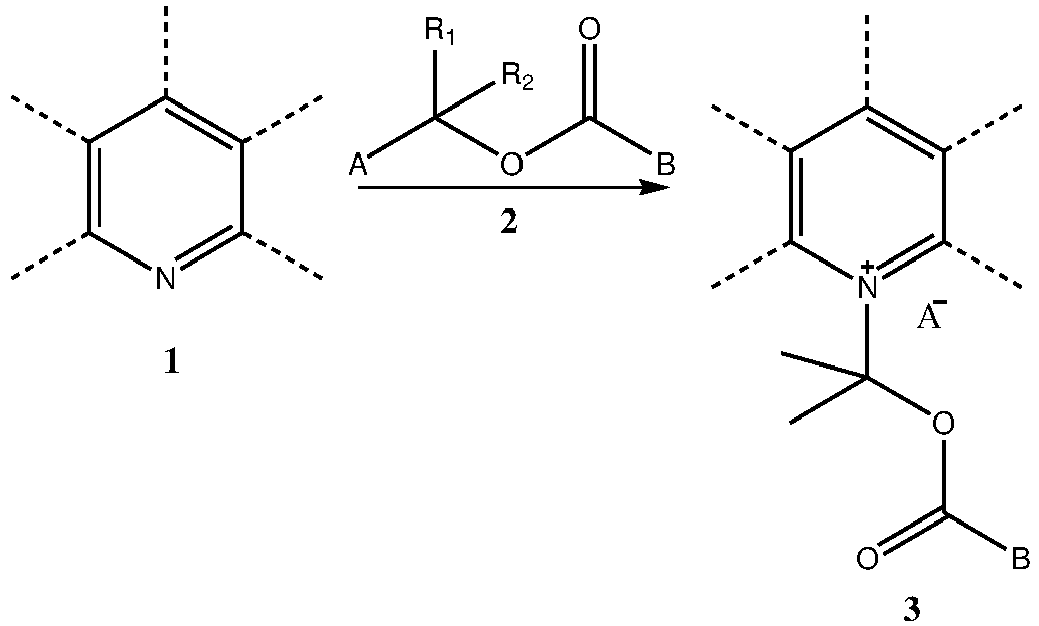
- Any compound of biological importance with an aromatic nitrogen such as pyridine can be reacted with a desired methyl formyl reagent (Type I (B= R) or Type II (B = NR1R2) or Type III (B=OR) in a solvent such as acetonitrile/ tetrahydrofuran/ dichloromethaneat temperatures typically ranging from ambient to 60°C, under anydrous conditions. After completion, the reaction can be concentrated by evaporating excess of organic solvent to get the desired product, which can be purified if required by any general purification method practiced in organic chemistry laboratory such as crystallization or preparative column purification.

- Any drug or molecule of biological importance having an aliphatic tertiary nitrogen such as piperidine can be reacted with a desired methyl formyl reagent (Type I (B= R) or Type II (B = NR1R2) or Type III (B=OR) in a solvent such as acetonitrile/ tetrahydrofuran/ dichloromethaneat temperatures typically ranging from ambient to 60°C, under anydrous conditions. After completion, the reaction can be concentrated by evaporating excess of organic solvent to get the desired product, which can be purified if required by any general purification method practiced in organic chemistry laboratory such as crystallization or preparative column purification.
- Drugs or biologically active molecules with alcohols and/ or phenols and/ or amines, both primary and secondary can also be reacted with a desired methyl formyl reagent followed by making a quaternary ammonium cation using amines such as pyridine, for example nicotinamide is a preferred embodiment. Non-limiting examples of such conversions with drugs or biologically active molecules are shown in Scheme 3.

- Wherein, F = OH, NH2 or NHR; G = O, NH or NR; Rx/Ry = H or alkyl or can be joined together to form a 3-6 membered ring;
- Hence, drugs or biological active molecules with a primary or secondary amino group [6] can be reacted with a desired methyl formyl reagent in a solvent such as acetonitrile/ tetrahydrofuran/ dichloromethaneat temperatures typically ranging from ambient to 60°C, under anydrous conditions. After completion, the reaction can be concentrated by evaporating excess of organic solvent to get the desired product, which can be purified if required by any general purification method practiced in organic chemistry laboratory such as crystallization or preparative column purification
- By using the same procedure mentioned in scheme 3 the following chemical moieties containing phenolic groups are novel are compounds numbers 1001, 1002, 1003, 1004, 1005, 1006, 1007.

- Drugs or biological active molecules with an amide group [17] can be reacted with paraformaldehyde at refluxing condition to yield precipitate of intermediate [18] which was filtered and dried. This resulting intermediate was converted to corresponding chloromethyl derivative [19] by using reagent such as thionyl chloride in solvent such as DMF, which can be further reacted with nicotinamide [20] as such or by converting it into respective bromo methyl or iodo methyl derivative using metal halides such as sodium iodide in solvent such as acetone or DCM or ACN at room temperature to refluxing. On standard work up resulted into corresponding iodo quat [21] which on further treatment with silver salts such as silver mesylate in solvent such as acetonitrile yield the desired final novel drug or biological active molecule [22].
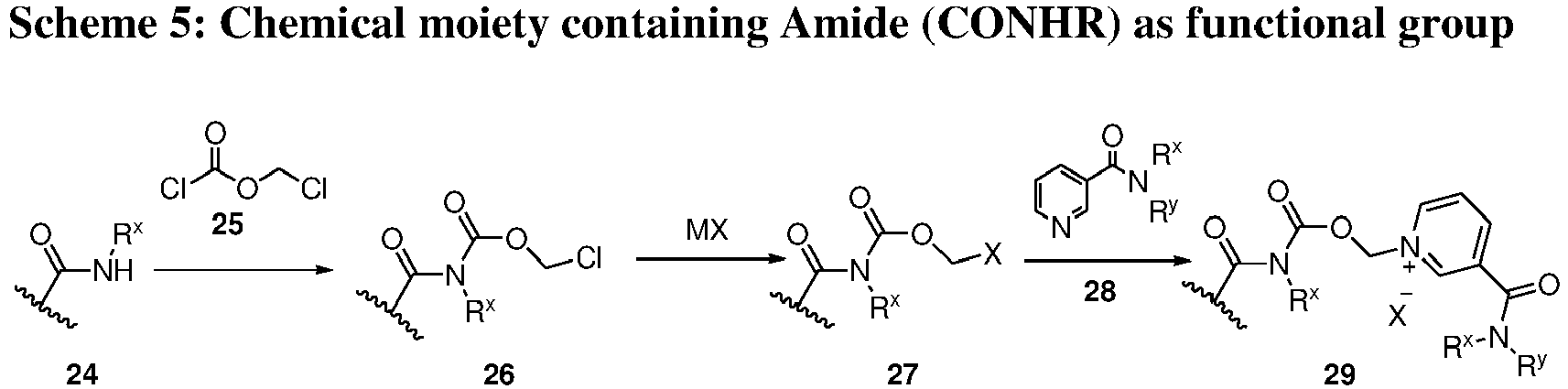
- Drugs or biological active molecules containing amide such as [24] can be reacted with chloromethyl chloroformate [25] in presence of a base such as pyridine and a solvent such as DCM. Standard workup of the reaction mixture yields an intermediate [26]. This intermediate on reaction with a suitable metal salt such as sodium iodide in a solvent such as acetone at a desired temperature starting from ambient to heating followed by a standard workup yields compound [27]. Compound [27] on reaction with a suitable quaternization reagent such as nicotinamide [28] using solvent such as DCM at room temperature followed by evaporation of organic solvent provides the desired novel drug or biological active molecule [29].

- In a similar fashion, the corresponding drug or biological active molecule with a carboxylic acid group [30] may be reacted with Lewis acids such as zinc chloride (dry) and aldehydes such as paraformaldehyde at temperatures ranging from -10 °C to 60 °C for a time ranging up to 20-24 hours. Standard work up of the reaction mixture yields the intermediate [31]; alternatively, the corresponding drug or biological active molecule with a carboxylic acid group [30] dichloromethane may also be treated with a base such as sodium bicarbonate and tetrabutylammonium bisulfate followed by dropwise addition of chloromethyl chlorosulfate in solvent such as dichloromethane. On completion of the reaction, the organic layer was washed with aqueous Na2CO3 followed by standard work up and purifications, yields intermediate [31], which may be further reacted with nicotinamide [33] as such or by converting it into respective bromo methyl or iodo methyl [32] derivative using metal halides such as sodium iodide in solvent such as acetone or DCM or ACN at room temperature. On standard work up resulted into corresponding iodo quat [34] which on further treatment with silver salts such as silver mesylate in solvent such as acetonitrile yield the desired final novel drug or biological active molecule [34] or [35].

- In a similar fashion, the corresponding drug or biological active molecule with a carboxylic acid group [63] may be reacted with a base such as cesium carbonate followed by the addition of a reagent such as bromo iodomethane in a solvent such as THF. On completion of the reaction followed by standard work up and purifications, yield substituted methyl formyl reagents, [78], which may be further reacted with a quaternization reagent such as nicotinamide [30] in a solvent such as ACN. The reaction mixture on evaporation yields desired products [79] which on further treatment with silver salts such as silver mesylate in solvent such as acetonitrile yield the desired final novel drug or biological active molecule [80].
- By using the same procedure mentioned in Scheme 12 the following Chemical moieties containing acid groups are obtained as, 1008, 1010, 1011, 1012, 1014, 1015, 1016, 1018, 1019, 1020, 1021, 1022.
- Certain compounds, illustrative of the present invention and compounds provided as reference examples are presented at Table 1. The compounds 1001-1007, 1009, 1011-1015, 1019, 1024-1027, 1030, 1031, 1044-1051, 1054, 1059-1061, 1069, 1074, 1082 and 1083 are compounds of the present invention. The remaining compounds are reference examples.
Table 1: Illustrative compounds No. IUPAC name Structure 1001 1-(((2,6-diisopropylphenoxy)carbonyloxy) methyl)-3-(dimethylcarbamoyl)pyridinium mesylate 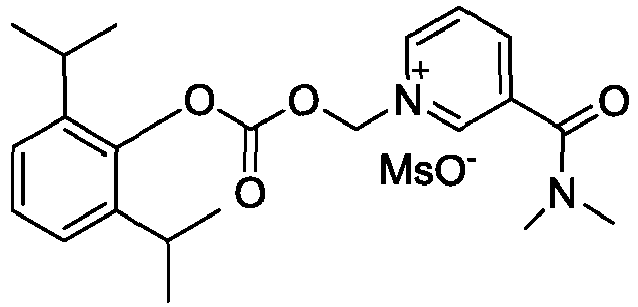
1002 1-(((2,6-diisopropylphenoxy)carbonyloxy) methyl)-3-(methylcarbamoyl)pyridinium mesylate 
1003 3-carbamoyl-1-(((2,6-diisopropylphenoxy) carbonyloxy)methyl) pyridinium mesylate 
1004 1-(((2,6-diisopropylphenoxy)carbonyloxy) methyl)-3-(methylcarbamoyl)pyridinium iodide 
1005 (E)-3-(dimethylcarbamoyl)-1-(((2-methoxy-4-((8-methylnon-6-enamido)methyl) phenoxy)carbonyloxy) methyl)pyridinium iodide 
1006 (E)-3-(dimethylcarbamoyl)-1-(((2-methoxy-4-((8-methylnon-6-enamido) methyl)phenoxy)carbonyloxy)methyl) pyridinium mesylate 
1007 3-(dimethylamino)-1-(((4-((1E,4Z,6E)-5-hydroxy-7-(4-hydroxy-3-methoxyphenyl)-3-oxohepta-1,4,6-trienyl)-2-methoxyphenoxy)carbonyloxy)methyl)pyri dinium iodide 
1008 3-(dimethylcarbamoyl)-1-((2-(4-isobutylphenyl)propanoyloxy)methyl)pyri dinium iodide 
1009 
1010 1-((2-acetoxybenzoyloxy)methyl)-3-carbamoylpyridinium iodide 
1011 1-((2-acetoxybenzoyloxy)methyl)-3-(methylcarbamoyl)pyridinium iodide 
1012 1-((2-acetoxybenzoyloxy)methyl)-3-(dimethylcarbamoyl)pyridinium iodide 
1013 1-((2-acetoxybenzoyloxy)methyl)-3-carbamoylpyridiniummesylate 
1014 1-((2-acetoxybenzoyloxy)methyl)-3-(dimethylcarbamoyl)pyridiniummesylate 
1015 1-((2-acetoxybenzoyloxy)methyl)-3-(methylcarbamoyl)pyridinium mesylate 
1016 
1017 
1018 3-carbamoyl-1-((2-(1-(4-chlorobenzoyl)-5-methoxy-2-methyl-1H-indol-3-yl) acetoxy)methyl)pyridinium iodide 
1019 1-((2-(1-(4-chlorobenzoyl)-5-methoxy-2-methyl-1H-indol-3-yl)acetoxy)methyl)-3-(dimethylcarbamoyl)pyridinium iodide 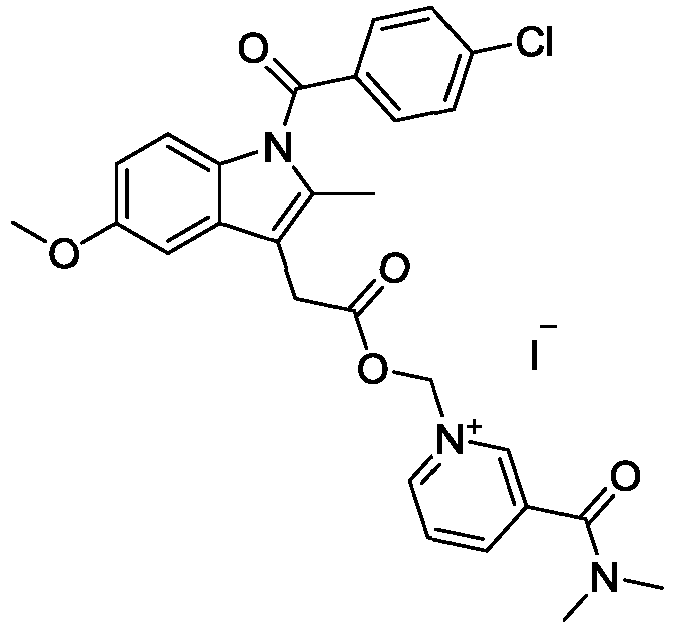
1020 1-((2-(1-(4-chlorobenzoyl)-5-methoxy-2-methyl-1H-indol-3-yl)acetoxy)methyl)-3-(dimethylcarbamoyl)pyridinium mesylate 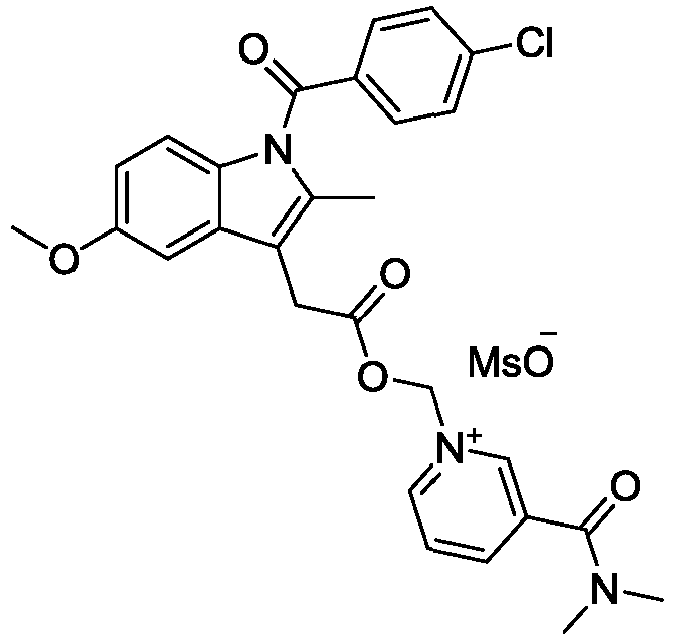
1021 1-((2-(2-(2,6-dichlorophenylamino) phenyl)acetoxy)methyl)-3-(dimethylcarbamoyl)pyridinium iodide 
1022 1-(2-(4-acetamidophenoxy)-2-oxoethyl)-3-(dimethylcarbamoyl)pyridin-1-ium iodide 
1023 1-((((((1S,2R)-1-benzamido-3-(((2aR,4S,4aS,6R,9S,11S,12S,12aR,12bS) -6,12b-diacetoxy-12-(benzoyloxy)-4-((((3-(dimethylcarbamoyl)pyridin-1-ium-1-yl)methoxy)carbonyl)oxy)-11-hydroxy-4a,8,13,13-tetramethyl-5-oxo-2a,3,4,4a,5,6,9,10,11,12,12a,12b-dodecahydro-1H-7,11-methanocyclodeca[3,4]benzo[1,2-b]oxet-9-yl)oxy)-3-oxo-1-phenylpropan-2-yl)oxy)carbonyl)oxy)methyl)-3-(dimethylcarbamoyl)pyridin-1-ium diiodide 
1024 1-((((6R,7R)-7-((E)-2-(2-aminothiazol-4-yl)-2-(methoxyimino)acetamido)-3-(methoxymethyl)-8-oxo-5-thia-1-azabicyclo[4.2.0]oct-2-ene-2-carbonyl)oxy)methyl)-3-(dimethylcarbamoyl)pyridin-1-ium methane sulfonate 
1025 L(S)-1-((2-(carboxymethyl)-4-methylpentylcarbamoyloxy) methyl)-3-(dimethylcarbamoyl)pyridinium methane sulfonate 
1026 (S)-1-((2-(carboxymethyl)-4-methylpentylcarbamoyloxy)methyl)-3-(dimethylcarbamoyl)pyridinium iodide 
1027 1-((2-((E)-1-(2-aminothiazol-4-yl)-2-((1S,8R)-5-(((3-(dimethylcarbamoyl) pyridinium-1-yl)methoxy)carbonyl)-7-oxo-4-vinyl-2-thiabicyclo[4.2.0]oct-4-en-8-ylamino)-2-oxoethylideneaminooxy) acetoxy)methyl)-3-(dimethylcarbamoyl) pyridinium 
1028 1-((2-((E)-1-(2-aminothiazol-4-yl)-2-((1S,8R)-5-(((3-(dimethylcarbamoyl) pyridinium-1-yl)methoxy)carbonyl)-7-oxo-4-vinyl-2-thiabicyclo[4.2.0]oct-4-en-8-ylamino)-2-oxoethylideneaminooxy) acetoxy)methyl)-3-(dimethylcarbamoyl) pyridinium 
1029 1-((4-((E)-2-((6R,7R)-2-carboxy-8-oxo-3-vinyl-5-thia-1-azabicyclo[4.2.0]oct-2-en-7-ylamino)-1-(carboxymethoxyimino)-2-oxoethyl)thiazol-2-ylcarbamoyloxy) methyl)-3-(dimethylcarbamoyl)pyridinium 
1030 1-((((2,6-diisopropylphenoxy)carbonyl) oxy)methyl)-3-(dimethylcarbamoyl) pyridin-1-ium iodide 
1031 3-carbamoyl-1-((((2,6-diisopropyl-phenoxy)carbonyl)oxy)methyl)pyridin-1-ium iodide 
1032 1-(((isopropylcarbamoyl)oxy)methyl)-3-(2-((2-methyl-5-((3-(4-methyl-1H-imidazol-3-ium-1-yl)-5-(trifluoromethyl) phenyl)carbamoyl)phenyl)amino)pyrimidi n-4-yl)pyridin-1-ium methanesulfonate 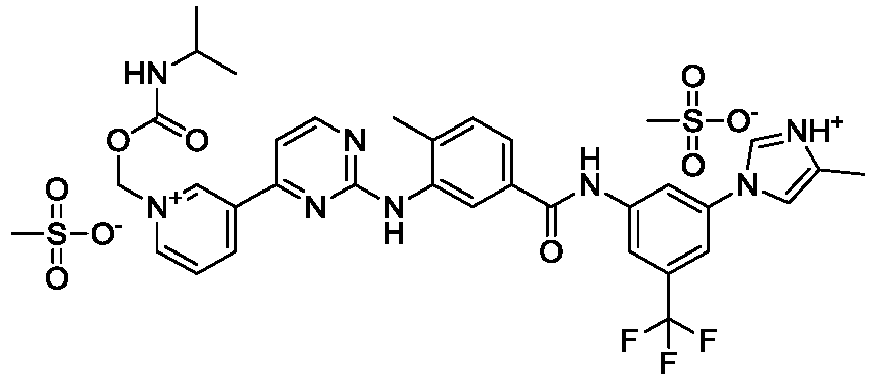
1033 1-(((isopropoxycarbonyl)oxy)methyl)-3-(2-((2-methyl-5-((3-(4-methyl-1H-imidazol-3-ium-1-yl)-5-(trifluoromethyl) phenyl)carbamoyl)phenyl)amino)pyrimidi n-4-yl)pyridin-1-ium methanesulfonate 
1034 3-(2-((2-methyl-5-((3-(4-methyl-1H-imidazol-3-ium-1-yl)-5-(trifluoromethyl) phenyl)carbamoyl)phenyl)amino)pyrimidi n-4-yl)-1-((2-phenylacetoxy)methyl) pyridin-1-ium methanesulfonate 
1035 1-((isobutyryloxy)methyl)-3-(2-((2-methyl-5-((3-(4-methyl-1H-imidazol-3-ium-1-yl)-5-(trifluoromethyl)phenyl) carbamoyl)phenyl)amino)pyrimidin-4-yl)pyridin-1-ium methanesulfonate 
1036 4-((4-ethoxy-3-(1-methyl-7-oxo-3-propyl-4,7-dihydro-1H-pyrazolo[4,3-d]pyrimidin-5-yl)phenyl)sulfonyl)-1-((isobutyryloxy) methyl)-1-methylpiperazin-1-ium iodide 
1037 4-((4-ethoxy-3-(1-methyl-7-oxo-3-propyl-4,7-dihydro-1H-pyrazolo[4,3-d]pyrimidin-5-yl)phenyl)sulfonyl)-1-((isobutyryloxy) methyl)-1-methylpiperazin-1-ium methanesulfonate 
1038 4-((4-ethoxy-3-(1-methyl-7-oxo-3-propyl-4,7-dihydro-1H-pyrazolo[4,3-d]pyrimidin-5-yl)phenyl)sulfonyl)-1-(((isopropoxycarbonyl)oxy)methyl)-1-methylpiperazin-1-ium iodide 
1039 4-((4-ethoxy-3-(1-methyl-7-oxo-3-propyl-4,7-dihydro-1H-pyrazolo[4,3-d]pyrimidin-5-yl)phenyl)sulfonyl)-1-(((isopropoxycarbonyl)oxy)methyl)-1-methylpiperazin-1-ium methanesulfonate 
1040 1-(acetoxymethyl)-4-((4-ethoxy-3-(1-methyl-7-oxo-3-propyl-4,7-dihydro-1H-pyrazolo[4,3-d]pyrimidin-5-yl)phenyl)sulfonyl)-1-methylpiperazin-1-ium iodide 
1041 1-(acetoxymethyl)-4-((4-ethoxy-3-(1-methyl-7-oxo-3-propyl-4,7-dihydro-1H-pyrazolo[4,3-d]pyrimidin-5-yl)phenyl)sulfonyl)-1-methylpiperazin-1-ium methanesulfonate 
1042 4-((4-ethoxy-3-(1-methyl-7-oxo-3-propyl-4,7-dihydro-1H-pyrazolo[4,3-d]pyrimidin-5-yl)phenyl)sulfonyl)-1-(((isopropylcarbamoyl)oxy)methyl)-1-methylpiperazin-1-ium methanesulfonate 
1043 4-((4-ethoxy-3-(1-methyl-7-oxo-3-propyl-4,7-dihydro-1H-pyrazolo[4,3-d]pyrimidin-5-yl)phenyl)sulfonyl)-1-(((isopropylcarbamoyl)oxy)methyl)-1-methylpiperazin-1-ium iodide 
1044 (S)-1-((((2-(carboxymethyl)-4-methylpentyl)carbamoyl)oxy)methyl)-3-(methylcarbamoyl)pyridin-1-ium methanesulfonate 
1045 (S)-3-carbamoyl-1-((((2-(carboxymethyl)-4-methylpentyl)carbamoyl) oxy)methyl)pyridin-1-ium methanesulfonate 
1046 (S)-1-(((3-(aminomethyl)-5-methylhexanoyl)oxy)methyl)-3-(dimethylcarbamoyl)pyridin-1-ium methanesulfonate 
1047 (S)-1-(((3-(aminomethyl)-5-methylhexanoyl)oxy)methyl)-3-(methylcarbamoyl)pyridin-1-ium methane sulfonate 
1048 (S)-1-(((3-(aminomethyl)-5-methylhexanoyl)oxy)methyl)-3-carbamoylpyridin-1-ium methanesulfonate 
1049 3-(dimethylcarbamoyl)-1-((((4-((1E,4Z,6E)-5-hydroxy-7-(4-hydroxy-3-methoxyphenyl)-3-oxohepta-1,4,6-trien-1-yl)-2-methoxyphenoxy)carbonyl)oxy) methyl)pyridin-1-ium methanesulfonate 
1050 1-((((4-((1E,4Z,6E)-5-hydroxy-7-(4-hydroxy-3-methoxyphenyl)-3-oxohepta-1,4,6-trien-1-yl)-2-methoxyphenoxy) carbonyl)oxy)methyl)-3-(methylcarbamoyl)pyridin-1-ium methanesulfonate 
1051 3-carbamoyl-1-((((4-((1E,4Z,6E)-5-hydroxy-7-(4-hydroxy-3-methoxyphenyl)-3-oxohepta-1,4,6-trien-1-yl)-2-methoxy-phenoxy)carbonyl)oxy)methyl)pyridin-1-ium methanesulfonate 
1052 3-(dimethylcarbamoyl)-1-((((1-phenylpropan-2-yl)carbamoyl)oxy) methyl)pyridin-1-ium methanesulfonate 
1053 1-((((1-carboxy-2-(3,4-dihydroxyphenyl) ethyl)carbamoyl)oxy)methyl)-3-(dimethylcarbamoyl)pyridin-1-ium methanesulfonate 
1054 1-((((1-carboxy-2-(3,4-dihydroxyphenyl) ethyl)carbamoyl)oxy)methyl)-3-(methylcarbamoyl)pyridin-1-ium methane sulfonate 
1055 3-carbamoyl-1-((((1-carboxy-2-(3,4-dihydroxyphenyl)ethyl)carbamoyl)oxy)me thyl)pyridin-1-ium methanesulfonate 
1056 1-((((3,4-dihydroxyphenethyl)carbamoyl) oxy)methyl)-3-(dimethylcarbamoyl) pyridin-1-ium methanesulfonate 
1057 1-((((3,4-dihydroxyphenethyl)carbamoyl) oxy)methyl)-3-(methylcarbamoyl)pyridin-1-ium methanesulfonate 
1058 3-carbamoyl-1-((((3,4-dihydroxy-phenethyl)carbamoyl)oxy)methyl)pyridin-1-ium methanesulfonate 
1059 1-((((4-acetamidophenoxy)carbonyl) oxy)methyl)-3-(dimethylcarbamoyl) pyridin-1-ium mesylate 
1060 1-((((2,6-diisopropylphenoxy)carbonyl) oxy)methyl)-3-(methoxycarbonyl)pyridin-1-ium iodide 
1061 3-carboxy-1-((((2,6-diisopropylphenoxy) carbonyl)oxy)methyl)pyridin-1-ium iodide 
1062 2-(((2,6-diisopropylphenoxy)carbonyl) oxy)-N,N,N-trimethylethan-1-aminium iodide 
1063 2-(((2,6-diisopropylphenoxy)carbonyl) oxy)-N,N-dimethylethan-1-aminium chloride 
1064 1-((((2,6-diisopropylphenoxy)carbonyl) oxy)methyl)-3-(hydroxycarbamoyl) pyridin-1-ium iodide 
1065 3-(((((2,6-diisopropylphenoxy)carbonyl) oxy)methyl)carbamoyl)-1-methylpyridin-1-ium iodide 
1066 1-(((2,6-diisopropylphenoxy)carbonyl) oxy)-N-((((2,6-diisopropylphenoxy) carbonyl)oxy)methyl)-N,N-dimethyl-methanaminium iodide 
1067 2-(((2,6-diisopropylphenoxy)carbonyl) oxy)-N-((((2,6-diisopropylphenoxy) carbonyl)oxy)methyl)-N,N-dimethylethan-1-aminium iodide 
1068 1-((((2,6-diisopropylphenoxy)carbonyl) oxy)methyl)-4-formyl-3-hydroxy-5-(hydroxymethyl)-2-methylpyridin-1-ium iodide 
1069 3-((2,6-diisopropylphenoxy)carbonyl)-1-((((2,6-diisopropylphenoxy)carbonyl)oxy) methyl)pyridin-1-ium methanesulfonate 
1070 2-(((2,6-diisopropylphenoxy)carbonyl) oxy)-N,N,N-trimethylethan-1-aminium methane sulfonate 
1071 1-(((11-cyclopropyl-4-methyl-6-oxo-6,11-dihydro-5H-dipyrido[3,2-b:2',3'-e][1,4]diazepine-5-carbonyl)oxy)methyl)-3-(methylcarbamoyl)pyridin-1-ium methanesulfonate 
1072 1-(((11-cyclopropyl-4-methyl-6-oxo-6,11-dihydro-5H-dipyrido[3,2-b:2',3'-e][1,4]diazepine-5-carbonyl)oxy)methyl)-3-(dimethylcarbamoyl)pyridin-1-ium methanesulfonate 
1073 3-carbamoyl-1-(((11-cyclopropyl-4-methyl-6-oxo-6,11-dihydro-5H-dipyrido[3,2-b:2',3'-e][1,4]diazepine-5-carbonyl)oxy)methyl)pyridin-1-ium methanesulfonate 
1074 3-(dimethylcarbamoyl)-1-((2-(4-isobutylphenyl)propanoyloxy)methyl)pyri dinium mesylate 
1075 (S)-1-((((2-(carboxymethyl)-2,4-dimethylpentyl)carbamoyl)oxy)methyl)-3-(dimethylcarbamoyl)pyridin-1-ium iodide 
1076 (S)-1-((((2-(carboxymethyl)-2,4-dimethylpentyl)carbamoyl)oxy)methyl)-3-(dimethylcarbamoyl)pyridin-1-ium methanesulfonate 
1077 3-carbamoyl-1-((((2,6-diisopropylphenoxy)carbonyl)oxy)methyl) pyridin-1-ium bromide 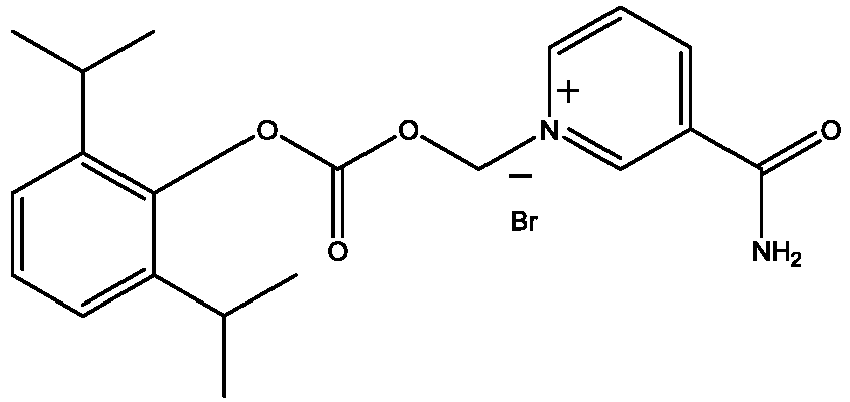
1078 3-carbamoyl-1-((((2,6-diisopropylphenoxy)carbonyl)oxy)methyl) pyridin-1-ium chloride 
1079 1-((((2,6-diisopropylphenoxy)carbonyl) oxy)methyl)-3-(methylcarbamoyl)pyridin-1-ium tetrafluoroborate 
1080 1-((((2,6-diisopropylphenoxy)carbonyl) oxy)methyl)-3-(methylcarbamoyl)pyridin-1-ium nitrate 
1081 1-((((2,6-diisopropylphenoxy)carbonyl) oxy)methyl)-3-(methylcarbamoyl)pyridin-1-ium chloride 
1082 1-((((2,6-diisopropylphenoxy)carbonyl) oxy)methyl)-3-(methoxycarbonyl)pyridin-1-ium methanesulfonate 
1083 3-carboxy-1-((((2,6-diisopropylphenoxy) carbonyl)oxy)methyl)pyridin-1-ium methanesulfonate 
- Salts and isomers are included as examples. Compounds formed by the substituted methyl formyl reagent may in some cases form salts. The term "salt(s)", as employed herein, denotes acidic and/or basic salts formed with inorganic and/or organic acids and bases. Zwitterions (internal or inner salts) are included within the term "salt(s)" as used herein (and may be formed, for example, where the R substituents comprise an acid moiety such as a carboxyl group). Also included herein are quaternary ammonium salts such as alkyl ammonium salts.
- Pharmaceutically acceptable (i.e., non-toxic, physiologically acceptable) salts are preferred, although other salts are useful, for example, in isolation or purification steps which may be employed during preparation. Salts of the compounds of may be formed, for example, by reacting a compound with an amount of acid or base, such as an equivalent amount, in a medium such as one in which the salt precipitates or in an aqueous medium followed by lypholization.
- Exemplary acid addition salts include acetates (such as those formed with acetic acid or trihaloacetic acid, for example, trifluoroacetic acid), adipates, alginates, ascorbates, aspartates, benzoates, benzenesulfonates, bisulfates, borates, butyrates, citrates, camphorates, camphorsulfonates, cyclopentanepropionates, digluconates, dodecylsulfates, ethanesulfonates, fumarates, glucoheptanoates, glycerophosphates, hemisulfates, heptanoates, hexanoates, hydrochlorides, hydrobromides, hydroiodides, 2-hydroxy ethanesulfonates, lactates, maleates, methanesulfonates, 2-naphthalenesulfonates, nicotinates, nitrates, oxalates, pectinates, persulfates, 3-phenylpropionates, phosphates, picrates, pivalates, propionates, salicylates, succinates, sulfates (such as those formed with sulfuric acid), sulfonates (such as those mentioned herein), tartrates, thiocyanates, toluenesulfonates, undecanoates, and the like.
- Exemplary basic salts (formed, for example, wherein the substituent comprise an acidic moiety such as a carboxyl group) include ammonium salts, alkali metal salts such as sodium, lithium, and potassium salts, alkaline earth metal salts such as calcium and magnesium salts, salts with organic bases (for example, organic amines) such as benzathines, dicyclohexylamines, hydrabamines, N-methyl-D-glucamines, N-methyl-D-glucamides, t-butyl amines, and salts with amino acids such as arginine, lysine and the like. The basic nitrogen-containing groups may be quaternized with agents such as lower alkyl halides (e.g. methyl, ethyl, propyl, and butyl chlorides, bromides and iodides), dialkyl sulfates (e.g. dimethyl, diethyl, dibutyl, and diamyl sulfates), long chain halides (e.g. decyl, lauryl, myristyl and stearyl chlorides, bromides and iodides), aralkyl halides (e.g. benzyl and phenethyl bromides), and others.
- Solvates of the compounds are also contemplated herein. Solvates of the compounds of formula I are preferably hydrates or any other pharmaceutically acceptable solvate.
- All stereoisomers of the present compounds, such as those which may exist due to asymmetric carbons on the R substituents of the compound, including enantiomeric and diastereomeric forms, are provided as examples. Individual stereoisomers of the compounds may, for example, be substantially free of other isomers, or may be admixed, for example, as racemates or with all other, or other selected, stereoisomers. The chiral centers may have the S or R configuration.
- The effect of selection of suitable counter ions is described. The counter ion of the compounds may be chosen by selecting the dissociation constant for the drug capable of ionization within the said pH range. By estimating the ionized and un-ionized drug concentration of any compound (using well established equations such a Henderson-Hasselbach equation), the solubility and consequently the absorption of the drug may be determined.
- The modification of deuterated compounds is described. Deuterated compounds are those wherein the compounds have selective incorporation of deuterium in place of hydrogen.
- Further disclosed is the use of the novel entity as defined herein for use in human or veterinary medicine. The compound for use as a pharmaceutical may be presented as a pharmaceutical formulation.
- Further disclosed is a pharmaceutical formulation comprising the novel compounds of the invention with a pharmaceutically acceptable carrier thereof and optionally other therapeutic and/or prophylactic ingredients. The carriers must be "acceptable" in the sense of being compatible with the other ingredients of the formula and not deleterious to the recipient thereof. Suitably the pharmaceutical formulation will be in an appropriate unit dosage form.
- The pharmaceutical formulations may be any formulation and include those suitable for oral, intranasal, intraocular or parenteral (including intramuscular and intravenous) administration. The formulations may, where appropriate, be conveniently presented in discrete dosage units and may be prepared by any of the methods well known in the art of pharmacy. All methods include the step of bringing into association the active compound with liquid carriers or finely divided solid carriers or both, and then, if necessary, shaping the product into the desired formulation.
- For these purposes the compounds of the present invention may be administered orally, topically, intranasally, intraocularly, parenterally, by inhalation spray or rectally in dosage unit formulations containing conventional non-toxic pharmaceutically acceptable carriers, adjuvants and vehicles. The term parenteral as used herein includes subcutaneous injections, intravenous, intramuscular, intrasteral injection or infusion techniques. In addition to the treatment of warm-blooded animals such as mice, rats, horses, dogs, cats, etc., the compounds of the invention are effective in the treatment of humans.
-

- Pyridine (0.375 g, 47.5 mmol, 2.5 eq) was added to a solution of chloromethyl chloroformate (CMCF) [69] (0.294 g, 22.8 mmol, 1.2 eq) in dry THF (10ml) under an argon atmosphere at 00C. At 0°C, a solution of N-(4-hydroxyphenyl)acetamide, N-(4-hydroxyphenyl)ethanamide [210] (0.300 g, 19.0 mmol, 1.0 eq) in dry THF was added to the above reaction mixture. The reaction mixture was stirred at room temperature for 20 h. reaction progress was monitored by TLC. After 20 h, the reaction mixture was diluted with dichloromethane (50 ml), washed with water (15 ml), 10% solution of NaHCO3 (15 ml), dil HCl (10 ml), followed by brine (10 ml), and the organic layer dried over anhydrous sodium sulfate. Evaporation of the solvents under vacuum gave the crude product. The crude product was purified by silica gel column chromatography (100-200 mesh) using MeOH: DCM (2%) as eluent to yield a off white product, 4-acetamidophenyl (chloromethyl) carbonate [76]. (0.330 g, 68 %). m/z: 244
- Sodium iodide (0.454 g, 107 mmol 3.7 eq) was added to a solution of 4-acetamidophenyl (chloromethyl) carbonate [76] (0.20 g, 29 mmol, 1.0 eq) in acetone. The resulting reaction mixture was heated for 6 h at 50°C. Reaction progress was monitored by TLC. The reaction mixture was cooled to room temperature and passed through a bed of silica (mesh 100 - 200). The silica bed was washed several times with acetone was and fractions collected and evaporated under vacuum to yield the desired product, 4-acetamidophenyl (iodomethyl) carbonate [38], (0.27 g, 98 %). m/z: 336
- Dimethyl nicotinamide [72] (0.022 g, 15 mmol, 1.0 eq) was added to a solution of 4-acetamidophenyl (iodomethyl) carbonate [71], (0.05 g, 15 mmol, 1.0 eq) in dry acetonitrile (2ml) under argon atmosphere. The resulting reaction mixture was stirred for 2 days at RT. Reaction progress was monitored by TLC. Solvent was removed under vacuum to get a crude product. The crude product obtained was triturated with diethyl ether (10 ml x 2) to give the desired product, 1-((((4-acetamidophenoxy)carbonyl)oxy)methyl)-3-(dimethylcarbamoyl) pyridin-1-ium iodide [73] (0.021 g, 29 %). m/z: 358.
- To a stirred solution of 1-((((4-acetamidophenoxy)carbonyl)oxy)methyl)-3-(dimethylcarbamoyl)pyridin-1-ium [73] (0.0163 g, 0.027 mmol, 1.0 eq) in ACN (2 ml) was added silver(I) methanesulfonate (0.0054 g, 0.027 mmol, 1.0 eq) at RT. The reaction mixture was stirred at RT for 2 h. The reaction was filtered to get rid of silver iodide. Filtrate was concentrated under vacuum, which was triturated with dry ether (2x 5 ml), ether removed by decantation and product dried under vacuum to get the desired product 1-((((4-acetamidophenoxy)carbonyl)oxy)methyl)-3-(dimethylcarbamoyl)pyridin-1-ium mesylate [1059] (0.0122 g, 66 %) as pale yellow solid. m/z: 358.
-

- Pyridine (0.026 g, 23.0 mmol, 2 eq) was added to a solution of chloromethyl chloroformate (CMCF) (0.020 g, 23.0 mmol, 2 eq) in dry dichloromethane under an argon atmosphere at 0°C. At 0°C, a solution of (2α,4α,5β,7β,10β,13α)-4,10-bis(acetyloxy)-13-{[(2R,3S)-3-(benzoylamino)-2-hydroxy-3-phenylpropanoyl]oxy}- 1,7-dihydroxy-9-oxo-5,20-epoxytax-11-en-2-yl benzoate [74] (0.100 g, 11.7 mmol, 1 eq) in dry dichloromethane was added. The reaction mixture was stirred at room temperature for 2 hours. The reaction progress was monitored by TLC. After 2 hours the reaction mixture was diluted with dichloromethane (25 ml), washed with a 10% solution of NaHCO3 (15 ml), brine (10 ml), and then dried over anhydrous sodium sulfate. Evaporation of the solvents gave the desired product, [75], (2aR,4S,4aS,6R,9S,11S,12S,12aR,12bS)-9-(((2R,3S)-3-benzamido-2-(((chloromethoxy) carbonyl)oxy)-3-phenylpropanoyl)oxy)-12-(benzoyloxy)-4-(((chloromethoxy)carbonyl)oxy)-11-hydroxy-4a,8,13,13-tetramethyl-5-oxo-2a,3,4,4a,5,6,9,10,11,12,12a,12b-dodecahydro-1H-7,11-methanocyclodeca[3,4]benzo[1,2-b]oxete-6,12b-diyl diacetate, as a white solid (0.110 g, 90 %). m/z = 1038.3
- Sodium iodide (22 mg, 145 mmol) was added to a solution of [75] (0.030 g, 29 mmol) in acetone. The resulting reaction mixture was refluxed for 6 hours at 60°C. Reaction progress was monitored by TLC. The reaction mixture was cooled to room temperature and passed through a bed of silica (mesh 100 - 200). The silica bed was washed with acetone which was collected and evaporated to yield the desired product [76], (2aR,4S,4aS,6R,9S,11S,12S,12aR,12bS)-9-(((2R,3S)-3-benzamido-2-(((iodomethoxy) carbonyl)oxy)-3-phenylpropanoyl)oxy)-12-(benzoyloxy)-11-hydroxy-4-(((iodomethoxy) carbonyl)oxy)-4a,8,13,13-tetramethyl-5-oxo-2a,3,4,4a,5,6,9,10,11,12,12a,12b-dodecahydro-1H-7,11-methanocyclodeca[3,4]benzo[1,2-b]oxete-6,12b-diyl diacetate, as a white solid (0.020 g, 70 %). m/z = 1221.7
- Dimethyl nicotinate [72] (0.003 g, 20 mmol) was added to a solution of [76] (0.010 g, 10 mmol) in dry acetonitrile under argon atmosphere. The resulting yellow reaction mixture was stirred for 16 hours at RT. Reaction progress was monitored by TLC. Solvent was removed under high vacuum pump to give a crude product. The crude product obtained was triturated with diethyl ether (10 ml x 2) to give the desired product [1023], mono(1-((((((1S,2R)-1-benzamido-3-(((2aR,4S,4aS,6R,9S,11S,12S,12aR,12bS)-6,12b-diacetoxy-12-(benzoyloxy)-4-((((3-(dimethylcarbamoyl)pyridin-1-ium-1-yl)methoxy)carbonyl)oxy)-11-hydroxy-4a,8,13,13-tetramethyl-5-oxo-2a,3,4,4a,5,6,9,10,11,12,12a,12b-dodecahydro-1H-7,11-methanocyclodeca[3,4]benzo[1,2-b]oxet-9-yl)oxy)-3-oxo-1-phenylpropan-2-yl)oxy)carbonyl)oxy)methyl)-3-(dimethylcarbamoyl)pyridin-1-ium) doiodide as a yellow solid (0.014 g, 60 %). m/z= 1268.
-

- TEA (0.28 ml, 1.98 mmol, 3.0 eq) was added to a solution of N-(4-hydroxyphenyl)acetamide, N-(4-hydroxyphenyl)ethanamide [77] (0.10 g, 0.66 mmol, 1.0 eq) of in dry THF under argon atmosphere. At 0°C, bromoacetyl chloride [78] (0.123 g, 0.79 mmol, 1.2equiv) was added. The reaction mixture was stirred at room temperature for 24 h. After 24 h, solvent was evaporated under vacuum and residue was taken in dichloromethane (50 ml) and washed with a 10% solution of NaHCO3 (15 ml) and then with brine (10 ml), followed by drying of the organic layer over anhydrous sodium sulfate. Evaporation of the solvents provided white solid which was purified by silica gel column chromatography (0.5% MeOH: DCM, 100-200 mesh silica) to give the product 4-acetamidophenyl 2-bromoacetate [79] (0.05 g, 28 %). m/z = 272
- Sodium iodide (0.083 g, 5.52 mmol, 3.0 eq.) was added to a solution of 4-acetamidophenyl 2-bromoacetate [79] (0.050 g, 1.84 mmol, 1.0 eq.) in acetonitrile (5 ml) followed by the addition of dimethyl nicotinamide [72] (0.027 g, 1.84 mmol, 1.0 eq). The resulting reaction mixture was stirred at 40°C for 48 h. Reaction progress was monitored by TLC. Solvent was removed under high vacuum to get a crude product. crude product was taken in DCM to precipitate excess of sodium iodide and sodium bromide, which was removed by filtration and filtrate was evaporated to get a yellow solid which was washed with diethyl ether (10 ml) and then dried under vacuum to yield light yellow solid, 1-(2-(4-acetamidophenoxy)-2-oxoethyl)-3-(dimethylcarbamoyl)pyridin-1-ium iodide [1022], (0.038 g,44 %). m/z: 342.
-

- (RS)-2-(4-(2-methylpropyl)phenyl)propanoic acid [80] (0.1 g, 0.48 mmol ,1.0 eq) DCM (2 ml), water(2 ml), sodium bicarbonate (0.131g , 1.8 mmol, 3.81 eq) and tetrabutylammonium hydrogen sulfate (0.016 g , 0.05 mmol, 0.1 eq) were stirred at 25°C for 2 min. to the above reaction mixture, a solution of chloromethyl chlorosulfate [81] (0.08 ml, 0.51 mmol, 1.1 eq) in DCM (1 ml) was added dropwise and the biphasic system was stirred at RT for 1 h. The organic layer was separated and dried over anhydrous Na2SO4. Evaporation of the solvent under vacuum gave the desired product as colorless oil [82] (chloromethyl 2-(4-isobutylphenyl) propanoate), (0.06 ml, 50%).
- Sodium iodide (0.14 g, 0.925 mmol, 4.0 eq) was added to a solution of [82] (0.06 g, 0.22 mmol, 1.0 eq) in acetone (5 ml). The resulting reaction mixture was stirred at RT for 14 h. Reaction progress was monitored by TLC. Solvent was removed under vacuum to get a crude product. Then DCM was added to the crude product to precipitate out sodium iodide which was separated by filtration, and filtrate was evaporated under vacuum to get a yellow oil [83] iodomethyl 2-(4-isobutylphenyl) propanoate (0.07 g, 86%).
- Iodomethyl 2-(4-isobutylphenyl) propanoate [83] (0.07 g, 0.23 mmol, 1.0 eq) and dimethyl nicotinamide [72] (0.03 g, 0.22 mmol, 1.0 eq) were added in ACN (3 ml). The reaction mixture was stirred at RT for 16 h. Reaction progress was monitored by TLC. Solvent was removed under vacuum to get a crude product. The crude product obtained was triturated with diethyl ether (2 x 5 ml) to give the desired product [84], 3-(dimethylcarbamoyl)-1-(((2-(4-isobutylphenyl)propanoyl)oxy)methyl)pyridin-1-ium iodide (0.045 g, 60 %).
- To a stirred solution of 3-(dimethylcarbamoyl)-1-(((2-(4-isobutylphenyl)propanoyl) oxy)methyl)pyridin-1-ium iodide [84] (0.03 g, 0.006 mmol, 1.0 eq) in ACN (2 ml) was added silver(I) methanesulfonate (0.012 g, 0.006 mmol, 1.0 eq) at RT. The reaction mixture was stirred at RT for 2 h. The reaction was filtered to get rid of silver iodide. Filtrate was concentrated under vacuum, which was triturated with dry ether (2x 5 ml), ether removed by decantation and product dried under vacuum to get the desired product 3-(dimethylcarbamoyl)-1-(((2-(4-isobutylphenyl)propanoyl)oxy)methyl)pyridin-1-ium iodide mesylate [1074] (0.025 g, 90 %) as pale yellow solid. m/s: 495
- Compound no. 1008,1011-16,1018-22,1024,1025,1028,1047-1049 were prepared by the procedure described in example 4.
-

- To stirred solution of 4-methyl-N-(3-(4-methyl-1H-imidazol-1-yl)-5-(trifluoromethyl) phenyl)-3-((4-(pyridin-3-yl)pyrimidin-2-yl)amino)benzamide [85] (0.09 g, 0.00017 mmol, 1.0eq) in DCM (5ml), was added at 0°C Methane sulfonic acid (0.016 g, 0.00017 mmol, 1.0 eq). The reaction mixture was stirred at RT for 30 min. The organic solvent was evaporated and ACN (5ml) was added to the residue obtained. Iodomethyl isopropylcarbamate (0.041 g, 0.00017 mmol, 1.0 eq) was added. Reaction mixture was heated at 50°C for overnight, organic solvent was evaporated to get crude material, crude product dissolved in distilled water (5 mL) & washed with DCM, aqueous layer was lyophilized to yield 1-(((isopropylcarbamoyl)oxy)methyl)-3-(2-((2-methyl-5-((3-(4-methyl-1H-imidazol-1-yl)-5-(trifluoromethyl)phenyl)carbamoyl)phenyl)amino)pyrimidin-4-yl)pyridin-1-ium iodide methane sulfonic acid salt [86] (0.09 g, 90%) as yellow solid. Mass: m/z at 646
- To a stirred solution of 1-(((isopropylcarbamoyl)oxy)methyl)-3-(2-((2-methyl-5-((3-(4-methyl-1H-imidazol-1-yl)-5-(trifluoromethyl)phenyl)carbamoyl)phenyl)amino)pyrimidin-4-yl)pyridin-1-ium iodide methane sulfonic acid salt [86] (0.04 g, 0.00004 mmol, 1.0 eq) in ACN:Water (2:2mL) was added silver(I) methanesulfonate (0.00093gm, 0.00004 mmol, 1.0 eq) at RT. The reaction mixture was stirred at RT for 1 h. The reaction was filtered to get rid of silver iodide. Filtrate was lyophilized to get the desired product 1-(((isopropylcarbamoyl)oxy)methyl)-3-(2-((2-methyl-5-((3-(4-methyl-1H-imidazol-1-yl)-5-(trifluoromethyl)phenyl)carbamoyl)phenyl)amino)pyrimidin-4-yl)pyridin-1-iumdimesylate [1032], (0.021 g, 55%) as light yellow solid. Mass: m/z at 646. Compound no. 1032-35 were prepared by the procedure described in example 6
-

- To a stirred solution of 1-[4-ethoxy-3-(6,7-dihydro-1-methyl-7-oxo-3-propyl-1H-yrazolo[4,3-d]pyrimidin-5-yl)phenylsulfonyl]-4-methylpiperazine1-[4-ethoxy-3-(6,7-dihydro-1-methyl-7-oxo-3-propyl-1H-pyrazolo[4,3-d]pyrimidin-5-yl)phenylsulfonyl]-4-methylpiperazine) [87], 0.107 g, 0.225 mmol, 1.0 eq) in ACN (15 ml) was added iodomethyl isopropylcarbonate (0.085 g, 0.348 mmol, 1.54 eq) at RT. The reaction was stirred at 60°C for 3-4 h. ACN was removed under vacuum; product triturated with ether to get 4-((4-ethoxy-3-(1-methyl-7-oxo-3-propyl-6,7-dihydro-1H-pyrazolo[4,3-d]pyrimidin-5-yl)phenyl)sulfonyl)-1-(((isopropoxycarbonyl)oxy)methyl)-1-methylpiperazin-1-ium iodide as off white solid ([88],0.137 g, 84%).
- To a solution of 4-((4-ethoxy-3-(1-methyl-7-oxo-3-propyl-6,7-dihydro-1H-pyrazolo[4,3-d]pyrimidin-5-yl)phenyl)sulfonyl)-1-(((isopropoxycarbonyl)oxy)methyl)-1-methylpiperazin-1-ium iodide ([88],0.137 g, 0.190 mmol, 1.0 eq) in ACN (7 mL) at RT was added silver salt of methane sulphonate (0.037 g, 0.182 mmol, 0.96 eq). The reaction was stirred at RT for 20 min and filtered through 0.45µ nylon filter, ACN evaporated and compound triturated with ether and then n-penatane to get 4-((4-ethoxy-3-(1-methyl-7-oxo-3-propyl-6,7-dihydro-1H-pyrazolo[4,3-d]pyrimidin-5-yl)phenyl)sulfonyl)-1-(((isopropoxycarbonyl)oxy)methyl)-1-methylpiperazin-1-ium methanesulfonate [1039] as off white solid (0.0724 g, 55%). Mass= m/z at 591.
- Compound no. 1036-43were prepared by the procedure described in example 6.
-

- To a solution of Propofol [89](0.1gm,0.53mmol,1eq) in 5 ml dichloromethane at 0°C ,triethyl amine was added and stirred the resulting solution at 0°C for 20min.After stirring for 20min at 0°C,chloromethyl chloroformate(0.12ml,0.84mmol,1.5eq) was added dropwise and stirred for 2 hrs at 0°C and allowed to stirred at RT for 2Hrs,During the reaction progress solution was turned into a white precipitate.The reaction progress was monitored by TLC.The reaction mixture was diluted with dichloromethane (50 ml), washed with water (15ml), 10% solution of NaHCO3 (15 ml), dil HCl (10ml), followed by brine (10 ml), and the organic layer dried over anhydrous sodium sulfate. Evaporation of the solvents under vacuum gave the crude product chloromethyl (2,6-diisopropylphenyl) carbonate [90] as a colourless gel. (0.012 g, 80 %). m/z: 271
- Sodium iodide (0.2 g, 1.3mmol 3.0 eq) was added to a solution of chloromethyl (2,6-diisopropylphenyl) carbonate [90] (0.120 g, 0.44mmol, 1.0 eq) in acetone. The resulting reaction mixture was stirred at RT for 5Hrs. Reaction progress was monitored by TLC. The reaction mixture was filtered through filter paper to remove formed sodium chloride during reaction.Then solvent was evaporated and passed through a bed of silica (mesh 100 - 200). The silica bed was washed several times with dichloromethane and fractions collected and evaporated under vacuum to yield the desired product 2,6-diisopropylphenyl (iodomethyl) carbonate [91], (0.109gm, 90%). m/z: 363
- Nicotinamide [92] (0.02 g, 0.16 mmol, 1.0eq) was added to a solution of 2,6-diisopropylphenyl (iodomethyl) carbonate [91] (0.07 g, 0.16mmol,1.0 eq) in dry acetonitrile (2ml) under argon atmosphere. The resulting reaction mixture was stirred at 50°C for 20Hrs. Reaction progress was monitored by TLC. Solvent was removed under vacuum to get a crude product. The crude product obtained was triturated with diethyl ether (10 ml x 2) to give the desired product, 3-carbamoyl-1-((((2,6-diisopropylphenoxy)carbonyl)oxy)methyl)pyridin-1-ium iodide [93] as a yellow solid (0.050gm,65%). m/z: 358.
- To a stirred solution of , 3-carbamoyl-1-((((2,6-diisopropylphenoxy) carbonyl)oxy)methyl) pyridin-1-ium iodide [93] (0.045 g, 0.09 mmol, 1.0 eq) in ACN (2 ml) was added silver(I) methanesulfonate (0.019 g, 0.09 mmol, 1.0 eq) at RT. The reaction mixture was stirred at RT for 2 h. The reaction was filtered to get rid of silver iodide. Filtrate was concentrated under vacuum, which was triturated with dry ether (2x 5 ml), ether removed by decantation and product dried under vacuum to get the desired product 3-carbamoyl-1-((((2,6-diisopropylphenoxy)carbonyl)oxy)methyl)pyridin-1-ium iodide mesylate [1003] (0.035 g, 83%) as light yellow solid. m/z: 358.
-

- Triethyl amine (4.0 ml, 0.028 mmol, 2.0 eq) was added to a solution 2, 6-diisopropylphenol [89] (2.5g, 0.014 mmol, 1.0 eq) in dry DCM (30ml) under nitrogen atmosphere at 0°C followed by addition of chloromethyl chloroformate (1.54ml, 0.017mmol, and 1.25eq). The reaction mixture was stirred at 0°C for 2h and reaction progress was monitored by TLC. After 2 h, the reaction mixture was diluted with dichloromethane (250 ml), washed with water (100ml), 10% solution of NaHCO3 (150 ml), dil HCl (100ml), followed by brine (100ml). The organic layer thus obtained was dried over anhydrous sodium sulfate. Evaporation of the solvents under vacuum provided crude product, which was purified using silica gel column chromatography (100-200 mesh) using cyclohexane : dichloromethane (3%) as eluent to obtain colourless liquid [90] (3.1g, 83 %). m/z: 271
- Sodium iodide (7.0 g, 0.046 mol, 4.0eq) was added to a solution of chloromethyl (2,6-diisopropylphenyl) carbonate [90] (3.1 g, 0.012 mol, 1.0 eq) in acetone. The resulting reaction mixture was stirred at room temperature for 20hrs.The reaction progress was monitored by TLC. The reaction mixture was then filtered off and residue was washed with excess of acetone. Filtrate was evaporated and passed through a bed of silica (mesh 100 - 200). The compound was eluted with cyclohexane to yield product as a colourless liquid [91](3.3g, 80 %). m/z: 363
- N-methylnicotinamide [94] (0.68 g, 0.0049 mol, 0.9eq) was added to a solution of iodomethyl (2,6-diisopropylphenyl) carbonate [91] (2.0g, 0.0055 mol,1.0 eq) in dry acetonitrile (20ml) under nitrogen atmosphere. The resulting reaction mixture was stirred at 50°C for 20hrs.The reaction progress was monitored by TLC. Then solvent was removed under vacuum to get a crude product as a dark brown solid. The crude product was dissolved in DCM and then triturated with diethyl ether to give the desired product [95] as a yellow powder (2.1g,78%). m/z: 371
- To a stirred solution of 1-((((2,6-diisopropylphenoxy)carbonyl)oxy)methyl)-3-(methylcarbamoyl)pyridin-1-ium iodide [95] (0.035 g, 0.00007 mol, 1.0 eq) in ACN (2 ml) was added silver(I) methanesulfonate (14mg, 0.00007 mol, 1.0 eq) at RT. The reaction mixture was stirred at RT for 30mins. The reaction was filtered to get rid of silver iodide. Filtrate was concentrated under vacuum, which and triturated with diethyl ether to afford product as a colourless solid [1002] (0.030 g, 95%). m/z: 371
- Compound no. 1001, 1004, 1031, 1060, 1061 were prepared by the procedure described in Example 8.
-

- Compound [1069] was prepared by the procedure described inexample 8.
-

- Triphosgene (0.145gm, 0.00049 mol, 0.35 eq) was dissolved in 10 ml dichloromethane and cooled to -78°C. Propofol [89] (0.25gm,0.0014 mol,1.0eq) was dissolved in 7ml dichloromethane and pyridine(0.44gm,0.0056 mol,4.0eq) and then added to the triphosgene solution. The reaction was slowly warmed to room temperature and stirred for additional 2hrs. The reaction mixture was cooled back to -78°C followed by addition of dimethyl amino ethanol (0.11gm,0.00126 mol,0.9 eq) predissolved in 3 ml dichloromethane. The reaction mixture slowly warmed to room temperature and stirred for another 1 hr. Reaction mixture was diluted with DCM (100 ml) and washed successively with water, sat.NaHCO3 and brine solution. Organic layer was dried over Na2SO4, and evapourated to yield colourless gel of [100] (0.38gm,92%). m/z:-294
- To a solution of 2,6-di-isopropylphenyl (2-(dimethylamino)ethyl) carbonate [100](0.05gm,0.00017 mol,1.0eq) in 10 ml ethyl acetate was added methyl iodide(0.05ml,0.00034 mol,2.0 eq).The solution was stirred at room temperature for 1 hr leading to formation of white precipitates. The precipitates were filtered off and washed with diethyl ether to remove any leftover methyl iodide. The precipitate was dried to yield product as colourless solid of [101](0.06gm,81%). m/z:-308
- To a stirred solution of 2-(((2,6-diisopropylphenoxy)carbonyl)oxy)-N,N,N-trimethylethan-1-aminium iodide[101] (0.030 g, 0.00007mol, 1.0 eq) in ACN (2 ml) was added silver(I) methanesulfonate (0.014 g, 0.00007mol, 1.0 eq) at RT. The reaction mixture was stirred at RT for 30min. The reaction was filtered to get rid of silver salt. Filtrate was concentrated under vacuum and re-dissolved in dichloromethane followed by filtration leading to speration of solid material. Filtrate was evaporated under vaccum to desired product as a colourless solid [1070] (0.022 g, 78 %). m/z: 308
- Compound no. 1062 and 1063 were prepared by the procedure described inexample 10.
-

- To a stirred suspension of (S)-3-(aminomethyl)-3,5-dimethylhexanoic acid [111] (0.4gm,2.5mmol,1eq) in 50 ml of DCM at 0°C was added TEA and stirred for 10 min.To this TMSCl was added and again stirred it for 1 hrs at same temperature and then at rt for 15 min.Then it was cooled down back to 0°C and CMCF was added dropwise and stirred the resulting reaction mixture at RT for overnight.The progress of the reaction was monitored by TLC.The resulting silyl ester was then converted to acid by quenching with aq.10% citric acid solution and extracted the compound by DCM(100ml x 2).DCM layer was then washed with brine solution and crude product was purified by silica gel chromatography (100-200 mesh size) and eluted the compound by MeOH:DCM(2%) to yield product (S)-3-((((chloromethoxy)carbonyl)amino)methyl)-3,5-dimethylhexanoic acid [112] as a colourless gel(0.35gm,55%), M+1:-266
- To a solution of (S)-3-((((chloromethoxy)carbonyl)amino)methyl)-3,5-dimethylhexanoic acid [112](0.1gm,3.0mmol,1.0eq) in acetonitrile sodium iodide(0.050gm,3.3mmol,1.1eq) and Dimethyl nicotinamide (0.057gm,3.0mmol,1.0eq) was added and resulting reaction mixture was heated at 45°C for 2 Hrs.The progress of the reaction was monitored by TLC. It was then cooled to RT and filtered off the solid as a NaCl and filtrate was evaporated to get crude residue which was washed successively with DCM . Then residue was dissolved in mixture of DCM:MeOH(9:1) and triturated it with diethyl ether to yield (S)-1-((((2-(carboxymethyl)-2,4-dimethylpentyl)carbamoyl)oxy)methyl)-3-(dimethylcarbamoyl)pyridin-1-ium iodide [1075] as a yellow solid(0.08gm,42%). M+ peak:-380
- To a stirred solution of (S)-1-((((2-(carboxymethyl)-2,4-dimethylpentyl)carbamoyl)oxy) methyl)-3-(dimethylcarbamoyl)pyridin-1-ium iodide [1075] (0.06 gm, 0.12mmol, 1.0 eq) in ACN (2 ml) was added silver(I) methanesulfonate (0.025 gm, 0.12mol, 1.0 eq) at RT. The reaction mixture was stirred at RT for 30min. The reaction was filtered to get rid of silver salt. Filtrate was concentrated under vacuum and re-dissolved in dichloromethane followed by filtration leading to speration of solid material. Filtrate was evaporated under vaccum to desired product (S)-1-((((2-(carboxymethyl)-2,4-dimethylpentyl)carbamoyl)oxy)methyl)-3-(dimethylcarbamoyl)pyridin-1-ium methanesulfonate [1076] as a colourless solid (0.03 gm, 54%). M+ peak: 380
- Compound no. 1044,1045,1052,1054,1055,1057 and 1058 were prepared by the procedure described in example 11.
-

- To a cooled solution of CMCF (0.146ml, 1.69mmol, 1.5eq) in DCM at 0°C pyridine (0.178ml,1.69mmol,1.5eq) was added and stirred it for 10 min. Then 11-cyclopropyl-4-methyl-5,11-dihydro-6H-dipyrido[3,2-b:2',3'-e][1,4]diazepin-6-one[115] (0.3gm,1.1mmol,1.0eq) was added and stirred the resulting reaction mixture was refluxed to 50°C for 4hrs.The reaction was monitored by TLC. Reaction was quenched by water and extracted the compound by DCM(100ml),dried over Na2SO4 and evaporated to yield crude product as a gel which was purified by using column chromatography over silica gel(100-200 mesh size) and eluted the compound by MeOH : DCM(1%) to yield chloromethyl 11-cyclopropyl-4-methyl-6-oxo-6,11-dihydro-5H-dipyrido[3,2-b:2',3'-e][1,4]diazepine-5-carboxylate[116] asa light brown solid (0.31gm,75%). M+1 peak at 359.
- To a solution chloromethyl 11-cyclopropyl-4-methyl-6-oxo-6,11-dihydro-5H-dipyrido[3,2-b:2',3'-e][1,4]diazepine-5-carboxylate[116] (0.1gm,2.7mmol,1.0eq) in acetonitrile sodium iodide(0.081gm,5.4mmol,2.0eq) and Dimethyl nicotinamide (0.041gm,2.7mmol,1.0eq) was added and resulting reaction mixture was heated at 50°C for overnight.The progress of the reaction was monitored by TLC.It was then cooled to RT and filtered off the solid as a NaCl and filtrate was evaporated to yielded crude residue which was washed successively with DCM . Then residue was triturated it with diethyl ether to yield 3-carbamoyl-1-(((11-cyclopropyl-4-methyl-6-oxo-6,11-dihydro-5H-dipyrido[3,2-b:2',3'-e][1,4]diazepine-5-carbonyl)oxy)methyl)pyridin-1-ium iodide [117] as a white solid(0.10gm,78%). M+ peak:-445.
- To a stirred solution of 3-carbamoyl-1-(((11-cyclopropyl-4-methyl-6-oxo-6,11-dihydro-5H-dipyrido[3,2-b:2',3'-e][1,4]diazepine-5-carbonyl)oxy)methyl)pyridin-1-ium iodide [117] (0.085 gm, 0.145mmol, 1.0 eq) in ACN (2 ml) was added silver(I) methanesulfonate (0.029 gm, 0.145mol, 1.0 eq) at RT. The reaction mixture was stirred at RT for 30min. The reaction was filtered to get rid of silver salt. Filtrate was concentrated under vacuum and washed with diethyl ether to yield desired product 3-carbamoyl-1-(((11-cyclopropyl-4-methyl-6-oxo-6,11-dihydro-5H-dipyrido[3,2-b:2',3'-e][1,4]diazepine-5-carbonyl)oxy)methyl)pyridin-1-ium methanesulfonate [1073] as a colourless solid (0.03 gm, 54%). M+ peak: 445.
- Compound no. 1071-73 was prepared by the procedure described in example 12.
- The stock solution of compound 1004 was prepared at a concentration of 10 mg/ml in DMSO. To 450ul human/rat plasma taken in Eppendorf tube, compd. 1004 was added to get a final concentration of 200ug/ml. The incubation temperature was 37°C. 50ul of sample was taken out at each time point and reaction was stopped with 200ul of 100% acetonitrile. The supernatants were analyzed by HPLC. For HPLC analysis of compd. 1004, Agilent Eclips, XDB-C 18 (4.6 X 150 mm) column and mobile phase 0.1% TFA in MQ water and Acetonitrile was used. Flow rate was maintained at 1.5 ml/ min. and injection volume of 10ul. The standard calibration curve was generated using SPR10820 in acetonitrile at different concentrations. The maximum concentration of 71.5 ug/ml of Propofol was expected from 200ug/ml of compd. 1004.
- The general anesthetic activity of Propofol novel drug compound 1004 was evaluated in rats. All animal experiments were performed as per CPCSEA guidelines. The studies were carried out in Sprague Dawley (SD) rat in the weight range 120-180g by intravenous tail vein dosing over a period of 10 seconds. The formulations of the compound 1004 for IV dosing in rats were prepared in pre-mix PEG400 and saline. Formulations of 1004 equivalent to 5mpk (14mpk of compd. 1004) and 7.5mpk (equivalent to 21mpk of compound 1004) of parent drug Propofol were prepared in 15% PEG400 and 85%normal saline. The monitoring of distinguishable levels of sedation was started during the dosing period and continued till animals regained consciousness. The onset, duration of sleep and recovery time was recorded. (Table2).
Table 2: General Anesthetic Activity of Propofol and propofol novel drug compound no. 1004 Compd Vehicle Propofol Eq. (mpk) General Anesthesia (GA) Duration Recovery 1004 15%PEG400, 85%NS 7.5 After 1min 3'45" Complete Propofol 15%PEG400, 85%NS 7.5 No GA 4' Complete - Female Sprague Dawley (SD) rats 3 per group after overnight fasting were dosed orally (via gavage) with imatinib and its novel drugs in distilled water (5ml/ kg) at a dose level of 3mg/ kg . Blood was collected by serial bleeding at 0.16 h, 0.5 h, 1 h, 2 h, 4 h, 6 h, 8 h and 24 h in heparinized tubes. Blood samples were centrifuged at 10,000 rpm for 10 min. at 4 °C to obtain the plasma, which were aspirated into separate labeled tubes and stored at - 80 °C. 400 ng/ ml of Verapamil in acetonitrile was used as the drug extraction solvent for extracting drug from plasma. Extraction solvent was added to plasma was vortexed and shaken on shaker for 10 min, centrifuged at 10000 rpm for 10 min at 4 °C. Supernatant was kept for analysis. Acetonitrile and plasma calibration curves were generated and percentage of drug recovery from plasma determined. Quantitative analysis was done by liquid chromatography tandem mass spectrometry using multiple reaction monitoring (API3000 LC-MS/MS). Cmax, Tmax, AUC and t1/2 were calculated using Graph Pad PRISM version 5.04.
Table 3: PK Parameters for certain exemplary compounds Compound Number Tmax (hr) Cmax (uM) AUC (uM) t1/2 (hr) Sildenafil 0.08 3084 1451 2.67 1049 0.25 232 146 2.46 1046 0.5 434 438 2.44 1047 0.59 301 285 2.42 1045 0.83 558 610 2.08 1052 1.83 134 261 2.77 * Triplicate in rats dosed at 10 mpk - Based on Table 3, it may be clearly seen that the novel compounds of the present invention have improved pharmacokinetic properties in comparison to that of the unnovel drugs.
Claims (3)
- A novel chemical compound of formula 1
 Y is DRUG-CO; DRUG -OCO; DRUG-NRCO, andX is selected from
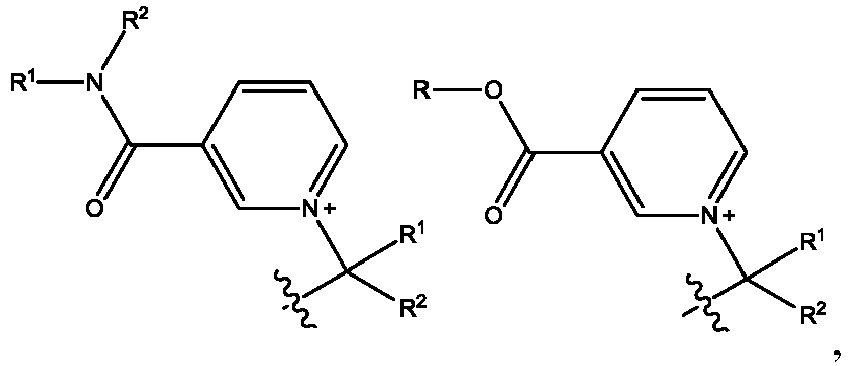 with a proviso that the modification can be done at more than one functional group in the DRUG,G- can be selected from iodide, chloride, bromide, mesylate, tosylate or tetra flouroborate or any other pharmaceutically acceptable anion; G- can be either one or more counter ions to balance the charge,R, R1 and R2 are independently H, C1-C8 straight or branched chain alkyl -optionally containing 1-3 heteroatoms selected from O, N, S, SO, or SO2; 3-7 membered cycloalkyl optionally containing 1-3 heteroatoms selected from O, N, S, SO, or SO2 and or lower alkyl, straight or branched alkyl, alkoxy; alkaryl, aryl, heteroaryl, or alkheteroaryl; or is independently part of 3-7 membered ring optionally containing additional 1-2 heteroatoms selected from, O, N, S, SO, SO2 and also be optionally substituted with alkoxy, F or Cl;wherein the chemical compound is selected from the group consisting ofi. 1-(((2,6-diisopropylphenoxy)carbonyloxy)methyl)-3-(dimethylcarbamoyl) pyridinium mesylate;ii. 1-(((2,6-diisopropylphenoxy)carbonyloxy)methyl)-3-(methylcarbamoyl) pyridinium mesylate;iii. 3-carbamoyl-1-(((2,6-diisopropylphenoxy)carbonyloxy)methyl)pyridinium mesylate;iv. 1-(((2,6-diisopropylphenoxy)carbonyloxy)methyl)-3-(methylcarbamoyl) pyridinium iodide;v. (E)-3-(dimethylcarbamoyl)-1-(((2-methoxy-4-((8-methylnon-6-enamido)methyl)phenoxy)carbonyloxy)methyl)pyridinium iodide;vi. (E)-3-(dimethylcarbamoyl)-1-(((2-methoxy-4-((8-methylnon-6-enamido)methyl)phenoxy)carbonyloxy)methyl) pyridinium mesylate;vii. 3-(dimethylamino)-1-(((4-((1E,4Z,6E)-5-hydroxy-7-(4-hydroxy-3-methoxyphenyl)-3-oxohepta-1,4,6-trienyl)-2-methoxyphenoxy)carbonyloxy)methyl)pyridinium iodide;viii.
 xi. 1-((2-acetoxybenzoyloxy)methyl)-3-(methylcarbamoyl)pyridinium iodide;xii. 1((2-acetoxybenzoyloxy)methyl)-3-(dimethylcarbamoyl)pyridinium iodide;xiii. 1-((2-acetoxybenzoyloxy)methyl)-3-carbamoylpyridiniummesylate;xiv. 1-((2-acetoxybenzoyloxy)methyl)-3-(dimethylcarbamoyl)pyridiniummesylate;xv. 1-((2-acetoxybenzoyloxy)methyl)-3-(methylcarbamoyl)pyridinium mesylate;xix. 1-((2-(1-(4-chlorobenzoyl)-5-methoxy-2-methyl-1H-indol-3-yl)acetoxy)methyl)-3-(dimethylcarbamoyl)pyridinium iodide;xxiv. 1-((((6R,7R)-7-((E)-2-(2-aminothiazol-4-yl)-2-(methoxyimino)acetamido)-3-(methoxymethyl)-8-oxo-5-thia-1-azabicyclo[4.2.0]oct-2-ene-2-carbonyl)oxy)methyl)-3-(dimethylcarbamoyl)pyridin-1-ium methane sulfonate;xxv. L(S)-1-((2-(carboxymethyl)-4-methylpentylcarbamoyloxy)methyl)-3-(dimethylcarbamoyl)pyridinium methanesulfonate;xxvi. (S)-1-(carboxymethyl)-4-methylpentylcarbamoyloxy)methyl)-3-(dimethylcarbamoyl)pyridinium iodide;xxvii. 1-((2-((E)-1-(2-aminothiazol-4-yl)-2-((1S,8R)-5-(((3-(dimethylcarbamoyl)pyridinium-1-yl)methoxy)carbonyl)-7-oxo-4-vinyl-2-thiabicyclo[4.2.0]oct-4-en 8-ylamino)-2-oxoethylideneaminooxy)acetoxy)methyl)-3-(dimethylcarbamoyl)pyridinium methanesulfonate;xliv. (S)-1-((((2-(carboxymethyl)-4-methylpentyl)carbamoyl)oxy)methyl)-3-(methylcarbamoyl)pyridin-1-ium methanesulfonate;xlv. (S)-3-carbamoyl-1-((((2-(carboxymethyl)-4-methylpentyl)carbamoyl)oxy)methyl)pyridin-1-ium methanesulfonate;xlvi. (S)-1-(((3-(aminomethyl)-5-methylhexanoyl)oxy)methyl)-3-(dimethylcarbamoyl)pyridin-1-ium methanesulfonate;xlvii. (S)-1-(((3-(aminomethyl)-5-methylhexanoyl)oxy)methyl)-3-(methylcarbamoyl)pyridin-1-iummethanesulfonate;xlviii. (S)-1-(((3-(aminomethyl)-5-methylhexanoyl)oxy)methyl)-3-carbamoylpyridin-1-ium methanesulfonate;xlix. 3-(dimethylcarbamoyl)-1-((((4-((1E,4Z,6E)-5-hydroxy-7-(4-hydroxy-3-methoxyphenyl)-3-oxohepta-1,4,6-trien-1-yl)-2-methoxyphenoxy)carbonyl)oxy) methyl)pyridin-1-ium methanesulfonate;1. 1-((((4-((1E,4Z,6E)-5-hydroxy-7-(4-hydroxy-3-methoxyphenyl)-3-oxohepta-1,4,6-trien-1-yl)-2-methoxyphenoxy)carbonyl)oxy)methyl)-3-(methyl-carbamoyl) pyridin-1-ium methanesulfonate;li. 3-carbamoyl-1-((((4-((1E,4Z,6E)-5-hydroxy-7-(4-hydroxy-3-methoxyphenyl)-3-oxohepta-1,4,6-trien-1-yl)-2-methoxy-phenoxy)carbonyl)oxy)methyl)pyridin-1-ium methanesulfonate;liv. 1-((((1-carboxy-2-(3,4-dihydroxyphenyl)ethyl)carbamoyl)oxy)methyl)-3-(dimethylcarbamoyl)pyridin-1-ium methanesulfonate;lix. 1-((((4-acetamidophenoxy)carbonyl)oxy)methyl)-3-(dimethylcarbamoyl)pyridin-1-ium mesylate;lxxiv. 3-(dimethylcarbamoyl)-1-((2-(4-isobutylphenyl)propanoyloxy)methyl)pyridinium mesylate;xxx. 1-(((2,6-diisopropylphenoxy)carbonyl)oxy)methyl)-3-(dimethylcarbamoyl)pyridin-1-ium iodide;xxxi. 3-carbamoyl-1-((((2,6-diisopropyl-phenoxy)carbonyl)oxy)methyl)pyridin-1-ium iodide;1060. 1-((((2,6-diisopropylphenoxy)carbonyl)oxy)methyl)-3-(methoxycarbonyl)pyridin-1-ium iodide;1061. 3-carboxy-1-((((2,6-diisopropylphenoxy)carbonyl)oxy)methyl)pyridin-1-ium iodide;1069. 3-((2,6-diisopropylphenoxy)carbonyl)-1-((((2,6-diisopropylphenoxy)carbonyl)oxy)methyl)pyridin-1-ium methanesulfonate;1082. 1-((((2,6-diisopropylphenoxy)carbonyl) oxy)methyl)-3-(methoxycarbonyl)pyridin-1-ium methanesulfonate; and1083. 3-carboxy-1-((((2,6-diisopropylphenoxy)carbonyl)oxy)methyl)pyridin-1-ium methanesulfonate
 - The chemical compounds according to claim 1, wherein the chemical compound is selected from the group consisting of:i. 1-((((2,6-diisopropylphenoxy)carbonyl)oxy)methyl)-3-(dimethylcarbamoyl)pyridin-1-ium methanesulfonate; andii. 1-((((2,6-diisopropylphenoxy)carbonyl)oxy)methyl)-3-(methylcarbamoyl)pyridin-1-ium iodide.
- A method for obtaining the novel chemical compound of formula 1 with improved chemical and biological properties as defined in any of the claims 1-2 by causing a covalent attachment of a modifying agent of the structure

Applications Claiming Priority (2)
| Application Number | Priority Date | Filing Date | Title |
|---|---|---|---|
| IN3114DE2012 | 2012-10-05 | ||
| PCT/IN2013/000607 WO2014054058A2 (en) | 2012-10-05 | 2013-10-07 | Novel compounds, their synthesis and their uses |
Publications (3)
| Publication Number | Publication Date |
|---|---|
| EP2903614A2 EP2903614A2 (en) | 2015-08-12 |
| EP2903614A4 EP2903614A4 (en) | 2016-07-20 |
| EP2903614B1 true EP2903614B1 (en) | 2021-09-29 |
Family
ID=50435536
Family Applications (1)
| Application Number | Title | Priority Date | Filing Date |
|---|---|---|---|
| EP13844254.6A Active EP2903614B1 (en) | 2012-10-05 | 2013-10-07 | Novel compounds, their synthesis and their uses |
Country Status (6)
| Country | Link |
|---|---|
| US (1) | US9556156B2 (en) |
| EP (1) | EP2903614B1 (en) |
| JP (1) | JP6621329B2 (en) |
| CN (2) | CN104812388A (en) |
| ES (1) | ES2899694T3 (en) |
| WO (1) | WO2014054058A2 (en) |
Families Citing this family (11)
| Publication number | Priority date | Publication date | Assignee | Title |
|---|---|---|---|---|
| US9487500B2 (en) | 2012-10-04 | 2016-11-08 | Inhibikase Therapeutics, Inc. | Compounds and compositions thereof |
| JP7509340B2 (en) * | 2016-03-14 | 2024-07-02 | ピボット ホールディングス エルエルシー | Trigonelline-Based Compounds |
| WO2018165718A1 (en) | 2017-03-17 | 2018-09-20 | Cardio Therapeutics Pty Ltd | Heterocyclic inhibitors of pcsk9 |
| PL238932B1 (en) * | 2017-12-31 | 2021-10-18 | Univ Jagiellonski | Derivatives of pyridinium salts, method for releasing MNA and their application |
| US11174229B2 (en) * | 2018-10-29 | 2021-11-16 | Kempharm, Inc. | D-amphetamine compounds, compositions, and processes for making and using the same |
| US11478490B1 (en) | 2021-03-30 | 2022-10-25 | Epalex Corporation | Fospropofol formulations |
| US11547714B2 (en) | 2020-02-05 | 2023-01-10 | Epalex Corporation | Fospropofol salts, methods and compositions |
| US11439653B1 (en) | 2021-03-30 | 2022-09-13 | Epalex Corporation | Fospropofol formulations |
| US11628178B2 (en) | 2019-03-26 | 2023-04-18 | Epalex Corporation | Fospropofol methods and compositions |
| EP3956287B1 (en) * | 2019-04-17 | 2025-04-09 | Myto Therapeutics, Inc. | Prodrugs of monomethyl fumarate |
| CN116751132B (en) * | 2023-05-25 | 2024-08-09 | 郑州大学 | Brain-targeted propofol prodrug, and preparation method and application thereof |
Family Cites Families (11)
| Publication number | Priority date | Publication date | Assignee | Title |
|---|---|---|---|---|
| US3998815A (en) * | 1974-06-24 | 1976-12-21 | Interx Research Corporation | 1-hydrocarbonoyloxymethyl-3-carbamoyl or 3-carboethoxy-pyridinium salts |
| US3989711A (en) * | 1975-09-22 | 1976-11-02 | Interx Research Corporation | Soft quaternary surface active agents exhibiting antibacterial activity |
| DK534178A (en) * | 1977-12-16 | 1979-06-17 | Interx Research Corp | ANTICHOLINERGIC AGENTS WITH SECTIONING EFFECT |
| US4361571A (en) * | 1981-01-21 | 1982-11-30 | Scott Eugene J Van | 3-Carbamoyl-6-aminopyridinium and analogues, and their use in treating skin disorders |
| US5525727A (en) * | 1982-05-18 | 1996-06-11 | University Of Florida | Brain-specific drug delivery |
| US4428935A (en) * | 1982-05-24 | 1984-01-31 | Pfizer Inc. | Penicillanic acid dioxide prodrug |
| GB9607219D0 (en) * | 1996-04-04 | 1996-06-12 | Smithkline Beecham Plc | Novel compounds |
| JP2001508399A (en) * | 1997-03-26 | 2001-06-26 | スミスクライン・ビーチャム・パブリック・リミテッド・カンパニー | Indole derivatives as 5-HT receptor antagonists |
| EP1220843A1 (en) * | 1999-10-06 | 2002-07-10 | Torrent Pharmaceuticals Ltd | Pyridinium derivatives for the treatment of diabetic and aging-related vascular complications |
| US9359376B2 (en) * | 2011-04-08 | 2016-06-07 | Sphaera Pharma Pte. Ltd | Substituted methylformyl reagents and method of using same to modify physicochemical and/or pharmacokinetic properties of compounds |
| CA3123900A1 (en) * | 2011-07-28 | 2013-01-31 | Kempharm Inc. | Methylphenidate-prodrugs, processes of making and using the same |
-
2013
- 2013-10-07 EP EP13844254.6A patent/EP2903614B1/en active Active
- 2013-10-07 WO PCT/IN2013/000607 patent/WO2014054058A2/en not_active Ceased
- 2013-10-07 CN CN201380060822.2A patent/CN104812388A/en active Pending
- 2013-10-07 US US14/433,485 patent/US9556156B2/en active Active
- 2013-10-07 JP JP2015535173A patent/JP6621329B2/en active Active
- 2013-10-07 CN CN201910678793.5A patent/CN110526864A/en active Pending
- 2013-10-07 ES ES13844254T patent/ES2899694T3/en active Active
Also Published As
| Publication number | Publication date |
|---|---|
| US20150252027A1 (en) | 2015-09-10 |
| ES2899694T3 (en) | 2022-03-14 |
| EP2903614A4 (en) | 2016-07-20 |
| EP2903614A2 (en) | 2015-08-12 |
| CN104812388A (en) | 2015-07-29 |
| WO2014054058A3 (en) | 2014-09-12 |
| WO2014054058A8 (en) | 2015-04-09 |
| JP6621329B2 (en) | 2019-12-18 |
| WO2014054058A2 (en) | 2014-04-10 |
| CN110526864A (en) | 2019-12-03 |
| US9556156B2 (en) | 2017-01-31 |
| JP2015535849A (en) | 2015-12-17 |
Similar Documents
| Publication | Publication Date | Title |
|---|---|---|
| US9556156B2 (en) | Compounds, their synthesis and their uses | |
| JP7290638B2 (en) | Macrocycles and their use as Wee1 inhibitors | |
| JP7662639B2 (en) | Novel chroman derivatives having estrogen receptor decomposition activity and uses thereof | |
| EP2693876B1 (en) | Substituted methylformyl reagents and method of using same to modify physicochemical and/or pharmacokinetic properties of compounds | |
| EP3675839B1 (en) | Novel compounds having estrogen receptor alpha degradation activity and uses thereof | |
| JP4340437B2 (en) | 8-Carboxamide-2,6-methano-3-benzazocine | |
| AU2004213616B2 (en) | A process of preparing imatinib | |
| CA2861150C (en) | Morphinan derivative | |
| Singh et al. | Synthesis and antimalarial activity of a new series of trioxaquines | |
| EP2903979B1 (en) | Novel compounds, their preparation and their uses | |
| FR2921657A1 (en) | New nicotinamide derivatives useful for the preparation of a medicament for the treatment or prevention of cancer | |
| JP2005517655A (en) | 5,6-Diaryl-pyrazine-2-amide derivatives as CB1 antagonists | |
| WO2015048567A1 (en) | Spirocyclic ebi2 modulators | |
| RU2513856C2 (en) | Method of obtaining methyl ether of 4-oxooctahydroindole-1-carboxylic acid and its derivatives | |
| KR20110086747A (en) | Aryl piperazine and their use as alpha2C antagonists | |
| CN103145617A (en) | Phenanthridine derivative as well as medicinal composition, preparation method and application thereof | |
| Dekeukeleire et al. | Asymmetric synthesis of 4-formyl-1-(ω-haloalkyl)-β-lactams and their transformation to functionalized piperazines and 1, 4-diazepanes | |
| US20070093505A1 (en) | 2,3-Substituted 5,6-diaryl-pyrazine derivatives as cb1 modulators | |
| JP7423655B2 (en) | Quinolyl-containing compounds, pharmaceutical compositions and uses thereof | |
| CA2738650C (en) | Fused diimidazodiazepine compounds and methods of use and manufacture thereof | |
| WO2010004198A2 (en) | Antineoplastic derivatives, preparation thereof, and therapeutic use thereof | |
| US8889863B2 (en) | Stereoselective methods, catalysts and intermediates for the synthesis of (−)-Nutlin-3 and related compounds | |
| WO2022083679A1 (en) | Prodrugs for sustained releasing therapeutic agents and uses thereof | |
| JP2019508505A (en) | Trigonelline based compounds | |
| KR20080007640A (en) | Anticancer tetrahydro-pyrimidine |
Legal Events
| Date | Code | Title | Description |
|---|---|---|---|
| PUAI | Public reference made under article 153(3) epc to a published international application that has entered the european phase |
Free format text: ORIGINAL CODE: 0009012 |
|
| 17P | Request for examination filed |
Effective date: 20150506 |
|
| AK | Designated contracting states |
Kind code of ref document: A2 Designated state(s): AL AT BE BG CH CY CZ DE DK EE ES FI FR GB GR HR HU IE IS IT LI LT LU LV MC MK MT NL NO PL PT RO RS SE SI SK SM TR |
|
| AX | Request for extension of the european patent |
Extension state: BA ME |
|
| DAX | Request for extension of the european patent (deleted) | ||
| RIC1 | Information provided on ipc code assigned before grant |
Ipc: C07D 401/14 20060101AFI20160215BHEP Ipc: A61K 31/4425 20060101ALI20160215BHEP Ipc: C07D 471/14 20060101ALI20160215BHEP Ipc: C07D 213/82 20060101ALI20160215BHEP Ipc: C07D 487/04 20060101ALI20160215BHEP Ipc: C07D 405/14 20060101ALI20160215BHEP |
|
| REG | Reference to a national code |
Ref country code: DE Ref legal event code: R079 Ref document number: 602013079478 Country of ref document: DE Free format text: PREVIOUS MAIN CLASS: A61K0031442500 Ipc: C07D0401140000 |
|
| A4 | Supplementary search report drawn up and despatched |
Effective date: 20160622 |
|
| RIC1 | Information provided on ipc code assigned before grant |
Ipc: C07D 405/14 20060101ALI20160616BHEP Ipc: C07D 401/14 20060101AFI20160616BHEP Ipc: C07D 213/82 20060101ALI20160616BHEP Ipc: A61K 31/4425 20060101ALI20160616BHEP Ipc: C07D 471/14 20060101ALI20160616BHEP Ipc: C07D 487/04 20060101ALI20160616BHEP |
|
| STAA | Information on the status of an ep patent application or granted ep patent |
Free format text: STATUS: EXAMINATION IS IN PROGRESS |
|
| 17Q | First examination report despatched |
Effective date: 20170516 |
|
| GRAP | Despatch of communication of intention to grant a patent |
Free format text: ORIGINAL CODE: EPIDOSNIGR1 |
|
| STAA | Information on the status of an ep patent application or granted ep patent |
Free format text: STATUS: GRANT OF PATENT IS INTENDED |
|
| INTG | Intention to grant announced |
Effective date: 20210414 |
|
| RAP3 | Party data changed (applicant data changed or rights of an application transferred) |
Owner name: SPHAERA PHARMA PTE. LTD |
|
| GRAS | Grant fee paid |
Free format text: ORIGINAL CODE: EPIDOSNIGR3 |
|
| GRAA | (expected) grant |
Free format text: ORIGINAL CODE: 0009210 |
|
| STAA | Information on the status of an ep patent application or granted ep patent |
Free format text: STATUS: THE PATENT HAS BEEN GRANTED |
|
| AK | Designated contracting states |
Kind code of ref document: B1 Designated state(s): AL AT BE BG CH CY CZ DE DK EE ES FI FR GB GR HR HU IE IS IT LI LT LU LV MC MK MT NL NO PL PT RO RS SE SI SK SM TR |
|
| REG | Reference to a national code |
Ref country code: GB Ref legal event code: FG4D |
|
| REG | Reference to a national code |
Ref country code: DE Ref legal event code: R096 Ref document number: 602013079478 Country of ref document: DE |
|
| REG | Reference to a national code |
Ref country code: CH Ref legal event code: EP Ref country code: AT Ref legal event code: REF Ref document number: 1434112 Country of ref document: AT Kind code of ref document: T Effective date: 20211015 |
|
| REG | Reference to a national code |
Ref country code: IE Ref legal event code: FG4D |
|
| REG | Reference to a national code |
Ref country code: SE Ref legal event code: TRGR |
|
| REG | Reference to a national code |
Ref country code: LT Ref legal event code: MG9D |
|
| PG25 | Lapsed in a contracting state [announced via postgrant information from national office to epo] |
Ref country code: BG Free format text: LAPSE BECAUSE OF FAILURE TO SUBMIT A TRANSLATION OF THE DESCRIPTION OR TO PAY THE FEE WITHIN THE PRESCRIBED TIME-LIMIT Effective date: 20211229 Ref country code: LT Free format text: LAPSE BECAUSE OF FAILURE TO SUBMIT A TRANSLATION OF THE DESCRIPTION OR TO PAY THE FEE WITHIN THE PRESCRIBED TIME-LIMIT Effective date: 20210929 Ref country code: NO Free format text: LAPSE BECAUSE OF FAILURE TO SUBMIT A TRANSLATION OF THE DESCRIPTION OR TO PAY THE FEE WITHIN THE PRESCRIBED TIME-LIMIT Effective date: 20211229 Ref country code: FI Free format text: LAPSE BECAUSE OF FAILURE TO SUBMIT A TRANSLATION OF THE DESCRIPTION OR TO PAY THE FEE WITHIN THE PRESCRIBED TIME-LIMIT Effective date: 20210929 Ref country code: HR Free format text: LAPSE BECAUSE OF FAILURE TO SUBMIT A TRANSLATION OF THE DESCRIPTION OR TO PAY THE FEE WITHIN THE PRESCRIBED TIME-LIMIT Effective date: 20210929 Ref country code: RS Free format text: LAPSE BECAUSE OF FAILURE TO SUBMIT A TRANSLATION OF THE DESCRIPTION OR TO PAY THE FEE WITHIN THE PRESCRIBED TIME-LIMIT Effective date: 20210929 |
|
| REG | Reference to a national code |
Ref country code: NL Ref legal event code: MP Effective date: 20210929 |
|
| REG | Reference to a national code |
Ref country code: AT Ref legal event code: MK05 Ref document number: 1434112 Country of ref document: AT Kind code of ref document: T Effective date: 20210929 |
|
| PG25 | Lapsed in a contracting state [announced via postgrant information from national office to epo] |
Ref country code: LV Free format text: LAPSE BECAUSE OF FAILURE TO SUBMIT A TRANSLATION OF THE DESCRIPTION OR TO PAY THE FEE WITHIN THE PRESCRIBED TIME-LIMIT Effective date: 20210929 Ref country code: GR Free format text: LAPSE BECAUSE OF FAILURE TO SUBMIT A TRANSLATION OF THE DESCRIPTION OR TO PAY THE FEE WITHIN THE PRESCRIBED TIME-LIMIT Effective date: 20211230 |
|
| REG | Reference to a national code |
Ref country code: ES Ref legal event code: FG2A Ref document number: 2899694 Country of ref document: ES Kind code of ref document: T3 Effective date: 20220314 |
|
| PG25 | Lapsed in a contracting state [announced via postgrant information from national office to epo] |
Ref country code: AT Free format text: LAPSE BECAUSE OF FAILURE TO SUBMIT A TRANSLATION OF THE DESCRIPTION OR TO PAY THE FEE WITHIN THE PRESCRIBED TIME-LIMIT Effective date: 20210929 |
|
| REG | Reference to a national code |
Ref country code: CH Ref legal event code: PL |
|
| PG25 | Lapsed in a contracting state [announced via postgrant information from national office to epo] |
Ref country code: IS Free format text: LAPSE BECAUSE OF FAILURE TO SUBMIT A TRANSLATION OF THE DESCRIPTION OR TO PAY THE FEE WITHIN THE PRESCRIBED TIME-LIMIT Effective date: 20220129 Ref country code: SK Free format text: LAPSE BECAUSE OF FAILURE TO SUBMIT A TRANSLATION OF THE DESCRIPTION OR TO PAY THE FEE WITHIN THE PRESCRIBED TIME-LIMIT Effective date: 20210929 Ref country code: RO Free format text: LAPSE BECAUSE OF FAILURE TO SUBMIT A TRANSLATION OF THE DESCRIPTION OR TO PAY THE FEE WITHIN THE PRESCRIBED TIME-LIMIT Effective date: 20210929 Ref country code: PT Free format text: LAPSE BECAUSE OF FAILURE TO SUBMIT A TRANSLATION OF THE DESCRIPTION OR TO PAY THE FEE WITHIN THE PRESCRIBED TIME-LIMIT Effective date: 20220131 Ref country code: PL Free format text: LAPSE BECAUSE OF FAILURE TO SUBMIT A TRANSLATION OF THE DESCRIPTION OR TO PAY THE FEE WITHIN THE PRESCRIBED TIME-LIMIT Effective date: 20210929 Ref country code: NL Free format text: LAPSE BECAUSE OF FAILURE TO SUBMIT A TRANSLATION OF THE DESCRIPTION OR TO PAY THE FEE WITHIN THE PRESCRIBED TIME-LIMIT Effective date: 20210929 Ref country code: EE Free format text: LAPSE BECAUSE OF FAILURE TO SUBMIT A TRANSLATION OF THE DESCRIPTION OR TO PAY THE FEE WITHIN THE PRESCRIBED TIME-LIMIT Effective date: 20210929 Ref country code: CZ Free format text: LAPSE BECAUSE OF FAILURE TO SUBMIT A TRANSLATION OF THE DESCRIPTION OR TO PAY THE FEE WITHIN THE PRESCRIBED TIME-LIMIT Effective date: 20210929 Ref country code: AL Free format text: LAPSE BECAUSE OF FAILURE TO SUBMIT A TRANSLATION OF THE DESCRIPTION OR TO PAY THE FEE WITHIN THE PRESCRIBED TIME-LIMIT Effective date: 20210929 |
|
| REG | Reference to a national code |
Ref country code: BE Ref legal event code: MM Effective date: 20211031 |
|
| PG25 | Lapsed in a contracting state [announced via postgrant information from national office to epo] |
Ref country code: MC Free format text: LAPSE BECAUSE OF FAILURE TO SUBMIT A TRANSLATION OF THE DESCRIPTION OR TO PAY THE FEE WITHIN THE PRESCRIBED TIME-LIMIT Effective date: 20210929 |
|
| REG | Reference to a national code |
Ref country code: DE Ref legal event code: R097 Ref document number: 602013079478 Country of ref document: DE |
|
| PG25 | Lapsed in a contracting state [announced via postgrant information from national office to epo] |
Ref country code: LU Free format text: LAPSE BECAUSE OF NON-PAYMENT OF DUE FEES Effective date: 20211007 Ref country code: DK Free format text: LAPSE BECAUSE OF FAILURE TO SUBMIT A TRANSLATION OF THE DESCRIPTION OR TO PAY THE FEE WITHIN THE PRESCRIBED TIME-LIMIT Effective date: 20210929 Ref country code: BE Free format text: LAPSE BECAUSE OF NON-PAYMENT OF DUE FEES Effective date: 20211031 |
|
| PLBE | No opposition filed within time limit |
Free format text: ORIGINAL CODE: 0009261 |
|
| STAA | Information on the status of an ep patent application or granted ep patent |
Free format text: STATUS: NO OPPOSITION FILED WITHIN TIME LIMIT |
|
| PG25 | Lapsed in a contracting state [announced via postgrant information from national office to epo] |
Ref country code: LI Free format text: LAPSE BECAUSE OF NON-PAYMENT OF DUE FEES Effective date: 20211031 Ref country code: CH Free format text: LAPSE BECAUSE OF NON-PAYMENT OF DUE FEES Effective date: 20211031 |
|
| 26N | No opposition filed |
Effective date: 20220630 |
|
| PG25 | Lapsed in a contracting state [announced via postgrant information from national office to epo] |
Ref country code: IE Free format text: LAPSE BECAUSE OF NON-PAYMENT OF DUE FEES Effective date: 20211007 |
|
| PG25 | Lapsed in a contracting state [announced via postgrant information from national office to epo] |
Ref country code: SI Free format text: LAPSE BECAUSE OF FAILURE TO SUBMIT A TRANSLATION OF THE DESCRIPTION OR TO PAY THE FEE WITHIN THE PRESCRIBED TIME-LIMIT Effective date: 20210929 |
|
| PG25 | Lapsed in a contracting state [announced via postgrant information from national office to epo] |
Ref country code: HU Free format text: LAPSE BECAUSE OF FAILURE TO SUBMIT A TRANSLATION OF THE DESCRIPTION OR TO PAY THE FEE WITHIN THE PRESCRIBED TIME-LIMIT; INVALID AB INITIO Effective date: 20131007 |
|
| PG25 | Lapsed in a contracting state [announced via postgrant information from national office to epo] |
Ref country code: CY Free format text: LAPSE BECAUSE OF FAILURE TO SUBMIT A TRANSLATION OF THE DESCRIPTION OR TO PAY THE FEE WITHIN THE PRESCRIBED TIME-LIMIT Effective date: 20210929 |
|
| P01 | Opt-out of the competence of the unified patent court (upc) registered |
Effective date: 20230530 |
|
| PG25 | Lapsed in a contracting state [announced via postgrant information from national office to epo] |
Ref country code: SM Free format text: LAPSE BECAUSE OF FAILURE TO SUBMIT A TRANSLATION OF THE DESCRIPTION OR TO PAY THE FEE WITHIN THE PRESCRIBED TIME-LIMIT Effective date: 20210929 |
|
| PG25 | Lapsed in a contracting state [announced via postgrant information from national office to epo] |
Ref country code: MK Free format text: LAPSE BECAUSE OF FAILURE TO SUBMIT A TRANSLATION OF THE DESCRIPTION OR TO PAY THE FEE WITHIN THE PRESCRIBED TIME-LIMIT Effective date: 20210929 |
|
| REG | Reference to a national code |
Ref country code: DE Ref legal event code: R081 Ref document number: 602013079478 Country of ref document: DE Owner name: PIVOT HOLDING LLC, LAS VEGAS, US Free format text: FORMER OWNER: SPHAERA PHARMA PTE. LTD, SINGAPORE, SG |
|
| REG | Reference to a national code |
Ref country code: GB Ref legal event code: 732E Free format text: REGISTERED BETWEEN 20240704 AND 20240710 |
|
| PG25 | Lapsed in a contracting state [announced via postgrant information from national office to epo] |
Ref country code: MT Free format text: LAPSE BECAUSE OF FAILURE TO SUBMIT A TRANSLATION OF THE DESCRIPTION OR TO PAY THE FEE WITHIN THE PRESCRIBED TIME-LIMIT Effective date: 20210929 |
|
| REG | Reference to a national code |
Ref country code: ES Ref legal event code: PC2A Owner name: PIVOT HOLDING LLC Effective date: 20241028 |
|
| PG25 | Lapsed in a contracting state [announced via postgrant information from national office to epo] |
Ref country code: TR Free format text: LAPSE BECAUSE OF FAILURE TO SUBMIT A TRANSLATION OF THE DESCRIPTION OR TO PAY THE FEE WITHIN THE PRESCRIBED TIME-LIMIT Effective date: 20210929 |
|
| PGFP | Annual fee paid to national office [announced via postgrant information from national office to epo] |
Ref country code: DE Payment date: 20251114 Year of fee payment: 13 |
|
| PGFP | Annual fee paid to national office [announced via postgrant information from national office to epo] |
Ref country code: GB Payment date: 20251023 Year of fee payment: 13 |
|
| PGFP | Annual fee paid to national office [announced via postgrant information from national office to epo] |
Ref country code: IT Payment date: 20251021 Year of fee payment: 13 |
|
| PGFP | Annual fee paid to national office [announced via postgrant information from national office to epo] |
Ref country code: FR Payment date: 20251023 Year of fee payment: 13 |
|
| PGFP | Annual fee paid to national office [announced via postgrant information from national office to epo] |
Ref country code: SE Payment date: 20251023 Year of fee payment: 13 |
|
| PGFP | Annual fee paid to national office [announced via postgrant information from national office to epo] |
Ref country code: ES Payment date: 20251104 Year of fee payment: 13 |