EP2902183A1 - Cementitious coating for composite building materials and manufacture thereof - Google Patents
Cementitious coating for composite building materials and manufacture thereof Download PDFInfo
- Publication number
- EP2902183A1 EP2902183A1 EP14000330.2A EP14000330A EP2902183A1 EP 2902183 A1 EP2902183 A1 EP 2902183A1 EP 14000330 A EP14000330 A EP 14000330A EP 2902183 A1 EP2902183 A1 EP 2902183A1
- Authority
- EP
- European Patent Office
- Prior art keywords
- coating composition
- liquid coating
- honeycomb structure
- agent
- cellulosic honeycomb
- Prior art date
- Legal status (The legal status is an assumption and is not a legal conclusion. Google has not performed a legal analysis and makes no representation as to the accuracy of the status listed.)
- Withdrawn
Links
- 239000004566 building material Substances 0.000 title claims description 14
- 238000000576 coating method Methods 0.000 title description 16
- 239000011248 coating agent Substances 0.000 title description 14
- 239000002131 composite material Substances 0.000 title description 8
- 238000004519 manufacturing process Methods 0.000 title description 4
- 239000007788 liquid Substances 0.000 claims abstract description 103
- 239000008199 coating composition Substances 0.000 claims abstract description 102
- 239000003795 chemical substances by application Substances 0.000 claims abstract description 50
- 239000011230 binding agent Substances 0.000 claims abstract description 21
- 238000012360 testing method Methods 0.000 claims abstract description 21
- 239000003381 stabilizer Substances 0.000 claims abstract description 17
- XLYOFNOQVPJJNP-UHFFFAOYSA-N water Substances O XLYOFNOQVPJJNP-UHFFFAOYSA-N 0.000 claims abstract description 12
- 230000003014 reinforcing effect Effects 0.000 claims abstract description 7
- 239000004568 cement Substances 0.000 claims description 27
- 238000000034 method Methods 0.000 claims description 25
- VYPSYNLAJGMNEJ-UHFFFAOYSA-N Silicium dioxide Chemical group O=[Si]=O VYPSYNLAJGMNEJ-UHFFFAOYSA-N 0.000 claims description 16
- RTZKZFJDLAIYFH-UHFFFAOYSA-N Diethyl ether Chemical compound CCOCC RTZKZFJDLAIYFH-UHFFFAOYSA-N 0.000 claims description 10
- 239000011398 Portland cement Substances 0.000 claims description 10
- 229920005646 polycarboxylate Polymers 0.000 claims description 9
- 239000002105 nanoparticle Substances 0.000 claims description 6
- 239000010881 fly ash Substances 0.000 claims description 4
- 239000000377 silicon dioxide Substances 0.000 claims description 4
- 229910021485 fumed silica Inorganic materials 0.000 claims description 3
- 150000003839 salts Chemical group 0.000 claims description 3
- 239000011180 sandwich-structured composite Substances 0.000 claims description 3
- UXVMQQNJUSDDNG-UHFFFAOYSA-L Calcium chloride Chemical group [Cl-].[Cl-].[Ca+2] UXVMQQNJUSDDNG-UHFFFAOYSA-L 0.000 claims description 2
- 229910052783 alkali metal Inorganic materials 0.000 claims description 2
- 150000001340 alkali metals Chemical class 0.000 claims description 2
- 239000001110 calcium chloride Substances 0.000 claims description 2
- 229910001628 calcium chloride Inorganic materials 0.000 claims description 2
- 238000005266 casting Methods 0.000 claims description 2
- PNEYBMLMFCGWSK-UHFFFAOYSA-N aluminium oxide Inorganic materials [O-2].[O-2].[O-2].[Al+3].[Al+3] PNEYBMLMFCGWSK-UHFFFAOYSA-N 0.000 claims 1
- 159000000007 calcium salts Chemical class 0.000 claims 1
- 239000008119 colloidal silica Substances 0.000 claims 1
- -1 poly(ethylene glycol) Polymers 0.000 description 13
- 239000011111 cardboard Substances 0.000 description 12
- 239000000463 material Substances 0.000 description 10
- 239000000203 mixture Substances 0.000 description 9
- 229920003171 Poly (ethylene oxide) Polymers 0.000 description 6
- 239000000123 paper Substances 0.000 description 6
- 239000011575 calcium Substances 0.000 description 5
- 229910052791 calcium Inorganic materials 0.000 description 5
- OYPRJOBELJOOCE-UHFFFAOYSA-N Calcium Chemical compound [Ca] OYPRJOBELJOOCE-UHFFFAOYSA-N 0.000 description 4
- 239000011521 glass Substances 0.000 description 4
- 239000000758 substrate Substances 0.000 description 4
- SMZOUWXMTYCWNB-UHFFFAOYSA-N 2-(2-methoxy-5-methylphenyl)ethanamine Chemical compound COC1=CC=C(C)C=C1CCN SMZOUWXMTYCWNB-UHFFFAOYSA-N 0.000 description 3
- WSFSSNUMVMOOMR-UHFFFAOYSA-N Formaldehyde Chemical compound O=C WSFSSNUMVMOOMR-UHFFFAOYSA-N 0.000 description 3
- CERQOIWHTDAKMF-UHFFFAOYSA-N Methacrylic acid Chemical compound CC(=C)C(O)=O CERQOIWHTDAKMF-UHFFFAOYSA-N 0.000 description 3
- 230000005484 gravity Effects 0.000 description 3
- 238000002156 mixing Methods 0.000 description 3
- 229920001223 polyethylene glycol Polymers 0.000 description 3
- 239000000725 suspension Substances 0.000 description 3
- XEEYBQQBJWHFJM-UHFFFAOYSA-N Iron Chemical compound [Fe] XEEYBQQBJWHFJM-UHFFFAOYSA-N 0.000 description 2
- PPBRXRYQALVLMV-UHFFFAOYSA-N Styrene Chemical compound C=CC1=CC=CC=C1 PPBRXRYQALVLMV-UHFFFAOYSA-N 0.000 description 2
- 239000007900 aqueous suspension Substances 0.000 description 2
- ZCCIPPOKBCJFDN-UHFFFAOYSA-N calcium nitrate Chemical compound [Ca+2].[O-][N+]([O-])=O.[O-][N+]([O-])=O ZCCIPPOKBCJFDN-UHFFFAOYSA-N 0.000 description 2
- OSGAYBCDTDRGGQ-UHFFFAOYSA-L calcium sulfate Chemical compound [Ca+2].[O-]S([O-])(=O)=O OSGAYBCDTDRGGQ-UHFFFAOYSA-L 0.000 description 2
- 239000001913 cellulose Substances 0.000 description 2
- 229920002678 cellulose Polymers 0.000 description 2
- 238000000151 deposition Methods 0.000 description 2
- 230000008021 deposition Effects 0.000 description 2
- 239000012895 dilution Substances 0.000 description 2
- 238000010790 dilution Methods 0.000 description 2
- 125000000524 functional group Chemical group 0.000 description 2
- 229910052736 halogen Inorganic materials 0.000 description 2
- 125000004356 hydroxy functional group Chemical group O* 0.000 description 2
- 238000011068 loading method Methods 0.000 description 2
- FPYJFEHAWHCUMM-UHFFFAOYSA-N maleic anhydride Chemical compound O=C1OC(=O)C=C1 FPYJFEHAWHCUMM-UHFFFAOYSA-N 0.000 description 2
- 238000005259 measurement Methods 0.000 description 2
- 239000011087 paperboard Substances 0.000 description 2
- UEZVMMHDMIWARA-UHFFFAOYSA-M phosphonate Chemical compound [O-]P(=O)=O UEZVMMHDMIWARA-UHFFFAOYSA-M 0.000 description 2
- 238000000518 rheometry Methods 0.000 description 2
- 238000001771 vacuum deposition Methods 0.000 description 2
- 239000002023 wood Substances 0.000 description 2
- NIXOWILDQLNWCW-UHFFFAOYSA-N 2-Propenoic acid Natural products OC(=O)C=C NIXOWILDQLNWCW-UHFFFAOYSA-N 0.000 description 1
- 244000198134 Agave sisalana Species 0.000 description 1
- 240000000491 Corchorus aestuans Species 0.000 description 1
- 235000011777 Corchorus aestuans Nutrition 0.000 description 1
- 235000010862 Corchorus capsularis Nutrition 0.000 description 1
- 229920000742 Cotton Polymers 0.000 description 1
- 241000219146 Gossypium Species 0.000 description 1
- 229920001732 Lignosulfonate Polymers 0.000 description 1
- 239000004117 Lignosulphonate Substances 0.000 description 1
- FYYHWMGAXLPEAU-UHFFFAOYSA-N Magnesium Chemical compound [Mg] FYYHWMGAXLPEAU-UHFFFAOYSA-N 0.000 description 1
- UFWIBTONFRDIAS-UHFFFAOYSA-N Naphthalene Chemical class C1=CC=CC2=CC=CC=C21 UFWIBTONFRDIAS-UHFFFAOYSA-N 0.000 description 1
- 239000004372 Polyvinyl alcohol Substances 0.000 description 1
- OFOBLEOULBTSOW-UHFFFAOYSA-N Propanedioic acid Natural products OC(=O)CC(O)=O OFOBLEOULBTSOW-UHFFFAOYSA-N 0.000 description 1
- XUIMIQQOPSSXEZ-UHFFFAOYSA-N Silicon Chemical compound [Si] XUIMIQQOPSSXEZ-UHFFFAOYSA-N 0.000 description 1
- ZMZDMBWJUHKJPS-UHFFFAOYSA-M Thiocyanate anion Chemical compound [S-]C#N ZMZDMBWJUHKJPS-UHFFFAOYSA-M 0.000 description 1
- RTAQQCXQSZGOHL-UHFFFAOYSA-N Titanium Chemical compound [Ti] RTAQQCXQSZGOHL-UHFFFAOYSA-N 0.000 description 1
- QYKIQEUNHZKYBP-UHFFFAOYSA-N Vinyl ether Chemical class C=COC=C QYKIQEUNHZKYBP-UHFFFAOYSA-N 0.000 description 1
- 238000004026 adhesive bonding Methods 0.000 description 1
- 238000013019 agitation Methods 0.000 description 1
- 239000003513 alkali Substances 0.000 description 1
- 150000001408 amides Chemical group 0.000 description 1
- 125000003277 amino group Chemical group 0.000 description 1
- 239000007864 aqueous solution Substances 0.000 description 1
- 239000011449 brick Substances 0.000 description 1
- 235000011116 calcium hydroxide Nutrition 0.000 description 1
- 150000004649 carbonic acid derivatives Chemical class 0.000 description 1
- 230000000052 comparative effect Effects 0.000 description 1
- 239000004567 concrete Substances 0.000 description 1
- 238000010276 construction Methods 0.000 description 1
- 239000004035 construction material Substances 0.000 description 1
- 229920001577 copolymer Polymers 0.000 description 1
- 230000001419 dependent effect Effects 0.000 description 1
- XQRLCLUYWUNEEH-UHFFFAOYSA-L diphosphonate(2-) Chemical compound [O-]P(=O)OP([O-])=O XQRLCLUYWUNEEH-UHFFFAOYSA-L 0.000 description 1
- 238000007598 dipping method Methods 0.000 description 1
- 239000002270 dispersing agent Substances 0.000 description 1
- 150000002148 esters Chemical group 0.000 description 1
- 238000002474 experimental method Methods 0.000 description 1
- 230000002349 favourable effect Effects 0.000 description 1
- 239000000835 fiber Substances 0.000 description 1
- 238000011049 filling Methods 0.000 description 1
- 239000012530 fluid Substances 0.000 description 1
- IVJISJACKSSFGE-UHFFFAOYSA-N formaldehyde;1,3,5-triazine-2,4,6-triamine Chemical class O=C.NC1=NC(N)=NC(N)=N1 IVJISJACKSSFGE-UHFFFAOYSA-N 0.000 description 1
- HANVTCGOAROXMV-UHFFFAOYSA-N formaldehyde;1,3,5-triazine-2,4,6-triamine;urea Chemical class O=C.NC(N)=O.NC1=NC(N)=NC(N)=N1 HANVTCGOAROXMV-UHFFFAOYSA-N 0.000 description 1
- 150000004677 hydrates Chemical class 0.000 description 1
- ZMZDMBWJUHKJPS-UHFFFAOYSA-N hydrogen thiocyanate Natural products SC#N ZMZDMBWJUHKJPS-UHFFFAOYSA-N 0.000 description 1
- 150000004679 hydroxides Chemical class 0.000 description 1
- 150000003949 imides Chemical group 0.000 description 1
- 238000007654 immersion Methods 0.000 description 1
- 238000005470 impregnation Methods 0.000 description 1
- 238000001764 infiltration Methods 0.000 description 1
- 230000008595 infiltration Effects 0.000 description 1
- 229910052806 inorganic carbonate Inorganic materials 0.000 description 1
- 229910001853 inorganic hydroxide Inorganic materials 0.000 description 1
- 229910052500 inorganic mineral Inorganic materials 0.000 description 1
- 229910052809 inorganic oxide Inorganic materials 0.000 description 1
- 125000003010 ionic group Chemical group 0.000 description 1
- 229910052742 iron Inorganic materials 0.000 description 1
- 235000019357 lignosulphonate Nutrition 0.000 description 1
- 239000011777 magnesium Substances 0.000 description 1
- 229910052749 magnesium Inorganic materials 0.000 description 1
- VZCYOOQTPOCHFL-UPHRSURJSA-N maleic acid Chemical compound OC(=O)\C=C/C(O)=O VZCYOOQTPOCHFL-UPHRSURJSA-N 0.000 description 1
- 239000011976 maleic acid Substances 0.000 description 1
- 125000000956 methoxy group Chemical group [H]C([H])([H])O* 0.000 description 1
- 239000011707 mineral Substances 0.000 description 1
- 235000010755 mineral Nutrition 0.000 description 1
- 239000004570 mortar (masonry) Substances 0.000 description 1
- 238000000465 moulding Methods 0.000 description 1
- 230000007935 neutral effect Effects 0.000 description 1
- 150000002896 organic halogen compounds Chemical class 0.000 description 1
- 229920000058 polyacrylate Polymers 0.000 description 1
- 229920000642 polymer Polymers 0.000 description 1
- 239000002952 polymeric resin Substances 0.000 description 1
- 229920001451 polypropylene glycol Polymers 0.000 description 1
- 229920002451 polyvinyl alcohol Polymers 0.000 description 1
- 238000002360 preparation method Methods 0.000 description 1
- 239000002994 raw material Substances 0.000 description 1
- 230000002787 reinforcement Effects 0.000 description 1
- 238000009877 rendering Methods 0.000 description 1
- 238000011160 research Methods 0.000 description 1
- 239000003340 retarding agent Substances 0.000 description 1
- 229910021487 silica fume Inorganic materials 0.000 description 1
- 239000010703 silicon Substances 0.000 description 1
- 229910052710 silicon Inorganic materials 0.000 description 1
- 235000012239 silicon dioxide Nutrition 0.000 description 1
- 239000002893 slag Substances 0.000 description 1
- VGTPCRGMBIAPIM-UHFFFAOYSA-M sodium thiocyanate Chemical compound [Na+].[S-]C#N VGTPCRGMBIAPIM-UHFFFAOYSA-M 0.000 description 1
- 239000007787 solid Substances 0.000 description 1
- 238000001179 sorption measurement Methods 0.000 description 1
- 230000003068 static effect Effects 0.000 description 1
- BDHFUVZGWQCTTF-UHFFFAOYSA-M sulfonate Chemical compound [O-]S(=O)=O BDHFUVZGWQCTTF-UHFFFAOYSA-M 0.000 description 1
- 229920003002 synthetic resin Polymers 0.000 description 1
- 150000003512 tertiary amines Chemical class 0.000 description 1
- 239000010936 titanium Substances 0.000 description 1
- 229910052719 titanium Inorganic materials 0.000 description 1
- VZCYOOQTPOCHFL-UHFFFAOYSA-N trans-butenedioic acid Natural products OC(=O)C=CC(O)=O VZCYOOQTPOCHFL-UHFFFAOYSA-N 0.000 description 1
- 239000001993 wax Substances 0.000 description 1
Images

Classifications
-
- C—CHEMISTRY; METALLURGY
- C04—CEMENTS; CONCRETE; ARTIFICIAL STONE; CERAMICS; REFRACTORIES
- C04B—LIME, MAGNESIA; SLAG; CEMENTS; COMPOSITIONS THEREOF, e.g. MORTARS, CONCRETE OR LIKE BUILDING MATERIALS; ARTIFICIAL STONE; CERAMICS; REFRACTORIES; TREATMENT OF NATURAL STONE
- C04B28/00—Compositions of mortars, concrete or artificial stone, containing inorganic binders or the reaction product of an inorganic and an organic binder, e.g. polycarboxylate cements
- C04B28/02—Compositions of mortars, concrete or artificial stone, containing inorganic binders or the reaction product of an inorganic and an organic binder, e.g. polycarboxylate cements containing hydraulic cements other than calcium sulfates
-
- C—CHEMISTRY; METALLURGY
- C04—CEMENTS; CONCRETE; ARTIFICIAL STONE; CERAMICS; REFRACTORIES
- C04B—LIME, MAGNESIA; SLAG; CEMENTS; COMPOSITIONS THEREOF, e.g. MORTARS, CONCRETE OR LIKE BUILDING MATERIALS; ARTIFICIAL STONE; CERAMICS; REFRACTORIES; TREATMENT OF NATURAL STONE
- C04B28/00—Compositions of mortars, concrete or artificial stone, containing inorganic binders or the reaction product of an inorganic and an organic binder, e.g. polycarboxylate cements
- C04B28/02—Compositions of mortars, concrete or artificial stone, containing inorganic binders or the reaction product of an inorganic and an organic binder, e.g. polycarboxylate cements containing hydraulic cements other than calcium sulfates
- C04B28/04—Portland cements
-
- C—CHEMISTRY; METALLURGY
- C09—DYES; PAINTS; POLISHES; NATURAL RESINS; ADHESIVES; COMPOSITIONS NOT OTHERWISE PROVIDED FOR; APPLICATIONS OF MATERIALS NOT OTHERWISE PROVIDED FOR
- C09D—COATING COMPOSITIONS, e.g. PAINTS, VARNISHES OR LACQUERS; FILLING PASTES; CHEMICAL PAINT OR INK REMOVERS; INKS; CORRECTING FLUIDS; WOODSTAINS; PASTES OR SOLIDS FOR COLOURING OR PRINTING; USE OF MATERIALS THEREFOR
- C09D1/00—Coating compositions, e.g. paints, varnishes or lacquers, based on inorganic substances
- C09D1/06—Coating compositions, e.g. paints, varnishes or lacquers, based on inorganic substances cement
- C09D1/08—Coating compositions, e.g. paints, varnishes or lacquers, based on inorganic substances cement with organic additives
-
- D—TEXTILES; PAPER
- D21—PAPER-MAKING; PRODUCTION OF CELLULOSE
- D21H—PULP COMPOSITIONS; PREPARATION THEREOF NOT COVERED BY SUBCLASSES D21C OR D21D; IMPREGNATING OR COATING OF PAPER; TREATMENT OF FINISHED PAPER NOT COVERED BY CLASS B31 OR SUBCLASS D21G; PAPER NOT OTHERWISE PROVIDED FOR
- D21H19/00—Coated paper; Coating material
- D21H19/10—Coatings without pigments
- D21H19/12—Coatings without pigments applied as a solution using water as the only solvent, e.g. in the presence of acid or alkaline compounds
-
- D—TEXTILES; PAPER
- D21—PAPER-MAKING; PRODUCTION OF CELLULOSE
- D21H—PULP COMPOSITIONS; PREPARATION THEREOF NOT COVERED BY SUBCLASSES D21C OR D21D; IMPREGNATING OR COATING OF PAPER; TREATMENT OF FINISHED PAPER NOT COVERED BY CLASS B31 OR SUBCLASS D21G; PAPER NOT OTHERWISE PROVIDED FOR
- D21H27/00—Special paper not otherwise provided for, e.g. made by multi-step processes
-
- E—FIXED CONSTRUCTIONS
- E04—BUILDING
- E04C—STRUCTURAL ELEMENTS; BUILDING MATERIALS
- E04C2/00—Building elements of relatively thin form for the construction of parts of buildings, e.g. sheet materials, slabs, or panels
- E04C2/30—Building elements of relatively thin form for the construction of parts of buildings, e.g. sheet materials, slabs, or panels characterised by the shape or structure
- E04C2/34—Building elements of relatively thin form for the construction of parts of buildings, e.g. sheet materials, slabs, or panels characterised by the shape or structure composed of two or more spaced sheet-like parts
- E04C2/36—Building elements of relatively thin form for the construction of parts of buildings, e.g. sheet materials, slabs, or panels characterised by the shape or structure composed of two or more spaced sheet-like parts spaced apart by transversely-placed strip material, e.g. honeycomb panels
- E04C2/365—Building elements of relatively thin form for the construction of parts of buildings, e.g. sheet materials, slabs, or panels characterised by the shape or structure composed of two or more spaced sheet-like parts spaced apart by transversely-placed strip material, e.g. honeycomb panels by honeycomb structures
-
- C—CHEMISTRY; METALLURGY
- C04—CEMENTS; CONCRETE; ARTIFICIAL STONE; CERAMICS; REFRACTORIES
- C04B—LIME, MAGNESIA; SLAG; CEMENTS; COMPOSITIONS THEREOF, e.g. MORTARS, CONCRETE OR LIKE BUILDING MATERIALS; ARTIFICIAL STONE; CERAMICS; REFRACTORIES; TREATMENT OF NATURAL STONE
- C04B2111/00—Mortars, concrete or artificial stone or mixtures to prepare them, characterised by specific function, property or use
- C04B2111/00474—Uses not provided for elsewhere in C04B2111/00
- C04B2111/00482—Coating or impregnation materials
-
- C—CHEMISTRY; METALLURGY
- C04—CEMENTS; CONCRETE; ARTIFICIAL STONE; CERAMICS; REFRACTORIES
- C04B—LIME, MAGNESIA; SLAG; CEMENTS; COMPOSITIONS THEREOF, e.g. MORTARS, CONCRETE OR LIKE BUILDING MATERIALS; ARTIFICIAL STONE; CERAMICS; REFRACTORIES; TREATMENT OF NATURAL STONE
- C04B2111/00—Mortars, concrete or artificial stone or mixtures to prepare them, characterised by specific function, property or use
- C04B2111/00474—Uses not provided for elsewhere in C04B2111/00
- C04B2111/00612—Uses not provided for elsewhere in C04B2111/00 as one or more layers of a layered structure
-
- C—CHEMISTRY; METALLURGY
- C04—CEMENTS; CONCRETE; ARTIFICIAL STONE; CERAMICS; REFRACTORIES
- C04B—LIME, MAGNESIA; SLAG; CEMENTS; COMPOSITIONS THEREOF, e.g. MORTARS, CONCRETE OR LIKE BUILDING MATERIALS; ARTIFICIAL STONE; CERAMICS; REFRACTORIES; TREATMENT OF NATURAL STONE
- C04B2111/00—Mortars, concrete or artificial stone or mixtures to prepare them, characterised by specific function, property or use
- C04B2111/20—Resistance against chemical, physical or biological attack
- C04B2111/28—Fire resistance, i.e. materials resistant to accidental fires or high temperatures
-
- C—CHEMISTRY; METALLURGY
- C09—DYES; PAINTS; POLISHES; NATURAL RESINS; ADHESIVES; COMPOSITIONS NOT OTHERWISE PROVIDED FOR; APPLICATIONS OF MATERIALS NOT OTHERWISE PROVIDED FOR
- C09D—COATING COMPOSITIONS, e.g. PAINTS, VARNISHES OR LACQUERS; FILLING PASTES; CHEMICAL PAINT OR INK REMOVERS; INKS; CORRECTING FLUIDS; WOODSTAINS; PASTES OR SOLIDS FOR COLOURING OR PRINTING; USE OF MATERIALS THEREFOR
- C09D7/00—Features of coating compositions, not provided for in group C09D5/00; Processes for incorporating ingredients in coating compositions
- C09D7/40—Additives
-
- E—FIXED CONSTRUCTIONS
- E04—BUILDING
- E04C—STRUCTURAL ELEMENTS; BUILDING MATERIALS
- E04C2/00—Building elements of relatively thin form for the construction of parts of buildings, e.g. sheet materials, slabs, or panels
- E04C2/02—Building elements of relatively thin form for the construction of parts of buildings, e.g. sheet materials, slabs, or panels characterised by specified materials
- E04C2/26—Building elements of relatively thin form for the construction of parts of buildings, e.g. sheet materials, slabs, or panels characterised by specified materials composed of materials covered by two or more of groups E04C2/04, E04C2/08, E04C2/10 or of materials covered by one of these groups with a material not specified in one of the groups
-
- Y—GENERAL TAGGING OF NEW TECHNOLOGICAL DEVELOPMENTS; GENERAL TAGGING OF CROSS-SECTIONAL TECHNOLOGIES SPANNING OVER SEVERAL SECTIONS OF THE IPC; TECHNICAL SUBJECTS COVERED BY FORMER USPC CROSS-REFERENCE ART COLLECTIONS [XRACs] AND DIGESTS
- Y02—TECHNOLOGIES OR APPLICATIONS FOR MITIGATION OR ADAPTATION AGAINST CLIMATE CHANGE
- Y02W—CLIMATE CHANGE MITIGATION TECHNOLOGIES RELATED TO WASTEWATER TREATMENT OR WASTE MANAGEMENT
- Y02W30/00—Technologies for solid waste management
- Y02W30/50—Reuse, recycling or recovery technologies
- Y02W30/91—Use of waste materials as fillers for mortars or concrete
Definitions
- the present invention relates to composite building materials, in particular to uniformly cement-coated cellulosic honeycomb structures useful as building materials and a method of producing a uniformly cement-coated cellulosic honeycomb structure.
- Honeycomb structures have exceptional rigidity in relation to their weight, and they can be manufactured from readily available, renewable sources such as cellulosic material, for example cardboard or paper.
- GB802686 describes method for reducing the flammability of cellulosic honeycomb structures, which consists of immersing the honeycomb structure in an aqueous suspension of cement to thoroughly impregnate and coat the structure. This treatment yields a fireproofed cellulosic honeycomb structure that furthermore exhibits enhanced mechanical strength.
- the consistency of the aqueous solution of cement is adjusted by the addition of water, which leads to a dilution of the cement suspension.
- the diluted cement suspension comprises sufficient cement for flame proofing of the honeycomb, this dilution inevitably leads to low amounts of deposited cement on the treated honeycomb structure, which amounts are insufficient for conferring a significant mechanical reinforcement to the honeycomb structure.
- honeycomb structures based on cardboard and paper have another important drawback, which is that they easily absorb ambient humidity or water, for example in the form of rain or infiltration. Once humid or wet, cardboard and paper lose most of their mechanical strength, which naturally is unacceptable for a building material. While it is known to coat cardboard or paper structures with polymer resins or waxes to render them water-proof, such coatings only exacerbate the flammability issues discussed above, while not adding to the mechanical strength of the structure. Therefore, there is a need to provide cardboard and paper-based honeycomb structures that at least retain their strength even when wet but which are not problematic from the flammability standpoint.
- WO2012/045653 relates to a method for coating a cellulose honeycomb composite support having a plurality of channels with an aqueous impregnating agent such as aqueous suspensions of cement, in order to increase the fire, water resistance and/or mechanical stability of the resulting composite.
- WO2012/045653 discloses a method of producing such composite where a cement-based impregnating agent is fed into a vacuum coating chamber and a complete and axially continuous coating is produced in the channels on the inner circumferential surfaces of the channels by deposition of the impregnating agent, and excess impregnating agent is extracted from the vacuum coating chamber.
- a further advantage of cardboard-cement composite building materials is that they exploit ecological raw materials with little impact on the environment.
- the present invention provides for a liquid coating composition for reinforcing a cellulosic honeycomb structure, comprising a hydraulic binder, a plasticising agent, a stabilising agent, water, optionally an accelerating agent, wherein said liquid coating composition has a final spread diameter of more than 250 mm or 360 mm, preferably of from 250 mm or 360 mm to 500 mm, when measured according to a spread flow test using a hollow cylinder having a diameter of 50mm and a height of 50 mm.
- the present invention further provides for a method of producing a reinforced cellulosic honeycomb structure comprising through channels, the method comprising the steps of a. orienting a cellulosic honeycomb structure such that the through channels of the cellulosic honeycomb structure are oriented in a vertical direction, b. directing an essentially vertical flow of liquid coating composition as described herein across the through channels of the cellulosic honeycomb structure such as to form a fresh reinforced cellulosic honeycomb structure, c.
- the liquid coating composition has a fmal spread diameter of more than 250 mm or 360 mm, preferably of from 250 mm or 360 mm to 500 mm, when measured according to a spread flow test using a hollow cylinder having a diameter of 50mm and a height of 50 mm.
- the present invention yet further provides for a reinforced cellulosic honeycomb structure obtainable according to the method described herein, for use as a building material.
- the present invention also provides for a building material comprising a reinforced cellulosic honeycomb structure obtainable according to the method described herein, in particular a sandwich-structured composite building material comprising a core of reinforced cellulosic honeycomb structure.
- the present invention provides for a liquid coating composition for impregnating a cellulosic honeycomb structure, comprising a hydraulic binder, a plasticising agent, a stabilising agent, optionally, an accelerating agent, wherein said liquid coating composition has a final spread diameter of more than 250 mm or 360 mm, preferably of from 250 mm or 360 mm to 500 mm, when measured according to a spread flow test using a hollow cylinder having a diameter of 50mm and a height of 50 mm.
- cellulosic honeycomb structures are widely commercially available, and may be formed in a known manufacturing method using either expansion, corrugation or moulding techniques.
- the cellulosic honeycomb structures useful in the context of the present invention may be manufactured from superposed sheets of a cellulosic material such as paper or cardboard, which sheets are selectively affixed to each other in a known manner, for example by glueing, such as to form the cellulosic honeycomb structure upon expansion.
- a cellulosic material such as paper or cardboard
- the cellulosic honeycomb structures useful in the context of the present invention may comprise of from 10 3 to 10 6 , preferably of from 10 4 to 10 6 , more preferably of from 3•10 4 to 3•10 5 through channels per square meter.
- the through channels are essentially oriented in a direction normal to the plane formed by the cellulosic honeycomb structure.
- the reinforced cellulosic honeycomb structures useful in the context of the present invention may have a thickness of from 10 mm to 200 mm, preferably of from 10 mm to 150 mm and more preferably of from 25 mm to 100 mm.
- the through holes are essentially oriented in a direction normal to the plane formed by the cellulosic honeycomb structure, the through hole length corresponds to the thickness of the cellulosic honeycomb structures.
- Exemplary cellulosic honeycomb structures may be cardboard honeycomb structures or paper honeycomb structures.
- Fiber sources for the manufacture of the paper or cardboard cellulosic webs that form the cellulosic honeycomb structure may be natural sources such as wood, linen, jute, sisal, cotton and the like.
- the liquid coating composition for reinforcing the cellulosic honeycomb structure comprises a hydraulic binder, a plasticising agent, a stabilising agent, water and optionally an accelerating agent.
- the liquid coating composition further has the advantage of rendering the coated cellulosic honeycomb structure resistant to a decrease in mechanical strength when humid or wet, once the liquid coating composition is set and hardened. It also provides non-flammability, increases fire resistance and can enhance the mechanical strength of the coated honeycomb, when applied according to the method described further below, and is comprised in the liquid coating composition in 100 parts by dry weight.
- the hydraulic binder may be chosen from any suitable mineral binder, more specifically cementitious binder, such as for example Ordinary Portland Cement (OPC), blast furnace slag cement, or other classes of cement or other cements as described in the literature, e.g. in US 6,008,275 .
- the hydraulic binder is a cement of enhanced fineness, in particular a cement of enhanced fineness having a Blaine value of 350 m 2 /kg or more, i.e. 350 m 2 /kg to 6000m 2 /kg when measured according to ASTM C204 using Method A.
- Exemplary commercial cements having an enhanced fineness are high early strength "Normo 5R” (CEM I 52.5R) Portland cement, commercially available from Holcim, as well as microfine Portland cement (MFPC) or ultrafine Portland cement (UFPC) "MasterRoc MP 650", commercially available from BASF.
- CEM I 52.5R CEM I 52.5R
- MFPC microfine Portland cement
- UPC ultrafine Portland cement
- the hydraulic binder comprises at least 30 percent by dry weight or preferably from 30 to 99.9 percent by dry weight of a cement, preferably a cement of enhanced fineness such as microfine Portland cement (MFPC) or ultrafme Portland cement (UFPC); and optionally up to 70 percent by dry weight, preferably of from 0.1 to 70 percent by dry weight of a fly ash.
- MFPC microfine Portland cement
- UPC ultrafme Portland cement
- the hydraulic binder may also consist solely of a cement, preferably a cement of enhanced fineness such as microfine Portland cement (MFPC) or ultrafine Portland cement (UFPC).
- the liquid coating composition for impregnating a cellulosic honeycomb structure comprises a plasticizing agent, preferably of from 0.2 to 5 parts, more preferably of from 0.2 to 2 parts by dry weight of the plasticising agent.
- the plasticizing agent may be chosen from any polymer plasticizing agent such as for example sulphonated naphtalene formaldehyde polycondensates, modified lignosulphonates, sulphonated melamine-formaldehyde polycondensates, or sulphonated melamine-urea-formaldehyde polycondensates; cellulose based, polyvinyl alcohol based, polycarboxylate-based or polycarboxylate-ether-based plasticising agent.
- any polymer plasticizing agent such as for example sulphonated naphtalene formaldehyde polycondensates, modified lignosulphonates, sulphonated melamine-formaldehyde polycondensates, or sulphonated melamine-urea-formaldehyde polycondensates; cellulose based, polyvinyl alcohol based, polycarboxylate-based or polycarboxylate-ether-based plasticising agent.
- the plasticizing agent may consist of polymeric dispersants with a comb-like structure, i.e. a backbone carrying positive or negative ionic groups as well as non-adsorbing side chains that are generally composed by polyethylene oxide units or copolymers thereof such that at least 50% of the total mass of side chains are composed of polyethylene oxide units and grafted on the backbone either by ester, amide, imide or ether bonds.
- the backbones are mainly composed of acrylic, methacrylic or maleic acid.
- PCEs methoxy or hydroxy poly(ethylene glycol) methacrylate ester (MPEG-MA, HPEG-MA), allyl-methoxy or hydroxy poly(ethylene glycol) (APEG) and maleic anhydride, vinyl ethers (VPEG) copolymerized with maleic anhydride for example, or finally isoprenyl oxy poly(ethylene glycol) (IPEG) copolymerized with acrylic or methacrylic acid for example.
- functional groups may be incorporated into the backbone. They may be either negatively or positively charged such as phosphonate, diphosphonate, sulfonate, trisilanol or amine functional groups, or neutral such as styrene.
- the plasticising agent is a polycarboxylate-based or polycarboxylate/ether-based plasticising agent, more preferably a polycarboxylate-based or polycarboxylate/ether-based plasticising agent obtainable from the polymerisation of methacrylic and/or acrylic acid.
- the plasticising agent is polyacrylate where at least a part of the available carboxylic moieties are esterified with alkoxy-polyethylene oxide or alkoxy-polypropylene oxide.
- An equally preferred plasticising agent may be a plasticising agent based on polyoxyethylene mono- or di-phosphonates.
- Polyoxyethylene mono- or di-phosphonates are linear molecules and made of a functional group (phosphonate) for the adsorption on the surface of the cellulosic substrate and one side chain of polyethylene oxide.
- the liquid coating composition for impregnating a cellulosic honeycomb structure preferably comprises of from 0.2 to 2 parts by dry weight of the plasticising agent.
- the liquid coating composition for impregnating a cellulosic honeycomb structure further comprises a stabilizing agent, which stabilizing agent may be comprised of from 0.5 to 10 parts, preferably of from 0.5 to 5 parts by dry weight.
- Suitable stabilizing agents may consist of nanoparticles having an average diameter of between 5 microns and 0.001 microns, preferably of between 1 microns and 0.002 microns, more preferably between 0.5 microns and 0.005 microns.
- stabilizing agents are nanoparticles comprising inorganic oxides, hydroxides or carbonates of silicon, calcium, titanium, iron, or combinations thereof, and more preferably the stabilizing agent is silicon dioxide in the form of colloidal or fumed silica.
- the average diameter of the nanoparticles is between 150 nm and 3 nm.
- Nanoparticles having an average diameter of between 150 nm and 3 nm are particularly preferred since liquid coating compositions including said nanoparticles will yield cellulosic honeycomb structures having enhanced mechanical strength when compared to cellulosic honeycomb structure coated with liquid coating composition including silica having an average diameter above 150 nm. Thus it is possible to achieve additional mechanical strength by the choice of suitable silica without increase in overall density of the reinforced cellulosic honeycomb structures.
- the liquid coating composition according to the present invention further comprises water.
- the weight ratio between water and the dry weight of the hydraulic binder may be of from 0.225 to 0.5, preferably of from 0.225 to 0.4, and more preferably 0.225 to 0.30.
- the liquid coating composition for impregnating a cellulosic honeycomb structure may further comprise an optional accelerating agent, which may be any tertiary amine or salt of an alkali or earth alkali metal, and preferably is a salt of calcium or magnesium, and more preferably is a halogen salt of calcium, a calcium sulfate, a calcium nitrate or a calcium carboxylate.
- an optional accelerating agent which may be any tertiary amine or salt of an alkali or earth alkali metal, and preferably is a salt of calcium or magnesium, and more preferably is a halogen salt of calcium, a calcium sulfate, a calcium nitrate or a calcium carboxylate.
- Exemplary halogen salts of calcium are calcium chloride or hydrates thereof. It may also be a thiocyanate, for example a sodium thiocyanate.
- the accelerating agent can be present of from 0.1 to 5 parts by dry weight.
- the liquid coating composition for reinforcing a cellulosic honeycomb structure be sufficiently liquid to easily flow across the through holes of the cellulosic honeycomb structure when discharged on top of the cellulosic honeycomb structure, and because it is also necessary that during the flow across the through channels, the liquid coating composition is deposited in sufficient amounts to reinforce the cellulosic honeycomb structure, the rheological properties of the liquid coating composition must be fme-tuned.
- a suspension used for coating a cellulosic honeycomb structure must therefore have a final spread diameter of more than 250 mm, preferably of from 250 mm to 500 mm, more preferably of from 250 mm to 360 mm, when measured according to a spread flow test described in more detail hereinafter.
- the spread flow test for determining the suitability of a liquid coating composition for reinforcing a cellulosic honeycomb structure is carried out using a hollow cylinder having an inner diameter of 50 mm and a height of 50 mm.
- the spread flow test consists in the steps of a. placing a hollow cylinder having an inner diameter of 50 mm and a height of 50 mm on top of a moist glass plate, b. filling the cylinder to the brim with a liquid coating composition to be tested, c. slowly lifting the cylinder by 50 mm in vertical direction, d. allowing the liquid coating composition to flow and spread on the moist glass plate until it stops flowing, e. measuring the final diameter of the spread (the final spread diameter) of the liquid coating composition in the horizontal plane.
- Tests that measure the spread flow of a fluid after it has stopped flowing under defined conditions are known in the field as methods for characterizing cement-based materials such as the liquid coating composition used in the present invention, see for example N. Roussel, C. Stefani, R. Leroy, "From mini-cone test to Abrams cone test: measurement of cement-based materials yield stress using slump tests", Cement and Concrete Research, 35, 2005, pp 817-822 .
- the liquid coating composition will spread evenly into all directions and form into a shape that is essentially circular and for which the fmal diameter can easily be measured.
- the diameter is taken from the average of at least two measurements, preferably four. These include at least the largest and the smallest diameter and have a roughly constant angle among each other.
- the liquid coating composition for impregnating a cellulosic honeycomb structure comprises 100 parts by dry weight of the hydraulic binder, of from 0.2 to 2 parts by dry weight of the plasticising agent, of from 0.5 to 5 parts by dry weight of the stabilising agent and optionally of from 0.1 to 5 parts by dry weight of the accelerating agent.
- Suitable liquid coating compositions that may be used as liquid coating compositions for reinforcing cellulosic honeycomb structures according to the present invention are compositions having a final spread diameter of more than 250 mm, preferably of from 250 mm to 500 mm, more preferably of from 250 mm to 360 mm, when measured according to the spread flow test described above.
- the present invention further provides for a method of producing a reinforced cellulosic honeycomb structure comprising through channels, the method comprising the steps of a. orienting a cellulosic honeycomb structure such that the through channels of the cellulosic honeycomb structure are oriented in a vertical direction, b. directing an essentially vertical flow of liquid coating composition as described herein across the through channels of the cellulosic honeycomb structure such as to form a fresh reinforced cellulosic honeycomb structure, c.
- the liquid coating composition has a fmal spread diameter of more than 250 mm, preferably of from 250 mm to 500 mm, more preferably of from 250 mm to 360 mm, when measured according to a spread flow test using a hollow cylinder having a diameter of 50mm and a height of 50 mm.
- fresh reinforced cellulosic honeycomb structure refers to a cellulosic honeycomb structure having the still workable liquid coating composition deposited thereon, and where the binder of the liquid coating composition has not yet had the time to enter the hardening phase.
- step c. of the method according to the present invention can be carried out by bringing the fresh reinforced cellulosic honeycomb structure to a temperature of from 15 to 200 °C, and preferably to a temperature of 30 to 200 °C.
- step b the essentially vertical flow of liquid coating composition across the through channels of the cellulosic honeycomb structure is driven solely by gravity, i.e. without the need to push the liquid coating composition across the through channels with pressure from above, or to suck it through using underpressure from below.
- the rheology of the liquid composition is such that there is no need to push the liquid coating composition across the honeycomb with pressure from above, or to suck it through with underpressure from below to achieve a continuous deposition of liquid coating composition, nor is there a need for lengthy immersion in the liquid coating composition.
- reinforced cellulosic honeycomb structure can be produced by directing an essentially vertical flow of liquid coating composition through the cellulosic honeycomb structure, which flow may be created by casting, or pouring, the coating composition on the cellulosic honeycomb structure from above, preferably through a slit die, slide, or chute. Alternatively, good results may also be obtained by dipping the cellulosic honeycomb structure into the liquid coating composition.
- the liquid coating composition may settle if left un-agitated for an extended period of time, which is why optionally the liquid coating composition can be vigorously agitated prior to step b. to prevent settling and to provide for a homogeneously dispersed liquid coating composition.
- the agitation may be carried out by moving the liquid coating composition through a rotating drum, static mixer, or a pump.
- the present invention yet further provides for a reinforced cellulosic honeycomb structure for use in a building material, obtainable according to the method described herein, comprising a cellulosic honeycomb structure and a liquid coating composition deposited thereon, said liquid coating composition comprising, and preferably consisting of, 100 parts by dry weight of the hydraulic binder, of from 0.2 to 5 parts by dry weight of the plasticising agent, of from 0.5 to 10 parts by dry weight of the stabilising agent and optionally of from 0.1 to 5 parts by dry weight of the accelerating agent.
- the reinforced cellulosic honeycomb structure according to the present invention may have the liquid coating composition deposited thereon in amounts ranging from 190 to 600 g/m 2 , based on the specific surface of the cellulosic honeycomb.
- the reinforced cellulosic honeycomb structure according to the present invention may have the liquid coating composition deposited thereon in a thickness of from 0.1 to 0.5 mm.
- the reinforced cellulosic honeycomb structures according to the present invention may have an overall density of from 150 to 500 kg/m 3 , preferably of from 200 kg/m 3 to 400 kg/m 3 .
- the present invention yet further provides for a sandwich-structured composite building material comprising a core of reinforced cellulosic honeycomb structure.
- the mixing was manually complemented using a spatula. At the end of these first 30 seconds, the mixing velocity was increased to 2000 rpm for a duration of 120 seconds. Then the mixer was turned off, and the liquid coating composition was allowed to rest for 50 seconds.
- the needed amount (about 100 mL) of the previously prepared liquid coating composition were immediately used to fill a cylinder standing on a glass plate for the spread flow test as described above. The cylinder was then lifted upwards 10 seconds after it had been filled and the liquid coating composition was allowed to flow and spread on the glass plate.
- the final flow spread diameter was then measured 2 minutes after lifting the cylinder, and was of 344 mm.
- 400 g of the previously prepared liquid coating composition were immediately used for partially coating cardboard honeycomb having a thickness of 70 mm, and having a specific surface of 940 m 2 /m 3 .
- a cylinder having a height of 25 mm and a diameter of 50 mm was placed on top of the cardboard honeycomb. Then the liquid coating composition was poured into the cylinder and the liquid coating composition was allowed to flow through the below section of the honeycomb structure under the action of gravity. Once the liquid coating composition stopped dripping from the cells, the weight increase of the honeycomb was measured. 44.6 g of the liquid coating composition remains on the honeycomb element, leading to a coated honeycomb structure having a density of 395 kg/m 3 .
- a fresh batch of 1 liter of liquid coating composition was prepared according to the above procedure.
- This liquid coating composition was then used for completely coating four 100 x 100 mm cardboard honeycomb samples having a thickness of 70 mm, and having a specific surface of 940 m 2 /m 3 .
- This liquid coating composition was poured onto the cardboard honeycomb samples and the freshly coated samples were left to cure for 7 days in an atmosphere having 85% relative humidity, before being tested for their compressive strength.
- the obtained samples reached a mean compressive strength of 1.3 MPa with a standard deviation of 0.3 MPa.
- a liquid coating composition was prepared according to the above procedure, except that the composition contained an amount of only 4.0 g of plasticizing agent (also Glenium ACE-30) and 220.0 g of water for 500 mL of coating material (equivalent to 0.15 parts of plasticizing agent by dry weight). The amounts of the other components were left unchanged.
- the thus obtained mixture displayed a spread flow test diameter of 213 mm, a coating weight of 208.5 g and gave reinforced honeycomb with a density of 1588 kg/m 3 , which is approximately four-fold the density of the reinforced honeycomb obtained with the inventive liquid compositions (395 kg/m 3 ).
- liquid coating composition did not fully flow across the cells of the honeycomb and thus the coating was not evenly distributed in the honeycomb structure.
- the obtained sample reached a compressive strength of 2.2 MPa.
Landscapes
- Chemical & Material Sciences (AREA)
- Engineering & Computer Science (AREA)
- Ceramic Engineering (AREA)
- Organic Chemistry (AREA)
- Materials Engineering (AREA)
- Inorganic Chemistry (AREA)
- Structural Engineering (AREA)
- Chemical Kinetics & Catalysis (AREA)
- Architecture (AREA)
- Wood Science & Technology (AREA)
- Life Sciences & Earth Sciences (AREA)
- Civil Engineering (AREA)
- Laminated Bodies (AREA)
Abstract
The present invention provides for a liquid coating composition for reinforcing a cellulosic honeycomb structure, comprising a hydraulic binder, a plasticising agent, a stabilising agent, water, optionally an accelerating agent, wherein said liquid coating composition has a final spread diameter of more than 250 mm or 360 mm, preferably of from 250 mm or 360 mm to 500 mm, when measured according to a spread flow test using a hollow cylinder having a diameter of 50mm and a height of 50 mm.
Description
- The present invention relates to composite building materials, in particular to uniformly cement-coated cellulosic honeycomb structures useful as building materials and a method of producing a uniformly cement-coated cellulosic honeycomb structure.
- As the number of construction sites increases in developing parts of the world, the demand for alternative construction materials which could replace the classic brick-and-mortar increases accordingly. While pre-manufactured wood panels can replace indoor walls traditionally made from brick, such wooden panels have the inconvenient of being highly flammable. Because of this, building regulation in most countries requires the flame proofmg of such building materials, which is mostly done by coating or impregnating wooden elements with expensive flame retarding agents, such as for example organohalogen compounds.
- A way of reducing the amount of used material in order to reach minimal weight and concurrently minimal material cost is to produce materials having a honeycomb structure. Honeycomb structures have exceptional rigidity in relation to their weight, and they can be manufactured from readily available, renewable sources such as cellulosic material, for example cardboard or paper.
- However, to an even greater extent than wooden materials, such cellulosic materials suffer from high flammability.
-
GB802686 - In addition, honeycomb structures based on cardboard and paper have another important drawback, which is that they easily absorb ambient humidity or water, for example in the form of rain or infiltration. Once humid or wet, cardboard and paper lose most of their mechanical strength, which naturally is unacceptable for a building material. While it is known to coat cardboard or paper structures with polymer resins or waxes to render them water-proof, such coatings only exacerbate the flammability issues discussed above, while not adding to the mechanical strength of the structure. Therefore, there is a need to provide cardboard and paper-based honeycomb structures that at least retain their strength even when wet but which are not problematic from the flammability standpoint.
-
WO2012/045653 relates to a method for coating a cellulose honeycomb composite support having a plurality of channels with an aqueous impregnating agent such as aqueous suspensions of cement, in order to increase the fire, water resistance and/or mechanical stability of the resulting composite.WO2012/045653 discloses a method of producing such composite where a cement-based impregnating agent is fed into a vacuum coating chamber and a complete and axially continuous coating is produced in the channels on the inner circumferential surfaces of the channels by deposition of the impregnating agent, and excess impregnating agent is extracted from the vacuum coating chamber. Because the intent is to maximize the amount of deposited cement on the honeycomb composite, impregnation agents with high solid loading are used, but because of the unfavorable rheology of such highly loaded impregnating agents, the use of a vacuum chamber in the process is necessary to force the impregnating agents with negative pressure across the composites to efficiently coat them, which of course significantly complicates the manufacturing process. - A further advantage of cardboard-cement composite building materials is that they exploit ecological raw materials with little impact on the environment.
- Consequently, there is a need to provide for novel lightweight building materials having low flammability and excellent mechanical stability, and which can be manufactured in a simpler and more economically favorable process at high coating weights. Furthermore, coating compositions that allow uniform coating are needed.
- The present invention provides for a liquid coating composition for reinforcing a cellulosic honeycomb structure, comprising a hydraulic binder, a plasticising agent, a stabilising agent, water, optionally an accelerating agent, wherein said liquid coating composition has a final spread diameter of more than 250 mm or 360 mm, preferably of from 250 mm or 360 mm to 500 mm, when measured according to a spread flow test using a hollow cylinder having a diameter of 50mm and a height of 50 mm.
- The present invention further provides for a method of producing a reinforced cellulosic honeycomb structure comprising through channels, the method comprising the steps of a. orienting a cellulosic honeycomb structure such that the through channels of the cellulosic honeycomb structure are oriented in a vertical direction, b. directing an essentially vertical flow of liquid coating composition as described herein across the through channels of the cellulosic honeycomb structure such as to form a fresh reinforced cellulosic honeycomb structure, c. curing the fresh reinforced cellulosic honeycomb structure such as to form the reinforced cellulosic honeycomb structure, wherein the liquid coating composition has a fmal spread diameter of more than 250 mm or 360 mm, preferably of from 250 mm or 360 mm to 500 mm, when measured according to a spread flow test using a hollow cylinder having a diameter of 50mm and a height of 50 mm.
- The present invention yet further provides for a reinforced cellulosic honeycomb structure obtainable according to the method described herein, for use as a building material.
- The present invention also provides for a building material comprising a reinforced cellulosic honeycomb structure obtainable according to the method described herein, in particular a sandwich-structured composite building material comprising a core of reinforced cellulosic honeycomb structure.
- Further embodiments of the invention are laid down in the dependent claims.
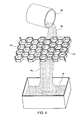
- Preferred embodiments of the invention are described in the following with reference to the drawings, which are for the purpose of illustrating the present preferred embodiments of the invention and not for the purpose of limiting the same. In the drawings,
- Fig. 1 to 3
- each show schematic representations of the steps of a generic spread flow test using a hollow cylinder (3a) filled with liquid coating composition (3b) on a substrate plate (3c), where the final spread diameter (3d) of the iquid coating composition after it has stopped flowing (3e) can be determined.
Figure 1 shows the initial state in which the freshly prepared liquid coating composition is contained in the hollow cylinder.Figure 2 shows the hollow cylinder being lifted up and the liquid coating composition beginning to spread on the substrate plate.Figure 3 shows the liquid coating composition after it has stopped flowing and indicates the final spread diameter. - Fig. 4
- shows a method of coating a cellulosic honeycomb (4c) via a flow of liquid coating composition (4a) that is poured from an outlet (4b) on top of the cellulosic honeycomb where gravity forces the liquid composition through the channels of the cellulosic honeycomb, thus forming the uncured reinforced cellulosic honeycomb (4d). Excess liquid coating composition (4e) that is not deposited on the cellulosic honeycomb flows into a collecting recipient (4f)
- Fig. 5
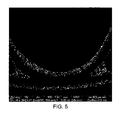
- shows a magnified picture (49x) of a cured reinforced cellulosic honeycomb structure coated with a liquid coating composition having a final spread diameter of 316 mm. The liquid coating composition is evenly deposited on the cellulosic honeycomb structure.
- The present invention provides for a liquid coating composition for impregnating a cellulosic honeycomb structure, comprising a hydraulic binder, a plasticising agent, a stabilising agent, optionally, an accelerating agent, wherein said liquid coating composition has a final spread diameter of more than 250 mm or 360 mm, preferably of from 250 mm or 360 mm to 500 mm, when measured according to a spread flow test using a hollow cylinder having a diameter of 50mm and a height of 50 mm.
- Nowadays, cellulosic honeycomb structures are widely commercially available, and may be formed in a known manufacturing method using either expansion, corrugation or moulding techniques.
- The cellulosic honeycomb structures useful in the context of the present invention may be manufactured from superposed sheets of a cellulosic material such as paper or cardboard, which sheets are selectively affixed to each other in a known manner, for example by glueing, such as to form the cellulosic honeycomb structure upon expansion.
- The cellulosic honeycomb structures useful in the context of the present invention may comprise of from 103 to 106, preferably of from 104 to 106, more preferably of from 3•104 to 3•105 through channels per square meter. Preferably, the through channels are essentially oriented in a direction normal to the plane formed by the cellulosic honeycomb structure.
- The reinforced cellulosic honeycomb structures useful in the context of the present invention may have a thickness of from 10 mm to 200 mm, preferably of from 10 mm to 150 mm and more preferably of from 25 mm to 100 mm. In the case the through holes are essentially oriented in a direction normal to the plane formed by the cellulosic honeycomb structure, the through hole length corresponds to the thickness of the cellulosic honeycomb structures.
- Exemplary cellulosic honeycomb structures may be cardboard honeycomb structures or paper honeycomb structures. Fiber sources for the manufacture of the paper or cardboard cellulosic webs that form the cellulosic honeycomb structure may be natural sources such as wood, linen, jute, sisal, cotton and the like.
- The liquid coating composition for reinforcing the cellulosic honeycomb structure comprises a hydraulic binder, a plasticising agent, a stabilising agent, water and optionally an accelerating agent.
- The liquid coating composition further has the advantage of rendering the coated cellulosic honeycomb structure resistant to a decrease in mechanical strength when humid or wet, once the liquid coating composition is set and hardened. It also provides non-flammability, increases fire resistance and can enhance the mechanical strength of the coated honeycomb, when applied according to the method described further below, and is comprised in the liquid coating composition in 100 parts by dry weight.
- The hydraulic binder may be chosen from any suitable mineral binder, more specifically cementitious binder, such as for example Ordinary Portland Cement (OPC), blast furnace slag cement, or other classes of cement or other cements as described in the literature, e.g. in
US 6,008,275 . Preferably the hydraulic binder is a cement of enhanced fineness, in particular a cement of enhanced fineness having a Blaine value of 350 m2/kg or more, i.e. 350 m2/kg to 6000m2/kg when measured according to ASTM C204 using Method A. Exemplary commercial cements having an enhanced fineness are high early strength "Normo 5R" (CEM I 52.5R) Portland cement, commercially available from Holcim, as well as microfine Portland cement (MFPC) or ultrafine Portland cement (UFPC) "MasterRoc MP 650", commercially available from BASF. - In a preferred embodiment, the hydraulic binder comprises at least 30 percent by dry weight or preferably from 30 to 99.9 percent by dry weight of a cement, preferably a cement of enhanced fineness such as microfine Portland cement (MFPC) or ultrafme Portland cement (UFPC); and optionally up to 70 percent by dry weight, preferably of from 0.1 to 70 percent by dry weight of a fly ash. Suitable fly ash may be commercially available from Holcim under name of "Hydrolent". In an alternative embodiment, the hydraulic binder may also consist solely of a cement, preferably a cement of enhanced fineness such as microfine Portland cement (MFPC) or ultrafine Portland cement (UFPC).
- The liquid coating composition for impregnating a cellulosic honeycomb structure comprises a plasticizing agent, preferably of from 0.2 to 5 parts, more preferably of from 0.2 to 2 parts by dry weight of the plasticising agent.
- The plasticizing agent may be chosen from any polymer plasticizing agent such as for example sulphonated naphtalene formaldehyde polycondensates, modified lignosulphonates, sulphonated melamine-formaldehyde polycondensates, or sulphonated melamine-urea-formaldehyde polycondensates; cellulose based, polyvinyl alcohol based, polycarboxylate-based or polycarboxylate-ether-based plasticising agent.
- Preferably. the plasticizing agent may consist of polymeric dispersants with a comb-like structure, i.e. a backbone carrying positive or negative ionic groups as well as non-adsorbing side chains that are generally composed by polyethylene oxide units or copolymers thereof such that at least 50% of the total mass of side chains are composed of polyethylene oxide units and grafted on the backbone either by ester, amide, imide or ether bonds. The backbones are mainly composed of acrylic, methacrylic or maleic acid. For example, the most common types of PCEs are made from methoxy or hydroxy poly(ethylene glycol) methacrylate ester (MPEG-MA, HPEG-MA), allyl-methoxy or hydroxy poly(ethylene glycol) (APEG) and maleic anhydride, vinyl ethers (VPEG) copolymerized with maleic anhydride for example, or finally isoprenyl oxy poly(ethylene glycol) (IPEG) copolymerized with acrylic or methacrylic acid for example. Furthermore other functional groups may be incorporated into the backbone. They may be either negatively or positively charged such as phosphonate, diphosphonate, sulfonate, trisilanol or amine functional groups, or neutral such as styrene.
- More preferably, the plasticising agent is a polycarboxylate-based or polycarboxylate/ether-based plasticising agent, more preferably a polycarboxylate-based or polycarboxylate/ether-based plasticising agent obtainable from the polymerisation of methacrylic and/or acrylic acid. Most preferably, the plasticising agent is polyacrylate where at least a part of the available carboxylic moieties are esterified with alkoxy-polyethylene oxide or alkoxy-polypropylene oxide.
- An equally preferred plasticising agent may be a plasticising agent based on polyoxyethylene mono- or di-phosphonates. Polyoxyethylene mono- or di-phosphonates are linear molecules and made of a functional group (phosphonate) for the adsorption on the surface of the cellulosic substrate and one side chain of polyethylene oxide.
- In the case where the plasticizing agent is a polycarboxylate-based or polycarboxylate/ether-based plasticising agent, the liquid coating composition for impregnating a cellulosic honeycomb structure preferably comprises of from 0.2 to 2 parts by dry weight of the plasticising agent.
- The liquid coating composition for impregnating a cellulosic honeycomb structure further comprises a stabilizing agent, which stabilizing agent may be comprised of from 0.5 to 10 parts, preferably of from 0.5 to 5 parts by dry weight.
- Suitable stabilizing agents may consist of nanoparticles having an average diameter of between 5 microns and 0.001 microns, preferably of between 1 microns and 0.002 microns, more preferably between 0.5 microns and 0.005 microns.
- Preferably stabilizing agents are nanoparticles comprising inorganic oxides, hydroxides or carbonates of silicon, calcium, titanium, iron, or combinations thereof, and more preferably the stabilizing agent is silicon dioxide in the form of colloidal or fumed silica.
- In the case the stabilizing agent is a colloidal or fumed silica, the average diameter of the nanoparticles is between 150 nm and 3 nm.
- Nanoparticles having an average diameter of between 150 nm and 3 nm are particularly preferred since liquid coating compositions including said nanoparticles will yield cellulosic honeycomb structures having enhanced mechanical strength when compared to cellulosic honeycomb structure coated with liquid coating composition including silica having an average diameter above 150 nm. Thus it is possible to achieve additional mechanical strength by the choice of suitable silica without increase in overall density of the reinforced cellulosic honeycomb structures.
- The liquid coating composition according to the present invention further comprises water. The weight ratio between water and the dry weight of the hydraulic binder may be of from 0.225 to 0.5, preferably of from 0.225 to 0.4, and more preferably 0.225 to 0.30.
- The liquid coating composition for impregnating a cellulosic honeycomb structure may further comprise an optional accelerating agent, which may be any tertiary amine or salt of an alkali or earth alkali metal, and preferably is a salt of calcium or magnesium, and more preferably is a halogen salt of calcium, a calcium sulfate, a calcium nitrate or a calcium carboxylate. Exemplary halogen salts of calcium are calcium chloride or hydrates thereof. It may also be a thiocyanate, for example a sodium thiocyanate.
- If present in the liquid coating composition, the accelerating agent can be present of from 0.1 to 5 parts by dry weight.
- Because in the coating method according to the present invention, it is necessary that the liquid coating composition for reinforcing a cellulosic honeycomb structure be sufficiently liquid to easily flow across the through holes of the cellulosic honeycomb structure when discharged on top of the cellulosic honeycomb structure, and because it is also necessary that during the flow across the through channels, the liquid coating composition is deposited in sufficient amounts to reinforce the cellulosic honeycomb structure, the rheological properties of the liquid coating composition must be fme-tuned.
- The applicants have found that a suspension used for coating a cellulosic honeycomb structure must therefore have a final spread diameter of more than 250 mm, preferably of from 250 mm to 500 mm, more preferably of from 250 mm to 360 mm, when measured according to a spread flow test described in more detail hereinafter.
- The spread flow test for determining the suitability of a liquid coating composition for reinforcing a cellulosic honeycomb structure is carried out using a hollow cylinder having an inner diameter of 50 mm and a height of 50 mm.
- The spread flow test consists in the steps of a. placing a hollow cylinder having an inner diameter of 50 mm and a height of 50 mm on top of a moist glass plate, b. filling the cylinder to the brim with a liquid coating composition to be tested, c. slowly lifting the cylinder by 50 mm in vertical direction, d. allowing the liquid coating composition to flow and spread on the moist glass plate until it stops flowing, e. measuring the final diameter of the spread (the final spread diameter) of the liquid coating composition in the horizontal plane. Tests that measure the spread flow of a fluid after it has stopped flowing under defined conditions are known in the field as methods for characterizing cement-based materials such as the liquid coating composition used in the present invention, see for example N. Roussel, C. Stefani, R. Leroy, "From mini-cone test to Abrams cone test: measurement of cement-based materials yield stress using slump tests", Cement and Concrete Research, 35, 2005, pp 817-822 .
- In most cases, the liquid coating composition will spread evenly into all directions and form into a shape that is essentially circular and for which the fmal diameter can easily be measured. In the case where the liquid coating composition spreads into another shape, such as for example an ellipse shape, the diameter is taken from the average of at least two measurements, preferably four. These include at least the largest and the smallest diameter and have a roughly constant angle among each other.
- In a preferred embodiment, the liquid coating composition for impregnating a cellulosic honeycomb structure comprises 100 parts by dry weight of the hydraulic binder, of from 0.2 to 2 parts by dry weight of the plasticising agent, of from 0.5 to 5 parts by dry weight of the stabilising agent and optionally of from 0.1 to 5 parts by dry weight of the accelerating agent.
- Suitable liquid coating compositions that may be used as liquid coating compositions for reinforcing cellulosic honeycomb structures according to the present invention are compositions having a final spread diameter of more than 250 mm, preferably of from 250 mm to 500 mm, more preferably of from 250 mm to 360 mm, when measured according to the spread flow test described above.
- The present invention further provides for a method of producing a reinforced cellulosic honeycomb structure comprising through channels, the method comprising the steps of a. orienting a cellulosic honeycomb structure such that the through channels of the cellulosic honeycomb structure are oriented in a vertical direction, b. directing an essentially vertical flow of liquid coating composition as described herein across the through channels of the cellulosic honeycomb structure such as to form a fresh reinforced cellulosic honeycomb structure, c. curing the fresh reinforced cellulosic honeycomb structure such as to form the reinforced cellulosic honeycomb structure, wherein the liquid coating composition has a fmal spread diameter of more than 250 mm, preferably of from 250 mm to 500 mm, more preferably of from 250 mm to 360 mm, when measured according to a spread flow test using a hollow cylinder having a diameter of 50mm and a height of 50 mm.
- In the context of the present invention, the term "fresh reinforced cellulosic honeycomb structure" refers to a cellulosic honeycomb structure having the still workable liquid coating composition deposited thereon, and where the binder of the liquid coating composition has not yet had the time to enter the hardening phase.
- Optionally, step c. of the method according to the present invention can be carried out by bringing the fresh reinforced cellulosic honeycomb structure to a temperature of from 15 to 200 °C, and preferably to a temperature of 30 to 200 °C.
- Preferably, in step b. the essentially vertical flow of liquid coating composition across the through channels of the cellulosic honeycomb structure is driven solely by gravity, i.e. without the need to push the liquid coating composition across the through channels with pressure from above, or to suck it through using underpressure from below.
- Because the liquid coating composition has a spread of more than 250 mm according to the spread flow test described above, the rheology of the liquid composition is such that there is no need to push the liquid coating composition across the honeycomb with pressure from above, or to suck it through with underpressure from below to achieve a continuous deposition of liquid coating composition, nor is there a need for lengthy immersion in the liquid coating composition.
- Thus reinforced cellulosic honeycomb structure can be produced by directing an essentially vertical flow of liquid coating composition through the cellulosic honeycomb structure, which flow may be created by casting, or pouring, the coating composition on the cellulosic honeycomb structure from above, preferably through a slit die, slide, or chute. Alternatively, good results may also be obtained by dipping the cellulosic honeycomb structure into the liquid coating composition.
- The liquid coating composition may settle if left un-agitated for an extended period of time, which is why optionally the liquid coating composition can be vigorously agitated prior to step b. to prevent settling and to provide for a homogeneously dispersed liquid coating composition. The agitation may be carried out by moving the liquid coating composition through a rotating drum, static mixer, or a pump.
- The present invention yet further provides for a reinforced cellulosic honeycomb structure for use in a building material, obtainable according to the method described herein, comprising a cellulosic honeycomb structure and a liquid coating composition deposited thereon, said liquid coating composition comprising, and preferably consisting of, 100 parts by dry weight of the hydraulic binder, of from 0.2 to 5 parts by dry weight of the plasticising agent, of from 0.5 to 10 parts by dry weight of the stabilising agent and optionally of from 0.1 to 5 parts by dry weight of the accelerating agent.
- The reinforced cellulosic honeycomb structure according to the present invention may have the liquid coating composition deposited thereon in amounts ranging from 190 to 600 g/m2, based on the specific surface of the cellulosic honeycomb.
- The reinforced cellulosic honeycomb structure according to the present invention may have the liquid coating composition deposited thereon in a thickness of from 0.1 to 0.5 mm.
- The reinforced cellulosic honeycomb structures according to the present invention may have an overall density of from 150 to 500 kg/m3, preferably of from 200 kg/m3 to 400 kg/m3.
- The present invention yet further provides for a sandwich-structured composite building material comprising a core of reinforced cellulosic honeycomb structure.
- A previously dry-mixed ternary mixture of 500.0 g of ordinary portland cement (Holcim Normo 4), 230.0 g of fly ash (Holcim Hydrolent) and 30.0 g of silica fume (BASF Elkem Microsilica 971-U) having an average diameter of 0.15 micron and a previously wet-mixed binary mixture of 20.0 g of plasticizing agent (BASF Glenium ACE-30) (corresponding to 0.75 parts of plasticizing agent by dry weight) and 205.0 g of water were combined in a running mixer operating at a mixing velocity of 900 rpm in order to form 500 ml of liquid coating composition.
- During the first 30 seconds after combining the ternary and binary mixtures, the mixing was manually complemented using a spatula. At the end of these first 30 seconds, the mixing velocity was increased to 2000 rpm for a duration of 120 seconds. Then the mixer was turned off, and the liquid coating composition was allowed to rest for 50 seconds.
- The needed amount (about 100 mL) of the previously prepared liquid coating composition were immediately used to fill a cylinder standing on a glass plate for the spread flow test as described above. The cylinder was then lifted upwards 10 seconds after it had been filled and the liquid coating composition was allowed to flow and spread on the glass plate.
- The final flow spread diameter was then measured 2 minutes after lifting the cylinder, and was of 344 mm.
- 400 g of the previously prepared liquid coating composition were immediately used for partially coating cardboard honeycomb having a thickness of 70 mm, and having a specific surface of 940 m2/m3.
- A cylinder having a height of 25 mm and a diameter of 50 mm was placed on top of the cardboard honeycomb. Then the liquid coating composition was poured into the cylinder and the liquid coating composition was allowed to flow through the below section of the honeycomb structure under the action of gravity. Once the liquid coating composition stopped dripping from the cells, the weight increase of the honeycomb was measured. 44.6 g of the liquid coating composition remains on the honeycomb element, leading to a coated honeycomb structure having a density of 395 kg/m3.
- A fresh batch of 1 liter of liquid coating composition was prepared according to the above procedure.
- This liquid coating composition was then used for completely coating four 100 x 100 mm cardboard honeycomb samples having a thickness of 70 mm, and having a specific surface of 940 m2/m3.
- This liquid coating composition was poured onto the cardboard honeycomb samples and the freshly coated samples were left to cure for 7 days in an atmosphere having 85% relative humidity, before being tested for their compressive strength.
- These tests were done with a strain-controlled setup using a loading velocity of 0.2 mm/sec. The compressive strength at the elastic limit was taken as 85% of the peak compressive stress.
- The obtained samples reached a mean compressive strength of 1.3 MPa with a standard deviation of 0.3 MPa.
- A liquid coating composition was prepared according to the above procedure, except that the composition contained an amount of only 4.0 g of plasticizing agent (also Glenium ACE-30) and 220.0 g of water for 500 mL of coating material (equivalent to 0.15 parts of plasticizing agent by dry weight). The amounts of the other components were left unchanged.
- The thus obtained mixture displayed a spread flow test diameter of 213 mm, a coating weight of 208.5 g and gave reinforced honeycomb with a density of 1588 kg/m3, which is approximately four-fold the density of the reinforced honeycomb obtained with the inventive liquid compositions (395 kg/m3).
- In this example the liquid coating composition did not fully flow across the cells of the honeycomb and thus the coating was not evenly distributed in the honeycomb structure.
- The obtained sample reached a compressive strength of 2.2 MPa.
-
- 3a
- hollow cylinder
- 3b
- liquid coating composition
- 3c
- substrate plate
- 3d
- fmal spread diameter
- 3e
- non-flowing liquid coating composition
- 4a
- liquid coating composition
- 4b
- outlet for liquid coating composition
- 4c
- cellulosic honeycomb structure
- 4d
- uncured reinforced cellulosic honeycomb structure
- 4e
- excess liquid coating composition
- 4f
- collecting recipient
Claims (16)
- A liquid coating composition for reinforcing a cellulosic honeycomb structure, comprisinga. a hydraulic binderb. a plasticising agentc. a stabilising agentd. watere. optionally, an accelerating agent,
wherein the liquid coating composition preferably has a final spread diameter of more than 250 mm according to a spread flow test using a hollow cylinder having an inner diameter of 50mm and a height of 50 mm. - The liquid coating composition of claim 1, wherein it comprisesa. 100 parts by dry weight of the hydraulic binderb. of from 0.2 to 5 parts by dry weight of the plasticising agentc. of from 0.5 to 10 parts by dry weight of the stabilising agentd. optionally, 0.1 to 5 parts by dry weight of the accelerating agent.
- The liquid coating composition of claim 1 or 2, wherein the hydraulic binder comprises at least 30 percent by weight, preferably from 30 to 99.9 percent by weight of cement.
- The liquid coating composition according to any preceding claim, wherein the weight ratio between water and hydraulic binder is of from 0.225 to 0.30.
- The liquid coating composition according to any preceding claim, wherein the hydraulic binder comprises at least 0.1 percent by weight, and more preferably of from 0.1 to 70 percent by weight of a fly ash.
- The liquid coating composition according to any preceding claim, wherein the hydraulic binder is an ordinary Portland cement, preferably a cement of enhanced fmeness having a Blaine value of 350 m2/kg or more.
- The liquid coating composition according to any preceding claim, wherein the plasticising agent is a polycarboxylate-based or polycarboxylate/ether-based plasticising agent, and wherein the plasticising agent is comprised of from 0.2 to 5 parts by dry weight.
- The liquid coating composition according to any preceding claim, wherein the stabilising agent is a silica or an alumina, preferably a colloidal silica or fumed silica.
- The liquid coating composition according to any preceding claim, wherein the stabilising agent is nanoparticles having an average diameter of between 5 microns and 0.001 microns, preferably of between 1 microns and 0.002 microns, more preferably between 0.5 microns and 0.005, and most preferably an average diameter of between 150 nm and 3 nm.
- The liquid coating composition according to any preceding claim, wherein the accelerating agent is a salt of an earth alkali metal, preferably a calcium salt, and more preferably is CaCl2.
- A method of producing a reinforced cellulosic honeycomb structure comprising through channels, the method comprising the steps ofa. orienting a cellulosic honeycomb structure such that the through channels of the cellulosic honeycomb structure are oriented in a vertical direction,b. directing an essentially vertical flow of liquid coating composition according to claims 1 to 10 across the through channels of the cellulosic honeycomb structure such as to form a fresh reinforced cellulosic honeycomb structure,c. curing the fresh reinforced cellulosic honeycomb structure such as to form the reinforced cellulosic honeycomb structure,d. wherein the liquid coating composition has a final spread diameter of more than 250 mm or 360 mm, preferably of from 250 mm or 360 mm to 500 mm, when measured according to a spread flow test using a hollow cylinder having a diameter of 50mm and a height of 50 mm.
- The method of producing an impregnated cellulosic honeycomb structure according to claim 11, wherein the essentially vertical flow may be created by casting or pouring, the liquid coating composition on the cellulosic honeycomb structure, preferably through a slit die, slide, or chute.
- A reinforced cellulosic honeycomb structure obtainable according to the method of claims 11 to 12, for use in a building material, comprising a cellulosic honeycomb structure and a liquid coating composition deposited thereon.
- The reinforced cellulosic honeycomb structure of claim 13, wherein the liquid coating composition comprises, and preferably consists of, 100 parts by dry weight of the hydraulic binder, of from 0.2 to 5 parts by dry weight of the plasticising agent, of from 0.5 to 10 parts by dry weight of the stabilising agent and optionally of from 0.1 to 5 parts by dry weight of the accelerating agent.
- A sandwich-structured composite building material comprising a core of reinforced cellulosic honeycomb structure according to claims 13 to 14.
- The reinforced cellulosic honeycomb structure of claim 13 to 14, wherein the liquid coating composition is deposited thereon in a thickness of from 0.1 to 0.5 mm.
Priority Applications (2)
| Application Number | Priority Date | Filing Date | Title |
|---|---|---|---|
| EP14000330.2A EP2902183A1 (en) | 2014-01-29 | 2014-01-29 | Cementitious coating for composite building materials and manufacture thereof |
| PCT/EP2015/051863 WO2015114065A1 (en) | 2014-01-29 | 2015-01-29 | Cementitious coating for composite building materials and manufacture thereof |
Applications Claiming Priority (1)
| Application Number | Priority Date | Filing Date | Title |
|---|---|---|---|
| EP14000330.2A EP2902183A1 (en) | 2014-01-29 | 2014-01-29 | Cementitious coating for composite building materials and manufacture thereof |
Publications (1)
| Publication Number | Publication Date |
|---|---|
| EP2902183A1 true EP2902183A1 (en) | 2015-08-05 |
Family
ID=50028740
Family Applications (1)
| Application Number | Title | Priority Date | Filing Date |
|---|---|---|---|
| EP14000330.2A Withdrawn EP2902183A1 (en) | 2014-01-29 | 2014-01-29 | Cementitious coating for composite building materials and manufacture thereof |
Country Status (2)
| Country | Link |
|---|---|
| EP (1) | EP2902183A1 (en) |
| WO (1) | WO2015114065A1 (en) |
Families Citing this family (1)
| Publication number | Priority date | Publication date | Assignee | Title |
|---|---|---|---|---|
| DE102019116129A1 (en) * | 2019-06-13 | 2020-12-17 | Fredy Iseli | Flat sandwich construction element for buildings |
Citations (7)
| Publication number | Priority date | Publication date | Assignee | Title |
|---|---|---|---|---|
| GB802686A (en) | 1955-03-31 | 1958-10-08 | Bettinger Corp | Improvements in or relating to honeycomb structures |
| US2910396A (en) * | 1952-11-12 | 1959-10-27 | Bettinger Corp | Structural reticulated webs or honeycombs and curtain wall panels made from same |
| US4720414A (en) * | 1986-06-25 | 1988-01-19 | Burga Roque F | Fire-resistant material |
| DE4324334A1 (en) * | 1992-07-22 | 1994-01-27 | Sandoz Ag | Flowable cement mixtures |
| US6008275A (en) | 1997-05-15 | 1999-12-28 | Mbt Holding Ag | Cementitious mixture containing high pozzolan cement replacement and compatabilizing admixtures therefor |
| WO2011008907A2 (en) * | 2009-07-15 | 2011-01-20 | U.S. Concrete, Inc. | Method for estimating properties of concrete |
| WO2012045653A1 (en) | 2010-10-08 | 2012-04-12 | Fredy Iseli | Honeycomb composite support part and method for coating it |
-
2014
- 2014-01-29 EP EP14000330.2A patent/EP2902183A1/en not_active Withdrawn
-
2015
- 2015-01-29 WO PCT/EP2015/051863 patent/WO2015114065A1/en not_active Ceased
Patent Citations (7)
| Publication number | Priority date | Publication date | Assignee | Title |
|---|---|---|---|---|
| US2910396A (en) * | 1952-11-12 | 1959-10-27 | Bettinger Corp | Structural reticulated webs or honeycombs and curtain wall panels made from same |
| GB802686A (en) | 1955-03-31 | 1958-10-08 | Bettinger Corp | Improvements in or relating to honeycomb structures |
| US4720414A (en) * | 1986-06-25 | 1988-01-19 | Burga Roque F | Fire-resistant material |
| DE4324334A1 (en) * | 1992-07-22 | 1994-01-27 | Sandoz Ag | Flowable cement mixtures |
| US6008275A (en) | 1997-05-15 | 1999-12-28 | Mbt Holding Ag | Cementitious mixture containing high pozzolan cement replacement and compatabilizing admixtures therefor |
| WO2011008907A2 (en) * | 2009-07-15 | 2011-01-20 | U.S. Concrete, Inc. | Method for estimating properties of concrete |
| WO2012045653A1 (en) | 2010-10-08 | 2012-04-12 | Fredy Iseli | Honeycomb composite support part and method for coating it |
Non-Patent Citations (7)
| Title |
|---|
| "DAS SCHWEIZER BUCH 2010/13", SCHWEIZERISCHE NATIONALBIBLIOTHEK, vol. 110, 15 July 2010 (2010-07-15), pages 1 - 90, XP055223608, Retrieved from the Internet <URL:HTTP://EAD.NB.ADMIN.CH/WEB/SB-PDF/2010/SB201013.PDF> |
| ALMUT POHL ET AL: "THE MECHANICAL AND THERMAL PROPERTIES OF CORRUGATED PAPER HONEYCOMB. PART 1- EXPERIMENTAL INVESTIGATION", NORDIC PULP & PAPER RESEARCH JOURNAL, vol. 25, no. 4, 2010, pages 513 - 521, XP055223596, DOI: 10.3183/NPPRJ-2010-25-04-P513-521 |
| ALMUT POHL: "STRENGTHENED CORRUGATED PAPER HONEYCOMB FOR APPLICATION IN STRUCTURAL ELEMENTS", 31 October 2009 (2009-10-31), pages 1 - 355, XP055123535, Retrieved from the Internet <URL:http://e-collection.library.ethz.ch/eserv/eth:246/eth-246-02.pdf> [retrieved on 20140616], DOI: http://dx.doi.org/10.3929/ethz-a-005900291 * |
| ALMUT POHL: "STRENGTHENED CORRUGATED PAPER HONEYCOMB FOR APPLICATION IN STRUCTURAL ELEMENTS", THESIS, ETH ZÜRICH, 2009, pages 1 - 355, XP055123535, DOI: 10.3929/ETHZ-A-005900291 |
| KLINGSCH E.W. ET AL: "DEVELOPMENT OF INNOVATIVE LIGHTWEIGHT CARDBOARD ELEMENTS FOR SUSTAINABLE CONSTRUCTIONS", 18TH CONGRESS OF IABSE, 19 September 2012 (2012-09-19), SEOUL,, pages 1 - 7, XP008169911 |
| N. ROUSSEL; C. STEFANI; R. LEROY: "From mini-cone test to Abrams cone test: measurement of cement-based materials yield stress using slump tests", CEMENT AND CONCRETE RESEARCH, vol. 35, 2005, pages 817 - 822 |
| ÖZLEM A.: "CARDBOARD IN ARCHITECTURAL TECHNOLOGY AND STRUCTURAL ENGINEERING : A CONCEPTUAL APPROACH TO CARDBOARD BUILDINGS IN ARCHITECTURE", THESIS, ETH ZÜRICH, 2009, XP055223585, Retrieved from the Internet <URL:HTTP://E-COLLECTION.LIBRARY.ETHZ.CH/ESERV/ETH:1369/ETH-1369-02.PDF> |
Also Published As
| Publication number | Publication date |
|---|---|
| WO2015114065A1 (en) | 2015-08-06 |
Similar Documents
| Publication | Publication Date | Title |
|---|---|---|
| AU2005286997B2 (en) | Flexible hydraulic compositions | |
| Delvasto et al. | An appropriate vacuum technology for manufacture of corrugated fique fiber reinforced cementitious sheets | |
| US5514744A (en) | Cement products and a method of manufacture thereof | |
| CA3000469C (en) | Decorative concrete topping process | |
| US4772328A (en) | Hydraulic cementitious compositions reinforced with fibers containing polyacrylonitrile | |
| US10640424B2 (en) | Castable material based on cementitious binder with shrinkage resistance | |
| WO2009075609A2 (en) | Man-made mineral fibre for three-dimensional reinforcement of a cement product | |
| Raupit et al. | Splitting tensile strength of lightweight foamed concrete with polypropylene fiber | |
| Derdour et al. | Effect of date palm and polypropylene fibers on the characteristics of self-compacting concretes: comparative study | |
| JP5608225B2 (en) | Improved method for reinforcing cement-based mortars and building structures | |
| US8282732B2 (en) | Use of at least one cellulose ether to reduce plastic shrinkage and/or cracking in concrete | |
| JP2009084092A (en) | Mortar restoration material | |
| AU2018285658A1 (en) | Method for manufacturing concrete articles and structures | |
| WO2015114065A1 (en) | Cementitious coating for composite building materials and manufacture thereof | |
| JP2004189512A (en) | Mortar composition | |
| CA2617163C (en) | Cement-containing composition for use with alkali-resistant fiberglass and poles made therefrom | |
| Shanmugapriya et al. | A Comparative Analysis of Hemp, Kenaf, and Sisal Fibres as Internal Curing Agents in Concrete: A Performance | |
| Kim et al. | Effect of Mixing Method on Mechanical Properties of Fiber Reinforced Concrete | |
| CN117567093A (en) | Special bonding mortar for inorganic quartz stone and preparation method thereof | |
| CN116161915A (en) | High-performance self-compacting concrete for large-span highway-railway dual-purpose bridge | |
| CN106116240A (en) | A kind of Novel dry powder mortar plasticizing reinforcing agent | |
| JP2011136889A (en) | Hydraulic composition having self-leveling property | |
| CN105948565A (en) | Plasticizing reinforcer for dry powder mortar | |
| JP2015182900A (en) | Producing method of thin member and thin member |
Legal Events
| Date | Code | Title | Description |
|---|---|---|---|
| PUAI | Public reference made under article 153(3) epc to a published international application that has entered the european phase |
Free format text: ORIGINAL CODE: 0009012 |
|
| 17P | Request for examination filed |
Effective date: 20140129 |
|
| AK | Designated contracting states |
Kind code of ref document: A1 Designated state(s): AL AT BE BG CH CY CZ DE DK EE ES FI FR GB GR HR HU IE IS IT LI LT LU LV MC MK MT NL NO PL PT RO RS SE SI SK SM TR |
|
| AX | Request for extension of the european patent |
Extension state: BA ME |
|
| TPAC | Observations filed by third parties |
Free format text: ORIGINAL CODE: EPIDOSNTIPA |
|
| STAA | Information on the status of an ep patent application or granted ep patent |
Free format text: STATUS: THE APPLICATION IS DEEMED TO BE WITHDRAWN |
|
| 18D | Application deemed to be withdrawn |
Effective date: 20160206 |